PROFILING
NEIGHBORHOOD
CHANGE ALONG
THE 606 TRAIL
Final Report
Annette Barbato, Ryan Chapman, Frank
Kryzak, Gonzalo Rizo, Michael Whalen
UPP 405: Researching the City ‖ Professor Phil
Ashton
December 8, 2015
Barbato et al. 1
Introduction
The 606 Bloomingdale Trail is a decade in the making. As the train traffic on the
Bloomingdale Line slowed in the 1990s, the City of Chicago turned their attention to how the
train line might be used to increase much-needed green space. In the 1990s, Logan Square had
the least amount of open space per capita of any neighborhood in Chicago and needed an
additional 99 acres of active open space to reach the City’s minimum requirement. In 2004, the
City’s proposal to convert the Bloomingdale Line into a park was included in the Logan Square
Open Space Plan, thus prompting the Chicago Department of Transportation to begin applying
for federal transportation funding for the project1. The 606 project broke ground in August of
2013 and opened to the public after completion of the first phase of the project on Saturday,
June 6, 2015.
The 606 provides nearly three miles of green space that connects parks, people, and
communities. The City of Chicago, Chicago Park District, and the Trust for Public Land formed a
public/private partnership to fund and build The 606. The trail cost an estimated $95 million with
federal money paying for the majority of the trail2. The trail runs along Bloomingdale Avenue
(1800 N) from Ridgeway Avenue (3750 W, west trailhead) terminating at Ashland Avenue (1600
W, east trailhead). The trail connects ethnically and financially diverse Chicago neighborhoods
of Wicker Park, Bucktown, Humboldt Park and Logan Square. The trail has twelve access points
most of which are ADA compliant.
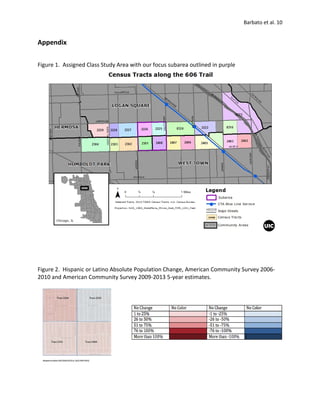
The total area of study (Figure 1) for the class are the nineteen census tracts that surround
The 606 trail. Our group’s assigned census tracts of the study are 2226, 2225, 2301 and 2408,
which can be divided up into quadrants. Our tracts of study are bordered by Armitage Avenue
to the north, California Avenue to the east, North Avenue to the south, and Kedzie Avenue to the
west. What we have attempted to do in our research is to analyze how our census tracts have
changed over time and try to see what the effects have been or possibly will be of the opening
of the 606. During our preliminary research we noticed an interesting phenomenon, that the
Latino/Hispanic cohort emptied out of our census tracts but then in the past five years or so have
been repopulating three of our four tracts (with the exception being 2225). We have looked at
some different models of neighborhood change to try and explain what is happening in our tracts
of study, such as the Latino Uplift model and the Invasion-Succession model. This lead us to some
more questions about where are these people coming from- are they migrating from areas east
of ours? Are they wealthy, or if not, could we suppose they are succeeding from other areas
because of an invasive group? The following report will attempt to answer these pressing
1
source: http://www.the606.org/about/the-story/
2
source: https://www.tpl.org/faq-606
Barbato et al. 2
questions, or at the very least, offer a look into our areas of study and perhaps how and why it is
changing.
Methods
There are several ways to measure neighborhoods as a unit of analysis. Neighborhoods
can be measured as: spatial units, social units, socio-spatial units, and institutional units. Before
analysis of a neighborhood can begin, one first needs to define what a neighborhood is.
According to Robert Chaskin, neighborhoods are socially constructed realities that are built
through a dialogue between individual actors and structural forces containing social, spatial, and
experiential dimensions.
In our research we used 2000 and 2010 Decennial Census data and data from the 2006-
2010 and 2009-2013 American Community Survey 5-year estimates. The data we analyzed
included population, age, race, mobility and migration, education, and housing data. From this
data obtained, we performed a quantitative analysis of the 4 focus tracts and complete study
area. During further analysis, we grouped the complete study area into East and West tract
division and used this division to either confirm or reject our hypotheses.
Humboldt Park and Logan Square Neighborhoods
The change and decline of the community
neighborhood of Humboldt Park started in the
1970’s when there was an influx of Puerto Rican
residents moving in and the majority of the ethnic
white population began moving out. The Puerto
Rican population was discriminated against and
harassed during this period so much so that the
National Guard was called in to control the area
because the ethnic white population feared for their lives. By the 1980’s and 1990’s the Puerto
Rican presence was large in Humboldt Park with the residents referring to the area as La Cuidad
del Encanto, the charming city. Puerto Ricans started investing in the neighborhood by buying
houses and there was a huge demand to rent in the neighborhood. The financial crisis of the
2000s negatively impacted the Puerto Rican residents and they began to migrate out of Humboldt
Park due to home foreclosures.
Barbato et al. 3
The majority of the housing structures in Humboldt Park and Logan Square
neighborhoods, in our tracts of study, were built during 1939. According to the American
Community Survey 5-year estimates, in 2010 the average household size of our tracts of study
was 2.5 with 2,944 housing units of which 2,588 units were occupied with 356 units vacant. In
2013, the average household size stayed at 2.5 with 2,806 housing units (a decrease of 138 units
from 2010) of which 2,473 units were occupied
with 333 vacant units. The median value of
owner-occupied housing units in 2010 for tract
2225 was $359,900, tract 2226 $326,600, tract
2301 $245,400, and tract 2408 $369,200 with an
average of the 4 tracts being $325,538. In 2013
the median values were, respectively, $297,600,
$317,900, $217,300, $277,000 with an average of
$287,253. The 2010 data includes the housing
boom and bust cycle of the early 2000s while the
2013 data eludes to the notion that the
community neighborhoods of Humboldt Park and Logan Square are prime areas for investors to
begin acquiring real estate to begin converting and/or rehabbing available housing units.
Population
The decennial census data for our tracts of study showed that between 2000 and 2010,
our neighborhoods experienced an increase in the white population. However, from the
American Community Survey 5- year estimates for 2006-2010 to the American Community
Survey 5-year estimates for the 2009-2013 population change data, our tracts of study
experienced Latino Uplift while the study area as a whole still experienced white invasion.
(Population loss may be attributed to zoning that largely favors single family homes instead of
denser building types however we did not further explore this avenue as our research led us
elsewhere). The entire study area and the 4 census tracts of study experienced population loss
in absolute population change from 2010 to 2013.
Interestingly, other than the northeast census tract, the 4 census tracts of study gained
Hispanic/Latino population from the American Community Survey 2006-2010 estimates to the
American Community Survey 2009-2013 estimates (see Figure 2). This finding led us to our
hypotheses of: Is Latino income rising across all tracts, or are higher income earners moving
west? Can the increase in Latino population in subarea tracts be attributed to this westward
movement?
Barbato et al. 4
Income
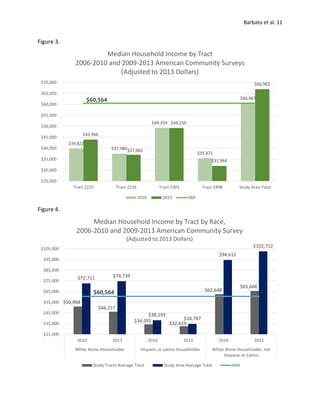
In our initial analysis of study area, the data indicated that our four tracts of study were
well below the City’s area median income of $60,564 in both 2010 and 2013 (see Figure 3). The
total study area, however, was about even with the 2013 AMI in 2010 with $60,487 and above in
2013 with a median household income of $66,962. To further study our hypothesis of a possible
Latino Uplift, we analyzed median household incomes by tract by race (see Figure 4). In our 4
tracts of study, white alone householders, not Hispanic or Latino, were above the 2013 AMI while
white alone and Hispanic or Latino householders were far below. However, in the entire study
area, white alone and white alone, not Hispanic or Latino, were both significantly above the 2013
AMI while the Hispanic or Latino householders were still significantly below. The much higher
median incomes for the entire study area led us to studying income data in more depth later in
this report.
Study Area Recategorization
In order to further analyze our initial findings, we thought back to our original hypothesis
of Latino movement from the eastern end to the western end of the entire study area. The
original study area of census tracts surrounding The 606 trail is roughly 3 miles long. California
Avenue is both a natural break halfway between the areas, but is also a good statistical division
for the assigned tracts of study.
Further Data Analysis
After organizing the data between East and West, a trend became apparent: median
income in eastern tracts was much higher than median income in western tracts, frequently more
than double. This should not necessarily be surprising, as real estate prices are higher in the
eastern, more accessible tracts. Educational attainment levels are also significantly higher in
eastern tracts, as illustrated in Figure 5, however the change between the two survey periods
indicates that educational attainment levels have risen in both eastern and western tracts.
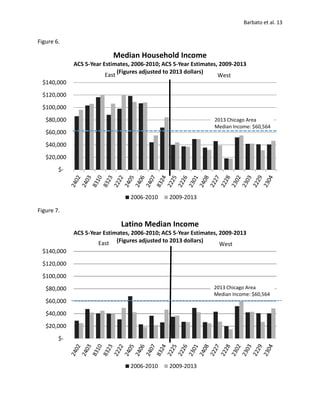
The graph in Figure 6 shows median household income for all segments of the population
in each tract. Figure 7 illustrates median household income for Latinos, which is relatively
consistent throughout the entire 19-tract study area. The Latino median income in all tracts is
lower than the Chicago median.
Barbato et al. 5
A comparison of the two American Community Survey periods indicates that, in all but
one eastern tract, median household income increased. In the ten western tracts, only four
experienced gains in median household income. Across the entire study area, Latino household
median income only increased in five tracts and saw decline or stagnation in all others.
To further illustrate the income disparities between eastern and western tracts, Figure 9
shows that Latino households with median incomes in the 90th percentile earn less than the 10th
percentile median income threshold in eastern tracts. This disparity disappears in western tracts,
which points to a more homogenous population. It may also indicate that tracts east of California
Avenue are experiencing more rapid gentrification than those to the west, which again is
expected after analyzing the context of the community.
All the data seem to suggest that any gentrification movement occurring does not follow
the model of Latino uplift. It is more likely that as eastern tracts become more expensive,
development will shift westward. Stagnating or declining incomes will likely lead to future
displacement in western tracts, as wealthier, white residents move in and drive up the cost of
housing. However, at this point in time, this trend is not entirely evident in the data.
Mobility
While comparing mobility data within the focus subarea, no clear trends emerged.
However, following the protocol of analyzing eastern and western tracts separately, a significant
out-migration can be observed. Figures 12.1 – 12.4 display the percentage of residents who
moved in eastern and western tracts during the two survey periods. Figure 12.4 shows that only
50% of residents in western tracts (overall) stayed put in their same house, while 50% of residents
surveyed had moved into the area within the last year, largely from within Cook County. Figures
10 and 11 show a significant outmigration of Latinos from western tracts while there is an in
migration of whites during the same period.
Originally, the decline in Latino population appeared to have some relationship to the
housing crisis, however the mobility dataset, when coupled with demographic data, suggests that
there may have been some degree of displacement in western tracts. The mobility data may also
suggest that education attainment levels of existing residents may not have risen significantly,
and rather the gains in attainment levels may be attributed to the influx of new residents into
the community.
Barbato et al. 6
Age
The age pyramids in Figures 13.1-13.4 illustrate population data by age and sex. Figures
13.1 and 13.3 indicate that, while eastern tracts have a higher number of millennials, many of
these millennials leave the area as they age. Figures 13.2 and 13.4 display a higher population of
children in western tracts. Typically, households with children have lower rates of mobility. The
western half of the study area has more children than eastern tracts, however, as shown in the
mobility data, western tracts still experienced a significant out-migration in the survey period
between 2009 and 2013. This fact again points to the fallout following the housing crisis in years
prior, and may also suggest family households may have been pushed out of the area by raising
housing costs.
Development
The images below show what was once a vacant lot at least as far back as 2009 to a new condo
building in 2014, begs the question – is the 606 spurring “invasion” or simply, perhaps, infill
development? After searching the Cook County Recorder of Deeds, it appears that property has
been owned by Senco Properties since at least 2007 which predates the transformation of the
Bloomingdale Trail, so the effect of the 606 does not suggest causality for “gentrification” on this
particular parcel. But, Senco properties is not an LLC made up of people from the neighborhood
who have lived there for decades…no, the invasion is quite apparent. They specialize in “luxurious
and modern new construction” and they serve “neighborhoods such as Bucktown, Wicker Park,
1803 N. California Ave., 2014
Image Courtesy of Google, Inc.
1803 N. California Ave., 2011
Image Courtesy of Google, Inc.
Barbato et al. 7
Gold Coast, West Loop, Lincoln Park” …basically neighborhoods that are gentrifying or have at
one point in the past. They are building condo buildings at other sites in the neighborhood as
well.
Assessing Changes in the Commercial Environment
The Chicago sociologists recognized change in local population composition as a major
mechanism by which natural areas change. The terms "invasion" and "succession” are used to
describe the processes of neighborhood population alteration3. Competition, conflict, and
accommodation were viewed by Park (1952) as natural processes that characterized the
relationships among different populations. From this perspective the invasion of a natural area
by socially or racially different individuals is met with resistance. Competition for housing may be
turned into conflict as the locals and the newcomers attempt to devise strategies to best each
other. If some accommodation between the two populations is not reached, one of the groups
will withdraw. If the newcomers withdraw, the invasion has been halted. If the established
population withdraws, their departure, coupled with the continued arrival of the new group will
result in succession. Invasion and succession were also used by the Chicago School to refer to
change in land use or predominant activities in the neighborhood.
One of the least-studied areas in the general invasion-succession domain is that of the
consequences of racial turnover on local institutions. Aldrich and Reiss (1977) report that the
business population in an area undergoing succession turns over in the same manner as the
resident population leave and are replaced by members of the incoming group. Schmidt and Lee
(1978) report that change in racial composition in neighborhoods undergoing transition alters
the commercial structure of a neighborhood. Heilbrun and Conant (1972) focused on business
performance and survival during change, while Rose (1970) has studied the association between
commercial land use succession and changes in commercial structure. The results of these studies
indicate that invasion-succession describes patterns of neighborhood change in social and
economic institutions as well as in population composition.
Inventory of Armitage Avenue
We wanted to find any patterns for “invasion” of “hip” businesses and possible succession
of Hispanic-owned or serving businesses. This inventory was not done in any scientific manner,
it simply is a reflection the subjectivity of the names of businesses, and common perceptions.
3
source: http://neighbourhoodchange.ca/wp-content/uploads/2011/07/1983-Schwirian-Models-of-
Neighborhood-Change.pdf
Barbato et al. 8
This was carried out in order to gain a better perspective of how the commercial environment of
our study area has changed over the last decade or so. The survey was carried out by simply
walking along the street and noting the names of businesses, and assessing whether any given
business was a regional/national chain (e.g. Subway) or independently owned. Then, building on
the first assessment, we identified whether the business was a Hispanic/Latino owned or
Hispanic/Latino catering business (e.g. a taco restaurant) or a “hip” business (e.g. a boutique).
The following paragraphs detail the findings about Armitage Avenue and is illustrated in Figure
14.
There is not a significant amount of Hispanic/Latino businesses compared to Gastropubs,
cafes, hip bars, boutiques, etc. and vice versa. There are 4 buildings that were deemed a
Hispanic/Latino owned or demographically targeting business. However, there is only 1 more (5
total) businesses that cater more to a “hip” crowd along Armitage Avenue. Another interesting
note is that the Hispanic/Latino businesses are concentrated further west, toward Kedzie
Avenue. All 5 “hipster” businesses are east of 3 of the 4 Hispanic/Latino businesses. We
reasonably could conclude, or it at the very least suggests, that these “hipster” businesses are
expanding west from the east, and possibly pushing the Hispanic/Latino businesses west or
simply are taking over former Hispanic/Latino businesses, or perhaps vacant storefronts.
Following this question, I decided to look at what businesses these buildings used to hold.
As of 2009, what currently is Parson's Chicken was vacant, but after doing some further digging
on the address of 2952 W. Armitage, I found out that the building used to house a Hispanic/Latino
business called Eva’s Tacos. The building at 2906 W. Armitage, which now houses a bar and grill,
previously was vacant at least since 2007. After looking at the Cook County property tax portal,
I did find out that the person who owns the building is Hispanic. The building at 2824 which
currently houses an Osteria, had formerly been the site of a brunch place and previous to that a
barbeque restaurant. So this building has had a rotating cast of “hipster” places and,
unsurprisingly, is at the eastern end of our study area. The building at 2829 now houses a sushi
restaurant, but in 2007 it was a business called Fiesta Del Sol. So that is another business that
was Hispanic/Latino and now has been classified by myself as a “hip” place. The final “hip”
business is Smart Bike Parts at 3031 W. Armitage. According to the Cook County Recorder of
Deeds, in 2002 the deed of the building was granted to New Mom’s which is a company that
provides shelter and services for teen mothers and other needy mothers. The deed was then
granted to a Condo Association and it now houses a bike parts shop. Three of the five businesses
that I have deemed “hip” replaced businesses that I deemed Latino/Hispanic owned or serving.
This suggests that Armitage Avenue is seeing an invasion and succession happening at the
commercial level. It is hard to tell what the pattern is, however most common sense seems to
point to an east to west movement, also the “hip” businesses are concentrated east of Humboldt
Boulevard which further suggests that this invasion is moving from east to west. Although it’s
Barbato et al. 9
difficult to determine causality, we can reasonably conclude that the 606 is having an effect on
nearby property values, but to what degree it is aiding in the role of invasion and succession, and
gentrification in general is still too early to tell. We are, perhaps, seeing a movement of invasion
and succession from east to west along Armitage Avenue, but even if that is a difficult assumption
to make with such a small sample size, there definitely is invasion and succession happening in
the commercial environment along Armitage Avenue, because 3 of the 5 “hip” businesses have
replaced Hispanic/Latino owned or serving businesses over the last decade. We can also begin
to see the seeds of invasion (or maybe just infill development) happening in the residential
environment in our tracts as well, which can be seen by Senco Properties’ exploits and other new
condo development happening along the 606. We cannot assume that the Hispanic/Latinos who
have, to a certain extent, repopulated 3 of our 4 census tracts are being pushed from east to
west, but we can conclude they are not particularly wealthy.
Conclusion
The commercial gentrification analysis and in-depth data analysis presented in this
report, while coming short of linking the 606 trail directly to shifting neighborhood dynamics,
provide an insight into the inner-workings of several adjacent diverse communities on Chicago’s
northwest side. The early stages of commercial gentrification appear to be taking place, primarily
along Armitage Avenue, one of the primary commercial corridors in this area. Though a trend of
commercial displacement is not yet conclusive in the data, as the area continues to experience
redevelopment, it is likely to increase. Further data analysis allows for the development of a
different narrative however. Gentrification and its associated displacement is in its later stages
in tracts east of California Avenue, and is spreading westward at a surprising rate. Not only have
western tracts lost half of their original population during the latest survey period, but coupled
with rising housing costs and stagnating incomes in the Latino community, this trend of westward
displacement is likely to accelerate. It may be possible to determine the pace of this displacement
through further analysis of housing market data and by documenting efforts in the community
to slow this trend.
Barbato et al. 10
Appendix
Figure 1. Assigned Class Study Area with our focus subarea outlined in purple
Figure 2. Hispanic or Latino Absolute Population Change, American Community Survey 2006-
2010 and American Community Survey 2009-2013 5-year estimates.
Barbato et al. 11
Figure 3.
Figure 4.
$39,822
$37,580
$49,254
$35,471
$60,487
$43,966
$37,065
$49,250
$31,964
$66,962
$60,564
$25,000
$30,000
$35,000
$40,000
$45,000
$50,000
$55,000
$60,000
$65,000
$70,000
Tract 2225 Tract 2226 Tract 2301 Tract 2408 Study Area Total
Median Household Income by Tract
2006-2010 and 2009-2013 American Community Surveys
(Adjusted to 2013 Dollars)
2010 2013 AMI
$50,968
$46,157
$34,392 $32,619
$62,648
$65,668
$72,711 $74,739
$38,193
$34,787
$94,612
$102,712
$60,564
$25,000
$35,000
$45,000
$55,000
$65,000
$75,000
$85,000
$95,000
$105,000
2010 2013 2010 2013 2010 2013
White Alone Householder Hispanic or Latino Householder White Alone Householder, not
Hispanic or Latino
Median Household Income by Tract by Race,
2006-2010 and 2009-2013 American Community Survey
(Adjusted to 2013 Dollars)
Study Tracts Average Total Study Area Average Total AMI
Barbato et al. 12
Figure 5.
8.4% 7.0%
33.8% 27.6%10.9% 10.3%
27.9%
29.0%
12.8% 11.9%
21.8%
24.4%
41.0% 44.0%
10.8% 12.7%27.0% 26.7%
5.6% 6.3%
2010 2013 2010 2013
East West
Educational Attainment for Adults Age 25 and Higher
ACS 5-Year Estimates, 2006-2010; ACS 5-Year Estimates, 2009-2013
Advanced Degree
Bachelor's Degree
Some College
High School Graduate (includes equivalency)
Less Than High School
Barbato et al. 13
Figure 6.
Figure 7.
$-
$20,000
$40,000
$60,000
$80,000
$100,000
$120,000
$140,000
Median Household Income
ACS 5-Year Estimates, 2006-2010; ACS 5-Year Estimates, 2009-2013
(Figures adjusted to 2013 dollars)
2006-2010 2009-2013
WestEast
2013 Chicago Area
Median Income: $60,564
$-
$20,000
$40,000
$60,000
$80,000
$100,000
$120,000
$140,000
Latino Median Income
ACS 5-Year Estimates, 2006-2010; ACS 5-Year Estimates, 2009-2013
(Figures adjusted to 2013 dollars)
2006-2010 2009-2013
East
2013 Chicago Area
Median Income: $60,564
West
Barbato et al. 14
Figure 8.
Median Household Income Variation, Eastern Tracts, 2009-2013 ACS 5-Year Estimates
Variation
Median
Household
Income
White Alone
Householder
Black Alone
Householder
Latino
Householder
White Alone,
non-Latino
Householder
Range $ 65,381 $ 74,075 $ 192,750 $ 30,700 $ 20,088
10th percentile $ 75,485 $ 73,669 $ 44,909 $ 20,800 $ 107,728
25th percentile $ 100,458 $ 98,379 $ 80,774 $ 35,331 $ 108,207
50th percentile $ 107,203 $ 108,558 $ 140,547 $ 42,007 $ 114,031
75th percentile $ 111,573 $ 112,075 $ 177,149 $ 45,128 $ 119,713
90th percentile $ 119,833 $ 121,284 $ 199,109 $ 47,294 $ 122,347
Figure 9.
Median Household Income Variation, Western Tracts, 2009-2013 ACS 5-Year Estimates
Variation
Median
Household
Income
White Alone
Householder
Black Alone
Householder
Latino
Householder
White Alone,
non-Latino
Householder
Range $ 37,083 $ 53,209 $ 37,410 $ 45,143 $ 46,215
10th percentile $ 28,695 $ 25,573 $ 16,472 $ 22,788 $ 44,785
25th percentile $ 31,964 $ 27,063 $ 18,917 $ 26,538 $ 52,576
50th percentile $ 39,063 $ 39,375 $ 29,696 $ 27,286 $ 56,762
75th percentile $ 46,477 $ 48,889 $ 35,156 $ 42,986 $ 64,566
90th percentile $ 50,400 $ 61,107 $ 45,020 $ 50,790 $ 68,197
Barbato et al. 15
Figure 10.
Figure 11.
1874
26
-1676
839
7
-3951
-5000 -4000 -3000 -2000 -1000 0 1000 2000 3000
White, non-Hispanic
Black, non-Hispanic
Hispanic or Latino
Absolute Population Change by East and West Tract Division,
2000 and 2010 Decennial Census
East West
644
-360
-651
128
-261
-348
-800 -600 -400 -200 0 200 400 600 800
White, non-Hispanic
Black, non-Hispanic
Hispanic or Latino
Absolute Population Change by East and West Tract Division,
2006-2010 and 2009-2013 American Community Survey
East West
Barbato et al. 16
Figure 12.
79.02%
16.52%
0.72%
3.25%
0.49%
Eastern Tract Mobility
ACS 5-Year Estimates 2006-2010
84.85%
13.59%
0.60%
0.61%
0.34%
Western Tract Mobility
ACS 5-Year Estimates 2006-2010
79.77%
16.29%
1.08%
2.32%
0.53%
Eastern Tract Mobility
ACS 5-Year Estimates 2009-2013
50.04%
42.38%
6.89%
0.13%
0.56%
Western Tract Mobility
ACS 5-Year Estimates 2009-2013
1 2
3 4
Barbato et al. 17
Figure 13.
-4000 -2000 0 2000 4000
Under 5 Years
5 to 9 Years
10 to 14 Years
15 to 17 Years
18 to 24 Years
25 to 34 Years
35 to 44 Years
45 to 54 Years
55 to 64 Years
65 to 74 Years
75 to 84 Years
85 Years and over
Population by Age and
Sex, Eastern Tracts
ACS 5-Year Estimates 2006-2010
Male Female
-4000 -2000 0 2000 4000
Under 5 Years
5 to 9 Years
10 to 14 Years
15 to 17 Years
18 to 24 Years
25 to 34 Years
35 to 44 Years
45 to 54 Years
55 to 64 Years
65 to 74 Years
75 to 84 Years
85 Years and over
Population by Age and
Sex, Eastern Tracts
ACS 5-Year Estimates 2009-2013
Male Female
-2,000 -1,000 0 1,000 2,000
Under 5 Years
5 to 9 Years
10 to 14 Years
15 to 17 Years
18 to 24 Years
25 to 34 Years
35 to 44 Years
45 to 54 Years
55 to 64 Years
65 to 74 Years
75 to 84 Years
85 Years and over
Population by Age and
Sex, Western Tracts
ACS 5-Year Estimates 2006-2010
Male Female
-2000 -1000 0 1000 2000
Under 5 Years
5 to 9 Years
10 to 14 Years
15 to 17 Years
18 to 24 Years
25 to 34 Years
35 to 44 Years
45 to 54 Years
55 to 64 Years
65 to 74 Years
75 to 84 Years
85 Years and over
Population by Age and
Sex, Western Tracts
ACS 5-Year Estimates 2009-2013
Male Female
1 2
3 4
Barbato et al. 18
Figure 14.
Additional Reference Map of the Bloomingdale Avenue/The 606 Trail.

Barbato_et_al_FinalReport

  • 1.
    PROFILING NEIGHBORHOOD CHANGE ALONG THE 606TRAIL Final Report Annette Barbato, Ryan Chapman, Frank Kryzak, Gonzalo Rizo, Michael Whalen UPP 405: Researching the City ‖ Professor Phil Ashton December 8, 2015
  • 2.
    Barbato et al.1 Introduction The 606 Bloomingdale Trail is a decade in the making. As the train traffic on the Bloomingdale Line slowed in the 1990s, the City of Chicago turned their attention to how the train line might be used to increase much-needed green space. In the 1990s, Logan Square had the least amount of open space per capita of any neighborhood in Chicago and needed an additional 99 acres of active open space to reach the City’s minimum requirement. In 2004, the City’s proposal to convert the Bloomingdale Line into a park was included in the Logan Square Open Space Plan, thus prompting the Chicago Department of Transportation to begin applying for federal transportation funding for the project1. The 606 project broke ground in August of 2013 and opened to the public after completion of the first phase of the project on Saturday, June 6, 2015. The 606 provides nearly three miles of green space that connects parks, people, and communities. The City of Chicago, Chicago Park District, and the Trust for Public Land formed a public/private partnership to fund and build The 606. The trail cost an estimated $95 million with federal money paying for the majority of the trail2. The trail runs along Bloomingdale Avenue (1800 N) from Ridgeway Avenue (3750 W, west trailhead) terminating at Ashland Avenue (1600 W, east trailhead). The trail connects ethnically and financially diverse Chicago neighborhoods of Wicker Park, Bucktown, Humboldt Park and Logan Square. The trail has twelve access points most of which are ADA compliant. The total area of study (Figure 1) for the class are the nineteen census tracts that surround The 606 trail. Our group’s assigned census tracts of the study are 2226, 2225, 2301 and 2408, which can be divided up into quadrants. Our tracts of study are bordered by Armitage Avenue to the north, California Avenue to the east, North Avenue to the south, and Kedzie Avenue to the west. What we have attempted to do in our research is to analyze how our census tracts have changed over time and try to see what the effects have been or possibly will be of the opening of the 606. During our preliminary research we noticed an interesting phenomenon, that the Latino/Hispanic cohort emptied out of our census tracts but then in the past five years or so have been repopulating three of our four tracts (with the exception being 2225). We have looked at some different models of neighborhood change to try and explain what is happening in our tracts of study, such as the Latino Uplift model and the Invasion-Succession model. This lead us to some more questions about where are these people coming from- are they migrating from areas east of ours? Are they wealthy, or if not, could we suppose they are succeeding from other areas because of an invasive group? The following report will attempt to answer these pressing 1 source: http://www.the606.org/about/the-story/ 2 source: https://www.tpl.org/faq-606
  • 3.
    Barbato et al.2 questions, or at the very least, offer a look into our areas of study and perhaps how and why it is changing. Methods There are several ways to measure neighborhoods as a unit of analysis. Neighborhoods can be measured as: spatial units, social units, socio-spatial units, and institutional units. Before analysis of a neighborhood can begin, one first needs to define what a neighborhood is. According to Robert Chaskin, neighborhoods are socially constructed realities that are built through a dialogue between individual actors and structural forces containing social, spatial, and experiential dimensions. In our research we used 2000 and 2010 Decennial Census data and data from the 2006- 2010 and 2009-2013 American Community Survey 5-year estimates. The data we analyzed included population, age, race, mobility and migration, education, and housing data. From this data obtained, we performed a quantitative analysis of the 4 focus tracts and complete study area. During further analysis, we grouped the complete study area into East and West tract division and used this division to either confirm or reject our hypotheses. Humboldt Park and Logan Square Neighborhoods The change and decline of the community neighborhood of Humboldt Park started in the 1970’s when there was an influx of Puerto Rican residents moving in and the majority of the ethnic white population began moving out. The Puerto Rican population was discriminated against and harassed during this period so much so that the National Guard was called in to control the area because the ethnic white population feared for their lives. By the 1980’s and 1990’s the Puerto Rican presence was large in Humboldt Park with the residents referring to the area as La Cuidad del Encanto, the charming city. Puerto Ricans started investing in the neighborhood by buying houses and there was a huge demand to rent in the neighborhood. The financial crisis of the 2000s negatively impacted the Puerto Rican residents and they began to migrate out of Humboldt Park due to home foreclosures.
  • 4.
    Barbato et al.3 The majority of the housing structures in Humboldt Park and Logan Square neighborhoods, in our tracts of study, were built during 1939. According to the American Community Survey 5-year estimates, in 2010 the average household size of our tracts of study was 2.5 with 2,944 housing units of which 2,588 units were occupied with 356 units vacant. In 2013, the average household size stayed at 2.5 with 2,806 housing units (a decrease of 138 units from 2010) of which 2,473 units were occupied with 333 vacant units. The median value of owner-occupied housing units in 2010 for tract 2225 was $359,900, tract 2226 $326,600, tract 2301 $245,400, and tract 2408 $369,200 with an average of the 4 tracts being $325,538. In 2013 the median values were, respectively, $297,600, $317,900, $217,300, $277,000 with an average of $287,253. The 2010 data includes the housing boom and bust cycle of the early 2000s while the 2013 data eludes to the notion that the community neighborhoods of Humboldt Park and Logan Square are prime areas for investors to begin acquiring real estate to begin converting and/or rehabbing available housing units. Population The decennial census data for our tracts of study showed that between 2000 and 2010, our neighborhoods experienced an increase in the white population. However, from the American Community Survey 5- year estimates for 2006-2010 to the American Community Survey 5-year estimates for the 2009-2013 population change data, our tracts of study experienced Latino Uplift while the study area as a whole still experienced white invasion. (Population loss may be attributed to zoning that largely favors single family homes instead of denser building types however we did not further explore this avenue as our research led us elsewhere). The entire study area and the 4 census tracts of study experienced population loss in absolute population change from 2010 to 2013. Interestingly, other than the northeast census tract, the 4 census tracts of study gained Hispanic/Latino population from the American Community Survey 2006-2010 estimates to the American Community Survey 2009-2013 estimates (see Figure 2). This finding led us to our hypotheses of: Is Latino income rising across all tracts, or are higher income earners moving west? Can the increase in Latino population in subarea tracts be attributed to this westward movement?
  • 5.
    Barbato et al.4 Income In our initial analysis of study area, the data indicated that our four tracts of study were well below the City’s area median income of $60,564 in both 2010 and 2013 (see Figure 3). The total study area, however, was about even with the 2013 AMI in 2010 with $60,487 and above in 2013 with a median household income of $66,962. To further study our hypothesis of a possible Latino Uplift, we analyzed median household incomes by tract by race (see Figure 4). In our 4 tracts of study, white alone householders, not Hispanic or Latino, were above the 2013 AMI while white alone and Hispanic or Latino householders were far below. However, in the entire study area, white alone and white alone, not Hispanic or Latino, were both significantly above the 2013 AMI while the Hispanic or Latino householders were still significantly below. The much higher median incomes for the entire study area led us to studying income data in more depth later in this report. Study Area Recategorization In order to further analyze our initial findings, we thought back to our original hypothesis of Latino movement from the eastern end to the western end of the entire study area. The original study area of census tracts surrounding The 606 trail is roughly 3 miles long. California Avenue is both a natural break halfway between the areas, but is also a good statistical division for the assigned tracts of study. Further Data Analysis After organizing the data between East and West, a trend became apparent: median income in eastern tracts was much higher than median income in western tracts, frequently more than double. This should not necessarily be surprising, as real estate prices are higher in the eastern, more accessible tracts. Educational attainment levels are also significantly higher in eastern tracts, as illustrated in Figure 5, however the change between the two survey periods indicates that educational attainment levels have risen in both eastern and western tracts. The graph in Figure 6 shows median household income for all segments of the population in each tract. Figure 7 illustrates median household income for Latinos, which is relatively consistent throughout the entire 19-tract study area. The Latino median income in all tracts is lower than the Chicago median.
  • 6.
    Barbato et al.5 A comparison of the two American Community Survey periods indicates that, in all but one eastern tract, median household income increased. In the ten western tracts, only four experienced gains in median household income. Across the entire study area, Latino household median income only increased in five tracts and saw decline or stagnation in all others. To further illustrate the income disparities between eastern and western tracts, Figure 9 shows that Latino households with median incomes in the 90th percentile earn less than the 10th percentile median income threshold in eastern tracts. This disparity disappears in western tracts, which points to a more homogenous population. It may also indicate that tracts east of California Avenue are experiencing more rapid gentrification than those to the west, which again is expected after analyzing the context of the community. All the data seem to suggest that any gentrification movement occurring does not follow the model of Latino uplift. It is more likely that as eastern tracts become more expensive, development will shift westward. Stagnating or declining incomes will likely lead to future displacement in western tracts, as wealthier, white residents move in and drive up the cost of housing. However, at this point in time, this trend is not entirely evident in the data. Mobility While comparing mobility data within the focus subarea, no clear trends emerged. However, following the protocol of analyzing eastern and western tracts separately, a significant out-migration can be observed. Figures 12.1 – 12.4 display the percentage of residents who moved in eastern and western tracts during the two survey periods. Figure 12.4 shows that only 50% of residents in western tracts (overall) stayed put in their same house, while 50% of residents surveyed had moved into the area within the last year, largely from within Cook County. Figures 10 and 11 show a significant outmigration of Latinos from western tracts while there is an in migration of whites during the same period. Originally, the decline in Latino population appeared to have some relationship to the housing crisis, however the mobility dataset, when coupled with demographic data, suggests that there may have been some degree of displacement in western tracts. The mobility data may also suggest that education attainment levels of existing residents may not have risen significantly, and rather the gains in attainment levels may be attributed to the influx of new residents into the community.
  • 7.
    Barbato et al.6 Age The age pyramids in Figures 13.1-13.4 illustrate population data by age and sex. Figures 13.1 and 13.3 indicate that, while eastern tracts have a higher number of millennials, many of these millennials leave the area as they age. Figures 13.2 and 13.4 display a higher population of children in western tracts. Typically, households with children have lower rates of mobility. The western half of the study area has more children than eastern tracts, however, as shown in the mobility data, western tracts still experienced a significant out-migration in the survey period between 2009 and 2013. This fact again points to the fallout following the housing crisis in years prior, and may also suggest family households may have been pushed out of the area by raising housing costs. Development The images below show what was once a vacant lot at least as far back as 2009 to a new condo building in 2014, begs the question – is the 606 spurring “invasion” or simply, perhaps, infill development? After searching the Cook County Recorder of Deeds, it appears that property has been owned by Senco Properties since at least 2007 which predates the transformation of the Bloomingdale Trail, so the effect of the 606 does not suggest causality for “gentrification” on this particular parcel. But, Senco properties is not an LLC made up of people from the neighborhood who have lived there for decades…no, the invasion is quite apparent. They specialize in “luxurious and modern new construction” and they serve “neighborhoods such as Bucktown, Wicker Park, 1803 N. California Ave., 2014 Image Courtesy of Google, Inc. 1803 N. California Ave., 2011 Image Courtesy of Google, Inc.
  • 8.
    Barbato et al.7 Gold Coast, West Loop, Lincoln Park” …basically neighborhoods that are gentrifying or have at one point in the past. They are building condo buildings at other sites in the neighborhood as well. Assessing Changes in the Commercial Environment The Chicago sociologists recognized change in local population composition as a major mechanism by which natural areas change. The terms "invasion" and "succession” are used to describe the processes of neighborhood population alteration3. Competition, conflict, and accommodation were viewed by Park (1952) as natural processes that characterized the relationships among different populations. From this perspective the invasion of a natural area by socially or racially different individuals is met with resistance. Competition for housing may be turned into conflict as the locals and the newcomers attempt to devise strategies to best each other. If some accommodation between the two populations is not reached, one of the groups will withdraw. If the newcomers withdraw, the invasion has been halted. If the established population withdraws, their departure, coupled with the continued arrival of the new group will result in succession. Invasion and succession were also used by the Chicago School to refer to change in land use or predominant activities in the neighborhood. One of the least-studied areas in the general invasion-succession domain is that of the consequences of racial turnover on local institutions. Aldrich and Reiss (1977) report that the business population in an area undergoing succession turns over in the same manner as the resident population leave and are replaced by members of the incoming group. Schmidt and Lee (1978) report that change in racial composition in neighborhoods undergoing transition alters the commercial structure of a neighborhood. Heilbrun and Conant (1972) focused on business performance and survival during change, while Rose (1970) has studied the association between commercial land use succession and changes in commercial structure. The results of these studies indicate that invasion-succession describes patterns of neighborhood change in social and economic institutions as well as in population composition. Inventory of Armitage Avenue We wanted to find any patterns for “invasion” of “hip” businesses and possible succession of Hispanic-owned or serving businesses. This inventory was not done in any scientific manner, it simply is a reflection the subjectivity of the names of businesses, and common perceptions. 3 source: http://neighbourhoodchange.ca/wp-content/uploads/2011/07/1983-Schwirian-Models-of- Neighborhood-Change.pdf
  • 9.
    Barbato et al.8 This was carried out in order to gain a better perspective of how the commercial environment of our study area has changed over the last decade or so. The survey was carried out by simply walking along the street and noting the names of businesses, and assessing whether any given business was a regional/national chain (e.g. Subway) or independently owned. Then, building on the first assessment, we identified whether the business was a Hispanic/Latino owned or Hispanic/Latino catering business (e.g. a taco restaurant) or a “hip” business (e.g. a boutique). The following paragraphs detail the findings about Armitage Avenue and is illustrated in Figure 14. There is not a significant amount of Hispanic/Latino businesses compared to Gastropubs, cafes, hip bars, boutiques, etc. and vice versa. There are 4 buildings that were deemed a Hispanic/Latino owned or demographically targeting business. However, there is only 1 more (5 total) businesses that cater more to a “hip” crowd along Armitage Avenue. Another interesting note is that the Hispanic/Latino businesses are concentrated further west, toward Kedzie Avenue. All 5 “hipster” businesses are east of 3 of the 4 Hispanic/Latino businesses. We reasonably could conclude, or it at the very least suggests, that these “hipster” businesses are expanding west from the east, and possibly pushing the Hispanic/Latino businesses west or simply are taking over former Hispanic/Latino businesses, or perhaps vacant storefronts. Following this question, I decided to look at what businesses these buildings used to hold. As of 2009, what currently is Parson's Chicken was vacant, but after doing some further digging on the address of 2952 W. Armitage, I found out that the building used to house a Hispanic/Latino business called Eva’s Tacos. The building at 2906 W. Armitage, which now houses a bar and grill, previously was vacant at least since 2007. After looking at the Cook County property tax portal, I did find out that the person who owns the building is Hispanic. The building at 2824 which currently houses an Osteria, had formerly been the site of a brunch place and previous to that a barbeque restaurant. So this building has had a rotating cast of “hipster” places and, unsurprisingly, is at the eastern end of our study area. The building at 2829 now houses a sushi restaurant, but in 2007 it was a business called Fiesta Del Sol. So that is another business that was Hispanic/Latino and now has been classified by myself as a “hip” place. The final “hip” business is Smart Bike Parts at 3031 W. Armitage. According to the Cook County Recorder of Deeds, in 2002 the deed of the building was granted to New Mom’s which is a company that provides shelter and services for teen mothers and other needy mothers. The deed was then granted to a Condo Association and it now houses a bike parts shop. Three of the five businesses that I have deemed “hip” replaced businesses that I deemed Latino/Hispanic owned or serving. This suggests that Armitage Avenue is seeing an invasion and succession happening at the commercial level. It is hard to tell what the pattern is, however most common sense seems to point to an east to west movement, also the “hip” businesses are concentrated east of Humboldt Boulevard which further suggests that this invasion is moving from east to west. Although it’s
  • 10.
    Barbato et al.9 difficult to determine causality, we can reasonably conclude that the 606 is having an effect on nearby property values, but to what degree it is aiding in the role of invasion and succession, and gentrification in general is still too early to tell. We are, perhaps, seeing a movement of invasion and succession from east to west along Armitage Avenue, but even if that is a difficult assumption to make with such a small sample size, there definitely is invasion and succession happening in the commercial environment along Armitage Avenue, because 3 of the 5 “hip” businesses have replaced Hispanic/Latino owned or serving businesses over the last decade. We can also begin to see the seeds of invasion (or maybe just infill development) happening in the residential environment in our tracts as well, which can be seen by Senco Properties’ exploits and other new condo development happening along the 606. We cannot assume that the Hispanic/Latinos who have, to a certain extent, repopulated 3 of our 4 census tracts are being pushed from east to west, but we can conclude they are not particularly wealthy. Conclusion The commercial gentrification analysis and in-depth data analysis presented in this report, while coming short of linking the 606 trail directly to shifting neighborhood dynamics, provide an insight into the inner-workings of several adjacent diverse communities on Chicago’s northwest side. The early stages of commercial gentrification appear to be taking place, primarily along Armitage Avenue, one of the primary commercial corridors in this area. Though a trend of commercial displacement is not yet conclusive in the data, as the area continues to experience redevelopment, it is likely to increase. Further data analysis allows for the development of a different narrative however. Gentrification and its associated displacement is in its later stages in tracts east of California Avenue, and is spreading westward at a surprising rate. Not only have western tracts lost half of their original population during the latest survey period, but coupled with rising housing costs and stagnating incomes in the Latino community, this trend of westward displacement is likely to accelerate. It may be possible to determine the pace of this displacement through further analysis of housing market data and by documenting efforts in the community to slow this trend.
  • 11.
    Barbato et al.10 Appendix Figure 1. Assigned Class Study Area with our focus subarea outlined in purple Figure 2. Hispanic or Latino Absolute Population Change, American Community Survey 2006- 2010 and American Community Survey 2009-2013 5-year estimates.
  • 12.
    Barbato et al.11 Figure 3. Figure 4. $39,822 $37,580 $49,254 $35,471 $60,487 $43,966 $37,065 $49,250 $31,964 $66,962 $60,564 $25,000 $30,000 $35,000 $40,000 $45,000 $50,000 $55,000 $60,000 $65,000 $70,000 Tract 2225 Tract 2226 Tract 2301 Tract 2408 Study Area Total Median Household Income by Tract 2006-2010 and 2009-2013 American Community Surveys (Adjusted to 2013 Dollars) 2010 2013 AMI $50,968 $46,157 $34,392 $32,619 $62,648 $65,668 $72,711 $74,739 $38,193 $34,787 $94,612 $102,712 $60,564 $25,000 $35,000 $45,000 $55,000 $65,000 $75,000 $85,000 $95,000 $105,000 2010 2013 2010 2013 2010 2013 White Alone Householder Hispanic or Latino Householder White Alone Householder, not Hispanic or Latino Median Household Income by Tract by Race, 2006-2010 and 2009-2013 American Community Survey (Adjusted to 2013 Dollars) Study Tracts Average Total Study Area Average Total AMI
  • 13.
    Barbato et al.12 Figure 5. 8.4% 7.0% 33.8% 27.6%10.9% 10.3% 27.9% 29.0% 12.8% 11.9% 21.8% 24.4% 41.0% 44.0% 10.8% 12.7%27.0% 26.7% 5.6% 6.3% 2010 2013 2010 2013 East West Educational Attainment for Adults Age 25 and Higher ACS 5-Year Estimates, 2006-2010; ACS 5-Year Estimates, 2009-2013 Advanced Degree Bachelor's Degree Some College High School Graduate (includes equivalency) Less Than High School
  • 14.
    Barbato et al.13 Figure 6. Figure 7. $- $20,000 $40,000 $60,000 $80,000 $100,000 $120,000 $140,000 Median Household Income ACS 5-Year Estimates, 2006-2010; ACS 5-Year Estimates, 2009-2013 (Figures adjusted to 2013 dollars) 2006-2010 2009-2013 WestEast 2013 Chicago Area Median Income: $60,564 $- $20,000 $40,000 $60,000 $80,000 $100,000 $120,000 $140,000 Latino Median Income ACS 5-Year Estimates, 2006-2010; ACS 5-Year Estimates, 2009-2013 (Figures adjusted to 2013 dollars) 2006-2010 2009-2013 East 2013 Chicago Area Median Income: $60,564 West
  • 15.
    Barbato et al.14 Figure 8. Median Household Income Variation, Eastern Tracts, 2009-2013 ACS 5-Year Estimates Variation Median Household Income White Alone Householder Black Alone Householder Latino Householder White Alone, non-Latino Householder Range $ 65,381 $ 74,075 $ 192,750 $ 30,700 $ 20,088 10th percentile $ 75,485 $ 73,669 $ 44,909 $ 20,800 $ 107,728 25th percentile $ 100,458 $ 98,379 $ 80,774 $ 35,331 $ 108,207 50th percentile $ 107,203 $ 108,558 $ 140,547 $ 42,007 $ 114,031 75th percentile $ 111,573 $ 112,075 $ 177,149 $ 45,128 $ 119,713 90th percentile $ 119,833 $ 121,284 $ 199,109 $ 47,294 $ 122,347 Figure 9. Median Household Income Variation, Western Tracts, 2009-2013 ACS 5-Year Estimates Variation Median Household Income White Alone Householder Black Alone Householder Latino Householder White Alone, non-Latino Householder Range $ 37,083 $ 53,209 $ 37,410 $ 45,143 $ 46,215 10th percentile $ 28,695 $ 25,573 $ 16,472 $ 22,788 $ 44,785 25th percentile $ 31,964 $ 27,063 $ 18,917 $ 26,538 $ 52,576 50th percentile $ 39,063 $ 39,375 $ 29,696 $ 27,286 $ 56,762 75th percentile $ 46,477 $ 48,889 $ 35,156 $ 42,986 $ 64,566 90th percentile $ 50,400 $ 61,107 $ 45,020 $ 50,790 $ 68,197
  • 16.
    Barbato et al.15 Figure 10. Figure 11. 1874 26 -1676 839 7 -3951 -5000 -4000 -3000 -2000 -1000 0 1000 2000 3000 White, non-Hispanic Black, non-Hispanic Hispanic or Latino Absolute Population Change by East and West Tract Division, 2000 and 2010 Decennial Census East West 644 -360 -651 128 -261 -348 -800 -600 -400 -200 0 200 400 600 800 White, non-Hispanic Black, non-Hispanic Hispanic or Latino Absolute Population Change by East and West Tract Division, 2006-2010 and 2009-2013 American Community Survey East West
  • 17.
    Barbato et al.16 Figure 12. 79.02% 16.52% 0.72% 3.25% 0.49% Eastern Tract Mobility ACS 5-Year Estimates 2006-2010 84.85% 13.59% 0.60% 0.61% 0.34% Western Tract Mobility ACS 5-Year Estimates 2006-2010 79.77% 16.29% 1.08% 2.32% 0.53% Eastern Tract Mobility ACS 5-Year Estimates 2009-2013 50.04% 42.38% 6.89% 0.13% 0.56% Western Tract Mobility ACS 5-Year Estimates 2009-2013 1 2 3 4
  • 18.
    Barbato et al.17 Figure 13. -4000 -2000 0 2000 4000 Under 5 Years 5 to 9 Years 10 to 14 Years 15 to 17 Years 18 to 24 Years 25 to 34 Years 35 to 44 Years 45 to 54 Years 55 to 64 Years 65 to 74 Years 75 to 84 Years 85 Years and over Population by Age and Sex, Eastern Tracts ACS 5-Year Estimates 2006-2010 Male Female -4000 -2000 0 2000 4000 Under 5 Years 5 to 9 Years 10 to 14 Years 15 to 17 Years 18 to 24 Years 25 to 34 Years 35 to 44 Years 45 to 54 Years 55 to 64 Years 65 to 74 Years 75 to 84 Years 85 Years and over Population by Age and Sex, Eastern Tracts ACS 5-Year Estimates 2009-2013 Male Female -2,000 -1,000 0 1,000 2,000 Under 5 Years 5 to 9 Years 10 to 14 Years 15 to 17 Years 18 to 24 Years 25 to 34 Years 35 to 44 Years 45 to 54 Years 55 to 64 Years 65 to 74 Years 75 to 84 Years 85 Years and over Population by Age and Sex, Western Tracts ACS 5-Year Estimates 2006-2010 Male Female -2000 -1000 0 1000 2000 Under 5 Years 5 to 9 Years 10 to 14 Years 15 to 17 Years 18 to 24 Years 25 to 34 Years 35 to 44 Years 45 to 54 Years 55 to 64 Years 65 to 74 Years 75 to 84 Years 85 Years and over Population by Age and Sex, Western Tracts ACS 5-Year Estimates 2009-2013 Male Female 1 2 3 4
  • 19.
    Barbato et al.18 Figure 14. Additional Reference Map of the Bloomingdale Avenue/The 606 Trail.