BY YLEANA QUINTAL BARBA


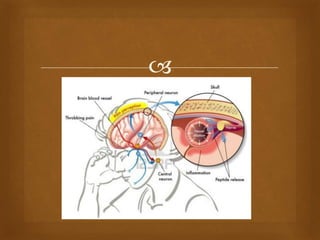
How migraines work is not completely understood,
migraine appears to involve regions in the deepest
parts of the brain (the trigeminal nucleus caudalis
[TNC] which resides in the upper portion of the
brainstem) as well as the nerves and blood vessels that
travel at the surface and around the brain (trigeminal
nerve and meningeal arteries)
CELLULAR ELEMENTS AND REGIONAL
PARTS OF THE NERVOUS SYSTEM ACTIVE
IN THE MIGRAINE


 As currently understood, the trigeminal nucleus
caudalis starts off the process. For some reason it
becomes overactive. This leads to activation of the
trigeminal nerve (which is responsible for sensation
of the face, scalp, and some blood vessels). Among
other things, the activation of the trigeminal nerve
stimulates blood vessels in the brain causing them to
enlarge (dilate).

 When the blood vessels enlarge, they begin to release
substances into the brain that irritate it (Calcitonin
Gene Related Peptide, substance P, neurokinin A),
leading to local inflammation. The inflammation
then stimulates nerve endings around the blood
vessel. These nerves then feedback to the trigeminal
nucleus caudalis, further activating it.

 Migraine is an episodic syndrome consisting of a
variety of clinical features that result from
dysfunction of the sympathetic nervous system.
During headache-free periods, migraineurs have a
reduction in sympathetic function compared to
nonmigraineurs.
FUNCTIONS OF THE NERVOUS
SYSTEM ACTIVE IN THE MIGRAINE

 Sympathetic nervous system dysfunction is also the
major feature of rare neurological disorders such as
pure autonomic failure and multiple system atrophy.
There are no known reports in the medical literature,
however, comparing sympathetic nervous system
function in individuals with migraine, pure
autonomic failure, and multiple system atrophy.

 There are two underlying neural mechanisms in
migraine: peripheral sensitization and central
sensitization. All sensitive intracranial structures are
innervated by the first branch of the trigeminal nerve
(first-order neurons) whose cell body is in the node,
at the same time interconnected with the nuclear
brainstem trigeminal complex (second-order
neurons) that extends to C2 segments and
continuous with the dorsal root of the spinal cord.

Several studies have demostrated the presence of a
migraine generator in the brain stem ; It has been
nominated for the periaqueductal gray area as
modulating pain in migraine . Trigeminal afferents (
second order ) cross and rise in the brainstem to the
ventral posteromedial nucleus of the thalamus ( third
order neurons )

 In this process interrelation it is observed with
different structures such as the posterior
hypothalamus , the locus ceruleus , the dorsal and
ventral nuclei raphe . The involvement of these
anatomical structures relay modulates pain intensity
and activation of different neural pathways .
Similarly , thalamus through the medial and
intralaminar nuclei involved in pain modulation.

 Hello everyone my name is Yleana im from México, and i
was diagnosed with migraine five years ago. I am a
tecnical radiology and i work in a hospital in the
resonance magnetic departiment since 15 years. Let me
tell you that MRI machines make loud noises all the time
and this does not help me when I have a migraine attack.
Sometimes I have to work with a catheter in my vein ,
because if I put the medication intravenously calms faster
mi pain. . It does not help the fact that I am allergic to
many medicines and this has made it difficult to my
doctor to find a medical treatment that helps me with the
migraine.
MI PERSONAL EXPERIENCE

 there are days that I can not tolerate light, low noise
bother me very much , I have vomiting and can not even
get out of bed. The medications that my doctor prescribe
me, take away the pain when i have a migraine episode,
But let me dizzy all day because they are a combination of
paracetamol with tafil and this makes it difficult to
perform my daily activities, especially when driving my
car. Now I am better because I found a balance between
the medicine and the things that I have to do to prevent
the migraine episodes, like eat healthy, sleep well, avoid
chocolates, alcoholic drinks, cigarettes, noisy places and
all the things that trough the years i learned helps the
appearance of the episodes.

I'm so glad i found this course because it has allowed me to
know how wonderful it is our body and how all its parts fit
together (organs, cells , nerves , bones, tissues etc..) to make
in our body amazing and wonderful things . In relation to
my disease, I could understand where it arises, its
evolution, who causes it and all the parts of the body
involved with it. I am part of the medicine area but often we
do not take the time to study things that happen in our own
body.
Thanks to all who took part of this course , to all that were
involved in the realization of it and my most sincere
congratulations to the teacher Peggy for all your patience ,
and for have the gift of teaching so sweetly.
 Migraine Pathophysiology
 National Headache Foundation
 http://www.teamessence.com.my/
 http://www.ncbi.nlm.nih.gov/pmc/articles/PMC344422
5/
 http://www.headache-treatment-options.com/how-
migraines-work.html
 http://www.americanheadachesociety.org/assets/1/7/
NAP_for_Web_-_Pathophysiology_of_Migraine.pdf
REFERENCES

Final proyect yqb

  • 1.
  • 2.
  • 3.
     How migraines workis not completely understood, migraine appears to involve regions in the deepest parts of the brain (the trigeminal nucleus caudalis [TNC] which resides in the upper portion of the brainstem) as well as the nerves and blood vessels that travel at the surface and around the brain (trigeminal nerve and meningeal arteries) CELLULAR ELEMENTS AND REGIONAL PARTS OF THE NERVOUS SYSTEM ACTIVE IN THE MIGRAINE
  • 4.
  • 5.
      As currentlyunderstood, the trigeminal nucleus caudalis starts off the process. For some reason it becomes overactive. This leads to activation of the trigeminal nerve (which is responsible for sensation of the face, scalp, and some blood vessels). Among other things, the activation of the trigeminal nerve stimulates blood vessels in the brain causing them to enlarge (dilate).
  • 6.
      When theblood vessels enlarge, they begin to release substances into the brain that irritate it (Calcitonin Gene Related Peptide, substance P, neurokinin A), leading to local inflammation. The inflammation then stimulates nerve endings around the blood vessel. These nerves then feedback to the trigeminal nucleus caudalis, further activating it.
  • 7.
      Migraine isan episodic syndrome consisting of a variety of clinical features that result from dysfunction of the sympathetic nervous system. During headache-free periods, migraineurs have a reduction in sympathetic function compared to nonmigraineurs. FUNCTIONS OF THE NERVOUS SYSTEM ACTIVE IN THE MIGRAINE
  • 8.
      Sympathetic nervoussystem dysfunction is also the major feature of rare neurological disorders such as pure autonomic failure and multiple system atrophy. There are no known reports in the medical literature, however, comparing sympathetic nervous system function in individuals with migraine, pure autonomic failure, and multiple system atrophy.
  • 9.
      There aretwo underlying neural mechanisms in migraine: peripheral sensitization and central sensitization. All sensitive intracranial structures are innervated by the first branch of the trigeminal nerve (first-order neurons) whose cell body is in the node, at the same time interconnected with the nuclear brainstem trigeminal complex (second-order neurons) that extends to C2 segments and continuous with the dorsal root of the spinal cord.
  • 10.
     Several studies havedemostrated the presence of a migraine generator in the brain stem ; It has been nominated for the periaqueductal gray area as modulating pain in migraine . Trigeminal afferents ( second order ) cross and rise in the brainstem to the ventral posteromedial nucleus of the thalamus ( third order neurons )
  • 11.
      In thisprocess interrelation it is observed with different structures such as the posterior hypothalamus , the locus ceruleus , the dorsal and ventral nuclei raphe . The involvement of these anatomical structures relay modulates pain intensity and activation of different neural pathways . Similarly , thalamus through the medial and intralaminar nuclei involved in pain modulation.
  • 12.
      Hello everyonemy name is Yleana im from México, and i was diagnosed with migraine five years ago. I am a tecnical radiology and i work in a hospital in the resonance magnetic departiment since 15 years. Let me tell you that MRI machines make loud noises all the time and this does not help me when I have a migraine attack. Sometimes I have to work with a catheter in my vein , because if I put the medication intravenously calms faster mi pain. . It does not help the fact that I am allergic to many medicines and this has made it difficult to my doctor to find a medical treatment that helps me with the migraine. MI PERSONAL EXPERIENCE
  • 13.
      there aredays that I can not tolerate light, low noise bother me very much , I have vomiting and can not even get out of bed. The medications that my doctor prescribe me, take away the pain when i have a migraine episode, But let me dizzy all day because they are a combination of paracetamol with tafil and this makes it difficult to perform my daily activities, especially when driving my car. Now I am better because I found a balance between the medicine and the things that I have to do to prevent the migraine episodes, like eat healthy, sleep well, avoid chocolates, alcoholic drinks, cigarettes, noisy places and all the things that trough the years i learned helps the appearance of the episodes.
  • 14.
     I'm so gladi found this course because it has allowed me to know how wonderful it is our body and how all its parts fit together (organs, cells , nerves , bones, tissues etc..) to make in our body amazing and wonderful things . In relation to my disease, I could understand where it arises, its evolution, who causes it and all the parts of the body involved with it. I am part of the medicine area but often we do not take the time to study things that happen in our own body. Thanks to all who took part of this course , to all that were involved in the realization of it and my most sincere congratulations to the teacher Peggy for all your patience , and for have the gift of teaching so sweetly.
  • 15.
     Migraine Pathophysiology National Headache Foundation  http://www.teamessence.com.my/  http://www.ncbi.nlm.nih.gov/pmc/articles/PMC344422 5/  http://www.headache-treatment-options.com/how- migraines-work.html  http://www.americanheadachesociety.org/assets/1/7/ NAP_for_Web_-_Pathophysiology_of_Migraine.pdf REFERENCES