PAIN PATHWAY
AND
MANAGEMENT
Dr. ROSE VEEDON
DEFENITION
Pain is an unpleasant sensation localised to a part of
the body and can cause potential damage. It is often
described in terms of a penetrating or tissue
destructive process (stabbing , tearing ) and/ or
emotional reaction( terryfying / nauseating)
AETIOLOGY
They are generally activated by stress
Biological factors
Pain from Cancer, treatments,
surgery, drugs, radiotherapy,
Psychological factors
Fear of pain, hospital, death,
the future
Social factors
Loss of job/income ,role in
family, social position, friends
Classification of pain
1. Nociceptive pain : due to direct stimulation of
peripheral nerve endings (wounds, fractures,
burns, angina)
2. Neuropathic pain : continuing pain due to
neuronal damage
3. Acute pain
4. Chronic pain
5. Somatic pain : pain of joints, tendons,
ligaments
6. Visceral pain : Pain of internal organ (kidney
stone)
7. Slow pain : Tooth ache, head ache
8. Fast pain : severe head ache
9. Inflammatory pain
10. Referred pain : heart attack
11. Superficial pain
12. Deep pain
Pathophysiology
Mainly 2 mechanisms are involved
1. Peripheral mechanism
2. Central mechanism
Peripheral mechanism
1. Sensitization : direct activation and sensitization
of primary afferent nociceptor terminals (a
peripheral nerve consists of axons of different
types of neurons :- primary sensory neurons,
motor neurons, sympathetic neurons , post
ganglionic neurons) occurs due to cell damage
which induces lower pH and leads to release of
potassium ions, synthesis of PG and bradykinin
which increases the sensitivity of terminals
which cause primary activation.
• Pain sensation involves a series of complex
interactions between peripheral nerves and
CNS. This process is modulated by excitatory
and inhibitory neuro transmitters. Followed by
sensitization of nerve endings the signals are
transmitted to the somato sensory cortex of the
brain
• Secondary activation results from the propagation
of the generated impulses to the terminal nerve
branches where they induce release of peptides
such as substance P (SP). Substance P causes
vasodilation , oedema , and release of bradykinin,
histamine and serotonin
• Nociception/pain sensation composed of 3
processes
2.Transduction(noxious stimuli are transmitted into
electrical signals at peripheral receptors)
3.Transmission(propagation of an electrical signal l
along neural membrane to the spinal cord)
4.Perception
Central mechanism
• The terminals of the primary axons contact the
spinal neurons that transmit pain signals to the
brain sites involved in pain perception. When
primary afferent are activated by noxious
stimuli, they release
neurotransmitters(glutamate: for rapid
excitation, SB, calcitonin gene related
peptides: for slower &long lasting excitation)
that excite spinal neurons
Ascending pathway
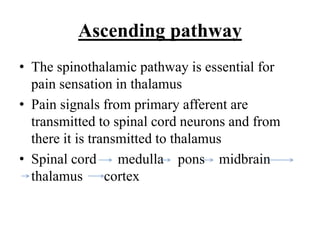
• The spinothalamic pathway is essential for
pain sensation in thalamus
• Pain signals from primary afferent are
transmitted to spinal cord neurons and from
there it is transmitted to thalamus
• Spinal cord medulla pons midbrain
thalamus cortex
Descending pathway
• Brain circuits modulate the activity of pain –
transmission pathways. These circuits has links in
hypothalamus, midbrain and medulla and it
controls the spinal pain transmission through the
descending pathway (5. Modulation)
• Each components of the pathway contains opioid
receptors and endogenous opioid peptides
(enkephalins, beta endorphinsand dynorphins)
these opioids are released for pain releif and the
pain modulating events to supress the pain
• Pain inhibiting neurons from the medulla are
released and controls spinal pain –
transmission neurons
• Cortex thalamus hypothalamus
midbrain
• At the midbrain the inhibitory signals synapse
with the electrical signals of the ascending
path way and thus there is no further
transmission of pain impulses to the thalamus ,
there by there is relief from pain
CLINICAL PRESENTATION
GENERAL
• Patients may be in obvious acute distress (trauma
pain) or appear to have no noticeable suffering.
SYMPTOMS
• Acute pain can be described as sharp or dull,
burning, shock-like, tingling, shooting, radiating,
fluctuating in intensity, varying in location, and
occurring in a timely relationship with an obvious
noxious stimulus.
SIGNS
• Acute pain can cause hypertension, tachycardia,
diaphoresis, mydriasis and pallor, but these signs
are not diagnostic. These signs are seldom present
in chronic pain.
• • Pain is always subjective; thus pain is best
diagnosed based on patient description, history,
and physical exam.
• Neuropathic pain is often chronic, not well
described, and not easily treated with
conventional analgesics.
ANALGESIC LADDER
TREATMENT
1. NSAIDS
 Non selective cox inhibitors
 Aspirin 325-650 mg PO 4 times a day
Side effects : GI ulcer, bleeding
 Piroxicam 20 mg PO BD not more than 40 mg/day
Side effects : Indigestion, Headache, dairrhea
 Preferential cox 2 inhibitors
 Nimesulide 100 mg
Side effects : GI ulcer, skin rashes, naussea, vomiting
Selective cox 2 inhibitors
• Celecoxib 400 mg PO
Side effects : haedache, hypertension
2. Opioids
I. Opiates
• Morphine 5-30 mg 4 times a day PO
5-10 mg 4 times a day IM
Side effects : vomiting , constipation, pruritis,
urinary retension
• Codeine 15-60 mg 4 times a day PO
15-60 mg 4 times a day IM
Side effects : constipation, drowsiness
II. Synthetic
• Pethidine 50-150 mg PO/IM/SC 4 times a day
Side effects : bradycardia, cardiac arrest, dry mouth
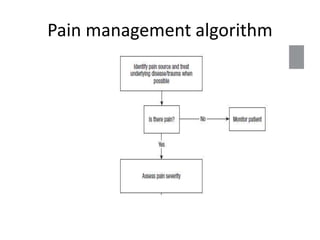
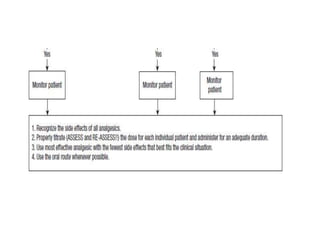
Pain management algorithm
NON PHARMACOLOGICAL
TREATMENT
 Accupunture
 Ayurvedic
 Yoga
 Meditation
 Hot and cold therapy

Pain new

  • 1.
  • 2.
    DEFENITION Pain is anunpleasant sensation localised to a part of the body and can cause potential damage. It is often described in terms of a penetrating or tissue destructive process (stabbing , tearing ) and/ or emotional reaction( terryfying / nauseating)
  • 3.
    AETIOLOGY They are generallyactivated by stress Biological factors Pain from Cancer, treatments, surgery, drugs, radiotherapy, Psychological factors Fear of pain, hospital, death, the future Social factors Loss of job/income ,role in family, social position, friends
  • 4.
    Classification of pain 1.Nociceptive pain : due to direct stimulation of peripheral nerve endings (wounds, fractures, burns, angina) 2. Neuropathic pain : continuing pain due to neuronal damage 3. Acute pain 4. Chronic pain 5. Somatic pain : pain of joints, tendons, ligaments
  • 5.
    6. Visceral pain: Pain of internal organ (kidney stone) 7. Slow pain : Tooth ache, head ache 8. Fast pain : severe head ache 9. Inflammatory pain 10. Referred pain : heart attack 11. Superficial pain 12. Deep pain
  • 6.
    Pathophysiology Mainly 2 mechanismsare involved 1. Peripheral mechanism 2. Central mechanism
  • 7.
    Peripheral mechanism 1. Sensitization: direct activation and sensitization of primary afferent nociceptor terminals (a peripheral nerve consists of axons of different types of neurons :- primary sensory neurons, motor neurons, sympathetic neurons , post ganglionic neurons) occurs due to cell damage which induces lower pH and leads to release of potassium ions, synthesis of PG and bradykinin which increases the sensitivity of terminals which cause primary activation.
  • 8.
    • Pain sensationinvolves a series of complex interactions between peripheral nerves and CNS. This process is modulated by excitatory and inhibitory neuro transmitters. Followed by sensitization of nerve endings the signals are transmitted to the somato sensory cortex of the brain
  • 9.
    • Secondary activationresults from the propagation of the generated impulses to the terminal nerve branches where they induce release of peptides such as substance P (SP). Substance P causes vasodilation , oedema , and release of bradykinin, histamine and serotonin • Nociception/pain sensation composed of 3 processes 2.Transduction(noxious stimuli are transmitted into electrical signals at peripheral receptors) 3.Transmission(propagation of an electrical signal l along neural membrane to the spinal cord) 4.Perception
  • 10.
    Central mechanism • Theterminals of the primary axons contact the spinal neurons that transmit pain signals to the brain sites involved in pain perception. When primary afferent are activated by noxious stimuli, they release neurotransmitters(glutamate: for rapid excitation, SB, calcitonin gene related peptides: for slower &long lasting excitation) that excite spinal neurons
  • 11.
    Ascending pathway • Thespinothalamic pathway is essential for pain sensation in thalamus • Pain signals from primary afferent are transmitted to spinal cord neurons and from there it is transmitted to thalamus • Spinal cord medulla pons midbrain thalamus cortex
  • 12.
    Descending pathway • Braincircuits modulate the activity of pain – transmission pathways. These circuits has links in hypothalamus, midbrain and medulla and it controls the spinal pain transmission through the descending pathway (5. Modulation) • Each components of the pathway contains opioid receptors and endogenous opioid peptides (enkephalins, beta endorphinsand dynorphins) these opioids are released for pain releif and the pain modulating events to supress the pain
  • 13.
    • Pain inhibitingneurons from the medulla are released and controls spinal pain – transmission neurons • Cortex thalamus hypothalamus midbrain • At the midbrain the inhibitory signals synapse with the electrical signals of the ascending path way and thus there is no further transmission of pain impulses to the thalamus , there by there is relief from pain
  • 14.
    CLINICAL PRESENTATION GENERAL • Patientsmay be in obvious acute distress (trauma pain) or appear to have no noticeable suffering. SYMPTOMS • Acute pain can be described as sharp or dull, burning, shock-like, tingling, shooting, radiating, fluctuating in intensity, varying in location, and occurring in a timely relationship with an obvious noxious stimulus.
  • 15.
    SIGNS • Acute paincan cause hypertension, tachycardia, diaphoresis, mydriasis and pallor, but these signs are not diagnostic. These signs are seldom present in chronic pain. • • Pain is always subjective; thus pain is best diagnosed based on patient description, history, and physical exam. • Neuropathic pain is often chronic, not well described, and not easily treated with conventional analgesics.
  • 16.
  • 17.
    TREATMENT 1. NSAIDS  Nonselective cox inhibitors  Aspirin 325-650 mg PO 4 times a day Side effects : GI ulcer, bleeding  Piroxicam 20 mg PO BD not more than 40 mg/day Side effects : Indigestion, Headache, dairrhea  Preferential cox 2 inhibitors  Nimesulide 100 mg Side effects : GI ulcer, skin rashes, naussea, vomiting Selective cox 2 inhibitors • Celecoxib 400 mg PO Side effects : haedache, hypertension
  • 18.
    2. Opioids I. Opiates •Morphine 5-30 mg 4 times a day PO 5-10 mg 4 times a day IM Side effects : vomiting , constipation, pruritis, urinary retension • Codeine 15-60 mg 4 times a day PO 15-60 mg 4 times a day IM Side effects : constipation, drowsiness II. Synthetic • Pethidine 50-150 mg PO/IM/SC 4 times a day Side effects : bradycardia, cardiac arrest, dry mouth
  • 19.
  • 22.
    NON PHARMACOLOGICAL TREATMENT  Accupunture Ayurvedic  Yoga  Meditation  Hot and cold therapy