

Outline
 Migraine
 Pathophysiology
 Theories
 Vascular theory
 Neurogenic theory
 Neurovascular theory
 Newer targets and drugs
Pathophysiology of Migraine
TGVS=trigeminal vascular sensitization.
Adapted from Pietrobon D, Striessnig J. Nat Rev Neurosci. 2003;4:386-398.
Vasodilation
Neurogenic
Inflammation
Headache
Pain
Abnormal cortical
activity
Hyperexcitable brain
(Ca++, Glu, Mg++)
Cortical Spreading Depression
Activation/Sensitization of TGVS
Abnormal brain
stem function
Excitation of brain
stem, PAG, etc.
Central Sensitization
Pathophysiology of Migraine
Proposed Mechanisms of Migraine Headache
Pathophysiology of Migraine
Migraine Mechanisms
Iadecola C. Nature Medicine. 2002;8:111-112.
Aura Phase
Spasm of Cerebral Arteries
Headache Phase
Vasodilation of Cerebral Arteries
Wolf HG. Headache and Other Head Pain. 1963.
Pathophysiology of Migraine
Classic Vascular Theory of Migraine
CBF=cerebral blood flow.
Laurizen M. Brain. 1994;118:199-210.
Pathophysiology of Migraine
Blood Flow During Aura and Headache Phase
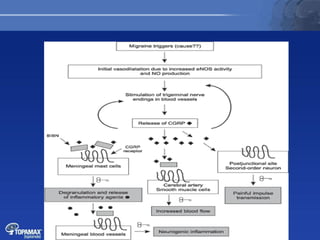
Neuropeptide
Release
Central
Sensitization
Pain Signal
Transmission
Vasodilatation
Hargreaves RJ, Shepheard SL. Can J Neurol Sci. 1999;26(suppl 3):S12-S19.
Pathophysiology of Migraine
Trigeminovascular Migraine Pain Pathways
Preventive medication target
Acute medication target
Pathophysiology of migraine
 Vascular theory-attributes the phenomenon of
vasodilatation.
 Neurogenic theory- neuronal events, cortical spreading
depression.
 Third theory - accommodate vascular modifications with
neuronal dysfunction.
Vascular theory
 Harold G Wolff first one to explain
 Vasoconstriction and ischemia accounts for symptoms of
migraine aura,
 Reactive vasodilatation activate primary sensory
neurons.
 Therapies provides evidence for this theory.
Cortical spreading depression
 NMDA receptors involved in the genesis and propagation
of CSD. CSD was blocked by NMDA receptors
antagonists in various experimental models
Long lasting depression of
neuronal activity.
 Wave of oligemia begins in
occipital cortex and spreads
forward at rate of 2-3 mm/min
– Begins with aura and persists
for hours after headache
– CBF changes not in distribution
of any cerebral artery
– Consistent with primary
neuronal event producing
secondary vascular changes
James MF et al. J Physiol. 1999;519:415-425.
Pathophysiology of Migraine
Cortical Spreading Depression
Hadjikhani N et al. Proc Natl Acad Sci USA. 2001;98:4687-4692.
Pathophysiology of Migraine
Imaging of Cortical Spreading Depression (CSD)
The key pathway for pain in migraine is the
trigeminovascular input from the meningeal
vessels, which passes through the
trigeminal ganglion and synapses on
second-order neurons in the
trigeminocervical complex (TCC).
These neurons in turn project in the
quintothalamic tract and, after decussating
in the brainstem, synapse on neurons in
the thalamus.
 Important modulation of the
trigeminovascular nociceptive input comes
from the dorsal raphe nucleus, locus
coeruleus, and nucleus raphe magnus
Cortical spreading
depression
perivascular trigeminal and
parasympathetic nerve activation,
release of vasodilator mediators,
CGRP, neurokinen A, substance P
(pain signal)trigeminal
ganglion  trigeminal
nucleus caudalis
trigeminocervical complex
 Brain stem aminergic nuclei can modify trigeminal pain
processing
 PET demonstrates brain stem activation in spontaneous
migraine attacks
 Brain stem activation persists
after successful headache
treatment
 Brain stem: generator or
modulator?
PET=positron emission tomography.
Weiller C et al. Nat Med. 1995;1:658-660.
Pathophysiology of Migraine
Brain Stem Involvement in Migraine
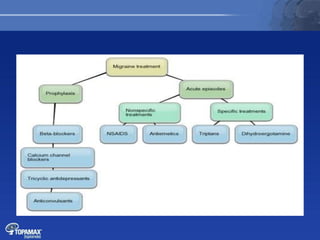
Pharmacological treatment of migraine includes
 Acute (abortive) treatment
 Preventive (prophylaxis) treatment
Preventive medication
 NEWER DRUGS
Recent findings
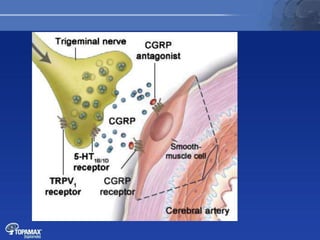
 CGRP is widely distributed in the nervous system,
particularly at anatomical areas thought to be
involvedwith migraine, including the trigeminovascular
nociceptive system.
 In studies, CGRP has been shown to be released during
severe migraine attacks, and effective triptan treatment
of an attack normalizes these levels.
 CGRP administration triggers migraine in patients and
CGRP receptor antagonists can abort migraine.
 Moreover, recent data demonstrate that CGRP
mechanism blockade either by small molecule receptor
antagonists or by monoclonal antibodies can have a
preventive effect in migraine.
Immunocytochemistry studies have shown
that up to half of the trigeminal neurons
produce CGRP within the trigeminal
system, at various sites including the
trigeminal ganglion, nerve endings and in
higher order neurons and glia
. Centrally, CGRP is therefore involved in
nociceptive transmission through second
and third order neurons, and pain
modulation in the brainstem, whereas
peripherally it mediates vasodilatation
through smooth muscle receptors
 Although animal studies have shown the role of several
neuropeptides during trigeminovascular system
activation, including substance P, vasoactive intestinal
peptide (VIP) and pituitary adenylate cyclase activating
peptide (PACAP)
 only CGRP and PACAP seem to be released when
durovascular structures are stimulated in the cat and in
humans. CGRP and PACAP, but not substance P, are
elevated in the cranial circulation during acute migraine
attacks
 These elevated levels normalize after effective triptan
treatment of the migraine attack
CALCITONIN GENE-RELATED PEPTIDE AS
A TREATMENT TARGET IN MIGRAINE
 CGRP may have a role in mediating some of the varied
painful and non-painful symptomatology of migraine
attacks. Additionally, CGRP-targeted therapies do not
seem to have the coronary vasoconstricting side-effects
that triptans doSix small molecule CGRP receptor
antagonists have been developed and five of them have
demonstrated clinical efficacy in acute migraine. This
class of drugs has acquired the stem name the gepants.
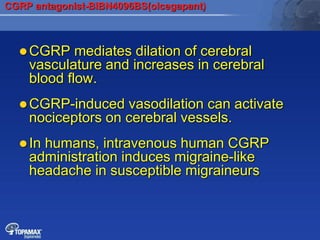
CGRP antagonist-BIBN4096BS(olcegapant)
CGRP mediates dilation of cerebral
vasculature and increases in cerebral
blood flow.
CGRP-induced vasodilation can activate
nociceptors on cerebral vessels.
In humans, intravenous human CGRP
administration induces migraine-like
headache in susceptible migraineurs
The gepants
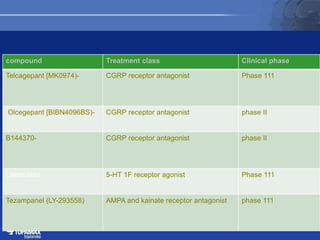
 A summary of these agents is detailed in Table for clarity.
 Two compounds, telcagepant and MK-3207 have been
discontinued due to hepatotoxic side-effects,
 olcegepant has been discontinuedasanoral formulation
was too difficult to develop
 whereas two compounds B144370A and BMS- 927711
showed clinical efficacy in phase II studies MK-1602 has
no reported data as yet
compound Treatment class Clinical phase
Telcagepant [MK0974)- CGRP receptor antagonist Phase 111
Olcegepant [BIBN4096BS)- CGRP receptor antagonist phase II
B144370- CGRP receptor antagonist phase II
Lasmiditan 5-HT 1F receptor agonist Phase 111
Tezampanel (LY-293558) AMPA and kainate receptor antagonist phase 111
Newer targets and drugs
Non-triptan 5-HT1 agonist,
5-HT1D agonists (PNU-109291 and
PNU- 142633) are potent inhibitors of
dural plasma protein extravasation
(PPE)
LY334370, which is a selective 5-HT1F
agonist, inhibits single cell firing in the
trigeminal nucleus caudalis (TNC)
Nitric oxide synthase inhibitor
An intravenous infusion of nitroglycerin
(NTG) releases NO, causes migraine in
more than 60% of migraineurs , and
activates trigeminal neurons in
experimental animals.
In a small RCT, 546C88, a non-selective
NOS inhibitor, was administered
intravenoulsy to migraineurs during an
acute attack (Lassen et al., 1998). The 2-hr
headache response rate was 67% (10/15)
on 546C88 versus 14% (2/14) on placebo
Migraine 1

Migraine 1

  • 1.
    Outline  Migraine  Pathophysiology Theories  Vascular theory  Neurogenic theory  Neurovascular theory  Newer targets and drugs
  • 2.
  • 3.
    TGVS=trigeminal vascular sensitization. Adaptedfrom Pietrobon D, Striessnig J. Nat Rev Neurosci. 2003;4:386-398. Vasodilation Neurogenic Inflammation Headache Pain Abnormal cortical activity Hyperexcitable brain (Ca++, Glu, Mg++) Cortical Spreading Depression Activation/Sensitization of TGVS Abnormal brain stem function Excitation of brain stem, PAG, etc. Central Sensitization Pathophysiology of Migraine Proposed Mechanisms of Migraine Headache
  • 4.
    Pathophysiology of Migraine MigraineMechanisms Iadecola C. Nature Medicine. 2002;8:111-112.
  • 5.
    Aura Phase Spasm ofCerebral Arteries Headache Phase Vasodilation of Cerebral Arteries Wolf HG. Headache and Other Head Pain. 1963. Pathophysiology of Migraine Classic Vascular Theory of Migraine
  • 6.
    CBF=cerebral blood flow. LaurizenM. Brain. 1994;118:199-210. Pathophysiology of Migraine Blood Flow During Aura and Headache Phase
  • 8.
    Neuropeptide Release Central Sensitization Pain Signal Transmission Vasodilatation Hargreaves RJ,Shepheard SL. Can J Neurol Sci. 1999;26(suppl 3):S12-S19. Pathophysiology of Migraine Trigeminovascular Migraine Pain Pathways Preventive medication target Acute medication target
  • 9.
    Pathophysiology of migraine Vascular theory-attributes the phenomenon of vasodilatation.  Neurogenic theory- neuronal events, cortical spreading depression.  Third theory - accommodate vascular modifications with neuronal dysfunction.
  • 10.
    Vascular theory  HaroldG Wolff first one to explain  Vasoconstriction and ischemia accounts for symptoms of migraine aura,  Reactive vasodilatation activate primary sensory neurons.  Therapies provides evidence for this theory.
  • 11.
    Cortical spreading depression NMDA receptors involved in the genesis and propagation of CSD. CSD was blocked by NMDA receptors antagonists in various experimental models Long lasting depression of neuronal activity.
  • 12.
     Wave ofoligemia begins in occipital cortex and spreads forward at rate of 2-3 mm/min – Begins with aura and persists for hours after headache – CBF changes not in distribution of any cerebral artery – Consistent with primary neuronal event producing secondary vascular changes James MF et al. J Physiol. 1999;519:415-425. Pathophysiology of Migraine Cortical Spreading Depression
  • 13.
    Hadjikhani N etal. Proc Natl Acad Sci USA. 2001;98:4687-4692. Pathophysiology of Migraine Imaging of Cortical Spreading Depression (CSD)
  • 14.
    The key pathwayfor pain in migraine is the trigeminovascular input from the meningeal vessels, which passes through the trigeminal ganglion and synapses on second-order neurons in the trigeminocervical complex (TCC). These neurons in turn project in the quintothalamic tract and, after decussating in the brainstem, synapse on neurons in the thalamus.  Important modulation of the trigeminovascular nociceptive input comes from the dorsal raphe nucleus, locus coeruleus, and nucleus raphe magnus
  • 15.
    Cortical spreading depression perivascular trigeminaland parasympathetic nerve activation, release of vasodilator mediators, CGRP, neurokinen A, substance P (pain signal)trigeminal ganglion  trigeminal nucleus caudalis trigeminocervical complex
  • 16.
     Brain stemaminergic nuclei can modify trigeminal pain processing  PET demonstrates brain stem activation in spontaneous migraine attacks  Brain stem activation persists after successful headache treatment  Brain stem: generator or modulator? PET=positron emission tomography. Weiller C et al. Nat Med. 1995;1:658-660. Pathophysiology of Migraine Brain Stem Involvement in Migraine
  • 17.
    Pharmacological treatment ofmigraine includes  Acute (abortive) treatment  Preventive (prophylaxis) treatment
  • 19.
  • 20.
  • 24.
    Recent findings  CGRPis widely distributed in the nervous system, particularly at anatomical areas thought to be involvedwith migraine, including the trigeminovascular nociceptive system.  In studies, CGRP has been shown to be released during severe migraine attacks, and effective triptan treatment of an attack normalizes these levels.  CGRP administration triggers migraine in patients and CGRP receptor antagonists can abort migraine.  Moreover, recent data demonstrate that CGRP mechanism blockade either by small molecule receptor antagonists or by monoclonal antibodies can have a preventive effect in migraine.
  • 25.
    Immunocytochemistry studies haveshown that up to half of the trigeminal neurons produce CGRP within the trigeminal system, at various sites including the trigeminal ganglion, nerve endings and in higher order neurons and glia . Centrally, CGRP is therefore involved in nociceptive transmission through second and third order neurons, and pain modulation in the brainstem, whereas peripherally it mediates vasodilatation through smooth muscle receptors
  • 26.
     Although animalstudies have shown the role of several neuropeptides during trigeminovascular system activation, including substance P, vasoactive intestinal peptide (VIP) and pituitary adenylate cyclase activating peptide (PACAP)  only CGRP and PACAP seem to be released when durovascular structures are stimulated in the cat and in humans. CGRP and PACAP, but not substance P, are elevated in the cranial circulation during acute migraine attacks  These elevated levels normalize after effective triptan treatment of the migraine attack
  • 27.
    CALCITONIN GENE-RELATED PEPTIDEAS A TREATMENT TARGET IN MIGRAINE  CGRP may have a role in mediating some of the varied painful and non-painful symptomatology of migraine attacks. Additionally, CGRP-targeted therapies do not seem to have the coronary vasoconstricting side-effects that triptans doSix small molecule CGRP receptor antagonists have been developed and five of them have demonstrated clinical efficacy in acute migraine. This class of drugs has acquired the stem name the gepants.
  • 28.
    CGRP antagonist-BIBN4096BS(olcegapant) CGRP mediatesdilation of cerebral vasculature and increases in cerebral blood flow. CGRP-induced vasodilation can activate nociceptors on cerebral vessels. In humans, intravenous human CGRP administration induces migraine-like headache in susceptible migraineurs
  • 29.
    The gepants  Asummary of these agents is detailed in Table for clarity.  Two compounds, telcagepant and MK-3207 have been discontinued due to hepatotoxic side-effects,  olcegepant has been discontinuedasanoral formulation was too difficult to develop  whereas two compounds B144370A and BMS- 927711 showed clinical efficacy in phase II studies MK-1602 has no reported data as yet
  • 32.
    compound Treatment classClinical phase Telcagepant [MK0974)- CGRP receptor antagonist Phase 111 Olcegepant [BIBN4096BS)- CGRP receptor antagonist phase II B144370- CGRP receptor antagonist phase II Lasmiditan 5-HT 1F receptor agonist Phase 111 Tezampanel (LY-293558) AMPA and kainate receptor antagonist phase 111
  • 33.
    Newer targets anddrugs Non-triptan 5-HT1 agonist, 5-HT1D agonists (PNU-109291 and PNU- 142633) are potent inhibitors of dural plasma protein extravasation (PPE) LY334370, which is a selective 5-HT1F agonist, inhibits single cell firing in the trigeminal nucleus caudalis (TNC)
  • 34.
    Nitric oxide synthaseinhibitor An intravenous infusion of nitroglycerin (NTG) releases NO, causes migraine in more than 60% of migraineurs , and activates trigeminal neurons in experimental animals. In a small RCT, 546C88, a non-selective NOS inhibitor, was administered intravenoulsy to migraineurs during an acute attack (Lassen et al., 1998). The 2-hr headache response rate was 67% (10/15) on 546C88 versus 14% (2/14) on placebo