Ownership of Electronic
Information (Copyright)

    By: Steve Strangie
Trademarks and Copyright
• Copyright is a federal law of the       • One of the major
  United States that protects the
  original works of authorship. This        problems involving
  includes                                  trademarks and
  literary, written, dramatic, artistic
  , musical, and other numerous
                                            copyright within the
  other works. As soon as the               past five or six years is
  original work is                          the influence of
  finished, copyright is immediately
  attached to it, whether it is             technology, specifically
  published or unpublished.                 the internet.
  Copyright is also an automatic
  right that doesn’t require a
  specific type of paperwork or
  anything to be filed from the
  author.
Trademark and Copyright
• Since April 1st, 1989 everything published or
  unpublished on the web is copyrighted by the
  owner or author whether it has a notice or
  not. Whether it be a tweet, a Facebook
  status, a YouTube video, a blog, etc. If you
  wrote it, you own it, as simple as that. If there
  are copyright laws like in the case of
  YouTube, you are notified of them and can’t
  get in any type of trouble for any wrong doing.
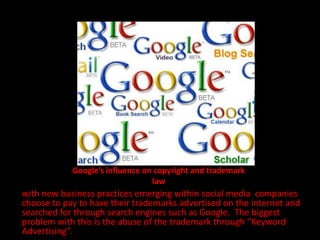
Google’s influence on copyright and trademark
                                 law
with new business practices emerging within social media companies
choose to pay to have their trademarks advertised on the internet and
searched for through search engines such as Google. The biggest
problem with this is the abuse of the trademark through “Keyword
Advertising”.
Keyword Advertising
• Keyword advertising refers    • Google uses-Google
  to any advertising that is      AdWords which is the most
  linked to specific words or     well-known form of
  phrases.                        keyword advertising. Google
• An example of this would be     displays search ads
  “Coke” a keyword for Coca-      specifically targeted to the
  Cola.                           word(s) typed into a search
                                  box. These keyword
                                  targeted ads also appear on
                                  content sites based on
                                  Google's system's
                                  interpretation of the subject
                                  matter on each page of the
                                  site.
Below is an interesting Youtube
  video:Trademark Issues in Internet
         Keyword Advertising


• http://www.youtube.com/watch?v=6ceM3Rfjf
  YY
Keyword Advertising
• There has been an enormous amount of lawsuits against
  search engines such as Google and Yahoo for various forms of
  keyword advertising.
• One example of this is when you type in “Coke” to your
  Google search box, after you hit enter and the search is
  complete, it’s almost guaranteed that a Pepsi advertisement
  will pop up in your search of the trademark “coke”.
• The problem occurs because Coca-cola paid for their
  trademark to be used for their own benefit, not for
  consumers to see ads for Pepsi and other small time soft
  drinks.
The Argument for and against
             Keyword Advertising
• The Lanham Act: if you use a trademark in connection with goods and
  services in commerce and that use of the trademark causes
  confusion, then you become liable.
• Google would argue that this is irrelevant, that consumers aren’t confused
  by this because we as consumers aren’t dumb. We know that there are
  subliminal messages all over the internet to market certain things that we
  couldn’t care less about. If we type in “McDonalds” into a search
  engine, we are looking for some type of information on “McDonalds” not
  “Burger King” or “Wendys”.
Copyright Issues with YouTube
• In 2006 YouTube signed copy right infringement deals with CBS and two
  record companies in UMG and Sony. This exempts service providers from
  liability for material stored on a server at the user’s request, as long as
  certain conditions are met. Including a requirement that the service
  provider take down any material promptly on being notified that specific
  content appears to be infringing. This deal also works out because
  CBS, UMG, and Sony get money as well as control of where their content
  shows up on YouTube.
• YouTube as become so successful due to this agreement because it
  has allowed millions of consumers to post videos on to YouTube
  with complete confidence that they will not be held liable for
  anything in regards to any type of copy right infringement. With
  that said people will continue to post onto YouTube as long as these
  copyright agreements stay intact.
In The End
• The copyright laws seem to be pretty clear cut
  and easy to understand, but in this day in age
  with the ever changing technology these
  current rules will only become harder to keep
  in tact.
Works Cited
•   Baniak/Northwestern Journal of Technology, Michael H., and Matthew
    Sagg/Northwestern Journal of Technology. "Trademark and Copyright in The
    Days of The Internet: The Google Influence."
    Scholarlycommons.law.northwestern.edu. North Western Journal of
    Technology and Intellectual Property, 2010. Web. 10 June 2012.
    <http://scholarlycommons.law.northwestern.edu/cgi/viewcontent.cgi?article=
    1112&context=njtip>.
•   "Copyright Fair Use and How It Works for Online Images." Social Media
    Examiner: Social Media Marketing How To, Research, Case Studies, News and
    More! N.p., n.d. Web. 12 June 2012.
    <http://www.socialmediaexaminer.com/copyright-fair-use-and-how-it-works-
    for-online-images/>.
•   "Law Vibe." About the YouTube Purchase In Regards to Copyright. N.p., n.d.
    Web. 12 June 2012. <http://lawvibe.com/about-the-youtube-purchase-in-
    regards-to-copyright/>.
•   "The Mystery Behind the." Copyright Laws on the Internet. N.p., n.d. Web. 12
    June 2012. <http://www.pitt.edu/~skvarka/education/copyright/>.
The
      End.

Final Project:COM 210

  • 1.
    Ownership of Electronic Information(Copyright) By: Steve Strangie
  • 2.
    Trademarks and Copyright •Copyright is a federal law of the • One of the major United States that protects the original works of authorship. This problems involving includes trademarks and literary, written, dramatic, artistic , musical, and other numerous copyright within the other works. As soon as the past five or six years is original work is the influence of finished, copyright is immediately attached to it, whether it is technology, specifically published or unpublished. the internet. Copyright is also an automatic right that doesn’t require a specific type of paperwork or anything to be filed from the author.
  • 3.
    Trademark and Copyright •Since April 1st, 1989 everything published or unpublished on the web is copyrighted by the owner or author whether it has a notice or not. Whether it be a tweet, a Facebook status, a YouTube video, a blog, etc. If you wrote it, you own it, as simple as that. If there are copyright laws like in the case of YouTube, you are notified of them and can’t get in any type of trouble for any wrong doing.
  • 4.
    Google’s influence oncopyright and trademark law with new business practices emerging within social media companies choose to pay to have their trademarks advertised on the internet and searched for through search engines such as Google. The biggest problem with this is the abuse of the trademark through “Keyword Advertising”.
  • 5.
    Keyword Advertising • Keywordadvertising refers • Google uses-Google to any advertising that is AdWords which is the most linked to specific words or well-known form of phrases. keyword advertising. Google • An example of this would be displays search ads “Coke” a keyword for Coca- specifically targeted to the Cola. word(s) typed into a search box. These keyword targeted ads also appear on content sites based on Google's system's interpretation of the subject matter on each page of the site.
  • 6.
    Below is aninteresting Youtube video:Trademark Issues in Internet Keyword Advertising • http://www.youtube.com/watch?v=6ceM3Rfjf YY
  • 7.
    Keyword Advertising • Therehas been an enormous amount of lawsuits against search engines such as Google and Yahoo for various forms of keyword advertising. • One example of this is when you type in “Coke” to your Google search box, after you hit enter and the search is complete, it’s almost guaranteed that a Pepsi advertisement will pop up in your search of the trademark “coke”. • The problem occurs because Coca-cola paid for their trademark to be used for their own benefit, not for consumers to see ads for Pepsi and other small time soft drinks.
  • 8.
    The Argument forand against Keyword Advertising • The Lanham Act: if you use a trademark in connection with goods and services in commerce and that use of the trademark causes confusion, then you become liable. • Google would argue that this is irrelevant, that consumers aren’t confused by this because we as consumers aren’t dumb. We know that there are subliminal messages all over the internet to market certain things that we couldn’t care less about. If we type in “McDonalds” into a search engine, we are looking for some type of information on “McDonalds” not “Burger King” or “Wendys”.
  • 9.
    Copyright Issues withYouTube • In 2006 YouTube signed copy right infringement deals with CBS and two record companies in UMG and Sony. This exempts service providers from liability for material stored on a server at the user’s request, as long as certain conditions are met. Including a requirement that the service provider take down any material promptly on being notified that specific content appears to be infringing. This deal also works out because CBS, UMG, and Sony get money as well as control of where their content shows up on YouTube. • YouTube as become so successful due to this agreement because it has allowed millions of consumers to post videos on to YouTube with complete confidence that they will not be held liable for anything in regards to any type of copy right infringement. With that said people will continue to post onto YouTube as long as these copyright agreements stay intact.
  • 10.
    In The End •The copyright laws seem to be pretty clear cut and easy to understand, but in this day in age with the ever changing technology these current rules will only become harder to keep in tact.
  • 11.
    Works Cited • Baniak/Northwestern Journal of Technology, Michael H., and Matthew Sagg/Northwestern Journal of Technology. "Trademark and Copyright in The Days of The Internet: The Google Influence." Scholarlycommons.law.northwestern.edu. North Western Journal of Technology and Intellectual Property, 2010. Web. 10 June 2012. <http://scholarlycommons.law.northwestern.edu/cgi/viewcontent.cgi?article= 1112&context=njtip>. • "Copyright Fair Use and How It Works for Online Images." Social Media Examiner: Social Media Marketing How To, Research, Case Studies, News and More! N.p., n.d. Web. 12 June 2012. <http://www.socialmediaexaminer.com/copyright-fair-use-and-how-it-works- for-online-images/>. • "Law Vibe." About the YouTube Purchase In Regards to Copyright. N.p., n.d. Web. 12 June 2012. <http://lawvibe.com/about-the-youtube-purchase-in- regards-to-copyright/>. • "The Mystery Behind the." Copyright Laws on the Internet. N.p., n.d. Web. 12 June 2012. <http://www.pitt.edu/~skvarka/education/copyright/>.
  • 12.
    The End.