GIS Application:
Environmental Resources Inventory
Case Study: Borough of Oceanport
Presented by Kathleen Devine
Intro to GIS - Spring 2012
Kathleen Devine - Spring 2012
Environmental Resource Inventory
• The Environmental Resource Inventory (ERI), also called Natural
Resource Inventory (NRI), or Index of Natural Resources, is a
compilation of text and visual information about the natural resource
characteristics and environmental features of an area.
• The Municipal Land Use Law (MLUL) (N.J.S.A.40:55D-1 et seq.)
requires municipalities to have a land use plan element in their master
plan, “including but not necessarily limited to, topography, soil
conditions, water supply, drainage, flood plain areas, marshes, and
woodlands...” (N.J.S.A. 40:55D-28b(2)).
• Environmental commissions will find that most of the basic
information needed for an ERI has already been collected by agency.
The challenge is to find out which information is where.
Kathleen Devine - Spring 2012
Environmental Resource Inventory
• Currently, the Oceanport Environmental Commission is developing
their ERI.
• This project confirmed that NJDEP and Monmouth County GIS Office
has the information needed to develop a ERI in GIS format.
• The project prepared the following GIS documents:
• Base Map
• Geology - Bedrock, Surface, and Historic Fill
• Watersheds
• Land Cover - Land Use and Forest Type
• Habitats
• Proposed projects
Kathleen Devine - Spring 2012
Base Map
Kathleen Devine - Spring 2012
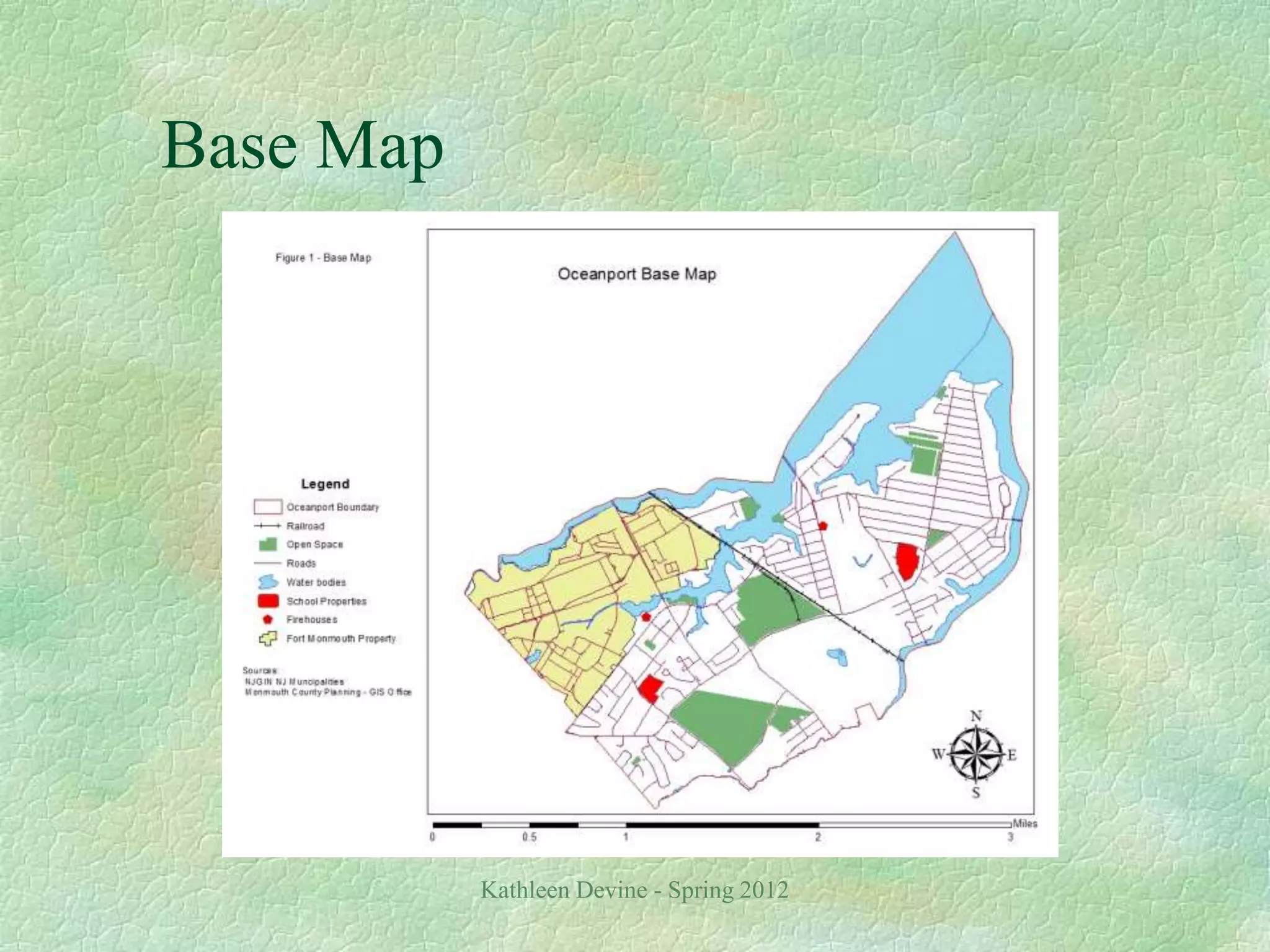
Base Map
• Oceanport is a “home of Monmouth Park Racetrack
and Fort Monmouth. Though only 3.2 square miles,
Oceanport’s nearly six thousand residents enjoy not
only the Shrewsbury River, but various recreational
sports programs, an active senior group and a true
feeling of community.”
• Two elementary schools, several parks both municipal
and county.
• Population 6000 people, approximately 800 children
under 14, and 700 dogs.
• Two firehouses and dispatch service with West Long
Branch
Kathleen Devine - Spring 2012
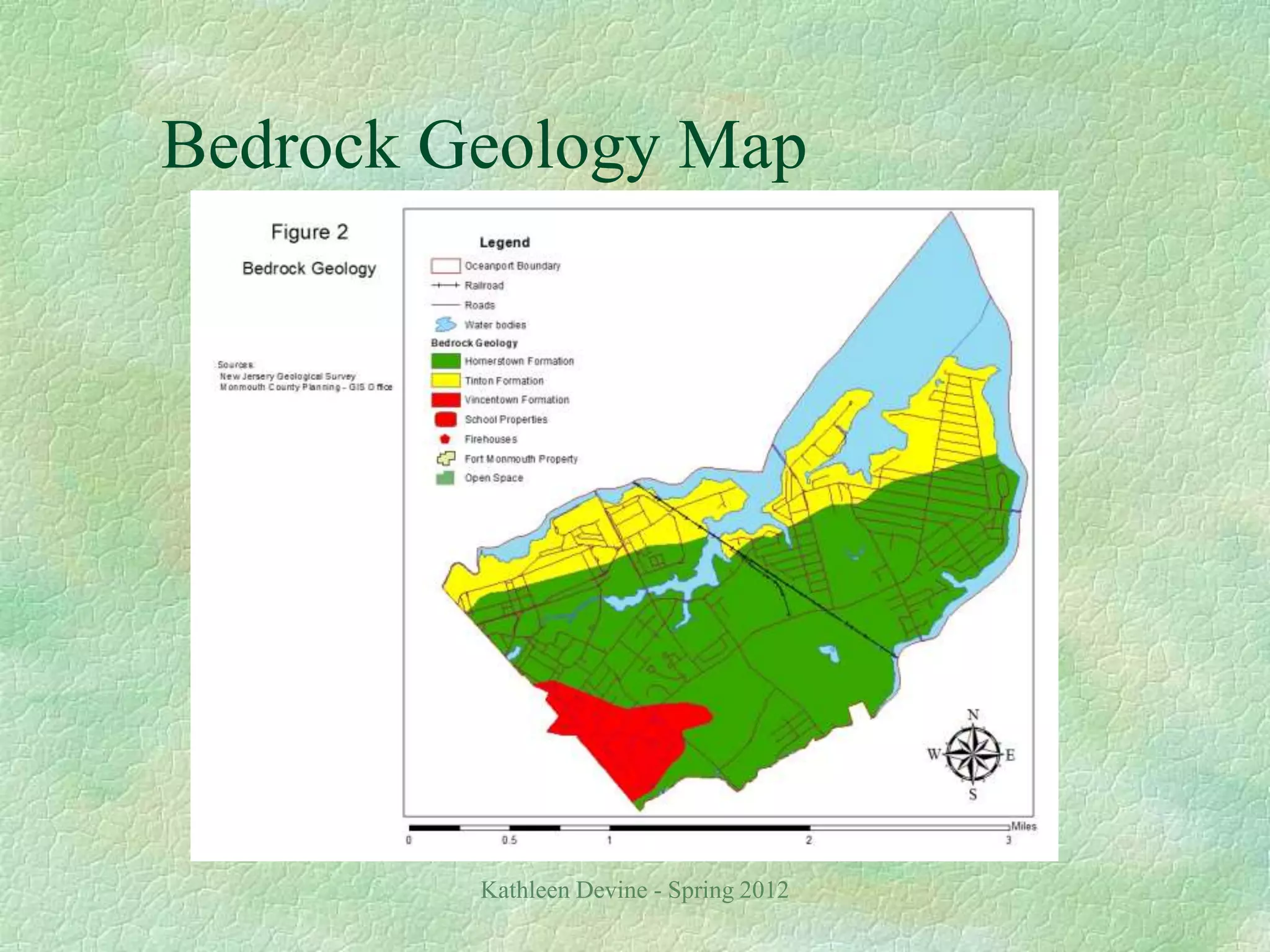
Bedrock Geology Map
Kathleen Devine - Spring 2012
Bedrock Geology
• The Hornerstown formation is dark greenish gray,
very clayey glauconite sand to micaceous, quartzose,
glauconite sand.
• The Tinton formation is a massive "olive to evergreen"
green glauconitic quartz sand which is locally clay-rich
and silty.
• The Vincentown Formation is slightly glauconitic
quartz sand and silt. In places the Vincentown is very
fossiliferous consisting of a bryozoan bioherm.
• SAND, SAND, and more Sand….
Kathleen Devine - Spring 2012
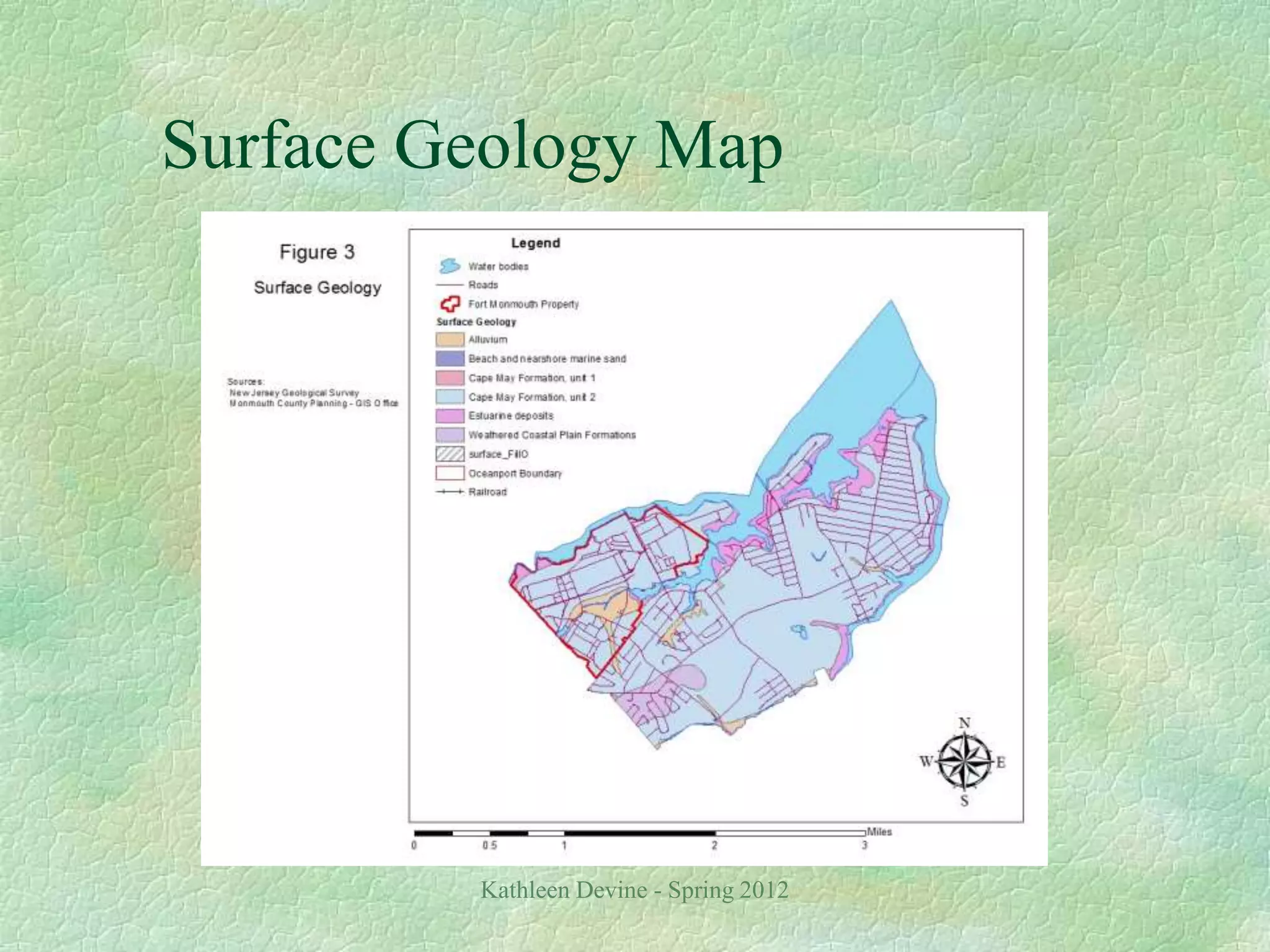
Surface Geology Map
Kathleen Devine - Spring 2012
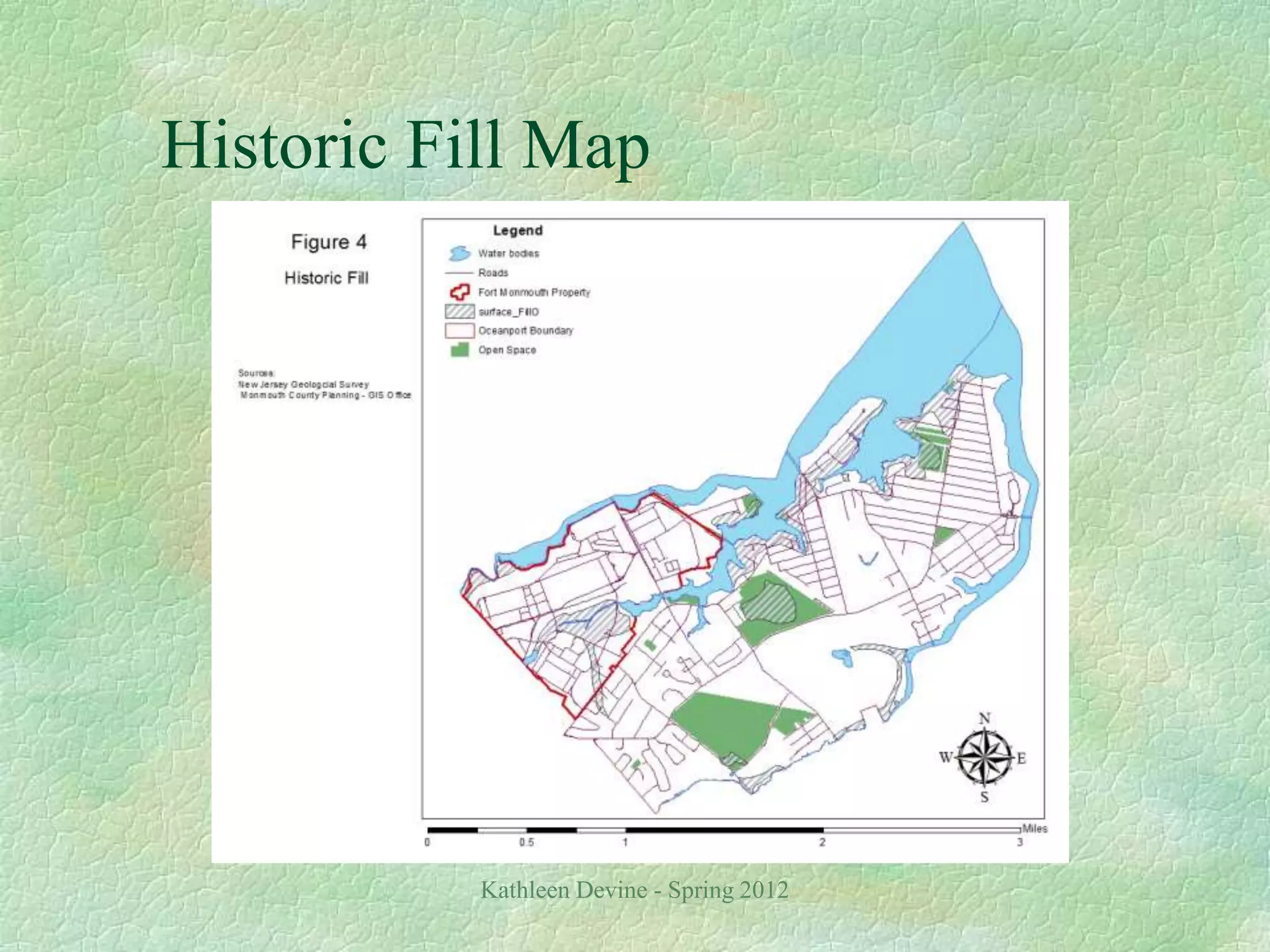
Historic Fill Map
Kathleen Devine - Spring 2012
Surface Geology and Historic Fill
• Alluvium is sediment that has carried by and deposited
from running water.
• Historic fill is non-indigenous material placed on a site
in order to raise the topographic elevation of the site.
Kathleen Devine - Spring 2012
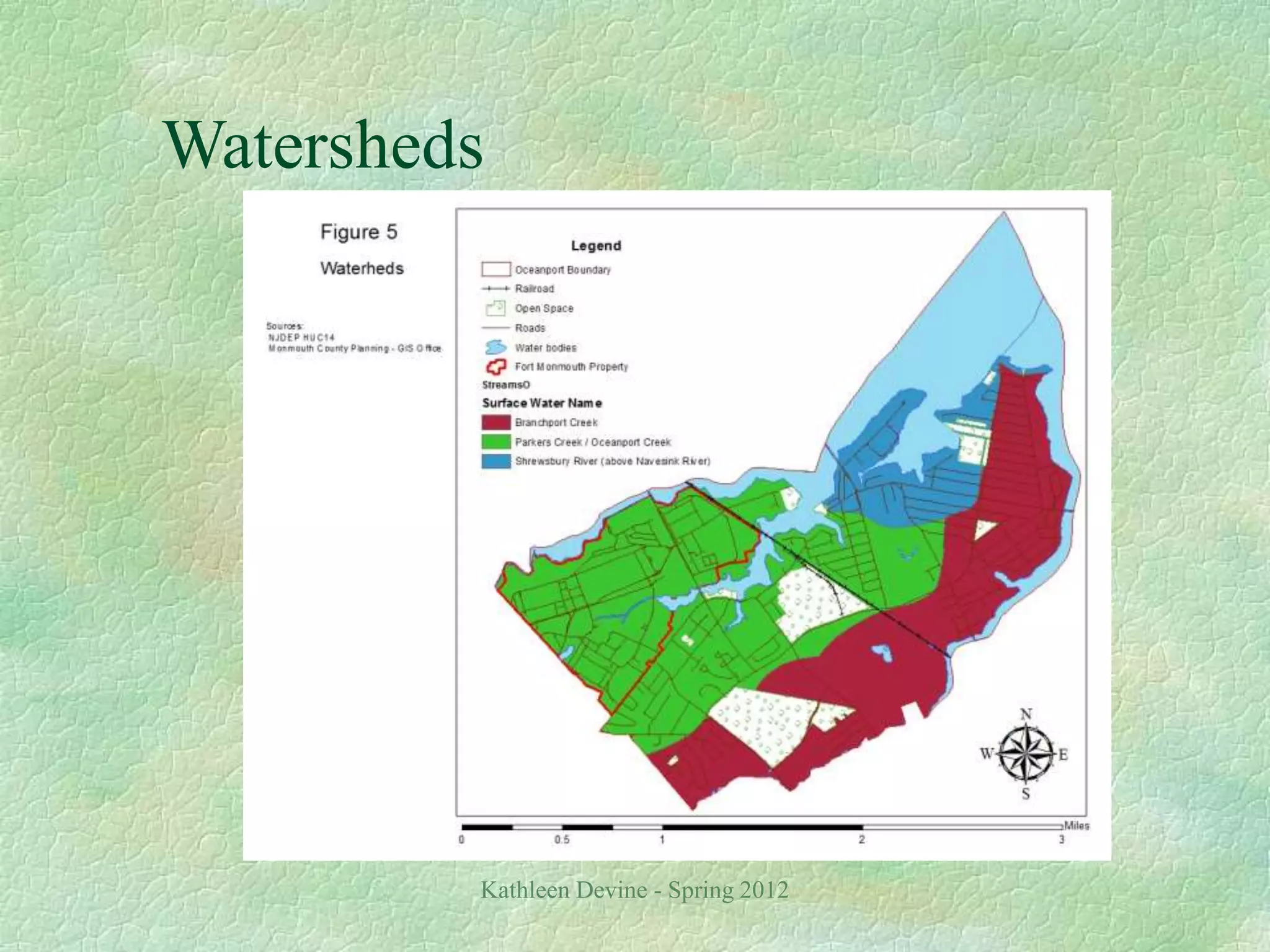
Watersheds
Kathleen Devine - Spring 2012
Watersheds
• Three distinct subwatersheds of the Shrewsbury River
• Ridge line runs through Borough.
• Depth of the Shrewsbury River is from 4 to 15 feet.
• Three sides of Borough is Water.
• Ongoing water quality study by Waterwatch
Committee to determine impact of Monmouth Park
Kathleen Devine - Spring 2012
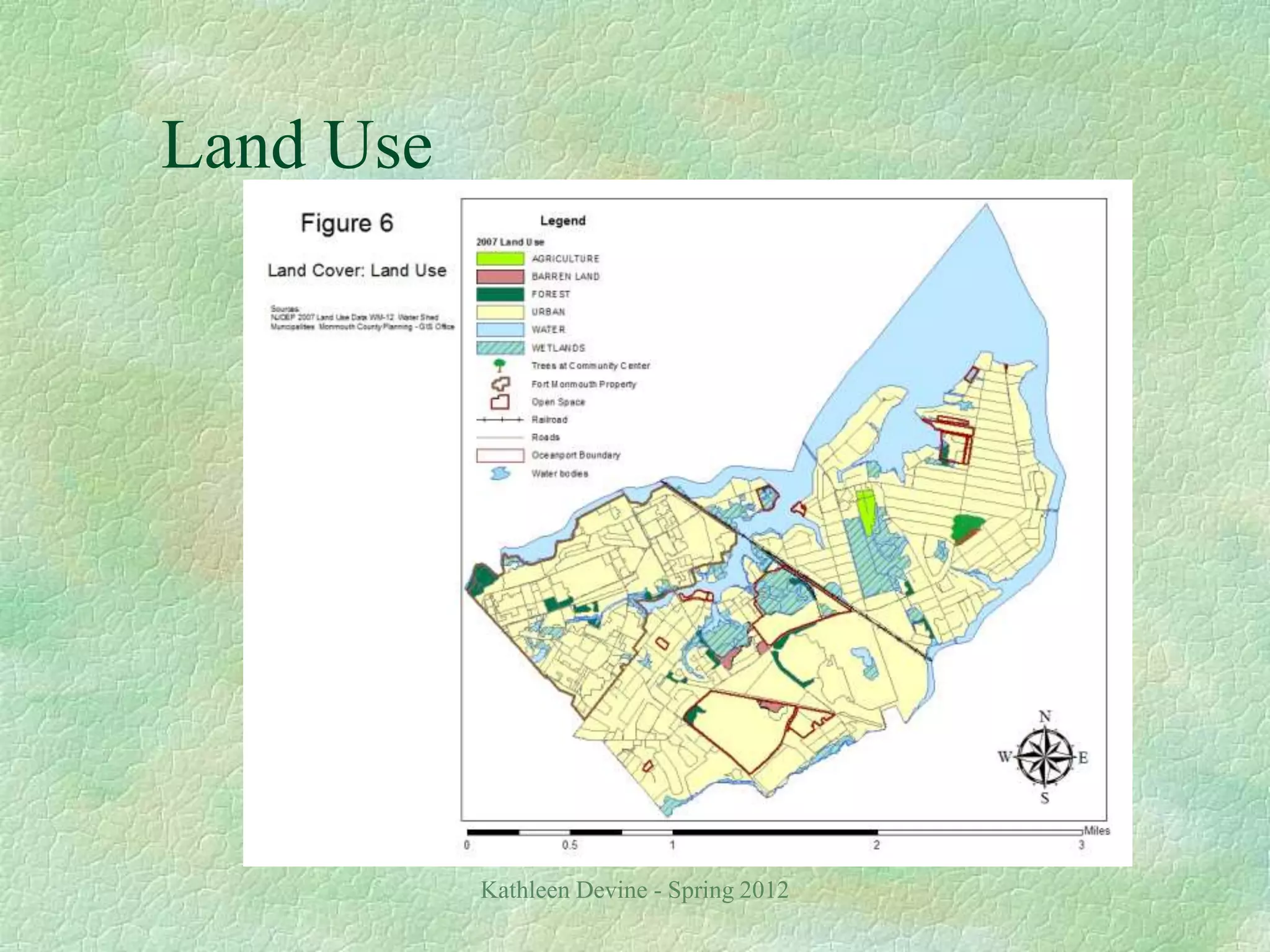
Land Use
Kathleen Devine - Spring 2012
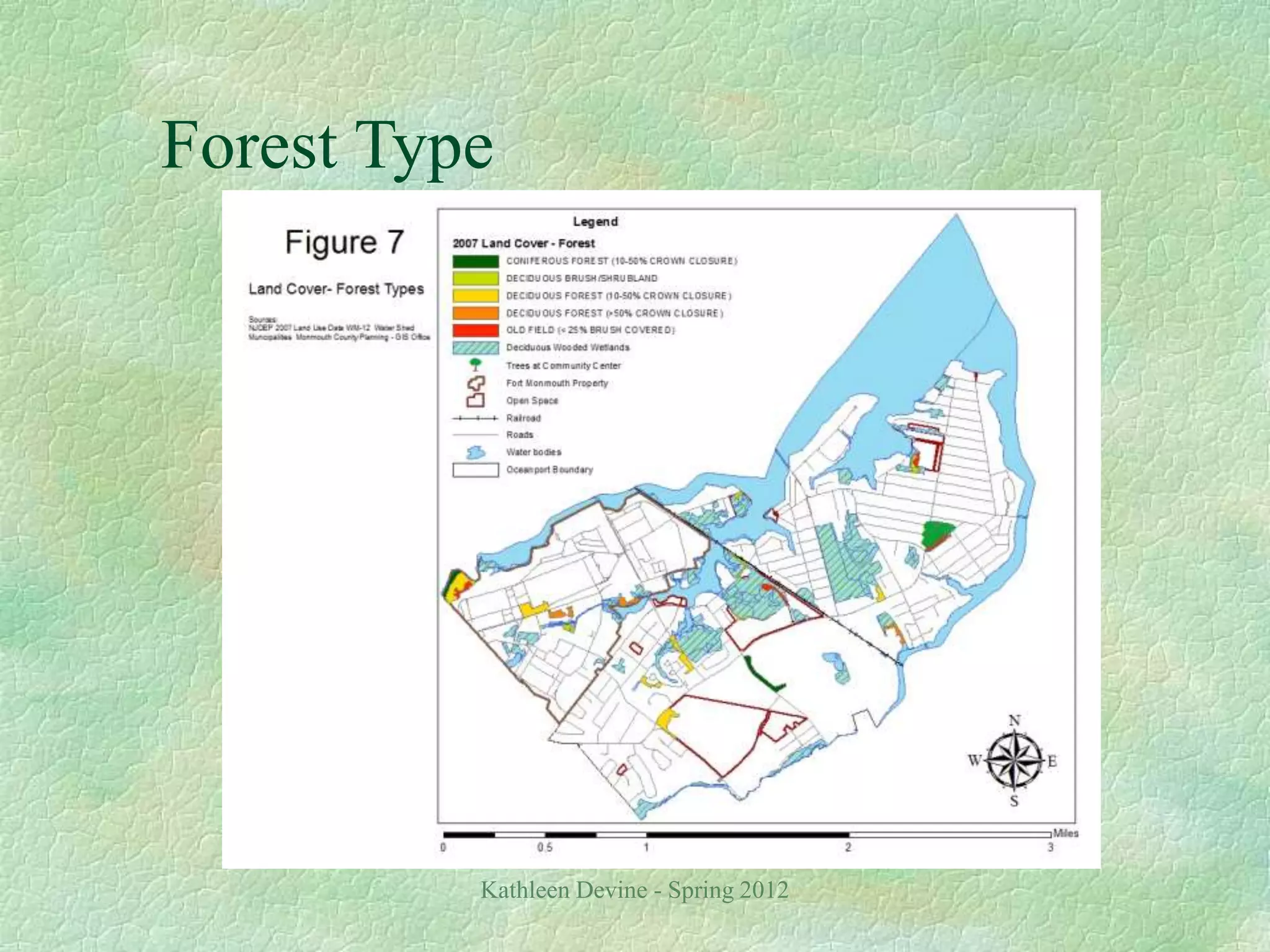
Forest Type
Kathleen Devine - Spring 2012
Land Use and Forest Type
• A GPS unit identified approximately 20 trees at the
Community Center Park
• Three sections left of undeveloped wooded wetlands.
• NJDEP encourages municipalities to develop
Community Forest Management Plans
• Community Forest Plan is an essential guide to
successfully achieving a healthy, economically efficient,
and safe community forest.
• Trees provide shade, cleaner air, and help to manage
storm water.
Kathleen Devine - Spring 2012
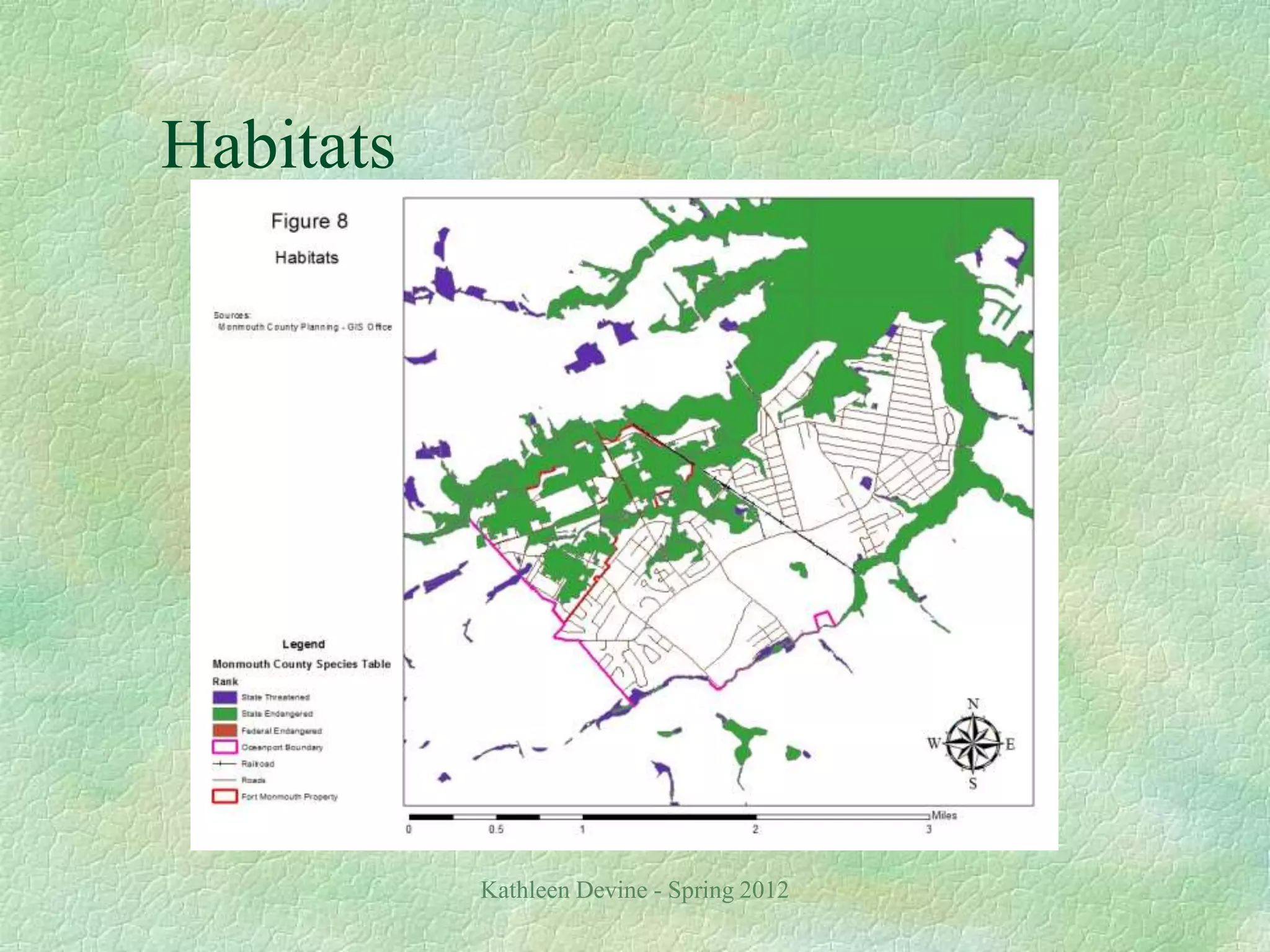
Habitats
Kathleen Devine - Spring 2012
Habitats
• The shore line is the habitat to terns, heron, and
egrets.
• There are suitable nesting places for Bald Eagles and
Osprey along the shore and in the wooded wetlands.
• Sighting of a juvenile Bald Eagle at Seven Bridges
• The community has had Black Bear and Fox sightings.
• Islands in the River have nesting grounds for
horseshoe crabs and Diamond Back Terrapins
• Some deer, rabbits, and snapping turtles
Kathleen Devine - Spring 2012
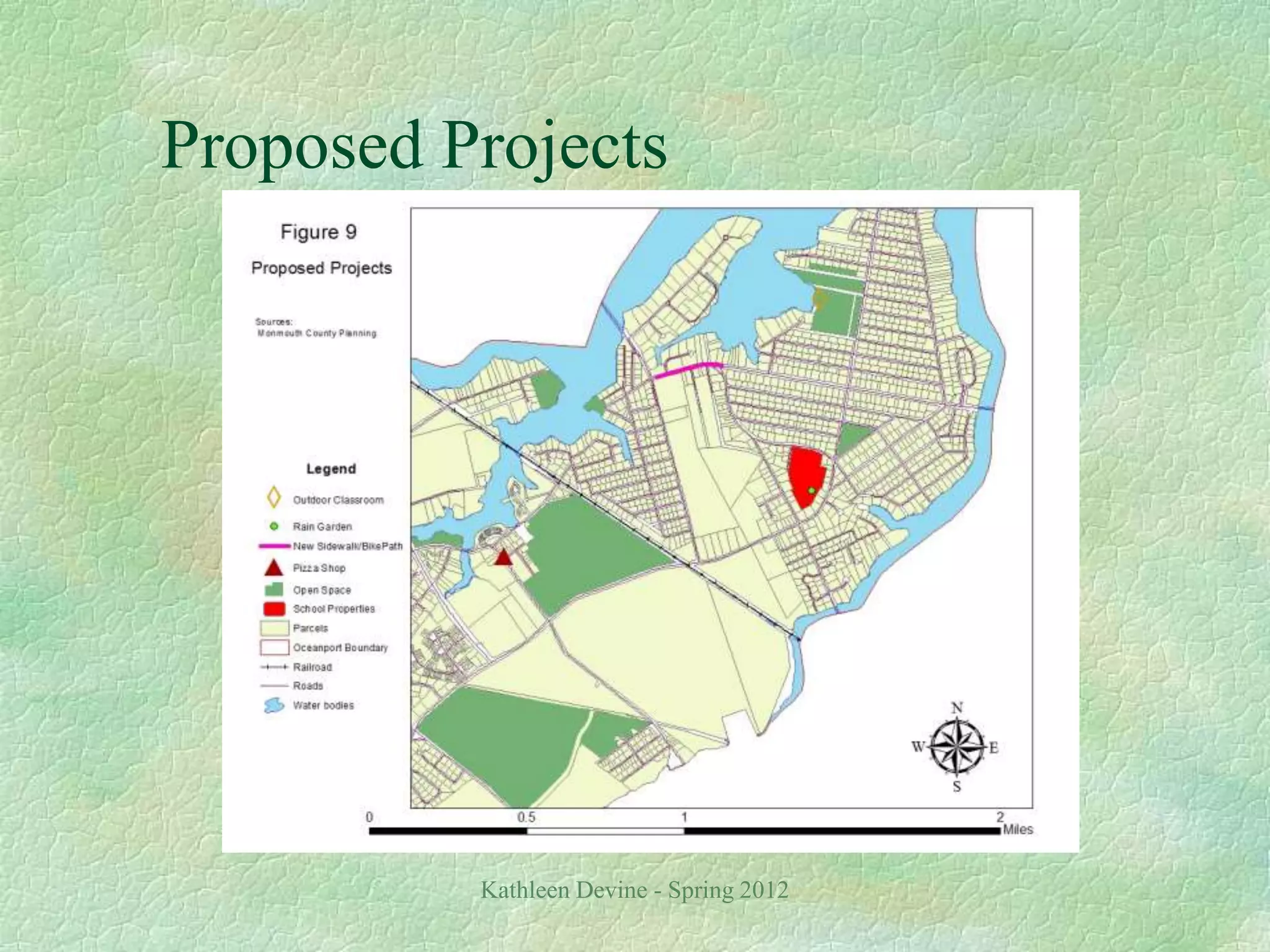
Proposed Projects
Kathleen Devine - Spring 2012
Proposed Projects
• A Community Forest Management Plan
• Outdoor Classroom at Blackberry Bay
• Osprey Nesting Platform
• Rain Garden at Middle School
• New sidewalks for safe passage from residential area
to “Downtown” with Pizza Parlor and Convenience
Store
• Encourage exploration of natural resources and safe
bicycle traffic through borough.
Kathleen Devine - Spring 2012
References
http://www.anjec.org/pdfs/EnvironmentalResource.pdf
http://www.oceanportboro.com/
http://geology.rutgers.edu/research/rutgers-core-repository/nj-coastal-
plain/hornerstown-formation
http://3dparks.wr.usgs.gov/nyc/coastalplain/cretaceous.htm
http://geology.about.com/od/geoprocesses/ig/mechweathering/alluvium.htm
http://www.state.nj.us/dep/njgs/geodata/dgs04-7md.htm
http://www.nj.gov/dep/parksandforests/forest/community/grants-gcg.html

GIS Application: Environmental Rescource Inventory for NJ Coastal Borough

  • 1.
    GIS Application: Environmental ResourcesInventory Case Study: Borough of Oceanport Presented by Kathleen Devine Intro to GIS - Spring 2012
  • 2.
    Kathleen Devine -Spring 2012 Environmental Resource Inventory • The Environmental Resource Inventory (ERI), also called Natural Resource Inventory (NRI), or Index of Natural Resources, is a compilation of text and visual information about the natural resource characteristics and environmental features of an area. • The Municipal Land Use Law (MLUL) (N.J.S.A.40:55D-1 et seq.) requires municipalities to have a land use plan element in their master plan, “including but not necessarily limited to, topography, soil conditions, water supply, drainage, flood plain areas, marshes, and woodlands...” (N.J.S.A. 40:55D-28b(2)). • Environmental commissions will find that most of the basic information needed for an ERI has already been collected by agency. The challenge is to find out which information is where.
  • 3.
    Kathleen Devine -Spring 2012 Environmental Resource Inventory • Currently, the Oceanport Environmental Commission is developing their ERI. • This project confirmed that NJDEP and Monmouth County GIS Office has the information needed to develop a ERI in GIS format. • The project prepared the following GIS documents: • Base Map • Geology - Bedrock, Surface, and Historic Fill • Watersheds • Land Cover - Land Use and Forest Type • Habitats • Proposed projects
  • 4.
    Kathleen Devine -Spring 2012 Base Map
  • 5.
    Kathleen Devine -Spring 2012 Base Map • Oceanport is a “home of Monmouth Park Racetrack and Fort Monmouth. Though only 3.2 square miles, Oceanport’s nearly six thousand residents enjoy not only the Shrewsbury River, but various recreational sports programs, an active senior group and a true feeling of community.” • Two elementary schools, several parks both municipal and county. • Population 6000 people, approximately 800 children under 14, and 700 dogs. • Two firehouses and dispatch service with West Long Branch
  • 6.
    Kathleen Devine -Spring 2012 Bedrock Geology Map
  • 7.
    Kathleen Devine -Spring 2012 Bedrock Geology • The Hornerstown formation is dark greenish gray, very clayey glauconite sand to micaceous, quartzose, glauconite sand. • The Tinton formation is a massive "olive to evergreen" green glauconitic quartz sand which is locally clay-rich and silty. • The Vincentown Formation is slightly glauconitic quartz sand and silt. In places the Vincentown is very fossiliferous consisting of a bryozoan bioherm. • SAND, SAND, and more Sand….
  • 8.
    Kathleen Devine -Spring 2012 Surface Geology Map
  • 9.
    Kathleen Devine -Spring 2012 Historic Fill Map
  • 10.
    Kathleen Devine -Spring 2012 Surface Geology and Historic Fill • Alluvium is sediment that has carried by and deposited from running water. • Historic fill is non-indigenous material placed on a site in order to raise the topographic elevation of the site.
  • 11.
    Kathleen Devine -Spring 2012 Watersheds
  • 12.
    Kathleen Devine -Spring 2012 Watersheds • Three distinct subwatersheds of the Shrewsbury River • Ridge line runs through Borough. • Depth of the Shrewsbury River is from 4 to 15 feet. • Three sides of Borough is Water. • Ongoing water quality study by Waterwatch Committee to determine impact of Monmouth Park
  • 13.
    Kathleen Devine -Spring 2012 Land Use
  • 14.
    Kathleen Devine -Spring 2012 Forest Type
  • 15.
    Kathleen Devine -Spring 2012 Land Use and Forest Type • A GPS unit identified approximately 20 trees at the Community Center Park • Three sections left of undeveloped wooded wetlands. • NJDEP encourages municipalities to develop Community Forest Management Plans • Community Forest Plan is an essential guide to successfully achieving a healthy, economically efficient, and safe community forest. • Trees provide shade, cleaner air, and help to manage storm water.
  • 16.
    Kathleen Devine -Spring 2012 Habitats
  • 17.
    Kathleen Devine -Spring 2012 Habitats • The shore line is the habitat to terns, heron, and egrets. • There are suitable nesting places for Bald Eagles and Osprey along the shore and in the wooded wetlands. • Sighting of a juvenile Bald Eagle at Seven Bridges • The community has had Black Bear and Fox sightings. • Islands in the River have nesting grounds for horseshoe crabs and Diamond Back Terrapins • Some deer, rabbits, and snapping turtles
  • 18.
    Kathleen Devine -Spring 2012 Proposed Projects
  • 19.
    Kathleen Devine -Spring 2012 Proposed Projects • A Community Forest Management Plan • Outdoor Classroom at Blackberry Bay • Osprey Nesting Platform • Rain Garden at Middle School • New sidewalks for safe passage from residential area to “Downtown” with Pizza Parlor and Convenience Store • Encourage exploration of natural resources and safe bicycle traffic through borough.
  • 20.
    Kathleen Devine -Spring 2012 References http://www.anjec.org/pdfs/EnvironmentalResource.pdf http://www.oceanportboro.com/ http://geology.rutgers.edu/research/rutgers-core-repository/nj-coastal- plain/hornerstown-formation http://3dparks.wr.usgs.gov/nyc/coastalplain/cretaceous.htm http://geology.about.com/od/geoprocesses/ig/mechweathering/alluvium.htm http://www.state.nj.us/dep/njgs/geodata/dgs04-7md.htm http://www.nj.gov/dep/parksandforests/forest/community/grants-gcg.html