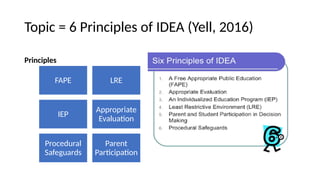
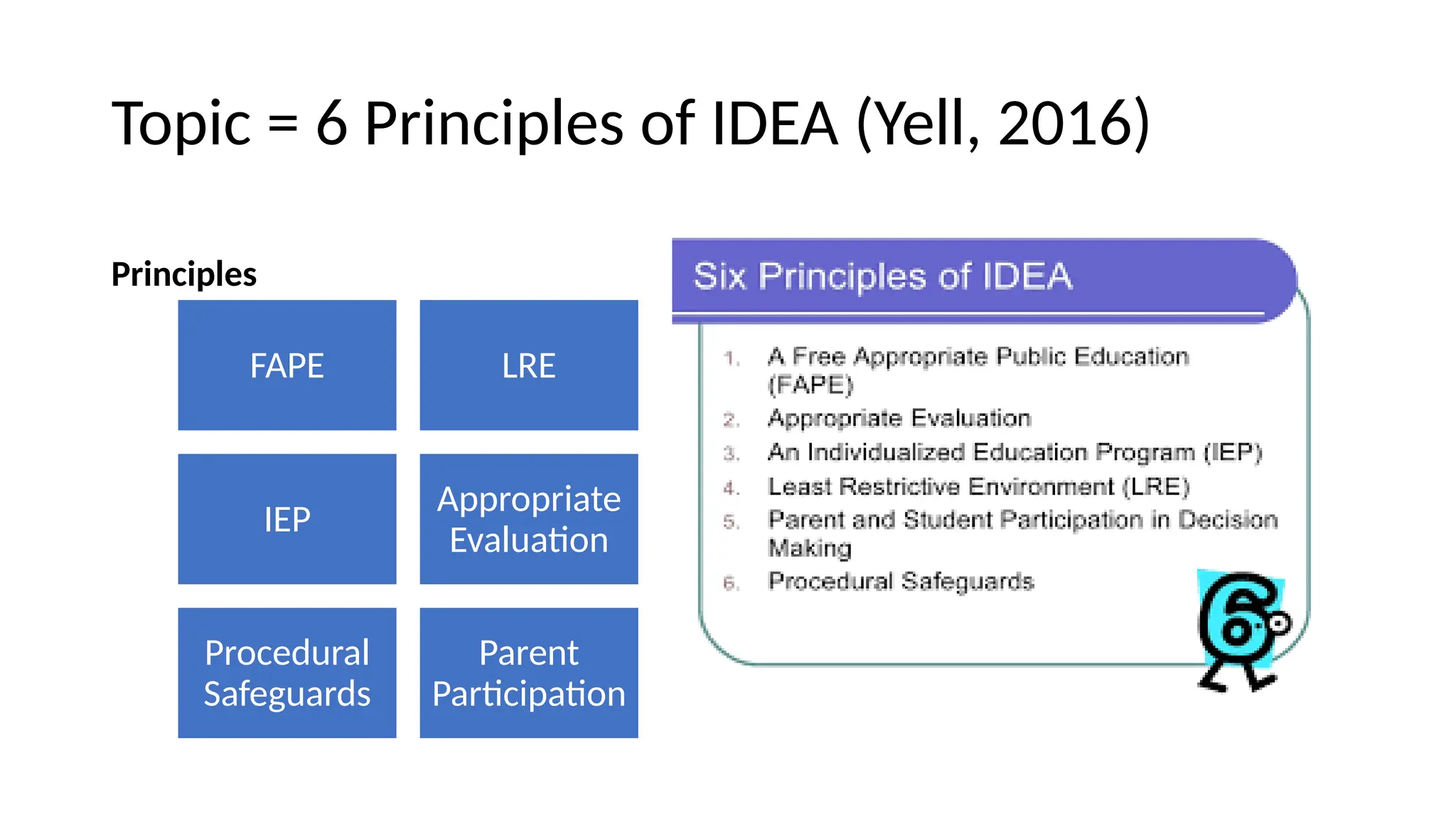
Topic = 6Principles of IDEA (Yell, 2016)
Principles
FAPE LRE
IEP
Appropriate
Evaluation
Procedural
Safeguards
Parent
Participation
2.
•IDEA: Individuals withDisabilities Education Act by Delgado (2020)
•What is IDEA?:
•
Approves and reinforces all aspects of the Education for All Handicapped
Children Act, which includes the following:
•
*Free and appropriate public education (FAPE)
•The least restrictive environment (LRE)
•Approved and appropriate accommodations and modifications during
assessments
•Individualized education plan (IEP).
•Parents have the right to view their child’s educational records.
•Parents must be informed before any changes are made in the student’s
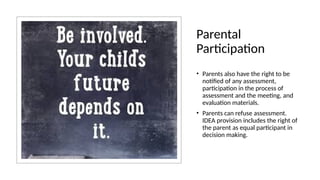
educational placement, classes, or programs. Parents may counter their
child’s records and any changes placement.
3.
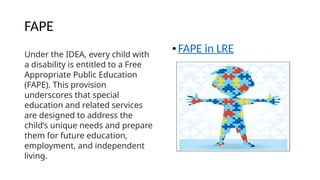
FAPE
Under the IDEA,every child with
a disability is entitled to a Free
Appropriate Public Education
(FAPE). This provision
underscores that special
education and related services
are designed to address the
child’s unique needs and prepare
them for future education,
employment, and independent
living.
•FAPE in LRE
4.
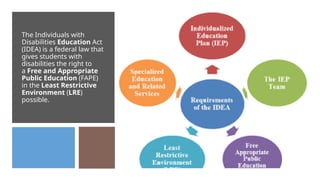
The Individuals with
DisabilitiesEducation Act
(IDEA) is a federal law that
gives students with
disabilities the right to
a Free and Appropriate
Public Education (FAPE)
in the Least Restrictive
Environment (LRE)
possible.
5.
Free and Appropriate
PublicEducation (FAPE)
•“States that all students are
legally entitled to a free and
appropriate public education.
What is an appropriate education
will vary depending on the child's
needs, strengths, and
weaknesses.” (Delgado, 2020)
6.
FAPE
• A rightthat must be made available to all eligible SWD
• Provided at the public expense
• Provided in accordance with the IEP
• Delivered based on state standards
• Includes SWD who have disciplinary issues
7.
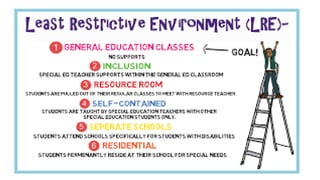
Least Restrictive
Environment
(LRE)
• Approvedand appropriate
accommodations and
modifications during assessments.
• Accommodations: can help
students learn the same material
as their classmates while holding
the same expectations.
8.
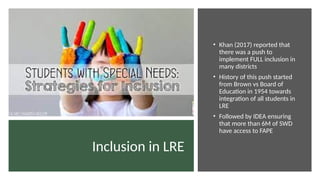
Inclusion in LRE
•Khan (2017) reported that
there was a push to
implement FULL inclusion in
many districts
• History of this push started
from Brown vs Board of
Education in 1954 towards
integration of all students in
LRE
• Followed by IDEA ensuring
that more than 6M of SWD
have access to FAPE
9.
Example LRE:
•If achild has a disability but is
academically capable to learning in
a general education classroom, then
the child will be place in a general
education setting regardless of
his/her disability.
•Students who are vastly behind
their peers academically, may need
changes to the curriculum.
11.
Individualized Educational Plan(IEP)
As part of IDEA provision to
help ensure every child’s
access to a Free Appropriate
Public Education. The IEP is a
written document, developed
by an IEP team, which draws
upon existing evaluation
information in order to meet
a student’s unique
educational needs (Yell &
Katsiyyanis, 2004).
12.
IEP
IEP as alegal document must
include information regarding a
student’s present levels of
educational performance,
annual goals and benchmarking
objectives, services and
supplementary aids to be
received (Yell & Katsiyyanis,
2004), and a detailed
explanation of instances where a
student is not participating in
the general classroom and why.
13.
IEP
Required to includeinformation regarding consistent
reporting on student progress as well as “transition” to
adult life.
14.
Procedural Safeguard
IDEA establishesprocedural
safeguards or commonly
known as due process to help
parents and students enforce
their rights under federal law.
15.
Purposes of ProceduralSafeguard
• protect parental access
to information
pertaining to placement
and transition planning
• procedures are put in place
to resolve
disagreements between
parents and schools
regarding the placement of
a student
16.
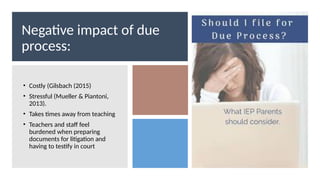
Negative impact ofdue
process:
• Costly (Gilsbach (2015)
• Stressful (Mueller & Piantoni,
2013).
• Takes times away from teaching
• Teachers and staff feel
burdened when preparing
documents for litigation and
having to testify in court
17.
Appropriate Evaluation
• IDEArequires that schools conduct “appropriate
evaluations” of students who are suspected of
having a disability. An appropriate evaluation must
be implemented by a team of knowledgeable and
trained evaluators, must utilize sound evaluation
materials and procedures, and must be
administered on a non-discriminatory basis. (Saleh,
2021)
18.
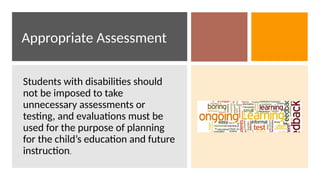
Appropriate Assessment
Students withdisabilities should
not be imposed to take
unnecessary assessments or
testing, and evaluations must be
used for the purpose of planning
for the child’s education and future
instruction.
19.
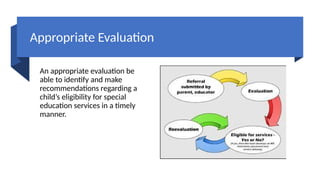
Appropriate Evaluation
An appropriateevaluation be
able to identify and make
recommendations regarding a
child’s eligibility for special
education services in a timely
manner.
20.
Parental Participation
Additional provisionof IDEA
requires that parents
participate in placement
decisions. School leadership
and all other educational
agencies must ensure the
participation of parents or
guardian in the placement of
the child with disability in the
LRE (Saleh, 2021)
21.
IDEA Part B:
Summaryof Parental
Participation
• Parents have the right
to participate in meetings
related to the evaluation,
identification, and
educational placement of
their child.
• Parents have the right to
participate in meetings
related to the provision of a
free appropriate public
education (FAPE) to their
child.
22.
IDEA Part B:
Summaryof
Parental
Participation
• Parents are entitled to
be members of the
team that develops,
reviews, and revises
the individualized
education program
(IEP) for their child.
• Parents are entitled to
be members of any
group that makes
placement decisions
for their child.
• If neither parent can
attend the IEP
meeting, the school
must use other
methods to ensure
their participation,
including individual
or conference calls.
23.
IDEA Part B:
Summaryof Parental Participation
• Parents are entitled to be
members of any group that
decides whether their child
is a “child with a disability”
and meets eligibility criteria
for special education and
related services
24.
Parental
Participation
• Parents alsohave the right to be
notified of any assessment,
participation in the process of
assessment and the meeting, and
evaluation materials.
• Parents can refuse assessment.
IDEA provision includes the right of
the parent as equal participant in
decision making.
Based on thecontemporary principles
presented, predict how special education
will look in 5 years in the following aspects:
1. Inclusion
2. Parental participation
3. Evaluation
4. IEP
5. Procedural Safeguard
27.
Future Perspectives??
Questionable as
everythingrelated to
special education
services is dynamic and
is bound to change and
be influenced based on
students’ needs.
Availability of resources
can also impact how
these needs will be
addressed.
28.
References
Gilsbach, T. E.(2015). Special education due process hearing requests under IDEA: A hearing should not
always be required. Brigham Young University Education & Law Journal, 2015(1), 187–201.
Khan, Q. (2017, July 25). A look at the past, present, and future of special education. Edutopia. www.
https://www.edutopia.org/discussion/look-past-present-and-future-special-education
Mueller, T. G., & Piantoni, S. (2013). Actions speak louder than words: How do special education
administrators prevent and resolve conflict with families? Journal of Special Education Apprenticeship, 2(2).
IDEA: Individuals with Disabilities Education Act (2020).
https://www.specialedusa.com/post/idea-individualswith-disabilities-education-act
29.
References
Saleh, M. J.D., (2021). Your child’s rights. 6 principles of IDEA. https://www.smartkidswithld.
org/getting-help/know-your-childs-rights/your-childs-rights-6-principles-of-idea/
Yell, M. L. (2016). The law and special education. Pearson
Yell, M. L., & Katsiyannis, A. (2004). Placing students with disabilities in inclusive settings: Legal
guidelines and preferred practices. Preventing School Failure, 49(1), 28–35.


![Chp[1]. 3 Special Education - Dr. William Allan Kritsonis](https://cdn.slidesharecdn.com/ss_thumbnails/chp1-3specialeducation-091018195203-phpapp01-thumbnail.jpg?width=640&height=640&fit=bounds)
![Chp[1]. 3 Special Education](https://cdn.slidesharecdn.com/ss_thumbnails/chp1-3specialeducation-091112204349-phpapp01-thumbnail.jpg?width=640&height=640&fit=bounds)


![Chp[1]. 3 special_education](https://cdn.slidesharecdn.com/ss_thumbnails/chp1-170718141847-thumbnail.jpg?width=640&height=640&fit=bounds)


