Between Space & Use
Karen Zellner
DAT-NYC-41
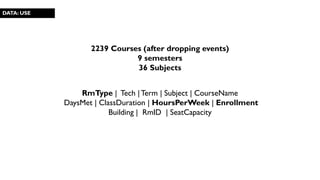
DATA: USE
RmType | Tech |Term | Subject | CourseName
DaysMet | ClassDuration | HoursPerWeek | Enrollment
Building | RmID | SeatCapacity
2239 Courses (after dropping events)
9 semesters
36 Subjects
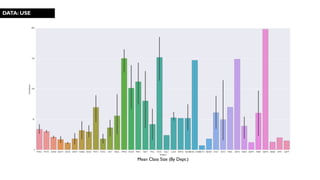
DATA: USE
Mean Class Size (By Dept.)
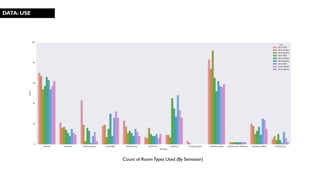
DATA: USE
Count of RoomTypes Used (By Semester)
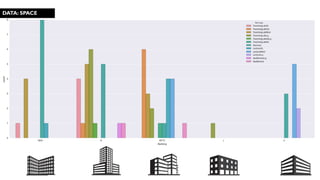
DATA: SPACE
DATA: SPACE
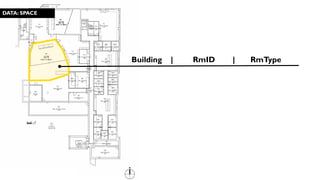
Building | RmID | RmType
DATA: SPACE
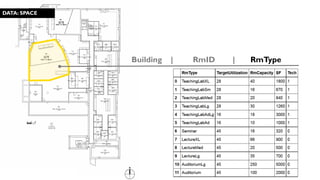
Building | RmID | RmType
DATA: SPACE
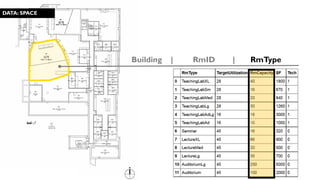
Building | RmID | RmType
DATA: SPACE
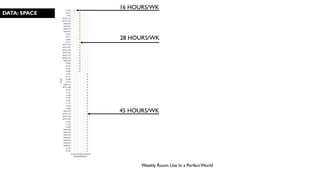
Weekly Room Use In a PerfectWorld
16 HOURS/WK
28 HOURS/WK
45 HOURS/WK
DATA: SPACE
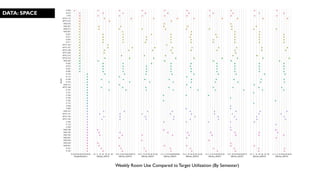
Weekly Room Use Compared toTarget Utilization (By Semester)
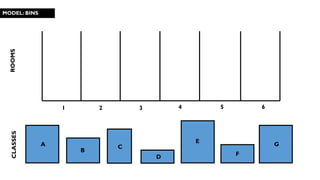
MODEL: BINS
1 2 3 4 5 6
A
B
C
D
E
F
G
ROOMSCLASSES
MODEL: BINS
1 2 3 4 5 6
A
B
C
D
E
F
G
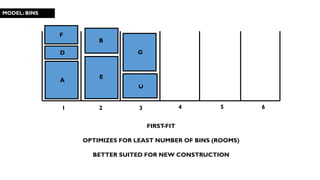
FIRST-FIT
OPTIMIZES FOR LEAST NUMBER OF BINS (ROOMS)
BETTER SUITED FOR NEW CONSTRUCTION
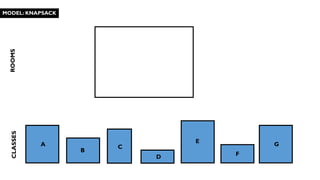
MODEL: KNAPSACK
A
B
C
D
E
F
G
ROOMSCLASSES
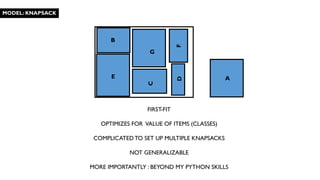
MODEL: KNAPSACK
A
B
C
D
E
F
G
FIRST-FIT
OPTIMIZES FOR VALUE OF ITEMS (CLASSES)
COMPLICATEDTO SET UP MULTIPLE KNAPSACKS
NOT GENERALIZABLE
MORE IMPORTANTLY : BEYOND MY PYTHON SKILLS
MODEL
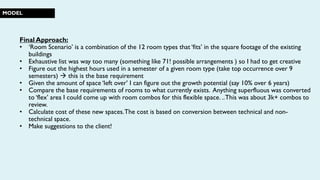
Final Approach:
• ‘Room Scenario’ is a combination of the 12 room types that ‘fits’ in the square footage of the existing
buildings
• Exhaustive list was way too many (something like 71! possible arrangements ) so I had to get creative
• Figure out the highest hours used in a semester of a given room type (take top occurrence over 9
semesters)  this is the base requirement
• Given the amount of space ‘left over’ I can figure out the growth potential (say 10% over 6 years)
• Compare the base requirements of rooms to what currently exists. Anything superfluous was converted
to ‘flex’ area I could come up with room combos for this flexible space. ..This was about 3k+ combos to
review.
• Calculate cost of these new spaces.The cost is based on conversion between technical and non-
technical space.
• Make suggestions to the client!
MODEL
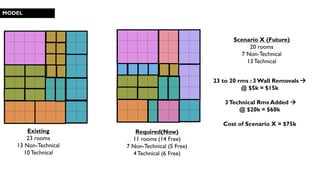
Existing
23 rooms
13 Non-Technical
10 Technical
23 to 20 rms : 3Wall Removals 
@ $5k = $15k
3Technical Rms Added 
@ $20k = $60k
Cost of Scenario X = $75k
Required(Now)
11 rooms (14 Free)
7 Non-Technical (5 Free)
4 Technical (6 Free)
Scenario X (Future)
20 rooms
7 Non-Technical
13 Technical
RESULTS
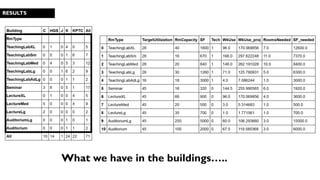
What we have in the buildings…..
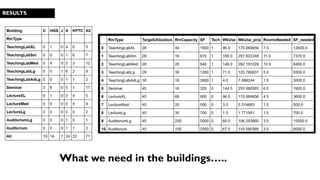
What we need in the buildings…..
RESULTS
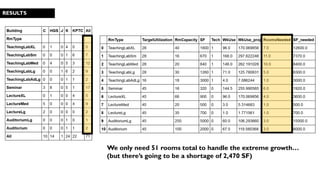
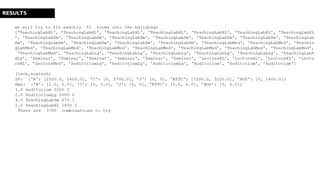
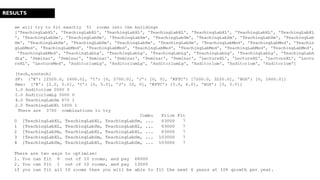
We only need 51 rooms total to handle the extreme growth…
(but there’s going to be a shortage of 2,470 SF)
RESULTS
RESULTS
RESULTS
RESULTS
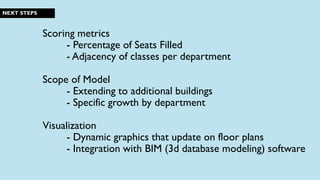
NEXT STEPS
Scoring metrics
- Percentage of Seats Filled
- Adjacency of classes per department
Scope of Model
- Extending to additional buildings
- Specific growth by department
Visualization
- Dynamic graphics that update on floor plans
- Integration with BIM (3d database modeling) software

Final Presentation-DATNYC

  • 1.
    Between Space &Use Karen Zellner DAT-NYC-41
  • 2.
    DATA: USE RmType |Tech |Term | Subject | CourseName DaysMet | ClassDuration | HoursPerWeek | Enrollment Building | RmID | SeatCapacity 2239 Courses (after dropping events) 9 semesters 36 Subjects
  • 3.
    DATA: USE Mean ClassSize (By Dept.)
  • 4.
    DATA: USE Count ofRoomTypes Used (By Semester)
  • 5.
  • 6.
  • 7.
  • 8.
  • 9.
    DATA: SPACE Weekly RoomUse In a PerfectWorld 16 HOURS/WK 28 HOURS/WK 45 HOURS/WK
  • 10.
    DATA: SPACE Weekly RoomUse Compared toTarget Utilization (By Semester)
  • 11.
    MODEL: BINS 1 23 4 5 6 A B C D E F G ROOMSCLASSES
  • 12.
    MODEL: BINS 1 23 4 5 6 A B C D E F G FIRST-FIT OPTIMIZES FOR LEAST NUMBER OF BINS (ROOMS) BETTER SUITED FOR NEW CONSTRUCTION
  • 13.
  • 14.
    MODEL: KNAPSACK A B C D E F G FIRST-FIT OPTIMIZES FORVALUE OF ITEMS (CLASSES) COMPLICATEDTO SET UP MULTIPLE KNAPSACKS NOT GENERALIZABLE MORE IMPORTANTLY : BEYOND MY PYTHON SKILLS
  • 15.
    MODEL Final Approach: • ‘RoomScenario’ is a combination of the 12 room types that ‘fits’ in the square footage of the existing buildings • Exhaustive list was way too many (something like 71! possible arrangements ) so I had to get creative • Figure out the highest hours used in a semester of a given room type (take top occurrence over 9 semesters)  this is the base requirement • Given the amount of space ‘left over’ I can figure out the growth potential (say 10% over 6 years) • Compare the base requirements of rooms to what currently exists. Anything superfluous was converted to ‘flex’ area I could come up with room combos for this flexible space. ..This was about 3k+ combos to review. • Calculate cost of these new spaces.The cost is based on conversion between technical and non- technical space. • Make suggestions to the client!
  • 16.
    MODEL Existing 23 rooms 13 Non-Technical 10Technical 23 to 20 rms : 3Wall Removals  @ $5k = $15k 3Technical Rms Added  @ $20k = $60k Cost of Scenario X = $75k Required(Now) 11 rooms (14 Free) 7 Non-Technical (5 Free) 4 Technical (6 Free) Scenario X (Future) 20 rooms 7 Non-Technical 13 Technical
  • 17.
    RESULTS What we havein the buildings…..
  • 18.
    What we needin the buildings….. RESULTS
  • 19.
    We only need51 rooms total to handle the extreme growth… (but there’s going to be a shortage of 2,470 SF) RESULTS
  • 20.
  • 21.
  • 22.
  • 23.
    NEXT STEPS Scoring metrics -Percentage of Seats Filled - Adjacency of classes per department Scope of Model - Extending to additional buildings - Specific growth by department Visualization - Dynamic graphics that update on floor plans - Integration with BIM (3d database modeling) software