Bringing Back
Memories
PHILIPPINE LITERARY
HISTORY FROM PRE-
COLONIALTO
CONTEMPORARY
A MAJOR, MAJOR THROWBACK
Philippine literature is a diverse
rich group of works that has
evolved side-by-side with the
country’s history.
The evolution of Philippine
literature depended on the
influences of colonization and
the spirit of the age.
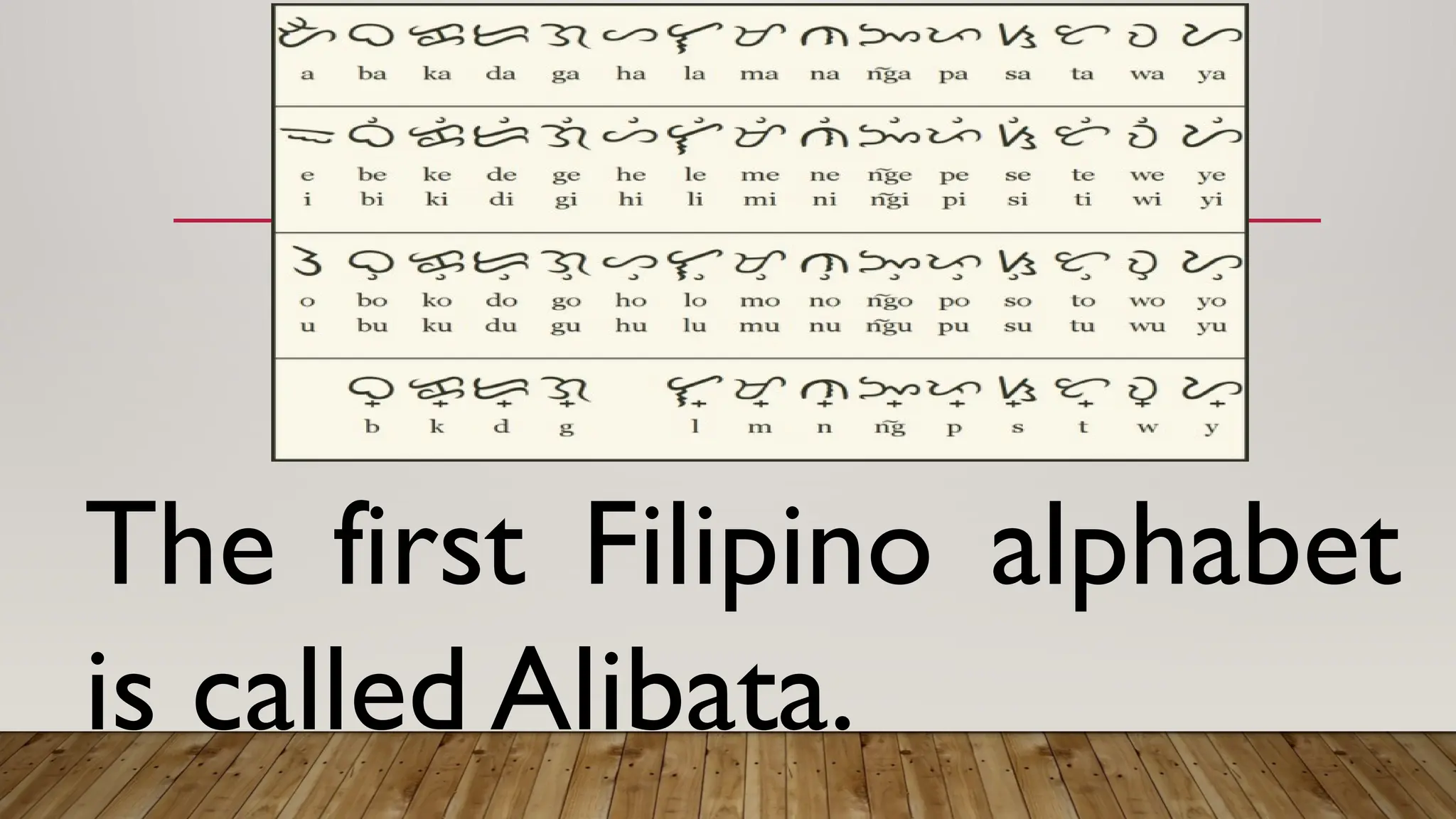
The first Filipino alphabet
is called Alibata.
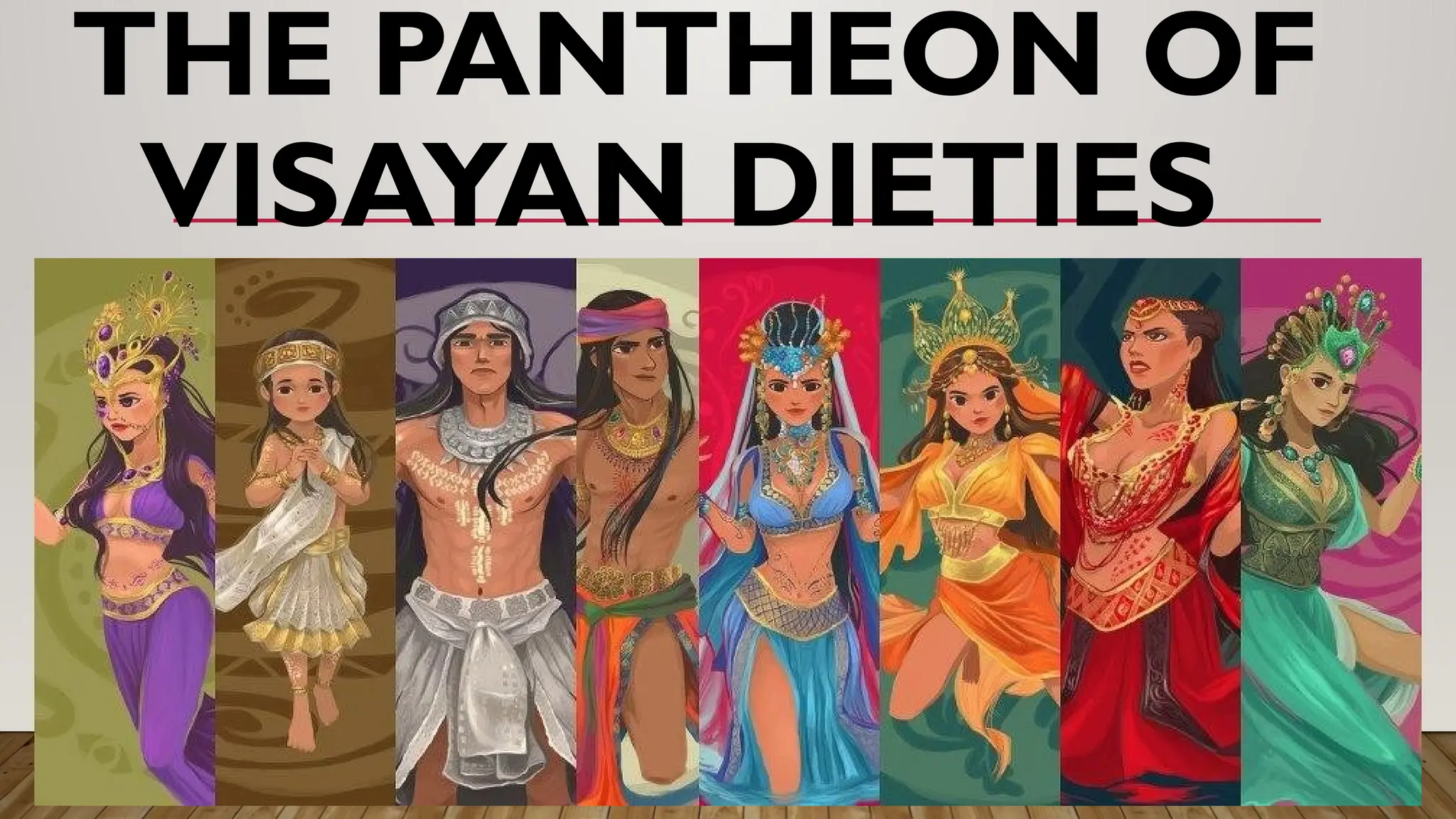
THE PANTHEON OF
VISAYAN DIETIES
Unlike the Tagalogs, ancient Visayans
didn’t have a creator god like Bathala who
appeared out of nowhere and decided to
create humanity. But what they lacked in
“creator god” they made up for in plenty
of origin myths.
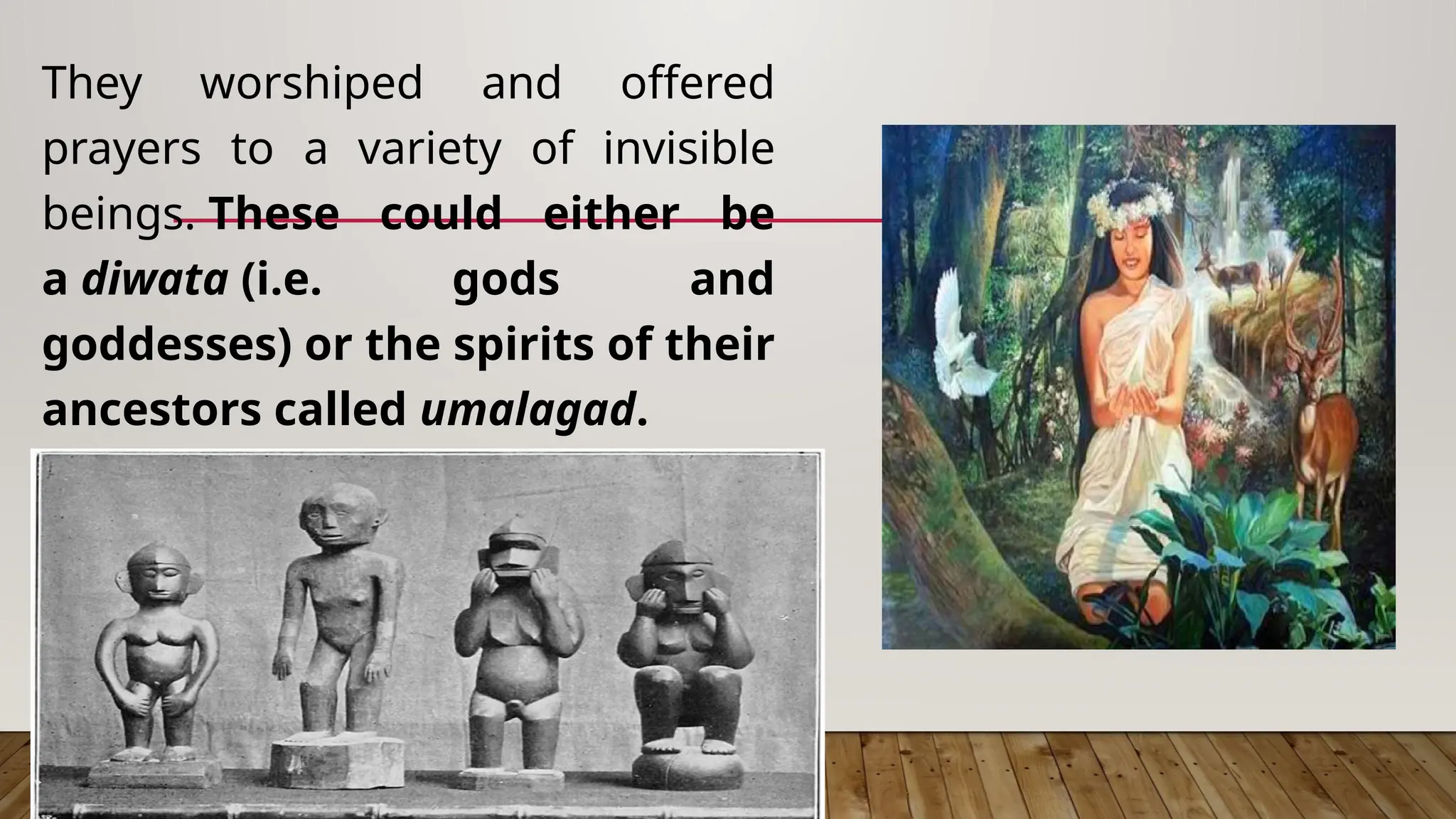
They worshiped and offered
prayers to a variety of invisible
beings. These could either be
a diwata (i.e. gods and
goddesses) or the spirits of their
ancestors called umalagad.
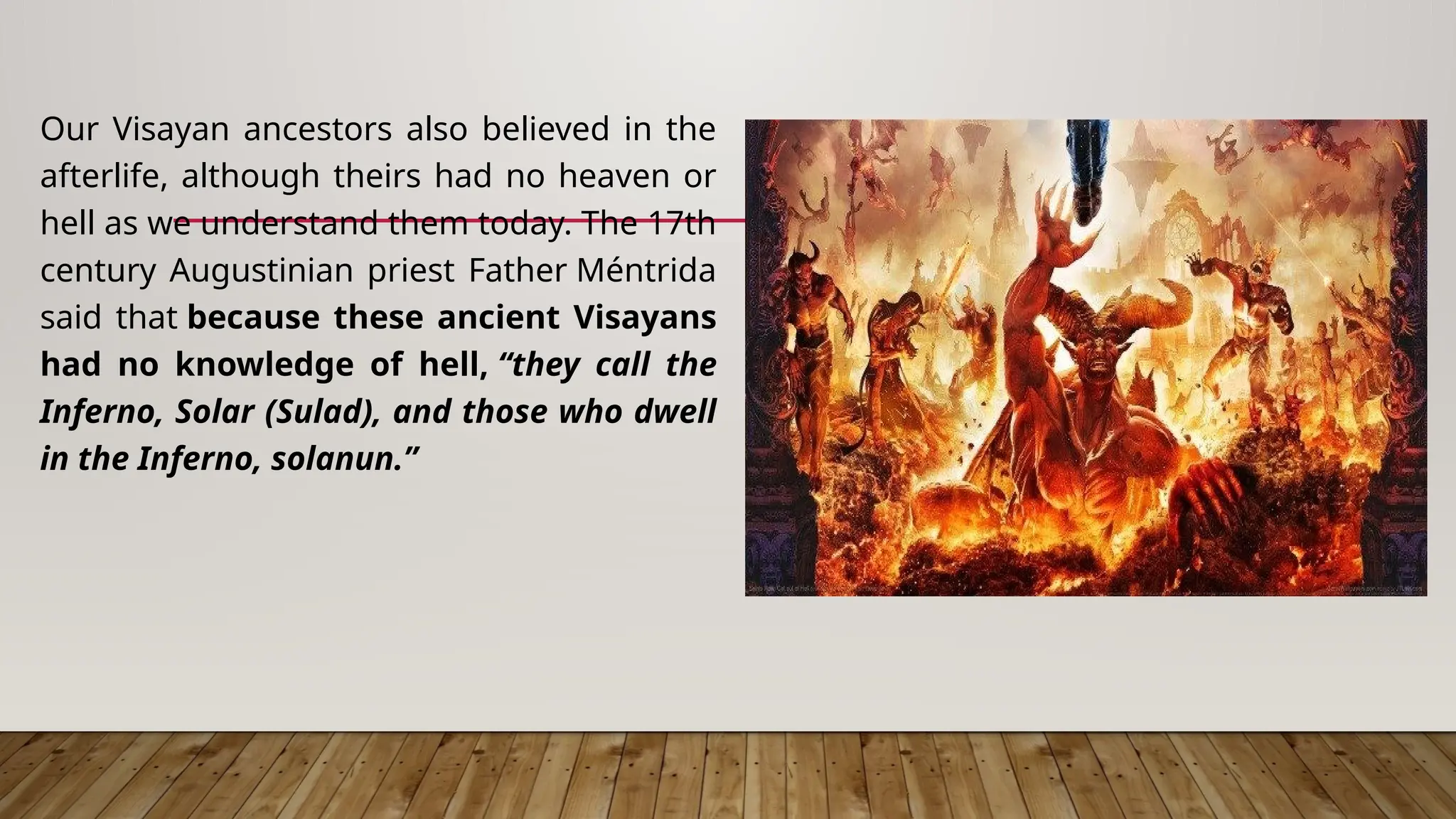
Our Visayan ancestors also believed in the
afterlife, although theirs had no heaven or
hell as we understand them today. The 17th
century Augustinian priest Father Méntrida
said that because these ancient Visayans
had no knowledge of hell, “they call the
Inferno, Solar (Sulad), and those who dwell
in the Inferno, solanun.”
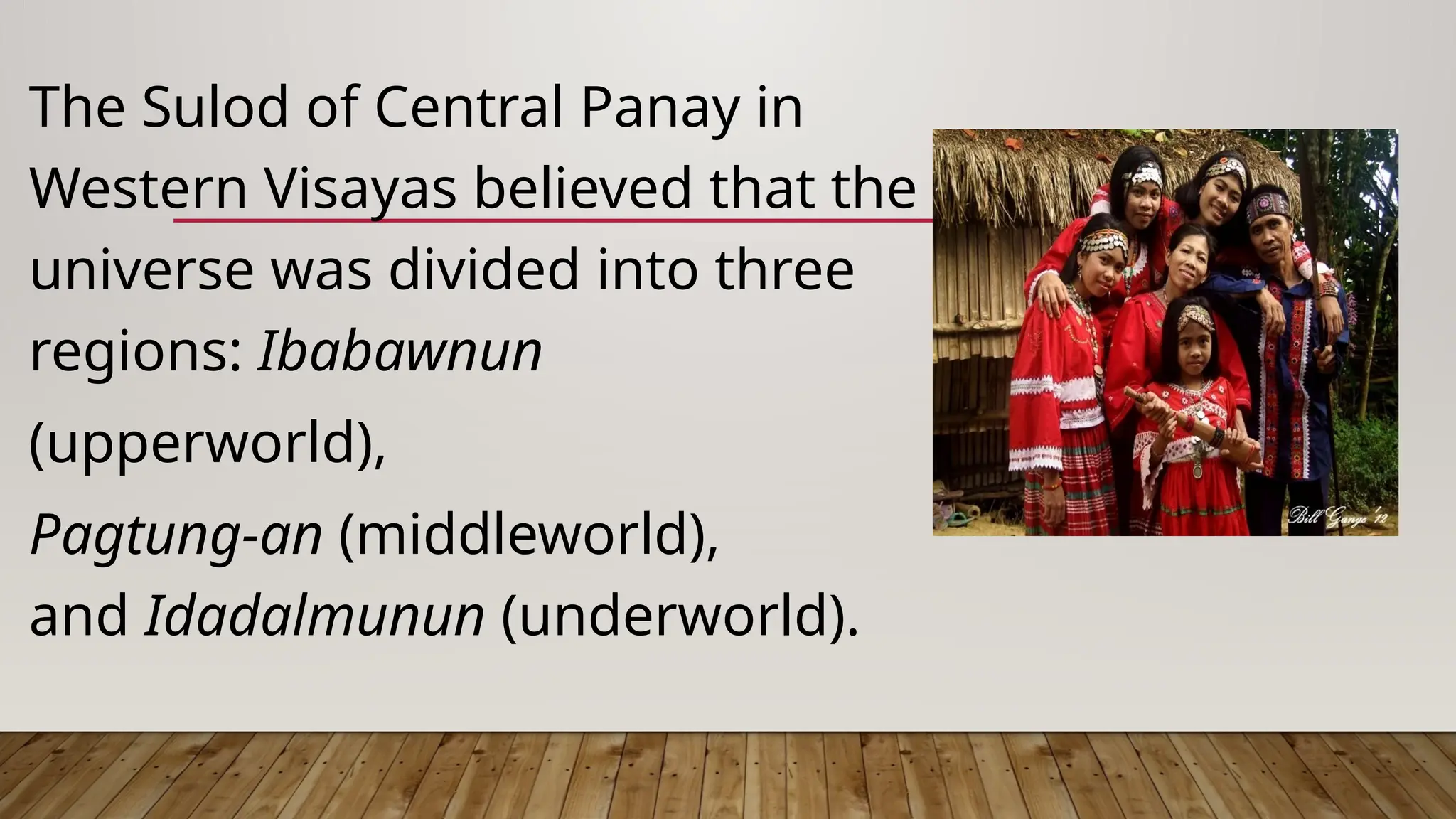
The Sulod of Central Panay in
Western Visayas believed that the
universe was divided into three
regions: Ibabawnun
(upperworld),
Pagtung-an (middleworld),
and Idadalmunun (underworld).
Ibabawnun was further divided into two–
a place ruled and inhabited by the
male diwata, and the other by the
female diwata.
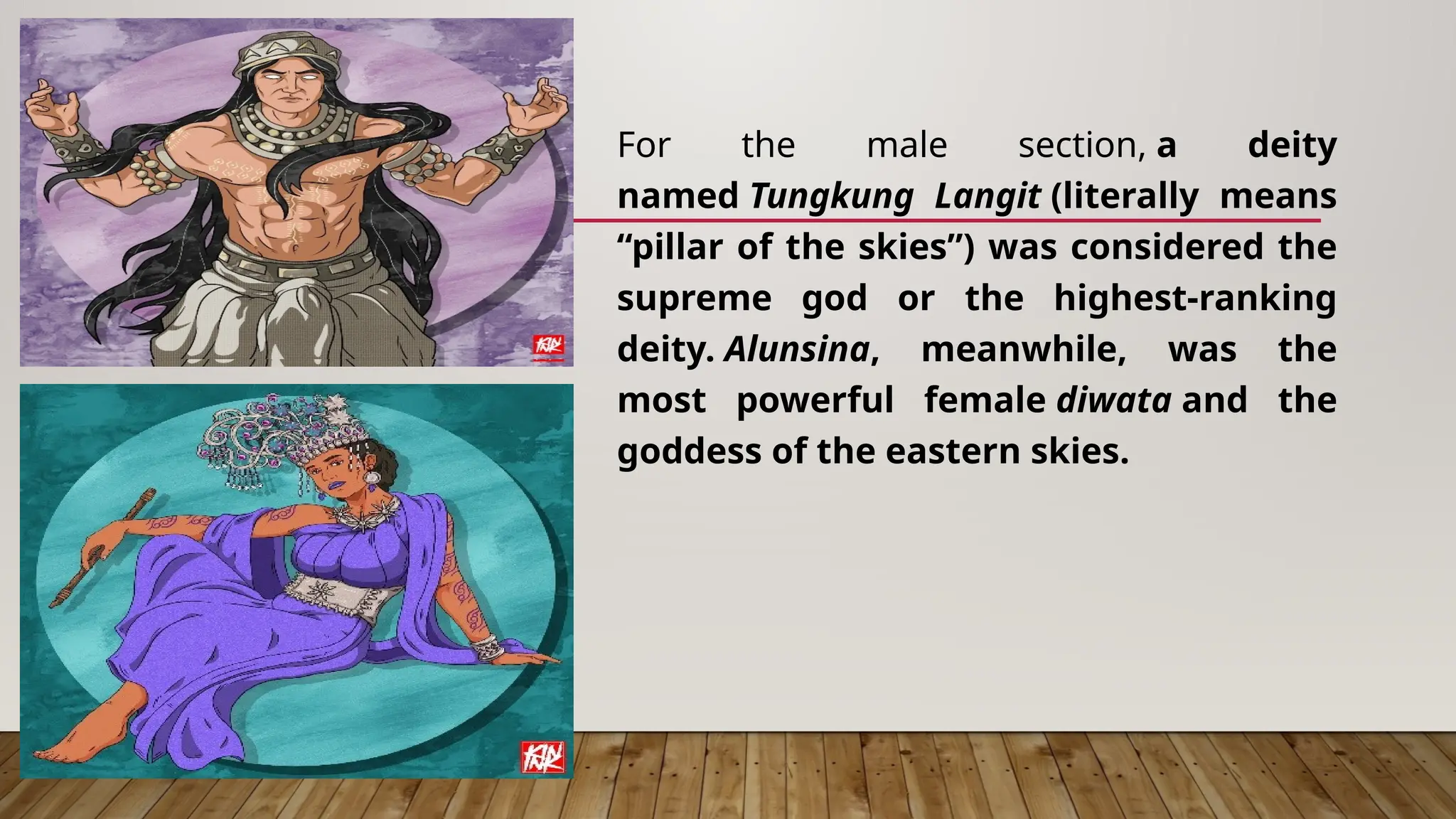
For the male section, a deity
named Tungkung Langit (literally means
“pillar of the skies”) was considered the
supreme god or the highest-ranking
deity. Alunsina, meanwhile, was the
most powerful female diwata and the
goddess of the eastern skies.
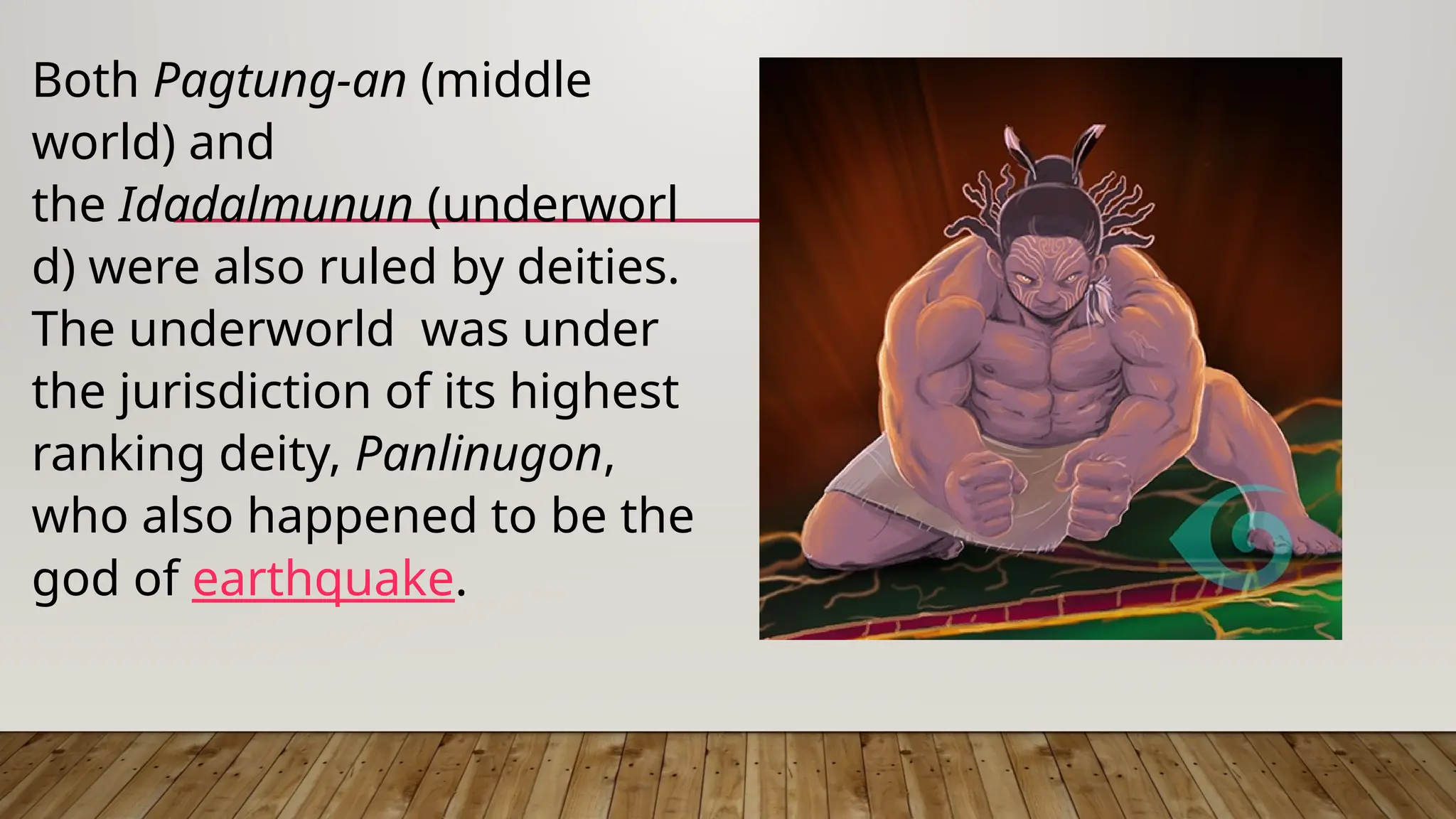
Both Pagtung-an (middle
world) and
the Idadalmunun (underworl
d) were also ruled by deities.
The underworld was under
the jurisdiction of its highest
ranking deity, Panlinugon,
who also happened to be the
god of earthquake.
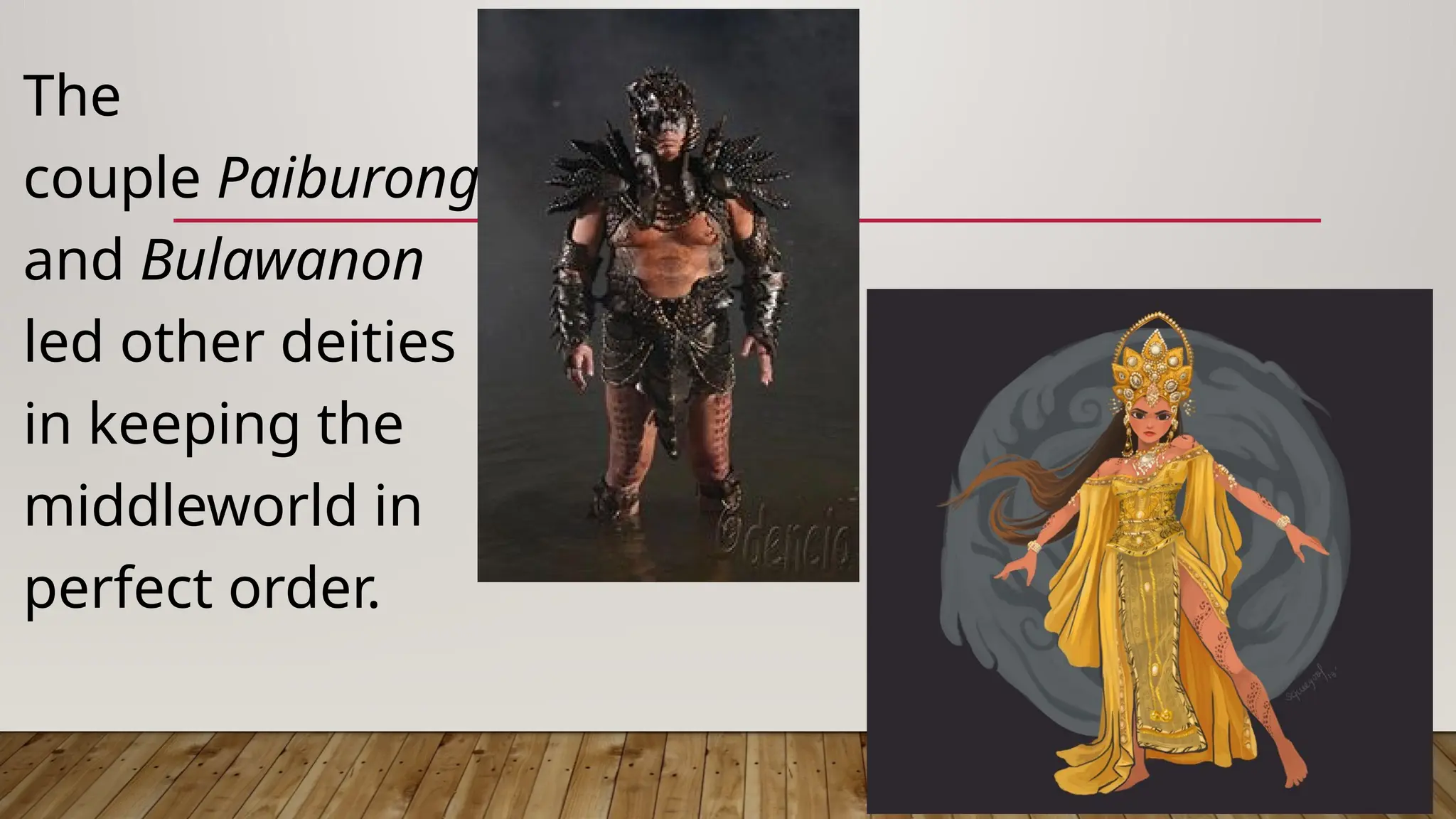
The
couple Paiburong
and Bulawanon
led other deities
in keeping the
middleworld in
perfect order.
CREATION MYTH
VERSION 1.0
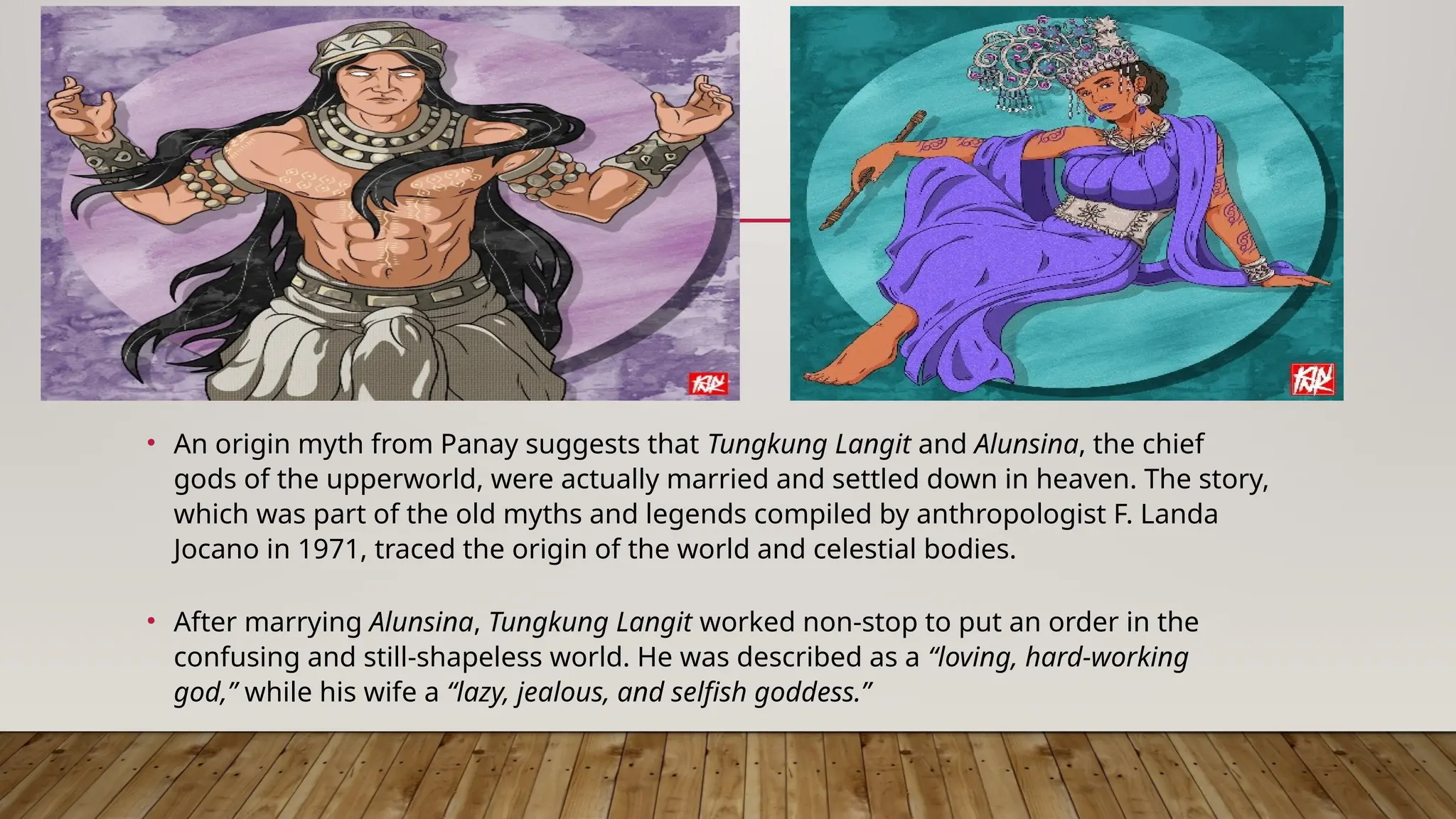
• An origin myth from Panay suggests that Tungkung Langit and Alunsina, the chief
gods of the upperworld, were actually married and settled down in heaven. The story,
which was part of the old myths and legends compiled by anthropologist F. Landa
Jocano in 1971, traced the origin of the world and celestial bodies.
• After marrying Alunsina, Tungkung Langit worked non-stop to put an order in the
confusing and still-shapeless world. He was described as a “loving, hard-working
god,” while his wife a “lazy, jealous, and selfish goddess.”
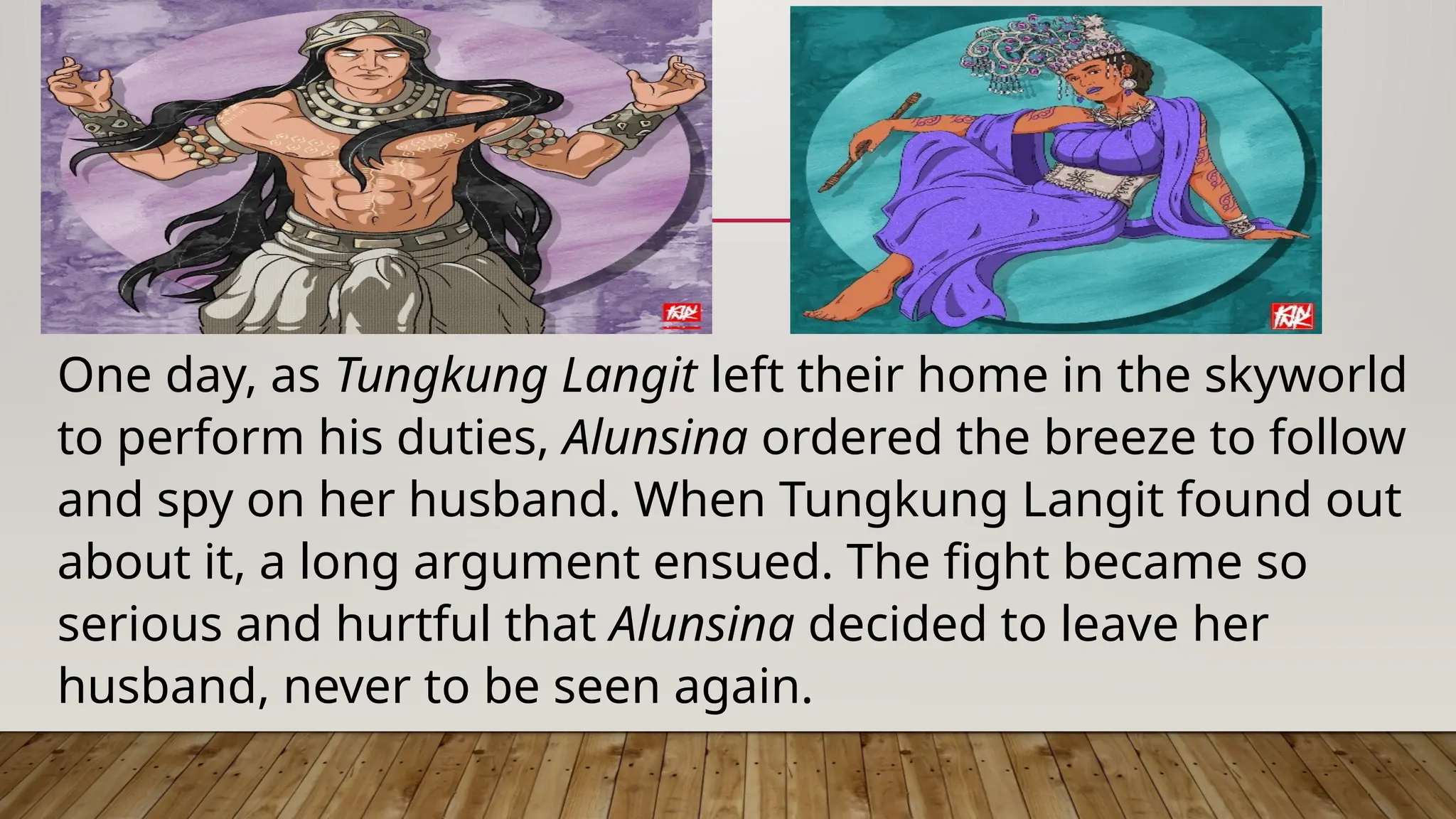
One day, as Tungkung Langit left their home in the skyworld
to perform his duties, Alunsina ordered the breeze to follow
and spy on her husband. When Tungkung Langit found out
about it, a long argument ensued. The fight became so
serious and hurtful that Alunsina decided to leave her
husband, never to be seen again.
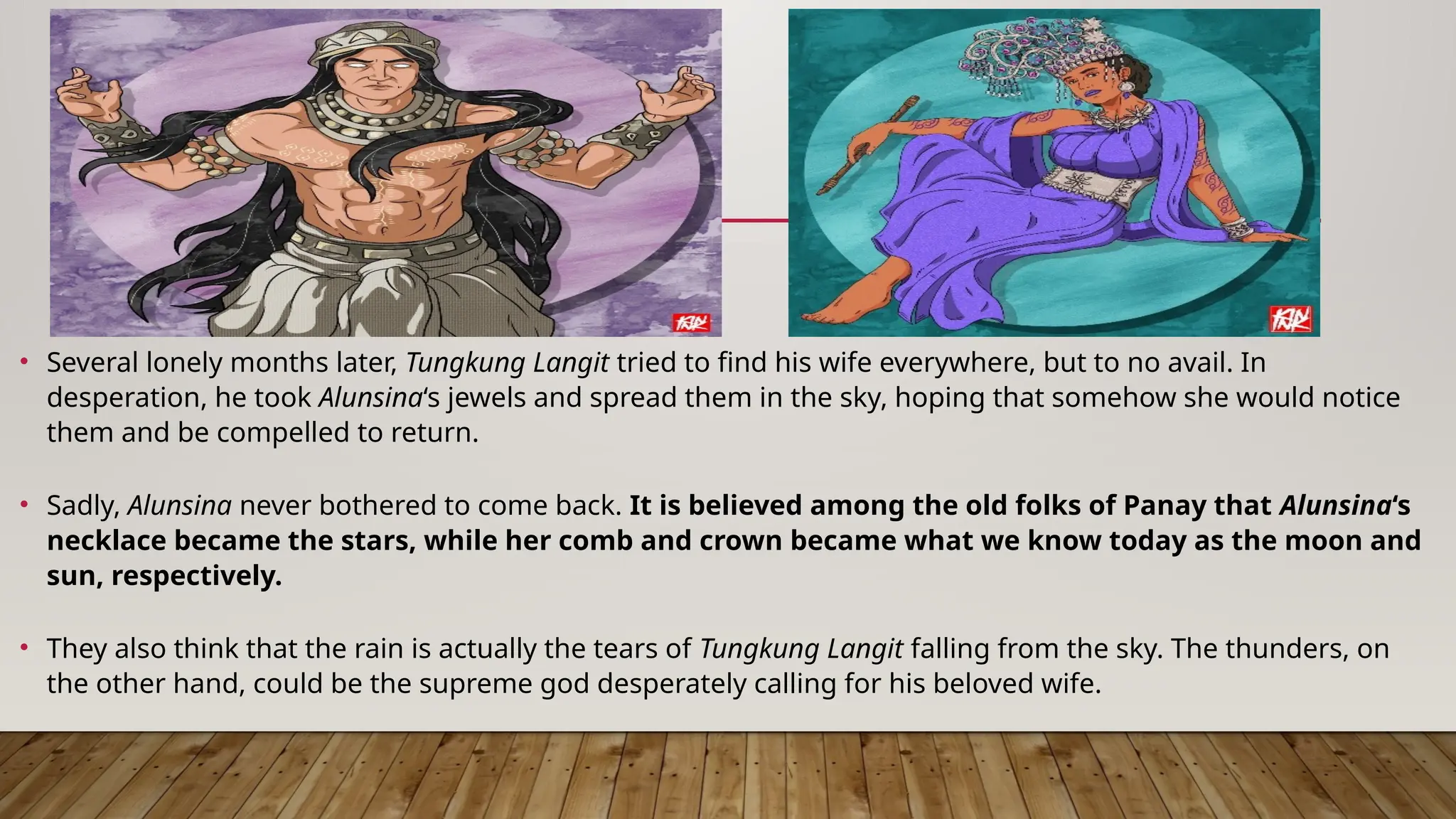
• Several lonely months later, Tungkung Langit tried to find his wife everywhere, but to no avail. In
desperation, he took Alunsina‘s jewels and spread them in the sky, hoping that somehow she would notice
them and be compelled to return.
• Sadly, Alunsina never bothered to come back. It is believed among the old folks of Panay that Alunsina‘s
necklace became the stars, while her comb and crown became what we know today as the moon and
sun, respectively.
• They also think that the rain is actually the tears of Tungkung Langit falling from the sky. The thunders, on
the other hand, could be the supreme god desperately calling for his beloved wife.
CREATION MYTH
VERSION 2.0
•Other parts of the ancient Visayas believed the
world was divided into three
regions: Kahilwayan or the skyworld; Kamariitan or
the earth; and Kasakitan or the underworld.
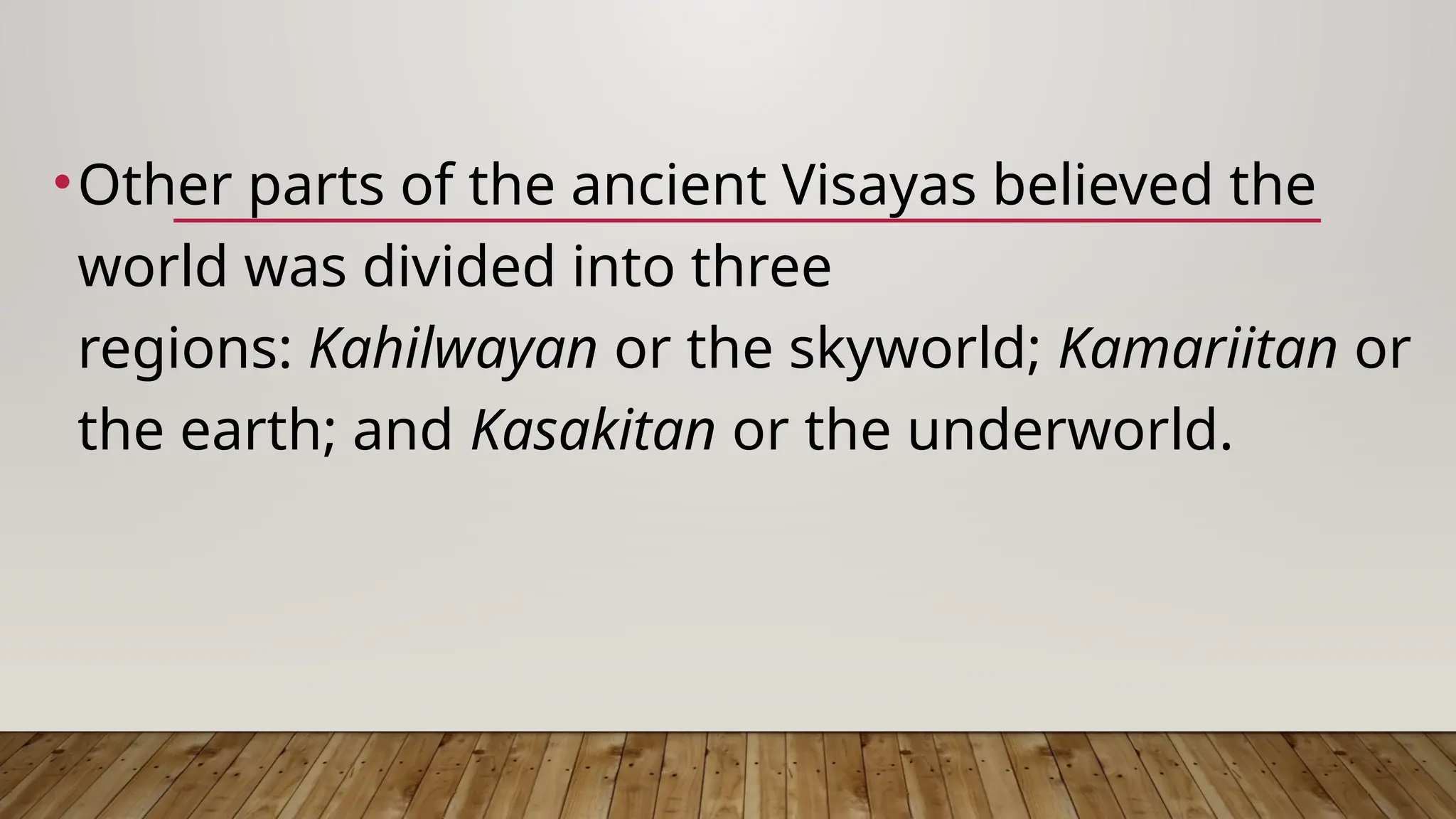
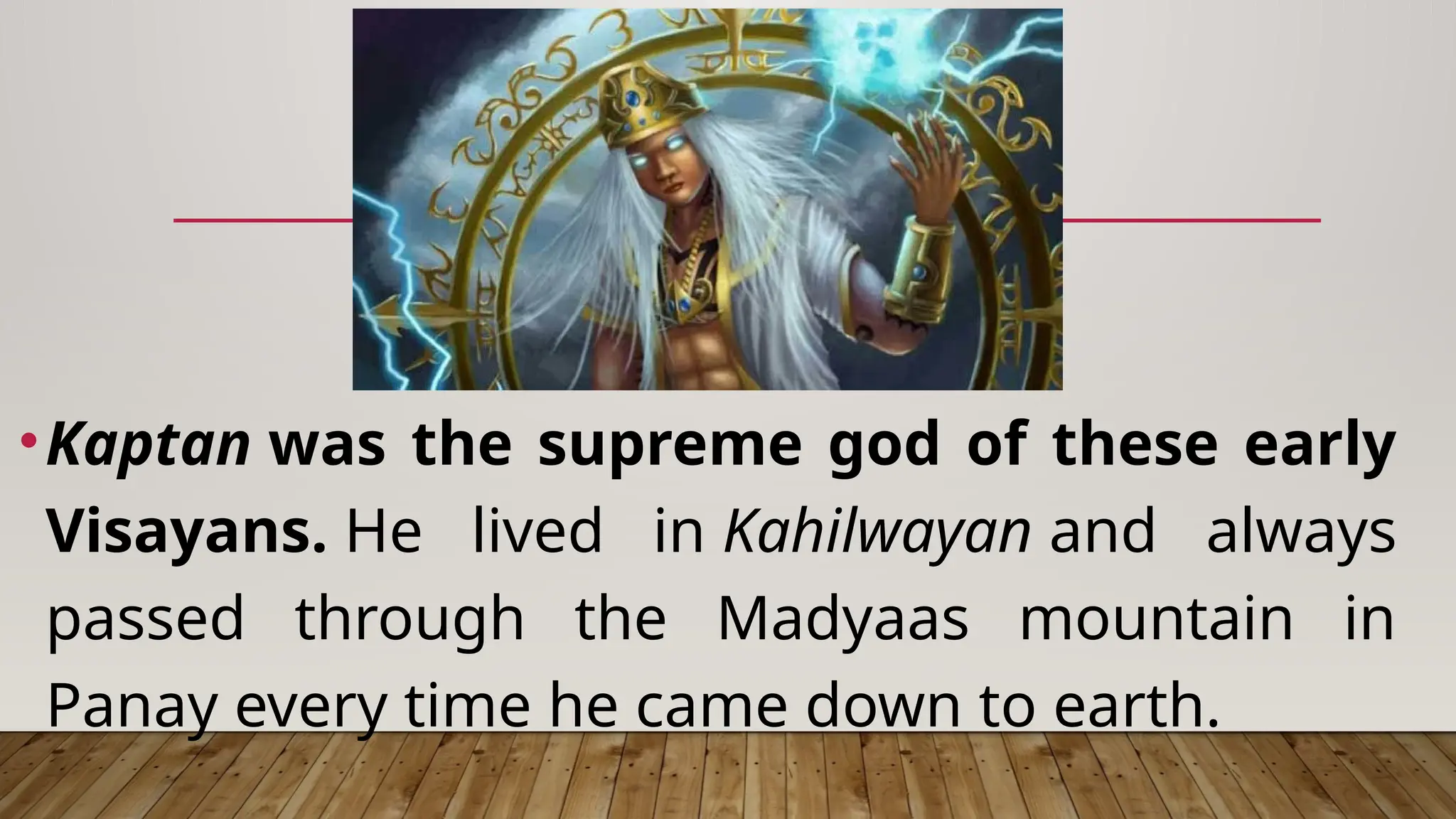
•Kaptan was the supreme god of these early
Visayans. He lived in Kahilwayan and always
passed through the Madyaas mountain in
Panay every time he came down to earth.
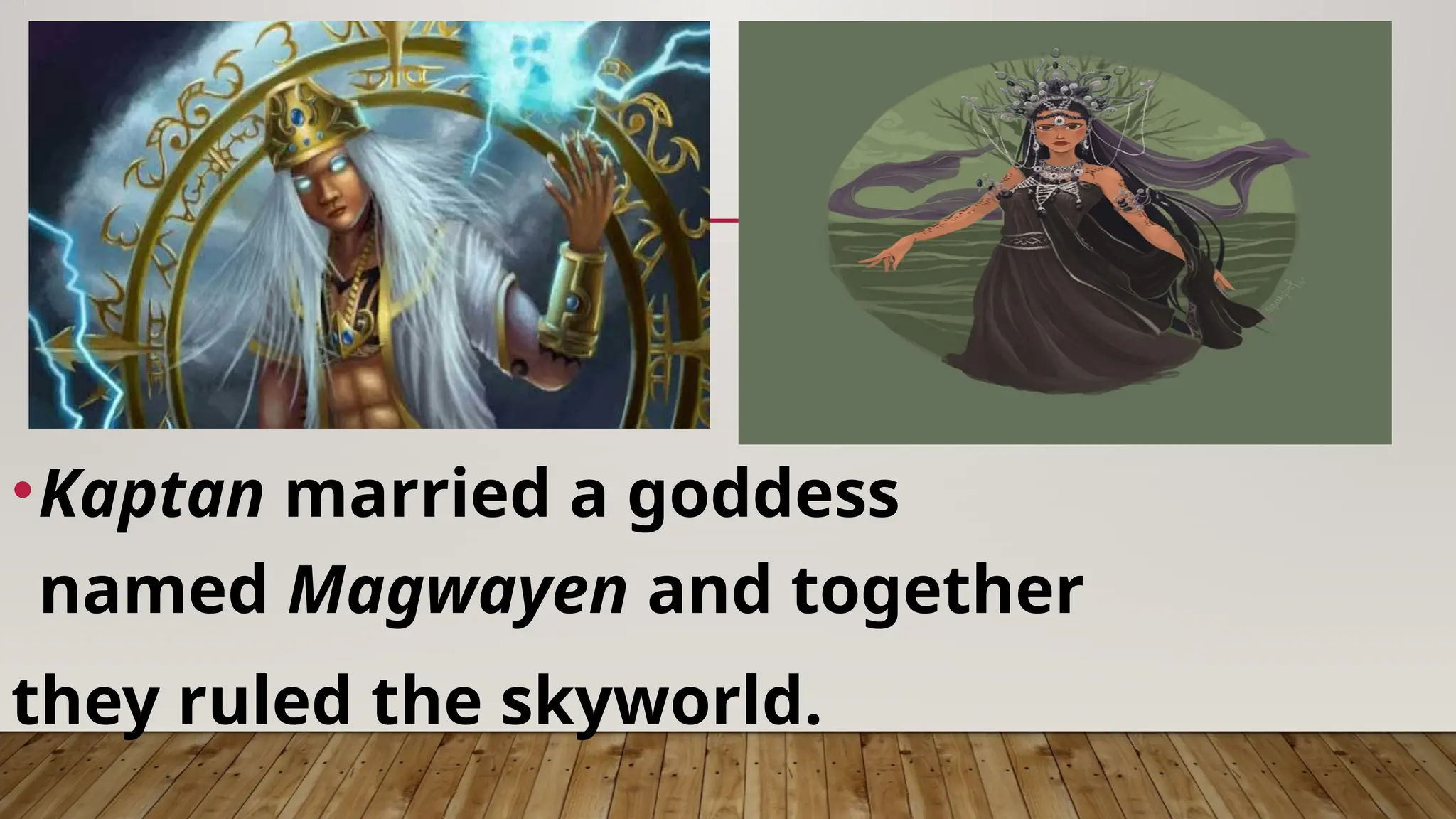
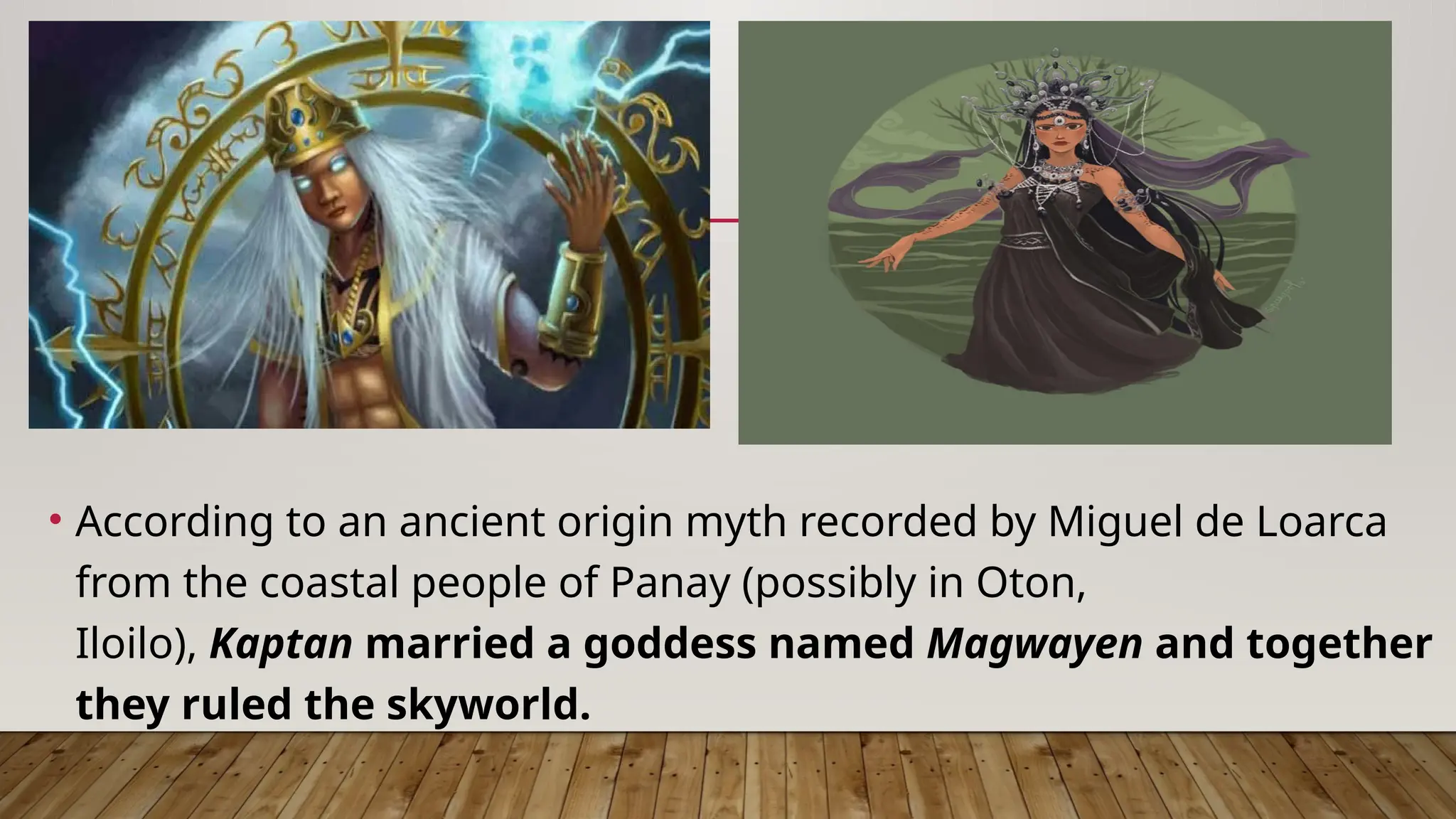
•Kaptan married a goddess
named Magwayen and together
they ruled the skyworld.
• According to an ancient origin myth recorded by Miguel de Loarca
from the coastal people of Panay (possibly in Oton,
Iloilo), Kaptan married a goddess named Magwayen and together
they ruled the skyworld.
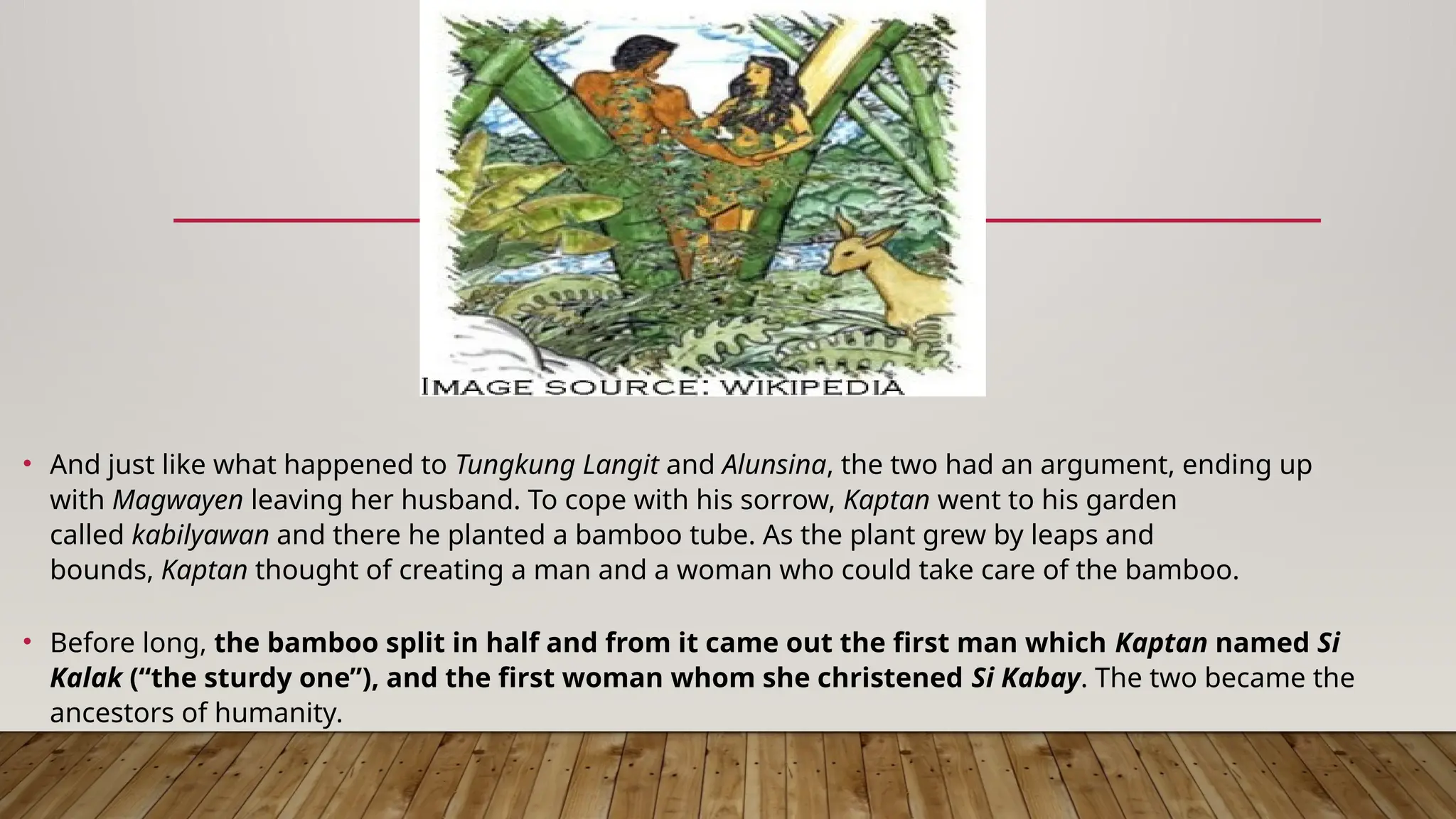
• And just like what happened to Tungkung Langit and Alunsina, the two had an argument, ending up
with Magwayen leaving her husband. To cope with his sorrow, Kaptan went to his garden
called kabilyawan and there he planted a bamboo tube. As the plant grew by leaps and
bounds, Kaptan thought of creating a man and a woman who could take care of the bamboo.
• Before long, the bamboo split in half and from it came out the first man which Kaptan named Si
Kalak (“the sturdy one”), and the first woman whom she christened Si Kabay. The two became the
ancestors of humanity.
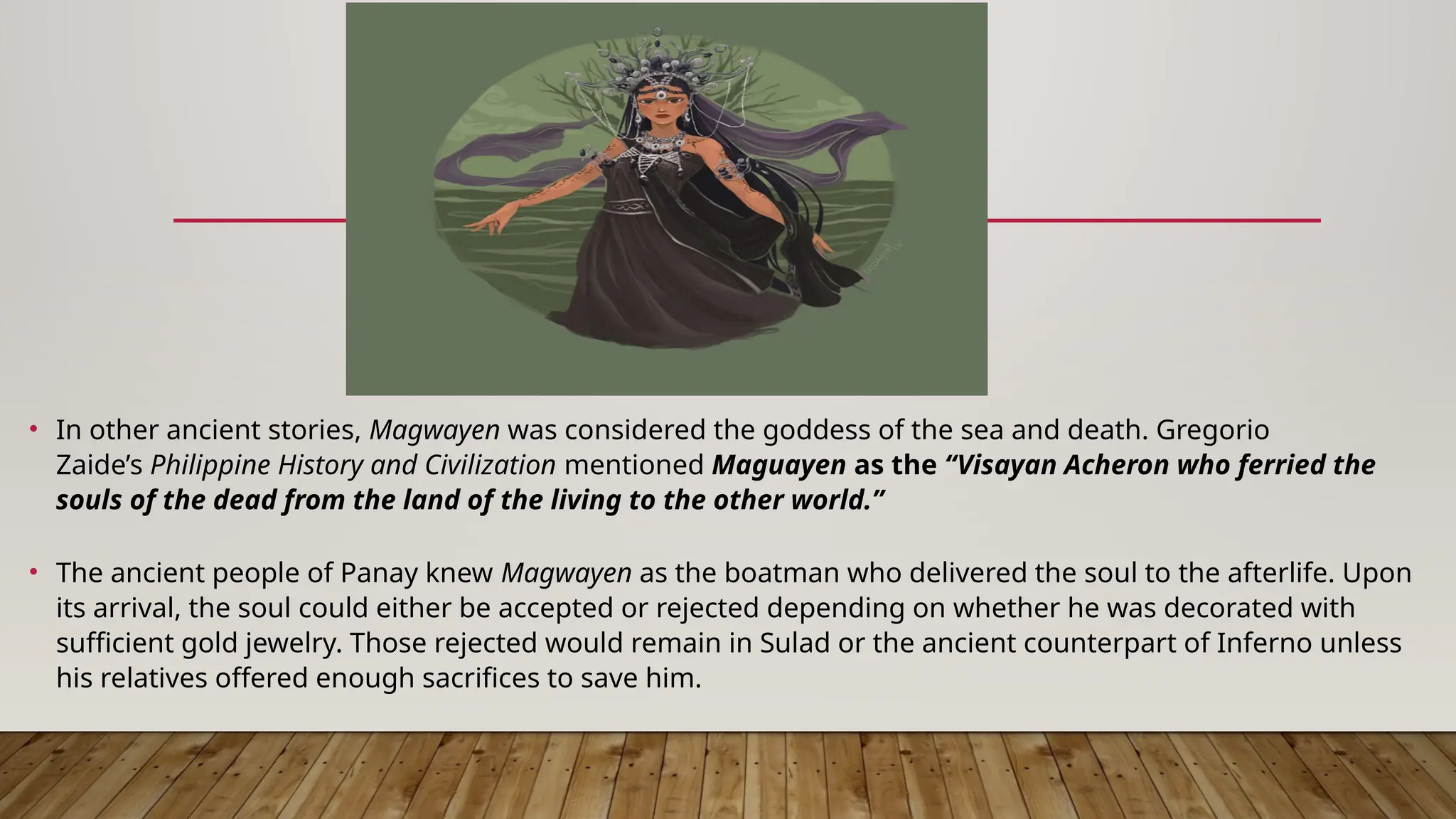
• In other ancient stories, Magwayen was considered the goddess of the sea and death. Gregorio
Zaide’s Philippine History and Civilization mentioned Maguayen as the “Visayan Acheron who ferried the
souls of the dead from the land of the living to the other world.”
• The ancient people of Panay knew Magwayen as the boatman who delivered the soul to the afterlife. Upon
its arrival, the soul could either be accepted or rejected depending on whether he was decorated with
sufficient gold jewelry. Those rejected would remain in Sulad or the ancient counterpart of Inferno unless
his relatives offered enough sacrifices to save him.
CREATION MYTH
VERSION 3.0
• Another version of the Visayan origin myth
suggests that Kaptan and Magwayen were not a
couple. Instead, they were both guys,
with Kaptan ruling over the skyworld
and Magwayen lording over the water.
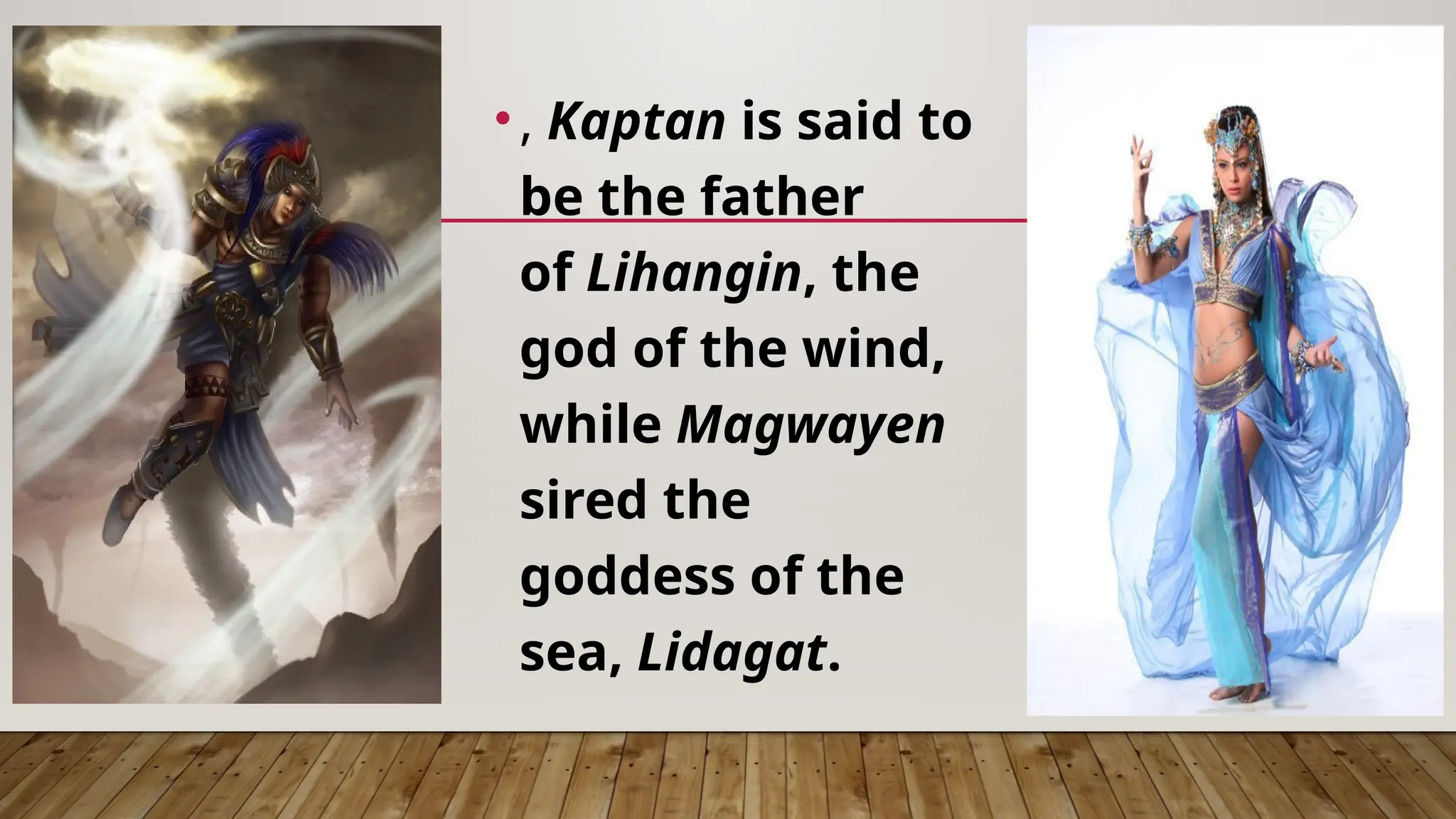
•, Kaptan is said to
be the father
of Lihangin, the
god of the wind,
while Magwayen
sired the
goddess of the
sea, Lidagat.
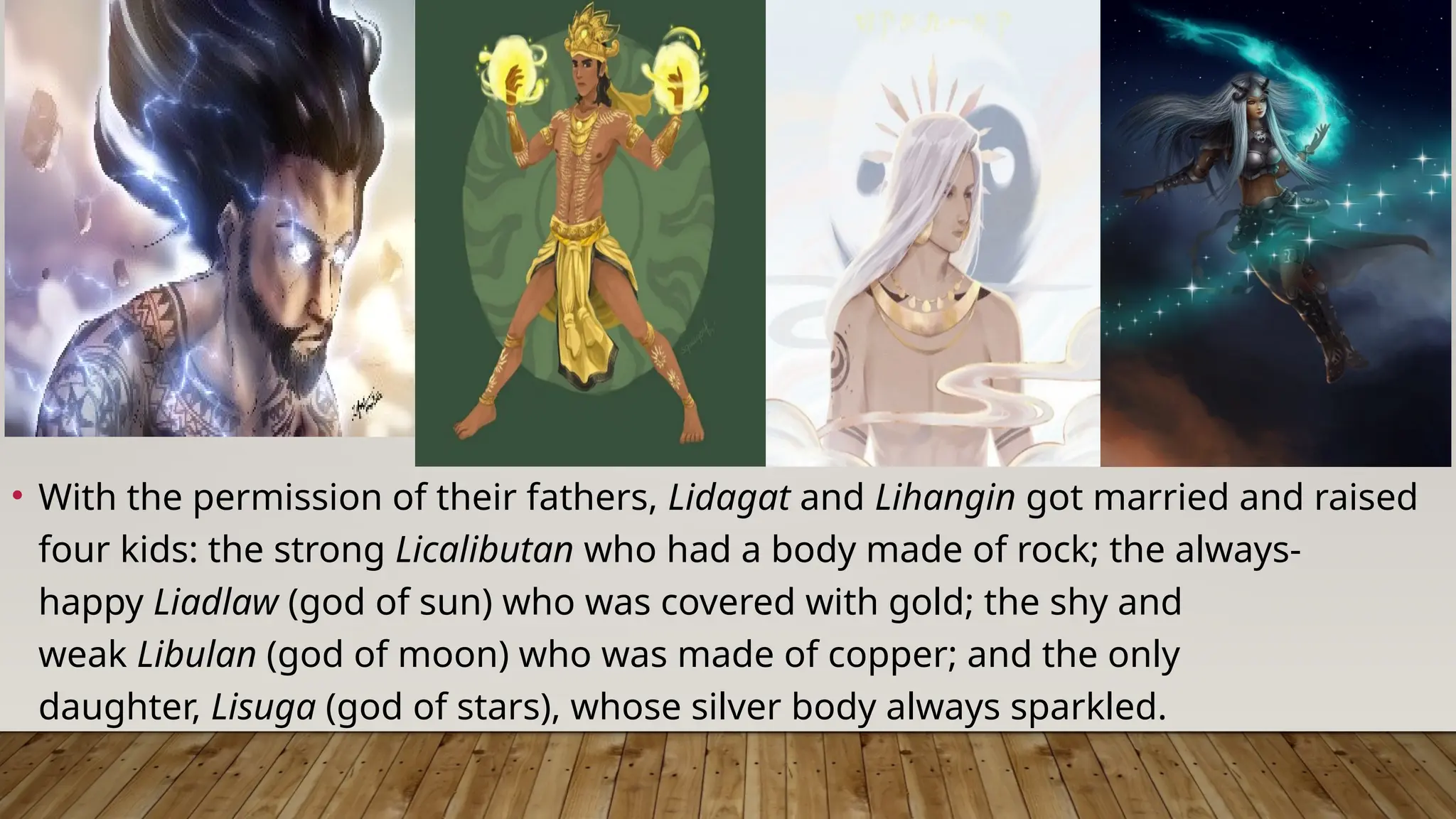
• With the permission of their fathers, Lidagat and Lihangin got married and raised
four kids: the strong Licalibutan who had a body made of rock; the always-
happy Liadlaw (god of sun) who was covered with gold; the shy and
weak Libulan (god of moon) who was made of copper; and the only
daughter, Lisuga (god of stars), whose silver body always sparkled.
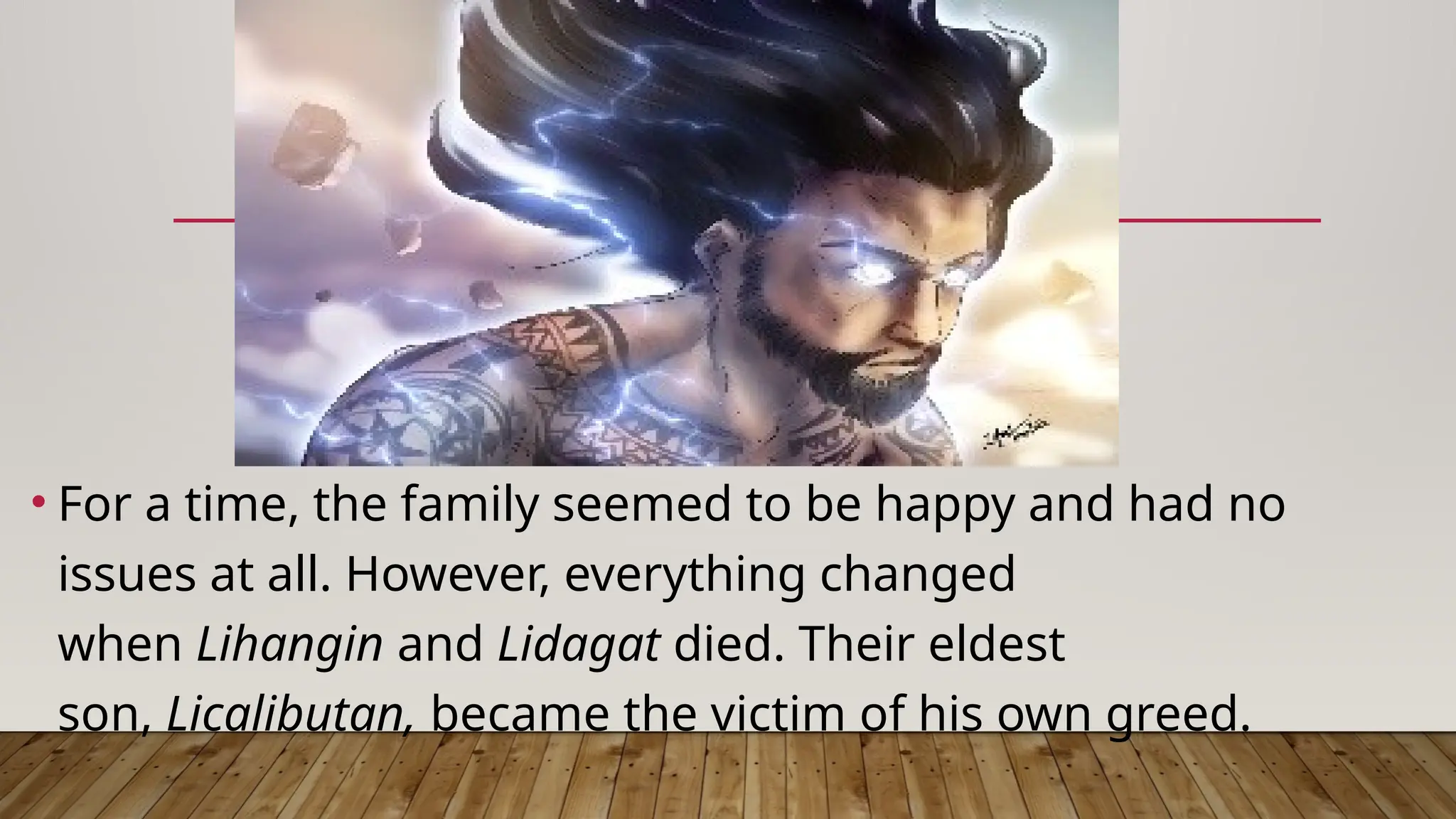
• For a time, the family seemed to be happy and had no
issues at all. However, everything changed
when Lihangin and Lidagat died. Their eldest
son, Licalibutan, became the victim of his own greed.
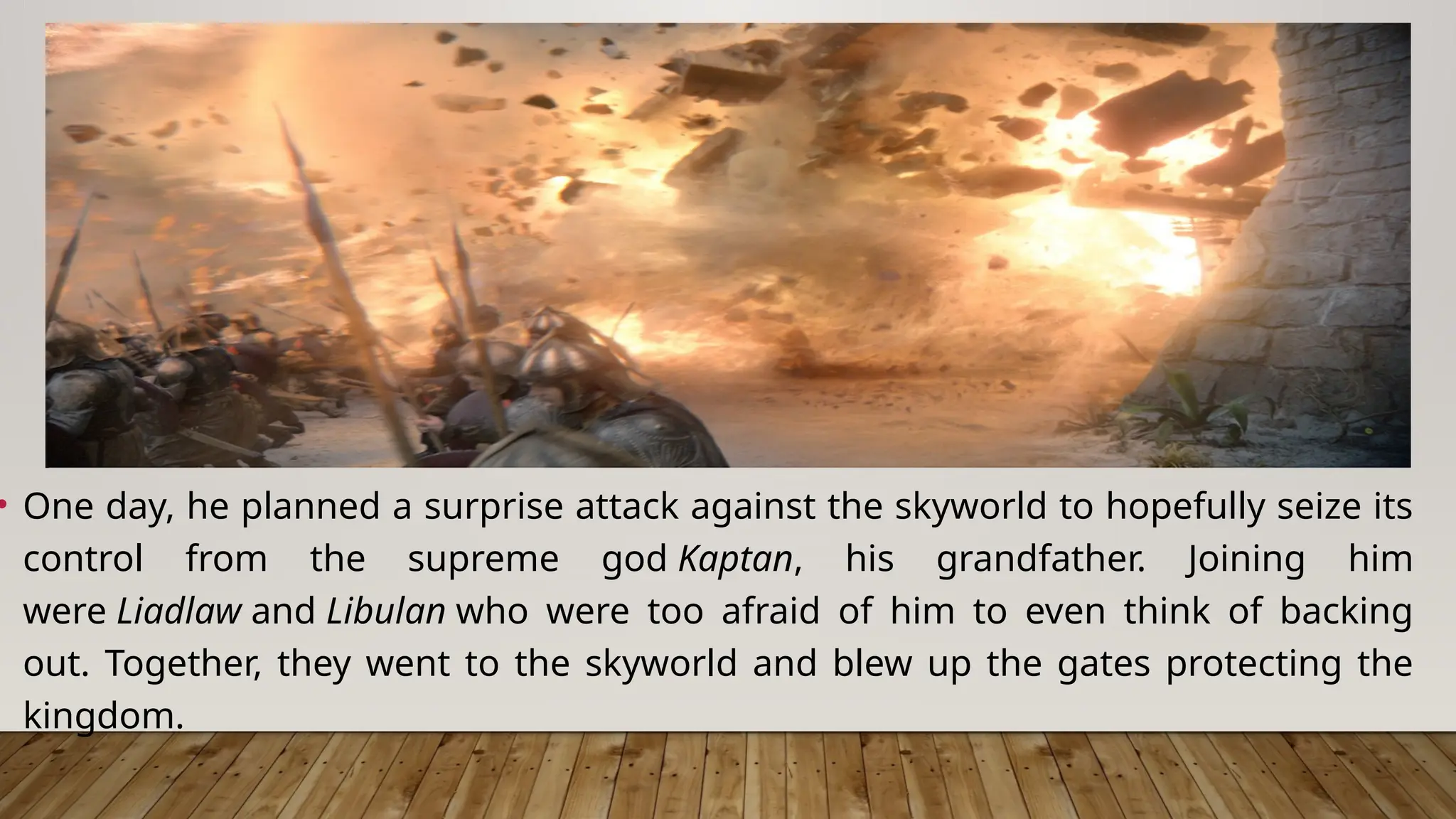
• One day, he planned a surprise attack against the skyworld to hopefully seize its
control from the supreme god Kaptan, his grandfather. Joining him
were Liadlaw and Libulan who were too afraid of him to even think of backing
out. Together, they went to the skyworld and blew up the gates protecting the
kingdom.
• When Kaptan learned about the attack, he was enraged. The skygod sent
three lightning bolts to his grandsons, which all melted instantly.
Both Liadlaw and Libulan were reduced into a ball, while Licalibutan‘s rock-hard
body broke into pieces, fell into the sea, and became what is known as land.
• When he and Magwayen finally met,
things started to sink in for Kaptan. He
lost all his grandchildren, including
the beautiful Lisuga who had nothing
to do with the conspiracy at all.
• The grief-stricken Kaptan, upon
realizing he could no longer revive the
four deities, decided to just provide
their remains with an everlasting
light. Hence, Liadlaw became the
sun, Libulan became the moon,
and Lisuga became what we know
today as the stars.
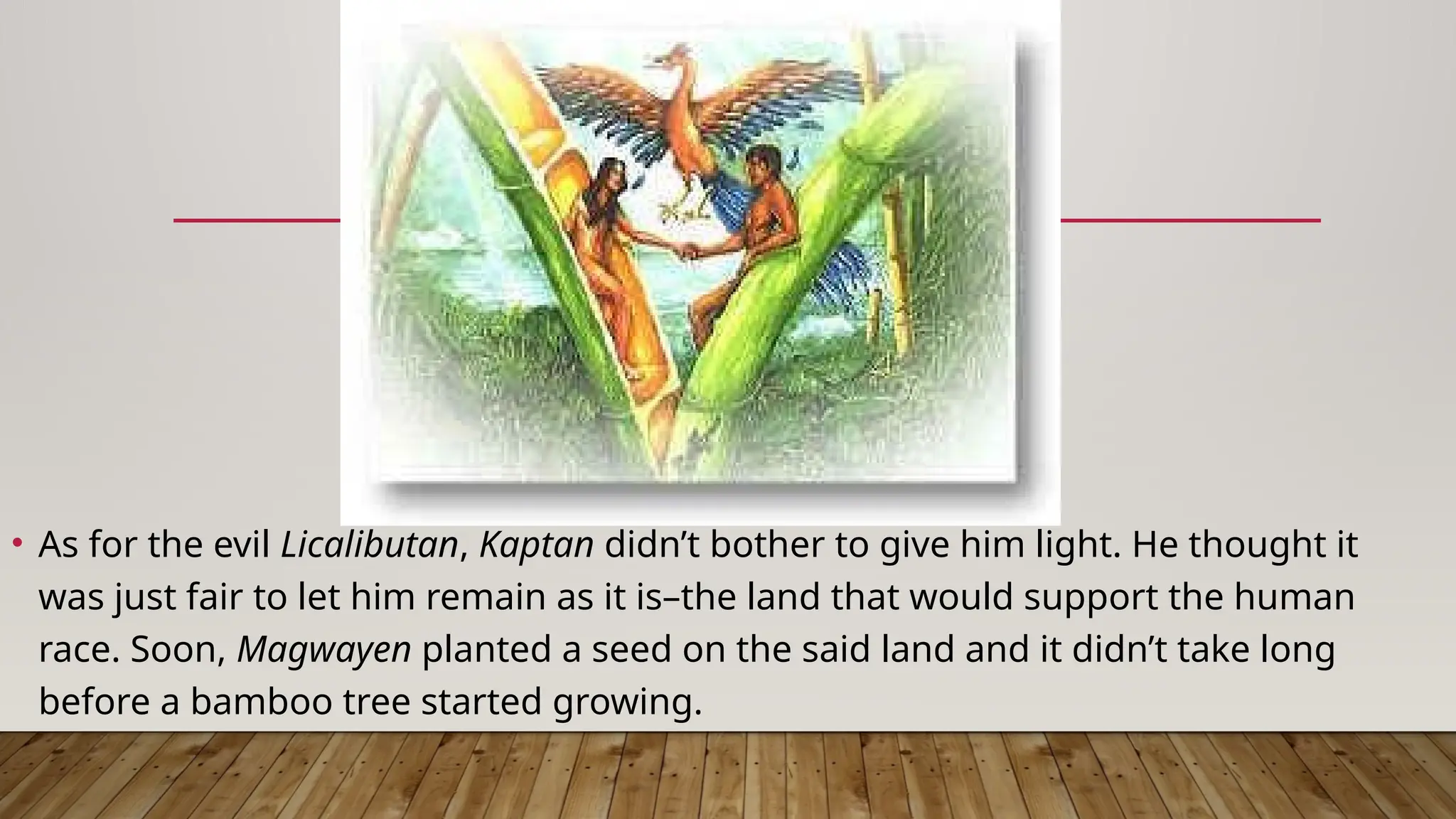
• As for the evil Licalibutan, Kaptan didn’t bother to give him light. He thought it
was just fair to let him remain as it is–the land that would support the human
race. Soon, Magwayen planted a seed on the said land and it didn’t take long
before a bamboo tree started growing.
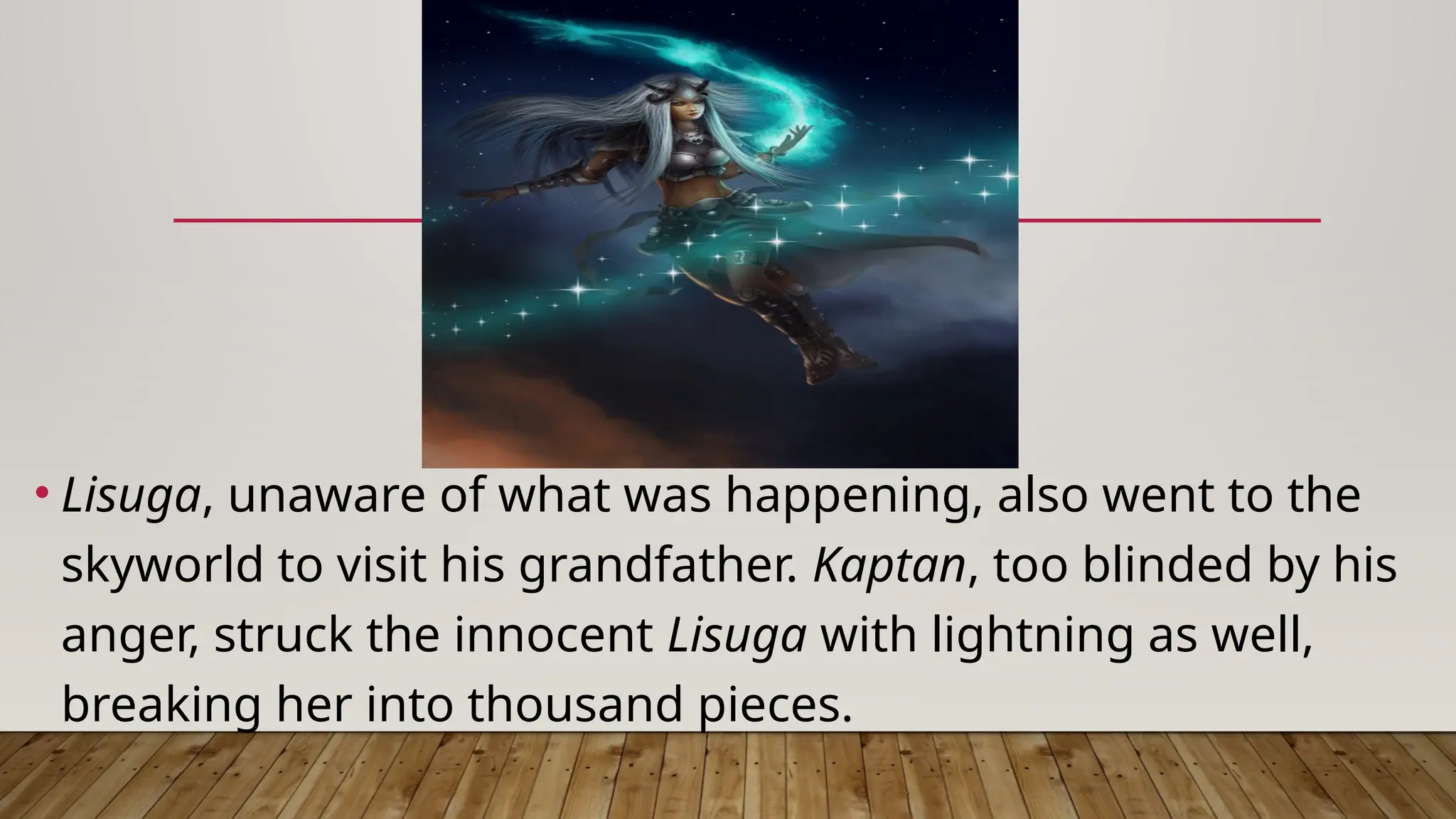
• Lisuga, unaware of what was happening, also went to the
skyworld to visit his grandfather. Kaptan, too blinded by his
anger, struck the innocent Lisuga with lightning as well,
breaking her into thousand pieces.
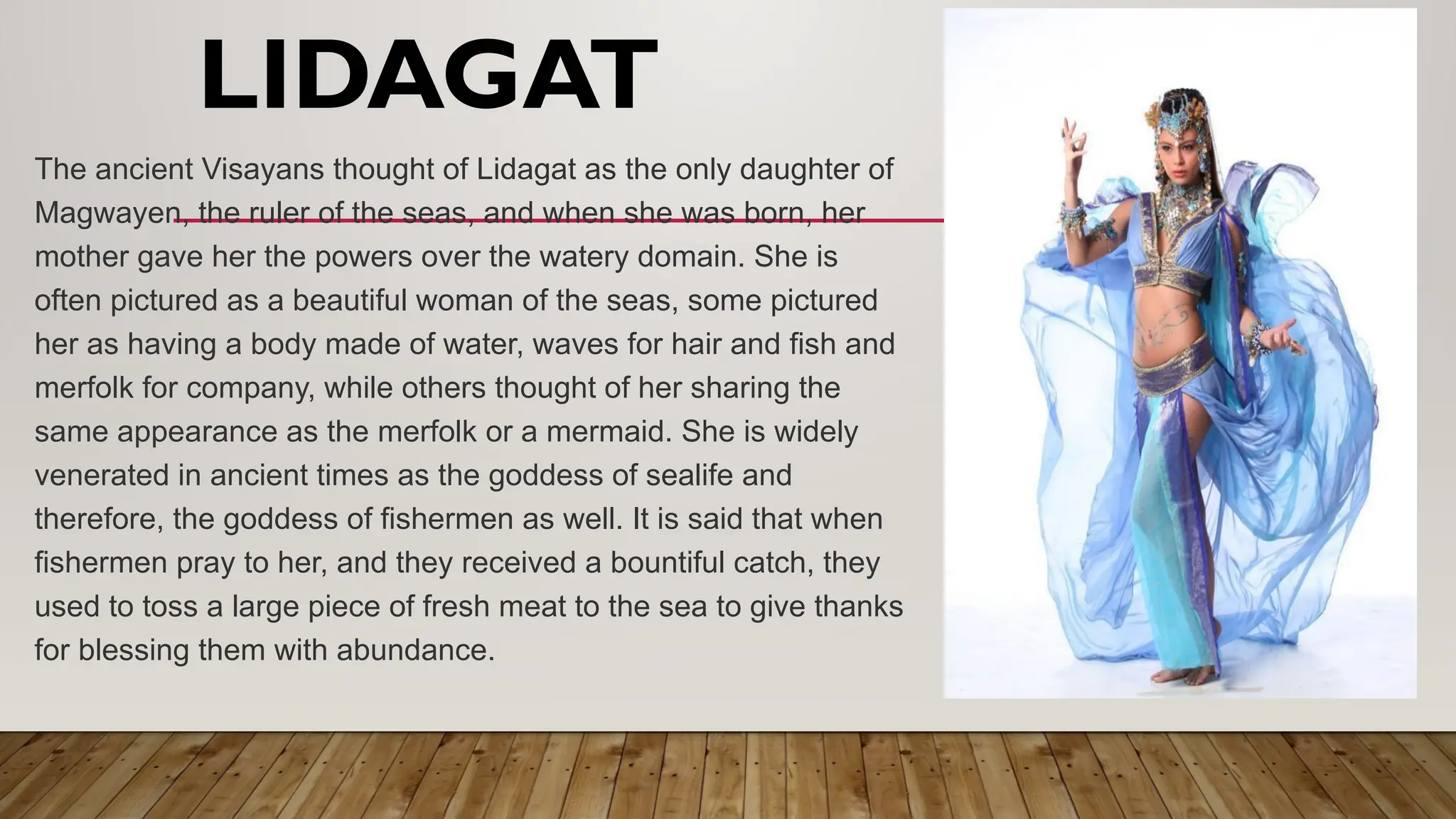
LIDAGAT
The ancient Visayans thought of Lidagat as the only daughter of
Magwayen, the ruler of the seas, and when she was born, her
mother gave her the powers over the watery domain. She is
often pictured as a beautiful woman of the seas, some pictured
her as having a body made of water, waves for hair and fish and
merfolk for company, while others thought of her sharing the
same appearance as the merfolk or a mermaid. She is widely
venerated in ancient times as the goddess of sealife and
therefore, the goddess of fishermen as well. It is said that when
fishermen pray to her, and they received a bountiful catch, they
used to toss a large piece of fresh meat to the sea to give thanks
for blessing them with abundance.
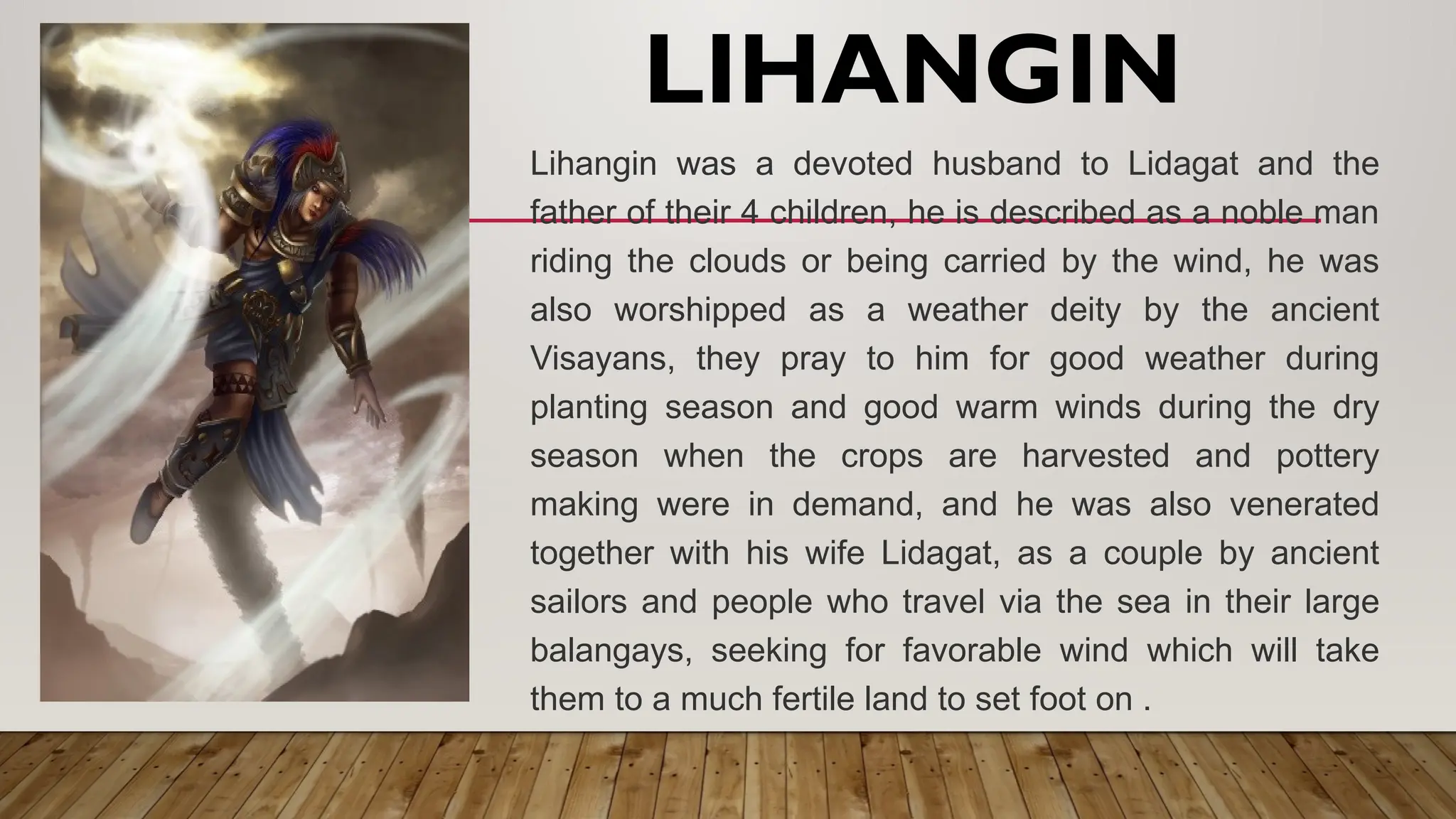
LIHANGIN
Lihangin was a devoted husband to Lidagat and the
father of their 4 children, he is described as a noble man
riding the clouds or being carried by the wind, he was
also worshipped as a weather deity by the ancient
Visayans, they pray to him for good weather during
planting season and good warm winds during the dry
season when the crops are harvested and pottery
making were in demand, and he was also venerated
together with his wife Lidagat, as a couple by ancient
sailors and people who travel via the sea in their large
balangays, seeking for favorable wind which will take
them to a much fertile land to set foot on .
LICALIBUTAN
He was described as a god who has a large
body made of rock and has a very aggressive
attitude. His brothers Liadlaw and Libulan
always looked up to him and they were ready to
follow his every command. He was also
Lihangin’s favorite son and was spoiled very
much by him. When Lihangin died, Licalibutan
was beside him, and he blessed the rock deity
with his powers to control the winds of the earth.
LIADLAW
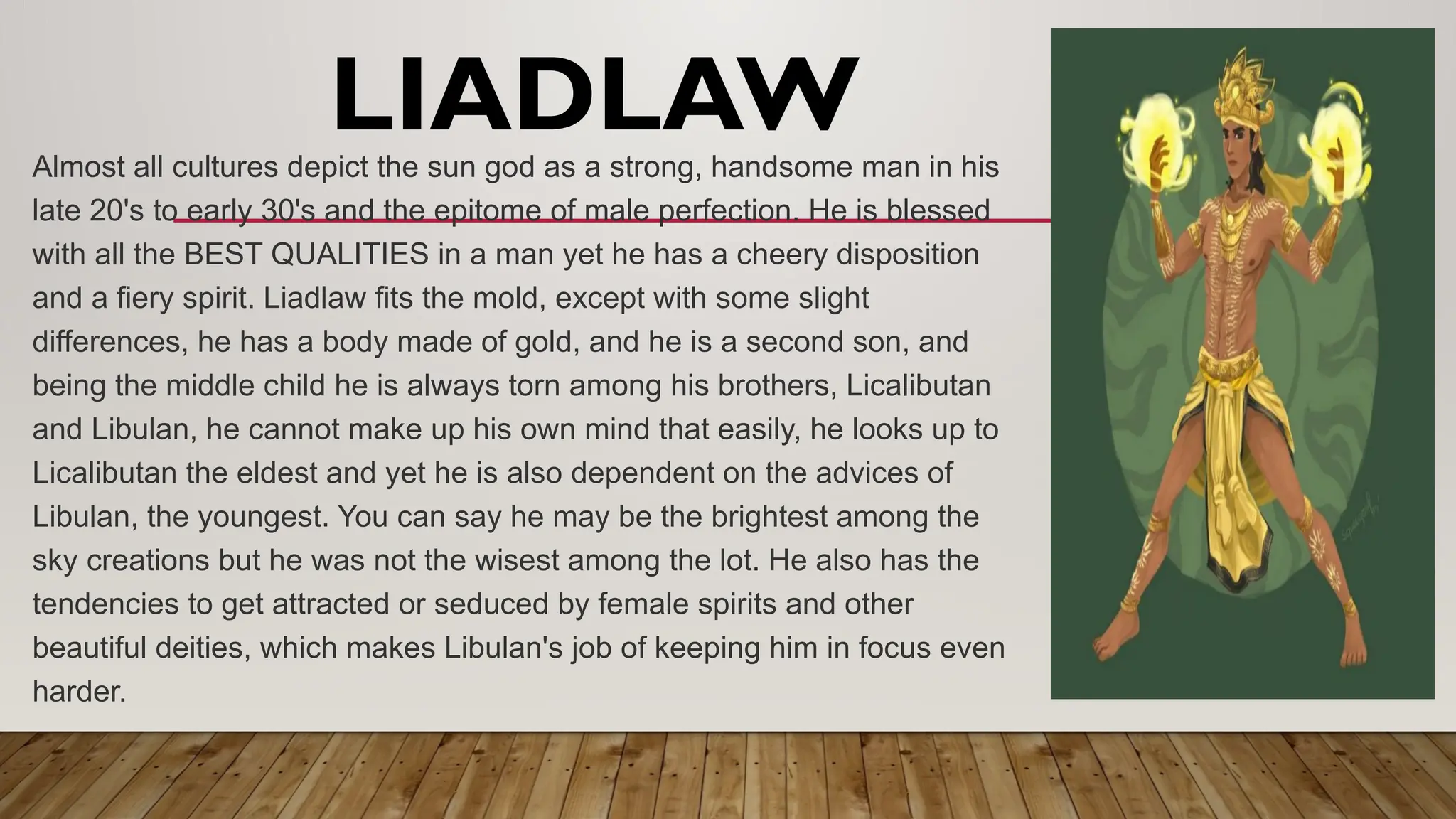
Almost all cultures depict the sun god as a strong, handsome man in his
late 20's to early 30's and the epitome of male perfection. He is blessed
with all the BEST QUALITIES in a man yet he has a cheery disposition
and a fiery spirit. Liadlaw fits the mold, except with some slight
differences, he has a body made of gold, and he is a second son, and
being the middle child he is always torn among his brothers, Licalibutan
and Libulan, he cannot make up his own mind that easily, he looks up to
Licalibutan the eldest and yet he is also dependent on the advices of
Libulan, the youngest. You can say he may be the brightest among the
sky creations but he was not the wisest among the lot. He also has the
tendencies to get attracted or seduced by female spirits and other
beautiful deities, which makes Libulan's job of keeping him in focus even
harder.
LIBULAN
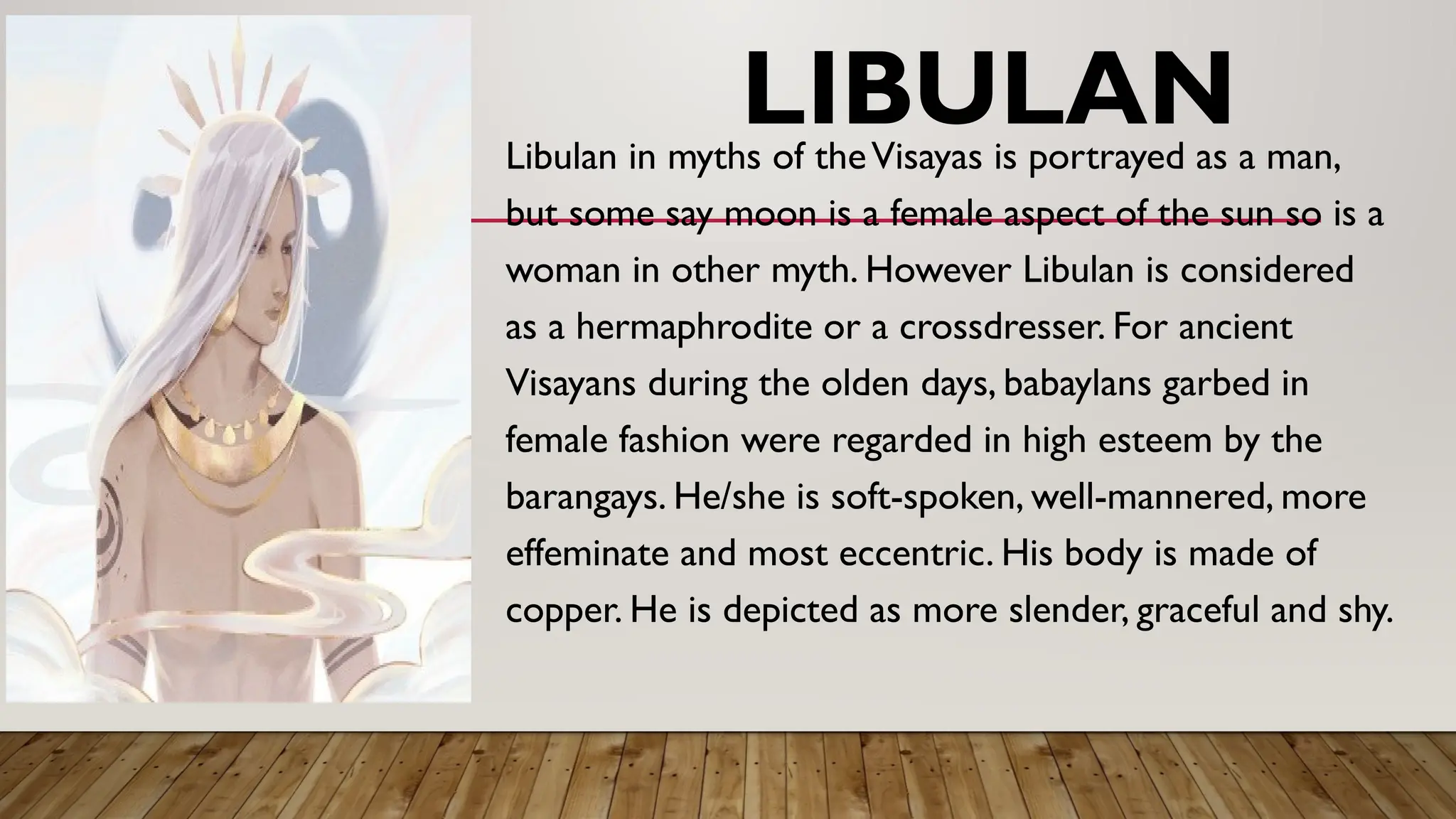
Libulan in myths of theVisayas is portrayed as a man,
but some say moon is a female aspect of the sun so is a
woman in other myth. However Libulan is considered
as a hermaphrodite or a crossdresser. For ancient
Visayans during the olden days, babaylans garbed in
female fashion were regarded in high esteem by the
barangays. He/she is soft-spoken, well-mannered, more
effeminate and most eccentric. His body is made of
copper. He is depicted as more slender, graceful and shy.
SIDAPA AND LIBULAN
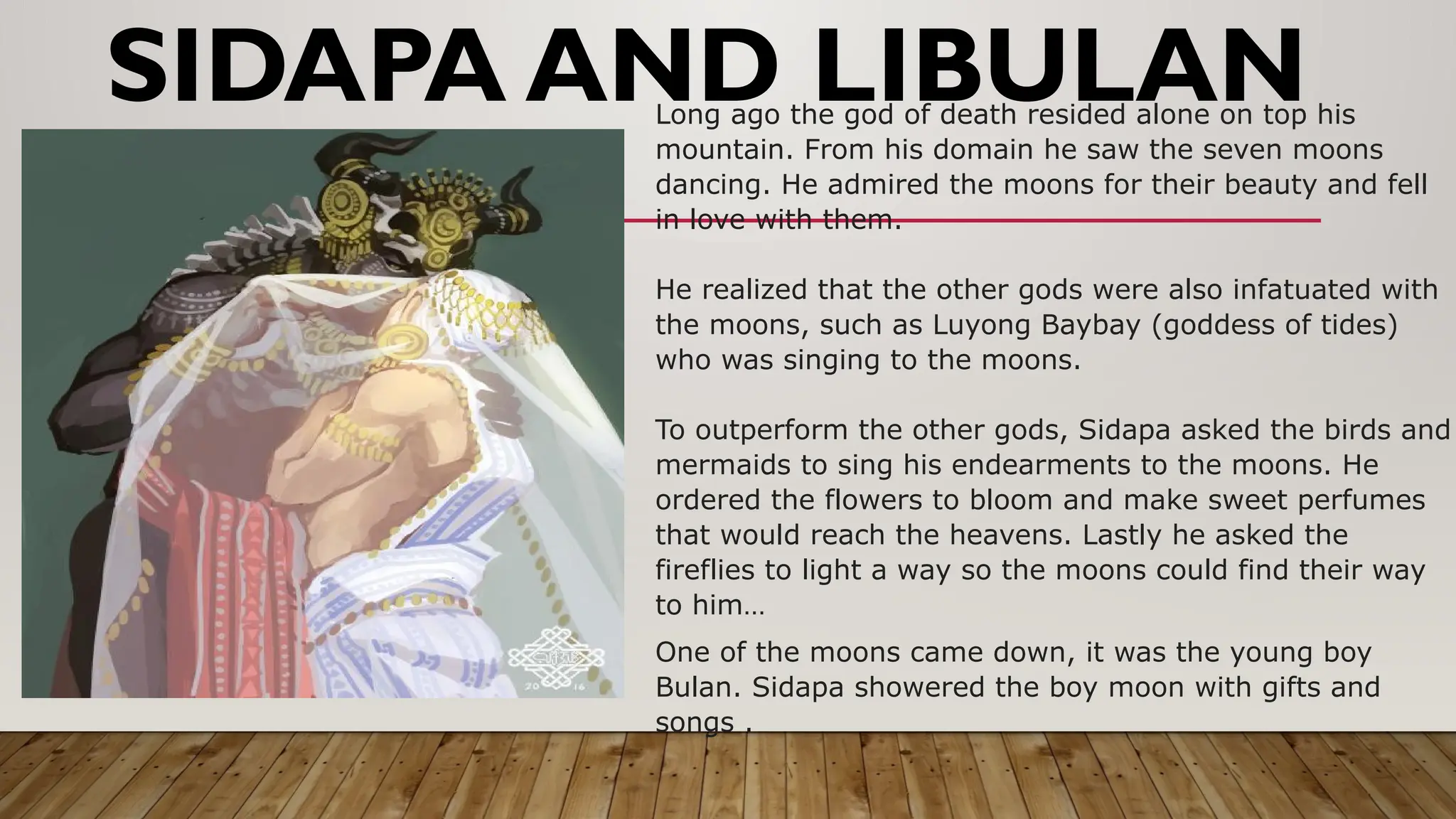
Long ago the god of death resided alone on top his
mountain. From his domain he saw the seven moons
dancing. He admired the moons for their beauty and fell
in love with them.
He realized that the other gods were also infatuated with
the moons, such as Luyong Baybay (goddess of tides)
who was singing to the moons.
To outperform the other gods, Sidapa asked the birds and
mermaids to sing his endearments to the moons. He
ordered the flowers to bloom and make sweet perfumes
that would reach the heavens. Lastly he asked the
fireflies to light a way so the moons could find their way
to him…
One of the moons came down, it was the young boy
Bulan. Sidapa showered the boy moon with gifts and
songs .
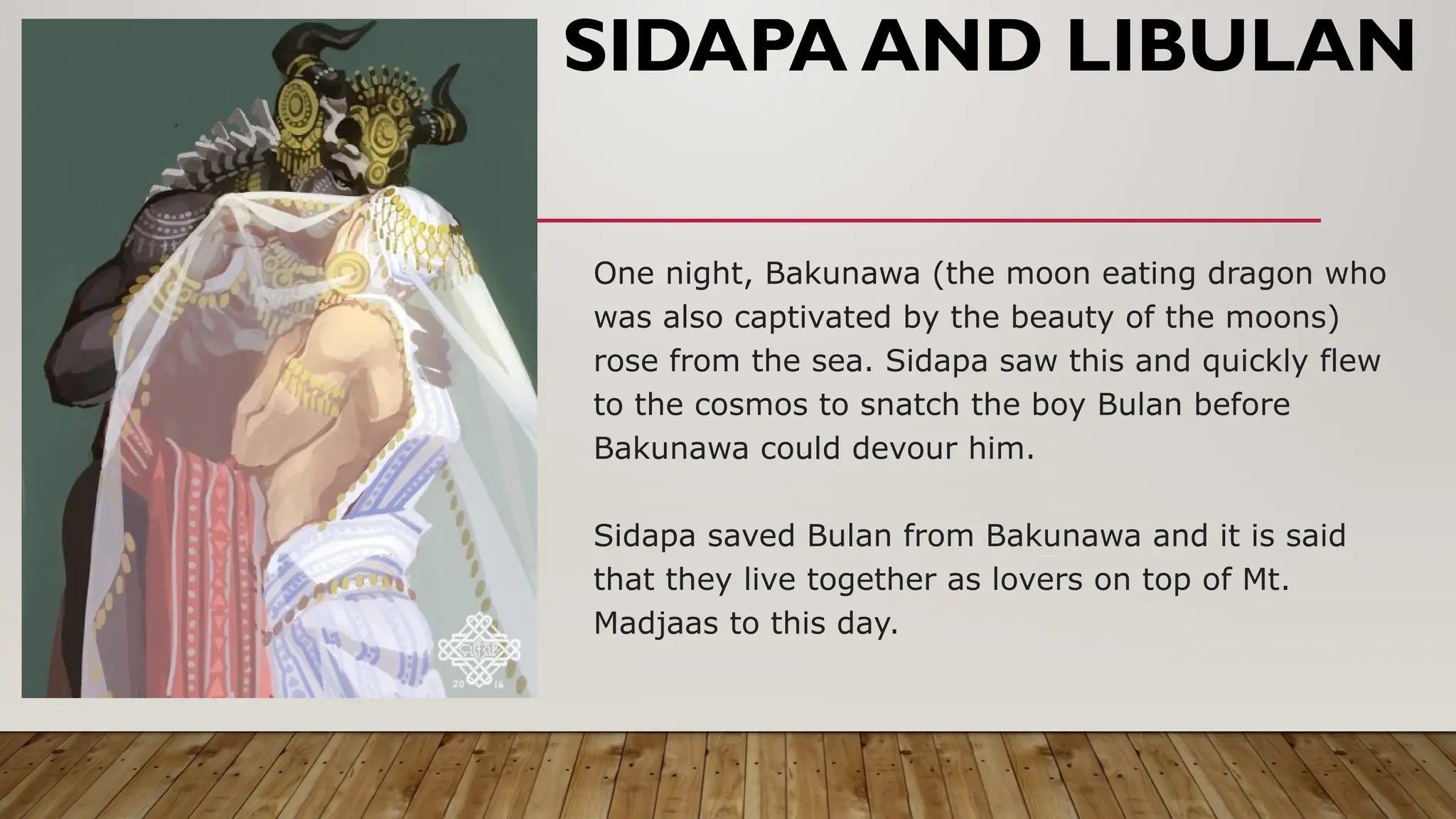
One night, Bakunawa (the moon eating dragon who
was also captivated by the beauty of the moons)
rose from the sea. Sidapa saw this and quickly flew
to the cosmos to snatch the boy Bulan before
Bakunawa could devour him.
Sidapa saved Bulan from Bakunawa and it is said
that they live together as lovers on top of Mt.
Madjaas to this day.
SIDAPA AND LIBULAN
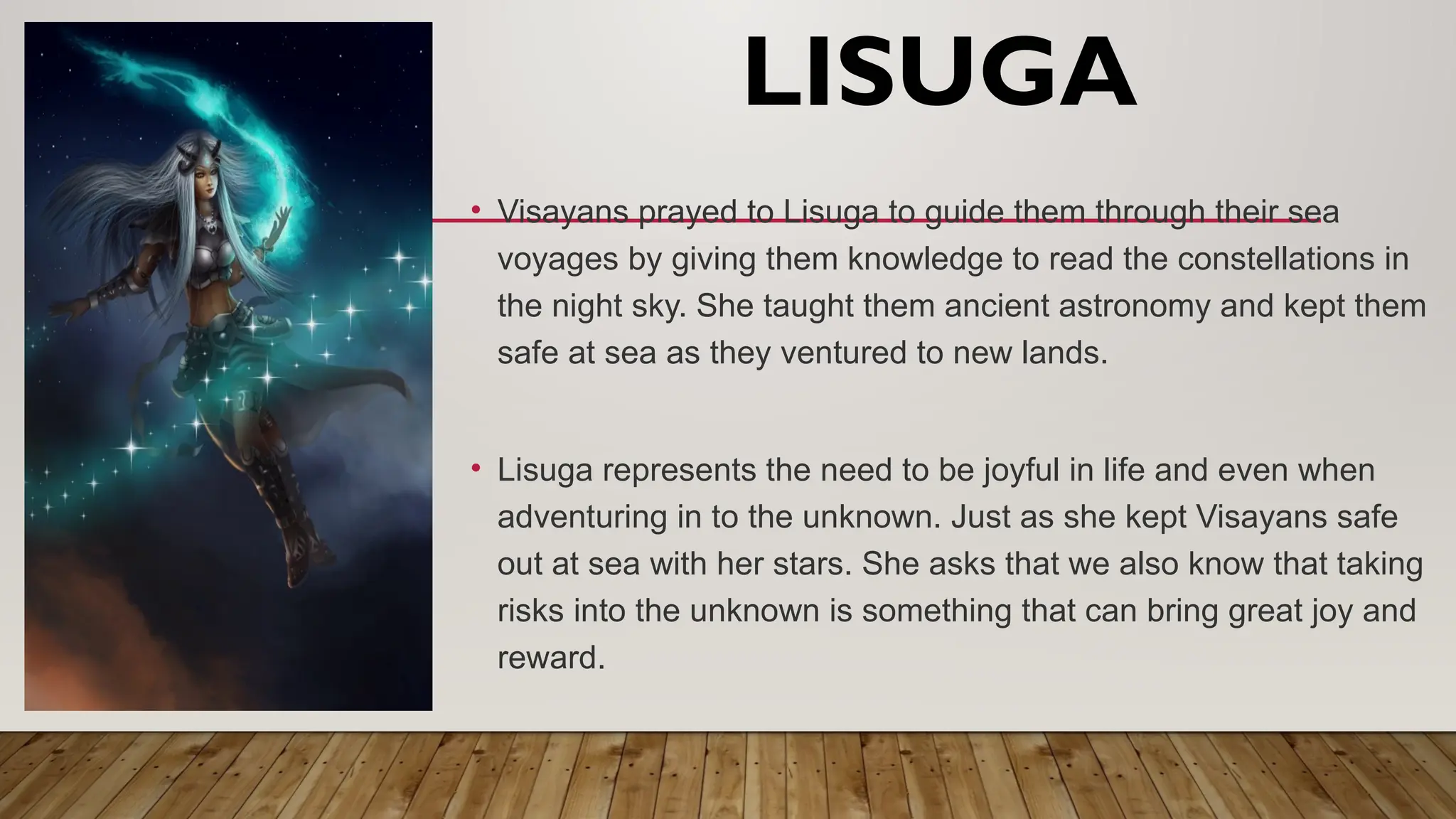
LISUGA
• Visayans prayed to Lisuga to guide them through their sea
voyages by giving them knowledge to read the constellations in
the night sky. She taught them ancient astronomy and kept them
safe at sea as they ventured to new lands.
• Lisuga represents the need to be joyful in life and even when
adventuring in to the unknown. Just as she kept Visayans safe
out at sea with her stars. She asks that we also know that taking
risks into the unknown is something that can bring great joy and
reward.
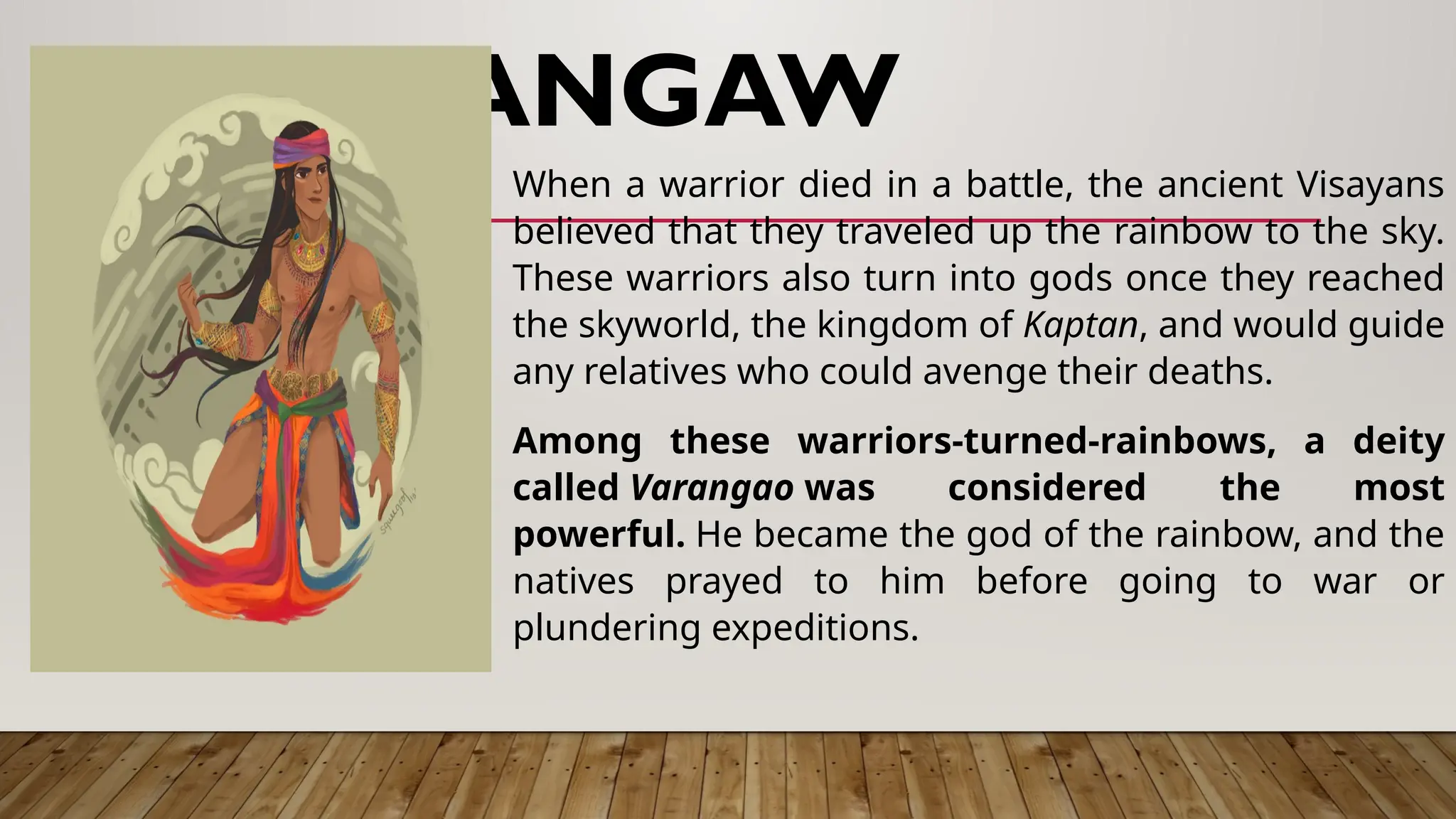
BARANGAW
When a warrior died in a battle, the ancient Visayans
believed that they traveled up the rainbow to the sky.
These warriors also turn into gods once they reached
the skyworld, the kingdom of Kaptan, and would guide
any relatives who could avenge their deaths.
Among these warriors-turned-rainbows, a deity
called Varangao was considered the most
powerful. He became the god of the rainbow, and the
natives prayed to him before going to war or
plundering expeditions.
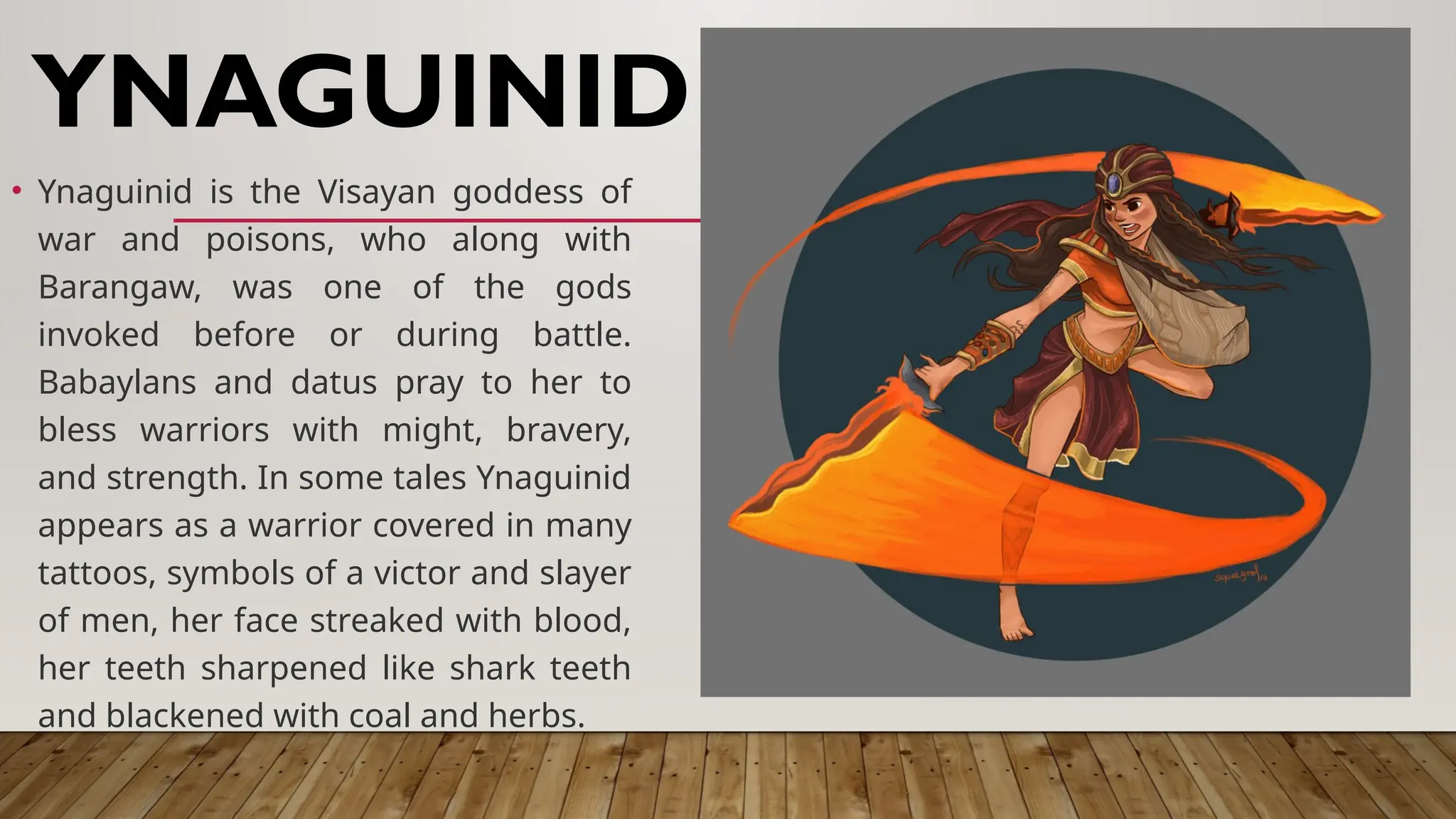
• Ynaguinid is the Visayan goddess of
war and poisons, who along with
Barangaw, was one of the gods
invoked before or during battle.
Babaylans and datus pray to her to
bless warriors with might, bravery,
and strength. In some tales Ynaguinid
appears as a warrior covered in many
tattoos, symbols of a victor and slayer
of men, her face streaked with blood,
her teeth sharpened like shark teeth
and blackened with coal and herbs.
YNAGUINID
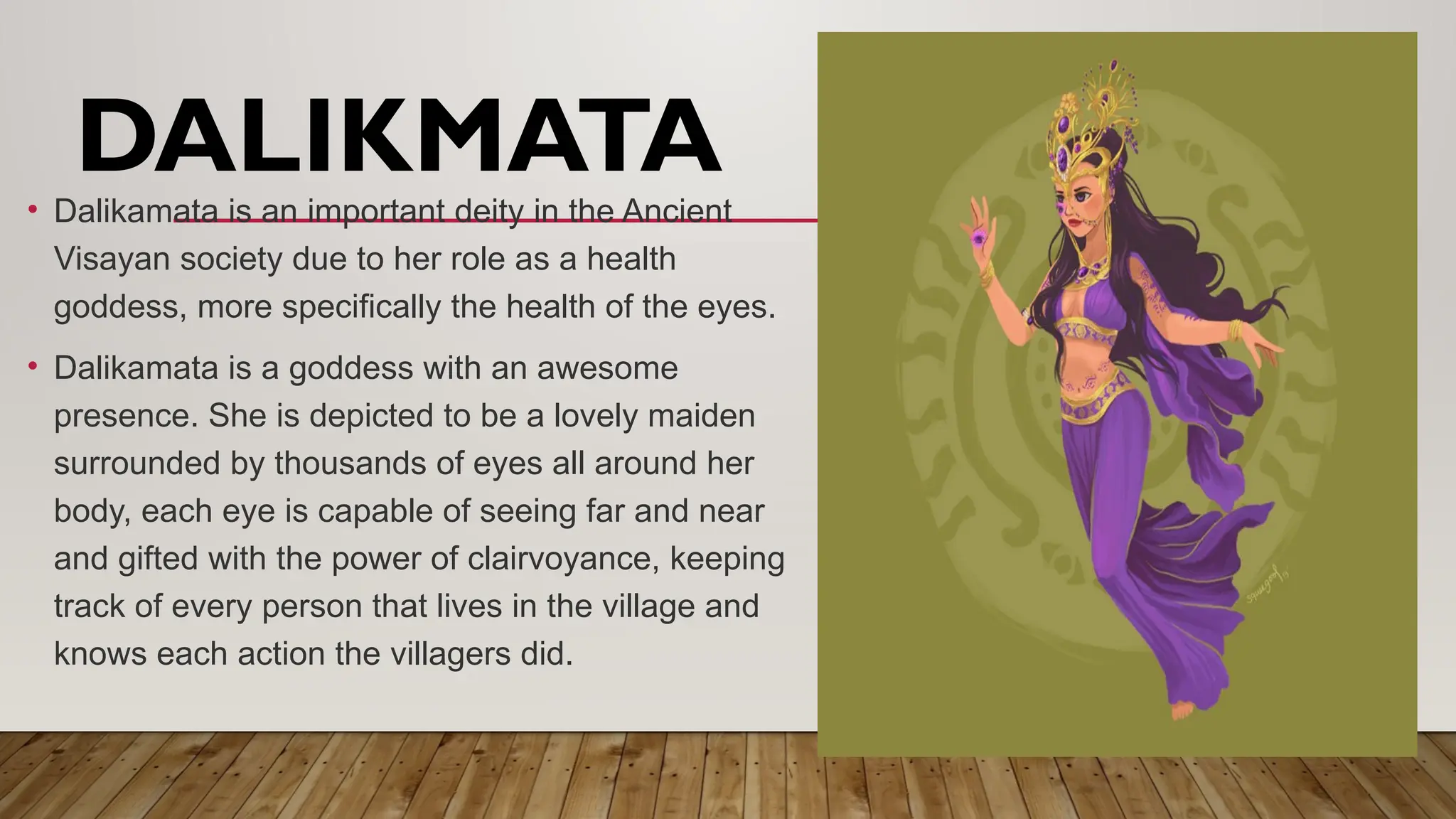
• Dalikamata is an important deity in the Ancient
Visayan society due to her role as a health
goddess, more specifically the health of the eyes.
• Dalikamata is a goddess with an awesome
presence. She is depicted to be a lovely maiden
surrounded by thousands of eyes all around her
body, each eye is capable of seeing far and near
and gifted with the power of clairvoyance, keeping
track of every person that lives in the village and
knows each action the villagers did.
DALIKMATA
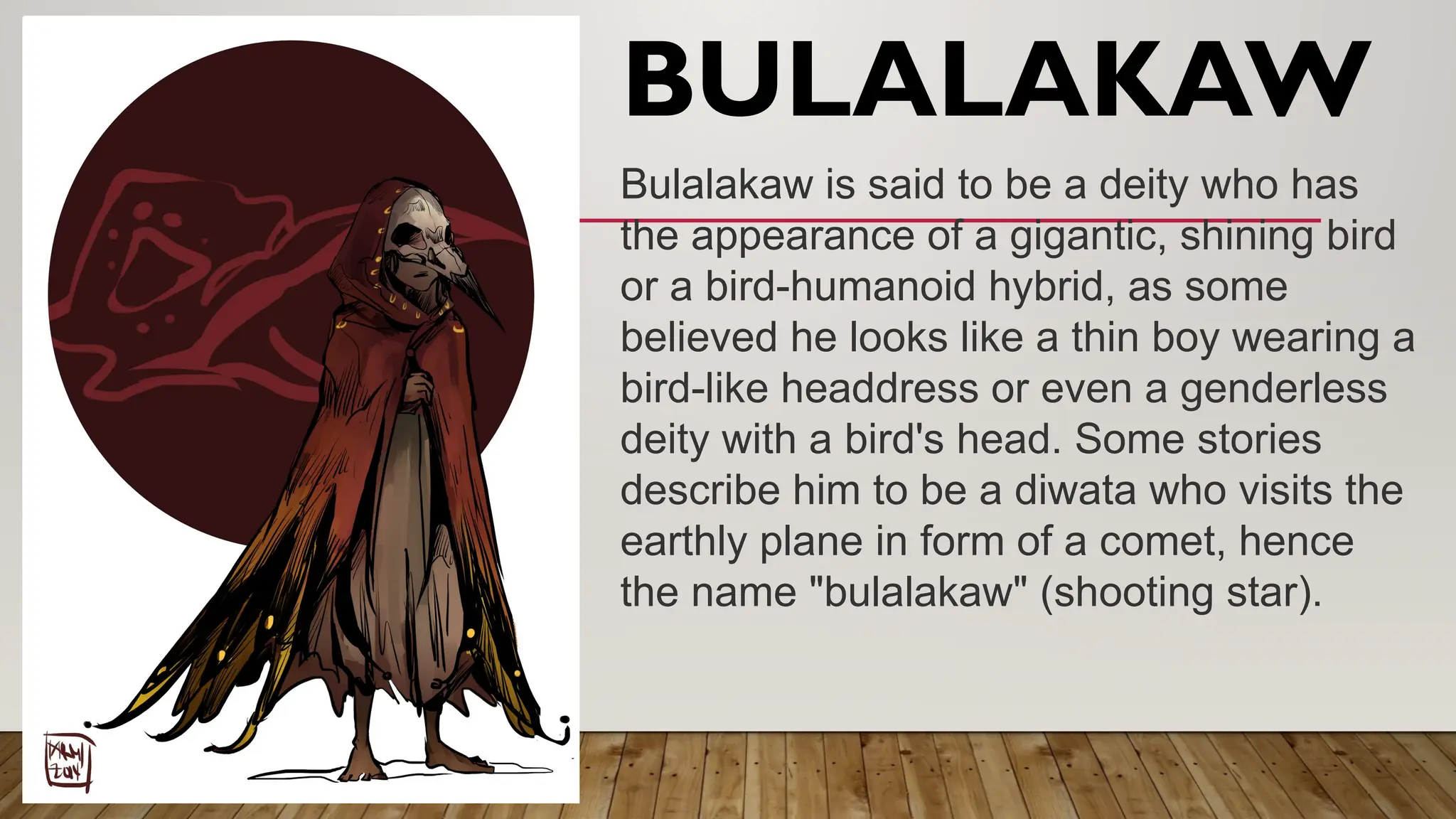
BULALAKAW
Bulalakaw is said to be a deity who has
the appearance of a gigantic, shining bird
or a bird-humanoid hybrid, as some
believed he looks like a thin boy wearing a
bird-like headdress or even a genderless
deity with a bird's head. Some stories
describe him to be a diwata who visits the
earthly plane in form of a comet, hence
the name "bulalakaw" (shooting star).
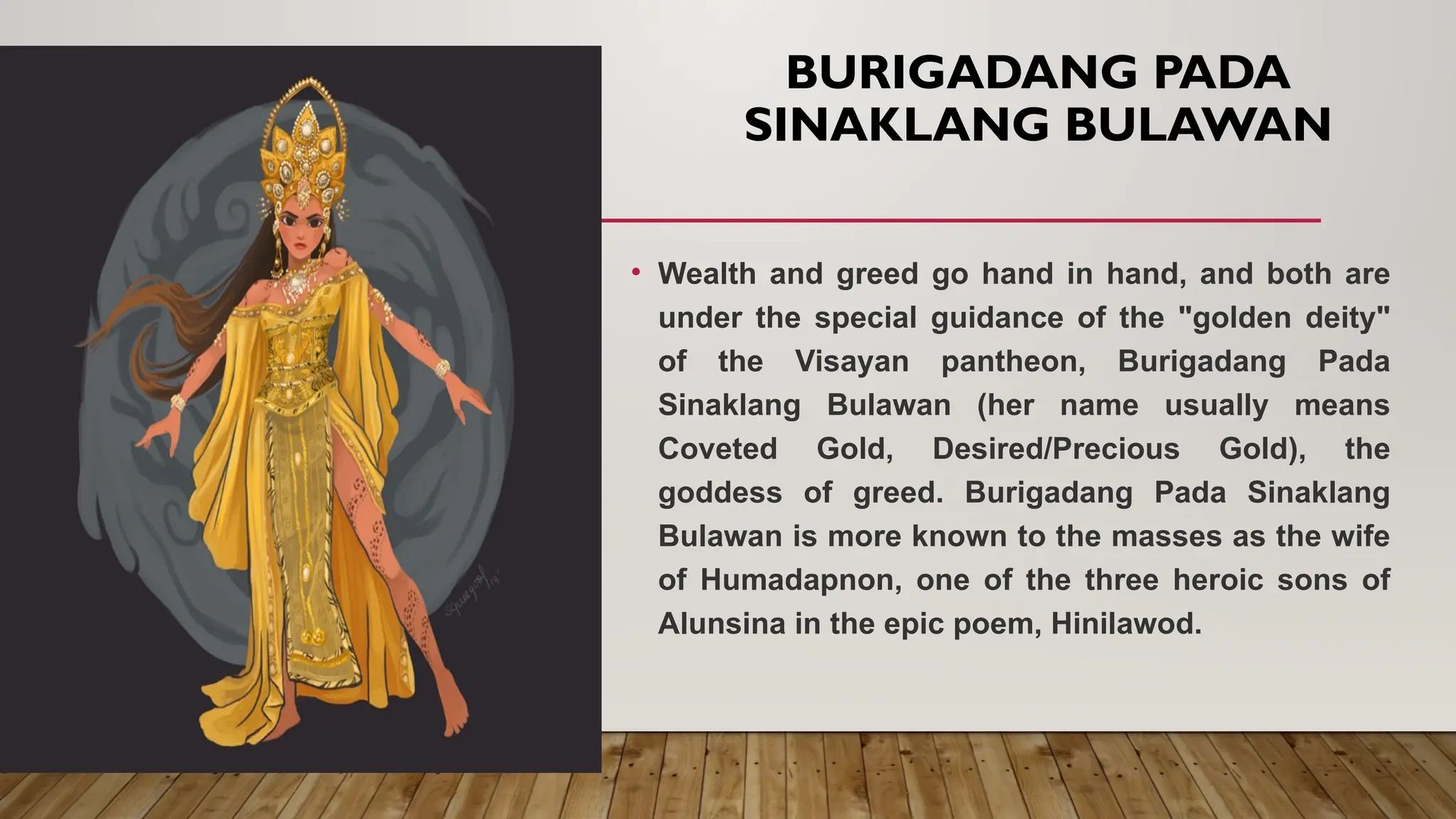
BURIGADANG PADA
SINAKLANG BULAWAN
• Wealth and greed go hand in hand, and both are
under the special guidance of the "golden deity"
of the Visayan pantheon, Burigadang Pada
Sinaklang Bulawan (her name usually means
Coveted Gold, Desired/Precious Gold), the
goddess of greed. Burigadang Pada Sinaklang
Bulawan is more known to the masses as the wife
of Humadapnon, one of the three heroic sons of
Alunsina in the epic poem, Hinilawod.
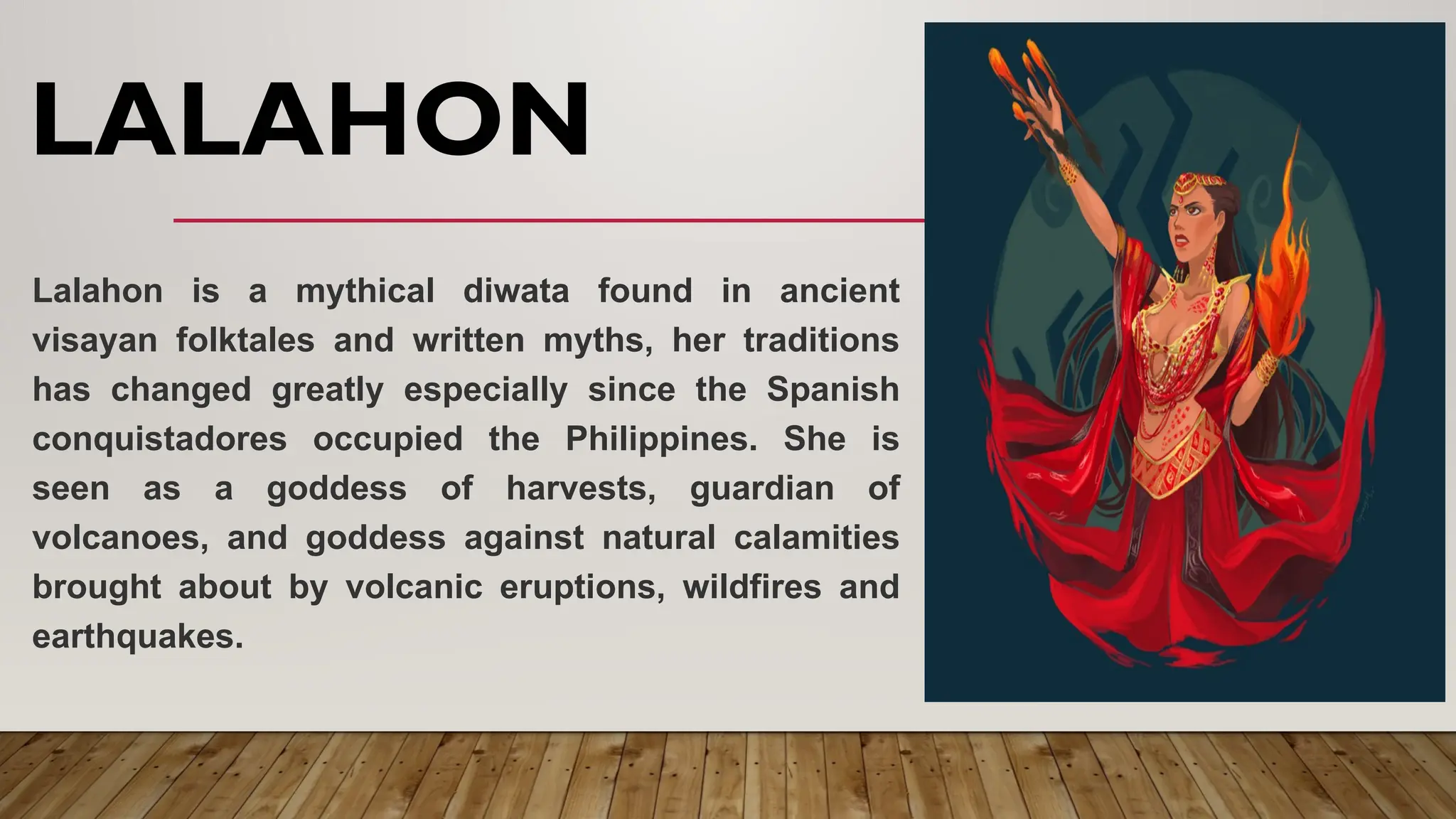
LALAHON
Lalahon is a mythical diwata found in ancient
visayan folktales and written myths, her traditions
has changed greatly especially since the Spanish
conquistadores occupied the Philippines. She is
seen as a goddess of harvests, guardian of
volcanoes, and goddess against natural calamities
brought about by volcanic eruptions, wildfires and
earthquakes.
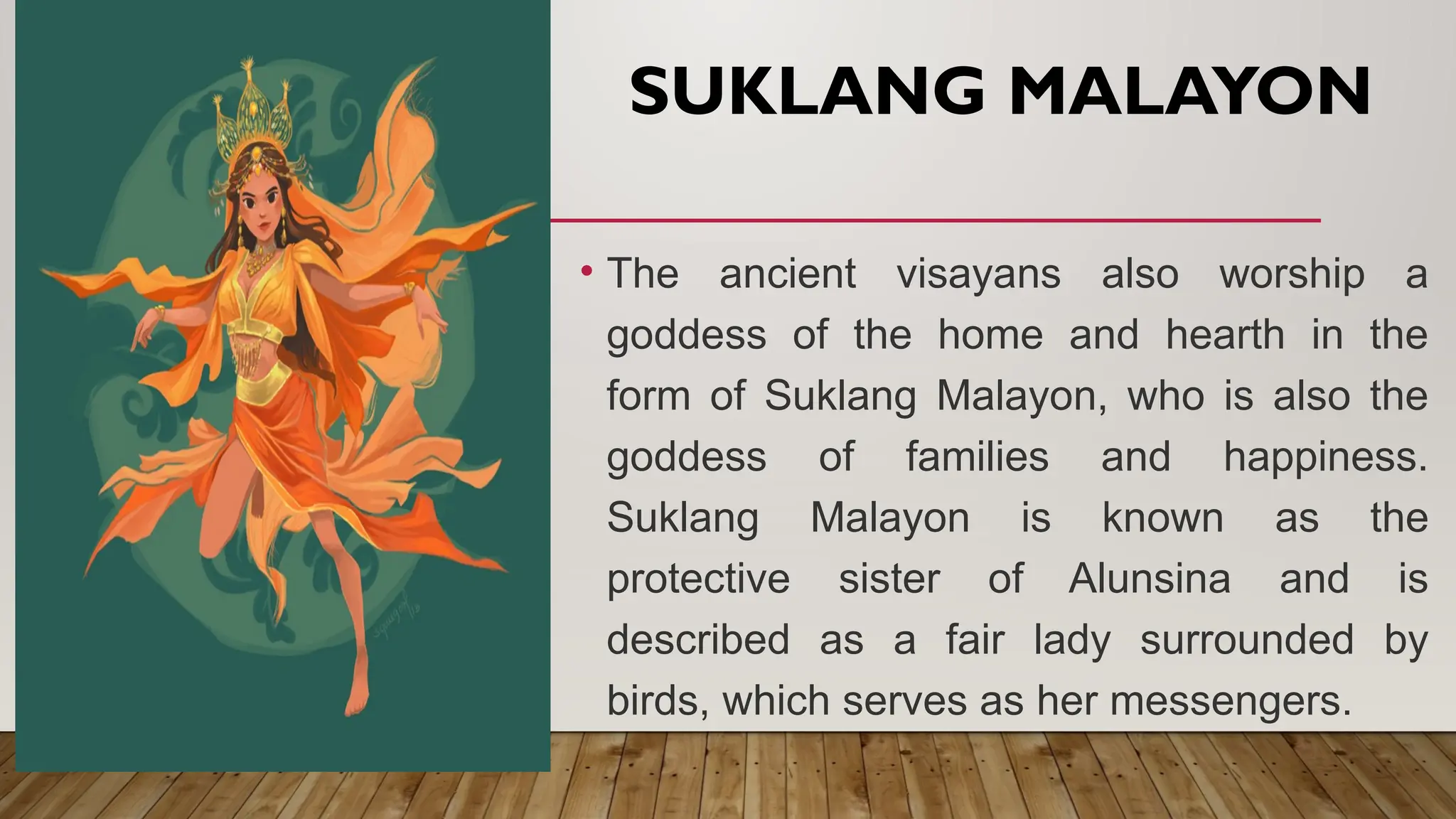
SUKLANG MALAYON
• The ancient visayans also worship a
goddess of the home and hearth in the
form of Suklang Malayon, who is also the
goddess of families and happiness.
Suklang Malayon is known as the
protective sister of Alunsina and is
described as a fair lady surrounded by
birds, which serves as her messengers.
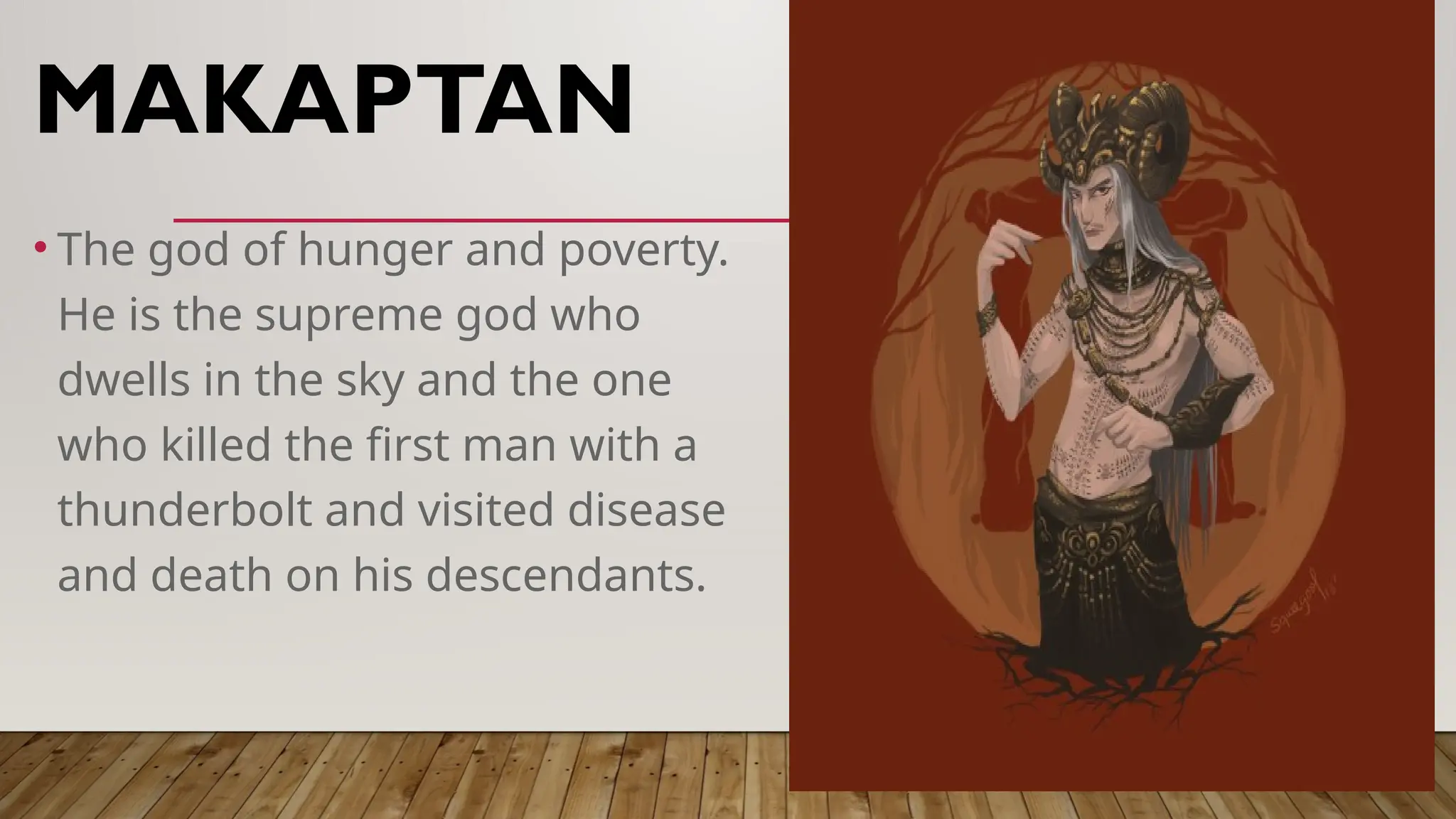
MAKAPTAN
• The god of hunger and poverty.
He is the supreme god who
dwells in the sky and the one
who killed the first man with a
thunderbolt and visited disease
and death on his descendants.
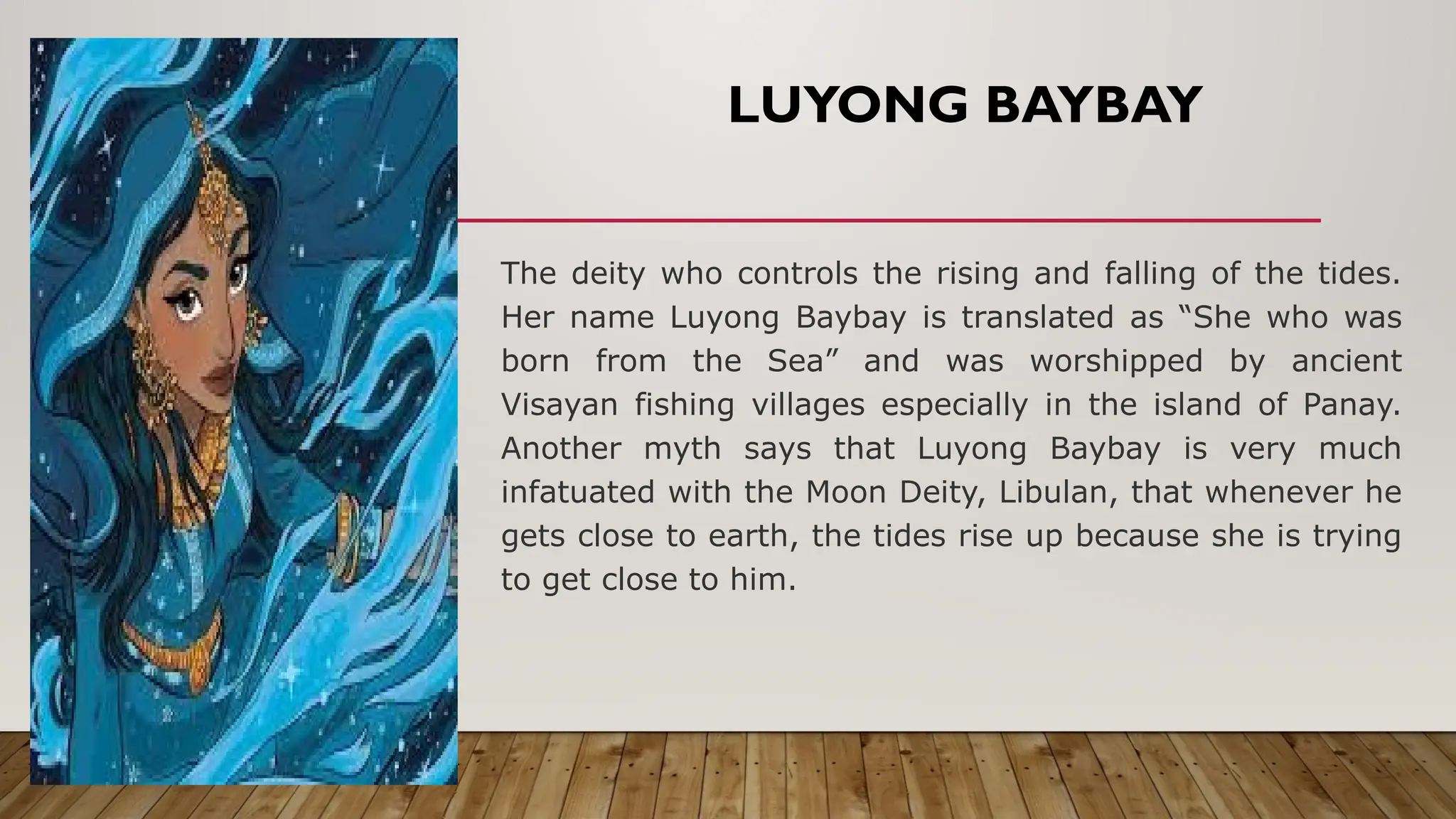
LUYONG BAYBAY
The deity who controls the rising and falling of the tides.
Her name Luyong Baybay is translated as “She who was
born from the Sea” and was worshipped by ancient
Visayan fishing villages especially in the island of Panay.
Another myth says that Luyong Baybay is very much
infatuated with the Moon Deity, Libulan, that whenever he
gets close to earth, the tides rise up because she is trying
to get close to him.
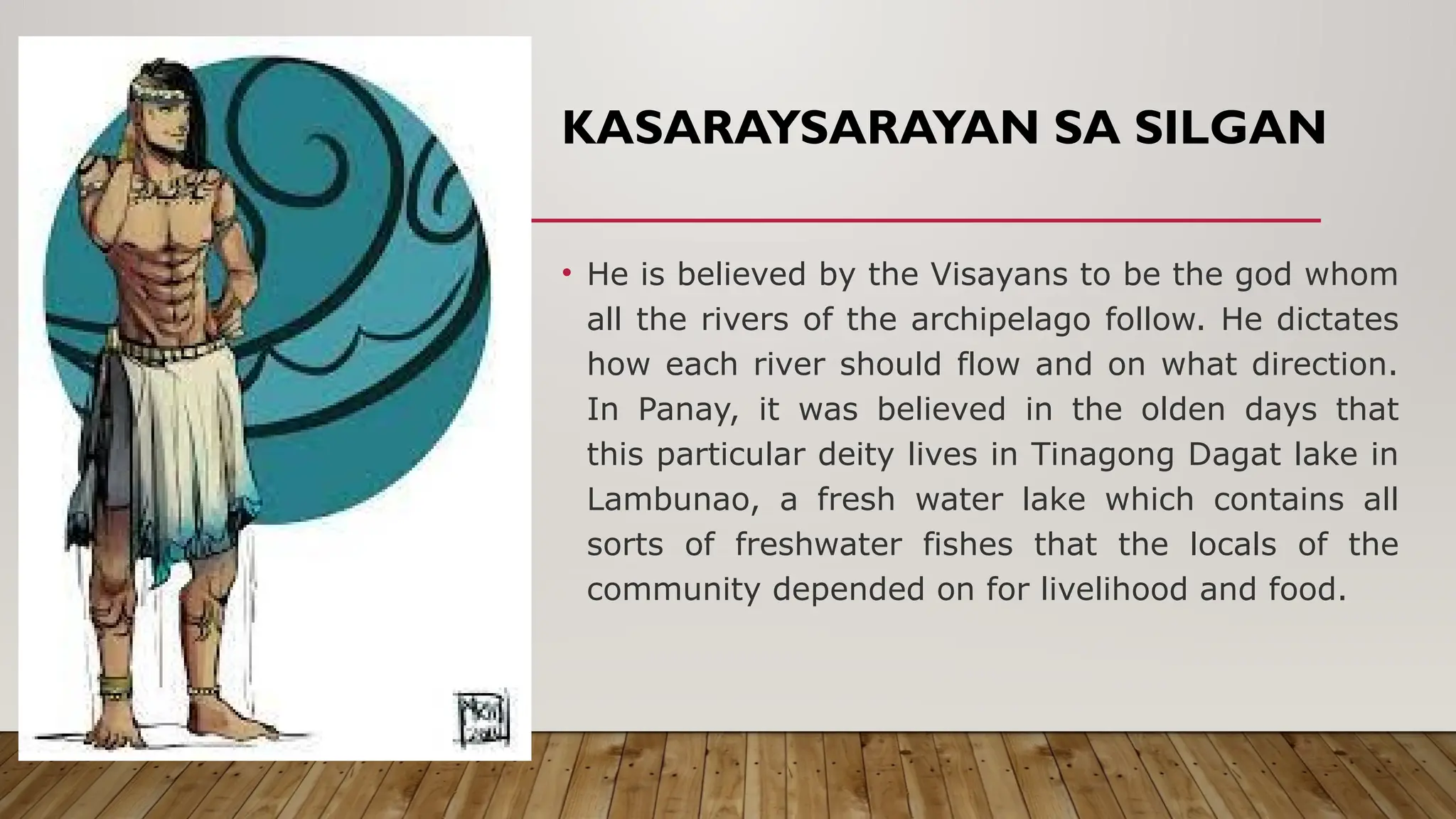
KASARAYSARAYAN SA SILGAN
• He is believed by the Visayans to be the god whom
all the rivers of the archipelago follow. He dictates
how each river should flow and on what direction.
In Panay, it was believed in the olden days that
this particular deity lives in Tinagong Dagat lake in
Lambunao, a fresh water lake which contains all
sorts of freshwater fishes that the locals of the
community depended on for livelihood and food.
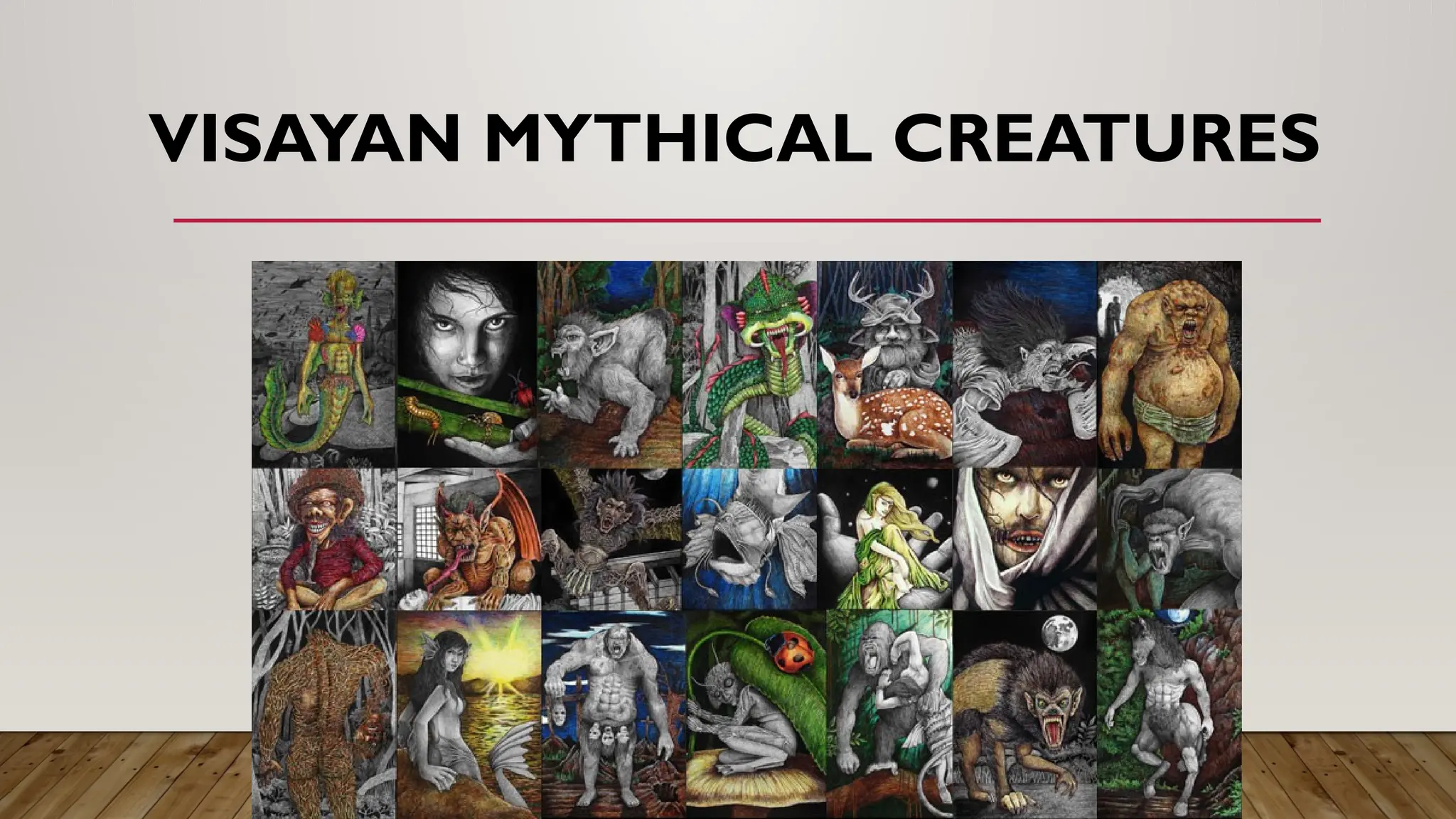
VISAYAN MYTHICAL CREATURES
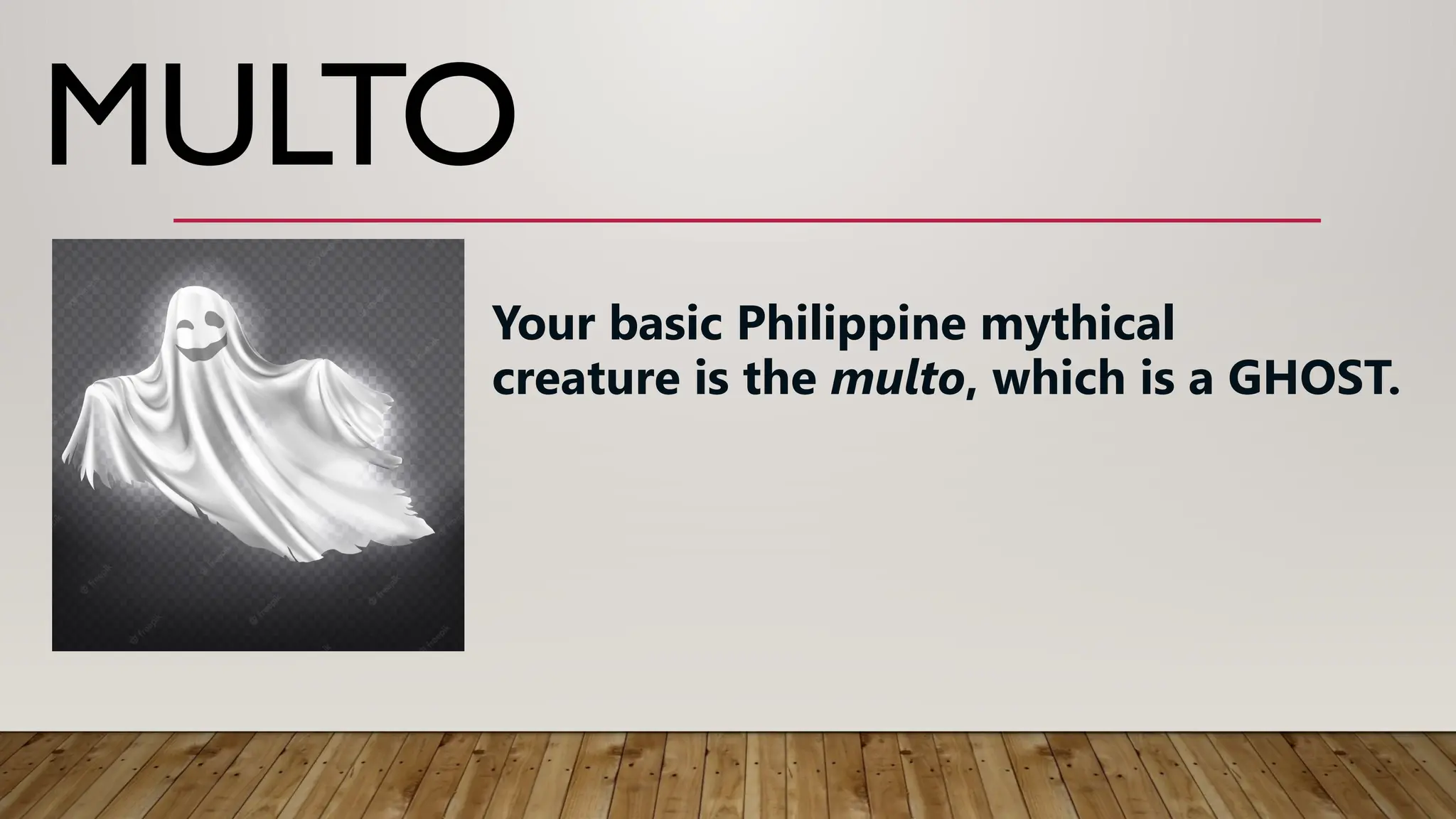
MULTO
Your basic Philippine mythical
creature is the multo, which is a GHOST.
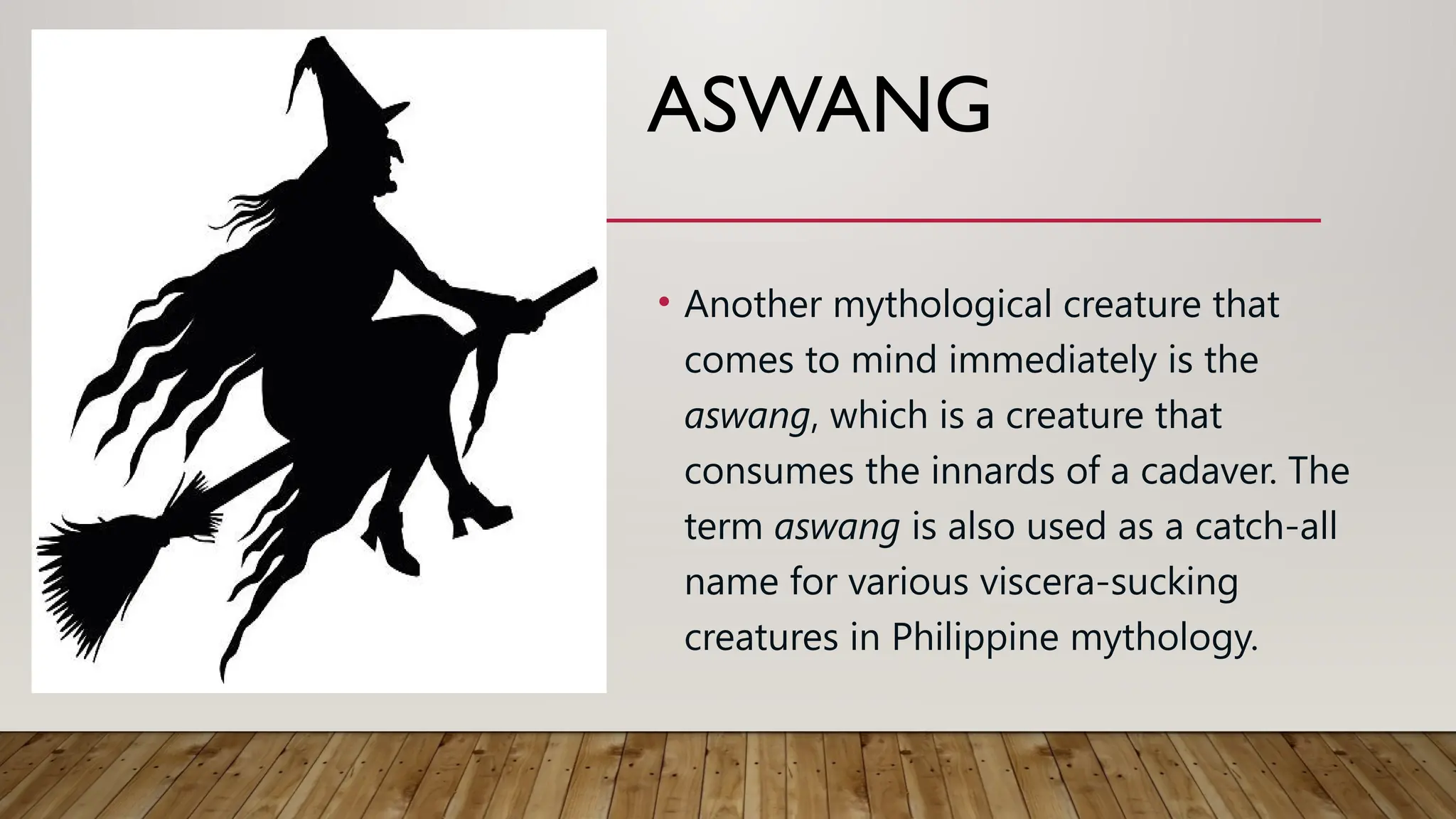
ASWANG
• Another mythological creature that
comes to mind immediately is the
aswang, which is a creature that
consumes the innards of a cadaver. The
term aswang is also used as a catch-all
name for various viscera-sucking
creatures in Philippine mythology.
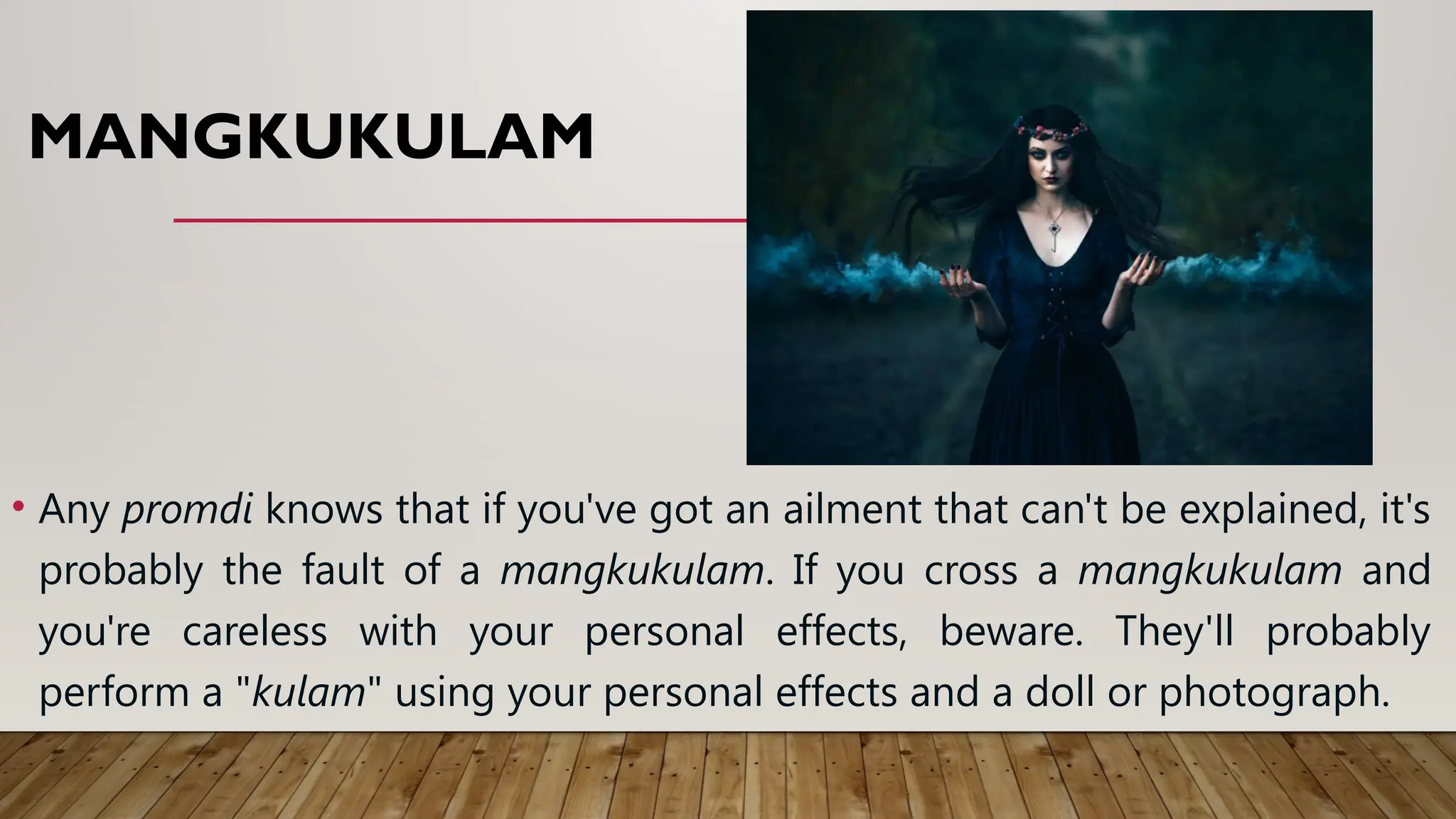
MANGKUKULAM
• Any promdi knows that if you've got an ailment that can't be explained, it's
probably the fault of a mangkukulam. If you cross a mangkukulam and
you're careless with your personal effects, beware. They'll probably
perform a "kulam" using your personal effects and a doll or photograph.
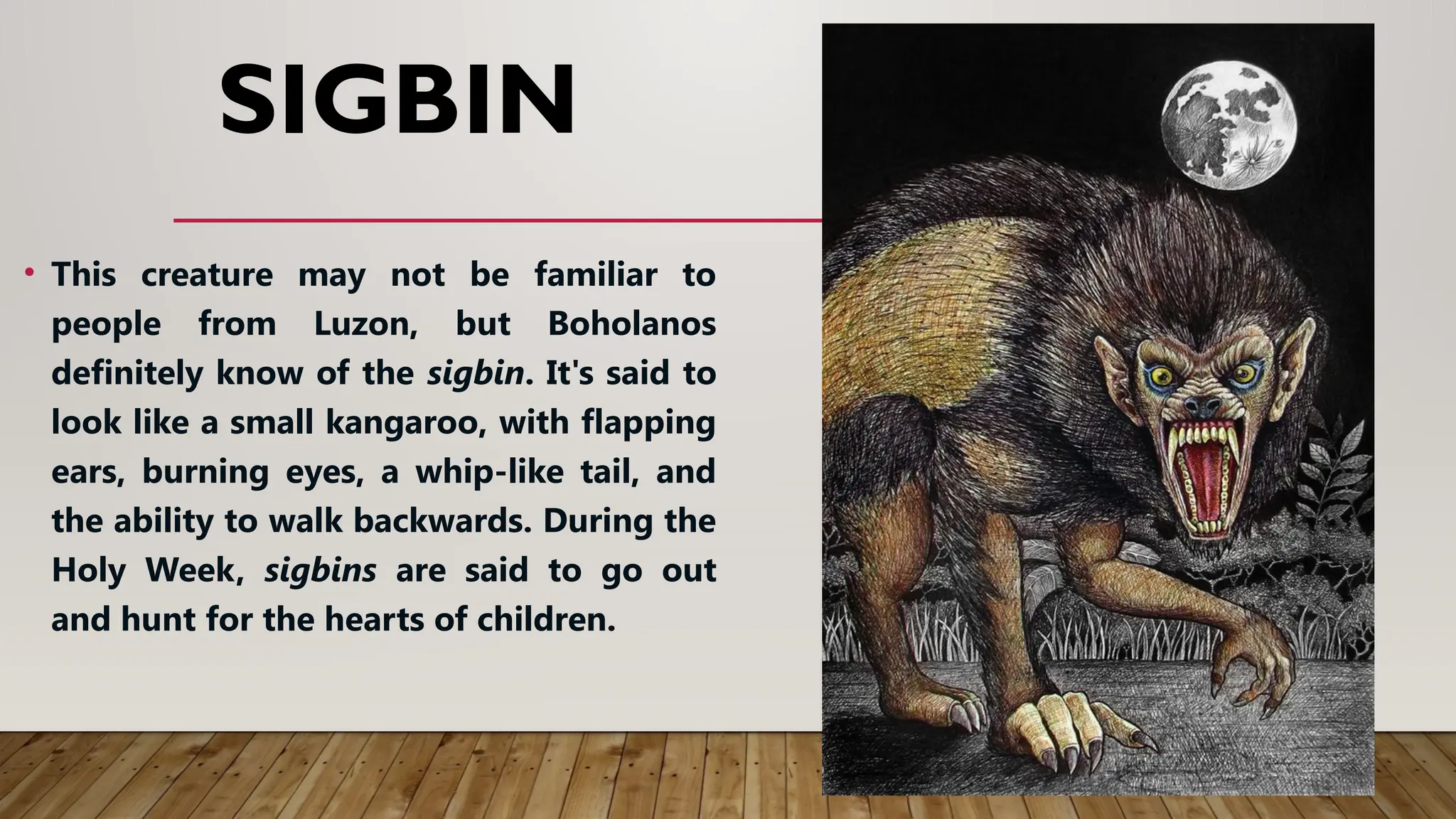
SIGBIN
• This creature may not be familiar to
people from Luzon, but Boholanos
definitely know of the sigbin. It's said to
look like a small kangaroo, with flapping
ears, burning eyes, a whip-like tail, and
the ability to walk backwards. During the
Holy Week, sigbins are said to go out
and hunt for the hearts of children.
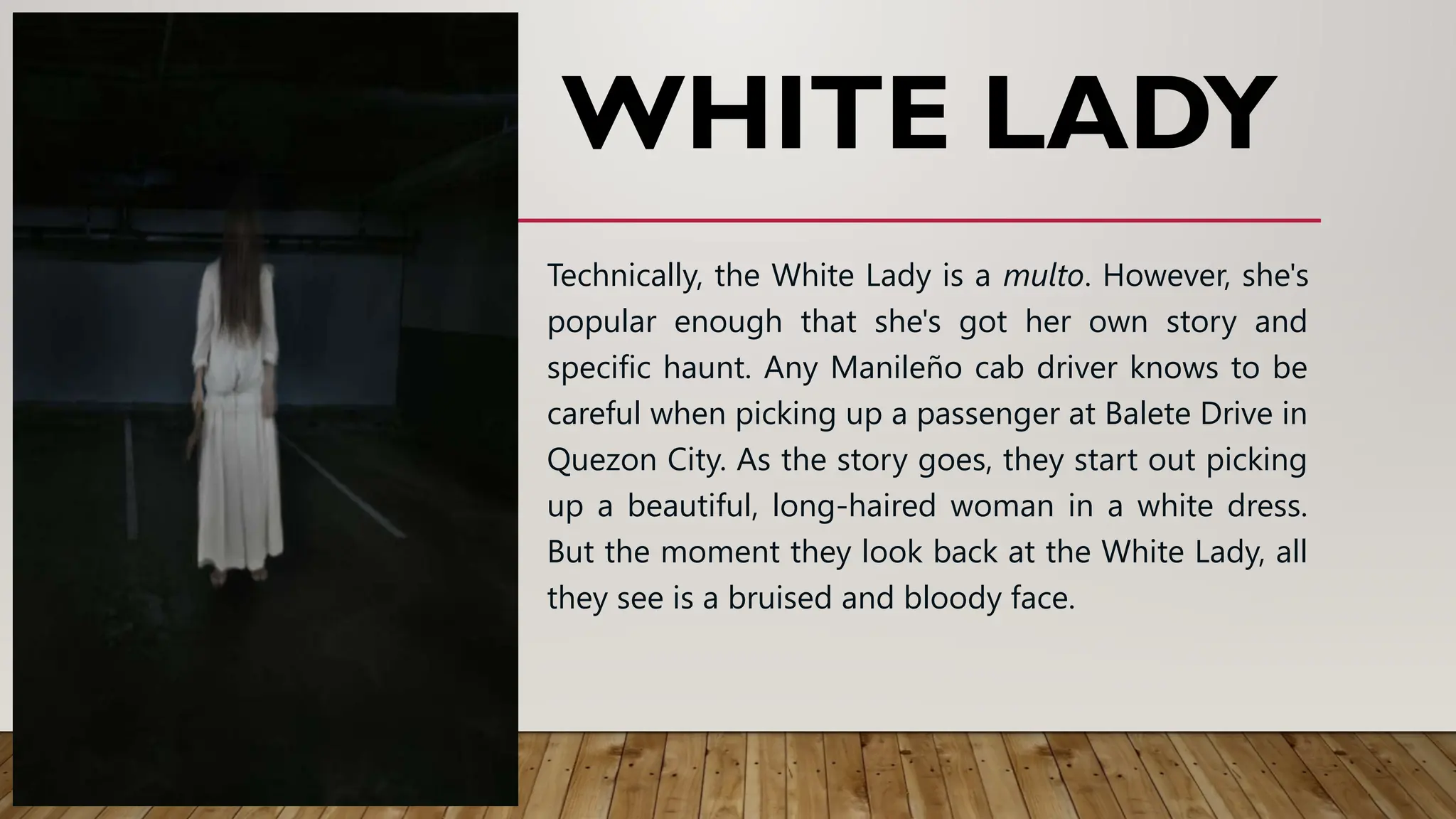
WHITE LADY
Technically, the White Lady is a multo. However, she's
popular enough that she's got her own story and
specific haunt. Any Manileño cab driver knows to be
careful when picking up a passenger at Balete Drive in
Quezon City. As the story goes, they start out picking
up a beautiful, long-haired woman in a white dress.
But the moment they look back at the White Lady, all
they see is a bruised and bloody face.
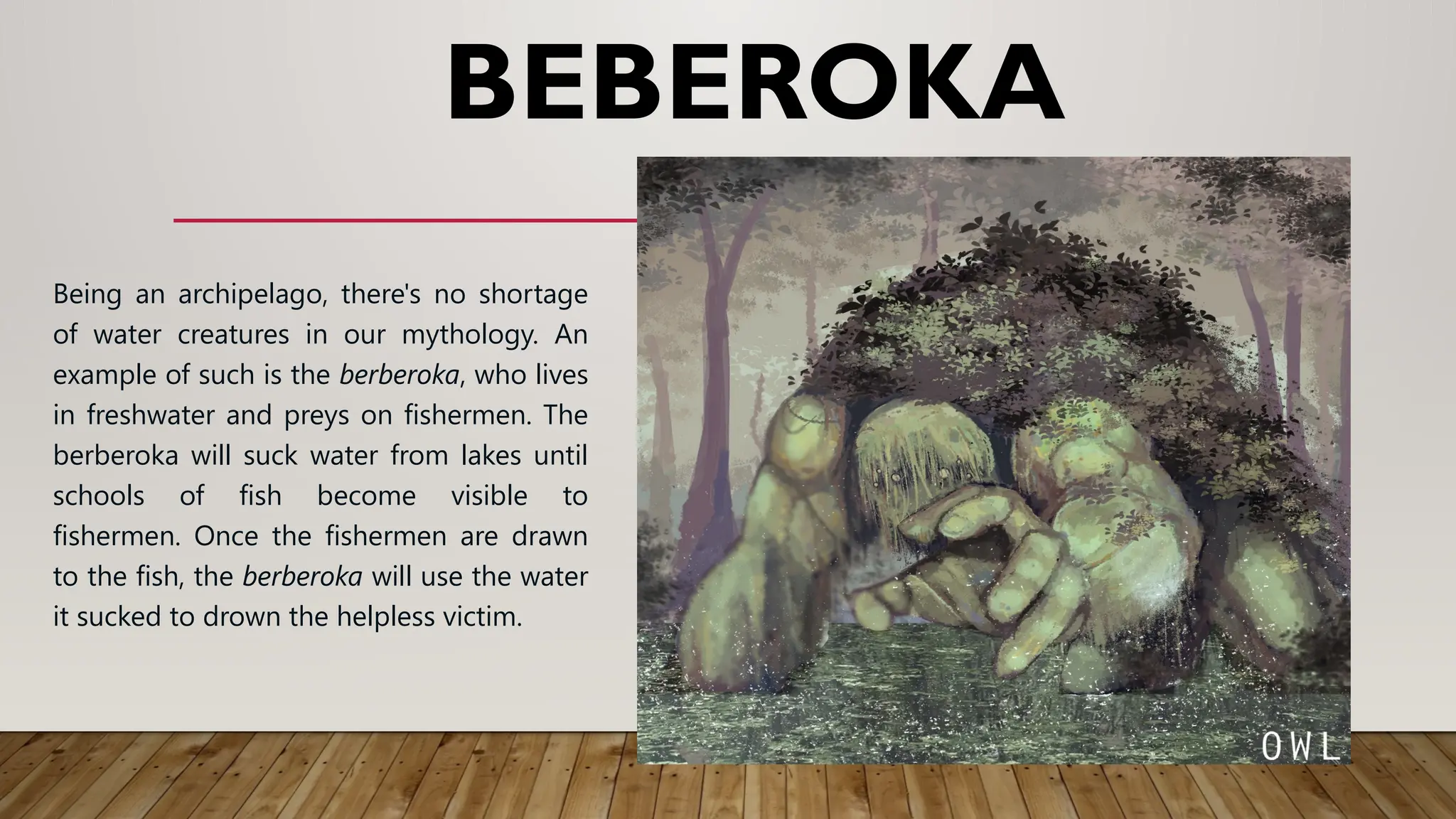
BEBEROKA
Being an archipelago, there's no shortage
of water creatures in our mythology. An
example of such is the berberoka, who lives
in freshwater and preys on fishermen. The
berberoka will suck water from lakes until
schools of fish become visible to
fishermen. Once the fishermen are drawn
to the fish, the berberoka will use the water
it sucked to drown the helpless victim.
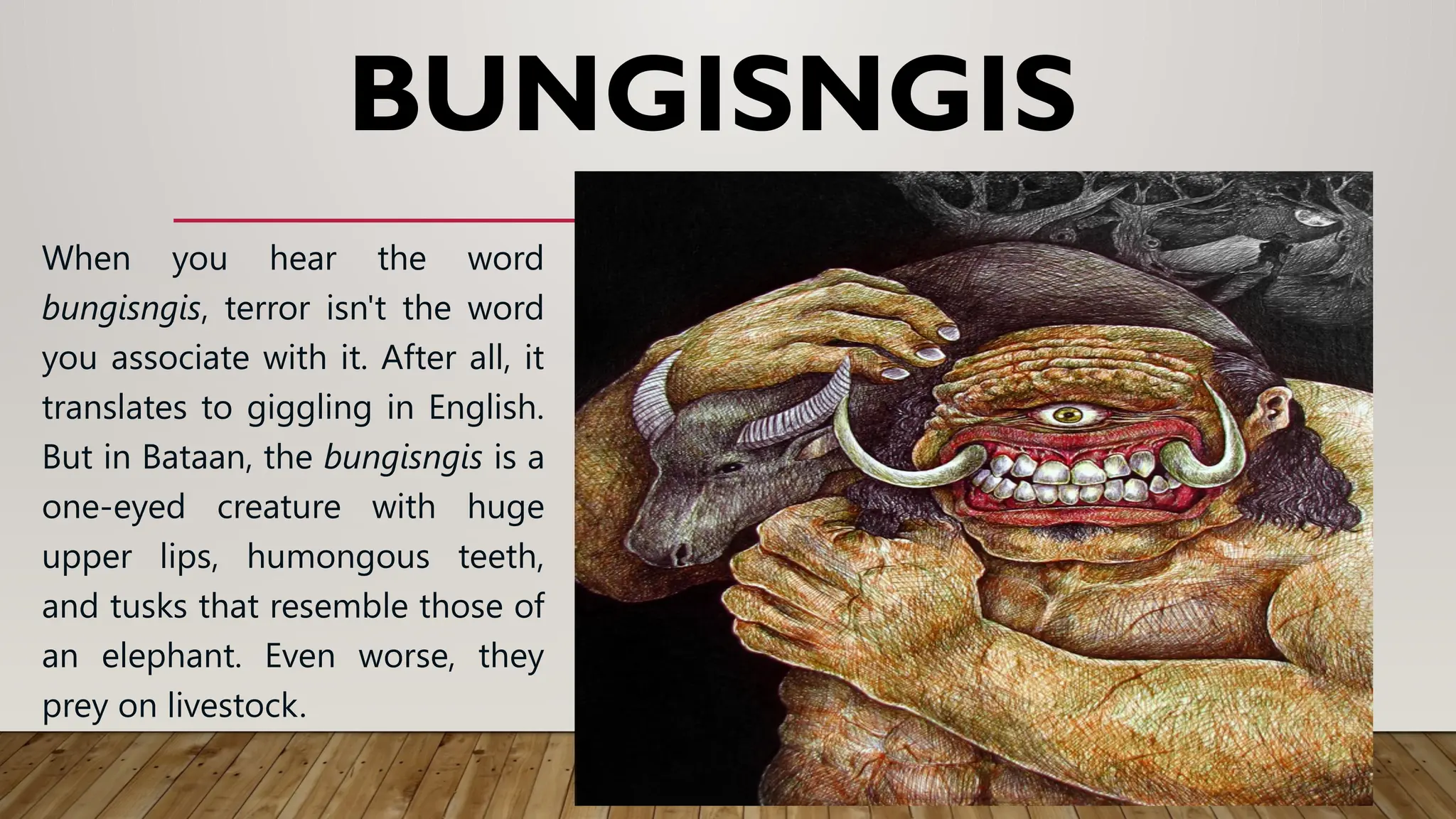
BUNGISNGIS
When you hear the word
bungisngis, terror isn't the word
you associate with it. After all, it
translates to giggling in English.
But in Bataan, the bungisngis is a
one-eyed creature with huge
upper lips, humongous teeth,
and tusks that resemble those of
an elephant. Even worse, they
prey on livestock.
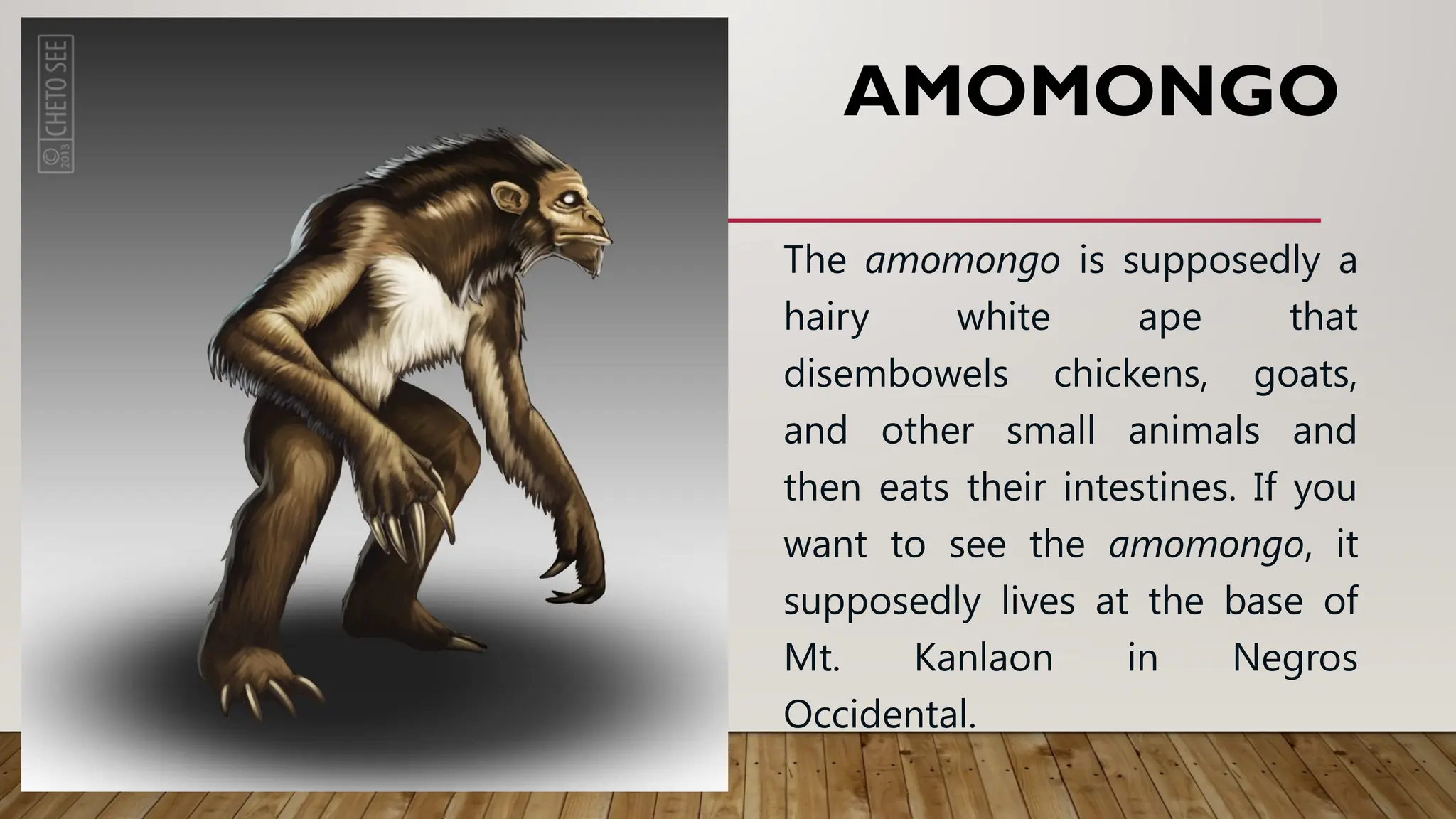
AMOMONGO
The amomongo is supposedly a
hairy white ape that
disembowels chickens, goats,
and other small animals and
then eats their intestines. If you
want to see the amomongo, it
supposedly lives at the base of
Mt. Kanlaon in Negros
Occidental.
KAPRE
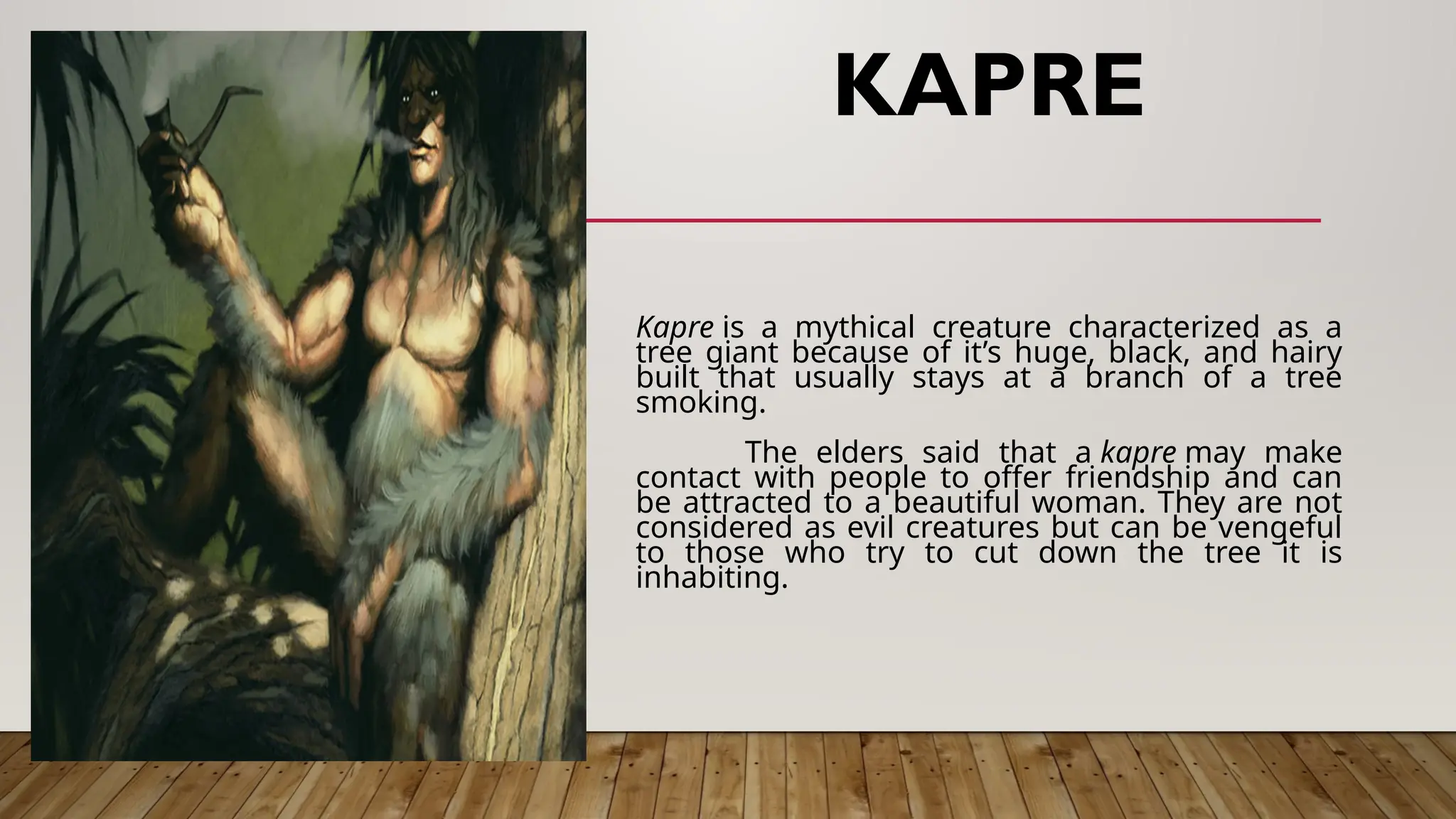
Kapre is a mythical creature characterized as a
tree giant because of it’s huge, black, and hairy
built that usually stays at a branch of a tree
smoking.
The elders said that a kapre may make
contact with people to offer friendship and can
be attracted to a beautiful woman. They are not
considered as evil creatures but can be vengeful
to those who try to cut down the tree it is
inhabiting.
TIKBALANG
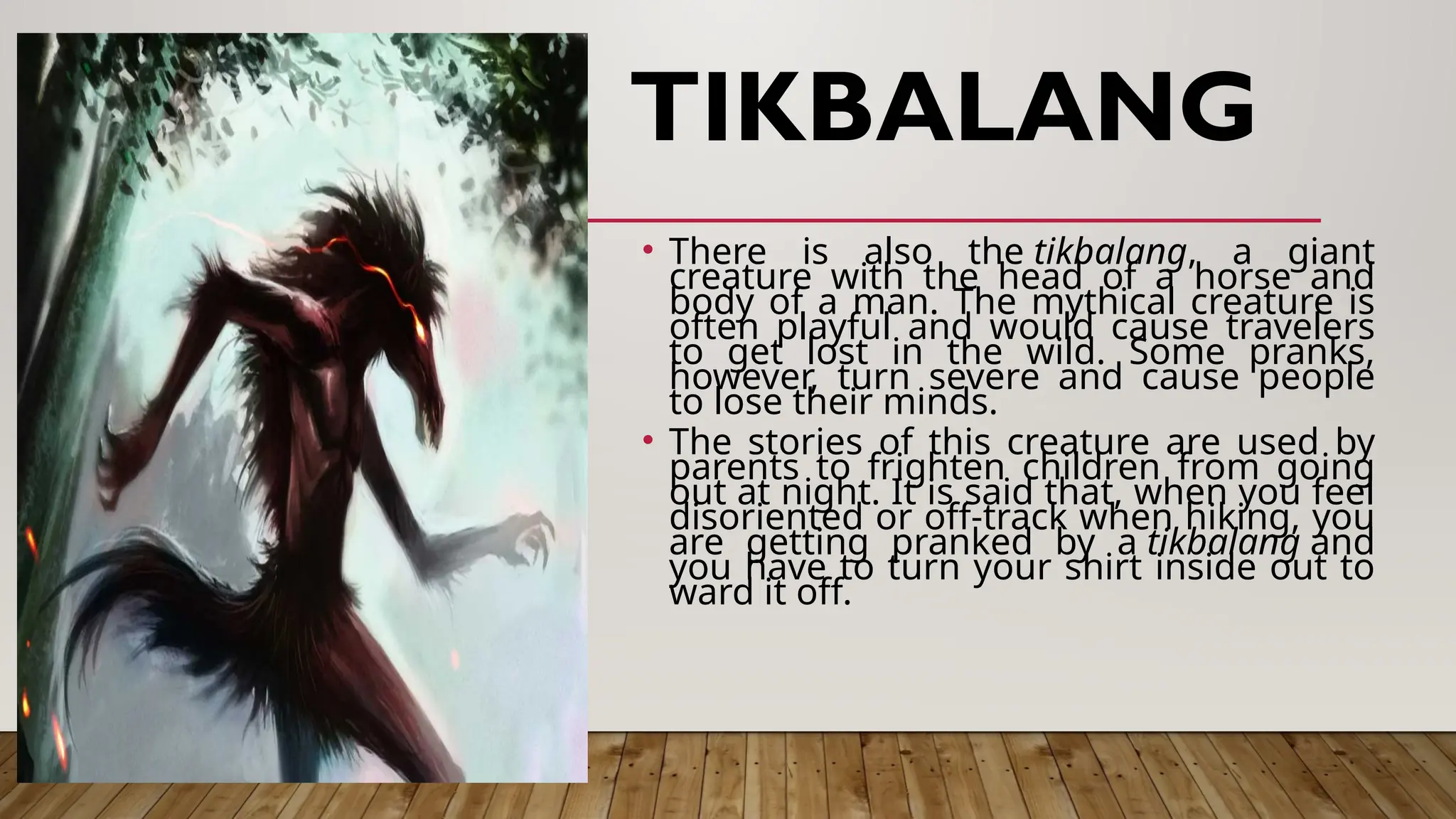
• There is also the tikbalang, a giant
creature with the head of a horse and
body of a man. The mythical creature is
often playful and would cause travelers
to get lost in the wild. Some pranks,
however, turn severe and cause people
to lose their minds.
• The stories of this creature are used by
parents to frighten children from going
out at night. It is said that, when you feel
disoriented or off-track when hiking, you
are getting pranked by a tikbalang and
you have to turn your shirt inside out to
ward it off.
DUWENDE
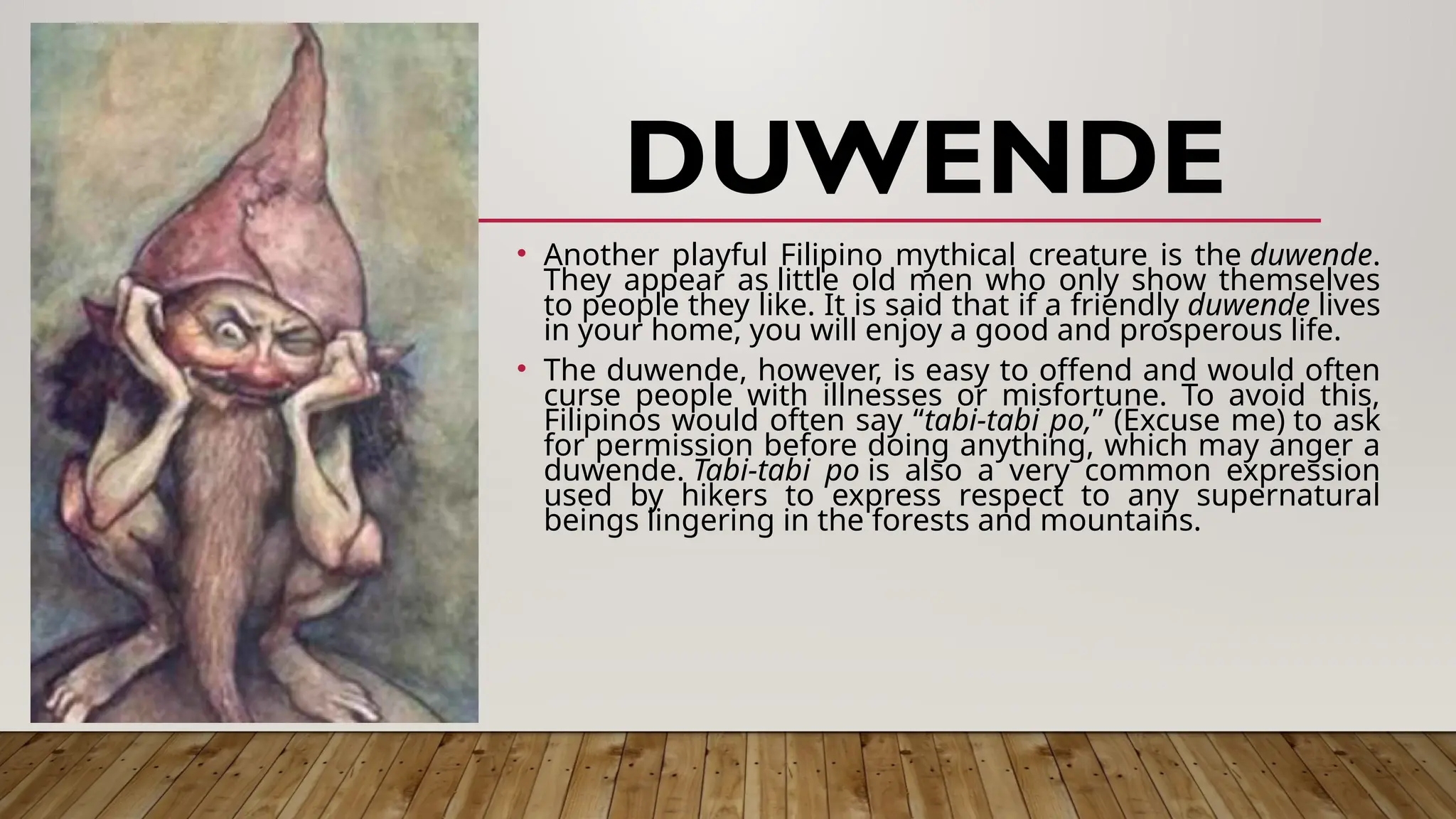
• Another playful Filipino mythical creature is the duwende.
They appear as little old men who only show themselves
to people they like. It is said that if a friendly duwende lives
in your home, you will enjoy a good and prosperous life.
• The duwende, however, is easy to offend and would often
curse people with illnesses or misfortune. To avoid this,
Filipinos would often say “tabi-tabi po,” (Excuse me) to ask
for permission before doing anything, which may anger a
duwende. Tabi-tabi po is also a very common expression
used by hikers to express respect to any supernatural
beings lingering in the forests and mountains.
TAYHO
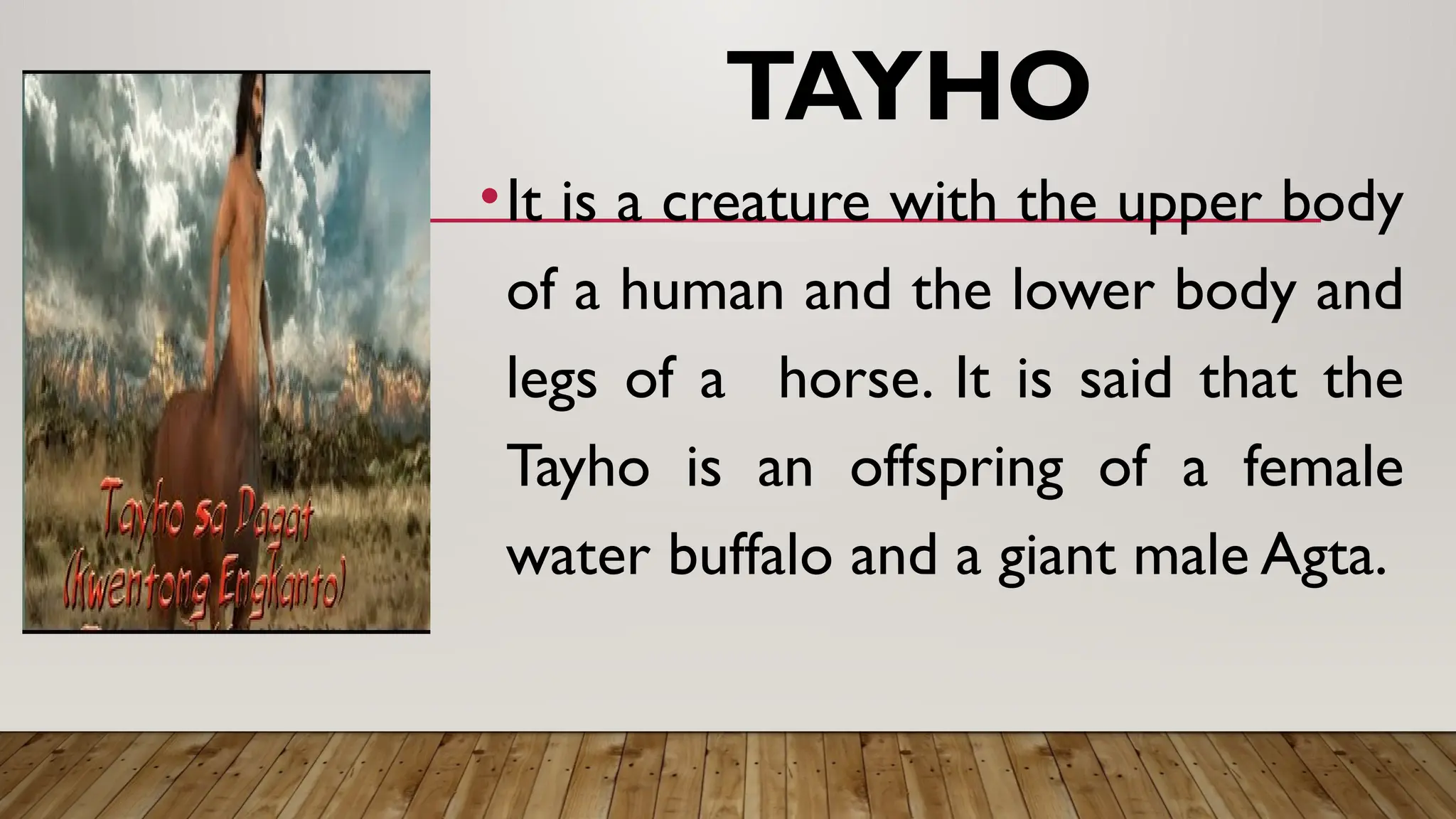
•It is a creature with the upper body
of a human and the lower body and
legs of a horse. It is said that the
Tayho is an offspring of a female
water buffalo and a giant male Agta.
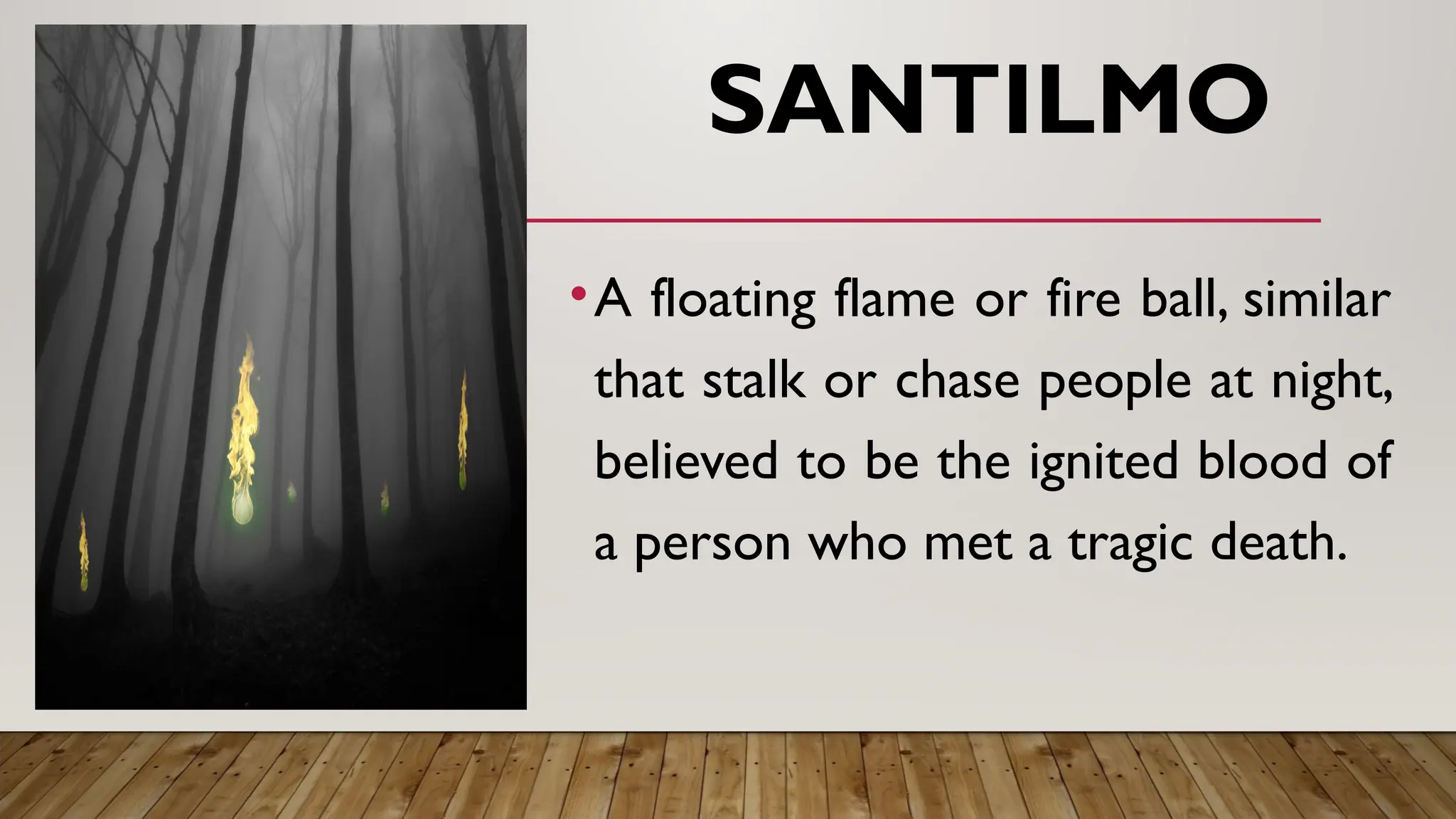
SANTILMO
•A floating flame or fire ball, similar
that stalk or chase people at night,
believed to be the ignited blood of
a person who met a tragic death.
SPANISH
COLONIAL
PHILIPPINE
LITERATURE
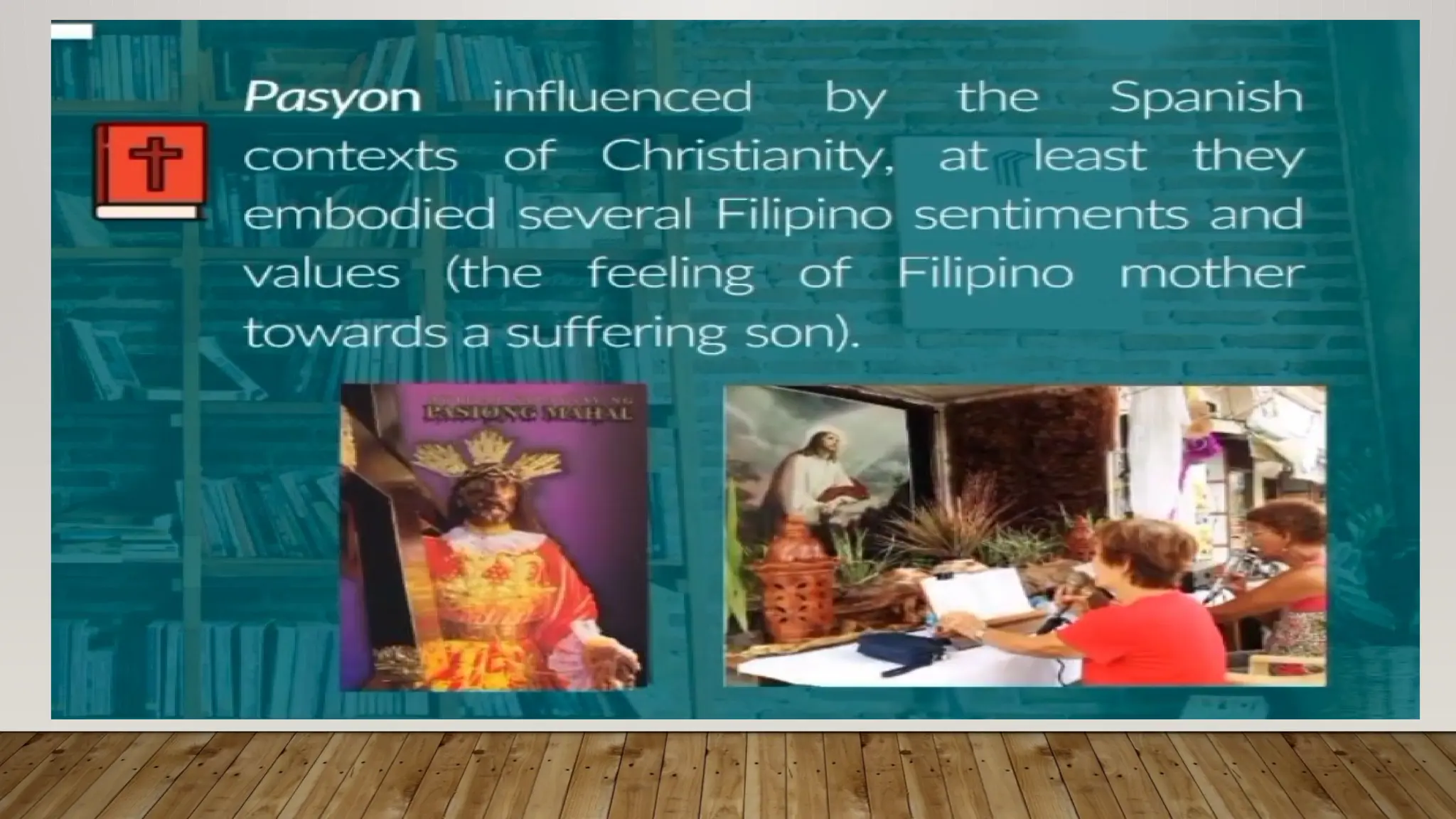
PASYON
•The Pasyon is an epic narrative of the life, death
and resurrection of Jesus Christ. In the stanzas of
five lines of 8 syllables each, the standard
elements of epic poetry are interwoven with a
colorful, dramatic theme.
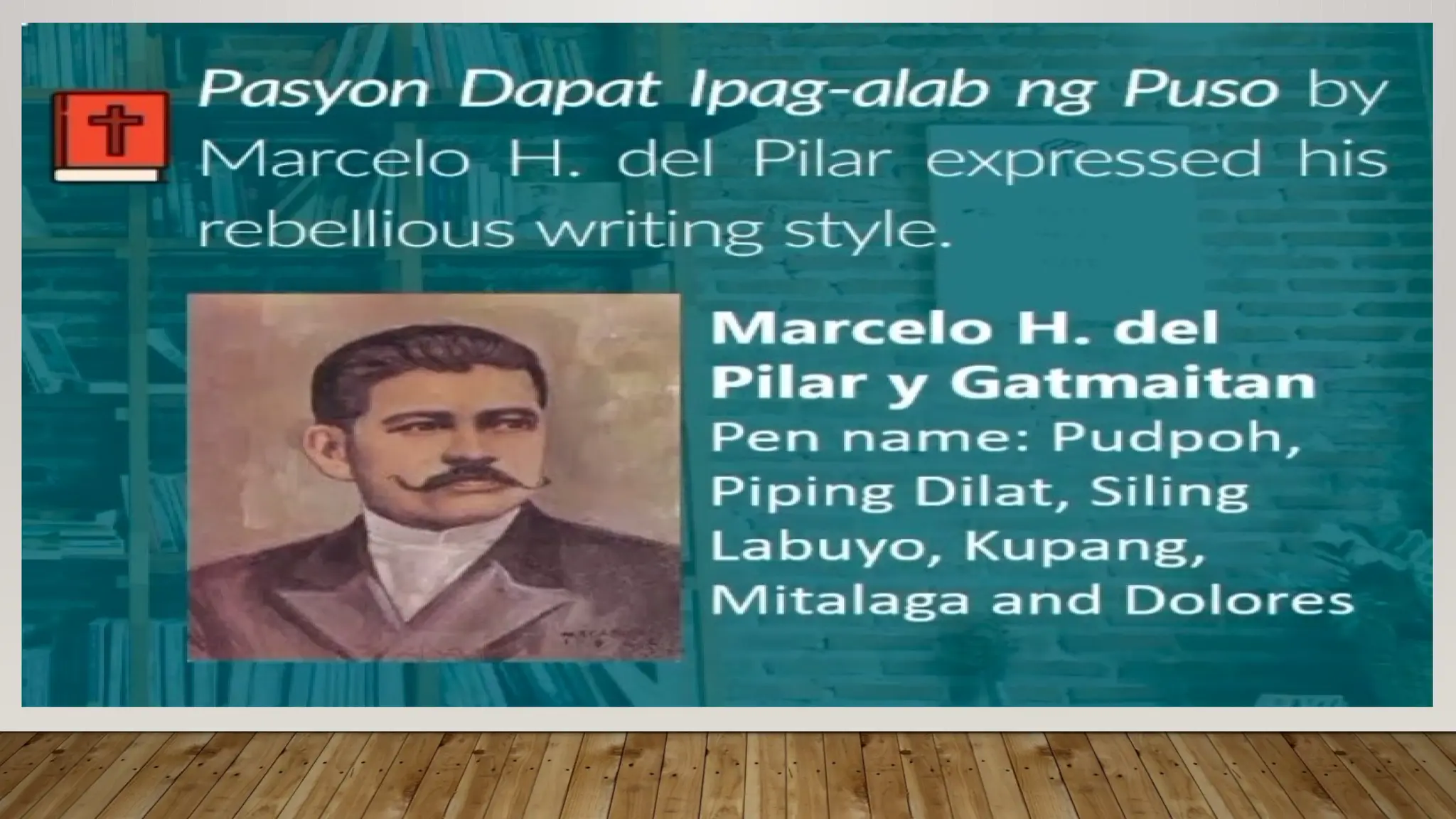
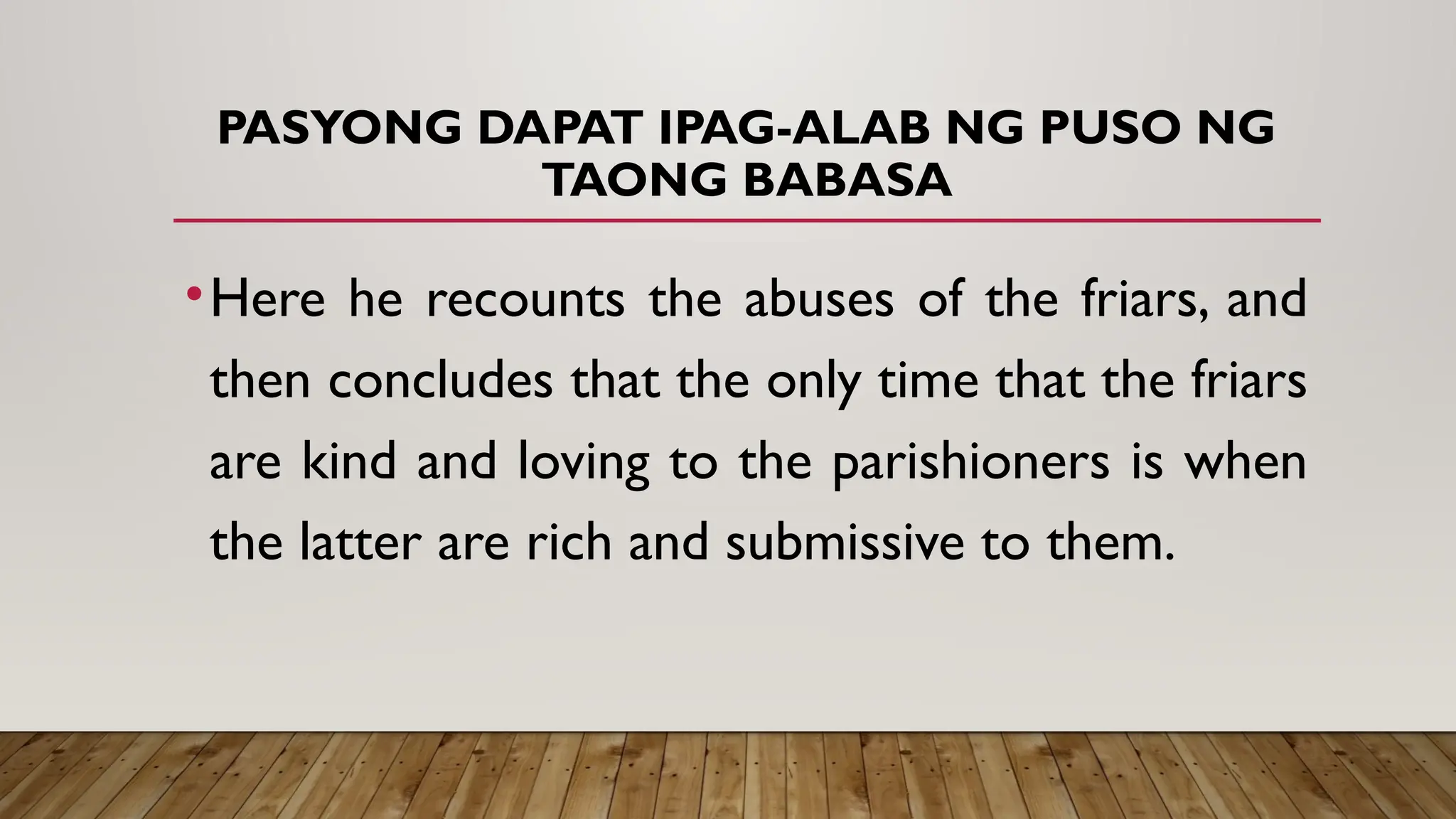
PASYONG DAPAT IPAG-ALAB NG PUSO NG
TAONG BABASA
•Here he recounts the abuses of the friars, and
then concludes that the only time that the friars
are kind and loving to the parishioners is when
the latter are rich and submissive to them.
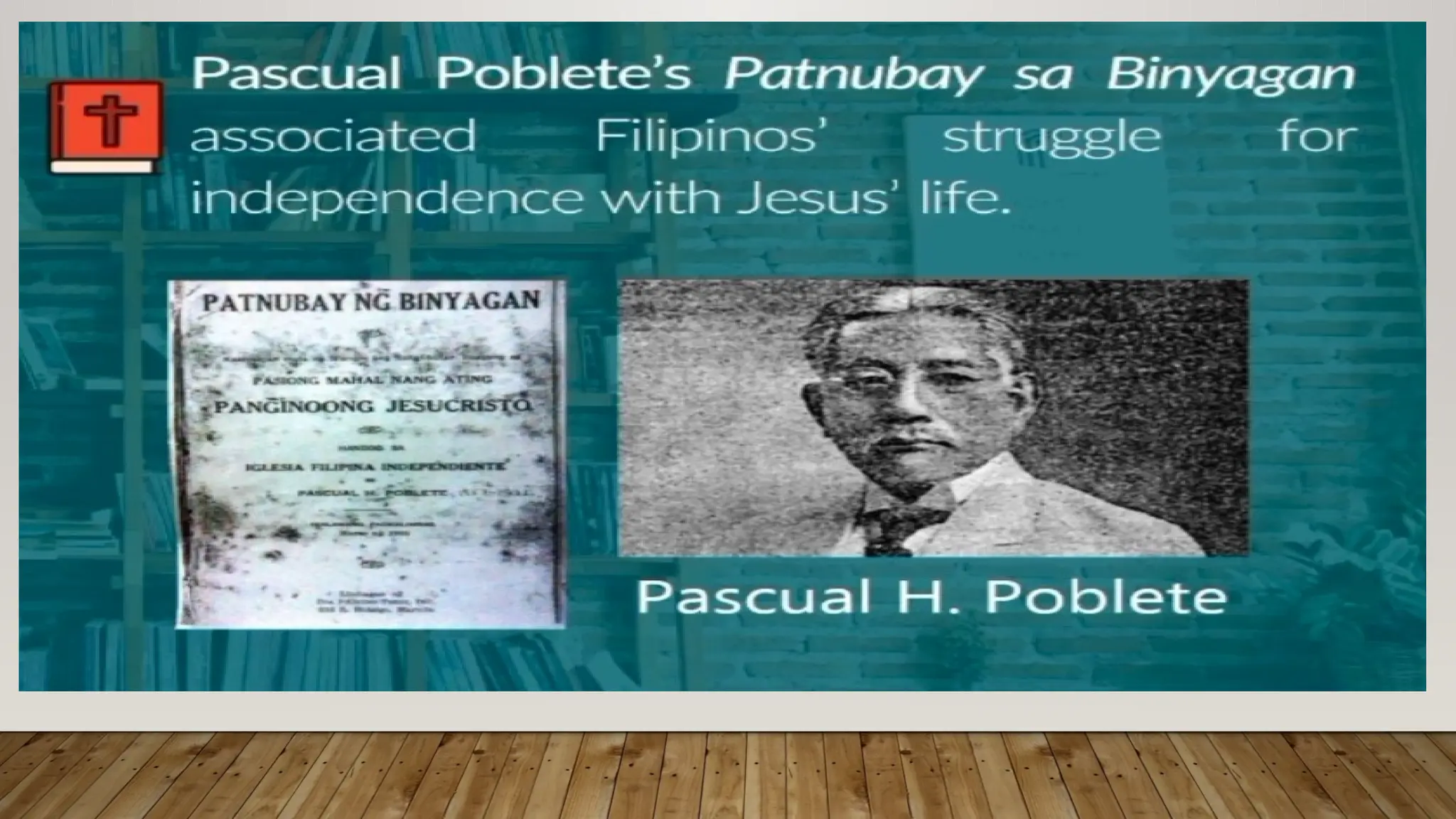
• Poblete’s Patnubay sa Binyagan
AWIT VS. CORRIDO
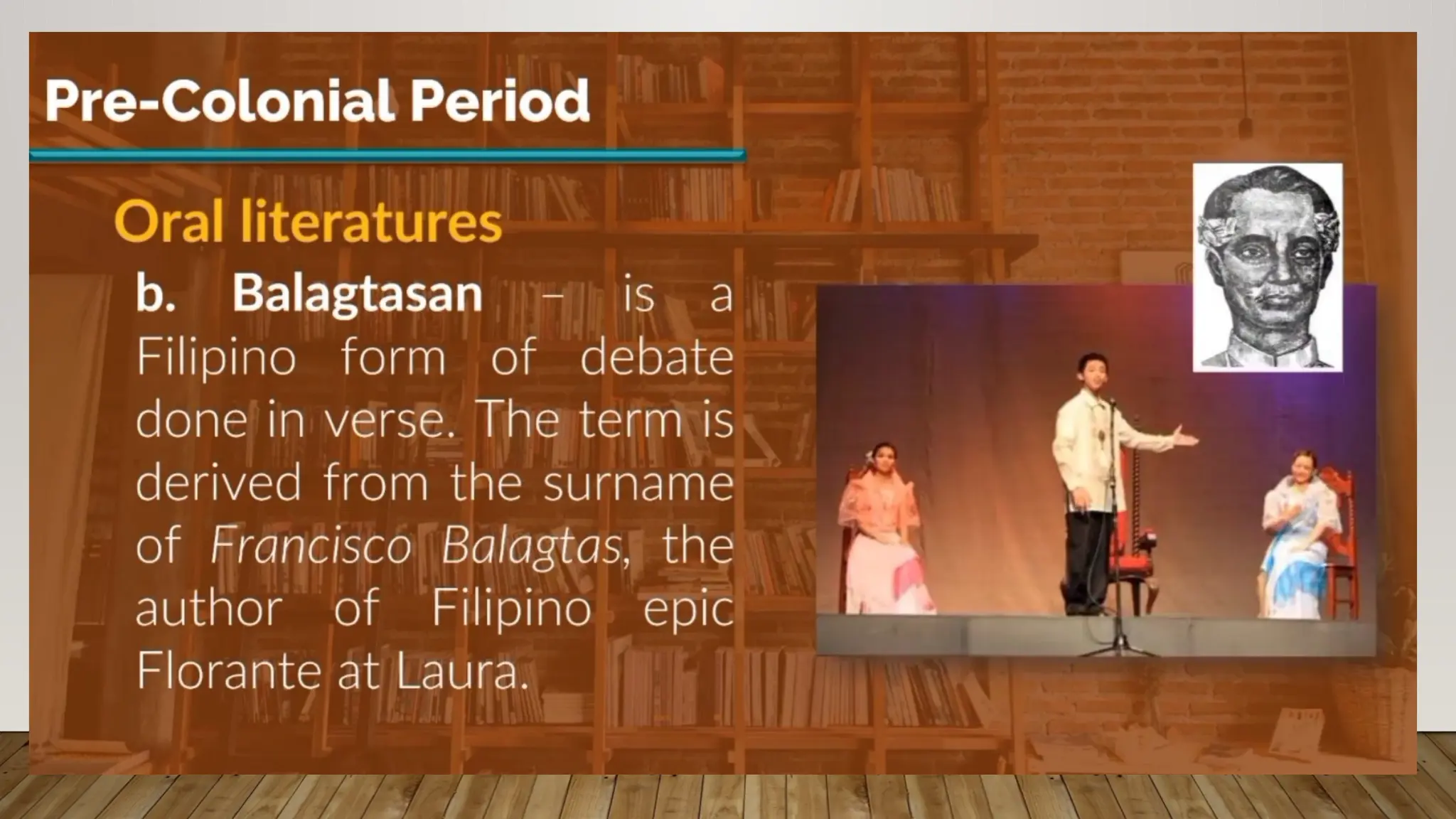
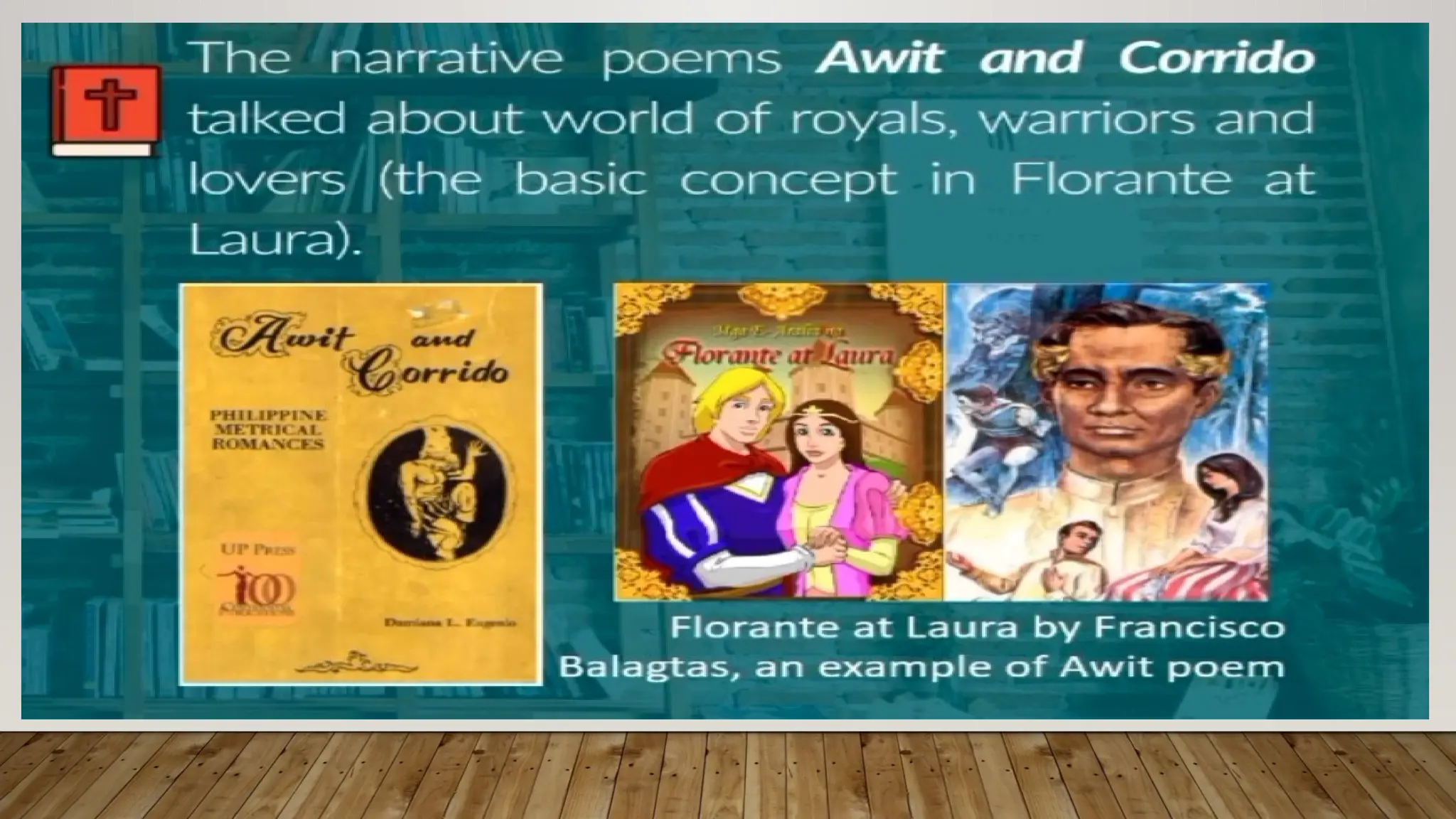
• Awit is the Tagalog word for song. It is a fabricated story from the
writer’s imagination and the characters are European. Example is
Florante at Laura by Francisco Balagtas. (12 syllables per line)
• Corrido means a metrical story, usually sung to the
accompaniment of a guitar. Example is Ibong Adarna (8 syllables
per line)
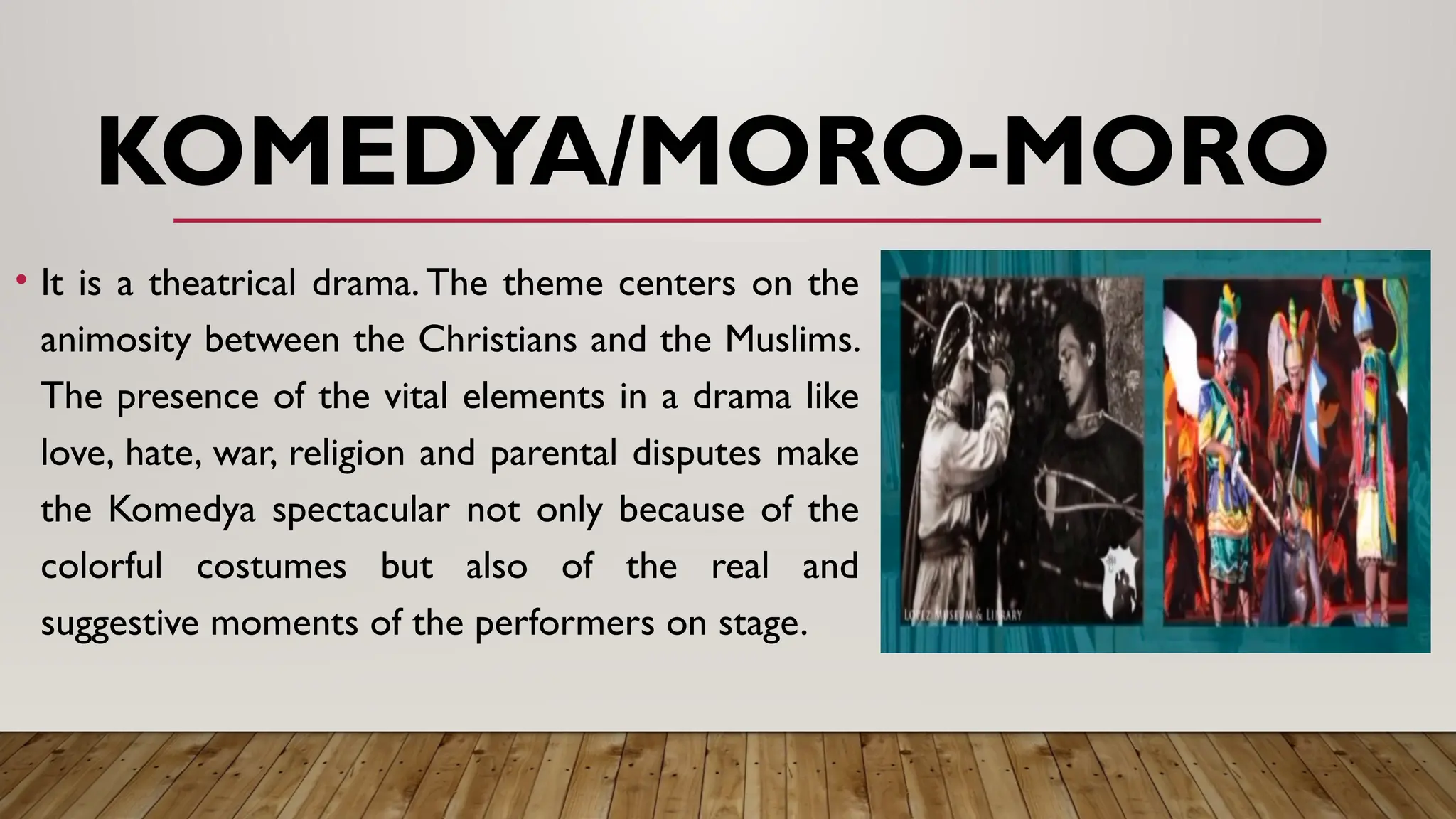
KOMEDYA/MORO-MORO
• It is a theatrical drama. The theme centers on the
animosity between the Christians and the Muslims.
The presence of the vital elements in a drama like
love, hate, war, religion and parental disputes make
the Komedya spectacular not only because of the
colorful costumes but also of the real and
suggestive moments of the performers on stage.
•The major contribution brought to the Philippine
literature under the American regime (1898-
1941) is the production of the Philippine
literature in English.
•The Philippine literature under the American
regime saw its dawn with the introductions of free
public instruction and the use of English as a lingua
franca in all levels of education in public schools.
• The Filipinos won against the Spaniards who colonized Philippines
for more than 300 years.The Philippine flag was hoisted as on June
12, 1898 as a symbol of independence. Gen. Emilio Aguinaldo was
elected the first president of the Philippine republic, which was
short-lived. Americans colonized the country.
•Filipino writers went into all forms of literature.
Their writings showed their love for the country
and their longing for independence.
•Spanish and Tagalog and the vernaculars were the
languages used in writing during the first years in
American period, but Spanish and Tagalog were the
predominated language.
•In 1910, anew group started to write in English. Hence,
Spanish,Tagalog, theVernaculars and finally English, were
the mediums used in literatures during these times.The
first English teachers were the Thomasites.
•Spanish writers wrote about nationalism.
•Tagalog writers wrote about their lamentations
on the conditions of the country and their
attempts to arouse love for one’s native tongue.
•English writers imitated the themes and
methods of the Americans.
Famous Authors
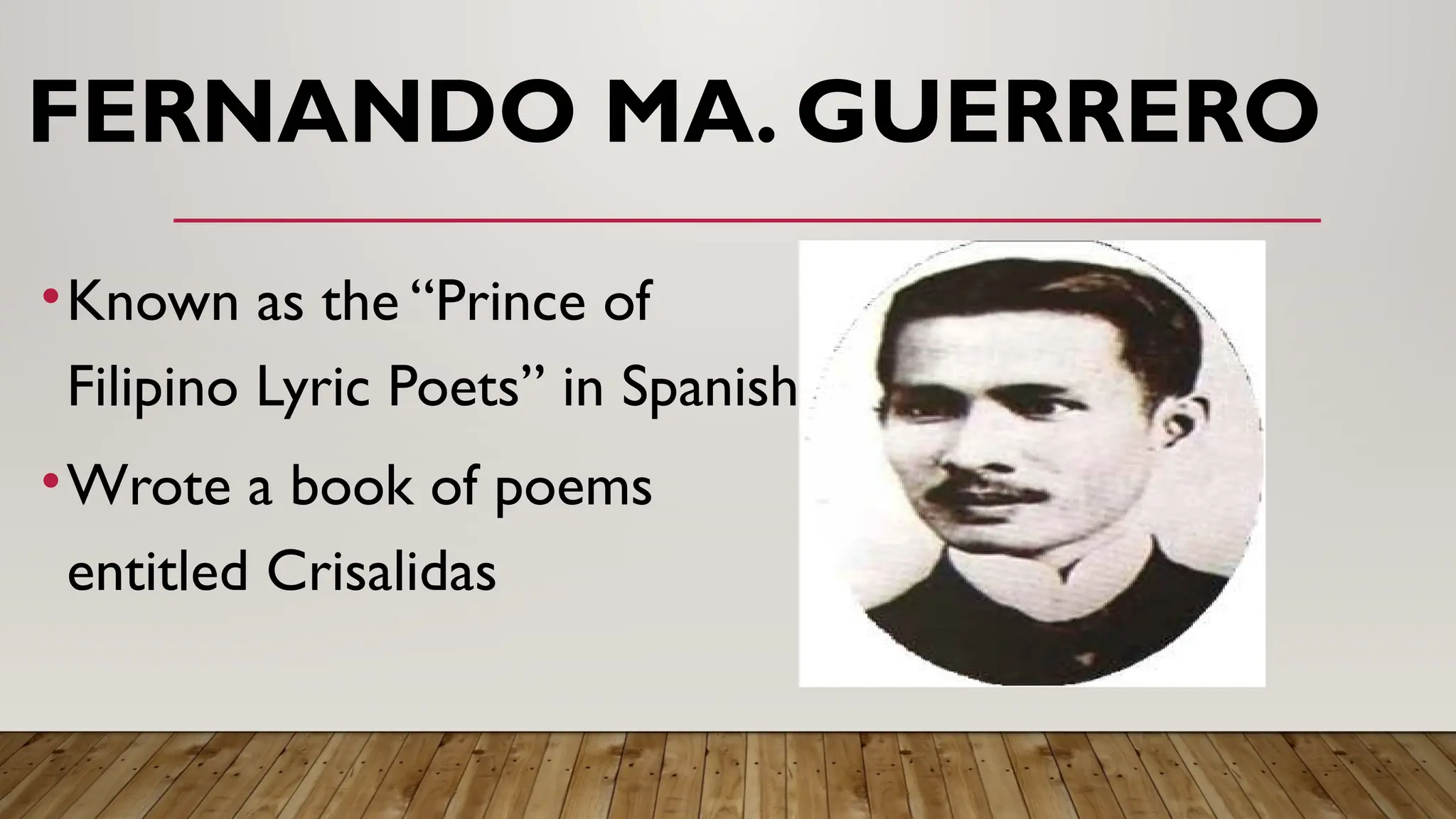
FERNANDO MA. GUERRERO
•Known as the “Prince of
Filipino Lyric Poets” in Spanish
•Wrote a book of poems
entitled Crisalidas
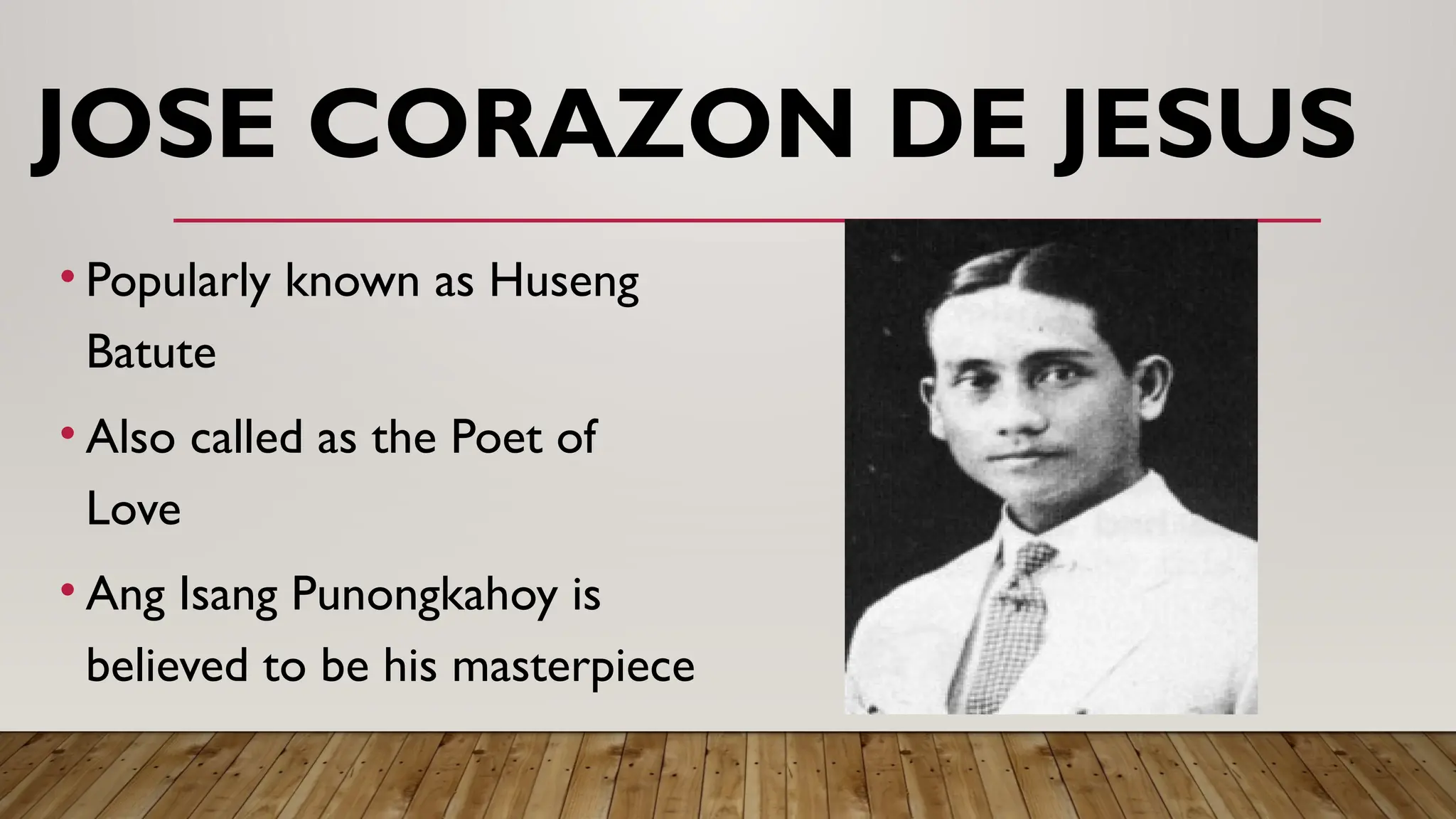
JOSE CORAZON DE JESUS
• Popularly known as Huseng
Batute
• Also called as the Poet of
Love
• Ang Isang Punongkahoy is
believed to be his masterpiece
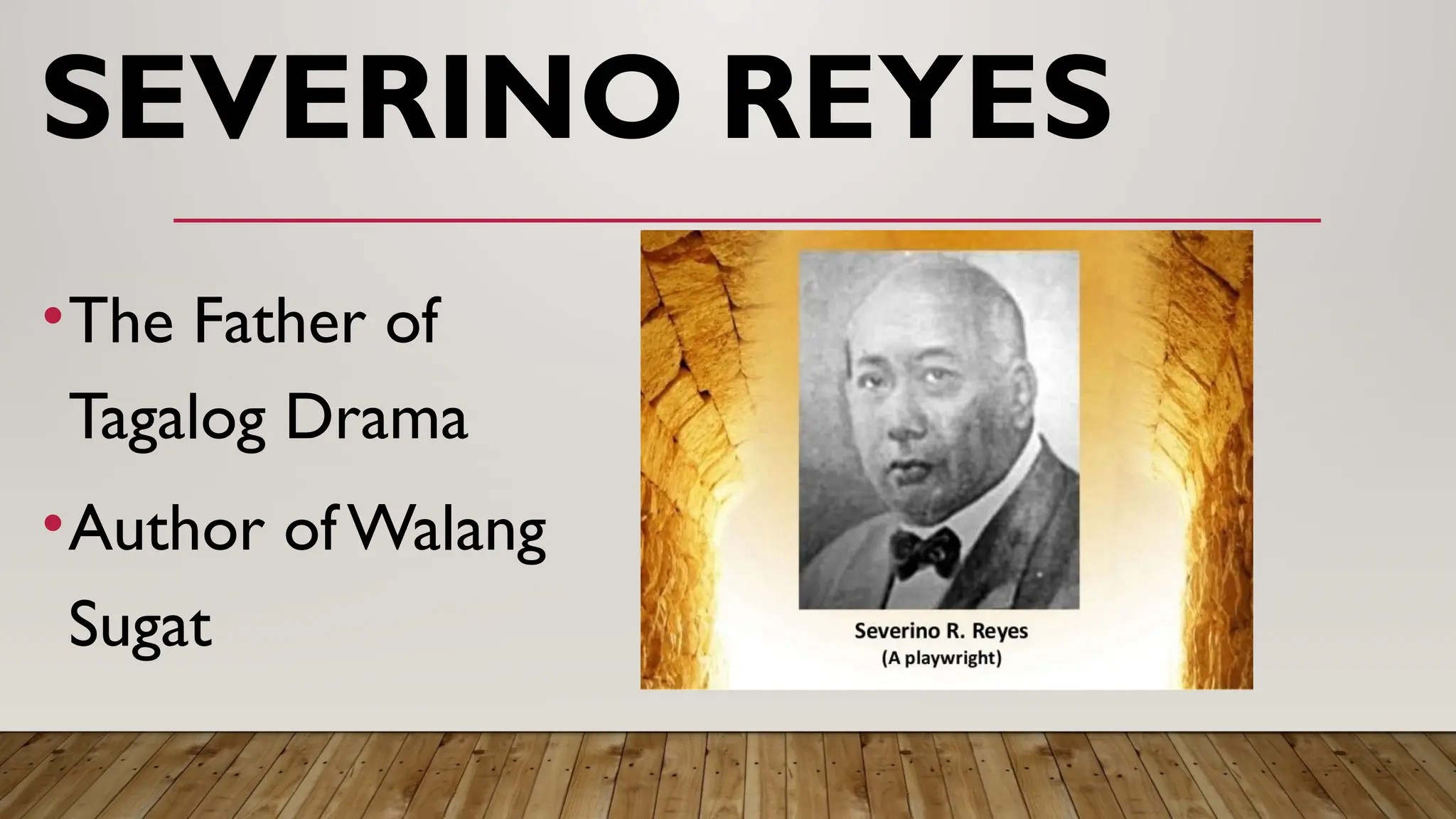
SEVERINO REYES
•The Father of
Tagalog Drama
•Author of Walang
Sugat
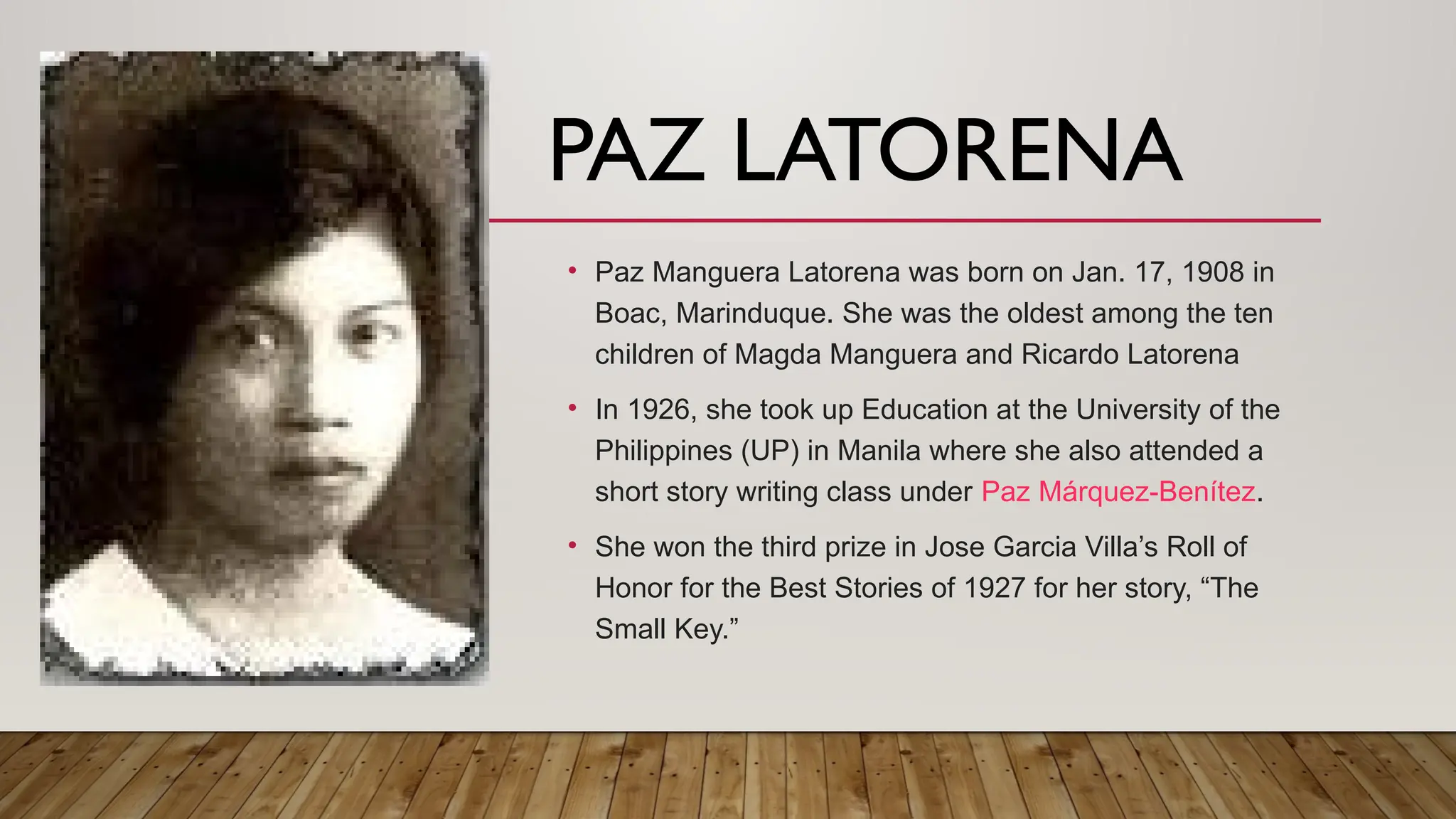
PAZ LATORENA
• Paz Manguera Latorena was born on Jan. 17, 1908 in
Boac, Marinduque. She was the oldest among the ten
children of Magda Manguera and Ricardo Latorena
• In 1926, she took up Education at the University of the
Philippines (UP) in Manila where she also attended a
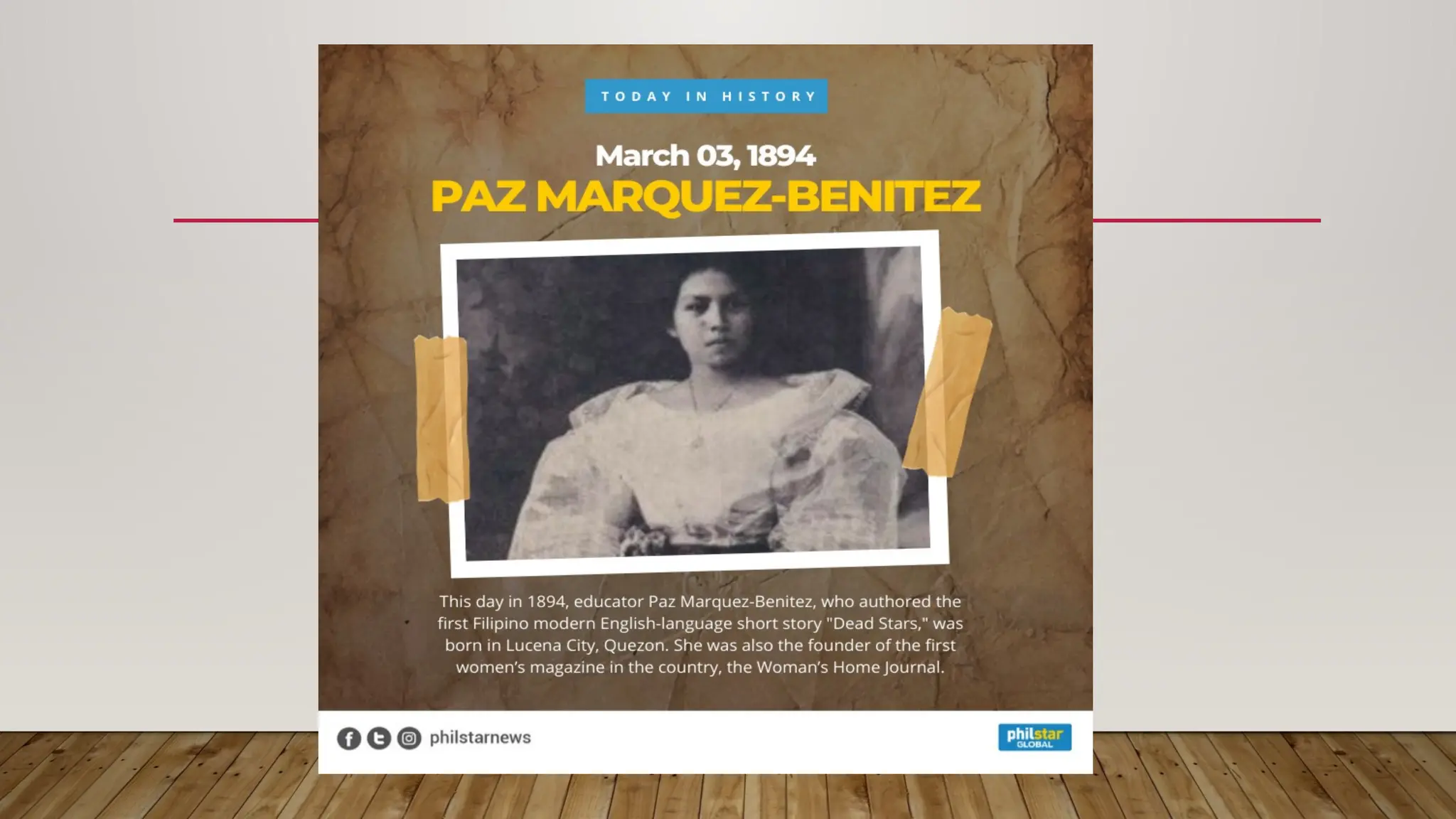
short story writing class under Paz Márquez-Benítez.
• She won the third prize in Jose Garcia Villa’s Roll of
Honor for the Best Stories of 1927 for her story, “The
Small Key.”
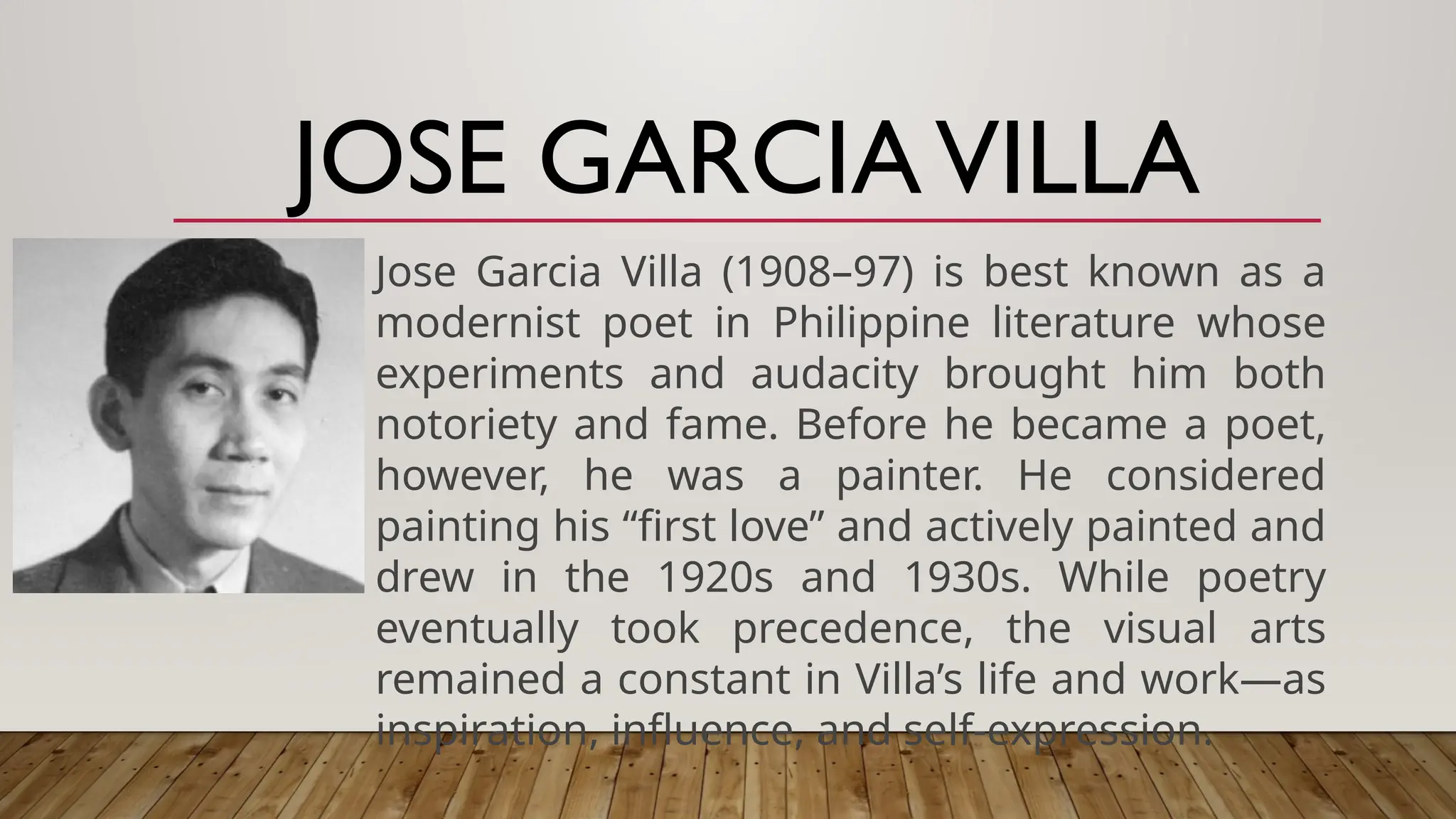
JOSE GARCIAVILLA
Jose Garcia Villa (1908–97) is best known as a
modernist poet in Philippine literature whose
experiments and audacity brought him both
notoriety and fame. Before he became a poet,
however, he was a painter. He considered
painting his “first love” and actively painted and
drew in the 1920s and 1930s. While poetry
eventually took precedence, the visual arts
remained a constant in Villa’s life and work—as
inspiration, influence, and self-expression.
THE BASHFUL ONE
BY: JOSE GARCIAVILLA
,
PHILIPPINE LITERATURE
DURINGTHE JAPANESE PERIOD
1941-1946
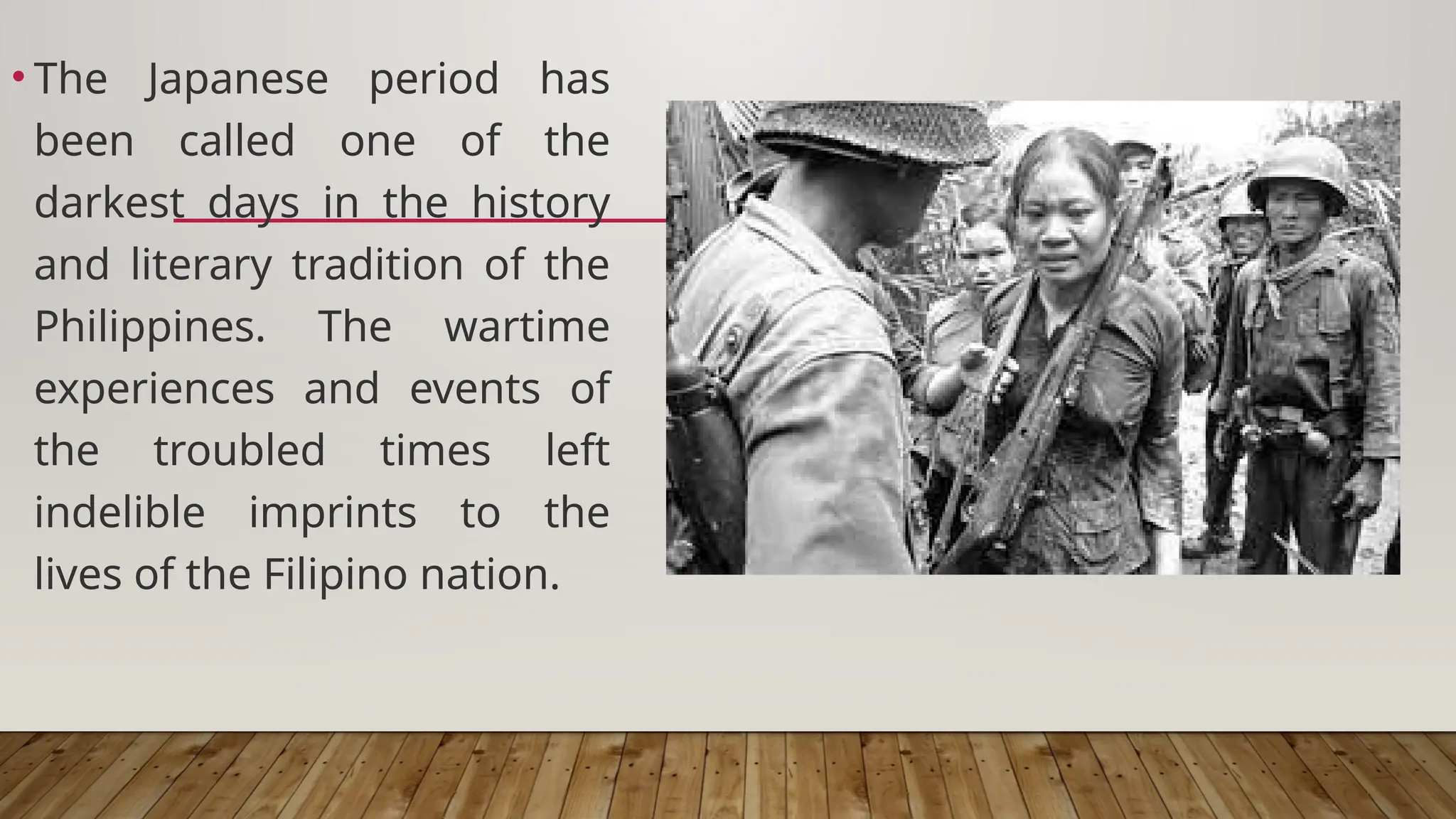
• The Japanese period has
been called one of the
darkest days in the history
and literary tradition of the
Philippines. The wartime
experiences and events of
the troubled times left
indelible imprints to the
lives of the Filipino nation.
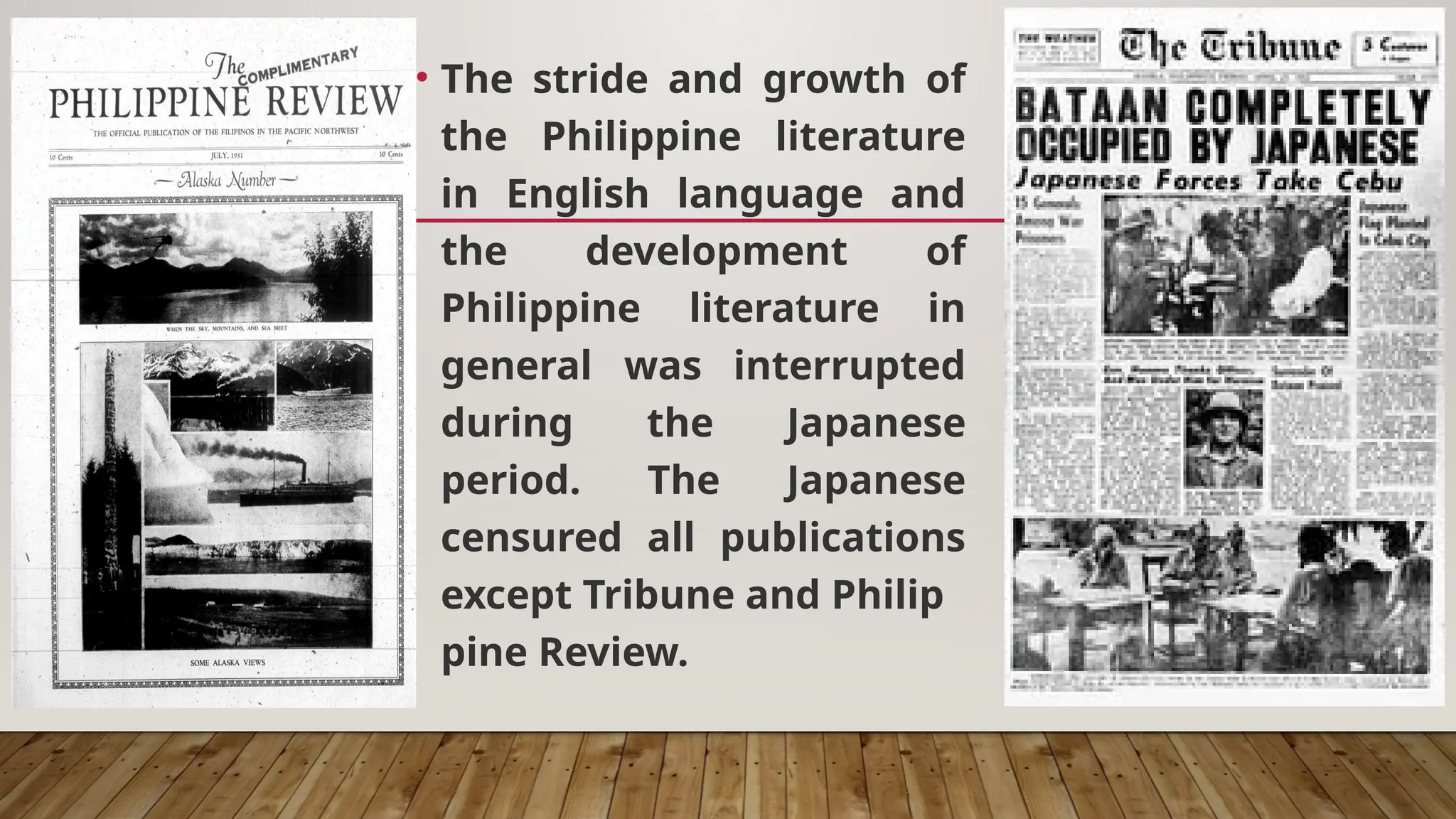
• The stride and growth of
the Philippine literature
in English language and
the development of
Philippine literature in
general was interrupted
during the Japanese
period. The Japanese
censured all publications
except Tribune and Philip
pine Review.
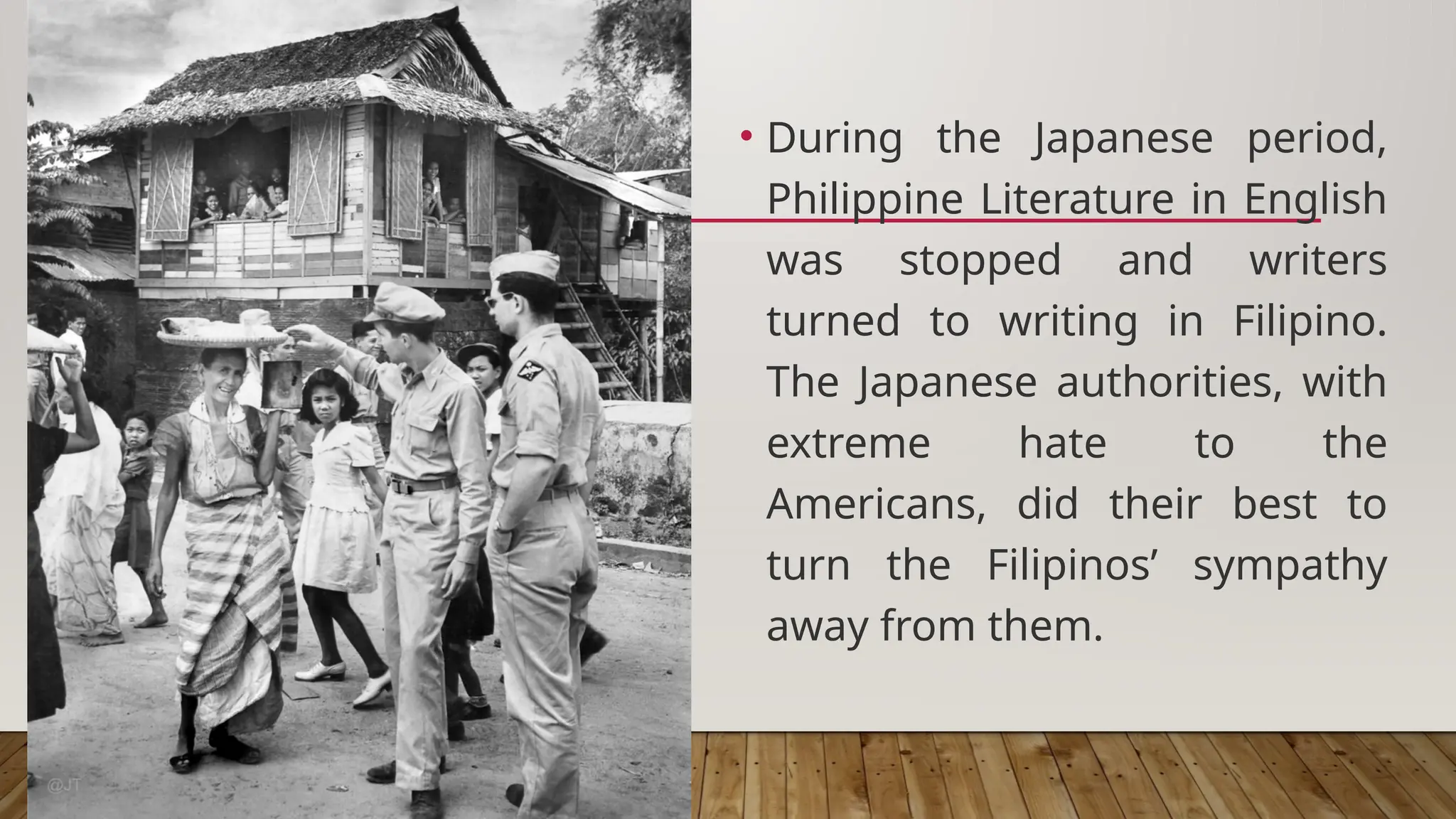
• During the Japanese period,
Philippine Literature in English
was stopped and writers
turned to writing in Filipino.
The Japanese authorities, with
extreme hate to the
Americans, did their best to
turn the Filipinos’ sympathy
away from them.
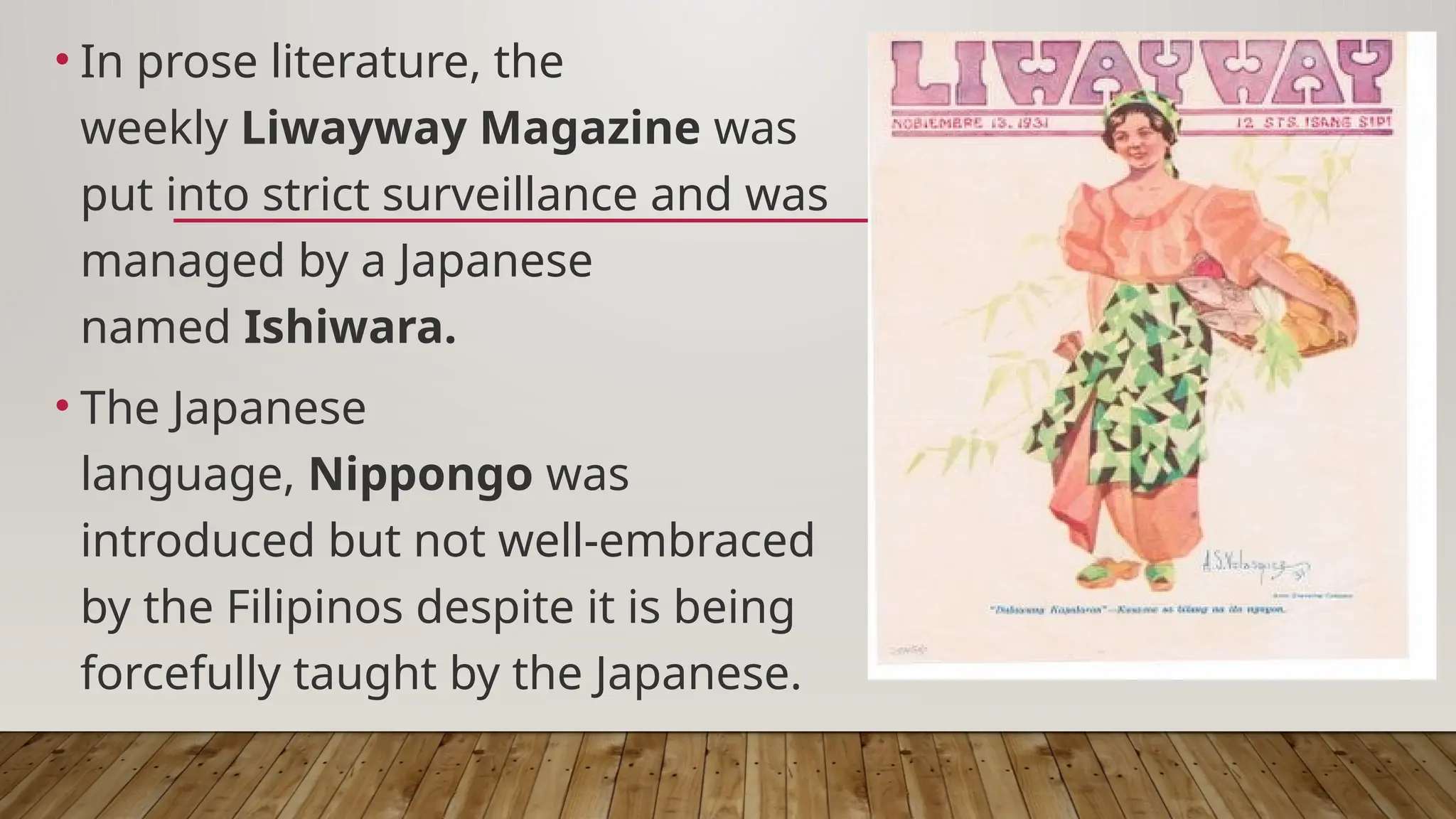
• In prose literature, the
weekly Liwayway Magazine was
put into strict surveillance and was
managed by a Japanese
named Ishiwara.
• The Japanese
language, Nippongo was
introduced but not well-embraced
by the Filipinos despite it is being
forcefully taught by the Japanese.
• With the prohibition of writing
literary pieces in English language,
Filipino literature was given a break.
• Many Filipino writers wrote plays,
poems, short stories, etc. in the
Tagalog and other vernacular
language. Topics and themes were
often about life in the provinces to
escape Japanese control and
censorship.
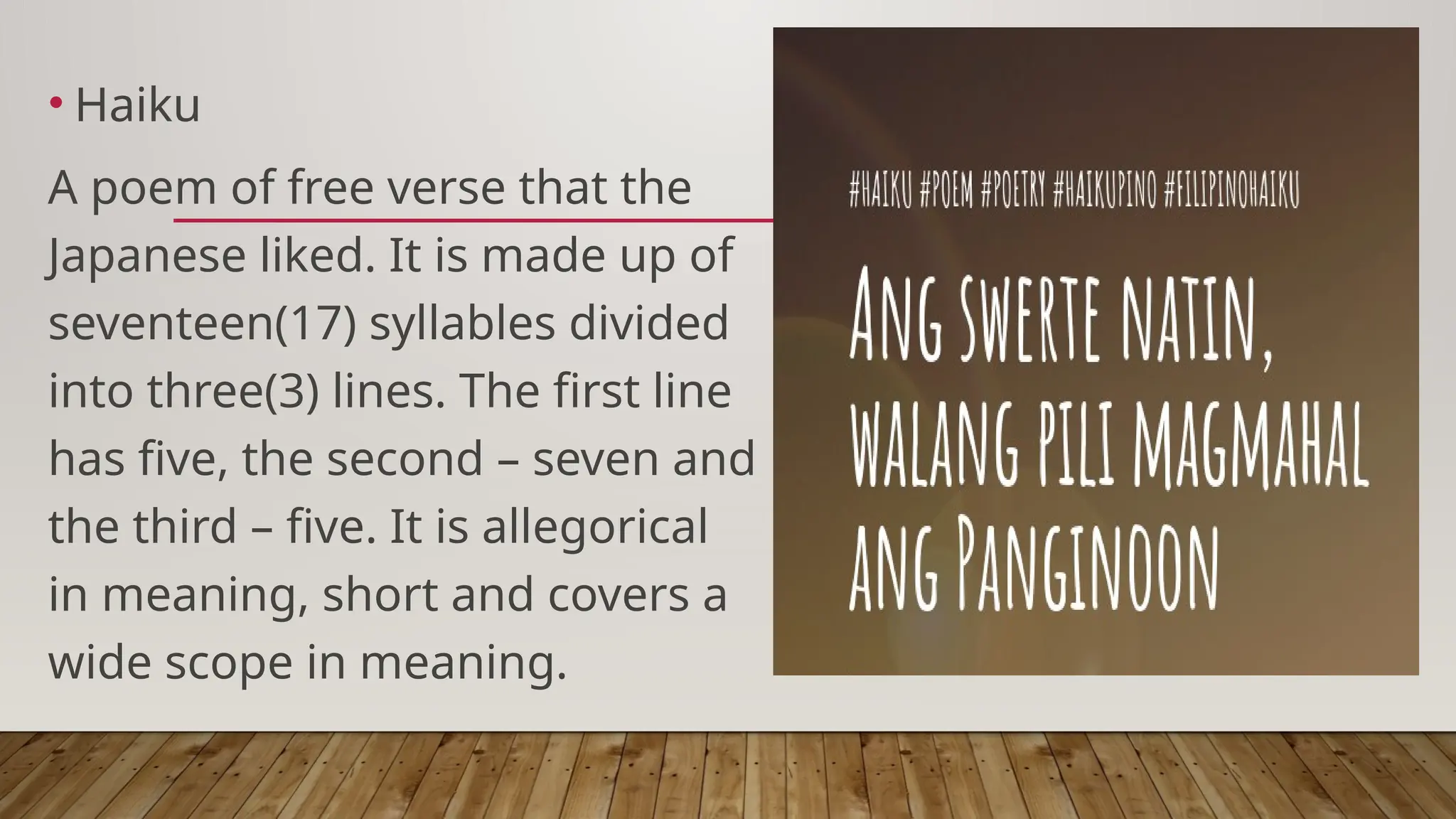
• Haiku
A poem of free verse that the
Japanese liked. It is made up of
seventeen(17) syllables divided
into three(3) lines. The first line
has five, the second – seven and
the third – five. It is allegorical
in meaning, short and covers a
wide scope in meaning.
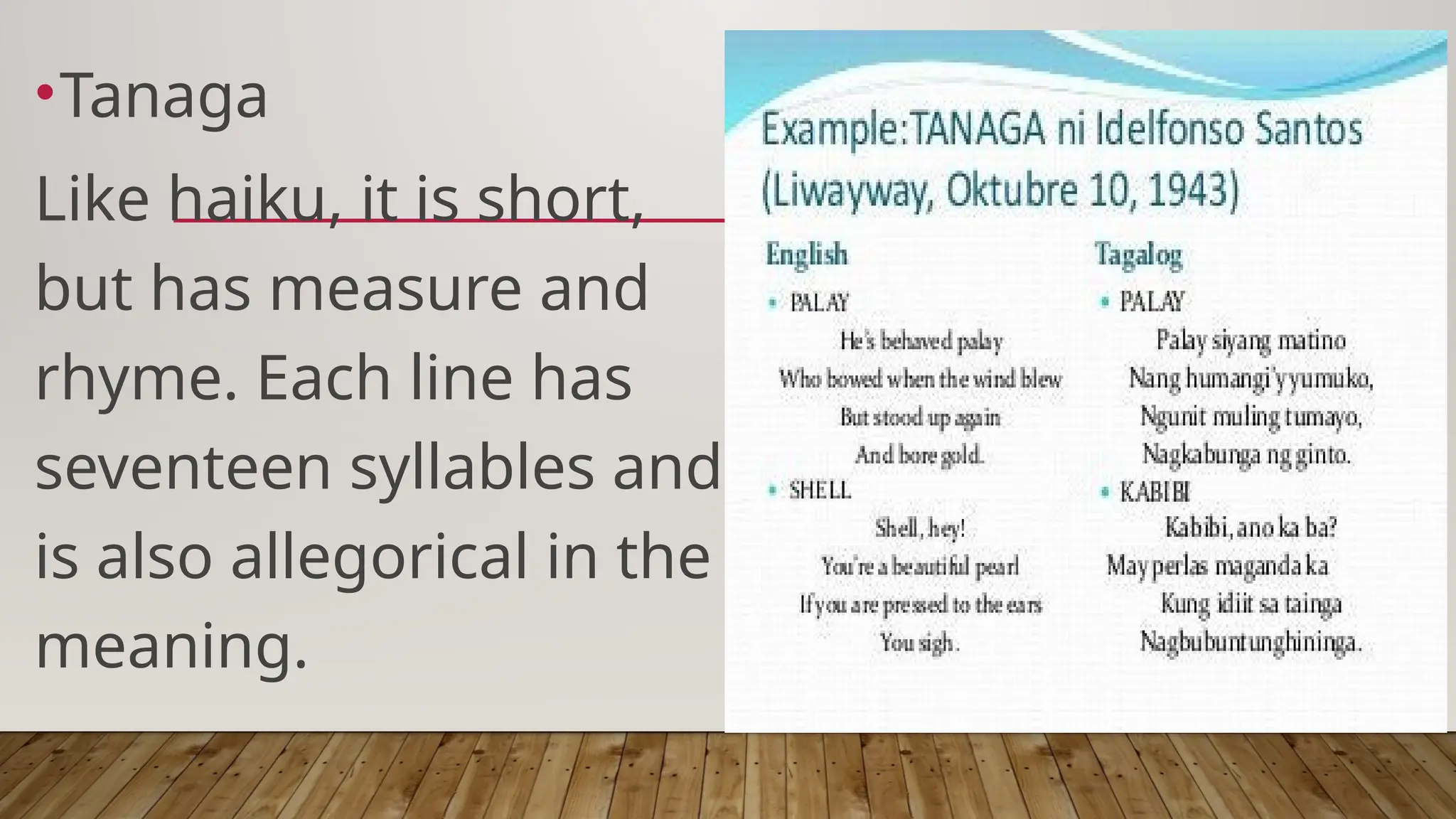
•Tanaga
Like haiku, it is short,
but has measure and
rhyme. Each line has
seventeen syllables and
is also allegorical in the
meaning.
• The drama experienced a lull during the Japanese period because movie houses
showing american films were closed. The big movie houses were just made to
show stage shows. Many of the play were reproductions of English plays to
Tagalog the translators were Francisco Soc Rodrigo, Alberto Concio, and Narciso
Pimentel. They also founded the organization of Filipino players named, dramatic
Philippines.
• A few of the play writers were:
1. Jose Ma. Hernandez – wrote PANDAY RIRA
2. Francisco Soc Rodrigo – wrote sa PUA, SA PUTI
3. Clodualdo del Mundo – wrote BULAGA(an expression in the game hide and seek)
4. Julian Cruz Balmaceda – wrote SINO BA KAYO?, DAHIL SA ANAK, and HIGANTI
NG PATAY.
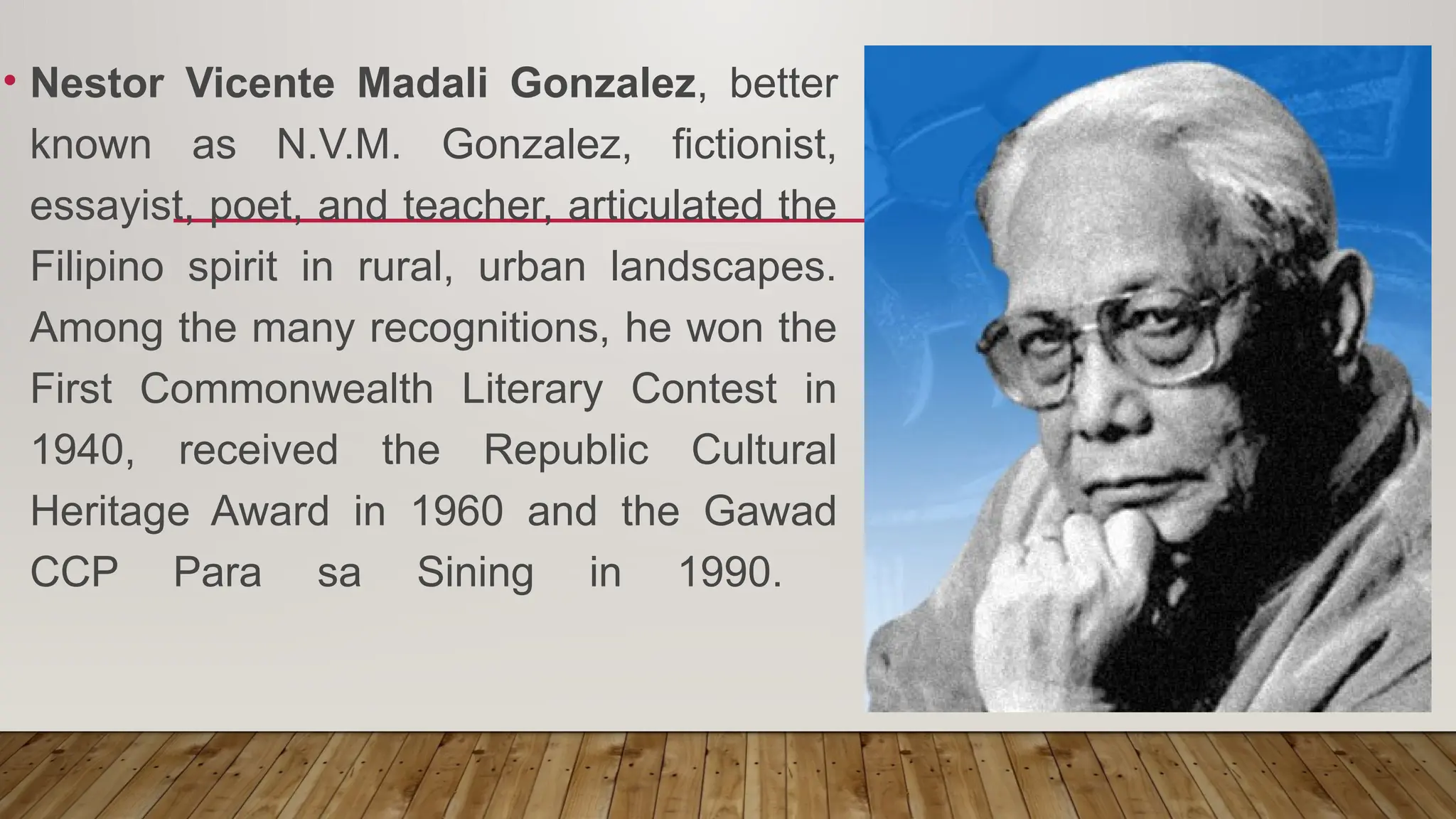
• Nestor Vicente Madali Gonzalez, better
known as N.V.M. Gonzalez, fictionist,
essayist, poet, and teacher, articulated the
Filipino spirit in rural, urban landscapes.
Among the many recognitions, he won the
First Commonwealth Literary Contest in
1940, received the Republic Cultural
Heritage Award in 1960 and the Gawad
CCP Para sa Sining in 1990.
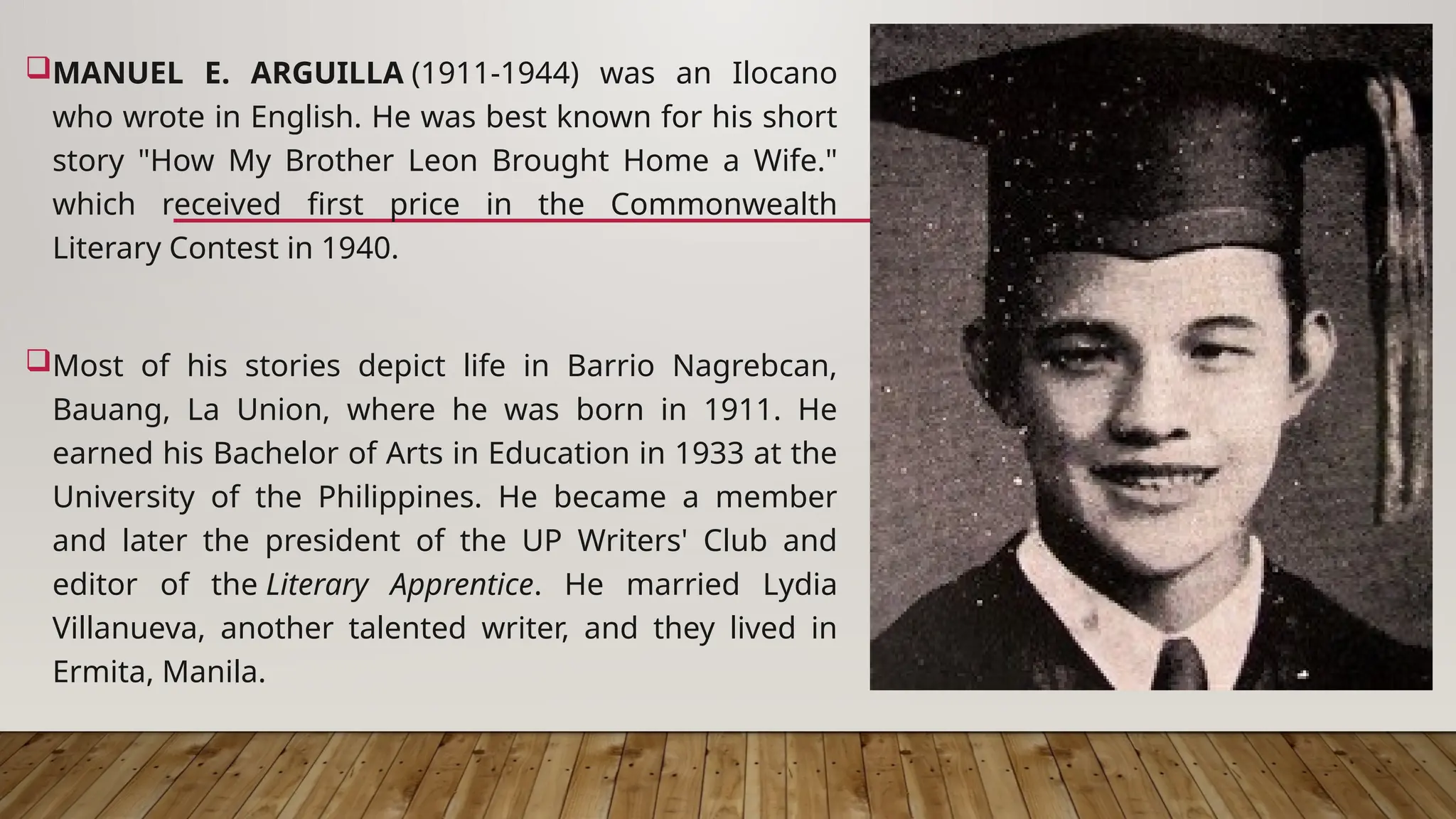
MANUEL E. ARGUILLA (1911-1944) was an Ilocano
who wrote in English. He was best known for his short
story "How My Brother Leon Brought Home a Wife."
which received first price in the Commonwealth
Literary Contest in 1940.
Most of his stories depict life in Barrio Nagrebcan,
Bauang, La Union, where he was born in 1911. He
earned his Bachelor of Arts in Education in 1933 at the
University of the Philippines. He became a member
and later the president of the UP Writers' Club and
editor of the Literary Apprentice. He married Lydia
Villanueva, another talented writer, and they lived in
Ermita, Manila.
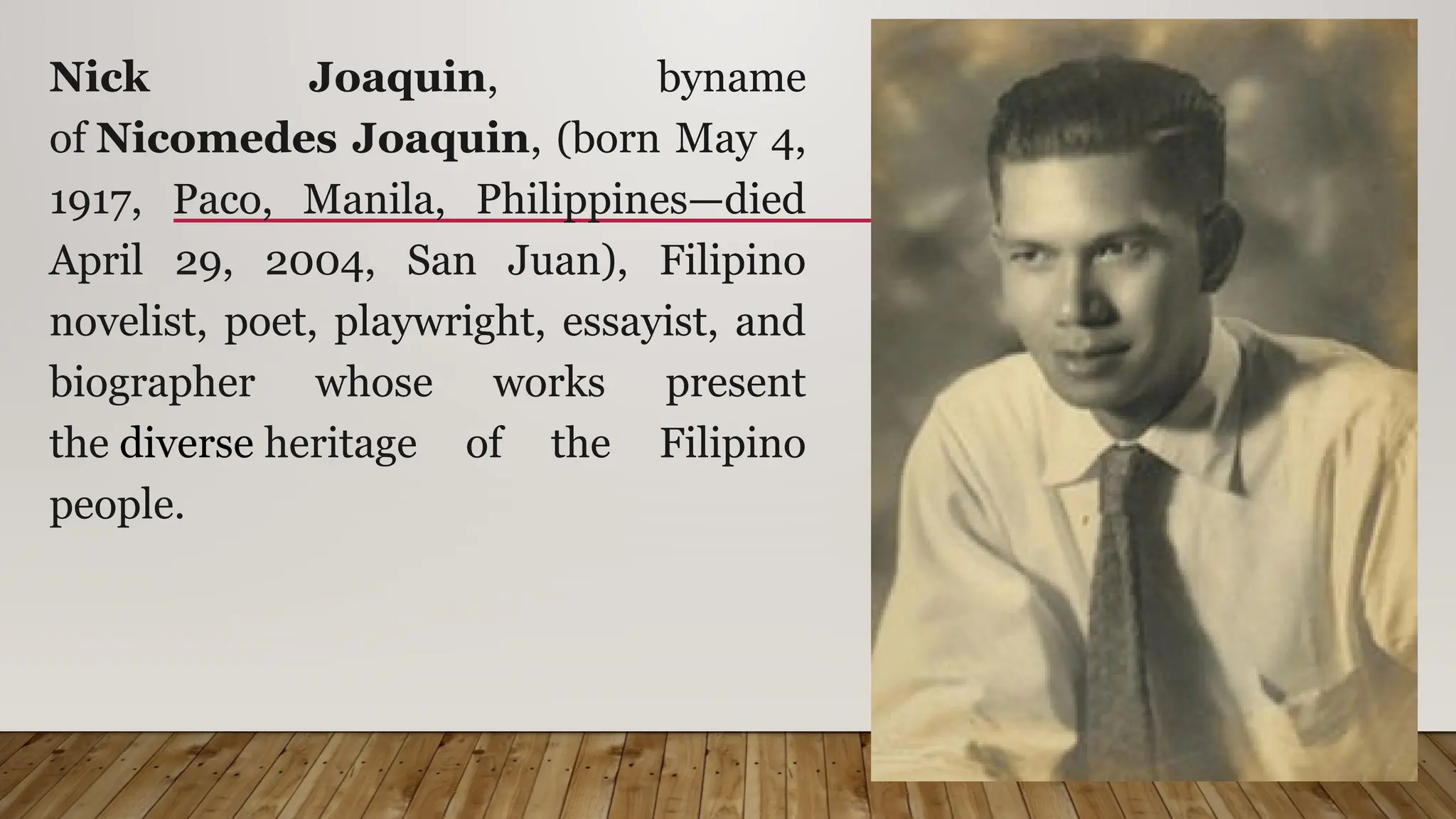
Nick Joaquin, byname
of Nicomedes Joaquin, (born May 4,
1917, Paco, Manila, Philippines—died
April 29, 2004, San Juan), Filipino
novelist, poet, playwright, essayist, and
biographer whose works present
the diverse heritage of the Filipino
people.
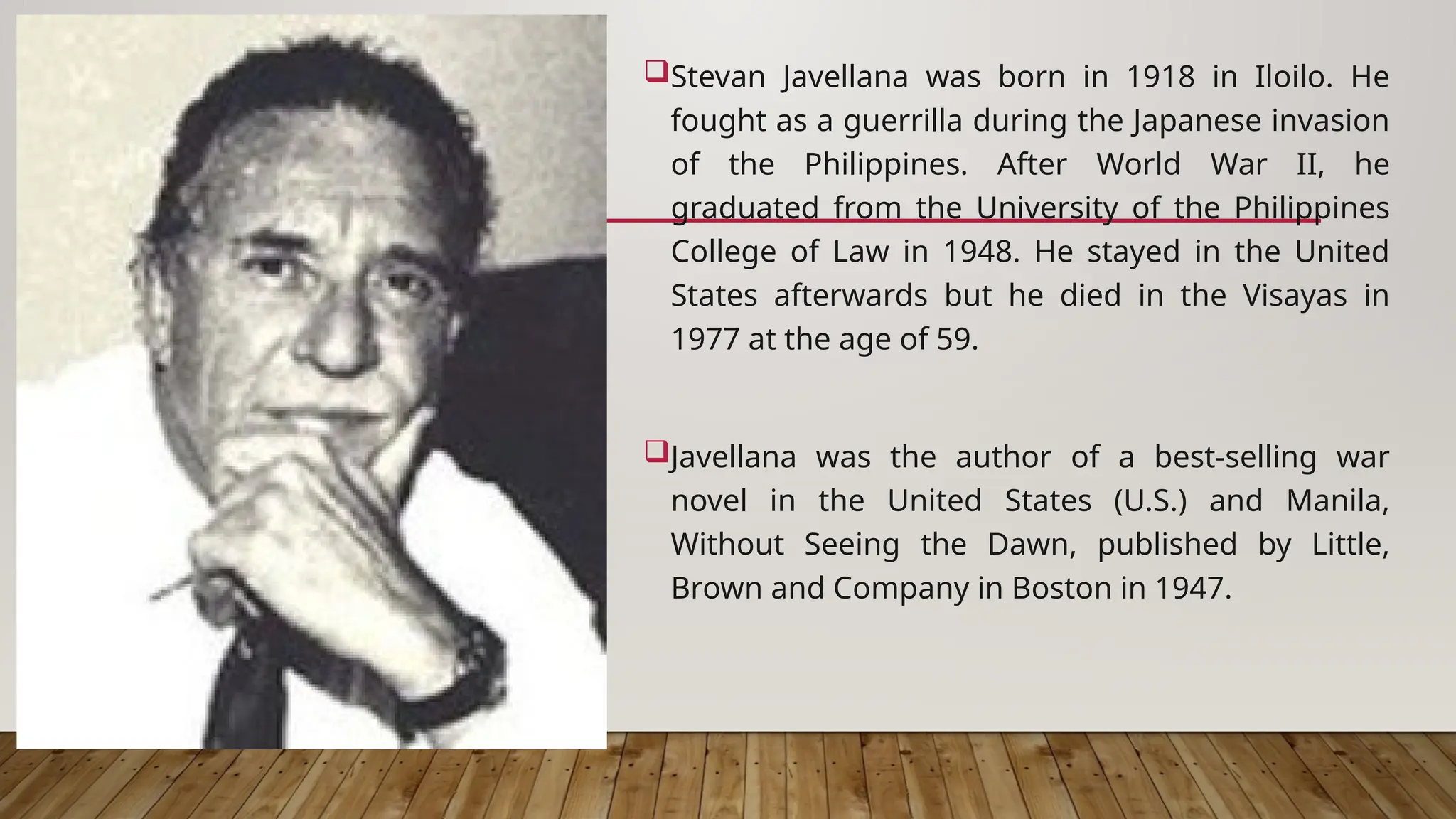
Stevan Javellana was born in 1918 in Iloilo. He
fought as a guerrilla during the Japanese invasion
of the Philippines. After World War II, he
graduated from the University of the Philippines
College of Law in 1948. He stayed in the United
States afterwards but he died in the Visayas in
1977 at the age of 59.
Javellana was the author of a best-selling war
novel in the United States (U.S.) and Manila,
Without Seeing the Dawn, published by Little,
Brown and Company in Boston in 1947.
GENRES AND FORMS
IN 21ST
CENTURY
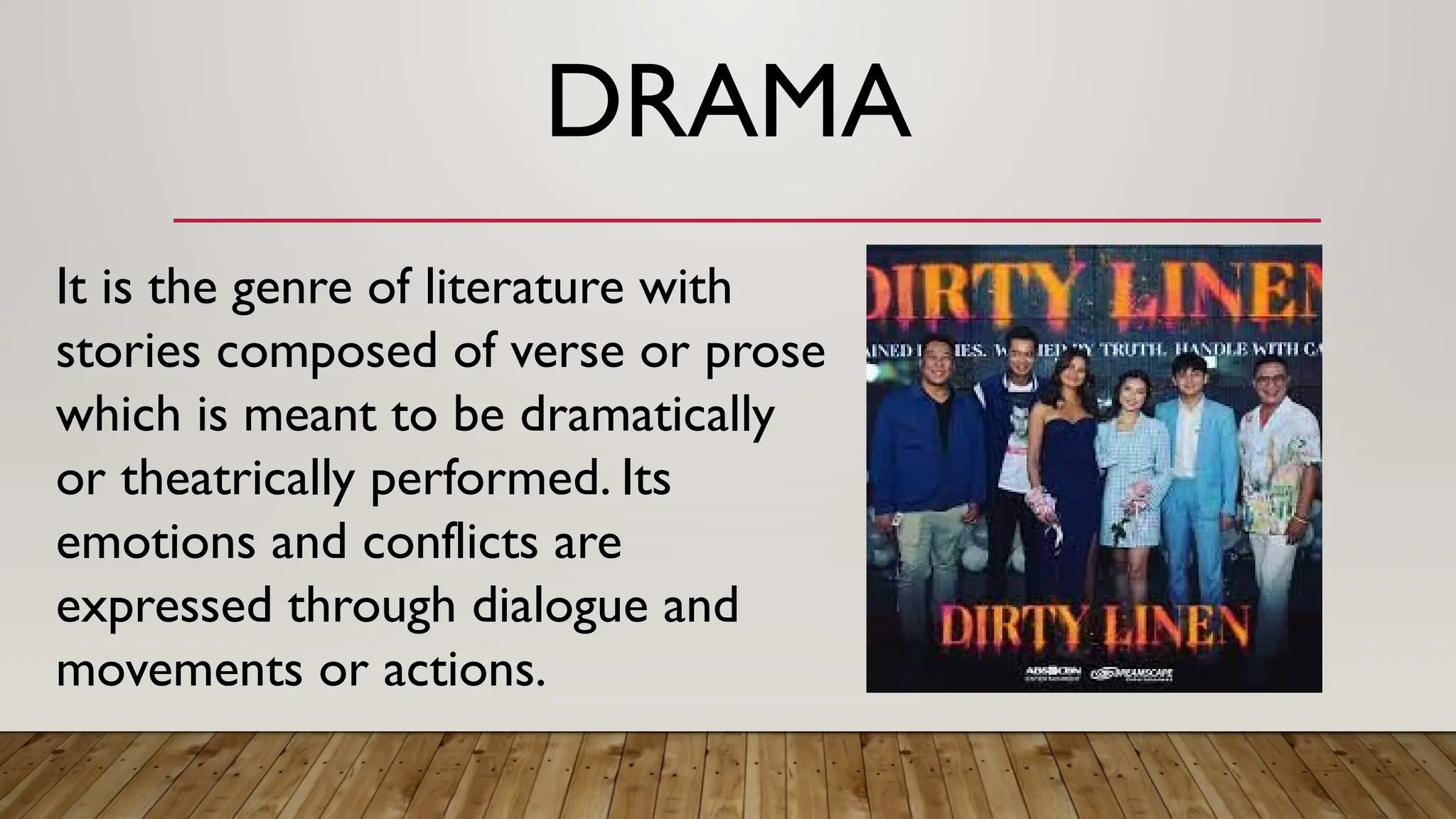
DRAMA
It is the genre of literature with
stories composed of verse or prose
which is meant to be dramatically
or theatrically performed. Its
emotions and conflicts are
expressed through dialogue and
movements or actions.
CREATIVE NONFICTION
• Creative nonfiction can be an essay, a journal article, a research paper, a memoir, or a
poem; it can be personal or not, or it can be all of these.
• Some of the creative nonfiction in the Philippines include but not limited to:
1. The Cardinal’s Sins,The General’s Cross,The Martyr’sTestimony, and
Other Affirmation by Gregorio C. Brillantes;
2. Sapay Koma by Jhoanna Lynn Cruz
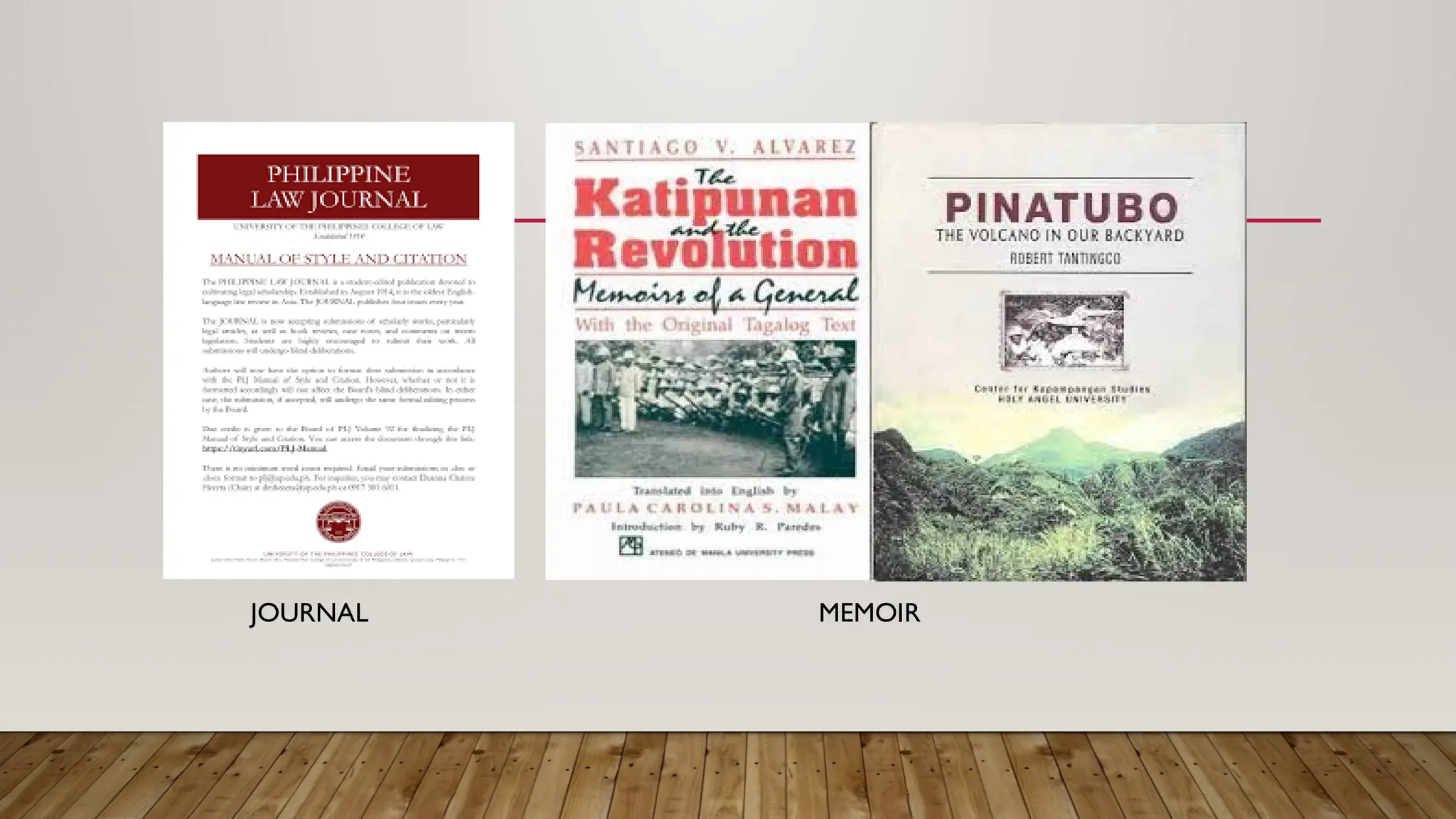
JOURNAL MEMOIR
BLOG
A blogger is someone who writes regularly
for an online journal or website.
It is a web log containing short articles called posts that can be
changed regularly. Some blogs are written by one person
(called blogger) containing his/her hobbies or interests,
opinions, and experiences, while others are written by many
different people.
POETRY
It is a verse and rhythmic writing with imagery that evokes
an emotional response from the reader. Poetry is “life
distilled” through words and language.The art of poetry is
rhythmical in composition, written or spoken. Poetry is for
entertaining and exciting pleasure by beautiful, imaginative,
or elevated thoughts.
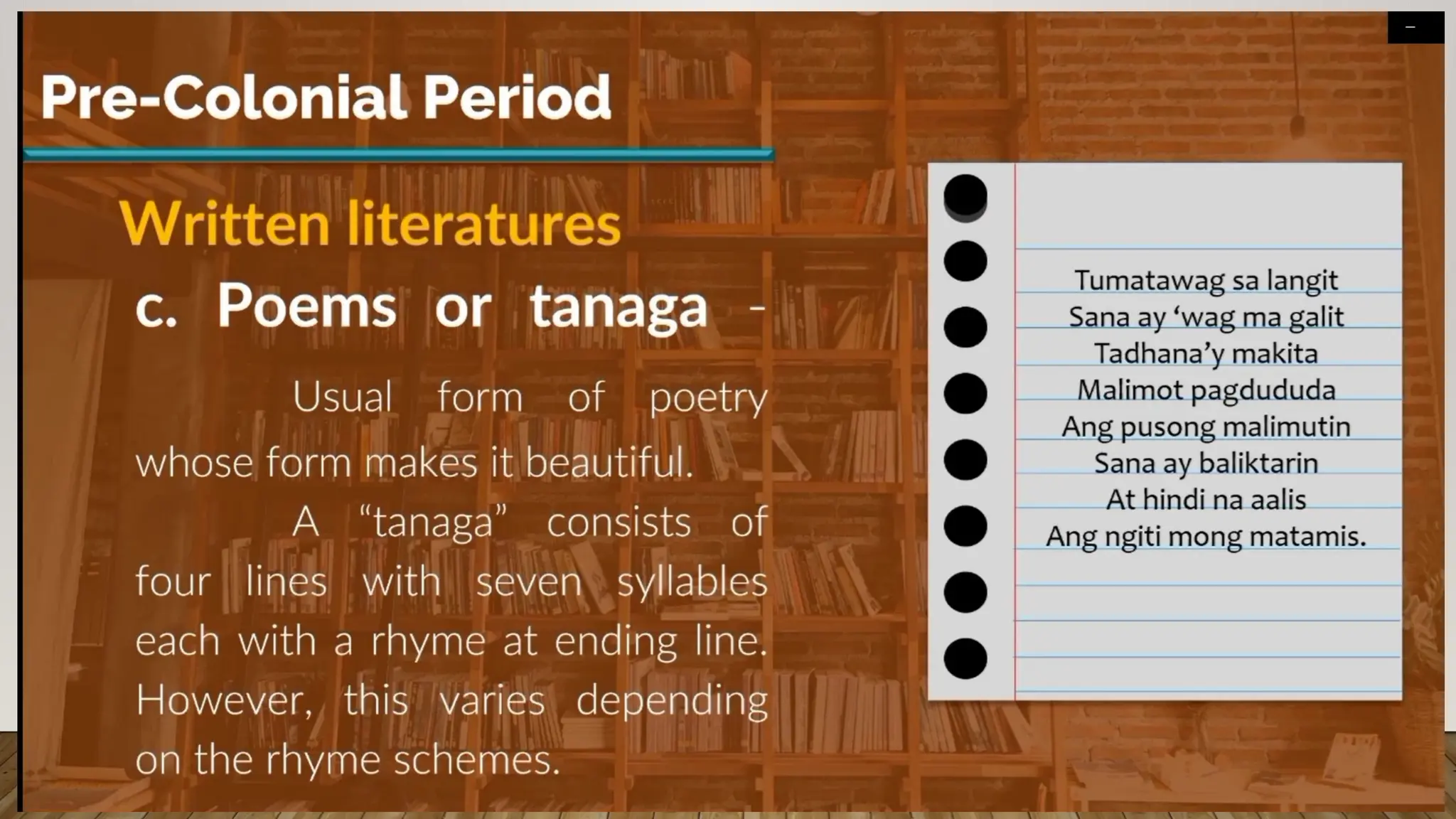
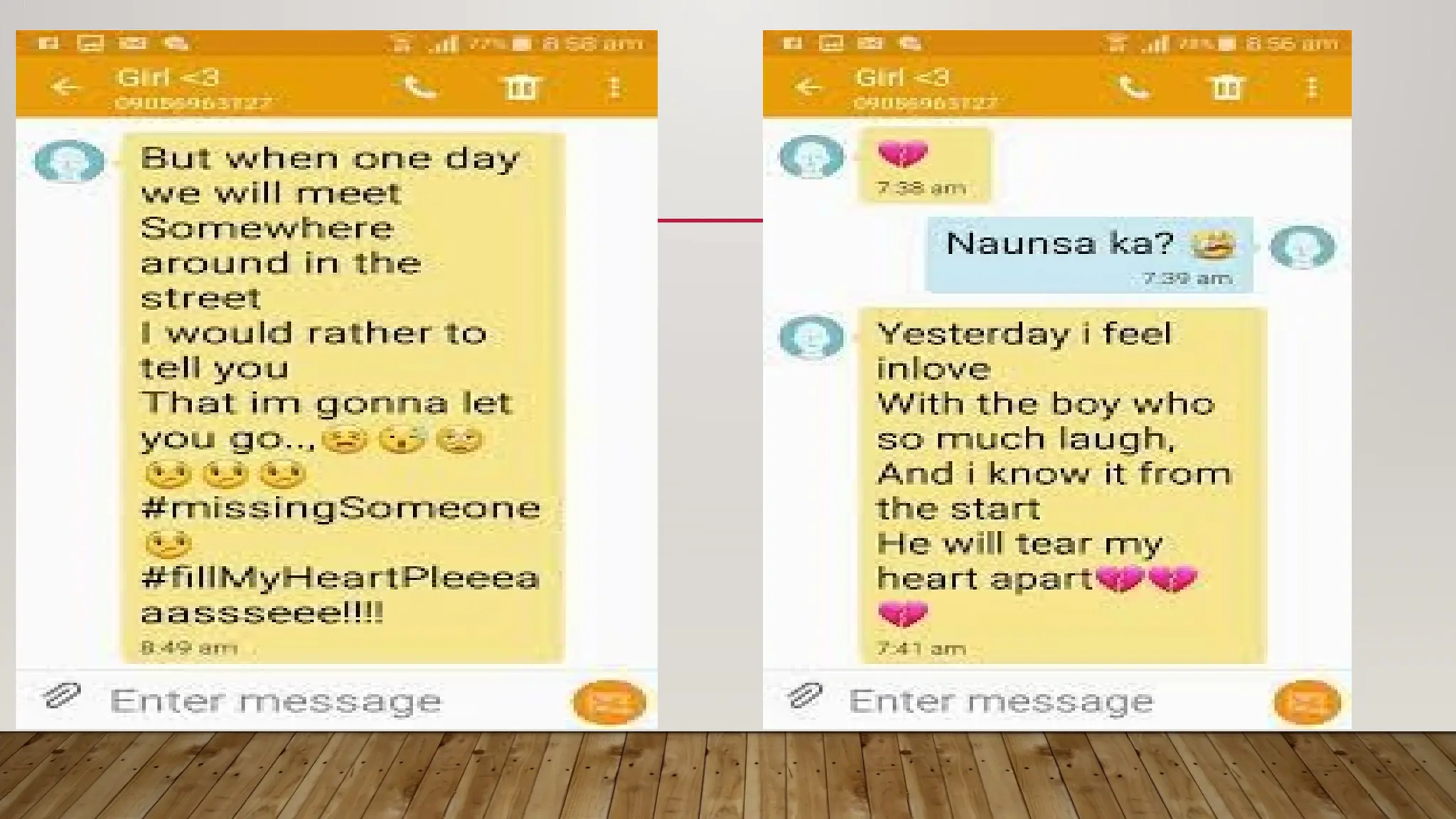
Mobile phone text tula– it is a group of words that uses
mobile gadgets. It is also more like a tanaga. It consists of four
lines and seven syllables, and every ending of lines has a rhyme
word.
MOBILE PHONE TEXT
TULA
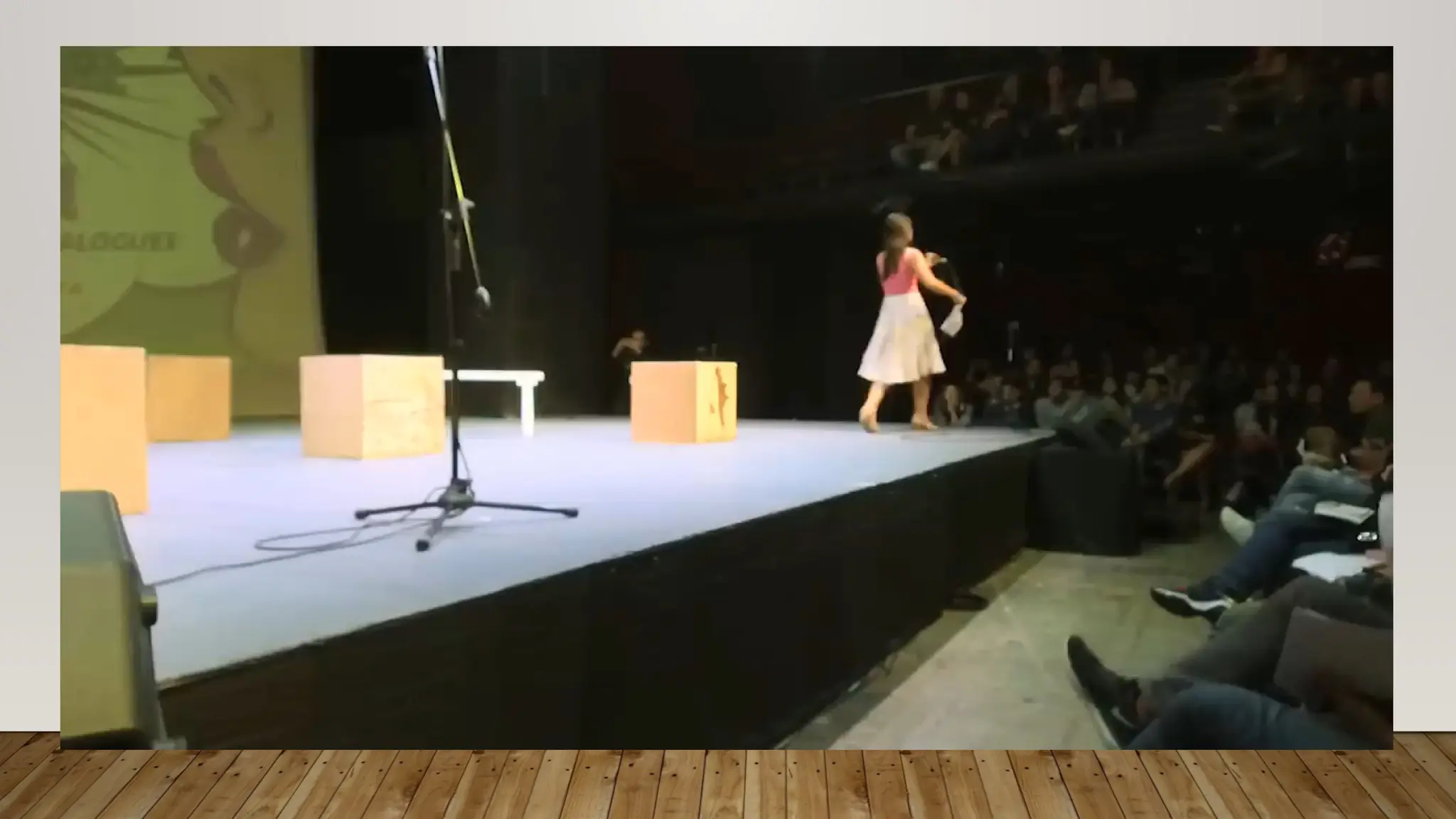
SPOKEN WORD POETRY
It is written on a page but performed for an audience.
It is a piece of writing that is meant to be read aloud. It
may be stories or poems.
FICTION
• Fiction has genres that can be defined as
narrative literary works wherein its content is
produced by the imagination. In fiction something
is invented, or imagined; a made-up story
SCIENCE FICTION
• A genre of speculative fiction dealing with imaginative
concepts such as futuristic science and technology, space
travel, faster than light travel, parallel universe and
extraterrestrial life.
• It often explores the potential consequences of scientific
and other innovations and it has been called a “literature
of Ideas”.
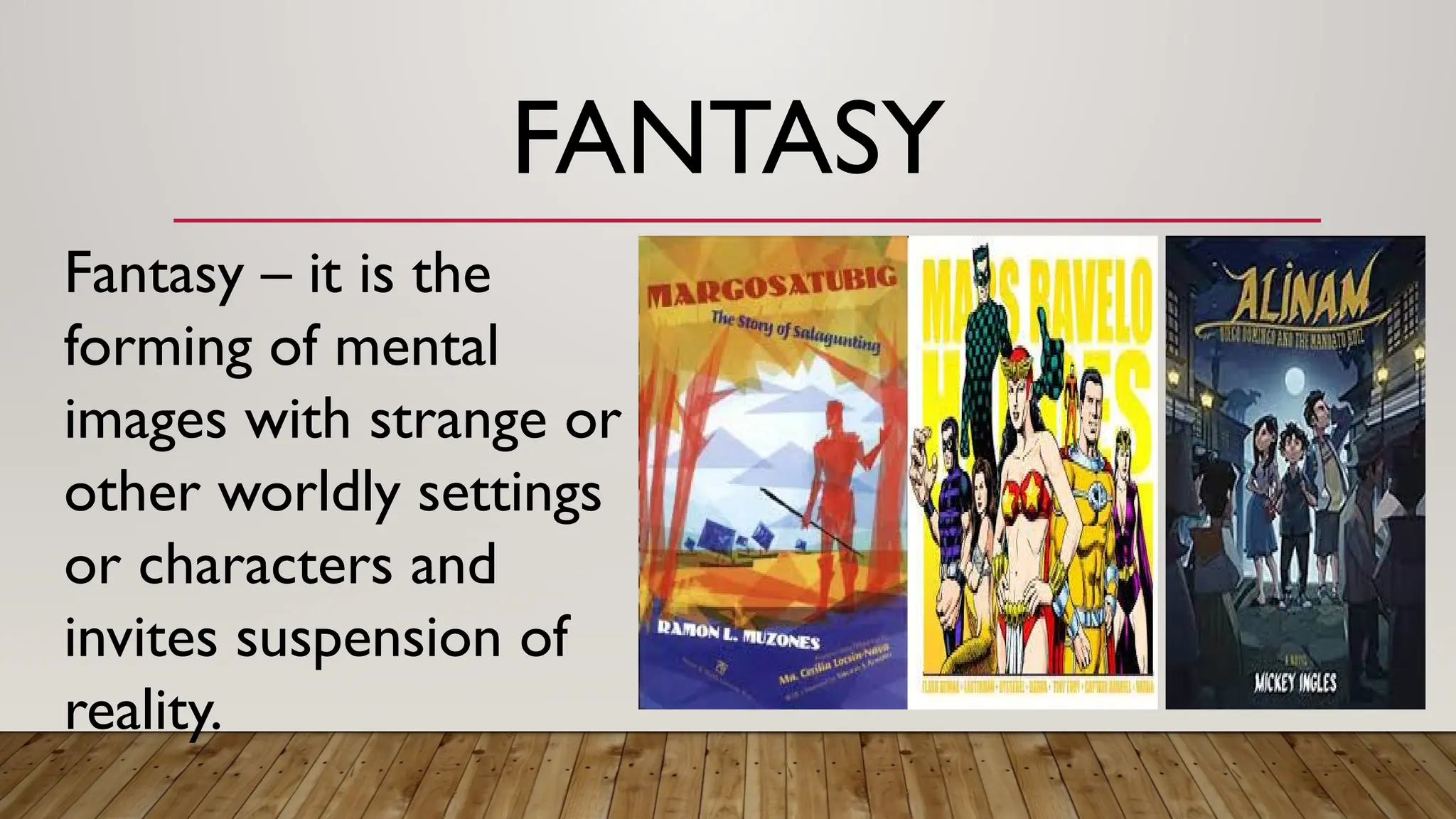
FANTASY
Fantasy – it is the
forming of mental
images with strange or
other worldly settings
or characters and
invites suspension of
reality.
SHORT STORY
This is brief fiction that can be read in one
seating. It has a fully developed theme but is
significantly shorter and less elaborate than a
novel.
FLASH FICTION
This is a style of fictional literature or fiction of extreme
brevity.There is no widely accepted definition of the
length of the category. Some self-described markets for
flash fiction impose caps as low as three hundred words,
while others consider stories as long as a thousand
words to be flash fiction.
SIX-WORD FLASH FICTION
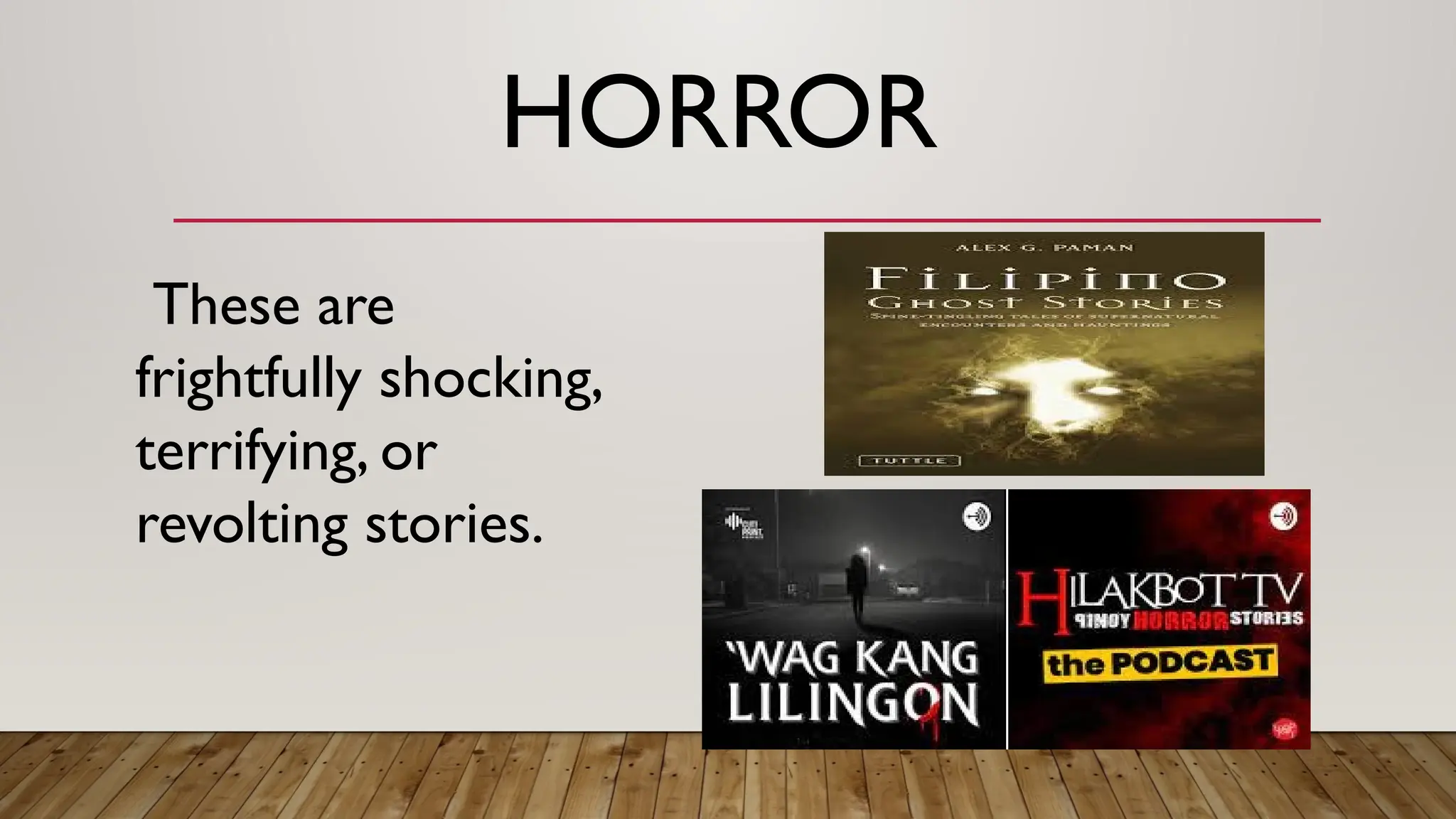
HORROR
These are
frightfully shocking,
terrifying, or
revolting stories.
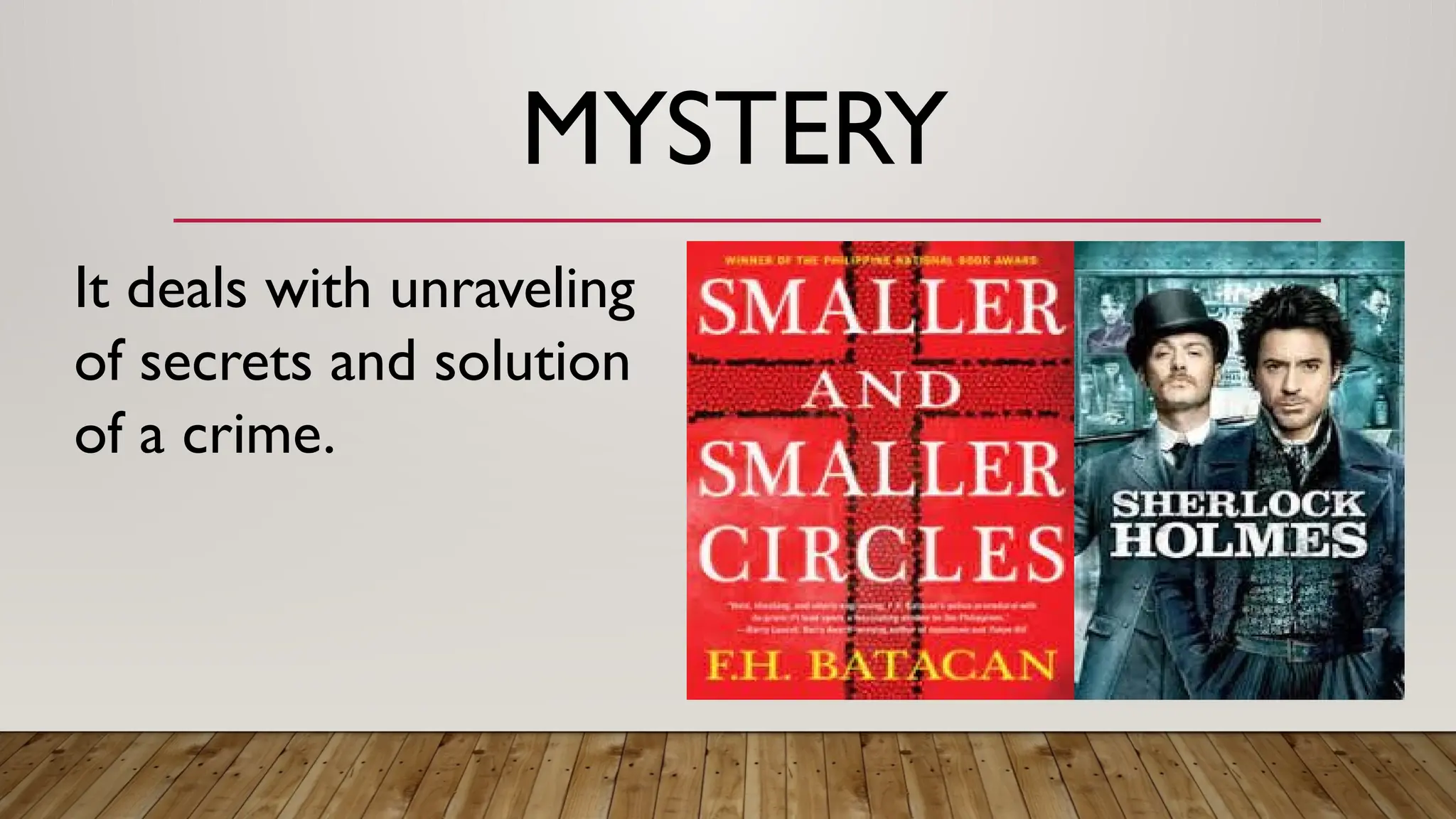
MYSTERY
It deals with unraveling
of secrets and solution
of a crime.
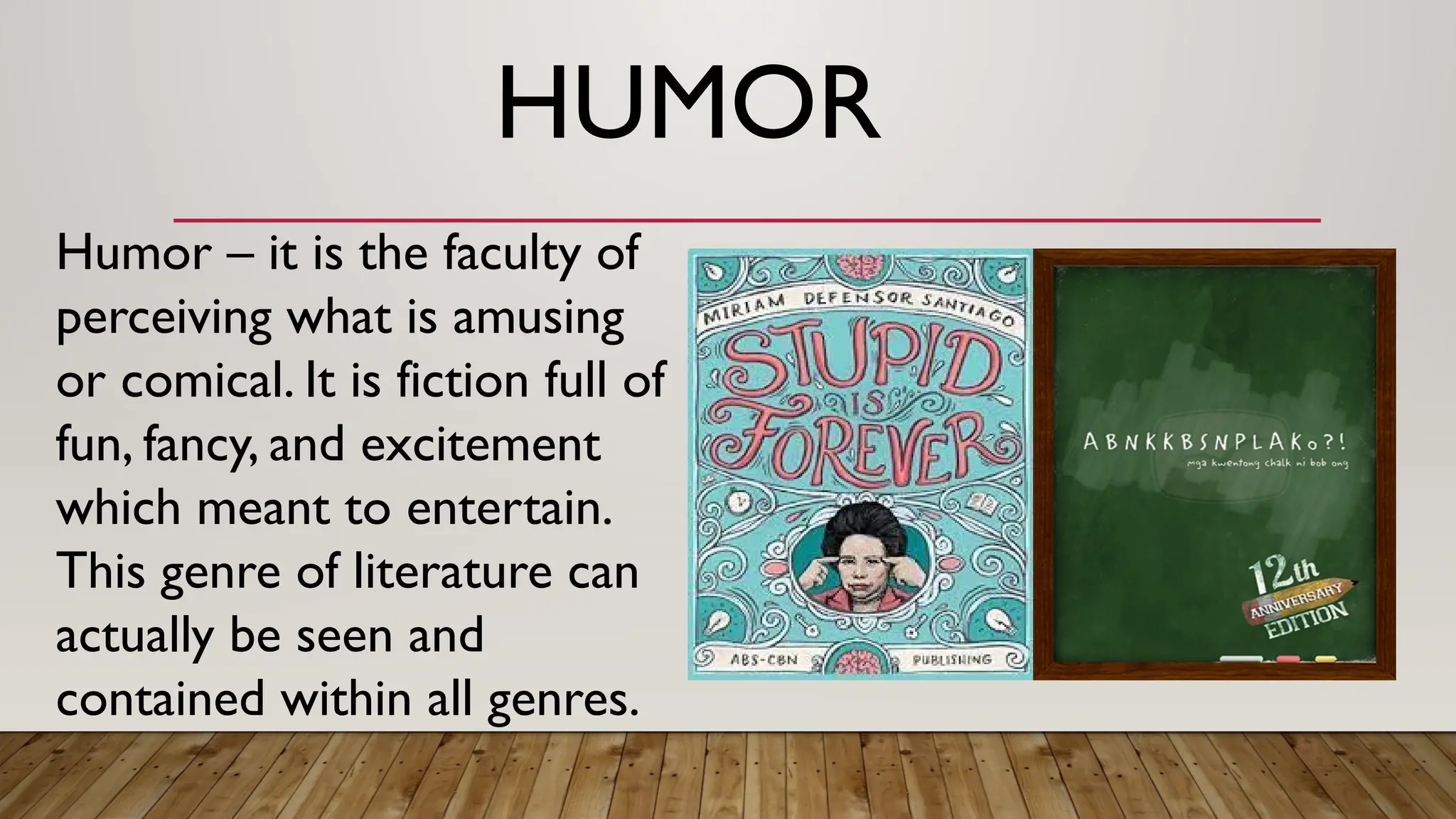
HUMOR
Humor – it is the faculty of
perceiving what is amusing
or comical. It is fiction full of
fun, fancy, and excitement
which meant to entertain.
This genre of literature can
actually be seen and
contained within all genres.

FINAL PPT PHIL LIT.pptx48272022i1902387e19.

FINAL PPT PHIL LIT.pptx48272022i1902387e19.

  • 1.
  • 2.
    PHILIPPINE LITERARY HISTORY FROMPRE- COLONIALTO CONTEMPORARY A MAJOR, MAJOR THROWBACK
  • 3.
    Philippine literature isa diverse rich group of works that has evolved side-by-side with the country’s history.
  • 4.
    The evolution ofPhilippine literature depended on the influences of colonization and the spirit of the age.
  • 5.
    The first Filipinoalphabet is called Alibata.
  • 16.
  • 17.
    Unlike the Tagalogs,ancient Visayans didn’t have a creator god like Bathala who appeared out of nowhere and decided to create humanity. But what they lacked in “creator god” they made up for in plenty of origin myths.
  • 18.
    They worshiped andoffered prayers to a variety of invisible beings. These could either be a diwata (i.e. gods and goddesses) or the spirits of their ancestors called umalagad.
  • 19.
    Our Visayan ancestorsalso believed in the afterlife, although theirs had no heaven or hell as we understand them today. The 17th century Augustinian priest Father Méntrida said that because these ancient Visayans had no knowledge of hell, “they call the Inferno, Solar (Sulad), and those who dwell in the Inferno, solanun.”
  • 20.
    The Sulod ofCentral Panay in Western Visayas believed that the universe was divided into three regions: Ibabawnun (upperworld), Pagtung-an (middleworld), and Idadalmunun (underworld).
  • 21.
    Ibabawnun was furtherdivided into two– a place ruled and inhabited by the male diwata, and the other by the female diwata.
  • 22.
    For the malesection, a deity named Tungkung Langit (literally means “pillar of the skies”) was considered the supreme god or the highest-ranking deity. Alunsina, meanwhile, was the most powerful female diwata and the goddess of the eastern skies.
  • 23.
    Both Pagtung-an (middle world)and the Idadalmunun (underworl d) were also ruled by deities. The underworld was under the jurisdiction of its highest ranking deity, Panlinugon, who also happened to be the god of earthquake.
  • 24.
    The couple Paiburong and Bulawanon ledother deities in keeping the middleworld in perfect order.
  • 25.
  • 26.
    • An originmyth from Panay suggests that Tungkung Langit and Alunsina, the chief gods of the upperworld, were actually married and settled down in heaven. The story, which was part of the old myths and legends compiled by anthropologist F. Landa Jocano in 1971, traced the origin of the world and celestial bodies. • After marrying Alunsina, Tungkung Langit worked non-stop to put an order in the confusing and still-shapeless world. He was described as a “loving, hard-working god,” while his wife a “lazy, jealous, and selfish goddess.”
  • 27.
    One day, asTungkung Langit left their home in the skyworld to perform his duties, Alunsina ordered the breeze to follow and spy on her husband. When Tungkung Langit found out about it, a long argument ensued. The fight became so serious and hurtful that Alunsina decided to leave her husband, never to be seen again.
  • 28.
    • Several lonelymonths later, Tungkung Langit tried to find his wife everywhere, but to no avail. In desperation, he took Alunsina‘s jewels and spread them in the sky, hoping that somehow she would notice them and be compelled to return. • Sadly, Alunsina never bothered to come back. It is believed among the old folks of Panay that Alunsina‘s necklace became the stars, while her comb and crown became what we know today as the moon and sun, respectively. • They also think that the rain is actually the tears of Tungkung Langit falling from the sky. The thunders, on the other hand, could be the supreme god desperately calling for his beloved wife.
  • 29.
  • 30.
    •Other parts ofthe ancient Visayas believed the world was divided into three regions: Kahilwayan or the skyworld; Kamariitan or the earth; and Kasakitan or the underworld.
  • 31.
    •Kaptan was thesupreme god of these early Visayans. He lived in Kahilwayan and always passed through the Madyaas mountain in Panay every time he came down to earth.
  • 32.
    •Kaptan married agoddess named Magwayen and together they ruled the skyworld.
  • 33.
    • According toan ancient origin myth recorded by Miguel de Loarca from the coastal people of Panay (possibly in Oton, Iloilo), Kaptan married a goddess named Magwayen and together they ruled the skyworld.
  • 34.
    • And justlike what happened to Tungkung Langit and Alunsina, the two had an argument, ending up with Magwayen leaving her husband. To cope with his sorrow, Kaptan went to his garden called kabilyawan and there he planted a bamboo tube. As the plant grew by leaps and bounds, Kaptan thought of creating a man and a woman who could take care of the bamboo. • Before long, the bamboo split in half and from it came out the first man which Kaptan named Si Kalak (“the sturdy one”), and the first woman whom she christened Si Kabay. The two became the ancestors of humanity.
  • 35.
    • In otherancient stories, Magwayen was considered the goddess of the sea and death. Gregorio Zaide’s Philippine History and Civilization mentioned Maguayen as the “Visayan Acheron who ferried the souls of the dead from the land of the living to the other world.” • The ancient people of Panay knew Magwayen as the boatman who delivered the soul to the afterlife. Upon its arrival, the soul could either be accepted or rejected depending on whether he was decorated with sufficient gold jewelry. Those rejected would remain in Sulad or the ancient counterpart of Inferno unless his relatives offered enough sacrifices to save him.
  • 36.
  • 37.
    • Another versionof the Visayan origin myth suggests that Kaptan and Magwayen were not a couple. Instead, they were both guys, with Kaptan ruling over the skyworld and Magwayen lording over the water.
  • 38.
    •, Kaptan issaid to be the father of Lihangin, the god of the wind, while Magwayen sired the goddess of the sea, Lidagat.
  • 39.
    • With thepermission of their fathers, Lidagat and Lihangin got married and raised four kids: the strong Licalibutan who had a body made of rock; the always- happy Liadlaw (god of sun) who was covered with gold; the shy and weak Libulan (god of moon) who was made of copper; and the only daughter, Lisuga (god of stars), whose silver body always sparkled.
  • 40.
    • For atime, the family seemed to be happy and had no issues at all. However, everything changed when Lihangin and Lidagat died. Their eldest son, Licalibutan, became the victim of his own greed.
  • 41.
    • One day,he planned a surprise attack against the skyworld to hopefully seize its control from the supreme god Kaptan, his grandfather. Joining him were Liadlaw and Libulan who were too afraid of him to even think of backing out. Together, they went to the skyworld and blew up the gates protecting the kingdom.
  • 42.
    • When Kaptanlearned about the attack, he was enraged. The skygod sent three lightning bolts to his grandsons, which all melted instantly. Both Liadlaw and Libulan were reduced into a ball, while Licalibutan‘s rock-hard body broke into pieces, fell into the sea, and became what is known as land.
  • 43.
    • When heand Magwayen finally met, things started to sink in for Kaptan. He lost all his grandchildren, including the beautiful Lisuga who had nothing to do with the conspiracy at all. • The grief-stricken Kaptan, upon realizing he could no longer revive the four deities, decided to just provide their remains with an everlasting light. Hence, Liadlaw became the sun, Libulan became the moon, and Lisuga became what we know today as the stars.
  • 44.
    • As forthe evil Licalibutan, Kaptan didn’t bother to give him light. He thought it was just fair to let him remain as it is–the land that would support the human race. Soon, Magwayen planted a seed on the said land and it didn’t take long before a bamboo tree started growing.
  • 45.
    • Lisuga, unawareof what was happening, also went to the skyworld to visit his grandfather. Kaptan, too blinded by his anger, struck the innocent Lisuga with lightning as well, breaking her into thousand pieces.
  • 46.
    LIDAGAT The ancient Visayansthought of Lidagat as the only daughter of Magwayen, the ruler of the seas, and when she was born, her mother gave her the powers over the watery domain. She is often pictured as a beautiful woman of the seas, some pictured her as having a body made of water, waves for hair and fish and merfolk for company, while others thought of her sharing the same appearance as the merfolk or a mermaid. She is widely venerated in ancient times as the goddess of sealife and therefore, the goddess of fishermen as well. It is said that when fishermen pray to her, and they received a bountiful catch, they used to toss a large piece of fresh meat to the sea to give thanks for blessing them with abundance.
  • 47.
    LIHANGIN Lihangin was adevoted husband to Lidagat and the father of their 4 children, he is described as a noble man riding the clouds or being carried by the wind, he was also worshipped as a weather deity by the ancient Visayans, they pray to him for good weather during planting season and good warm winds during the dry season when the crops are harvested and pottery making were in demand, and he was also venerated together with his wife Lidagat, as a couple by ancient sailors and people who travel via the sea in their large balangays, seeking for favorable wind which will take them to a much fertile land to set foot on .
  • 48.
    LICALIBUTAN He was describedas a god who has a large body made of rock and has a very aggressive attitude. His brothers Liadlaw and Libulan always looked up to him and they were ready to follow his every command. He was also Lihangin’s favorite son and was spoiled very much by him. When Lihangin died, Licalibutan was beside him, and he blessed the rock deity with his powers to control the winds of the earth.
  • 49.
    LIADLAW Almost all culturesdepict the sun god as a strong, handsome man in his late 20's to early 30's and the epitome of male perfection. He is blessed with all the BEST QUALITIES in a man yet he has a cheery disposition and a fiery spirit. Liadlaw fits the mold, except with some slight differences, he has a body made of gold, and he is a second son, and being the middle child he is always torn among his brothers, Licalibutan and Libulan, he cannot make up his own mind that easily, he looks up to Licalibutan the eldest and yet he is also dependent on the advices of Libulan, the youngest. You can say he may be the brightest among the sky creations but he was not the wisest among the lot. He also has the tendencies to get attracted or seduced by female spirits and other beautiful deities, which makes Libulan's job of keeping him in focus even harder.
  • 50.
    LIBULAN Libulan in mythsof theVisayas is portrayed as a man, but some say moon is a female aspect of the sun so is a woman in other myth. However Libulan is considered as a hermaphrodite or a crossdresser. For ancient Visayans during the olden days, babaylans garbed in female fashion were regarded in high esteem by the barangays. He/she is soft-spoken, well-mannered, more effeminate and most eccentric. His body is made of copper. He is depicted as more slender, graceful and shy.
  • 51.
    SIDAPA AND LIBULAN Longago the god of death resided alone on top his mountain. From his domain he saw the seven moons dancing. He admired the moons for their beauty and fell in love with them. He realized that the other gods were also infatuated with the moons, such as Luyong Baybay (goddess of tides) who was singing to the moons. To outperform the other gods, Sidapa asked the birds and mermaids to sing his endearments to the moons. He ordered the flowers to bloom and make sweet perfumes that would reach the heavens. Lastly he asked the fireflies to light a way so the moons could find their way to him… One of the moons came down, it was the young boy Bulan. Sidapa showered the boy moon with gifts and songs .
  • 52.
    One night, Bakunawa(the moon eating dragon who was also captivated by the beauty of the moons) rose from the sea. Sidapa saw this and quickly flew to the cosmos to snatch the boy Bulan before Bakunawa could devour him. Sidapa saved Bulan from Bakunawa and it is said that they live together as lovers on top of Mt. Madjaas to this day. SIDAPA AND LIBULAN
  • 53.
    LISUGA • Visayans prayedto Lisuga to guide them through their sea voyages by giving them knowledge to read the constellations in the night sky. She taught them ancient astronomy and kept them safe at sea as they ventured to new lands. • Lisuga represents the need to be joyful in life and even when adventuring in to the unknown. Just as she kept Visayans safe out at sea with her stars. She asks that we also know that taking risks into the unknown is something that can bring great joy and reward.
  • 54.
    BARANGAW When a warriordied in a battle, the ancient Visayans believed that they traveled up the rainbow to the sky. These warriors also turn into gods once they reached the skyworld, the kingdom of Kaptan, and would guide any relatives who could avenge their deaths. Among these warriors-turned-rainbows, a deity called Varangao was considered the most powerful. He became the god of the rainbow, and the natives prayed to him before going to war or plundering expeditions.
  • 55.
    • Ynaguinid isthe Visayan goddess of war and poisons, who along with Barangaw, was one of the gods invoked before or during battle. Babaylans and datus pray to her to bless warriors with might, bravery, and strength. In some tales Ynaguinid appears as a warrior covered in many tattoos, symbols of a victor and slayer of men, her face streaked with blood, her teeth sharpened like shark teeth and blackened with coal and herbs. YNAGUINID
  • 56.
    • Dalikamata isan important deity in the Ancient Visayan society due to her role as a health goddess, more specifically the health of the eyes. • Dalikamata is a goddess with an awesome presence. She is depicted to be a lovely maiden surrounded by thousands of eyes all around her body, each eye is capable of seeing far and near and gifted with the power of clairvoyance, keeping track of every person that lives in the village and knows each action the villagers did. DALIKMATA
  • 57.
    BULALAKAW Bulalakaw is saidto be a deity who has the appearance of a gigantic, shining bird or a bird-humanoid hybrid, as some believed he looks like a thin boy wearing a bird-like headdress or even a genderless deity with a bird's head. Some stories describe him to be a diwata who visits the earthly plane in form of a comet, hence the name "bulalakaw" (shooting star).
  • 58.
    BURIGADANG PADA SINAKLANG BULAWAN •Wealth and greed go hand in hand, and both are under the special guidance of the "golden deity" of the Visayan pantheon, Burigadang Pada Sinaklang Bulawan (her name usually means Coveted Gold, Desired/Precious Gold), the goddess of greed. Burigadang Pada Sinaklang Bulawan is more known to the masses as the wife of Humadapnon, one of the three heroic sons of Alunsina in the epic poem, Hinilawod.
  • 59.
    LALAHON Lalahon is amythical diwata found in ancient visayan folktales and written myths, her traditions has changed greatly especially since the Spanish conquistadores occupied the Philippines. She is seen as a goddess of harvests, guardian of volcanoes, and goddess against natural calamities brought about by volcanic eruptions, wildfires and earthquakes.
  • 60.
    SUKLANG MALAYON • Theancient visayans also worship a goddess of the home and hearth in the form of Suklang Malayon, who is also the goddess of families and happiness. Suklang Malayon is known as the protective sister of Alunsina and is described as a fair lady surrounded by birds, which serves as her messengers.
  • 61.
    MAKAPTAN • The godof hunger and poverty. He is the supreme god who dwells in the sky and the one who killed the first man with a thunderbolt and visited disease and death on his descendants.
  • 62.
    LUYONG BAYBAY The deitywho controls the rising and falling of the tides. Her name Luyong Baybay is translated as “She who was born from the Sea” and was worshipped by ancient Visayan fishing villages especially in the island of Panay. Another myth says that Luyong Baybay is very much infatuated with the Moon Deity, Libulan, that whenever he gets close to earth, the tides rise up because she is trying to get close to him.
  • 63.
    KASARAYSARAYAN SA SILGAN •He is believed by the Visayans to be the god whom all the rivers of the archipelago follow. He dictates how each river should flow and on what direction. In Panay, it was believed in the olden days that this particular deity lives in Tinagong Dagat lake in Lambunao, a fresh water lake which contains all sorts of freshwater fishes that the locals of the community depended on for livelihood and food.
  • 64.
  • 65.
    MULTO Your basic Philippinemythical creature is the multo, which is a GHOST.
  • 66.
    ASWANG • Another mythologicalcreature that comes to mind immediately is the aswang, which is a creature that consumes the innards of a cadaver. The term aswang is also used as a catch-all name for various viscera-sucking creatures in Philippine mythology.
  • 67.
    MANGKUKULAM • Any promdiknows that if you've got an ailment that can't be explained, it's probably the fault of a mangkukulam. If you cross a mangkukulam and you're careless with your personal effects, beware. They'll probably perform a "kulam" using your personal effects and a doll or photograph.
  • 68.
    SIGBIN • This creaturemay not be familiar to people from Luzon, but Boholanos definitely know of the sigbin. It's said to look like a small kangaroo, with flapping ears, burning eyes, a whip-like tail, and the ability to walk backwards. During the Holy Week, sigbins are said to go out and hunt for the hearts of children.
  • 69.
    WHITE LADY Technically, theWhite Lady is a multo. However, she's popular enough that she's got her own story and specific haunt. Any Manileño cab driver knows to be careful when picking up a passenger at Balete Drive in Quezon City. As the story goes, they start out picking up a beautiful, long-haired woman in a white dress. But the moment they look back at the White Lady, all they see is a bruised and bloody face.
  • 70.
    BEBEROKA Being an archipelago,there's no shortage of water creatures in our mythology. An example of such is the berberoka, who lives in freshwater and preys on fishermen. The berberoka will suck water from lakes until schools of fish become visible to fishermen. Once the fishermen are drawn to the fish, the berberoka will use the water it sucked to drown the helpless victim.
  • 71.
    BUNGISNGIS When you hearthe word bungisngis, terror isn't the word you associate with it. After all, it translates to giggling in English. But in Bataan, the bungisngis is a one-eyed creature with huge upper lips, humongous teeth, and tusks that resemble those of an elephant. Even worse, they prey on livestock.
  • 72.
    AMOMONGO The amomongo issupposedly a hairy white ape that disembowels chickens, goats, and other small animals and then eats their intestines. If you want to see the amomongo, it supposedly lives at the base of Mt. Kanlaon in Negros Occidental.
  • 73.
    KAPRE Kapre is amythical creature characterized as a tree giant because of it’s huge, black, and hairy built that usually stays at a branch of a tree smoking. The elders said that a kapre may make contact with people to offer friendship and can be attracted to a beautiful woman. They are not considered as evil creatures but can be vengeful to those who try to cut down the tree it is inhabiting.
  • 74.
    TIKBALANG • There isalso the tikbalang, a giant creature with the head of a horse and body of a man. The mythical creature is often playful and would cause travelers to get lost in the wild. Some pranks, however, turn severe and cause people to lose their minds. • The stories of this creature are used by parents to frighten children from going out at night. It is said that, when you feel disoriented or off-track when hiking, you are getting pranked by a tikbalang and you have to turn your shirt inside out to ward it off.
  • 75.
    DUWENDE • Another playfulFilipino mythical creature is the duwende. They appear as little old men who only show themselves to people they like. It is said that if a friendly duwende lives in your home, you will enjoy a good and prosperous life. • The duwende, however, is easy to offend and would often curse people with illnesses or misfortune. To avoid this, Filipinos would often say “tabi-tabi po,” (Excuse me) to ask for permission before doing anything, which may anger a duwende. Tabi-tabi po is also a very common expression used by hikers to express respect to any supernatural beings lingering in the forests and mountains.
  • 76.
    TAYHO •It is acreature with the upper body of a human and the lower body and legs of a horse. It is said that the Tayho is an offspring of a female water buffalo and a giant male Agta.
  • 77.
    SANTILMO •A floating flameor fire ball, similar that stalk or chase people at night, believed to be the ignited blood of a person who met a tragic death.
  • 78.
  • 83.
    PASYON •The Pasyon isan epic narrative of the life, death and resurrection of Jesus Christ. In the stanzas of five lines of 8 syllables each, the standard elements of epic poetry are interwoven with a colorful, dramatic theme.
  • 86.
    PASYONG DAPAT IPAG-ALABNG PUSO NG TAONG BABASA •Here he recounts the abuses of the friars, and then concludes that the only time that the friars are kind and loving to the parishioners is when the latter are rich and submissive to them.
  • 88.
  • 90.
    AWIT VS. CORRIDO •Awit is the Tagalog word for song. It is a fabricated story from the writer’s imagination and the characters are European. Example is Florante at Laura by Francisco Balagtas. (12 syllables per line) • Corrido means a metrical story, usually sung to the accompaniment of a guitar. Example is Ibong Adarna (8 syllables per line)
  • 91.
    KOMEDYA/MORO-MORO • It isa theatrical drama. The theme centers on the animosity between the Christians and the Muslims. The presence of the vital elements in a drama like love, hate, war, religion and parental disputes make the Komedya spectacular not only because of the colorful costumes but also of the real and suggestive moments of the performers on stage.
  • 94.
    •The major contributionbrought to the Philippine literature under the American regime (1898- 1941) is the production of the Philippine literature in English.
  • 95.
    •The Philippine literatureunder the American regime saw its dawn with the introductions of free public instruction and the use of English as a lingua franca in all levels of education in public schools.
  • 96.
    • The Filipinoswon against the Spaniards who colonized Philippines for more than 300 years.The Philippine flag was hoisted as on June 12, 1898 as a symbol of independence. Gen. Emilio Aguinaldo was elected the first president of the Philippine republic, which was short-lived. Americans colonized the country.
  • 97.
    •Filipino writers wentinto all forms of literature. Their writings showed their love for the country and their longing for independence. •Spanish and Tagalog and the vernaculars were the languages used in writing during the first years in American period, but Spanish and Tagalog were the predominated language.
  • 98.
    •In 1910, anewgroup started to write in English. Hence, Spanish,Tagalog, theVernaculars and finally English, were the mediums used in literatures during these times.The first English teachers were the Thomasites.
  • 99.
    •Spanish writers wroteabout nationalism. •Tagalog writers wrote about their lamentations on the conditions of the country and their attempts to arouse love for one’s native tongue. •English writers imitated the themes and methods of the Americans.
  • 100.
  • 101.
    FERNANDO MA. GUERRERO •Knownas the “Prince of Filipino Lyric Poets” in Spanish •Wrote a book of poems entitled Crisalidas
  • 102.
    JOSE CORAZON DEJESUS • Popularly known as Huseng Batute • Also called as the Poet of Love • Ang Isang Punongkahoy is believed to be his masterpiece
  • 103.
    SEVERINO REYES •The Fatherof Tagalog Drama •Author of Walang Sugat
  • 105.
    PAZ LATORENA • PazManguera Latorena was born on Jan. 17, 1908 in Boac, Marinduque. She was the oldest among the ten children of Magda Manguera and Ricardo Latorena • In 1926, she took up Education at the University of the Philippines (UP) in Manila where she also attended a short story writing class under Paz Márquez-Benítez. • She won the third prize in Jose Garcia Villa’s Roll of Honor for the Best Stories of 1927 for her story, “The Small Key.”
  • 106.
    JOSE GARCIAVILLA Jose GarciaVilla (1908–97) is best known as a modernist poet in Philippine literature whose experiments and audacity brought him both notoriety and fame. Before he became a poet, however, he was a painter. He considered painting his “first love” and actively painted and drew in the 1920s and 1930s. While poetry eventually took precedence, the visual arts remained a constant in Villa’s life and work—as inspiration, influence, and self-expression.
  • 107.
    THE BASHFUL ONE BY:JOSE GARCIAVILLA ,
  • 108.
  • 109.
    • The Japaneseperiod has been called one of the darkest days in the history and literary tradition of the Philippines. The wartime experiences and events of the troubled times left indelible imprints to the lives of the Filipino nation.
  • 110.
    • The strideand growth of the Philippine literature in English language and the development of Philippine literature in general was interrupted during the Japanese period. The Japanese censured all publications except Tribune and Philip pine Review.
  • 111.
    • During theJapanese period, Philippine Literature in English was stopped and writers turned to writing in Filipino. The Japanese authorities, with extreme hate to the Americans, did their best to turn the Filipinos’ sympathy away from them.
  • 112.
    • In proseliterature, the weekly Liwayway Magazine was put into strict surveillance and was managed by a Japanese named Ishiwara. • The Japanese language, Nippongo was introduced but not well-embraced by the Filipinos despite it is being forcefully taught by the Japanese.
  • 113.
    • With theprohibition of writing literary pieces in English language, Filipino literature was given a break. • Many Filipino writers wrote plays, poems, short stories, etc. in the Tagalog and other vernacular language. Topics and themes were often about life in the provinces to escape Japanese control and censorship.
  • 114.
    • Haiku A poemof free verse that the Japanese liked. It is made up of seventeen(17) syllables divided into three(3) lines. The first line has five, the second – seven and the third – five. It is allegorical in meaning, short and covers a wide scope in meaning.
  • 115.
    •Tanaga Like haiku, itis short, but has measure and rhyme. Each line has seventeen syllables and is also allegorical in the meaning.
  • 116.
    • The dramaexperienced a lull during the Japanese period because movie houses showing american films were closed. The big movie houses were just made to show stage shows. Many of the play were reproductions of English plays to Tagalog the translators were Francisco Soc Rodrigo, Alberto Concio, and Narciso Pimentel. They also founded the organization of Filipino players named, dramatic Philippines. • A few of the play writers were: 1. Jose Ma. Hernandez – wrote PANDAY RIRA 2. Francisco Soc Rodrigo – wrote sa PUA, SA PUTI 3. Clodualdo del Mundo – wrote BULAGA(an expression in the game hide and seek) 4. Julian Cruz Balmaceda – wrote SINO BA KAYO?, DAHIL SA ANAK, and HIGANTI NG PATAY.
  • 117.
    • Nestor VicenteMadali Gonzalez, better known as N.V.M. Gonzalez, fictionist, essayist, poet, and teacher, articulated the Filipino spirit in rural, urban landscapes. Among the many recognitions, he won the First Commonwealth Literary Contest in 1940, received the Republic Cultural Heritage Award in 1960 and the Gawad CCP Para sa Sining in 1990.
  • 118.
    MANUEL E. ARGUILLA(1911-1944) was an Ilocano who wrote in English. He was best known for his short story "How My Brother Leon Brought Home a Wife." which received first price in the Commonwealth Literary Contest in 1940. Most of his stories depict life in Barrio Nagrebcan, Bauang, La Union, where he was born in 1911. He earned his Bachelor of Arts in Education in 1933 at the University of the Philippines. He became a member and later the president of the UP Writers' Club and editor of the Literary Apprentice. He married Lydia Villanueva, another talented writer, and they lived in Ermita, Manila.
  • 119.
    Nick Joaquin, byname ofNicomedes Joaquin, (born May 4, 1917, Paco, Manila, Philippines—died April 29, 2004, San Juan), Filipino novelist, poet, playwright, essayist, and biographer whose works present the diverse heritage of the Filipino people.
  • 120.
    Stevan Javellana wasborn in 1918 in Iloilo. He fought as a guerrilla during the Japanese invasion of the Philippines. After World War II, he graduated from the University of the Philippines College of Law in 1948. He stayed in the United States afterwards but he died in the Visayas in 1977 at the age of 59. Javellana was the author of a best-selling war novel in the United States (U.S.) and Manila, Without Seeing the Dawn, published by Little, Brown and Company in Boston in 1947.
  • 147.
    GENRES AND FORMS IN21ST CENTURY
  • 148.
    DRAMA It is thegenre of literature with stories composed of verse or prose which is meant to be dramatically or theatrically performed. Its emotions and conflicts are expressed through dialogue and movements or actions.
  • 149.
    CREATIVE NONFICTION • Creativenonfiction can be an essay, a journal article, a research paper, a memoir, or a poem; it can be personal or not, or it can be all of these. • Some of the creative nonfiction in the Philippines include but not limited to: 1. The Cardinal’s Sins,The General’s Cross,The Martyr’sTestimony, and Other Affirmation by Gregorio C. Brillantes; 2. Sapay Koma by Jhoanna Lynn Cruz
  • 150.
  • 151.
    BLOG A blogger issomeone who writes regularly for an online journal or website. It is a web log containing short articles called posts that can be changed regularly. Some blogs are written by one person (called blogger) containing his/her hobbies or interests, opinions, and experiences, while others are written by many different people.
  • 153.
    POETRY It is averse and rhythmic writing with imagery that evokes an emotional response from the reader. Poetry is “life distilled” through words and language.The art of poetry is rhythmical in composition, written or spoken. Poetry is for entertaining and exciting pleasure by beautiful, imaginative, or elevated thoughts.
  • 154.
    Mobile phone texttula– it is a group of words that uses mobile gadgets. It is also more like a tanaga. It consists of four lines and seven syllables, and every ending of lines has a rhyme word. MOBILE PHONE TEXT TULA
  • 156.
    SPOKEN WORD POETRY Itis written on a page but performed for an audience. It is a piece of writing that is meant to be read aloud. It may be stories or poems.
  • 158.
    FICTION • Fiction hasgenres that can be defined as narrative literary works wherein its content is produced by the imagination. In fiction something is invented, or imagined; a made-up story
  • 159.
    SCIENCE FICTION • Agenre of speculative fiction dealing with imaginative concepts such as futuristic science and technology, space travel, faster than light travel, parallel universe and extraterrestrial life. • It often explores the potential consequences of scientific and other innovations and it has been called a “literature of Ideas”.
  • 160.
    FANTASY Fantasy – itis the forming of mental images with strange or other worldly settings or characters and invites suspension of reality.
  • 161.
    SHORT STORY This isbrief fiction that can be read in one seating. It has a fully developed theme but is significantly shorter and less elaborate than a novel.
  • 162.
    FLASH FICTION This isa style of fictional literature or fiction of extreme brevity.There is no widely accepted definition of the length of the category. Some self-described markets for flash fiction impose caps as low as three hundred words, while others consider stories as long as a thousand words to be flash fiction.
  • 163.
  • 164.
  • 165.
    MYSTERY It deals withunraveling of secrets and solution of a crime.
  • 167.
    HUMOR Humor – itis the faculty of perceiving what is amusing or comical. It is fiction full of fun, fancy, and excitement which meant to entertain. This genre of literature can actually be seen and contained within all genres.