2014
MSE SENIOR DESIGN Study of the binding forces between Anti-ICAM-1 functionalized nanogels
and ICAM-1 Danielle R. Fau, Dr. Russell J. Composto
• Protein Attachment of anti-ICAM-1 (R6.5) to Substrates
• Optimized attachment chemistry using IgG as a surrogate for costly
anti-ICAM-1 (R6.5)
• Functionalized LDNG with anti-ICAM-1 :
• amine/aldehyde chemistry
• 4 C°, 8 hr anti-ICAM-1 attachment
• Vapor Deposited Triethoxsilylbutyraldehyde (TESBA) Substrate
(3h,85 C°) with (24 hr, 85 C°) bake:
• amine/ aldehyde chemistry
• 4 C°, 8 hr anti-ICAM-1 attachment
• AFM Topography of scratched samples:
• Interaction of rhICAM-biotin to Streptavidin (SA)
• ELISA Assay
• Site-specific biotinylated recombinant protein encourages rhICAM-1
in natural and uniform orientation for interaction with anti-ICAM
(R6.5)
• Moderate attachment of anti-ICAM (R6.5) to rhICAM-biotin without
SA surface sites
• SA control showed no absorption to anti-ICAM (R6.5)
• Attachment of rhICAM-biotin to 6µm SA Grafted PS Colloid
• Glue SA grafted colloid to tipless cantilever, cure 24 hr
• Immerse AFM tip in excess of rhICAM-biotin BSA/PBS solution (1 hr,
4 C°)
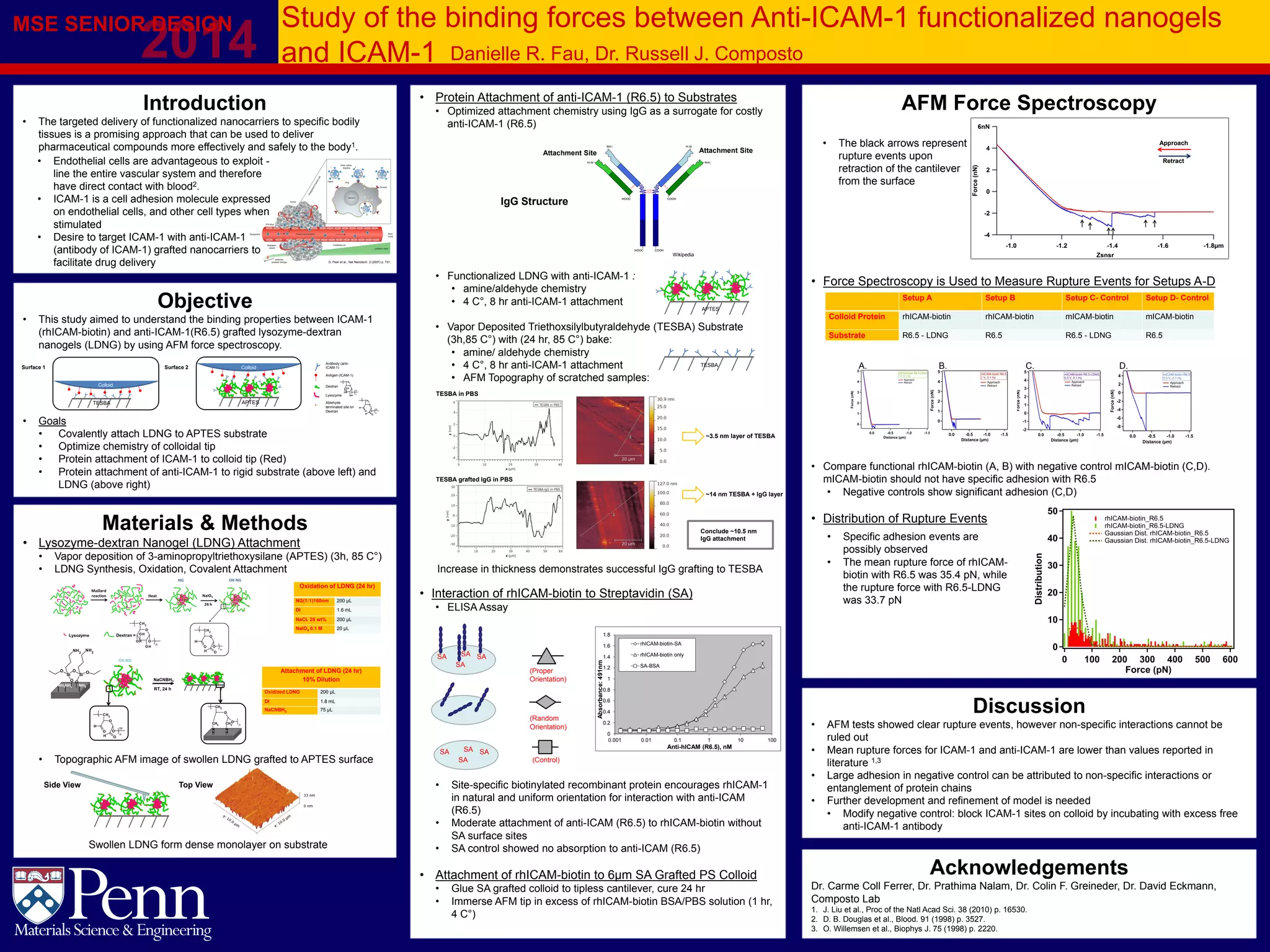
AFM Force Spectroscopy
• Force Spectroscopy is Used to Measure Rupture Events for Setups A-D
• Compare functional rhICAM-biotin (A, B) with negative control mICAM-biotin (C,D).
mICAM-biotin should not have specific adhesion with R6.5
• Negative controls show significant adhesion (C,D)
• Distribution of Rupture Events
Setup A Setup B Setup C- Control Setup D- Control
Colloid Protein rhICAM-biotin rhICAM-biotin mICAM-biotin mICAM-biotin
Substrate R6.5 - LDNG R6.5 R6.5 - LDNG R6.5
Acknowledgements
Dr. Carme Coll Ferrer, Dr. Prathima Nalam, Dr. Colin F. Greineder, Dr. David Eckmann,
Composto Lab
1. J. Liu et al., Proc of the Natl Acad Sci. 38 (2010) p. 16530.
2. D. B. Douglas et al., Blood. 91 (1998) p. 3527.
3. O. Willemsen et al., Biophys J. 75 (1998) p. 2220.
Discussion
• AFM tests showed clear rupture events, however non-specific interactions cannot be
ruled out
• Mean rupture forces for ICAM-1 and anti-ICAM-1 are lower than values reported in
literature 1,3
• Large adhesion in negative control can be attributed to non-specific interactions or
entanglement of protein chains
• Further development and refinement of model is needed
• Modify negative control: block ICAM-1 sites on colloid by incubating with excess free
anti-ICAM-1 antibody
Introduction
• The targeted delivery of functionalized nanocarriers to specific bodily
tissues is a promising approach that can be used to deliver
pharmaceutical compounds more effectively and safely to the body1.
Objective
• This study aimed to understand the binding properties between ICAM-1
(rhICAM-biotin) and anti-ICAM-1(R6.5) grafted lysozyme-dextran
nanogels (LDNG) by using AFM force spectroscopy.
• Goals
• Covalently attach LDNG to APTES substrate
• Optimize chemistry of colloidal tip
• Protein attachment of ICAM-1 to colloid tip (Red)
• Protein attachment of anti-ICAM-1 to rigid substrate (above left) and
LDNG (above right)
Materials & Methods
• Lysozyme-dextran Nanogel (LDNG) Attachment
• Vapor deposition of 3-aminopropyltriethoxysilane (APTES) (3h, 85 C°)
• LDNG Synthesis, Oxidation, Covalent Attachment
• Topographic AFM image of swollen LDNG grafted to APTES surface
NH2 NH2NH2
NH2
Si
O
Si
O
O
NH2
O
O
+
OX-NG
NaCNBH3
RT, 24 h
CH2
O
OH
O
H
O
n
ht
NaCNBH3
RT, 24 h
• Endothelial cells are advantageous to exploit -
line the entire vascular system and therefore
have direct contact with blood2.
• ICAM-1 is a cell adhesion molecule expressed
on endothelial cells, and other cell types when
stimulated
• Desire to target ICAM-1 with anti-ICAM-1
(antibody of ICAM-1) grafted nanocarriers to
facilitate drug delivery D. Peer et al., Nat Nanotech. 2 (2007) p. 751.
Top ViewSide View
Wikipedia
Swollen LDNG form dense monolayer on substrate
IgG Structure
Increase in thickness demonstrates successful IgG grafting to TESBA
A. C.B. D.
Retract
Approach• The black arrows represent
rupture events upon
retraction of the cantilever
from the surface
• Specific adhesion events are
possibly observed
• The mean rupture force of rhICAM-
biotin with R6.5 was 35.4 pN, while
the rupture force with R6.5-LDNG
was 33.7 pN
CH2
O
CH2
N
H
CH2*
O *
N
H
n
ht
O
OH
OH
OH
O
CH2
n
ht
CH2
O
OH
O
H
O
n
ht
Antibody (anti-
ICAM-1)
Antigen (ICAM-1)
Aldehyde
terminated site on
Dextran
Dextran
Lysozyme
Colloid
APTESTESBA
Colloid
Surface 1 Surface 2
Oxidation of LDNG (24 hr)
NG(1:1)160nm 200 µL
DI 1.6 mL
NaCL 25 wt% 200 µL
NaIO4 0.1 M 20 µL
Attachment of LDNG (24 hr)
10% Dilution
Oxidized LDNG 200 µL
DI 1.8 mL
NaCNBH3 75 µL
TESBA
APTES
Attachment Site Attachment Site
0
0.2
0.4
0.6
0.8
1
1.2
1.4
1.6
1.8
0.001 0.01 0.1 1 10 100
Absorbance:491nm
Anti-hICAM (R6.5), nM
rhICAM-biotin-SA
rhICAM-biotin only
SA-BSA
SA
SA
SA SA
SA
SA
SA SA
(Control)
(Random
Orientation)
(Proper
Orientation)
TESBA in PBS
TESBA grafted IgG in PBS
~3.5 nm layer of TESBA
~14 nm TESBA + IgG layer
Conclude ~10.5 nm
IgG attachment

Final Poster_ Senior Design_Danielle Fau

  • 1.
    2014 MSE SENIOR DESIGNStudy of the binding forces between Anti-ICAM-1 functionalized nanogels and ICAM-1 Danielle R. Fau, Dr. Russell J. Composto • Protein Attachment of anti-ICAM-1 (R6.5) to Substrates • Optimized attachment chemistry using IgG as a surrogate for costly anti-ICAM-1 (R6.5) • Functionalized LDNG with anti-ICAM-1 : • amine/aldehyde chemistry • 4 C°, 8 hr anti-ICAM-1 attachment • Vapor Deposited Triethoxsilylbutyraldehyde (TESBA) Substrate (3h,85 C°) with (24 hr, 85 C°) bake: • amine/ aldehyde chemistry • 4 C°, 8 hr anti-ICAM-1 attachment • AFM Topography of scratched samples: • Interaction of rhICAM-biotin to Streptavidin (SA) • ELISA Assay • Site-specific biotinylated recombinant protein encourages rhICAM-1 in natural and uniform orientation for interaction with anti-ICAM (R6.5) • Moderate attachment of anti-ICAM (R6.5) to rhICAM-biotin without SA surface sites • SA control showed no absorption to anti-ICAM (R6.5) • Attachment of rhICAM-biotin to 6µm SA Grafted PS Colloid • Glue SA grafted colloid to tipless cantilever, cure 24 hr • Immerse AFM tip in excess of rhICAM-biotin BSA/PBS solution (1 hr, 4 C°) AFM Force Spectroscopy • Force Spectroscopy is Used to Measure Rupture Events for Setups A-D • Compare functional rhICAM-biotin (A, B) with negative control mICAM-biotin (C,D). mICAM-biotin should not have specific adhesion with R6.5 • Negative controls show significant adhesion (C,D) • Distribution of Rupture Events Setup A Setup B Setup C- Control Setup D- Control Colloid Protein rhICAM-biotin rhICAM-biotin mICAM-biotin mICAM-biotin Substrate R6.5 - LDNG R6.5 R6.5 - LDNG R6.5 Acknowledgements Dr. Carme Coll Ferrer, Dr. Prathima Nalam, Dr. Colin F. Greineder, Dr. David Eckmann, Composto Lab 1. J. Liu et al., Proc of the Natl Acad Sci. 38 (2010) p. 16530. 2. D. B. Douglas et al., Blood. 91 (1998) p. 3527. 3. O. Willemsen et al., Biophys J. 75 (1998) p. 2220. Discussion • AFM tests showed clear rupture events, however non-specific interactions cannot be ruled out • Mean rupture forces for ICAM-1 and anti-ICAM-1 are lower than values reported in literature 1,3 • Large adhesion in negative control can be attributed to non-specific interactions or entanglement of protein chains • Further development and refinement of model is needed • Modify negative control: block ICAM-1 sites on colloid by incubating with excess free anti-ICAM-1 antibody Introduction • The targeted delivery of functionalized nanocarriers to specific bodily tissues is a promising approach that can be used to deliver pharmaceutical compounds more effectively and safely to the body1. Objective • This study aimed to understand the binding properties between ICAM-1 (rhICAM-biotin) and anti-ICAM-1(R6.5) grafted lysozyme-dextran nanogels (LDNG) by using AFM force spectroscopy. • Goals • Covalently attach LDNG to APTES substrate • Optimize chemistry of colloidal tip • Protein attachment of ICAM-1 to colloid tip (Red) • Protein attachment of anti-ICAM-1 to rigid substrate (above left) and LDNG (above right) Materials & Methods • Lysozyme-dextran Nanogel (LDNG) Attachment • Vapor deposition of 3-aminopropyltriethoxysilane (APTES) (3h, 85 C°) • LDNG Synthesis, Oxidation, Covalent Attachment • Topographic AFM image of swollen LDNG grafted to APTES surface NH2 NH2NH2 NH2 Si O Si O O NH2 O O + OX-NG NaCNBH3 RT, 24 h CH2 O OH O H O n ht NaCNBH3 RT, 24 h • Endothelial cells are advantageous to exploit - line the entire vascular system and therefore have direct contact with blood2. • ICAM-1 is a cell adhesion molecule expressed on endothelial cells, and other cell types when stimulated • Desire to target ICAM-1 with anti-ICAM-1 (antibody of ICAM-1) grafted nanocarriers to facilitate drug delivery D. Peer et al., Nat Nanotech. 2 (2007) p. 751. Top ViewSide View Wikipedia Swollen LDNG form dense monolayer on substrate IgG Structure Increase in thickness demonstrates successful IgG grafting to TESBA A. C.B. D. Retract Approach• The black arrows represent rupture events upon retraction of the cantilever from the surface • Specific adhesion events are possibly observed • The mean rupture force of rhICAM- biotin with R6.5 was 35.4 pN, while the rupture force with R6.5-LDNG was 33.7 pN CH2 O CH2 N H CH2* O * N H n ht O OH OH OH O CH2 n ht CH2 O OH O H O n ht Antibody (anti- ICAM-1) Antigen (ICAM-1) Aldehyde terminated site on Dextran Dextran Lysozyme Colloid APTESTESBA Colloid Surface 1 Surface 2 Oxidation of LDNG (24 hr) NG(1:1)160nm 200 µL DI 1.6 mL NaCL 25 wt% 200 µL NaIO4 0.1 M 20 µL Attachment of LDNG (24 hr) 10% Dilution Oxidized LDNG 200 µL DI 1.8 mL NaCNBH3 75 µL TESBA APTES Attachment Site Attachment Site 0 0.2 0.4 0.6 0.8 1 1.2 1.4 1.6 1.8 0.001 0.01 0.1 1 10 100 Absorbance:491nm Anti-hICAM (R6.5), nM rhICAM-biotin-SA rhICAM-biotin only SA-BSA SA SA SA SA SA SA SA SA (Control) (Random Orientation) (Proper Orientation) TESBA in PBS TESBA grafted IgG in PBS ~3.5 nm layer of TESBA ~14 nm TESBA + IgG layer Conclude ~10.5 nm IgG attachment