



PARTNERSHIP 
1
INTRODUCTION 
TO PARTNERSHIP 
2
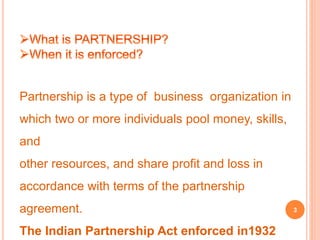
Partnership is a type of business organization in 
which two or more individuals pool money, skills, 
and 
other resources, and share profit and loss in 
accordance with terms of the partnership 
agreement. 
The Indian Partnership Act enforced in1932 
3
CHARACTERISTICS 
OF PARTNESHIP 
4
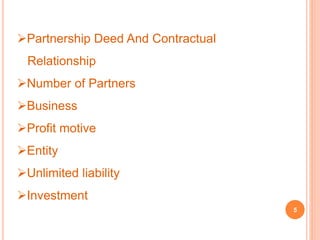
Partnership Deed And Contractual 
Relationship 
Number of Partners 
Business 
Profit motive 
Entity 
Unlimited liability 
Investment 
5
MERITS 
OF PARTNERSHIP 
Easy to Start: There is no complicated procedure to start 
partnership. 
It does not take much expenditure to start. 
It can be started very easily. 
Sufficient capital: partnership has more capital resources 
as compared to sole trader. 
It can even get larger amount of loans from other institutes 
on easy terms. 
6
Specialization in management: work is divided in 
partnership in accordance with specific management 
principles. Work is given to partners as per their capabilities 
and with time they attain specialization in their work. 
Balanced Decision: decisions are taken jointly by 
consulting each other, therefore the partnership is able to 
take balanced decisions. 
Advantages of unlimited liabilities: Since liability of the 
partner is unlimited, therefore, they take allmost care in 
discharging their duties. 
7
Combined resources: In partnership, partner’s capital, 
energy, knowledge, experience, etc., act jointly and 
effectively. 
Flexibility: Partnership firms have flexibility. The expansion 
of business, objects, capital and number of partners can be 
changed according to situation without any legal barrier and 
present business can be changed by some other business 
very easily. 
Registration not compulsory: Registration of partnership 
is not compulsory. The partners may or may not get the 
partnership registered. 8
DEMERITS 
OF PARTNERSHIP 
Difficulty in transfer of interest: No partner can transfer his 
interest in partnership without the consent of all the partners. 
Due to this limitations, lots of people hesitate to invest money 
in partnership. 
Delay in decision making: Decision making in partnership 
requires consent of all the partners so decision making takes 
more time compared to a sole trader. 
9
Unlimited liabilities: Liabilities of partnership is unlimited. 
Even the personal assets of partners can be used to meet 
firm’s debts. 
Instability: Partnership has an uncertain future. 
Death of a partner, insanity, insolvency, etc., ends the 
partnership. 
Responsibility after winding up: Normally, the liabilities of 
a business ends with the closure of business. 
But according to partnership Act, responsibility of a partner 
does not end until they are given public notice of winding 
up of partnership. 10
Conflicts and frictions: Partnership lacks centralised 
management. 
Conflicts and frictions can arise as every partner has a right 
to manage the partnership. 
All this becomes harmful for the future of partnership. 
Risk of implied authority: Every partner is a representative 
of the firm. 
He binds the firm by the acts done by him. 
Any dishonest or inefficient partner may cause losses for 
other partners through his misdeeds. 
11
12 
ACKNOLEDGEMENT 
We specially thank to Prof. Jayanta Sengupta, for giving us 
an opportunity to make this project. 
Thanks to Google 
AND 
Thank to every member in our group to make this project 
successful.
THANK YOU 
13 
http://www.unitedworld.edu.in/ 
Campus 
Ahmedabad Campus: Karnavati Knowledge Village, 
A/907,Uvarsad, S.G.Highway, Gandhinagar 
Kolkata Campus: Infinity Benchmark Tower 10th Floor, 
Plot - G1, Block - EP& GP, Sec - V, Salt Lake, Kolkata. 
Reg. Office: 407, Zodiac Square, 4th Floor Opp. 
Gurudwara, S.G. Road, Bodakdev, Ahmedabad.

Partnership

  • 1.
  • 2.
  • 3.
    Partnership is atype of business organization in which two or more individuals pool money, skills, and other resources, and share profit and loss in accordance with terms of the partnership agreement. The Indian Partnership Act enforced in1932 3
  • 4.
  • 5.
    Partnership Deed AndContractual Relationship Number of Partners Business Profit motive Entity Unlimited liability Investment 5
  • 6.
    MERITS OF PARTNERSHIP Easy to Start: There is no complicated procedure to start partnership. It does not take much expenditure to start. It can be started very easily. Sufficient capital: partnership has more capital resources as compared to sole trader. It can even get larger amount of loans from other institutes on easy terms. 6
  • 7.
    Specialization in management:work is divided in partnership in accordance with specific management principles. Work is given to partners as per their capabilities and with time they attain specialization in their work. Balanced Decision: decisions are taken jointly by consulting each other, therefore the partnership is able to take balanced decisions. Advantages of unlimited liabilities: Since liability of the partner is unlimited, therefore, they take allmost care in discharging their duties. 7
  • 8.
    Combined resources: Inpartnership, partner’s capital, energy, knowledge, experience, etc., act jointly and effectively. Flexibility: Partnership firms have flexibility. The expansion of business, objects, capital and number of partners can be changed according to situation without any legal barrier and present business can be changed by some other business very easily. Registration not compulsory: Registration of partnership is not compulsory. The partners may or may not get the partnership registered. 8
  • 9.
    DEMERITS OF PARTNERSHIP Difficulty in transfer of interest: No partner can transfer his interest in partnership without the consent of all the partners. Due to this limitations, lots of people hesitate to invest money in partnership. Delay in decision making: Decision making in partnership requires consent of all the partners so decision making takes more time compared to a sole trader. 9
  • 10.
    Unlimited liabilities: Liabilitiesof partnership is unlimited. Even the personal assets of partners can be used to meet firm’s debts. Instability: Partnership has an uncertain future. Death of a partner, insanity, insolvency, etc., ends the partnership. Responsibility after winding up: Normally, the liabilities of a business ends with the closure of business. But according to partnership Act, responsibility of a partner does not end until they are given public notice of winding up of partnership. 10
  • 11.
    Conflicts and frictions:Partnership lacks centralised management. Conflicts and frictions can arise as every partner has a right to manage the partnership. All this becomes harmful for the future of partnership. Risk of implied authority: Every partner is a representative of the firm. He binds the firm by the acts done by him. Any dishonest or inefficient partner may cause losses for other partners through his misdeeds. 11
  • 12.
    12 ACKNOLEDGEMENT Wespecially thank to Prof. Jayanta Sengupta, for giving us an opportunity to make this project. Thanks to Google AND Thank to every member in our group to make this project successful.
  • 13.
    THANK YOU 13 http://www.unitedworld.edu.in/ Campus Ahmedabad Campus: Karnavati Knowledge Village, A/907,Uvarsad, S.G.Highway, Gandhinagar Kolkata Campus: Infinity Benchmark Tower 10th Floor, Plot - G1, Block - EP& GP, Sec - V, Salt Lake, Kolkata. Reg. Office: 407, Zodiac Square, 4th Floor Opp. Gurudwara, S.G. Road, Bodakdev, Ahmedabad.