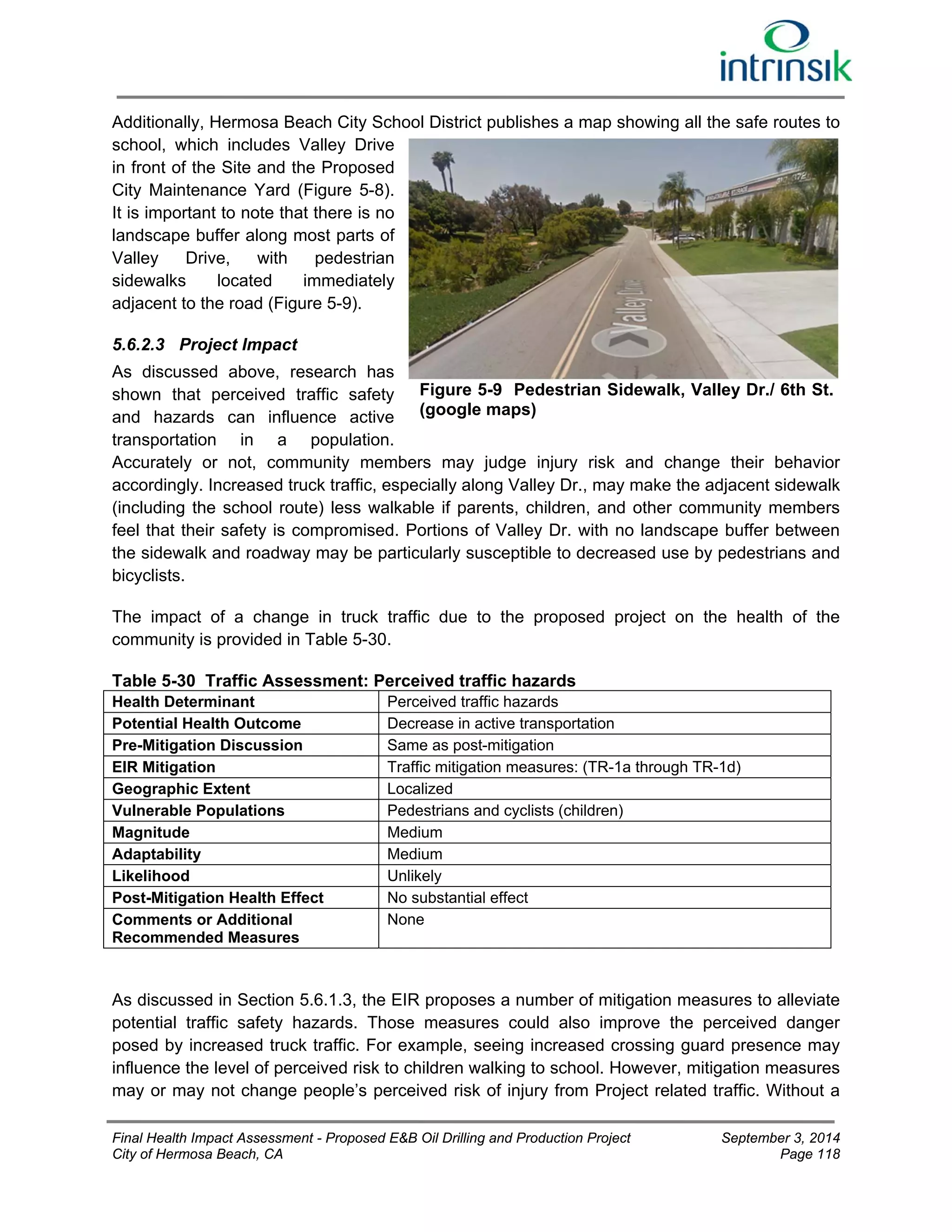
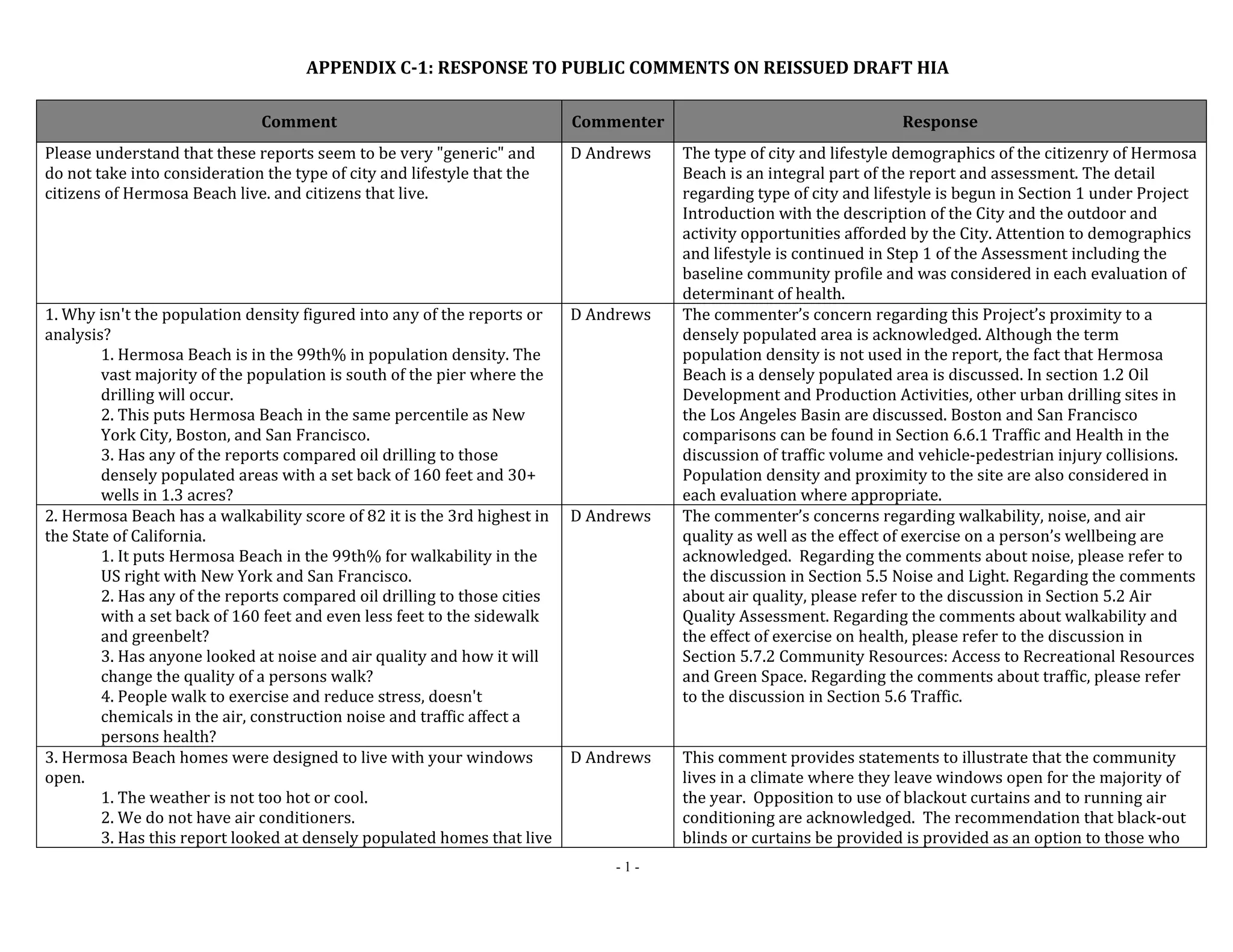
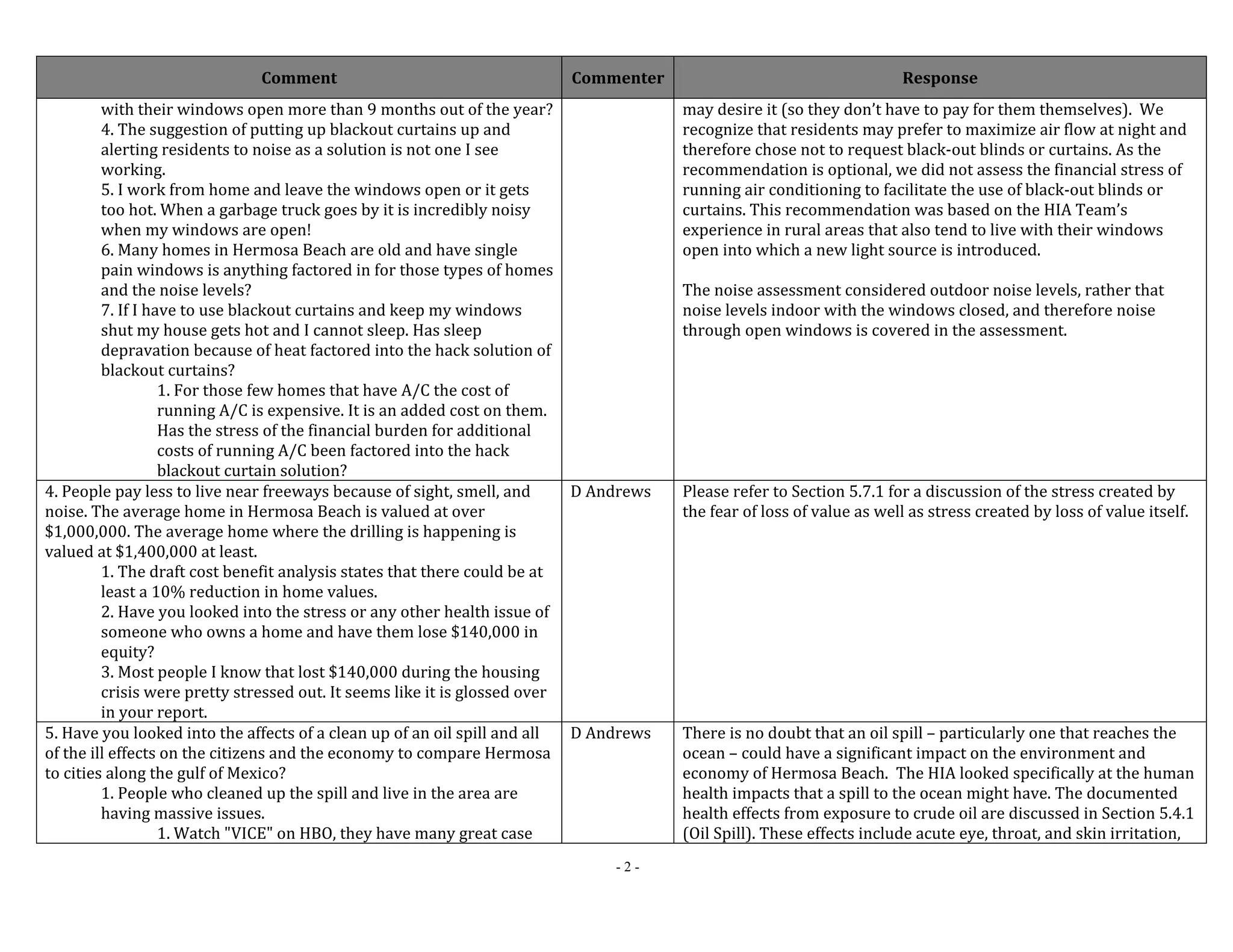
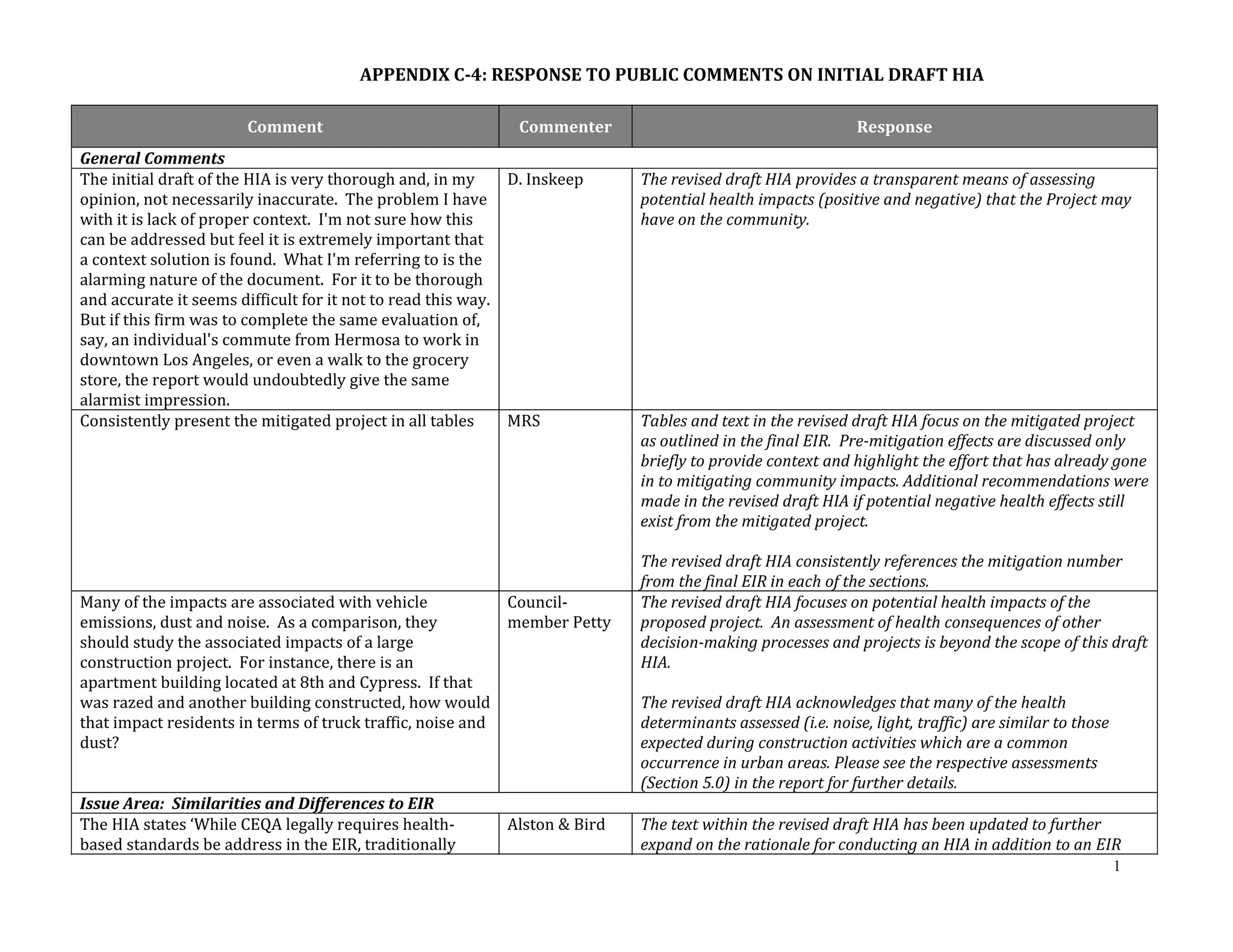
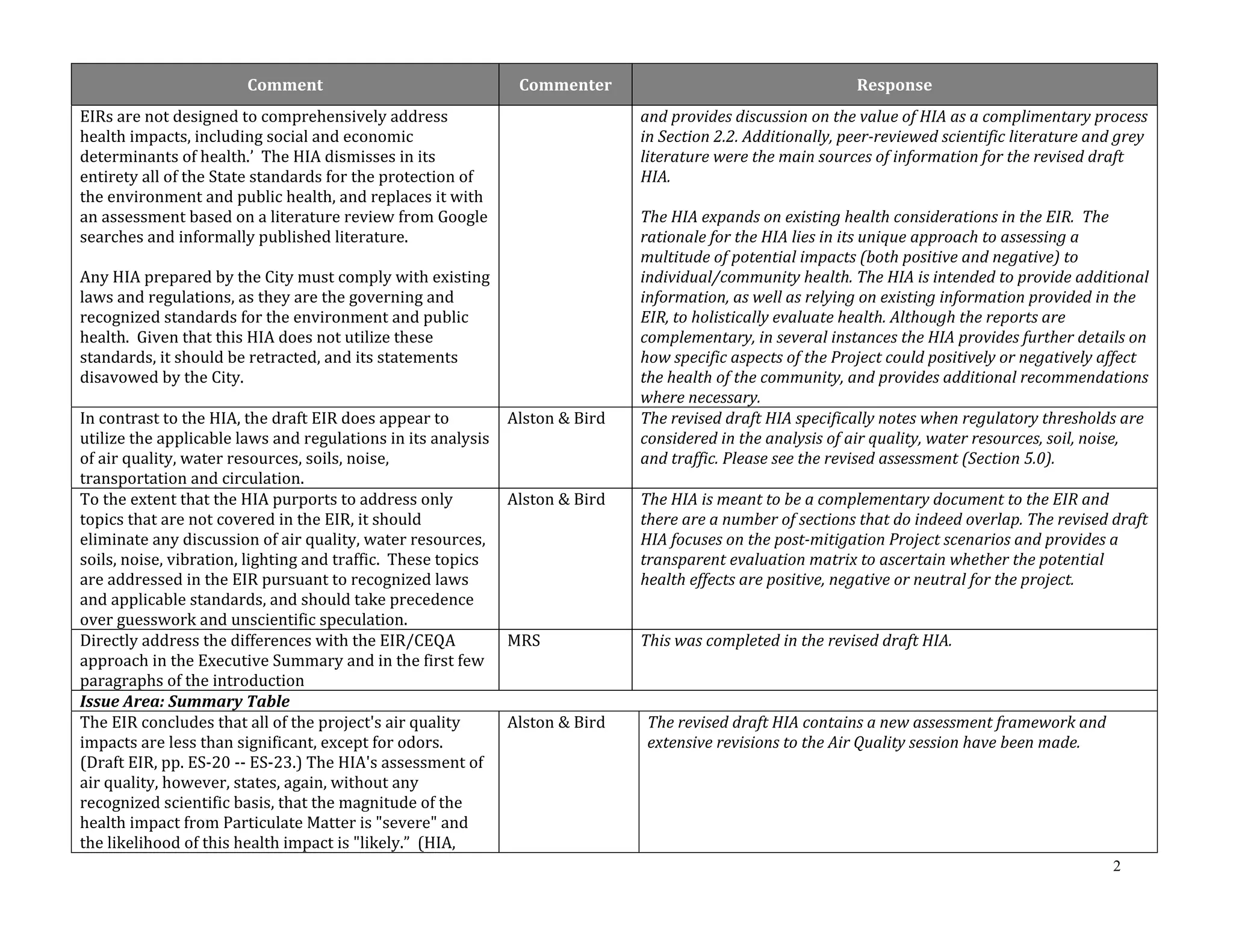
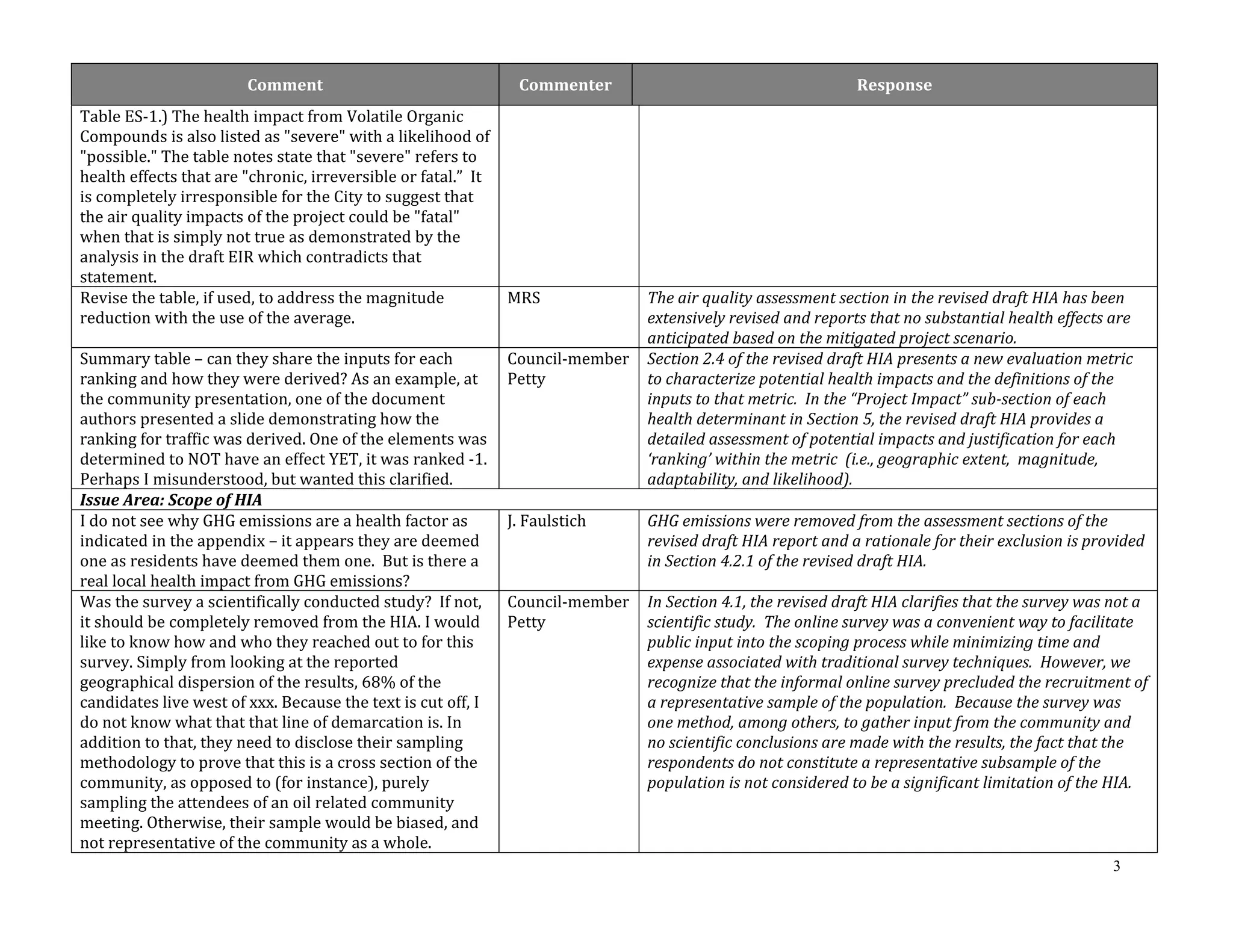
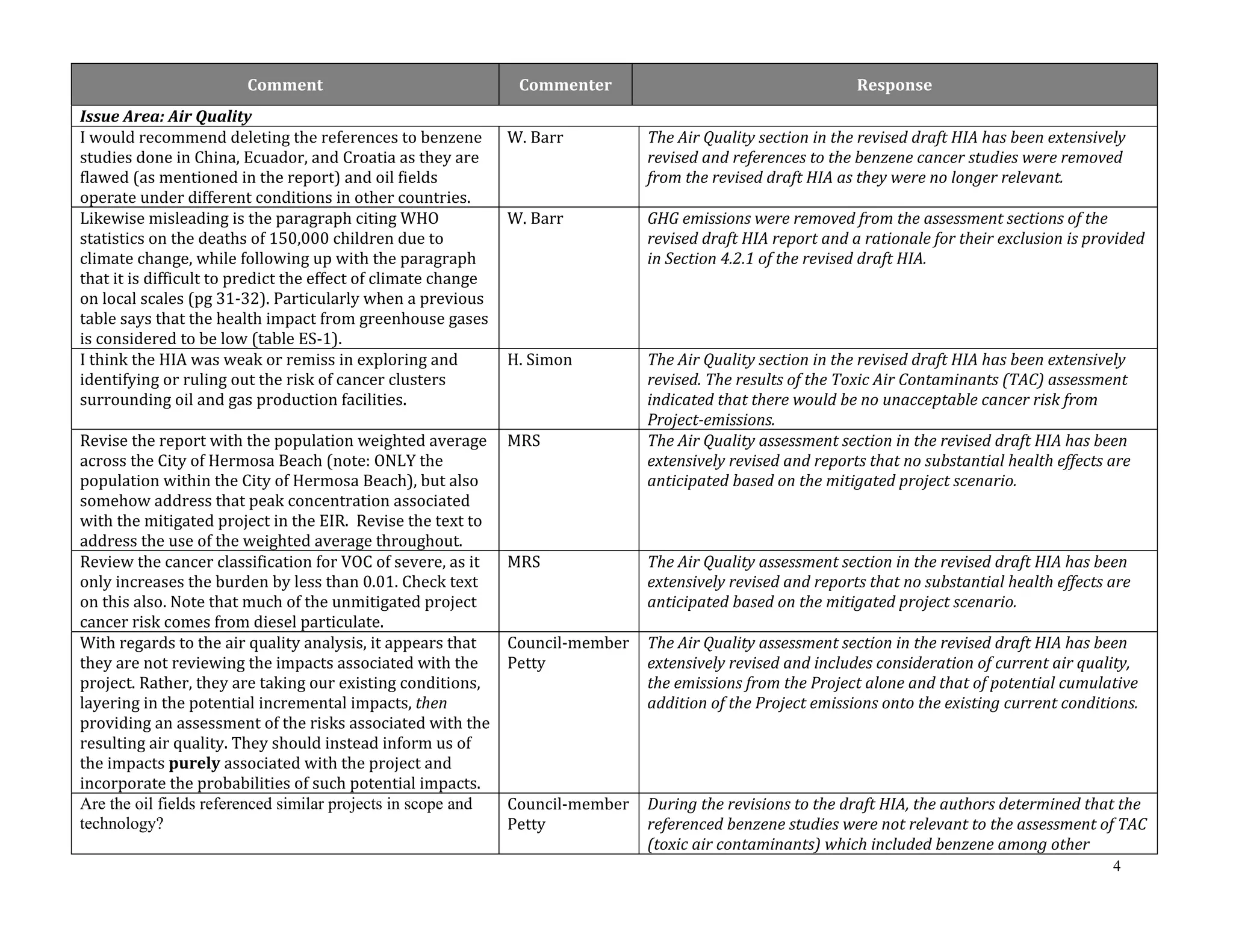
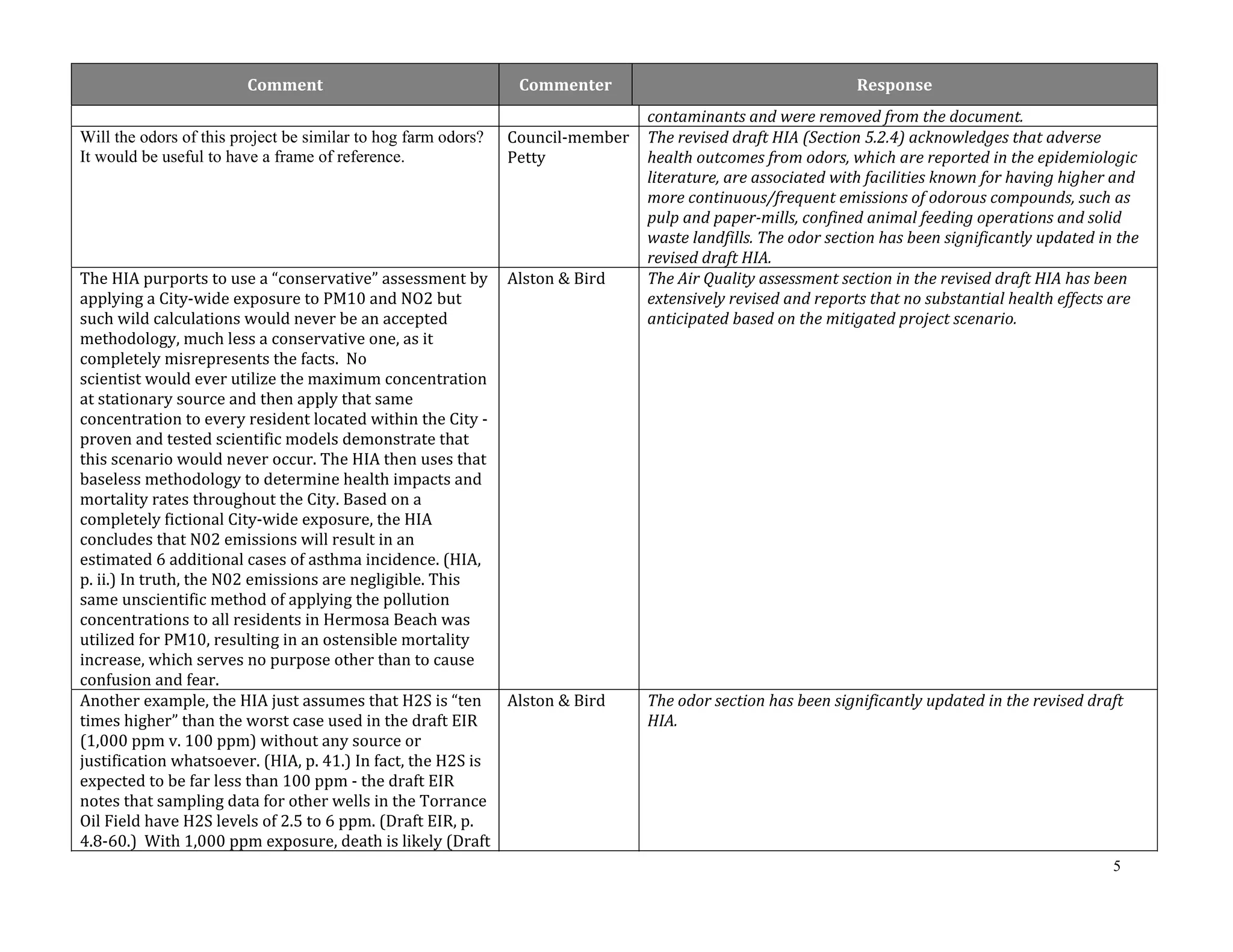
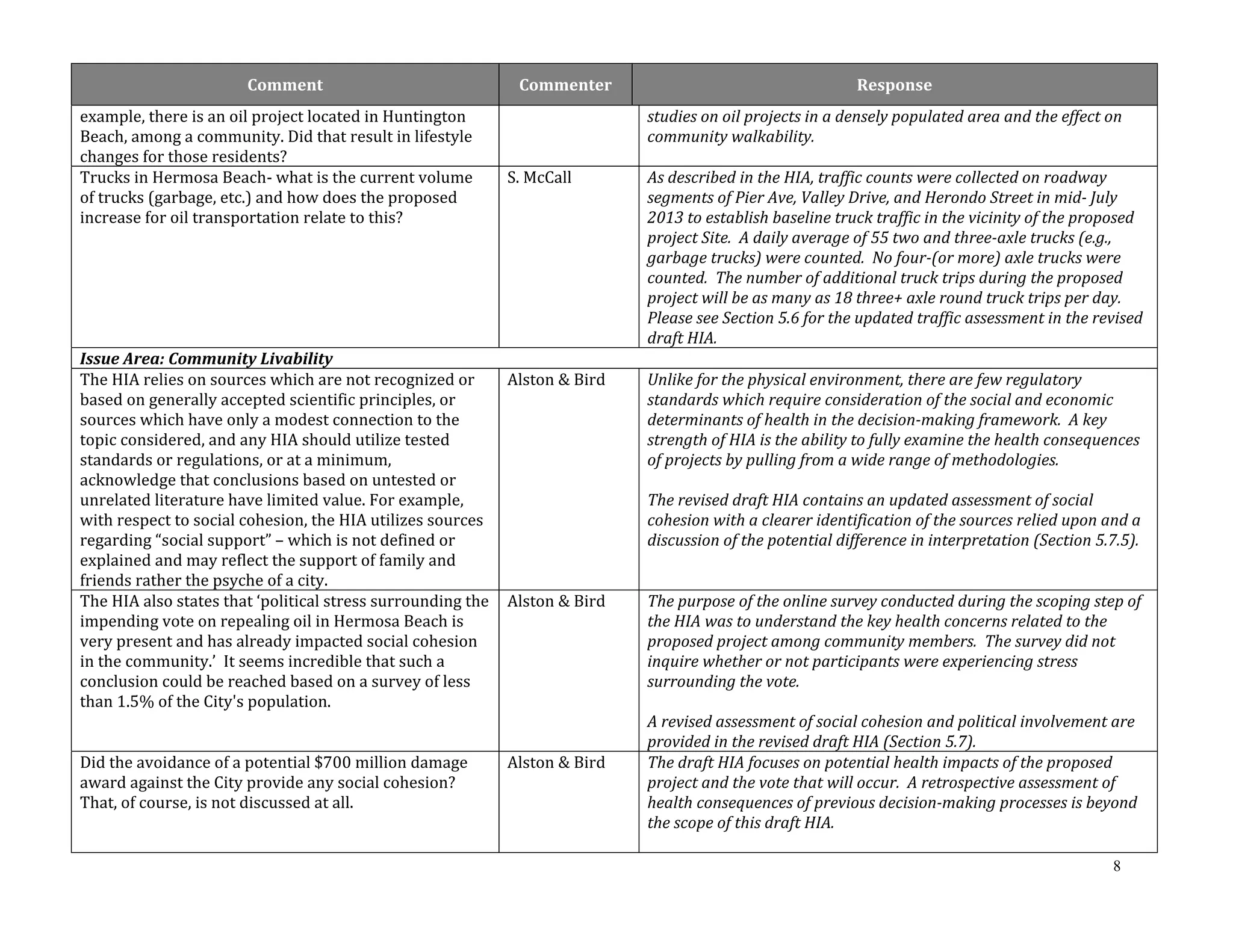
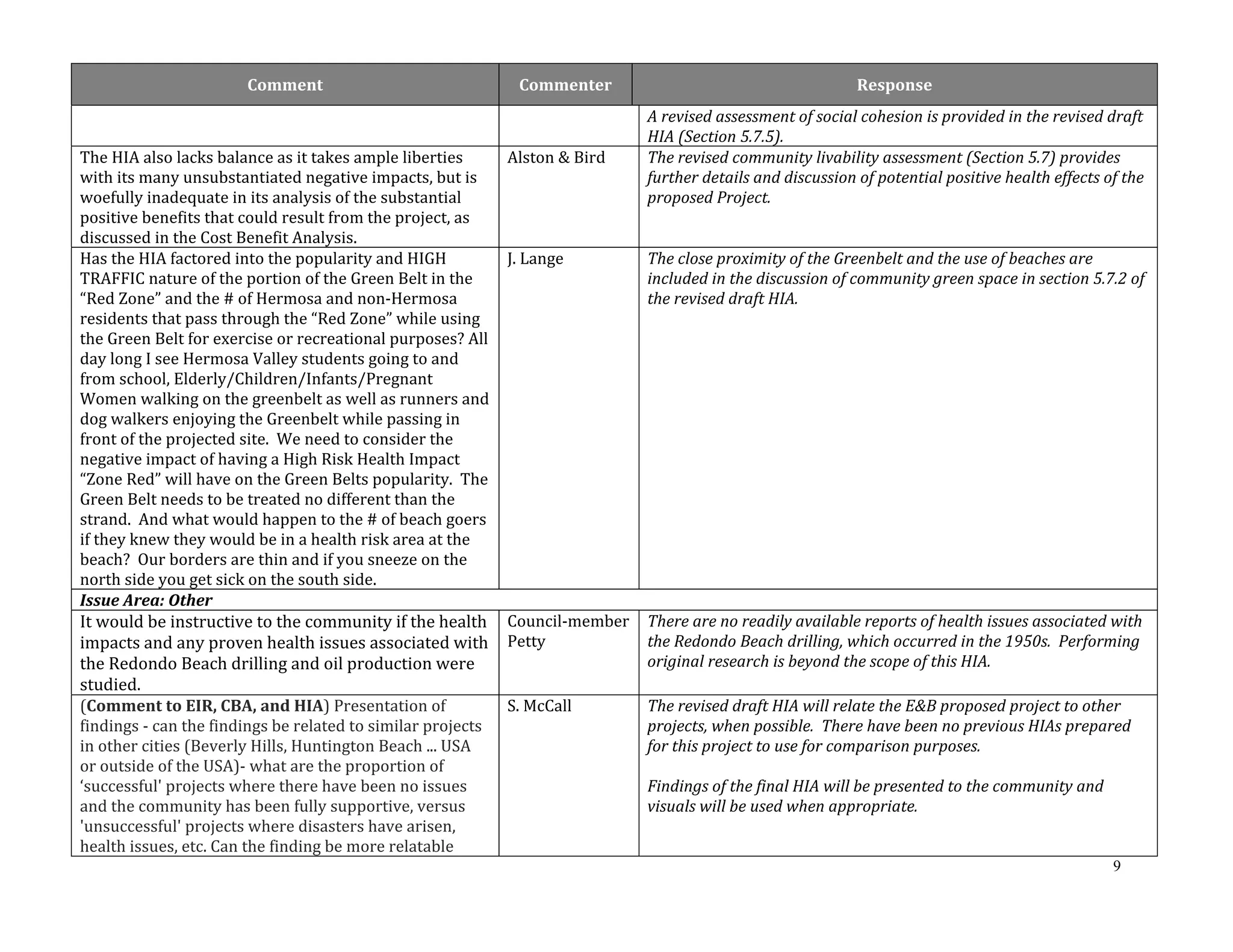
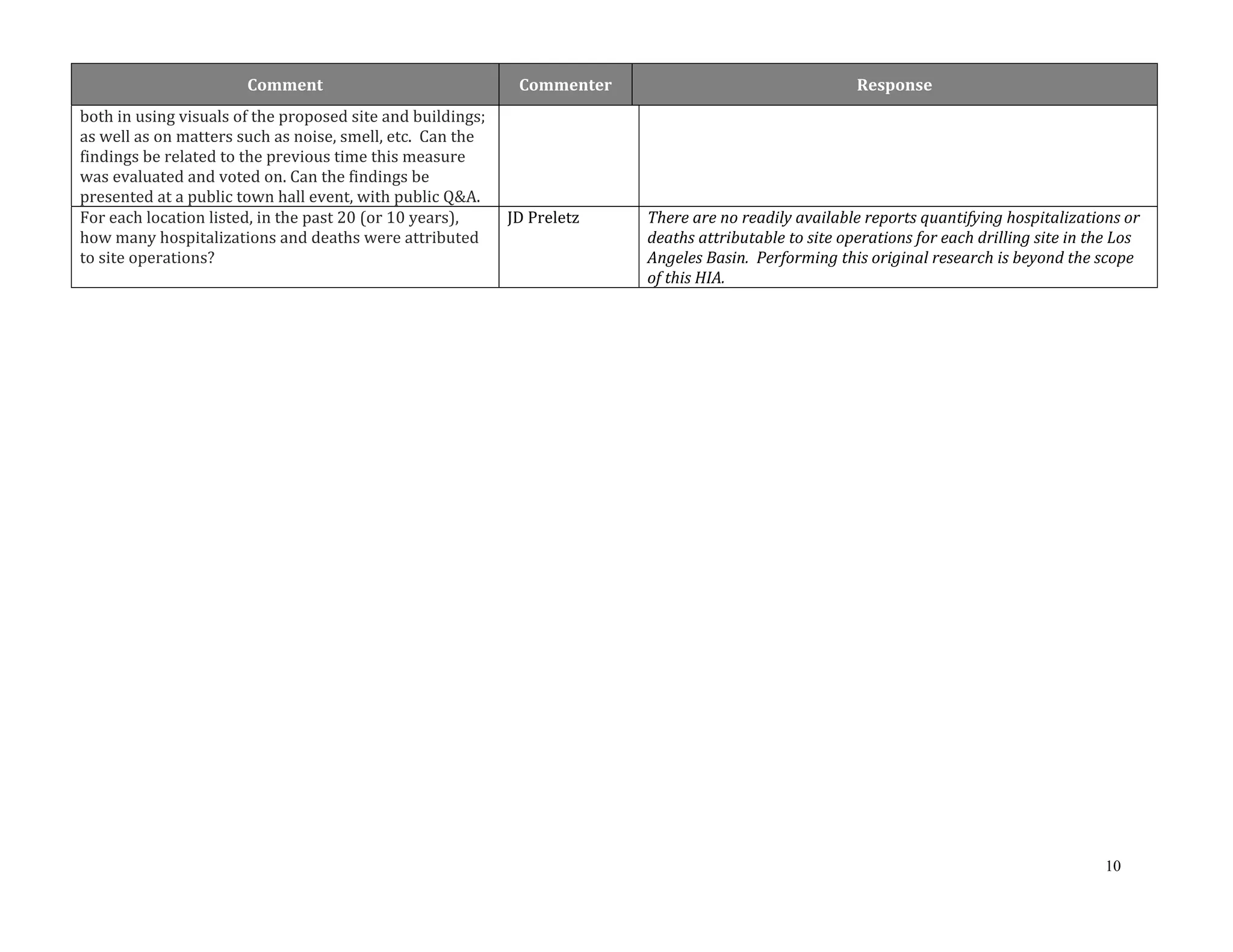
FINAL 
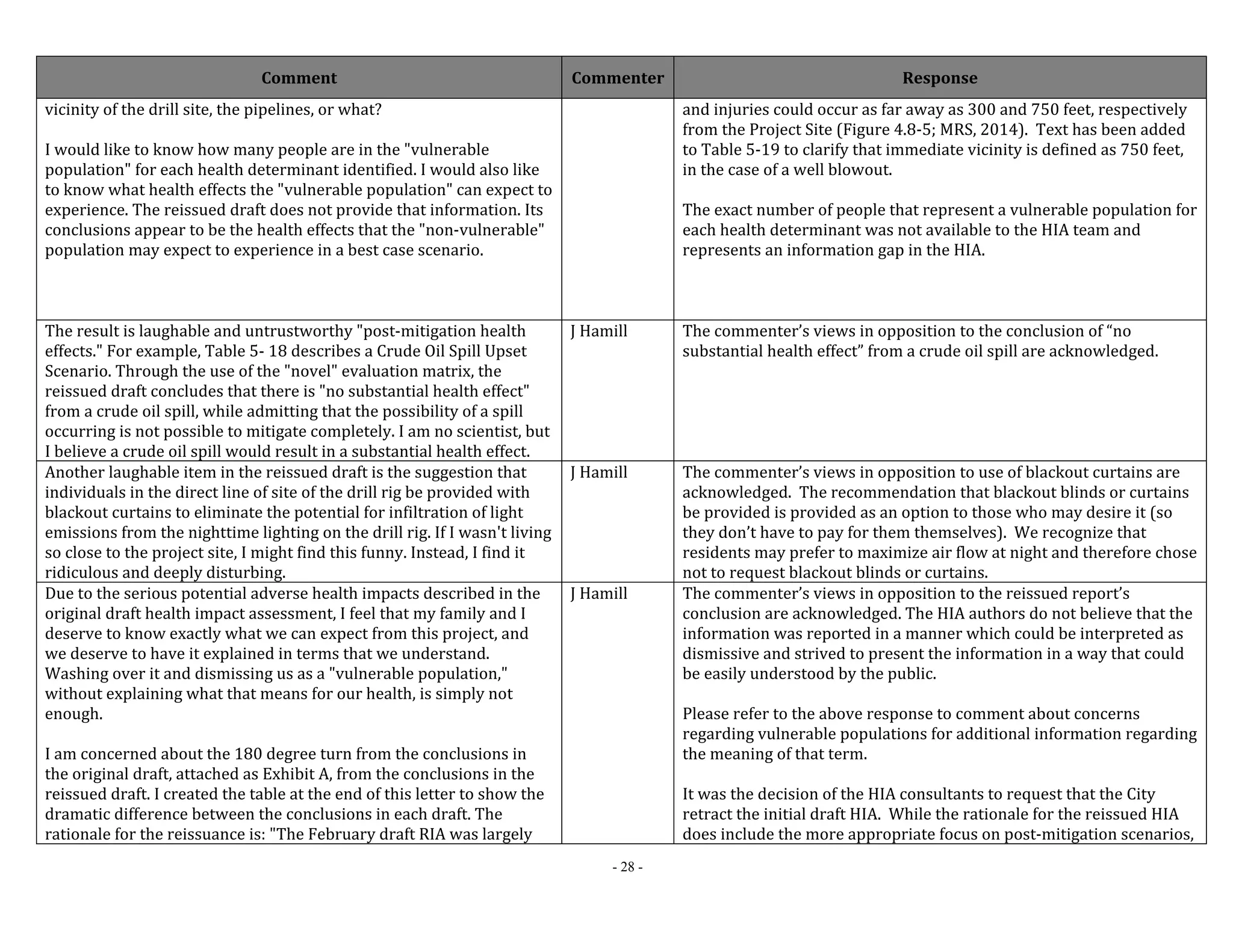
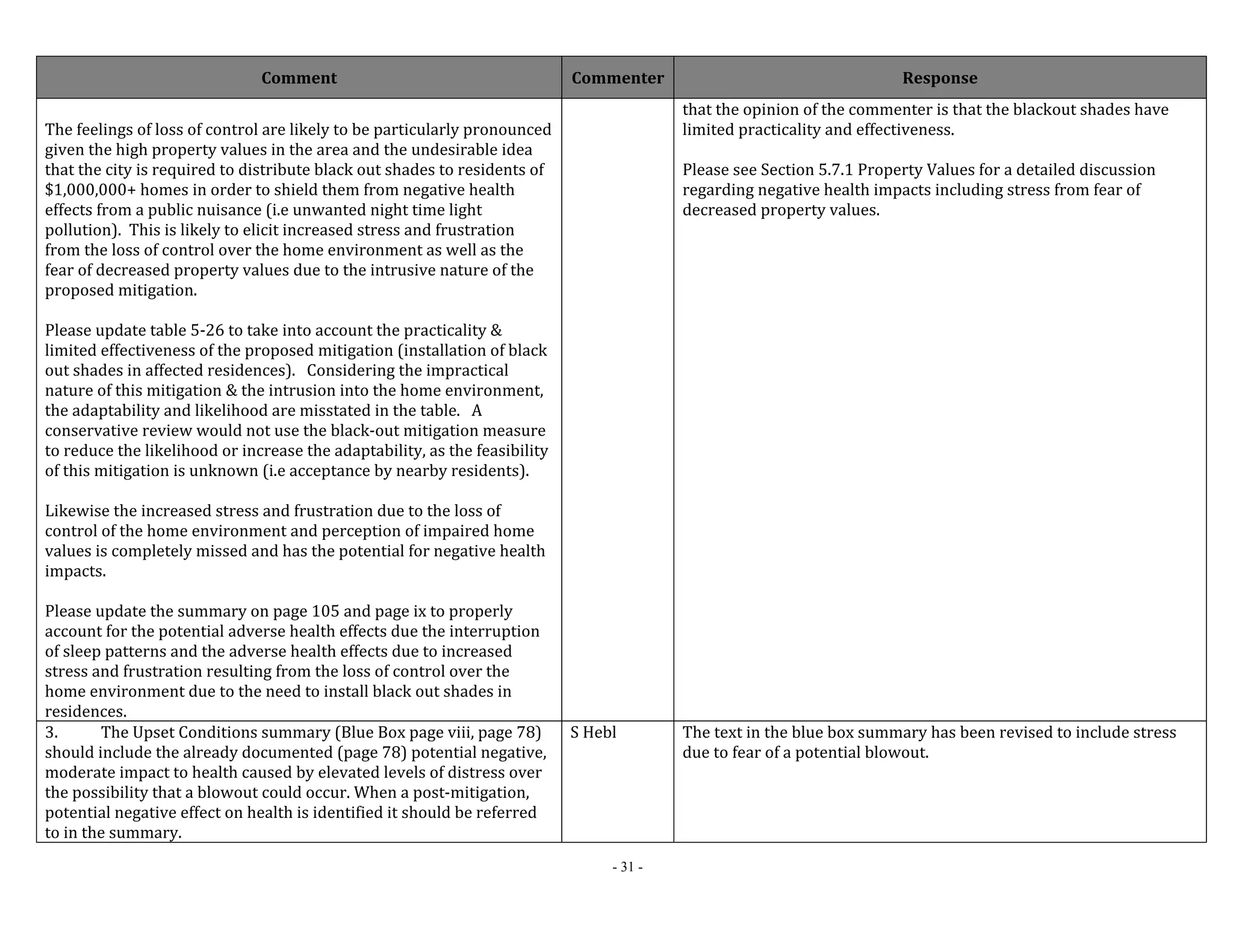
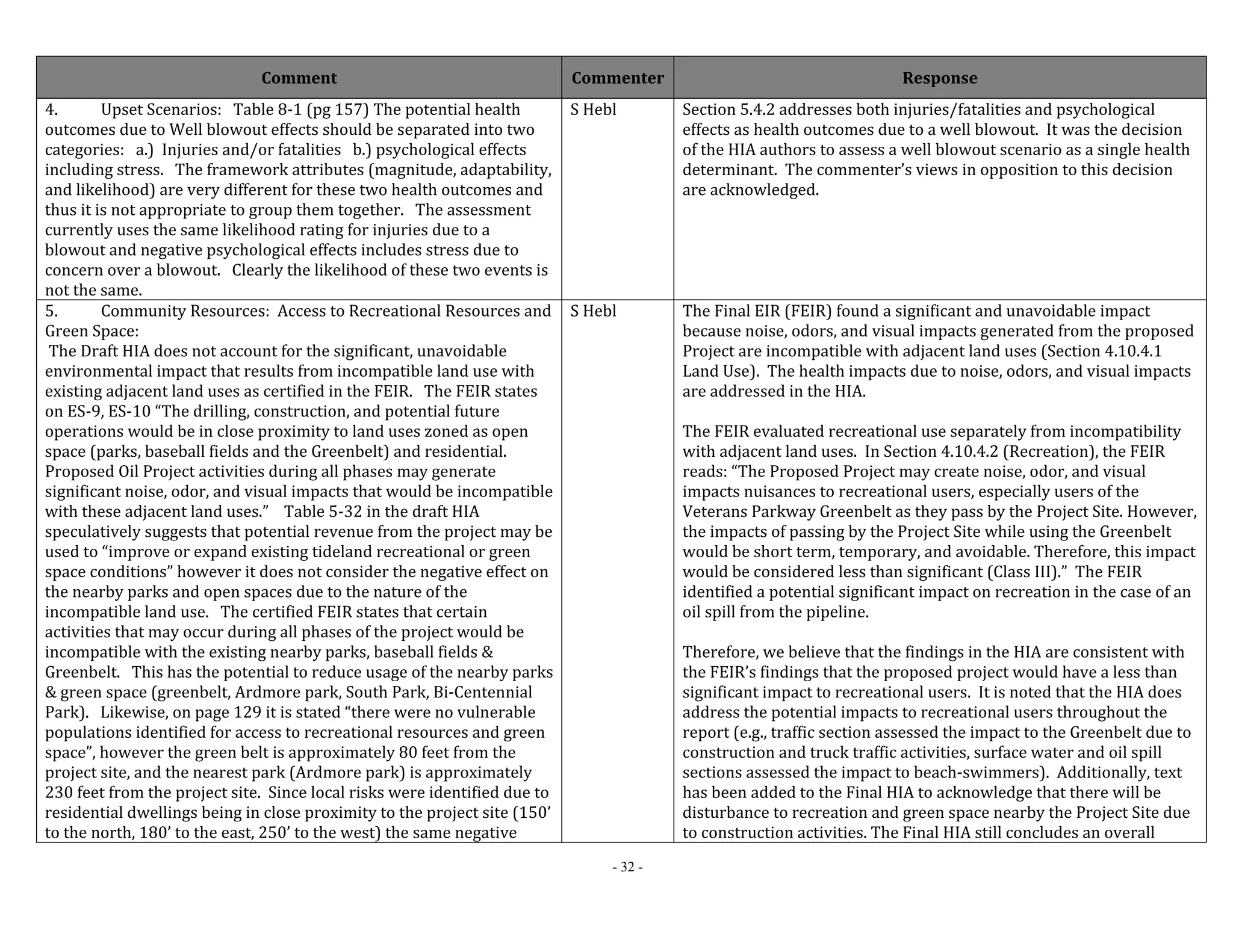
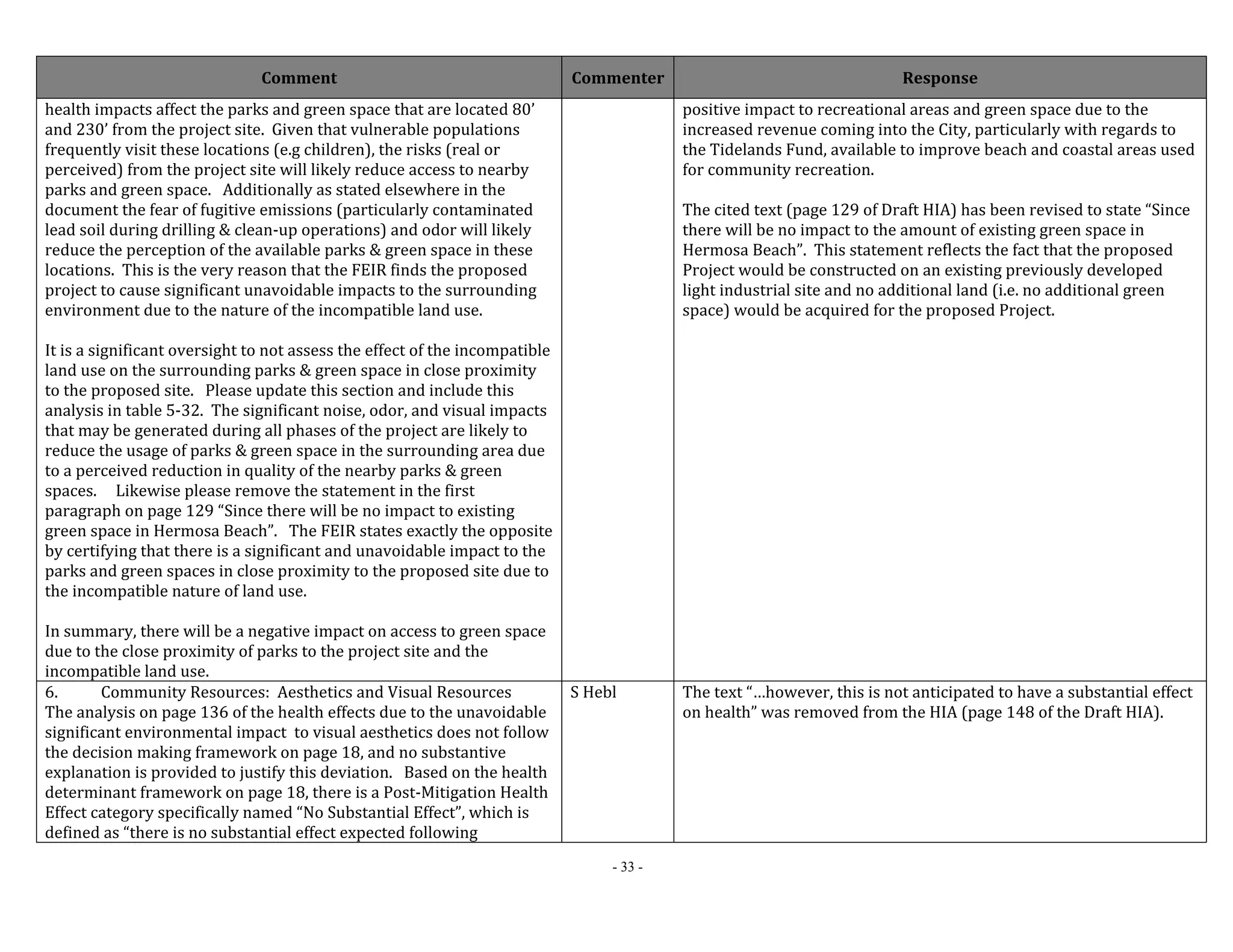
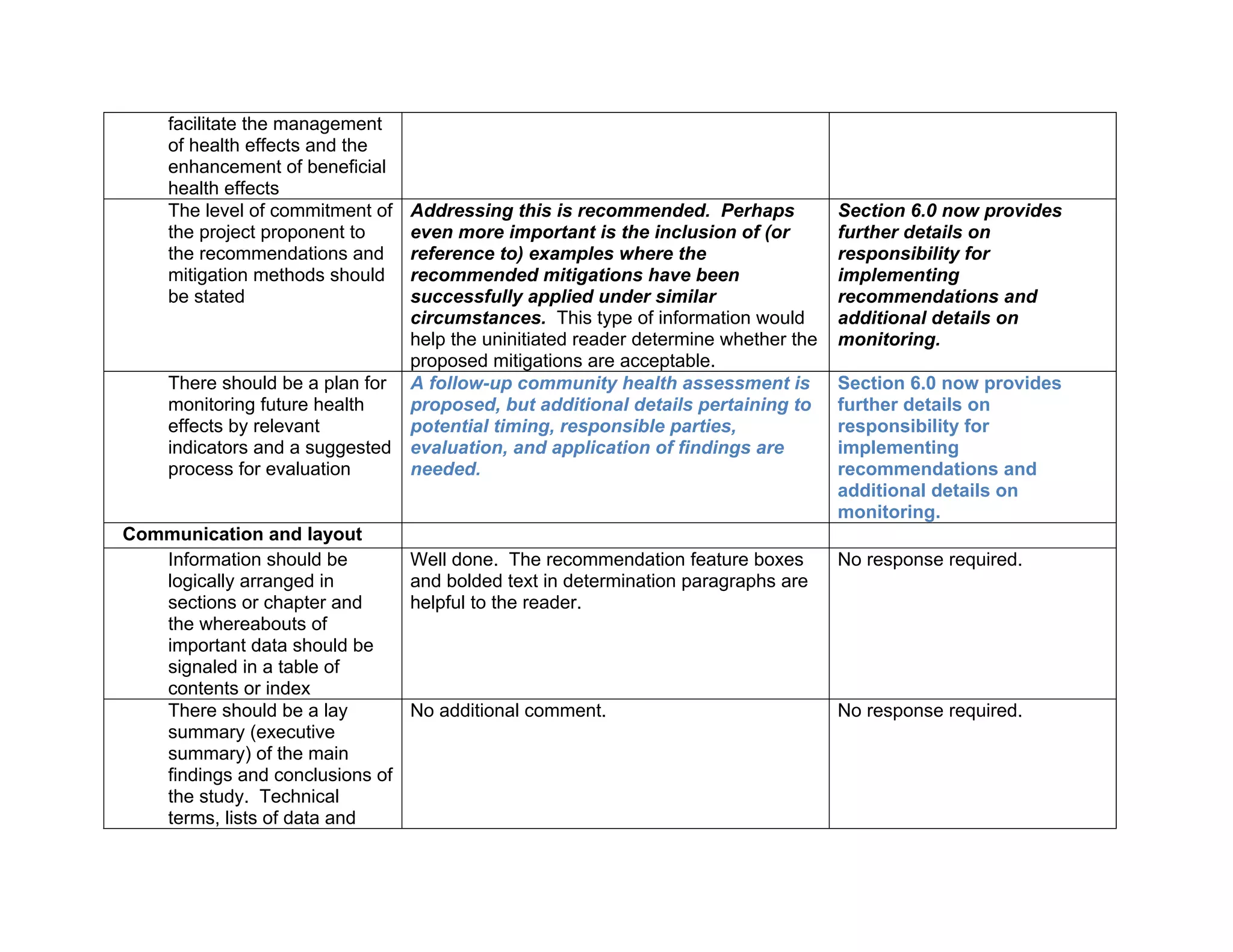
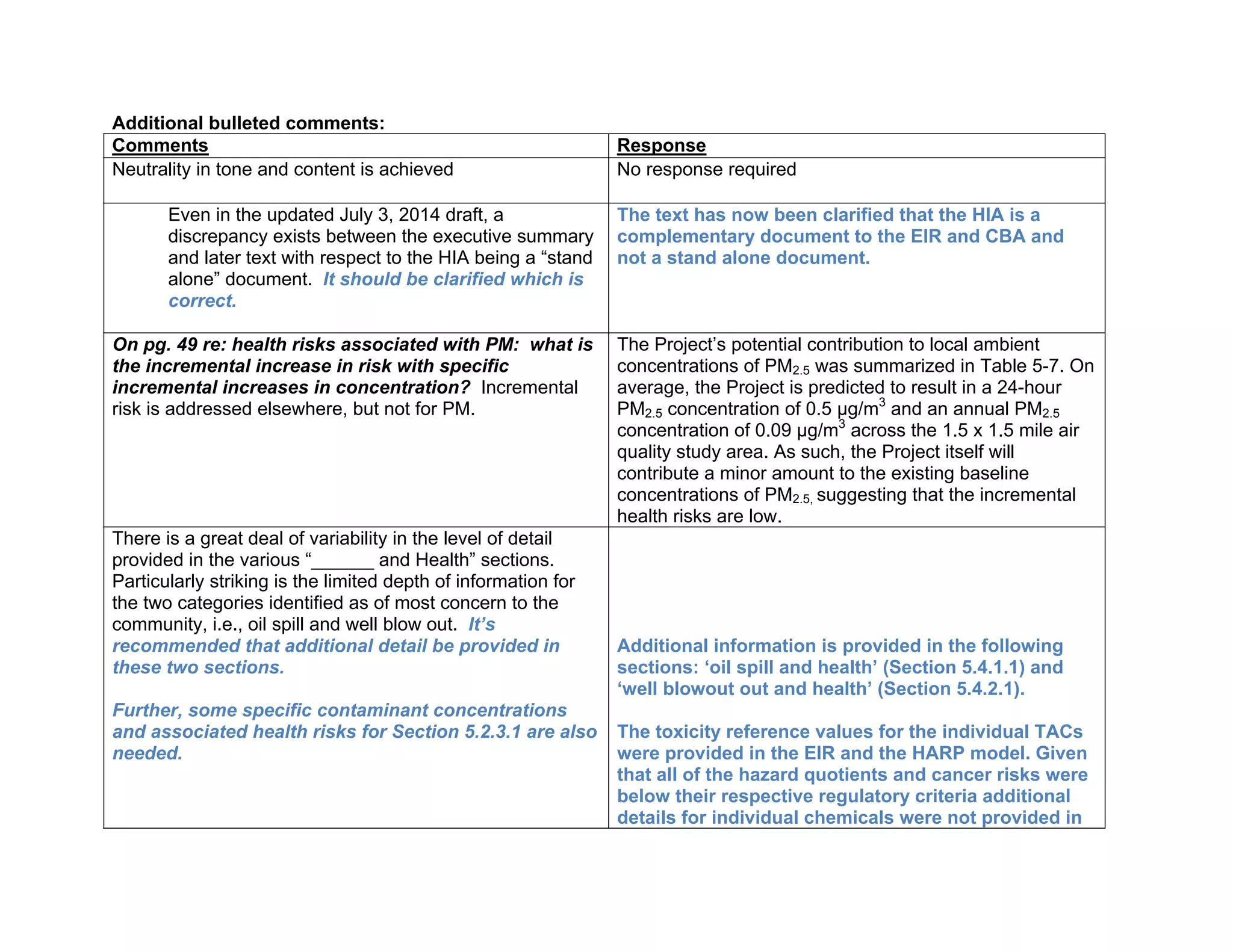
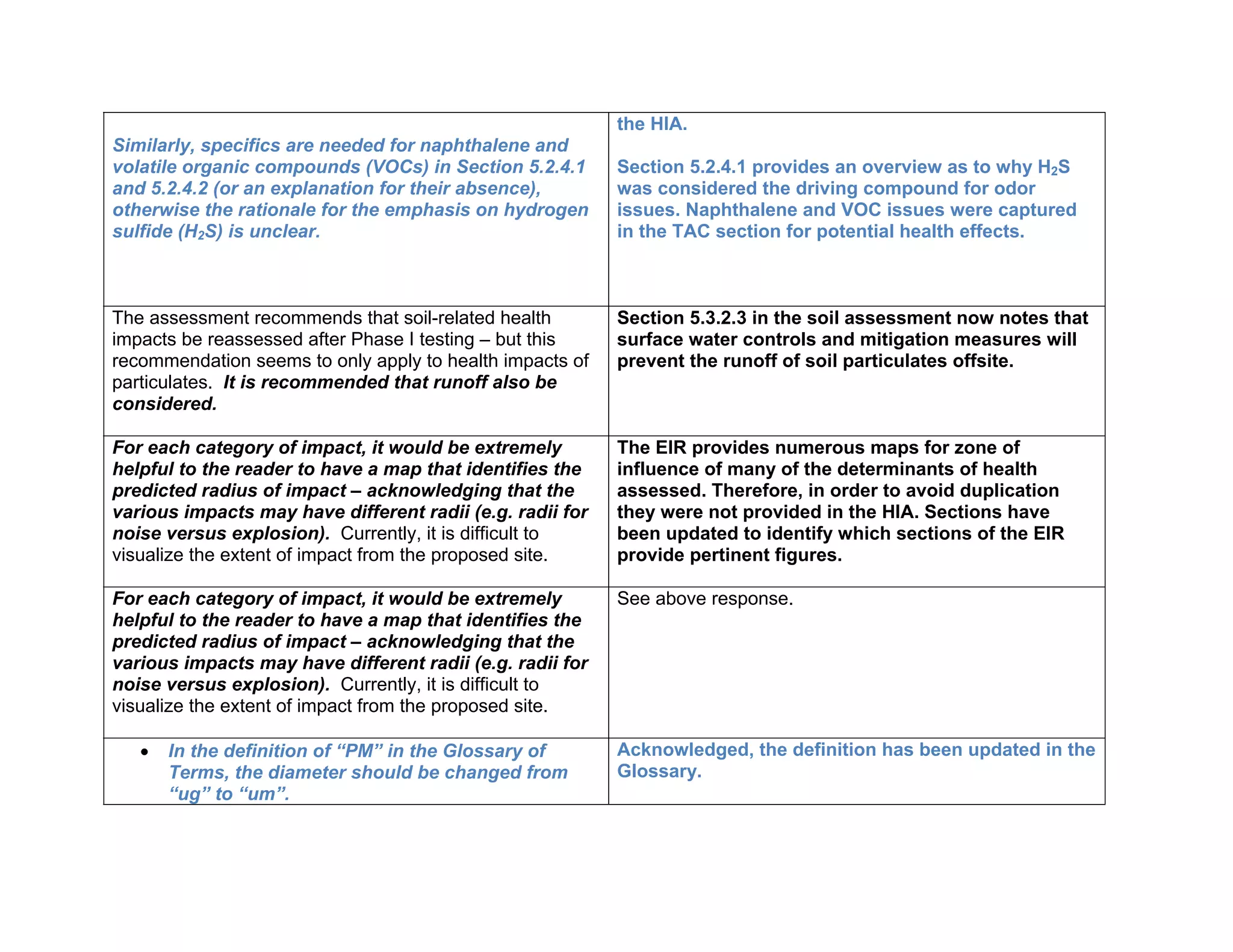
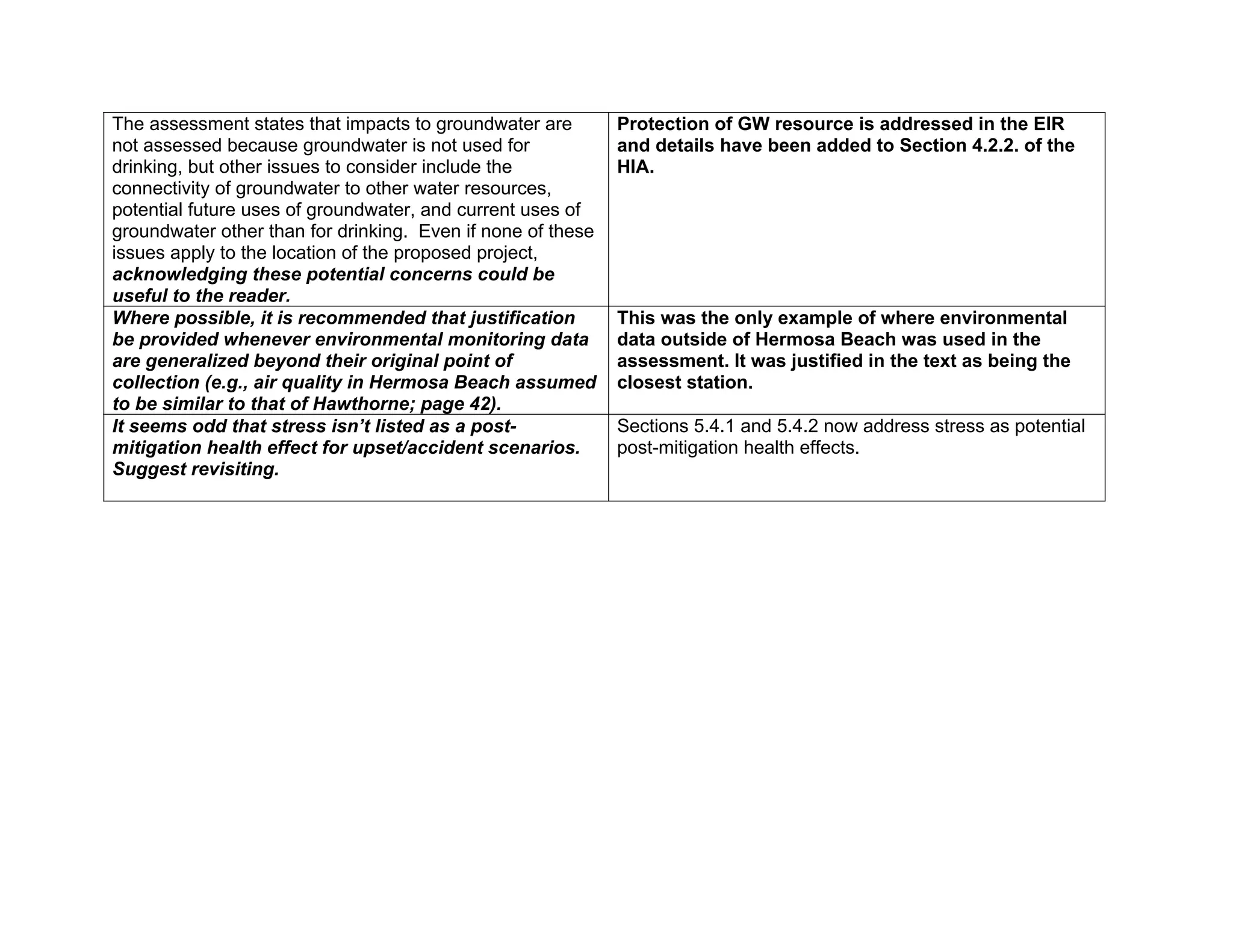
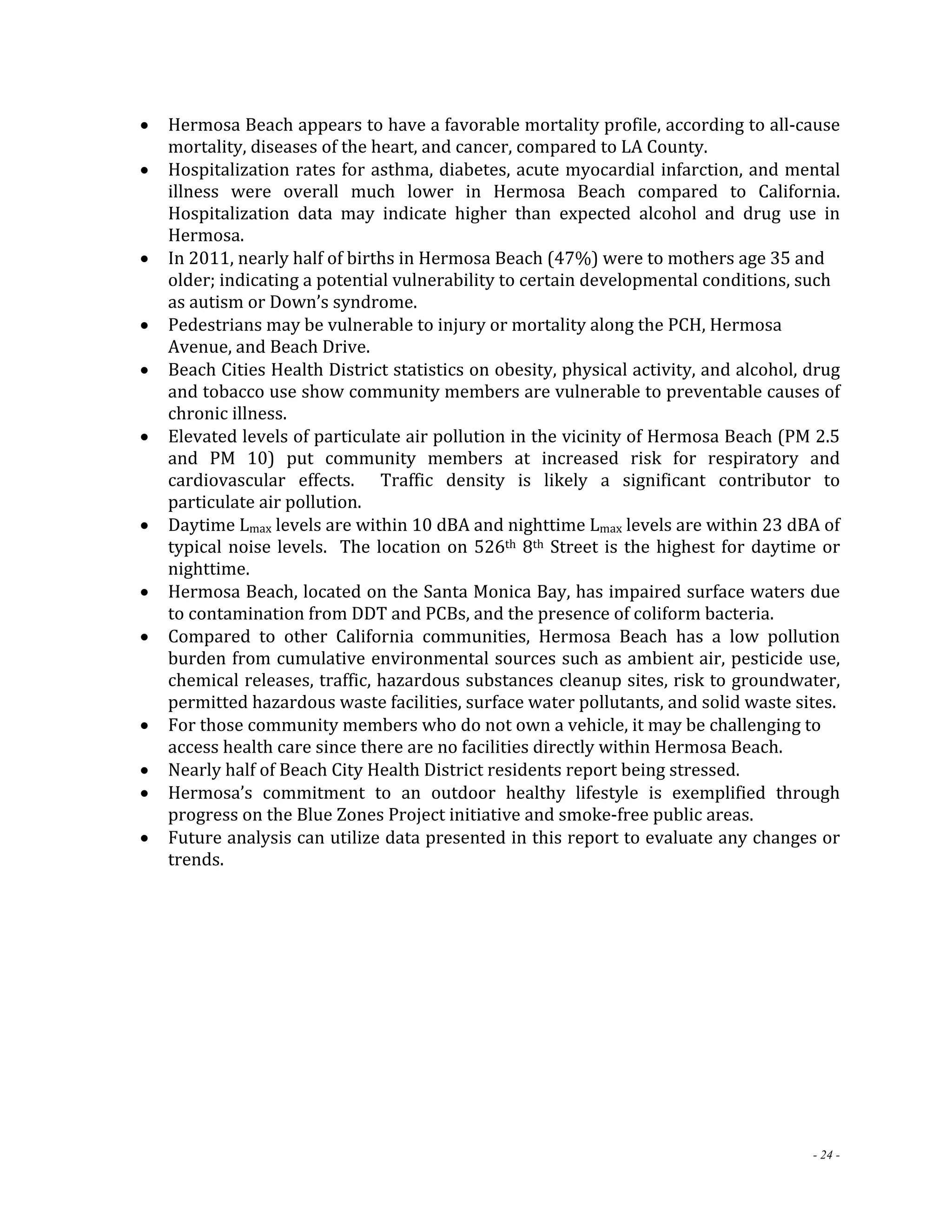
HEALTH IMPACT ASSESSMENT 
E&B OIL DRILLING AND PRODUCTION PROJECT 
September 3, 2014 
Prepared at the request of: 
Department of Community Development 
City of Hermosa Beach 
1315 Valley Drive 
Hermosa Beach, CA 90254 
1608 Pacific Avenue, Suite 201 ▪ Venice, CA 90291 
Tel: 310-392-6462 ▪ www.intrinsik.com
EXECUTIVE SUMMARY 
Health Impact Assessment 
E&B Oil Drilling and Production Project 
September 2014 
This summary presents the findings of the Health Impact Assessment (HIA) completed to inform voters about the potential 
health impacts of E&B’s proposed oil drilling and production project (the Project) in the City of Hermosa Beach, CA. The City 
commissioned this HIA in addition to a Cost‐Benefit Analysis (CBA) and an Environmental Impact Report (EIR). The HIA 
complements the EIR and CBA, providing additional consideration of potential impacts (negative and positive) on 
community health from the proposed Project. This Final HIA is the result of a comprehensive process that included public 
meetings and input on draft documents from community members, a peer reviewer, the City and its other consultants, 
E&B, and community organizations. We would like to thank the community for taking the time to provide comments 
throughout the process. This input was essential to the completion of the HIA. 
The HIA was based on best practices and included the following steps: screening, scoping, assessment, recommendation, 
reporting, evaluation, and monitoring. The scoping step identified six major categories (including 18 individual health 
determinants) based on stakeholder input and other factors: air quality; water and soil; upset scenarios; noise and light; 
traffic; and community livability. During the assessment step, we completed a baseline health profile as a reference point 
and then predicted what Project‐related (with EIR mitigation) health effects could occur based on a combination of 
information from the EIR, scientific literature, regulatory or other health‐based thresholds, and expert opinion. Each health 
determinant was carefully assessed using a combination of quantitative, semi‐quantitative and qualitative approaches. 
An evaluation matrix was developed to characterize the predicted health impacts so they could be compared and 
contrasted. The evaluation matrix includes consideration of various 
characteristics of health impacts including magnitude, likelihood, 
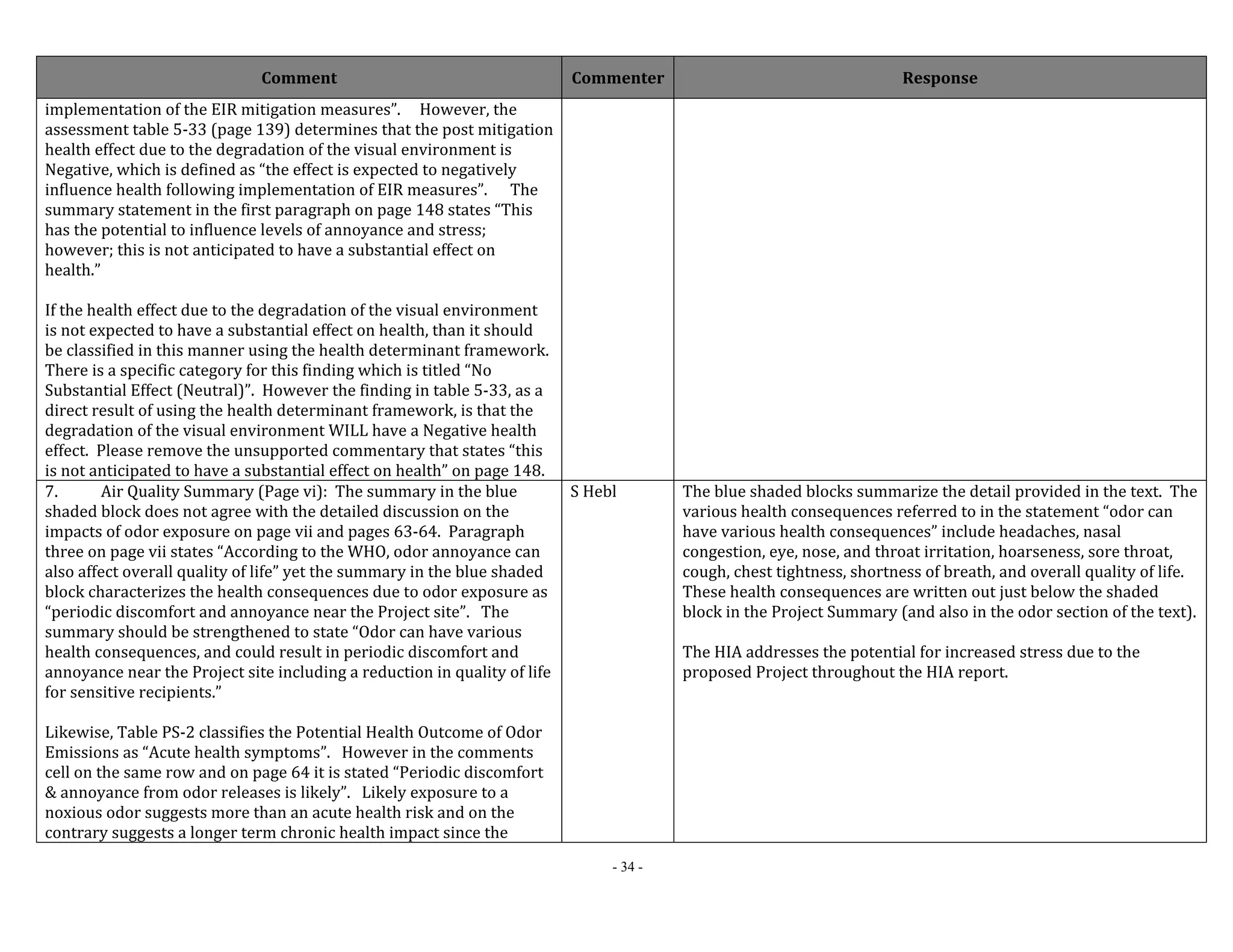
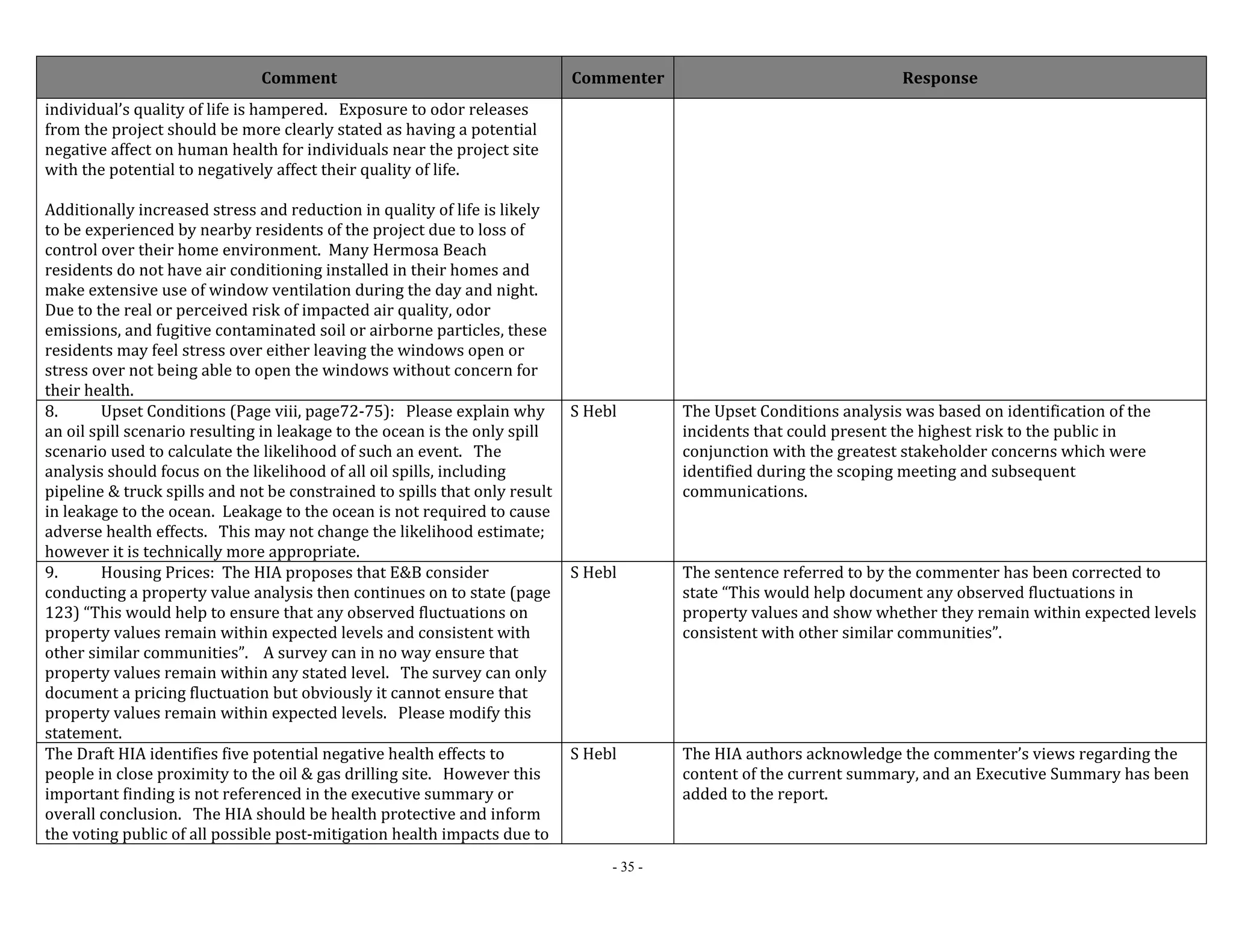
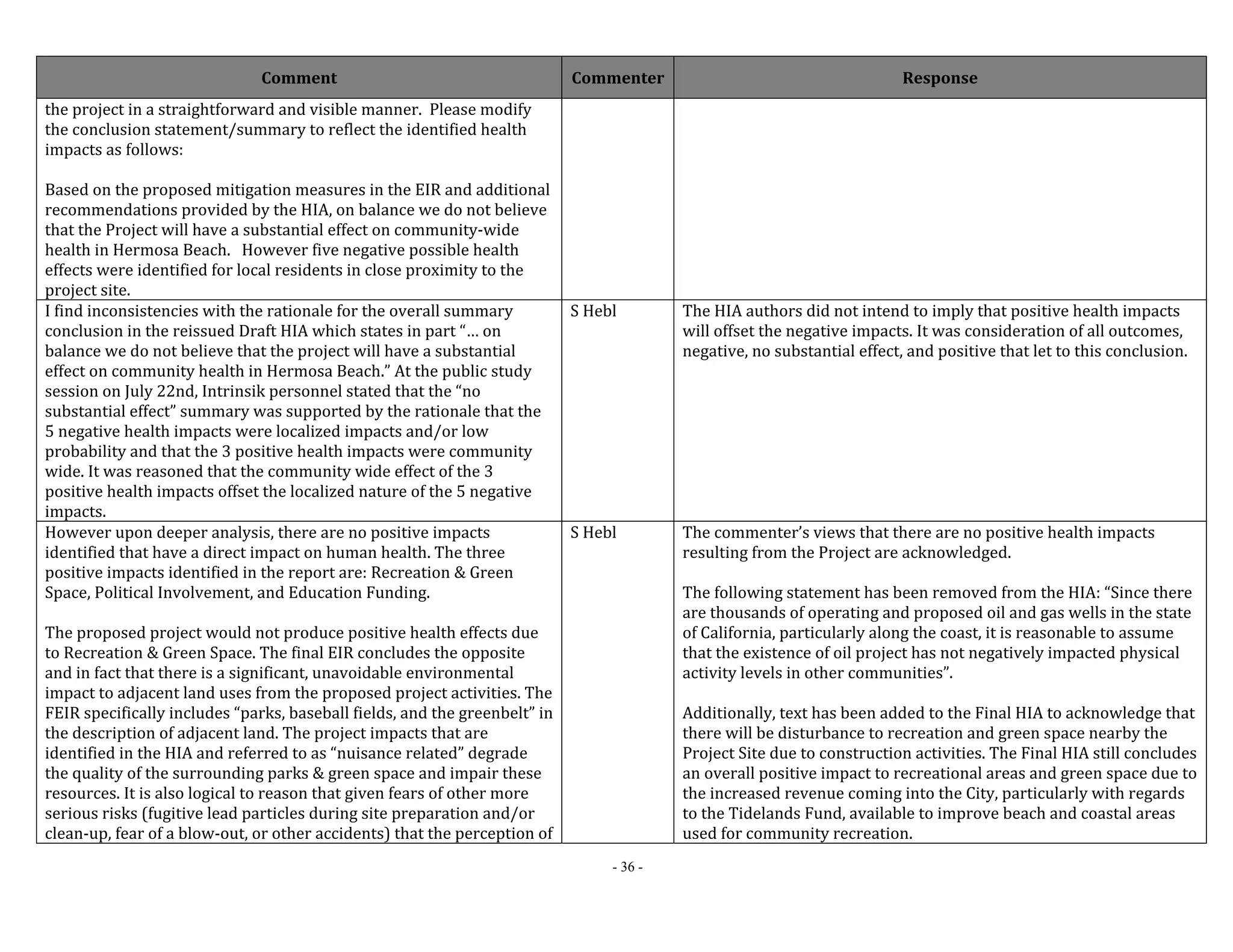
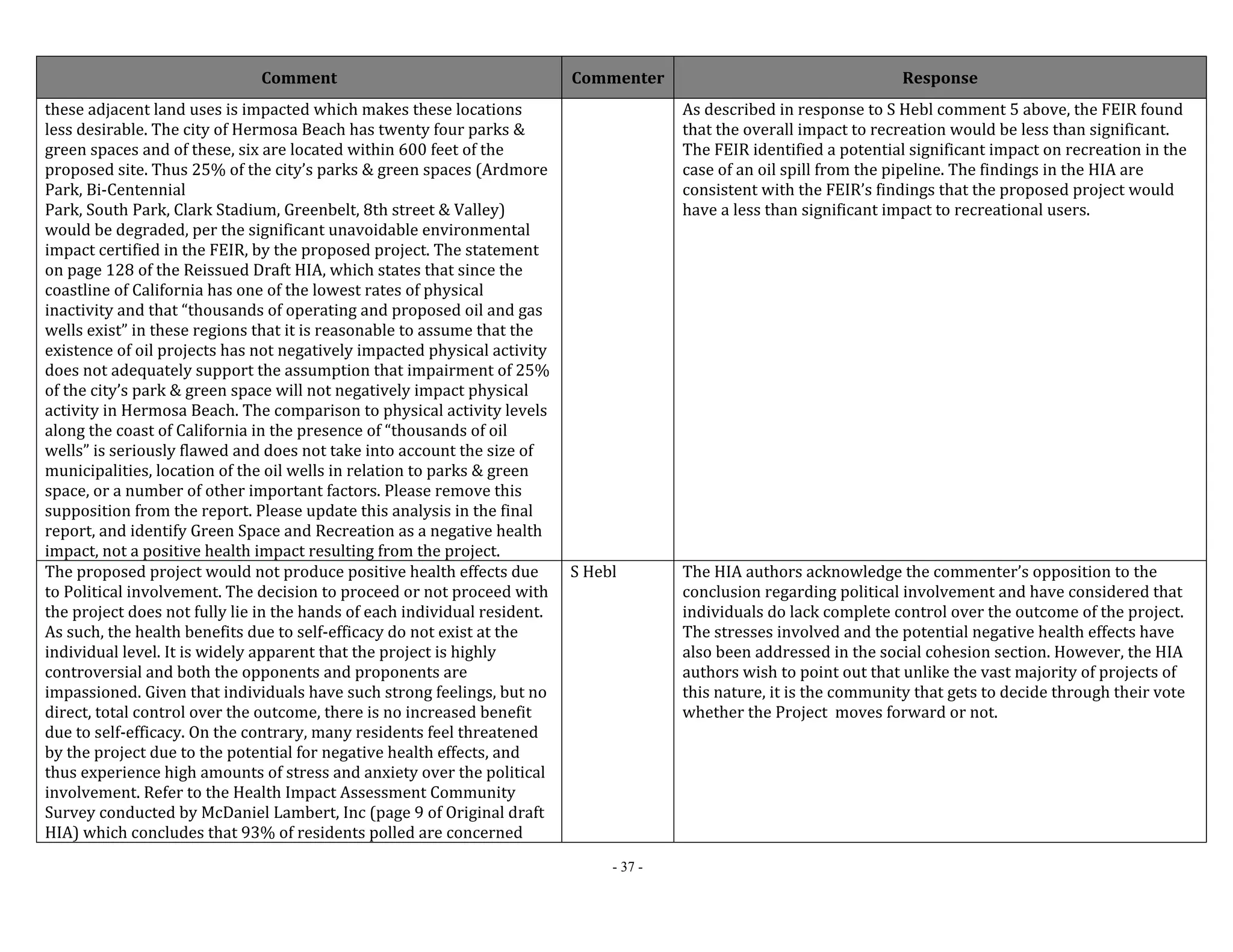
Each Phase of E&B’s Project was considered in the HIA: 
adaptability, and others. Ultimately, the aim of the assessment was 
Phase 1: Site Preparation and Construction (6‐7 months) 
to determine whether the Project could potentially have a negative, 
Phase 2: Drilling and Testing (10 to 13 months) 
positive or no substantial effect on health. Potential health impacts 
Phase 3: Final Design and Construction (16 months) 
were considered both on a local (close to the proposed Project Site) 
Phase 4: Development and Operations (30 to 35 years) 
and community‐wide scale. 
Key Findings 
Air Quality 
The air pollutants we evaluated in the HIA included: nitrogen dioxide (NO2), particulate matter (PM), toxic air contaminants 
(TAC), and odor. Predicted NO2, PM, TAC concentrations with EIR mitigation were compared to health‐based thresholds. 
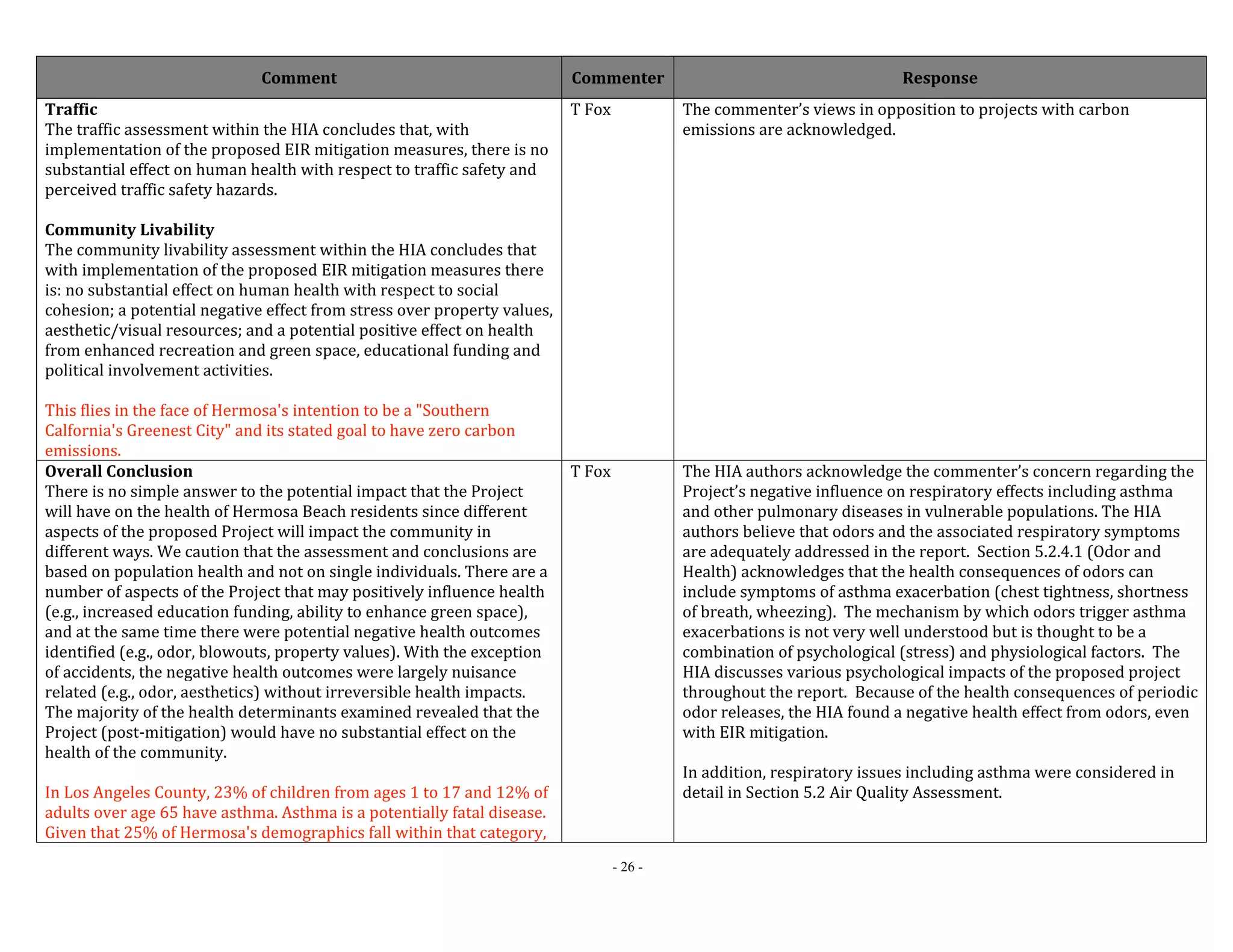
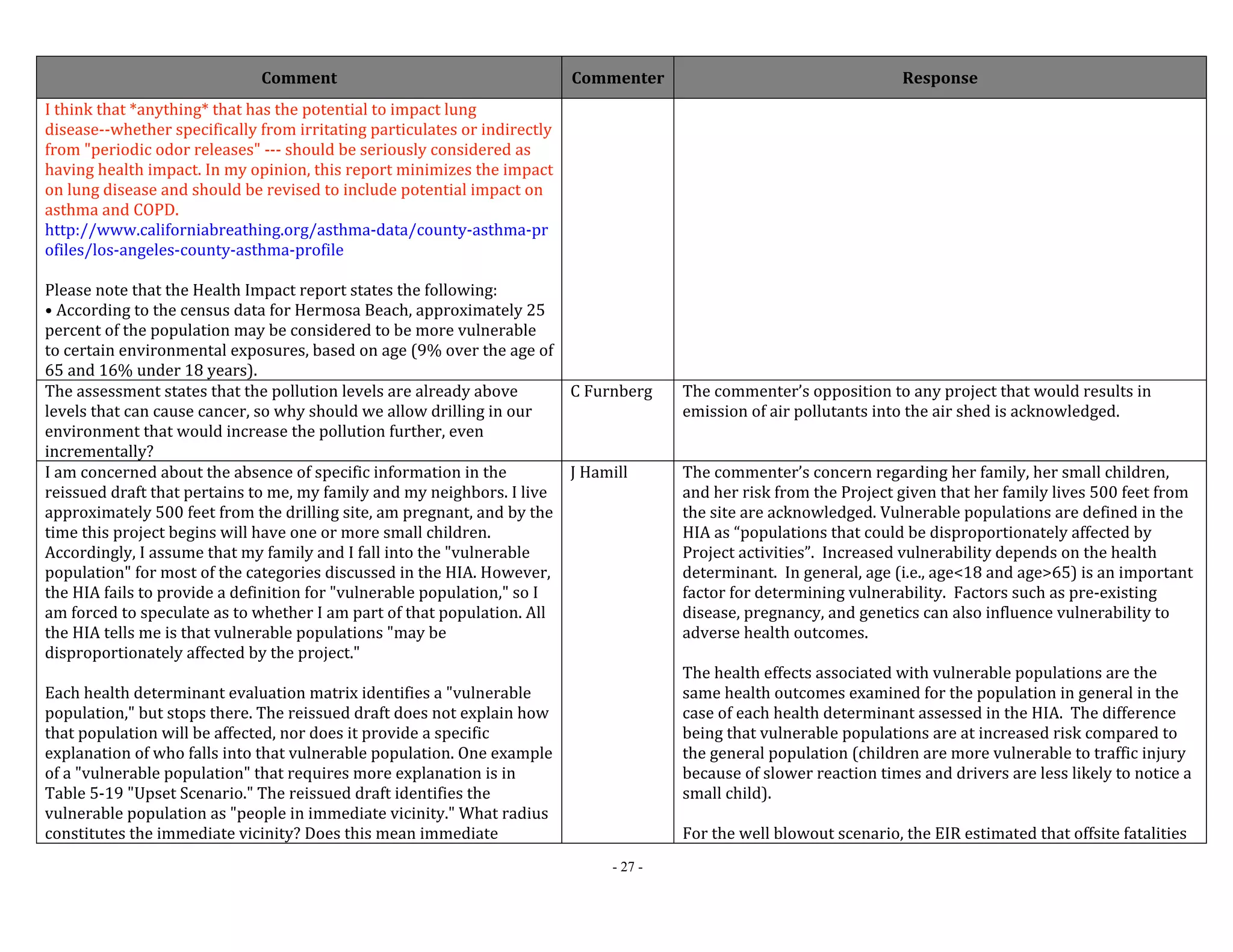
The HIA concludes that there is no substantial effect on human health with respect to air emissions of NO2, PM, and TAC 
through Phases 1 to 4. The odor‐related health effect is considered negative near the Project Site due to periodic odor 
releases during production operations (Phases 2 and 4) that cannot be completely mitigated. Odor can have various health 
consequences including stress, and could result in periodic discomfort and annoyance. If frequent reports of odor occur, 
additional study and/or periodic monitoring of odor may be warranted. 
Water & Soil Quality 
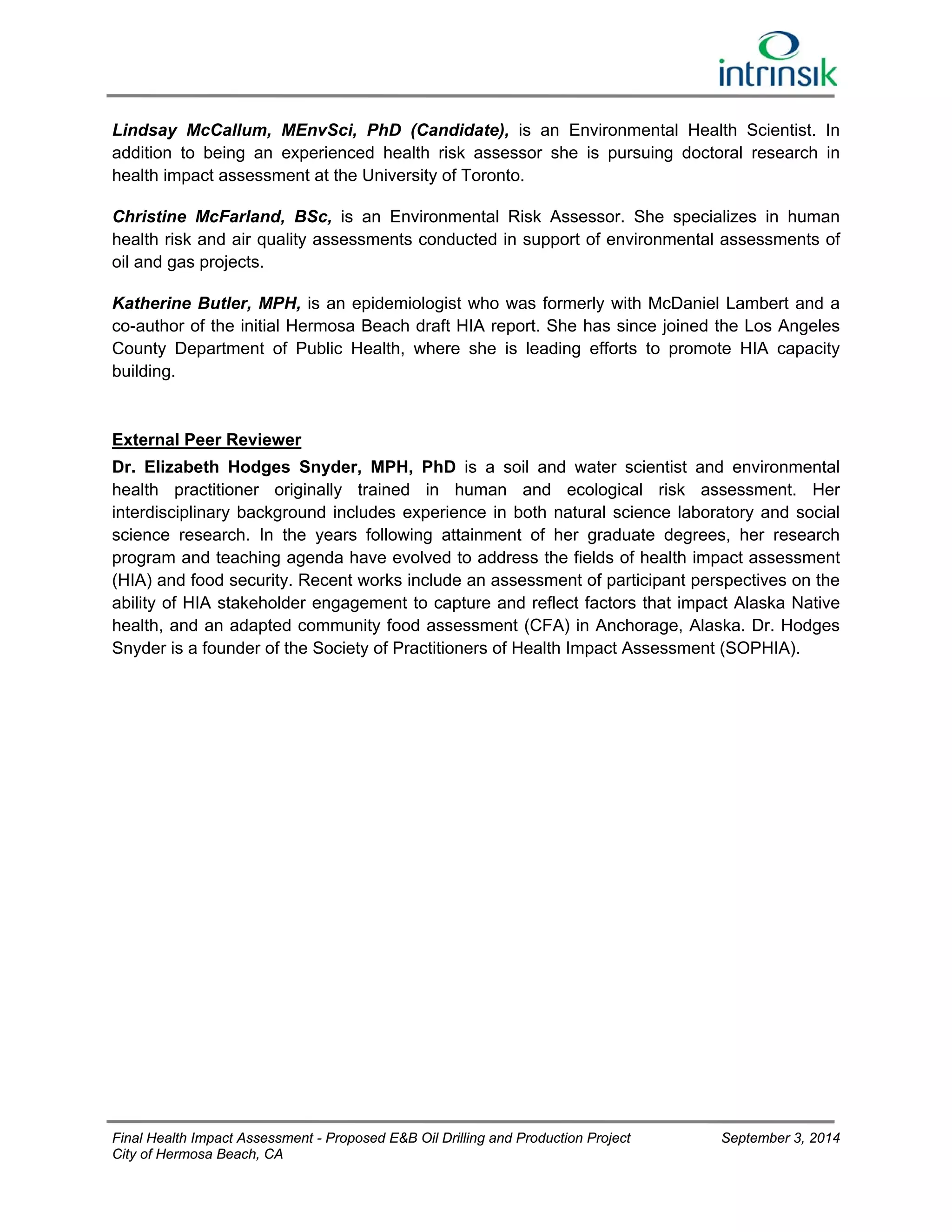
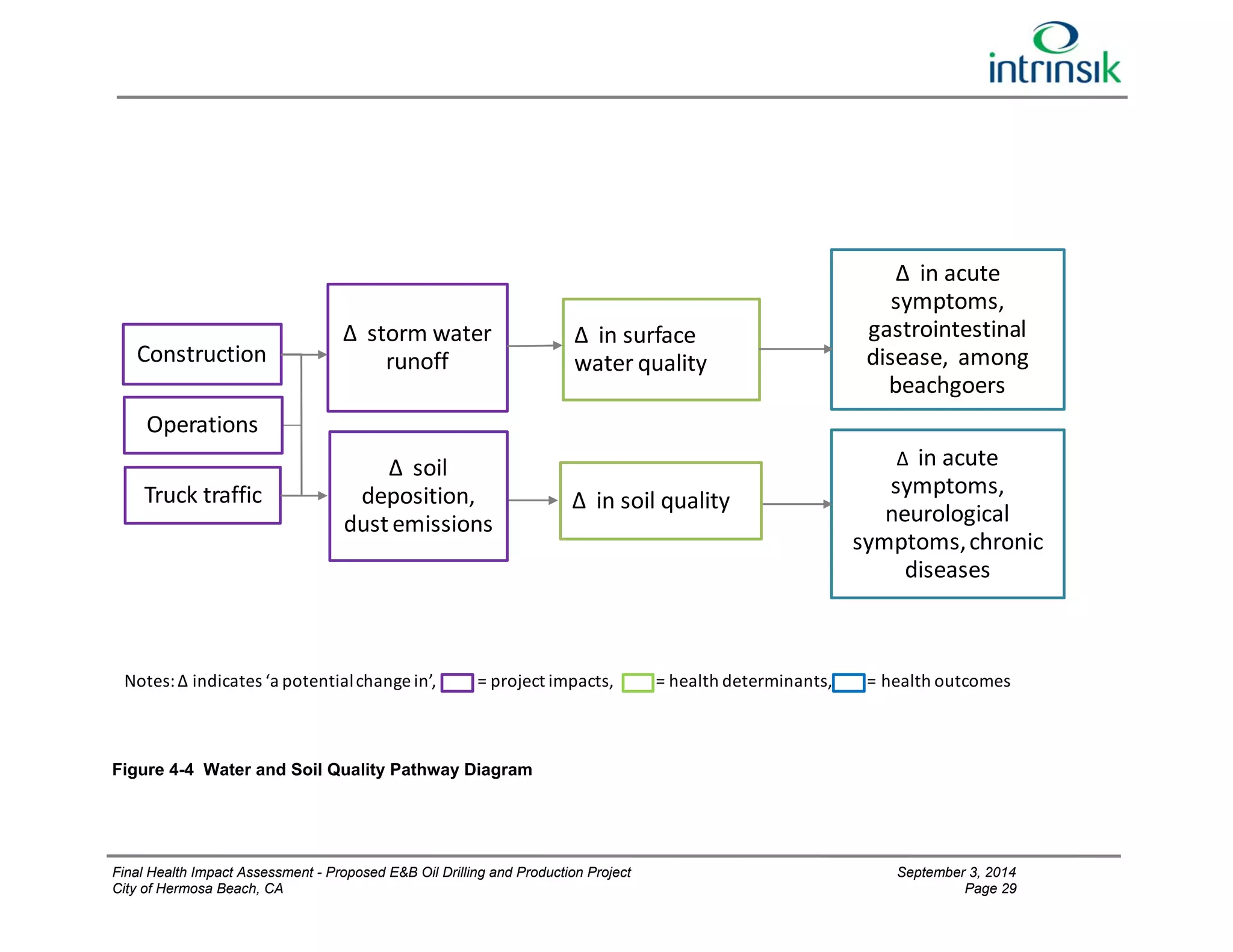
The water and soil assessment considered surface water impacts from Project‐related runoff to the Pacific Ocean and soil 
particulate emissions during construction activities. Due to the EIR mitigation measures and other factors, we concluded 
that there is no substantial effect on human health with respect to surface water quality and soil particulates during any 
Phase of the Project.
Upset Scenarios 
Upset scenarios included the possibility for a crude oil spill to the ocean or a well blowout. The oil spill assessment 
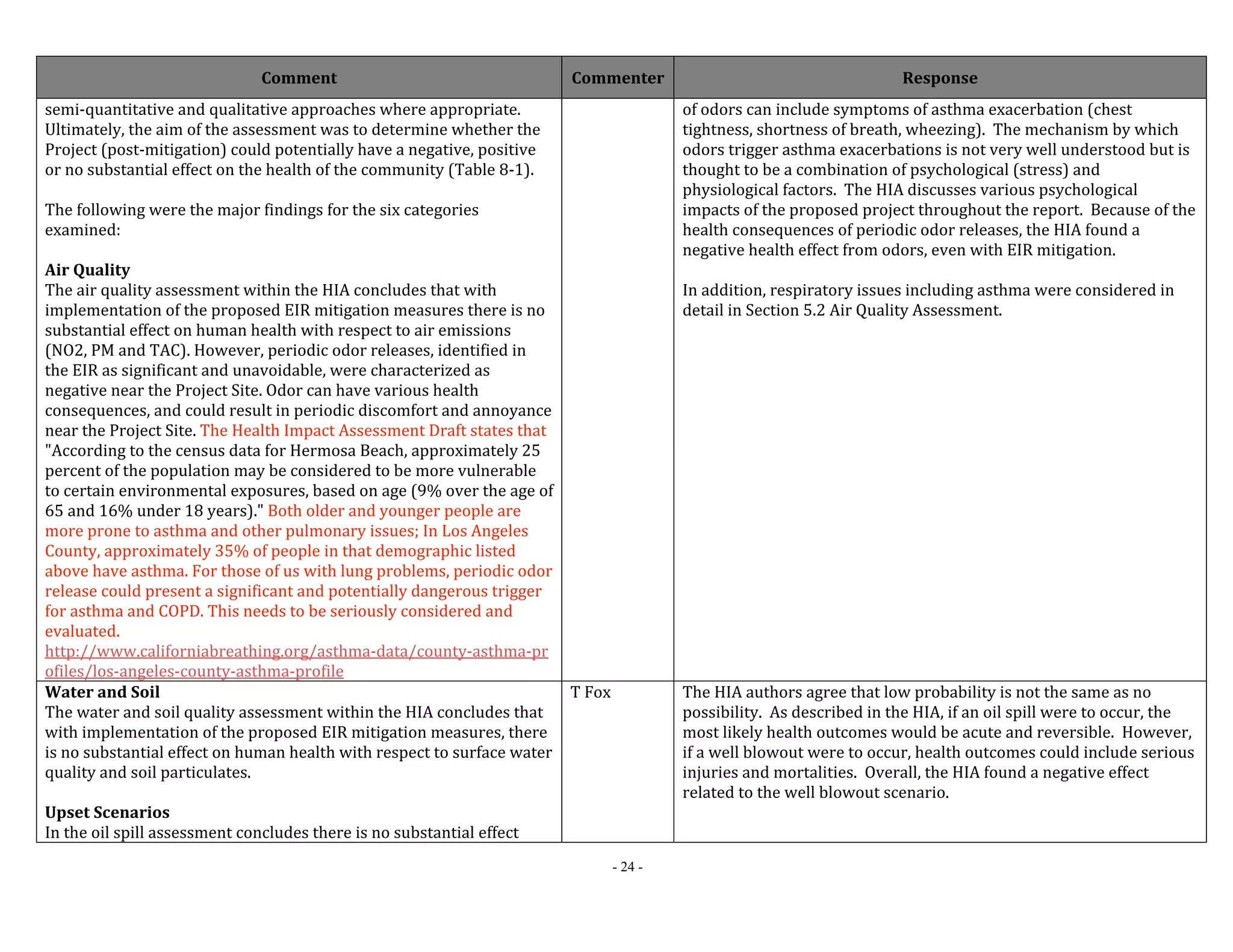
concludes no substantial effect through Phases 1 to 4. The blowout assessment within the HIA concludes that there is a low 
probability of occurrence, but in the event of a blowout, there could be significant negative health implications including 
fatalities. The HIA also found a negative health effect of stress due to fear of a blowout accident. The HIA recommends that 
the City incorporate the possibility of an oil spill or well blowout into its current emergency preparedness plan. 
Noise & Light 
This assessment considered Project noise emissions and light emissions, including lighting safety. With respect to noise, the 
HIA concludes that there is no substantial effect on human health from Phase 1, 2, 3a (site construction) and 4, and a 
potential negative impact from pipeline construction activities in Phase 3b. Therefore, it is recommended that written 
notification be provided to residents and schools in the vicinity of these activities that identifies the potential for excess 
noise and outlines the location and duration of the impacts. 
The light assessment within the HIA concludes no substantial effect on human health due to nighttime light emissions; 
however, there is potential for some nearby individuals to experience disruption of typical sleep patterns during periods 
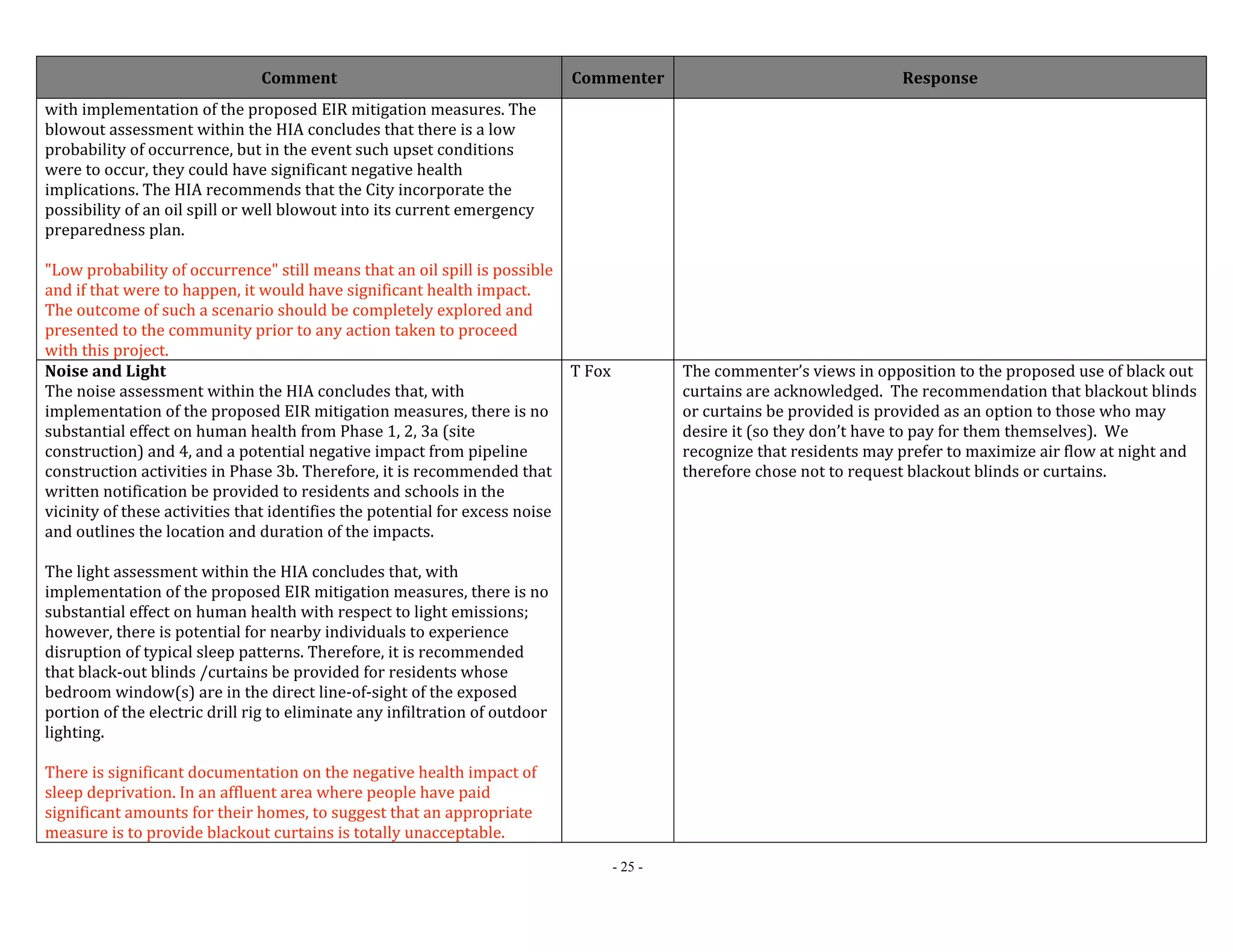
when the drill rig is present (Phase 2 and intermittently in Phase 4). Therefore, it is recommended that black‐out 
blinds/curtains be provided as an option for residents whose bedroom windows are in the direct line‐of‐sight of the 
exposed portion of the drill rig to eliminate any infiltration of outdoor lighting. 
Traffic 
The traffic assessment examined the potential for increased truck and other traffic to impact pedestrian, bicyclist, and 
motor vehicle safety and the potential for perceived traffic hazards to impact people’s walking and bicycling choices. 
Primarily due to the required EIR mitigation measures, we concluded that there is no substantial effect on human health 
with respect to traffic safety and perceived traffic safety hazards during any Phase of the Project. 
Community Livability 
The community livability assessment evaluated a number of community aspects that are valued by the citizens of Hermosa, 
including: property values, access to green space (parks and recreation), aesthetics (view), education funding, social 
cohesion, and political involvement. The community livability assessment within the HIA concludes that there is: no 
substantial effect on human health with respect to social cohesion; a potential negative effect from stress over property 
values and aesthetic/visual resources (while drill rigs are erected in Phases 2 and 4); and a potential positive effect on 
health from enhanced funding for recreation and green space, educational funding and political involvement activities. 
Monitoring 
Conclusion 
If the proposed Project is approved, the HIA 
provides monitoring recommendations for the City 
to consider. Those recommendations include: 
(1) a community liaison committee to address 
resident’s active concerns about Project activities; 
(2) a follow‐up community health assessment to 
identify if some groups are disproportionately 
impacted by Project activities; and, 
(3) a quality of life survey to establish baseline 
conditions in Hermosa Beach, and to monitor health 
status changes during the Project. 
There is no simple answer to the impact that the Project will have on 
the health of Hermosa Beach residents since different aspects of the 
proposed Project will impact the community in different ways. 
We caution that the assessment and conclusions are based on 
population health and not on single individuals. There are some 
aspects of the Project that may negatively influence health (e.g., 
odor, well blowout, noise from pipeline construction, property values 
and aesthetics), and at the same time there were potential positive 
health outcomes identified (e.g., increased education funding, ability 
to enhance green space). 
With the exception of a well blowout accident, the negative health 
outcomes were largely nuisance related (e.g., odor, noise, aesthetics) 
and without irreversible health impacts. As mitigated in the Final EIR, 
the majority of the health determinants examined revealed that the 
Project would have no substantial effect on the health of the 
community. Based on the Final EIR mitigation measures and 
additional recommendations provided in the HIA, on balance we do 
not believe that the Project will have a substantial effect on 
community health in Hermosa Beach. Ultimately it is the voters of 
Hermosa Beach who will decide whether the impacts described in 
this HIA are acceptable or not.
RATIONALE FOR REISSUED HIA 
The first draft Health Impact Assessment (HIA) for this project was released in February, 2014. 
It was prepared concurrently with the draft Environmental Impact Report (EIR) and Cost Benefit 
Analysis. The February draft HIA was largely based on the consideration of worst case 
scenarios rather than refined geographic data and the fully mitigated proposed Project in the 
Final EIR. 
McDaniel Lambert (now Intrinsik Environmental Sciences (US), Inc. [Intrinsik]) received many 
stakeholder comments on the February draft HIA. Written comments were submitted by the EIR 
consultant, community members and by the Applicant, E&B Natural Resources Management. 
Oral comments were also received at the presentations on the 24th and 26th of February, as well 
as at the Saturday Open House on March 8th. A number of the comments affected multiple parts 
of the document, calling for an extensive revision. 
When HIAs are conducted in conjunction with EIRs it is more appropriate to assess the potential 
for the Project to affect health on the post-mitigation scenarios, since by law certification of the 
EIR requires the implementation of these measures. The reissued draft HIA and this final HIA 
report had the benefit of the full public process and complete analysis reflected in the Final EIR 
and assessed the Project on the basis of post-mitigation scenarios. 
In addition, McDaniel Lambert was able to draw upon the experience of a number of experts 
from the parent company, Intrinsik, along with an external peer review. Therefore, the final HIA 
was prepared by an expanded multi-disciplinary team. This final HIA supersedes all previously 
released material related to the HIA including the February draft report and all corresponding 
presentations and/or related written material. 
Intrinsik Health Impact Assessment Team 
Dr. Mary McDaniel, DO, JD, MPH, Mary McDaniel is a board-certified occupational and 
environmental physician, licensed attorney, and risk and crisis communication expert. She 
brings more than 20 years of experience in health assessment, risk communication, crisis 
response, and occupational and environmental medicine. 
Dr. Christopher Ollson, PhD, is a Senior Environmental Health Scientist. He has over 17 years 
of experience in leading human health risk assessments and evaluating health impacts in 
support of environmental assessments for a range of energy projects. 
Bart Koppe, BSc, PBiol, is a Senior Risk Assessment Specialist. His expertise is in conducting 
health risk assessments for regulatory submissions for oil and gas-related projects. In addition, 
he is considered an expert in petroleum related air quality issues. 
Kathleen Souweine, MPH, is an epidemiologist and has experience in both the environmental 
sciences and a range of epidemiological projects. She is a former analyst in the USEPA Office 
of Ground Water and Drinking Water. 
Final Health Impact Assessment - Proposed E&B Oil Drilling and Production Project September 3, 2014 
City of Hermosa Beach, CA
Lindsay McCallum, MEnvSci, PhD (Candidate), is an Environmental Health Scientist. In 
addition to being an experienced health risk assessor she is pursuing doctoral research in 
health impact assessment at the University of Toronto. 
Christine McFarland, BSc, is an Environmental Risk Assessor. She specializes in human 
health risk and air quality assessments conducted in support of environmental assessments of 
oil and gas projects. 
Katherine Butler, MPH, is an epidemiologist who was formerly with McDaniel Lambert and a 
co-author of the initial Hermosa Beach draft HIA report. She has since joined the Los Angeles 
County Department of Public Health, where she is leading efforts to promote HIA capacity 
building. 
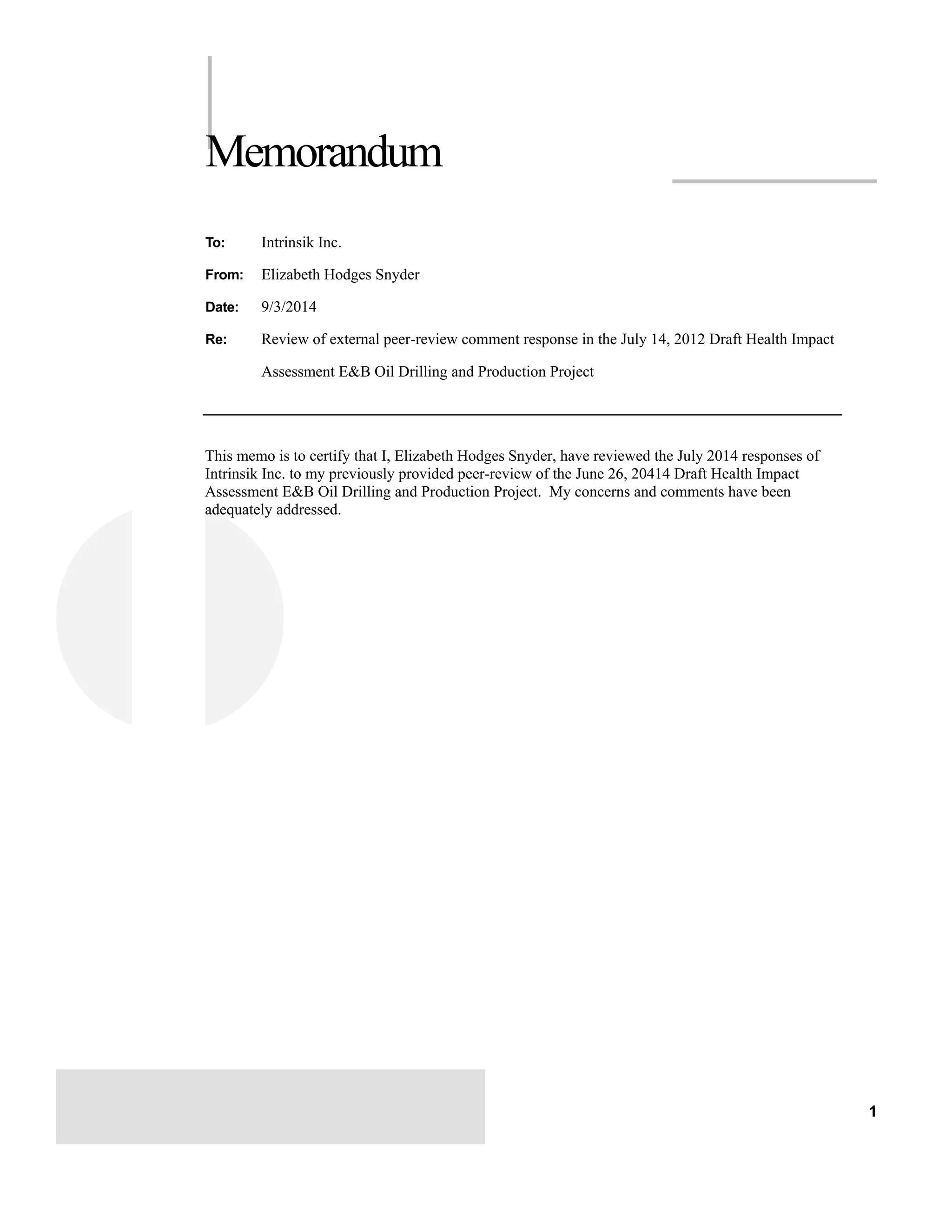
External Peer Reviewer 
Dr. Elizabeth Hodges Snyder, MPH, PhD is a soil and water scientist and environmental 
health practitioner originally trained in human and ecological risk assessment. Her 
interdisciplinary background includes experience in both natural science laboratory and social 
science research. In the years following attainment of her graduate degrees, her research 
program and teaching agenda have evolved to address the fields of health impact assessment 
(HIA) and food security. Recent works include an assessment of participant perspectives on the 
ability of HIA stakeholder engagement to capture and reflect factors that impact Alaska Native 
health, and an adapted community food assessment (CFA) in Anchorage, Alaska. Dr. Hodges 
Snyder is a founder of the Society of Practitioners of Health Impact Assessment (SOPHIA). 
Final Health Impact Assessment - Proposed E&B Oil Drilling and Production Project September 3, 2014 
City of Hermosa Beach, CA
PROJECT SUMMARY 
INTRODUCTION 
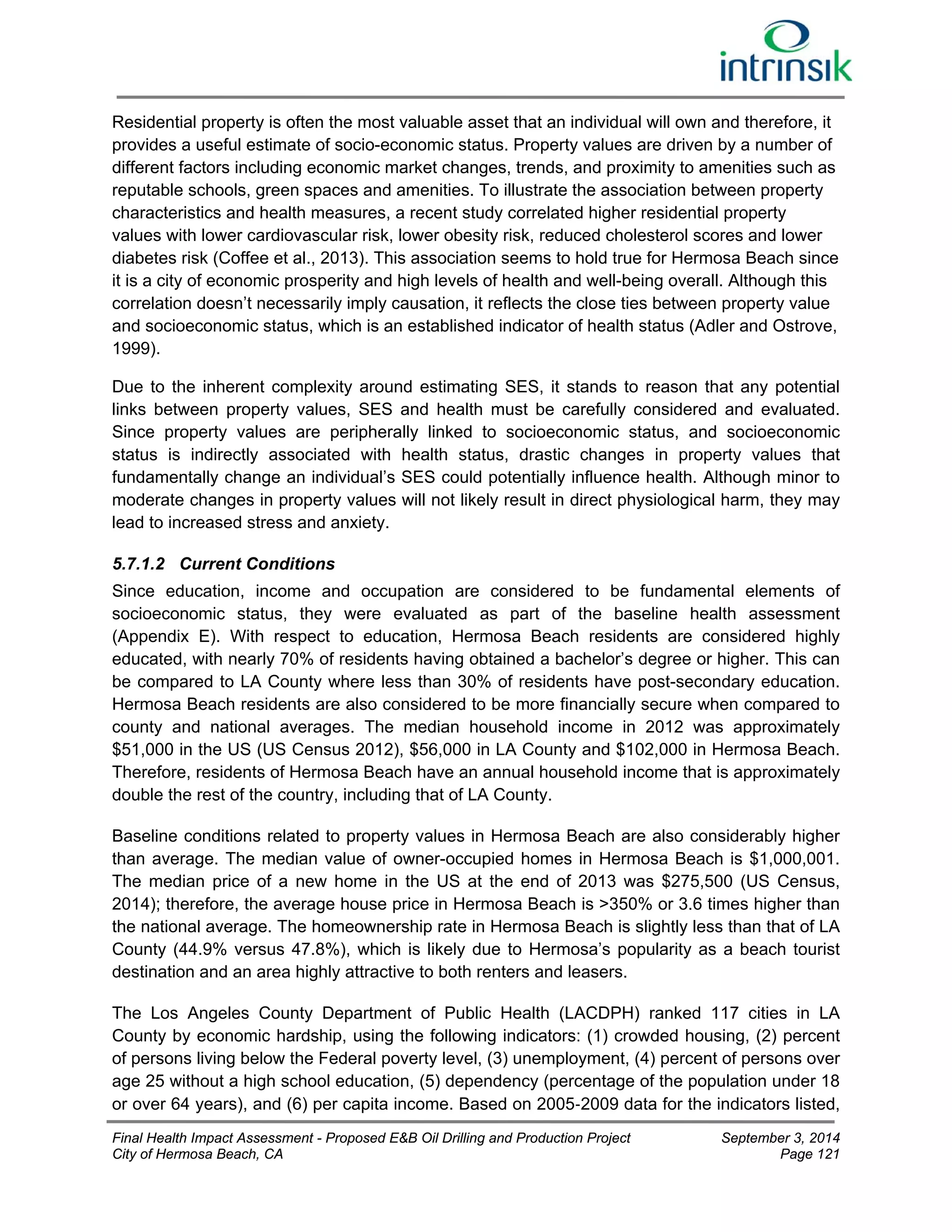
Founded in 1907, Hermosa Beach is a small 1.43 square mile city on Los Angeles (LA) County’s South 
Bay coastline, bordered by Manhattan Beach to the north and Redondo Beach to the south. Known as 
“The Best Little Beach City”, it has a population of approximately 20,000 people, with a high proportion of 
residents between the age of 25 and 50 (US Census, 2013). Under the settlement agreement that ended 
litigation, an election will be held to allow City of Hermosa Beach (the City) voters to decide whether to 
repeal the existing ban on oil drilling within the City limits. Repealing the ban on oil drilling would allow 
E&B Natural Resources Management Corporation’s (E&B’s) proposed oil drilling and production project to 
move forward. In order to inform voters about the potential economic, social, environmental, and health 
impacts (positive and negative) of the E&B proposed oil drilling and production project, the City 
commissioned a Health Impact Assessment (HIA), in addition to a Cost-Benefit Analysis (CBA) and 
Environmental Impact Report (EIR). The EIR complies with the California Environmental Quality Act 
(CEQA), while the CBA and HIA are complementary documents that the City commissioned to provide 
community members with additional information on the proposed Project. 
The proposed E&B Oil Development Project (proposed Project) consists of drilling 30 oil wells on a 1.3- 
acre site located on the current City Maintenance Yard property (the Site) located at 555 6th Street, at the 
intersection of Valley Drive and 6th Street in the City. The Site is bounded by industrial/commercial use 
properties to the north, south, and west. The Site is bounded by the Greenbelt, a park and recreational 
use space, to the east. Adjacent blocks also include residential uses located 150 feet to the north of the 
Project Site, 250 feet to the west and 180 feet to the east (east of the Greenbelt). The Pacific Ocean is 
approximately a half mile west of the Site. 
If approved, the proposed Project will be completed in four Phases. Phase 1 will last six to seven months 
and involves construction activities associated with Site preparation for drilling and testing. Phase 2 will 
last 10 to 13 months and involves drilling and testing of wells in order to estimate the potential productivity 
and economic viability of the proposed Project. If Phase 2 determines that the proposed Project is 
economically feasible, Phase 3 would be carried out to prepare the Site for permanent oil and gas 
production facilities and to construct offsite pipelines. Phase 3 would take approximately 13 months and 
involve construction of additional retaining walls and final grading, extending and completing the 
construction of the cement well cellar, placing a small office building onsite, installation of permanent 
production equipment, final Site and landscaping improvements, and erecting the 32-foot sound barrier 
wall for noise attenuation during Phase 4 drilling. The permanent oil production facility will include tanks, 
vessels, piping, pumps, filters and corresponding metering equipment. Phase 4 is the final phase of the 
proposed Project and will maximize oil and gas recovery through the construction of an 87-foot high drill 
rig, the drilling of the remaining oil wells and water disposal/injection wells, and through the continuous 
operation of the proposed Project. It is estimated that it will take two weeks to set up the drill rig, and two 
and a half years to drill the remaining wells, up to a total of 30 oil wells and four disposal/injection wells. 
Facility operations and maintenance would be continuous for approximately 30 to 35 years, with periodic 
re-drills during the life of the Project. 
An initial draft HIA was released in February 2014. Following receipt of a number of public comments and 
finalization of the EIR, the HIA underwent extensive revision and was reissued in July 2014. The reissued 
HIA was conducted using a multi-disciplinary approach and was subject to external peer-review by Dr. 
Elizabeth Hodges Snyder of the University of Alaska Anchorage. Dr. Hodges Snyder provided the HIA 
Final Health Impact Assessment - Proposed E&B Oil Drilling and Production Project September 3, 2014 
City of Hermosa Beach, CA Page i
team with constructive feedback and a number of comments (Appendix C), all of which have been 
addressed in the final HIA. 
HEALTH IMPACT ASSESSMENT METHODOLOGY 
The World Health Organization (WHO) defines health as “a state of complete physical, mental and social 
well-being and not merely the absence of disease or infirmity” (WHO, 1948). This definition is considered 
an ideal to strive for, and it forms the basic principle upon which HIA is based. 
In California, an HIA is not legally required for this type of project, but an EIR is mandatory. In order to 
expand on existing health considerations in the EIR, the City of Hermosa Beach commissioned this HIA 
to help inform voters and evaluate different aspects of the proposed Project through a public health lens. 
The rationale for the HIA lies in its unique approach to assessing a multitude of potential impacts (both 
positive and negative) that could affect community health. The HIA is intended to provide additional 
information, as well as relying on existing information provided in the EIR, to holistically evaluate health. 
Although the reports are complementary, in several instances the HIA provides further details on how 
specific aspects of the Project could positively or negatively affect the health of the community, and 
proposes additional recommendations where necessary. An HIA typically consists of a series of steps 
that are intended to provide a structural framework around which the assessment will be conducted. 
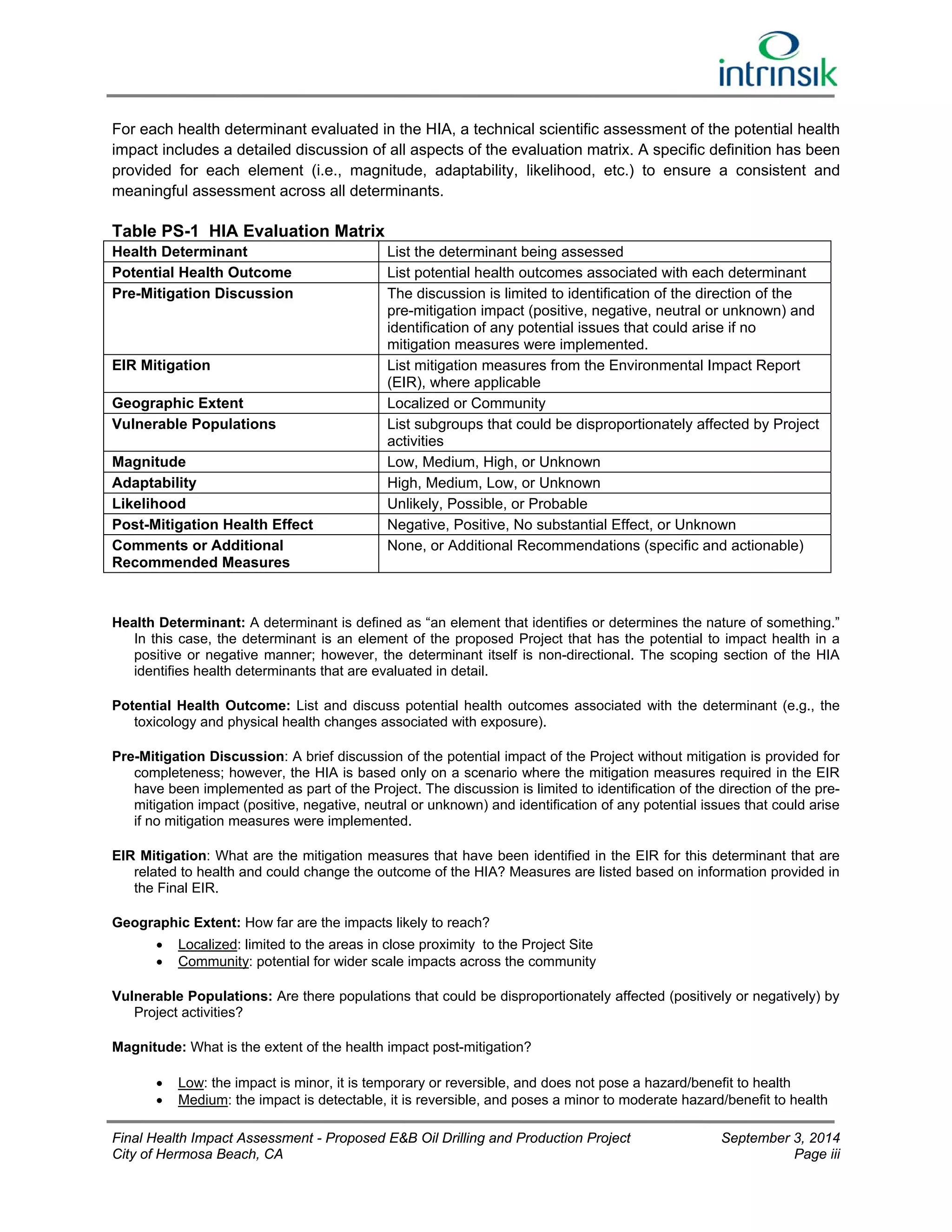
Although guidance documents from around the world have slight 
variations on these steps, they typically include: screening, scoping, 
assessment, recommendation, reporting, evaluation and monitoring 
Screening 
(Ross et al., 2014). 
An HIA evaluation matrix is a tool to characterize and summarize the 
predicted health impacts (positive, negative, and neutral) of the 
Scoping 
proposed Project so they can be compared and contrasted. As there 
is no globally accepted standard for health impact characterization in 
HIA, the evaluation matrix used in this HIA was developed based on 
best practices published in a number of guidance documents and 
Assessment 
used in other assessments (Ross et al., 2014; USEPA, 2013; CDPH, 
2010; IAIA, 2006; NRC, 2011). 
The evaluation matrix developed for this HIA includes consideration 
Recommendation 
of the different characteristics of potential impacts including 
geographic extent (local, widespread), magnitude, likelihood of 
occurrence, and others. Each of these characteristics is 
independently evaluated based on data from the EIR, evidence from 
the scientific literature, and professional judgment. A brief discussion 
Reporting 
of the Project without mitigation measures is included where 
applicable. However, the Project characteristics were ultimately 
evaluated based on a scenario where the proposed EIR mitigation 
measures have been implemented. The assessment focuses on the 
Evaluation 
Project including mitigation measures to ensure they are adequately 
protective and, if not, to propose additional recommendations based 
on the HIA findings. The evaluation criteria are discussed in further 
detail below (Table PS-1). 
Monitoring 
Final Health Impact Assessment - Proposed E&B Oil Drilling and Production Project September 3, 2014 
City of Hermosa Beach, CA Page ii
For each health determinant evaluated in the HIA, a technical scientific assessment of the potential health 
impact includes a detailed discussion of all aspects of the evaluation matrix. A specific definition has been 
provided for each element (i.e., magnitude, adaptability, likelihood, etc.) to ensure a consistent and 
meaningful assessment across all determinants. 
Table PS-1 HIA Evaluation Matrix 
Health Determinant List the determinant being assessed 
Potential Health Outcome List potential health outcomes associated with each determinant 
Pre-Mitigation Discussion The discussion is limited to identification of the direction of the 
pre-mitigation impact (positive, negative, neutral or unknown) and 
identification of any potential issues that could arise if no 
mitigation measures were implemented. 
EIR Mitigation List mitigation measures from the Environmental Impact Report 
(EIR), where applicable 
Geographic Extent Localized or Community 
Vulnerable Populations List subgroups that could be disproportionately affected by Project 
activities 
Magnitude Low, Medium, High, or Unknown 
Adaptability High, Medium, Low, or Unknown 
Likelihood Unlikely, Possible, or Probable 
Post-Mitigation Health Effect Negative, Positive, No substantial Effect, or Unknown 
Comments or Additional 
Recommended Measures 
None, or Additional Recommendations (specific and actionable) 
Health Determinant: A determinant is defined as “an element that identifies or determines the nature of something.” 
In this case, the determinant is an element of the proposed Project that has the potential to impact health in a 
positive or negative manner; however, the determinant itself is non-directional. The scoping section of the HIA 
identifies health determinants that are evaluated in detail. 
Potential Health Outcome: List and discuss potential health outcomes associated with the determinant (e.g., the 
toxicology and physical health changes associated with exposure). 
Pre-Mitigation Discussion: A brief discussion of the potential impact of the Project without mitigation is provided for 
completeness; however, the HIA is based only on a scenario where the mitigation measures required in the EIR 
have been implemented as part of the Project. The discussion is limited to identification of the direction of the pre-mitigation 
impact (positive, negative, neutral or unknown) and identification of any potential issues that could arise 
if no mitigation measures were implemented. 
EIR Mitigation: What are the mitigation measures that have been identified in the EIR for this determinant that are 
related to health and could change the outcome of the HIA? Measures are listed based on information provided in 
the Final EIR. 
Geographic Extent: How far are the impacts likely to reach? 
 Localized: limited to the areas in close proximity to the Project Site 
 Community: potential for wider scale impacts across the community 
Vulnerable Populations: Are there populations that could be disproportionately affected (positively or negatively) by 
Project activities? 
Magnitude: What is the extent of the health impact post-mitigation? 
 Low: the impact is minor, it is temporary or reversible, and does not pose a hazard/benefit to health 
 Medium: the impact is detectable, it is reversible, and poses a minor to moderate hazard/benefit to health 
Final Health Impact Assessment - Proposed E&B Oil Drilling and Production Project September 3, 2014 
City of Hermosa Beach, CA Page iii
 High: the impact is substantial, it is permanent, and poses a major hazard/benefit to health 
 Unknown: the impact is unclear and poses an unknown hazard/benefit to health 
Adaptability: How resilient is the community to this type of change; are they able to adapt? 
 High: people will be able to adapt to the change with ease and maintain pre-project level of health 
 Medium: people will be able to adapt to the change with some difficulty and will maintain pre-project level 
of health, although some support may be necessary 
 Low: people will not be able to adapt or maintain pre-project level of health 
Likelihood: What is the probability of the impact occurring based on the expected frequency of the exposure? 
 Unlikely: the impact is anticipated to occur rarely, if ever 
 Possible: there is potential for the impact to occur on a regular basis 
 Probable: the impact will almost certainly occur and persist over time 
Post-Mitigation Health Effect: What is the ‘direction’ of the post-mitigation effect? 
 Positive: the effect is expected to positively influence health following implementation of EIR mitigation 
measures 
 Negative: the effect is expected to negatively influence health following implementation of EIR mitigation 
measures 
 No Substantial Effect: there is no substantial effect expected following implementation of EIR mitigation 
measures 
 Unknown: the direction of the effect following implementation of EIR mitigation measures is unknown 
Comments or Additional Recommended Measures: Provide comment about the effect, and/or determine if there 
any additional measures recommended based on the Post-Mitigation Health Effect. 
 None: there are no additional measures recommended based on the findings of the HIA 
 Additional Recommended Measures: there are additional measures recommended based on the findings 
of the HIA (provide brief summary of recommendations) 
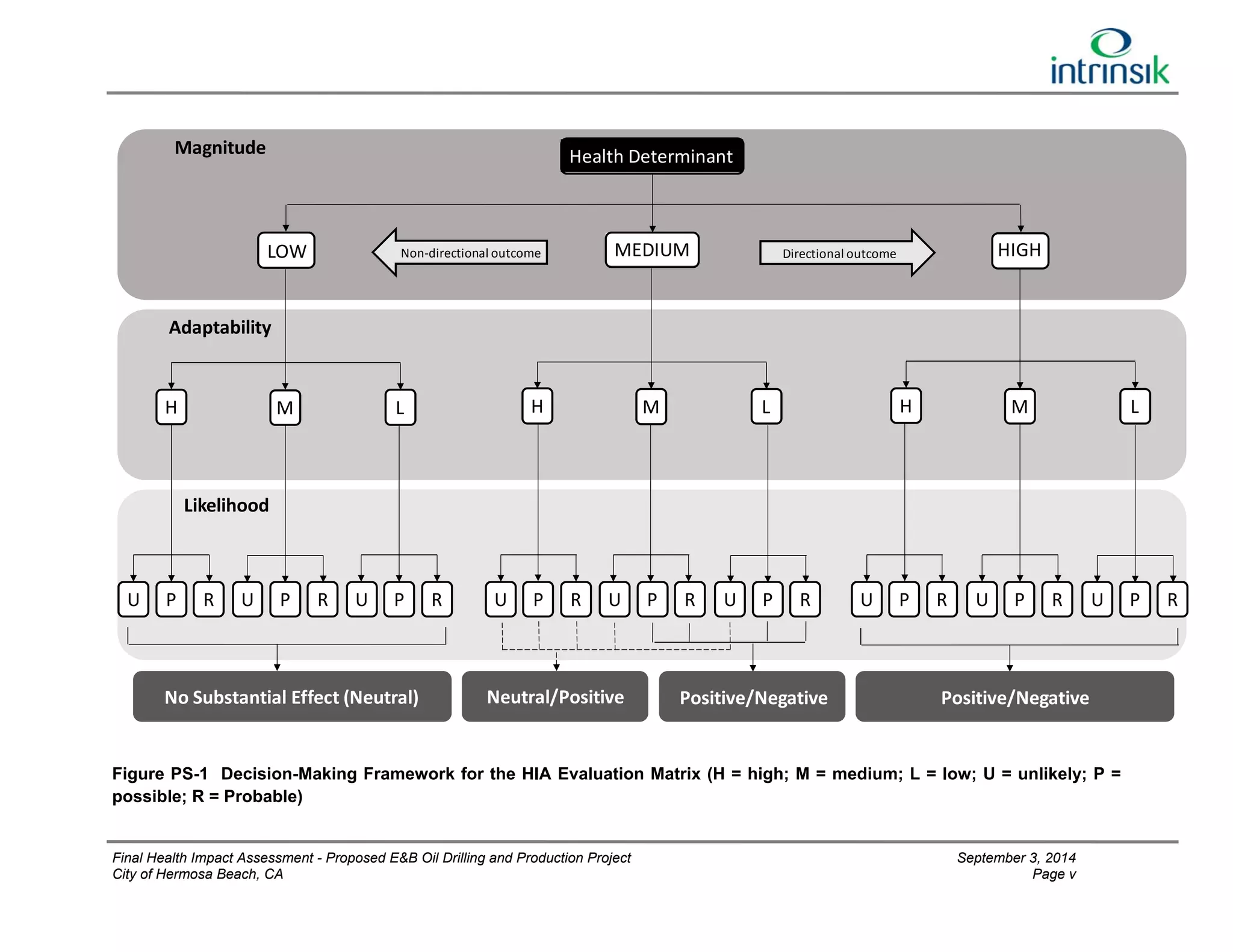
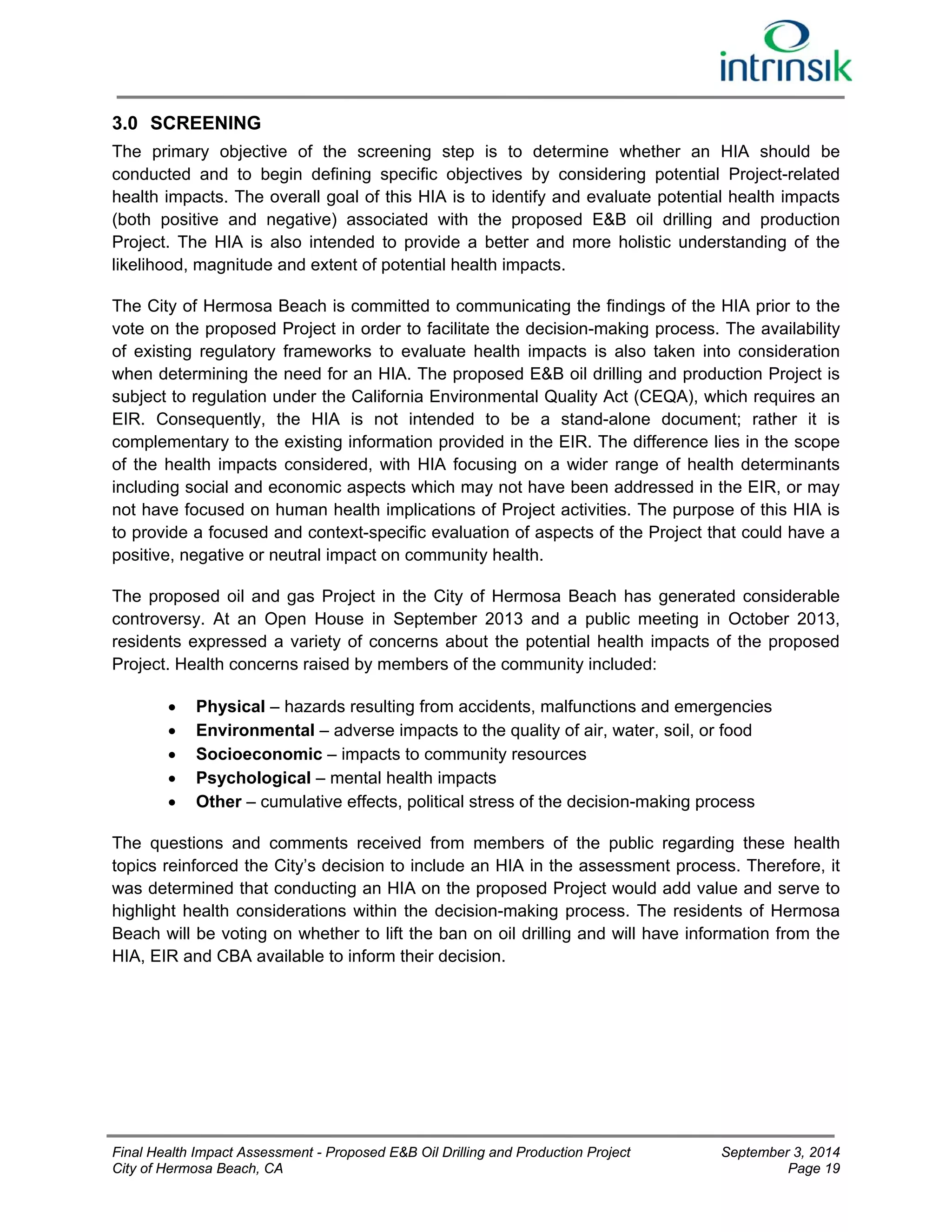
The decision-making framework (the framework) used to weigh and evaluate each of the elements of the 
evaluation matrix in order to come to a final conclusion on “Post-Mitigation Health Effect” for each health 
determinant is provided in Figure PS-1. The elements (i.e., magnitude, adaptability and likelihood) are 
arranged in descending order (top to bottom) of weight and potential influence on the final determination 
of effect. Each pathway through the framework leads to a specific conclusion that is either directional (i.e., 
positive or negative) or non-directional/neutral (i.e., no substantial effect). In some cases where 
professional judgment dictates, it is possible to deviate from the decision making framework; however, a 
detailed evidence-based rationale is required to be provided in the accompanying text. 
There are three different outcomes that can be used to classify a potential health effect. The classification 
is based solely on the definitions provided above and is intended to describe the extent of the post-mitigation 
health impact. The most heavily weighted aspect of the evaluation matrix is magnitude, which 
comprises the first level of the framework. Adaptability is the next level of the evaluation matrix as it 
relates to resiliency and ability to maintain health status if an impact were to occur. 
This element is less heavily weighted than magnitude but does influence the final determination of effect. 
The final level of the matrix is likelihood, which is the probability of the impact occurring based on the 
expected frequency of exposure. Likelihood is less heavily weighted than magnitude but similar to 
adaptability, it influences the final conclusion, especially in situations where the impact is expected to 
occur rarely, if ever. Where an element of the evaluation matrix is classified as ‘unknown’ a discussion of 
the uncertainty and potential influence of this limitation on the conclusions must be provided. In these 
scenarios, the determination of effect is largely based on professional judgment and sound rationale. 
Final Health Impact Assessment - Proposed E&B Oil Drilling and Production Project September 3, 2014 
City of Hermosa Beach, CA Page iv
Magnitude 
LOW HIGH 
Adaptability 
Non‐directional outcome Directional outcome 
H M L 
Likelihood 
Health Determinant 
MEDIUM 
H M L H M L 
U P R U P R U P R U P R U P R U P R U P R U P R U P R 
No Substantial Effect (Neutral) Neutral/Positive Positive/Negative Positive/Negative 
Figure PS-1 Decision-Making Framework for the HIA Evaluation Matrix (H = high; M = medium; L = low; U = unlikely; P = 
possible; R = Probable) 
Final Health Impact Assessment - Proposed E&B Oil Drilling and Production Project September 3, 2014 
City of Hermosa Beach, CA Page v
ASSESSMENT AND RECOMMENDATIONS 
The assessment process in HIA involves: (1) developing a health baseline profile, (2) assessing the likely 
impacts, and (3) characterizing the health impacts. The baseline health assessment establishes the 
current health status of the City of Hermosa Beach residents in order to evaluate whether the current 
profile of the community reveals vulnerabilities to any of a number of health outcomes, and also to 
provide a benchmark so that the HIA can predict the extent of change from current health conditions. The 
baseline assessment found that Hermosa Beach is a relatively young community that is highly educated, 
has above average income levels, and a higher sense of well-being than other California residents. 
Overall, demographic indicators show that Hermosa Beach is not highly vulnerable to negative health 
outcomes traditionally associated with poverty, unemployment, and low educational attainment. 
The HIA considered 18 determinants of health that fall under six major categories (i.e., air quality, water 
and soil quality, upset conditions, noise and light emissions, traffic, and community livability). 
Consideration was given to those determinants that were identified as community priorities and are most 
likely to be impacted by the proposed Project. Each of these outcomes was carefully assessed using a 
combination of quantitative, semi-quantitative and qualitative approaches where appropriate. Ultimately, 
the aim of the assessment was to determine whether the Project (post-mitigation) could potentially have a 
negative, positive or no substantial effect on health. Potential health impacts were considered both on a 
local (adjacent to the proposed Project Site) and community-wide scale. 
Air Quality 
The potential for air emissions from 
construction and operation of the proposed 
The air quality assessment within the HIA concludes that 
Project to affect air quality in Hermosa 
with implementation of the proposed EIR mitigation 
Beach was evaluated using the emissions 
measures there is no substantial effect on human health 
inventory produced as part of the EIR. The 
with respect to air emissions (NO2, PM and TAC). 
air pollutants carried forward for assessment 
However, periodic odor releases, identified in the EIR as 
in the HIA included nitrogen dioxide (NO2), 
significant and unavoidable, were characterized as 
negative near the Project Site. Odor can have various 
particulate matter (PM), toxic air 
health consequences, and could result in periodic 
contaminants (TAC), and hydrogen sulfide 
discomfort and annoyance near the Project Site. 
(H2S) and other odorous compounds. 
Nitrogen dioxide (NO2) has the potential to produce a range of respiratory effects depending on the 
concentration in air (e.g., eye, nose and throat irritation, inflammation of lung tissue). For the assessment, 
the maximum 1-hour and maximum annual average NO2 air concentrations were calculated (background 
plus Project) and found to be below the WHO air quality health guidelines, indicating that adverse health 
effects are not expected to result from either short-term or long-term exposure. Additionally, there were no 
exceedances of California’s Ambient Air Quality Standards (AAQS), or the US EPA National Ambient Air 
Quality Standards (NAAQS) for NO2. Therefore, it was concluded that exposure to NO2 from the proposed 
Project (post-mitigation) is expected to have ‘no substantial effect’ through the duration of the proposed 
Project and no additional recommendations were required. 
Particulate matter (PM) is a widespread air pollutant composed of a mixture of solid and liquid particles, 
and its effects on health are well documented. Particles with a diameter of 10 micrometers or smaller are 
referred to as PM10, and particles with a diameter of 2.5 micrometers or smaller are known as PM2.5. 
Exposure, particularly to the smaller PM2.5 particles, is associated with increased respiratory and 
cardiovascular disease and mortality. The maximum 1-hour and maximum annual average PM2.5 air 
Final Health Impact Assessment - Proposed E&B Oil Drilling and Production Project September 3, 2014 
City of Hermosa Beach, CA Page vi
concentrations were added to baseline concentration in LA County and resulted in exceedances of the 
WHO air quality guidelines. However, when background levels from South Coastal Los Angeles County 
(assumed to better represent Hermosa Beach air quality) were used, the Project was below the California 
annual AAQS or US EPA NAAQS. The assessment concluded that any exceedances of the WHO air 
quality guidelines are based on existing background levels in the area and the Project is not expected to 
have a material impact on existing PM2.5 related health risks. While there is no substantial effect from 
post-mitigation exposure to PM2.5 through the duration of the proposed Project, existing ambient levels of 
PM2.5 air concentrations in the area are already in the range at which increased mortality has been 
observed in large urban centers. 
Toxic Air Contaminants (TAC) can be used to describe a wide array of chemicals, including volatile 
organic compounds (VOCs), polycyclic aromatic hydrocarbons (PAHs), hydrogen sulfide (H2S), inorganic 
elements (e.g., metals) and particulate emissions from diesel exhaust. Without mitigation measures, 
Project emissions of certain TAC would pose a potential risk to human health; however, with 
implementation of the measures proposed in the EIR, the proposed Project is expected to have no 
substantial effect through the duration of the proposed Project and no additional recommendations were 
required. 
Odor can result from the release of compounds such as H2S. Sensitivity to environmental odors varies 
greatly from person to person. The most commonly reported symptoms from odor exposure are 
headaches, nasal congestion, eye, nose, and throat irritation, hoarseness, sore throat, cough, chest 
tightness, and shortness of breath, among others. According to the WHO, odor annoyance can also affect 
overall quality of life. Adverse health outcomes associated with odor are related to the frequency, 
duration, concentration, and the individuals’ level of sensitivity. Hydrogen sulfide is the primary odor 
associated with oil and gas production and it has a relatively low odor threshold. The H2S odor threshold 
(i.e., the lowest concentration perceivable by human smell) is highly variable within the human population 
and can be detected at concentrations as low as a half of a part per billion (0.5 ppb). Although mitigation 
measures proposed in the EIR would reduce the frequency of odor releases, they were still identified as 
‘significant and unavoidable’ during production operations (Phases 2 and 4) because of the close 
proximity of residences and businesses to the Project. For these reasons, the odor-related health effect is 
considered ‘negative’ near the Project Site and additional recommendations have been provided (i.e., an 
odor study and/or periodic monitoring in the event of excessive reports of odor). 
Water and Soil Quality 
If uncontrolled, Site-related chemicals in polluted 
stormwater runoff water could be detrimental to the 
The water and soil quality assessment within the 
environment and human health. For people 
HIA concludes that with implementation of the 
swimming or recreating in the Pacific Ocean, 
proposed EIR mitigation measures, there is no 
contact with polluted stormwater runoff could result 
substantial effect on human health with respect to 
in acute health symptoms such as eye and skin 
surface water quality and soil particulates. 
irritation. Runoff from the proposed Project site 
generally flows to the west towards an inlet that discharges to the Ocean at an outfall at the end of 
Herondo Street. During a rain event, contaminants and debris that enter the storm drain system could 
flow into the nearby Santa Monica Bay, which is currently listed as an “impaired water body” for ‘contact’ 
recreation. During Phase 2 and 4 drilling operations, surface runoff at the Project site would be contained 
with walls and berms and pumped into the water processing system for injection into the oil reservoir; 
therefore, preventing negative impacts to surface water quality and potential health outcomes during 
Final Health Impact Assessment - Proposed E&B Oil Drilling and Production Project September 3, 2014 
City of Hermosa Beach, CA Page vii
operations. Without mitigation, construction-related contaminants and debris flowing into storm drains 
connected to the Pacific Ocean could result in impacts to water quality and increases in acute health 
outcomes during Phases 1 and 3 of the proposed Project. However, EIR mitigation measures will reduce 
the possibility of construction-related impacts to the Pacific Ocean through the requirement of a Storm 
Water Pollution Prevention Plan. Overall, the potential health impact associated with surface water is 
classified as no substantial effect because Site runoff will be controlled during all Project phases. 
Soils under the current maintenance yard and potential Project Site have contamination related to its 
former use as a landfill. While the Site is currently paved over and thus not posing any present hazard, 
Project-related construction activities will release particulate emissions when equipment moves on soil or 
unpaved surfaces and during trenching, grading, and other earth-moving activities. The primary 
contaminant of concern in onsite soil is lead; however, on-site surface soil data is limited and the top 3 
feet of soil is not currently well characterized with respect to potential contamination. Therefore, additional 
surface soil data is important to address in order to determine the potential health hazard posed by 
chemicals in soil prior to Phase 3 RAP activities. The EIR required mitigation measure SR-2 addresses 
this data gap by requiring the Applicant to sample soil during Phase I grading and remove soil 
contamination exceeding regulatory thresholds from the Site as early as Phase 1 if substantial 
contamination is present. Implementation of the RAP to remove contaminated soil and mitigation 
measures to reduce fugitive dust emissions will reduce the possibility of hazardous soil particulate 
emissions during Project- related activities and thus soil particulates do not pose a substantial effect to 
human health through the duration of the proposed Project. 
Upset Scenarios 
This HIA evaluated the health impacts of two 
upset scenarios, an offsite oil spill and a well 
In the oil spill assessment concludes there is no 
blowout. Potential human health impacts of 
substantial effect with implementation of the 
exposure to an offsite oil spill include headaches, 
proposed EIR mitigation measures. The blowout 
eye/skin irritation, respiratory conditions, anxiety, 
assessment within the HIA concludes that there is 
and depression. In the unlikely event of a spill 
a low probability of occurrence, but in the event 
such upset scenarios were to occur, they could 
(0.07% chance of an oil spill to the ocean), E&B 
have significant negative health implications. The 
would be required to contain and clean-up any 
HIA also found a negative health effect of stress 
crude oil in the environment, thus irreversible or 
due to fear of a blowout accident. The HIA 
chronic health outcomes would not be expected 
recommends that the City incorporate the 
to occur and the HIA concludes ‘no substantial 
possibility of an oil spill or well blowout into its 
effect’ related to the oil spill health determinant 
current emergency preparedness plan. 
through the duration of the proposed Project. 
A well blowout could result in serious injuries and/or fatalities among community members in the vicinity 
of the proposed Project Site. A well blowout is a very low probability event, predicted to occur once in 323 
years during drilling and once in 604,127 years during non-drilling periods if the wells are pressurized. 
The fear of a blowout accident could result in moderate impacts to human health due to elevated levels of 
distress over the possibility that a blowout could occur. Because a well blowout could have severe health 
consequences and the possibility of an upset scenario occurring cannot be completely avoided through 
mitigation, the blowout assessment concludes a ‘negative’ health effect. In addition to emergency 
response plans prepared by E&B, the City should consider incorporating the possibility of an oil spill or 
well blowout into their current public preparedness awareness program. 
Final Health Impact Assessment - Proposed E&B Oil Drilling and Production Project September 3, 2014 
City of Hermosa Beach, CA Page viii
Noise and Light Emissions 
Noise is ubiquitous in suburban/urban and commercial areas. Health implications associated with 
exposure to excess noise are typically focused on nighttime sleep disturbance. Since the Project-related 
activities predicted to produce the highest noise 
levels were only permitted during daytime hours, 
nighttime impacts of noise are not a primary concern 
The noise assessment within the HIA 
in the current HIA. The impact of Project-related 
concludes that, with implementation of the 
noise emissions on the local community, particularly 
proposed EIR mitigation measures, there is no 
residents located around the Project Site and along 
substantial effect on human health from Phase 
1, 2, 3a (site construction) and 4, and a 
the pipeline and truck routes is negative without the 
potential negative impact from pipeline 
use of mitigation measures; however, the EIR has 
construction activities in Phase 3b. Therefore, 
identified a variety of mitigation techniques to reduce 
it is recommended that written notification be 
the potential impact of noise on the surrounding 
provided to residents and schools in the 
community including a 35-foot acoustical barrier 
vicinity of these activities that identifies the 
around the Project site. Based on the current HIA, 
potential for excess noise and outlines the 
there is expected to be no substantial effect on 
location and duration of the impacts. 
human health resulting from project activities in 
Phases 1, 2, 3a (site construction) and 4. There is some potential for negative health effects from high 
levels of noise associated with pipeline construction (Phase 3b); however, this is expected to be short-term 
in duration (approx. one week per location) and is limited to daytime hours. Therefore, for Phase 3b 
(pipeline construction), it is recommended that local residents and local schools be provided with written 
notification of the impending work that identifies the potential for excess noise and outlines the location 
and duration (expected to be short-term: 1 week) of the impacts. 
The invention and widespread use of artificial light, especially at night, has become a necessity in many 
areas of the world to enhance commerce, promote social activity, and increase public safety. Despite the 
fact that the use of artificial light is a widespread 
consequence of industrial and economic 
The light assessment within the HIA concludes 
development, it can have unintended negative 
that, with implementation of the proposed EIR 
consequences, especially when it becomes 
mitigation measures, there is no substantial 
inefficient, annoying and unnecessary. The major 
effect on human health with respect to light 
health concern related to excessive light-at-night is 
emissions; however, there is potential for 
disruption of sleep and biological circadian rhythms 
nearby individuals to experience disruption of 
which influence melatonin production and promote 
typical sleep patterns. Therefore, it is 
overall health. To ensure visibility, site security and 
recommended that black‐out blinds/curtains 
worker safety artificial lighting will be installed as part 
be provided as an option for residents whose 
of the proposed Project. The majority of the on-site 
bedroom window(s) are in the direct line‐of‐sight 
of the exposed portion of the electric 
lighting will be shielded and downcast to reduce 
drill rig to eliminate any infiltration of 
glare. Additionally, the site will have a 32-foot 
acoustical barrier that will eliminate light spill beyond 
the Site boundary in most cases. The one exception to this is the presence of lighting on the electric drill 
rig, which extends up to 87 feet. Residents who have a line-of-sight view of the exposed side of the 
electric drill rig from their bedroom window(s) may be disproportionately impacted. For these individuals, it 
is recommended that black-out blinds or curtains be provided as an option for those who would like 
blinds/curtains but do not wish to pay for them themselves to help eliminate the potential for infiltration of 
light emissions from the nighttime lighting on the drill rig. 
Final Health Impact Assessment - Proposed E&B Oil Drilling and Production Project September 3, 2014 
City of Hermosa Beach, CA Page ix
Traffic 
Increases in traffic volume are associated with increased risk of injury and death due to vehicle-vehicle, 
vehicle-pedestrian, and vehicle-bicycle collisions. Currently, fatalities resulting from motor vehicle 
collisions are very rare in the pedestrian and bike-friendly 
City of Hermosa Beach. A Traffic Impact Analysis (TIA) 
prepared by Arch Beach Consulting (2013) concluded 
that project-related traffic would not significantly impact 
the level of service on any of the studied roadway 
segments and therefore the EIR indicated that project-related 
traffic will not have a significant impact on traffic 
The traffic assessment within the HIA 
concludes that, with implementation of 
the proposed EIR mitigation measures, 
there is no substantial effect on human 
health with respect to traffic safety and 
perceived traffic safety hazards. 
congestion. However, the introduction of truck traffic on 
roads not accustomed to large trucks could represent a safety hazard to bicyclists and pedestrians. 
Consequently, the EIR recommends additional mitigation including increased crossing guard presence at 
the Site, installation of warning signs and lights, ensuring that trucks are not too long, and reconfiguring 
Valley Dr. Overall, with safety measures in place, and because of the limited extent of increased traffic, 
traffic safety is not predicted to have a substantial health impact in the community through the duration of 
the proposed Project. 
Findings from the literature suggest that perception of safety is an important mediator of the relationship 
between traffic safety and active transportation, or walking/bicycle trips. Perceived risk of injury may 
discourage walking and bicycling, which can directly impact health by decreasing physical activity levels. 
Parental perception of safety is especially important for rates of walking and biking among children. Since 
the Project Site lies on a safe walk to school route, there is a possibility that perceived traffic hazards 
could result in decreased active transportation. However, the impact is limited to a portion of Valley Drive. 
and most community members should be able to adapt to the increased perception of traffic hazards by 
seeking alternative routes for walking and biking. Therefore, no additional measures are recommended. 
Community Livability 
Community livability defines elements that make it desirable 
to live in a particular place. These can include 
The community livability assessment 
environmental, social and economic elements. For the 
within the HIA concludes that with 
proposed Project, local residents voiced certain concerns 
implementation of the proposed EIR 
they have regarding different aspects of community 
mitigation measures there is: no 
livability. The following health determinants associated with 
substantial effect on human health 
community livability were identified and assessed as part of 
with respect to social cohesion; a 
potential negative effect from stress 
the HIA: property values; access to recreational resources 
over property values, aesthetic/visual 
and green space; aesthetics and visual resources; 
resources; and a potential positive 
education funding; social cohesion; and, political 
effect on health from enhanced 
involvement. 
recreation and green space, 
educational funding and political 
Commercial and industrial developments have the potential 
involvement activities. 
to impact local property values. The complexities around 
property value fluctuations make it difficult to accurately 
evaluate the potential impact from one project. The CBA concluded that property values within Hermosa 
Beach could be impacted by 0-10%; and it was suggested that any decrease in property values is likely to 
be localized. Any perceived or actual decrease has the potential to moderately increase stress and 
anxiety among Hermosa Beach residents, which is suggestive of a negative effect on human health. To 
Final Health Impact Assessment - Proposed E&B Oil Drilling and Production Project September 3, 2014 
City of Hermosa Beach, CA Page x
reduce any potential stress or anxiety that local property owners may experience as a result of the 
proposed Project, E&B could consider having a property value analysis conducted. 
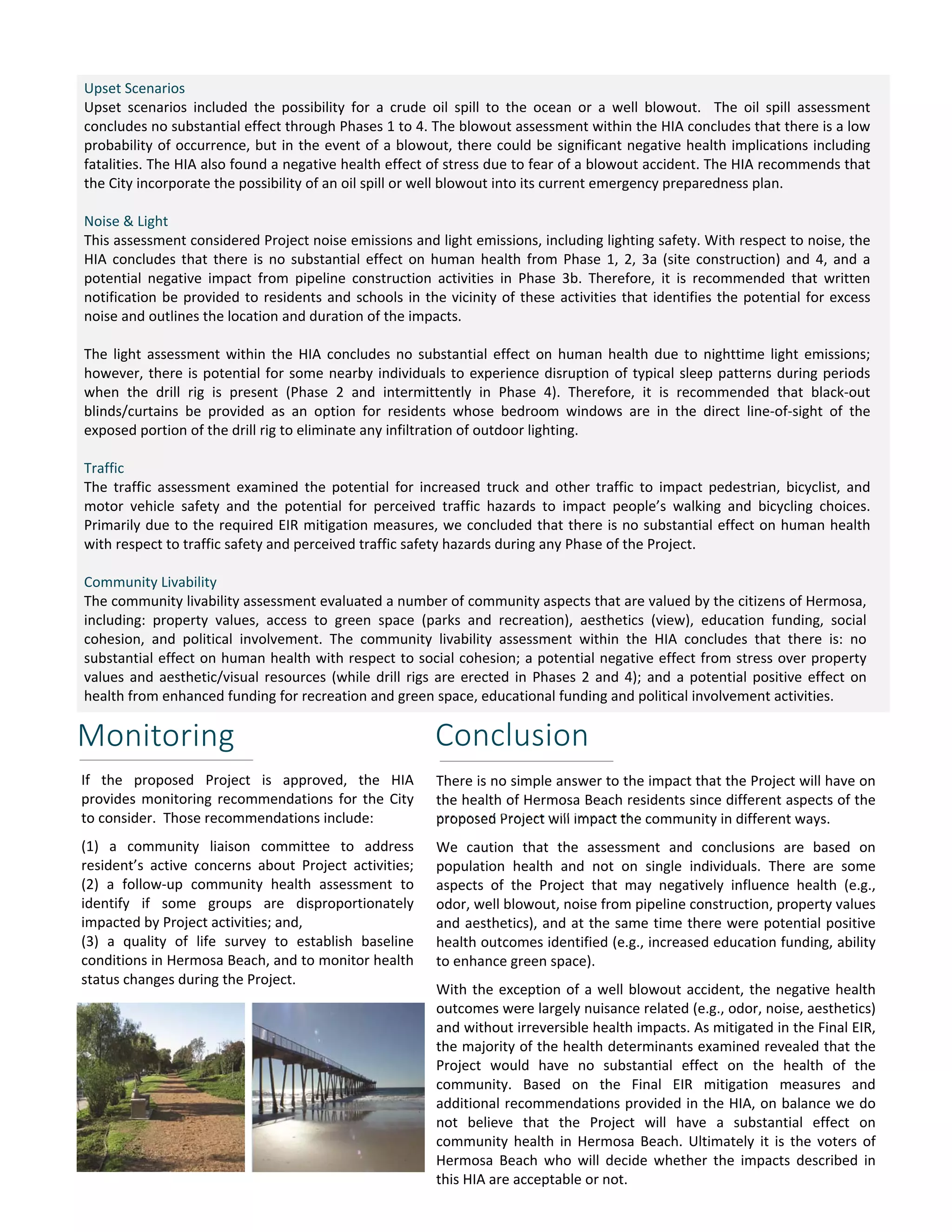
Access to recreational areas and green space is an important community resource and a key component 
of overall health and well-being. Hermosa Beach residents are considered to be very active due to their 
proximity to the beach, access to parks and availability of recreation and fitness facilities. While the 
proposed Project would not be removing any existing green space in the community, it will be located 
adjacent to a park, near other parks, and near walking and biking travel routes. Disturbances during 
pipeline and Site construction (Phases 1 and 3) could temporarily affect ready access of recreational 
resources or the quality of the recreational experience. On the other hand, Project revenue could be 
used to enhance recreational resources, and it is predicted that there will be an overall positive impact on 
community health in regards to recreation and green space. It is recommended that a community 
advisory group be formed to aid the City in deciding priority for recreational / green space funding. 
Aesthetic value is a complex concept that is highly subjective. There is a high degree of individual 
variability when it comes to the visual impact and/or aesthetic value of an object or a place. The presence 
of the electric and workover drill rigs during Phase 2 and 4 have the potential to negatively impact health 
by diminishing the aesthetic appeal of the landscape. This has the potential to influence levels of 
annoyance and stress; however, this is not anticipated to have a substantial effect on health. Therefore, 
the post-mitigation health effect is considered negative. No additional recommendations have been made. 
Educational funding can provide improvements in some of the key indicators of socioeconomic status 
(i.e., occupation and income) and has been described as a cost-effective method of increasing health and 
well-being. Hermosa Beach has one of the top school districts in the country and the modest increase in 
annual funding that will be provided to the schools as a result of revenue from oil production is expected 
to have a positive effect on health now and in the future. This positive effect is expected for all Phases of 
the Project. 
Social cohesion is a complex concept that is difficult to measure and is related to the interactions between 
community members. Some local residents have voiced concerns about the situation causing a division in 
the community – those in favor of oil development versus those opposed. As an indicator of health, social 
cohesion is linked to the idea of ‘quality of life’ which is associated with certain aspects of health and well-being. 
Hermosa Beach residents experience higher levels of well-being than most California cities. 
Although it is not expected that all residents will experience a reduction in social cohesion due to 
differences of opinion, some individuals may. For those residents, this could result in increased stress; 
however, social cohesion is not considered to have a substantial effect on community health. 
Active involvement in local politics is associated with increased self-efficacy and can have positive 
impacts on health and well-being. Hermosa Beach residents have the unique opportunity to decide 
whether the proposed Project can go ahead by voting on whether to allow oil drilling within the City. This 
opportunity extends to all adult members of the community, although only a subset of the population is 
actively involved in the politics and may benefit from the positive impact on health. 
Final Health Impact Assessment - Proposed E&B Oil Drilling and Production Project September 3, 2014 
City of Hermosa Beach, CA Page xi
MONITORING AND EVALUATION 
The following monitoring recommendations have been made for the City to consider including in 
discussions around the Development Agreement: 
 Community Liaison Committee: Consideration should be given to forming a Community Liaison 
Committee (CLC) if the Project is approved, and prior to commencement of construction 
activities. The CLC would serve as the vehicle through which citizens could voice active 
concerns about Project activities. The intention of the committee would then be to work 
collectively to find ways of addressing resident’s concerns. 
 Follow-up Community Health Assessment: Analysis of health statistics by susceptible 
subpopulation status could identify whether some groups are disproportionately impacted by 
Project operations. An update to the baseline health study could be completed five years after 
the Project becomes operational, but would depend on the level of concern within the 
community at that time. 
 Quality of Life Health Survey: A quality of life (QOL) health survey could be used as a tool to 
establish current baseline conditions, and to monitor whether health status changes during the 
Project. There are well established survey tools available (SF-36 and Pittsburgh Sleep Quality 
Index [PSQI]) that could be employed. The most cost-effective means of delivering these 
surveys would be on-line; however, data quality collection can be compromised. Mail drops 
could also be considered. This survey would then be followed up after operations began. 
Although not a component of all HIAs, the evaluation step can demonstrate the effectiveness of HIA in the 
planning process by showing what the assessment actually achieved. An internal evaluation of the overall 
approach and effectiveness of the HIA will be conducted internally by Intrinsik’s HIA team. The City of 
Hermosa Beach may also wish to evaluate the utility of the HIA to identify aspects of the process that 
were beneficial and those that could be enhanced in the future. 
CONCLUSION 
There is no simple answer to the potential impact that the Project will have on the health of Hermosa 
Beach residents since different aspects of the proposed Project will impact the community in different 
ways. We caution that the assessment and conclusions are based on population health and not on single 
individuals. There are a number of aspects of the Project that may positively influence health (e.g., 
increased education funding, ability to enhance green space), and at the same time there were potential 
negative health outcomes identified (e.g., odor, well blowout, noise from pipeline construction, property 
values, and aesthetics). With the exception of a well blowout accident, the negative health outcomes were 
largely nuisance related (e.g., odor, noise, aesthetics) without irreversible health impacts. The majority of 
the health determinants examined revealed that the Project (post-mitigation) would have no substantial 
effect on the health of the community. 
Based on the Final EIR mitigation measures and additional recommendations provided in the HIA, on 
balance we do not believe that the Project will have a substantial effect on community health in Hermosa 
Beach. Ultimately it is the voters of Hermosa Beach who will decide whether the impacts described in this 
HIA are acceptable or not. 
Final Health Impact Assessment - Proposed E&B Oil Drilling and Production Project September 3, 2014 
City of Hermosa Beach, CA Page xii
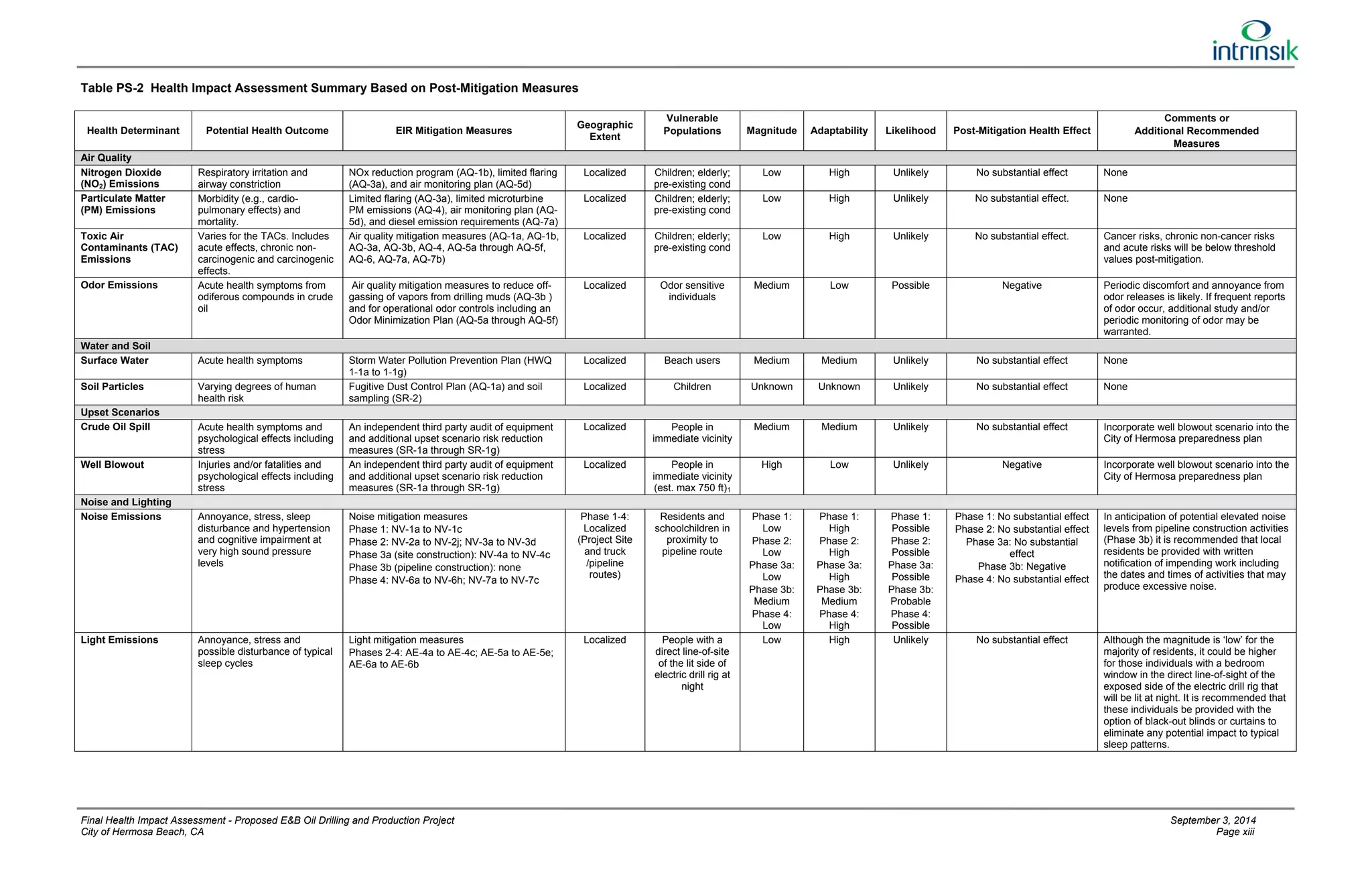
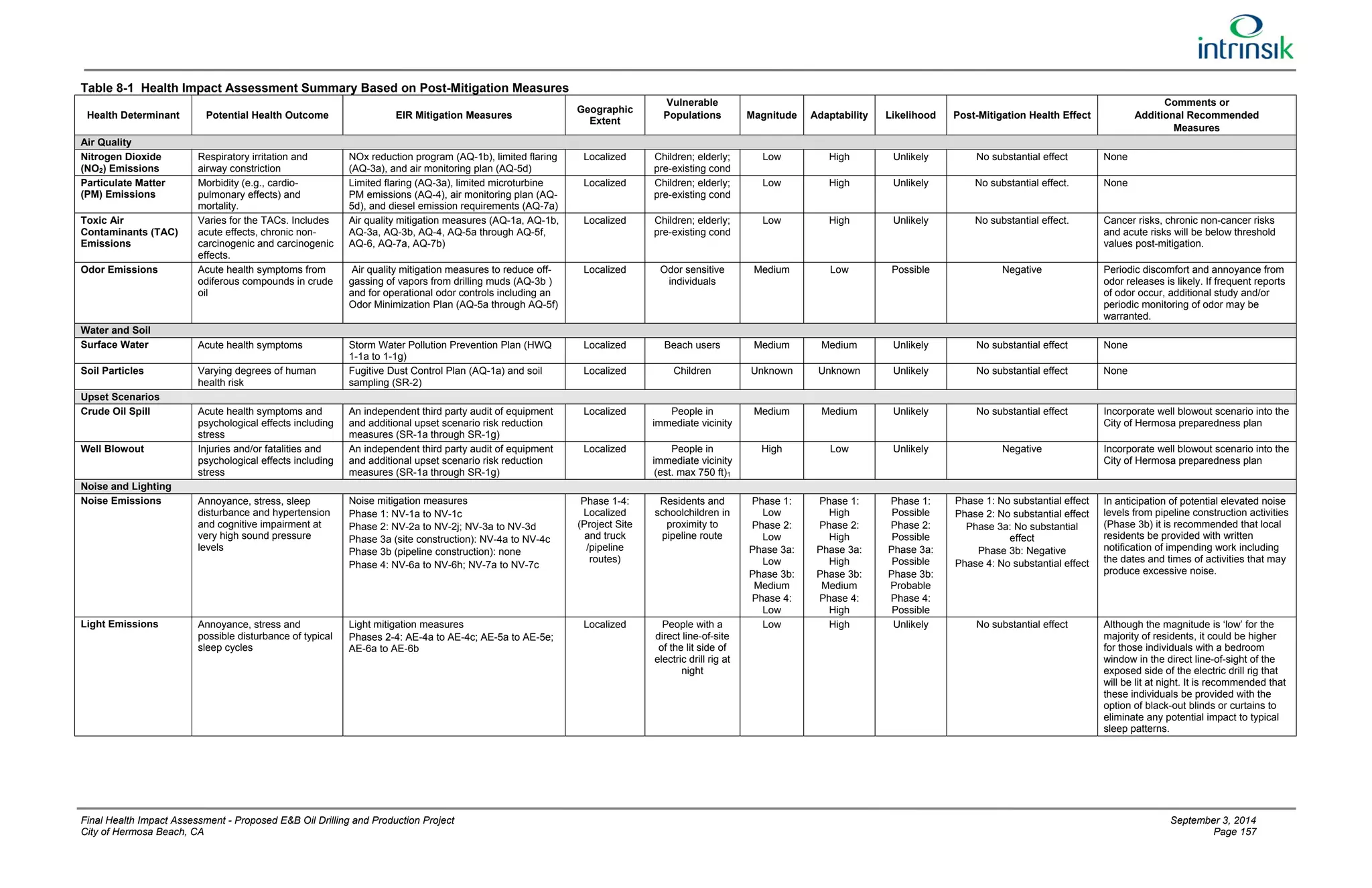
Table PS-2 Health Impact Assessment Summary Based on Post-Mitigation Measures 
Health Determinant Potential Health Outcome EIR Mitigation Measures Geographic 
Extent 
Vulnerable 
Populations Magnitude Adaptability Likelihood Post-Mitigation Health Effect 
Comments or 
Additional Recommended 
Measures 
Air Quality 
Nitrogen Dioxide 
(NO2) Emissions 
Respiratory irritation and 
airway constriction 
NOx reduction program (AQ-1b), limited flaring 
(AQ-3a), and air monitoring plan (AQ-5d) 
Localized Children; elderly; 
pre-existing cond 
Low High Unlikely No substantial effect None 
Particulate Matter 
(PM) Emissions 
Morbidity (e.g., cardio-pulmonary 
effects) and 
mortality. 
Limited flaring (AQ-3a), limited microturbine 
PM emissions (AQ-4), air monitoring plan (AQ- 
5d), and diesel emission requirements (AQ-7a) 
Localized Children; elderly; 
pre-existing cond 
Low High Unlikely No substantial effect. None 
Toxic Air 
Contaminants (TAC) 
Emissions 
Varies for the TACs. Includes 
acute effects, chronic non-carcinogenic 
and carcinogenic 
effects. 
Air quality mitigation measures (AQ-1a, AQ-1b, 
AQ-3a, AQ-3b, AQ-4, AQ-5a through AQ-5f, 
AQ-6, AQ-7a, AQ-7b) 
Localized Children; elderly; 
pre-existing cond 
Low High Unlikely No substantial effect. Cancer risks, chronic non-cancer risks 
and acute risks will be below threshold 
values post-mitigation. 
Odor Emissions Acute health symptoms from 
odiferous compounds in crude 
oil 
Air quality mitigation measures to reduce off-gassing 
of vapors from drilling muds (AQ-3b ) 
and for operational odor controls including an 
Odor Minimization Plan (AQ-5a through AQ-5f) 
Localized Odor sensitive 
individuals 
Medium Low Possible Negative Periodic discomfort and annoyance from 
odor releases is likely. If frequent reports 
of odor occur, additional study and/or 
periodic monitoring of odor may be 
warranted. 
Water and Soil 
Surface Water Acute health symptoms Storm Water Pollution Prevention Plan (HWQ 
1-1a to 1-1g) 
Localized Beach users Medium Medium Unlikely No substantial effect None 
Soil Particles Varying degrees of human 
health risk 
Fugitive Dust Control Plan (AQ-1a) and soil 
sampling (SR-2) 
Localized Children Unknown Unknown Unlikely No substantial effect None 
Upset Scenarios 
Crude Oil Spill Acute health symptoms and 
psychological effects including 
stress 
An independent third party audit of equipment 
and additional upset scenario risk reduction 
measures (SR-1a through SR-1g) 
Localized People in 
immediate vicinity 
Medium Medium Unlikely No substantial effect Incorporate well blowout scenario into the 
City of Hermosa preparedness plan 
Well Blowout Injuries and/or fatalities and 
psychological effects including 
stress 
An independent third party audit of equipment 
and additional upset scenario risk reduction 
measures (SR-1a through SR-1g) 
Localized People in 
immediate vicinity 
(est. max 750 ft)1 
High Low Unlikely Negative Incorporate well blowout scenario into the 
City of Hermosa preparedness plan 
Noise and Lighting 
Noise Emissions Annoyance, stress, sleep 
disturbance and hypertension 
and cognitive impairment at 
very high sound pressure 
levels 
Noise mitigation measures 
Phase 1: NV-1a to NV-1c 
Phase 2: NV-2a to NV-2j; NV-3a to NV-3d 
Phase 3a (site construction): NV-4a to NV-4c 
Phase 3b (pipeline construction): none 
Phase 4: NV-6a to NV-6h; NV-7a to NV-7c 
Phase 1-4: 
Localized 
(Project Site 
and truck 
/pipeline 
routes) 
Residents and 
schoolchildren in 
proximity to 
pipeline route 
Phase 1: 
Low 
Phase 2: 
Low 
Phase 3a: 
Low 
Phase 3b: 
Medium 
Phase 4: 
Low 
Phase 1: 
High 
Phase 2: 
High 
Phase 3a: 
High 
Phase 3b: 
Medium 
Phase 4: 
High 
Phase 1: 
Possible 
Phase 2: 
Possible 
Phase 3a: 
Possible 
Phase 3b: 
Probable 
Phase 4: 
Possible 
Phase 1: No substantial effect 
Phase 2: No substantial effect 
Phase 3a: No substantial 
effect 
Phase 3b: Negative 
Phase 4: No substantial effect 
In anticipation of potential elevated noise 
levels from pipeline construction activities 
(Phase 3b) it is recommended that local 
residents be provided with written 
notification of impending work including 
the dates and times of activities that may 
produce excessive noise. 
Light Emissions Annoyance, stress and 
possible disturbance of typical 
sleep cycles 
Light mitigation measures 
Phases 2-4: AE-4a to AE-4c; AE-5a to AE-5e; 
AE-6a to AE-6b 
Localized People with a 
direct line-of-site 
of the lit side of 
electric drill rig at 
night 
Low High Unlikely No substantial effect Although the magnitude is ‘low’ for the 
majority of residents, it could be higher 
for those individuals with a bedroom 
window in the direct line-of-sight of the 
exposed side of the electric drill rig that 
will be lit at night. It is recommended that 
these individuals be provided with the 
option of black-out blinds or curtains to 
eliminate any potential impact to typical 
sleep patterns. 
Final Health Impact Assessment - Proposed E&B Oil Drilling and Production Project September 3, 2014 
City of Hermosa Beach, CA Page xiii
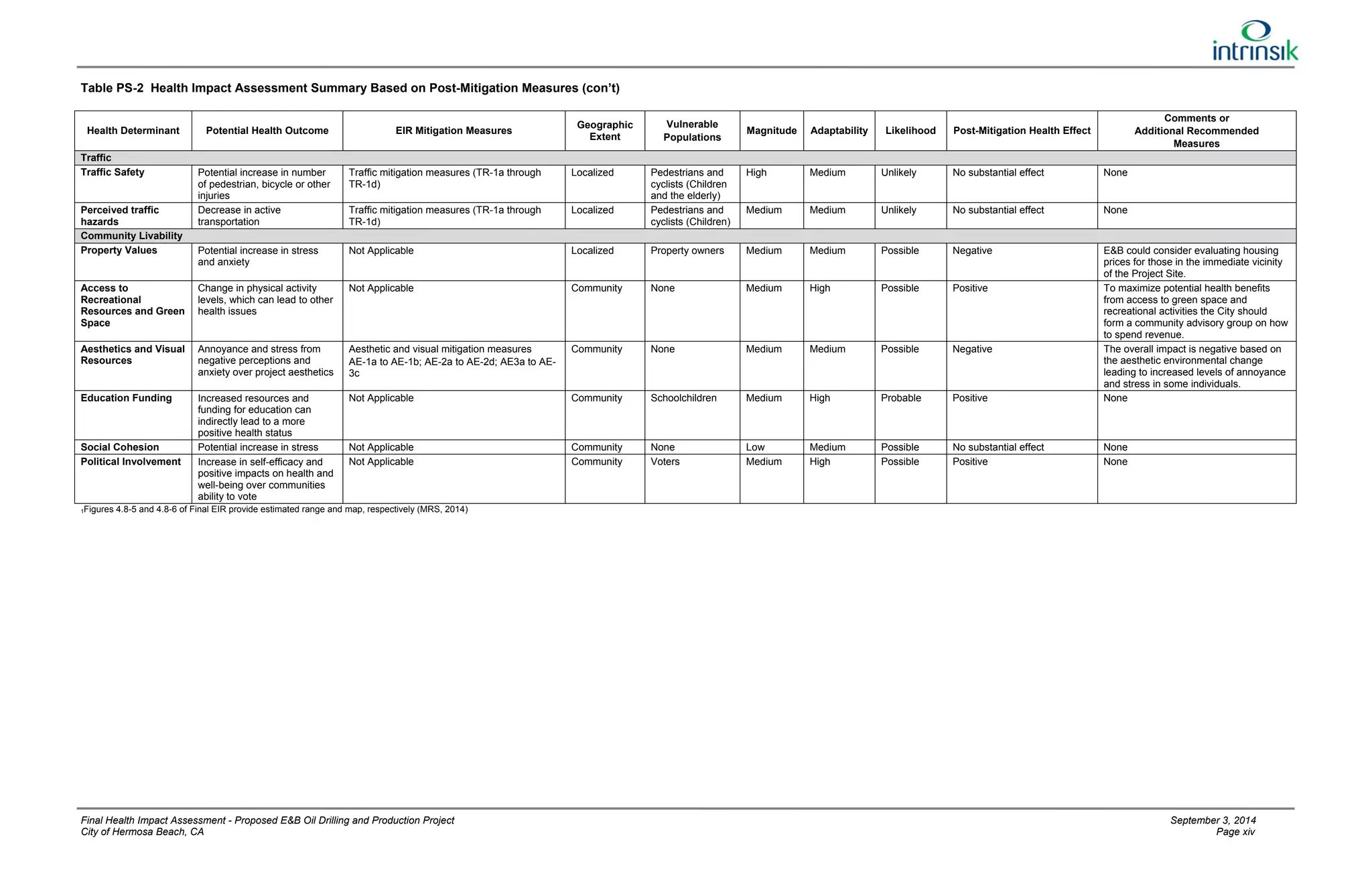
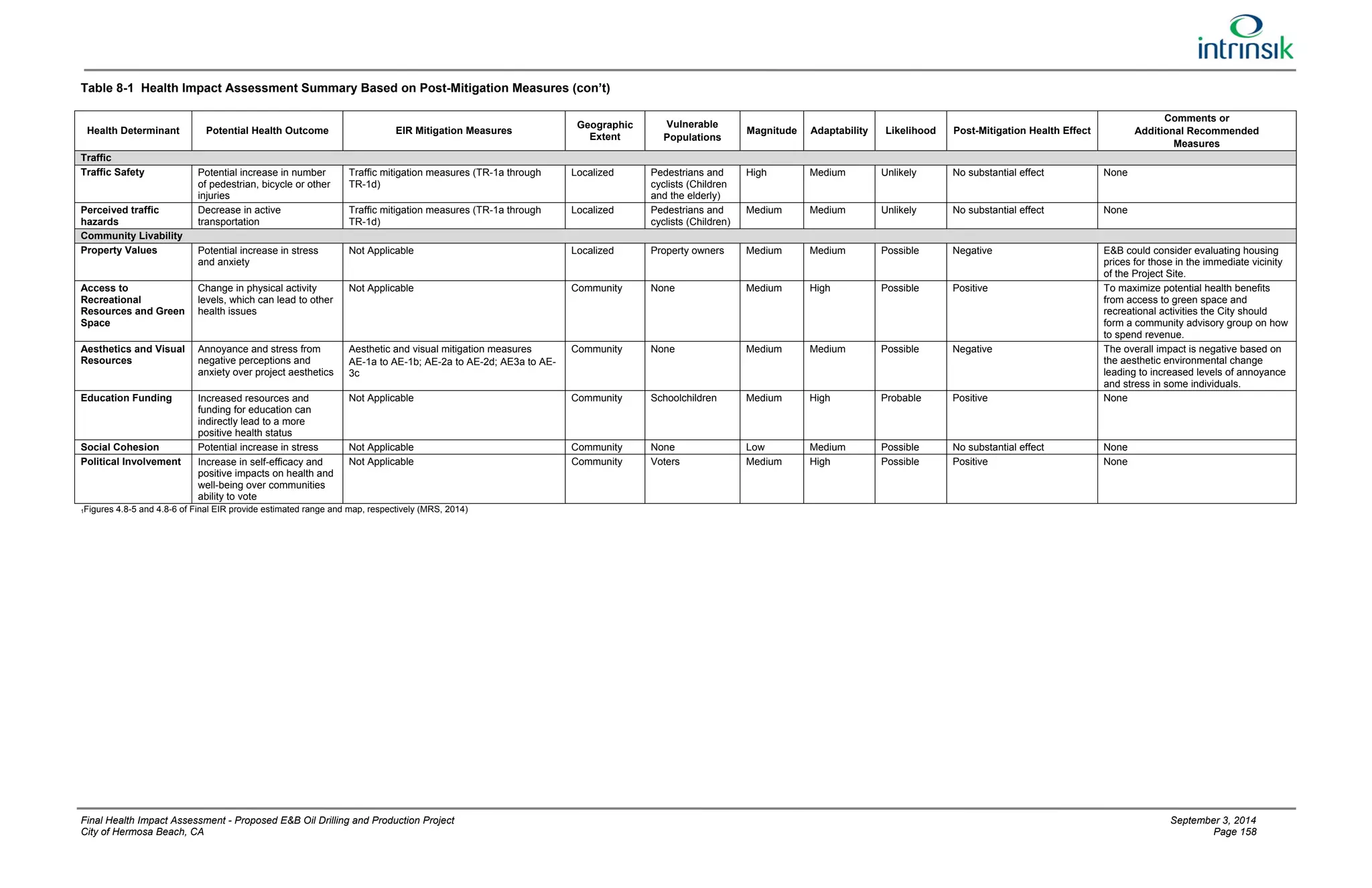
Table PS-2 Health Impact Assessment Summary Based on Post-Mitigation Measures (con’t) 
Health Determinant Potential Health Outcome EIR Mitigation Measures Geographic 
Extent 
Vulnerable 
Populations Magnitude Adaptability Likelihood Post-Mitigation Health Effect 
Comments or 
Additional Recommended 
Measures 
Traffic 
Traffic Safety Potential increase in number 
of pedestrian, bicycle or other 
injuries 
Traffic mitigation measures (TR-1a through 
TR-1d) 
Localized Pedestrians and 
cyclists (Children 
and the elderly) 
High Medium Unlikely No substantial effect None 
Perceived traffic 
hazards 
Decrease in active 
transportation 
Traffic mitigation measures (TR-1a through 
TR-1d) 
Localized Pedestrians and 
cyclists (Children) 
Medium Medium Unlikely No substantial effect None 
Community Livability 
Property Values Potential increase in stress 
and anxiety 
Not Applicable Localized Property owners Medium Medium Possible Negative E&B could consider evaluating housing 
prices for those in the immediate vicinity 
of the Project Site. 
Access to 
Recreational 
Resources and Green 
Space 
Change in physical activity 
levels, which can lead to other 
health issues 
Not Applicable Community None Medium High Possible Positive To maximize potential health benefits 
from access to green space and 
recreational activities the City should 
form a community advisory group on how 
to spend revenue. 
Aesthetics and Visual 
Resources 
Annoyance and stress from 
negative perceptions and 
anxiety over project aesthetics 
Aesthetic and visual mitigation measures 
AE-1a to AE-1b; AE-2a to AE-2d; AE3a to AE- 
3c 
Community None Medium Medium Possible Negative The overall impact is negative based on 
the aesthetic environmental change 
leading to increased levels of annoyance 
and stress in some individuals. 
Education Funding Increased resources and 
funding for education can 
indirectly lead to a more 
positive health status 
Not Applicable Community Schoolchildren Medium High Probable Positive None 
Social Cohesion Potential increase in stress Not Applicable Community None Low Medium Possible No substantial effect None 
Political Involvement Increase in self-efficacy and 
positive impacts on health and 
well-being over communities 
ability to vote 
Not Applicable Community Voters Medium High Possible Positive None 
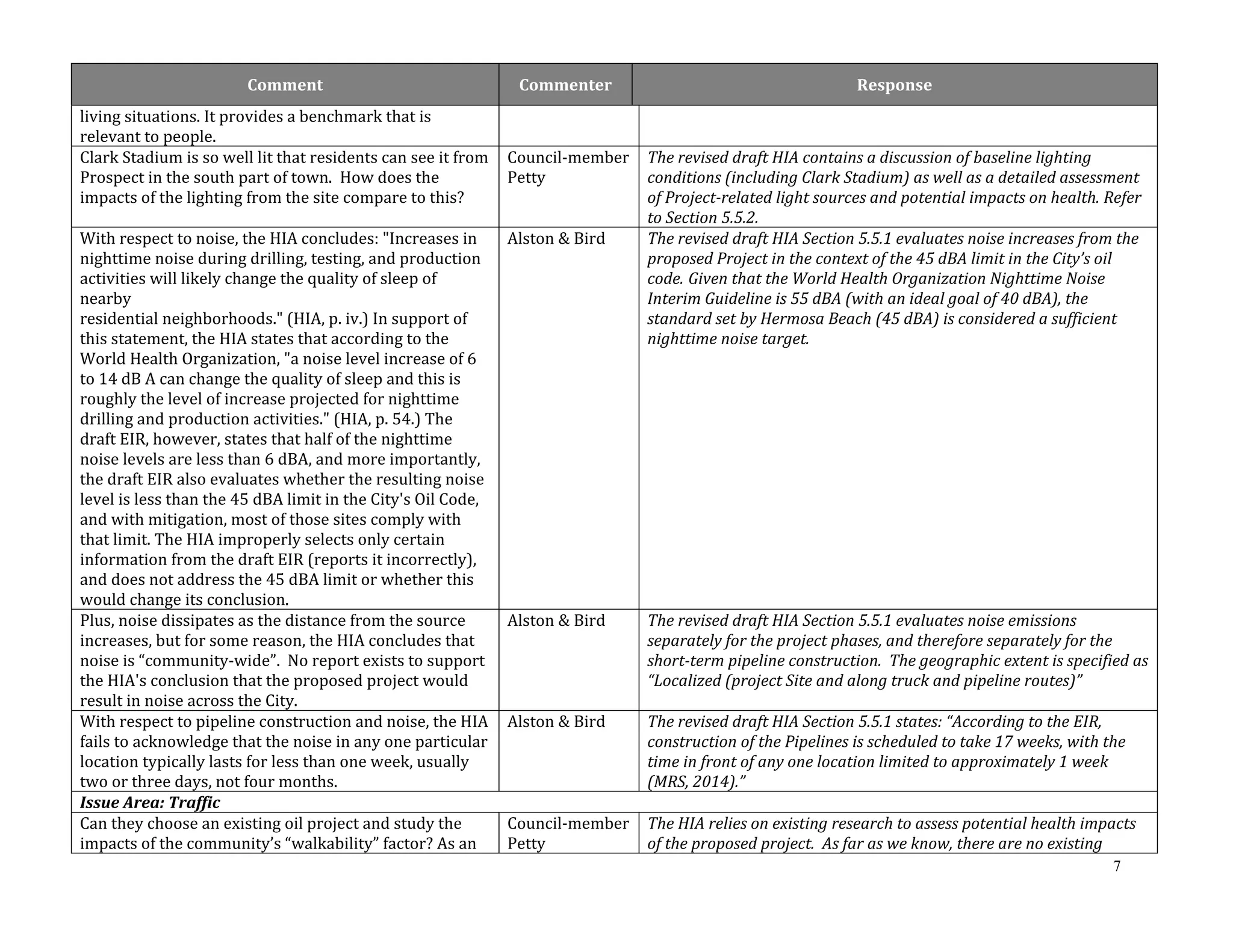
1Figures 4.8-5 and 4.8-6 of Final EIR provide estimated range and map, respectively (MRS, 2014) 
Final Health Impact Assessment - Proposed E&B Oil Drilling and Production Project September 3, 2014 
City of Hermosa Beach, CA Page xiv
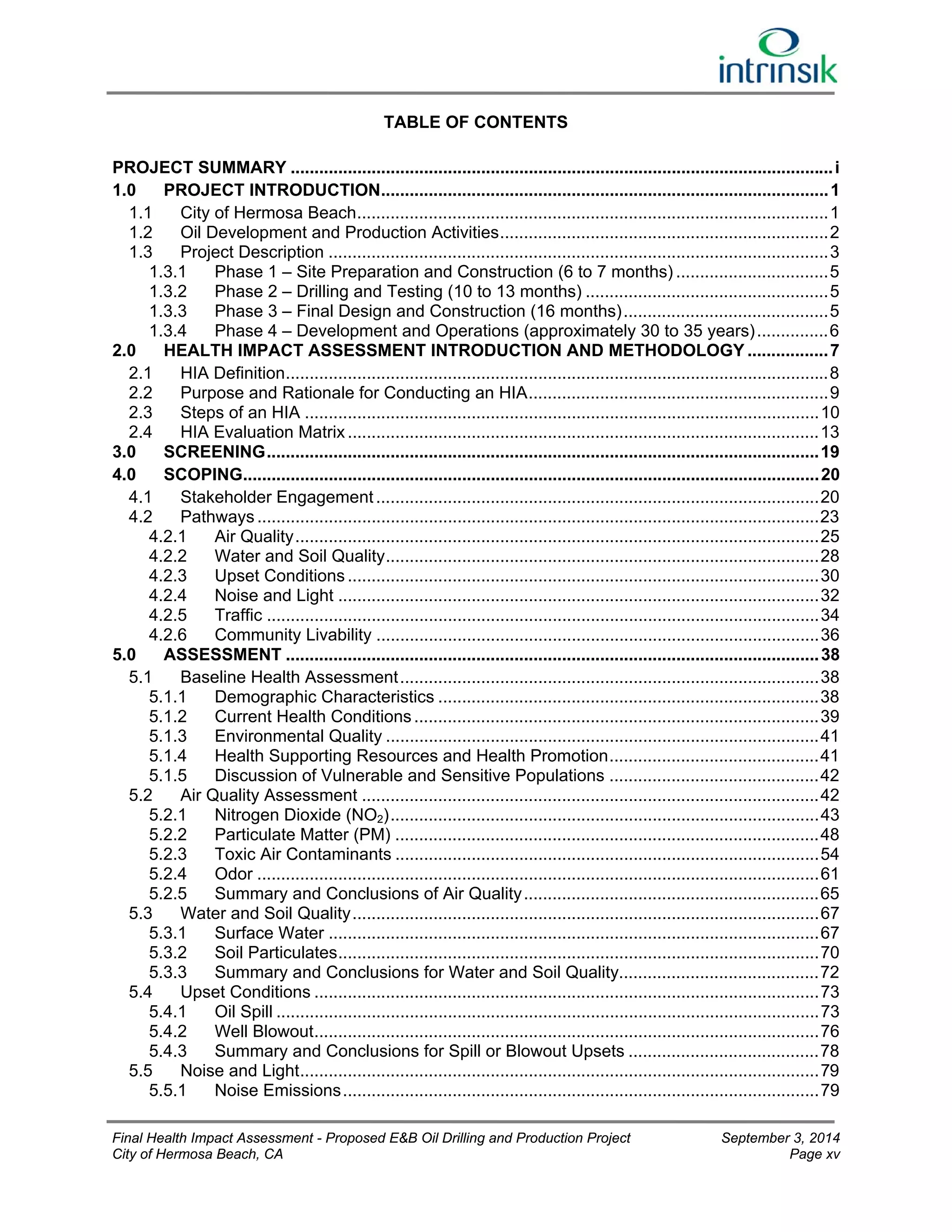
TABLE OF CONTENTS 
PROJECT SUMMARY .................................................................................................................. i 
1.0 PROJECT INTRODUCTION .............................................................................................. 1 
1.1 City of Hermosa Beach ................................................................................................... 1 
1.2 Oil Development and Production Activities ..................................................................... 2 
1.3 Project Description ......................................................................................................... 3 
1.3.1 Phase 1 – Site Preparation and Construction (6 to 7 months) ................................ 5 
1.3.2 Phase 2 – Drilling and Testing (10 to 13 months) ................................................... 5 
1.3.3 Phase 3 – Final Design and Construction (16 months) ........................................... 5 
1.3.4 Phase 4 – Development and Operations (approximately 30 to 35 years) ............... 6 
2.0 HEALTH IMPACT ASSESSMENT INTRODUCTION AND METHODOLOGY ................. 7 
2.1 HIA Definition .................................................................................................................. 8 
2.2 Purpose and Rationale for Conducting an HIA ............................................................... 9 
2.3 Steps of an HIA ............................................................................................................ 10 
2.4 HIA Evaluation Matrix ................................................................................................... 13 
3.0 SCREENING .................................................................................................................... 19 
4.0 SCOPING ......................................................................................................................... 20 
4.1 Stakeholder Engagement ............................................................................................. 20 
4.2 Pathways ...................................................................................................................... 23 
4.2.1 Air Quality .............................................................................................................. 25 
4.2.2 Water and Soil Quality ........................................................................................... 28 
4.2.3 Upset Conditions ................................................................................................... 30 
4.2.4 Noise and Light ..................................................................................................... 32 
4.2.5 Traffic .................................................................................................................... 34 
4.2.6 Community Livability ............................................................................................. 36 
5.0 ASSESSMENT ................................................................................................................ 38 
5.1 Baseline Health Assessment ........................................................................................ 38 
5.1.1 Demographic Characteristics ................................................................................ 38 
5.1.2 Current Health Conditions ..................................................................................... 39 
5.1.3 Environmental Quality ........................................................................................... 41 
5.1.4 Health Supporting Resources and Health Promotion ............................................ 41 
5.1.5 Discussion of Vulnerable and Sensitive Populations ............................................ 42 
5.2 Air Quality Assessment ................................................................................................ 42 
5.2.1 Nitrogen Dioxide (NO2) .......................................................................................... 43 
5.2.2 Particulate Matter (PM) ......................................................................................... 48 
5.2.3 Toxic Air Contaminants ......................................................................................... 54 
5.2.4 Odor ...................................................................................................................... 61 
5.2.5 Summary and Conclusions of Air Quality .............................................................. 65 
5.3 Water and Soil Quality .................................................................................................. 67 
5.3.1 Surface Water ....................................................................................................... 67 
5.3.2 Soil Particulates ..................................................................................................... 70 
5.3.3 Summary and Conclusions for Water and Soil Quality.......................................... 72 
5.4 Upset Conditions .......................................................................................................... 73 
5.4.1 Oil Spill .................................................................................................................. 73 
5.4.2 Well Blowout .......................................................................................................... 76 
5.4.3 Summary and Conclusions for Spill or Blowout Upsets ........................................ 78 
5.5 Noise and Light ............................................................................................................. 79 
5.5.1 Noise Emissions .................................................................................................... 79 
Final Health Impact Assessment - Proposed E&B Oil Drilling and Production Project September 3, 2014 
City of Hermosa Beach, CA Page xv
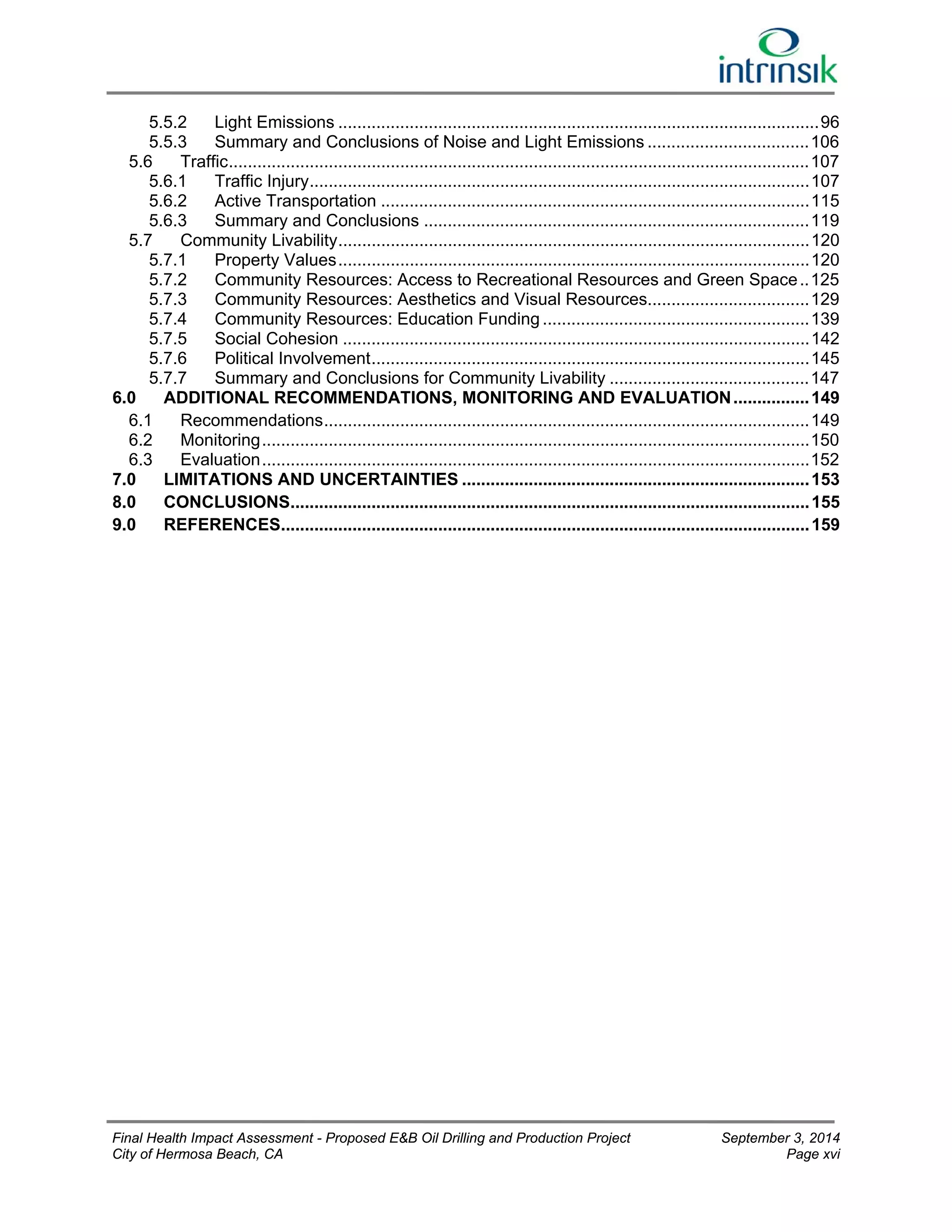
5.5.2 Light Emissions ..................................................................................................... 96 
5.5.3 Summary and Conclusions of Noise and Light Emissions .................................. 106 
5.6 Traffic .......................................................................................................................... 107 
5.6.1 Traffic Injury ......................................................................................................... 107 
5.6.2 Active Transportation .......................................................................................... 115 
5.6.3 Summary and Conclusions ................................................................................. 119 
5.7 Community Livability ................................................................................................... 120 
5.7.1 Property Values ................................................................................................... 120 
5.7.2 Community Resources: Access to Recreational Resources and Green Space .. 125 
5.7.3 Community Resources: Aesthetics and Visual Resources.................................. 129 
5.7.4 Community Resources: Education Funding ........................................................ 139 
5.7.5 Social Cohesion .................................................................................................. 142 
5.7.6 Political Involvement ............................................................................................ 145 
5.7.7 Summary and Conclusions for Community Livability .......................................... 147 
6.0 ADDITIONAL RECOMMENDATIONS, MONITORING AND EVALUATION ................ 149 
6.1 Recommendations ...................................................................................................... 149 
6.2 Monitoring ................................................................................................................... 150 
6.3 Evaluation ................................................................................................................... 152 
7.0 LIMITATIONS AND UNCERTAINTIES ......................................................................... 153 
8.0 CONCLUSIONS ............................................................................................................. 155 
9.0 REFERENCES ............................................................................................................... 159 
Final Health Impact Assessment - Proposed E&B Oil Drilling and Production Project September 3, 2014 
City of Hermosa Beach, CA Page xvi
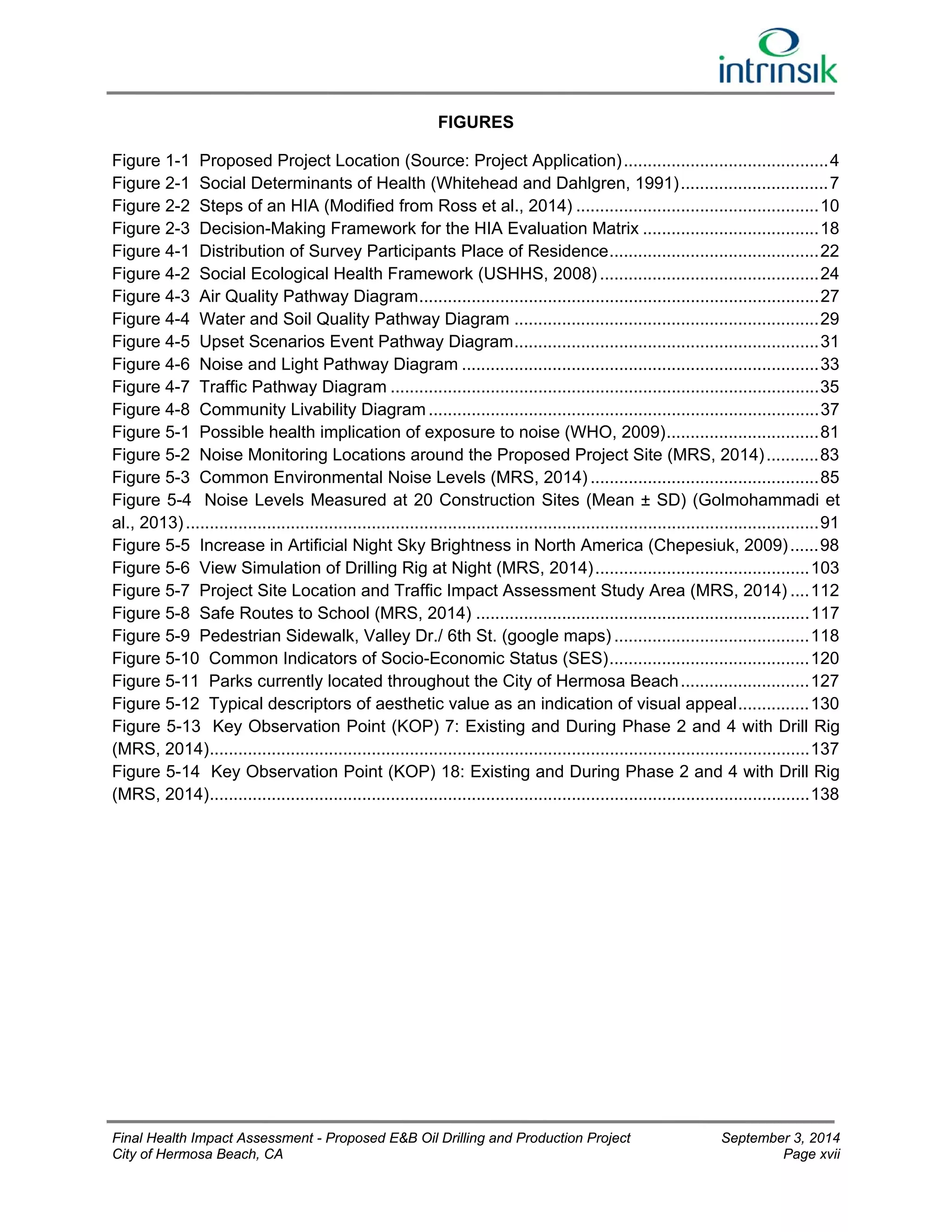
FIGURES 
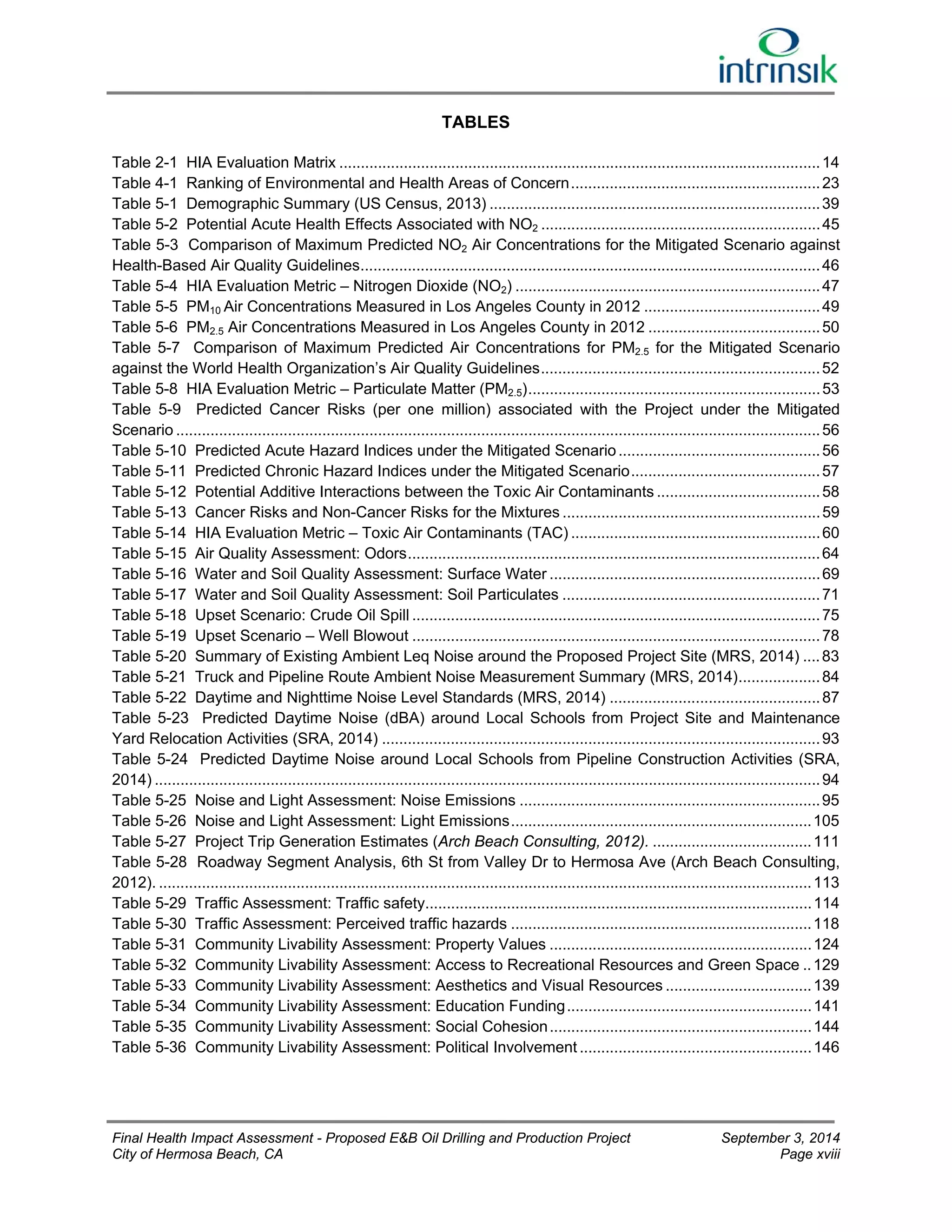
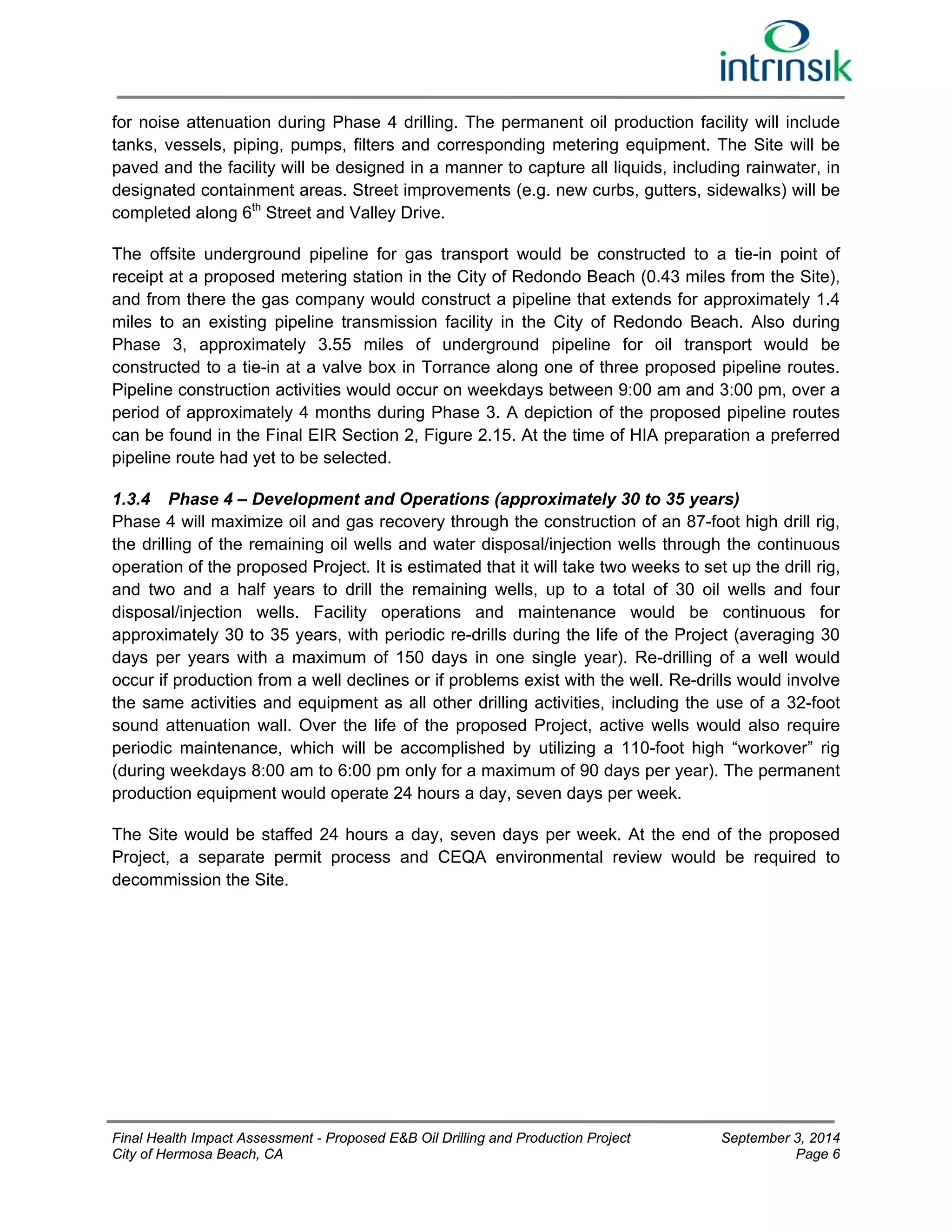
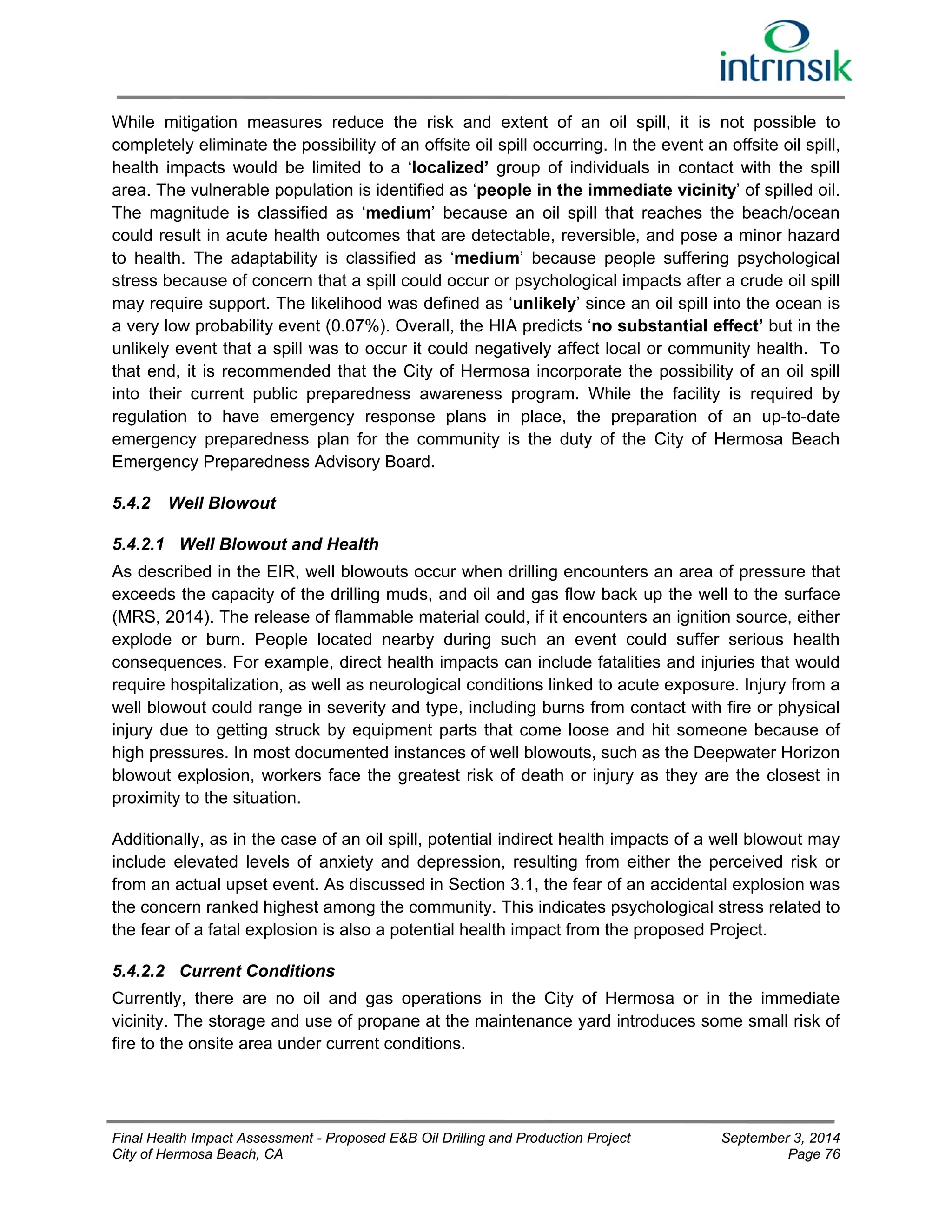
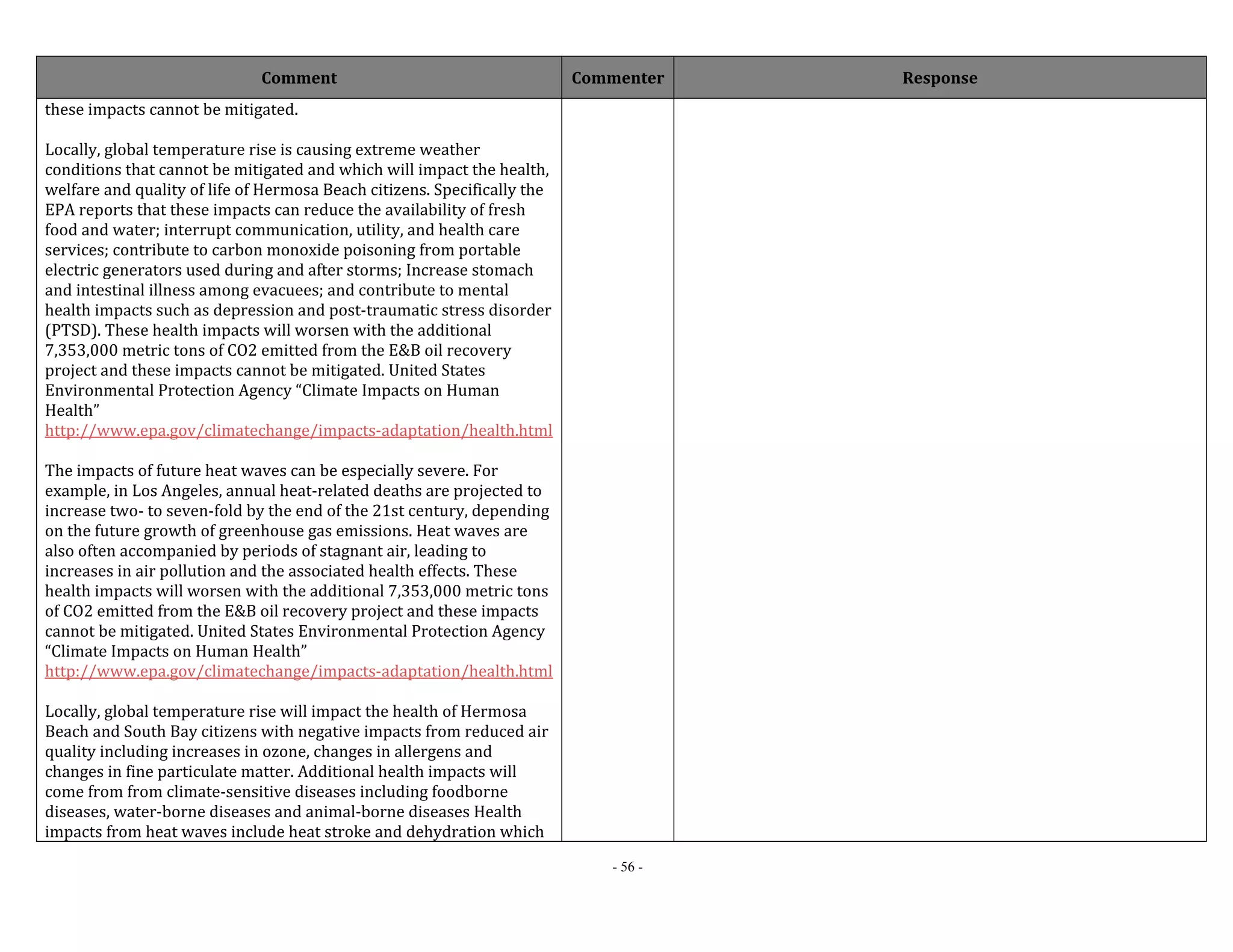
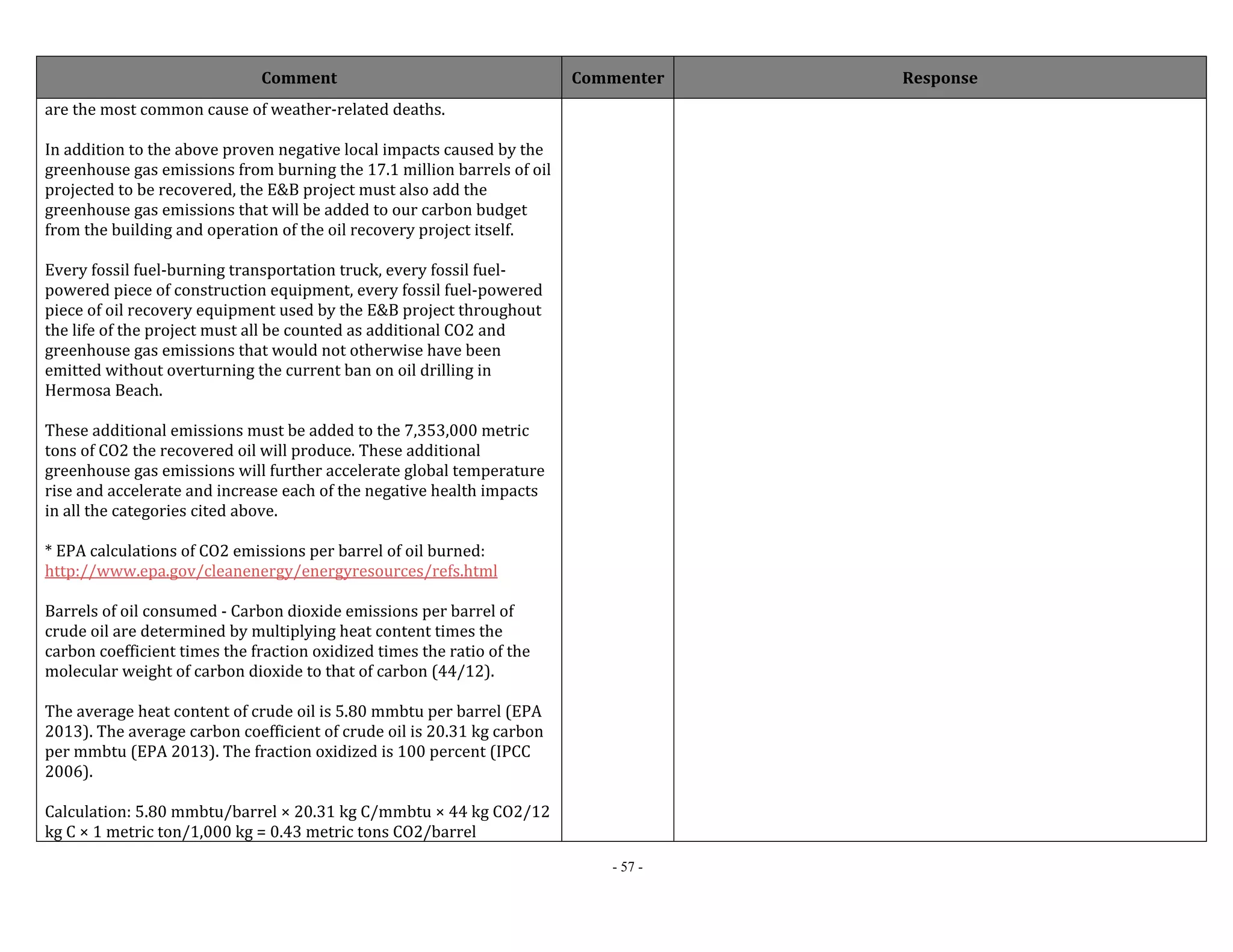
Figure 1-1 Proposed Project Location (Source: Project Application) ........................................... 4 
Figure 2-1 Social Determinants of Health (Whitehead and Dahlgren, 1991) ............................... 7 
Figure 2-2 Steps of an HIA (Modified from Ross et al., 2014) ................................................... 10 
Figure 2-3 Decision-Making Framework for the HIA Evaluation Matrix ..................................... 18 
Figure 4-1 Distribution of Survey Participants Place of Residence ............................................ 22 
Figure 4-2 Social Ecological Health Framework (USHHS, 2008) .............................................. 24 
Figure 4-3 Air Quality Pathway Diagram .................................................................................... 27 
Figure 4-4 Water and Soil Quality Pathway Diagram ................................................................ 29 
Figure 4-5 Upset Scenarios Event Pathway Diagram ................................................................ 31 
Figure 4-6 Noise and Light Pathway Diagram ........................................................................... 33 
Figure 4-7 Traffic Pathway Diagram .......................................................................................... 35 
Figure 4-8 Community Livability Diagram .................................................................................. 37 
Figure 5-1 Possible health implication of exposure to noise (WHO, 2009) ................................ 81 
Figure 5-2 Noise Monitoring Locations around the Proposed Project Site (MRS, 2014) ........... 83 
Figure 5-3 Common Environmental Noise Levels (MRS, 2014) ................................................ 85 
Figure 5-4 Noise Levels Measured at 20 Construction Sites (Mean ± SD) (Golmohammadi et 
al., 2013) ..................................................................................................................................... 91 
Figure 5-5 Increase in Artificial Night Sky Brightness in North America (Chepesiuk, 2009) ...... 98 
Figure 5-6 View Simulation of Drilling Rig at Night (MRS, 2014) ............................................. 103 
Figure 5-7 Project Site Location and Traffic Impact Assessment Study Area (MRS, 2014) .... 112 
Figure 5-8 Safe Routes to School (MRS, 2014) ...................................................................... 117 
Figure 5-9 Pedestrian Sidewalk, Valley Dr./ 6th St. (google maps) ......................................... 118 
Figure 5-10 Common Indicators of Socio-Economic Status (SES) .......................................... 120 
Figure 5-11 Parks currently located throughout the City of Hermosa Beach ........................... 127 
Figure 5-12 Typical descriptors of aesthetic value as an indication of visual appeal ............... 130 
Figure 5-13 Key Observation Point (KOP) 7: Existing and During Phase 2 and 4 with Drill Rig 
(MRS, 2014) .............................................................................................................................. 137 
Figure 5-14 Key Observation Point (KOP) 18: Existing and During Phase 2 and 4 with Drill Rig 
(MRS, 2014) .............................................................................................................................. 138 
Final Health Impact Assessment - Proposed E&B Oil Drilling and Production Project September 3, 2014 
City of Hermosa Beach, CA Page xvii
TABLES 
Table 2-1 HIA Evaluation Matrix ................................................................................................................ 14 
Table 4-1 Ranking of Environmental and Health Areas of Concern .......................................................... 23 
Table 5-1 Demographic Summary (US Census, 2013) ............................................................................. 39 
Table 5-2 Potential Acute Health Effects Associated with NO2 ................................................................. 45 
Table 5-3 Comparison of Maximum Predicted NO2 Air Concentrations for the Mitigated Scenario against 
Health-Based Air Quality Guidelines ........................................................................................................... 46 
Table 5-4 HIA Evaluation Metric – Nitrogen Dioxide (NO2) ....................................................................... 47 
Table 5-5 PM10 Air Concentrations Measured in Los Angeles County in 2012 ......................................... 49 
Table 5-6 PM2.5 Air Concentrations Measured in Los Angeles County in 2012 ........................................ 50 
Table 5-7 Comparison of Maximum Predicted Air Concentrations for PM2.5 for the Mitigated Scenario 
against the World Health Organization’s Air Quality Guidelines ................................................................. 52 
Table 5-8 HIA Evaluation Metric – Particulate Matter (PM2.5) .................................................................... 53 
Table 5-9 Predicted Cancer Risks (per one million) associated with the Project under the Mitigated 
Scenario ...................................................................................................................................................... 56 
Table 5-10 Predicted Acute Hazard Indices under the Mitigated Scenario ............................................... 56 
Table 5-11 Predicted Chronic Hazard Indices under the Mitigated Scenario ............................................ 57 
Table 5-12 Potential Additive Interactions between the Toxic Air Contaminants ...................................... 58 
Table 5-13 Cancer Risks and Non-Cancer Risks for the Mixtures ............................................................ 59 
Table 5-14 HIA Evaluation Metric – Toxic Air Contaminants (TAC) .......................................................... 60 
Table 5-15 Air Quality Assessment: Odors ................................................................................................ 64 
Table 5-16 Water and Soil Quality Assessment: Surface Water ............................................................... 69 
Table 5-17 Water and Soil Quality Assessment: Soil Particulates ............................................................ 71 
Table 5-18 Upset Scenario: Crude Oil Spill ............................................................................................... 75 
Table 5-19 Upset Scenario – Well Blowout ............................................................................................... 78 
Table 5-20 Summary of Existing Ambient Leq Noise around the Proposed Project Site (MRS, 2014) .... 83 
Table 5-21 Truck and Pipeline Route Ambient Noise Measurement Summary (MRS, 2014) ................... 84 
Table 5-22 Daytime and Nighttime Noise Level Standards (MRS, 2014) ................................................. 87 
Table 5-23 Predicted Daytime Noise (dBA) around Local Schools from Project Site and Maintenance 
Yard Relocation Activities (SRA, 2014) ...................................................................................................... 93 
Table 5-24 Predicted Daytime Noise around Local Schools from Pipeline Construction Activities (SRA, 
2014) ........................................................................................................................................................... 94 
Table 5-25 Noise and Light Assessment: Noise Emissions ...................................................................... 95 
Table 5-26 Noise and Light Assessment: Light Emissions ...................................................................... 105 
Table 5-27 Project Trip Generation Estimates (Arch Beach Consulting, 2012). ..................................... 111 
Table 5-28 Roadway Segment Analysis, 6th St from Valley Dr to Hermosa Ave (Arch Beach Consulting, 
2012). ........................................................................................................................................................ 113 
Table 5-29 Traffic Assessment: Traffic safety .......................................................................................... 114 
Table 5-30 Traffic Assessment: Perceived traffic hazards ...................................................................... 118 
Table 5-31 Community Livability Assessment: Property Values ............................................................. 124 
Table 5-32 Community Livability Assessment: Access to Recreational Resources and Green Space .. 129 
Table 5-33 Community Livability Assessment: Aesthetics and Visual Resources .................................. 139 
Table 5-34 Community Livability Assessment: Education Funding ......................................................... 141 
Table 5-35 Community Livability Assessment: Social Cohesion ............................................................. 144 
Table 5-36 Community Livability Assessment: Political Involvement ...................................................... 146 
Final Health Impact Assessment - Proposed E&B Oil Drilling and Production Project September 3, 2014 
City of Hermosa Beach, CA Page xviii
APPENDICES 
Appendix A Summary of Los Angeles Urban Oil Drilling Sites 
Appendix B Scoping Checklist 
Appendix C Response to Public and Peer Review Comments 
Appendix D Health Impact Assessment Community Survey 
Appendix E Baseline Health Assessment 
Appendix F Quality of Life Committee Presentation 
Final Health Impact Assessment - Proposed E&B Oil Drilling and Production Project September 3, 2014 
City of Hermosa Beach, CA Page xix
Glossary of Terms, Acronyms, and Abbreviations 
AAQS 
ACS 
Ambient Air Quality Standards 
American Cancer Society 
BCHD Beach Cities Health District, serving Manhattan, Hermosa, and Redondo 
Beaches 
BTEX Acronym for benzene, toluene, ethylbenzene and xylenes, compounds 
commonly found in petroleum derivatives 
Cal/EPA 
CARB 
California Environmental Protection Agency 
California Air Resources Board 
CBA Cost-benefit analysis, a method of considering the advantages and 
disadvantages of a project by converting all outcomes into monetary values 
CEQA California Environmental Quality Act, legally requires EIR 
City 
CNEL 
CNS 
CO 
City of Hermosa Beach 
Community Noise Equivalent Level 
Central Nervous System 
Carbon monoxide 
Community 
Dialogue 
COPD 
A group of 15-30 community members engaged in activities to help define 
the quality of life and vision for the future of Hermosa 
Chronic Obstructive Pulmonary Disease 
CUP Conditional Use Permit approved on August 12, 1993, which the proposed 
project must comply with 
dB Decibel - A unit of a logarithmic scale of power or intensity called the power 
level or intensity level 
dBA A-weighted decibel, to approximate human sensitivity to sound 
DDT Pesticide banned by the USEPA in 1972 due to environmental effects 
Determinants of 
Factors that contribute to the health of individuals or communities 
health 
EPA 
Environmental Protection Agency 
E&B E&B Natural Resources Management Corporation 
EIR Environmental Impact Report, the analysis of the environmental effects of a 
project and reasonable alternatives to it, mandated by CEQA 
Final Health Impact Assessment - Proposed E&B Oil Drilling and Production Project September 3, 2014 
City of Hermosa Beach, CA Page xx
Footcandle The illuminance at a point on a surface which is one foot from, and 
perpendicular to, a uniform point source 
H2S Hydrogen sulfide 
HBEF Hermosa Beach Education Foundation 
HHRA 
Human Health Risk Assessment 
HI 
Hazard Index 
HIA Health Impact Assessment, a combination of procedures, methods, and 
tools by which a project can be judged as to its potential effects on the 
health of a population 
IARC International Agency for Research on Cancer 
Incidence rate 
KOP 
LACDPH 
LAN 
A measure of the new cases of illness during a specified time period 
Key Observation Point 
Los Angeles County Department of Public Health 
Light-at-Night 
Ldn Sound level measured over the 24 hour period, with a 10 dB penalty added 
to the levels between 23.00 and 07.00 hours 
Leq Equivalent sound level, or the average noise level over a period of time 
LOS 
lux 
MATES 
Level of service, related to the degree of traffic congestion at intersections 
The illuminance at the same point at a distance of 1 meter from the source 
Multiple Air Toxics Exposure Study 
MATES III Multiple Air Toxics Exposure Study III 
Morbidity Refers to the presence of disease in an individual or population 
Mortality rate A measure of the frequency of death in a defined population during a 
specified time interval 
NAAQS National Ambient Air Quality Standards 
NOx 
Oxides of Nitrogen 
NNG 
Night Noise Guidelines 
OEHHA California Office of Environmental Health Hazard Assessment 
PAHs Polycyclic aromatic hydrocarbons 
PCE Passenger car equivalence 
PCB Polychlorinated biphenyl, PCBs are no longer commercially produced in the 
US due to toxicity 
Final Health Impact Assessment - Proposed E&B Oil Drilling and Production Project September 3, 2014 
City of Hermosa Beach, CA Page xxi
PCH Pacific Coast Highway, the most trafficked roadway in Hermosa Beach 
PM 
PMI 
Particulate matter, particles with a diameter smaller than 10 μm are referred 
to as PM10, and particles with a diameter smaller than 2.5 μm are known as 
PM2.5 
Point of Maximum Impact 
ppb Parts per billion 
ppm Parts per million 
proposed Project 
REL 
Proposed E&B oil drilling and production project 
Relative Exposure Level 
SCAQMD 
SES 
Southern California Air Quality Monitoring District 
Socio-economic Status 
SIR Standardized incidence ratio, quotient of observed and expected number of 
cases (e.g., cancer cases) 
Site 
SO2 
SWPP 
TAC 
Proposed project site, at the current City Maintenance Yard 
Sulfur dioxide 
Storm Water Pollution Prevention Plan 
Toxic Air Contaminant 
TMDL Total maximum daily load, a regulatory water quality requirement 
TPH Total petroleum hydrocarbons 
TIA Traffic impact analysis 
USEPA United States Environmental Protection Agency 
μg/m3 Microgram per meter cubed 
VOCs Volatile organic compounds 
WSB Walking school bus 
WHO World Health Organization 
Final Health Impact Assessment - Proposed E&B Oil Drilling and Production Project September 3, 2014 
City of Hermosa Beach, CA Page xxii
1.0 PROJECT INTRODUCTION 
Under the settlement agreement that ended litigation with Macpherson Oil Company, an 
election will be held to allow the City of Hermosa Beach (the City) voters to decide whether to 
repeal the existing ban on oil drilling within City limits. Repealing the ban on oil drilling would 
allow the E&B Natural Resources Management Corporation’s (E&B’s) proposed oil drilling and 
production project to move forward (Macpherson Oil sold its interests to E&B at the time of the 
settlement agreement). The terms of the settlement agreement provide that, if voters agree to 
lift the ban, the City will enter into a development agreement with E&B to develop an oil drilling 
and production facility (the Project) at the City Maintenance Yard (the Site) and the City will owe 
E&B $3.5 million. If the voters do not lift the ban on oil drilling the City of Hermosa Beach would 
owe E&B a total of $17.5 million. 
In order to inform voters about the potential economic, social, environmental, and health 
impacts and/or benefits of E&B’s proposed oil drilling and production project, the City 
commissioned a Health Impact Assessment (HIA), in addition to a Cost-Benefit Analysis (CBA) 
and Environmental Impact Report (EIR). The EIR complies with the California Environmental 
Quality Act (CEQA), while the CBA and HIA are complementary documents that the City 
commissioned to provide community members with additional information on the proposed 
Project. 
If the proposed Project is approved by Hermosa Beach voters, the agencies that will oversee 
and participate in environmental and safety reviews include the California Coastal Commission, 
the State Lands Commission, the South Coast Air Quality Management District, the State 
Division of Oil, Gas and Geothermal Resources, and the City of Hermosa Beach, among others. 
1.1 City of Hermosa Beach 
Founded in 1907, Hermosa Beach is a small 1.43 square mile City on Los Angeles (LA) 
County’s South Bay coastline, bordered by Manhattan Beach to the north and Redondo Beach 
to the south. Known as “The Best Little Beach City”, it has a population of approximately 20,000 
people, with a high proportion of residents between the age of 25 and 50 (US Census, 2013). 
The City is a desirable place to live for many reasons especially the year-long mild 
temperatures, ranging from highs of 67 degrees in the winter to 77 degrees in the summer and 
nighttime temperatures that rarely dip below 50 degrees. Residents often keep windows open 
year-round, and use of heating and air-conditioning units are rare. The City is also known as 
being a popular place for outdoor activities such as surfboarding, volleyball, skateboarding, 
jogging and bicycling, among others. There is a popular wood chip jogging/walking trail (the 
“Greenbelt”) running north-south between Valley Drive and Ardmore Avenue, one of the main 
transportation routes that traverses the length of Hermosa Beach, and connecting the City to its 
northern and southern beach city neighbors. It is regularly used by residents and visitors for 
exercise, outdoor recreation, and active transport through the City. A diverse restaurant and bar 
scene also creates a vibrant nightlife in Hermosa. 
Together with Manhattan Beach and Redondo Beach, Hermosa is part of what is known as the 
“Beach Cities”. Hermosa Beach has its own elementary schools and middle school but high 
Final Health Impact Assessment - Proposed E&B Oil Drilling and Production Project September 3, 2014 
City of Hermosa Beach, CA Page 1
school students are served by either Manhattan Beach or Redondo Beach. Hermosa also 
shares public transportation and health services with the two other Beach Cities. The City of 
Hermosa has its own police and fire departments, a community theater, and senior center. 
1.2 Oil Development and Production Activities 
The current boom in domestic crude oil production is approaching the historical high achieved in 
1970 of 9.6 million barrels per day (EIA, 2013). Projections and analysis summarized in the 
Energy Information Administration’s Annual Energy Outlook 2014 Release Overview attribute 
the growth in domestic production to improvements in advanced technologies for crude oil and 
natural gas production. Specifically for U.S. production of crude oil, projections for higher 
production volumes result mainly from increased onshore oil production, primarily from 
formations with low permeability. California remains one to the top producers of crude oil in the 
nation, accounting for almost one-tenth of the total U.S. production (EIA, 2013). Petroleum 
reservoirs are concentrated in geologic basins along the Pacific Coast and in the Central Valley. 
Los Angeles is considered the most urban oil field in the country, with a long history of the 
petroleum industry operating in non-industrial areas (CLUI, 2010). Due to the high cost of land 
in the Los Angeles basin, there has been economic incentive to develop modern drilling 
technology that allows oil wells to be concentrated into smaller areas. Directional drilling 
techniques decrease the industry’s surface footprint while increasing the subsurface drillable 
area. Since industrial processes are generally not desired in densely populated areas due to 
environmental and health concerns, many oil drilling sites in Los Angeles have incorporated 
mitigation measures (e.g. noise muffling, visual barriers, closed-loop systems) to help reduce 
the potential impacts on surrounding communities. 
There are 34 known active oil fields in the Los Angeles Basin spread out across the regions of 
Inglewood, Westside and Downtown, Eastern Los Angeles and Inland, the Coast and South 
Bay, Harbor and Long Beach, and the South Coast (Appendix A). The active oil fields vary 
greatly in size and in oil production volumes. Small fields like Chino-Soquet produce just over 
1,000 barrels of oil per year while Wilmington, the most productive oil field in the Los Angeles 
Basin, produces about 3.5 million barrels per year from 1,300 active wells. Many of the wells 
operate in densely populated urban areas. For example, the Beverly Hills Oil Field is accessed 
from three urban well sites, including one within Beverly Hills High School and another on Pico 
Boulevard hidden from view by a windowless four-walled structure that appears to be an office 
building to the passerby. Given the long history of oil drilling in Los Angeles, the wells and 
pumpjacks were often present before suburban housing developments encroached upon drilling 
leases. 
Appendix A summarizes some of the known issues associated with urban drilling sites. Various 
health and environmental concerns surround production at the Inglewood oil field, which covers 
950 acres in urbanized Los Angeles. In 2006, noxious gases entrained in drilling muds were 
released and detected by neighbors more than 1,000 feet from drilling activities. As a result of 
several investigations, a 2011 CEQA lawsuit settlement required the operator to: reduce drilling 
of new wells, increase air quality monitoring, and adhere to more stringent noise limits. 
Additionally, LA County was required to perform mandatory health assessments with 
Final Health Impact Assessment - Proposed E&B Oil Drilling and Production Project September 3, 2014 
City of Hermosa Beach, CA Page 2
environmental justice components. Other health concerns from urban oil drilling relate to surface 
methane seeps, noise and odor, and land subsidence. Oil seeps from the Salt Lake oil field 
located beneath the Fairfax district caused a 1985 methane explosion at a clothing store, 
injuring over 20 people. Concern about the potential for future fire and explosions led the City of 
Los Angeles to impose requirements for methane venting and monitoring. That said these are 
relatively rare accidents and upset conditions. 
This HIA evaluates potential health effects that could result from oil drilling and production 
activities in the City of Hermosa Beach according to the site-specific Project description 
(summarized in Section 1.3) and information provided in the Final EIR. 
1.3 Project Description 
The proposed Project consists of drilling 30 oil wells on a 1.3-acre site located on the current 
City Maintenance Yard property (the Site) located at 555 6th Street, at the intersection of Valley 
Drive and 6th Street in the City. The Site is bounded by industrial/commercial use properties to 
the north, south, and west. Commercial/industrial properties include Beach Cities Self Storage, 
Cypress Auto Body, A&B Heating, JB Plumbing, McGivern Surfboard Manufacturing, Buddhist 
Meditation Center, NUWORK (a recording studio), and other various small businesses. The Site 
is bounded by the Greenbelt, a park and recreational use space, to the east. Adjacent blocks 
also include residential uses located 150 feet to the north of the Project Site, 250 feet to the 
west and 180 feet to the east (east of the Greenbelt). The Pacific Ocean is approximately a half 
mile west of the Site. While the Site itself is relatively flat, the surrounding topography is rolling 
and varies due to underlying windblown sand dunes. The Site is currently the location of the City 
Maintenance Yard and the proposed Project would require relocation of the City Maintenance 
Yard to another property. The fenced and gated Maintenance Yard Facility includes two 
buildings, an office trailer, several equipment storage containers, a vehicle washout area, and a 
construction materials storage area. The Maintenance Yard location was used as a landfill from 
about 1927 to 1947, and an abandoned oil well is also on the Site. Figure 1-1 shows the Site 
location in relation to the public property, private property, and Pacific Ocean. 
The proposed Project would involve the installation of underground pipelines to transport the 
processed oil and gas. The complete description of the proposed Project is provided in the 
Project Application and supporting documents (E&B, 2012; 2013a,b). Briefly, E&B (the 
Applicant) has stated the following objectives: 
 Develop the proposed Project consistent with the 1993 Conditional Use Permit and 
the March 2, 2012 Settlement Agreement, with the use of directional drilling 
techniques from the Project site, which is the current City Maintenance Yard; 
 Maximize oil and gas production from the Torrance Oil Field within the City’s 
jurisdiction, thereby maximizing the economic benefits to the City; 
 Provide an oil and gas development Project on the Site that utilizes the latest 
technology and operational advancements related to safety and production efficiency 
in order to provide a Project that would be safe and meet the applicable 
environmental requirements; 
Final Health Impact Assessment - Proposed E&B Oil Drilling and Production Project September 3, 2014 
City of Hermosa Beach, CA Page 3
 Conduct construction and drilling activities on the Project Site incorporating 
technological advancements, operational practices, and design features related to air 
quality, odors, noise, hazards, and water quality to minimize the potential impacts on 
the adjacent community and the environment; 
 Provide landscaping, hardscaping, signage, lighting, and other design features to 
minimize the visual effects of the proposed Project on the adjacent community; and, 
 Implement operational practices and incorporate design features to provide safe 
vehicular ingress and egress during temporary construction activities and the 
ongoing operation of the proposed Project. 
Figure 1-1 Proposed Project Location (Source: Project Application) 
Final Health Impact Assessment - Proposed E&B Oil Drilling and Production Project September 3, 2014 
City of Hermosa Beach, CA Page 4
To accomplish E&B’s objectives, the proposed Project would occur in four phases, as described 
below. 
1.3.1 Phase 1 – Site Preparation and Construction (6 to 7 months) 
The primary purpose of Phase 1 is to prepare the Site for drilling and testing, as well as the 
subsequent phases of the proposed Project. Construction activities include clearing and grading 
the Site, constructing retaining walls and the well cellar, installing fencing and electrical 
equipment, and placing existing overhead utilities underground. At this time, the City 
Maintenance Yard would be relocated to a temporary location. The most disruptive construction 
activities during this phase are expected to be demolition of existing infrastructure on the Site 
and construction of the well cellar. The erection of temporary 16-foot sound attenuation walls 
would reduce noise impacts related to construction. Construction activities will require trucks 
delivering and removing construction equipment to use designated truck routes in the cities of 
Hermosa Beach, Manhattan Beach, Redondo Beach and Torrance. Truck deliveries during all 
phases of the proposed Project would be limited to the hours between 9:00 am and 3:00 pm 
Monday through Friday, and limited to 18 round trips per day. 
1.3.2 Phase 2 – Drilling and Testing (10 to 13 months) 
This phase will involve drilling and testing of wells in order to estimate the potential productivity 
and economic viability of the proposed Project. Up to three wells and one water 
disposal/injection well (a total of four wells) would be drilled. The primary construction and 
drilling activities include installing a temporary trailer on the northeast corner of the site, setting 
up the drill rig and other production equipment, drilling the test wells, and operation activities. An 
electric drill rig will be used, reducing the need for diesel engines. The 87-foot high drill rig would 
operate for 24 hours per day, seven days per week for an estimated 120 days during this phase. 
Temporary lighting would be provided that would be shielded / hooded and directed downward. 
A 32-foot-high sound barrier wall would be constructed around the perimeter of the Site for the 
duration of all drilling activities. Processed oil from Phase 2 would be trucked to an offsite oil 
receiving facility in Torrance. If it is determined that the proposed Project is not economically 
viable, the Applicant would decommission installed equipment leaving the Site empty and 
available for future development or for the temporary City Maintenance Yard to move back to 
the Site. Conversely, if the project is found to be economically viable the City Maintenance Yard 
will be permanently relocated. 
1.3.3 Phase 3 – Final Design and Construction (16 months) 
If Phase 2 determines that the proposed Project is economically feasible, Phase 3 would be 
carried out to prepare the Site for permanent oil and gas production facilities and to construct 
offsite pipelines. After removing the temporary production equipment and the 32-foot wall from 
Phase 2 and preparing the Site for earthmoving activities, the Remedial Action Plan would be 
implemented to address residual metal and petroleum-contaminated soil and groundwater 
beneath the former landfill area in the northeastern portion of the Site. This phase would then 
involve construction of additional retaining walls and final grading, extending and completing the 
construction of the cement well cellar (to be approximately 8 feet wide by 120 feet long by 12 
feet deep), placing a small office building onsite, installation of permanent production 
equipment, final Site and landscaping improvements, and erecting the 32-foot sound barrier wall 
Final Health Impact Assessment - Proposed E&B Oil Drilling and Production Project September 3, 2014 
City of Hermosa Beach, CA Page 5
for noise attenuation during Phase 4 drilling. The permanent oil production facility will include 
tanks, vessels, piping, pumps, filters and corresponding metering equipment. The Site will be 
paved and the facility will be designed in a manner to capture all liquids, including rainwater, in 
designated containment areas. Street improvements (e.g. new curbs, gutters, sidewalks) will be 
completed along 6th Street and Valley Drive. 
The offsite underground pipeline for gas transport would be constructed to a tie-in point of 
receipt at a proposed metering station in the City of Redondo Beach (0.43 miles from the Site), 
and from there the gas company would construct a pipeline that extends for approximately 1.4 
miles to an existing pipeline transmission facility in the City of Redondo Beach. Also during 
Phase 3, approximately 3.55 miles of underground pipeline for oil transport would be 
constructed to a tie-in at a valve box in Torrance along one of three proposed pipeline routes. 
Pipeline construction activities would occur on weekdays between 9:00 am and 3:00 pm, over a 
period of approximately 4 months during Phase 3. A depiction of the proposed pipeline routes 
can be found in the Final EIR Section 2, Figure 2.15. At the time of HIA preparation a preferred 
pipeline route had yet to be selected. 
1.3.4 Phase 4 – Development and Operations (approximately 30 to 35 years) 
Phase 4 will maximize oil and gas recovery through the construction of an 87-foot high drill rig, 
the drilling of the remaining oil wells and water disposal/injection wells through the continuous 
operation of the proposed Project. It is estimated that it will take two weeks to set up the drill rig, 
and two and a half years to drill the remaining wells, up to a total of 30 oil wells and four 
disposal/injection wells. Facility operations and maintenance would be continuous for 
approximately 30 to 35 years, with periodic re-drills during the life of the Project (averaging 30 
days per years with a maximum of 150 days in one single year). Re-drilling of a well would 
occur if production from a well declines or if problems exist with the well. Re-drills would involve 
the same activities and equipment as all other drilling activities, including the use of a 32-foot 
sound attenuation wall. Over the life of the proposed Project, active wells would also require 
periodic maintenance, which will be accomplished by utilizing a 110-foot high “workover” rig 
(during weekdays 8:00 am to 6:00 pm only for a maximum of 90 days per year). The permanent 
production equipment would operate 24 hours a day, seven days per week. 
The Site would be staffed 24 hours a day, seven days per week. At the end of the proposed 
Project, a separate permit process and CEQA environmental review would be required to 
decommission the Site. 
Final Health Impact Assessment - Proposed E&B Oil Drilling and Production Project September 3, 2014 
City of Hermosa Beach, CA Page 6
2.0 HEALTH IMPACT ASSESSMENT INTRODUCTION AND METHODOLOGY 
The World Health Organization (WHO) defines health as “a state of complete physical, mental 
and social well-being and not merely the absence of disease or infirmity” (WHO, 1948). This 
definition is considered an ideal to strive for, and it forms the basic principle upon which HIA is 
based. Historically, community health has been a secondary consideration (if it is formally 
considered at all) in many policy/project decision making processes. When it has been included, 
it tends to be limited to an evaluation of health impacts associated with environmental 
contaminants. For this reason, HIA is intended to incorporate a wider range of potential health 
determinants. Often referred to as the ‘social determinants of health’ this collection of factors 
related to health status ranges from biological characteristics (i.e., age, gender, genetics, etc.) 
to socioeconomic factors (i.e., education, income, lifestyle factors, etc.) (Figure 2-1). 
Figure 2-1 Social Determinants of Health (Whitehead and Dahlgren, 1991) 
There are a number of ways that health (and its determinants) can be implicated from the 
execution of policy, program or project decisions. The complexities that surround each of these 
determinants and the interactions among them make it particularly difficult to predict the social 
impacts and associated health consequences of policy or project decisions. Despite this 
difficulty, social determinants are an important predictor of overall health and well-being, which 
is why the development and use of HIA has become increasingly prevalent in North America. 
Final Health Impact Assessment - Proposed E&B Oil Drilling and Production Project September 3, 2014 
City of Hermosa Beach, CA Page 7
2.1 HIA Definition 
There are many different definitions of HIA and no universally agreed upon methodology; 
although the basic purpose and approach are generally similar across international jurisdictions. 
The WHO (1999) defines HIA as: 
“A combination of procedures, methods and tools by which a policy, programme or 
project may be judged as to its potential effects on the health of a population, and the 
distribution of those effects within the population.” 
However, they note that there is no ‘correct’ definition of HIA since the definitions provided by 
various government and health agencies place emphasis on different aspects of the process. 
The National Research Council (NRC, 2011) provides a more prescriptive definition of HIA as: 
“A systematic process that uses an array of data sources and analytic methods and 
considers input from stakeholders to determine the potential effects of a proposed policy, 
plan, program or project on the health of a population and the distribution of those 
effects within a population. HIAs provide recommendations on monitoring and managing 
those effects.” 
Another useful definition that highlights the interdisciplinary nature of HIA and points out the 
quantitative and qualitative aspect of the process was published by Lock (2000): 
“A structured method for assessing and improving the health consequences of projects 
and policies in the non-health sector. It is a multidisciplinary process combining a range 
of qualitative and quantitative evidence in a decision making framework.” 
It is apparent from these and other definitions, that HIA is a process that has yet to be well 
defined in terms of specifics, although the general approach is consistent among jurisdictions. 
The recently released book “Health Impact Assessment in the United States” notes that 
although there is considerable variability, several key features appear across almost all 
definitions and tools (Ross et al., 2014): 
1. Main purpose is to inform decision making; 
2. Follows a structured but flexible process; and, 
3. Examines the full range of relevant impacts to health (i.e., physical, social, etc.). 
In addition, the North American HIA Practice Standards Working Group (2010), identified a 
minimum number of elements that must be included in an HIA in order to distinguish it from 
other processes. Accordingly, an HIA must: 
 Inform the decision-making process around a proposed policy, program or project 
and be conducted prior to the decision being made; 
 Employ a systematic analytical process that: 
Final Health Impact Assessment - Proposed E&B Oil Drilling and Production Project September 3, 2014 
City of Hermosa Beach, CA Page 8
o Includes a scoping phase that fully considers potential impacts on health 
(including social, environmental and economic determinants) and identifies 
key issues for analysis; 
o Encourages and uses stakeholder feedback; 
o Establishes baseline health conditions; 
o Relies on the best available evidence to evaluate different aspects of the 
health impact (e.g., likelihood, magnitude, distribution, etc.); and, 
o Makes conclusions and recommendations based on a transparent and 
context-specific evaluation of the evidence while acknowledging the data 
sources, strengths and limitations of evidence, uncertainties and 
methodological assumptions. 
 Identify appropriate recommendations (i.e., mitigation measures, design alternatives, 
etc.) to protect and promote health; 
 Propose a plan to monitor/track the implementation with respect to the health 
determinants of concern; and, 
 Include a transparent and comprehensive reporting process. 
2.2 Purpose and Rationale for Conducting an HIA 
Specifically, this HIA is intended to provide additional consideration of potential impacts (positive 
and negative) on health resulting from the proposed E&B Oil Drilling and Production Project in 
Hermosa Beach. A report produced jointly by Health Impact Project and Arizona State 
University (Sandra Day O’Connor College of Law) explored the purpose and legal basis for 
conducing HIAs in the United States. The report is entitled ‘Legal Review Concerning the Use of 
Health Impact Assessments on Non-Health Sectors’ and it provides an overview of HIA legal 
provisions and requirements for HIAs in different jurisdictions. The authors of this report state 
that: 
“HIAs incorporate a broad definition of health and employ a unique interdisciplinary 
methodology and input from people with a stake in the outcome of the decision to 
evaluate prospective effects on the social, economic, and environmental conditions that 
influence health due to governmental or private-sector policies, programs, and projects.” 
Through a systematic review of the existing laws surrounding health considerations in decision-making, 
the authors concluded that there is a substantial legal basis in the U.S. to promote the 
use of HIA in conjunction with existing regulations. They point out that while HIAs are becoming 
more common in the U.S., they are still underutilized. They go on to state that “the foundation 
provided by existing laws and policies creates important opportunities to factor health 
considerations into decisions made in non-health sectors using HIAs” (Hodge et al., 2012). 
In California, an HIA is not legally required for this type of project, but an Environmental Impact 
Report (EIR) is mandatory. In order to expand on existing health considerations in the EIR, the 
City of Hermosa Beach commissioned this HIA to help inform voters and evaluate different 
aspects of the proposed Project through a public health lens. The rationale for the HIA lies in its 
unique approach to assessing a multitude of potential impacts (both positive and negative) that 
Final Health Impact Assessment - Proposed E&B Oil Drilling and Production Project September 3, 2014 
City of Hermosa Beach, CA Page 9
could affect community health. The HIA is intended to provide additional information, as well as 
relying on existing information provided in the EIR, to holistically evaluate health. Although the 
reports are complementary, in several instances the HIA provides further details on how specific 
aspects of the Project could positively or negatively affect the health of the community, and 
proposes additional recommendations where necessary. 
This HIA is not intended to be an advocacy tool for any particular group (whether opposed or in 
favor of the Project). Rather it is intended to provide further consideration of potential health 
outcomes using quantitative and qualitative tools to scientifically assess the potential for the 
Project to influence overall community health status. 
2.3 Steps of an HIA 
An HIA typically consists of a series of steps that are intended to provide a structural framework 
around which the assessment will be conducted. Although guidance documents from around the 
world have slight variations on these steps, the process is fundamentally the same. 
Based on the recently published guidance document “Health Impact Assessment in the United 
States” (Ross et al., 2014), there are seven steps to conducting an HIA (Figure 2-2). 
Assessment 
Recommendation 
Screening 
Scoping 
Reporting 
Evaluation 
Figure 2-2 Steps of an HIA (Modified from Ross et al., 2014) 
Monitoring 
Final Health Impact Assessment - Proposed E&B Oil Drilling and Production Project September 3, 2014 
City of Hermosa Beach, CA Page 10
SCREENING: The first step of any HIA process is screening to determine whether this type of 
assessment is warranted based on a rapid review of available evidence (Ross et al., 2014). Key 
questions that are answered in this step include: 
 Is an HIA needed? 
 Is an HIA feasible and how much effort will be required? 
 Are there other types of assessments that would be more appropriate? 
According to Ross et al. (2014), screening involves: 
“…judgments about how an organization’s resources should be used and whether the 
results of the HIA will contribute to stakeholder knowledge or the decision making 
process. In addition, screening can establish whether there are likely to be vulnerable 
populations or areas that need consideration and whether there are important 
community concerns that should be addressed.” 
This step generally involves a rapid review of available evidence to determine whether the 
policy, program or project is likely to affect health determinants or health outcomes. In many 
cases; however, the decision to conduct an HIA is made before the HIA practitioners are 
involved; such as with the current Project. 
SCOPING: The purpose of the scoping step is to plan the overall approach to the HIA including 
methods, contents and logistics (Ross et al., 2014). There is no single scoping protocol that fits 
all types of projects; however, there is general consensus around what aspect of the HIA should 
be planned. The main issues to be addressed typically fall in to three categories: 
1. Management of the HIA: initiating the process to ensure that the results are included in 
the decision making process and that the HIA will move forward with sufficient time and 
resources. 
2. Scope of the HIA: scoping the HIA such that the issues of highest priority (based on 
established evidence and community input) are included along with identification of the 
assessment population/area. 
3. Methodological Approach of the HIA: identifying the major sources of information 
required for the HIA and determining how the evaluation and analysis will be conducted, 
including a communication plan for stakeholder engagement. 
ASSESSMENT: The assessment step is where all of the planning in the scoping phase is 
carried out to “identify whether impacts are likely to occur and then to quantify or characterize 
the predicted impacts” (Ross et al., 2014). Assessments typically consist of both quantitative 
methods of analysis, where applicable, and qualitative evaluations and discussions. The 
assessment process varies widely depending on the project specifics; however, there tends to 
be specific steps involved in carrying out the assessment part of an HIA (Ross et al., 2014): 
Final Health Impact Assessment - Proposed E&B Oil Drilling and Production Project September 3, 2014 
City of Hermosa Beach, CA Page 11
Step 1: Develop a health baseline or community profile 
This step typically involves finding and compiling data on existing health conditions 
within the population or area of interest. This baseline assessment allows for 
identification of health challenges and opportunities, possible vulnerabilities, and 
establishment of current health status as a reference point from which to conduct the 
assessment. 
Step 2: Assess the likely impacts 
The purpose of the assessment (also described as appraisal or analysis) is to predict 
what health effects could occur as a result of the proposed project or policy, identify the 
extent of the effects, and determining how different groups could potentially be impacted 
(e.g., children vs adults, specific neighborhoods or groups, etc.). This should be done 
using the best available evidence and can include: systematic reviews and meta-analyses; 
peer reviewed literature; government agency reports and other reputable gray 
literature; previously published HIAs, quantitative models, expert opinion and 
stakeholder input. 
Step 3: Characterize/summarize the health impacts 
Finally, it is important to provide a summary of the evaluation of predicted impacts 
(positive and negative) so that they can be compared and contrasted. This is especially 
important when the HIA is to be used as a component of the decision-making process, 
because it enables decision makers to quickly see which potential health impacts are of 
more or less concern. It allows for the HIA to be meaningfully integrated into evaluating 
the proposed project/policy since decisions can be made based on these findings (e.g., 
mitigation measures, monitoring, etc.). 
RECOMMENDATIONS: Based on the findings of the assessment, specific recommendations 
may be made with respect to any identified health impacts and should include input from key 
stakeholders to ensure they are politically, socially and technically feasible. According to Ross 
et al. (2014): 
“Recommendations are specific action items that describe how conditions should be 
amended in order to minimize the predicted adverse impacts of the proposed project or 
policy and to maximize potential benefits. The development of recommendations is a 
critical step of health impact assessment (HIA) because it provides an opportunity to 
translate the results of the assessment into actions that may improve the health of the 
affected population.” 
REPORTING: The process of completing an HIA (including screening and scoping steps) are 
typically written up in a report-style format to be distributed to interested and involved parties 
(i.e., decision-makers, special interest groups and other stakeholders, health authorities or other 
government bodies, the media, etc.). Reporting can be difficult because different interest groups 
will prefer that the information be presented in different ways. For example, key policy or 
Final Health Impact Assessment - Proposed E&B Oil Drilling and Production Project September 3, 2014 
City of Hermosa Beach, CA Page 12
decision makers may want a detailed formal report, whereas the media and the public may 
prefer a concise and plain language summary of key findings. 
EVALUATION: Evaluation is considered an important aspect of HIA since it involves reflection 
and critical assessment of the process in order to foster improvement. Although not included in 
all HIAs, it can be a valuable step in the process because it allows for reflection on the HIA 
process, its role in the decision-making and any outcomes that were influenced as a result of 
the findings. The evaluation step can demonstrate the effectiveness of HIA in the planning 
process by showing what the HIA actually achieved. It is essentially a method to allow 
practitioners to reflect on the process and make changes to their approach, which will foster 
continuous improvement of HIA in the future. 
MONITORING: Monitoring is often combined with evaluation since they are similar concepts but 
with different objectives. In their book, Ross et al. (2014) separate out monitoring from 
evaluation and state: 
“The purpose of monitoring is to track the health impact assessment (HIA) and its effect 
over time. The monitoring process can be envisioned as a system of checks and 
balances to ensure accountability in the implementation of the HIAs recommendations 
and to gauge compliance with regulations.” 
Monitoring is one of the least well-defined steps of HIA. When an HIA recommends monitoring it 
is generally in the form of requesting testing or data collection over time to ensure that mitigation 
and control measures (that were either relied upon in the HIA or recommended as a result of the 
HIA) are operating effectively and to observe health implications over time. 
2.4 HIA Evaluation Matrix 
An HIA evaluation matrix is a tool to characterize and summarize the predicted health impacts 
(positive, negative, and neutral) of the proposed Project so they can be compared and 
contrasted. As there is no globally accepted standard for health impact characterization in HIA, 
the evaluation matrix used in this HIA was developed based on best practices published in a 
number of guidance documents and used in other assessments (Ross et al., 2014; USEPA, 
2013; CDPH, 2010; IAIA, 2006; NRC, 2011). 
The HIA is founded on the idea that commercial and industrial developments undoubtedly 
impact people living or working in their vicinity. In HIA it is important to distinguish between the 
directionality of these impacts (i.e., positive, negative, and neutral) and consider the nature and 
extent of various types of effects on health. 
The evaluation matrix developed for this HIA includes consideration of the different 
characteristics of potential impacts including geographic extent (local, widespread), vulnerable 
populations, magnitude, likelihood of occurrence, and others. Each of these characteristics is 
independently evaluated based on data from the EIR, evidence from the scientific literature, and 
professional judgment. A brief discussion of the Project without mitigation measures will be 
Final Health Impact Assessment - Proposed E&B Oil Drilling and Production Project September 3, 2014 
City of Hermosa Beach, CA Page 13
included where applicable. However, the Project characteristics are ultimately evaluated based 
on a scenario where the proposed EIR mitigation measures have been implemented. This is 
because once the EIR is certified the mitigation measures must be adhered to. Further, the HIA 
is intended to quantitatively and qualitatively assess those conditions in which the community 
will be living and working following Project approval and initiation. Evaluating a scenario that 
does not exist would produce results that are prone to misinterpretation and not helpful to 
decision makers and the public. Rather, the assessment focuses on the Project including 
mitigation measures to ensure they are adequately protective and, if not, to propose additional 
recommendations based on the HIA findings. 
The evaluation criteria are discussed in further detail below (Table 2-1). 
Table 2-1 HIA Evaluation Matrix 
Health Determinant List the determinant being assessed 
Potential Health Outcome List potential health outcomes associated with each 
determinant 
Pre-Mitigation Discussion The discussion is limited to identification of the direction of the 
pre-mitigation impact (positive, negative, neutral or unknown) 
and identification of any potential issues that could arise if no 
mitigation measures were implemented. 
EIR Mitigation List mitigation measures from the Environmental Impact Report 
(EIR), where applicable 
Geographic Extent Localized or Community 
Vulnerable Populations List subgroups that could be disproportionately affected 
(positively or negatively) by Project activities 
Magnitude Low, Medium, High, or Unknown 
Adaptability High, Medium, Low, or Unknown 
Likelihood Unlikely, Possible, or Probable 
Post-Mitigation Health Effect Negative, Positive, No substantial Effect, or Unknown 
Comments or Additional 
None, or Additional Recommendations (specific and 
Recommended Measures 
actionable) 
For each health determinant evaluated in the HIA, a technical scientific assessment of the 
potential health impact will include a detailed discussion of all aspects of the evaluation matrix. 
A specific definition has been provided for each element (i.e., magnitude, adaptability, 
likelihood, etc.) to ensure a consistent and meaningful assessment across all determinants. 
Health Determinant: A determinant is defined as “an element that identifies or determines the 
nature of something”. In this case, the determinant is an element of the proposed Project that 
has the potential to impact health in a positive or negative manner; however, the determinant 
itself is non-directional. The scoping section of the HIA identifies health determinants that are 
evaluated in detail. 
Potential Health Outcome: List and discuss potential health outcomes associated with the 
determinant (e.g., the toxicology and physical health changes associated with exposure). 
Final Health Impact Assessment - Proposed E&B Oil Drilling and Production Project September 3, 2014 
City of Hermosa Beach, CA Page 14
Pre-Mitigation Discussion: A brief discussion of the potential impact of the Project without 
mitigation is provided for completeness; however, the HIA is based only on a scenario where 
the mitigation measures required in the EIR have been implemented as part of the Project. The 
discussion is limited to identification of the direction of the pre-mitigation impact (positive, 
negative, neutral or unknown) and identification of any potential issues that could arise if no 
mitigation measures were implemented. 
EIR Mitigation: What are the mitigation measures that have been identified in the EIR for this 
determinant that are related to health and could change the outcome of the HIA? Measures are 
listed based on information provided in the Final EIR. 
Geographic Extent: How far are the impacts likely to reach? 
 Localized: limited to the areas in close proximity to the Project Site 
 Community: potential for wider scale impacts across the community 
Vulnerable Populations: Are there populations that could be disproportionately affected 
(positively or negatively) by Project activities? 
Magnitude: What is the extent of the health impact post-mitigation? 
 Low: the impact is minor, it is temporary or reversible, and does not pose a 
hazard/benefit to health 
 Medium: the impact is detectable, it is reversible, and poses a minor to moderate 
hazard/benefit to health 
 High: the impact is substantial, it is permanent, and poses a major hazard/benefit to 
health 
 Unknown: the impact is unclear and poses an unknown hazard/benefit to health 
Adaptability: How resilient is the community to this type of change; are they able to adapt? 
 High: people will be able to adapt to the change with ease and maintain pre-project 
level of health 
 Medium: people will be able to adapt to the change with some difficulty and will 
maintain pre-project level of health, although some support may be necessary 
 Low: people will not be able to adapt or maintain pre-project level of health 
Likelihood: What is the probability of the impact occurring based on the expected frequency of 
the exposure? 
 Unlikely: the impact is anticipated to occur rarely, if ever 
 Possible: there is potential for the impact to occur on a regular basis 
 Probable: the impact will almost certainly occur and persist over time 
Post-Mitigation Health Effect: What is the ‘direction’ of the post-mitigation effect? 
 Positive: the effect is expected to positively influence health following implementation 
of EIR mitigation measures 
Final Health Impact Assessment - Proposed E&B Oil Drilling and Production Project September 3, 2014 
City of Hermosa Beach, CA Page 15
 Negative: the effect is expected to negatively influence health following 
implementation of EIR mitigation measures 
 No Substantial Effect: there is no substantial health effect expected following 
implementation of EIR mitigation measures 
 Unknown: the direction of the effect following implementation of EIR mitigation 
measures is unknown 
Comments or Additional Recommended Measures: Provide comment about the effect, 
and/or determine if there any additional measures recommended based on the Post-Mitigation 
Health Effect. 
 None: there are no additional measures recommended based on the findings of the 
HIA 
 Additional Recommended Measures: there are additional measures recommended 
based on the findings of the HIA (provide brief summary of recommendations) 
The decision-making framework (the framework) used to weigh and evaluate each of the 
elements of the evaluation matrix in order to come to a final conclusion on “Post-Mitigation 
Health Effect” for each health determinant is provided in Figure 2-3. The elements (i.e., 
magnitude, adaptability and likelihood) are arranged in descending order (top to bottom) of 
weight and potential influence on the final determination of effect. Each pathway through the 
framework leads to a specific conclusion that is either directional (i.e., positive or negative) or 
non-directional/neutral (i.e., no substantial effect). In some cases where professional judgment 
dictates, it is possible to deviate from the decision making framework; however, a detailed 
evidence-based rationale is required to be provided in the accompanying text. 
The evaluation matrix is the tool that was used to classify and weigh different aspects of 
potential impact resulting from Project activities. The impacts that have been evaluated as part 
of this HIA were classified by their geographic extent, magnitude, adaptability and likelihood. 
The geographic extent, although important in identifying the physical reach of possible impacts, 
is not weighted in the evaluation matrix in a way that would influence the final conclusion (i.e., 
positive, negative or no substantial effect). Rather, geographic extent is used to identify 
potentially impacted populations, as well as informing and targeting any necessary mitigation 
measures. Vulnerable populations were also included as part of the assessment and the 
potential for disproportionate impacts on these individuals was carefully considered in the 
classification of magnitude and adaptability. They were also taken into account when making 
additional recommendations. 
There are three potential outcomes used to classify a health effect. The classification is based 
solely on the definitions provided above and is intended to describe the extent of the post-mitigation 
health impact. The most heavily weighted aspect of the evaluation matrix is 
magnitude, which comprises the first level of the framework. Adaptability is the next level of the 
evaluation matrix as it relates to resiliency and ability to maintain health status if an impact were 
to occur. This element is less heavily weighted than magnitude but does influence the final 
determination of effect. The final level of the matrix is likelihood, which is the probability of the 
Final Health Impact Assessment - Proposed E&B Oil Drilling and Production Project September 3, 2014 
City of Hermosa Beach, CA Page 16
impact occurring based on the expected frequency of exposure. Likelihood is less heavily 
weighted than magnitude but similar to adaptability, it influences the final conclusion, especially 
in situations where the impact is expected to occur rarely, if ever. Where an element of the 
evaluation matrix is classified as ‘unknown’ a discussion of the uncertainty and potential 
influence of this limitation on the conclusions must be provided. In these scenarios, the 
determination of effect is largely based on professional judgment and sound rationale. 
In order to come to a final conclusion regarding the potential for a Post-Mitigation Health Effect, 
the health determinant being assessed must be classified as to its magnitude (high, medium, 
low), adaptability (low, medium, high), and likelihood (unlikely, possible, probable). For example, 
if for a specific health determinant the impact is detectible, reversible and poses a minor to 
moderate hazard to health, the magnitude would be classified as ‘medium’ moving down the 
center pathway in the framework (Figure 2-3). Then, if people are able to adapt to the change 
with ease and maintain a pre-project level of health, adaptability would be classified as ‘high’. 
Finally, if the impact is anticipated to occur rarely, if ever, then the likelihood would be identified 
as ‘unlikely’ and the corresponding pathway in the framework would lead to a no substantial 
effect (i.e., neutral) conclusion for the posit-mitigation health effect. 
Final Health Impact Assessment - Proposed E&B Oil Drilling and Production Project September 3, 2014 
City of Hermosa Beach, CA Page 17
Magnitude 
LOW HIGH 
Adaptability 
Non‐directional outcome Directional outcome 
H M L 
Likelihood 
Health Determinant 
MEDIUM 
H M L H M L 
U P R U P R U P R U P R U P R U P R U P R U P R U P R 
No Substantial Effect (Neutral) Neutral/Positive Positive/Negative Positive/Negative 
Figure 2-3 Decision-Making Framework for the HIA Evaluation Matrix (H = high; M = medium; L = low; U = unlikely; P = 
possible; R = probable) 
Final Health Impact Assessment - Proposed E&B Oil Drilling and Production Project September 3, 2014 
City of Hermosa Beach, CA Page 18
3.0 SCREENING 
The primary objective of the screening step is to determine whether an HIA should be 
conducted and to begin defining specific objectives by considering potential Project-related 
health impacts. The overall goal of this HIA is to identify and evaluate potential health impacts 
(both positive and negative) associated with the proposed E&B oil drilling and production 
Project. The HIA is also intended to provide a better and more holistic understanding of the 
likelihood, magnitude and extent of potential health impacts. 
The City of Hermosa Beach is committed to communicating the findings of the HIA prior to the 
vote on the proposed Project in order to facilitate the decision-making process. The availability 
of existing regulatory frameworks to evaluate health impacts is also taken into consideration 
when determining the need for an HIA. The proposed E&B oil drilling and production Project is 
subject to regulation under the California Environmental Quality Act (CEQA), which requires an 
EIR. Consequently, the HIA is not intended to be a stand-alone document; rather it is 
complementary to the existing information provided in the EIR. The difference lies in the scope 
of the health impacts considered, with HIA focusing on a wider range of health determinants 
including social and economic aspects which may not have been addressed in the EIR, or may 
not have focused on human health implications of Project activities. The purpose of this HIA is 
to provide a focused and context-specific evaluation of aspects of the Project that could have a 
positive, negative or neutral impact on community health. 
The proposed oil and gas Project in the City of Hermosa Beach has generated considerable 
controversy. At an Open House in September 2013 and a public meeting in October 2013, 
residents expressed a variety of concerns about the potential health impacts of the proposed 
Project. Health concerns raised by members of the community included: 
 Physical – hazards resulting from accidents, malfunctions and emergencies 
 Environmental – adverse impacts to the quality of air, water, soil, or food 
 Socioeconomic – impacts to community resources 
 Psychological – mental health impacts 
 Other – cumulative effects, political stress of the decision-making process 
The questions and comments received from members of the public regarding these health 
topics reinforced the City’s decision to include an HIA in the assessment process. Therefore, it 
was determined that conducting an HIA on the proposed Project would add value and serve to 
highlight health considerations within the decision-making process. The residents of Hermosa 
Beach will be voting on whether to lift the ban on oil drilling and will have information from the 
HIA, EIR and CBA available to inform their decision. 
Final Health Impact Assessment - Proposed E&B Oil Drilling and Production Project September 3, 2014 
City of Hermosa Beach, CA Page 19
4.0 SCOPING 
The scoping step for this HIA was conducted based on the Guide for Health Impact Assessment 
(CDPH 2010), which outlines the process for identifying priority issues, research questions and 
methods. Additional guidance documents used in the development of this HIA include the 
‘Technical Guidance for Health Impact Assessment in Alaska’ (2011), which specifically 
addresses the evaluation of potential impacts from proposed oil and gas development projects, 
and the recently published ‘Health Impact Assessment in the United States’ (Ross et al. 2014), 
which is an up to date publication featuring example case studies. Lastly, tools and resources 
provided by Human Impact Partners, a nationwide organization dedicated to building the 
capacity of HIAs, supplemented the scoping process through its searchable database of 
scientific articles on social, economic and environmental determinants of health. 
Since the proposed Project has the potential to influence a range of health outcomes in the 
community, a comprehensive scoping checklist that considers the likelihood and magnitude of 
impacts was used to initiate this step (Appendix B). Through stakeholder participation, and a 
review of the scientific evidence surrounding potential health impacts, this list was further 
refined. 
4.1 Stakeholder Engagement 
Stakeholder engagement is a key component of an HIA and is particularly useful in the scoping 
step. Community participation and expert consultation ensure that the most important issues 
and local knowledge are included in the analysis. The relevant stakeholders identified in this 
HIA include: 
 The decisions-makers (voting public of Hermosa Beach); 
 Local government (City of Hermosa Beach); 
 Non-residents who work, recreate, or otherwise spend time in Hermosa Beach; 
 Pro-oil and anti-oil activist groups (e.g., Keep Hermosa Hermosa, Protect Hermosa’s 
Future); 
 The Project Applicant E&B Oil Company; and, 
 Local health agency (Beach Cities Health District). 
The HIA team attempted to reach out to all stakeholders throughout the HIA process. The 
exception was E&B representatives, whom the HIA team did not interview while undertaking this 
project. Specific opportunities for stakeholder involvement included: 
 A Community Dialogue process, sponsored by the City, to identify the values and long-term 
goals for Hermosa Beach. A series of workshops were conducted in small groups 
to engage local residents and business owners in describing priorities and building a 
framework for decision-making. The HIA team participated in, and coordinated with, the 
Community Dialogue process to incorporate key quality of life aspects identified by 
Hermosa Beach community members into the evaluation of overall community health 
and well-being. 
Final Health Impact Assessment - Proposed E&B Oil Drilling and Production Project September 3, 2014 
City of Hermosa Beach, CA Page 20
 A public Open House was held on July 13, 2013 to introduce the concept of HIA and 
kick-off stakeholder involvement. The Open House was held on a weekend from 9 am to 
2 pm in the Community Center located in the center of town. 
 An HIA scoping meeting was held on September 23, 2013 to elicit community feedback 
regarding potential health concerns of interest. The HIA public scoping meeting was held 
on a weeknight from 7 pm to 10 pm at the Community Theater also located in the center 
of town. To accommodate those who were unable to attend in person, the scoping 
meeting was broadcast on a local television station and the videotape posted on the City 
website. Following the scoping meeting, public comments (both written and oral) were 
received and are available on the City’s website (http://www.hermosabch.org/). The 
scoping meeting was facilitated by City Staff and was well-attended (approximately 400 
people). 
 One-on-one interviews with community members 
 Two presentations of the initial draft HIA findings, February 24th 26th from 6:30 pm to 10 
pm in the Community Theater. 
 The public and peer review comments received on the initial draft HIA, and responses, 
are included in Appendix C. The public comments on the reissued draft HIA in July 2014 
are also included in Appendix C. 
All public opportunities for engagement were advertised to the community via multiple outlets 
including postcard mailers, announcements in the local newspaper, banners in public spaces, 
and e-mail blasts to the City mailing list. 
In addition to feedback from the public meetings, an online survey was conducted to help 
identify the key issues of concern among community members. The survey was announced at 
the scoping meeting, and the link was posted on the City’s website. The survey consists of four 
multiple choice questions asking where respondents live, whether there is concern about health 
impacts of the proposed Project, what potential health impacts are of most concern, and if the 
level of concern depends on the various Project phases. A copy of the survey is provided in 
Appendix D. A total of 292 community members responded. The majority of the survey 
participants live in Hermosa Beach near the Site of the proposed Project (South of Pier Avenue 
and West of Pacific Coast Highway, Figure 4-1). 
Final Health Impact Assessment - Proposed E&B Oil Drilling and Production Project September 3, 2014 
City of Hermosa Beach, CA Page 21
50% 
45% 
40% 
35% 
30% 
25% 
20% 
15% 
10% 
5% 
0% 
Hermosa Beach ‐ 
North of Pier 
Ave and West of 
the PCH 
Survey Question 1: Where do you live? 
Hermosa Beach ‐ 
South of Pier 
Ave and West of 
the PCH 
Hermosa Beach ‐ 
North of Pier 
Ave and East of 
the PCH 
Hermosa Beach ‐ 
South of Pier 
Ave and East of 
the PCH 
Manhattan 
Beach 
Figure 4-1 Distribution of Survey Participants Place of Residence 
Redondo Beach 
Of the 292 survey participants, 93% were either very or somewhat concerned about the 
potential health impacts of the proposed Project. The remaining 7% of participants were either 
not concerned about potential health impacts or are not sure. Survey participants ranked their 
level of concern for 18 topics as “very concerned”, “somewhat concerned”, “not concerned” or 
“no opinion”; participants were also given the option to specify “other” concerns. Overall, survey 
respondents appeared to be concerned about potential health and environmental impacts 
(responses of “I am very concerned” ranged from 62% to 89% for individual topics). Table 4-1 
ranks the concerns of respondents in order of greatest concern (based on the rating average). 
Issues of most concern included explosions/spills, impacts to the ocean or beach, soil 
contamination, air quality, odor and surface water contamination. Although some members of 
the community were very concerned about all of the topics - vibration, parking and light 
problems ranked lowest in terms of overall level of concern. A total of 73 survey participants 
also specified other areas of concern that are not listed in Table 4-1 (e.g., hydrogen sulfide, 
cancer, traffic accidents, and sensitivity of children to environmental exposures). The complete 
list of survey responses is included in Appendix D. 
The last question of the survey asked if the level of concern differs based on the phase of the 
proposed Project. The responses reflected a higher level of concern associated with both drilling 
phases – Phase 2 and Phase 4. Comparatively, the survey respondents were less concerned 
with the construction phases, Phase 1 and 3. Where applicable, the assessment (Section 5) 
discusses the potential for impacts in the different Project phases. 
Final Health Impact Assessment - Proposed E&B Oil Drilling and Production Project September 3, 2014 
City of Hermosa Beach, CA Page 22
Table 4-1 Ranking of Environmental and Health Areas of Concern 
Answer Options Very 
concerned 
Somewhat 
concerned 
Not 
concerned 
No 
opinion 
Rating 
Average 
Explosions/Spills/Accidents 254 23 6 1 1.13 
Potential impacts to the 
ocean 259 16 10 1 1.14 
Soil contamination 249 27 8 1 1.16 
Air quality issues 247 26 9 1 1.17 
Odor 248 25 8 2 1.17 
Surface water 
contamination 244 22 11 3 1.19 
Truck traffic 230 45 6 2 1.22 
Drinking water 
contamination 234 30 15 4 1.25 
Property values 223 33 19 4 1.3 
Noise 220 39 21 3 1.32 
Land subsidence (sinking) 212 43 16 6 1.34 
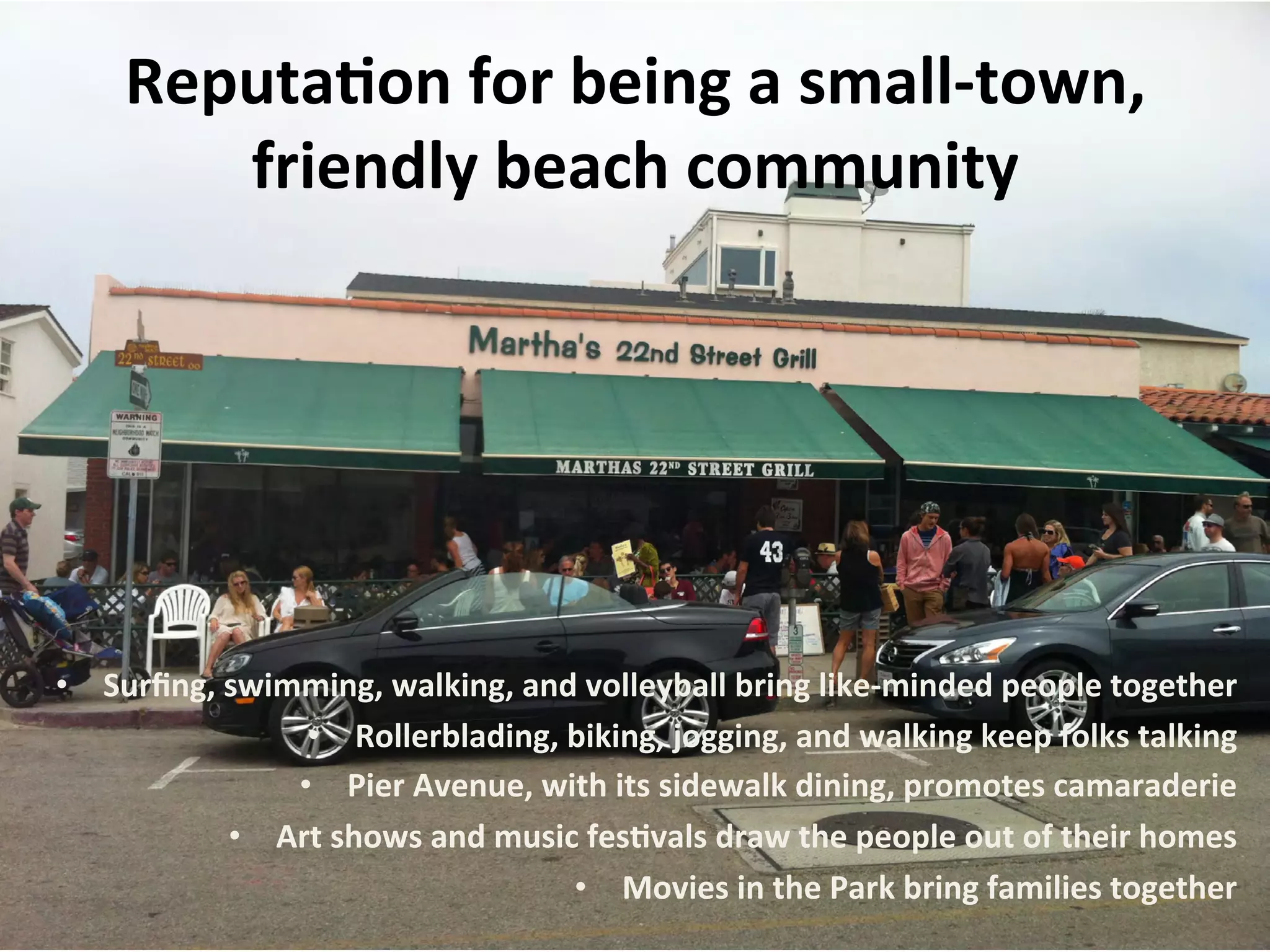
Less access to community 
spaces 210 51 16 5 1.35 
Earthquakes 207 55 20 2 1.36 
Image of the City 210 41 24 4 1.36 
Vibration 204 47 25 6 1.41 
Parking problems 195 58 23 6 1.43 
Lights 177 63 32 6 1.52 
The online survey was a convenient way to facilitate public input into the scoping process while 
minimizing time and expense associated with traditional survey techniques. However, we 
recognize that the informal online survey precluded the recruitment of a representative sample 
of the population. Because the survey was one method, among others, to gather input from the 
community and no scientific conclusions are made with the results, the fact that the respondents 
do not constitute a representative subsample of the population is not considered to be a 
significant limitation of the HIA. 
It is believed that all interested members of the public and stakeholders were reached during the 
HIA, given the extensive outreach and consultation efforts undertaken. 
4.2 Pathways 
A complex interplay of genetic, environmental and lifestyle factors determines the health of 
individuals and communities. Environmental exposures can influence community health but so 
can individual behaviors, social networks, living conditions and cultural practices. Therefore, 
determinants of health include social and economic elements, in addition to the physical 
environment and individual characteristics and behaviors. There are many models that have 
recognized the social-economic influences on health, including that provided by the federal 
government’s national health objective, Healthy People 2020 (Figure 4-2). 
Final Health Impact Assessment - Proposed E&B Oil Drilling and Production Project September 3, 2014 
City of Hermosa Beach, CA Page 23
Figure 4-2 Social Ecological Health Framework (USHHS, 2008) 
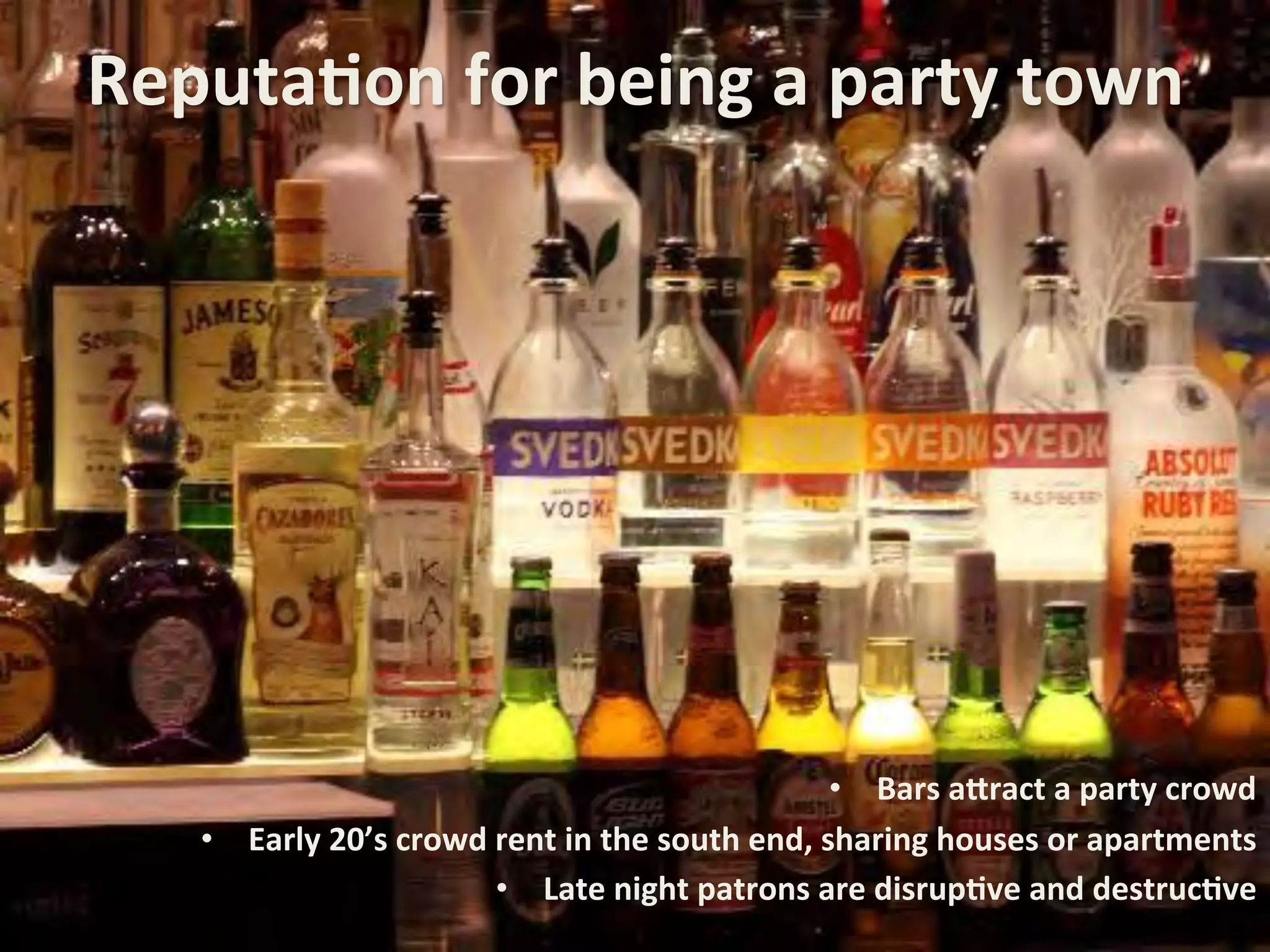
In order to facilitate the scoping process, pathway diagrams were created to understand the 
potential health impacts (positive and negative) of approving the proposed Project. 
Considerations included potential changes in social, economic, physical, psychological and 
other health-related quality of life outcomes. Public input and a review of other oil and gas 
development projects in the Los Angeles area were used to further refine the areas of health 
focus for this evaluation. Due to the large variety in designs for oil and gas development 
projects, a professional engineer with over 15 years of experience in the oil and gas industry 
was consulted to provide expertise on the engineering features of the proposed project as 
described in the E&B Project application (2012; 2013a,b). Additionally, key case studies and 
scientific review articles of health assessments related to oil and/or gas development were 
taken into consideration during the development of pathways for this HIA, including: 
1. Northeast National Petroleum Reserve – Alaska Final Supplement Integrated Activity 
Plan/Environmental Impact Statement (BLM, 2008) 
2. Health Impact Assessment for Battlement Mesa, Garfield County Colorado (U of C, 
2010) 
3. Inglewood Oil Field Communities Health Assessment (LACDPH, 2011a) 
4. Health Impact Assessment of Shale Gas Extraction (NAP, 2013) 
Final Health Impact Assessment - Proposed E&B Oil Drilling and Production Project September 3, 2014 
City of Hermosa Beach, CA Page 24
Health determinants were prioritized based on a combination of key issues identified by 
community members, health research published in scientific peer-reviewed journals and 
professional experience. Based on a combination of public input, expert consultation, and a 
review of available scientific evidence, the following pathways were selected for further 
evaluation in the HIA: 
 Air Quality; 
 Water and Soil Quality; 
 Accidents and Upset Conditions; 
 Noise and Light; 
 Traffic; and, 
 Community Livability. 
The relocation of the City Maintenance Yard was not evaluated in the HIA. This is because its 
proposed relocation will be to a site with existing commercial land use (i.e., storage facilities). 
The construction and relocation of the City Maintenance Yard is not anticipated to be 
substantially different than other common local construction projects and is identified in the EIR 
as a separate Project. Therefore, the relocation activities were considered to be outside the 
scope of the HIA. 
In addition, the HIA did not evaluate the “No Project Alternative”, as presented in the EIR. This 
scenario was an evaluation of a condition under which no development of the oil and gas 
resources would occur. “There would be no drilling and no construction at the Project Site or 
along Pipeline routes. The City maintenance Yard would not be relocated and rebuilt. None of 
the impacts associated with the Proposed Project would occur. No new impacts would occur 
under the No Project Alternative” (MRS, 2014). This is clearly illustrated in the Executive 
Summary of the EIR in Table ES.3 (MRS, 2014). This scenario was not evaluated in the HIA as 
there would be no deviation from baseline health. 
4.2.1 Air Quality 
In the project description, E&B stated that its proposed oil and gas development facility will 
utilize the latest technology and operational advancements in order to reduce potential impacts 
on air quality. The specific measures are outlined in the EIR and include an automatic drill rig 
powered by electricity (as opposed to diesel), limiting the number of truck trips to and from the 
Site, and air monitoring activities. This HIA relied on pollutant inventory data from the EIR and 
evaluated a number of different air pollutants that could be emitted from three primary sources: 
construction, truck traffic, and operations (Figure 4-3). 
As with any new development, emissions from project construction have the potential to impact 
the surrounding community. Construction equipment and the vehicles that transport equipment 
release fine particulate and diesel particulate matter into ambient air. In some circumstances, 
increasing the number of on-road vehicles can cause traffic congestion, and increase the risk of 
traffic injury to motorists, pedestrians and bicyclists (Section 5.6). In addition to emissions from 
the internal combustion engines of construction equipment, soil excavation and movement 
during construction activities generate dust (Section 5.3.2.). 
Final Health Impact Assessment - Proposed E&B Oil Drilling and Production Project September 3, 2014 
City of Hermosa Beach, CA Page 25
Emissions during oil production operations (including testing, drilling and production phases) 
could potentially impact local air quality, particularly without any air pollution controls or 
mitigation measures. The emission sources associated with operational activities include onsite 
microturbines used to generate onsite electricity, routine and emergency flaring events, and 
volatile fugitive emissions from valves, compressors, pumps and connections. Muds that contain 
hydrocarbons can surface and release hydrocarbon vapors (referred to as “mud off-gassing”). 
Drilling muds may contain hydrogen sulfide, benzene and other volatile compounds, which 
could potentially impact health if they are released in sufficient quantities. Additionally, hydrogen 
sulfide and hydrocarbon vapors could leak into ambient air producing detectable odors. Due to 
the close proximity of the site to neighbors, businesses and the public (within 100 feet of 
businesses, 160 feet of residences and 20 feet of the public sidewalks), there is potential for 
odor issues off-site including various maintenance activities, small spills, and leaks from 
equipment components. 
A significant body of scientific and public health literature exists that describes the association 
between excess levels of ambient air pollutants and certain health outcomes, specifically 
respiratory and cardiovascular disease. It is important to note that these effects are dose-dependent, 
in other words, the mere presence of a chemical does not mean that exposure will 
result in adverse health effects. The literature also identifies the potential impacts that odors can 
have on quality of life and, at high enough levels, acute health risks. 
The air quality pathway diagram in Figure 4-3 summarizes the potential health effect pathways 
between the proposed Project and health outcomes in the event that exposures were 
uncontrolled. It should be noted that this diagram, developed during the scoping step, is a 
preliminary effect pathway diagram. The next step in the HIA is the assessment step, which 
validates or invalidates each potential pathway. 
In the first Draft of the HIA the potential health outcomes of greenhouse gas generation from the 
Project were briefly evaluated. However, the authors of the reissued draft HIA Report do not 
believe that localized or community health effects related to potential greenhouse gas emissions 
can be adequately evaluated in a project-level HIA. Rather, the global issue of greenhouse gas 
generation requires a much broader assessment of state and national sources and policies to 
adequately evaluate cumulative impacts of the energy sector. 
Final Health Impact Assessment - Proposed E&B Oil Drilling and Production Project September 3, 2014 
City of Hermosa Beach, CA Page 26
Construction 
Truck traffic 
Operations 
Construction 
equipment/ 
activities 
Δ in on‐road 
vehicle traffic 
Fugitive 
emissions 
Routine and 
emergency 
flaring events 
Notes: Δ indicates ‘a potential change in’, = project impacts, = health determinants, = health outcomes 
Figure 4-3 Air Quality Pathway Diagram 
Δ in air 
pollutants 
• Nitrogen Dioxide 
• Particulate Matter 
• Toxic Air 
Contaminants 
Δ in odors 
Δ in H2S 
Δ in air quality‐related 
diseases 
• Cancer 
• Cardiovascular disease 
• Asthma/other 
respiratory diseases 
• Reproductive Health 
Δ in neighborhood livability 
Δ in acute symptoms (e.g., 
headaches, nausea) 
Δ in respiratory illness and 
Δ in neurological disease 
Final Health Impact Assessment - Proposed E&B Oil Drilling and Production Project September 3, 2014 
City of Hermosa Beach, CA Page 27
4.2.2 Water and Soil Quality 
Two potential sources of water and soil quality impacts were identified in the scoping phase: (1) 
discharge of wastewater and surface water runoff during construction and operations, and (2) 
deposition of windblown soil particulates to offsite surface soil. The primary water resource 
located near the Site and pipeline route is the Pacific Ocean. The ocean provides a potential 
exposure pathway for recreational users to come into contact with contaminants from the Site. 
There are no other surface water bodies in the vicinity of the proposed Project. 
Soil particulate emissions refer to the dust generated during construction and operations when 
equipment moves over soil or unpaved surfaces during trenching, grading, and other earth-moving 
activities. The public may be exposed to contaminated materials if contamination is 
present in soil and is mobilized during dust-generating activities. Adjacent land uses that could 
potentially be impacted by soil particulates include commercial, residential and recreational 
areas. 
Groundwater was not included in the scope of the HIA because it was ruled out as a pathway 
for human health concern. Most of the groundwater in the West Coast Basin remains at an 
elevation below sea level due to historic over-pumping; therefore, seawater intrusion barriers 
have been established. The groundwater located beneath the Site lies to the west of the barrier 
that prevents seawater intrusion into fresh groundwater supplies. As groundwater is within the 
seawater intrusion barrier, it is not used as a drinking water source. While groundwater is not a 
drinking water source, and not evaluated in the HIA, it is still a protected resource. Potential 
impacts to groundwater quality due to Project wastewater generation are addressed in Section 4 
of the EIR. 
The water and soil pathway diagram in Figure 4-4 summarizes the potential health effect 
pathways between the proposed Project and health outcomes in the event that exposures were 
uncontrolled. It should be noted that this diagram, developed during the scoping step, is a 
preliminary effect pathway diagram. The subsequent step in the HIA, the assessment step, 
generates evidence to validate or invalidate each potential pathway. 
Final Health Impact Assessment - Proposed E&B Oil Drilling and Production Project September 3, 2014 
City of Hermosa Beach, CA Page 28
Construction 
Δ storm water 
runoff 
Operations 
Δ soil 
deposition, 
dust emissions 
Truck traffic Δ in soil quality 
Notes: Δ indicates ‘a potential change in’, = project impacts, = health determinants, = health outcomes 
Figure 4-4 Water and Soil Quality Pathway Diagram 
Δ in surface 
water quality 
Δ in acute 
symptoms, 
gastrointestinal 
disease, among 
beachgoers 
Δ in acute 
symptoms, 
neurological 
symptoms, chronic 
diseases 
Final Health Impact Assessment - Proposed E&B Oil Drilling and Production Project September 3, 2014 
City of Hermosa Beach, CA Page 29
4.2.3 Upset Scenarios 
Two potential types of upset scenarios were identified as major health concerns in the scoping 
phase: (1) an oil spill to surface waters, and (2) a well blowout event. While there are other 
potential upset scenarios related to the proposed Project, this HIA focused on these two upset 
scenarios based on community concerns voiced during the scoping meeting and the accidents 
that could present the highest risk to the public. 
An oil spill that is sufficient in volume could impact the adjacent beach and/or the Pacific Ocean. 
The beach and ocean provide potential exposure pathways for recreational users to come into 
contact with crude oil from a spill. The ingestion of contaminated fish or seafood caught from the 
ocean also provides a potential exposure pathway in the event of an oil spill. Additionally, a well 
blowout occurring on the Site could immediately affect the public if the explosion or explosion 
debris materials were to extend beyond the Project Site. 
The accident and upset event diagram in Figure 4-5 summarizes the potential health effect 
pathways between the proposed Project and health outcomes in the event that an accident 
were to occur. It should be noted that this diagram, developed during the scoping step, is a 
preliminary effect pathway diagram. The next step in the HIA is the assessment step, which 
validate or invalidate each potential pathway. 
Final Health Impact Assessment - Proposed E&B Oil Drilling and Production Project September 3, 2014 
City of Hermosa Beach, CA Page 30
Accident/ 
Upset event 
Explosion (fire 
and vapor clouds) 
from blowout 
Crude oil spill 
Δ psychological 
effects, recreational 
activities 
Well blowout Δ in injuries and/or 
Notes: Δ indicates ‘a potential change in’, = project impacts, = health determinants, = health outcomes 
Figure 4-5 Upset Scenarios Event Pathway Diagram 
Oil release to 
beach, ocean 
Δ in acute 
symptoms, 
gastrointestinal 
disease, among 
beachgoers 
fatalities 
Final Health Impact Assessment - Proposed E&B Oil Drilling and Production Project September 3, 2014 
City of Hermosa Beach, CA Page 31
4.2.4 Noise and Light 
The Project has the potential to increase local noise levels. Construction, operations and related 
activities such as truck traffic are possible sources of noise associated with the proposed 
Project. Some studies have suggested that exposure to noise can lead to annoyance and sleep 
disturbance, or at very high levels can be associated with increased blood pressure 
(hypertension), cardiovascular disease, and cognitive impairment. Construction and operation 
activities also have the potential to cause vibrations. Ground vibration produced by the drilling 
and production activities would be below the 0.01 inches/second threshold when it reaches the 
closest sensitive business (i.e., a recording studio), which was determined to be less than 
significant in the EIR (MRS, 2014). Therefore, vibration was excluded from this assessment due 
to the negligible magnitude of potential impact and the low ranking vibration received in the 
community survey of health concerns (Table 4-1). 
Road vehicle traffic is one of the sources of noise in urban areas, and has been well studied in 
the public health literature. Noise generated by vehicle traffic depends on presence of increased 
truck traffic, the traffic volume, traffic speed, and vehicle type. It is possible that the presence on 
increased truck traffic resulting from Project activities in the area could influence noise levels in 
the community. 
In addition to potential noise impacts, disturbances associated with nighttime lighting have been 
identified as a subject of concern for some community members. The proposed Project will 
require lighting to maintain a safe working environment for employees at night. Key lighting 
features of the proposed Project include light fixtures on the Site entrance, the construction 
trailers and/or office buildings, and the drill rig equipment. As discussed in the EIR, the majority 
of lighting would be shielded and downcast, and would be located behind the 35-foot sound 
attenuation wall to minimize light spill or glare beyond the Site perimeter. 
The noise and light pathway diagram in Figure 4-6 summarizes the potential health effect 
pathways between the proposed Project and health outcomes in the event that exposures were 
uncontrolled. It should be noted that this diagram, developed during the scoping step, is a 
preliminary effect pathway diagram. The next step in the HIA is the assessment step, which 
validate or invalidate each potential pathway. 
Final Health Impact Assessment - Proposed E&B Oil Drilling and Production Project September 3, 2014 
City of Hermosa Beach, CA Page 32
Figure 4-6 Noise and Light Pathway Diagram 
Final Health Impact Assessment - Proposed E&B Oil Drilling and Production Project September 3, 2014 
City of Hermosa Beach, CA Page 33
4.2.5 Traffic 
The construction and operations phases of the proposed Project will cause an increase in traffic, 
especially large truck traffic. Additional vehicles related to the proposed operations could 
change traffic congestion. The influx of new truck traffic and the potential impact on safety was 
one of the primary concerns of community members. Substantial increases in transportation and 
traffic can impact the health and safety of a community by heightening the potential risk of 
vehicle-vehicle, vehicle-pedestrian, and vehicle-bicyclist accidents. Perceptions about traffic 
safety hazards can influence health by altering actives such as walking and biking. 
Increased traffic-related air pollution and traffic-related noise could also result in health changes 
in the community. The potential traffic-related impacts to air and noise are identified in Sections 
4.2.1 and 4.2.4, respectively. 
The traffic pathway diagram in Figure 4-7 summarizes the potential health effect pathways 
between the proposed Project and health outcomes in the event that exposures were 
uncontrolled. It should be noted that this diagram, developed during the scoping step, is a 
preliminary effect pathway diagram. The next step in the HIA is the assessment step, which 
validate or invalidate each potential pathway. 
Final Health Impact Assessment - Proposed E&B Oil Drilling and Production Project September 3, 2014 
City of Hermosa Beach, CA Page 34
Figure 4-7 Traffic Pathway Diagram 
Final Health Impact Assessment - Proposed E&B Oil Drilling and Production Project September 3, 2014 
City of Hermosa Beach, CA Page 35
4.2.6 Community Livability 
Community livability is the focus area used to describe a series of community characteristics 
that enhance or degrade the experience of living in a specific area. The different aspects of 
community livability that are evaluated in this HIA were identified through public stakeholder 
engagement activities. During the scoping phase, many community members commented they 
were concerned that the presence of oil and gas industry could change the identity of Hermosa 
as “The Best Little Beach City.” As part of the Community Dialogue process, a community-led 
committee was assembled to define important quality of life factors. This committee found 
common themes that they feel describe the identity of Hermosa Beach, including (Appendix F): 
 City streets are clean and the beach environment is regularly maintained; 
 Reputation for being a small scenic town and friendly beach community; 
 Bars that attract party crowds at night; 
 Health conscious community that enjoys exercising and spending time outdoors; 
 Accessible city government with active citizens involvement; 
 Safe environment with low crime rate; 
 Known for green/sustainable activities and carbon neutral goal; and, 
 Schools have a high reputation and benefit from community involvement. 
This area of health focus incorporates the quality of life values into an evaluation of three key 
aspects of the Project that could influence community livability: potential change in city identity, 
increased city revenue from oil and gas production, and access to neighborhood resources. 
Under these key areas of concern, six potential health determinants were included for 
evaluation in the HIA: property values; access to recreational resources and green space; 
aesthetics and visual resources; education funding; social cohesion; and, political involvement. 
In addition to the potential impacts from Project construction and operation, there could be 
possible benefits and drawbacks from the opportunity to vote on the proposed Project. 
Community members have expressed concern that letting voters decide whether the proposed 
Project is approved has created political divisions and stress, with residents who are in favor 
divided from those who are opposed. While the debate over the proposed Project has the 
potential to disrupt social cohesion, involving the community in the political process can be 
beneficial to health and well-being. 
The community livability pathway diagram in Figure 4-8 summarizes the potential health effect 
pathways between the proposed Project and health outcomes in the event that exposures were 
uncontrolled. It should be noted that this diagram, developed during the scoping step, is a 
preliminary effect pathway diagram. The next step in the HIA is the assessment step, which 
validate or invalidate each potential pathway. 
Final Health Impact Assessment - Proposed E&B Oil Drilling and Production Project September 3, 2014 
City of Hermosa Beach, CA Page 36
Δ in city identity 
(real or perceived) 
Δ in property 
values 
Δ in city revenue 
(e.g. for education, 
infrastructure 
improvements) 
Δ in aspects of resources 
community 
livability (e.g., 
property 
values, 
aesthetics, 
green space, 
funding) 
Δ in access to 
neighborhood 
resources (e.g., 
recreational 
resources and 
green space) 
Δ in aesthetics 
Vote on cohesion 
proposed 
Project 
Notes: Δ indicates ‘a potential change in’, = project impacts, = health determinants, = health outcomes 
Figure 4-8 Community Livability Diagram 
Δ in community 
Δ in neighborhood 
crime/safety 
Δ in mental health 
Δ in chronic disease 
• Cardiovascular disease 
• Diabetes 
• Hypertension 
Δ in physical 
activity 
Δ in social 
Δ in annoyance and 
stress 
Δ in political 
involvement 
Final Health Impact Assessment - Proposed E&B Oil Drilling and Production Project September 3, 2014 
City of Hermosa Beach, CA Page 37
5.0 ASSESSMENT 
As described previously, the assessment process in HIA involves: (1) developing a health 
baseline profile, (2) assessing the likely impacts, and (3) characterizing the health impacts. This 
Section first summarizes the baseline profile, and then provides the individual assessments and 
impact characterizations for each the six categories identified in the scoping phase (air quality, 
water and soil quality, noise and light, accidental releases, traffic, and community livability). 
The HIA Team worked very closely with the EIR Team as it was being finalized. This HIA 
focused on conditions reported in the EIR after Project mitigation measures were considered. In 
some instances the HIA Team requested additional information from the EIR Team to complete 
this report (e.g., air quality and noise). 
5.1 Baseline Health Assessment 
The first step of the HIA assessment process is to create a baseline health profile that describes 
the current health conditions in the community. The baseline health assessment establishes the 
current health status of the City of Hermosa Beach residents in order to evaluate whether the 
current profile of the community reveals vulnerabilities to any of a number of health outcomes, 
and also to provide a benchmark so that the HIA can predict the extent of change from current 
health conditions (Ross et al., 2014). 
Existing health and environmental data from regulatory agency monitoring and published 
reports were documented in the baseline health assessment, and some of the baseline data 
collected specifically for the EIR was also incorporated into the baseline health assessment. 
The following sections summarize key information from the Hermosa baseline health 
assessment that is provided as a separate report in Appendix E. The baseline health 
assessment remains unchanged from the February 2014 draft HIA. 
5.1.1 Demographic Characteristics 
Table 5-1 provides both city and county level demographic indicators from the US Census. The 
City of Hermosa Beach, as defined by the 2010 Census, has 19,506 residents with 52.7% male 
and 47.3% female. Age is an important factor in determining vulnerability. According to the 
census data for Hermosa, approximately 25% of the population may be considered to be more 
vulnerable to certain environmental exposures, based on age (9% over the age of 65 and 16% 
under 18 years). This is fewer than the percentage of Los Angeles County residents considered 
vulnerable to environmental exposures based on age (35%). 
In the 2010 US Census, 95.8% of residents in Hermosa reported one race: 86.8% identified as 
White, 5.7% as Asian, 1.2% as Black or African American, 0.3% as American Indian and Alaska 
Native, 0.2% as Native Hawaiian and Other Pacific Islander, and 1.7% as some other race. 
Compared to the County of Los Angeles, Hermosa is much less racially and ethnically diverse. 
On the county level, 48.2% of the population identifies as Hispanic or Latino while only 8.4% of 
the Hermosa population identifies as Hispanic or Latino. 
Final Health Impact Assessment - Proposed E&B Oil Drilling and Production Project September 3, 2014 
City of Hermosa Beach, CA Page 38
Education level, income, and housing are all components of social determinants of health. 
Social determinants of health refer to the role that our social environment and economic 
situation play in shaping our health, as social and economic factors are the single largest 
predictor of health outcomes, compared to clinical health care, health behaviors, and the 
physical environment (LACDPH, 2013). Nearly 70% of Hermosa residents have obtained a 
bachelor’s degree or higher, compared to less than 30% in greater Los Angeles County. Median 
household income in Hermosa Beach is almost double that of LA County ($102K vs. $56K). 
Fewer than 4% of Hermosa residents live in poverty, compared to 16.3% of LA County 
residents. In contrast to the income profile, the homeownership rate in Hermosa is less than that 
of LA County (44.9% versus 47.8%). The homeownership profile is likely explained by Hermosa 
as a beach tourist destination and an area highly attractive to both renters and leasers. Further, 
with a median housing unit value over one million dollars, homeownership in Hermosa is over 
twice as expensive in Hermosa compared to Los Angeles County. 
Overall, demographic indicators show that Hermosa Beach is not highly vulnerable to negative 
health outcomes traditionally associated with poverty, unemployment, and low educational 
attainment. 
Table 5-1 Demographic Summary (US Census, 2013) 
2010 Census Measures Hermosa Beach LA County 
Population 19,506 9,818,605 
Persons under 18 years, percent 15.9% 23.7% 
Persons 65 years and over, percent, 2010 9.0% 11.5% 
Female persons, percent 47.3% 50.7% 
Race 
White alone, percent 86.8% 71.6% 
Black or African American alone, percent 1.2% 9.3% 
American Indian and Alaska Native alone, percent 0.3% 1.5% 
Asian alone, percent 5.7% 14.5% 
Native Hawaiian and Other Pacific Islander alone, percent 0.2% 0.4% 
Ethnicity 
Hispanic or Latino, percent 8.4% 48.2% 
High school graduate or higher, percent of persons age 25+, 2007-2011 98.5% 76.1% 
Bachelor's degree or higher, percent of persons age 25+, 2007-2011 69.9% 29.2% 
Homeownership rate, 2007-2011 44.9% 47.8% 
Housing units in multi-unit structures, percent, 2007-2011 48.4% 41.9% 
Median value of owner-occupied housing units, 2007-2011 $1,000,001 $478,300 
Median household income, 2007-2011 $102,289 $56,266 
Persons below poverty level, percent, 2007-2011 3.60% 16.30% 
5.1.2 Current Health Conditions 
Available data from various sources were gathered in order to characterize the current health 
status of the community compared to the expected health status based on data from LA County 
or California. Health conditions examined include cancers, mortality, hospitalizations, birth 
outcomes, and traffic-related injuries. 
Final Health Impact Assessment - Proposed E&B Oil Drilling and Production Project September 3, 2014 
City of Hermosa Beach, CA Page 39
Based on the Los Angeles County Cancer Registry, the observed number of cancer cases in 
the City of Hermosa from 2000 to 2010 was within or below the expected number, based on 
age-, race- and sex-adjusted incidence rates for Los Angeles County, for most cancers. 
Exceptions include melanoma (122 cases versus 24-49 expected) and breast cancer (148 
cases versus 90-120 expected). The observed number of colorectal cancers was significantly 
lower in Hermosa (41 cases versus 51-84 expected). 
The statistically significant increase in melanoma and breast cancer diagnoses among residents 
of Hermosa Beach compared to Los Angeles County can largely be explained by known lifestyle 
risk factors. Higher socioeconomic status is an accepted risk factor for both of these cancers 
and the demographic profile shows that Hermosa Beach residents have higher income and 
education than Los Angeles County residents as a whole. In addition, sun exposure is the 
strongest risk factor for melanoma and thus an elevated incidence rate would be expected in the 
Southern California beach communities, assuming these residents spend more time in the sun 
during daylight hours compared to residents elsewhere in the county. Otherwise there is no 
evidence that residents of Hermosa Beach experience unusually high or low risk of common 
types of cancer (Cozen, 2014). 
Hermosa Beach appears to have a favorable mortality profile, according to all-cause mortality, 
diseases of the heart, and cancer, compared to LA County (CDPH, 2013). The unadjusted all-cause 
mortality rate in Hermosa (40.5 deaths per 10,000 people) is lower than the all-cause 
mortality rate in Los Angeles County (56.9 deaths per 10,000 people). Hermosa mortality rates 
are also lower for diseases of the heart (9.2 versus 15.8) and cancer (9.0 versus 13.9). 
However, differences in population age distribution may explain an apparent decreased risk of 
mortality in Hermosa Beach. For example, age is significantly associated with both heart 
diseases and cancers, and the County of Los Angeles has a greater proportion of people age 
65 years and older (11.5 %) compared to Hermosa (9%). 
Hospitalization rates for asthma, diabetes, acute myocardial infarction, and mental illness are 
overall much lower in Hermosa Beach compared to California (OSHPD, 2013). The rate of 
patients hospitalized for alcohol-drug dependence/alcohol-drug induced mental disease is 
elevated in Hermosa compared to California (169 versus 109 hospitalizations per 100,000 
people). While hospitalization data may indicate higher than expected alcohol and drug use in 
Hermosa, these unadjusted results do not allow conclusions to be made about statistical 
significance. 
A birth profile for the Hermosa ZIP code was accessed from the California Department of Public 
Health data for 2011 (CDPH, 2013b). Access to prenatal care appears slightly better in 
Hermosa compared to state-wide; 88% of women in Hermosa received prenatal care in the first 
trimester versus 82% of women in California. The rate of low birth weight infants born weighing 
less than 2,500 grams (about 5.5 pounds) is the same among Hermosa and California births 
(7% in both populations). In 2011, nearly half of births in Hermosa Beach (47%) were to 
mothers age 35 and older versus 19% of births in California; indicating a potential vulnerability 
to certain developmental conditions, such as autism or Down’s syndrome. 
Final Health Impact Assessment - Proposed E&B Oil Drilling and Production Project September 3, 2014 
City of Hermosa Beach, CA Page 40
Information regarding injury and fatality from traffic conditions was gathered from the California 
Highway Patrol Integrated Traffic Records System (CHP 2014). From 2009 to 2011, the annual 
number of reported vehicle-pedestrian collisions resulting in injury in Hermosa ranged from 3 to 
10, the annual number of reported vehicle-bicycle collisions resulting in injury ranged from 6 to 
13, and the annual number of reported vehicle-vehicle collisions resulting in injury ranged from 
36 to 44. While vehicle-vehicle accidents are far more common than vehicle-pedestrian and 
vehicle-bicycle accidents, pedestrians and bicyclists are more likely to suffer from injuries and 
severe injuries as a result of the collision compared to motorists or vehicle passengers. 
Fatalities due to traffic accidents are extremely rare in Hermosa. 
5.1.3 Environmental Quality 
Existing environmental quality measures from regulatory agency monitoring and reporting were 
gathered in order to characterize the environmental conditions in Hermosa. 
South Coast Air Quality Management District (SCAQMD) air monitoring stations provide data for 
criteria air pollutants throughout Orange County, Los Angeles, Riverside, and San Bernardino 
counties. Hermosa does not have an air monitoring station within its boundaries, and is 
contained in the Southwest Coastal Los Angeles County area with an air monitoring station in 
nearby Hawthorne. SCAQMD data for 2011 to 2012 show exceedances of the particulate matter 
PM10 annual average standard of 20 μg/m3 in 2011 (21.7 μg/m3), as well as the ozone 1-hour 
maximum standard of 0.09 ppm and ozone 8-hour maximum standard of 0.07 ppm in 2012 
(0.11 and 0.08 ppm, respectively, in the vicinity of Hermosa Beach). Local air monitoring data is 
not available for smaller particulate matter PM2.5 but estimated PM2.5 in Hermosa exceeds the 
California standard of 12 μg/m3 (13.74 μg/m3) (Cal/EPA and OEHHA 2013). Traffic density in 
the region is likely a significant contributor to particulate air pollution. 
The California Environmental Protection Agency (Cal/EPA) and the California Office of 
Environmental Health Hazard Assessment (OEHHA) developed CalEnviroScreen, an online 
mapping application, that can be used to identify California communities that are 
disproportionately burdened by multiple sources of pollution (Cal/EPA and OEHHA 2013). 
CalEnviroScreen assigns a score to each community based on cumulative environmental 
sources such as ambient air, pesticide use, chemical releases, traffic, hazardous substances 
cleanup sites, risk to groundwater, permitted hazardous waste facilities, surface water 
pollutants, and solid waste sites. Overall, Hermosa ranks in the lowest 10% for CalEnviroScreen 
scores, indicating an overall low pollution burden in Hermosa Beach relative to California. 
5.1.4 Health Supporting Resources and Health Promotion 
Health supporting resources such as the availability of nutritious foods and health care services 
are important indicators for various health conditions in communities. There are two large chain 
groceries, ten other groceries, and one farmer’s market within Hermosa, providing access to 
fresh foods throughout the City. There are no licensed healthcare facilities within the City of 
Hermosa. There are various healthcare facilities located in the nearby City of Torrance; 
however, for those community members who do not own a vehicle, it may be challenging to 
access health care. 
Final Health Impact Assessment - Proposed E&B Oil Drilling and Production Project September 3, 2014 
City of Hermosa Beach, CA Page 41
The City of Hermosa Beach and its community members are exceptionally committed to health 
promotion and community livability. In 2012, the City of Hermosa Beach launched the Healthy 
Air Hermosa public education campaign to ensure residents and visitors can enjoy a smoke-free 
environment in public outdoor gathering spots such as the Pier, the Strand, the Greenbelt, Pier 
Plaza, City owned parking lots, and all parks. Smoking was previously banned on the beach, in 
city buildings and inside restaurants (City of Hermosa Beach, 2012). In February 2013, the City 
of Hermosa Beach became the first community in the country to achieve Blue Zones 
Community Policy designation – for adopting policies to improve its residents’ well-being. Those 
policies include a “Living Streets Policy” focused on making the community more livable, 
walkable, and bikeable (e.g., Pier Ave); and a pledge to create a community garden. 
A Gallup-Healthways Well Being survey of 1,332 Hermosa, Manhattan and Redondo residents 
conducted in 2010 found that the overall well-being rating local residents was higher than the 
California average and above the top tier of other cities. More than 90 percent of local residents 
said they had access to health care, health insurance and enough money for food, shelter and 
other basic needs. Two-thirds were found to be “thriving.” However, the survey also found that 
46 percent of the Beach Cities residents felt stressed for most of the day, a number that ranked 
them 176th out of 188 communities surveyed. When asked if they had significant worries, 37 
percent said they did, which ranked the Beach Cities 177th out of those 188 communities 
surveyed (Blue Zones, 2010). 
5.1.5 Discussion of Vulnerable and Sensitive Populations 
In general, HIAs seek to discuss the potential impact on vulnerable populations of society that 
may be disproportionately affected by the project. Invariably, children and the elderly are 
considered to be vulnerable populations with respect to numerous different types of 
environmental exposure. This is also true for many of the determinants that were evaluated in 
this HIA. Vulnerable populations were also included as part of the assessment and the potential 
for disproportionate impacts on these individuals was carefully considered in the classification of 
magnitude and adaptability. They were also taken into account when making additional 
recommendations. Each assessment provides details of the vulnerable population(s) considered 
in the evaluation. 
Of particular interest in this HIA, the baseline health assessment revealed that there is only a 
small portion of the population of Hermosa Beach that lives below the poverty line (4%). Social 
environmental equity issues are not a concern as there is no concentration of low-income 
housing in proximity to the Project. 
In addition, over the course of the 35 year life of the Project there is no indication that population 
demographics will change. Seventy-five percent of the population is between 18 and 65, with 
over 40% between the ages of 25 and 44. 
5.2 Air Quality Assessment 
Air emissions from the construction and operation of the Project could affect air quality in the 
City of Hermosa Beach. The identification of the air pollutants to be assessed in the HIA began 
Final Health Impact Assessment - Proposed E&B Oil Drilling and Production Project September 3, 2014 
City of Hermosa Beach, CA Page 42
with the emissions inventory associated with the construction and operations of the Project. 
Emissions associated with the Project and modeled in the EIR include criteria pollutants (e.g., 
carbon monoxide, nitrogen dioxide, sulfur dioxide and particulate matter), volatile organic 
compounds (VOCs) and other toxic air contaminants (e.g., polycyclic aromatic hydrocarbons 
(PAHs) and metals), and odorous / toxic compounds (e.g., hydrogen sulfide or H2S). Carbon 
monoxide (CO) and sulfur dioxide (SO2) were not carried forward in the HIA as the calculated 
emission estimates for these criteria pollutants were determined to be below the South Coast 
Air Quality Management District (SCAQMD) regional and local thresholds (see Tables 4.2-7 to 
4.2-9 of the EIR) under both the mitigated and unmitigated scenarios, suggesting that the CO 
and SO2 emissions associated with the Project will have negligible to low impact on current air 
quality on both a local and regional scale. All other pollutants identified in the EIR exceeded 
some threshold of significance in the EIR, and therefore were carried forward for further 
evaluation in this HIA. These pollutants include: 
 Nitrogen dioxide (NO2) 
 Particulate matter (PM10 and PM2.5) 
 Toxic air contaminants (TACs) 
 Hydrogen sulfide (H2S) and other odorous compounds 
This section presents the potential health effects that might be experienced by people from 
short-term and long-term exposure to each of these air pollutants, the ambient air 
concentrations for each of the air pollutants, and the potential health effects associated with the 
maximum predicted air concentrations of the air pollutants associated with the proposed Project 
when added to current (or existing) air concentrations. 
5.2.1 Nitrogen Dioxide (NO2) 
5.2.1.1 NO2 and Health 
Depending on the concentrations in air, NO2 is associated with a range of respiratory effects 
(USEPA, 2008). According to the Agency for Toxic Substances and Disease Registry (ATSDR, 
2002), low levels of NO2 in air can irritate the eyes, nose, throat and lungs. Breathing air with 
high concentrations of NO2 can result in changes in pulmonary function due to inflammation of 
lung tissue. Exposure to NO2 can have a more pronounced effect on the health of individuals 
with pre-existing respiratory conditions, such as asthma, chronic obstructive pulmonary disease 
or bronchitis. Short term NO2 exposure is strongly associated with asthma exacerbation (i.e., 
wheezing, cough, use of medication) among children (USEPA, 2008). 
To protect the general public against the described health effects, regulatory bodies across the 
globe have set ambient air quality guidelines for NO2. In California, ambient air quality standards 
are defined as the “maximum allowable level of [an] air pollutant that can be present in outdoor 
air for a given averaging time without causing harmful health effects to most people” (CalEPA, 
2007). The California 1-hour AAQS for NO2 is 0.18 ppm (340 μg/m3). In setting the 1-hour 
AAQS, the California Environmental Protection Agency (CalEPA) states that the short-term 
effect of interest includes a potential to aggravate chronic respiratory disease and respiratory 
Final Health Impact Assessment - Proposed E&B Oil Drilling and Production Project September 3, 2014 
City of Hermosa Beach, CA Page 43
symptoms in sensitive groups (CalEPA, 2007). California’s annual AAQS for NO2 is 0.030 ppm 
(57 μg/m3). 
A summary of the relationships between short-term exposure to NO2 and health effects reported 
in the published scientific literature is provided in Table 5-2. Although some studies have 
reported mild respiratory effects in asthmatics at NO2 concentrations less than 375 μg/m³ 
(CalEPA, 2007), because of the absence of a clear dose–response relationship and statistical 
uncertainty, the findings of these studies are not considered to reflect the acute effects of NO2 
exposure (Forastiere et al., 1996; Cal EPA, 2007). A recent meta-analysis of NO2 exposure and 
airway hyper-responsiveness in asthmatic adults suggests that there is no evidence that NO2 
causes clinically relevant effects in asthmatics at concentrations up to 1,100 μg/m³ (585 ppb) 
(Goodman et al., 2009). 
The WHO set its 1-hour air quality guideline for NO2 at 200 μg/m³ (106 ppb; WHO, 2006). This 
value is based on the increased incidence of adverse respiratory effects in animal and 
epidemiological studies. Similarly, the USEPA established a 1-hour National Ambient Air Quality 
Standard of 188 μg/m3 (100 ppb) for NO2 (USEPA, 2008). Both the WHO guideline and USEPA 
NAAQS are intended to be protective of sensitive individuals in the population, including 
asthmatics, children, the elderly and individuals with pre-existing respiratory conditions. It is 
noted that the 2008 USEPA NAAQS review of NO2 states there was little evidence of an effect 
threshold, or a value below which no health effects would be expected, based on their review of 
the data. The USEPA NAAQS and World Health Organization air quality guideline are more 
stringent than California’s 1-hour AAQS for NO2. Although the NAAQS is slightly lower than the 
WHO guideline, the NAAQS is based on a 3-year average 98th percentile of the annual 
distribution of daily maximum 1-hour concentrations. In contrast, the WHO air quality guideline 
is compared against the maximum predicted hourly air concentrations, making it a slightly more 
conservative metric for assessing the potential short-term health risks for NO2. As such, the 
WHO 1-hour air quality guideline was used to characterize the short-term health risks 
associated with NO2 in the HIA. 
The USEPA (2010) chronic NAAQS for NO2 is 100 μg/m³ (53 ppb). The NAAQS was developed 
in 1971 (USEPA, 2010) and has been subsequently upheld through a number of scientific and 
regulatory reviews between 1971 and 2010. A scientific review of the annual NAAQS conducted 
in 1993 upheld the standard of 100 μg/m³, based on the results of a meta-analysis of 
epidemiological studies. In 1996, the annual standard was maintained by the USEPA on the 
basis that, in combination with the short-term standard, the annual standard was protective of 
both the potential short-term and long-term human health effects of NO2 exposure (USEPA, 
1996). The most recent edition of the Final Rule (USEPA, 2010) indicates that the annual 
standard was upheld due to the uncertainty associated with the potential long-term effects of 
NO2. The uncertainty associated with potential long-term effects of NO2, in the case of 
respiratory morbidity, is due to the high correlation among traffic pollutants which makes it 
difficult to accurately estimate the independent effects of NO2 in long-term exposure studies. 
The WHO (2006) chronic air quality guideline for NO2 is 40 μg/m³ (0.023 ppm). The WHO 
(2006) indicates that the 40 μg/m³ is based on consideration of background concentrations and 
Final Health Impact Assessment - Proposed E&B Oil Drilling and Production Project September 3, 2014 
City of Hermosa Beach, CA Page 44
the observation that adverse health impacts may occur when concentrations in addition to 
background exceed that level. Although this value is not well substantiated in the available 
supporting documentation, it is the more conservative or stringent value when compared to the 
USEPA NAAQS and California AAQS. As such, the WHO annual air quality guideline was used 
to characterize the long-term health risks associated with NO2 in the HIA. 
Table 5-2 Potential Acute Health Effects Associated with NO2 
Air Concentration 
Description of the Potential Health Effects1 
μg/m³ and (ppb) 
<190 (101) No documented reproducible evidence (consistent and significant) of adverse 
health effects among healthy individuals or susceptible individuals following 
short-term exposure. Study results are variable and are indiscernible from 
background or control groups. 
190 (101) to 
560 (298) 
Increased airways responsiveness, detectable via meta-analysis, among 
asthmatics. Large variability in protocols and responses. 
490 (261) Allergen-induced decrements in lung function and increased allergen-induced 
airways inflammatory response among asthmatics. Most studies used 
non-specific airways challenges. No NO2-induced change in lung function. No 
documented effects among healthy individuals. 
560 (298) to 
750 (399) 
Potential effects on lung function indices, including inconsistent changes forced 
expiratory volume in 1 second (FEV1) and forced vital capacity among patients 
with chronic obstructive pulmonary disease (COPD) during mild exercise. 
1,900 (1,011) to 
3,700 (1968) 
Increased likelihood of inflammatory response and airway responsiveness among 
healthy individuals during intermittent exercise. Symptoms have not been 
detected by most investigators among healthy individuals. Asthmatics might 
experience small decrements in FEV1. 
≥3,700 (≥1968) Changes in lung function, such as increased airway resistance, in healthy 
individuals. 
Notes: 
1 These descriptions identify the health effects that might be experienced among normal, healthy individuals following acute 
exposure to NO2. Also listed are the types of symptoms that might occur among individuals with pre-existing breathing disorders, 
such as asthma, bronchitis or COPD. The exact nature and severity of responses that might occur among individuals with 
pre-existing conditions will depend on several factors, including: 
 the severity of the person’s condition 
 the age of the individual 
 the level of management of the disorder, including the availability and use of medications 
 the person’s level of physical activity 
 external environmental factors such as temperature and humidity 
The symptoms that could be experienced by these individuals could be more or less severe that those described because of these 
factors. 
Sources: Azadniv et al. (1998); Beil and Ulmer (1976); Blomberg et al. (1997, 1999); Cal EPA (2007); Devlin et al. (1999); Gong et 
al. (2005); Goodman et al. (2009); Jorres et al. (1995); Morrow et al. (1992); von Nieding et al. (1979, 1980); von Nieding and 
Wagner (1977); Vagaggini et al. (1996); USEPA (2008). 
5.2.1.2 Current Conditions 
In 2012, background or ambient air concentrations of NO2 were measured at 26 stations within 
the SCAQMD; however, a monitoring station was not identified within the local vicinity of the 
Project, nor was a station identified within the City of Hermosa Beach. The closest air 
monitoring station to the Project that measures ambient NO2 concentrations in air is in the City 
of Hawthorne within Southwest Coastal Los Angeles County (Area 3, Station 820). For the 
Final Health Impact Assessment - Proposed E&B Oil Drilling and Production Project September 3, 2014 
City of Hermosa Beach, CA Page 45
purposes of the Project EIR and HIA, it was assumed that the air quality in Hermosa Beach 
would be similar to that of Hawthorne. In 2012, the maximum measured 1-hour NO2 
concentration at Station 820 was 116 μg/m³, and the annual average NO2 concentration was 
19.6 μg/m³. These concentrations remain below the WHO air quality guidelines for NO2 (i.e., 1- 
hour AQG of 200 μg/m³ and annual AQG of 40 μg/m³) (WHO, 2006). 
As described in Section 5.2.1.1, short-term and long-term exposure to air pollutants can affect 
human health. The current health status of Hermosa Beach residents is described in Appendix 
E using the health statistics for the incidence and mortality rates of diseases that are often 
associated with air pollution in the scientific literature, such as chronic lower respiratory disease, 
heart disease and asthma. 
5.2.1.3 Project Impact 
In order to predict the maximum 1-hour NO2 air concentrations (i.e., background plus Project) 
that people might experience in the vicinity of the Project, the maximum 1-hour NO2 air 
concentrations predicted for the Project at the Point of Maximum Impact (PMI) and within the 
residential community surrounding the Project under the mitigated scenario were added to the 
maximum 1-hour background or ambient air concentration of NO2 described in Section 5.2.1.2. 
Similarly, the maximum annual average NO2 air concentrations (i.e., background plus Project) 
were calculated by adding the maximum predicted annual average NO2 air concentration for the 
Project under the mitigated scenario to the annual average background or ambient air 
concentration of NO2 described in Section 5.1.1.2. Table 5-3 provides the maximum predicted 1- 
hour and annual air concentrations and the corresponding air quality guidelines established by 
the WHO for the protection of public health. 
Table 5-3 Comparison of Maximum Predicted NO2 Air Concentrations for the Mitigated 
Scenario against Health-Based Air Quality Guidelines 
Averaging 
Location Background 
Time 
Air 
Concentration1 
(μg/m³) 
Maximum Predicted Air 
Concentration (μg/m³) 
Air Quality 
Guideline2 
Project Cumulative (μg/m³) 
(Background + 
Project) 
1-hour PMI 116 38.2 154 200 
Residential 116 33.3 149 
Annual PMI 19.6 3.6 23.2 40 
Residential 19.6 2.3 21.9 
Notes: 
1 Based on the maximum of the measured ambient hourly NO2 air concentrations within Southwest Coastal Los Angeles County 
(Area 3, Station 820) during 2012. 
2 WHO (2006) 
PMI = Point of Maximum Impact 
Residential = Highest concentration at homes adjacent to the Site 
The maximum predicted 1-hour and annual NO2 concentrations for the PMI and the residential 
locations are below the WHO air quality guidelines, indicating that adverse health effects are not 
expected to result from either short-term or long-term exposure to NO2. Moreover, there are no 
Final Health Impact Assessment - Proposed E&B Oil Drilling and Production Project September 3, 2014 
City of Hermosa Beach, CA Page 46
predicted “exceedances” of California’s Ambient Air Quality Standards, or the USEPA National 
Ambient Air Quality Standards. 
The impact of Project-related NO2 emissions on the health of the community is provided in Table 
5-4. 
Table 5-4 HIA Evaluation Matrix – Nitrogen Dioxide (NO2) 
Health Determinant Nitrogen Dioxide (NO2) 
Potential Health Outcome Respiratory irritation and airway constriction 
Pre-Mitigation Discussion The direction of the pre-mitigated impact is negative. 
Construction activities and operations could generate NOx 
emissions that exceed South Coast Air Quality Management 
District Thresholds. 
EIR Mitigation NOx reduction program (AQ-1b), limited flaring (AQ-3a), and air 
monitoring plan (AQ-5d) 
Geographic Extent Localized 
Vulnerable Populations Children, elderly, individuals with pre-existing conditions 
Magnitude Low 
Adaptability High 
Likelihood Unlikely 
Post-Mitigation Health Effect No Substantial Effect 
Comments or Additional 
None. 
Recommended Measures 
As described in Table 5-4, without mitigation, construction activities and operations could 
generate NOx (e.g., NO2) emissions that exceed SCAQMD thresholds. However, the Project will 
comply with a range of air quality mitigation measures and permits, including combustion 
emission limits. These mitigation measures were described in detail in Section 4.2.4.1 of the 
EIR. 
The influence of the proposed Project on NO2 ground-level air concentrations is expected to be 
‘localized’ because air pollutant concentrations dissipate from the source. The vulnerable 
population identified for air quality impacts are ‘children, the elderly and individuals with pre-existing 
health conditions’. The magnitude of the health effect related to NO2 is ‘low’, 
meaning that they are not expected to be high enough to pose a health hazard to the 
community of Hermosa Beach. The adaptability is considered ‘high’, in that people are 
expected to be unaffected or easily able to adapt to the change in NO2 emissions (i.e., people 
will be able to maintain their pre-project level of health). The likelihood of an adverse health 
effect occurring as a result of the Project’s NO2 emissions was defined as ‘unlikely’. Based on 
the findings of the Air Quality assessment and the planned mitigation measures for the Project 
(see Section 4.2 of the EIR), the potential NO2-related health impact associated with the Project 
is classified as ‘no substantial effect’. Therefore, no additional measures are recommended. 
Final Health Impact Assessment - Proposed E&B Oil Drilling and Production Project September 3, 2014 
City of Hermosa Beach, CA Page 47
5.2.2 Particulate Matter (PM) 
5.2.2.1 PM and Health 
Particulate matter is a widespread air pollutant composed of a mixture of solid and liquid 
particles, and its effects on health are well documented. Particles with a diameter of 10 
micrometers or smaller are referred to as PM10, and particles with a diameter of 2.5 micrometers 
or smaller are known as PM2.5. Both PM10 and PM2.5 include inhalable particles that are small 
enough to enter the lungs, and both short-term (hours, days) and long-term (months, years) 
exposure can result in increased respiratory and cardiovascular disease. Specifically, PM 
exposure is associated with exacerbation of asthma and an increase in hospital admissions. In 
addition, increased mortality rates from cardiovascular and respiratory diseases are well 
documented in large urban centers. The most susceptible groups include people with pre-existing 
lung or heart disease, older adults and children. 
Long-term exposure to smaller particles (PM2.5) tends to be a stronger risk factor for morbidity 
and mortality than exposure to larger particles (PM10) (Zanobetti and Schwartz, 2009). 
According to the California Environmental Protection Agency, “exposure to outdoor PM10 and 
PM2.5 levels exceeding current air quality standards is associated with increased risk of 
hospitalization for lung and heart-related respiratory illness, including emergency room visits for 
asthma” (CalEPA, 2005). 
California set its 24-hour and annual standards for PM10 at 50 μg/m3 and 20 μg/m3, respectively. 
Like California, WHO’s 24-hour and annual air quality guidelines for PM10 are 50 μg/m3 and 
20 μg/m3, respectively (WHO, 2006). The USEPA does not have an annual NAAQS for PM10 
but does offer a 24-hour standard of 150 μg/m3. 
While California does not have a 24-hour AAQS for PM2.5, it has set its annual AAQS for PM2.5 
at 12 μg/m3. This value was recommended by the California Air Resources Board and is based 
on a growing body of epidemiological and toxicological studies showing significant toxicity 
(resulting in mortality and morbidity) related to exposure to fine particles (CARB, 2009). The 
USEPA (2006) offers a 24-hour NAAQS of 35 μg/m³ for PM2.5 for primary and secondary 
particulate, which is intended to be protective of human health effects as well as several 
environmental and socioeconomic endpoints. The USEPA’s annual primary NAAQS for PM2.5 is 
12 μg/m3. 
The WHO 24-hour and annual average air quality guidelines for PM2.5 are 25 μg/m3 and 
10 μg/m3, respectively. The WHO suggests that the annual average should take precedence 
over the daily guideline because at low levels there is less concern for episodic excursions. The 
annual average guideline is based on long-term exposure studies using the American Cancer 
Society (ACS) data (Pope et al., 2002) and Harvard Six-Cities data (Dockery et al., 1993). The 
studies reported a robust association between PM exposure and mortality. Historical mean 
PM2.5 concentrations across cities in these two studies were 18 and 20 μg/m³, respectively, but 
average concentrations in individual cities were as low as 11 μg/m³ over the period of study. An 
Final Health Impact Assessment - Proposed E&B Oil Drilling and Production Project September 3, 2014 
City of Hermosa Beach, CA Page 48
annual mean guideline concentration of 10 μg/m³ was therefore noted to be below the mean for 
most likely effects (WHO, 2006). 
WHO acknowledges that “research has not identified thresholds below which adverse effects do 
not occur” (WHO, 2006). As such, WHO (2006) states that ambient air quality guidelines for 
PM2.5 may never be fully protective of human health: 
“As thresholds have not been identified, and given that there is substantial inter-individual 
variability in exposure and in the response in a given exposure, it is unlikely 
that any standard or guideline value will lead to complete protection for every individual 
against all possible adverse health effects of particulate matter. Rather, the standard-setting 
process needs to aim at achieving the lowest concentrations possible in the 
context of local constraints, capabilities and public health priorities.” 
In light of the concept that a clear threshold of effect has not been identified for PM2.5, the more 
stringent WHO guidelines were used to characterize the PM-related health risks in the HIA. 
5.2.2.2 Current Conditions 
In 2012, background or ambient air concentrations of PM10 were measured at 22 stations within 
the SCAQMD; however, the closest ambient air monitoring station to the Project was identified 
within the Southwest Coastal Los Angeles County (Area 3, Station 820). For the purposes of the 
EIR and HIA, it was assumed that air quality in Hermosa Beach would be similar to that of 
Hawthorne. In 2012, the maximum measured 24-hour PM10 concentration was 31 μg/m³ and the 
annual average was 19.8 μg/m³. These concentrations remain below the California and WHO 
24-hour and annual air quality guidelines for the protection of public health (i.e., 50 μg/m³ and 
20 μg/m³, respectively). 
Table 5-5 presents the 24-hour and annual air concentrations of PM10 measured at ambient air 
monitoring stations across Los Angeles County in 2012. Note that 98th percentiles were not 
reported for the 24-hour averaging time. 
Table 5-5 PM10 Air Concentrations Measured in Los Angeles County in 2012 
Monitoring Station Measured Air Concentration (μg/m³) 
24-hour Maximum Annual Average 
1 Central LA 80 30.2 
2 Northwest Coastal LA County -- -- 
3 Southwest Coastal LA County (Station 820) 31 19.8 
4 South Coastal LA County 1 
South Coastal LA County 2 
South Coastal LA County 3 
45 
54 
-- 
23.3 
25.5 
-- 
6 West San Fernando Valley -- -- 
7 East San Fernando Valley 55 26.4 
8 West San Gabriel Valley -- -- 
9 East San Gabriel Valley 1 
East San Gabriel Valley 2 
78 
-- 
30.3 
-- 
10 Pomona/Walnut Valley -- -- 
Final Health Impact Assessment - Proposed E&B Oil Drilling and Production Project September 3, 2014 
City of Hermosa Beach, CA Page 49
Monitoring Station Measured Air Concentration (μg/m³) 
24-hour Maximum Annual Average 
11 South San Gabriel Valley -- -- 
12 South Central LA County -- -- 
13 Santa Clarita Valley 37 19.6 
Source: 2012 Air Quality: South Coast Air Quality Management District 
--Not Available 
Background or ambient air concentrations of PM2.5 were measured at 20 stations within the 
SCAQMD during 2012, and nine in Los Angeles County. However, the Southwest Coastal Los 
Angeles County air monitoring station (Area 3, Station 820) did not measure for PM2.5. The 
closest stations that measured for PM2.5 are within South Coastal Los Angeles County (Area 4, 
Station 072 and 077) and South Central Los Angeles County (Area 12, Station 112). In 2012, 
maximum 24-hour ambient PM2.5 air concentrations measured at these stations ranged between 
46.7 μg/m³ and 51.2 μg/m³, while annual PM2.5 air concentrations ranged between 10.4 μg/m³ 
and 11.7 μg/m³. 
Table 5-6 presents the maximum and 98th percentile 24-hour and annual air concentrations of 
PM2.5 measured within Los Angeles County during 2012. These concentrations exceed the 
WHO 24-hour and annual air quality guidelines for PM2.5 of 25 μg/m³ and 10 μg/m³, respectively 
(WHO, 2006). California has not established an AAQS for 24-hour PM2.5, but the 98th percentiles 
of measured 24-hour PM2.5 concentrations within Los Angeles County are below the 24-hour 
NAAQS for PM2.5 of 35 μg/m³. In 2012, the measured annual average air concentrations of 
PM2.5 were below California’s annual AAQS and the USEPA NAAQS for PM2.5 (12 μg/m³) at the 
majority of the monitoring stations in LA County. The exceptions were at Central Los Angeles 
and East San Fernando Valley, where the measured annual average PM2.5 air concentrations 
were 12.55 μg/m³ and 12.17 μg/m³, respectively. 
Table 5-6 PM2.5 Air Concentrations Measured in Los Angeles County in 2012 
Monitoring Station 24-Hour Air 
Concentration (μg/m³) 
Annual Air 
Concentration 
(μg/m³) 
Maximum 98th 
Percentile 
Average 
1 Central LA 58.7 31.8 12.55 
2 Northwest Coastal LA County -- -- -- 
3 Southwest Coastal LA County (Station 820) -- -- -- 
4 South Coastal LA County 1 (Station 72) 
South Coastal LA County 2 (Station 77) 
South Coastal LA County 3 
49.8 
46.7 
-- 
26.4 
25.1 
-- 
10.37 
10.57 
-- 
6 West San Fernando Valley 41.6 31.2 10.48 
7 East San Fernando Valley 54.2 28.2 12.17 
8 West San Gabriel Valley 30.5 24.2 10.12 
9 East San Gabriel Valley 1 
East San Gabriel Valley 2 
39.6 
-- 
25.6 
-- 
11.02 
-- 
10 Pomona/Walnut Valley -- -- -- 
Final Health Impact Assessment - Proposed E&B Oil Drilling and Production Project September 3, 2014 
City of Hermosa Beach, CA Page 50
11 South San Gabriel Valley 45.3 28.5 11.85 
12 South Central LA County (Station 112) 51.2 30.3 11.69 
13 Santa Clarita Valley -- -- -- 
Source: 2012 Air Quality: South Coast Air Quality Management District 
--Not Available 
5.2.2.3 Project Impact 
Health impacts of particulate matter are greater from fine particles with aerodynamic diameters 
less than 2.5 μm, since they can be carried deep into the alveolar spaces of the lung and may 
reach the circulatory system where they could affect cardiac function (Pope and Dockery, 2006; 
USEPA, 2009; CCME, 2012). Therefore, fine particulate matter (PM2.5) tends to exhibit a greater 
potential impact on human health than coarser particulate matter (Zanobetti and Schwartz, 
2009). The air quality modelling conducted for the EIR conservatively assumed that all fine 
particulate matter would be in the smaller form (i.e., assumed all PM10 is PM2.5). As a result, the 
discussion of the potential Project impacts focused on PM2.5. 
In order to predict the maximum 24-hour PM2.5 air concentrations (i.e., background plus Project) 
that people might experience in the vicinity of the Project, the maximum 24-hour PM2.5 air 
concentrations predicted for the Project at the PMI and within the surrounding residential 
community under the mitigated scenario were added to the 98th percentiles of 24-hour 
background or ambient air concentrations of PM2.5 described in Section 5.2.2.2. Similarly, the 
maximum annual average PM2.5 air concentrations (i.e., background plus Project) were 
calculated by adding the maximum predicted annual average PM2.5 air concentration for the 
Project under the mitigated scenario to the annual average background or ambient air 
concentrations of PM2.5 described in Section 5.2.2.2. 
Table 5-7 compares the maximum predicted 24-hour and annual air concentrations to the 
corresponding WHO air quality guidelines for PM2.5. In addition to the maximum predicted air 
concentrations at the PMI and residence, Table 5-7 also presents the Project’s PM2.5 
concentrations averaged over the 1.5 x 1.5 mile air quality main receptor grid (see EIR, Section 
4.2, Impact #AQ.7, page 4.2-62). 
Final Health Impact Assessment - Proposed E&B Oil Drilling and Production Project September 3, 2014 
City of Hermosa Beach, CA Page 51
Table 5-7 Comparison of Maximum Predicted Air Concentrations for PM2.5 for the 
Mitigated Scenario against the World Health Organization’s Air Quality Guidelines 
Averaging 
Location Background Air 
Time 
Concentration1 
(μg/m³) 
Predicted Air Concentration 
(μg/m³) 
Air Quality 
Guideline2 
Project Cumulative (μg/m³) 
(Background + 
Project) 
24-hour PMI 24.2 to 31.81 4.2 28.4 to 36.0 
Residential 24.2 to 31.8 1 2.3 26.5 to 34.1 
25 Receptor grid 
24.2 to 31.81 0.5 24.7 to 32.3 
average3 
Annual PMI 10.12 to 12.55 1.6 11.72 to 14.15 
Residential 10.12 to 12.55 0.6 10.72 to 13.15 10 
Receptor grid 
10.12 to 12.55 0.09 10.21 to 12.64 
average3 
1 Based on the 98th percentile of measured daily PM2.5 concentrations in LA County in 2012 
2 WHO 2006 
3 PM2.5 concentrations averaged over the 1.5x1.5 mile air quality receptor grid 
PMI = Point of Maximum Impact 
Residential = Highest concentration at homes adjacent to the Site 
As shown in Table 5-7, the maximum predicted 24-hour and annual concentrations for PM2.5 at 
the PMI and in the surrounding residential community exceed the WHO air quality guidelines as 
a result of the assumed daily and annual background air concentrations. The upper end of the 
range of maximum predicted 24-hour concentrations for PM2.5 also could exceed the USEPA 
24-hour NAAQS of 35 μg/m³; however, this assumes that the background 24-hour PM2.5 air 
concentrations within Hermosa Beach are comparable to Central Los Angeles or West San 
Fernando Valley. It is more likely that the current air quality within Hermosa Beach more closely 
resembles that of South Coastal Los Angeles County, where the maximum predicted 24-hour air 
concentration of PM2.5 would remain below the 24-hour NAAQS of 35 μg/m³ (i.e., 29.3 to 
30.6 μg/m³ at the PMI). Similarly, on an annual basis, the upper end of the range of maximum 
predicted PM2.5 concentrations could exceed the annual AAQS in California and the NAAQS for 
PM2.5 of 12 μg/m³. Assuming the background or ambient annual air concentrations for PM2.5 in 
South Coastal Los Angeles County would result in predicted annual PM2.5 concentration of 
11.97 to 12.17 μg/m³ at the PMI, 10.97 to 11.17 μg/m³ at the highest residential location, and 
10.46 to 10.66 μg/m3 averaged across the main air quality receptor grid. When adding the 
predicted values to the existing PM2.5 air concentrations at the South Coastal Los Angeles 
County monitoring stations, the Project is not expected to result in exceedances of the California 
annual AAQS or USEPA NAAQS at the local residences. 
The WHO chose an annual average concentration of 10 μg/m³ as its long-term air quality 
guideline as this represents the lower end of the range over which significant effects on survival 
were observed in the American Cancer Society’s (ACS) study (Pope et al., 2002). In the ACS 
and Harvard Six-Cities studies (Dockery et al., 1993; Pope et al., 1995; HEI, 2000; Pope et al., 
2002; Jerrett, 2005), robust associations were reported between long-term exposure to PM2.5 
and mortality. The historical annual mean PM2.5 concentration was 18 μg/m³ (range, 11.0 to 
29.6 μg/m³) in the Six-Cities study and 20 μg/m³ (range, 9.0 to 33.5 μg/m³) in the ACS study. In 
Final Health Impact Assessment - Proposed E&B Oil Drilling and Production Project September 3, 2014 
City of Hermosa Beach, CA Page 52
the ACS study, statistical uncertainty in the risk estimates becomes apparent at concentrations 
near 13 μg/m³. Below this level the confidence bounds significantly widen (i.e., the uncertainty 
grows). 
Exceedances of the WHO air quality guidelines, California AAQS and USEPA NAAQS for PM2.5 
are due to existing conditions in the area. Existing PM2.5 air concentrations in the area are in the 
range at which health effects have been identified in large urban centers. Based on the 
predicted values presented in Section 4.2 of the EIR and described herein, the Project is not 
expected to have a material impact on existing PM2.5-related health risks to the community of 
Hermosa Beach. The impact of Project-related PM2.5 emissions on the health of the community 
is provided in Table 5-8.As described in Table 5-8, without mitigation, construction activities and 
operations could result in emissions of fine particulate matter that exceed SCAQMD localized 
significance thresholds. However, the Project will comply with a range of air quality mitigation 
measures and permits, including combustion emission limits. Particulate matter emissions will 
be controlled, in part, through dust suppression program, and mitigation measures related to 
flaring and microturbine emissions. These mitigation measures were described in detail in 
Section 4.2.4.1 of the EIR. 
Table 5-8 HIA Evaluation Matrix – Particulate Matter (PM2.5) 
Health Determinant Particulate Matter (PM2.5) 
Potential Health Outcome Morbidity (e.g., cardio-pulmonary effects) and mortality. 
Pre-Mitigation Discussion The direction of the pre-mitigated impact is negative. 
Construction activities and operations could generate PM10 and 
PM2.5 emissions that exceed localized significance (SCAQMD) 
thresholds. 
EIR Mitigation Limited flaring (AQ-3a), limited microturbine PM emissions (AQ-4), air 
monitoring plan (AQ-5d), and diesel emission requirements (AQ-7a) 
Geographic Extent Localized 
Vulnerable Populations Children, elderly, individuals with pre-existing conditions 
Magnitude Low 
Adaptability High 
Likelihood Unlikely 
Post-Mitigation Health Effect No Substantial Effect 
Comments or Additional 
None. 
Recommended Measures 
The influence of the Project on PM2.5 ground-level air concentrations is expected to be 
‘localized’ because air pollutant concentrations dissipate from the source. The vulnerable 
population identified for air quality impacts are ‘children, the elderly and individuals with pre-existing 
conditions’. Although existing concentrations of PM2.5 may exceed air quality 
guidelines, the magnitude of the health effect related to PM2.5 is ‘low’, meaning that PM2.5 
emissions are not expected to be high enough to exacerbate health risks to the community of 
Hermosa Beach. The adaptability is considered ‘high’, in that people are expected to be able to 
easily adapt to the change in PM2.5 emissions (i.e., people will be able to maintain their pre-project 
level of health). The likelihood of an adverse health effect occurring as a result of the 
Final Health Impact Assessment - Proposed E&B Oil Drilling and Production Project September 3, 2014 
City of Hermosa Beach, CA Page 53
Project’s PM2.5 emissions was defined as ‘unlikely’. Based on the findings of the Air Quality 
assessment and the planned mitigation measures for the Project (see Section 4.2 of the EIR), 
the potential PM2.5-related health impact associated with the Project is classified as ‘no 
substantial effect’. Therefore, no additional measures are recommended. 
5.2.3 Toxic Air Contaminants 
5.2.3.1 Toxic Air Contaminants and Health 
The term “toxic air contaminants” can describe a wide array of chemicals, including volatile 
organic compounds (VOCs), polycyclic aromatic hydrocarbons (PAHs), inorganic elements 
(e.g., metals) and particulate emissions from diesel exhaust. Considering that there are many 
different types of groups of toxic air contaminants, the potential health effects associated with 
these compounds are accordingly diverse and can range from short-term sensory irritation to 
long-term, irreversible effects such as cancer. The nature and extent of the various toxic 
responses depend largely on the magnitude and duration of the exposures. 
5.2.3.2 Current Conditions 
The Multiple Air Toxics Exposure Study (MATES) is an urban toxic air pollution study that was 
initiated by the SCAQMD. As described in Section 4.2 of the EIR, the MATES program includes 
a monitoring program that uses both fixed and mobile monitoring stations, an up-to-date 
emissions inventory of toxic air contaminants, and exposure modeling to evaluate health risks in 
the South Coast Air Basin. The focus of the program is on the cancer risks associated with the 
toxic air contaminants. 
According to the third iteration of the MATES program (i.e., MATES III), the existing 
carcinogenic risk from air toxics in the South Coast Air Basin is approximately 1,200 excess 
cancer cases per one million people, based on the average air concentrations at the MATES 
fixed monitoring sites. According to the MATES III study and as described in Section 4.2 of the 
EIR, the existing air toxics cancer risk in the general vicinity of the Project is approximately 687 
excess cancer cases per one million persons. Based on the MATES II Study, in the South Coast 
Air Basin, approximately 94% of the cancer risk is due to emissions associated with mobile 
sources, with the remainder of the risk (6%) attributed to toxics emitted from stationary sources. 
Accounting for approximately 84% of the total risk, diesel exhaust was identified as the primary 
contributor to the air toxics risks. 
The California Air Resources Board (CARB) reports annual summaries for select monitoring 
stations across the state. The closest monitoring station with data on VOCs is North Long 
Beach. Ambient benzene concentrations have been steadily decreasing over the last two 
decades. In 2012, the mean benzene concentration at North Long Beach was 0.402 ppb (or 
1.28 μg/m³). Ambient PAH air concentrations have also been on the decline. MATES III data 
from 2008 are used to estimate current conditions for the Hermosa Beach area. This evaluation 
focuses on the most carcinogenic chemical in the group of PAHs - benzo(a)pyrene. Three 
monitoring stations, Central LA, Rubidoux and Wilmington, monitor benzo(a)pyrene and have 
Final Health Impact Assessment - Proposed E&B Oil Drilling and Production Project September 3, 2014 
City of Hermosa Beach, CA Page 54
reported average concentrations of 0.00012, 0.00014 and 0.00018 μg/m3, respectively (Table 
IV-3, SCAQMD 2008). 
5.2.3.3 Project Impact 
Section 4.2 of the EIR presents the findings of the human health risk assessment (HHRA) of the 
toxic air contaminants associated with the Project. The HHRA was conducted using the CARB 
Hotspots Analysis and Reporting Program (HARP) model 1.4f. HARP is a scientifically 
defensible method for characterizing health risks for toxic air contaminants. Its use for assessing 
health risks has been endorsed by the State of California and it is the recommended model for 
calculating and presenting HHRA results for the Hot Spots Program (CalEPA, 2003). Applicants, 
proponents or operators who conduct and submit an HHRA to the SCAQMD must do so 
according to the OEHHA Air Toxics Hot Spots Program Risk Assessment Guidelines (SCAQMD 
2011). The HHRA of the Project presented in Section 4.2 and Appendix B of the EIR appeared 
to follow the OEHHA guidelines for assessing health risks of trace air contaminants. 
In the toxic air contaminant HHRA, carcinogenic risks and non-carcinogenic risks (acute and 
chronic) were calculated for offsite populations, including commercial workers and residents. 
The toxic air contaminants considered in the HHRA include: 
 VOCs, such as acetaldehyde, acrolein, benzene, 1,3-butadiene, ethylbenzene, 
formaldehyde, hexane, methanol, methyl ethyl ketone (MEK), propylene, styrene, 
toluene and xylenes; 
 PAHs, such as naphthalene and benzo(a)pyrene; 
 Metals, such as arsenic, cadmium, copper, lead, manganese, mercury, nickel, selenium 
and zinc; 
 Halides, such as chlorine; 
 Sulfur-containing compounds, such as H2S; and, 
 Diesel exhaust particulates. 
In this type of HHRA, the carcinogenic risk is described as the incremental increase in cancer 
cases among people exposed over a lifetime as a result of the Project. In accordance with 
SCAQMD guidance, cancer risks are compared to a cancer risk threshold of 10 in one million 
(10x10-6, or 10 excess cases of cancer per 1,000,000 people exposed). Cancer risks are 
calculated as shown and provided in Table 5-9. 
Cancer Risk = Incremental Exposure Estimate 
Cancer Potency Factor 
Final Health Impact Assessment - Proposed E&B Oil Drilling and Production Project September 3, 2014 
City of Hermosa Beach, CA Page 55
Table 5-9 Predicted Cancer Risks (per one million) associated with the Project under the 
Mitigated Scenario 
Toxic Air Contaminant Point of Maximum Impact Peak Residence 
Acetaldehyde 0.0029 0.0020 
Benzene 6.0 2.1 
Diesel Exhaust Particulate 0.091 0.039 
Ethylbenzene 0.0048 0.0034 
Formaldehyde 0.022 0.015 
Naphthalene 0.0021 0.0015 
PAHs 0.090 0.064 
Sum (per 1,000,000) 6.2 2.2 
Non-cancer risks are expressed in terms of a hazard index (or HI), which is a ratio of the 
estimated exposure compared to levels at which health effects would not be expected to occur, 
specifically the OEHHA reference exposure levels (RELs). An HI is calculated as: 
Hazard Index = Exposure Estimate 
REL 
A hazard index that exceeds the benchmark of 1.0 signifies that the exposure estimate exceeds 
the REL for a given chemical. The potential acute and chronic non-cancer risks, expressed as 
hazard indices, for the toxic air contaminants are provided in Table 5-10 and Table 5-11, 
respectively. 
As shown, the acute and chronic hazard indices for the toxic air contaminants are less than 1.0, 
indicating that the maximum predicted exposure estimates are all less than their OEHHA RELs. 
A hazard index less than 1.0 is associated with a low health risk. Therefore, the Project is not 
expected to result in non-cancer health effects in the City of Hermosa Beach. 
Table 5-10 Predicted Acute Hazard Indices under the Mitigated Scenario 
Toxic Air Contaminant Peak Boundary Receptor Peak Residence 
1,3-Butadiene 0.000039 0.000015 
Acetaldehyde 0.0022 0.00086 
Acrolein 0.0078 0.0094 
Arsenic 0.00062 0.00023 
Benzene 0.0057 0.0028 
Chlorine 0.00000026 0.000000096 
Copper 0.0000011 0.00000042 
Formaldehyde 0.038 0.016 
Hydrogen Sulfide (H2S) 0.0069 0.0034 
Mercury 0.000020 0.0000076 
Methanol 0.00000014 0.000000054 
Methyl ethyl ketone 0.000015 0.0000057 
Nickel 0.000079 0.000029 
Styrene 0.00000039 0.00000014 
Toluene 0.00012 0.000065 
Final Health Impact Assessment - Proposed E&B Oil Drilling and Production Project September 3, 2014 
City of Hermosa Beach, CA Page 56
Toxic Air Contaminant Peak Boundary Receptor Peak Residence 
Xylenes 0.000013 0.000012 
Sum 0.048 0.027 
Given that chemical exposures rarely occur in isolation, the potential cancer and non-cancer 
health risks associated with the mixture of toxic air contaminants were assessed in the HHRA. 
Chemicals within a mixture may interact in different ways such that toxicity may be altered, 
possibly becoming enhanced (i.e., additivity, synergism or potentiation), reduced (i.e., 
antagonism) or remaining unchanged. The assessment of the health risks of chemical mixtures 
is challenging by virtue of the infinite number of chemical combinations that are possible. 
Recent efforts have been taken by several leading scientific and regulatory authorities to better 
understand the types of interactions involved and to develop methods for assessing mixtures 
(Boobis et al., 2011; European Commission, 2012; Meek et al., 2011). 
Table 5-11 Predicted Chronic Hazard Indices under the Mitigated Scenario 
Toxic Air Contaminant Peak Boundary Receptor Peak Residence 
Acetaldehyde 0.000010 0.0000013 
Acrolein 0.0023 0.00022 
Benzene 0.0026 0.00027 
Diesel Exhaust Particulate 0.000053 0.000020 
Ethylbenzene 0.0000014 0.00000014 
Formaldehyde 0.00059 0.000066 
Hexane 0.000090 0.0000094 
Hydrogen Sulfide (H2S) 0.00063 0.000066 
Naphthalene 0.0000098 0.00000095 
Propylene 0.000000018 0.0000000066 
Toluene 0.00033 0.000065 
Xylenes 0.000012 0.000012 
Sum 0.0039 0.00041 
These efforts have led to the following observations: 
 Under certain conditions, chemicals can act in combination as a mixture in a manner that 
affects the overall level of toxicity. 
 Chemicals with common modes of action can act jointly to produce combined effects 
that may be greater than the effects of each of the constituents alone. These effects are 
additive in nature. 
 For chemicals having different modes of action, there is no robust evidence available to 
indicate that mixtures of such substances are of health or environmental concern 
provided the individual chemicals are present in amounts at or below their threshold 
dose levels. 
 Interactions (including antagonism, potentiation and synergism) usually occur only at 
moderate to high dose levels (relative to the lowest effect levels), and are either unlikely 
to occur or to be of any toxicological significance at low or “environmentally relevant” 
exposure levels. 
Final Health Impact Assessment - Proposed E&B Oil Drilling and Production Project September 3, 2014 
City of Hermosa Beach, CA Page 57
 If information is lacking on the mode(s) of action of chemicals in a mixture, it should be 
assumed by default that they will act in an additive fashion, with the manner and extent 
to which they may interact act determined on a case-by-case basis using professional 
judgment. 
Based on these observations, the cancer and non-cancer risks for those toxic air contaminants 
that act through a common or similar toxicological mechanism and/or affect the same target 
tissues and/or organs in the body (i.e., share commonality in effect) were summed. In other 
words, the toxic air contaminants are assumed to interact in an additive fashion. As shown in 
Table 5-12, consideration was given to the potential additive interaction between the toxic air 
contaminants as carcinogens, neurotoxicants, developmental toxicants, eye irritants, 
immunotoxicants, reproductive toxicants, and respiratory toxicants. The predicted incremental 
cancer risks and non-cancer hazard indices are provided in Table 5-13 for these mixtures. 
Table 5-12 Potential Additive Interactions between the Toxic Air Contaminants 
Cancer 
Risks / 
Hazard 
Critical Effects Chemical Mixture Constituents 
Indices 
Cancer Cancer Acetaldehyde, benzene, diesel exhaust particulate, ethylbenzene, 
formaldehyde, naphthalene, PAHs 
Acute CNS effects Arsenic, H2S, mercury, methanol, toluene, xylenes 
Developmental effects 1,3-Butadiene, arsenic, benzene, mercury, styrene, toluene 
Eye irritants Acetaldehyde, acrolein, chlorine, formaldehyde, MEK, styrene, 
toluene, xylenes 
Immunological effects Benzene, nickel 
Reproductive effects 1,3-Butadiene, arsenic, benzene, mercury, styrene, toluene 
Respiratory effects Acetaldehyde, acrolein, chlorine, copper, MEK, styrene, toluene, 
xylenes 
Chronic CNS effects Benzene, hexane, toluene, xylenes 
Developmental effects Benzene, ethylbenzene, toluene 
Reproductive effects Benzene, ethylbenzene, toluene 
Respiratory irritation Acetaldehyde, acrolein, diesel exhaust particulate, formaldehyde, 
H2S, naphthalene, propylene, toluene, xylenes 
Maps of the acute and chronic health indices were presented as Figure 4.2-5 and 4.2-6 in 
Section 4.2 of the EIR. As shown in the figures and in Table 5-13, the acute and chronic hazard 
indices for the toxic air contaminant mixtures are less than the threshold value of 1.0, indicating 
that short-term and/or long-term exposure to the mixtures of toxic air contaminants is not 
expected to result in adverse health effects in the City of Hermosa Beach. 
Final Health Impact Assessment - Proposed E&B Oil Drilling and Production Project September 3, 2014 
City of Hermosa Beach, CA Page 58
Table 5-13 Cancer Risks and Non-Cancer Risks for the Mixtures 
Chemical Mixture Peak Boundary Receptor Peak Residence 
Cancer risk, per million 6.2 2.2 
Acute risk, hazard index 
CNS effects 0.0077 0.0037 
Developmental effects 0.0065 0.0031 
Eye irritants 0.048 0.027 
Immunological effects 0.0057 0.0028 
Reproductive effects 0.0065 0.0032 
Respiratory irritation 0.010 0.010 
Chronic risk, hazard index 
CNS effects 0.0030 0.00032 
Developmental effects 0.0029 0.00031 
Reproductive effects 0.0029 0.00031 
Respiratory irritation 0.0039 0.00041 
A map of the predicted post-mitigation carcinogenic risks was presented as Figure 4.2-8 in 
Section 4.2 of the EIR. The predicted post-mitigation carcinogenic risks are less than 10 in one 
million, which is the SCAQMD significance threshold for assessing incremental lifetime cancer 
risks. This suggests that the Project’s emissions are not expected to pose a significant cancer 
risk to the residents of Hermosa Beach. 
Although the acute and chronic non-cancer risks did not account for the potential additive 
effects of NO2 on respiratory irritation, inclusion of the maximum acute hazard index of 0.77 at 
the Point of Maximum Impact (i.e., 154.2 μg/m³/200 μg/m³) and 0.74 for the peak residential 
location (i.e., 149.3 μg/m³/200 μg/m³) for NO2 would not result in an exceedance of the 
threshold value of 1.0. The maximum acute hazard index for the respiratory irritants, including 
NO2, would be 0.78 and 0.75 at the PMI and peak residential location, respectively. On a 
chronic basis, inclusion of NO2 in the respiratory irritants mixture would result in a maximum 
hazard index of 0.58 at the PMI and 0.55 at the peak residential location, both of which are 
below the threshold value of 1.0. 
For the reasons stated, the health risks associated with the Project’s emissions of toxic air 
contaminants are expected to be low. The impact of Project-related TAC emissions on the 
health of the community is provided in Table 5-14. As described in Table 5-14, without 
mitigation, the Project’s emissions of certain toxic air contaminants would exceed the SCAQMD 
regional thresholds. Pre-mitigation cancer risks would also exceed the threshold value of 10 in 
one million. 
Final Health Impact Assessment - Proposed E&B Oil Drilling and Production Project September 3, 2014 
City of Hermosa Beach, CA Page 59
Table 5-14 HIA Evaluation Matrix – Toxic Air Contaminants (TAC) 
Health Determinant Toxic Air Contaminants (TAC) 
Potential Health Outcome Varies for the TACs. Includes acute effects, chronic non-carcinogenic 
and carcinogenic effects. 
Pre-Mitigation Discussion The direction of the potential pre-mitigated impact is negative. 
Toxic Air Contaminant (TAC) emissions from operations would 
be associated with combustion sources (e.g., flares and 
microturbines) and fugitive emissions. Emissions of volatile 
organic compounds (VOCs) would exceed the SCAQMD 
regional thresholds, due primarily to fugitive emissions from 
tanks, valves and components of muds off-gassing during 
drilling. Predicted unmitigated cancer risks exceed threshold 
value of 10 in 1,000,000. Acute and chronic health indices (i.e., 
non-carcinogenic risk estimates) are below the threshold 
values of 1. 
EIR Mitigation Air quality mitigation measures (AQ-1a, AQ-1b, AQ-3a, AQ-3b, AQ-4, 
AQ-5a through AQ-5f, AQ-6, AQ-7a, AQ-7b) 
Geographic Extent Localized 
Vulnerable Populations Children, elderly, individuals with pre-existing conditions 
Magnitude Low 
Adaptability High 
Likelihood Unlikely 
Post-Mitigation Health Effect No Substantial Effect 
Comments or Additional 
Recommended Measures 
Cancer risks, chronic non-cancer risks and acute risks will be 
below threshold values post-mitigation. 
The Project will comply with a range of air quality mitigation measures and permits, including 
component monitoring for leaks, combustion equipment emission limits, restrictions on venting, 
etc. All diesel equipment used at the site will meet EPA Tier 3 emission guidelines, and be fitted 
with a CARB Level 3 diesel particulate filter to reduce diesel PM emissions. These mitigation 
measures were described in detail in Section 4.2.4.1 of the EIR. 
The influence of the Project on TAC ground-level air concentrations is expected to be 
‘localized’ because air pollutant concentrations dissipate from the source. The vulnerable 
population identified for air quality impacts are ‘children, the elderly and pre-existing 
conditions’. The magnitude of the health effect from the Project’s contribution to the TAC air 
concentrations is ‘low’, meaning that they are not expected to be high enough to pose a health 
risk to the residents of Hermosa Beach. The adaptability is considered ‘high’, in that people are 
expected to readily be able to adapt to the change in TAC emissions (i.e., people will be able to 
maintain their pre-project level of health). The likelihood of an adverse health effect occurring as 
a result of the Project’s TAC emissions was defined as ‘unlikely’. Based on the findings of the 
Air Quality assessment and the planned mitigation measures for the Project (see Section 4.2 of 
the EIR), the potential TAC-related health impact associated with the Project is classified as ‘no 
substantial effect’. Therefore, no additional measures are recommended. 
Final Health Impact Assessment - Proposed E&B Oil Drilling and Production Project September 3, 2014 
City of Hermosa Beach, CA Page 60
5.2.4 Odor 
5.2.4.1 Odor and Health 
Sensitivity to environmental odors varies greatly from person to person. Young children, the 
elderly, and pregnant women may be more sensitive to odors. In general, the most commonly 
reported symptoms from odor exposure are headaches, nasal congestion, eye, nose, and throat 
irritation, hoarseness, sore throat, cough, chest tightness, shortness of breath, wheezing, heart 
tremors (palpitations), nausea, drowsiness, and depression (ATSDR, 2014). According to the 
WHO, odor annoyance can also affect overall quality of life. Adverse health outcomes 
associated with odor are related to the frequency, duration, concentration, and the individuals’ 
level of sensitivity (ATSDR, 2014). 
Several compounds associated with oil and gas development can produce odors. In particular, 
the sulfur compounds tend to have very low odor threshold levels (e.g., the rotten eggs smell 
from hydrogen sulfide). Naphthalene is another compound found in crude oil that has a low odor 
threshold usually described as a “mothball” odor. Volatile organic compounds (VOCs) also 
known as “aromatics” can have a “sweet” or “chemical” smell or a “gas station” odor. 
Hydrogen sulfide is the primary odor associated with oil and gas production and is the one with 
the lowest odor threshold. The hydrogen sulfide (H2S) odor threshold (i.e., the lowest 
concentration perceivable by human smell) is highly variable within the human population. It can 
be detected by humans at concentrations as low as a half of a part per billion (0.5 ppb) by two 
percent of the population. It is estimated that 50% of humans could detect the odor of H2S at 8 
ppb, while over 90% could detect the odor at 50 ppb and virtually everyone could detect H2S at 
200 ppb (Collins and Lewis, 2000). 
The toxicological effects of H2S inhalation are well studied, and can vary dramatically from minor 
effects (i.e., runny nose, eye and throat irritation) at lower concentrations to severe effects (i.e., 
respiratory paralysis, unconsciousness, and death) at much higher concentrations (see Section 
5.2.3.3 for toxicological-based hazard indices from exposure to the proposed Project H2S 
emissions). The toxicological effects of H2S begin at 2,000 ppb which may include nausea, 
tearing of the eyes, headaches and bronchial constriction in some asthmatics. To account for 
uncertainty in human variability, the minimal risk level for acute-duration inhalation health 
concerns is listed as 700 ppb (ATSDR, 2006). This means most people can begin to smell H2S 
well below the concentrations known to cause direct toxicological effects (MOE, 2007; WHO, 
2003). To avoid odor annoyance, the WHO advises ambient concentration levels should not 
exceed 5 ppb, with a 30 minute averaging time (WHO, 2000). 
Distinguishing between nuisance odor and health symptoms related to odor exposure continues 
to be a gray area. 
Chemicals that have been implicated for eliciting adverse outcomes associated with odors 
include hydrogen sulphide, ammonia, mercaptans, methyl sulphide, methyl disulphide, and 
other reduced sulphur compounds as well as malodorous VOCs that can be emitted from 
facilities such as waste treatment lagoons, solid waste landfills, land spreading operations, pulp 
Final Health Impact Assessment - Proposed E&B Oil Drilling and Production Project September 3, 2014 
City of Hermosa Beach, CA Page 61
and paper mills, petroleum refineries, smelters, confined animal feeding operations, tanneries 
and rendering facilities. 
Recent epidemiological studies have shown that people living in communities neighboring 
facilities that emit unpleasant or annoying odors on a regular or continuous basis often 
experience higher than normal incidences of physical symptoms, including sensations of 
irritation, respiratory problems, gastrointestinal problems, sleep disturbances, headaches, and 
hypertension, as well as psychological/behavioral symptoms such as irritability, tension, 
nervousness, anger, frustration, embarrassment, depression, fatigue, confusion and negative 
moods. The presence of such odors also has been reported to interfere with people’s daily 
activities, use of property, social interactions, and quality of life as well as contributing to fears 
and anxiety over chronic diseases and property values (Heaney et al., 2011; Horton et al., 2009; 
Schinasi et al., 2011; Wing et al., 2008, 2013). Adverse outcomes are most prevalent when the 
odors occur in an episodic and unpredictable manner, contributing to a sense of helplessness 
and lack of control that fosters feelings of frustration, anger and/or anxiety. 
The nature and extent of the adverse outcomes reported in these studies should be interpreted 
with some caution since oftentimes the people recruited for the investigations were involved in 
citizen action groups or were participants in class-action lawsuits, introducing the possibility of 
selection bias. In addition, the communities surveyed were often of low or very low socio-economic 
status, introducing determinants apart from odors (e.g., living conditions, education 
level, diet, access to medical care) that are associated with health and well-being and; 
therefore, may have confounded the results. 
Given the fact that the odor threshold for sulfur compounds is so much lower than the level that 
could cause direct toxicological effects, it is likely that the explanation for health symptoms 
involves odor-related mechanisms. An investigation into the apparent health impacts of odors 
on communities concluded that there may be a number of explanations, including: the 
exacerbation of an underlying medical condition, innate odor aversion, aversive conditioning, 
pre-existing psychological conditions (e.g., hypochondriasis or somatization disorder), among 
others (Schusterman, 1992). 
5.2.4.2 Current Conditions 
The neighborhood around the proposed Project Site (the present City Yard) is mixed use 
residential, commercial, and light industrial with minimal existing odor sources. There are no 
known industrial or natural (i.e., geothermal) sources of H2S currently in the City. 
As described in Section 5.2.4.1, the most commonly reported symptoms from odor exposure 
are headaches, nasal congestion, eye, nose, and throat irritation, hoarseness, sore throat, 
cough, chest tightness, shortness of breath, wheezing, heart tremors (palpitations), nausea, 
drowsiness, and depression (ATSDR, 2014). The current frequency at which Hermosa Beach 
residents experience the listed symptoms is unknown. 
Final Health Impact Assessment - Proposed E&B Oil Drilling and Production Project September 3, 2014 
City of Hermosa Beach, CA Page 62
5.2.4.3 Project Impact 
According to the EIR, emissions during oil production operations (including testing, drilling and 
production phases) have the potential to create odors in the neighborhood adjacent to the 
Project Site. Odor emission sources associated with operational activities include onsite 
microturbines used to generate onsite electricity, routine and emergency flaring events, and 
volatile fugitive emissions from valves, compressors, pumps and connections. Drilling muds that 
contain hydrocarbons can surface and release hydrocarbon vapors (referred to as “mud off-gassing”). 
Drilling muds may contain H2S, benzene and other volatile contaminants, which are 
odiferous compounds. Upset conditions and leaking equipment components could also release 
odors. Additionally, the compounds used to odorize natural gas (often mercaptans) also contain 
sulfur compounds and, similar to H2S, have very low odor thresholds. 
The occurrence of six or more odor complaints associated with the proposed Project facility was 
the threshold for determining a significant odor impact in the EIR. As reported in the EIR, odors 
from both normal operations as well as odors associated with accidental releases are 
considered potentially significant impacts without mitigation. Mitigation measures, as detailed in 
Section 4.2.4.4 of the EIR and summarized below, require the Applicant to: 
 Flare gases encountered during drilling; 
 Collect or flare vapors from seal leaks; 
 Develop and implement an Odor Minimization Plan which gives the City the authority to 
enforce contingency measures to eliminate nuisance odors; 
 Monitor hydrogen sulfide and hydrocarbon vapors with automatic alarms that will be 
triggered at 5 and 10 ppm H2S; 
 Use odor suppressant or carbon capture canisters when odors cannot be controlled by 
others means; and, 
 Utilize leak detection and reporting to minimize leaking components. 
Mitigation would likely reduce the frequency of odor releases. However, odor impacts reported 
in the EIR remain significant and unavoidable because the close proximity of residences, 
businesses, and public areas to the Project Site means small releases could generate odor 
complaints. Odors would be limited to the immediate vicinity of the Site and would not be 
expected to occur beyond 500-1,000 feet except for during an accident scenario (MRS, 2014). 
The release of offensive smelling odors introduces the possibility that certain individuals might 
experience health effects unrelated to the toxicity of the chemicals contained in emissions, but 
associated with the unpleasant odors themselves. As described in Section 5.2.4.1, studies have 
indicated the presence of unpleasant odors can contribute to a number of physical and 
psychological/behavioral symptoms, possibly related to the nuisance caused by the odors, 
especially if the annoyance escalates to feelings of frustration and aggravation. Adverse health 
outcomes from odors are commonly associated with facilities known for having higher and more 
continuous/frequent emissions of odorous compounds, such as pulp and paper-mills, confined 
animal feeding operations and solid waste landfills. 
Final Health Impact Assessment - Proposed E&B Oil Drilling and Production Project September 3, 2014 
City of Hermosa Beach, CA Page 63
The impact of project-related odors on the health of the community is provided in Table 5-15. 
Table 5-15 Air Quality Assessment: Odors 
Health Determinant Odors 
Potential Health Outcome Acute health symptoms from odorous compounds in crude oil 
Pre-Mitigation Discussion Negative health outcomes may occur during all phases 
EIR Mitigation AQ-3b to reduce off-gassing of vapors from drilling muds and 
AQ-5a through AQ-5f for operational odor controls including an 
Odor Minimization Plan 
Geographic Extent Localized 
Vulnerable Populations Odor sensitive individuals 
Magnitude Medium 
Adaptability Low 
Likelihood Possible 
Post-Mitigation Health Effect Negative 
Comments or Additional 
Recommended Measures 
Periodic discomfort and annoyance from odor releases is 
likely. If frequent reports of odor occur, additional study and/or 
periodic monitoring of odor may be warranted. 
As described in Table 5-15, without mitigation, the health outcome from project related odors 
would be negative because odor releases could occur with sufficient frequency to result in 
adverse health outcomes among community members. The extensive mitigation measures 
proposed in the EIR will likely reduce number of odor releases, although, detectable offsite odor 
concentrations could still occur during small upset releases. Odors would be limited to the 
immediate vicinity of the Site (500 to 1,000 feet) so the geographic extent is expected to be 
‘localized’ (except in the event of an accident). The vulnerable population identified for odor 
impacts are ‘odor sensitive individuals’. The post-mitigation magnitude of an adverse health 
impact from odor is ‘medium’ because odors will be detectable, and pose a minor to moderate 
hazard to health. Adaptability is considered to be ‘low’ since people may not be able to adapt to 
the odor releases while maintaining pre-project level of health. Health symptoms related to odor 
could occur in sensitive individuals; therefore, likelihood of health impact is considered 
‘possible’. Periodic discomfort and annoyance from odor releases is likely. Based on the fact 
that odor releases cannot be completely mitigated and adverse health outcomes could occur, 
the potential odor-related health impact associated with the Project is classified as ‘negative’ 
among community members in the immediate vicinity of the Site. Although not anticipated, in 
the case that reports of odor become frequent, additional studies and/or air monitoring of odor 
may be warranted. 
Final Health Impact Assessment - Proposed E&B Oil Drilling and Production Project September 3, 2014 
City of Hermosa Beach, CA Page 64
5.2.5 Summary and Conclusions of Air Quality 
The potential for air emissions from construction and operation of the proposed Project to affect 
air quality in Hermosa Beach was evaluated using the emissions inventory produced as part of 
the EIR. Emissions associated with the Project and modeled in the EIR include criteria 
pollutants (e.g., carbon monoxide, nitrogen dioxide, sulfur dioxide and particulate matter), 
volatile organic compounds (VOCs) and other toxic air contaminants (e.g., polycyclic aromatic 
hydrocarbons (PAHs) and metals), and odorous / toxic compounds (e.g., hydrogen sulfide or 
H2S). Carbon monoxide (CO) and sulfur dioxide (SO2) were not carried forward in the HIA as 
the calculated emission estimates for these criteria pollutants were determined to be below the 
South Coast Air Quality Management District (SCAQMD) regional and local thresholds. 
Nitrogen dioxide (NO2) has the potential to 
produce a range of respiratory effects depending 
on the concentration in air (e.g., eye, nose and 
The air quality assessment within 
throat irritation, inflammation of lung tissue). For 
the HIA concludes that with 
the assessment, the maximum 1-hour and 
implementation of the proposed EIR 
maximum annual average NO2 air 
mitigation measures there is no 
concentrations were calculated (background plus 
substantial effect on human health 
Project) and found to be below the WHO air 
with respect to air emissions (NO2, 
quality health guidelines, indicating that adverse 
PM and TAC). However, periodic 
health effects are not expected to result from 
odor releases, identified in the EIR as 
either short-term or long-term exposure. 
significant and unavoidable, were 
Additionally, there were no exceedances of 
characterized as negative near the 
California’s Ambient Air Quality Standards 
Project Site. Odor can have various 
(AAQS), or the US EPA National Ambient Air 
health consequences, and could 
Quality Standards (NAAQS) for NO2. Therefore, 
result in periodic discomfort and 
it was concluded that exposure to NO2 from the 
annoyance near the Project Site. 
proposed Project (with mitigation) is expected to 
have ‘no substantial effect’ and no additional recommendations were required. 
Particulate matter (PM) is a widespread air pollutant composed of a mixture of solid and liquid 
particles, and its effects on health are well documented. Particles with a diameter of 10 
micrometers or smaller are referred to as PM10, and particles with a diameter of 2.5 micrometers 
or smaller are known as PM2.5. PM exposure, particularly to the smaller PM2.5 particles, is 
associated with increased respiratory and cardiovascular disease and mortality. The maximum 
1-hour and maximum annual average PM2.5 air concentrations were added to the baseline 
concentration for LA County and resulted in exceedances of the WHO air quality guidelines. 
However, when background levels from South Coastal Los Angeles County (assumed to better 
represent Hermosa Beach air quality) were used, the Project was below the California annual 
AAQS or US EPA NAAQS. The assessment concluded that any exceedances of the WHO air 
quality guidelines are based on existing background levels in the area and the Project is not 
expected to have a material impact on existing PM2.5 related health risks. While there is no 
substantial effect from post-mitigation exposure to PM2.5 from the proposed Project, existing 
Final Health Impact Assessment - Proposed E&B Oil Drilling and Production Project September 3, 2014 
City of Hermosa Beach, CA Page 65
ambient levels of PM2.5 air concentrations in the area are in the range at which increased 
mortality has been observed in large urban centers. 
Toxic Air Contaminants (TAC) can be used to describe a wide array of chemicals, including 
volatile organic compounds (VOCs), polycyclic aromatic hydrocarbons (PAHs), inorganic 
elements (e.g., metals) and particulate emissions from diesel exhaust. Without mitigation 
measures, Project emissions of certain TAC would pose a potential risk to human health; 
however, with implementation of the measures proposed in the EIR, the proposed Project is 
expected to have no substantial effect and no additional recommendations were required. 
Odor can result from the release of compounds such as hydrogen sulfide (H2S). Sensitivity to 
environmental odors varies greatly from person to person. The most commonly reported 
symptoms from odor exposure are headaches, nasal congestion, eye, nose, and throat irritation, 
hoarseness, sore throat, cough, chest tightness, and shortness of breath, among others. 
According to the WHO, odor annoyance can also affect overall quality of life. Adverse health 
outcomes associated with odor are related to the frequency, duration, concentration, and the 
individuals’ level of sensitivity. Hydrogen sulfide is the primary odor associated with oil and gas 
production and is the one with the lowest odor threshold. The H2S odor threshold (i.e., the 
lowest concentration perceivable by human smell) is highly variable within the human 
population. Although mitigation measures proposed in the EIR would reduce the frequency of 
odor releases, they were still identified as ‘significant and unavoidable’ because of the close 
proximity of residences and businesses to the Project. For these reasons, the post-mitigation 
health effect is considered ‘negative’ near the Project Site and additional recommendations 
have been provided (i.e., an odor study and/or periodic monitoring in the event of excessive 
reports of odor). 
Final Health Impact Assessment - Proposed E&B Oil Drilling and Production Project September 3, 2014 
City of Hermosa Beach, CA Page 66
5.3 Water and Soil Quality 
This section assesses the potential health impacts of two exposure pathways that could pose a 
risk to residential, commercial and recreational community members: 
1. Discharge of wastewater and surface water runoff during construction and operations; 
and, 
2. Deposition of windblown soil particulates to offsite surface soil. 
5.3.1 Surface Water 
5.3.1.1 Surface Water and Health 
As rain water runs over impervious surfaces (paved areas where water cannot soak into soil), it 
can pick up oil and grease residues, concrete washout water, heavy metals, and debris. During 
heavy rain events the stormwater and runoff enters storm drains which outfall to the Pacific 
Ocean. Untreated storm runoff can be a significant source of beach water pollution and people 
who swim in water near storm drains may experience health effects. 
An epidemiological study conducted in Santa Monica Bay examined the health effects of 
swimming in ocean water contaminated by storm drain runoff (Haile et al., 1999). The study 
included over 11,000 swimmers, categorized according to swimming location distance to a 
storm drain (0, 1-50, 51-100, or 400 yards), who subsequently participated in a follow-up 
interview 9 to 14 days after swimming to ascertain the occurrence of a number of symptoms 
including fever, chills, eye discharge, earache, ear discharge, skin rash, infected cut, nausea, 
vomiting, diarrhea, stomach pain, cough, runny nose, and sore throat. The findings revealed 
that individuals who swim in areas adjacent to storm drains were approximately 50 percent 
more likely to develop symptoms compared to those who swim 400+ yards away (Haile et al., 
1999). Increases in risks were greatest for fever, chills, ear discharge, coughing, gastrointestinal 
illness, and significant respiratory disease. The authors concluded that there may be an 
increased risk for a broad range of adverse health effects associated with swimming in ocean 
water subject to urban runoff. However, increases in symptoms were also associated with high 
levels of bacterial indicators and waters where human viruses were present. This suggests that 
sources of exposure in urban runoff associated with adverse health outcomes are likely related 
to pathogens (from human and animal waste) rather than chemical pollutants from industrial 
processes. 
If uncontrolled, Project-related chemicals (petroleum products) in polluted stormwater runoff 
water could be harmful to the environment and human health. For people swimming or 
recreating in the Pacific Ocean, contact with polluted stormwater runoff could result in acute 
health symptoms such as eye and skin irritation. The effects of contact or ingestion of 
contaminated water are much greater in vulnerable populations such as children, the elderly, 
and those with compromised immune systems. 
Final Health Impact Assessment - Proposed E&B Oil Drilling and Production Project September 3, 2014 
City of Hermosa Beach, CA Page 67
5.3.1.2 Current Conditions 
The City of Hermosa has two miles of beach within the larger Santa Monica Bay that stretches 
north to Malibu and south to Palos Verdes Peninsula, and the proposed Project Site is located 
less than half a mile from the beach. The entire Santa Monica Bay and its beaches are listed as 
impaired under Section 303(d) of the Clean Water Act because the surface waters do not meet 
federal water quality standards. The impairments are due to the human health risks associated 
with consumption of DDT and PCB impacted aquatic life, and the recreational health risks due 
to the presence of coliform bacteria (USEPA Region 9, 2012). 
As described in the baseline health assessment (Appendix E), the presence of coliform bacteria 
in the Santa Monica Bay is an indicator that water quality may not be sufficient to use waters for 
recreation. To address the problem of bacteria in the water, the Los Angeles Regional Water 
Quality Control Board established the Santa Monica Bay bacteria Total Maximum Daily Load 
(TMDL) in 2003. The TMDL requires cities to improve water quality through compliance with 
targets for bacteria in surface water. The City of Hermosa Beach’s stormwater pollution 
prevention program is a multifaceted program designed to reduce runoff and ensure compliance 
with the TMDL. Efforts of the Hermosa stormwater pollution prevention program include 
infiltration projects, low flow diversion to sanitary sewer, and a grease control ordinance (SBSP, 
2013). 
Runoff from the proposed Project site generally flows to the west towards an inlet that 
discharges to the Ocean at an outfall at the end of Herondo Street (MRS, 2014). The Herondo 
storm drain collects runoff from more than 2,000 acres, of which less than 300 acres are within 
the City of Hermosa Beach. To reduce impacts to water quality at the beach from non-stormwater 
runoff (e.g., overwatering of lawns, irrigation overspray onto the sidewalk, etc.), low 
flows are diverted from the storm drain to the sanitary sewer during dry weather to provide 
treatment and prevent discharge of urban runoff from this large drainage system onto Hermosa 
Beach (South Bay Stormwater Program, 2013). 
5.3.1.3 Project Impact 
If uncontrolled, construction activities to build the proposed oil and gas development facility and 
the pipeline corridors could result in discharge of contaminants and debris into surface runoff. 
During a rain event, contaminants and debris that enter the storm drain system could flow into 
the nearby Santa Monica Bay, which is currently listed as an “impaired water body” for ‘contact’ 
recreation. Potential construction-related contaminants that could impact offsite surface water 
include sanitary wastes, phosphorous, nitrogen, oil and grease residues, concrete washout 
water, heavy metals, debris, and incidental releases of oil, oil-based mud, generator fuel, or 
maintenance related hazardous materials (MRS, 2014). Swimming in close proximity to storm 
drains is associated with a number of acute health symptoms including fever, chills, ear 
discharge, coughing, gastrointestinal illness, and respiratory disease (Haile, 1999). Because the 
Project Site falls within a drainage area that is over six times larger than the area of Hermosa 
Beach, health effects to those swimming in ocean water after a rain event could be attributed to 
various sources, and it would be difficult to determine a specific source of contamination. When 
there is a significant rainfall (> 0.1 inch), the California Department of Public Health issues an 
Final Health Impact Assessment - Proposed E&B Oil Drilling and Production Project September 3, 2014 
City of Hermosa Beach, CA Page 68
advisory for beachgoers to avoid water contact for a period of 72 hours after the rainfall 
(LACDPH, 2012). It is advisable that community members follow the recommendations when 
public health advisories for beachgoers are issued. 
During Phase 2 and 4 drilling operations, surface runoff at the Project site would be contained 
with walls and berms and pumped into the water processing system for injection into the oil 
reservoir; therefore, preventing negative impacts to surface water quality and potential health 
outcomes during operations. However, during Phase 1 and 3 construction on the proposed 
Project Site, pipeline construction, and implementation of the Remedial Action Plan to address 
known contaminated soil beneath the current site, impacts are considered potentially significant 
by the EIR (MRS, 2014). As a result, the EIR recommends the mitigation measures (HWQ 1-1a 
to 1-1g) for the development of a Storm Water Pollution Prevention Plan (SWPP) to reduce 
construction-related water quality impacts. The Applicant shall develop the SWPPP in 
accordance with the State General Construction Permit and the Los Angeles Regional Water 
Quality Control Board. 
The impact of Project-related runoff to surface water on the health of the community is provided 
in Table 5-16. 
Table 5-16 Water and Soil Quality Assessment: Surface Water 
Health Determinant Surface water 
Potential Health Outcome Acute health symptoms 
Pre-Mitigation Discussion Negative health outcomes may occur during Phases 1 and 3 
EIR Mitigation Storm Water Pollution Prevention Plan (HWQ 1-1a to 1-1g) 
Geographic Extent Localized 
Vulnerable Populations Beach users 
Magnitude Medium 
Adaptability Medium 
Likelihood Unlikely 
Post-Mitigation Health Effect No substantial effect 
Comments or Additional 
None 
Recommended Measures 
Without mitigation, construction-related contaminants and debris flowing into storm drains 
connected to the Pacific Ocean could result in impacts to water quality and increases in acute 
health outcomes during Phases 1 and 3 of the proposed Project (Table 5-16). However, EIR 
mitigation measures will reduce the possibility of construction-related impacts to the Pacific 
Ocean through the requirement of a Storm Water Pollution Prevention Plan. 
Based on findings in the literature, potential impacts on surface water (and associated acute 
health symptoms) are limited to a ‘localized’ group of individuals who may be swimming in 
closest proximity to the Herondo storm drain after a rain event. The vulnerable population 
identified for surface water impacts are ‘beach users’. The magnitude is classified as ‘medium’ 
since the potential acute health outcomes would be detectable, reversible and pose a minor to 
Final Health Impact Assessment - Proposed E&B Oil Drilling and Production Project September 3, 2014 
City of Hermosa Beach, CA Page 69
moderate hazard to health. The adaptability is classified as ‘medium’ given that most people 
can adapt to the change in their environment by avoiding swimming near the storm drain, 
although others may be unaware of its location. The likelihood was defined as ‘unlikely’ since 
Site runoff will be controlled throughout all phases of the proposed Project to prevent surface 
water releases to the Ocean. Overall, the potential health impact associated with surface water 
is classified as ‘no substantial effect’ due to the preventative measures which will be 
implemented. Therefore, based on findings from the surface water assessment, no additional 
measures are recommended. 
5.3.2 Soil Particulates 
5.3.2.1 Soil Particulates and Health 
Windblown soil particulates may contain various chemicals of human health concern. Particulate 
emissions during construction are produced when equipment moves on soil or unpaved 
surfaces and during trenching, grading, and other earth-moving activities. People can then be 
exposed to these particulates when they inhale, through incidental ingestion of dust, or in rare 
cases, children may intentionally consume soil (a behavior called pica). Depending on the 
naturally occurring and anthropogenic components of soil, particulates can present varying 
degrees of human health risk. 
5.3.2.2 Current Conditions 
Soil data to characterize current conditions are not available for areas surrounding the Site, 
such as the Ardmore/Valley Greenbelt area, residential yards, or other parks such as Clark 
Field. The only information available on soil conditions exists for the current City Maintenance 
Yard. Brycon completed a site investigation in 2012 that focused on characterizing the extent of 
the contamination related to the former landfill, as well as possible impacts from current 
maintenance yard activities. Soil sampling was conducted to characterize the extent of onsite 
petroleum-related contaminants; including benzene, VOCs, and lead. The extent of shallow soil 
sampling in the upper 2 feet was very limited during this investigation, however one soil sample 
collected at 3-feet below ground was identified to have diesel-range hydrocarbons present at a 
concentration of 3720 mg/kg, which is above the commercial human health screening levels of 
2400 mg/kg (RWQCB, 2013). Concentrations of TPH motor oil, BTEX, and other VOCs were 
not found above health-based screening levels. PAHs in soil (with the exception of naphthalene) 
were not analyzed. 
Metals were analyzed in 26 soil samples, and lead was identified as an onsite contaminant of 
concern. The maximum lead concentration of 9,680 mg/kg was identified from a soil sample 
collected from 15-feet below ground; this concentration is above both the residential and 
commercial scenario soil screening levels of 80 mg/kg and 320 mg/kg, respectively, established 
by the Office of Environmental Health Hazard Assessment (CalEPA, 2009). The ground surface 
at the City Maintenance Yard is currently paved, which means there is presently no human 
exposure pathway to any soil contamination related to the former landfill. However, lead and 
other site-related contaminants have the potential to travel offsite during site preparation in 
Phase 1 for the proposed Project if proper dust suppression is not employed. 
Final Health Impact Assessment - Proposed E&B Oil Drilling and Production Project September 3, 2014 
City of Hermosa Beach, CA Page 70
5.3.2.3 Project Impact 
As described above, the onsite soil is currently impacted by former landfill activities and the 
primary contaminant of concern in onsite soil is lead. The proposed Project describes that, 
during Phase 3, the Remedial Action Plan (RAP) would be implemented to remove 
contaminated soil up to a depth of 15 feet below ground within the former landfill area. However, 
construction activities prior to Phase 3 could result soil emissions and exposure to people 
offsite. For example, the Site will be graded to depths of 1 to 3 feet during Phase 1 of the 
proposed Project. During this time, people could come into contact with windblown particles 
from the exposed top 3 feet of soil. 
On-site surface soil data is limited and the top 3 feet of soil is not currently well characterized 
with respect to potential contamination. Therefore, additional surface soil data is important to 
address in order to determine the potential health hazard posed by chemicals in soil prior to 
Phase 3 RAP activities. The EIR required mitigation measure SR-2 addresses this data gap by 
requiring the Applicant to sample soil during Phase I grading to ensure that Site soil lead 
concentrations are below 9,500 mg/kg and that total petroleum hydrocarbons (TPH) are also 
below regulatory thresholds. Soil contamination exceeding regulatory thresholds should be 
removed from the Site. Removal of contaminated soil and implementation of the RAP will likely 
occur during Phase 3 of the proposed Project but the mitigation measure (SR-2) states that 
remediation could occur during Phase 1 if substantial contamination is encountered (MRS, 
2014). The RAP will be implemented under the appropriate regulatory oversight agency. 
Regardless of the extent of current soil contamination, the EIR mitigation measure AQ-1a 
requires the Applicant to submit and implement a Fugitive Dust Control Plan that includes 
SCAQMD mitigations for fugitive dust mitigation, including applying water on unpaved areas 
during construction, tarping of trucks hauling dirt, limit on-site vehicle speeds, etc. Surface water 
controls (berming the Site and measures discussed in Section 5.3.1.3) will also prevent the 
runoff of soil particles offsite. The impact of Project-related soil particulates on the health of the 
community is provided in Table 5-17. 
Table 5-17 Water and Soil Quality Assessment: Soil Particulates 
Health Determinant Soil Particulates 
Potential Health Outcome Varying degrees of human health risk 
Pre-Mitigation Discussion Depending on chemicals of concern in the soil, soil particulates 
may pose a hazard off-site without mitigation 
EIR Mitigation Fugitive Dust Control Plan (AQ-1a) and Soil Sampling (SR-2) 
Geographic Extent Localized 
Vulnerable Populations Children 
Magnitude Unknown 
Adaptability Unknown 
Likelihood Unlikely 
Post-Mitigation Health Effect No substantial effect 
Comments or Additional 
None 
Recommended Measures 
Final Health Impact Assessment - Proposed E&B Oil Drilling and Production Project September 3, 2014 
City of Hermosa Beach, CA Page 71
As described above, without removal of contaminated soil and/or mitigation measures to reduce 
fugitive dust emissions, soil particulate emissions during Project related activities could result in 
human health hazards. These measures will reduce the possibility of impacts to community 
health. 
Potential inhalation or incidental ingestion of contaminated soil (and the associated health 
hazards) is limited to a ‘localized’ group of individuals who may be within the immediate vicinity 
of the proposed Project Site where dust emissions would potentially be present. The vulnerable 
population identified for soil impacts are ‘children’. The magnitude and adaptability are 
classified as ‘unknown’ because the severity of the health outcome depends on the 
components and level of the contamination of the soil. The likelihood of soil-related health 
impacts to the community was defined as ‘unlikely’ because preparation of the Site includes 
implementation of a RAP to address current Site contamination which will happen under the 
oversight of the appropriate regulatory agency. Overall, the potential health impact associated 
with soil particulates is classified as ‘no substantial effect’ due to the preventative measures 
which will be implemented. Therefore, based on findings from the soil assessment, no additional 
measures are recommended. 
5.3.3 Summary and Conclusions for Water and Soil Quality 
If uncontrolled, Site-related chemicals in polluted stormwater runoff water could be detrimental 
to the environment and human health. For people swimming or recreating in the Pacific Ocean, 
contact will polluted stormwater runoff could 
result in acute health symptoms such as eye 
The water and soil quality assessment 
and skin irritation. Runoff from the proposed 
within the HIA concludes that with 
Project site generally flows to the west towards 
implementation of the proposed EIR 
an inlet that discharges to the Ocean at an 
mitigation measures, there is no 
outfall at the end of Herondo Street. During a 
substantial effect on human health 
rain event, contaminants and debris that enter 
with respect to surface water quality 
the storm drain system could flow into the 
and soil particulates. 
nearby Santa Monica Bay, which is currently 
listed as an “impaired water body” for ‘contact’ 
recreation. During Phase 2 and 4 drilling operations, surface runoff at the Project site would be 
contained with walls and berms and pumped into the water processing system for injection into 
the oil reservoir; therefore, preventing negative impacts to surface water quality and potential 
health outcomes during operations. Without mitigation, construction-related contaminants and 
debris flowing into storm drains connected to the Pacific Ocean could result in impacts to water 
quality and increases in acute health outcomes during Phases 1 and 3 of the proposed Project. 
However, EIR mitigation measures will reduce the possibility of construction-related impacts to 
the Pacific Ocean through the requirement of a Storm Water Pollution Prevention Plan. Overall, 
the potential health impact associated with surface water is classified as no substantial effect 
because Site runoff will be controlled during all Project phases. 
Soils under the current maintenance yard and potential Project Site have contamination related 
to its former use as a landfill. While the Site is currently paved over and thus not posing any 
Final Health Impact Assessment - Proposed E&B Oil Drilling and Production Project September 3, 2014 
City of Hermosa Beach, CA Page 72
present hazard, Project-related construction activities will release particulate emissions when 
equipment moves on soil or unpaved surfaces and during trenching, grading, and other earth-moving 
activities. The primary contaminant of concern in onsite soil is lead; however, on-site 
surface soil data is limited and the top 3 feet of soil is not currently well characterized with 
respect to potential contamination. Therefore, additional surface soil data is important to 
address in order to determine the potential health hazard posed by chemicals in soil prior to 
Phase 3 RAP activities. The EIR required mitigation measure SR-2 addresses this data gap by 
requiring the Applicant to sample soil during Phase I grading and remove soil contamination 
exceeding regulatory thresholds from the Site as early as Phase 1 if substantial contamination is 
present. Implementation of the RAP to remove contaminated soil and mitigation measures to 
reduce fugitive dust emissions will reduce the possibility of hazardous soil particulate emissions 
during Project- related activities and thus soil particulates do not pose a substantial effect to 
human health. 
5.4 Upset Scenarios 
This section assesses the potential health impacts of two upset scenarios: an oil spill and a well 
blowout. Due to the unique nature and rarity of such events occurring they were placed in a 
separate health assessment category. 
5.4.1 Oil Spill 
5.4.1.1 Oil Spill and Health 
An oil spill related to the proposed Project could have various health consequences. A major 
pipeline accident in 2010 spilled 840,000 gallons of crude oil into the Kalamazoo River in 
Michigan (MDCH, 2013). Community members surveyed immediately following two oil spill 
events reported headaches, eye/skin irritation, respiratory conditions, anxiety, and depression 
(UDOH, 2011; MDCH, 2013). Emergency response and cleanup efforts following pipeline oil 
spills are effective in limiting the public’s exposure to crude oil contaminants. Human health risk 
assessments of soil and surface water following cleanup of pipeline ruptures indicate that 
residual chemical levels found in the environment are not expected to cause long-term harm to 
public health. However, oil spill cleanup workers are known to experience a range of symptoms 
due to direct contact with crude oil during emergency response activities. 
Potential indirect health impacts of oil spills may include elevated levels of anxiety and 
depression, resulting from either the perceived risk of a potential upset or from an actual spill 
event. Psychological impacts of the Deepwater Horizon oil spill on Florida and Alabama 
communities have been described, particularly among business owners who experienced 
economic loss associated with community oil exposure (Grattan et al., 2011). As discussed in 
Section 3.1, the fear of an accidental explosion or oil spill was the concern ranked highest 
among the community. This indicates potential stress related to the fear of an environmentally 
devastating oil spill. 
People who might be in the area at the time of a spill would be unlikely to experience health 
effects other than minor, transient sensory and/or non-sensory effects, including: discomfort, 
Final Health Impact Assessment - Proposed E&B Oil Drilling and Production Project September 3, 2014 
City of Hermosa Beach, CA Page 73
irritability, mild irritation of the eyes, nose and throat, cough, headache, lightheadedness, 
vertigo, dizziness, and/or nausea. Odors could be apparent to some individuals, especially 
sensitive individuals. The odors would be dominated by a hydrocarbon-like smell, with some 
potential for other distinct odors due to the presence of sulfur-containing chemicals in the vapor 
mix. The odors could contribute to added discomfort and irritability among those exposed. 
Additionally, large oil spills can impact fish consumption advisories and local economies that 
depend on fish and seafood commerce. Long-term effects of oil spills have not been well 
studied; this gap in public health knowledge has been acknowledged by the scientific 
community since the 2010 Deepwater Horizon oil spill occurred (Woodward, 2010) and is 
currently being addressed by the Gulf Long-term Health Follow-up Study. 
5.4.1.2 Current Conditions 
Currently there are no oil and gas operations in the City of Hermosa or in the immediate vicinity. 
Potential risks posed by the current city maintenance yard include small spills of oil, accidents 
related to releases from vehicle gasoline tanks, or releases from the onsite propane tank (MRS, 
2014). However, as no large quantities of materials are stored at the current city maintenance 
yard, spill potential is minimal and unlikely to affect areas offsite. 
5.4.1.3 Project Impact 
Information from the EIR (Section 4.8) was reviewed to identify the probability and extent of a 
crude oil spill related to Proposed Project activities. That information, as summarized below, 
was considered in order to evaluate the potential human health impacts of an offsite spill that 
reaches the beach and/or ocean. 
A crude oil spill could occur either on the Project Site, from the crude oil pipeline, or from trucks 
transporting oil during Phase 2 (through parts of Hermosa Beach, Manhattan Beach, Redondo 
Beach, and Torrance) (MRS, 2014) A spill from equipment on the Project Site is unlikely to 
impact the community because the Site will be completely contained. While pipelines are 
generally regarded as a safe way to transport oil, pipeline accidents can occur. The pipeline for 
transporting crude oil offsite could leak or rupture and depending on the location along the 
pipeline length, the volume of oil in the pipeline, and the draining potential (the elevation of the 
rupture in relation to elevation of Project Site), the oil spill could enter storm drains that flow to 
the ocean outfall on the beach (MRS, 2014). The EIR estimated a worst case spill volume of 
about 16,000 gallons from a pipeline rupture at Herondo and Valley Drive, which could enter the 
storm drain and impact the ocean. 
A spill from a truck, which has a capacity of about 6,700 gallons of oil, could also be directed 
into the storm drain system. However, a spill entering a storm drain would require storm flows 
during a rain event in order to actually reach the ocean. The EIR calculated that the probability 
of any oil spill occurring during a 0.50 inch storm event in the Horondo Street area would be 
0.07% over the life of the Project. In the case of a spill, the Oil Pipeline Environmental 
Responsibility Act requires any pipeline corporation to immediately clean up all crude oil that 
leaks or is discharged from a pipeline (Assembly Bill 1868). Therefore, in the event of a crude oil 
Final Health Impact Assessment - Proposed E&B Oil Drilling and Production Project September 3, 2014 
City of Hermosa Beach, CA Page 74
spill, cleanup efforts are required to ensure that oil is contained and does not remain in the 
environment. 
In the unlikely event that a spill does occur and migrate to the beach before containment, the 
most likely health impact would be symptoms such as headaches and/or nausea from the 
odiferous compounds of crude oil. Acute eye/skin irritation, respiratory conditions, anxiety, and 
depression could also occur in people exposed to a crude oil spill; however, chronic health 
consequences are not expected to result from a short-term exposure to oil. Additionally, an oil 
spill may result in a fish and seafood advisory because the Santa Monica Bay is an important 
site for recreational diving and fishing. Community members who fish are advised to always pay 
attention and follow local fish advisories. Even if a spill never occurs, psychological stress 
related to the fear of a catastrophic spill is also a potential health impact from the proposed 
Project. The EIR provides mitigation measures that would minimize the risk and extent of an 
offsite crude oil spill. The mitigation measures that relate to offsite spill mitigation include: 
 An Independent third-party audit should be completed and updated annually to ensure 
compliance of the gas and crude oil pipelines with Fire Code, and other applicable codes 
and emergency response plans requirements; 
 All crude-oil truck haulers and a sufficient number of onsite personnel (at least two per 
shift) should be trained in HAZMAT spill response and each truck should carry a spill 
response kit; 
 The installation of back-flow prevent devices would ensure that a rupture of the pipeline 
along Valley Drive would produce a release with a short duration; and, 
 Warning tape should be installed above the pipelines within the pipeline trench to warn 
third parties that pipelines are located below the tape. 
The impact of a Project-related oil spill on the health of the community is provided in Table 5-18. 
Table 5-18 Upset Scenario: Crude Oil Spill 
Health Determinant Crude oil spill 
Potential Health Outcome Acute health symptoms and psychological effects including 
stress 
Pre-Mitigation Discussion Without mitigation, extent of a potential spill could be greater 
and more likely to result in a negative health impact. Although 
highly unlikely, the possibility of a spill occurring is not possible 
to mitigate completely. 
EIR Mitigation An independent third party audit of equipment and additional 
upset scenario risk reduction measures (SR-1a through SR-1g) 
Geographic Extent Localized 
Vulnerable Populations People in immediate vicinity 
Magnitude Medium 
Adaptability Medium 
Likelihood Unlikely 
Post-Mitigation Health Effect No substantial effect 
Comments or Additional 
Recommended Measures 
Incorporate oil spill scenario into the City of Hermosa public 
preparedness awareness program 
Final Health Impact Assessment - Proposed E&B Oil Drilling and Production Project September 3, 2014 
City of Hermosa Beach, CA Page 75
While mitigation measures reduce the risk and extent of an oil spill, it is not possible to 
completely eliminate the possibility of an offsite oil spill occurring. In the event an offsite oil spill, 
health impacts would be limited to a ‘localized’ group of individuals in contact with the spill 
area. The vulnerable population is identified as ‘people in the immediate vicinity’ of spilled oil. 
The magnitude is classified as ‘medium’ because an oil spill that reaches the beach/ocean 
could result in acute health outcomes that are detectable, reversible, and pose a minor hazard 
to health. The adaptability is classified as ‘medium’ because people suffering psychological 
stress because of concern that a spill could occur or psychological impacts after a crude oil spill 
may require support. The likelihood was defined as ‘unlikely’ since an oil spill into the ocean is 
a very low probability event (0.07%). Overall, the HIA predicts ‘no substantial effect’ but in the 
unlikely event that a spill was to occur it could negatively affect local or community health. To 
that end, it is recommended that the City of Hermosa incorporate the possibility of an oil spill 
into their current public preparedness awareness program. While the facility is required by 
regulation to have emergency response plans in place, the preparation of an up-to-date 
emergency preparedness plan for the community is the duty of the City of Hermosa Beach 
Emergency Preparedness Advisory Board. 
5.4.2 Well Blowout 
5.4.2.1 Well Blowout and Health 
As described in the EIR, well blowouts occur when drilling encounters an area of pressure that 
exceeds the capacity of the drilling muds, and oil and gas flow back up the well to the surface 
(MRS, 2014). The release of flammable material could, if it encounters an ignition source, either 
explode or burn. People located nearby during such an event could suffer serious health 
consequences. For example, direct health impacts can include fatalities and injuries that would 
require hospitalization, as well as neurological conditions linked to acute exposure. Injury from a 
well blowout could range in severity and type, including burns from contact with fire or physical 
injury due to getting struck by equipment parts that come loose and hit someone because of 
high pressures. In most documented instances of well blowouts, such as the Deepwater Horizon 
blowout explosion, workers face the greatest risk of death or injury as they are the closest in 
proximity to the situation. 
Additionally, as in the case of an oil spill, potential indirect health impacts of a well blowout may 
include elevated levels of anxiety and depression, resulting from either the perceived risk or 
from an actual upset event. As discussed in Section 3.1, the fear of an accidental explosion was 
the concern ranked highest among the community. This indicates psychological stress related to 
the fear of a fatal explosion is also a potential health impact from the proposed Project. 
5.4.2.2 Current Conditions 
Currently, there are no oil and gas operations in the City of Hermosa or in the immediate 
vicinity. The storage and use of propane at the maintenance yard introduces some small risk of 
fire to the onsite area under current conditions. 
Final Health Impact Assessment - Proposed E&B Oil Drilling and Production Project September 3, 2014 
City of Hermosa Beach, CA Page 76
5.4.2.3 Project Impact 
Information from the EIR (Section 4.8) was reviewed to identify the probability and extent of a 
well blowout related to Proposed Project activities. That information, as summarized below, was 
considered in order to evaluate the potential human health impacts of an upset event. 
A well blowout accident, and the associated consequences such as fire and vapor clouds, could 
potentially result in severe impacts to human health due to fatalities and/or injuries. The fear of a 
blowout accident could result in moderate impacts to human health due to elevated levels of 
distress over the possibility that a blowout could occur. As described in Section 4.8.4.4 of the 
EIR, there is considerable uncertainty regarding whether pressure will be encountered in the 
wells during drilling. It is possible that the oil reservoir is not pressurized, in which case a 
blowout could not occur. If substantial pressures are encountered, then a pressurized release, 
or blowout, could occur during drilling and soon after the well has been drilled. The risk of 
fatality and/or injuries from a well blowout accident depends on a number of factors including 
the volume of flammable materials, duration of release, meteorological conditions, and how 
many people are exposed. 
A frequency analysis conducted for the EIR estimated the rate of upset events during the 
proposed Project. Assuming the reservoir is pressurized and blowouts could occur, the failure 
rate for a wellhead rupture during drilling is one failure per 323 years. The failure rate for a 
wellhead rupture during production is only one failure per 604,127 years (Table 4.8-12; MRS, 
2014). In the unlikely event of a blowout, the EIR consequence analysis estimated that offsite 
fatalities and injuries could occur as far away as 300 and 750 feet, respectively, from the Project 
Site (Figure 4.8-5; MRS, 2014). Because the proposed Project Site is located within 100 feet of 
businesses and 160 feet of residences, a well-blow out incident could result in fatalities and/or 
injuries among the public. Considering together the frequency and consequence analyses, the 
resulting risks exceed the EIR threshold for significance. Because the blowout scenario cannot 
be mitigated to a level of insignificance, the EIR concludes that blowout risks during drilling 
remain ‘significant and unavoidable’ (MRS, 2014). 
The impact of a Project-related well blowout scenario on the health of the community is provided 
in Table 5-19. 
The EIR identifies mitigation measures which would reduce the risk of generating serious 
injuries or fatalities to members of the public in the event of a well blowout. The Applicant’s 
proposed project features and measures required by the Conditional Use Permit would also 
reduce these risks. While mitigation measures reduce the risk of a well blowout resulting in 
injuries or fatalities, it is not possible to completely eliminate the possibility that a catastrophic 
event could occur or eliminate distress over the fear of a blowout occurring. 
Final Health Impact Assessment - Proposed E&B Oil Drilling and Production Project September 3, 2014 
City of Hermosa Beach, CA Page 77
Table 5-19 Upset Scenario – Well Blowout 
Health Determinant Well blowout 
Potential Health Outcome Injuries and/or fatalities and psychological effects including 
stress 
Pre-Mitigation Discussion Risk of well blowout during drilling is not possible to mitigate 
completely, evaluation is the same with and without mitigation 
EIR Mitigation An independent third party audit of equipment and additional 
upset scenario risk reduction measures (SR-1a through SR-1g) 
Geographic Extent Localized 
Vulnerable Populations People in immediate vicinity (est. maximum of 750 feet from 
the Site)1 
Magnitude High 
Adaptability Low 
Likelihood Unlikely 
Post-Mitigation Health Effect Negative 
Comments or Additional 
Recommended Measures 
Incorporate well blowout scenario into the City of Hermosa 
public preparedness awareness program 
1Figures 4.8-5 and 4.8-6 of Final EIR provide estimated range and map, respectively (MRS, 2014) 
In the event of a well blowout, health impacts would be limited to a ‘localized’ group of 
individuals. For example, an explosion from a well blowout and the associated fragment, vapor 
cloud, or fire impacts could extend to a maximum of about 750 feet from the Project Site. The 
vulnerable population is identified as ‘people in the immediate vicinity’ of a well blowout. The 
magnitude is classified as ‘high’ because a well blowout could result in serious injuries and/or 
fatalities. The adaptability is classified as ‘low’ because people suffering from injuries or 
psychological impacts after a catastrophic scenario may not be able to adapt or maintain pre-project 
level of health. The likelihood was defined as ‘unlikely’ since a well blowout is a very low 
probability event (once in 323 years during drilling and once in 604,127 years during non-drilling 
periods– if at all). Overall, the HIA predicts ‘negative” effect, because there is no question that 
in the unlikely event that an upset or accident was to occur it could negatively and severely 
affect local or community health. To that end, it is recommended that the City of Hermosa 
incorporate the possibility of a well blowout into their current public preparedness awareness 
program. While the facility is required by regulation to have emergency response plans in place, 
the preparation of an up-to-date emergency preparedness plan for the community is the duty of 
the City of Hermosa Beach Emergency Preparedness Advisory Board. 
5.4.3 Summary and Conclusions for Spill or Blowout Upsets 
This HIA evaluated the health impacts of two upset scenarios, an offsite oil spill and a well 
blowout. Potential human health impacts of exposure to an offsite oil spill include headaches, 
eye/skin irritation, respiratory conditions, anxiety, and depression. In the unlikely event of a spill 
(0.07% chance of an oil spill to the ocean), the Applicant would be required to contain and 
clean-up any crude oil in the environment, thus irreversible or chronic health outcomes would 
not be expected to occur and the HIA concludes ‘no substantial effect’ related to the oil spill 
health determinant. 
Final Health Impact Assessment - Proposed E&B Oil Drilling and Production Project September 3, 2014 
City of Hermosa Beach, CA Page 78
A well blowout could result in serious injuries and/or fatalities among community members in the 
vicinity of the proposed Project Site. A well blowout is a very low probability event, predicted to 
occur once in 323 years during drilling 
and once in 604,127 years during non-drilling 
periods if the wells are 
In the oil spill assessment concludes there is 
no substantial effect with implementation of 
the proposed EIR mitigation measures. The 
blowout assessment within the HIA concludes 
that there is a low probability of occurrence, 
but in the event such upset scenarios were to 
occur, they could have significant negative 
health implications. The HIA also found a 
negative health effect of stress due to fear of a 
blowout accident. The HIA recommends that 
the City incorporate the possibility of an oil 
pressurized. The fear of a blowout 
accident could result in moderate 
impacts to human health due to 
elevated levels of distress over the 
possibility that a blowout could occur. 
Because a well blowout could have 
severe health consequences and the 
possibility of an upset scenario 
occurring cannot be completely 
avoided through mitigation, the 
spill or well blowout into its current 
blowout assessment concludes a 
emergency preparedness plan. 
‘negative’ health effect. In addition to 
emergency response plans prepared 
by the Applicant, the City should consider incorporating the possibility of an oil spill or well 
blowout into their current public preparedness awareness program. 
5.5 Noise and Light 
This section assesses the potential for noise and light emissions to have an impact on human 
health from various Phases of the proposed Project. Although both noise and light are useful 
components of everyday life, they are highly subjective emissions that can be perceived 
differently by different individuals. For example, sounds that are considered pleasant or 
tolerable to one person may be perceived as annoying or unwanted to another. Additionally, 
keeping the lights on at night may prove useful or necessary to one person and be considered 
ineffective or unacceptable to another. This poses a unique challenge when assessing these 
variables. For this reason, objective health-based evidence has been used to evaluate potential 
impacts of noise and light emissions on the surrounding community. 
5.5.1 Noise Emissions 
5.5.1.1 Noise and Health 
Noise is typically used to describe any sound that is unwanted. The definition of an unwanted 
sound is subjective since there is a high degree of variability among individual sound 
preferences with different individuals having different perceptions and attitudes towards different 
types of noise (WHO, 2009). This is often based on a combination of factors including personal 
preferences, sensitivities, and attitudes, which can vary depending on the individual, group or 
community (Pierrette et al., 2012). In Hermosa, the Community Dialogue quality of life 
committee identified two types of sounds that are heard frequently in the neighborhood and do 
not cause annoyance: wind chimes and foghorns. Not coincidentally, these two sounds are 
representative of the beach lifestyle and local residents have become accustomed to these 
Final Health Impact Assessment - Proposed E&B Oil Drilling and Production Project September 3, 2014 
City of Hermosa Beach, CA Page 79
specific noises. This is an example of how attitudes and adaptability can influence noise 
tolerance more than the underlying auditory physiology. 
One of the major effects of exposure to environmental noise is annoyance. Noise-related 
annoyance, typically described as a feeling of displeasure evoked by a noise, has been 
extensively linked to a variety of common noise sources such as rail, road, and air traffic 
(Berglund and Lindvall, 1995; Laszlo et al., 2012; WHO Europe, 2011). Although annoyance is 
considered to be the least severe potential impact of community noise exposure (Babisch, 2002; 
WHO Europe, 2011), it has been hypothesized that sufficiently high levels of noise-related 
annoyance could lead to negative emotional responses (e.g., anger, disappointment, 
depression, or anxiety) and psychosocial symptoms (e.g., tiredness, stomach discomfort and 
stress) (Fields et al., 2001; 1997; Job, 1993; WHO Europe, 2011; Öhrström, 2004; Öhrström et 
al., 2006). Therefore, regulations exist in many jurisdictions around the world to limit community 
noise exposure from stationary sources (e.g., factories) as well as road, rail, and air traffic in 
order to curtail community levels of annoyance and more severe impacts of community noise 
exposure. It is important to emphasize that the existence of these guidelines has not eliminated 
community noise annoyance and noise related annoyance remains prevalent in many areas. 
Noise has become a ubiquitous part of modern society, with many people living in urban areas 
that are infiltrated with some type of noise 24 hours per day (Lekaviciute and Sobotova, 2013). 
To address the widespread issue of noise, especially at night, governments and health agencies 
have put noise limits in place to protect public health. The World Health Organization (WHO, 
2009) has published a document entitled “Night Noise Guidelines for Europe” that identifies the 
potential health impacts of exposure to different levels of nighttime noise (Figure 5-1). 
Children are especially vulnerable to the harmful effects of noise. This is particularly true in 
learning environments as children’s ability to recognize speech under unfavorable noise 
conditions is still developing through the teenage years. Short-term exposure to loud noise can 
affect children’s short-term memory, reading, and writing ability. Long-term exposure to lower 
levels of noise can affect cognitive performance of children including attention span, 
concentration and memory, and discrimination between sounds (Klatte, 2013). 
The document evaluates the scientific and epidemiologic data around potential effects of 
nighttime noise. A small number of factors were found to have sufficient evidence of biological 
effects and changes in sleep quality with specific sound levels. For example, at a sound 
pressure level of 35 decibels (dB) changes in duration of various stages of sleep, in sleep 
structure and fragmentation of sleep begin to occur. At sound levels of 42 dB, increased 
movement while asleep and self-reported sleep disturbance begin to occur. There is also some 
evidence of increased risk of hypertension when nighttime noise levels reach 50 dB (WHO, 
2009). Based on the weight of evidence, WHO identifies an interim night noise guideline of 55 
dB, acknowledging that in many areas (especially urban/commercial/industrial) lower limits are 
not feasible. As an ideal target nighttime noise guideline the WHO recommends 40 dB. Stating 
that: “the LOAEL [lowest observed adverse effect level] of night noise, 40 dB Lnight, outside, 
can be considered a health-based limit value of the night noise guidelines necessary to protect 
Final Health Impact Assessment - Proposed E&B Oil Drilling and Production Project September 3, 2014 
City of Hermosa Beach, CA Page 80
the public, including most of the vulnerable groups such as children, the chronically ill and the 
elderly, from the adverse health effects of night noise” (WHO, 2009). 
Figure 5-1 Possible health implication of exposure to noise (WHO, 2009) 
Final Health Impact Assessment - Proposed E&B Oil Drilling and Production Project September 3, 2014 
City of Hermosa Beach, CA Page 81
The Centers for Disease Control and Prevention (CDC, 2013) has also set recommended 
exposure levels for noise based on sensitive receptors (i.e., youth). The exposure levels are 
classified as safe, potentially hazardous and hazardous. The typical exposures identified as 
‘safe’ included typical library setting (40 dB for any duration), and normal conversational speech 
(60 dB for any duration) and the sound of an electric pencil sharpener (71 dB for any duration). 
Exposures identified as ‘potentially hazardous’ included a school cafeteria (85 dB for 8 hours) 
and use of power tools (100 dB for 15 minutes). Finally, hazardous noise exposures included a 
loud rock concert (110 dB for 1.5 minutes) and firecrackers or firearms (140-165 dB – 
immediate hearing damage possible). 
Overall, exposure to noise is partly based on objective components such as high sound 
pressure levels (150 dB) having the ability to cause hearing loss, and subjective aspects related 
to noise perception, annoyance and stress. Another important consideration when evaluating 
potential impacts of noise is the timing and duration of exposure. Nighttime noise has been 
found to be more annoying than the same sound pressure levels during the day (WHO, 2009). 
Furthermore, the duration of exposure is an important consideration since higher levels of noise 
can be tolerated for shorter time periods than lower noise levels (CDC, 2013). In order to 
effectively evaluate potential impacts of noise emissions on health, the specific noise source 
and exposure scenario must be critically evaluated. 
5.5.1.2 Current Conditions 
The existing noise conditions in the area around the proposed Project Site and along the 
pipeline and truck routes were determined as part of the EIR. Noise monitoring was conducted 
using unmanned data acquisition systems to continuously measure and log noise levels. The 
specific locations selected for monitoring included areas in proximity to future potential noise 
impacts from the proposed Project and areas with sensitive land uses (MRS, 2014). 
According to the EIR, in order to capture the most relevant data and get an accurate noise 
baseline for evaluation, monitoring was carried out on both weekdays (Monday-Friday) and 
weekends (Saturday-Sunday) at six locations in the vicinity of the Project Site (6th St. and 
Cypress, 634 Loma St., 730 Cypress St., 526 8th St., 600 6th St., Veterans Parkway). The 
noise monitoring occurred on a continuous basis during August and September 2013, with a 
break in measurements over the Labor Day holiday weekend to avoid gathering non-representative 
data. The locations selected for long-term noise monitoring around the Project 
Site are shown in Figure 5-2. The results of the noise monitoring include both daytime (8 am to 
7 pm) and nighttime (7 pm to 8 am). The equivalent sound level (Leq) is the average noise level 
over the period of time, reported in dBA that approximates human sensitivity to sound. Both the 
lowest hourly Leq and the overall average Leq are provided for each of the selected locations 
(Table 5-20). 
Final Health Impact Assessment - Proposed E&B Oil Drilling and Production Project September 3, 2014 
City of Hermosa Beach, CA Page 82
Figure 5-2 Noise Monitoring Locations around the Proposed Project Site (MRS, 2014) 
Table 5-20 Summary of Existing Ambient Leq Noise around the Proposed Project Site 
(MRS, 2014) 
Final Health Impact Assessment - Proposed E&B Oil Drilling and Production Project September 3, 2014 
City of Hermosa Beach, CA Page 83
Extensive noise monitoring was also conducted along the truck and pipeline routes during 
August 2012. The data from the 2012 study has been used as the baseline for the noise impact 
analysis for the truck and pipeline routes in the EIR (Table 5-21). 
Table 5-21 Truck and Pipeline Route Ambient Noise Measurement Summary (MRS, 2014) 
Since Hermosa Beach is a City that includes residential, commercial and light-industrial land 
uses, and has a considerable amount of traffic, it is not surprising that their baseline noise levels 
fluctuate between around 40 dBA (L50) and approximately 70 dBA (Leq) depending on the time 
of day and day of the week (MRS, 2014). This suggests that Hermosa residents living in these 
Final Health Impact Assessment - Proposed E&B Oil Drilling and Production Project September 3, 2014 
City of Hermosa Beach, CA Page 84
areas are already accustomed to experiencing noise levels that are consistent with 
suburban/urban and commercial areas. Typical noise levels in an urban outdoor environment 
are approximately 65 dBA during the day and approximately 45 dBA during the night (MRS, 
2014). Daytime Leq levels are within typical noise levels for outdoor urban environments; 
however, nighttime Leq levels are slightly higher. Near the Project Site, the monitoring location 
on 526 8th Street has the highest noise measurements for daytime or nighttime. 
Baseline ambient monitoring data was also available for locations in proximity to several local 
schools that are located in the vicinity of the proposed Project Site, proposed Maintenance Yard 
or pipeline route. The ambient daytime noise levels (Leq) were monitored near the following 
schools: 
 Our Lady of Guadalupe (Valley Drive – Hermosa Beach): 64.4 dBA; 
 Our Lady of Guadalupe (Anita Street – Hermosa Beach): 64.4 dBA; 
 Hermosa Valley School (Valley Drive – Hermosa Beach): 63.4 dBA; 
 Hermosa View Elementary (Valley Drive – Hermosa Beach): 63.3 dBA; 
 Towers Elementary (190th Street – Torrance): 61.5 dBA; and, 
 Magruder Middle School (190th Street – Torrance): 69.6 dBA. 
Additionally, the locations monitored in the vicinity of the pipeline and truck routes and had 
daytime noise levels ranging from approximately 57 to 77 dBA. Although the typical noise level 
for daytime urban areas is around 65 dBA, it is possible that the presence of traffic may elevate 
the average noise levels above this. For example, the noise associated with a large truck 
passing by (50 feet away) can produce noise levels of 85 dBA (Figure 5-3). 
Figure 5-3 Common Environmental Noise Levels (MRS, 2014) 
Final Health Impact Assessment - Proposed E&B Oil Drilling and Production Project September 3, 2014 
City of Hermosa Beach, CA Page 85
5.5.1.3 Project Impact 
According to the EIR, there are potential noise impacts from the proposed Project, including the 
development and ongoing operation of the oil drilling and production facility, the truck routes and 
construction of oil and gas pipelines that would extend out from Hermosa Beach into the cities 
of Redondo Beach and Torrance and the relocation of the City Yard (MRS, 2014). 
Noise Guidelines: 
The EIR stated that there are no quantitative noise standards in the City of Hermosa Beach 
Municipal Code; however, the Code does include certain qualitative noise regulations and 
restrictions on the allowable timing of noisy activity that are generally applicable to the Project 
(MRS, 2014): 
No person shall make, permit to be made or cause to suffer any noises, sounds or vibrations 
that are so loud, prolonged and harsh as to be physically annoying to reasonable persons of 
ordinary sensitivity and to cause or contribute to the unreasonable discomfort of any persons 
within the vicinity. When considering whether a noise, sound or vibration is unreasonable, 
the following factors shall be taken into consideration: 
 The volume and intensity of the noise; 
 Whether the noise is prolonged and continuous; 
 How the noise contrasts with the ambient noise level; 
 The proximity of the noise source to residential and commercial uses; 
 The time of day; and 
 The anticipated duration of the noise. 
There are restrictions around the hours that construction activities are allowed to take place. All 
construction activities must be conducted between the hours of 8:00 am and 6:00 pm, Monday 
through Friday (except national holidays), and between 9:00 am and 5:00 pm on Saturday, and 
are prohibited at all other hours and on Sunday and national holidays. Construction activities 
include site preparation, demolition, grading, excavation, and the erection, improvement, 
remodeling or repair of structures, including operation of equipment or machinery and the 
delivery of materials associated with those activities (MRS, 2014). 
Regarding noise from drilling or re-drilling activities associated with the proposed Project, there 
are specific exterior noise level standards as per the Hermosa Beach Municipal Code (Oil Code) 
(Table 5-22). Additionally, per the Oil Code, the only activity permitted between the hours of 
7:00 pm and 8:00 am is ‘on-bottom’ drilling, with single joint connections. 
Final Health Impact Assessment - Proposed E&B Oil Drilling and Production Project September 3, 2014 
City of Hermosa Beach, CA Page 86
Table 5-22 Daytime and Nighttime Noise Level Standards (MRS, 2014) 
For the purpose of the EIR, Project noise levels contributing a 3 to 5 dBA increase over the 
baseline noise level were selected as significance criteria. These levels are derived from typical 
human response to changes in noise level. As per the EIR, a change of 3 dBA is generally 
acknowledged as the point at which most people would begin to perceive an increase or 
decrease in noise level; a change of 5 dBA is considered to be the point at which most people 
would perceive a significant increase or decrease in noise level. The lower value was selected 
for residential locations with nighttime occupancy (nighttime usually produces the lowest hourly, 
A-weighted equivalent noise level), whereas the higher value was used for areas that generally 
do not have nighttime occupancy (MRS, 2014). 
Since industry-related noise can often impact sensitive receptors, many mitigation methods are 
available to reduce noise, including: walls, temporary and permanent acoustical barriers, engine 
exhaust silencers, acoustical equipment enclosures, sound-absorbing blankets and panels, and 
sound-dampening flooring and siding materials (MRS, 2014). Without mitigation, the project 
would pose unacceptable health risk to residents due to high levels of noise occurring over a 
prolonged period of time. The EIR mitigation measures proposed for each Phase of the Project 
and their impact on noise emissions is discussed below. 
Phase 1: 
According to the EIR, the noisiest portion of the demolition stage is expected to be the removal 
of concrete paving, fencing and walls, estimated to last up to 7 weeks. By a similar assessment, 
the noisiest part of the construction work in Phase 1 has been determined to be the pumping of 
concrete for the new well cellar; the noisiest stage of this construction work would occur when a 
concrete truck and concrete pump are in use simultaneously, estimated to last up to 2 weeks. 
Based on modelling of these two worst-case scenarios, additional measures (beyond the typical 
noise-reduction design features) to mitigate noise emissions were necessary (MRS, 2014). The 
mitigation measures generally include (NV-1a to NV-1c): 
 Increasing the height of the noise barrier on all sides of the Site to 24-feet (24-feet is the 
maximum feasible height for a noise barrier during Phase 1); 
 Increasing the height of the gates on the east and south sides of the site (24-feet); and, 
 All acoustical barriers around the site will be subject to specific sound absorption 
performance standards. 
Final Health Impact Assessment - Proposed E&B Oil Drilling and Production Project September 3, 2014 
City of Hermosa Beach, CA Page 87
According to the EIR, the noise modelling results show that even with implementation of these 
additional mitigation measures, there is a ‘significant’ increase in local noise. The change in 
local daytime noise from the demolition activities is expected to result in an increase of 2.5 dBA 
to 10.3 dBA, and an increase of 1.3 dBA to 9.2 dBA from construction activities. The highest 
overall noise levels that would occur as a result of demolition (66 dBA) and construction (65 
dBA) are both well within normal daytime noise level for urban and commercial areas (MRS, 
2014; Figure 5-3). It is important to note that noise levels decrease with distance and based on 
the noise contour drawings provided in the EIR report (MRS, 2014), the noise decreases rapidly 
as you move away from the Project Site. It is not anticipated that the construction activities from 
the proposed Project will differ in any way from other construction Projects that regularly occur 
in urban and suburban areas (Golmohammadi et al., 2013). Although it is likely that a subset of 
the local population will be highly annoyed by the noise, it is relatively short-term in nature and 
will only occur during the day. 
Phase 2: 
Phase 2 of the proposed Project is estimated to take 12 months. According to the EIR, the test 
drilling and test production activities would occur simultaneously for approximately two months. 
During this time, drilling and test production equipment would operate 24-hours per day. After 
the overlap period, the test production activity only would continue for approximately seven 
months, with equipment operating continuously 24-hours per day. The drilling would occur for 
four months. Based on modelling of the worst-case noise scenarios, additional measures 
(beyond the typical noise-reduction design features) to mitigate noise emissions were necessary 
(MRS, 2014). The mitigation measures generally include (NV-2a to NV-2j; NV-3a to NV-3d): 
 Increasing the height of the noise barrier to 35 feet (maximum height allowed by zoning); 
 All acoustical barriers around the site will be subject to specific sound absorption 
performance standards. 
 Installation of ‘pads’ in various locations to reduce metal-on-metal noise; 
 Provision of additional acoustical enclosures, acoustical shrouds, silencers; 
 Implement a “Super-Quiet Mode” of operation between the hours of 2AM and 5AM, 
during which time drilling would essentially be suspended to minimize noise; and, 
 Provide acoustical treatment within the combustor fan housing and/or at the ventilation 
openings, as necessary to limit the total sound power level to 86 dBA. 
According to the EIR, implementation of the additional mitigation measures results in an 
increase in noise that is not significant (<3 dBA). Additionally, the predicted drilling and test 
production noise levels are below the limit of 45 dBA as per the Hermosa Beach Oil Code 
(MRS, 2014). Given that the World Health Organization Nighttime Noise Interim Target is 55 
dBA, the standard set by Hermosa Beach (45 dBA) is considered a sufficient nighttime noise 
target (WHO, 2009). At these levels, there is the potential for sensitive individuals to experience 
sleep disturbance and a subset of the population may become annoyed. However, any impact 
on sleep quality is expected to be minimal since the background nighttime levels of noise (46.5 
to 58.6 dBA, Leq) measured in the vicinity of the proposed Project Site are already above 45 
dBA and to our knowledge, this is not currently an issue for Hermosa residents. 
Final Health Impact Assessment - Proposed E&B Oil Drilling and Production Project September 3, 2014 
City of Hermosa Beach, CA Page 88
Phase 3: 
Site Construction 
Construction activities at the Project Site during Phase 3 are scheduled to last for 14 months. 
According to the EIR, the noisiest portion of the work is expected to occur during an eight-week 
period when the construction of five steel tanks and installation of mechanical and electrical 
equipment occurs simultaneously. This part of the site construction was modeled as 
representing the worst-case noise scenario. 
For the site construction in Phase 3, the same noise reduction measures as Phase 1 are 
proposed. In addition, a 16-foot high permanent masonry wall is proposed around the perimeter 
of the Site, with a temporary 16-foot high barrier wall in-place to ensure that no site construction 
work is carried out in Phase 3 without a perimeter noise barrier being in place. Further, 
temporary portable noise barriers (minimum of 8-feet high) will be positioned around the 
concrete truck engine, welders and crane engine when these items are in use (MRS, 2014). 
Based on modelling of the worst-case noise scenarios, additional measures (beyond the typical 
noise-reduction design features) to mitigate noise emissions were necessary (MRS, 2014). The 
mitigation measures generally include (NV-4a to NV-4c): 
 Increasing the height of the noise barrier on all sides of the site to 24-feet; 
 Increasing the height of the gates on the east and south sides of the site (25-feet); and, 
 All acoustical barriers around the site will be subject to specific sound absorption 
performance standards. 
According to the EIR, the noise modelling results show that even with implementation of these 
additional mitigation measures, there is a ‘significant’ increase in local noise. The change in 
local daytime noise from site construction activities is expected to result in an increase of 2.2 
dBA to 11.9 dBA. The highest overall noise level that would occur as a result of construction 
(66.5 dBA) is within normal daytime noise level for urban and commercial areas and would 
decrease with increasing distance from the Site (MRS, 2014). As with Phase 1, it is not 
anticipated that the construction activities from the proposed Project will differ in any way from 
other construction Projects that regularly occur in urban and suburban areas (Golmohammadi et 
al., 2013). Although it is likely that a subset of the local population will be highly annoyed by the 
noise, it is relatively short-term in nature and will only occur during the day. 
Pipeline Construction: 
During this stage of Phase 3, new Pipelines would be constructed to move produced oil and gas 
offsite. The pipelines would pass through the cities of Hermosa Beach, Redondo Beach and 
Torrance. According to the EIR, construction of the Pipelines is scheduled to take 17 weeks, 
with the time in front of any one location limited to approximately 1 week (MRS, 2014). The 
Hermosa Beach portion of the pipeline construction would extend south from the Project Site 
along Valley Drive to Herondo Street. The section of the Valley Drive work expected to cause 
the most noise impact would occur between South Park and 2nd Street, which has been 
selected as the worst-case scenario for noise modelling in the EIR. In order to reduce the 
potential noise emissions from pipeline construction, the following design features were 
proposed (MRS, 2014): 
Final Health Impact Assessment - Proposed E&B Oil Drilling and Production Project September 3, 2014 
City of Hermosa Beach, CA Page 89
 Temporary noise reduction barriers, minimum 12-feet high, located on either side of the 
pavers and trenchers in such a way as the block the line-of-sight between the equipment 
and the nearest sensitive receiver. The barriers will be moved alongside the equipment 
as the work progresses; and 
 Pipeline construction will be limited to daylight hours between 8:00am and 3:00pm, 
Monday through Friday in the City of Hermosa Beach and 9:00am to 3:00pm Monday 
through Friday in the cities of Redondo Beach and Torrance. There will be no pipeline 
construction work on Saturdays, Sundays or holidays. 
Although these design features will reduce the amount of noise emitted from pipeline 
construction activities, they cannot reduce the noise below a level that will constitute a 
‘significant’ increase that will be noticed by residents. Based on the results of the noise 
modelling, the EIR stated: 
“Due to the nature of the work, further options for mitigation of pipeline construction 
noise (beyond the measures already proposed by the Applicant and included in the 
noise model) are expected to be very limited - and it would therefore not be possible in 
practice to reduce noise impact on nearby sensitive receivers to less than significant 
levels at any portion of the Pipeline route” (MRS, 2014). 
The noise emissions associated with pipeline construction are anticipated to produce a 
noticeable increase in local outdoor noise. The noise in the immediate vicinity of the pipeline 
construction will be from 18.8 dBA to 31.2 dBA above existing background levels. The average 
daytime noise (Leq) can be expected to reach 80.5 dBA to 89.6 dBA depending on the location. 
These levels are consistent with a noisy restaurant or a large truck (passing by at 50 ft), and 
have the potential to lead to negative health effects if experienced for prolonged periods of time. 
Since pipeline construction is transient and the construction activities will only remain in any one 
area for approximately 1 week, the exposure is short-term in duration. Additionally, since the 
pipeline construction is limited to daytime hours and will only occur during the weekdays, when 
the majority of people are not in their homes, the potential for health impacts is drastically 
diminished. 
The majority of scientific literature has focused on the potential for noise to disrupt sleep, which 
can lead to other health issues, rather than high level, short duration exposures to noise. Since 
all construction activities are restricted from 3:00 pm to 8:00 am, potential health issues 
associated with nighttime noise are not relevant. A study conducted by Golmohammadi et al. 
(2013) looked at community noise annoyance due to construction worksites. They examined 
noise levels around 20 construction sites and evaluated self-reported annoyance levels of 
nearby residents. The noise measurements collected at all 20 construction sites show that the 
sound pressure levels ranged from 60.2 dBA to 92 dBA (mean = 74.57 ± 7.12 dBA), which is 
within the range of noise levels (max = 89.6 dBA) anticipated for Phase 3 pipeline construction 
(Figure 5-4). 
Final Health Impact Assessment - Proposed E&B Oil Drilling and Production Project September 3, 2014 
City of Hermosa Beach, CA Page 90
Figure 5-4 Noise Levels Measured at 20 Construction Sites (Mean ± SD) (Golmohammadi 
et al., 2013) 
The study found that the majority of residents interviewed (note the study was not blinded) 
reported being annoyed by noise from nearby construction activities. The main complaints were 
sleep disturbance, disrupting concentration and relaxation, interfering with leisure activities (e.g., 
reading, watching television), and making communication more difficult. Sleep disturbance is not 
an issue for pipeline construction associated with the proposed Project since these activities are 
only permitted to occur during the day (8:00 am to 3:00 pm in Hermosa Beach and 9:00 am to 
3:00 pm Redondo Beach and Torrance). Therefore, due to the short-term nature of the 
construction activities (1 week), time of day (8:00 am to 3:00 pm), and the fact that high levels of 
annoyance (and possibly stress) are the main issues, additional recommendations are not 
necessary. Therefore, to address the unavoidable increases in annoyance related to impacts on 
everyday tasks and leisure activities, it is recommended that written notification of the 
impending work be distributed to local residents. The notification should give all residents living 
in the vicinity of the pipeline construction activities fair warning that the activities are to occur at 
specific dates and times, and that higher than normal levels of noise may be experienced 
despite precautions to minimize noise emissions. 
Final Health Impact Assessment - Proposed E&B Oil Drilling and Production Project September 3, 2014 
City of Hermosa Beach, CA Page 91
Phase 4: 
Phase 4 includes drilling and production activities on the Site, which would overlap. In the EIR, 
the noise analysis assessed noise levels during drilling and production and during production 
only (no drilling). A total of 27 oil and gas wells and three water disposal/injection wells are 
proposed over a 30-month period, with drilling equipment operating 24-hours a day during this 
time. The drilling equipment that will be used is the same as that in Phase 2 and all of the Phase 
2 noise reduction measures would also be applied in this phase, including the 32-foot high 
sound attenuation barrier. Once the drilling stage is complete, the 32-foot high noise barrier 
would be removed (leaving only the 16-foot high masonry wall constructed in Phase 3) and 
production activity would continue 24-hours a day for the remainder of the life of the Project. 
During re-drills, the 32-foot wall would be installed during the re-drill period (MRS, 2014). 
According to the EIR, based on modelling of the worst-case noise scenarios associated with 
development, operations and long-term production in Phase 4, additional measures (beyond the 
typical noise-reduction design features) to mitigate noise emissions were necessary (MRS, 
2014). The mitigation measures generally include (NV-6a to NV-6h; NV-7a to NV-7c): 
 Increasing the height of the noise barrier to 35 feet (maximum height allowed by zoning); 
 All acoustical barriers around the site will be subject to specific sound absorption 
performance standards. 
 Installation of ‘pads’ in various locations to reduce metal-on-metal noise; 
 Provision of additional acoustical enclosures, acoustical shrouds, silencers; 
 Implement a “Super-Quiet Mode” of operation between the hours of 2AM and 5AM, 
during which time drilling would essentially be suspended to minimize noise; 
 Provide enhanced inlet and outlet silencers for the Hydraulic Power Unit enclosure and 
upgrade the walls, roof and floor of the enclosure as necessary to limit the total sound 
power level radiated by the enclosure to 77 dBA; 
 Increasing the height of the masonry walls on the north and west sides of the site to a 
minimum of 27-feet; 
 Apply outdoor acoustical panels to all available surfaces of the north and west walls 
 that face the production operations above a height of 10-feet above the ground; and 
 Well workover rigs shall be powered by electric drive/sources or the use of “ultraquiet” 
generators or engines that are capable of operating below the noise significance 
thresholds for daytime operation. 
According to the EIR, implementation of the additional mitigation measures results in acceptable 
noise levels (<3 dBA). The noise from production activities at the site are expected to result in 
increase of 0.2 to 2.8 dBA above existing background levels. With mitigation measures in place, 
the highest noise level is associated with long-term production activities but remains well below 
applicable noise thresholds (38.7 dBA), including for periodic re-drilling. Additionally, the 
predicted drilling and production noise levels are below the limit of 45 dBA as per the Hermosa 
Beach Oil Code (MRS, 2014). 
Final Health Impact Assessment - Proposed E&B Oil Drilling and Production Project September 3, 2014 
City of Hermosa Beach, CA Page 92
Truck Traffic Noise: 
Due to Project operations, it is expected that there will be an increase in truck traffic, which 
could lead to elevated traffic noise levels in the community. As discussed in the EIR, it is 
conventional to assess the noise impact of changes in traffic flow noise in terms of a 24-hour 
noise average such as Community Noise Equivalent Level (CNEL) or day-night equivalent noise 
level (Ldn). CNEL is marginally more stringent than Ldn, because it includes a 5 dB penalty for 
the evening hours (which Ldn does not) and was selected as the default metric for assessing 
traffic noise impact associated with the Project. A 3 dB increase in the CNEL was selected as 
the threshold of significance because it is generally acknowledged as the point at which most 
people would begin to perceive an increase or decrease in noise level (MRS, 2014). 
The noise impact of additional traffic generated by the Project will be most pronounced on 
Valley Drive between Pier Avenue and 6th Street and between 6th and Herondo Streets. Traffic 
noise CNEL values for Valley Drive were calculated as part of the EIR at the closest residential 
properties to Valley Drive using a traffic noise model, and including present day and future traffic 
volumes with as well as the estimated additional trips associated with each of the four phases of 
the Project. The predicted increase in CNEL as a result if vehicle traffic on Valley Drive is 
modeled to range from 0 to 0.1 dBA, which is below the significance level of 3 dBA and would 
not produce a perceptible change to the human ear. Therefore, a potential increase in noise 
from truck traffic is not considered a health concern by the HIA Team. 
Noise at Local Schools: 
The proposed Project activities including Site development and operations, relocation of the 
maintenance yard and pipeline construction have the potential to produce noise emissions that 
could impact local schools. Therefore, noise modeling was conducted at several school sites in 
Hermosa Beach, Redondo Beach and Torrance (SRA, 2014) to evaluate the potential project-related 
noise contribution from the Site and maintenance yard relocation (Table 5-23) as well as 
the pipeline (Table 5-24). 
Table 5-23 Predicted Daytime Noise (dBA) around Local Schools from Project Site and 
Maintenance Yard Relocation Activities (SRA, 2014) 
Phase Hermosa Valley 
School 
Hermosa View 
Elementary 
Our Lady of 
Guadalupe 
PROJECT SITE 
Phase 1 Demolition 25.7 25.5 23.4 
Phase 1 Construction 21.8 23.2 19.6 
Phase 2 Drilling + Production 8.9 6.0 5.2 
Phase 2 Test Production Only 7.1 2.2 1.4 
Phase 3 Construction 27.2 24.9 24.8 
Phase 4 Drilling + Production 7.1 5.8 5.9 
Phase 4 Production Only 4.0 3.7 2.7 
MAINTENANCE YARD RELOCATION 
Permanent Facility Demolition 29.1 24.2 17.6 
Permanent Facility Construction 33.5 29.0 26.1 
Permanent Facility Operation 12.5 9.0 0.0 
Final Health Impact Assessment - Proposed E&B Oil Drilling and Production Project September 3, 2014 
City of Hermosa Beach, CA Page 93
Table 5-24 Predicted Daytime Noise around Local Schools from Pipeline Construction 
Activities (SRA, 2014) 
Pipeline 
Segment 
Closest Schools City Predicted Daytime 
Noise Levels (dBA) 
Valley Drive Our Lady of Guadalupe Hermosa Beach 27.5 
Hermosa Valley School Hermosa Beach 31.7 
Hermosa View Elementary Hermosa Beach 32.8 
Jefferson Elementary Redondo Beach 23.4 
Anita Street Our Lady of Guadalupe Hermosa Beach 53.4 
Jefferson Elementary Redondo Beach 53.4 
Beryl Heights Elementary Redondo Beach 50.2 
190th Street Jefferson Elementary Hermosa Beach 53.4 
Towers Elementary Torrance 54.5 
Valor Christian Academy Redondo Beach 53.4 
Washington Elementary Redondo Beach 45.8 
Adams Middle School Redondo Beach 42.3 
Bert Lynn Middle School Torrance 42.3 
Beach Cities Child 
Development Centre 
Redondo Beach 50.9 
Magruder Middle School Torrance 52.8 
Edison Elementary Torrance 47.8 
North High School Torrance 47.8 
Edison Corridor Bert Lynn Middle School Torrance 44.2 
West High School Torrance 40.4 
Overall, the predicted daytime noise levels from mitigated project activities are within or below 
levels expected in urban areas during the day. The predicted daytime noise levels for schools 
located in the general vicinity of the proposed Project Site ranges from 2.2 dBA to 25.7 dBA. 
The highest predicted noise level is from Phase 1 demolition (Hermosa Valley School), which is 
still well-below a level that would pose a potential health concern. Pipeline construction would 
result is noise levels ranging from 23.4 dBA (Jefferson Elementary) to 54.5 dBA (Towers 
Elementary). Although pipeline construction is expected to be short-term in duration 
(approximately 1 week at any one location), it will occur during daytime hours when school is in 
session. Therefore, the recommendation to provide written notification of pipeline construction 
activities is also extended to local schools. 
The impact of a change in noise emissions due to the proposed Project on the health of the 
community are provided in Table 5-25. The impact of noise emissions on the local community, 
particularly residents located around the Project Site and along the pipeline and truck routes is 
negative without the use of mitigation measures. The EIR has identified a variety of mitigation 
techniques to reduce the potential impact of noise from the proposed Project on the surrounding 
community. 
Final Health Impact Assessment - Proposed E&B Oil Drilling and Production Project September 3, 2014 
City of Hermosa Beach, CA Page 94
Table 5-25 Noise and Light Assessment: Noise Emissions 
Health Determinant Noise Emissions 
Potential Health Outcome Annoyance, stress, sleep disturbance and hypertension, and 
cognitive impairment at very high sound pressure levels 
Pre-Mitigation Discussion Negative health outcomes associated with elevated levels of 
noise may result from all Phases of the proposed Project with 
no mitigation measures in place 
EIR Mitigation Noise mitigation measures: 
Phase 1: NV-1a to NV-1c 
Phase 2: NV-2a to NV-2j; NV-3a to NV-3d 
Phase 3a (site construction): NV-4a to NV-4c 
Phase 3b (pipeline construction): None 
Phase 4: NV-6a to NV-6h; NV-7a to NV-7c 
Geographic Extent Phase 1-4: Localized (Project Site and truck/pipeline routes) 
Vulnerable Populations Residents and schoolchildren in proximity to pipeline route 
Magnitude Phase 1: Low 
Phase 2: Low 
Phase 3a (site construction): Low 
Phase 3b (pipeline construction): Medium 
Phase 4: Low 
Adaptability Phase 1: High 
Phase 2: High 
Phase 3a (site construction): High 
Phase 3b (pipeline construction): Medium 
Phase 4: High 
Likelihood Phase 1: Possible 
Phase 2: Possible 
Phase 3a (site construction): Possible 
Phase 3b (pipeline construction): Probable 
Phase 4: Possible 
Post-Mitigation Health Effect Phase 1: No substantial effect 
Phase 2: No substantial effect 
Phase 3a (site construction): No substantial effect 
Phase 3b (pipeline construction): Negative 
Phase 4: No substantial effect 
Comments or Additional 
Recommended Measures 
In anticipation of potential elevated noise levels from pipeline 
construction activities (Phase 3b) it is recommended that local 
residents and local schools be provided with written notification 
of impending work including the dates and times of activities 
that may produce excessive noise. 
The geographic extent of noise emissions from all Phases of the proposed Project is ‘localized’ 
since any potential noise impacts will occur within the vicinity of the Project Site or along 
pipeline or truck routes. The vulnerable populations identified for noise emissions are ‘residents 
and schoolchildren in proximity to pipeline route’. Additionally, since it is well established 
that noise decreases with increasing distance from the source, noise emissions will likely be 
limited to the areas adjacent to Project-related activities. The post-mitigation magnitude of 
noise-related health effects s for Phase 1,2, 3a (site construction) and 4 are ‘low’ since noise 
Final Health Impact Assessment - Proposed E&B Oil Drilling and Production Project September 3, 2014 
City of Hermosa Beach, CA Page 95
levels are below the limit of 45 dBA established by the Hermosa Beach Oil Code or they are 
within typical noise levels experienced in urban/commercial areas. The post-mitigation 
magnitude of noise-related health effects for Phase 3b (pipeline construction) is considered 
‘medium’ since the impact is detectable, it is reversible, and poses a minor to moderate hazard 
to health. Although noise levels will be moderately high, construction is limited to daytime hours 
(Monday-Friday 8:00 am to 6:00 pm) and is short-term (approx. one week). This would limit the 
potential for serious health implications. 
Adaptability to post-mitigation activities in Phase 1, 2, 3a (site construction) and 4 is considered 
to be ‘high’ since noise levels are within typical levels for urban/commercial land use and 
people will be able to adapt to the change and maintain pre-project level of health. Adaptability 
for Phase 3b (pipeline construction) is considered to be ‘medium’ since the noise emissions will 
be higher than in the other Phases (albeit short in duration) and people will be able to adapt to 
the change with some difficulty and will maintain pre-project level of health, although some 
support may be necessary. The likelihood of noise emissions from Phase 1, 2, 3a (site 
construction) and 4 is ‘possible’ since noise emissions from these Phases have the potential to 
occur on a regular basis; however, the change may not be perceptible and is not expected to 
influence health status. The likelihood of noise emissions from Phase 3b (pipeline construction) 
is ‘probable’ since it has been demonstrated that high level of noise will occur during pipeline 
construction and residents in the immediate vicinity will likely experience annoyance and 
increased stress during this time. Overall, there is considered to be ‘no substantial effect’ for 
Phase 1, 2, 3a (site construction) and 4 on the health of the community as a result of noise 
emissions from the proposed Project. However, there is a potential for ‘negative’ impacts 
(annoyance and stress) from the short-term high-level noise emissions associated with pipeline 
construction activities in Phase 3b. Therefore, for Phase 3b (pipeline construction), it is 
recommended that local residents and local schools be provided with written notification of the 
impending work that identifies the potential for excess noise and outlines the location and 
duration (expected to be short-term: 1 week) of the impacts. 
5.5.2 Light Emissions 
5.5.2.1 Light and Health 
Light can be emitted from both natural and human sources and increase productivity, visibility 
and safety. Conversely, unwanted sources of light have collectively been identified as light 
pollution and artificially illuminate the night sky. With respect to light pollution, Chepesiuk (2009) 
states that: 
“Light pollution comes in many forms, including sky glow, light trespass, glare, and 
overillumination. Sky glow is the bright halo that appears over urban areas at night, a 
product of light being scattered by water droplets or particles in the air. Light trespass 
occurs when unwanted artificial light from, for instance, a floodlight or streetlight spills 
onto an adjacent property, lighting an area that would otherwise be dark. Glare is 
created by light that shines horizontally. Over illumination refers to the use of artificial 
Final Health Impact Assessment - Proposed E&B Oil Drilling and Production Project September 3, 2014 
City of Hermosa Beach, CA Page 96
light well beyond what is required for a specific activity, such as keeping the lights on all 
night in an empty office building.” 
Many commercial and industrial developments require the use of artificial lighting for safety and 
operation. Since these types of developments are often placed in proximity to residences, the 
potential impacts of additional light sources (positive and negative) are an important 
consideration. 
The invention and widespread use of artificial light, especially at night, has become a necessity 
in many areas of the world to enhance commerce, promote social activity, and increase public 
safety (Blask et al., 2012). The amount of artificial light used for residential, commercial and 
industrial purposes across the United States has dramatically increased within the past several 
decades (Figure 5-5). In Europe, over half the population has lost the ability to see the Milky 
Way with the naked eye. Moreover, 99% of the population of Europe and the United States 
(excluding Hawaii and Alaska) live in areas where the night sky is brighter than the threshold for 
light-polluted status set by the International Astronomical Union (i.e., artificial sky brightness is 
>10% of natural sky brightness above 45 degrees of elevation). This can be contrasted against 
only 63% of the world’s population living in areas exceeding the light-pollution threshold, 
indicating that higher levels of artificial light-at-night are associated with more developed nations 
(Chepesiuk, 2009). 
Despite the fact that the use of artificial light is a widespread consequence of industrial and 
economic development, it can have unintended negative consequences, especially when it 
becomes inefficient, annoying and unnecessary (Chepesiuk, 2009; Falchi et al., 2011). 
According the National Park Service, approximately 50% of the light from a typical unshielded 
light fixture is wasted, shining upward where it is not necessary, 40% shines downward to 
illuminate the intended target and 10% is emitted horizontally, which can cause glare. 
Therefore, the International Dark-Sky Association recommends “that all lighting be installed 
such that no light is emitted above a horizontal plane running through the lowest part of the 
fixture” and that good lighting is shielded in a manner that directs all of the light to where it is 
wanted and needed (Chepesiuk, 2009). 
Final Health Impact Assessment - Proposed E&B Oil Drilling and Production Project September 3, 2014 
City of Hermosa Beach, CA Page 97
Figure 5-5 Increase in Artificial Night Sky Brightness in North America (Chepesiuk, 2009) 
In the environment, artificial light can affect wildlife species and other ecosystem components 
through the alteration of diurnal light and dark patterns which are involved in regulating 
migration, reproduction, and predator-prey relations (Gotthard 2000; Lorne & Salmon 2007; 
Moore et al. 2000). Furthermore, light pollution can impact plants due to the artificial polarization 
of light which regulates natural polarization of sunlight involved in photosynthesis (Horváth et al. 
2009). These findings have contributed to a growing interest in exploring potential effects of 
artificial light on human health. However, uncertainty remains as to whether artificial light poses 
human health risks, and if so, to what extent and magnitude (Kantermann & Roenneberg, 
2009). 
Studies on light pollution have found that artificial light has the potential to influence biological 
processes in humans. Blask et al. (2012) stated that “light is the most powerful stimulus for 
regulating human circadian rhythms and is the major environmental time cue for synchronizing 
the circadian clock.” The presence or absence of light influences the production of melatonin, 
which is involved in the regulation of many physiological systems in mammals, such as the 
Final Health Impact Assessment - Proposed E&B Oil Drilling and Production Project September 3, 2014 
City of Hermosa Beach, CA Page 98
sleep/wake cycle, reproduction, cardiovascular system and blood pressure, including energy 
metabolism and energy balance (Amaral, 2014). “Melatonin is one of the most studied 
biomarkers of the human physiological response to light. This substance is the biochemical 
correlate of darkness and is only produced at night, regardless of whether an organism is day-active 
(diurnal) or night-active (nocturnal). Conceptually, melatonin provides an internal 
representation of the environmental photoperiod, specifically night-length” (Blask et al., 2009). 
However, it is important to note that light is not required to generate circadian rhythms or 
produce melatonin. For example, individuals who are completely blind do not experience light-dark 
cycles, yet they generate circadian rhythms close to a 24-hour cycle (Blask et al., 2009). 
It was initially thought that very bright light (>2,500-20,000 lux) was required to suppress the 
production of melatonin and disrupt the rhythm (e.g., as in jet lag) in humans. However, it has 
since been suggested that suppression of melatonin production can occur in normal human 
volunteers from light levels as low as: 
 5 lux of monochromatic blue light; 
 5-17 lux of monochromatic green light; 
 <100 lux of white fluorescent light; and, 
 100 lux of broadband white light. 
In a study conducted by Cho et al. (2013) it was found that sleeping with lights on (40 lux 
fluorescent) was associated with longer periods of shallow sleep and more frequent arousals. 
Typical lighting in residences (i.e., night lights, hallway/bathroom lighting, and television or 
computer illumination) can also suppress melatonin during the night; however, studies 
investigating light at night have suggested that human circadian rhythms are wavelength 
dependent. These findings indicate that human melatonin levels are most sensitive to exposure 
to short wavelengths, or blue light, and that this should be considered in the context of 
controlling illumination (Lockley et al., 2003). 
There is a theory regarding the use of “light-at-night” (LAN) and the potential link to cancer. This 
theory was largely developed based on studies conducted on shift workers and the International 
Agency for Research on Cancer (IARC) classification of “shift work that involves circadian 
disruption” as potentially carcinogenic (Kantermann and Roenneberg, 2009). The LAN 
hypothesis is “based on the following chain of arguments: melatonin is a hormone produced 
under the control of the circadian clock at night, and its synthesis can be suppressed by light; as 
an indolamine, it potentially acts as a scavenger of oxygen radicals, which in turn can damage 
DNA, which in turn can cause cancer” (Kantermann and Roenneberg, 2009). Despite the fact 
that this theory has attracted a lot of attention, there is no experimental evidence that LAN is the 
basis of increased cancer incidence in shift workers (Kantermann and Roenneberg, 2009). 
Furthermore, Stevens (2009) has stated “The LAN theory is easy to state but difficult to assess 
scientifically. Virtually no sighted person in the modern world does not use electric light to 
reduce the length of the natural daily dark period. This is also increasingly true in the developing 
world. Finding appropriate comparison groups is difficult.” Additionally, Blask et al. (2012) has 
found that limited epidemiological studies support the hypothesis of nighttime lighting and/or 
disruption of circadian rhythms increasing cancer risk. They identify the importance of 
Final Health Impact Assessment - Proposed E&B Oil Drilling and Production Project September 3, 2014 
City of Hermosa Beach, CA Page 99
epidemiological studies as a critical component of assessing whether or not there is a link 
between light exposure and disease risk in humans; however, they point out that these studies 
are observational and thus “can rarely provide mechanistic understanding of the association” 
(Blask et al., 2009). 
Finally, it is important to consider the extent of the use of artificial light at night and the fact that 
we have been prolonging ‘daytime’ for many decades, especially in developed countries. It is 
also important to consider the tradeoff between positive uses of light (i.e., traffic and street 
lights, safety, increased production and time for recreational activities), and excess, inefficient or 
unnecessary lighting (i.e., light pollution). “Almost everyone in modern society uses electric light 
to reduce the natural daily dark period by extending light into the evening or before sunrise in 
the morning...on that basis, we are all exposed to electric light at night” (Chepesiuk, 2009). 
5.5.2.2 Current Conditions 
Hermosa Beach is a city of approximately 20,000 residents located just over 20 miles from 
downtown Los Angeles. Within the city limits there are residential, commercial and industrial 
land uses. The proposed Project Site is a maintenance yard that is located within an area 
containing residential, commercial and light industrial uses. The buildings surrounding the Site 
are comprised primarily of one to three-story structures. During nighttime hours, the surrounding 
area is characterized by moderate levels of interior and exterior lighting for nighttime activities, 
security, parking, and signage. The majority of these light sources are shielded and directed 
towards the ground to maximize efficiency and minimize ambient glare. Light from interior 
lighting from windows and porches of the residential uses contribute to the ambient nighttime 
levels. Other exterior lighting sources include pole-mounted street and traffic signal lighting 
along city streets. 
The EIR included a baseline evaluation of the local light emissions on the proposed Project Site 
and surrounding areas. The following are the findings from the EIR report (MRS, 2014): 
 Clark Stadium: The most significant night time lighting observed in the Project area was 
from Clark Stadium where light levels exceeded 35 footcandles (as measured at the 
tennis courts adjacent to Valley Drive). Using a typical conversion (1 footcandle = 10.8 
lux), Clark Stadium emits approximately 377 lux at night. This is roughly equivalent to the 
lighting that would be experienced in a typical residential or office setting (WOT, 2014). 
Lighting near or exceeding this level is evenly distributed across the active use areas of 
the park site. 
 South Park: South Park light levels were considerably lower than around Clark Stadium 
with only occasional low-level light fixtures along the main path and parking area. 
 Greenbelt: The Hermosa Greenbelt adjacent the Project Site is not lit at night. 
 Residential: Interior lighting spill-over from windows and porches of the residential uses 
contribute to the ambient nighttime levels. 
 Green spaces: Lower light levels are located on undeveloped parcels, non-active-use 
parks and open spaces. 
Final Health Impact Assessment - Proposed E&B Oil Drilling and Production Project September 3, 2014 
City of Hermosa Beach, CA Page 100
 Proposed Project Site: Light levels generated within the Project Site are low to 
moderate. Light sources include exterior security lighting on building facades and light 
poles located in the surface of parking areas. The buildings and tanks on the Project Site 
have painted metal finishes and do not contain large glare-producing windows. Existing 
fixtures are not full cut-off and some light spill into the night sky was observed. 
 Proposed Maintenance Yard: Light levels generated at the Proposed City Maintenance 
Yard Site are low to moderate. Light sources include exterior security lighting on building 
facades and light poles located in the surface of parking areas on the east third of the 
site. Existing fixtures are not full cut-off and some light spill into the night sky was 
observed. 
With the exception of Clark Stadium (which increases light levels in the area when it is used at 
night) the character, intactness and unity of the lit environment is fairly uniform and consistent 
with a Lighting Zone 2 (LZ-2) (MRS, 2014). 
5.5.2.3 Project Impact 
A potential increase in the presence of artificial light sources varies depending on the Phase of 
the proposed Project. The EIR points to several plans and policy documents that identify 
regulations and guidelines for aesthetics, visual resources, vistas, light and glare that relate to 
the development of the Proposed Project. These include the California Coastal Act, City of 
Hermosa Beach General Plan, City of Redondo Beach General Plan, City of Torrance General 
Plan, and local planning and zoning ordinances. Light emissions from the proposed Project are 
evaluated regarding their potential to impact human health with the assumption that all 
mitigation measures in the EIR pertaining to light and glare are implemented. 
Phase 1: 
The first phase of the proposed Project would occur for a period of approximately six months. 
During this time, demolition or construction activities would occur on the Project Site during 
daytime hours (Monday-Friday 8 am to 6 pm; Saturday 9 am to 5 pm), which is consistent with 
the City Municipal Code. Since the Phase 1 activities will be occurring only during the day, no 
nighttime lighting is necessary. Outside of the Project Site, existing street lighting located on 
Valley Drive and 6th Street will be sufficient. Therefore, an assessment of light emissions from 
Phase 1 of the proposed Project is not necessary for the current HIA. 
Phase 2: 
The second Phase of the proposed Project would occur on a continuous basis (day and night) 
for approximately twelve months. During this Phase, four wells would be drilled utilizing an 
electric drill rig and temporary production equipment would be installed and used to process the 
extracted oil, gas, and water. Phase 2 will require the use of temporary nighttime lighting for Site 
security and worker safety consistent with the requirements of the City. To address Site 
security, temporary pole mounted low-energy light fixtures at a height of 10 ft will be provided at 
the Site entrance and exit. These lights would be shielded/hooded and downcast so that it 
would not create light spill or glare beyond the property line (MRS, 2014). Additionally, 
temporary lighting (two 150-watt light fixtures) would be provided for the temporary construction 
trailer. Each fixture would be shielded/hooded and downcast so that it would not create light spill 
Final Health Impact Assessment - Proposed E&B Oil Drilling and Production Project September 3, 2014 
City of Hermosa Beach, CA Page 101
or glare, and the construction trailer would be located behind a 32-foot sound attenuation wall 
that would block any light spill or glare from leaving the Project Site (MRS, 2014). 
For the safety of on-site workers, lighting would be provided for the electric drill rig. Lighting for 
the drill rig will require pole-mounted lights approximately 15 feet above the rig platform and on 
the drill rig mast, which would start approximately 19 feet above ground surface and extend 
upward to approximately 87 feet. The drill right will be enclosed with an acoustical cover on 
three sides. The lights will face inward to provide workers with an ambient glow for visibility and 
safety purposes. All light fixtures would be shielded, hooded and downcast, and would be 
located behind the 32 foot sound attenuation wall, which will significantly reduce operational 
light spill or glare beyond the Site perimeter, with the exception of the drill rig mast which 
extends up to 87 feet. Additionally, the EIR stipulates that “lighting shall be limited solely to the 
amount and intensities necessary for safety and security purposes” and that “the use of 
architectural lighting beyond safety and security requirements shall be prohibited” (MRS, 2014). 
Due to the presence of the electric drill rig, which extends above the height of the sound 
attenuation wall, there is potential for additional light emissions in the surrounding area. 
Therefore, an assessment of potential health impacts from the presence of additional nighttime 
lighting from the electric drill rig (Phase 2) is necessary for the HIA. 
Phase 3: 
The third phase would occur for a period of approximately fourteen months. Grading and 
construction activities would occur on the Project Site between 8 am and 6 pm Monday to 
Friday and 9 am to 5 pm on Saturdays, as per the Municipal Code. No nighttime lighting will be 
required for the Project Site and the perimeter of the Project Site would be illuminated by the 
existing street lights on Valley Drive and 6th Street. Therefore, an assessment of light emissions 
from Phase 3 of the proposed Project is not necessary for the current HIA. 
Phase 4: 
The fourth, final phase would occur for a period of approximately thirty to thirty-five years. 
During Phase 4 of the Proposed Project, remaining wells would be drilled utilizing an electric 
drill rig and production equipment would be installed and used to process the extracted oil, gas, 
and water (MRS, 2014). Lighting will be required for Site security and worker safety, including 
light fixtures (150-watt) at the entrance and exit mounted on the perimeter wall at a height of 
approximately 15 ft. The light fixtures would be shielded/hooded and downcast so that they 
would not create light spill or glare beyond the property line (MRS, 2014). Lighting would also be 
provided for the small office building and would consist of a 150-watt light fixture wall-mounted 
at the building entrance at a height of 10 ft. The light on the office building would be located 
behind the 16-foot split-faced block wall, which would block any light spill or glare from leaving 
the Project Site. To address worker safety, lighting would be provided for the drill rig and drill rig 
platform as discussed above for Phase 2. Further, any maintenance activities on the Project 
Site that would require the use of a workover rig would occur during daylight hours (8 am to 6 
pm); therefore, no nighttime lighting would be required (MRS, 2014). 
Final Health Impact Assessment - Proposed E&B Oil Drilling and Production Project September 3, 2014 
City of Hermosa Beach, CA Page 102
Due to the presence of the electric drill rig, which extends above the height of the sound 
attenuation wall, there is potential for additional light emissions in the surrounding area. 
Therefore, an assessment of potential health impacts from the presence of additional nighttime 
lighting from the electric drill rig (Phase 4) is necessary for the current HIA. 
Presence of Electric Drill Rig (Phase 2 and 4): 
The EIR provides an illustration to demonstrate the lighting on the drill rig mast that will be 
present during portions of Phase 2 and Phase 4 (Figure 5-6). During Phase 2 the drill rig would 
operate 24-hours per day, 7-days per week until the desired depth for each hole has been 
reached. It is estimated that this would take approximately 30 days per well (including 
installation, rigging and demobilization) for four wells, resulting in a total of 120 days for drilling 
activities. During Phase 4, which would occur for approximately 30-35 years, drilling would 
occur for the first 30 months to drill the remaining wells and re-drilling would occur over the life 
of the project when necessary (MRS, 2014). Although much of the light associated with drilling 
operations will be obstructed by the EIR mitigation measures (i.e., downcast, directional lighting 
and the 32-foot sound attenuation wall), the electric drill rig extends beyond the height of the 
wall that will be visible to the surrounding community. 
Figure 5-6 View Simulation of Drilling Rig at Night (MRS, 2014) 
Final Health Impact Assessment - Proposed E&B Oil Drilling and Production Project September 3, 2014 
City of Hermosa Beach, CA Page 103
Due to the design and construction of the electric drill rig (3-sided enclosure), it is anticipated 
that the majority of residents in the area will not be impacted from the light associated with 
drilling activities. However, since one side of the drill rig will be open and lighting is required for 
worker safety and visibility, there is the potential for some light spill or glare beyond the Site 
boundary. The EIR states the following with respect light emissions from the electric drill rig: 
“The Applicant has stated that measures have been taken in this design to minimize 
potential for light spill and glare from the open side, however the interior faces of the 
acoustical shroud and the elements of the mast structure would catch light and would 
have the effect of producing a vertical lighted column visible from areas in the 
foreground, middleground and background areas. Views of the open (illuminated) side of 
the drill rig would be limited to the direction the open side faces. The pattern and scale of 
this illuminated feature would be out of character with existing nighttime views. Similar to 
day time impacts, this vertical feature would project above the horizontal plane of the 
existing illuminated environment and would become a focal element. The duration of 
exposure, number of sensitive viewers, and nature of the visual change would result in 
impacts that would be significant” (MRS, 2014). 
Therefore, people living within the direct sight line of the exposed portion of the drill rig may be 
disproportionately affected by nighttime lighting. In some instances, especially in sensitive 
individuals, the increase in light emissions has the potential to interfere with typical sleep cycles. 
It is recommended that black-out blinds or curtains be provided to residents with one or more 
bedroom windows with a direct line-of-sight of the exposed side of the electric drill rig, which will 
be lit at night for worker safety and visibility. Providing certain residents with blackout 
blinds/curtains will not only eliminate any potential for sleep disruption but it will also provide 
additional protection from existing outdoor light sources (i.e., street lights, other residences, 
commercial buildings, etc.) that are not related to the proposed Project. 
Residents and visitors of Hermosa Beach can also potentially benefit from additional nighttime 
lighting including increased leisure-time, physical activity and commuting by foot or bicycle, as 
well as increased perception of safety (Velasquez et al., 2009). It is anticipated that these 
changes would be most evident in areas with high pedestrian traffic, along Valley Drive and 
portions of the Greenbelt in close proximity to the Site. 
The impact of change in light emissions due to the proposed Project on the health of the 
community is provided in Table 5-26. 
Final Health Impact Assessment - Proposed E&B Oil Drilling and Production Project September 3, 2014 
City of Hermosa Beach, CA Page 104
Table 5-26 Noise and Light Assessment: Light Emissions 
Health Determinant Light Emissions 
Potential Health Outcome Annoyance, stress and possible disturbance of typical sleep 
cycles 
Pre-Mitigation Discussion Negative health outcomes may occur from excess light and 
glare from the proposed Project during Phase 2 and 4 with no 
mitigation measures in place 
EIR Mitigation Light mitigation measures: Phases 2-4: AE-4a to AE-4c; AE-5a 
to AE-5e; AE-6a to AE-6b 
Geographic Extent Localized 
Vulnerable Populations People with a direct line-of-site of lit side of electric drill rig at 
night 
Magnitude Low 
Adaptability High 
Likelihood Unlikely 
Post-Mitigation Health Effect No substantial effect 
Comments or Additional 
Recommended Measures 
Although the magnitude is ‘low’ for the majority of residents, it 
could be higher for those individuals with a bedroom window in 
the direct line-of-sight of the exposed side of the electric drill rig 
that will be lit at night. It is recommended that these individuals 
be provided with black-out blinds or curtains to eliminate any 
potential impact to typical sleep patterns. 
The geographic extent of light emissions is ‘localized’ since the majority of light sources 
associated with the proposed Project have been mitigated in such a way that light spill or glare 
will be limited to the Site boundaries. The magnitude of the health effect in the area is expected 
to be ‘low’ since the extent of the impact is minor and does not pose a significant hazard to 
health given the effectiveness of the proposed EIR mitigation measures to limit exposure to light 
emissions. The vulnerable populations identified for light emissions are ‘people with a direct 
line-of-site of lit side of electric drill rig at night’. Adaptability is determined to be ‘high’ 
since the use of artificial light at night is ubiquitous in the United States, including in urban and 
suburban areas, and people will be able to adapt to the change with ease and maintain pre-project 
level of health. The likelihood of any resulting health effect from light exposure is 
‘unlikely’ since over the course of the proposed Project the presence of additional light will not 
be of concern (with potential exception of those with direct view of drill rig). Overall, there is 
considered to be ‘no substantial effect’ on the health of the community as a result of light 
emissions from the proposed Project. 
The most likely effect of light emissions from the proposed Project is annoyance and stress 
induced by an unwanted change in the local environment. Based on the EIR mitigation 
measures, including directed and downcast lighting and a 32-foot attenuation wall, it is not 
anticipated that there will be health impacts from light emissions from the proposed Project. For 
some people who have a direct line-of-sight from their bedroom window to the lit side of the 
electric drill rig, there is some potential for interference with typical sleeping patterns. For these 
individuals, it is recommended that black-out blinds or curtains be provided as an option to 
eliminate the potential for infiltration of light emissions from the nighttime lighting on the drill rig. 
Final Health Impact Assessment - Proposed E&B Oil Drilling and Production Project September 3, 2014 
City of Hermosa Beach, CA Page 105
Moreover, this measure will provide an additional benefit by eliminating infiltration of existing 
outdoor lighting as well (e.g., traffic signals, street lights, nearby residences, etc.) that is not 
associated with the proposed Project. 
5.5.3 Summary and Conclusions of Noise and Light Emissions 
Noise is ubiquitous in suburban/urban and commercial areas. Health implications associated 
with exposure to excess noise are typically focused on nighttime sleep disturbance. Since the 
Project-related activities predicted to produce the highest noise levels were only permitted 
during daytime hours, nighttime impacts 
of noise are not a primary concern in 
the current HIA. The impact of Project-related 
noise emissions on the local 
The noise assessment within the HIA 
concludes that, with implementation of the 
proposed EIR mitigation measures, there is 
no substantial effect on human health from 
Phase 1, 2, 3a (site construction) and 4, and a 
potential negative impact from pipeline 
community, particularly residents 
located around the Project Site and 
along the pipeline and truck routes is 
negative without the use of mitigation 
measures; however, the EIR has 
construction activities in Phase 3b. 
identified a variety of mitigation 
Therefore, it is recommended that written 
techniques to reduce the potential 
notification be provided to residents and 
impact of noise on the surrounding 
schools in the vicinity of these activities that 
community including a 35-foot 
identifies the potential for excess noise and 
acoustical barrier around the Project 
outlines the location and duration of the 
site. Based on the current HIA, there is 
expected to be no substantial effect on human health resulting from project activities in Phases 
1, 2, 3a (site construction) and 4. There is some potential for negative health effects from high 
levels of noise associated with pipeline construction (Phase 3b); however, this is expected to be 
short-term in duration (approx. one week per location) and is limited to daytime hours. 
Therefore, for Phase 3b (pipeline 
construction), it is recommended that 
local residents and local schools be 
The light assessment within the HIA 
provided with written notification of the 
concludes that, with implementation of the 
impending work that identifies the 
proposed EIR mitigation measures, there is 
potential for excess noise and outlines 
no substantial effect on human health with 
the location and duration of the impacts. 
respect to light emissions; however, there is 
potential for nearby individuals to 
The invention and widespread use of 
experience disruption of typical sleep 
artificial light, especially at night, has 
patterns. Therefore, it is recommended that 
become a necessity in many areas of 
black‐out blinds/curtains be provided as an 
the world to enhance commerce, 
option for residents whose bedroom 
promote social activity, and increase 
window(s) are in the direct line‐of‐sight of 
public safety. Despite the fact that the 
the exposed portion of the electric drill rig 
use of artificial light is a widespread 
to eliminate any infiltration of outdoor 
consequence of industrial and economic 
lighting. 
development, it can have unintended 
Final Health Impact Assessment - Proposed E&B Oil Drilling and Production Project September 3, 2014 
City of Hermosa Beach, CA Page 106
negative consequences, especially when it becomes inefficient, annoying and unnecessary. The 
major health concern related to excessive light-at-night is disruption of sleep and biological 
circadian rhythms which influence melatonin production and promote overall health. To ensure 
visibility, site security and worker safety artificial lighting will be installed as part of the proposed 
Project. The majority of the on-site lighting will be shielded and downcast to reduce glare. 
Additionally, the site will have a 32-foot acoustical barrier that will eliminate light spill beyond the 
Site boundary in most cases. The one exception to this is the presence of lighting on the electric 
drill rig, which extends up to 87 feet. Residents who have a line-of-sight view of the exposed 
side of the electric drill rig from their bedroom window(s) may be disproportionately impacted. 
For these individuals, it is recommended that black-out blinds or curtains be provided to 
eliminate the potential for infiltration of light emissions from the nighttime lighting on the drill rig. 
5.6 Traffic 
The traffic assessment focuses on the potential impacts the proposed project may have on 
traffic safety and the impact that the perceived decrease in pedestrian safety could have on 
active transportation. 
5.6.1 Traffic Injury 
5.6.1.1 Traffic and Health 
Vehicular traffic is a well-known potential safety hazard. Traffic safety hazards are associated 
with a number of factors, including vehicle volume, vehicle type, road infrastructure, driving 
behavior, and population density. Increases in traffic volume are associated with increased risk 
of injury and death due to vehicle-vehicle, vehicle-pedestrian, and vehicle-bicycle collisions. 
Pedestrian injury collisions often occur in areas with large numbers of pedestrians and high 
traffic flow. According to a model of vehicle-pedestrian accidents developed using census tract 
level data from San Francisco, a 15% increase in census-tract traffic volume is associated with 
an approximate 11% increase in vehicle-pedestrian injury collisions (Wier et al., 2009). In a 
study of nine intersections in Boston’s Chinatown, researchers calculated an increase in three to 
five injuries per year for each increase in 1,000 vehicles (Brugge et al., 2002). An analysis of 
pedestrian injury at roadway intersections in Oakland, California found that the risk of collision 
for pedestrians increases with higher traffic vehicle flow, as well as with commercial and mixed-use 
areas when compared to only residential areas (Geyer et al., 2005). Vehicle-pedestrian 
accidents disproportionately impact the elderly and the very young, due to slower walking 
speeds and slower reaction times (US DOT, 2012). 
Large truck crashes are associated with an increased severity of injury to the occupants of other 
vehicles involved in the crashes. According to the National Highway Traffic Safety Association, 
in 2011 large trucks were associated with 3,757 fatalities in the United States. Of these 
fatalities, 72 percent were occupants of other vehicles, 11 percent were pedestrians or 
bicyclists, and 17 percent were occupants of the large trucks (NHTSA, 2013). 
Final Health Impact Assessment - Proposed E&B Oil Drilling and Production Project September 3, 2014 
City of Hermosa Beach, CA Page 107
5.6.1.2 Current Conditions 
Traffic on streets in Hermosa Beach consists of motorists who live, work, recreate, and shop in 
the City, as well as motorists who are passing through but do not stop for any reason. 
Commuter traffic is primarily concentrated on Pacific Coast Highway (PCH). Streets parallel to 
PCH (Ardmore Ave., Highland Ave., Valley Dr., and Prospect Dr.) also absorb some of the 
spillover commuter traffic. Traffic counts were collected on roadway segments of Pier Ave, 
Valley Drive, and Herondo Street in mid-July 2013 to specifically establish baseline truck traffic 
in the vicinity of the Site. Based on the three-day traffic count data, daily averages of 55 two-and 
three-axle trucks (medium trucks) were counted along Valley Drive, between Pier Avenue 
and Herondo Street. No four-(or more) axle trucks were counted during the three-day traffic 
count (Arch Beach Consulting 2013). While current pedestrian or bicyclist counts are not 
available, Hermosa is considered a pedestrian and bike-friendly city. A detailed description of 
the existing transportation conditions near the project Site can be found in the EIR (Section 
4.13.3). 
The baseline health assessment found that fatalities resulting from motor vehicle collisions in 
Hermosa are currently very rare (see Appendix E). There were zero reported fatalities from any 
type of collision in Hermosa from 2009 to 2011; data from recent years is not yet available (CHP 
2014). While vehicle-vehicle accidents are far more common than vehicle-pedestrian and 
vehicle-bicycle accidents, pedestrians and bicyclists are more likely to suffer from injuries and 
severe injuries as a result of the collision compared to motorists or vehicle passengers. On 
average, from 2009 to 2011 in Hermosa, 100% of reported vehicle collisions involving 
pedestrians resulted in an injury, 91% of vehicle collisions involving bicycles resulted in an 
injury, and 35% of vehicle collision with another vehicle or stationary object resulted in an injury. 
There are certain streets where pedestrians are more vulnerable to collision with a vehicle, 
including PCH, Pier Ave., Hermosa Ave., and Beach Drive (see Appendix E). 
5.6.1.3 Project Impact 
During Phase 1 of the proposed Project, there would be demolition and construction activities 
resulting in various vehicles traveling to and from the Site. Construction improvements to the 
intersection of 6th St./Valley Dr. will provide the necessary turning radius for project-related 
trucks turning southbound on Valley Dr. from 6th St. (construction would include the relocation 
of a stop sign and striping, removal of utility pole and utilities, and the removal of parking 
spaces). 
During Phase 2, processed oil would be removed from the Site by truck and delivered to an off-site 
location. During Phase 2 and Phase 4 drilling, the electric drill rig, with an approximately 87- 
foot high rig mast and its associated equipment would be brought to the Site on large trucks with 
trailers permitted by the City and the California Highway Patrol. Other temporary and permanent 
production equipment would also be brought to and from the Site by large trucks with trailers. A 
trucking safety program would be implemented to address potential trucking risks associated 
with the transport of the processed oil to an off-site location. 
Final Health Impact Assessment - Proposed E&B Oil Drilling and Production Project September 3, 2014 
City of Hermosa Beach, CA Page 108
During Phase 3, there would be construction activities resulting in various vehicles traveling to 
and from the Site, including trucks used in the export of soil during the implementation of the 
Remedial Action Plan at the Site. In addition, there would be construction activities associated 
with the installation of off-site pipelines resulting in short-term road closures in the Cities of 
Hermosa Beach, Redondo Beach, and Torrance. Other design features of Phase 3 would 
include the installation of new curbs, gutters, and sidewalks along the frontage of the Site on 
Valley Dr. and 6th St. 
As described in the EIR (MRS, 2014), the proposed project will be implemented consistent with 
Resolution No. 93-5632, approved on August 12, 1993, for a Conditional Use Permit (CUP), 
including the following traffic requirements: 
 All truck deliveries shall be limited to daylight hours (9:00 am – 3:00 pm), Monday 
through Friday; 
 The number of truck trips shall be limited to a maximum of 18 round trips per day, except 
for an emergency situation; 
 Project related truck travel shall be restricted to specific truck routes and access points 
as approved by the Public Works Department. Signs shall be installed to direct detour 
traffic as approved by the Public Works Director; 
 Site access shall be designed to enable trucks to turn into the site without inhibiting 
traffic movement on Valley Drive or 6th Street; 
 Areas of construction and maintenance activities [for the pipeline construction] shall be 
delineated by signs, flagmen, pavement markings, barricades, and lights, as determined 
by permit requirements of all local agencies; and, 
 Where pedestrian activities are affected during [pipeline] construction, appropriate 
warning signs shall be installed and pedestrians will be diverted. Pedestrian access to 
business and residences will be maintained during construction. Special facilities, such 
as handrails, fences, and walkways shall be provided, if necessary, for the safety of 
pedestrians. 
The proposed project would also include implementation of a City-approved Pedestrian 
Protection Plan during Phases 1 and 3 to provide specific pedestrian protection measures 
during periodic sidewalk closures along Valley Drive throughout Phase 1 (during week 5, 
between weeks 6 and 13, between weeks 58 and 59, and between weeks 60 and 61) and 
Phase 3 (first five weeks, between weeks 5 and 8, between weeks 9 and 11, and between 
weeks 26 and 27). 
A Traffic Impact Analysis (TIA) prepared by Arch Beach Consulting in November, 2012 (with an 
August 2013 Technical Memorandum Addendum) identifies intersections and roadway 
segments that could be impacted by the proposed project, establishes baseline traffic 
conditions, and estimates the level of traffic that would be generated during construction and 
operation, and compares traffic conditions with and without the proposed project (Arch Beach, 
2012; 2013). 
Final Health Impact Assessment - Proposed E&B Oil Drilling and Production Project September 3, 2014 
City of Hermosa Beach, CA Page 109
The TIA applies a Passenger Car Equivalence to all trucks generated by the proposed project to 
assess the truck traffic generated by the proposed project against road capacity during the 
morning and evening peak commute hours, which contain primarily passenger cars. Table 5-27 
provides trip generation rates, in terms of Passenger Car Equivalence, for each phase of the 
proposed project. Based on the adjusted trip generation methodology, Phase 1 would generate 
110 daily trips, Phase 2 would generate 170 daily trips, Phase 3 would generate 218 daily trips, 
Phase 4 would generate 152 daily trips, and the ongoing operations would generate 44 daily 
trips. The heaviest traffic would occur during Phase 3 final design and construction, lasting 
approximately 16 months. 
Additionally, the TIA performed average daily traffic counts from 33 roadway segments and 44 
intersections potentially impacted by the proposed project (Figure 5-7). To evaluate the 
proposed project’s potential impact on roadway segments and intersections, the total PCE trips 
associated with each phase of the proposed project was added to each intersection to 
determine if there was a potential to exceed significance criteria. The significance criteria in the 
EIR traffic assessment was based on level of service ratings, or degree of traffic congestion at 
intersections. 
Final Health Impact Assessment - Proposed E&B Oil Drilling and Production Project September 3, 2014 
City of Hermosa Beach, CA Page 110
Table 5-27 Project Trip Generation Estimates (Arch Beach Consulting, 2012). 
Construction Activity Vehicle Type 
Daily (PCE) 
In Out Total 
PHASE 1 – SITE PREPARATION 
PEAK ACTIVITY 
3+ axle truck (3.0) 45 45 90 
2 axle trucks (2.0) 0 0 0 
Cars-pickups (1.0) 10 10 20 
Total with PCE 55 55 110 
PHASE 2 – EXPLORATORY 
DRILLING AND TESTING PEAK 
ACTIVITY 
3+ axle truck (3.0) 54 54 108 
2 axle trucks (2.0) 3 3 6 
Cars-pickups (1.0) 25 25 50 
Total with PCE 85 85 170 
PHASE 3 – FINAL DESIGN AND 
CONSTRUCTION PEAK ACTIVITY 
3+ axle truck (3.0) 54 54 108 
2 axle trucks (2.0) 0 0 0 
Cars-pickups (1.0) 55 55 110 
Total with PCE 109 109 218 
PHASE 4 – DEVELOPMENT AND 
OPERATION PEAK ACTIVITY 
3+ axle truck (3.0) 36 36 72 
2 axle trucks (2.0) 8 8 16 
Cars-pickups (1.0) 32 32 64 
Total with PCE 76 76 152 
OPERATIONAL PHASE – LIFE OF 
PROJECT PEAK ACTIVITY 
3+ axle truck (3.0) 12 12 24 
2 axle trucks (2.0) 2 2 4 
Cars-pickups (1.0) 8 8 16 
Total with PCE 22 22 44 
Final Health Impact Assessment - Proposed E&B Oil Drilling and Production Project September 3, 2014 
City of Hermosa Beach, CA Page 111
Figure 5-7 Project Site Location and Traffic Impact Assessment Study Area (MRS, 2014) 
The TIA-calculated percent increases over baseline traffic counts are overall very small for 
individual road segments (usually less than 1%). The greatest percent increase in traffic is 
projected for the roadway segment on 6th St. from Valley Dr. to Hermosa Ave (Arch Beach 
Consulting, 2013). Results of the roadway segment analysis for the roadway segment on 6th St. 
from Valley Dr. to Hermosa Ave. during each project phase are summarized in Table 5-28. 
During Phase 3, lasting approximately 16 months, traffic is projected to increase by over a third 
during morning and evening peak hours (33.5%). Still, the existing use of the roadway is much 
less than capacity (i.e., 806 daily trips out of capacity for 2,500), and therefore does not have a 
significant impact on traffic congestion. Overall, the TIA concluded that project-related traffic 
would not significantly impact the level of service on any of the studied roadway segments. The 
finding of no significant impact is primarily because (1) current traffic at some impacted 
intersections is below capacity, or (2) the number of additional vehicles per day at other heavily-traffic 
intersections is small relative to current traffic volumes. 
Final Health Impact Assessment - Proposed E&B Oil Drilling and Production Project September 3, 2014 
City of Hermosa Beach, CA Page 112
Table 5-28 Roadway Segment Analysis, 6th St from Valley Dr to Hermosa Ave (Arch 
Beach Consulting, 2012). 
Construction Activity Time Capacity Existing 
Existing 
+ 
Ambient 
(2015) 
Existing 
+ 
Ambient 
+ 
Project 
% 
Impact 
PHASE 1 – SITE 
PREPARATION PEAK 
ACTIVITY 
am 200 72 73 89 8% 
pm 200 73 74 90 8% 
daily 2,500 806 812 922 4.4% 
PHASE 2 – 
EXPLORATORY DRILLING 
AND TESTING PEAK 
ACTIVITY 
am 200 72 73 109 18% 
pm 200 73 74 110 18% 
daily 2,500 806 812 982 6.8% 
PHASE 3 – FINAL DESIGN 
AND CONSTRUCTION 
PEAK ACTIVITY 
am 200 72 73 140 33.5% 
pm 200 73 74 141 33.5% 
daily 2,500 806 814 1,032 8.7% 
PHASE 4 – 
DEVELOPMENT AND 
OPERATION PEAK 
ACTIVITY 
am 200 72 73 107 17% 
pm 200 73 74 108 17% 
daily 2,500 806 819 971 6.1% 
OPERATIONAL PHASE – 
LIFE OF PROJECT PEAK 
ACTIVITY 
am 200 72 76 87 5.5% 
pm 200 73 77 88 5.5% 
daily 2,500 806 845 889 1.8% 
Based on the TIA, the EIR indicates that project-related traffic will not have a significant impact 
on traffic congestion according to level of service criteria. However, level of service criteria were 
derived for determining impacts to roadway capacity rather than impacts to traffic-related injury. 
Further, traffic volume is only one component of traffic-related safety. Type of vehicle, vehicle 
speed, and driving behavior also affect risk of traffic accidents. As discussed in the description 
of current conditions, there were no heavy truck trips on Valley Dr. during the three day count 
period in July 2013. The increased truck traffic, particularly given the baseline of zero heavy 
trucks, could represent a safety hazard to bicyclists and pedestrians. 
Final Health Impact Assessment - Proposed E&B Oil Drilling and Production Project September 3, 2014 
City of Hermosa Beach, CA Page 113
The restriction of truck trips to between the hours of 9:00 am and 3:00 pm minimizes the 
possibility that trucks will be on the roadways while children are walking to and from school. 
Students walking to Hermosa Valley School are expected to be in school in the morning (as 
early as 8:15 am) prior to trucks being on Valley Drive. As the regular school day ends as early 
as 2:48 pm for some students, trucks would still utilize Valley Drive while students are walking 
on adjacent sidewalks. In addition, Hermosa Valley School has days when students are 
dismissed as early at 12:15 pm. Also, on Wednesdays, school is dismissed earlier at 1:45 pm 
for some students (HBCSD, 2014). 
The EIR recommends mitigation measures TR-1a through TR-1d to reduce the impact 
associated with the introduction of truck trips in close proximity to sensitive receptors to less 
than significant. In summary, those mitigation measures include (MRS, 2014): 
 Increased crossing guard presence near the Site; 
 Installation of warning signs/yellow lights that warn drivers of the approaching area 
where trucks may be entering the roadway; 
 Ensuring that trucks are not too long (<65 feet) to hang over onto Ardmore Avenue when 
utilizing the Pier Avenue and Valley Drive intersection. If trucks are longer than 65 feet, 
then a flagger should be used at that intersection; and, 
 For Phases 1-3, the Applicant shall either (1) convert Valley Drive to one-way to increase 
lane width and enhance pedestrian and bicyclist access (consistent with the 
recommendation in the Beach Cities Livability Plan [WLCI 2011]); or (2) restripe the 
section of Valley Drive between 2nd Street and Horondo Street to make it two-way and 
direct all truck traffic to approach the Project Site from the South. 
The impact of a change in truck traffic due to the proposed project on the health of the 
community is provided in Table 5-29. 
Table 5-29 Traffic Assessment: Traffic safety 
Health Determinant Traffic safety 
Potential Health Outcome Potential increase in number of pedestrian, bicycle or other 
injuries 
Pre-Mitigation Discussion Without mitigation, there is potential negative impact 
associated with the introduction of truck trips in close proximity 
to sensitive receptors 
EIR Mitigation Traffic mitigation measures: (TR-1a through TR-1d) 
Geographic Extent Localized 
Vulnerable Populations Pedestrians and cyclists (children and the elderly) 
Magnitude High 
Adaptability Medium 
Likelihood Unlikely 
Post-Mitigation Health Effect No Substantial Effect 
Comments or Additional 
None 
Recommended Measures 
Final Health Impact Assessment - Proposed E&B Oil Drilling and Production Project September 3, 2014 
City of Hermosa Beach, CA Page 114
Injury due to truck-traffic collision can occur because trucks are large, have reduced visibility 
due to their size and elevation, and there is no barrier between the sidewalk and the street on 
some roadways. Traffic injury can result in fatality or serious injury, especially when accidents 
involve pedestrians or bicyclists. Without EIR mitigation measures summarized above, it is 
possible that the introduction of truck trips uncommon with existing conditions in close proximity 
to sensitive receptors would present a risk to pedestrians and bicyclists. However, the project 
will only go forward with mitigation measures in place. 
The extent of a potential health impact from the proposed Project with mitigation is ‘localized’. 
While truck routes extend throughout Hermosa Beach and adjacent communities during pipeline 
construction, the impact would be concentrated along Valley Dr., particularly at the intersection 
of Valley Dr. and 6th St. since nearly all project-related vehicles will be using this intersection 
and crossing over the sidewalk. Vulnerable populations were identified as ‘pedestrians and 
cyclists, particularly those who are either young or elderly’. The magnitude is ‘high’ since 
just a single traffic accident can pose a major hazard to an individual’s health. The adaptability 
is considered ‘medium’ since those individuals that experience a disruption in safety may seek 
alternative routes to avoid increased truck traffic. The likelihood of increased accidents 
occurring from the proposed project is ‘unlikely’ since the mitigation measures such as the 
addition of crossing guards and the reconfiguration of Valley Dr., in addition to the safety 
measures required by the CUP, will reduce the likelihood of injuries. Converting Valley Drive to 
a one-way thoroughfare would increase the separation distance between pedestrians and trucks 
traveling on Valley Drive, therefore alleviating some of the risk of injury to pedestrians and 
bicyclists along Valley Drive. Alternatively, converting Valley Drive between 2nd Street and 
Horondo Street to two-way means that all truck traffic would approach the Project Site from the 
South, therefore eliminating increased truck traffic on roadways North of the Project Site (i.e., 
Pier Avenue) that are more heavily trafficked by pedestrians. Overall, with safety measures in 
place, there is considered to be ‘no substantial effect’ on traffic safety as a result of the 
proposed project. Therefore, no additional measures are recommended. 
5.6.2 Active Transportation 
5.6.2.1 Traffic and Active Transportation 
Perceptions about traffic safety can also impact health by altering active physical transportation 
activities, including walking and biking. People who live in areas more conducive to walking and 
bicycling are more likely to use these forms of active transportation. Research has 
demonstrated that adults living in neighborhoods characterized by higher levels of traffic safety 
had increased odds of being active (Jongeneel-Grimen et al., 2013). An individual’s perception 
of their environment may be just as important as the condition of the physical environment itself. 
A cross-sectional study in higher- and lower- income areas of St. Louis, Missouri and Savanah, 
Georgia found that active transportation was positively associated with perceived access to bike 
lanes (Hoehner, 2005). A comprehensive review of the literature found that the perceived risk of 
injury by motorized traffic due to traffic speed and volume impacts people’s decisions to drive, 
walk, bicycle, or use public transportation (Jacobsen, 2009). Parental perceptions of safety are 
especially important for rates of walking and bicycling among children (Olvera, 2012). A survey 
Final Health Impact Assessment - Proposed E&B Oil Drilling and Production Project September 3, 2014 
City of Hermosa Beach, CA Page 115
conducted on a representative sample of the U.S. population inquired whether children walked 
or biked to school and sought to identify any barriers to walking or biking. Of the respondents, 
40% reported that traffic danger was a barrier against walking or biking to school (CDC, 2002). 
Findings from the literature suggest that perception of safety is an important mediator of the 
relationship between traffic safety and walking/bicycle trips. Perceived risk of injury may 
discourage walking and bicycling, which can directly impact health by decreasing physical 
activity levels. Physical inactivity is a major contributor to the steady rise in rates of obesity, 
diabetes, heart disease, stroke, and other chronic health conditions in the United States (CDC, 
2011). 
5.6.2.2 Current Conditions 
Data on pedestrian/bicyclist counts and data on perceived safety of the streets in Hermosa are 
not available. However, Hermosa Beach is considered a pedestrian and bike-friendly city. 
Pedestrians, joggers, bicyclists, skateboarders are a typical sight at all times of day especially 
along Pier Avenue and near the beach. According to the South Bay Bicycle Master Plan, the 
City of Hermosa Beach has 1.8 miles of Class I bike path (bicycle-only paths along the beach), 
0.5 miles of Class II bike paths (bicycle lanes) and 2.8 miles of Class III bike paths (shared road 
for motorist and bicyclists) for a total of 5.1 miles within the City (Alta, 2011). The South Bay 
Bicycle Master Plan seeks to further encourage bicyclists specifically by converting Valley and 
Ardmore to one-way streets with bike lanes (WLCI, 2011). 
Children attending either of the two public elementary schools in Hermosa (Hermosa View 
Elementary and Hermosa Valley) arrive and leave via passenger car, walking, or bicycle. 
Hermosa View Elementary is located on the corner of 19th St. and Prospect Ave. (east of PCH) 
and Hermosa Valley School is located on Valley Dr. between 18th St. and Pier Ave. (west of 
PCH). Since 2011, Hermosa View Elementary has had a Walking School Bus (WSB) program 
led by the Beach Cities Health District (BCHD), as a means of encouraging healthy behavior 
and curbing childhood obesity. The WSB program allows children within a mile radius of school 
to meet up with classmates and BCHD-trained parent volunteers at designated “bus stops,” and 
safely walk to campus. WSB is between 7:50 and 8:15 am and “stops” at the following locations: 
Hollowell/Prospect, 6th St./Prospect, 9th St./Prospect, and 15th St./Prospect. 
Final Health Impact Assessment - Proposed E&B Oil Drilling and Production Project September 3, 2014 
City of Hermosa Beach, CA Page 116
Figure 5-8 Safe Routes to School (MRS, 2014) 
Final Health Impact Assessment - Proposed E&B Oil Drilling and Production Project September 3, 2014 
City of Hermosa Beach, CA Page 117
Additionally, Hermosa Beach City School District publishes a map showing all the safe routes to 
school, which includes Valley Drive 
in front of the Site and the Proposed 
City Maintenance Yard (Figure 5-8). 
It is important to note that there is no 
landscape buffer along most parts of 
Valley Drive, with pedestrian 
sidewalks located immediately 
adjacent to the road (Figure 5-9). 
5.6.2.3 Project Impact 
As discussed above, research has 
shown that perceived traffic safety 
Figure 5-9 Pedestrian Sidewalk, Valley Dr./ 6th St. 
and hazards can influence active 
(google maps) 
transportation in a population. 
Accurately or not, community members may judge injury risk and change their behavior 
accordingly. Increased truck traffic, especially along Valley Dr., may make the adjacent sidewalk 
(including the school route) less walkable if parents, children, and other community members 
feel that their safety is compromised. Portions of Valley Dr. with no landscape buffer between 
the sidewalk and roadway may be particularly susceptible to decreased use by pedestrians and 
bicyclists. 
The impact of a change in truck traffic due to the proposed project on the health of the 
community is provided in Table 5-30. 
Table 5-30 Traffic Assessment: Perceived traffic hazards 
Health Determinant Perceived traffic hazards 
Potential Health Outcome Decrease in active transportation 
Pre-Mitigation Discussion Same as post-mitigation 
EIR Mitigation Traffic mitigation measures: (TR-1a through TR-1d) 
Geographic Extent Localized 
Vulnerable Populations Pedestrians and cyclists (children) 
Magnitude Medium 
Adaptability Medium 
Likelihood Unlikely 
Post-Mitigation Health Effect No substantial effect 
Comments or Additional 
None 
Recommended Measures 
As discussed in Section 5.6.1.3, the EIR proposes a number of mitigation measures to alleviate 
potential traffic safety hazards. Those measures could also improve the perceived danger 
posed by increased truck traffic. For example, seeing increased crossing guard presence may 
influence the level of perceived risk to children walking to school. However, mitigation measures 
may or may not change people’s perceived risk of injury from Project related traffic. Without a 
Final Health Impact Assessment - Proposed E&B Oil Drilling and Production Project September 3, 2014 
City of Hermosa Beach, CA Page 118
better understanding of current safety perceptions and their relation to active transport, it is not 
possible to distinguish between the pre-mitigated and post-mitigated health impact. The extent 
of a potential impact is ‘localized’. The impact would be concentrated where people perceive 
changes in traffic patterns, particularly at the intersection of Valley Dr. and 6th St. since nearly 
all project-related vehicles will be using this intersection and crossing over the sidewalk. 
Vulnerable populations were identified as ‘pedestrians and cyclists, particularly children’. 
The magnitude is ‘medium’ since perceived risk of injury may discourage walking and bicycling 
and impact health by decreasing physical activity levels, but the impact is reversible and poses 
a minor hazard to health. The adaptability is considered ‘medium’ since those individuals that 
experience a disruption in perception of safety may maintain physical activity levels by seeking 
alternative routes to avoid increased truck traffic. For example, children and adults can choose 
to use the Greenbelt path that runs parallel to the Valley Dr., which is separated from the street 
by a sizeable buffer, instead of the Valley Dr. sidewalk near the Project Site. The likelihood of 
perceived traffic safety hazards causing a decrease in active transportation due to the proposed 
Project is ‘possible’ since negative traffic perceptions do not necessarily reflect actual traffic 
hazards, and therefore are impossible to completely mitigate. Overall, because the impact is 
localized and most community members should be able to adapt to the increased perception of 
traffic hazards by seeking alternative routes, there is considered to be ‘no substantial effect’ 
on perceived traffic hazards resulting in decreased levels of active transportation due to the 
proposed Project. Therefore, no additional measures are recommended. 
5.6.3 Summary and Conclusions 
Increases in traffic volume are associated with increased risk of injury and death due to vehicle-vehicle, 
vehicle-pedestrian, and vehicle-bicycle collisions. Currently, fatalities resulting from 
motor vehicle collisions are very 
rare in the pedestrian and bike-friendly 
City of Hermosa Beach. A 
The traffic assessment within the HIA concludes 
that, with implementation of the proposed EIR 
mitigation measures, there is no substantial effect 
on human health with respect to traffic safety and 
Traffic Impact Analysis (TIA) 
prepared by Arch Beach 
Consulting (2013) concluded that 
perceived traffic safety hazards. 
project-related traffic would not 
significantly impact the level of 
service on any of the studied roadway segments and therefore the EIR indicated that project-related 
traffic will not have a significant impact on traffic congestion. However, the introduction 
of truck traffic on roads not accustomed to large trucks could represent a safety hazard to 
bicyclists and pedestrians. Consequently, the EIR recommends additional mitigation including 
increased crossing guard presence at the Site, installation of warning signs and lights, ensuring 
that trucks are not too long, and reconfiguring Valley Dr. Overall, with safety measures in place, 
and because of the limited extent of increased traffic, traffic safety is not predicted to have a 
substantial health impact in the community. 
Findings from the literature suggest that perception of safety is an important mediator of the 
relationship between traffic safety and active transportation, or walking/bicycle trips. Perceived 
risk of injury may discourage walking and bicycling, which can directly impact health by 
Final Health Impact Assessment - Proposed E&B Oil Drilling and Production Project September 3, 2014 
City of Hermosa Beach, CA Page 119
decreasing physical activity levels. Parental perception of safety is especially important for rates 
of walking and biking among children. Since the Project Site lies on a safe walk to school route, 
there is a possibility that perceived traffic hazards could result in decreased active 
transportation. However, the impact is limited to a portion of Valley Drive. and most community 
members should be able to adapt to the increased perception of traffic hazards by seeking 
alternative routes for walking and biking. 
5.7 Community Livability 
Community livability defines elements that make it desirable to live in a particular place. These 
can include environmental, social and economic elements. Hermosa Beach is a desirable 
community for many reasons including proximity to the beach, local bars and restaurants, ample 
community services, local climate, walkable neighborhoods, and quality housing. For the 
proposed Project, local residents voiced certain concerns they have regarding different aspects 
of community livability. A quality of life committee was formed as part of the Community 
Dialogue process, with the objective of facilitating communication with the City on a number of 
large decisions (including the proposed Project). The quality of life committee created a 
presentation (Appendix F) that was reviewed and discussed with the HIA Team in order to 
identify the following health determinants associated with community livability: 
 Property Values; 
 Community Resources: 
o Access to Recreational Resources and Green Space 
o Aesthetics and Visual Resources 
o Education Funding 
 Social Cohesion; and, 
 Political Involvement. 
5.7.1 Property Values 
5.7.1.1 Property Values and Health 
Socio-economic status (SES) has long been 
established as an important population health risk 
factor (NCHS 2011). According to Coffee et al. (2013) 
“SES is a complex, multidimensional concept that is 
typically represented using one or all of the ‘triad’ of 
indicators, education, income and occupation.” 
(Figure 5-10). In addition, housing characteristics 
(e.g., housing tenure, housing type, number of 
bedrooms, etc.) have also been used as a proxy. 
SES 
Income Occupation 
Figure 5-10 Common Indicators of Socio-Economic Status (SES) 
Education 
Final Health Impact Assessment - Proposed E&B Oil Drilling and Production Project September 3, 2014 
City of Hermosa Beach, CA Page 120
Residential property is often the most valuable asset that an individual will own and therefore, it 
provides a useful estimate of socio-economic status. Property values are driven by a number of 
different factors including economic market changes, trends, and proximity to amenities such as 
reputable schools, green spaces and amenities. To illustrate the association between property 
characteristics and health measures, a recent study correlated higher residential property 
values with lower cardiovascular risk, lower obesity risk, reduced cholesterol scores and lower 
diabetes risk (Coffee et al., 2013). This association seems to hold true for Hermosa Beach since 
it is a city of economic prosperity and high levels of health and well-being overall. Although this 
correlation doesn’t necessarily imply causation, it reflects the close ties between property value 
and socioeconomic status, which is an established indicator of health status (Adler and Ostrove, 
1999). 
Due to the inherent complexity around estimating SES, it stands to reason that any potential 
links between property values, SES and health must be carefully considered and evaluated. 
Since property values are peripherally linked to socioeconomic status, and socioeconomic 
status is indirectly associated with health status, drastic changes in property values that 
fundamentally change an individual’s SES could potentially influence health. Although minor to 
moderate changes in property values will not likely result in direct physiological harm, they may 
lead to increased stress and anxiety. 
5.7.1.2 Current Conditions 
Since education, income and occupation are considered to be fundamental elements of 
socioeconomic status, they were evaluated as part of the baseline health assessment 
(Appendix E). With respect to education, Hermosa Beach residents are considered highly 
educated, with nearly 70% of residents having obtained a bachelor’s degree or higher. This can 
be compared to LA County where less than 30% of residents have post-secondary education. 
Hermosa Beach residents are also considered to be more financially secure when compared to 
county and national averages. The median household income in 2012 was approximately 
$51,000 in the US (US Census 2012), $56,000 in LA County and $102,000 in Hermosa Beach. 
Therefore, residents of Hermosa Beach have an annual household income that is approximately 
double the rest of the country, including that of LA County. 
Baseline conditions related to property values in Hermosa Beach are also considerably higher 
than average. The median value of owner-occupied homes in Hermosa Beach is $1,000,001. 
The median price of a new home in the US at the end of 2013 was $275,500 (US Census, 
2014); therefore, the average house price in Hermosa Beach is >350% or 3.6 times higher than 
the national average. The homeownership rate in Hermosa Beach is slightly less than that of LA 
County (44.9% versus 47.8%), which is likely due to Hermosa’s popularity as a beach tourist 
destination and an area highly attractive to both renters and leasers. 
The Los Angeles County Department of Public Health (LACDPH) ranked 117 cities in LA 
County by economic hardship, using the following indicators: (1) crowded housing, (2) percent 
of persons living below the Federal poverty level, (3) unemployment, (4) percent of persons over 
age 25 without a high school education, (5) dependency (percentage of the population under 18 
or over 64 years), and (6) per capita income. Based on 2005‐2009 data for the indicators listed, 
Final Health Impact Assessment - Proposed E&B Oil Drilling and Production Project September 3, 2014 
City of Hermosa Beach, CA Page 121
LACDPH ranked Hermosa Beach number 1 out of 117 cities, that is, Hermosa Beach was 
determined to have the least level of economic hardship county‐wide (LACDPH, 2103). 
Since fluctuations in housing and land value can impact people’s stress levels, the current 
reported stress levels of Hermosa Beach residents are also discussed in this section. The 
Beach Cities Health District (BCHD) conducted a survey of 1,332 residents in Hermosa Beach 
and surrounding communities, and found the overall well-being rating for residents of Hermosa 
Beach, Manhattan Beach, and Redondo Beach was higher than the California average and 
above the top tier of other cities. The survey found that 46% of the Beach Cities residents felt 
stressed for most of the day, a number that ranked their stress higher than most communities 
(176th out of 188 communities surveyed). Additionally, they were ranked 160th for anger and 
when asked if they had significant worries, 37% said they did, which ranked the Beach Cities 
177th out of those 188 communities surveyed (Blue Zones, 2010). More than 90% of local 
residents said they had access to health care, health insurance and enough money for food, 
shelter and other basic needs. Two-thirds were found to be “thriving.” 
Overall, the baseline health assessment concluded that demographic indicators show that 
Hermosa Beach is not highly vulnerable to poor health outcomes traditionally associated with 
poverty, unemployment, and low educational attainment. 
5.7.1.3 Project Impact 
Like the HIA, the Cost Benefit Analysis (CBA) was conducted to provide additional information 
and analysis that is not required as part of the EIR under the CEQA. An evaluation of private 
property values was conducted as part of the CBA, including an analysis of properties in LA 
County in proximity to other existing and proposed oil wells (Kosmont, 2014). The CBA noted 
that “given the multitude of factors that influence buyer’s decisions, and wide variation in 
individual calculus, the value or impairment in value of a particular attribute is extremely difficult 
to predict.” Although many of the analyses were inconclusive, they identified case studies that 
had conducted similar evaluations. One case study called the ‘Oil Well Lot Proximity Study’ 
evaluated impacts of adjacency to oil wells on single-family homes and small income properties 
between 1980 and 2007 (Neustein and Matthews, 2011). This study found that “the 
discrimination against oil lot adjacent lots was found to be roughly 5% ($20 per square foot 
[PSF] at $500 PSF).” Overall, the CBA concluded that “the Authors consider a 0-10% reduction 
in property values possible for properties proximate to the Project site.” 
The complexities around property value fluctuations make it difficult to accurately evaluate the 
potential impact from one project; however, assuming that the CBA conclusion is correct in 
determining a 0-10% decrease, there is potential for this to increase stress levels among some 
residents. It is important to note that the Project Site is approximately 1.3 acres and is to be 
located on the current City Maintenance Yard property (already commercial/industrial land use). 
This is considered a relatively small area compared to other types of industrial developments. A 
study conducted in the Netherlands (de Vor and de Groot, 2009) evaluated the impact of 
industrial sites on residential property values. Their study included a wide range of industrial 
facilities and activities that are commonly located in proximity to people including landfills, waste 
Final Health Impact Assessment - Proposed E&B Oil Drilling and Production Project September 3, 2014 
City of Hermosa Beach, CA Page 122
sites, contaminated properties and manufacturing facilities. The authors conducted a review of 
the literature on this issue and found that impacts on property value tend to be relatively 
localized (decreasing with distance) and contain a high degree of variability (value impacts 
ranging from 0.24 % to as high as 20%). The review also illustrated the fact that all different 
types of development are considered ‘unwanted’ and that this issue is far from being unique to 
oil and gas developments. For example, studies have shown that air traffic, railway traffic and 
road traffic all have the potential to impact property values. The authors also noted that 
individual selectivity plays a role in property value impacts, as does the potential employment 
opportunity presented by industrial development. They concluded that: 
“The results reveal that the distance to an industrial site has a statistically significant 
negative effect on the value of residential properties. However, the effect is largely 
localized within a relatively short distance from the nearest industrial site. Furthermore 
we obtained statistical evidence for substantial localized price differentials, which vary 
according to the size of an industrial site.” 
This highlights the fact that many different types of development are met with some level of 
concern over potential impacts on local property values. For most homeowners, future 
developments (whether industrial in nature or not) are beyond their immediate control, but so 
are many of the factors that influence property value fluctuations including interest rate changes, 
economic activities, government decisions, etc. However, in the case of Hermosa Beach the 
community has the ability to vote on whether or not to lift the ban on oil drilling, which is unique 
since most industrial developments are not approved at a community-level. For further 
discussion on political involvement, see Section 5.7.6. 
Whether the potential decrease in property values is real or perceived, it may cause increased 
stress and anxiety among some residential and commercial property owners. It is important to 
identify that many property owners are in fact landlords who rent out their space. These 
individuals may or may not reside in the city itself and may or may not be dependent on rental 
income as their primary source of income. There is little to no publically available data to 
evaluate this aspect; however it is important to note that Hermosa Beach is among the 
wealthiest cities in LA County with a median annual household income over $100,000. Given 
the construction and operation of the proposed Project is not anticipated to significantly impact 
the average household income, education (in fact improvements via additional funding are 
likely), or occupation of most of Hermosa Beach residents, the Project will not drastically affect 
the socioeconomic status of the community. Since socioeconomic status has been linked to 
health status, this is a promising finding. However, given that 46% of the community self-identified 
as experiencing stress on a regular basis it is advisable for residents to engage in 
activities known to reduce stress in general. 
The impact of a change in property values due to the proposed Project on the health of the 
community are provided in Table 5-31. 
Final Health Impact Assessment - Proposed E&B Oil Drilling and Production Project September 3, 2014 
City of Hermosa Beach, CA Page 123
Table 5-31 Community Livability Assessment: Property Values 
Health Determinant Property Values 
Potential Health Outcome Potential increase in stress and anxiety 
Pre-Mitigation Discussion Not Applicable 
EIR Mitigation Not Applicable 
Geographic Extent Localized 
Vulnerable Populations Property owners 
Magnitude Medium 
Adaptability Medium 
Likelihood Possible 
Post-Mitigation Health Effect Negative 
Comments or Additional 
Recommended Measures 
E&B could consider evaluating housing prices for those in the 
immediate vicinity of the Project Site. 
Since this aspect of community livability is related to the potential impact on property values 
rather than Project operations, the pre-mitigation discussion and EIR measures are considered 
‘not applicable’. Based on findings in the literature, potential impacts on property values (and 
associated stress) are limited to a ‘localized’ group of individuals who are located in closest 
proximity to the proposed Project site. The vulnerable populations identified for the property 
value impacts are ‘property owners’. The magnitude is classified as ‘medium’ since the 
potential stress and anxiety is considered to be detectable, reversible and posing a minor to 
moderate hazard to health. Since it is anticipated that the stress experienced as a result of 
concern over property values is not physiologically different than other sources of stress, it is 
advisable that community members seek out and engage in activities intended to reduce stress. 
In identifying the adaptability as ‘medium’, consideration was given to the fact that people are 
often able to adapt to changes in their environment and are able to cope with stressful 
situations, although they may require some support. The likelihood was defined as ‘possible’ 
since there is potential for stress from property value fluctuations to occur on a regular basis. 
Overall, the potential health impact associated with an actual or perceived decrease in property 
values is classified as negative, due to potential increases in stress and anxiety. 
To reduce any potential stress or anxiety that local property owners may experience as a result 
of the proposed Project the Applicant could consider having a property value analysis 
conducted prior to construction, during construction and one year into operations. This analysis 
would need to take into consideration local, regional and national fluctuations in property values 
and compare and contrast the data against potential changes in the value of properties located 
near the proposed Project. This would help to document any observed fluctuations in property 
values and show whether they remain within expected levels consistent with other similar 
communities. Additionally, the Applicant could consider stabilizing “proven” impacts to property 
values, perhaps through an arbitrator process. 
During preparation of this report, a draft development agreement (City of Hermosa Beach, 
2014) was released that contains some consideration of stabilizing property values. The draft 
agreement states that “similar to Huntington beach, E&B proposed setting up and funding an 
Final Health Impact Assessment - Proposed E&B Oil Drilling and Production Project September 3, 2014 
City of Hermosa Beach, CA Page 124
account that would stabilize proven impacts to property values for 5 years (during drilling) for 
properties in close proximity to the project. E&B clarified that the timeframe was undecided at 
this time. It further clarified that the residents would need to voluntarily apply for this program.” 
(City of Hermosa Beach, 2014). This proposal is similar to the additional mitigation 
recommended in the HIA to further reduce potential impacts from stress and anxiety over 
property value fluctuations. 
5.7.2 Community Resources: Access to Recreational Resources and Green Space 
5.7.2.1 Access to Recreational Resources and Green Space and Health 
Community resources that encourage good nutrition and physical activity are instrumental in 
improving quality of life. For example, community garden programs funded by California Healthy 
Cities and Communities have provided opportunities for good nutrition and physical activity 
education. In Oceanside, two community gardens were established and 228 residents receive 
nutrition education; of these residents, 86% reported a desire to improve eating habits (Twiss et 
al., 2003). Furthermore, regular physical activity has been shown to have a multitude of positive 
health implications including (CDC, 2014): 
 Weight control; 
 Reducing the risk of cardiovascular disease; 
 Reducing the risk of type 2 diabetes and metabolic syndrome; 
 Reducing the risk of some cancers; 
 Strengthening bones and muscles; 
 Improving mental health and mood; and, 
 Increasing the chance of living longer. 
A large number of studies show that access to outdoor green space benefits the overall physical 
and mental well-being of communities; however, the mechanism for this beneficial relationship 
is unclear. Green spaces can allow people to reduce stress by connecting with natural 
environment, provide an opportunity for social interaction, and encourage physical activity. 
However, a recent study found that the availability of green space is not directly associated with 
levels of physical activity (Ord et al., 2013). Therefore, both physical and psychological 
mechanisms are likely factors contributing to the association between green space and health. 
In a large study (Asrell-Burt et al., 2013) of more than 260,000 middle to older-age adults, it was 
found that residents in the neighborhoods with the most green space were at lower risk of 
psychological distress (Kessler scores of 22+) and were less sedentary (OR=0.8, 95% CI: 0.77, 
0.87) than residents in neighborhoods with the least green space (OR=0.83, 95% CI: 0.76, 
0.92). Additionally, access to green space benefited mental health among more physically 
active people, but did not appear to benefit the least physically active people (Astell-Burt, 2013). 
In a longitudinal study of British households, moving to urban areas with more green space was 
associated with sustained mental health improvements for three consecutive years (Alcock et al. 
2014); however, this study did not explore the interaction with level of physical activity. 
Final Health Impact Assessment - Proposed E&B Oil Drilling and Production Project September 3, 2014 
City of Hermosa Beach, CA Page 125
Another study measuring the relationship between coastal proximity and health and well-being 
found that living near the coast was associated with better general health and mental health 
(White et al., 2013). There are a number of factors that determine the accessibility of green 
space including distance between green space to where people live, walkability, safety, physical 
appearance, and hours of operation and/or cost (Garcia, 2011). 
5.7.2.2 Current Conditions 
Hermosa Beach residents have access to community “green space”, such as parks, and 
recreational resources readily available to the community. For example, there are three large 
fields, located at Valley Park, Clark Stadium and South Park, which are home to several youth 
and adult sport leagues. Hermosa also has tennis courts, a skateboard park, and over 70 beach 
volleyball courts available to the public according to the City website. Based on feedback from 
the community, one of the most valued green spaces in Hermosa (other than the beach) is the 
Greenbelt, a popular greenery-lined 3.5 mile trail with a wood chip path used for running and 
walking. At 6th and Valley, the Greenbelt passes within 55 feet of the proposed Project Site. 
In total, Hermosa Beach has over 20 parks or green spaces that amount to approximately 138 
acres (Figure 5-11), including the Hermosa City Beach (Green Info Network, 2014). Based on a 
total population of 19,605, there are approximately 7 acres of green space per 1,000 residents. 
This is much higher than most inner city assembly districts that have less than 1 acre of green 
space per 1,000 residents. Communities with the least access to green space tend to be those 
with lower income levels and more people of non-white race/ethnic backgrounds. Demographic 
indicators show that Hermosa Beach is not highly vulnerable to poor health outcomes 
traditionally associated with poverty, unemployment, and low educational attainment. The Los 
Angeles County Department of Public Health ranked Hermosa Beach number 1 out of 117 cities 
to have the least level of economic hardship county-wide, which has far-reaching effects on 
access to community resources including green space. 
Final Health Impact Assessment - Proposed E&B Oil Drilling and Production Project September 3, 2014 
City of Hermosa Beach, CA Page 126
Figure 5-11 Parks currently located throughout the City of Hermosa Beach 
(http://www.hermosabch.org/modules/showdocument.aspx?documentid=437) 
Final Health Impact Assessment - Proposed E&B Oil Drilling and Production Project September 3, 2014 
City of Hermosa Beach, CA Page 127
The City of Hermosa Beach and its community members are exceptionally committed to an 
outdoor lifestyle and making their environment a healthy place to live. In 2010, the Beach Cities 
Health District joined the Blue Zones ProjectTM initiative to create a beach cities community that 
is healthier and more walkable, bikeable, and socially engaged. Blue Zones uses the Gallup- 
Healthways Well Being Index™ to benchmark well-being and measure progress (Blue Zones 
2010). In addition, the Beach Cities Health District (BCHD) seeks to promote health and prevent 
diseases in the communities of Hermosa Beach, Manhattan Beach and Redondo Beach. 
According to the 2013 BCHD report, three out of five beach cities adults (60%) meet the federal 
guideline for physical activity, which is 150 minutes of moderate-intensity exercise per week. 
This is commendable considering that nationally less than half (48%) of adults meet the 
standards for physical fitness (US DHHS, 2008). 
5.7.2.3 Project Impact 
Hermosa is well-known for supporting an active lifestyle including a wealth of beach/park 
activities (i.e., surfing, volleyball, skating and skateboarding, jogging, and bicycling). Therefore, 
Hermosa Beach residents may be interested in using City revenues from the Project to further 
develop additional green spaces to further improve physical and psychological health. The 
Community Dialogue quality of life working committee identified the desire to increase children’s 
beach play areas by adding swings and slides. It is possible that the proposed Project could 
generate revenue to support improvements of existing parks and development of additional 
recreational areas. 
The Cost Benefit Analysis found that the majority of oil and gas revenue would come from the 
Tidelands fund, which could be used to fund beach preservation. The amount of Tidelands 
revenue and the proportion of the revenue available to improve green spaces outside of the 
beach and coastal areas are uncertain. However, the CBA estimates that over the 35 year life of 
the Project the City would realize net revenues of approximately $118 million to $270 million (in 
2014 dollars), of which an estimated 37% to 42% would accrue to the General Fund (i.e., not 
restricted to the Tideland fund) that the City could use to fund various community improvements 
(Kosmont, 2014). 
While revenue from the proposed Project is predicted to have an overall community-wide 
positive impact on recreation and green space, Project activities occurring in close proximity to 
existing parks should also be considered. The Project Site is currently the City Maintenance 
Yard and there will be no impact to the amount of existing green space in Hermosa. However, 
the Project Site is next to the Greenbelt, near other parks, and near walking and biking travel 
routes. Disturbances, particularly related to construction activities in Phases 1 and 2 could 
temporarily decrease ready access to recreational resources or the quality of the recreational 
experience. 
The impact on community livability recreational resources and green space due to the proposed 
Project is provided in Table 5-32. 
Final Health Impact Assessment - Proposed E&B Oil Drilling and Production Project September 3, 2014 
City of Hermosa Beach, CA Page 128
Table 5-32 Community Livability Assessment: Access to Recreational Resources and 
Green Space 
Health Determinant Access to Recreational Resources and Green Space 
Potential Health Outcome Change in physical activity levels, which can lead to other 
health issues 
Pre-Mitigation Discussion Not Applicable 
EIR Mitigation Not Applicable 
Geographic Extent Community 
Vulnerable Populations None 
Magnitude Medium 
Adaptability High 
Likelihood Possible 
Post-Mitigation Health Effect Positive 
Comments or Additional 
Recommended Measures 
To maximize potential health benefits from access to green 
space and recreational activities the City should form a 
community advisory group on how to spend revenue. 
Since there will be no impact to the amount of existing green space in Hermosa Beach, there 
are no EIR mitigation measures, and a pre-mitigation discussion is not applicable. The 
geographic extent is ‘community’ since existing green spaces (i.e., Cypress/Clark Park and 
Clark Stadium, South Park and the Greenbelt) will remain intact, and revenues may be used 
across the City to improve recreation and green space. There were no vulnerable populations 
identified for access to recreational resources and green space; therefore, it was classified as 
‘none’. The magnitude is classified as ‘medium’ since overall the impact (if any) could improve 
access to recreational and green space and pose a minor to moderate benefit to health. 
Additionally, adaptability is considered to be ‘high’ since the people will be able to adapt to the 
change with ease and maintain a pre-Project level of health. Finally, the likelihood of health 
impacts from access to green space is ‘possible’ since it is anticipated that at least some 
portion of the City revenue from the Project would be used to improve or expand existing 
tideland recreational or green space conditions. Though there is a temporary local adverse 
impact to recreational resources due to disturbances to parks and recreation near the Project 
Site, overall, the post-mitigation effect is ‘positive’ with respect to health and access to green 
space for the proposed Project. It is recommended that a community advisory group be formed 
to aid the City in deciding priority for recreational / green space funding. 
5.7.3 Community Resources: Aesthetics and Visual Resources 
5.7.3.1 Aesthetics and Health 
Aesthetic value is a complex concept that is highly subjective. There is a high degree of 
individual variability when it comes to the visual impact and/or aesthetic value of an object or a 
place. There are several factors involved in whether an individual finds an object or place 
visually appealing, including attitude and preconceived notions. Places that are identified as 
having a high aesthetic quality have been associated with increased contemplation, personal 
reflection, enjoyment, relaxation. An increasing number of studies have considered the impact 
Final Health Impact Assessment - Proposed E&B Oil Drilling and Production Project September 3, 2014 
City of Hermosa Beach, CA Page 129
of aesthetics, with a growing consensus general well-being can be improved as a result of 
contact with environments considered to have high aesthetic value (Galindo and Rodriguez, 
2000; Brady, 2006; Philipp, 2001). 
The way that aesthetic value is assessed is an important component of evaluating potential links 
to human health and well-being. There are a number of terms (MRS, 2014) that can be used to 
objectively describe aesthetics in terms of its elements, character and quality (Figure 5-13). 
Continuity 
Aesthetics 
and Visual 
Appeal 
Land Cover 
Dominance 
Texture 
Scale 
Diversity Intactness 
Vividness 
Land Use 
Unity 
Figure 5-12 Typical descriptors of aesthetic value as an indication of visual appeal 
In a study conducted by Galindo and Rodriguez (2000) a series of photographs (mixed type 
landscapes and cityscapes) were provided to test subjects who were asked to rate the 
photographs based on their assessment of its aesthetic value. Although there was considerable 
difference among individual selections, photographs that were ranked the highest in terms of 
aesthetic appeal were identified as having several common factors including: 
 Presence of vegetation; 
 Openness; 
 Feelings of tranquility; 
 Cleanliness; 
 Familiarity of surroundings; and, 
 Absence of traffic/noise/pollution. 
Conversely, photographs that were given poor rankings on the basis of aesthetic value lacked 
the above components in addition to ‘deterioration and neglect’ as well as ‘feelings of distress’. 
Final Health Impact Assessment - Proposed E&B Oil Drilling and Production Project September 3, 2014 
City of Hermosa Beach, CA Page 130
It is interesting to note that although the presence of buildings and roads were on the list of 
reasons to provide a lower aesthetic score, they were not considered as important as the 
presence of vegetation (Galindo and Rodriguez, 2000). This provides insight into potential 
mitigation options for future development in urban areas. 
Another article, published by Brady (2006), explored the potential association between aesthetic 
environments and well-being. Although the author tends to focus on the natural environment, it 
is acknowledged that there are also benefits from landscapes that provide vital services or 
leisure activities. The author points to a number of studies that “support the long-standing nature 
tranquility hypothesis, which recognizes the benefits of nature for humans and has had an 
important role in urban planning and landscape design, including the work of Frederick Law 
Olmstead, who designed Central Park and Prospect Park in New York, among other green 
urban spaces” (Brady, 2006). The author concludes that the benefits of both ‘wild’ and 
‘cultivated’ nature are clear and that engaging in leisure activities such as gardening or 
spending time outdoors can positively impact feelings of tranquility and overall well-being. 
Changes in the aesthetics of a local environment have the potential to cause annoyance and 
stress, particularly if the change is viewed as intrusive or unwanted. Additionally, something that 
is considered necessary and aesthetically pleasing to one person may be unappealing to 
another. An example of this is the public’s reaction to wind turbines – some individuals see them 
as beneficial and/or beautiful, while others consider them ugly intrusions on the natural 
landscape (Pedersen and Larsman, 2008). It has been demonstrated that people who have a 
negative attitude toward an environmental change are much more likely to experience 
annoyance and stress than those who see the change as positive. Therefore, any potential 
impacts resulting from a change in the local landscape aesthetics are expected to be related to 
visual cue and attitude rather than to any physiological change. 
5.7.3.2 Current Conditions 
As part of the EIR, a visual impact analysis was conducted to determine the potential aesthetic 
impacts associated with the proposed Project, including an evaluation of the existing (baseline) 
visual character and quality of the area. Part of the process of evaluating existing conditions, 
included identification of several Key Observation Points (KOP), which were public locations 
selected where viewer exposure and sensitivity are both high. The following KOPs were 
identified for evaluating aesthetics and visual resources in the areas surrounding the proposed 
Project: 
Views from/near public roads which serve as a primary or secondary access to residential 
subdivision areas or recreation areas: 
 Pacific Coast Hwy 1 (Primary); KOP 12; 
 Hermosa Ave (Primary); KOP 9; 
 Pier Ave (Primary); KOP 3 and 4; 
 Valley Drive (Primary); KOP 5, 15, 16; 
 6th Street (Secondary); KOP 10, 13, 14 and 19; 
Final Health Impact Assessment - Proposed E&B Oil Drilling and Production Project September 3, 2014 
City of Hermosa Beach, CA Page 131
 8th Street (Secondary); KOP 16, 17, and 18; 
Views from Recreation Areas: 
 Hermosa Valley Greenbelt (Veterans Parkway); KOP 2, 15 and 20 
 Ardmore Park; KOP 20 
 Civic Center; KOP 5 
 Community Center (Tennis Court Access); KOP 1 
 South Park; KOP 11 
 The Strand; KOP 8 
 Hermosa Beach; KOP 7 
 Hermosa Beach Pier; KOP 6 
The visual resources in the vicinity of each major project component were evaluated in the EIR 
based on different landscape types or units. A landscape type/unit was defined as “an area of 
landform plus land cover forming a distinct, homogenous component of a landscape, 
differentiated from other areas by its degree of slope and pattern of land cover” (MRS, 2014). 
The two landscape units for the proposed Project are 1.) developed/roaded and 2.) open 
space/park. 
The EIR evaluated baseline aesthetics and visual resources at two distinct areas associated 
with Project activities: Project Site and Pipeline. 
Project Site: 
The proposed Project Site is located in a densely developed area. According to the EIR, the Site 
is immediately surrounded by light manufacturing and open space land uses. One- and Two-family 
residences and open space borders the light manufacturing district. The built environment 
is comprised of primarily one to three-story structures with a relatively high degree of 
architectural variety and character. Development of individual parcels has typically been 
maximized making buildings the dominant physical/visual feature on most parcels. Planted 
landscape features have been integrated where feasible to complement and enhance the built 
environment. City streets, parks, the Veterans Parkway (Hermosa Valley Greenbelt), and public 
beach provide the public network that links and provides physical and visual access to the built 
environment (MRS, 2014) 
The Pipeline: 
The proposed pipeline would run through the cities of Hermosa Beach, Redondo Beach, and 
Torrance, within existing street and utility rights of way. The views along the pipeline route are 
consistent with those of a large roadway and include expansive areas of pavement, areas of 
streetscape enhancement, landscaping, street lighting and traffic signals. The utility right of way 
includes large transmission towers, areas of undeveloped grassland (Metering Station site), an 
entry monument for the City of Redondo Beach, a container plant nursery and a dog park 
(Dominguez Park) (MRS, 2014). 
Final Health Impact Assessment - Proposed E&B Oil Drilling and Production Project September 3, 2014 
City of Hermosa Beach, CA Page 132
5.7.3.3 Project Impact 
The potential for aesthetic impacts examined in the HIA include two major components of the 
Project: 
1. The proposed Project (Phase 1-4); and, 
2. The Pipelines. 
Both could significantly alter the existing character and quality of the visual environment. 
Aesthetic Regulations: 
Various regulations and guidelines are in place for aesthetics, visual resources, vistas, light and 
glare that relate to the development of the Proposed Project. These include the California 
Coastal Act, City of Hermosa Beach General Plan, City of Redondo Beach General Plan, City of 
Torrance General Plan, and local planning and zoning ordinances. The following excerpts have 
been taken from the EIR and focus on those aspects of the regulations/guidelines that are 
intended to address visual impact and the aesthetic environment (MRS, 2014). 
California Coastal Act (Scenic and Visual Qualities) 
The scenic and visual qualities of coastal areas shall be considered and protected as a resource 
of public importance. Permitted development shall be sited and designed to protect views to and 
along the ocean and scenic coastal areas, to minimize the alteration of natural land forms, to be 
visually compatible with the character of surrounding areas, and, where feasible, to restore and 
enhance visual quality in visually degraded areas. 
City of Hermosa Beach General Plan 
The City of Hermosa Beach General Plan stipulates that introduction of massive land uses such 
as large buildings or new transportation corridors should be carefully evaluated. The Plan is 
concerned with abrupt changes in scale and form resulting in a land use overwhelming another. 
But it suggests that this visual shock can be lessened by generous landscaping and limiting the 
apparent size of buildings and parking lots near the boundary. 
City of Hermosa Beach Municipal Code 
The Municipal Code identifies certain requirements for building height and landscaping, which 
could affect visual quality of the Project Site and surrounding area. Manufacturing and 
commercial facilities are required to ensure that the appearance and effects are harmonious 
with the character of the area which they are located. Additionally, building height is restricted to 
35 feet with a maximum of two-stories. Oil and gas operations are an exception and may 
exceed this height for a temporary period of time, which requires approval of a conditional use 
permit (MRS, 2014). Finally, all yard or open areas must be attractively landscaped and 
permanently irrigated. 
Final Health Impact Assessment - Proposed E&B Oil Drilling and Production Project September 3, 2014 
City of Hermosa Beach, CA Page 133
Local Coastal Plan 
It requires local coastal communities to develop plans for the preservation, enhancement and 
access to their coastal zone areas. The City of Hermosa Beach developed their Local Coastal 
Plan in 1981. The plan states "that the City should restrict building height to protect overview 
and viewshed qualities and to preserve the City's' existing low-rise profile". 
All Project Phases: 
Evaluation of aesthetic and visual resource impacts can be subjective in nature, and therefore 
requires that an objective methodology be established (MRS, 2014). The process used in the 
EIR was adapted from the guidelines used by the Federal Highway Administration for 
assessment of visual impacts. Impact intensity was established based on evaluating the 
baseline environmental setting and visual conditions against those depicted in the photo 
simulations. 
Based on the results of the EIR visual assessment, the majority of Project-related activities 
(including pipeline construction) that have the potential to impact the aesthetics of the local 
community would be sufficiently diminished by existing operational design features and, where 
applicable, with additional mitigation measures (MRS, 2014). The exception to this is the 
presence of the electric and workover drill rigs that would be on the Project Site for a portion of 
Phase 2 and Phase 4. For this reason, it is not anticipated that visual impact from project-related 
activities, other than the presence of the drill rigs, will result in substantial negative 
impacts on health. A closer assessment of potential impacts resulting from aesthetics 
associated with drilling activities during Phase 2 and Phase 4 is provided below. 
Presence of the Electric Drill Rig (Phase 2 and 4): 
The 87-foot electric drill rig with three-sided acoustical shield would be installed at the Project 
Site at the beginning of Phase 2 (MRS, 2014). The presence of the rig on-site during this phase 
is expected to last approximately five months (four months drilling with two-week setup and two 
week take down). The rig would introduce a visually dominant vertical feature that is distinct in 
form, mass, height, material and character from structures in the viewshed of locations which 
are considered to have high sensitivity. For the fivemonths that it is up during this phase, the rig 
would break the skyline and become a dominant focal point (MRS, 2014). 
The 32-foot sound wall constructed at the end of Phase 3 is proposed to remain on site during 
the first 2.5 years of Phase 4. The presence of the block wall would help to divide the mass of 
the sound attenuation wall, however the overall form, scale and lack of visual articulation would 
be uncharacteristic of the surrounding environment. Over time the surrounding landscape would 
mature and its capacity to soften the impact of the block retaining wall would increase. At the 
conclusion of drilling, the 32-foot sound wall and electric drilling rig are proposed to be removed 
from the site. Impacts associated with the electrical drill rig are similar for Phase 4, with an 
increase in duration to 2.5 years. The period with the drill rig onsite would produce substantial 
degradation of the existing visual character and would be a significant impact (MRS, 2014). 
During periods of Phase 4, the workover rig (110 feet) could be present on site for up to 90 days 
per year. The structure of the workover drill rig introduces a focal element of industrial character 
Final Health Impact Assessment - Proposed E&B Oil Drilling and Production Project September 3, 2014 
City of Hermosa Beach, CA Page 134
into viewsheds of primarily residential and light industrial land use. Similar to the electric drill rig, 
this visual element would extend higher than other structures in the surrounding area and would 
provide a focal point against the skyline. It is possible that the workover rig could be set up at 
the Project Site up to 15 times per year. Since these operations have the potential to occur 
periodically throughout the year, this introduces the possibility for collective recurring visual 
impacts over the 30-35 year length of Phase 4 (MRS, 2014). 
Based on the aesthetics assessment conducted as part of the EIR, the following mitigation 
measures are proposed to reduce and/or eliminate potential impacts to the local cityscape (AE- 
1a to AE-1b; AE-2a to AE-2d; AE3a to AE-3c) (MRS, 2014): 
 Material choice of electrical drill rig acoustical shroud shall be of neutral sky color which 
is selected for its ability to reduce visual impact. 
 The sound attenuation wall shall be replaced by a permanent wall with design features 
installed at the end of Phase 3. The intent is to provide stability of views and 
opportunities for positive visual elements that partially mitigate the visual presence of the 
walls from the Hermosa Greenbelt and other sensitive views in the immediate Project 
vicinity. Landscape design shall be allowed to be adjusted to respond to façade 
articulations, though quantities and densities shall be maintained. 
 Design of the sound attenuation wall exterior façade shall be required to include design 
articulations that are complementary to the character, scale, and quality of the 
surrounding environment. 
 Planting area growth medium shall be capable of supporting the long term health and 
growth of the landscape design. 
 Vine plantings where used shall meet the following conditions: 1) be self-attaching or 
structure supported; 2) have demonstrated success in the City; 3) be planted at a 
density to achieve full coverage at maturity; 4) be planted at a minimum 5 gallon size; 
and 5) be required on the visible portion of the west wall at the temporary parking facility. 
 All trees shall be required to be a minimum of 20’ in height at installation and meet the 
American Standard for Nursery Stock. 
 Pipeline alignments and valve box locations shall be designed to avoid the removal or 
modification of trees, hedgerows, and/or large shrubs to the extent feasible. 
 If landscaped areas, streetscapes, plazas and/or parklands are required to be 
temporarily disturbed, they shall be restored to their previous condition following 
completion of construction. Avoidance of disturbance shall be the preferred option, 
especially where landscape elements act to screen views (hedges, large shrubs, etc) or 
where they act as community gateways (Redondo Beach at Hwy-1). 
 Block color/s selection and pattern (if applicable) shall be complementary to adjacent 
buildings. A buffer of shrubs and vines shall be planted to match the existing character 
and quality of the adjacent properties. 
Following the implementation of mitigation measures, visual impact and aesthetics would be 
significantly improved for activities associated with Phase 1-4. However, the impacts of the 
proposed Project while the drill rigs are on site are still considered to ‘substantially degrade the 
Final Health Impact Assessment - Proposed E&B Oil Drilling and Production Project September 3, 2014 
City of Hermosa Beach, CA Page 135
visual environment’ (MRS, 2014). Due to the height of the electric and workover drill rigs, there 
would be a noticeable change in the overall skyline that would be more prominent at locations 
closer to the Project Site but would be visible from many different parts of the community. 
Although the proposed mitigation to select a ‘neutral sky color’ for the electric drill rig drastically 
improves the visual impact of the structure by decreasing its prominence against the skyline 
(Figure 5-14 and 5-15), it is still considered outside of the typical character of the area. 
Consequently, the presence of the drill rig may influence individual levels of annoyance and 
stress associated with the local environmental change. Visual cue and attitude have been found 
to be highly associated with levels of annoyance from different types of environmental change. 
For example, studies conducted on wind turbine developments have found that visual cue and 
attitude were found to be more highly correlated with annoyance levels from wind turbine 
installations than from noise or other potential emissions (Bakker et al., 2012; Janssen et al., 
2011; Pedersen and Larsman, 2008). Although the presence of the drill rigs will have a negative 
impact on the local scenery, and may contribute to increased annoyance and stress in some 
individuals, it is not anticipated to pose a serious health effects. 
Final Health Impact Assessment - Proposed E&B Oil Drilling and Production Project September 3, 2014 
City of Hermosa Beach, CA Page 136
Figure 5-13 Key Observation Point (KOP) 7: Existing and During Phase 2 and 4 with Drill 
Rig (MRS, 2014) 
Final Health Impact Assessment - Proposed E&B Oil Drilling and Production Project September 3, 2014 
City of Hermosa Beach, CA Page 137
Figure 5-14 Key Observation Point (KOP) 18: Existing and During Phase 2 and 4 with 
Drill Rig (MRS, 2014) 
Final Health Impact Assessment - Proposed E&B Oil Drilling and Production Project September 3, 2014 
City of Hermosa Beach, CA Page 138
The impact of change in aesthetics and visual resources due to the proposed Project on the 
health of the community is provided in Table 5-33. 
Table 5-33 Community Livability Assessment: Aesthetics and Visual Resources 
Health Determinant Aesthetics and visual resources 
Potential Health Outcome Annoyance and stress from negative perceptions and anxiety 
over project aesthetics 
Pre-Mitigation Discussion Potential for increased annoyance and stress as a result of 
Project implementation (all phases) without mitigation 
EIR Mitigation Aesthetic and visual mitigation measures: AE-1a to AE-1b; AE- 
2a to AE-2d; AE3a to AE-3c 
Geographic Extent Community 
Vulnerable Populations None 
Magnitude Medium 
Adaptability Medium 
Likelihood Possible 
Post-Mitigation Health Effect Negative 
Comments or Additional 
Recommended Measures 
The overall impact is negative based on the aesthetic 
environmental change leading to increased levels of 
annoyance and stress in some individuals. 
The pre-mitigation impacts of the proposed Project on the aesthetics around the project area 
are considered negative for all Phases. The EIR has identified design features and additional 
mitigation measures (building requirements, stylizing, and landscaping) that will significantly 
improve the visual impact of the project overall. The geographic extent of changes in aesthetics 
and visual resources is classified as ‘community’ since the presence of the drill rigs on the 
Project Site will be visible outside of the immediate area. There were no vulnerable populations 
identified for aesthetics and visual resources; therefore, it was classified as ‘none’. The 
magnitude of the aesthetic changes is classified as ‘medium’ since the extent of the impact is 
detectable, it is reversible, and poses a minor hazard to health. Adaptability to this type of 
environmental change is ‘medium’ given that not all individuals will adapt to the change (i.e., 
modified landscape) with ease; this is true regardless of the proposed EIR mitigation measures 
and their ability to substantially reduce negative visual impacts. The likelihood is ‘possible’ 
since there is potential for the impact to occur on a regular basis due to the presence of the drill 
rigs during Phase 2 and 4; however, they are not permanent fixtures. Overall, there is a 
‘negative’ impact resulting from the aesthetics associated with presence of the drill rigs and 
their alteration of the existing landscape. The result of this impact is an increase in annoyance 
and stress for some individuals. No additional recommendations have been made. 
5.7.4 Community Resources: Education Funding 
5.7.4.1 Education and Health 
Education was identified as a community resource that residents consider important to overall 
quality of life. Not only does education contribute to economic measures of success (e.g. 
income, employment, occupation), but it has also been shown to promote social well-being 
Final Health Impact Assessment - Proposed E&B Oil Drilling and Production Project September 3, 2014 
City of Hermosa Beach, CA Page 139
indicators including increased civic engagement, reduced crime and increased social and 
emotional skills (OECD, 2010). Some of the major concluding statements made in the OECD 
report relate specifically to the relationship between education and overall health and well-being: 
 “A large body of literature suggests that education is strongly associated with a 
variety of social outcomes, such as better health, stronger civic and social 
engagement, and reduced crime. A smaller number of studies further suggest that 
education has a positive effect on most of these social outcomes. More importantly, 
from a policy perspective, education has been shown to be a relatively cost-effective 
means of improving health and reducing crime” 
 “Education helps individuals make informed and competent decisions by providing 
information, improving their cognitive skills and strengthening their socio-emotional 
capabilities, such as resilience, self-efficacy and social skills. As such, education can 
help individuals follow healthier lifestyles, manage illness, increase their interest in 
political issues…and offer an ideal environment for children to develop healthy habits 
and participatory attitudes.” 
5.7.4.2 Current Conditions 
The Hermosa Beach City Elementary School district is of a much higher quality than the state 
average and is ranked in the top 4% nationwide (US News, 2013). Only 2% of Hermosa Beach 
residents have less than a high school degree, whereas >19% of California residents do not 
graduate high school (US Census, 2009). According to the Community Dialogue committee on 
quality of life, parents and teachers work in a collaborative environment that is supportive of 
students, and the community is actively involved in major fundraisers to assist and promote the 
success of its schools (see Appendix F). 
The Hermosa Beach Education Foundation (HBEF) is a 100% volunteer organization that raises 
money to support student programs. In 2012, HBEF contributed a total of $1,290,038 to benefit 
all grade levels in Hermosa Beach City School District. These private donations go towards 
funding programs like science labs, libraries and elective classes like journalism, drama, 
technology and art. Looking forward, residents have indicated that they would like to continue to 
work with the local school district in order to maintain and further improve the quality of 
education. 
Additionally, in order to support after-school recreational programs, the City of Hermosa Beach 
expanded its Positive Active Recreation for Kids (PARK) program that focuses on crafts and 
sports. 
5.7.4.3 Project Impact 
The proposed Project is anticipated to influence educational funding by providing the local 
school district with an annual monetary contribution (for the 35 year life of the Project), as 
contractually required under the lease. Additional school district funding would further enhance 
Final Health Impact Assessment - Proposed E&B Oil Drilling and Production Project September 3, 2014 
City of Hermosa Beach, CA Page 140
education programs in Hermosa Beach, and therefore improve the social and economic health 
outcomes among schoolchildren throughout the community. 
With respect to potential revenues for the Hermosa Beach School District, based on production 
estimates completed as part of the CBA, it was estimated that the school district would receive 
net revenues of approximately $1.2-3.2 million, over the 35 year life of the Project (Kosmont 
2014). Since the annual amount of School District funding from the proposed Project depends 
on the amount of oil produced, the Cost Benefit Analysis estimates a range that Hermosa Beach 
schools may receive per year. Based on the CBA Expected case the School District would 
receive a minimum of $10,000 per year and a maximum of $130,000 the year of peak 
production (average of approximately $52,000 per year). Whereas, based on the Applicant’s 
production estimates, the School District would receive a minimum of $10,000 per year and a 
maximum of $360,000 the year of peak production (an average of approximately $112,000 per 
year) (Kosmont 2014). This average annual contribution to the Hermosa Beach City School 
District would increase private funding between 4% (based on average CBA Expected) and 9% 
(based on average Applicant estimates). Although this contribution is modest compared to the 
amount of money raised by the HBEF, it is available to be used at the discretion of the district 
and will facilitate continued provision of top quality education in Hermosa Beach for decades. 
The impact of additional education funding due to the proposed Project on the health of the 
community are provided in Table 5-34. 
Table 5-34 Community Livability Assessment: Education Funding 
Health Determinant Education Funding 
Potential Health Outcome Increased resources and funding for education can indirectly 
lead to a more positive health status 
Pre-Mitigation Discussion Not Applicable 
EIR Mitigation Not Applicable 
Geographic Extent Community 
Vulnerable Populations Schoolchildren 
Magnitude Medium 
Adaptability High 
Likelihood Probable 
Post-Mitigation Health Effect Positive 
Comments or Additional 
None 
Recommended Measures 
Educational funding that is to be provided to the local school district is related to Project 
production; however, there are no construction or operational issues that would require 
mitigation in relation to this determinant. Therefore, a discussion of pre-mitigation impacts and 
EIR measures is ‘not applicable’. The geographic extent of impacts are classified as 
‘community’ since the funding is being provided to the district and is not assigned to a 
particular school, subject or grade-level. The vulnerable populations identified for education 
funding are ‘schoolchildren’. The magnitude is classified as ‘medium’ since the impact is 
detectable and poses a minor to moderate benefit to health. This is based on findings in the 
Final Health Impact Assessment - Proposed E&B Oil Drilling and Production Project September 3, 2014 
City of Hermosa Beach, CA Page 141
literature that support education as a cost-effective method of improving health (OECD, 2010). 
Adaptability is considered to be ‘high’ since the funding will become a part of the regular annual 
budget for the duration of the Project and the community will be able to maintain (if not improve) 
their pre-Project level of health. Further, the likelihood of prolonged beneficial health impacts 
brought on by increased educational funding are anticipated to the ‘probable’ since the impacts 
are expected to persist over time and there is an established link between education, and 
present/future health and well-being indicators. Overall, the post-mitigation health effect of 
increased funding for education in Hermosa Beach is expected to be ‘positive’. Therefore, 
based on the assessment, no additional measures are recommended. 
During preparation of this report, a draft development agreement (City of Hermosa Beach, 
2014) was released that contains some consideration of supplemental education funding. The 
draft agreement states that “E&B proposed additional funds for the schools to be provided by 
way of a separate agreement with the Education Foundation or other non-profit organization…” 
(City of Hermosa Beach, 2014). The HIA has identified a positive effect resulting from increased 
education funding and any additional increase (i.e., through a supplemental funding agreement) 
would further enhance this potential benefit. 
5.7.5 Social Cohesion 
5.7.5.1 Social Cohesion and Health 
Social cohesion is a complex concept. The earliest known definition of social cohesion identifies 
it as an ordering feature of a society, and defines it as “the interdependence between the 
members of a society, shared loyalties and solidarity” (Jenson 1998). Due to its inherent 
complexity, there are many different aspects of social cohesion including (Berger-Schmitt, 
2000): 
 The strength of social relations; 
 Shared values and communities of interpretation; 
 Feelings of common identity and a sense of belonging to the same community; 
 Trust among societal members; and, 
 The extent of inequalities and disparities. 
As an indicator of health, social cohesion is linked to the idea of ‘quality of life’ which is 
associated with certain aspects of health and well-being. However, it is important to distinguish 
between a lack of social cohesion occurring because of differences of opinion among different 
community groups, or because of a lack of individual social support in the form of personal ties 
to family, friends, etc. (Berger-Schmitt, 2000). Studies have shown that strong social cohesion 
and support contributes to self-esteem and strengthens a person’s ability to handle stress 
(Cohen et al. 2000; Poortinga, 2006). 
5.7.5.2 Current Conditions 
Hermosa Beach is a community that has a high level of well-being and other elements that 
contribute to positive social cohesion (Blue Zones, 2012). Furthermore, well-being has 
Final Health Impact Assessment - Proposed E&B Oil Drilling and Production Project September 3, 2014 
City of Hermosa Beach, CA Page 142
increased in these communities over the last few years, whereas levels in California and the US 
have remained static. According to the baseline health assessment (Appendix E) that examined 
the results of the Blue Zones Project: 
“The baseline survey of 1,332 Beach Cities residents was conducted in 2010. Among its 
major findings was that the overall well‐being rating for residents of Hermosa, Manhattan 
and Redondo was higher than the California average and above the top tier of other 
cities. More than 90 percent of local residents said they had access to health care, 
health insurance and enough money for food, shelter and other basic needs.” 
As discussed in the EU Report ‘Social Cohesion as an Aspect of the Quality of Societies’ 
(Berger-Schmitt, 2000), fundamental elements such as housing, transportation, community 
resources and social programs all contribute to the fabric of a community and influence the 
potential for cohesion. However, even when all of the key components are present, social 
cohesion can be disrupted by controversial issues and divided opinions. In these situations, 
severe disruptions in social cohesion can potentially contribute to increased stress. 
According to a recent poll, 46% of Beach Cities residents (from Hermosa, Manhattan, and 
Redondo Beaches) felt stressed for most of the day. The poll suggests that there is room for 
improvement in some areas including; daily stress and worry, treating one another with respect, 
and being more well-rested (Blue Zones, 2012). Baseline indicators suggest that Hermosa 
Beach residents are healthy and active, with an exceptionally high level of well-being; however, 
they may benefit from taking measures to reduce stress in general. 
5.7.5.3 Project Impact 
Social cohesion is an intricate concept that does not readily lend itself to empirical 
measurement. However, based on input from community members during the Open House and 
scoping meeting, community politics surrounding the impending vote is distressing to some. 
Some local residents have voiced concerns about the situation causing a division in the 
community – those in favor of oil development versus those opposed. Additionally, there is 
some worry that the proposed Project could highlight this disagreement and cause friction 
among individuals. Out of a city of almost 20,000 people, approximately 400 people showed up 
to the HIA public scoping meeting to voice their opinion on the Project. It is reasonable to 
assume that those people in attendance were likely interested (whether supportive or critical of 
the Project) in the issue and that most of the people who did not show up were either unable or 
uninterested. However, it should be noted that the community Open House was held on a 
weekend (9 am-2 pm) during summer and the HIA public scoping meeting was on a weeknight 
(7 pm-10 pm) in the fall in order to accommodate as many people as possible. Therefore, it is 
unlikely that a large proportion of the community was unable to attend either of the public 
forums due to scheduling conflicts. Since there are many residents who did not attend public 
meetings, the impact to social cohesion due to political friction is likely a limited impact. It is not 
anticipated that the community as a whole is experiencing a distressing lack of social cohesion, 
to the point of adverse health implications, over this issue. 
Final Health Impact Assessment - Proposed E&B Oil Drilling and Production Project September 3, 2014 
City of Hermosa Beach, CA Page 143
If some disruption in social cohesion does occur for some members of the community, as a 
result of differing opinions on the proposed Project, it is important to remember that social 
cohesion is based on more than a single disputed issue. Instead, it is based on a large number 
of factors related to the accessibility and functionality of a community as a whole including: 
housing conditions, access to quality transportation, access to and investment in education, 
employment opportunities, income and standard of living, and many more (Berger-Schmitt 
2000). 
It is also important to discuss the fact that people often have differences of opinion or have 
disagreements regarding certain issues; this is not an uncommon phenomenon. There are 
many issues that can arise (at home, at work or in other social settings) and lead to different 
points of view. The health implications of this are largely dependent on an individual’s conflict 
management skills and ability to deal with stressful situations. Although it is not ideal to be in a 
stressful situation, there are many ways to alleviate stress and these activities should be 
incorporated into normal routine. 
The impact of the proposed Project on the social cohesion of the community is provided in 
Table 5-35. 
Table 5-35 Community Livability Assessment: Social Cohesion 
Health Determinant Social Cohesion 
Potential Health Outcome Potential increase in stress 
Pre-Mitigation Discussion Not Applicable 
EIR Mitigation Not Applicable 
Geographic Extent Community 
Vulnerable Populations None 
Magnitude Low 
Adaptability Medium 
Likelihood Possible 
Post-Mitigation Health Effect No substantial effect 
Comments or Additional 
None 
Recommended Measures 
With respect to pre-mitigation impacts and EIR mitigation measures, these were considered ‘not 
applicable’ since there is no Project construction or operational issue that can be changed with 
respect to social cohesion. As discussed previously, the extent of the potential impact is 
‘community’ since it affects all of Hermosa Beach; however, only a subset of the population is 
expected to experience any disruption in social cohesion (leading to a potential increase in 
stress) as a result of the proposed Project. There were no vulnerable populations identified for 
impacts to social cohesion; therefore, it was classified as ‘none’. The magnitude is ‘low’ since 
the impact is minor, temporary or reversible, and does not pose a significant hazard to health. 
This classification is based on the concept that social disagreements can happen for a variety of 
reasons, but they are generally repairable and are largely based on individual factors. The 
adaptability is considered ‘medium’ since individuals will be able to adapt and maintain a pre- 
Final Health Impact Assessment - Proposed E&B Oil Drilling and Production Project September 3, 2014 
City of Hermosa Beach, CA Page 144
Project level of health, although some support may be needed. Although it is believed that the 
majority of the community will not experience any disruption in social cohesion, those individuals 
that do may seek support to overcome feelings of stress over personal disagreements. The 
likelihood some level of discord occurring from the proposed Project is ‘possible’ since it the 
Project is considered controversial; however, this potential impact is anticipated to subside over 
time following the vote. Therefore, it stands to reason that timely resolution of this issue would 
be beneficial. Overall, there is considered to be ‘no substantial effect’ from changes in social 
cohesion as a result of the proposed Project. Although we understand that tensions brought on 
by this Project may have interrupted social cohesion amongst a subgroup of residents, it is not 
anticipated to overall impact community health. Therefore, no additional measures are 
recommended. 
5.7.6 Political Involvement 
5.7.6.1 Political Involvement and Health 
One indicator of a healthy community is a high degree of public participation in and control over 
the decisions affecting one’s life, health, and well-being. Involvement in community 
organizations and the political process are ways that individuals exercise control over decisions 
that affect their lives (Kawachi et al., 1997). 
In the peer-reviewed literature on this subject, group membership and political participation are 
significantly associated with human health outcomes: 
 An analysis of data from 40 diverse U.S. communities showed that people who were 
involved in electoral participation were 22% less likely to report poor/fair health (Kim 
et al., 2006). 
 A study examining neighborhood environment in England and Scotland, found that if 
political engagement was low, people had 52% higher odds of reporting poor health 
(Cummins et al., 2005). 
 A higher level of civic engagement through ties to community groups was associated 
with increased recall of cardiovascular disease health-promoting messages in a 
longitudinal cohort from the Minnesota Heart Health Program (Viswanath, 2006). 
Community and political engagement also increase people’s self-efficacy, which is the 
perceived ability to affect change in one’s life. In a report entitled ‘Social Cohesion as an Aspect 
of the Quality of Societies’ (Berger-Schmitt, 2000) identified “political activities and engagement” 
as an aspect of strengthening self-efficacy and the social capital of a society. A strong and 
integrated social capital was identified as a positive indicator of ‘social cohesion’, which was 
also assessed in this HIA (Section 5.5.4). 
5.7.6.2 Current Conditions 
To our knowledge, there are no publically available data to document the current status of 
political involvement among Hermosa Beach residents. However, as part of the Community 
Dialogue process, the committee defined “accessible city government and citizens who are 
actively involved” as an important quality of life factor that describes the identity of Hermosa 
Final Health Impact Assessment - Proposed E&B Oil Drilling and Production Project September 3, 2014 
City of Hermosa Beach, CA Page 145
Beach. Since this committee is made up of local residents, this suggests that at least a subset 
of the community is actively involved in some respect. 
5.7.6.3 Project Impact 
As part of the legal settlement, there is a unique opportunity in Hermosa Beach for voters to 
decide for themselves whether to open the community to oil drilling. The City has encouraged 
community participation throughout the entire process of evaluating the potential impacts of the 
proposed Project (i.e., EIR, CBA and HIA). Community turnout at the public meetings was 
respectable, with approximately 300-400 people in attendance. Additionally, approximately 300 
people participated in the HIA scoping survey to identify key areas of interest to community 
members. The Community Dialogue is a group of 15-30 community members who are engaged 
in activities to help define the quality of life and the vision for the future of Hermosa Beach. The 
public review process for the EIR and HIA will provide a vehicle for participation from a broader 
community, including both those in favor of and opposed to the proposed Project. 
The impact of having a community that is able to actively participate in the political process, and 
ultimately decided whether the proposed Project is approved, is strongly associated with 
positive health and well-being (Berger-Schmitt, 2000). Studies show that for many industrial 
projects where the decision is based on government (or other regulatory) approval, there is a 
loss of self-efficacy, increased stress and a feeling of no control (Frumkin, 2010). Because all 
adult residents will have the chance to vote, everyone in Hermosa Beach has the opportunity to 
benefit from the opportunity to influence the political process. Ultimately, the decision of whether 
to move ahead with the proposed Project is in the hands of the community members 
themselves, which is a rare opportunity with positive health implications. Although the option to 
vote is open to all, it is unlikely that everyone will participate to the extent that they will benefit 
from the positive health effects related to political engagement. It is important to note that if 
community members were not allowed to vote on this issue, there would likely be higher rates of 
stress and anxiety due to a lack of control and loss of self-efficacy. 
The impact of the degree of political involvement afforded by the proposed Project on the health 
and cohesion of the community is provided in Table 5-36. 
Table 5-36 Community Livability Assessment: Political Involvement 
Health Determinant Political Involvement 
Potential Health Outcome Increase in self-efficacy and positive impacts on health and 
well-being over communities ability to vote 
Pre-Mitigation Discussion Not Applicable 
EIR Mitigation Not Applicable 
Geographic Extent Community 
Vulnerable Populations Voters 
Magnitude Medium 
Adaptability High 
Likelihood Possible 
Post-Mitigation Health Effect Positive 
Comments or Additional 
None 
Recommended Measures 
Final Health Impact Assessment - Proposed E&B Oil Drilling and Production Project September 3, 2014 
City of Hermosa Beach, CA Page 146
Due to the nature of this health determinant, there are no mitigation measures listed in the EIR 
and thus, a discussion on pre-mitigation impacts is not applicable. The geographic extent of 
positive impacts, it is classified as ‘community’ since all adult residents of Hermosa Beach will 
have the opportunity to vote. The vulnerable populations identified for political involvement are 
‘voters’. The magnitude is classified as ‘medium’ since the impact of the community being able 
to vote on the decision themselves is detectable and poses a minor to moderate benefit to 
health. Additionally, the ability of the community to adapt and maintain a pre-Project level of 
health is considered to be ‘high’, since political involvement is anticipated to at least provide the 
opportunity for pre-Project health status, if not fostering additional improvements in overall 
health and well-being. This is anticipated since, regardless of the outcome, each community 
member will have had the opportunity to participate in the political process and cast their vote. 
This level of self-efficacy has been shown to be associated with positive psychosocial health 
status (Smith et al 2008). Lastly, the likelihood of the impact is ‘possible’ since there is potential 
for a positive impact to occur but political involvement is an individual decision and although the 
option to vote is open to all, it is unlikely that everyone will participate. Overall, the health impact 
of this type of political involvement, particularly the power to vote on the issue, is considered to 
be ‘positive’. Therefore, based on findings from the political involvement assessment, no 
additional measures are recommended. 
5.7.7 Summary and Conclusions for Community Livability 
Commercial and industrial developments have the potential to impact local property values. The 
complexities around property value fluctuations make it difficult to accurately evaluate the 
potential impact from one project. The 
CBA concluded that property values 
within Hermosa Beach could be impacted 
The community livability assessment within 
by 0-10%; and it was suggested that any 
the HIA concludes that with implementation 
decrease in property values is likely to be 
of the proposed EIR mitigation measures 
localized. Any perceived or actual 
there is: no substantial effect on human 
decrease has the potential to moderately 
health with respect to social cohesion; a 
increase stress and anxiety among 
potential negative effect from stress over 
Hermosa Beach residents, which is 
property values, aesthetic/visual resources; 
suggestive of a negative effect on human 
and a potential positive effect on health from 
health. 
enhanced recreation and green space, 
educational funding and political 
Access to recreational areas and green 
space is an important community resource and can be a key component of overall health and 
well-being. Hermosa Beach residents are considered to be very active due to their proximity to 
the beach, access to parks and availability of recreation and fitness facilities. While the 
proposed Project would not be removing any existing green space in the community, it will be 
located adjacent to a park, near other parks, and near walking and biking travel routes. 
Disturbances during pipeline and Site construction could temporarily affect ready access of 
recreational resources or the quality of the recreational experience. On the other hand, Project 
revenue could be used to enhance recreational resources, and it is predicted that there will be 
Final Health Impact Assessment - Proposed E&B Oil Drilling and Production Project September 3, 2014 
City of Hermosa Beach, CA Page 147
an overall positive impact on community health in regards to recreational areas and green 
space. 
Aesthetic value is a complex concept that is highly subjective. There is a high degree of 
individual variability when it comes to the visual impact and/or aesthetic value of an object or a 
place. The presence of the electric and workover drill rigs during Phase 2 and 4 have the 
potential to negatively impact health by diminishing the aesthetic appeal of the landscape. This 
has the potential to influence levels of annoyance and stress. Therefore, the post-mitigation 
health effect is considered negative. 
Educational funding can provide improvements in some of the key indicators of socioeconomic 
status (i.e., occupation and income) and has been described as a cost-effective method of 
increasing health and well-being. Hermosa Beach has one of the top school districts in the 
country and the modest increase in annual funding that will be provided to the schools as a 
result of revenue from oil production is expected to have a positive effect on health now and in 
the future. 
Social cohesion is a complex concept that is difficult to measure. As an indicator of health, 
social cohesion is linked to the idea of ‘quality of life’ which is associated with certain aspects of 
health and well-being. Hermosa Beach residents experience higher levels of well-being than 
most California cities. Although it is not expected that all residents will experience a reduction in 
social cohesion due to differences of opinion, some individuals may. For those residents, this 
could result in increased stress; however, social cohesion is not considered to have a 
substantial effect on community health. 
Active involvement in local politics is associated with increased self-efficacy and can have 
positive impacts on health and well-being. Hermosa Beach residents have the unique 
opportunity to decide whether the proposed Project can go ahead by voting on whether to allow 
oil drilling within the City. This opportunity extends to all adult members of the community, 
although only a subset of the population is actively involved in the politics and may benefit from 
the positive impact on health. 
Final Health Impact Assessment - Proposed E&B Oil Drilling and Production Project September 3, 2014 
City of Hermosa Beach, CA Page 148
6.0 ADDITIONAL RECOMMENDATIONS, MONITORING AND EVALUATION 
The EIR provided a comprehensive and detailed list of mitigation measures legally required to 
be implemented if the Project moves forward. As the Lead Agency, the City would be required 
to adopt a program for reporting or monitoring regarding the EIR-specific mitigation measures 
for the Project, under Public Resources Code Section 21081.6(a) (Findings) and the CEQA 
Guidelines Sections 15091(d) (Findings) and 15097 (Mitigation Monitoring or Reporting) (MRS, 
2014). 
The City could consider negotiating these recommendations in the Development Agreement 
with E&B. 
6.1 Recommendations 
Odor 
In the case that reports of odor become frequent, additional studies and/or air monitoring, for 
control measures for odor may be warranted. 
Upset Scenarios 
The spills and blowout assessment within the HIA concludes that there is a low probability of 
occurrence but in the event such an upset condition was to occur it could have significant 
negative health implications. This is particularly true in the case of a well blowout. The HIA 
recommends that City of Hermosa incorporate the possibility of an oil spill or well blowout into 
their public preparedness awareness program. While the facility is required by regulation to 
have emergency response plans in place, the preparation of an up-to-date emergency 
preparedness plan for the community is the duty of the City of Hermosa Beach Emergency 
Preparedness Advisory Board. 
Noise and Light Emissions - Noise 
For Phase 3 pipeline construction, it is recommended that local residents and schools be 
provided written notification of the impending work that identifies the potential for excess noise 
and outlines the location and duration (expected to be short-term: one week) of the impacts. 
The notices should also indicate that construction activities would not occur during nighttime 
hours. 
Noise and Light Emissions - Light 
For people who have a direct line-of-sight from their bedroom window to the exposed side of the 
electric drill rig, there is some potential for interference with typical sleeping patterns. For these 
individuals, it is recommended that E&B provide black-out blinds or curtains to eliminate the 
potential for infiltration of nighttime lighting from the drill rig for those residents who request 
them. This is not to suggest that it is essential that residents receive these blinds to protect their 
health, rather it is a potential solution for those who consider the lighting a serious nuisance. It is 
recognized that many of the residents of Hermosa Beach may sleep with windows open and this 
optional measure is not intended to disrupt lifestyle choices. Such measures have also been 
successful for rural communities living in proximity to wind turbines that are lit at night. 
Final Health Impact Assessment - Proposed E&B Oil Drilling and Production Project September 3, 2014 
City of Hermosa Beach, CA Page 149
Community Livability – Property Values 
To reduce potential stress or anxiety that local property owners may experience as a result of 
the proposed Project the Applicant could consider having a property value analysis conducted 
prior to construction, during construction and one year into operations. This analysis would need 
to take into consideration local, regional and national fluctuations in property values and 
compare and contrast the data against potential changes in the value of properties located near 
the proposed Project. This would help to ensure that any observed fluctuations on property 
values remain within expected levels and consistent with other similar communities. 
Additionally, the Applicant could consider stabilizing “proven” impacts to property values, 
perhaps through an arbitration process. 
During preparation of this report, a draft development agreement (City of Hermosa Beach, 
2014) was released that contains some consideration of stabilizing property values. The draft 
agreement states that “similar to Huntington beach, E&B proposed setting up and funding an 
account that would stabilize proven impacts to property values for 5 years (during drilling) for 
properties in close proximity to the project. E&B clarified that the timeframe was undecided at 
this time. It further clarified that the residents would need to voluntarily apply for this program.” 
(City of Hermosa Beach, 2014). This proposal is similar to the additional mitigation 
recommended in the HIA to further reduce potential impacts from stress and anxiety over 
property value fluctuations. 
Community Livability – Access to Recreational Resources and Green Space: 
To maximize health benefits from enhanced access to green space and recreational activities 
the City should consider a community advisory group on how to spend revenue. 
6.2 Monitoring 
The requirement for the mitigation monitoring program is detailed in Section 8.0 of the EIR 
(MRS, 2014). Throughout the life of the proposed Project there would be EIR mandated and 
potentially additional regulatory monitoring requirements (e.g., air quality, surface water 
containment, odor, noise, and contaminated soil removal). Monitoring of this nature will ensure 
that predictions in the EIR (and subsequently relied upon in the HIA) were accurate and that 
conclusions on environment and health were based on accurate data predictions. 
The recommendations in the HIA do not require formal monitoring outside those already 
required by the EIR. However, the HIA Team believes that monitoring of community livability 
and quality of life indicators could be important for understanding whether the Project (Phases 1 
to 4) may influence certain aspects of community livability in Hermosa Beach. The following 
monitoring recommendations have been made for the City to consider including in discussions 
around the Development Agreement. 
Community Liaison Committee (CLC) 
Consideration should be given to forming a Community Liaison Committee (CLC) if the Project 
is approved, and prior to commencement of construction activities. These CLCs have proven to 
be very useful in the other situations involving industrial development in proximity to 
Final Health Impact Assessment - Proposed E&B Oil Drilling and Production Project September 3, 2014 
City of Hermosa Beach, CA Page 150
communities, including the waste-to-energy municipal waste sector. The term CLC is used to 
distinguish it from other Community Advisory Groups formed by the City. The CLC would be 
comprised of a small number of City staff, E&B, and local residents. Typically, a call would go 
out for interested citizens to apply to become a member of the committee, with selection of 
members being conducted jointly between City staff and E&B. The CLC would serve as the 
vehicle through which citizens could voice active concerns about Project activities. These 
concerns could be raised indirectly through the committee representatives or directly presented 
to the committee as a whole. The intention of the committee would then be to work collectively 
to find ways to address residents’ concerns. The CLC could meet monthly, quarterly or semi-annually 
depending on the level of concern raised within the community. Once the Project is 
fully operational the CLC would still be expected to meet semi-annually to review environmental 
monitoring and compliance data. In no way should the CLC replace the responsibilities or legal 
requirements of the Lead Agency. The cost for such a committee would be dependent largely 
on access to meeting space and on whether an external facilitator was to be used. Community 
member representation would be volunteer, unpaid positions. 
Follow-up Community Health Assessment 
In terms of direct community health monitoring, the health statistics reported in LA County and 
state-wide databases, including data on mortality, cancer rates, birth outcomes, and others, 
could be monitored to assess whether or not any changes from baseline occur. Analysis of 
health statistics by vulnerable population status could identify whether some groups are 
disproportionately impacted by Project operations. These retrospective health reviews are 
useful but it should be recognized that based on data lag times they typically report on health 
outcomes two or more years after they occur. An update to the baseline health study could be 
completed five years after the Project becomes operational, but its requirement would depend 
on the level of concern within the community at that time. The design of the community health 
assessment, including indicators to be included, analysis methodology, and timing of 
monitoring, should be developed with input from stakeholders, the City and the Applicant. If the 
proposed Project moves forward and community health monitoring is approved, the City should 
work with the Applicant to hire the appropriate party to develop the scope and conduct the 
study. Such an undertaking is difficult to scope at this point but would likely cost $50,000 to 
$100,000. 
Quality of Life (QOL) Health Survey 
Hermosa Beach is recognized as a healthy city with favorable demographic health indicators 
and mortality rates, compared to other cities in California and LA County. However, there are 
limited data available to quantify potential health impacts of the Project on sleep disturbance, 
stress, social cohesion and other quality of life factors. A quality of life (QOL) health survey 
could be used as a tool to establish current baseline conditions, and to monitor whether health 
status changes during the Project. There are well established survey tools available (SF-36 and 
Pittsburgh Sleep Quality Index [PSQI]) that could be employed. The most cost-effective means 
of delivering these surveys would be on-line; however, data quality collection can be 
compromised. Mail drops could also be considered. This survey would then be followed up after 
Final Health Impact Assessment - Proposed E&B Oil Drilling and Production Project September 3, 2014 
City of Hermosa Beach, CA Page 151
operations began. The costs for a properly conducted QOL survey in the community with follow-up 
would again range from $50,000 to $100,000. 
6.3 Evaluation 
Although not a component of all HIAs, the evaluation step can demonstrate the effectiveness of 
HIA in the planning process by assessing what the HIA actually achieved. An internal evaluation 
of the overall approach and effectiveness of the HIA will be conducted by Intrinsik’s HIA Team. 
The City of Hermosa Beach may also wish to evaluate the utility of the HIA to identify aspects of 
the process that were beneficial, and those that could be enhanced, if HIAs are going to be 
conducted in the future. 
As part of the internal HIA evaluation, the Intrinsik team will conduct both a process evaluation 
and an impact evaluation (Taylor et al., 2003). The process evaluation is intended to provide 
lessons on how and why the HIA was successful and where the process could be improved, 
whereas the impact evaluation considers whether and how well the HIA fulfilled its intended 
purpose. The following are key questions that will be asked as part of the process and impact 
evaluations (Taylor et al., 2003): 
Process Evaluation: 
 What resources were used for the HIA and what was the total cost? 
 What evidence or data were used to inform the HIA and how did they shape the 
recommendations? 
 How were decision makers and other stakeholders involved in the process, what 
influence did this have on the different steps of HIA (i.e., screening, scoping, 
assessment, etc.)? 
 How were health inequalities (e.g., vulnerable populations) considered in the HIA? 
 How was the HIA communicated to decision makers and was this approach successful? 
 What did those involved think of the HIA process? 
 Did the HIA complement the EIR? Would it have been more appropriate to integrate the 
HIA into the EIR? 
Impact Evaluation: 
 Were the aims and objectives of the HIA met? If not, why? 
 How and when were the recommendation measures implemented by the decision 
makers and what were the contributing factors? 
 If some measures were rejected, why did this happen? What could enhance future 
recommendations? 
 Were there any unintended consequences associated with the HIA (positive or 
negative)? For example, fostering partnerships with organizations, public health 
agencies, and other stakeholder groups, or disenfranchising any of these groups? 
Final Health Impact Assessment - Proposed E&B Oil Drilling and Production Project September 3, 2014 
City of Hermosa Beach, CA Page 152
Overall, the results of the internal evaluation process will help to inform and enhance future 
HIAs to be conducted for the City of Hermosa Beach. Although not required, it is recommended 
that any discussions or outcomes from the HIA evaluation process be documented. 
7.0 LIMITATIONS AND UNCERTAINTIES 
The HIA was commissioned by the City without any formal regulatory requirement to do so. 
Additionally, the HIA process included extensive input from community members. The HIA 
Team benefited tremendously from our interaction with the citizens of Hermosa Beach. It was 
clear through the open houses and community meetings that there are a great number of 
people who feel passionately on both sides of this issue. Ultimately, these interactions allowed 
the HIA Team to appropriately scope the assessment and focus on determinants of health that 
are most important to community members. 
It is believed that this is one of the most comprehensive HIAs undertaken for an oil and gas 
project in North America. We know that HIA continues to be an emerging field of science in the 
practice of environmental health. There is no nationally or internationally accepted guidance for 
conducting HIA. Therefore, similar to quantitative chemical human health risk assessments, it is 
important to document the limitations and uncertainties associated with this undertaking. 
Where possible the HIA Team relied on quantitative methods to assess the potential for health 
effects related to Project activities (e.g., air quality issues). However, not all determinants could 
be assessed using quantitative methods and either semi-quantitative or qualitative methods 
were employed based on annoyance or nuisance thresholds, public discussions, scientific / 
social science literature, and professional experience. It was important to the HIA Team to 
ensure that details were provided for how each determinant was assessed and the rationale 
behind the outcomes of the assessment. This way regardless of the HIA’s limitations individuals, 
stakeholders and decision makers can review the available information and draw their own 
conclusions. 
In general, HIAs seek to discuss the potential impact on vulnerable populations of society that 
may be disproportionately affected by the project. Invariably, children and the elderly are 
considered to be sensitive subpopulations with respect to numerous different types of 
environmental exposure. This is also true for many of the determinants that were evaluated in 
the HIA. Each of the assessments on health determinants included a discussion of potential 
vulnerable populations. However, the exact number of people that represent a vulnerable 
population for each health determinant was not available to the HIA team and this represents a 
limitation of the HIA. 
The HIA Team did not interview or speak with representatives of E&B directly while undertaking 
this project. Further, the HIA was reliant on data, information and mitigation measures identified 
in the Final EIR. Our assessment and conclusions are subject to the limitations and 
uncertainties associated with their report, and are dependent on the effectiveness of the 
required mitigation measures. 
Final Health Impact Assessment - Proposed E&B Oil Drilling and Production Project September 3, 2014 
City of Hermosa Beach, CA Page 153
Finally, the initial draft HIA was prepared concurrently with the draft EIR and CBA. This less 
than ideal situation resulted in the initial draft HIA not always having assessed the determinants 
of health based on the post-mitigation scenarios provided in the Final EIR. Therefore, this report 
supersedes any previous draft, presentation or correspondence regarding the findings of the 
HIA. While the Final HIA had the benefit of the complete analysis and mitigations presented in 
the Final EIR, the CBA has not been finalized as of the release of this report. The HIA did not 
rely as heavily on information from the CBA compared to the EIR. Therefore, changes from the 
draft to the final version of the CBA are not expected to have a major impact on the HIA 
findings. 
In addition, the following limitations were noted for the baseline health assessment: 
 The small population in Hermosa Beach made it difficult to find data specific to the 
City. For example, while information hospitalizations due to asthma were presented, 
asthma rates for Hermosa Beach were not available. The lack of more specific 
asthma information is a significant data gap in this assessment. 
 Where prevalence and mortality data were available for Hermosa Beach, they were 
not presented according to categories of race, age, gender, etc. Therefore, rates 
could not be adjusted for appropriate comparison to either LA County or the State of 
California. 
 In addition, small numbers did not allow making statistical comparisons to other 
geographic locations. 
 The pedestrian safety assessment was conducted over five years ago and many 
improvements have taken place since then, including the Pier Avenue streetscape 
improvements. However, other streets have not undergone similar pedestrian 
improvements since that time and are considered representative of current 
conditions. 
 Ambient air pollution data were available for the Southwest Coastal region, which 
includes Hermosa Beach but also includes the Los Angeles international airport and 
other facilities (i.e., the El Segundo refinery) considered to be potential sources of air 
pollution. Therefore, the aggregate data may not be representative of the Hermosa 
Beach and likely overestimates pollution levels within the local community. 
Overall, this HIA employs standard health risk assessment and health impact approaches, 
guidance and regulatory requirements, where possible. It attempts to provide an unbiased 
analysis of the potential for the Project to have negative, positive or no substantial effects on the 
health of the community of Hermosa Beach. It is not meant to advocate for any particular 
position with respect to the proposed Project. Rather, the intention is to provide decision makers 
(in this case the voting public) with health-based evidence that may help to inform their choice. 
Final Health Impact Assessment - Proposed E&B Oil Drilling and Production Project September 3, 2014 
City of Hermosa Beach, CA Page 154
8.0 CONCLUSIONS 
The HIA considered 18 determinants of health that fall under six major categories and were 
identified as community priorities. Additionally, consideration was given to those determinants 
that are most likely to be impacted by the proposed Project. Each of these outcomes was 
carefully assessed using a combination of quantitative, semi-quantitative and qualitative 
approaches where appropriate. Ultimately, the aim of the assessment was to determine whether 
the Project (post-mitigation) could potentially have a negative, positive or no substantial effect 
on the health of the community (Table 8-1). 
The following were the major findings for the six categories examined: 
Air Quality 
The air quality assessment within the HIA concludes that with implementation of the proposed 
EIR mitigation measures there is no substantial effect on human health with respect to air 
emissions (NO2, PM and TAC). However, periodic odor releases during production operations 
(Phases 2 and 4), identified in the EIR as significant and unavoidable, were characterized as 
negative near the Project Site. Odor can have various health consequences, and could result in 
periodic discomfort and annoyance near the Project Site. 
Water and Soil 
The water and soil quality assessment within the HIA concludes that with implementation of the 
proposed EIR mitigation measures, there is no substantial effect on human health with respect 
to surface water quality and soil particulates during any Phase of the proposed Project.. 
Upset Scenarios 
Upset scenarios included the possibility for a crude oil spill into the ocean or a well blowout. The 
oil spill assessment concludes there is no substantial effect with implementation of the proposed 
EIR mitigation measures through Phases 1 to 4. The blowout assessment within the HIA 
concludes that there is a low probability of occurrence, but in the event such upset conditions 
were to occur, they could have significant negative health implications. The HIA also found a 
negative health effect of stress due to fear of a blowout accident. The HIA recommends that the 
City incorporate the possibility of an oil spill or well blowout into its current emergency 
preparedness plan. 
Noise and Light 
The noise assessment within the HIA concludes that, with implementation of the proposed EIR 
mitigation measures, there is no substantial effect on human health from Phase 1, 2, 3a (site 
construction) and 4, and a potential negative impact from pipeline construction activities in 
Phase 3b. Therefore, it is recommended that written notification be provided to residents and 
schools in the vicinity of these activities that identifies the potential for excess noise and outlines 
the location and duration of the impacts. 
The light assessment within the HIA concludes that, with implementation of the proposed EIR 
mitigation measures, there is no substantial effect on human health with respect to light 
Final Health Impact Assessment - Proposed E&B Oil Drilling and Production Project September 3, 2014 
City of Hermosa Beach, CA Page 155
emissions; however, there is potential for nearby individuals to experience disruption of typical 
sleep patterns during periods when the drill rig is present (Phase 2 and intermittently in Phase 
4). Therefore, it is recommended that black-out blinds/curtains be provided as an option for 
residents whose bedroom windows are in the direct line-of-sight of the exposed portion of the 
electric drill rig to eliminate any infiltration of outdoor lighting. 
Traffic 
The traffic assessment examined the potential for increased truck and other traffic to impact 
pedestrian, bicyclist, and motor vehicle safety and the potential for perceived traffic hazards to 
impact people’s walking and bicycling choices. The traffic assessment within the HIA concludes 
that, with implementation of the proposed EIR mitigation measures, there is no substantial effect 
on human health with respect to traffic safety and perceived traffic safety hazards during any 
Phase of the Project. 
Community Livability 
The community livability assessment evaluated a number of community aspects that are valued 
by the citizens of Hermosa, including: property values, access to green space (parks and 
recreation), aesthetics (view), education funding, social cohesion, and political involvement. The 
community livability assessment within the HIA concludes that with implementation of the 
proposed EIR mitigation measures there is: no substantial effect on human health with respect 
to social cohesion; a potential negative effect from stress over property values, aesthetic/visual 
resources (while drill rigs are erected in Phases 2 and 4); and a potential positive effect on 
health from enhanced recreation and green space, educational funding and political involvement 
activities. 
Overall Conclusion 
There is no simple answer to the potential impact that the Project will have on the health of 
Hermosa Beach residents since different aspects of the proposed Project will impact the 
community in different ways. We caution that the assessment and conclusions are based on 
population health and not on single individuals. There are some aspects of the Project that may 
positively influence health (e.g., increased education funding, ability to enhance green space), 
and at the same time there were potential negative health outcomes identified (e.g., odor, 
blowouts, property values). With the exception of accidents, the negative health outcomes were 
largely nuisance related (e.g., odor, aesthetics) without irreversible health impacts. The majority 
of the health determinants examined revealed that the Project (post-mitigation) would have no 
substantial effect on the health of the community. 
Based on the Final EIR mitigation measures and additional recommendations provided in the 
HIA, on balance we do not believe that the Project will have a substantial effect on community 
health in Hermosa Beach. Ultimately it is the voters of Hermosa Beach who will decide whether 
the impacts described in this HIA are acceptable or not. 
Final Health Impact Assessment - Proposed E&B Oil Drilling and Production Project September 3, 2014 
City of Hermosa Beach, CA Page 156
Table 8-1 Health Impact Assessment Summary Based on Post-Mitigation Measures 
Health Determinant Potential Health Outcome EIR Mitigation Measures Geographic 
Extent 
Vulnerable 
Populations Magnitude Adaptability Likelihood Post-Mitigation Health Effect 
Comments or 
Additional Recommended 
Measures 
Air Quality 
Nitrogen Dioxide 
(NO2) Emissions 
Respiratory irritation and 
airway constriction 
NOx reduction program (AQ-1b), limited flaring 
(AQ-3a), and air monitoring plan (AQ-5d) 
Localized Children; elderly; 
pre-existing cond 
Low High Unlikely No substantial effect None 
Particulate Matter 
(PM) Emissions 
Morbidity (e.g., cardio-pulmonary 
effects) and 
mortality. 
Limited flaring (AQ-3a), limited microturbine 
PM emissions (AQ-4), air monitoring plan (AQ- 
5d), and diesel emission requirements (AQ-7a) 
Localized Children; elderly; 
pre-existing cond 
Low High Unlikely No substantial effect. None 
Toxic Air 
Contaminants (TAC) 
Emissions 
Varies for the TACs. Includes 
acute effects, chronic non-carcinogenic 
and carcinogenic 
effects. 
Air quality mitigation measures (AQ-1a, AQ-1b, 
AQ-3a, AQ-3b, AQ-4, AQ-5a through AQ-5f, 
AQ-6, AQ-7a, AQ-7b) 
Localized Children; elderly; 
pre-existing cond 
Low High Unlikely No substantial effect. Cancer risks, chronic non-cancer risks 
and acute risks will be below threshold 
values post-mitigation. 
Odor Emissions Acute health symptoms from 
odiferous compounds in crude 
oil 
Air quality mitigation measures to reduce off-gassing 
of vapors from drilling muds (AQ-3b ) 
and for operational odor controls including an 
Odor Minimization Plan (AQ-5a through AQ-5f) 
Localized Odor sensitive 
individuals 
Medium Low Possible Negative Periodic discomfort and annoyance from 
odor releases is likely. If frequent reports 
of odor occur, additional study and/or 
periodic monitoring of odor may be 
warranted. 
Water and Soil 
Surface Water Acute health symptoms Storm Water Pollution Prevention Plan (HWQ 
1-1a to 1-1g) 
Localized Beach users Medium Medium Unlikely No substantial effect None 
Soil Particles Varying degrees of human 
health risk 
Fugitive Dust Control Plan (AQ-1a) and soil 
sampling (SR-2) 
Localized Children Unknown Unknown Unlikely No substantial effect None 
Upset Scenarios 
Crude Oil Spill Acute health symptoms and 
psychological effects including 
stress 
An independent third party audit of equipment 
and additional upset scenario risk reduction 
measures (SR-1a through SR-1g) 
Localized People in 
immediate vicinity 
Medium Medium Unlikely No substantial effect Incorporate well blowout scenario into the 
City of Hermosa preparedness plan 
Well Blowout Injuries and/or fatalities and 
psychological effects including 
stress 
An independent third party audit of equipment 
and additional upset scenario risk reduction 
measures (SR-1a through SR-1g) 
Localized People in 
immediate vicinity 
(est. max 750 ft)1 
High Low Unlikely Negative Incorporate well blowout scenario into the 
City of Hermosa preparedness plan 
Noise and Lighting 
Noise Emissions Annoyance, stress, sleep 
disturbance and hypertension 
and cognitive impairment at 
very high sound pressure 
levels 
Noise mitigation measures 
Phase 1: NV-1a to NV-1c 
Phase 2: NV-2a to NV-2j; NV-3a to NV-3d 
Phase 3a (site construction): NV-4a to NV-4c 
Phase 3b (pipeline construction): none 
Phase 4: NV-6a to NV-6h; NV-7a to NV-7c 
Phase 1-4: 
Localized 
(Project Site 
and truck 
/pipeline 
routes) 
Residents and 
schoolchildren in 
proximity to 
pipeline route 
Phase 1: 
Low 
Phase 2: 
Low 
Phase 3a: 
Low 
Phase 3b: 
Medium 
Phase 4: 
Low 
Phase 1: 
High 
Phase 2: 
High 
Phase 3a: 
High 
Phase 3b: 
Medium 
Phase 4: 
High 
Phase 1: 
Possible 
Phase 2: 
Possible 
Phase 3a: 
Possible 
Phase 3b: 
Probable 
Phase 4: 
Possible 
Phase 1: No substantial effect 
Phase 2: No substantial effect 
Phase 3a: No substantial 
effect 
Phase 3b: Negative 
Phase 4: No substantial effect 
In anticipation of potential elevated noise 
levels from pipeline construction activities 
(Phase 3b) it is recommended that local 
residents be provided with written 
notification of impending work including 
the dates and times of activities that may 
produce excessive noise. 
Light Emissions Annoyance, stress and 
possible disturbance of typical 
sleep cycles 
Light mitigation measures 
Phases 2-4: AE-4a to AE-4c; AE-5a to AE-5e; 
AE-6a to AE-6b 
Localized People with a 
direct line-of-site 
of the lit side of 
electric drill rig at 
night 
Low High Unlikely No substantial effect Although the magnitude is ‘low’ for the 
majority of residents, it could be higher 
for those individuals with a bedroom 
window in the direct line-of-sight of the 
exposed side of the electric drill rig that 
will be lit at night. It is recommended that 
these individuals be provided with the 
option of black-out blinds or curtains to 
eliminate any potential impact to typical 
sleep patterns. 
Final Health Impact Assessment - Proposed E&B Oil Drilling and Production Project September 3, 2014 
City of Hermosa Beach, CA Page 157
Table 8-1 Health Impact Assessment Summary Based on Post-Mitigation Measures (con’t) 
Health Determinant Potential Health Outcome EIR Mitigation Measures Geographic 
Extent 
Vulnerable 
Populations Magnitude Adaptability Likelihood Post-Mitigation Health Effect 
Comments or 
Additional Recommended 
Measures 
Traffic 
Traffic Safety Potential increase in number 
of pedestrian, bicycle or other 
injuries 
Traffic mitigation measures (TR-1a through 
TR-1d) 
Localized Pedestrians and 
cyclists (Children 
and the elderly) 
High Medium Unlikely No substantial effect None 
Perceived traffic 
hazards 
Decrease in active 
transportation 
Traffic mitigation measures (TR-1a through 
TR-1d) 
Localized Pedestrians and 
cyclists (Children) 
Medium Medium Unlikely No substantial effect None 
Community Livability 
Property Values Potential increase in stress 
and anxiety 
Not Applicable Localized Property owners Medium Medium Possible Negative E&B could consider evaluating housing 
prices for those in the immediate vicinity 
of the Project Site. 
Access to 
Recreational 
Resources and Green 
Space 
Change in physical activity 
levels, which can lead to other 
health issues 
Not Applicable Community None Medium High Possible Positive To maximize potential health benefits 
from access to green space and 
recreational activities the City should 
form a community advisory group on how 
to spend revenue. 
Aesthetics and Visual 
Resources 
Annoyance and stress from 
negative perceptions and 
anxiety over project aesthetics 
Aesthetic and visual mitigation measures 
AE-1a to AE-1b; AE-2a to AE-2d; AE3a to AE- 
3c 
Community None Medium Medium Possible Negative The overall impact is negative based on 
the aesthetic environmental change 
leading to increased levels of annoyance 
and stress in some individuals. 
Education Funding Increased resources and 
funding for education can 
indirectly lead to a more 
positive health status 
Not Applicable Community Schoolchildren Medium High Probable Positive None 
Social Cohesion Potential increase in stress Not Applicable Community None Low Medium Possible No substantial effect None 
Political Involvement Increase in self-efficacy and 
positive impacts on health and 
well-being over communities 
ability to vote 
Not Applicable Community Voters Medium High Possible Positive None 
1Figures 4.8-5 and 4.8-6 of Final EIR provide estimated range and map, respectively (MRS, 2014) 
Final Health Impact Assessment - Proposed E&B Oil Drilling and Production Project September 3, 2014 
City of Hermosa Beach, CA Page 158
9.0 REFERENCES 
Adler, N.E. and Ostrove, J.M. 1999. Socioeconomic Status and Health: What We Know and 
What We Don't. Annals of the New York Academy of Science, 896:3-15. 
Alcock, I., White, M.P., Wheeler, B.W., Fleming, L.E. and Depledge, M.H. 2014. Longitudinal 
Effects on Mental Health of Moving to Greener and Less Green Urban Areas. Environ. Sci. 
Technol. 48(2):1247–1255. 
Alta Planning and Design. South Bay Bicycle Master Plan: Draft Final Plan. 2011. Prepared for: 
Los Angeles County Bicycle Coalition South Bay Bicycle Coalition. Retrieved from: 
http://www.torranceca.gov/pdf/sb%20bmp%20final.pdf 
Amaral, F.G., Castrucci, A.M., Cipolla-Neto, J., Poletini, M.O., Mendez, N., Richter, H.G., and 
Sellix, M.T. 2014. Environmental Control of Biological Rhythms: Effects on Development, 
Fertility and Metabolism. Special Issue: Proceedings from the 2013 International Workshop in 
Neuroendocrinology. Doi: 10.1111/jne.12144. 
Arch Beach Consulting. 2012. Traffic Impact Analysis, E&B Oil Development Project, City of 
Hermosa Beach Planning Application Appendix M. 
Arch Beach Consulting. 2013. Technical Memorandum, Daily Traffic Counts in Vicinity of E&B 
Project Site. 
Assembly Bill 1868, 1995. http://www.leginfo.ca.gov/pub/95-96/bill/asm/ab_1851- 
1900/ab_1868_bill_950530_amended_asm.pdf 
Astell-Burt, T., Feng, X. and Kolt, G.S. 2013. Does access to neighbourhood green space 
promote a healthy duration of sleep? Novel findings from a cross-sectional study of 259 319 
Australians. BMJ Open 2013;3:e003094.doi:10.1136/bmjopen-2013-003094. 
ATSDR (Agency for Toxic Substances and Disease Registry). 2002. ToxFAQs for Nitrogen 
Oxides. Retrieved from: http://www.atsdr.cdc.gov/toxfaqs/tf.asp?id=396&tid=69 
ATSDR (Agency for Toxic Substances and Disease Registry). 2006. Toxicological Profile for 
Hydrogen Sulfide. Retrieved from: http://www.atsdr.cdc.gov/toxprofiles/tp.asp?id=389&tid=67 
ATSDR (Agency for Toxic Substances and Disease Registry). 2014. Environmental Odors 
Frequently Asked Questions. Retrieved from: http://www.atsdr.cdc.gov/odors/faqs.html 
Azadniv, M., Utell, M.J., Morrow, P.E., Gibb, F.R., Nichols, J., Roberts, N.J. Jr., Speers, D.M., 
Torres, A., Tsai, Y., Abraham, M.K., Voter, K.Z. and Frampton, M.W. 1998. Effects of nitrogen 
dioxide exposure on human host defense. Inhal Toxicol 10(6): 585-601. 
Babisch, W., 2002. The noise/stress concept, risk assessment and research needs. Noise and 
Health, 4: 1-11. 
Final Health Impact Assessment - Proposed E&B Oil Drilling and Production Project September 3, 2014 
City of Hermosa Beach, CA Page 159
Bakker, R.H., Pedersen, E., van den Berg, G.P., Stewart, R.E., Lok, W., Bouma, J. 2012. 
Impact of wind turbine sound on annoyance, self-reported sleep disturbance and psychological 
distress. Sci Total Environ 2012; 425: 42-51. 
Beach Cities Health District (BCHD). 2013. Beach Cities Community Health Update. Available 
online: http://www.bchd.org/ 
Beil, M. and Ulmer, W.T. 1976. Wirkung von NO2 im MAK-Bereich auf Atemmechanik und 
bronchiale Acetylcholinempfindlichkeit bei Normalpersonen [Effect of NO2 in workroom 
concentrations on respiratory mechanics and bronchial susceptibility to acetylcholine in normal 
persons]. Int. Arch. Occup. Environ. Health 38: 31-44. 
Berger-Schmitt, R. 2000. Social Cohesion as an Aspect of the Quality of Societies: Concept and 
Measurement. EU Reporting Working Paper No. 14. Available online: 
http://www.gesis.org/fileadmin/upload/dienstleistung/daten/soz_indikatoren/eusi/paper14.pdf 
Berglund, B., Lindvall, T., 1995. Community Noise, Jannes Snabbtryck, Stockholm. 
Blask, D. (2009). Melatonin, sleep disturbance and cancer risk. Sleep Med Rev, 13, 257–264. 
Blask, D., Brainard, G., Gibbons, R., Lockley, S., Stevens, R. and Motta, M. 2012. Light 
Pollution: Adverse Health Effects of Nighttime Lighting. Report 4 for the Council on Scisnce and 
Public Health (A-12). Available online: 
http://www.atmob.org/library/resources/AMA%20Health%20Effects%20Light%20at%20Night.pdf 
BLM. 2008. Northeast National Petroleum Reserve – Alaska Final Supplement Integrated 
Activity Plan/Environmental Impact Statement, US Department of the Interior. Bureau of Land 
Management. Available online at: 
www.blm.gov/ak/st/en/prog/planning/npra_general/ne_npra/northeast_npr-a_final.html 
Blomberg, A., Krishna, M.T., Bocchino, V., Biscione, G.L., Shute, J.K., Kelly, F.J., Frew, A.J., 
Holgate S.T. and Sandstrom. T. 1997. The inflammatory effects of 2 ppm NO2 on the airways of 
healthy subjects. Am J Respir Crit Care Med 156: 418-424. 
Blomberg, A., Krishna, M.T., Helleday, R., Söderberg, M., Ledin, M.C., Kelly, F.J., Frew, A.J., 
Holgate, S.T. and Sandström. T. 1999. Persistent airway inflammation but accommodated 
antioxidant and lung function responses after repeated daily exposure to nitrogen dioxide. Am. 
J. Respir. Crit. Care Med. 159: 536-543. 
Blue Zones. 2010. Blue Zones Project in the Beach Cities of California. Retrieved from: 
http://www.bluezones.com/programs/blue-zones-communities/blue-zones-project-in-the-beach-cities- 
of-california/ 
Blue Zones. 2012. 2012 Well-Being Findings. Beach Communities Health District. Available 
online: http://www.bchd.org/get-involved/blue-zones-project/national-blue-zones-project/impact-blue- 
zones-project 
Final Health Impact Assessment - Proposed E&B Oil Drilling and Production Project September 3, 2014 
City of Hermosa Beach, CA Page 160
Boobis, A., Budinsky, R., Collie, S., Crofton, K., Embry, M., Felter, S., Hertzberg, R., Kopp, D., 
Mihlan, G., Mumtaz, M. Price, P., Solomon, K., Teuschler, L., Yang, R. and Zeleski, R. 2011. 
Critical analysis of literature on low-dose synergy for use in screening chemical mixtures for risk 
assessment. Critical Reviews in Toxicology 41(5):369-383. 
Brady, E. 2006. Aesthetics in Practice: Valuing the Natural World. Environmental Values 15: 
277–91. 
Brugge, D., Lai, Z., Hill, C. and Rand, W. 2002. Traffic injury data, policy, and public health: 
lessons from Boston Chinatown. Journal of Urban Health 79: 87-103. 
CalEPA (California Environmental Protection Agency) 2003. Air Toxics Hot Spots Program Risk 
Assessment Guidelines. August 2003. Office of Environmental Health Hazard Assessment. 
CalEPA (California Environmental Protection Agency) 2005. Particulate Matter – Overview. 
Available online: http://www.arb.ca.gov/research/aaqs/caaqs/pm/pm.htm. 
CalEPA (California Environmental Protection Agency). 2007. Review of the California Ambient 
Air Quality Standard For Nitrogen Dioxide: Technical Support Document. California 
Environmental Protection Agency Air Resources Board and Office of Environmental Health and 
Hazard Assessment. Available online: http://www.arb.ca.gov/research/aaqs/no2-rs/no2tech.pdf 
CalEPA (California Environmental Protection Agency). 2009. Revised California Human Health 
Screening Level for Lead. Office of Environmental Health and Hazard Assessment. September. 
Available online: http://www.oehha.org/risk/pdf/LeadCHHSL091709.pdf 
CalEPA (California Environmental Protection Agency) and the Office of Environmental Health 
Hazard Assessment (Cal/EPA and OEHHA). 2013. California Communities Environmental 
Health Screening Tool: CalEnviroScreen 1.1. Available online: http://oehha.ca.gov/ej/ces11.html 
California Department of Public Health (CDPH). 2013a. Death Profiles by Zip Code. Available 
online: http://www.cdph.ca.gov/data/statistics/Pages/DeathProfilesbyZIPCode.aspx 
California Department of Public Health (CDPH). 2013b. Birth Outcomes by Zip Code. Available 
online: http://www.cdph.ca.gov/data/statistics/Pages/BirthProfilesbyZIPCode.aspx 
California Highway Patrol (CHP). 2014. Statewide Integrated Traffic Records System. Available 
online: http://iswitrs.chp.ca.gov/Reports/jsp/userLogin.jsp 
California Air Resources Board (CARB). 2009. Ambient Air Quality Standards for Particulate 
Matter. Reviewed November 24, 2009. Retrieved from: 
http://www.arb.ca.gov/research/aaqs/pm/pm.htm#3 
Final Health Impact Assessment - Proposed E&B Oil Drilling and Production Project September 3, 2014 
City of Hermosa Beach, CA Page 161
CCME (Canadian Council of Ministers of the Environment). 2012. Guidance Document on 
Achievement Determination Canadian Ambient Air Quality Standards for Fine Particulate Matter 
and Ozone. PN 1383. 978-1-896997-91-9 PDF 
CDPH. 2010. A Guide for Health Impact Assessment. California Department of Public Health. 
Available online: 
http://www.cdph.ca.gov/pubsforms/Guidelines/Documents/HIA%20Guide%20FINAL%2010-19- 
10.pdf 
Chepesiuk, R. 2009. Missing in the Dark: Health Effects of Light Pollution. Environmental Health 
Perspectives, 117(1):A20-A27. 
Cho, J.R., Joo, E.Y., Koo, D.L., Hong, S.B. 2013. Let there be no light: the effect of bedside light 
on sleep quality and background electroencephalographic rhythms. Sleep Medicine 14:1422– 
1425. 
City of Hermosa Beach. 2012. Hermosa Beach Launches Healthy Air Hermosa Education 
Program for New Smoke-free Ordinance. Available online: 
http://www.hermosabch.org/modules/showdocument.aspx?documentid=1418 
City of Hermosa Beach. 2014. Status Report on E&B’s Proposed Oil Drilling and Production 
Project and Possible Direction to Subcommittee Regarding Negotiation of the Development 
Agreement. June 4, 2014. Regular Meeting of June 10, 2014. Hermosa Beach City Council. 
June, 2014. 
Coffee, N.T., Lockwood, T., Hugo, G., Paquet, C., Howard, N. and Daniel, M. 2013. Relative 
residential property value as a socioeconomic status indicator for health research. International 
Journal of Health Geographics; 12: 22. 
Cohen S, Underwood LG, Gottlieb BH. 2000. Social Support Measurement and Intervention. 
Oxford University Press. New York. 
Collins, J, and Lewis, D. 2000. Hydrogen Sulfide: Evaluation of Current Air Quality Standards 
with Respect to Protection of Children. Prepared for California Air Resources Board California 
Office of Environmental Health Hazard Assessment. Accessed on: September 1, 2000. 
http://oehha.ca.gov/air/pdf/oehhah2s.pdf 
Cozen, W. 2014. Memo on cancers in Hermosa Beach compared to the County of Los Angeles 
from USC Cancer Surveillance Program. Accessed on: January 10, 2014. 
Cummins, S., Stafford, M., MacIntyre, S., Marmot, M. and Ellaway, A. 2005. Neighborhood 
environment and its associations with self‐rated health: evidence from Scotland and England. 
Journal of Epidemiology and Community Health 59: 207‐213 
Final Health Impact Assessment - Proposed E&B Oil Drilling and Production Project September 3, 2014 
City of Hermosa Beach, CA Page 162
De Vor, F. and de Groot, H.L.F. 2009. The Impact of Industrial Sites on Residential Property 
Values. A hedonic pricing analysis for the Netherlands. VU University Amsterdam and the 
Tinbergen Institute. 
Devlin, R.B., Horstman, D.P., Gerrity, T.R., Becker S. and Madden, M.C. 1999. Inflammatory 
response in humans exposed to 2.0 ppm nitrogen dioxide. Inhalation Toxicol. 11: 89-109. 
Dockery, D.W., Pope III, C.A., Xu, X., Spengler, J.D., Ware, J.H., Fay, M.E., Ferris, Jr., B.G. and 
Speizer, F.E. 1993. An association between air pollution and mortality in six U.S. cities. N Engl J 
Med. 329(24):1753-1759. 
E&B Natural Resources, 2012. Planning Application and Appendices, Volumes 1 – 3, November 
14, 2012. 
E&B Natural Resources, 2013a. Response to Planning Application Completeness Review, April 
11, 2013. 
E&B Natural Resources, 2013b. Response to Requested Clarifications, June 24, 2013. 
European Commission. 2012. Scientific Committee on Health and Environmental Risks 
(SCHER), Scientific Committee on Emerging and Newly Identified Health Risks (SCENIHR), 
and Scientific Committee on Consumer Safety (SCCS). Toxicity and Assessment of Chemical 
Mixtures. European Commission DG Health & Consumers Directorate D: Health Systems and 
Products Unit D3 - Risk Assessment Office: B232 B-1049 Brussels. November 2011. 
Falchi, F., Cinzano, F., Elvidge, C.D., Keith, D.M. and Haim, A. 2011. Limiting the impact of light 
pollution on human health, environment and stellar visibility. Journal of Environmental 
Management 92:2714-2722. 
Fields, J.M., de Jong, R., Brown, A.L., Flindell, I.H., Gjestland, T., Job, R.F.S., et al., 1997. 
Guidelines for reporting core information from community noise reaction surveys. Journal of 
Sound and Vibration, 206:685-695. 
Fields, J.M., de Jong, R.G., Gjestland, T., Flindell, I.H., Job, R.F.S., Kurra, S., et al., 2001. 
Standardized general-purpose noise reaction questions for community noise surveys: research 
and recommendation. Journal of Sound and Vibration, 242: 641-679. 
Forastiere, F., Corbo, G.M., Dell’Orco, V., Pistelli, R., Agabiti, N., and D. Kriebel. 1996. A 
longitudinal evaluation of bronchial responsiveness to methacholine in children: role of baseline 
lung function, gender, and change in atopic status. Am J Respir Crit Care Med 153: 1098-104. 
Frumkin, H. 2010. Environmental Health, From Global to Local, Second Edition. Jossey-Bass A 
Wiley Imprint. 
Final Health Impact Assessment - Proposed E&B Oil Drilling and Production Project September 3, 2014 
City of Hermosa Beach, CA Page 163
Galindo, M.P.G. and Rodríguez, J.A.C. 2000. Environmental aesthetics and psychological well-being: 
Relationships between preference judgments for urban landscapes and other relevant 
affective responses. Psychology in Spain, 4(1):13-27. 
Garcia, R., Strongin, S., Brakke, A., Recinos, A. 2011. Healthy Parks, Schools and 
Communities: Green Access and Equity for Orange County. The City Project. 
Geyer J, Raford N, Ragland D, Pham T. 2005. The continuing debate about safety in numbers – 
data from Oakland, CA. UC Berkeley Traffic Safety Center: UCB-TSC-RR-TRB3. 
Golmohammadi, R.,Mohammadi, H.,Bayat, H., Mohraz, M.H., and Soltanian, A.R. 2013. Noise 
Annoyance Due to Construction Worksites. Journal of Research in Health Sciences 13(2): 201- 
207. 
Gong, H., Jr., Linn, W.S., Clark, K.W., Anderson, K.R., Geller, M.D. and Sioutas, C. 2005. 
Respiratory responses to exposures with fine particulates and nitrogen dioxide in the elderly 
with and without COPD. Inhalation Toxicol. 17: 123-132. 
Goodman, J.E., Chandalia, J.K., Thakali, S. and Seeley, M. 2009. Meta-analysis of nitrogen 
dioxide exposure and airway hyper-responsiveness in asthmatics. Critical Reviews in 
Toxicology 39(9): 719-742 
Gotthard K, 2000. Increased risk of predation as a cost of high growth rate: an experimental test 
in a butterfly. Journal of Animal Ecology, 69: 896-902. 
Grattan, L.M., Roberts, S., Mahan, W.T., McLaughlin, P.K., Otwell, W.S. and Morris, J.G. 2011. 
The Early Psychological Impacts of the Deepwater Horizon Oil Spill on Florida and Alabama 
Communities. Environmental Health Perspectives, 119(6): 838-843. 
GreenInfo Network. 2014. Park acreage for individual Hermosa parks retrieved from 
parkinfo.org with zip code search “90254”. 
Haile, R.W., Witte, J.S., Gold, M., Cressey, R., McGee C., Millikan, R.C., Glasser, A., Harawa, 
N., Ervin, C., Harmon, P., Harper, J., Dermand, J., Alamillo, J., Barrett, K., Nides, M. and Wang, 
G. 1999. The health effects of swimming in ocean water contaminated by storm drain runoff. 
Epidemiology. Jul;10(4):355-63. 
Heaney, C.D., Wing, S., Campbell, R.L., Caldwell, D., Hopkins, B., Richardson, D. and Yeatts, 
K. 2011. Relation between malador, ambient hydrogen sulfide, and health in a community 
bordering a landfill. Environ Res 111(6):847-852 
Heath G. W., Parra D. C., Sarmiento O.L, Anderson, L.B., Owen, N., Goenka, S., Montes, F. 
and Brownson, R.C. 2012. Evidence-based intervention in physical activity: lessons from around 
the world. The Lancet, 380: 272-281. 
Final Health Impact Assessment - Proposed E&B Oil Drilling and Production Project September 3, 2014 
City of Hermosa Beach, CA Page 164
HEI (Health Effects Institute). 2000. Reanalysis of the Harvard six cities study and the American 
Cancer Society study of particulate air pollution and mortality: A special report of the Institute’s 
particle epidemiology reanalysis project. Health Effects Institute, Cambridge, MA. 
Hermosa Beach City School District (HBCSD). 2014. Hermosa Beach City School District 
Website. Accessed January 2014, http://www.hbcsd.org/ 
Hodge, J.G., Brown, E.C.F., Scanlon, M. and Corbett A. 2012. Legal Review Concerning the 
Use of Health Impact Assessments in Non-Health Sectors. PEW Health Group. Available online: 
http://www.rwjf.org/content/dam/farm/reports/reports/2012/rwjf72736 
Hoehner, C.M., Brennan Ramirez, L.K., Elliot, M.B., Handy, S.L. and Brownson, R.C. Perceived 
and Objective Environmental Measures and Physical Activity Among Urban Adults. American 
Journal of Preventative Medicine 2005; 28(2S2):105-116 
Horton, R.A., Wing, S., Marshal, S.W. and Brownley, K.A. 2009. Malodor as a trigger of stress 
and negative mood in neighbors of industrial hog operations. Am J Public Health 99:S610-S615 
Horvath, G., Kriska, G., Malik, P. and Robertson, B. 2009. Polarized light pollution: a new kind 
of ecological photopollution. Frontiers in Ecology and the Environment, 7 (6): 317-325. 
IAIA. 2006. Health Impact Assessment, International Best Practice Principles. Special 
Publication Series No. 5. Available online: http://www.iaia.org/publicdocuments/special-publications/ 
SP5.pdf 
Jacobsen, P.L. 2009. Who owns the roads? How motorized traffic discourages walking and 
bicycling. Injury Prevention; 15(6): p369 
Janssen,S.A., Vos,H., Eisses,A.R., Pedersen,E. 2011. A comparison between exposure-response 
relationships for wind turbine annoyance and annoyance due to other noise sources. 
Journal of the Acoustical Society of America 2011; 130(6):3746-53. 
Jenson, J. 1998. Mapping Social Cohesion, the State of Canadian Research. Canadian Policy 
Research Networks. CPRN Study No F03, Ottawa. 
Jerrett, M. 2005. Spatial analysis of air pollution and mortality in Los Angeles. Epidemiology; 
16:727–736. 
Job, R.F.S., 1993. The role of psychological factors in community reaction to noise, in: Noise as 
a public health problem, Vol 3, Vallet, M. (Ed.), INRETS, Arcueil Cedex, France, pp. 47-79. 
Jongeneel-Grimen, B., Busschers, W., Droomers, M., van Oers, H.A.M., Stronks, K. and Kunst, 
A.E. 2013. Change in Neighborhood Traffic Safety: Does It Matter in Terms of Physical Activity? 
PLoS ONE 8(5): e62525. doi:10.1371/journal.pone.0062525 
Final Health Impact Assessment - Proposed E&B Oil Drilling and Production Project September 3, 2014 
City of Hermosa Beach, CA Page 165
Jorres, R., Nowak, D., Grimminger, F., Seeger, W., Oldigs, M. and Magnussen, H. 1995. The 
effect of 1 ppm nitrogen dioxide on bronchoalveolar lavage cells and inflammatory mediators in 
normal and asthmatic subjects. Eur. Respir. J. 8: 416-424. 
Kawachi I, Kennedy BP, Lochner K, Prothrow‐Stith D. 1997. Social capital, income inequality, 
and mortality. Am J Public Health 87:1491‐1498. 
Kantermann, T. and Roenneberg, T. 2009. Is light-at-night a health risk factor or a health risk 
predictor? Chronobiology International, 26(6): 1069–1074. 
Kim D, Kawachi I. 2006. A multilevel analysis of key forms of community‐ and individual level 
social capital as predictors of self‐rated health in the United States. Journal of Urban Health 
83(5):813‐826 
Kosmont Companies (Kosmont). 2014. Draft Cost Benefit Analysis, E&B Development Project. 
February. 
Laszlo, H.E., McRobie, E.S., Stansfeld, S.A., Hansell, A.L., 2012. Annoyance and other reaction 
measures to changes in noise exposure - A review. The Science of the total environment, 435- 
436:551-562. 
Lekaviciute, J and Argalasova‑Sobotova, L. 2013. Environmental noise and annoyance in 
adults: Research in Central, Eastern and South-Eastern Europe and Newly Independent States. 
Noise & Health 15(62):42-54. 
Lock, K. 2000. Health Impact Assessment. British Medical Journal, 320:1395 
Lockley, S.W., Brainard, G.C. and Czeisler, C.A. 2003. High sensitivity of the human circadian 
melatonin rhythm to resetting by short wavelength light. Journal of Clinical Endocrinology & 
Metabolism, 88(9):4502-4505. 
Lorne, J. and Salmon, M. 2007. Effects of exposure to artificial lighting on orientation of 
hatchling sea turtles on the beach and in the ocean. Endangered Species Research, 3: 23-30. 
Los Angeles County Department of Public Health (LACDPH), 2011a. Inglewood Oil Field 
Communities Health Assessment. Bureau of Toxicology and Environmental Assessment, 
February. 
Los Angeles County Department of Public Health (LACDPH) 2012. Beach Advisories. Office of 
Environmental Health. Available online: 
http://ph.lacounty.gov/phcommon/public/eh/water_quality/beach_grades.cfm 
Los Angeles County Department of Public Health (LACDPH). 2013. How Social and Economic 
Factors Affect Health. Available online: 
http://publichealth.lacounty.gov/epi/docs/SocialD_Final_Web.pdf 
Final Health Impact Assessment - Proposed E&B Oil Drilling and Production Project September 3, 2014 
City of Hermosa Beach, CA Page 166
Meek, M.E., Boobis, A.R., Crofton, K.M., Heinemeyer, G., Van Raaij, M. and Vickers, C. 2011. 
Risk assessment of combined exposure to multiple chemicals: A WHO/IPCS framework. 
Regulatory Toxicology and Pharmacology 60: S1-S14. 
MOE. 2007. Ontario Air Standard for Total Reduced Sulphur. Standards Development Branch. 
Ontario Ministry of the Environment. June 2007. 
Moore, M.V, Pierce, S.M, Walsh, H.M., Kvalvik, S.K. and Lim, J.D. 2000. Urban light pollution 
alters the diesel vertical migration of Daphnia. Proceedings of the International Association of 
Theoretical and Applied Limnology, 27: 779-82. 
Morrow, P.E., Utell, M.J., Bauer, M.A., Smeglin, A.M., Frampton, M.W., Cox, C., Speers D.M. 
and Gibb, F.R. 1992. Pulmonary performance of elderly normal subjects and subjects with 
chronic obstructive pulmonary disease exposed to 0.3 ppm nitrogen dioxide. Am Rev Respir Dis 
145: 291-300. 
Marine Resource Specialists (MRS). 2014. Draft Environmental Impact Report, E&B Oil 
Development Project. February 
Michigan Department of Community Health (MDCH). 2013. Public Health Assessment, 
Kalamazoo River/Enbridge Spill: Evaluation of Kalamazoo River surface water and fish after a 
crude oil release). Division of Environmental Health, Michigan Department of Community 
Health. Available online: http://www.michigan.gov/mdch. 
NAP. 2013. Health Impact Assessment of Shale Gas Extraction. Workshop Summary. Institute 
of Medicine of the National Academies. National Academies Press. 
National Highway Traffic Safety Administration (NHTSA). 2013. Traffic safety facts 2011 data: 
Large trucks. April 2013;DOT HS 811 752. Retrieved from: http://www-nrd. 
nhtsa.dot.gov/Pubs/811752.pdf 
NCHS. 2011. Health, United States, 2011: With Special Feature on Socioeconomic Status and 
Health. National Center for Health Statistics. Hyattsville, MD. 
Neustein, R. and Matthews, D. 2011. Oil Well Lot Proximity Study. Cited in: Kosmont 
Companies (Kosmont). 2014. Draft Cost Benefit Analysis, E&B Development Project. February. 
North American HIA Practice Standards Working Group. 2010. Minimum elements and practice 
standards for health impact assessment, version 2. Available online: 
http://hiasociety.org/documents/PracticeStandardsforHIAVersion2.pdf 
NRC. 2011. Improving Health in the United States: The Role of Health Impact Assessment. 
National Research Council. National Academies Press. Washington, DC. 
Final Health Impact Assessment - Proposed E&B Oil Drilling and Production Project September 3, 2014 
City of Hermosa Beach, CA Page 167
OECD. 2010. Improving Health and Social Cohesion through Education. Organization for 
Economic Cooperation and Development. Available online: 
http://www.oecd.org/edu/ceri/improvinghealthandsocialcohesionthrougheducation.htm 
OEHHA. 2007. Development of Health Criteria for Schools Site Risk Assessment Pursuant to 
Health and Safety Code Section 901(g): Proposed Child-Specific Benchmark Change in Blood 
Lead Concentration for School Site Risk Assessment. Available online: 
http://www.oehha.ca.gov/public_info/public/kids/index.htmlOffice of Statewide Health Planning 
and Development (OSHPD). 2013. Statistics generated on HealthyCity.org, 10/28/2013. 
Öhrström, E., 2004. Longitudinal surveys on effects of changes in road traffic noise. Journal of 
the Acoustical Society of America, 122:719-729. 
Öhrström, E., Skånberg, A., Svensson, H., Gidlöf-Gunnarsson, A., 2006. Effects of road traffic 
noise and the benefit of access to quietness. Journal of Sound and Vibration, 295:40-59. 
Olvera, N., Smith, D.W., Lee, C., Liu, J., Lee, J., Kellam, S. and Kim, J. 2012. Hispanic Maternal 
and Children’s Perceptions of Neighborhood Safety Related to Walking and Cycling. Health & 
Place; 18(1): 71-75 
Ord, K., Mitchell, R. and Pearce, J. 2013. Is level of neighbourhood green space associated with 
physical activity in green space? International Journal of Behavioral Nutrition and Physical 
Activity 2013, 10:127 doi:10.1186/1479-5868-10-127 
Pedersen, E. and Larsman, P. 2008. The impact of visual factors on noise annoyance among 
people living in the vicinity of wind turbines. Journal of Environmental Psychology 2008; 
28(4):379-89. 
Philipp, R. 2001. “Green Cities: Blue Cities of Europe”; Eds. Walter Pasini and Franco Rusticali; 
pub. 2001. WHO Collaborating Centre for Tourist Health and Travel Medicine, Rimini, Italy, with 
the WHO Regional Office for Europe; pp.225-247. 
Pierrette, M., Marquis-Favre, C., Morel, J., Rioux, L., Vallet, M., Viollon, S., Moch, A. 2012. 
Noise annoyance from industrial and road traffic combined noises: A survey and a total 
annoyance model comparison. Journal of Environmental Psychology 32: 178-186. 
Poortinga, W. 2006. Social relations or social capital? Individual and community health effects of 
bonding social capital. Soc Sci Med. 63(1): 255‐270. 
Pope, C.A. III, Bates, D.V. and Raizenne, M.E. 1995. Health effects of particulate air pollution: 
time for reassessment? Environ Health Perspect 103:472-480. 
Pope, C.A. III, Burnett, R.T., Thun, M.J., Calle, E.E., Krewski, D., Ito, K. and Thurston, G.D. 
2002. Lung cancer, cardiopulmonary mortality and long-term exposure to fine particulate air 
pollution. JAMA. 287(9):1132-1141. 
Final Health Impact Assessment - Proposed E&B Oil Drilling and Production Project September 3, 2014 
City of Hermosa Beach, CA Page 168
Pope, C.A. III and Dockery, D.W. 2006. Health effects of fine particulate air pollution: lines that 
connect. J. Air & Waste Manage Assoc 56:709-742. 
Ross, C.L., Orenstein, M., Botchwey, N. 2014. Health Impact Assessment in the United States. 
Springer, New York; ISBN 978-1-4614-7302-2. 
SCAQMD (South Coast Air Quality Management District). 2008. MATES III Final Report, 
Multiple Air Toxics Exposure Study in the South Coast Air Basin 
SCAQMD (South Coastal Air Quality Management District). 2011. Supplemental Guidelines for 
Preparing Risk Assessments for the Air Toxics “Hot Spots” Information and Assessment Act 
(AB2588) 
SCAQMD (South Coastal Air Quality Management District). 2012. Historical Data by Year. 
Available online: http://www.aqmd.gov/smog/historicaldata.htm 
Schinasi, L., Horton, R.A., Guidry, V.T., Wing, S., Marshall, S.W. and Morland, K.B. 2011. Air 
pollution, lung function, and physical symptoms in communities near concentrated swine 
feeding operations. Epidemiology 22:208-215. 
Schusterman, D. Critical Review: The Health Significance of Environmental Odor Pollution. 
Archives of Environmental Health. January/February 1992. Vol.47: No.1 
Smith, P.M., Frank, J.W., Mustard, C.A. and Bondy, S.J. 2008. Examining the relationships 
between job control and health status: a path analysis approach. Epidemiol Community Health, 
62(1):54-61. 
SRA (Steve Rogers Acoustics.) 2014. Hermosa Beach Oil Project, Noise Impact of the Project 
on Hermosa Beach Schools 
State of Alaska HIA Program, 2011. Technical Guidance for Health Impact Assessment in 
Alaska, Version 1.1. Department of Health and Social Services 
Stevens, R.G. 2009. Light-at-night, circadian disruption and breast cancer: Assessment of 
existing evidence. Int. J. Epidemiol. 38:963-970. 
South Bay Stormwater Program (SBSP). 2013. City of Hermosa Beach Stormwater Program 
Highlights. Retrieved from: 
http://southbaystormwaterprogram.com/member‐agencies‐2/hermosa‐beach/ 
Taylor, L., Gowman, N., and Quigley, R. 2003. Evaluating Health Impact Assessment. Health 
Development Agency. ISBN: 1-84279-215-6. 
The Center for Land Use Interpretation (CLUI), 2010. Urban Crude: The Oil Fields of the Los 
Angeles Basin, Spring. Available online: http://clui.org/newsletter/spring-2010/urban-crude. 
Final Health Impact Assessment - Proposed E&B Oil Drilling and Production Project September 3, 2014 
City of Hermosa Beach, CA Page 169
Twiss, J., Dickinson, J., Duma, S., Kleinman, T., Paulsen, H.and Rilveria, L. 2003. Community 
Gardens: Lessons Learned from California Healthy Cities and Communities. American Journal 
of Public Health; 93(9): 1435-1438. 
U of C (University of Colorado). 2010. Health Impact Assessment for Battlement Mesa, Garfield 
County, Colorado. Colorado School of Public Health, Denver. 
Utah Department of Health (UDOH). 2011. Public Health Assessment, Red Butte Creek Oil 
Spill, Salt Lake City, Salt Lake County, Utah. Environmental Epidemiology Program, Office of 
Epidemiology, Under a Cooperative Agreement with the Agency for Toxic Substances and 
Disease Registry. Available online: 
http://health.utah.gov/enviroepi/appletree/redbuttecreekoilspill/SA-Chevron% 
20Oil%20Spill%20PHA.pdf 
US Census. 2009. Table 233. Educational Attainment by State: 1990 to 2009. Available online: 
https://www.census.gov/compendia/statab/2012/tables/12s0233.pdf 
US Census. 2012. Household Income: 2012. American Community Survey Briefs.US 
Department of Commerce. Available online: https://www.census.gov/prod/2013pubs/acsbr12- 
02.pdf 
U.S. Census Bureau: State and County QuickFacts (US Census). 2013. Data derived from 
Population Estimates, American Community Survey, Census of Population and Housing, 
County Business Patterns, Economic Census, Survey of Business Owners, Building Permits, 
Census of Governments. Last Revised: June. 2013. Available online: 
http://quickfacts.census.gov/qfd/states/06/0633364.html 
US Census. 2014. Median and Average Sales Prices of New Homes Sold in United States. 
Available online: https://www.census.gov/construction/nrs/pdf/uspricemon.pdf 
US Centers for Disease Control and Prevention (CDC). 2002. Barriers to children walking and 
biking to school -- United States, 1999. MMWR. 51(32):701-704. 
US Centers for Disease Control and Prevention (CDC). 2011. Transportation Health Impact 
Assessment Toolkit – 2011. Available online: 
http://www.cdc.gov/healthyplaces/transportation/promote_strategy.htm 
US Centers for Disease Control and Prevention (CDC). 2013. Health Youth. Sound, Sound 
Intensity, and Recommended Exposure Limits. Available online: 
http://www.cdc.gov/healthyyouth/noise/signs.htm 
US Centers for Disease Control and Prevention (CDC). 2014. Facts About Physical Activity. 
Available online: http://www.cdc.gov/physicalactivity/data/facts.html 
US DHHS. 2008. 2008 Physical Activity Guidelines for Americans. US Department of Health 
and Human Services. 
Final Health Impact Assessment - Proposed E&B Oil Drilling and Production Project September 3, 2014 
City of Hermosa Beach, CA Page 170
U.S. Department of Transportation (USDOT). 2012. PEDSAFE: Pedestrian Safety Guide and 
Countermeasure Selection System – Crash Statistics. Available online: 
http://www.walkinginfo.org/pedsafe/crashstats.cfm 
United States Energy Information Administration (EIA), 2013. Annual Energy Outlook 2014, 
Early Release Overview. Available online: www.eia.gov/forecasts/aeo/er/pdf/0383er(2014).pdf. 
USEPA (United States Environmental Protection Agency). 2006. Fact Sheet – Final Revisions 
to the National Ambient Air Quality Standards for Particle Pollution (Particulate Matter). 
Available online: http://epa.gov/pm/pdfs/20060921_factsheet.pdf 
USEPA (United States Environmental Protection Agency). 2008. Integrated Science 
Assessment for Oxides of Nitrogen – Health Criteria. Second External Review Draft. National 
Center for Environmental Assessment-RTP Division, Office of Research and Development, U.S. 
Environmental Protection Agency. Research Triangle Park, NC, USA. EPA/600/R-07/093aB. 
USEPA (United States Environmental Protection Agency). 2009. Risk Assessment to Support 
the Review of the PM Primary National Ambient Air Quality Standards. External Review Draft. 
September 2009. 
USEPA (United States Environmental Protection Agency). 2010. 40 CFR Parts 50 and 58. 
Primary National Ambient Air Quality Standards for Nitrogen Dioxide. Final Rule. 
USEPA. 2013. A Review of Health Impact Assessments in the U.S.: Current State-of-Science, 
Best Practices, and Areas for Improvement. US Environmental Protection Agency. EPA/600/R- 
13/354. 
U.S. Environmental Protection Agency Region 9 (USEPA Region 9). 2012. Santa Monica Bay 
USHHS. 2008. The secretary’s advisory committee on national health promotion and disease 
prevention objectives for 2020. United States Department of Health and Human Services. 
Rockville, MD: U.S. Department of Health and Human Services. 
US News. 2013. http://www.usnews.com/education. 
Vagaggini, B., Paggiaro, P.L., Giannini, D., Di Franco, A., Cianchetti, S., Carnevali, S., Taccola, 
M., Bacci, E., Bancalari, L., Dente, F.L. and Giuntini, C. 1996. Effect of short-term NO2 exposure 
on induced sputum in normal, asthmatic and COPD subjects. Eur Respir J 9: 1852-1857. 
Velasquez, K.S., Holahan, C.K. and You, X. 2009. Relationship of perceived environmental 
characteristics to leisure-time physical activity and meeting recommendations for physical 
activity in Texas. Preventing Chronic Disease; 6(1):1-16. 
Viswanath, K., Steele, W.R. and Finnegan, J.R. 2006. Social capital and health: Civic 
engagement, community size, and recall of health messages. American Journal of Public Health 
96(8): 1456‐1461. 
Final Health Impact Assessment - Proposed E&B Oil Drilling and Production Project September 3, 2014 
City of Hermosa Beach, CA Page 171
von Nieding, G. and Wagner, H.M. 1977. Experimental studies on the short-term effect of air 
pollutants on man: two hour exposure to NO2, O3 and SO2 alone and in combination. In: 
Proceedings of the Fourth International Clean Air Conference (Kasuga S, Suzuki N, Yamada T, 
Kimura G, Inagaki K, Onoe K, eds). Tokyo, Japan: Japanese Union of Air Pollution Prevention 
Associations, 5–8. 
von Nieding, G., Wagner, H.M., Casper, H., Beuthan, A. and Smidt, U. 1980. Effect of 
experimental and occupational exposure to NO2 in sensitive and normal subjects. In: Lee, S. D. 
(ed.). Nitrogen oxides and their effects on health. Ann Arbor, MI: Ann Arbor Science Publishers, 
Inc. pp. 315-331. 
von Nieding, G., Wagner, H. M., Kerkeler, H., Lollgin, H., Fries, W., and Bentham, A. 1979. 
Controlled studies of human exposure to single and combined action of N02,03 and S02. Int. 
Arch. Occup. Environ. Health; 43: 195-210. 
Whitehead, M. and Dahlgren, G. 1991. What can be done about inequalities in health? The 
Lancet, 388:1059-1063 
WHO. 1948. Preamble to the Constitution of the World Health Organization as adopted by the 
International Health Conference, New York, 19-22 June, 1946; signed on 22 July 1946 by the 
representatives of 61 States (Official Records of the World Health Organization, no. 2, p. 100) 
and entered into force on 7 April 1948. 
World Health Organization (WHO). 1999. Gothenberg Concensus Paper. European Centre for 
Health Policy, WHO Regional Office for Europe. 
World Health Organization (WHO). 2000. Air Quality Guidelines – Second Edition. Chapter 6.6 
Hydrogen Sulfide 
http://www.euro.who.int/__data/assets/pdf_file/0019/123076/AQG2ndEd_6_6Hydrogensulfide.P 
DF 
World Health Organization (WHO). 2003. Hydrogen Sulfide: Human Health Aspects. 
International Programme on Chemical Safety. Concise International Chemical Assessment 
Document (Cicads) 53, 2003. 
World Health Organization (WHO). 2006. Air Quality Guidelines: Global Update 2005. 
Particulate matter, ozone, nitrogen dioxide and sulphur dioxide. ISBN 92 890 2192 6. 
World Health Organization (WHO). 2009. Night Noise Guidelines for Europe. WHO Regional 
Office for Europe. Available online: 
http://www.euro.who.int/__data/assets/pdf_file/0017/43316/E92845.pdf?ua=1 
WHO Europe, 2011. Burden of disease from environmental noise: Quantification of healthy life 
years lost in Europe, WHO Regional Office for Europe, Copenhagen, Denmark. 
Final Health Impact Assessment - Proposed E&B Oil Drilling and Production Project September 3, 2014 
City of Hermosa Beach, CA Page 172
Wier, M., Weintraub, J., Humphreys, E.H., Seto, E. and Bhatia, R. 2009. An area-level model of 
vehicle-pedestrian injury collisions with implications for land use and transportation planning. 
Accident Analysis & Prevention; 41(1): 137-145 
Wing, S., Horton, R.A., Marshall, S.W., Thu, K., Tajik, M., Schinasi, L. and Schiffman, S.S. 
2008. Air pollution and odor in communities near industrial swine operations. Environ Health 
Perspect; 116(10):1362-1368. 
Wing, S., Horton, R.A. and Rose, K.M. 2013. Air pollution from industrial swine operations and 
blood pressure of neighboring residents. Environ Health Perspect; 121(1):92-96. 
WLCI 2011, Walkable and Livable Communities Institute, Healthways Blue Zones Vitality City: 
Beach Cities Livability Plan, August 2011 
Woodward, C. 2010. Gulf oil spill exposes gaps in public health knowledge. Canadian Medical 
Assoc Journal, 182(12): 1290-1292. 
Word of Thought. 2014. Designing with Light, Lux Levels. Available online: 
http://www.worldofthought.com.au/store/pages/Designing-With-Light.html 
Zanobetti, A. and Schwartz, J. 2009. The effect of fine and course particulate air pollution on 
mortality: a national analysis. Environ Health Perspect 117:898-903. 
Final Health Impact Assessment - Proposed E&B Oil Drilling and Production Project September 3, 2014 
City of Hermosa Beach, CA Page 173
Appendix A 
Summary of Los Angeles Urban Drilling Sites
Appendix A: Summary of Los Angeles Urban Oil Drilling Sites 
Region Oil Field Location Production Urban Features Health and Environmental Concerns 
Inglewood Inglewood 
underneath the Baldwin Hills, between 
Culver City and Inglewood 
produces more than 3 million barrels of oil 
per year from 430 active wells 
largest remaining contiguous oil production 
landscape (950 acres) in urbanized Los 
Angeles, neighbors are more than 1,000 feet 
from drilling activities 
in 2006, gasses entrained in drilling muds were released and 
detected by neighbors; 2011 CEQA lawsuit settlement resulted in: 
reduced drilling of new wells, increased air quality monitoring, 
more stringent noise limits, and mandatory health assessments 
Sawtelle 
underneath Veterans Administration land 
on both side of the 405 Freeway 18 wells, extracting 175K barrels per year 
accessed on the Veterans Administration 
campus 
Cheviot Hill underneath much of Century City 
2 well sites remain active, extracting 57K 
barrels per year 
accessed through sites located on two 
separate golf courses 
Beverly Hills 
extends from Century City to past Fairfax, 
centered under Pico 
90 operating wells, producing more than 850K 
barrels per year 
accessed through three urban well sites ‐ one 
operates within Beverly Hills High School 
in 2003 a suit was filed alleging the well site was responsible for a 
higher than average cancer rate at the highschool but the case was 
later dismissed 
Salt Lake 
underneath city from Beverly Hills to the 
Wilshire 40 operating wells 
accessed on the west side of the Beverly 
Center mall 
oil field seeps caused a 1985 methane explosion at a Ross Store 
(across from the Fairfax Farmers Market, injuring over 20 people) 
Las Cienegas 
extends from La Brea to downtown Los 
Angeles 
27 oil and gas producing wells producing 0.5 
million barrels per year 
accessed through 4 sites set among residential 
properties 
increassed drilling activityon West Adams in 2004 promprted 
neighborhood compliants about noise and odor 
Los Angeles City 
underlies an area on the north side of 
downtown, from Hoover to Dodger Stadium 
Almost entirely shut down, producing just 
1.2K barrels of oil 
hundreds of wells drilled throughout the urban 
area 
methane seeps and hydrogen sulfide odors led to safety concerns 
for highschool built on top of field 
Los Angeles Downtown 
underneath the Staples and Convention 
Center area 
12 extraction and 2 injection wells, producing 
35K barrels per year well site on Hill Street 
steam injection at the site is thought to be responsible for ooze 
that came to the street surface in 2006, prompting street closures 
and evacuations 
Montebello underneath Montebello hills produces over 600K barrels of oil per year 
surrounded by a shopping mall, housing, a 
closed dump, and Whittier Narrows dam and 
basin 
Bandini underlies part of East Los Angeles 20K barrels per year 
clusters of pumpjacks around rail yards south 
of the I‐5 and I‐710 intersection 
East Los Angeles underlies part of East Los Angeles 40K barrels per year 
a dozen pumpjacks operate amidst office and 
warehouse spaces 
Santa Fe Springs under the city of Santa Fe Springs 160 wells produce 600,000 barrels per year most pumping takes place in office parking lots 
Walnut 
small field in La Puente, next to the City of 
Industry produces around 8K barrels per year pumpjacks within golf course 
Whittier along the southern base of the oil field produces around 125K barrels per year 
active oil fields have held back full suburban 
development 
current court case and community concerns that opening the hills 
to drilling will result in impacts to human health and the 
environment 
Sansinena 
Puente‐China corridor, between Whittier 
and Brea‐Olinda pruduces around 260K barrels per year 
Brea‐Olinda west of Highway 57, on the LA/OC line 
historic site but still operating more than 500 
active wells, producing more than 1.1 million 
barrels per year 
East Coyote northern Orange County 69 wells extract around 200K barrels per year 
covered over mostly by housing and a golf 
course 
Yorba Linda 
contiguous with the east end of the East 
Coyote Oil Field 
most wells capped but still produces 20K 
barrels per year has been taken over by suburban development 
Richfield just south of Yorba Linda 
around 100 active wells, around 340K barrels 
per year 
scattered pumpjacks around the community in 
recently developed part of Yorba Linda 
Olive west of Anaheim 3 active wells, 18K barrels per year 
Esperanza underlies hills east of Yorba Linda 8K barrels per year 
Chino‐Soquet underlies hills southwest of Chino 1.2K barrels per year near the edge of Chino Hills State Park 
Mahala 
underlies hills between the Prado Dam and 
Chino Hills State Park 1.5K barrels per year undeveloped area 
Westside and 
Downtown 
Eastern and 
Inland
Appendix A: Summary of Los Angeles Urban Oil Drilling Sites 
Playa del Rey 
underlies the marina and Ballona Creek 
estuary 
over 100 closed and capped wells, few 
operating wells remain, former wells currently 
serve as major natural gas storage area 
Hyperion underneath the west end of LAX 
small oil field, only one well produces about 
10K barrels of oil per year 
El Segundo 
underlies much of the community and 
refinery at El Segundo 
most wells are inactive, two producing wells 
yield around 15K barrels per year 
two active wells in the industrial part of El 
Segundo 
Howard Townsite 
underlies an area along the 105 Freeway 
north of Gardena 
4 active wells produce less than 10K barrels 
per year on houselots between homes and businesses 
Rosecrans 
underlies a mostly industrial area along the 
110 Freeway, between Gardena and 
Compton produces around 150K barrels per year 
46 active pumpjacks along railway, freeway, in 
industrial yards, parking lots, and house lots 
Torrance 
underlies a wide area of developed land in 
the South Bay 
producing nearly 400K barrels per year, 
former directionally drilled oil wells in the 
harbor area at Redondo Beach are now 
capped off 
100 wells are scattered in residential and retail 
areas 
Long Beach 
underlies the Signal Hill Area, south of the 
Long Beach Airport 
nearly 300 active wells produce more than 1.5 
million barrels per year 
wells scattered in retail, industrial, and 
residential areas of Signal Hill 
Wilmington 
under the port and city of Wilmington, 
extending from Torrance to Seal Beach 
including offshore portions 
the most productive oil field in the Los 
Angeles Basin (3.5 million barrels per year), 
1,300 active wells pumpjacks scattered around the city 
extensive pumping has led to land subsidence over the whole of 
port area ‐as low as 29 feet 
Seal Beach 
underlies the estuary of the San Gabriel 
River 
130 wells producing around 500K barrels per 
year 
clusters of pumpjacks around housing and 
marinas 
Huntington Beach underlies much of Huntington Beach produces nearly 2 million barrels per year 
two offshore platforms and 200 wells 
extending for over a mile along PCH 
other parts of the land have been restored to natural habitat 
(marshland) 
West Newport 
on the Coast at the mouth of the Santa Ana 
River 
produces around 100,000 barrels per year 
from 100 wells 
undeveloped Ranch site holds most of 
pumpjacks 
Coast and South 
Bay 
Harbor and Long 
Beach 
South Coast 
Source: CLUI 2010, grey shading indicates no information was available (does not indicate that health concerns are not present)
Appendix B 
Scoping Checklist
Health Category 
Typical Outcomes Considered in 
this Category Current local health consideration? 
How may the project impact health 
and wellbeing of local community? 
Is an in‐depth HIA necessary that 
examines this area in more detail? 
Greenhouse Gases 
There are no existing facilities in Hermosa 
Beach with reported GHG emissions. The 
closest facility is the AES Power Plant that 
generated 93,255 metric tons CO2 
equivalent in 2010. 
Long‐term greenhouse gas emissions 
exceed the SCAQMD level of 
significance of 10,000 metric tons CO2 
equivalent 
No. While Hermosa has a goal of 
being carbon neutral, greenhouse 
gases cannot be adequately 
evaluated in this HIA given the 
broad implications. 
Air Quality ‐ fugitive dusts, criteria 
pollutants, VOCs, mercaptan 
Current levels of particulate air pollution in 
the vicinity of Hermosa Beach approach 
and/or exceed air quality standards. 
Air quality assessment will rely on the 
air toxics risk assessment conducted in 
the EIR. Close loop system indicates 
local emissions will not be impacted. 
Yes. There is strong evidence linking 
air quality with increase disease and 
death rates. 
Water Quality ‐ petroleum 
hydrocarbon contamination of 
groundwater, ocean water 
The Santa Monica Bay surface waters are 
listed as impaired under the Clean Water 
Act due to contamination DDT and PCBs, 
and coliform bacteria. 
The storm water plan includes the 
containment of all storm water during 
Phase 2, so that storm water infiltrates 
and evaporates onsite. Pollutant 
discharge will be contained by walls 
and berms onsite. 
Yes, community members prioritized 
water and other environmental 
quality. 
Soil ‐ fugitive dusts carried to 
surrounding areas 
Current city maintenance yard has elevated 
levels of lead, which are above commercial 
and residential risk‐based values. 
Residents and recreational users could 
be exposed to lead and other 
contaminants in surface soil around the 
Site 
Yes, uncertainties regarding current 
site contaminants and fate and 
transport of lead in dust require 
further evaluation 
Noise 
Daytime L50 Noise Standard of 50 dBA is 
currently exceeded by light manufacturing 
propoerties to the west and residential 
properites to the north and east, however 
residential areas may still be impacted. 
Increase in daytime and nighttime 
noise levels may cause sleep 
disturbances 
Yes, nightime noise disturbances have 
the potential to be above current 
conditions. The amount of noise 
increase requires further evaluation. 
Light 
Existing conditions are typical of a 
residential neighborhood. Limited lighting 
at night such as streetlights. Parking lot 
lights illuminate the public parking area. 
The lighting, as proposed in the 
Applicant’s Lighting Plan, would be 
designed to be directed downward and 
shielded in order to avoid obtrusive 
light spillage beyond the Project site, 
reflective glare, and illumination of the 
nighttime sky. 
Yes. Although impacts may be 
minimal if lights are shieled and cast 
downwards, there is uncertainty 
associated with the amount of lighting 
that will be needed onsite. Evaluation 
of other nighttime work zone lighting 
scenarios may provide additional 
information. 
Chemical exposures 
Physical 
Hazards/Nuisances
Vibration 
Vibrations may disturb surrounding light 
manufacturing and residential properties. 
10 types of equipment were modeled to 
produce vibration levels of 0.5 psi, as 
described in the project description. 
The EIR predicts vibration will have 
minimal health impact. 
No. Health impact not anticipated, 
and vibrations are not a health 
concern of the community. 
Odor 
No known odor complaints in the current 
light manufacturing area by the proposed 
site. 
Odor events could occur from 
production equipment or drilling upset 
conditions. Main concerns are 
hydrogen sulfide, combustion gases 
and mercaptan. 
Yes. Odor distrubances are often 
reported at urban drilling sites, and 
may impact health in the surrounding 
neighborhood. 
Changes to groundwater/wetlands 
that provides habitat for vector‐borne 
disease No existing vulnerabilities None identified 
No, no wetlands areas exist. There 
are a lack of existing surface water 
features in the City and surface water 
runoff is expected to be contained 
onsite. 
Crowded living and working 
conditions can increase risk for 
disease transmission No existing vulnerabiltiies 
Total number of workers during any 
given phase will be a peak of 35 
employees. 
Not relevant to this project, because 
the number of employees is small 
Micronutrient deficiencies 
Hermosa Beach has access to a large 
amount of fresh and healthy food choices, 
including supermarkets and a Farmers 
Market. None identified 
No, potential health impacts were not 
identified 
Physical activity 
2 out of 5 beach cities adults do not meet 
the federal physical activity guidelines 
Environmental contamination or 
percieved risk of environemntal 
contamination may decrease physical 
activity frequency 
Yes, community values outdoor 
activities and healthy lifestyle 
Pedestrian Rerouting 
Existing sidewalks on 6th and 8th streets 
are interrupted and not friendly to 
pedestrians. Existing sidewalks along 
Ardmore/Valley andVeteran's Parkway 
greenbelt are very pedestrian family. 
Phase 1 ‐ sidewalks along Valley and 
6th street/8th street 
intersectionswould be closed; Phase 2 ‐ 
none; Phase 3 ‐ sidewalks along Valley 
and 6th street, add a sidewalk on 6th 
street; Phase 4 ‐ none. 
Yes, walkable city lifestyle is an 
important quality of life indicator in 
Hermosa 
Oil pipeline rupture No existing oil pipelines 
Project description estimated 2 per 
10,000 per year, maximum of 778 
barrels 
Yes. Although low probabilitiy of 
occurrence, could result in severe 
health impacts 
Includes fatal and non‐fatal injury 
patterns No existing oil trucking activities 
Truck accident rate of 4.2 per 1,000 per 
year, maximum of 160 barrels 
Yes. Addition of truck traffic could 
negativiely impact safety and phsycial 
activity. 
Infectious disease 
Food, Nutrition, Physical 
Activity 
Accidents/Injuries
Project‐related income and revenue to 
improve infrastructure 
Community members are interested in 
project revenue to support City resources 
such as a new sewer system, and improved 
school programs 
Possible that revenue could contribute 
to city projects and community 
programs 
Yes. Improved community resources 
are linked with positive health 
outcomes. 
Increase demand on water and 
sanitation infrastructure because of 
projects need or non‐resident 
workers Water in California is in high demand. Need to find alternative water source. 
No. Alternative sources of water and 
improved sanitation infrastructure 
are both possible, if needed. 
Revenue from the project that 
supports construction and 
maintenance of water & sanitation 
facilities 
Community would like to improve sewer 
system infrastructure Positive impact 
No. Not a priority listed in community 
comments and input. 
Depression, anxiety 
Hospitalization rate due to mental illness 
lower than California reference population 
Project‐related environmental hazards 
could impact psychological health 
through noise and odor distubrances, 
or reducing access to green spaces and 
the outdoors 
Yes. Include this health outcome in 
literature searches of possible 
impacts. 
Suicide 
Mortality rate from suicide 1.3 per 10,000 
people (2009‐2010) 
Depression and other psychological 
health impacts of project could lead to 
suicide. 
Yes. Include this health outcome in 
literature searches of possible 
impacts. 
Substance/alchohol abuse 
Hospitalization rate due to alcohol‐drug use 
and alcohol‐drug induced mental disease 
higher than California reference population 
Substance abuse is associated with 
other adverse chronic health outcomes 
Yes. Include this health outcome in 
literature searches of possible 
impacts. 
Cultural integrity/change 
Current beach culture and lack of industrial 
influence 
Possibly change the identify of 
Hermosa as a "The Best Little Beach 
City" 
Yes. The city's character influence 
social behavior and overall wellbeing 
of community. 
Education 
High educational attainment‐ nearly 99% of 
Hermosa residents over age 25 have 
attained highschool education or greater, 
nearly 70% have bachelor's degree or 
higher 
Possible revenue from project could 
support schools and districts. 
Yes. This possible outcome is 
important to community members, 
and education is one of the most 
important health indicators. 
Community Political Stress Residents are politically engaged 
Some feel the impending vote is 
dividing the community and pitting 
them against one another (cite personal 
interations with community members) 
Yes. Community members are 
interested in this health determinant 
being assesed. 
Water and Sanitation 
Social Determinants of 
Health
Income/ Poverty 
Median annual household income is over 
$100,000; 3.6% of Hermosa reisdents living 
below poverty level 
Property value fluctuations may change 
personal revenue 
Yes. Community members have 
expressed interest regarding the 
potential impact on property values. 
Healthcare 
Access/Insurance 
Increased demands 
No hospitals identified in Hermosa, 
however a large number of health 
resources exist within 5 miles of hermosa 
Increase in disease rates could cause 
increase in medical costs 
No. Access to health resources was 
not identified as a vulnerability. 
Earthquakes/Subsidence 
Catastrophic event, emergency 
response capability 
Nearby seismic activity from 1981 to 2010 
was surveyed. There was one shallow 
earthquake (less than 5 miles below ground 
surface) in Wilmington Oil Field, and none 
in Torrance Oil Field including Redondo 
Beach area (Geosytnec 2013). Low probability and high risk 
No. The project proposes sufficient 
mitigation measures to reduce the 
risk of earthquakes/subsidence. 
Subsidence will be monitored and 
project activities will stop if 
subsidence is measured more than 1 
ft. 
Population health indicators (i.e. life 
expectancy, mortality, infant 
mortality, child <5 mortality, quality‐adjusted 
life years) 
Hermosa appears to have a favorable 
mortality profile compared to Los Angeles 
County Possible increase in mortality rates 
Yes. These health indicators were 
included in the literature search. 
Cancer 
Cancer rates in Hermosa do not exceed 
expected rates given population 
demographics. Lower rate of colorectal 
cancers observed 
Possible increase in cancer 
rates 
Yes. Cancer will be included in 
literature search of available public 
health data. 
Survey‐based measures of community 
well‐being No data available Possible decrease in well-being factors 
Yes. Community well-being factors 
will be considered in all potential 
health impacts. 
Prematurity rate 
Yes. Prematurity rate was included 
in search terms for environmental 
hazard literature searches. 
Adolescent preganancy rate 
See Maternal Age 
No vulnerabilities identified 
Possible increase in prematurity 
rate 
No, no project impacts identified 
Adequacy of prenatal care None identified 
No, no project impacts 
identified 
Fetal alcohol syndrome 
Of babies born in 2011, 88% received 
prenatal care beginning in the first 
trimester 
No vulnerabilities identified None identified No, no project impacts identified 
Low birth weight Air quality may impact low birth weight 
Yes. Low birth weight was included 
in search terms for environmental 
hazard literature searches. 
Maternal Age 
Low birth weight rate was 7% in 2011 
Zero births to women <20 years old, 47% of 
births were to women 35+ in 2011 None identified No, no project impacts identified 
General Health and 
Wellbeing 
Maternal‐Child Health 
None identified
Appendix C 
Response to Public and Peer Review Comments
Appendix C-1 
Response to Public Comments on Reissued Draft HIA
APPENDIX C‐1: RESPONSE TO PUBLIC COMMENTS ON REISSUED DRAFT HIA 
Comment Commenter Response 
- 1 - 
Please understand that these reports seem to be very "generic" and 
do not take into consideration the type of city and lifestyle that the 
citizens of Hermosa Beach live. and citizens that live. 
D Andrews The type of city and lifestyle demographics of the citizenry of Hermosa 
Beach is an integral part of the report and assessment. The detail 
regarding type of city and lifestyle is begun in Section 1 under Project 
Introduction with the description of the City and the outdoor and 
activity opportunities afforded by the City. Attention to demographics 
and lifestyle is continued in Step 1 of the Assessment including the 
baseline community profile and was considered in each evaluation of 
determinant of health. 
1. Why isn't the population density figured into any of the reports or 
analysis? 
1. Hermosa Beach is in the 99th% in population density. The 
vast majority of the population is south of the pier where the 
drilling will occur. 
2. This puts Hermosa Beach in the same percentile as New 
York City, Boston, and San Francisco. 
3. Has any of the reports compared oil drilling to those 
densely populated areas with a set back of 160 feet and 30+ 
wells in 1.3 acres? 
D Andrews The commenter’s concern regarding this Project’s proximity to a 
densely populated area is acknowledged. Although the term 
population density is not used in the report, the fact that Hermosa 
Beach is a densely populated area is discussed. In section 1.2 Oil 
Development and Production Activities, other urban drilling sites in 
the Los Angeles Basin are discussed. Boston and San Francisco 
comparisons can be found in Section 6.6.1 Traffic and Health in the 
discussion of traffic volume and vehicle‐pedestrian injury collisions. 
Population density and proximity to the site are also considered in 
each evaluation where appropriate. 
2. Hermosa Beach has a walkability score of 82 it is the 3rd highest in 
the State of California. 
1. It puts Hermosa Beach in the 99th% for walkability in the 
US right with New York and San Francisco. 
2. Has any of the reports compared oil drilling to those cities 
with a set back of 160 feet and even less feet to the sidewalk 
and greenbelt? 
3. Has anyone looked at noise and air quality and how it will 
change the quality of a persons walk? 
4. People walk to exercise and reduce stress, doesn't 
chemicals in the air, construction noise and traffic affect a 
persons health? 
D Andrews The commenter’s concerns regarding walkability, noise, and air 
quality as well as the effect of exercise on a person’s wellbeing are 
acknowledged. Regarding the comments about noise, please refer to 
the discussion in Section 5.5 Noise and Light. Regarding the comments 
about air quality, please refer to the discussion in Section 5.2 Air 
Quality Assessment. Regarding the comments about walkability and 
the effect of exercise on health, please refer to the discussion in 
Section 5.7.2 Community Resources: Access to Recreational Resources 
and Green Space. Regarding the comments about traffic, please refer 
to the discussion in Section 5.6 Traffic. 
3. Hermosa Beach homes were designed to live with your windows 
open. 
1. The weather is not too hot or cool. 
2. We do not have air conditioners. 
3. Has this report looked at densely populated homes that live 
D Andrews This comment provides statements to illustrate that the community 
lives in a climate where they leave windows open for the majority of 
the year. Opposition to use of blackout curtains and to running air 
conditioning are acknowledged. The recommendation that black‐out 
blinds or curtains be provided is provided as an option to those who
Comment Commenter Response 
- 2 - 
with their windows open more than 9 months out of the year? 
4. The suggestion of putting up blackout curtains up and 
alerting residents to noise as a solution is not one I see 
working. 
5. I work from home and leave the windows open or it gets 
too hot. When a garbage truck goes by it is incredibly noisy 
when my windows are open! 
6. Many homes in Hermosa Beach are old and have single 
pain windows is anything factored in for those types of homes 
and the noise levels? 
7. If I have to use blackout curtains and keep my windows 
shut my house gets hot and I cannot sleep. Has sleep 
depravation because of heat factored into the hack solution of 
blackout curtains? 
1. For those few homes that have A/C the cost of 
running A/C is expensive. It is an added cost on them. 
Has the stress of the financial burden for additional 
costs of running A/C been factored into the hack 
blackout curtain solution? 
may desire it (so they don’t have to pay for them themselves). We 
recognize that residents may prefer to maximize air flow at night and 
therefore chose not to request black‐out blinds or curtains. As the 
recommendation is optional, we did not assess the financial stress of 
running air conditioning to facilitate the use of black‐out blinds or 
curtains. This recommendation was based on the HIA Team’s 
experience in rural areas that also tend to live with their windows 
open into which a new light source is introduced. 
The noise assessment considered outdoor noise levels, rather that 
noise levels indoor with the windows closed, and therefore noise 
through open windows is covered in the assessment. 
4. People pay less to live near freeways because of sight, smell, and 
noise. The average home in Hermosa Beach is valued at over 
$1,000,000. The average home where the drilling is happening is 
valued at $1,400,000 at least. 
1. The draft cost benefit analysis states that there could be at 
least a 10% reduction in home values. 
2. Have you looked into the stress or any other health issue of 
someone who owns a home and have them lose $140,000 in 
equity? 
3. Most people I know that lost $140,000 during the housing 
crisis were pretty stressed out. It seems like it is glossed over 
in your report. 
D Andrews Please refer to Section 5.7.1 for a discussion of the stress created by 
the fear of loss of value as well as stress created by loss of value itself. 
5. Have you looked into the affects of a clean up of an oil spill and all 
of the ill effects on the citizens and the economy to compare Hermosa 
to cities along the gulf of Mexico? 
1. People who cleaned up the spill and live in the area are 
having massive issues. 
1. Watch "VICE" on HBO, they have many great case 
D Andrews There is no doubt that an oil spill – particularly one that reaches the 
ocean – could have a significant impact on the environment and 
economy of Hermosa Beach. The HIA looked specifically at the human 
health impacts that a spill to the ocean might have. The documented 
health effects from exposure to crude oil are discussed in Section 5.4.1 
(Oil Spill). These effects include acute eye, throat, and skin irritation,
Comment Commenter Response 
- 3 - 
studies that shed some real light onto the issue. 
2. The shrimp in the area have tumors and it is destroying 
their businesses. 
3. The people have all kinds of serious medical issues. 
as well as psychological impacts. The long‐term impacts of the oil spill 
cleanup in the Gulf of Mexico are currently being studied; results have 
not yet been published. 
6. Is the density of the well vs. the set back figured into this report? 
1. Texas has a set back of 1,500 feet for drilling. You cannot be 
near homes, schools, parks, churches, businesses, etc... 
2. They are obviously doing that for a reason. 
3. The set back law is from 1932 and they are grandfathered 
into this set back law. 
4. Seems a little strange that there are no effects found. 
D Andrews Regarding setbacks, the distance between the structures in the project 
and other items such as roads, property lines, sidewalks, etc. must be 
in accordance with the governing ordinances, zoning laws, or other 
agreements as legally mandated. 
7. There is a mention of a 35 foot wall. 
1. This will block people's view of the ocean. 
2. Doesn't this cause your stress to elevate if you have a 
$1,000,000 home and will lose value because your ocean view 
is blocked? 
D Andrews The details regarding property values are outlined in Section 5.7.1 
(Property Values) and the discussion of visual resources is included in 
Section 5.7.3 (Community Resources: Aesthetics and Visual 
Resources). 
8. Can Intrinsik list any negative impacts from any reports that they 
have done with regards to oil drilling not just for this project but ANY 
projects they have done? 
D Andrews Please note that in this report the following are listed as negative 
impacts: periodic odor releases, oil spills, noise regarding pipeline 
construction Phase 3b, stress regarding property values, and 
aesthetic/visual resources. Intrinsik has over 25 years of experience 
in the environmental health field and Intrinsik has contributed to 
numerous assessments that have established that without mitigation 
or further risk management that adverse health effects could occur. 
General overview comments: 
In my opinion, the “best” Health Impact Assessment (HIA) is one that 
objectively presents all the available information on a wide 
assortment of possible endpoints that might affect human health and 
prosperity, in a way accessible to the lay public, and does not take a 
position on the activity being evaluated. I do not think this document 
achieves that objective. The current HIA is written and presented 
with a decidedly pro‐project perspective. The document is carefully 
worded to minimize potential opposition, maximize uncertainty with 
regard to reported health concerns, and literally lead the reader to 
the conclusion that all is well and the project can go forward with 
little worry. 
Discussions of potential health concerns, including exposure to air 
E Avol The HIA authors agree that HIAs should objectively present all the 
available information on potential impacts to public health due to a 
proposed project, in a way that is accessible to the public, and not take 
a position on the project being evaluated. The HIA authors took a 
neutral stance on the proposed Project and we believe the report 
reflects that neutrality. This was also acknowledged by the Peer 
Reviewer’s comments found in Appendix C. 
The commenter mentions the close proximity of the proposed Project 
Site to residential locations, schools, and recreational venues. The HIA 
report examined health impacts at both the neighborhood level 
(adjacent the Site) and the community level. The commenter’s 
opposition to the way the HIA is written is noted.
Comment Commenter Response 
- 4 - 
contaminants for which there are currently state or federal 
regulations (as in the case of air pollutants such as nitrogen dioxide, 
particle matter, hydrogen sulfide, some heavy metals and 
hydrocarbons associated with engine operations) have been carefully 
nuanced to shift public concern away from possible negative health 
outcomes. This may be an advantage to persuading the public to 
move forward with the project but does a disservice to providing 
information for evaluation. Other material, such as a discussion 
regarding the potential for ultra‐fine particle exposure to nearby 
community residents, is missing, ostensibly because there is no 
regulation or state rule specifying that it be considered…but it does 
remain a potential exposure in close proximity to these industrial 
operations and could be of health importance. 
Oil drilling operations in such close proximity to residential locations, 
schools, and recreational venues is not ideal in terms of public safety 
and health nor the main approach typically utilized, so careful 
consideration of the assorted health and safety issues associated with 
the proposed project seem self‐evident. From the work presented 
here, it is not clear that this document provides that level of public‐perspective‐ 
oriented view. 
1. Pg27 of document (Pg 1 of report), Section 1.1, para1, second 
to last sentence: Comment is made about the popularity of outdoor 
activities. An additional observation is warranted, and it might read 
something like the following: “There is a popular wood chip 
jogging/walking (“Greenbelt”) trail down the center of 
Valley/Ardmore Drives, one of the main transportation routes that 
traverses the entirety of the city of Hermosa Beach, connecting the 
city to its northern and southern beach city neighbors. It is regularly 
used by a diverse and substantial number of residents and visitors 
for exercise, outdoor enjoyment, and access/transport through the 
city and passes within ~150 feet of the City Maintenance Yard (the 
proposed site of drilling).” 
E Avol The comment suggests introducing the Greenbelt in Section 1.1 In 
response, the following text has been added to Section 1.1: “There is a 
popular wood chip jogging/walking trail (the “Greenbelt”) running 
north‐south along the center of Valley Drive and Ardmore Avenue, one 
of the main transportation routes that traverses the length of Hermosa 
Beach, and connecting the City to its northern and southern beach city 
neighbors. It is regularly used by residents and visitors for exercise, 
outdoor recreation, and active transport through the City.” The 
proximity of the Site to the Greenbelt is addressed in Section 1.3. 
2. Pg 51 of document (Pg 25 of report), Section 4.2.1, para 2, 
second sentence;”…Construction equipment and the vehicles that 
transport equipment can release fine particulate and diesel…” 
understates physical reality; through incomplete combustion, these 
E Avol The commenter’s recommendation for wording changes is 
acknowledged, and the word “can” has been removed from the noted 
text.
Comment Commenter Response 
- 5 - 
engines DO release fine particles and diesel particulate. The only 
issue is how much is released to the surrounding environment. 
3. Pg 51 of document (Pg 25 of report), Section 4.2.1, para 2, last 
sentence – Similar to the comment immediately above, soil 
excavation and movement DO generate dust; this is not only a 
“possible” outcome, as the sentence is phrased. 
E Avol The commenter’s recommendation for wording changes is 
acknowledged, and the word “can” has been removed from the noted 
text. 
4. Pg52 of document, (p26 of report), para 2 – “…these effects 
are dose‐dependent…”. While it is true that there is typically an 
increasing human health response with increasing dose, it also 
should be noted that pollutant‐response curves are not necessarily 
monotonically increasing; in other words, some pollutants do not 
have a simple linear response curve. There are also threshold effects 
for some pollutants, where there are no apparent effects up to a given 
concentration, and then some measurable and obvious health 
response presents itself. The overall phrasing in the current 
paragraph underplays the potential for health outcomes. For 
example, it is not clear why the last sentence in the paragraph (“the 
literature also identifies the potential impacts that odors can have on 
the quality of life, and at high enough levels, acute risks…” seems to 
avoid the possibility of chronic health outcomes associated with 
persistent low‐level exposures to odors. While it is true that acute 
health effects can result, aren’t longer‐term effects possible as well? 
Human detection of odors represent one of several pathways of 
human exposure (this one via the respiratory pathway), and both 
chronic and acute effects might reasonably be expected. 
E Avol The commenter refers to text from Section 4.2.1 (Air Quality) within 
the scoping step. The purpose of the scoping step of the HIA is to 
provide the potential pathways between the project impacts and 
health outcomes. The detailed assessments of the pathways 
presented in the scoping section, and a more thorough discussion of 
threshold effects, are provided in Section 5.2 (Air Quality Assessment). 
5. Pg 52 of document (p26 of report), second‐to‐last paragraph, 
first sentence (“…in the event that exposures were uncontrolled…”). 
This sentence misrepresents reality, since control of emissions does 
not mean “zero release of emissions” or “zero exposure”. There will 
be gas and particle emissions associated with operations, and the 
question being considered is if these emissions are of significant 
health consequence. 
E Avol The HIA authors agree that the phrase “control of emissions” does not 
mean “zero release of emissions”. It means the change in magnitude 
of the exposure. 
6. Pg 52 of document (p26 of report), second‐to‐last paragraph, 
second sentence – It is unclear what meaning that the authors intend 
by the comment, “…this diagram…is a preliminary effect pathway 
E Avol The phrase “preliminary effect pathway” is explained in the next 
sentence in the same paragraph, where it is stated “The next step in 
the HIA is the assessment step, which validates or invalidates each
Comment Commenter Response 
- 6 - 
diagram.” Do they mean this is a draft figure that will be updated? 
The figure is, in fact, incomplete, since there are several other “air‐quality 
related diseases” associated with ambient air changes in the 
air pollutants listed. These include effects on neurological outcomes 
(learning, attention, and behavior) and metabolic outcomes (on the 
pathway to diabetes and obesity outcomes). Presumably the 
“Reproductive Health” category includes premature birth, low birth 
weights, and even birth defects, as opposed to fertility issues, which 
many might consider Reproductive Health to represent. A broader 
discussion of these and other health outcomes are available in the 
USEPA Integrated Health Assessment documents for the respective 
pollutants, including particulate matter (PM) and Nitrogen Dioxide 
(NO2) , and these are posted at a USEPA website 
(http://www.epa.gov/ncea/isa/). 
potential pathway.” Regarding the health effects listed in the figure, 
please see Section 5.2 Air Quality Assessment for a detailed discussion 
regarding health effects from air quality, including nitrogen dioxide, 
particulate matter, toxic air contaminants, as well as odor. 
7. Pg 52 of document (p26 of report), last paragraph concerning 
greenhouse gas emissions – This paragraph implies that since the 
authors of the report don’t believe that any local project can affect 
world‐wide emissions, discussion or consideration of the issue can be 
ignored. While it may (or may not) be true that the incremental 
contribution of greenhouse gas (GHG) emissions from any specific 
project may be small compared to the global issue, there almost 
certainly will be emissions from this project that are rightfully 
considered in the GHG category. These include (but are not limited 
to) carbon dioxide, methane, and carbon particles. Estimates of the 
quantities of these constituent contributions to the local community 
could be useful in evaluating the overall health impact of the project, 
and for that reason, dismissal of any GHG emissions discussion seems 
inappropriate. 
E Avol The HIA states that “the global issue of greenhouse gas generation 
requires a much broader assessment of state and national sources and 
policies to adequately evaluate cumulative impacts of the energy 
sector.” Please note that it is stating that the issue requires a broader 
assessment to be addressed adequately. The HIA authors did not 
imply that there will not be greenhouse gas (GHG) emissions from the 
proposed Project. Please refer to the Final EIR for the estimates of 
quantities of GHG contributions from the proposed Project. 
8. Figure 4‐3, Air Quality Pathway Diagram (p53 of document, 
p27 or report) – Arguably the only portion of this diagram that is in 
question is the health outcomes listings boxes, in light blue on the far 
right of the diagram. There is no question that Construction, truck 
traffic, and site operations will respectively result in construction 
equipment/activities, changes in on‐road vehicle traffic, fugitive 
emissions, and routine /emergency flaring events. These, in turn, will 
undeniably change ambient levels of air pollutants, odors, and 
hydrogen sulfide; whether those changes are measurable or captured 
E Avol The HIA authors agree with the commenter’s statement and those 
issues are addressed in Section 5.2 Air Quality Assessment
Comment Commenter Response 
- 7 - 
in the monitoring record is another matter, but they will change. 
9. Pg 54 of document (p28 of report, last paragraph, first 
sentence – Similar to a previous comment (Item #5 above), the 
comment here regarding soil pathways misrepresents reality; the re‐entrainment 
and dispersal of some soil associated construction and 
trucking operations is inescapable. The issue is whether the amount 
that is released is sufficient to elicit measurable changes in soil 
quality or health outcomes. 
E Avol Regarding the soil pathways represented in this scoping step, please 
see Section 5.3.2 Soil Particulates for a detailed discussion regarding 
health effects from soil emissions. 
10. Figure 4‐4, Water and Soil Quality Pathway Diagram – the 
posted Note on the figure is inaccurate, since changes in surface 
water and soil quality are not really “health determinants”, but 
rather, specific environmental pathway components. Health 
determinants are more generally agreed to be elements like policies, 
social factors, health services, individual behavior, and individual 
biology and genetics. More about this can be found in a discussion 
of Healthy People 2020, at 
http://www.healthypeople.gov/2020/about/DOHAbout.aspx 
E Avol The HIA authors acknowledge the commenter’s reference to Healthy 
People and the definition contained therein. The HIA defines health 
determinant as “an element of the proposed Project that has the 
potential to impact health in a positive or negative manner” (see 
Section 2.4). This definition is consistent with those provided by the 
World Health Organization and the United States Centers for Disease 
Control and Prevention: 
http://www.who.int/hia/evidence/doh/en/ 
http://www.cdc.gov/socialdeterminants/Definitions.html 
11. Pg58 of document, p32 of report, Section 4.2.4 Noise and 
Light, first paragraph, 4th line refers to “…very high levels…” of noise 
being associated with hypertension, cardiovascular disease, and 
cognitive impairment. While this may be true, the current 
presentation does not acknowledge that noise at levels other than 
“very high” (which is not defined in the passage) have been 
associated with negative health outcomes in published peer‐reviewed 
studies (see, for example Gan et al, “Association of long‐term 
exposure to community noise and traffic‐related air pollution 
with coronary heart disease mortality”, Am J of Epidemiol (2012) 175 
(9): 898‐96; http://aje.oxfordjournals.org/content/175/9/898.long. 
E Avol Please refer to Section 5.5.1 Noise Emissions for a discussion of noise 
levels and health outcomes. 
12. Pg59 of document, p33 of report, Figure 4‐6 – why is a change 
in outdoor lighting listed as leading to a possible change in 
“perception of safety” as opposed to “ actual safety”. The current 
phrasing makes it sound as if the issue is only one of perception, and 
not of actual physical harm, which is an incorrect and premature 
conclusion at this point in time. 
E Avol The commenter’s recommendation for addition of the word “safety” is 
acknowledged, and the word “safety” has been added to Figure 4‐6. 
13. Pg60 of document, p34 of report, Section 4.2.5 Traffic, 
paragraph 3, line 3 – as noted previously, the phrasing used to 
E Avol The commenter is referring to the text along with the scoping figures 
and the HIA authors agree that a mitigated situation does not mean
Comment Commenter Response 
- 8 - 
introduce each of these figures implies that the figures represent 
situations “…in the event that exposures were uncontrolled.” This is 
incorrect, in that even with mitigation, some of these changes will 
occur, need to be quantified, and a determination will need to be 
made as to the severity of the outcome…but it is NOT the case that 
these issues will somehow disappear in the face of any, many, or 
perhaps even all feasible controls applied. 
that no change will occur. 
14. Pg61 of document, p35 of report, Figure 4‐7 – The figure is 
incomplete and partially incorrect: 
a. If the figure is including a change in “safe walk” school path 
as a project impact, it should also include a change in 
community use of the belt adjacent to the construction 
location; 
b. If the figure is including a linkage between change in 
perceived safety and mental health/ physical activity outcomes, there 
should also be arrows linking changes in noise and air quality to 
changes in mental health, physical activity, and chronic disease; 
c. The listed “health determinant” of change in perceived safety 
is a biased and incorrect presentation ; at this point in time, the figure 
should present this as a change in safety (i.e., it is not just a 
perception of change); 
d. As previously noted in Item #10 above, this figure identifies 
“health determinants” incorrectly, or at least, uses the terminology in 
a fashion different from more general convention. 
e. The listed chronic diseases in the bottom health outcomes 
box are fine as examples, but do not cover the breadth of negative 
chronic health outcomes we have information about (and 
hypertension might be argued to be a sub‐category of cardiovascular 
disease). This box should be modified to either list a few chronic 
diseases as examples (e.g….), or include several others (respiratory, 
neurological, …) 
E Avol The commenter’s recommendation for linkage in figure between noise 
and air quality to mental health, physical activity, and chronic disease 
is acknowledged, and pathways have been added to Figure 4‐7. 
Please refer to above discussion regarding the definition of 
determinant of health. 
For a detailed discussion regarding health outcomes from changes in 
traffic related to this Project, please refer to Section 5.6. 
15. Pg63 of document, pg37 of report, Figure 4‐8 Community 
Livability – under project impacts, does increased wear and tear on 
city road surfaces (requiring more frequent road maintenance) due 
to heavy truck usage merit a box of its own, perhaps as “change in 
city infrastructure durability, costs”? 
E Avol Please refer to the Cost Benefit Analysis and Environmental Impact 
Report for more information regarding need for increased road 
maintenance and associated costs. 
16. Pg65 of document, pg39 of report, Section 5.1.1 Demographic E Avol By comparing demographic characteristics in Hermosa to those in Los
Comment Commenter Response 
- 9 - 
Characteristics – It is not entirely clear that the appropriate 
comparison for assessing demographics in Hermosa Beach is Los 
Angeles County, which covers a much broader and diverse 
geographic and sociological breadth. Perhaps comparing Hermosa 
Beach to other neighboring beach cities in the South Bay (Redondo, 
Manhattan, El Segundo, Marina Del Rey, Playa Del Rey, Venice, Santa 
Monica) would be more relevant to the local region? 
Angeles County, we were able to provide a relative picture of 
demographic characteristics compared to a larger population (See 
Appendix E). 
17. Pg66 of document, pg 40 of report, last paragraph, last 
sentence discussing birth profiles in Hermosa Beach and 
vulnerability to autism or Down’s syndrome – this may well be, but 
it’s not clear if the comparison being made takes into account the age 
distribution in Hermosa Beach compared to California, or if the 
comparison is just an arithmetic accounting without age distribution 
adjustment. 
E Avol The paragraph on birth profiles is clarified by defining that the 
comparison between birth profiles is not age‐adjusted and therefore 
difference in age distribution may explain some of the difference in 
maternal age. 
18. Pg67 of document, pg 41 of report, first paragraph on traffic‐related 
injuries – how does the population –adjusted injury rate in 
Hermosa Beach compare to the County or state? Does this say 
anything informative about traffic safety in the area? 
E Avol The data on traffic‐related injury illustrates that pedestrians and 
bicyclists are more likely to suffer from injuries when involved in a 
motor‐vehicle collision in Hermosa when compared to injuries among 
motorists or vehicle passengers. See Appendix E Section 1.3.5 for 
additional information about traffic safety in the area. 
19. Pg68 of document, pg42 of report, Section 5.1.5 Discussion of 
Vulnerable and Sensitive Populations, last paragraph, final sentence – 
This paragraph and sentence may be true within the pre‐project 
scenario, but it could also be that the changes induced by the oil 
drilling within the city lead young professionals to seek living 
accommodations elsewhere (community comments about stress and 
property value concerns have already been noted, for example), so 
the paragraph as written does not really provide much in the way of 
any objective assessment. 
E Avol The purpose of the paragraph was an assessment for the potential for 
an increase or shift towards new populations over the course of the 35 
year life of the project. The comment that the project itself could 
change the demographics of the community is acknowledged and the 
final sentence of the paragraph has been removed. 
20. Pg69 of document, pg43 of report, section 5.2.1.1 NO2 and 
health, first paragraph – NO2 exposures have also been associated 
with low lung function or slowed lung function growth in children 
(Urman et al, Associations of children’s lung function with ambient 
air pollution: joint effects of regional and near‐roadway pollutants, 
Thorax, 69(6):540—7 (2014), 
http://thorax.bmj.com/content/69/6/540.long;. Additionally, it is 
important to point out that the effects seen are found among both 
asthmatic and non‐asthmatic children (Berhane et al, Longitudinal 
E Avol We feel that Section 5.2.1.1 adequately addresses the effect of NO2 on 
lung function. 
The HIA authors do not feel that there is sufficient evidence in the 
literature to state that exposure to ambient NO2 can result in 
respiratory effects among non‐asthmatic children. The Berhane et al. 
reference does not provide sufficient evidence for causality between 
NO2 and respiratory effects among both asthmatic and non‐asthmatic 
children, as the study measures a potentially useful biomarker for
Comment Commenter Response 
- 10 - 
effects of air pollution on exhaled nitric oxide: the Children’s Health 
Study, Occup Environ Med, 71(7):507‐13 (2014), 
http://oem.bmj.com/content/71/7/507.long. 
airway inflammation, which may or may not be associated with actual 
airway inflammation among children. 
21. Pg70 of document, pg44 of report, second paragraph, last 
sentence “…a recent meta‐analysis…suggests…no evidence that NO2 
causes clinical relevant effects in asthmatics at concentrations up to 
1,100ug/m3 (585 ppb).” – This comment is accurate in its reporting 
of what the article stated, but the article misrepresents the current 
state of knowledge regarding NO2 and its effects on health. The next 
sentence in the HIA itself points out that the World Health 
Organization set a one‐hour guideline for NO2 at less than 20% of 
the level argued by Goodman et al as being of health consequence. A 
recent search of the medical literature (using PubMed and the search 
terms “NO2 health”) identified over 1300 citations documenting the 
effects of NO2 on respiratory, congenital, cardiovascular, cognitive 
function, and psychomotor development, to name just a few target 
organ systems. The USEPA science review of the available evidence 
addressing NO2 and health, which led to EPA’s tightening of the 
National Ambient Air Quality Standard for NO2 (instituting a one‐hour 
standard of 100ppb, in addition to the existing annual standard 
of 53ppb) and the directive to monitor close to busy roadways due to 
increased concerns about exposure and health, listed hundreds of 
studies showing increased effects. For example, a summary of the 
short‐term (acute) effects for several health outcomes is shown in the 
attached figure entitled, “Figure 5.3.1, Summary of epidemiologic 
studies examining short‐term exposure to ambient NO2 and 
respiratory outcomes.” (This figure was taken from the USEPA 
Integrated Science Assessment for Nitrogen Oxides, EPA/600/R‐ 
08/071, July 2008, 
http://cfpub.epa.gov/ncea/cfm/recordisplay.cfm?deid=194645). 
The line in the figure, at a risk ratio of 1.0, represents no excess risk 
(which can be thought of as no measurable impact on health). The 
preponderance of plotted lines above 1.0 suggests that the studies 
cited (listed on the sheet accompanying the figure and cited more 
completely in the EPA document) all showed increased risk – that is, 
a measure of health effect as a result of exposure to NO2. The current 
E Avol We feel that Section 5.2.1.1 accurately characterizes the current public 
health literature on NO2. The USEPA science review on NO2 (2008) is 
cited several times in this Section, as is the USEPA 1 hour NAAQS of 
100 ppb. 
Text has been added to Section 5.2.1.1 to indicate that in the 2008 EPA 
NAAQS review of NO2, it was noted that “…there was little evidence of 
an effect threshold…”.
Comment Commenter Response 
- 11 - 
National Ambient Air Quality Standards (NAAQS) review for nitrogen 
dioxide is presently underway, but a draft initial assessment, 
available at the USEPA website 
(http://cfpub.epa.gov/ncea/isa/recordisplay.cfm?deid=259167#Do 
wnload) suggests that additional data available from recently‐published 
studies (within the past four years) strengthen many of the 
earlier observations and concerns about NO2 and both short and 
long‐term effects. 
Additionally, it should be noted (which the HIA does not) that in the 
2008 EPA NAAQS review of NO2, it was noted that “…there was little 
evidence of an effect threshold…”. This means that the data do not 
support the identification of any objective value or level below which 
no health effects would be expected. More recent studies have 
reported delayed psychomotor development in children at very 
young ages and very nominal changes in NO2 concentration 
(http://www.ncbi.nlm.nih.gov/ pubmed/24631606, 
http://www.ncbi.nlm.nih.gov/pubmed/25036432) 
Therefore, the implication in the HIA that there are only mild effects 
or too much uncertainty to be confident about health concerns at the 
levels encountered in daily activities is misleading. 
22. Pg70 of document, pg44 of report, fourth paragraph, last 
sentence, “the annual standard was upheld due to the uncertainty 
with the potential long‐term effects of NO2.” This phrasing of the 
statement is misleading. The data reviewed by the EPA in the last 
NAAQS review led the Administrator to set a one‐hour standard of 
100ppb NO2, based on concern that the annual standard of 53ppb 
was considered to be insufficient to protect the public health. The 
“…uncertainty with the potential long‐term effects of NO2…” did not 
have to do with observed health effects, of which there were several 
from a number of studies. The “uncertainty” had to do with the high 
correlation of NO2 effects with other components of motor vehicle 
exhaust, meaning it was difficult to separate out the unique effects of 
NO2 from the other constituents of the exhaust. In the context of the 
current HIA, the ability to uniquely separate and apportion NO2 
effects from other vehicle exhaust effects may be unimportant, 
E Avol Text has been added to reflect that the uncertainty with potential 
long‐term effects of NO2, in the case of respiratory morbidity, is due to 
the high correlation among traffic pollutants which makes it difficult 
to accurately estimate the independent effects of NO2 in long‐term 
exposure studies.
Comment Commenter Response 
- 12 - 
because it vehicle emissions (coming from engine operations – i.e., 
gasoline and diesel exhaust ‐‐ associated with drilling activities will 
be a key source of exposure to the surrounding community. 
23. Pg71 of document, pg45 of report, Table 5‐2 – the perspective 
and narrative of this table is focused on acute (short‐term) 
exposures, with a recurring observation regarding variability among 
studies, inconsistencies among responses, and a general attempt to 
minimize observed responses (which seems counter to a true health 
assessment, which should be objectively presenting all the potential 
health risk information in ways accessible to the public). The 
exposure likely to be encountered if the drilling project goes forward 
are arguably more likely to be longer‐term, low‐level exposures for 
the immediate community, and the health effects for those sorts of 
longer‐term (days, weeks, months, years) types of exposure are also 
available in published reports. They include a range of organ effects 
including: cardiovascular [affecting blood pressure, heart‐rate 
variability, even cardiac events]; respiratory [low lung function in 
children, more asthmatic events in children, more risk for asthma 
symptoms]; neuro‐developmental [less focus and ability to perform 
learning tasks cognitive function testing lags in both young children 
and older adults]); reproductive [pre‐natal, low‐birth weight, 
premature birth, birth defects]. These effects have been reported in 
the range of changing levels of ambient pollution possible with the 
proposed level of operations and should not be ignored or discounted 
because they are “chronic” or long‐term exposure concerns. The 
duration of the proposed phased drilling efforts make these “long‐term” 
exposures relevant and potentially of importance. 
E Avol The focus of Table 5‐2 is on acute NO2 exposure because short‐term 
exposure studies provide more conclusive evidence for adverse health 
effects compared to long‐term exposure studies. The HIA does assess 
long‐term or chronic exposures through a comparison of the 
maximum predicted air concentration to the WHO annual air quality 
guideline (0.023 ppm). 
24. P73 of document, pg47 of report, Table 5‐4 and subsequent 
two paragraphs – the tenor of the discussion and working 
assumptions of the presentation are that all mitigation strategies will 
operate perfectly, and that there will be no ambient exposures any 
health or environmental concern. This is optimistic, at best, and 
potentially unrealistic. The “no substantial effect” classification seems 
mis‐assigned and premature. 
E Avol The Applicant has indicated that they will comply with the mitigation 
measures, made part of the development agreement, and therefore the 
HIA has made that assumption in its analysis. In addition, the 
scenarios that were evaluated are predicated on the fact that the 
emissions levels and limits will be governed by permits and approvals. 
If operations were to occur outside of these permitted levels then 
regulatory action would be taken. 
25. Pg79 of document, pg53 of report, first paragraph concluding 
project emission are not expected to be high enough to exacerbate 
health risks in the community – this conclusion seems at odds with 
E Avol Because the Project emissions will not have a material impact on 
existing PM2.5 levels, the HIA authors conclude that PM2.5 emissions 
from the project will not exacerbate health risks to the community. We
Comment Commenter Response 
- 13 - 
several of the previous comments presented in the text. At the top of 
pg75 of document, pg49 of report, quotation just prior to Section 
5.2.2.2, there is a statement acknowledging that there are no 
identified thresholds for PM exposures (in other words, no safe level 
of exposure that will protect every individual). The text goes on to 
present comparative monitoring information for reporting stations in 
the South Bay (used as a surrogate for Hermosa Beach because no 
regional monitoring station is located in Hermosa Beach) and reports 
that observed levels are just below the State or WHO standards, so no 
effects are anticipated. This conclusion implies a threshold‐of‐effect 
interpretation, which is incorrect. Based on the data presented, there 
will be a potential for effects in some susceptible sub‐groups of the 
community population – most likely, among pregnant mothers and 
young children. 
do not believe this conclusion to be at odds with no identified 
threshold for PM2.5 exposure, and the commenter’s views in 
opposition of this are acknowledged. 
26. P89 of document, pg63 of report, last paragraph summarizing 
likely health outcomes – the second‐to‐last sentence refers to ‘odor‐sensitive” 
individuals as being the vulnerable population, and seems 
to imply that this is a small segment of the population, and possibly 
unimportant. Previously, in the text, however (p86 of document, 
pg60 of report, last paragraph), it is noted that 50% of the population 
can detect 8ppb H2S, so it seems like the comment about “odor‐sensitive 
vulnerables” and the implication that this is somehow a 
small portion of the population is misleading. 
E Avol The HIA authors did not intend to imply that odor sensitive 
individuals are a small part of the population nor did we intend to 
downplay the importance of odor. “Odor sensitive individuals” often 
include women who have a keener sense of smell than men and 
younger individuals who tend to have a keener sense of smell than the 
elderly. 
27. P95 of document, p69 of report, last paragraph of previous 
page and first paragraph or this one, (last portions of Section 5.3.1.3, 
Project Impact for Surface Water – the conclusions (throughout this 
report, actually) that “no substantial effects” will occur because 
preventive measures will be implemented, strain credulity, since it 
does not allow for upset conditions, human failures, or accidental 
lapses. The observation that since people can swim elsewhere, there 
is inherent adaptability to possible changes in the local environment 
should not be considered an acceptable response or useful input for 
community planning. 
E Avol The Applicant has indicated that they will comply with the mitigation 
measures, made part of the development agreement, and therefore the 
HIA has made that assumption in its analysis. The commenter’s views 
in opposition of this assumption are acknowledged. 
The observation that people can avoid swimming near the storm drain 
was followed by the observation that people may not be aware of its 
location (and therefore adaptability is categorized as “medium” rather 
than “high”). 
28. P96 of document, p70 of report, Table 5‐17,Water and Soil 
Quality Assessment, Soil Particulates – Once again, a potential 
exposure is identified (in this case, wind‐blown dust), but as in other 
previous presentations within this HIA, the likelihood of event is 
E Avol The Applicant has indicated that they will comply with the mitigation 
measures, made part of the development agreement, and therefore the 
HIA has made that assumption in its analysis. The commenter’s views 
in opposition of this assumption are acknowledged.
Comment Commenter Response 
- 14 - 
minimized and “no substantial effect/no additional measures 
required” conclusions are reached. Construction operations, and 
access and egress to and from the site will almost certainly create 
wind‐blown dust. Denial of this occurrence defies logic. Complete 
assurance of flawless application of mitigation approaches also seems 
to strain credibility. The observation that contaminated soil exists at 
the site due to prior activities does not excuse or minimize the 
responsibilities of the proponents of proposed operations at the site 
from managing and controlling site emissions. 
Any remediation of the impacted site would be governed by best‐practices 
and overseen by the responsible authority. This is how 
impacted sites are safely remediated in California every day. 
29. P98 of document, pg72 of report, last paragraph (continuing 
onto next page) – the comment that people present at the time of an 
oil spill would be unlikely to experience health effects other than 
minor and transient effects minimizes the potential risk to those in 
the immediate vicinity and ignores historical events in the past. If 
previous historical oil spills had always only resulted in no other 
“health effects other than minor, transient…” ones, the regulatory and 
public focus on these types of drilling activities would be 
considerably different. This interpretation and presentation unfairly 
dismisses the potential for such an event and the potential health 
outcomes associated with such events. 
E Avol As stated in the HIA, with exception of psychological impacts, the long‐term 
health effects of oil spills have not been well‐studied. In the wake 
of the BP Deepwater Horizon disaster, the National Institute of 
Environmental Health Sciences (NIEHS) has launched the largest 
study ever on the health consequences of oil spill cleanup, focusing 
especially on respiratory, neurological, and hematological outcomes. 
Depending on the results of this ongoing study, this section of the HIA 
may require updating in the future. Information on the study can be 
found online: https://gulfstudy.nih.gov/en/index.html 
30. P101, of document, p74 of report, first paragraph, last 
sentence proclaiming that an emergency preparedness plan for the 
community is the duty of the City‐ this may be specifically accurate, 
but since the actuating event would be associated with drilling 
operations, doesn’t some responsibility for planning, guidance, 
and/or support for effective emergency plans lie with the site 
operations team as well? It seems like noting that “it is the 
responsibility of the City…” is not a responsible or useful way to 
address this issue. 
E Avol The HIA states that the facility is required by regulation to have 
emergency response plans in place. The preparation of a community 
emergency preparedness plan is an additional recommendation for 
the City to consider, as the existing Emergency Preparedness Advisory 
Board is already committed to providing advice on how the City can 
prepare and respond swiftly to emergencies. 
31. P103 of document, pg77 of report, paragraphs describing 
likelihood and responsibility for well blowouts – How does the safety 
record of the applicant (E&B) compare to the industry norm? Do 
their well drilling operations have a better, equal, or worse record, in 
terms of spills, leaks, or problems? The section defines a blowout as 
“unlikely” since such events are very low probability events, but how 
do the frequencies quoted (once every 323 years during drilling) 
compare to their own company history? 
E Avol The HIA relied on information provided in the EIR when describing 
the likelihood and impact of a well blowout scenario. Please see the 
EIR for additional information on how the figures were determined.
Comment Commenter Response 
- 15 - 
32. Pg155 of document, p129 of report, first paragraph (last 
section of 5.6.5.3, discussing impact of proposed project on green 
space) – the text discusses changes in the area associated with the 
project, including construction, increased truck traffic, etc, 
acknowledges that the Greenbelt is within 55 feet of the project area 
and is regularly used by the community – and then suggests that 
increased city revenues as a result of the project would be a positive 
outcome for green space, so that the post‐mitigation effect is positive, 
and a community group should be established to decide how to spend 
the anticipated revenue. This perspective of minimizing the impact 
while emphasizing the potential for monetary income seems 
misplaced and not in the best interests of an impartial HIA. Local 
green space (the Greenbelt) will likely be affected by the construction 
and truck transportation activities, and shifting focus to potential 
monetary gains that might be available for future use seems cynical 
and inappropriate. 
E Avol The HIA addresses the impact to the Greenbelt due to construction 
and truck traffic activities in Section 5.6.2. The Section regarding 
“Access to Recreational Resources and Green Space” considers how 
the proposed Project may impact recreational resources (associated 
with physical activity and other positive health benefits) used 
throughout the community. The commenter’s disapproval of 
evaluating financial benefits to the City in the HIA is acknowledged. 
33. P171 of document, p145 of report, first paragraph (beginning 
on previous page) describing project impact on community social 
cohesion – the HIA concludes that there is no substantial effect of the 
project on social cohesion, yet the signs across the city, letters to the 
local papers, street discussions, and social media postings would 
decidedly suggest otherwise. Although it is difficult to envision what 
measures might be undertaken to address this concern, it does seem 
apparent that there are strong feelings and considerable anxiety, on 
both sides of the issue, across the community, and how these get 
resolved remains to be seen…although the forthcoming election will 
obviously be a benchmark in the discussion. 
E Avol As stated in the social cohesion section of the HIA, although a 
subgroup of residents is expected to experience a disruption in social 
cohesion (leading to a potential increase in stress) as a result of the 
proposed Project, it is not anticipated to overall impact community 
health. Therefore, no recommendations were made to address an 
impact to social cohesion. The commenter’s disagreement with the 
HIA findings is acknowledged. 
How can anyone that lives in Hermosa Beach that claim that they love 
their city want this type of possibility looming? AND‐for 35 years to 
come!!??? 
The rest of the report cites all kind of noise, lights being used at night 
for drilling, trucks in and out, unhealthy emissions, smells being 
emitted, possibility of oil spills into our ocean, and MORE. And no one 
seems sure if these emissions can cause cancer, health risks, or 
mental issues? Everyone seems to be rolling the dice, don’t they? E&B 
says none of these disasters will occur….how do they know that there 
won’t be a spill or cancer 20 years down the road to our citizens? Do 
L Carter The commenter’s views in opposition to the proposed Project are 
acknowledged.
Comment Commenter Response 
- 16 - 
they have some type of fancy crystal ball? And for what? 
MONEY?????? There is no amount of money that is worth the health 
of any of our citizens. If you have ever been sick, you know this. There 
is no amount of money worth oil on our beaches, the killing of our 
ocean life, and smelly air. 
If you love your beach, you know this too. 
There is no doubt that the proposed project will increase the amount 
of traffic, air pollution, noise pollution and light pollution in, and 
around, the city of Hermosa Beach. In addition to writing to you 
about these concerns, I will also add a dimension that is not covered 
in the NOP for the EIR. This project has already begun to create a 
threat to the citizens of Hermosa Beach that, in the psychological 
community, is known as an Existential Threat. Living with an 
existential threat brings concerns worthy of addition to the scope of 
this EIR and will also exacerbate the symptoms and ailments caused 
by the various forms of stress and pollution that will be created by 
this project being packed into such a densely packed community. 
M Collins The commenter’s concern regarding potential negative impacts of the 
Project as well as existential threat and the possible psychological 
impact on the exposed population is acknowledged. Psychological 
impacts such as anxiety, depression, and stress are addressed 
throughout the report. 
Air Pollution has been linked to cancer, brain damage, depression, 
forgetfulness, and learning and memory problems. It is paramount 
for the health and wellbeing of this community that we address the 
increased probability of this threat. I’m not certain of the threshold of 
acceptance that your study will utilize, but in this community’s 
opinion, increasing the likelihood that one citizen be asked to suffer 
the symptoms of depression, or that one child struggle in school as a 
result of learning problems exacerbated by this threat, is an 
unacceptable threshold. There is an abundance of studies that you 
can reference that will scientifically support these facts. 
How will the increase in air pollution caused by this project increase 
the probability of cancer? 
How will the increase in air pollution caused by this project increase 
the probability of brain damage? 
How will the increase in air pollution caused by this project increase 
the probability of depression? 
M Collins Please refer to the detailed assessment of air quality in Section 5.2 of 
the report.
Comment Commenter Response 
- 17 - 
How will the increase in air pollution caused by this project increase 
the probability of increased forgetfulness? 
How will the increase in air pollution caused by this project increase 
the probability of a child developing learning or memory problems? 
How will the increase in air pollution caused by this project increase 
the probability of an increase to the suicide rate in the community? 
Noise Pollution has been linked to impaired cognitive function, 
reading comprehension, long term memory problems, learning 
disabilities and problems with both attention and communication. 
Several studies point to an overall delay in cognitive development for 
children raised near noise pollution. The risk to our children’s 
academic abilities is something that must be included in this study. 
An increase in noise pollution also creates higher levels of stress and 
anxiety. Stress and anxiety bring a host of physical and psychological 
struggles. Increases in weight, anger, violence, and substance abuse 
to ameliorate symptoms of anxiety are but a few. Then there is the 
obvious fact that the noise created by the project will absolutely 
affect people’s ability to sleep. There are people in this community 
that sleep in the day and work through the night, and then there are 
the rest of us, that sleep at nighttime. When you measure the level of 
noise created by this project, will you use the real Hermosa Beach 
metric? Here in Hermosa Beach we live and sleep with our windows 
open. We spend time outdoors and in our community. Please utilize a 
metric that takes into account the way we truly live our lives. We do 
not hide behind blackout curtains and dual paned vinyl windows. We 
do not wrap our houses in blue soundproof blankets. We need you to 
use a metric that takes into account this obvious truth. Asking us to 
shutter ourselves in as a way to mitigate noise will only increase the 
likelihood of disturbed sleep, anxiety, depression and myriad other 
problems associated with noise pollution. 
How will the increase in noise pollution caused by this project 
increase the probability of impaired cognitive functioning in both 
children and adults? 
M Collins Please refer to the detailed assessment of noise in Section 5.5 of the 
report.
Comment Commenter Response 
- 18 - 
How will the increase in noise pollution caused by this project 
increase the probability of reading comprehension problems for 
school‐aged children? 
How will the increase in noise pollution caused by this project 
increase the probability of long‐term memory problems? 
How will the increase in noise pollution caused by this project 
increase the probability of a child developing a learning disability? 
How will the increase in noise pollution caused by this project 
increase the probability of a child developing attention problems? 
How will the increase in noise pollution caused by this project 
increase the probability of a child developing communication 
problems? 
How will the increase in noise pollution caused by this project 
increase the probability of citizens developing insomnia? 
How will the increase in noise pollution caused by this project 
increase the probability of citizens developing depression related to 
lack of sleep? 
How will the increase in noise pollution caused by this project 
increase the probability of citizens developing anxiety related to lack 
of sleep? 
How will increase in noise pollution caused by this project increase 
the probability of an increase in domestic violence? 
How will the increase in noise pollution caused by this project 
increase the probability of substance abuse directly caused by stress 
related to noise pollution, insomnia, depression or anxiety? 
How will the increase in noise pollution caused by this project 
increase the probability of an increase to the suicide rate in this
Comment Commenter Response 
- 19 - 
community? 
Light Pollution has been shown to disrupt circadian rhythms, which 
will cause irregular sleep patterns and has been linked with a higher 
incidence of cancer. Fear of an increased likelihood of cancer is an 
obvious stressor and Existential Threat. There is an abundance of 
literature studying the relationship between disrupted sleep patterns 
and a higher incidence of stress, heart disease, cancer, depression, 
anxiety and poor school performance. The evidence is 
overwhelmingly in support of this cause and effect relationship. In 
addition to that, I am immediately worried that an increase of light 
around our community will interfere with our current sleep patterns. 
It would appear that there are thousands of residents that would be 
able to see an increase in light as a result of this project. If they can 
see it, this means that it is affecting them. This reality must be 
included as part of your metric. Will you enter several houses and 
study how the light of this project will enter our homes and 
neighborhoods? 
How will the increase in light pollution caused by this project 
increase the probability of cancer within the community? 
How will the increase in light pollution caused by this project 
increase the probability of disrupted circadian rhythms in sleeping 
citizens? 
How will the increase in light pollution caused by this project 
increase the probability of stress in the community? 
How will the increase in light pollution caused by this project 
increase the probability of heart disease as it relates to poor sleep? 
How will the increase in light pollution caused by this project 
increase the probability of depression as it related to poor sleep? 
How will the increase in light pollution caused by this project 
increase the probability of anxiety as it relates to poor sleep? 
M Collins Please refer to the detailed assessment of light in Section 5.5 of the 
report.
Comment Commenter Response 
- 20 - 
How will the increase in light pollution caused by this project 
increase the probability of poor school performance as it relates to 
disrupted sleep? 
How will the increase in light pollution caused by this project 
increase the probability of an increase to the suicide rate in this 
community? 
Existential Threats come in the obvious form of how a person deals 
with a threat upon their life. A person with a compromised immune 
system living by an oilfield would certainly have an increase in fear 
that their body would not be able to deal with an increased amount of 
stress or pollution. Existential Threats are also threats to family, 
wellness, lifestyle and community. There is also the psychological 
threat that our entire community is being asked to bear as a result of 
living under the existential threat that was levied upon us as a result 
of this issue being placed back on the table. Every single community 
member is operating with an increased concern that the outcome of 
this project will effect the way that we currently live and exist. Your 
study is to include health and safety risks. In my business, I see 
people day in and day out who are seeking treatment to deal with 
anxiety, depression substance abuse, relationship issues, school 
struggles, insomnia and learning disabilities. All of these issues are 
listed as byproducts of living near increases in Air, Noise and Light 
Pollution. They are also the direct result of living with an existential 
threat. 
How will the existential threat caused by this project increase the 
probability of anxiety within the community? 
How will the existential threat caused by this project increase the 
probability of depression within the community? 
How will the existential threat caused by this project increase the 
probability of substance abuse and dependence within the 
community? 
How will the existential threat caused by this project increase the 
M Collins The commenter’s concern regarding existential threat is 
acknowledged. Upset Conditions were discussed in the report. Please 
refer to the Upset Conditions Event Pathway on page 31 as well as 
Section 5.4 which details information about upset conditions including 
psychological impacts such as anxiety, depression, and stress.
Comment Commenter Response 
- 21 - 
probability of relationship issues within the community? 
How will the existential threat caused by this project increase the 
probability of academic struggles within the children of this 
community? 
How will the existential threat caused by this project increase the 
probability of insomnia within the community? 
How will the existential threat caused by this project increase the 
probability of an increase in learning disabilities within the children 
of this community? 
How will the existential threat caused by this project increase the 
probability of an increase to the suicide rate in this community? 
Air, Noise and Light pollution will be a reality of this project. As you 
study these factors and then offer mitigation recommendations, will 
WE THE PEOPLE be asked to close our windows, move our beds, stay 
off of our patios and roof decks, raise the sound level of conversations 
with our friends, family and community or alter the route that our 
children walk to school. If the answer is yes, then the pressing reality 
is that this mitigation causes a threat to the way that We Exist. If the 
way that a community naturally exists is threatened, all of the above 
mentioned questions become scientifically backed realities that must 
be included in the EIR. 
M Collins Please refer to the detailed assessment of Community Livability in 
Section 5.7 of the report. 
1. Positive Health Benefits 
There are several positive health benefits that are expected to accrue 
from the E&B project that seem to have been omitted from the report 
or presented in a way that does not show the strength of the positive 
effect. 
a. Lead removal. The HIA does not consider the potential 
positive health benefits of E&B’s remediation of the existing 
lead‐contaminated soil at the City Maintenance Yard site. 
Lead is a known hazard, especially for children, and the 
removal of contaminated soil by E&B constitutes a long‐term 
benefit for the City and its residents. While we appreciate that 
the lead is currently capped in situ, the removal of lead at the 
E&B It is acknowledged that it is beneficial to remove lead which is present 
in a way that can result in human exposure. The lead is currently 
“capped in situ” along with other residual contamination from the 
former landfill. These contaminants become increasingly of concern 
with soil excavation and grading which mobilize contaminants. The 
soil excavation and grading required by the Project creates the 
pathway to human health impact and the necessity for remediation. 
Regardless, given that the contaminants are currently capped in place 
there is no net health benefit from the Project over baseline 
conditions. 
Section 4 (Scoping) describes the process for identifying priority
Comment Commenter Response 
- 22 - 
site should be recognized. 
b. Municipal fire and hazard response capabilities. The 
mitigation measures for E&B’s project include making 
funding available to upgrade current deficiencies in the fire 
department, including upgrading the dispatch system, 
ensuring HAZMAT trained personnel are available, and 
funding a new full‐time Fire Marshal/Inspector. These 
measures will have a very real and positive effect on public 
safety and emergency response community wide. 
c. Education funding. Education funding is discussed on pages 
139‐142 of the HIA. However, as evidenced in the City Council 
workshop, it was not clear to some audience members that 
the additional education funding is not at the discretion of the 
City (as would be the use of revenues for green space 
amenities) but is a contractual requirement under the Lease. 
d. Increase in property values. The HIA considers the adverse 
impacts of a drop in property values for those proximate to 
the project site, but does not consider the fact that the 
substantial increase in City revenue from the project could 
improve services (municipal services, recreational 
opportunities, pension benefits, sewers, storm drains, etc.). 
These improvements could make the City more desirable and 
potentially increase property values as well as potentially 
result in public health and safety benefits. 
health determinants of focus for the HIA. It was through this process 
that revenue to the City for education and recreational resources were 
selected for assessment in the HIA. The HIA authors acknowledge that 
the company has, and may continue, to offer what it believes to be 
positive benefits to the community. The magnitude and level of these 
benefits will ultimately be decided on by the community. 
Text has been added to Section 5.7.4 to clarify that education funding 
is a contractual requirement under the lease. 
The HIA relied on the information provided in the CBA with respect to 
Property Values. We found no information in the CBA that evaluated 
potential for increase in property values and hence it will not be 
included in the HIA. 
2. Monitoring Program 
The HIA recommends the establishment of a health monitoring 
program, and E&B supports this idea, but any such monitoring 
program should consider the following factors. 
a. Selection of indicators. In the HIA, there are suggestions for 
several monitoring approaches that would be inappropriate 
for gauging the health effects of E&B’s project, such as using 
health statistics that provide a comparison to the baseline 
health section and using data on “mortality, cancer rates, 
birth outcomes and others.” Most of these health outcomes 
are multifactorial and are influenced by a very wide variety of 
genetic, behavioral, social, economic and environmental 
E&B The HIA authors agree that details of a monitoring program including 
the design of the program, indicators to be included, method of 
assessment, and timing of monitoring, etc. should be developed with 
input from stakeholders, the City and the Applicant. If the proposed 
Project moves forward, the City should work with the Applicant to 
initiate a monitoring program and hire the appropriate party to 
develop an appropriate scope of the study and conduct the 
monitoring. Text has been added to the HIA to describe how 
monitoring program should be developed.
Comment Commenter Response 
- 23 - 
factors. If there is a change observed in the rates of cancer, 
asthma, etc., it would be enormously difficult to attribute the 
change to the project with any scientific rigor. We suggest 
using a suite of indicators that can more closely be tied to 
project activities, and that represent changes upstream of 
eventual health outcomes; for example, indicators of air 
quality, measured noise levels, municipal revenue devoted to 
various health‐related programs or projects, etc. 
Similarly, while a Quality of Life study approach could be 
informative, the HIA proposes using the SF‐36, which would 
be inappropriate to gauge project‐related changes in overall 
Quality of Life, especially if the findings are not correlated 
with other factors that influence population health trends, 
such as the aging of the population or changes in economic 
status of the region. 
b. Timing. Any monitoring should commence before project‐related 
construction begins to help minimize the likelihood of 
overestimating the impact of the project on various 
indicators. 
c. Design of the monitoring plan. In order to address the 
factors listed above, E&B proposes to work with the City to 
develop a health monitoring plan for the project. The health 
monitoring plan should specify not only what indicators 
should be tracked, but at what frequency and using what data 
sources, to whom the information will be reported and how 
transparency will be ensured, what comparison or control 
groups will be used, and how other societal, environmental or 
economic changes will be accounted for. 
8.0 CONCLUSIONS 
The HIA considered 17 determinants of health that fall under six 
major categories and were identified as community priorities. 
Additionally, consideration was given to those determinants that are 
most likely to be impacted by the proposed Project. Each of these 
outcomes was carefully assessed using a combination of quantitative, 
T Fox The commenter has concerns regarding the Project’s negative 
influence on respiratory effects including asthma and other 
pulmonary diseases in vulnerable populations, specifically due to odor 
releases. The HIA authors believe that odors and the associated 
respiratory symptoms are adequately addressed in the report. Section 
5.2.4.1 (Odor and Health) acknowledges that the health consequences
Comment Commenter Response 
- 24 - 
semi‐quantitative and qualitative approaches where appropriate. 
Ultimately, the aim of the assessment was to determine whether the 
Project (post‐mitigation) could potentially have a negative, positive 
or no substantial effect on the health of the community (Table 8‐1). 
The following were the major findings for the six categories 
examined: 
Air Quality 
The air quality assessment within the HIA concludes that with 
implementation of the proposed EIR mitigation measures there is no 
substantial effect on human health with respect to air emissions 
(NO2, PM and TAC). However, periodic odor releases, identified in 
the EIR as significant and unavoidable, were characterized as 
negative near the Project Site. Odor can have various health 
consequences, and could result in periodic discomfort and annoyance 
near the Project Site. The Health Impact Assessment Draft states that 
"According to the census data for Hermosa Beach, approximately 25 
percent of the population may be considered to be more vulnerable 
to certain environmental exposures, based on age (9% over the age of 
65 and 16% under 18 years)." Both older and younger people are 
more prone to asthma and other pulmonary issues; In Los Angeles 
County, approximately 35% of people in that demographic listed 
above have asthma. For those of us with lung problems, periodic odor 
release could present a significant and potentially dangerous trigger 
for asthma and COPD. This needs to be seriously considered and 
evaluated. 
http://www.californiabreathing.org/asthma‐data/county‐asthma‐pr 
ofiles/los‐angeles‐county‐asthma‐profile 
of odors can include symptoms of asthma exacerbation (chest 
tightness, shortness of breath, wheezing). The mechanism by which 
odors trigger asthma exacerbations is not very well understood but is 
thought to be a combination of psychological (stress) and 
physiological factors. The HIA discusses various psychological 
impacts of the proposed project throughout the report. Because of the 
health consequences of periodic odor releases, the HIA found a 
negative health effect from odors, even with EIR mitigation. 
In addition, respiratory issues including asthma were considered in 
detail in Section 5.2 Air Quality Assessment. 
Water and Soil 
The water and soil quality assessment within the HIA concludes that 
with implementation of the proposed EIR mitigation measures, there 
is no substantial effect on human health with respect to surface water 
quality and soil particulates. 
Upset Scenarios 
In the oil spill assessment concludes there is no substantial effect 
T Fox The HIA authors agree that low probability is not the same as no 
possibility. As described in the HIA, if an oil spill were to occur, the 
most likely health outcomes would be acute and reversible. However, 
if a well blowout were to occur, health outcomes could include serious 
injuries and mortalities. Overall, the HIA found a negative effect 
related to the well blowout scenario.
Comment Commenter Response 
- 25 - 
with implementation of the proposed EIR mitigation measures. The 
blowout assessment within the HIA concludes that there is a low 
probability of occurrence, but in the event such upset conditions 
were to occur, they could have significant negative health 
implications. The HIA recommends that the City incorporate the 
possibility of an oil spill or well blowout into its current emergency 
preparedness plan. 
"Low probability of occurrence" still means that an oil spill is possible 
and if that were to happen, it would have significant health impact. 
The outcome of such a scenario should be completely explored and 
presented to the community prior to any action taken to proceed 
with this project. 
Noise and Light 
The noise assessment within the HIA concludes that, with 
implementation of the proposed EIR mitigation measures, there is no 
substantial effect on human health from Phase 1, 2, 3a (site 
construction) and 4, and a potential negative impact from pipeline 
construction activities in Phase 3b. Therefore, it is recommended that 
written notification be provided to residents and schools in the 
vicinity of these activities that identifies the potential for excess noise 
and outlines the location and duration of the impacts. 
The light assessment within the HIA concludes that, with 
implementation of the proposed EIR mitigation measures, there is no 
substantial effect on human health with respect to light emissions; 
however, there is potential for nearby individuals to experience 
disruption of typical sleep patterns. Therefore, it is recommended 
that black‐out blinds /curtains be provided for residents whose 
bedroom window(s) are in the direct line‐of‐sight of the exposed 
portion of the electric drill rig to eliminate any infiltration of outdoor 
lighting. 
There is significant documentation on the negative health impact of 
sleep deprivation. In an affluent area where people have paid 
significant amounts for their homes, to suggest that an appropriate 
measure is to provide blackout curtains is totally unacceptable. 
T Fox The commenter’s views in opposition to the proposed use of black out 
curtains are acknowledged. The recommendation that blackout blinds 
or curtains be provided is provided as an option to those who may 
desire it (so they don’t have to pay for them themselves). We 
recognize that residents may prefer to maximize air flow at night and 
therefore chose not to request blackout blinds or curtains.
Comment Commenter Response 
- 26 - 
Traffic 
The traffic assessment within the HIA concludes that, with 
implementation of the proposed EIR mitigation measures, there is no 
substantial effect on human health with respect to traffic safety and 
perceived traffic safety hazards. 
Community Livability 
The community livability assessment within the HIA concludes that 
with implementation of the proposed EIR mitigation measures there 
is: no substantial effect on human health with respect to social 
cohesion; a potential negative effect from stress over property values, 
aesthetic/visual resources; and a potential positive effect on health 
from enhanced recreation and green space, educational funding and 
political involvement activities. 
This flies in the face of Hermosa's intention to be a "Southern 
Calfornia's Greenest City" and its stated goal to have zero carbon 
emissions. 
T Fox The commenter’s views in opposition to projects with carbon 
emissions are acknowledged. 
Overall Conclusion 
There is no simple answer to the potential impact that the Project 
will have on the health of Hermosa Beach residents since different 
aspects of the proposed Project will impact the community in 
different ways. We caution that the assessment and conclusions are 
based on population health and not on single individuals. There are a 
number of aspects of the Project that may positively influence health 
(e.g., increased education funding, ability to enhance green space), 
and at the same time there were potential negative health outcomes 
identified (e.g., odor, blowouts, property values). With the exception 
of accidents, the negative health outcomes were largely nuisance 
related (e.g., odor, aesthetics) without irreversible health impacts. 
The majority of the health determinants examined revealed that the 
Project (post‐mitigation) would have no substantial effect on the 
health of the community. 
In Los Angeles County, 23% of children from ages 1 to 17 and 12% of 
adults over age 65 have asthma. Asthma is a potentially fatal disease. 
Given that 25% of Hermosa's demographics fall within that category, 
T Fox The HIA authors acknowledge the commenter’s concern regarding the 
Project’s negative influence on respiratory effects including asthma 
and other pulmonary diseases in vulnerable populations. The HIA 
authors believe that odors and the associated respiratory symptoms 
are adequately addressed in the report. Section 5.2.4.1 (Odor and 
Health) acknowledges that the health consequences of odors can 
include symptoms of asthma exacerbation (chest tightness, shortness 
of breath, wheezing). The mechanism by which odors trigger asthma 
exacerbations is not very well understood but is thought to be a 
combination of psychological (stress) and physiological factors. The 
HIA discusses various psychological impacts of the proposed project 
throughout the report. Because of the health consequences of periodic 
odor releases, the HIA found a negative health effect from odors, even 
with EIR mitigation. 
In addition, respiratory issues including asthma were considered in 
detail in Section 5.2 Air Quality Assessment.
Comment Commenter Response 
- 27 - 
I think that *anything* that has the potential to impact lung 
disease‐‐whether specifically from irritating particulates or indirectly 
from "periodic odor releases" ‐‐‐ should be seriously considered as 
having health impact. In my opinion, this report minimizes the impact 
on lung disease and should be revised to include potential impact on 
asthma and COPD. 
http://www.californiabreathing.org/asthma‐data/county‐asthma‐pr 
ofiles/los‐angeles‐county‐asthma‐profile 
Please note that the Health Impact report states the following: 
• According to the census data for Hermosa Beach, approximately 25 
percent of the population may be considered to be more vulnerable 
to certain environmental exposures, based on age (9% over the age of 
65 and 16% under 18 years). 
The assessment states that the pollution levels are already above 
levels that can cause cancer, so why should we allow drilling in our 
environment that would increase the pollution further, even 
incrementally? 
C Furnberg The commenter’s opposition to any project that would results in 
emission of air pollutants into the air shed is acknowledged. 
I am concerned about the absence of specific information in the 
reissued draft that pertains to me, my family and my neighbors. I live 
approximately 500 feet from the drilling site, am pregnant, and by the 
time this project begins will have one or more small children. 
Accordingly, I assume that my family and I fall into the "vulnerable 
population" for most of the categories discussed in the HIA. However, 
the HIA fails to provide a definition for "vulnerable population," so I 
am forced to speculate as to whether I am part of that population. All 
the HIA tells me is that vulnerable populations "may be 
disproportionately affected by the project." 
Each health determinant evaluation matrix identifies a "vulnerable 
population," but stops there. The reissued draft does not explain how 
that population will be affected, nor does it provide a specific 
explanation of who falls into that vulnerable population. One example 
of a "vulnerable population" that requires more explanation is in 
Table 5‐19 "Upset Scenario." The reissued draft identifies the 
vulnerable population as "people in immediate vicinity." What radius 
constitutes the immediate vicinity? Does this mean immediate 
J Hamill The commenter’s concern regarding her family, her small children, 
and her risk from the Project given that her family lives 500 feet from 
the site are acknowledged. Vulnerable populations are defined in the 
HIA as “populations that could be disproportionately affected by 
Project activities”. Increased vulnerability depends on the health 
determinant. In general, age (i.e., age<18 and age>65) is an important 
factor for determining vulnerability. Factors such as pre‐existing 
disease, pregnancy, and genetics can also influence vulnerability to 
adverse health outcomes. 
The health effects associated with vulnerable populations are the 
same health outcomes examined for the population in general in the 
case of each health determinant assessed in the HIA. The difference 
being that vulnerable populations are at increased risk compared to 
the general population (children are more vulnerable to traffic injury 
because of slower reaction times and drivers are less likely to notice a 
small child). 
For the well blowout scenario, the EIR estimated that offsite fatalities
Comment Commenter Response 
- 28 - 
vicinity of the drill site, the pipelines, or what? 
I would like to know how many people are in the "vulnerable 
population" for each health determinant identified. I would also like 
to know what health effects the "vulnerable population" can expect to 
experience. The reissued draft does not provide that information. Its 
conclusions appear to be the health effects that the "non‐vulnerable" 
population may expect to experience in a best case scenario. 
and injuries could occur as far away as 300 and 750 feet, respectively 
from the Project Site (Figure 4.8‐5; MRS, 2014). Text has been added 
to Table 5‐19 to clarify that immediate vicinity is defined as 750 feet, 
in the case of a well blowout. 
The exact number of people that represent a vulnerable population for 
each health determinant was not available to the HIA team and 
represents an information gap in the HIA. 
The result is laughable and untrustworthy "post‐mitigation health 
effects." For example, Table 5‐ 18 describes a Crude Oil Spill Upset 
Scenario. Through the use of the "novel" evaluation matrix, the 
reissued draft concludes that there is "no substantial health effect" 
from a crude oil spill, while admitting that the possibility of a spill 
occurring is not possible to mitigate completely. I am no scientist, but 
I believe a crude oil spill would result in a substantial health effect. 
J Hamill The commenter’s views in opposition to the conclusion of “no 
substantial health effect” from a crude oil spill are acknowledged. 
Another laughable item in the reissued draft is the suggestion that 
individuals in the direct line of site of the drill rig be provided with 
blackout curtains to eliminate the potential for infiltration of light 
emissions from the nighttime lighting on the drill rig. If I wasn't living 
so close to the project site, I might find this funny. Instead, I find it 
ridiculous and deeply disturbing. 
J Hamill The commenter’s views in opposition to use of blackout curtains are 
acknowledged. The recommendation that blackout blinds or curtains 
be provided is provided as an option to those who may desire it (so 
they don’t have to pay for them themselves). We recognize that 
residents may prefer to maximize air flow at night and therefore chose 
not to request blackout blinds or curtains. 
Due to the serious potential adverse health impacts described in the 
original draft health impact assessment, I feel that my family and I 
deserve to know exactly what we can expect from this project, and 
we deserve to have it explained in terms that we understand. 
Washing over it and dismissing us as a "vulnerable population," 
without explaining what that means for our health, is simply not 
enough. 
I am concerned about the 180 degree turn from the conclusions in 
the original draft, attached as Exhibit A, from the conclusions in the 
reissued draft. I created the table at the end of this letter to show the 
dramatic difference between the conclusions in each draft. The 
rationale for the reissuance is: "The February draft RIA was largely 
J Hamill The commenter’s views in opposition to the reissued report’s 
conclusion are acknowledged. The HIA authors do not believe that the 
information was reported in a manner which could be interpreted as 
dismissive and strived to present the information in a way that could 
be easily understood by the public. 
Please refer to the above response to comment about concerns 
regarding vulnerable populations for additional information regarding 
the meaning of that term. 
It was the decision of the HIA consultants to request that the City 
retract the initial draft HIA. While the rationale for the reissued HIA 
does include the more appropriate focus on post‐mitigation scenarios,
Comment Commenter Response 
- 29 - 
based on the results of potential impacts of pre‐mitigation scenarios 
of the Project. .. This revised draft of the RIA ... assesses the Project on 
the basis of post‐mitigation scenarios." However, the original draft 
HIA stated that it considered these mitigation scenarios in its 
analysis. In fact, the original draft RIA concluded, "[m]itigation 
measures proposed in the EIR slightly decrease the ranking for odor, 
soil deposition, and traffic injury, but otherwise did not change the 
relative importance of the potential health impacts." 
I am concerned about the questionable manner in which this reissued 
draft came to be. Shortly after the original draft was released to the 
public, E&B sent a demand letter to the City through its attorneys, 
demanding that the City "retract and disavow" the draft. A copy of the 
letter is attached as Exhibit B. E&B demanded that the original draft 
"be immediately withdrawn by the City, with an acknowledgment by 
the City that it lacks scientific integrity and that it needs to be 
substantially revised to reflect compliance with recognized laws and 
scientific standards." E&B concluded with "the City must immediately 
retract the RIA and acknowledge that it has not been prepared in 
compliance with applicable laws and regulations." E&B forced the 
City to retract and disavow the original draft, forced the City to say 
that the original draft lacked scientific integrity, and forced the City to 
say that the original draft was not prepared in compliance with 
applicable laws and regulations, all under a thinly veiled threat of 
litigation. 
the changes between the initial and reissued draft were also the 
product of the reevaluation of the HIA by additional scientists on the 
HIA project team with expertise in a number of the areas assessed 
taking into account the written and oral comments on the February 
draft HIA calling for extensive revisions, and the information in the 
Final EIR. 
Both the original draft and the reissued draft acknowledge that there 
are no laws requiring the use of a health impact assessment, and 
there are no laws or globally accepted standards for health impact 
characterization in health impact assessment. So why did we need a 
reissued draft? The reissued draft admits it uses a "novel evaluation 
matrix." Why is that better than what was used in the original draft? 
If it is novel, doesn't that mean it has not been used before? Why 
should we trust this over the original? 
Strangely, the reissued draft was reformatted and rebranded to make 
it appear as if a different company prepared it. According to the 
McDaniel Lambert website, McDaniel Lambert joined Intrinsik on 
J Hamill While the rationale for the reissued HIA describes the need for the 
new report, including a more appropriate focus on post‐mitigation 
scenarios, and the written and oral comments on the February draft 
HIA calling for extensive revisions. The word “novel” has been 
removed from the description of the evaluation matrix. 
While the project team who prepared the initial report also worked on 
the reissued report, the team also expanded, adding additional 
scientists to the HIA project team with expertise in a number of the 
areas assessed. The McDaniel Lambert integration into Intrinsik had 
occurred by the time of the re‐issued draft and the company is now 
operating as Intrinsik, hence the update to the report format.
Comment Commenter Response 
- 30 - 
August 16, 2013‐‐ approximately six months before the issuance of 
the original draft. The same people who prepared the original draft 
prepared the reissued draft, but instead of calling themselves 
McDaniel Lambert, they called themselves Intrinsik. This was pointed 
out by Elizabeth Hodges Snyder on page 2 of her July 2, 2014 
memorandum, but it appears her comment was ignored. Why should 
we believe that a new draft issued by the same people would have 
any more scientific integrity than the original? 
The nature of this project is unique in that that the citizens of 
Hermosa will vote on whether to lift ban on drilling. Accordingly, 
special attention should be paid to providing an unbiased and 
informative presentation of all potential health issues. Anything less 
is irresponsible. E&B has already seized on the whitewashed 
conclusions in the reissued draft HIA and uses them as propaganda to 
persuade voters that this project is completely safe. Attached as 
Exhibit C is a screenshot of the E&B website touting the reissued 
draft conclusion that "we do not believe that the Project will have a 
substantial effect on community health in Hermosa Beach." That 
statement ignores every adverse health effect described by the same 
people in the original draft HIA, and every vulnerable population 
mentioned in the reissued draft HIA. It is irresponsible, misleading 
and dangerous. 
1. Noise and Light: An increase in unwanted light emissions 
emanating from the 87 foot drilling rig is identified as having the 
potential to interfere with typical sleep cycles in nearby, line of site 
residences (page 103). Please explain how this does not have the 
potential to cause negative adverse health effects in these individuals. 
S Hebl The HIA does conclude a potential negative health effect for in those 
individuals with a line of site to the drill rig. Table 5‐26 states 
“Although the magnitude [of the health effect] is ‘low’ for the majority 
of residents, it could be higher for those individuals with a bedroom 
window in the direct line‐of‐sight of the exposed side of the electric 
drill rig that will be lit at night. It is recommended that these 
individuals be provided with blackout blinds or curtains to eliminate 
any potential impact to typical sleep patterns.” 
2. Likewise, the notion of distributing “black‐out shades” to 
nearby residents affected by the unwanted light emissions is 
discussed. While this mitigation, if acceptable to the residents, may 
help with light emissions, it is likely to cause increased levels of 
stress, frustration, and a perception of loss of control over the home 
environment that would have negative health effects. 
S Hebl The recommendation that blackout blinds or curtains be provided is 
provided as an option to those who may desire it (so they don’t have 
to pay for them themselves). We recognize that residents may prefer 
to maximize air flow at night and therefore chose not to request 
blackout blinds or curtains. The text in the HIA is revised to clarify 
that the blackout curtains or shades are optional. It is acknowledged
Comment Commenter Response 
- 31 - 
The feelings of loss of control are likely to be particularly pronounced 
given the high property values in the area and the undesirable idea 
that the city is required to distribute black out shades to residents of 
$1,000,000+ homes in order to shield them from negative health 
effects from a public nuisance (i.e unwanted night time light 
pollution). This is likely to elicit increased stress and frustration 
from the loss of control over the home environment as well as the 
fear of decreased property values due to the intrusive nature of the 
proposed mitigation. 
Please update table 5‐26 to take into account the practicality & 
limited effectiveness of the proposed mitigation (installation of black 
out shades in affected residences). Considering the impractical 
nature of this mitigation & the intrusion into the home environment, 
the adaptability and likelihood are misstated in the table. A 
conservative review would not use the black‐out mitigation measure 
to reduce the likelihood or increase the adaptability, as the feasibility 
of this mitigation is unknown (i.e acceptance by nearby residents). 
Likewise the increased stress and frustration due to the loss of 
control of the home environment and perception of impaired home 
values is completely missed and has the potential for negative health 
impacts. 
Please update the summary on page 105 and page ix to properly 
account for the potential adverse health effects due the interruption 
of sleep patterns and the adverse health effects due to increased 
stress and frustration resulting from the loss of control over the 
home environment due to the need to install black out shades in 
residences. 
that the opinion of the commenter is that the blackout shades have 
limited practicality and effectiveness. 
Please see Section 5.7.1 Property Values for a detailed discussion 
regarding negative health impacts including stress from fear of 
decreased property values. 
3. The Upset Conditions summary (Blue Box page viii, page 78) 
should include the already documented (page 78) potential negative, 
moderate impact to health caused by elevated levels of distress over 
the possibility that a blowout could occur. When a post‐mitigation, 
potential negative effect on health is identified it should be referred 
to in the summary. 
S Hebl The text in the blue box summary has been revised to include stress 
due to fear of a potential blowout.
Comment Commenter Response 
- 32 - 
4. Upset Scenarios: Table 8‐1 (pg 157) The potential health 
outcomes due to Well blowout effects should be separated into two 
categories: a.) Injuries and/or fatalities b.) psychological effects 
including stress. The framework attributes (magnitude, adaptability, 
and likelihood) are very different for these two health outcomes and 
thus it is not appropriate to group them together. The assessment 
currently uses the same likelihood rating for injuries due to a 
blowout and negative psychological effects includes stress due to 
concern over a blowout. Clearly the likelihood of these two events is 
not the same. 
S Hebl Section 5.4.2 addresses both injuries/fatalities and psychological 
effects as health outcomes due to a well blowout. It was the decision 
of the HIA authors to assess a well blowout scenario as a single health 
determinant. The commenter’s views in opposition to this decision 
are acknowledged. 
5. Community Resources: Access to Recreational Resources and 
Green Space: 
The Draft HIA does not account for the significant, unavoidable 
environmental impact that results from incompatible land use with 
existing adjacent land uses as certified in the FEIR. The FEIR states 
on ES‐9, ES‐10 “The drilling, construction, and potential future 
operations would be in close proximity to land uses zoned as open 
space (parks, baseball fields and the Greenbelt) and residential. 
Proposed Oil Project activities during all phases may generate 
significant noise, odor, and visual impacts that would be incompatible 
with these adjacent land uses.” Table 5‐32 in the draft HIA 
speculatively suggests that potential revenue from the project may be 
used to “improve or expand existing tideland recreational or green 
space conditions” however it does not consider the negative effect on 
the nearby parks and open spaces due to the nature of the 
incompatible land use. The certified FEIR states that certain 
activities that may occur during all phases of the project would be 
incompatible with the existing nearby parks, baseball fields & 
Greenbelt. This has the potential to reduce usage of the nearby parks 
& green space (greenbelt, Ardmore park, South Park, Bi‐Centennial 
Park). Likewise, on page 129 it is stated “there were no vulnerable 
populations identified for access to recreational resources and green 
space”, however the green belt is approximately 80 feet from the 
project site, and the nearest park (Ardmore park) is approximately 
230 feet from the project site. Since local risks were identified due to 
residential dwellings being in close proximity to the project site (150’ 
to the north, 180’ to the east, 250’ to the west) the same negative 
S Hebl The Final EIR (FEIR) found a significant and unavoidable impact 
because noise, odors, and visual impacts generated from the proposed 
Project are incompatible with adjacent land uses (Section 4.10.4.1 
Land Use). The health impacts due to noise, odors, and visual impacts 
are addressed in the HIA. 
The FEIR evaluated recreational use separately from incompatibility 
with adjacent land uses. In Section 4.10.4.2 (Recreation), the FEIR 
reads: “The Proposed Project may create noise, odor, and visual 
impacts nuisances to recreational users, especially users of the 
Veterans Parkway Greenbelt as they pass by the Project Site. However, 
the impacts of passing by the Project Site while using the Greenbelt 
would be short term, temporary, and avoidable. Therefore, this impact 
would be considered less than significant (Class III).” The FEIR 
identified a potential significant impact on recreation in the case of an 
oil spill from the pipeline. 
Therefore, we believe that the findings in the HIA are consistent with 
the FEIR’s findings that the proposed project would have a less than 
significant impact to recreational users. It is noted that the HIA does 
address the potential impacts to recreational users throughout the 
report (e.g., traffic section assessed the impact to the Greenbelt due to 
construction and truck traffic activities, surface water and oil spill 
sections assessed the impact to beach‐swimmers). Additionally, text 
has been added to the Final HIA to acknowledge that there will be 
disturbance to recreation and green space nearby the Project Site due 
to construction activities. The Final HIA still concludes an overall
Comment Commenter Response 
- 33 - 
health impacts affect the parks and green space that are located 80’ 
and 230’ from the project site. Given that vulnerable populations 
frequently visit these locations (e.g children), the risks (real or 
perceived) from the project site will likely reduce access to nearby 
parks and green space. Additionally as stated elsewhere in the 
document the fear of fugitive emissions (particularly contaminated 
lead soil during drilling & clean‐up operations) and odor will likely 
reduce the perception of the available parks & green space in these 
locations. This is the very reason that the FEIR finds the proposed 
project to cause significant unavoidable impacts to the surrounding 
environment due to the nature of the incompatible land use. 
It is a significant oversight to not assess the effect of the incompatible 
land use on the surrounding parks & green space in close proximity 
to the proposed site. Please update this section and include this 
analysis in table 5‐32. The significant noise, odor, and visual impacts 
that may be generated during all phases of the project are likely to 
reduce the usage of parks & green space in the surrounding area due 
to a perceived reduction in quality of the nearby parks & green 
spaces. Likewise please remove the statement in the first 
paragraph on page 129 “Since there will be no impact to existing 
green space in Hermosa Beach”. The FEIR states exactly the opposite 
by certifying that there is a significant and unavoidable impact to the 
parks and green spaces in close proximity to the proposed site due to 
the incompatible nature of land use. 
In summary, there will be a negative impact on access to green space 
due to the close proximity of parks to the project site and the 
incompatible land use. 
positive impact to recreational areas and green space due to the 
increased revenue coming into the City, particularly with regards to 
the Tidelands Fund, available to improve beach and coastal areas used 
for community recreation. 
The cited text (page 129 of Draft HIA) has been revised to state “Since 
there will be no impact to the amount of existing green space in 
Hermosa Beach”. This statement reflects the fact that the proposed 
Project would be constructed on an existing previously developed 
light industrial site and no additional land (i.e. no additional green 
space) would be acquired for the proposed Project. 
6. Community Resources: Aesthetics and Visual Resources 
The analysis on page 136 of the health effects due to the unavoidable 
significant environmental impact to visual aesthetics does not follow 
the decision making framework on page 18, and no substantive 
explanation is provided to justify this deviation. Based on the health 
determinant framework on page 18, there is a Post‐Mitigation Health 
Effect category specifically named “No Substantial Effect”, which is 
defined as “there is no substantial effect expected following 
S Hebl The text “…however, this is not anticipated to have a substantial effect 
on health” was removed from the HIA (page 148 of the Draft HIA).
Comment Commenter Response 
- 34 - 
implementation of the EIR mitigation measures”. However, the 
assessment table 5‐33 (page 139) determines that the post mitigation 
health effect due to the degradation of the visual environment is 
Negative, which is defined as “the effect is expected to negatively 
influence health following implementation of EIR measures”. The 
summary statement in the first paragraph on page 148 states “This 
has the potential to influence levels of annoyance and stress; 
however; this is not anticipated to have a substantial effect on 
health.” 
If the health effect due to the degradation of the visual environment 
is not expected to have a substantial effect on health, than it should 
be classified in this manner using the health determinant framework. 
There is a specific category for this finding which is titled “No 
Substantial Effect (Neutral)”. However the finding in table 5‐33, as a 
direct result of using the health determinant framework, is that the 
degradation of the visual environment WILL have a Negative health 
effect. Please remove the unsupported commentary that states “this 
is not anticipated to have a substantial effect on health” on page 148. 
7. Air Quality Summary (Page vi): The summary in the blue 
shaded block does not agree with the detailed discussion on the 
impacts of odor exposure on page vii and pages 63‐64. Paragraph 
three on page vii states “According to the WHO, odor annoyance can 
also affect overall quality of life” yet the summary in the blue shaded 
block characterizes the health consequences due to odor exposure as 
“periodic discomfort and annoyance near the Project site”. The 
summary should be strengthened to state “Odor can have various 
health consequences, and could result in periodic discomfort and 
annoyance near the Project site including a reduction in quality of life 
for sensitive recipients.” 
Likewise, Table PS‐2 classifies the Potential Health Outcome of Odor 
Emissions as “Acute health symptoms”. However in the comments 
cell on the same row and on page 64 it is stated “Periodic discomfort 
& annoyance from odor releases is likely”. Likely exposure to a 
noxious odor suggests more than an acute health risk and on the 
contrary suggests a longer term chronic health impact since the 
S Hebl The blue shaded blocks summarize the detail provided in the text. The 
various health consequences referred to in the statement “odor can 
have various health consequences” include headaches, nasal 
congestion, eye, nose, and throat irritation, hoarseness, sore throat, 
cough, chest tightness, shortness of breath, and overall quality of life. 
These health consequences are written out just below the shaded 
block in the Project Summary (and also in the odor section of the text). 
The HIA addresses the potential for increased stress due to the 
proposed Project throughout the HIA report.
Comment Commenter Response 
- 35 - 
individual’s quality of life is hampered. Exposure to odor releases 
from the project should be more clearly stated as having a potential 
negative affect on human health for individuals near the project site 
with the potential to negatively affect their quality of life. 
Additionally increased stress and reduction in quality of life is likely 
to be experienced by nearby residents of the project due to loss of 
control over their home environment. Many Hermosa Beach 
residents do not have air conditioning installed in their homes and 
make extensive use of window ventilation during the day and night. 
Due to the real or perceived risk of impacted air quality, odor 
emissions, and fugitive contaminated soil or airborne particles, these 
residents may feel stress over either leaving the windows open or 
stress over not being able to open the windows without concern for 
their health. 
8. Upset Conditions (Page viii, page72‐75): Please explain why 
an oil spill scenario resulting in leakage to the ocean is the only spill 
scenario used to calculate the likelihood of such an event. The 
analysis should focus on the likelihood of all oil spills, including 
pipeline & truck spills and not be constrained to spills that only result 
in leakage to the ocean. Leakage to the ocean is not required to cause 
adverse health effects. This may not change the likelihood estimate; 
however it is technically more appropriate. 
S Hebl The Upset Conditions analysis was based on identification of the 
incidents that could present the highest risk to the public in 
conjunction with the greatest stakeholder concerns which were 
identified during the scoping meeting and subsequent 
communications. 
9. Housing Prices: The HIA proposes that E&B consider 
conducting a property value analysis then continues on to state (page 
123) “This would help to ensure that any observed fluctuations on 
property values remain within expected levels and consistent with 
other similar communities”. A survey can in no way ensure that 
property values remain within any stated level. The survey can only 
document a pricing fluctuation but obviously it cannot ensure that 
property values remain within expected levels. Please modify this 
statement. 
S Hebl The sentence referred to by the commenter has been corrected to 
state “This would help document any observed fluctuations in 
property values and show whether they remain within expected levels 
consistent with other similar communities”. 
The Draft HIA identifies five potential negative health effects to 
people in close proximity to the oil & gas drilling site. However this 
important finding is not referenced in the executive summary or 
overall conclusion. The HIA should be health protective and inform 
the voting public of all possible post‐mitigation health impacts due to 
S Hebl The HIA authors acknowledge the commenter’s views regarding the 
content of the current summary, and an Executive Summary has been 
added to the report.
Comment Commenter Response 
- 36 - 
the project in a straightforward and visible manner. Please modify 
the conclusion statement/summary to reflect the identified health 
impacts as follows: 
Based on the proposed mitigation measures in the EIR and additional 
recommendations provided by the HIA, on balance we do not believe 
that the Project will have a substantial effect on community‐wide 
health in Hermosa Beach. However five negative possible health 
effects were identified for local residents in close proximity to the 
project site. 
I find inconsistencies with the rationale for the overall summary 
conclusion in the reissued Draft HIA which states in part “… on 
balance we do not believe that the project will have a substantial 
effect on community health in Hermosa Beach.” At the public study 
session on July 22nd, Intrinsik personnel stated that the “no 
substantial effect” summary was supported by the rationale that the 
5 negative health impacts were localized impacts and/or low 
probability and that the 3 positive health impacts were community 
wide. It was reasoned that the community wide effect of the 3 
positive health impacts offset the localized nature of the 5 negative 
impacts. 
S Hebl The HIA authors did not intend to imply that positive health impacts 
will offset the negative impacts. It was consideration of all outcomes, 
negative, no substantial effect, and positive that let to this conclusion. 
However upon deeper analysis, there are no positive impacts 
identified that have a direct impact on human health. The three 
positive impacts identified in the report are: Recreation & Green 
Space, Political Involvement, and Education Funding. 
The proposed project would not produce positive health effects due 
to Recreation & Green Space. The final EIR concludes the opposite 
and in fact that there is a significant, unavoidable environmental 
impact to adjacent land uses from the proposed project activities. The 
FEIR specifically includes “parks, baseball fields, and the greenbelt” in 
the description of adjacent land. The project impacts that are 
identified in the HIA and referred to as “nuisance related” degrade 
the quality of the surrounding parks & green space and impair these 
resources. It is also logical to reason that given fears of other more 
serious risks (fugitive lead particles during site preparation and/or 
clean‐up, fear of a blow‐out, or other accidents) that the perception of 
S Hebl The commenter’s views that there are no positive health impacts 
resulting from the Project are acknowledged. 
The following statement has been removed from the HIA: “Since there 
are thousands of operating and proposed oil and gas wells in the state 
of California, particularly along the coast, it is reasonable to assume 
that the existence of oil project has not negatively impacted physical 
activity levels in other communities”. 
Additionally, text has been added to the Final HIA to acknowledge that 
there will be disturbance to recreation and green space nearby the 
Project Site due to construction activities. The Final HIA still concludes 
an overall positive impact to recreational areas and green space due to 
the increased revenue coming into the City, particularly with regards 
to the Tidelands Fund, available to improve beach and coastal areas 
used for community recreation.
Comment Commenter Response 
- 37 - 
these adjacent land uses is impacted which makes these locations 
less desirable. The city of Hermosa Beach has twenty four parks & 
green spaces and of these, six are located within 600 feet of the 
proposed site. Thus 25% of the city’s parks & green spaces (Ardmore 
Park, Bi‐Centennial 
Park, South Park, Clark Stadium, Greenbelt, 8th street & Valley) 
would be degraded, per the significant unavoidable environmental 
impact certified in the FEIR, by the proposed project. The statement 
on page 128 of the Reissued Draft HIA, which states that since the 
coastline of California has one of the lowest rates of physical 
inactivity and that “thousands of operating and proposed oil and gas 
wells exist” in these regions that it is reasonable to assume that the 
existence of oil projects has not negatively impacted physical activity 
does not adequately support the assumption that impairment of 25% 
of the city’s park & green space will not negatively impact physical 
activity in Hermosa Beach. The comparison to physical activity levels 
along the coast of California in the presence of “thousands of oil 
wells” is seriously flawed and does not take into account the size of 
municipalities, location of the oil wells in relation to parks & green 
space, or a number of other important factors. Please remove this 
supposition from the report. Please update this analysis in the final 
report, and identify Green Space and Recreation as a negative health 
impact, not a positive health impact resulting from the project. 
As described in response to S Hebl comment 5 above, the FEIR found 
that the overall impact to recreation would be less than significant. 
The FEIR identified a potential significant impact on recreation in the 
case of an oil spill from the pipeline. The findings in the HIA are 
consistent with the FEIR’s findings that the proposed project would 
have a less than significant impact to recreational users. 
The proposed project would not produce positive health effects due 
to Political involvement. The decision to proceed or not proceed with 
the project does not fully lie in the hands of each individual resident. 
As such, the health benefits due to self‐efficacy do not exist at the 
individual level. It is widely apparent that the project is highly 
controversial and both the opponents and proponents are 
impassioned. Given that individuals have such strong feelings, but no 
direct, total control over the outcome, there is no increased benefit 
due to self‐efficacy. On the contrary, many residents feel threatened 
by the project due to the potential for negative health effects, and 
thus experience high amounts of stress and anxiety over the political 
involvement. Refer to the Health Impact Assessment Community 
Survey conducted by McDaniel Lambert, Inc (page 9 of Original draft 
HIA) which concludes that 93% of residents polled are concerned 
S Hebl The HIA authors acknowledge the commenter’s opposition to the 
conclusion regarding political involvement and have considered that 
individuals do lack complete control over the outcome of the project. 
The stresses involved and the potential negative health effects have 
also been addressed in the social cohesion section. However, the HIA 
authors wish to point out that unlike the vast majority of projects of 
this nature, it is the community that gets to decide through their vote 
whether the Project moves forward or not.
Comment Commenter Response 
- 38 - 
about the potential health impacts resulting from the project. In 
addition, countless individuals dedicate significant amounts of their 
personal & leisure time to contribute to the voting debate (due to the 
public nature of the vote) and this impacts the health of these 
individuals. The lack of full control over the outcome and the stress 
and anxiety by those residents who feel threatened by the project 
have not been taken into account in your analysis. Please include this 
analysis in the report. These factors neutralize any potential positive 
benefits due to political involvement and cause this determinant to 
be Neutral. Please update this analysis in the final report. 
The Reissued Draft HIA suggests there would be a positive health 
benefit due to increased education funding resulting from the project, 
however no basis is provided to justify how the miniscule increase in 
funding will have a causal positive effect on human health. The 
Hermosa Beach City School District budget for fiscal year 2014‐2015 
is $10,186,219.00 (per the 14/15 budget approved by the School 
Board at the June 11, 2014 Board of Education Meeting – Appendix 
B). Thus the forecasted project contribution of $52,000.00 per year 
amounts to a 0.5% increase in educational funding. In order to 
support the assertion that a 0.5% increase in educational funding 
would have a community wide positive effect on human health, 
details need to be provided to describe how this small increase in 
funding would increase the state of education to a level substantially 
higher than is currently present. Any increase in educational funding 
is beneficial, however the question is does the amount of the increase 
provide such a benefit to the school district that it causes a change in 
the quality of education provided, and therefore a benefit to human 
health. In a school district where the quality of education provided is 
already extraordinarily high, a significant increase in revenue would 
be required to change the quality of education such that there is a 
measurable impact on human health. A 0.5% increase in funding is 
not significant enough to change the state of education provided by 
HBCSD and thus have an effect on human health. In the same manner 
that a 0.5% decrease in annual funding would not have a community 
wide negative impact on human health. Clearly the extent of the 
health impact (magnitude) due to a 0.5% increase in annual 
educational funding is LOW. 
S Hebl The HIA authors acknowledge the commenter’s opposition to the 
conclusion regarding education funding and encourage the 
commenter to reach their own conclusion by applying a low 
magnitude to the HIA decision making framework. 
The statement “The average annual contribution to Hermosa Beach 
City School District would increase funding between 4% (based on 
CBA expected) and 9% (based on Applicant estimates)” has been 
corrected to state ““The average annual contribution to Hermosa 
Beach City School District would increase private funding 4% (based 
on average CBA expected) or 9% (based on average Applicant 
estimates) during peak production years.”
Comment Commenter Response 
- 39 - 
Also please correct the statement on page 141 that incorrectly states 
“The average annual contribution to Hermosa Beach City School 
District would increase funding between 4% (based on CBA 
expected) and 9% (based on Applicant estimates). “ These 
percentages were incorrectly calculated based off of the contribution 
from the Hermosa Beach Education Foundation, and instead should 
be calculated based off of the annual school district budget. Also, the 
same section refers to two potential figures for educational funding 
from the project – CBA expected and Applicant estimates. This is a 
biased approach since in addition to the CBA expected estimate, the 
highest estimate is also presented without presenting the lowest 
estimate (CBA low). Please remove this bias by either removing the 
Applicant estimate or also present the CBA low estimate. Also please 
review the entire report for other instances of similar bias which are 
present. Finally, it should be noted that the value of the annual 
educational funding will erode significantly over the life of the project 
since the $0.20 per barrel education tax is fixed and does not adjust 
for inflation. 
In summary, the magnitude of the educational funding provided by 
the project is LOW since based on the CBA expected estimates it 
would account for a 0.5% increase in annual funding, which would 
not increase the already high quality of education provided by HBCSD 
in a manner that would have an effect on human health. The result is 
that the educational funding provided by the project would have No 
Substantial Effect on human health. 
In conclusion, the three positive health impacts that have been 
identified in the Reissued Draft HIA are misclassified. The proposed 
project’s effects on Recreation and Green space would have a 
negative health impact, the miniscule increase in Educational 
Funding would have No Substantial Effect on human health, and the 
lack of full control and associated stress and anxiety would cause the 
effects of Political Involvement to be Neutral. Thus, there are no 
community wide positive impacts on human health that would offset 
the already identified localized negative health impacts. And in fact as 
my previous letter describes the number of negative health impacts is 
actually eight (Odor Emissions, Well Blowout – physical harm, Well 
S Hebl The HIA authors acknowledge the commenter’s views that there are 
no positive health impacts resulting from the Project, specifically the 
effects on recreation and green space, education funding, and political 
involvement. An Executive Summary has been added to the report to 
provide a summary of both positive and negative impacts as 
determined in the assessment sections of the report.
Comment Commenter Response 
- 40 - 
Blowout – psychological effects including stress, Noise Emissions, 
Access to Recreation & Green Space, Light Emissions, Property 
Values, Aesthetic and Visual Resources) It may still be accurate that 
residents who do not reside in close proximity to the oil and gas 
drilling project would not experience any health effects related to the 
project. However, the fact that residents in close proximity may 
experience negative health impacts should be clearly mentioned in 
the final report summary. May I suggest the following wording which 
is transparent, unbiased, and accurately reflects the findings in the 
report: “Based on the proposed mitigation measures in the EIR and 
additional recommendations provided in the HIA, we do not believe 
that the Project will have a substantial health effect on most residents 
in Hermosa Beach, however residents in close proximity to the 
Project could experience negative health effects.” 
As a final point, please modify the overall summary conclusion 
provided in the report so that it is transparent and unbiased. Some 
residents may read only the summary statement of the report and 
thus extra care should be exercised to ensure that the summary 
statement transparently reflects the findings in the report. To this 
effect, please include the total number of potential negative and 
positive health impacts in the overall summary statement. This will 
make the findings of the report easily accessible to all readers and 
also less prone to misinterpretation. The current summary provided 
in the reissued Draft HIA is overly prone to misinterpretation, is not 
transparent, and disregards the finding that there is the potential for 
localized negative health impacts by not providing this information in 
the summary statement. 
S Hebl The HIA authors acknowledge the commenter’s views regarding the 
content of the overall summary conclusion statement, and an 
Executive Summary has been added to the report. 
I have lived in Hermosa Beach at the above address since 1979 (35 
years). I hope the Hermosa Beach Council does not allow the decibel 
level of the "Keep Hermosa Hermosa" movement to be decisive in 
their ultimate decision. I know the former Hermosa Beach as much 
many, if not most, of them, and can remember when I could still buy 
kitchen hardware on Hermosa Avenue. The new Hermosa has chi‐chi 
boutiques and semi‐affluent suburbanites hoping to increase their 
unearned riches by selling each other over‐priced real estate. Not 
much of the "old" Hermosa is left. And if a majority really wants to be 
free of sordid businesses such as slant drilling, that means they want 
B Hood The voters will make the final decision on whether or not the 
proposed Project is approved.
Comment Commenter Response 
- 41 - 
other localities to soil themselves with commerce so that we can 
continue to bum oil in the motor vehicles that still pack our roads. 
Being "environmentally aware" is the orthodoxy of today, but it is 
often based on a superficial desire to spout whatever is considered 
trendy. I urge the city council to base its decision on deeper issues, 
such as the prosperity and future wellbeing of all citizens. 
As I understand it, existing levels of PM2.5 already exceed WHO 
levels. In table 5.7 on page 51 Intrinsik lays out their estimates of 
existing PM2.5 levels and the impact of the project. On each line of 
the table there is a significant % increase in the post project PM2.5 
levels. However, because Hermosa is already over the healthy 
threshold they magically conclude that further increases over that 
healthy threshold will have no substantial effect on our health. This 
makes no sense at all. More of a bad thing (PM2.5), which is 
ALREADY at too high a level, must surely have an adverse effect on 
our health. Their conclusion needs to change. 
I Lee‐ 
Leviten 
WHO recommends an annual concentration of 10 μg /m3 as the annual 
air guideline for PM2.5 and the California and US standard is 12 
μg/m3. Assuming the background annual air concentration in 
Hermosa is similar to South Coastal Los Angeles County levels; the 
predicted PM2.5 averaged across the community (baseline + project) 
results in concentrations of 10.46 to 10.66 μg/m3, and is within the 
California/US standard. As described in the HIA, in the study that the 
WHO guidelines were based on, there is statistical uncertainty in the 
PM2.5 risk estimate below approximately 13 ug/m3. Therefore, the HIA 
authors believe that the California/US standard provides a more 
appropriate health‐based benchmark. Commenter’s opposition to the 
conclusion in the assessment of particulate matter is noted. 
The HIA concludes that there is a positive health effect from 
enhanced recreational opportunities and from political involvement. 
This is so ridiculous they should have been incredibly embarrassed to 
write this stuff. I believe most people in Hermosa beach would feel 
that the recreational opportunities are already more than adequate. 
The idea that we need the oil royalties to enhance the recreational 
opportunities is just incorrect. 
As to the health benefits of political involvement, the people from 
Intrinsik obviously have not been awake during the council meetings 
that I've seen them at. The stress levels from this project are through 
the roof for many people especially for some of the "vulnerable 
populations" who live near the project. The ability to vote isn't 
reducing anybody's stress. Intrinsik needs to watch the videos of the 
July council meetings. The HIA cover page mentions Science, Integrity 
and Knowledge. These items seem to be missing from their analysis 
of Community Livability. They seem to be applying neither science 
nor common sense. I don't believe that for anyone living in Hermosa 
I Lee‐ 
Leviten 
Comment in opposition to conclusions regarding political 
involvement, recreational opportunities, and community livability is 
acknowledged.
Comment Commenter Response 
- 42 - 
Beach that the stress from thinking about the risk of a blowout, the 
noise, the light pollution, the smell, the health risks (despite what 
Intrinsik tells us) and all the other disadvantages of this project can 
in any way be reduced or offset because residents can vote. 
Personally, I wonder why they felt the need to go to such absurd 
lengths to create so‐called benefits. Odd isn't it? 
This section needs to be much revised or eliminated from the final 
draft. 
Hermosa Beach does not need the toxic liability caused from drilling 
for oil. The proposed 30 wells would waste 30 million gallons of 
precious water. The toxic chemicals and sand belching back up to be 
trucked away would inundate the traffic on Valley. Overflow would 
increase the traffic on Ardmore and our friendly neighbors where the 
traffic of toxins would try to run through their city might sue to stop 
the danger. If an accident were to occur the oil company and 
Hermosa Beach would be sued. That is not a good possibility. 
The healthy green belt right in front of the digging noise, water and 
air pollution site will do little to encourage the exercising walkers 
and runners. The fresh air and the quiet atmosphere will be 
destroyed. Next door the Clark Building used for quiet community 
meetings will lose its atmosphere. The outdoor lawn bowling, tennis 
courts, Little League field and the existence of the Farmer's Market all 
in danger of noise and toxic air pollution and traffic. 
The drilling will harm our old underground waste and water pipes 
and demolish our streets with cracking and breaking, and create 
instability of building structures. 
The occasional tar on our beaches now will increase to ruin our 
beautiful beach community. Our views will be diminished. Our water 
and air compromised. Our property values will be hit hard and our 
neighborhoods ruined. 
Our community since my presence here in 1962 has been gaining in 
building a better community, nicer housing, nicer attractive beaches. 
M May The commenter’s views in opposition to an oil extraction project are 
acknowledged.
Comment Commenter Response 
- 43 - 
Let's keep it that way. We are not a dirty oil town. Go elsewhere. 
How can the City accept a report performed by company other than 
the one originally contracted with, and reported to be oil friendly, 
and whose pier review was conducted by a University who accepted 
$15m from Conoco. This report should be thrown out period! 
T Northup The consultants working on the HIA have remained the same 
throughout the project (McDaniel Lambert was acquired by Intrinsik). 
The commenter’s views in opposition to consultant and peer reviewer 
are acknowledged. 
Health Impact Assessment is a waste of public funds. One does not 
need HIA to affirm that the drilling site construction is located in the 
heart of the small city tightly surrounded by quiet neighborhood with 
narrow streets .. delivering necessary equipment and materials to 
build the site and transporting out oil during the site operation will 
create massive traffic of heavy tracks on residential streets of a small 
quiet city, destroying quality of life and wiping out property values .. 
.. And what is the necessity of such sacrifice?!? .. (the city was 
operated just fine for over 100 years without a problem) .. it is to line 
up coffers of public unions and city management for more wasteful 
spending Support of the project by Police and other union is a 
betrayal of city residents they are supposed to serve. Majority of 
people who are supporting this atrocity are not even residents of the 
city or property owners .. and should not be participating in this 
decision making, due to the conflict of interests .. they have 
everything to gain and nothing to loose .. 
The DRILLING must be stopped at ANY PRICE. 
L Orlov Please note that public funds were not used to produce the HIA. The 
City of Hermosa Beach required E&B to pay them for the HIA. The City 
chose McDaniel Lambert to provide the HIA. The commenter’s views 
in opposition to an oil extraction project are acknowledged. 
I am very concerned by the complete reversal of the health impact 
findings in the second version of the HIA. Since McDaniel Lambert 
was purchased by Intrinsik, a company which acknowledges that it 
does a great deal of work for the petroleum industry, I can only come 
to the conclusion that their reversal is due to the fact that they derive 
income from that industry and don't wish to bite the hand that feeds 
them. 
After attending the city council meeting in which their employees 
explained their "new" methodologies I completely lost faith in their 
document and believe it is highly subjective and caters to petroleum 
industry interests. I came to this conclusion not only because of their 
C Prenter The commenter’s concerns regarding the findings of the reissued 
Draft HIA are acknowledged. As disclosed in their proposal for the 
project, McDaniel Lambert, prior to the purchase by Intrinsik, also had 
clients in the petroleum industry. 
Please refer to the Rationale for Reissued HIA, which is located in the 
beginning of the report before the Project Summary for more 
information regarding why the report was reissued and the Project 
Summary regarding the methodology of assessment and how 
conclusions were reached.
Comment Commenter Response 
- 44 - 
complete reversal of findings, but also because of the way in which 
they allow for acceptable risks, as if there were a number of residents 
whose health could be affected and the project would still be 
acceptable. This is rubbish. Our current risk for health impacts due to 
oil drilling in this city is zero. That should be the baseline. 
Additionally, I reject how the HIA conflicts with the impacts stated in 
the EIR. There is no way putting up blackout curtains and smelling 
petroleum odors is acceptable for residents living near the proposed 
drill site — period. Stating that the project is beneficial to the 
community while hiding negative impacts deep within paragraphs of 
copy is disingenuous and misleading. And, there is no way that there 
is open space provided by this project, either. These findings are 
ridiculous. This oil drilling issue has been nothing but stress for many 
of us dealing with it for the past two years and I resent the way that 
Intrinsik has completely us sold out. 
This Health Impact Assessments report, just received by e‐mail today, 
will be printed and read. However, my comments do not depend on 
any assessments. 
If you have seen "Years of Living Dangerously" (a 9 part Showtime 
documentary), you will understand my position regarding opposition 
to drilling oil in Hermosa Beach. This discussion about whether or 
not it can be done safely is irrelevant to our need to live sustainably 
without taking more fossil fuel from the earth anywhere....let alone, 
Hermosa Beach. We have alternatives to fossil fuel for our needs, and 
the pollution involved in the drilling was described in Marvin May's 
remarks. I take it further, because climate change is happening faster 
than anyone predicted. Money is not the key to our health and 
survival. Our city can live sustainably with better planning and the 
progress it has already made to make it a Green 
environment...eliminating smoking, styrofoam plastic, encouraging 
sustainable building, etc. We can do more to foster recycling grey 
water for our yards in this drought, not using our water for drilling 
for oil. Our Chamber of Commerce is not helping by making the 
Farmers Market Move to the Pier Plaza and including more 
commercial booths in the Fiesta del Artes. This seems to be in 
J Pulcini The commenter’s opposition to an oil extraction project in Hermosa 
Beach is acknowledged.
Comment Commenter Response 
- 45 - 
support of the oil drilling proposal and the commercial future of our 
city to depend on tourism, not our residents who sustain this 
community. We are the tax paying residents who live here, shop here, 
bank here, eat in our restaurants. More traffic is not welcome, 
especially the trucks we have seen doing assessments for oil drilling. 
That was a preview! We drive daily between 22nd St. and Ardmore 
and 5th Street. A healthy environment is a sustainable environment 
that would not be depending on oil revenues for our schools, city or 
beaches to be superior in every way....especially, healthy!!! 
I OPPOSE oil drilling here. The risk is too great. Please hear my voice 
as a 16 year resident of the beach communities. 
WE DON'T WANT IT. 
C Reinagel The opinion of the commenter in opposition to the Project is 
acknowledged. 
Intrinsik’s treatment of the Draft HIA appears to be an introduction of 
pro‐industry bias to further its financial success as it “increases its 
presence in the United States” rather than an effort to address 
stakeholder comments and incorporate post‐mitigation scenarios. 
The Final HIA should clearly communicate the health risks of this 
project to the residents of Hermosa Beach. It should include an 
effective Executive Summary that succinctly presents potential 
adverse and beneficial health effects. The Executive Summary should 
also clearly describe the current level of pollution in Hermosa Beach. 
Finally, its authors should release conflict of interest disclosure 
statements. 
L Santora The revised HIA was reviewed by an outside peer reviewer Dr. 
Elizabeth Hodges Snyder who stated that “Neutrality in tone and 
content is achieved.” 
An Executive Summary has been added to the Final HIA. 
The HIA authors confirm that they had no conflict of interest in 
preparation of the HIA report. We note that our client in this endeavor 
was the City of Hermosa Beach and not the Applicant. 
SUMMARY 
The Revised HIA appears to be a compromised version of the Draft 
HIA. The primary purpose of HIA is to inform decision making. It 
should ensure that the project is designed to maximize public health 
benefits and minimize negative health impacts. The Draft HIA for the 
E&B oil drilling and production project clearly concludes in its 
Executive Summary that “increases in nitrogen oxides and particulate 
matter in air can increase mortality rates, and respiratory and 
cardiovascular disease rates.” In sharp contrast, the Revised HIA, 
which does not offer an effective Executive Summary, concludes “on 
balance we do not believe that the Project will have a substantial 
effect on community health in Hermosa Beach.” Risks to public health 
from oil drilling and production are part of every stage of operation. 
L Santora The HIA authors agree that an HIA should clearly inform the public of 
the findings. An Executive Summary has been added to the Final HIA. 
The HIA authors confirm that they had no conflict of interest in 
preparation of the HIA report. We note that our client in this endeavor 
was the City of Hermosa Beach and not the Applicant.
Comment Commenter Response 
- 46 - 
The Final HIA should clearly inform the public of these risks. It 
should inform residents that some criteria air pollutants in Hermosa 
Beach already exceed established air quality standards (e.g., 
Particulate Matter [PM2.5]). Finally, Intrinsik and McDaniel Lambert 
should release conflict of interest disclosure statements to reassure 
the public that there are no real or perceived conflicts of interest (i.e., 
all known financial relationships with the oil industry; percentage of 
revenue generated from private vs. public contracts). 
PURPOSE OF HEALTH IMPACT ASSESSMENT (HIA) 
The U.S. Department of Health and Human Services (HHS) 
recommends HIA as a planning resource for implementing Healthy 
People 2020. Healthy People is a national initiative that provides 
science‐based, 10‐year national objectives for improving the health of 
all Americans. HIA supports two key directions of the Office of the 
Surgeon General’s National Prevention Strategy: Building Healthy 
and Safe Community Environments and Empowering People to Make 
Healthy Choices . HIA can be a useful tool for identifying the impact of 
a new policy, program, or major project on community and individual 
health. 
The 2011 Centers for Disease Control and Prevention co‐sponsored 
National Research Council report Imp roving Health in the United 
States: The Role of Health Impact Assessment found that the HIA 
holds promise for incorporating aspects of health into decision‐making 
because of its 
• Applicability to a broad array of policies, programs, plans, and 
projects; 
• Consideration of adverse and beneficial health effects; 
• Ability to consider and incorporate various types of evidence; 
and, 
• Engagement of communities and stakeholders in a 
deliberative process. 
L Santora The acknowledgement that HIAs can be useful tools is appreciated. 
The cited National Research Council Report was one of several 
guidance documents relied on for the HIA report. 
Controversy – Bias and Conflict of Interest 
The E&B oil drilling and production project is a contested decision 
proposal among polarized and disparate interests and stakeholders. 
It is paramount that the HIA “is conducted and the conclusions and 
L Santora Full disclosure of oil company experience was given to the City’s 
selection panel at the time of McDaniel Lambert’s initial interview. 
This disclosure was also given publically at two community meetings. 
Not only has McDaniel Lambert performed work for oil and gas
Comment Commenter Response 
- 47 - 
recommendations that are produced at the end of the process are 
impartial, credible, and scientifically valid.” The National Research 
Council (US) Committee on Health Impact Assessment recommends 
that, “to the extent feasible, those who conduct the assessment 
should strive to avoid real and perceived conflicts of interests.” There 
is growing unease that consultants who produce HIAs may have an 
inherent conflict of interest (e.g., industry contracts are their primary 
revenue source). 
Of concern, the preparer (Intrinsik) does not provide disclaimers for 
its financial relationships with the oil industry. The timeline of 
events surrounding the E&B HIA (i.e., acquisition of McDaniel 
Lambert by Intrinsik after selection of McDaniel Lambert by City of 
Hermosa Beach) and the Revised HIA’s departure from the 
conclusions of the Draft HIA (e.g., Air Quality) raise concerns that the 
report’s integrity may have been compromised. This is further 
supported by the “crisis communication”‐style revisions to the 
report. While the findings presented in both reports are scientifically 
valid (the majority of which remained unchanged), negative language 
was removed, minimizing the adverse health impacts of this project. 
Moreover, groups have specifically requested that an Intrinsik expert 
be removed from a panel due to his industry‐ affiliations and the 
“reasonable apprehension of bias.” 
clients, but its two principals, Dr. Mary McDaniel and Dr. Charles 
Lambert were both employed by Unocal / Union Oil of California for 8 
and 7 years respectively before forming their consulting firm in 1997. 
The commenter’s statement that “groups have specifically requested 
that an Intrinsik expert be removed from a panel” may be referring to 
a letter posted online from the Alberta Energy Regulator which is the 
provincial agency that permits oil and gas facilities. The letter 
confirms Dr. Davies’ (of Intrinsik but not associated with this HIA) 
appointment to an expert panel assembled to assess “Odours and 
Emissions form Heary Oil Operations in the Peace River Area. The full 
text of the letter from the Alberta Energy Regulator endorsing Dr. 
Davies appointment as an expert can be found online: 
http://www.aer.ca/documents/applications/hearings/1766924_AER 
_Letter_to_Registered_Parties.pdf 
That letter states: 
“Concerns were also raised about experts’ industry affiliations. A 
general suggestion was made that the panel should exclude proposed 
experts with industry affiliations. Shell disclosed in its submission 
that both Dr. Zelt and RWDI have past and ongoing working 
relationships with industry; however no specific concerns were raised 
by any party in relation to these two proposed experts. Shell also 
noted it had worked with Intrinsik Inc., but not directly with Dr. 
Donald Davies, the panel’s proposed expert. 
The issue of perceived neutrality is one that the panel had considered 
in establishing a list of proposed experts. However, the potential 
experts were selected based on requisite degree of expertise in the 
relevant field and on their availability. It was inevitable that some 
experts would have past affiliations with heavy oil operators. The 
concerns raised about neutrality of experts will be addressed in part 
by the fact that the panel will provide input into the issues and topics 
to be addressed in the expert reports, which will help to ensure that 
the reports are based on appropriate considerations. Further, all 
parties in the proceeding will be able to present questions to experts 
regarding the methods and findings in their reports.”
Comment Commenter Response 
- 48 - 
Intrinsik staff has and will continue to provide balanced, independent 
and scientifically valid assessments of the potential health impacts 
associated with all types of oil and gas activities. We again note that 
the client for this HIA was the City of Hermosa Beach, and not E&B. 
COMPARISON: DRAFT VS. REVISED HIA 
Of utmost concern, the conclusions of the Draft HIA are markedly 
changed in the Revised HIA. For example, the health impact of 
changes in air quality is changed from significant to “no substantial 
effect.” In public health, it is accepted to describe the significance of 
an exposure to a health hazard to describe risk (e.g., epidemiological 
studies show a significant correlation between exposure to air 
pollution and the frequency of respiratory symptoms ‐‐ ranging from 
cough symptoms to hospital admission.”) 
L Santora The method for calculating risk due to changes in air quality in the 
initial Draft HIA was overly conservative and not useful for the 
decision makers. In the revised draft the estimated volume of 
emissions was compared to health standards set by the South Coast 
Air Quality Management District (SCAQMD) and the World Health 
Organization (WHO). 
Presentation and Framework 
The Revised HIA is more visually appealing than the original. Overall, 
it improves upon the organizational structure of the Draft HIA. The 
Revised HIA uses a similar HIA Evaluation Framework with the 
following additions: EIR Mitigation, Adaptability, and Post‐Mitigation 
Health Effect. It removes the ranking system presented in the 
original. Notably, unlike the Draft HIA, the Revised HIA does not 
provide an Executive Summary that succinctly outlines the potential 
health impacts of the proposed Project. This is concerning because 
the primary purpose of the HIA is to help stakeholder incorporate 
health into decision‐making. Most residents will not read the entire 
HIA; therefore, it is imperative to provide an effective executive 
summary that analyzes and summarizes the most important points of 
the HIA. 
L Santora The HIA contains a “Report Summary” rather than an “Executive 
Summary”. However, to address the concern that the summary is too 
long, an Executive Summary of the findings in the HIA has also been 
prepared. 
Tone 
The tone of the Revised HIA could be perceived as “industry‐friendly”. 
In the Revised HIA, the significance of health impacts are 
obscured by many conditional statements (e.g., “could potentially 
impact health if they are released in sufficient quantities”). The 
report uses nuanced language, which minimizes the impact of the 
project on health (e.g., “have the potential,” “can release,” “in some 
circumstances.”) For example, “Construction equipment and the 
vehicles that transport equipment can release fine particulate and 
L Santora The HIA authors believe that we achieved neutrality of tone. This was 
independently acknowledged by the peer reviewer her comments 
found in Appendix C. In the quoted text quoted “can” has been 
deleted.
Comment Commenter Response 
- 49 - 
diesel particulate matter into ambient air.” The scientifically accurate 
and direct statement would be “construction equipment and the 
vehicles that transport equipment release fine particulate and diesel 
particulate matter into ambient air.” 
EIR Mitigation 
The Revised HIA asserts the impact of the proposed mitigation 
measures presented in the EIR. However, it assumes the 
acceptability, feasibility, adoption and effectiveness of each proposed 
measure. There is no certainty that proposed mitigation measures 
will achieve the estimated reductions in pollutants. 
L Santora The Applicant has indicated that they will comply with the mitigation 
measures, made part of the development agreement, and therefore the 
HIA has made that assumption in its analysis. Please refer to Section 
8 of the EIR which states: “As the Lead Agency under the California 
Environmental Quality Act (CEQA), the City of Hermosa Beach (City) is 
required to adopt a program for reporting or monitoring regarding 
the implementation of mitigation measures for this Project, if it is 
approved, to ensure that the adopted mitigation measures are 
implemented as defined in this Environmental Impact Report (EIR).” 
The commenter’s views in opposition of this assumption are 
acknowledged. 
Adaptability 
The addition of the Adaptability category is of significant concern in 
that it does not accurately categorize risk. It evaluates the question 
“How resilient is the community to this type of change; are they able 
to adapt?” For some measures it is subjective. For example, in the 
event of an oil spill, “will people be able to adapt to the change with 
some difficulty and maintain pre‐project level of health with some 
support?” For others it is not applicable. For example, the 
measurement of adaptability as it relates to air quality understates 
the health impact of pollutant exposure. Below are two examples of 
the impact of relatively small exposures to pollutants on adverse 
health outcomes. 
Current research demonstrates a significant relationship between 
particulate matter and cardiovascular Disease. Cardiovascular 
disease is the leading cause of premature death in Los Angeles 
County. A 14‐day lagged cumulative moving average of 10 
microg/m3 PM (2.5) was associated with a 13.1% increase in Heart 
Failure admissions (Pope, 2008). PM (2.5) elevated by 10 microg/m3 
was associated with increased risk of acute ischemic coronary events 
L Santora Adaptability is often used in HIAs as a measure of community 
resilience. The commenter points out that for some measures the 
adaptability category is subjective. By its nature, there are parts of 
HIA that are subjective. The adaptability to air pollutants was ranked 
as “high” because the pollutants (baseline plus project) did not exceed 
health‐based thresholds. Therefore, community members will be able 
to maintain pre‐project level of health. 
The commenter correctly describes the cardiovascular effects of 
particulate matter. If the concentrations of particulate matter 
generated by the proposed Project were high enough to result in an 
increase in cardiovascular disease, then adaptability would be 
categorized as “low” (people will not be able to adapt or maintain pre‐project 
level of health). 
The Buffalo study summarized in these comments was a cross 
sectional study that looked at childhood asthma incidence in the west 
part of Buffalo that is downwind from the Peace Bridge which is a 
massive roadway connecting the US and Canada. Not surprisingly, an 
increase of childhood asthma was noted in this area of the city. The
Comment Commenter Response 
- 50 - 
(unstable angina and myocardial infarction) equal to 4.5% (Pope, 
2006). 
Childhood exposure to indoor air pollution, much of which 
penetrated readily from outdoor sources, may contribute to the 
development of wheeze symptoms among children ages 5 to 7 years. 
Positive associations between Asthma Control Questionnaire (ACQ) 
scores and respirable particulate matter (PM), coarse particulate 
matter (PM10), fine particulate matter (PM2.5), nitrogen dioxide 
(NO2), and ozone (O3). In multivariate regression analysis of risk 
factors, residence in the west Buffalo neighborhood was an 
independent risk factor for asthma diagnosis (Lwebuga ‐ Mukasa et 
al. 2004). Furthermore, this area was shown to be downwind of 
putative sources of traffic‐ related pollution emanating from truck 
traffic (Lwebuga‐Mukasa et al. 2005). Notably, the current levels of 
PM2.5 in these vulnerable Buffalo neighborhoods are significantly 
lower than those currently reported by SCAQMD for the Hermosa 
Beach zip code (www.airnow.gov). 
Therefore, it is inaccurate to categorize adaptability as ‘high’ in 
reference to air pollutants, in that it wrongly asserts that people are 
expected to be able to easily adapt to the change in pollutant levels 
(i.e., people will be able to maintain their pre‐project level of health). 
This categorization significantly minimizes the risk of pollutant 
exposure, which is concerning in a community that exceeds air 
quality guidelines. 
design of the study made it difficult to tease out which of the several 
exhaust related air pollutants may have been responsible for the 
increase in childhood asthma. 
Post‐Mitigation Health Effect 
This new variable is also concerning in that it depends on major 
assumptions: 
1. The estimated levels of pollutants are accurate (see below); 
2. The significance thresholds are accurate (see below); 
3. The mitigation proposed achieves expected reduction in 
pollutant levels; and, 
4. Actual post‐mitigation pollutant exposures do not have an 
impact on individual health. 
L Santora The Applicant has indicated that they will comply with the mitigation 
measures, made part of the development agreement, and therefore the 
HIA has made that assumption in its analysis. This is detailed on page 
13 where “This is because once the EIR is certified the mitigation 
measures must be adhered to.” 
Estimated post‐mitigation levels of air pollutants are compared to 
health protective levels used by the SCAQMD and WHO to estimate 
potential health impacts. While objective data are used whenever 
possible, there is a large part of the HIA that is subjective.
Comment Commenter Response 
- 51 - 
Notably, the third party reviewer states “What needs to be clarified, 
though, is how the various aspects of the metric are weighted and 
totaled (or otherwise utilized) to come to a post‐mitigation health 
effect determination.” This remains unclear in the published 
document. While Figure 2‐3 was added, there are no clear, objective, 
evidence‐based guidelines for categorizing magnitude, adaptability, 
and likelihood across all measures. 
Hermosa Beach is an urban setting with high exposures to ambient 
air pollution – from stationary and mobile sources. There are 
established putative exposures to industrial pollutants (AES, 
Chevron, LAX; major traffic corridors). Baseline air quality 
measurements in EIR are from SCAQMD, monitoring station – LAX 
Hastings (6.8 miles to the north of the Project Site). This is the oldest 
active air quality monitoring station. SCAQMD reports need for 
replacement of instrumentation and sub‐systems. Additionally, the 
system does not support continuous monitoring of PM10/2.5. 
Furthermore, monitoring station location in reference to Project Site 
may underestimate current local pollutant levels in Hermosa Beach 
(e.g., location in reference to putative sources). Finally, the EIR 
assumes that the SCAQMD Air Quality Significance Thresholds 
accurately estimate health impacts. 
SCAQMD daily threshold (pounds per day) for particulate matter 
(PM) 10 and 2.5 are 150 and 55 pounds per day. Notably, in 2010, 
BAAQMD proposed daily thresholds of PM 10 and 2.5 at 82 and 54 
pounds per day, respectively. Threshold models are now being 
reevaluated because (1) a theoretical assumption of wide‐ ranging 
human sensitivity, and (2) inability to detect thresholds in 
epidemiologic models. Furthermore, threshold models do not 
consider vulnerable populations. 
Despite the lowest levels of economic hardship in Los Angeles 
County(1 out of 201), the life expectancy in Hermosa Beach falls in 
the 3rd quartile (61 out of 101) [80.4 years vs. 80.3 years, LAC]. 
Notably, there is strong evidence of the association between 
reductions in fine particulate air pollution and improvement in life 
expectancy. This is significant since the Construction Phase of 
The HIA authors believe that it is very clear in the reissued Draft HIA 
how the aspects of the evaluation metric are weighted to come to the 
post‐mitigation health effect determination (see Figure 2‐3). It was 
the intention that the HIA be transparent about how the different 
categories were determined so that the reader could see how the 
decision was made whether or not he/she agreed with it. 
The HIA authors do not agree that the air monitoring station at LAX 
could underestimate pollutant levels in Hermosa Beach as air in 
Hermosa Beach and other coastal communities is generally 
acknowledged to be of higher quality than inland. The commenter is 
referred to the FEIR regarding the points about the EIR Air Quality 
Significance Thresholds as the HIA did not apply the same significance 
thresholds.
Comment Commenter Response 
- 52 - 
Proposed Project is estimated at 5‐years. Traffic from construction 
and operations are marginal when compared to total mobile source 
emissions in Hermosa Beach. But, increases in pollutant levels could 
have a significant local impact. 
Community Livability Factors 
It appears that adjustments in the “Community Livability” section 
were intended to frame the proposed project in a positive light (e.g., 
educational funding and community resources). For example, the 
magnitude of educational funding was changed from low in the Draft 
HIA to medium. This appears to overestimate the impact of a new 
revenue stream (e.g., % of HBCSD total revenue). Also, ranking the 
adaptability as high is an unjustified assumption of the health impact 
of an additional revenue stream. Finally, it doesn’t consider the 
number children/families affected by new revenue as percentage of 
total population. 
Also, in the original scoping greenhouse gases were considered 
because “Hermosa has a goal of being carbon neutral. This health 
determinant is important to residents.” Rather than exclude it, it may 
have been more appropriately considered in the Community 
Livability section. For example, what would be the health effect of an 
approved project that is inconsistent with the City’s adopted goals 
(e.g., political involvement; social cohesion)? The ballot outcome 
would be determined by the percentage of registered voters who 
actually vote on the ballot measure and their casted vote (which is 
also not addressed in the Community Livability section). Voter 
turnout and its influence on the outcome could either negatively or 
positively affect social cohesion and political activity measures. 
Also, the Revised HIA changes classification of Community Resources 
– Recreational Resources and Green Space from negative health 
impact to positive health impact. The Revised HIA minimizes the 
impact of construction (duration and location) on typical use of the 
Valley Drive Corridor (e.g., relocation of City Yard; reduced access to 
Greenbelt during construction). Active transportation is key 
component of Livability; the project would affect the utilization of 
this corridor for non‐motorized local and thru‐traffic). Also, the 
L Santora The commenter’s disagreement with the selected magnitude and 
adaptability categorizations for education funding is acknowledged. 
The HIA authors encourage readers to reach their own conclusions 
about the magnitude, etc. 
Regarding greenhouse gases, the reissued Draft HIA states that the 
issue requires a broader assessment to be addressed adequately, not 
that the issue of greenhouse gasses is unimportant. The commenter’s 
point about how the goal of being carbon neutral as a city may be 
woven into the social fabric of the community is acknowledged. 
The commenter opposes the findings in the Recreational Resources 
and Green Spaces. Text has been added to the Final HIA to 
acknowledge that there will be disturbance to recreation and green 
space nearby the Project Site due to construction activities. The Final 
HIA still concludes an overall positive impact to recreational areas and 
green space due to the increased revenue coming into the City, 
particularly with regards to the Tidelands Fund, available to improve 
beach and coastal areas used for community recreation.
Comment Commenter Response 
- 53 - 
report asserts the favorability of the project of Green Space in terms 
of use of Tideland funds, which is unknown at time (i.e., it is unknown 
whether revenue from this fund would increase recreational 
resources available to residents). 
CONCLUSION 
The Revised HIA understates the adverse health impacts of the 
proposed project. Short‐term and long‐term exposure to particulate 
air pollution are established environmental risk factors for 
cardiovascular and pulmonary morbidity and mortality. The Final 
HIA should clearly communicate these risks to residents to support 
informed decision making. 
L Santora The HIA authors agree that exposure to particulate air pollution can 
pose a health risk, including increased risk for cardiovascular and 
pulmonary morbidity and mortality. However, the assessment 
concluded that any exceedances of the WHO air quality guidelines are 
based on existing background levels in the area and the Project is not 
expected to have a material impact on existing PM2.5 related health 
risks. 
On page 26 of the revised HIA report it states the following: 
“In the first Draft of the HIA the potential health outcomes of 
greenhouse gas generation from the Project were briefly evaluated. 
However, the authors of the reissued draft HIA Report do not believe 
that localized or community health effects related to potential 
greenhouse gas emissions can be adequately evaluated in a project‐level 
HIA. Rather, the global issue of greenhouse gas generation 
requires a much broader assessment of state and national sources 
and policies to adequately evaluate cumulative impacts of the energy 
sector.” 
The authors of the reissued draft HIA Report are incorrect in their 
"belief" that localized or community health effects related to 
greenhouse gas emissions cannot be adequately evaluated in a 
project‐level HIA. Facts exist that make "beliefs" unnecessary and 
these facts should be part of the Final Health Assessment. 
Since oil drilling is currently banned, the crude oil that E&B proposes 
to recovered is presently safely sequestered and poses no 
greenhouse gas or health risks to our South Bay citizens. The carbon 
and CO2 produced by burning this now sequestered oil must be 
added to now existing estimates of greenhouse gas emissions. 
Based on the Environmental Protection Agency’s calculation*, each 
barrel of crude oil generates 0.43 metric tons of CO2. This project 
estimates 17.1 million barrels of oil to be recovered. Using the EPA 
South Bay 
350 
The HIA authors agree that climate change is associated with a 
number of adverse health outcomes. As such, global greenhouse gas 
levels do affect community health on a local scale (through the 
mechanisms described by the commenter including flooding and 
extreme heat, etc). However, it is not possible to predict the 
community health changes resulting from the proposed Project, which 
will result in a very small proportion of the cumulative CO2 released 
into the atmosphere world‐wide.
Comment Commenter Response 
- 54 - 
standard calculation the 17,100,000 barrels of oil will produce 
7,353,000 metric tons of CO2. 
http://www.epa.gov/cleanenergy/energy‐resources/refs.html 
Current CO2 levels are 400ppm. Climate scientists report that to 
maintain a civilization on par with the one we have developed to 
date, CO2 levels should be at 350ppm. Adding the 7,353,000 metric 
tons of CO2 from the oil to be recovered will accelerate the rise of 
CO2 levels in our atmosphere. http://350.org/about/science/ 
At the 2007 UN IPCC meeting in Copenhagen the only agreed upon 
climate goal for all participating countries was to limit global 
warming to 2C degrees. http://www.rollingstone.com/politics/ 
news/global‐warmingsterrifying‐new‐math‐20120719 
Current carbon budget estimates indicate that approximately 500 
gigatons of carbon can be burned before the 2C degree global 
warming danger zone is reached. At current burn and emission rates, 
we will exhaust our carbon budget at some point from 2028 to 2040. 
Therefore adding an additional 7,353,000 metric tons of CO2 from 
the currently sequestered oil in question will accelerate global 
temperature increases, push us to 2C degrees of global warming 
sooner than if that oil were not burned. Likewise it will increase the 
CO2 levels which are already at record levels for human history. 
Locally, global temperature rise is impacting Hermosa Beach through 
rising sea levels which threaten infrastructure and the local services. 
Rising sea levels cause storm surges and related flooding to increase 
and reach further inland from the coastline. Related local health 
impacts from flooding include reduced availability of fresh food and 
water; interruption of communication, utility, and health care 
services; contributions to carbon monoxide poisoning from portable 
electric generators used during and after flooding impacts; increased 
stomach and intestinal illness among evacuees; and contributions to 
mental health impacts such as depression and post‐traumatic stress 
disorder (PTSD). These impacts will worsen with the additional
Comment Commenter Response 
- 55 - 
7,353,000 metric tons of CO2 emitted from the E&B oil recovery 
project and these impacts cannot be mitigated. United States 
Environmental Protection Agency “Climate Impacts on Human 
Health” 
http://www.epa.gov/climatechange/impacts‐adaptation/health.html 
Locally, global temperature rise is impacting Hermosa Beach and 
South Bay residents by making our ocean more acidic and negatively 
impacting marine life. Fish and their food supplies are diminishing as 
a result, impacting the seafood supply and its related health benefits. 
These impacts will worsen with the additional 
7,353,000 metric tons of CO2 emitted from the E&B oil recovery 
project and these impacts cannot be mitigated. 
Locally, global temperature rise is responsible for increased drought 
which reduces our local water supply and puts public health at risk 
due to compromised quantity and quality of drinking water; 
increased recreational risks; effects on air quality; diminished living 
conditions related to energy, air quality, and sanitation and hygiene; 
compromised food and nutrition; and increased incidence of illness 
and disease. Centers for Disease Control “Drought and Health” 
http://www.cdc.gov/nceh/drought/ 
Locally, global temperature rise and its associated and proven 
increased fire risk impacts Hermosa Beach and the entire South Bay. 
Local health impacts include injury and death caused by fire as well 
as air quality health risks from smoke and toxic material emissions. 
These impacts will worsen with the additional 7,353,000 metric tons 
of CO2 emitted from the E&B oil recovery project and these impacts 
cannot be mitigated. 
Locally, global temperature rise and related change in climate is 
impacting Hermosa Beach by diminishing the ability of local and state 
farmers to grow the food crops we rely on based on the reduced 
water supplies and the climate change that has altered growing 
conditions. These impacts will worsen with the additional 7,353,000 
metric tons of CO2 emitted from the E&B oil recovery project and
Comment Commenter Response 
- 56 - 
these impacts cannot be mitigated. 
Locally, global temperature rise is causing extreme weather 
conditions that cannot be mitigated and which will impact the health, 
welfare and quality of life of Hermosa Beach citizens. Specifically the 
EPA reports that these impacts can reduce the availability of fresh 
food and water; interrupt communication, utility, and health care 
services; contribute to carbon monoxide poisoning from portable 
electric generators used during and after storms; Increase stomach 
and intestinal illness among evacuees; and contribute to mental 
health impacts such as depression and post‐traumatic stress disorder 
(PTSD). These health impacts will worsen with the additional 
7,353,000 metric tons of CO2 emitted from the E&B oil recovery 
project and these impacts cannot be mitigated. United States 
Environmental Protection Agency “Climate Impacts on Human 
Health” 
http://www.epa.gov/climatechange/impacts‐adaptation/health.html 
The impacts of future heat waves can be especially severe. For 
example, in Los Angeles, annual heat‐related deaths are projected to 
increase two‐ to seven‐fold by the end of the 21st century, depending 
on the future growth of greenhouse gas emissions. Heat waves are 
also often accompanied by periods of stagnant air, leading to 
increases in air pollution and the associated health effects. These 
health impacts will worsen with the additional 7,353,000 metric tons 
of CO2 emitted from the E&B oil recovery project and these impacts 
cannot be mitigated. United States Environmental Protection Agency 
“Climate Impacts on Human Health” 
http://www.epa.gov/climatechange/impacts‐adaptation/health.html 
Locally, global temperature rise will impact the health of Hermosa 
Beach and South Bay citizens with negative impacts from reduced air 
quality including increases in ozone, changes in allergens and 
changes in fine particulate matter. Additional health impacts will 
come from from climate‐sensitive diseases including foodborne 
diseases, water‐borne diseases and animal‐borne diseases Health 
impacts from heat waves include heat stroke and dehydration which
Comment Commenter Response 
- 57 - 
are the most common cause of weather‐related deaths. 
In addition to the above proven negative local impacts caused by the 
greenhouse gas emissions from burning the 17.1 million barrels of oil 
projected to be recovered, the E&B project must also add the 
greenhouse gas emissions that will be added to our carbon budget 
from the building and operation of the oil recovery project itself. 
Every fossil fuel‐burning transportation truck, every fossil fuel‐powered 
piece of construction equipment, every fossil fuel‐powered 
piece of oil recovery equipment used by the E&B project throughout 
the life of the project must all be counted as additional CO2 and 
greenhouse gas emissions that would not otherwise have been 
emitted without overturning the current ban on oil drilling in 
Hermosa Beach. 
These additional emissions must be added to the 7,353,000 metric 
tons of CO2 the recovered oil will produce. These additional 
greenhouse gas emissions will further accelerate global temperature 
rise and accelerate and increase each of the negative health impacts 
in all the categories cited above. 
* EPA calculations of CO2 emissions per barrel of oil burned: 
http://www.epa.gov/cleanenergy/energyresources/refs.html 
Barrels of oil consumed ‐ Carbon dioxide emissions per barrel of 
crude oil are determined by multiplying heat content times the 
carbon coefficient times the fraction oxidized times the ratio of the 
molecular weight of carbon dioxide to that of carbon (44/12). 
The average heat content of crude oil is 5.80 mmbtu per barrel (EPA 
2013). The average carbon coefficient of crude oil is 20.31 kg carbon 
per mmbtu (EPA 2013). The fraction oxidized is 100 percent (IPCC 
2006). 
Calculation: 5.80 mmbtu/barrel × 20.31 kg C/mmbtu × 44 kg CO2/12 
kg C × 1 metric ton/1,000 kg = 0.43 metric tons CO2/barrel
Appendix C-2 
Peer Reviewer Comments and Response to Peer Reviewer Comments
1 
Memo 
To: Intrinsik Inc. 
From: Elizabeth Hodges Snyder 
Date: July 2, 2014 
Re: External peer review of the June 26, 2014 Draft Health Impact 
Assessment, E&B Oil Drilling and Production Project 
Background 
In mid-June 2014, Intrinsik Inc. contracted with me to conduct an 
external peer review of the June 26, 2014 Draft Health Impact Assessment, 
E&B Oil Drilling and Production Project. The peer review was requested at 
two levels: initial "high level comments" by July 3, 2014 and "detailed 
comments" by July 9, 2014. Review is to focus on the process, methodology, 
scope, thoroughness, and neutrality of the Draft HIA for the proposed E&B 
Oil Drilling and Production Project. The initial review (i.e., the focus of this 
memo) is meant to serve as a preliminary evaluation of draft completeness 
and acceptability prior to client submission. Detailed comments will follow in 
a second memo, which will provide a more thorough treatment of areas that 
would require modification prior to my recommended acceptance of the 
document, as well as any minor issues that could be optionally addressed to 
strengthen the assessment report. 
Peer Review 
There is a host of national and international resources to inform and 
guide peer review of a completed HIA, many of which are cited in the Draft 
HIA itself (e.g., Fredsgaard et al., 2009; Bhatia et al., 2010; Hebert et al., 
2012; and Ross et al., 2014). An additional resource particularly appropriate 
for initial "high level comments", and that was developed with reference to
the aforementioned sources, is a rubric created by the 2012-2013 HIA Living 
Library Sub-Committee within the Society of Practitioners of Health Impact 
Assessment (SOPHIA) (http://hiasociety.org/?page_id=57). The relatively 
simple rubric outlines a brief methodology for selecting examples of high-quality 
2 
HIAs, and identifies keys elements of HIA practice and report quality. 
This tool was utilized in the preliminary evaluation of the Draft HIA for the 
proposed E&B Oil Drilling and Production Project. 
The following peer review discussion identifies the list of criteria by 
which the Draft HIA was preliminarily evaluated, and provides select brief 
comments (which will be addressed in greater detail, and added to, in the 
second level of review). I use the word "recommended" several times, but 
anticipate some currently cited recommendations will be identified as 
"requirements for acceptance" following the second level of review. 
Identifies the sponsor of the HIA, the team conducting the HIA, and all other 
participants in the HIA and their roles 
The sponsor of the HIA and the team conducting the HIA are well 
identified, but additional details on other participants (e.g., specific decision-makers, 
specific stakeholder groups) and their roles are recommended. 
Worth noting, too, is some slightly incorrect wording under the 
"Prepared by" heading on the second page of the document. It states 
"Intrinsik Inc. (formerly McDaniel Lambert, Inc.)". While the intent is to 
highlight the fact that initial HIA work was conducted by McDaniel Lambert, 
Inc., which is now a part of Intrinsik Inc., the current verbiage suggests that 
McDaniel Lambert, Inc. was renamed Intrinsik Inc. 
Describes some level of stakeholder input 
Yes, stakeholder input was collected and the input collection process is 
briefly described, but additional detail is recommended in order to better 
assess the thoroughness of the engagement efforts, and identify any 
subgroups that may have been left out. For example, relevant details might
include the time of day during which meetings were scheduled, how the 
meetings were advertised, how many were in attendance, how vulnerable 
subpopulations were included, and how the meetings were facilitated. I do 
recognize, however, that the sizes of the vulnerable subgroups are relatively 
small. 
3 
Appendix C appears to be missing. 
Clearly describes the methods of the HIA 
Yes, in terms of the components, steps, and the general metric for 
evaluating impacts. What needs to be clarified, though, is how the various 
aspects of the metric are weighted and totaled (or otherwise utilized) to come 
to a post-mitigation health effect determination. There are several guidance 
documents available that provide methods that can support more consistent, 
replicable determinations. For example, a reader, without additional 
clarification, might rightfully find it perplexing that the “Odor Emissions” and 
“Surface Water” health determinants both have assigned “EIR Mitigation 
Measures”, and also have the exact same identified “Potential Health 
Outcomes”, “Geographic Extent”, “Magnitude”, “Adaptability”, and 
“Likelihood” designations, but receive different “Post-Mitigation Health Effect” 
designations (i.e., “negative” and “no substantial effect”, respectively). 
Includes logic model, or other articulation, linking proposal to health 
determinants and health outcomes 
Yes. The pre-mitigation models primarily illustrate potential adverse 
health impacts (or, if the impacts could go in either direction, the negative 
direction may be more obvious to the reader), and might be improved 
following a fresh look at them with potential benefits also in mind (which are 
indeed addressed in the text). 
Throughout the HIA, describes the evidence sources used 
Yes, though some in-text citations appear to be incomplete.
Profiles existing conditions (can be a separate baseline section or integrated 
with assessment) 
4 
Yes. 
Assessment includes discussion of both health determinants and health 
outcomes 
Yes. As is common in health discussions, however, distinctions 
between “health outcome”, “health impact”, and “determinant of health” 
sometimes get loose and imprecise. 
Assessment: For each specific health issue analyzed, details the analytic 
results 
Yes, but this is where I anticipate the greatest amount of additional 
feedback in the second level of review. The different categories of analyses 
and discussion will benefit from an additional round of editing for consistency 
in values reporting and the provision of additional details pertaining to the 
success of the proposed mitigation measures in other similar development 
projects. For example, in Sections 5.3.2.2 and 5.3.2.3 (Soils), lead is 
discussed. In the latter section, a soil lead concentration of 9500 mg kg-1 is 
mentioned as a threshold, which is actually very close to the maximum 
concentration detected (9680 mg kg-1) and significantly above the reported 
commercial scenario screening level of 320 mg kg-1 (not to mention that the 
implications of the measurement depth of 15 feet are not addressed). 
Further, it is difficult to judge the appropriateness of the “unlikely” 
designation for inhalation or ingestion. The “unlikely” designation is given 
based upon the expected mitigation measures, but no background 
information pertaining to the historical success of such mitigation measures 
in similar scenarios is provided or referred to. Thus, it follows that the 
classification of “no substantial effect” could be called into question, 
particularly when the mitigation measure calls for potential soil removal
5 
(which could be problematic if the contamination is several feet deep) well 
after soil disturbance can be expected (i.e., Phase 3). 
The critiques like the ones just presented do not necessarily mean that 
the conclusions are inaccurate, but that more information/discussion is 
needed. 
Includes recommendations clearly connected to analysis and 
proposal/decision / Recommendations are prominently written 
Yes, though brief and relatively few in addition to the mitigation 
measures recommended in the EIR. 
Report includes an executive summary or something like it 
Yes. An important inconsistency to note, however, is the reference to 
the Draft HIA as being, or not being, a “stand alone document”. For 
example, on pages iv and 1, it is referred to as “stand alone”, but on page 17 
it is explicitly stated that it is not “stand alone”. This is an important 
distinction in purpose that will affect the type of appropriate content and 
structure of the document. 
Also, the determinants of health table seems to get cut off in printing, 
which may be problematic for some members of the public. 
Report is written well -- uses good grammar, spelling, punctuation, etc. 
Yes, only minor, occasional grammar oversights and apparently 
erroneously accepted autocorrect wording. Additionally, the report explicitly 
states in multiple instances that the overarching purpose is to characterize 
both potential positive and negative health impacts, and not to take a position 
regarding development approval. Neutrality is achieved in the attempt to 
fairly identify both positive and negative potential impacts.
6 
Report is organized or written in a way that makes it easy to understand the 
story 
Yes. 
Some discussion of possible evaluation and/or monitoring taking place in the 
future is mentioned 
Yes, though brief. 
Recommendation 
It is my opinion that the Draft HIA contains the necessary components and is 
in adequate form to share with the client, providing that the issues identified 
above are acknowledged and that the client is aware of the forthcoming 
second level of peer review. I anticipate providing subsequent detailed 
comments addressing both recommended and required (for my own 
acceptance of the HIA) clarifications and modifications, but none that 
necessarily preclude submitting the Draft HIA to the client for feedback.
A Review of the 6.26.14 Draft Health Impact Assessment, 
E&B Oil Drilling and Production Project 
A peer-review prepared in July 2014 by: 
Elizabeth Hodges Snyder, MPH, PhD 
Assistant Professor of Public Health 
Soil Scientist 
University of Alaska Anchorage
Introduction and Aim of Review 
In mid-June 2014, Intrinsik Inc. contracted with the author to conduct an external peer 
review of the June 26, 2014 Draft Health Impact Assessment, E&B Oil Drilling and 
Production Project. The peer review was requested at two levels: initial "high level 
comments" by July 3, 2014 and "detailed comments" by July 9, 2014. Review was to focus 
on the process, methodology, scope, thoroughness, and neutrality of the Draft HIA for the 
proposed E&B Oil Drilling and Production Project. 
The initial review (i.e., the focus of the July 2, 2014 memo to Intrinsik, Inc.) was meant to 
serve as a preliminary evaluation of draft completeness and acceptability prior to client 
submission, and utilized an HIA evaluation rubric developed by the 2012-2013 HIA Living 
Library Sub-Committee within the Society of Practitioners of Health Impact Assessment 
(SOPHIA) (http://hiasociety.org/?page_id=57). The relatively simple rubric outlines a brief 
methodology for selecting examples of high-quality HIAs, and identifies keys elements of 
HIA practice and report quality. With this rubric, I concluded that the Draft HIA contained the 
necessary components and was in adequate form to share with the client, providing that the 
issues identified in the “high level comments” were acknowledged and that the client who 
contracted the HIA was aware of the forthcoming second level of peer review. 
The “detailed comments” provided in the second review (i.e., the focus of this report) are 
meant to inform final preparations of the Draft HIA for public release (on July 14, 2014) and 
comment period (through August 14, 2014). 
Approach to the Peer Review 
There are no formal or mandated guidelines for HIA evaluation in the United States. 
However, there are several resources that can serve as useful tools in assessing HIA 
methodology, scope, and thoroughness, including those by Fredsgaard et al. (2009), Bhatia 
et al. (2010), Hebert et al. (2012), Rhodus et al. (2013), Ross et al. (2014), and the 
previously mentioned Society of Practitioners of Health Impact Assessment (SOPHIA, 
http://hiasociety.org/?page_id=57). For this review, the detailed rubric developed by 
Fredsgaard et al. (2009)
(https://www.scambs.gov.uk/sites/www.scambs.gov.uk/files/documents/HIA%20Review%20 
Package%20-%20Ben%20Cave%20Assoc.pdf) guided the development of the “detailed 
comments” in the following section. 
Review Comments 
Comments are provided using two approaches: 1) within Table 1, which is organized by 
review area and associated subcategories, and 2) as bullet points that do not otherwise 
fit within the existing Table 1 categories. In both approaches, recommendations are 
bolded and italicized. Those recommendations that this reviewer deems as critical for 
finalizing an HIA for public review are shaded blue.
Table 1. Detailed comments organized by review area and subcategories. Adapted from Fredsgaard et al. (2009). 
Context Comments Response 
Site description and policy 
framework 
The report should describe 
the physical characteristics 
of the project site and the 
surrounding area 
Additional information pertaining to the 
physical characteristics of the proposed 
project site is needed in a single section (e.g., 
Section 1.3). The reader is provided details 
(e.g., that the site overlays a landfill, surrounding 
buildings) in a piecemeal fashion as the report 
progresses, but it would be most useful to have 
the information in a single section early in the 
report. Otherwise, it is difficult for the reader to 
visualize the space or assess the types of 
activities that occur there. 
Section 1.3 now provides 
additional details pertaining 
to the proposed Project Site. 
The report should describe 
the way in which the 
project site and the 
surrounding area are 
currently used 
Additional information pertaining to the ways 
in which the proposed project site and 
surrounding areas are used is needed in a 
single section (e.g., Section 1.3). The reader is 
informed that the site is the City Maintenance 
Yard and eventually learns of some current 
activities onsite (e.g., the storage of fuel tanks) 
and off, but it would be most useful to have the 
information in a single section early in the report. 
Further, the map in Figure 1-1 is useful, but 
appears to be missing a scale and only 
identifies schools. Additional features would 
allow the reader to visualize and assess other 
potentially important subpopulations and 
factors (e.g., housing density, specific 
businesses, vulnerable populations). As 
currently presented, the map feels to this reader 
Section 1.3 now provides 
additional information on 
surrounding land use. Figure 
1-1 was replaced with Site 
location map (with a scale) 
that is more appropriate for 
this Section. 
Although a map is not 
needed, vulnerable and 
sensitive subpopulations are 
now discussed in further 
detail in Section 2.4 and 5.1.5
incomplete and tokenistic. 
The report should describe 
the policy context and 
state whether the project 
accords with significant 
policies that protect and 
promote wellbeing and 
public health and reduce 
health inequalities 
The report provides an appropriate context to the 
proposed project, community reactions, the 
upcoming vote, and relevant information 
contained in the EIR. A small point of 
clarification within Section 1.0: What is the 
relationship, if any, between Macpherson Oil 
Company and E&B? 
Macpherson Oil sold its interests 
to E&B at the time of the 
settlement agreement. Details 
now provided in Section 1.0 
Description of project 
The aims and objectives of 
the project should be 
stated and the final 
operational characteristics 
of the project should be 
described 
The aims, objectives, and characteristics are well 
described. However, the map in Figure 1-1 
would be strengthened by the inclusion of the 
proposed pipeline in addition to the proposed 
project site. 
Section 1.3.3 references 
where the reader can find a 
depiction of the proposed 
pipeline routes (Final EIR, 
Section 2, Figure 2.15). We 
note that the preferred route 
was not finalized at the time 
of certification of the EIR. 
The estimated duration of 
the construction phase, 
operational phase and, 
where appropriate, 
decommissioning phase 
should be given 
Well described. No response required. 
The relationship of the 
project with other 
proposals should be stated 
No other proposals are mentioned, but the EIR 
and Cost-Benefit Analysis are described in 
relationship to the HIA. 
No response required. 
Public health profile 
The public health profile 
should establish an 
information base from 
which requirements for 
health protection, health 
No additional comment. Weaknesses and gaps 
are identified in Section 7.0. 
No response required.
improvement and health 
services can be assessed 
The profile should identify 
vulnerable population 
groups. The profile should 
describe, where possible, 
inequalities in health 
between population groups 
and should include the 
wider determinants of 
health 
The report acknowledges the presence of 
vulnerable subgroups (i.e., those living in 
poverty, the young, and the elderly), but 
sections under 5.1 would be strengthened by 
additional discussion, and potential visual 
representation if possible, of where these 
vulnerable subgroups are located. Otherwise, 
it is difficult to assess whether they would be 
disproportionately impacted by the proposed 
project. If there are no other subgroups that 
can be mapped, mentioning this would be 
equally useful. 
Clarification was added to 
Sections 2.4, 5.1.5 and the 
individual evaluation matrix 
tables in each assessment in 
Section 5.0. A column was 
also added to the summary 
table provided in the Project 
Summary and Conclusions 
(Section 8.0) that details each 
of the vulnerable populations 
considered. 
Schools were the only 
potential vulnerable subgroup 
that could be mapped and 
provided in Figure 5-8. 
The information in the 
profile should be specific 
about the timescale, the 
geographic location and 
the population group being 
described and links should 
be made with the 
proposed project 
Inclusion of the future profile of the 
population is recommended. 
Discussion has been added to 
Section 5.1.5 and describes that 
given the age demographic of 
Hermosa Beach that it is not 
anticipated that there will be a 
demographic shift over the life of 
the Project. 
Management 
Identification and prediction 
of health impacts 
The report should describe 
the screening and scoping 
stages of the HIA and the 
No additional comment. No response required.
methods used in these 
stages 
A description of how the 
quantitative and qualitative 
evidence was gathered 
and analyzed (where 
appropriate) should be 
given and its relevance to 
the HIA justified 
Additional clarification is needed pertaining to 
how the various aspects of the metric are 
weighted and totaled (or otherwise utilized) to 
come to a post-mitigation health effect 
determination. 
Additional clarification 
regarding the evaluation 
matrix, including details on 
how various elements are 
weighted and used to inform a 
Post-Mitigation Health Effect, 
has been provided in Section 
2.4 (including the addition of 
Figure 2-3) of the reissued 
draft HIA. 
Governance 
The governance process 
for the HIA should be 
described 
No additional comment. No response required. 
The terms of reference for 
the HIA should be 
available to the reader and 
the geographical, temporal 
and population scope of 
the HIA should be made 
explicit 
No additional comment. No response required. 
Any constraints in 
preparing the HIA should 
be explained 
No additional comment. No response required. 
Engagement 
The report should identify 
relevant stakeholder 
groups, including 
organizations responsible 
for protecting and 
Specific stakeholder groups should be 
identified, even if they were not engaged 
using individualized strategies and/or they 
did not participate (as noted for E&B 
representatives in Section 7.0). 
An expanded discussion on 
stakeholders and public 
engagement is provided in 
Section 4.1.
promoting health and 
wellbeing that should be 
involved in the HIA 
The report should identify 
vulnerable population 
groups which should be 
involved in the HIA 
If specific vulnerable subpopulations were 
not involved in the HIA, it should be noted as 
a limitation in Section 7.0. If they were 
involved, it should be noted in the 
stakeholder engagement discussions. 
Clarification was added to 
Sections 2.4, 5.1.5 and the 
individual evaluation matrix 
tables in each assessment in 
Section 5.0. A column was 
also added to the summary 
table provided in the Project 
Summary and Conclusions 
(Section 8.0) that details each 
of the vulnerable populations 
considered. 
Details have also been added 
in Section 4.1 on stakeholder 
engagement. 
The report should describe 
the engagement strategy 
for the HIA 
Additional detail is recommended in order to 
better assess the thoroughness of the 
engagement efforts, and identify any subgroups 
that may have been left out. For example, 
relevant details might include the time of day during 
which meetings were scheduled, how the meetings 
were advertised, how many were in attendance, 
how vulnerable subpopulations were included, and 
how the meetings were facilitated. Also, there 
appears to be a discrepancy between the 
engagement activities listed in the fourth paragraph 
on page 18 and the third paragraph on page 17; 
clarification needed. Further, it is not clear what 
the “Community Dialogue process” is, in terms 
of how this fit into the overall engagement 
Additional detail on 
stakeholder engagement 
activities, including meeting 
dates, times, locations, etc. is 
provided in Section 4.1. Also, 
clarification regarding 4.1 how 
the Community Dialogue 
process fit in to overall 
engagement is provided in 
Section 4.1. 
No vulnerable populations or 
interested stakeholders were 
left out based on the extensive 
consultation efforts undertaken
strategy, particularly at its first mention in the 
report; clarification needed. 
for the Project. 
Assessment 
Description of health effects 
The potential health effects 
of the project, both 
beneficial and adverse, 
should be identified and 
presented in a systematic 
way 
Generally, this is accomplished. However, the 
timescales of short-term and long-term impacts 
are not provided. 
An attempt was made to 
characterize whether potential 
health effects would be short-term 
or long-term in each of the 
assessment sections. For 
example the air quality section 
describes both short-term 
(acute) and potential long-term 
(chronic) effects. 
The identification of 
potential health impacts 
should consider the wider 
determinants of health 
such as socioeconomic, 
physical, and mental 
health factors 
No additional comment. No response required. 
The causal pathway 
leading to health effects 
should be outlined along 
with an explanation of the 
underpinning evidence 
No additional comment. No response required. 
Risk Assessment 
The nature of the potential 
health effects should be 
detailed 
No additional comment. No response required. 
The findings of the 
assessment should be 
accompanied by a 
statement of the level of 
No additional comment. No response required.
certainty or uncertainty 
attached to the predictions 
of health effects 
The report should identify 
and justify the use of any 
standards and thresholds 
used to assess the 
significance of health 
impacts 
No additional comment. No response required. 
Analysis of distribution of 
effects 
The affected populations 
should be explicitly defined 
No additional comment. No response required. 
Inequalities in the 
distribution of predicted 
health impacts should be 
investigated and the 
effects of these 
inequalities should be 
stated 
Vulnerable subpopulations are acknowledged 
throughout the HIA, but ultimately do not 
appear to be factored into the final 
assessment of post-mitigation impacts as 
there is no specific metric that facilitates this. 
If this is accurate, then this should be 
discussed as a limitation. If this is not 
accurate, additional clarification is needed. 
Clarification was added to 
Sections 2.4, 5.1.5 and the 
individual evaluation matrix 
tables in each assessment in 
Section 5.0. A column was 
also added to the summary 
table provided in the Project 
Summary and Conclusions 
(Section 8.0) that details each 
of the vulnerable populations 
considered. 
The following text was 
included in Section 2.4: 
“Vulnerable populations were 
also included as part of the 
assessment and the potential 
for disproportionate impacts 
on these individuals was
carefully considered in the 
classification of magnitude 
and adaptability. They were 
also taken into account when 
making additional 
recommendations.” 
Effects on health should 
be examined based on the 
population profile 
See immediately preceding comment. See above response. 
Reporting 
Discussion of Results 
The report should describe 
how the engagement 
undertaken has influenced 
the HIA, in terms of 
results, conclusions or 
approach taken 
No additional comment. No response required. 
The report should state the 
effect on the health and 
wellbeing of the population 
of the option and any 
alternatives which have 
been considered 
The assessment would be strengthened by 
brief discussions of the “do nothing” option 
(i.e. a “no project” option) for each category 
of impact. 
A brief discussion on the “No 
Project Alternative” is now 
provided in Section 4.2. 
The report should justify 
any conclusions reached, 
particularly where some 
evidence has been 
afforded greater weight 
than others 
No additional comment. No response required. 
Recommendations 
There should be a list of 
recommendations to 
No additional comment. No response required.
facilitate the management 
of health effects and the 
enhancement of beneficial 
health effects 
The level of commitment of 
the project proponent to 
the recommendations and 
mitigation methods should 
be stated 
Addressing this is recommended. Perhaps 
even more important is the inclusion of (or 
reference to) examples where the 
recommended mitigations have been 
successfully applied under similar 
circumstances. This type of information would 
help the uninitiated reader determine whether the 
proposed mitigations are acceptable. 
Section 6.0 now provides 
further details on 
responsibility for 
implementing 
recommendations and 
additional details on 
monitoring. 
There should be a plan for 
monitoring future health 
effects by relevant 
indicators and a suggested 
process for evaluation 
A follow-up community health assessment is 
proposed, but additional details pertaining to 
potential timing, responsible parties, 
evaluation, and application of findings are 
needed. 
Section 6.0 now provides 
further details on 
responsibility for 
implementing 
recommendations and 
additional details on 
monitoring. 
Communication and layout 
Information should be 
logically arranged in 
sections or chapter and 
the whereabouts of 
important data should be 
signaled in a table of 
contents or index 
Well done. The recommendation feature boxes 
and bolded text in determination paragraphs are 
helpful to the reader. 
No response required. 
There should be a lay 
summary (executive 
summary) of the main 
findings and conclusions of 
the study. Technical 
terms, lists of data and 
No additional comment. No response required.
detailed explanations of 
scientific reasoning should 
be avoided in the summary 
All evidence and data 
sources should be clearly 
referenced 
No additional comment. No response required.
Additional bulleted comments: 
Comments Response 
Neutrality in tone and content is achieved No response required 
Even in the updated July 3, 2014 draft, a 
discrepancy exists between the executive summary 
and later text with respect to the HIA being a “stand 
alone” document. It should be clarified which is 
correct. 
The text has now been clarified that the HIA is a 
complementary document to the EIR and CBA and 
not a stand alone document. 
On pg. 49 re: health risks associated with PM: what is 
the incremental increase in risk with specific 
incremental increases in concentration? Incremental 
risk is addressed elsewhere, but not for PM. 
The Project’s potential contribution to local ambient 
concentrations of PM2.5 was summarized in Table 5-7. On 
average, the Project is predicted to result in a 24-hour 
PM2.5 concentration of 0.5 μg/m3 and an annual PM2.5 
concentration of 0.09 μg/m3 across the 1.5 x 1.5 mile air 
quality study area. As such, the Project itself will 
contribute a minor amount to the existing baseline 
concentrations of PM2.5, suggesting that the incremental 
health risks are low. 
There is a great deal of variability in the level of detail 
provided in the various “______ and Health” sections. 
Particularly striking is the limited depth of information for 
the two categories identified as of most concern to the 
community, i.e., oil spill and well blow out. It’s 
recommended that additional detail be provided in 
these two sections. 
Further, some specific contaminant concentrations 
and associated health risks for Section 5.2.3.1 are also 
needed. 
Additional information is provided in the following 
sections: ‘oil spill and health’ (Section 5.4.1.1) and 
‘well blowout out and health’ (Section 5.4.2.1). 
The toxicity reference values for the individual TACs 
were provided in the EIR and the HARP model. Given 
that all of the hazard quotients and cancer risks were 
below their respective regulatory criteria additional 
details for individual chemicals were not provided in
Similarly, specifics are needed for naphthalene and 
volatile organic compounds (VOCs) in Section 5.2.4.1 
and 5.2.4.2 (or an explanation for their absence), 
otherwise the rationale for the emphasis on hydrogen 
sulfide (H2S) is unclear. 
the HIA. 
Section 5.2.4.1 provides an overview as to why H2S 
was considered the driving compound for odor 
issues. Naphthalene and VOC issues were captured 
in the TAC section for potential health effects. 
The assessment recommends that soil-related health 
impacts be reassessed after Phase I testing – but this 
recommendation seems to only apply to health impacts of 
particulates. It is recommended that runoff also be 
considered. 
Section 5.3.2.3 in the soil assessment now notes that 
surface water controls and mitigation measures will 
prevent the runoff of soil particulates offsite. 
For each category of impact, it would be extremely 
helpful to the reader to have a map that identifies the 
predicted radius of impact – acknowledging that the 
various impacts may have different radii (e.g. radii for 
noise versus explosion). Currently, it is difficult to 
visualize the extent of impact from the proposed site. 
The EIR provides numerous maps for zone of 
influence of many of the determinants of health 
assessed. Therefore, in order to avoid duplication 
they were not provided in the HIA. Sections have 
been updated to identify which sections of the EIR 
provide pertinent figures. 
For each category of impact, it would be extremely 
helpful to the reader to have a map that identifies the 
predicted radius of impact – acknowledging that the 
various impacts may have different radii (e.g. radii for 
noise versus explosion). Currently, it is difficult to 
visualize the extent of impact from the proposed site. 
See above response. 
 In the definition of “PM” in the Glossary of 
Terms, the diameter should be changed from 
“ug” to “um”. 
Acknowledged, the definition has been updated in the 
Glossary.
The assessment states that impacts to groundwater are 
not assessed because groundwater is not used for 
drinking, but other issues to consider include the 
connectivity of groundwater to other water resources, 
potential future uses of groundwater, and current uses of 
groundwater other than for drinking. Even if none of these 
issues apply to the location of the proposed project, 
acknowledging these potential concerns could be 
useful to the reader. 
Protection of GW resource is addressed in the EIR 
and details have been added to Section 4.2.2. of the 
HIA. 
Where possible, it is recommended that justification 
be provided whenever environmental monitoring data 
are generalized beyond their original point of 
collection (e.g., air quality in Hermosa Beach assumed 
to be similar to that of Hawthorne; page 42). 
This was the only example of where environmental 
data outside of Hermosa Beach was used in the 
assessment. It was justified in the text as being the 
closest station. 
It seems odd that stress isn’t listed as a post-mitigation 
health effect for upset/accident scenarios. 
Suggest revisiting. 
Sections 5.4.1 and 5.4.2 now address stress as potential 
post-mitigation health effects.
Appendix C-3 
Peer Reviewer Letter
1 
Memorandum 
To: Intrinsik Inc. 
From: Elizabeth Hodges Snyder 
Date: 9/3/2014 
Re: Review of external peer-review comment response in the July 14, 2012 Draft Health Impact 
Assessment E&B Oil Drilling and Production Project 
This memo is to certify that I, Elizabeth Hodges Snyder, have reviewed the July 2014 responses of 
Intrinsik Inc. to my previously provided peer-review of the June 26, 20414 Draft Health Impact 
Assessment E&B Oil Drilling and Production Project. My concerns and comments have been 
adequately addressed.
Appendix C-4 
Response to Public Comment on Initial Draft HIA
1 
APPENDIX C-4: RESPONSE TO PUBLIC COMMENTS ON INITIAL DRAFT HIA 
Comment Commenter Response 
General Comments 
The initial draft of the HIA is very thorough and, in my 
opinion, not necessarily inaccurate. The problem I have 
with it is lack of proper context. I'm not sure how this 
can be addressed but feel it is extremely important that 
a context solution is found. What I'm referring to is the 
alarming nature of the document. For it to be thorough 
and accurate it seems difficult for it not to read this way. 
But if this firm was to complete the same evaluation of, 
say, an individual's commute from Hermosa to work in 
downtown Los Angeles, or even a walk to the grocery 
store, the report would undoubtedly give the same 
alarmist impression. 
D. Inskeep The revised draft HIA provides a transparent means of assessing 
potential health impacts (positive and negative) that the Project may 
have on the community. 
Consistently present the mitigated project in all tables MRS Tables and text in the revised draft HIA focus on the mitigated project 
as outlined in the final EIR. Pre‐mitigation effects are discussed only 
briefly to provide context and highlight the effort that has already gone 
in to mitigating community impacts. Additional recommendations were 
made in the revised draft HIA if potential negative health effects still 
exist from the mitigated project. 
The revised draft HIA consistently references the mitigation number 
from the final EIR in each of the sections. 
Many of the impacts are associated with vehicle 
emissions, dust and noise. As a comparison, they 
should study the associated impacts of a large 
construction project. For instance, there is an 
apartment building located at 8th and Cypress. If that 
was razed and another building constructed, how would 
that impact residents in terms of truck traffic, noise and 
dust? 
Council‐member 
Petty 
The revised draft HIA focuses on potential health impacts of the 
proposed project. An assessment of health consequences of other 
decision‐making processes and projects is beyond the scope of this draft 
HIA. 
The revised draft HIA acknowledges that many of the health 
determinants assessed (i.e. noise, light, traffic) are similar to those 
expected during construction activities which are a common 
occurrence in urban areas. Please see the respective assessments 
(Section 5.0) in the report for further details. 
Issue Area: Similarities and Differences to EIR 
The HIA states ‘While CEQA legally requires health‐based 
standards be address in the EIR, traditionally 
Alston & Bird The text within the revised draft HIA has been updated to further 
expand on the rationale for conducting an HIA in addition to an EIR
2 
Comment Commenter Response 
EIRs are not designed to comprehensively address 
health impacts, including social and economic 
determinants of health.’ The HIA dismisses in its 
entirety all of the State standards for the protection of 
the environment and public health, and replaces it with 
an assessment based on a literature review from Google 
searches and informally published literature. 
Any HIA prepared by the City must comply with existing 
laws and regulations, as they are the governing and 
recognized standards for the environment and public 
health. Given that this HIA does not utilize these 
standards, it should be retracted, and its statements 
disavowed by the City. 
and provides discussion on the value of HIA as a complimentary process 
in Section 2.2. Additionally, peer‐reviewed scientific literature and grey 
literature were the main sources of information for the revised draft 
HIA. 
The HIA expands on existing health considerations in the EIR. The 
rationale for the HIA lies in its unique approach to assessing a 
multitude of potential impacts (both positive and negative) to 
individual/community health. The HIA is intended to provide additional 
information, as well as relying on existing information provided in the 
EIR, to holistically evaluate health. Although the reports are 
complementary, in several instances the HIA provides further details on 
how specific aspects of the Project could positively or negatively affect 
the health of the community, and provides additional recommendations 
where necessary. 
In contrast to the HIA, the draft EIR does appear to 
utilize the applicable laws and regulations in its analysis 
of air quality, water resources, soils, noise, 
transportation and circulation. 
Alston & Bird The revised draft HIA specifically notes when regulatory thresholds are 
considered in the analysis of air quality, water resources, soil, noise, 
and traffic. Please see the revised assessment (Section 5.0). 
To the extent that the HIA purports to address only 
topics that are not covered in the EIR, it should 
eliminate any discussion of air quality, water resources, 
soils, noise, vibration, lighting and traffic. These topics 
are addressed in the EIR pursuant to recognized laws 
and applicable standards, and should take precedence 
over guesswork and unscientific speculation. 
Alston & Bird The HIA is meant to be a complementary document to the EIR and 
there are a number of sections that do indeed overlap. The revised draft 
HIA focuses on the post‐mitigation Project scenarios and provides a 
transparent evaluation matrix to ascertain whether the potential 
health effects are positive, negative or neutral for the project. 
Directly address the differences with the EIR/CEQA 
approach in the Executive Summary and in the first few 
paragraphs of the introduction 
MRS This was completed in the revised draft HIA. 
Issue Area: Summary Table 
The EIR concludes that all of the project's air quality 
impacts are less than significant, except for odors. 
(Draft EIR, pp. ES‐20 ‐‐ ES‐23.) The HIA's assessment of 
air quality, however, states, again, without any 
recognized scientific basis, that the magnitude of the 
health impact from Particulate Matter is "severe" and 
the likelihood of this health impact is "likely.” (HIA, 
Alston & Bird The revised draft HIA contains a new assessment framework and 
extensive revisions to the Air Quality session have been made.
3 
Comment Commenter Response 
Table ES‐1.) The health impact from Volatile Organic 
Compounds is also listed as "severe" with a likelihood of 
"possible." The table notes state that "severe" refers to 
health effects that are "chronic, irreversible or fatal.” It 
is completely irresponsible for the City to suggest that 
the air quality impacts of the project could be "fatal" 
when that is simply not true as demonstrated by the 
analysis in the draft EIR which contradicts that 
statement. 
Revise the table, if used, to address the magnitude 
reduction with the use of the average. 
MRS The air quality assessment section in the revised draft HIA has been 
extensively revised and reports that no substantial health effects are 
anticipated based on the mitigated project scenario. 
Summary table – can they share the inputs for each 
ranking and how they were derived? As an example, at 
the community presentation, one of the document 
authors presented a slide demonstrating how the 
ranking for traffic was derived. One of the elements was 
determined to NOT have an effect YET, it was ranked ‐1. 
Perhaps I misunderstood, but wanted this clarified. 
Council‐member 
Petty 
Section 2.4 of the revised draft HIA presents a new evaluation metric 
to characterize potential health impacts and the definitions of the 
inputs to that metric. In the “Project Impact” sub‐section of each 
health determinant in Section 5, the revised draft HIA provides a 
detailed assessment of potential impacts and justification for each 
‘ranking’ within the metric (i.e., geographic extent, magnitude, 
adaptability, and likelihood). 
Issue Area: Scope of HIA 
I do not see why GHG emissions are a health factor as 
indicated in the appendix – it appears they are deemed 
one as residents have deemed them one. But is there a 
real local health impact from GHG emissions? 
J. Faulstich GHG emissions were removed from the assessment sections of the 
revised draft HIA report and a rationale for their exclusion is provided 
in Section 4.2.1 of the revised draft HIA. 
Was the survey a scientifically conducted study? If not, 
it should be completely removed from the HIA. I would 
like to know how and who they reached out to for this 
survey. Simply from looking at the reported 
geographical dispersion of the results, 68% of the 
candidates live west of xxx. Because the text is cut off, I 
do not know what that that line of demarcation is. In 
addition to that, they need to disclose their sampling 
methodology to prove that this is a cross section of the 
community, as opposed to (for instance), purely 
sampling the attendees of an oil related community 
meeting. Otherwise, their sample would be biased, and 
not representative of the community as a whole. 
Council‐member 
Petty 
In Section 4.1, the revised draft HIA clarifies that the survey was not a 
scientific study. The online survey was a convenient way to facilitate 
public input into the scoping process while minimizing time and 
expense associated with traditional survey techniques. However, we 
recognize that the informal online survey precluded the recruitment of 
a representative sample of the population. Because the survey was 
one method, among others, to gather input from the community and 
no scientific conclusions are made with the results, the fact that the 
respondents do not constitute a representative subsample of the 
population is not considered to be a significant limitation of the HIA.
4 
Comment Commenter Response 
Issue Area: Air Quality 
I would recommend deleting the references to benzene 
studies done in China, Ecuador, and Croatia as they are 
flawed (as mentioned in the report) and oil fields 
operate under different conditions in other countries. 
W. Barr The Air Quality section in the revised draft HIA has been extensively 
revised and references to the benzene cancer studies were removed 
from the revised draft HIA as they were no longer relevant. 
Likewise misleading is the paragraph citing WHO 
statistics on the deaths of 150,000 children due to 
climate change, while following up with the paragraph 
that it is difficult to predict the effect of climate change 
on local scales (pg 31‐32). Particularly when a previous 
table says that the health impact from greenhouse gases 
is considered to be low (table ES‐1). 
W. Barr GHG emissions were removed from the assessment sections of the 
revised draft HIA report and a rationale for their exclusion is provided 
in Section 4.2.1 of the revised draft HIA. 
I think the HIA was weak or remiss in exploring and 
identifying or ruling out the risk of cancer clusters 
surrounding oil and gas production facilities. 
H. Simon The Air Quality section in the revised draft HIA has been extensively 
revised. The results of the Toxic Air Contaminants (TAC) assessment 
indicated that there would be no unacceptable cancer risk from 
Project‐emissions. 
Revise the report with the population weighted average 
across the City of Hermosa Beach (note: ONLY the 
population within the City of Hermosa Beach), but also 
somehow address that peak concentration associated 
with the mitigated project in the EIR. Revise the text to 
address the use of the weighted average throughout. 
MRS The Air Quality assessment section in the revised draft HIA has been 
extensively revised and reports that no substantial health effects are 
anticipated based on the mitigated project scenario. 
Review the cancer classification for VOC of severe, as it 
only increases the burden by less than 0.01. Check text 
on this also. Note that much of the unmitigated project 
cancer risk comes from diesel particulate. 
MRS The Air Quality assessment section in the revised draft HIA has been 
extensively revised and reports that no substantial health effects are 
anticipated based on the mitigated project scenario. 
With regards to the air quality analysis, it appears that 
they are not reviewing the impacts associated with the 
project. Rather, they are taking our existing conditions, 
layering in the potential incremental impacts, then 
providing an assessment of the risks associated with the 
resulting air quality. They should instead inform us of 
the impacts purely associated with the project and 
incorporate the probabilities of such potential impacts. 
Council‐member 
Petty 
The Air Quality assessment section in the revised draft HIA has been 
extensively revised and includes consideration of current air quality, 
the emissions from the Project alone and that of potential cumulative 
addition of the Project emissions onto the existing current conditions. 
Are the oil fields referenced similar projects in scope and 
technology? 
Council‐member 
Petty 
During the revisions to the draft HIA, the authors determined that the 
referenced benzene studies were not relevant to the assessment of TAC 
(toxic air contaminants) which included benzene among other
5 
Comment Commenter Response 
contaminants and were removed from the document. 
Will the odors of this project be similar to hog farm odors? 
It would be useful to have a frame of reference. 
Council‐member 
Petty 
The revised draft HIA (Section 5.2.4) acknowledges that adverse 
health outcomes from odors, which are reported in the epidemiologic 
literature, are associated with facilities known for having higher and 
more continuous/frequent emissions of odorous compounds, such as 
pulp and paper‐mills, confined animal feeding operations and solid 
waste landfills. The odor section has been significantly updated in the 
revised draft HIA. 
The HIA purports to use a “conservative” assessment by 
applying a City‐wide exposure to PM10 and NO2 but 
such wild calculations would never be an accepted 
methodology, much less a conservative one, as it 
completely misrepresents the facts. No 
scientist would ever utilize the maximum concentration 
at stationary source and then apply that same 
concentration to every resident located within the City ‐ 
proven and tested scientific models demonstrate that 
this scenario would never occur. The HIA then uses that 
baseless methodology to determine health impacts and 
mortality rates throughout the City. Based on a 
completely fictional City‐wide exposure, the HIA 
concludes that N02 emissions will result in an 
estimated 6 additional cases of asthma incidence. (HIA, 
p. ii.) In truth, the N02 emissions are negligible. This 
same unscientific method of applying the pollution 
concentrations to all residents in Hermosa Beach was 
utilized for PM10, resulting in an ostensible mortality 
increase, which serves no purpose other than to cause 
confusion and fear. 
Alston & Bird The Air Quality assessment section in the revised draft HIA has been 
extensively revised and reports that no substantial health effects are 
anticipated based on the mitigated project scenario. 
Another example, the HIA just assumes that H2S is “ten 
times higher” than the worst case used in the draft EIR 
(1,000 ppm v. 100 ppm) without any source or 
justification whatsoever. (HIA, p. 41.) In fact, the H2S is 
expected to be far less than 100 ppm ‐ the draft EIR 
notes that sampling data for other wells in the Torrance 
Oil Field have H2S levels of 2.5 to 6 ppm. (Draft EIR, p. 
4.8‐60.) With 1,000 ppm exposure, death is likely (Draft 
Alston & Bird The odor section has been significantly updated in the revised draft 
HIA.
6 
Comment Commenter Response 
EIR, Table 4.8‐6, p. 4.8‐25), and the HIA's use of that 
number is intended to scare the reader and the resident 
into fearing so‐called public health effects which simply 
do not exist. Furthermore, any H2S release of 6 ppm 
would be located at the source (in the pipe) and would 
immediately disperse, resulting in significantly lower 
concentrations before it even reached the walls of the 
drill site. The HIA's conclusion that the "Geographic 
Extent" of H2S is "Community‐Wide" (HIA, Table ES‐1) 
is not only wrong; it is highly inflammatory and unfairly 
prejudicial. 
Will there be signs put up prior to the election outlining 
the “Red Zone”? If not I suggest we do so everyone can 
get an idea the exact size of the “Red Zone”. 
J. Lange The Air Quality assessment section in the revised draft HIA has been 
extensively revised and reports that no substantial health effects are 
anticipated based on the mitigated project scenario. 
Increase in mortality rate – needs to be 0.0. I’m not sure 
how people could ethically vote on a project where 
there is even the slimmest percentage of possibility of 
people’s health being affected. 
S. McCall The Air Quality assessment section in the revised draft HIA has been 
extensively revised and reports that no substantial health effects are 
anticipated based on the mitigated project scenario. 
Issue Area: Pipeline Rupture/Well Blowout 
Could there not be more mitigations to further reduce 
the chance of a pipeline rupture resulting in oil loss to 
the ocean? Should double walled pipe should be 
required, maximum operating temperature and sulfur 
content of crude oil be specified (consistent with 
material of pipe including corrosion protection)? 
Perhaps ensure signage indicating the existence of the 
pipeline to reduce accidental puncture by construction 
equipment? Perhaps annual hydrotest requirement? 
J. Faulstich This comment relates to engineering controls and mechanisms to 
mitigate the risk of a pipeline rupture which are outside the scope of a 
health impact assessment. Refer to the EIR Response To Comment for 
a response to these questions. 
I did not see an assessment or estimate of the 
injuries/fatalities which might occur during a worst 
case natural gas blowout event or sour gas loss of 
containment. 
J. Faulstich Section 4.8 of the final EIR includes a risk analysis of the likelihood of 
an individual fatality or injury for each release scenario. Additionally, 
a separate section assessing potential health impacts of accidents or 
upset conditions has been provided in the revised draft HIA. 
Issue Area: Noise/Light 
It would be helpful if they could correlate noise 
emanating from this project related to noise associated 
with construction projects, motorcycles, emergency 
vehicles and other noise that is fairly typical in dense 
Council‐member 
Petty 
The revised draft HIA Section 5.5.1 acknowledges that project noise 
emissions during the construction phase will be similar to those 
expected during other construction activities which are a common 
occurrence in urban areas.
7 
Comment Commenter Response 
living situations. It provides a benchmark that is 
relevant to people. 
Clark Stadium is so well lit that residents can see it from 
Prospect in the south part of town. How does the 
impacts of the lighting from the site compare to this? 
Council‐member 
Petty 
The revised draft HIA contains a discussion of baseline lighting 
conditions (including Clark Stadium) as well as a detailed assessment 
of Project‐related light sources and potential impacts on health. Refer 
to Section 5.5.2. 
With respect to noise, the HIA concludes: "Increases in 
nighttime noise during drilling, testing, and production 
activities will likely change the quality of sleep of 
nearby 
residential neighborhoods." (HIA, p. iv.) In support of 
this statement, the HIA states that according to the 
World Health Organization, "a noise level increase of 6 
to 14 dB A can change the quality of sleep and this is 
roughly the level of increase projected for nighttime 
drilling and production activities." (HIA, p. 54.) The 
draft EIR, however, states that half of the nighttime 
noise levels are less than 6 dBA, and more importantly, 
the draft EIR also evaluates whether the resulting noise 
level is less than the 45 dBA limit in the City's Oil Code, 
and with mitigation, most of those sites comply with 
that limit. The HIA improperly selects only certain 
information from the draft EIR (reports it incorrectly), 
and does not address the 45 dBA limit or whether this 
would change its conclusion. 
Alston & Bird The revised draft HIA Section 5.5.1 evaluates noise increases from the 
proposed Project in the context of the 45 dBA limit in the City’s oil 
code. Given that the World Health Organization Nighttime Noise 
Interim Guideline is 55 dBA (with an ideal goal of 40 dBA), the 
standard set by Hermosa Beach (45 dBA) is considered a sufficient 
nighttime noise target. 
Plus, noise dissipates as the distance from the source 
increases, but for some reason, the HIA concludes that 
noise is “community‐wide”. No report exists to support 
the HIA's conclusion that the proposed project would 
result in noise across the City. 
Alston & Bird The revised draft HIA Section 5.5.1 evaluates noise emissions 
separately for the project phases, and therefore separately for the 
short‐term pipeline construction. The geographic extent is specified as 
“Localized (project Site and along truck and pipeline routes)” 
With respect to pipeline construction and noise, the HIA 
fails to acknowledge that the noise in any one particular 
location typically lasts for less than one week, usually 
two or three days, not four months. 
Alston & Bird The revised draft HIA Section 5.5.1 states: “According to the EIR, 
construction of the Pipelines is scheduled to take 17 weeks, with the 
time in front of any one location limited to approximately 1 week 
(MRS, 2014).” 
Issue Area: Traffic 
Can they choose an existing oil project and study the 
impacts of the community’s “walkability” factor? As an 
Council‐member 
Petty 
The HIA relies on existing research to assess potential health impacts 
of the proposed project. As far as we know, there are no existing
8 
Comment Commenter Response 
example, there is an oil project located in Huntington 
Beach, among a community. Did that result in lifestyle 
changes for those residents? 
studies on oil projects in a densely populated area and the effect on 
community walkability. 
Trucks in Hermosa Beach‐ what is the current volume 
of trucks (garbage, etc.) and how does the proposed 
increase for oil transportation relate to this? 
S. McCall As described in the HIA, traffic counts were collected on roadway 
segments of Pier Ave, Valley Drive, and Herondo Street in mid‐ July 
2013 to establish baseline truck traffic in the vicinity of the proposed 
project Site. A daily average of 55 two and three‐axle trucks (e.g., 
garbage trucks) were counted. No four‐(or more) axle trucks were 
counted. The number of additional truck trips during the proposed 
project will be as many as 18 three+ axle round truck trips per day. 
Please see Section 5.6 for the updated traffic assessment in the revised 
draft HIA. 
Issue Area: Community Livability 
The HIA relies on sources which are not recognized or 
based on generally accepted scientific principles, or 
sources which have only a modest connection to the 
topic considered, and any HIA should utilize tested 
standards or regulations, or at a minimum, 
acknowledge that conclusions based on untested or 
unrelated literature have limited value. For example, 
with respect to social cohesion, the HIA utilizes sources 
regarding “social support” – which is not defined or 
explained and may reflect the support of family and 
friends rather the psyche of a city. 
Alston & Bird Unlike for the physical environment, there are few regulatory 
standards which require consideration of the social and economic 
determinants of health in the decision‐making framework. A key 
strength of HIA is the ability to fully examine the health consequences 
of projects by pulling from a wide range of methodologies. 
The revised draft HIA contains an updated assessment of social 
cohesion with a clearer identification of the sources relied upon and a 
discussion of the potential difference in interpretation (Section 5.7.5). 
The HIA also states that ‘political stress surrounding the 
impending vote on repealing oil in Hermosa Beach is 
very present and has already impacted social cohesion 
in the community.’ It seems incredible that such a 
conclusion could be reached based on a survey of less 
than 1.5% of the City's population. 
Alston & Bird The purpose of the online survey conducted during the scoping step of 
the HIA was to understand the key health concerns related to the 
proposed project among community members. The survey did not 
inquire whether or not participants were experiencing stress 
surrounding the vote. 
A revised assessment of social cohesion and political involvement are 
provided in the revised draft HIA (Section 5.7). 
Did the avoidance of a potential $700 million damage 
award against the City provide any social cohesion? 
That, of course, is not discussed at all. 
Alston & Bird The draft HIA focuses on potential health impacts of the proposed 
project and the vote that will occur. A retrospective assessment of 
health consequences of previous decision‐making processes is beyond 
the scope of this draft HIA.
9 
Comment Commenter Response 
A revised assessment of social cohesion is provided in the revised draft 
HIA (Section 5.7.5). 
The HIA also lacks balance as it takes ample liberties 
with its many unsubstantiated negative impacts, but is 
woefully inadequate in its analysis of the substantial 
positive benefits that could result from the project, as 
discussed in the Cost Benefit Analysis. 
Alston & Bird The revised community livability assessment (Section 5.7) provides 
further details and discussion of potential positive health effects of the 
proposed Project. 
Has the HIA factored into the popularity and HIGH 
TRAFFIC nature of the portion of the Green Belt in the 
“Red Zone” and the # of Hermosa and non‐Hermosa 
residents that pass through the “Red Zone” while using 
the Green Belt for exercise or recreational purposes? All 
day long I see Hermosa Valley students going to and 
from school, Elderly/Children/Infants/Pregnant 
Women walking on the greenbelt as well as runners and 
dog walkers enjoying the Greenbelt while passing in 
front of the projected site. We need to consider the 
negative impact of having a High Risk Health Impact 
“Zone Red” will have on the Green Belts popularity. The 
Green Belt needs to be treated no different than the 
strand. And what would happen to the # of beach goers 
if they knew they would be in a health risk area at the 
beach? Our borders are thin and if you sneeze on the 
north side you get sick on the south side. 
J. Lange The close proximity of the Greenbelt and the use of beaches are 
included in the discussion of community green space in section 5.7.2 of 
the revised draft HIA. 
Issue Area: Other 
It would be instructive to the community if the health 
impacts and any proven health issues associated with 
the Redondo Beach drilling and oil production were 
studied. 
Council‐member 
Petty 
There are no readily available reports of health issues associated with 
the Redondo Beach drilling, which occurred in the 1950s. Performing 
original research is beyond the scope of this HIA. 
(Comment to EIR, CBA, and HIA) Presentation of 
findings ‐ can the findings be related to similar projects 
in other cities (Beverly Hills, Huntington Beach ... USA 
or outside of the USA)‐ what are the proportion of 
‘successful' projects where there have been no issues 
and the community has been fully supportive, versus 
'unsuccessful' projects where disasters have arisen, 
health issues, etc. Can the finding be more relatable 
S. McCall The revised draft HIA will relate the E&B proposed project to other 
projects, when possible. There have been no previous HIAs prepared 
for this project to use for comparison purposes. 
Findings of the final HIA will be presented to the community and 
visuals will be used when appropriate.
10 
Comment Commenter Response 
both in using visuals of the proposed site and buildings; 
as well as on matters such as noise, smell, etc. Can the 
findings be related to the previous time this measure 
was evaluated and voted on. Can the findings be 
presented at a public town hall event, with public Q&A. 
For each location listed, in the past 20 (or 10 years), 
how many hospitalizations and deaths were attributed 
to site operations? 
JD Preletz There are no readily available reports quantifying hospitalizations or 
deaths attributable to site operations for each drilling site in the Los 
Angeles Basin. Performing this original research is beyond the scope 
of this HIA.
Appendix D 
Health Impact Assessment Community Survey
Response 
Percent 
Response 
Count 
24.4% 66 
44.1% 119 
7.8% 21 
7.0% 19 
6.7% 18 
10.7% 29 
24 
270 
22 
Health Impact Assessment Community Survey 
Question 1: Where do you live? 
Answer Options 
Hermosa Beach - North of Pier Ave and West of the PCH 
Hermosa Beach - South of Pier Ave and West of the PCH 
Hermosa Beach - North of Pier Ave and East of the PCH 
Hermosa Beach - South of Pier Ave and East of the PCH 
Manhattan Beach 
Redondo Beach 
Other (please specify) 
Number Other (please specify) 
1 Torrance 
2 Torrance 
3 torrance 
4 torrance, palos verdes area 
5 Torrance 
6 Torrance 
7 Torrance 
8 Torrance 
9 
answered question 
skipped question 
This is the ONLY serious question in this survey. Of COURSE everyone is sane enough to be"concerned" about all those things 
AND nuclear warfare AND rabid dogs. I am CONCERNED about those as well 
10 Leimert Park-Baldwin Hills 
11 Long Beach 
12 Torrance 
13 san fernando valley but go to the beach often and the air quality has gone down again 
14 Hawthorne 
15 Mar Vista, California 
16 South Gate 
17 Oceanside, Ca 
18 Visit my patents there 
19 rancho palos verdes 
20 [Personal information removed] 
21 Lawndale 
22 Lakewood 
23 Our lives depend on the Bay, no matter wear you live. THE BAY IS NOT FOR SALE. 
24 Torrance
Health Impact Assessment Community Survey 
Question 2: Are you concerned about how the proposed oil production project could impact 
you and/or your family's health and quality of life? 
Response 
Percent 
Response 
Count 
94.2% 274 
3.8% 11 
3.1% 9 
291 
skipped question 1 
Answer Options 
No 
answered question 
Yes 
Not Sure
Question 3: If you said YES or NOT SURE (to #2), please indicate your level of concern, if any, on the following issues: 
I am very 
concerned 
I am somewhat 
concerned 
I am not 
concerned 
I don't have an 
opinion Rating Average 
Response 
Count 
247 26 9 1 1.17 283 
220 39 21 3 1.32 283 
177 63 32 6 1.52 278 
204 47 25 6 1.41 282 
248 25 8 2 1.17 283 
230 45 6 2 1.22 283 
195 58 23 6 1.43 282 
210 51 16 5 1.35 282 
234 30 15 4 1.25 283 
244 22 11 3 1.19 280 
259 16 10 1 1.14 286 
249 27 8 1 1.16 285 
254 23 6 1 1.13 284 
207 55 20 2 1.36 284 
212 43 16 6 1.34 277 
223 33 19 4 1.30 279 
210 41 24 4 1.36 279 
73 
286 
6 
Health Impact Assessment Community Survey 
Answer Options 
Air quality issues (e.g. particulate emissions) 
Noise 
Vibration 
Odor 
Truck traffic 
Parking problems 
Less access to community spaces (e.g., the greenbelt 
Drinking water contamination 
Surface water/runoff contamination 
Potential impacts to the ocean or beach 
Soil contamination 
Explosions/Spills/Accidents 
Earthquakes 
Land subsidence (sinking) 
Other (please specify) 
Number Other (please specify) 
1 
2 
answered question 
Effects of discharges into older capped wells. Hydrogen sulfide danger. Evacuation routes. Falling drilling rigs. Cross-contamination from animals and oil 
workers. Psychological and physiological effects of fear, stress and anxiety. Emotional discord from fractured relationships within the community. 
I am concerned about potential diversion of limited water resources to the use of oil well drilling and/or potential hydraulic fracturing as is evidenced by the "Will 
Serve" letter from the West Basin Municipal Water District for 375 acre feet of reclaimed water to the E&B Oil Project, since such water would otherwise be 
available for other uses such as irrigation, thus placing additional demands on potable water supplies to make up for the potential loss of 375 acre feet of 
reclaimed water resources. I am further concerned that such added demands on limited water supplies will help support the West Basin Municipal Water 
District's plan to build a major ocean water desalination facility at the NRG facility in El Segundo. 
The people already voted NO on oil drilling - - why are we still "talking about it" ??? 
3 
4 I am concerned about all the ways this 
project will negatively impact our 
5 Global warming: We need to consume less 
6 
7 
8 
9 
10 
11 
12 
13 
14 
15 
16 
17 
18 
19 
20 
21 
22 
23 
24 
25 
26 
27 
28 
This project would ruin our City in all the above ways. The residents of Hermosa Beach must do everything they can to stop this project to maintain our quality 
of life now and in the future. 
Impact on property values 
i have health concerns and my doctor told me to move if the city moves forward with this proposal. 
I see only major risks and no material benefit to the citizens and property owners of Hermosa Beach. I also invite you to review the Health Impact Assessment 
for Battlement Mesa Garfield County, CO: http://www.garfield-county.com/public-health/ 
documents/1%20%20%20Complete%20HIA%20without%20Appendix%20D.pdf - which was prepared by 7 individuals who include 2 Medical Doctors, 
and collectively hold 3 MSPH, 1 PHD, 1 MPH degrees. 
I am extremely worried about all the above ramifications of oil drilling. 
I do not live in the immediate areas, but I am concerned for the health and safety and environmental protection----FOR ALL AREAS. Thank You, [Personal 
information removed] 
All of the above, plus unknown factors which could potentially show up later in our (and our children's) health. 
I am concerned about the incidences of hear disease, lung disease and cancer in our community. Will there be a benchmark study that identifies hotspots that 
then has comparison studies over time? 
the discussions held so far seem to relate only to how this can be done successfully but without the actual dollar amounts to the city and how my life as a home 
owner in HB is going to be benefited-so far it is all let us do it and there is money for you. 
Oil drilling and production is a dirty, noisy and dangerous business and it has no place in such a densely populated town. 
Quality of life; specifically health risks to all and , in particular , children and elderly, and the potential contamination to the air , ocean and environment 
Most wonderful beach community south of malibu and north of san onofre. Some of the greatest people in l a county. They're going to put a gargantuan 
blemish in the south bay and risk the welfare of it's terrific inhabitants lo the entire south bay. Its an unnecessary risk and more important to preserve an 
already challenged ecosystem. 
I work for a reconstructive surgeon in Beverly Hills...we have a large number of young women patients living in Manhattan Beach, addresses within 3 miles of 
the oil plants that have breast cancer. Makes me wonder...because I live here too. 
With solar energy in almost unlimited supply, doing this is stupidity and greed at work. 
while certain aspects of the project do not affect me directly, (i.e., noise, lights, vibrations, odor, etc.), I would not want them imposed upon anyone in this 
community. 
Final debt incurred by the city due to mismanagement of the whole project. 
the question is not IF a spill will happen, but WHEN will it happen. Ask the folks in Mayflower, Arkansas. Ask the folks who live along the Gulf of Mexico. Ask 
the folks who live anywhere near an oil field. 
we all are affected because the wind comes right over the hill and into all areas and affects all of us 
Particualte matter is carcinogenic. Air quality...the wind blows east. I have lived in Hawthorne for 60 years and we go to the beach, eat at the restaurants, 
enjoy the entertainment and shops in HB , MB and RB. Also this is a small planet and what affects one area impacts all of us. 
Impact to tourism. Do not allow drilling to happen!! 
Lights 
Property values 
Image of the City 
skipped question 
Oil drilling is a great idea and will bring much needed revenue to our city. 
I support oil drilling. 
it feels terribly wrong to release these chemicals and dig up the earth
29 
30 
31 
32 
33 
34 
35 
36 
37 
38 
39 
40 
41 
42 
43 
44 
45 
46 
47 
48 
49 
50 
51 
52 
53 
54 
55 
56 
57 
58 
59 
60 
61 
62 
63 
64 
65 
66 
67 
68 
69 
I am opposed to the oil industry due to global warming. I believe that oil SHOULD be more expensive, so that we learn to use other fuels. finding more 
sources of oil is NOT how to save this planet. 
I am gravely concerned that this project would pose significant risks to our long term health - cancer, asthma, etc. There is no way this project can mitigate my 
concerns to a reasonable tolerance. Absolutely no way whatsoever. 
Children playing near trucks 
I already live close to the Redondo power plant and it's an eye sore. These oil pumps will have the same impact. 
I BOUGHT MY HOME IN 1984 ON 2ND & VALLEY THE SOLE PURPOSE OF NOT BEING BY IMDUSTRIES SUCH AS THIS. I LIVED THROUGH THE 
MCPHEARSON NIGHTMARE AND HOPE THE CITY REALISES ONCE AGIN THAT OIL DRILLING IS NOT A GOOD CHOICE FOR HERMOSA BEACH 
NOW OR EVER!! 
The oil and gas industry’s exemptions to major environmental laws 
http://www.shalegas.energy.gov/resources/060211_earthworks_fs_oilgasexemptions.pdf 
danger of traffic for our kids going to school 
Children safety with trucks on road 
Keep that [Expletive] overseas or tap into Alaska! 
Increased risk for those at high risk for cancer (I have had it 3 times), comprimised immune symptoms, children and infants, respitory issues, seniors. 
I am concerned that all of the potential health hazards are not even known yet. Companies routinely try to deny that diseases and impacts of any 
drilling/contamination are their responsibility. It is always blamed on something else or postulated that the amount of poison that is released is so insignificant 
that there are no health risks associated. Yet we see cancer rates rise, the rates of neurological diseases increase and many other potential health issues that 
we cannot even predict occur in clusters around these toxic sites. I am very concerned! 
Suggest "subsidence" be defined as having to do with sinking and not "subsidy". 
The most important concern are methane blowouts. There are many abandoned wells buried under homes. Do we want to have methane alarms on our 
homes like Playa Vista? I think not. 
The city does not have a hospital or clinic in case of an multiple emergency, which is possible when you have this kind of business in a small town. Nor has 
many ambulances for Transfers to nearby hospitals. 
[Personal information removed] 
This community is too small for the amount of oil drilling and the risk is too significant. Too many examples exist of how other communities have been 
negatively affected. People move to Hermosa Beach to avoid this kind of potential environmental calamity. 
I am also very concerned about the effect on ocean life. I am not sure if that falls under the umbrella of "ocean or beach," but want to be sure that ocean life is 
considered. 
It seems that truck traffic will result in an increased rate of road deterioration (especially on Valley Drive?). The road maintenance costs (and general loss of a 
traffic route for any road repairs/construction) needs to be well defined & strongly considered for this proposal. 
I am also concerned about ultimately adding to the amount of carbon dioxide and other greenhouse gases in the atmosphere. We are already facing a crisis 
produced by the amounts released to date, and they are already having problematic health and economic impacts on the entire planet. 
Also, I don't like the idea of changing a "light industrial" area of our tiny city into a heavy industrial area. 
My only concern is the financial impact to the city and the ME if the oil drilling is not allowed. I have no concerns at all about health issues. My only concern is 
how the city is going to pay the $17.5M fine if this doesn't pass. I don't want it coming out of my pockets. AND I would rather see the city spend it's money on 
much needed repairs such as a sewer upgrade. There are so many other areas in the city that need improvement and repair. Let's spend the money where it 
is needed and NOT on a $17.5M fee if this doesn't pass. 
Poisonous gas leaks 
Disruption due to construction of wells and pipeline 
Quality of life. Residential should be residential. A peacefull oasis with light industrial warehouses is acceptible. This is my home (right next door) this is my 
greenbelt and place of refuge. This is going to be unsightly and out of place. The city screwed up on this agreement and they MUST fix it. 
nosebleeds from children (like the la times story) 
blowouts on capped wells 
obstructed viewsmfrom tall oil derecs 
The green belt trail is one of few open space areas for residents, children and visitors. It is also a nesting and hunting habitat for migratory birds, raptors and 
other species of animals. This industrial site will negatively impact this space, 
pipeline through Tonga lands, Redondo and Torrance 
I live close to Hermosa. I already am very concerned about adverse effects of airport, vehicle traffic, and refinery pollution in south bay. If this project happens, 
I will move my family out of south bay and relocate to San Diego for my job. 
Will this be a 24 hr /7 days operation, Will the people nearest the drill site if passed be trained and be hired to work there 
"City" in theory gets richer, but my quality of life deteriorates dramatically. 
The construction phase will generate noise, traffic and i've heard E&B will need to remove the green belt from 8th street down to 2nd street to allow their tractor 
trailers with supplies to come in. This phase is ongoing for 2 years and will disrupt my family, children not walking to school and noise. We live on top of 7th 
street and the wind blows up our street like a wind tunnel and the noise, pollutants and light will come right up our street. 
It is wrong for the City to ignore the voice of the people in 1995 vote to approve Citizens Initiative , Measure E, which restored a total ban on Oil Projects 
CITYWIDE. how dare they consider any EIR before a new vote. 
Exposure to lawsuits from adjacent cities from decreased property values, image of city, etc. 
Quality of the company Hermosa has signed a deal with. Nobody has done a background check on a company that you are going to enter into a $1 billion+ 
dollar agreement. Steve Layton is the President of over 9 companies. Has anyone done their due diligence on the various companies he runs? He has 
documented with the State of California at least 16 spills of 16,000 gallons over 6 years with EB! What about the other companies he runs? I just read about his 
company in Huntington Beach that may have spilled 700 gallons of oil and may have gas leaks. He has already had major spills and declared bankruptcy. Is 
methane blowouts of capped wells buried under homes should be #1 on your list. Do your homework! 
I live a couple of blocks from this site. I am a mother with two small children ages 3 and 4. I am very concerned about their health and their ability to enjoy our 
neighborhood parks, such as the green belt and South Park, and the beach. 
Walking and biking safety. Overall traffic not just truck traffic. Regulation of any project being overseen by a government body. Slow poisoning from Toxic 
Airborne Chemicals. Health Issues like Headaches, Respiratory problems, Nosebleeds, everything from Autism to Alzheimer's but mostly kids being exposed 
to the very toxic chemicals associated with Oi and Gas Drilling and Production. 
SAY WHAT? If you live any place in the southbay, all of these are of concern unless you are greedy or brain dead. 
Cancer, nose bleeds, birth defects 
Drilling in Hermosa is a bad idea for the city. I would never vote for it 
long term chronic health issues, potential for further litigation over illness, plus all of the above. 
Safety for recreation and enjoyment on Valley- baseball field, park, green belt, lawn bowling, farmers market, children walking to/ from school 
cancer!
70 
71 
72 
73 
There are so many potential risks that to even consider this project from a health and quality of life perspective is ludicrous. 
Effects of inhalation of low level esulfer dioxide and benzene on small children and infants. I live 150 yards due east of the drill site. Will my families rate of 
cancer and illness increase even 1 percent due to this project. 
All of it. Everything about this projects scares me 
Exposure to NORMs (Naturally Occurring Radioactive Material) brought to surface and stored on site during processing. 
Exposure to toxic chemicals and substances. 
Psychological issues and effects of stress. 
Years of construction hassles, street closure, noise, flaring methane.
Question 4: If you said YES or NOT SURE (to #2), please indicate if your level of concern differs based on the phase of the proposed project. If you would 
like more information on each phase, please refer to Slides 9 through 14 of the EIR presentation: click here 
I am very 
concerned 
I am somewhat 
concerned 
I am not 
concerned 
I don't have an 
opinion 
Rating Average Response 
Count 
237 28 10 4 1.22 279 
249 20 7 3 1.15 279 
243 22 10 3 1.18 278 
256 16 6 2 1.12 280 
232 22 14 4 1.23 272 
44 
280 
12 
Health Impact Assessment Community Survey 
Phase 1 -Site Preparation/Construction (approx. 6-7 
Phase 2 -Drilling and Testing/Install Production 
Phase 3 -Final Design and Construction (approx. 16 
Other (please specify) 
Number Other (please specify) 
1 
2 
3 
4 
5 
6 
7 
8 
9 
10 
11 
12 
13 
14 
15 
16 
17 
18 
19 
20 
21 
22 
23 
24 
25 
26 
27 
28 
29 
30 
31 
32 
33 
34 
35 
36 
spills happen wherever drilling takes place. end of discussion. 
Migration of toxic elements and release into environment after leasehold is abandond. 
If it ever does end! 
Extremely concerned E&B will not take full financial responsibility for any accidents or damage to property or human life as a result of their prospective drilling 
without extensive & costly litigation. 
I am also concerned that should this project be approved, and complete 35 years of oil production, that after the termination of oil production and abandonment 
of the site by E&B Oil, that the 30 oil production wells and 4 water injection wells will leave an ongoing risk to future generations of South Bay residents through 
the potential degradation and/or damage by natural forces such as seismic activity, of the capped well bores, which could lead to future gas, oil, contaminated 
water, and other potential pollutant leakage, blow outs, explosions, spills, and other unintended consequences that would otherwise not exist without these 34 
The people already voted NO on oil drilling - - why are we still "talking about it" ??? 
This is insanity. This is FRACKING for both olil and natural gas. This is insanity.! 
I don't want oil drilling period!!! Any phase is a bad phase. We need renewables!!! 
I am concerned that this proposed project would provide no health or environmental benefits to the city of Hermosa Beach or South Bay region. Hermosa 
Beach does not NEED the revenue from a project that will ABSOLUTELY have detrimental effects to the image, health, and everyday life in Hermosa Beach 
and South Bay. The only question is HOW BAD those effects will be. E&B Natural Resources does not provide clear information on their site about the 
harmful effects of oil production that will be caused by this project (like all oil exploration projects). I hope that the EIA and Health assessment will make those 
impacts clear to the people of Hermosa Beach. Although not directly related to health, it would be interesting to better understand how this project would effect 
the efforts of Hermosa Beach to become carbon neutral: http://www.easyreadernews.com/8361/carbon-neutrality-gets-push/ 
I am very opposed to drilling oil in the Santa Monica Bay, especially in Hermosa Beach where I own a home. There is no way we can be assured that there will 
not be catastrophic consequences from extracting oil from under the ocean floor. We have a beautiful beach and ocean that needs to be preserved. 
I'm concerned that the crazy people in Hermosa Beach will start a riot if oil drilling is approved. Oil drilling is a great idea for our town. I wish everyone could 
see that. 
I support oil drilling. 
Fear of a catastrophic accident. Ground water contamination. Cancer & other diseases. Collapse of property value. Destruction of our current idyllic quality of 
Clean up could be hell. Our children & grandchildren will be stuck with this nightmare. 
what are the system management procedures after the final phase of the project should it go forward? 
Concerned more agressive oil stimulation/extraction techniques not currently disclosed will be used in the future as the well production decreases. Also 
concerned about 30 plus capped wells after project ends. 
Please have some sense people. If this happens it will surely ruin a great place to live and vacation. 
I suspect all phases of the proposed project will take longer than projected and that operations can be extended past the 35 year lease term. I also think it's 
unconscionable to allow non-stop drilling operations (24/7) during any phase of the project. 
This project will despoil the South Bay. PERIOD. 
PLEASE STOP THE MADNESS 
We have reached the limit of environmental destruction. STOP. The city should invest in clean, green solar energy. We have the sun....invest in that! 
This project will be (and has been already) a concern on many levels. Oversight by the City officials, the project specifics and everything in between. I have 
zero confidence in this company or it's management, nor do I have confidence that the City officials know enough about oil production to effectively oversee 
this project. 
I DO NOT WANT OIL DRILLING OF ANY KIND DOWN THE STREET FROM MY HOME. 
This was already defeated so now they do an end around and try to get it through again because they have the money to do so. When the wants of the 
financially capable overcome the wants of the majority, we are in trouble. 
Clean up of site after project ends. The City had to sue Stinnett Oil, the last driller, to clean up the site after they stopped. With the litigation, this took many 
Who will clean up spills when they occur? Who will pay my medical bills when I or my family becomes sick? Who will provide fresh, safe water for me when 
mine is contaminated? 
I am concerned about opening up drilling into Santa Monica Bay, whether it is in Hermosa Beach, Redondo Beach, or Torrance. 
I could not find any history of exploitation of oil and gas in an area as populated as Hermosa Beach, or many wells concentrated in such a small surface. 
When will it end? 
I am not any more concerned about oil drilling than I am about new home construction and associated noise. 
All phases of the project are of great concern o me and my family. The impacts to the health of the community, the local environment and the surrounding 
environment (including air, water, soils) is of great concern as well. This report should be shared with residents and government of surrounding communities 
such as Redondo Bch and Manhattan Bch. 
I own a house on 8th Street just west of PCH and at night can hear the waves crashing on the beach. It is not loud, but just loud enough to enjoy the sound in 
the early mornings when cars are not driving along the street. I don't want this sound to be replaced by construction and drilling that will occur 24/7 in Hermosa. 
Although this project will bring money to Hermosa Beach, it will devalue my home. 
there are 3600 24hr continuous drilling days allowed in the lease , 120 days for each well, the EIR says they will use 900 days, 30 days per well. This means 
that 2700 days are 'drill credits' per the lease to be used anytime in the 35 years, this is a health impact and is not even considered in the EIR as proposed. 
READ THE LEASE.PLEASE if you want to know more possible impacts, like all processes 'known or unknown' if you want a blank chemical check for example. 
I am very concerned about the project not being cleaned up when production ends. 
EB is not clear how long and or often the 150' rig will be installed. They said 2 weeks but every year? 
The guys running E&B could have been in jail for their past failures. 
skipped question 
Answer Options 
After the project ends 
answered question 
Phase 4 -Drilling, Development and Operations (ongoing
37 
38 
39 
40 
41 
42 
43 
44 
I plan to live in Hermosa Beach until I retire. Although, people focus on the immediate environmental impact of the project, I think people tend to forget to ask 
"What is going to happen to this place, after these guys leave". 
Lets see, if the people lived here that put this survey together lived here wouldn't they check every box "I am very concerned" ? Inane, our city and our life 
blood the ocean is NOT for sale 
Drilling is a bad idea. I will be voting no. 
I live very close to the proposed sight, [Personal information removed] 
Health effects for next generations 
Once the oil is tapped and flows, there is no turning back. the potential for contamination is with us, and it is permanent. I have never seen a pristine oil field 
recovery. 
I don't want oil wells of any kind in Hermosa Beach. I don't want any oil or gas pipeline or fracking or any other type of oil drilling or excavation in Hermosa 
We currently have a zero percent chance of experiencing health or safety issues related to oil drilling in Hermosa. There is no way the inherent dangers posed 
by oil drilling can be mitigated except to prevent oil drilling from happening at all.
Appendix E 
Baseline Health Assessment
Appendix E: Baseline Health Assessment 
TABLE OF CONTENTS 
1.1 Introduction ............................................................................................................................................ 1 
1.2 Demographics ......................................................................................................................................... 1 
1.3 Current Health Conditions ................................................................................................................ 3 
1.3.1 Cancer Data ......................................................................................................................................... 3 
1.3.2 Mortality Data .................................................................................................................................... 5 
1.3.3 Hospitalization Data ....................................................................................................................... 6 
1.3.4 Birth Outcomes ................................................................................................................................. 7 
1.3.5 Pedestrian‐Related Injury ............................................................................................................ 8 
1.3.6 Health Behaviors ............................................................................................................................ 10 
1.4 Environmental Quality ..................................................................................................................... 10 
1.4.1 Outdoor Air ....................................................................................................................................... 10 
1.4.2 Noise .................................................................................................................................................... 14 
1.4.3 Surface Water .................................................................................................................................. 16 
1.4.4 EnviroScreen .................................................................................................................................... 17 
1.5 Access to Health Supporting Resources .................................................................................... 19 
1.6 Community Health Promotion ...................................................................................................... 22 
1.7 Limitations ............................................................................................................................................. 23 
1.8 Conclusions ............................................................................................................................................ 23 
1.9 References .............................................................................................................................................. 25
FIGURES 
Figure 1: Age Distribution in Hermosa Beach vs. County of Los Angeles (embedded) 
Figure 2: Pedestrian‐vehicle Collisions (2003‐2007) in Hermosa Beach 
Figure 3: Southwest Coastal Los Angeles County Air Monitoring Area 
Figure 4: Traffic Density in Los Angeles County by Zip Code 
Figure 5: CalEnviroScreen Results for the City of Hermosa Beach 
Figure 6: Licensed Healthcare Facilities near Hermosa Beach 
Figure 7: Groceries and Farmers Markets in Hermosa Beach 
TABLES (Embedded in Text) 
Table 1: Demographic Summary 
Table 2: Expected and observed numbers of cancer cases by type and race in Los 
Angeles County and Hermosa Beach, 2000‐2010 
Table 3: Mortality Profile in Los Angeles County and Hermosa Beach, 2009‐2010 
Table 4: Hospitalizations in California and Hermosa Beach, 2010 
Table 5: Birth Outcomes in California and Hermosa Beach, 2011 
Table 6: Motor Vehicle Collisions and Injuries by Type of Collision in Hermosa, 2009‐ 
2011 
Table 7: Air Quality in Southwest Coastal LA County and Central LA, 2011‐2012 
Table 8: Summary of Existing Noise Levels Around the Project Site (Lmax) 
ATTACHMENT 1 USC Baseline Cancer Assessment
1.1 INTRODUCTION 
The objectives of the baseline health assessment are to establish the current health status 
of the City of Hermosa Beach (Hermosa) community, and to evaluate whether the current 
profile of the community reveals vulnerabilities to any of a number of health outcomes. 
Understanding baseline conditions is particularly important when conducting a Health 
Impact Assessment because pre‐existing conditions can mediate potential health impacts 
associated with the proposed project. For example, populations with baseline exposure to 
high levels of air pollutants are more vulnerable to adverse health impacts from additional 
increases in air pollution. 
The methods used in the baseline health assessment are based on the Guide for Health 
Impact Assessment from the California Department of Public Health (CDPH 2010). 
According to the CDPH Guide for HIA, the selection of indicators for the baseline 
assessment should include indicators for health status, as well as indicators for known 
social, economic, and environmental health determinants, and should reflect priority health 
issues being addressed in the HIA. Hermosa‐specific health indicators are compared to 
either Los Angeles County (LA County) or the State of California, in that order of 
preference, depending on which measures were available. By comparing Hermosa data to 
the same data for a larger geographic region, we were able to characterize the health status 
in Hermosa relative to expected health status. 
The baseline health assessment focuses on the City of Hermosa Beach, where the majority 
of the proposed project activities take place. We acknowledge that similar assessments 
may be valuable for the other impacted communities, due to pipeline construction and 
truck routes planned through areas of Lawndale and Gardena. However, impacts outside of 
Hermosa will be limited to shorter periods of the project timeline and baseline health 
assessments for other cities were outside the scope of this HIA. 
1.2 DEMOGRAPHICS 
Data from the 2010 US Census was used to obtain demographic information for Hermosa 
Beach and the County of Los Angeles, as a comparison population (US Census 2013). The 
2010 population of Hermosa was 19,506 with 52.7 percent male and 47.3 percent female. 
The age distribution in Hermosa according to five year age categories is compared to the 
age distribution in Los Angeles County in Figure 1. The most obvious differences between 
the Hermosa and Los Angeles populations are in the 15 to 19 and 25 to 29 age increments. 
In Hermosa, the percentage of teenagers ages 15 to 19 is fewer than half the percentage for 
LA County (3.1% vs. 7.7%), while the percentage of young adults ages 25 to 29 is nearly 
double the percentage for LA County (13.4% vs. 7.7%). 
Age is an important factor in determining vulnerability. According to the census data for 
Hermosa, approximately 25 percent of the population may be considered to be more 
vulnerable to certain environmental exposures, based on age (9% over the age of 65 and 
16% under 18 years). This is less than the percentage of Los Angeles County residents 
considered vulnerable to environmental exposures based on age (35%). 
- 1 -
Hermosa Beach 
Los Angeles County 
- 2 - 
Figure 1. Age Distribution, Hermosa Beach vs. Los Angeles County 
16 
14 
12 
10 
8 
6 
4 
2 
0 
Under 5 
5 to 9 
10 to 14 
15 to 19 
20 to 24 
25 to 29 
30 to 34 
35 to 39 
40 to 44 
45 to 49 
50 to 54 
55 to 59 
60 to 64 
65 to 69 
70 to 74 
75 to 79 
80 to 84 
85 years + 
Percent of population 
Age Category 
Source: US Census, 2010 
Table 1 below provides both city and county level demographic indicators from the US 
Census. In the 2010 US Census, 95.8 of residents in Hermosa reported one race: 86.8 
percent identified as White, 5.7 as Asian, 1.2 percent as Black or African American, 0.3 
percent as American Indian and Alaska Native, 0.2 percent as Native Hawaiian and Other 
Pacific Islander, and 1.7 percent as some other race. Compared to the County of Los 
Angeles, Hermosa is much less racially and ethnically diverse. On the county level, 48.2 
percent of the population identifies as Hispanic or Latino while in Hermosa, only 8.4 
percent of the population identifies as Hispanic or Latino. 
Median household income in Hermosa Beach is almost double that of LA County ($102K vs. 
$56K). Fewer than 4 percent of Hermosa residents live in poverty, compared to 16.3 
percent of LA county residents. Nearly 70 percent of Hermosa residents have obtained a 
bachelor’s degree or higher, compared to less than 30 percent in greater Los Angeles 
County. In contrast to the income profile, the homeownership rate in Hermosa is less than 
that of LA County (44.9 percent versus 47.8 percent). The homeownership profile is likely 
explained by Hermosa as a beach tourist destination and an area highly attractive to both 
renters and leasers. Further, with a median housing unit value over one million dollars, 
homeownership in Hermosa is over twice as expensive in Hermosa compared to County‐wide. 
Education level, income, and housing are all components of social determinants of health. 
Social determinants of health refer to the role that our social environment and economic 
situation play in shaping our health, as social and economic factors are the single largest 
predictor of health outcomes, compared to clinical health care, health behaviors, and the
Hermosa 
Beach LA County 
Population 19,506 9,818,605 
Persons under 18 years, percent 15.9% 23.7% 
Persons 65 years and over, percent, 2010 9.0% 11.5% 
Female persons, percent 47.3% 50.7% 
Race 
White alone, percent 86.8% 71.6% 
Black or African American alone, percent 1.2% 9.3% 
American Indian and Alaska Native alone, percent 0.3% 1.5% 
Asian alone, percent 5.7% 14.5% 
Native Hawaiian and Other Pacific Islander alone, percent 0.2% 0.4% 
Ethnicity 
Hispanic or Latino, percent 8.4% 48.2% 
High school graduate or higher, percent of persons age 25+, 2007‐2011 98.5% 76.1% 
Bachelor's degree or higher, percent of persons age 25+, 2007‐2011 69.9% 29.2% 
Homeownership rate, 2007‐2011 44.9% 47.8% 
Housing units in multi‐unit structures, percent, 2007‐2011 48.4% 41.9% 
Median value of owner‐occupied housing units, 2007‐2011 $1,000,001 $478,300 
Median household income, 2007‐2011 $102,289 $56,266 
Persons below poverty level, percent, 2007‐2011 3.60% 16.30% 
- 3 - 
Table 1. Demographic Summary 
2010 Census Measures 
Source: US Census, 2010 
physical environment (LACDPH 2013). The Los Angeles County Department of Public 
Health (LACDPH) ranked 117 cities in LA County by economic hardship, using the following 
indicators: (1) crowded housing, (2) percent of persons living below the Federal poverty 
level, (3) unemployment, (4) percent of persons over age 25 without a high school 
education, (5) dependency (percentage of the population under 18 or over 64 years), and 
(6) per capita income. Based on 2005‐2009 data for the indicators listed, LACDPH ranked 
Hermosa Beach number 1 out of 117 cities, that is, Hermosa Beach was determined to have 
the least level of economic hardship county‐wide. 
Overall, demographic indicators show that Hermosa Beach is not highly vulnerable to poor 
health outcomes traditionally associated with poverty, unemployment, and low educational 
attainment. 
1.3 CURRENT HEALTH CONDITIONS 
Information was gathered from various sources to describe the baseline physical health of 
community members in Hermosa. 
1.3.1 Cancer Data 
The University of Southern California Cancer Surveillance Program (USC‐CSP) is the 
population‐based cancer registry for Los Angeles County that was begun in 1972. By law,
all cancers diagnosed in California since January 1, 1988 are reported to one of the regional 
registries that form the California Cancer Registry (CCR), the legally mandated cancer 
reporting system of California. The USC‐CSP serves as Region 9 of the CCR, and is also one 
of the registries participating in the National Cancer Institute’s Surveillance, Epidemiology, 
and End‐Results Program (SEER). The California Department of Public Health, the Centers 
for Disease Control and Prevention, and the National Cancer Institute fund cancer 
surveillance conducted by USC‐CSP. Data is collected on all new cancer patients diagnosed 
in Los Angeles County since 1972 and includes information on age, race/ethnicity, patient’s 
address at diagnosis, gender and specific type of cancer. All invasive cancers, excluding 
non‐melanoma skin cancers, are reported, along with in situ breast and bladder cancer, and 
benign brain tumors. Completeness of the reporting to the registry is estimated at over 
95%. 
This analysis, included as Attachment 1, is in response to a request to Dr. Cozen at the USC‐CSP 
for the baseline risk of certain cancers in the City of Hermosa Beach. Cancer types 
examined are those related to petroleum production (leukemia), common cancers, and 
cancers identified by community members as being specific concerns. USC‐CSP examined 
the expected and observed incidence of these cancers in the area of concern. The 
aggregated census tracts examined were: ‐06037621001, ‐06037621002, ‐06037621004, ‐ 
06037621102, and ‐06037621104. 
As seen in Table 2 below, the observed number of cancer cases in the City of Hermosa was 
within the expected number, based on age‐, race‐ and sex‐adjusted incidence rates for Los 
Angeles County, for all cancers except melanoma and breast cancer (all races only). The 
observed number of colorectal cancers was significantly lower in Hermosa than expected. 
The statistically significant increase in melanoma and breast cancer diagnoses among 
residents of Hermosa Beach compared to Los Angeles County can largely be explained by 
known lifestyle risk factors. Higher socioeconomic status is an accepted risk factor for both 
of these cancers and it is likely that that Hermosa Beach residents have higher income and 
education than Los Angeles County residents as a whole. In fact, in an extensive analysis 
across Los Angeles County, when socioeconomic status was accounted for, neighborhood 
differences in these cancers either disappeared (breast cancer) or were greatly reduced 
(melanoma)1. In addition, sun exposure is the strongest risk factor for melanoma and thus 
an excess of diagnoses would be expected in the Southern California beach communities, 
assuming these residents spend more time in the sun during daylight hours compared to 
residents elsewhere in the county. Otherwise there is no evidence that residents of 
Hermosa Beach experience unusually high or low risk of common types of cancer. 
- 4 -
Table 2. Expected and observed numbers of cancer cases by type and race in Los 
Angeles County and Hermosa Beach, 2000‐2010 
Cancer Type Race L.A. County Hermosa Beach Pchisq 
3 
- 5 - 
AAIR1 Observed 
number of 
patients 
Observed 
number of 
patients 
Expected 
number of 
patients2 
Hodgkin 
Lymphoma 
White4 
All Races 
3.70 
2.45 
1213 
2583 
5 
6 
1‐11 
0‐9 
0.85 
0.40 
Non Hodgkin 
Lymphoma 
White4 
All Races 
22.27 
18.56 
9250 
17535 
27 
30 
18‐39 
16‐38 
0.85 
0.53 
Multiple 
Myeloma 
White4 
All Races 
5.35 
5.68 
2326 
5242 
9 
11 
1‐12 
2‐14 
0.20 
0.17 
Leukemia: ALL White4 
All Races 
1.75 
1.91 
448 
2041 
<5 
<5 
0‐5 
0‐6 
0.64 
0.92 
Leukemia: 
AML 
White4 
All Races 
4.01 
3.62 
1654 
3441 
<5 
<5 
0‐10 
0‐10 
0.85 
0.75 
Melanoma White4 
All Races 
49.13 
23.65 
19767 
22616 
114 
122 
52‐83 
24‐49 
<0.0001 
<0.0001 
Breast Cancer White4 
All Races 
188.03 
144.65 
39893 
75480 
117 
148 
99‐143 
90‐120 
0.78 
0.00036 
Prostate 
Cancer 
White4 
All Races 
148.27 
147.35 
29250 
60242 
84 
107 
73‐112 
80‐120 
0.39 
0.46 
Bladder 
Cancer 
White4 
All Races 
24.96 
17.80 
10990 
16117 
21 
21 
17‐39 
13‐32 
0.19 
0.83 
Colorectal 
Cancer 
White4 
All Races 
53.26 
49.46 
23193 
45821 
37 
41 
47‐79 
51‐84 
0.0012 
0.0016 
Brain/nervous 
system 
White4 
All Races 
16.74 
13.07 
6495 
12747 
23 
23 
13‐33 
11‐33 
0.90 
0.51 
1Average annual age‐adjusted incidence rates per 100,000 population at risk 
2Based on Los Angeles County incidence rates and Hermosa Beach population in the years covered 
3p‐value for observed /expected comparison using Chi‐square test 
4Non‐Hispanic whites only 
1.3.2 Mortality Data 
The California Department of Public Health provides mortality counts of the most common 
causes of death (CDPH 2013a). Mortality data were collected for the most recent two years 
of data (2009 ‐2010) for the City of Hermosa Beach and LA County, as a comparison 
population. Table 3 below shows mortality counts and crude mortality rates based on 
2010 Census populations. Rates are unadjusted for age or race because data were 
unavailable to perform adjustment calculations. The all‐cause mortality rate in Hermosa 
(40.5 deaths per 10,000 people) appears to be lower than the all‐cause mortality rate in 
Los Angeles County (56.9 deaths per 10,000 people). Hermosa mortality rates are also 
lower for diseases of the heart (9.2 versus 15.8) and cancer (9.0 versus 13.9). While 
Hermosa appears to have a favorable mortality profile, differences in population age 
distribution may explain an apparent decreased risk of mortality in Hermosa Beach. For 
example, age is significantly associated with both heart diseases and cancers, and the
County of Los Angeles has a greater proportion of people age 65 years and older (11.5 
percent) compared to Hermosa (9 percent). 
Table 3. Mortality Profile in Los Angeles County and Hermosa Beach, 2009‐2010 
- 6 - 
Cause of Death 
Hermosa Los Angeles County 
No. of 
deaths 
Mortality 
Rate* 
No. of 
deaths 
Mortality 
Rate* 
All causes 158 40.5 111686 56.9 
Diseases of the Heart 36 9.2 31076 15.8 
Maligant Neoplasms (Cancer) 35 9.0 27294 13.9 
Cerebrovascular Disease (Stroke) 8 2.1 6483 3.3 
Chronic Lower Respiratory Disease 9 2.3 5712 2.9 
Unintentional Injuries 9 2.3 4210 2.1 
Alzheimer's Disease 8 2.1 3917 2.0 
Diabetes Mellitus 2 0.5 3811 1.9 
Influenza and Pneumonia 8 2.1 3979 2.0 
Chronic Liver Disease 3 0.8 2345 1.2 
Intentional Self Harm (Suicide) 5 1.3 1504 0.8 
Essential Hypertension and Hypertensive Renal Disease 2 0.5 1823 0.9 
Nephritis, Nephrotic Syndrome, and Nephrosis 5 1.3 1904 1.0 
All other causes 28 7.2 17628 9.0 
*per 10,000 people. 2009‐2010 data from CDPH 
1.3.3 Hospitalization Data 
The Office of Statewide Health Planning and Development (OSHPD) within the California 
Health and Human Services Agency provides hospital discharge data records 
hospitalizations by disease or injury (based on ICD‐9 codes) by the geographic area 
containing the patient's home address (OSHPD 2013). OSHP data for overall 
hospitalization rate and hospitalization rates for certain common conditions were available 
for the City of Hermosa Beach zip code. Population statistics from the 2010 census were 
used in the rate calculation. Table 4 displays Hermosa hospitalization rates next to state‐wide 
rates for comparison to expected rates. Rates are unadjusted for age or race because 
data were unavailable to perform adjustment calculations. Total hospitalization rate and 
hospitalization rates for asthma, diabetes, acute myocardial infarction, and mental illness 
were overall much lower in Hermosa compared to California. The rate of patients 
categorized as having alcohol‐drug abuse/dependence is elevated in Hermosa compared to 
California. While hospitalization data may indicate higher than expected alcohol and drug 
use in Hermosa, these results do not allow conclusions to be made about statistical 
significance.
- 7 - 
Table 4. Hospitalizations in California and Hermosa Beach, 2010 
Hospitalization Rate in 2010 (rate per 100,000 people) Hermosa Beach 
State of 
California 
Total Hospitalization 7,040a 10,660a 
Asthma Hospitalization 35.9 94.3 
Diabetes Hospitalization 15.4 145.6 
Acute Myocardial Infarction/Heart Failure Hospitalization 143.5 367.1 
Mental Illness Hospitalization 241 551.7 
Alcohol‐Drug Use and Alcohol‐Drug Induced Mental Disease 169.2 109.1 
arounded from rates of 70.4 and 106.6 per 1,000 people to estimate rate per 100,000 people 
Source: OSHPD from healthycity.org 
1.3.4 Birth Outcomes 
A birth profile for the Hermosa ZIP code was accessed from the CDPH (CDPH 2013b). The 
birth profile includes the number of live births (based on the mother’s residence at the time 
of delivery), age of mother, infant birthweight, and trimester during which prenatal care 
was initiated. Table 5 provides the profile in Hermosa, compared to a reference group of 
the State of California for the most recent year of available data (2011). Access to prenatal 
care appears slightly better in Hermosa compared to state‐wide; 88% of women in 
Hermosa received prenatal care in the first trimester versus 82% of women in California. 
Infants born weighing less than 2,500 grams (about 5.5 pounds) are classified as low birth 
weight (LBW). LBW is associated with increased risk of later health problems as well as 
infant mortality. In 2011, 7% of Hermosa births and 7% of California births were 
considered LBW, representing no difference in the crude rates. 
Table 5. Birth Outcomes in California and Hermosa Beach, 2011 
Hermosa Beach State of California 
% of 
No. 
births No. 
% of 
births 
Total Births in 2011 203 ‐ 503,856 ‐ 
Prenatal Care Trimester 
First 179 88% 411,692 82% 
Second 12 6% 65,152 13% 
Third 1 0% 13,537 3% 
None ‐ ‐ 2,451 0.5% 
Infant Birth weight 
(grams) 
<1500 6 3% 5,817 1% 
1500‐ 2499 8 4% 28,342 6% 
≥2500 189 93% 469,677 93% 
Age of Mother 
<20 ‐ ‐ 38,834 8% 
20‐29 20 10% 238,113 47% 
30‐34 88 43% 132,886 26% 
35+ 95 47% 93,967 19% 
Source: CDPH (2013b)
Compared to women statewide, on average, women in Hermosa give birth at an older age. 
In 2011, nearly half of births in Hermosa (47%) were to mothers age 35 and older; while 
the majority of births in California were to mothers age 20 to 29 (also 47%). Typically, 
public health officials are concerned about the risks associated with young maternal age; 
however, advanced maternal age is also associated with several adverse health outcomes. 
For example, the risk of having a child with certain developmental conditions, such as 
autism or Down’s syndrome increases as women age (Shelton et al. 2010, Newberger 
2000). 
1.3.5 Injury from Traffic Collisions 
In 2008, the City of Hermosa Beach requested that the Institute of Transportation Studies 
Technology Transfer Program, the University of California Berkeley, conduct a pedestrian 
safety assessment (PSA) (Brown and Mitman 2008). The objectives of the study were to 
improve pedestrian safety and walkability in the City. Compared to California cities of 
similar size, the California Office of Traffic Safety ranked Hermosa Beach 59 out of 101 for 
the rate of pedestrian collisions in 2007 (where higher numeric ranks indicate better safety 
records). Figure 2 shows locations of pedestrian‐vehicle collisions over a five year time 
period (2003 to 2007) and the number of pedestrians injured or killed in each location 
(there was one pedestrian fatality at PCH and 16th Street which is indicated by the red dot). 
The map shows there are certain streets where pedestrians are more vulnerable to 
collision with a vehicle, including PCH, Pier Avenue, Hermosa Avenue, and Beach Drive. 
The California Highway Patrol operates the Statewide Integrated Traffic Records System 
(SWITRS) database that collects data gathered from collision scenes in California (CHP 
2014). Custom SWITRS queries were run to view collision data for Hermosa from 2009 
through 2011 (see Table 6). The annual number of collisions, injuries, and severe injuries 
provides important baseline risk of motor vehicle injury due to vehicle‐vehicle, vehicle‐pedestrian, 
and vehicle‐bicycle accidents. Over the reported time period, the annual 
number of vehicle‐pedestrian collisions ranged from three to ten, the annual number of 
vehicle‐bicycle collisions ranged from six to 14, and the annual number of vehicle‐vehicle 
collisions ranged from 104 to 125. From 2009 through 2011, the number of vehicle‐pedestrian 
collisions appeared to decrease and the number of vehicle‐bicycle collisions 
appeared to increase. While vehicle‐vehicle accidents are far more common than vehicle‐pedestrian 
and vehicle‐bicycle accidents, pedestrians and bicyclists are more likely to 
suffer from injuries and severe injuries as a result of the collision compared to motorists or 
vehicle passengers. There were zero fatalities from any type of collision in Hermosa from 
2009 through 2011. Locations of the reported collisions are not available from SWITRS. 
- 8 -
- 9 - 
Figure 2: Hermosa Beach Pedestrian Collisions, 2003‐2008 
Source: Brown and Mitman (2008)
Table 6. Motor Vehicle Collisions and Injuries by Type of Collision in Hermosa Beach, 
2009‐2011 
- 10 - 
Year 
Vehicle Collision w/ Injury Collisions 
(% of collisions) 
No. of Severe Injuries 
Ped. Bicycle Vehicle or 
Other 
Ped. Bicycle Vehicle 
or Other 
Ped. Bicycle Vehicle 
or Other 
2009 10 6 125 10 
(100%) 
6 
(100%) 
36 
(29%) 
1 1 2 
2010 5 10 121 5 
(100%) 
8 
(80%) 
40 
(33%) 
0 0 0 
2011 3 14 104 3 
(100%) 
13 
(93%) 
44 
(42%) 
0 2 1 
Source: Dept of California Highway Patrol (CHP), 2009‐2010 
1.3.6 Health Behaviors 
Preventable causes of disease are linked with poor diet, physical inactivity, and smoking, 
and are responsible for nearly 40 percent of yearly mortality in the Unites States (BCHD 
2013). The Beach Cities Health District (BCHD) seeks to promote health and prevent 
diseases in the communities of Hermosa Beach, Manhattan Beach and Redondo Beach. In 
2013, the BCHD reported on the health needs in community members. According to the 
2013 report: 
 29% of boys and 25% of girls entered local kindergartens overweight or obese 
during the 2011‐2012 school‐year. 
 Sixty percent of beach cities adults are overweight or obese. 
 Two out of five beach cities adults do not meet federal guideline for physical 
activity. 
 Alcohol and drug use in the past 30 days in BCHD 11th graders was 20% higher the 
11th graders across the state as a whole. 
 17.4% of Hermosa Beach adults are smokers. 
The above statistics on health behaviors in the beach cities show community members may 
be vulnerable to preventable chronic diseases such as heart disease, cancer, stroke, 
diabetes, and arthritis (CDC 2009). However, as discussed in Section 1.5, community 
initiatives seek to actively improve health behaviors in Hermosa and the beach cities. 
1.4 ENVIRONMENTAL QUALITY 
Existing environmental quality measures from regulatory agency monitoring and 
reporting, and EIR baseline documents, are summarized in the sections below. 
1.4.1 Outdoor Air 
Air pollutants, including particulate matter, ozone, nitrogen dioxide, and diesel exhaust can 
negatively impact human health. For example, asthma is both caused by and worsened by 
exposure to air pollutants (CDPH, 2010). The South Coast Air Quality Management District 
(SCAQMD) is the air pollution control agency for all of Orange County and the urban 
portions of Los Angeles, Riverside and San Bernardino counties. SCAQMD is responsible 
for determining compliance with state and federal ambient air quality standards within its
geographical jurisdiction, and maintains a network of air monitoring stations to accomplish 
that objective. Air monitoring stations provide data for localized areas around the 
monitors, though not all individual cities have monitors. Hermosa does not have an air 
monitoring station within its city boundaries, and is contained in the Southwest Coastal Los 
Angeles County area (Area 3, Station 820), with an air monitoring station in Hawthorne 
(see Figure 3). 
Table 7 below presents 2011‐2012 SCAQMD data on annual average and maximum 
concentrations of air pollutants, and the applicable regulatory standard, for Southwest 
Coastal LA County (inclusive of Hermosa Beach) and the reference location of Central LA 
(SQAMD 2012). Bold concentrations indicate the area exceeded the state and/or federal 
standard for that pollutant. In 2011, all air pollutants in the Southwest Coastal LA County 
area were below the regulatory thresholds, except for the annual average of PM10 (21.7 
μg/m3) which slightly exceeded the California standard of 20 μg/m3. In 2012, ozone 1‐ 
hour and ozone 8‐hour maximum concentrations (0.106 and 0.075 ppm, respectively) 
exceeded the California standards (0.09 and 0.07 ppm, respectively) in Southwest Coastal 
LA County. In general, air quality in Southwest Coastal LA County tended to be similar or 
better than air quality in Central LA. Central LA consistently exceeded California standards 
for particulate matters in 2011 and 2012. 
The Southwest Coastal LA County air monitoring station did not sample for particulate 
matter with a diameter of 2.5 micrometers or less (PM2.5). Particles in this size range can 
come from many sources including cars and trucks and industrial processes, and can have 
adverse health effects on the heart and lungs, including lung irritation, exacerbation of 
existing respiratory disease, cardiovascular effects, and premature death due to 
cardiovascular effects (heart attacks, stroke, cardiac arrest, and/or congestive heart 
failure) (USEPA 2012). California’s Office of Environmental Health Hazard Assessment 
(OEHHA) estimated the annual mean of PM2.5 in all California zip codes based on 
geostatistical methods (ordinary kriging) and using monitoring data for the years 2007‐ 
2009. OEHHA estimated Hermosa to have PM 2.5 levels of 13.74 ug/m3. The estimated 
value exceeds the California standard of 12 ug/m3 (Cal/EPA and OEHHA 2013). 
- 11 -
- 12 - 
Figure 3: Southwest Coastal Los Angeles County Air Monitoring Area 
Southwest Los Angeles County 
Coastal (Air Monitoring Area 
#3) 
Source: SCAQMD (2012)
- 13 - 
Table 7. Air Quality in Southwest Coastal LA County and Central LA, 2011‐2012 
Southwest Coastal LA 
County Central LA Standards 
2011 2012 2011 2012 California Federal 
Carbon Monoxide Max 8‐hour (ppm) 1.8 2.5 2.4 1.9 NA NA 
Ozone 
Max 1‐hour (ppm) 0.078 0.106 0.087 0.093 0.09 NA 
Max 8‐hour (ppm) 0.067 0.075 0.065 0.077 0.07 0.075 
Nitrogen Dioxide 
Max 1‐hour (ppm) 0.097 0.067 0.109 0.077 0.18 0.1 
Annual average (ppm) 0.0134 0.0104 0.0231 0.0248 0.03 0.053 
Sulfur Dioxide Max 1‐hour (ppm) 0.012 0.0049 0.02 0.0052 0.25 0.075 
PM10 
Max 24‐hour (μg/m3) 41 31 55 80 50 150 
Annual average (μg/m3) 21.7 19.8 29 30.2 20 NA 
PM2.5 
Max 24‐hour (μg/m3) ‐‐ ‐‐ 49.3 58.7 NA 35 
Annual average (μg/m3) ‐‐ ‐‐ 13 12.5 12 12 
Lead Max. monthly average (μg/m3) 0.008 ‐‐ 0.012 ‐‐ 1.5 NA 
Sulfate Max 24‐hour (μg/m3) 5.9 ‐‐ 8 ‐‐ 25 NA 
Bold text indicates exceedance of federal and/or state standard 
‐‐ pollutant not monitored; N/A : no current standard; ppm= parts per million; μg/m3 = micrograms per cubic meter 
Source: SCAQMD 2011‐2012
The elevated levels of particulate air pollution in the vicinity of Hermosa Beach (PM 2.5 and 
PM 10) are likely related to traffic density in the region. The California Environmental 
Health Tracking Program generated data on traffic density by zip code based on the sum of 
traffic volumes adjusted by road segment length (vehicle‐kilometers per hour) divided by 
total road length (kilometers) within 150 meters of the ZIP code boundary. Figure 4 is a 
map of traffic density for zip codes in Los Angeles County, pointing out Hermosa. In 
general, the entire Los Angeles area has high traffic density; Hermosa has slightly less 
traffic density compared to those areas located adjacent to freeways but has heavily 
trafficked roads (Cal/EPA and OEHHA 2013). 
To provide current emission source estimates for the local area around the proposed 
project site, the Community Air Pollution Information System (CHAPIS) was used to map 
emission sources. CHAPIS reports emission inventory statistics for a 4 x 4 kilometer grid 
around the project site, which includes the combined contribution of emissions from cars 
and trucks, along with industrial sites. While these emission estimates are modeled and 
are not the same as actual exposure, they provide a point of reference for ambient 
conditions in Hermosa Beach. 
 Current nitrogen oxide emissions in the project site vicinity are estimated to range 
from 0 to 529 tons per year. The only industrial source of nitrogen oxide emissions 
within one mile radius is the AES Redondo Beach power plant facility, which 
contributes 44% of the total nitrogen oxide emissions. Cars, trucks, boats and other 
recreational vehicles account for 51% of nitrogen oxides in the local Hermosa Beach 
area (see Appendix E). 
 PM10 emissions in the local Hermosa Beach area range from 0 to 225 tons per year, 
with the majority of these emissions coming from the AES Redondo Beach power 
plant facility. The total PM10 emissions in the 4 km2 area around the site is 270 tons 
per year (see Appendix E). 
 Benzene emissions in the local Hermosa Beach area range from 0 to 7150 pounds 
per year, and the majority of benzene emissions are attributed to on‐road mobile 
sources such as cars and trucks. The total benzene emissions in the 4 km2 area 
around the site is 38,700 pounds per year (see Appendix E). 
CHAPIS does not report emissions inventory gridded mapping for PM2.5, PAHs or hydrogen 
sulfide. 
1.4.2 Noise 
Elevated noise exposure can have an effect on stress, hypertension, blood pressure, and 
heart disease. As described in the draft Environmental Impact Report (EIR), baseline noise 
monitoring was conducted during August and September 2013 (MRS 2013). Noise 
monitoring captured existing weekday and weekend noise conditions at monitoring 
locations around the proposed project site (6th St. and Cypress, 634 Loma St., 730 Cypress 
St., 526 8th St., 600 6th St., Veterans Parkway). Table 8 shows the overall average Leq at each 
sampling location around the project site, during daytime and nighttime hours on weekday 
and weekends. The equivalent sound level, Leq is the average noise level over the period of 
time, reported in dBA, or A‐weighted decibel to approximate human sensitivity to sound. 
The daytime Leq around the project site ranged from 51.5 to 61.2 dBA and the nighttime Leq 
- 14 -
- 15 - 
Figure 4: Traffic Density in Los Angeles County by Zip Code 
City of 
Hermosa 
Source: Cal/EPA and OEHHA (2013), http://www.ehib.org/page.jsp?page_key=980
around the project site ranged from 46.5 to 58.5 dBA. Typical noise levels in an urban 
outdoor environment are approximately 65 dBA during the day and approximately 45 dBA 
during the night (MRS 2013). Daytime Leq levels are within typical noise levels and 
nighttime Leq levels are within 16 dBA of typical noise levels. Of the five measurement 
locations, the location on 526th 8th Street is the highest for daytime or nighttime. 
Table 8. Summary of Existing Noise Levels Around the Project Site (Overall Average 
Leq) 
- 16 - 
Monitoring Location 
Overall Average Leq 
Monday ‐ Friday 
Overall Average Leq 
Saturday & Sunday 
Daytime 
(8am ‐7pm) 
Nighttime 
(7pm ‐ 8 am) 
Daytime 
(8am ‐7pm) 
Nighttime 
(7pm ‐ 8 am) 
6th Street & Cypress 61.2 53.0 58.0 52.2 
634 Loma Dr. 55.8 48.8 51.5 47.0 
730 Cypress St. 58.9 48.5 53.0 48.0 
526 8th Street 63.6 58.5 63.3 58.3 
600 6th Street 60.6 54.2 57.6 50.8 
Veterans Parkway 56.4 47.8 52.1 46.5 
All levels reported in dBA 
Table adapted from EIR Table 4.11‐5 (MRS 2013) 
1.4.3 Surface Water 
The City of Hermosa has 2 miles of beach within the larger Santa Monica Bay. The Santa 
Monica Bay stretches north to Malibu and south to Palos Verdes Peninsula. The entire 
Santa Monica Bay and its beaches were listed as impaired under Section 303(d) of the 
Clean Water Act because the surface waters do not meet federal water quality standards. 
Impairments in the Santa Monica Bay are due to the human health risks associated with 
consumption of aquatic life due to contamination from DDT and PCBs, and the recreational 
health risks due to the presence of coliform bacteria (USEPA Region 9 2012). 
Impairments associated with DDT and PCBs are related to historic release of DDT and PCBs 
on the Palos Verdes shelf between 1937 and the 1980s, consisting of approximately 110 
tons of DDT and 10 tons of PCBs. DDT and PCBs are non‐petroleum related compounds 
which were previously used at high levels before the US banned DDTs in 1972 and PCBs in 
1979. Due to the bioaccumulation of DDT and PCBs in aquatic tissues, the State of 
California issued its first interim seafood consumption warnings in 1985. Communities of 
lower socioeconomic status generally depend on fish provided by nearby surface waters to 
a greater extent than the general population (NEJAC, 2002). Hermosa community 
members who regularly consume fish from the Santa Monica Bay may have increased 
exposure to DDT and PCBs. 
The presence of coliform bacteria in the Santa Monica Bay is an indicator that water quality 
may not be sufficient to use waters for human body recreation. To address the problem of 
bacteria in the water, the Los Angeles Regional Water Quality Control Board established 
the Santa Monica Bay bacteria Total Maximum Daily Load (TMDL) in 2003. The TMDL
requires cities to improve water quality through compliance with targets for bacteria in 
surface water. The City of Hermosa Beach’s stormwater pollution prevention program is a 
multifaceted program designed to reduce runoff and ensure compliance with the TMDL. 
Efforts of the Hermosa stormwater pollution prevention program include infiltration 
projects, low flow diversion to sanitary sewer, and a grease control ordinance (SBSP 2013). 
1.4.4 EnviroScreen 
The California Environmental Protection Agency (Cal/EPA) and the California Office of 
Environmental Health Hazard Assessment (OEHHA) released a California Communities 
Environmental Health Screening Tool, Version 1.1 in September 2013, known as 
CalEnviroScreen (Cal/EPA and OEHHA 2013). CalEnviroScreen is an online mapping 
application that can be used to identify California communities that are disproportionately 
burdened by multiple sources of pollution. The tool uses existing environmental, health, 
demographic and socioeconomic data to create an overall screening score for zip codes 
across the state. Various secondary data sources are used by CalEnviroScreen, including 
air monitoring data previously discussed in Section 1.3.1. 
An area with an overall high score would be expected to experience much higher impacts 
than areas with low scores. Figure 5 shows the CalEnviroScreen map for Hermosa and the 
surrounding communities. The light color for Hermosa indicates that Hermosa was in the 
1st to 10th percentile for lowest EnviroScreen scores, indicating an overall low pollution 
burden in Hermosa Beach relative to other communities in California. Even compared to 
the adjacent communities of Manhattan and Redondo, Hermosa has the lowest score. The 
map clearly depicts that communities to the east of the coastal zone suffer much greater 
pollution burden. 
- 17 -
- 18 - 
Figure 5: CalEnviroScreen Results for the City of Hermosa Beach 
City of 
Hermosa 
Source: Cal/EPA and OEHHA (2013). http://oehha.ca.gov/ej/ces11.html
The specific pollution burden measures that went into the overall score for Hermosa are 
summarized below: 
 Annual portion of the daily maximum 8‐hour ozone concentration over the federal 
- 19 - 
standard of 0.075 ppm: 0% (0 percentile) 
 Annual mean concentration of PM2.5: 13.74 (81st percentile) 
 Diesel particulate matter estimated emissions from on‐ and off‐road sources for a 
July 2010 weekday: 3.73 kg/day (40th percentile) 
 Total pounds of pesticide ingredients used in production agriculture per square 
mile: 0 lbs (0 percentile) 
 Total toxicity‐weighted pounds of chemicals released on‐site to air or water from 
facilities in or near the ZIP code: 0 lbs (0 percentile) 
 Sum of traffic volumes adjusted by road segment length divided by total road length 
within 150 meters of the ZIP code boundary: 872.3 (58th percentile) 
 Number of cleanup sites (due to the presence of hazardous substances) in the ZIP 
code: 0 (0 percentile) 
 Weighted sum of sites posing a risk to groundwater in the ZIP code (underground 
storage tanks, industrial sites, dry cleaners, etc.): 5 (7th percentile) 
 Weighted sum of permitted hazardous waste facilities and hazardous waste 
generators in the ZIP Code: 0.8 (38th percentile) 
 Number of pollutants across all water bodies designated as impaired in the ZIP 
code: 6 (64th percentile) 
 Weighted sum of solid waste sites and facilities: 0 (0 percentile) 
1.5 ACCESS TO HEALTH SUPPORTING RESOURCES 
Health supporting resources such as health care services and the availability of nutritious 
foods are important indicators for various health conditions in communities. Spatial 
depictions of resources in an area may suggest causal hypotheses about health outcomes. 
For example, the absence of supermarkets (i.e., fresh foods) in an area may indicate that 
people have to rely on fast‐food chains and convenience stores selling only high calorie 
processed junk foods, putting populations at greater risk for diet‐related health problems 
(CDPH 2013a). The Network for Healthy California, a mapping application that allows 
users to query and view health supporting resources spatially across California, provides 
some of this information for Hermosa Beach (CDPH 2013c). 
Figure 6 shows the locations of licensed healthcare facilities near the area surrounding 
Hermosa. Facility types include hospitals, clinics, home health agencies, and long term care 
facilities (facility address information is maintained and provided by the Office of 
Statewide Health Planning and Development). The map depicts a one‐mile buffer around 
the City center, and shows that there are no licensed healthcare facilities within the City of 
Hermosa or with the areas of the one‐mile buffer zone. However, if that zone is expanded 
to 5‐miles, there are many facilities, mostly located in the City of Torrance (9 primary care 
clinics, 13 home health agencies, 4 hospitals, and 5 long‐term care facilities). For those 
community members who do not own a vehicle, it may be challenging to access health care 
since there are no facilities directly within Hermosa.
- 20 - 
Figure 6: Licensed Healthcare Facilities near Hermosa Beach 
Source: http://gis.cdph.ca.gov/cnn2.0/cnn.html?mapid=5908695
Figure 7 shows the locations of grocery stores and farmers markets in the City. There are 
two large chain groceries, ten other groceries, and one farmer’s market within the zip code 
of 90254. Therefore, there does not appear to be a barrier to access fresh foods in Hermosa 
Beach. 
Figure 7: Groceries and Farmers Markets in Hermosa Beach 
- 21 - 
Source: http://gis.cdph.ca.gov/cnn2.0/cnn.html?mapid=7032543
1.6 COMMUNITY HEALTH PROMOTION 
The City of Hermosa Beach and its community members are exceptionally committed to an 
outdoor lifestyle and making their environment a healthy place to live. In 2010, the Beach 
Cities Health District joined the Blue Zones ProjectTM initiative to create a beach cities 
community that is healthier and more walkable, bikeable, and socially engaged. Blue Zones 
uses the Gallup‐Healthways Well Being Index™ to benchmark the well‐being of the beach 
cities and measure progress (Blue Zones 2010). 
The baseline survey of 1,332 Beach Cities residents was conducted in 2010. Among its 
major findings was that the overall well‐being rating for residents of Hermosa, Manhattan 
and Redondo was higher than the California average and above the top tier of other 
cities. More than 90 percent of local residents said they had access to health care, health 
insurance and enough money for food, shelter and other basic needs. Two‐thirds were 
found to be “thriving.” However, the survey also found that 46 percent of the Beach Cities 
residents felt stressed for most of the day, a number that ranked them 176th out of 188 
communities surveyed. When asked if they had significant worries, 37 percent said they 
did, which ranked the Beach Cities 177th out of those 188 communities surveyed (Blue 
Zones 2010). 
In February 2013, the City of Hermosa Beach became the first community in the country to 
achieve Blue Zones Community Policy designation – for adopting policies to improve its 
residents’ well‐being. Those policies included a “Living Streets Policy” focused on making 
the community more liveable, walkable, and bikeable (e.g., Pier Ave); and an action to 
create a community garden. Since the 2010 program launch in the Beach Cities Health 
District, more than 15,000 people and 75 businesses and restaurants in Hermosa, 
Manhattan and Redondo Beaches have adopted healthier practices, and the cities have 
adopted policies that promote walkable and bikeable streets. After the first two years 
(2010‐2012) of commitment to the Blue Zones initiative, Gallup‐Healthways Well‐Being 
Index found that across the Beach Cities Health District: 
 Obesity dropped 14 percent with an estimated 1,645 fewer obese adults. Lost 
pounds translate to $2.35 million in healthcare‐related savings for Beach Cities 
businesses and residents over two years. 
 Smoking rates declined more than 30 percent or 3,484 fewer smokers. This 
decrease equates to $6.97 million in healthcare‐related savings between 2010 and 
2012. 
 Exercise rates increased by more than 10 percent as more people reported 
- 22 - 
exercising at least 30 minutes three times per week. 
 Healthy eating habits improved 9 percent with more people reporting eating five‐plus 
servings of fruits and vegetables four or more days in the past week. 
 Stress indicators remained largely unchanged. 
In 2012, the City of Hermosa Beach launched the Healthy Air Hermosa public education 
campaign to ensure residents and visitors can enjoy a smoke‐free environment in public 
outdoor gathering spots such as the Pier, the Strand, the Greenbelt, Pier Plaza, City owned
parking lots, and all parks. Smoking was previously banned on the beach in city buildings 
and inside restaurants (City of Hermosa Beach 2012). 
1.7 LIMITATIONS 
Some limitations of this baseline health assessment are as follows: 
 The small population in Hermosa Beach made it difficult to find data specific to the 
City. For example, while information hospitalizations due to asthma were 
presented, asthma rates for Hermosa Beach were not available. Prevalence of 
asthma in Hermosa Beach, particularly in children, could be affected by increases in 
air pollution due to the proposed project. The lack of more specific asthma 
information is a significant data gap in this assessment. 
 Where prevalence and mortality data was available for Hermosa Beach, it was not 
presented according to categories of race, age, gender, etc. Therefore, rates could 
not be adjusted for appropriate comparison to either LA County or the State of 
California. 
 In addition, small numbers did not allow making statistical comparisons to other 
- 23 - 
geographic locations. 
 The pedestrian safety assessment was conducted over five years ago and many 
improvements have taken place since then, including the Pier Avenue streetscape 
improvements. However, other streets have not undergone similar pedestrian 
improvements since then. 
 Ambient air pollution data were available for the Southwest Coastal region, which 
includes Hermosa Beach but also includes the Los Angeles international airport and 
other facilities (i.e., the El Segundo refinery) considered sources of air pollution. 
Therefore, the aggregate data may not be representative of the local Hermosa 
community. 
1.8 CONCLUSIONS 
The objectives of the baseline health assessment were to establish the current health status 
of Hermosa Beach community members, and to evaluate whether the current profile of the 
community reveals vulnerabilities to any of a number of health outcomes. The major 
findings of this baseline health assessment include: 
 According to the census data for Hermosa Beach, approximately 25 percent of the 
population may be considered to be more vulnerable to certain environmental 
exposures, based on age (9% over the age of 65 and 16% under 18 years). 
 Overall, demographic indicators show that Hermosa Beach is not highly vulnerable 
to poor health outcomes traditionally associated with poverty, unemployment, and 
low educational attainment. 
 The observed number of cancer cases in the City of Hermosa was within the 
expected number, based on age‐, race‐ and sex‐adjusted incidence rates for Los 
Angeles County, for all cancers except melanoma and breast cancer. The statistically 
significant increase in melanoma and breast cancer diagnoses among residents of 
Hermosa Beach compared to Los Angeles County can largely be explained by known 
lifestyle risk factors.
 Hermosa Beach appears to have a favorable mortality profile, according to all‐cause 
- 24 - 
mortality, diseases of the heart, and cancer, compared to LA County. 
 Hospitalization rates for asthma, diabetes, acute myocardial infarction, and mental 
illness were overall much lower in Hermosa Beach compared to California. 
Hospitalization data may indicate higher than expected alcohol and drug use in 
Hermosa. 
 In 2011, nearly half of births in Hermosa Beach (47%) were to mothers age 35 and 
older; indicating a potential vulnerability to certain developmental conditions, such 
as autism or Down’s syndrome. 
 Pedestrians may be vulnerable to injury or mortality along the PCH, Hermosa 
Avenue, and Beach Drive. 
 Beach Cities Health District statistics on obesity, physical activity, and alcohol, drug 
and tobacco use show community members are vulnerable to preventable causes of 
chronic illness. 
 Elevated levels of particulate air pollution in the vicinity of Hermosa Beach (PM 2.5 
and PM 10) put community members at increased risk for respiratory and 
cardiovascular effects. Traffic density is likely a significant contributor to 
particulate air pollution. 
 Daytime Lmax levels are within 10 dBA and nighttime Lmax levels are within 23 dBA of 
typical noise levels. The location on 526th 8th Street is the highest for daytime or 
nighttime. 
 Hermosa Beach, located on the Santa Monica Bay, has impaired surface waters due 
to contamination from DDT and PCBs, and the presence of coliform bacteria. 
 Compared to other California communities, Hermosa Beach has a low pollution 
burden from cumulative environmental sources such as ambient air, pesticide use, 
chemical releases, traffic, hazardous substances cleanup sites, risk to groundwater, 
permitted hazardous waste facilities, surface water pollutants, and solid waste sites. 
 For those community members who do not own a vehicle, it may be challenging to 
access health care since there are no facilities directly within Hermosa Beach. 
 Nearly half of Beach City Health District residents report being stressed. 
 Hermosa’s commitment to an outdoor healthy lifestyle is exemplified through 
progress on the Blue Zones Project initiative and smoke‐free public areas. 
 Future analysis can utilize data presented in this report to evaluate any changes or 
trends.
1.9 REFERENCES 
Beach Cities Health District. 2013. Beach Cities Community Health Update. Retrieved from: 
http://www.bchd.org/ 
Blue Zones. 2010. Blue Zones Project in the Beach Cities of California. Retrieved from: 
http://www.bluezones.com/programs/blue‐zones‐communities/blue‐zones‐project‐in‐the‐ 
- 25 - 
beach‐cities‐of‐california/ 
Brown, S. J. and Mitman, M.F. November 2008. Hermosa Beach Pedestrian Safety 
Assessment: Issues, Opportunities, and Recommended Strategies. Retrieved from: 
http://www.hermosabch.org/modules/showdocument.aspx?documentid=714 
California Department of Public Health (CDPH). 2010. Guide for Health Impact Assessment. 
Retrieved from: 
http://www.cdph.ca.gov/pubsforms/Guidelines/Documents/HIA%20Guide%20FINAL%2 
010‐19‐10.pdf 
California Department of Public Health (CDPH). 2013a. Death Profiles by Zip Code. 
Retrieved from: 
http://www.cdph.ca.gov/data/statistics/Pages/DeathProfilesbyZIPCode.aspx 
California Department of Public Health (CDPH). 2013b. Birth Outcomes by Zip Code. 
Retrieved from: 
http://www.cdph.ca.gov/data/statistics/Pages/BirthProfilesbyZIPCode.aspx 
California Department of Public Health (CDPH). 2013c. Network for a Healthy California 
GIS Map Viewer. Retrieved from: http://gis.cdph.ca.gov/cnn/ 
California Environmental Protection Agency and the Office of Environmental Health Hazard 
Assessment (Cal/EPA and OEHHA). 2013. California Communities Environmental Health 
Screening Tool: CalEnviroScreen 1.1. Retrieved from: http://oehha.ca.gov/ej/ces11.html 
California Highway Patrol (CHP). 2014. Statewide Integrated Traffic Records System. 
Retrieved from: http://iswitrs.chp.ca.gov/Reports/jsp/userLogin.jsp 
Centers for Disease Control and Prevention. 2009. Chronic Diseases the Power to Prevent, 
The Call to Control: At A Glance 2009. Retrieved from: 
http://www.cdc.gov/chronicdisease/resources/publications/aag/chronic.htm 
City of Hermosa Beach . 2012. Hermosa Beach Launches Healthy Air Hermosa Education 
Program for New Smoke‐free Ordinance. Retrieved from: 
http://www.hermosabch.org/modules/showdocument.aspx?documentid=1418
County of Los Angeles Public Health (LACDPH). 2013. How Social and Economic Factors 
Affect Health. Retrieved from: 
http://publichealth.lacounty.gov/epi/docs/SocialD_Final_Web.pdf 
MRS Consultants, LLC. (MRS). 2013. Draft Environmental Impact Report. 
Newberger, D.S. 2000. Down Syndrome: Prenatal Risk Assessment and Diagnosis. Am Fam 
Physician, 62(4):825‐832. 
Office of Statewide Health Planning and Development (OSHPD). 2013. Statistics generated 
on HealthyCity.org, 10/28/2013. 
Shelton, J. F., Tancredi, D. J. and Hertz‐Picciotto, I. 2010. Independent and dependent 
contributions of advanced maternal and paternal ages to autism risk. Autism Res, 3: 30–39. 
doi: 10.1002/aur.116 
South Bay Stormwater Program. 2013. City of Hermosa Beach Stormwater Program 
Highlights. Retrieved from: http://southbaystormwaterprogram.com/member‐agencies‐ 
2/hermosa‐beach/ 
South Coast Air Quality Management District (SCAQMD). 2012. Historical Data by Year. 
Retrieved from: http://www.aqmd.gov/smog/historicaldata.htm 
U.S. Environmental Protection Agency Region 9 (USEPA Region 9). 2012. Santa Monica Bay 
Total Maximum Daily Loads for DDTs and PCBs. Retrieved from: 
http://www.waterboards.ca.gov/losangeles/water_issues/programs/tmdl/Established/Sa 
ntaMonica/FinalSantaMonicaBayDDTPCBsTMDL.pdf 
U.S. Environmental Protection Agency (USEPA). 2012. Particle Pollution and Health. 
Retrieved from: http://www.epa.gov/pm/2012/decfshealth.pdf 
U.S. Census Bureau: State and County QuickFacts (US Census). Data derived from 
Population Estimates, American Community Survey, Census of Population and Housing, 
County Business Patterns, Economic Census, Survey of Business Owners, Building Permits, 
Census of Governments. Last Revised: June. 2013. Retrieved from: 
http://quickfacts.census.gov/qfd/states/06/0633364.html 
- 26 -
- 27 - 
ATTACHMENT 1 
USC Baseline Cancer Assessment
- 28 -
- 29 -
Appendix F 
Quality of Life Committee Presentation
Quality of Life in Hermosa Beach 
Community Dialogue Committee 
December 3, 2013 
1.4 square miles of 
Commi%ee 
Members: 
Mike 
Collins 
Julian 
Katz 
Julie 
Hamill 
Koch 
Louisa 
Cushman 
Andrea 
Valcourt 
“The Best Little Beach City”
The 
Commi%ee’s 
Challenge 
Answer 
the 
following 
ques:ons 
• Why 
did 
you 
move 
to 
Hermosa 
Beach 
and 
what 
keeps 
you 
here? 
• What 
are 
the 
community’s 
(the 
people’s) 
strengths 
and 
weaknesses? 
• What 
are 
the 
city’s 
(the 
government’s) 
strengths 
and 
weaknesses? 
• What 
are 
the 
city’s 
(the 
environment’s) 
strengths 
and 
weaknesses? 
• What 
would 
make 
you 
leave? 
• How 
are 
these 
things 
linked 
together? 
• What 
do 
you 
hope 
Hermosa 
Beach 
will 
be 
like 
in 
20 
years?
Physically, 
Hermosa 
Beach 
lives 
up 
to 
its 
slogan…”the 
best 
li%le 
beach 
city.” 
• The 
beach 
is 
broad 
and 
clean 
• The 
ocean 
water 
is 
clean 
(A 
+ 
from 
Heal 
the 
Bay) 
• The 
air 
is 
fresh 
and 
clean 
• When 
the 
fog 
rolls 
in 
you 
can 
hear 
the 
fog 
horn 
• The 
city 
is 
only 
1.4 
miles 
square 
• But, 
there 
is 
more 
to 
living 
here…
Hermosa 
is 
a 
clean 
city 
• Beach 
maintenance 
is 
done 
regularly. 
• Our 
streets 
are 
clean, 
our 
downtown 
sidewalks 
create 
an 
interes:ng 
dialogue. 
• Storm 
water 
basins 
help 
keep 
contaminates 
and 
debris 
out 
of 
the 
ocean. 
• Businesses 
are 
regulated 
to 
properly 
dispose 
of 
oil 
and 
other 
contaminates.
Reputa:on 
for 
being 
a 
small-­‐town, 
friendly 
beach 
community 
• Surfing, 
swimming, 
walking, 
and 
volleyball 
bring 
like-­‐minded 
people 
together 
• Rollerblading, 
biking, 
jogging, 
and 
walking 
keep 
folks 
talking 
• Pier 
Avenue, 
with 
its 
sidewalk 
dining, 
promotes 
camaraderie 
• Art 
shows 
and 
music 
fes:vals 
draw 
the 
people 
out 
of 
their 
homes 
• Movies 
in 
the 
Park 
bring 
families 
together
Reputa:on 
for 
being 
a 
party 
town 
• Bars 
a%ract 
a 
party 
crowd 
• Early 
20’s 
crowd 
rent 
in 
the 
south 
end, 
sharing 
houses 
or 
apartments 
• Late 
night 
patrons 
are 
disrup:ve 
and 
destruc:ve
Hermosa 
is 
health 
conscious 
• People 
walk, 
jog 
and 
bike 
for 
exercise, 
and 
to 
get 
from 
place 
to 
place 
• The 
city 
joined 
the 
Beach 
CiNes 
Health 
District’s 
Blue 
Zone 
Project 
• Hermosa 
was 
the 
first 
South 
Bay 
city 
to 
be 
cerNfied 
as 
a 
Blue 
Zone 
city 
• The 
city 
enhanced 
the 
Green 
Belt 
with 
workout 
staNons. 
• The 
city 
maintains 
several 
large 
and 
small 
parks 
• CiNzens 
shop 
at 
the 
Farmers 
Market 
• Children 
and 
adults 
get 
exercise 
playing 
all 
sports
Accessible 
city 
government 
• Council 
meeNngs 
are 
open 
to 
the 
public 
and 
available 
on 
TV 
• City 
council 
members 
provide 
office 
hours 
• The 
council 
provides 
opportuniNes 
for 
public 
input 
on 
major 
issues 
• Teenagers 
asked 
for 
and 
received 
a 
skate 
park 
• People 
wanted 
a 
community 
garden 
and 
that 
is 
in 
process 
• The 
city 
has 
a 
bike 
plan 
but 
has 
not 
added 
a 
bikeway 
in 
four 
years
Hermosa 
is 
a 
safe 
city 
• Police 
respond 
quickly 
to 
calls 
• The 
crime 
rate 
is 
one 
of 
the 
lowest 
• Businesses 
put 
products 
and 
produce 
on 
the 
sidewalks, 
without 
supervision 
• People 
walk 
safely 
about 
the 
city
Hermosa 
is 
a 
green 
city 
• A 
major 
city 
goal 
is 
for 
a 
carbon 
neutral 
footprint 
• The 
city 
received 
awards 
for 
green 
acNviNes 
• Council 
provided 
storm 
drain 
filtraNon 
systems 
• Smoking 
is 
banned 
citywide, 
including 
the 
beach, 
but 
it 
is 
not 
enforced 
• Styrofoam 
food 
containers 
are 
banned 
• Our 
Lady 
of 
Guadalupe 
church 
uses 
solar 
panels 
for 
its 
energy 
source
Hermosa 
schools 
are 
some 
of 
the 
best 
• The 
schools 
test 
in 
the 
top 
10 
percenNle 
• Parents 
and 
teachers 
collaborate 
and 
support 
the 
students 
• The 
community 
parNcipates 
in 
major 
fundraisers 
to 
offset 
state 
shor[alls
Hermosa 
is 
a 
small, 
scenic 
town 
• Zoning 
keeps 
building 
heights 
at 
30 
feet 
• The 
town 
has 
kept 
historic 
buildings 
• MansionazaNon 
has 
not 
become 
a 
priority 
• There 
are 
original 
clapboard 
beach 
co]ages 
and 
newer 
“beach-­‐type” 
homes 
• The 
city 
conNnues 
to 
maintain 
streets 
and 
infrastructure
Hermosa 
has 
involved 
ci:zens 
• People 
par:cipate 
at 
council 
mee:ngs 
and 
commi• Ci:zens 
join 
Leadership 
Hermosa 
and 
make 
a 
difference 
• Folks 
volunteer 
at 
schools 
and 
philanthropic 
organiza• Ci:zens 
and 
the 
council 
collaborate 
on 
the 
latest 
technology 
and 
products 
• Local 
business 
owners 
are 
working 
with 
the 
city 
to 
a%ract 
new 
businesses
Hermosa 
wants 
to 
maintain 
its 
unique 
character 
• Maintain 
or 
enhance 
current 
building 
limits 
• Limit 
large 
developments 
and/or 
“big 
box” 
stores 
• Recruit 
small, 
green 
businesses 
• Work 
with 
the 
school 
district 
to 
maintain 
and 
improve 
schools 
• The 
Council, 
police, 
and 
business 
are 
partnering 
to 
reduce 
late 
Plaza 
acNviNes 
• Increase 
children’s 
beach 
play 
areas 
by 
adding 
swings 
and 
slides 
• Encourage 
arNst 
development 
such 
as 
an 
art 
district
Hermosa 
wants 
to 
maintain 
unique 
character 
without 
added 
cost 
• ConNnue 
having 
a 
balanced 
budget. 
No 
debt. 
• InvesNgate 
whether 
regionalizing 
services 
would 
be 
beneficial 
• Encourage 
volunteerism 
for 
projects, 
adopt-­‐a 
grandparent 
for 
schools 
• Enlist 
colleges/universiNes 
to 
invest 
in 
technology 
projects 
here 
• Seek 
out 
movie/TV 
filming 
projects 
• ConNnue 
to 
apply 
for 
grants 
• CiNzens 
and/or 
businesses 
donate 
roof 
tops 
for 
solar 
to 
benefit 
the 
city 
and 
schools 
• Rent 
out 
city 
faciliNes 
to 
private 
and/or 
philanthropic 
events 
• Implement 
a 
strategy 
to 
a]ract 
businesses 
that 
ciNzens 
want
Hermosa 
Beach 
20 
years 
from 
now 
• The 
city 
a]racts 
families 
and 
small 
businesses 
to 
its 
safe 
streets. 
• Hermosa 
is 
profitable, 
with 
small 
businesses 
as 
its 
base. 
• The 
city 
has 
maintained 
its 
small 
town 
feel 
and 
kept 
large 
structures 
at 
a 
minimum. 
• Hermosa 
Beach’s 
PCH 
and 
AviaNon 
corridors 
are 
thriving. 
• Pier 
Plaza 
is 
a 
more 
family-­‐friendly 
place, 
with 
limited 
rowdy 
night 
life. 
• Hermosa 
Beach 
is 
a 
model 
green 
beach 
city. 
• Hermosa 
is 
a 
consultant 
to 
other 
ciNes, 
which 
want 
posiNve 
change.

Final Health Impact Assessment - 2014

  • 1.
    FINAL HEALTH IMPACTASSESSMENT E&B OIL DRILLING AND PRODUCTION PROJECT September 3, 2014 Prepared at the request of: Department of Community Development City of Hermosa Beach 1315 Valley Drive Hermosa Beach, CA 90254 1608 Pacific Avenue, Suite 201 ▪ Venice, CA 90291 Tel: 310-392-6462 ▪ www.intrinsik.com
  • 2.
    EXECUTIVE SUMMARY HealthImpact Assessment E&B Oil Drilling and Production Project September 2014 This summary presents the findings of the Health Impact Assessment (HIA) completed to inform voters about the potential health impacts of E&B’s proposed oil drilling and production project (the Project) in the City of Hermosa Beach, CA. The City commissioned this HIA in addition to a Cost‐Benefit Analysis (CBA) and an Environmental Impact Report (EIR). The HIA complements the EIR and CBA, providing additional consideration of potential impacts (negative and positive) on community health from the proposed Project. This Final HIA is the result of a comprehensive process that included public meetings and input on draft documents from community members, a peer reviewer, the City and its other consultants, E&B, and community organizations. We would like to thank the community for taking the time to provide comments throughout the process. This input was essential to the completion of the HIA. The HIA was based on best practices and included the following steps: screening, scoping, assessment, recommendation, reporting, evaluation, and monitoring. The scoping step identified six major categories (including 18 individual health determinants) based on stakeholder input and other factors: air quality; water and soil; upset scenarios; noise and light; traffic; and community livability. During the assessment step, we completed a baseline health profile as a reference point and then predicted what Project‐related (with EIR mitigation) health effects could occur based on a combination of information from the EIR, scientific literature, regulatory or other health‐based thresholds, and expert opinion. Each health determinant was carefully assessed using a combination of quantitative, semi‐quantitative and qualitative approaches. An evaluation matrix was developed to characterize the predicted health impacts so they could be compared and contrasted. The evaluation matrix includes consideration of various characteristics of health impacts including magnitude, likelihood, Each Phase of E&B’s Project was considered in the HIA: adaptability, and others. Ultimately, the aim of the assessment was Phase 1: Site Preparation and Construction (6‐7 months) to determine whether the Project could potentially have a negative, Phase 2: Drilling and Testing (10 to 13 months) positive or no substantial effect on health. Potential health impacts Phase 3: Final Design and Construction (16 months) were considered both on a local (close to the proposed Project Site) Phase 4: Development and Operations (30 to 35 years) and community‐wide scale. Key Findings Air Quality The air pollutants we evaluated in the HIA included: nitrogen dioxide (NO2), particulate matter (PM), toxic air contaminants (TAC), and odor. Predicted NO2, PM, TAC concentrations with EIR mitigation were compared to health‐based thresholds. The HIA concludes that there is no substantial effect on human health with respect to air emissions of NO2, PM, and TAC through Phases 1 to 4. The odor‐related health effect is considered negative near the Project Site due to periodic odor releases during production operations (Phases 2 and 4) that cannot be completely mitigated. Odor can have various health consequences including stress, and could result in periodic discomfort and annoyance. If frequent reports of odor occur, additional study and/or periodic monitoring of odor may be warranted. Water & Soil Quality The water and soil assessment considered surface water impacts from Project‐related runoff to the Pacific Ocean and soil particulate emissions during construction activities. Due to the EIR mitigation measures and other factors, we concluded that there is no substantial effect on human health with respect to surface water quality and soil particulates during any Phase of the Project.
  • 3.
    Upset Scenarios Upsetscenarios included the possibility for a crude oil spill to the ocean or a well blowout. The oil spill assessment concludes no substantial effect through Phases 1 to 4. The blowout assessment within the HIA concludes that there is a low probability of occurrence, but in the event of a blowout, there could be significant negative health implications including fatalities. The HIA also found a negative health effect of stress due to fear of a blowout accident. The HIA recommends that the City incorporate the possibility of an oil spill or well blowout into its current emergency preparedness plan. Noise & Light This assessment considered Project noise emissions and light emissions, including lighting safety. With respect to noise, the HIA concludes that there is no substantial effect on human health from Phase 1, 2, 3a (site construction) and 4, and a potential negative impact from pipeline construction activities in Phase 3b. Therefore, it is recommended that written notification be provided to residents and schools in the vicinity of these activities that identifies the potential for excess noise and outlines the location and duration of the impacts. The light assessment within the HIA concludes no substantial effect on human health due to nighttime light emissions; however, there is potential for some nearby individuals to experience disruption of typical sleep patterns during periods when the drill rig is present (Phase 2 and intermittently in Phase 4). Therefore, it is recommended that black‐out blinds/curtains be provided as an option for residents whose bedroom windows are in the direct line‐of‐sight of the exposed portion of the drill rig to eliminate any infiltration of outdoor lighting. Traffic The traffic assessment examined the potential for increased truck and other traffic to impact pedestrian, bicyclist, and motor vehicle safety and the potential for perceived traffic hazards to impact people’s walking and bicycling choices. Primarily due to the required EIR mitigation measures, we concluded that there is no substantial effect on human health with respect to traffic safety and perceived traffic safety hazards during any Phase of the Project. Community Livability The community livability assessment evaluated a number of community aspects that are valued by the citizens of Hermosa, including: property values, access to green space (parks and recreation), aesthetics (view), education funding, social cohesion, and political involvement. The community livability assessment within the HIA concludes that there is: no substantial effect on human health with respect to social cohesion; a potential negative effect from stress over property values and aesthetic/visual resources (while drill rigs are erected in Phases 2 and 4); and a potential positive effect on health from enhanced funding for recreation and green space, educational funding and political involvement activities. Monitoring Conclusion If the proposed Project is approved, the HIA provides monitoring recommendations for the City to consider. Those recommendations include: (1) a community liaison committee to address resident’s active concerns about Project activities; (2) a follow‐up community health assessment to identify if some groups are disproportionately impacted by Project activities; and, (3) a quality of life survey to establish baseline conditions in Hermosa Beach, and to monitor health status changes during the Project. There is no simple answer to the impact that the Project will have on the health of Hermosa Beach residents since different aspects of the proposed Project will impact the community in different ways. We caution that the assessment and conclusions are based on population health and not on single individuals. There are some aspects of the Project that may negatively influence health (e.g., odor, well blowout, noise from pipeline construction, property values and aesthetics), and at the same time there were potential positive health outcomes identified (e.g., increased education funding, ability to enhance green space). With the exception of a well blowout accident, the negative health outcomes were largely nuisance related (e.g., odor, noise, aesthetics) and without irreversible health impacts. As mitigated in the Final EIR, the majority of the health determinants examined revealed that the Project would have no substantial effect on the health of the community. Based on the Final EIR mitigation measures and additional recommendations provided in the HIA, on balance we do not believe that the Project will have a substantial effect on community health in Hermosa Beach. Ultimately it is the voters of Hermosa Beach who will decide whether the impacts described in this HIA are acceptable or not.
  • 4.
    RATIONALE FOR REISSUEDHIA The first draft Health Impact Assessment (HIA) for this project was released in February, 2014. It was prepared concurrently with the draft Environmental Impact Report (EIR) and Cost Benefit Analysis. The February draft HIA was largely based on the consideration of worst case scenarios rather than refined geographic data and the fully mitigated proposed Project in the Final EIR. McDaniel Lambert (now Intrinsik Environmental Sciences (US), Inc. [Intrinsik]) received many stakeholder comments on the February draft HIA. Written comments were submitted by the EIR consultant, community members and by the Applicant, E&B Natural Resources Management. Oral comments were also received at the presentations on the 24th and 26th of February, as well as at the Saturday Open House on March 8th. A number of the comments affected multiple parts of the document, calling for an extensive revision. When HIAs are conducted in conjunction with EIRs it is more appropriate to assess the potential for the Project to affect health on the post-mitigation scenarios, since by law certification of the EIR requires the implementation of these measures. The reissued draft HIA and this final HIA report had the benefit of the full public process and complete analysis reflected in the Final EIR and assessed the Project on the basis of post-mitigation scenarios. In addition, McDaniel Lambert was able to draw upon the experience of a number of experts from the parent company, Intrinsik, along with an external peer review. Therefore, the final HIA was prepared by an expanded multi-disciplinary team. This final HIA supersedes all previously released material related to the HIA including the February draft report and all corresponding presentations and/or related written material. Intrinsik Health Impact Assessment Team Dr. Mary McDaniel, DO, JD, MPH, Mary McDaniel is a board-certified occupational and environmental physician, licensed attorney, and risk and crisis communication expert. She brings more than 20 years of experience in health assessment, risk communication, crisis response, and occupational and environmental medicine. Dr. Christopher Ollson, PhD, is a Senior Environmental Health Scientist. He has over 17 years of experience in leading human health risk assessments and evaluating health impacts in support of environmental assessments for a range of energy projects. Bart Koppe, BSc, PBiol, is a Senior Risk Assessment Specialist. His expertise is in conducting health risk assessments for regulatory submissions for oil and gas-related projects. In addition, he is considered an expert in petroleum related air quality issues. Kathleen Souweine, MPH, is an epidemiologist and has experience in both the environmental sciences and a range of epidemiological projects. She is a former analyst in the USEPA Office of Ground Water and Drinking Water. Final Health Impact Assessment - Proposed E&B Oil Drilling and Production Project September 3, 2014 City of Hermosa Beach, CA
  • 5.
    Lindsay McCallum, MEnvSci,PhD (Candidate), is an Environmental Health Scientist. In addition to being an experienced health risk assessor she is pursuing doctoral research in health impact assessment at the University of Toronto. Christine McFarland, BSc, is an Environmental Risk Assessor. She specializes in human health risk and air quality assessments conducted in support of environmental assessments of oil and gas projects. Katherine Butler, MPH, is an epidemiologist who was formerly with McDaniel Lambert and a co-author of the initial Hermosa Beach draft HIA report. She has since joined the Los Angeles County Department of Public Health, where she is leading efforts to promote HIA capacity building. External Peer Reviewer Dr. Elizabeth Hodges Snyder, MPH, PhD is a soil and water scientist and environmental health practitioner originally trained in human and ecological risk assessment. Her interdisciplinary background includes experience in both natural science laboratory and social science research. In the years following attainment of her graduate degrees, her research program and teaching agenda have evolved to address the fields of health impact assessment (HIA) and food security. Recent works include an assessment of participant perspectives on the ability of HIA stakeholder engagement to capture and reflect factors that impact Alaska Native health, and an adapted community food assessment (CFA) in Anchorage, Alaska. Dr. Hodges Snyder is a founder of the Society of Practitioners of Health Impact Assessment (SOPHIA). Final Health Impact Assessment - Proposed E&B Oil Drilling and Production Project September 3, 2014 City of Hermosa Beach, CA
  • 6.
    PROJECT SUMMARY INTRODUCTION Founded in 1907, Hermosa Beach is a small 1.43 square mile city on Los Angeles (LA) County’s South Bay coastline, bordered by Manhattan Beach to the north and Redondo Beach to the south. Known as “The Best Little Beach City”, it has a population of approximately 20,000 people, with a high proportion of residents between the age of 25 and 50 (US Census, 2013). Under the settlement agreement that ended litigation, an election will be held to allow City of Hermosa Beach (the City) voters to decide whether to repeal the existing ban on oil drilling within the City limits. Repealing the ban on oil drilling would allow E&B Natural Resources Management Corporation’s (E&B’s) proposed oil drilling and production project to move forward. In order to inform voters about the potential economic, social, environmental, and health impacts (positive and negative) of the E&B proposed oil drilling and production project, the City commissioned a Health Impact Assessment (HIA), in addition to a Cost-Benefit Analysis (CBA) and Environmental Impact Report (EIR). The EIR complies with the California Environmental Quality Act (CEQA), while the CBA and HIA are complementary documents that the City commissioned to provide community members with additional information on the proposed Project. The proposed E&B Oil Development Project (proposed Project) consists of drilling 30 oil wells on a 1.3- acre site located on the current City Maintenance Yard property (the Site) located at 555 6th Street, at the intersection of Valley Drive and 6th Street in the City. The Site is bounded by industrial/commercial use properties to the north, south, and west. The Site is bounded by the Greenbelt, a park and recreational use space, to the east. Adjacent blocks also include residential uses located 150 feet to the north of the Project Site, 250 feet to the west and 180 feet to the east (east of the Greenbelt). The Pacific Ocean is approximately a half mile west of the Site. If approved, the proposed Project will be completed in four Phases. Phase 1 will last six to seven months and involves construction activities associated with Site preparation for drilling and testing. Phase 2 will last 10 to 13 months and involves drilling and testing of wells in order to estimate the potential productivity and economic viability of the proposed Project. If Phase 2 determines that the proposed Project is economically feasible, Phase 3 would be carried out to prepare the Site for permanent oil and gas production facilities and to construct offsite pipelines. Phase 3 would take approximately 13 months and involve construction of additional retaining walls and final grading, extending and completing the construction of the cement well cellar, placing a small office building onsite, installation of permanent production equipment, final Site and landscaping improvements, and erecting the 32-foot sound barrier wall for noise attenuation during Phase 4 drilling. The permanent oil production facility will include tanks, vessels, piping, pumps, filters and corresponding metering equipment. Phase 4 is the final phase of the proposed Project and will maximize oil and gas recovery through the construction of an 87-foot high drill rig, the drilling of the remaining oil wells and water disposal/injection wells, and through the continuous operation of the proposed Project. It is estimated that it will take two weeks to set up the drill rig, and two and a half years to drill the remaining wells, up to a total of 30 oil wells and four disposal/injection wells. Facility operations and maintenance would be continuous for approximately 30 to 35 years, with periodic re-drills during the life of the Project. An initial draft HIA was released in February 2014. Following receipt of a number of public comments and finalization of the EIR, the HIA underwent extensive revision and was reissued in July 2014. The reissued HIA was conducted using a multi-disciplinary approach and was subject to external peer-review by Dr. Elizabeth Hodges Snyder of the University of Alaska Anchorage. Dr. Hodges Snyder provided the HIA Final Health Impact Assessment - Proposed E&B Oil Drilling and Production Project September 3, 2014 City of Hermosa Beach, CA Page i
  • 7.
    team with constructivefeedback and a number of comments (Appendix C), all of which have been addressed in the final HIA. HEALTH IMPACT ASSESSMENT METHODOLOGY The World Health Organization (WHO) defines health as “a state of complete physical, mental and social well-being and not merely the absence of disease or infirmity” (WHO, 1948). This definition is considered an ideal to strive for, and it forms the basic principle upon which HIA is based. In California, an HIA is not legally required for this type of project, but an EIR is mandatory. In order to expand on existing health considerations in the EIR, the City of Hermosa Beach commissioned this HIA to help inform voters and evaluate different aspects of the proposed Project through a public health lens. The rationale for the HIA lies in its unique approach to assessing a multitude of potential impacts (both positive and negative) that could affect community health. The HIA is intended to provide additional information, as well as relying on existing information provided in the EIR, to holistically evaluate health. Although the reports are complementary, in several instances the HIA provides further details on how specific aspects of the Project could positively or negatively affect the health of the community, and proposes additional recommendations where necessary. An HIA typically consists of a series of steps that are intended to provide a structural framework around which the assessment will be conducted. Although guidance documents from around the world have slight variations on these steps, they typically include: screening, scoping, assessment, recommendation, reporting, evaluation and monitoring Screening (Ross et al., 2014). An HIA evaluation matrix is a tool to characterize and summarize the predicted health impacts (positive, negative, and neutral) of the Scoping proposed Project so they can be compared and contrasted. As there is no globally accepted standard for health impact characterization in HIA, the evaluation matrix used in this HIA was developed based on best practices published in a number of guidance documents and Assessment used in other assessments (Ross et al., 2014; USEPA, 2013; CDPH, 2010; IAIA, 2006; NRC, 2011). The evaluation matrix developed for this HIA includes consideration Recommendation of the different characteristics of potential impacts including geographic extent (local, widespread), magnitude, likelihood of occurrence, and others. Each of these characteristics is independently evaluated based on data from the EIR, evidence from the scientific literature, and professional judgment. A brief discussion Reporting of the Project without mitigation measures is included where applicable. However, the Project characteristics were ultimately evaluated based on a scenario where the proposed EIR mitigation measures have been implemented. The assessment focuses on the Evaluation Project including mitigation measures to ensure they are adequately protective and, if not, to propose additional recommendations based on the HIA findings. The evaluation criteria are discussed in further detail below (Table PS-1). Monitoring Final Health Impact Assessment - Proposed E&B Oil Drilling and Production Project September 3, 2014 City of Hermosa Beach, CA Page ii
  • 8.
    For each healthdeterminant evaluated in the HIA, a technical scientific assessment of the potential health impact includes a detailed discussion of all aspects of the evaluation matrix. A specific definition has been provided for each element (i.e., magnitude, adaptability, likelihood, etc.) to ensure a consistent and meaningful assessment across all determinants. Table PS-1 HIA Evaluation Matrix Health Determinant List the determinant being assessed Potential Health Outcome List potential health outcomes associated with each determinant Pre-Mitigation Discussion The discussion is limited to identification of the direction of the pre-mitigation impact (positive, negative, neutral or unknown) and identification of any potential issues that could arise if no mitigation measures were implemented. EIR Mitigation List mitigation measures from the Environmental Impact Report (EIR), where applicable Geographic Extent Localized or Community Vulnerable Populations List subgroups that could be disproportionately affected by Project activities Magnitude Low, Medium, High, or Unknown Adaptability High, Medium, Low, or Unknown Likelihood Unlikely, Possible, or Probable Post-Mitigation Health Effect Negative, Positive, No substantial Effect, or Unknown Comments or Additional Recommended Measures None, or Additional Recommendations (specific and actionable) Health Determinant: A determinant is defined as “an element that identifies or determines the nature of something.” In this case, the determinant is an element of the proposed Project that has the potential to impact health in a positive or negative manner; however, the determinant itself is non-directional. The scoping section of the HIA identifies health determinants that are evaluated in detail. Potential Health Outcome: List and discuss potential health outcomes associated with the determinant (e.g., the toxicology and physical health changes associated with exposure). Pre-Mitigation Discussion: A brief discussion of the potential impact of the Project without mitigation is provided for completeness; however, the HIA is based only on a scenario where the mitigation measures required in the EIR have been implemented as part of the Project. The discussion is limited to identification of the direction of the pre-mitigation impact (positive, negative, neutral or unknown) and identification of any potential issues that could arise if no mitigation measures were implemented. EIR Mitigation: What are the mitigation measures that have been identified in the EIR for this determinant that are related to health and could change the outcome of the HIA? Measures are listed based on information provided in the Final EIR. Geographic Extent: How far are the impacts likely to reach?  Localized: limited to the areas in close proximity to the Project Site  Community: potential for wider scale impacts across the community Vulnerable Populations: Are there populations that could be disproportionately affected (positively or negatively) by Project activities? Magnitude: What is the extent of the health impact post-mitigation?  Low: the impact is minor, it is temporary or reversible, and does not pose a hazard/benefit to health  Medium: the impact is detectable, it is reversible, and poses a minor to moderate hazard/benefit to health Final Health Impact Assessment - Proposed E&B Oil Drilling and Production Project September 3, 2014 City of Hermosa Beach, CA Page iii
  • 9.
     High: theimpact is substantial, it is permanent, and poses a major hazard/benefit to health  Unknown: the impact is unclear and poses an unknown hazard/benefit to health Adaptability: How resilient is the community to this type of change; are they able to adapt?  High: people will be able to adapt to the change with ease and maintain pre-project level of health  Medium: people will be able to adapt to the change with some difficulty and will maintain pre-project level of health, although some support may be necessary  Low: people will not be able to adapt or maintain pre-project level of health Likelihood: What is the probability of the impact occurring based on the expected frequency of the exposure?  Unlikely: the impact is anticipated to occur rarely, if ever  Possible: there is potential for the impact to occur on a regular basis  Probable: the impact will almost certainly occur and persist over time Post-Mitigation Health Effect: What is the ‘direction’ of the post-mitigation effect?  Positive: the effect is expected to positively influence health following implementation of EIR mitigation measures  Negative: the effect is expected to negatively influence health following implementation of EIR mitigation measures  No Substantial Effect: there is no substantial effect expected following implementation of EIR mitigation measures  Unknown: the direction of the effect following implementation of EIR mitigation measures is unknown Comments or Additional Recommended Measures: Provide comment about the effect, and/or determine if there any additional measures recommended based on the Post-Mitigation Health Effect.  None: there are no additional measures recommended based on the findings of the HIA  Additional Recommended Measures: there are additional measures recommended based on the findings of the HIA (provide brief summary of recommendations) The decision-making framework (the framework) used to weigh and evaluate each of the elements of the evaluation matrix in order to come to a final conclusion on “Post-Mitigation Health Effect” for each health determinant is provided in Figure PS-1. The elements (i.e., magnitude, adaptability and likelihood) are arranged in descending order (top to bottom) of weight and potential influence on the final determination of effect. Each pathway through the framework leads to a specific conclusion that is either directional (i.e., positive or negative) or non-directional/neutral (i.e., no substantial effect). In some cases where professional judgment dictates, it is possible to deviate from the decision making framework; however, a detailed evidence-based rationale is required to be provided in the accompanying text. There are three different outcomes that can be used to classify a potential health effect. The classification is based solely on the definitions provided above and is intended to describe the extent of the post-mitigation health impact. The most heavily weighted aspect of the evaluation matrix is magnitude, which comprises the first level of the framework. Adaptability is the next level of the evaluation matrix as it relates to resiliency and ability to maintain health status if an impact were to occur. This element is less heavily weighted than magnitude but does influence the final determination of effect. The final level of the matrix is likelihood, which is the probability of the impact occurring based on the expected frequency of exposure. Likelihood is less heavily weighted than magnitude but similar to adaptability, it influences the final conclusion, especially in situations where the impact is expected to occur rarely, if ever. Where an element of the evaluation matrix is classified as ‘unknown’ a discussion of the uncertainty and potential influence of this limitation on the conclusions must be provided. In these scenarios, the determination of effect is largely based on professional judgment and sound rationale. Final Health Impact Assessment - Proposed E&B Oil Drilling and Production Project September 3, 2014 City of Hermosa Beach, CA Page iv
  • 10.
    Magnitude LOW HIGH Adaptability Non‐directional outcome Directional outcome H M L Likelihood Health Determinant MEDIUM H M L H M L U P R U P R U P R U P R U P R U P R U P R U P R U P R No Substantial Effect (Neutral) Neutral/Positive Positive/Negative Positive/Negative Figure PS-1 Decision-Making Framework for the HIA Evaluation Matrix (H = high; M = medium; L = low; U = unlikely; P = possible; R = Probable) Final Health Impact Assessment - Proposed E&B Oil Drilling and Production Project September 3, 2014 City of Hermosa Beach, CA Page v
  • 11.
    ASSESSMENT AND RECOMMENDATIONS The assessment process in HIA involves: (1) developing a health baseline profile, (2) assessing the likely impacts, and (3) characterizing the health impacts. The baseline health assessment establishes the current health status of the City of Hermosa Beach residents in order to evaluate whether the current profile of the community reveals vulnerabilities to any of a number of health outcomes, and also to provide a benchmark so that the HIA can predict the extent of change from current health conditions. The baseline assessment found that Hermosa Beach is a relatively young community that is highly educated, has above average income levels, and a higher sense of well-being than other California residents. Overall, demographic indicators show that Hermosa Beach is not highly vulnerable to negative health outcomes traditionally associated with poverty, unemployment, and low educational attainment. The HIA considered 18 determinants of health that fall under six major categories (i.e., air quality, water and soil quality, upset conditions, noise and light emissions, traffic, and community livability). Consideration was given to those determinants that were identified as community priorities and are most likely to be impacted by the proposed Project. Each of these outcomes was carefully assessed using a combination of quantitative, semi-quantitative and qualitative approaches where appropriate. Ultimately, the aim of the assessment was to determine whether the Project (post-mitigation) could potentially have a negative, positive or no substantial effect on health. Potential health impacts were considered both on a local (adjacent to the proposed Project Site) and community-wide scale. Air Quality The potential for air emissions from construction and operation of the proposed The air quality assessment within the HIA concludes that Project to affect air quality in Hermosa with implementation of the proposed EIR mitigation Beach was evaluated using the emissions measures there is no substantial effect on human health inventory produced as part of the EIR. The with respect to air emissions (NO2, PM and TAC). air pollutants carried forward for assessment However, periodic odor releases, identified in the EIR as in the HIA included nitrogen dioxide (NO2), significant and unavoidable, were characterized as negative near the Project Site. Odor can have various particulate matter (PM), toxic air health consequences, and could result in periodic contaminants (TAC), and hydrogen sulfide discomfort and annoyance near the Project Site. (H2S) and other odorous compounds. Nitrogen dioxide (NO2) has the potential to produce a range of respiratory effects depending on the concentration in air (e.g., eye, nose and throat irritation, inflammation of lung tissue). For the assessment, the maximum 1-hour and maximum annual average NO2 air concentrations were calculated (background plus Project) and found to be below the WHO air quality health guidelines, indicating that adverse health effects are not expected to result from either short-term or long-term exposure. Additionally, there were no exceedances of California’s Ambient Air Quality Standards (AAQS), or the US EPA National Ambient Air Quality Standards (NAAQS) for NO2. Therefore, it was concluded that exposure to NO2 from the proposed Project (post-mitigation) is expected to have ‘no substantial effect’ through the duration of the proposed Project and no additional recommendations were required. Particulate matter (PM) is a widespread air pollutant composed of a mixture of solid and liquid particles, and its effects on health are well documented. Particles with a diameter of 10 micrometers or smaller are referred to as PM10, and particles with a diameter of 2.5 micrometers or smaller are known as PM2.5. Exposure, particularly to the smaller PM2.5 particles, is associated with increased respiratory and cardiovascular disease and mortality. The maximum 1-hour and maximum annual average PM2.5 air Final Health Impact Assessment - Proposed E&B Oil Drilling and Production Project September 3, 2014 City of Hermosa Beach, CA Page vi
  • 12.
    concentrations were addedto baseline concentration in LA County and resulted in exceedances of the WHO air quality guidelines. However, when background levels from South Coastal Los Angeles County (assumed to better represent Hermosa Beach air quality) were used, the Project was below the California annual AAQS or US EPA NAAQS. The assessment concluded that any exceedances of the WHO air quality guidelines are based on existing background levels in the area and the Project is not expected to have a material impact on existing PM2.5 related health risks. While there is no substantial effect from post-mitigation exposure to PM2.5 through the duration of the proposed Project, existing ambient levels of PM2.5 air concentrations in the area are already in the range at which increased mortality has been observed in large urban centers. Toxic Air Contaminants (TAC) can be used to describe a wide array of chemicals, including volatile organic compounds (VOCs), polycyclic aromatic hydrocarbons (PAHs), hydrogen sulfide (H2S), inorganic elements (e.g., metals) and particulate emissions from diesel exhaust. Without mitigation measures, Project emissions of certain TAC would pose a potential risk to human health; however, with implementation of the measures proposed in the EIR, the proposed Project is expected to have no substantial effect through the duration of the proposed Project and no additional recommendations were required. Odor can result from the release of compounds such as H2S. Sensitivity to environmental odors varies greatly from person to person. The most commonly reported symptoms from odor exposure are headaches, nasal congestion, eye, nose, and throat irritation, hoarseness, sore throat, cough, chest tightness, and shortness of breath, among others. According to the WHO, odor annoyance can also affect overall quality of life. Adverse health outcomes associated with odor are related to the frequency, duration, concentration, and the individuals’ level of sensitivity. Hydrogen sulfide is the primary odor associated with oil and gas production and it has a relatively low odor threshold. The H2S odor threshold (i.e., the lowest concentration perceivable by human smell) is highly variable within the human population and can be detected at concentrations as low as a half of a part per billion (0.5 ppb). Although mitigation measures proposed in the EIR would reduce the frequency of odor releases, they were still identified as ‘significant and unavoidable’ during production operations (Phases 2 and 4) because of the close proximity of residences and businesses to the Project. For these reasons, the odor-related health effect is considered ‘negative’ near the Project Site and additional recommendations have been provided (i.e., an odor study and/or periodic monitoring in the event of excessive reports of odor). Water and Soil Quality If uncontrolled, Site-related chemicals in polluted stormwater runoff water could be detrimental to the The water and soil quality assessment within the environment and human health. For people HIA concludes that with implementation of the swimming or recreating in the Pacific Ocean, proposed EIR mitigation measures, there is no contact with polluted stormwater runoff could result substantial effect on human health with respect to in acute health symptoms such as eye and skin surface water quality and soil particulates. irritation. Runoff from the proposed Project site generally flows to the west towards an inlet that discharges to the Ocean at an outfall at the end of Herondo Street. During a rain event, contaminants and debris that enter the storm drain system could flow into the nearby Santa Monica Bay, which is currently listed as an “impaired water body” for ‘contact’ recreation. During Phase 2 and 4 drilling operations, surface runoff at the Project site would be contained with walls and berms and pumped into the water processing system for injection into the oil reservoir; therefore, preventing negative impacts to surface water quality and potential health outcomes during Final Health Impact Assessment - Proposed E&B Oil Drilling and Production Project September 3, 2014 City of Hermosa Beach, CA Page vii
  • 13.
    operations. Without mitigation,construction-related contaminants and debris flowing into storm drains connected to the Pacific Ocean could result in impacts to water quality and increases in acute health outcomes during Phases 1 and 3 of the proposed Project. However, EIR mitigation measures will reduce the possibility of construction-related impacts to the Pacific Ocean through the requirement of a Storm Water Pollution Prevention Plan. Overall, the potential health impact associated with surface water is classified as no substantial effect because Site runoff will be controlled during all Project phases. Soils under the current maintenance yard and potential Project Site have contamination related to its former use as a landfill. While the Site is currently paved over and thus not posing any present hazard, Project-related construction activities will release particulate emissions when equipment moves on soil or unpaved surfaces and during trenching, grading, and other earth-moving activities. The primary contaminant of concern in onsite soil is lead; however, on-site surface soil data is limited and the top 3 feet of soil is not currently well characterized with respect to potential contamination. Therefore, additional surface soil data is important to address in order to determine the potential health hazard posed by chemicals in soil prior to Phase 3 RAP activities. The EIR required mitigation measure SR-2 addresses this data gap by requiring the Applicant to sample soil during Phase I grading and remove soil contamination exceeding regulatory thresholds from the Site as early as Phase 1 if substantial contamination is present. Implementation of the RAP to remove contaminated soil and mitigation measures to reduce fugitive dust emissions will reduce the possibility of hazardous soil particulate emissions during Project- related activities and thus soil particulates do not pose a substantial effect to human health through the duration of the proposed Project. Upset Scenarios This HIA evaluated the health impacts of two upset scenarios, an offsite oil spill and a well In the oil spill assessment concludes there is no blowout. Potential human health impacts of substantial effect with implementation of the exposure to an offsite oil spill include headaches, proposed EIR mitigation measures. The blowout eye/skin irritation, respiratory conditions, anxiety, assessment within the HIA concludes that there is and depression. In the unlikely event of a spill a low probability of occurrence, but in the event such upset scenarios were to occur, they could (0.07% chance of an oil spill to the ocean), E&B have significant negative health implications. The would be required to contain and clean-up any HIA also found a negative health effect of stress crude oil in the environment, thus irreversible or due to fear of a blowout accident. The HIA chronic health outcomes would not be expected recommends that the City incorporate the to occur and the HIA concludes ‘no substantial possibility of an oil spill or well blowout into its effect’ related to the oil spill health determinant current emergency preparedness plan. through the duration of the proposed Project. A well blowout could result in serious injuries and/or fatalities among community members in the vicinity of the proposed Project Site. A well blowout is a very low probability event, predicted to occur once in 323 years during drilling and once in 604,127 years during non-drilling periods if the wells are pressurized. The fear of a blowout accident could result in moderate impacts to human health due to elevated levels of distress over the possibility that a blowout could occur. Because a well blowout could have severe health consequences and the possibility of an upset scenario occurring cannot be completely avoided through mitigation, the blowout assessment concludes a ‘negative’ health effect. In addition to emergency response plans prepared by E&B, the City should consider incorporating the possibility of an oil spill or well blowout into their current public preparedness awareness program. Final Health Impact Assessment - Proposed E&B Oil Drilling and Production Project September 3, 2014 City of Hermosa Beach, CA Page viii
  • 14.
    Noise and LightEmissions Noise is ubiquitous in suburban/urban and commercial areas. Health implications associated with exposure to excess noise are typically focused on nighttime sleep disturbance. Since the Project-related activities predicted to produce the highest noise levels were only permitted during daytime hours, nighttime impacts of noise are not a primary concern The noise assessment within the HIA in the current HIA. The impact of Project-related concludes that, with implementation of the noise emissions on the local community, particularly proposed EIR mitigation measures, there is no residents located around the Project Site and along substantial effect on human health from Phase 1, 2, 3a (site construction) and 4, and a the pipeline and truck routes is negative without the potential negative impact from pipeline use of mitigation measures; however, the EIR has construction activities in Phase 3b. Therefore, identified a variety of mitigation techniques to reduce it is recommended that written notification be the potential impact of noise on the surrounding provided to residents and schools in the community including a 35-foot acoustical barrier vicinity of these activities that identifies the around the Project site. Based on the current HIA, potential for excess noise and outlines the there is expected to be no substantial effect on location and duration of the impacts. human health resulting from project activities in Phases 1, 2, 3a (site construction) and 4. There is some potential for negative health effects from high levels of noise associated with pipeline construction (Phase 3b); however, this is expected to be short-term in duration (approx. one week per location) and is limited to daytime hours. Therefore, for Phase 3b (pipeline construction), it is recommended that local residents and local schools be provided with written notification of the impending work that identifies the potential for excess noise and outlines the location and duration (expected to be short-term: 1 week) of the impacts. The invention and widespread use of artificial light, especially at night, has become a necessity in many areas of the world to enhance commerce, promote social activity, and increase public safety. Despite the fact that the use of artificial light is a widespread consequence of industrial and economic The light assessment within the HIA concludes development, it can have unintended negative that, with implementation of the proposed EIR consequences, especially when it becomes mitigation measures, there is no substantial inefficient, annoying and unnecessary. The major effect on human health with respect to light health concern related to excessive light-at-night is emissions; however, there is potential for disruption of sleep and biological circadian rhythms nearby individuals to experience disruption of which influence melatonin production and promote typical sleep patterns. Therefore, it is overall health. To ensure visibility, site security and recommended that black‐out blinds/curtains worker safety artificial lighting will be installed as part be provided as an option for residents whose of the proposed Project. The majority of the on-site bedroom window(s) are in the direct line‐of‐sight of the exposed portion of the electric lighting will be shielded and downcast to reduce drill rig to eliminate any infiltration of glare. Additionally, the site will have a 32-foot acoustical barrier that will eliminate light spill beyond the Site boundary in most cases. The one exception to this is the presence of lighting on the electric drill rig, which extends up to 87 feet. Residents who have a line-of-sight view of the exposed side of the electric drill rig from their bedroom window(s) may be disproportionately impacted. For these individuals, it is recommended that black-out blinds or curtains be provided as an option for those who would like blinds/curtains but do not wish to pay for them themselves to help eliminate the potential for infiltration of light emissions from the nighttime lighting on the drill rig. Final Health Impact Assessment - Proposed E&B Oil Drilling and Production Project September 3, 2014 City of Hermosa Beach, CA Page ix
  • 15.
    Traffic Increases intraffic volume are associated with increased risk of injury and death due to vehicle-vehicle, vehicle-pedestrian, and vehicle-bicycle collisions. Currently, fatalities resulting from motor vehicle collisions are very rare in the pedestrian and bike-friendly City of Hermosa Beach. A Traffic Impact Analysis (TIA) prepared by Arch Beach Consulting (2013) concluded that project-related traffic would not significantly impact the level of service on any of the studied roadway segments and therefore the EIR indicated that project-related traffic will not have a significant impact on traffic The traffic assessment within the HIA concludes that, with implementation of the proposed EIR mitigation measures, there is no substantial effect on human health with respect to traffic safety and perceived traffic safety hazards. congestion. However, the introduction of truck traffic on roads not accustomed to large trucks could represent a safety hazard to bicyclists and pedestrians. Consequently, the EIR recommends additional mitigation including increased crossing guard presence at the Site, installation of warning signs and lights, ensuring that trucks are not too long, and reconfiguring Valley Dr. Overall, with safety measures in place, and because of the limited extent of increased traffic, traffic safety is not predicted to have a substantial health impact in the community through the duration of the proposed Project. Findings from the literature suggest that perception of safety is an important mediator of the relationship between traffic safety and active transportation, or walking/bicycle trips. Perceived risk of injury may discourage walking and bicycling, which can directly impact health by decreasing physical activity levels. Parental perception of safety is especially important for rates of walking and biking among children. Since the Project Site lies on a safe walk to school route, there is a possibility that perceived traffic hazards could result in decreased active transportation. However, the impact is limited to a portion of Valley Drive. and most community members should be able to adapt to the increased perception of traffic hazards by seeking alternative routes for walking and biking. Therefore, no additional measures are recommended. Community Livability Community livability defines elements that make it desirable to live in a particular place. These can include The community livability assessment environmental, social and economic elements. For the within the HIA concludes that with proposed Project, local residents voiced certain concerns implementation of the proposed EIR they have regarding different aspects of community mitigation measures there is: no livability. The following health determinants associated with substantial effect on human health community livability were identified and assessed as part of with respect to social cohesion; a potential negative effect from stress the HIA: property values; access to recreational resources over property values, aesthetic/visual and green space; aesthetics and visual resources; resources; and a potential positive education funding; social cohesion; and, political effect on health from enhanced involvement. recreation and green space, educational funding and political Commercial and industrial developments have the potential involvement activities. to impact local property values. The complexities around property value fluctuations make it difficult to accurately evaluate the potential impact from one project. The CBA concluded that property values within Hermosa Beach could be impacted by 0-10%; and it was suggested that any decrease in property values is likely to be localized. Any perceived or actual decrease has the potential to moderately increase stress and anxiety among Hermosa Beach residents, which is suggestive of a negative effect on human health. To Final Health Impact Assessment - Proposed E&B Oil Drilling and Production Project September 3, 2014 City of Hermosa Beach, CA Page x
  • 16.
    reduce any potentialstress or anxiety that local property owners may experience as a result of the proposed Project, E&B could consider having a property value analysis conducted. Access to recreational areas and green space is an important community resource and a key component of overall health and well-being. Hermosa Beach residents are considered to be very active due to their proximity to the beach, access to parks and availability of recreation and fitness facilities. While the proposed Project would not be removing any existing green space in the community, it will be located adjacent to a park, near other parks, and near walking and biking travel routes. Disturbances during pipeline and Site construction (Phases 1 and 3) could temporarily affect ready access of recreational resources or the quality of the recreational experience. On the other hand, Project revenue could be used to enhance recreational resources, and it is predicted that there will be an overall positive impact on community health in regards to recreation and green space. It is recommended that a community advisory group be formed to aid the City in deciding priority for recreational / green space funding. Aesthetic value is a complex concept that is highly subjective. There is a high degree of individual variability when it comes to the visual impact and/or aesthetic value of an object or a place. The presence of the electric and workover drill rigs during Phase 2 and 4 have the potential to negatively impact health by diminishing the aesthetic appeal of the landscape. This has the potential to influence levels of annoyance and stress; however, this is not anticipated to have a substantial effect on health. Therefore, the post-mitigation health effect is considered negative. No additional recommendations have been made. Educational funding can provide improvements in some of the key indicators of socioeconomic status (i.e., occupation and income) and has been described as a cost-effective method of increasing health and well-being. Hermosa Beach has one of the top school districts in the country and the modest increase in annual funding that will be provided to the schools as a result of revenue from oil production is expected to have a positive effect on health now and in the future. This positive effect is expected for all Phases of the Project. Social cohesion is a complex concept that is difficult to measure and is related to the interactions between community members. Some local residents have voiced concerns about the situation causing a division in the community – those in favor of oil development versus those opposed. As an indicator of health, social cohesion is linked to the idea of ‘quality of life’ which is associated with certain aspects of health and well-being. Hermosa Beach residents experience higher levels of well-being than most California cities. Although it is not expected that all residents will experience a reduction in social cohesion due to differences of opinion, some individuals may. For those residents, this could result in increased stress; however, social cohesion is not considered to have a substantial effect on community health. Active involvement in local politics is associated with increased self-efficacy and can have positive impacts on health and well-being. Hermosa Beach residents have the unique opportunity to decide whether the proposed Project can go ahead by voting on whether to allow oil drilling within the City. This opportunity extends to all adult members of the community, although only a subset of the population is actively involved in the politics and may benefit from the positive impact on health. Final Health Impact Assessment - Proposed E&B Oil Drilling and Production Project September 3, 2014 City of Hermosa Beach, CA Page xi
  • 17.
    MONITORING AND EVALUATION The following monitoring recommendations have been made for the City to consider including in discussions around the Development Agreement:  Community Liaison Committee: Consideration should be given to forming a Community Liaison Committee (CLC) if the Project is approved, and prior to commencement of construction activities. The CLC would serve as the vehicle through which citizens could voice active concerns about Project activities. The intention of the committee would then be to work collectively to find ways of addressing resident’s concerns.  Follow-up Community Health Assessment: Analysis of health statistics by susceptible subpopulation status could identify whether some groups are disproportionately impacted by Project operations. An update to the baseline health study could be completed five years after the Project becomes operational, but would depend on the level of concern within the community at that time.  Quality of Life Health Survey: A quality of life (QOL) health survey could be used as a tool to establish current baseline conditions, and to monitor whether health status changes during the Project. There are well established survey tools available (SF-36 and Pittsburgh Sleep Quality Index [PSQI]) that could be employed. The most cost-effective means of delivering these surveys would be on-line; however, data quality collection can be compromised. Mail drops could also be considered. This survey would then be followed up after operations began. Although not a component of all HIAs, the evaluation step can demonstrate the effectiveness of HIA in the planning process by showing what the assessment actually achieved. An internal evaluation of the overall approach and effectiveness of the HIA will be conducted internally by Intrinsik’s HIA team. The City of Hermosa Beach may also wish to evaluate the utility of the HIA to identify aspects of the process that were beneficial and those that could be enhanced in the future. CONCLUSION There is no simple answer to the potential impact that the Project will have on the health of Hermosa Beach residents since different aspects of the proposed Project will impact the community in different ways. We caution that the assessment and conclusions are based on population health and not on single individuals. There are a number of aspects of the Project that may positively influence health (e.g., increased education funding, ability to enhance green space), and at the same time there were potential negative health outcomes identified (e.g., odor, well blowout, noise from pipeline construction, property values, and aesthetics). With the exception of a well blowout accident, the negative health outcomes were largely nuisance related (e.g., odor, noise, aesthetics) without irreversible health impacts. The majority of the health determinants examined revealed that the Project (post-mitigation) would have no substantial effect on the health of the community. Based on the Final EIR mitigation measures and additional recommendations provided in the HIA, on balance we do not believe that the Project will have a substantial effect on community health in Hermosa Beach. Ultimately it is the voters of Hermosa Beach who will decide whether the impacts described in this HIA are acceptable or not. Final Health Impact Assessment - Proposed E&B Oil Drilling and Production Project September 3, 2014 City of Hermosa Beach, CA Page xii
  • 18.
    Table PS-2 HealthImpact Assessment Summary Based on Post-Mitigation Measures Health Determinant Potential Health Outcome EIR Mitigation Measures Geographic Extent Vulnerable Populations Magnitude Adaptability Likelihood Post-Mitigation Health Effect Comments or Additional Recommended Measures Air Quality Nitrogen Dioxide (NO2) Emissions Respiratory irritation and airway constriction NOx reduction program (AQ-1b), limited flaring (AQ-3a), and air monitoring plan (AQ-5d) Localized Children; elderly; pre-existing cond Low High Unlikely No substantial effect None Particulate Matter (PM) Emissions Morbidity (e.g., cardio-pulmonary effects) and mortality. Limited flaring (AQ-3a), limited microturbine PM emissions (AQ-4), air monitoring plan (AQ- 5d), and diesel emission requirements (AQ-7a) Localized Children; elderly; pre-existing cond Low High Unlikely No substantial effect. None Toxic Air Contaminants (TAC) Emissions Varies for the TACs. Includes acute effects, chronic non-carcinogenic and carcinogenic effects. Air quality mitigation measures (AQ-1a, AQ-1b, AQ-3a, AQ-3b, AQ-4, AQ-5a through AQ-5f, AQ-6, AQ-7a, AQ-7b) Localized Children; elderly; pre-existing cond Low High Unlikely No substantial effect. Cancer risks, chronic non-cancer risks and acute risks will be below threshold values post-mitigation. Odor Emissions Acute health symptoms from odiferous compounds in crude oil Air quality mitigation measures to reduce off-gassing of vapors from drilling muds (AQ-3b ) and for operational odor controls including an Odor Minimization Plan (AQ-5a through AQ-5f) Localized Odor sensitive individuals Medium Low Possible Negative Periodic discomfort and annoyance from odor releases is likely. If frequent reports of odor occur, additional study and/or periodic monitoring of odor may be warranted. Water and Soil Surface Water Acute health symptoms Storm Water Pollution Prevention Plan (HWQ 1-1a to 1-1g) Localized Beach users Medium Medium Unlikely No substantial effect None Soil Particles Varying degrees of human health risk Fugitive Dust Control Plan (AQ-1a) and soil sampling (SR-2) Localized Children Unknown Unknown Unlikely No substantial effect None Upset Scenarios Crude Oil Spill Acute health symptoms and psychological effects including stress An independent third party audit of equipment and additional upset scenario risk reduction measures (SR-1a through SR-1g) Localized People in immediate vicinity Medium Medium Unlikely No substantial effect Incorporate well blowout scenario into the City of Hermosa preparedness plan Well Blowout Injuries and/or fatalities and psychological effects including stress An independent third party audit of equipment and additional upset scenario risk reduction measures (SR-1a through SR-1g) Localized People in immediate vicinity (est. max 750 ft)1 High Low Unlikely Negative Incorporate well blowout scenario into the City of Hermosa preparedness plan Noise and Lighting Noise Emissions Annoyance, stress, sleep disturbance and hypertension and cognitive impairment at very high sound pressure levels Noise mitigation measures Phase 1: NV-1a to NV-1c Phase 2: NV-2a to NV-2j; NV-3a to NV-3d Phase 3a (site construction): NV-4a to NV-4c Phase 3b (pipeline construction): none Phase 4: NV-6a to NV-6h; NV-7a to NV-7c Phase 1-4: Localized (Project Site and truck /pipeline routes) Residents and schoolchildren in proximity to pipeline route Phase 1: Low Phase 2: Low Phase 3a: Low Phase 3b: Medium Phase 4: Low Phase 1: High Phase 2: High Phase 3a: High Phase 3b: Medium Phase 4: High Phase 1: Possible Phase 2: Possible Phase 3a: Possible Phase 3b: Probable Phase 4: Possible Phase 1: No substantial effect Phase 2: No substantial effect Phase 3a: No substantial effect Phase 3b: Negative Phase 4: No substantial effect In anticipation of potential elevated noise levels from pipeline construction activities (Phase 3b) it is recommended that local residents be provided with written notification of impending work including the dates and times of activities that may produce excessive noise. Light Emissions Annoyance, stress and possible disturbance of typical sleep cycles Light mitigation measures Phases 2-4: AE-4a to AE-4c; AE-5a to AE-5e; AE-6a to AE-6b Localized People with a direct line-of-site of the lit side of electric drill rig at night Low High Unlikely No substantial effect Although the magnitude is ‘low’ for the majority of residents, it could be higher for those individuals with a bedroom window in the direct line-of-sight of the exposed side of the electric drill rig that will be lit at night. It is recommended that these individuals be provided with the option of black-out blinds or curtains to eliminate any potential impact to typical sleep patterns. Final Health Impact Assessment - Proposed E&B Oil Drilling and Production Project September 3, 2014 City of Hermosa Beach, CA Page xiii
  • 19.
    Table PS-2 HealthImpact Assessment Summary Based on Post-Mitigation Measures (con’t) Health Determinant Potential Health Outcome EIR Mitigation Measures Geographic Extent Vulnerable Populations Magnitude Adaptability Likelihood Post-Mitigation Health Effect Comments or Additional Recommended Measures Traffic Traffic Safety Potential increase in number of pedestrian, bicycle or other injuries Traffic mitigation measures (TR-1a through TR-1d) Localized Pedestrians and cyclists (Children and the elderly) High Medium Unlikely No substantial effect None Perceived traffic hazards Decrease in active transportation Traffic mitigation measures (TR-1a through TR-1d) Localized Pedestrians and cyclists (Children) Medium Medium Unlikely No substantial effect None Community Livability Property Values Potential increase in stress and anxiety Not Applicable Localized Property owners Medium Medium Possible Negative E&B could consider evaluating housing prices for those in the immediate vicinity of the Project Site. Access to Recreational Resources and Green Space Change in physical activity levels, which can lead to other health issues Not Applicable Community None Medium High Possible Positive To maximize potential health benefits from access to green space and recreational activities the City should form a community advisory group on how to spend revenue. Aesthetics and Visual Resources Annoyance and stress from negative perceptions and anxiety over project aesthetics Aesthetic and visual mitigation measures AE-1a to AE-1b; AE-2a to AE-2d; AE3a to AE- 3c Community None Medium Medium Possible Negative The overall impact is negative based on the aesthetic environmental change leading to increased levels of annoyance and stress in some individuals. Education Funding Increased resources and funding for education can indirectly lead to a more positive health status Not Applicable Community Schoolchildren Medium High Probable Positive None Social Cohesion Potential increase in stress Not Applicable Community None Low Medium Possible No substantial effect None Political Involvement Increase in self-efficacy and positive impacts on health and well-being over communities ability to vote Not Applicable Community Voters Medium High Possible Positive None 1Figures 4.8-5 and 4.8-6 of Final EIR provide estimated range and map, respectively (MRS, 2014) Final Health Impact Assessment - Proposed E&B Oil Drilling and Production Project September 3, 2014 City of Hermosa Beach, CA Page xiv
  • 20.
    TABLE OF CONTENTS PROJECT SUMMARY .................................................................................................................. i 1.0 PROJECT INTRODUCTION .............................................................................................. 1 1.1 City of Hermosa Beach ................................................................................................... 1 1.2 Oil Development and Production Activities ..................................................................... 2 1.3 Project Description ......................................................................................................... 3 1.3.1 Phase 1 – Site Preparation and Construction (6 to 7 months) ................................ 5 1.3.2 Phase 2 – Drilling and Testing (10 to 13 months) ................................................... 5 1.3.3 Phase 3 – Final Design and Construction (16 months) ........................................... 5 1.3.4 Phase 4 – Development and Operations (approximately 30 to 35 years) ............... 6 2.0 HEALTH IMPACT ASSESSMENT INTRODUCTION AND METHODOLOGY ................. 7 2.1 HIA Definition .................................................................................................................. 8 2.2 Purpose and Rationale for Conducting an HIA ............................................................... 9 2.3 Steps of an HIA ............................................................................................................ 10 2.4 HIA Evaluation Matrix ................................................................................................... 13 3.0 SCREENING .................................................................................................................... 19 4.0 SCOPING ......................................................................................................................... 20 4.1 Stakeholder Engagement ............................................................................................. 20 4.2 Pathways ...................................................................................................................... 23 4.2.1 Air Quality .............................................................................................................. 25 4.2.2 Water and Soil Quality ........................................................................................... 28 4.2.3 Upset Conditions ................................................................................................... 30 4.2.4 Noise and Light ..................................................................................................... 32 4.2.5 Traffic .................................................................................................................... 34 4.2.6 Community Livability ............................................................................................. 36 5.0 ASSESSMENT ................................................................................................................ 38 5.1 Baseline Health Assessment ........................................................................................ 38 5.1.1 Demographic Characteristics ................................................................................ 38 5.1.2 Current Health Conditions ..................................................................................... 39 5.1.3 Environmental Quality ........................................................................................... 41 5.1.4 Health Supporting Resources and Health Promotion ............................................ 41 5.1.5 Discussion of Vulnerable and Sensitive Populations ............................................ 42 5.2 Air Quality Assessment ................................................................................................ 42 5.2.1 Nitrogen Dioxide (NO2) .......................................................................................... 43 5.2.2 Particulate Matter (PM) ......................................................................................... 48 5.2.3 Toxic Air Contaminants ......................................................................................... 54 5.2.4 Odor ...................................................................................................................... 61 5.2.5 Summary and Conclusions of Air Quality .............................................................. 65 5.3 Water and Soil Quality .................................................................................................. 67 5.3.1 Surface Water ....................................................................................................... 67 5.3.2 Soil Particulates ..................................................................................................... 70 5.3.3 Summary and Conclusions for Water and Soil Quality.......................................... 72 5.4 Upset Conditions .......................................................................................................... 73 5.4.1 Oil Spill .................................................................................................................. 73 5.4.2 Well Blowout .......................................................................................................... 76 5.4.3 Summary and Conclusions for Spill or Blowout Upsets ........................................ 78 5.5 Noise and Light ............................................................................................................. 79 5.5.1 Noise Emissions .................................................................................................... 79 Final Health Impact Assessment - Proposed E&B Oil Drilling and Production Project September 3, 2014 City of Hermosa Beach, CA Page xv
  • 21.
    5.5.2 Light Emissions..................................................................................................... 96 5.5.3 Summary and Conclusions of Noise and Light Emissions .................................. 106 5.6 Traffic .......................................................................................................................... 107 5.6.1 Traffic Injury ......................................................................................................... 107 5.6.2 Active Transportation .......................................................................................... 115 5.6.3 Summary and Conclusions ................................................................................. 119 5.7 Community Livability ................................................................................................... 120 5.7.1 Property Values ................................................................................................... 120 5.7.2 Community Resources: Access to Recreational Resources and Green Space .. 125 5.7.3 Community Resources: Aesthetics and Visual Resources.................................. 129 5.7.4 Community Resources: Education Funding ........................................................ 139 5.7.5 Social Cohesion .................................................................................................. 142 5.7.6 Political Involvement ............................................................................................ 145 5.7.7 Summary and Conclusions for Community Livability .......................................... 147 6.0 ADDITIONAL RECOMMENDATIONS, MONITORING AND EVALUATION ................ 149 6.1 Recommendations ...................................................................................................... 149 6.2 Monitoring ................................................................................................................... 150 6.3 Evaluation ................................................................................................................... 152 7.0 LIMITATIONS AND UNCERTAINTIES ......................................................................... 153 8.0 CONCLUSIONS ............................................................................................................. 155 9.0 REFERENCES ............................................................................................................... 159 Final Health Impact Assessment - Proposed E&B Oil Drilling and Production Project September 3, 2014 City of Hermosa Beach, CA Page xvi
  • 22.
    FIGURES Figure 1-1Proposed Project Location (Source: Project Application) ........................................... 4 Figure 2-1 Social Determinants of Health (Whitehead and Dahlgren, 1991) ............................... 7 Figure 2-2 Steps of an HIA (Modified from Ross et al., 2014) ................................................... 10 Figure 2-3 Decision-Making Framework for the HIA Evaluation Matrix ..................................... 18 Figure 4-1 Distribution of Survey Participants Place of Residence ............................................ 22 Figure 4-2 Social Ecological Health Framework (USHHS, 2008) .............................................. 24 Figure 4-3 Air Quality Pathway Diagram .................................................................................... 27 Figure 4-4 Water and Soil Quality Pathway Diagram ................................................................ 29 Figure 4-5 Upset Scenarios Event Pathway Diagram ................................................................ 31 Figure 4-6 Noise and Light Pathway Diagram ........................................................................... 33 Figure 4-7 Traffic Pathway Diagram .......................................................................................... 35 Figure 4-8 Community Livability Diagram .................................................................................. 37 Figure 5-1 Possible health implication of exposure to noise (WHO, 2009) ................................ 81 Figure 5-2 Noise Monitoring Locations around the Proposed Project Site (MRS, 2014) ........... 83 Figure 5-3 Common Environmental Noise Levels (MRS, 2014) ................................................ 85 Figure 5-4 Noise Levels Measured at 20 Construction Sites (Mean ± SD) (Golmohammadi et al., 2013) ..................................................................................................................................... 91 Figure 5-5 Increase in Artificial Night Sky Brightness in North America (Chepesiuk, 2009) ...... 98 Figure 5-6 View Simulation of Drilling Rig at Night (MRS, 2014) ............................................. 103 Figure 5-7 Project Site Location and Traffic Impact Assessment Study Area (MRS, 2014) .... 112 Figure 5-8 Safe Routes to School (MRS, 2014) ...................................................................... 117 Figure 5-9 Pedestrian Sidewalk, Valley Dr./ 6th St. (google maps) ......................................... 118 Figure 5-10 Common Indicators of Socio-Economic Status (SES) .......................................... 120 Figure 5-11 Parks currently located throughout the City of Hermosa Beach ........................... 127 Figure 5-12 Typical descriptors of aesthetic value as an indication of visual appeal ............... 130 Figure 5-13 Key Observation Point (KOP) 7: Existing and During Phase 2 and 4 with Drill Rig (MRS, 2014) .............................................................................................................................. 137 Figure 5-14 Key Observation Point (KOP) 18: Existing and During Phase 2 and 4 with Drill Rig (MRS, 2014) .............................................................................................................................. 138 Final Health Impact Assessment - Proposed E&B Oil Drilling and Production Project September 3, 2014 City of Hermosa Beach, CA Page xvii
  • 23.
    TABLES Table 2-1HIA Evaluation Matrix ................................................................................................................ 14 Table 4-1 Ranking of Environmental and Health Areas of Concern .......................................................... 23 Table 5-1 Demographic Summary (US Census, 2013) ............................................................................. 39 Table 5-2 Potential Acute Health Effects Associated with NO2 ................................................................. 45 Table 5-3 Comparison of Maximum Predicted NO2 Air Concentrations for the Mitigated Scenario against Health-Based Air Quality Guidelines ........................................................................................................... 46 Table 5-4 HIA Evaluation Metric – Nitrogen Dioxide (NO2) ....................................................................... 47 Table 5-5 PM10 Air Concentrations Measured in Los Angeles County in 2012 ......................................... 49 Table 5-6 PM2.5 Air Concentrations Measured in Los Angeles County in 2012 ........................................ 50 Table 5-7 Comparison of Maximum Predicted Air Concentrations for PM2.5 for the Mitigated Scenario against the World Health Organization’s Air Quality Guidelines ................................................................. 52 Table 5-8 HIA Evaluation Metric – Particulate Matter (PM2.5) .................................................................... 53 Table 5-9 Predicted Cancer Risks (per one million) associated with the Project under the Mitigated Scenario ...................................................................................................................................................... 56 Table 5-10 Predicted Acute Hazard Indices under the Mitigated Scenario ............................................... 56 Table 5-11 Predicted Chronic Hazard Indices under the Mitigated Scenario ............................................ 57 Table 5-12 Potential Additive Interactions between the Toxic Air Contaminants ...................................... 58 Table 5-13 Cancer Risks and Non-Cancer Risks for the Mixtures ............................................................ 59 Table 5-14 HIA Evaluation Metric – Toxic Air Contaminants (TAC) .......................................................... 60 Table 5-15 Air Quality Assessment: Odors ................................................................................................ 64 Table 5-16 Water and Soil Quality Assessment: Surface Water ............................................................... 69 Table 5-17 Water and Soil Quality Assessment: Soil Particulates ............................................................ 71 Table 5-18 Upset Scenario: Crude Oil Spill ............................................................................................... 75 Table 5-19 Upset Scenario – Well Blowout ............................................................................................... 78 Table 5-20 Summary of Existing Ambient Leq Noise around the Proposed Project Site (MRS, 2014) .... 83 Table 5-21 Truck and Pipeline Route Ambient Noise Measurement Summary (MRS, 2014) ................... 84 Table 5-22 Daytime and Nighttime Noise Level Standards (MRS, 2014) ................................................. 87 Table 5-23 Predicted Daytime Noise (dBA) around Local Schools from Project Site and Maintenance Yard Relocation Activities (SRA, 2014) ...................................................................................................... 93 Table 5-24 Predicted Daytime Noise around Local Schools from Pipeline Construction Activities (SRA, 2014) ........................................................................................................................................................... 94 Table 5-25 Noise and Light Assessment: Noise Emissions ...................................................................... 95 Table 5-26 Noise and Light Assessment: Light Emissions ...................................................................... 105 Table 5-27 Project Trip Generation Estimates (Arch Beach Consulting, 2012). ..................................... 111 Table 5-28 Roadway Segment Analysis, 6th St from Valley Dr to Hermosa Ave (Arch Beach Consulting, 2012). ........................................................................................................................................................ 113 Table 5-29 Traffic Assessment: Traffic safety .......................................................................................... 114 Table 5-30 Traffic Assessment: Perceived traffic hazards ...................................................................... 118 Table 5-31 Community Livability Assessment: Property Values ............................................................. 124 Table 5-32 Community Livability Assessment: Access to Recreational Resources and Green Space .. 129 Table 5-33 Community Livability Assessment: Aesthetics and Visual Resources .................................. 139 Table 5-34 Community Livability Assessment: Education Funding ......................................................... 141 Table 5-35 Community Livability Assessment: Social Cohesion ............................................................. 144 Table 5-36 Community Livability Assessment: Political Involvement ...................................................... 146 Final Health Impact Assessment - Proposed E&B Oil Drilling and Production Project September 3, 2014 City of Hermosa Beach, CA Page xviii
  • 24.
    APPENDICES Appendix ASummary of Los Angeles Urban Oil Drilling Sites Appendix B Scoping Checklist Appendix C Response to Public and Peer Review Comments Appendix D Health Impact Assessment Community Survey Appendix E Baseline Health Assessment Appendix F Quality of Life Committee Presentation Final Health Impact Assessment - Proposed E&B Oil Drilling and Production Project September 3, 2014 City of Hermosa Beach, CA Page xix
  • 25.
    Glossary of Terms,Acronyms, and Abbreviations AAQS ACS Ambient Air Quality Standards American Cancer Society BCHD Beach Cities Health District, serving Manhattan, Hermosa, and Redondo Beaches BTEX Acronym for benzene, toluene, ethylbenzene and xylenes, compounds commonly found in petroleum derivatives Cal/EPA CARB California Environmental Protection Agency California Air Resources Board CBA Cost-benefit analysis, a method of considering the advantages and disadvantages of a project by converting all outcomes into monetary values CEQA California Environmental Quality Act, legally requires EIR City CNEL CNS CO City of Hermosa Beach Community Noise Equivalent Level Central Nervous System Carbon monoxide Community Dialogue COPD A group of 15-30 community members engaged in activities to help define the quality of life and vision for the future of Hermosa Chronic Obstructive Pulmonary Disease CUP Conditional Use Permit approved on August 12, 1993, which the proposed project must comply with dB Decibel - A unit of a logarithmic scale of power or intensity called the power level or intensity level dBA A-weighted decibel, to approximate human sensitivity to sound DDT Pesticide banned by the USEPA in 1972 due to environmental effects Determinants of Factors that contribute to the health of individuals or communities health EPA Environmental Protection Agency E&B E&B Natural Resources Management Corporation EIR Environmental Impact Report, the analysis of the environmental effects of a project and reasonable alternatives to it, mandated by CEQA Final Health Impact Assessment - Proposed E&B Oil Drilling and Production Project September 3, 2014 City of Hermosa Beach, CA Page xx
  • 26.
    Footcandle The illuminanceat a point on a surface which is one foot from, and perpendicular to, a uniform point source H2S Hydrogen sulfide HBEF Hermosa Beach Education Foundation HHRA Human Health Risk Assessment HI Hazard Index HIA Health Impact Assessment, a combination of procedures, methods, and tools by which a project can be judged as to its potential effects on the health of a population IARC International Agency for Research on Cancer Incidence rate KOP LACDPH LAN A measure of the new cases of illness during a specified time period Key Observation Point Los Angeles County Department of Public Health Light-at-Night Ldn Sound level measured over the 24 hour period, with a 10 dB penalty added to the levels between 23.00 and 07.00 hours Leq Equivalent sound level, or the average noise level over a period of time LOS lux MATES Level of service, related to the degree of traffic congestion at intersections The illuminance at the same point at a distance of 1 meter from the source Multiple Air Toxics Exposure Study MATES III Multiple Air Toxics Exposure Study III Morbidity Refers to the presence of disease in an individual or population Mortality rate A measure of the frequency of death in a defined population during a specified time interval NAAQS National Ambient Air Quality Standards NOx Oxides of Nitrogen NNG Night Noise Guidelines OEHHA California Office of Environmental Health Hazard Assessment PAHs Polycyclic aromatic hydrocarbons PCE Passenger car equivalence PCB Polychlorinated biphenyl, PCBs are no longer commercially produced in the US due to toxicity Final Health Impact Assessment - Proposed E&B Oil Drilling and Production Project September 3, 2014 City of Hermosa Beach, CA Page xxi
  • 27.
    PCH Pacific CoastHighway, the most trafficked roadway in Hermosa Beach PM PMI Particulate matter, particles with a diameter smaller than 10 μm are referred to as PM10, and particles with a diameter smaller than 2.5 μm are known as PM2.5 Point of Maximum Impact ppb Parts per billion ppm Parts per million proposed Project REL Proposed E&B oil drilling and production project Relative Exposure Level SCAQMD SES Southern California Air Quality Monitoring District Socio-economic Status SIR Standardized incidence ratio, quotient of observed and expected number of cases (e.g., cancer cases) Site SO2 SWPP TAC Proposed project site, at the current City Maintenance Yard Sulfur dioxide Storm Water Pollution Prevention Plan Toxic Air Contaminant TMDL Total maximum daily load, a regulatory water quality requirement TPH Total petroleum hydrocarbons TIA Traffic impact analysis USEPA United States Environmental Protection Agency μg/m3 Microgram per meter cubed VOCs Volatile organic compounds WSB Walking school bus WHO World Health Organization Final Health Impact Assessment - Proposed E&B Oil Drilling and Production Project September 3, 2014 City of Hermosa Beach, CA Page xxii
  • 28.
    1.0 PROJECT INTRODUCTION Under the settlement agreement that ended litigation with Macpherson Oil Company, an election will be held to allow the City of Hermosa Beach (the City) voters to decide whether to repeal the existing ban on oil drilling within City limits. Repealing the ban on oil drilling would allow the E&B Natural Resources Management Corporation’s (E&B’s) proposed oil drilling and production project to move forward (Macpherson Oil sold its interests to E&B at the time of the settlement agreement). The terms of the settlement agreement provide that, if voters agree to lift the ban, the City will enter into a development agreement with E&B to develop an oil drilling and production facility (the Project) at the City Maintenance Yard (the Site) and the City will owe E&B $3.5 million. If the voters do not lift the ban on oil drilling the City of Hermosa Beach would owe E&B a total of $17.5 million. In order to inform voters about the potential economic, social, environmental, and health impacts and/or benefits of E&B’s proposed oil drilling and production project, the City commissioned a Health Impact Assessment (HIA), in addition to a Cost-Benefit Analysis (CBA) and Environmental Impact Report (EIR). The EIR complies with the California Environmental Quality Act (CEQA), while the CBA and HIA are complementary documents that the City commissioned to provide community members with additional information on the proposed Project. If the proposed Project is approved by Hermosa Beach voters, the agencies that will oversee and participate in environmental and safety reviews include the California Coastal Commission, the State Lands Commission, the South Coast Air Quality Management District, the State Division of Oil, Gas and Geothermal Resources, and the City of Hermosa Beach, among others. 1.1 City of Hermosa Beach Founded in 1907, Hermosa Beach is a small 1.43 square mile City on Los Angeles (LA) County’s South Bay coastline, bordered by Manhattan Beach to the north and Redondo Beach to the south. Known as “The Best Little Beach City”, it has a population of approximately 20,000 people, with a high proportion of residents between the age of 25 and 50 (US Census, 2013). The City is a desirable place to live for many reasons especially the year-long mild temperatures, ranging from highs of 67 degrees in the winter to 77 degrees in the summer and nighttime temperatures that rarely dip below 50 degrees. Residents often keep windows open year-round, and use of heating and air-conditioning units are rare. The City is also known as being a popular place for outdoor activities such as surfboarding, volleyball, skateboarding, jogging and bicycling, among others. There is a popular wood chip jogging/walking trail (the “Greenbelt”) running north-south between Valley Drive and Ardmore Avenue, one of the main transportation routes that traverses the length of Hermosa Beach, and connecting the City to its northern and southern beach city neighbors. It is regularly used by residents and visitors for exercise, outdoor recreation, and active transport through the City. A diverse restaurant and bar scene also creates a vibrant nightlife in Hermosa. Together with Manhattan Beach and Redondo Beach, Hermosa is part of what is known as the “Beach Cities”. Hermosa Beach has its own elementary schools and middle school but high Final Health Impact Assessment - Proposed E&B Oil Drilling and Production Project September 3, 2014 City of Hermosa Beach, CA Page 1
  • 29.
    school students areserved by either Manhattan Beach or Redondo Beach. Hermosa also shares public transportation and health services with the two other Beach Cities. The City of Hermosa has its own police and fire departments, a community theater, and senior center. 1.2 Oil Development and Production Activities The current boom in domestic crude oil production is approaching the historical high achieved in 1970 of 9.6 million barrels per day (EIA, 2013). Projections and analysis summarized in the Energy Information Administration’s Annual Energy Outlook 2014 Release Overview attribute the growth in domestic production to improvements in advanced technologies for crude oil and natural gas production. Specifically for U.S. production of crude oil, projections for higher production volumes result mainly from increased onshore oil production, primarily from formations with low permeability. California remains one to the top producers of crude oil in the nation, accounting for almost one-tenth of the total U.S. production (EIA, 2013). Petroleum reservoirs are concentrated in geologic basins along the Pacific Coast and in the Central Valley. Los Angeles is considered the most urban oil field in the country, with a long history of the petroleum industry operating in non-industrial areas (CLUI, 2010). Due to the high cost of land in the Los Angeles basin, there has been economic incentive to develop modern drilling technology that allows oil wells to be concentrated into smaller areas. Directional drilling techniques decrease the industry’s surface footprint while increasing the subsurface drillable area. Since industrial processes are generally not desired in densely populated areas due to environmental and health concerns, many oil drilling sites in Los Angeles have incorporated mitigation measures (e.g. noise muffling, visual barriers, closed-loop systems) to help reduce the potential impacts on surrounding communities. There are 34 known active oil fields in the Los Angeles Basin spread out across the regions of Inglewood, Westside and Downtown, Eastern Los Angeles and Inland, the Coast and South Bay, Harbor and Long Beach, and the South Coast (Appendix A). The active oil fields vary greatly in size and in oil production volumes. Small fields like Chino-Soquet produce just over 1,000 barrels of oil per year while Wilmington, the most productive oil field in the Los Angeles Basin, produces about 3.5 million barrels per year from 1,300 active wells. Many of the wells operate in densely populated urban areas. For example, the Beverly Hills Oil Field is accessed from three urban well sites, including one within Beverly Hills High School and another on Pico Boulevard hidden from view by a windowless four-walled structure that appears to be an office building to the passerby. Given the long history of oil drilling in Los Angeles, the wells and pumpjacks were often present before suburban housing developments encroached upon drilling leases. Appendix A summarizes some of the known issues associated with urban drilling sites. Various health and environmental concerns surround production at the Inglewood oil field, which covers 950 acres in urbanized Los Angeles. In 2006, noxious gases entrained in drilling muds were released and detected by neighbors more than 1,000 feet from drilling activities. As a result of several investigations, a 2011 CEQA lawsuit settlement required the operator to: reduce drilling of new wells, increase air quality monitoring, and adhere to more stringent noise limits. Additionally, LA County was required to perform mandatory health assessments with Final Health Impact Assessment - Proposed E&B Oil Drilling and Production Project September 3, 2014 City of Hermosa Beach, CA Page 2
  • 30.
    environmental justice components.Other health concerns from urban oil drilling relate to surface methane seeps, noise and odor, and land subsidence. Oil seeps from the Salt Lake oil field located beneath the Fairfax district caused a 1985 methane explosion at a clothing store, injuring over 20 people. Concern about the potential for future fire and explosions led the City of Los Angeles to impose requirements for methane venting and monitoring. That said these are relatively rare accidents and upset conditions. This HIA evaluates potential health effects that could result from oil drilling and production activities in the City of Hermosa Beach according to the site-specific Project description (summarized in Section 1.3) and information provided in the Final EIR. 1.3 Project Description The proposed Project consists of drilling 30 oil wells on a 1.3-acre site located on the current City Maintenance Yard property (the Site) located at 555 6th Street, at the intersection of Valley Drive and 6th Street in the City. The Site is bounded by industrial/commercial use properties to the north, south, and west. Commercial/industrial properties include Beach Cities Self Storage, Cypress Auto Body, A&B Heating, JB Plumbing, McGivern Surfboard Manufacturing, Buddhist Meditation Center, NUWORK (a recording studio), and other various small businesses. The Site is bounded by the Greenbelt, a park and recreational use space, to the east. Adjacent blocks also include residential uses located 150 feet to the north of the Project Site, 250 feet to the west and 180 feet to the east (east of the Greenbelt). The Pacific Ocean is approximately a half mile west of the Site. While the Site itself is relatively flat, the surrounding topography is rolling and varies due to underlying windblown sand dunes. The Site is currently the location of the City Maintenance Yard and the proposed Project would require relocation of the City Maintenance Yard to another property. The fenced and gated Maintenance Yard Facility includes two buildings, an office trailer, several equipment storage containers, a vehicle washout area, and a construction materials storage area. The Maintenance Yard location was used as a landfill from about 1927 to 1947, and an abandoned oil well is also on the Site. Figure 1-1 shows the Site location in relation to the public property, private property, and Pacific Ocean. The proposed Project would involve the installation of underground pipelines to transport the processed oil and gas. The complete description of the proposed Project is provided in the Project Application and supporting documents (E&B, 2012; 2013a,b). Briefly, E&B (the Applicant) has stated the following objectives:  Develop the proposed Project consistent with the 1993 Conditional Use Permit and the March 2, 2012 Settlement Agreement, with the use of directional drilling techniques from the Project site, which is the current City Maintenance Yard;  Maximize oil and gas production from the Torrance Oil Field within the City’s jurisdiction, thereby maximizing the economic benefits to the City;  Provide an oil and gas development Project on the Site that utilizes the latest technology and operational advancements related to safety and production efficiency in order to provide a Project that would be safe and meet the applicable environmental requirements; Final Health Impact Assessment - Proposed E&B Oil Drilling and Production Project September 3, 2014 City of Hermosa Beach, CA Page 3
  • 31.
     Conduct constructionand drilling activities on the Project Site incorporating technological advancements, operational practices, and design features related to air quality, odors, noise, hazards, and water quality to minimize the potential impacts on the adjacent community and the environment;  Provide landscaping, hardscaping, signage, lighting, and other design features to minimize the visual effects of the proposed Project on the adjacent community; and,  Implement operational practices and incorporate design features to provide safe vehicular ingress and egress during temporary construction activities and the ongoing operation of the proposed Project. Figure 1-1 Proposed Project Location (Source: Project Application) Final Health Impact Assessment - Proposed E&B Oil Drilling and Production Project September 3, 2014 City of Hermosa Beach, CA Page 4
  • 32.
    To accomplish E&B’sobjectives, the proposed Project would occur in four phases, as described below. 1.3.1 Phase 1 – Site Preparation and Construction (6 to 7 months) The primary purpose of Phase 1 is to prepare the Site for drilling and testing, as well as the subsequent phases of the proposed Project. Construction activities include clearing and grading the Site, constructing retaining walls and the well cellar, installing fencing and electrical equipment, and placing existing overhead utilities underground. At this time, the City Maintenance Yard would be relocated to a temporary location. The most disruptive construction activities during this phase are expected to be demolition of existing infrastructure on the Site and construction of the well cellar. The erection of temporary 16-foot sound attenuation walls would reduce noise impacts related to construction. Construction activities will require trucks delivering and removing construction equipment to use designated truck routes in the cities of Hermosa Beach, Manhattan Beach, Redondo Beach and Torrance. Truck deliveries during all phases of the proposed Project would be limited to the hours between 9:00 am and 3:00 pm Monday through Friday, and limited to 18 round trips per day. 1.3.2 Phase 2 – Drilling and Testing (10 to 13 months) This phase will involve drilling and testing of wells in order to estimate the potential productivity and economic viability of the proposed Project. Up to three wells and one water disposal/injection well (a total of four wells) would be drilled. The primary construction and drilling activities include installing a temporary trailer on the northeast corner of the site, setting up the drill rig and other production equipment, drilling the test wells, and operation activities. An electric drill rig will be used, reducing the need for diesel engines. The 87-foot high drill rig would operate for 24 hours per day, seven days per week for an estimated 120 days during this phase. Temporary lighting would be provided that would be shielded / hooded and directed downward. A 32-foot-high sound barrier wall would be constructed around the perimeter of the Site for the duration of all drilling activities. Processed oil from Phase 2 would be trucked to an offsite oil receiving facility in Torrance. If it is determined that the proposed Project is not economically viable, the Applicant would decommission installed equipment leaving the Site empty and available for future development or for the temporary City Maintenance Yard to move back to the Site. Conversely, if the project is found to be economically viable the City Maintenance Yard will be permanently relocated. 1.3.3 Phase 3 – Final Design and Construction (16 months) If Phase 2 determines that the proposed Project is economically feasible, Phase 3 would be carried out to prepare the Site for permanent oil and gas production facilities and to construct offsite pipelines. After removing the temporary production equipment and the 32-foot wall from Phase 2 and preparing the Site for earthmoving activities, the Remedial Action Plan would be implemented to address residual metal and petroleum-contaminated soil and groundwater beneath the former landfill area in the northeastern portion of the Site. This phase would then involve construction of additional retaining walls and final grading, extending and completing the construction of the cement well cellar (to be approximately 8 feet wide by 120 feet long by 12 feet deep), placing a small office building onsite, installation of permanent production equipment, final Site and landscaping improvements, and erecting the 32-foot sound barrier wall Final Health Impact Assessment - Proposed E&B Oil Drilling and Production Project September 3, 2014 City of Hermosa Beach, CA Page 5
  • 33.
    for noise attenuationduring Phase 4 drilling. The permanent oil production facility will include tanks, vessels, piping, pumps, filters and corresponding metering equipment. The Site will be paved and the facility will be designed in a manner to capture all liquids, including rainwater, in designated containment areas. Street improvements (e.g. new curbs, gutters, sidewalks) will be completed along 6th Street and Valley Drive. The offsite underground pipeline for gas transport would be constructed to a tie-in point of receipt at a proposed metering station in the City of Redondo Beach (0.43 miles from the Site), and from there the gas company would construct a pipeline that extends for approximately 1.4 miles to an existing pipeline transmission facility in the City of Redondo Beach. Also during Phase 3, approximately 3.55 miles of underground pipeline for oil transport would be constructed to a tie-in at a valve box in Torrance along one of three proposed pipeline routes. Pipeline construction activities would occur on weekdays between 9:00 am and 3:00 pm, over a period of approximately 4 months during Phase 3. A depiction of the proposed pipeline routes can be found in the Final EIR Section 2, Figure 2.15. At the time of HIA preparation a preferred pipeline route had yet to be selected. 1.3.4 Phase 4 – Development and Operations (approximately 30 to 35 years) Phase 4 will maximize oil and gas recovery through the construction of an 87-foot high drill rig, the drilling of the remaining oil wells and water disposal/injection wells through the continuous operation of the proposed Project. It is estimated that it will take two weeks to set up the drill rig, and two and a half years to drill the remaining wells, up to a total of 30 oil wells and four disposal/injection wells. Facility operations and maintenance would be continuous for approximately 30 to 35 years, with periodic re-drills during the life of the Project (averaging 30 days per years with a maximum of 150 days in one single year). Re-drilling of a well would occur if production from a well declines or if problems exist with the well. Re-drills would involve the same activities and equipment as all other drilling activities, including the use of a 32-foot sound attenuation wall. Over the life of the proposed Project, active wells would also require periodic maintenance, which will be accomplished by utilizing a 110-foot high “workover” rig (during weekdays 8:00 am to 6:00 pm only for a maximum of 90 days per year). The permanent production equipment would operate 24 hours a day, seven days per week. The Site would be staffed 24 hours a day, seven days per week. At the end of the proposed Project, a separate permit process and CEQA environmental review would be required to decommission the Site. Final Health Impact Assessment - Proposed E&B Oil Drilling and Production Project September 3, 2014 City of Hermosa Beach, CA Page 6
  • 34.
    2.0 HEALTH IMPACTASSESSMENT INTRODUCTION AND METHODOLOGY The World Health Organization (WHO) defines health as “a state of complete physical, mental and social well-being and not merely the absence of disease or infirmity” (WHO, 1948). This definition is considered an ideal to strive for, and it forms the basic principle upon which HIA is based. Historically, community health has been a secondary consideration (if it is formally considered at all) in many policy/project decision making processes. When it has been included, it tends to be limited to an evaluation of health impacts associated with environmental contaminants. For this reason, HIA is intended to incorporate a wider range of potential health determinants. Often referred to as the ‘social determinants of health’ this collection of factors related to health status ranges from biological characteristics (i.e., age, gender, genetics, etc.) to socioeconomic factors (i.e., education, income, lifestyle factors, etc.) (Figure 2-1). Figure 2-1 Social Determinants of Health (Whitehead and Dahlgren, 1991) There are a number of ways that health (and its determinants) can be implicated from the execution of policy, program or project decisions. The complexities that surround each of these determinants and the interactions among them make it particularly difficult to predict the social impacts and associated health consequences of policy or project decisions. Despite this difficulty, social determinants are an important predictor of overall health and well-being, which is why the development and use of HIA has become increasingly prevalent in North America. Final Health Impact Assessment - Proposed E&B Oil Drilling and Production Project September 3, 2014 City of Hermosa Beach, CA Page 7
  • 35.
    2.1 HIA Definition There are many different definitions of HIA and no universally agreed upon methodology; although the basic purpose and approach are generally similar across international jurisdictions. The WHO (1999) defines HIA as: “A combination of procedures, methods and tools by which a policy, programme or project may be judged as to its potential effects on the health of a population, and the distribution of those effects within the population.” However, they note that there is no ‘correct’ definition of HIA since the definitions provided by various government and health agencies place emphasis on different aspects of the process. The National Research Council (NRC, 2011) provides a more prescriptive definition of HIA as: “A systematic process that uses an array of data sources and analytic methods and considers input from stakeholders to determine the potential effects of a proposed policy, plan, program or project on the health of a population and the distribution of those effects within a population. HIAs provide recommendations on monitoring and managing those effects.” Another useful definition that highlights the interdisciplinary nature of HIA and points out the quantitative and qualitative aspect of the process was published by Lock (2000): “A structured method for assessing and improving the health consequences of projects and policies in the non-health sector. It is a multidisciplinary process combining a range of qualitative and quantitative evidence in a decision making framework.” It is apparent from these and other definitions, that HIA is a process that has yet to be well defined in terms of specifics, although the general approach is consistent among jurisdictions. The recently released book “Health Impact Assessment in the United States” notes that although there is considerable variability, several key features appear across almost all definitions and tools (Ross et al., 2014): 1. Main purpose is to inform decision making; 2. Follows a structured but flexible process; and, 3. Examines the full range of relevant impacts to health (i.e., physical, social, etc.). In addition, the North American HIA Practice Standards Working Group (2010), identified a minimum number of elements that must be included in an HIA in order to distinguish it from other processes. Accordingly, an HIA must:  Inform the decision-making process around a proposed policy, program or project and be conducted prior to the decision being made;  Employ a systematic analytical process that: Final Health Impact Assessment - Proposed E&B Oil Drilling and Production Project September 3, 2014 City of Hermosa Beach, CA Page 8
  • 36.
    o Includes ascoping phase that fully considers potential impacts on health (including social, environmental and economic determinants) and identifies key issues for analysis; o Encourages and uses stakeholder feedback; o Establishes baseline health conditions; o Relies on the best available evidence to evaluate different aspects of the health impact (e.g., likelihood, magnitude, distribution, etc.); and, o Makes conclusions and recommendations based on a transparent and context-specific evaluation of the evidence while acknowledging the data sources, strengths and limitations of evidence, uncertainties and methodological assumptions.  Identify appropriate recommendations (i.e., mitigation measures, design alternatives, etc.) to protect and promote health;  Propose a plan to monitor/track the implementation with respect to the health determinants of concern; and,  Include a transparent and comprehensive reporting process. 2.2 Purpose and Rationale for Conducting an HIA Specifically, this HIA is intended to provide additional consideration of potential impacts (positive and negative) on health resulting from the proposed E&B Oil Drilling and Production Project in Hermosa Beach. A report produced jointly by Health Impact Project and Arizona State University (Sandra Day O’Connor College of Law) explored the purpose and legal basis for conducing HIAs in the United States. The report is entitled ‘Legal Review Concerning the Use of Health Impact Assessments on Non-Health Sectors’ and it provides an overview of HIA legal provisions and requirements for HIAs in different jurisdictions. The authors of this report state that: “HIAs incorporate a broad definition of health and employ a unique interdisciplinary methodology and input from people with a stake in the outcome of the decision to evaluate prospective effects on the social, economic, and environmental conditions that influence health due to governmental or private-sector policies, programs, and projects.” Through a systematic review of the existing laws surrounding health considerations in decision-making, the authors concluded that there is a substantial legal basis in the U.S. to promote the use of HIA in conjunction with existing regulations. They point out that while HIAs are becoming more common in the U.S., they are still underutilized. They go on to state that “the foundation provided by existing laws and policies creates important opportunities to factor health considerations into decisions made in non-health sectors using HIAs” (Hodge et al., 2012). In California, an HIA is not legally required for this type of project, but an Environmental Impact Report (EIR) is mandatory. In order to expand on existing health considerations in the EIR, the City of Hermosa Beach commissioned this HIA to help inform voters and evaluate different aspects of the proposed Project through a public health lens. The rationale for the HIA lies in its unique approach to assessing a multitude of potential impacts (both positive and negative) that Final Health Impact Assessment - Proposed E&B Oil Drilling and Production Project September 3, 2014 City of Hermosa Beach, CA Page 9
  • 37.
    could affect communityhealth. The HIA is intended to provide additional information, as well as relying on existing information provided in the EIR, to holistically evaluate health. Although the reports are complementary, in several instances the HIA provides further details on how specific aspects of the Project could positively or negatively affect the health of the community, and proposes additional recommendations where necessary. This HIA is not intended to be an advocacy tool for any particular group (whether opposed or in favor of the Project). Rather it is intended to provide further consideration of potential health outcomes using quantitative and qualitative tools to scientifically assess the potential for the Project to influence overall community health status. 2.3 Steps of an HIA An HIA typically consists of a series of steps that are intended to provide a structural framework around which the assessment will be conducted. Although guidance documents from around the world have slight variations on these steps, the process is fundamentally the same. Based on the recently published guidance document “Health Impact Assessment in the United States” (Ross et al., 2014), there are seven steps to conducting an HIA (Figure 2-2). Assessment Recommendation Screening Scoping Reporting Evaluation Figure 2-2 Steps of an HIA (Modified from Ross et al., 2014) Monitoring Final Health Impact Assessment - Proposed E&B Oil Drilling and Production Project September 3, 2014 City of Hermosa Beach, CA Page 10
  • 38.
    SCREENING: The firststep of any HIA process is screening to determine whether this type of assessment is warranted based on a rapid review of available evidence (Ross et al., 2014). Key questions that are answered in this step include:  Is an HIA needed?  Is an HIA feasible and how much effort will be required?  Are there other types of assessments that would be more appropriate? According to Ross et al. (2014), screening involves: “…judgments about how an organization’s resources should be used and whether the results of the HIA will contribute to stakeholder knowledge or the decision making process. In addition, screening can establish whether there are likely to be vulnerable populations or areas that need consideration and whether there are important community concerns that should be addressed.” This step generally involves a rapid review of available evidence to determine whether the policy, program or project is likely to affect health determinants or health outcomes. In many cases; however, the decision to conduct an HIA is made before the HIA practitioners are involved; such as with the current Project. SCOPING: The purpose of the scoping step is to plan the overall approach to the HIA including methods, contents and logistics (Ross et al., 2014). There is no single scoping protocol that fits all types of projects; however, there is general consensus around what aspect of the HIA should be planned. The main issues to be addressed typically fall in to three categories: 1. Management of the HIA: initiating the process to ensure that the results are included in the decision making process and that the HIA will move forward with sufficient time and resources. 2. Scope of the HIA: scoping the HIA such that the issues of highest priority (based on established evidence and community input) are included along with identification of the assessment population/area. 3. Methodological Approach of the HIA: identifying the major sources of information required for the HIA and determining how the evaluation and analysis will be conducted, including a communication plan for stakeholder engagement. ASSESSMENT: The assessment step is where all of the planning in the scoping phase is carried out to “identify whether impacts are likely to occur and then to quantify or characterize the predicted impacts” (Ross et al., 2014). Assessments typically consist of both quantitative methods of analysis, where applicable, and qualitative evaluations and discussions. The assessment process varies widely depending on the project specifics; however, there tends to be specific steps involved in carrying out the assessment part of an HIA (Ross et al., 2014): Final Health Impact Assessment - Proposed E&B Oil Drilling and Production Project September 3, 2014 City of Hermosa Beach, CA Page 11
  • 39.
    Step 1: Developa health baseline or community profile This step typically involves finding and compiling data on existing health conditions within the population or area of interest. This baseline assessment allows for identification of health challenges and opportunities, possible vulnerabilities, and establishment of current health status as a reference point from which to conduct the assessment. Step 2: Assess the likely impacts The purpose of the assessment (also described as appraisal or analysis) is to predict what health effects could occur as a result of the proposed project or policy, identify the extent of the effects, and determining how different groups could potentially be impacted (e.g., children vs adults, specific neighborhoods or groups, etc.). This should be done using the best available evidence and can include: systematic reviews and meta-analyses; peer reviewed literature; government agency reports and other reputable gray literature; previously published HIAs, quantitative models, expert opinion and stakeholder input. Step 3: Characterize/summarize the health impacts Finally, it is important to provide a summary of the evaluation of predicted impacts (positive and negative) so that they can be compared and contrasted. This is especially important when the HIA is to be used as a component of the decision-making process, because it enables decision makers to quickly see which potential health impacts are of more or less concern. It allows for the HIA to be meaningfully integrated into evaluating the proposed project/policy since decisions can be made based on these findings (e.g., mitigation measures, monitoring, etc.). RECOMMENDATIONS: Based on the findings of the assessment, specific recommendations may be made with respect to any identified health impacts and should include input from key stakeholders to ensure they are politically, socially and technically feasible. According to Ross et al. (2014): “Recommendations are specific action items that describe how conditions should be amended in order to minimize the predicted adverse impacts of the proposed project or policy and to maximize potential benefits. The development of recommendations is a critical step of health impact assessment (HIA) because it provides an opportunity to translate the results of the assessment into actions that may improve the health of the affected population.” REPORTING: The process of completing an HIA (including screening and scoping steps) are typically written up in a report-style format to be distributed to interested and involved parties (i.e., decision-makers, special interest groups and other stakeholders, health authorities or other government bodies, the media, etc.). Reporting can be difficult because different interest groups will prefer that the information be presented in different ways. For example, key policy or Final Health Impact Assessment - Proposed E&B Oil Drilling and Production Project September 3, 2014 City of Hermosa Beach, CA Page 12
  • 40.
    decision makers maywant a detailed formal report, whereas the media and the public may prefer a concise and plain language summary of key findings. EVALUATION: Evaluation is considered an important aspect of HIA since it involves reflection and critical assessment of the process in order to foster improvement. Although not included in all HIAs, it can be a valuable step in the process because it allows for reflection on the HIA process, its role in the decision-making and any outcomes that were influenced as a result of the findings. The evaluation step can demonstrate the effectiveness of HIA in the planning process by showing what the HIA actually achieved. It is essentially a method to allow practitioners to reflect on the process and make changes to their approach, which will foster continuous improvement of HIA in the future. MONITORING: Monitoring is often combined with evaluation since they are similar concepts but with different objectives. In their book, Ross et al. (2014) separate out monitoring from evaluation and state: “The purpose of monitoring is to track the health impact assessment (HIA) and its effect over time. The monitoring process can be envisioned as a system of checks and balances to ensure accountability in the implementation of the HIAs recommendations and to gauge compliance with regulations.” Monitoring is one of the least well-defined steps of HIA. When an HIA recommends monitoring it is generally in the form of requesting testing or data collection over time to ensure that mitigation and control measures (that were either relied upon in the HIA or recommended as a result of the HIA) are operating effectively and to observe health implications over time. 2.4 HIA Evaluation Matrix An HIA evaluation matrix is a tool to characterize and summarize the predicted health impacts (positive, negative, and neutral) of the proposed Project so they can be compared and contrasted. As there is no globally accepted standard for health impact characterization in HIA, the evaluation matrix used in this HIA was developed based on best practices published in a number of guidance documents and used in other assessments (Ross et al., 2014; USEPA, 2013; CDPH, 2010; IAIA, 2006; NRC, 2011). The HIA is founded on the idea that commercial and industrial developments undoubtedly impact people living or working in their vicinity. In HIA it is important to distinguish between the directionality of these impacts (i.e., positive, negative, and neutral) and consider the nature and extent of various types of effects on health. The evaluation matrix developed for this HIA includes consideration of the different characteristics of potential impacts including geographic extent (local, widespread), vulnerable populations, magnitude, likelihood of occurrence, and others. Each of these characteristics is independently evaluated based on data from the EIR, evidence from the scientific literature, and professional judgment. A brief discussion of the Project without mitigation measures will be Final Health Impact Assessment - Proposed E&B Oil Drilling and Production Project September 3, 2014 City of Hermosa Beach, CA Page 13
  • 41.
    included where applicable.However, the Project characteristics are ultimately evaluated based on a scenario where the proposed EIR mitigation measures have been implemented. This is because once the EIR is certified the mitigation measures must be adhered to. Further, the HIA is intended to quantitatively and qualitatively assess those conditions in which the community will be living and working following Project approval and initiation. Evaluating a scenario that does not exist would produce results that are prone to misinterpretation and not helpful to decision makers and the public. Rather, the assessment focuses on the Project including mitigation measures to ensure they are adequately protective and, if not, to propose additional recommendations based on the HIA findings. The evaluation criteria are discussed in further detail below (Table 2-1). Table 2-1 HIA Evaluation Matrix Health Determinant List the determinant being assessed Potential Health Outcome List potential health outcomes associated with each determinant Pre-Mitigation Discussion The discussion is limited to identification of the direction of the pre-mitigation impact (positive, negative, neutral or unknown) and identification of any potential issues that could arise if no mitigation measures were implemented. EIR Mitigation List mitigation measures from the Environmental Impact Report (EIR), where applicable Geographic Extent Localized or Community Vulnerable Populations List subgroups that could be disproportionately affected (positively or negatively) by Project activities Magnitude Low, Medium, High, or Unknown Adaptability High, Medium, Low, or Unknown Likelihood Unlikely, Possible, or Probable Post-Mitigation Health Effect Negative, Positive, No substantial Effect, or Unknown Comments or Additional None, or Additional Recommendations (specific and Recommended Measures actionable) For each health determinant evaluated in the HIA, a technical scientific assessment of the potential health impact will include a detailed discussion of all aspects of the evaluation matrix. A specific definition has been provided for each element (i.e., magnitude, adaptability, likelihood, etc.) to ensure a consistent and meaningful assessment across all determinants. Health Determinant: A determinant is defined as “an element that identifies or determines the nature of something”. In this case, the determinant is an element of the proposed Project that has the potential to impact health in a positive or negative manner; however, the determinant itself is non-directional. The scoping section of the HIA identifies health determinants that are evaluated in detail. Potential Health Outcome: List and discuss potential health outcomes associated with the determinant (e.g., the toxicology and physical health changes associated with exposure). Final Health Impact Assessment - Proposed E&B Oil Drilling and Production Project September 3, 2014 City of Hermosa Beach, CA Page 14
  • 42.
    Pre-Mitigation Discussion: Abrief discussion of the potential impact of the Project without mitigation is provided for completeness; however, the HIA is based only on a scenario where the mitigation measures required in the EIR have been implemented as part of the Project. The discussion is limited to identification of the direction of the pre-mitigation impact (positive, negative, neutral or unknown) and identification of any potential issues that could arise if no mitigation measures were implemented. EIR Mitigation: What are the mitigation measures that have been identified in the EIR for this determinant that are related to health and could change the outcome of the HIA? Measures are listed based on information provided in the Final EIR. Geographic Extent: How far are the impacts likely to reach?  Localized: limited to the areas in close proximity to the Project Site  Community: potential for wider scale impacts across the community Vulnerable Populations: Are there populations that could be disproportionately affected (positively or negatively) by Project activities? Magnitude: What is the extent of the health impact post-mitigation?  Low: the impact is minor, it is temporary or reversible, and does not pose a hazard/benefit to health  Medium: the impact is detectable, it is reversible, and poses a minor to moderate hazard/benefit to health  High: the impact is substantial, it is permanent, and poses a major hazard/benefit to health  Unknown: the impact is unclear and poses an unknown hazard/benefit to health Adaptability: How resilient is the community to this type of change; are they able to adapt?  High: people will be able to adapt to the change with ease and maintain pre-project level of health  Medium: people will be able to adapt to the change with some difficulty and will maintain pre-project level of health, although some support may be necessary  Low: people will not be able to adapt or maintain pre-project level of health Likelihood: What is the probability of the impact occurring based on the expected frequency of the exposure?  Unlikely: the impact is anticipated to occur rarely, if ever  Possible: there is potential for the impact to occur on a regular basis  Probable: the impact will almost certainly occur and persist over time Post-Mitigation Health Effect: What is the ‘direction’ of the post-mitigation effect?  Positive: the effect is expected to positively influence health following implementation of EIR mitigation measures Final Health Impact Assessment - Proposed E&B Oil Drilling and Production Project September 3, 2014 City of Hermosa Beach, CA Page 15
  • 43.
     Negative: theeffect is expected to negatively influence health following implementation of EIR mitigation measures  No Substantial Effect: there is no substantial health effect expected following implementation of EIR mitigation measures  Unknown: the direction of the effect following implementation of EIR mitigation measures is unknown Comments or Additional Recommended Measures: Provide comment about the effect, and/or determine if there any additional measures recommended based on the Post-Mitigation Health Effect.  None: there are no additional measures recommended based on the findings of the HIA  Additional Recommended Measures: there are additional measures recommended based on the findings of the HIA (provide brief summary of recommendations) The decision-making framework (the framework) used to weigh and evaluate each of the elements of the evaluation matrix in order to come to a final conclusion on “Post-Mitigation Health Effect” for each health determinant is provided in Figure 2-3. The elements (i.e., magnitude, adaptability and likelihood) are arranged in descending order (top to bottom) of weight and potential influence on the final determination of effect. Each pathway through the framework leads to a specific conclusion that is either directional (i.e., positive or negative) or non-directional/neutral (i.e., no substantial effect). In some cases where professional judgment dictates, it is possible to deviate from the decision making framework; however, a detailed evidence-based rationale is required to be provided in the accompanying text. The evaluation matrix is the tool that was used to classify and weigh different aspects of potential impact resulting from Project activities. The impacts that have been evaluated as part of this HIA were classified by their geographic extent, magnitude, adaptability and likelihood. The geographic extent, although important in identifying the physical reach of possible impacts, is not weighted in the evaluation matrix in a way that would influence the final conclusion (i.e., positive, negative or no substantial effect). Rather, geographic extent is used to identify potentially impacted populations, as well as informing and targeting any necessary mitigation measures. Vulnerable populations were also included as part of the assessment and the potential for disproportionate impacts on these individuals was carefully considered in the classification of magnitude and adaptability. They were also taken into account when making additional recommendations. There are three potential outcomes used to classify a health effect. The classification is based solely on the definitions provided above and is intended to describe the extent of the post-mitigation health impact. The most heavily weighted aspect of the evaluation matrix is magnitude, which comprises the first level of the framework. Adaptability is the next level of the evaluation matrix as it relates to resiliency and ability to maintain health status if an impact were to occur. This element is less heavily weighted than magnitude but does influence the final determination of effect. The final level of the matrix is likelihood, which is the probability of the Final Health Impact Assessment - Proposed E&B Oil Drilling and Production Project September 3, 2014 City of Hermosa Beach, CA Page 16
  • 44.
    impact occurring basedon the expected frequency of exposure. Likelihood is less heavily weighted than magnitude but similar to adaptability, it influences the final conclusion, especially in situations where the impact is expected to occur rarely, if ever. Where an element of the evaluation matrix is classified as ‘unknown’ a discussion of the uncertainty and potential influence of this limitation on the conclusions must be provided. In these scenarios, the determination of effect is largely based on professional judgment and sound rationale. In order to come to a final conclusion regarding the potential for a Post-Mitigation Health Effect, the health determinant being assessed must be classified as to its magnitude (high, medium, low), adaptability (low, medium, high), and likelihood (unlikely, possible, probable). For example, if for a specific health determinant the impact is detectible, reversible and poses a minor to moderate hazard to health, the magnitude would be classified as ‘medium’ moving down the center pathway in the framework (Figure 2-3). Then, if people are able to adapt to the change with ease and maintain a pre-project level of health, adaptability would be classified as ‘high’. Finally, if the impact is anticipated to occur rarely, if ever, then the likelihood would be identified as ‘unlikely’ and the corresponding pathway in the framework would lead to a no substantial effect (i.e., neutral) conclusion for the posit-mitigation health effect. Final Health Impact Assessment - Proposed E&B Oil Drilling and Production Project September 3, 2014 City of Hermosa Beach, CA Page 17
  • 45.
    Magnitude LOW HIGH Adaptability Non‐directional outcome Directional outcome H M L Likelihood Health Determinant MEDIUM H M L H M L U P R U P R U P R U P R U P R U P R U P R U P R U P R No Substantial Effect (Neutral) Neutral/Positive Positive/Negative Positive/Negative Figure 2-3 Decision-Making Framework for the HIA Evaluation Matrix (H = high; M = medium; L = low; U = unlikely; P = possible; R = probable) Final Health Impact Assessment - Proposed E&B Oil Drilling and Production Project September 3, 2014 City of Hermosa Beach, CA Page 18
  • 46.
    3.0 SCREENING Theprimary objective of the screening step is to determine whether an HIA should be conducted and to begin defining specific objectives by considering potential Project-related health impacts. The overall goal of this HIA is to identify and evaluate potential health impacts (both positive and negative) associated with the proposed E&B oil drilling and production Project. The HIA is also intended to provide a better and more holistic understanding of the likelihood, magnitude and extent of potential health impacts. The City of Hermosa Beach is committed to communicating the findings of the HIA prior to the vote on the proposed Project in order to facilitate the decision-making process. The availability of existing regulatory frameworks to evaluate health impacts is also taken into consideration when determining the need for an HIA. The proposed E&B oil drilling and production Project is subject to regulation under the California Environmental Quality Act (CEQA), which requires an EIR. Consequently, the HIA is not intended to be a stand-alone document; rather it is complementary to the existing information provided in the EIR. The difference lies in the scope of the health impacts considered, with HIA focusing on a wider range of health determinants including social and economic aspects which may not have been addressed in the EIR, or may not have focused on human health implications of Project activities. The purpose of this HIA is to provide a focused and context-specific evaluation of aspects of the Project that could have a positive, negative or neutral impact on community health. The proposed oil and gas Project in the City of Hermosa Beach has generated considerable controversy. At an Open House in September 2013 and a public meeting in October 2013, residents expressed a variety of concerns about the potential health impacts of the proposed Project. Health concerns raised by members of the community included:  Physical – hazards resulting from accidents, malfunctions and emergencies  Environmental – adverse impacts to the quality of air, water, soil, or food  Socioeconomic – impacts to community resources  Psychological – mental health impacts  Other – cumulative effects, political stress of the decision-making process The questions and comments received from members of the public regarding these health topics reinforced the City’s decision to include an HIA in the assessment process. Therefore, it was determined that conducting an HIA on the proposed Project would add value and serve to highlight health considerations within the decision-making process. The residents of Hermosa Beach will be voting on whether to lift the ban on oil drilling and will have information from the HIA, EIR and CBA available to inform their decision. Final Health Impact Assessment - Proposed E&B Oil Drilling and Production Project September 3, 2014 City of Hermosa Beach, CA Page 19
  • 47.
    4.0 SCOPING Thescoping step for this HIA was conducted based on the Guide for Health Impact Assessment (CDPH 2010), which outlines the process for identifying priority issues, research questions and methods. Additional guidance documents used in the development of this HIA include the ‘Technical Guidance for Health Impact Assessment in Alaska’ (2011), which specifically addresses the evaluation of potential impacts from proposed oil and gas development projects, and the recently published ‘Health Impact Assessment in the United States’ (Ross et al. 2014), which is an up to date publication featuring example case studies. Lastly, tools and resources provided by Human Impact Partners, a nationwide organization dedicated to building the capacity of HIAs, supplemented the scoping process through its searchable database of scientific articles on social, economic and environmental determinants of health. Since the proposed Project has the potential to influence a range of health outcomes in the community, a comprehensive scoping checklist that considers the likelihood and magnitude of impacts was used to initiate this step (Appendix B). Through stakeholder participation, and a review of the scientific evidence surrounding potential health impacts, this list was further refined. 4.1 Stakeholder Engagement Stakeholder engagement is a key component of an HIA and is particularly useful in the scoping step. Community participation and expert consultation ensure that the most important issues and local knowledge are included in the analysis. The relevant stakeholders identified in this HIA include:  The decisions-makers (voting public of Hermosa Beach);  Local government (City of Hermosa Beach);  Non-residents who work, recreate, or otherwise spend time in Hermosa Beach;  Pro-oil and anti-oil activist groups (e.g., Keep Hermosa Hermosa, Protect Hermosa’s Future);  The Project Applicant E&B Oil Company; and,  Local health agency (Beach Cities Health District). The HIA team attempted to reach out to all stakeholders throughout the HIA process. The exception was E&B representatives, whom the HIA team did not interview while undertaking this project. Specific opportunities for stakeholder involvement included:  A Community Dialogue process, sponsored by the City, to identify the values and long-term goals for Hermosa Beach. A series of workshops were conducted in small groups to engage local residents and business owners in describing priorities and building a framework for decision-making. The HIA team participated in, and coordinated with, the Community Dialogue process to incorporate key quality of life aspects identified by Hermosa Beach community members into the evaluation of overall community health and well-being. Final Health Impact Assessment - Proposed E&B Oil Drilling and Production Project September 3, 2014 City of Hermosa Beach, CA Page 20
  • 48.
     A publicOpen House was held on July 13, 2013 to introduce the concept of HIA and kick-off stakeholder involvement. The Open House was held on a weekend from 9 am to 2 pm in the Community Center located in the center of town.  An HIA scoping meeting was held on September 23, 2013 to elicit community feedback regarding potential health concerns of interest. The HIA public scoping meeting was held on a weeknight from 7 pm to 10 pm at the Community Theater also located in the center of town. To accommodate those who were unable to attend in person, the scoping meeting was broadcast on a local television station and the videotape posted on the City website. Following the scoping meeting, public comments (both written and oral) were received and are available on the City’s website (http://www.hermosabch.org/). The scoping meeting was facilitated by City Staff and was well-attended (approximately 400 people).  One-on-one interviews with community members  Two presentations of the initial draft HIA findings, February 24th 26th from 6:30 pm to 10 pm in the Community Theater.  The public and peer review comments received on the initial draft HIA, and responses, are included in Appendix C. The public comments on the reissued draft HIA in July 2014 are also included in Appendix C. All public opportunities for engagement were advertised to the community via multiple outlets including postcard mailers, announcements in the local newspaper, banners in public spaces, and e-mail blasts to the City mailing list. In addition to feedback from the public meetings, an online survey was conducted to help identify the key issues of concern among community members. The survey was announced at the scoping meeting, and the link was posted on the City’s website. The survey consists of four multiple choice questions asking where respondents live, whether there is concern about health impacts of the proposed Project, what potential health impacts are of most concern, and if the level of concern depends on the various Project phases. A copy of the survey is provided in Appendix D. A total of 292 community members responded. The majority of the survey participants live in Hermosa Beach near the Site of the proposed Project (South of Pier Avenue and West of Pacific Coast Highway, Figure 4-1). Final Health Impact Assessment - Proposed E&B Oil Drilling and Production Project September 3, 2014 City of Hermosa Beach, CA Page 21
  • 49.
    50% 45% 40% 35% 30% 25% 20% 15% 10% 5% 0% Hermosa Beach ‐ North of Pier Ave and West of the PCH Survey Question 1: Where do you live? Hermosa Beach ‐ South of Pier Ave and West of the PCH Hermosa Beach ‐ North of Pier Ave and East of the PCH Hermosa Beach ‐ South of Pier Ave and East of the PCH Manhattan Beach Figure 4-1 Distribution of Survey Participants Place of Residence Redondo Beach Of the 292 survey participants, 93% were either very or somewhat concerned about the potential health impacts of the proposed Project. The remaining 7% of participants were either not concerned about potential health impacts or are not sure. Survey participants ranked their level of concern for 18 topics as “very concerned”, “somewhat concerned”, “not concerned” or “no opinion”; participants were also given the option to specify “other” concerns. Overall, survey respondents appeared to be concerned about potential health and environmental impacts (responses of “I am very concerned” ranged from 62% to 89% for individual topics). Table 4-1 ranks the concerns of respondents in order of greatest concern (based on the rating average). Issues of most concern included explosions/spills, impacts to the ocean or beach, soil contamination, air quality, odor and surface water contamination. Although some members of the community were very concerned about all of the topics - vibration, parking and light problems ranked lowest in terms of overall level of concern. A total of 73 survey participants also specified other areas of concern that are not listed in Table 4-1 (e.g., hydrogen sulfide, cancer, traffic accidents, and sensitivity of children to environmental exposures). The complete list of survey responses is included in Appendix D. The last question of the survey asked if the level of concern differs based on the phase of the proposed Project. The responses reflected a higher level of concern associated with both drilling phases – Phase 2 and Phase 4. Comparatively, the survey respondents were less concerned with the construction phases, Phase 1 and 3. Where applicable, the assessment (Section 5) discusses the potential for impacts in the different Project phases. Final Health Impact Assessment - Proposed E&B Oil Drilling and Production Project September 3, 2014 City of Hermosa Beach, CA Page 22
  • 50.
    Table 4-1 Rankingof Environmental and Health Areas of Concern Answer Options Very concerned Somewhat concerned Not concerned No opinion Rating Average Explosions/Spills/Accidents 254 23 6 1 1.13 Potential impacts to the ocean 259 16 10 1 1.14 Soil contamination 249 27 8 1 1.16 Air quality issues 247 26 9 1 1.17 Odor 248 25 8 2 1.17 Surface water contamination 244 22 11 3 1.19 Truck traffic 230 45 6 2 1.22 Drinking water contamination 234 30 15 4 1.25 Property values 223 33 19 4 1.3 Noise 220 39 21 3 1.32 Land subsidence (sinking) 212 43 16 6 1.34 Less access to community spaces 210 51 16 5 1.35 Earthquakes 207 55 20 2 1.36 Image of the City 210 41 24 4 1.36 Vibration 204 47 25 6 1.41 Parking problems 195 58 23 6 1.43 Lights 177 63 32 6 1.52 The online survey was a convenient way to facilitate public input into the scoping process while minimizing time and expense associated with traditional survey techniques. However, we recognize that the informal online survey precluded the recruitment of a representative sample of the population. Because the survey was one method, among others, to gather input from the community and no scientific conclusions are made with the results, the fact that the respondents do not constitute a representative subsample of the population is not considered to be a significant limitation of the HIA. It is believed that all interested members of the public and stakeholders were reached during the HIA, given the extensive outreach and consultation efforts undertaken. 4.2 Pathways A complex interplay of genetic, environmental and lifestyle factors determines the health of individuals and communities. Environmental exposures can influence community health but so can individual behaviors, social networks, living conditions and cultural practices. Therefore, determinants of health include social and economic elements, in addition to the physical environment and individual characteristics and behaviors. There are many models that have recognized the social-economic influences on health, including that provided by the federal government’s national health objective, Healthy People 2020 (Figure 4-2). Final Health Impact Assessment - Proposed E&B Oil Drilling and Production Project September 3, 2014 City of Hermosa Beach, CA Page 23
  • 51.
    Figure 4-2 SocialEcological Health Framework (USHHS, 2008) In order to facilitate the scoping process, pathway diagrams were created to understand the potential health impacts (positive and negative) of approving the proposed Project. Considerations included potential changes in social, economic, physical, psychological and other health-related quality of life outcomes. Public input and a review of other oil and gas development projects in the Los Angeles area were used to further refine the areas of health focus for this evaluation. Due to the large variety in designs for oil and gas development projects, a professional engineer with over 15 years of experience in the oil and gas industry was consulted to provide expertise on the engineering features of the proposed project as described in the E&B Project application (2012; 2013a,b). Additionally, key case studies and scientific review articles of health assessments related to oil and/or gas development were taken into consideration during the development of pathways for this HIA, including: 1. Northeast National Petroleum Reserve – Alaska Final Supplement Integrated Activity Plan/Environmental Impact Statement (BLM, 2008) 2. Health Impact Assessment for Battlement Mesa, Garfield County Colorado (U of C, 2010) 3. Inglewood Oil Field Communities Health Assessment (LACDPH, 2011a) 4. Health Impact Assessment of Shale Gas Extraction (NAP, 2013) Final Health Impact Assessment - Proposed E&B Oil Drilling and Production Project September 3, 2014 City of Hermosa Beach, CA Page 24
  • 52.
    Health determinants wereprioritized based on a combination of key issues identified by community members, health research published in scientific peer-reviewed journals and professional experience. Based on a combination of public input, expert consultation, and a review of available scientific evidence, the following pathways were selected for further evaluation in the HIA:  Air Quality;  Water and Soil Quality;  Accidents and Upset Conditions;  Noise and Light;  Traffic; and,  Community Livability. The relocation of the City Maintenance Yard was not evaluated in the HIA. This is because its proposed relocation will be to a site with existing commercial land use (i.e., storage facilities). The construction and relocation of the City Maintenance Yard is not anticipated to be substantially different than other common local construction projects and is identified in the EIR as a separate Project. Therefore, the relocation activities were considered to be outside the scope of the HIA. In addition, the HIA did not evaluate the “No Project Alternative”, as presented in the EIR. This scenario was an evaluation of a condition under which no development of the oil and gas resources would occur. “There would be no drilling and no construction at the Project Site or along Pipeline routes. The City maintenance Yard would not be relocated and rebuilt. None of the impacts associated with the Proposed Project would occur. No new impacts would occur under the No Project Alternative” (MRS, 2014). This is clearly illustrated in the Executive Summary of the EIR in Table ES.3 (MRS, 2014). This scenario was not evaluated in the HIA as there would be no deviation from baseline health. 4.2.1 Air Quality In the project description, E&B stated that its proposed oil and gas development facility will utilize the latest technology and operational advancements in order to reduce potential impacts on air quality. The specific measures are outlined in the EIR and include an automatic drill rig powered by electricity (as opposed to diesel), limiting the number of truck trips to and from the Site, and air monitoring activities. This HIA relied on pollutant inventory data from the EIR and evaluated a number of different air pollutants that could be emitted from three primary sources: construction, truck traffic, and operations (Figure 4-3). As with any new development, emissions from project construction have the potential to impact the surrounding community. Construction equipment and the vehicles that transport equipment release fine particulate and diesel particulate matter into ambient air. In some circumstances, increasing the number of on-road vehicles can cause traffic congestion, and increase the risk of traffic injury to motorists, pedestrians and bicyclists (Section 5.6). In addition to emissions from the internal combustion engines of construction equipment, soil excavation and movement during construction activities generate dust (Section 5.3.2.). Final Health Impact Assessment - Proposed E&B Oil Drilling and Production Project September 3, 2014 City of Hermosa Beach, CA Page 25
  • 53.
    Emissions during oilproduction operations (including testing, drilling and production phases) could potentially impact local air quality, particularly without any air pollution controls or mitigation measures. The emission sources associated with operational activities include onsite microturbines used to generate onsite electricity, routine and emergency flaring events, and volatile fugitive emissions from valves, compressors, pumps and connections. Muds that contain hydrocarbons can surface and release hydrocarbon vapors (referred to as “mud off-gassing”). Drilling muds may contain hydrogen sulfide, benzene and other volatile compounds, which could potentially impact health if they are released in sufficient quantities. Additionally, hydrogen sulfide and hydrocarbon vapors could leak into ambient air producing detectable odors. Due to the close proximity of the site to neighbors, businesses and the public (within 100 feet of businesses, 160 feet of residences and 20 feet of the public sidewalks), there is potential for odor issues off-site including various maintenance activities, small spills, and leaks from equipment components. A significant body of scientific and public health literature exists that describes the association between excess levels of ambient air pollutants and certain health outcomes, specifically respiratory and cardiovascular disease. It is important to note that these effects are dose-dependent, in other words, the mere presence of a chemical does not mean that exposure will result in adverse health effects. The literature also identifies the potential impacts that odors can have on quality of life and, at high enough levels, acute health risks. The air quality pathway diagram in Figure 4-3 summarizes the potential health effect pathways between the proposed Project and health outcomes in the event that exposures were uncontrolled. It should be noted that this diagram, developed during the scoping step, is a preliminary effect pathway diagram. The next step in the HIA is the assessment step, which validates or invalidates each potential pathway. In the first Draft of the HIA the potential health outcomes of greenhouse gas generation from the Project were briefly evaluated. However, the authors of the reissued draft HIA Report do not believe that localized or community health effects related to potential greenhouse gas emissions can be adequately evaluated in a project-level HIA. Rather, the global issue of greenhouse gas generation requires a much broader assessment of state and national sources and policies to adequately evaluate cumulative impacts of the energy sector. Final Health Impact Assessment - Proposed E&B Oil Drilling and Production Project September 3, 2014 City of Hermosa Beach, CA Page 26
  • 54.
    Construction Truck traffic Operations Construction equipment/ activities Δ in on‐road vehicle traffic Fugitive emissions Routine and emergency flaring events Notes: Δ indicates ‘a potential change in’, = project impacts, = health determinants, = health outcomes Figure 4-3 Air Quality Pathway Diagram Δ in air pollutants • Nitrogen Dioxide • Particulate Matter • Toxic Air Contaminants Δ in odors Δ in H2S Δ in air quality‐related diseases • Cancer • Cardiovascular disease • Asthma/other respiratory diseases • Reproductive Health Δ in neighborhood livability Δ in acute symptoms (e.g., headaches, nausea) Δ in respiratory illness and Δ in neurological disease Final Health Impact Assessment - Proposed E&B Oil Drilling and Production Project September 3, 2014 City of Hermosa Beach, CA Page 27
  • 55.
    4.2.2 Water andSoil Quality Two potential sources of water and soil quality impacts were identified in the scoping phase: (1) discharge of wastewater and surface water runoff during construction and operations, and (2) deposition of windblown soil particulates to offsite surface soil. The primary water resource located near the Site and pipeline route is the Pacific Ocean. The ocean provides a potential exposure pathway for recreational users to come into contact with contaminants from the Site. There are no other surface water bodies in the vicinity of the proposed Project. Soil particulate emissions refer to the dust generated during construction and operations when equipment moves over soil or unpaved surfaces during trenching, grading, and other earth-moving activities. The public may be exposed to contaminated materials if contamination is present in soil and is mobilized during dust-generating activities. Adjacent land uses that could potentially be impacted by soil particulates include commercial, residential and recreational areas. Groundwater was not included in the scope of the HIA because it was ruled out as a pathway for human health concern. Most of the groundwater in the West Coast Basin remains at an elevation below sea level due to historic over-pumping; therefore, seawater intrusion barriers have been established. The groundwater located beneath the Site lies to the west of the barrier that prevents seawater intrusion into fresh groundwater supplies. As groundwater is within the seawater intrusion barrier, it is not used as a drinking water source. While groundwater is not a drinking water source, and not evaluated in the HIA, it is still a protected resource. Potential impacts to groundwater quality due to Project wastewater generation are addressed in Section 4 of the EIR. The water and soil pathway diagram in Figure 4-4 summarizes the potential health effect pathways between the proposed Project and health outcomes in the event that exposures were uncontrolled. It should be noted that this diagram, developed during the scoping step, is a preliminary effect pathway diagram. The subsequent step in the HIA, the assessment step, generates evidence to validate or invalidate each potential pathway. Final Health Impact Assessment - Proposed E&B Oil Drilling and Production Project September 3, 2014 City of Hermosa Beach, CA Page 28
  • 56.
    Construction Δ stormwater runoff Operations Δ soil deposition, dust emissions Truck traffic Δ in soil quality Notes: Δ indicates ‘a potential change in’, = project impacts, = health determinants, = health outcomes Figure 4-4 Water and Soil Quality Pathway Diagram Δ in surface water quality Δ in acute symptoms, gastrointestinal disease, among beachgoers Δ in acute symptoms, neurological symptoms, chronic diseases Final Health Impact Assessment - Proposed E&B Oil Drilling and Production Project September 3, 2014 City of Hermosa Beach, CA Page 29
  • 57.
    4.2.3 Upset Scenarios Two potential types of upset scenarios were identified as major health concerns in the scoping phase: (1) an oil spill to surface waters, and (2) a well blowout event. While there are other potential upset scenarios related to the proposed Project, this HIA focused on these two upset scenarios based on community concerns voiced during the scoping meeting and the accidents that could present the highest risk to the public. An oil spill that is sufficient in volume could impact the adjacent beach and/or the Pacific Ocean. The beach and ocean provide potential exposure pathways for recreational users to come into contact with crude oil from a spill. The ingestion of contaminated fish or seafood caught from the ocean also provides a potential exposure pathway in the event of an oil spill. Additionally, a well blowout occurring on the Site could immediately affect the public if the explosion or explosion debris materials were to extend beyond the Project Site. The accident and upset event diagram in Figure 4-5 summarizes the potential health effect pathways between the proposed Project and health outcomes in the event that an accident were to occur. It should be noted that this diagram, developed during the scoping step, is a preliminary effect pathway diagram. The next step in the HIA is the assessment step, which validate or invalidate each potential pathway. Final Health Impact Assessment - Proposed E&B Oil Drilling and Production Project September 3, 2014 City of Hermosa Beach, CA Page 30
  • 58.
    Accident/ Upset event Explosion (fire and vapor clouds) from blowout Crude oil spill Δ psychological effects, recreational activities Well blowout Δ in injuries and/or Notes: Δ indicates ‘a potential change in’, = project impacts, = health determinants, = health outcomes Figure 4-5 Upset Scenarios Event Pathway Diagram Oil release to beach, ocean Δ in acute symptoms, gastrointestinal disease, among beachgoers fatalities Final Health Impact Assessment - Proposed E&B Oil Drilling and Production Project September 3, 2014 City of Hermosa Beach, CA Page 31
  • 59.
    4.2.4 Noise andLight The Project has the potential to increase local noise levels. Construction, operations and related activities such as truck traffic are possible sources of noise associated with the proposed Project. Some studies have suggested that exposure to noise can lead to annoyance and sleep disturbance, or at very high levels can be associated with increased blood pressure (hypertension), cardiovascular disease, and cognitive impairment. Construction and operation activities also have the potential to cause vibrations. Ground vibration produced by the drilling and production activities would be below the 0.01 inches/second threshold when it reaches the closest sensitive business (i.e., a recording studio), which was determined to be less than significant in the EIR (MRS, 2014). Therefore, vibration was excluded from this assessment due to the negligible magnitude of potential impact and the low ranking vibration received in the community survey of health concerns (Table 4-1). Road vehicle traffic is one of the sources of noise in urban areas, and has been well studied in the public health literature. Noise generated by vehicle traffic depends on presence of increased truck traffic, the traffic volume, traffic speed, and vehicle type. It is possible that the presence on increased truck traffic resulting from Project activities in the area could influence noise levels in the community. In addition to potential noise impacts, disturbances associated with nighttime lighting have been identified as a subject of concern for some community members. The proposed Project will require lighting to maintain a safe working environment for employees at night. Key lighting features of the proposed Project include light fixtures on the Site entrance, the construction trailers and/or office buildings, and the drill rig equipment. As discussed in the EIR, the majority of lighting would be shielded and downcast, and would be located behind the 35-foot sound attenuation wall to minimize light spill or glare beyond the Site perimeter. The noise and light pathway diagram in Figure 4-6 summarizes the potential health effect pathways between the proposed Project and health outcomes in the event that exposures were uncontrolled. It should be noted that this diagram, developed during the scoping step, is a preliminary effect pathway diagram. The next step in the HIA is the assessment step, which validate or invalidate each potential pathway. Final Health Impact Assessment - Proposed E&B Oil Drilling and Production Project September 3, 2014 City of Hermosa Beach, CA Page 32
  • 60.
    Figure 4-6 Noiseand Light Pathway Diagram Final Health Impact Assessment - Proposed E&B Oil Drilling and Production Project September 3, 2014 City of Hermosa Beach, CA Page 33
  • 61.
    4.2.5 Traffic Theconstruction and operations phases of the proposed Project will cause an increase in traffic, especially large truck traffic. Additional vehicles related to the proposed operations could change traffic congestion. The influx of new truck traffic and the potential impact on safety was one of the primary concerns of community members. Substantial increases in transportation and traffic can impact the health and safety of a community by heightening the potential risk of vehicle-vehicle, vehicle-pedestrian, and vehicle-bicyclist accidents. Perceptions about traffic safety hazards can influence health by altering actives such as walking and biking. Increased traffic-related air pollution and traffic-related noise could also result in health changes in the community. The potential traffic-related impacts to air and noise are identified in Sections 4.2.1 and 4.2.4, respectively. The traffic pathway diagram in Figure 4-7 summarizes the potential health effect pathways between the proposed Project and health outcomes in the event that exposures were uncontrolled. It should be noted that this diagram, developed during the scoping step, is a preliminary effect pathway diagram. The next step in the HIA is the assessment step, which validate or invalidate each potential pathway. Final Health Impact Assessment - Proposed E&B Oil Drilling and Production Project September 3, 2014 City of Hermosa Beach, CA Page 34
  • 62.
    Figure 4-7 TrafficPathway Diagram Final Health Impact Assessment - Proposed E&B Oil Drilling and Production Project September 3, 2014 City of Hermosa Beach, CA Page 35
  • 63.
    4.2.6 Community Livability Community livability is the focus area used to describe a series of community characteristics that enhance or degrade the experience of living in a specific area. The different aspects of community livability that are evaluated in this HIA were identified through public stakeholder engagement activities. During the scoping phase, many community members commented they were concerned that the presence of oil and gas industry could change the identity of Hermosa as “The Best Little Beach City.” As part of the Community Dialogue process, a community-led committee was assembled to define important quality of life factors. This committee found common themes that they feel describe the identity of Hermosa Beach, including (Appendix F):  City streets are clean and the beach environment is regularly maintained;  Reputation for being a small scenic town and friendly beach community;  Bars that attract party crowds at night;  Health conscious community that enjoys exercising and spending time outdoors;  Accessible city government with active citizens involvement;  Safe environment with low crime rate;  Known for green/sustainable activities and carbon neutral goal; and,  Schools have a high reputation and benefit from community involvement. This area of health focus incorporates the quality of life values into an evaluation of three key aspects of the Project that could influence community livability: potential change in city identity, increased city revenue from oil and gas production, and access to neighborhood resources. Under these key areas of concern, six potential health determinants were included for evaluation in the HIA: property values; access to recreational resources and green space; aesthetics and visual resources; education funding; social cohesion; and, political involvement. In addition to the potential impacts from Project construction and operation, there could be possible benefits and drawbacks from the opportunity to vote on the proposed Project. Community members have expressed concern that letting voters decide whether the proposed Project is approved has created political divisions and stress, with residents who are in favor divided from those who are opposed. While the debate over the proposed Project has the potential to disrupt social cohesion, involving the community in the political process can be beneficial to health and well-being. The community livability pathway diagram in Figure 4-8 summarizes the potential health effect pathways between the proposed Project and health outcomes in the event that exposures were uncontrolled. It should be noted that this diagram, developed during the scoping step, is a preliminary effect pathway diagram. The next step in the HIA is the assessment step, which validate or invalidate each potential pathway. Final Health Impact Assessment - Proposed E&B Oil Drilling and Production Project September 3, 2014 City of Hermosa Beach, CA Page 36
  • 64.
    Δ in cityidentity (real or perceived) Δ in property values Δ in city revenue (e.g. for education, infrastructure improvements) Δ in aspects of resources community livability (e.g., property values, aesthetics, green space, funding) Δ in access to neighborhood resources (e.g., recreational resources and green space) Δ in aesthetics Vote on cohesion proposed Project Notes: Δ indicates ‘a potential change in’, = project impacts, = health determinants, = health outcomes Figure 4-8 Community Livability Diagram Δ in community Δ in neighborhood crime/safety Δ in mental health Δ in chronic disease • Cardiovascular disease • Diabetes • Hypertension Δ in physical activity Δ in social Δ in annoyance and stress Δ in political involvement Final Health Impact Assessment - Proposed E&B Oil Drilling and Production Project September 3, 2014 City of Hermosa Beach, CA Page 37
  • 65.
    5.0 ASSESSMENT Asdescribed previously, the assessment process in HIA involves: (1) developing a health baseline profile, (2) assessing the likely impacts, and (3) characterizing the health impacts. This Section first summarizes the baseline profile, and then provides the individual assessments and impact characterizations for each the six categories identified in the scoping phase (air quality, water and soil quality, noise and light, accidental releases, traffic, and community livability). The HIA Team worked very closely with the EIR Team as it was being finalized. This HIA focused on conditions reported in the EIR after Project mitigation measures were considered. In some instances the HIA Team requested additional information from the EIR Team to complete this report (e.g., air quality and noise). 5.1 Baseline Health Assessment The first step of the HIA assessment process is to create a baseline health profile that describes the current health conditions in the community. The baseline health assessment establishes the current health status of the City of Hermosa Beach residents in order to evaluate whether the current profile of the community reveals vulnerabilities to any of a number of health outcomes, and also to provide a benchmark so that the HIA can predict the extent of change from current health conditions (Ross et al., 2014). Existing health and environmental data from regulatory agency monitoring and published reports were documented in the baseline health assessment, and some of the baseline data collected specifically for the EIR was also incorporated into the baseline health assessment. The following sections summarize key information from the Hermosa baseline health assessment that is provided as a separate report in Appendix E. The baseline health assessment remains unchanged from the February 2014 draft HIA. 5.1.1 Demographic Characteristics Table 5-1 provides both city and county level demographic indicators from the US Census. The City of Hermosa Beach, as defined by the 2010 Census, has 19,506 residents with 52.7% male and 47.3% female. Age is an important factor in determining vulnerability. According to the census data for Hermosa, approximately 25% of the population may be considered to be more vulnerable to certain environmental exposures, based on age (9% over the age of 65 and 16% under 18 years). This is fewer than the percentage of Los Angeles County residents considered vulnerable to environmental exposures based on age (35%). In the 2010 US Census, 95.8% of residents in Hermosa reported one race: 86.8% identified as White, 5.7% as Asian, 1.2% as Black or African American, 0.3% as American Indian and Alaska Native, 0.2% as Native Hawaiian and Other Pacific Islander, and 1.7% as some other race. Compared to the County of Los Angeles, Hermosa is much less racially and ethnically diverse. On the county level, 48.2% of the population identifies as Hispanic or Latino while only 8.4% of the Hermosa population identifies as Hispanic or Latino. Final Health Impact Assessment - Proposed E&B Oil Drilling and Production Project September 3, 2014 City of Hermosa Beach, CA Page 38
  • 66.
    Education level, income,and housing are all components of social determinants of health. Social determinants of health refer to the role that our social environment and economic situation play in shaping our health, as social and economic factors are the single largest predictor of health outcomes, compared to clinical health care, health behaviors, and the physical environment (LACDPH, 2013). Nearly 70% of Hermosa residents have obtained a bachelor’s degree or higher, compared to less than 30% in greater Los Angeles County. Median household income in Hermosa Beach is almost double that of LA County ($102K vs. $56K). Fewer than 4% of Hermosa residents live in poverty, compared to 16.3% of LA County residents. In contrast to the income profile, the homeownership rate in Hermosa is less than that of LA County (44.9% versus 47.8%). The homeownership profile is likely explained by Hermosa as a beach tourist destination and an area highly attractive to both renters and leasers. Further, with a median housing unit value over one million dollars, homeownership in Hermosa is over twice as expensive in Hermosa compared to Los Angeles County. Overall, demographic indicators show that Hermosa Beach is not highly vulnerable to negative health outcomes traditionally associated with poverty, unemployment, and low educational attainment. Table 5-1 Demographic Summary (US Census, 2013) 2010 Census Measures Hermosa Beach LA County Population 19,506 9,818,605 Persons under 18 years, percent 15.9% 23.7% Persons 65 years and over, percent, 2010 9.0% 11.5% Female persons, percent 47.3% 50.7% Race White alone, percent 86.8% 71.6% Black or African American alone, percent 1.2% 9.3% American Indian and Alaska Native alone, percent 0.3% 1.5% Asian alone, percent 5.7% 14.5% Native Hawaiian and Other Pacific Islander alone, percent 0.2% 0.4% Ethnicity Hispanic or Latino, percent 8.4% 48.2% High school graduate or higher, percent of persons age 25+, 2007-2011 98.5% 76.1% Bachelor's degree or higher, percent of persons age 25+, 2007-2011 69.9% 29.2% Homeownership rate, 2007-2011 44.9% 47.8% Housing units in multi-unit structures, percent, 2007-2011 48.4% 41.9% Median value of owner-occupied housing units, 2007-2011 $1,000,001 $478,300 Median household income, 2007-2011 $102,289 $56,266 Persons below poverty level, percent, 2007-2011 3.60% 16.30% 5.1.2 Current Health Conditions Available data from various sources were gathered in order to characterize the current health status of the community compared to the expected health status based on data from LA County or California. Health conditions examined include cancers, mortality, hospitalizations, birth outcomes, and traffic-related injuries. Final Health Impact Assessment - Proposed E&B Oil Drilling and Production Project September 3, 2014 City of Hermosa Beach, CA Page 39
  • 67.
    Based on theLos Angeles County Cancer Registry, the observed number of cancer cases in the City of Hermosa from 2000 to 2010 was within or below the expected number, based on age-, race- and sex-adjusted incidence rates for Los Angeles County, for most cancers. Exceptions include melanoma (122 cases versus 24-49 expected) and breast cancer (148 cases versus 90-120 expected). The observed number of colorectal cancers was significantly lower in Hermosa (41 cases versus 51-84 expected). The statistically significant increase in melanoma and breast cancer diagnoses among residents of Hermosa Beach compared to Los Angeles County can largely be explained by known lifestyle risk factors. Higher socioeconomic status is an accepted risk factor for both of these cancers and the demographic profile shows that Hermosa Beach residents have higher income and education than Los Angeles County residents as a whole. In addition, sun exposure is the strongest risk factor for melanoma and thus an elevated incidence rate would be expected in the Southern California beach communities, assuming these residents spend more time in the sun during daylight hours compared to residents elsewhere in the county. Otherwise there is no evidence that residents of Hermosa Beach experience unusually high or low risk of common types of cancer (Cozen, 2014). Hermosa Beach appears to have a favorable mortality profile, according to all-cause mortality, diseases of the heart, and cancer, compared to LA County (CDPH, 2013). The unadjusted all-cause mortality rate in Hermosa (40.5 deaths per 10,000 people) is lower than the all-cause mortality rate in Los Angeles County (56.9 deaths per 10,000 people). Hermosa mortality rates are also lower for diseases of the heart (9.2 versus 15.8) and cancer (9.0 versus 13.9). However, differences in population age distribution may explain an apparent decreased risk of mortality in Hermosa Beach. For example, age is significantly associated with both heart diseases and cancers, and the County of Los Angeles has a greater proportion of people age 65 years and older (11.5 %) compared to Hermosa (9%). Hospitalization rates for asthma, diabetes, acute myocardial infarction, and mental illness are overall much lower in Hermosa Beach compared to California (OSHPD, 2013). The rate of patients hospitalized for alcohol-drug dependence/alcohol-drug induced mental disease is elevated in Hermosa compared to California (169 versus 109 hospitalizations per 100,000 people). While hospitalization data may indicate higher than expected alcohol and drug use in Hermosa, these unadjusted results do not allow conclusions to be made about statistical significance. A birth profile for the Hermosa ZIP code was accessed from the California Department of Public Health data for 2011 (CDPH, 2013b). Access to prenatal care appears slightly better in Hermosa compared to state-wide; 88% of women in Hermosa received prenatal care in the first trimester versus 82% of women in California. The rate of low birth weight infants born weighing less than 2,500 grams (about 5.5 pounds) is the same among Hermosa and California births (7% in both populations). In 2011, nearly half of births in Hermosa Beach (47%) were to mothers age 35 and older versus 19% of births in California; indicating a potential vulnerability to certain developmental conditions, such as autism or Down’s syndrome. Final Health Impact Assessment - Proposed E&B Oil Drilling and Production Project September 3, 2014 City of Hermosa Beach, CA Page 40
  • 68.
    Information regarding injuryand fatality from traffic conditions was gathered from the California Highway Patrol Integrated Traffic Records System (CHP 2014). From 2009 to 2011, the annual number of reported vehicle-pedestrian collisions resulting in injury in Hermosa ranged from 3 to 10, the annual number of reported vehicle-bicycle collisions resulting in injury ranged from 6 to 13, and the annual number of reported vehicle-vehicle collisions resulting in injury ranged from 36 to 44. While vehicle-vehicle accidents are far more common than vehicle-pedestrian and vehicle-bicycle accidents, pedestrians and bicyclists are more likely to suffer from injuries and severe injuries as a result of the collision compared to motorists or vehicle passengers. Fatalities due to traffic accidents are extremely rare in Hermosa. 5.1.3 Environmental Quality Existing environmental quality measures from regulatory agency monitoring and reporting were gathered in order to characterize the environmental conditions in Hermosa. South Coast Air Quality Management District (SCAQMD) air monitoring stations provide data for criteria air pollutants throughout Orange County, Los Angeles, Riverside, and San Bernardino counties. Hermosa does not have an air monitoring station within its boundaries, and is contained in the Southwest Coastal Los Angeles County area with an air monitoring station in nearby Hawthorne. SCAQMD data for 2011 to 2012 show exceedances of the particulate matter PM10 annual average standard of 20 μg/m3 in 2011 (21.7 μg/m3), as well as the ozone 1-hour maximum standard of 0.09 ppm and ozone 8-hour maximum standard of 0.07 ppm in 2012 (0.11 and 0.08 ppm, respectively, in the vicinity of Hermosa Beach). Local air monitoring data is not available for smaller particulate matter PM2.5 but estimated PM2.5 in Hermosa exceeds the California standard of 12 μg/m3 (13.74 μg/m3) (Cal/EPA and OEHHA 2013). Traffic density in the region is likely a significant contributor to particulate air pollution. The California Environmental Protection Agency (Cal/EPA) and the California Office of Environmental Health Hazard Assessment (OEHHA) developed CalEnviroScreen, an online mapping application, that can be used to identify California communities that are disproportionately burdened by multiple sources of pollution (Cal/EPA and OEHHA 2013). CalEnviroScreen assigns a score to each community based on cumulative environmental sources such as ambient air, pesticide use, chemical releases, traffic, hazardous substances cleanup sites, risk to groundwater, permitted hazardous waste facilities, surface water pollutants, and solid waste sites. Overall, Hermosa ranks in the lowest 10% for CalEnviroScreen scores, indicating an overall low pollution burden in Hermosa Beach relative to California. 5.1.4 Health Supporting Resources and Health Promotion Health supporting resources such as the availability of nutritious foods and health care services are important indicators for various health conditions in communities. There are two large chain groceries, ten other groceries, and one farmer’s market within Hermosa, providing access to fresh foods throughout the City. There are no licensed healthcare facilities within the City of Hermosa. There are various healthcare facilities located in the nearby City of Torrance; however, for those community members who do not own a vehicle, it may be challenging to access health care. Final Health Impact Assessment - Proposed E&B Oil Drilling and Production Project September 3, 2014 City of Hermosa Beach, CA Page 41
  • 69.
    The City ofHermosa Beach and its community members are exceptionally committed to health promotion and community livability. In 2012, the City of Hermosa Beach launched the Healthy Air Hermosa public education campaign to ensure residents and visitors can enjoy a smoke-free environment in public outdoor gathering spots such as the Pier, the Strand, the Greenbelt, Pier Plaza, City owned parking lots, and all parks. Smoking was previously banned on the beach, in city buildings and inside restaurants (City of Hermosa Beach, 2012). In February 2013, the City of Hermosa Beach became the first community in the country to achieve Blue Zones Community Policy designation – for adopting policies to improve its residents’ well-being. Those policies include a “Living Streets Policy” focused on making the community more livable, walkable, and bikeable (e.g., Pier Ave); and a pledge to create a community garden. A Gallup-Healthways Well Being survey of 1,332 Hermosa, Manhattan and Redondo residents conducted in 2010 found that the overall well-being rating local residents was higher than the California average and above the top tier of other cities. More than 90 percent of local residents said they had access to health care, health insurance and enough money for food, shelter and other basic needs. Two-thirds were found to be “thriving.” However, the survey also found that 46 percent of the Beach Cities residents felt stressed for most of the day, a number that ranked them 176th out of 188 communities surveyed. When asked if they had significant worries, 37 percent said they did, which ranked the Beach Cities 177th out of those 188 communities surveyed (Blue Zones, 2010). 5.1.5 Discussion of Vulnerable and Sensitive Populations In general, HIAs seek to discuss the potential impact on vulnerable populations of society that may be disproportionately affected by the project. Invariably, children and the elderly are considered to be vulnerable populations with respect to numerous different types of environmental exposure. This is also true for many of the determinants that were evaluated in this HIA. Vulnerable populations were also included as part of the assessment and the potential for disproportionate impacts on these individuals was carefully considered in the classification of magnitude and adaptability. They were also taken into account when making additional recommendations. Each assessment provides details of the vulnerable population(s) considered in the evaluation. Of particular interest in this HIA, the baseline health assessment revealed that there is only a small portion of the population of Hermosa Beach that lives below the poverty line (4%). Social environmental equity issues are not a concern as there is no concentration of low-income housing in proximity to the Project. In addition, over the course of the 35 year life of the Project there is no indication that population demographics will change. Seventy-five percent of the population is between 18 and 65, with over 40% between the ages of 25 and 44. 5.2 Air Quality Assessment Air emissions from the construction and operation of the Project could affect air quality in the City of Hermosa Beach. The identification of the air pollutants to be assessed in the HIA began Final Health Impact Assessment - Proposed E&B Oil Drilling and Production Project September 3, 2014 City of Hermosa Beach, CA Page 42
  • 70.
    with the emissionsinventory associated with the construction and operations of the Project. Emissions associated with the Project and modeled in the EIR include criteria pollutants (e.g., carbon monoxide, nitrogen dioxide, sulfur dioxide and particulate matter), volatile organic compounds (VOCs) and other toxic air contaminants (e.g., polycyclic aromatic hydrocarbons (PAHs) and metals), and odorous / toxic compounds (e.g., hydrogen sulfide or H2S). Carbon monoxide (CO) and sulfur dioxide (SO2) were not carried forward in the HIA as the calculated emission estimates for these criteria pollutants were determined to be below the South Coast Air Quality Management District (SCAQMD) regional and local thresholds (see Tables 4.2-7 to 4.2-9 of the EIR) under both the mitigated and unmitigated scenarios, suggesting that the CO and SO2 emissions associated with the Project will have negligible to low impact on current air quality on both a local and regional scale. All other pollutants identified in the EIR exceeded some threshold of significance in the EIR, and therefore were carried forward for further evaluation in this HIA. These pollutants include:  Nitrogen dioxide (NO2)  Particulate matter (PM10 and PM2.5)  Toxic air contaminants (TACs)  Hydrogen sulfide (H2S) and other odorous compounds This section presents the potential health effects that might be experienced by people from short-term and long-term exposure to each of these air pollutants, the ambient air concentrations for each of the air pollutants, and the potential health effects associated with the maximum predicted air concentrations of the air pollutants associated with the proposed Project when added to current (or existing) air concentrations. 5.2.1 Nitrogen Dioxide (NO2) 5.2.1.1 NO2 and Health Depending on the concentrations in air, NO2 is associated with a range of respiratory effects (USEPA, 2008). According to the Agency for Toxic Substances and Disease Registry (ATSDR, 2002), low levels of NO2 in air can irritate the eyes, nose, throat and lungs. Breathing air with high concentrations of NO2 can result in changes in pulmonary function due to inflammation of lung tissue. Exposure to NO2 can have a more pronounced effect on the health of individuals with pre-existing respiratory conditions, such as asthma, chronic obstructive pulmonary disease or bronchitis. Short term NO2 exposure is strongly associated with asthma exacerbation (i.e., wheezing, cough, use of medication) among children (USEPA, 2008). To protect the general public against the described health effects, regulatory bodies across the globe have set ambient air quality guidelines for NO2. In California, ambient air quality standards are defined as the “maximum allowable level of [an] air pollutant that can be present in outdoor air for a given averaging time without causing harmful health effects to most people” (CalEPA, 2007). The California 1-hour AAQS for NO2 is 0.18 ppm (340 μg/m3). In setting the 1-hour AAQS, the California Environmental Protection Agency (CalEPA) states that the short-term effect of interest includes a potential to aggravate chronic respiratory disease and respiratory Final Health Impact Assessment - Proposed E&B Oil Drilling and Production Project September 3, 2014 City of Hermosa Beach, CA Page 43
  • 71.
    symptoms in sensitivegroups (CalEPA, 2007). California’s annual AAQS for NO2 is 0.030 ppm (57 μg/m3). A summary of the relationships between short-term exposure to NO2 and health effects reported in the published scientific literature is provided in Table 5-2. Although some studies have reported mild respiratory effects in asthmatics at NO2 concentrations less than 375 μg/m³ (CalEPA, 2007), because of the absence of a clear dose–response relationship and statistical uncertainty, the findings of these studies are not considered to reflect the acute effects of NO2 exposure (Forastiere et al., 1996; Cal EPA, 2007). A recent meta-analysis of NO2 exposure and airway hyper-responsiveness in asthmatic adults suggests that there is no evidence that NO2 causes clinically relevant effects in asthmatics at concentrations up to 1,100 μg/m³ (585 ppb) (Goodman et al., 2009). The WHO set its 1-hour air quality guideline for NO2 at 200 μg/m³ (106 ppb; WHO, 2006). This value is based on the increased incidence of adverse respiratory effects in animal and epidemiological studies. Similarly, the USEPA established a 1-hour National Ambient Air Quality Standard of 188 μg/m3 (100 ppb) for NO2 (USEPA, 2008). Both the WHO guideline and USEPA NAAQS are intended to be protective of sensitive individuals in the population, including asthmatics, children, the elderly and individuals with pre-existing respiratory conditions. It is noted that the 2008 USEPA NAAQS review of NO2 states there was little evidence of an effect threshold, or a value below which no health effects would be expected, based on their review of the data. The USEPA NAAQS and World Health Organization air quality guideline are more stringent than California’s 1-hour AAQS for NO2. Although the NAAQS is slightly lower than the WHO guideline, the NAAQS is based on a 3-year average 98th percentile of the annual distribution of daily maximum 1-hour concentrations. In contrast, the WHO air quality guideline is compared against the maximum predicted hourly air concentrations, making it a slightly more conservative metric for assessing the potential short-term health risks for NO2. As such, the WHO 1-hour air quality guideline was used to characterize the short-term health risks associated with NO2 in the HIA. The USEPA (2010) chronic NAAQS for NO2 is 100 μg/m³ (53 ppb). The NAAQS was developed in 1971 (USEPA, 2010) and has been subsequently upheld through a number of scientific and regulatory reviews between 1971 and 2010. A scientific review of the annual NAAQS conducted in 1993 upheld the standard of 100 μg/m³, based on the results of a meta-analysis of epidemiological studies. In 1996, the annual standard was maintained by the USEPA on the basis that, in combination with the short-term standard, the annual standard was protective of both the potential short-term and long-term human health effects of NO2 exposure (USEPA, 1996). The most recent edition of the Final Rule (USEPA, 2010) indicates that the annual standard was upheld due to the uncertainty associated with the potential long-term effects of NO2. The uncertainty associated with potential long-term effects of NO2, in the case of respiratory morbidity, is due to the high correlation among traffic pollutants which makes it difficult to accurately estimate the independent effects of NO2 in long-term exposure studies. The WHO (2006) chronic air quality guideline for NO2 is 40 μg/m³ (0.023 ppm). The WHO (2006) indicates that the 40 μg/m³ is based on consideration of background concentrations and Final Health Impact Assessment - Proposed E&B Oil Drilling and Production Project September 3, 2014 City of Hermosa Beach, CA Page 44
  • 72.
    the observation thatadverse health impacts may occur when concentrations in addition to background exceed that level. Although this value is not well substantiated in the available supporting documentation, it is the more conservative or stringent value when compared to the USEPA NAAQS and California AAQS. As such, the WHO annual air quality guideline was used to characterize the long-term health risks associated with NO2 in the HIA. Table 5-2 Potential Acute Health Effects Associated with NO2 Air Concentration Description of the Potential Health Effects1 μg/m³ and (ppb) <190 (101) No documented reproducible evidence (consistent and significant) of adverse health effects among healthy individuals or susceptible individuals following short-term exposure. Study results are variable and are indiscernible from background or control groups. 190 (101) to 560 (298) Increased airways responsiveness, detectable via meta-analysis, among asthmatics. Large variability in protocols and responses. 490 (261) Allergen-induced decrements in lung function and increased allergen-induced airways inflammatory response among asthmatics. Most studies used non-specific airways challenges. No NO2-induced change in lung function. No documented effects among healthy individuals. 560 (298) to 750 (399) Potential effects on lung function indices, including inconsistent changes forced expiratory volume in 1 second (FEV1) and forced vital capacity among patients with chronic obstructive pulmonary disease (COPD) during mild exercise. 1,900 (1,011) to 3,700 (1968) Increased likelihood of inflammatory response and airway responsiveness among healthy individuals during intermittent exercise. Symptoms have not been detected by most investigators among healthy individuals. Asthmatics might experience small decrements in FEV1. ≥3,700 (≥1968) Changes in lung function, such as increased airway resistance, in healthy individuals. Notes: 1 These descriptions identify the health effects that might be experienced among normal, healthy individuals following acute exposure to NO2. Also listed are the types of symptoms that might occur among individuals with pre-existing breathing disorders, such as asthma, bronchitis or COPD. The exact nature and severity of responses that might occur among individuals with pre-existing conditions will depend on several factors, including:  the severity of the person’s condition  the age of the individual  the level of management of the disorder, including the availability and use of medications  the person’s level of physical activity  external environmental factors such as temperature and humidity The symptoms that could be experienced by these individuals could be more or less severe that those described because of these factors. Sources: Azadniv et al. (1998); Beil and Ulmer (1976); Blomberg et al. (1997, 1999); Cal EPA (2007); Devlin et al. (1999); Gong et al. (2005); Goodman et al. (2009); Jorres et al. (1995); Morrow et al. (1992); von Nieding et al. (1979, 1980); von Nieding and Wagner (1977); Vagaggini et al. (1996); USEPA (2008). 5.2.1.2 Current Conditions In 2012, background or ambient air concentrations of NO2 were measured at 26 stations within the SCAQMD; however, a monitoring station was not identified within the local vicinity of the Project, nor was a station identified within the City of Hermosa Beach. The closest air monitoring station to the Project that measures ambient NO2 concentrations in air is in the City of Hawthorne within Southwest Coastal Los Angeles County (Area 3, Station 820). For the Final Health Impact Assessment - Proposed E&B Oil Drilling and Production Project September 3, 2014 City of Hermosa Beach, CA Page 45
  • 73.
    purposes of theProject EIR and HIA, it was assumed that the air quality in Hermosa Beach would be similar to that of Hawthorne. In 2012, the maximum measured 1-hour NO2 concentration at Station 820 was 116 μg/m³, and the annual average NO2 concentration was 19.6 μg/m³. These concentrations remain below the WHO air quality guidelines for NO2 (i.e., 1- hour AQG of 200 μg/m³ and annual AQG of 40 μg/m³) (WHO, 2006). As described in Section 5.2.1.1, short-term and long-term exposure to air pollutants can affect human health. The current health status of Hermosa Beach residents is described in Appendix E using the health statistics for the incidence and mortality rates of diseases that are often associated with air pollution in the scientific literature, such as chronic lower respiratory disease, heart disease and asthma. 5.2.1.3 Project Impact In order to predict the maximum 1-hour NO2 air concentrations (i.e., background plus Project) that people might experience in the vicinity of the Project, the maximum 1-hour NO2 air concentrations predicted for the Project at the Point of Maximum Impact (PMI) and within the residential community surrounding the Project under the mitigated scenario were added to the maximum 1-hour background or ambient air concentration of NO2 described in Section 5.2.1.2. Similarly, the maximum annual average NO2 air concentrations (i.e., background plus Project) were calculated by adding the maximum predicted annual average NO2 air concentration for the Project under the mitigated scenario to the annual average background or ambient air concentration of NO2 described in Section 5.1.1.2. Table 5-3 provides the maximum predicted 1- hour and annual air concentrations and the corresponding air quality guidelines established by the WHO for the protection of public health. Table 5-3 Comparison of Maximum Predicted NO2 Air Concentrations for the Mitigated Scenario against Health-Based Air Quality Guidelines Averaging Location Background Time Air Concentration1 (μg/m³) Maximum Predicted Air Concentration (μg/m³) Air Quality Guideline2 Project Cumulative (μg/m³) (Background + Project) 1-hour PMI 116 38.2 154 200 Residential 116 33.3 149 Annual PMI 19.6 3.6 23.2 40 Residential 19.6 2.3 21.9 Notes: 1 Based on the maximum of the measured ambient hourly NO2 air concentrations within Southwest Coastal Los Angeles County (Area 3, Station 820) during 2012. 2 WHO (2006) PMI = Point of Maximum Impact Residential = Highest concentration at homes adjacent to the Site The maximum predicted 1-hour and annual NO2 concentrations for the PMI and the residential locations are below the WHO air quality guidelines, indicating that adverse health effects are not expected to result from either short-term or long-term exposure to NO2. Moreover, there are no Final Health Impact Assessment - Proposed E&B Oil Drilling and Production Project September 3, 2014 City of Hermosa Beach, CA Page 46
  • 74.
    predicted “exceedances” ofCalifornia’s Ambient Air Quality Standards, or the USEPA National Ambient Air Quality Standards. The impact of Project-related NO2 emissions on the health of the community is provided in Table 5-4. Table 5-4 HIA Evaluation Matrix – Nitrogen Dioxide (NO2) Health Determinant Nitrogen Dioxide (NO2) Potential Health Outcome Respiratory irritation and airway constriction Pre-Mitigation Discussion The direction of the pre-mitigated impact is negative. Construction activities and operations could generate NOx emissions that exceed South Coast Air Quality Management District Thresholds. EIR Mitigation NOx reduction program (AQ-1b), limited flaring (AQ-3a), and air monitoring plan (AQ-5d) Geographic Extent Localized Vulnerable Populations Children, elderly, individuals with pre-existing conditions Magnitude Low Adaptability High Likelihood Unlikely Post-Mitigation Health Effect No Substantial Effect Comments or Additional None. Recommended Measures As described in Table 5-4, without mitigation, construction activities and operations could generate NOx (e.g., NO2) emissions that exceed SCAQMD thresholds. However, the Project will comply with a range of air quality mitigation measures and permits, including combustion emission limits. These mitigation measures were described in detail in Section 4.2.4.1 of the EIR. The influence of the proposed Project on NO2 ground-level air concentrations is expected to be ‘localized’ because air pollutant concentrations dissipate from the source. The vulnerable population identified for air quality impacts are ‘children, the elderly and individuals with pre-existing health conditions’. The magnitude of the health effect related to NO2 is ‘low’, meaning that they are not expected to be high enough to pose a health hazard to the community of Hermosa Beach. The adaptability is considered ‘high’, in that people are expected to be unaffected or easily able to adapt to the change in NO2 emissions (i.e., people will be able to maintain their pre-project level of health). The likelihood of an adverse health effect occurring as a result of the Project’s NO2 emissions was defined as ‘unlikely’. Based on the findings of the Air Quality assessment and the planned mitigation measures for the Project (see Section 4.2 of the EIR), the potential NO2-related health impact associated with the Project is classified as ‘no substantial effect’. Therefore, no additional measures are recommended. Final Health Impact Assessment - Proposed E&B Oil Drilling and Production Project September 3, 2014 City of Hermosa Beach, CA Page 47
  • 75.
    5.2.2 Particulate Matter(PM) 5.2.2.1 PM and Health Particulate matter is a widespread air pollutant composed of a mixture of solid and liquid particles, and its effects on health are well documented. Particles with a diameter of 10 micrometers or smaller are referred to as PM10, and particles with a diameter of 2.5 micrometers or smaller are known as PM2.5. Both PM10 and PM2.5 include inhalable particles that are small enough to enter the lungs, and both short-term (hours, days) and long-term (months, years) exposure can result in increased respiratory and cardiovascular disease. Specifically, PM exposure is associated with exacerbation of asthma and an increase in hospital admissions. In addition, increased mortality rates from cardiovascular and respiratory diseases are well documented in large urban centers. The most susceptible groups include people with pre-existing lung or heart disease, older adults and children. Long-term exposure to smaller particles (PM2.5) tends to be a stronger risk factor for morbidity and mortality than exposure to larger particles (PM10) (Zanobetti and Schwartz, 2009). According to the California Environmental Protection Agency, “exposure to outdoor PM10 and PM2.5 levels exceeding current air quality standards is associated with increased risk of hospitalization for lung and heart-related respiratory illness, including emergency room visits for asthma” (CalEPA, 2005). California set its 24-hour and annual standards for PM10 at 50 μg/m3 and 20 μg/m3, respectively. Like California, WHO’s 24-hour and annual air quality guidelines for PM10 are 50 μg/m3 and 20 μg/m3, respectively (WHO, 2006). The USEPA does not have an annual NAAQS for PM10 but does offer a 24-hour standard of 150 μg/m3. While California does not have a 24-hour AAQS for PM2.5, it has set its annual AAQS for PM2.5 at 12 μg/m3. This value was recommended by the California Air Resources Board and is based on a growing body of epidemiological and toxicological studies showing significant toxicity (resulting in mortality and morbidity) related to exposure to fine particles (CARB, 2009). The USEPA (2006) offers a 24-hour NAAQS of 35 μg/m³ for PM2.5 for primary and secondary particulate, which is intended to be protective of human health effects as well as several environmental and socioeconomic endpoints. The USEPA’s annual primary NAAQS for PM2.5 is 12 μg/m3. The WHO 24-hour and annual average air quality guidelines for PM2.5 are 25 μg/m3 and 10 μg/m3, respectively. The WHO suggests that the annual average should take precedence over the daily guideline because at low levels there is less concern for episodic excursions. The annual average guideline is based on long-term exposure studies using the American Cancer Society (ACS) data (Pope et al., 2002) and Harvard Six-Cities data (Dockery et al., 1993). The studies reported a robust association between PM exposure and mortality. Historical mean PM2.5 concentrations across cities in these two studies were 18 and 20 μg/m³, respectively, but average concentrations in individual cities were as low as 11 μg/m³ over the period of study. An Final Health Impact Assessment - Proposed E&B Oil Drilling and Production Project September 3, 2014 City of Hermosa Beach, CA Page 48
  • 76.
    annual mean guidelineconcentration of 10 μg/m³ was therefore noted to be below the mean for most likely effects (WHO, 2006). WHO acknowledges that “research has not identified thresholds below which adverse effects do not occur” (WHO, 2006). As such, WHO (2006) states that ambient air quality guidelines for PM2.5 may never be fully protective of human health: “As thresholds have not been identified, and given that there is substantial inter-individual variability in exposure and in the response in a given exposure, it is unlikely that any standard or guideline value will lead to complete protection for every individual against all possible adverse health effects of particulate matter. Rather, the standard-setting process needs to aim at achieving the lowest concentrations possible in the context of local constraints, capabilities and public health priorities.” In light of the concept that a clear threshold of effect has not been identified for PM2.5, the more stringent WHO guidelines were used to characterize the PM-related health risks in the HIA. 5.2.2.2 Current Conditions In 2012, background or ambient air concentrations of PM10 were measured at 22 stations within the SCAQMD; however, the closest ambient air monitoring station to the Project was identified within the Southwest Coastal Los Angeles County (Area 3, Station 820). For the purposes of the EIR and HIA, it was assumed that air quality in Hermosa Beach would be similar to that of Hawthorne. In 2012, the maximum measured 24-hour PM10 concentration was 31 μg/m³ and the annual average was 19.8 μg/m³. These concentrations remain below the California and WHO 24-hour and annual air quality guidelines for the protection of public health (i.e., 50 μg/m³ and 20 μg/m³, respectively). Table 5-5 presents the 24-hour and annual air concentrations of PM10 measured at ambient air monitoring stations across Los Angeles County in 2012. Note that 98th percentiles were not reported for the 24-hour averaging time. Table 5-5 PM10 Air Concentrations Measured in Los Angeles County in 2012 Monitoring Station Measured Air Concentration (μg/m³) 24-hour Maximum Annual Average 1 Central LA 80 30.2 2 Northwest Coastal LA County -- -- 3 Southwest Coastal LA County (Station 820) 31 19.8 4 South Coastal LA County 1 South Coastal LA County 2 South Coastal LA County 3 45 54 -- 23.3 25.5 -- 6 West San Fernando Valley -- -- 7 East San Fernando Valley 55 26.4 8 West San Gabriel Valley -- -- 9 East San Gabriel Valley 1 East San Gabriel Valley 2 78 -- 30.3 -- 10 Pomona/Walnut Valley -- -- Final Health Impact Assessment - Proposed E&B Oil Drilling and Production Project September 3, 2014 City of Hermosa Beach, CA Page 49
  • 77.
    Monitoring Station MeasuredAir Concentration (μg/m³) 24-hour Maximum Annual Average 11 South San Gabriel Valley -- -- 12 South Central LA County -- -- 13 Santa Clarita Valley 37 19.6 Source: 2012 Air Quality: South Coast Air Quality Management District --Not Available Background or ambient air concentrations of PM2.5 were measured at 20 stations within the SCAQMD during 2012, and nine in Los Angeles County. However, the Southwest Coastal Los Angeles County air monitoring station (Area 3, Station 820) did not measure for PM2.5. The closest stations that measured for PM2.5 are within South Coastal Los Angeles County (Area 4, Station 072 and 077) and South Central Los Angeles County (Area 12, Station 112). In 2012, maximum 24-hour ambient PM2.5 air concentrations measured at these stations ranged between 46.7 μg/m³ and 51.2 μg/m³, while annual PM2.5 air concentrations ranged between 10.4 μg/m³ and 11.7 μg/m³. Table 5-6 presents the maximum and 98th percentile 24-hour and annual air concentrations of PM2.5 measured within Los Angeles County during 2012. These concentrations exceed the WHO 24-hour and annual air quality guidelines for PM2.5 of 25 μg/m³ and 10 μg/m³, respectively (WHO, 2006). California has not established an AAQS for 24-hour PM2.5, but the 98th percentiles of measured 24-hour PM2.5 concentrations within Los Angeles County are below the 24-hour NAAQS for PM2.5 of 35 μg/m³. In 2012, the measured annual average air concentrations of PM2.5 were below California’s annual AAQS and the USEPA NAAQS for PM2.5 (12 μg/m³) at the majority of the monitoring stations in LA County. The exceptions were at Central Los Angeles and East San Fernando Valley, where the measured annual average PM2.5 air concentrations were 12.55 μg/m³ and 12.17 μg/m³, respectively. Table 5-6 PM2.5 Air Concentrations Measured in Los Angeles County in 2012 Monitoring Station 24-Hour Air Concentration (μg/m³) Annual Air Concentration (μg/m³) Maximum 98th Percentile Average 1 Central LA 58.7 31.8 12.55 2 Northwest Coastal LA County -- -- -- 3 Southwest Coastal LA County (Station 820) -- -- -- 4 South Coastal LA County 1 (Station 72) South Coastal LA County 2 (Station 77) South Coastal LA County 3 49.8 46.7 -- 26.4 25.1 -- 10.37 10.57 -- 6 West San Fernando Valley 41.6 31.2 10.48 7 East San Fernando Valley 54.2 28.2 12.17 8 West San Gabriel Valley 30.5 24.2 10.12 9 East San Gabriel Valley 1 East San Gabriel Valley 2 39.6 -- 25.6 -- 11.02 -- 10 Pomona/Walnut Valley -- -- -- Final Health Impact Assessment - Proposed E&B Oil Drilling and Production Project September 3, 2014 City of Hermosa Beach, CA Page 50
  • 78.
    11 South SanGabriel Valley 45.3 28.5 11.85 12 South Central LA County (Station 112) 51.2 30.3 11.69 13 Santa Clarita Valley -- -- -- Source: 2012 Air Quality: South Coast Air Quality Management District --Not Available 5.2.2.3 Project Impact Health impacts of particulate matter are greater from fine particles with aerodynamic diameters less than 2.5 μm, since they can be carried deep into the alveolar spaces of the lung and may reach the circulatory system where they could affect cardiac function (Pope and Dockery, 2006; USEPA, 2009; CCME, 2012). Therefore, fine particulate matter (PM2.5) tends to exhibit a greater potential impact on human health than coarser particulate matter (Zanobetti and Schwartz, 2009). The air quality modelling conducted for the EIR conservatively assumed that all fine particulate matter would be in the smaller form (i.e., assumed all PM10 is PM2.5). As a result, the discussion of the potential Project impacts focused on PM2.5. In order to predict the maximum 24-hour PM2.5 air concentrations (i.e., background plus Project) that people might experience in the vicinity of the Project, the maximum 24-hour PM2.5 air concentrations predicted for the Project at the PMI and within the surrounding residential community under the mitigated scenario were added to the 98th percentiles of 24-hour background or ambient air concentrations of PM2.5 described in Section 5.2.2.2. Similarly, the maximum annual average PM2.5 air concentrations (i.e., background plus Project) were calculated by adding the maximum predicted annual average PM2.5 air concentration for the Project under the mitigated scenario to the annual average background or ambient air concentrations of PM2.5 described in Section 5.2.2.2. Table 5-7 compares the maximum predicted 24-hour and annual air concentrations to the corresponding WHO air quality guidelines for PM2.5. In addition to the maximum predicted air concentrations at the PMI and residence, Table 5-7 also presents the Project’s PM2.5 concentrations averaged over the 1.5 x 1.5 mile air quality main receptor grid (see EIR, Section 4.2, Impact #AQ.7, page 4.2-62). Final Health Impact Assessment - Proposed E&B Oil Drilling and Production Project September 3, 2014 City of Hermosa Beach, CA Page 51
  • 79.
    Table 5-7 Comparisonof Maximum Predicted Air Concentrations for PM2.5 for the Mitigated Scenario against the World Health Organization’s Air Quality Guidelines Averaging Location Background Air Time Concentration1 (μg/m³) Predicted Air Concentration (μg/m³) Air Quality Guideline2 Project Cumulative (μg/m³) (Background + Project) 24-hour PMI 24.2 to 31.81 4.2 28.4 to 36.0 Residential 24.2 to 31.8 1 2.3 26.5 to 34.1 25 Receptor grid 24.2 to 31.81 0.5 24.7 to 32.3 average3 Annual PMI 10.12 to 12.55 1.6 11.72 to 14.15 Residential 10.12 to 12.55 0.6 10.72 to 13.15 10 Receptor grid 10.12 to 12.55 0.09 10.21 to 12.64 average3 1 Based on the 98th percentile of measured daily PM2.5 concentrations in LA County in 2012 2 WHO 2006 3 PM2.5 concentrations averaged over the 1.5x1.5 mile air quality receptor grid PMI = Point of Maximum Impact Residential = Highest concentration at homes adjacent to the Site As shown in Table 5-7, the maximum predicted 24-hour and annual concentrations for PM2.5 at the PMI and in the surrounding residential community exceed the WHO air quality guidelines as a result of the assumed daily and annual background air concentrations. The upper end of the range of maximum predicted 24-hour concentrations for PM2.5 also could exceed the USEPA 24-hour NAAQS of 35 μg/m³; however, this assumes that the background 24-hour PM2.5 air concentrations within Hermosa Beach are comparable to Central Los Angeles or West San Fernando Valley. It is more likely that the current air quality within Hermosa Beach more closely resembles that of South Coastal Los Angeles County, where the maximum predicted 24-hour air concentration of PM2.5 would remain below the 24-hour NAAQS of 35 μg/m³ (i.e., 29.3 to 30.6 μg/m³ at the PMI). Similarly, on an annual basis, the upper end of the range of maximum predicted PM2.5 concentrations could exceed the annual AAQS in California and the NAAQS for PM2.5 of 12 μg/m³. Assuming the background or ambient annual air concentrations for PM2.5 in South Coastal Los Angeles County would result in predicted annual PM2.5 concentration of 11.97 to 12.17 μg/m³ at the PMI, 10.97 to 11.17 μg/m³ at the highest residential location, and 10.46 to 10.66 μg/m3 averaged across the main air quality receptor grid. When adding the predicted values to the existing PM2.5 air concentrations at the South Coastal Los Angeles County monitoring stations, the Project is not expected to result in exceedances of the California annual AAQS or USEPA NAAQS at the local residences. The WHO chose an annual average concentration of 10 μg/m³ as its long-term air quality guideline as this represents the lower end of the range over which significant effects on survival were observed in the American Cancer Society’s (ACS) study (Pope et al., 2002). In the ACS and Harvard Six-Cities studies (Dockery et al., 1993; Pope et al., 1995; HEI, 2000; Pope et al., 2002; Jerrett, 2005), robust associations were reported between long-term exposure to PM2.5 and mortality. The historical annual mean PM2.5 concentration was 18 μg/m³ (range, 11.0 to 29.6 μg/m³) in the Six-Cities study and 20 μg/m³ (range, 9.0 to 33.5 μg/m³) in the ACS study. In Final Health Impact Assessment - Proposed E&B Oil Drilling and Production Project September 3, 2014 City of Hermosa Beach, CA Page 52
  • 80.
    the ACS study,statistical uncertainty in the risk estimates becomes apparent at concentrations near 13 μg/m³. Below this level the confidence bounds significantly widen (i.e., the uncertainty grows). Exceedances of the WHO air quality guidelines, California AAQS and USEPA NAAQS for PM2.5 are due to existing conditions in the area. Existing PM2.5 air concentrations in the area are in the range at which health effects have been identified in large urban centers. Based on the predicted values presented in Section 4.2 of the EIR and described herein, the Project is not expected to have a material impact on existing PM2.5-related health risks to the community of Hermosa Beach. The impact of Project-related PM2.5 emissions on the health of the community is provided in Table 5-8.As described in Table 5-8, without mitigation, construction activities and operations could result in emissions of fine particulate matter that exceed SCAQMD localized significance thresholds. However, the Project will comply with a range of air quality mitigation measures and permits, including combustion emission limits. Particulate matter emissions will be controlled, in part, through dust suppression program, and mitigation measures related to flaring and microturbine emissions. These mitigation measures were described in detail in Section 4.2.4.1 of the EIR. Table 5-8 HIA Evaluation Matrix – Particulate Matter (PM2.5) Health Determinant Particulate Matter (PM2.5) Potential Health Outcome Morbidity (e.g., cardio-pulmonary effects) and mortality. Pre-Mitigation Discussion The direction of the pre-mitigated impact is negative. Construction activities and operations could generate PM10 and PM2.5 emissions that exceed localized significance (SCAQMD) thresholds. EIR Mitigation Limited flaring (AQ-3a), limited microturbine PM emissions (AQ-4), air monitoring plan (AQ-5d), and diesel emission requirements (AQ-7a) Geographic Extent Localized Vulnerable Populations Children, elderly, individuals with pre-existing conditions Magnitude Low Adaptability High Likelihood Unlikely Post-Mitigation Health Effect No Substantial Effect Comments or Additional None. Recommended Measures The influence of the Project on PM2.5 ground-level air concentrations is expected to be ‘localized’ because air pollutant concentrations dissipate from the source. The vulnerable population identified for air quality impacts are ‘children, the elderly and individuals with pre-existing conditions’. Although existing concentrations of PM2.5 may exceed air quality guidelines, the magnitude of the health effect related to PM2.5 is ‘low’, meaning that PM2.5 emissions are not expected to be high enough to exacerbate health risks to the community of Hermosa Beach. The adaptability is considered ‘high’, in that people are expected to be able to easily adapt to the change in PM2.5 emissions (i.e., people will be able to maintain their pre-project level of health). The likelihood of an adverse health effect occurring as a result of the Final Health Impact Assessment - Proposed E&B Oil Drilling and Production Project September 3, 2014 City of Hermosa Beach, CA Page 53
  • 81.
    Project’s PM2.5 emissionswas defined as ‘unlikely’. Based on the findings of the Air Quality assessment and the planned mitigation measures for the Project (see Section 4.2 of the EIR), the potential PM2.5-related health impact associated with the Project is classified as ‘no substantial effect’. Therefore, no additional measures are recommended. 5.2.3 Toxic Air Contaminants 5.2.3.1 Toxic Air Contaminants and Health The term “toxic air contaminants” can describe a wide array of chemicals, including volatile organic compounds (VOCs), polycyclic aromatic hydrocarbons (PAHs), inorganic elements (e.g., metals) and particulate emissions from diesel exhaust. Considering that there are many different types of groups of toxic air contaminants, the potential health effects associated with these compounds are accordingly diverse and can range from short-term sensory irritation to long-term, irreversible effects such as cancer. The nature and extent of the various toxic responses depend largely on the magnitude and duration of the exposures. 5.2.3.2 Current Conditions The Multiple Air Toxics Exposure Study (MATES) is an urban toxic air pollution study that was initiated by the SCAQMD. As described in Section 4.2 of the EIR, the MATES program includes a monitoring program that uses both fixed and mobile monitoring stations, an up-to-date emissions inventory of toxic air contaminants, and exposure modeling to evaluate health risks in the South Coast Air Basin. The focus of the program is on the cancer risks associated with the toxic air contaminants. According to the third iteration of the MATES program (i.e., MATES III), the existing carcinogenic risk from air toxics in the South Coast Air Basin is approximately 1,200 excess cancer cases per one million people, based on the average air concentrations at the MATES fixed monitoring sites. According to the MATES III study and as described in Section 4.2 of the EIR, the existing air toxics cancer risk in the general vicinity of the Project is approximately 687 excess cancer cases per one million persons. Based on the MATES II Study, in the South Coast Air Basin, approximately 94% of the cancer risk is due to emissions associated with mobile sources, with the remainder of the risk (6%) attributed to toxics emitted from stationary sources. Accounting for approximately 84% of the total risk, diesel exhaust was identified as the primary contributor to the air toxics risks. The California Air Resources Board (CARB) reports annual summaries for select monitoring stations across the state. The closest monitoring station with data on VOCs is North Long Beach. Ambient benzene concentrations have been steadily decreasing over the last two decades. In 2012, the mean benzene concentration at North Long Beach was 0.402 ppb (or 1.28 μg/m³). Ambient PAH air concentrations have also been on the decline. MATES III data from 2008 are used to estimate current conditions for the Hermosa Beach area. This evaluation focuses on the most carcinogenic chemical in the group of PAHs - benzo(a)pyrene. Three monitoring stations, Central LA, Rubidoux and Wilmington, monitor benzo(a)pyrene and have Final Health Impact Assessment - Proposed E&B Oil Drilling and Production Project September 3, 2014 City of Hermosa Beach, CA Page 54
  • 82.
    reported average concentrationsof 0.00012, 0.00014 and 0.00018 μg/m3, respectively (Table IV-3, SCAQMD 2008). 5.2.3.3 Project Impact Section 4.2 of the EIR presents the findings of the human health risk assessment (HHRA) of the toxic air contaminants associated with the Project. The HHRA was conducted using the CARB Hotspots Analysis and Reporting Program (HARP) model 1.4f. HARP is a scientifically defensible method for characterizing health risks for toxic air contaminants. Its use for assessing health risks has been endorsed by the State of California and it is the recommended model for calculating and presenting HHRA results for the Hot Spots Program (CalEPA, 2003). Applicants, proponents or operators who conduct and submit an HHRA to the SCAQMD must do so according to the OEHHA Air Toxics Hot Spots Program Risk Assessment Guidelines (SCAQMD 2011). The HHRA of the Project presented in Section 4.2 and Appendix B of the EIR appeared to follow the OEHHA guidelines for assessing health risks of trace air contaminants. In the toxic air contaminant HHRA, carcinogenic risks and non-carcinogenic risks (acute and chronic) were calculated for offsite populations, including commercial workers and residents. The toxic air contaminants considered in the HHRA include:  VOCs, such as acetaldehyde, acrolein, benzene, 1,3-butadiene, ethylbenzene, formaldehyde, hexane, methanol, methyl ethyl ketone (MEK), propylene, styrene, toluene and xylenes;  PAHs, such as naphthalene and benzo(a)pyrene;  Metals, such as arsenic, cadmium, copper, lead, manganese, mercury, nickel, selenium and zinc;  Halides, such as chlorine;  Sulfur-containing compounds, such as H2S; and,  Diesel exhaust particulates. In this type of HHRA, the carcinogenic risk is described as the incremental increase in cancer cases among people exposed over a lifetime as a result of the Project. In accordance with SCAQMD guidance, cancer risks are compared to a cancer risk threshold of 10 in one million (10x10-6, or 10 excess cases of cancer per 1,000,000 people exposed). Cancer risks are calculated as shown and provided in Table 5-9. Cancer Risk = Incremental Exposure Estimate Cancer Potency Factor Final Health Impact Assessment - Proposed E&B Oil Drilling and Production Project September 3, 2014 City of Hermosa Beach, CA Page 55
  • 83.
    Table 5-9 PredictedCancer Risks (per one million) associated with the Project under the Mitigated Scenario Toxic Air Contaminant Point of Maximum Impact Peak Residence Acetaldehyde 0.0029 0.0020 Benzene 6.0 2.1 Diesel Exhaust Particulate 0.091 0.039 Ethylbenzene 0.0048 0.0034 Formaldehyde 0.022 0.015 Naphthalene 0.0021 0.0015 PAHs 0.090 0.064 Sum (per 1,000,000) 6.2 2.2 Non-cancer risks are expressed in terms of a hazard index (or HI), which is a ratio of the estimated exposure compared to levels at which health effects would not be expected to occur, specifically the OEHHA reference exposure levels (RELs). An HI is calculated as: Hazard Index = Exposure Estimate REL A hazard index that exceeds the benchmark of 1.0 signifies that the exposure estimate exceeds the REL for a given chemical. The potential acute and chronic non-cancer risks, expressed as hazard indices, for the toxic air contaminants are provided in Table 5-10 and Table 5-11, respectively. As shown, the acute and chronic hazard indices for the toxic air contaminants are less than 1.0, indicating that the maximum predicted exposure estimates are all less than their OEHHA RELs. A hazard index less than 1.0 is associated with a low health risk. Therefore, the Project is not expected to result in non-cancer health effects in the City of Hermosa Beach. Table 5-10 Predicted Acute Hazard Indices under the Mitigated Scenario Toxic Air Contaminant Peak Boundary Receptor Peak Residence 1,3-Butadiene 0.000039 0.000015 Acetaldehyde 0.0022 0.00086 Acrolein 0.0078 0.0094 Arsenic 0.00062 0.00023 Benzene 0.0057 0.0028 Chlorine 0.00000026 0.000000096 Copper 0.0000011 0.00000042 Formaldehyde 0.038 0.016 Hydrogen Sulfide (H2S) 0.0069 0.0034 Mercury 0.000020 0.0000076 Methanol 0.00000014 0.000000054 Methyl ethyl ketone 0.000015 0.0000057 Nickel 0.000079 0.000029 Styrene 0.00000039 0.00000014 Toluene 0.00012 0.000065 Final Health Impact Assessment - Proposed E&B Oil Drilling and Production Project September 3, 2014 City of Hermosa Beach, CA Page 56
  • 84.
    Toxic Air ContaminantPeak Boundary Receptor Peak Residence Xylenes 0.000013 0.000012 Sum 0.048 0.027 Given that chemical exposures rarely occur in isolation, the potential cancer and non-cancer health risks associated with the mixture of toxic air contaminants were assessed in the HHRA. Chemicals within a mixture may interact in different ways such that toxicity may be altered, possibly becoming enhanced (i.e., additivity, synergism or potentiation), reduced (i.e., antagonism) or remaining unchanged. The assessment of the health risks of chemical mixtures is challenging by virtue of the infinite number of chemical combinations that are possible. Recent efforts have been taken by several leading scientific and regulatory authorities to better understand the types of interactions involved and to develop methods for assessing mixtures (Boobis et al., 2011; European Commission, 2012; Meek et al., 2011). Table 5-11 Predicted Chronic Hazard Indices under the Mitigated Scenario Toxic Air Contaminant Peak Boundary Receptor Peak Residence Acetaldehyde 0.000010 0.0000013 Acrolein 0.0023 0.00022 Benzene 0.0026 0.00027 Diesel Exhaust Particulate 0.000053 0.000020 Ethylbenzene 0.0000014 0.00000014 Formaldehyde 0.00059 0.000066 Hexane 0.000090 0.0000094 Hydrogen Sulfide (H2S) 0.00063 0.000066 Naphthalene 0.0000098 0.00000095 Propylene 0.000000018 0.0000000066 Toluene 0.00033 0.000065 Xylenes 0.000012 0.000012 Sum 0.0039 0.00041 These efforts have led to the following observations:  Under certain conditions, chemicals can act in combination as a mixture in a manner that affects the overall level of toxicity.  Chemicals with common modes of action can act jointly to produce combined effects that may be greater than the effects of each of the constituents alone. These effects are additive in nature.  For chemicals having different modes of action, there is no robust evidence available to indicate that mixtures of such substances are of health or environmental concern provided the individual chemicals are present in amounts at or below their threshold dose levels.  Interactions (including antagonism, potentiation and synergism) usually occur only at moderate to high dose levels (relative to the lowest effect levels), and are either unlikely to occur or to be of any toxicological significance at low or “environmentally relevant” exposure levels. Final Health Impact Assessment - Proposed E&B Oil Drilling and Production Project September 3, 2014 City of Hermosa Beach, CA Page 57
  • 85.
     If informationis lacking on the mode(s) of action of chemicals in a mixture, it should be assumed by default that they will act in an additive fashion, with the manner and extent to which they may interact act determined on a case-by-case basis using professional judgment. Based on these observations, the cancer and non-cancer risks for those toxic air contaminants that act through a common or similar toxicological mechanism and/or affect the same target tissues and/or organs in the body (i.e., share commonality in effect) were summed. In other words, the toxic air contaminants are assumed to interact in an additive fashion. As shown in Table 5-12, consideration was given to the potential additive interaction between the toxic air contaminants as carcinogens, neurotoxicants, developmental toxicants, eye irritants, immunotoxicants, reproductive toxicants, and respiratory toxicants. The predicted incremental cancer risks and non-cancer hazard indices are provided in Table 5-13 for these mixtures. Table 5-12 Potential Additive Interactions between the Toxic Air Contaminants Cancer Risks / Hazard Critical Effects Chemical Mixture Constituents Indices Cancer Cancer Acetaldehyde, benzene, diesel exhaust particulate, ethylbenzene, formaldehyde, naphthalene, PAHs Acute CNS effects Arsenic, H2S, mercury, methanol, toluene, xylenes Developmental effects 1,3-Butadiene, arsenic, benzene, mercury, styrene, toluene Eye irritants Acetaldehyde, acrolein, chlorine, formaldehyde, MEK, styrene, toluene, xylenes Immunological effects Benzene, nickel Reproductive effects 1,3-Butadiene, arsenic, benzene, mercury, styrene, toluene Respiratory effects Acetaldehyde, acrolein, chlorine, copper, MEK, styrene, toluene, xylenes Chronic CNS effects Benzene, hexane, toluene, xylenes Developmental effects Benzene, ethylbenzene, toluene Reproductive effects Benzene, ethylbenzene, toluene Respiratory irritation Acetaldehyde, acrolein, diesel exhaust particulate, formaldehyde, H2S, naphthalene, propylene, toluene, xylenes Maps of the acute and chronic health indices were presented as Figure 4.2-5 and 4.2-6 in Section 4.2 of the EIR. As shown in the figures and in Table 5-13, the acute and chronic hazard indices for the toxic air contaminant mixtures are less than the threshold value of 1.0, indicating that short-term and/or long-term exposure to the mixtures of toxic air contaminants is not expected to result in adverse health effects in the City of Hermosa Beach. Final Health Impact Assessment - Proposed E&B Oil Drilling and Production Project September 3, 2014 City of Hermosa Beach, CA Page 58
  • 86.
    Table 5-13 CancerRisks and Non-Cancer Risks for the Mixtures Chemical Mixture Peak Boundary Receptor Peak Residence Cancer risk, per million 6.2 2.2 Acute risk, hazard index CNS effects 0.0077 0.0037 Developmental effects 0.0065 0.0031 Eye irritants 0.048 0.027 Immunological effects 0.0057 0.0028 Reproductive effects 0.0065 0.0032 Respiratory irritation 0.010 0.010 Chronic risk, hazard index CNS effects 0.0030 0.00032 Developmental effects 0.0029 0.00031 Reproductive effects 0.0029 0.00031 Respiratory irritation 0.0039 0.00041 A map of the predicted post-mitigation carcinogenic risks was presented as Figure 4.2-8 in Section 4.2 of the EIR. The predicted post-mitigation carcinogenic risks are less than 10 in one million, which is the SCAQMD significance threshold for assessing incremental lifetime cancer risks. This suggests that the Project’s emissions are not expected to pose a significant cancer risk to the residents of Hermosa Beach. Although the acute and chronic non-cancer risks did not account for the potential additive effects of NO2 on respiratory irritation, inclusion of the maximum acute hazard index of 0.77 at the Point of Maximum Impact (i.e., 154.2 μg/m³/200 μg/m³) and 0.74 for the peak residential location (i.e., 149.3 μg/m³/200 μg/m³) for NO2 would not result in an exceedance of the threshold value of 1.0. The maximum acute hazard index for the respiratory irritants, including NO2, would be 0.78 and 0.75 at the PMI and peak residential location, respectively. On a chronic basis, inclusion of NO2 in the respiratory irritants mixture would result in a maximum hazard index of 0.58 at the PMI and 0.55 at the peak residential location, both of which are below the threshold value of 1.0. For the reasons stated, the health risks associated with the Project’s emissions of toxic air contaminants are expected to be low. The impact of Project-related TAC emissions on the health of the community is provided in Table 5-14. As described in Table 5-14, without mitigation, the Project’s emissions of certain toxic air contaminants would exceed the SCAQMD regional thresholds. Pre-mitigation cancer risks would also exceed the threshold value of 10 in one million. Final Health Impact Assessment - Proposed E&B Oil Drilling and Production Project September 3, 2014 City of Hermosa Beach, CA Page 59
  • 87.
    Table 5-14 HIAEvaluation Matrix – Toxic Air Contaminants (TAC) Health Determinant Toxic Air Contaminants (TAC) Potential Health Outcome Varies for the TACs. Includes acute effects, chronic non-carcinogenic and carcinogenic effects. Pre-Mitigation Discussion The direction of the potential pre-mitigated impact is negative. Toxic Air Contaminant (TAC) emissions from operations would be associated with combustion sources (e.g., flares and microturbines) and fugitive emissions. Emissions of volatile organic compounds (VOCs) would exceed the SCAQMD regional thresholds, due primarily to fugitive emissions from tanks, valves and components of muds off-gassing during drilling. Predicted unmitigated cancer risks exceed threshold value of 10 in 1,000,000. Acute and chronic health indices (i.e., non-carcinogenic risk estimates) are below the threshold values of 1. EIR Mitigation Air quality mitigation measures (AQ-1a, AQ-1b, AQ-3a, AQ-3b, AQ-4, AQ-5a through AQ-5f, AQ-6, AQ-7a, AQ-7b) Geographic Extent Localized Vulnerable Populations Children, elderly, individuals with pre-existing conditions Magnitude Low Adaptability High Likelihood Unlikely Post-Mitigation Health Effect No Substantial Effect Comments or Additional Recommended Measures Cancer risks, chronic non-cancer risks and acute risks will be below threshold values post-mitigation. The Project will comply with a range of air quality mitigation measures and permits, including component monitoring for leaks, combustion equipment emission limits, restrictions on venting, etc. All diesel equipment used at the site will meet EPA Tier 3 emission guidelines, and be fitted with a CARB Level 3 diesel particulate filter to reduce diesel PM emissions. These mitigation measures were described in detail in Section 4.2.4.1 of the EIR. The influence of the Project on TAC ground-level air concentrations is expected to be ‘localized’ because air pollutant concentrations dissipate from the source. The vulnerable population identified for air quality impacts are ‘children, the elderly and pre-existing conditions’. The magnitude of the health effect from the Project’s contribution to the TAC air concentrations is ‘low’, meaning that they are not expected to be high enough to pose a health risk to the residents of Hermosa Beach. The adaptability is considered ‘high’, in that people are expected to readily be able to adapt to the change in TAC emissions (i.e., people will be able to maintain their pre-project level of health). The likelihood of an adverse health effect occurring as a result of the Project’s TAC emissions was defined as ‘unlikely’. Based on the findings of the Air Quality assessment and the planned mitigation measures for the Project (see Section 4.2 of the EIR), the potential TAC-related health impact associated with the Project is classified as ‘no substantial effect’. Therefore, no additional measures are recommended. Final Health Impact Assessment - Proposed E&B Oil Drilling and Production Project September 3, 2014 City of Hermosa Beach, CA Page 60
  • 88.
    5.2.4 Odor 5.2.4.1Odor and Health Sensitivity to environmental odors varies greatly from person to person. Young children, the elderly, and pregnant women may be more sensitive to odors. In general, the most commonly reported symptoms from odor exposure are headaches, nasal congestion, eye, nose, and throat irritation, hoarseness, sore throat, cough, chest tightness, shortness of breath, wheezing, heart tremors (palpitations), nausea, drowsiness, and depression (ATSDR, 2014). According to the WHO, odor annoyance can also affect overall quality of life. Adverse health outcomes associated with odor are related to the frequency, duration, concentration, and the individuals’ level of sensitivity (ATSDR, 2014). Several compounds associated with oil and gas development can produce odors. In particular, the sulfur compounds tend to have very low odor threshold levels (e.g., the rotten eggs smell from hydrogen sulfide). Naphthalene is another compound found in crude oil that has a low odor threshold usually described as a “mothball” odor. Volatile organic compounds (VOCs) also known as “aromatics” can have a “sweet” or “chemical” smell or a “gas station” odor. Hydrogen sulfide is the primary odor associated with oil and gas production and is the one with the lowest odor threshold. The hydrogen sulfide (H2S) odor threshold (i.e., the lowest concentration perceivable by human smell) is highly variable within the human population. It can be detected by humans at concentrations as low as a half of a part per billion (0.5 ppb) by two percent of the population. It is estimated that 50% of humans could detect the odor of H2S at 8 ppb, while over 90% could detect the odor at 50 ppb and virtually everyone could detect H2S at 200 ppb (Collins and Lewis, 2000). The toxicological effects of H2S inhalation are well studied, and can vary dramatically from minor effects (i.e., runny nose, eye and throat irritation) at lower concentrations to severe effects (i.e., respiratory paralysis, unconsciousness, and death) at much higher concentrations (see Section 5.2.3.3 for toxicological-based hazard indices from exposure to the proposed Project H2S emissions). The toxicological effects of H2S begin at 2,000 ppb which may include nausea, tearing of the eyes, headaches and bronchial constriction in some asthmatics. To account for uncertainty in human variability, the minimal risk level for acute-duration inhalation health concerns is listed as 700 ppb (ATSDR, 2006). This means most people can begin to smell H2S well below the concentrations known to cause direct toxicological effects (MOE, 2007; WHO, 2003). To avoid odor annoyance, the WHO advises ambient concentration levels should not exceed 5 ppb, with a 30 minute averaging time (WHO, 2000). Distinguishing between nuisance odor and health symptoms related to odor exposure continues to be a gray area. Chemicals that have been implicated for eliciting adverse outcomes associated with odors include hydrogen sulphide, ammonia, mercaptans, methyl sulphide, methyl disulphide, and other reduced sulphur compounds as well as malodorous VOCs that can be emitted from facilities such as waste treatment lagoons, solid waste landfills, land spreading operations, pulp Final Health Impact Assessment - Proposed E&B Oil Drilling and Production Project September 3, 2014 City of Hermosa Beach, CA Page 61
  • 89.
    and paper mills,petroleum refineries, smelters, confined animal feeding operations, tanneries and rendering facilities. Recent epidemiological studies have shown that people living in communities neighboring facilities that emit unpleasant or annoying odors on a regular or continuous basis often experience higher than normal incidences of physical symptoms, including sensations of irritation, respiratory problems, gastrointestinal problems, sleep disturbances, headaches, and hypertension, as well as psychological/behavioral symptoms such as irritability, tension, nervousness, anger, frustration, embarrassment, depression, fatigue, confusion and negative moods. The presence of such odors also has been reported to interfere with people’s daily activities, use of property, social interactions, and quality of life as well as contributing to fears and anxiety over chronic diseases and property values (Heaney et al., 2011; Horton et al., 2009; Schinasi et al., 2011; Wing et al., 2008, 2013). Adverse outcomes are most prevalent when the odors occur in an episodic and unpredictable manner, contributing to a sense of helplessness and lack of control that fosters feelings of frustration, anger and/or anxiety. The nature and extent of the adverse outcomes reported in these studies should be interpreted with some caution since oftentimes the people recruited for the investigations were involved in citizen action groups or were participants in class-action lawsuits, introducing the possibility of selection bias. In addition, the communities surveyed were often of low or very low socio-economic status, introducing determinants apart from odors (e.g., living conditions, education level, diet, access to medical care) that are associated with health and well-being and; therefore, may have confounded the results. Given the fact that the odor threshold for sulfur compounds is so much lower than the level that could cause direct toxicological effects, it is likely that the explanation for health symptoms involves odor-related mechanisms. An investigation into the apparent health impacts of odors on communities concluded that there may be a number of explanations, including: the exacerbation of an underlying medical condition, innate odor aversion, aversive conditioning, pre-existing psychological conditions (e.g., hypochondriasis or somatization disorder), among others (Schusterman, 1992). 5.2.4.2 Current Conditions The neighborhood around the proposed Project Site (the present City Yard) is mixed use residential, commercial, and light industrial with minimal existing odor sources. There are no known industrial or natural (i.e., geothermal) sources of H2S currently in the City. As described in Section 5.2.4.1, the most commonly reported symptoms from odor exposure are headaches, nasal congestion, eye, nose, and throat irritation, hoarseness, sore throat, cough, chest tightness, shortness of breath, wheezing, heart tremors (palpitations), nausea, drowsiness, and depression (ATSDR, 2014). The current frequency at which Hermosa Beach residents experience the listed symptoms is unknown. Final Health Impact Assessment - Proposed E&B Oil Drilling and Production Project September 3, 2014 City of Hermosa Beach, CA Page 62
  • 90.
    5.2.4.3 Project Impact According to the EIR, emissions during oil production operations (including testing, drilling and production phases) have the potential to create odors in the neighborhood adjacent to the Project Site. Odor emission sources associated with operational activities include onsite microturbines used to generate onsite electricity, routine and emergency flaring events, and volatile fugitive emissions from valves, compressors, pumps and connections. Drilling muds that contain hydrocarbons can surface and release hydrocarbon vapors (referred to as “mud off-gassing”). Drilling muds may contain H2S, benzene and other volatile contaminants, which are odiferous compounds. Upset conditions and leaking equipment components could also release odors. Additionally, the compounds used to odorize natural gas (often mercaptans) also contain sulfur compounds and, similar to H2S, have very low odor thresholds. The occurrence of six or more odor complaints associated with the proposed Project facility was the threshold for determining a significant odor impact in the EIR. As reported in the EIR, odors from both normal operations as well as odors associated with accidental releases are considered potentially significant impacts without mitigation. Mitigation measures, as detailed in Section 4.2.4.4 of the EIR and summarized below, require the Applicant to:  Flare gases encountered during drilling;  Collect or flare vapors from seal leaks;  Develop and implement an Odor Minimization Plan which gives the City the authority to enforce contingency measures to eliminate nuisance odors;  Monitor hydrogen sulfide and hydrocarbon vapors with automatic alarms that will be triggered at 5 and 10 ppm H2S;  Use odor suppressant or carbon capture canisters when odors cannot be controlled by others means; and,  Utilize leak detection and reporting to minimize leaking components. Mitigation would likely reduce the frequency of odor releases. However, odor impacts reported in the EIR remain significant and unavoidable because the close proximity of residences, businesses, and public areas to the Project Site means small releases could generate odor complaints. Odors would be limited to the immediate vicinity of the Site and would not be expected to occur beyond 500-1,000 feet except for during an accident scenario (MRS, 2014). The release of offensive smelling odors introduces the possibility that certain individuals might experience health effects unrelated to the toxicity of the chemicals contained in emissions, but associated with the unpleasant odors themselves. As described in Section 5.2.4.1, studies have indicated the presence of unpleasant odors can contribute to a number of physical and psychological/behavioral symptoms, possibly related to the nuisance caused by the odors, especially if the annoyance escalates to feelings of frustration and aggravation. Adverse health outcomes from odors are commonly associated with facilities known for having higher and more continuous/frequent emissions of odorous compounds, such as pulp and paper-mills, confined animal feeding operations and solid waste landfills. Final Health Impact Assessment - Proposed E&B Oil Drilling and Production Project September 3, 2014 City of Hermosa Beach, CA Page 63
  • 91.
    The impact ofproject-related odors on the health of the community is provided in Table 5-15. Table 5-15 Air Quality Assessment: Odors Health Determinant Odors Potential Health Outcome Acute health symptoms from odorous compounds in crude oil Pre-Mitigation Discussion Negative health outcomes may occur during all phases EIR Mitigation AQ-3b to reduce off-gassing of vapors from drilling muds and AQ-5a through AQ-5f for operational odor controls including an Odor Minimization Plan Geographic Extent Localized Vulnerable Populations Odor sensitive individuals Magnitude Medium Adaptability Low Likelihood Possible Post-Mitigation Health Effect Negative Comments or Additional Recommended Measures Periodic discomfort and annoyance from odor releases is likely. If frequent reports of odor occur, additional study and/or periodic monitoring of odor may be warranted. As described in Table 5-15, without mitigation, the health outcome from project related odors would be negative because odor releases could occur with sufficient frequency to result in adverse health outcomes among community members. The extensive mitigation measures proposed in the EIR will likely reduce number of odor releases, although, detectable offsite odor concentrations could still occur during small upset releases. Odors would be limited to the immediate vicinity of the Site (500 to 1,000 feet) so the geographic extent is expected to be ‘localized’ (except in the event of an accident). The vulnerable population identified for odor impacts are ‘odor sensitive individuals’. The post-mitigation magnitude of an adverse health impact from odor is ‘medium’ because odors will be detectable, and pose a minor to moderate hazard to health. Adaptability is considered to be ‘low’ since people may not be able to adapt to the odor releases while maintaining pre-project level of health. Health symptoms related to odor could occur in sensitive individuals; therefore, likelihood of health impact is considered ‘possible’. Periodic discomfort and annoyance from odor releases is likely. Based on the fact that odor releases cannot be completely mitigated and adverse health outcomes could occur, the potential odor-related health impact associated with the Project is classified as ‘negative’ among community members in the immediate vicinity of the Site. Although not anticipated, in the case that reports of odor become frequent, additional studies and/or air monitoring of odor may be warranted. Final Health Impact Assessment - Proposed E&B Oil Drilling and Production Project September 3, 2014 City of Hermosa Beach, CA Page 64
  • 92.
    5.2.5 Summary andConclusions of Air Quality The potential for air emissions from construction and operation of the proposed Project to affect air quality in Hermosa Beach was evaluated using the emissions inventory produced as part of the EIR. Emissions associated with the Project and modeled in the EIR include criteria pollutants (e.g., carbon monoxide, nitrogen dioxide, sulfur dioxide and particulate matter), volatile organic compounds (VOCs) and other toxic air contaminants (e.g., polycyclic aromatic hydrocarbons (PAHs) and metals), and odorous / toxic compounds (e.g., hydrogen sulfide or H2S). Carbon monoxide (CO) and sulfur dioxide (SO2) were not carried forward in the HIA as the calculated emission estimates for these criteria pollutants were determined to be below the South Coast Air Quality Management District (SCAQMD) regional and local thresholds. Nitrogen dioxide (NO2) has the potential to produce a range of respiratory effects depending on the concentration in air (e.g., eye, nose and The air quality assessment within throat irritation, inflammation of lung tissue). For the HIA concludes that with the assessment, the maximum 1-hour and implementation of the proposed EIR maximum annual average NO2 air mitigation measures there is no concentrations were calculated (background plus substantial effect on human health Project) and found to be below the WHO air with respect to air emissions (NO2, quality health guidelines, indicating that adverse PM and TAC). However, periodic health effects are not expected to result from odor releases, identified in the EIR as either short-term or long-term exposure. significant and unavoidable, were Additionally, there were no exceedances of characterized as negative near the California’s Ambient Air Quality Standards Project Site. Odor can have various (AAQS), or the US EPA National Ambient Air health consequences, and could Quality Standards (NAAQS) for NO2. Therefore, result in periodic discomfort and it was concluded that exposure to NO2 from the annoyance near the Project Site. proposed Project (with mitigation) is expected to have ‘no substantial effect’ and no additional recommendations were required. Particulate matter (PM) is a widespread air pollutant composed of a mixture of solid and liquid particles, and its effects on health are well documented. Particles with a diameter of 10 micrometers or smaller are referred to as PM10, and particles with a diameter of 2.5 micrometers or smaller are known as PM2.5. PM exposure, particularly to the smaller PM2.5 particles, is associated with increased respiratory and cardiovascular disease and mortality. The maximum 1-hour and maximum annual average PM2.5 air concentrations were added to the baseline concentration for LA County and resulted in exceedances of the WHO air quality guidelines. However, when background levels from South Coastal Los Angeles County (assumed to better represent Hermosa Beach air quality) were used, the Project was below the California annual AAQS or US EPA NAAQS. The assessment concluded that any exceedances of the WHO air quality guidelines are based on existing background levels in the area and the Project is not expected to have a material impact on existing PM2.5 related health risks. While there is no substantial effect from post-mitigation exposure to PM2.5 from the proposed Project, existing Final Health Impact Assessment - Proposed E&B Oil Drilling and Production Project September 3, 2014 City of Hermosa Beach, CA Page 65
  • 93.
    ambient levels ofPM2.5 air concentrations in the area are in the range at which increased mortality has been observed in large urban centers. Toxic Air Contaminants (TAC) can be used to describe a wide array of chemicals, including volatile organic compounds (VOCs), polycyclic aromatic hydrocarbons (PAHs), inorganic elements (e.g., metals) and particulate emissions from diesel exhaust. Without mitigation measures, Project emissions of certain TAC would pose a potential risk to human health; however, with implementation of the measures proposed in the EIR, the proposed Project is expected to have no substantial effect and no additional recommendations were required. Odor can result from the release of compounds such as hydrogen sulfide (H2S). Sensitivity to environmental odors varies greatly from person to person. The most commonly reported symptoms from odor exposure are headaches, nasal congestion, eye, nose, and throat irritation, hoarseness, sore throat, cough, chest tightness, and shortness of breath, among others. According to the WHO, odor annoyance can also affect overall quality of life. Adverse health outcomes associated with odor are related to the frequency, duration, concentration, and the individuals’ level of sensitivity. Hydrogen sulfide is the primary odor associated with oil and gas production and is the one with the lowest odor threshold. The H2S odor threshold (i.e., the lowest concentration perceivable by human smell) is highly variable within the human population. Although mitigation measures proposed in the EIR would reduce the frequency of odor releases, they were still identified as ‘significant and unavoidable’ because of the close proximity of residences and businesses to the Project. For these reasons, the post-mitigation health effect is considered ‘negative’ near the Project Site and additional recommendations have been provided (i.e., an odor study and/or periodic monitoring in the event of excessive reports of odor). Final Health Impact Assessment - Proposed E&B Oil Drilling and Production Project September 3, 2014 City of Hermosa Beach, CA Page 66
  • 94.
    5.3 Water andSoil Quality This section assesses the potential health impacts of two exposure pathways that could pose a risk to residential, commercial and recreational community members: 1. Discharge of wastewater and surface water runoff during construction and operations; and, 2. Deposition of windblown soil particulates to offsite surface soil. 5.3.1 Surface Water 5.3.1.1 Surface Water and Health As rain water runs over impervious surfaces (paved areas where water cannot soak into soil), it can pick up oil and grease residues, concrete washout water, heavy metals, and debris. During heavy rain events the stormwater and runoff enters storm drains which outfall to the Pacific Ocean. Untreated storm runoff can be a significant source of beach water pollution and people who swim in water near storm drains may experience health effects. An epidemiological study conducted in Santa Monica Bay examined the health effects of swimming in ocean water contaminated by storm drain runoff (Haile et al., 1999). The study included over 11,000 swimmers, categorized according to swimming location distance to a storm drain (0, 1-50, 51-100, or 400 yards), who subsequently participated in a follow-up interview 9 to 14 days after swimming to ascertain the occurrence of a number of symptoms including fever, chills, eye discharge, earache, ear discharge, skin rash, infected cut, nausea, vomiting, diarrhea, stomach pain, cough, runny nose, and sore throat. The findings revealed that individuals who swim in areas adjacent to storm drains were approximately 50 percent more likely to develop symptoms compared to those who swim 400+ yards away (Haile et al., 1999). Increases in risks were greatest for fever, chills, ear discharge, coughing, gastrointestinal illness, and significant respiratory disease. The authors concluded that there may be an increased risk for a broad range of adverse health effects associated with swimming in ocean water subject to urban runoff. However, increases in symptoms were also associated with high levels of bacterial indicators and waters where human viruses were present. This suggests that sources of exposure in urban runoff associated with adverse health outcomes are likely related to pathogens (from human and animal waste) rather than chemical pollutants from industrial processes. If uncontrolled, Project-related chemicals (petroleum products) in polluted stormwater runoff water could be harmful to the environment and human health. For people swimming or recreating in the Pacific Ocean, contact with polluted stormwater runoff could result in acute health symptoms such as eye and skin irritation. The effects of contact or ingestion of contaminated water are much greater in vulnerable populations such as children, the elderly, and those with compromised immune systems. Final Health Impact Assessment - Proposed E&B Oil Drilling and Production Project September 3, 2014 City of Hermosa Beach, CA Page 67
  • 95.
    5.3.1.2 Current Conditions The City of Hermosa has two miles of beach within the larger Santa Monica Bay that stretches north to Malibu and south to Palos Verdes Peninsula, and the proposed Project Site is located less than half a mile from the beach. The entire Santa Monica Bay and its beaches are listed as impaired under Section 303(d) of the Clean Water Act because the surface waters do not meet federal water quality standards. The impairments are due to the human health risks associated with consumption of DDT and PCB impacted aquatic life, and the recreational health risks due to the presence of coliform bacteria (USEPA Region 9, 2012). As described in the baseline health assessment (Appendix E), the presence of coliform bacteria in the Santa Monica Bay is an indicator that water quality may not be sufficient to use waters for recreation. To address the problem of bacteria in the water, the Los Angeles Regional Water Quality Control Board established the Santa Monica Bay bacteria Total Maximum Daily Load (TMDL) in 2003. The TMDL requires cities to improve water quality through compliance with targets for bacteria in surface water. The City of Hermosa Beach’s stormwater pollution prevention program is a multifaceted program designed to reduce runoff and ensure compliance with the TMDL. Efforts of the Hermosa stormwater pollution prevention program include infiltration projects, low flow diversion to sanitary sewer, and a grease control ordinance (SBSP, 2013). Runoff from the proposed Project site generally flows to the west towards an inlet that discharges to the Ocean at an outfall at the end of Herondo Street (MRS, 2014). The Herondo storm drain collects runoff from more than 2,000 acres, of which less than 300 acres are within the City of Hermosa Beach. To reduce impacts to water quality at the beach from non-stormwater runoff (e.g., overwatering of lawns, irrigation overspray onto the sidewalk, etc.), low flows are diverted from the storm drain to the sanitary sewer during dry weather to provide treatment and prevent discharge of urban runoff from this large drainage system onto Hermosa Beach (South Bay Stormwater Program, 2013). 5.3.1.3 Project Impact If uncontrolled, construction activities to build the proposed oil and gas development facility and the pipeline corridors could result in discharge of contaminants and debris into surface runoff. During a rain event, contaminants and debris that enter the storm drain system could flow into the nearby Santa Monica Bay, which is currently listed as an “impaired water body” for ‘contact’ recreation. Potential construction-related contaminants that could impact offsite surface water include sanitary wastes, phosphorous, nitrogen, oil and grease residues, concrete washout water, heavy metals, debris, and incidental releases of oil, oil-based mud, generator fuel, or maintenance related hazardous materials (MRS, 2014). Swimming in close proximity to storm drains is associated with a number of acute health symptoms including fever, chills, ear discharge, coughing, gastrointestinal illness, and respiratory disease (Haile, 1999). Because the Project Site falls within a drainage area that is over six times larger than the area of Hermosa Beach, health effects to those swimming in ocean water after a rain event could be attributed to various sources, and it would be difficult to determine a specific source of contamination. When there is a significant rainfall (> 0.1 inch), the California Department of Public Health issues an Final Health Impact Assessment - Proposed E&B Oil Drilling and Production Project September 3, 2014 City of Hermosa Beach, CA Page 68
  • 96.
    advisory for beachgoersto avoid water contact for a period of 72 hours after the rainfall (LACDPH, 2012). It is advisable that community members follow the recommendations when public health advisories for beachgoers are issued. During Phase 2 and 4 drilling operations, surface runoff at the Project site would be contained with walls and berms and pumped into the water processing system for injection into the oil reservoir; therefore, preventing negative impacts to surface water quality and potential health outcomes during operations. However, during Phase 1 and 3 construction on the proposed Project Site, pipeline construction, and implementation of the Remedial Action Plan to address known contaminated soil beneath the current site, impacts are considered potentially significant by the EIR (MRS, 2014). As a result, the EIR recommends the mitigation measures (HWQ 1-1a to 1-1g) for the development of a Storm Water Pollution Prevention Plan (SWPP) to reduce construction-related water quality impacts. The Applicant shall develop the SWPPP in accordance with the State General Construction Permit and the Los Angeles Regional Water Quality Control Board. The impact of Project-related runoff to surface water on the health of the community is provided in Table 5-16. Table 5-16 Water and Soil Quality Assessment: Surface Water Health Determinant Surface water Potential Health Outcome Acute health symptoms Pre-Mitigation Discussion Negative health outcomes may occur during Phases 1 and 3 EIR Mitigation Storm Water Pollution Prevention Plan (HWQ 1-1a to 1-1g) Geographic Extent Localized Vulnerable Populations Beach users Magnitude Medium Adaptability Medium Likelihood Unlikely Post-Mitigation Health Effect No substantial effect Comments or Additional None Recommended Measures Without mitigation, construction-related contaminants and debris flowing into storm drains connected to the Pacific Ocean could result in impacts to water quality and increases in acute health outcomes during Phases 1 and 3 of the proposed Project (Table 5-16). However, EIR mitigation measures will reduce the possibility of construction-related impacts to the Pacific Ocean through the requirement of a Storm Water Pollution Prevention Plan. Based on findings in the literature, potential impacts on surface water (and associated acute health symptoms) are limited to a ‘localized’ group of individuals who may be swimming in closest proximity to the Herondo storm drain after a rain event. The vulnerable population identified for surface water impacts are ‘beach users’. The magnitude is classified as ‘medium’ since the potential acute health outcomes would be detectable, reversible and pose a minor to Final Health Impact Assessment - Proposed E&B Oil Drilling and Production Project September 3, 2014 City of Hermosa Beach, CA Page 69
  • 97.
    moderate hazard tohealth. The adaptability is classified as ‘medium’ given that most people can adapt to the change in their environment by avoiding swimming near the storm drain, although others may be unaware of its location. The likelihood was defined as ‘unlikely’ since Site runoff will be controlled throughout all phases of the proposed Project to prevent surface water releases to the Ocean. Overall, the potential health impact associated with surface water is classified as ‘no substantial effect’ due to the preventative measures which will be implemented. Therefore, based on findings from the surface water assessment, no additional measures are recommended. 5.3.2 Soil Particulates 5.3.2.1 Soil Particulates and Health Windblown soil particulates may contain various chemicals of human health concern. Particulate emissions during construction are produced when equipment moves on soil or unpaved surfaces and during trenching, grading, and other earth-moving activities. People can then be exposed to these particulates when they inhale, through incidental ingestion of dust, or in rare cases, children may intentionally consume soil (a behavior called pica). Depending on the naturally occurring and anthropogenic components of soil, particulates can present varying degrees of human health risk. 5.3.2.2 Current Conditions Soil data to characterize current conditions are not available for areas surrounding the Site, such as the Ardmore/Valley Greenbelt area, residential yards, or other parks such as Clark Field. The only information available on soil conditions exists for the current City Maintenance Yard. Brycon completed a site investigation in 2012 that focused on characterizing the extent of the contamination related to the former landfill, as well as possible impacts from current maintenance yard activities. Soil sampling was conducted to characterize the extent of onsite petroleum-related contaminants; including benzene, VOCs, and lead. The extent of shallow soil sampling in the upper 2 feet was very limited during this investigation, however one soil sample collected at 3-feet below ground was identified to have diesel-range hydrocarbons present at a concentration of 3720 mg/kg, which is above the commercial human health screening levels of 2400 mg/kg (RWQCB, 2013). Concentrations of TPH motor oil, BTEX, and other VOCs were not found above health-based screening levels. PAHs in soil (with the exception of naphthalene) were not analyzed. Metals were analyzed in 26 soil samples, and lead was identified as an onsite contaminant of concern. The maximum lead concentration of 9,680 mg/kg was identified from a soil sample collected from 15-feet below ground; this concentration is above both the residential and commercial scenario soil screening levels of 80 mg/kg and 320 mg/kg, respectively, established by the Office of Environmental Health Hazard Assessment (CalEPA, 2009). The ground surface at the City Maintenance Yard is currently paved, which means there is presently no human exposure pathway to any soil contamination related to the former landfill. However, lead and other site-related contaminants have the potential to travel offsite during site preparation in Phase 1 for the proposed Project if proper dust suppression is not employed. Final Health Impact Assessment - Proposed E&B Oil Drilling and Production Project September 3, 2014 City of Hermosa Beach, CA Page 70
  • 98.
    5.3.2.3 Project Impact As described above, the onsite soil is currently impacted by former landfill activities and the primary contaminant of concern in onsite soil is lead. The proposed Project describes that, during Phase 3, the Remedial Action Plan (RAP) would be implemented to remove contaminated soil up to a depth of 15 feet below ground within the former landfill area. However, construction activities prior to Phase 3 could result soil emissions and exposure to people offsite. For example, the Site will be graded to depths of 1 to 3 feet during Phase 1 of the proposed Project. During this time, people could come into contact with windblown particles from the exposed top 3 feet of soil. On-site surface soil data is limited and the top 3 feet of soil is not currently well characterized with respect to potential contamination. Therefore, additional surface soil data is important to address in order to determine the potential health hazard posed by chemicals in soil prior to Phase 3 RAP activities. The EIR required mitigation measure SR-2 addresses this data gap by requiring the Applicant to sample soil during Phase I grading to ensure that Site soil lead concentrations are below 9,500 mg/kg and that total petroleum hydrocarbons (TPH) are also below regulatory thresholds. Soil contamination exceeding regulatory thresholds should be removed from the Site. Removal of contaminated soil and implementation of the RAP will likely occur during Phase 3 of the proposed Project but the mitigation measure (SR-2) states that remediation could occur during Phase 1 if substantial contamination is encountered (MRS, 2014). The RAP will be implemented under the appropriate regulatory oversight agency. Regardless of the extent of current soil contamination, the EIR mitigation measure AQ-1a requires the Applicant to submit and implement a Fugitive Dust Control Plan that includes SCAQMD mitigations for fugitive dust mitigation, including applying water on unpaved areas during construction, tarping of trucks hauling dirt, limit on-site vehicle speeds, etc. Surface water controls (berming the Site and measures discussed in Section 5.3.1.3) will also prevent the runoff of soil particles offsite. The impact of Project-related soil particulates on the health of the community is provided in Table 5-17. Table 5-17 Water and Soil Quality Assessment: Soil Particulates Health Determinant Soil Particulates Potential Health Outcome Varying degrees of human health risk Pre-Mitigation Discussion Depending on chemicals of concern in the soil, soil particulates may pose a hazard off-site without mitigation EIR Mitigation Fugitive Dust Control Plan (AQ-1a) and Soil Sampling (SR-2) Geographic Extent Localized Vulnerable Populations Children Magnitude Unknown Adaptability Unknown Likelihood Unlikely Post-Mitigation Health Effect No substantial effect Comments or Additional None Recommended Measures Final Health Impact Assessment - Proposed E&B Oil Drilling and Production Project September 3, 2014 City of Hermosa Beach, CA Page 71
  • 99.
    As described above,without removal of contaminated soil and/or mitigation measures to reduce fugitive dust emissions, soil particulate emissions during Project related activities could result in human health hazards. These measures will reduce the possibility of impacts to community health. Potential inhalation or incidental ingestion of contaminated soil (and the associated health hazards) is limited to a ‘localized’ group of individuals who may be within the immediate vicinity of the proposed Project Site where dust emissions would potentially be present. The vulnerable population identified for soil impacts are ‘children’. The magnitude and adaptability are classified as ‘unknown’ because the severity of the health outcome depends on the components and level of the contamination of the soil. The likelihood of soil-related health impacts to the community was defined as ‘unlikely’ because preparation of the Site includes implementation of a RAP to address current Site contamination which will happen under the oversight of the appropriate regulatory agency. Overall, the potential health impact associated with soil particulates is classified as ‘no substantial effect’ due to the preventative measures which will be implemented. Therefore, based on findings from the soil assessment, no additional measures are recommended. 5.3.3 Summary and Conclusions for Water and Soil Quality If uncontrolled, Site-related chemicals in polluted stormwater runoff water could be detrimental to the environment and human health. For people swimming or recreating in the Pacific Ocean, contact will polluted stormwater runoff could result in acute health symptoms such as eye The water and soil quality assessment and skin irritation. Runoff from the proposed within the HIA concludes that with Project site generally flows to the west towards implementation of the proposed EIR an inlet that discharges to the Ocean at an mitigation measures, there is no outfall at the end of Herondo Street. During a substantial effect on human health rain event, contaminants and debris that enter with respect to surface water quality the storm drain system could flow into the and soil particulates. nearby Santa Monica Bay, which is currently listed as an “impaired water body” for ‘contact’ recreation. During Phase 2 and 4 drilling operations, surface runoff at the Project site would be contained with walls and berms and pumped into the water processing system for injection into the oil reservoir; therefore, preventing negative impacts to surface water quality and potential health outcomes during operations. Without mitigation, construction-related contaminants and debris flowing into storm drains connected to the Pacific Ocean could result in impacts to water quality and increases in acute health outcomes during Phases 1 and 3 of the proposed Project. However, EIR mitigation measures will reduce the possibility of construction-related impacts to the Pacific Ocean through the requirement of a Storm Water Pollution Prevention Plan. Overall, the potential health impact associated with surface water is classified as no substantial effect because Site runoff will be controlled during all Project phases. Soils under the current maintenance yard and potential Project Site have contamination related to its former use as a landfill. While the Site is currently paved over and thus not posing any Final Health Impact Assessment - Proposed E&B Oil Drilling and Production Project September 3, 2014 City of Hermosa Beach, CA Page 72
  • 100.
    present hazard, Project-relatedconstruction activities will release particulate emissions when equipment moves on soil or unpaved surfaces and during trenching, grading, and other earth-moving activities. The primary contaminant of concern in onsite soil is lead; however, on-site surface soil data is limited and the top 3 feet of soil is not currently well characterized with respect to potential contamination. Therefore, additional surface soil data is important to address in order to determine the potential health hazard posed by chemicals in soil prior to Phase 3 RAP activities. The EIR required mitigation measure SR-2 addresses this data gap by requiring the Applicant to sample soil during Phase I grading and remove soil contamination exceeding regulatory thresholds from the Site as early as Phase 1 if substantial contamination is present. Implementation of the RAP to remove contaminated soil and mitigation measures to reduce fugitive dust emissions will reduce the possibility of hazardous soil particulate emissions during Project- related activities and thus soil particulates do not pose a substantial effect to human health. 5.4 Upset Scenarios This section assesses the potential health impacts of two upset scenarios: an oil spill and a well blowout. Due to the unique nature and rarity of such events occurring they were placed in a separate health assessment category. 5.4.1 Oil Spill 5.4.1.1 Oil Spill and Health An oil spill related to the proposed Project could have various health consequences. A major pipeline accident in 2010 spilled 840,000 gallons of crude oil into the Kalamazoo River in Michigan (MDCH, 2013). Community members surveyed immediately following two oil spill events reported headaches, eye/skin irritation, respiratory conditions, anxiety, and depression (UDOH, 2011; MDCH, 2013). Emergency response and cleanup efforts following pipeline oil spills are effective in limiting the public’s exposure to crude oil contaminants. Human health risk assessments of soil and surface water following cleanup of pipeline ruptures indicate that residual chemical levels found in the environment are not expected to cause long-term harm to public health. However, oil spill cleanup workers are known to experience a range of symptoms due to direct contact with crude oil during emergency response activities. Potential indirect health impacts of oil spills may include elevated levels of anxiety and depression, resulting from either the perceived risk of a potential upset or from an actual spill event. Psychological impacts of the Deepwater Horizon oil spill on Florida and Alabama communities have been described, particularly among business owners who experienced economic loss associated with community oil exposure (Grattan et al., 2011). As discussed in Section 3.1, the fear of an accidental explosion or oil spill was the concern ranked highest among the community. This indicates potential stress related to the fear of an environmentally devastating oil spill. People who might be in the area at the time of a spill would be unlikely to experience health effects other than minor, transient sensory and/or non-sensory effects, including: discomfort, Final Health Impact Assessment - Proposed E&B Oil Drilling and Production Project September 3, 2014 City of Hermosa Beach, CA Page 73
  • 101.
    irritability, mild irritationof the eyes, nose and throat, cough, headache, lightheadedness, vertigo, dizziness, and/or nausea. Odors could be apparent to some individuals, especially sensitive individuals. The odors would be dominated by a hydrocarbon-like smell, with some potential for other distinct odors due to the presence of sulfur-containing chemicals in the vapor mix. The odors could contribute to added discomfort and irritability among those exposed. Additionally, large oil spills can impact fish consumption advisories and local economies that depend on fish and seafood commerce. Long-term effects of oil spills have not been well studied; this gap in public health knowledge has been acknowledged by the scientific community since the 2010 Deepwater Horizon oil spill occurred (Woodward, 2010) and is currently being addressed by the Gulf Long-term Health Follow-up Study. 5.4.1.2 Current Conditions Currently there are no oil and gas operations in the City of Hermosa or in the immediate vicinity. Potential risks posed by the current city maintenance yard include small spills of oil, accidents related to releases from vehicle gasoline tanks, or releases from the onsite propane tank (MRS, 2014). However, as no large quantities of materials are stored at the current city maintenance yard, spill potential is minimal and unlikely to affect areas offsite. 5.4.1.3 Project Impact Information from the EIR (Section 4.8) was reviewed to identify the probability and extent of a crude oil spill related to Proposed Project activities. That information, as summarized below, was considered in order to evaluate the potential human health impacts of an offsite spill that reaches the beach and/or ocean. A crude oil spill could occur either on the Project Site, from the crude oil pipeline, or from trucks transporting oil during Phase 2 (through parts of Hermosa Beach, Manhattan Beach, Redondo Beach, and Torrance) (MRS, 2014) A spill from equipment on the Project Site is unlikely to impact the community because the Site will be completely contained. While pipelines are generally regarded as a safe way to transport oil, pipeline accidents can occur. The pipeline for transporting crude oil offsite could leak or rupture and depending on the location along the pipeline length, the volume of oil in the pipeline, and the draining potential (the elevation of the rupture in relation to elevation of Project Site), the oil spill could enter storm drains that flow to the ocean outfall on the beach (MRS, 2014). The EIR estimated a worst case spill volume of about 16,000 gallons from a pipeline rupture at Herondo and Valley Drive, which could enter the storm drain and impact the ocean. A spill from a truck, which has a capacity of about 6,700 gallons of oil, could also be directed into the storm drain system. However, a spill entering a storm drain would require storm flows during a rain event in order to actually reach the ocean. The EIR calculated that the probability of any oil spill occurring during a 0.50 inch storm event in the Horondo Street area would be 0.07% over the life of the Project. In the case of a spill, the Oil Pipeline Environmental Responsibility Act requires any pipeline corporation to immediately clean up all crude oil that leaks or is discharged from a pipeline (Assembly Bill 1868). Therefore, in the event of a crude oil Final Health Impact Assessment - Proposed E&B Oil Drilling and Production Project September 3, 2014 City of Hermosa Beach, CA Page 74
  • 102.
    spill, cleanup effortsare required to ensure that oil is contained and does not remain in the environment. In the unlikely event that a spill does occur and migrate to the beach before containment, the most likely health impact would be symptoms such as headaches and/or nausea from the odiferous compounds of crude oil. Acute eye/skin irritation, respiratory conditions, anxiety, and depression could also occur in people exposed to a crude oil spill; however, chronic health consequences are not expected to result from a short-term exposure to oil. Additionally, an oil spill may result in a fish and seafood advisory because the Santa Monica Bay is an important site for recreational diving and fishing. Community members who fish are advised to always pay attention and follow local fish advisories. Even if a spill never occurs, psychological stress related to the fear of a catastrophic spill is also a potential health impact from the proposed Project. The EIR provides mitigation measures that would minimize the risk and extent of an offsite crude oil spill. The mitigation measures that relate to offsite spill mitigation include:  An Independent third-party audit should be completed and updated annually to ensure compliance of the gas and crude oil pipelines with Fire Code, and other applicable codes and emergency response plans requirements;  All crude-oil truck haulers and a sufficient number of onsite personnel (at least two per shift) should be trained in HAZMAT spill response and each truck should carry a spill response kit;  The installation of back-flow prevent devices would ensure that a rupture of the pipeline along Valley Drive would produce a release with a short duration; and,  Warning tape should be installed above the pipelines within the pipeline trench to warn third parties that pipelines are located below the tape. The impact of a Project-related oil spill on the health of the community is provided in Table 5-18. Table 5-18 Upset Scenario: Crude Oil Spill Health Determinant Crude oil spill Potential Health Outcome Acute health symptoms and psychological effects including stress Pre-Mitigation Discussion Without mitigation, extent of a potential spill could be greater and more likely to result in a negative health impact. Although highly unlikely, the possibility of a spill occurring is not possible to mitigate completely. EIR Mitigation An independent third party audit of equipment and additional upset scenario risk reduction measures (SR-1a through SR-1g) Geographic Extent Localized Vulnerable Populations People in immediate vicinity Magnitude Medium Adaptability Medium Likelihood Unlikely Post-Mitigation Health Effect No substantial effect Comments or Additional Recommended Measures Incorporate oil spill scenario into the City of Hermosa public preparedness awareness program Final Health Impact Assessment - Proposed E&B Oil Drilling and Production Project September 3, 2014 City of Hermosa Beach, CA Page 75
  • 103.
    While mitigation measuresreduce the risk and extent of an oil spill, it is not possible to completely eliminate the possibility of an offsite oil spill occurring. In the event an offsite oil spill, health impacts would be limited to a ‘localized’ group of individuals in contact with the spill area. The vulnerable population is identified as ‘people in the immediate vicinity’ of spilled oil. The magnitude is classified as ‘medium’ because an oil spill that reaches the beach/ocean could result in acute health outcomes that are detectable, reversible, and pose a minor hazard to health. The adaptability is classified as ‘medium’ because people suffering psychological stress because of concern that a spill could occur or psychological impacts after a crude oil spill may require support. The likelihood was defined as ‘unlikely’ since an oil spill into the ocean is a very low probability event (0.07%). Overall, the HIA predicts ‘no substantial effect’ but in the unlikely event that a spill was to occur it could negatively affect local or community health. To that end, it is recommended that the City of Hermosa incorporate the possibility of an oil spill into their current public preparedness awareness program. While the facility is required by regulation to have emergency response plans in place, the preparation of an up-to-date emergency preparedness plan for the community is the duty of the City of Hermosa Beach Emergency Preparedness Advisory Board. 5.4.2 Well Blowout 5.4.2.1 Well Blowout and Health As described in the EIR, well blowouts occur when drilling encounters an area of pressure that exceeds the capacity of the drilling muds, and oil and gas flow back up the well to the surface (MRS, 2014). The release of flammable material could, if it encounters an ignition source, either explode or burn. People located nearby during such an event could suffer serious health consequences. For example, direct health impacts can include fatalities and injuries that would require hospitalization, as well as neurological conditions linked to acute exposure. Injury from a well blowout could range in severity and type, including burns from contact with fire or physical injury due to getting struck by equipment parts that come loose and hit someone because of high pressures. In most documented instances of well blowouts, such as the Deepwater Horizon blowout explosion, workers face the greatest risk of death or injury as they are the closest in proximity to the situation. Additionally, as in the case of an oil spill, potential indirect health impacts of a well blowout may include elevated levels of anxiety and depression, resulting from either the perceived risk or from an actual upset event. As discussed in Section 3.1, the fear of an accidental explosion was the concern ranked highest among the community. This indicates psychological stress related to the fear of a fatal explosion is also a potential health impact from the proposed Project. 5.4.2.2 Current Conditions Currently, there are no oil and gas operations in the City of Hermosa or in the immediate vicinity. The storage and use of propane at the maintenance yard introduces some small risk of fire to the onsite area under current conditions. Final Health Impact Assessment - Proposed E&B Oil Drilling and Production Project September 3, 2014 City of Hermosa Beach, CA Page 76
  • 104.
    5.4.2.3 Project Impact Information from the EIR (Section 4.8) was reviewed to identify the probability and extent of a well blowout related to Proposed Project activities. That information, as summarized below, was considered in order to evaluate the potential human health impacts of an upset event. A well blowout accident, and the associated consequences such as fire and vapor clouds, could potentially result in severe impacts to human health due to fatalities and/or injuries. The fear of a blowout accident could result in moderate impacts to human health due to elevated levels of distress over the possibility that a blowout could occur. As described in Section 4.8.4.4 of the EIR, there is considerable uncertainty regarding whether pressure will be encountered in the wells during drilling. It is possible that the oil reservoir is not pressurized, in which case a blowout could not occur. If substantial pressures are encountered, then a pressurized release, or blowout, could occur during drilling and soon after the well has been drilled. The risk of fatality and/or injuries from a well blowout accident depends on a number of factors including the volume of flammable materials, duration of release, meteorological conditions, and how many people are exposed. A frequency analysis conducted for the EIR estimated the rate of upset events during the proposed Project. Assuming the reservoir is pressurized and blowouts could occur, the failure rate for a wellhead rupture during drilling is one failure per 323 years. The failure rate for a wellhead rupture during production is only one failure per 604,127 years (Table 4.8-12; MRS, 2014). In the unlikely event of a blowout, the EIR consequence analysis estimated that offsite fatalities and injuries could occur as far away as 300 and 750 feet, respectively, from the Project Site (Figure 4.8-5; MRS, 2014). Because the proposed Project Site is located within 100 feet of businesses and 160 feet of residences, a well-blow out incident could result in fatalities and/or injuries among the public. Considering together the frequency and consequence analyses, the resulting risks exceed the EIR threshold for significance. Because the blowout scenario cannot be mitigated to a level of insignificance, the EIR concludes that blowout risks during drilling remain ‘significant and unavoidable’ (MRS, 2014). The impact of a Project-related well blowout scenario on the health of the community is provided in Table 5-19. The EIR identifies mitigation measures which would reduce the risk of generating serious injuries or fatalities to members of the public in the event of a well blowout. The Applicant’s proposed project features and measures required by the Conditional Use Permit would also reduce these risks. While mitigation measures reduce the risk of a well blowout resulting in injuries or fatalities, it is not possible to completely eliminate the possibility that a catastrophic event could occur or eliminate distress over the fear of a blowout occurring. Final Health Impact Assessment - Proposed E&B Oil Drilling and Production Project September 3, 2014 City of Hermosa Beach, CA Page 77
  • 105.
    Table 5-19 UpsetScenario – Well Blowout Health Determinant Well blowout Potential Health Outcome Injuries and/or fatalities and psychological effects including stress Pre-Mitigation Discussion Risk of well blowout during drilling is not possible to mitigate completely, evaluation is the same with and without mitigation EIR Mitigation An independent third party audit of equipment and additional upset scenario risk reduction measures (SR-1a through SR-1g) Geographic Extent Localized Vulnerable Populations People in immediate vicinity (est. maximum of 750 feet from the Site)1 Magnitude High Adaptability Low Likelihood Unlikely Post-Mitigation Health Effect Negative Comments or Additional Recommended Measures Incorporate well blowout scenario into the City of Hermosa public preparedness awareness program 1Figures 4.8-5 and 4.8-6 of Final EIR provide estimated range and map, respectively (MRS, 2014) In the event of a well blowout, health impacts would be limited to a ‘localized’ group of individuals. For example, an explosion from a well blowout and the associated fragment, vapor cloud, or fire impacts could extend to a maximum of about 750 feet from the Project Site. The vulnerable population is identified as ‘people in the immediate vicinity’ of a well blowout. The magnitude is classified as ‘high’ because a well blowout could result in serious injuries and/or fatalities. The adaptability is classified as ‘low’ because people suffering from injuries or psychological impacts after a catastrophic scenario may not be able to adapt or maintain pre-project level of health. The likelihood was defined as ‘unlikely’ since a well blowout is a very low probability event (once in 323 years during drilling and once in 604,127 years during non-drilling periods– if at all). Overall, the HIA predicts ‘negative” effect, because there is no question that in the unlikely event that an upset or accident was to occur it could negatively and severely affect local or community health. To that end, it is recommended that the City of Hermosa incorporate the possibility of a well blowout into their current public preparedness awareness program. While the facility is required by regulation to have emergency response plans in place, the preparation of an up-to-date emergency preparedness plan for the community is the duty of the City of Hermosa Beach Emergency Preparedness Advisory Board. 5.4.3 Summary and Conclusions for Spill or Blowout Upsets This HIA evaluated the health impacts of two upset scenarios, an offsite oil spill and a well blowout. Potential human health impacts of exposure to an offsite oil spill include headaches, eye/skin irritation, respiratory conditions, anxiety, and depression. In the unlikely event of a spill (0.07% chance of an oil spill to the ocean), the Applicant would be required to contain and clean-up any crude oil in the environment, thus irreversible or chronic health outcomes would not be expected to occur and the HIA concludes ‘no substantial effect’ related to the oil spill health determinant. Final Health Impact Assessment - Proposed E&B Oil Drilling and Production Project September 3, 2014 City of Hermosa Beach, CA Page 78
  • 106.
    A well blowoutcould result in serious injuries and/or fatalities among community members in the vicinity of the proposed Project Site. A well blowout is a very low probability event, predicted to occur once in 323 years during drilling and once in 604,127 years during non-drilling periods if the wells are In the oil spill assessment concludes there is no substantial effect with implementation of the proposed EIR mitigation measures. The blowout assessment within the HIA concludes that there is a low probability of occurrence, but in the event such upset scenarios were to occur, they could have significant negative health implications. The HIA also found a negative health effect of stress due to fear of a blowout accident. The HIA recommends that the City incorporate the possibility of an oil pressurized. The fear of a blowout accident could result in moderate impacts to human health due to elevated levels of distress over the possibility that a blowout could occur. Because a well blowout could have severe health consequences and the possibility of an upset scenario occurring cannot be completely avoided through mitigation, the spill or well blowout into its current blowout assessment concludes a emergency preparedness plan. ‘negative’ health effect. In addition to emergency response plans prepared by the Applicant, the City should consider incorporating the possibility of an oil spill or well blowout into their current public preparedness awareness program. 5.5 Noise and Light This section assesses the potential for noise and light emissions to have an impact on human health from various Phases of the proposed Project. Although both noise and light are useful components of everyday life, they are highly subjective emissions that can be perceived differently by different individuals. For example, sounds that are considered pleasant or tolerable to one person may be perceived as annoying or unwanted to another. Additionally, keeping the lights on at night may prove useful or necessary to one person and be considered ineffective or unacceptable to another. This poses a unique challenge when assessing these variables. For this reason, objective health-based evidence has been used to evaluate potential impacts of noise and light emissions on the surrounding community. 5.5.1 Noise Emissions 5.5.1.1 Noise and Health Noise is typically used to describe any sound that is unwanted. The definition of an unwanted sound is subjective since there is a high degree of variability among individual sound preferences with different individuals having different perceptions and attitudes towards different types of noise (WHO, 2009). This is often based on a combination of factors including personal preferences, sensitivities, and attitudes, which can vary depending on the individual, group or community (Pierrette et al., 2012). In Hermosa, the Community Dialogue quality of life committee identified two types of sounds that are heard frequently in the neighborhood and do not cause annoyance: wind chimes and foghorns. Not coincidentally, these two sounds are representative of the beach lifestyle and local residents have become accustomed to these Final Health Impact Assessment - Proposed E&B Oil Drilling and Production Project September 3, 2014 City of Hermosa Beach, CA Page 79
  • 107.
    specific noises. Thisis an example of how attitudes and adaptability can influence noise tolerance more than the underlying auditory physiology. One of the major effects of exposure to environmental noise is annoyance. Noise-related annoyance, typically described as a feeling of displeasure evoked by a noise, has been extensively linked to a variety of common noise sources such as rail, road, and air traffic (Berglund and Lindvall, 1995; Laszlo et al., 2012; WHO Europe, 2011). Although annoyance is considered to be the least severe potential impact of community noise exposure (Babisch, 2002; WHO Europe, 2011), it has been hypothesized that sufficiently high levels of noise-related annoyance could lead to negative emotional responses (e.g., anger, disappointment, depression, or anxiety) and psychosocial symptoms (e.g., tiredness, stomach discomfort and stress) (Fields et al., 2001; 1997; Job, 1993; WHO Europe, 2011; Öhrström, 2004; Öhrström et al., 2006). Therefore, regulations exist in many jurisdictions around the world to limit community noise exposure from stationary sources (e.g., factories) as well as road, rail, and air traffic in order to curtail community levels of annoyance and more severe impacts of community noise exposure. It is important to emphasize that the existence of these guidelines has not eliminated community noise annoyance and noise related annoyance remains prevalent in many areas. Noise has become a ubiquitous part of modern society, with many people living in urban areas that are infiltrated with some type of noise 24 hours per day (Lekaviciute and Sobotova, 2013). To address the widespread issue of noise, especially at night, governments and health agencies have put noise limits in place to protect public health. The World Health Organization (WHO, 2009) has published a document entitled “Night Noise Guidelines for Europe” that identifies the potential health impacts of exposure to different levels of nighttime noise (Figure 5-1). Children are especially vulnerable to the harmful effects of noise. This is particularly true in learning environments as children’s ability to recognize speech under unfavorable noise conditions is still developing through the teenage years. Short-term exposure to loud noise can affect children’s short-term memory, reading, and writing ability. Long-term exposure to lower levels of noise can affect cognitive performance of children including attention span, concentration and memory, and discrimination between sounds (Klatte, 2013). The document evaluates the scientific and epidemiologic data around potential effects of nighttime noise. A small number of factors were found to have sufficient evidence of biological effects and changes in sleep quality with specific sound levels. For example, at a sound pressure level of 35 decibels (dB) changes in duration of various stages of sleep, in sleep structure and fragmentation of sleep begin to occur. At sound levels of 42 dB, increased movement while asleep and self-reported sleep disturbance begin to occur. There is also some evidence of increased risk of hypertension when nighttime noise levels reach 50 dB (WHO, 2009). Based on the weight of evidence, WHO identifies an interim night noise guideline of 55 dB, acknowledging that in many areas (especially urban/commercial/industrial) lower limits are not feasible. As an ideal target nighttime noise guideline the WHO recommends 40 dB. Stating that: “the LOAEL [lowest observed adverse effect level] of night noise, 40 dB Lnight, outside, can be considered a health-based limit value of the night noise guidelines necessary to protect Final Health Impact Assessment - Proposed E&B Oil Drilling and Production Project September 3, 2014 City of Hermosa Beach, CA Page 80
  • 108.
    the public, includingmost of the vulnerable groups such as children, the chronically ill and the elderly, from the adverse health effects of night noise” (WHO, 2009). Figure 5-1 Possible health implication of exposure to noise (WHO, 2009) Final Health Impact Assessment - Proposed E&B Oil Drilling and Production Project September 3, 2014 City of Hermosa Beach, CA Page 81
  • 109.
    The Centers forDisease Control and Prevention (CDC, 2013) has also set recommended exposure levels for noise based on sensitive receptors (i.e., youth). The exposure levels are classified as safe, potentially hazardous and hazardous. The typical exposures identified as ‘safe’ included typical library setting (40 dB for any duration), and normal conversational speech (60 dB for any duration) and the sound of an electric pencil sharpener (71 dB for any duration). Exposures identified as ‘potentially hazardous’ included a school cafeteria (85 dB for 8 hours) and use of power tools (100 dB for 15 minutes). Finally, hazardous noise exposures included a loud rock concert (110 dB for 1.5 minutes) and firecrackers or firearms (140-165 dB – immediate hearing damage possible). Overall, exposure to noise is partly based on objective components such as high sound pressure levels (150 dB) having the ability to cause hearing loss, and subjective aspects related to noise perception, annoyance and stress. Another important consideration when evaluating potential impacts of noise is the timing and duration of exposure. Nighttime noise has been found to be more annoying than the same sound pressure levels during the day (WHO, 2009). Furthermore, the duration of exposure is an important consideration since higher levels of noise can be tolerated for shorter time periods than lower noise levels (CDC, 2013). In order to effectively evaluate potential impacts of noise emissions on health, the specific noise source and exposure scenario must be critically evaluated. 5.5.1.2 Current Conditions The existing noise conditions in the area around the proposed Project Site and along the pipeline and truck routes were determined as part of the EIR. Noise monitoring was conducted using unmanned data acquisition systems to continuously measure and log noise levels. The specific locations selected for monitoring included areas in proximity to future potential noise impacts from the proposed Project and areas with sensitive land uses (MRS, 2014). According to the EIR, in order to capture the most relevant data and get an accurate noise baseline for evaluation, monitoring was carried out on both weekdays (Monday-Friday) and weekends (Saturday-Sunday) at six locations in the vicinity of the Project Site (6th St. and Cypress, 634 Loma St., 730 Cypress St., 526 8th St., 600 6th St., Veterans Parkway). The noise monitoring occurred on a continuous basis during August and September 2013, with a break in measurements over the Labor Day holiday weekend to avoid gathering non-representative data. The locations selected for long-term noise monitoring around the Project Site are shown in Figure 5-2. The results of the noise monitoring include both daytime (8 am to 7 pm) and nighttime (7 pm to 8 am). The equivalent sound level (Leq) is the average noise level over the period of time, reported in dBA that approximates human sensitivity to sound. Both the lowest hourly Leq and the overall average Leq are provided for each of the selected locations (Table 5-20). Final Health Impact Assessment - Proposed E&B Oil Drilling and Production Project September 3, 2014 City of Hermosa Beach, CA Page 82
  • 110.
    Figure 5-2 NoiseMonitoring Locations around the Proposed Project Site (MRS, 2014) Table 5-20 Summary of Existing Ambient Leq Noise around the Proposed Project Site (MRS, 2014) Final Health Impact Assessment - Proposed E&B Oil Drilling and Production Project September 3, 2014 City of Hermosa Beach, CA Page 83
  • 111.
    Extensive noise monitoringwas also conducted along the truck and pipeline routes during August 2012. The data from the 2012 study has been used as the baseline for the noise impact analysis for the truck and pipeline routes in the EIR (Table 5-21). Table 5-21 Truck and Pipeline Route Ambient Noise Measurement Summary (MRS, 2014) Since Hermosa Beach is a City that includes residential, commercial and light-industrial land uses, and has a considerable amount of traffic, it is not surprising that their baseline noise levels fluctuate between around 40 dBA (L50) and approximately 70 dBA (Leq) depending on the time of day and day of the week (MRS, 2014). This suggests that Hermosa residents living in these Final Health Impact Assessment - Proposed E&B Oil Drilling and Production Project September 3, 2014 City of Hermosa Beach, CA Page 84
  • 112.
    areas are alreadyaccustomed to experiencing noise levels that are consistent with suburban/urban and commercial areas. Typical noise levels in an urban outdoor environment are approximately 65 dBA during the day and approximately 45 dBA during the night (MRS, 2014). Daytime Leq levels are within typical noise levels for outdoor urban environments; however, nighttime Leq levels are slightly higher. Near the Project Site, the monitoring location on 526 8th Street has the highest noise measurements for daytime or nighttime. Baseline ambient monitoring data was also available for locations in proximity to several local schools that are located in the vicinity of the proposed Project Site, proposed Maintenance Yard or pipeline route. The ambient daytime noise levels (Leq) were monitored near the following schools:  Our Lady of Guadalupe (Valley Drive – Hermosa Beach): 64.4 dBA;  Our Lady of Guadalupe (Anita Street – Hermosa Beach): 64.4 dBA;  Hermosa Valley School (Valley Drive – Hermosa Beach): 63.4 dBA;  Hermosa View Elementary (Valley Drive – Hermosa Beach): 63.3 dBA;  Towers Elementary (190th Street – Torrance): 61.5 dBA; and,  Magruder Middle School (190th Street – Torrance): 69.6 dBA. Additionally, the locations monitored in the vicinity of the pipeline and truck routes and had daytime noise levels ranging from approximately 57 to 77 dBA. Although the typical noise level for daytime urban areas is around 65 dBA, it is possible that the presence of traffic may elevate the average noise levels above this. For example, the noise associated with a large truck passing by (50 feet away) can produce noise levels of 85 dBA (Figure 5-3). Figure 5-3 Common Environmental Noise Levels (MRS, 2014) Final Health Impact Assessment - Proposed E&B Oil Drilling and Production Project September 3, 2014 City of Hermosa Beach, CA Page 85
  • 113.
    5.5.1.3 Project Impact According to the EIR, there are potential noise impacts from the proposed Project, including the development and ongoing operation of the oil drilling and production facility, the truck routes and construction of oil and gas pipelines that would extend out from Hermosa Beach into the cities of Redondo Beach and Torrance and the relocation of the City Yard (MRS, 2014). Noise Guidelines: The EIR stated that there are no quantitative noise standards in the City of Hermosa Beach Municipal Code; however, the Code does include certain qualitative noise regulations and restrictions on the allowable timing of noisy activity that are generally applicable to the Project (MRS, 2014): No person shall make, permit to be made or cause to suffer any noises, sounds or vibrations that are so loud, prolonged and harsh as to be physically annoying to reasonable persons of ordinary sensitivity and to cause or contribute to the unreasonable discomfort of any persons within the vicinity. When considering whether a noise, sound or vibration is unreasonable, the following factors shall be taken into consideration:  The volume and intensity of the noise;  Whether the noise is prolonged and continuous;  How the noise contrasts with the ambient noise level;  The proximity of the noise source to residential and commercial uses;  The time of day; and  The anticipated duration of the noise. There are restrictions around the hours that construction activities are allowed to take place. All construction activities must be conducted between the hours of 8:00 am and 6:00 pm, Monday through Friday (except national holidays), and between 9:00 am and 5:00 pm on Saturday, and are prohibited at all other hours and on Sunday and national holidays. Construction activities include site preparation, demolition, grading, excavation, and the erection, improvement, remodeling or repair of structures, including operation of equipment or machinery and the delivery of materials associated with those activities (MRS, 2014). Regarding noise from drilling or re-drilling activities associated with the proposed Project, there are specific exterior noise level standards as per the Hermosa Beach Municipal Code (Oil Code) (Table 5-22). Additionally, per the Oil Code, the only activity permitted between the hours of 7:00 pm and 8:00 am is ‘on-bottom’ drilling, with single joint connections. Final Health Impact Assessment - Proposed E&B Oil Drilling and Production Project September 3, 2014 City of Hermosa Beach, CA Page 86
  • 114.
    Table 5-22 Daytimeand Nighttime Noise Level Standards (MRS, 2014) For the purpose of the EIR, Project noise levels contributing a 3 to 5 dBA increase over the baseline noise level were selected as significance criteria. These levels are derived from typical human response to changes in noise level. As per the EIR, a change of 3 dBA is generally acknowledged as the point at which most people would begin to perceive an increase or decrease in noise level; a change of 5 dBA is considered to be the point at which most people would perceive a significant increase or decrease in noise level. The lower value was selected for residential locations with nighttime occupancy (nighttime usually produces the lowest hourly, A-weighted equivalent noise level), whereas the higher value was used for areas that generally do not have nighttime occupancy (MRS, 2014). Since industry-related noise can often impact sensitive receptors, many mitigation methods are available to reduce noise, including: walls, temporary and permanent acoustical barriers, engine exhaust silencers, acoustical equipment enclosures, sound-absorbing blankets and panels, and sound-dampening flooring and siding materials (MRS, 2014). Without mitigation, the project would pose unacceptable health risk to residents due to high levels of noise occurring over a prolonged period of time. The EIR mitigation measures proposed for each Phase of the Project and their impact on noise emissions is discussed below. Phase 1: According to the EIR, the noisiest portion of the demolition stage is expected to be the removal of concrete paving, fencing and walls, estimated to last up to 7 weeks. By a similar assessment, the noisiest part of the construction work in Phase 1 has been determined to be the pumping of concrete for the new well cellar; the noisiest stage of this construction work would occur when a concrete truck and concrete pump are in use simultaneously, estimated to last up to 2 weeks. Based on modelling of these two worst-case scenarios, additional measures (beyond the typical noise-reduction design features) to mitigate noise emissions were necessary (MRS, 2014). The mitigation measures generally include (NV-1a to NV-1c):  Increasing the height of the noise barrier on all sides of the Site to 24-feet (24-feet is the maximum feasible height for a noise barrier during Phase 1);  Increasing the height of the gates on the east and south sides of the site (24-feet); and,  All acoustical barriers around the site will be subject to specific sound absorption performance standards. Final Health Impact Assessment - Proposed E&B Oil Drilling and Production Project September 3, 2014 City of Hermosa Beach, CA Page 87
  • 115.
    According to theEIR, the noise modelling results show that even with implementation of these additional mitigation measures, there is a ‘significant’ increase in local noise. The change in local daytime noise from the demolition activities is expected to result in an increase of 2.5 dBA to 10.3 dBA, and an increase of 1.3 dBA to 9.2 dBA from construction activities. The highest overall noise levels that would occur as a result of demolition (66 dBA) and construction (65 dBA) are both well within normal daytime noise level for urban and commercial areas (MRS, 2014; Figure 5-3). It is important to note that noise levels decrease with distance and based on the noise contour drawings provided in the EIR report (MRS, 2014), the noise decreases rapidly as you move away from the Project Site. It is not anticipated that the construction activities from the proposed Project will differ in any way from other construction Projects that regularly occur in urban and suburban areas (Golmohammadi et al., 2013). Although it is likely that a subset of the local population will be highly annoyed by the noise, it is relatively short-term in nature and will only occur during the day. Phase 2: Phase 2 of the proposed Project is estimated to take 12 months. According to the EIR, the test drilling and test production activities would occur simultaneously for approximately two months. During this time, drilling and test production equipment would operate 24-hours per day. After the overlap period, the test production activity only would continue for approximately seven months, with equipment operating continuously 24-hours per day. The drilling would occur for four months. Based on modelling of the worst-case noise scenarios, additional measures (beyond the typical noise-reduction design features) to mitigate noise emissions were necessary (MRS, 2014). The mitigation measures generally include (NV-2a to NV-2j; NV-3a to NV-3d):  Increasing the height of the noise barrier to 35 feet (maximum height allowed by zoning);  All acoustical barriers around the site will be subject to specific sound absorption performance standards.  Installation of ‘pads’ in various locations to reduce metal-on-metal noise;  Provision of additional acoustical enclosures, acoustical shrouds, silencers;  Implement a “Super-Quiet Mode” of operation between the hours of 2AM and 5AM, during which time drilling would essentially be suspended to minimize noise; and,  Provide acoustical treatment within the combustor fan housing and/or at the ventilation openings, as necessary to limit the total sound power level to 86 dBA. According to the EIR, implementation of the additional mitigation measures results in an increase in noise that is not significant (<3 dBA). Additionally, the predicted drilling and test production noise levels are below the limit of 45 dBA as per the Hermosa Beach Oil Code (MRS, 2014). Given that the World Health Organization Nighttime Noise Interim Target is 55 dBA, the standard set by Hermosa Beach (45 dBA) is considered a sufficient nighttime noise target (WHO, 2009). At these levels, there is the potential for sensitive individuals to experience sleep disturbance and a subset of the population may become annoyed. However, any impact on sleep quality is expected to be minimal since the background nighttime levels of noise (46.5 to 58.6 dBA, Leq) measured in the vicinity of the proposed Project Site are already above 45 dBA and to our knowledge, this is not currently an issue for Hermosa residents. Final Health Impact Assessment - Proposed E&B Oil Drilling and Production Project September 3, 2014 City of Hermosa Beach, CA Page 88
  • 116.
    Phase 3: SiteConstruction Construction activities at the Project Site during Phase 3 are scheduled to last for 14 months. According to the EIR, the noisiest portion of the work is expected to occur during an eight-week period when the construction of five steel tanks and installation of mechanical and electrical equipment occurs simultaneously. This part of the site construction was modeled as representing the worst-case noise scenario. For the site construction in Phase 3, the same noise reduction measures as Phase 1 are proposed. In addition, a 16-foot high permanent masonry wall is proposed around the perimeter of the Site, with a temporary 16-foot high barrier wall in-place to ensure that no site construction work is carried out in Phase 3 without a perimeter noise barrier being in place. Further, temporary portable noise barriers (minimum of 8-feet high) will be positioned around the concrete truck engine, welders and crane engine when these items are in use (MRS, 2014). Based on modelling of the worst-case noise scenarios, additional measures (beyond the typical noise-reduction design features) to mitigate noise emissions were necessary (MRS, 2014). The mitigation measures generally include (NV-4a to NV-4c):  Increasing the height of the noise barrier on all sides of the site to 24-feet;  Increasing the height of the gates on the east and south sides of the site (25-feet); and,  All acoustical barriers around the site will be subject to specific sound absorption performance standards. According to the EIR, the noise modelling results show that even with implementation of these additional mitigation measures, there is a ‘significant’ increase in local noise. The change in local daytime noise from site construction activities is expected to result in an increase of 2.2 dBA to 11.9 dBA. The highest overall noise level that would occur as a result of construction (66.5 dBA) is within normal daytime noise level for urban and commercial areas and would decrease with increasing distance from the Site (MRS, 2014). As with Phase 1, it is not anticipated that the construction activities from the proposed Project will differ in any way from other construction Projects that regularly occur in urban and suburban areas (Golmohammadi et al., 2013). Although it is likely that a subset of the local population will be highly annoyed by the noise, it is relatively short-term in nature and will only occur during the day. Pipeline Construction: During this stage of Phase 3, new Pipelines would be constructed to move produced oil and gas offsite. The pipelines would pass through the cities of Hermosa Beach, Redondo Beach and Torrance. According to the EIR, construction of the Pipelines is scheduled to take 17 weeks, with the time in front of any one location limited to approximately 1 week (MRS, 2014). The Hermosa Beach portion of the pipeline construction would extend south from the Project Site along Valley Drive to Herondo Street. The section of the Valley Drive work expected to cause the most noise impact would occur between South Park and 2nd Street, which has been selected as the worst-case scenario for noise modelling in the EIR. In order to reduce the potential noise emissions from pipeline construction, the following design features were proposed (MRS, 2014): Final Health Impact Assessment - Proposed E&B Oil Drilling and Production Project September 3, 2014 City of Hermosa Beach, CA Page 89
  • 117.
     Temporary noisereduction barriers, minimum 12-feet high, located on either side of the pavers and trenchers in such a way as the block the line-of-sight between the equipment and the nearest sensitive receiver. The barriers will be moved alongside the equipment as the work progresses; and  Pipeline construction will be limited to daylight hours between 8:00am and 3:00pm, Monday through Friday in the City of Hermosa Beach and 9:00am to 3:00pm Monday through Friday in the cities of Redondo Beach and Torrance. There will be no pipeline construction work on Saturdays, Sundays or holidays. Although these design features will reduce the amount of noise emitted from pipeline construction activities, they cannot reduce the noise below a level that will constitute a ‘significant’ increase that will be noticed by residents. Based on the results of the noise modelling, the EIR stated: “Due to the nature of the work, further options for mitigation of pipeline construction noise (beyond the measures already proposed by the Applicant and included in the noise model) are expected to be very limited - and it would therefore not be possible in practice to reduce noise impact on nearby sensitive receivers to less than significant levels at any portion of the Pipeline route” (MRS, 2014). The noise emissions associated with pipeline construction are anticipated to produce a noticeable increase in local outdoor noise. The noise in the immediate vicinity of the pipeline construction will be from 18.8 dBA to 31.2 dBA above existing background levels. The average daytime noise (Leq) can be expected to reach 80.5 dBA to 89.6 dBA depending on the location. These levels are consistent with a noisy restaurant or a large truck (passing by at 50 ft), and have the potential to lead to negative health effects if experienced for prolonged periods of time. Since pipeline construction is transient and the construction activities will only remain in any one area for approximately 1 week, the exposure is short-term in duration. Additionally, since the pipeline construction is limited to daytime hours and will only occur during the weekdays, when the majority of people are not in their homes, the potential for health impacts is drastically diminished. The majority of scientific literature has focused on the potential for noise to disrupt sleep, which can lead to other health issues, rather than high level, short duration exposures to noise. Since all construction activities are restricted from 3:00 pm to 8:00 am, potential health issues associated with nighttime noise are not relevant. A study conducted by Golmohammadi et al. (2013) looked at community noise annoyance due to construction worksites. They examined noise levels around 20 construction sites and evaluated self-reported annoyance levels of nearby residents. The noise measurements collected at all 20 construction sites show that the sound pressure levels ranged from 60.2 dBA to 92 dBA (mean = 74.57 ± 7.12 dBA), which is within the range of noise levels (max = 89.6 dBA) anticipated for Phase 3 pipeline construction (Figure 5-4). Final Health Impact Assessment - Proposed E&B Oil Drilling and Production Project September 3, 2014 City of Hermosa Beach, CA Page 90
  • 118.
    Figure 5-4 NoiseLevels Measured at 20 Construction Sites (Mean ± SD) (Golmohammadi et al., 2013) The study found that the majority of residents interviewed (note the study was not blinded) reported being annoyed by noise from nearby construction activities. The main complaints were sleep disturbance, disrupting concentration and relaxation, interfering with leisure activities (e.g., reading, watching television), and making communication more difficult. Sleep disturbance is not an issue for pipeline construction associated with the proposed Project since these activities are only permitted to occur during the day (8:00 am to 3:00 pm in Hermosa Beach and 9:00 am to 3:00 pm Redondo Beach and Torrance). Therefore, due to the short-term nature of the construction activities (1 week), time of day (8:00 am to 3:00 pm), and the fact that high levels of annoyance (and possibly stress) are the main issues, additional recommendations are not necessary. Therefore, to address the unavoidable increases in annoyance related to impacts on everyday tasks and leisure activities, it is recommended that written notification of the impending work be distributed to local residents. The notification should give all residents living in the vicinity of the pipeline construction activities fair warning that the activities are to occur at specific dates and times, and that higher than normal levels of noise may be experienced despite precautions to minimize noise emissions. Final Health Impact Assessment - Proposed E&B Oil Drilling and Production Project September 3, 2014 City of Hermosa Beach, CA Page 91
  • 119.
    Phase 4: Phase4 includes drilling and production activities on the Site, which would overlap. In the EIR, the noise analysis assessed noise levels during drilling and production and during production only (no drilling). A total of 27 oil and gas wells and three water disposal/injection wells are proposed over a 30-month period, with drilling equipment operating 24-hours a day during this time. The drilling equipment that will be used is the same as that in Phase 2 and all of the Phase 2 noise reduction measures would also be applied in this phase, including the 32-foot high sound attenuation barrier. Once the drilling stage is complete, the 32-foot high noise barrier would be removed (leaving only the 16-foot high masonry wall constructed in Phase 3) and production activity would continue 24-hours a day for the remainder of the life of the Project. During re-drills, the 32-foot wall would be installed during the re-drill period (MRS, 2014). According to the EIR, based on modelling of the worst-case noise scenarios associated with development, operations and long-term production in Phase 4, additional measures (beyond the typical noise-reduction design features) to mitigate noise emissions were necessary (MRS, 2014). The mitigation measures generally include (NV-6a to NV-6h; NV-7a to NV-7c):  Increasing the height of the noise barrier to 35 feet (maximum height allowed by zoning);  All acoustical barriers around the site will be subject to specific sound absorption performance standards.  Installation of ‘pads’ in various locations to reduce metal-on-metal noise;  Provision of additional acoustical enclosures, acoustical shrouds, silencers;  Implement a “Super-Quiet Mode” of operation between the hours of 2AM and 5AM, during which time drilling would essentially be suspended to minimize noise;  Provide enhanced inlet and outlet silencers for the Hydraulic Power Unit enclosure and upgrade the walls, roof and floor of the enclosure as necessary to limit the total sound power level radiated by the enclosure to 77 dBA;  Increasing the height of the masonry walls on the north and west sides of the site to a minimum of 27-feet;  Apply outdoor acoustical panels to all available surfaces of the north and west walls  that face the production operations above a height of 10-feet above the ground; and  Well workover rigs shall be powered by electric drive/sources or the use of “ultraquiet” generators or engines that are capable of operating below the noise significance thresholds for daytime operation. According to the EIR, implementation of the additional mitigation measures results in acceptable noise levels (<3 dBA). The noise from production activities at the site are expected to result in increase of 0.2 to 2.8 dBA above existing background levels. With mitigation measures in place, the highest noise level is associated with long-term production activities but remains well below applicable noise thresholds (38.7 dBA), including for periodic re-drilling. Additionally, the predicted drilling and production noise levels are below the limit of 45 dBA as per the Hermosa Beach Oil Code (MRS, 2014). Final Health Impact Assessment - Proposed E&B Oil Drilling and Production Project September 3, 2014 City of Hermosa Beach, CA Page 92
  • 120.
    Truck Traffic Noise: Due to Project operations, it is expected that there will be an increase in truck traffic, which could lead to elevated traffic noise levels in the community. As discussed in the EIR, it is conventional to assess the noise impact of changes in traffic flow noise in terms of a 24-hour noise average such as Community Noise Equivalent Level (CNEL) or day-night equivalent noise level (Ldn). CNEL is marginally more stringent than Ldn, because it includes a 5 dB penalty for the evening hours (which Ldn does not) and was selected as the default metric for assessing traffic noise impact associated with the Project. A 3 dB increase in the CNEL was selected as the threshold of significance because it is generally acknowledged as the point at which most people would begin to perceive an increase or decrease in noise level (MRS, 2014). The noise impact of additional traffic generated by the Project will be most pronounced on Valley Drive between Pier Avenue and 6th Street and between 6th and Herondo Streets. Traffic noise CNEL values for Valley Drive were calculated as part of the EIR at the closest residential properties to Valley Drive using a traffic noise model, and including present day and future traffic volumes with as well as the estimated additional trips associated with each of the four phases of the Project. The predicted increase in CNEL as a result if vehicle traffic on Valley Drive is modeled to range from 0 to 0.1 dBA, which is below the significance level of 3 dBA and would not produce a perceptible change to the human ear. Therefore, a potential increase in noise from truck traffic is not considered a health concern by the HIA Team. Noise at Local Schools: The proposed Project activities including Site development and operations, relocation of the maintenance yard and pipeline construction have the potential to produce noise emissions that could impact local schools. Therefore, noise modeling was conducted at several school sites in Hermosa Beach, Redondo Beach and Torrance (SRA, 2014) to evaluate the potential project-related noise contribution from the Site and maintenance yard relocation (Table 5-23) as well as the pipeline (Table 5-24). Table 5-23 Predicted Daytime Noise (dBA) around Local Schools from Project Site and Maintenance Yard Relocation Activities (SRA, 2014) Phase Hermosa Valley School Hermosa View Elementary Our Lady of Guadalupe PROJECT SITE Phase 1 Demolition 25.7 25.5 23.4 Phase 1 Construction 21.8 23.2 19.6 Phase 2 Drilling + Production 8.9 6.0 5.2 Phase 2 Test Production Only 7.1 2.2 1.4 Phase 3 Construction 27.2 24.9 24.8 Phase 4 Drilling + Production 7.1 5.8 5.9 Phase 4 Production Only 4.0 3.7 2.7 MAINTENANCE YARD RELOCATION Permanent Facility Demolition 29.1 24.2 17.6 Permanent Facility Construction 33.5 29.0 26.1 Permanent Facility Operation 12.5 9.0 0.0 Final Health Impact Assessment - Proposed E&B Oil Drilling and Production Project September 3, 2014 City of Hermosa Beach, CA Page 93
  • 121.
    Table 5-24 PredictedDaytime Noise around Local Schools from Pipeline Construction Activities (SRA, 2014) Pipeline Segment Closest Schools City Predicted Daytime Noise Levels (dBA) Valley Drive Our Lady of Guadalupe Hermosa Beach 27.5 Hermosa Valley School Hermosa Beach 31.7 Hermosa View Elementary Hermosa Beach 32.8 Jefferson Elementary Redondo Beach 23.4 Anita Street Our Lady of Guadalupe Hermosa Beach 53.4 Jefferson Elementary Redondo Beach 53.4 Beryl Heights Elementary Redondo Beach 50.2 190th Street Jefferson Elementary Hermosa Beach 53.4 Towers Elementary Torrance 54.5 Valor Christian Academy Redondo Beach 53.4 Washington Elementary Redondo Beach 45.8 Adams Middle School Redondo Beach 42.3 Bert Lynn Middle School Torrance 42.3 Beach Cities Child Development Centre Redondo Beach 50.9 Magruder Middle School Torrance 52.8 Edison Elementary Torrance 47.8 North High School Torrance 47.8 Edison Corridor Bert Lynn Middle School Torrance 44.2 West High School Torrance 40.4 Overall, the predicted daytime noise levels from mitigated project activities are within or below levels expected in urban areas during the day. The predicted daytime noise levels for schools located in the general vicinity of the proposed Project Site ranges from 2.2 dBA to 25.7 dBA. The highest predicted noise level is from Phase 1 demolition (Hermosa Valley School), which is still well-below a level that would pose a potential health concern. Pipeline construction would result is noise levels ranging from 23.4 dBA (Jefferson Elementary) to 54.5 dBA (Towers Elementary). Although pipeline construction is expected to be short-term in duration (approximately 1 week at any one location), it will occur during daytime hours when school is in session. Therefore, the recommendation to provide written notification of pipeline construction activities is also extended to local schools. The impact of a change in noise emissions due to the proposed Project on the health of the community are provided in Table 5-25. The impact of noise emissions on the local community, particularly residents located around the Project Site and along the pipeline and truck routes is negative without the use of mitigation measures. The EIR has identified a variety of mitigation techniques to reduce the potential impact of noise from the proposed Project on the surrounding community. Final Health Impact Assessment - Proposed E&B Oil Drilling and Production Project September 3, 2014 City of Hermosa Beach, CA Page 94
  • 122.
    Table 5-25 Noiseand Light Assessment: Noise Emissions Health Determinant Noise Emissions Potential Health Outcome Annoyance, stress, sleep disturbance and hypertension, and cognitive impairment at very high sound pressure levels Pre-Mitigation Discussion Negative health outcomes associated with elevated levels of noise may result from all Phases of the proposed Project with no mitigation measures in place EIR Mitigation Noise mitigation measures: Phase 1: NV-1a to NV-1c Phase 2: NV-2a to NV-2j; NV-3a to NV-3d Phase 3a (site construction): NV-4a to NV-4c Phase 3b (pipeline construction): None Phase 4: NV-6a to NV-6h; NV-7a to NV-7c Geographic Extent Phase 1-4: Localized (Project Site and truck/pipeline routes) Vulnerable Populations Residents and schoolchildren in proximity to pipeline route Magnitude Phase 1: Low Phase 2: Low Phase 3a (site construction): Low Phase 3b (pipeline construction): Medium Phase 4: Low Adaptability Phase 1: High Phase 2: High Phase 3a (site construction): High Phase 3b (pipeline construction): Medium Phase 4: High Likelihood Phase 1: Possible Phase 2: Possible Phase 3a (site construction): Possible Phase 3b (pipeline construction): Probable Phase 4: Possible Post-Mitigation Health Effect Phase 1: No substantial effect Phase 2: No substantial effect Phase 3a (site construction): No substantial effect Phase 3b (pipeline construction): Negative Phase 4: No substantial effect Comments or Additional Recommended Measures In anticipation of potential elevated noise levels from pipeline construction activities (Phase 3b) it is recommended that local residents and local schools be provided with written notification of impending work including the dates and times of activities that may produce excessive noise. The geographic extent of noise emissions from all Phases of the proposed Project is ‘localized’ since any potential noise impacts will occur within the vicinity of the Project Site or along pipeline or truck routes. The vulnerable populations identified for noise emissions are ‘residents and schoolchildren in proximity to pipeline route’. Additionally, since it is well established that noise decreases with increasing distance from the source, noise emissions will likely be limited to the areas adjacent to Project-related activities. The post-mitigation magnitude of noise-related health effects s for Phase 1,2, 3a (site construction) and 4 are ‘low’ since noise Final Health Impact Assessment - Proposed E&B Oil Drilling and Production Project September 3, 2014 City of Hermosa Beach, CA Page 95
  • 123.
    levels are belowthe limit of 45 dBA established by the Hermosa Beach Oil Code or they are within typical noise levels experienced in urban/commercial areas. The post-mitigation magnitude of noise-related health effects for Phase 3b (pipeline construction) is considered ‘medium’ since the impact is detectable, it is reversible, and poses a minor to moderate hazard to health. Although noise levels will be moderately high, construction is limited to daytime hours (Monday-Friday 8:00 am to 6:00 pm) and is short-term (approx. one week). This would limit the potential for serious health implications. Adaptability to post-mitigation activities in Phase 1, 2, 3a (site construction) and 4 is considered to be ‘high’ since noise levels are within typical levels for urban/commercial land use and people will be able to adapt to the change and maintain pre-project level of health. Adaptability for Phase 3b (pipeline construction) is considered to be ‘medium’ since the noise emissions will be higher than in the other Phases (albeit short in duration) and people will be able to adapt to the change with some difficulty and will maintain pre-project level of health, although some support may be necessary. The likelihood of noise emissions from Phase 1, 2, 3a (site construction) and 4 is ‘possible’ since noise emissions from these Phases have the potential to occur on a regular basis; however, the change may not be perceptible and is not expected to influence health status. The likelihood of noise emissions from Phase 3b (pipeline construction) is ‘probable’ since it has been demonstrated that high level of noise will occur during pipeline construction and residents in the immediate vicinity will likely experience annoyance and increased stress during this time. Overall, there is considered to be ‘no substantial effect’ for Phase 1, 2, 3a (site construction) and 4 on the health of the community as a result of noise emissions from the proposed Project. However, there is a potential for ‘negative’ impacts (annoyance and stress) from the short-term high-level noise emissions associated with pipeline construction activities in Phase 3b. Therefore, for Phase 3b (pipeline construction), it is recommended that local residents and local schools be provided with written notification of the impending work that identifies the potential for excess noise and outlines the location and duration (expected to be short-term: 1 week) of the impacts. 5.5.2 Light Emissions 5.5.2.1 Light and Health Light can be emitted from both natural and human sources and increase productivity, visibility and safety. Conversely, unwanted sources of light have collectively been identified as light pollution and artificially illuminate the night sky. With respect to light pollution, Chepesiuk (2009) states that: “Light pollution comes in many forms, including sky glow, light trespass, glare, and overillumination. Sky glow is the bright halo that appears over urban areas at night, a product of light being scattered by water droplets or particles in the air. Light trespass occurs when unwanted artificial light from, for instance, a floodlight or streetlight spills onto an adjacent property, lighting an area that would otherwise be dark. Glare is created by light that shines horizontally. Over illumination refers to the use of artificial Final Health Impact Assessment - Proposed E&B Oil Drilling and Production Project September 3, 2014 City of Hermosa Beach, CA Page 96
  • 124.
    light well beyondwhat is required for a specific activity, such as keeping the lights on all night in an empty office building.” Many commercial and industrial developments require the use of artificial lighting for safety and operation. Since these types of developments are often placed in proximity to residences, the potential impacts of additional light sources (positive and negative) are an important consideration. The invention and widespread use of artificial light, especially at night, has become a necessity in many areas of the world to enhance commerce, promote social activity, and increase public safety (Blask et al., 2012). The amount of artificial light used for residential, commercial and industrial purposes across the United States has dramatically increased within the past several decades (Figure 5-5). In Europe, over half the population has lost the ability to see the Milky Way with the naked eye. Moreover, 99% of the population of Europe and the United States (excluding Hawaii and Alaska) live in areas where the night sky is brighter than the threshold for light-polluted status set by the International Astronomical Union (i.e., artificial sky brightness is >10% of natural sky brightness above 45 degrees of elevation). This can be contrasted against only 63% of the world’s population living in areas exceeding the light-pollution threshold, indicating that higher levels of artificial light-at-night are associated with more developed nations (Chepesiuk, 2009). Despite the fact that the use of artificial light is a widespread consequence of industrial and economic development, it can have unintended negative consequences, especially when it becomes inefficient, annoying and unnecessary (Chepesiuk, 2009; Falchi et al., 2011). According the National Park Service, approximately 50% of the light from a typical unshielded light fixture is wasted, shining upward where it is not necessary, 40% shines downward to illuminate the intended target and 10% is emitted horizontally, which can cause glare. Therefore, the International Dark-Sky Association recommends “that all lighting be installed such that no light is emitted above a horizontal plane running through the lowest part of the fixture” and that good lighting is shielded in a manner that directs all of the light to where it is wanted and needed (Chepesiuk, 2009). Final Health Impact Assessment - Proposed E&B Oil Drilling and Production Project September 3, 2014 City of Hermosa Beach, CA Page 97
  • 125.
    Figure 5-5 Increasein Artificial Night Sky Brightness in North America (Chepesiuk, 2009) In the environment, artificial light can affect wildlife species and other ecosystem components through the alteration of diurnal light and dark patterns which are involved in regulating migration, reproduction, and predator-prey relations (Gotthard 2000; Lorne & Salmon 2007; Moore et al. 2000). Furthermore, light pollution can impact plants due to the artificial polarization of light which regulates natural polarization of sunlight involved in photosynthesis (Horváth et al. 2009). These findings have contributed to a growing interest in exploring potential effects of artificial light on human health. However, uncertainty remains as to whether artificial light poses human health risks, and if so, to what extent and magnitude (Kantermann & Roenneberg, 2009). Studies on light pollution have found that artificial light has the potential to influence biological processes in humans. Blask et al. (2012) stated that “light is the most powerful stimulus for regulating human circadian rhythms and is the major environmental time cue for synchronizing the circadian clock.” The presence or absence of light influences the production of melatonin, which is involved in the regulation of many physiological systems in mammals, such as the Final Health Impact Assessment - Proposed E&B Oil Drilling and Production Project September 3, 2014 City of Hermosa Beach, CA Page 98
  • 126.
    sleep/wake cycle, reproduction,cardiovascular system and blood pressure, including energy metabolism and energy balance (Amaral, 2014). “Melatonin is one of the most studied biomarkers of the human physiological response to light. This substance is the biochemical correlate of darkness and is only produced at night, regardless of whether an organism is day-active (diurnal) or night-active (nocturnal). Conceptually, melatonin provides an internal representation of the environmental photoperiod, specifically night-length” (Blask et al., 2009). However, it is important to note that light is not required to generate circadian rhythms or produce melatonin. For example, individuals who are completely blind do not experience light-dark cycles, yet they generate circadian rhythms close to a 24-hour cycle (Blask et al., 2009). It was initially thought that very bright light (>2,500-20,000 lux) was required to suppress the production of melatonin and disrupt the rhythm (e.g., as in jet lag) in humans. However, it has since been suggested that suppression of melatonin production can occur in normal human volunteers from light levels as low as:  5 lux of monochromatic blue light;  5-17 lux of monochromatic green light;  <100 lux of white fluorescent light; and,  100 lux of broadband white light. In a study conducted by Cho et al. (2013) it was found that sleeping with lights on (40 lux fluorescent) was associated with longer periods of shallow sleep and more frequent arousals. Typical lighting in residences (i.e., night lights, hallway/bathroom lighting, and television or computer illumination) can also suppress melatonin during the night; however, studies investigating light at night have suggested that human circadian rhythms are wavelength dependent. These findings indicate that human melatonin levels are most sensitive to exposure to short wavelengths, or blue light, and that this should be considered in the context of controlling illumination (Lockley et al., 2003). There is a theory regarding the use of “light-at-night” (LAN) and the potential link to cancer. This theory was largely developed based on studies conducted on shift workers and the International Agency for Research on Cancer (IARC) classification of “shift work that involves circadian disruption” as potentially carcinogenic (Kantermann and Roenneberg, 2009). The LAN hypothesis is “based on the following chain of arguments: melatonin is a hormone produced under the control of the circadian clock at night, and its synthesis can be suppressed by light; as an indolamine, it potentially acts as a scavenger of oxygen radicals, which in turn can damage DNA, which in turn can cause cancer” (Kantermann and Roenneberg, 2009). Despite the fact that this theory has attracted a lot of attention, there is no experimental evidence that LAN is the basis of increased cancer incidence in shift workers (Kantermann and Roenneberg, 2009). Furthermore, Stevens (2009) has stated “The LAN theory is easy to state but difficult to assess scientifically. Virtually no sighted person in the modern world does not use electric light to reduce the length of the natural daily dark period. This is also increasingly true in the developing world. Finding appropriate comparison groups is difficult.” Additionally, Blask et al. (2012) has found that limited epidemiological studies support the hypothesis of nighttime lighting and/or disruption of circadian rhythms increasing cancer risk. They identify the importance of Final Health Impact Assessment - Proposed E&B Oil Drilling and Production Project September 3, 2014 City of Hermosa Beach, CA Page 99
  • 127.
    epidemiological studies asa critical component of assessing whether or not there is a link between light exposure and disease risk in humans; however, they point out that these studies are observational and thus “can rarely provide mechanistic understanding of the association” (Blask et al., 2009). Finally, it is important to consider the extent of the use of artificial light at night and the fact that we have been prolonging ‘daytime’ for many decades, especially in developed countries. It is also important to consider the tradeoff between positive uses of light (i.e., traffic and street lights, safety, increased production and time for recreational activities), and excess, inefficient or unnecessary lighting (i.e., light pollution). “Almost everyone in modern society uses electric light to reduce the natural daily dark period by extending light into the evening or before sunrise in the morning...on that basis, we are all exposed to electric light at night” (Chepesiuk, 2009). 5.5.2.2 Current Conditions Hermosa Beach is a city of approximately 20,000 residents located just over 20 miles from downtown Los Angeles. Within the city limits there are residential, commercial and industrial land uses. The proposed Project Site is a maintenance yard that is located within an area containing residential, commercial and light industrial uses. The buildings surrounding the Site are comprised primarily of one to three-story structures. During nighttime hours, the surrounding area is characterized by moderate levels of interior and exterior lighting for nighttime activities, security, parking, and signage. The majority of these light sources are shielded and directed towards the ground to maximize efficiency and minimize ambient glare. Light from interior lighting from windows and porches of the residential uses contribute to the ambient nighttime levels. Other exterior lighting sources include pole-mounted street and traffic signal lighting along city streets. The EIR included a baseline evaluation of the local light emissions on the proposed Project Site and surrounding areas. The following are the findings from the EIR report (MRS, 2014):  Clark Stadium: The most significant night time lighting observed in the Project area was from Clark Stadium where light levels exceeded 35 footcandles (as measured at the tennis courts adjacent to Valley Drive). Using a typical conversion (1 footcandle = 10.8 lux), Clark Stadium emits approximately 377 lux at night. This is roughly equivalent to the lighting that would be experienced in a typical residential or office setting (WOT, 2014). Lighting near or exceeding this level is evenly distributed across the active use areas of the park site.  South Park: South Park light levels were considerably lower than around Clark Stadium with only occasional low-level light fixtures along the main path and parking area.  Greenbelt: The Hermosa Greenbelt adjacent the Project Site is not lit at night.  Residential: Interior lighting spill-over from windows and porches of the residential uses contribute to the ambient nighttime levels.  Green spaces: Lower light levels are located on undeveloped parcels, non-active-use parks and open spaces. Final Health Impact Assessment - Proposed E&B Oil Drilling and Production Project September 3, 2014 City of Hermosa Beach, CA Page 100
  • 128.
     Proposed ProjectSite: Light levels generated within the Project Site are low to moderate. Light sources include exterior security lighting on building facades and light poles located in the surface of parking areas. The buildings and tanks on the Project Site have painted metal finishes and do not contain large glare-producing windows. Existing fixtures are not full cut-off and some light spill into the night sky was observed.  Proposed Maintenance Yard: Light levels generated at the Proposed City Maintenance Yard Site are low to moderate. Light sources include exterior security lighting on building facades and light poles located in the surface of parking areas on the east third of the site. Existing fixtures are not full cut-off and some light spill into the night sky was observed. With the exception of Clark Stadium (which increases light levels in the area when it is used at night) the character, intactness and unity of the lit environment is fairly uniform and consistent with a Lighting Zone 2 (LZ-2) (MRS, 2014). 5.5.2.3 Project Impact A potential increase in the presence of artificial light sources varies depending on the Phase of the proposed Project. The EIR points to several plans and policy documents that identify regulations and guidelines for aesthetics, visual resources, vistas, light and glare that relate to the development of the Proposed Project. These include the California Coastal Act, City of Hermosa Beach General Plan, City of Redondo Beach General Plan, City of Torrance General Plan, and local planning and zoning ordinances. Light emissions from the proposed Project are evaluated regarding their potential to impact human health with the assumption that all mitigation measures in the EIR pertaining to light and glare are implemented. Phase 1: The first phase of the proposed Project would occur for a period of approximately six months. During this time, demolition or construction activities would occur on the Project Site during daytime hours (Monday-Friday 8 am to 6 pm; Saturday 9 am to 5 pm), which is consistent with the City Municipal Code. Since the Phase 1 activities will be occurring only during the day, no nighttime lighting is necessary. Outside of the Project Site, existing street lighting located on Valley Drive and 6th Street will be sufficient. Therefore, an assessment of light emissions from Phase 1 of the proposed Project is not necessary for the current HIA. Phase 2: The second Phase of the proposed Project would occur on a continuous basis (day and night) for approximately twelve months. During this Phase, four wells would be drilled utilizing an electric drill rig and temporary production equipment would be installed and used to process the extracted oil, gas, and water. Phase 2 will require the use of temporary nighttime lighting for Site security and worker safety consistent with the requirements of the City. To address Site security, temporary pole mounted low-energy light fixtures at a height of 10 ft will be provided at the Site entrance and exit. These lights would be shielded/hooded and downcast so that it would not create light spill or glare beyond the property line (MRS, 2014). Additionally, temporary lighting (two 150-watt light fixtures) would be provided for the temporary construction trailer. Each fixture would be shielded/hooded and downcast so that it would not create light spill Final Health Impact Assessment - Proposed E&B Oil Drilling and Production Project September 3, 2014 City of Hermosa Beach, CA Page 101
  • 129.
    or glare, andthe construction trailer would be located behind a 32-foot sound attenuation wall that would block any light spill or glare from leaving the Project Site (MRS, 2014). For the safety of on-site workers, lighting would be provided for the electric drill rig. Lighting for the drill rig will require pole-mounted lights approximately 15 feet above the rig platform and on the drill rig mast, which would start approximately 19 feet above ground surface and extend upward to approximately 87 feet. The drill right will be enclosed with an acoustical cover on three sides. The lights will face inward to provide workers with an ambient glow for visibility and safety purposes. All light fixtures would be shielded, hooded and downcast, and would be located behind the 32 foot sound attenuation wall, which will significantly reduce operational light spill or glare beyond the Site perimeter, with the exception of the drill rig mast which extends up to 87 feet. Additionally, the EIR stipulates that “lighting shall be limited solely to the amount and intensities necessary for safety and security purposes” and that “the use of architectural lighting beyond safety and security requirements shall be prohibited” (MRS, 2014). Due to the presence of the electric drill rig, which extends above the height of the sound attenuation wall, there is potential for additional light emissions in the surrounding area. Therefore, an assessment of potential health impacts from the presence of additional nighttime lighting from the electric drill rig (Phase 2) is necessary for the HIA. Phase 3: The third phase would occur for a period of approximately fourteen months. Grading and construction activities would occur on the Project Site between 8 am and 6 pm Monday to Friday and 9 am to 5 pm on Saturdays, as per the Municipal Code. No nighttime lighting will be required for the Project Site and the perimeter of the Project Site would be illuminated by the existing street lights on Valley Drive and 6th Street. Therefore, an assessment of light emissions from Phase 3 of the proposed Project is not necessary for the current HIA. Phase 4: The fourth, final phase would occur for a period of approximately thirty to thirty-five years. During Phase 4 of the Proposed Project, remaining wells would be drilled utilizing an electric drill rig and production equipment would be installed and used to process the extracted oil, gas, and water (MRS, 2014). Lighting will be required for Site security and worker safety, including light fixtures (150-watt) at the entrance and exit mounted on the perimeter wall at a height of approximately 15 ft. The light fixtures would be shielded/hooded and downcast so that they would not create light spill or glare beyond the property line (MRS, 2014). Lighting would also be provided for the small office building and would consist of a 150-watt light fixture wall-mounted at the building entrance at a height of 10 ft. The light on the office building would be located behind the 16-foot split-faced block wall, which would block any light spill or glare from leaving the Project Site. To address worker safety, lighting would be provided for the drill rig and drill rig platform as discussed above for Phase 2. Further, any maintenance activities on the Project Site that would require the use of a workover rig would occur during daylight hours (8 am to 6 pm); therefore, no nighttime lighting would be required (MRS, 2014). Final Health Impact Assessment - Proposed E&B Oil Drilling and Production Project September 3, 2014 City of Hermosa Beach, CA Page 102
  • 130.
    Due to thepresence of the electric drill rig, which extends above the height of the sound attenuation wall, there is potential for additional light emissions in the surrounding area. Therefore, an assessment of potential health impacts from the presence of additional nighttime lighting from the electric drill rig (Phase 4) is necessary for the current HIA. Presence of Electric Drill Rig (Phase 2 and 4): The EIR provides an illustration to demonstrate the lighting on the drill rig mast that will be present during portions of Phase 2 and Phase 4 (Figure 5-6). During Phase 2 the drill rig would operate 24-hours per day, 7-days per week until the desired depth for each hole has been reached. It is estimated that this would take approximately 30 days per well (including installation, rigging and demobilization) for four wells, resulting in a total of 120 days for drilling activities. During Phase 4, which would occur for approximately 30-35 years, drilling would occur for the first 30 months to drill the remaining wells and re-drilling would occur over the life of the project when necessary (MRS, 2014). Although much of the light associated with drilling operations will be obstructed by the EIR mitigation measures (i.e., downcast, directional lighting and the 32-foot sound attenuation wall), the electric drill rig extends beyond the height of the wall that will be visible to the surrounding community. Figure 5-6 View Simulation of Drilling Rig at Night (MRS, 2014) Final Health Impact Assessment - Proposed E&B Oil Drilling and Production Project September 3, 2014 City of Hermosa Beach, CA Page 103
  • 131.
    Due to thedesign and construction of the electric drill rig (3-sided enclosure), it is anticipated that the majority of residents in the area will not be impacted from the light associated with drilling activities. However, since one side of the drill rig will be open and lighting is required for worker safety and visibility, there is the potential for some light spill or glare beyond the Site boundary. The EIR states the following with respect light emissions from the electric drill rig: “The Applicant has stated that measures have been taken in this design to minimize potential for light spill and glare from the open side, however the interior faces of the acoustical shroud and the elements of the mast structure would catch light and would have the effect of producing a vertical lighted column visible from areas in the foreground, middleground and background areas. Views of the open (illuminated) side of the drill rig would be limited to the direction the open side faces. The pattern and scale of this illuminated feature would be out of character with existing nighttime views. Similar to day time impacts, this vertical feature would project above the horizontal plane of the existing illuminated environment and would become a focal element. The duration of exposure, number of sensitive viewers, and nature of the visual change would result in impacts that would be significant” (MRS, 2014). Therefore, people living within the direct sight line of the exposed portion of the drill rig may be disproportionately affected by nighttime lighting. In some instances, especially in sensitive individuals, the increase in light emissions has the potential to interfere with typical sleep cycles. It is recommended that black-out blinds or curtains be provided to residents with one or more bedroom windows with a direct line-of-sight of the exposed side of the electric drill rig, which will be lit at night for worker safety and visibility. Providing certain residents with blackout blinds/curtains will not only eliminate any potential for sleep disruption but it will also provide additional protection from existing outdoor light sources (i.e., street lights, other residences, commercial buildings, etc.) that are not related to the proposed Project. Residents and visitors of Hermosa Beach can also potentially benefit from additional nighttime lighting including increased leisure-time, physical activity and commuting by foot or bicycle, as well as increased perception of safety (Velasquez et al., 2009). It is anticipated that these changes would be most evident in areas with high pedestrian traffic, along Valley Drive and portions of the Greenbelt in close proximity to the Site. The impact of change in light emissions due to the proposed Project on the health of the community is provided in Table 5-26. Final Health Impact Assessment - Proposed E&B Oil Drilling and Production Project September 3, 2014 City of Hermosa Beach, CA Page 104
  • 132.
    Table 5-26 Noiseand Light Assessment: Light Emissions Health Determinant Light Emissions Potential Health Outcome Annoyance, stress and possible disturbance of typical sleep cycles Pre-Mitigation Discussion Negative health outcomes may occur from excess light and glare from the proposed Project during Phase 2 and 4 with no mitigation measures in place EIR Mitigation Light mitigation measures: Phases 2-4: AE-4a to AE-4c; AE-5a to AE-5e; AE-6a to AE-6b Geographic Extent Localized Vulnerable Populations People with a direct line-of-site of lit side of electric drill rig at night Magnitude Low Adaptability High Likelihood Unlikely Post-Mitigation Health Effect No substantial effect Comments or Additional Recommended Measures Although the magnitude is ‘low’ for the majority of residents, it could be higher for those individuals with a bedroom window in the direct line-of-sight of the exposed side of the electric drill rig that will be lit at night. It is recommended that these individuals be provided with black-out blinds or curtains to eliminate any potential impact to typical sleep patterns. The geographic extent of light emissions is ‘localized’ since the majority of light sources associated with the proposed Project have been mitigated in such a way that light spill or glare will be limited to the Site boundaries. The magnitude of the health effect in the area is expected to be ‘low’ since the extent of the impact is minor and does not pose a significant hazard to health given the effectiveness of the proposed EIR mitigation measures to limit exposure to light emissions. The vulnerable populations identified for light emissions are ‘people with a direct line-of-site of lit side of electric drill rig at night’. Adaptability is determined to be ‘high’ since the use of artificial light at night is ubiquitous in the United States, including in urban and suburban areas, and people will be able to adapt to the change with ease and maintain pre-project level of health. The likelihood of any resulting health effect from light exposure is ‘unlikely’ since over the course of the proposed Project the presence of additional light will not be of concern (with potential exception of those with direct view of drill rig). Overall, there is considered to be ‘no substantial effect’ on the health of the community as a result of light emissions from the proposed Project. The most likely effect of light emissions from the proposed Project is annoyance and stress induced by an unwanted change in the local environment. Based on the EIR mitigation measures, including directed and downcast lighting and a 32-foot attenuation wall, it is not anticipated that there will be health impacts from light emissions from the proposed Project. For some people who have a direct line-of-sight from their bedroom window to the lit side of the electric drill rig, there is some potential for interference with typical sleeping patterns. For these individuals, it is recommended that black-out blinds or curtains be provided as an option to eliminate the potential for infiltration of light emissions from the nighttime lighting on the drill rig. Final Health Impact Assessment - Proposed E&B Oil Drilling and Production Project September 3, 2014 City of Hermosa Beach, CA Page 105
  • 133.
    Moreover, this measurewill provide an additional benefit by eliminating infiltration of existing outdoor lighting as well (e.g., traffic signals, street lights, nearby residences, etc.) that is not associated with the proposed Project. 5.5.3 Summary and Conclusions of Noise and Light Emissions Noise is ubiquitous in suburban/urban and commercial areas. Health implications associated with exposure to excess noise are typically focused on nighttime sleep disturbance. Since the Project-related activities predicted to produce the highest noise levels were only permitted during daytime hours, nighttime impacts of noise are not a primary concern in the current HIA. The impact of Project-related noise emissions on the local The noise assessment within the HIA concludes that, with implementation of the proposed EIR mitigation measures, there is no substantial effect on human health from Phase 1, 2, 3a (site construction) and 4, and a potential negative impact from pipeline community, particularly residents located around the Project Site and along the pipeline and truck routes is negative without the use of mitigation measures; however, the EIR has construction activities in Phase 3b. identified a variety of mitigation Therefore, it is recommended that written techniques to reduce the potential notification be provided to residents and impact of noise on the surrounding schools in the vicinity of these activities that community including a 35-foot identifies the potential for excess noise and acoustical barrier around the Project outlines the location and duration of the site. Based on the current HIA, there is expected to be no substantial effect on human health resulting from project activities in Phases 1, 2, 3a (site construction) and 4. There is some potential for negative health effects from high levels of noise associated with pipeline construction (Phase 3b); however, this is expected to be short-term in duration (approx. one week per location) and is limited to daytime hours. Therefore, for Phase 3b (pipeline construction), it is recommended that local residents and local schools be The light assessment within the HIA provided with written notification of the concludes that, with implementation of the impending work that identifies the proposed EIR mitigation measures, there is potential for excess noise and outlines no substantial effect on human health with the location and duration of the impacts. respect to light emissions; however, there is potential for nearby individuals to The invention and widespread use of experience disruption of typical sleep artificial light, especially at night, has patterns. Therefore, it is recommended that become a necessity in many areas of black‐out blinds/curtains be provided as an the world to enhance commerce, option for residents whose bedroom promote social activity, and increase window(s) are in the direct line‐of‐sight of public safety. Despite the fact that the the exposed portion of the electric drill rig use of artificial light is a widespread to eliminate any infiltration of outdoor consequence of industrial and economic lighting. development, it can have unintended Final Health Impact Assessment - Proposed E&B Oil Drilling and Production Project September 3, 2014 City of Hermosa Beach, CA Page 106
  • 134.
    negative consequences, especiallywhen it becomes inefficient, annoying and unnecessary. The major health concern related to excessive light-at-night is disruption of sleep and biological circadian rhythms which influence melatonin production and promote overall health. To ensure visibility, site security and worker safety artificial lighting will be installed as part of the proposed Project. The majority of the on-site lighting will be shielded and downcast to reduce glare. Additionally, the site will have a 32-foot acoustical barrier that will eliminate light spill beyond the Site boundary in most cases. The one exception to this is the presence of lighting on the electric drill rig, which extends up to 87 feet. Residents who have a line-of-sight view of the exposed side of the electric drill rig from their bedroom window(s) may be disproportionately impacted. For these individuals, it is recommended that black-out blinds or curtains be provided to eliminate the potential for infiltration of light emissions from the nighttime lighting on the drill rig. 5.6 Traffic The traffic assessment focuses on the potential impacts the proposed project may have on traffic safety and the impact that the perceived decrease in pedestrian safety could have on active transportation. 5.6.1 Traffic Injury 5.6.1.1 Traffic and Health Vehicular traffic is a well-known potential safety hazard. Traffic safety hazards are associated with a number of factors, including vehicle volume, vehicle type, road infrastructure, driving behavior, and population density. Increases in traffic volume are associated with increased risk of injury and death due to vehicle-vehicle, vehicle-pedestrian, and vehicle-bicycle collisions. Pedestrian injury collisions often occur in areas with large numbers of pedestrians and high traffic flow. According to a model of vehicle-pedestrian accidents developed using census tract level data from San Francisco, a 15% increase in census-tract traffic volume is associated with an approximate 11% increase in vehicle-pedestrian injury collisions (Wier et al., 2009). In a study of nine intersections in Boston’s Chinatown, researchers calculated an increase in three to five injuries per year for each increase in 1,000 vehicles (Brugge et al., 2002). An analysis of pedestrian injury at roadway intersections in Oakland, California found that the risk of collision for pedestrians increases with higher traffic vehicle flow, as well as with commercial and mixed-use areas when compared to only residential areas (Geyer et al., 2005). Vehicle-pedestrian accidents disproportionately impact the elderly and the very young, due to slower walking speeds and slower reaction times (US DOT, 2012). Large truck crashes are associated with an increased severity of injury to the occupants of other vehicles involved in the crashes. According to the National Highway Traffic Safety Association, in 2011 large trucks were associated with 3,757 fatalities in the United States. Of these fatalities, 72 percent were occupants of other vehicles, 11 percent were pedestrians or bicyclists, and 17 percent were occupants of the large trucks (NHTSA, 2013). Final Health Impact Assessment - Proposed E&B Oil Drilling and Production Project September 3, 2014 City of Hermosa Beach, CA Page 107
  • 135.
    5.6.1.2 Current Conditions Traffic on streets in Hermosa Beach consists of motorists who live, work, recreate, and shop in the City, as well as motorists who are passing through but do not stop for any reason. Commuter traffic is primarily concentrated on Pacific Coast Highway (PCH). Streets parallel to PCH (Ardmore Ave., Highland Ave., Valley Dr., and Prospect Dr.) also absorb some of the spillover commuter traffic. Traffic counts were collected on roadway segments of Pier Ave, Valley Drive, and Herondo Street in mid-July 2013 to specifically establish baseline truck traffic in the vicinity of the Site. Based on the three-day traffic count data, daily averages of 55 two-and three-axle trucks (medium trucks) were counted along Valley Drive, between Pier Avenue and Herondo Street. No four-(or more) axle trucks were counted during the three-day traffic count (Arch Beach Consulting 2013). While current pedestrian or bicyclist counts are not available, Hermosa is considered a pedestrian and bike-friendly city. A detailed description of the existing transportation conditions near the project Site can be found in the EIR (Section 4.13.3). The baseline health assessment found that fatalities resulting from motor vehicle collisions in Hermosa are currently very rare (see Appendix E). There were zero reported fatalities from any type of collision in Hermosa from 2009 to 2011; data from recent years is not yet available (CHP 2014). While vehicle-vehicle accidents are far more common than vehicle-pedestrian and vehicle-bicycle accidents, pedestrians and bicyclists are more likely to suffer from injuries and severe injuries as a result of the collision compared to motorists or vehicle passengers. On average, from 2009 to 2011 in Hermosa, 100% of reported vehicle collisions involving pedestrians resulted in an injury, 91% of vehicle collisions involving bicycles resulted in an injury, and 35% of vehicle collision with another vehicle or stationary object resulted in an injury. There are certain streets where pedestrians are more vulnerable to collision with a vehicle, including PCH, Pier Ave., Hermosa Ave., and Beach Drive (see Appendix E). 5.6.1.3 Project Impact During Phase 1 of the proposed Project, there would be demolition and construction activities resulting in various vehicles traveling to and from the Site. Construction improvements to the intersection of 6th St./Valley Dr. will provide the necessary turning radius for project-related trucks turning southbound on Valley Dr. from 6th St. (construction would include the relocation of a stop sign and striping, removal of utility pole and utilities, and the removal of parking spaces). During Phase 2, processed oil would be removed from the Site by truck and delivered to an off-site location. During Phase 2 and Phase 4 drilling, the electric drill rig, with an approximately 87- foot high rig mast and its associated equipment would be brought to the Site on large trucks with trailers permitted by the City and the California Highway Patrol. Other temporary and permanent production equipment would also be brought to and from the Site by large trucks with trailers. A trucking safety program would be implemented to address potential trucking risks associated with the transport of the processed oil to an off-site location. Final Health Impact Assessment - Proposed E&B Oil Drilling and Production Project September 3, 2014 City of Hermosa Beach, CA Page 108
  • 136.
    During Phase 3,there would be construction activities resulting in various vehicles traveling to and from the Site, including trucks used in the export of soil during the implementation of the Remedial Action Plan at the Site. In addition, there would be construction activities associated with the installation of off-site pipelines resulting in short-term road closures in the Cities of Hermosa Beach, Redondo Beach, and Torrance. Other design features of Phase 3 would include the installation of new curbs, gutters, and sidewalks along the frontage of the Site on Valley Dr. and 6th St. As described in the EIR (MRS, 2014), the proposed project will be implemented consistent with Resolution No. 93-5632, approved on August 12, 1993, for a Conditional Use Permit (CUP), including the following traffic requirements:  All truck deliveries shall be limited to daylight hours (9:00 am – 3:00 pm), Monday through Friday;  The number of truck trips shall be limited to a maximum of 18 round trips per day, except for an emergency situation;  Project related truck travel shall be restricted to specific truck routes and access points as approved by the Public Works Department. Signs shall be installed to direct detour traffic as approved by the Public Works Director;  Site access shall be designed to enable trucks to turn into the site without inhibiting traffic movement on Valley Drive or 6th Street;  Areas of construction and maintenance activities [for the pipeline construction] shall be delineated by signs, flagmen, pavement markings, barricades, and lights, as determined by permit requirements of all local agencies; and,  Where pedestrian activities are affected during [pipeline] construction, appropriate warning signs shall be installed and pedestrians will be diverted. Pedestrian access to business and residences will be maintained during construction. Special facilities, such as handrails, fences, and walkways shall be provided, if necessary, for the safety of pedestrians. The proposed project would also include implementation of a City-approved Pedestrian Protection Plan during Phases 1 and 3 to provide specific pedestrian protection measures during periodic sidewalk closures along Valley Drive throughout Phase 1 (during week 5, between weeks 6 and 13, between weeks 58 and 59, and between weeks 60 and 61) and Phase 3 (first five weeks, between weeks 5 and 8, between weeks 9 and 11, and between weeks 26 and 27). A Traffic Impact Analysis (TIA) prepared by Arch Beach Consulting in November, 2012 (with an August 2013 Technical Memorandum Addendum) identifies intersections and roadway segments that could be impacted by the proposed project, establishes baseline traffic conditions, and estimates the level of traffic that would be generated during construction and operation, and compares traffic conditions with and without the proposed project (Arch Beach, 2012; 2013). Final Health Impact Assessment - Proposed E&B Oil Drilling and Production Project September 3, 2014 City of Hermosa Beach, CA Page 109
  • 137.
    The TIA appliesa Passenger Car Equivalence to all trucks generated by the proposed project to assess the truck traffic generated by the proposed project against road capacity during the morning and evening peak commute hours, which contain primarily passenger cars. Table 5-27 provides trip generation rates, in terms of Passenger Car Equivalence, for each phase of the proposed project. Based on the adjusted trip generation methodology, Phase 1 would generate 110 daily trips, Phase 2 would generate 170 daily trips, Phase 3 would generate 218 daily trips, Phase 4 would generate 152 daily trips, and the ongoing operations would generate 44 daily trips. The heaviest traffic would occur during Phase 3 final design and construction, lasting approximately 16 months. Additionally, the TIA performed average daily traffic counts from 33 roadway segments and 44 intersections potentially impacted by the proposed project (Figure 5-7). To evaluate the proposed project’s potential impact on roadway segments and intersections, the total PCE trips associated with each phase of the proposed project was added to each intersection to determine if there was a potential to exceed significance criteria. The significance criteria in the EIR traffic assessment was based on level of service ratings, or degree of traffic congestion at intersections. Final Health Impact Assessment - Proposed E&B Oil Drilling and Production Project September 3, 2014 City of Hermosa Beach, CA Page 110
  • 138.
    Table 5-27 ProjectTrip Generation Estimates (Arch Beach Consulting, 2012). Construction Activity Vehicle Type Daily (PCE) In Out Total PHASE 1 – SITE PREPARATION PEAK ACTIVITY 3+ axle truck (3.0) 45 45 90 2 axle trucks (2.0) 0 0 0 Cars-pickups (1.0) 10 10 20 Total with PCE 55 55 110 PHASE 2 – EXPLORATORY DRILLING AND TESTING PEAK ACTIVITY 3+ axle truck (3.0) 54 54 108 2 axle trucks (2.0) 3 3 6 Cars-pickups (1.0) 25 25 50 Total with PCE 85 85 170 PHASE 3 – FINAL DESIGN AND CONSTRUCTION PEAK ACTIVITY 3+ axle truck (3.0) 54 54 108 2 axle trucks (2.0) 0 0 0 Cars-pickups (1.0) 55 55 110 Total with PCE 109 109 218 PHASE 4 – DEVELOPMENT AND OPERATION PEAK ACTIVITY 3+ axle truck (3.0) 36 36 72 2 axle trucks (2.0) 8 8 16 Cars-pickups (1.0) 32 32 64 Total with PCE 76 76 152 OPERATIONAL PHASE – LIFE OF PROJECT PEAK ACTIVITY 3+ axle truck (3.0) 12 12 24 2 axle trucks (2.0) 2 2 4 Cars-pickups (1.0) 8 8 16 Total with PCE 22 22 44 Final Health Impact Assessment - Proposed E&B Oil Drilling and Production Project September 3, 2014 City of Hermosa Beach, CA Page 111
  • 139.
    Figure 5-7 ProjectSite Location and Traffic Impact Assessment Study Area (MRS, 2014) The TIA-calculated percent increases over baseline traffic counts are overall very small for individual road segments (usually less than 1%). The greatest percent increase in traffic is projected for the roadway segment on 6th St. from Valley Dr. to Hermosa Ave (Arch Beach Consulting, 2013). Results of the roadway segment analysis for the roadway segment on 6th St. from Valley Dr. to Hermosa Ave. during each project phase are summarized in Table 5-28. During Phase 3, lasting approximately 16 months, traffic is projected to increase by over a third during morning and evening peak hours (33.5%). Still, the existing use of the roadway is much less than capacity (i.e., 806 daily trips out of capacity for 2,500), and therefore does not have a significant impact on traffic congestion. Overall, the TIA concluded that project-related traffic would not significantly impact the level of service on any of the studied roadway segments. The finding of no significant impact is primarily because (1) current traffic at some impacted intersections is below capacity, or (2) the number of additional vehicles per day at other heavily-traffic intersections is small relative to current traffic volumes. Final Health Impact Assessment - Proposed E&B Oil Drilling and Production Project September 3, 2014 City of Hermosa Beach, CA Page 112
  • 140.
    Table 5-28 RoadwaySegment Analysis, 6th St from Valley Dr to Hermosa Ave (Arch Beach Consulting, 2012). Construction Activity Time Capacity Existing Existing + Ambient (2015) Existing + Ambient + Project % Impact PHASE 1 – SITE PREPARATION PEAK ACTIVITY am 200 72 73 89 8% pm 200 73 74 90 8% daily 2,500 806 812 922 4.4% PHASE 2 – EXPLORATORY DRILLING AND TESTING PEAK ACTIVITY am 200 72 73 109 18% pm 200 73 74 110 18% daily 2,500 806 812 982 6.8% PHASE 3 – FINAL DESIGN AND CONSTRUCTION PEAK ACTIVITY am 200 72 73 140 33.5% pm 200 73 74 141 33.5% daily 2,500 806 814 1,032 8.7% PHASE 4 – DEVELOPMENT AND OPERATION PEAK ACTIVITY am 200 72 73 107 17% pm 200 73 74 108 17% daily 2,500 806 819 971 6.1% OPERATIONAL PHASE – LIFE OF PROJECT PEAK ACTIVITY am 200 72 76 87 5.5% pm 200 73 77 88 5.5% daily 2,500 806 845 889 1.8% Based on the TIA, the EIR indicates that project-related traffic will not have a significant impact on traffic congestion according to level of service criteria. However, level of service criteria were derived for determining impacts to roadway capacity rather than impacts to traffic-related injury. Further, traffic volume is only one component of traffic-related safety. Type of vehicle, vehicle speed, and driving behavior also affect risk of traffic accidents. As discussed in the description of current conditions, there were no heavy truck trips on Valley Dr. during the three day count period in July 2013. The increased truck traffic, particularly given the baseline of zero heavy trucks, could represent a safety hazard to bicyclists and pedestrians. Final Health Impact Assessment - Proposed E&B Oil Drilling and Production Project September 3, 2014 City of Hermosa Beach, CA Page 113
  • 141.
    The restriction oftruck trips to between the hours of 9:00 am and 3:00 pm minimizes the possibility that trucks will be on the roadways while children are walking to and from school. Students walking to Hermosa Valley School are expected to be in school in the morning (as early as 8:15 am) prior to trucks being on Valley Drive. As the regular school day ends as early as 2:48 pm for some students, trucks would still utilize Valley Drive while students are walking on adjacent sidewalks. In addition, Hermosa Valley School has days when students are dismissed as early at 12:15 pm. Also, on Wednesdays, school is dismissed earlier at 1:45 pm for some students (HBCSD, 2014). The EIR recommends mitigation measures TR-1a through TR-1d to reduce the impact associated with the introduction of truck trips in close proximity to sensitive receptors to less than significant. In summary, those mitigation measures include (MRS, 2014):  Increased crossing guard presence near the Site;  Installation of warning signs/yellow lights that warn drivers of the approaching area where trucks may be entering the roadway;  Ensuring that trucks are not too long (<65 feet) to hang over onto Ardmore Avenue when utilizing the Pier Avenue and Valley Drive intersection. If trucks are longer than 65 feet, then a flagger should be used at that intersection; and,  For Phases 1-3, the Applicant shall either (1) convert Valley Drive to one-way to increase lane width and enhance pedestrian and bicyclist access (consistent with the recommendation in the Beach Cities Livability Plan [WLCI 2011]); or (2) restripe the section of Valley Drive between 2nd Street and Horondo Street to make it two-way and direct all truck traffic to approach the Project Site from the South. The impact of a change in truck traffic due to the proposed project on the health of the community is provided in Table 5-29. Table 5-29 Traffic Assessment: Traffic safety Health Determinant Traffic safety Potential Health Outcome Potential increase in number of pedestrian, bicycle or other injuries Pre-Mitigation Discussion Without mitigation, there is potential negative impact associated with the introduction of truck trips in close proximity to sensitive receptors EIR Mitigation Traffic mitigation measures: (TR-1a through TR-1d) Geographic Extent Localized Vulnerable Populations Pedestrians and cyclists (children and the elderly) Magnitude High Adaptability Medium Likelihood Unlikely Post-Mitigation Health Effect No Substantial Effect Comments or Additional None Recommended Measures Final Health Impact Assessment - Proposed E&B Oil Drilling and Production Project September 3, 2014 City of Hermosa Beach, CA Page 114
  • 142.
    Injury due totruck-traffic collision can occur because trucks are large, have reduced visibility due to their size and elevation, and there is no barrier between the sidewalk and the street on some roadways. Traffic injury can result in fatality or serious injury, especially when accidents involve pedestrians or bicyclists. Without EIR mitigation measures summarized above, it is possible that the introduction of truck trips uncommon with existing conditions in close proximity to sensitive receptors would present a risk to pedestrians and bicyclists. However, the project will only go forward with mitigation measures in place. The extent of a potential health impact from the proposed Project with mitigation is ‘localized’. While truck routes extend throughout Hermosa Beach and adjacent communities during pipeline construction, the impact would be concentrated along Valley Dr., particularly at the intersection of Valley Dr. and 6th St. since nearly all project-related vehicles will be using this intersection and crossing over the sidewalk. Vulnerable populations were identified as ‘pedestrians and cyclists, particularly those who are either young or elderly’. The magnitude is ‘high’ since just a single traffic accident can pose a major hazard to an individual’s health. The adaptability is considered ‘medium’ since those individuals that experience a disruption in safety may seek alternative routes to avoid increased truck traffic. The likelihood of increased accidents occurring from the proposed project is ‘unlikely’ since the mitigation measures such as the addition of crossing guards and the reconfiguration of Valley Dr., in addition to the safety measures required by the CUP, will reduce the likelihood of injuries. Converting Valley Drive to a one-way thoroughfare would increase the separation distance between pedestrians and trucks traveling on Valley Drive, therefore alleviating some of the risk of injury to pedestrians and bicyclists along Valley Drive. Alternatively, converting Valley Drive between 2nd Street and Horondo Street to two-way means that all truck traffic would approach the Project Site from the South, therefore eliminating increased truck traffic on roadways North of the Project Site (i.e., Pier Avenue) that are more heavily trafficked by pedestrians. Overall, with safety measures in place, there is considered to be ‘no substantial effect’ on traffic safety as a result of the proposed project. Therefore, no additional measures are recommended. 5.6.2 Active Transportation 5.6.2.1 Traffic and Active Transportation Perceptions about traffic safety can also impact health by altering active physical transportation activities, including walking and biking. People who live in areas more conducive to walking and bicycling are more likely to use these forms of active transportation. Research has demonstrated that adults living in neighborhoods characterized by higher levels of traffic safety had increased odds of being active (Jongeneel-Grimen et al., 2013). An individual’s perception of their environment may be just as important as the condition of the physical environment itself. A cross-sectional study in higher- and lower- income areas of St. Louis, Missouri and Savanah, Georgia found that active transportation was positively associated with perceived access to bike lanes (Hoehner, 2005). A comprehensive review of the literature found that the perceived risk of injury by motorized traffic due to traffic speed and volume impacts people’s decisions to drive, walk, bicycle, or use public transportation (Jacobsen, 2009). Parental perceptions of safety are especially important for rates of walking and bicycling among children (Olvera, 2012). A survey Final Health Impact Assessment - Proposed E&B Oil Drilling and Production Project September 3, 2014 City of Hermosa Beach, CA Page 115
  • 143.
    conducted on arepresentative sample of the U.S. population inquired whether children walked or biked to school and sought to identify any barriers to walking or biking. Of the respondents, 40% reported that traffic danger was a barrier against walking or biking to school (CDC, 2002). Findings from the literature suggest that perception of safety is an important mediator of the relationship between traffic safety and walking/bicycle trips. Perceived risk of injury may discourage walking and bicycling, which can directly impact health by decreasing physical activity levels. Physical inactivity is a major contributor to the steady rise in rates of obesity, diabetes, heart disease, stroke, and other chronic health conditions in the United States (CDC, 2011). 5.6.2.2 Current Conditions Data on pedestrian/bicyclist counts and data on perceived safety of the streets in Hermosa are not available. However, Hermosa Beach is considered a pedestrian and bike-friendly city. Pedestrians, joggers, bicyclists, skateboarders are a typical sight at all times of day especially along Pier Avenue and near the beach. According to the South Bay Bicycle Master Plan, the City of Hermosa Beach has 1.8 miles of Class I bike path (bicycle-only paths along the beach), 0.5 miles of Class II bike paths (bicycle lanes) and 2.8 miles of Class III bike paths (shared road for motorist and bicyclists) for a total of 5.1 miles within the City (Alta, 2011). The South Bay Bicycle Master Plan seeks to further encourage bicyclists specifically by converting Valley and Ardmore to one-way streets with bike lanes (WLCI, 2011). Children attending either of the two public elementary schools in Hermosa (Hermosa View Elementary and Hermosa Valley) arrive and leave via passenger car, walking, or bicycle. Hermosa View Elementary is located on the corner of 19th St. and Prospect Ave. (east of PCH) and Hermosa Valley School is located on Valley Dr. between 18th St. and Pier Ave. (west of PCH). Since 2011, Hermosa View Elementary has had a Walking School Bus (WSB) program led by the Beach Cities Health District (BCHD), as a means of encouraging healthy behavior and curbing childhood obesity. The WSB program allows children within a mile radius of school to meet up with classmates and BCHD-trained parent volunteers at designated “bus stops,” and safely walk to campus. WSB is between 7:50 and 8:15 am and “stops” at the following locations: Hollowell/Prospect, 6th St./Prospect, 9th St./Prospect, and 15th St./Prospect. Final Health Impact Assessment - Proposed E&B Oil Drilling and Production Project September 3, 2014 City of Hermosa Beach, CA Page 116
  • 144.
    Figure 5-8 SafeRoutes to School (MRS, 2014) Final Health Impact Assessment - Proposed E&B Oil Drilling and Production Project September 3, 2014 City of Hermosa Beach, CA Page 117
  • 145.
    Additionally, Hermosa BeachCity School District publishes a map showing all the safe routes to school, which includes Valley Drive in front of the Site and the Proposed City Maintenance Yard (Figure 5-8). It is important to note that there is no landscape buffer along most parts of Valley Drive, with pedestrian sidewalks located immediately adjacent to the road (Figure 5-9). 5.6.2.3 Project Impact As discussed above, research has shown that perceived traffic safety Figure 5-9 Pedestrian Sidewalk, Valley Dr./ 6th St. and hazards can influence active (google maps) transportation in a population. Accurately or not, community members may judge injury risk and change their behavior accordingly. Increased truck traffic, especially along Valley Dr., may make the adjacent sidewalk (including the school route) less walkable if parents, children, and other community members feel that their safety is compromised. Portions of Valley Dr. with no landscape buffer between the sidewalk and roadway may be particularly susceptible to decreased use by pedestrians and bicyclists. The impact of a change in truck traffic due to the proposed project on the health of the community is provided in Table 5-30. Table 5-30 Traffic Assessment: Perceived traffic hazards Health Determinant Perceived traffic hazards Potential Health Outcome Decrease in active transportation Pre-Mitigation Discussion Same as post-mitigation EIR Mitigation Traffic mitigation measures: (TR-1a through TR-1d) Geographic Extent Localized Vulnerable Populations Pedestrians and cyclists (children) Magnitude Medium Adaptability Medium Likelihood Unlikely Post-Mitigation Health Effect No substantial effect Comments or Additional None Recommended Measures As discussed in Section 5.6.1.3, the EIR proposes a number of mitigation measures to alleviate potential traffic safety hazards. Those measures could also improve the perceived danger posed by increased truck traffic. For example, seeing increased crossing guard presence may influence the level of perceived risk to children walking to school. However, mitigation measures may or may not change people’s perceived risk of injury from Project related traffic. Without a Final Health Impact Assessment - Proposed E&B Oil Drilling and Production Project September 3, 2014 City of Hermosa Beach, CA Page 118
  • 146.
    better understanding ofcurrent safety perceptions and their relation to active transport, it is not possible to distinguish between the pre-mitigated and post-mitigated health impact. The extent of a potential impact is ‘localized’. The impact would be concentrated where people perceive changes in traffic patterns, particularly at the intersection of Valley Dr. and 6th St. since nearly all project-related vehicles will be using this intersection and crossing over the sidewalk. Vulnerable populations were identified as ‘pedestrians and cyclists, particularly children’. The magnitude is ‘medium’ since perceived risk of injury may discourage walking and bicycling and impact health by decreasing physical activity levels, but the impact is reversible and poses a minor hazard to health. The adaptability is considered ‘medium’ since those individuals that experience a disruption in perception of safety may maintain physical activity levels by seeking alternative routes to avoid increased truck traffic. For example, children and adults can choose to use the Greenbelt path that runs parallel to the Valley Dr., which is separated from the street by a sizeable buffer, instead of the Valley Dr. sidewalk near the Project Site. The likelihood of perceived traffic safety hazards causing a decrease in active transportation due to the proposed Project is ‘possible’ since negative traffic perceptions do not necessarily reflect actual traffic hazards, and therefore are impossible to completely mitigate. Overall, because the impact is localized and most community members should be able to adapt to the increased perception of traffic hazards by seeking alternative routes, there is considered to be ‘no substantial effect’ on perceived traffic hazards resulting in decreased levels of active transportation due to the proposed Project. Therefore, no additional measures are recommended. 5.6.3 Summary and Conclusions Increases in traffic volume are associated with increased risk of injury and death due to vehicle-vehicle, vehicle-pedestrian, and vehicle-bicycle collisions. Currently, fatalities resulting from motor vehicle collisions are very rare in the pedestrian and bike-friendly City of Hermosa Beach. A The traffic assessment within the HIA concludes that, with implementation of the proposed EIR mitigation measures, there is no substantial effect on human health with respect to traffic safety and Traffic Impact Analysis (TIA) prepared by Arch Beach Consulting (2013) concluded that perceived traffic safety hazards. project-related traffic would not significantly impact the level of service on any of the studied roadway segments and therefore the EIR indicated that project-related traffic will not have a significant impact on traffic congestion. However, the introduction of truck traffic on roads not accustomed to large trucks could represent a safety hazard to bicyclists and pedestrians. Consequently, the EIR recommends additional mitigation including increased crossing guard presence at the Site, installation of warning signs and lights, ensuring that trucks are not too long, and reconfiguring Valley Dr. Overall, with safety measures in place, and because of the limited extent of increased traffic, traffic safety is not predicted to have a substantial health impact in the community. Findings from the literature suggest that perception of safety is an important mediator of the relationship between traffic safety and active transportation, or walking/bicycle trips. Perceived risk of injury may discourage walking and bicycling, which can directly impact health by Final Health Impact Assessment - Proposed E&B Oil Drilling and Production Project September 3, 2014 City of Hermosa Beach, CA Page 119
  • 147.
    decreasing physical activitylevels. Parental perception of safety is especially important for rates of walking and biking among children. Since the Project Site lies on a safe walk to school route, there is a possibility that perceived traffic hazards could result in decreased active transportation. However, the impact is limited to a portion of Valley Drive. and most community members should be able to adapt to the increased perception of traffic hazards by seeking alternative routes for walking and biking. 5.7 Community Livability Community livability defines elements that make it desirable to live in a particular place. These can include environmental, social and economic elements. Hermosa Beach is a desirable community for many reasons including proximity to the beach, local bars and restaurants, ample community services, local climate, walkable neighborhoods, and quality housing. For the proposed Project, local residents voiced certain concerns they have regarding different aspects of community livability. A quality of life committee was formed as part of the Community Dialogue process, with the objective of facilitating communication with the City on a number of large decisions (including the proposed Project). The quality of life committee created a presentation (Appendix F) that was reviewed and discussed with the HIA Team in order to identify the following health determinants associated with community livability:  Property Values;  Community Resources: o Access to Recreational Resources and Green Space o Aesthetics and Visual Resources o Education Funding  Social Cohesion; and,  Political Involvement. 5.7.1 Property Values 5.7.1.1 Property Values and Health Socio-economic status (SES) has long been established as an important population health risk factor (NCHS 2011). According to Coffee et al. (2013) “SES is a complex, multidimensional concept that is typically represented using one or all of the ‘triad’ of indicators, education, income and occupation.” (Figure 5-10). In addition, housing characteristics (e.g., housing tenure, housing type, number of bedrooms, etc.) have also been used as a proxy. SES Income Occupation Figure 5-10 Common Indicators of Socio-Economic Status (SES) Education Final Health Impact Assessment - Proposed E&B Oil Drilling and Production Project September 3, 2014 City of Hermosa Beach, CA Page 120
  • 148.
    Residential property isoften the most valuable asset that an individual will own and therefore, it provides a useful estimate of socio-economic status. Property values are driven by a number of different factors including economic market changes, trends, and proximity to amenities such as reputable schools, green spaces and amenities. To illustrate the association between property characteristics and health measures, a recent study correlated higher residential property values with lower cardiovascular risk, lower obesity risk, reduced cholesterol scores and lower diabetes risk (Coffee et al., 2013). This association seems to hold true for Hermosa Beach since it is a city of economic prosperity and high levels of health and well-being overall. Although this correlation doesn’t necessarily imply causation, it reflects the close ties between property value and socioeconomic status, which is an established indicator of health status (Adler and Ostrove, 1999). Due to the inherent complexity around estimating SES, it stands to reason that any potential links between property values, SES and health must be carefully considered and evaluated. Since property values are peripherally linked to socioeconomic status, and socioeconomic status is indirectly associated with health status, drastic changes in property values that fundamentally change an individual’s SES could potentially influence health. Although minor to moderate changes in property values will not likely result in direct physiological harm, they may lead to increased stress and anxiety. 5.7.1.2 Current Conditions Since education, income and occupation are considered to be fundamental elements of socioeconomic status, they were evaluated as part of the baseline health assessment (Appendix E). With respect to education, Hermosa Beach residents are considered highly educated, with nearly 70% of residents having obtained a bachelor’s degree or higher. This can be compared to LA County where less than 30% of residents have post-secondary education. Hermosa Beach residents are also considered to be more financially secure when compared to county and national averages. The median household income in 2012 was approximately $51,000 in the US (US Census 2012), $56,000 in LA County and $102,000 in Hermosa Beach. Therefore, residents of Hermosa Beach have an annual household income that is approximately double the rest of the country, including that of LA County. Baseline conditions related to property values in Hermosa Beach are also considerably higher than average. The median value of owner-occupied homes in Hermosa Beach is $1,000,001. The median price of a new home in the US at the end of 2013 was $275,500 (US Census, 2014); therefore, the average house price in Hermosa Beach is >350% or 3.6 times higher than the national average. The homeownership rate in Hermosa Beach is slightly less than that of LA County (44.9% versus 47.8%), which is likely due to Hermosa’s popularity as a beach tourist destination and an area highly attractive to both renters and leasers. The Los Angeles County Department of Public Health (LACDPH) ranked 117 cities in LA County by economic hardship, using the following indicators: (1) crowded housing, (2) percent of persons living below the Federal poverty level, (3) unemployment, (4) percent of persons over age 25 without a high school education, (5) dependency (percentage of the population under 18 or over 64 years), and (6) per capita income. Based on 2005‐2009 data for the indicators listed, Final Health Impact Assessment - Proposed E&B Oil Drilling and Production Project September 3, 2014 City of Hermosa Beach, CA Page 121
  • 149.
    LACDPH ranked HermosaBeach number 1 out of 117 cities, that is, Hermosa Beach was determined to have the least level of economic hardship county‐wide (LACDPH, 2103). Since fluctuations in housing and land value can impact people’s stress levels, the current reported stress levels of Hermosa Beach residents are also discussed in this section. The Beach Cities Health District (BCHD) conducted a survey of 1,332 residents in Hermosa Beach and surrounding communities, and found the overall well-being rating for residents of Hermosa Beach, Manhattan Beach, and Redondo Beach was higher than the California average and above the top tier of other cities. The survey found that 46% of the Beach Cities residents felt stressed for most of the day, a number that ranked their stress higher than most communities (176th out of 188 communities surveyed). Additionally, they were ranked 160th for anger and when asked if they had significant worries, 37% said they did, which ranked the Beach Cities 177th out of those 188 communities surveyed (Blue Zones, 2010). More than 90% of local residents said they had access to health care, health insurance and enough money for food, shelter and other basic needs. Two-thirds were found to be “thriving.” Overall, the baseline health assessment concluded that demographic indicators show that Hermosa Beach is not highly vulnerable to poor health outcomes traditionally associated with poverty, unemployment, and low educational attainment. 5.7.1.3 Project Impact Like the HIA, the Cost Benefit Analysis (CBA) was conducted to provide additional information and analysis that is not required as part of the EIR under the CEQA. An evaluation of private property values was conducted as part of the CBA, including an analysis of properties in LA County in proximity to other existing and proposed oil wells (Kosmont, 2014). The CBA noted that “given the multitude of factors that influence buyer’s decisions, and wide variation in individual calculus, the value or impairment in value of a particular attribute is extremely difficult to predict.” Although many of the analyses were inconclusive, they identified case studies that had conducted similar evaluations. One case study called the ‘Oil Well Lot Proximity Study’ evaluated impacts of adjacency to oil wells on single-family homes and small income properties between 1980 and 2007 (Neustein and Matthews, 2011). This study found that “the discrimination against oil lot adjacent lots was found to be roughly 5% ($20 per square foot [PSF] at $500 PSF).” Overall, the CBA concluded that “the Authors consider a 0-10% reduction in property values possible for properties proximate to the Project site.” The complexities around property value fluctuations make it difficult to accurately evaluate the potential impact from one project; however, assuming that the CBA conclusion is correct in determining a 0-10% decrease, there is potential for this to increase stress levels among some residents. It is important to note that the Project Site is approximately 1.3 acres and is to be located on the current City Maintenance Yard property (already commercial/industrial land use). This is considered a relatively small area compared to other types of industrial developments. A study conducted in the Netherlands (de Vor and de Groot, 2009) evaluated the impact of industrial sites on residential property values. Their study included a wide range of industrial facilities and activities that are commonly located in proximity to people including landfills, waste Final Health Impact Assessment - Proposed E&B Oil Drilling and Production Project September 3, 2014 City of Hermosa Beach, CA Page 122
  • 150.
    sites, contaminated propertiesand manufacturing facilities. The authors conducted a review of the literature on this issue and found that impacts on property value tend to be relatively localized (decreasing with distance) and contain a high degree of variability (value impacts ranging from 0.24 % to as high as 20%). The review also illustrated the fact that all different types of development are considered ‘unwanted’ and that this issue is far from being unique to oil and gas developments. For example, studies have shown that air traffic, railway traffic and road traffic all have the potential to impact property values. The authors also noted that individual selectivity plays a role in property value impacts, as does the potential employment opportunity presented by industrial development. They concluded that: “The results reveal that the distance to an industrial site has a statistically significant negative effect on the value of residential properties. However, the effect is largely localized within a relatively short distance from the nearest industrial site. Furthermore we obtained statistical evidence for substantial localized price differentials, which vary according to the size of an industrial site.” This highlights the fact that many different types of development are met with some level of concern over potential impacts on local property values. For most homeowners, future developments (whether industrial in nature or not) are beyond their immediate control, but so are many of the factors that influence property value fluctuations including interest rate changes, economic activities, government decisions, etc. However, in the case of Hermosa Beach the community has the ability to vote on whether or not to lift the ban on oil drilling, which is unique since most industrial developments are not approved at a community-level. For further discussion on political involvement, see Section 5.7.6. Whether the potential decrease in property values is real or perceived, it may cause increased stress and anxiety among some residential and commercial property owners. It is important to identify that many property owners are in fact landlords who rent out their space. These individuals may or may not reside in the city itself and may or may not be dependent on rental income as their primary source of income. There is little to no publically available data to evaluate this aspect; however it is important to note that Hermosa Beach is among the wealthiest cities in LA County with a median annual household income over $100,000. Given the construction and operation of the proposed Project is not anticipated to significantly impact the average household income, education (in fact improvements via additional funding are likely), or occupation of most of Hermosa Beach residents, the Project will not drastically affect the socioeconomic status of the community. Since socioeconomic status has been linked to health status, this is a promising finding. However, given that 46% of the community self-identified as experiencing stress on a regular basis it is advisable for residents to engage in activities known to reduce stress in general. The impact of a change in property values due to the proposed Project on the health of the community are provided in Table 5-31. Final Health Impact Assessment - Proposed E&B Oil Drilling and Production Project September 3, 2014 City of Hermosa Beach, CA Page 123
  • 151.
    Table 5-31 CommunityLivability Assessment: Property Values Health Determinant Property Values Potential Health Outcome Potential increase in stress and anxiety Pre-Mitigation Discussion Not Applicable EIR Mitigation Not Applicable Geographic Extent Localized Vulnerable Populations Property owners Magnitude Medium Adaptability Medium Likelihood Possible Post-Mitigation Health Effect Negative Comments or Additional Recommended Measures E&B could consider evaluating housing prices for those in the immediate vicinity of the Project Site. Since this aspect of community livability is related to the potential impact on property values rather than Project operations, the pre-mitigation discussion and EIR measures are considered ‘not applicable’. Based on findings in the literature, potential impacts on property values (and associated stress) are limited to a ‘localized’ group of individuals who are located in closest proximity to the proposed Project site. The vulnerable populations identified for the property value impacts are ‘property owners’. The magnitude is classified as ‘medium’ since the potential stress and anxiety is considered to be detectable, reversible and posing a minor to moderate hazard to health. Since it is anticipated that the stress experienced as a result of concern over property values is not physiologically different than other sources of stress, it is advisable that community members seek out and engage in activities intended to reduce stress. In identifying the adaptability as ‘medium’, consideration was given to the fact that people are often able to adapt to changes in their environment and are able to cope with stressful situations, although they may require some support. The likelihood was defined as ‘possible’ since there is potential for stress from property value fluctuations to occur on a regular basis. Overall, the potential health impact associated with an actual or perceived decrease in property values is classified as negative, due to potential increases in stress and anxiety. To reduce any potential stress or anxiety that local property owners may experience as a result of the proposed Project the Applicant could consider having a property value analysis conducted prior to construction, during construction and one year into operations. This analysis would need to take into consideration local, regional and national fluctuations in property values and compare and contrast the data against potential changes in the value of properties located near the proposed Project. This would help to document any observed fluctuations in property values and show whether they remain within expected levels consistent with other similar communities. Additionally, the Applicant could consider stabilizing “proven” impacts to property values, perhaps through an arbitrator process. During preparation of this report, a draft development agreement (City of Hermosa Beach, 2014) was released that contains some consideration of stabilizing property values. The draft agreement states that “similar to Huntington beach, E&B proposed setting up and funding an Final Health Impact Assessment - Proposed E&B Oil Drilling and Production Project September 3, 2014 City of Hermosa Beach, CA Page 124
  • 152.
    account that wouldstabilize proven impacts to property values for 5 years (during drilling) for properties in close proximity to the project. E&B clarified that the timeframe was undecided at this time. It further clarified that the residents would need to voluntarily apply for this program.” (City of Hermosa Beach, 2014). This proposal is similar to the additional mitigation recommended in the HIA to further reduce potential impacts from stress and anxiety over property value fluctuations. 5.7.2 Community Resources: Access to Recreational Resources and Green Space 5.7.2.1 Access to Recreational Resources and Green Space and Health Community resources that encourage good nutrition and physical activity are instrumental in improving quality of life. For example, community garden programs funded by California Healthy Cities and Communities have provided opportunities for good nutrition and physical activity education. In Oceanside, two community gardens were established and 228 residents receive nutrition education; of these residents, 86% reported a desire to improve eating habits (Twiss et al., 2003). Furthermore, regular physical activity has been shown to have a multitude of positive health implications including (CDC, 2014):  Weight control;  Reducing the risk of cardiovascular disease;  Reducing the risk of type 2 diabetes and metabolic syndrome;  Reducing the risk of some cancers;  Strengthening bones and muscles;  Improving mental health and mood; and,  Increasing the chance of living longer. A large number of studies show that access to outdoor green space benefits the overall physical and mental well-being of communities; however, the mechanism for this beneficial relationship is unclear. Green spaces can allow people to reduce stress by connecting with natural environment, provide an opportunity for social interaction, and encourage physical activity. However, a recent study found that the availability of green space is not directly associated with levels of physical activity (Ord et al., 2013). Therefore, both physical and psychological mechanisms are likely factors contributing to the association between green space and health. In a large study (Asrell-Burt et al., 2013) of more than 260,000 middle to older-age adults, it was found that residents in the neighborhoods with the most green space were at lower risk of psychological distress (Kessler scores of 22+) and were less sedentary (OR=0.8, 95% CI: 0.77, 0.87) than residents in neighborhoods with the least green space (OR=0.83, 95% CI: 0.76, 0.92). Additionally, access to green space benefited mental health among more physically active people, but did not appear to benefit the least physically active people (Astell-Burt, 2013). In a longitudinal study of British households, moving to urban areas with more green space was associated with sustained mental health improvements for three consecutive years (Alcock et al. 2014); however, this study did not explore the interaction with level of physical activity. Final Health Impact Assessment - Proposed E&B Oil Drilling and Production Project September 3, 2014 City of Hermosa Beach, CA Page 125
  • 153.
    Another study measuringthe relationship between coastal proximity and health and well-being found that living near the coast was associated with better general health and mental health (White et al., 2013). There are a number of factors that determine the accessibility of green space including distance between green space to where people live, walkability, safety, physical appearance, and hours of operation and/or cost (Garcia, 2011). 5.7.2.2 Current Conditions Hermosa Beach residents have access to community “green space”, such as parks, and recreational resources readily available to the community. For example, there are three large fields, located at Valley Park, Clark Stadium and South Park, which are home to several youth and adult sport leagues. Hermosa also has tennis courts, a skateboard park, and over 70 beach volleyball courts available to the public according to the City website. Based on feedback from the community, one of the most valued green spaces in Hermosa (other than the beach) is the Greenbelt, a popular greenery-lined 3.5 mile trail with a wood chip path used for running and walking. At 6th and Valley, the Greenbelt passes within 55 feet of the proposed Project Site. In total, Hermosa Beach has over 20 parks or green spaces that amount to approximately 138 acres (Figure 5-11), including the Hermosa City Beach (Green Info Network, 2014). Based on a total population of 19,605, there are approximately 7 acres of green space per 1,000 residents. This is much higher than most inner city assembly districts that have less than 1 acre of green space per 1,000 residents. Communities with the least access to green space tend to be those with lower income levels and more people of non-white race/ethnic backgrounds. Demographic indicators show that Hermosa Beach is not highly vulnerable to poor health outcomes traditionally associated with poverty, unemployment, and low educational attainment. The Los Angeles County Department of Public Health ranked Hermosa Beach number 1 out of 117 cities to have the least level of economic hardship county-wide, which has far-reaching effects on access to community resources including green space. Final Health Impact Assessment - Proposed E&B Oil Drilling and Production Project September 3, 2014 City of Hermosa Beach, CA Page 126
  • 154.
    Figure 5-11 Parkscurrently located throughout the City of Hermosa Beach (http://www.hermosabch.org/modules/showdocument.aspx?documentid=437) Final Health Impact Assessment - Proposed E&B Oil Drilling and Production Project September 3, 2014 City of Hermosa Beach, CA Page 127
  • 155.
    The City ofHermosa Beach and its community members are exceptionally committed to an outdoor lifestyle and making their environment a healthy place to live. In 2010, the Beach Cities Health District joined the Blue Zones ProjectTM initiative to create a beach cities community that is healthier and more walkable, bikeable, and socially engaged. Blue Zones uses the Gallup- Healthways Well Being Index™ to benchmark well-being and measure progress (Blue Zones 2010). In addition, the Beach Cities Health District (BCHD) seeks to promote health and prevent diseases in the communities of Hermosa Beach, Manhattan Beach and Redondo Beach. According to the 2013 BCHD report, three out of five beach cities adults (60%) meet the federal guideline for physical activity, which is 150 minutes of moderate-intensity exercise per week. This is commendable considering that nationally less than half (48%) of adults meet the standards for physical fitness (US DHHS, 2008). 5.7.2.3 Project Impact Hermosa is well-known for supporting an active lifestyle including a wealth of beach/park activities (i.e., surfing, volleyball, skating and skateboarding, jogging, and bicycling). Therefore, Hermosa Beach residents may be interested in using City revenues from the Project to further develop additional green spaces to further improve physical and psychological health. The Community Dialogue quality of life working committee identified the desire to increase children’s beach play areas by adding swings and slides. It is possible that the proposed Project could generate revenue to support improvements of existing parks and development of additional recreational areas. The Cost Benefit Analysis found that the majority of oil and gas revenue would come from the Tidelands fund, which could be used to fund beach preservation. The amount of Tidelands revenue and the proportion of the revenue available to improve green spaces outside of the beach and coastal areas are uncertain. However, the CBA estimates that over the 35 year life of the Project the City would realize net revenues of approximately $118 million to $270 million (in 2014 dollars), of which an estimated 37% to 42% would accrue to the General Fund (i.e., not restricted to the Tideland fund) that the City could use to fund various community improvements (Kosmont, 2014). While revenue from the proposed Project is predicted to have an overall community-wide positive impact on recreation and green space, Project activities occurring in close proximity to existing parks should also be considered. The Project Site is currently the City Maintenance Yard and there will be no impact to the amount of existing green space in Hermosa. However, the Project Site is next to the Greenbelt, near other parks, and near walking and biking travel routes. Disturbances, particularly related to construction activities in Phases 1 and 2 could temporarily decrease ready access to recreational resources or the quality of the recreational experience. The impact on community livability recreational resources and green space due to the proposed Project is provided in Table 5-32. Final Health Impact Assessment - Proposed E&B Oil Drilling and Production Project September 3, 2014 City of Hermosa Beach, CA Page 128
  • 156.
    Table 5-32 CommunityLivability Assessment: Access to Recreational Resources and Green Space Health Determinant Access to Recreational Resources and Green Space Potential Health Outcome Change in physical activity levels, which can lead to other health issues Pre-Mitigation Discussion Not Applicable EIR Mitigation Not Applicable Geographic Extent Community Vulnerable Populations None Magnitude Medium Adaptability High Likelihood Possible Post-Mitigation Health Effect Positive Comments or Additional Recommended Measures To maximize potential health benefits from access to green space and recreational activities the City should form a community advisory group on how to spend revenue. Since there will be no impact to the amount of existing green space in Hermosa Beach, there are no EIR mitigation measures, and a pre-mitigation discussion is not applicable. The geographic extent is ‘community’ since existing green spaces (i.e., Cypress/Clark Park and Clark Stadium, South Park and the Greenbelt) will remain intact, and revenues may be used across the City to improve recreation and green space. There were no vulnerable populations identified for access to recreational resources and green space; therefore, it was classified as ‘none’. The magnitude is classified as ‘medium’ since overall the impact (if any) could improve access to recreational and green space and pose a minor to moderate benefit to health. Additionally, adaptability is considered to be ‘high’ since the people will be able to adapt to the change with ease and maintain a pre-Project level of health. Finally, the likelihood of health impacts from access to green space is ‘possible’ since it is anticipated that at least some portion of the City revenue from the Project would be used to improve or expand existing tideland recreational or green space conditions. Though there is a temporary local adverse impact to recreational resources due to disturbances to parks and recreation near the Project Site, overall, the post-mitigation effect is ‘positive’ with respect to health and access to green space for the proposed Project. It is recommended that a community advisory group be formed to aid the City in deciding priority for recreational / green space funding. 5.7.3 Community Resources: Aesthetics and Visual Resources 5.7.3.1 Aesthetics and Health Aesthetic value is a complex concept that is highly subjective. There is a high degree of individual variability when it comes to the visual impact and/or aesthetic value of an object or a place. There are several factors involved in whether an individual finds an object or place visually appealing, including attitude and preconceived notions. Places that are identified as having a high aesthetic quality have been associated with increased contemplation, personal reflection, enjoyment, relaxation. An increasing number of studies have considered the impact Final Health Impact Assessment - Proposed E&B Oil Drilling and Production Project September 3, 2014 City of Hermosa Beach, CA Page 129
  • 157.
    of aesthetics, witha growing consensus general well-being can be improved as a result of contact with environments considered to have high aesthetic value (Galindo and Rodriguez, 2000; Brady, 2006; Philipp, 2001). The way that aesthetic value is assessed is an important component of evaluating potential links to human health and well-being. There are a number of terms (MRS, 2014) that can be used to objectively describe aesthetics in terms of its elements, character and quality (Figure 5-13). Continuity Aesthetics and Visual Appeal Land Cover Dominance Texture Scale Diversity Intactness Vividness Land Use Unity Figure 5-12 Typical descriptors of aesthetic value as an indication of visual appeal In a study conducted by Galindo and Rodriguez (2000) a series of photographs (mixed type landscapes and cityscapes) were provided to test subjects who were asked to rate the photographs based on their assessment of its aesthetic value. Although there was considerable difference among individual selections, photographs that were ranked the highest in terms of aesthetic appeal were identified as having several common factors including:  Presence of vegetation;  Openness;  Feelings of tranquility;  Cleanliness;  Familiarity of surroundings; and,  Absence of traffic/noise/pollution. Conversely, photographs that were given poor rankings on the basis of aesthetic value lacked the above components in addition to ‘deterioration and neglect’ as well as ‘feelings of distress’. Final Health Impact Assessment - Proposed E&B Oil Drilling and Production Project September 3, 2014 City of Hermosa Beach, CA Page 130
  • 158.
    It is interestingto note that although the presence of buildings and roads were on the list of reasons to provide a lower aesthetic score, they were not considered as important as the presence of vegetation (Galindo and Rodriguez, 2000). This provides insight into potential mitigation options for future development in urban areas. Another article, published by Brady (2006), explored the potential association between aesthetic environments and well-being. Although the author tends to focus on the natural environment, it is acknowledged that there are also benefits from landscapes that provide vital services or leisure activities. The author points to a number of studies that “support the long-standing nature tranquility hypothesis, which recognizes the benefits of nature for humans and has had an important role in urban planning and landscape design, including the work of Frederick Law Olmstead, who designed Central Park and Prospect Park in New York, among other green urban spaces” (Brady, 2006). The author concludes that the benefits of both ‘wild’ and ‘cultivated’ nature are clear and that engaging in leisure activities such as gardening or spending time outdoors can positively impact feelings of tranquility and overall well-being. Changes in the aesthetics of a local environment have the potential to cause annoyance and stress, particularly if the change is viewed as intrusive or unwanted. Additionally, something that is considered necessary and aesthetically pleasing to one person may be unappealing to another. An example of this is the public’s reaction to wind turbines – some individuals see them as beneficial and/or beautiful, while others consider them ugly intrusions on the natural landscape (Pedersen and Larsman, 2008). It has been demonstrated that people who have a negative attitude toward an environmental change are much more likely to experience annoyance and stress than those who see the change as positive. Therefore, any potential impacts resulting from a change in the local landscape aesthetics are expected to be related to visual cue and attitude rather than to any physiological change. 5.7.3.2 Current Conditions As part of the EIR, a visual impact analysis was conducted to determine the potential aesthetic impacts associated with the proposed Project, including an evaluation of the existing (baseline) visual character and quality of the area. Part of the process of evaluating existing conditions, included identification of several Key Observation Points (KOP), which were public locations selected where viewer exposure and sensitivity are both high. The following KOPs were identified for evaluating aesthetics and visual resources in the areas surrounding the proposed Project: Views from/near public roads which serve as a primary or secondary access to residential subdivision areas or recreation areas:  Pacific Coast Hwy 1 (Primary); KOP 12;  Hermosa Ave (Primary); KOP 9;  Pier Ave (Primary); KOP 3 and 4;  Valley Drive (Primary); KOP 5, 15, 16;  6th Street (Secondary); KOP 10, 13, 14 and 19; Final Health Impact Assessment - Proposed E&B Oil Drilling and Production Project September 3, 2014 City of Hermosa Beach, CA Page 131
  • 159.
     8th Street(Secondary); KOP 16, 17, and 18; Views from Recreation Areas:  Hermosa Valley Greenbelt (Veterans Parkway); KOP 2, 15 and 20  Ardmore Park; KOP 20  Civic Center; KOP 5  Community Center (Tennis Court Access); KOP 1  South Park; KOP 11  The Strand; KOP 8  Hermosa Beach; KOP 7  Hermosa Beach Pier; KOP 6 The visual resources in the vicinity of each major project component were evaluated in the EIR based on different landscape types or units. A landscape type/unit was defined as “an area of landform plus land cover forming a distinct, homogenous component of a landscape, differentiated from other areas by its degree of slope and pattern of land cover” (MRS, 2014). The two landscape units for the proposed Project are 1.) developed/roaded and 2.) open space/park. The EIR evaluated baseline aesthetics and visual resources at two distinct areas associated with Project activities: Project Site and Pipeline. Project Site: The proposed Project Site is located in a densely developed area. According to the EIR, the Site is immediately surrounded by light manufacturing and open space land uses. One- and Two-family residences and open space borders the light manufacturing district. The built environment is comprised of primarily one to three-story structures with a relatively high degree of architectural variety and character. Development of individual parcels has typically been maximized making buildings the dominant physical/visual feature on most parcels. Planted landscape features have been integrated where feasible to complement and enhance the built environment. City streets, parks, the Veterans Parkway (Hermosa Valley Greenbelt), and public beach provide the public network that links and provides physical and visual access to the built environment (MRS, 2014) The Pipeline: The proposed pipeline would run through the cities of Hermosa Beach, Redondo Beach, and Torrance, within existing street and utility rights of way. The views along the pipeline route are consistent with those of a large roadway and include expansive areas of pavement, areas of streetscape enhancement, landscaping, street lighting and traffic signals. The utility right of way includes large transmission towers, areas of undeveloped grassland (Metering Station site), an entry monument for the City of Redondo Beach, a container plant nursery and a dog park (Dominguez Park) (MRS, 2014). Final Health Impact Assessment - Proposed E&B Oil Drilling and Production Project September 3, 2014 City of Hermosa Beach, CA Page 132
  • 160.
    5.7.3.3 Project Impact The potential for aesthetic impacts examined in the HIA include two major components of the Project: 1. The proposed Project (Phase 1-4); and, 2. The Pipelines. Both could significantly alter the existing character and quality of the visual environment. Aesthetic Regulations: Various regulations and guidelines are in place for aesthetics, visual resources, vistas, light and glare that relate to the development of the Proposed Project. These include the California Coastal Act, City of Hermosa Beach General Plan, City of Redondo Beach General Plan, City of Torrance General Plan, and local planning and zoning ordinances. The following excerpts have been taken from the EIR and focus on those aspects of the regulations/guidelines that are intended to address visual impact and the aesthetic environment (MRS, 2014). California Coastal Act (Scenic and Visual Qualities) The scenic and visual qualities of coastal areas shall be considered and protected as a resource of public importance. Permitted development shall be sited and designed to protect views to and along the ocean and scenic coastal areas, to minimize the alteration of natural land forms, to be visually compatible with the character of surrounding areas, and, where feasible, to restore and enhance visual quality in visually degraded areas. City of Hermosa Beach General Plan The City of Hermosa Beach General Plan stipulates that introduction of massive land uses such as large buildings or new transportation corridors should be carefully evaluated. The Plan is concerned with abrupt changes in scale and form resulting in a land use overwhelming another. But it suggests that this visual shock can be lessened by generous landscaping and limiting the apparent size of buildings and parking lots near the boundary. City of Hermosa Beach Municipal Code The Municipal Code identifies certain requirements for building height and landscaping, which could affect visual quality of the Project Site and surrounding area. Manufacturing and commercial facilities are required to ensure that the appearance and effects are harmonious with the character of the area which they are located. Additionally, building height is restricted to 35 feet with a maximum of two-stories. Oil and gas operations are an exception and may exceed this height for a temporary period of time, which requires approval of a conditional use permit (MRS, 2014). Finally, all yard or open areas must be attractively landscaped and permanently irrigated. Final Health Impact Assessment - Proposed E&B Oil Drilling and Production Project September 3, 2014 City of Hermosa Beach, CA Page 133
  • 161.
    Local Coastal Plan It requires local coastal communities to develop plans for the preservation, enhancement and access to their coastal zone areas. The City of Hermosa Beach developed their Local Coastal Plan in 1981. The plan states "that the City should restrict building height to protect overview and viewshed qualities and to preserve the City's' existing low-rise profile". All Project Phases: Evaluation of aesthetic and visual resource impacts can be subjective in nature, and therefore requires that an objective methodology be established (MRS, 2014). The process used in the EIR was adapted from the guidelines used by the Federal Highway Administration for assessment of visual impacts. Impact intensity was established based on evaluating the baseline environmental setting and visual conditions against those depicted in the photo simulations. Based on the results of the EIR visual assessment, the majority of Project-related activities (including pipeline construction) that have the potential to impact the aesthetics of the local community would be sufficiently diminished by existing operational design features and, where applicable, with additional mitigation measures (MRS, 2014). The exception to this is the presence of the electric and workover drill rigs that would be on the Project Site for a portion of Phase 2 and Phase 4. For this reason, it is not anticipated that visual impact from project-related activities, other than the presence of the drill rigs, will result in substantial negative impacts on health. A closer assessment of potential impacts resulting from aesthetics associated with drilling activities during Phase 2 and Phase 4 is provided below. Presence of the Electric Drill Rig (Phase 2 and 4): The 87-foot electric drill rig with three-sided acoustical shield would be installed at the Project Site at the beginning of Phase 2 (MRS, 2014). The presence of the rig on-site during this phase is expected to last approximately five months (four months drilling with two-week setup and two week take down). The rig would introduce a visually dominant vertical feature that is distinct in form, mass, height, material and character from structures in the viewshed of locations which are considered to have high sensitivity. For the fivemonths that it is up during this phase, the rig would break the skyline and become a dominant focal point (MRS, 2014). The 32-foot sound wall constructed at the end of Phase 3 is proposed to remain on site during the first 2.5 years of Phase 4. The presence of the block wall would help to divide the mass of the sound attenuation wall, however the overall form, scale and lack of visual articulation would be uncharacteristic of the surrounding environment. Over time the surrounding landscape would mature and its capacity to soften the impact of the block retaining wall would increase. At the conclusion of drilling, the 32-foot sound wall and electric drilling rig are proposed to be removed from the site. Impacts associated with the electrical drill rig are similar for Phase 4, with an increase in duration to 2.5 years. The period with the drill rig onsite would produce substantial degradation of the existing visual character and would be a significant impact (MRS, 2014). During periods of Phase 4, the workover rig (110 feet) could be present on site for up to 90 days per year. The structure of the workover drill rig introduces a focal element of industrial character Final Health Impact Assessment - Proposed E&B Oil Drilling and Production Project September 3, 2014 City of Hermosa Beach, CA Page 134
  • 162.
    into viewsheds ofprimarily residential and light industrial land use. Similar to the electric drill rig, this visual element would extend higher than other structures in the surrounding area and would provide a focal point against the skyline. It is possible that the workover rig could be set up at the Project Site up to 15 times per year. Since these operations have the potential to occur periodically throughout the year, this introduces the possibility for collective recurring visual impacts over the 30-35 year length of Phase 4 (MRS, 2014). Based on the aesthetics assessment conducted as part of the EIR, the following mitigation measures are proposed to reduce and/or eliminate potential impacts to the local cityscape (AE- 1a to AE-1b; AE-2a to AE-2d; AE3a to AE-3c) (MRS, 2014):  Material choice of electrical drill rig acoustical shroud shall be of neutral sky color which is selected for its ability to reduce visual impact.  The sound attenuation wall shall be replaced by a permanent wall with design features installed at the end of Phase 3. The intent is to provide stability of views and opportunities for positive visual elements that partially mitigate the visual presence of the walls from the Hermosa Greenbelt and other sensitive views in the immediate Project vicinity. Landscape design shall be allowed to be adjusted to respond to façade articulations, though quantities and densities shall be maintained.  Design of the sound attenuation wall exterior façade shall be required to include design articulations that are complementary to the character, scale, and quality of the surrounding environment.  Planting area growth medium shall be capable of supporting the long term health and growth of the landscape design.  Vine plantings where used shall meet the following conditions: 1) be self-attaching or structure supported; 2) have demonstrated success in the City; 3) be planted at a density to achieve full coverage at maturity; 4) be planted at a minimum 5 gallon size; and 5) be required on the visible portion of the west wall at the temporary parking facility.  All trees shall be required to be a minimum of 20’ in height at installation and meet the American Standard for Nursery Stock.  Pipeline alignments and valve box locations shall be designed to avoid the removal or modification of trees, hedgerows, and/or large shrubs to the extent feasible.  If landscaped areas, streetscapes, plazas and/or parklands are required to be temporarily disturbed, they shall be restored to their previous condition following completion of construction. Avoidance of disturbance shall be the preferred option, especially where landscape elements act to screen views (hedges, large shrubs, etc) or where they act as community gateways (Redondo Beach at Hwy-1).  Block color/s selection and pattern (if applicable) shall be complementary to adjacent buildings. A buffer of shrubs and vines shall be planted to match the existing character and quality of the adjacent properties. Following the implementation of mitigation measures, visual impact and aesthetics would be significantly improved for activities associated with Phase 1-4. However, the impacts of the proposed Project while the drill rigs are on site are still considered to ‘substantially degrade the Final Health Impact Assessment - Proposed E&B Oil Drilling and Production Project September 3, 2014 City of Hermosa Beach, CA Page 135
  • 163.
    visual environment’ (MRS,2014). Due to the height of the electric and workover drill rigs, there would be a noticeable change in the overall skyline that would be more prominent at locations closer to the Project Site but would be visible from many different parts of the community. Although the proposed mitigation to select a ‘neutral sky color’ for the electric drill rig drastically improves the visual impact of the structure by decreasing its prominence against the skyline (Figure 5-14 and 5-15), it is still considered outside of the typical character of the area. Consequently, the presence of the drill rig may influence individual levels of annoyance and stress associated with the local environmental change. Visual cue and attitude have been found to be highly associated with levels of annoyance from different types of environmental change. For example, studies conducted on wind turbine developments have found that visual cue and attitude were found to be more highly correlated with annoyance levels from wind turbine installations than from noise or other potential emissions (Bakker et al., 2012; Janssen et al., 2011; Pedersen and Larsman, 2008). Although the presence of the drill rigs will have a negative impact on the local scenery, and may contribute to increased annoyance and stress in some individuals, it is not anticipated to pose a serious health effects. Final Health Impact Assessment - Proposed E&B Oil Drilling and Production Project September 3, 2014 City of Hermosa Beach, CA Page 136
  • 164.
    Figure 5-13 KeyObservation Point (KOP) 7: Existing and During Phase 2 and 4 with Drill Rig (MRS, 2014) Final Health Impact Assessment - Proposed E&B Oil Drilling and Production Project September 3, 2014 City of Hermosa Beach, CA Page 137
  • 165.
    Figure 5-14 KeyObservation Point (KOP) 18: Existing and During Phase 2 and 4 with Drill Rig (MRS, 2014) Final Health Impact Assessment - Proposed E&B Oil Drilling and Production Project September 3, 2014 City of Hermosa Beach, CA Page 138
  • 166.
    The impact ofchange in aesthetics and visual resources due to the proposed Project on the health of the community is provided in Table 5-33. Table 5-33 Community Livability Assessment: Aesthetics and Visual Resources Health Determinant Aesthetics and visual resources Potential Health Outcome Annoyance and stress from negative perceptions and anxiety over project aesthetics Pre-Mitigation Discussion Potential for increased annoyance and stress as a result of Project implementation (all phases) without mitigation EIR Mitigation Aesthetic and visual mitigation measures: AE-1a to AE-1b; AE- 2a to AE-2d; AE3a to AE-3c Geographic Extent Community Vulnerable Populations None Magnitude Medium Adaptability Medium Likelihood Possible Post-Mitigation Health Effect Negative Comments or Additional Recommended Measures The overall impact is negative based on the aesthetic environmental change leading to increased levels of annoyance and stress in some individuals. The pre-mitigation impacts of the proposed Project on the aesthetics around the project area are considered negative for all Phases. The EIR has identified design features and additional mitigation measures (building requirements, stylizing, and landscaping) that will significantly improve the visual impact of the project overall. The geographic extent of changes in aesthetics and visual resources is classified as ‘community’ since the presence of the drill rigs on the Project Site will be visible outside of the immediate area. There were no vulnerable populations identified for aesthetics and visual resources; therefore, it was classified as ‘none’. The magnitude of the aesthetic changes is classified as ‘medium’ since the extent of the impact is detectable, it is reversible, and poses a minor hazard to health. Adaptability to this type of environmental change is ‘medium’ given that not all individuals will adapt to the change (i.e., modified landscape) with ease; this is true regardless of the proposed EIR mitigation measures and their ability to substantially reduce negative visual impacts. The likelihood is ‘possible’ since there is potential for the impact to occur on a regular basis due to the presence of the drill rigs during Phase 2 and 4; however, they are not permanent fixtures. Overall, there is a ‘negative’ impact resulting from the aesthetics associated with presence of the drill rigs and their alteration of the existing landscape. The result of this impact is an increase in annoyance and stress for some individuals. No additional recommendations have been made. 5.7.4 Community Resources: Education Funding 5.7.4.1 Education and Health Education was identified as a community resource that residents consider important to overall quality of life. Not only does education contribute to economic measures of success (e.g. income, employment, occupation), but it has also been shown to promote social well-being Final Health Impact Assessment - Proposed E&B Oil Drilling and Production Project September 3, 2014 City of Hermosa Beach, CA Page 139
  • 167.
    indicators including increasedcivic engagement, reduced crime and increased social and emotional skills (OECD, 2010). Some of the major concluding statements made in the OECD report relate specifically to the relationship between education and overall health and well-being:  “A large body of literature suggests that education is strongly associated with a variety of social outcomes, such as better health, stronger civic and social engagement, and reduced crime. A smaller number of studies further suggest that education has a positive effect on most of these social outcomes. More importantly, from a policy perspective, education has been shown to be a relatively cost-effective means of improving health and reducing crime”  “Education helps individuals make informed and competent decisions by providing information, improving their cognitive skills and strengthening their socio-emotional capabilities, such as resilience, self-efficacy and social skills. As such, education can help individuals follow healthier lifestyles, manage illness, increase their interest in political issues…and offer an ideal environment for children to develop healthy habits and participatory attitudes.” 5.7.4.2 Current Conditions The Hermosa Beach City Elementary School district is of a much higher quality than the state average and is ranked in the top 4% nationwide (US News, 2013). Only 2% of Hermosa Beach residents have less than a high school degree, whereas >19% of California residents do not graduate high school (US Census, 2009). According to the Community Dialogue committee on quality of life, parents and teachers work in a collaborative environment that is supportive of students, and the community is actively involved in major fundraisers to assist and promote the success of its schools (see Appendix F). The Hermosa Beach Education Foundation (HBEF) is a 100% volunteer organization that raises money to support student programs. In 2012, HBEF contributed a total of $1,290,038 to benefit all grade levels in Hermosa Beach City School District. These private donations go towards funding programs like science labs, libraries and elective classes like journalism, drama, technology and art. Looking forward, residents have indicated that they would like to continue to work with the local school district in order to maintain and further improve the quality of education. Additionally, in order to support after-school recreational programs, the City of Hermosa Beach expanded its Positive Active Recreation for Kids (PARK) program that focuses on crafts and sports. 5.7.4.3 Project Impact The proposed Project is anticipated to influence educational funding by providing the local school district with an annual monetary contribution (for the 35 year life of the Project), as contractually required under the lease. Additional school district funding would further enhance Final Health Impact Assessment - Proposed E&B Oil Drilling and Production Project September 3, 2014 City of Hermosa Beach, CA Page 140
  • 168.
    education programs inHermosa Beach, and therefore improve the social and economic health outcomes among schoolchildren throughout the community. With respect to potential revenues for the Hermosa Beach School District, based on production estimates completed as part of the CBA, it was estimated that the school district would receive net revenues of approximately $1.2-3.2 million, over the 35 year life of the Project (Kosmont 2014). Since the annual amount of School District funding from the proposed Project depends on the amount of oil produced, the Cost Benefit Analysis estimates a range that Hermosa Beach schools may receive per year. Based on the CBA Expected case the School District would receive a minimum of $10,000 per year and a maximum of $130,000 the year of peak production (average of approximately $52,000 per year). Whereas, based on the Applicant’s production estimates, the School District would receive a minimum of $10,000 per year and a maximum of $360,000 the year of peak production (an average of approximately $112,000 per year) (Kosmont 2014). This average annual contribution to the Hermosa Beach City School District would increase private funding between 4% (based on average CBA Expected) and 9% (based on average Applicant estimates). Although this contribution is modest compared to the amount of money raised by the HBEF, it is available to be used at the discretion of the district and will facilitate continued provision of top quality education in Hermosa Beach for decades. The impact of additional education funding due to the proposed Project on the health of the community are provided in Table 5-34. Table 5-34 Community Livability Assessment: Education Funding Health Determinant Education Funding Potential Health Outcome Increased resources and funding for education can indirectly lead to a more positive health status Pre-Mitigation Discussion Not Applicable EIR Mitigation Not Applicable Geographic Extent Community Vulnerable Populations Schoolchildren Magnitude Medium Adaptability High Likelihood Probable Post-Mitigation Health Effect Positive Comments or Additional None Recommended Measures Educational funding that is to be provided to the local school district is related to Project production; however, there are no construction or operational issues that would require mitigation in relation to this determinant. Therefore, a discussion of pre-mitigation impacts and EIR measures is ‘not applicable’. The geographic extent of impacts are classified as ‘community’ since the funding is being provided to the district and is not assigned to a particular school, subject or grade-level. The vulnerable populations identified for education funding are ‘schoolchildren’. The magnitude is classified as ‘medium’ since the impact is detectable and poses a minor to moderate benefit to health. This is based on findings in the Final Health Impact Assessment - Proposed E&B Oil Drilling and Production Project September 3, 2014 City of Hermosa Beach, CA Page 141
  • 169.
    literature that supporteducation as a cost-effective method of improving health (OECD, 2010). Adaptability is considered to be ‘high’ since the funding will become a part of the regular annual budget for the duration of the Project and the community will be able to maintain (if not improve) their pre-Project level of health. Further, the likelihood of prolonged beneficial health impacts brought on by increased educational funding are anticipated to the ‘probable’ since the impacts are expected to persist over time and there is an established link between education, and present/future health and well-being indicators. Overall, the post-mitigation health effect of increased funding for education in Hermosa Beach is expected to be ‘positive’. Therefore, based on the assessment, no additional measures are recommended. During preparation of this report, a draft development agreement (City of Hermosa Beach, 2014) was released that contains some consideration of supplemental education funding. The draft agreement states that “E&B proposed additional funds for the schools to be provided by way of a separate agreement with the Education Foundation or other non-profit organization…” (City of Hermosa Beach, 2014). The HIA has identified a positive effect resulting from increased education funding and any additional increase (i.e., through a supplemental funding agreement) would further enhance this potential benefit. 5.7.5 Social Cohesion 5.7.5.1 Social Cohesion and Health Social cohesion is a complex concept. The earliest known definition of social cohesion identifies it as an ordering feature of a society, and defines it as “the interdependence between the members of a society, shared loyalties and solidarity” (Jenson 1998). Due to its inherent complexity, there are many different aspects of social cohesion including (Berger-Schmitt, 2000):  The strength of social relations;  Shared values and communities of interpretation;  Feelings of common identity and a sense of belonging to the same community;  Trust among societal members; and,  The extent of inequalities and disparities. As an indicator of health, social cohesion is linked to the idea of ‘quality of life’ which is associated with certain aspects of health and well-being. However, it is important to distinguish between a lack of social cohesion occurring because of differences of opinion among different community groups, or because of a lack of individual social support in the form of personal ties to family, friends, etc. (Berger-Schmitt, 2000). Studies have shown that strong social cohesion and support contributes to self-esteem and strengthens a person’s ability to handle stress (Cohen et al. 2000; Poortinga, 2006). 5.7.5.2 Current Conditions Hermosa Beach is a community that has a high level of well-being and other elements that contribute to positive social cohesion (Blue Zones, 2012). Furthermore, well-being has Final Health Impact Assessment - Proposed E&B Oil Drilling and Production Project September 3, 2014 City of Hermosa Beach, CA Page 142
  • 170.
    increased in thesecommunities over the last few years, whereas levels in California and the US have remained static. According to the baseline health assessment (Appendix E) that examined the results of the Blue Zones Project: “The baseline survey of 1,332 Beach Cities residents was conducted in 2010. Among its major findings was that the overall well‐being rating for residents of Hermosa, Manhattan and Redondo was higher than the California average and above the top tier of other cities. More than 90 percent of local residents said they had access to health care, health insurance and enough money for food, shelter and other basic needs.” As discussed in the EU Report ‘Social Cohesion as an Aspect of the Quality of Societies’ (Berger-Schmitt, 2000), fundamental elements such as housing, transportation, community resources and social programs all contribute to the fabric of a community and influence the potential for cohesion. However, even when all of the key components are present, social cohesion can be disrupted by controversial issues and divided opinions. In these situations, severe disruptions in social cohesion can potentially contribute to increased stress. According to a recent poll, 46% of Beach Cities residents (from Hermosa, Manhattan, and Redondo Beaches) felt stressed for most of the day. The poll suggests that there is room for improvement in some areas including; daily stress and worry, treating one another with respect, and being more well-rested (Blue Zones, 2012). Baseline indicators suggest that Hermosa Beach residents are healthy and active, with an exceptionally high level of well-being; however, they may benefit from taking measures to reduce stress in general. 5.7.5.3 Project Impact Social cohesion is an intricate concept that does not readily lend itself to empirical measurement. However, based on input from community members during the Open House and scoping meeting, community politics surrounding the impending vote is distressing to some. Some local residents have voiced concerns about the situation causing a division in the community – those in favor of oil development versus those opposed. Additionally, there is some worry that the proposed Project could highlight this disagreement and cause friction among individuals. Out of a city of almost 20,000 people, approximately 400 people showed up to the HIA public scoping meeting to voice their opinion on the Project. It is reasonable to assume that those people in attendance were likely interested (whether supportive or critical of the Project) in the issue and that most of the people who did not show up were either unable or uninterested. However, it should be noted that the community Open House was held on a weekend (9 am-2 pm) during summer and the HIA public scoping meeting was on a weeknight (7 pm-10 pm) in the fall in order to accommodate as many people as possible. Therefore, it is unlikely that a large proportion of the community was unable to attend either of the public forums due to scheduling conflicts. Since there are many residents who did not attend public meetings, the impact to social cohesion due to political friction is likely a limited impact. It is not anticipated that the community as a whole is experiencing a distressing lack of social cohesion, to the point of adverse health implications, over this issue. Final Health Impact Assessment - Proposed E&B Oil Drilling and Production Project September 3, 2014 City of Hermosa Beach, CA Page 143
  • 171.
    If some disruptionin social cohesion does occur for some members of the community, as a result of differing opinions on the proposed Project, it is important to remember that social cohesion is based on more than a single disputed issue. Instead, it is based on a large number of factors related to the accessibility and functionality of a community as a whole including: housing conditions, access to quality transportation, access to and investment in education, employment opportunities, income and standard of living, and many more (Berger-Schmitt 2000). It is also important to discuss the fact that people often have differences of opinion or have disagreements regarding certain issues; this is not an uncommon phenomenon. There are many issues that can arise (at home, at work or in other social settings) and lead to different points of view. The health implications of this are largely dependent on an individual’s conflict management skills and ability to deal with stressful situations. Although it is not ideal to be in a stressful situation, there are many ways to alleviate stress and these activities should be incorporated into normal routine. The impact of the proposed Project on the social cohesion of the community is provided in Table 5-35. Table 5-35 Community Livability Assessment: Social Cohesion Health Determinant Social Cohesion Potential Health Outcome Potential increase in stress Pre-Mitigation Discussion Not Applicable EIR Mitigation Not Applicable Geographic Extent Community Vulnerable Populations None Magnitude Low Adaptability Medium Likelihood Possible Post-Mitigation Health Effect No substantial effect Comments or Additional None Recommended Measures With respect to pre-mitigation impacts and EIR mitigation measures, these were considered ‘not applicable’ since there is no Project construction or operational issue that can be changed with respect to social cohesion. As discussed previously, the extent of the potential impact is ‘community’ since it affects all of Hermosa Beach; however, only a subset of the population is expected to experience any disruption in social cohesion (leading to a potential increase in stress) as a result of the proposed Project. There were no vulnerable populations identified for impacts to social cohesion; therefore, it was classified as ‘none’. The magnitude is ‘low’ since the impact is minor, temporary or reversible, and does not pose a significant hazard to health. This classification is based on the concept that social disagreements can happen for a variety of reasons, but they are generally repairable and are largely based on individual factors. The adaptability is considered ‘medium’ since individuals will be able to adapt and maintain a pre- Final Health Impact Assessment - Proposed E&B Oil Drilling and Production Project September 3, 2014 City of Hermosa Beach, CA Page 144
  • 172.
    Project level ofhealth, although some support may be needed. Although it is believed that the majority of the community will not experience any disruption in social cohesion, those individuals that do may seek support to overcome feelings of stress over personal disagreements. The likelihood some level of discord occurring from the proposed Project is ‘possible’ since it the Project is considered controversial; however, this potential impact is anticipated to subside over time following the vote. Therefore, it stands to reason that timely resolution of this issue would be beneficial. Overall, there is considered to be ‘no substantial effect’ from changes in social cohesion as a result of the proposed Project. Although we understand that tensions brought on by this Project may have interrupted social cohesion amongst a subgroup of residents, it is not anticipated to overall impact community health. Therefore, no additional measures are recommended. 5.7.6 Political Involvement 5.7.6.1 Political Involvement and Health One indicator of a healthy community is a high degree of public participation in and control over the decisions affecting one’s life, health, and well-being. Involvement in community organizations and the political process are ways that individuals exercise control over decisions that affect their lives (Kawachi et al., 1997). In the peer-reviewed literature on this subject, group membership and political participation are significantly associated with human health outcomes:  An analysis of data from 40 diverse U.S. communities showed that people who were involved in electoral participation were 22% less likely to report poor/fair health (Kim et al., 2006).  A study examining neighborhood environment in England and Scotland, found that if political engagement was low, people had 52% higher odds of reporting poor health (Cummins et al., 2005).  A higher level of civic engagement through ties to community groups was associated with increased recall of cardiovascular disease health-promoting messages in a longitudinal cohort from the Minnesota Heart Health Program (Viswanath, 2006). Community and political engagement also increase people’s self-efficacy, which is the perceived ability to affect change in one’s life. In a report entitled ‘Social Cohesion as an Aspect of the Quality of Societies’ (Berger-Schmitt, 2000) identified “political activities and engagement” as an aspect of strengthening self-efficacy and the social capital of a society. A strong and integrated social capital was identified as a positive indicator of ‘social cohesion’, which was also assessed in this HIA (Section 5.5.4). 5.7.6.2 Current Conditions To our knowledge, there are no publically available data to document the current status of political involvement among Hermosa Beach residents. However, as part of the Community Dialogue process, the committee defined “accessible city government and citizens who are actively involved” as an important quality of life factor that describes the identity of Hermosa Final Health Impact Assessment - Proposed E&B Oil Drilling and Production Project September 3, 2014 City of Hermosa Beach, CA Page 145
  • 173.
    Beach. Since thiscommittee is made up of local residents, this suggests that at least a subset of the community is actively involved in some respect. 5.7.6.3 Project Impact As part of the legal settlement, there is a unique opportunity in Hermosa Beach for voters to decide for themselves whether to open the community to oil drilling. The City has encouraged community participation throughout the entire process of evaluating the potential impacts of the proposed Project (i.e., EIR, CBA and HIA). Community turnout at the public meetings was respectable, with approximately 300-400 people in attendance. Additionally, approximately 300 people participated in the HIA scoping survey to identify key areas of interest to community members. The Community Dialogue is a group of 15-30 community members who are engaged in activities to help define the quality of life and the vision for the future of Hermosa Beach. The public review process for the EIR and HIA will provide a vehicle for participation from a broader community, including both those in favor of and opposed to the proposed Project. The impact of having a community that is able to actively participate in the political process, and ultimately decided whether the proposed Project is approved, is strongly associated with positive health and well-being (Berger-Schmitt, 2000). Studies show that for many industrial projects where the decision is based on government (or other regulatory) approval, there is a loss of self-efficacy, increased stress and a feeling of no control (Frumkin, 2010). Because all adult residents will have the chance to vote, everyone in Hermosa Beach has the opportunity to benefit from the opportunity to influence the political process. Ultimately, the decision of whether to move ahead with the proposed Project is in the hands of the community members themselves, which is a rare opportunity with positive health implications. Although the option to vote is open to all, it is unlikely that everyone will participate to the extent that they will benefit from the positive health effects related to political engagement. It is important to note that if community members were not allowed to vote on this issue, there would likely be higher rates of stress and anxiety due to a lack of control and loss of self-efficacy. The impact of the degree of political involvement afforded by the proposed Project on the health and cohesion of the community is provided in Table 5-36. Table 5-36 Community Livability Assessment: Political Involvement Health Determinant Political Involvement Potential Health Outcome Increase in self-efficacy and positive impacts on health and well-being over communities ability to vote Pre-Mitigation Discussion Not Applicable EIR Mitigation Not Applicable Geographic Extent Community Vulnerable Populations Voters Magnitude Medium Adaptability High Likelihood Possible Post-Mitigation Health Effect Positive Comments or Additional None Recommended Measures Final Health Impact Assessment - Proposed E&B Oil Drilling and Production Project September 3, 2014 City of Hermosa Beach, CA Page 146
  • 174.
    Due to thenature of this health determinant, there are no mitigation measures listed in the EIR and thus, a discussion on pre-mitigation impacts is not applicable. The geographic extent of positive impacts, it is classified as ‘community’ since all adult residents of Hermosa Beach will have the opportunity to vote. The vulnerable populations identified for political involvement are ‘voters’. The magnitude is classified as ‘medium’ since the impact of the community being able to vote on the decision themselves is detectable and poses a minor to moderate benefit to health. Additionally, the ability of the community to adapt and maintain a pre-Project level of health is considered to be ‘high’, since political involvement is anticipated to at least provide the opportunity for pre-Project health status, if not fostering additional improvements in overall health and well-being. This is anticipated since, regardless of the outcome, each community member will have had the opportunity to participate in the political process and cast their vote. This level of self-efficacy has been shown to be associated with positive psychosocial health status (Smith et al 2008). Lastly, the likelihood of the impact is ‘possible’ since there is potential for a positive impact to occur but political involvement is an individual decision and although the option to vote is open to all, it is unlikely that everyone will participate. Overall, the health impact of this type of political involvement, particularly the power to vote on the issue, is considered to be ‘positive’. Therefore, based on findings from the political involvement assessment, no additional measures are recommended. 5.7.7 Summary and Conclusions for Community Livability Commercial and industrial developments have the potential to impact local property values. The complexities around property value fluctuations make it difficult to accurately evaluate the potential impact from one project. The CBA concluded that property values within Hermosa Beach could be impacted The community livability assessment within by 0-10%; and it was suggested that any the HIA concludes that with implementation decrease in property values is likely to be of the proposed EIR mitigation measures localized. Any perceived or actual there is: no substantial effect on human decrease has the potential to moderately health with respect to social cohesion; a increase stress and anxiety among potential negative effect from stress over Hermosa Beach residents, which is property values, aesthetic/visual resources; suggestive of a negative effect on human and a potential positive effect on health from health. enhanced recreation and green space, educational funding and political Access to recreational areas and green space is an important community resource and can be a key component of overall health and well-being. Hermosa Beach residents are considered to be very active due to their proximity to the beach, access to parks and availability of recreation and fitness facilities. While the proposed Project would not be removing any existing green space in the community, it will be located adjacent to a park, near other parks, and near walking and biking travel routes. Disturbances during pipeline and Site construction could temporarily affect ready access of recreational resources or the quality of the recreational experience. On the other hand, Project revenue could be used to enhance recreational resources, and it is predicted that there will be Final Health Impact Assessment - Proposed E&B Oil Drilling and Production Project September 3, 2014 City of Hermosa Beach, CA Page 147
  • 175.
    an overall positiveimpact on community health in regards to recreational areas and green space. Aesthetic value is a complex concept that is highly subjective. There is a high degree of individual variability when it comes to the visual impact and/or aesthetic value of an object or a place. The presence of the electric and workover drill rigs during Phase 2 and 4 have the potential to negatively impact health by diminishing the aesthetic appeal of the landscape. This has the potential to influence levels of annoyance and stress. Therefore, the post-mitigation health effect is considered negative. Educational funding can provide improvements in some of the key indicators of socioeconomic status (i.e., occupation and income) and has been described as a cost-effective method of increasing health and well-being. Hermosa Beach has one of the top school districts in the country and the modest increase in annual funding that will be provided to the schools as a result of revenue from oil production is expected to have a positive effect on health now and in the future. Social cohesion is a complex concept that is difficult to measure. As an indicator of health, social cohesion is linked to the idea of ‘quality of life’ which is associated with certain aspects of health and well-being. Hermosa Beach residents experience higher levels of well-being than most California cities. Although it is not expected that all residents will experience a reduction in social cohesion due to differences of opinion, some individuals may. For those residents, this could result in increased stress; however, social cohesion is not considered to have a substantial effect on community health. Active involvement in local politics is associated with increased self-efficacy and can have positive impacts on health and well-being. Hermosa Beach residents have the unique opportunity to decide whether the proposed Project can go ahead by voting on whether to allow oil drilling within the City. This opportunity extends to all adult members of the community, although only a subset of the population is actively involved in the politics and may benefit from the positive impact on health. Final Health Impact Assessment - Proposed E&B Oil Drilling and Production Project September 3, 2014 City of Hermosa Beach, CA Page 148
  • 176.
    6.0 ADDITIONAL RECOMMENDATIONS,MONITORING AND EVALUATION The EIR provided a comprehensive and detailed list of mitigation measures legally required to be implemented if the Project moves forward. As the Lead Agency, the City would be required to adopt a program for reporting or monitoring regarding the EIR-specific mitigation measures for the Project, under Public Resources Code Section 21081.6(a) (Findings) and the CEQA Guidelines Sections 15091(d) (Findings) and 15097 (Mitigation Monitoring or Reporting) (MRS, 2014). The City could consider negotiating these recommendations in the Development Agreement with E&B. 6.1 Recommendations Odor In the case that reports of odor become frequent, additional studies and/or air monitoring, for control measures for odor may be warranted. Upset Scenarios The spills and blowout assessment within the HIA concludes that there is a low probability of occurrence but in the event such an upset condition was to occur it could have significant negative health implications. This is particularly true in the case of a well blowout. The HIA recommends that City of Hermosa incorporate the possibility of an oil spill or well blowout into their public preparedness awareness program. While the facility is required by regulation to have emergency response plans in place, the preparation of an up-to-date emergency preparedness plan for the community is the duty of the City of Hermosa Beach Emergency Preparedness Advisory Board. Noise and Light Emissions - Noise For Phase 3 pipeline construction, it is recommended that local residents and schools be provided written notification of the impending work that identifies the potential for excess noise and outlines the location and duration (expected to be short-term: one week) of the impacts. The notices should also indicate that construction activities would not occur during nighttime hours. Noise and Light Emissions - Light For people who have a direct line-of-sight from their bedroom window to the exposed side of the electric drill rig, there is some potential for interference with typical sleeping patterns. For these individuals, it is recommended that E&B provide black-out blinds or curtains to eliminate the potential for infiltration of nighttime lighting from the drill rig for those residents who request them. This is not to suggest that it is essential that residents receive these blinds to protect their health, rather it is a potential solution for those who consider the lighting a serious nuisance. It is recognized that many of the residents of Hermosa Beach may sleep with windows open and this optional measure is not intended to disrupt lifestyle choices. Such measures have also been successful for rural communities living in proximity to wind turbines that are lit at night. Final Health Impact Assessment - Proposed E&B Oil Drilling and Production Project September 3, 2014 City of Hermosa Beach, CA Page 149
  • 177.
    Community Livability –Property Values To reduce potential stress or anxiety that local property owners may experience as a result of the proposed Project the Applicant could consider having a property value analysis conducted prior to construction, during construction and one year into operations. This analysis would need to take into consideration local, regional and national fluctuations in property values and compare and contrast the data against potential changes in the value of properties located near the proposed Project. This would help to ensure that any observed fluctuations on property values remain within expected levels and consistent with other similar communities. Additionally, the Applicant could consider stabilizing “proven” impacts to property values, perhaps through an arbitration process. During preparation of this report, a draft development agreement (City of Hermosa Beach, 2014) was released that contains some consideration of stabilizing property values. The draft agreement states that “similar to Huntington beach, E&B proposed setting up and funding an account that would stabilize proven impacts to property values for 5 years (during drilling) for properties in close proximity to the project. E&B clarified that the timeframe was undecided at this time. It further clarified that the residents would need to voluntarily apply for this program.” (City of Hermosa Beach, 2014). This proposal is similar to the additional mitigation recommended in the HIA to further reduce potential impacts from stress and anxiety over property value fluctuations. Community Livability – Access to Recreational Resources and Green Space: To maximize health benefits from enhanced access to green space and recreational activities the City should consider a community advisory group on how to spend revenue. 6.2 Monitoring The requirement for the mitigation monitoring program is detailed in Section 8.0 of the EIR (MRS, 2014). Throughout the life of the proposed Project there would be EIR mandated and potentially additional regulatory monitoring requirements (e.g., air quality, surface water containment, odor, noise, and contaminated soil removal). Monitoring of this nature will ensure that predictions in the EIR (and subsequently relied upon in the HIA) were accurate and that conclusions on environment and health were based on accurate data predictions. The recommendations in the HIA do not require formal monitoring outside those already required by the EIR. However, the HIA Team believes that monitoring of community livability and quality of life indicators could be important for understanding whether the Project (Phases 1 to 4) may influence certain aspects of community livability in Hermosa Beach. The following monitoring recommendations have been made for the City to consider including in discussions around the Development Agreement. Community Liaison Committee (CLC) Consideration should be given to forming a Community Liaison Committee (CLC) if the Project is approved, and prior to commencement of construction activities. These CLCs have proven to be very useful in the other situations involving industrial development in proximity to Final Health Impact Assessment - Proposed E&B Oil Drilling and Production Project September 3, 2014 City of Hermosa Beach, CA Page 150
  • 178.
    communities, including thewaste-to-energy municipal waste sector. The term CLC is used to distinguish it from other Community Advisory Groups formed by the City. The CLC would be comprised of a small number of City staff, E&B, and local residents. Typically, a call would go out for interested citizens to apply to become a member of the committee, with selection of members being conducted jointly between City staff and E&B. The CLC would serve as the vehicle through which citizens could voice active concerns about Project activities. These concerns could be raised indirectly through the committee representatives or directly presented to the committee as a whole. The intention of the committee would then be to work collectively to find ways to address residents’ concerns. The CLC could meet monthly, quarterly or semi-annually depending on the level of concern raised within the community. Once the Project is fully operational the CLC would still be expected to meet semi-annually to review environmental monitoring and compliance data. In no way should the CLC replace the responsibilities or legal requirements of the Lead Agency. The cost for such a committee would be dependent largely on access to meeting space and on whether an external facilitator was to be used. Community member representation would be volunteer, unpaid positions. Follow-up Community Health Assessment In terms of direct community health monitoring, the health statistics reported in LA County and state-wide databases, including data on mortality, cancer rates, birth outcomes, and others, could be monitored to assess whether or not any changes from baseline occur. Analysis of health statistics by vulnerable population status could identify whether some groups are disproportionately impacted by Project operations. These retrospective health reviews are useful but it should be recognized that based on data lag times they typically report on health outcomes two or more years after they occur. An update to the baseline health study could be completed five years after the Project becomes operational, but its requirement would depend on the level of concern within the community at that time. The design of the community health assessment, including indicators to be included, analysis methodology, and timing of monitoring, should be developed with input from stakeholders, the City and the Applicant. If the proposed Project moves forward and community health monitoring is approved, the City should work with the Applicant to hire the appropriate party to develop the scope and conduct the study. Such an undertaking is difficult to scope at this point but would likely cost $50,000 to $100,000. Quality of Life (QOL) Health Survey Hermosa Beach is recognized as a healthy city with favorable demographic health indicators and mortality rates, compared to other cities in California and LA County. However, there are limited data available to quantify potential health impacts of the Project on sleep disturbance, stress, social cohesion and other quality of life factors. A quality of life (QOL) health survey could be used as a tool to establish current baseline conditions, and to monitor whether health status changes during the Project. There are well established survey tools available (SF-36 and Pittsburgh Sleep Quality Index [PSQI]) that could be employed. The most cost-effective means of delivering these surveys would be on-line; however, data quality collection can be compromised. Mail drops could also be considered. This survey would then be followed up after Final Health Impact Assessment - Proposed E&B Oil Drilling and Production Project September 3, 2014 City of Hermosa Beach, CA Page 151
  • 179.
    operations began. Thecosts for a properly conducted QOL survey in the community with follow-up would again range from $50,000 to $100,000. 6.3 Evaluation Although not a component of all HIAs, the evaluation step can demonstrate the effectiveness of HIA in the planning process by assessing what the HIA actually achieved. An internal evaluation of the overall approach and effectiveness of the HIA will be conducted by Intrinsik’s HIA Team. The City of Hermosa Beach may also wish to evaluate the utility of the HIA to identify aspects of the process that were beneficial, and those that could be enhanced, if HIAs are going to be conducted in the future. As part of the internal HIA evaluation, the Intrinsik team will conduct both a process evaluation and an impact evaluation (Taylor et al., 2003). The process evaluation is intended to provide lessons on how and why the HIA was successful and where the process could be improved, whereas the impact evaluation considers whether and how well the HIA fulfilled its intended purpose. The following are key questions that will be asked as part of the process and impact evaluations (Taylor et al., 2003): Process Evaluation:  What resources were used for the HIA and what was the total cost?  What evidence or data were used to inform the HIA and how did they shape the recommendations?  How were decision makers and other stakeholders involved in the process, what influence did this have on the different steps of HIA (i.e., screening, scoping, assessment, etc.)?  How were health inequalities (e.g., vulnerable populations) considered in the HIA?  How was the HIA communicated to decision makers and was this approach successful?  What did those involved think of the HIA process?  Did the HIA complement the EIR? Would it have been more appropriate to integrate the HIA into the EIR? Impact Evaluation:  Were the aims and objectives of the HIA met? If not, why?  How and when were the recommendation measures implemented by the decision makers and what were the contributing factors?  If some measures were rejected, why did this happen? What could enhance future recommendations?  Were there any unintended consequences associated with the HIA (positive or negative)? For example, fostering partnerships with organizations, public health agencies, and other stakeholder groups, or disenfranchising any of these groups? Final Health Impact Assessment - Proposed E&B Oil Drilling and Production Project September 3, 2014 City of Hermosa Beach, CA Page 152
  • 180.
    Overall, the resultsof the internal evaluation process will help to inform and enhance future HIAs to be conducted for the City of Hermosa Beach. Although not required, it is recommended that any discussions or outcomes from the HIA evaluation process be documented. 7.0 LIMITATIONS AND UNCERTAINTIES The HIA was commissioned by the City without any formal regulatory requirement to do so. Additionally, the HIA process included extensive input from community members. The HIA Team benefited tremendously from our interaction with the citizens of Hermosa Beach. It was clear through the open houses and community meetings that there are a great number of people who feel passionately on both sides of this issue. Ultimately, these interactions allowed the HIA Team to appropriately scope the assessment and focus on determinants of health that are most important to community members. It is believed that this is one of the most comprehensive HIAs undertaken for an oil and gas project in North America. We know that HIA continues to be an emerging field of science in the practice of environmental health. There is no nationally or internationally accepted guidance for conducting HIA. Therefore, similar to quantitative chemical human health risk assessments, it is important to document the limitations and uncertainties associated with this undertaking. Where possible the HIA Team relied on quantitative methods to assess the potential for health effects related to Project activities (e.g., air quality issues). However, not all determinants could be assessed using quantitative methods and either semi-quantitative or qualitative methods were employed based on annoyance or nuisance thresholds, public discussions, scientific / social science literature, and professional experience. It was important to the HIA Team to ensure that details were provided for how each determinant was assessed and the rationale behind the outcomes of the assessment. This way regardless of the HIA’s limitations individuals, stakeholders and decision makers can review the available information and draw their own conclusions. In general, HIAs seek to discuss the potential impact on vulnerable populations of society that may be disproportionately affected by the project. Invariably, children and the elderly are considered to be sensitive subpopulations with respect to numerous different types of environmental exposure. This is also true for many of the determinants that were evaluated in the HIA. Each of the assessments on health determinants included a discussion of potential vulnerable populations. However, the exact number of people that represent a vulnerable population for each health determinant was not available to the HIA team and this represents a limitation of the HIA. The HIA Team did not interview or speak with representatives of E&B directly while undertaking this project. Further, the HIA was reliant on data, information and mitigation measures identified in the Final EIR. Our assessment and conclusions are subject to the limitations and uncertainties associated with their report, and are dependent on the effectiveness of the required mitigation measures. Final Health Impact Assessment - Proposed E&B Oil Drilling and Production Project September 3, 2014 City of Hermosa Beach, CA Page 153
  • 181.
    Finally, the initialdraft HIA was prepared concurrently with the draft EIR and CBA. This less than ideal situation resulted in the initial draft HIA not always having assessed the determinants of health based on the post-mitigation scenarios provided in the Final EIR. Therefore, this report supersedes any previous draft, presentation or correspondence regarding the findings of the HIA. While the Final HIA had the benefit of the complete analysis and mitigations presented in the Final EIR, the CBA has not been finalized as of the release of this report. The HIA did not rely as heavily on information from the CBA compared to the EIR. Therefore, changes from the draft to the final version of the CBA are not expected to have a major impact on the HIA findings. In addition, the following limitations were noted for the baseline health assessment:  The small population in Hermosa Beach made it difficult to find data specific to the City. For example, while information hospitalizations due to asthma were presented, asthma rates for Hermosa Beach were not available. The lack of more specific asthma information is a significant data gap in this assessment.  Where prevalence and mortality data were available for Hermosa Beach, they were not presented according to categories of race, age, gender, etc. Therefore, rates could not be adjusted for appropriate comparison to either LA County or the State of California.  In addition, small numbers did not allow making statistical comparisons to other geographic locations.  The pedestrian safety assessment was conducted over five years ago and many improvements have taken place since then, including the Pier Avenue streetscape improvements. However, other streets have not undergone similar pedestrian improvements since that time and are considered representative of current conditions.  Ambient air pollution data were available for the Southwest Coastal region, which includes Hermosa Beach but also includes the Los Angeles international airport and other facilities (i.e., the El Segundo refinery) considered to be potential sources of air pollution. Therefore, the aggregate data may not be representative of the Hermosa Beach and likely overestimates pollution levels within the local community. Overall, this HIA employs standard health risk assessment and health impact approaches, guidance and regulatory requirements, where possible. It attempts to provide an unbiased analysis of the potential for the Project to have negative, positive or no substantial effects on the health of the community of Hermosa Beach. It is not meant to advocate for any particular position with respect to the proposed Project. Rather, the intention is to provide decision makers (in this case the voting public) with health-based evidence that may help to inform their choice. Final Health Impact Assessment - Proposed E&B Oil Drilling and Production Project September 3, 2014 City of Hermosa Beach, CA Page 154
  • 182.
    8.0 CONCLUSIONS TheHIA considered 18 determinants of health that fall under six major categories and were identified as community priorities. Additionally, consideration was given to those determinants that are most likely to be impacted by the proposed Project. Each of these outcomes was carefully assessed using a combination of quantitative, semi-quantitative and qualitative approaches where appropriate. Ultimately, the aim of the assessment was to determine whether the Project (post-mitigation) could potentially have a negative, positive or no substantial effect on the health of the community (Table 8-1). The following were the major findings for the six categories examined: Air Quality The air quality assessment within the HIA concludes that with implementation of the proposed EIR mitigation measures there is no substantial effect on human health with respect to air emissions (NO2, PM and TAC). However, periodic odor releases during production operations (Phases 2 and 4), identified in the EIR as significant and unavoidable, were characterized as negative near the Project Site. Odor can have various health consequences, and could result in periodic discomfort and annoyance near the Project Site. Water and Soil The water and soil quality assessment within the HIA concludes that with implementation of the proposed EIR mitigation measures, there is no substantial effect on human health with respect to surface water quality and soil particulates during any Phase of the proposed Project.. Upset Scenarios Upset scenarios included the possibility for a crude oil spill into the ocean or a well blowout. The oil spill assessment concludes there is no substantial effect with implementation of the proposed EIR mitigation measures through Phases 1 to 4. The blowout assessment within the HIA concludes that there is a low probability of occurrence, but in the event such upset conditions were to occur, they could have significant negative health implications. The HIA also found a negative health effect of stress due to fear of a blowout accident. The HIA recommends that the City incorporate the possibility of an oil spill or well blowout into its current emergency preparedness plan. Noise and Light The noise assessment within the HIA concludes that, with implementation of the proposed EIR mitigation measures, there is no substantial effect on human health from Phase 1, 2, 3a (site construction) and 4, and a potential negative impact from pipeline construction activities in Phase 3b. Therefore, it is recommended that written notification be provided to residents and schools in the vicinity of these activities that identifies the potential for excess noise and outlines the location and duration of the impacts. The light assessment within the HIA concludes that, with implementation of the proposed EIR mitigation measures, there is no substantial effect on human health with respect to light Final Health Impact Assessment - Proposed E&B Oil Drilling and Production Project September 3, 2014 City of Hermosa Beach, CA Page 155
  • 183.
    emissions; however, thereis potential for nearby individuals to experience disruption of typical sleep patterns during periods when the drill rig is present (Phase 2 and intermittently in Phase 4). Therefore, it is recommended that black-out blinds/curtains be provided as an option for residents whose bedroom windows are in the direct line-of-sight of the exposed portion of the electric drill rig to eliminate any infiltration of outdoor lighting. Traffic The traffic assessment examined the potential for increased truck and other traffic to impact pedestrian, bicyclist, and motor vehicle safety and the potential for perceived traffic hazards to impact people’s walking and bicycling choices. The traffic assessment within the HIA concludes that, with implementation of the proposed EIR mitigation measures, there is no substantial effect on human health with respect to traffic safety and perceived traffic safety hazards during any Phase of the Project. Community Livability The community livability assessment evaluated a number of community aspects that are valued by the citizens of Hermosa, including: property values, access to green space (parks and recreation), aesthetics (view), education funding, social cohesion, and political involvement. The community livability assessment within the HIA concludes that with implementation of the proposed EIR mitigation measures there is: no substantial effect on human health with respect to social cohesion; a potential negative effect from stress over property values, aesthetic/visual resources (while drill rigs are erected in Phases 2 and 4); and a potential positive effect on health from enhanced recreation and green space, educational funding and political involvement activities. Overall Conclusion There is no simple answer to the potential impact that the Project will have on the health of Hermosa Beach residents since different aspects of the proposed Project will impact the community in different ways. We caution that the assessment and conclusions are based on population health and not on single individuals. There are some aspects of the Project that may positively influence health (e.g., increased education funding, ability to enhance green space), and at the same time there were potential negative health outcomes identified (e.g., odor, blowouts, property values). With the exception of accidents, the negative health outcomes were largely nuisance related (e.g., odor, aesthetics) without irreversible health impacts. The majority of the health determinants examined revealed that the Project (post-mitigation) would have no substantial effect on the health of the community. Based on the Final EIR mitigation measures and additional recommendations provided in the HIA, on balance we do not believe that the Project will have a substantial effect on community health in Hermosa Beach. Ultimately it is the voters of Hermosa Beach who will decide whether the impacts described in this HIA are acceptable or not. Final Health Impact Assessment - Proposed E&B Oil Drilling and Production Project September 3, 2014 City of Hermosa Beach, CA Page 156
  • 184.
    Table 8-1 HealthImpact Assessment Summary Based on Post-Mitigation Measures Health Determinant Potential Health Outcome EIR Mitigation Measures Geographic Extent Vulnerable Populations Magnitude Adaptability Likelihood Post-Mitigation Health Effect Comments or Additional Recommended Measures Air Quality Nitrogen Dioxide (NO2) Emissions Respiratory irritation and airway constriction NOx reduction program (AQ-1b), limited flaring (AQ-3a), and air monitoring plan (AQ-5d) Localized Children; elderly; pre-existing cond Low High Unlikely No substantial effect None Particulate Matter (PM) Emissions Morbidity (e.g., cardio-pulmonary effects) and mortality. Limited flaring (AQ-3a), limited microturbine PM emissions (AQ-4), air monitoring plan (AQ- 5d), and diesel emission requirements (AQ-7a) Localized Children; elderly; pre-existing cond Low High Unlikely No substantial effect. None Toxic Air Contaminants (TAC) Emissions Varies for the TACs. Includes acute effects, chronic non-carcinogenic and carcinogenic effects. Air quality mitigation measures (AQ-1a, AQ-1b, AQ-3a, AQ-3b, AQ-4, AQ-5a through AQ-5f, AQ-6, AQ-7a, AQ-7b) Localized Children; elderly; pre-existing cond Low High Unlikely No substantial effect. Cancer risks, chronic non-cancer risks and acute risks will be below threshold values post-mitigation. Odor Emissions Acute health symptoms from odiferous compounds in crude oil Air quality mitigation measures to reduce off-gassing of vapors from drilling muds (AQ-3b ) and for operational odor controls including an Odor Minimization Plan (AQ-5a through AQ-5f) Localized Odor sensitive individuals Medium Low Possible Negative Periodic discomfort and annoyance from odor releases is likely. If frequent reports of odor occur, additional study and/or periodic monitoring of odor may be warranted. Water and Soil Surface Water Acute health symptoms Storm Water Pollution Prevention Plan (HWQ 1-1a to 1-1g) Localized Beach users Medium Medium Unlikely No substantial effect None Soil Particles Varying degrees of human health risk Fugitive Dust Control Plan (AQ-1a) and soil sampling (SR-2) Localized Children Unknown Unknown Unlikely No substantial effect None Upset Scenarios Crude Oil Spill Acute health symptoms and psychological effects including stress An independent third party audit of equipment and additional upset scenario risk reduction measures (SR-1a through SR-1g) Localized People in immediate vicinity Medium Medium Unlikely No substantial effect Incorporate well blowout scenario into the City of Hermosa preparedness plan Well Blowout Injuries and/or fatalities and psychological effects including stress An independent third party audit of equipment and additional upset scenario risk reduction measures (SR-1a through SR-1g) Localized People in immediate vicinity (est. max 750 ft)1 High Low Unlikely Negative Incorporate well blowout scenario into the City of Hermosa preparedness plan Noise and Lighting Noise Emissions Annoyance, stress, sleep disturbance and hypertension and cognitive impairment at very high sound pressure levels Noise mitigation measures Phase 1: NV-1a to NV-1c Phase 2: NV-2a to NV-2j; NV-3a to NV-3d Phase 3a (site construction): NV-4a to NV-4c Phase 3b (pipeline construction): none Phase 4: NV-6a to NV-6h; NV-7a to NV-7c Phase 1-4: Localized (Project Site and truck /pipeline routes) Residents and schoolchildren in proximity to pipeline route Phase 1: Low Phase 2: Low Phase 3a: Low Phase 3b: Medium Phase 4: Low Phase 1: High Phase 2: High Phase 3a: High Phase 3b: Medium Phase 4: High Phase 1: Possible Phase 2: Possible Phase 3a: Possible Phase 3b: Probable Phase 4: Possible Phase 1: No substantial effect Phase 2: No substantial effect Phase 3a: No substantial effect Phase 3b: Negative Phase 4: No substantial effect In anticipation of potential elevated noise levels from pipeline construction activities (Phase 3b) it is recommended that local residents be provided with written notification of impending work including the dates and times of activities that may produce excessive noise. Light Emissions Annoyance, stress and possible disturbance of typical sleep cycles Light mitigation measures Phases 2-4: AE-4a to AE-4c; AE-5a to AE-5e; AE-6a to AE-6b Localized People with a direct line-of-site of the lit side of electric drill rig at night Low High Unlikely No substantial effect Although the magnitude is ‘low’ for the majority of residents, it could be higher for those individuals with a bedroom window in the direct line-of-sight of the exposed side of the electric drill rig that will be lit at night. It is recommended that these individuals be provided with the option of black-out blinds or curtains to eliminate any potential impact to typical sleep patterns. Final Health Impact Assessment - Proposed E&B Oil Drilling and Production Project September 3, 2014 City of Hermosa Beach, CA Page 157
  • 185.
    Table 8-1 HealthImpact Assessment Summary Based on Post-Mitigation Measures (con’t) Health Determinant Potential Health Outcome EIR Mitigation Measures Geographic Extent Vulnerable Populations Magnitude Adaptability Likelihood Post-Mitigation Health Effect Comments or Additional Recommended Measures Traffic Traffic Safety Potential increase in number of pedestrian, bicycle or other injuries Traffic mitigation measures (TR-1a through TR-1d) Localized Pedestrians and cyclists (Children and the elderly) High Medium Unlikely No substantial effect None Perceived traffic hazards Decrease in active transportation Traffic mitigation measures (TR-1a through TR-1d) Localized Pedestrians and cyclists (Children) Medium Medium Unlikely No substantial effect None Community Livability Property Values Potential increase in stress and anxiety Not Applicable Localized Property owners Medium Medium Possible Negative E&B could consider evaluating housing prices for those in the immediate vicinity of the Project Site. Access to Recreational Resources and Green Space Change in physical activity levels, which can lead to other health issues Not Applicable Community None Medium High Possible Positive To maximize potential health benefits from access to green space and recreational activities the City should form a community advisory group on how to spend revenue. Aesthetics and Visual Resources Annoyance and stress from negative perceptions and anxiety over project aesthetics Aesthetic and visual mitigation measures AE-1a to AE-1b; AE-2a to AE-2d; AE3a to AE- 3c Community None Medium Medium Possible Negative The overall impact is negative based on the aesthetic environmental change leading to increased levels of annoyance and stress in some individuals. Education Funding Increased resources and funding for education can indirectly lead to a more positive health status Not Applicable Community Schoolchildren Medium High Probable Positive None Social Cohesion Potential increase in stress Not Applicable Community None Low Medium Possible No substantial effect None Political Involvement Increase in self-efficacy and positive impacts on health and well-being over communities ability to vote Not Applicable Community Voters Medium High Possible Positive None 1Figures 4.8-5 and 4.8-6 of Final EIR provide estimated range and map, respectively (MRS, 2014) Final Health Impact Assessment - Proposed E&B Oil Drilling and Production Project September 3, 2014 City of Hermosa Beach, CA Page 158
  • 186.
    9.0 REFERENCES Adler,N.E. and Ostrove, J.M. 1999. Socioeconomic Status and Health: What We Know and What We Don't. Annals of the New York Academy of Science, 896:3-15. Alcock, I., White, M.P., Wheeler, B.W., Fleming, L.E. and Depledge, M.H. 2014. Longitudinal Effects on Mental Health of Moving to Greener and Less Green Urban Areas. Environ. Sci. Technol. 48(2):1247–1255. Alta Planning and Design. South Bay Bicycle Master Plan: Draft Final Plan. 2011. Prepared for: Los Angeles County Bicycle Coalition South Bay Bicycle Coalition. Retrieved from: http://www.torranceca.gov/pdf/sb%20bmp%20final.pdf Amaral, F.G., Castrucci, A.M., Cipolla-Neto, J., Poletini, M.O., Mendez, N., Richter, H.G., and Sellix, M.T. 2014. Environmental Control of Biological Rhythms: Effects on Development, Fertility and Metabolism. Special Issue: Proceedings from the 2013 International Workshop in Neuroendocrinology. Doi: 10.1111/jne.12144. Arch Beach Consulting. 2012. Traffic Impact Analysis, E&B Oil Development Project, City of Hermosa Beach Planning Application Appendix M. Arch Beach Consulting. 2013. Technical Memorandum, Daily Traffic Counts in Vicinity of E&B Project Site. Assembly Bill 1868, 1995. http://www.leginfo.ca.gov/pub/95-96/bill/asm/ab_1851- 1900/ab_1868_bill_950530_amended_asm.pdf Astell-Burt, T., Feng, X. and Kolt, G.S. 2013. Does access to neighbourhood green space promote a healthy duration of sleep? Novel findings from a cross-sectional study of 259 319 Australians. BMJ Open 2013;3:e003094.doi:10.1136/bmjopen-2013-003094. ATSDR (Agency for Toxic Substances and Disease Registry). 2002. ToxFAQs for Nitrogen Oxides. Retrieved from: http://www.atsdr.cdc.gov/toxfaqs/tf.asp?id=396&tid=69 ATSDR (Agency for Toxic Substances and Disease Registry). 2006. Toxicological Profile for Hydrogen Sulfide. Retrieved from: http://www.atsdr.cdc.gov/toxprofiles/tp.asp?id=389&tid=67 ATSDR (Agency for Toxic Substances and Disease Registry). 2014. Environmental Odors Frequently Asked Questions. Retrieved from: http://www.atsdr.cdc.gov/odors/faqs.html Azadniv, M., Utell, M.J., Morrow, P.E., Gibb, F.R., Nichols, J., Roberts, N.J. Jr., Speers, D.M., Torres, A., Tsai, Y., Abraham, M.K., Voter, K.Z. and Frampton, M.W. 1998. Effects of nitrogen dioxide exposure on human host defense. Inhal Toxicol 10(6): 585-601. Babisch, W., 2002. The noise/stress concept, risk assessment and research needs. Noise and Health, 4: 1-11. Final Health Impact Assessment - Proposed E&B Oil Drilling and Production Project September 3, 2014 City of Hermosa Beach, CA Page 159
  • 187.
    Bakker, R.H., Pedersen,E., van den Berg, G.P., Stewart, R.E., Lok, W., Bouma, J. 2012. Impact of wind turbine sound on annoyance, self-reported sleep disturbance and psychological distress. Sci Total Environ 2012; 425: 42-51. Beach Cities Health District (BCHD). 2013. Beach Cities Community Health Update. Available online: http://www.bchd.org/ Beil, M. and Ulmer, W.T. 1976. Wirkung von NO2 im MAK-Bereich auf Atemmechanik und bronchiale Acetylcholinempfindlichkeit bei Normalpersonen [Effect of NO2 in workroom concentrations on respiratory mechanics and bronchial susceptibility to acetylcholine in normal persons]. Int. Arch. Occup. Environ. Health 38: 31-44. Berger-Schmitt, R. 2000. Social Cohesion as an Aspect of the Quality of Societies: Concept and Measurement. EU Reporting Working Paper No. 14. Available online: http://www.gesis.org/fileadmin/upload/dienstleistung/daten/soz_indikatoren/eusi/paper14.pdf Berglund, B., Lindvall, T., 1995. Community Noise, Jannes Snabbtryck, Stockholm. Blask, D. (2009). Melatonin, sleep disturbance and cancer risk. Sleep Med Rev, 13, 257–264. Blask, D., Brainard, G., Gibbons, R., Lockley, S., Stevens, R. and Motta, M. 2012. Light Pollution: Adverse Health Effects of Nighttime Lighting. Report 4 for the Council on Scisnce and Public Health (A-12). Available online: http://www.atmob.org/library/resources/AMA%20Health%20Effects%20Light%20at%20Night.pdf BLM. 2008. Northeast National Petroleum Reserve – Alaska Final Supplement Integrated Activity Plan/Environmental Impact Statement, US Department of the Interior. Bureau of Land Management. Available online at: www.blm.gov/ak/st/en/prog/planning/npra_general/ne_npra/northeast_npr-a_final.html Blomberg, A., Krishna, M.T., Bocchino, V., Biscione, G.L., Shute, J.K., Kelly, F.J., Frew, A.J., Holgate S.T. and Sandstrom. T. 1997. The inflammatory effects of 2 ppm NO2 on the airways of healthy subjects. Am J Respir Crit Care Med 156: 418-424. Blomberg, A., Krishna, M.T., Helleday, R., Söderberg, M., Ledin, M.C., Kelly, F.J., Frew, A.J., Holgate, S.T. and Sandström. T. 1999. Persistent airway inflammation but accommodated antioxidant and lung function responses after repeated daily exposure to nitrogen dioxide. Am. J. Respir. Crit. Care Med. 159: 536-543. Blue Zones. 2010. Blue Zones Project in the Beach Cities of California. Retrieved from: http://www.bluezones.com/programs/blue-zones-communities/blue-zones-project-in-the-beach-cities- of-california/ Blue Zones. 2012. 2012 Well-Being Findings. Beach Communities Health District. Available online: http://www.bchd.org/get-involved/blue-zones-project/national-blue-zones-project/impact-blue- zones-project Final Health Impact Assessment - Proposed E&B Oil Drilling and Production Project September 3, 2014 City of Hermosa Beach, CA Page 160
  • 188.
    Boobis, A., Budinsky,R., Collie, S., Crofton, K., Embry, M., Felter, S., Hertzberg, R., Kopp, D., Mihlan, G., Mumtaz, M. Price, P., Solomon, K., Teuschler, L., Yang, R. and Zeleski, R. 2011. Critical analysis of literature on low-dose synergy for use in screening chemical mixtures for risk assessment. Critical Reviews in Toxicology 41(5):369-383. Brady, E. 2006. Aesthetics in Practice: Valuing the Natural World. Environmental Values 15: 277–91. Brugge, D., Lai, Z., Hill, C. and Rand, W. 2002. Traffic injury data, policy, and public health: lessons from Boston Chinatown. Journal of Urban Health 79: 87-103. CalEPA (California Environmental Protection Agency) 2003. Air Toxics Hot Spots Program Risk Assessment Guidelines. August 2003. Office of Environmental Health Hazard Assessment. CalEPA (California Environmental Protection Agency) 2005. Particulate Matter – Overview. Available online: http://www.arb.ca.gov/research/aaqs/caaqs/pm/pm.htm. CalEPA (California Environmental Protection Agency). 2007. Review of the California Ambient Air Quality Standard For Nitrogen Dioxide: Technical Support Document. California Environmental Protection Agency Air Resources Board and Office of Environmental Health and Hazard Assessment. Available online: http://www.arb.ca.gov/research/aaqs/no2-rs/no2tech.pdf CalEPA (California Environmental Protection Agency). 2009. Revised California Human Health Screening Level for Lead. Office of Environmental Health and Hazard Assessment. September. Available online: http://www.oehha.org/risk/pdf/LeadCHHSL091709.pdf CalEPA (California Environmental Protection Agency) and the Office of Environmental Health Hazard Assessment (Cal/EPA and OEHHA). 2013. California Communities Environmental Health Screening Tool: CalEnviroScreen 1.1. Available online: http://oehha.ca.gov/ej/ces11.html California Department of Public Health (CDPH). 2013a. Death Profiles by Zip Code. Available online: http://www.cdph.ca.gov/data/statistics/Pages/DeathProfilesbyZIPCode.aspx California Department of Public Health (CDPH). 2013b. Birth Outcomes by Zip Code. Available online: http://www.cdph.ca.gov/data/statistics/Pages/BirthProfilesbyZIPCode.aspx California Highway Patrol (CHP). 2014. Statewide Integrated Traffic Records System. Available online: http://iswitrs.chp.ca.gov/Reports/jsp/userLogin.jsp California Air Resources Board (CARB). 2009. Ambient Air Quality Standards for Particulate Matter. Reviewed November 24, 2009. Retrieved from: http://www.arb.ca.gov/research/aaqs/pm/pm.htm#3 Final Health Impact Assessment - Proposed E&B Oil Drilling and Production Project September 3, 2014 City of Hermosa Beach, CA Page 161
  • 189.
    CCME (Canadian Councilof Ministers of the Environment). 2012. Guidance Document on Achievement Determination Canadian Ambient Air Quality Standards for Fine Particulate Matter and Ozone. PN 1383. 978-1-896997-91-9 PDF CDPH. 2010. A Guide for Health Impact Assessment. California Department of Public Health. Available online: http://www.cdph.ca.gov/pubsforms/Guidelines/Documents/HIA%20Guide%20FINAL%2010-19- 10.pdf Chepesiuk, R. 2009. Missing in the Dark: Health Effects of Light Pollution. Environmental Health Perspectives, 117(1):A20-A27. Cho, J.R., Joo, E.Y., Koo, D.L., Hong, S.B. 2013. Let there be no light: the effect of bedside light on sleep quality and background electroencephalographic rhythms. Sleep Medicine 14:1422– 1425. City of Hermosa Beach. 2012. Hermosa Beach Launches Healthy Air Hermosa Education Program for New Smoke-free Ordinance. Available online: http://www.hermosabch.org/modules/showdocument.aspx?documentid=1418 City of Hermosa Beach. 2014. Status Report on E&B’s Proposed Oil Drilling and Production Project and Possible Direction to Subcommittee Regarding Negotiation of the Development Agreement. June 4, 2014. Regular Meeting of June 10, 2014. Hermosa Beach City Council. June, 2014. Coffee, N.T., Lockwood, T., Hugo, G., Paquet, C., Howard, N. and Daniel, M. 2013. Relative residential property value as a socioeconomic status indicator for health research. International Journal of Health Geographics; 12: 22. Cohen S, Underwood LG, Gottlieb BH. 2000. Social Support Measurement and Intervention. Oxford University Press. New York. Collins, J, and Lewis, D. 2000. Hydrogen Sulfide: Evaluation of Current Air Quality Standards with Respect to Protection of Children. Prepared for California Air Resources Board California Office of Environmental Health Hazard Assessment. Accessed on: September 1, 2000. http://oehha.ca.gov/air/pdf/oehhah2s.pdf Cozen, W. 2014. Memo on cancers in Hermosa Beach compared to the County of Los Angeles from USC Cancer Surveillance Program. Accessed on: January 10, 2014. Cummins, S., Stafford, M., MacIntyre, S., Marmot, M. and Ellaway, A. 2005. Neighborhood environment and its associations with self‐rated health: evidence from Scotland and England. Journal of Epidemiology and Community Health 59: 207‐213 Final Health Impact Assessment - Proposed E&B Oil Drilling and Production Project September 3, 2014 City of Hermosa Beach, CA Page 162
  • 190.
    De Vor, F.and de Groot, H.L.F. 2009. The Impact of Industrial Sites on Residential Property Values. A hedonic pricing analysis for the Netherlands. VU University Amsterdam and the Tinbergen Institute. Devlin, R.B., Horstman, D.P., Gerrity, T.R., Becker S. and Madden, M.C. 1999. Inflammatory response in humans exposed to 2.0 ppm nitrogen dioxide. Inhalation Toxicol. 11: 89-109. Dockery, D.W., Pope III, C.A., Xu, X., Spengler, J.D., Ware, J.H., Fay, M.E., Ferris, Jr., B.G. and Speizer, F.E. 1993. An association between air pollution and mortality in six U.S. cities. N Engl J Med. 329(24):1753-1759. E&B Natural Resources, 2012. Planning Application and Appendices, Volumes 1 – 3, November 14, 2012. E&B Natural Resources, 2013a. Response to Planning Application Completeness Review, April 11, 2013. E&B Natural Resources, 2013b. Response to Requested Clarifications, June 24, 2013. European Commission. 2012. Scientific Committee on Health and Environmental Risks (SCHER), Scientific Committee on Emerging and Newly Identified Health Risks (SCENIHR), and Scientific Committee on Consumer Safety (SCCS). Toxicity and Assessment of Chemical Mixtures. European Commission DG Health & Consumers Directorate D: Health Systems and Products Unit D3 - Risk Assessment Office: B232 B-1049 Brussels. November 2011. Falchi, F., Cinzano, F., Elvidge, C.D., Keith, D.M. and Haim, A. 2011. Limiting the impact of light pollution on human health, environment and stellar visibility. Journal of Environmental Management 92:2714-2722. Fields, J.M., de Jong, R., Brown, A.L., Flindell, I.H., Gjestland, T., Job, R.F.S., et al., 1997. Guidelines for reporting core information from community noise reaction surveys. Journal of Sound and Vibration, 206:685-695. Fields, J.M., de Jong, R.G., Gjestland, T., Flindell, I.H., Job, R.F.S., Kurra, S., et al., 2001. Standardized general-purpose noise reaction questions for community noise surveys: research and recommendation. Journal of Sound and Vibration, 242: 641-679. Forastiere, F., Corbo, G.M., Dell’Orco, V., Pistelli, R., Agabiti, N., and D. Kriebel. 1996. A longitudinal evaluation of bronchial responsiveness to methacholine in children: role of baseline lung function, gender, and change in atopic status. Am J Respir Crit Care Med 153: 1098-104. Frumkin, H. 2010. Environmental Health, From Global to Local, Second Edition. Jossey-Bass A Wiley Imprint. Final Health Impact Assessment - Proposed E&B Oil Drilling and Production Project September 3, 2014 City of Hermosa Beach, CA Page 163
  • 191.
    Galindo, M.P.G. andRodríguez, J.A.C. 2000. Environmental aesthetics and psychological well-being: Relationships between preference judgments for urban landscapes and other relevant affective responses. Psychology in Spain, 4(1):13-27. Garcia, R., Strongin, S., Brakke, A., Recinos, A. 2011. Healthy Parks, Schools and Communities: Green Access and Equity for Orange County. The City Project. Geyer J, Raford N, Ragland D, Pham T. 2005. The continuing debate about safety in numbers – data from Oakland, CA. UC Berkeley Traffic Safety Center: UCB-TSC-RR-TRB3. Golmohammadi, R.,Mohammadi, H.,Bayat, H., Mohraz, M.H., and Soltanian, A.R. 2013. Noise Annoyance Due to Construction Worksites. Journal of Research in Health Sciences 13(2): 201- 207. Gong, H., Jr., Linn, W.S., Clark, K.W., Anderson, K.R., Geller, M.D. and Sioutas, C. 2005. Respiratory responses to exposures with fine particulates and nitrogen dioxide in the elderly with and without COPD. Inhalation Toxicol. 17: 123-132. Goodman, J.E., Chandalia, J.K., Thakali, S. and Seeley, M. 2009. Meta-analysis of nitrogen dioxide exposure and airway hyper-responsiveness in asthmatics. Critical Reviews in Toxicology 39(9): 719-742 Gotthard K, 2000. Increased risk of predation as a cost of high growth rate: an experimental test in a butterfly. Journal of Animal Ecology, 69: 896-902. Grattan, L.M., Roberts, S., Mahan, W.T., McLaughlin, P.K., Otwell, W.S. and Morris, J.G. 2011. The Early Psychological Impacts of the Deepwater Horizon Oil Spill on Florida and Alabama Communities. Environmental Health Perspectives, 119(6): 838-843. GreenInfo Network. 2014. Park acreage for individual Hermosa parks retrieved from parkinfo.org with zip code search “90254”. Haile, R.W., Witte, J.S., Gold, M., Cressey, R., McGee C., Millikan, R.C., Glasser, A., Harawa, N., Ervin, C., Harmon, P., Harper, J., Dermand, J., Alamillo, J., Barrett, K., Nides, M. and Wang, G. 1999. The health effects of swimming in ocean water contaminated by storm drain runoff. Epidemiology. Jul;10(4):355-63. Heaney, C.D., Wing, S., Campbell, R.L., Caldwell, D., Hopkins, B., Richardson, D. and Yeatts, K. 2011. Relation between malador, ambient hydrogen sulfide, and health in a community bordering a landfill. Environ Res 111(6):847-852 Heath G. W., Parra D. C., Sarmiento O.L, Anderson, L.B., Owen, N., Goenka, S., Montes, F. and Brownson, R.C. 2012. Evidence-based intervention in physical activity: lessons from around the world. The Lancet, 380: 272-281. Final Health Impact Assessment - Proposed E&B Oil Drilling and Production Project September 3, 2014 City of Hermosa Beach, CA Page 164
  • 192.
    HEI (Health EffectsInstitute). 2000. Reanalysis of the Harvard six cities study and the American Cancer Society study of particulate air pollution and mortality: A special report of the Institute’s particle epidemiology reanalysis project. Health Effects Institute, Cambridge, MA. Hermosa Beach City School District (HBCSD). 2014. Hermosa Beach City School District Website. Accessed January 2014, http://www.hbcsd.org/ Hodge, J.G., Brown, E.C.F., Scanlon, M. and Corbett A. 2012. Legal Review Concerning the Use of Health Impact Assessments in Non-Health Sectors. PEW Health Group. Available online: http://www.rwjf.org/content/dam/farm/reports/reports/2012/rwjf72736 Hoehner, C.M., Brennan Ramirez, L.K., Elliot, M.B., Handy, S.L. and Brownson, R.C. Perceived and Objective Environmental Measures and Physical Activity Among Urban Adults. American Journal of Preventative Medicine 2005; 28(2S2):105-116 Horton, R.A., Wing, S., Marshal, S.W. and Brownley, K.A. 2009. Malodor as a trigger of stress and negative mood in neighbors of industrial hog operations. Am J Public Health 99:S610-S615 Horvath, G., Kriska, G., Malik, P. and Robertson, B. 2009. Polarized light pollution: a new kind of ecological photopollution. Frontiers in Ecology and the Environment, 7 (6): 317-325. IAIA. 2006. Health Impact Assessment, International Best Practice Principles. Special Publication Series No. 5. Available online: http://www.iaia.org/publicdocuments/special-publications/ SP5.pdf Jacobsen, P.L. 2009. Who owns the roads? How motorized traffic discourages walking and bicycling. Injury Prevention; 15(6): p369 Janssen,S.A., Vos,H., Eisses,A.R., Pedersen,E. 2011. A comparison between exposure-response relationships for wind turbine annoyance and annoyance due to other noise sources. Journal of the Acoustical Society of America 2011; 130(6):3746-53. Jenson, J. 1998. Mapping Social Cohesion, the State of Canadian Research. Canadian Policy Research Networks. CPRN Study No F03, Ottawa. Jerrett, M. 2005. Spatial analysis of air pollution and mortality in Los Angeles. Epidemiology; 16:727–736. Job, R.F.S., 1993. The role of psychological factors in community reaction to noise, in: Noise as a public health problem, Vol 3, Vallet, M. (Ed.), INRETS, Arcueil Cedex, France, pp. 47-79. Jongeneel-Grimen, B., Busschers, W., Droomers, M., van Oers, H.A.M., Stronks, K. and Kunst, A.E. 2013. Change in Neighborhood Traffic Safety: Does It Matter in Terms of Physical Activity? PLoS ONE 8(5): e62525. doi:10.1371/journal.pone.0062525 Final Health Impact Assessment - Proposed E&B Oil Drilling and Production Project September 3, 2014 City of Hermosa Beach, CA Page 165
  • 193.
    Jorres, R., Nowak,D., Grimminger, F., Seeger, W., Oldigs, M. and Magnussen, H. 1995. The effect of 1 ppm nitrogen dioxide on bronchoalveolar lavage cells and inflammatory mediators in normal and asthmatic subjects. Eur. Respir. J. 8: 416-424. Kawachi I, Kennedy BP, Lochner K, Prothrow‐Stith D. 1997. Social capital, income inequality, and mortality. Am J Public Health 87:1491‐1498. Kantermann, T. and Roenneberg, T. 2009. Is light-at-night a health risk factor or a health risk predictor? Chronobiology International, 26(6): 1069–1074. Kim D, Kawachi I. 2006. A multilevel analysis of key forms of community‐ and individual level social capital as predictors of self‐rated health in the United States. Journal of Urban Health 83(5):813‐826 Kosmont Companies (Kosmont). 2014. Draft Cost Benefit Analysis, E&B Development Project. February. Laszlo, H.E., McRobie, E.S., Stansfeld, S.A., Hansell, A.L., 2012. Annoyance and other reaction measures to changes in noise exposure - A review. The Science of the total environment, 435- 436:551-562. Lekaviciute, J and Argalasova‑Sobotova, L. 2013. Environmental noise and annoyance in adults: Research in Central, Eastern and South-Eastern Europe and Newly Independent States. Noise & Health 15(62):42-54. Lock, K. 2000. Health Impact Assessment. British Medical Journal, 320:1395 Lockley, S.W., Brainard, G.C. and Czeisler, C.A. 2003. High sensitivity of the human circadian melatonin rhythm to resetting by short wavelength light. Journal of Clinical Endocrinology & Metabolism, 88(9):4502-4505. Lorne, J. and Salmon, M. 2007. Effects of exposure to artificial lighting on orientation of hatchling sea turtles on the beach and in the ocean. Endangered Species Research, 3: 23-30. Los Angeles County Department of Public Health (LACDPH), 2011a. Inglewood Oil Field Communities Health Assessment. Bureau of Toxicology and Environmental Assessment, February. Los Angeles County Department of Public Health (LACDPH) 2012. Beach Advisories. Office of Environmental Health. Available online: http://ph.lacounty.gov/phcommon/public/eh/water_quality/beach_grades.cfm Los Angeles County Department of Public Health (LACDPH). 2013. How Social and Economic Factors Affect Health. Available online: http://publichealth.lacounty.gov/epi/docs/SocialD_Final_Web.pdf Final Health Impact Assessment - Proposed E&B Oil Drilling and Production Project September 3, 2014 City of Hermosa Beach, CA Page 166
  • 194.
    Meek, M.E., Boobis,A.R., Crofton, K.M., Heinemeyer, G., Van Raaij, M. and Vickers, C. 2011. Risk assessment of combined exposure to multiple chemicals: A WHO/IPCS framework. Regulatory Toxicology and Pharmacology 60: S1-S14. MOE. 2007. Ontario Air Standard for Total Reduced Sulphur. Standards Development Branch. Ontario Ministry of the Environment. June 2007. Moore, M.V, Pierce, S.M, Walsh, H.M., Kvalvik, S.K. and Lim, J.D. 2000. Urban light pollution alters the diesel vertical migration of Daphnia. Proceedings of the International Association of Theoretical and Applied Limnology, 27: 779-82. Morrow, P.E., Utell, M.J., Bauer, M.A., Smeglin, A.M., Frampton, M.W., Cox, C., Speers D.M. and Gibb, F.R. 1992. Pulmonary performance of elderly normal subjects and subjects with chronic obstructive pulmonary disease exposed to 0.3 ppm nitrogen dioxide. Am Rev Respir Dis 145: 291-300. Marine Resource Specialists (MRS). 2014. Draft Environmental Impact Report, E&B Oil Development Project. February Michigan Department of Community Health (MDCH). 2013. Public Health Assessment, Kalamazoo River/Enbridge Spill: Evaluation of Kalamazoo River surface water and fish after a crude oil release). Division of Environmental Health, Michigan Department of Community Health. Available online: http://www.michigan.gov/mdch. NAP. 2013. Health Impact Assessment of Shale Gas Extraction. Workshop Summary. Institute of Medicine of the National Academies. National Academies Press. National Highway Traffic Safety Administration (NHTSA). 2013. Traffic safety facts 2011 data: Large trucks. April 2013;DOT HS 811 752. Retrieved from: http://www-nrd. nhtsa.dot.gov/Pubs/811752.pdf NCHS. 2011. Health, United States, 2011: With Special Feature on Socioeconomic Status and Health. National Center for Health Statistics. Hyattsville, MD. Neustein, R. and Matthews, D. 2011. Oil Well Lot Proximity Study. Cited in: Kosmont Companies (Kosmont). 2014. Draft Cost Benefit Analysis, E&B Development Project. February. North American HIA Practice Standards Working Group. 2010. Minimum elements and practice standards for health impact assessment, version 2. Available online: http://hiasociety.org/documents/PracticeStandardsforHIAVersion2.pdf NRC. 2011. Improving Health in the United States: The Role of Health Impact Assessment. National Research Council. National Academies Press. Washington, DC. Final Health Impact Assessment - Proposed E&B Oil Drilling and Production Project September 3, 2014 City of Hermosa Beach, CA Page 167
  • 195.
    OECD. 2010. ImprovingHealth and Social Cohesion through Education. Organization for Economic Cooperation and Development. Available online: http://www.oecd.org/edu/ceri/improvinghealthandsocialcohesionthrougheducation.htm OEHHA. 2007. Development of Health Criteria for Schools Site Risk Assessment Pursuant to Health and Safety Code Section 901(g): Proposed Child-Specific Benchmark Change in Blood Lead Concentration for School Site Risk Assessment. Available online: http://www.oehha.ca.gov/public_info/public/kids/index.htmlOffice of Statewide Health Planning and Development (OSHPD). 2013. Statistics generated on HealthyCity.org, 10/28/2013. Öhrström, E., 2004. Longitudinal surveys on effects of changes in road traffic noise. Journal of the Acoustical Society of America, 122:719-729. Öhrström, E., Skånberg, A., Svensson, H., Gidlöf-Gunnarsson, A., 2006. Effects of road traffic noise and the benefit of access to quietness. Journal of Sound and Vibration, 295:40-59. Olvera, N., Smith, D.W., Lee, C., Liu, J., Lee, J., Kellam, S. and Kim, J. 2012. Hispanic Maternal and Children’s Perceptions of Neighborhood Safety Related to Walking and Cycling. Health & Place; 18(1): 71-75 Ord, K., Mitchell, R. and Pearce, J. 2013. Is level of neighbourhood green space associated with physical activity in green space? International Journal of Behavioral Nutrition and Physical Activity 2013, 10:127 doi:10.1186/1479-5868-10-127 Pedersen, E. and Larsman, P. 2008. The impact of visual factors on noise annoyance among people living in the vicinity of wind turbines. Journal of Environmental Psychology 2008; 28(4):379-89. Philipp, R. 2001. “Green Cities: Blue Cities of Europe”; Eds. Walter Pasini and Franco Rusticali; pub. 2001. WHO Collaborating Centre for Tourist Health and Travel Medicine, Rimini, Italy, with the WHO Regional Office for Europe; pp.225-247. Pierrette, M., Marquis-Favre, C., Morel, J., Rioux, L., Vallet, M., Viollon, S., Moch, A. 2012. Noise annoyance from industrial and road traffic combined noises: A survey and a total annoyance model comparison. Journal of Environmental Psychology 32: 178-186. Poortinga, W. 2006. Social relations or social capital? Individual and community health effects of bonding social capital. Soc Sci Med. 63(1): 255‐270. Pope, C.A. III, Bates, D.V. and Raizenne, M.E. 1995. Health effects of particulate air pollution: time for reassessment? Environ Health Perspect 103:472-480. Pope, C.A. III, Burnett, R.T., Thun, M.J., Calle, E.E., Krewski, D., Ito, K. and Thurston, G.D. 2002. Lung cancer, cardiopulmonary mortality and long-term exposure to fine particulate air pollution. JAMA. 287(9):1132-1141. Final Health Impact Assessment - Proposed E&B Oil Drilling and Production Project September 3, 2014 City of Hermosa Beach, CA Page 168
  • 196.
    Pope, C.A. IIIand Dockery, D.W. 2006. Health effects of fine particulate air pollution: lines that connect. J. Air & Waste Manage Assoc 56:709-742. Ross, C.L., Orenstein, M., Botchwey, N. 2014. Health Impact Assessment in the United States. Springer, New York; ISBN 978-1-4614-7302-2. SCAQMD (South Coast Air Quality Management District). 2008. MATES III Final Report, Multiple Air Toxics Exposure Study in the South Coast Air Basin SCAQMD (South Coastal Air Quality Management District). 2011. Supplemental Guidelines for Preparing Risk Assessments for the Air Toxics “Hot Spots” Information and Assessment Act (AB2588) SCAQMD (South Coastal Air Quality Management District). 2012. Historical Data by Year. Available online: http://www.aqmd.gov/smog/historicaldata.htm Schinasi, L., Horton, R.A., Guidry, V.T., Wing, S., Marshall, S.W. and Morland, K.B. 2011. Air pollution, lung function, and physical symptoms in communities near concentrated swine feeding operations. Epidemiology 22:208-215. Schusterman, D. Critical Review: The Health Significance of Environmental Odor Pollution. Archives of Environmental Health. January/February 1992. Vol.47: No.1 Smith, P.M., Frank, J.W., Mustard, C.A. and Bondy, S.J. 2008. Examining the relationships between job control and health status: a path analysis approach. Epidemiol Community Health, 62(1):54-61. SRA (Steve Rogers Acoustics.) 2014. Hermosa Beach Oil Project, Noise Impact of the Project on Hermosa Beach Schools State of Alaska HIA Program, 2011. Technical Guidance for Health Impact Assessment in Alaska, Version 1.1. Department of Health and Social Services Stevens, R.G. 2009. Light-at-night, circadian disruption and breast cancer: Assessment of existing evidence. Int. J. Epidemiol. 38:963-970. South Bay Stormwater Program (SBSP). 2013. City of Hermosa Beach Stormwater Program Highlights. Retrieved from: http://southbaystormwaterprogram.com/member‐agencies‐2/hermosa‐beach/ Taylor, L., Gowman, N., and Quigley, R. 2003. Evaluating Health Impact Assessment. Health Development Agency. ISBN: 1-84279-215-6. The Center for Land Use Interpretation (CLUI), 2010. Urban Crude: The Oil Fields of the Los Angeles Basin, Spring. Available online: http://clui.org/newsletter/spring-2010/urban-crude. Final Health Impact Assessment - Proposed E&B Oil Drilling and Production Project September 3, 2014 City of Hermosa Beach, CA Page 169
  • 197.
    Twiss, J., Dickinson,J., Duma, S., Kleinman, T., Paulsen, H.and Rilveria, L. 2003. Community Gardens: Lessons Learned from California Healthy Cities and Communities. American Journal of Public Health; 93(9): 1435-1438. U of C (University of Colorado). 2010. Health Impact Assessment for Battlement Mesa, Garfield County, Colorado. Colorado School of Public Health, Denver. Utah Department of Health (UDOH). 2011. Public Health Assessment, Red Butte Creek Oil Spill, Salt Lake City, Salt Lake County, Utah. Environmental Epidemiology Program, Office of Epidemiology, Under a Cooperative Agreement with the Agency for Toxic Substances and Disease Registry. Available online: http://health.utah.gov/enviroepi/appletree/redbuttecreekoilspill/SA-Chevron% 20Oil%20Spill%20PHA.pdf US Census. 2009. Table 233. Educational Attainment by State: 1990 to 2009. Available online: https://www.census.gov/compendia/statab/2012/tables/12s0233.pdf US Census. 2012. Household Income: 2012. American Community Survey Briefs.US Department of Commerce. Available online: https://www.census.gov/prod/2013pubs/acsbr12- 02.pdf U.S. Census Bureau: State and County QuickFacts (US Census). 2013. Data derived from Population Estimates, American Community Survey, Census of Population and Housing, County Business Patterns, Economic Census, Survey of Business Owners, Building Permits, Census of Governments. Last Revised: June. 2013. Available online: http://quickfacts.census.gov/qfd/states/06/0633364.html US Census. 2014. Median and Average Sales Prices of New Homes Sold in United States. Available online: https://www.census.gov/construction/nrs/pdf/uspricemon.pdf US Centers for Disease Control and Prevention (CDC). 2002. Barriers to children walking and biking to school -- United States, 1999. MMWR. 51(32):701-704. US Centers for Disease Control and Prevention (CDC). 2011. Transportation Health Impact Assessment Toolkit – 2011. Available online: http://www.cdc.gov/healthyplaces/transportation/promote_strategy.htm US Centers for Disease Control and Prevention (CDC). 2013. Health Youth. Sound, Sound Intensity, and Recommended Exposure Limits. Available online: http://www.cdc.gov/healthyyouth/noise/signs.htm US Centers for Disease Control and Prevention (CDC). 2014. Facts About Physical Activity. Available online: http://www.cdc.gov/physicalactivity/data/facts.html US DHHS. 2008. 2008 Physical Activity Guidelines for Americans. US Department of Health and Human Services. Final Health Impact Assessment - Proposed E&B Oil Drilling and Production Project September 3, 2014 City of Hermosa Beach, CA Page 170
  • 198.
    U.S. Department ofTransportation (USDOT). 2012. PEDSAFE: Pedestrian Safety Guide and Countermeasure Selection System – Crash Statistics. Available online: http://www.walkinginfo.org/pedsafe/crashstats.cfm United States Energy Information Administration (EIA), 2013. Annual Energy Outlook 2014, Early Release Overview. Available online: www.eia.gov/forecasts/aeo/er/pdf/0383er(2014).pdf. USEPA (United States Environmental Protection Agency). 2006. Fact Sheet – Final Revisions to the National Ambient Air Quality Standards for Particle Pollution (Particulate Matter). Available online: http://epa.gov/pm/pdfs/20060921_factsheet.pdf USEPA (United States Environmental Protection Agency). 2008. Integrated Science Assessment for Oxides of Nitrogen – Health Criteria. Second External Review Draft. National Center for Environmental Assessment-RTP Division, Office of Research and Development, U.S. Environmental Protection Agency. Research Triangle Park, NC, USA. EPA/600/R-07/093aB. USEPA (United States Environmental Protection Agency). 2009. Risk Assessment to Support the Review of the PM Primary National Ambient Air Quality Standards. External Review Draft. September 2009. USEPA (United States Environmental Protection Agency). 2010. 40 CFR Parts 50 and 58. Primary National Ambient Air Quality Standards for Nitrogen Dioxide. Final Rule. USEPA. 2013. A Review of Health Impact Assessments in the U.S.: Current State-of-Science, Best Practices, and Areas for Improvement. US Environmental Protection Agency. EPA/600/R- 13/354. U.S. Environmental Protection Agency Region 9 (USEPA Region 9). 2012. Santa Monica Bay USHHS. 2008. The secretary’s advisory committee on national health promotion and disease prevention objectives for 2020. United States Department of Health and Human Services. Rockville, MD: U.S. Department of Health and Human Services. US News. 2013. http://www.usnews.com/education. Vagaggini, B., Paggiaro, P.L., Giannini, D., Di Franco, A., Cianchetti, S., Carnevali, S., Taccola, M., Bacci, E., Bancalari, L., Dente, F.L. and Giuntini, C. 1996. Effect of short-term NO2 exposure on induced sputum in normal, asthmatic and COPD subjects. Eur Respir J 9: 1852-1857. Velasquez, K.S., Holahan, C.K. and You, X. 2009. Relationship of perceived environmental characteristics to leisure-time physical activity and meeting recommendations for physical activity in Texas. Preventing Chronic Disease; 6(1):1-16. Viswanath, K., Steele, W.R. and Finnegan, J.R. 2006. Social capital and health: Civic engagement, community size, and recall of health messages. American Journal of Public Health 96(8): 1456‐1461. Final Health Impact Assessment - Proposed E&B Oil Drilling and Production Project September 3, 2014 City of Hermosa Beach, CA Page 171
  • 199.
    von Nieding, G.and Wagner, H.M. 1977. Experimental studies on the short-term effect of air pollutants on man: two hour exposure to NO2, O3 and SO2 alone and in combination. In: Proceedings of the Fourth International Clean Air Conference (Kasuga S, Suzuki N, Yamada T, Kimura G, Inagaki K, Onoe K, eds). Tokyo, Japan: Japanese Union of Air Pollution Prevention Associations, 5–8. von Nieding, G., Wagner, H.M., Casper, H., Beuthan, A. and Smidt, U. 1980. Effect of experimental and occupational exposure to NO2 in sensitive and normal subjects. In: Lee, S. D. (ed.). Nitrogen oxides and their effects on health. Ann Arbor, MI: Ann Arbor Science Publishers, Inc. pp. 315-331. von Nieding, G., Wagner, H. M., Kerkeler, H., Lollgin, H., Fries, W., and Bentham, A. 1979. Controlled studies of human exposure to single and combined action of N02,03 and S02. Int. Arch. Occup. Environ. Health; 43: 195-210. Whitehead, M. and Dahlgren, G. 1991. What can be done about inequalities in health? The Lancet, 388:1059-1063 WHO. 1948. Preamble to the Constitution of the World Health Organization as adopted by the International Health Conference, New York, 19-22 June, 1946; signed on 22 July 1946 by the representatives of 61 States (Official Records of the World Health Organization, no. 2, p. 100) and entered into force on 7 April 1948. World Health Organization (WHO). 1999. Gothenberg Concensus Paper. European Centre for Health Policy, WHO Regional Office for Europe. World Health Organization (WHO). 2000. Air Quality Guidelines – Second Edition. Chapter 6.6 Hydrogen Sulfide http://www.euro.who.int/__data/assets/pdf_file/0019/123076/AQG2ndEd_6_6Hydrogensulfide.P DF World Health Organization (WHO). 2003. Hydrogen Sulfide: Human Health Aspects. International Programme on Chemical Safety. Concise International Chemical Assessment Document (Cicads) 53, 2003. World Health Organization (WHO). 2006. Air Quality Guidelines: Global Update 2005. Particulate matter, ozone, nitrogen dioxide and sulphur dioxide. ISBN 92 890 2192 6. World Health Organization (WHO). 2009. Night Noise Guidelines for Europe. WHO Regional Office for Europe. Available online: http://www.euro.who.int/__data/assets/pdf_file/0017/43316/E92845.pdf?ua=1 WHO Europe, 2011. Burden of disease from environmental noise: Quantification of healthy life years lost in Europe, WHO Regional Office for Europe, Copenhagen, Denmark. Final Health Impact Assessment - Proposed E&B Oil Drilling and Production Project September 3, 2014 City of Hermosa Beach, CA Page 172
  • 200.
    Wier, M., Weintraub,J., Humphreys, E.H., Seto, E. and Bhatia, R. 2009. An area-level model of vehicle-pedestrian injury collisions with implications for land use and transportation planning. Accident Analysis & Prevention; 41(1): 137-145 Wing, S., Horton, R.A., Marshall, S.W., Thu, K., Tajik, M., Schinasi, L. and Schiffman, S.S. 2008. Air pollution and odor in communities near industrial swine operations. Environ Health Perspect; 116(10):1362-1368. Wing, S., Horton, R.A. and Rose, K.M. 2013. Air pollution from industrial swine operations and blood pressure of neighboring residents. Environ Health Perspect; 121(1):92-96. WLCI 2011, Walkable and Livable Communities Institute, Healthways Blue Zones Vitality City: Beach Cities Livability Plan, August 2011 Woodward, C. 2010. Gulf oil spill exposes gaps in public health knowledge. Canadian Medical Assoc Journal, 182(12): 1290-1292. Word of Thought. 2014. Designing with Light, Lux Levels. Available online: http://www.worldofthought.com.au/store/pages/Designing-With-Light.html Zanobetti, A. and Schwartz, J. 2009. The effect of fine and course particulate air pollution on mortality: a national analysis. Environ Health Perspect 117:898-903. Final Health Impact Assessment - Proposed E&B Oil Drilling and Production Project September 3, 2014 City of Hermosa Beach, CA Page 173
  • 201.
    Appendix A Summaryof Los Angeles Urban Drilling Sites
  • 202.
    Appendix A: Summaryof Los Angeles Urban Oil Drilling Sites Region Oil Field Location Production Urban Features Health and Environmental Concerns Inglewood Inglewood underneath the Baldwin Hills, between Culver City and Inglewood produces more than 3 million barrels of oil per year from 430 active wells largest remaining contiguous oil production landscape (950 acres) in urbanized Los Angeles, neighbors are more than 1,000 feet from drilling activities in 2006, gasses entrained in drilling muds were released and detected by neighbors; 2011 CEQA lawsuit settlement resulted in: reduced drilling of new wells, increased air quality monitoring, more stringent noise limits, and mandatory health assessments Sawtelle underneath Veterans Administration land on both side of the 405 Freeway 18 wells, extracting 175K barrels per year accessed on the Veterans Administration campus Cheviot Hill underneath much of Century City 2 well sites remain active, extracting 57K barrels per year accessed through sites located on two separate golf courses Beverly Hills extends from Century City to past Fairfax, centered under Pico 90 operating wells, producing more than 850K barrels per year accessed through three urban well sites ‐ one operates within Beverly Hills High School in 2003 a suit was filed alleging the well site was responsible for a higher than average cancer rate at the highschool but the case was later dismissed Salt Lake underneath city from Beverly Hills to the Wilshire 40 operating wells accessed on the west side of the Beverly Center mall oil field seeps caused a 1985 methane explosion at a Ross Store (across from the Fairfax Farmers Market, injuring over 20 people) Las Cienegas extends from La Brea to downtown Los Angeles 27 oil and gas producing wells producing 0.5 million barrels per year accessed through 4 sites set among residential properties increassed drilling activityon West Adams in 2004 promprted neighborhood compliants about noise and odor Los Angeles City underlies an area on the north side of downtown, from Hoover to Dodger Stadium Almost entirely shut down, producing just 1.2K barrels of oil hundreds of wells drilled throughout the urban area methane seeps and hydrogen sulfide odors led to safety concerns for highschool built on top of field Los Angeles Downtown underneath the Staples and Convention Center area 12 extraction and 2 injection wells, producing 35K barrels per year well site on Hill Street steam injection at the site is thought to be responsible for ooze that came to the street surface in 2006, prompting street closures and evacuations Montebello underneath Montebello hills produces over 600K barrels of oil per year surrounded by a shopping mall, housing, a closed dump, and Whittier Narrows dam and basin Bandini underlies part of East Los Angeles 20K barrels per year clusters of pumpjacks around rail yards south of the I‐5 and I‐710 intersection East Los Angeles underlies part of East Los Angeles 40K barrels per year a dozen pumpjacks operate amidst office and warehouse spaces Santa Fe Springs under the city of Santa Fe Springs 160 wells produce 600,000 barrels per year most pumping takes place in office parking lots Walnut small field in La Puente, next to the City of Industry produces around 8K barrels per year pumpjacks within golf course Whittier along the southern base of the oil field produces around 125K barrels per year active oil fields have held back full suburban development current court case and community concerns that opening the hills to drilling will result in impacts to human health and the environment Sansinena Puente‐China corridor, between Whittier and Brea‐Olinda pruduces around 260K barrels per year Brea‐Olinda west of Highway 57, on the LA/OC line historic site but still operating more than 500 active wells, producing more than 1.1 million barrels per year East Coyote northern Orange County 69 wells extract around 200K barrels per year covered over mostly by housing and a golf course Yorba Linda contiguous with the east end of the East Coyote Oil Field most wells capped but still produces 20K barrels per year has been taken over by suburban development Richfield just south of Yorba Linda around 100 active wells, around 340K barrels per year scattered pumpjacks around the community in recently developed part of Yorba Linda Olive west of Anaheim 3 active wells, 18K barrels per year Esperanza underlies hills east of Yorba Linda 8K barrels per year Chino‐Soquet underlies hills southwest of Chino 1.2K barrels per year near the edge of Chino Hills State Park Mahala underlies hills between the Prado Dam and Chino Hills State Park 1.5K barrels per year undeveloped area Westside and Downtown Eastern and Inland
  • 203.
    Appendix A: Summaryof Los Angeles Urban Oil Drilling Sites Playa del Rey underlies the marina and Ballona Creek estuary over 100 closed and capped wells, few operating wells remain, former wells currently serve as major natural gas storage area Hyperion underneath the west end of LAX small oil field, only one well produces about 10K barrels of oil per year El Segundo underlies much of the community and refinery at El Segundo most wells are inactive, two producing wells yield around 15K barrels per year two active wells in the industrial part of El Segundo Howard Townsite underlies an area along the 105 Freeway north of Gardena 4 active wells produce less than 10K barrels per year on houselots between homes and businesses Rosecrans underlies a mostly industrial area along the 110 Freeway, between Gardena and Compton produces around 150K barrels per year 46 active pumpjacks along railway, freeway, in industrial yards, parking lots, and house lots Torrance underlies a wide area of developed land in the South Bay producing nearly 400K barrels per year, former directionally drilled oil wells in the harbor area at Redondo Beach are now capped off 100 wells are scattered in residential and retail areas Long Beach underlies the Signal Hill Area, south of the Long Beach Airport nearly 300 active wells produce more than 1.5 million barrels per year wells scattered in retail, industrial, and residential areas of Signal Hill Wilmington under the port and city of Wilmington, extending from Torrance to Seal Beach including offshore portions the most productive oil field in the Los Angeles Basin (3.5 million barrels per year), 1,300 active wells pumpjacks scattered around the city extensive pumping has led to land subsidence over the whole of port area ‐as low as 29 feet Seal Beach underlies the estuary of the San Gabriel River 130 wells producing around 500K barrels per year clusters of pumpjacks around housing and marinas Huntington Beach underlies much of Huntington Beach produces nearly 2 million barrels per year two offshore platforms and 200 wells extending for over a mile along PCH other parts of the land have been restored to natural habitat (marshland) West Newport on the Coast at the mouth of the Santa Ana River produces around 100,000 barrels per year from 100 wells undeveloped Ranch site holds most of pumpjacks Coast and South Bay Harbor and Long Beach South Coast Source: CLUI 2010, grey shading indicates no information was available (does not indicate that health concerns are not present)
  • 204.
  • 205.
    Health Category TypicalOutcomes Considered in this Category Current local health consideration? How may the project impact health and wellbeing of local community? Is an in‐depth HIA necessary that examines this area in more detail? Greenhouse Gases There are no existing facilities in Hermosa Beach with reported GHG emissions. The closest facility is the AES Power Plant that generated 93,255 metric tons CO2 equivalent in 2010. Long‐term greenhouse gas emissions exceed the SCAQMD level of significance of 10,000 metric tons CO2 equivalent No. While Hermosa has a goal of being carbon neutral, greenhouse gases cannot be adequately evaluated in this HIA given the broad implications. Air Quality ‐ fugitive dusts, criteria pollutants, VOCs, mercaptan Current levels of particulate air pollution in the vicinity of Hermosa Beach approach and/or exceed air quality standards. Air quality assessment will rely on the air toxics risk assessment conducted in the EIR. Close loop system indicates local emissions will not be impacted. Yes. There is strong evidence linking air quality with increase disease and death rates. Water Quality ‐ petroleum hydrocarbon contamination of groundwater, ocean water The Santa Monica Bay surface waters are listed as impaired under the Clean Water Act due to contamination DDT and PCBs, and coliform bacteria. The storm water plan includes the containment of all storm water during Phase 2, so that storm water infiltrates and evaporates onsite. Pollutant discharge will be contained by walls and berms onsite. Yes, community members prioritized water and other environmental quality. Soil ‐ fugitive dusts carried to surrounding areas Current city maintenance yard has elevated levels of lead, which are above commercial and residential risk‐based values. Residents and recreational users could be exposed to lead and other contaminants in surface soil around the Site Yes, uncertainties regarding current site contaminants and fate and transport of lead in dust require further evaluation Noise Daytime L50 Noise Standard of 50 dBA is currently exceeded by light manufacturing propoerties to the west and residential properites to the north and east, however residential areas may still be impacted. Increase in daytime and nighttime noise levels may cause sleep disturbances Yes, nightime noise disturbances have the potential to be above current conditions. The amount of noise increase requires further evaluation. Light Existing conditions are typical of a residential neighborhood. Limited lighting at night such as streetlights. Parking lot lights illuminate the public parking area. The lighting, as proposed in the Applicant’s Lighting Plan, would be designed to be directed downward and shielded in order to avoid obtrusive light spillage beyond the Project site, reflective glare, and illumination of the nighttime sky. Yes. Although impacts may be minimal if lights are shieled and cast downwards, there is uncertainty associated with the amount of lighting that will be needed onsite. Evaluation of other nighttime work zone lighting scenarios may provide additional information. Chemical exposures Physical Hazards/Nuisances
  • 206.
    Vibration Vibrations maydisturb surrounding light manufacturing and residential properties. 10 types of equipment were modeled to produce vibration levels of 0.5 psi, as described in the project description. The EIR predicts vibration will have minimal health impact. No. Health impact not anticipated, and vibrations are not a health concern of the community. Odor No known odor complaints in the current light manufacturing area by the proposed site. Odor events could occur from production equipment or drilling upset conditions. Main concerns are hydrogen sulfide, combustion gases and mercaptan. Yes. Odor distrubances are often reported at urban drilling sites, and may impact health in the surrounding neighborhood. Changes to groundwater/wetlands that provides habitat for vector‐borne disease No existing vulnerabilities None identified No, no wetlands areas exist. There are a lack of existing surface water features in the City and surface water runoff is expected to be contained onsite. Crowded living and working conditions can increase risk for disease transmission No existing vulnerabiltiies Total number of workers during any given phase will be a peak of 35 employees. Not relevant to this project, because the number of employees is small Micronutrient deficiencies Hermosa Beach has access to a large amount of fresh and healthy food choices, including supermarkets and a Farmers Market. None identified No, potential health impacts were not identified Physical activity 2 out of 5 beach cities adults do not meet the federal physical activity guidelines Environmental contamination or percieved risk of environemntal contamination may decrease physical activity frequency Yes, community values outdoor activities and healthy lifestyle Pedestrian Rerouting Existing sidewalks on 6th and 8th streets are interrupted and not friendly to pedestrians. Existing sidewalks along Ardmore/Valley andVeteran's Parkway greenbelt are very pedestrian family. Phase 1 ‐ sidewalks along Valley and 6th street/8th street intersectionswould be closed; Phase 2 ‐ none; Phase 3 ‐ sidewalks along Valley and 6th street, add a sidewalk on 6th street; Phase 4 ‐ none. Yes, walkable city lifestyle is an important quality of life indicator in Hermosa Oil pipeline rupture No existing oil pipelines Project description estimated 2 per 10,000 per year, maximum of 778 barrels Yes. Although low probabilitiy of occurrence, could result in severe health impacts Includes fatal and non‐fatal injury patterns No existing oil trucking activities Truck accident rate of 4.2 per 1,000 per year, maximum of 160 barrels Yes. Addition of truck traffic could negativiely impact safety and phsycial activity. Infectious disease Food, Nutrition, Physical Activity Accidents/Injuries
  • 207.
    Project‐related income andrevenue to improve infrastructure Community members are interested in project revenue to support City resources such as a new sewer system, and improved school programs Possible that revenue could contribute to city projects and community programs Yes. Improved community resources are linked with positive health outcomes. Increase demand on water and sanitation infrastructure because of projects need or non‐resident workers Water in California is in high demand. Need to find alternative water source. No. Alternative sources of water and improved sanitation infrastructure are both possible, if needed. Revenue from the project that supports construction and maintenance of water & sanitation facilities Community would like to improve sewer system infrastructure Positive impact No. Not a priority listed in community comments and input. Depression, anxiety Hospitalization rate due to mental illness lower than California reference population Project‐related environmental hazards could impact psychological health through noise and odor distubrances, or reducing access to green spaces and the outdoors Yes. Include this health outcome in literature searches of possible impacts. Suicide Mortality rate from suicide 1.3 per 10,000 people (2009‐2010) Depression and other psychological health impacts of project could lead to suicide. Yes. Include this health outcome in literature searches of possible impacts. Substance/alchohol abuse Hospitalization rate due to alcohol‐drug use and alcohol‐drug induced mental disease higher than California reference population Substance abuse is associated with other adverse chronic health outcomes Yes. Include this health outcome in literature searches of possible impacts. Cultural integrity/change Current beach culture and lack of industrial influence Possibly change the identify of Hermosa as a "The Best Little Beach City" Yes. The city's character influence social behavior and overall wellbeing of community. Education High educational attainment‐ nearly 99% of Hermosa residents over age 25 have attained highschool education or greater, nearly 70% have bachelor's degree or higher Possible revenue from project could support schools and districts. Yes. This possible outcome is important to community members, and education is one of the most important health indicators. Community Political Stress Residents are politically engaged Some feel the impending vote is dividing the community and pitting them against one another (cite personal interations with community members) Yes. Community members are interested in this health determinant being assesed. Water and Sanitation Social Determinants of Health
  • 208.
    Income/ Poverty Medianannual household income is over $100,000; 3.6% of Hermosa reisdents living below poverty level Property value fluctuations may change personal revenue Yes. Community members have expressed interest regarding the potential impact on property values. Healthcare Access/Insurance Increased demands No hospitals identified in Hermosa, however a large number of health resources exist within 5 miles of hermosa Increase in disease rates could cause increase in medical costs No. Access to health resources was not identified as a vulnerability. Earthquakes/Subsidence Catastrophic event, emergency response capability Nearby seismic activity from 1981 to 2010 was surveyed. There was one shallow earthquake (less than 5 miles below ground surface) in Wilmington Oil Field, and none in Torrance Oil Field including Redondo Beach area (Geosytnec 2013). Low probability and high risk No. The project proposes sufficient mitigation measures to reduce the risk of earthquakes/subsidence. Subsidence will be monitored and project activities will stop if subsidence is measured more than 1 ft. Population health indicators (i.e. life expectancy, mortality, infant mortality, child <5 mortality, quality‐adjusted life years) Hermosa appears to have a favorable mortality profile compared to Los Angeles County Possible increase in mortality rates Yes. These health indicators were included in the literature search. Cancer Cancer rates in Hermosa do not exceed expected rates given population demographics. Lower rate of colorectal cancers observed Possible increase in cancer rates Yes. Cancer will be included in literature search of available public health data. Survey‐based measures of community well‐being No data available Possible decrease in well-being factors Yes. Community well-being factors will be considered in all potential health impacts. Prematurity rate Yes. Prematurity rate was included in search terms for environmental hazard literature searches. Adolescent preganancy rate See Maternal Age No vulnerabilities identified Possible increase in prematurity rate No, no project impacts identified Adequacy of prenatal care None identified No, no project impacts identified Fetal alcohol syndrome Of babies born in 2011, 88% received prenatal care beginning in the first trimester No vulnerabilities identified None identified No, no project impacts identified Low birth weight Air quality may impact low birth weight Yes. Low birth weight was included in search terms for environmental hazard literature searches. Maternal Age Low birth weight rate was 7% in 2011 Zero births to women <20 years old, 47% of births were to women 35+ in 2011 None identified No, no project impacts identified General Health and Wellbeing Maternal‐Child Health None identified
  • 209.
    Appendix C Responseto Public and Peer Review Comments
  • 210.
    Appendix C-1 Responseto Public Comments on Reissued Draft HIA
  • 211.
    APPENDIX C‐1: RESPONSETO PUBLIC COMMENTS ON REISSUED DRAFT HIA Comment Commenter Response - 1 - Please understand that these reports seem to be very "generic" and do not take into consideration the type of city and lifestyle that the citizens of Hermosa Beach live. and citizens that live. D Andrews The type of city and lifestyle demographics of the citizenry of Hermosa Beach is an integral part of the report and assessment. The detail regarding type of city and lifestyle is begun in Section 1 under Project Introduction with the description of the City and the outdoor and activity opportunities afforded by the City. Attention to demographics and lifestyle is continued in Step 1 of the Assessment including the baseline community profile and was considered in each evaluation of determinant of health. 1. Why isn't the population density figured into any of the reports or analysis? 1. Hermosa Beach is in the 99th% in population density. The vast majority of the population is south of the pier where the drilling will occur. 2. This puts Hermosa Beach in the same percentile as New York City, Boston, and San Francisco. 3. Has any of the reports compared oil drilling to those densely populated areas with a set back of 160 feet and 30+ wells in 1.3 acres? D Andrews The commenter’s concern regarding this Project’s proximity to a densely populated area is acknowledged. Although the term population density is not used in the report, the fact that Hermosa Beach is a densely populated area is discussed. In section 1.2 Oil Development and Production Activities, other urban drilling sites in the Los Angeles Basin are discussed. Boston and San Francisco comparisons can be found in Section 6.6.1 Traffic and Health in the discussion of traffic volume and vehicle‐pedestrian injury collisions. Population density and proximity to the site are also considered in each evaluation where appropriate. 2. Hermosa Beach has a walkability score of 82 it is the 3rd highest in the State of California. 1. It puts Hermosa Beach in the 99th% for walkability in the US right with New York and San Francisco. 2. Has any of the reports compared oil drilling to those cities with a set back of 160 feet and even less feet to the sidewalk and greenbelt? 3. Has anyone looked at noise and air quality and how it will change the quality of a persons walk? 4. People walk to exercise and reduce stress, doesn't chemicals in the air, construction noise and traffic affect a persons health? D Andrews The commenter’s concerns regarding walkability, noise, and air quality as well as the effect of exercise on a person’s wellbeing are acknowledged. Regarding the comments about noise, please refer to the discussion in Section 5.5 Noise and Light. Regarding the comments about air quality, please refer to the discussion in Section 5.2 Air Quality Assessment. Regarding the comments about walkability and the effect of exercise on health, please refer to the discussion in Section 5.7.2 Community Resources: Access to Recreational Resources and Green Space. Regarding the comments about traffic, please refer to the discussion in Section 5.6 Traffic. 3. Hermosa Beach homes were designed to live with your windows open. 1. The weather is not too hot or cool. 2. We do not have air conditioners. 3. Has this report looked at densely populated homes that live D Andrews This comment provides statements to illustrate that the community lives in a climate where they leave windows open for the majority of the year. Opposition to use of blackout curtains and to running air conditioning are acknowledged. The recommendation that black‐out blinds or curtains be provided is provided as an option to those who
  • 212.
    Comment Commenter Response - 2 - with their windows open more than 9 months out of the year? 4. The suggestion of putting up blackout curtains up and alerting residents to noise as a solution is not one I see working. 5. I work from home and leave the windows open or it gets too hot. When a garbage truck goes by it is incredibly noisy when my windows are open! 6. Many homes in Hermosa Beach are old and have single pain windows is anything factored in for those types of homes and the noise levels? 7. If I have to use blackout curtains and keep my windows shut my house gets hot and I cannot sleep. Has sleep depravation because of heat factored into the hack solution of blackout curtains? 1. For those few homes that have A/C the cost of running A/C is expensive. It is an added cost on them. Has the stress of the financial burden for additional costs of running A/C been factored into the hack blackout curtain solution? may desire it (so they don’t have to pay for them themselves). We recognize that residents may prefer to maximize air flow at night and therefore chose not to request black‐out blinds or curtains. As the recommendation is optional, we did not assess the financial stress of running air conditioning to facilitate the use of black‐out blinds or curtains. This recommendation was based on the HIA Team’s experience in rural areas that also tend to live with their windows open into which a new light source is introduced. The noise assessment considered outdoor noise levels, rather that noise levels indoor with the windows closed, and therefore noise through open windows is covered in the assessment. 4. People pay less to live near freeways because of sight, smell, and noise. The average home in Hermosa Beach is valued at over $1,000,000. The average home where the drilling is happening is valued at $1,400,000 at least. 1. The draft cost benefit analysis states that there could be at least a 10% reduction in home values. 2. Have you looked into the stress or any other health issue of someone who owns a home and have them lose $140,000 in equity? 3. Most people I know that lost $140,000 during the housing crisis were pretty stressed out. It seems like it is glossed over in your report. D Andrews Please refer to Section 5.7.1 for a discussion of the stress created by the fear of loss of value as well as stress created by loss of value itself. 5. Have you looked into the affects of a clean up of an oil spill and all of the ill effects on the citizens and the economy to compare Hermosa to cities along the gulf of Mexico? 1. People who cleaned up the spill and live in the area are having massive issues. 1. Watch "VICE" on HBO, they have many great case D Andrews There is no doubt that an oil spill – particularly one that reaches the ocean – could have a significant impact on the environment and economy of Hermosa Beach. The HIA looked specifically at the human health impacts that a spill to the ocean might have. The documented health effects from exposure to crude oil are discussed in Section 5.4.1 (Oil Spill). These effects include acute eye, throat, and skin irritation,
  • 213.
    Comment Commenter Response - 3 - studies that shed some real light onto the issue. 2. The shrimp in the area have tumors and it is destroying their businesses. 3. The people have all kinds of serious medical issues. as well as psychological impacts. The long‐term impacts of the oil spill cleanup in the Gulf of Mexico are currently being studied; results have not yet been published. 6. Is the density of the well vs. the set back figured into this report? 1. Texas has a set back of 1,500 feet for drilling. You cannot be near homes, schools, parks, churches, businesses, etc... 2. They are obviously doing that for a reason. 3. The set back law is from 1932 and they are grandfathered into this set back law. 4. Seems a little strange that there are no effects found. D Andrews Regarding setbacks, the distance between the structures in the project and other items such as roads, property lines, sidewalks, etc. must be in accordance with the governing ordinances, zoning laws, or other agreements as legally mandated. 7. There is a mention of a 35 foot wall. 1. This will block people's view of the ocean. 2. Doesn't this cause your stress to elevate if you have a $1,000,000 home and will lose value because your ocean view is blocked? D Andrews The details regarding property values are outlined in Section 5.7.1 (Property Values) and the discussion of visual resources is included in Section 5.7.3 (Community Resources: Aesthetics and Visual Resources). 8. Can Intrinsik list any negative impacts from any reports that they have done with regards to oil drilling not just for this project but ANY projects they have done? D Andrews Please note that in this report the following are listed as negative impacts: periodic odor releases, oil spills, noise regarding pipeline construction Phase 3b, stress regarding property values, and aesthetic/visual resources. Intrinsik has over 25 years of experience in the environmental health field and Intrinsik has contributed to numerous assessments that have established that without mitigation or further risk management that adverse health effects could occur. General overview comments: In my opinion, the “best” Health Impact Assessment (HIA) is one that objectively presents all the available information on a wide assortment of possible endpoints that might affect human health and prosperity, in a way accessible to the lay public, and does not take a position on the activity being evaluated. I do not think this document achieves that objective. The current HIA is written and presented with a decidedly pro‐project perspective. The document is carefully worded to minimize potential opposition, maximize uncertainty with regard to reported health concerns, and literally lead the reader to the conclusion that all is well and the project can go forward with little worry. Discussions of potential health concerns, including exposure to air E Avol The HIA authors agree that HIAs should objectively present all the available information on potential impacts to public health due to a proposed project, in a way that is accessible to the public, and not take a position on the project being evaluated. The HIA authors took a neutral stance on the proposed Project and we believe the report reflects that neutrality. This was also acknowledged by the Peer Reviewer’s comments found in Appendix C. The commenter mentions the close proximity of the proposed Project Site to residential locations, schools, and recreational venues. The HIA report examined health impacts at both the neighborhood level (adjacent the Site) and the community level. The commenter’s opposition to the way the HIA is written is noted.
  • 214.
    Comment Commenter Response - 4 - contaminants for which there are currently state or federal regulations (as in the case of air pollutants such as nitrogen dioxide, particle matter, hydrogen sulfide, some heavy metals and hydrocarbons associated with engine operations) have been carefully nuanced to shift public concern away from possible negative health outcomes. This may be an advantage to persuading the public to move forward with the project but does a disservice to providing information for evaluation. Other material, such as a discussion regarding the potential for ultra‐fine particle exposure to nearby community residents, is missing, ostensibly because there is no regulation or state rule specifying that it be considered…but it does remain a potential exposure in close proximity to these industrial operations and could be of health importance. Oil drilling operations in such close proximity to residential locations, schools, and recreational venues is not ideal in terms of public safety and health nor the main approach typically utilized, so careful consideration of the assorted health and safety issues associated with the proposed project seem self‐evident. From the work presented here, it is not clear that this document provides that level of public‐perspective‐ oriented view. 1. Pg27 of document (Pg 1 of report), Section 1.1, para1, second to last sentence: Comment is made about the popularity of outdoor activities. An additional observation is warranted, and it might read something like the following: “There is a popular wood chip jogging/walking (“Greenbelt”) trail down the center of Valley/Ardmore Drives, one of the main transportation routes that traverses the entirety of the city of Hermosa Beach, connecting the city to its northern and southern beach city neighbors. It is regularly used by a diverse and substantial number of residents and visitors for exercise, outdoor enjoyment, and access/transport through the city and passes within ~150 feet of the City Maintenance Yard (the proposed site of drilling).” E Avol The comment suggests introducing the Greenbelt in Section 1.1 In response, the following text has been added to Section 1.1: “There is a popular wood chip jogging/walking trail (the “Greenbelt”) running north‐south along the center of Valley Drive and Ardmore Avenue, one of the main transportation routes that traverses the length of Hermosa Beach, and connecting the City to its northern and southern beach city neighbors. It is regularly used by residents and visitors for exercise, outdoor recreation, and active transport through the City.” The proximity of the Site to the Greenbelt is addressed in Section 1.3. 2. Pg 51 of document (Pg 25 of report), Section 4.2.1, para 2, second sentence;”…Construction equipment and the vehicles that transport equipment can release fine particulate and diesel…” understates physical reality; through incomplete combustion, these E Avol The commenter’s recommendation for wording changes is acknowledged, and the word “can” has been removed from the noted text.
  • 215.
    Comment Commenter Response - 5 - engines DO release fine particles and diesel particulate. The only issue is how much is released to the surrounding environment. 3. Pg 51 of document (Pg 25 of report), Section 4.2.1, para 2, last sentence – Similar to the comment immediately above, soil excavation and movement DO generate dust; this is not only a “possible” outcome, as the sentence is phrased. E Avol The commenter’s recommendation for wording changes is acknowledged, and the word “can” has been removed from the noted text. 4. Pg52 of document, (p26 of report), para 2 – “…these effects are dose‐dependent…”. While it is true that there is typically an increasing human health response with increasing dose, it also should be noted that pollutant‐response curves are not necessarily monotonically increasing; in other words, some pollutants do not have a simple linear response curve. There are also threshold effects for some pollutants, where there are no apparent effects up to a given concentration, and then some measurable and obvious health response presents itself. The overall phrasing in the current paragraph underplays the potential for health outcomes. For example, it is not clear why the last sentence in the paragraph (“the literature also identifies the potential impacts that odors can have on the quality of life, and at high enough levels, acute risks…” seems to avoid the possibility of chronic health outcomes associated with persistent low‐level exposures to odors. While it is true that acute health effects can result, aren’t longer‐term effects possible as well? Human detection of odors represent one of several pathways of human exposure (this one via the respiratory pathway), and both chronic and acute effects might reasonably be expected. E Avol The commenter refers to text from Section 4.2.1 (Air Quality) within the scoping step. The purpose of the scoping step of the HIA is to provide the potential pathways between the project impacts and health outcomes. The detailed assessments of the pathways presented in the scoping section, and a more thorough discussion of threshold effects, are provided in Section 5.2 (Air Quality Assessment). 5. Pg 52 of document (p26 of report), second‐to‐last paragraph, first sentence (“…in the event that exposures were uncontrolled…”). This sentence misrepresents reality, since control of emissions does not mean “zero release of emissions” or “zero exposure”. There will be gas and particle emissions associated with operations, and the question being considered is if these emissions are of significant health consequence. E Avol The HIA authors agree that the phrase “control of emissions” does not mean “zero release of emissions”. It means the change in magnitude of the exposure. 6. Pg 52 of document (p26 of report), second‐to‐last paragraph, second sentence – It is unclear what meaning that the authors intend by the comment, “…this diagram…is a preliminary effect pathway E Avol The phrase “preliminary effect pathway” is explained in the next sentence in the same paragraph, where it is stated “The next step in the HIA is the assessment step, which validates or invalidates each
  • 216.
    Comment Commenter Response - 6 - diagram.” Do they mean this is a draft figure that will be updated? The figure is, in fact, incomplete, since there are several other “air‐quality related diseases” associated with ambient air changes in the air pollutants listed. These include effects on neurological outcomes (learning, attention, and behavior) and metabolic outcomes (on the pathway to diabetes and obesity outcomes). Presumably the “Reproductive Health” category includes premature birth, low birth weights, and even birth defects, as opposed to fertility issues, which many might consider Reproductive Health to represent. A broader discussion of these and other health outcomes are available in the USEPA Integrated Health Assessment documents for the respective pollutants, including particulate matter (PM) and Nitrogen Dioxide (NO2) , and these are posted at a USEPA website (http://www.epa.gov/ncea/isa/). potential pathway.” Regarding the health effects listed in the figure, please see Section 5.2 Air Quality Assessment for a detailed discussion regarding health effects from air quality, including nitrogen dioxide, particulate matter, toxic air contaminants, as well as odor. 7. Pg 52 of document (p26 of report), last paragraph concerning greenhouse gas emissions – This paragraph implies that since the authors of the report don’t believe that any local project can affect world‐wide emissions, discussion or consideration of the issue can be ignored. While it may (or may not) be true that the incremental contribution of greenhouse gas (GHG) emissions from any specific project may be small compared to the global issue, there almost certainly will be emissions from this project that are rightfully considered in the GHG category. These include (but are not limited to) carbon dioxide, methane, and carbon particles. Estimates of the quantities of these constituent contributions to the local community could be useful in evaluating the overall health impact of the project, and for that reason, dismissal of any GHG emissions discussion seems inappropriate. E Avol The HIA states that “the global issue of greenhouse gas generation requires a much broader assessment of state and national sources and policies to adequately evaluate cumulative impacts of the energy sector.” Please note that it is stating that the issue requires a broader assessment to be addressed adequately. The HIA authors did not imply that there will not be greenhouse gas (GHG) emissions from the proposed Project. Please refer to the Final EIR for the estimates of quantities of GHG contributions from the proposed Project. 8. Figure 4‐3, Air Quality Pathway Diagram (p53 of document, p27 or report) – Arguably the only portion of this diagram that is in question is the health outcomes listings boxes, in light blue on the far right of the diagram. There is no question that Construction, truck traffic, and site operations will respectively result in construction equipment/activities, changes in on‐road vehicle traffic, fugitive emissions, and routine /emergency flaring events. These, in turn, will undeniably change ambient levels of air pollutants, odors, and hydrogen sulfide; whether those changes are measurable or captured E Avol The HIA authors agree with the commenter’s statement and those issues are addressed in Section 5.2 Air Quality Assessment
  • 217.
    Comment Commenter Response - 7 - in the monitoring record is another matter, but they will change. 9. Pg 54 of document (p28 of report, last paragraph, first sentence – Similar to a previous comment (Item #5 above), the comment here regarding soil pathways misrepresents reality; the re‐entrainment and dispersal of some soil associated construction and trucking operations is inescapable. The issue is whether the amount that is released is sufficient to elicit measurable changes in soil quality or health outcomes. E Avol Regarding the soil pathways represented in this scoping step, please see Section 5.3.2 Soil Particulates for a detailed discussion regarding health effects from soil emissions. 10. Figure 4‐4, Water and Soil Quality Pathway Diagram – the posted Note on the figure is inaccurate, since changes in surface water and soil quality are not really “health determinants”, but rather, specific environmental pathway components. Health determinants are more generally agreed to be elements like policies, social factors, health services, individual behavior, and individual biology and genetics. More about this can be found in a discussion of Healthy People 2020, at http://www.healthypeople.gov/2020/about/DOHAbout.aspx E Avol The HIA authors acknowledge the commenter’s reference to Healthy People and the definition contained therein. The HIA defines health determinant as “an element of the proposed Project that has the potential to impact health in a positive or negative manner” (see Section 2.4). This definition is consistent with those provided by the World Health Organization and the United States Centers for Disease Control and Prevention: http://www.who.int/hia/evidence/doh/en/ http://www.cdc.gov/socialdeterminants/Definitions.html 11. Pg58 of document, p32 of report, Section 4.2.4 Noise and Light, first paragraph, 4th line refers to “…very high levels…” of noise being associated with hypertension, cardiovascular disease, and cognitive impairment. While this may be true, the current presentation does not acknowledge that noise at levels other than “very high” (which is not defined in the passage) have been associated with negative health outcomes in published peer‐reviewed studies (see, for example Gan et al, “Association of long‐term exposure to community noise and traffic‐related air pollution with coronary heart disease mortality”, Am J of Epidemiol (2012) 175 (9): 898‐96; http://aje.oxfordjournals.org/content/175/9/898.long. E Avol Please refer to Section 5.5.1 Noise Emissions for a discussion of noise levels and health outcomes. 12. Pg59 of document, p33 of report, Figure 4‐6 – why is a change in outdoor lighting listed as leading to a possible change in “perception of safety” as opposed to “ actual safety”. The current phrasing makes it sound as if the issue is only one of perception, and not of actual physical harm, which is an incorrect and premature conclusion at this point in time. E Avol The commenter’s recommendation for addition of the word “safety” is acknowledged, and the word “safety” has been added to Figure 4‐6. 13. Pg60 of document, p34 of report, Section 4.2.5 Traffic, paragraph 3, line 3 – as noted previously, the phrasing used to E Avol The commenter is referring to the text along with the scoping figures and the HIA authors agree that a mitigated situation does not mean
  • 218.
    Comment Commenter Response - 8 - introduce each of these figures implies that the figures represent situations “…in the event that exposures were uncontrolled.” This is incorrect, in that even with mitigation, some of these changes will occur, need to be quantified, and a determination will need to be made as to the severity of the outcome…but it is NOT the case that these issues will somehow disappear in the face of any, many, or perhaps even all feasible controls applied. that no change will occur. 14. Pg61 of document, p35 of report, Figure 4‐7 – The figure is incomplete and partially incorrect: a. If the figure is including a change in “safe walk” school path as a project impact, it should also include a change in community use of the belt adjacent to the construction location; b. If the figure is including a linkage between change in perceived safety and mental health/ physical activity outcomes, there should also be arrows linking changes in noise and air quality to changes in mental health, physical activity, and chronic disease; c. The listed “health determinant” of change in perceived safety is a biased and incorrect presentation ; at this point in time, the figure should present this as a change in safety (i.e., it is not just a perception of change); d. As previously noted in Item #10 above, this figure identifies “health determinants” incorrectly, or at least, uses the terminology in a fashion different from more general convention. e. The listed chronic diseases in the bottom health outcomes box are fine as examples, but do not cover the breadth of negative chronic health outcomes we have information about (and hypertension might be argued to be a sub‐category of cardiovascular disease). This box should be modified to either list a few chronic diseases as examples (e.g….), or include several others (respiratory, neurological, …) E Avol The commenter’s recommendation for linkage in figure between noise and air quality to mental health, physical activity, and chronic disease is acknowledged, and pathways have been added to Figure 4‐7. Please refer to above discussion regarding the definition of determinant of health. For a detailed discussion regarding health outcomes from changes in traffic related to this Project, please refer to Section 5.6. 15. Pg63 of document, pg37 of report, Figure 4‐8 Community Livability – under project impacts, does increased wear and tear on city road surfaces (requiring more frequent road maintenance) due to heavy truck usage merit a box of its own, perhaps as “change in city infrastructure durability, costs”? E Avol Please refer to the Cost Benefit Analysis and Environmental Impact Report for more information regarding need for increased road maintenance and associated costs. 16. Pg65 of document, pg39 of report, Section 5.1.1 Demographic E Avol By comparing demographic characteristics in Hermosa to those in Los
  • 219.
    Comment Commenter Response - 9 - Characteristics – It is not entirely clear that the appropriate comparison for assessing demographics in Hermosa Beach is Los Angeles County, which covers a much broader and diverse geographic and sociological breadth. Perhaps comparing Hermosa Beach to other neighboring beach cities in the South Bay (Redondo, Manhattan, El Segundo, Marina Del Rey, Playa Del Rey, Venice, Santa Monica) would be more relevant to the local region? Angeles County, we were able to provide a relative picture of demographic characteristics compared to a larger population (See Appendix E). 17. Pg66 of document, pg 40 of report, last paragraph, last sentence discussing birth profiles in Hermosa Beach and vulnerability to autism or Down’s syndrome – this may well be, but it’s not clear if the comparison being made takes into account the age distribution in Hermosa Beach compared to California, or if the comparison is just an arithmetic accounting without age distribution adjustment. E Avol The paragraph on birth profiles is clarified by defining that the comparison between birth profiles is not age‐adjusted and therefore difference in age distribution may explain some of the difference in maternal age. 18. Pg67 of document, pg 41 of report, first paragraph on traffic‐related injuries – how does the population –adjusted injury rate in Hermosa Beach compare to the County or state? Does this say anything informative about traffic safety in the area? E Avol The data on traffic‐related injury illustrates that pedestrians and bicyclists are more likely to suffer from injuries when involved in a motor‐vehicle collision in Hermosa when compared to injuries among motorists or vehicle passengers. See Appendix E Section 1.3.5 for additional information about traffic safety in the area. 19. Pg68 of document, pg42 of report, Section 5.1.5 Discussion of Vulnerable and Sensitive Populations, last paragraph, final sentence – This paragraph and sentence may be true within the pre‐project scenario, but it could also be that the changes induced by the oil drilling within the city lead young professionals to seek living accommodations elsewhere (community comments about stress and property value concerns have already been noted, for example), so the paragraph as written does not really provide much in the way of any objective assessment. E Avol The purpose of the paragraph was an assessment for the potential for an increase or shift towards new populations over the course of the 35 year life of the project. The comment that the project itself could change the demographics of the community is acknowledged and the final sentence of the paragraph has been removed. 20. Pg69 of document, pg43 of report, section 5.2.1.1 NO2 and health, first paragraph – NO2 exposures have also been associated with low lung function or slowed lung function growth in children (Urman et al, Associations of children’s lung function with ambient air pollution: joint effects of regional and near‐roadway pollutants, Thorax, 69(6):540—7 (2014), http://thorax.bmj.com/content/69/6/540.long;. Additionally, it is important to point out that the effects seen are found among both asthmatic and non‐asthmatic children (Berhane et al, Longitudinal E Avol We feel that Section 5.2.1.1 adequately addresses the effect of NO2 on lung function. The HIA authors do not feel that there is sufficient evidence in the literature to state that exposure to ambient NO2 can result in respiratory effects among non‐asthmatic children. The Berhane et al. reference does not provide sufficient evidence for causality between NO2 and respiratory effects among both asthmatic and non‐asthmatic children, as the study measures a potentially useful biomarker for
  • 220.
    Comment Commenter Response - 10 - effects of air pollution on exhaled nitric oxide: the Children’s Health Study, Occup Environ Med, 71(7):507‐13 (2014), http://oem.bmj.com/content/71/7/507.long. airway inflammation, which may or may not be associated with actual airway inflammation among children. 21. Pg70 of document, pg44 of report, second paragraph, last sentence “…a recent meta‐analysis…suggests…no evidence that NO2 causes clinical relevant effects in asthmatics at concentrations up to 1,100ug/m3 (585 ppb).” – This comment is accurate in its reporting of what the article stated, but the article misrepresents the current state of knowledge regarding NO2 and its effects on health. The next sentence in the HIA itself points out that the World Health Organization set a one‐hour guideline for NO2 at less than 20% of the level argued by Goodman et al as being of health consequence. A recent search of the medical literature (using PubMed and the search terms “NO2 health”) identified over 1300 citations documenting the effects of NO2 on respiratory, congenital, cardiovascular, cognitive function, and psychomotor development, to name just a few target organ systems. The USEPA science review of the available evidence addressing NO2 and health, which led to EPA’s tightening of the National Ambient Air Quality Standard for NO2 (instituting a one‐hour standard of 100ppb, in addition to the existing annual standard of 53ppb) and the directive to monitor close to busy roadways due to increased concerns about exposure and health, listed hundreds of studies showing increased effects. For example, a summary of the short‐term (acute) effects for several health outcomes is shown in the attached figure entitled, “Figure 5.3.1, Summary of epidemiologic studies examining short‐term exposure to ambient NO2 and respiratory outcomes.” (This figure was taken from the USEPA Integrated Science Assessment for Nitrogen Oxides, EPA/600/R‐ 08/071, July 2008, http://cfpub.epa.gov/ncea/cfm/recordisplay.cfm?deid=194645). The line in the figure, at a risk ratio of 1.0, represents no excess risk (which can be thought of as no measurable impact on health). The preponderance of plotted lines above 1.0 suggests that the studies cited (listed on the sheet accompanying the figure and cited more completely in the EPA document) all showed increased risk – that is, a measure of health effect as a result of exposure to NO2. The current E Avol We feel that Section 5.2.1.1 accurately characterizes the current public health literature on NO2. The USEPA science review on NO2 (2008) is cited several times in this Section, as is the USEPA 1 hour NAAQS of 100 ppb. Text has been added to Section 5.2.1.1 to indicate that in the 2008 EPA NAAQS review of NO2, it was noted that “…there was little evidence of an effect threshold…”.
  • 221.
    Comment Commenter Response - 11 - National Ambient Air Quality Standards (NAAQS) review for nitrogen dioxide is presently underway, but a draft initial assessment, available at the USEPA website (http://cfpub.epa.gov/ncea/isa/recordisplay.cfm?deid=259167#Do wnload) suggests that additional data available from recently‐published studies (within the past four years) strengthen many of the earlier observations and concerns about NO2 and both short and long‐term effects. Additionally, it should be noted (which the HIA does not) that in the 2008 EPA NAAQS review of NO2, it was noted that “…there was little evidence of an effect threshold…”. This means that the data do not support the identification of any objective value or level below which no health effects would be expected. More recent studies have reported delayed psychomotor development in children at very young ages and very nominal changes in NO2 concentration (http://www.ncbi.nlm.nih.gov/ pubmed/24631606, http://www.ncbi.nlm.nih.gov/pubmed/25036432) Therefore, the implication in the HIA that there are only mild effects or too much uncertainty to be confident about health concerns at the levels encountered in daily activities is misleading. 22. Pg70 of document, pg44 of report, fourth paragraph, last sentence, “the annual standard was upheld due to the uncertainty with the potential long‐term effects of NO2.” This phrasing of the statement is misleading. The data reviewed by the EPA in the last NAAQS review led the Administrator to set a one‐hour standard of 100ppb NO2, based on concern that the annual standard of 53ppb was considered to be insufficient to protect the public health. The “…uncertainty with the potential long‐term effects of NO2…” did not have to do with observed health effects, of which there were several from a number of studies. The “uncertainty” had to do with the high correlation of NO2 effects with other components of motor vehicle exhaust, meaning it was difficult to separate out the unique effects of NO2 from the other constituents of the exhaust. In the context of the current HIA, the ability to uniquely separate and apportion NO2 effects from other vehicle exhaust effects may be unimportant, E Avol Text has been added to reflect that the uncertainty with potential long‐term effects of NO2, in the case of respiratory morbidity, is due to the high correlation among traffic pollutants which makes it difficult to accurately estimate the independent effects of NO2 in long‐term exposure studies.
  • 222.
    Comment Commenter Response - 12 - because it vehicle emissions (coming from engine operations – i.e., gasoline and diesel exhaust ‐‐ associated with drilling activities will be a key source of exposure to the surrounding community. 23. Pg71 of document, pg45 of report, Table 5‐2 – the perspective and narrative of this table is focused on acute (short‐term) exposures, with a recurring observation regarding variability among studies, inconsistencies among responses, and a general attempt to minimize observed responses (which seems counter to a true health assessment, which should be objectively presenting all the potential health risk information in ways accessible to the public). The exposure likely to be encountered if the drilling project goes forward are arguably more likely to be longer‐term, low‐level exposures for the immediate community, and the health effects for those sorts of longer‐term (days, weeks, months, years) types of exposure are also available in published reports. They include a range of organ effects including: cardiovascular [affecting blood pressure, heart‐rate variability, even cardiac events]; respiratory [low lung function in children, more asthmatic events in children, more risk for asthma symptoms]; neuro‐developmental [less focus and ability to perform learning tasks cognitive function testing lags in both young children and older adults]); reproductive [pre‐natal, low‐birth weight, premature birth, birth defects]. These effects have been reported in the range of changing levels of ambient pollution possible with the proposed level of operations and should not be ignored or discounted because they are “chronic” or long‐term exposure concerns. The duration of the proposed phased drilling efforts make these “long‐term” exposures relevant and potentially of importance. E Avol The focus of Table 5‐2 is on acute NO2 exposure because short‐term exposure studies provide more conclusive evidence for adverse health effects compared to long‐term exposure studies. The HIA does assess long‐term or chronic exposures through a comparison of the maximum predicted air concentration to the WHO annual air quality guideline (0.023 ppm). 24. P73 of document, pg47 of report, Table 5‐4 and subsequent two paragraphs – the tenor of the discussion and working assumptions of the presentation are that all mitigation strategies will operate perfectly, and that there will be no ambient exposures any health or environmental concern. This is optimistic, at best, and potentially unrealistic. The “no substantial effect” classification seems mis‐assigned and premature. E Avol The Applicant has indicated that they will comply with the mitigation measures, made part of the development agreement, and therefore the HIA has made that assumption in its analysis. In addition, the scenarios that were evaluated are predicated on the fact that the emissions levels and limits will be governed by permits and approvals. If operations were to occur outside of these permitted levels then regulatory action would be taken. 25. Pg79 of document, pg53 of report, first paragraph concluding project emission are not expected to be high enough to exacerbate health risks in the community – this conclusion seems at odds with E Avol Because the Project emissions will not have a material impact on existing PM2.5 levels, the HIA authors conclude that PM2.5 emissions from the project will not exacerbate health risks to the community. We
  • 223.
    Comment Commenter Response - 13 - several of the previous comments presented in the text. At the top of pg75 of document, pg49 of report, quotation just prior to Section 5.2.2.2, there is a statement acknowledging that there are no identified thresholds for PM exposures (in other words, no safe level of exposure that will protect every individual). The text goes on to present comparative monitoring information for reporting stations in the South Bay (used as a surrogate for Hermosa Beach because no regional monitoring station is located in Hermosa Beach) and reports that observed levels are just below the State or WHO standards, so no effects are anticipated. This conclusion implies a threshold‐of‐effect interpretation, which is incorrect. Based on the data presented, there will be a potential for effects in some susceptible sub‐groups of the community population – most likely, among pregnant mothers and young children. do not believe this conclusion to be at odds with no identified threshold for PM2.5 exposure, and the commenter’s views in opposition of this are acknowledged. 26. P89 of document, pg63 of report, last paragraph summarizing likely health outcomes – the second‐to‐last sentence refers to ‘odor‐sensitive” individuals as being the vulnerable population, and seems to imply that this is a small segment of the population, and possibly unimportant. Previously, in the text, however (p86 of document, pg60 of report, last paragraph), it is noted that 50% of the population can detect 8ppb H2S, so it seems like the comment about “odor‐sensitive vulnerables” and the implication that this is somehow a small portion of the population is misleading. E Avol The HIA authors did not intend to imply that odor sensitive individuals are a small part of the population nor did we intend to downplay the importance of odor. “Odor sensitive individuals” often include women who have a keener sense of smell than men and younger individuals who tend to have a keener sense of smell than the elderly. 27. P95 of document, p69 of report, last paragraph of previous page and first paragraph or this one, (last portions of Section 5.3.1.3, Project Impact for Surface Water – the conclusions (throughout this report, actually) that “no substantial effects” will occur because preventive measures will be implemented, strain credulity, since it does not allow for upset conditions, human failures, or accidental lapses. The observation that since people can swim elsewhere, there is inherent adaptability to possible changes in the local environment should not be considered an acceptable response or useful input for community planning. E Avol The Applicant has indicated that they will comply with the mitigation measures, made part of the development agreement, and therefore the HIA has made that assumption in its analysis. The commenter’s views in opposition of this assumption are acknowledged. The observation that people can avoid swimming near the storm drain was followed by the observation that people may not be aware of its location (and therefore adaptability is categorized as “medium” rather than “high”). 28. P96 of document, p70 of report, Table 5‐17,Water and Soil Quality Assessment, Soil Particulates – Once again, a potential exposure is identified (in this case, wind‐blown dust), but as in other previous presentations within this HIA, the likelihood of event is E Avol The Applicant has indicated that they will comply with the mitigation measures, made part of the development agreement, and therefore the HIA has made that assumption in its analysis. The commenter’s views in opposition of this assumption are acknowledged.
  • 224.
    Comment Commenter Response - 14 - minimized and “no substantial effect/no additional measures required” conclusions are reached. Construction operations, and access and egress to and from the site will almost certainly create wind‐blown dust. Denial of this occurrence defies logic. Complete assurance of flawless application of mitigation approaches also seems to strain credibility. The observation that contaminated soil exists at the site due to prior activities does not excuse or minimize the responsibilities of the proponents of proposed operations at the site from managing and controlling site emissions. Any remediation of the impacted site would be governed by best‐practices and overseen by the responsible authority. This is how impacted sites are safely remediated in California every day. 29. P98 of document, pg72 of report, last paragraph (continuing onto next page) – the comment that people present at the time of an oil spill would be unlikely to experience health effects other than minor and transient effects minimizes the potential risk to those in the immediate vicinity and ignores historical events in the past. If previous historical oil spills had always only resulted in no other “health effects other than minor, transient…” ones, the regulatory and public focus on these types of drilling activities would be considerably different. This interpretation and presentation unfairly dismisses the potential for such an event and the potential health outcomes associated with such events. E Avol As stated in the HIA, with exception of psychological impacts, the long‐term health effects of oil spills have not been well‐studied. In the wake of the BP Deepwater Horizon disaster, the National Institute of Environmental Health Sciences (NIEHS) has launched the largest study ever on the health consequences of oil spill cleanup, focusing especially on respiratory, neurological, and hematological outcomes. Depending on the results of this ongoing study, this section of the HIA may require updating in the future. Information on the study can be found online: https://gulfstudy.nih.gov/en/index.html 30. P101, of document, p74 of report, first paragraph, last sentence proclaiming that an emergency preparedness plan for the community is the duty of the City‐ this may be specifically accurate, but since the actuating event would be associated with drilling operations, doesn’t some responsibility for planning, guidance, and/or support for effective emergency plans lie with the site operations team as well? It seems like noting that “it is the responsibility of the City…” is not a responsible or useful way to address this issue. E Avol The HIA states that the facility is required by regulation to have emergency response plans in place. The preparation of a community emergency preparedness plan is an additional recommendation for the City to consider, as the existing Emergency Preparedness Advisory Board is already committed to providing advice on how the City can prepare and respond swiftly to emergencies. 31. P103 of document, pg77 of report, paragraphs describing likelihood and responsibility for well blowouts – How does the safety record of the applicant (E&B) compare to the industry norm? Do their well drilling operations have a better, equal, or worse record, in terms of spills, leaks, or problems? The section defines a blowout as “unlikely” since such events are very low probability events, but how do the frequencies quoted (once every 323 years during drilling) compare to their own company history? E Avol The HIA relied on information provided in the EIR when describing the likelihood and impact of a well blowout scenario. Please see the EIR for additional information on how the figures were determined.
  • 225.
    Comment Commenter Response - 15 - 32. Pg155 of document, p129 of report, first paragraph (last section of 5.6.5.3, discussing impact of proposed project on green space) – the text discusses changes in the area associated with the project, including construction, increased truck traffic, etc, acknowledges that the Greenbelt is within 55 feet of the project area and is regularly used by the community – and then suggests that increased city revenues as a result of the project would be a positive outcome for green space, so that the post‐mitigation effect is positive, and a community group should be established to decide how to spend the anticipated revenue. This perspective of minimizing the impact while emphasizing the potential for monetary income seems misplaced and not in the best interests of an impartial HIA. Local green space (the Greenbelt) will likely be affected by the construction and truck transportation activities, and shifting focus to potential monetary gains that might be available for future use seems cynical and inappropriate. E Avol The HIA addresses the impact to the Greenbelt due to construction and truck traffic activities in Section 5.6.2. The Section regarding “Access to Recreational Resources and Green Space” considers how the proposed Project may impact recreational resources (associated with physical activity and other positive health benefits) used throughout the community. The commenter’s disapproval of evaluating financial benefits to the City in the HIA is acknowledged. 33. P171 of document, p145 of report, first paragraph (beginning on previous page) describing project impact on community social cohesion – the HIA concludes that there is no substantial effect of the project on social cohesion, yet the signs across the city, letters to the local papers, street discussions, and social media postings would decidedly suggest otherwise. Although it is difficult to envision what measures might be undertaken to address this concern, it does seem apparent that there are strong feelings and considerable anxiety, on both sides of the issue, across the community, and how these get resolved remains to be seen…although the forthcoming election will obviously be a benchmark in the discussion. E Avol As stated in the social cohesion section of the HIA, although a subgroup of residents is expected to experience a disruption in social cohesion (leading to a potential increase in stress) as a result of the proposed Project, it is not anticipated to overall impact community health. Therefore, no recommendations were made to address an impact to social cohesion. The commenter’s disagreement with the HIA findings is acknowledged. How can anyone that lives in Hermosa Beach that claim that they love their city want this type of possibility looming? AND‐for 35 years to come!!??? The rest of the report cites all kind of noise, lights being used at night for drilling, trucks in and out, unhealthy emissions, smells being emitted, possibility of oil spills into our ocean, and MORE. And no one seems sure if these emissions can cause cancer, health risks, or mental issues? Everyone seems to be rolling the dice, don’t they? E&B says none of these disasters will occur….how do they know that there won’t be a spill or cancer 20 years down the road to our citizens? Do L Carter The commenter’s views in opposition to the proposed Project are acknowledged.
  • 226.
    Comment Commenter Response - 16 - they have some type of fancy crystal ball? And for what? MONEY?????? There is no amount of money that is worth the health of any of our citizens. If you have ever been sick, you know this. There is no amount of money worth oil on our beaches, the killing of our ocean life, and smelly air. If you love your beach, you know this too. There is no doubt that the proposed project will increase the amount of traffic, air pollution, noise pollution and light pollution in, and around, the city of Hermosa Beach. In addition to writing to you about these concerns, I will also add a dimension that is not covered in the NOP for the EIR. This project has already begun to create a threat to the citizens of Hermosa Beach that, in the psychological community, is known as an Existential Threat. Living with an existential threat brings concerns worthy of addition to the scope of this EIR and will also exacerbate the symptoms and ailments caused by the various forms of stress and pollution that will be created by this project being packed into such a densely packed community. M Collins The commenter’s concern regarding potential negative impacts of the Project as well as existential threat and the possible psychological impact on the exposed population is acknowledged. Psychological impacts such as anxiety, depression, and stress are addressed throughout the report. Air Pollution has been linked to cancer, brain damage, depression, forgetfulness, and learning and memory problems. It is paramount for the health and wellbeing of this community that we address the increased probability of this threat. I’m not certain of the threshold of acceptance that your study will utilize, but in this community’s opinion, increasing the likelihood that one citizen be asked to suffer the symptoms of depression, or that one child struggle in school as a result of learning problems exacerbated by this threat, is an unacceptable threshold. There is an abundance of studies that you can reference that will scientifically support these facts. How will the increase in air pollution caused by this project increase the probability of cancer? How will the increase in air pollution caused by this project increase the probability of brain damage? How will the increase in air pollution caused by this project increase the probability of depression? M Collins Please refer to the detailed assessment of air quality in Section 5.2 of the report.
  • 227.
    Comment Commenter Response - 17 - How will the increase in air pollution caused by this project increase the probability of increased forgetfulness? How will the increase in air pollution caused by this project increase the probability of a child developing learning or memory problems? How will the increase in air pollution caused by this project increase the probability of an increase to the suicide rate in the community? Noise Pollution has been linked to impaired cognitive function, reading comprehension, long term memory problems, learning disabilities and problems with both attention and communication. Several studies point to an overall delay in cognitive development for children raised near noise pollution. The risk to our children’s academic abilities is something that must be included in this study. An increase in noise pollution also creates higher levels of stress and anxiety. Stress and anxiety bring a host of physical and psychological struggles. Increases in weight, anger, violence, and substance abuse to ameliorate symptoms of anxiety are but a few. Then there is the obvious fact that the noise created by the project will absolutely affect people’s ability to sleep. There are people in this community that sleep in the day and work through the night, and then there are the rest of us, that sleep at nighttime. When you measure the level of noise created by this project, will you use the real Hermosa Beach metric? Here in Hermosa Beach we live and sleep with our windows open. We spend time outdoors and in our community. Please utilize a metric that takes into account the way we truly live our lives. We do not hide behind blackout curtains and dual paned vinyl windows. We do not wrap our houses in blue soundproof blankets. We need you to use a metric that takes into account this obvious truth. Asking us to shutter ourselves in as a way to mitigate noise will only increase the likelihood of disturbed sleep, anxiety, depression and myriad other problems associated with noise pollution. How will the increase in noise pollution caused by this project increase the probability of impaired cognitive functioning in both children and adults? M Collins Please refer to the detailed assessment of noise in Section 5.5 of the report.
  • 228.
    Comment Commenter Response - 18 - How will the increase in noise pollution caused by this project increase the probability of reading comprehension problems for school‐aged children? How will the increase in noise pollution caused by this project increase the probability of long‐term memory problems? How will the increase in noise pollution caused by this project increase the probability of a child developing a learning disability? How will the increase in noise pollution caused by this project increase the probability of a child developing attention problems? How will the increase in noise pollution caused by this project increase the probability of a child developing communication problems? How will the increase in noise pollution caused by this project increase the probability of citizens developing insomnia? How will the increase in noise pollution caused by this project increase the probability of citizens developing depression related to lack of sleep? How will the increase in noise pollution caused by this project increase the probability of citizens developing anxiety related to lack of sleep? How will increase in noise pollution caused by this project increase the probability of an increase in domestic violence? How will the increase in noise pollution caused by this project increase the probability of substance abuse directly caused by stress related to noise pollution, insomnia, depression or anxiety? How will the increase in noise pollution caused by this project increase the probability of an increase to the suicide rate in this
  • 229.
    Comment Commenter Response - 19 - community? Light Pollution has been shown to disrupt circadian rhythms, which will cause irregular sleep patterns and has been linked with a higher incidence of cancer. Fear of an increased likelihood of cancer is an obvious stressor and Existential Threat. There is an abundance of literature studying the relationship between disrupted sleep patterns and a higher incidence of stress, heart disease, cancer, depression, anxiety and poor school performance. The evidence is overwhelmingly in support of this cause and effect relationship. In addition to that, I am immediately worried that an increase of light around our community will interfere with our current sleep patterns. It would appear that there are thousands of residents that would be able to see an increase in light as a result of this project. If they can see it, this means that it is affecting them. This reality must be included as part of your metric. Will you enter several houses and study how the light of this project will enter our homes and neighborhoods? How will the increase in light pollution caused by this project increase the probability of cancer within the community? How will the increase in light pollution caused by this project increase the probability of disrupted circadian rhythms in sleeping citizens? How will the increase in light pollution caused by this project increase the probability of stress in the community? How will the increase in light pollution caused by this project increase the probability of heart disease as it relates to poor sleep? How will the increase in light pollution caused by this project increase the probability of depression as it related to poor sleep? How will the increase in light pollution caused by this project increase the probability of anxiety as it relates to poor sleep? M Collins Please refer to the detailed assessment of light in Section 5.5 of the report.
  • 230.
    Comment Commenter Response - 20 - How will the increase in light pollution caused by this project increase the probability of poor school performance as it relates to disrupted sleep? How will the increase in light pollution caused by this project increase the probability of an increase to the suicide rate in this community? Existential Threats come in the obvious form of how a person deals with a threat upon their life. A person with a compromised immune system living by an oilfield would certainly have an increase in fear that their body would not be able to deal with an increased amount of stress or pollution. Existential Threats are also threats to family, wellness, lifestyle and community. There is also the psychological threat that our entire community is being asked to bear as a result of living under the existential threat that was levied upon us as a result of this issue being placed back on the table. Every single community member is operating with an increased concern that the outcome of this project will effect the way that we currently live and exist. Your study is to include health and safety risks. In my business, I see people day in and day out who are seeking treatment to deal with anxiety, depression substance abuse, relationship issues, school struggles, insomnia and learning disabilities. All of these issues are listed as byproducts of living near increases in Air, Noise and Light Pollution. They are also the direct result of living with an existential threat. How will the existential threat caused by this project increase the probability of anxiety within the community? How will the existential threat caused by this project increase the probability of depression within the community? How will the existential threat caused by this project increase the probability of substance abuse and dependence within the community? How will the existential threat caused by this project increase the M Collins The commenter’s concern regarding existential threat is acknowledged. Upset Conditions were discussed in the report. Please refer to the Upset Conditions Event Pathway on page 31 as well as Section 5.4 which details information about upset conditions including psychological impacts such as anxiety, depression, and stress.
  • 231.
    Comment Commenter Response - 21 - probability of relationship issues within the community? How will the existential threat caused by this project increase the probability of academic struggles within the children of this community? How will the existential threat caused by this project increase the probability of insomnia within the community? How will the existential threat caused by this project increase the probability of an increase in learning disabilities within the children of this community? How will the existential threat caused by this project increase the probability of an increase to the suicide rate in this community? Air, Noise and Light pollution will be a reality of this project. As you study these factors and then offer mitigation recommendations, will WE THE PEOPLE be asked to close our windows, move our beds, stay off of our patios and roof decks, raise the sound level of conversations with our friends, family and community or alter the route that our children walk to school. If the answer is yes, then the pressing reality is that this mitigation causes a threat to the way that We Exist. If the way that a community naturally exists is threatened, all of the above mentioned questions become scientifically backed realities that must be included in the EIR. M Collins Please refer to the detailed assessment of Community Livability in Section 5.7 of the report. 1. Positive Health Benefits There are several positive health benefits that are expected to accrue from the E&B project that seem to have been omitted from the report or presented in a way that does not show the strength of the positive effect. a. Lead removal. The HIA does not consider the potential positive health benefits of E&B’s remediation of the existing lead‐contaminated soil at the City Maintenance Yard site. Lead is a known hazard, especially for children, and the removal of contaminated soil by E&B constitutes a long‐term benefit for the City and its residents. While we appreciate that the lead is currently capped in situ, the removal of lead at the E&B It is acknowledged that it is beneficial to remove lead which is present in a way that can result in human exposure. The lead is currently “capped in situ” along with other residual contamination from the former landfill. These contaminants become increasingly of concern with soil excavation and grading which mobilize contaminants. The soil excavation and grading required by the Project creates the pathway to human health impact and the necessity for remediation. Regardless, given that the contaminants are currently capped in place there is no net health benefit from the Project over baseline conditions. Section 4 (Scoping) describes the process for identifying priority
  • 232.
    Comment Commenter Response - 22 - site should be recognized. b. Municipal fire and hazard response capabilities. The mitigation measures for E&B’s project include making funding available to upgrade current deficiencies in the fire department, including upgrading the dispatch system, ensuring HAZMAT trained personnel are available, and funding a new full‐time Fire Marshal/Inspector. These measures will have a very real and positive effect on public safety and emergency response community wide. c. Education funding. Education funding is discussed on pages 139‐142 of the HIA. However, as evidenced in the City Council workshop, it was not clear to some audience members that the additional education funding is not at the discretion of the City (as would be the use of revenues for green space amenities) but is a contractual requirement under the Lease. d. Increase in property values. The HIA considers the adverse impacts of a drop in property values for those proximate to the project site, but does not consider the fact that the substantial increase in City revenue from the project could improve services (municipal services, recreational opportunities, pension benefits, sewers, storm drains, etc.). These improvements could make the City more desirable and potentially increase property values as well as potentially result in public health and safety benefits. health determinants of focus for the HIA. It was through this process that revenue to the City for education and recreational resources were selected for assessment in the HIA. The HIA authors acknowledge that the company has, and may continue, to offer what it believes to be positive benefits to the community. The magnitude and level of these benefits will ultimately be decided on by the community. Text has been added to Section 5.7.4 to clarify that education funding is a contractual requirement under the lease. The HIA relied on the information provided in the CBA with respect to Property Values. We found no information in the CBA that evaluated potential for increase in property values and hence it will not be included in the HIA. 2. Monitoring Program The HIA recommends the establishment of a health monitoring program, and E&B supports this idea, but any such monitoring program should consider the following factors. a. Selection of indicators. In the HIA, there are suggestions for several monitoring approaches that would be inappropriate for gauging the health effects of E&B’s project, such as using health statistics that provide a comparison to the baseline health section and using data on “mortality, cancer rates, birth outcomes and others.” Most of these health outcomes are multifactorial and are influenced by a very wide variety of genetic, behavioral, social, economic and environmental E&B The HIA authors agree that details of a monitoring program including the design of the program, indicators to be included, method of assessment, and timing of monitoring, etc. should be developed with input from stakeholders, the City and the Applicant. If the proposed Project moves forward, the City should work with the Applicant to initiate a monitoring program and hire the appropriate party to develop an appropriate scope of the study and conduct the monitoring. Text has been added to the HIA to describe how monitoring program should be developed.
  • 233.
    Comment Commenter Response - 23 - factors. If there is a change observed in the rates of cancer, asthma, etc., it would be enormously difficult to attribute the change to the project with any scientific rigor. We suggest using a suite of indicators that can more closely be tied to project activities, and that represent changes upstream of eventual health outcomes; for example, indicators of air quality, measured noise levels, municipal revenue devoted to various health‐related programs or projects, etc. Similarly, while a Quality of Life study approach could be informative, the HIA proposes using the SF‐36, which would be inappropriate to gauge project‐related changes in overall Quality of Life, especially if the findings are not correlated with other factors that influence population health trends, such as the aging of the population or changes in economic status of the region. b. Timing. Any monitoring should commence before project‐related construction begins to help minimize the likelihood of overestimating the impact of the project on various indicators. c. Design of the monitoring plan. In order to address the factors listed above, E&B proposes to work with the City to develop a health monitoring plan for the project. The health monitoring plan should specify not only what indicators should be tracked, but at what frequency and using what data sources, to whom the information will be reported and how transparency will be ensured, what comparison or control groups will be used, and how other societal, environmental or economic changes will be accounted for. 8.0 CONCLUSIONS The HIA considered 17 determinants of health that fall under six major categories and were identified as community priorities. Additionally, consideration was given to those determinants that are most likely to be impacted by the proposed Project. Each of these outcomes was carefully assessed using a combination of quantitative, T Fox The commenter has concerns regarding the Project’s negative influence on respiratory effects including asthma and other pulmonary diseases in vulnerable populations, specifically due to odor releases. The HIA authors believe that odors and the associated respiratory symptoms are adequately addressed in the report. Section 5.2.4.1 (Odor and Health) acknowledges that the health consequences
  • 234.
    Comment Commenter Response - 24 - semi‐quantitative and qualitative approaches where appropriate. Ultimately, the aim of the assessment was to determine whether the Project (post‐mitigation) could potentially have a negative, positive or no substantial effect on the health of the community (Table 8‐1). The following were the major findings for the six categories examined: Air Quality The air quality assessment within the HIA concludes that with implementation of the proposed EIR mitigation measures there is no substantial effect on human health with respect to air emissions (NO2, PM and TAC). However, periodic odor releases, identified in the EIR as significant and unavoidable, were characterized as negative near the Project Site. Odor can have various health consequences, and could result in periodic discomfort and annoyance near the Project Site. The Health Impact Assessment Draft states that "According to the census data for Hermosa Beach, approximately 25 percent of the population may be considered to be more vulnerable to certain environmental exposures, based on age (9% over the age of 65 and 16% under 18 years)." Both older and younger people are more prone to asthma and other pulmonary issues; In Los Angeles County, approximately 35% of people in that demographic listed above have asthma. For those of us with lung problems, periodic odor release could present a significant and potentially dangerous trigger for asthma and COPD. This needs to be seriously considered and evaluated. http://www.californiabreathing.org/asthma‐data/county‐asthma‐pr ofiles/los‐angeles‐county‐asthma‐profile of odors can include symptoms of asthma exacerbation (chest tightness, shortness of breath, wheezing). The mechanism by which odors trigger asthma exacerbations is not very well understood but is thought to be a combination of psychological (stress) and physiological factors. The HIA discusses various psychological impacts of the proposed project throughout the report. Because of the health consequences of periodic odor releases, the HIA found a negative health effect from odors, even with EIR mitigation. In addition, respiratory issues including asthma were considered in detail in Section 5.2 Air Quality Assessment. Water and Soil The water and soil quality assessment within the HIA concludes that with implementation of the proposed EIR mitigation measures, there is no substantial effect on human health with respect to surface water quality and soil particulates. Upset Scenarios In the oil spill assessment concludes there is no substantial effect T Fox The HIA authors agree that low probability is not the same as no possibility. As described in the HIA, if an oil spill were to occur, the most likely health outcomes would be acute and reversible. However, if a well blowout were to occur, health outcomes could include serious injuries and mortalities. Overall, the HIA found a negative effect related to the well blowout scenario.
  • 235.
    Comment Commenter Response - 25 - with implementation of the proposed EIR mitigation measures. The blowout assessment within the HIA concludes that there is a low probability of occurrence, but in the event such upset conditions were to occur, they could have significant negative health implications. The HIA recommends that the City incorporate the possibility of an oil spill or well blowout into its current emergency preparedness plan. "Low probability of occurrence" still means that an oil spill is possible and if that were to happen, it would have significant health impact. The outcome of such a scenario should be completely explored and presented to the community prior to any action taken to proceed with this project. Noise and Light The noise assessment within the HIA concludes that, with implementation of the proposed EIR mitigation measures, there is no substantial effect on human health from Phase 1, 2, 3a (site construction) and 4, and a potential negative impact from pipeline construction activities in Phase 3b. Therefore, it is recommended that written notification be provided to residents and schools in the vicinity of these activities that identifies the potential for excess noise and outlines the location and duration of the impacts. The light assessment within the HIA concludes that, with implementation of the proposed EIR mitigation measures, there is no substantial effect on human health with respect to light emissions; however, there is potential for nearby individuals to experience disruption of typical sleep patterns. Therefore, it is recommended that black‐out blinds /curtains be provided for residents whose bedroom window(s) are in the direct line‐of‐sight of the exposed portion of the electric drill rig to eliminate any infiltration of outdoor lighting. There is significant documentation on the negative health impact of sleep deprivation. In an affluent area where people have paid significant amounts for their homes, to suggest that an appropriate measure is to provide blackout curtains is totally unacceptable. T Fox The commenter’s views in opposition to the proposed use of black out curtains are acknowledged. The recommendation that blackout blinds or curtains be provided is provided as an option to those who may desire it (so they don’t have to pay for them themselves). We recognize that residents may prefer to maximize air flow at night and therefore chose not to request blackout blinds or curtains.
  • 236.
    Comment Commenter Response - 26 - Traffic The traffic assessment within the HIA concludes that, with implementation of the proposed EIR mitigation measures, there is no substantial effect on human health with respect to traffic safety and perceived traffic safety hazards. Community Livability The community livability assessment within the HIA concludes that with implementation of the proposed EIR mitigation measures there is: no substantial effect on human health with respect to social cohesion; a potential negative effect from stress over property values, aesthetic/visual resources; and a potential positive effect on health from enhanced recreation and green space, educational funding and political involvement activities. This flies in the face of Hermosa's intention to be a "Southern Calfornia's Greenest City" and its stated goal to have zero carbon emissions. T Fox The commenter’s views in opposition to projects with carbon emissions are acknowledged. Overall Conclusion There is no simple answer to the potential impact that the Project will have on the health of Hermosa Beach residents since different aspects of the proposed Project will impact the community in different ways. We caution that the assessment and conclusions are based on population health and not on single individuals. There are a number of aspects of the Project that may positively influence health (e.g., increased education funding, ability to enhance green space), and at the same time there were potential negative health outcomes identified (e.g., odor, blowouts, property values). With the exception of accidents, the negative health outcomes were largely nuisance related (e.g., odor, aesthetics) without irreversible health impacts. The majority of the health determinants examined revealed that the Project (post‐mitigation) would have no substantial effect on the health of the community. In Los Angeles County, 23% of children from ages 1 to 17 and 12% of adults over age 65 have asthma. Asthma is a potentially fatal disease. Given that 25% of Hermosa's demographics fall within that category, T Fox The HIA authors acknowledge the commenter’s concern regarding the Project’s negative influence on respiratory effects including asthma and other pulmonary diseases in vulnerable populations. The HIA authors believe that odors and the associated respiratory symptoms are adequately addressed in the report. Section 5.2.4.1 (Odor and Health) acknowledges that the health consequences of odors can include symptoms of asthma exacerbation (chest tightness, shortness of breath, wheezing). The mechanism by which odors trigger asthma exacerbations is not very well understood but is thought to be a combination of psychological (stress) and physiological factors. The HIA discusses various psychological impacts of the proposed project throughout the report. Because of the health consequences of periodic odor releases, the HIA found a negative health effect from odors, even with EIR mitigation. In addition, respiratory issues including asthma were considered in detail in Section 5.2 Air Quality Assessment.
  • 237.
    Comment Commenter Response - 27 - I think that *anything* that has the potential to impact lung disease‐‐whether specifically from irritating particulates or indirectly from "periodic odor releases" ‐‐‐ should be seriously considered as having health impact. In my opinion, this report minimizes the impact on lung disease and should be revised to include potential impact on asthma and COPD. http://www.californiabreathing.org/asthma‐data/county‐asthma‐pr ofiles/los‐angeles‐county‐asthma‐profile Please note that the Health Impact report states the following: • According to the census data for Hermosa Beach, approximately 25 percent of the population may be considered to be more vulnerable to certain environmental exposures, based on age (9% over the age of 65 and 16% under 18 years). The assessment states that the pollution levels are already above levels that can cause cancer, so why should we allow drilling in our environment that would increase the pollution further, even incrementally? C Furnberg The commenter’s opposition to any project that would results in emission of air pollutants into the air shed is acknowledged. I am concerned about the absence of specific information in the reissued draft that pertains to me, my family and my neighbors. I live approximately 500 feet from the drilling site, am pregnant, and by the time this project begins will have one or more small children. Accordingly, I assume that my family and I fall into the "vulnerable population" for most of the categories discussed in the HIA. However, the HIA fails to provide a definition for "vulnerable population," so I am forced to speculate as to whether I am part of that population. All the HIA tells me is that vulnerable populations "may be disproportionately affected by the project." Each health determinant evaluation matrix identifies a "vulnerable population," but stops there. The reissued draft does not explain how that population will be affected, nor does it provide a specific explanation of who falls into that vulnerable population. One example of a "vulnerable population" that requires more explanation is in Table 5‐19 "Upset Scenario." The reissued draft identifies the vulnerable population as "people in immediate vicinity." What radius constitutes the immediate vicinity? Does this mean immediate J Hamill The commenter’s concern regarding her family, her small children, and her risk from the Project given that her family lives 500 feet from the site are acknowledged. Vulnerable populations are defined in the HIA as “populations that could be disproportionately affected by Project activities”. Increased vulnerability depends on the health determinant. In general, age (i.e., age<18 and age>65) is an important factor for determining vulnerability. Factors such as pre‐existing disease, pregnancy, and genetics can also influence vulnerability to adverse health outcomes. The health effects associated with vulnerable populations are the same health outcomes examined for the population in general in the case of each health determinant assessed in the HIA. The difference being that vulnerable populations are at increased risk compared to the general population (children are more vulnerable to traffic injury because of slower reaction times and drivers are less likely to notice a small child). For the well blowout scenario, the EIR estimated that offsite fatalities
  • 238.
    Comment Commenter Response - 28 - vicinity of the drill site, the pipelines, or what? I would like to know how many people are in the "vulnerable population" for each health determinant identified. I would also like to know what health effects the "vulnerable population" can expect to experience. The reissued draft does not provide that information. Its conclusions appear to be the health effects that the "non‐vulnerable" population may expect to experience in a best case scenario. and injuries could occur as far away as 300 and 750 feet, respectively from the Project Site (Figure 4.8‐5; MRS, 2014). Text has been added to Table 5‐19 to clarify that immediate vicinity is defined as 750 feet, in the case of a well blowout. The exact number of people that represent a vulnerable population for each health determinant was not available to the HIA team and represents an information gap in the HIA. The result is laughable and untrustworthy "post‐mitigation health effects." For example, Table 5‐ 18 describes a Crude Oil Spill Upset Scenario. Through the use of the "novel" evaluation matrix, the reissued draft concludes that there is "no substantial health effect" from a crude oil spill, while admitting that the possibility of a spill occurring is not possible to mitigate completely. I am no scientist, but I believe a crude oil spill would result in a substantial health effect. J Hamill The commenter’s views in opposition to the conclusion of “no substantial health effect” from a crude oil spill are acknowledged. Another laughable item in the reissued draft is the suggestion that individuals in the direct line of site of the drill rig be provided with blackout curtains to eliminate the potential for infiltration of light emissions from the nighttime lighting on the drill rig. If I wasn't living so close to the project site, I might find this funny. Instead, I find it ridiculous and deeply disturbing. J Hamill The commenter’s views in opposition to use of blackout curtains are acknowledged. The recommendation that blackout blinds or curtains be provided is provided as an option to those who may desire it (so they don’t have to pay for them themselves). We recognize that residents may prefer to maximize air flow at night and therefore chose not to request blackout blinds or curtains. Due to the serious potential adverse health impacts described in the original draft health impact assessment, I feel that my family and I deserve to know exactly what we can expect from this project, and we deserve to have it explained in terms that we understand. Washing over it and dismissing us as a "vulnerable population," without explaining what that means for our health, is simply not enough. I am concerned about the 180 degree turn from the conclusions in the original draft, attached as Exhibit A, from the conclusions in the reissued draft. I created the table at the end of this letter to show the dramatic difference between the conclusions in each draft. The rationale for the reissuance is: "The February draft RIA was largely J Hamill The commenter’s views in opposition to the reissued report’s conclusion are acknowledged. The HIA authors do not believe that the information was reported in a manner which could be interpreted as dismissive and strived to present the information in a way that could be easily understood by the public. Please refer to the above response to comment about concerns regarding vulnerable populations for additional information regarding the meaning of that term. It was the decision of the HIA consultants to request that the City retract the initial draft HIA. While the rationale for the reissued HIA does include the more appropriate focus on post‐mitigation scenarios,
  • 239.
    Comment Commenter Response - 29 - based on the results of potential impacts of pre‐mitigation scenarios of the Project. .. This revised draft of the RIA ... assesses the Project on the basis of post‐mitigation scenarios." However, the original draft HIA stated that it considered these mitigation scenarios in its analysis. In fact, the original draft RIA concluded, "[m]itigation measures proposed in the EIR slightly decrease the ranking for odor, soil deposition, and traffic injury, but otherwise did not change the relative importance of the potential health impacts." I am concerned about the questionable manner in which this reissued draft came to be. Shortly after the original draft was released to the public, E&B sent a demand letter to the City through its attorneys, demanding that the City "retract and disavow" the draft. A copy of the letter is attached as Exhibit B. E&B demanded that the original draft "be immediately withdrawn by the City, with an acknowledgment by the City that it lacks scientific integrity and that it needs to be substantially revised to reflect compliance with recognized laws and scientific standards." E&B concluded with "the City must immediately retract the RIA and acknowledge that it has not been prepared in compliance with applicable laws and regulations." E&B forced the City to retract and disavow the original draft, forced the City to say that the original draft lacked scientific integrity, and forced the City to say that the original draft was not prepared in compliance with applicable laws and regulations, all under a thinly veiled threat of litigation. the changes between the initial and reissued draft were also the product of the reevaluation of the HIA by additional scientists on the HIA project team with expertise in a number of the areas assessed taking into account the written and oral comments on the February draft HIA calling for extensive revisions, and the information in the Final EIR. Both the original draft and the reissued draft acknowledge that there are no laws requiring the use of a health impact assessment, and there are no laws or globally accepted standards for health impact characterization in health impact assessment. So why did we need a reissued draft? The reissued draft admits it uses a "novel evaluation matrix." Why is that better than what was used in the original draft? If it is novel, doesn't that mean it has not been used before? Why should we trust this over the original? Strangely, the reissued draft was reformatted and rebranded to make it appear as if a different company prepared it. According to the McDaniel Lambert website, McDaniel Lambert joined Intrinsik on J Hamill While the rationale for the reissued HIA describes the need for the new report, including a more appropriate focus on post‐mitigation scenarios, and the written and oral comments on the February draft HIA calling for extensive revisions. The word “novel” has been removed from the description of the evaluation matrix. While the project team who prepared the initial report also worked on the reissued report, the team also expanded, adding additional scientists to the HIA project team with expertise in a number of the areas assessed. The McDaniel Lambert integration into Intrinsik had occurred by the time of the re‐issued draft and the company is now operating as Intrinsik, hence the update to the report format.
  • 240.
    Comment Commenter Response - 30 - August 16, 2013‐‐ approximately six months before the issuance of the original draft. The same people who prepared the original draft prepared the reissued draft, but instead of calling themselves McDaniel Lambert, they called themselves Intrinsik. This was pointed out by Elizabeth Hodges Snyder on page 2 of her July 2, 2014 memorandum, but it appears her comment was ignored. Why should we believe that a new draft issued by the same people would have any more scientific integrity than the original? The nature of this project is unique in that that the citizens of Hermosa will vote on whether to lift ban on drilling. Accordingly, special attention should be paid to providing an unbiased and informative presentation of all potential health issues. Anything less is irresponsible. E&B has already seized on the whitewashed conclusions in the reissued draft HIA and uses them as propaganda to persuade voters that this project is completely safe. Attached as Exhibit C is a screenshot of the E&B website touting the reissued draft conclusion that "we do not believe that the Project will have a substantial effect on community health in Hermosa Beach." That statement ignores every adverse health effect described by the same people in the original draft HIA, and every vulnerable population mentioned in the reissued draft HIA. It is irresponsible, misleading and dangerous. 1. Noise and Light: An increase in unwanted light emissions emanating from the 87 foot drilling rig is identified as having the potential to interfere with typical sleep cycles in nearby, line of site residences (page 103). Please explain how this does not have the potential to cause negative adverse health effects in these individuals. S Hebl The HIA does conclude a potential negative health effect for in those individuals with a line of site to the drill rig. Table 5‐26 states “Although the magnitude [of the health effect] is ‘low’ for the majority of residents, it could be higher for those individuals with a bedroom window in the direct line‐of‐sight of the exposed side of the electric drill rig that will be lit at night. It is recommended that these individuals be provided with blackout blinds or curtains to eliminate any potential impact to typical sleep patterns.” 2. Likewise, the notion of distributing “black‐out shades” to nearby residents affected by the unwanted light emissions is discussed. While this mitigation, if acceptable to the residents, may help with light emissions, it is likely to cause increased levels of stress, frustration, and a perception of loss of control over the home environment that would have negative health effects. S Hebl The recommendation that blackout blinds or curtains be provided is provided as an option to those who may desire it (so they don’t have to pay for them themselves). We recognize that residents may prefer to maximize air flow at night and therefore chose not to request blackout blinds or curtains. The text in the HIA is revised to clarify that the blackout curtains or shades are optional. It is acknowledged
  • 241.
    Comment Commenter Response - 31 - The feelings of loss of control are likely to be particularly pronounced given the high property values in the area and the undesirable idea that the city is required to distribute black out shades to residents of $1,000,000+ homes in order to shield them from negative health effects from a public nuisance (i.e unwanted night time light pollution). This is likely to elicit increased stress and frustration from the loss of control over the home environment as well as the fear of decreased property values due to the intrusive nature of the proposed mitigation. Please update table 5‐26 to take into account the practicality & limited effectiveness of the proposed mitigation (installation of black out shades in affected residences). Considering the impractical nature of this mitigation & the intrusion into the home environment, the adaptability and likelihood are misstated in the table. A conservative review would not use the black‐out mitigation measure to reduce the likelihood or increase the adaptability, as the feasibility of this mitigation is unknown (i.e acceptance by nearby residents). Likewise the increased stress and frustration due to the loss of control of the home environment and perception of impaired home values is completely missed and has the potential for negative health impacts. Please update the summary on page 105 and page ix to properly account for the potential adverse health effects due the interruption of sleep patterns and the adverse health effects due to increased stress and frustration resulting from the loss of control over the home environment due to the need to install black out shades in residences. that the opinion of the commenter is that the blackout shades have limited practicality and effectiveness. Please see Section 5.7.1 Property Values for a detailed discussion regarding negative health impacts including stress from fear of decreased property values. 3. The Upset Conditions summary (Blue Box page viii, page 78) should include the already documented (page 78) potential negative, moderate impact to health caused by elevated levels of distress over the possibility that a blowout could occur. When a post‐mitigation, potential negative effect on health is identified it should be referred to in the summary. S Hebl The text in the blue box summary has been revised to include stress due to fear of a potential blowout.
  • 242.
    Comment Commenter Response - 32 - 4. Upset Scenarios: Table 8‐1 (pg 157) The potential health outcomes due to Well blowout effects should be separated into two categories: a.) Injuries and/or fatalities b.) psychological effects including stress. The framework attributes (magnitude, adaptability, and likelihood) are very different for these two health outcomes and thus it is not appropriate to group them together. The assessment currently uses the same likelihood rating for injuries due to a blowout and negative psychological effects includes stress due to concern over a blowout. Clearly the likelihood of these two events is not the same. S Hebl Section 5.4.2 addresses both injuries/fatalities and psychological effects as health outcomes due to a well blowout. It was the decision of the HIA authors to assess a well blowout scenario as a single health determinant. The commenter’s views in opposition to this decision are acknowledged. 5. Community Resources: Access to Recreational Resources and Green Space: The Draft HIA does not account for the significant, unavoidable environmental impact that results from incompatible land use with existing adjacent land uses as certified in the FEIR. The FEIR states on ES‐9, ES‐10 “The drilling, construction, and potential future operations would be in close proximity to land uses zoned as open space (parks, baseball fields and the Greenbelt) and residential. Proposed Oil Project activities during all phases may generate significant noise, odor, and visual impacts that would be incompatible with these adjacent land uses.” Table 5‐32 in the draft HIA speculatively suggests that potential revenue from the project may be used to “improve or expand existing tideland recreational or green space conditions” however it does not consider the negative effect on the nearby parks and open spaces due to the nature of the incompatible land use. The certified FEIR states that certain activities that may occur during all phases of the project would be incompatible with the existing nearby parks, baseball fields & Greenbelt. This has the potential to reduce usage of the nearby parks & green space (greenbelt, Ardmore park, South Park, Bi‐Centennial Park). Likewise, on page 129 it is stated “there were no vulnerable populations identified for access to recreational resources and green space”, however the green belt is approximately 80 feet from the project site, and the nearest park (Ardmore park) is approximately 230 feet from the project site. Since local risks were identified due to residential dwellings being in close proximity to the project site (150’ to the north, 180’ to the east, 250’ to the west) the same negative S Hebl The Final EIR (FEIR) found a significant and unavoidable impact because noise, odors, and visual impacts generated from the proposed Project are incompatible with adjacent land uses (Section 4.10.4.1 Land Use). The health impacts due to noise, odors, and visual impacts are addressed in the HIA. The FEIR evaluated recreational use separately from incompatibility with adjacent land uses. In Section 4.10.4.2 (Recreation), the FEIR reads: “The Proposed Project may create noise, odor, and visual impacts nuisances to recreational users, especially users of the Veterans Parkway Greenbelt as they pass by the Project Site. However, the impacts of passing by the Project Site while using the Greenbelt would be short term, temporary, and avoidable. Therefore, this impact would be considered less than significant (Class III).” The FEIR identified a potential significant impact on recreation in the case of an oil spill from the pipeline. Therefore, we believe that the findings in the HIA are consistent with the FEIR’s findings that the proposed project would have a less than significant impact to recreational users. It is noted that the HIA does address the potential impacts to recreational users throughout the report (e.g., traffic section assessed the impact to the Greenbelt due to construction and truck traffic activities, surface water and oil spill sections assessed the impact to beach‐swimmers). Additionally, text has been added to the Final HIA to acknowledge that there will be disturbance to recreation and green space nearby the Project Site due to construction activities. The Final HIA still concludes an overall
  • 243.
    Comment Commenter Response - 33 - health impacts affect the parks and green space that are located 80’ and 230’ from the project site. Given that vulnerable populations frequently visit these locations (e.g children), the risks (real or perceived) from the project site will likely reduce access to nearby parks and green space. Additionally as stated elsewhere in the document the fear of fugitive emissions (particularly contaminated lead soil during drilling & clean‐up operations) and odor will likely reduce the perception of the available parks & green space in these locations. This is the very reason that the FEIR finds the proposed project to cause significant unavoidable impacts to the surrounding environment due to the nature of the incompatible land use. It is a significant oversight to not assess the effect of the incompatible land use on the surrounding parks & green space in close proximity to the proposed site. Please update this section and include this analysis in table 5‐32. The significant noise, odor, and visual impacts that may be generated during all phases of the project are likely to reduce the usage of parks & green space in the surrounding area due to a perceived reduction in quality of the nearby parks & green spaces. Likewise please remove the statement in the first paragraph on page 129 “Since there will be no impact to existing green space in Hermosa Beach”. The FEIR states exactly the opposite by certifying that there is a significant and unavoidable impact to the parks and green spaces in close proximity to the proposed site due to the incompatible nature of land use. In summary, there will be a negative impact on access to green space due to the close proximity of parks to the project site and the incompatible land use. positive impact to recreational areas and green space due to the increased revenue coming into the City, particularly with regards to the Tidelands Fund, available to improve beach and coastal areas used for community recreation. The cited text (page 129 of Draft HIA) has been revised to state “Since there will be no impact to the amount of existing green space in Hermosa Beach”. This statement reflects the fact that the proposed Project would be constructed on an existing previously developed light industrial site and no additional land (i.e. no additional green space) would be acquired for the proposed Project. 6. Community Resources: Aesthetics and Visual Resources The analysis on page 136 of the health effects due to the unavoidable significant environmental impact to visual aesthetics does not follow the decision making framework on page 18, and no substantive explanation is provided to justify this deviation. Based on the health determinant framework on page 18, there is a Post‐Mitigation Health Effect category specifically named “No Substantial Effect”, which is defined as “there is no substantial effect expected following S Hebl The text “…however, this is not anticipated to have a substantial effect on health” was removed from the HIA (page 148 of the Draft HIA).
  • 244.
    Comment Commenter Response - 34 - implementation of the EIR mitigation measures”. However, the assessment table 5‐33 (page 139) determines that the post mitigation health effect due to the degradation of the visual environment is Negative, which is defined as “the effect is expected to negatively influence health following implementation of EIR measures”. The summary statement in the first paragraph on page 148 states “This has the potential to influence levels of annoyance and stress; however; this is not anticipated to have a substantial effect on health.” If the health effect due to the degradation of the visual environment is not expected to have a substantial effect on health, than it should be classified in this manner using the health determinant framework. There is a specific category for this finding which is titled “No Substantial Effect (Neutral)”. However the finding in table 5‐33, as a direct result of using the health determinant framework, is that the degradation of the visual environment WILL have a Negative health effect. Please remove the unsupported commentary that states “this is not anticipated to have a substantial effect on health” on page 148. 7. Air Quality Summary (Page vi): The summary in the blue shaded block does not agree with the detailed discussion on the impacts of odor exposure on page vii and pages 63‐64. Paragraph three on page vii states “According to the WHO, odor annoyance can also affect overall quality of life” yet the summary in the blue shaded block characterizes the health consequences due to odor exposure as “periodic discomfort and annoyance near the Project site”. The summary should be strengthened to state “Odor can have various health consequences, and could result in periodic discomfort and annoyance near the Project site including a reduction in quality of life for sensitive recipients.” Likewise, Table PS‐2 classifies the Potential Health Outcome of Odor Emissions as “Acute health symptoms”. However in the comments cell on the same row and on page 64 it is stated “Periodic discomfort & annoyance from odor releases is likely”. Likely exposure to a noxious odor suggests more than an acute health risk and on the contrary suggests a longer term chronic health impact since the S Hebl The blue shaded blocks summarize the detail provided in the text. The various health consequences referred to in the statement “odor can have various health consequences” include headaches, nasal congestion, eye, nose, and throat irritation, hoarseness, sore throat, cough, chest tightness, shortness of breath, and overall quality of life. These health consequences are written out just below the shaded block in the Project Summary (and also in the odor section of the text). The HIA addresses the potential for increased stress due to the proposed Project throughout the HIA report.
  • 245.
    Comment Commenter Response - 35 - individual’s quality of life is hampered. Exposure to odor releases from the project should be more clearly stated as having a potential negative affect on human health for individuals near the project site with the potential to negatively affect their quality of life. Additionally increased stress and reduction in quality of life is likely to be experienced by nearby residents of the project due to loss of control over their home environment. Many Hermosa Beach residents do not have air conditioning installed in their homes and make extensive use of window ventilation during the day and night. Due to the real or perceived risk of impacted air quality, odor emissions, and fugitive contaminated soil or airborne particles, these residents may feel stress over either leaving the windows open or stress over not being able to open the windows without concern for their health. 8. Upset Conditions (Page viii, page72‐75): Please explain why an oil spill scenario resulting in leakage to the ocean is the only spill scenario used to calculate the likelihood of such an event. The analysis should focus on the likelihood of all oil spills, including pipeline & truck spills and not be constrained to spills that only result in leakage to the ocean. Leakage to the ocean is not required to cause adverse health effects. This may not change the likelihood estimate; however it is technically more appropriate. S Hebl The Upset Conditions analysis was based on identification of the incidents that could present the highest risk to the public in conjunction with the greatest stakeholder concerns which were identified during the scoping meeting and subsequent communications. 9. Housing Prices: The HIA proposes that E&B consider conducting a property value analysis then continues on to state (page 123) “This would help to ensure that any observed fluctuations on property values remain within expected levels and consistent with other similar communities”. A survey can in no way ensure that property values remain within any stated level. The survey can only document a pricing fluctuation but obviously it cannot ensure that property values remain within expected levels. Please modify this statement. S Hebl The sentence referred to by the commenter has been corrected to state “This would help document any observed fluctuations in property values and show whether they remain within expected levels consistent with other similar communities”. The Draft HIA identifies five potential negative health effects to people in close proximity to the oil & gas drilling site. However this important finding is not referenced in the executive summary or overall conclusion. The HIA should be health protective and inform the voting public of all possible post‐mitigation health impacts due to S Hebl The HIA authors acknowledge the commenter’s views regarding the content of the current summary, and an Executive Summary has been added to the report.
  • 246.
    Comment Commenter Response - 36 - the project in a straightforward and visible manner. Please modify the conclusion statement/summary to reflect the identified health impacts as follows: Based on the proposed mitigation measures in the EIR and additional recommendations provided by the HIA, on balance we do not believe that the Project will have a substantial effect on community‐wide health in Hermosa Beach. However five negative possible health effects were identified for local residents in close proximity to the project site. I find inconsistencies with the rationale for the overall summary conclusion in the reissued Draft HIA which states in part “… on balance we do not believe that the project will have a substantial effect on community health in Hermosa Beach.” At the public study session on July 22nd, Intrinsik personnel stated that the “no substantial effect” summary was supported by the rationale that the 5 negative health impacts were localized impacts and/or low probability and that the 3 positive health impacts were community wide. It was reasoned that the community wide effect of the 3 positive health impacts offset the localized nature of the 5 negative impacts. S Hebl The HIA authors did not intend to imply that positive health impacts will offset the negative impacts. It was consideration of all outcomes, negative, no substantial effect, and positive that let to this conclusion. However upon deeper analysis, there are no positive impacts identified that have a direct impact on human health. The three positive impacts identified in the report are: Recreation & Green Space, Political Involvement, and Education Funding. The proposed project would not produce positive health effects due to Recreation & Green Space. The final EIR concludes the opposite and in fact that there is a significant, unavoidable environmental impact to adjacent land uses from the proposed project activities. The FEIR specifically includes “parks, baseball fields, and the greenbelt” in the description of adjacent land. The project impacts that are identified in the HIA and referred to as “nuisance related” degrade the quality of the surrounding parks & green space and impair these resources. It is also logical to reason that given fears of other more serious risks (fugitive lead particles during site preparation and/or clean‐up, fear of a blow‐out, or other accidents) that the perception of S Hebl The commenter’s views that there are no positive health impacts resulting from the Project are acknowledged. The following statement has been removed from the HIA: “Since there are thousands of operating and proposed oil and gas wells in the state of California, particularly along the coast, it is reasonable to assume that the existence of oil project has not negatively impacted physical activity levels in other communities”. Additionally, text has been added to the Final HIA to acknowledge that there will be disturbance to recreation and green space nearby the Project Site due to construction activities. The Final HIA still concludes an overall positive impact to recreational areas and green space due to the increased revenue coming into the City, particularly with regards to the Tidelands Fund, available to improve beach and coastal areas used for community recreation.
  • 247.
    Comment Commenter Response - 37 - these adjacent land uses is impacted which makes these locations less desirable. The city of Hermosa Beach has twenty four parks & green spaces and of these, six are located within 600 feet of the proposed site. Thus 25% of the city’s parks & green spaces (Ardmore Park, Bi‐Centennial Park, South Park, Clark Stadium, Greenbelt, 8th street & Valley) would be degraded, per the significant unavoidable environmental impact certified in the FEIR, by the proposed project. The statement on page 128 of the Reissued Draft HIA, which states that since the coastline of California has one of the lowest rates of physical inactivity and that “thousands of operating and proposed oil and gas wells exist” in these regions that it is reasonable to assume that the existence of oil projects has not negatively impacted physical activity does not adequately support the assumption that impairment of 25% of the city’s park & green space will not negatively impact physical activity in Hermosa Beach. The comparison to physical activity levels along the coast of California in the presence of “thousands of oil wells” is seriously flawed and does not take into account the size of municipalities, location of the oil wells in relation to parks & green space, or a number of other important factors. Please remove this supposition from the report. Please update this analysis in the final report, and identify Green Space and Recreation as a negative health impact, not a positive health impact resulting from the project. As described in response to S Hebl comment 5 above, the FEIR found that the overall impact to recreation would be less than significant. The FEIR identified a potential significant impact on recreation in the case of an oil spill from the pipeline. The findings in the HIA are consistent with the FEIR’s findings that the proposed project would have a less than significant impact to recreational users. The proposed project would not produce positive health effects due to Political involvement. The decision to proceed or not proceed with the project does not fully lie in the hands of each individual resident. As such, the health benefits due to self‐efficacy do not exist at the individual level. It is widely apparent that the project is highly controversial and both the opponents and proponents are impassioned. Given that individuals have such strong feelings, but no direct, total control over the outcome, there is no increased benefit due to self‐efficacy. On the contrary, many residents feel threatened by the project due to the potential for negative health effects, and thus experience high amounts of stress and anxiety over the political involvement. Refer to the Health Impact Assessment Community Survey conducted by McDaniel Lambert, Inc (page 9 of Original draft HIA) which concludes that 93% of residents polled are concerned S Hebl The HIA authors acknowledge the commenter’s opposition to the conclusion regarding political involvement and have considered that individuals do lack complete control over the outcome of the project. The stresses involved and the potential negative health effects have also been addressed in the social cohesion section. However, the HIA authors wish to point out that unlike the vast majority of projects of this nature, it is the community that gets to decide through their vote whether the Project moves forward or not.
  • 248.
    Comment Commenter Response - 38 - about the potential health impacts resulting from the project. In addition, countless individuals dedicate significant amounts of their personal & leisure time to contribute to the voting debate (due to the public nature of the vote) and this impacts the health of these individuals. The lack of full control over the outcome and the stress and anxiety by those residents who feel threatened by the project have not been taken into account in your analysis. Please include this analysis in the report. These factors neutralize any potential positive benefits due to political involvement and cause this determinant to be Neutral. Please update this analysis in the final report. The Reissued Draft HIA suggests there would be a positive health benefit due to increased education funding resulting from the project, however no basis is provided to justify how the miniscule increase in funding will have a causal positive effect on human health. The Hermosa Beach City School District budget for fiscal year 2014‐2015 is $10,186,219.00 (per the 14/15 budget approved by the School Board at the June 11, 2014 Board of Education Meeting – Appendix B). Thus the forecasted project contribution of $52,000.00 per year amounts to a 0.5% increase in educational funding. In order to support the assertion that a 0.5% increase in educational funding would have a community wide positive effect on human health, details need to be provided to describe how this small increase in funding would increase the state of education to a level substantially higher than is currently present. Any increase in educational funding is beneficial, however the question is does the amount of the increase provide such a benefit to the school district that it causes a change in the quality of education provided, and therefore a benefit to human health. In a school district where the quality of education provided is already extraordinarily high, a significant increase in revenue would be required to change the quality of education such that there is a measurable impact on human health. A 0.5% increase in funding is not significant enough to change the state of education provided by HBCSD and thus have an effect on human health. In the same manner that a 0.5% decrease in annual funding would not have a community wide negative impact on human health. Clearly the extent of the health impact (magnitude) due to a 0.5% increase in annual educational funding is LOW. S Hebl The HIA authors acknowledge the commenter’s opposition to the conclusion regarding education funding and encourage the commenter to reach their own conclusion by applying a low magnitude to the HIA decision making framework. The statement “The average annual contribution to Hermosa Beach City School District would increase funding between 4% (based on CBA expected) and 9% (based on Applicant estimates)” has been corrected to state ““The average annual contribution to Hermosa Beach City School District would increase private funding 4% (based on average CBA expected) or 9% (based on average Applicant estimates) during peak production years.”
  • 249.
    Comment Commenter Response - 39 - Also please correct the statement on page 141 that incorrectly states “The average annual contribution to Hermosa Beach City School District would increase funding between 4% (based on CBA expected) and 9% (based on Applicant estimates). “ These percentages were incorrectly calculated based off of the contribution from the Hermosa Beach Education Foundation, and instead should be calculated based off of the annual school district budget. Also, the same section refers to two potential figures for educational funding from the project – CBA expected and Applicant estimates. This is a biased approach since in addition to the CBA expected estimate, the highest estimate is also presented without presenting the lowest estimate (CBA low). Please remove this bias by either removing the Applicant estimate or also present the CBA low estimate. Also please review the entire report for other instances of similar bias which are present. Finally, it should be noted that the value of the annual educational funding will erode significantly over the life of the project since the $0.20 per barrel education tax is fixed and does not adjust for inflation. In summary, the magnitude of the educational funding provided by the project is LOW since based on the CBA expected estimates it would account for a 0.5% increase in annual funding, which would not increase the already high quality of education provided by HBCSD in a manner that would have an effect on human health. The result is that the educational funding provided by the project would have No Substantial Effect on human health. In conclusion, the three positive health impacts that have been identified in the Reissued Draft HIA are misclassified. The proposed project’s effects on Recreation and Green space would have a negative health impact, the miniscule increase in Educational Funding would have No Substantial Effect on human health, and the lack of full control and associated stress and anxiety would cause the effects of Political Involvement to be Neutral. Thus, there are no community wide positive impacts on human health that would offset the already identified localized negative health impacts. And in fact as my previous letter describes the number of negative health impacts is actually eight (Odor Emissions, Well Blowout – physical harm, Well S Hebl The HIA authors acknowledge the commenter’s views that there are no positive health impacts resulting from the Project, specifically the effects on recreation and green space, education funding, and political involvement. An Executive Summary has been added to the report to provide a summary of both positive and negative impacts as determined in the assessment sections of the report.
  • 250.
    Comment Commenter Response - 40 - Blowout – psychological effects including stress, Noise Emissions, Access to Recreation & Green Space, Light Emissions, Property Values, Aesthetic and Visual Resources) It may still be accurate that residents who do not reside in close proximity to the oil and gas drilling project would not experience any health effects related to the project. However, the fact that residents in close proximity may experience negative health impacts should be clearly mentioned in the final report summary. May I suggest the following wording which is transparent, unbiased, and accurately reflects the findings in the report: “Based on the proposed mitigation measures in the EIR and additional recommendations provided in the HIA, we do not believe that the Project will have a substantial health effect on most residents in Hermosa Beach, however residents in close proximity to the Project could experience negative health effects.” As a final point, please modify the overall summary conclusion provided in the report so that it is transparent and unbiased. Some residents may read only the summary statement of the report and thus extra care should be exercised to ensure that the summary statement transparently reflects the findings in the report. To this effect, please include the total number of potential negative and positive health impacts in the overall summary statement. This will make the findings of the report easily accessible to all readers and also less prone to misinterpretation. The current summary provided in the reissued Draft HIA is overly prone to misinterpretation, is not transparent, and disregards the finding that there is the potential for localized negative health impacts by not providing this information in the summary statement. S Hebl The HIA authors acknowledge the commenter’s views regarding the content of the overall summary conclusion statement, and an Executive Summary has been added to the report. I have lived in Hermosa Beach at the above address since 1979 (35 years). I hope the Hermosa Beach Council does not allow the decibel level of the "Keep Hermosa Hermosa" movement to be decisive in their ultimate decision. I know the former Hermosa Beach as much many, if not most, of them, and can remember when I could still buy kitchen hardware on Hermosa Avenue. The new Hermosa has chi‐chi boutiques and semi‐affluent suburbanites hoping to increase their unearned riches by selling each other over‐priced real estate. Not much of the "old" Hermosa is left. And if a majority really wants to be free of sordid businesses such as slant drilling, that means they want B Hood The voters will make the final decision on whether or not the proposed Project is approved.
  • 251.
    Comment Commenter Response - 41 - other localities to soil themselves with commerce so that we can continue to bum oil in the motor vehicles that still pack our roads. Being "environmentally aware" is the orthodoxy of today, but it is often based on a superficial desire to spout whatever is considered trendy. I urge the city council to base its decision on deeper issues, such as the prosperity and future wellbeing of all citizens. As I understand it, existing levels of PM2.5 already exceed WHO levels. In table 5.7 on page 51 Intrinsik lays out their estimates of existing PM2.5 levels and the impact of the project. On each line of the table there is a significant % increase in the post project PM2.5 levels. However, because Hermosa is already over the healthy threshold they magically conclude that further increases over that healthy threshold will have no substantial effect on our health. This makes no sense at all. More of a bad thing (PM2.5), which is ALREADY at too high a level, must surely have an adverse effect on our health. Their conclusion needs to change. I Lee‐ Leviten WHO recommends an annual concentration of 10 μg /m3 as the annual air guideline for PM2.5 and the California and US standard is 12 μg/m3. Assuming the background annual air concentration in Hermosa is similar to South Coastal Los Angeles County levels; the predicted PM2.5 averaged across the community (baseline + project) results in concentrations of 10.46 to 10.66 μg/m3, and is within the California/US standard. As described in the HIA, in the study that the WHO guidelines were based on, there is statistical uncertainty in the PM2.5 risk estimate below approximately 13 ug/m3. Therefore, the HIA authors believe that the California/US standard provides a more appropriate health‐based benchmark. Commenter’s opposition to the conclusion in the assessment of particulate matter is noted. The HIA concludes that there is a positive health effect from enhanced recreational opportunities and from political involvement. This is so ridiculous they should have been incredibly embarrassed to write this stuff. I believe most people in Hermosa beach would feel that the recreational opportunities are already more than adequate. The idea that we need the oil royalties to enhance the recreational opportunities is just incorrect. As to the health benefits of political involvement, the people from Intrinsik obviously have not been awake during the council meetings that I've seen them at. The stress levels from this project are through the roof for many people especially for some of the "vulnerable populations" who live near the project. The ability to vote isn't reducing anybody's stress. Intrinsik needs to watch the videos of the July council meetings. The HIA cover page mentions Science, Integrity and Knowledge. These items seem to be missing from their analysis of Community Livability. They seem to be applying neither science nor common sense. I don't believe that for anyone living in Hermosa I Lee‐ Leviten Comment in opposition to conclusions regarding political involvement, recreational opportunities, and community livability is acknowledged.
  • 252.
    Comment Commenter Response - 42 - Beach that the stress from thinking about the risk of a blowout, the noise, the light pollution, the smell, the health risks (despite what Intrinsik tells us) and all the other disadvantages of this project can in any way be reduced or offset because residents can vote. Personally, I wonder why they felt the need to go to such absurd lengths to create so‐called benefits. Odd isn't it? This section needs to be much revised or eliminated from the final draft. Hermosa Beach does not need the toxic liability caused from drilling for oil. The proposed 30 wells would waste 30 million gallons of precious water. The toxic chemicals and sand belching back up to be trucked away would inundate the traffic on Valley. Overflow would increase the traffic on Ardmore and our friendly neighbors where the traffic of toxins would try to run through their city might sue to stop the danger. If an accident were to occur the oil company and Hermosa Beach would be sued. That is not a good possibility. The healthy green belt right in front of the digging noise, water and air pollution site will do little to encourage the exercising walkers and runners. The fresh air and the quiet atmosphere will be destroyed. Next door the Clark Building used for quiet community meetings will lose its atmosphere. The outdoor lawn bowling, tennis courts, Little League field and the existence of the Farmer's Market all in danger of noise and toxic air pollution and traffic. The drilling will harm our old underground waste and water pipes and demolish our streets with cracking and breaking, and create instability of building structures. The occasional tar on our beaches now will increase to ruin our beautiful beach community. Our views will be diminished. Our water and air compromised. Our property values will be hit hard and our neighborhoods ruined. Our community since my presence here in 1962 has been gaining in building a better community, nicer housing, nicer attractive beaches. M May The commenter’s views in opposition to an oil extraction project are acknowledged.
  • 253.
    Comment Commenter Response - 43 - Let's keep it that way. We are not a dirty oil town. Go elsewhere. How can the City accept a report performed by company other than the one originally contracted with, and reported to be oil friendly, and whose pier review was conducted by a University who accepted $15m from Conoco. This report should be thrown out period! T Northup The consultants working on the HIA have remained the same throughout the project (McDaniel Lambert was acquired by Intrinsik). The commenter’s views in opposition to consultant and peer reviewer are acknowledged. Health Impact Assessment is a waste of public funds. One does not need HIA to affirm that the drilling site construction is located in the heart of the small city tightly surrounded by quiet neighborhood with narrow streets .. delivering necessary equipment and materials to build the site and transporting out oil during the site operation will create massive traffic of heavy tracks on residential streets of a small quiet city, destroying quality of life and wiping out property values .. .. And what is the necessity of such sacrifice?!? .. (the city was operated just fine for over 100 years without a problem) .. it is to line up coffers of public unions and city management for more wasteful spending Support of the project by Police and other union is a betrayal of city residents they are supposed to serve. Majority of people who are supporting this atrocity are not even residents of the city or property owners .. and should not be participating in this decision making, due to the conflict of interests .. they have everything to gain and nothing to loose .. The DRILLING must be stopped at ANY PRICE. L Orlov Please note that public funds were not used to produce the HIA. The City of Hermosa Beach required E&B to pay them for the HIA. The City chose McDaniel Lambert to provide the HIA. The commenter’s views in opposition to an oil extraction project are acknowledged. I am very concerned by the complete reversal of the health impact findings in the second version of the HIA. Since McDaniel Lambert was purchased by Intrinsik, a company which acknowledges that it does a great deal of work for the petroleum industry, I can only come to the conclusion that their reversal is due to the fact that they derive income from that industry and don't wish to bite the hand that feeds them. After attending the city council meeting in which their employees explained their "new" methodologies I completely lost faith in their document and believe it is highly subjective and caters to petroleum industry interests. I came to this conclusion not only because of their C Prenter The commenter’s concerns regarding the findings of the reissued Draft HIA are acknowledged. As disclosed in their proposal for the project, McDaniel Lambert, prior to the purchase by Intrinsik, also had clients in the petroleum industry. Please refer to the Rationale for Reissued HIA, which is located in the beginning of the report before the Project Summary for more information regarding why the report was reissued and the Project Summary regarding the methodology of assessment and how conclusions were reached.
  • 254.
    Comment Commenter Response - 44 - complete reversal of findings, but also because of the way in which they allow for acceptable risks, as if there were a number of residents whose health could be affected and the project would still be acceptable. This is rubbish. Our current risk for health impacts due to oil drilling in this city is zero. That should be the baseline. Additionally, I reject how the HIA conflicts with the impacts stated in the EIR. There is no way putting up blackout curtains and smelling petroleum odors is acceptable for residents living near the proposed drill site — period. Stating that the project is beneficial to the community while hiding negative impacts deep within paragraphs of copy is disingenuous and misleading. And, there is no way that there is open space provided by this project, either. These findings are ridiculous. This oil drilling issue has been nothing but stress for many of us dealing with it for the past two years and I resent the way that Intrinsik has completely us sold out. This Health Impact Assessments report, just received by e‐mail today, will be printed and read. However, my comments do not depend on any assessments. If you have seen "Years of Living Dangerously" (a 9 part Showtime documentary), you will understand my position regarding opposition to drilling oil in Hermosa Beach. This discussion about whether or not it can be done safely is irrelevant to our need to live sustainably without taking more fossil fuel from the earth anywhere....let alone, Hermosa Beach. We have alternatives to fossil fuel for our needs, and the pollution involved in the drilling was described in Marvin May's remarks. I take it further, because climate change is happening faster than anyone predicted. Money is not the key to our health and survival. Our city can live sustainably with better planning and the progress it has already made to make it a Green environment...eliminating smoking, styrofoam plastic, encouraging sustainable building, etc. We can do more to foster recycling grey water for our yards in this drought, not using our water for drilling for oil. Our Chamber of Commerce is not helping by making the Farmers Market Move to the Pier Plaza and including more commercial booths in the Fiesta del Artes. This seems to be in J Pulcini The commenter’s opposition to an oil extraction project in Hermosa Beach is acknowledged.
  • 255.
    Comment Commenter Response - 45 - support of the oil drilling proposal and the commercial future of our city to depend on tourism, not our residents who sustain this community. We are the tax paying residents who live here, shop here, bank here, eat in our restaurants. More traffic is not welcome, especially the trucks we have seen doing assessments for oil drilling. That was a preview! We drive daily between 22nd St. and Ardmore and 5th Street. A healthy environment is a sustainable environment that would not be depending on oil revenues for our schools, city or beaches to be superior in every way....especially, healthy!!! I OPPOSE oil drilling here. The risk is too great. Please hear my voice as a 16 year resident of the beach communities. WE DON'T WANT IT. C Reinagel The opinion of the commenter in opposition to the Project is acknowledged. Intrinsik’s treatment of the Draft HIA appears to be an introduction of pro‐industry bias to further its financial success as it “increases its presence in the United States” rather than an effort to address stakeholder comments and incorporate post‐mitigation scenarios. The Final HIA should clearly communicate the health risks of this project to the residents of Hermosa Beach. It should include an effective Executive Summary that succinctly presents potential adverse and beneficial health effects. The Executive Summary should also clearly describe the current level of pollution in Hermosa Beach. Finally, its authors should release conflict of interest disclosure statements. L Santora The revised HIA was reviewed by an outside peer reviewer Dr. Elizabeth Hodges Snyder who stated that “Neutrality in tone and content is achieved.” An Executive Summary has been added to the Final HIA. The HIA authors confirm that they had no conflict of interest in preparation of the HIA report. We note that our client in this endeavor was the City of Hermosa Beach and not the Applicant. SUMMARY The Revised HIA appears to be a compromised version of the Draft HIA. The primary purpose of HIA is to inform decision making. It should ensure that the project is designed to maximize public health benefits and minimize negative health impacts. The Draft HIA for the E&B oil drilling and production project clearly concludes in its Executive Summary that “increases in nitrogen oxides and particulate matter in air can increase mortality rates, and respiratory and cardiovascular disease rates.” In sharp contrast, the Revised HIA, which does not offer an effective Executive Summary, concludes “on balance we do not believe that the Project will have a substantial effect on community health in Hermosa Beach.” Risks to public health from oil drilling and production are part of every stage of operation. L Santora The HIA authors agree that an HIA should clearly inform the public of the findings. An Executive Summary has been added to the Final HIA. The HIA authors confirm that they had no conflict of interest in preparation of the HIA report. We note that our client in this endeavor was the City of Hermosa Beach and not the Applicant.
  • 256.
    Comment Commenter Response - 46 - The Final HIA should clearly inform the public of these risks. It should inform residents that some criteria air pollutants in Hermosa Beach already exceed established air quality standards (e.g., Particulate Matter [PM2.5]). Finally, Intrinsik and McDaniel Lambert should release conflict of interest disclosure statements to reassure the public that there are no real or perceived conflicts of interest (i.e., all known financial relationships with the oil industry; percentage of revenue generated from private vs. public contracts). PURPOSE OF HEALTH IMPACT ASSESSMENT (HIA) The U.S. Department of Health and Human Services (HHS) recommends HIA as a planning resource for implementing Healthy People 2020. Healthy People is a national initiative that provides science‐based, 10‐year national objectives for improving the health of all Americans. HIA supports two key directions of the Office of the Surgeon General’s National Prevention Strategy: Building Healthy and Safe Community Environments and Empowering People to Make Healthy Choices . HIA can be a useful tool for identifying the impact of a new policy, program, or major project on community and individual health. The 2011 Centers for Disease Control and Prevention co‐sponsored National Research Council report Imp roving Health in the United States: The Role of Health Impact Assessment found that the HIA holds promise for incorporating aspects of health into decision‐making because of its • Applicability to a broad array of policies, programs, plans, and projects; • Consideration of adverse and beneficial health effects; • Ability to consider and incorporate various types of evidence; and, • Engagement of communities and stakeholders in a deliberative process. L Santora The acknowledgement that HIAs can be useful tools is appreciated. The cited National Research Council Report was one of several guidance documents relied on for the HIA report. Controversy – Bias and Conflict of Interest The E&B oil drilling and production project is a contested decision proposal among polarized and disparate interests and stakeholders. It is paramount that the HIA “is conducted and the conclusions and L Santora Full disclosure of oil company experience was given to the City’s selection panel at the time of McDaniel Lambert’s initial interview. This disclosure was also given publically at two community meetings. Not only has McDaniel Lambert performed work for oil and gas
  • 257.
    Comment Commenter Response - 47 - recommendations that are produced at the end of the process are impartial, credible, and scientifically valid.” The National Research Council (US) Committee on Health Impact Assessment recommends that, “to the extent feasible, those who conduct the assessment should strive to avoid real and perceived conflicts of interests.” There is growing unease that consultants who produce HIAs may have an inherent conflict of interest (e.g., industry contracts are their primary revenue source). Of concern, the preparer (Intrinsik) does not provide disclaimers for its financial relationships with the oil industry. The timeline of events surrounding the E&B HIA (i.e., acquisition of McDaniel Lambert by Intrinsik after selection of McDaniel Lambert by City of Hermosa Beach) and the Revised HIA’s departure from the conclusions of the Draft HIA (e.g., Air Quality) raise concerns that the report’s integrity may have been compromised. This is further supported by the “crisis communication”‐style revisions to the report. While the findings presented in both reports are scientifically valid (the majority of which remained unchanged), negative language was removed, minimizing the adverse health impacts of this project. Moreover, groups have specifically requested that an Intrinsik expert be removed from a panel due to his industry‐ affiliations and the “reasonable apprehension of bias.” clients, but its two principals, Dr. Mary McDaniel and Dr. Charles Lambert were both employed by Unocal / Union Oil of California for 8 and 7 years respectively before forming their consulting firm in 1997. The commenter’s statement that “groups have specifically requested that an Intrinsik expert be removed from a panel” may be referring to a letter posted online from the Alberta Energy Regulator which is the provincial agency that permits oil and gas facilities. The letter confirms Dr. Davies’ (of Intrinsik but not associated with this HIA) appointment to an expert panel assembled to assess “Odours and Emissions form Heary Oil Operations in the Peace River Area. The full text of the letter from the Alberta Energy Regulator endorsing Dr. Davies appointment as an expert can be found online: http://www.aer.ca/documents/applications/hearings/1766924_AER _Letter_to_Registered_Parties.pdf That letter states: “Concerns were also raised about experts’ industry affiliations. A general suggestion was made that the panel should exclude proposed experts with industry affiliations. Shell disclosed in its submission that both Dr. Zelt and RWDI have past and ongoing working relationships with industry; however no specific concerns were raised by any party in relation to these two proposed experts. Shell also noted it had worked with Intrinsik Inc., but not directly with Dr. Donald Davies, the panel’s proposed expert. The issue of perceived neutrality is one that the panel had considered in establishing a list of proposed experts. However, the potential experts were selected based on requisite degree of expertise in the relevant field and on their availability. It was inevitable that some experts would have past affiliations with heavy oil operators. The concerns raised about neutrality of experts will be addressed in part by the fact that the panel will provide input into the issues and topics to be addressed in the expert reports, which will help to ensure that the reports are based on appropriate considerations. Further, all parties in the proceeding will be able to present questions to experts regarding the methods and findings in their reports.”
  • 258.
    Comment Commenter Response - 48 - Intrinsik staff has and will continue to provide balanced, independent and scientifically valid assessments of the potential health impacts associated with all types of oil and gas activities. We again note that the client for this HIA was the City of Hermosa Beach, and not E&B. COMPARISON: DRAFT VS. REVISED HIA Of utmost concern, the conclusions of the Draft HIA are markedly changed in the Revised HIA. For example, the health impact of changes in air quality is changed from significant to “no substantial effect.” In public health, it is accepted to describe the significance of an exposure to a health hazard to describe risk (e.g., epidemiological studies show a significant correlation between exposure to air pollution and the frequency of respiratory symptoms ‐‐ ranging from cough symptoms to hospital admission.”) L Santora The method for calculating risk due to changes in air quality in the initial Draft HIA was overly conservative and not useful for the decision makers. In the revised draft the estimated volume of emissions was compared to health standards set by the South Coast Air Quality Management District (SCAQMD) and the World Health Organization (WHO). Presentation and Framework The Revised HIA is more visually appealing than the original. Overall, it improves upon the organizational structure of the Draft HIA. The Revised HIA uses a similar HIA Evaluation Framework with the following additions: EIR Mitigation, Adaptability, and Post‐Mitigation Health Effect. It removes the ranking system presented in the original. Notably, unlike the Draft HIA, the Revised HIA does not provide an Executive Summary that succinctly outlines the potential health impacts of the proposed Project. This is concerning because the primary purpose of the HIA is to help stakeholder incorporate health into decision‐making. Most residents will not read the entire HIA; therefore, it is imperative to provide an effective executive summary that analyzes and summarizes the most important points of the HIA. L Santora The HIA contains a “Report Summary” rather than an “Executive Summary”. However, to address the concern that the summary is too long, an Executive Summary of the findings in the HIA has also been prepared. Tone The tone of the Revised HIA could be perceived as “industry‐friendly”. In the Revised HIA, the significance of health impacts are obscured by many conditional statements (e.g., “could potentially impact health if they are released in sufficient quantities”). The report uses nuanced language, which minimizes the impact of the project on health (e.g., “have the potential,” “can release,” “in some circumstances.”) For example, “Construction equipment and the vehicles that transport equipment can release fine particulate and L Santora The HIA authors believe that we achieved neutrality of tone. This was independently acknowledged by the peer reviewer her comments found in Appendix C. In the quoted text quoted “can” has been deleted.
  • 259.
    Comment Commenter Response - 49 - diesel particulate matter into ambient air.” The scientifically accurate and direct statement would be “construction equipment and the vehicles that transport equipment release fine particulate and diesel particulate matter into ambient air.” EIR Mitigation The Revised HIA asserts the impact of the proposed mitigation measures presented in the EIR. However, it assumes the acceptability, feasibility, adoption and effectiveness of each proposed measure. There is no certainty that proposed mitigation measures will achieve the estimated reductions in pollutants. L Santora The Applicant has indicated that they will comply with the mitigation measures, made part of the development agreement, and therefore the HIA has made that assumption in its analysis. Please refer to Section 8 of the EIR which states: “As the Lead Agency under the California Environmental Quality Act (CEQA), the City of Hermosa Beach (City) is required to adopt a program for reporting or monitoring regarding the implementation of mitigation measures for this Project, if it is approved, to ensure that the adopted mitigation measures are implemented as defined in this Environmental Impact Report (EIR).” The commenter’s views in opposition of this assumption are acknowledged. Adaptability The addition of the Adaptability category is of significant concern in that it does not accurately categorize risk. It evaluates the question “How resilient is the community to this type of change; are they able to adapt?” For some measures it is subjective. For example, in the event of an oil spill, “will people be able to adapt to the change with some difficulty and maintain pre‐project level of health with some support?” For others it is not applicable. For example, the measurement of adaptability as it relates to air quality understates the health impact of pollutant exposure. Below are two examples of the impact of relatively small exposures to pollutants on adverse health outcomes. Current research demonstrates a significant relationship between particulate matter and cardiovascular Disease. Cardiovascular disease is the leading cause of premature death in Los Angeles County. A 14‐day lagged cumulative moving average of 10 microg/m3 PM (2.5) was associated with a 13.1% increase in Heart Failure admissions (Pope, 2008). PM (2.5) elevated by 10 microg/m3 was associated with increased risk of acute ischemic coronary events L Santora Adaptability is often used in HIAs as a measure of community resilience. The commenter points out that for some measures the adaptability category is subjective. By its nature, there are parts of HIA that are subjective. The adaptability to air pollutants was ranked as “high” because the pollutants (baseline plus project) did not exceed health‐based thresholds. Therefore, community members will be able to maintain pre‐project level of health. The commenter correctly describes the cardiovascular effects of particulate matter. If the concentrations of particulate matter generated by the proposed Project were high enough to result in an increase in cardiovascular disease, then adaptability would be categorized as “low” (people will not be able to adapt or maintain pre‐project level of health). The Buffalo study summarized in these comments was a cross sectional study that looked at childhood asthma incidence in the west part of Buffalo that is downwind from the Peace Bridge which is a massive roadway connecting the US and Canada. Not surprisingly, an increase of childhood asthma was noted in this area of the city. The
  • 260.
    Comment Commenter Response - 50 - (unstable angina and myocardial infarction) equal to 4.5% (Pope, 2006). Childhood exposure to indoor air pollution, much of which penetrated readily from outdoor sources, may contribute to the development of wheeze symptoms among children ages 5 to 7 years. Positive associations between Asthma Control Questionnaire (ACQ) scores and respirable particulate matter (PM), coarse particulate matter (PM10), fine particulate matter (PM2.5), nitrogen dioxide (NO2), and ozone (O3). In multivariate regression analysis of risk factors, residence in the west Buffalo neighborhood was an independent risk factor for asthma diagnosis (Lwebuga ‐ Mukasa et al. 2004). Furthermore, this area was shown to be downwind of putative sources of traffic‐ related pollution emanating from truck traffic (Lwebuga‐Mukasa et al. 2005). Notably, the current levels of PM2.5 in these vulnerable Buffalo neighborhoods are significantly lower than those currently reported by SCAQMD for the Hermosa Beach zip code (www.airnow.gov). Therefore, it is inaccurate to categorize adaptability as ‘high’ in reference to air pollutants, in that it wrongly asserts that people are expected to be able to easily adapt to the change in pollutant levels (i.e., people will be able to maintain their pre‐project level of health). This categorization significantly minimizes the risk of pollutant exposure, which is concerning in a community that exceeds air quality guidelines. design of the study made it difficult to tease out which of the several exhaust related air pollutants may have been responsible for the increase in childhood asthma. Post‐Mitigation Health Effect This new variable is also concerning in that it depends on major assumptions: 1. The estimated levels of pollutants are accurate (see below); 2. The significance thresholds are accurate (see below); 3. The mitigation proposed achieves expected reduction in pollutant levels; and, 4. Actual post‐mitigation pollutant exposures do not have an impact on individual health. L Santora The Applicant has indicated that they will comply with the mitigation measures, made part of the development agreement, and therefore the HIA has made that assumption in its analysis. This is detailed on page 13 where “This is because once the EIR is certified the mitigation measures must be adhered to.” Estimated post‐mitigation levels of air pollutants are compared to health protective levels used by the SCAQMD and WHO to estimate potential health impacts. While objective data are used whenever possible, there is a large part of the HIA that is subjective.
  • 261.
    Comment Commenter Response - 51 - Notably, the third party reviewer states “What needs to be clarified, though, is how the various aspects of the metric are weighted and totaled (or otherwise utilized) to come to a post‐mitigation health effect determination.” This remains unclear in the published document. While Figure 2‐3 was added, there are no clear, objective, evidence‐based guidelines for categorizing magnitude, adaptability, and likelihood across all measures. Hermosa Beach is an urban setting with high exposures to ambient air pollution – from stationary and mobile sources. There are established putative exposures to industrial pollutants (AES, Chevron, LAX; major traffic corridors). Baseline air quality measurements in EIR are from SCAQMD, monitoring station – LAX Hastings (6.8 miles to the north of the Project Site). This is the oldest active air quality monitoring station. SCAQMD reports need for replacement of instrumentation and sub‐systems. Additionally, the system does not support continuous monitoring of PM10/2.5. Furthermore, monitoring station location in reference to Project Site may underestimate current local pollutant levels in Hermosa Beach (e.g., location in reference to putative sources). Finally, the EIR assumes that the SCAQMD Air Quality Significance Thresholds accurately estimate health impacts. SCAQMD daily threshold (pounds per day) for particulate matter (PM) 10 and 2.5 are 150 and 55 pounds per day. Notably, in 2010, BAAQMD proposed daily thresholds of PM 10 and 2.5 at 82 and 54 pounds per day, respectively. Threshold models are now being reevaluated because (1) a theoretical assumption of wide‐ ranging human sensitivity, and (2) inability to detect thresholds in epidemiologic models. Furthermore, threshold models do not consider vulnerable populations. Despite the lowest levels of economic hardship in Los Angeles County(1 out of 201), the life expectancy in Hermosa Beach falls in the 3rd quartile (61 out of 101) [80.4 years vs. 80.3 years, LAC]. Notably, there is strong evidence of the association between reductions in fine particulate air pollution and improvement in life expectancy. This is significant since the Construction Phase of The HIA authors believe that it is very clear in the reissued Draft HIA how the aspects of the evaluation metric are weighted to come to the post‐mitigation health effect determination (see Figure 2‐3). It was the intention that the HIA be transparent about how the different categories were determined so that the reader could see how the decision was made whether or not he/she agreed with it. The HIA authors do not agree that the air monitoring station at LAX could underestimate pollutant levels in Hermosa Beach as air in Hermosa Beach and other coastal communities is generally acknowledged to be of higher quality than inland. The commenter is referred to the FEIR regarding the points about the EIR Air Quality Significance Thresholds as the HIA did not apply the same significance thresholds.
  • 262.
    Comment Commenter Response - 52 - Proposed Project is estimated at 5‐years. Traffic from construction and operations are marginal when compared to total mobile source emissions in Hermosa Beach. But, increases in pollutant levels could have a significant local impact. Community Livability Factors It appears that adjustments in the “Community Livability” section were intended to frame the proposed project in a positive light (e.g., educational funding and community resources). For example, the magnitude of educational funding was changed from low in the Draft HIA to medium. This appears to overestimate the impact of a new revenue stream (e.g., % of HBCSD total revenue). Also, ranking the adaptability as high is an unjustified assumption of the health impact of an additional revenue stream. Finally, it doesn’t consider the number children/families affected by new revenue as percentage of total population. Also, in the original scoping greenhouse gases were considered because “Hermosa has a goal of being carbon neutral. This health determinant is important to residents.” Rather than exclude it, it may have been more appropriately considered in the Community Livability section. For example, what would be the health effect of an approved project that is inconsistent with the City’s adopted goals (e.g., political involvement; social cohesion)? The ballot outcome would be determined by the percentage of registered voters who actually vote on the ballot measure and their casted vote (which is also not addressed in the Community Livability section). Voter turnout and its influence on the outcome could either negatively or positively affect social cohesion and political activity measures. Also, the Revised HIA changes classification of Community Resources – Recreational Resources and Green Space from negative health impact to positive health impact. The Revised HIA minimizes the impact of construction (duration and location) on typical use of the Valley Drive Corridor (e.g., relocation of City Yard; reduced access to Greenbelt during construction). Active transportation is key component of Livability; the project would affect the utilization of this corridor for non‐motorized local and thru‐traffic). Also, the L Santora The commenter’s disagreement with the selected magnitude and adaptability categorizations for education funding is acknowledged. The HIA authors encourage readers to reach their own conclusions about the magnitude, etc. Regarding greenhouse gases, the reissued Draft HIA states that the issue requires a broader assessment to be addressed adequately, not that the issue of greenhouse gasses is unimportant. The commenter’s point about how the goal of being carbon neutral as a city may be woven into the social fabric of the community is acknowledged. The commenter opposes the findings in the Recreational Resources and Green Spaces. Text has been added to the Final HIA to acknowledge that there will be disturbance to recreation and green space nearby the Project Site due to construction activities. The Final HIA still concludes an overall positive impact to recreational areas and green space due to the increased revenue coming into the City, particularly with regards to the Tidelands Fund, available to improve beach and coastal areas used for community recreation.
  • 263.
    Comment Commenter Response - 53 - report asserts the favorability of the project of Green Space in terms of use of Tideland funds, which is unknown at time (i.e., it is unknown whether revenue from this fund would increase recreational resources available to residents). CONCLUSION The Revised HIA understates the adverse health impacts of the proposed project. Short‐term and long‐term exposure to particulate air pollution are established environmental risk factors for cardiovascular and pulmonary morbidity and mortality. The Final HIA should clearly communicate these risks to residents to support informed decision making. L Santora The HIA authors agree that exposure to particulate air pollution can pose a health risk, including increased risk for cardiovascular and pulmonary morbidity and mortality. However, the assessment concluded that any exceedances of the WHO air quality guidelines are based on existing background levels in the area and the Project is not expected to have a material impact on existing PM2.5 related health risks. On page 26 of the revised HIA report it states the following: “In the first Draft of the HIA the potential health outcomes of greenhouse gas generation from the Project were briefly evaluated. However, the authors of the reissued draft HIA Report do not believe that localized or community health effects related to potential greenhouse gas emissions can be adequately evaluated in a project‐level HIA. Rather, the global issue of greenhouse gas generation requires a much broader assessment of state and national sources and policies to adequately evaluate cumulative impacts of the energy sector.” The authors of the reissued draft HIA Report are incorrect in their "belief" that localized or community health effects related to greenhouse gas emissions cannot be adequately evaluated in a project‐level HIA. Facts exist that make "beliefs" unnecessary and these facts should be part of the Final Health Assessment. Since oil drilling is currently banned, the crude oil that E&B proposes to recovered is presently safely sequestered and poses no greenhouse gas or health risks to our South Bay citizens. The carbon and CO2 produced by burning this now sequestered oil must be added to now existing estimates of greenhouse gas emissions. Based on the Environmental Protection Agency’s calculation*, each barrel of crude oil generates 0.43 metric tons of CO2. This project estimates 17.1 million barrels of oil to be recovered. Using the EPA South Bay 350 The HIA authors agree that climate change is associated with a number of adverse health outcomes. As such, global greenhouse gas levels do affect community health on a local scale (through the mechanisms described by the commenter including flooding and extreme heat, etc). However, it is not possible to predict the community health changes resulting from the proposed Project, which will result in a very small proportion of the cumulative CO2 released into the atmosphere world‐wide.
  • 264.
    Comment Commenter Response - 54 - standard calculation the 17,100,000 barrels of oil will produce 7,353,000 metric tons of CO2. http://www.epa.gov/cleanenergy/energy‐resources/refs.html Current CO2 levels are 400ppm. Climate scientists report that to maintain a civilization on par with the one we have developed to date, CO2 levels should be at 350ppm. Adding the 7,353,000 metric tons of CO2 from the oil to be recovered will accelerate the rise of CO2 levels in our atmosphere. http://350.org/about/science/ At the 2007 UN IPCC meeting in Copenhagen the only agreed upon climate goal for all participating countries was to limit global warming to 2C degrees. http://www.rollingstone.com/politics/ news/global‐warmingsterrifying‐new‐math‐20120719 Current carbon budget estimates indicate that approximately 500 gigatons of carbon can be burned before the 2C degree global warming danger zone is reached. At current burn and emission rates, we will exhaust our carbon budget at some point from 2028 to 2040. Therefore adding an additional 7,353,000 metric tons of CO2 from the currently sequestered oil in question will accelerate global temperature increases, push us to 2C degrees of global warming sooner than if that oil were not burned. Likewise it will increase the CO2 levels which are already at record levels for human history. Locally, global temperature rise is impacting Hermosa Beach through rising sea levels which threaten infrastructure and the local services. Rising sea levels cause storm surges and related flooding to increase and reach further inland from the coastline. Related local health impacts from flooding include reduced availability of fresh food and water; interruption of communication, utility, and health care services; contributions to carbon monoxide poisoning from portable electric generators used during and after flooding impacts; increased stomach and intestinal illness among evacuees; and contributions to mental health impacts such as depression and post‐traumatic stress disorder (PTSD). These impacts will worsen with the additional
  • 265.
    Comment Commenter Response - 55 - 7,353,000 metric tons of CO2 emitted from the E&B oil recovery project and these impacts cannot be mitigated. United States Environmental Protection Agency “Climate Impacts on Human Health” http://www.epa.gov/climatechange/impacts‐adaptation/health.html Locally, global temperature rise is impacting Hermosa Beach and South Bay residents by making our ocean more acidic and negatively impacting marine life. Fish and their food supplies are diminishing as a result, impacting the seafood supply and its related health benefits. These impacts will worsen with the additional 7,353,000 metric tons of CO2 emitted from the E&B oil recovery project and these impacts cannot be mitigated. Locally, global temperature rise is responsible for increased drought which reduces our local water supply and puts public health at risk due to compromised quantity and quality of drinking water; increased recreational risks; effects on air quality; diminished living conditions related to energy, air quality, and sanitation and hygiene; compromised food and nutrition; and increased incidence of illness and disease. Centers for Disease Control “Drought and Health” http://www.cdc.gov/nceh/drought/ Locally, global temperature rise and its associated and proven increased fire risk impacts Hermosa Beach and the entire South Bay. Local health impacts include injury and death caused by fire as well as air quality health risks from smoke and toxic material emissions. These impacts will worsen with the additional 7,353,000 metric tons of CO2 emitted from the E&B oil recovery project and these impacts cannot be mitigated. Locally, global temperature rise and related change in climate is impacting Hermosa Beach by diminishing the ability of local and state farmers to grow the food crops we rely on based on the reduced water supplies and the climate change that has altered growing conditions. These impacts will worsen with the additional 7,353,000 metric tons of CO2 emitted from the E&B oil recovery project and
  • 266.
    Comment Commenter Response - 56 - these impacts cannot be mitigated. Locally, global temperature rise is causing extreme weather conditions that cannot be mitigated and which will impact the health, welfare and quality of life of Hermosa Beach citizens. Specifically the EPA reports that these impacts can reduce the availability of fresh food and water; interrupt communication, utility, and health care services; contribute to carbon monoxide poisoning from portable electric generators used during and after storms; Increase stomach and intestinal illness among evacuees; and contribute to mental health impacts such as depression and post‐traumatic stress disorder (PTSD). These health impacts will worsen with the additional 7,353,000 metric tons of CO2 emitted from the E&B oil recovery project and these impacts cannot be mitigated. United States Environmental Protection Agency “Climate Impacts on Human Health” http://www.epa.gov/climatechange/impacts‐adaptation/health.html The impacts of future heat waves can be especially severe. For example, in Los Angeles, annual heat‐related deaths are projected to increase two‐ to seven‐fold by the end of the 21st century, depending on the future growth of greenhouse gas emissions. Heat waves are also often accompanied by periods of stagnant air, leading to increases in air pollution and the associated health effects. These health impacts will worsen with the additional 7,353,000 metric tons of CO2 emitted from the E&B oil recovery project and these impacts cannot be mitigated. United States Environmental Protection Agency “Climate Impacts on Human Health” http://www.epa.gov/climatechange/impacts‐adaptation/health.html Locally, global temperature rise will impact the health of Hermosa Beach and South Bay citizens with negative impacts from reduced air quality including increases in ozone, changes in allergens and changes in fine particulate matter. Additional health impacts will come from from climate‐sensitive diseases including foodborne diseases, water‐borne diseases and animal‐borne diseases Health impacts from heat waves include heat stroke and dehydration which
  • 267.
    Comment Commenter Response - 57 - are the most common cause of weather‐related deaths. In addition to the above proven negative local impacts caused by the greenhouse gas emissions from burning the 17.1 million barrels of oil projected to be recovered, the E&B project must also add the greenhouse gas emissions that will be added to our carbon budget from the building and operation of the oil recovery project itself. Every fossil fuel‐burning transportation truck, every fossil fuel‐powered piece of construction equipment, every fossil fuel‐powered piece of oil recovery equipment used by the E&B project throughout the life of the project must all be counted as additional CO2 and greenhouse gas emissions that would not otherwise have been emitted without overturning the current ban on oil drilling in Hermosa Beach. These additional emissions must be added to the 7,353,000 metric tons of CO2 the recovered oil will produce. These additional greenhouse gas emissions will further accelerate global temperature rise and accelerate and increase each of the negative health impacts in all the categories cited above. * EPA calculations of CO2 emissions per barrel of oil burned: http://www.epa.gov/cleanenergy/energyresources/refs.html Barrels of oil consumed ‐ Carbon dioxide emissions per barrel of crude oil are determined by multiplying heat content times the carbon coefficient times the fraction oxidized times the ratio of the molecular weight of carbon dioxide to that of carbon (44/12). The average heat content of crude oil is 5.80 mmbtu per barrel (EPA 2013). The average carbon coefficient of crude oil is 20.31 kg carbon per mmbtu (EPA 2013). The fraction oxidized is 100 percent (IPCC 2006). Calculation: 5.80 mmbtu/barrel × 20.31 kg C/mmbtu × 44 kg CO2/12 kg C × 1 metric ton/1,000 kg = 0.43 metric tons CO2/barrel
  • 268.
    Appendix C-2 PeerReviewer Comments and Response to Peer Reviewer Comments
  • 269.
    1 Memo To:Intrinsik Inc. From: Elizabeth Hodges Snyder Date: July 2, 2014 Re: External peer review of the June 26, 2014 Draft Health Impact Assessment, E&B Oil Drilling and Production Project Background In mid-June 2014, Intrinsik Inc. contracted with me to conduct an external peer review of the June 26, 2014 Draft Health Impact Assessment, E&B Oil Drilling and Production Project. The peer review was requested at two levels: initial "high level comments" by July 3, 2014 and "detailed comments" by July 9, 2014. Review is to focus on the process, methodology, scope, thoroughness, and neutrality of the Draft HIA for the proposed E&B Oil Drilling and Production Project. The initial review (i.e., the focus of this memo) is meant to serve as a preliminary evaluation of draft completeness and acceptability prior to client submission. Detailed comments will follow in a second memo, which will provide a more thorough treatment of areas that would require modification prior to my recommended acceptance of the document, as well as any minor issues that could be optionally addressed to strengthen the assessment report. Peer Review There is a host of national and international resources to inform and guide peer review of a completed HIA, many of which are cited in the Draft HIA itself (e.g., Fredsgaard et al., 2009; Bhatia et al., 2010; Hebert et al., 2012; and Ross et al., 2014). An additional resource particularly appropriate for initial "high level comments", and that was developed with reference to
  • 270.
    the aforementioned sources,is a rubric created by the 2012-2013 HIA Living Library Sub-Committee within the Society of Practitioners of Health Impact Assessment (SOPHIA) (http://hiasociety.org/?page_id=57). The relatively simple rubric outlines a brief methodology for selecting examples of high-quality 2 HIAs, and identifies keys elements of HIA practice and report quality. This tool was utilized in the preliminary evaluation of the Draft HIA for the proposed E&B Oil Drilling and Production Project. The following peer review discussion identifies the list of criteria by which the Draft HIA was preliminarily evaluated, and provides select brief comments (which will be addressed in greater detail, and added to, in the second level of review). I use the word "recommended" several times, but anticipate some currently cited recommendations will be identified as "requirements for acceptance" following the second level of review. Identifies the sponsor of the HIA, the team conducting the HIA, and all other participants in the HIA and their roles The sponsor of the HIA and the team conducting the HIA are well identified, but additional details on other participants (e.g., specific decision-makers, specific stakeholder groups) and their roles are recommended. Worth noting, too, is some slightly incorrect wording under the "Prepared by" heading on the second page of the document. It states "Intrinsik Inc. (formerly McDaniel Lambert, Inc.)". While the intent is to highlight the fact that initial HIA work was conducted by McDaniel Lambert, Inc., which is now a part of Intrinsik Inc., the current verbiage suggests that McDaniel Lambert, Inc. was renamed Intrinsik Inc. Describes some level of stakeholder input Yes, stakeholder input was collected and the input collection process is briefly described, but additional detail is recommended in order to better assess the thoroughness of the engagement efforts, and identify any subgroups that may have been left out. For example, relevant details might
  • 271.
    include the timeof day during which meetings were scheduled, how the meetings were advertised, how many were in attendance, how vulnerable subpopulations were included, and how the meetings were facilitated. I do recognize, however, that the sizes of the vulnerable subgroups are relatively small. 3 Appendix C appears to be missing. Clearly describes the methods of the HIA Yes, in terms of the components, steps, and the general metric for evaluating impacts. What needs to be clarified, though, is how the various aspects of the metric are weighted and totaled (or otherwise utilized) to come to a post-mitigation health effect determination. There are several guidance documents available that provide methods that can support more consistent, replicable determinations. For example, a reader, without additional clarification, might rightfully find it perplexing that the “Odor Emissions” and “Surface Water” health determinants both have assigned “EIR Mitigation Measures”, and also have the exact same identified “Potential Health Outcomes”, “Geographic Extent”, “Magnitude”, “Adaptability”, and “Likelihood” designations, but receive different “Post-Mitigation Health Effect” designations (i.e., “negative” and “no substantial effect”, respectively). Includes logic model, or other articulation, linking proposal to health determinants and health outcomes Yes. The pre-mitigation models primarily illustrate potential adverse health impacts (or, if the impacts could go in either direction, the negative direction may be more obvious to the reader), and might be improved following a fresh look at them with potential benefits also in mind (which are indeed addressed in the text). Throughout the HIA, describes the evidence sources used Yes, though some in-text citations appear to be incomplete.
  • 272.
    Profiles existing conditions(can be a separate baseline section or integrated with assessment) 4 Yes. Assessment includes discussion of both health determinants and health outcomes Yes. As is common in health discussions, however, distinctions between “health outcome”, “health impact”, and “determinant of health” sometimes get loose and imprecise. Assessment: For each specific health issue analyzed, details the analytic results Yes, but this is where I anticipate the greatest amount of additional feedback in the second level of review. The different categories of analyses and discussion will benefit from an additional round of editing for consistency in values reporting and the provision of additional details pertaining to the success of the proposed mitigation measures in other similar development projects. For example, in Sections 5.3.2.2 and 5.3.2.3 (Soils), lead is discussed. In the latter section, a soil lead concentration of 9500 mg kg-1 is mentioned as a threshold, which is actually very close to the maximum concentration detected (9680 mg kg-1) and significantly above the reported commercial scenario screening level of 320 mg kg-1 (not to mention that the implications of the measurement depth of 15 feet are not addressed). Further, it is difficult to judge the appropriateness of the “unlikely” designation for inhalation or ingestion. The “unlikely” designation is given based upon the expected mitigation measures, but no background information pertaining to the historical success of such mitigation measures in similar scenarios is provided or referred to. Thus, it follows that the classification of “no substantial effect” could be called into question, particularly when the mitigation measure calls for potential soil removal
  • 273.
    5 (which couldbe problematic if the contamination is several feet deep) well after soil disturbance can be expected (i.e., Phase 3). The critiques like the ones just presented do not necessarily mean that the conclusions are inaccurate, but that more information/discussion is needed. Includes recommendations clearly connected to analysis and proposal/decision / Recommendations are prominently written Yes, though brief and relatively few in addition to the mitigation measures recommended in the EIR. Report includes an executive summary or something like it Yes. An important inconsistency to note, however, is the reference to the Draft HIA as being, or not being, a “stand alone document”. For example, on pages iv and 1, it is referred to as “stand alone”, but on page 17 it is explicitly stated that it is not “stand alone”. This is an important distinction in purpose that will affect the type of appropriate content and structure of the document. Also, the determinants of health table seems to get cut off in printing, which may be problematic for some members of the public. Report is written well -- uses good grammar, spelling, punctuation, etc. Yes, only minor, occasional grammar oversights and apparently erroneously accepted autocorrect wording. Additionally, the report explicitly states in multiple instances that the overarching purpose is to characterize both potential positive and negative health impacts, and not to take a position regarding development approval. Neutrality is achieved in the attempt to fairly identify both positive and negative potential impacts.
  • 274.
    6 Report isorganized or written in a way that makes it easy to understand the story Yes. Some discussion of possible evaluation and/or monitoring taking place in the future is mentioned Yes, though brief. Recommendation It is my opinion that the Draft HIA contains the necessary components and is in adequate form to share with the client, providing that the issues identified above are acknowledged and that the client is aware of the forthcoming second level of peer review. I anticipate providing subsequent detailed comments addressing both recommended and required (for my own acceptance of the HIA) clarifications and modifications, but none that necessarily preclude submitting the Draft HIA to the client for feedback.
  • 275.
    A Review ofthe 6.26.14 Draft Health Impact Assessment, E&B Oil Drilling and Production Project A peer-review prepared in July 2014 by: Elizabeth Hodges Snyder, MPH, PhD Assistant Professor of Public Health Soil Scientist University of Alaska Anchorage
  • 276.
    Introduction and Aimof Review In mid-June 2014, Intrinsik Inc. contracted with the author to conduct an external peer review of the June 26, 2014 Draft Health Impact Assessment, E&B Oil Drilling and Production Project. The peer review was requested at two levels: initial "high level comments" by July 3, 2014 and "detailed comments" by July 9, 2014. Review was to focus on the process, methodology, scope, thoroughness, and neutrality of the Draft HIA for the proposed E&B Oil Drilling and Production Project. The initial review (i.e., the focus of the July 2, 2014 memo to Intrinsik, Inc.) was meant to serve as a preliminary evaluation of draft completeness and acceptability prior to client submission, and utilized an HIA evaluation rubric developed by the 2012-2013 HIA Living Library Sub-Committee within the Society of Practitioners of Health Impact Assessment (SOPHIA) (http://hiasociety.org/?page_id=57). The relatively simple rubric outlines a brief methodology for selecting examples of high-quality HIAs, and identifies keys elements of HIA practice and report quality. With this rubric, I concluded that the Draft HIA contained the necessary components and was in adequate form to share with the client, providing that the issues identified in the “high level comments” were acknowledged and that the client who contracted the HIA was aware of the forthcoming second level of peer review. The “detailed comments” provided in the second review (i.e., the focus of this report) are meant to inform final preparations of the Draft HIA for public release (on July 14, 2014) and comment period (through August 14, 2014). Approach to the Peer Review There are no formal or mandated guidelines for HIA evaluation in the United States. However, there are several resources that can serve as useful tools in assessing HIA methodology, scope, and thoroughness, including those by Fredsgaard et al. (2009), Bhatia et al. (2010), Hebert et al. (2012), Rhodus et al. (2013), Ross et al. (2014), and the previously mentioned Society of Practitioners of Health Impact Assessment (SOPHIA, http://hiasociety.org/?page_id=57). For this review, the detailed rubric developed by Fredsgaard et al. (2009)
  • 277.
    (https://www.scambs.gov.uk/sites/www.scambs.gov.uk/files/documents/HIA%20Review%20 Package%20-%20Ben%20Cave%20Assoc.pdf) guidedthe development of the “detailed comments” in the following section. Review Comments Comments are provided using two approaches: 1) within Table 1, which is organized by review area and associated subcategories, and 2) as bullet points that do not otherwise fit within the existing Table 1 categories. In both approaches, recommendations are bolded and italicized. Those recommendations that this reviewer deems as critical for finalizing an HIA for public review are shaded blue.
  • 278.
    Table 1. Detailedcomments organized by review area and subcategories. Adapted from Fredsgaard et al. (2009). Context Comments Response Site description and policy framework The report should describe the physical characteristics of the project site and the surrounding area Additional information pertaining to the physical characteristics of the proposed project site is needed in a single section (e.g., Section 1.3). The reader is provided details (e.g., that the site overlays a landfill, surrounding buildings) in a piecemeal fashion as the report progresses, but it would be most useful to have the information in a single section early in the report. Otherwise, it is difficult for the reader to visualize the space or assess the types of activities that occur there. Section 1.3 now provides additional details pertaining to the proposed Project Site. The report should describe the way in which the project site and the surrounding area are currently used Additional information pertaining to the ways in which the proposed project site and surrounding areas are used is needed in a single section (e.g., Section 1.3). The reader is informed that the site is the City Maintenance Yard and eventually learns of some current activities onsite (e.g., the storage of fuel tanks) and off, but it would be most useful to have the information in a single section early in the report. Further, the map in Figure 1-1 is useful, but appears to be missing a scale and only identifies schools. Additional features would allow the reader to visualize and assess other potentially important subpopulations and factors (e.g., housing density, specific businesses, vulnerable populations). As currently presented, the map feels to this reader Section 1.3 now provides additional information on surrounding land use. Figure 1-1 was replaced with Site location map (with a scale) that is more appropriate for this Section. Although a map is not needed, vulnerable and sensitive subpopulations are now discussed in further detail in Section 2.4 and 5.1.5
  • 279.
    incomplete and tokenistic. The report should describe the policy context and state whether the project accords with significant policies that protect and promote wellbeing and public health and reduce health inequalities The report provides an appropriate context to the proposed project, community reactions, the upcoming vote, and relevant information contained in the EIR. A small point of clarification within Section 1.0: What is the relationship, if any, between Macpherson Oil Company and E&B? Macpherson Oil sold its interests to E&B at the time of the settlement agreement. Details now provided in Section 1.0 Description of project The aims and objectives of the project should be stated and the final operational characteristics of the project should be described The aims, objectives, and characteristics are well described. However, the map in Figure 1-1 would be strengthened by the inclusion of the proposed pipeline in addition to the proposed project site. Section 1.3.3 references where the reader can find a depiction of the proposed pipeline routes (Final EIR, Section 2, Figure 2.15). We note that the preferred route was not finalized at the time of certification of the EIR. The estimated duration of the construction phase, operational phase and, where appropriate, decommissioning phase should be given Well described. No response required. The relationship of the project with other proposals should be stated No other proposals are mentioned, but the EIR and Cost-Benefit Analysis are described in relationship to the HIA. No response required. Public health profile The public health profile should establish an information base from which requirements for health protection, health No additional comment. Weaknesses and gaps are identified in Section 7.0. No response required.
  • 280.
    improvement and health services can be assessed The profile should identify vulnerable population groups. The profile should describe, where possible, inequalities in health between population groups and should include the wider determinants of health The report acknowledges the presence of vulnerable subgroups (i.e., those living in poverty, the young, and the elderly), but sections under 5.1 would be strengthened by additional discussion, and potential visual representation if possible, of where these vulnerable subgroups are located. Otherwise, it is difficult to assess whether they would be disproportionately impacted by the proposed project. If there are no other subgroups that can be mapped, mentioning this would be equally useful. Clarification was added to Sections 2.4, 5.1.5 and the individual evaluation matrix tables in each assessment in Section 5.0. A column was also added to the summary table provided in the Project Summary and Conclusions (Section 8.0) that details each of the vulnerable populations considered. Schools were the only potential vulnerable subgroup that could be mapped and provided in Figure 5-8. The information in the profile should be specific about the timescale, the geographic location and the population group being described and links should be made with the proposed project Inclusion of the future profile of the population is recommended. Discussion has been added to Section 5.1.5 and describes that given the age demographic of Hermosa Beach that it is not anticipated that there will be a demographic shift over the life of the Project. Management Identification and prediction of health impacts The report should describe the screening and scoping stages of the HIA and the No additional comment. No response required.
  • 281.
    methods used inthese stages A description of how the quantitative and qualitative evidence was gathered and analyzed (where appropriate) should be given and its relevance to the HIA justified Additional clarification is needed pertaining to how the various aspects of the metric are weighted and totaled (or otherwise utilized) to come to a post-mitigation health effect determination. Additional clarification regarding the evaluation matrix, including details on how various elements are weighted and used to inform a Post-Mitigation Health Effect, has been provided in Section 2.4 (including the addition of Figure 2-3) of the reissued draft HIA. Governance The governance process for the HIA should be described No additional comment. No response required. The terms of reference for the HIA should be available to the reader and the geographical, temporal and population scope of the HIA should be made explicit No additional comment. No response required. Any constraints in preparing the HIA should be explained No additional comment. No response required. Engagement The report should identify relevant stakeholder groups, including organizations responsible for protecting and Specific stakeholder groups should be identified, even if they were not engaged using individualized strategies and/or they did not participate (as noted for E&B representatives in Section 7.0). An expanded discussion on stakeholders and public engagement is provided in Section 4.1.
  • 282.
    promoting health and wellbeing that should be involved in the HIA The report should identify vulnerable population groups which should be involved in the HIA If specific vulnerable subpopulations were not involved in the HIA, it should be noted as a limitation in Section 7.0. If they were involved, it should be noted in the stakeholder engagement discussions. Clarification was added to Sections 2.4, 5.1.5 and the individual evaluation matrix tables in each assessment in Section 5.0. A column was also added to the summary table provided in the Project Summary and Conclusions (Section 8.0) that details each of the vulnerable populations considered. Details have also been added in Section 4.1 on stakeholder engagement. The report should describe the engagement strategy for the HIA Additional detail is recommended in order to better assess the thoroughness of the engagement efforts, and identify any subgroups that may have been left out. For example, relevant details might include the time of day during which meetings were scheduled, how the meetings were advertised, how many were in attendance, how vulnerable subpopulations were included, and how the meetings were facilitated. Also, there appears to be a discrepancy between the engagement activities listed in the fourth paragraph on page 18 and the third paragraph on page 17; clarification needed. Further, it is not clear what the “Community Dialogue process” is, in terms of how this fit into the overall engagement Additional detail on stakeholder engagement activities, including meeting dates, times, locations, etc. is provided in Section 4.1. Also, clarification regarding 4.1 how the Community Dialogue process fit in to overall engagement is provided in Section 4.1. No vulnerable populations or interested stakeholders were left out based on the extensive consultation efforts undertaken
  • 283.
    strategy, particularly atits first mention in the report; clarification needed. for the Project. Assessment Description of health effects The potential health effects of the project, both beneficial and adverse, should be identified and presented in a systematic way Generally, this is accomplished. However, the timescales of short-term and long-term impacts are not provided. An attempt was made to characterize whether potential health effects would be short-term or long-term in each of the assessment sections. For example the air quality section describes both short-term (acute) and potential long-term (chronic) effects. The identification of potential health impacts should consider the wider determinants of health such as socioeconomic, physical, and mental health factors No additional comment. No response required. The causal pathway leading to health effects should be outlined along with an explanation of the underpinning evidence No additional comment. No response required. Risk Assessment The nature of the potential health effects should be detailed No additional comment. No response required. The findings of the assessment should be accompanied by a statement of the level of No additional comment. No response required.
  • 284.
    certainty or uncertainty attached to the predictions of health effects The report should identify and justify the use of any standards and thresholds used to assess the significance of health impacts No additional comment. No response required. Analysis of distribution of effects The affected populations should be explicitly defined No additional comment. No response required. Inequalities in the distribution of predicted health impacts should be investigated and the effects of these inequalities should be stated Vulnerable subpopulations are acknowledged throughout the HIA, but ultimately do not appear to be factored into the final assessment of post-mitigation impacts as there is no specific metric that facilitates this. If this is accurate, then this should be discussed as a limitation. If this is not accurate, additional clarification is needed. Clarification was added to Sections 2.4, 5.1.5 and the individual evaluation matrix tables in each assessment in Section 5.0. A column was also added to the summary table provided in the Project Summary and Conclusions (Section 8.0) that details each of the vulnerable populations considered. The following text was included in Section 2.4: “Vulnerable populations were also included as part of the assessment and the potential for disproportionate impacts on these individuals was
  • 285.
    carefully considered inthe classification of magnitude and adaptability. They were also taken into account when making additional recommendations.” Effects on health should be examined based on the population profile See immediately preceding comment. See above response. Reporting Discussion of Results The report should describe how the engagement undertaken has influenced the HIA, in terms of results, conclusions or approach taken No additional comment. No response required. The report should state the effect on the health and wellbeing of the population of the option and any alternatives which have been considered The assessment would be strengthened by brief discussions of the “do nothing” option (i.e. a “no project” option) for each category of impact. A brief discussion on the “No Project Alternative” is now provided in Section 4.2. The report should justify any conclusions reached, particularly where some evidence has been afforded greater weight than others No additional comment. No response required. Recommendations There should be a list of recommendations to No additional comment. No response required.
  • 286.
    facilitate the management of health effects and the enhancement of beneficial health effects The level of commitment of the project proponent to the recommendations and mitigation methods should be stated Addressing this is recommended. Perhaps even more important is the inclusion of (or reference to) examples where the recommended mitigations have been successfully applied under similar circumstances. This type of information would help the uninitiated reader determine whether the proposed mitigations are acceptable. Section 6.0 now provides further details on responsibility for implementing recommendations and additional details on monitoring. There should be a plan for monitoring future health effects by relevant indicators and a suggested process for evaluation A follow-up community health assessment is proposed, but additional details pertaining to potential timing, responsible parties, evaluation, and application of findings are needed. Section 6.0 now provides further details on responsibility for implementing recommendations and additional details on monitoring. Communication and layout Information should be logically arranged in sections or chapter and the whereabouts of important data should be signaled in a table of contents or index Well done. The recommendation feature boxes and bolded text in determination paragraphs are helpful to the reader. No response required. There should be a lay summary (executive summary) of the main findings and conclusions of the study. Technical terms, lists of data and No additional comment. No response required.
  • 287.
    detailed explanations of scientific reasoning should be avoided in the summary All evidence and data sources should be clearly referenced No additional comment. No response required.
  • 288.
    Additional bulleted comments: Comments Response Neutrality in tone and content is achieved No response required Even in the updated July 3, 2014 draft, a discrepancy exists between the executive summary and later text with respect to the HIA being a “stand alone” document. It should be clarified which is correct. The text has now been clarified that the HIA is a complementary document to the EIR and CBA and not a stand alone document. On pg. 49 re: health risks associated with PM: what is the incremental increase in risk with specific incremental increases in concentration? Incremental risk is addressed elsewhere, but not for PM. The Project’s potential contribution to local ambient concentrations of PM2.5 was summarized in Table 5-7. On average, the Project is predicted to result in a 24-hour PM2.5 concentration of 0.5 μg/m3 and an annual PM2.5 concentration of 0.09 μg/m3 across the 1.5 x 1.5 mile air quality study area. As such, the Project itself will contribute a minor amount to the existing baseline concentrations of PM2.5, suggesting that the incremental health risks are low. There is a great deal of variability in the level of detail provided in the various “______ and Health” sections. Particularly striking is the limited depth of information for the two categories identified as of most concern to the community, i.e., oil spill and well blow out. It’s recommended that additional detail be provided in these two sections. Further, some specific contaminant concentrations and associated health risks for Section 5.2.3.1 are also needed. Additional information is provided in the following sections: ‘oil spill and health’ (Section 5.4.1.1) and ‘well blowout out and health’ (Section 5.4.2.1). The toxicity reference values for the individual TACs were provided in the EIR and the HARP model. Given that all of the hazard quotients and cancer risks were below their respective regulatory criteria additional details for individual chemicals were not provided in
  • 289.
    Similarly, specifics areneeded for naphthalene and volatile organic compounds (VOCs) in Section 5.2.4.1 and 5.2.4.2 (or an explanation for their absence), otherwise the rationale for the emphasis on hydrogen sulfide (H2S) is unclear. the HIA. Section 5.2.4.1 provides an overview as to why H2S was considered the driving compound for odor issues. Naphthalene and VOC issues were captured in the TAC section for potential health effects. The assessment recommends that soil-related health impacts be reassessed after Phase I testing – but this recommendation seems to only apply to health impacts of particulates. It is recommended that runoff also be considered. Section 5.3.2.3 in the soil assessment now notes that surface water controls and mitigation measures will prevent the runoff of soil particulates offsite. For each category of impact, it would be extremely helpful to the reader to have a map that identifies the predicted radius of impact – acknowledging that the various impacts may have different radii (e.g. radii for noise versus explosion). Currently, it is difficult to visualize the extent of impact from the proposed site. The EIR provides numerous maps for zone of influence of many of the determinants of health assessed. Therefore, in order to avoid duplication they were not provided in the HIA. Sections have been updated to identify which sections of the EIR provide pertinent figures. For each category of impact, it would be extremely helpful to the reader to have a map that identifies the predicted radius of impact – acknowledging that the various impacts may have different radii (e.g. radii for noise versus explosion). Currently, it is difficult to visualize the extent of impact from the proposed site. See above response.  In the definition of “PM” in the Glossary of Terms, the diameter should be changed from “ug” to “um”. Acknowledged, the definition has been updated in the Glossary.
  • 290.
    The assessment statesthat impacts to groundwater are not assessed because groundwater is not used for drinking, but other issues to consider include the connectivity of groundwater to other water resources, potential future uses of groundwater, and current uses of groundwater other than for drinking. Even if none of these issues apply to the location of the proposed project, acknowledging these potential concerns could be useful to the reader. Protection of GW resource is addressed in the EIR and details have been added to Section 4.2.2. of the HIA. Where possible, it is recommended that justification be provided whenever environmental monitoring data are generalized beyond their original point of collection (e.g., air quality in Hermosa Beach assumed to be similar to that of Hawthorne; page 42). This was the only example of where environmental data outside of Hermosa Beach was used in the assessment. It was justified in the text as being the closest station. It seems odd that stress isn’t listed as a post-mitigation health effect for upset/accident scenarios. Suggest revisiting. Sections 5.4.1 and 5.4.2 now address stress as potential post-mitigation health effects.
  • 291.
    Appendix C-3 PeerReviewer Letter
  • 292.
    1 Memorandum To:Intrinsik Inc. From: Elizabeth Hodges Snyder Date: 9/3/2014 Re: Review of external peer-review comment response in the July 14, 2012 Draft Health Impact Assessment E&B Oil Drilling and Production Project This memo is to certify that I, Elizabeth Hodges Snyder, have reviewed the July 2014 responses of Intrinsik Inc. to my previously provided peer-review of the June 26, 20414 Draft Health Impact Assessment E&B Oil Drilling and Production Project. My concerns and comments have been adequately addressed.
  • 293.
    Appendix C-4 Responseto Public Comment on Initial Draft HIA
  • 294.
    1 APPENDIX C-4:RESPONSE TO PUBLIC COMMENTS ON INITIAL DRAFT HIA Comment Commenter Response General Comments The initial draft of the HIA is very thorough and, in my opinion, not necessarily inaccurate. The problem I have with it is lack of proper context. I'm not sure how this can be addressed but feel it is extremely important that a context solution is found. What I'm referring to is the alarming nature of the document. For it to be thorough and accurate it seems difficult for it not to read this way. But if this firm was to complete the same evaluation of, say, an individual's commute from Hermosa to work in downtown Los Angeles, or even a walk to the grocery store, the report would undoubtedly give the same alarmist impression. D. Inskeep The revised draft HIA provides a transparent means of assessing potential health impacts (positive and negative) that the Project may have on the community. Consistently present the mitigated project in all tables MRS Tables and text in the revised draft HIA focus on the mitigated project as outlined in the final EIR. Pre‐mitigation effects are discussed only briefly to provide context and highlight the effort that has already gone in to mitigating community impacts. Additional recommendations were made in the revised draft HIA if potential negative health effects still exist from the mitigated project. The revised draft HIA consistently references the mitigation number from the final EIR in each of the sections. Many of the impacts are associated with vehicle emissions, dust and noise. As a comparison, they should study the associated impacts of a large construction project. For instance, there is an apartment building located at 8th and Cypress. If that was razed and another building constructed, how would that impact residents in terms of truck traffic, noise and dust? Council‐member Petty The revised draft HIA focuses on potential health impacts of the proposed project. An assessment of health consequences of other decision‐making processes and projects is beyond the scope of this draft HIA. The revised draft HIA acknowledges that many of the health determinants assessed (i.e. noise, light, traffic) are similar to those expected during construction activities which are a common occurrence in urban areas. Please see the respective assessments (Section 5.0) in the report for further details. Issue Area: Similarities and Differences to EIR The HIA states ‘While CEQA legally requires health‐based standards be address in the EIR, traditionally Alston & Bird The text within the revised draft HIA has been updated to further expand on the rationale for conducting an HIA in addition to an EIR
  • 295.
    2 Comment CommenterResponse EIRs are not designed to comprehensively address health impacts, including social and economic determinants of health.’ The HIA dismisses in its entirety all of the State standards for the protection of the environment and public health, and replaces it with an assessment based on a literature review from Google searches and informally published literature. Any HIA prepared by the City must comply with existing laws and regulations, as they are the governing and recognized standards for the environment and public health. Given that this HIA does not utilize these standards, it should be retracted, and its statements disavowed by the City. and provides discussion on the value of HIA as a complimentary process in Section 2.2. Additionally, peer‐reviewed scientific literature and grey literature were the main sources of information for the revised draft HIA. The HIA expands on existing health considerations in the EIR. The rationale for the HIA lies in its unique approach to assessing a multitude of potential impacts (both positive and negative) to individual/community health. The HIA is intended to provide additional information, as well as relying on existing information provided in the EIR, to holistically evaluate health. Although the reports are complementary, in several instances the HIA provides further details on how specific aspects of the Project could positively or negatively affect the health of the community, and provides additional recommendations where necessary. In contrast to the HIA, the draft EIR does appear to utilize the applicable laws and regulations in its analysis of air quality, water resources, soils, noise, transportation and circulation. Alston & Bird The revised draft HIA specifically notes when regulatory thresholds are considered in the analysis of air quality, water resources, soil, noise, and traffic. Please see the revised assessment (Section 5.0). To the extent that the HIA purports to address only topics that are not covered in the EIR, it should eliminate any discussion of air quality, water resources, soils, noise, vibration, lighting and traffic. These topics are addressed in the EIR pursuant to recognized laws and applicable standards, and should take precedence over guesswork and unscientific speculation. Alston & Bird The HIA is meant to be a complementary document to the EIR and there are a number of sections that do indeed overlap. The revised draft HIA focuses on the post‐mitigation Project scenarios and provides a transparent evaluation matrix to ascertain whether the potential health effects are positive, negative or neutral for the project. Directly address the differences with the EIR/CEQA approach in the Executive Summary and in the first few paragraphs of the introduction MRS This was completed in the revised draft HIA. Issue Area: Summary Table The EIR concludes that all of the project's air quality impacts are less than significant, except for odors. (Draft EIR, pp. ES‐20 ‐‐ ES‐23.) The HIA's assessment of air quality, however, states, again, without any recognized scientific basis, that the magnitude of the health impact from Particulate Matter is "severe" and the likelihood of this health impact is "likely.” (HIA, Alston & Bird The revised draft HIA contains a new assessment framework and extensive revisions to the Air Quality session have been made.
  • 296.
    3 Comment CommenterResponse Table ES‐1.) The health impact from Volatile Organic Compounds is also listed as "severe" with a likelihood of "possible." The table notes state that "severe" refers to health effects that are "chronic, irreversible or fatal.” It is completely irresponsible for the City to suggest that the air quality impacts of the project could be "fatal" when that is simply not true as demonstrated by the analysis in the draft EIR which contradicts that statement. Revise the table, if used, to address the magnitude reduction with the use of the average. MRS The air quality assessment section in the revised draft HIA has been extensively revised and reports that no substantial health effects are anticipated based on the mitigated project scenario. Summary table – can they share the inputs for each ranking and how they were derived? As an example, at the community presentation, one of the document authors presented a slide demonstrating how the ranking for traffic was derived. One of the elements was determined to NOT have an effect YET, it was ranked ‐1. Perhaps I misunderstood, but wanted this clarified. Council‐member Petty Section 2.4 of the revised draft HIA presents a new evaluation metric to characterize potential health impacts and the definitions of the inputs to that metric. In the “Project Impact” sub‐section of each health determinant in Section 5, the revised draft HIA provides a detailed assessment of potential impacts and justification for each ‘ranking’ within the metric (i.e., geographic extent, magnitude, adaptability, and likelihood). Issue Area: Scope of HIA I do not see why GHG emissions are a health factor as indicated in the appendix – it appears they are deemed one as residents have deemed them one. But is there a real local health impact from GHG emissions? J. Faulstich GHG emissions were removed from the assessment sections of the revised draft HIA report and a rationale for their exclusion is provided in Section 4.2.1 of the revised draft HIA. Was the survey a scientifically conducted study? If not, it should be completely removed from the HIA. I would like to know how and who they reached out to for this survey. Simply from looking at the reported geographical dispersion of the results, 68% of the candidates live west of xxx. Because the text is cut off, I do not know what that that line of demarcation is. In addition to that, they need to disclose their sampling methodology to prove that this is a cross section of the community, as opposed to (for instance), purely sampling the attendees of an oil related community meeting. Otherwise, their sample would be biased, and not representative of the community as a whole. Council‐member Petty In Section 4.1, the revised draft HIA clarifies that the survey was not a scientific study. The online survey was a convenient way to facilitate public input into the scoping process while minimizing time and expense associated with traditional survey techniques. However, we recognize that the informal online survey precluded the recruitment of a representative sample of the population. Because the survey was one method, among others, to gather input from the community and no scientific conclusions are made with the results, the fact that the respondents do not constitute a representative subsample of the population is not considered to be a significant limitation of the HIA.
  • 297.
    4 Comment CommenterResponse Issue Area: Air Quality I would recommend deleting the references to benzene studies done in China, Ecuador, and Croatia as they are flawed (as mentioned in the report) and oil fields operate under different conditions in other countries. W. Barr The Air Quality section in the revised draft HIA has been extensively revised and references to the benzene cancer studies were removed from the revised draft HIA as they were no longer relevant. Likewise misleading is the paragraph citing WHO statistics on the deaths of 150,000 children due to climate change, while following up with the paragraph that it is difficult to predict the effect of climate change on local scales (pg 31‐32). Particularly when a previous table says that the health impact from greenhouse gases is considered to be low (table ES‐1). W. Barr GHG emissions were removed from the assessment sections of the revised draft HIA report and a rationale for their exclusion is provided in Section 4.2.1 of the revised draft HIA. I think the HIA was weak or remiss in exploring and identifying or ruling out the risk of cancer clusters surrounding oil and gas production facilities. H. Simon The Air Quality section in the revised draft HIA has been extensively revised. The results of the Toxic Air Contaminants (TAC) assessment indicated that there would be no unacceptable cancer risk from Project‐emissions. Revise the report with the population weighted average across the City of Hermosa Beach (note: ONLY the population within the City of Hermosa Beach), but also somehow address that peak concentration associated with the mitigated project in the EIR. Revise the text to address the use of the weighted average throughout. MRS The Air Quality assessment section in the revised draft HIA has been extensively revised and reports that no substantial health effects are anticipated based on the mitigated project scenario. Review the cancer classification for VOC of severe, as it only increases the burden by less than 0.01. Check text on this also. Note that much of the unmitigated project cancer risk comes from diesel particulate. MRS The Air Quality assessment section in the revised draft HIA has been extensively revised and reports that no substantial health effects are anticipated based on the mitigated project scenario. With regards to the air quality analysis, it appears that they are not reviewing the impacts associated with the project. Rather, they are taking our existing conditions, layering in the potential incremental impacts, then providing an assessment of the risks associated with the resulting air quality. They should instead inform us of the impacts purely associated with the project and incorporate the probabilities of such potential impacts. Council‐member Petty The Air Quality assessment section in the revised draft HIA has been extensively revised and includes consideration of current air quality, the emissions from the Project alone and that of potential cumulative addition of the Project emissions onto the existing current conditions. Are the oil fields referenced similar projects in scope and technology? Council‐member Petty During the revisions to the draft HIA, the authors determined that the referenced benzene studies were not relevant to the assessment of TAC (toxic air contaminants) which included benzene among other
  • 298.
    5 Comment CommenterResponse contaminants and were removed from the document. Will the odors of this project be similar to hog farm odors? It would be useful to have a frame of reference. Council‐member Petty The revised draft HIA (Section 5.2.4) acknowledges that adverse health outcomes from odors, which are reported in the epidemiologic literature, are associated with facilities known for having higher and more continuous/frequent emissions of odorous compounds, such as pulp and paper‐mills, confined animal feeding operations and solid waste landfills. The odor section has been significantly updated in the revised draft HIA. The HIA purports to use a “conservative” assessment by applying a City‐wide exposure to PM10 and NO2 but such wild calculations would never be an accepted methodology, much less a conservative one, as it completely misrepresents the facts. No scientist would ever utilize the maximum concentration at stationary source and then apply that same concentration to every resident located within the City ‐ proven and tested scientific models demonstrate that this scenario would never occur. The HIA then uses that baseless methodology to determine health impacts and mortality rates throughout the City. Based on a completely fictional City‐wide exposure, the HIA concludes that N02 emissions will result in an estimated 6 additional cases of asthma incidence. (HIA, p. ii.) In truth, the N02 emissions are negligible. This same unscientific method of applying the pollution concentrations to all residents in Hermosa Beach was utilized for PM10, resulting in an ostensible mortality increase, which serves no purpose other than to cause confusion and fear. Alston & Bird The Air Quality assessment section in the revised draft HIA has been extensively revised and reports that no substantial health effects are anticipated based on the mitigated project scenario. Another example, the HIA just assumes that H2S is “ten times higher” than the worst case used in the draft EIR (1,000 ppm v. 100 ppm) without any source or justification whatsoever. (HIA, p. 41.) In fact, the H2S is expected to be far less than 100 ppm ‐ the draft EIR notes that sampling data for other wells in the Torrance Oil Field have H2S levels of 2.5 to 6 ppm. (Draft EIR, p. 4.8‐60.) With 1,000 ppm exposure, death is likely (Draft Alston & Bird The odor section has been significantly updated in the revised draft HIA.
  • 299.
    6 Comment CommenterResponse EIR, Table 4.8‐6, p. 4.8‐25), and the HIA's use of that number is intended to scare the reader and the resident into fearing so‐called public health effects which simply do not exist. Furthermore, any H2S release of 6 ppm would be located at the source (in the pipe) and would immediately disperse, resulting in significantly lower concentrations before it even reached the walls of the drill site. The HIA's conclusion that the "Geographic Extent" of H2S is "Community‐Wide" (HIA, Table ES‐1) is not only wrong; it is highly inflammatory and unfairly prejudicial. Will there be signs put up prior to the election outlining the “Red Zone”? If not I suggest we do so everyone can get an idea the exact size of the “Red Zone”. J. Lange The Air Quality assessment section in the revised draft HIA has been extensively revised and reports that no substantial health effects are anticipated based on the mitigated project scenario. Increase in mortality rate – needs to be 0.0. I’m not sure how people could ethically vote on a project where there is even the slimmest percentage of possibility of people’s health being affected. S. McCall The Air Quality assessment section in the revised draft HIA has been extensively revised and reports that no substantial health effects are anticipated based on the mitigated project scenario. Issue Area: Pipeline Rupture/Well Blowout Could there not be more mitigations to further reduce the chance of a pipeline rupture resulting in oil loss to the ocean? Should double walled pipe should be required, maximum operating temperature and sulfur content of crude oil be specified (consistent with material of pipe including corrosion protection)? Perhaps ensure signage indicating the existence of the pipeline to reduce accidental puncture by construction equipment? Perhaps annual hydrotest requirement? J. Faulstich This comment relates to engineering controls and mechanisms to mitigate the risk of a pipeline rupture which are outside the scope of a health impact assessment. Refer to the EIR Response To Comment for a response to these questions. I did not see an assessment or estimate of the injuries/fatalities which might occur during a worst case natural gas blowout event or sour gas loss of containment. J. Faulstich Section 4.8 of the final EIR includes a risk analysis of the likelihood of an individual fatality or injury for each release scenario. Additionally, a separate section assessing potential health impacts of accidents or upset conditions has been provided in the revised draft HIA. Issue Area: Noise/Light It would be helpful if they could correlate noise emanating from this project related to noise associated with construction projects, motorcycles, emergency vehicles and other noise that is fairly typical in dense Council‐member Petty The revised draft HIA Section 5.5.1 acknowledges that project noise emissions during the construction phase will be similar to those expected during other construction activities which are a common occurrence in urban areas.
  • 300.
    7 Comment CommenterResponse living situations. It provides a benchmark that is relevant to people. Clark Stadium is so well lit that residents can see it from Prospect in the south part of town. How does the impacts of the lighting from the site compare to this? Council‐member Petty The revised draft HIA contains a discussion of baseline lighting conditions (including Clark Stadium) as well as a detailed assessment of Project‐related light sources and potential impacts on health. Refer to Section 5.5.2. With respect to noise, the HIA concludes: "Increases in nighttime noise during drilling, testing, and production activities will likely change the quality of sleep of nearby residential neighborhoods." (HIA, p. iv.) In support of this statement, the HIA states that according to the World Health Organization, "a noise level increase of 6 to 14 dB A can change the quality of sleep and this is roughly the level of increase projected for nighttime drilling and production activities." (HIA, p. 54.) The draft EIR, however, states that half of the nighttime noise levels are less than 6 dBA, and more importantly, the draft EIR also evaluates whether the resulting noise level is less than the 45 dBA limit in the City's Oil Code, and with mitigation, most of those sites comply with that limit. The HIA improperly selects only certain information from the draft EIR (reports it incorrectly), and does not address the 45 dBA limit or whether this would change its conclusion. Alston & Bird The revised draft HIA Section 5.5.1 evaluates noise increases from the proposed Project in the context of the 45 dBA limit in the City’s oil code. Given that the World Health Organization Nighttime Noise Interim Guideline is 55 dBA (with an ideal goal of 40 dBA), the standard set by Hermosa Beach (45 dBA) is considered a sufficient nighttime noise target. Plus, noise dissipates as the distance from the source increases, but for some reason, the HIA concludes that noise is “community‐wide”. No report exists to support the HIA's conclusion that the proposed project would result in noise across the City. Alston & Bird The revised draft HIA Section 5.5.1 evaluates noise emissions separately for the project phases, and therefore separately for the short‐term pipeline construction. The geographic extent is specified as “Localized (project Site and along truck and pipeline routes)” With respect to pipeline construction and noise, the HIA fails to acknowledge that the noise in any one particular location typically lasts for less than one week, usually two or three days, not four months. Alston & Bird The revised draft HIA Section 5.5.1 states: “According to the EIR, construction of the Pipelines is scheduled to take 17 weeks, with the time in front of any one location limited to approximately 1 week (MRS, 2014).” Issue Area: Traffic Can they choose an existing oil project and study the impacts of the community’s “walkability” factor? As an Council‐member Petty The HIA relies on existing research to assess potential health impacts of the proposed project. As far as we know, there are no existing
  • 301.
    8 Comment CommenterResponse example, there is an oil project located in Huntington Beach, among a community. Did that result in lifestyle changes for those residents? studies on oil projects in a densely populated area and the effect on community walkability. Trucks in Hermosa Beach‐ what is the current volume of trucks (garbage, etc.) and how does the proposed increase for oil transportation relate to this? S. McCall As described in the HIA, traffic counts were collected on roadway segments of Pier Ave, Valley Drive, and Herondo Street in mid‐ July 2013 to establish baseline truck traffic in the vicinity of the proposed project Site. A daily average of 55 two and three‐axle trucks (e.g., garbage trucks) were counted. No four‐(or more) axle trucks were counted. The number of additional truck trips during the proposed project will be as many as 18 three+ axle round truck trips per day. Please see Section 5.6 for the updated traffic assessment in the revised draft HIA. Issue Area: Community Livability The HIA relies on sources which are not recognized or based on generally accepted scientific principles, or sources which have only a modest connection to the topic considered, and any HIA should utilize tested standards or regulations, or at a minimum, acknowledge that conclusions based on untested or unrelated literature have limited value. For example, with respect to social cohesion, the HIA utilizes sources regarding “social support” – which is not defined or explained and may reflect the support of family and friends rather the psyche of a city. Alston & Bird Unlike for the physical environment, there are few regulatory standards which require consideration of the social and economic determinants of health in the decision‐making framework. A key strength of HIA is the ability to fully examine the health consequences of projects by pulling from a wide range of methodologies. The revised draft HIA contains an updated assessment of social cohesion with a clearer identification of the sources relied upon and a discussion of the potential difference in interpretation (Section 5.7.5). The HIA also states that ‘political stress surrounding the impending vote on repealing oil in Hermosa Beach is very present and has already impacted social cohesion in the community.’ It seems incredible that such a conclusion could be reached based on a survey of less than 1.5% of the City's population. Alston & Bird The purpose of the online survey conducted during the scoping step of the HIA was to understand the key health concerns related to the proposed project among community members. The survey did not inquire whether or not participants were experiencing stress surrounding the vote. A revised assessment of social cohesion and political involvement are provided in the revised draft HIA (Section 5.7). Did the avoidance of a potential $700 million damage award against the City provide any social cohesion? That, of course, is not discussed at all. Alston & Bird The draft HIA focuses on potential health impacts of the proposed project and the vote that will occur. A retrospective assessment of health consequences of previous decision‐making processes is beyond the scope of this draft HIA.
  • 302.
    9 Comment CommenterResponse A revised assessment of social cohesion is provided in the revised draft HIA (Section 5.7.5). The HIA also lacks balance as it takes ample liberties with its many unsubstantiated negative impacts, but is woefully inadequate in its analysis of the substantial positive benefits that could result from the project, as discussed in the Cost Benefit Analysis. Alston & Bird The revised community livability assessment (Section 5.7) provides further details and discussion of potential positive health effects of the proposed Project. Has the HIA factored into the popularity and HIGH TRAFFIC nature of the portion of the Green Belt in the “Red Zone” and the # of Hermosa and non‐Hermosa residents that pass through the “Red Zone” while using the Green Belt for exercise or recreational purposes? All day long I see Hermosa Valley students going to and from school, Elderly/Children/Infants/Pregnant Women walking on the greenbelt as well as runners and dog walkers enjoying the Greenbelt while passing in front of the projected site. We need to consider the negative impact of having a High Risk Health Impact “Zone Red” will have on the Green Belts popularity. The Green Belt needs to be treated no different than the strand. And what would happen to the # of beach goers if they knew they would be in a health risk area at the beach? Our borders are thin and if you sneeze on the north side you get sick on the south side. J. Lange The close proximity of the Greenbelt and the use of beaches are included in the discussion of community green space in section 5.7.2 of the revised draft HIA. Issue Area: Other It would be instructive to the community if the health impacts and any proven health issues associated with the Redondo Beach drilling and oil production were studied. Council‐member Petty There are no readily available reports of health issues associated with the Redondo Beach drilling, which occurred in the 1950s. Performing original research is beyond the scope of this HIA. (Comment to EIR, CBA, and HIA) Presentation of findings ‐ can the findings be related to similar projects in other cities (Beverly Hills, Huntington Beach ... USA or outside of the USA)‐ what are the proportion of ‘successful' projects where there have been no issues and the community has been fully supportive, versus 'unsuccessful' projects where disasters have arisen, health issues, etc. Can the finding be more relatable S. McCall The revised draft HIA will relate the E&B proposed project to other projects, when possible. There have been no previous HIAs prepared for this project to use for comparison purposes. Findings of the final HIA will be presented to the community and visuals will be used when appropriate.
  • 303.
    10 Comment CommenterResponse both in using visuals of the proposed site and buildings; as well as on matters such as noise, smell, etc. Can the findings be related to the previous time this measure was evaluated and voted on. Can the findings be presented at a public town hall event, with public Q&A. For each location listed, in the past 20 (or 10 years), how many hospitalizations and deaths were attributed to site operations? JD Preletz There are no readily available reports quantifying hospitalizations or deaths attributable to site operations for each drilling site in the Los Angeles Basin. Performing this original research is beyond the scope of this HIA.
  • 304.
    Appendix D HealthImpact Assessment Community Survey
  • 305.
    Response Percent Response Count 24.4% 66 44.1% 119 7.8% 21 7.0% 19 6.7% 18 10.7% 29 24 270 22 Health Impact Assessment Community Survey Question 1: Where do you live? Answer Options Hermosa Beach - North of Pier Ave and West of the PCH Hermosa Beach - South of Pier Ave and West of the PCH Hermosa Beach - North of Pier Ave and East of the PCH Hermosa Beach - South of Pier Ave and East of the PCH Manhattan Beach Redondo Beach Other (please specify) Number Other (please specify) 1 Torrance 2 Torrance 3 torrance 4 torrance, palos verdes area 5 Torrance 6 Torrance 7 Torrance 8 Torrance 9 answered question skipped question This is the ONLY serious question in this survey. Of COURSE everyone is sane enough to be"concerned" about all those things AND nuclear warfare AND rabid dogs. I am CONCERNED about those as well 10 Leimert Park-Baldwin Hills 11 Long Beach 12 Torrance 13 san fernando valley but go to the beach often and the air quality has gone down again 14 Hawthorne 15 Mar Vista, California 16 South Gate 17 Oceanside, Ca 18 Visit my patents there 19 rancho palos verdes 20 [Personal information removed] 21 Lawndale 22 Lakewood 23 Our lives depend on the Bay, no matter wear you live. THE BAY IS NOT FOR SALE. 24 Torrance
  • 306.
    Health Impact AssessmentCommunity Survey Question 2: Are you concerned about how the proposed oil production project could impact you and/or your family's health and quality of life? Response Percent Response Count 94.2% 274 3.8% 11 3.1% 9 291 skipped question 1 Answer Options No answered question Yes Not Sure
  • 307.
    Question 3: Ifyou said YES or NOT SURE (to #2), please indicate your level of concern, if any, on the following issues: I am very concerned I am somewhat concerned I am not concerned I don't have an opinion Rating Average Response Count 247 26 9 1 1.17 283 220 39 21 3 1.32 283 177 63 32 6 1.52 278 204 47 25 6 1.41 282 248 25 8 2 1.17 283 230 45 6 2 1.22 283 195 58 23 6 1.43 282 210 51 16 5 1.35 282 234 30 15 4 1.25 283 244 22 11 3 1.19 280 259 16 10 1 1.14 286 249 27 8 1 1.16 285 254 23 6 1 1.13 284 207 55 20 2 1.36 284 212 43 16 6 1.34 277 223 33 19 4 1.30 279 210 41 24 4 1.36 279 73 286 6 Health Impact Assessment Community Survey Answer Options Air quality issues (e.g. particulate emissions) Noise Vibration Odor Truck traffic Parking problems Less access to community spaces (e.g., the greenbelt Drinking water contamination Surface water/runoff contamination Potential impacts to the ocean or beach Soil contamination Explosions/Spills/Accidents Earthquakes Land subsidence (sinking) Other (please specify) Number Other (please specify) 1 2 answered question Effects of discharges into older capped wells. Hydrogen sulfide danger. Evacuation routes. Falling drilling rigs. Cross-contamination from animals and oil workers. Psychological and physiological effects of fear, stress and anxiety. Emotional discord from fractured relationships within the community. I am concerned about potential diversion of limited water resources to the use of oil well drilling and/or potential hydraulic fracturing as is evidenced by the "Will Serve" letter from the West Basin Municipal Water District for 375 acre feet of reclaimed water to the E&B Oil Project, since such water would otherwise be available for other uses such as irrigation, thus placing additional demands on potable water supplies to make up for the potential loss of 375 acre feet of reclaimed water resources. I am further concerned that such added demands on limited water supplies will help support the West Basin Municipal Water District's plan to build a major ocean water desalination facility at the NRG facility in El Segundo. The people already voted NO on oil drilling - - why are we still "talking about it" ??? 3 4 I am concerned about all the ways this project will negatively impact our 5 Global warming: We need to consume less 6 7 8 9 10 11 12 13 14 15 16 17 18 19 20 21 22 23 24 25 26 27 28 This project would ruin our City in all the above ways. The residents of Hermosa Beach must do everything they can to stop this project to maintain our quality of life now and in the future. Impact on property values i have health concerns and my doctor told me to move if the city moves forward with this proposal. I see only major risks and no material benefit to the citizens and property owners of Hermosa Beach. I also invite you to review the Health Impact Assessment for Battlement Mesa Garfield County, CO: http://www.garfield-county.com/public-health/ documents/1%20%20%20Complete%20HIA%20without%20Appendix%20D.pdf - which was prepared by 7 individuals who include 2 Medical Doctors, and collectively hold 3 MSPH, 1 PHD, 1 MPH degrees. I am extremely worried about all the above ramifications of oil drilling. I do not live in the immediate areas, but I am concerned for the health and safety and environmental protection----FOR ALL AREAS. Thank You, [Personal information removed] All of the above, plus unknown factors which could potentially show up later in our (and our children's) health. I am concerned about the incidences of hear disease, lung disease and cancer in our community. Will there be a benchmark study that identifies hotspots that then has comparison studies over time? the discussions held so far seem to relate only to how this can be done successfully but without the actual dollar amounts to the city and how my life as a home owner in HB is going to be benefited-so far it is all let us do it and there is money for you. Oil drilling and production is a dirty, noisy and dangerous business and it has no place in such a densely populated town. Quality of life; specifically health risks to all and , in particular , children and elderly, and the potential contamination to the air , ocean and environment Most wonderful beach community south of malibu and north of san onofre. Some of the greatest people in l a county. They're going to put a gargantuan blemish in the south bay and risk the welfare of it's terrific inhabitants lo the entire south bay. Its an unnecessary risk and more important to preserve an already challenged ecosystem. I work for a reconstructive surgeon in Beverly Hills...we have a large number of young women patients living in Manhattan Beach, addresses within 3 miles of the oil plants that have breast cancer. Makes me wonder...because I live here too. With solar energy in almost unlimited supply, doing this is stupidity and greed at work. while certain aspects of the project do not affect me directly, (i.e., noise, lights, vibrations, odor, etc.), I would not want them imposed upon anyone in this community. Final debt incurred by the city due to mismanagement of the whole project. the question is not IF a spill will happen, but WHEN will it happen. Ask the folks in Mayflower, Arkansas. Ask the folks who live along the Gulf of Mexico. Ask the folks who live anywhere near an oil field. we all are affected because the wind comes right over the hill and into all areas and affects all of us Particualte matter is carcinogenic. Air quality...the wind blows east. I have lived in Hawthorne for 60 years and we go to the beach, eat at the restaurants, enjoy the entertainment and shops in HB , MB and RB. Also this is a small planet and what affects one area impacts all of us. Impact to tourism. Do not allow drilling to happen!! Lights Property values Image of the City skipped question Oil drilling is a great idea and will bring much needed revenue to our city. I support oil drilling. it feels terribly wrong to release these chemicals and dig up the earth
  • 308.
    29 30 31 32 33 34 35 36 37 38 39 40 41 42 43 44 45 46 47 48 49 50 51 52 53 54 55 56 57 58 59 60 61 62 63 64 65 66 67 68 69 I am opposed to the oil industry due to global warming. I believe that oil SHOULD be more expensive, so that we learn to use other fuels. finding more sources of oil is NOT how to save this planet. I am gravely concerned that this project would pose significant risks to our long term health - cancer, asthma, etc. There is no way this project can mitigate my concerns to a reasonable tolerance. Absolutely no way whatsoever. Children playing near trucks I already live close to the Redondo power plant and it's an eye sore. These oil pumps will have the same impact. I BOUGHT MY HOME IN 1984 ON 2ND & VALLEY THE SOLE PURPOSE OF NOT BEING BY IMDUSTRIES SUCH AS THIS. I LIVED THROUGH THE MCPHEARSON NIGHTMARE AND HOPE THE CITY REALISES ONCE AGIN THAT OIL DRILLING IS NOT A GOOD CHOICE FOR HERMOSA BEACH NOW OR EVER!! The oil and gas industry’s exemptions to major environmental laws http://www.shalegas.energy.gov/resources/060211_earthworks_fs_oilgasexemptions.pdf danger of traffic for our kids going to school Children safety with trucks on road Keep that [Expletive] overseas or tap into Alaska! Increased risk for those at high risk for cancer (I have had it 3 times), comprimised immune symptoms, children and infants, respitory issues, seniors. I am concerned that all of the potential health hazards are not even known yet. Companies routinely try to deny that diseases and impacts of any drilling/contamination are their responsibility. It is always blamed on something else or postulated that the amount of poison that is released is so insignificant that there are no health risks associated. Yet we see cancer rates rise, the rates of neurological diseases increase and many other potential health issues that we cannot even predict occur in clusters around these toxic sites. I am very concerned! Suggest "subsidence" be defined as having to do with sinking and not "subsidy". The most important concern are methane blowouts. There are many abandoned wells buried under homes. Do we want to have methane alarms on our homes like Playa Vista? I think not. The city does not have a hospital or clinic in case of an multiple emergency, which is possible when you have this kind of business in a small town. Nor has many ambulances for Transfers to nearby hospitals. [Personal information removed] This community is too small for the amount of oil drilling and the risk is too significant. Too many examples exist of how other communities have been negatively affected. People move to Hermosa Beach to avoid this kind of potential environmental calamity. I am also very concerned about the effect on ocean life. I am not sure if that falls under the umbrella of "ocean or beach," but want to be sure that ocean life is considered. It seems that truck traffic will result in an increased rate of road deterioration (especially on Valley Drive?). The road maintenance costs (and general loss of a traffic route for any road repairs/construction) needs to be well defined & strongly considered for this proposal. I am also concerned about ultimately adding to the amount of carbon dioxide and other greenhouse gases in the atmosphere. We are already facing a crisis produced by the amounts released to date, and they are already having problematic health and economic impacts on the entire planet. Also, I don't like the idea of changing a "light industrial" area of our tiny city into a heavy industrial area. My only concern is the financial impact to the city and the ME if the oil drilling is not allowed. I have no concerns at all about health issues. My only concern is how the city is going to pay the $17.5M fine if this doesn't pass. I don't want it coming out of my pockets. AND I would rather see the city spend it's money on much needed repairs such as a sewer upgrade. There are so many other areas in the city that need improvement and repair. Let's spend the money where it is needed and NOT on a $17.5M fee if this doesn't pass. Poisonous gas leaks Disruption due to construction of wells and pipeline Quality of life. Residential should be residential. A peacefull oasis with light industrial warehouses is acceptible. This is my home (right next door) this is my greenbelt and place of refuge. This is going to be unsightly and out of place. The city screwed up on this agreement and they MUST fix it. nosebleeds from children (like the la times story) blowouts on capped wells obstructed viewsmfrom tall oil derecs The green belt trail is one of few open space areas for residents, children and visitors. It is also a nesting and hunting habitat for migratory birds, raptors and other species of animals. This industrial site will negatively impact this space, pipeline through Tonga lands, Redondo and Torrance I live close to Hermosa. I already am very concerned about adverse effects of airport, vehicle traffic, and refinery pollution in south bay. If this project happens, I will move my family out of south bay and relocate to San Diego for my job. Will this be a 24 hr /7 days operation, Will the people nearest the drill site if passed be trained and be hired to work there "City" in theory gets richer, but my quality of life deteriorates dramatically. The construction phase will generate noise, traffic and i've heard E&B will need to remove the green belt from 8th street down to 2nd street to allow their tractor trailers with supplies to come in. This phase is ongoing for 2 years and will disrupt my family, children not walking to school and noise. We live on top of 7th street and the wind blows up our street like a wind tunnel and the noise, pollutants and light will come right up our street. It is wrong for the City to ignore the voice of the people in 1995 vote to approve Citizens Initiative , Measure E, which restored a total ban on Oil Projects CITYWIDE. how dare they consider any EIR before a new vote. Exposure to lawsuits from adjacent cities from decreased property values, image of city, etc. Quality of the company Hermosa has signed a deal with. Nobody has done a background check on a company that you are going to enter into a $1 billion+ dollar agreement. Steve Layton is the President of over 9 companies. Has anyone done their due diligence on the various companies he runs? He has documented with the State of California at least 16 spills of 16,000 gallons over 6 years with EB! What about the other companies he runs? I just read about his company in Huntington Beach that may have spilled 700 gallons of oil and may have gas leaks. He has already had major spills and declared bankruptcy. Is methane blowouts of capped wells buried under homes should be #1 on your list. Do your homework! I live a couple of blocks from this site. I am a mother with two small children ages 3 and 4. I am very concerned about their health and their ability to enjoy our neighborhood parks, such as the green belt and South Park, and the beach. Walking and biking safety. Overall traffic not just truck traffic. Regulation of any project being overseen by a government body. Slow poisoning from Toxic Airborne Chemicals. Health Issues like Headaches, Respiratory problems, Nosebleeds, everything from Autism to Alzheimer's but mostly kids being exposed to the very toxic chemicals associated with Oi and Gas Drilling and Production. SAY WHAT? If you live any place in the southbay, all of these are of concern unless you are greedy or brain dead. Cancer, nose bleeds, birth defects Drilling in Hermosa is a bad idea for the city. I would never vote for it long term chronic health issues, potential for further litigation over illness, plus all of the above. Safety for recreation and enjoyment on Valley- baseball field, park, green belt, lawn bowling, farmers market, children walking to/ from school cancer!
  • 309.
    70 71 72 73 There are so many potential risks that to even consider this project from a health and quality of life perspective is ludicrous. Effects of inhalation of low level esulfer dioxide and benzene on small children and infants. I live 150 yards due east of the drill site. Will my families rate of cancer and illness increase even 1 percent due to this project. All of it. Everything about this projects scares me Exposure to NORMs (Naturally Occurring Radioactive Material) brought to surface and stored on site during processing. Exposure to toxic chemicals and substances. Psychological issues and effects of stress. Years of construction hassles, street closure, noise, flaring methane.
  • 310.
    Question 4: Ifyou said YES or NOT SURE (to #2), please indicate if your level of concern differs based on the phase of the proposed project. If you would like more information on each phase, please refer to Slides 9 through 14 of the EIR presentation: click here I am very concerned I am somewhat concerned I am not concerned I don't have an opinion Rating Average Response Count 237 28 10 4 1.22 279 249 20 7 3 1.15 279 243 22 10 3 1.18 278 256 16 6 2 1.12 280 232 22 14 4 1.23 272 44 280 12 Health Impact Assessment Community Survey Phase 1 -Site Preparation/Construction (approx. 6-7 Phase 2 -Drilling and Testing/Install Production Phase 3 -Final Design and Construction (approx. 16 Other (please specify) Number Other (please specify) 1 2 3 4 5 6 7 8 9 10 11 12 13 14 15 16 17 18 19 20 21 22 23 24 25 26 27 28 29 30 31 32 33 34 35 36 spills happen wherever drilling takes place. end of discussion. Migration of toxic elements and release into environment after leasehold is abandond. If it ever does end! Extremely concerned E&B will not take full financial responsibility for any accidents or damage to property or human life as a result of their prospective drilling without extensive & costly litigation. I am also concerned that should this project be approved, and complete 35 years of oil production, that after the termination of oil production and abandonment of the site by E&B Oil, that the 30 oil production wells and 4 water injection wells will leave an ongoing risk to future generations of South Bay residents through the potential degradation and/or damage by natural forces such as seismic activity, of the capped well bores, which could lead to future gas, oil, contaminated water, and other potential pollutant leakage, blow outs, explosions, spills, and other unintended consequences that would otherwise not exist without these 34 The people already voted NO on oil drilling - - why are we still "talking about it" ??? This is insanity. This is FRACKING for both olil and natural gas. This is insanity.! I don't want oil drilling period!!! Any phase is a bad phase. We need renewables!!! I am concerned that this proposed project would provide no health or environmental benefits to the city of Hermosa Beach or South Bay region. Hermosa Beach does not NEED the revenue from a project that will ABSOLUTELY have detrimental effects to the image, health, and everyday life in Hermosa Beach and South Bay. The only question is HOW BAD those effects will be. E&B Natural Resources does not provide clear information on their site about the harmful effects of oil production that will be caused by this project (like all oil exploration projects). I hope that the EIA and Health assessment will make those impacts clear to the people of Hermosa Beach. Although not directly related to health, it would be interesting to better understand how this project would effect the efforts of Hermosa Beach to become carbon neutral: http://www.easyreadernews.com/8361/carbon-neutrality-gets-push/ I am very opposed to drilling oil in the Santa Monica Bay, especially in Hermosa Beach where I own a home. There is no way we can be assured that there will not be catastrophic consequences from extracting oil from under the ocean floor. We have a beautiful beach and ocean that needs to be preserved. I'm concerned that the crazy people in Hermosa Beach will start a riot if oil drilling is approved. Oil drilling is a great idea for our town. I wish everyone could see that. I support oil drilling. Fear of a catastrophic accident. Ground water contamination. Cancer & other diseases. Collapse of property value. Destruction of our current idyllic quality of Clean up could be hell. Our children & grandchildren will be stuck with this nightmare. what are the system management procedures after the final phase of the project should it go forward? Concerned more agressive oil stimulation/extraction techniques not currently disclosed will be used in the future as the well production decreases. Also concerned about 30 plus capped wells after project ends. Please have some sense people. If this happens it will surely ruin a great place to live and vacation. I suspect all phases of the proposed project will take longer than projected and that operations can be extended past the 35 year lease term. I also think it's unconscionable to allow non-stop drilling operations (24/7) during any phase of the project. This project will despoil the South Bay. PERIOD. PLEASE STOP THE MADNESS We have reached the limit of environmental destruction. STOP. The city should invest in clean, green solar energy. We have the sun....invest in that! This project will be (and has been already) a concern on many levels. Oversight by the City officials, the project specifics and everything in between. I have zero confidence in this company or it's management, nor do I have confidence that the City officials know enough about oil production to effectively oversee this project. I DO NOT WANT OIL DRILLING OF ANY KIND DOWN THE STREET FROM MY HOME. This was already defeated so now they do an end around and try to get it through again because they have the money to do so. When the wants of the financially capable overcome the wants of the majority, we are in trouble. Clean up of site after project ends. The City had to sue Stinnett Oil, the last driller, to clean up the site after they stopped. With the litigation, this took many Who will clean up spills when they occur? Who will pay my medical bills when I or my family becomes sick? Who will provide fresh, safe water for me when mine is contaminated? I am concerned about opening up drilling into Santa Monica Bay, whether it is in Hermosa Beach, Redondo Beach, or Torrance. I could not find any history of exploitation of oil and gas in an area as populated as Hermosa Beach, or many wells concentrated in such a small surface. When will it end? I am not any more concerned about oil drilling than I am about new home construction and associated noise. All phases of the project are of great concern o me and my family. The impacts to the health of the community, the local environment and the surrounding environment (including air, water, soils) is of great concern as well. This report should be shared with residents and government of surrounding communities such as Redondo Bch and Manhattan Bch. I own a house on 8th Street just west of PCH and at night can hear the waves crashing on the beach. It is not loud, but just loud enough to enjoy the sound in the early mornings when cars are not driving along the street. I don't want this sound to be replaced by construction and drilling that will occur 24/7 in Hermosa. Although this project will bring money to Hermosa Beach, it will devalue my home. there are 3600 24hr continuous drilling days allowed in the lease , 120 days for each well, the EIR says they will use 900 days, 30 days per well. This means that 2700 days are 'drill credits' per the lease to be used anytime in the 35 years, this is a health impact and is not even considered in the EIR as proposed. READ THE LEASE.PLEASE if you want to know more possible impacts, like all processes 'known or unknown' if you want a blank chemical check for example. I am very concerned about the project not being cleaned up when production ends. EB is not clear how long and or often the 150' rig will be installed. They said 2 weeks but every year? The guys running E&B could have been in jail for their past failures. skipped question Answer Options After the project ends answered question Phase 4 -Drilling, Development and Operations (ongoing
  • 311.
    37 38 39 40 41 42 43 44 I plan to live in Hermosa Beach until I retire. Although, people focus on the immediate environmental impact of the project, I think people tend to forget to ask "What is going to happen to this place, after these guys leave". Lets see, if the people lived here that put this survey together lived here wouldn't they check every box "I am very concerned" ? Inane, our city and our life blood the ocean is NOT for sale Drilling is a bad idea. I will be voting no. I live very close to the proposed sight, [Personal information removed] Health effects for next generations Once the oil is tapped and flows, there is no turning back. the potential for contamination is with us, and it is permanent. I have never seen a pristine oil field recovery. I don't want oil wells of any kind in Hermosa Beach. I don't want any oil or gas pipeline or fracking or any other type of oil drilling or excavation in Hermosa We currently have a zero percent chance of experiencing health or safety issues related to oil drilling in Hermosa. There is no way the inherent dangers posed by oil drilling can be mitigated except to prevent oil drilling from happening at all.
  • 312.
    Appendix E BaselineHealth Assessment
  • 313.
    Appendix E: BaselineHealth Assessment TABLE OF CONTENTS 1.1 Introduction ............................................................................................................................................ 1 1.2 Demographics ......................................................................................................................................... 1 1.3 Current Health Conditions ................................................................................................................ 3 1.3.1 Cancer Data ......................................................................................................................................... 3 1.3.2 Mortality Data .................................................................................................................................... 5 1.3.3 Hospitalization Data ....................................................................................................................... 6 1.3.4 Birth Outcomes ................................................................................................................................. 7 1.3.5 Pedestrian‐Related Injury ............................................................................................................ 8 1.3.6 Health Behaviors ............................................................................................................................ 10 1.4 Environmental Quality ..................................................................................................................... 10 1.4.1 Outdoor Air ....................................................................................................................................... 10 1.4.2 Noise .................................................................................................................................................... 14 1.4.3 Surface Water .................................................................................................................................. 16 1.4.4 EnviroScreen .................................................................................................................................... 17 1.5 Access to Health Supporting Resources .................................................................................... 19 1.6 Community Health Promotion ...................................................................................................... 22 1.7 Limitations ............................................................................................................................................. 23 1.8 Conclusions ............................................................................................................................................ 23 1.9 References .............................................................................................................................................. 25
  • 314.
    FIGURES Figure 1:Age Distribution in Hermosa Beach vs. County of Los Angeles (embedded) Figure 2: Pedestrian‐vehicle Collisions (2003‐2007) in Hermosa Beach Figure 3: Southwest Coastal Los Angeles County Air Monitoring Area Figure 4: Traffic Density in Los Angeles County by Zip Code Figure 5: CalEnviroScreen Results for the City of Hermosa Beach Figure 6: Licensed Healthcare Facilities near Hermosa Beach Figure 7: Groceries and Farmers Markets in Hermosa Beach TABLES (Embedded in Text) Table 1: Demographic Summary Table 2: Expected and observed numbers of cancer cases by type and race in Los Angeles County and Hermosa Beach, 2000‐2010 Table 3: Mortality Profile in Los Angeles County and Hermosa Beach, 2009‐2010 Table 4: Hospitalizations in California and Hermosa Beach, 2010 Table 5: Birth Outcomes in California and Hermosa Beach, 2011 Table 6: Motor Vehicle Collisions and Injuries by Type of Collision in Hermosa, 2009‐ 2011 Table 7: Air Quality in Southwest Coastal LA County and Central LA, 2011‐2012 Table 8: Summary of Existing Noise Levels Around the Project Site (Lmax) ATTACHMENT 1 USC Baseline Cancer Assessment
  • 315.
    1.1 INTRODUCTION Theobjectives of the baseline health assessment are to establish the current health status of the City of Hermosa Beach (Hermosa) community, and to evaluate whether the current profile of the community reveals vulnerabilities to any of a number of health outcomes. Understanding baseline conditions is particularly important when conducting a Health Impact Assessment because pre‐existing conditions can mediate potential health impacts associated with the proposed project. For example, populations with baseline exposure to high levels of air pollutants are more vulnerable to adverse health impacts from additional increases in air pollution. The methods used in the baseline health assessment are based on the Guide for Health Impact Assessment from the California Department of Public Health (CDPH 2010). According to the CDPH Guide for HIA, the selection of indicators for the baseline assessment should include indicators for health status, as well as indicators for known social, economic, and environmental health determinants, and should reflect priority health issues being addressed in the HIA. Hermosa‐specific health indicators are compared to either Los Angeles County (LA County) or the State of California, in that order of preference, depending on which measures were available. By comparing Hermosa data to the same data for a larger geographic region, we were able to characterize the health status in Hermosa relative to expected health status. The baseline health assessment focuses on the City of Hermosa Beach, where the majority of the proposed project activities take place. We acknowledge that similar assessments may be valuable for the other impacted communities, due to pipeline construction and truck routes planned through areas of Lawndale and Gardena. However, impacts outside of Hermosa will be limited to shorter periods of the project timeline and baseline health assessments for other cities were outside the scope of this HIA. 1.2 DEMOGRAPHICS Data from the 2010 US Census was used to obtain demographic information for Hermosa Beach and the County of Los Angeles, as a comparison population (US Census 2013). The 2010 population of Hermosa was 19,506 with 52.7 percent male and 47.3 percent female. The age distribution in Hermosa according to five year age categories is compared to the age distribution in Los Angeles County in Figure 1. The most obvious differences between the Hermosa and Los Angeles populations are in the 15 to 19 and 25 to 29 age increments. In Hermosa, the percentage of teenagers ages 15 to 19 is fewer than half the percentage for LA County (3.1% vs. 7.7%), while the percentage of young adults ages 25 to 29 is nearly double the percentage for LA County (13.4% vs. 7.7%). Age is an important factor in determining vulnerability. According to the census data for Hermosa, approximately 25 percent of the population may be considered to be more vulnerable to certain environmental exposures, based on age (9% over the age of 65 and 16% under 18 years). This is less than the percentage of Los Angeles County residents considered vulnerable to environmental exposures based on age (35%). - 1 -
  • 316.
    Hermosa Beach LosAngeles County - 2 - Figure 1. Age Distribution, Hermosa Beach vs. Los Angeles County 16 14 12 10 8 6 4 2 0 Under 5 5 to 9 10 to 14 15 to 19 20 to 24 25 to 29 30 to 34 35 to 39 40 to 44 45 to 49 50 to 54 55 to 59 60 to 64 65 to 69 70 to 74 75 to 79 80 to 84 85 years + Percent of population Age Category Source: US Census, 2010 Table 1 below provides both city and county level demographic indicators from the US Census. In the 2010 US Census, 95.8 of residents in Hermosa reported one race: 86.8 percent identified as White, 5.7 as Asian, 1.2 percent as Black or African American, 0.3 percent as American Indian and Alaska Native, 0.2 percent as Native Hawaiian and Other Pacific Islander, and 1.7 percent as some other race. Compared to the County of Los Angeles, Hermosa is much less racially and ethnically diverse. On the county level, 48.2 percent of the population identifies as Hispanic or Latino while in Hermosa, only 8.4 percent of the population identifies as Hispanic or Latino. Median household income in Hermosa Beach is almost double that of LA County ($102K vs. $56K). Fewer than 4 percent of Hermosa residents live in poverty, compared to 16.3 percent of LA county residents. Nearly 70 percent of Hermosa residents have obtained a bachelor’s degree or higher, compared to less than 30 percent in greater Los Angeles County. In contrast to the income profile, the homeownership rate in Hermosa is less than that of LA County (44.9 percent versus 47.8 percent). The homeownership profile is likely explained by Hermosa as a beach tourist destination and an area highly attractive to both renters and leasers. Further, with a median housing unit value over one million dollars, homeownership in Hermosa is over twice as expensive in Hermosa compared to County‐wide. Education level, income, and housing are all components of social determinants of health. Social determinants of health refer to the role that our social environment and economic situation play in shaping our health, as social and economic factors are the single largest predictor of health outcomes, compared to clinical health care, health behaviors, and the
  • 317.
    Hermosa Beach LACounty Population 19,506 9,818,605 Persons under 18 years, percent 15.9% 23.7% Persons 65 years and over, percent, 2010 9.0% 11.5% Female persons, percent 47.3% 50.7% Race White alone, percent 86.8% 71.6% Black or African American alone, percent 1.2% 9.3% American Indian and Alaska Native alone, percent 0.3% 1.5% Asian alone, percent 5.7% 14.5% Native Hawaiian and Other Pacific Islander alone, percent 0.2% 0.4% Ethnicity Hispanic or Latino, percent 8.4% 48.2% High school graduate or higher, percent of persons age 25+, 2007‐2011 98.5% 76.1% Bachelor's degree or higher, percent of persons age 25+, 2007‐2011 69.9% 29.2% Homeownership rate, 2007‐2011 44.9% 47.8% Housing units in multi‐unit structures, percent, 2007‐2011 48.4% 41.9% Median value of owner‐occupied housing units, 2007‐2011 $1,000,001 $478,300 Median household income, 2007‐2011 $102,289 $56,266 Persons below poverty level, percent, 2007‐2011 3.60% 16.30% - 3 - Table 1. Demographic Summary 2010 Census Measures Source: US Census, 2010 physical environment (LACDPH 2013). The Los Angeles County Department of Public Health (LACDPH) ranked 117 cities in LA County by economic hardship, using the following indicators: (1) crowded housing, (2) percent of persons living below the Federal poverty level, (3) unemployment, (4) percent of persons over age 25 without a high school education, (5) dependency (percentage of the population under 18 or over 64 years), and (6) per capita income. Based on 2005‐2009 data for the indicators listed, LACDPH ranked Hermosa Beach number 1 out of 117 cities, that is, Hermosa Beach was determined to have the least level of economic hardship county‐wide. Overall, demographic indicators show that Hermosa Beach is not highly vulnerable to poor health outcomes traditionally associated with poverty, unemployment, and low educational attainment. 1.3 CURRENT HEALTH CONDITIONS Information was gathered from various sources to describe the baseline physical health of community members in Hermosa. 1.3.1 Cancer Data The University of Southern California Cancer Surveillance Program (USC‐CSP) is the population‐based cancer registry for Los Angeles County that was begun in 1972. By law,
  • 318.
    all cancers diagnosedin California since January 1, 1988 are reported to one of the regional registries that form the California Cancer Registry (CCR), the legally mandated cancer reporting system of California. The USC‐CSP serves as Region 9 of the CCR, and is also one of the registries participating in the National Cancer Institute’s Surveillance, Epidemiology, and End‐Results Program (SEER). The California Department of Public Health, the Centers for Disease Control and Prevention, and the National Cancer Institute fund cancer surveillance conducted by USC‐CSP. Data is collected on all new cancer patients diagnosed in Los Angeles County since 1972 and includes information on age, race/ethnicity, patient’s address at diagnosis, gender and specific type of cancer. All invasive cancers, excluding non‐melanoma skin cancers, are reported, along with in situ breast and bladder cancer, and benign brain tumors. Completeness of the reporting to the registry is estimated at over 95%. This analysis, included as Attachment 1, is in response to a request to Dr. Cozen at the USC‐CSP for the baseline risk of certain cancers in the City of Hermosa Beach. Cancer types examined are those related to petroleum production (leukemia), common cancers, and cancers identified by community members as being specific concerns. USC‐CSP examined the expected and observed incidence of these cancers in the area of concern. The aggregated census tracts examined were: ‐06037621001, ‐06037621002, ‐06037621004, ‐ 06037621102, and ‐06037621104. As seen in Table 2 below, the observed number of cancer cases in the City of Hermosa was within the expected number, based on age‐, race‐ and sex‐adjusted incidence rates for Los Angeles County, for all cancers except melanoma and breast cancer (all races only). The observed number of colorectal cancers was significantly lower in Hermosa than expected. The statistically significant increase in melanoma and breast cancer diagnoses among residents of Hermosa Beach compared to Los Angeles County can largely be explained by known lifestyle risk factors. Higher socioeconomic status is an accepted risk factor for both of these cancers and it is likely that that Hermosa Beach residents have higher income and education than Los Angeles County residents as a whole. In fact, in an extensive analysis across Los Angeles County, when socioeconomic status was accounted for, neighborhood differences in these cancers either disappeared (breast cancer) or were greatly reduced (melanoma)1. In addition, sun exposure is the strongest risk factor for melanoma and thus an excess of diagnoses would be expected in the Southern California beach communities, assuming these residents spend more time in the sun during daylight hours compared to residents elsewhere in the county. Otherwise there is no evidence that residents of Hermosa Beach experience unusually high or low risk of common types of cancer. - 4 -
  • 319.
    Table 2. Expectedand observed numbers of cancer cases by type and race in Los Angeles County and Hermosa Beach, 2000‐2010 Cancer Type Race L.A. County Hermosa Beach Pchisq 3 - 5 - AAIR1 Observed number of patients Observed number of patients Expected number of patients2 Hodgkin Lymphoma White4 All Races 3.70 2.45 1213 2583 5 6 1‐11 0‐9 0.85 0.40 Non Hodgkin Lymphoma White4 All Races 22.27 18.56 9250 17535 27 30 18‐39 16‐38 0.85 0.53 Multiple Myeloma White4 All Races 5.35 5.68 2326 5242 9 11 1‐12 2‐14 0.20 0.17 Leukemia: ALL White4 All Races 1.75 1.91 448 2041 <5 <5 0‐5 0‐6 0.64 0.92 Leukemia: AML White4 All Races 4.01 3.62 1654 3441 <5 <5 0‐10 0‐10 0.85 0.75 Melanoma White4 All Races 49.13 23.65 19767 22616 114 122 52‐83 24‐49 <0.0001 <0.0001 Breast Cancer White4 All Races 188.03 144.65 39893 75480 117 148 99‐143 90‐120 0.78 0.00036 Prostate Cancer White4 All Races 148.27 147.35 29250 60242 84 107 73‐112 80‐120 0.39 0.46 Bladder Cancer White4 All Races 24.96 17.80 10990 16117 21 21 17‐39 13‐32 0.19 0.83 Colorectal Cancer White4 All Races 53.26 49.46 23193 45821 37 41 47‐79 51‐84 0.0012 0.0016 Brain/nervous system White4 All Races 16.74 13.07 6495 12747 23 23 13‐33 11‐33 0.90 0.51 1Average annual age‐adjusted incidence rates per 100,000 population at risk 2Based on Los Angeles County incidence rates and Hermosa Beach population in the years covered 3p‐value for observed /expected comparison using Chi‐square test 4Non‐Hispanic whites only 1.3.2 Mortality Data The California Department of Public Health provides mortality counts of the most common causes of death (CDPH 2013a). Mortality data were collected for the most recent two years of data (2009 ‐2010) for the City of Hermosa Beach and LA County, as a comparison population. Table 3 below shows mortality counts and crude mortality rates based on 2010 Census populations. Rates are unadjusted for age or race because data were unavailable to perform adjustment calculations. The all‐cause mortality rate in Hermosa (40.5 deaths per 10,000 people) appears to be lower than the all‐cause mortality rate in Los Angeles County (56.9 deaths per 10,000 people). Hermosa mortality rates are also lower for diseases of the heart (9.2 versus 15.8) and cancer (9.0 versus 13.9). While Hermosa appears to have a favorable mortality profile, differences in population age distribution may explain an apparent decreased risk of mortality in Hermosa Beach. For example, age is significantly associated with both heart diseases and cancers, and the
  • 320.
    County of LosAngeles has a greater proportion of people age 65 years and older (11.5 percent) compared to Hermosa (9 percent). Table 3. Mortality Profile in Los Angeles County and Hermosa Beach, 2009‐2010 - 6 - Cause of Death Hermosa Los Angeles County No. of deaths Mortality Rate* No. of deaths Mortality Rate* All causes 158 40.5 111686 56.9 Diseases of the Heart 36 9.2 31076 15.8 Maligant Neoplasms (Cancer) 35 9.0 27294 13.9 Cerebrovascular Disease (Stroke) 8 2.1 6483 3.3 Chronic Lower Respiratory Disease 9 2.3 5712 2.9 Unintentional Injuries 9 2.3 4210 2.1 Alzheimer's Disease 8 2.1 3917 2.0 Diabetes Mellitus 2 0.5 3811 1.9 Influenza and Pneumonia 8 2.1 3979 2.0 Chronic Liver Disease 3 0.8 2345 1.2 Intentional Self Harm (Suicide) 5 1.3 1504 0.8 Essential Hypertension and Hypertensive Renal Disease 2 0.5 1823 0.9 Nephritis, Nephrotic Syndrome, and Nephrosis 5 1.3 1904 1.0 All other causes 28 7.2 17628 9.0 *per 10,000 people. 2009‐2010 data from CDPH 1.3.3 Hospitalization Data The Office of Statewide Health Planning and Development (OSHPD) within the California Health and Human Services Agency provides hospital discharge data records hospitalizations by disease or injury (based on ICD‐9 codes) by the geographic area containing the patient's home address (OSHPD 2013). OSHP data for overall hospitalization rate and hospitalization rates for certain common conditions were available for the City of Hermosa Beach zip code. Population statistics from the 2010 census were used in the rate calculation. Table 4 displays Hermosa hospitalization rates next to state‐wide rates for comparison to expected rates. Rates are unadjusted for age or race because data were unavailable to perform adjustment calculations. Total hospitalization rate and hospitalization rates for asthma, diabetes, acute myocardial infarction, and mental illness were overall much lower in Hermosa compared to California. The rate of patients categorized as having alcohol‐drug abuse/dependence is elevated in Hermosa compared to California. While hospitalization data may indicate higher than expected alcohol and drug use in Hermosa, these results do not allow conclusions to be made about statistical significance.
  • 321.
    - 7 - Table 4. Hospitalizations in California and Hermosa Beach, 2010 Hospitalization Rate in 2010 (rate per 100,000 people) Hermosa Beach State of California Total Hospitalization 7,040a 10,660a Asthma Hospitalization 35.9 94.3 Diabetes Hospitalization 15.4 145.6 Acute Myocardial Infarction/Heart Failure Hospitalization 143.5 367.1 Mental Illness Hospitalization 241 551.7 Alcohol‐Drug Use and Alcohol‐Drug Induced Mental Disease 169.2 109.1 arounded from rates of 70.4 and 106.6 per 1,000 people to estimate rate per 100,000 people Source: OSHPD from healthycity.org 1.3.4 Birth Outcomes A birth profile for the Hermosa ZIP code was accessed from the CDPH (CDPH 2013b). The birth profile includes the number of live births (based on the mother’s residence at the time of delivery), age of mother, infant birthweight, and trimester during which prenatal care was initiated. Table 5 provides the profile in Hermosa, compared to a reference group of the State of California for the most recent year of available data (2011). Access to prenatal care appears slightly better in Hermosa compared to state‐wide; 88% of women in Hermosa received prenatal care in the first trimester versus 82% of women in California. Infants born weighing less than 2,500 grams (about 5.5 pounds) are classified as low birth weight (LBW). LBW is associated with increased risk of later health problems as well as infant mortality. In 2011, 7% of Hermosa births and 7% of California births were considered LBW, representing no difference in the crude rates. Table 5. Birth Outcomes in California and Hermosa Beach, 2011 Hermosa Beach State of California % of No. births No. % of births Total Births in 2011 203 ‐ 503,856 ‐ Prenatal Care Trimester First 179 88% 411,692 82% Second 12 6% 65,152 13% Third 1 0% 13,537 3% None ‐ ‐ 2,451 0.5% Infant Birth weight (grams) <1500 6 3% 5,817 1% 1500‐ 2499 8 4% 28,342 6% ≥2500 189 93% 469,677 93% Age of Mother <20 ‐ ‐ 38,834 8% 20‐29 20 10% 238,113 47% 30‐34 88 43% 132,886 26% 35+ 95 47% 93,967 19% Source: CDPH (2013b)
  • 322.
    Compared to womenstatewide, on average, women in Hermosa give birth at an older age. In 2011, nearly half of births in Hermosa (47%) were to mothers age 35 and older; while the majority of births in California were to mothers age 20 to 29 (also 47%). Typically, public health officials are concerned about the risks associated with young maternal age; however, advanced maternal age is also associated with several adverse health outcomes. For example, the risk of having a child with certain developmental conditions, such as autism or Down’s syndrome increases as women age (Shelton et al. 2010, Newberger 2000). 1.3.5 Injury from Traffic Collisions In 2008, the City of Hermosa Beach requested that the Institute of Transportation Studies Technology Transfer Program, the University of California Berkeley, conduct a pedestrian safety assessment (PSA) (Brown and Mitman 2008). The objectives of the study were to improve pedestrian safety and walkability in the City. Compared to California cities of similar size, the California Office of Traffic Safety ranked Hermosa Beach 59 out of 101 for the rate of pedestrian collisions in 2007 (where higher numeric ranks indicate better safety records). Figure 2 shows locations of pedestrian‐vehicle collisions over a five year time period (2003 to 2007) and the number of pedestrians injured or killed in each location (there was one pedestrian fatality at PCH and 16th Street which is indicated by the red dot). The map shows there are certain streets where pedestrians are more vulnerable to collision with a vehicle, including PCH, Pier Avenue, Hermosa Avenue, and Beach Drive. The California Highway Patrol operates the Statewide Integrated Traffic Records System (SWITRS) database that collects data gathered from collision scenes in California (CHP 2014). Custom SWITRS queries were run to view collision data for Hermosa from 2009 through 2011 (see Table 6). The annual number of collisions, injuries, and severe injuries provides important baseline risk of motor vehicle injury due to vehicle‐vehicle, vehicle‐pedestrian, and vehicle‐bicycle accidents. Over the reported time period, the annual number of vehicle‐pedestrian collisions ranged from three to ten, the annual number of vehicle‐bicycle collisions ranged from six to 14, and the annual number of vehicle‐vehicle collisions ranged from 104 to 125. From 2009 through 2011, the number of vehicle‐pedestrian collisions appeared to decrease and the number of vehicle‐bicycle collisions appeared to increase. While vehicle‐vehicle accidents are far more common than vehicle‐pedestrian and vehicle‐bicycle accidents, pedestrians and bicyclists are more likely to suffer from injuries and severe injuries as a result of the collision compared to motorists or vehicle passengers. There were zero fatalities from any type of collision in Hermosa from 2009 through 2011. Locations of the reported collisions are not available from SWITRS. - 8 -
  • 323.
    - 9 - Figure 2: Hermosa Beach Pedestrian Collisions, 2003‐2008 Source: Brown and Mitman (2008)
  • 324.
    Table 6. MotorVehicle Collisions and Injuries by Type of Collision in Hermosa Beach, 2009‐2011 - 10 - Year Vehicle Collision w/ Injury Collisions (% of collisions) No. of Severe Injuries Ped. Bicycle Vehicle or Other Ped. Bicycle Vehicle or Other Ped. Bicycle Vehicle or Other 2009 10 6 125 10 (100%) 6 (100%) 36 (29%) 1 1 2 2010 5 10 121 5 (100%) 8 (80%) 40 (33%) 0 0 0 2011 3 14 104 3 (100%) 13 (93%) 44 (42%) 0 2 1 Source: Dept of California Highway Patrol (CHP), 2009‐2010 1.3.6 Health Behaviors Preventable causes of disease are linked with poor diet, physical inactivity, and smoking, and are responsible for nearly 40 percent of yearly mortality in the Unites States (BCHD 2013). The Beach Cities Health District (BCHD) seeks to promote health and prevent diseases in the communities of Hermosa Beach, Manhattan Beach and Redondo Beach. In 2013, the BCHD reported on the health needs in community members. According to the 2013 report:  29% of boys and 25% of girls entered local kindergartens overweight or obese during the 2011‐2012 school‐year.  Sixty percent of beach cities adults are overweight or obese.  Two out of five beach cities adults do not meet federal guideline for physical activity.  Alcohol and drug use in the past 30 days in BCHD 11th graders was 20% higher the 11th graders across the state as a whole.  17.4% of Hermosa Beach adults are smokers. The above statistics on health behaviors in the beach cities show community members may be vulnerable to preventable chronic diseases such as heart disease, cancer, stroke, diabetes, and arthritis (CDC 2009). However, as discussed in Section 1.5, community initiatives seek to actively improve health behaviors in Hermosa and the beach cities. 1.4 ENVIRONMENTAL QUALITY Existing environmental quality measures from regulatory agency monitoring and reporting, and EIR baseline documents, are summarized in the sections below. 1.4.1 Outdoor Air Air pollutants, including particulate matter, ozone, nitrogen dioxide, and diesel exhaust can negatively impact human health. For example, asthma is both caused by and worsened by exposure to air pollutants (CDPH, 2010). The South Coast Air Quality Management District (SCAQMD) is the air pollution control agency for all of Orange County and the urban portions of Los Angeles, Riverside and San Bernardino counties. SCAQMD is responsible for determining compliance with state and federal ambient air quality standards within its
  • 325.
    geographical jurisdiction, andmaintains a network of air monitoring stations to accomplish that objective. Air monitoring stations provide data for localized areas around the monitors, though not all individual cities have monitors. Hermosa does not have an air monitoring station within its city boundaries, and is contained in the Southwest Coastal Los Angeles County area (Area 3, Station 820), with an air monitoring station in Hawthorne (see Figure 3). Table 7 below presents 2011‐2012 SCAQMD data on annual average and maximum concentrations of air pollutants, and the applicable regulatory standard, for Southwest Coastal LA County (inclusive of Hermosa Beach) and the reference location of Central LA (SQAMD 2012). Bold concentrations indicate the area exceeded the state and/or federal standard for that pollutant. In 2011, all air pollutants in the Southwest Coastal LA County area were below the regulatory thresholds, except for the annual average of PM10 (21.7 μg/m3) which slightly exceeded the California standard of 20 μg/m3. In 2012, ozone 1‐ hour and ozone 8‐hour maximum concentrations (0.106 and 0.075 ppm, respectively) exceeded the California standards (0.09 and 0.07 ppm, respectively) in Southwest Coastal LA County. In general, air quality in Southwest Coastal LA County tended to be similar or better than air quality in Central LA. Central LA consistently exceeded California standards for particulate matters in 2011 and 2012. The Southwest Coastal LA County air monitoring station did not sample for particulate matter with a diameter of 2.5 micrometers or less (PM2.5). Particles in this size range can come from many sources including cars and trucks and industrial processes, and can have adverse health effects on the heart and lungs, including lung irritation, exacerbation of existing respiratory disease, cardiovascular effects, and premature death due to cardiovascular effects (heart attacks, stroke, cardiac arrest, and/or congestive heart failure) (USEPA 2012). California’s Office of Environmental Health Hazard Assessment (OEHHA) estimated the annual mean of PM2.5 in all California zip codes based on geostatistical methods (ordinary kriging) and using monitoring data for the years 2007‐ 2009. OEHHA estimated Hermosa to have PM 2.5 levels of 13.74 ug/m3. The estimated value exceeds the California standard of 12 ug/m3 (Cal/EPA and OEHHA 2013). - 11 -
  • 326.
    - 12 - Figure 3: Southwest Coastal Los Angeles County Air Monitoring Area Southwest Los Angeles County Coastal (Air Monitoring Area #3) Source: SCAQMD (2012)
  • 327.
    - 13 - Table 7. Air Quality in Southwest Coastal LA County and Central LA, 2011‐2012 Southwest Coastal LA County Central LA Standards 2011 2012 2011 2012 California Federal Carbon Monoxide Max 8‐hour (ppm) 1.8 2.5 2.4 1.9 NA NA Ozone Max 1‐hour (ppm) 0.078 0.106 0.087 0.093 0.09 NA Max 8‐hour (ppm) 0.067 0.075 0.065 0.077 0.07 0.075 Nitrogen Dioxide Max 1‐hour (ppm) 0.097 0.067 0.109 0.077 0.18 0.1 Annual average (ppm) 0.0134 0.0104 0.0231 0.0248 0.03 0.053 Sulfur Dioxide Max 1‐hour (ppm) 0.012 0.0049 0.02 0.0052 0.25 0.075 PM10 Max 24‐hour (μg/m3) 41 31 55 80 50 150 Annual average (μg/m3) 21.7 19.8 29 30.2 20 NA PM2.5 Max 24‐hour (μg/m3) ‐‐ ‐‐ 49.3 58.7 NA 35 Annual average (μg/m3) ‐‐ ‐‐ 13 12.5 12 12 Lead Max. monthly average (μg/m3) 0.008 ‐‐ 0.012 ‐‐ 1.5 NA Sulfate Max 24‐hour (μg/m3) 5.9 ‐‐ 8 ‐‐ 25 NA Bold text indicates exceedance of federal and/or state standard ‐‐ pollutant not monitored; N/A : no current standard; ppm= parts per million; μg/m3 = micrograms per cubic meter Source: SCAQMD 2011‐2012
  • 328.
    The elevated levelsof particulate air pollution in the vicinity of Hermosa Beach (PM 2.5 and PM 10) are likely related to traffic density in the region. The California Environmental Health Tracking Program generated data on traffic density by zip code based on the sum of traffic volumes adjusted by road segment length (vehicle‐kilometers per hour) divided by total road length (kilometers) within 150 meters of the ZIP code boundary. Figure 4 is a map of traffic density for zip codes in Los Angeles County, pointing out Hermosa. In general, the entire Los Angeles area has high traffic density; Hermosa has slightly less traffic density compared to those areas located adjacent to freeways but has heavily trafficked roads (Cal/EPA and OEHHA 2013). To provide current emission source estimates for the local area around the proposed project site, the Community Air Pollution Information System (CHAPIS) was used to map emission sources. CHAPIS reports emission inventory statistics for a 4 x 4 kilometer grid around the project site, which includes the combined contribution of emissions from cars and trucks, along with industrial sites. While these emission estimates are modeled and are not the same as actual exposure, they provide a point of reference for ambient conditions in Hermosa Beach.  Current nitrogen oxide emissions in the project site vicinity are estimated to range from 0 to 529 tons per year. The only industrial source of nitrogen oxide emissions within one mile radius is the AES Redondo Beach power plant facility, which contributes 44% of the total nitrogen oxide emissions. Cars, trucks, boats and other recreational vehicles account for 51% of nitrogen oxides in the local Hermosa Beach area (see Appendix E).  PM10 emissions in the local Hermosa Beach area range from 0 to 225 tons per year, with the majority of these emissions coming from the AES Redondo Beach power plant facility. The total PM10 emissions in the 4 km2 area around the site is 270 tons per year (see Appendix E).  Benzene emissions in the local Hermosa Beach area range from 0 to 7150 pounds per year, and the majority of benzene emissions are attributed to on‐road mobile sources such as cars and trucks. The total benzene emissions in the 4 km2 area around the site is 38,700 pounds per year (see Appendix E). CHAPIS does not report emissions inventory gridded mapping for PM2.5, PAHs or hydrogen sulfide. 1.4.2 Noise Elevated noise exposure can have an effect on stress, hypertension, blood pressure, and heart disease. As described in the draft Environmental Impact Report (EIR), baseline noise monitoring was conducted during August and September 2013 (MRS 2013). Noise monitoring captured existing weekday and weekend noise conditions at monitoring locations around the proposed project site (6th St. and Cypress, 634 Loma St., 730 Cypress St., 526 8th St., 600 6th St., Veterans Parkway). Table 8 shows the overall average Leq at each sampling location around the project site, during daytime and nighttime hours on weekday and weekends. The equivalent sound level, Leq is the average noise level over the period of time, reported in dBA, or A‐weighted decibel to approximate human sensitivity to sound. The daytime Leq around the project site ranged from 51.5 to 61.2 dBA and the nighttime Leq - 14 -
  • 329.
    - 15 - Figure 4: Traffic Density in Los Angeles County by Zip Code City of Hermosa Source: Cal/EPA and OEHHA (2013), http://www.ehib.org/page.jsp?page_key=980
  • 330.
    around the projectsite ranged from 46.5 to 58.5 dBA. Typical noise levels in an urban outdoor environment are approximately 65 dBA during the day and approximately 45 dBA during the night (MRS 2013). Daytime Leq levels are within typical noise levels and nighttime Leq levels are within 16 dBA of typical noise levels. Of the five measurement locations, the location on 526th 8th Street is the highest for daytime or nighttime. Table 8. Summary of Existing Noise Levels Around the Project Site (Overall Average Leq) - 16 - Monitoring Location Overall Average Leq Monday ‐ Friday Overall Average Leq Saturday & Sunday Daytime (8am ‐7pm) Nighttime (7pm ‐ 8 am) Daytime (8am ‐7pm) Nighttime (7pm ‐ 8 am) 6th Street & Cypress 61.2 53.0 58.0 52.2 634 Loma Dr. 55.8 48.8 51.5 47.0 730 Cypress St. 58.9 48.5 53.0 48.0 526 8th Street 63.6 58.5 63.3 58.3 600 6th Street 60.6 54.2 57.6 50.8 Veterans Parkway 56.4 47.8 52.1 46.5 All levels reported in dBA Table adapted from EIR Table 4.11‐5 (MRS 2013) 1.4.3 Surface Water The City of Hermosa has 2 miles of beach within the larger Santa Monica Bay. The Santa Monica Bay stretches north to Malibu and south to Palos Verdes Peninsula. The entire Santa Monica Bay and its beaches were listed as impaired under Section 303(d) of the Clean Water Act because the surface waters do not meet federal water quality standards. Impairments in the Santa Monica Bay are due to the human health risks associated with consumption of aquatic life due to contamination from DDT and PCBs, and the recreational health risks due to the presence of coliform bacteria (USEPA Region 9 2012). Impairments associated with DDT and PCBs are related to historic release of DDT and PCBs on the Palos Verdes shelf between 1937 and the 1980s, consisting of approximately 110 tons of DDT and 10 tons of PCBs. DDT and PCBs are non‐petroleum related compounds which were previously used at high levels before the US banned DDTs in 1972 and PCBs in 1979. Due to the bioaccumulation of DDT and PCBs in aquatic tissues, the State of California issued its first interim seafood consumption warnings in 1985. Communities of lower socioeconomic status generally depend on fish provided by nearby surface waters to a greater extent than the general population (NEJAC, 2002). Hermosa community members who regularly consume fish from the Santa Monica Bay may have increased exposure to DDT and PCBs. The presence of coliform bacteria in the Santa Monica Bay is an indicator that water quality may not be sufficient to use waters for human body recreation. To address the problem of bacteria in the water, the Los Angeles Regional Water Quality Control Board established the Santa Monica Bay bacteria Total Maximum Daily Load (TMDL) in 2003. The TMDL
  • 331.
    requires cities toimprove water quality through compliance with targets for bacteria in surface water. The City of Hermosa Beach’s stormwater pollution prevention program is a multifaceted program designed to reduce runoff and ensure compliance with the TMDL. Efforts of the Hermosa stormwater pollution prevention program include infiltration projects, low flow diversion to sanitary sewer, and a grease control ordinance (SBSP 2013). 1.4.4 EnviroScreen The California Environmental Protection Agency (Cal/EPA) and the California Office of Environmental Health Hazard Assessment (OEHHA) released a California Communities Environmental Health Screening Tool, Version 1.1 in September 2013, known as CalEnviroScreen (Cal/EPA and OEHHA 2013). CalEnviroScreen is an online mapping application that can be used to identify California communities that are disproportionately burdened by multiple sources of pollution. The tool uses existing environmental, health, demographic and socioeconomic data to create an overall screening score for zip codes across the state. Various secondary data sources are used by CalEnviroScreen, including air monitoring data previously discussed in Section 1.3.1. An area with an overall high score would be expected to experience much higher impacts than areas with low scores. Figure 5 shows the CalEnviroScreen map for Hermosa and the surrounding communities. The light color for Hermosa indicates that Hermosa was in the 1st to 10th percentile for lowest EnviroScreen scores, indicating an overall low pollution burden in Hermosa Beach relative to other communities in California. Even compared to the adjacent communities of Manhattan and Redondo, Hermosa has the lowest score. The map clearly depicts that communities to the east of the coastal zone suffer much greater pollution burden. - 17 -
  • 332.
    - 18 - Figure 5: CalEnviroScreen Results for the City of Hermosa Beach City of Hermosa Source: Cal/EPA and OEHHA (2013). http://oehha.ca.gov/ej/ces11.html
  • 333.
    The specific pollutionburden measures that went into the overall score for Hermosa are summarized below:  Annual portion of the daily maximum 8‐hour ozone concentration over the federal - 19 - standard of 0.075 ppm: 0% (0 percentile)  Annual mean concentration of PM2.5: 13.74 (81st percentile)  Diesel particulate matter estimated emissions from on‐ and off‐road sources for a July 2010 weekday: 3.73 kg/day (40th percentile)  Total pounds of pesticide ingredients used in production agriculture per square mile: 0 lbs (0 percentile)  Total toxicity‐weighted pounds of chemicals released on‐site to air or water from facilities in or near the ZIP code: 0 lbs (0 percentile)  Sum of traffic volumes adjusted by road segment length divided by total road length within 150 meters of the ZIP code boundary: 872.3 (58th percentile)  Number of cleanup sites (due to the presence of hazardous substances) in the ZIP code: 0 (0 percentile)  Weighted sum of sites posing a risk to groundwater in the ZIP code (underground storage tanks, industrial sites, dry cleaners, etc.): 5 (7th percentile)  Weighted sum of permitted hazardous waste facilities and hazardous waste generators in the ZIP Code: 0.8 (38th percentile)  Number of pollutants across all water bodies designated as impaired in the ZIP code: 6 (64th percentile)  Weighted sum of solid waste sites and facilities: 0 (0 percentile) 1.5 ACCESS TO HEALTH SUPPORTING RESOURCES Health supporting resources such as health care services and the availability of nutritious foods are important indicators for various health conditions in communities. Spatial depictions of resources in an area may suggest causal hypotheses about health outcomes. For example, the absence of supermarkets (i.e., fresh foods) in an area may indicate that people have to rely on fast‐food chains and convenience stores selling only high calorie processed junk foods, putting populations at greater risk for diet‐related health problems (CDPH 2013a). The Network for Healthy California, a mapping application that allows users to query and view health supporting resources spatially across California, provides some of this information for Hermosa Beach (CDPH 2013c). Figure 6 shows the locations of licensed healthcare facilities near the area surrounding Hermosa. Facility types include hospitals, clinics, home health agencies, and long term care facilities (facility address information is maintained and provided by the Office of Statewide Health Planning and Development). The map depicts a one‐mile buffer around the City center, and shows that there are no licensed healthcare facilities within the City of Hermosa or with the areas of the one‐mile buffer zone. However, if that zone is expanded to 5‐miles, there are many facilities, mostly located in the City of Torrance (9 primary care clinics, 13 home health agencies, 4 hospitals, and 5 long‐term care facilities). For those community members who do not own a vehicle, it may be challenging to access health care since there are no facilities directly within Hermosa.
  • 334.
    - 20 - Figure 6: Licensed Healthcare Facilities near Hermosa Beach Source: http://gis.cdph.ca.gov/cnn2.0/cnn.html?mapid=5908695
  • 335.
    Figure 7 showsthe locations of grocery stores and farmers markets in the City. There are two large chain groceries, ten other groceries, and one farmer’s market within the zip code of 90254. Therefore, there does not appear to be a barrier to access fresh foods in Hermosa Beach. Figure 7: Groceries and Farmers Markets in Hermosa Beach - 21 - Source: http://gis.cdph.ca.gov/cnn2.0/cnn.html?mapid=7032543
  • 336.
    1.6 COMMUNITY HEALTHPROMOTION The City of Hermosa Beach and its community members are exceptionally committed to an outdoor lifestyle and making their environment a healthy place to live. In 2010, the Beach Cities Health District joined the Blue Zones ProjectTM initiative to create a beach cities community that is healthier and more walkable, bikeable, and socially engaged. Blue Zones uses the Gallup‐Healthways Well Being Index™ to benchmark the well‐being of the beach cities and measure progress (Blue Zones 2010). The baseline survey of 1,332 Beach Cities residents was conducted in 2010. Among its major findings was that the overall well‐being rating for residents of Hermosa, Manhattan and Redondo was higher than the California average and above the top tier of other cities. More than 90 percent of local residents said they had access to health care, health insurance and enough money for food, shelter and other basic needs. Two‐thirds were found to be “thriving.” However, the survey also found that 46 percent of the Beach Cities residents felt stressed for most of the day, a number that ranked them 176th out of 188 communities surveyed. When asked if they had significant worries, 37 percent said they did, which ranked the Beach Cities 177th out of those 188 communities surveyed (Blue Zones 2010). In February 2013, the City of Hermosa Beach became the first community in the country to achieve Blue Zones Community Policy designation – for adopting policies to improve its residents’ well‐being. Those policies included a “Living Streets Policy” focused on making the community more liveable, walkable, and bikeable (e.g., Pier Ave); and an action to create a community garden. Since the 2010 program launch in the Beach Cities Health District, more than 15,000 people and 75 businesses and restaurants in Hermosa, Manhattan and Redondo Beaches have adopted healthier practices, and the cities have adopted policies that promote walkable and bikeable streets. After the first two years (2010‐2012) of commitment to the Blue Zones initiative, Gallup‐Healthways Well‐Being Index found that across the Beach Cities Health District:  Obesity dropped 14 percent with an estimated 1,645 fewer obese adults. Lost pounds translate to $2.35 million in healthcare‐related savings for Beach Cities businesses and residents over two years.  Smoking rates declined more than 30 percent or 3,484 fewer smokers. This decrease equates to $6.97 million in healthcare‐related savings between 2010 and 2012.  Exercise rates increased by more than 10 percent as more people reported - 22 - exercising at least 30 minutes three times per week.  Healthy eating habits improved 9 percent with more people reporting eating five‐plus servings of fruits and vegetables four or more days in the past week.  Stress indicators remained largely unchanged. In 2012, the City of Hermosa Beach launched the Healthy Air Hermosa public education campaign to ensure residents and visitors can enjoy a smoke‐free environment in public outdoor gathering spots such as the Pier, the Strand, the Greenbelt, Pier Plaza, City owned
  • 337.
    parking lots, andall parks. Smoking was previously banned on the beach in city buildings and inside restaurants (City of Hermosa Beach 2012). 1.7 LIMITATIONS Some limitations of this baseline health assessment are as follows:  The small population in Hermosa Beach made it difficult to find data specific to the City. For example, while information hospitalizations due to asthma were presented, asthma rates for Hermosa Beach were not available. Prevalence of asthma in Hermosa Beach, particularly in children, could be affected by increases in air pollution due to the proposed project. The lack of more specific asthma information is a significant data gap in this assessment.  Where prevalence and mortality data was available for Hermosa Beach, it was not presented according to categories of race, age, gender, etc. Therefore, rates could not be adjusted for appropriate comparison to either LA County or the State of California.  In addition, small numbers did not allow making statistical comparisons to other - 23 - geographic locations.  The pedestrian safety assessment was conducted over five years ago and many improvements have taken place since then, including the Pier Avenue streetscape improvements. However, other streets have not undergone similar pedestrian improvements since then.  Ambient air pollution data were available for the Southwest Coastal region, which includes Hermosa Beach but also includes the Los Angeles international airport and other facilities (i.e., the El Segundo refinery) considered sources of air pollution. Therefore, the aggregate data may not be representative of the local Hermosa community. 1.8 CONCLUSIONS The objectives of the baseline health assessment were to establish the current health status of Hermosa Beach community members, and to evaluate whether the current profile of the community reveals vulnerabilities to any of a number of health outcomes. The major findings of this baseline health assessment include:  According to the census data for Hermosa Beach, approximately 25 percent of the population may be considered to be more vulnerable to certain environmental exposures, based on age (9% over the age of 65 and 16% under 18 years).  Overall, demographic indicators show that Hermosa Beach is not highly vulnerable to poor health outcomes traditionally associated with poverty, unemployment, and low educational attainment.  The observed number of cancer cases in the City of Hermosa was within the expected number, based on age‐, race‐ and sex‐adjusted incidence rates for Los Angeles County, for all cancers except melanoma and breast cancer. The statistically significant increase in melanoma and breast cancer diagnoses among residents of Hermosa Beach compared to Los Angeles County can largely be explained by known lifestyle risk factors.
  • 338.
     Hermosa Beachappears to have a favorable mortality profile, according to all‐cause - 24 - mortality, diseases of the heart, and cancer, compared to LA County.  Hospitalization rates for asthma, diabetes, acute myocardial infarction, and mental illness were overall much lower in Hermosa Beach compared to California. Hospitalization data may indicate higher than expected alcohol and drug use in Hermosa.  In 2011, nearly half of births in Hermosa Beach (47%) were to mothers age 35 and older; indicating a potential vulnerability to certain developmental conditions, such as autism or Down’s syndrome.  Pedestrians may be vulnerable to injury or mortality along the PCH, Hermosa Avenue, and Beach Drive.  Beach Cities Health District statistics on obesity, physical activity, and alcohol, drug and tobacco use show community members are vulnerable to preventable causes of chronic illness.  Elevated levels of particulate air pollution in the vicinity of Hermosa Beach (PM 2.5 and PM 10) put community members at increased risk for respiratory and cardiovascular effects. Traffic density is likely a significant contributor to particulate air pollution.  Daytime Lmax levels are within 10 dBA and nighttime Lmax levels are within 23 dBA of typical noise levels. The location on 526th 8th Street is the highest for daytime or nighttime.  Hermosa Beach, located on the Santa Monica Bay, has impaired surface waters due to contamination from DDT and PCBs, and the presence of coliform bacteria.  Compared to other California communities, Hermosa Beach has a low pollution burden from cumulative environmental sources such as ambient air, pesticide use, chemical releases, traffic, hazardous substances cleanup sites, risk to groundwater, permitted hazardous waste facilities, surface water pollutants, and solid waste sites.  For those community members who do not own a vehicle, it may be challenging to access health care since there are no facilities directly within Hermosa Beach.  Nearly half of Beach City Health District residents report being stressed.  Hermosa’s commitment to an outdoor healthy lifestyle is exemplified through progress on the Blue Zones Project initiative and smoke‐free public areas.  Future analysis can utilize data presented in this report to evaluate any changes or trends.
  • 339.
    1.9 REFERENCES BeachCities Health District. 2013. Beach Cities Community Health Update. Retrieved from: http://www.bchd.org/ Blue Zones. 2010. Blue Zones Project in the Beach Cities of California. Retrieved from: http://www.bluezones.com/programs/blue‐zones‐communities/blue‐zones‐project‐in‐the‐ - 25 - beach‐cities‐of‐california/ Brown, S. J. and Mitman, M.F. November 2008. Hermosa Beach Pedestrian Safety Assessment: Issues, Opportunities, and Recommended Strategies. Retrieved from: http://www.hermosabch.org/modules/showdocument.aspx?documentid=714 California Department of Public Health (CDPH). 2010. Guide for Health Impact Assessment. Retrieved from: http://www.cdph.ca.gov/pubsforms/Guidelines/Documents/HIA%20Guide%20FINAL%2 010‐19‐10.pdf California Department of Public Health (CDPH). 2013a. Death Profiles by Zip Code. Retrieved from: http://www.cdph.ca.gov/data/statistics/Pages/DeathProfilesbyZIPCode.aspx California Department of Public Health (CDPH). 2013b. Birth Outcomes by Zip Code. Retrieved from: http://www.cdph.ca.gov/data/statistics/Pages/BirthProfilesbyZIPCode.aspx California Department of Public Health (CDPH). 2013c. Network for a Healthy California GIS Map Viewer. Retrieved from: http://gis.cdph.ca.gov/cnn/ California Environmental Protection Agency and the Office of Environmental Health Hazard Assessment (Cal/EPA and OEHHA). 2013. California Communities Environmental Health Screening Tool: CalEnviroScreen 1.1. Retrieved from: http://oehha.ca.gov/ej/ces11.html California Highway Patrol (CHP). 2014. Statewide Integrated Traffic Records System. Retrieved from: http://iswitrs.chp.ca.gov/Reports/jsp/userLogin.jsp Centers for Disease Control and Prevention. 2009. Chronic Diseases the Power to Prevent, The Call to Control: At A Glance 2009. Retrieved from: http://www.cdc.gov/chronicdisease/resources/publications/aag/chronic.htm City of Hermosa Beach . 2012. Hermosa Beach Launches Healthy Air Hermosa Education Program for New Smoke‐free Ordinance. Retrieved from: http://www.hermosabch.org/modules/showdocument.aspx?documentid=1418
  • 340.
    County of LosAngeles Public Health (LACDPH). 2013. How Social and Economic Factors Affect Health. Retrieved from: http://publichealth.lacounty.gov/epi/docs/SocialD_Final_Web.pdf MRS Consultants, LLC. (MRS). 2013. Draft Environmental Impact Report. Newberger, D.S. 2000. Down Syndrome: Prenatal Risk Assessment and Diagnosis. Am Fam Physician, 62(4):825‐832. Office of Statewide Health Planning and Development (OSHPD). 2013. Statistics generated on HealthyCity.org, 10/28/2013. Shelton, J. F., Tancredi, D. J. and Hertz‐Picciotto, I. 2010. Independent and dependent contributions of advanced maternal and paternal ages to autism risk. Autism Res, 3: 30–39. doi: 10.1002/aur.116 South Bay Stormwater Program. 2013. City of Hermosa Beach Stormwater Program Highlights. Retrieved from: http://southbaystormwaterprogram.com/member‐agencies‐ 2/hermosa‐beach/ South Coast Air Quality Management District (SCAQMD). 2012. Historical Data by Year. Retrieved from: http://www.aqmd.gov/smog/historicaldata.htm U.S. Environmental Protection Agency Region 9 (USEPA Region 9). 2012. Santa Monica Bay Total Maximum Daily Loads for DDTs and PCBs. Retrieved from: http://www.waterboards.ca.gov/losangeles/water_issues/programs/tmdl/Established/Sa ntaMonica/FinalSantaMonicaBayDDTPCBsTMDL.pdf U.S. Environmental Protection Agency (USEPA). 2012. Particle Pollution and Health. Retrieved from: http://www.epa.gov/pm/2012/decfshealth.pdf U.S. Census Bureau: State and County QuickFacts (US Census). Data derived from Population Estimates, American Community Survey, Census of Population and Housing, County Business Patterns, Economic Census, Survey of Business Owners, Building Permits, Census of Governments. Last Revised: June. 2013. Retrieved from: http://quickfacts.census.gov/qfd/states/06/0633364.html - 26 -
  • 341.
    - 27 - ATTACHMENT 1 USC Baseline Cancer Assessment
  • 342.
  • 343.
  • 344.
    Appendix F Qualityof Life Committee Presentation
  • 345.
    Quality of Lifein Hermosa Beach Community Dialogue Committee December 3, 2013 1.4 square miles of Commi%ee Members: Mike Collins Julian Katz Julie Hamill Koch Louisa Cushman Andrea Valcourt “The Best Little Beach City”
  • 346.
    The Commi%ee’s Challenge Answer the following ques:ons • Why did you move to Hermosa Beach and what keeps you here? • What are the community’s (the people’s) strengths and weaknesses? • What are the city’s (the government’s) strengths and weaknesses? • What are the city’s (the environment’s) strengths and weaknesses? • What would make you leave? • How are these things linked together? • What do you hope Hermosa Beach will be like in 20 years?
  • 347.
    Physically, Hermosa Beach lives up to its slogan…”the best li%le beach city.” • The beach is broad and clean • The ocean water is clean (A + from Heal the Bay) • The air is fresh and clean • When the fog rolls in you can hear the fog horn • The city is only 1.4 miles square • But, there is more to living here…
  • 348.
    Hermosa is a clean city • Beach maintenance is done regularly. • Our streets are clean, our downtown sidewalks create an interes:ng dialogue. • Storm water basins help keep contaminates and debris out of the ocean. • Businesses are regulated to properly dispose of oil and other contaminates.
  • 349.
    Reputa:on for being a small-­‐town, friendly beach community • Surfing, swimming, walking, and volleyball bring like-­‐minded people together • Rollerblading, biking, jogging, and walking keep folks talking • Pier Avenue, with its sidewalk dining, promotes camaraderie • Art shows and music fes:vals draw the people out of their homes • Movies in the Park bring families together
  • 350.
    Reputa:on for being a party town • Bars a%ract a party crowd • Early 20’s crowd rent in the south end, sharing houses or apartments • Late night patrons are disrup:ve and destruc:ve
  • 351.
    Hermosa is health conscious • People walk, jog and bike for exercise, and to get from place to place • The city joined the Beach CiNes Health District’s Blue Zone Project • Hermosa was the first South Bay city to be cerNfied as a Blue Zone city • The city enhanced the Green Belt with workout staNons. • The city maintains several large and small parks • CiNzens shop at the Farmers Market • Children and adults get exercise playing all sports
  • 352.
    Accessible city government • Council meeNngs are open to the public and available on TV • City council members provide office hours • The council provides opportuniNes for public input on major issues • Teenagers asked for and received a skate park • People wanted a community garden and that is in process • The city has a bike plan but has not added a bikeway in four years
  • 353.
    Hermosa is a safe city • Police respond quickly to calls • The crime rate is one of the lowest • Businesses put products and produce on the sidewalks, without supervision • People walk safely about the city
  • 354.
    Hermosa is a green city • A major city goal is for a carbon neutral footprint • The city received awards for green acNviNes • Council provided storm drain filtraNon systems • Smoking is banned citywide, including the beach, but it is not enforced • Styrofoam food containers are banned • Our Lady of Guadalupe church uses solar panels for its energy source
  • 355.
    Hermosa schools are some of the best • The schools test in the top 10 percenNle • Parents and teachers collaborate and support the students • The community parNcipates in major fundraisers to offset state shor[alls
  • 356.
    Hermosa is a small, scenic town • Zoning keeps building heights at 30 feet • The town has kept historic buildings • MansionazaNon has not become a priority • There are original clapboard beach co]ages and newer “beach-­‐type” homes • The city conNnues to maintain streets and infrastructure
  • 357.
    Hermosa has involved ci:zens • People par:cipate at council mee:ngs and commi• Ci:zens join Leadership Hermosa and make a difference • Folks volunteer at schools and philanthropic organiza• Ci:zens and the council collaborate on the latest technology and products • Local business owners are working with the city to a%ract new businesses
  • 358.
    Hermosa wants to maintain its unique character • Maintain or enhance current building limits • Limit large developments and/or “big box” stores • Recruit small, green businesses • Work with the school district to maintain and improve schools • The Council, police, and business are partnering to reduce late Plaza acNviNes • Increase children’s beach play areas by adding swings and slides • Encourage arNst development such as an art district
  • 359.
    Hermosa wants to maintain unique character without added cost • ConNnue having a balanced budget. No debt. • InvesNgate whether regionalizing services would be beneficial • Encourage volunteerism for projects, adopt-­‐a grandparent for schools • Enlist colleges/universiNes to invest in technology projects here • Seek out movie/TV filming projects • ConNnue to apply for grants • CiNzens and/or businesses donate roof tops for solar to benefit the city and schools • Rent out city faciliNes to private and/or philanthropic events • Implement a strategy to a]ract businesses that ciNzens want
  • 360.
    Hermosa Beach 20 years from now • The city a]racts families and small businesses to its safe streets. • Hermosa is profitable, with small businesses as its base. • The city has maintained its small town feel and kept large structures at a minimum. • Hermosa Beach’s PCH and AviaNon corridors are thriving. • Pier Plaza is a more family-­‐friendly place, with limited rowdy night life. • Hermosa Beach is a model green beach city. • Hermosa is a consultant to other ciNes, which want posiNve change.