Republic of the Philippines
COLEGIO de KIDAPAWAN
Quezon Boulevard, Kidapawan City
First Semester, S.Y. 2022-2023
Based on CMO No. 13, Series of 2008
Where quality and relevant education is within everyone’s reach…
ENGINEERING DEPARTMENT
I. VISION
Colegio de Kidapawan envisions in improving the Quality of Life through Quality Education.
II. MISSION
Colegio de Kidapawan aims to produce outstanding professionals in a culturally diverse and changing global society.
III. CORE VALUES
1. Excellence – The ability to achieve superior/outstanding performance.
2. Integrity – The willingness to act consistently in accordance with social standards and moral values of society.
3. Service – An act of helpful activity to answer the needs and promote the welfare of others.
4. Commitment – An act of voluntarily taking on and fulfilling obligations.
5. Accountability – Willingness to accept responsibility.
IV. DEPARTMENT OBJECTIVES
1. Provide enhanced programs on safety, health, environment concerns and public welfare through adherence to required codes and laws;
2. Undertake individual group projects to exhibit ability in solving complex engineering problems;
3. Produce morally upright professionals exhibiting involvement in community services;
4. Conduct researches which improve/enhance engineering practices;
5. Initiate and implement actions toward the improvement of engineering practices in the local, regional, national and global communities.
V. PROGRAM EDUCATIONAL OBJECTIVES
Graduates of the Computer Engineering program of Colegio de Kidapawan are expected to attain the following objectives 3-5 years after graduation:
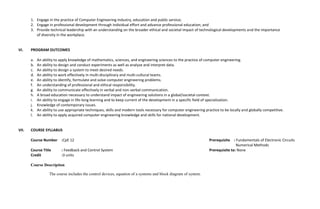
1. Engage in the practice of Computer Engineering industry, education and public service;
2. Engage in professional development through individual effort and advance professional education; and
3. Provide technical leadership with an understanding on the broader ethical and societal impact of technological developments and the importance
of diversity in the workplace.
VI. PROGRAM OUTCOMES
a. An ability to apply knowledge of mathematics, sciences, and engineering sciences to the practice of computer engineering.
b. An ability to design and conduct experiments as well as analyze and interpret data.
c. An ability to design a system to meet desired needs.
d. An ability to work effectively in multi-disciplinary and multi-cultural teams.
e. An ability to identify, formulate and solve computer engineering problems.
f. An understanding of professional and ethical responsibility.
g. An ability to communicate effectively in verbal and non-verbal communication.
h. A broad education necessary to understand impact of engineering solutions in a global/societal context.
i. An ability to engage in life-long learning and to keep current of the development in a specific field of specialization.
j. Knowledge of contemporary issues.
k. An ability to use appropriate techniques, skills and modern tools necessary for computer engineering practice to be locally and globally competitive.
l. An ability to apply acquired computer engineering knowledge and skills for national development.
VII. COURSE SYLLABUS
Course Number :CpE 12 Prerequisite : Fundamentals of Electronic Circuits
Numerical Methods
Course Title : Feedback and Control System Prerequisite to: None
Credit :3 units
Course Description
The course includes the control devices, equation of a systems and block diagram of system.
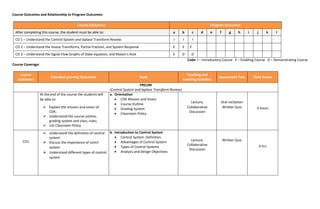
Course Outcomes and Relationship to Program Outcomes:
Course Outcomes Program Outcomes
After completing this course, the student must be able to: a b c d e f g h i j k l
CO 1 – Understand the Control System and laplace Transform Review. I I I
CO 2 – Understand the Invese Transforms, Partial Fraction, and System Response E E E
CO 3 – Understand the Signal Flow Graphs of State equation, and Mason’s Rule E D D
Code: I – Introductory Course E – Enabling Course D – Demonstrating Course
Course Coverage:
Course
Outcomes
Intended Learning Outcomes Topic
Teaching and
Learning Activities
Assessment Task Time Frame
PRELIM
(Control System and laplace Transform Review)
At the end of the course the students will
be able to:
 Explain the mission and vision of
CDK;
 Understand the course outline,
grading system and class; rules;
 List Classroom Policy
a. Orientation
 CDK Mission and Vision
 Course Outline
 Grading System
 Classroom Policy
Lecture,
Collaborative
Discussion
Oral recitation
Written Quiz 3 hours
CO1
 Understand the definition of control
system
 Discuss the importance of contrl
system
 Understand different types of control
system
b. Introduction to Control System
 Control System: Definition
 Advantages of Control System
 Types of Control Systems
 Analysis and Design Objectives
Lecture,
Collaborative
Discussion
Written Quiz
6 hrs
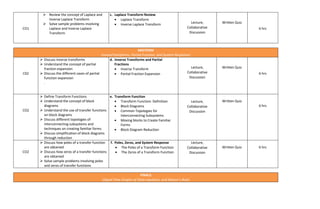
CO1
 Review the concept of Laplace and
Inverse Laplace Transform
 Solve sample problems involving
Laplace and Inverse Laplace
Transform
c. Laplace Transform Review
 Laplace Transform
 Inverse Laplace Transform Lecture,
Collaborative
Discussion
Written Quiz
6 hrs
MIDTERM
(InveseTransforms, Partial Fraction, and System Response)
C02
 Discuss inverse transforms
 Understand the concept of partial
fraction expansion
 Discuss the different cases of partial
function expansion
.
d. Inverse Transforms and Partial
Fractions
 Inverse Transform
 Partial Fraction Expansion
Lecture,
Collaborative
Discussion
Written Quiz
6 hrs
CO2
 Define Transform Functions
 Understand the concept of block
diagrams
 Understand the use of transfer functions
on block diagrams
 Discuss different topologies of
interconnecting subsystems and
techniques on creating familiar forms
 Discuss simplification of block diagrams
through reduction
e. Transform Function
 Transform Function: Definition
 Block Diagrams
 Common Topologies for
Interconnecting Subsystems
 Moving blocks to Create Familiar
Forms
 Block Diagram Reduction
Lecture,
Collaborative
Discussion
Written Quiz
6 hrs
CO2
 Discuss how poles of a transfer function
are obtained
 Discuss how zeros of a transfer functions
are obtained
 Solve sample problems involving poles
and zeros of transfer functions
f. Poles, Zeros, and System Response
 The Poles of a Transform Function
 The Zeros of a Transform Function
Lecture,
Collaborative
Discussion
Written Quiz 6 hrs
FINALS
(Signal Flow Graphs of State equation, and Mason’s Rule)
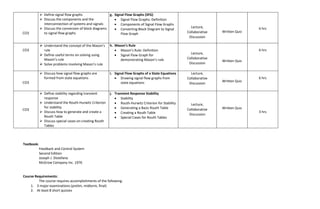
CO3
 Define signal flow graphs
 Discuss the components and the
interconnection of systems and signals
 Discuss the conversion of block diagrams
to signal flow graphs
g. Signal Flow Graphs (SFG)
 Signal Flow Graphs: Definition
 Components of Signal Flow Graphs
 Converting Block Diagram to Signal
Flow Graph
Lecture,
Collaborative
Discussion
Written Quiz
6 hrs
CO3
 Understand the concept of the Mason’s
rule
 Define useful terms on solving using
Mason’s rule
 Solve problems involving Mason’s rule
h. Mason’s Rule
 Mason’s Rule: Definition
 Signal Flow Graph for
demonstrating Mason’s rule
Lecture,
Collaborative
Discussion
Written Quiz
6 hrs
CO3
 Discuss how signal flow graphs are
formed from state equations
i. Signal Flow Graphs of a State Equations
 Drawing signal flow graphs from
state equations
Lecture,
Collaborative
Discussion
Written Quiz
6 hrs
CO3
 Define stability regarding transient
response
 Understand the Routh-Hurwitz Criterion
for stability
 Discuss how to generate and create a
Routh Table
 Discuss special cases on creating Routh
Tables
j. Transient Response Stability
 Stability
 Routh-Hurwitz Criterion for Stability
 Generating a Basic Routh Table
 Creating a Routh Table
 Special Cases for Routh Tables
Lecture,
Collaborative
Discussion
Written Quiz
3 hrs
Textbook:
Feedback and Control System
Second Edition
Joseph J. Distefano
McGrow Company Inc. 1976
Course Requirements:
The course requires accomplishments of the following:
1. 3 major examinations (prelim, midterm, final)
2. At least 8 short quizzes
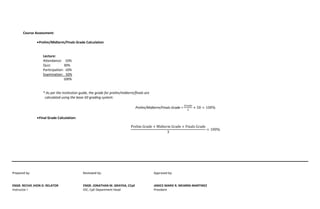
Course Assessment:
Prelim/Midterm/Finals Grade Calculation
Lecture:
Attendance: 10%
Quiz: 30%
Participation: 10%
Examination: 50%
100%
* As per the institution guide, the grade for prelim/midterm/finals are
calculated using the base-50 grading system:
Prelim/Midterm/Finals Grade =
𝐺𝑟𝑎𝑑𝑒
2
+ 50 = 100%
Final Grade Calculation:
Prelim Grade + Midterm Grade + Finals Grade
3
= 100%
Prepared by:
ENGR. RECHIE JHON D. RELATOR
Instructor I
Reviewed by:
ENGR. JONATHAN M. GRAYDA, CCpE
OIC, CpE Department Head
Approved by:
JANICE MARIE R. MEARNS-MARTINEZ
President
(Final) Feedback and Control System.docx

(Final) Feedback and Control System.docx

  • 1.
    Republic of thePhilippines COLEGIO de KIDAPAWAN Quezon Boulevard, Kidapawan City First Semester, S.Y. 2022-2023 Based on CMO No. 13, Series of 2008 Where quality and relevant education is within everyone’s reach… ENGINEERING DEPARTMENT I. VISION Colegio de Kidapawan envisions in improving the Quality of Life through Quality Education. II. MISSION Colegio de Kidapawan aims to produce outstanding professionals in a culturally diverse and changing global society. III. CORE VALUES 1. Excellence – The ability to achieve superior/outstanding performance. 2. Integrity – The willingness to act consistently in accordance with social standards and moral values of society. 3. Service – An act of helpful activity to answer the needs and promote the welfare of others. 4. Commitment – An act of voluntarily taking on and fulfilling obligations. 5. Accountability – Willingness to accept responsibility. IV. DEPARTMENT OBJECTIVES 1. Provide enhanced programs on safety, health, environment concerns and public welfare through adherence to required codes and laws; 2. Undertake individual group projects to exhibit ability in solving complex engineering problems; 3. Produce morally upright professionals exhibiting involvement in community services; 4. Conduct researches which improve/enhance engineering practices; 5. Initiate and implement actions toward the improvement of engineering practices in the local, regional, national and global communities. V. PROGRAM EDUCATIONAL OBJECTIVES Graduates of the Computer Engineering program of Colegio de Kidapawan are expected to attain the following objectives 3-5 years after graduation:
  • 2.
    1. Engage inthe practice of Computer Engineering industry, education and public service; 2. Engage in professional development through individual effort and advance professional education; and 3. Provide technical leadership with an understanding on the broader ethical and societal impact of technological developments and the importance of diversity in the workplace. VI. PROGRAM OUTCOMES a. An ability to apply knowledge of mathematics, sciences, and engineering sciences to the practice of computer engineering. b. An ability to design and conduct experiments as well as analyze and interpret data. c. An ability to design a system to meet desired needs. d. An ability to work effectively in multi-disciplinary and multi-cultural teams. e. An ability to identify, formulate and solve computer engineering problems. f. An understanding of professional and ethical responsibility. g. An ability to communicate effectively in verbal and non-verbal communication. h. A broad education necessary to understand impact of engineering solutions in a global/societal context. i. An ability to engage in life-long learning and to keep current of the development in a specific field of specialization. j. Knowledge of contemporary issues. k. An ability to use appropriate techniques, skills and modern tools necessary for computer engineering practice to be locally and globally competitive. l. An ability to apply acquired computer engineering knowledge and skills for national development. VII. COURSE SYLLABUS Course Number :CpE 12 Prerequisite : Fundamentals of Electronic Circuits Numerical Methods Course Title : Feedback and Control System Prerequisite to: None Credit :3 units Course Description The course includes the control devices, equation of a systems and block diagram of system.
  • 3.
    Course Outcomes andRelationship to Program Outcomes: Course Outcomes Program Outcomes After completing this course, the student must be able to: a b c d e f g h i j k l CO 1 – Understand the Control System and laplace Transform Review. I I I CO 2 – Understand the Invese Transforms, Partial Fraction, and System Response E E E CO 3 – Understand the Signal Flow Graphs of State equation, and Mason’s Rule E D D Code: I – Introductory Course E – Enabling Course D – Demonstrating Course Course Coverage: Course Outcomes Intended Learning Outcomes Topic Teaching and Learning Activities Assessment Task Time Frame PRELIM (Control System and laplace Transform Review) At the end of the course the students will be able to:  Explain the mission and vision of CDK;  Understand the course outline, grading system and class; rules;  List Classroom Policy a. Orientation  CDK Mission and Vision  Course Outline  Grading System  Classroom Policy Lecture, Collaborative Discussion Oral recitation Written Quiz 3 hours CO1  Understand the definition of control system  Discuss the importance of contrl system  Understand different types of control system b. Introduction to Control System  Control System: Definition  Advantages of Control System  Types of Control Systems  Analysis and Design Objectives Lecture, Collaborative Discussion Written Quiz 6 hrs
  • 4.
    CO1  Review theconcept of Laplace and Inverse Laplace Transform  Solve sample problems involving Laplace and Inverse Laplace Transform c. Laplace Transform Review  Laplace Transform  Inverse Laplace Transform Lecture, Collaborative Discussion Written Quiz 6 hrs MIDTERM (InveseTransforms, Partial Fraction, and System Response) C02  Discuss inverse transforms  Understand the concept of partial fraction expansion  Discuss the different cases of partial function expansion . d. Inverse Transforms and Partial Fractions  Inverse Transform  Partial Fraction Expansion Lecture, Collaborative Discussion Written Quiz 6 hrs CO2  Define Transform Functions  Understand the concept of block diagrams  Understand the use of transfer functions on block diagrams  Discuss different topologies of interconnecting subsystems and techniques on creating familiar forms  Discuss simplification of block diagrams through reduction e. Transform Function  Transform Function: Definition  Block Diagrams  Common Topologies for Interconnecting Subsystems  Moving blocks to Create Familiar Forms  Block Diagram Reduction Lecture, Collaborative Discussion Written Quiz 6 hrs CO2  Discuss how poles of a transfer function are obtained  Discuss how zeros of a transfer functions are obtained  Solve sample problems involving poles and zeros of transfer functions f. Poles, Zeros, and System Response  The Poles of a Transform Function  The Zeros of a Transform Function Lecture, Collaborative Discussion Written Quiz 6 hrs FINALS (Signal Flow Graphs of State equation, and Mason’s Rule)
  • 5.
    CO3  Define signalflow graphs  Discuss the components and the interconnection of systems and signals  Discuss the conversion of block diagrams to signal flow graphs g. Signal Flow Graphs (SFG)  Signal Flow Graphs: Definition  Components of Signal Flow Graphs  Converting Block Diagram to Signal Flow Graph Lecture, Collaborative Discussion Written Quiz 6 hrs CO3  Understand the concept of the Mason’s rule  Define useful terms on solving using Mason’s rule  Solve problems involving Mason’s rule h. Mason’s Rule  Mason’s Rule: Definition  Signal Flow Graph for demonstrating Mason’s rule Lecture, Collaborative Discussion Written Quiz 6 hrs CO3  Discuss how signal flow graphs are formed from state equations i. Signal Flow Graphs of a State Equations  Drawing signal flow graphs from state equations Lecture, Collaborative Discussion Written Quiz 6 hrs CO3  Define stability regarding transient response  Understand the Routh-Hurwitz Criterion for stability  Discuss how to generate and create a Routh Table  Discuss special cases on creating Routh Tables j. Transient Response Stability  Stability  Routh-Hurwitz Criterion for Stability  Generating a Basic Routh Table  Creating a Routh Table  Special Cases for Routh Tables Lecture, Collaborative Discussion Written Quiz 3 hrs Textbook: Feedback and Control System Second Edition Joseph J. Distefano McGrow Company Inc. 1976 Course Requirements: The course requires accomplishments of the following: 1. 3 major examinations (prelim, midterm, final) 2. At least 8 short quizzes
  • 6.
    Course Assessment: Prelim/Midterm/Finals GradeCalculation Lecture: Attendance: 10% Quiz: 30% Participation: 10% Examination: 50% 100% * As per the institution guide, the grade for prelim/midterm/finals are calculated using the base-50 grading system: Prelim/Midterm/Finals Grade = 𝐺𝑟𝑎𝑑𝑒 2 + 50 = 100% Final Grade Calculation: Prelim Grade + Midterm Grade + Finals Grade 3 = 100% Prepared by: ENGR. RECHIE JHON D. RELATOR Instructor I Reviewed by: ENGR. JONATHAN M. GRAYDA, CCpE OIC, CpE Department Head Approved by: JANICE MARIE R. MEARNS-MARTINEZ President