© 2015, SHAPE America – Society of Health and Physical Educators • www.shapeamerica.org
1900 Association Drive, Reston, VA 20191 • 703.476.3400 • Fax 703.476.9527 • info@shapeamerica.org
The Essential Components of Physical Education 1
Over the past two decades, physical education has undergone a transformation in rigor and focus and
now is recognized as essential to a young person’s overall education experience and a foundation for
lifelong healthy living.
SHAPE America has helped spearhead that transformation and, in the past year alone, redefined physical
education in its book, National Standards & Grade-Level Outcomes for K-12 Physical Education (2014),
as the pursuit of “physical literacy” (Figure 1), which parallels
the terminology used in other subjects such as health and
mathematics. The new National Standards (Figure 2) — and
their accompanying Grade-Level Outcomes — identify the
skills and knowledge necessary to support the development
of physically literate individuals: those who have the knowl-
edge, skills and confidence to enjoy a lifetime of physical
activity (SHAPE America, 2014, p. 4).
More recently, SHAPE America has re-envisioned the
essential components that provide the structure for a physi-
cal education program (p. 4). The purpose of this document
is not only to delineate those essential components, but
also to identify physical education as a key element of a
well-rounded education for all students.
National Recommendation and Framework
In 2008, the U.S. Department of Health and Human Services issued 2008 Physical Activity Guidelines for
Americans, age 6 and older, which recommend that children and adolescents should engage in
The Essential Components of Physical Education
Guidance Document
Figure 1. Physical Literacy
To pursue a lifetime of healthful physical activi-
ty, a physically literate individual:
•	 Has learned the skills necessary to partici-
pate in a variety of physical activities.
•	 Knows the implications and the benefits
of involvement in various types of physical
activities.
•	 Participates regularly in physical activity.
•	 Is physically active.
•	 Values physical activity and its contributions
to a healthful lifestyle.
—	 National Standards & Grade-Level Outcomes for
K-12 Physical Education (2014), SHAPE America.
© 2015, SHAPE America – Society of Health and Physical Educators • www.shapeamerica.org
1900 Association Drive, Reston, VA 20191 • 703.476.3400 • Fax 703.476.9527 • info@shapeamerica.org
SHAPE America2
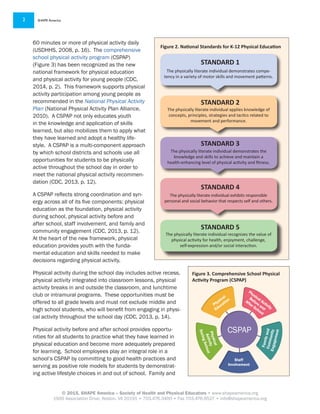
60 minutes or more of physical activity daily
(USDHHS, 2008, p. 16). The comprehensive
school physical activity program (CSPAP)
(Figure 3) has been recognized as the new
national framework for physical education
and physical activity for young people (CDC,
2014, p. 2). This framework supports physical
activity participation among young people as
recommended in the National Physical Activity
Plan (National Physical Activity Plan Alliance,
2010). A CSPAP not only educates youth
in the knowledge and application of skills
learned, but also mobilizes them to apply what
they have learned and adopt a healthy life-
style. A CSPAP is a multi-component approach
by which school districts and schools use all
opportunities for students to be physically
active throughout the school day in order to
meet the national physical activity recommen-
dation (CDC, 2013, p. 12).
A CSPAP reflects strong coordination and syn-
ergy across all of its five components: physical
education as the foundation, physical activity
during school, physical activity before and
after school, staff involvement, and family and
community engagement (CDC, 2013, p. 12).
At the heart of the new framework, physical
education provides youth with the funda-
mental education and skills needed to make
decisions regarding physical activity.
Physical activity during the school day includes active recess,
physical activity integrated into classroom lessons, physical
activity breaks in and outside the classroom, and lunchtime
club or intramural programs. These opportunities must be
offered to all grade levels and must not exclude middle and
high school students, who will benefit from engaging in physi-
cal activity throughout the school day (CDC, 2013, p. 14).
Physical activity before and after school provides opportu-
nities for all students to practice what they have learned in
physical education and become more adequately prepared
for learning. School employees play an integral role in a
school’s CSPAP by committing to good health practices and
serving as positive role models for students by demonstrat-
ing active lifestyle choices in and out of school. Family and
Figure 3. Comprehensive School Physical
Activity Program (CSPAP)
Staff
Involvement
Physical
Activity
DuringSchool
Physical
Education
Physical Activity
Before and
After School
FamilyandCommunityEngagement
CSPAP
Figure 2. National Standards for K-12 Physical Education
The physically literate individual demonstrates compe-
tency in a variety of motor skills and movement patterns.
The physically literate individual applies knowledge of
concepts, principles, strategies and tactics related to
movement and performance.
The physically literate individual exhibits responsible
personal and social behavior that respects self and others.
The physically literate individual demonstrates the
knowledge and skills to achieve and maintain a
health-enhancing level of physical activity and fitness.
The physically literate individual recognizes the value of
physical activity for health, enjoyment, challenge,
self-expression and/or social interaction.
STANDARD 1
STANDARD 2
STANDARD 4
STANDARD 3
STANDARD 5
© 2015, SHAPE America – Society of Health and Physical Educators • www.shapeamerica.org
1900 Association Drive, Reston, VA 20191 • 703.476.3400 • Fax 703.476.9527 • info@shapeamerica.org
The Essential Components of Physical Education 3
community engagement in school-based physical activity programs provides health benefits and positive
influences, and creates a connection between schools and community-based programs (CDC, 2013, p. 14).
Physical Education: The Foundation of CSPAP
Physical education is an academic subject and serves as the foundation of a CSPAP and, as such,
demands the same education rigor as other core subjects. Physical education provides students with
a planned, sequential, K-12 standards-based program of curricula and instruction designed to develop
motor skills, knowledge and behaviors for active living, physical fitness, sportsmanship, self-efficacy and
emotional intelligence.
During physical education, students practice the knowledge and skills they learn through physical activi-
ty, which is defined as any bodily movement that results in energy expenditure. Students also engage in
exercise — any physical activity that is planned, structured and repetitive — for the purpose of improving or
maintaining one or more components of fitness (CDC, 2013, p. 8). It is important to clarify the common
technical language used in physical education; the terms physical education, physical activity and exer-
cise often are used interchangeably but clearly, they define three very different things. (Figure 4)
PHYSICAL
ACTIVITY
Physical activity
is any bodily
movement that
results in energy
expenditure.
EXERCISE
Exercise is any physical
activity that is planned,
structured and repetitive for
the purpose of improving
or maintaining one or more
components of fitness.
PHYSICAL EDUCATION
Physical education is an academic subject that provides
a planned, sequential, K-12 standards-based program
of curricula and instruction designed to develop motor
skills, knowledge and behaviors for healthy, active
living, physical fitness, sportsmanship, self-efficacy
and emotional intelligence.
Figure 4. Defining Physical Activity, Exercise and Physical Education
Physical education develops the physically literate individual through deliberate practice of well-designed
learning tasks that allow for skill acquisition in an instructional climate focused on mastery (SHAPE
America, 2014, p. 10). Physical education addresses the three domains of learning: cognitive or mental
skills related to the knowledge of movement; affective, which addresses growth in feelings or attitudes;
and psychomotor, which relates to the manual or physical skills related to movement literacy (SHAPE
America, 2014, p. 4).
A well-designed physical education program:
•	 Meets the needs of all students;
•	 Keeps students active for most of physical education class time;
•	 Teaches self-management;
•	 Emphasizes knowledge and skills for a lifetime of physical activity; and
•	 Is an enjoyable experience for all students (CDC, 2013, p. 12).
© 2015, SHAPE America – Society of Health and Physical Educators • www.shapeamerica.org
1900 Association Drive, Reston, VA 20191 • 703.476.3400 • Fax 703.476.9527 • info@shapeamerica.org
SHAPE America4
The Essential Components of Physical Education 	
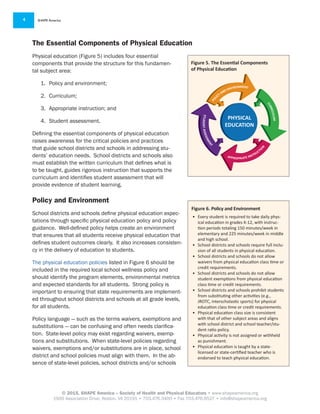
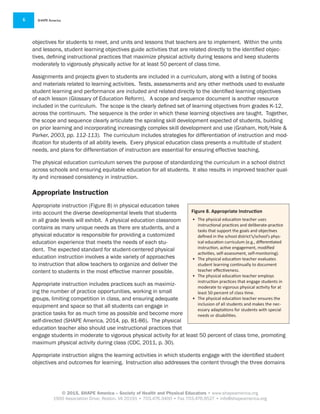
Physical education (Figure 5) includes four essential
components that provide the structure for this fundamen-
tal subject area:
1.	 Policy and environment;
2.	 Curriculum;
3.	 Appropriate instruction; and
4.	 Student assessment.
Defining the essential components of physical education
raises awareness for the critical policies and practices
that guide school districts and schools in addressing stu-
dents’ education needs. School districts and schools also
must establish the written curriculum that defines what is
to be taught, guides rigorous instruction that supports the
curriculum and identifies student assessment that will
provide evidence of student learning.
Policy and Environment
School districts and schools define physical education expec-
tations through specific physical education policy and policy
guidance. Well-defined policy helps create an environment
that ensures that all students receive physical education that
defines student outcomes clearly. It also increases consisten-
cy in the delivery of education to students.
The physical education policies listed in Figure 6 should be
included in the required local school wellness policy and
should identify the program elements, environmental metrics
and expected standards for all students. Strong policy is
important to ensuring that state requirements are implement-
ed throughout school districts and schools at all grade levels,
for all students.
Policy language — such as the terms waivers, exemptions and
substitutions — can be confusing and often needs clarifica-
tion. State-level policy may exist regarding waivers, exemp-
tions and substitutions. When state-level policies regarding
waivers, exemptions and/or substitutions are in place, school
district and school policies must align with them. In the ab-
sence of state-level policies, school districts and/or schools
Figure 6. Policy and Environment
•	 Every student is required to take daily phys-
ical education in grades K-12, with instruc-
tion periods totaling 150 minutes/week in
elementary and 225 minutes/week in middle
and high school.
•	 School districts and schools require full inclu-
sion of all students in physical education.
•	 School districts and schools do not allow
waivers from physical education class time or
credit requirements.
•	 School districts and schools do not allow
student exemptions from physical education
class time or credit requirements.
•	 School districts and schools prohibit students
from substituting other activities (e.g.,
JROTC, interscholastic sports) for physical
education class time or credit requirements.
•	 Physical education class size is consistent
with that of other subject areas and aligns
with school district and school teacher/stu-
dent ratio policy.
•	 Physical activity is not assigned or withheld
as punishment.
•	 Physical education is taught by a state-
licensed or state-certified teacher who is
endorsed to teach physical education.
Figure 5. The Essential Components
of Physical Education
POL
ICY AND ENVIRONMENT
CURRICULUM
APPROPRIATE INSTRUCTI
ON
STUDENTASSESSMENT
PHYSICAL
EDUCATION
© 2015, SHAPE America – Society of Health and Physical Educators • www.shapeamerica.org
1900 Association Drive, Reston, VA 20191 • 703.476.3400 • Fax 703.476.9527 • info@shapeamerica.org
The Essential Components of Physical Education 5
are responsible for establishing policies for waivers, exemptions and substitutions. Examples of these
three policy areas follow.
•	 Waivers. In many states, school districts or schools may apply for a waiver from state-mandated
physical education policy, requirement or law. When a waiver is granted, the school district or
school no longer is required to provide students with state-mandated physical education class time
or credit. State, school district and school policy should not allow waivers for physical education
class time or credit requirements.
•	 Exemptions. School districts and schools sometimes allow students to be exempted from physical
education class time or credit, even if physical education credit is required for graduation. Instead
of completing physical education courses and required credits, exempted students may participate
in other academic courses or activities such as advanced placement courses, work as a teacher’s
assistant, etc. School districts and schools also sometimes allow exemptions from physical educa-
tion class time or credit due to medical illness or disability. State, school district and school policy
should not allow exemptions from physical education class time or credit requirements.
•	 Substitutions. Some school districts and schools allow students to substitute other activities (e.g.,
JROTC, interscholastic sports, community sports, cheer leading, marching band) for physical edu-
cation class time or credit. State, school district and school policy should prohibit students from
substituting other activities for required physical education class time or credit.
All three — waivers, exemptions and substitutions — are policies that eliminate the opportunity for all stu-
dents to experience physical education. Close scrutiny of policy in states, school districts and schools is
critical so that all students are provided with an education experience that includes physical education.
Curriculum
National standards provide school districts and schools with
guidance and direction for clarifying the common general
outcomes expected in physical education programs. New
national Grade-Level Outcomes for K-12 Physical Education
(SHAPE America, 2013) define the skills that students should
learn at critical grade levels, but they don’t tell teachers
how to develop lessons, how to instruct students or which
learning experiences will lead students to master those skills
through spiraling skill development. The physical educa-
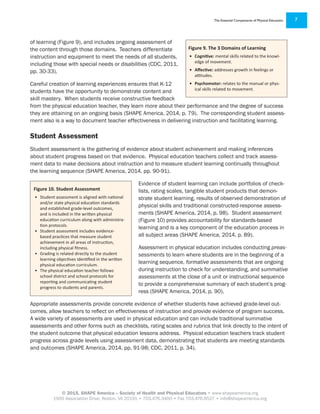
tion curriculum (Figure 7) is the written, clearly articulated
plan for how standards and education outcomes will be
attained in a school district or school. A well-designed, stan-
dards-based physical education curriculum has many parts and provides the framework for the identified
knowledge milestones aligned with the learning activities in the curriculum, and protocols for how learning
will be measured.
The written physical education curriculum identifies the content to be taught at all grade levels from kin-
dergarten through grade 12. It includes the national and/or state physical education standards, learning
Figure 7. Curriculum
•	 School districts and schools should have a writ-
ten physical education curriculum for grades
K-12 that is sequential and comprehensive.
•	 The physical education curriculum is based
on national and/or state standards and
grade-level outcomes for physical education.
•	 The physical education curriculum mirrors
other school district and school curricula
in its design and schedule for periodic
review/update.
© 2015, SHAPE America – Society of Health and Physical Educators • www.shapeamerica.org
1900 Association Drive, Reston, VA 20191 • 703.476.3400 • Fax 703.476.9527 • info@shapeamerica.org
SHAPE America6
objectives for students to meet, and units and lessons that teachers are to implement. Within the units
and lessons, student learning objectives guide activities that are related directly to the identified objec-
tives, defining instructional practices that maximize physical activity during lessons and keep students
moderately to vigorously physically active for at least 50 percent of class time.
Assignments and projects given to students are included in a curriculum, along with a listing of books
and materials related to learning activities. Tests, assessments and any other methods used to evaluate
student learning and performance are included and related directly to the identified learning objectives
of each lesson (Glossary of Education Reform). A scope and sequence document is another resource
included in the curriculum. The scope is the clearly defined set of learning objectives from grades K-12,
across the continuum. The sequence is the order in which these learning objectives are taught. Together,
the scope and sequence clearly articulate the spiraling skill development expected of students, building
on prior learning and incorporating increasingly complex skill development and use (Graham, Holt/Hale &
Parker, 2003, pp. 112-113). The curriculum includes strategies for differentiation of instruction and mod-
ification for students of all ability levels. Every physical education class presents a multitude of student
needs, and plans for differentiation of instruction are essential for ensuring effective teaching.
The physical education curriculum serves the purpose of standardizing the curriculum in a school district
across schools and ensuring equitable education for all students. It also results in improved teacher qual-
ity and increased consistency in instruction.
Appropriate Instruction
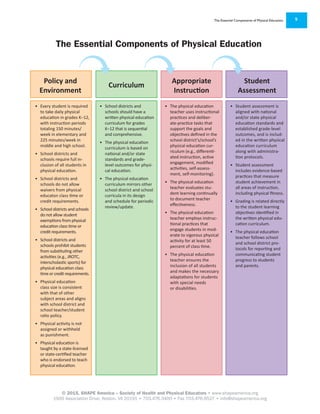
Appropriate instruction (Figure 8) in physical education takes
into account the diverse developmental levels that students
in all grade levels will exhibit. A physical education classroom
contains as many unique needs as there are students, and a
physical educator is responsible for providing a customized
education experience that meets the needs of each stu-
dent. The expected standard for student-centered physical
education instruction involves a wide variety of approaches
to instruction that allow teachers to organize and deliver the
content to students in the most effective manner possible.
Appropriate instruction includes practices such as maximiz-
ing the number of practice opportunities, working in small
groups, limiting competition in class, and ensuring adequate
equipment and space so that all students can engage in
practice tasks for as much time as possible and become more
self-directed (SHAPE America, 2014, pp. 81-86). The physical
education teacher also should use instructional practices that
engage students in moderate to vigorous physical activity for at least 50 percent of class time, promoting
maximum physical activity during class (CDC, 2011, p. 30).
Appropriate instruction aligns the learning activities in which students engage with the identified student
objectives and outcomes for learning. Instruction also addresses the content through the three domains
Figure 8. Appropriate Instruction
•	 The physical education teacher uses
instructional practices and deliberate-practice
tasks that support the goals and objectives
defined in the school district’s/school’s phys-
ical education curriculum (e.g., differentiated
instruction, active engagement, modified
activities, self-assessment, self-monitoring).
•	 The physical education teacher evaluates
student learning continually to document
teacher effectiveness.
•	 The physical education teacher employs
instruction practices that engage students in
moderate to vigorous physical activity for at
least 50 percent of class time.
•	 The physical education teacher ensures the
inclusion of all students and makes the nec-
essary adaptations for students with special
needs or disabilities.
© 2015, SHAPE America – Society of Health and Physical Educators • www.shapeamerica.org
1900 Association Drive, Reston, VA 20191 • 703.476.3400 • Fax 703.476.9527 • info@shapeamerica.org
The Essential Components of Physical Education 7
of learning (Figure 9), and includes ongoing assessment of
the content through those domains. Teachers differentiate
instruction and equipment to meet the needs of all students,
including those with special needs or disabilities (CDC, 2011,
pp. 30-33).
Careful creation of learning experiences ensures that K-12
students have the opportunity to demonstrate content and
skill mastery. When students receive constructive feedback
from the physical education teacher, they learn more about their performance and the degree of success
they are attaining on an ongoing basis (SHAPE America, 2014, p. 79). The corresponding student assess-
ment also is a way to document teacher effectiveness in delivering instruction and facilitating learning.
Student Assessment
Student assessment is the gathering of evidence about student achievement and making inferences
about student progress based on that evidence. Physical education teachers collect and track assess-
ment data to make decisions about instruction and to measure student learning continually throughout
the learning sequence (SHAPE America, 2014, pp. 90-91).
Evidence of student learning can include portfolios of check-
lists, rating scales, tangible student products that demon-
strate student learning, results of observed demonstration of
physical skills and traditional constructed-response assess-
ments (SHAPE America, 2014, p. 98). Student assessment
(Figure 10) provides accountability for standards-based
learning and is a key component of the education process in
all subject areas (SHAPE America, 2014, p. 89).
Assessment in physical education includes conducting preas-
sessments to learn where students are in the beginning of a
learning sequence, formative assessments that are ongoing
during instruction to check for understanding, and summative
assessments at the close of a unit or instructional sequence
to provide a comprehensive summary of each student’s prog-
ress (SHAPE America, 2014, p. 90).
Appropriate assessments provide concrete evidence of whether students have achieved grade-level out-
comes, allow teachers to reflect on effectiveness of instruction and provide evidence of program success.
A wide variety of assessments are used in physical education and can include traditional summative
assessments and other forms such as checklists, rating scales and rubrics that link directly to the intent of
the student outcome that physical education lessons address. Physical education teachers track student
progress across grade levels using assessment data, demonstrating that students are meeting standards
and outcomes (SHAPE America, 2014, pp. 91-98; CDC, 2011, p. 34).
Figure 9. The 3 Domains of Learning
•	 Cognitive: mental skills related to the knowl-
edge of movement.
•	 Affective: addresses growth in feelings or
attitudes.
•	 Psychomotor: relates to the manual or phys-
ical skills related to movement.
Figure 10. Student Assessment
•	 Student assessment is aligned with national
and/or state physical education standards
and established grade-level outcomes,
and is included in the written physical
education curriculum along with administra-
tion protocols.
•	 Student assessment includes evidence-
based practices that measure student
achievement in all areas of instruction,
including physical fitness.
•	 Grading is related directly to the student
learning objectives identified in the written
physical education curriculum.
•	 The physical education teacher follows
school district and school protocols for
reporting and communicating student
progress to students and parents.
© 2015, SHAPE America – Society of Health and Physical Educators • www.shapeamerica.org
1900 Association Drive, Reston, VA 20191 • 703.476.3400 • Fax 703.476.9527 • info@shapeamerica.org
SHAPE America8
Strengthening Physical Education Programs
SHAPE America is committed to supporting strong physical education programs for all students in grades
K-12, and rigorous physical education policies and practices across the United States. SHAPE America’s
detailed definition of the essential components of physical education programs provides school leaders
and other education stakeholders with a clear blueprint of the critical policies and practices that guide
school districts and schools in addressing students’ education needs.
SHAPE America urges school administrators, principals, teachers and parents to conduct an assessment
of their school’s physical education program to evaluate its strengths and weaknesses, and develop and
implement a plan for improvement where needed. SHAPE America has developed a Physical Education
Program Checklist that school leaders can use to identify the critical components that should be in place
within a physical education program. The Essential Components of Physical Education can be used side
by side with the Physical Education Program Checklist to analyze what is currently in place and plan for
improvement where needed.
References
Centers for Disease Control and Prevention. [School health guidelines to promote healthy eating and phys-
ical activity]. MMWR 2011; 60(No. RR-#): http://www.cdc.gov/mmwr/pdf/rr/rr6005.pdf; citation
on pg ii (2 of 80)
Centers for Disease Control and Prevention. (2013). Comprehensive school physical activity programs:
A guide for schools. Atlanta, GA: U.S. Department of Health and Human Services.
Centers for Disease Control and Prevention. (2014). National framework for physical activity and physical
education. Atlanta, GA: U.S. Department of Health and Human Services.
Graham, G., Holt/Hale, S.A., & Parker, M. (2003). Children moving: A reflective approach to teaching phys-
ical education, 6th Ed. New York, NY: McGraw-Hill.
National Physical Activity Plan Alliance. (2010). National physical activity plan. Retrieved from http://www.
physicalactivityplan.org./theplan.php
SHAPE America. (2014). National standards & grade-level outcomes for K-12 physical education.
Champaign, IL: Human Kinetics.
The Glossary of Education Reform, http://edglossary.org
U.S. Department of Health and Human Services. (2008). 2008 physical activity guidelines for Americans.
Washington, DC: Author.
Suggested citation
SHAPE America. (2015). The essential components of physical education. Reston, VA: Author.
© 2015, SHAPE America – Society of Health and Physical Educators • www.shapeamerica.org
1900 Association Drive, Reston, VA 20191 • 703.476.3400 • Fax 703.476.9527 • info@shapeamerica.org
The Essential Components of Physical Education 9
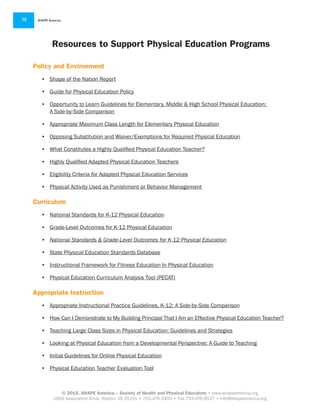
The Essential Components of Physical Education
•	 Every student is required
to take daily physical
education in grades K–12,
with instruction periods
totaling 150 minutes/
week in elementary and
225 minutes/week in
middle and high school.
•	 School districts and
schools require full in-
clusion of all students in
physical education.
•	 School districts and
schools do not allow
waivers from physical
educaton class time or
credit requirements.
•	 School districts and schools
do not allow student
exemptions from physical
education class time or
credit requirements.
•	 School districts and
schools prohibit students
from substituting other
activities (e.g., JROTC,
interscholastic sports) for
physical education class
timeorcreditrequirements.
•	 Physical education
class size is consistent
with that of other
subject areas and aligns
with school district and
school teacher/student
ratio policy.
•	 Physical activity is not
assigned or withheld
as punishment.
•	 Physical education is
taught by a state-licensed
or state-certified teacher
who is endorsed to teach
physical education.
•	 School districts and
schools should have a
written physical education
curriculum for grades
K–12 that is sequential
and comprehensive.
•	 The physical education
curriculum is based on
national and/or state
standards and grade-
level outcomes for physi-
cal education.
•	 The physical education
curriculum mirrors other
school district and school
curricula in its design
and schedule for periodic
review/update.
•	 The physical education
teacher uses instructional
practices and deliber-
ate-practice tasks that
support the goals and
objectives defined in the
school district’s/school’s
physical education cur-
riculum (e.g., differenti-
ated instruction, active
engagement, modified
activities, self-assess-
ment, self-monitoring).
•	 The physical education
teacher evaluates stu-
dent learning continually
to document teacher
effectiveness.
•	 The physical education
teacher employs instruc-
tional practices that
engage students in mod-
erate to vigorous physical
activity for at least 50
percent of class time.
•	 The physical education
teacher ensures the
inclusion of all students
and makes the necessary
adaptations for students
with special needs
or disabilities.
•	 Student assessment is
aligned with national
and/or state physical
education standards and
established grade-level
outcomes, and is includ-
ed in the written physical
education curriculum
along with administra-
tion protocols.
•	 Student assessment
includes evidence-based
practices that measure
student achievement in
all areas of instruction,
including physical fitness.
•	 Grading is related directly
to the student learning
objectives identified in
the written physical edu-
cation curriculum.
•	 The physical education
teacher follows school
and school district pro-
tocols for reporting and
communicating student
progress to students
and parents.
Policy and
Environment
Curriculum
Appropriate
Instruction
Student
Assessment
© 2015, SHAPE America – Society of Health and Physical Educators • www.shapeamerica.org
1900 Association Drive, Reston, VA 20191 • 703.476.3400 • Fax 703.476.9527 • info@shapeamerica.org
SHAPE America10
Resources to Support Physical Education Programs
Policy and Environment
•	 Shape of the Nation Report
•	 Guide for Physical Education Policy
•	 Opportunity to Learn Guidelines for Elementary, Middle & High School Physical Education:
A Side-by-Side Comparison
•	 Appropriate Maximum Class Length for Elementary Physical Education
•	 Opposing Substitution and Waiver/Exemptions for Required Physical Education
•	 What Constitutes a Highly Qualified Physical Education Teacher?
•	 Highly Qualified Adapted Physical Education Teachers
•	 Eligibility Criteria for Adapted Physical Education Services
•	 Physical Activity Used as Punishment or Behavior Management
Curriculum
•	 National Standards for K-12 Physical Education
•	 Grade-Level Outcomes for K-12 Physical Education
•	 National Standards & Grade-Level Outcomes for K-12 Physical Education
•	 State Physical Education Standards Database
•	 Instructional Framework for Fitness Education In Physical Education
•	 Physical Education Curriculum Analysis Tool (PECAT)
Appropriate Instruction
•	 Appropriate Instructional Practice Guidelines, K-12: A Side-by-Side Comparison
•	 How Can I Demonstrate to My Building Principal That I Am an Effective Physical Education Teacher?
•	 Teaching Large Class Sizes in Physical Education: Guidelines and Strategies
•	 Looking at Physical Education from a Developmental Perspective: A Guide to Teaching
•	 Initial Guidelines for Online Physical Education
•	 Physical Education Teacher Evaluation Tool
© 2015, SHAPE America – Society of Health and Physical Educators • www.shapeamerica.org
1900 Association Drive, Reston, VA 20191 • 703.476.3400 • Fax 703.476.9527 • info@shapeamerica.org
The Essential Components of Physical Education 11
•	 Appropriate Use of Instructional Technology in Physical Education
•	 Moderate to Vigorous Physical Activity in Physical Education to Improve Health and Academic Outcomes
•	 System for Observing Fitness and Instruction Time (SOFIT)
•	 Physical Activity Used as Punishment or Behavior Management
Student Assessment
•	 Body Mass Index Measurement in Schools: Executive Summary
•	 PE Metrics
•	 Appropriate Instructional Practice Guidelines, K-12: A Side-by-Side Comparison
•	 Appropriate Uses of Fitness Measurement
•	 System for Observing Fitness and Instruction Time (SOFIT)
•	 Presidential Youth Fitness Program

Final Essential Components of PE 3.12.15

  • 1.
    © 2015, SHAPEAmerica – Society of Health and Physical Educators • www.shapeamerica.org 1900 Association Drive, Reston, VA 20191 • 703.476.3400 • Fax 703.476.9527 • info@shapeamerica.org The Essential Components of Physical Education 1 Over the past two decades, physical education has undergone a transformation in rigor and focus and now is recognized as essential to a young person’s overall education experience and a foundation for lifelong healthy living. SHAPE America has helped spearhead that transformation and, in the past year alone, redefined physical education in its book, National Standards & Grade-Level Outcomes for K-12 Physical Education (2014), as the pursuit of “physical literacy” (Figure 1), which parallels the terminology used in other subjects such as health and mathematics. The new National Standards (Figure 2) — and their accompanying Grade-Level Outcomes — identify the skills and knowledge necessary to support the development of physically literate individuals: those who have the knowl- edge, skills and confidence to enjoy a lifetime of physical activity (SHAPE America, 2014, p. 4). More recently, SHAPE America has re-envisioned the essential components that provide the structure for a physi- cal education program (p. 4). The purpose of this document is not only to delineate those essential components, but also to identify physical education as a key element of a well-rounded education for all students. National Recommendation and Framework In 2008, the U.S. Department of Health and Human Services issued 2008 Physical Activity Guidelines for Americans, age 6 and older, which recommend that children and adolescents should engage in The Essential Components of Physical Education Guidance Document Figure 1. Physical Literacy To pursue a lifetime of healthful physical activi- ty, a physically literate individual: • Has learned the skills necessary to partici- pate in a variety of physical activities. • Knows the implications and the benefits of involvement in various types of physical activities. • Participates regularly in physical activity. • Is physically active. • Values physical activity and its contributions to a healthful lifestyle. — National Standards & Grade-Level Outcomes for K-12 Physical Education (2014), SHAPE America.
  • 2.
    © 2015, SHAPEAmerica – Society of Health and Physical Educators • www.shapeamerica.org 1900 Association Drive, Reston, VA 20191 • 703.476.3400 • Fax 703.476.9527 • info@shapeamerica.org SHAPE America2 60 minutes or more of physical activity daily (USDHHS, 2008, p. 16). The comprehensive school physical activity program (CSPAP) (Figure 3) has been recognized as the new national framework for physical education and physical activity for young people (CDC, 2014, p. 2). This framework supports physical activity participation among young people as recommended in the National Physical Activity Plan (National Physical Activity Plan Alliance, 2010). A CSPAP not only educates youth in the knowledge and application of skills learned, but also mobilizes them to apply what they have learned and adopt a healthy life- style. A CSPAP is a multi-component approach by which school districts and schools use all opportunities for students to be physically active throughout the school day in order to meet the national physical activity recommen- dation (CDC, 2013, p. 12). A CSPAP reflects strong coordination and syn- ergy across all of its five components: physical education as the foundation, physical activity during school, physical activity before and after school, staff involvement, and family and community engagement (CDC, 2013, p. 12). At the heart of the new framework, physical education provides youth with the funda- mental education and skills needed to make decisions regarding physical activity. Physical activity during the school day includes active recess, physical activity integrated into classroom lessons, physical activity breaks in and outside the classroom, and lunchtime club or intramural programs. These opportunities must be offered to all grade levels and must not exclude middle and high school students, who will benefit from engaging in physi- cal activity throughout the school day (CDC, 2013, p. 14). Physical activity before and after school provides opportu- nities for all students to practice what they have learned in physical education and become more adequately prepared for learning. School employees play an integral role in a school’s CSPAP by committing to good health practices and serving as positive role models for students by demonstrat- ing active lifestyle choices in and out of school. Family and Figure 3. Comprehensive School Physical Activity Program (CSPAP) Staff Involvement Physical Activity DuringSchool Physical Education Physical Activity Before and After School FamilyandCommunityEngagement CSPAP Figure 2. National Standards for K-12 Physical Education The physically literate individual demonstrates compe- tency in a variety of motor skills and movement patterns. The physically literate individual applies knowledge of concepts, principles, strategies and tactics related to movement and performance. The physically literate individual exhibits responsible personal and social behavior that respects self and others. The physically literate individual demonstrates the knowledge and skills to achieve and maintain a health-enhancing level of physical activity and fitness. The physically literate individual recognizes the value of physical activity for health, enjoyment, challenge, self-expression and/or social interaction. STANDARD 1 STANDARD 2 STANDARD 4 STANDARD 3 STANDARD 5
  • 3.
    © 2015, SHAPEAmerica – Society of Health and Physical Educators • www.shapeamerica.org 1900 Association Drive, Reston, VA 20191 • 703.476.3400 • Fax 703.476.9527 • info@shapeamerica.org The Essential Components of Physical Education 3 community engagement in school-based physical activity programs provides health benefits and positive influences, and creates a connection between schools and community-based programs (CDC, 2013, p. 14). Physical Education: The Foundation of CSPAP Physical education is an academic subject and serves as the foundation of a CSPAP and, as such, demands the same education rigor as other core subjects. Physical education provides students with a planned, sequential, K-12 standards-based program of curricula and instruction designed to develop motor skills, knowledge and behaviors for active living, physical fitness, sportsmanship, self-efficacy and emotional intelligence. During physical education, students practice the knowledge and skills they learn through physical activi- ty, which is defined as any bodily movement that results in energy expenditure. Students also engage in exercise — any physical activity that is planned, structured and repetitive — for the purpose of improving or maintaining one or more components of fitness (CDC, 2013, p. 8). It is important to clarify the common technical language used in physical education; the terms physical education, physical activity and exer- cise often are used interchangeably but clearly, they define three very different things. (Figure 4) PHYSICAL ACTIVITY Physical activity is any bodily movement that results in energy expenditure. EXERCISE Exercise is any physical activity that is planned, structured and repetitive for the purpose of improving or maintaining one or more components of fitness. PHYSICAL EDUCATION Physical education is an academic subject that provides a planned, sequential, K-12 standards-based program of curricula and instruction designed to develop motor skills, knowledge and behaviors for healthy, active living, physical fitness, sportsmanship, self-efficacy and emotional intelligence. Figure 4. Defining Physical Activity, Exercise and Physical Education Physical education develops the physically literate individual through deliberate practice of well-designed learning tasks that allow for skill acquisition in an instructional climate focused on mastery (SHAPE America, 2014, p. 10). Physical education addresses the three domains of learning: cognitive or mental skills related to the knowledge of movement; affective, which addresses growth in feelings or attitudes; and psychomotor, which relates to the manual or physical skills related to movement literacy (SHAPE America, 2014, p. 4). A well-designed physical education program: • Meets the needs of all students; • Keeps students active for most of physical education class time; • Teaches self-management; • Emphasizes knowledge and skills for a lifetime of physical activity; and • Is an enjoyable experience for all students (CDC, 2013, p. 12).
  • 4.
    © 2015, SHAPEAmerica – Society of Health and Physical Educators • www.shapeamerica.org 1900 Association Drive, Reston, VA 20191 • 703.476.3400 • Fax 703.476.9527 • info@shapeamerica.org SHAPE America4 The Essential Components of Physical Education Physical education (Figure 5) includes four essential components that provide the structure for this fundamen- tal subject area: 1. Policy and environment; 2. Curriculum; 3. Appropriate instruction; and 4. Student assessment. Defining the essential components of physical education raises awareness for the critical policies and practices that guide school districts and schools in addressing stu- dents’ education needs. School districts and schools also must establish the written curriculum that defines what is to be taught, guides rigorous instruction that supports the curriculum and identifies student assessment that will provide evidence of student learning. Policy and Environment School districts and schools define physical education expec- tations through specific physical education policy and policy guidance. Well-defined policy helps create an environment that ensures that all students receive physical education that defines student outcomes clearly. It also increases consisten- cy in the delivery of education to students. The physical education policies listed in Figure 6 should be included in the required local school wellness policy and should identify the program elements, environmental metrics and expected standards for all students. Strong policy is important to ensuring that state requirements are implement- ed throughout school districts and schools at all grade levels, for all students. Policy language — such as the terms waivers, exemptions and substitutions — can be confusing and often needs clarifica- tion. State-level policy may exist regarding waivers, exemp- tions and substitutions. When state-level policies regarding waivers, exemptions and/or substitutions are in place, school district and school policies must align with them. In the ab- sence of state-level policies, school districts and/or schools Figure 6. Policy and Environment • Every student is required to take daily phys- ical education in grades K-12, with instruc- tion periods totaling 150 minutes/week in elementary and 225 minutes/week in middle and high school. • School districts and schools require full inclu- sion of all students in physical education. • School districts and schools do not allow waivers from physical education class time or credit requirements. • School districts and schools do not allow student exemptions from physical education class time or credit requirements. • School districts and schools prohibit students from substituting other activities (e.g., JROTC, interscholastic sports) for physical education class time or credit requirements. • Physical education class size is consistent with that of other subject areas and aligns with school district and school teacher/stu- dent ratio policy. • Physical activity is not assigned or withheld as punishment. • Physical education is taught by a state- licensed or state-certified teacher who is endorsed to teach physical education. Figure 5. The Essential Components of Physical Education POL ICY AND ENVIRONMENT CURRICULUM APPROPRIATE INSTRUCTI ON STUDENTASSESSMENT PHYSICAL EDUCATION
  • 5.
    © 2015, SHAPEAmerica – Society of Health and Physical Educators • www.shapeamerica.org 1900 Association Drive, Reston, VA 20191 • 703.476.3400 • Fax 703.476.9527 • info@shapeamerica.org The Essential Components of Physical Education 5 are responsible for establishing policies for waivers, exemptions and substitutions. Examples of these three policy areas follow. • Waivers. In many states, school districts or schools may apply for a waiver from state-mandated physical education policy, requirement or law. When a waiver is granted, the school district or school no longer is required to provide students with state-mandated physical education class time or credit. State, school district and school policy should not allow waivers for physical education class time or credit requirements. • Exemptions. School districts and schools sometimes allow students to be exempted from physical education class time or credit, even if physical education credit is required for graduation. Instead of completing physical education courses and required credits, exempted students may participate in other academic courses or activities such as advanced placement courses, work as a teacher’s assistant, etc. School districts and schools also sometimes allow exemptions from physical educa- tion class time or credit due to medical illness or disability. State, school district and school policy should not allow exemptions from physical education class time or credit requirements. • Substitutions. Some school districts and schools allow students to substitute other activities (e.g., JROTC, interscholastic sports, community sports, cheer leading, marching band) for physical edu- cation class time or credit. State, school district and school policy should prohibit students from substituting other activities for required physical education class time or credit. All three — waivers, exemptions and substitutions — are policies that eliminate the opportunity for all stu- dents to experience physical education. Close scrutiny of policy in states, school districts and schools is critical so that all students are provided with an education experience that includes physical education. Curriculum National standards provide school districts and schools with guidance and direction for clarifying the common general outcomes expected in physical education programs. New national Grade-Level Outcomes for K-12 Physical Education (SHAPE America, 2013) define the skills that students should learn at critical grade levels, but they don’t tell teachers how to develop lessons, how to instruct students or which learning experiences will lead students to master those skills through spiraling skill development. The physical educa- tion curriculum (Figure 7) is the written, clearly articulated plan for how standards and education outcomes will be attained in a school district or school. A well-designed, stan- dards-based physical education curriculum has many parts and provides the framework for the identified knowledge milestones aligned with the learning activities in the curriculum, and protocols for how learning will be measured. The written physical education curriculum identifies the content to be taught at all grade levels from kin- dergarten through grade 12. It includes the national and/or state physical education standards, learning Figure 7. Curriculum • School districts and schools should have a writ- ten physical education curriculum for grades K-12 that is sequential and comprehensive. • The physical education curriculum is based on national and/or state standards and grade-level outcomes for physical education. • The physical education curriculum mirrors other school district and school curricula in its design and schedule for periodic review/update.
  • 6.
    © 2015, SHAPEAmerica – Society of Health and Physical Educators • www.shapeamerica.org 1900 Association Drive, Reston, VA 20191 • 703.476.3400 • Fax 703.476.9527 • info@shapeamerica.org SHAPE America6 objectives for students to meet, and units and lessons that teachers are to implement. Within the units and lessons, student learning objectives guide activities that are related directly to the identified objec- tives, defining instructional practices that maximize physical activity during lessons and keep students moderately to vigorously physically active for at least 50 percent of class time. Assignments and projects given to students are included in a curriculum, along with a listing of books and materials related to learning activities. Tests, assessments and any other methods used to evaluate student learning and performance are included and related directly to the identified learning objectives of each lesson (Glossary of Education Reform). A scope and sequence document is another resource included in the curriculum. The scope is the clearly defined set of learning objectives from grades K-12, across the continuum. The sequence is the order in which these learning objectives are taught. Together, the scope and sequence clearly articulate the spiraling skill development expected of students, building on prior learning and incorporating increasingly complex skill development and use (Graham, Holt/Hale & Parker, 2003, pp. 112-113). The curriculum includes strategies for differentiation of instruction and mod- ification for students of all ability levels. Every physical education class presents a multitude of student needs, and plans for differentiation of instruction are essential for ensuring effective teaching. The physical education curriculum serves the purpose of standardizing the curriculum in a school district across schools and ensuring equitable education for all students. It also results in improved teacher qual- ity and increased consistency in instruction. Appropriate Instruction Appropriate instruction (Figure 8) in physical education takes into account the diverse developmental levels that students in all grade levels will exhibit. A physical education classroom contains as many unique needs as there are students, and a physical educator is responsible for providing a customized education experience that meets the needs of each stu- dent. The expected standard for student-centered physical education instruction involves a wide variety of approaches to instruction that allow teachers to organize and deliver the content to students in the most effective manner possible. Appropriate instruction includes practices such as maximiz- ing the number of practice opportunities, working in small groups, limiting competition in class, and ensuring adequate equipment and space so that all students can engage in practice tasks for as much time as possible and become more self-directed (SHAPE America, 2014, pp. 81-86). The physical education teacher also should use instructional practices that engage students in moderate to vigorous physical activity for at least 50 percent of class time, promoting maximum physical activity during class (CDC, 2011, p. 30). Appropriate instruction aligns the learning activities in which students engage with the identified student objectives and outcomes for learning. Instruction also addresses the content through the three domains Figure 8. Appropriate Instruction • The physical education teacher uses instructional practices and deliberate-practice tasks that support the goals and objectives defined in the school district’s/school’s phys- ical education curriculum (e.g., differentiated instruction, active engagement, modified activities, self-assessment, self-monitoring). • The physical education teacher evaluates student learning continually to document teacher effectiveness. • The physical education teacher employs instruction practices that engage students in moderate to vigorous physical activity for at least 50 percent of class time. • The physical education teacher ensures the inclusion of all students and makes the nec- essary adaptations for students with special needs or disabilities.
  • 7.
    © 2015, SHAPEAmerica – Society of Health and Physical Educators • www.shapeamerica.org 1900 Association Drive, Reston, VA 20191 • 703.476.3400 • Fax 703.476.9527 • info@shapeamerica.org The Essential Components of Physical Education 7 of learning (Figure 9), and includes ongoing assessment of the content through those domains. Teachers differentiate instruction and equipment to meet the needs of all students, including those with special needs or disabilities (CDC, 2011, pp. 30-33). Careful creation of learning experiences ensures that K-12 students have the opportunity to demonstrate content and skill mastery. When students receive constructive feedback from the physical education teacher, they learn more about their performance and the degree of success they are attaining on an ongoing basis (SHAPE America, 2014, p. 79). The corresponding student assess- ment also is a way to document teacher effectiveness in delivering instruction and facilitating learning. Student Assessment Student assessment is the gathering of evidence about student achievement and making inferences about student progress based on that evidence. Physical education teachers collect and track assess- ment data to make decisions about instruction and to measure student learning continually throughout the learning sequence (SHAPE America, 2014, pp. 90-91). Evidence of student learning can include portfolios of check- lists, rating scales, tangible student products that demon- strate student learning, results of observed demonstration of physical skills and traditional constructed-response assess- ments (SHAPE America, 2014, p. 98). Student assessment (Figure 10) provides accountability for standards-based learning and is a key component of the education process in all subject areas (SHAPE America, 2014, p. 89). Assessment in physical education includes conducting preas- sessments to learn where students are in the beginning of a learning sequence, formative assessments that are ongoing during instruction to check for understanding, and summative assessments at the close of a unit or instructional sequence to provide a comprehensive summary of each student’s prog- ress (SHAPE America, 2014, p. 90). Appropriate assessments provide concrete evidence of whether students have achieved grade-level out- comes, allow teachers to reflect on effectiveness of instruction and provide evidence of program success. A wide variety of assessments are used in physical education and can include traditional summative assessments and other forms such as checklists, rating scales and rubrics that link directly to the intent of the student outcome that physical education lessons address. Physical education teachers track student progress across grade levels using assessment data, demonstrating that students are meeting standards and outcomes (SHAPE America, 2014, pp. 91-98; CDC, 2011, p. 34). Figure 9. The 3 Domains of Learning • Cognitive: mental skills related to the knowl- edge of movement. • Affective: addresses growth in feelings or attitudes. • Psychomotor: relates to the manual or phys- ical skills related to movement. Figure 10. Student Assessment • Student assessment is aligned with national and/or state physical education standards and established grade-level outcomes, and is included in the written physical education curriculum along with administra- tion protocols. • Student assessment includes evidence- based practices that measure student achievement in all areas of instruction, including physical fitness. • Grading is related directly to the student learning objectives identified in the written physical education curriculum. • The physical education teacher follows school district and school protocols for reporting and communicating student progress to students and parents.
  • 8.
    © 2015, SHAPEAmerica – Society of Health and Physical Educators • www.shapeamerica.org 1900 Association Drive, Reston, VA 20191 • 703.476.3400 • Fax 703.476.9527 • info@shapeamerica.org SHAPE America8 Strengthening Physical Education Programs SHAPE America is committed to supporting strong physical education programs for all students in grades K-12, and rigorous physical education policies and practices across the United States. SHAPE America’s detailed definition of the essential components of physical education programs provides school leaders and other education stakeholders with a clear blueprint of the critical policies and practices that guide school districts and schools in addressing students’ education needs. SHAPE America urges school administrators, principals, teachers and parents to conduct an assessment of their school’s physical education program to evaluate its strengths and weaknesses, and develop and implement a plan for improvement where needed. SHAPE America has developed a Physical Education Program Checklist that school leaders can use to identify the critical components that should be in place within a physical education program. The Essential Components of Physical Education can be used side by side with the Physical Education Program Checklist to analyze what is currently in place and plan for improvement where needed. References Centers for Disease Control and Prevention. [School health guidelines to promote healthy eating and phys- ical activity]. MMWR 2011; 60(No. RR-#): http://www.cdc.gov/mmwr/pdf/rr/rr6005.pdf; citation on pg ii (2 of 80) Centers for Disease Control and Prevention. (2013). Comprehensive school physical activity programs: A guide for schools. Atlanta, GA: U.S. Department of Health and Human Services. Centers for Disease Control and Prevention. (2014). National framework for physical activity and physical education. Atlanta, GA: U.S. Department of Health and Human Services. Graham, G., Holt/Hale, S.A., & Parker, M. (2003). Children moving: A reflective approach to teaching phys- ical education, 6th Ed. New York, NY: McGraw-Hill. National Physical Activity Plan Alliance. (2010). National physical activity plan. Retrieved from http://www. physicalactivityplan.org./theplan.php SHAPE America. (2014). National standards & grade-level outcomes for K-12 physical education. Champaign, IL: Human Kinetics. The Glossary of Education Reform, http://edglossary.org U.S. Department of Health and Human Services. (2008). 2008 physical activity guidelines for Americans. Washington, DC: Author. Suggested citation SHAPE America. (2015). The essential components of physical education. Reston, VA: Author.
  • 9.
    © 2015, SHAPEAmerica – Society of Health and Physical Educators • www.shapeamerica.org 1900 Association Drive, Reston, VA 20191 • 703.476.3400 • Fax 703.476.9527 • info@shapeamerica.org The Essential Components of Physical Education 9 The Essential Components of Physical Education • Every student is required to take daily physical education in grades K–12, with instruction periods totaling 150 minutes/ week in elementary and 225 minutes/week in middle and high school. • School districts and schools require full in- clusion of all students in physical education. • School districts and schools do not allow waivers from physical educaton class time or credit requirements. • School districts and schools do not allow student exemptions from physical education class time or credit requirements. • School districts and schools prohibit students from substituting other activities (e.g., JROTC, interscholastic sports) for physical education class timeorcreditrequirements. • Physical education class size is consistent with that of other subject areas and aligns with school district and school teacher/student ratio policy. • Physical activity is not assigned or withheld as punishment. • Physical education is taught by a state-licensed or state-certified teacher who is endorsed to teach physical education. • School districts and schools should have a written physical education curriculum for grades K–12 that is sequential and comprehensive. • The physical education curriculum is based on national and/or state standards and grade- level outcomes for physi- cal education. • The physical education curriculum mirrors other school district and school curricula in its design and schedule for periodic review/update. • The physical education teacher uses instructional practices and deliber- ate-practice tasks that support the goals and objectives defined in the school district’s/school’s physical education cur- riculum (e.g., differenti- ated instruction, active engagement, modified activities, self-assess- ment, self-monitoring). • The physical education teacher evaluates stu- dent learning continually to document teacher effectiveness. • The physical education teacher employs instruc- tional practices that engage students in mod- erate to vigorous physical activity for at least 50 percent of class time. • The physical education teacher ensures the inclusion of all students and makes the necessary adaptations for students with special needs or disabilities. • Student assessment is aligned with national and/or state physical education standards and established grade-level outcomes, and is includ- ed in the written physical education curriculum along with administra- tion protocols. • Student assessment includes evidence-based practices that measure student achievement in all areas of instruction, including physical fitness. • Grading is related directly to the student learning objectives identified in the written physical edu- cation curriculum. • The physical education teacher follows school and school district pro- tocols for reporting and communicating student progress to students and parents. Policy and Environment Curriculum Appropriate Instruction Student Assessment
  • 10.
    © 2015, SHAPEAmerica – Society of Health and Physical Educators • www.shapeamerica.org 1900 Association Drive, Reston, VA 20191 • 703.476.3400 • Fax 703.476.9527 • info@shapeamerica.org SHAPE America10 Resources to Support Physical Education Programs Policy and Environment • Shape of the Nation Report • Guide for Physical Education Policy • Opportunity to Learn Guidelines for Elementary, Middle & High School Physical Education: A Side-by-Side Comparison • Appropriate Maximum Class Length for Elementary Physical Education • Opposing Substitution and Waiver/Exemptions for Required Physical Education • What Constitutes a Highly Qualified Physical Education Teacher? • Highly Qualified Adapted Physical Education Teachers • Eligibility Criteria for Adapted Physical Education Services • Physical Activity Used as Punishment or Behavior Management Curriculum • National Standards for K-12 Physical Education • Grade-Level Outcomes for K-12 Physical Education • National Standards & Grade-Level Outcomes for K-12 Physical Education • State Physical Education Standards Database • Instructional Framework for Fitness Education In Physical Education • Physical Education Curriculum Analysis Tool (PECAT) Appropriate Instruction • Appropriate Instructional Practice Guidelines, K-12: A Side-by-Side Comparison • How Can I Demonstrate to My Building Principal That I Am an Effective Physical Education Teacher? • Teaching Large Class Sizes in Physical Education: Guidelines and Strategies • Looking at Physical Education from a Developmental Perspective: A Guide to Teaching • Initial Guidelines for Online Physical Education • Physical Education Teacher Evaluation Tool
  • 11.
    © 2015, SHAPEAmerica – Society of Health and Physical Educators • www.shapeamerica.org 1900 Association Drive, Reston, VA 20191 • 703.476.3400 • Fax 703.476.9527 • info@shapeamerica.org The Essential Components of Physical Education 11 • Appropriate Use of Instructional Technology in Physical Education • Moderate to Vigorous Physical Activity in Physical Education to Improve Health and Academic Outcomes • System for Observing Fitness and Instruction Time (SOFIT) • Physical Activity Used as Punishment or Behavior Management Student Assessment • Body Mass Index Measurement in Schools: Executive Summary • PE Metrics • Appropriate Instructional Practice Guidelines, K-12: A Side-by-Side Comparison • Appropriate Uses of Fitness Measurement • System for Observing Fitness and Instruction Time (SOFIT) • Presidential Youth Fitness Program