Final Course Project - Crisis Communication Plan
Assignment Instructions
4. Final Course Project (due at end of week 8)
A. Scope - The final project will be your creation of a Crisis
Communication Plan for your organization or an organization of
your choice. Using the materials from your weekly assignments,
develop a detailed CCP. Use Appendix A Go through the steps
of the Crisis Communication Plan, and develop a good -
detailed CCP.
B. Objective - The objective is to apply all of what you have
learned in this course to your organization.
C. Format
- Use the APA style for all citations.
- Project has neither minimum nor maximum length. Cover the
material to the best of your ability.
- Project will be typed in MS Word
- Project will have 1" margins
- Project will be in 12-point Times New Roman font
D. General Guidance
- As you work on your project, you are encouraged to use
information in the discussion questions throughout this course.
Take what you have been working on from the beginning and
continue to develop it.
- This project should end up looking similar to one of the
Appendices in your text, but tailored to your organization of
choice.
- Feel free to change any names you wish, but do not change
position titles nor duty descriptions.
Think through your project. Ask yourself the questions we have
discussed in this course.
- Key to your success is how well you have thought through
your organization's crisis communication - and how well you
have communicated it!
Crisis Communications Plan 1
Crisis Communications Plan 26
The Osceola County Joint Information Crisis Communications
Plan Richard A. Halquist - 4115293American Military
UniversityEDMG 420 D 003 Sum 11 – Risk
CommunicationsMarch 19, 2018Professor Wilhelmsen
The Osceola County Joint Information Crisis Communications
Plan
Introduction
The Crisis Communication Plan is the foundation by which the
Osceola County Joint Information Network operates. The plan
provides strategic details in a tactical format ensuring
operability across jurisdictional lines thereby promoting unified
messaging with a common voice. The plan basis is the National
Incident Management System (NIMS) Joint Information System
protocols through which each participating entity shares
responsibility equally, yet provides flexibility for each agency
to operate independently. (FEMA 2009).
Each section of the plan contains dynamic information requiring
regular maintenance ensuring current details related to changes
common in any plan. These details are generally in the form of
tables and lists including organizational charts to assist team
members in organizing quickly when crisis occurs.
While the plan details operational elements requiring
appropriate space and face-to-face communications, there is an
understanding that many operations use a virtual platform
promoting effective and efficient information delivery to the
served publics. This concept is termed the Joint Information
Center (JIC) characterized by typical operations centers and
those of a virtual nature. (FEMA 2007).
Every effort in the consummation of this plan delineates
responsibilities regardless of jurisdictional authority, discipline
restrictions or agency constraints. Assignment of
responsibilities requires specific knowledge and understanding
of the associated information officer positions regardless of
daily organizational responsibilities.
No plan is complete without specific training and exercising
requirements. The plan provides a schedule for actively training
and evaluating the effectiveness of the plan, associated
operations, and includes the Homeland Security Exercise and
Evaluation Program requirement in all exercising
circumstances. (FEMA 2007).
Objective
The principle objective of the Crisis Communications Plan is
providing a common, unified approach in the delivery of critical
information to the appropriate stakeholders and and publics
during incidents or disaster.
Definitions
The following section provides definitions related to the plan
and does not provide comprehensive detail or definitions. The
current edition of the Osceola County Comprehensive
Emergency Management Plan provides a more in depth list of
definitions.
Comprehensive Emergency Management Plan (CEMP) – The
multi-jurisdictional/multiagency plan detailing responsibility
and comprehensive management in disaster and crisis situations.
Crisis – An unplanned event or incident arising from natural or
human caused circumstances including; fires, weather, civil
unrest, flooding, terrorism, hazardous material spills.
Crisis Communication Team – The Joint Information Network
personnel responsible for activating this plan and producing
appropriate information for communication with the served
publics.
Disaster – An unplanned, warned or unwarned, event that
overwhelms the community as a whole, resulting in the need for
comprehensive unified management support.
Emergency – See Crisis.
Major Crisis – A large-scale incident arising and affecting
multiple jurisdictions and may require external assistance in
managing control components and information delivery.
Minor Crisis – A smaller scale incident limited to the confines
of a particular agency or jurisdiction typically not requiring
partner assistance. Daily incidents or calls for service are
included in this category.
Joint Information Center (JIC) – The physical location or virtual
setting wherein the information professionals operate.
Joint Information Network (JIN) – The group of professional
information individuals and associated support personnel
gathered as a team to operate during disaster or crisis.
Joint Information System (JIS) – The information officer
operational protocols used in managing a communication crisis
of any kind.
Concept of Operations
Osceola County Emergency Services is the central coordinating
body in managing and maintaining the Crisis Communication
Team, Joint Information System protocols and Joint Information
Center. The coordination effort does not limit each agency or
jurisdiction to operate independently however; provides a
cohesive mechanism through which the teams congeal into a
singular information delivery component. Figure 1 is a
graphical representation of the Joint Information Network
organized as the Crisis Communications Team.
Joint Information Network
City of Kissimmee
City of Saint Cloud
Osceola County
Dept. of Health
Osceola Sheriff
Figure 1.
The Joint Information Network meets and train regularly
ensuring readiness at any time. Additionally, the JIN selects a
member as the leader and central point of contact for activating
the team as required. The leadership position is rotational and
governed by the rules established by the JIN. This structure
minimizes the complexity of a larger team and effectively
allows for decisions and communications. (Fearns-Banks,
2011).
Major Crisis
On notification of impending or occurring major crisis, the JIN
Leader notifies the team initiating the network into action.
Table 1 identifies the Joint Information Network personnel. A
minor or agency/jurisdiction crisis may not require the
notification of the entire network and each agency maintains
autonomy in these circumstances. However, the network is
available to call upon for additional resources as necessary.
During a major crisis, the JIN organizes using the tenets of the
Incident Command System (ICS). (FEMA 2007). Operating in
the standardized approach ensures the advantage of the all the
principles within the ICS structure. Figure 2 depicts the
organizational structure during major crisis, or disaster.
Recognizing the principle that the position of Public
Information Officer does not relate to rank or daily
organizational responsibility is paramount in organizing through
the Incident Command System. The system provides that
through training and experience, the position is filled with the
one most qualified.
LIAISON OFFICER
UNIFIED COMMAND
JIC MANAGER
SAFETY OFFICER
EXECUTIVE POLICY GROUP
PUBLIC INFORMATION OFFICER
Figure 2.
Additional Public Information Officers are responsible for other
elements within the Crisis Communications Team. This includes
managing the Joint Information Center (JIC) as well as the
Citizen Information Center (CIC). The CIC is the central point
of telephone contact from the public during a major crisis. The
(CIC) Unit Leader manages the CIC and is responsible to the
Public Information Officer. Additional functions of the CIC are
all social media components in crisis communications, including
Twitter, Facebook and other media as appropriate.
Minor Crisis
Minor crises requiring support for the JIN are managed in
similar fashion to that of a major crisis except to the extent that
less personal may be required.
Responsibilities
The Public Information Officer (PIO) is responsible for the
successful operation of the Crisis Communications Team. The
PIO acquires appropriate staff to ensure addressing all needs.
The PIO will:
· Begin notification of all necessary team members
· Activate the Citizen Information Line – 407-742-0000
· Assign Assistant PIO responsibilities
· Fact/background gatherer
· Copywriter
· CIC Unit Leader
· Translator
· Media technical advisor
· Collectively with Command, select an appropriate
spokesperson based on the incident or crisis
· Establish appropriate staff for 24-hour operation
The Public Information Officer must ensure a review by
Command for any information released. Close coordination with
the Planning Section Intel and Situation Units is also required.
The accuracy of all information distributed or released must be
confirmed and approved.
Spokesperson
During a major crisis, Osceola County government has a solid
policy regarding spokespersons. The spokesperson is the elected
Chairperson or Vice Chairperson of the Board of County
Commissioners or designee. Supporting the Chairperson are
specific discipline experts such as the Sheriff, the Fire Chief
and Public Health official. During crisis, the focus of the
Chairperson is to provide the elected leadership and calming
influence as described by Giuliani. (2002). The Chairperson
surrounds himself with experts to address the specifics of any
operational or technical questions.
A crisis affecting the municipal jurisdictions may assert the
same policy regarding spokespersons regardless of whether
Osceola County declares a local state of emergency. Each city
may request aid from the county and, choose to operate
collectively and provide the necessary spokesperson.
There are certain circumstances whereby a discipline leader may
be the official spokesperson. The circumstances relate to the
type and magnitude of the incident. In a declared local state of
emergency, by ordinance, the Executive Policy Group provides
policy direction and priority decision-making. The Chairperson
of the Board of County Commissioners ultimately represents
this group as the spokesperson.
Smaller incidents require the agency Public Information Officer
(PIO) to act as the spokesperson. In the absence of the Public
Information Officer, every department head and emergency
response officer receives training ensuring the responsibilities
of the spokesperson are covered. Even in the initial stages of an
evolving incident, the agency Incident Commander or scene PIO
will initially act as spokesperson until the arrival of support
positions.
Key Publics and Notifications
Publics are defined as the “specific audiences targeted by
[public relations] programs”. Fearn-Banks (2011). Public
relations and information programs cover a wide range of
activity related to an organization’s relationship with everyone
connected to or affected by the provided service or product.
Essentially, and for our purposes here, we will define publics as
stakeholders. The term stakeholder incorporates everyone with
an interest in the organization, internally and externally.
Coombs (2012).
Stakeholders may or may not contribute to the organization in
terms of function. They will however, be affected by the
decisions. Coombs (2012) (as cited in Bryson 2004). Since the
relationship between an organization and its stakeholders is
critical, it is of critical importance that all are included in the
information dialog process.
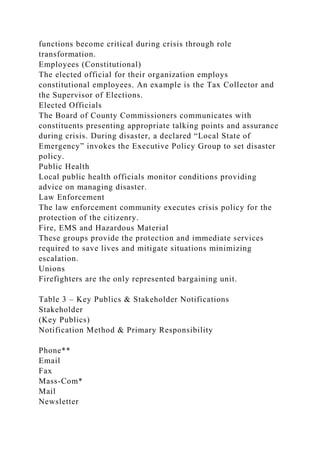
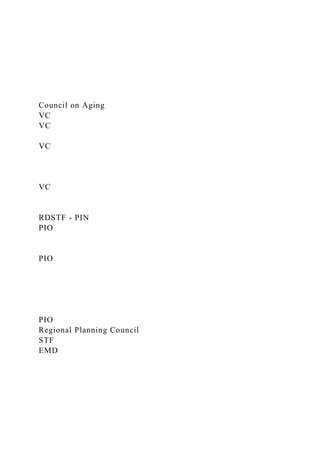
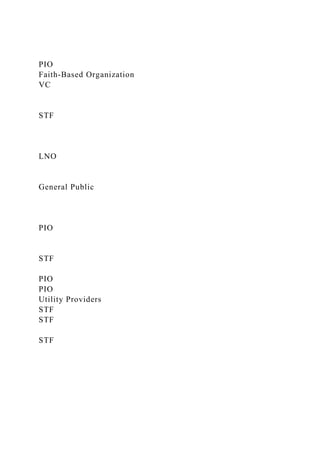
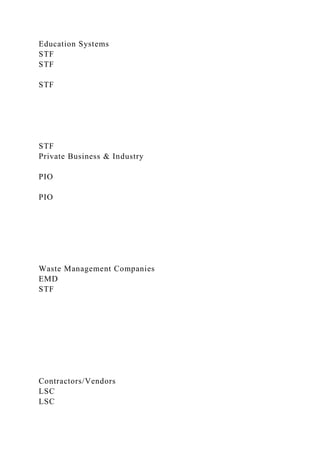
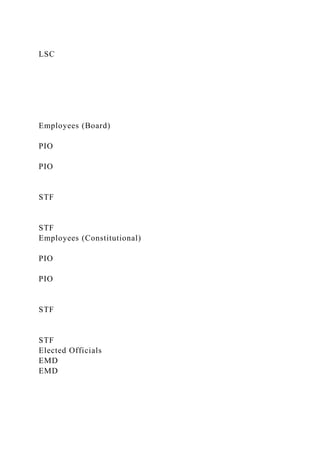
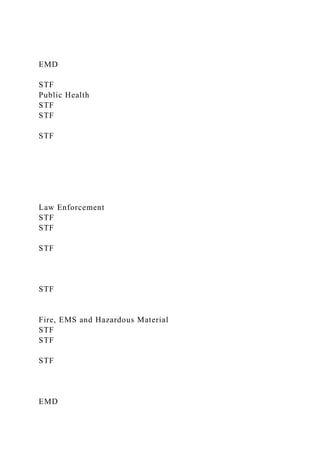
Table 2 is a listing of stakeholders relevant to Osceola County
Public Information Network. Also included is a brief synopsis
of the importance of relationship and relevance. It is important
to recognize that organization employees are part of the key
publics structure requiring notification.
Notification – Communication Methodologies
The notification matrix is a valuable tool in crisis information
delivery. After determining the desired key publics, it is
necessary to evaluate and determine the best methodology for
notification. Fortunately, today’s technology provides ample
mediums to accomplish this process. Working to enhance
communication, deliver appropriate information in a timely
manner are paramount to successful notifications.
The Osceola County Joint Information Network is notified by
telephone first. This is followed by an email to assist in
clarifying any additional details.
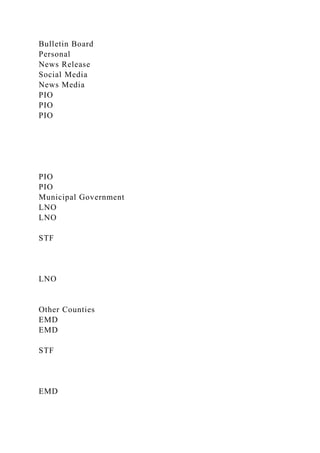
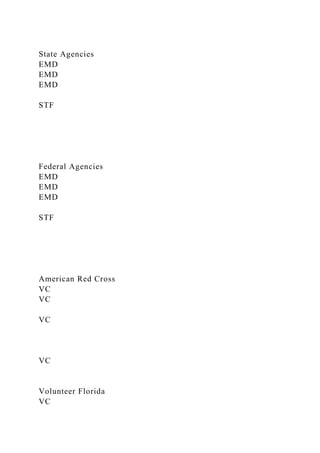
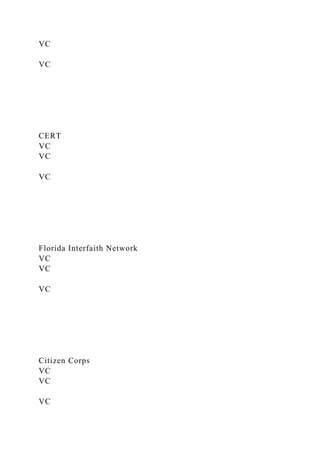
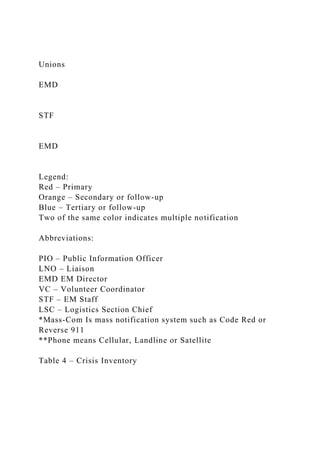
Table 3 represents the key publics notifications. In each public
represented, we consider alternative or multiple methods
resulting in a solid notification process. Dependency on a single
notification method can result in a delay of timely and
sometimes time-sensitive material. The matrix also provides the
opportunity to assign positions or people making the necessary
notifications. Table 3 assignment requires the person or position
responsible for the notification to possess an alternate person or
position.
Crisis Inventory and Threat Analysis
The Joint Information Network is responsible to maintain the
Crisis Inventory. The basis of the inventory is the established
Hazard & Vulnerability Analysis (HVA) as produced by the
Office of Emergency Management. Team members must monitor
conditions and be prepared during periods of heightened threat
from events as listed in the HVA. The current Crisis Inventory
is demonstrated in Table 4.
The Crisis Communication Control Center (Joint Information
Center)
The Joint Information Center (JIC) is the central hub of the
Crisis Communication Team (CCT). This is the physical
location where all activity is coordinated in support of the team
as well as the actual crisis. The JIC should contain all the
necessary supplies, equipment and space to effectively and
efficiently provide for the efforts of the team as specified in the
National Incident Management System guidelines. (FEMA
2009).
There are circumstances whereby a Virtual Joint Information
Center can successfully meet the crisis communications needs.
Limited personnel and resources often drive the demand in
determining an actual co-location for operations or the virtual
setting is more appropriate. Regardless of the decision to
virtually operate or to co-locate, the JIC environment must be
regularly exercised to ensure the most efficient operation.
The JIC must contain ample space and accommodations for the
working team. An organizational structure to match the end
objective is also required. In considering the space
requirements, reasonable comfort is a priority to those operating
within the space. Even in the mobile or field environment, a JIC
requires appropriate space to produce based on the crisis
demand. (FEMA 2009).
There are many technical considerations for the JIC and every
technical component requires a redundant system or
methodology. These technical considerations are the modes by
which the team can effectively create a product for the publics.
In simple terms, the following considerations help to meet the
physical communication and operational needs of the team. This
includes phone lines, fax lines, data lines, lighting, and radio
communications devices.
While this is a short list of technical considerations, the
emphasis must be on equipment maintenance and the frequency
of exercising or practicing with the equipment ensuring
operability.
Teams should practice all the JIC capabilities without the use of
the technology on a regular basis. Hand writing New Releases
and communicating face to face or by messenger can be a
challenge. The even bigger challenge is having not practiced
before a crisis and expecting any success at all.
Using community bulletin boards for posting critical
information is a practice in catastrophic events. The team
should pre-identify locations and capabilities prior to a crisis.
The pre-identification is helpful when constructing releases for
the media directing the community on where to locate specific
information. Establishing small generator-powered radio
stations to communicate effectively are considerations for the
Crisis Communications Team.
Supplies and Equipment
The Joint Information Center (JIC) must be equipped with all
the necessary operational supplies. This includes everything
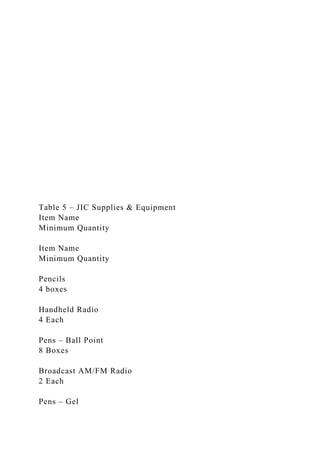
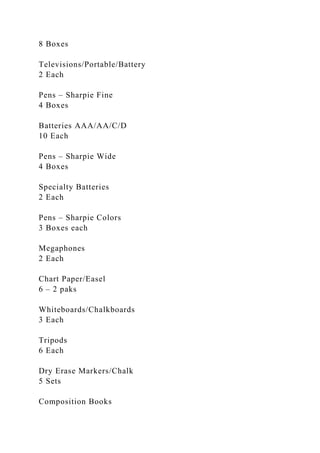
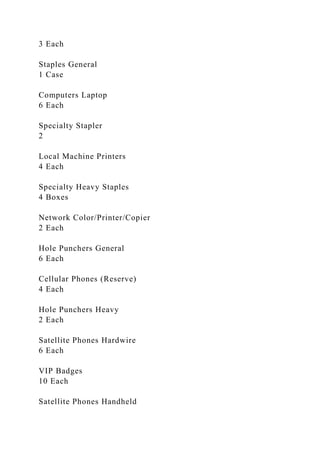
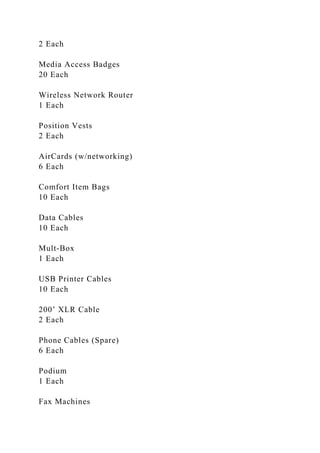
from pencils to computers and copiers. Table 5 provides a quick
checklist of equipment and supplies for JIC operations.
Additional equipment not listed includes furnishings.
Although we have mentioned comfort for the team, desks and
chairs are paramount. Consideration of this type and quality
equipment will go a long way in supporting the team through
less fatigue. It is always beneficial to consider ergonomics
including special seating requirements for team members.
Pre-gathered information
The media and the publics in general want information about the
circumstances including the organization. (Fearn-Banks, 2011).
This is particularly true in crisis. It is well worth the time to
establish and maintain a common archive of essential
information about the organization, policies and leadership
including the Hazard Analysis. If the incident or crisis the
organization is facing is not part of the Hazard Analysis, the
team should pain-stakingly document the details to ensure
inclusion follow-up and appropriate after-action analysis.
Figure 4 is a sample Media Release Document. More templates
may be found at ftp.osceola.org/Emergency_Management.
Exercising
Exercising is a term common in the world of public safety and
denotes a progressive system ensuring participants are expert in
the service they deliver. FEMA IS – 139 Exercise Design
(2009). Demonstrating the progressive manner occurs through
successive events in the exercise protocol and schedule. This
begins with a plan and advances through several levels,
increasing in complexity and promoting a highly skilled group
of participants. Coombs (2012).
Typically, the exercise progression begins with a planning
session followed by an exercise known as a tabletop the purpose
of which is to define roles, responsibilities and processes.
Deficiencies documented in the tabletop promote drills and
plans revisions. While drills are typically discipline and
organization specific, drills may include several organizations
participating together.
Based on the results of the drill process, functional exercises
refine the outcome of the tabletop and drills combined.
Functional exercises take place in a manner similar to the
tabletop and conduct occurs, generally, in real time.
The final step in the process is the full-scale exercise. This
event is scenario driven and is conducted with injects or
challenges including all functional elements participating. The
conduct of play process is also in real-time and outcomes across
the participants are interdependent and consequential.
Exercise Schedule
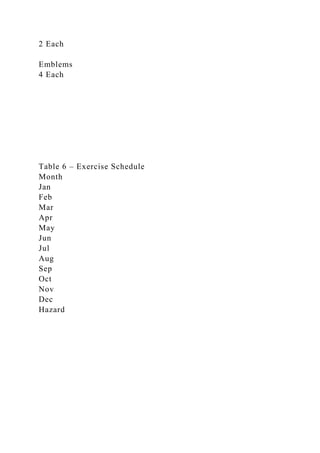
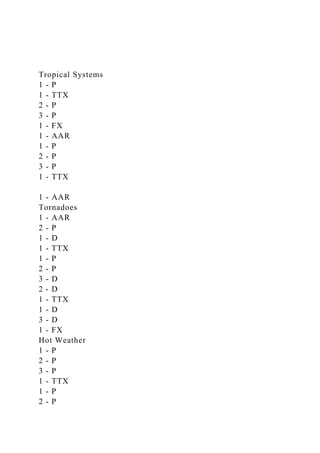
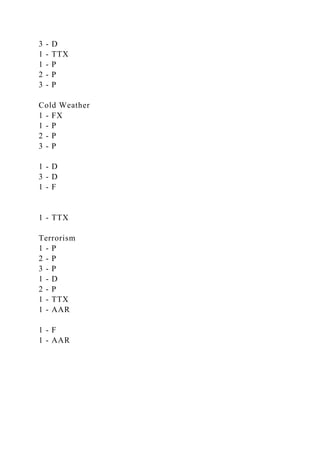
Monthly delineations provide the timing layout for the exercise
schedule as demonstrated in Table 6. The basis of the schedule
is the Crisis Inventory Analysis as diagrammed in Table 4. The
off-season threat, team elements and a progressive system
create the rotation. There are multiple subjects to cover each
month however; multiple topics may be included within one
session.
The schedule is an aggressive one and consideration for actual
events is always appropriate. Only one year is included in Table
6 however; a multiple-year schedule provides a better
foundation for team members and functions.
Finally, all team members provide feedback as indicated by the
After Action Review. The after-action process is also
progressive. Corrective elements and material occurs as part of
every phase in the exercise process. Changes are communicated
to everyone involved in the schedule.
Plan and Exercise Evaluation
No plan or exercise is ever complete until it has been tested and
evaluated. A real event is not the time to evaluate the plan’s
effectiveness. The most effective and efficient time is during
exercise. This statement is true but to a point. Exercising
creates only a sample or simulated event and often times; there
is insufficient realism in the process. This can create a false
sense of security within the team as well as the effectiveness of
the plan.
Whether real or simulated, the Crisis Communications Team
must have an evaluation mechanism supporting the
effectiveness of the plan. With the advent of the Homeland
Security Exercise and Evaluation Program (HSEEP), a standard
approach requiring certain elements provides guidance and
efficiency in exercising and actual event evaluation. (DHS
2007).
Osceola County and the State of Florida use the HSEEP
standard in planning, training and exercising. The system
provides standard forms and structure in maintaining
improvement and corrective action planning. Figure 3 depicts
the evaluation and improvement process resulting in an
effective outcome.
Figure 3.
The standard HSEEP After-Action Report form is used in
evaluating all Osceola County exercising as well as actual
incidents and events. Using this standard ensures appropriate
corrections and support of behaviors and mechanical elements
requiring action.
Supporting Elements
The Trick Questions
Trick questions are always a source of difficulty in managing
crisis communications. Even in the day-to-day realm of media
interaction, the trick question can be harmful without careful
deliberation before answering. (Fearns-Banks, 2011). Most
professional journalists refrain from intentionally asking trick
questions however; journalists want to get the story and with
appropriate phrasing and technique, the trick question appears.
Osceola County government provides regular training on
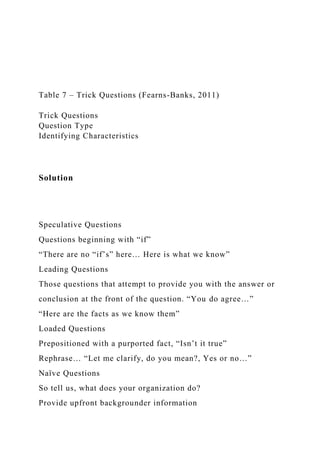
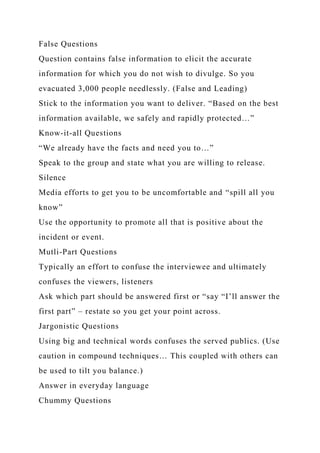
techniques resulting in managing trick questions. Table 7
provides a list of questions and techniques often used to elicit
spontaneity in the interview process. The spokesperson, as well
as anyone with potential media accessibility must remain
cognizant of the trick question technique.
Prodromes
Crisis, typical to an organization, often contains warning signs
or predictive situations to which keen public information
personnel should be aware. Kathleen Fearn-Banks tells us the
term prodrome describes such conditions. (2011). A natural
disaster may contain ample warning signs and information
ahead of the impending impact, however, the information
delivery system related to the disaster may suffer direct impact
through which prodromes can help to prevent the exacerbation
of an all ready difficult situation.
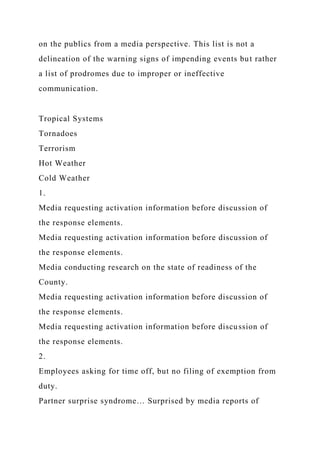
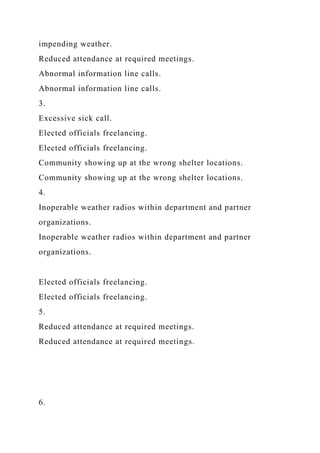
The prodromes listed in Table 8 provide important information
based on the Osceola County Crisis Inventory. Each element
contains a subset of prodromes relating to potential information
difficulties.
Internet Uniform Resource Links
Uniform Resource Links (URLS) are critical information
sources necessary to support the crisis communication team.
There is no time during crisis to be researching basic
information on a predictable or prodromal event. The team must
maintain an active list of effective information sources at all
times. An example of such information may be an earthquake or
other geological phenomena. Knowledge of where to find
accurate, reportable information saves the team time and
streamlines process when there is a crisis at hand. It is also an
effective resource tool to exercise or rehearse the team for
potential activation.
Table 9 contains an abbreviated URL list relevant to the
Osceola County Public Information Network. The table includes
appropriate URLs related to the Crisis Inventory and is
expandable to accommodate a more comprehensive crisis
inventory.
NOTE: ftp.osceola.org/emergency_management for Media
Release templates and other supporting documentation.
Table 1 – Osceola County Public Information Network Contacts
Crisis Directory
Name
Organization
Office Phone
Mobile Phone
Fax
Email
L. Krause* CCT
Osceola County
PIO
407-742-0102
321-284-7807
407-742-0103
[email protected]
B. Garcia CCT
Osceola County PIO – CW
407-742-0101
407-709-5230
407-742-0103
[email protected]
I. Soto
Osceola County CW
407-742-2386
407-414-0935
407-742-0103
[email protected]
T. Lizasuain*
Osceola Sheriff PIO
407-348-1141
407-709-****
407-348-1137
[email protected]
D. Mc Avoy* CCT
Osceola Fire PIO
407-742-6701
321-624-0289
[email protected]
C. Banks*
City of Kissimmee PIO
407-518-2314
321-443-9901
[email protected]
S. Miller CCT
Kissimmee Police PIO
407-847-0176
321-624-6134
[email protected]
J. Robinson*
Kissimmee Fire PIO
407-518-2237
321-284-5791
407-846-0973
[email protected]
S. Rameriz
City of St. Cloud PIO
407-957-7303
321-624-1845
[email protected]
D. Roberts CCT
St. Cloud Police PIO
407-892-5555
407-908-****
[email protected]
L. Thompson*
St, Cloud Fire PIO
407-957-8486
407-709-0320
[email protected]
B. Arrant CCT
Toho Water PIO
407-944-5000
407-709-2087
[email protected]
C. Gent*
Kissimmee Utility Authority PIO
407-933-9836
321-624-3383
[email protected]
B. Branneky*
Orlando Utility Authority PIO
407-244-8766
407-267-3359
[email protected]
D. Clemments*
Progress Energy PIO
407-905-3319
407-252-8631
[email protected]
M. Sellers*
Peace River Elec PIO
863-767-4644
863-781-1863
[email protected]
C. Bellanceau
Council on Aging/Americorp
407-846-8532
407-288-0957
[email protected]
C. Bissainthe*
Osceola Health PIO
407-343-2001
321-624-7296
[email protected]
L. Livingston
Osceola Regional SUP
407-518-3115
407-908-8316
[email protected]
W. Graf*
South Florida Water Mgmt PIO
407-858-6100
352-516-5436
[email protected]
W. Booher
State EM PIO
850-413-9839
[email protected]
C. Magnuson
ARC PIO
863-294-5941
863-287-3870
863-293-9626
[email protected]
E. Foerste CCT
Ext Services CIC
321-697-3000
407-908-4379
[email protected]
All State Contacts
Watch Office
800-320-0519
* Primary Agency Spokesperson
**** Exempt
PIO – Public Information Officer
CW - Copywirter
SUP – Support
CIC – Citizen Information Center
CCT – Crisis Communications Team
Table 2 – Stakeholders & Key Publics
Osceola County Public Information Network
Stakeholders (Publics)
Importance
Government
· Municipalities
· Other Counties
· State
· Federal
Each agency listed is a partner organization. Resource
allocation, policy and recovery assistance require a coordinated
effort with each of the listed agencies. Examples of these
organizations are the National Weather Service, FEMA, DHS,
Nuclear Regulatory Commission and Department of Energy.
Volunteer Organizations
Volunteers bring added support and expertise in a crisis.
Establishing a solid working relationship and communications
network is critical ensuring availability during a crisis.
Public Information Network
This local organization provides regional public information
assets. This includes Public Information Officers, media
connectivity and equipment required for effective, efficient
crisis information management activity.
Regional Planning Council
The council provides expertise in planning activity including
transportation and evacuation data.
Faith-Based Organization
Some faith-based organizations do not belong to the inter-faith
network but provide services directly to citizens in a crisis.
General Public
The public must provide and receive information regarding the
crisis. The information received guides the information
delivered.
Utility Providers
Utility provides include electricity, water, wastewater,
telephone and internet services.
Education Systems
The educational system provides an independent resource for
crisis communication as well as functional facilities. The
education system covers all ranges of functions including trade
schools and universities.
Private Business & Industry
Private business and industry deliver goods and services to the
public. In some cases, these are critical, particularly in the
healthcare sector.
Waste Management Companies
Waste collection services are critical in crisis because the
accumulation of waste increases the risk of disease.
Contractors/Vendors
Certain services are provided contractually. These include
supply, cleaning and security services.
Employees (Board)
Board employees are the base of the response community. Their
functions become critical during crisis through role
transformation.
Employees (Constitutional)
The elected official for their organization employs
constitutional employees. An example is the Tax Collector and
the Supervisor of Elections.
Elected Officials
The Board of County Commissioners communicates with
constituents presenting appropriate talking points and assurance
during crisis. During disaster, a declared “Local State of
Emergency” invokes the Executive Policy Group to set disaster
policy.
Public Health
Local public health officials monitor conditions providing
advice on managing disaster.
Law Enforcement
The law enforcement community executes crisis policy for the
protection of the citizenry.
Fire, EMS and Hazardous Material
These groups provide the protection and immediate services
required to save lives and mitigate situations minimizing
escalation.
Unions
Firefighters are the only represented bargaining unit.
Table 3 – Key Publics & Stakeholder Notifications
Stakeholder
(Key Publics)
Notification Method & Primary Responsibility
Phone**
Email
Fax
Mass-Com*
Mail
Newsletter
Bulletin Board
Personal
News Release
Social Media
News Media
PIO
PIO
PIO
PIO
PIO
Municipal Government
LNO
LNO
STF
LNO
Other Counties
EMD
EMD
STF
EMD
State Agencies
EMD
EMD
EMD
STF
Federal Agencies
EMD
EMD
EMD
STF
American Red Cross
VC
VC
VC
VC
Volunteer Florida
VC
VC
VC
CERT
VC
VC
VC
Florida Interfaith Network
VC
VC
VC
Citizen Corps
VC
VC
VC
Council on Aging
VC
VC
VC
VC
RDSTF - PIN
PIO
PIO
PIO
Regional Planning Council
STF
EMD
PIO
Faith-Based Organization
VC
STF
LNO
General Public
PIO
STF
PIO
PIO
Utility Providers
STF
STF
STF
Education Systems
STF
STF
STF
STF
Private Business & Industry
PIO
PIO
Waste Management Companies
EMD
STF
Contractors/Vendors
LSC
LSC
LSC
Employees (Board)
PIO
PIO
STF
STF
Employees (Constitutional)
PIO
PIO
STF
STF
Elected Officials
EMD
EMD
EMD
STF
Public Health
STF
STF
STF
Law Enforcement
STF
STF
STF
STF
Fire, EMS and Hazardous Material
STF
STF
STF
EMD
Unions
EMD
STF
EMD
Legend:
Red – Primary
Orange – Secondary or follow-up
Blue – Tertiary or follow-up
Two of the same color indicates multiple notification
Abbreviations:
PIO – Public Information Officer
LNO – Liaison
EMD EM Director
VC – Volunteer Coordinator
STF – EM Staff
LSC – Logistics Section Chief
*Mass-Com Is mass notification system such as Code Red or
Reverse 911
**Phone means Cellular, Landline or Satellite
Table 4 – Crisis Inventory
Table 5 – JIC Supplies & Equipment
Item Name
Minimum Quantity
Item Name
Minimum Quantity
Pencils
4 boxes
Handheld Radio
4 Each
Pens – Ball Point
8 Boxes
Broadcast AM/FM Radio
2 Each
Pens – Gel
8 Boxes
Televisions/Portable/Battery
2 Each
Pens – Sharpie Fine
4 Boxes
Batteries AAA/AA/C/D
10 Each
Pens – Sharpie Wide
4 Boxes
Specialty Batteries
2 Each
Pens – Sharpie Colors
3 Boxes each
Megaphones
2 Each
Chart Paper/Easel
6 – 2 paks
Whiteboards/Chalkboards
3 Each
Tripods
6 Each
Dry Erase Markers/Chalk
5 Sets
Composition Books
24
Bulletin Boards
4 Each
Letter Copy Paper
3 Cases
Push Pins
2 Boxes 100 ea
Legal Copy Paper
2 Cases
Glue
4 Bottles
Ledger Paper
1 Case
Scotch Tape
10 Rolls
Poster Board
12 Each
Duct Tape
10 Rolls
Telephones
8 Each
Staplers General
10 Each
Computers Desktop
3 Each
Staples General
1 Case
Computers Laptop
6 Each
Specialty Stapler
2
Local Machine Printers
4 Each
Specialty Heavy Staples
4 Boxes
Network Color/Printer/Copier
2 Each
Hole Punchers General
6 Each
Cellular Phones (Reserve)
4 Each
Hole Punchers Heavy
2 Each
Satellite Phones Hardwire
6 Each
VIP Badges
10 Each
Satellite Phones Handheld
2 Each
Media Access Badges
20 Each
Wireless Network Router
1 Each
Position Vests
2 Each
AirCards (w/networking)
6 Each
Comfort Item Bags
10 Each
Data Cables
10 Each
Mult-Box
1 Each
USB Printer Cables
10 Each
200’ XLR Cable
2 Each
Phone Cables (Spare)
6 Each
Podium
1 Each
Fax Machines
2 Each
Emblems
4 Each
Table 6 – Exercise Schedule
Month
Jan
Feb
Mar
Apr
May
Jun
Jul
Aug
Sep
Oct
Nov
Dec
Hazard
Tropical Systems
1 - P
1 - TTX
2 - P
3 - P
1 - FX
1 - AAR
1 - P
2 - P
3 - P
1 - TTX
1 - AAR
Tornadoes
1 - AAR
2 - P
1 - D
1 - TTX
1 - P
2 - P
3 - D
2 - D
1 - TTX
1 - D
3 - D
1 - FX
Hot Weather
1 - P
2 - P
3 - P
1 - TTX
1 - P
2 - P
3 - D
1 - TTX
1 - P
2 - P
3 - P
Cold Weather
1 - FX
1 - P
2 - P
3 - P
1 - D
3 - D
1 - F
1 - TTX
Terrorism
1 - P
2 - P
3 - P
1 - D
2 - P
1 - TTX
1 - AAR
1 - F
1 - AAR
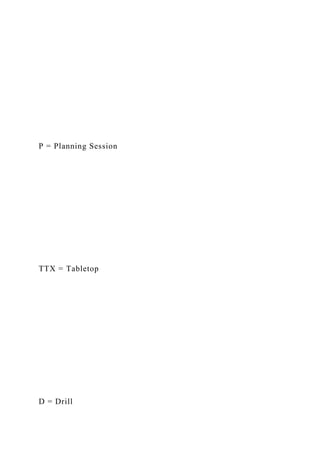
Legend
Type
P = Planning Session
TTX = Tabletop
D = Drill
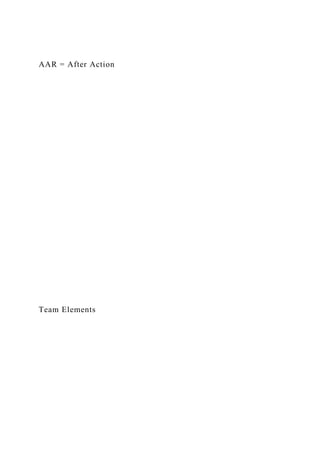
F = Functional
FX = Full-Scale
AAR = After Action
Team Elements
1 = All
2 = Writers
3 = Phone & Social Media
4 = After-Action
Table 7 – Trick Questions (Fearns-Banks, 2011)
Trick Questions
Question Type
Identifying Characteristics
Solution
Speculative Questions
Questions beginning with “if”
“There are no “if’s” here… Here is what we know”
Leading Questions
Those questions that attempt to provide you with the answer or
conclusion at the front of the question. “You do agree…”
“Here are the facts as we know them”
Loaded Questions
Prepositioned with a purported fact, “Isn’t it true”
Rephrase… “Let me clarify, do you mean?, Yes or no…”
Naïve Questions
So tell us, what does your organization do?
Provide upfront backgrounder information
False Questions
Question contains false information to elicit the accurate
information for which you do not wish to divulge. So you
evacuated 3,000 people needlessly. (False and Leading)
Stick to the information you want to deliver. “Based on the best
information available, we safely and rapidly protected…”
Know-it-all Questions
“We already have the facts and need you to…”
Speak to the group and state what you are willing to release.
Silence
Media efforts to get you to be uncomfortable and “spill all you
know”
Use the opportunity to promote all that is positive about the
incident or event.
Mutli-Part Questions
Typically an effort to confuse the interviewee and ultimately
confuses the viewers, listeners
Ask which part should be answered first or “say “I’ll answer the
first part” – restate so you get your point across.
Jargonistic Questions
Using big and technical words confuses the served publics. (Use
caution in compound techniques… This coupled with others can
be used to tilt you balance.)
Answer in everyday language
Chummy Questions
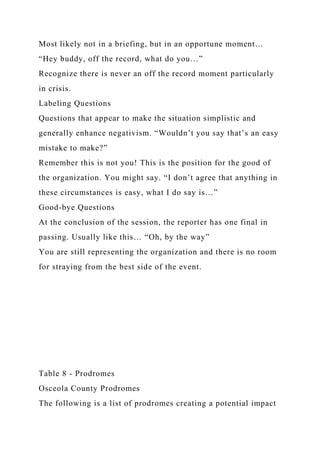
Most likely not in a briefing, but in an opportune moment…
“Hey buddy, off the record, what do you…”
Recognize there is never an off the record moment particularly
in crisis.
Labeling Questions
Questions that appear to make the situation simplistic and
generally enhance negativism. “Wouldn’t you say that’s an easy
mistake to make?”
Remember this is not you! This is the position for the good of
the organization. You might say. “I don’t agree that anything in
these circumstances is easy, what I do say is…”
Good-bye Questions
At the conclusion of the session, the reporter has one final in
passing. Usually like this… “Oh, by the way”
You are still representing the organization and there is no room
for straying from the best side of the event.
Table 8 - Prodromes
Osceola County Prodromes
The following is a list of prodromes creating a potential impact
on the publics from a media perspective. This list is not a
delineation of the warning signs of impending events but rather
a list of prodromes due to improper or ineffective
communication.
Tropical Systems
Tornadoes
Terrorism
Hot Weather
Cold Weather
1.
Media requesting activation information before discussion of
the response elements.
Media requesting activation information before discussion of
the response elements.
Media conducting research on the state of readiness of the
County.
Media requesting activation information before discussion of
the response elements.
Media requesting activation information before discussion of
the response elements.
2.
Employees asking for time off, but no filing of exemption from
duty.
Partner surprise syndrome… Surprised by media reports of
impending weather.
Reduced attendance at required meetings.
Abnormal information line calls.
3.
Excessive sick call.
Elected officials freelancing.
Community showing up at the wrong shelter locations.
4.
Inoperable weather radios within department and partner
organizations.
Inoperable weather radios within department and partner
organizations.
Elected officials freelancing.
5.
Reduced attendance at required meetings.
6.
Elected officials absent from briefings.
7.
Staff excuses.
Staff excuses.
Staff excuses.
8.
Community showing up at the wrong shelter locations.
9.
Elected officials freelancing.
10.
Abnormal information line calls.
Table 9 – Uniform Resource Links
URL Link Table
Subject
Uniform Resource Link
Tropical Systems
Local Impact Weather
www.srh.noaa.gov/mlb - Melbourne Weather Service Office
Local Gauges – EOC
www.findu.com/cgi-bin/wxpage.cgi?call=KG4FZO-7
Technical
www.nhc.noaa.gov – National Hurricane Center
Technical Background
www.nhc.noaa.gov
Satellite
www.goes.noaa.gov/g8hu.html NOAA
www.nrlmry.navy.mil/tropics-bin/tropics.cgi - Naval Research
www.goes.noaa.gov/ECWV3.html - colors
Radar
http://radar.weather.gov/radar.php?rid=mlb
Local Media
www.cfnews13.com/weather/digital-doppler-radar
www.myfoxorlando.com/subindex/weather (Live alternate radar
site)
www.wftv.com/s/weather/doppler-9hd/ (Live alternate radar
site)
Modeling
www.fnmoc.navy.mil/wxmap_cgi/index.html - GFS & NOGAPS
www.sfwmd.gov/portal/page/portal/xweb%20weather/hurricane
%20model%20plots – As reported
Sheltering
www.floridadisaster.org
www.redcross.org
http://mysafety.osceola.org
Real-Time Lake and Stream Data
www.sfwmd.gov/portal/page/portal/xweb%20drought%20%20an
d%20%20flood/water%20conditions%20regional%20real%20tim
e%20data
Rainfall Data
www.sfwmd.gov/portal/page/portal/xweb%20weather/rainfall%2
0historical%20%28daily%29
General Aggregation
www.crownweather.com
Damage
http://damage.osceola.org/arm360 (Do Not Release - Not a
Public Site)
Tornadoes
Local Impact Weather
www.srh.noaa.gov/mlb - Melbourne Weather Service Office
Local Gauges – EOC
www.findu.com/cgi-bin/wxpage.cgi?call=KG4FZO-7
Technical
www.spc.noaa.gov
www.spc.noaa.gov/products/outlook/day1otlk.html Convective
Outlook
Technical Background
www.spc.noaa.gov/faq/tornado/
Damage
http://damage.osceola.org/arm360 (Do Not Release - Not a
Public Site)
Radar
http://radar.weather.gov/radar.php?rid=mlb
www.cfnews13.com/weather/digital-doppler-radar
www.myfoxorlando.com/subindex/weather (Live alternate radar
site)
www.wftv.com/s/weather/doppler-9hd/ (Live alternate radar
site)
Terrorism
National Terrorism Alert System
www.dhs.gov/files/programs/ntas.shtm
Public Guide
www.dhs.gov/xlibrary/assets/ntas/ntas-public-guide.pdf
CIA Fact Book
www.cia.gov/library/publications/the-world-
factbook/index.html
FBI
www.fbi.gov/about-us/investigate/terrorism
Hot & Cold Weather
Local Impact Weather
www.srh.noaa.gov/mlb - Melbourne Weather Service Office
Local Gauges – EOC
www.findu.com/cgi-bin/wxpage.cgi?call=KG4FZO-7
Sheltering
www.floridadisaster.org
www.redcross.org
http://mysafety.osceola.org
NOTE
ftp.osceola.org/emergency_management for files libraries
Osceola County Emergency Management
News Release
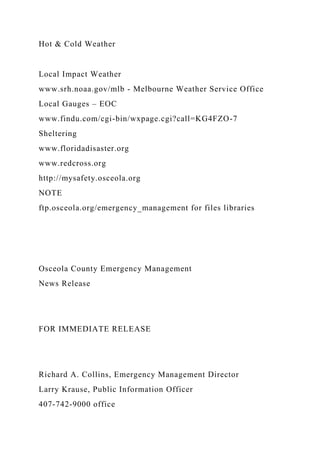
FOR IMMEDIATE RELEASE
Richard A. Collins, Emergency Management Director
Larry Krause, Public Information Officer
407-742-9000 office
321-624-2841 cell
[email protected]
http://mysafety.osceola.org
(Date/Time – Month-Day-Year-Time)
EMPR #(Year-#)
EMERGENCY EVACUATION ORDER
Osceola County, Florida – Osceola County government has
issued an Emergency Evacuation order for the following areas:
(_Area Here______).
· Bullet List
___(Situation)_______ has created circumstances that may be
threatening to your life and health. Emergency officials urge
you to take shelter with family members or friends outside the
threatened area.
If you need a place to take shelter, the following locations have
been set up:
· (LIST SHELTER LOCATIONS)
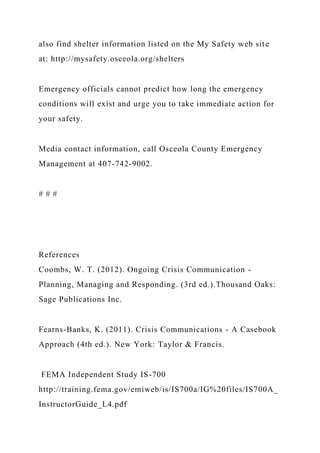
If you need assistance in determining the shelter closest to you,
please call the Citizen Information Center at 407-742-0000.
Personnel are standing-by to answer your questions. You may
also find shelter information listed on the My Safety web site
at: http://mysafety.osceola.org/shelters
Emergency officials cannot predict how long the emergency
conditions will exist and urge you to take immediate action for
your safety.
Media contact information, call Osceola County Emergency
Management at 407-742-9002.
# # #
References
Coombs, W. T. (2012). Ongoing Crisis Communication -
Planning, Managing and Responding. (3rd ed.).Thousand Oaks:
Sage Publications Inc.
Fearns-Banks, K. (2011). Crisis Communications - A Casebook
Approach (4th ed.). New York: Taylor & Francis.
FEMA Independent Study IS-700
http://training.fema.gov/emiweb/is/IS700a/IG%20files/IS700A_
InstructorGuide_L4.pdf
FEMA Independent Study IS-702
http://www.training.fema.gov/emiweb/is/is702a.asp
http://www.training.fema.gov/EMIWeb/IS/is139.asp
https://hseep.dhs.gov/HSEEP_Vols/upl/DocServe.aspx?dload='h
seep_Vol4%2fVol+IV+Media%2f933_NPG+09-07.pdf
Giuliani, R. W., & Kurson, K. (2002). Leadership. New York:
Hyperion.
Ulmer, R. R., Sellnow, T. L., & Seeger, M. W. (2011). Effective
Crisis Communication - Moving From Crisis to Opportunity.
Thousand Oaks: Sage Publications, Inc.
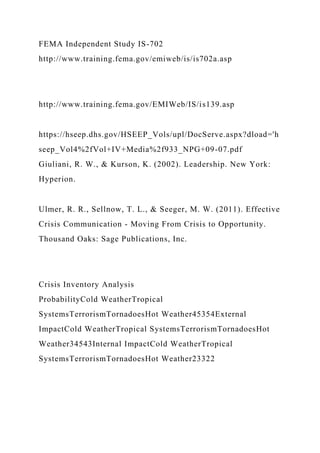
Crisis Inventory Analysis
ProbabilityCold WeatherTropical
SystemsTerrorismTornadoesHot Weather45354External
ImpactCold WeatherTropical SystemsTerrorismTornadoesHot
Weather34543Internal ImpactCold WeatherTropical
SystemsTerrorismTornadoesHot Weather23322
Final Course Project - Crisis Communication PlanAssignment Instr.docx

Final Course Project - Crisis Communication PlanAssignment Instr.docx

  • 1.
    Final Course Project- Crisis Communication Plan Assignment Instructions 4. Final Course Project (due at end of week 8) A. Scope - The final project will be your creation of a Crisis Communication Plan for your organization or an organization of your choice. Using the materials from your weekly assignments, develop a detailed CCP. Use Appendix A Go through the steps of the Crisis Communication Plan, and develop a good - detailed CCP. B. Objective - The objective is to apply all of what you have learned in this course to your organization. C. Format - Use the APA style for all citations. - Project has neither minimum nor maximum length. Cover the material to the best of your ability. - Project will be typed in MS Word - Project will have 1" margins - Project will be in 12-point Times New Roman font D. General Guidance - As you work on your project, you are encouraged to use information in the discussion questions throughout this course. Take what you have been working on from the beginning and continue to develop it. - This project should end up looking similar to one of the Appendices in your text, but tailored to your organization of choice. - Feel free to change any names you wish, but do not change position titles nor duty descriptions. Think through your project. Ask yourself the questions we have discussed in this course. - Key to your success is how well you have thought through your organization's crisis communication - and how well you have communicated it!
  • 2.
    Crisis Communications Plan1 Crisis Communications Plan 26 The Osceola County Joint Information Crisis Communications Plan Richard A. Halquist - 4115293American Military UniversityEDMG 420 D 003 Sum 11 – Risk CommunicationsMarch 19, 2018Professor Wilhelmsen The Osceola County Joint Information Crisis Communications Plan Introduction The Crisis Communication Plan is the foundation by which the Osceola County Joint Information Network operates. The plan provides strategic details in a tactical format ensuring operability across jurisdictional lines thereby promoting unified messaging with a common voice. The plan basis is the National Incident Management System (NIMS) Joint Information System protocols through which each participating entity shares responsibility equally, yet provides flexibility for each agency to operate independently. (FEMA 2009). Each section of the plan contains dynamic information requiring regular maintenance ensuring current details related to changes common in any plan. These details are generally in the form of tables and lists including organizational charts to assist team members in organizing quickly when crisis occurs. While the plan details operational elements requiring appropriate space and face-to-face communications, there is an understanding that many operations use a virtual platform promoting effective and efficient information delivery to the served publics. This concept is termed the Joint Information Center (JIC) characterized by typical operations centers and
  • 3.
    those of avirtual nature. (FEMA 2007). Every effort in the consummation of this plan delineates responsibilities regardless of jurisdictional authority, discipline restrictions or agency constraints. Assignment of responsibilities requires specific knowledge and understanding of the associated information officer positions regardless of daily organizational responsibilities. No plan is complete without specific training and exercising requirements. The plan provides a schedule for actively training and evaluating the effectiveness of the plan, associated operations, and includes the Homeland Security Exercise and Evaluation Program requirement in all exercising circumstances. (FEMA 2007). Objective The principle objective of the Crisis Communications Plan is providing a common, unified approach in the delivery of critical information to the appropriate stakeholders and and publics during incidents or disaster. Definitions The following section provides definitions related to the plan and does not provide comprehensive detail or definitions. The current edition of the Osceola County Comprehensive Emergency Management Plan provides a more in depth list of definitions. Comprehensive Emergency Management Plan (CEMP) – The multi-jurisdictional/multiagency plan detailing responsibility and comprehensive management in disaster and crisis situations. Crisis – An unplanned event or incident arising from natural or human caused circumstances including; fires, weather, civil unrest, flooding, terrorism, hazardous material spills. Crisis Communication Team – The Joint Information Network personnel responsible for activating this plan and producing appropriate information for communication with the served publics. Disaster – An unplanned, warned or unwarned, event that overwhelms the community as a whole, resulting in the need for
  • 4.
    comprehensive unified managementsupport. Emergency – See Crisis. Major Crisis – A large-scale incident arising and affecting multiple jurisdictions and may require external assistance in managing control components and information delivery. Minor Crisis – A smaller scale incident limited to the confines of a particular agency or jurisdiction typically not requiring partner assistance. Daily incidents or calls for service are included in this category. Joint Information Center (JIC) – The physical location or virtual setting wherein the information professionals operate. Joint Information Network (JIN) – The group of professional information individuals and associated support personnel gathered as a team to operate during disaster or crisis. Joint Information System (JIS) – The information officer operational protocols used in managing a communication crisis of any kind. Concept of Operations Osceola County Emergency Services is the central coordinating body in managing and maintaining the Crisis Communication Team, Joint Information System protocols and Joint Information Center. The coordination effort does not limit each agency or jurisdiction to operate independently however; provides a cohesive mechanism through which the teams congeal into a singular information delivery component. Figure 1 is a graphical representation of the Joint Information Network organized as the Crisis Communications Team. Joint Information Network City of Kissimmee City of Saint Cloud Osceola County Dept. of Health Osceola Sheriff Figure 1. The Joint Information Network meets and train regularly
  • 5.
    ensuring readiness atany time. Additionally, the JIN selects a member as the leader and central point of contact for activating the team as required. The leadership position is rotational and governed by the rules established by the JIN. This structure minimizes the complexity of a larger team and effectively allows for decisions and communications. (Fearns-Banks, 2011). Major Crisis On notification of impending or occurring major crisis, the JIN Leader notifies the team initiating the network into action. Table 1 identifies the Joint Information Network personnel. A minor or agency/jurisdiction crisis may not require the notification of the entire network and each agency maintains autonomy in these circumstances. However, the network is available to call upon for additional resources as necessary. During a major crisis, the JIN organizes using the tenets of the Incident Command System (ICS). (FEMA 2007). Operating in the standardized approach ensures the advantage of the all the principles within the ICS structure. Figure 2 depicts the organizational structure during major crisis, or disaster. Recognizing the principle that the position of Public Information Officer does not relate to rank or daily organizational responsibility is paramount in organizing through the Incident Command System. The system provides that through training and experience, the position is filled with the one most qualified. LIAISON OFFICER UNIFIED COMMAND JIC MANAGER SAFETY OFFICER
  • 6.
    EXECUTIVE POLICY GROUP PUBLICINFORMATION OFFICER Figure 2. Additional Public Information Officers are responsible for other elements within the Crisis Communications Team. This includes managing the Joint Information Center (JIC) as well as the Citizen Information Center (CIC). The CIC is the central point of telephone contact from the public during a major crisis. The (CIC) Unit Leader manages the CIC and is responsible to the Public Information Officer. Additional functions of the CIC are all social media components in crisis communications, including Twitter, Facebook and other media as appropriate. Minor Crisis Minor crises requiring support for the JIN are managed in similar fashion to that of a major crisis except to the extent that less personal may be required. Responsibilities The Public Information Officer (PIO) is responsible for the successful operation of the Crisis Communications Team. The PIO acquires appropriate staff to ensure addressing all needs. The PIO will: · Begin notification of all necessary team members · Activate the Citizen Information Line – 407-742-0000 · Assign Assistant PIO responsibilities · Fact/background gatherer · Copywriter · CIC Unit Leader · Translator · Media technical advisor · Collectively with Command, select an appropriate spokesperson based on the incident or crisis · Establish appropriate staff for 24-hour operation
  • 7.
    The Public InformationOfficer must ensure a review by Command for any information released. Close coordination with the Planning Section Intel and Situation Units is also required. The accuracy of all information distributed or released must be confirmed and approved. Spokesperson During a major crisis, Osceola County government has a solid policy regarding spokespersons. The spokesperson is the elected Chairperson or Vice Chairperson of the Board of County Commissioners or designee. Supporting the Chairperson are specific discipline experts such as the Sheriff, the Fire Chief and Public Health official. During crisis, the focus of the Chairperson is to provide the elected leadership and calming influence as described by Giuliani. (2002). The Chairperson surrounds himself with experts to address the specifics of any operational or technical questions. A crisis affecting the municipal jurisdictions may assert the same policy regarding spokespersons regardless of whether Osceola County declares a local state of emergency. Each city may request aid from the county and, choose to operate collectively and provide the necessary spokesperson. There are certain circumstances whereby a discipline leader may be the official spokesperson. The circumstances relate to the type and magnitude of the incident. In a declared local state of emergency, by ordinance, the Executive Policy Group provides policy direction and priority decision-making. The Chairperson of the Board of County Commissioners ultimately represents this group as the spokesperson. Smaller incidents require the agency Public Information Officer (PIO) to act as the spokesperson. In the absence of the Public Information Officer, every department head and emergency response officer receives training ensuring the responsibilities of the spokesperson are covered. Even in the initial stages of an evolving incident, the agency Incident Commander or scene PIO will initially act as spokesperson until the arrival of support positions.
  • 8.
    Key Publics andNotifications Publics are defined as the “specific audiences targeted by [public relations] programs”. Fearn-Banks (2011). Public relations and information programs cover a wide range of activity related to an organization’s relationship with everyone connected to or affected by the provided service or product. Essentially, and for our purposes here, we will define publics as stakeholders. The term stakeholder incorporates everyone with an interest in the organization, internally and externally. Coombs (2012). Stakeholders may or may not contribute to the organization in terms of function. They will however, be affected by the decisions. Coombs (2012) (as cited in Bryson 2004). Since the relationship between an organization and its stakeholders is critical, it is of critical importance that all are included in the information dialog process. Table 2 is a listing of stakeholders relevant to Osceola County Public Information Network. Also included is a brief synopsis of the importance of relationship and relevance. It is important to recognize that organization employees are part of the key publics structure requiring notification. Notification – Communication Methodologies The notification matrix is a valuable tool in crisis information delivery. After determining the desired key publics, it is necessary to evaluate and determine the best methodology for notification. Fortunately, today’s technology provides ample mediums to accomplish this process. Working to enhance communication, deliver appropriate information in a timely manner are paramount to successful notifications. The Osceola County Joint Information Network is notified by telephone first. This is followed by an email to assist in clarifying any additional details. Table 3 represents the key publics notifications. In each public represented, we consider alternative or multiple methods resulting in a solid notification process. Dependency on a single notification method can result in a delay of timely and
  • 9.
    sometimes time-sensitive material.The matrix also provides the opportunity to assign positions or people making the necessary notifications. Table 3 assignment requires the person or position responsible for the notification to possess an alternate person or position. Crisis Inventory and Threat Analysis The Joint Information Network is responsible to maintain the Crisis Inventory. The basis of the inventory is the established Hazard & Vulnerability Analysis (HVA) as produced by the Office of Emergency Management. Team members must monitor conditions and be prepared during periods of heightened threat from events as listed in the HVA. The current Crisis Inventory is demonstrated in Table 4. The Crisis Communication Control Center (Joint Information Center) The Joint Information Center (JIC) is the central hub of the Crisis Communication Team (CCT). This is the physical location where all activity is coordinated in support of the team as well as the actual crisis. The JIC should contain all the necessary supplies, equipment and space to effectively and efficiently provide for the efforts of the team as specified in the National Incident Management System guidelines. (FEMA 2009). There are circumstances whereby a Virtual Joint Information Center can successfully meet the crisis communications needs. Limited personnel and resources often drive the demand in determining an actual co-location for operations or the virtual setting is more appropriate. Regardless of the decision to virtually operate or to co-locate, the JIC environment must be regularly exercised to ensure the most efficient operation. The JIC must contain ample space and accommodations for the working team. An organizational structure to match the end objective is also required. In considering the space requirements, reasonable comfort is a priority to those operating within the space. Even in the mobile or field environment, a JIC requires appropriate space to produce based on the crisis
  • 10.
    demand. (FEMA 2009). Thereare many technical considerations for the JIC and every technical component requires a redundant system or methodology. These technical considerations are the modes by which the team can effectively create a product for the publics. In simple terms, the following considerations help to meet the physical communication and operational needs of the team. This includes phone lines, fax lines, data lines, lighting, and radio communications devices. While this is a short list of technical considerations, the emphasis must be on equipment maintenance and the frequency of exercising or practicing with the equipment ensuring operability. Teams should practice all the JIC capabilities without the use of the technology on a regular basis. Hand writing New Releases and communicating face to face or by messenger can be a challenge. The even bigger challenge is having not practiced before a crisis and expecting any success at all. Using community bulletin boards for posting critical information is a practice in catastrophic events. The team should pre-identify locations and capabilities prior to a crisis. The pre-identification is helpful when constructing releases for the media directing the community on where to locate specific information. Establishing small generator-powered radio stations to communicate effectively are considerations for the Crisis Communications Team. Supplies and Equipment The Joint Information Center (JIC) must be equipped with all the necessary operational supplies. This includes everything from pencils to computers and copiers. Table 5 provides a quick checklist of equipment and supplies for JIC operations. Additional equipment not listed includes furnishings. Although we have mentioned comfort for the team, desks and chairs are paramount. Consideration of this type and quality equipment will go a long way in supporting the team through less fatigue. It is always beneficial to consider ergonomics
  • 11.
    including special seatingrequirements for team members. Pre-gathered information The media and the publics in general want information about the circumstances including the organization. (Fearn-Banks, 2011). This is particularly true in crisis. It is well worth the time to establish and maintain a common archive of essential information about the organization, policies and leadership including the Hazard Analysis. If the incident or crisis the organization is facing is not part of the Hazard Analysis, the team should pain-stakingly document the details to ensure inclusion follow-up and appropriate after-action analysis. Figure 4 is a sample Media Release Document. More templates may be found at ftp.osceola.org/Emergency_Management. Exercising Exercising is a term common in the world of public safety and denotes a progressive system ensuring participants are expert in the service they deliver. FEMA IS – 139 Exercise Design (2009). Demonstrating the progressive manner occurs through successive events in the exercise protocol and schedule. This begins with a plan and advances through several levels, increasing in complexity and promoting a highly skilled group of participants. Coombs (2012). Typically, the exercise progression begins with a planning session followed by an exercise known as a tabletop the purpose of which is to define roles, responsibilities and processes. Deficiencies documented in the tabletop promote drills and plans revisions. While drills are typically discipline and organization specific, drills may include several organizations participating together. Based on the results of the drill process, functional exercises refine the outcome of the tabletop and drills combined. Functional exercises take place in a manner similar to the tabletop and conduct occurs, generally, in real time. The final step in the process is the full-scale exercise. This event is scenario driven and is conducted with injects or challenges including all functional elements participating. The
  • 12.
    conduct of playprocess is also in real-time and outcomes across the participants are interdependent and consequential. Exercise Schedule Monthly delineations provide the timing layout for the exercise schedule as demonstrated in Table 6. The basis of the schedule is the Crisis Inventory Analysis as diagrammed in Table 4. The off-season threat, team elements and a progressive system create the rotation. There are multiple subjects to cover each month however; multiple topics may be included within one session. The schedule is an aggressive one and consideration for actual events is always appropriate. Only one year is included in Table 6 however; a multiple-year schedule provides a better foundation for team members and functions. Finally, all team members provide feedback as indicated by the After Action Review. The after-action process is also progressive. Corrective elements and material occurs as part of every phase in the exercise process. Changes are communicated to everyone involved in the schedule. Plan and Exercise Evaluation No plan or exercise is ever complete until it has been tested and evaluated. A real event is not the time to evaluate the plan’s effectiveness. The most effective and efficient time is during exercise. This statement is true but to a point. Exercising creates only a sample or simulated event and often times; there is insufficient realism in the process. This can create a false sense of security within the team as well as the effectiveness of the plan. Whether real or simulated, the Crisis Communications Team must have an evaluation mechanism supporting the effectiveness of the plan. With the advent of the Homeland Security Exercise and Evaluation Program (HSEEP), a standard approach requiring certain elements provides guidance and efficiency in exercising and actual event evaluation. (DHS 2007). Osceola County and the State of Florida use the HSEEP
  • 13.
    standard in planning,training and exercising. The system provides standard forms and structure in maintaining improvement and corrective action planning. Figure 3 depicts the evaluation and improvement process resulting in an effective outcome. Figure 3. The standard HSEEP After-Action Report form is used in evaluating all Osceola County exercising as well as actual incidents and events. Using this standard ensures appropriate corrections and support of behaviors and mechanical elements requiring action. Supporting Elements The Trick Questions Trick questions are always a source of difficulty in managing crisis communications. Even in the day-to-day realm of media interaction, the trick question can be harmful without careful deliberation before answering. (Fearns-Banks, 2011). Most professional journalists refrain from intentionally asking trick questions however; journalists want to get the story and with appropriate phrasing and technique, the trick question appears. Osceola County government provides regular training on techniques resulting in managing trick questions. Table 7 provides a list of questions and techniques often used to elicit spontaneity in the interview process. The spokesperson, as well as anyone with potential media accessibility must remain cognizant of the trick question technique. Prodromes Crisis, typical to an organization, often contains warning signs or predictive situations to which keen public information personnel should be aware. Kathleen Fearn-Banks tells us the term prodrome describes such conditions. (2011). A natural disaster may contain ample warning signs and information ahead of the impending impact, however, the information delivery system related to the disaster may suffer direct impact through which prodromes can help to prevent the exacerbation
  • 14.
    of an allready difficult situation. The prodromes listed in Table 8 provide important information based on the Osceola County Crisis Inventory. Each element contains a subset of prodromes relating to potential information difficulties. Internet Uniform Resource Links Uniform Resource Links (URLS) are critical information sources necessary to support the crisis communication team. There is no time during crisis to be researching basic information on a predictable or prodromal event. The team must maintain an active list of effective information sources at all times. An example of such information may be an earthquake or other geological phenomena. Knowledge of where to find accurate, reportable information saves the team time and streamlines process when there is a crisis at hand. It is also an effective resource tool to exercise or rehearse the team for potential activation. Table 9 contains an abbreviated URL list relevant to the Osceola County Public Information Network. The table includes appropriate URLs related to the Crisis Inventory and is expandable to accommodate a more comprehensive crisis inventory. NOTE: ftp.osceola.org/emergency_management for Media Release templates and other supporting documentation. Table 1 – Osceola County Public Information Network Contacts Crisis Directory Name Organization Office Phone
  • 15.
    Mobile Phone Fax Email L. Krause*CCT Osceola County PIO 407-742-0102 321-284-7807 407-742-0103 [email protected] B. Garcia CCT Osceola County PIO – CW 407-742-0101 407-709-5230 407-742-0103 [email protected] I. Soto Osceola County CW 407-742-2386 407-414-0935 407-742-0103 [email protected] T. Lizasuain* Osceola Sheriff PIO 407-348-1141 407-709-**** 407-348-1137 [email protected] D. Mc Avoy* CCT Osceola Fire PIO 407-742-6701 321-624-0289 [email protected] C. Banks* City of Kissimmee PIO
  • 16.
    407-518-2314 321-443-9901 [email protected] S. MillerCCT Kissimmee Police PIO 407-847-0176 321-624-6134 [email protected] J. Robinson* Kissimmee Fire PIO 407-518-2237 321-284-5791 407-846-0973 [email protected] S. Rameriz City of St. Cloud PIO 407-957-7303 321-624-1845 [email protected] D. Roberts CCT St. Cloud Police PIO 407-892-5555 407-908-**** [email protected] L. Thompson* St, Cloud Fire PIO 407-957-8486 407-709-0320 [email protected] B. Arrant CCT Toho Water PIO
  • 17.
    407-944-5000 407-709-2087 [email protected] C. Gent* KissimmeeUtility Authority PIO 407-933-9836 321-624-3383 [email protected] B. Branneky* Orlando Utility Authority PIO 407-244-8766 407-267-3359 [email protected] D. Clemments* Progress Energy PIO 407-905-3319 407-252-8631 [email protected] M. Sellers* Peace River Elec PIO 863-767-4644 863-781-1863 [email protected] C. Bellanceau Council on Aging/Americorp 407-846-8532 407-288-0957 [email protected] C. Bissainthe* Osceola Health PIO
  • 18.
    407-343-2001 321-624-7296 [email protected] L. Livingston OsceolaRegional SUP 407-518-3115 407-908-8316 [email protected] W. Graf* South Florida Water Mgmt PIO 407-858-6100 352-516-5436 [email protected] W. Booher State EM PIO 850-413-9839 [email protected] C. Magnuson ARC PIO 863-294-5941 863-287-3870 863-293-9626 [email protected] E. Foerste CCT Ext Services CIC 321-697-3000 407-908-4379 [email protected] All State Contacts Watch Office
  • 19.
    800-320-0519 * Primary AgencySpokesperson **** Exempt PIO – Public Information Officer CW - Copywirter SUP – Support CIC – Citizen Information Center CCT – Crisis Communications Team Table 2 – Stakeholders & Key Publics Osceola County Public Information Network Stakeholders (Publics) Importance Government · Municipalities · Other Counties · State · Federal Each agency listed is a partner organization. Resource allocation, policy and recovery assistance require a coordinated effort with each of the listed agencies. Examples of these organizations are the National Weather Service, FEMA, DHS, Nuclear Regulatory Commission and Department of Energy. Volunteer Organizations Volunteers bring added support and expertise in a crisis. Establishing a solid working relationship and communications
  • 20.
    network is criticalensuring availability during a crisis. Public Information Network This local organization provides regional public information assets. This includes Public Information Officers, media connectivity and equipment required for effective, efficient crisis information management activity. Regional Planning Council The council provides expertise in planning activity including transportation and evacuation data. Faith-Based Organization Some faith-based organizations do not belong to the inter-faith network but provide services directly to citizens in a crisis. General Public The public must provide and receive information regarding the crisis. The information received guides the information delivered. Utility Providers Utility provides include electricity, water, wastewater, telephone and internet services. Education Systems The educational system provides an independent resource for crisis communication as well as functional facilities. The education system covers all ranges of functions including trade schools and universities. Private Business & Industry Private business and industry deliver goods and services to the public. In some cases, these are critical, particularly in the healthcare sector. Waste Management Companies Waste collection services are critical in crisis because the accumulation of waste increases the risk of disease. Contractors/Vendors Certain services are provided contractually. These include supply, cleaning and security services. Employees (Board) Board employees are the base of the response community. Their
  • 21.
    functions become criticalduring crisis through role transformation. Employees (Constitutional) The elected official for their organization employs constitutional employees. An example is the Tax Collector and the Supervisor of Elections. Elected Officials The Board of County Commissioners communicates with constituents presenting appropriate talking points and assurance during crisis. During disaster, a declared “Local State of Emergency” invokes the Executive Policy Group to set disaster policy. Public Health Local public health officials monitor conditions providing advice on managing disaster. Law Enforcement The law enforcement community executes crisis policy for the protection of the citizenry. Fire, EMS and Hazardous Material These groups provide the protection and immediate services required to save lives and mitigate situations minimizing escalation. Unions Firefighters are the only represented bargaining unit. Table 3 – Key Publics & Stakeholder Notifications Stakeholder (Key Publics) Notification Method & Primary Responsibility Phone** Email Fax Mass-Com* Mail Newsletter
  • 22.
    Bulletin Board Personal News Release SocialMedia News Media PIO PIO PIO PIO PIO Municipal Government LNO LNO STF LNO Other Counties EMD EMD STF EMD
  • 23.
  • 24.
  • 25.
    Council on Aging VC VC VC VC RDSTF- PIN PIO PIO PIO Regional Planning Council STF EMD
  • 26.
  • 27.
    Education Systems STF STF STF STF Private Business& Industry PIO PIO Waste Management Companies EMD STF Contractors/Vendors LSC LSC
  • 28.
  • 29.
  • 30.
    Unions EMD STF EMD Legend: Red – Primary Orange– Secondary or follow-up Blue – Tertiary or follow-up Two of the same color indicates multiple notification Abbreviations: PIO – Public Information Officer LNO – Liaison EMD EM Director VC – Volunteer Coordinator STF – EM Staff LSC – Logistics Section Chief *Mass-Com Is mass notification system such as Code Red or Reverse 911 **Phone means Cellular, Landline or Satellite Table 4 – Crisis Inventory
  • 31.
    Table 5 –JIC Supplies & Equipment Item Name Minimum Quantity Item Name Minimum Quantity Pencils 4 boxes Handheld Radio 4 Each Pens – Ball Point 8 Boxes Broadcast AM/FM Radio 2 Each Pens – Gel
  • 32.
    8 Boxes Televisions/Portable/Battery 2 Each Pens– Sharpie Fine 4 Boxes Batteries AAA/AA/C/D 10 Each Pens – Sharpie Wide 4 Boxes Specialty Batteries 2 Each Pens – Sharpie Colors 3 Boxes each Megaphones 2 Each Chart Paper/Easel 6 – 2 paks Whiteboards/Chalkboards 3 Each Tripods 6 Each Dry Erase Markers/Chalk 5 Sets Composition Books
  • 33.
    24 Bulletin Boards 4 Each LetterCopy Paper 3 Cases Push Pins 2 Boxes 100 ea Legal Copy Paper 2 Cases Glue 4 Bottles Ledger Paper 1 Case Scotch Tape 10 Rolls Poster Board 12 Each Duct Tape 10 Rolls Telephones 8 Each Staplers General 10 Each Computers Desktop
  • 34.
    3 Each Staples General 1Case Computers Laptop 6 Each Specialty Stapler 2 Local Machine Printers 4 Each Specialty Heavy Staples 4 Boxes Network Color/Printer/Copier 2 Each Hole Punchers General 6 Each Cellular Phones (Reserve) 4 Each Hole Punchers Heavy 2 Each Satellite Phones Hardwire 6 Each VIP Badges 10 Each Satellite Phones Handheld
  • 35.
    2 Each Media AccessBadges 20 Each Wireless Network Router 1 Each Position Vests 2 Each AirCards (w/networking) 6 Each Comfort Item Bags 10 Each Data Cables 10 Each Mult-Box 1 Each USB Printer Cables 10 Each 200’ XLR Cable 2 Each Phone Cables (Spare) 6 Each Podium 1 Each Fax Machines
  • 36.
    2 Each Emblems 4 Each Table6 – Exercise Schedule Month Jan Feb Mar Apr May Jun Jul Aug Sep Oct Nov Dec Hazard
  • 37.
    Tropical Systems 1 -P 1 - TTX 2 - P 3 - P 1 - FX 1 - AAR 1 - P 2 - P 3 - P 1 - TTX 1 - AAR Tornadoes 1 - AAR 2 - P 1 - D 1 - TTX 1 - P 2 - P 3 - D 2 - D 1 - TTX 1 - D 3 - D 1 - FX Hot Weather 1 - P 2 - P 3 - P 1 - TTX 1 - P 2 - P
  • 38.
    3 - D 1- TTX 1 - P 2 - P 3 - P Cold Weather 1 - FX 1 - P 2 - P 3 - P 1 - D 3 - D 1 - F 1 - TTX Terrorism 1 - P 2 - P 3 - P 1 - D 2 - P 1 - TTX 1 - AAR 1 - F 1 - AAR
  • 39.
  • 40.
    P = PlanningSession TTX = Tabletop D = Drill
  • 41.
    F = Functional FX= Full-Scale
  • 42.
    AAR = AfterAction Team Elements
  • 43.
    1 = All 2= Writers 3 = Phone & Social Media
  • 44.
  • 45.
    Table 7 –Trick Questions (Fearns-Banks, 2011) Trick Questions Question Type Identifying Characteristics Solution Speculative Questions Questions beginning with “if” “There are no “if’s” here… Here is what we know” Leading Questions Those questions that attempt to provide you with the answer or conclusion at the front of the question. “You do agree…” “Here are the facts as we know them” Loaded Questions Prepositioned with a purported fact, “Isn’t it true” Rephrase… “Let me clarify, do you mean?, Yes or no…” Naïve Questions So tell us, what does your organization do? Provide upfront backgrounder information
  • 46.
    False Questions Question containsfalse information to elicit the accurate information for which you do not wish to divulge. So you evacuated 3,000 people needlessly. (False and Leading) Stick to the information you want to deliver. “Based on the best information available, we safely and rapidly protected…” Know-it-all Questions “We already have the facts and need you to…” Speak to the group and state what you are willing to release. Silence Media efforts to get you to be uncomfortable and “spill all you know” Use the opportunity to promote all that is positive about the incident or event. Mutli-Part Questions Typically an effort to confuse the interviewee and ultimately confuses the viewers, listeners Ask which part should be answered first or “say “I’ll answer the first part” – restate so you get your point across. Jargonistic Questions Using big and technical words confuses the served publics. (Use caution in compound techniques… This coupled with others can be used to tilt you balance.) Answer in everyday language Chummy Questions
  • 47.
    Most likely notin a briefing, but in an opportune moment… “Hey buddy, off the record, what do you…” Recognize there is never an off the record moment particularly in crisis. Labeling Questions Questions that appear to make the situation simplistic and generally enhance negativism. “Wouldn’t you say that’s an easy mistake to make?” Remember this is not you! This is the position for the good of the organization. You might say. “I don’t agree that anything in these circumstances is easy, what I do say is…” Good-bye Questions At the conclusion of the session, the reporter has one final in passing. Usually like this… “Oh, by the way” You are still representing the organization and there is no room for straying from the best side of the event. Table 8 - Prodromes Osceola County Prodromes The following is a list of prodromes creating a potential impact
  • 48.
    on the publicsfrom a media perspective. This list is not a delineation of the warning signs of impending events but rather a list of prodromes due to improper or ineffective communication. Tropical Systems Tornadoes Terrorism Hot Weather Cold Weather 1. Media requesting activation information before discussion of the response elements. Media requesting activation information before discussion of the response elements. Media conducting research on the state of readiness of the County. Media requesting activation information before discussion of the response elements. Media requesting activation information before discussion of the response elements. 2. Employees asking for time off, but no filing of exemption from duty. Partner surprise syndrome… Surprised by media reports of
  • 49.
    impending weather. Reduced attendanceat required meetings. Abnormal information line calls. Abnormal information line calls. 3. Excessive sick call. Elected officials freelancing. Elected officials freelancing. Community showing up at the wrong shelter locations. Community showing up at the wrong shelter locations. 4. Inoperable weather radios within department and partner organizations. Inoperable weather radios within department and partner organizations. Elected officials freelancing. Elected officials freelancing. 5. Reduced attendance at required meetings. Reduced attendance at required meetings. 6.
  • 50.
    Elected officials absentfrom briefings. Elected officials absent from briefings. 7. Staff excuses. Staff excuses. Staff excuses. 8. Community showing up at the wrong shelter locations. 9. Elected officials freelancing. 10. Abnormal information line calls.
  • 51.
    Table 9 –Uniform Resource Links URL Link Table Subject Uniform Resource Link Tropical Systems
  • 52.
    Local Impact Weather www.srh.noaa.gov/mlb- Melbourne Weather Service Office Local Gauges – EOC www.findu.com/cgi-bin/wxpage.cgi?call=KG4FZO-7 Technical www.nhc.noaa.gov – National Hurricane Center Technical Background www.nhc.noaa.gov Satellite www.goes.noaa.gov/g8hu.html NOAA www.nrlmry.navy.mil/tropics-bin/tropics.cgi - Naval Research www.goes.noaa.gov/ECWV3.html - colors Radar http://radar.weather.gov/radar.php?rid=mlb Local Media www.cfnews13.com/weather/digital-doppler-radar www.myfoxorlando.com/subindex/weather (Live alternate radar site) www.wftv.com/s/weather/doppler-9hd/ (Live alternate radar site) Modeling www.fnmoc.navy.mil/wxmap_cgi/index.html - GFS & NOGAPS www.sfwmd.gov/portal/page/portal/xweb%20weather/hurricane
  • 53.
    %20model%20plots – Asreported Sheltering www.floridadisaster.org www.redcross.org http://mysafety.osceola.org Real-Time Lake and Stream Data www.sfwmd.gov/portal/page/portal/xweb%20drought%20%20an d%20%20flood/water%20conditions%20regional%20real%20tim e%20data Rainfall Data www.sfwmd.gov/portal/page/portal/xweb%20weather/rainfall%2 0historical%20%28daily%29 General Aggregation www.crownweather.com Damage http://damage.osceola.org/arm360 (Do Not Release - Not a Public Site) Tornadoes Local Impact Weather www.srh.noaa.gov/mlb - Melbourne Weather Service Office Local Gauges – EOC www.findu.com/cgi-bin/wxpage.cgi?call=KG4FZO-7 Technical www.spc.noaa.gov
  • 54.
    www.spc.noaa.gov/products/outlook/day1otlk.html Convective Outlook Technical Background www.spc.noaa.gov/faq/tornado/ Damage http://damage.osceola.org/arm360(Do Not Release - Not a Public Site) Radar http://radar.weather.gov/radar.php?rid=mlb www.cfnews13.com/weather/digital-doppler-radar www.myfoxorlando.com/subindex/weather (Live alternate radar site) www.wftv.com/s/weather/doppler-9hd/ (Live alternate radar site) Terrorism National Terrorism Alert System www.dhs.gov/files/programs/ntas.shtm Public Guide www.dhs.gov/xlibrary/assets/ntas/ntas-public-guide.pdf CIA Fact Book www.cia.gov/library/publications/the-world- factbook/index.html FBI www.fbi.gov/about-us/investigate/terrorism
  • 55.
    Hot & ColdWeather Local Impact Weather www.srh.noaa.gov/mlb - Melbourne Weather Service Office Local Gauges – EOC www.findu.com/cgi-bin/wxpage.cgi?call=KG4FZO-7 Sheltering www.floridadisaster.org www.redcross.org http://mysafety.osceola.org NOTE ftp.osceola.org/emergency_management for files libraries Osceola County Emergency Management News Release FOR IMMEDIATE RELEASE Richard A. Collins, Emergency Management Director Larry Krause, Public Information Officer 407-742-9000 office
  • 56.
    321-624-2841 cell [email protected] http://mysafety.osceola.org (Date/Time– Month-Day-Year-Time) EMPR #(Year-#) EMERGENCY EVACUATION ORDER Osceola County, Florida – Osceola County government has issued an Emergency Evacuation order for the following areas: (_Area Here______). · Bullet List ___(Situation)_______ has created circumstances that may be threatening to your life and health. Emergency officials urge you to take shelter with family members or friends outside the threatened area. If you need a place to take shelter, the following locations have been set up: · (LIST SHELTER LOCATIONS) If you need assistance in determining the shelter closest to you, please call the Citizen Information Center at 407-742-0000. Personnel are standing-by to answer your questions. You may
  • 57.
    also find shelterinformation listed on the My Safety web site at: http://mysafety.osceola.org/shelters Emergency officials cannot predict how long the emergency conditions will exist and urge you to take immediate action for your safety. Media contact information, call Osceola County Emergency Management at 407-742-9002. # # # References Coombs, W. T. (2012). Ongoing Crisis Communication - Planning, Managing and Responding. (3rd ed.).Thousand Oaks: Sage Publications Inc. Fearns-Banks, K. (2011). Crisis Communications - A Casebook Approach (4th ed.). New York: Taylor & Francis. FEMA Independent Study IS-700 http://training.fema.gov/emiweb/is/IS700a/IG%20files/IS700A_ InstructorGuide_L4.pdf
  • 58.
    FEMA Independent StudyIS-702 http://www.training.fema.gov/emiweb/is/is702a.asp http://www.training.fema.gov/EMIWeb/IS/is139.asp https://hseep.dhs.gov/HSEEP_Vols/upl/DocServe.aspx?dload='h seep_Vol4%2fVol+IV+Media%2f933_NPG+09-07.pdf Giuliani, R. W., & Kurson, K. (2002). Leadership. New York: Hyperion. Ulmer, R. R., Sellnow, T. L., & Seeger, M. W. (2011). Effective Crisis Communication - Moving From Crisis to Opportunity. Thousand Oaks: Sage Publications, Inc. Crisis Inventory Analysis ProbabilityCold WeatherTropical SystemsTerrorismTornadoesHot Weather45354External ImpactCold WeatherTropical SystemsTerrorismTornadoesHot Weather34543Internal ImpactCold WeatherTropical SystemsTerrorismTornadoesHot Weather23322