..“Oh I get by with a little help from my friends..” 1960 – 1970
Thesis The destruction of The Beatles caused by their unified group evolving into an assembly of individuals with radically diverse ideas and goals.
Main Points Forming/Group Development Roles in Leadership Performing Group Climate (positive/negative) Group as a System (synergy) We Not Me/Me Not We Cooperation vs. Competition Psychological Reactance Hidden Agendas Hypercompetitiveness
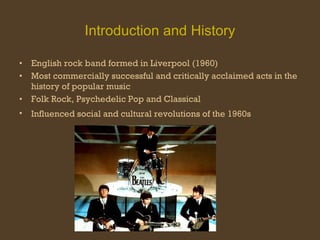
Introduction and History English rock band formed in Liverpool (1960) Most commercially successful and critically acclaimed acts in the history of popular music Folk Rock, Psychedelic Pop and Classical Influenced social and cultural revolutions of the 1960s
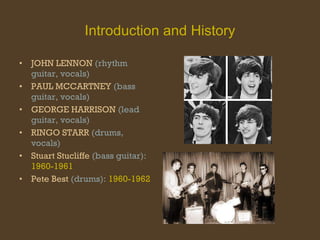
Introduction and History JOHN LENNON  (rhythm guitar, vocals) PAUL MCCARTNEY  (bass guitar, vocals) GEORGE HARRISON  (lead guitar, vocals) RINGO STARR  (drums, vocals) Stuart Stucliffe  (bass guitar):   1960-1961 Pete Best  (drums):   1960-1962
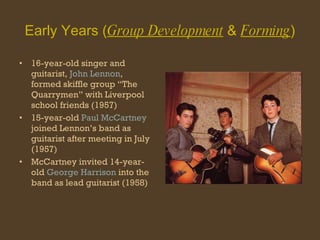
Early Years ( Group Development  &  Forming ) 16-year-old singer and guitarist,  John Lennon , formed skiffle group “The Quarrymen” with Liverpool school friends (1957) 15-year-old  Paul McCartney  joined Lennon’s band as guitarist after meeting in July (1957) McCartney invited 14-year-old  George Harrison  into the band as lead guitarist (1958)
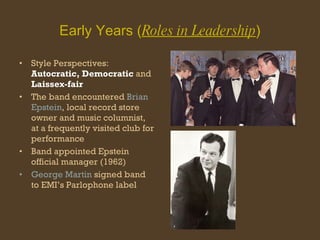
Early Years ( Roles in Leadership ) Style Perspectives:  Autocratic, Democratic  and  Laissex-fair The band encountered  Brian Epstein , local record store owner and music columnist, at a frequently visited club for performance Band appointed Epstein official manager (1962) George Martin  signed band to EMI’s Parlophone label
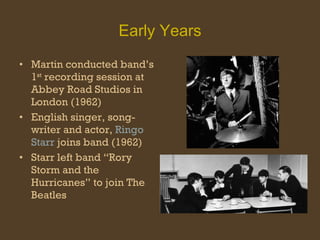
Early Years Martin conducted band’s 1 st  recording session at Abbey Road Studios in London (1962) English singer, song-writer and actor,  Ringo Starr  joins band (1962) Starr left band “Rory Storm and the Hurricanes” to join The Beatles
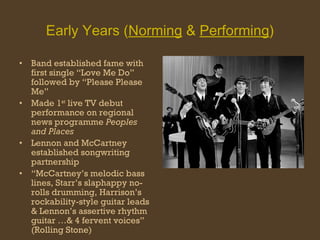
Early Years ( Norming  &  Performing ) Band established fame with first single “Love Me Do” followed by “Please Please Me” Made 1 st  live TV debut performance on regional news programme  Peoples and Places Lennon and McCartney established songwriting partnership “ McCartney’s melodic bass lines, Starr’s slaphappy no-rolls drumming, Harrison’s rockability-style guitar leads & Lennon’s assertive rhythm guitar …& 4 fervent voices” (Rolling Stone)
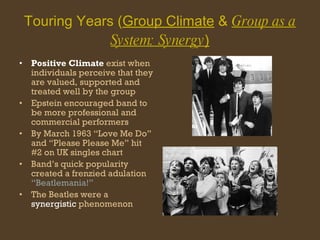
Touring Years ( Group Climate  &  Group as a System: Synergy ) Positive Climate  exist when individuals perceive that they are valued, supported and treated well by the group Epstein encouraged band to be more professional and commercial performers By March 1963 “Love Me Do” and “Please Please Me” hit #2 on UK singles chart Band’s quick popularity created a frenzied adulation  “Beatlemania!” The Beatles were a  synergistic  phenomenon
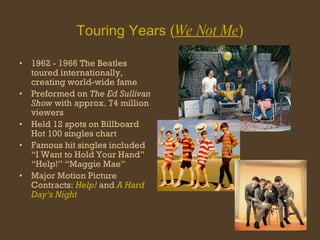
Touring Years ( We Not Me ) 1962 - 1966 The Beatles toured internationally, creating world-wide fame Preformed on  The Ed Sullivan Show  with approx. 74 million viewers Held 12 spots on Billboard Hot 100 singles chart Famous hit singles included “I Want to Hold Your Hand” “Help!” “Maggie Mae”  Major Motion Picture Contracts:  Help!  and  A Hard Day’s Night
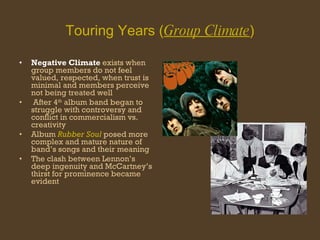
Touring Years ( Group Climate ) Negative Climate  exists when group members do not feel valued, respected, when trust is minimal and members perceive not being treated well After 4 th  album band began to struggle with controversy and conflict in commercialism vs. creativity Album  Rubber Soul   posed more complex and mature nature of band’s songs and their meaning The clash between Lennon’s deep ingenuity and McCartney’s thirst for prominence became evident
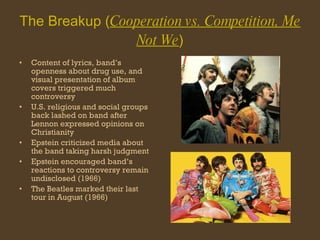
The Breakup ( Cooperation vs. Competition, Me Not We ) Content of lyrics, band’s openness about drug use, and visual presentation of album covers triggered much controversy U.S. religious and social groups back lashed on band after Lennon expressed opinions on Christianity Epstein criticized media about the band taking harsh judgment Epstein encouraged band’s reactions to controversy remain undisclosed (1966) The Beatles marked their last tour in August (1966)
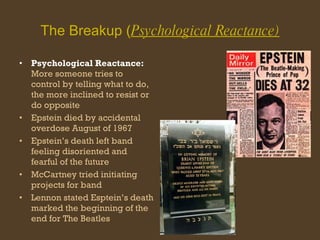
The Breakup ( Psychological Reactance) Psychological Reactance:  More someone tries to control by telling what to do, the more inclined to resist or do opposite Epstein died by accidental overdose August of 1967 Epstein’s death left band feeling disoriented and fearful of the future McCartney tried initiating projects for band  Lennon stated Esptein’s death marked the beginning of the end for The Beatles
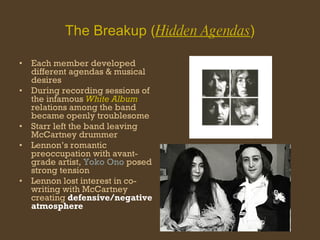
The Breakup ( Hidden Agendas ) Each member developed different agendas & musical desires During recording sessions of the infamous  White Album  relations among the band became openly troublesome Starr left the band leaving McCartney drummer Lennon’s romantic preoccupation with avant-grade artist,  Yoko Ono  posed strong tension Lennon lost interest in co-writing with McCartney creating  defensive/negative atmosphere
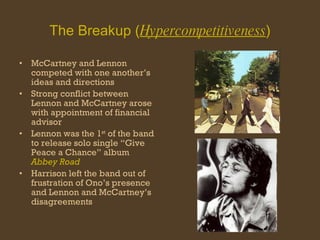
The Breakup ( Hypercompetitiveness ) McCartney and Lennon competed with one another’s ideas and directions Strong conflict between Lennon and McCartney arose with appointment of financial advisor Lennon was the 1 st  of the band to release solo single “Give Peace a Chance” album  Abbey Road Harrison left the band out of frustration of Ono’s presence and Lennon and McCartney’s disagreements
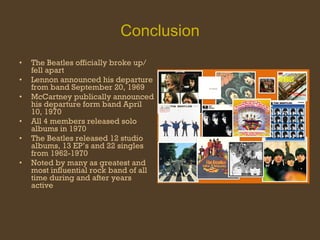
Conclusion The Beatles officially broke up/ fell apart Lennon announced his departure from band September 20, 1969 McCartney publically announced his departure form band April 10, 1970 All 4 members released solo albums in 1970 The Beatles released 12 studio albums, 13 EP’s and 22 singles from 1962-1970 Noted by many as greatest and most influential rock band of all time during and after years active
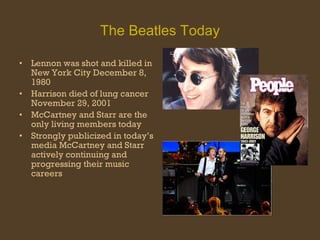
The Beatles Today Lennon was shot and killed in New York City December 8, 1980 Harrison died of lung cancer November 29, 2001 McCartney and Starr are the only living members today Strongly publicized in today’s media McCartney and Starr  actively continuing and progressing their music careers
The End  “Let It Be.”

FINAL BEATLES PP (Presentation Copy)

  • 1.
    ..“Oh I getby with a little help from my friends..” 1960 – 1970
  • 2.
    Thesis The destructionof The Beatles caused by their unified group evolving into an assembly of individuals with radically diverse ideas and goals.
  • 3.
    Main Points Forming/GroupDevelopment Roles in Leadership Performing Group Climate (positive/negative) Group as a System (synergy) We Not Me/Me Not We Cooperation vs. Competition Psychological Reactance Hidden Agendas Hypercompetitiveness
  • 4.
    Introduction and HistoryEnglish rock band formed in Liverpool (1960) Most commercially successful and critically acclaimed acts in the history of popular music Folk Rock, Psychedelic Pop and Classical Influenced social and cultural revolutions of the 1960s
  • 5.
    Introduction and HistoryJOHN LENNON (rhythm guitar, vocals) PAUL MCCARTNEY (bass guitar, vocals) GEORGE HARRISON (lead guitar, vocals) RINGO STARR (drums, vocals) Stuart Stucliffe (bass guitar): 1960-1961 Pete Best (drums): 1960-1962
  • 6.
    Early Years (Group Development & Forming ) 16-year-old singer and guitarist, John Lennon , formed skiffle group “The Quarrymen” with Liverpool school friends (1957) 15-year-old Paul McCartney joined Lennon’s band as guitarist after meeting in July (1957) McCartney invited 14-year-old George Harrison into the band as lead guitarist (1958)
  • 7.
    Early Years (Roles in Leadership ) Style Perspectives: Autocratic, Democratic and Laissex-fair The band encountered Brian Epstein , local record store owner and music columnist, at a frequently visited club for performance Band appointed Epstein official manager (1962) George Martin signed band to EMI’s Parlophone label
  • 8.
    Early Years Martinconducted band’s 1 st recording session at Abbey Road Studios in London (1962) English singer, song-writer and actor, Ringo Starr joins band (1962) Starr left band “Rory Storm and the Hurricanes” to join The Beatles
  • 9.
    Early Years (Norming & Performing ) Band established fame with first single “Love Me Do” followed by “Please Please Me” Made 1 st live TV debut performance on regional news programme Peoples and Places Lennon and McCartney established songwriting partnership “ McCartney’s melodic bass lines, Starr’s slaphappy no-rolls drumming, Harrison’s rockability-style guitar leads & Lennon’s assertive rhythm guitar …& 4 fervent voices” (Rolling Stone)
  • 10.
    Touring Years (Group Climate & Group as a System: Synergy ) Positive Climate exist when individuals perceive that they are valued, supported and treated well by the group Epstein encouraged band to be more professional and commercial performers By March 1963 “Love Me Do” and “Please Please Me” hit #2 on UK singles chart Band’s quick popularity created a frenzied adulation “Beatlemania!” The Beatles were a synergistic phenomenon
  • 11.
    Touring Years (We Not Me ) 1962 - 1966 The Beatles toured internationally, creating world-wide fame Preformed on The Ed Sullivan Show with approx. 74 million viewers Held 12 spots on Billboard Hot 100 singles chart Famous hit singles included “I Want to Hold Your Hand” “Help!” “Maggie Mae” Major Motion Picture Contracts: Help! and A Hard Day’s Night
  • 12.
    Touring Years (Group Climate ) Negative Climate exists when group members do not feel valued, respected, when trust is minimal and members perceive not being treated well After 4 th album band began to struggle with controversy and conflict in commercialism vs. creativity Album Rubber Soul posed more complex and mature nature of band’s songs and their meaning The clash between Lennon’s deep ingenuity and McCartney’s thirst for prominence became evident
  • 13.
    The Breakup (Cooperation vs. Competition, Me Not We ) Content of lyrics, band’s openness about drug use, and visual presentation of album covers triggered much controversy U.S. religious and social groups back lashed on band after Lennon expressed opinions on Christianity Epstein criticized media about the band taking harsh judgment Epstein encouraged band’s reactions to controversy remain undisclosed (1966) The Beatles marked their last tour in August (1966)
  • 14.
    The Breakup (Psychological Reactance) Psychological Reactance: More someone tries to control by telling what to do, the more inclined to resist or do opposite Epstein died by accidental overdose August of 1967 Epstein’s death left band feeling disoriented and fearful of the future McCartney tried initiating projects for band Lennon stated Esptein’s death marked the beginning of the end for The Beatles
  • 15.
    The Breakup (Hidden Agendas ) Each member developed different agendas & musical desires During recording sessions of the infamous White Album relations among the band became openly troublesome Starr left the band leaving McCartney drummer Lennon’s romantic preoccupation with avant-grade artist, Yoko Ono posed strong tension Lennon lost interest in co-writing with McCartney creating defensive/negative atmosphere
  • 16.
    The Breakup (Hypercompetitiveness ) McCartney and Lennon competed with one another’s ideas and directions Strong conflict between Lennon and McCartney arose with appointment of financial advisor Lennon was the 1 st of the band to release solo single “Give Peace a Chance” album Abbey Road Harrison left the band out of frustration of Ono’s presence and Lennon and McCartney’s disagreements
  • 17.
    Conclusion The Beatlesofficially broke up/ fell apart Lennon announced his departure from band September 20, 1969 McCartney publically announced his departure form band April 10, 1970 All 4 members released solo albums in 1970 The Beatles released 12 studio albums, 13 EP’s and 22 singles from 1962-1970 Noted by many as greatest and most influential rock band of all time during and after years active
  • 18.
    The Beatles TodayLennon was shot and killed in New York City December 8, 1980 Harrison died of lung cancer November 29, 2001 McCartney and Starr are the only living members today Strongly publicized in today’s media McCartney and Starr actively continuing and progressing their music careers
  • 19.
    The End “Let It Be.”