r protected members of a class. A friend function, despite not being a member of the class, can access the private and protected data of the class in which it is declared as a friend. This functionality is useful in specific scenarios, especially when two or more classes need to share data directly without using getter and setter functions.
This PowerPoint presentation aims to provide a comprehensive understanding of the Friend Function through detailed explanations, syntax breakdowns, real-world use cases, and illustrative examples.
The presentation begins with an introduction to encapsulation and data hiding, which are fundamental to understanding the need for friend functions. It explains how classes in C++ typically hide their data from the outside world to protect it from unauthorized access. However, there are cases where controlled access is necessary—for example, when two different classes need to collaborate closely. In such cases, a friend function becomes a bridge that facilitates access without violating the design principles of OOP.
The syntax of declaring a friend function is shown clearly:
cpp
Copy
Edit
class ClassName {
friend returnType functionName(arguments);
};
This presentation also explains that friend functions can be:
A normal non-member function.
A member of another class.
A global function.
The slides further illustrate the advantages of using friend functions, such as:
Enabling operator overloading (e.g., << and >>) outside the class.
Facilitating interaction between multiple classes.
Granting selective access to class internals without breaking the overall design integrity.
The concept is made clearer with examples such as overloading the << operator for a class, where a friend function allows the ostream object to access private members of the class for formatted output. Additionally, an example demonstrating a friend function accessing private members of two different classes is included to highlight how friend functions can simplify complex operations.
The presentation also discusses the limitations of friend functions:
They break encapsulation to a certain extent.
They can lead to tight coupling between classes.
Overuse may indicate a design flaw in the architecture.
To solidify the understanding, the PPT includes multiple-choice questions, code snippets, diagrams, and a comparison table between member functions and friend functions. The conclusion reiterates that while friend functions are powerful, they should be used sparingly and only when absolutely necessary.
Overall, this 3000-character presentation offers a well-rounded exploration of the friend function concept in C++. It emphasizes both the theoretical and practical aspects, ensuring that learners not only understand how to use friend functions but also when and why to use them effectively.
Would you like me to turn this into actual PowerPoint slides or provide a summarized version for a single slide?
You said:
generate a ppt
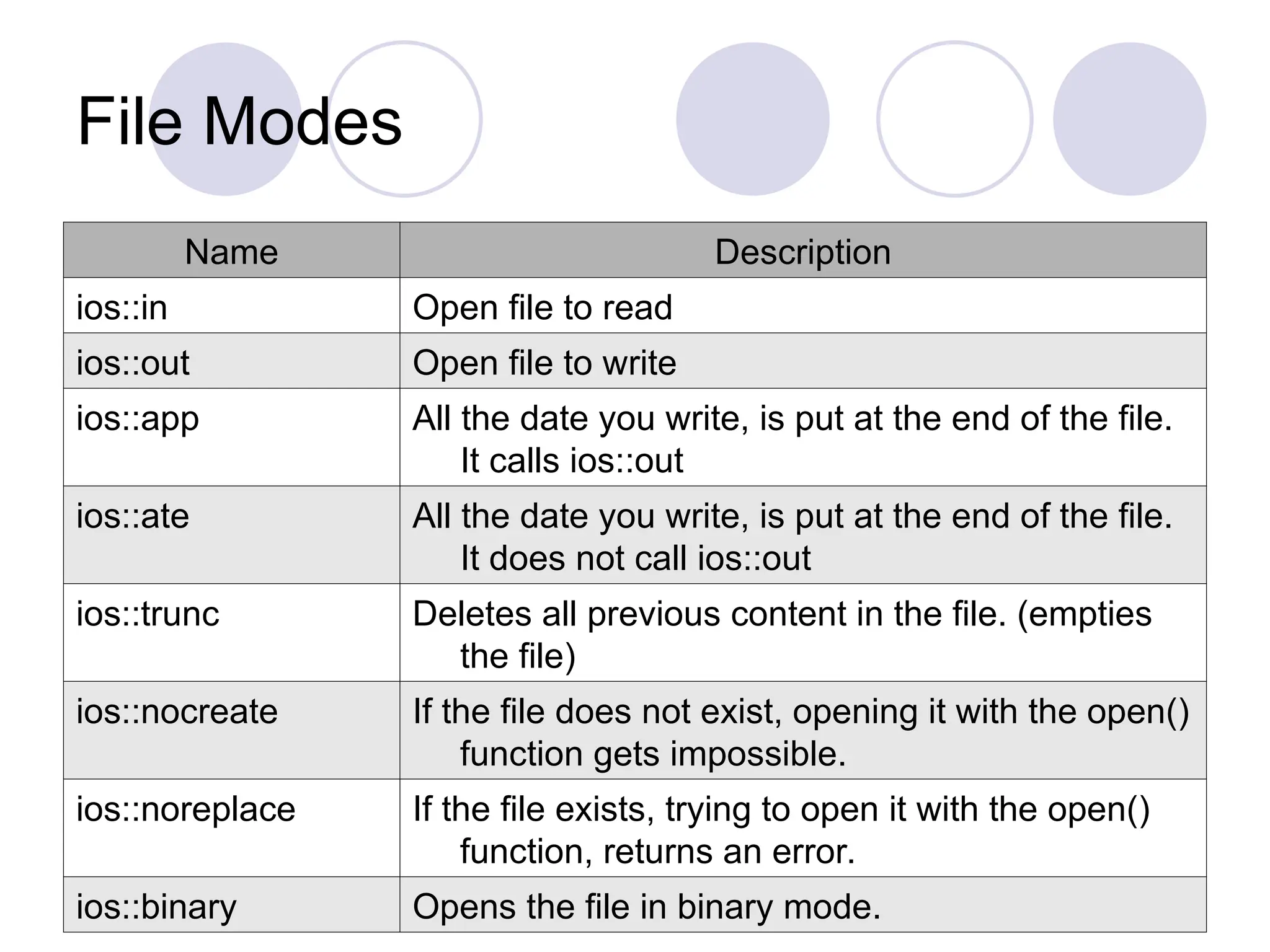
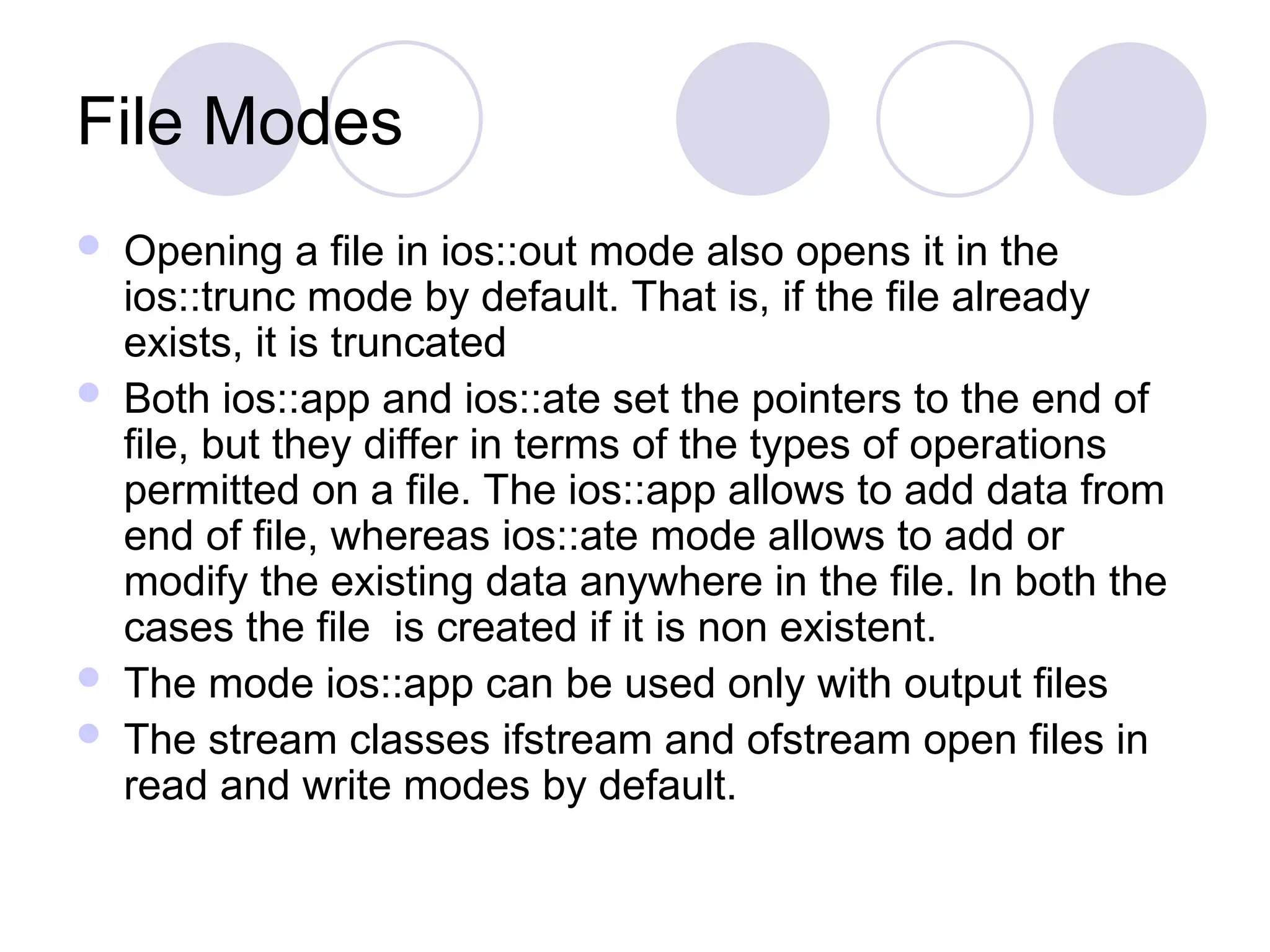
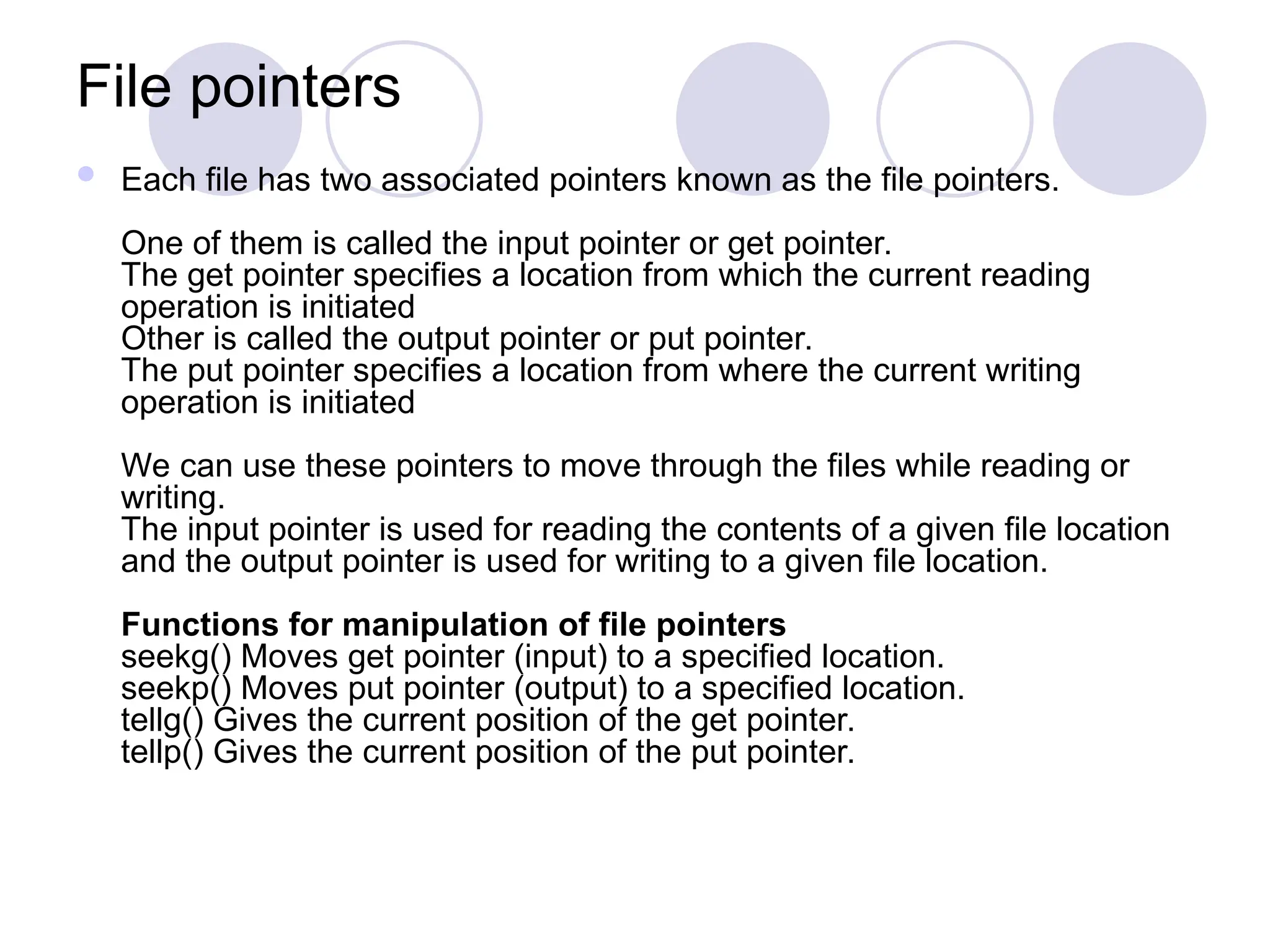
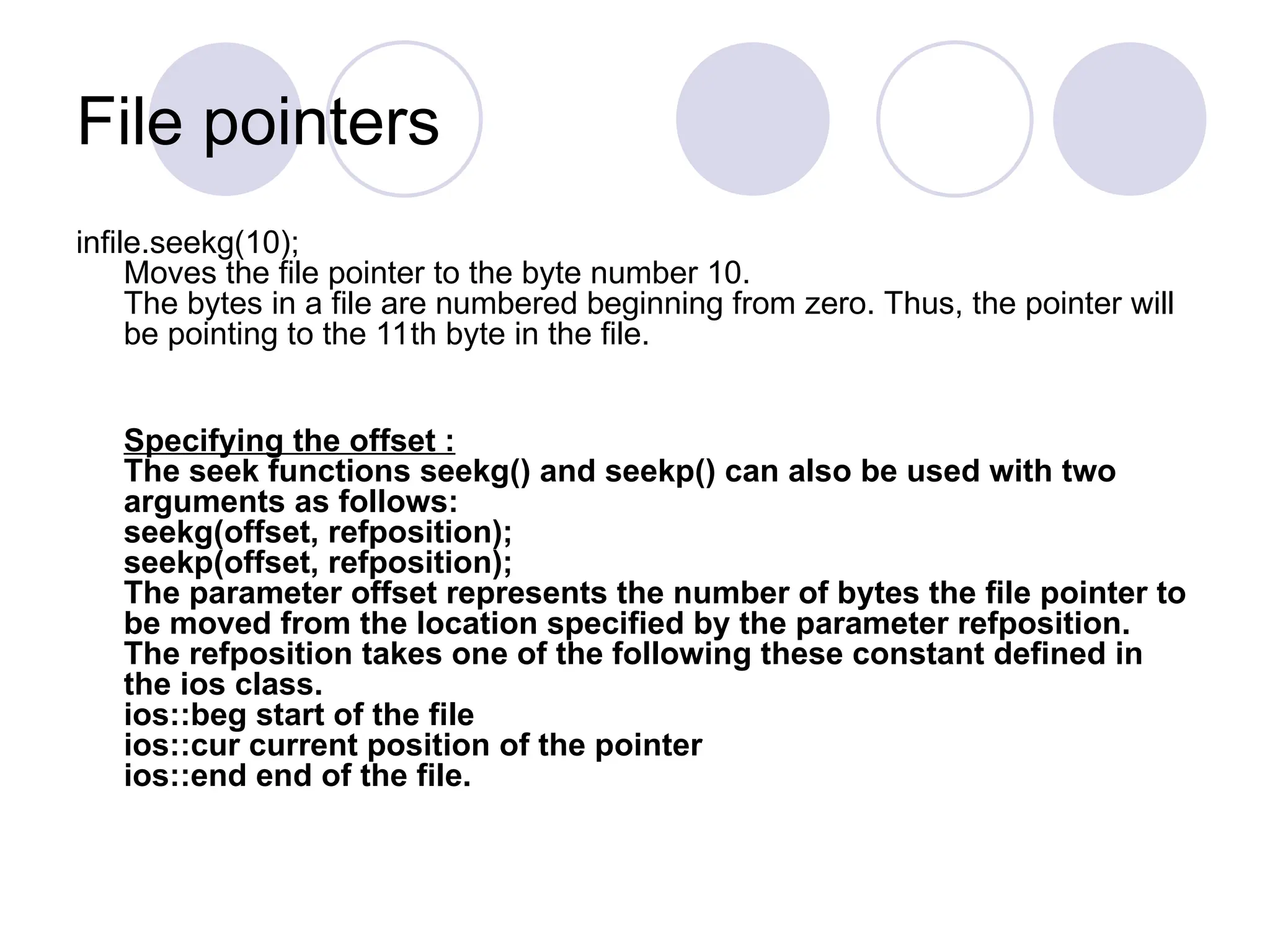
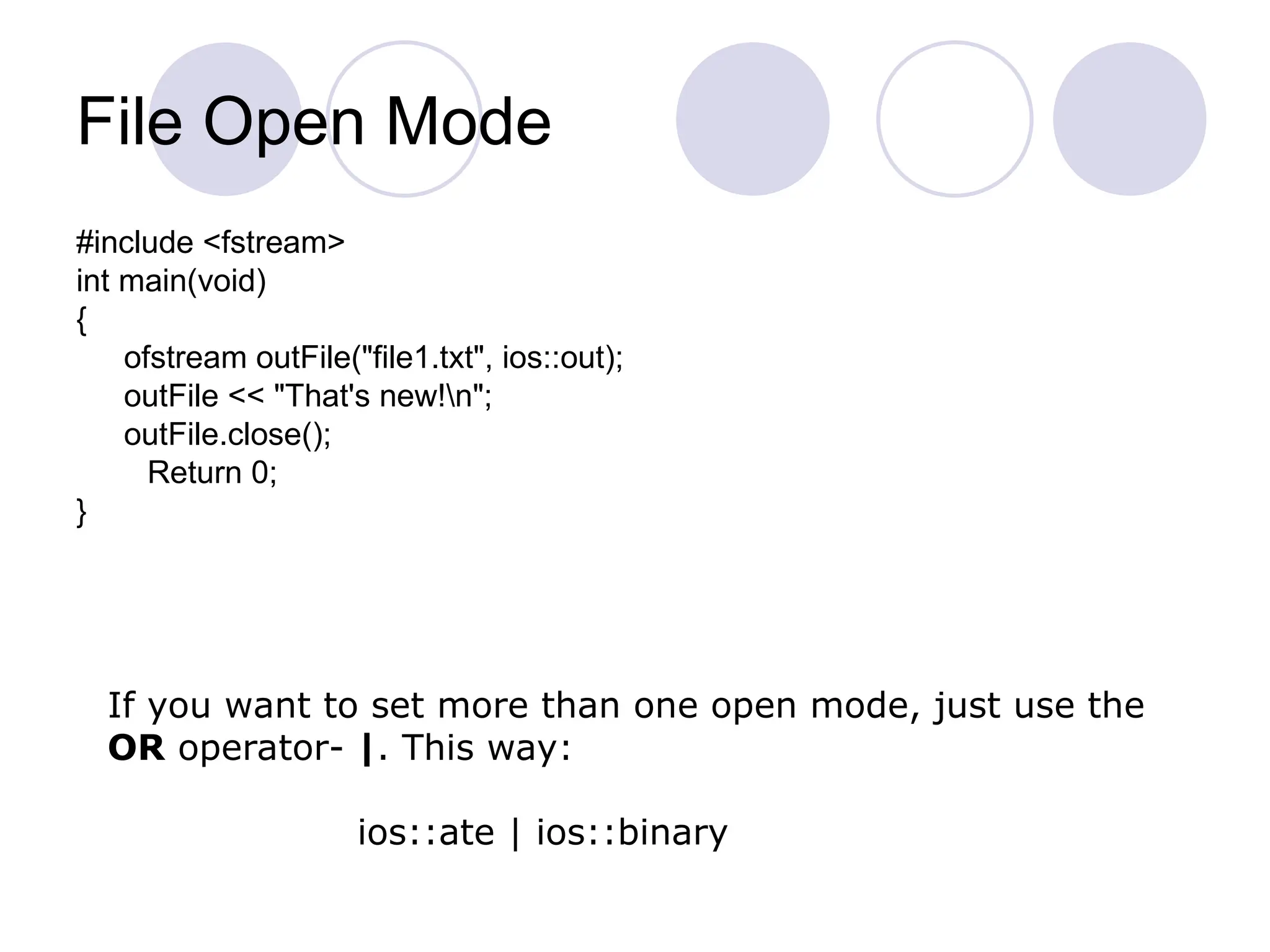
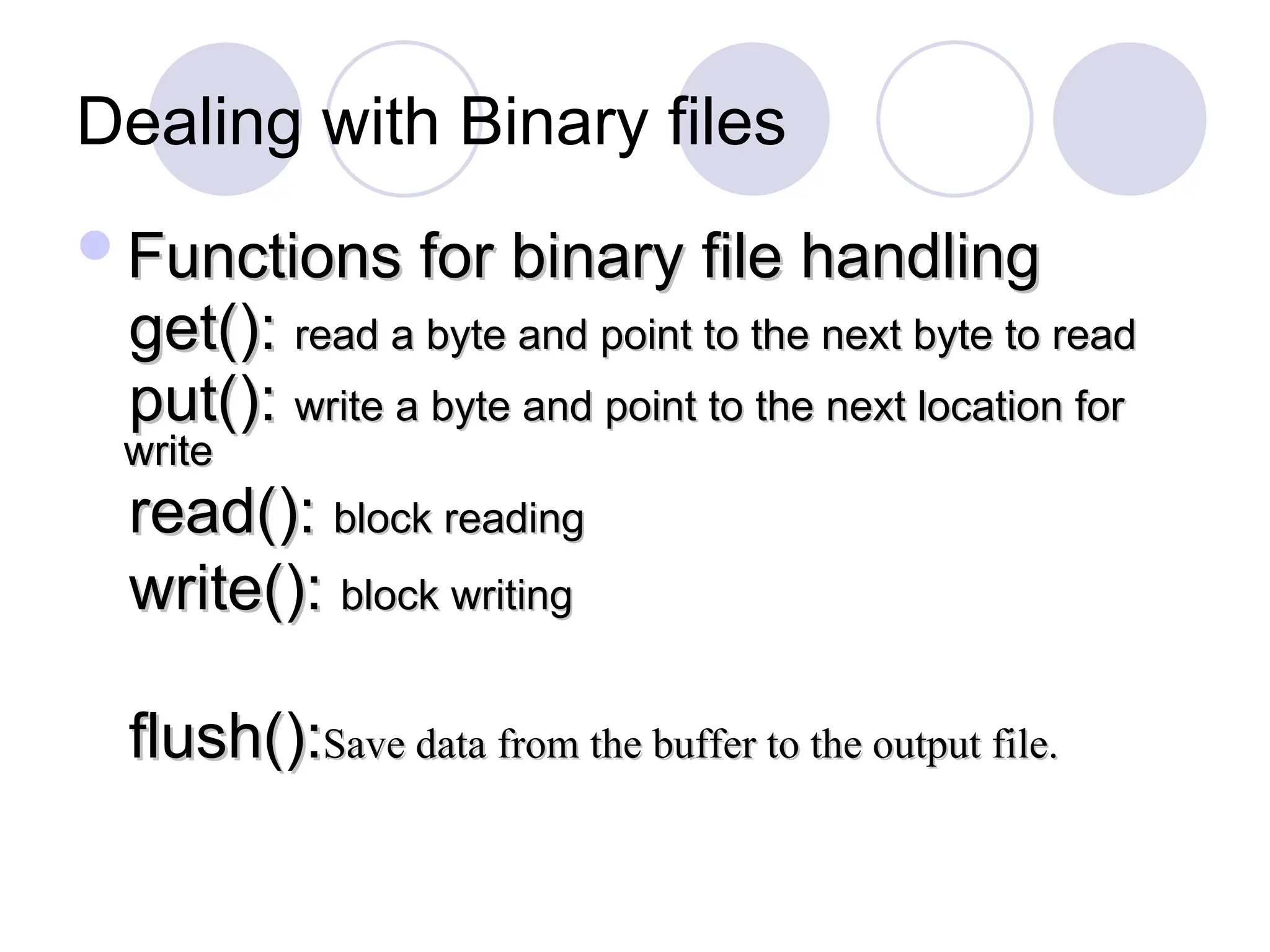
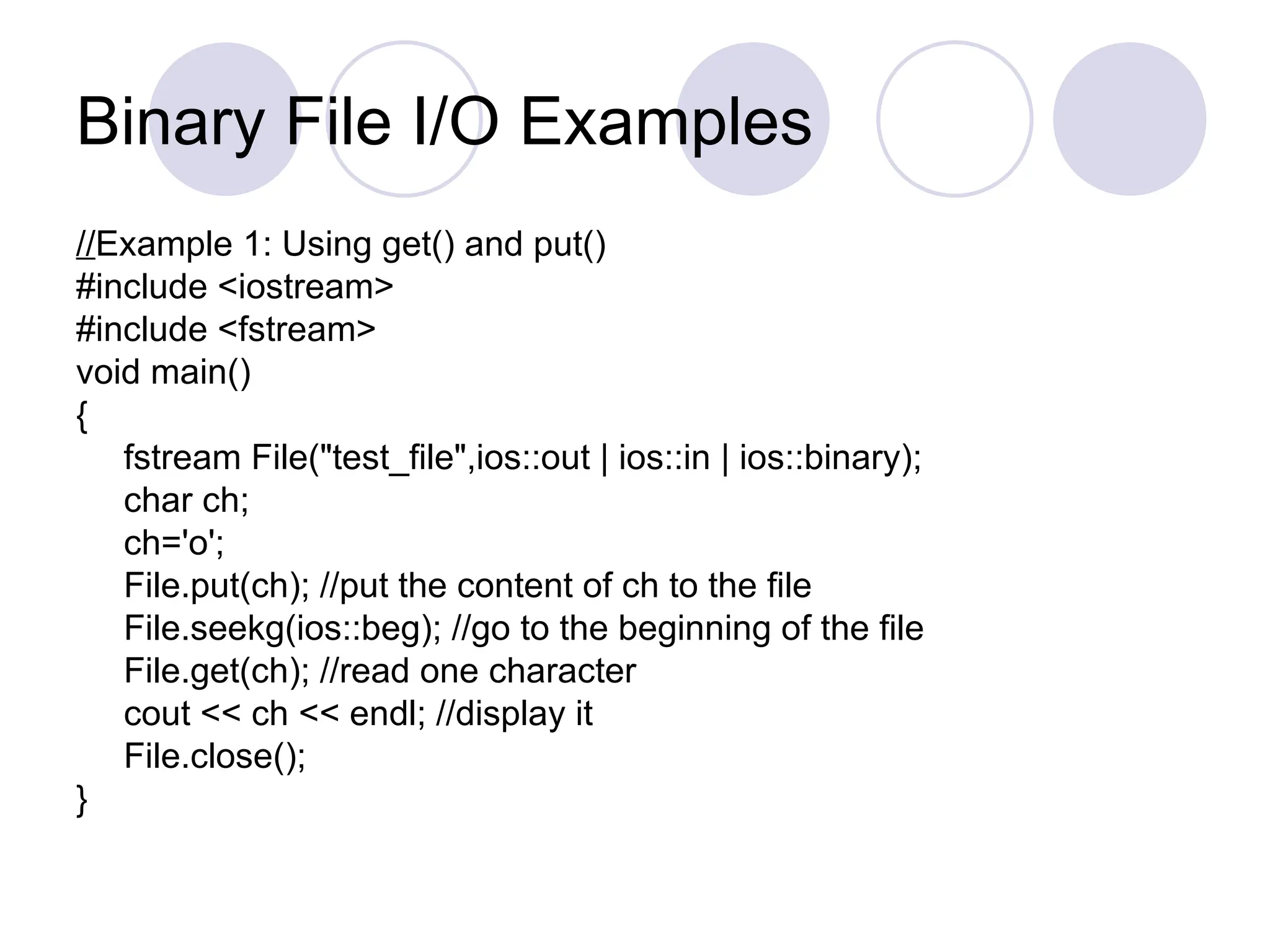
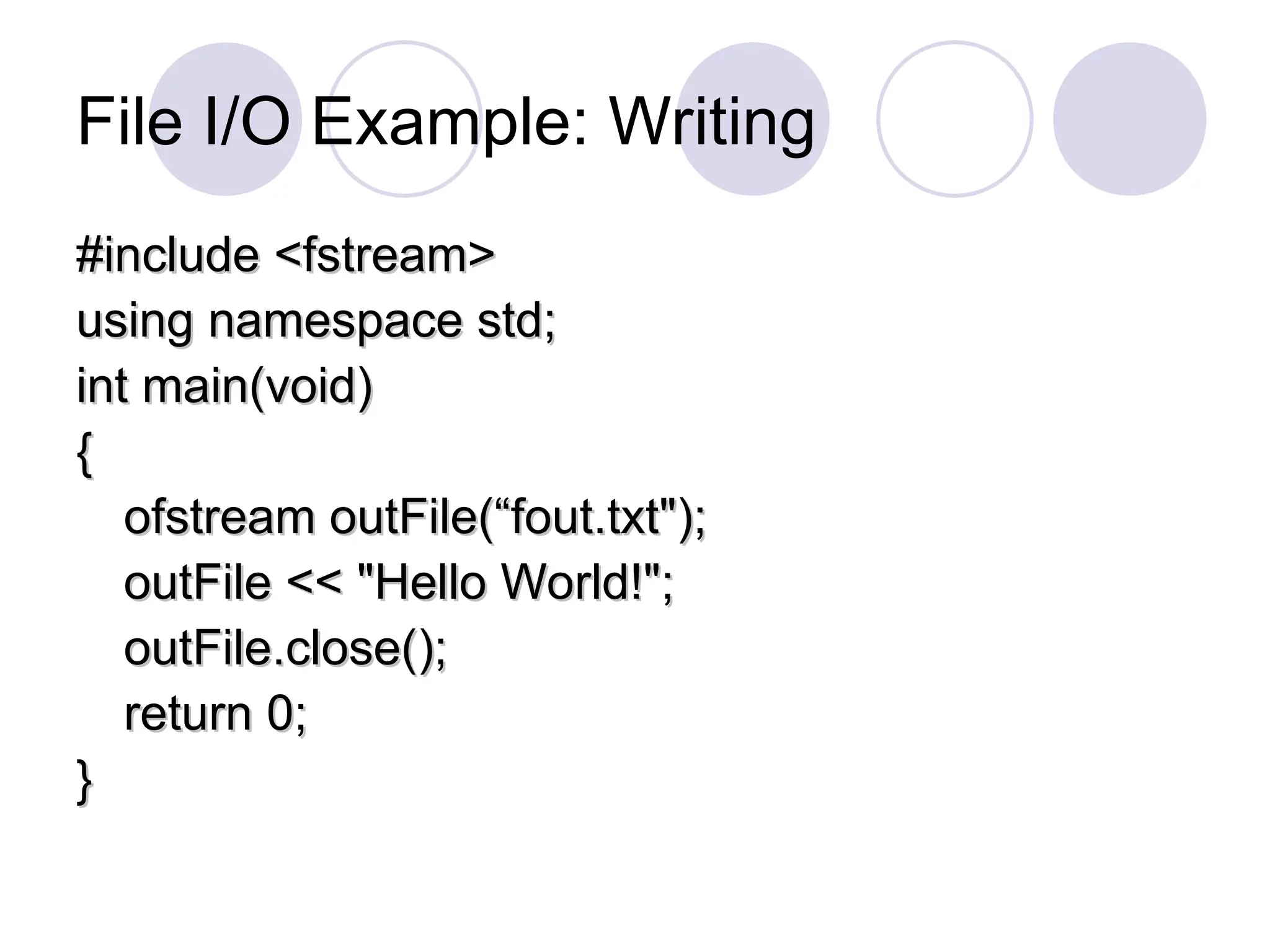
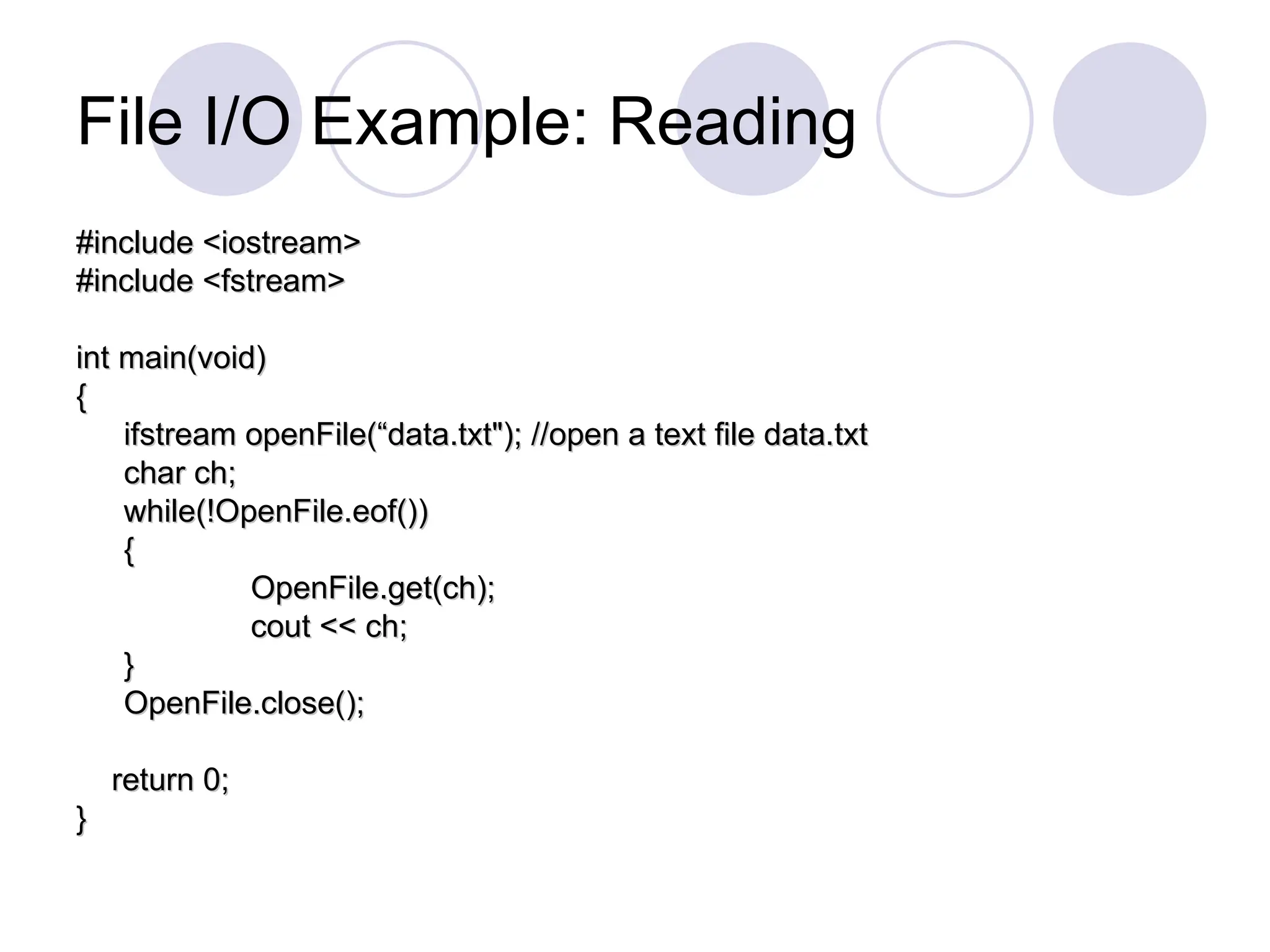
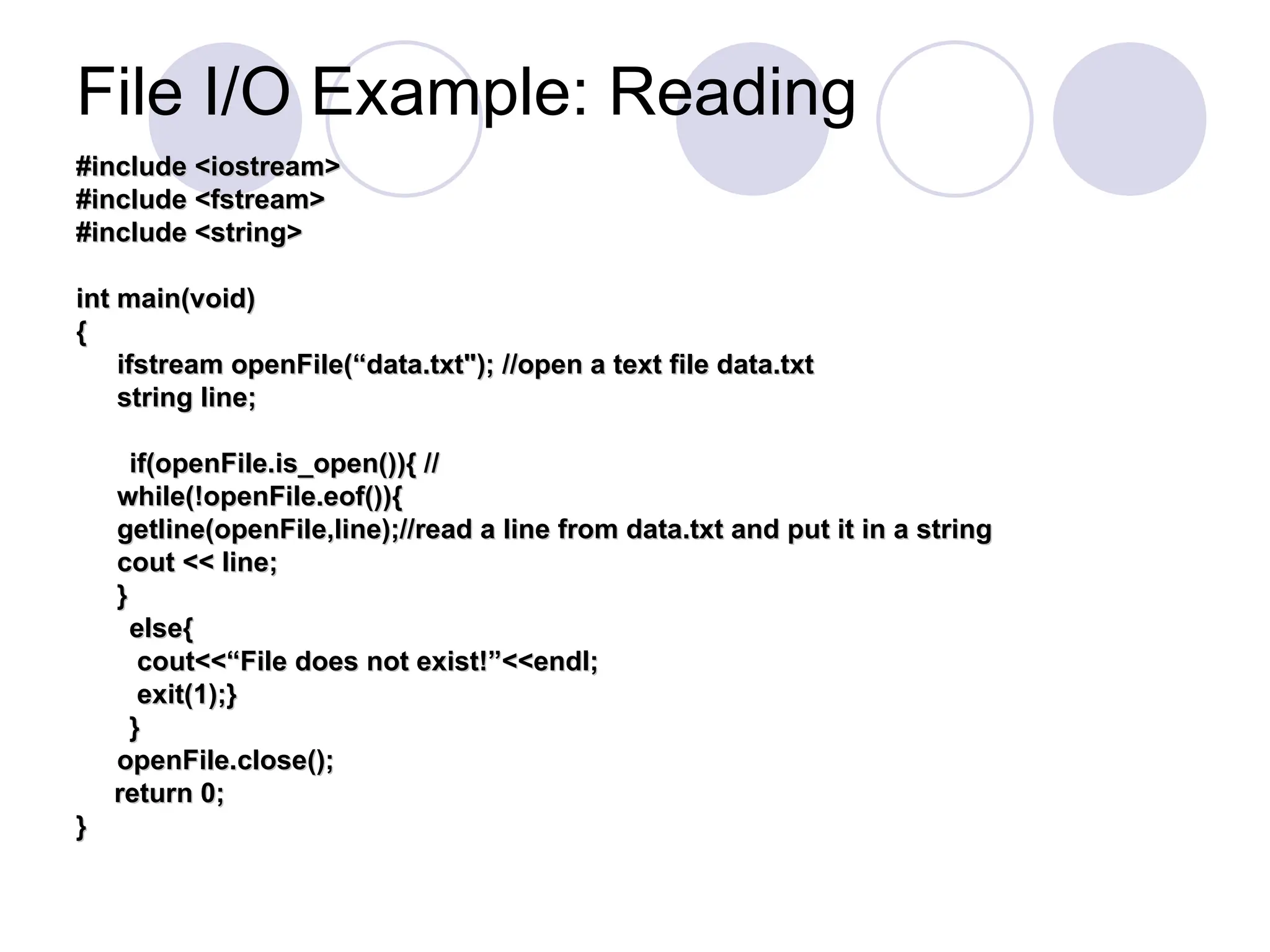
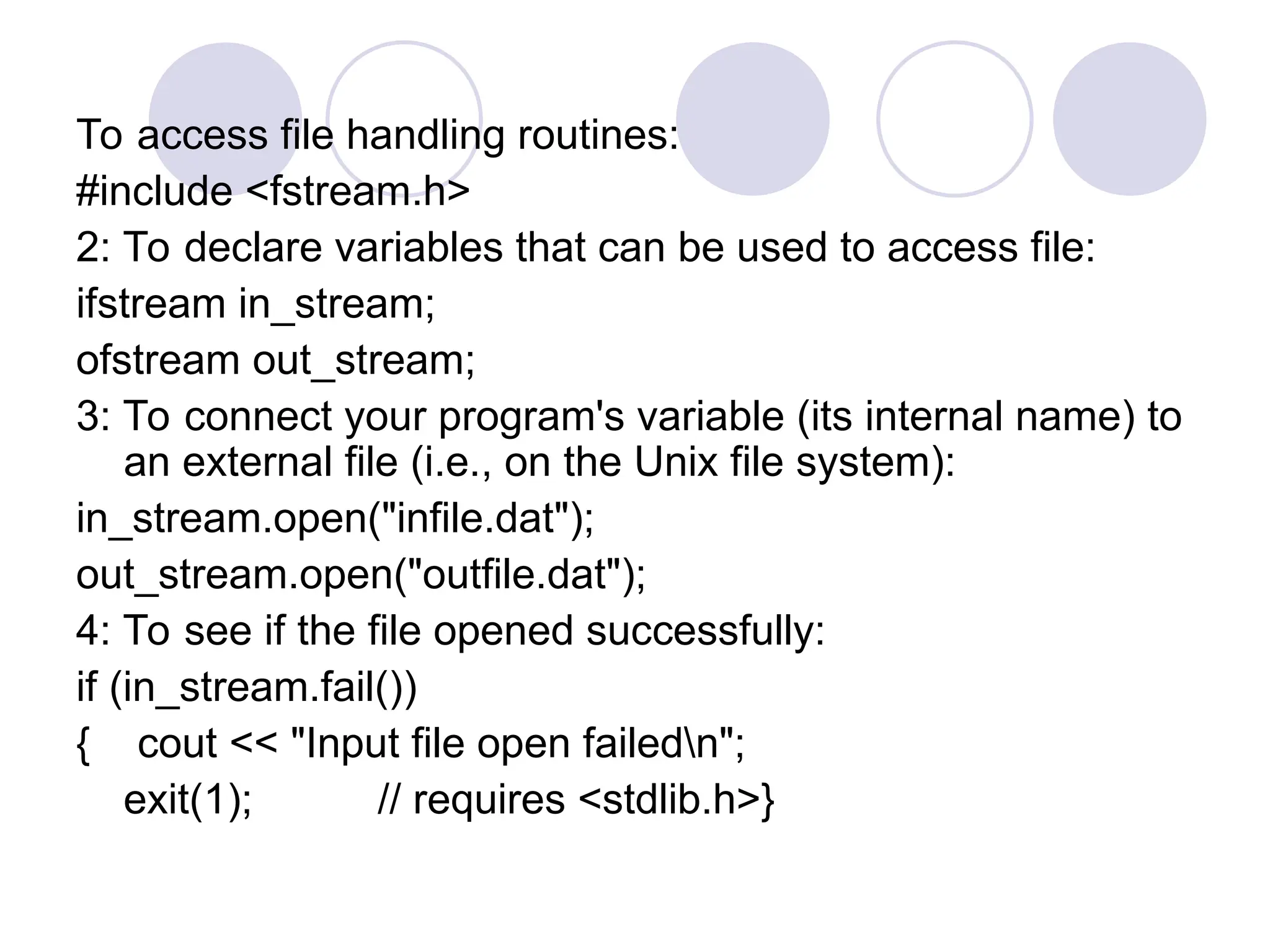
![To get data from a file (one option), must declare a variable
to hold the data and then read it using the extraction
operator:
int num;
in_stream >> num;
[Compare: cin >> num;]
6: To put data into a file, use insertion operator:
out_stream << num;
[Compare: cout << num;]
NOTE: Streams are sequential – data is read and written in
order – generally can't back up.
7: When done with the file:
in_stream.close();
out_stream.close();](https://image.slidesharecdn.com/filehandlinginc-250430155451-a7e92c86/75/file_handling_in_c-pptbbbbbbbbbbbbbbbbbbbbb-24-2048.jpg)
![Reading /Writing from/to Binary Files
To write n bytes:
write (const unsigned char* buffer, int n);
To read n bytes (to a pre-allocated buffer):
read (unsighed char* buffer, int num)
#include <fstream.h>
main()
{
int array[] = {10,23,3,7,9,11,253};
ofstream OutBinaryFile("my_b_file.txt“, ios::out |
ios::binary);
OutBinaryFile.write((char*) array, sizeof(array));
OutBinaryFile.close();
}](https://image.slidesharecdn.com/filehandlinginc-250430155451-a7e92c86/75/file_handling_in_c-pptbbbbbbbbbbbbbbbbbbbbb-25-2048.jpg)
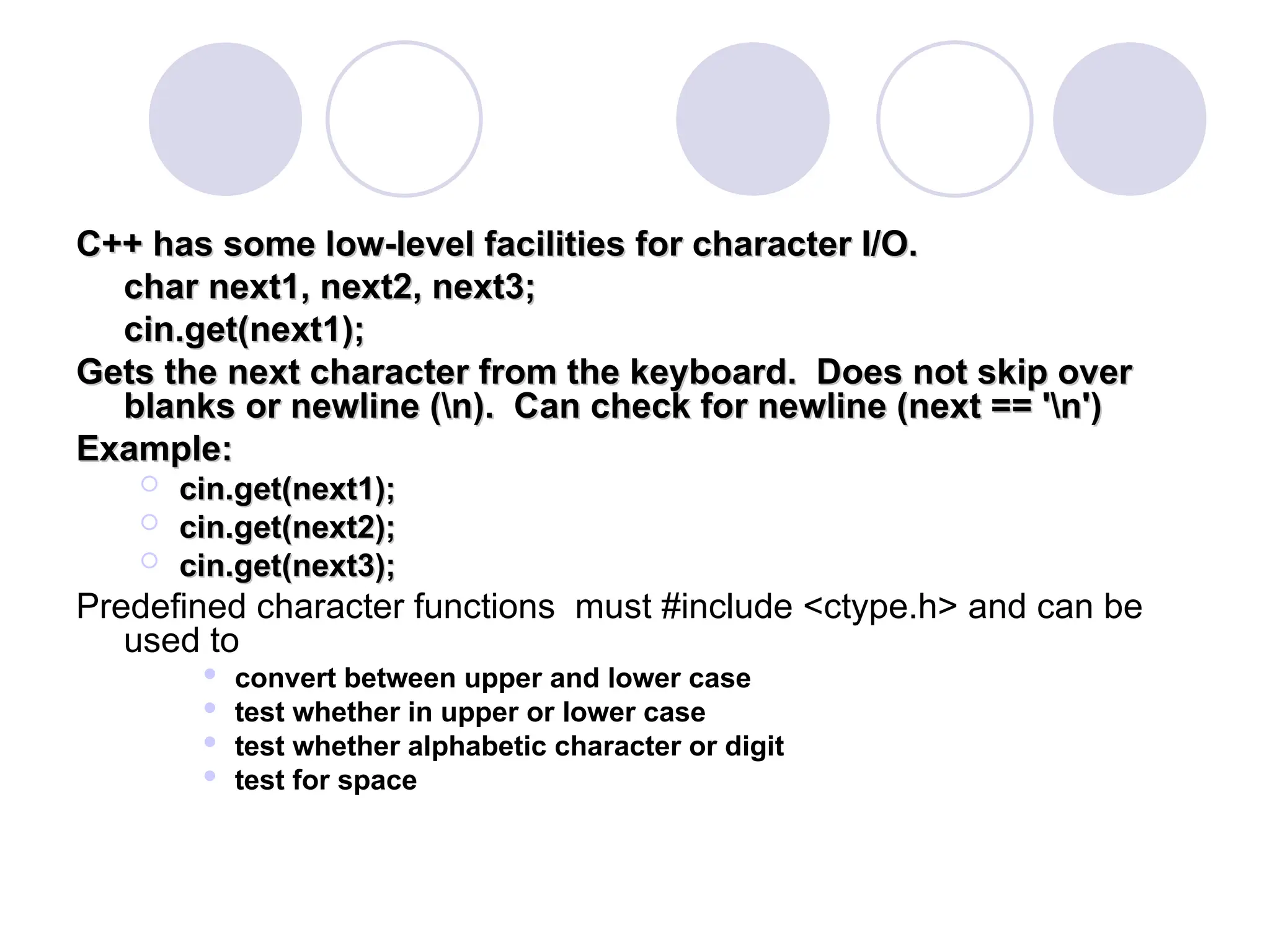
![Reading /Writing from/to Textual Files
#include <fstream.h>
main()
{
// Writing to file
ofstream OutFile("my_file.txt");
OutFile<<"Hello "<<5<<endl;
OutFile.close();
int number;
char dummy[15];
// Reading from file
ifstream InFile("my_file.txt");
InFile>>dummy>>number;
InFile.seekg(0);
InFile.getline(dummy,sizeof(dummy));
InFile.close();
}
To write:
put() – writing single character
<< operator – writing an object
To read:
get() – reading a single character of a
buffer
getline() – reading a single line
>> operator – reading a object](https://image.slidesharecdn.com/filehandlinginc-250430155451-a7e92c86/75/file_handling_in_c-pptbbbbbbbbbbbbbbbbbbbbb-27-2048.jpg)
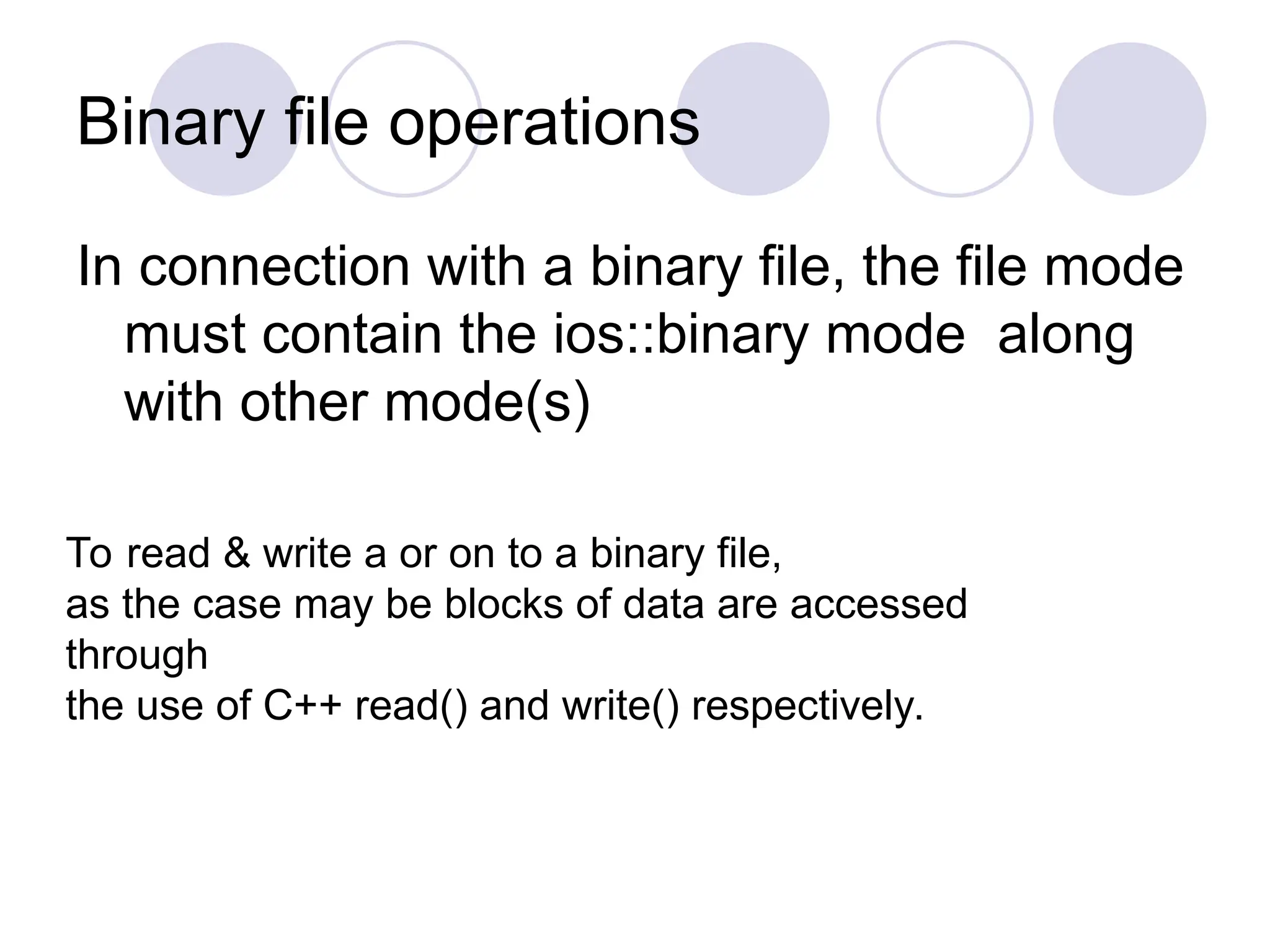
![Handling binary data
#include <fstream>
using namespace std;
int main(){
ifstream in(“binfile.dat”);
ofstream out(“out.dat”);
if(!in || !out) { // return}
unsigned int buf[1024];
while(!in){
in.read(buf, sizeof(unsigned
int)*1024);
out.write(buf, sizeof(unsigned
int)*1024);
}](https://image.slidesharecdn.com/filehandlinginc-250430155451-a7e92c86/75/file_handling_in_c-pptbbbbbbbbbbbbbbbbbbbbb-29-2048.jpg)


