PICT, Pune. Mrs. Madhuri S. Patil
OBJECT ORIENTED PROGRAMMING
USING
C++ (OOPCF-015)
PICT, Pune. Mrs. Madhuri S. Patil
Prerequisite:
1. Problem-Solving Skills
โ— Ability to think logically and break down problems into smaller, manageable parts for coding solutions.
2. Familiarity with Basic Programming Concepts
โ— Variables and Data Types: Understanding how to declare variables and use different data types (e.g.,
integers, floats, characters).
โ— Control Structures: Basic knowledge of loops (for, while), conditional statements (if, else), and switch-
case.
โ— Arrays, Pointers, Structures: Understanding how to declare and initialize it.
โ— Functions: Understanding how to define and call functions, pass arguments, and return values.
3. Mathematical Concepts
โ— Basic understanding of arithmetic operations, logic (AND, OR, NOT), and occasionally, basic algebra can be
useful.
http://pdvpmtasgaon.edu.in/uploads/dptcomputer/Let%20us%20c%20-%20yashwantkanetkar.pdf
https://asq.org/quality-resources/problem-solving?srsltid=AfmBOor1ZHZzuMWsNfZ7Kyoi4TInrbsKcph5TNUxpLojIVsig4zRsHbb
PICT, Pune. Mrs. Madhuri S. Patil
Introduction to Subject
OBJECT ORIENTED PROGRAMMING USING
C++ (OOPC)
PICT, Pune. Mrs. Madhuri S. Patil
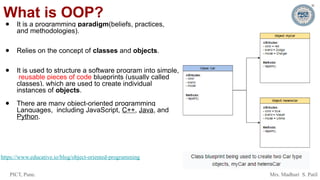
What is OOP?
โ— It is a programming paradigm(beliefs, practices,
and methodologies).
โ— Relies on the concept of classes and objects.
โ— It is used to structure a software program into simple,
reusable pieces of code blueprints (usually called
classes), which are used to create individual
instances of objects.
โ— There are many object-oriented programming
Languages, including JavaScript, C++, Java, and
Python.
https://www.educative.io/blog/object-oriented-programming
PICT, Pune. Mrs. Madhuri S. Patil
Contโ€ฆ.
โ— Object-oriented programming (OOP) is a computer programming model that
organizes software design around data, or objects, rather than functions and
logic. An object can be defined as a data field that has unique attributes and
behavior.
โ— OOP focuses on the objects that developers want to manipulate rather than
the logic required to manipulate them. This approach to programming is well
suited for software that is large, complex and actively updated or maintained.
PICT, Pune. Mrs. Madhuri S. Patil
โ— Once an object is known, it is labeled with a class of objects that defines the kind of
data it contains and any logic sequences that can manipulate it. Each distinct logic
sequence is known as a method. Objects can communicate with well-defined
interfaces called messages.
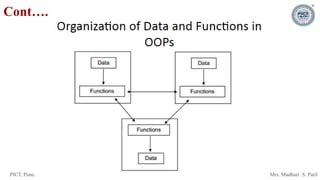
โ— It ties data more closely to the function that operate on it , and protect it from
modification from outside function.
Object-oriented programming (OOP)
https://www.techtarget.com/searchapparchitecture/definition/object-oriented-programming-OOP
Contโ€ฆ.
PICT, Pune. Mrs. Madhuri S. Patil
Contโ€ฆ.
PICT, Pune. Mrs. Madhuri S. Patil
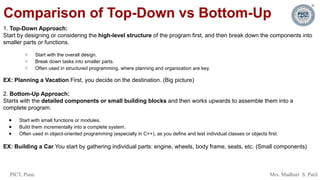
Comparison of Top-Down vs Bottom-Up
1. Top-Down Approach:
Start by designing or considering the high-level structure of the program first, and then break down the components into
smaller parts or functions.
โ—‹ Start with the overall design.
โ—‹ Break down tasks into smaller parts.
โ—‹ Often used in structured programming, where planning and organization are key.
EX: Planning a Vacation First, you decide on the destination. (Big picture)
2. Bottom-Up Approach:
Starts with the detailed components or small building blocks and then works upwards to assemble them into a
complete program.
โ— Start with small functions or modules.
โ— Build them incrementally into a complete system.
โ— Often used in object-oriented programming (especially in C++), as you define and test individual classes or objects first.
EX: Building a Car You start by gathering individual parts: engine, wheels, body frame, seats, etc. (Small components)
PICT, Pune. Mrs. Madhuri S. Patil
OBJECT-ORIENTED FUNDAMENTALS
Module-I
PICT, Pune. Mrs. Madhuri S. Patil
Content:
โ— Need of Object-Oriented Programming (OOP)
โ— Features of OOP
โ— Introduction to C++
โ— Structure of C++ program
โ— Built-in and user defined data types
โ— Access specifiers
โ— Examples illustrating
โ— Creation of classes and objects
โ— Constructors and Destructors - Default Arguments,Copy Constructors, Default
constructors, Parameterized constructors, Destructor.
PICT, Pune. Mrs. Madhuri S. Patil
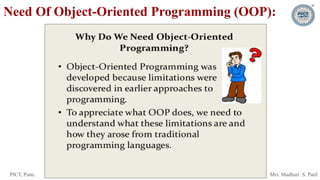
Need Of Object-Oriented Programming (OOP):
PICT, Pune. Mrs. Madhuri S. Patil
Contโ€ฆ
โ— Can represent real world entity.
โ— Open interface.
โ— Reusability and flexibility.
โ— Tolerate change in future.
โ— Productivity and decrease cost.
โ— Improve quality and cost.
โ— Manage time.
PICT, Pune. Mrs. Madhuri S. Patil
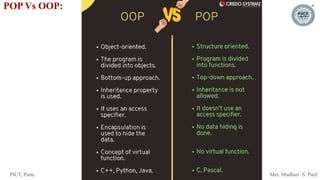
POP Vs OOP:
PICT, Pune. Mrs. Madhuri S. Patil
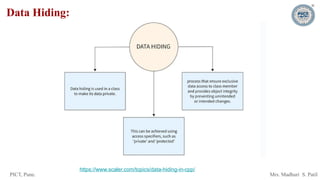
Data Hiding:
https://www.scaler.com/topics/data-hiding-in-cpp/
PICT, Pune. Mrs. Madhuri S. Patil
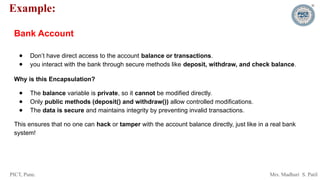
Example:
Bank Account
โ— Donโ€™t have direct access to the account balance or transactions.
โ— you interact with the bank through secure methods like deposit, withdraw, and check balance.
Why is this Encapsulation?
โ— The balance variable is private, so it cannot be modified directly.
โ— Only public methods (deposit() and withdraw()) allow controlled modifications.
โ— The data is secure and maintains integrity by preventing invalid transactions.
This ensures that no one can hack or tamper with the account balance directly, just like in a real bank
system!
PICT, Pune. Mrs. Madhuri S. Patil
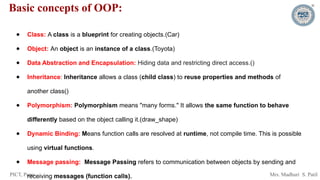
Basic concepts of OOP:
โ— Class: A class is a blueprint for creating objects.(Car)
โ— Object: An object is an instance of a class.(Toyota)
โ— Data Abstraction and Encapsulation: Hiding data and restricting direct access.()
โ— Inheritance: Inheritance allows a class (child class) to reuse properties and methods of
another class()
โ— Polymorphism: Polymorphism means "many forms." It allows the same function to behave
differently based on the object calling it.(draw_shape)
โ— Dynamic Binding: Means function calls are resolved at runtime, not compile time. This is possible
using virtual functions.
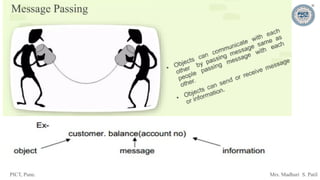
โ— Message passing: Message Passing refers to communication between objects by sending and
receiving messages (function calls).
PICT, Pune. Mrs. Madhuri S. Patil
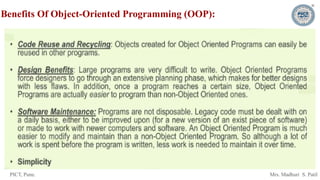
Benefits Of Object-Oriented Programming (OOP):
PICT, Pune. Mrs. Madhuri S. Patil
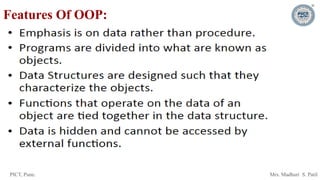
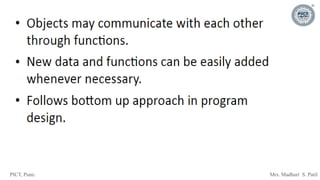
Features Of OOP:
PICT, Pune. Mrs. Madhuri S. Patil
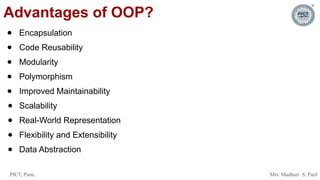
Advantages of OOP?
โ— Encapsulation
โ— Code Reusability
โ— Modularity
โ— Polymorphism
โ— Improved Maintainability
โ— Scalability
โ— Real-World Representation
โ— Flexibility and Extensibility
โ— Data Abstraction
PICT, Pune. Mrs. Madhuri S. Patil
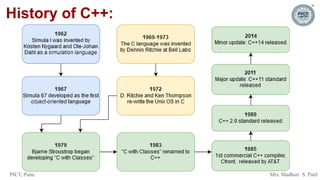
History of C++:
PICT, Pune. Mrs. Madhuri S. Patil
Introduction to C++:
โ— C++ is a cross-platform language that can be used to create high-performance applications.
โ— C++ was developed by Bjarne Stroustrup, as an extension to the C language.
โ— C++ gives programmers a high level of control over system resources and memory.
โ— C++ is an object-oriented programming language which gives a clear structure to programs and
allows code to be reused, lowering development costs.
PICT, Pune. Mrs. Madhuri S. Patil
Difference between C and C++
โ— C++ was developed as an extension of C, and both languages have almost the same syntax.
โ— The main difference between C and C++ is that C++ supports classes and objects, while C does
not.
PICT, Pune. Mrs. Madhuri S. Patil
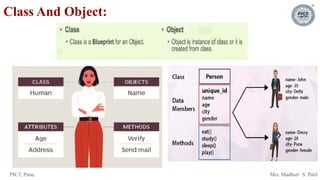
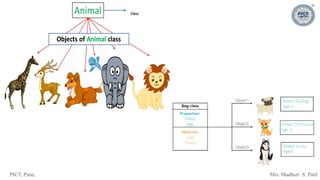
Class And Object:
PICT, Pune. Mrs. Madhuri S. Patil
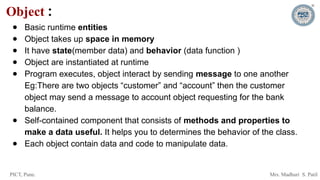
Object :
โ— Basic runtime entities
โ— Object takes up space in memory
โ— It have state(member data) and behavior (data function )
โ— Object are instantiated at runtime
โ— Program executes, object interact by sending message to one another
Eg:There are two objects โ€œcustomerโ€ and โ€œaccountโ€ then the customer
object may send a message to account object requesting for the bank
balance.
โ— Self-contained component that consists of methods and properties to
make a data useful. It helps you to determines the behavior of the class.
โ— Each object contain data and code to manipulate data.
PICT, Pune. Mrs. Madhuri S. Patil
Use of Object :
โ— It is used to manipulate data.
โ— It enables data members and member functions to perform the desired
task.
โ— It helps you to know the type of message accepted and the type of
returned responses.
PICT, Pune. Mrs. Madhuri S. Patil
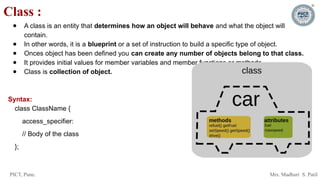
Class :
โ— A class is an entity that determines how an object will behave and what the object will
contain.
โ— In other words, it is a blueprint or a set of instruction to build a specific type of object.
โ— Onces object has been defined you can create any number of objects belong to that class.
โ— It provides initial values for member variables and member functions or methods.
โ— Class is collection of object.
Syntax:
class ClassName {
access_specifier:
// Body of the class
};
PICT, Pune. Mrs. Madhuri S. Patil
Uses of Class :
โ— Class is used to hold both data variables and member functions.
โ— You can use class to inherit the property of other class.
โ— It enables you to create user define objects.
โ— It can be used for a large amount of data and complex applications.
PICT, Pune. Mrs. Madhuri S. Patil
Key Differences :
โ— A class is a template for creating objects in program whereas the object is an
instance of a class.
โ— You can declare class only once but you can create more than one object
using a class.
โ— Classes doesnโ€™t have any values, whereas objects have its own values.
โ— A class does not allocate memory space on the other hand object allocates
memory space.
PICT, Pune. Mrs. Madhuri S. Patil
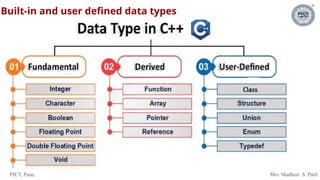
Built-in and user defined data types
PICT, Pune. Mrs. Madhuri S. Patil
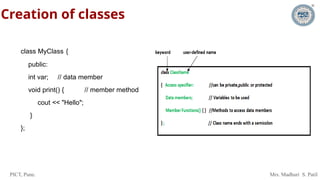
Creation of classes
class MyClass {
public:
int var; // data member
void print() { // member method
cout << "Hello";
}
};
PICT, Pune. Mrs. Madhuri S. Patil
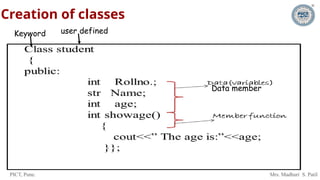
Creation of classes
Data member
Keyword user defined
PICT, Pune. Mrs. Madhuri S. Patil
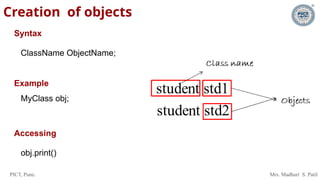
Syntax
ClassName ObjectName;
Example
MyClass obj;
Accessing
obj.print()
Creation of objects
PICT, Pune. Mrs. Madhuri S. Patil
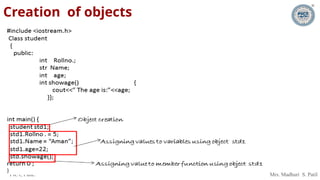
Creation of objects
PICT, Pune. Mrs. Madhuri S. Patil
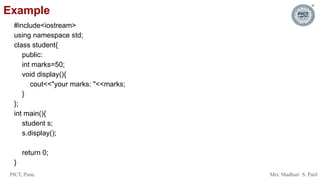
Example
#include<iostream>
using namespace std;
class student{
public:
int marks=50;
void display(){
cout<<"your marks: "<<marks;
}
};
int main(){
student s;
s.display();
return 0;
}
PICT, Pune. Mrs. Madhuri S. Patil
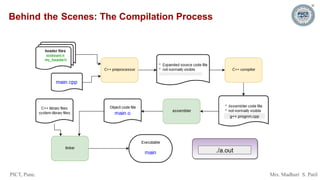
Behind the Scenes: The Compilation Process
g++ prognm.cpp
./a.out
PICT, Pune. Mrs. Madhuri S. Patil
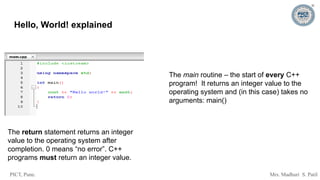
Hello, World! explained
The main routine โ€“ the start of every C++
program! It returns an integer value to the
operating system and (in this case) takes no
arguments: main()
The return statement returns an integer
value to the operating system after
completion. 0 means โ€œno errorโ€. C++
programs must return an integer value.
PICT, Pune. Mrs. Madhuri S. Patil
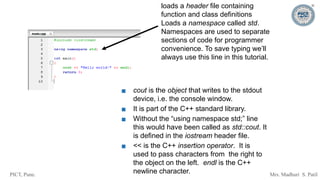
loads a header file containing
function and class definitions
Loads a namespace called std.
Namespaces are used to separate
sections of code for programmer
convenience. To save typing weโ€™ll
always use this line in this tutorial.
โ–ช cout is the object that writes to the stdout
device, i.e. the console window.
โ–ช It is part of the C++ standard library.
โ–ช Without the โ€œusing namespace std;โ€ line
this would have been called as std::cout. It
is defined in the iostream header file.
โ–ช << is the C++ insertion operator. It is
used to pass characters from the right to
the object on the left. endl is the C++
newline character.
PICT, Pune. Mrs. Madhuri S. Patil
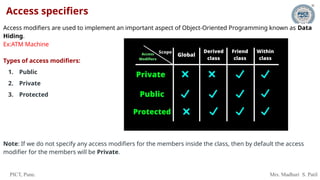
Access specifiers
Access modifiers are used to implement an important aspect of Object-Oriented Programming known as Data
Hiding.
Ex:ATM Machine
Types of access modifiers:
1. Public
2. Private
3. Protected
Note: If we do not specify any access modifiers for the members inside the class, then by default the access
modifier for the members will be Private.
PICT, Pune. Mrs. Madhuri S. Patil
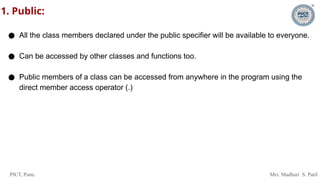
1. Public:
โ— All the class members declared under the public specifier will be available to everyone.
โ— Can be accessed by other classes and functions too.
โ— Public members of a class can be accessed from anywhere in the program using the
direct member access operator (.)
PICT, Pune. Mrs. Madhuri S. Patil
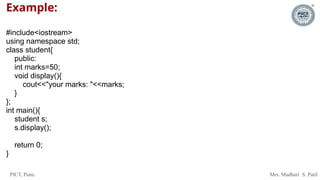
Example:
#include<iostream>
using namespace std;
class student{
public:
int marks=50;
void display(){
cout<<"your marks: "<<marks;
}
};
int main(){
student s;
s.display();
return 0;
}
PICT, Pune. Mrs. Madhuri S. Patil
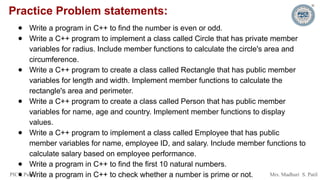
Practice Problem statements:
โ— Write a program in C++ to find the number is even or odd.
โ— Write a C++ program to implement a class called Circle that has private member
variables for radius. Include member functions to calculate the circle's area and
circumference.
โ— Write a C++ program to create a class called Rectangle that has public member
variables for length and width. Implement member functions to calculate the
rectangle's area and perimeter.
โ— Write a C++ program to create a class called Person that has public member
variables for name, age and country. Implement member functions to display
values.
โ— Write a C++ program to implement a class called Employee that has public
member variables for name, employee ID, and salary. Include member functions to
calculate salary based on employee performance.
โ— Write a program in C++ to find the first 10 natural numbers.
โ— Write a program in C++ to check whether a number is prime or not.
PICT, Pune. Mrs. Madhuri S. Patil
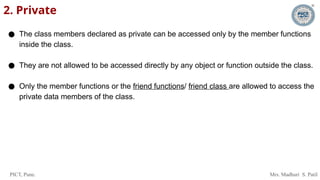
2. Private
โ— The class members declared as private can be accessed only by the member functions
inside the class.
โ— They are not allowed to be accessed directly by any object or function outside the class.
โ— Only the member functions or the friend functions/ friend class are allowed to access the
private data members of the class.
PICT, Pune. Mrs. Madhuri S. Patil
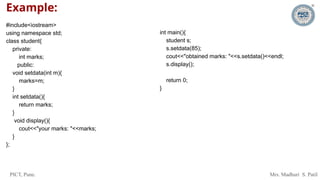
Example:
#include<iostream>
using namespace std;
class student{
private:
int marks;
public:
void setdata(int m){
marks=m;
}
int setdata(){
return marks;
}
void display(){
cout<<"your marks: "<<marks;
}
};
int main(){
student s;
s.setdata(85);
cout<<"obtained marks: "<<s.setdata()<<endl;
s.display();
return 0;
}
PICT, Pune. Mrs. Madhuri S. Patil
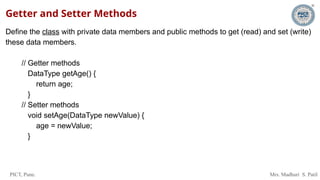
Getter and Setter Methods
Define the class with private data members and public methods to get (read) and set (write)
these data members.
// Getter methods
DataType getAge() {
return age;
}
// Setter methods
void setAge(DataType newValue) {
age = newValue;
}
PICT, Pune. Mrs. Madhuri S. Patil
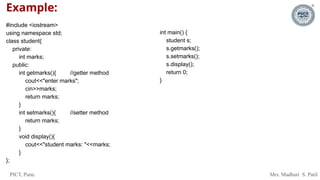
Example:
#include <iostream>
using namespace std;
class student{
private:
int marks;
public:
int getmarks(){ //getter method
cout<<"enter marks";
cin>>marks;
return marks;
}
int setmarks(){ //setter method
return marks;
}
void display(){
cout<<"student marks: "<<marks;
}
};
int main() {
student s;
s.getmarks();
s.setmarks();
s.display();
return 0;
}
PICT, Pune. Mrs. Madhuri S. Patil
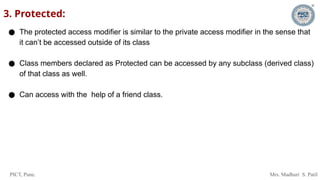
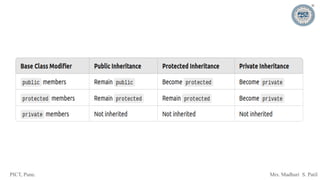
3. Protected:
โ— The protected access modifier is similar to the private access modifier in the sense that
it canโ€™t be accessed outside of its class
โ— Class members declared as Protected can be accessed by any subclass (derived class)
of that class as well.
โ— Can access with the help of a friend class.
PICT, Pune. Mrs. Madhuri S. Patil
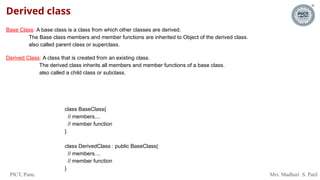
Derived class
Base Class: A base class is a class from which other classes are derived.
The Base class members and member functions are inherited to Object of the derived class.
also called parent class or superclass.
Derived Class: A class that is created from an existing class.
The derived class inherits all members and member functions of a base class.
also called a child class or subclass.
class BaseClass{
// members....
// member function
}
class DerivedClass : public BaseClass{
// members....
// member function
}
PICT, Pune. Mrs. Madhuri S. Patil
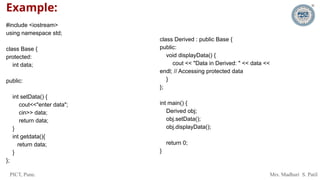
Example:
#include <iostream>
using namespace std;
class Base {
protected:
int data;
public:
int setData() {
cout<<"enter data";
cin>> data;
return data;
}
int getdata(){
return data;
}
};
class Derived : public Base {
public:
void displayData() {
cout << "Data in Derived: " << data <<
endl; // Accessing protected data
}
};
int main() {
Derived obj;
obj.setData();
obj.displayData();
return 0;
}
PICT, Pune. Mrs. Madhuri S. Patil
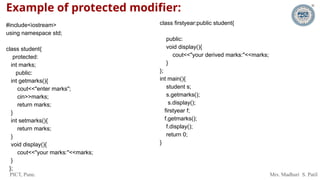
Example of protected modifier:
#include<iostream>
using namespace std;
class student{
protected:
int marks;
public:
int getmarks(){
cout<<"enter marks";
cin>>marks;
return marks;
}
int setmarks(){
return marks;
}
void display(){
cout<<"your marks:"<<marks;
}
};
class firstyear:public student{
public:
void display(){
cout<<"your derived marks:"<<marks;
}
};
int main(){
student s;
s.getmarks();
s.display();
firstyear f;
f.getmarks();
f.display();
return 0;
}
PICT, Pune. Mrs. Madhuri S. Patil
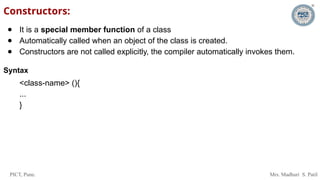
Constructors:
โ— It is a special member function of a class
โ— Automatically called when an object of the class is created.
โ— Constructors are not called explicitly, the compiler automatically invokes them.
Syntax
<class-name> (){
...
}
PICT, Pune. Mrs. Madhuri S. Patil
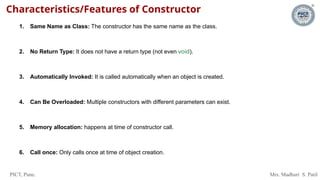
Characteristics/Features of Constructor
1. Same Name as Class: The constructor has the same name as the class.
2. No Return Type: It does not have a return type (not even void).
3. Automatically Invoked: It is called automatically when an object is created.
4. Can Be Overloaded: Multiple constructors with different parameters can exist.
5. Memory allocation: happens at time of constructor call.
6. Call once: Only calls once at time of object creation.
PICT, Pune. Mrs. Madhuri S. Patil
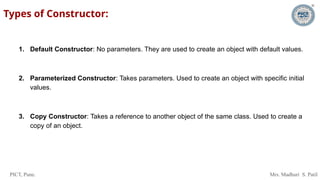
Types of Constructor:
1. Default Constructor: No parameters. They are used to create an object with default values.
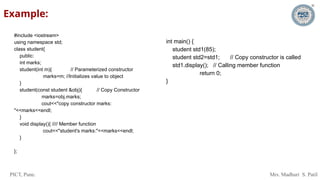
2. Parameterized Constructor: Takes parameters. Used to create an object with specific initial
values.
3. Copy Constructor: Takes a reference to another object of the same class. Used to create a
copy of an object.
PICT, Pune. Mrs. Madhuri S. Patil
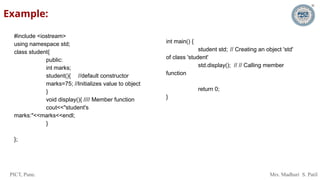
Example:
#include <iostream>
using namespace std;
class student{
public:
int marks;
student(){ //default constructor
marks=75; //Initializes value to object
}
void display(){ //// Member function
cout<<"student's
marks:"<<marks<<endl;
}
};
int main() {
student std; // Creating an object 'std'
of class 'student'
std.display(); // // Calling member
function
return 0;
}
PICT, Pune. Mrs. Madhuri S. Patil
Example:
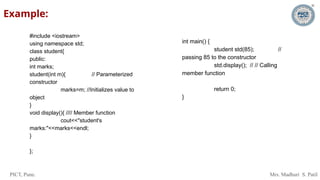
#include <iostream>
using namespace std;
class student{
public:
int marks;
student(int m){ // Parameterized
constructor
marks=m; //Initializes value to
object
}
void display(){ //// Member function
cout<<"student's
marks:"<<marks<<endl;
}
};
int main() {
student std(85); //
passing 85 to the constructor
std.display(); // // Calling
member function
return 0;
}
PICT, Pune. Mrs. Madhuri S. Patil
Example:
#include <iostream>
using namespace std;
class student{
public:
int marks;
student(int m){ // Parameterized constructor
marks=m; //Initializes value to object
}
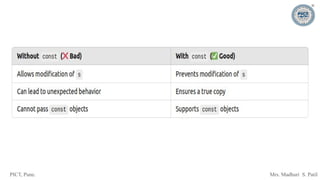
student(const student &obj){ // Copy Constructor
marks=obj.marks;
cout<<"copy constructor marks:
"<<marks<<endl;
}
void display(){ //// Member function
cout<<"student's marks:"<<marks<<endl;
}
};
int main() {
student std1(85);
student std2=std1; // Copy constructor is called
std1.display(); // Calling member function
return 0;
}
PICT, Pune. Mrs. Madhuri S. Patil
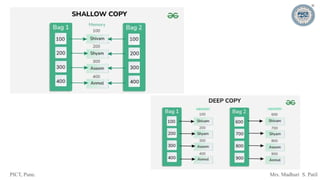
#include <iostream>
#include <string>
using namespace std;
class Student {
public:
string name;
// Constructor
Student(string n) {
name = n;
}
// Default Copy Constructor (Shallow, but safe)
Student(const Student &s) {
name = s.name; // Copies the string (deep copy)
cout << "Shallow Copy Constructor Called" << endl;
}
void display() {
cout << "Name: " << name << endl;
}
};
int main() {
Student s1("Alice");
Student s2 = s1; // Copy
Constructor is called
s2.name[0] = 'M'; // Changes s2
only, not s1
s1.display();
s2.display();
return 0;
}
PICT, Pune. Mrs. Madhuri S. Patil
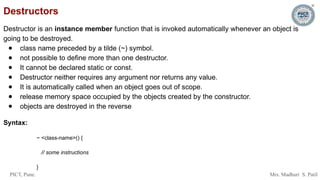
Destructors
Destructor is an instance member function that is invoked automatically whenever an object is
going to be destroyed.
โ— class name preceded by a tilde (~) symbol.
โ— not possible to define more than one destructor.
โ— It cannot be declared static or const.
โ— Destructor neither requires any argument nor returns any value.
โ— It is automatically called when an object goes out of scope.
โ— release memory space occupied by the objects created by the constructor.
โ— objects are destroyed in the reverse
Syntax:
~ <class-name>() {
// some instructions
}
PICT, Pune. Mrs. Madhuri S. Patil
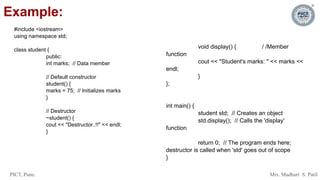
Example:
#include <iostream>
using namespace std;
class student {
public:
int marks; // Data member
// Default constructor
student() {
marks = 75; // Initializes marks
}
// Destructor
~student() {
cout << "Destructor..!!" << endl;
}
void display() { / /Member
function
cout << "Student's marks: " << marks <<
endl;
}
};
int main() {
student std; // Creates an object
std.display(); // Calls the 'display'
function
return 0; // The program ends here;
destructor is called when 'std' goes out of scope
}
PICT, Pune. Mrs. Madhuri S. Patil
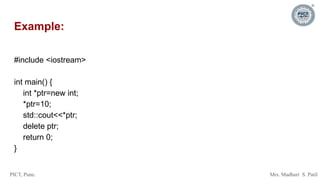
Dynamic Memory Allocation:
1. Static Memory: In static memory allocation, memory is allotted and deallocated by the compiler on its very
own.
2. Dynamic Memory: In dynamic allocation, the allocation and deallocation of the memory happen at runtime.
The new operator in C++ is used to dynamically allocate a block of memory and store its address
The delete operator is used to deallocate the block of memory, which is dynamically allocated using the new
operator.
Syntax:
data_type* ptr_var = new data_type;
delete ptr_var;
Syntax for array:
data_type* ptr_var = new data_type[size_of_the_array];
https://www.scaler.com/topics/cpp/dynamic-memory-allocation-in-cpp/
Smarts Pointers:
https://www.codecademy.com/resources/docs/cpp/smart-pointers
https://www.scaler.com/topics/cpp/smart-pointers-in-cpp/
PICT, Pune. Mrs. Madhuri S. Patil
Example:
#include <iostream>
int main() {
int *ptr=new int;
*ptr=10;
std::cout<<*ptr;
delete ptr;
return 0;
}
PICT, Pune. Mrs. Madhuri S. Patil
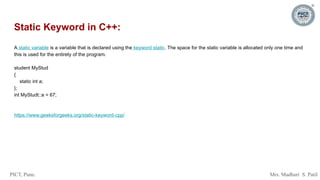
Static Keyword in C++:
A static variable is a variable that is declared using the keyword static. The space for the static variable is allocated only one time and
this is used for the entirety of the program.
student MyStud
{
static int a;
};
int MyStudt::a = 67;
https://www.geeksforgeeks.org/static-keyword-cpp/
PICT, Pune. Mrs. Madhuri S. Patil
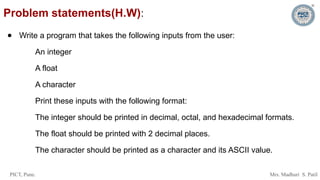
Problem statements(H.W):
โ— Write a program that takes the following inputs from the user:
An integer
A float
A character
Print these inputs with the following format:
The integer should be printed in decimal, octal, and hexadecimal formats.
The float should be printed with 2 decimal places.
The character should be printed as a character and its ASCII value.
PICT, Pune. Mrs. Madhuri S. Patil
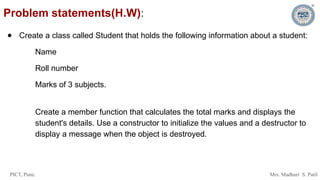
Problem statements(H.W):
โ— Create a class called Student that holds the following information about a student:
Name
Roll number
Marks of 3 subjects.
Create a member function that calculates the total marks and displays the
student's details. Use a constructor to initialize the values and a destructor to
display a message when the object is destroyed.
PICT, Pune. Mrs. Madhuri S. Patil
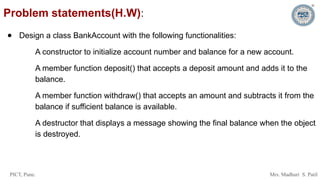
Problem statements(H.W):
โ— Design a class BankAccount with the following functionalities:
A constructor to initialize account number and balance for a new account.
A member function deposit() that accepts a deposit amount and adds it to the
balance.
A member function withdraw() that accepts an amount and subtracts it from the
balance if sufficient balance is available.
A destructor that displays a message showing the final balance when the object
is destroyed.
PICT, Pune. Mrs. Madhuri S. Patil
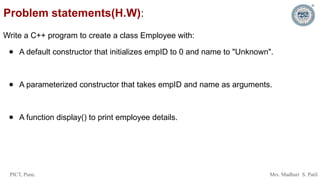
Problem statements(H.W):
Write a C++ program to create a class Employee with:
โ— A default constructor that initializes empID to 0 and name to "Unknown".
โ— A parameterized constructor that takes empID and name as arguments.
โ— A function display() to print employee details.
PICT, Pune. Mrs. Madhuri S. Patil
Problem statements(H.W):
Create a class Shape with overloaded constructors:
โ— Shape(int) for square (side length).
โ— Shape(int, int) for rectangle (length & width).
โ— Shape(double) for circle (radius).
Write a function calculateArea() that prints the area of the shape.

OOPC_Final_U_I.pptx rrrrrrrrrrrrrrrrrrrrrr

  • 1.
    PICT, Pune. Mrs.Madhuri S. Patil OBJECT ORIENTED PROGRAMMING USING C++ (OOPCF-015)
  • 2.
    PICT, Pune. Mrs.Madhuri S. Patil Prerequisite: 1. Problem-Solving Skills โ— Ability to think logically and break down problems into smaller, manageable parts for coding solutions. 2. Familiarity with Basic Programming Concepts โ— Variables and Data Types: Understanding how to declare variables and use different data types (e.g., integers, floats, characters). โ— Control Structures: Basic knowledge of loops (for, while), conditional statements (if, else), and switch- case. โ— Arrays, Pointers, Structures: Understanding how to declare and initialize it. โ— Functions: Understanding how to define and call functions, pass arguments, and return values. 3. Mathematical Concepts โ— Basic understanding of arithmetic operations, logic (AND, OR, NOT), and occasionally, basic algebra can be useful. http://pdvpmtasgaon.edu.in/uploads/dptcomputer/Let%20us%20c%20-%20yashwantkanetkar.pdf https://asq.org/quality-resources/problem-solving?srsltid=AfmBOor1ZHZzuMWsNfZ7Kyoi4TInrbsKcph5TNUxpLojIVsig4zRsHbb
  • 3.
    PICT, Pune. Mrs.Madhuri S. Patil Introduction to Subject OBJECT ORIENTED PROGRAMMING USING C++ (OOPC)
  • 4.
    PICT, Pune. Mrs.Madhuri S. Patil What is OOP? โ— It is a programming paradigm(beliefs, practices, and methodologies). โ— Relies on the concept of classes and objects. โ— It is used to structure a software program into simple, reusable pieces of code blueprints (usually called classes), which are used to create individual instances of objects. โ— There are many object-oriented programming Languages, including JavaScript, C++, Java, and Python. https://www.educative.io/blog/object-oriented-programming
  • 5.
    PICT, Pune. Mrs.Madhuri S. Patil Contโ€ฆ. โ— Object-oriented programming (OOP) is a computer programming model that organizes software design around data, or objects, rather than functions and logic. An object can be defined as a data field that has unique attributes and behavior. โ— OOP focuses on the objects that developers want to manipulate rather than the logic required to manipulate them. This approach to programming is well suited for software that is large, complex and actively updated or maintained.
  • 6.
    PICT, Pune. Mrs.Madhuri S. Patil โ— Once an object is known, it is labeled with a class of objects that defines the kind of data it contains and any logic sequences that can manipulate it. Each distinct logic sequence is known as a method. Objects can communicate with well-defined interfaces called messages. โ— It ties data more closely to the function that operate on it , and protect it from modification from outside function. Object-oriented programming (OOP) https://www.techtarget.com/searchapparchitecture/definition/object-oriented-programming-OOP Contโ€ฆ.
  • 7.
    PICT, Pune. Mrs.Madhuri S. Patil Contโ€ฆ.
  • 8.
    PICT, Pune. Mrs.Madhuri S. Patil Comparison of Top-Down vs Bottom-Up 1. Top-Down Approach: Start by designing or considering the high-level structure of the program first, and then break down the components into smaller parts or functions. โ—‹ Start with the overall design. โ—‹ Break down tasks into smaller parts. โ—‹ Often used in structured programming, where planning and organization are key. EX: Planning a Vacation First, you decide on the destination. (Big picture) 2. Bottom-Up Approach: Starts with the detailed components or small building blocks and then works upwards to assemble them into a complete program. โ— Start with small functions or modules. โ— Build them incrementally into a complete system. โ— Often used in object-oriented programming (especially in C++), as you define and test individual classes or objects first. EX: Building a Car You start by gathering individual parts: engine, wheels, body frame, seats, etc. (Small components)
  • 9.
    PICT, Pune. Mrs.Madhuri S. Patil OBJECT-ORIENTED FUNDAMENTALS Module-I
  • 10.
    PICT, Pune. Mrs.Madhuri S. Patil Content: โ— Need of Object-Oriented Programming (OOP) โ— Features of OOP โ— Introduction to C++ โ— Structure of C++ program โ— Built-in and user defined data types โ— Access specifiers โ— Examples illustrating โ— Creation of classes and objects โ— Constructors and Destructors - Default Arguments,Copy Constructors, Default constructors, Parameterized constructors, Destructor.
  • 11.
    PICT, Pune. Mrs.Madhuri S. Patil Need Of Object-Oriented Programming (OOP):
  • 12.
    PICT, Pune. Mrs.Madhuri S. Patil Contโ€ฆ โ— Can represent real world entity. โ— Open interface. โ— Reusability and flexibility. โ— Tolerate change in future. โ— Productivity and decrease cost. โ— Improve quality and cost. โ— Manage time.
  • 13.
    PICT, Pune. Mrs.Madhuri S. Patil POP Vs OOP:
  • 14.
    PICT, Pune. Mrs.Madhuri S. Patil Data Hiding: https://www.scaler.com/topics/data-hiding-in-cpp/
  • 15.
    PICT, Pune. Mrs.Madhuri S. Patil Example: Bank Account โ— Donโ€™t have direct access to the account balance or transactions. โ— you interact with the bank through secure methods like deposit, withdraw, and check balance. Why is this Encapsulation? โ— The balance variable is private, so it cannot be modified directly. โ— Only public methods (deposit() and withdraw()) allow controlled modifications. โ— The data is secure and maintains integrity by preventing invalid transactions. This ensures that no one can hack or tamper with the account balance directly, just like in a real bank system!
  • 16.
    PICT, Pune. Mrs.Madhuri S. Patil Basic concepts of OOP: โ— Class: A class is a blueprint for creating objects.(Car) โ— Object: An object is an instance of a class.(Toyota) โ— Data Abstraction and Encapsulation: Hiding data and restricting direct access.() โ— Inheritance: Inheritance allows a class (child class) to reuse properties and methods of another class() โ— Polymorphism: Polymorphism means "many forms." It allows the same function to behave differently based on the object calling it.(draw_shape) โ— Dynamic Binding: Means function calls are resolved at runtime, not compile time. This is possible using virtual functions. โ— Message passing: Message Passing refers to communication between objects by sending and receiving messages (function calls).
  • 17.
    PICT, Pune. Mrs.Madhuri S. Patil Benefits Of Object-Oriented Programming (OOP):
  • 18.
    PICT, Pune. Mrs.Madhuri S. Patil Features Of OOP:
  • 19.
    PICT, Pune. Mrs.Madhuri S. Patil
  • 20.
    PICT, Pune. Mrs.Madhuri S. Patil Advantages of OOP? โ— Encapsulation โ— Code Reusability โ— Modularity โ— Polymorphism โ— Improved Maintainability โ— Scalability โ— Real-World Representation โ— Flexibility and Extensibility โ— Data Abstraction
  • 21.
    PICT, Pune. Mrs.Madhuri S. Patil History of C++:
  • 22.
    PICT, Pune. Mrs.Madhuri S. Patil Introduction to C++: โ— C++ is a cross-platform language that can be used to create high-performance applications. โ— C++ was developed by Bjarne Stroustrup, as an extension to the C language. โ— C++ gives programmers a high level of control over system resources and memory. โ— C++ is an object-oriented programming language which gives a clear structure to programs and allows code to be reused, lowering development costs.
  • 23.
    PICT, Pune. Mrs.Madhuri S. Patil Difference between C and C++ โ— C++ was developed as an extension of C, and both languages have almost the same syntax. โ— The main difference between C and C++ is that C++ supports classes and objects, while C does not.
  • 24.
    PICT, Pune. Mrs.Madhuri S. Patil Class And Object:
  • 25.
    PICT, Pune. Mrs.Madhuri S. Patil Object : โ— Basic runtime entities โ— Object takes up space in memory โ— It have state(member data) and behavior (data function ) โ— Object are instantiated at runtime โ— Program executes, object interact by sending message to one another Eg:There are two objects โ€œcustomerโ€ and โ€œaccountโ€ then the customer object may send a message to account object requesting for the bank balance. โ— Self-contained component that consists of methods and properties to make a data useful. It helps you to determines the behavior of the class. โ— Each object contain data and code to manipulate data.
  • 26.
    PICT, Pune. Mrs.Madhuri S. Patil
  • 27.
    PICT, Pune. Mrs.Madhuri S. Patil Use of Object : โ— It is used to manipulate data. โ— It enables data members and member functions to perform the desired task. โ— It helps you to know the type of message accepted and the type of returned responses.
  • 28.
    PICT, Pune. Mrs.Madhuri S. Patil Class : โ— A class is an entity that determines how an object will behave and what the object will contain. โ— In other words, it is a blueprint or a set of instruction to build a specific type of object. โ— Onces object has been defined you can create any number of objects belong to that class. โ— It provides initial values for member variables and member functions or methods. โ— Class is collection of object. Syntax: class ClassName { access_specifier: // Body of the class };
  • 29.
    PICT, Pune. Mrs.Madhuri S. Patil Uses of Class : โ— Class is used to hold both data variables and member functions. โ— You can use class to inherit the property of other class. โ— It enables you to create user define objects. โ— It can be used for a large amount of data and complex applications.
  • 30.
    PICT, Pune. Mrs.Madhuri S. Patil
  • 31.
    PICT, Pune. Mrs.Madhuri S. Patil Key Differences : โ— A class is a template for creating objects in program whereas the object is an instance of a class. โ— You can declare class only once but you can create more than one object using a class. โ— Classes doesnโ€™t have any values, whereas objects have its own values. โ— A class does not allocate memory space on the other hand object allocates memory space.
  • 32.
    PICT, Pune. Mrs.Madhuri S. Patil Built-in and user defined data types
  • 33.
    PICT, Pune. Mrs.Madhuri S. Patil Creation of classes class MyClass { public: int var; // data member void print() { // member method cout << "Hello"; } };
  • 34.
    PICT, Pune. Mrs.Madhuri S. Patil Creation of classes Data member Keyword user defined
  • 35.
    PICT, Pune. Mrs.Madhuri S. Patil Syntax ClassName ObjectName; Example MyClass obj; Accessing obj.print() Creation of objects
  • 36.
    PICT, Pune. Mrs.Madhuri S. Patil Creation of objects
  • 37.
    PICT, Pune. Mrs.Madhuri S. Patil Example #include<iostream> using namespace std; class student{ public: int marks=50; void display(){ cout<<"your marks: "<<marks; } }; int main(){ student s; s.display(); return 0; }
  • 38.
    PICT, Pune. Mrs.Madhuri S. Patil Behind the Scenes: The Compilation Process g++ prognm.cpp ./a.out
  • 39.
    PICT, Pune. Mrs.Madhuri S. Patil Hello, World! explained The main routine โ€“ the start of every C++ program! It returns an integer value to the operating system and (in this case) takes no arguments: main() The return statement returns an integer value to the operating system after completion. 0 means โ€œno errorโ€. C++ programs must return an integer value.
  • 40.
    PICT, Pune. Mrs.Madhuri S. Patil loads a header file containing function and class definitions Loads a namespace called std. Namespaces are used to separate sections of code for programmer convenience. To save typing weโ€™ll always use this line in this tutorial. โ–ช cout is the object that writes to the stdout device, i.e. the console window. โ–ช It is part of the C++ standard library. โ–ช Without the โ€œusing namespace std;โ€ line this would have been called as std::cout. It is defined in the iostream header file. โ–ช << is the C++ insertion operator. It is used to pass characters from the right to the object on the left. endl is the C++ newline character.
  • 41.
    PICT, Pune. Mrs.Madhuri S. Patil Access specifiers Access modifiers are used to implement an important aspect of Object-Oriented Programming known as Data Hiding. Ex:ATM Machine Types of access modifiers: 1. Public 2. Private 3. Protected Note: If we do not specify any access modifiers for the members inside the class, then by default the access modifier for the members will be Private.
  • 42.
    PICT, Pune. Mrs.Madhuri S. Patil 1. Public: โ— All the class members declared under the public specifier will be available to everyone. โ— Can be accessed by other classes and functions too. โ— Public members of a class can be accessed from anywhere in the program using the direct member access operator (.)
  • 43.
    PICT, Pune. Mrs.Madhuri S. Patil Example: #include<iostream> using namespace std; class student{ public: int marks=50; void display(){ cout<<"your marks: "<<marks; } }; int main(){ student s; s.display(); return 0; }
  • 44.
    PICT, Pune. Mrs.Madhuri S. Patil Practice Problem statements: โ— Write a program in C++ to find the number is even or odd. โ— Write a C++ program to implement a class called Circle that has private member variables for radius. Include member functions to calculate the circle's area and circumference. โ— Write a C++ program to create a class called Rectangle that has public member variables for length and width. Implement member functions to calculate the rectangle's area and perimeter. โ— Write a C++ program to create a class called Person that has public member variables for name, age and country. Implement member functions to display values. โ— Write a C++ program to implement a class called Employee that has public member variables for name, employee ID, and salary. Include member functions to calculate salary based on employee performance. โ— Write a program in C++ to find the first 10 natural numbers. โ— Write a program in C++ to check whether a number is prime or not.
  • 45.
    PICT, Pune. Mrs.Madhuri S. Patil 2. Private โ— The class members declared as private can be accessed only by the member functions inside the class. โ— They are not allowed to be accessed directly by any object or function outside the class. โ— Only the member functions or the friend functions/ friend class are allowed to access the private data members of the class.
  • 46.
    PICT, Pune. Mrs.Madhuri S. Patil Example: #include<iostream> using namespace std; class student{ private: int marks; public: void setdata(int m){ marks=m; } int setdata(){ return marks; } void display(){ cout<<"your marks: "<<marks; } }; int main(){ student s; s.setdata(85); cout<<"obtained marks: "<<s.setdata()<<endl; s.display(); return 0; }
  • 47.
    PICT, Pune. Mrs.Madhuri S. Patil Getter and Setter Methods Define the class with private data members and public methods to get (read) and set (write) these data members. // Getter methods DataType getAge() { return age; } // Setter methods void setAge(DataType newValue) { age = newValue; }
  • 48.
    PICT, Pune. Mrs.Madhuri S. Patil Example: #include <iostream> using namespace std; class student{ private: int marks; public: int getmarks(){ //getter method cout<<"enter marks"; cin>>marks; return marks; } int setmarks(){ //setter method return marks; } void display(){ cout<<"student marks: "<<marks; } }; int main() { student s; s.getmarks(); s.setmarks(); s.display(); return 0; }
  • 49.
    PICT, Pune. Mrs.Madhuri S. Patil 3. Protected: โ— The protected access modifier is similar to the private access modifier in the sense that it canโ€™t be accessed outside of its class โ— Class members declared as Protected can be accessed by any subclass (derived class) of that class as well. โ— Can access with the help of a friend class.
  • 50.
    PICT, Pune. Mrs.Madhuri S. Patil Derived class Base Class: A base class is a class from which other classes are derived. The Base class members and member functions are inherited to Object of the derived class. also called parent class or superclass. Derived Class: A class that is created from an existing class. The derived class inherits all members and member functions of a base class. also called a child class or subclass. class BaseClass{ // members.... // member function } class DerivedClass : public BaseClass{ // members.... // member function }
  • 51.
    PICT, Pune. Mrs.Madhuri S. Patil Example: #include <iostream> using namespace std; class Base { protected: int data; public: int setData() { cout<<"enter data"; cin>> data; return data; } int getdata(){ return data; } }; class Derived : public Base { public: void displayData() { cout << "Data in Derived: " << data << endl; // Accessing protected data } }; int main() { Derived obj; obj.setData(); obj.displayData(); return 0; }
  • 52.
    PICT, Pune. Mrs.Madhuri S. Patil Example of protected modifier: #include<iostream> using namespace std; class student{ protected: int marks; public: int getmarks(){ cout<<"enter marks"; cin>>marks; return marks; } int setmarks(){ return marks; } void display(){ cout<<"your marks:"<<marks; } }; class firstyear:public student{ public: void display(){ cout<<"your derived marks:"<<marks; } }; int main(){ student s; s.getmarks(); s.display(); firstyear f; f.getmarks(); f.display(); return 0; }
  • 53.
    PICT, Pune. Mrs.Madhuri S. Patil
  • 54.
    PICT, Pune. Mrs.Madhuri S. Patil Constructors: โ— It is a special member function of a class โ— Automatically called when an object of the class is created. โ— Constructors are not called explicitly, the compiler automatically invokes them. Syntax <class-name> (){ ... }
  • 55.
    PICT, Pune. Mrs.Madhuri S. Patil Characteristics/Features of Constructor 1. Same Name as Class: The constructor has the same name as the class. 2. No Return Type: It does not have a return type (not even void). 3. Automatically Invoked: It is called automatically when an object is created. 4. Can Be Overloaded: Multiple constructors with different parameters can exist. 5. Memory allocation: happens at time of constructor call. 6. Call once: Only calls once at time of object creation.
  • 56.
    PICT, Pune. Mrs.Madhuri S. Patil Types of Constructor: 1. Default Constructor: No parameters. They are used to create an object with default values. 2. Parameterized Constructor: Takes parameters. Used to create an object with specific initial values. 3. Copy Constructor: Takes a reference to another object of the same class. Used to create a copy of an object.
  • 57.
    PICT, Pune. Mrs.Madhuri S. Patil Example: #include <iostream> using namespace std; class student{ public: int marks; student(){ //default constructor marks=75; //Initializes value to object } void display(){ //// Member function cout<<"student's marks:"<<marks<<endl; } }; int main() { student std; // Creating an object 'std' of class 'student' std.display(); // // Calling member function return 0; }
  • 58.
    PICT, Pune. Mrs.Madhuri S. Patil Example: #include <iostream> using namespace std; class student{ public: int marks; student(int m){ // Parameterized constructor marks=m; //Initializes value to object } void display(){ //// Member function cout<<"student's marks:"<<marks<<endl; } }; int main() { student std(85); // passing 85 to the constructor std.display(); // // Calling member function return 0; }
  • 59.
    PICT, Pune. Mrs.Madhuri S. Patil Example: #include <iostream> using namespace std; class student{ public: int marks; student(int m){ // Parameterized constructor marks=m; //Initializes value to object } student(const student &obj){ // Copy Constructor marks=obj.marks; cout<<"copy constructor marks: "<<marks<<endl; } void display(){ //// Member function cout<<"student's marks:"<<marks<<endl; } }; int main() { student std1(85); student std2=std1; // Copy constructor is called std1.display(); // Calling member function return 0; }
  • 60.
    PICT, Pune. Mrs.Madhuri S. Patil #include <iostream> #include <string> using namespace std; class Student { public: string name; // Constructor Student(string n) { name = n; } // Default Copy Constructor (Shallow, but safe) Student(const Student &s) { name = s.name; // Copies the string (deep copy) cout << "Shallow Copy Constructor Called" << endl; } void display() { cout << "Name: " << name << endl; } }; int main() { Student s1("Alice"); Student s2 = s1; // Copy Constructor is called s2.name[0] = 'M'; // Changes s2 only, not s1 s1.display(); s2.display(); return 0; }
  • 61.
    PICT, Pune. Mrs.Madhuri S. Patil
  • 62.
    PICT, Pune. Mrs.Madhuri S. Patil
  • 63.
    PICT, Pune. Mrs.Madhuri S. Patil Destructors Destructor is an instance member function that is invoked automatically whenever an object is going to be destroyed. โ— class name preceded by a tilde (~) symbol. โ— not possible to define more than one destructor. โ— It cannot be declared static or const. โ— Destructor neither requires any argument nor returns any value. โ— It is automatically called when an object goes out of scope. โ— release memory space occupied by the objects created by the constructor. โ— objects are destroyed in the reverse Syntax: ~ <class-name>() { // some instructions }
  • 64.
    PICT, Pune. Mrs.Madhuri S. Patil Example: #include <iostream> using namespace std; class student { public: int marks; // Data member // Default constructor student() { marks = 75; // Initializes marks } // Destructor ~student() { cout << "Destructor..!!" << endl; } void display() { / /Member function cout << "Student's marks: " << marks << endl; } }; int main() { student std; // Creates an object std.display(); // Calls the 'display' function return 0; // The program ends here; destructor is called when 'std' goes out of scope }
  • 65.
    PICT, Pune. Mrs.Madhuri S. Patil Dynamic Memory Allocation: 1. Static Memory: In static memory allocation, memory is allotted and deallocated by the compiler on its very own. 2. Dynamic Memory: In dynamic allocation, the allocation and deallocation of the memory happen at runtime. The new operator in C++ is used to dynamically allocate a block of memory and store its address The delete operator is used to deallocate the block of memory, which is dynamically allocated using the new operator. Syntax: data_type* ptr_var = new data_type; delete ptr_var; Syntax for array: data_type* ptr_var = new data_type[size_of_the_array]; https://www.scaler.com/topics/cpp/dynamic-memory-allocation-in-cpp/ Smarts Pointers: https://www.codecademy.com/resources/docs/cpp/smart-pointers https://www.scaler.com/topics/cpp/smart-pointers-in-cpp/
  • 66.
    PICT, Pune. Mrs.Madhuri S. Patil Example: #include <iostream> int main() { int *ptr=new int; *ptr=10; std::cout<<*ptr; delete ptr; return 0; }
  • 67.
    PICT, Pune. Mrs.Madhuri S. Patil Static Keyword in C++: A static variable is a variable that is declared using the keyword static. The space for the static variable is allocated only one time and this is used for the entirety of the program. student MyStud { static int a; }; int MyStudt::a = 67; https://www.geeksforgeeks.org/static-keyword-cpp/
  • 68.
    PICT, Pune. Mrs.Madhuri S. Patil Problem statements(H.W): โ— Write a program that takes the following inputs from the user: An integer A float A character Print these inputs with the following format: The integer should be printed in decimal, octal, and hexadecimal formats. The float should be printed with 2 decimal places. The character should be printed as a character and its ASCII value.
  • 69.
    PICT, Pune. Mrs.Madhuri S. Patil Problem statements(H.W): โ— Create a class called Student that holds the following information about a student: Name Roll number Marks of 3 subjects. Create a member function that calculates the total marks and displays the student's details. Use a constructor to initialize the values and a destructor to display a message when the object is destroyed.
  • 70.
    PICT, Pune. Mrs.Madhuri S. Patil Problem statements(H.W): โ— Design a class BankAccount with the following functionalities: A constructor to initialize account number and balance for a new account. A member function deposit() that accepts a deposit amount and adds it to the balance. A member function withdraw() that accepts an amount and subtracts it from the balance if sufficient balance is available. A destructor that displays a message showing the final balance when the object is destroyed.
  • 71.
    PICT, Pune. Mrs.Madhuri S. Patil Problem statements(H.W): Write a C++ program to create a class Employee with: โ— A default constructor that initializes empID to 0 and name to "Unknown". โ— A parameterized constructor that takes empID and name as arguments. โ— A function display() to print employee details.
  • 72.
    PICT, Pune. Mrs.Madhuri S. Patil Problem statements(H.W): Create a class Shape with overloaded constructors: โ— Shape(int) for square (side length). โ— Shape(int, int) for rectangle (length & width). โ— Shape(double) for circle (radius). Write a function calculateArea() that prints the area of the shape.