1
159.234
159.234 LECTURE 12
LECTURE 12
Today:
Friend functions / classes
Textbook: p. 200-203
2
Friend Functions/Classes
friends
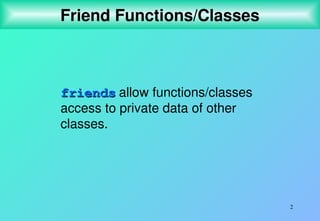
friends allow functions/classes
access to private data of other
classes.
3
Friend Functions/Classes
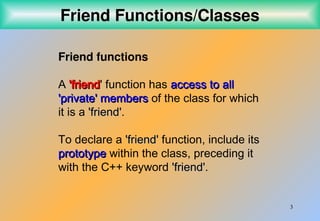
Friend functions
A 'friend
'friend' function has access to all
access to all
'private' members
'private' members of the class for which
it is a 'friend
'friend'.
To declare a 'friend
'friend' function, include its
prototype
prototype within the class, preceding it
with the C++ keyword 'friend
'friend'.
4
COLLISION PROBLEM
APPROACHES: SIMPLE RECTANGLE , SHRUNKEN RECT,
SPRITE IMAGE
Sample application that can benefit from friend classes/functions
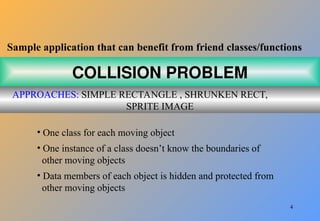
• One class for each moving object
• One instance of a class doesn’t know the boundaries of
other moving objects
• Data members of each object is hidden and protected from
other moving objects
5
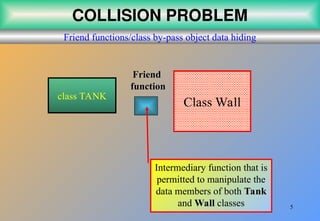
COLLISION PROBLEM
Friend functions/class by-pass object data hiding
Class Wall
class TANK
Friend
Friend
function
function
Intermediary function that is
permitted to manipulate the
data members of both Tank
Tank
and Wall
Wall classes
6
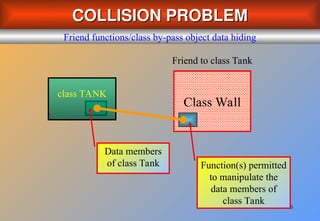
COLLISION PROBLEM
COLLISION PROBLEM
Friend functions/class by-pass object data hiding
Class Wall
class TANK
Friend to class Tank
Function(s) permitted
to manipulate the
data members of
class Tank
Data members
of class Tank
7
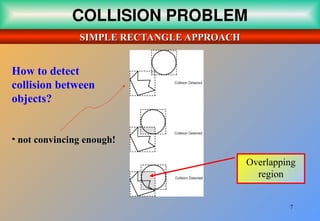
COLLISION PROBLEM
How to detect
collision between
objects?
• not convincing enough!
not convincing enough!
Overlapping
region
SIMPLE RECTANGLE APPROACH
8
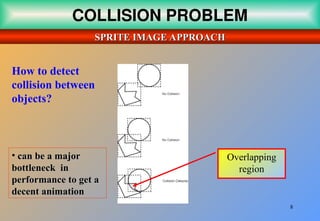
COLLISION PROBLEM
How to detect
collision between
objects?
• can be a major
can be a major
bottleneck in
bottleneck in
performance to get a
decent animation
decent animation
SPRITE IMAGE APPROACH
Overlapping
region
9
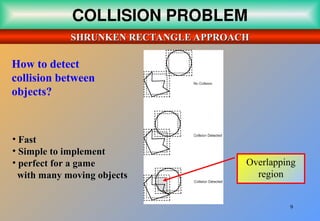
COLLISION PROBLEM
Overlapping
region
How to detect
collision between
objects?
• Fast
Fast
• Simple to implement
Simple to implement
• perfect for a game
perfect for a game
with many moving objects
SHRUNKEN RECTANGLE APPROACH
10
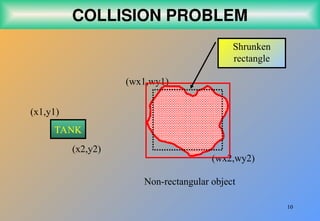
COLLISION PROBLEM
(x1,y1)
(x2,y2)
(wx1,wy1)
(wx2,wy2)
TANK
Non-rectangular object
Shrunken
rectangle
11
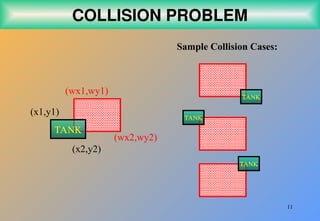
COLLISION PROBLEM
(wx1,wy1)
(wx2,wy2)
(x1,y1)
(x2,y2)
TANK
TANK
TANK
TANK
Sample Collision Cases:
12
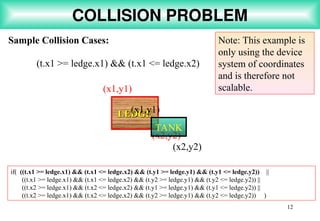
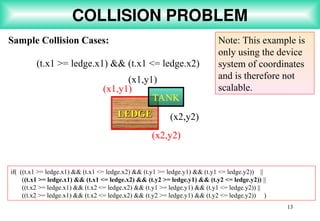
COLLISION PROBLEM
Sample Collision Cases:
(t.x1 >= ledge.x1) && (t.x1 <= ledge.x2)
if( ((t.x1 >= ledge.x1) && (t.x1 <= ledge.x2) && (t.y1 >= ledge.y1) && (t.y1 <= ledge.y2)) ||
((t.x1 >= ledge.x1) && (t.x1 <= ledge.x2) && (t.y2 >= ledge.y1) && (t.y2 <= ledge.y2)) ||
((t.x2 >= ledge.x1) && (t.x2 <= ledge.x2) && (t.y1 >= ledge.y1) && (t.y1 <= ledge.y2)) ||
((t.x2 >= ledge.x1) && (t.x2 <= ledge.x2) && (t.y2 >= ledge.y1) && (t.y2 <= ledge.y2)) )
LEDGE
LEDGE
(x1,y1)
(x2,y2)
(x1,y1)
(x2,y2)
TANK
Note: This example is
only using the device
system of coordinates
and is therefore not
scalable.
13
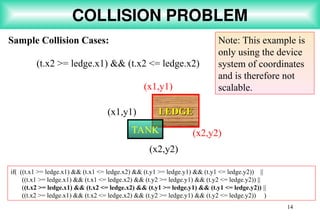
COLLISION PROBLEM
Sample Collision Cases:
(t.x1 >= ledge.x1) && (t.x1 <= ledge.x2)
if( ((t.x1 >= ledge.x1) && (t.x1 <= ledge.x2) && (t.y1 >= ledge.y1) && (t.y1 <= ledge.y2)) ||
((t.x1 >= ledge.x1) && (t.x1 <= ledge.x2) && (t.y2 >= ledge.y1) && (t.y2 <= ledge.y2)) ||
((t.x2 >= ledge.x1) && (t.x2 <= ledge.x2) && (t.y1 >= ledge.y1) && (t.y1 <= ledge.y2)) ||
((t.x2 >= ledge.x1) && (t.x2 <= ledge.x2) && (t.y2 >= ledge.y1) && (t.y2 <= ledge.y2)) )
LEDGE
LEDGE
(x1,y1)
(x2,y2)
(x1,y1)
(x2,y2)
TANK
Note: This example is
only using the device
system of coordinates
and is therefore not
scalable.
14
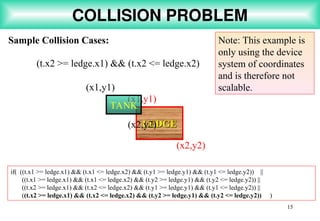
COLLISION PROBLEM
LEDGE
LEDGE
(x1,y1)
(x2,y2)
(x1,y1)
(x2,y2)
TANK
Sample Collision Cases:
(t.x2 >= ledge.x1) && (t.x2 <= ledge.x2)
if( ((t.x1 >= ledge.x1) && (t.x1 <= ledge.x2) && (t.y1 >= ledge.y1) && (t.y1 <= ledge.y2)) ||
((t.x1 >= ledge.x1) && (t.x1 <= ledge.x2) && (t.y2 >= ledge.y1) && (t.y2 <= ledge.y2)) ||
((t.x2 >= ledge.x1) && (t.x2 <= ledge.x2) && (t.y1 >= ledge.y1) && (t.y1 <= ledge.y2)) ||
((t.x2 >= ledge.x1) && (t.x2 <= ledge.x2) && (t.y2 >= ledge.y1) && (t.y2 <= ledge.y2)) )
Note: This example is
only using the device
system of coordinates
and is therefore not
scalable.
15
COLLISION PROBLEM
Sample Collision Cases:
(t.x2 >= ledge.x1) && (t.x2 <= ledge.x2)
if( ((t.x1 >= ledge.x1) && (t.x1 <= ledge.x2) && (t.y1 >= ledge.y1) && (t.y1 <= ledge.y2)) ||
((t.x1 >= ledge.x1) && (t.x1 <= ledge.x2) && (t.y2 >= ledge.y1) && (t.y2 <= ledge.y2)) ||
((t.x2 >= ledge.x1) && (t.x2 <= ledge.x2) && (t.y1 >= ledge.y1) && (t.y1 <= ledge.y2)) ||
((t.x2 >= ledge.x1) && (t.x2 <= ledge.x2) && (t.y2 >= ledge.y1) && (t.y2 <= ledge.y2)) )
LEDGE
LEDGE
(x1,y1)
(x2,y2)
(x1,y1)
(x2,y2)
TANK
Note: This example is
only using the device
system of coordinates
and is therefore not
scalable.
16
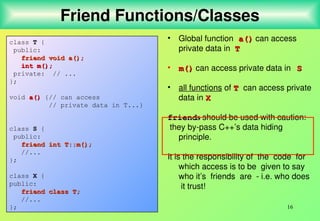
Friend Functions/Classes
class T {
public:
friend void a();
friend void a();
int m();
int m();
private: // ...
};
void a()
a() {// can access
// private data in T...}
class S {
public:
friend int
friend int T
T::m();
::m();
//...
};
class X {
public:
friend class
friend class T
T;
;
//...
};
• Global function a()
a() can access
private data in T
T
• m()
m() can access private data in S
S
• all functions of T
T can access private
data in X
X
friend
friends
s should be used with caution:
they by-pass C++’s data hiding
principle.
It is the responsibility of the code for
which access is to be given to say
who it’s friends are - i.e. who does
it trust!
17
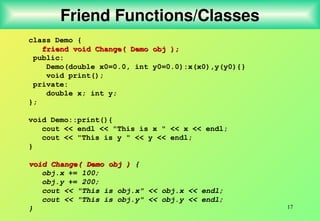
Friend Functions/Classes
class Demo {
friend void Change( Demo obj );
public:
Demo(double x0=0.0, int y0=0.0):x(x0),y(y0){}
void print();
private:
double x; int y;
};
void Demo::print(){
cout << endl << "This is x " << x << endl;
cout << "This is y " << y << endl;
}
void Change( Demo obj )
void Change( Demo obj ) {
obj.x += 100;
obj.y += 200;
cout << "This is obj.x" << obj.x << endl;
cout << "This is obj.y" << obj.y << endl;
}
18
Friend Functions/Classes
#include <iostream>
using namespace std;
const int DaysInMonth[] = { 0, 31, 28, 31, 30, 31, 30, 31, 31, 30, 31, 30, 31 };
enum Months { unused, January, February, March, April, May, June,
July, August, September, October, November, December };
const char *MonthNames[]={"Unused", "January", "February", "March", "April", "May",
"June",
"July", "August", "September", "October", "November", "December" };
class Date{
friend bool before( Date & d1, Date & d2 );
public:
Date( int d=1, int m=1, int y=1970 ){ // do not use initialiser list in constructor
setMonth( m); // as here we want to reuse the checks
setDay(d); // in the set methods
setYear(y); // remember month is used to verify day validity
}
~Date(){} // no special needs for destructor
Date( const Date & date ){ // supply an explicit copy constructor
day = date.day;
month = date.month;
year = date.year;
}
int getDay(){ return day; }
void setDay( int d ){
if( d > 0 && d <= DaysInMonth[month] ){
day = d;
}
else{
cerr << "Invalid Day value " << d << endl;
exit(1);
}
}
int getMonth(){ return month; }
void setMonth( int m ){
if( m >= 1 && m <= 12 ){
month = m;
}
else{
cerr << "Invalid Month value " << m << endl;
exit(1);
}
}
int getYear(){return year;}
void setYear( int y ){
// no restrictions placed on year
year = y;
}
void print(){
cout << day << " of " << MonthNames[month] << ", " << year << endl;
}
private:
int day;
int day;
int month;
int month;
int year;
int year;
};
• Continued on next slide…
19
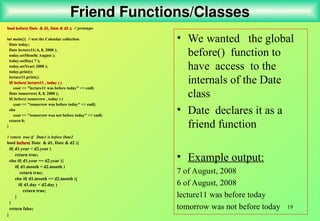
Friend Functions/Classes
bool before( Date & d1, Date & d2 );
bool before( Date & d1, Date & d2 ); // prototype
int main(){ // test the Calendar collection
Date today;
Date lecture11( 6, 8, 2008 );
today.setMonth( August );
today.setDay( 7 );
today.setYear( 2008 );
today.print();
lecture11.print();
if( before( lecture11 , today ) )
cout << "lecture11 was before today" << endl;
Date tomorrow( 8, 8, 2008 );
if( before( tomorrow , today ) )
cout << "tomorrow was before today" << endl;
else
cout << "tomorrow was not before today" << endl;
return 0;
}
// return true if Date1 is before Date2
bool before
before( Date & d1, Date & d2 ){
if( d1.year < d2.year )
return true;
else if( d1.year == d2.year ){
if( d1.month < d2.month )
return true;
else if( d1.month == d2.month ){
if( d1.day < d2.day )
return true;
}
}
return false;
}
• We wanted the global
before() function to
have access to the
internals of the Date
class
• Date declares it as a
friend function
• Example output:
7 of August, 2008
6 of August, 2008
lecture11 was before today
tomorrow was not before today
20
Friend Functions/Classes
The End.
The End.
21
Friend Functions/Classes
Questions
1. Is there any difference between List x; and List x();?
2. Is the default constructor for Fred always Fred::Fred()?
3. Should constructors use "initializer lists" or "assignment"?
4. How do you know when to declare a function as a member
function or a friend function in your class?
From: C++ FAQ Lite
http://www.parashift.com
22
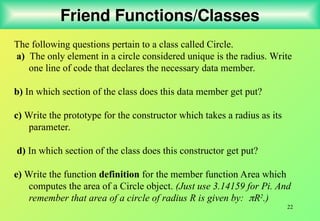
Friend Functions/Classes
The following questions pertain to a class called Circle.
a) The only element in a circle considered unique is the radius. Write
one line of code that declares the necessary data member.
b) In which section of the class does this data member get put?
c) Write the prototype for the constructor which takes a radius as its
parameter.
d) In which section of the class does this constructor get put?
e) Write the function definition for the member function Area which
computes the area of a Circle object. (Just use 3.14159 for Pi. And
remember that area of a circle of radius R is given by: R2
.)
23
Friend Functions/Classes
Next:
Operators overloading
Textbook: p.203-216

OOP-2009 - 12 - FriendClass.ppt it helps the user

  • 1.
    1 159.234 159.234 LECTURE 12 LECTURE12 Today: Friend functions / classes Friend functions / classes Textbook: p. 200-203
  • 2.
    2 Friend Functions/Classes friends friends allowfunctions/classes access to private data of other classes.
  • 3.
    3 Friend Functions/Classes Friend functions A'friend 'friend' function has access to all access to all 'private' members 'private' members of the class for which it is a 'friend 'friend'. To declare a 'friend 'friend' function, include its prototype prototype within the class, preceding it with the C++ keyword 'friend 'friend'.
  • 4.
    4 COLLISION PROBLEM APPROACHES: SIMPLERECTANGLE , SHRUNKEN RECT, SPRITE IMAGE Sample application that can benefit from friend classes/functions • One class for each moving object • One instance of a class doesn’t know the boundaries of other moving objects • Data members of each object is hidden and protected from other moving objects
  • 5.
    5 COLLISION PROBLEM Friend functions/classby-pass object data hiding Class Wall class TANK Friend Friend function function Intermediary function that is permitted to manipulate the data members of both Tank Tank and Wall Wall classes
  • 6.
    6 COLLISION PROBLEM COLLISION PROBLEM Friendfunctions/class by-pass object data hiding Class Wall class TANK Friend to class Tank Function(s) permitted to manipulate the data members of class Tank Data members of class Tank
  • 7.
    7 COLLISION PROBLEM How todetect collision between objects? • not convincing enough! not convincing enough! Overlapping region SIMPLE RECTANGLE APPROACH SIMPLE RECTANGLE APPROACH
  • 8.
    8 COLLISION PROBLEM How todetect collision between objects? • can be a major can be a major bottleneck in bottleneck in performance to get a performance to get a decent animation decent animation SPRITE IMAGE APPROACH SPRITE IMAGE APPROACH Overlapping region
  • 9.
    9 COLLISION PROBLEM Overlapping region How todetect collision between objects? • Fast Fast • Simple to implement Simple to implement • perfect for a game perfect for a game with many moving objects with many moving objects SHRUNKEN RECTANGLE APPROACH SHRUNKEN RECTANGLE APPROACH
  • 10.
  • 11.
  • 12.
    12 COLLISION PROBLEM Sample CollisionCases: (t.x1 >= ledge.x1) && (t.x1 <= ledge.x2) if( ((t.x1 >= ledge.x1) && (t.x1 <= ledge.x2) && (t.y1 >= ledge.y1) && (t.y1 <= ledge.y2)) || ((t.x1 >= ledge.x1) && (t.x1 <= ledge.x2) && (t.y2 >= ledge.y1) && (t.y2 <= ledge.y2)) || ((t.x2 >= ledge.x1) && (t.x2 <= ledge.x2) && (t.y1 >= ledge.y1) && (t.y1 <= ledge.y2)) || ((t.x2 >= ledge.x1) && (t.x2 <= ledge.x2) && (t.y2 >= ledge.y1) && (t.y2 <= ledge.y2)) ) LEDGE LEDGE (x1,y1) (x2,y2) (x1,y1) (x2,y2) TANK Note: This example is only using the device system of coordinates and is therefore not scalable.
  • 13.
    13 COLLISION PROBLEM Sample CollisionCases: (t.x1 >= ledge.x1) && (t.x1 <= ledge.x2) if( ((t.x1 >= ledge.x1) && (t.x1 <= ledge.x2) && (t.y1 >= ledge.y1) && (t.y1 <= ledge.y2)) || ((t.x1 >= ledge.x1) && (t.x1 <= ledge.x2) && (t.y2 >= ledge.y1) && (t.y2 <= ledge.y2)) || ((t.x2 >= ledge.x1) && (t.x2 <= ledge.x2) && (t.y1 >= ledge.y1) && (t.y1 <= ledge.y2)) || ((t.x2 >= ledge.x1) && (t.x2 <= ledge.x2) && (t.y2 >= ledge.y1) && (t.y2 <= ledge.y2)) ) LEDGE LEDGE (x1,y1) (x2,y2) (x1,y1) (x2,y2) TANK Note: This example is only using the device system of coordinates and is therefore not scalable.
  • 14.
    14 COLLISION PROBLEM LEDGE LEDGE (x1,y1) (x2,y2) (x1,y1) (x2,y2) TANK Sample CollisionCases: (t.x2 >= ledge.x1) && (t.x2 <= ledge.x2) if( ((t.x1 >= ledge.x1) && (t.x1 <= ledge.x2) && (t.y1 >= ledge.y1) && (t.y1 <= ledge.y2)) || ((t.x1 >= ledge.x1) && (t.x1 <= ledge.x2) && (t.y2 >= ledge.y1) && (t.y2 <= ledge.y2)) || ((t.x2 >= ledge.x1) && (t.x2 <= ledge.x2) && (t.y1 >= ledge.y1) && (t.y1 <= ledge.y2)) || ((t.x2 >= ledge.x1) && (t.x2 <= ledge.x2) && (t.y2 >= ledge.y1) && (t.y2 <= ledge.y2)) ) Note: This example is only using the device system of coordinates and is therefore not scalable.
  • 15.
    15 COLLISION PROBLEM Sample CollisionCases: (t.x2 >= ledge.x1) && (t.x2 <= ledge.x2) if( ((t.x1 >= ledge.x1) && (t.x1 <= ledge.x2) && (t.y1 >= ledge.y1) && (t.y1 <= ledge.y2)) || ((t.x1 >= ledge.x1) && (t.x1 <= ledge.x2) && (t.y2 >= ledge.y1) && (t.y2 <= ledge.y2)) || ((t.x2 >= ledge.x1) && (t.x2 <= ledge.x2) && (t.y1 >= ledge.y1) && (t.y1 <= ledge.y2)) || ((t.x2 >= ledge.x1) && (t.x2 <= ledge.x2) && (t.y2 >= ledge.y1) && (t.y2 <= ledge.y2)) ) LEDGE LEDGE (x1,y1) (x2,y2) (x1,y1) (x2,y2) TANK Note: This example is only using the device system of coordinates and is therefore not scalable.
  • 16.
    16 Friend Functions/Classes class T{ public: friend void a(); friend void a(); int m(); int m(); private: // ... }; void a() a() {// can access // private data in T...} class S { public: friend int friend int T T::m(); ::m(); //... }; class X { public: friend class friend class T T; ; //... }; • Global function a() a() can access private data in T T • m() m() can access private data in S S • all functions of T T can access private data in X X friend friends s should be used with caution: they by-pass C++’s data hiding principle. It is the responsibility of the code for which access is to be given to say who it’s friends are - i.e. who does it trust!
  • 17.
    17 Friend Functions/Classes class Demo{ friend void Change( Demo obj ); friend void Change( Demo obj ); public: Demo(double x0=0.0, int y0=0.0):x(x0),y(y0){} void print(); private: double x; int y; }; void Demo::print(){ cout << endl << "This is x " << x << endl; cout << "This is y " << y << endl; } void Change( Demo obj ) void Change( Demo obj ) { obj.x += 100; obj.y += 200; cout << "This is obj.x" << obj.x << endl; cout << "This is obj.y" << obj.y << endl; }
  • 18.
    18 Friend Functions/Classes #include <iostream> usingnamespace std; const int DaysInMonth[] = { 0, 31, 28, 31, 30, 31, 30, 31, 31, 30, 31, 30, 31 }; enum Months { unused, January, February, March, April, May, June, July, August, September, October, November, December }; const char *MonthNames[]={"Unused", "January", "February", "March", "April", "May", "June", "July", "August", "September", "October", "November", "December" }; class Date{ friend bool before( Date & d1, Date & d2 ); friend bool before( Date & d1, Date & d2 ); public: Date( int d=1, int m=1, int y=1970 ){ // do not use initialiser list in constructor setMonth( m); // as here we want to reuse the checks setDay(d); // in the set methods setYear(y); // remember month is used to verify day validity } ~Date(){} // no special needs for destructor Date( const Date & date ){ // supply an explicit copy constructor day = date.day; month = date.month; year = date.year; } int getDay(){ return day; } void setDay( int d ){ if( d > 0 && d <= DaysInMonth[month] ){ day = d; } else{ cerr << "Invalid Day value " << d << endl; exit(1); } } int getMonth(){ return month; } void setMonth( int m ){ if( m >= 1 && m <= 12 ){ month = m; } else{ cerr << "Invalid Month value " << m << endl; exit(1); } } int getYear(){return year;} void setYear( int y ){ // no restrictions placed on year year = y; } void print(){ cout << day << " of " << MonthNames[month] << ", " << year << endl; } private: int day; int day; int month; int month; int year; int year; }; • Continued on next slide…
  • 19.
    19 Friend Functions/Classes bool before(Date & d1, Date & d2 ); bool before( Date & d1, Date & d2 ); // prototype int main(){ // test the Calendar collection Date today; Date lecture11( 6, 8, 2008 ); today.setMonth( August ); today.setDay( 7 ); today.setYear( 2008 ); today.print(); lecture11.print(); if( before( lecture11 , today ) ) if( before( lecture11 , today ) ) cout << "lecture11 was before today" << endl; Date tomorrow( 8, 8, 2008 ); if( before( tomorrow , today ) ) cout << "tomorrow was before today" << endl; else cout << "tomorrow was not before today" << endl; return 0; } // return true if Date1 is before Date2 bool before before( Date & d1, Date & d2 ){ if( d1.year < d2.year ) return true; else if( d1.year == d2.year ){ if( d1.month < d2.month ) return true; else if( d1.month == d2.month ){ if( d1.day < d2.day ) return true; } } return false; } • We wanted the global before() function to have access to the internals of the Date class • Date declares it as a friend function • Example output: 7 of August, 2008 6 of August, 2008 lecture11 was before today tomorrow was not before today
  • 20.
  • 21.
    21 Friend Functions/Classes Questions 1. Isthere any difference between List x; and List x();? 2. Is the default constructor for Fred always Fred::Fred()? 3. Should constructors use "initializer lists" or "assignment"? 4. How do you know when to declare a function as a member function or a friend function in your class? From: C++ FAQ Lite http://www.parashift.com
  • 22.
    22 Friend Functions/Classes The followingquestions pertain to a class called Circle. a) The only element in a circle considered unique is the radius. Write one line of code that declares the necessary data member. b) In which section of the class does this data member get put? c) Write the prototype for the constructor which takes a radius as its parameter. d) In which section of the class does this constructor get put? e) Write the function definition for the member function Area which computes the area of a Circle object. (Just use 3.14159 for Pi. And remember that area of a circle of radius R is given by: R2 .)
  • 23.