50 years of the IMA and
the Department of Mathematics & Statistics
Nigel Mottram
Department of Mathematics and Statistics
University of Strathclyde, Glasgow
The IMA
Origins of the Institute
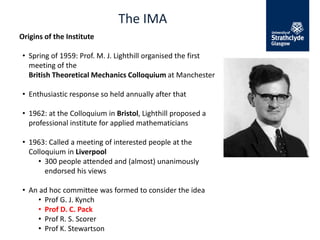
• Spring of 1959: Prof. M. J. Lighthill organised the first
meeting of the
British Theoretical Mechanics Colloquium at Manchester
• Enthusiastic response so held annually after that
• 1962: at the Colloquium in Bristol, Lighthill proposed a
professional institute for applied mathematicians
• 1963: Called a meeting of interested people at the
Colloquium in Liverpool
• 300 people attended and (almost) unanimously
endorsed his views
• An ad hoc committee was formed to consider the idea
• Prof G. J. Kynch
• Prof D. C. Pack
• Prof R. S. Scorer
• Prof K. Stewartson
The IMA
• May 1959: A committee of the Heads of departments, industry and
government mathematicians met to consider a similar proposal
• Chairman: Mr. A. Geary (Northampton College of Advanced
Technology)
• Views were sought and there were positive and negative responses.
• Some worried it might be just another mathematical organisation
• Some worried what the pure mathematicians would think
• 1961: Geary Committee met
• the London Mathematical Society (LMS),
• the Mathematical Association (MA),
• the Royal Statistical Society (RSS),
• the British Computer Society (BCS),
• the Operational Research Society (ORS)
• Concluded that the aims of the proposed Institute would not lead to any
rivalry with the other organisations.
The IMA
• Lots of discussion about coordination which led to the formation of the
Joint Mathematical Council (JMC)
• Three things now happened.
• Sir William Hodge obtained £2000 a year for three years to support the
formation of an Institute of Mathematics
• The colloquium at Liverpool led Lighthill to take action
• A meeting of the Conference of University Professors of Mathematics heard
about both initiatives
• On 23 May 1963 everyone met and it was confirmed the name “Institute of
Mathematics and its Applications”, a joint committee was formed
• Five meetings later, on 24 March 1964, a formal application was made to the
Board of Trade for the registration of the Institute as a company
• Certificate of registration, dated 23 April 1964, was then produced.
The Department
• 1796 Anderson's Institution formed
• Professor of Mathematics: Robert Wallace (professor 1825-1828)
• 1828 Anderson's University
• 1887 Glasgow and West of Scotland Technical College
• 1912 Royal Technical College
• Department of Mathematics was a small service department with just 6
academic staff.
• Prof. Donald Pack joins in 1953
• Creates the Honours Associateship in Applied Mathematics, designed to
produce graduates to work in industry
• 1956 Royal College of Science and Technology
• 1964 Merger with Scottish College of Commerce
• 1964 University of Strathclyde formed
Prof. Donald Pack
• 1938 New College, Oxford with a Major Scholarship in Mathematics
• Completed his degree before entering war service
• short spell with the Ordnance Board in Cambridge
• then Armament Research and Development Establishment at Fort
Halstead
• worked on problems involving armaments and explosives.
Prof. Donald Pack
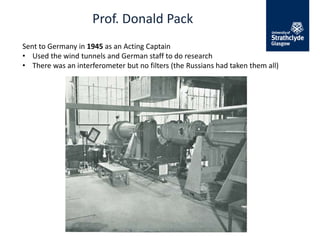
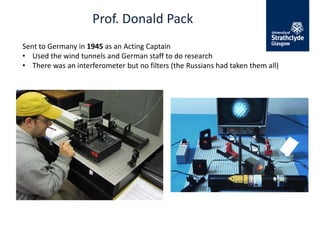
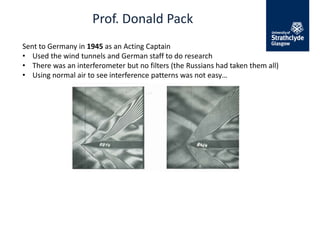
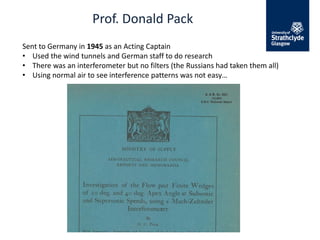
Sent to Germany in 1945 as an Acting Captain
• Used the wind tunnels and German staff to do research
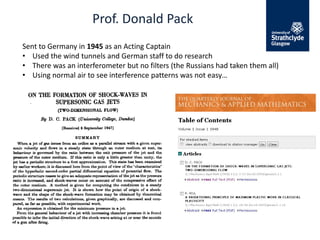
• There was an interferometer but no filters (the Russians had taken them all)
Prof. Donald Pack
Sent to Germany in 1945 as an Acting Captain
• Used the wind tunnels and German staff to do research
• There was an interferometer but no filters (the Russians had taken them all)
Prof. Donald Pack
Sent to Germany in 1945 as an Acting Captain
• Used the wind tunnels and German staff to do research
• There was an interferometer but no filters (the Russians had taken them all)
• Using normal air to see interference patterns was not easy…
Prof. Donald Pack
Sent to Germany in 1945 as an Acting Captain
• Used the wind tunnels and German staff to do research
• There was an interferometer but no filters (the Russians had taken them all)
• Using normal air to see interference patterns was not easy…
Prof. Donald Pack
Sent to Germany in 1945 as an Acting Captain
• Used the wind tunnels and German staff to do research
• There was an interferometer but no filters (the Russians had taken them all)
• Using normal air to see interference patterns was not easy…
Prof. Donald Pack
• 1946 Lectureship in Queen’s College, Dundee (part of University of St
Andrews)
• no suitable person to supervise a PhD
• waited until he had enough material to submit for a DSc, which he
gained in 1952.
• 1952 Lectureship in the University of Manchester
• Vice-Chancellor told him he was being paid too much for his age
• 1953 Applied for Chair of Mathematics in the Royal Technical College
Prof. Donald Pack
• 1953 Chair of Mathematics in the Royal Technical College
• 1954 Honours Associateship in Applied Mathematics, designed to produce
graduates to work in industry
• included a major project (in industry) at the end of the final year
• counted as two papers in the final assessment
• There were only three students in the first year - two of them married
Prof. Donald Pack
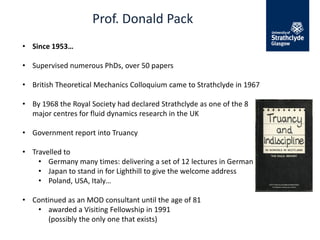
• Since 1953…
• Supervised numerous PhDs, over 50 papers
• British Theoretical Mechanics Colloquium came to Strathclyde in 1967
• By 1968 the Royal Society had declared Strathclyde as one of the 8
major centres for fluid dynamics research in the UK
• Government report into Truancy
• Travelled to
• Germany many times: delivering a set of 12 lectures in German
• Japan to stand in for Lighthill to give the welcome address
• Poland, USA, Italy…
• Continued as an MOD consultant until the age of 81
• awarded a Visiting Fellowship in 1991
(possibly the only one that exists)
The Department since 1964
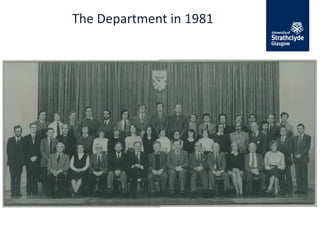
The Department in 1981
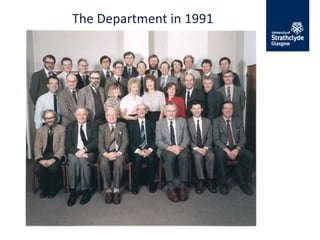
The Department in 1991
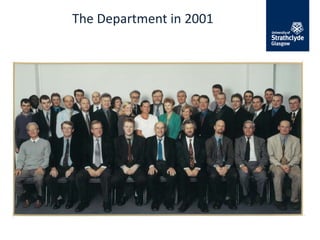
The Department in 2001
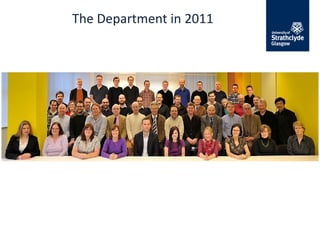
The Department in 2011
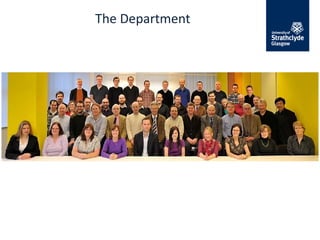
The Department
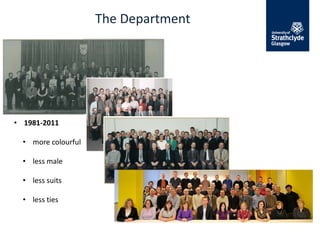
• 1981-2011
• more colourful
• less male
• less suits
• less ties
The Department

FiftyYears_Mottram_s

  • 1.
    50 years ofthe IMA and the Department of Mathematics & Statistics Nigel Mottram Department of Mathematics and Statistics University of Strathclyde, Glasgow
  • 2.
    The IMA Origins ofthe Institute • Spring of 1959: Prof. M. J. Lighthill organised the first meeting of the British Theoretical Mechanics Colloquium at Manchester • Enthusiastic response so held annually after that • 1962: at the Colloquium in Bristol, Lighthill proposed a professional institute for applied mathematicians • 1963: Called a meeting of interested people at the Colloquium in Liverpool • 300 people attended and (almost) unanimously endorsed his views • An ad hoc committee was formed to consider the idea • Prof G. J. Kynch • Prof D. C. Pack • Prof R. S. Scorer • Prof K. Stewartson
  • 3.
    The IMA • May1959: A committee of the Heads of departments, industry and government mathematicians met to consider a similar proposal • Chairman: Mr. A. Geary (Northampton College of Advanced Technology) • Views were sought and there were positive and negative responses. • Some worried it might be just another mathematical organisation • Some worried what the pure mathematicians would think • 1961: Geary Committee met • the London Mathematical Society (LMS), • the Mathematical Association (MA), • the Royal Statistical Society (RSS), • the British Computer Society (BCS), • the Operational Research Society (ORS) • Concluded that the aims of the proposed Institute would not lead to any rivalry with the other organisations.
  • 4.
    The IMA • Lotsof discussion about coordination which led to the formation of the Joint Mathematical Council (JMC) • Three things now happened. • Sir William Hodge obtained £2000 a year for three years to support the formation of an Institute of Mathematics • The colloquium at Liverpool led Lighthill to take action • A meeting of the Conference of University Professors of Mathematics heard about both initiatives • On 23 May 1963 everyone met and it was confirmed the name “Institute of Mathematics and its Applications”, a joint committee was formed • Five meetings later, on 24 March 1964, a formal application was made to the Board of Trade for the registration of the Institute as a company • Certificate of registration, dated 23 April 1964, was then produced.
  • 5.
    The Department • 1796Anderson's Institution formed • Professor of Mathematics: Robert Wallace (professor 1825-1828) • 1828 Anderson's University • 1887 Glasgow and West of Scotland Technical College • 1912 Royal Technical College • Department of Mathematics was a small service department with just 6 academic staff. • Prof. Donald Pack joins in 1953 • Creates the Honours Associateship in Applied Mathematics, designed to produce graduates to work in industry • 1956 Royal College of Science and Technology • 1964 Merger with Scottish College of Commerce • 1964 University of Strathclyde formed
  • 6.
    Prof. Donald Pack •1938 New College, Oxford with a Major Scholarship in Mathematics • Completed his degree before entering war service • short spell with the Ordnance Board in Cambridge • then Armament Research and Development Establishment at Fort Halstead • worked on problems involving armaments and explosives.
  • 7.
    Prof. Donald Pack Sentto Germany in 1945 as an Acting Captain • Used the wind tunnels and German staff to do research • There was an interferometer but no filters (the Russians had taken them all)
  • 8.
    Prof. Donald Pack Sentto Germany in 1945 as an Acting Captain • Used the wind tunnels and German staff to do research • There was an interferometer but no filters (the Russians had taken them all)
  • 9.
    Prof. Donald Pack Sentto Germany in 1945 as an Acting Captain • Used the wind tunnels and German staff to do research • There was an interferometer but no filters (the Russians had taken them all) • Using normal air to see interference patterns was not easy…
  • 10.
    Prof. Donald Pack Sentto Germany in 1945 as an Acting Captain • Used the wind tunnels and German staff to do research • There was an interferometer but no filters (the Russians had taken them all) • Using normal air to see interference patterns was not easy…
  • 11.
    Prof. Donald Pack Sentto Germany in 1945 as an Acting Captain • Used the wind tunnels and German staff to do research • There was an interferometer but no filters (the Russians had taken them all) • Using normal air to see interference patterns was not easy…
  • 12.
    Prof. Donald Pack •1946 Lectureship in Queen’s College, Dundee (part of University of St Andrews) • no suitable person to supervise a PhD • waited until he had enough material to submit for a DSc, which he gained in 1952. • 1952 Lectureship in the University of Manchester • Vice-Chancellor told him he was being paid too much for his age • 1953 Applied for Chair of Mathematics in the Royal Technical College
  • 13.
    Prof. Donald Pack •1953 Chair of Mathematics in the Royal Technical College • 1954 Honours Associateship in Applied Mathematics, designed to produce graduates to work in industry • included a major project (in industry) at the end of the final year • counted as two papers in the final assessment • There were only three students in the first year - two of them married
  • 14.
    Prof. Donald Pack •Since 1953… • Supervised numerous PhDs, over 50 papers • British Theoretical Mechanics Colloquium came to Strathclyde in 1967 • By 1968 the Royal Society had declared Strathclyde as one of the 8 major centres for fluid dynamics research in the UK • Government report into Truancy • Travelled to • Germany many times: delivering a set of 12 lectures in German • Japan to stand in for Lighthill to give the welcome address • Poland, USA, Italy… • Continued as an MOD consultant until the age of 81 • awarded a Visiting Fellowship in 1991 (possibly the only one that exists)
  • 15.
  • 16.
  • 17.
  • 18.
  • 19.
  • 20.
    The Department • 1981-2011 •more colourful • less male • less suits • less ties
  • 21.