The Origins of DkIT: The
history of the Regional
Technical Colleges
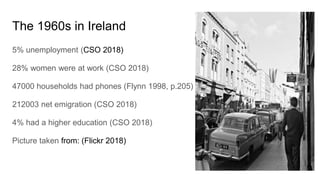
The 1960s in Ireland
5% unemployment (CSO 2018)
28% women were at work (CSO 2018)
47000 households had phones (Flynn 1998, p.205)
212003 net emigration (CSO 2018)
4% had a higher education (CSO 2018)
Picture taken from: (Flickr 2018)
1960s Dundalk
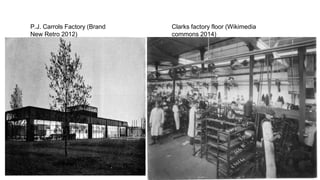
55% of the town was employed. (Flynn 2000, p. 94) P. J. Carrolls tobacco factory
was the major employer within the town. (Flynn 2000, p.100) Clarks Shoe factory
was also a major employer with a peak of 1200 employees in 1972. (Flynn 2000,
p. 102)
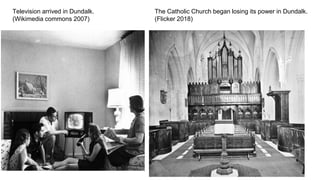
Television began to come into the town. Although deemed a social evil by the
church, it still spread widely. Attendance at Catholic ceremonies went from nearly
being ubiquitous in the 1950s to nearly a quarter not attending confession. There
was a loss of interest in Irish politicians as celebrities. (Flynn 2000, p.110) They
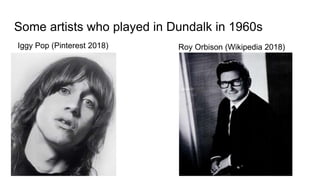
were replaced by American and British pop stars in the popular imagination -
some played in the music halls in the town. (Flynn 2000, p.121)
Dundalk today
51% of women employed (CSO 2018)
11% unemployment. (CSO 2018)
41% have a third level education. (CSO 2018)
86% in ireland have a smartphone (Deloitte 2016, p.2)
3100 net emigration. (CSO 2016)
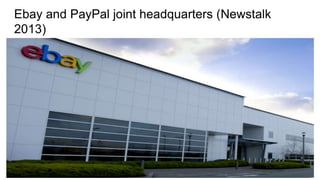
One of the major employers in Dundalk is Paypal which employs nearly 1700
people. (Newstalk 2013)
Ebay and PayPal joint headquarters (Newstalk
2013)
dkit.library@gmail.com
Television arrived in Dundalk.
(Wikimedia commons 2007)
The Catholic Church began losing its power in Dundalk.
(Flicker 2018)
P.J. Carrols Factory (Brand
New Retro 2012)
Clarks factory floor (Wikimedia
commons 2014)
Some artists who played in Dundalk in 1960s
Iggy Pop (Pinterest 2018) Roy Orbison (Wikipedia 2018)
Early 1960s
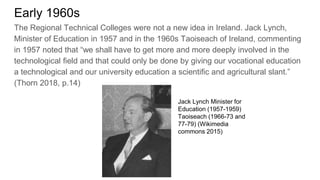
The Regional Technical Colleges were not a new idea in Ireland. Jack Lynch,
Minister of Education in 1957 and in the 1960s Taoiseach of Ireland, commenting
in 1957 noted that “we shall have to get more and more deeply involved in the
technological field and that could only be done by giving our vocational education
a technological and our university education a scientific and agricultural slant.”
(Thorn 2018, p.14)
Jack Lynch Minister for
Education (1957-1959)
Taoiseach (1966-73 and
77-79) (Wikimedia
commons 2015)
Role of the RTCs
Aim: “The purpose of this education is clear: Such technical college courses
should produce better educated and trained recruitment into industry as trainee
technicians. This better educated and trained recruit for industry would be able to
advance his theoretical knowledge and practical skills by further attendance at
courses.” (Thorn 2018, p.16)
Technological Colleges with Regional status
1963 Dr Patrick Hillery the Minister for Education announces the establishment of
Regional Technical Colleges. (Thorn 2018, p.20)
A Technical Schools Leaving Certificate was established which would be delivered
in a limited number of technological colleges with regional status. Successful
completion of the Technical Schools Leaving Certificate would fit the holder for (a)
entrance to certain university faculties or to advanced courses in a college of
technology with a view to a university degree or membership of a professional
institute and (b) further training in industry and/or in a college of technology for a
post as a technician or junior manager. (Thorn 2018, p.20)
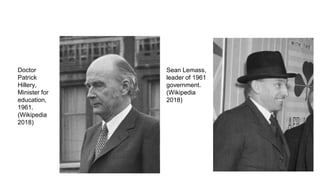
Doctor
Patrick
Hillery,
Minister for
education,
1961.
(Wikipedia
2018)
Sean Lemass,
leader of 1961
government.
(Wikipedia
2018)
Beginnings in Louth
“On 11 February 1963, at a committee meeting, the Louth Vocational Education
Committee agreed a document entitled ‘proposals for the advancement of
Technical Education in County Louth to be submitted to the Department of
Education. In a document of one page, the committee laid out clearly the case for
a regional technical college as part of the provision for progression beyond the
group certificate examination: It is time to consider the introduction of a third or
fourth year course into technical school programmes...such a course might be
provided at regional technical colleges.” (Thorn 2018, p.16)
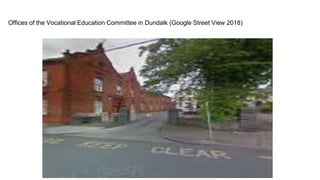
Offices of the Vocational Education Committee in Dundalk (Google Street View 2018)
In 1966 Donogh O'Malley, Minister for Education, established a Steering
Committee on Technical Education to advise on the Regional Technical Colleges.
As O’Malley stated “I'm ready to go on the technology colleges that were talked
about by Paddy Hillery… but nobody knows what to do nobody is telling me what
to do, now I have a consortium of architects and quantity surveyors and consulting
engineers all set up to go and they're giving a twenty percent or so cut in their fees
and I want to move in on this, but nobody would tell me exactly what size of
college do we want, how many rooms would be in them, what kind of rooms, how
many students would go through, what kind of courses they should be doing, can
you help in that.” (Thorn 2018, p.25)
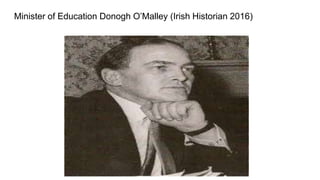
Minister of Education Donogh O’Malley (Irish Historian 2016)
The Steering Committee on Technical Education was set up on 20th September 1966 and was
given the following terms of reference: “To advise the minister generally on technical education. In
particular, on behalf of the minister, to provide the Department of Education Building Consortium
with a brief for the technical college.” (Steering Committee on Technical Education 1967, p.5)
They believed that they were needed as “Irish people generally have not had the opportunity to
become technically skilled and the academic bias in the educational system has not helped.”
(Steering Committee on Technical Education 1967, p.7)
They recommended the establishment of a National Council for Educational Awards, “responsible
for (i) setting standards of admission to, and qualification from, courses in technical education, (ii)
Approving examination syllabus and appropriate courses provided in Regional Colleges or other
technical schools, (iii) awarding certificates and diplomas to those successful in approved
examinations and (iv) negotiating reciprocal recognition of equivalent qualifications with other
countries. In the course of our deliberations we were repeatedly faced with problems arising from
the sparseness of information on which adequate projections of the likely demand for places in the
Regional Technical Colleges and of demand by industry and other sectors for the products of the
colleges could be based.” (Steering Committee on Technical Education 1967, p.8)
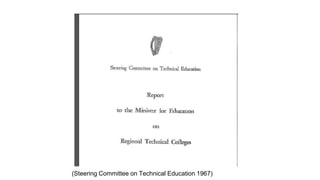
Steering Committee on Technical Education Report
(Steering Committee on Technical Education 1967)
Vision of the RTCs
We believe that the main long-term function of the colleges will be to educate for trade and industry over a
broad spectrum of occupations ranging from craft to professional level, notably in engineering and science
but also in commercial, linguistic and other specialties. They will, however, be more immediately
concerned with providing courses aimed at filling groups in the industrial manpower structure, particularly
in the technician area. For reasons outlined later, we also consider that the regional colleges should cater
for certain types of senior cycle post-primary education. (Steering Committee on Technical Education
1967, p.11)
If we are to make their most effective contribution to the needs of society and the economy we must be
capable of continuing adaptation to social, economic and technological changes. (Steering Committee on
Technical Education 1967, p.11)
The Steering Committee stated
“We feel very strongly that regional technical colleges should be seen as a new
concept operating under new institutional arrangements.” (Thorn 2018, p. 34)
"Each of the nine colleges will be run by a regional board on which local interests,
including local industrial interests and Vocational Education Committees, and the
Minister for Education will have representation. The intention is, of course, to
emphasise the regional character of the colleges.” (House of the Oireachtas 2018)
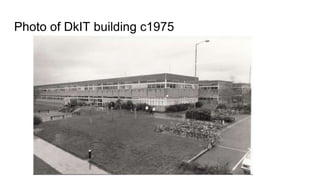
Photo of DkIT building c1975
Autumn 1969: first students enroll in 4 colleges, Athlone (50), Carlow (47),
Dundalk (92) and Waterford (96). (Thorn 2018, p.42)
1970-1972: Colleges open in Waterford, Carlow, Dundalk, Athlone, Sligo,
Letterkenny and Galway. (Thorn 2018, p.45)
In terms of staff recruitment, there was centralised recruitment with successful
candidates choosing where to work. (Thorn 2018, p.45)
1973: Higher Education Authority on a visit to the RTCs noted poor library
facilities. (Thorn 2018, p.46 )
Chronology
● 1957- Jack Lynch Minister of Education speaks of the need for higher level technical education.
● 1963- Doctor Patrick Hillery Minister for Education, announces the establishment of the Regional Technical
Colleges (RTCs)
● 1963- County Louth Vocational Education Committee (VEC) proposes the establishment of an RTC in
Dundalk.
● 1964- OECD report about training of technicians in Ireland. 1966- OECD survey on technical education:
investment in ireland.
● 1966- OECD survey on technical education : investment in education.
● 1966- Steering Committee on Technical Education established.
● 1967- Steering Committee on Technical Education report.
● 1969- Brian Lenihan Minister for Education states that VECs will be responsible for managing RTCs.
● 1969- Higher Education Authority recommend that a council for national awards be established to grant
awards in the RTCS.
● 1970- Colleges open in Sligo, Carlow, Athlone, Waterford and Dundalk.
References
ABC Global. (2014). School spotlight: London College of Communication... at University of The Arts London [online].
Available from: http://adcglobal.org/school-spotlight-london-college-of-communication/ [accessed 1 August 2018].
Brand New Retro. (2012). PJ Carroll – Office & factory, Dundalk 1971 [online]. Available from:
https://brandnewretro.ie/2012/11/16/pj-carrolls-office-factory-dundalk-1971/ [accessed 14 August 2018].
CSO. (2016). Census 2016 sapmap area: Settlements Dundalk [online]. Available from:
http://census.cso.ie/sapmap2016/Results.aspx?Geog_Type=ST2016&Geog_Code=91DBC922-801B-421B-9D74-
C2381BC684EC [accessed 15 August 2018].
CSO. (2018). Census 1961 reports [online]. Available from:
https://www.cso.ie/en/census/censusvolumes1926to1991/historicalreports/census1961reports/ [accessed 3 August 2018].
D’arcy, C. ( 2014). Dundalk has got back its business groove Initiatives to bring jobs and investment to Dundalk have had
some success in recent years. The Irish Times [online], 30 June 2014. Available from:
https://www.irishtimes.com/business/dundalk-has-got-back-its-business-groove-1.1847721 [accessed 15 August 2018].
Deloitte 2016. Global Mobile Consumer survey: Ireland 2016 there's no place like phone. Dublin: Deloitte.
Flicker. (2018). Capel street, Dublin at 9.30 [online]. Available from: https://www.flickr.com/photos/nlireland/7459404340.
[accessed 12 August 2018].
Flickr. (2018). Not a "Gothic revival/restoration stone church, square castellated tower with four corner spires", but Down
Cathedra [online]. Available from: https://www.flickr.com/photos/nlireland/42153167234. [accessed 14 August 2018].
Flynn, C. (2000). Dundalk 1900-1960: an oral history [unpublished]. PhD thesis, NUI-Maynooth Dublin.
Flynn, R. ( 1998). The Development of Universal Telephone Service in Ireland 1880 - 1993 [unpublished]. PHD thesis,
Dublin City University Dublin.
Google Street View. (2018). 41 Bachelors Walk Dundalk County Louth [online]. Available from:
https://www.google.com/maps [accessed 12 August 2018].
Healy, J. (1988). The wild one. Magill, 11(8), pp. 39-44
House of the Oireachtas. (2018). Dáil Éireann debate - Thursday, 28 Nov 1968 [online]. Available from:
https://www.oireachtas.ie/en/debates/debate/dail/1968-11-28/65/ [accessed 3 August 2018].
Newstalk. (2013). Taoiseach opens eBay-PayPal headquarters in Dundalk [online]. Available from:
https://www.newstalk.com/eBay-opens-EU-headquarters-in-Dundalk [accessed 14 August 2018].
O’Rian, M., McCarthy, K., Harrison, J and Corria, L. G. (2015). The forces that shaped the Irish Regional Technical College
buildings. Iterations [online], 6(2). Available from: https://ulir.ul.ie/handle/10344/5974 [accessed 14 August 2018].
Pintrest. (2018). 225 best Iggy Pop images [online]. Available from: https://www.pinterest.co.uk/whyareyousoinlo/iggy-pop/
[accessed 12 August 2018].
Steering Committee on Technical Education 1967. Report to the Minister for Education on Regional Technical Colleges. .
Dublin: Stationery Office.
The Irish Historian. (2016). August 2016 history selection [online]. Available from:
http://www.irishhistorian.com/Selections/August_2016_Selection.html [accessed 14 August 2018].
Thron, R. ( 2018). No artificial limits: Ireland's regional technical colleges. Dublin: IPA
University of Birmingham. (2018). Our history [online]. Available from: https://www.birmingham.ac.uk/schools/metallurgy-
materials/about/met-mat-history.aspx [accessed 1 August 2018].
Wikimedia Commons. (2015). File:Jack Lynch 1967 (cropped).jpg [online]. Available from:
https://commons.wikimedia.org/wiki/File:Jack_Lynch_1967_(cropped).jpg [accessed 14 August 2018].
Wikipedia. (2018). Patrick Hilary [online]. Available from: https://en.wikipedia.org/wiki/Patrick_Hillery [accessed 2 August
2018].
Wikipedia. (2018). Roy Orbison [online]. Available from: https://en.wikipedia.org/wiki/Roy_Orbison. [accessed 13 August 2018].
Wikipedia. (2018). Sean Lemass [online]. Available from: https://en.wikipedia.org/wiki/Se%C3%A1n_Lemass [accessed 2
August 2018].

The origins of DkIT

  • 1.
    The Origins ofDkIT: The history of the Regional Technical Colleges
  • 2.
    The 1960s inIreland 5% unemployment (CSO 2018) 28% women were at work (CSO 2018) 47000 households had phones (Flynn 1998, p.205) 212003 net emigration (CSO 2018) 4% had a higher education (CSO 2018) Picture taken from: (Flickr 2018)
  • 3.
    1960s Dundalk 55% ofthe town was employed. (Flynn 2000, p. 94) P. J. Carrolls tobacco factory was the major employer within the town. (Flynn 2000, p.100) Clarks Shoe factory was also a major employer with a peak of 1200 employees in 1972. (Flynn 2000, p. 102) Television began to come into the town. Although deemed a social evil by the church, it still spread widely. Attendance at Catholic ceremonies went from nearly being ubiquitous in the 1950s to nearly a quarter not attending confession. There was a loss of interest in Irish politicians as celebrities. (Flynn 2000, p.110) They were replaced by American and British pop stars in the popular imagination - some played in the music halls in the town. (Flynn 2000, p.121)
  • 4.
    Dundalk today 51% ofwomen employed (CSO 2018) 11% unemployment. (CSO 2018) 41% have a third level education. (CSO 2018) 86% in ireland have a smartphone (Deloitte 2016, p.2) 3100 net emigration. (CSO 2016) One of the major employers in Dundalk is Paypal which employs nearly 1700 people. (Newstalk 2013)
  • 5.
    Ebay and PayPaljoint headquarters (Newstalk 2013)
  • 6.
    dkit.library@gmail.com Television arrived inDundalk. (Wikimedia commons 2007) The Catholic Church began losing its power in Dundalk. (Flicker 2018)
  • 7.
    P.J. Carrols Factory(Brand New Retro 2012) Clarks factory floor (Wikimedia commons 2014)
  • 8.
    Some artists whoplayed in Dundalk in 1960s Iggy Pop (Pinterest 2018) Roy Orbison (Wikipedia 2018)
  • 9.
    Early 1960s The RegionalTechnical Colleges were not a new idea in Ireland. Jack Lynch, Minister of Education in 1957 and in the 1960s Taoiseach of Ireland, commenting in 1957 noted that “we shall have to get more and more deeply involved in the technological field and that could only be done by giving our vocational education a technological and our university education a scientific and agricultural slant.” (Thorn 2018, p.14) Jack Lynch Minister for Education (1957-1959) Taoiseach (1966-73 and 77-79) (Wikimedia commons 2015)
  • 10.
    Role of theRTCs Aim: “The purpose of this education is clear: Such technical college courses should produce better educated and trained recruitment into industry as trainee technicians. This better educated and trained recruit for industry would be able to advance his theoretical knowledge and practical skills by further attendance at courses.” (Thorn 2018, p.16)
  • 11.
    Technological Colleges withRegional status 1963 Dr Patrick Hillery the Minister for Education announces the establishment of Regional Technical Colleges. (Thorn 2018, p.20) A Technical Schools Leaving Certificate was established which would be delivered in a limited number of technological colleges with regional status. Successful completion of the Technical Schools Leaving Certificate would fit the holder for (a) entrance to certain university faculties or to advanced courses in a college of technology with a view to a university degree or membership of a professional institute and (b) further training in industry and/or in a college of technology for a post as a technician or junior manager. (Thorn 2018, p.20)
  • 12.
  • 13.
    Beginnings in Louth “On11 February 1963, at a committee meeting, the Louth Vocational Education Committee agreed a document entitled ‘proposals for the advancement of Technical Education in County Louth to be submitted to the Department of Education. In a document of one page, the committee laid out clearly the case for a regional technical college as part of the provision for progression beyond the group certificate examination: It is time to consider the introduction of a third or fourth year course into technical school programmes...such a course might be provided at regional technical colleges.” (Thorn 2018, p.16)
  • 14.
    Offices of theVocational Education Committee in Dundalk (Google Street View 2018)
  • 15.
    In 1966 DonoghO'Malley, Minister for Education, established a Steering Committee on Technical Education to advise on the Regional Technical Colleges. As O’Malley stated “I'm ready to go on the technology colleges that were talked about by Paddy Hillery… but nobody knows what to do nobody is telling me what to do, now I have a consortium of architects and quantity surveyors and consulting engineers all set up to go and they're giving a twenty percent or so cut in their fees and I want to move in on this, but nobody would tell me exactly what size of college do we want, how many rooms would be in them, what kind of rooms, how many students would go through, what kind of courses they should be doing, can you help in that.” (Thorn 2018, p.25)
  • 16.
    Minister of EducationDonogh O’Malley (Irish Historian 2016)
  • 17.
    The Steering Committeeon Technical Education was set up on 20th September 1966 and was given the following terms of reference: “To advise the minister generally on technical education. In particular, on behalf of the minister, to provide the Department of Education Building Consortium with a brief for the technical college.” (Steering Committee on Technical Education 1967, p.5) They believed that they were needed as “Irish people generally have not had the opportunity to become technically skilled and the academic bias in the educational system has not helped.” (Steering Committee on Technical Education 1967, p.7) They recommended the establishment of a National Council for Educational Awards, “responsible for (i) setting standards of admission to, and qualification from, courses in technical education, (ii) Approving examination syllabus and appropriate courses provided in Regional Colleges or other technical schools, (iii) awarding certificates and diplomas to those successful in approved examinations and (iv) negotiating reciprocal recognition of equivalent qualifications with other countries. In the course of our deliberations we were repeatedly faced with problems arising from the sparseness of information on which adequate projections of the likely demand for places in the Regional Technical Colleges and of demand by industry and other sectors for the products of the colleges could be based.” (Steering Committee on Technical Education 1967, p.8) Steering Committee on Technical Education Report
  • 18.
    (Steering Committee onTechnical Education 1967)
  • 19.
    Vision of theRTCs We believe that the main long-term function of the colleges will be to educate for trade and industry over a broad spectrum of occupations ranging from craft to professional level, notably in engineering and science but also in commercial, linguistic and other specialties. They will, however, be more immediately concerned with providing courses aimed at filling groups in the industrial manpower structure, particularly in the technician area. For reasons outlined later, we also consider that the regional colleges should cater for certain types of senior cycle post-primary education. (Steering Committee on Technical Education 1967, p.11) If we are to make their most effective contribution to the needs of society and the economy we must be capable of continuing adaptation to social, economic and technological changes. (Steering Committee on Technical Education 1967, p.11)
  • 20.
    The Steering Committeestated “We feel very strongly that regional technical colleges should be seen as a new concept operating under new institutional arrangements.” (Thorn 2018, p. 34) "Each of the nine colleges will be run by a regional board on which local interests, including local industrial interests and Vocational Education Committees, and the Minister for Education will have representation. The intention is, of course, to emphasise the regional character of the colleges.” (House of the Oireachtas 2018)
  • 21.
    Photo of DkITbuilding c1975
  • 22.
    Autumn 1969: firststudents enroll in 4 colleges, Athlone (50), Carlow (47), Dundalk (92) and Waterford (96). (Thorn 2018, p.42) 1970-1972: Colleges open in Waterford, Carlow, Dundalk, Athlone, Sligo, Letterkenny and Galway. (Thorn 2018, p.45) In terms of staff recruitment, there was centralised recruitment with successful candidates choosing where to work. (Thorn 2018, p.45) 1973: Higher Education Authority on a visit to the RTCs noted poor library facilities. (Thorn 2018, p.46 )
  • 23.
    Chronology ● 1957- JackLynch Minister of Education speaks of the need for higher level technical education. ● 1963- Doctor Patrick Hillery Minister for Education, announces the establishment of the Regional Technical Colleges (RTCs) ● 1963- County Louth Vocational Education Committee (VEC) proposes the establishment of an RTC in Dundalk. ● 1964- OECD report about training of technicians in Ireland. 1966- OECD survey on technical education: investment in ireland. ● 1966- OECD survey on technical education : investment in education. ● 1966- Steering Committee on Technical Education established. ● 1967- Steering Committee on Technical Education report. ● 1969- Brian Lenihan Minister for Education states that VECs will be responsible for managing RTCs. ● 1969- Higher Education Authority recommend that a council for national awards be established to grant awards in the RTCS. ● 1970- Colleges open in Sligo, Carlow, Athlone, Waterford and Dundalk.
  • 24.
    References ABC Global. (2014).School spotlight: London College of Communication... at University of The Arts London [online]. Available from: http://adcglobal.org/school-spotlight-london-college-of-communication/ [accessed 1 August 2018]. Brand New Retro. (2012). PJ Carroll – Office & factory, Dundalk 1971 [online]. Available from: https://brandnewretro.ie/2012/11/16/pj-carrolls-office-factory-dundalk-1971/ [accessed 14 August 2018]. CSO. (2016). Census 2016 sapmap area: Settlements Dundalk [online]. Available from: http://census.cso.ie/sapmap2016/Results.aspx?Geog_Type=ST2016&Geog_Code=91DBC922-801B-421B-9D74- C2381BC684EC [accessed 15 August 2018]. CSO. (2018). Census 1961 reports [online]. Available from: https://www.cso.ie/en/census/censusvolumes1926to1991/historicalreports/census1961reports/ [accessed 3 August 2018]. D’arcy, C. ( 2014). Dundalk has got back its business groove Initiatives to bring jobs and investment to Dundalk have had some success in recent years. The Irish Times [online], 30 June 2014. Available from: https://www.irishtimes.com/business/dundalk-has-got-back-its-business-groove-1.1847721 [accessed 15 August 2018]. Deloitte 2016. Global Mobile Consumer survey: Ireland 2016 there's no place like phone. Dublin: Deloitte. Flicker. (2018). Capel street, Dublin at 9.30 [online]. Available from: https://www.flickr.com/photos/nlireland/7459404340. [accessed 12 August 2018]. Flickr. (2018). Not a "Gothic revival/restoration stone church, square castellated tower with four corner spires", but Down Cathedra [online]. Available from: https://www.flickr.com/photos/nlireland/42153167234. [accessed 14 August 2018]. Flynn, C. (2000). Dundalk 1900-1960: an oral history [unpublished]. PhD thesis, NUI-Maynooth Dublin. Flynn, R. ( 1998). The Development of Universal Telephone Service in Ireland 1880 - 1993 [unpublished]. PHD thesis, Dublin City University Dublin.
  • 25.
    Google Street View.(2018). 41 Bachelors Walk Dundalk County Louth [online]. Available from: https://www.google.com/maps [accessed 12 August 2018]. Healy, J. (1988). The wild one. Magill, 11(8), pp. 39-44 House of the Oireachtas. (2018). Dáil Éireann debate - Thursday, 28 Nov 1968 [online]. Available from: https://www.oireachtas.ie/en/debates/debate/dail/1968-11-28/65/ [accessed 3 August 2018]. Newstalk. (2013). Taoiseach opens eBay-PayPal headquarters in Dundalk [online]. Available from: https://www.newstalk.com/eBay-opens-EU-headquarters-in-Dundalk [accessed 14 August 2018]. O’Rian, M., McCarthy, K., Harrison, J and Corria, L. G. (2015). The forces that shaped the Irish Regional Technical College buildings. Iterations [online], 6(2). Available from: https://ulir.ul.ie/handle/10344/5974 [accessed 14 August 2018]. Pintrest. (2018). 225 best Iggy Pop images [online]. Available from: https://www.pinterest.co.uk/whyareyousoinlo/iggy-pop/ [accessed 12 August 2018]. Steering Committee on Technical Education 1967. Report to the Minister for Education on Regional Technical Colleges. . Dublin: Stationery Office. The Irish Historian. (2016). August 2016 history selection [online]. Available from: http://www.irishhistorian.com/Selections/August_2016_Selection.html [accessed 14 August 2018]. Thron, R. ( 2018). No artificial limits: Ireland's regional technical colleges. Dublin: IPA University of Birmingham. (2018). Our history [online]. Available from: https://www.birmingham.ac.uk/schools/metallurgy- materials/about/met-mat-history.aspx [accessed 1 August 2018]. Wikimedia Commons. (2015). File:Jack Lynch 1967 (cropped).jpg [online]. Available from: https://commons.wikimedia.org/wiki/File:Jack_Lynch_1967_(cropped).jpg [accessed 14 August 2018]. Wikipedia. (2018). Patrick Hilary [online]. Available from: https://en.wikipedia.org/wiki/Patrick_Hillery [accessed 2 August 2018].
  • 26.
    Wikipedia. (2018). RoyOrbison [online]. Available from: https://en.wikipedia.org/wiki/Roy_Orbison. [accessed 13 August 2018]. Wikipedia. (2018). Sean Lemass [online]. Available from: https://en.wikipedia.org/wiki/Se%C3%A1n_Lemass [accessed 2 August 2018].