Latin
American
Art
Fifty Years of
Selections from
the Neuberger
Museum of Art
February 28 through May 30, 2012
This exhibition is sponsored by ownership
at 1285 Avenue of the Americas, developed
as a community based public service in
partnership with Jones Lang LaSalle, and
organized by the Neuberger Museum of Art.
Latin American Art from the Neuberger
Museum of Art
The idea of a “Latin American art” has been debated by artists and scholars past
and present.2
In an era when individuals travel and live in multiple places, often
outside their native country, one may ask if it is still relevant to think in regional
terms. This question is essential, as many Latin American artists prefer not to carry
a national banner, but instead consider themselves actors at a universal crossroads,
interacting with artists from the Western world, Asia, the Middle East, and Africa.
Any contemporary understanding of Latin America must therefore acknowledge a
global orientation where each artist is immersed in a multiplicity of connected and
overlapping realities.
Since its founding in 1969, the Neuberger Museum of Art, located on the campus
of Purchase College in Westchester County, New York, has assembled an extraor-
dinary collection of art by Latin American artists working both inside and outside
of their homelands. In 2010, the first Roy R. Neuberger Prize was awarded to Cuban
artist Tania Bruguera, culminating in the exhibition and publication Tania Bruguera:
On the Political Imaginary (2010). 3
In addition, the Museum has featured the
following recent Latin American art exhibitions: Contemporary Latin American Art
from the Luís Calzadilla Collection (2010); The Irony of the Skeletons: Nicolás De Jesús’
Amates (2010); and Betsabeé Romero: Lágrimas Negras/Black Tears (2011). Close
relationships with both Romero and De Jesús have led to new acquisitions by the
Museum which are on view in the present exhibition.
Fifty Years of Latin American Art: Selections from the Neuberger Museum of Art
brings together, for the first time, a selection of work that includes some of the
most renowned artists of the early twentieth century including Manuel Álvarez
Bravo, Wifredo Lam, Roberto Matta, José Clemente Orozco, and Rufino Tamayo,
alongside contemporary artists Julio Antonio, Leda Catunda, Carlos Cruz-Diez, José
Luis Cuevas, Arturo Duclos, Florencio Gelabert, Betsabeé Romero, Nicolás De Jesús,
Carlos Garaicoa, Eduardo Mac Entyre, Arturo Mallmann, María Martínez-Cañas,
Marta María Pérez Bravo, Jesús Rafael Soto, Gerardo Suter, and Eugenia Vargas.
The Awakening of Modern Latin American Art in
the Twentieth Century
In the first half of the twentieth century, artists such as José Clemente Orozco,
Rufino Tamayo, and Wifredo Lam, began developing artistic strategies to define
Latin American identity and modernity. Enriched by the experience of living abroad
and interacting with avant-garde artists from Europe and the United States, these
artists sought to represent their own histories, cultures, and experiences through
a new modern lens.
Latin America thus began to see itself not as a peripheral area condemned to
copying foreign masters, schools, and movements, but rather came to see its own
regions as capable of becoming the new centers for art. As artists acquired inde-
pendence and freedom, Latin American art gradually gained worldwide notoriety.
my country is in time not in
space. those who lived when i
lived are my countrymen and
what we made of that epoch
is our measure.1
—Roberto Matta
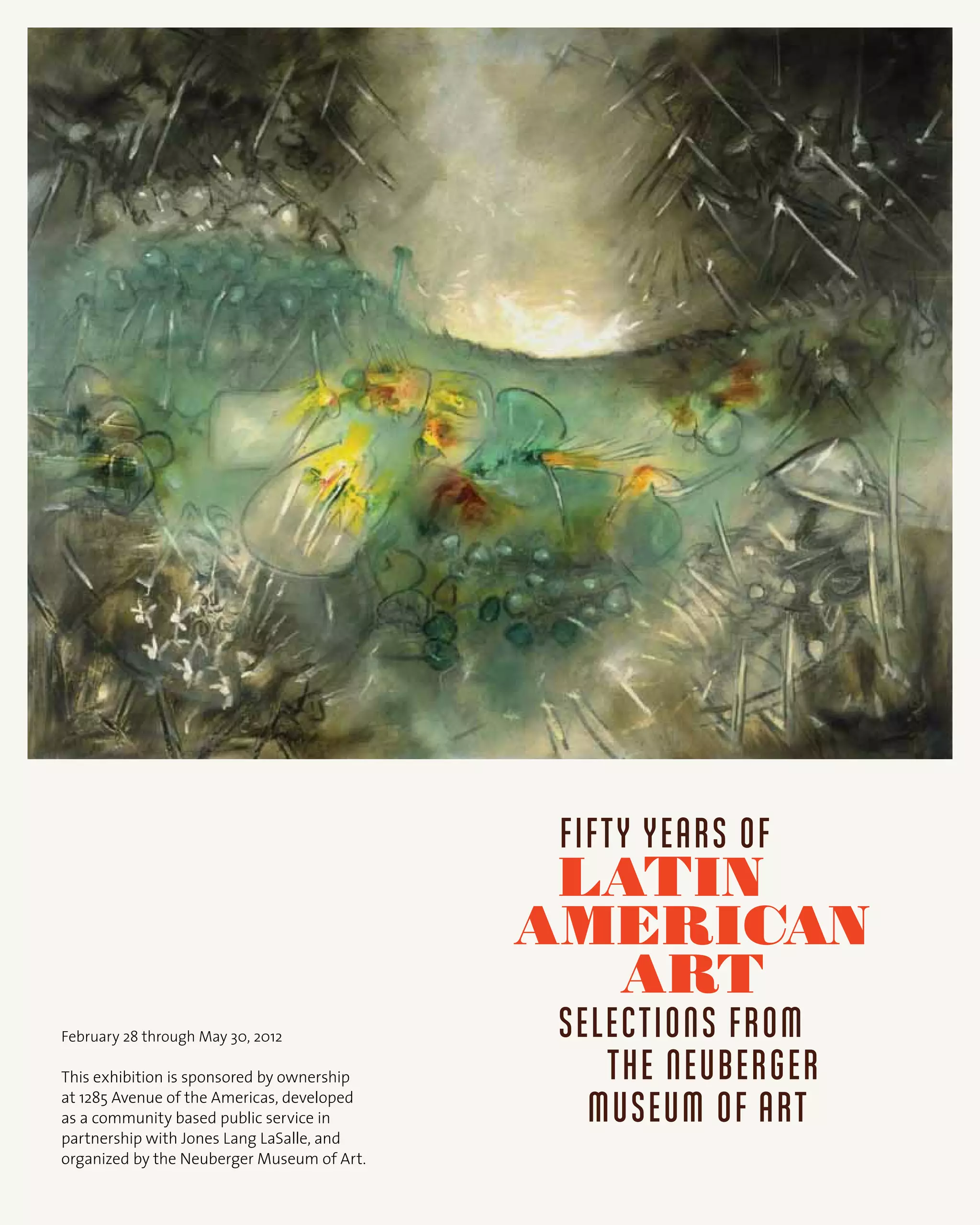
Figure 1, cover: Roberto Matta, The Creators,
1953, oil on canvas, 37 x 47 inches. Gift of Roy
wR. Neuberger, photo: Jim Frank.
Figure 2, left: Rufino Tamayo, Untitled, 1969,
color lithograph on Japanese nacre paper,
30 1/4 x 22 1/4 inches, 16/25. Gift of Fritz
Landshoff, photo: Jim Frank.
Orozco recalls in his autobiography:
We began to suspect that the whole colonial situation was nothing but a
swindle foisted upon us by international traders. We too had a character,
which was quite the equal of any other. We would learn what the ancients and
the foreigners could teach us, but we could do as much as they, or more. It was
not pride but self-confidence that moved us in this belief, a sense of our own
being and destiny.4
By the 1930s, this awakening was recognized by museums, galleries, and collectors,
as Mexican muralists contributed to the development of modernism across the
Americas. In 1931, New York’s Museum of Modern Art held an exhibition of Diego
Rivera’s frescos, making him the second artist to receive a monographic show there
after Henri Matisse. Concurrently, U.S. collectors and galleries began to acquire
work by Latin American artists, many of whom were living in New York. In 1944
Roy R. Neuberger, who prided himself on collecting American art, purchased Rufino
Tamayo’s Woman Spinning (1943) from the Valentine Gallery. Tamayo had been
living in New York since 1937, and this was the first painting by a Latin American
artist in Neuberger’s collection.
With the outbreak of World War II, the Chilean painter Roberto Matta immigrated
from Paris to New York along with writer and poet André Breton and other mem-
bers of the surrealist movement. Matta created fictional landscapes penetrated
by light and color, establishing a deep space inhabited by anthropomorphic forms.
The Creators (1953) (Figure 1) features an environment in decay. Its dark edges
contrast with the vivid central light, creating a tension that could allude to either
the generative forces of nature, or the destructive nature of war. Matta also began
a productive period of printmaking in the United States, signaling a newfound
interest in populist media and social criticism. With Reconaissance (n.d.), his hapless
Figure 3: Manuel Álvarez Bravo, Bicicletas en
Domingo (Bicycles on Sunday), 1966, gelatin
silver print, 8 x 10 inches. Gift of Donna and
Marvin Schwartz, photo: Jim Frank.
caricatures of military officials are scattered across the page, reflecting their own
state of disorder.
Though many Latin American artists were living in the United States and Europe
during this period, much of the work continued to be influenced by their native
landscapes. For Tamayo, who spent nearly twenty years abroad, the dusty colors,
porous surfaces, and sandy textures of his series Mujeres (1969) (Figure 2) connect
intimately with the Mexican terrain. Moreover, the geometric idol-like women,
recall clay Pre-Columbian figurines and feature exuberant yellows, pinks, and reds,
echoing the lush fruit of his native country.5
Manuel Álvarez Bravo’s black and
white photographs capture and intensify the textures of Mexico. In Bicicletas en
Domingo (Bicycles on Sunday) (1966) (Figure 3) atmospheric perspective suggests
the feel of a strong midday sun while dust merges the bicycle riders into a romantic
landscape. Although he never left Mexico, Álvarez Bravo’s work is formally attuned
to that of international photographers of the same period, including Walker Evans,
Henri Cartier-Bresson, Tina Modotti, and Edward Weston. André Breton, the
founder of surrealism, also championed Álvarez Bravo’s images. Although not all
of Álvarez Bravo’s photographs possess the dreamlike and unexpected juxtaposi-
tions of surrealist imagery, his realist portraits of everyday life frequently present
Mexican subjects in moments of contemplation, reverie, and meditation. In El
Perro Veinte (Dog Twenty) (1958) a girl stares beyond the frame of the photograph,
seemingly lost in her own thoughts.
Mexican modernism from the first half of the century was characterized by the
promotion of a nationalist agenda and led to what many art historians have
described as a period of isolation.6
But by the 1960s, a younger generation of
artists began to challenge the climate of seclusion, among them master drafts-
man José Luis Cuevas. Commenting on this period, he stated, “What I want in my
country’s art are broad highways leading out to the rest of the world, rather than
narrow trails connecting one adobe village to the next.”7
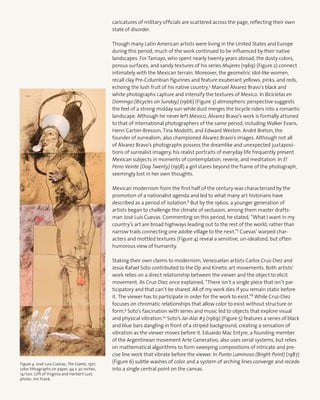
Cuevas’ warped char-
acters and mottled textures (Figure 4) reveal a sensitive, un-idealized, but often
humorous view of humanity.
Staking their own claims to modernism, Venezuelan artists Carlos Cruz-Diez and
Jesús Rafael Soto contributed to the Op and Kinetic art movements. Both artists’
work relies on a direct relationship between the viewer and the object to elicit
movement. As Cruz-Diez once explained, “There isn’t a single piece that isn’t par-
ticipatory and that can’t be shared. All of my work dies if you remain static before
it. The viewer has to participate in order for the work to exist.”8
While Cruz-Diez
focuses on chromatic relationships that allow color to exist without structure or
form,9
Soto’s fascination with series and music led to objects that explore visual
and physical vibration.10
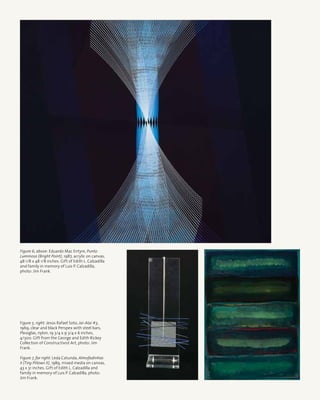
Soto’s Jai-Alai #3 (1969) (Figure 5) features a series of black
and blue bars dangling in front of a striped background, creating a sensation of
vibration as the viewer moves before it. Eduardo Mac Entyre, a founding member
of the Argentinean movement Arte Generativo, also uses serial systems, but relies
on mathematical algorithms to form sweeping compositions of intricate and pre-
cise line work that vibrate before the viewer. In Punto Luminoso (Bright Point) (1987)
(Figure 6) subtle washes of color and a system of arching lines converge and recede
into a single central point on the canvas.
Figure 4: José Luis Cuevas, The Giants, 1971,
color lithographs on paper, 94 x 30 inches,
14/100. Gift of Virginia and Herbert Lust,
photo: Jim Frank.
Figure 5, right: Jesús Rafael Soto, Jai-Alai #3,
1969, clear and black Perspex with steel bars,
Plexiglas, nylon, 19 3/4 x 9 3/4 x 6 inches,
4/300. Gift from the George and Edith Rickey
Collection of Constructivist Art, photo: Jim
Frank.
Figure 7, far right: Leda Catunda, Almofadinhas
II (Tiny Pillows II), 1989, mixed media on canvas,
43 x 31 inches. Gift of Edith L. Calzadilla and
family in memory of Luis P. Calzadilla, photo:
Jim Frank.
Figure 6, above: Eduardo Mac Entyre, Punto
Luminoso (Bright Point), 1987, acrylic on canvas,
48 1/8 x 48 1/8 inches. Gift of Edith L. Calzadilla
and family in memory of Luis P. Calzadilla,
photo: Jim Frank.
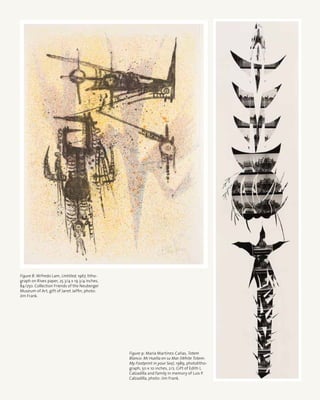
Figure 8: Wifredo Lam, Untitled, 1967, litho-
graph on Rives paper, 25 3/4 x 19 3/4 inches,
84/250. Collection Friends of the Neuberger
Museum of Art, gift of Janet Jaffin, photo:
Jim Frank.
Figure 9: María Martínez-Cañas, Totem
Blanco: Mi Huella en su Mar (White Totem:
My Footprint in your Sea), 1989, photolitho-
graph, 50 x 10 inches, 2/2. Gift of Edith L.
Calzadilla and family in memory of Luis P.
Calzadilla, photo: Jim Frank.
After years of conservatism imposed by the repressive dictatorial regimes of the
1970s, new movements such as Brazil’s Geração 80 (Generation 80) emerged.
Artists in the group favored the physical expressivity of bodily forms rather than
the austere formalism of minimalist or conceptual art. Leda Catunda’s colorful
objects transform the traditional stretched canvas into fluid dimensional shapes
that pour off the wall. Almofadinhas II (Tiny Pillows II) (1989) (Figure 7) is made from
rectangular cloth that recalls the color-field painting of abstract expressionist Mark
Rothko. Her title alludes to the presence of the body, suggesting a place where one
might lay his or her head to rest.
Like many of his South American contemporaries, Wifredo Lam worked in Europe
with vanguard artists including Pablo Picasso. On returning home to Cuba, he
began merging Cubist strategies with Afro-Cuban imagery. In Untitled (1966) from
the portfolio Flight (Figure 8), strange totemic forms inhabit a universe of colorful
constellations. Gaining international recognition, Lam ultimately became a major
influence on generations of younger Cuban artists, including Julio Antonio and
María Martínez-Cañas. Following the Cuban Revolution, many Cuban artists, such
as Martínez-Cañas, grew up estranged from the land of their parents. Her silver
print Totem Blanco: Mi Huella en su Mar (White Totem: My Foot in your Sea) (1989)
(Figure 9) is composed of photographic stills that form a totem, embracing the
notion of collective memory and personal remembrance. The composite image
documents a public monument that is also a site of personal experience. Florencio
Gelabert, of the same generation as Martínez-Cañas, began his career in Cuba
but fled from the island in the 1980s. The thorny Isla de Cuba (1990) manifests the
internal struggle triggered by this displacement. His Cuba is a treacherous, spiked
piece of jetsam. Appearing bloodied, the object becomes both the source and
location of physical pain and anguish.
Contemporary Latin American art today reaches beyond its own traditions by
addressing universal issues that testify to the layering of human experience. In
Desde la Alhambra (2007), Betsabeé Romero carves a Moorish pattern into a
rubber tire. She fills the recesses with colored chewing gum, merging Iberian-
Islamic decorative patterns with the materials of industry and popular culture.
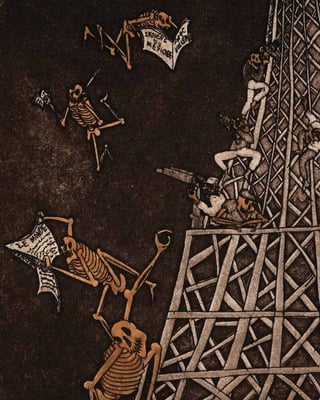
Nicolás De Jesús often populates his work with the ubiquitous Mexican skeleton,
reminiscent of the iconography found in Guadalupe Posada’s engravings. In some
of the work, his brittle figures inhabit a world dominated by financial crisis in a
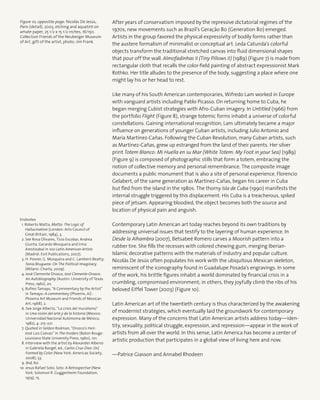
crumbling, compromised environment; in others, they joyfully climb the ribs of his
beloved Eiffel Tower (2003) (Figure 10).
Latin American art of the twentieth century is thus characterized by the awakening
of modernist strategies, which eventually laid the groundwork for contemporary
expression. Many of the concerns that Latin American artists address today—iden-
tity, sexuality, political struggle, expression, and repression—appear in the work of
artists from all over the world. In this sense, Latin America has become a center of
artistic production that participates in a global view of living here and now.
—Patrice Giasson and Annabel Rhodeen
Endnotes
1. Roberto Matta, Matta: The Logic of
Hallucination (London: Arts Council of
Great Britain, 1984), 3.
2. See Rosa Olivares, Ticio Escobar, Andrea
Giunta, Gerardo Mosquera and Irma
Arestizabal in 100 Latin American Artists
(Madrid: Exit Publications, 2007).
3. H. Posner, G. Mosquera and C. Lambert-Beatty,
Tania Bruguera: On The Political Imaginary
(Milano: Charta, 2009).
4. José Clemente Orozco, José Clemente Orozco:
An Autobiography (Austin: University of Texas
Press, 1962), 20.
5. Rufino Tamayo, “A Commentary by the Artist”
in Tamayo: A commentary (Phoenix, AZ:
Phoenix Art Museum and Friends of Mexican
Art, 1968), 2.
6. See Jorge Alberto, “La crisis del muralismo”
in Una visión del arte y de la historia (Mexico:
Universidad Nacional Autónoma de México,
1982), 4: 215–221.
7. Quoted in Seldon Rodman, “Orozco’s Heir:
José Luis Cuevas” in The Insiders (Baton Rouge:
Louisiana State University Press, 1960), 101.
8. Interview with the artist by Alexander Alberro
in Gabriela Rangel, ed., Carlos Cruz-Diez: (In)
Formed by Color (New York: Americas Society,
2008), 53.
9. Ibid, 60.
10. Jesus Rafael Soto, Soto: A Retrospective (New
York: Solomon R. Guggenheim Foundation,
1974), 15.
Figure 10, oppostite page: Nicolás De Jesús,
Paris (detail), 2003, etching and aquatint on
amate paper, 25 1/2 x 15 1/2 inches, 16/150.
Collection Friends of the Neuberger Museum
of Art, gift of the artist, photo: Jim Frank.
Checklist of the Exhibition
Unless otherwise noted, all work is Collection
Neuberger Museum of Art, Purchase College,
State University of New York. Dimensions are in
inches, height precedes width, precedes depth.
Manuel Álvarez Bravo
Ventana a los Magueyes (Window on the Agaves),
1976
From portfolio Untitled, 1980
Gelatin silver print, 8 x 10
Published by Acorn Edition Ltd., Geneva 1980
Gift of Donna and Marvin Schwartz, 1981.15.01.03
La Visita (The Visit), 1935
From portfolio Untitled, 1980
Gelatin silver print, 8 x 10
Published by Acorn Edition Ltd., Geneva 1980
Gift of Donna and Marvin Schwartz, 1981.15.01.05
El Perro Veinte (Dog Twenty), 1958
From portfolio Untitled, 1980
Gelatin silver print, 8 x 10
Published by Acorn Edition Ltd., Geneva 1980
Gift of Donna and Marvin Schwartz, 1981.15.01.06
Margarita de Bonampak (Margarita of
Bonampak), 1949
From portfolio Untitled, 1980
Gelatin silver print, 10 x 8
Published by Acorn Edition Ltd., Geneva 1980
Gift of Donna and Marvin Schwartz, 1981.15.01.07
Angel del Temblor (Angel of the Earthquake), 1957
From portfolio Untitled, 1980
Gelatin silver print, 8 x 10
Published by Acorn Edition Ltd., Geneva 1980
Gift of Donna and Marvin Schwartz, 1981.15.01.09
Tentaciones en Casa de Antonio (Temptations in
the House of Antonio), 1970
From portfolio Untitled, 1980
Gelatin silver print, 10 x 8
Published by Acorn Edition Ltd., Geneva 1980
Gift of Donna and Marvin Schwartz, 1981.15.01.10
Manos en el 210 de Fernandez Leal (Hands on
210 Fernandez Leal), 1976
From portfolio Untitled, 1980
Gelatin silver print, 8 x 10
Published by Acorn Edition Ltd., Geneva 1980
Gift of Donna and Marvin Schwartz, 1981.15.01.12
Bicicletas en Domingo (Bicycles on Sunday), 1966
From portfolio Untitled, 1980
Gelatin silver print, 8 x 10
Published by Acorn Edition Ltd., Geneva 1980
Gift of Donna and Marvin Schwartz, 1981.15.01.14
Que Chiquito es el Mundo (How Small the
World is), 1942
From portfolio Untitled, 1980
Gelatin silver print, 8 x 10
Published by Acorn Edition Ltd., Geneva 1980
Gift of Donna and Marvin Schwartz, 1981.15.01.15
Julio Antonio
Mirando Al Muerto (Looking at the Dead), 1988
Acrylic on canvas, 78 x 70
Gift of Edith L. Calzadilla and family in memory
of Luis P. Calzadilla, 2009.02.03
Leda Catunda
Almofadinhas II (Tiny Pillows II), 1989
Mixed media on canvas, 43 x 31
Gift of Edith L. Calzadilla and family in
memory of Luis P. Calzadilla, 2009.02.09
Carlos Cruz-Diez
Physichromie, Nr. 214, 1966
Plastic strips, painted wood, 12 1/4 x 24 x 3 3/8
Gift from the George and Edith Rickey Collection
of Constructivist Art, 1972.05.19
Chromointerference, 1968
Motorized construction, 13 1/4 x 11 /4 x 7 1/2
30 from an edition of 50
Gift from the George and Edith Rickey Collection
of Constructivist Art, 1973.10.14
José Luis Cuevas
The Giants, 1971
From portfolio Cuevas’ Comedies, 1972
Color lithographs on paper, 94 x 30
14 from an edition of 100
Printed and published by Collectors Press,
San Francisco and New York 1972
Gift of Virginia and Herbert Lust, 1976.47.01
Interior, 1971
From portfolio Cuevas’ Comedies, 1972
Color lithograph, engraving, and embossing
on paper, center panel of triptych, 22 1/2 x 30
14 from an edition of 100
Printed and published by Collectors Press,
San Francisco and New York 1972
Gift of Virginia and Herbert Lust, 1976.47.02
Magician’s Message 1971
From portfolio Cuevas’ Comedies, 1972
Color lithographs on paper, five parts of six,
15 x 44
14 from an edition of 100
Printed and published by Collectors Press,
San Francisco and New York 1972
Gift of Virginia and Herbert Lust, 1976.47.03 a-e
Recollections, 1971
From portfolio Cuevas’ Comedies, 1972
Color lithograph, engraving, and embossing
on paper, 22 7/16 x 30 15/16
14 from an edition of 100
Printed and published by Collectors Press,
San Francisco and New York 1972
Gift of Virginia and Herbert Lust, 1976.47.04
The Giants in Matisse’s Atelier, 1971
From portfolio Cuevas’ Comedies, 1972
Color lithograph, engraving and linoleum
cut on paper, 29 15/16 x 22 13/16
14 from an edition of 100
Printed and published by Collectors Press,
San Francisco and New York 1972
Gift of Virginia and Herbert Lust, 1976.47.05
Nicolás De Jesús
Buitres (Vultures), 2003
Etching and aquatint on amate paper,
25 1/2 x 15 1/2
16 from an edition of 150
Collection Friends of the Neuberger Museum
of Art
Purchase College, State University of New York
Gift of the artist, EL 07.2011.01
Crack Mundial (World Crash), 2008
Etching and aquatint on amate paper,
23 1/2 x 15 1/2
6 from an edition of 250
Collection Friends of the Neuberger Museum
of Art
Purchase College, State University of New York
Gift of the artist, EL 07.2011.02
Maicidio (Corn-icide) 2009
Etching and aquatint on amate paper, 25 x 15 1/2
6 from an edition of 250
Collection Friends of the Neuberger Museum
of Art
Purchase College, State University of New York
Gift of the artist, EL 07.2011.03
Paris, 2003
Etching and aquatint on amate paper,
25 1/2 x 15 1/2
16 from an edition of 150
Collection Friends of the Neuberger Museum
of Art
Purchase College, State University of New York
Gift of the artist, 07.2011.04
Arturo Duclos
Voluptas Carnis, 1992
Oil on canvas, 58 x 59
Gift of Edith L. Calzadilla and family in memory
of Luis P. Calzadilla, 2009.02.17
Carlos Garaicoa
En Busca del Santo Grial (Search for the Holy
Grail), 1993
Color photograph and hand-painted ceramic tile
11 1/2 x 16, photograph; 6 x 6, tile
Gift of Edith L. Calzadilla and family in memory
of Luis P. Calzadilla, 2009.02.19 ab
Florencio Gelabert
Isla de Cuba (Island of Cuba), 1990
Painted and stained wood, 15 x 68 x 8
Gift of Edith L. Calzadilla and family in memory
of Luis P. Calzadilla, 2009.02.20
Alfred Jensen
Portfolio, #4, 1973
Silkscreen on paper, 30 x 30
111 from an edition of 150
Gift from the National Endowment of the Arts
and the Friends of the Neuberger Museum of
Art, 1976.26.01
Wifredo Lam
Untitled, 1967
From portfolio Flight, 1971
Lithograph on Rives paper, 25 3/4 x 19 3/4
84 from an edition of 250
Published by the International Rescue
Committee, New York 1971
Collection Friends of the Neuberger Museum
of Art
Purchase College, State University of New York
Gift of Janet Jaffin, EL 12.2000.52.06
Eduardo Mac Entyre
Punto Luminoso (Bright Point), 1987
Acrylic on canvas, 48 1/8 x 48 1/8
Gift of Edith L. Calzadilla and family in memory
of Luis P. Calzadilla, 2009.02.25
Arturo Mallmann
The New L.A. #43, 1994
Acrylic on wood, 24 x 24
Gift of Edith L. Calzadilla and family in memory
of Luis P. Calzadilla, 2009.02.26
María Martínez-Cañas
Totem Blanco: Mi Huella su Mar (White Totem:
My Foot in your Sea), 1989
Gelatin silver print, 50 x 10
2 from an edition of 2
Gift of Edith L. Calzadilla and family in memory
of Luis P. Calzadilla, 2009.02.27
Roberto Matta
The Creators, 1953
Oil on canvas, 37 x 47
Gift of Roy R. Neuberger, 1970.02.24
L’Appel du Volcan Conga del Agua (The Call of
the Volcano Conga del Agua), n.d.
Oil on canvas, 31 5/8 x 40 7/8
Gift from the Dina and Alexander E. Racolin
Collection, 1995.12.42
Untitled (First Study of L’Ocology), n.d.
Oil on canvas mounted on board, 29 1/2 x 25 1/2
Collection Friends of the Neuberger Museum
of Art
Purchase College, State University of New York
Gift of Janet Jaffin, EL 12.2000.36
Reconaissance, n.d.
Lithograph on paper, 19 3/4 x 25 3/4
21 from an edition of 150
Collection Friends of the Neuberger Museum
of Art
Purchase College, State University of New York
Gift of Janet Jaffin, EL 12.2000.37
Les Mots dans la Peinture (The Words in the
Painting), 1969
Color aquatint and embossment on paper,
11 x 17 3/4
24 from an edition of 175
Collection Friends of the Neuberger Museum
of Art
Purchase College, State University of New York
Gift of Janet Jaffin, EL 12.2000.38
José Clemente Orozco
Untitled (Aztec Indian Scene), n.d.
Watercolor and gouache, pencil and powdered
pigment on paper, 12 7/8 x 19 3/4
Gift from the Dina and Alexander E. Racolin
Collection, 1995.12.47
Marta María Pérez Bravo
No Matar, ni Ver Matar Animales (Neither Kill,
nor Watch Animals be Killed), 1986
Photolithograph on paper, 30 x 22
19 from an edition of 25
Gift of Edith L. Calzadilla and family in memory
of Luis P. Calzadilla, 2009.02.06
Betsabeé Romero
Rastros Mudéjar (Mudéjar Traces), 2007–2012
Gum, tow tire, and vinyl, 20 1/2 x 20 1/2 x 7
Collection Friends of the Neuberger Museum
of Art
Purchase College, State University of New York
Gift of the artist, EL 06.2011.01
Jesús Rafael Soto
Bleu sur le Rectangle (Blue on the Rectangle), 1965
Oil on board, painted metal plates, 68 x 63 x 6
Gift of Arthur A. Goldberg, 1972.02.02
Jai-Alai #3, 1969
Clear and black Perspex with steel bars,
Plexiglas, nylon line, 19 3/4 x 9 3/4 x 6
4 from an edition of 300
Gift from the George and Edith Rickey Collection
of Constructivist Art, 1972.05.09
Vibration Noir et Vert (Vibration Black and Green),
1966
Painted wood, nylon line, painted metal bars,
23 x 43 x 9
Gift from the George and Edith Rickey Collection
of Constructivist Art, 1973.10.10
Gerardo Suter
Tlaloc: Dios de la Lluvia (Tlaloc: Rain God), 1991
From Codices series
Gelatin silver print, 20 x 17
Gift of Edith L. Calzadilla and family in memory
of Luis P. Calzadilla, 2009.02.30
Rufino Tamayo
Untitled, 1969
From portfolio Mujeres, 1969
Color lithograph on Japon nacre paper,
30 1/4 x 22 1/4
16 from an edition of 25
Printed by Atelier Desjobert, Paris
Published by Tombstone Publishers, New York
1969
Gift of Fritz Landshoff, 1974.27.01.04
Untitled, 1969
From portfolio Mujeres, 1969
Color lithograph on Japon nacre paper,
30 1/4 x 22 1/4
16 from an edition of 25
Printed by Atelier Desjobert, Paris
Published by Tombstone Publishers, New York
1969
Gift of Fritz Landshoff, 1974.27.01.05
Untitled, 1969
From portfolio Mujeres, 1969
Color lithograph on Japon nacre paper,
30 1/4 x 22 1/4
16 from an edition of 25
Printed by Atelier Desjobert, Paris
Published by Tombstone Publishers, New York
1969
Gift of Fritz Landshoff, 1974.27.01.14
Untitled, 1969
From portfolio Mujeres, 1969
Color lithograph on Japon nacre paper,
22 1/4 x 30 1/4
16 from an edition of 25
Printed by Atelier Desjobert, Paris
Published by Tombstone Publishers, New York
1969
Gift of Fritz Landshoff, 1974.27.01.16
Untitled, 1969
From portfolio Mujeres, 1969
Color lithograph on Japon nacre paper,
30 1/4 x 22 1/4
16 from an edition of 25
Printed by Atelier Desjobert, Paris
Published by Tombstone Publishers, New York
1969
Gift of Fritz Landshoff, 1974.27.01.17
Untitled, 1969
From portfolio Mujeres, 1969
Color lithograph on Japon nacre paper,
30 1/4 x 22 1/4
16 from an edition of 25
Printed by Atelier Desjobert, Paris
Published by Tombstone Publishers,
New York 1969
Gift of Fritz Landshoff, 1974.27.01.19
Eugenia Vargas
Untitled, 1993
Ektacolor print, three parts, 24 x 20, each
Gift of Edith L. Calzadilla and family in memory
of Luis P. Calzadilla, 2009.02.32 a-c
This exhibition is organized by the Neuberger Museum of Art, Purchase College, State
University of New York and sponsored by ownership at 1285 Avenue of the America.
The Neuberger Museum of Art is the premier museum of modern, contemporary and
African art in Westchester and Fairfield counties, and an integral part of Purchase
College, State University of New York.
Founded in 1969 as a teaching museum with an initial gift of 300 works of art by
financier Roy R. Neuberger (1903-2010), the Neuberger Museum of Art now holds over
7,000 works of art in all media, while pursuing its mission to educate the broadest
possible audience in, about, and through the visual arts.
Grateful acknowledgement for the realization and support of this exhibition is due
to ownership at 1285 Avenue of the Americas; the Friends of the Neuberger Museum
of Art; Purchase College, State University of New York; Edith L. Calzadilla and family;
George and Edith Rickey; Donna and Marvin Schwartz; Dina and Alexander E. Racolin;
Janet Jaffin; Virginia and Herbert Lust; Fritz Landshoff; Arthur A. Goldberg; Betsabeé
Romero; and Nicolás De Jesús.
Special thanks to Colin Thomson, Director GALLERY 1285 Avenue of the Americas; Linda
Florio, Florio Design; Helaine Posner, Chief Curator and Deputy Director for Curatorial
Affairs at the Neuberger Museum of Art; Lauren Turchioe, Curatorial Intern; and the
entire staff of the Neuberger Museum of Art.
The exhibition is curated by Patrice Giasson, Associate Curator of Art of the Americas,
Neuberger Museum of Art, and Annabel Rhodeen, a Neuberger Curatorial Fellow and
Candidate in the Purchase College M.A. Program in Modern and Contemporary Art
History, Criticism, and Theory.
1285 Avenue of the Americas
This 42-story, 1.7 million square foot office tower was
designed by Skidmore, Owings  Merrill and built in 1960.
As a masterpiece of the high modern style, it holds an
established place in New York City’s skyline.

FiftyYearsExhibit _Brochure

  • 1.
    Latin American Art Fifty Years of Selectionsfrom the Neuberger Museum of Art February 28 through May 30, 2012 This exhibition is sponsored by ownership at 1285 Avenue of the Americas, developed as a community based public service in partnership with Jones Lang LaSalle, and organized by the Neuberger Museum of Art.
  • 3.
    Latin American Artfrom the Neuberger Museum of Art The idea of a “Latin American art” has been debated by artists and scholars past and present.2 In an era when individuals travel and live in multiple places, often outside their native country, one may ask if it is still relevant to think in regional terms. This question is essential, as many Latin American artists prefer not to carry a national banner, but instead consider themselves actors at a universal crossroads, interacting with artists from the Western world, Asia, the Middle East, and Africa. Any contemporary understanding of Latin America must therefore acknowledge a global orientation where each artist is immersed in a multiplicity of connected and overlapping realities. Since its founding in 1969, the Neuberger Museum of Art, located on the campus of Purchase College in Westchester County, New York, has assembled an extraor- dinary collection of art by Latin American artists working both inside and outside of their homelands. In 2010, the first Roy R. Neuberger Prize was awarded to Cuban artist Tania Bruguera, culminating in the exhibition and publication Tania Bruguera: On the Political Imaginary (2010). 3 In addition, the Museum has featured the following recent Latin American art exhibitions: Contemporary Latin American Art from the Luís Calzadilla Collection (2010); The Irony of the Skeletons: Nicolás De Jesús’ Amates (2010); and Betsabeé Romero: Lágrimas Negras/Black Tears (2011). Close relationships with both Romero and De Jesús have led to new acquisitions by the Museum which are on view in the present exhibition. Fifty Years of Latin American Art: Selections from the Neuberger Museum of Art brings together, for the first time, a selection of work that includes some of the most renowned artists of the early twentieth century including Manuel Álvarez Bravo, Wifredo Lam, Roberto Matta, José Clemente Orozco, and Rufino Tamayo, alongside contemporary artists Julio Antonio, Leda Catunda, Carlos Cruz-Diez, José Luis Cuevas, Arturo Duclos, Florencio Gelabert, Betsabeé Romero, Nicolás De Jesús, Carlos Garaicoa, Eduardo Mac Entyre, Arturo Mallmann, María Martínez-Cañas, Marta María Pérez Bravo, Jesús Rafael Soto, Gerardo Suter, and Eugenia Vargas. The Awakening of Modern Latin American Art in the Twentieth Century In the first half of the twentieth century, artists such as José Clemente Orozco, Rufino Tamayo, and Wifredo Lam, began developing artistic strategies to define Latin American identity and modernity. Enriched by the experience of living abroad and interacting with avant-garde artists from Europe and the United States, these artists sought to represent their own histories, cultures, and experiences through a new modern lens. Latin America thus began to see itself not as a peripheral area condemned to copying foreign masters, schools, and movements, but rather came to see its own regions as capable of becoming the new centers for art. As artists acquired inde- pendence and freedom, Latin American art gradually gained worldwide notoriety. my country is in time not in space. those who lived when i lived are my countrymen and what we made of that epoch is our measure.1 —Roberto Matta Figure 1, cover: Roberto Matta, The Creators, 1953, oil on canvas, 37 x 47 inches. Gift of Roy wR. Neuberger, photo: Jim Frank. Figure 2, left: Rufino Tamayo, Untitled, 1969, color lithograph on Japanese nacre paper, 30 1/4 x 22 1/4 inches, 16/25. Gift of Fritz Landshoff, photo: Jim Frank.
  • 4.
    Orozco recalls inhis autobiography: We began to suspect that the whole colonial situation was nothing but a swindle foisted upon us by international traders. We too had a character, which was quite the equal of any other. We would learn what the ancients and the foreigners could teach us, but we could do as much as they, or more. It was not pride but self-confidence that moved us in this belief, a sense of our own being and destiny.4 By the 1930s, this awakening was recognized by museums, galleries, and collectors, as Mexican muralists contributed to the development of modernism across the Americas. In 1931, New York’s Museum of Modern Art held an exhibition of Diego Rivera’s frescos, making him the second artist to receive a monographic show there after Henri Matisse. Concurrently, U.S. collectors and galleries began to acquire work by Latin American artists, many of whom were living in New York. In 1944 Roy R. Neuberger, who prided himself on collecting American art, purchased Rufino Tamayo’s Woman Spinning (1943) from the Valentine Gallery. Tamayo had been living in New York since 1937, and this was the first painting by a Latin American artist in Neuberger’s collection. With the outbreak of World War II, the Chilean painter Roberto Matta immigrated from Paris to New York along with writer and poet André Breton and other mem- bers of the surrealist movement. Matta created fictional landscapes penetrated by light and color, establishing a deep space inhabited by anthropomorphic forms. The Creators (1953) (Figure 1) features an environment in decay. Its dark edges contrast with the vivid central light, creating a tension that could allude to either the generative forces of nature, or the destructive nature of war. Matta also began a productive period of printmaking in the United States, signaling a newfound interest in populist media and social criticism. With Reconaissance (n.d.), his hapless Figure 3: Manuel Álvarez Bravo, Bicicletas en Domingo (Bicycles on Sunday), 1966, gelatin silver print, 8 x 10 inches. Gift of Donna and Marvin Schwartz, photo: Jim Frank.
  • 5.
    caricatures of militaryofficials are scattered across the page, reflecting their own state of disorder. Though many Latin American artists were living in the United States and Europe during this period, much of the work continued to be influenced by their native landscapes. For Tamayo, who spent nearly twenty years abroad, the dusty colors, porous surfaces, and sandy textures of his series Mujeres (1969) (Figure 2) connect intimately with the Mexican terrain. Moreover, the geometric idol-like women, recall clay Pre-Columbian figurines and feature exuberant yellows, pinks, and reds, echoing the lush fruit of his native country.5 Manuel Álvarez Bravo’s black and white photographs capture and intensify the textures of Mexico. In Bicicletas en Domingo (Bicycles on Sunday) (1966) (Figure 3) atmospheric perspective suggests the feel of a strong midday sun while dust merges the bicycle riders into a romantic landscape. Although he never left Mexico, Álvarez Bravo’s work is formally attuned to that of international photographers of the same period, including Walker Evans, Henri Cartier-Bresson, Tina Modotti, and Edward Weston. André Breton, the founder of surrealism, also championed Álvarez Bravo’s images. Although not all of Álvarez Bravo’s photographs possess the dreamlike and unexpected juxtaposi- tions of surrealist imagery, his realist portraits of everyday life frequently present Mexican subjects in moments of contemplation, reverie, and meditation. In El Perro Veinte (Dog Twenty) (1958) a girl stares beyond the frame of the photograph, seemingly lost in her own thoughts. Mexican modernism from the first half of the century was characterized by the promotion of a nationalist agenda and led to what many art historians have described as a period of isolation.6 But by the 1960s, a younger generation of artists began to challenge the climate of seclusion, among them master drafts- man José Luis Cuevas. Commenting on this period, he stated, “What I want in my country’s art are broad highways leading out to the rest of the world, rather than narrow trails connecting one adobe village to the next.”7 Cuevas’ warped char- acters and mottled textures (Figure 4) reveal a sensitive, un-idealized, but often humorous view of humanity. Staking their own claims to modernism, Venezuelan artists Carlos Cruz-Diez and Jesús Rafael Soto contributed to the Op and Kinetic art movements. Both artists’ work relies on a direct relationship between the viewer and the object to elicit movement. As Cruz-Diez once explained, “There isn’t a single piece that isn’t par- ticipatory and that can’t be shared. All of my work dies if you remain static before it. The viewer has to participate in order for the work to exist.”8 While Cruz-Diez focuses on chromatic relationships that allow color to exist without structure or form,9 Soto’s fascination with series and music led to objects that explore visual and physical vibration.10 Soto’s Jai-Alai #3 (1969) (Figure 5) features a series of black and blue bars dangling in front of a striped background, creating a sensation of vibration as the viewer moves before it. Eduardo Mac Entyre, a founding member of the Argentinean movement Arte Generativo, also uses serial systems, but relies on mathematical algorithms to form sweeping compositions of intricate and pre- cise line work that vibrate before the viewer. In Punto Luminoso (Bright Point) (1987) (Figure 6) subtle washes of color and a system of arching lines converge and recede into a single central point on the canvas. Figure 4: José Luis Cuevas, The Giants, 1971, color lithographs on paper, 94 x 30 inches, 14/100. Gift of Virginia and Herbert Lust, photo: Jim Frank.
  • 6.
    Figure 5, right:Jesús Rafael Soto, Jai-Alai #3, 1969, clear and black Perspex with steel bars, Plexiglas, nylon, 19 3/4 x 9 3/4 x 6 inches, 4/300. Gift from the George and Edith Rickey Collection of Constructivist Art, photo: Jim Frank. Figure 7, far right: Leda Catunda, Almofadinhas II (Tiny Pillows II), 1989, mixed media on canvas, 43 x 31 inches. Gift of Edith L. Calzadilla and family in memory of Luis P. Calzadilla, photo: Jim Frank. Figure 6, above: Eduardo Mac Entyre, Punto Luminoso (Bright Point), 1987, acrylic on canvas, 48 1/8 x 48 1/8 inches. Gift of Edith L. Calzadilla and family in memory of Luis P. Calzadilla, photo: Jim Frank.
  • 7.
    Figure 8: WifredoLam, Untitled, 1967, litho- graph on Rives paper, 25 3/4 x 19 3/4 inches, 84/250. Collection Friends of the Neuberger Museum of Art, gift of Janet Jaffin, photo: Jim Frank. Figure 9: María Martínez-Cañas, Totem Blanco: Mi Huella en su Mar (White Totem: My Footprint in your Sea), 1989, photolitho- graph, 50 x 10 inches, 2/2. Gift of Edith L. Calzadilla and family in memory of Luis P. Calzadilla, photo: Jim Frank.
  • 8.
    After years ofconservatism imposed by the repressive dictatorial regimes of the 1970s, new movements such as Brazil’s Geração 80 (Generation 80) emerged. Artists in the group favored the physical expressivity of bodily forms rather than the austere formalism of minimalist or conceptual art. Leda Catunda’s colorful objects transform the traditional stretched canvas into fluid dimensional shapes that pour off the wall. Almofadinhas II (Tiny Pillows II) (1989) (Figure 7) is made from rectangular cloth that recalls the color-field painting of abstract expressionist Mark Rothko. Her title alludes to the presence of the body, suggesting a place where one might lay his or her head to rest. Like many of his South American contemporaries, Wifredo Lam worked in Europe with vanguard artists including Pablo Picasso. On returning home to Cuba, he began merging Cubist strategies with Afro-Cuban imagery. In Untitled (1966) from the portfolio Flight (Figure 8), strange totemic forms inhabit a universe of colorful constellations. Gaining international recognition, Lam ultimately became a major influence on generations of younger Cuban artists, including Julio Antonio and María Martínez-Cañas. Following the Cuban Revolution, many Cuban artists, such as Martínez-Cañas, grew up estranged from the land of their parents. Her silver print Totem Blanco: Mi Huella en su Mar (White Totem: My Foot in your Sea) (1989) (Figure 9) is composed of photographic stills that form a totem, embracing the notion of collective memory and personal remembrance. The composite image documents a public monument that is also a site of personal experience. Florencio Gelabert, of the same generation as Martínez-Cañas, began his career in Cuba but fled from the island in the 1980s. The thorny Isla de Cuba (1990) manifests the internal struggle triggered by this displacement. His Cuba is a treacherous, spiked piece of jetsam. Appearing bloodied, the object becomes both the source and location of physical pain and anguish. Contemporary Latin American art today reaches beyond its own traditions by addressing universal issues that testify to the layering of human experience. In Desde la Alhambra (2007), Betsabeé Romero carves a Moorish pattern into a rubber tire. She fills the recesses with colored chewing gum, merging Iberian- Islamic decorative patterns with the materials of industry and popular culture. Nicolás De Jesús often populates his work with the ubiquitous Mexican skeleton, reminiscent of the iconography found in Guadalupe Posada’s engravings. In some of the work, his brittle figures inhabit a world dominated by financial crisis in a crumbling, compromised environment; in others, they joyfully climb the ribs of his beloved Eiffel Tower (2003) (Figure 10). Latin American art of the twentieth century is thus characterized by the awakening of modernist strategies, which eventually laid the groundwork for contemporary expression. Many of the concerns that Latin American artists address today—iden- tity, sexuality, political struggle, expression, and repression—appear in the work of artists from all over the world. In this sense, Latin America has become a center of artistic production that participates in a global view of living here and now. —Patrice Giasson and Annabel Rhodeen Endnotes 1. Roberto Matta, Matta: The Logic of Hallucination (London: Arts Council of Great Britain, 1984), 3. 2. See Rosa Olivares, Ticio Escobar, Andrea Giunta, Gerardo Mosquera and Irma Arestizabal in 100 Latin American Artists (Madrid: Exit Publications, 2007). 3. H. Posner, G. Mosquera and C. Lambert-Beatty, Tania Bruguera: On The Political Imaginary (Milano: Charta, 2009). 4. José Clemente Orozco, José Clemente Orozco: An Autobiography (Austin: University of Texas Press, 1962), 20. 5. Rufino Tamayo, “A Commentary by the Artist” in Tamayo: A commentary (Phoenix, AZ: Phoenix Art Museum and Friends of Mexican Art, 1968), 2. 6. See Jorge Alberto, “La crisis del muralismo” in Una visión del arte y de la historia (Mexico: Universidad Nacional Autónoma de México, 1982), 4: 215–221. 7. Quoted in Seldon Rodman, “Orozco’s Heir: José Luis Cuevas” in The Insiders (Baton Rouge: Louisiana State University Press, 1960), 101. 8. Interview with the artist by Alexander Alberro in Gabriela Rangel, ed., Carlos Cruz-Diez: (In) Formed by Color (New York: Americas Society, 2008), 53. 9. Ibid, 60. 10. Jesus Rafael Soto, Soto: A Retrospective (New York: Solomon R. Guggenheim Foundation, 1974), 15. Figure 10, oppostite page: Nicolás De Jesús, Paris (detail), 2003, etching and aquatint on amate paper, 25 1/2 x 15 1/2 inches, 16/150. Collection Friends of the Neuberger Museum of Art, gift of the artist, photo: Jim Frank.
  • 10.
    Checklist of theExhibition Unless otherwise noted, all work is Collection Neuberger Museum of Art, Purchase College, State University of New York. Dimensions are in inches, height precedes width, precedes depth. Manuel Álvarez Bravo Ventana a los Magueyes (Window on the Agaves), 1976 From portfolio Untitled, 1980 Gelatin silver print, 8 x 10 Published by Acorn Edition Ltd., Geneva 1980 Gift of Donna and Marvin Schwartz, 1981.15.01.03 La Visita (The Visit), 1935 From portfolio Untitled, 1980 Gelatin silver print, 8 x 10 Published by Acorn Edition Ltd., Geneva 1980 Gift of Donna and Marvin Schwartz, 1981.15.01.05 El Perro Veinte (Dog Twenty), 1958 From portfolio Untitled, 1980 Gelatin silver print, 8 x 10 Published by Acorn Edition Ltd., Geneva 1980 Gift of Donna and Marvin Schwartz, 1981.15.01.06 Margarita de Bonampak (Margarita of Bonampak), 1949 From portfolio Untitled, 1980 Gelatin silver print, 10 x 8 Published by Acorn Edition Ltd., Geneva 1980 Gift of Donna and Marvin Schwartz, 1981.15.01.07 Angel del Temblor (Angel of the Earthquake), 1957 From portfolio Untitled, 1980 Gelatin silver print, 8 x 10 Published by Acorn Edition Ltd., Geneva 1980 Gift of Donna and Marvin Schwartz, 1981.15.01.09 Tentaciones en Casa de Antonio (Temptations in the House of Antonio), 1970 From portfolio Untitled, 1980 Gelatin silver print, 10 x 8 Published by Acorn Edition Ltd., Geneva 1980 Gift of Donna and Marvin Schwartz, 1981.15.01.10 Manos en el 210 de Fernandez Leal (Hands on 210 Fernandez Leal), 1976 From portfolio Untitled, 1980 Gelatin silver print, 8 x 10 Published by Acorn Edition Ltd., Geneva 1980 Gift of Donna and Marvin Schwartz, 1981.15.01.12 Bicicletas en Domingo (Bicycles on Sunday), 1966 From portfolio Untitled, 1980 Gelatin silver print, 8 x 10 Published by Acorn Edition Ltd., Geneva 1980 Gift of Donna and Marvin Schwartz, 1981.15.01.14 Que Chiquito es el Mundo (How Small the World is), 1942 From portfolio Untitled, 1980 Gelatin silver print, 8 x 10 Published by Acorn Edition Ltd., Geneva 1980 Gift of Donna and Marvin Schwartz, 1981.15.01.15 Julio Antonio Mirando Al Muerto (Looking at the Dead), 1988 Acrylic on canvas, 78 x 70 Gift of Edith L. Calzadilla and family in memory of Luis P. Calzadilla, 2009.02.03 Leda Catunda Almofadinhas II (Tiny Pillows II), 1989 Mixed media on canvas, 43 x 31 Gift of Edith L. Calzadilla and family in memory of Luis P. Calzadilla, 2009.02.09 Carlos Cruz-Diez Physichromie, Nr. 214, 1966 Plastic strips, painted wood, 12 1/4 x 24 x 3 3/8 Gift from the George and Edith Rickey Collection of Constructivist Art, 1972.05.19 Chromointerference, 1968 Motorized construction, 13 1/4 x 11 /4 x 7 1/2 30 from an edition of 50 Gift from the George and Edith Rickey Collection of Constructivist Art, 1973.10.14 José Luis Cuevas The Giants, 1971 From portfolio Cuevas’ Comedies, 1972 Color lithographs on paper, 94 x 30 14 from an edition of 100 Printed and published by Collectors Press, San Francisco and New York 1972 Gift of Virginia and Herbert Lust, 1976.47.01 Interior, 1971 From portfolio Cuevas’ Comedies, 1972 Color lithograph, engraving, and embossing on paper, center panel of triptych, 22 1/2 x 30 14 from an edition of 100 Printed and published by Collectors Press, San Francisco and New York 1972 Gift of Virginia and Herbert Lust, 1976.47.02 Magician’s Message 1971 From portfolio Cuevas’ Comedies, 1972 Color lithographs on paper, five parts of six, 15 x 44 14 from an edition of 100 Printed and published by Collectors Press, San Francisco and New York 1972 Gift of Virginia and Herbert Lust, 1976.47.03 a-e Recollections, 1971 From portfolio Cuevas’ Comedies, 1972 Color lithograph, engraving, and embossing on paper, 22 7/16 x 30 15/16 14 from an edition of 100 Printed and published by Collectors Press, San Francisco and New York 1972 Gift of Virginia and Herbert Lust, 1976.47.04 The Giants in Matisse’s Atelier, 1971 From portfolio Cuevas’ Comedies, 1972 Color lithograph, engraving and linoleum cut on paper, 29 15/16 x 22 13/16 14 from an edition of 100 Printed and published by Collectors Press, San Francisco and New York 1972 Gift of Virginia and Herbert Lust, 1976.47.05 Nicolás De Jesús Buitres (Vultures), 2003 Etching and aquatint on amate paper, 25 1/2 x 15 1/2 16 from an edition of 150 Collection Friends of the Neuberger Museum of Art Purchase College, State University of New York Gift of the artist, EL 07.2011.01 Crack Mundial (World Crash), 2008 Etching and aquatint on amate paper, 23 1/2 x 15 1/2 6 from an edition of 250 Collection Friends of the Neuberger Museum of Art Purchase College, State University of New York Gift of the artist, EL 07.2011.02 Maicidio (Corn-icide) 2009 Etching and aquatint on amate paper, 25 x 15 1/2 6 from an edition of 250 Collection Friends of the Neuberger Museum of Art Purchase College, State University of New York Gift of the artist, EL 07.2011.03 Paris, 2003 Etching and aquatint on amate paper, 25 1/2 x 15 1/2 16 from an edition of 150 Collection Friends of the Neuberger Museum of Art Purchase College, State University of New York Gift of the artist, 07.2011.04 Arturo Duclos Voluptas Carnis, 1992 Oil on canvas, 58 x 59 Gift of Edith L. Calzadilla and family in memory of Luis P. Calzadilla, 2009.02.17 Carlos Garaicoa En Busca del Santo Grial (Search for the Holy Grail), 1993 Color photograph and hand-painted ceramic tile 11 1/2 x 16, photograph; 6 x 6, tile Gift of Edith L. Calzadilla and family in memory of Luis P. Calzadilla, 2009.02.19 ab Florencio Gelabert Isla de Cuba (Island of Cuba), 1990 Painted and stained wood, 15 x 68 x 8 Gift of Edith L. Calzadilla and family in memory of Luis P. Calzadilla, 2009.02.20 Alfred Jensen Portfolio, #4, 1973 Silkscreen on paper, 30 x 30 111 from an edition of 150 Gift from the National Endowment of the Arts and the Friends of the Neuberger Museum of Art, 1976.26.01
  • 11.
    Wifredo Lam Untitled, 1967 Fromportfolio Flight, 1971 Lithograph on Rives paper, 25 3/4 x 19 3/4 84 from an edition of 250 Published by the International Rescue Committee, New York 1971 Collection Friends of the Neuberger Museum of Art Purchase College, State University of New York Gift of Janet Jaffin, EL 12.2000.52.06 Eduardo Mac Entyre Punto Luminoso (Bright Point), 1987 Acrylic on canvas, 48 1/8 x 48 1/8 Gift of Edith L. Calzadilla and family in memory of Luis P. Calzadilla, 2009.02.25 Arturo Mallmann The New L.A. #43, 1994 Acrylic on wood, 24 x 24 Gift of Edith L. Calzadilla and family in memory of Luis P. Calzadilla, 2009.02.26 María Martínez-Cañas Totem Blanco: Mi Huella su Mar (White Totem: My Foot in your Sea), 1989 Gelatin silver print, 50 x 10 2 from an edition of 2 Gift of Edith L. Calzadilla and family in memory of Luis P. Calzadilla, 2009.02.27 Roberto Matta The Creators, 1953 Oil on canvas, 37 x 47 Gift of Roy R. Neuberger, 1970.02.24 L’Appel du Volcan Conga del Agua (The Call of the Volcano Conga del Agua), n.d. Oil on canvas, 31 5/8 x 40 7/8 Gift from the Dina and Alexander E. Racolin Collection, 1995.12.42 Untitled (First Study of L’Ocology), n.d. Oil on canvas mounted on board, 29 1/2 x 25 1/2 Collection Friends of the Neuberger Museum of Art Purchase College, State University of New York Gift of Janet Jaffin, EL 12.2000.36 Reconaissance, n.d. Lithograph on paper, 19 3/4 x 25 3/4 21 from an edition of 150 Collection Friends of the Neuberger Museum of Art Purchase College, State University of New York Gift of Janet Jaffin, EL 12.2000.37 Les Mots dans la Peinture (The Words in the Painting), 1969 Color aquatint and embossment on paper, 11 x 17 3/4 24 from an edition of 175 Collection Friends of the Neuberger Museum of Art Purchase College, State University of New York Gift of Janet Jaffin, EL 12.2000.38 José Clemente Orozco Untitled (Aztec Indian Scene), n.d. Watercolor and gouache, pencil and powdered pigment on paper, 12 7/8 x 19 3/4 Gift from the Dina and Alexander E. Racolin Collection, 1995.12.47 Marta María Pérez Bravo No Matar, ni Ver Matar Animales (Neither Kill, nor Watch Animals be Killed), 1986 Photolithograph on paper, 30 x 22 19 from an edition of 25 Gift of Edith L. Calzadilla and family in memory of Luis P. Calzadilla, 2009.02.06 Betsabeé Romero Rastros Mudéjar (Mudéjar Traces), 2007–2012 Gum, tow tire, and vinyl, 20 1/2 x 20 1/2 x 7 Collection Friends of the Neuberger Museum of Art Purchase College, State University of New York Gift of the artist, EL 06.2011.01 Jesús Rafael Soto Bleu sur le Rectangle (Blue on the Rectangle), 1965 Oil on board, painted metal plates, 68 x 63 x 6 Gift of Arthur A. Goldberg, 1972.02.02 Jai-Alai #3, 1969 Clear and black Perspex with steel bars, Plexiglas, nylon line, 19 3/4 x 9 3/4 x 6 4 from an edition of 300 Gift from the George and Edith Rickey Collection of Constructivist Art, 1972.05.09 Vibration Noir et Vert (Vibration Black and Green), 1966 Painted wood, nylon line, painted metal bars, 23 x 43 x 9 Gift from the George and Edith Rickey Collection of Constructivist Art, 1973.10.10 Gerardo Suter Tlaloc: Dios de la Lluvia (Tlaloc: Rain God), 1991 From Codices series Gelatin silver print, 20 x 17 Gift of Edith L. Calzadilla and family in memory of Luis P. Calzadilla, 2009.02.30 Rufino Tamayo Untitled, 1969 From portfolio Mujeres, 1969 Color lithograph on Japon nacre paper, 30 1/4 x 22 1/4 16 from an edition of 25 Printed by Atelier Desjobert, Paris Published by Tombstone Publishers, New York 1969 Gift of Fritz Landshoff, 1974.27.01.04 Untitled, 1969 From portfolio Mujeres, 1969 Color lithograph on Japon nacre paper, 30 1/4 x 22 1/4 16 from an edition of 25 Printed by Atelier Desjobert, Paris Published by Tombstone Publishers, New York 1969 Gift of Fritz Landshoff, 1974.27.01.05 Untitled, 1969 From portfolio Mujeres, 1969 Color lithograph on Japon nacre paper, 30 1/4 x 22 1/4 16 from an edition of 25 Printed by Atelier Desjobert, Paris Published by Tombstone Publishers, New York 1969 Gift of Fritz Landshoff, 1974.27.01.14 Untitled, 1969 From portfolio Mujeres, 1969 Color lithograph on Japon nacre paper, 22 1/4 x 30 1/4 16 from an edition of 25 Printed by Atelier Desjobert, Paris Published by Tombstone Publishers, New York 1969 Gift of Fritz Landshoff, 1974.27.01.16 Untitled, 1969 From portfolio Mujeres, 1969 Color lithograph on Japon nacre paper, 30 1/4 x 22 1/4 16 from an edition of 25 Printed by Atelier Desjobert, Paris Published by Tombstone Publishers, New York 1969 Gift of Fritz Landshoff, 1974.27.01.17 Untitled, 1969 From portfolio Mujeres, 1969 Color lithograph on Japon nacre paper, 30 1/4 x 22 1/4 16 from an edition of 25 Printed by Atelier Desjobert, Paris Published by Tombstone Publishers, New York 1969 Gift of Fritz Landshoff, 1974.27.01.19 Eugenia Vargas Untitled, 1993 Ektacolor print, three parts, 24 x 20, each Gift of Edith L. Calzadilla and family in memory of Luis P. Calzadilla, 2009.02.32 a-c
  • 12.
    This exhibition isorganized by the Neuberger Museum of Art, Purchase College, State University of New York and sponsored by ownership at 1285 Avenue of the America. The Neuberger Museum of Art is the premier museum of modern, contemporary and African art in Westchester and Fairfield counties, and an integral part of Purchase College, State University of New York. Founded in 1969 as a teaching museum with an initial gift of 300 works of art by financier Roy R. Neuberger (1903-2010), the Neuberger Museum of Art now holds over 7,000 works of art in all media, while pursuing its mission to educate the broadest possible audience in, about, and through the visual arts. Grateful acknowledgement for the realization and support of this exhibition is due to ownership at 1285 Avenue of the Americas; the Friends of the Neuberger Museum of Art; Purchase College, State University of New York; Edith L. Calzadilla and family; George and Edith Rickey; Donna and Marvin Schwartz; Dina and Alexander E. Racolin; Janet Jaffin; Virginia and Herbert Lust; Fritz Landshoff; Arthur A. Goldberg; Betsabeé Romero; and Nicolás De Jesús. Special thanks to Colin Thomson, Director GALLERY 1285 Avenue of the Americas; Linda Florio, Florio Design; Helaine Posner, Chief Curator and Deputy Director for Curatorial Affairs at the Neuberger Museum of Art; Lauren Turchioe, Curatorial Intern; and the entire staff of the Neuberger Museum of Art. The exhibition is curated by Patrice Giasson, Associate Curator of Art of the Americas, Neuberger Museum of Art, and Annabel Rhodeen, a Neuberger Curatorial Fellow and Candidate in the Purchase College M.A. Program in Modern and Contemporary Art History, Criticism, and Theory. 1285 Avenue of the Americas This 42-story, 1.7 million square foot office tower was designed by Skidmore, Owings Merrill and built in 1960. As a masterpiece of the high modern style, it holds an established place in New York City’s skyline.