Activity 2- Making a Learning Environment Safe and
Conducive
FIELD STUDY 2
E- PORTFOLIO FOR FIELD STUDY 2
Learning Environment 1
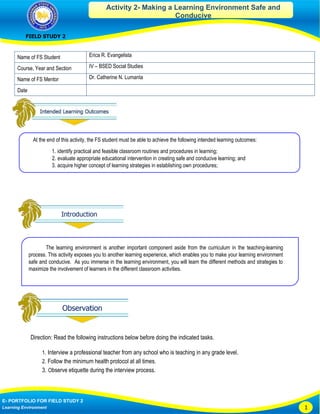
Name of FS Student Erica R. Evangelista
Course, Year and Section IV – BSED Social Studies
Name of FS Mentor Dr. Catherine N. Lumanta
Date
At the end of this activity, the FS student must be able to achieve the following intended learning outcomes:
1. identify practical and feasible classroom routines and procedures in learning;
2. evaluate appropriate educational intervention in creating safe and conducive learning; and
3. acquire higher concept of learning strategies in establishing own procedures;
Direction: Read the following instructions below before doing the indicated tasks.
1. Interview a professional teacher from any school who is teaching in any grade level.
2. Follow the minimum health protocol at all times.
3. Observe etiquette during the interview process.
The learning environment is another important component aside from the curriculum in the teaching-learning
process. This activity exposes you to another learning experience, which enables you to make your learning environment
safe and conducive. As you immerse in the learning environment, you will learn the different methods and strategies to
maximize the involvement of learners in the different classroom activities.
Activity 2- Making a Learning Environment Safe and
Conducive
FIELD STUDY 2
E- PORTFOLIO FOR FIELD STUDY 2
Learning Environment 2
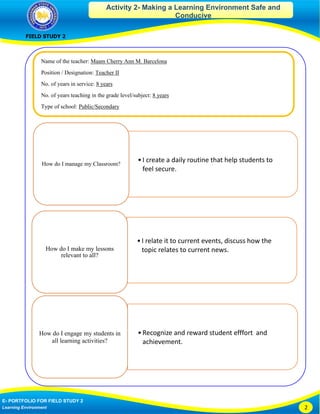
•I create a daily routine that help students to
feel secure.
How do I manage my Classroom?
•I relate it to current events, discuss how the
topic relates to current news.
How do I make my lessons
relevant to all?
•Recognize and reward student efffort and
achievement.
How do I engage my students in
all learning activities?
Name of the teacher: Maam Cherry Ann M. Barcelona
Position / Designation: Teacher II
No. of years in service: 8 years
No. of years teaching in the grade level/subject: 8 years
Type of school: Public/Secondary
Activity 2- Making a Learning Environment Safe and
Conducive
FIELD STUDY 2
E- PORTFOLIO FOR FIELD STUDY 2
Learning Environment 3
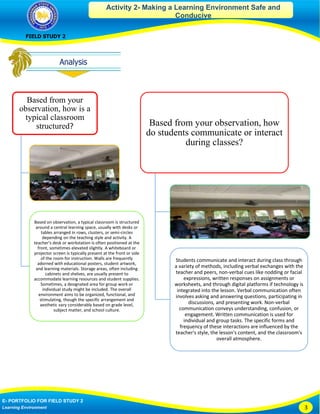
Based from your
observation, how is a
typical classroom
structured?
Based on observation, a typical classroom is structured
around a central learning space, usually with desks or
tables arranged in rows, clusters, or semi-circles
depending on the teaching style and activity. A
teacher's desk or workstation is often positioned at the
front, sometimes elevated slightly. A whiteboard or
projector screen is typically present at the front or side
of the room for instruction. Walls are frequently
adorned with educational posters, student artwork,
and learning materials. Storage areas, often including
cabinets and shelves, are usually present to
accommodate learning resources and student supplies.
Sometimes, a designated area for group work or
individual study might be included. The overall
environment aims to be organized, functional, and
stimulating, though the specific arrangement and
aesthetic vary considerably based on grade level,
subject matter, and school culture.
Based from your observation, how
do students communicate or interact
during classes?
Students communicate and interact during class through
a variety of methods, including verbal exchanges with the
teacher and peers, non-verbal cues like nodding or facial
expressions, written responses on assignments or
worksheets, and through digital platforms if technology is
integrated into the lesson. Verbal communication often
involves asking and answering questions, participating in
discussions, and presenting work. Non-verbal
communication conveys understanding, confusion, or
engagement. Written communication is used for
individual and group tasks. The specific forms and
frequency of these interactions are influenced by the
teacher's style, the lesson's content, and the classroom's
overall atmosphere.
Activity 2- Making a Learning Environment Safe and
Conducive
FIELD STUDY 2
E- PORTFOLIO FOR FIELD STUDY 2
Learning Environment 4
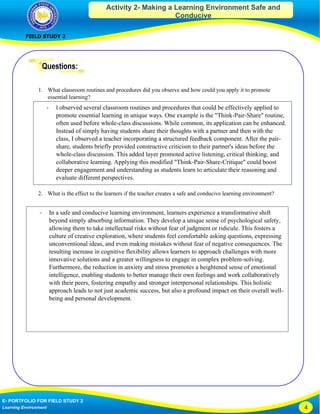
Questions:
1. What classroom routines and procedures did you observe and how could you apply it to promote
essential learning?
2. What is the effect to the learners if the teacher creates a safe and conducive learning environment?
- I observed several classroom routines and procedures that could be effectively applied to
promote essential learning in unique ways. One example is the "Think-Pair-Share" routine,
often used before whole-class discussions. While common, its application can be enhanced.
Instead of simply having students share their thoughts with a partner and then with the
class, I observed a teacher incorporating a structured feedback component. After the pair-
share, students briefly provided constructive criticism to their partner's ideas before the
whole-class discussion. This added layer promoted active listening, critical thinking, and
collaborative learning. Applying this modified "Think-Pair-Share-Critique" could boost
deeper engagement and understanding as students learn to articulate their reasoning and
evaluate different perspectives.
- In a safe and conducive learning environment, learners experience a transformative shift
beyond simply absorbing information. They develop a unique sense of psychological safety,
allowing them to take intellectual risks without fear of judgment or ridicule. This fosters a
culture of creative exploration, where students feel comfortable asking questions, expressing
unconventional ideas, and even making mistakes without fear of negative consequences. The
resulting increase in cognitive flexibility allows learners to approach challenges with more
innovative solutions and a greater willingness to engage in complex problem-solving.
Furthermore, the reduction in anxiety and stress promotes a heightened sense of emotional
intelligence, enabling students to better manage their own feelings and work collaboratively
with their peers, fostering empathy and stronger interpersonal relationships. This holistic
approach leads to not just academic success, but also a profound impact on their overall well-
being and personal development.
Activity 2- Making a Learning Environment Safe and
Conducive
FIELD STUDY 2
E- PORTFOLIO FOR FIELD STUDY 2
Learning Environment 5
Construct your own set of rules and regulations that will make your learning environment safe and
conducive.
In my classroom, we prioritize a learning environment built on mutual respect and a shared commitment to growth. To achieve this, we'll
operate under these guidelines:
I. Respectful Communication & Collaboration:
1. Active Listening & Empathy: I believe in the power of truly hearing each other. This means actively listening, trying to understand
different perspectives, and responding thoughtfully, even when we disagree. Interrupting will be minimized, and we’ll strive to create
space for everyone to share their ideas.
2. Constructive Feedback: We'll give and receive feedback with kindness. Our goal is to help each other improve, not to criticize. This
means focusing on the work itself, using "I" statements ("I noticed...") to express observations and suggestions.
3. Inclusive Language: We commit to using inclusive language that respects everyone's identity and background. We'll avoid language
that is hurtful, offensive, or discriminatory.
II. Responsible Participation & Ownership:
1. Preparedness: Coming to class prepared is key. This means completing assignments, bringing necessary materials, and reviewing
previous lessons so we can fully engage in the current learning.
2. Active Participation: Learning is a two-way street. I expect active engagement from everyone: asking questions, participating in
discussions, and contributing to group activities.
3. Taking Responsibility: We own our learning and our actions. This means acknowledging mistakes, seeking help when needed, and
advocating for ourselves.
III. A Safe and Organized Space:
1. Respecting Our Shared Space: We'll keep the classroom clean, organized, and welcoming. We'll treat the materials and equipment
with care.
2. Mindful Movement: Movement in the classroom should be purposeful and considerate of others. We’ll minimize distractions and
ensure a calm, focused environment.
3. Safety First: We'll prioritize safety in everything we do, following all school rules and emergency procedures.
IV. Embracing Curiosity & Growth:
1. Asking Questions: Questions are celebrated! There's no such thing as a "silly" question. I encourage everyone to explore their curiosity
and ask for clarification whenever needed.
2. Learning from Mistakes: Mistakes are opportunities for learning. We'll view them as stepping stones on the path to understanding, not
as failures.
3. Celebrating Successes: We will celebrate each other's successes, no matter how big or small. Learning is a journey, and we'll recognize
and appreciate every step of progress.
These guidelines are not just a list of rules, but a framework for creating a positive and productive learning community where every
student feels safe, respected, and empowered to reach their full potential. We'll discuss and refine them together throughout the year
to ensure they remain relevant and effective.
Activity 2- Making a Learning Environment Safe and
Conducive
FIELD STUDY 2
E- PORTFOLIO FOR FIELD STUDY 2
Learning Environment 6
• As a would be teacher, how can you make the environment safe and conducive to learners?
As a future teacher, creating a safe and conducive learning environment is my top priority. I won't just
rely on posters and rules; I'll build it actively, layer by layer.
First, I’ll establish a strong foundation of trust and respect. This starts with *me* being genuinely
interested in my students as individuals. I'll learn their names quickly, remembering details about their lives and
interests. I'll actively listen to their concerns, validating their feelings even if I can't always solve their problems.
My classroom will be a place where they feel comfortable sharing their thoughts and perspectives, even if they're
different from mine. This will go beyond just verbal communication; my body language and tone will consistently
reflect empathy and acceptance.
Second, I'll foster a culture of collaboration and mutual support. Group work won't just be assigned; it'll
be carefully structured to encourage peer learning and respectful teamwork. I'll explicitly teach collaborative
skills, such as active listening, constructive criticism, and conflict resolution. Students will be encouraged to help
each other, celebrating both individual and collective successes. We'll develop a class "contract" together,
outlining expectations for behavior and interaction, so it feels jointly owned.
Third, I'll create a flexible and adaptable learning space. It won't just be rows of desks. Depending on the
activity, we'll rearrange furniture to create small group areas, individual quiet spaces, or a large open area for
presentations. I’ll incorporate diverse learning styles and needs, offering varied learning materials and
opportunities for hands-on activities. This includes offering choices in assignments, allowing students to
demonstrate their understanding in ways that best suit their strengths.
Fourth, I'll be explicit about classroom procedures. Rather than simply stating rules, I'll explain the *why*
behind them, emphasizing how they contribute to a safe and productive learning environment. I'll use visual aids
and practice routines to ensure everyone understands and feels confident in following them.
Finally, and crucially, I'll continuously reflect and adjust. I'll regularly solicit feedback from my students,
seeking their input on what makes them feel safe and supported. I’ll observe their interactions, identify areas for
improvement, and adapt my approach accordingly. Creating a safe and conducive environment is an ongoing
process, not a one-time event; it requires constant attention and willingness to change and adapt based on the
needs of my students.
Activity 2- Making a Learning Environment Safe and
Conducive
FIELD STUDY 2
E- PORTFOLIO FOR FIELD STUDY 2
Learning Environment 7
Self
Rating
Peer
Rating
FS
Mentor’s
Rating
Over-all
Rating

FIELD STUDY -2-Activity-2 -ERICA DONE.pdf

  • 1.
    Activity 2- Makinga Learning Environment Safe and Conducive FIELD STUDY 2 E- PORTFOLIO FOR FIELD STUDY 2 Learning Environment 1 Name of FS Student Erica R. Evangelista Course, Year and Section IV – BSED Social Studies Name of FS Mentor Dr. Catherine N. Lumanta Date At the end of this activity, the FS student must be able to achieve the following intended learning outcomes: 1. identify practical and feasible classroom routines and procedures in learning; 2. evaluate appropriate educational intervention in creating safe and conducive learning; and 3. acquire higher concept of learning strategies in establishing own procedures; Direction: Read the following instructions below before doing the indicated tasks. 1. Interview a professional teacher from any school who is teaching in any grade level. 2. Follow the minimum health protocol at all times. 3. Observe etiquette during the interview process. The learning environment is another important component aside from the curriculum in the teaching-learning process. This activity exposes you to another learning experience, which enables you to make your learning environment safe and conducive. As you immerse in the learning environment, you will learn the different methods and strategies to maximize the involvement of learners in the different classroom activities.
  • 2.
    Activity 2- Makinga Learning Environment Safe and Conducive FIELD STUDY 2 E- PORTFOLIO FOR FIELD STUDY 2 Learning Environment 2 •I create a daily routine that help students to feel secure. How do I manage my Classroom? •I relate it to current events, discuss how the topic relates to current news. How do I make my lessons relevant to all? •Recognize and reward student efffort and achievement. How do I engage my students in all learning activities? Name of the teacher: Maam Cherry Ann M. Barcelona Position / Designation: Teacher II No. of years in service: 8 years No. of years teaching in the grade level/subject: 8 years Type of school: Public/Secondary
  • 3.
    Activity 2- Makinga Learning Environment Safe and Conducive FIELD STUDY 2 E- PORTFOLIO FOR FIELD STUDY 2 Learning Environment 3 Based from your observation, how is a typical classroom structured? Based on observation, a typical classroom is structured around a central learning space, usually with desks or tables arranged in rows, clusters, or semi-circles depending on the teaching style and activity. A teacher's desk or workstation is often positioned at the front, sometimes elevated slightly. A whiteboard or projector screen is typically present at the front or side of the room for instruction. Walls are frequently adorned with educational posters, student artwork, and learning materials. Storage areas, often including cabinets and shelves, are usually present to accommodate learning resources and student supplies. Sometimes, a designated area for group work or individual study might be included. The overall environment aims to be organized, functional, and stimulating, though the specific arrangement and aesthetic vary considerably based on grade level, subject matter, and school culture. Based from your observation, how do students communicate or interact during classes? Students communicate and interact during class through a variety of methods, including verbal exchanges with the teacher and peers, non-verbal cues like nodding or facial expressions, written responses on assignments or worksheets, and through digital platforms if technology is integrated into the lesson. Verbal communication often involves asking and answering questions, participating in discussions, and presenting work. Non-verbal communication conveys understanding, confusion, or engagement. Written communication is used for individual and group tasks. The specific forms and frequency of these interactions are influenced by the teacher's style, the lesson's content, and the classroom's overall atmosphere.
  • 4.
    Activity 2- Makinga Learning Environment Safe and Conducive FIELD STUDY 2 E- PORTFOLIO FOR FIELD STUDY 2 Learning Environment 4 Questions: 1. What classroom routines and procedures did you observe and how could you apply it to promote essential learning? 2. What is the effect to the learners if the teacher creates a safe and conducive learning environment? - I observed several classroom routines and procedures that could be effectively applied to promote essential learning in unique ways. One example is the "Think-Pair-Share" routine, often used before whole-class discussions. While common, its application can be enhanced. Instead of simply having students share their thoughts with a partner and then with the class, I observed a teacher incorporating a structured feedback component. After the pair- share, students briefly provided constructive criticism to their partner's ideas before the whole-class discussion. This added layer promoted active listening, critical thinking, and collaborative learning. Applying this modified "Think-Pair-Share-Critique" could boost deeper engagement and understanding as students learn to articulate their reasoning and evaluate different perspectives. - In a safe and conducive learning environment, learners experience a transformative shift beyond simply absorbing information. They develop a unique sense of psychological safety, allowing them to take intellectual risks without fear of judgment or ridicule. This fosters a culture of creative exploration, where students feel comfortable asking questions, expressing unconventional ideas, and even making mistakes without fear of negative consequences. The resulting increase in cognitive flexibility allows learners to approach challenges with more innovative solutions and a greater willingness to engage in complex problem-solving. Furthermore, the reduction in anxiety and stress promotes a heightened sense of emotional intelligence, enabling students to better manage their own feelings and work collaboratively with their peers, fostering empathy and stronger interpersonal relationships. This holistic approach leads to not just academic success, but also a profound impact on their overall well- being and personal development.
  • 5.
    Activity 2- Makinga Learning Environment Safe and Conducive FIELD STUDY 2 E- PORTFOLIO FOR FIELD STUDY 2 Learning Environment 5 Construct your own set of rules and regulations that will make your learning environment safe and conducive. In my classroom, we prioritize a learning environment built on mutual respect and a shared commitment to growth. To achieve this, we'll operate under these guidelines: I. Respectful Communication & Collaboration: 1. Active Listening & Empathy: I believe in the power of truly hearing each other. This means actively listening, trying to understand different perspectives, and responding thoughtfully, even when we disagree. Interrupting will be minimized, and we’ll strive to create space for everyone to share their ideas. 2. Constructive Feedback: We'll give and receive feedback with kindness. Our goal is to help each other improve, not to criticize. This means focusing on the work itself, using "I" statements ("I noticed...") to express observations and suggestions. 3. Inclusive Language: We commit to using inclusive language that respects everyone's identity and background. We'll avoid language that is hurtful, offensive, or discriminatory. II. Responsible Participation & Ownership: 1. Preparedness: Coming to class prepared is key. This means completing assignments, bringing necessary materials, and reviewing previous lessons so we can fully engage in the current learning. 2. Active Participation: Learning is a two-way street. I expect active engagement from everyone: asking questions, participating in discussions, and contributing to group activities. 3. Taking Responsibility: We own our learning and our actions. This means acknowledging mistakes, seeking help when needed, and advocating for ourselves. III. A Safe and Organized Space: 1. Respecting Our Shared Space: We'll keep the classroom clean, organized, and welcoming. We'll treat the materials and equipment with care. 2. Mindful Movement: Movement in the classroom should be purposeful and considerate of others. We’ll minimize distractions and ensure a calm, focused environment. 3. Safety First: We'll prioritize safety in everything we do, following all school rules and emergency procedures. IV. Embracing Curiosity & Growth: 1. Asking Questions: Questions are celebrated! There's no such thing as a "silly" question. I encourage everyone to explore their curiosity and ask for clarification whenever needed. 2. Learning from Mistakes: Mistakes are opportunities for learning. We'll view them as stepping stones on the path to understanding, not as failures. 3. Celebrating Successes: We will celebrate each other's successes, no matter how big or small. Learning is a journey, and we'll recognize and appreciate every step of progress. These guidelines are not just a list of rules, but a framework for creating a positive and productive learning community where every student feels safe, respected, and empowered to reach their full potential. We'll discuss and refine them together throughout the year to ensure they remain relevant and effective.
  • 6.
    Activity 2- Makinga Learning Environment Safe and Conducive FIELD STUDY 2 E- PORTFOLIO FOR FIELD STUDY 2 Learning Environment 6 • As a would be teacher, how can you make the environment safe and conducive to learners? As a future teacher, creating a safe and conducive learning environment is my top priority. I won't just rely on posters and rules; I'll build it actively, layer by layer. First, I’ll establish a strong foundation of trust and respect. This starts with *me* being genuinely interested in my students as individuals. I'll learn their names quickly, remembering details about their lives and interests. I'll actively listen to their concerns, validating their feelings even if I can't always solve their problems. My classroom will be a place where they feel comfortable sharing their thoughts and perspectives, even if they're different from mine. This will go beyond just verbal communication; my body language and tone will consistently reflect empathy and acceptance. Second, I'll foster a culture of collaboration and mutual support. Group work won't just be assigned; it'll be carefully structured to encourage peer learning and respectful teamwork. I'll explicitly teach collaborative skills, such as active listening, constructive criticism, and conflict resolution. Students will be encouraged to help each other, celebrating both individual and collective successes. We'll develop a class "contract" together, outlining expectations for behavior and interaction, so it feels jointly owned. Third, I'll create a flexible and adaptable learning space. It won't just be rows of desks. Depending on the activity, we'll rearrange furniture to create small group areas, individual quiet spaces, or a large open area for presentations. I’ll incorporate diverse learning styles and needs, offering varied learning materials and opportunities for hands-on activities. This includes offering choices in assignments, allowing students to demonstrate their understanding in ways that best suit their strengths. Fourth, I'll be explicit about classroom procedures. Rather than simply stating rules, I'll explain the *why* behind them, emphasizing how they contribute to a safe and productive learning environment. I'll use visual aids and practice routines to ensure everyone understands and feels confident in following them. Finally, and crucially, I'll continuously reflect and adjust. I'll regularly solicit feedback from my students, seeking their input on what makes them feel safe and supported. I’ll observe their interactions, identify areas for improvement, and adapt my approach accordingly. Creating a safe and conducive environment is an ongoing process, not a one-time event; it requires constant attention and willingness to change and adapt based on the needs of my students.
  • 7.
    Activity 2- Makinga Learning Environment Safe and Conducive FIELD STUDY 2 E- PORTFOLIO FOR FIELD STUDY 2 Learning Environment 7 Self Rating Peer Rating FS Mentor’s Rating Over-all Rating