Activity 1 – Writing an Action Research Plan
FIELD STUDY 2
E- PORTFOLIO FOR FIELD STUDY 2
Domain 1: Content Knowledge and Pedagogy 1
Group No.:
Group Members:
Lopez, Karen Agape
Evangelista, Erica
Parinas, Mhydel Chlurtny
Mejos, Rosevie
Meru, Jovelyn
Course, Year and Section BSED 4 Social Studies
Name of FS Mentor Catherine N. Lumanta
Date
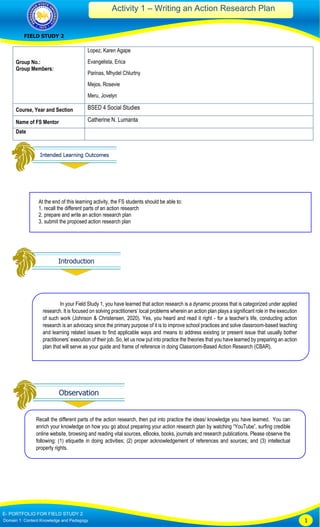
At the end of this learning activity, the FS students should be able to:
1. recall the different parts of an action research
2. prepare and write an action research plan
3. submit the proposed action research plan
In your Field Study 1, you have learned that action research is a dynamic process that is categorized under applied
research. It is focused on solving practitioners’ local problems wherein an action plan plays a significant role in the execution
of such work (Johnson & Christensen, 2020). Yes, you heard and read it right - for a teacher’s life, conducting action
research is an advocacy since the primary purpose of it is to improve school practices and solve classroom-based teaching
and learning related issues to find applicable ways and means to address existing or present issue that usually bother
practitioners’ execution of their job. So, let us now put into practice the theories that you have learned by preparing an action
plan that will serve as your guide and frame of reference in doing Classroom-Based Action Research (CBAR).
Recall the different parts of the action research, then put into practice the ideas/ knowledge you have learned. You can
enrich your knowledge on how you go about preparing your action research plan by watching “YouTube”, surfing credible
online website, browsing and reading vital sources, eBooks, books, journals and research publications. Please observe the
following: (1) etiquette in doing activities; (2) proper acknowledgement of references and sources; and (3) intellectual
property rights.
Activity 1 – Writing an Action Research Plan
FIELD STUDY 2
E- PORTFOLIO FOR FIELD STUDY 2
Domain 1: Content Knowledge and Pedagogy 2
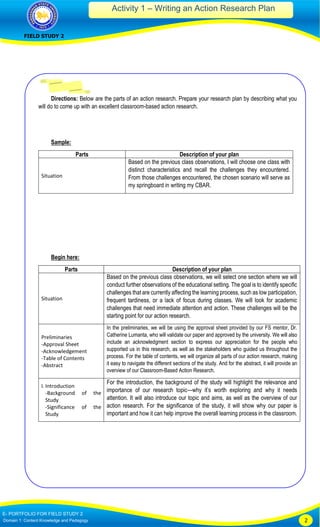
Directions: Below are the parts of an action research. Prepare your research plan by describing what you
will do to come up with an excellent classroom-based action research.
Sample:
Parts Description of your plan
Situation
Based on the previous class observations, I will choose one class with
distinct characteristics and recall the challenges they encountered.
From those challenges encountered, the chosen scenario will serve as
my springboard in writing my CBAR.
Begin here:
Parts Description of your plan
Situation
Based on the previous class observations, we will select one section where we will
conduct further observations of the educational setting. The goal is to identify specific
challenges that are currently affecting the learning process, such as low participation,
frequent tardiness, or a lack of focus during classes. We will look for academic
challenges that need immediate attention and action. These challenges will be the
starting point for our action research.
Preliminaries
-Approval Sheet
-Acknowledgement
-Table of Contents
-Abstract
In the preliminaries, we will be using the approval sheet provided by our FS mentor, Dr.
Catherine Lumanta, who will validate our paper and approved by the university. We will also
include an acknowledgment section to express our appreciation for the people who
supported us in this research, as well as the stakeholders who guided us throughout the
process. For the table of contents, we will organize all parts of our action research, making
it easy to navigate the different sections of the study. And for the abstract, it will provide an
overview of our Classroom-Based Action Research.
I. Introduction
-Background of the
Study
-Significance of the
Study
For the introduction, the background of the study will highlight the relevance and
importance of our research topic—why it’s worth exploring and why it needs
attention. It will also introduce our topic and aims, as well as the overview of our
action research. For the significance of the study, it will show why our paper is
important and how it can help improve the overall learning process in the classroom.
Activity 1 – Writing an Action Research Plan
FIELD STUDY 2
E- PORTFOLIO FOR FIELD STUDY 2
Domain 1: Content Knowledge and Pedagogy 3
II. Problem Identification
-Possible Causes
-Hypothesis
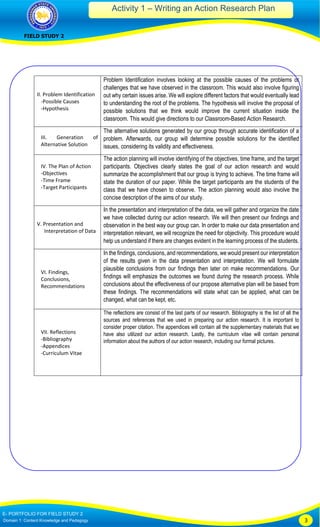
Problem Identification involves looking at the possible causes of the problems or
challenges that we have observed in the classroom. This would also involve figuring
out why certain issues arise. We will explore different factors that would eventually lead
to understanding the root of the problems. The hypothesis will involve the proposal of
possible solutions that we think would improve the current situation inside the
classroom. This would give directions to our Classroom-Based Action Research.
III. Generation of
Alternative Solution
The alternative solutions generated by our group through accurate identification of a
problem. Afterwards, our group will determine possible solutions for the identified
issues, considering its validity and effectiveness.
IV. The Plan of Action
-Objectives
-Time Frame
-Target Participants
The action planning will involve identifying of the objectives, time frame, and the target
participants. Objectives clearly states the goal of our action research and would
summarize the accomplishment that our group is trying to achieve. The time frame will
state the duration of our paper. While the target participants are the students of the
class that we have chosen to observe. The action planning would also involve the
concise description of the aims of our study.
V. Presentation and
Interpretation of Data
In the presentation and interpretation of the data, we will gather and organize the date
we have collected during our action research. We will then present our findings and
observation in the best way our group can. In order to make our data presentation and
interpretation relevant, we will recognize the need for objectivity. This procedure would
help us understand if there are changes evident in the learning process of the students.
VI. Findings,
Conclusions,
Recommendations
In the findings, conclusions, and recommendations, we would present our interpretation
of the results given in the data presentation and interpretation. We will formulate
plausible conclusions from our findings then later on make recommendations. Our
findings will emphasize the outcomes we found during the research process. While
conclusions about the effectiveness of our propose alternative plan will be based from
these findings. The recommendations will state what can be applied, what can be
changed, what can be kept, etc.
VII. Reflections
-Bibliography
-Appendices
-Curriculum Vitae
The reflections are consist of the last parts of our research. Bibliography is the list of all the
sources and references that we used in preparing our action research. It is important to
consider proper citation. The appendices will contain all the supplementary materials that we
have also utilized our action research. Lastly, the curriculum vitae will contain personal
information about the authors of our action research, including our formal pictures.
Activity 1 – Writing an Action Research Plan
FIELD STUDY 2
E- PORTFOLIO FOR FIELD STUDY 2
Domain 1: Content Knowledge and Pedagogy 4
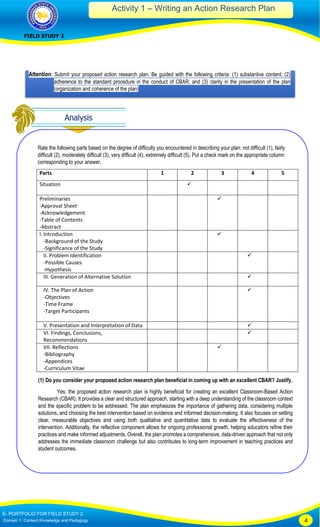
Parts 1 2 3 4 5
Situation ✓
Preliminaries
-Approval Sheet
-Acknowledgement
-Table of Contents
-Abstract
✓
I. Introduction
-Background of the Study
-Significance of the Study
✓
II. Problem Identification
-Possible Causes
-Hypothesis
✓
III. Generation of Alternative Solution ✓
IV. The Plan of Action
-Objectives
-Time Frame
-Target Participants
✓
V. Presentation and Interpretation of Data ✓
VI. Findings, Conclusions,
Recommendations
✓
VII. Reflections
-Bibliography
-Appendices
-Curriculum Vitae
✓
Rate the following parts based on the degree of difficulty you encountered in describing your plan: not difficult (1), fairly
difficult (2), moderately difficult (3), very difficult (4), extremely difficult (5). Put a check mark on the appropriate column
corresponding to your answer.
Attention: Submit your proposed action research plan. Be guided with the following criteria: (1) substantive content; (2)
adherence to the standard procedure in the conduct of CBAR; and (3) clarity in the presentation of the plan
(organization and coherence of the plan)
(1) Do you consider your proposed action research plan beneficial in coming up with an excellent CBAR? Justify.
Yes, the proposed action research plan is highly beneficial for creating an excellent Classroom-Based Action
Research (CBAR). It provides a clear and structured approach, starting with a deep understanding of the classroom context
and the specific problem to be addressed. The plan emphasizes the importance of gathering data, considering multiple
solutions, and choosing the best intervention based on evidence and informed decision-making. It also focuses on setting
clear, measurable objectives and using both qualitative and quantitative data to evaluate the effectiveness of the
intervention. Additionally, the reflective component allows for ongoing professional growth, helping educators refine their
practices and make informed adjustments. Overall, the plan promotes a comprehensive, data-driven approach that not only
addresses the immediate classroom challenge but also contributes to long-term improvement in teaching practices and
student outcomes.
Activity 1 – Writing an Action Research Plan
FIELD STUDY 2
E- PORTFOLIO FOR FIELD STUDY 2
Domain 1: Content Knowledge and Pedagogy 5
Plan Execution
Directions: Below is the list of the parts of action research. After preparing your action research plan, the next step is to carry
out your plan. Prepare the different parts of your CBAR based on what you have planned. Focus only on the
indicated parts. Other parts not included will be done/ accomplished during the Internship period. The preliminaries
and other parts will be included in your final write up.
Part 1: Introduction
- In the Background of the Study, we will describe the classroom context, including the demographic
characteristics of the students, the subject being taught, and any challenges previously observed, such as
issues with student engagement or learning difficulties. We will then introduce the specific problem we aim
to address through this action research. In the Significance of the Study, we will explain how addressing the
identified challenge can improve classroom teaching practices. This includes enhancing student
engagement, learning outcomes, and fostering a positive classroom environment. The goal is to provide
insights that can lead to more effective teaching strategies and better support for students, ultimately
improving the overall quality of education.
Part 2: Problem Identification
- We will analyze the possible causes of the identified problem by reviewing data from assessments, student behavior
observations, and feedback from students and colleagues. This will help us identify factors such as inadequate
instructional strategies, classroom environment issues, or external influences like socio-economic challenges. Based
on this analysis, we will formulate a hypothesis for an intervention, drawing on research and our teaching experience.
To assess its effectiveness, we will define measurable indicators, such as changes in student participation, improved
assessment scores, and positive student feedback, which will serve as benchmarks to evaluate the success of the
intervention.
Part 3: Generation of Alternative Solution
- We will explore multiple strategies or interventions that could potentially address the problem identified in our research.
This will involve reviewing literature on best practices, consulting with colleagues, and brainstorming creative ways to
engage students. Possible alternatives might include using technology, implementing differentiated instruction, or
introducing peer mentoring. We will analyze the feasibility and potential impact of each solution to select the most
suiable one for the classroom.
Part 4: The Plan of Action
- In our action research, we will set clear, measurable objectives, such as improving student engagement,
increasing participation in discussions, or enhancing assessment performance, all aligned with the identified
problem. The Time Frame will outline key phases, including preparation, intervention implementation, data
collection, and result analysis, with a timeline that spans several weeks or months, depending on the
intervention's complexity. We will identify the Target Participants, which will include our students, and may
also involve other stakeholders like teaching assistants or administrators. Selection criteria will be based on
factors such as grade level, learning needs, or behavioral concerns, ensuring the intervention is relevant
and focused.
Activity 1 – Writing an Action Research Plan
FIELD STUDY 2
E- PORTFOLIO FOR FIELD STUDY 2
Domain 1: Content Knowledge and Pedagogy 6
Using one adjective, describe your experience as a group in accomplishing the activity in general and in
writing the four parts, from introduction to the plan of action, of your classroom-based action research in
particular. Why did you choose that adjective?
Transformative.
I chose "transformative" to describe our group's experience with the action research project
because it fundamentally changed our understanding of teaching and learning. The process of
conducting the research, from formulatin g the initial research question to writing the four parts
(introduction, literature review, methodology, and plan of action), wasn't simply about completing
an assignment. It was a journey of self-discovery as educators. We learned to critically examine our
own teaching practices, identify areas for improvement, and collaboratively design and implement
interventions. The act of rigorously documenting our process and analyzing the results forced us to
think deeply about the effectiveness of our methods and the impact on our students. This
reflective practice led to significant changes not only in our classroom strategies but also in our
perspectives on teaching as a dynamic and constantly evolving process. The experience fostered a
deeper understanding of the research process itself and its value in professional development,
leaving us better equipped and more confident in our teaching abilities.
Activity 1 – Writing an Action Research Plan
FIELD STUDY 2
E- PORTFOLIO FOR FIELD STUDY 2
Domain 1: Content Knowledge and Pedagogy 7
Self
Rating
Peer
Rating
FS
Mentor’s
Rating
Over-all
Rating

FIELD STUDY -2-Activity1- ERICA DONE.pdf

  • 1.
    Activity 1 –Writing an Action Research Plan FIELD STUDY 2 E- PORTFOLIO FOR FIELD STUDY 2 Domain 1: Content Knowledge and Pedagogy 1 Group No.: Group Members: Lopez, Karen Agape Evangelista, Erica Parinas, Mhydel Chlurtny Mejos, Rosevie Meru, Jovelyn Course, Year and Section BSED 4 Social Studies Name of FS Mentor Catherine N. Lumanta Date At the end of this learning activity, the FS students should be able to: 1. recall the different parts of an action research 2. prepare and write an action research plan 3. submit the proposed action research plan In your Field Study 1, you have learned that action research is a dynamic process that is categorized under applied research. It is focused on solving practitioners’ local problems wherein an action plan plays a significant role in the execution of such work (Johnson & Christensen, 2020). Yes, you heard and read it right - for a teacher’s life, conducting action research is an advocacy since the primary purpose of it is to improve school practices and solve classroom-based teaching and learning related issues to find applicable ways and means to address existing or present issue that usually bother practitioners’ execution of their job. So, let us now put into practice the theories that you have learned by preparing an action plan that will serve as your guide and frame of reference in doing Classroom-Based Action Research (CBAR). Recall the different parts of the action research, then put into practice the ideas/ knowledge you have learned. You can enrich your knowledge on how you go about preparing your action research plan by watching “YouTube”, surfing credible online website, browsing and reading vital sources, eBooks, books, journals and research publications. Please observe the following: (1) etiquette in doing activities; (2) proper acknowledgement of references and sources; and (3) intellectual property rights.
  • 2.
    Activity 1 –Writing an Action Research Plan FIELD STUDY 2 E- PORTFOLIO FOR FIELD STUDY 2 Domain 1: Content Knowledge and Pedagogy 2 Directions: Below are the parts of an action research. Prepare your research plan by describing what you will do to come up with an excellent classroom-based action research. Sample: Parts Description of your plan Situation Based on the previous class observations, I will choose one class with distinct characteristics and recall the challenges they encountered. From those challenges encountered, the chosen scenario will serve as my springboard in writing my CBAR. Begin here: Parts Description of your plan Situation Based on the previous class observations, we will select one section where we will conduct further observations of the educational setting. The goal is to identify specific challenges that are currently affecting the learning process, such as low participation, frequent tardiness, or a lack of focus during classes. We will look for academic challenges that need immediate attention and action. These challenges will be the starting point for our action research. Preliminaries -Approval Sheet -Acknowledgement -Table of Contents -Abstract In the preliminaries, we will be using the approval sheet provided by our FS mentor, Dr. Catherine Lumanta, who will validate our paper and approved by the university. We will also include an acknowledgment section to express our appreciation for the people who supported us in this research, as well as the stakeholders who guided us throughout the process. For the table of contents, we will organize all parts of our action research, making it easy to navigate the different sections of the study. And for the abstract, it will provide an overview of our Classroom-Based Action Research. I. Introduction -Background of the Study -Significance of the Study For the introduction, the background of the study will highlight the relevance and importance of our research topic—why it’s worth exploring and why it needs attention. It will also introduce our topic and aims, as well as the overview of our action research. For the significance of the study, it will show why our paper is important and how it can help improve the overall learning process in the classroom.
  • 3.
    Activity 1 –Writing an Action Research Plan FIELD STUDY 2 E- PORTFOLIO FOR FIELD STUDY 2 Domain 1: Content Knowledge and Pedagogy 3 II. Problem Identification -Possible Causes -Hypothesis Problem Identification involves looking at the possible causes of the problems or challenges that we have observed in the classroom. This would also involve figuring out why certain issues arise. We will explore different factors that would eventually lead to understanding the root of the problems. The hypothesis will involve the proposal of possible solutions that we think would improve the current situation inside the classroom. This would give directions to our Classroom-Based Action Research. III. Generation of Alternative Solution The alternative solutions generated by our group through accurate identification of a problem. Afterwards, our group will determine possible solutions for the identified issues, considering its validity and effectiveness. IV. The Plan of Action -Objectives -Time Frame -Target Participants The action planning will involve identifying of the objectives, time frame, and the target participants. Objectives clearly states the goal of our action research and would summarize the accomplishment that our group is trying to achieve. The time frame will state the duration of our paper. While the target participants are the students of the class that we have chosen to observe. The action planning would also involve the concise description of the aims of our study. V. Presentation and Interpretation of Data In the presentation and interpretation of the data, we will gather and organize the date we have collected during our action research. We will then present our findings and observation in the best way our group can. In order to make our data presentation and interpretation relevant, we will recognize the need for objectivity. This procedure would help us understand if there are changes evident in the learning process of the students. VI. Findings, Conclusions, Recommendations In the findings, conclusions, and recommendations, we would present our interpretation of the results given in the data presentation and interpretation. We will formulate plausible conclusions from our findings then later on make recommendations. Our findings will emphasize the outcomes we found during the research process. While conclusions about the effectiveness of our propose alternative plan will be based from these findings. The recommendations will state what can be applied, what can be changed, what can be kept, etc. VII. Reflections -Bibliography -Appendices -Curriculum Vitae The reflections are consist of the last parts of our research. Bibliography is the list of all the sources and references that we used in preparing our action research. It is important to consider proper citation. The appendices will contain all the supplementary materials that we have also utilized our action research. Lastly, the curriculum vitae will contain personal information about the authors of our action research, including our formal pictures.
  • 4.
    Activity 1 –Writing an Action Research Plan FIELD STUDY 2 E- PORTFOLIO FOR FIELD STUDY 2 Domain 1: Content Knowledge and Pedagogy 4 Parts 1 2 3 4 5 Situation ✓ Preliminaries -Approval Sheet -Acknowledgement -Table of Contents -Abstract ✓ I. Introduction -Background of the Study -Significance of the Study ✓ II. Problem Identification -Possible Causes -Hypothesis ✓ III. Generation of Alternative Solution ✓ IV. The Plan of Action -Objectives -Time Frame -Target Participants ✓ V. Presentation and Interpretation of Data ✓ VI. Findings, Conclusions, Recommendations ✓ VII. Reflections -Bibliography -Appendices -Curriculum Vitae ✓ Rate the following parts based on the degree of difficulty you encountered in describing your plan: not difficult (1), fairly difficult (2), moderately difficult (3), very difficult (4), extremely difficult (5). Put a check mark on the appropriate column corresponding to your answer. Attention: Submit your proposed action research plan. Be guided with the following criteria: (1) substantive content; (2) adherence to the standard procedure in the conduct of CBAR; and (3) clarity in the presentation of the plan (organization and coherence of the plan) (1) Do you consider your proposed action research plan beneficial in coming up with an excellent CBAR? Justify. Yes, the proposed action research plan is highly beneficial for creating an excellent Classroom-Based Action Research (CBAR). It provides a clear and structured approach, starting with a deep understanding of the classroom context and the specific problem to be addressed. The plan emphasizes the importance of gathering data, considering multiple solutions, and choosing the best intervention based on evidence and informed decision-making. It also focuses on setting clear, measurable objectives and using both qualitative and quantitative data to evaluate the effectiveness of the intervention. Additionally, the reflective component allows for ongoing professional growth, helping educators refine their practices and make informed adjustments. Overall, the plan promotes a comprehensive, data-driven approach that not only addresses the immediate classroom challenge but also contributes to long-term improvement in teaching practices and student outcomes.
  • 5.
    Activity 1 –Writing an Action Research Plan FIELD STUDY 2 E- PORTFOLIO FOR FIELD STUDY 2 Domain 1: Content Knowledge and Pedagogy 5 Plan Execution Directions: Below is the list of the parts of action research. After preparing your action research plan, the next step is to carry out your plan. Prepare the different parts of your CBAR based on what you have planned. Focus only on the indicated parts. Other parts not included will be done/ accomplished during the Internship period. The preliminaries and other parts will be included in your final write up. Part 1: Introduction - In the Background of the Study, we will describe the classroom context, including the demographic characteristics of the students, the subject being taught, and any challenges previously observed, such as issues with student engagement or learning difficulties. We will then introduce the specific problem we aim to address through this action research. In the Significance of the Study, we will explain how addressing the identified challenge can improve classroom teaching practices. This includes enhancing student engagement, learning outcomes, and fostering a positive classroom environment. The goal is to provide insights that can lead to more effective teaching strategies and better support for students, ultimately improving the overall quality of education. Part 2: Problem Identification - We will analyze the possible causes of the identified problem by reviewing data from assessments, student behavior observations, and feedback from students and colleagues. This will help us identify factors such as inadequate instructional strategies, classroom environment issues, or external influences like socio-economic challenges. Based on this analysis, we will formulate a hypothesis for an intervention, drawing on research and our teaching experience. To assess its effectiveness, we will define measurable indicators, such as changes in student participation, improved assessment scores, and positive student feedback, which will serve as benchmarks to evaluate the success of the intervention. Part 3: Generation of Alternative Solution - We will explore multiple strategies or interventions that could potentially address the problem identified in our research. This will involve reviewing literature on best practices, consulting with colleagues, and brainstorming creative ways to engage students. Possible alternatives might include using technology, implementing differentiated instruction, or introducing peer mentoring. We will analyze the feasibility and potential impact of each solution to select the most suiable one for the classroom. Part 4: The Plan of Action - In our action research, we will set clear, measurable objectives, such as improving student engagement, increasing participation in discussions, or enhancing assessment performance, all aligned with the identified problem. The Time Frame will outline key phases, including preparation, intervention implementation, data collection, and result analysis, with a timeline that spans several weeks or months, depending on the intervention's complexity. We will identify the Target Participants, which will include our students, and may also involve other stakeholders like teaching assistants or administrators. Selection criteria will be based on factors such as grade level, learning needs, or behavioral concerns, ensuring the intervention is relevant and focused.
  • 6.
    Activity 1 –Writing an Action Research Plan FIELD STUDY 2 E- PORTFOLIO FOR FIELD STUDY 2 Domain 1: Content Knowledge and Pedagogy 6 Using one adjective, describe your experience as a group in accomplishing the activity in general and in writing the four parts, from introduction to the plan of action, of your classroom-based action research in particular. Why did you choose that adjective? Transformative. I chose "transformative" to describe our group's experience with the action research project because it fundamentally changed our understanding of teaching and learning. The process of conducting the research, from formulatin g the initial research question to writing the four parts (introduction, literature review, methodology, and plan of action), wasn't simply about completing an assignment. It was a journey of self-discovery as educators. We learned to critically examine our own teaching practices, identify areas for improvement, and collaboratively design and implement interventions. The act of rigorously documenting our process and analyzing the results forced us to think deeply about the effectiveness of our methods and the impact on our students. This reflective practice led to significant changes not only in our classroom strategies but also in our perspectives on teaching as a dynamic and constantly evolving process. The experience fostered a deeper understanding of the research process itself and its value in professional development, leaving us better equipped and more confident in our teaching abilities.
  • 7.
    Activity 1 –Writing an Action Research Plan FIELD STUDY 2 E- PORTFOLIO FOR FIELD STUDY 2 Domain 1: Content Knowledge and Pedagogy 7 Self Rating Peer Rating FS Mentor’s Rating Over-all Rating