Field Guide for Validating Premium Ad Inventory
0
Rami Essaid
CEO & Co-Founder
Andy Hibbler
VP, Brand Advertising &
Partnerships
Dr. Augustine Fou
Anti-Fraud Forensic
Scientist & Founder MSCG
marketing.science
consulting group, inc.
1
● Terminology and Standards
● The State of Digital Ad Fraud
○ Landscape and Trends
○ Display Fraud and Search Fraud
○ Top Issues for Advertisers and Publishers
○ Best Practices and Anti-Fraud Platforms
● Distil Networks Approach
● Whitepages Premium Ad Inventory Case Study
● Q&A
Agenda
2
Landscape of Compliance and Standards Organizations
● MRC (www.mediaratingcouncil.org) - viewability standards
adopted and aligned with Quality Assurance Guideline
● IAB (www.iab.net) - Anti-Fraud Working Group, authored the
Ad Fraud Taxonomy
● TAG (www.tagtoday.net) - Formed from IAB, 4As, and ANA
to focus exclusively on trustworthy supply chain, addressing
fraud, piracy, and Non-Human Traffic (NHT)
Terminology and Standards
3
Bad Bots in the Taxonomy
Non-Human Traffic
Type Notes
Hijacked session/device fully automated browser
Crawler masquerading posing as searchbot or human
Datacenter traffic hosting companies, ISPs, etc.
Non-Traditional Sources of Traffic on Ads
Type Notes
Adware additional HTML calls without user action
Proxy traffic anonymous or known
Non-browser user agent fake mobile app, invalid UA, etc.
Browswer pre-rendering loading ad before page
4
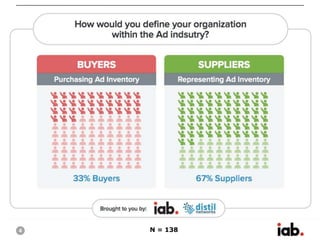
Registration Survey Results
N = 138
5
Registration Survey Results
6
Registration Survey Results
7
Live Survey
8
State of Digital Ad Fraud
Landscape and Trends
Fraud goes up as digital ad spend continues upward
Digital ad fraud
High / Low Estimates
plus best-guess (36%)
Published estimates
Digital ad spend
Source: IAB Annual Reports
$ billions
E
9
Motive & Opportunity – More programmatic, more fraud
As more digital ads are
placed entirely
programmatically, the
opportunity for fraud
continues to increase.
Bad guys also fully
automate their digital ad
fraud operations, using
programmatic tools.
1
0
Impressions and clicks remain the biggest targets
Impressions
(CPM/CPV)
Clicks
(CPC)
Search
$18.8B
86% digital spend
Display
$7.9B
Video
$3.5B
Mobile
$6.2B$6.2B
Leads
(CPL)
Sales
(CPA)
Lead Gen
$2.0B
Other
$5.0B
• classifieds
• sponsorship
• rich media
estimated
fraud
not at risk
1
1
$42.5B $7B
Industry associations are leading the charge
“We must create an all-inclusive program
that identifies qualified participants, and
commits them to good actions, guaranteed
by continual monitoring and sanctions for
non-compliance”
Randall Rothenberg
IAB
“Together we can continue to rebuild the
trust that is necessary for the interactive
marketing industry to thrive”
Nancy Hill
President and CEO, 4A’s
“We’ve invested [heavily] in data and data
technology and [have] been very much at
the forefront of fraud verification,”
John Montgomery
GroupM
“It is imperative that the ecosystem
addresses online fraud and improves
media measurement and transparency.”
Bob Liodice
President and CEO of the ANA
September 30, 2014 - IAB, 4A’s, and ANA announce cross-
industry organization to fight ad fraud, malware, and piracy.
1
2
13
State of Digital Ad Fraud
Display Fraud and Search Fraud
Two main types of fraud and how each is generated
Impression
(CPM) Fraud
(includes mobile display, video ads)
1. Put up fake websites and load
tons of ads on the pages
Search Click
(CPC) Fraud
(includes mobile search ads)
2. Use bots to repeatedly load
pages to generate fake ad
impressions (launder the origins
of the ads to avoid detection)
1. Put up fake websites and
participate in search networks
2a. Use bots to type keywords to
cause search ads to load
2b. Use bots to click on the ad to
generate the CPC revenue
1
4
Bad bots are the primary tool for stealing ad dollars
Generate fake ad impressions and clicks
• Bots repeatedly load pages or ads to make
impressions
• Bots can also “type” search keywords and click
on search ads to create fake clicks
Retargeting fraud
• Bots come to advertisers site to collect cookie
• Bots visit other sites owned by bad guys
• Retargeting follows them around to show ads
• When ad impression is served on bad guys
sites, they earn the CPM revenue
1
5
Bad bots are the primary tool for stealing ad dollars
Diverting ad dollars
• CTR manipulation: bots go to premium
site to generate pageviews without clicks
(lowers the sitewide CTR ); optimizers divert
dollars to sites with higher sitewide CTR
(bad guy sites)
• Fake viewability: bad guys stack all ads
behind each other so they are all viewable;
optimizers divert dollars to sites with higher
viewability (bad guy sites)
1
6
Different kinds of bots generate fake impressions/clicks
Malware (on PCs)Botnets (from datacenters)
Toolbars (in-browser)Javascript (on webpages)
1
7
Multiple sources confirm levels of bot activity and traffic
Source: Distil Networks 2015 Bad Bot Report Source: Solve Media 2013
1
8
Techniques to generate more impressions
AD
Ad stacking (dozens in one call) Pixel Stuffing (hiding more ads)
Source: DoubleVerify Case Study
Sourced Traffic (more pageviews) Ad Injection (replace ads)
Image Source: BenEdelman.org
The ANA/WhiteOps study also found rampant injection fraud, including one
publisher whose site was hit with 500,000 injected ads every day for the
duration of the two-month study.
1
9
Techniques to hide fraudulent activity
Domain / IP Spoofing Impression Laundering
Source: Whiteops/ANA Study Dec 2014
Stacked Redirects Passing fake variables
Known blackhat
technique to hide
real referrer and
replace with faked
referrer.
Example how-to:
http://www.blackhatworld.co
m/blackhat-seo/cloaking-
content-generators/36830-
cloaking-redirect-referer.html
Make it appear that
the impression came
from legit site
http://www.olay.com/skin-care-
products/OlayPro-
X?utm_source=msn&utm_medium=cpc
&utm_campaign=Olay_Search_Desktop
_Category+Interest+Product.Phrase&ut
m_term=eye%20cream&utm_content=T
ZsrSzFz_eye%20cream_p_2990456911
Easily trick analytics platforms to think the
impression came from legit source
2
0
21
State of Digital Ad Fraud
Impact on Advertisers and Publishers
Fraud siphons 1/3 of dollars out of ad ecosystem
Advertisers
“ad spend” in
digital is $56B in
2015
Publishers
are left with only
2/3 of the dollars
Bad Guys
siphon 1/3 of ad spend
OUT of the ecosystem
• Ad dollars are being siphoned OUT of the ecosystem into the pockets of the bad guys
• Advertisers have lower ROI due to fraud (fake impressions, non-humans)
• Publishers have lower revenues (ad dollars stolen by bad guys)
2/3
1/3
Users
use ad blocking and
need to protect privacy
2
2
Advertisers and Publishers are Harmed Differently
Advertisers
1. Advertisers attempt to
increase revenues by
increasing digital reach and
frequency.
2. But more ad impressions
doesn’t mean more ads seen
by people
3. Bots causing webpages and
ad impressions to load
directly cost advertisers -- in
the form of wasted ad dollars
that never have a chance to
convert into paying
customers
Publishers
2
3
1. Publishers attempt to increase
revenues by increasing the
number of ads served or the
CPM they charge
2. Bots coming to pages not only
drain web serving resources
but they also have the
potential to damage
legitimate publishers’
reputation when selling ads
3. Bots also steal valuable
content and collect cookies,
both of which help bad guys
divert traffic and ad revenue
to fraudulent sites they own,
resulting in direct loss of ad
revenue for publishers.
24
State of Digital Ad Fraud
Best Practices and Anti-Fraud Platforms
Recommendations for reducing fraud
Move beyond just viewability; tackle NHT/bot fraud
Even if viewability was solved, if the impression was caused to load by
a bot, it is still fraud and money wasted for the advertiser
Allocate budget toward mainstream, premium publishers
Allocate ad spend away from long-tail sites in ad exchanges that have
the most fraud; the more direct way to reduce bot fraud is to buy
mainstream sites
Demand full transparency and independently verify
If they can’t show you where each ad impression was served, don’t
buy it; put in place your own checks and balances
Focus less on impressions served or traffic, more on
observable actions
If we focus on actions that can be observed rather than tonnage of
ads served, and incentivize our agencies differently, we avoid the
temptation of buying lower cost (lower quality) ad inventory
2
5
Comparison matrix of anti-fraud solutions
Example Vendors Description Mitigation
WhiteOps
Forensiq
On-page Typically javascript code installed on websites
(like analytics). Detects parameters about the
user and computing environment
blacklist domains that
send traffic that is
mostly bots
Integral Ad ScienceIn-ad
exchange
Real-time decisioning in the bid-stream using
rules and blacklists (e.g. if a site is on a blacklist,
don’t serve the ad)
eject users and reject
sites in real-time based
on blacklists
SolveMedia
AreYouAHuman
Challenge
based
Using captchas and other challenges which ask
humans to verify themselves as humans
identify and whitelist
humans for use in RTB
decisioning
Distil NetworksReverse
Proxy
Inspection of all page requests to prevent
scraping, content theft, and fraud BEFORE the ad
call and pixel fires. Provides real time protection
without relying on IP address
blocks all traffic from
bad bots, rejects
individual browsers,
builds real-time
whitelists and blacklists
2
6
27
Distil Networks Appoach
Distil Networks Bot Detection and Mitigation
2828
Single Pixel with Ad vs Reverse Proxy
Tech: Pixel for Tracking → Tech: Security & Performance
Single js injection → Multiple injections
Predictable .js every time → Randomized, Spoofproof
Probabilistic → Technical tests on browser
Reactive, post ad call → Proactive, pre-page load
UA & IP = fingerprint → 40+ parameters for fingerprint
IP/Network intelligence → Domain specific modeling
Dealing with Unsolicited NHT
29
Distil’s Accurate Protection
Inline Fingerprinting
Fingerprints stick to the bot even if it attempts to
reconnect from random IP addresses or hide
behind an anonymous proxy.
Known Violators Database
Real-time updates from the world’s largest
Known Violators Database, which is based on the
collective intelligence of all Distil-protected sites.
Browser Validation
The first solution to disallow browser spoofing by
validating each incoming request as self-
reported and detects all known browser
automation tools.
Behavioral Modeling and Machine Learning
Machine-learning algorithms pinpoint behavioral
anomalies specific to your site’s unique traffic
patterns.
30
No Impact on Legit Users
Without Distil With Distil
31
DIGIDAY & Distil Networks Survey
Understand Your Traffic
Serve CAPTCHAs to Bots
Good Bot Report
Choose Your Bot Response
Monitor
Monitor to inspect requests and
record the traffic to Distil and/or
your own server logs
Block
Set to Block to serve the client an
unblock verification form
CAPTCHA
Serve a hardened CAPTCHA to test
the client for verification
Drop
Drop them to present them with an
access denied page
37
Digital identity starts here
38
Whitepages is committed to eliminating fraud
39
Bots don’t buy cars
40
Our recipe for delivering honest impressions
41
Whitepages Results Partnering with Distil Networks
• Stopped “comment spam” and prevented
scrapers from stealing data
• Reduced time spent detecting bad bots and
eliminated false positives
• Allowed servers to run and load impressions at
optimal speeds
• Created a reliable and safe environment for
brands (<5% IVT)
42
Q&A
Rami Essaid
CEO & Co-Founder
Andy Hibbler
VP, Brand Advertising &
Partnerships
Dr. Augustine Fou
Anti-Fraud Forensic Scientist
& Founder MSCG
marketing.science
consulting group, inc.

Field Guide for Validating Premium Ad Inventory

  • 1.
    Field Guide forValidating Premium Ad Inventory 0 Rami Essaid CEO & Co-Founder Andy Hibbler VP, Brand Advertising & Partnerships Dr. Augustine Fou Anti-Fraud Forensic Scientist & Founder MSCG marketing.science consulting group, inc.
  • 2.
    1 ● Terminology andStandards ● The State of Digital Ad Fraud ○ Landscape and Trends ○ Display Fraud and Search Fraud ○ Top Issues for Advertisers and Publishers ○ Best Practices and Anti-Fraud Platforms ● Distil Networks Approach ● Whitepages Premium Ad Inventory Case Study ● Q&A Agenda
  • 3.
    2 Landscape of Complianceand Standards Organizations ● MRC (www.mediaratingcouncil.org) - viewability standards adopted and aligned with Quality Assurance Guideline ● IAB (www.iab.net) - Anti-Fraud Working Group, authored the Ad Fraud Taxonomy ● TAG (www.tagtoday.net) - Formed from IAB, 4As, and ANA to focus exclusively on trustworthy supply chain, addressing fraud, piracy, and Non-Human Traffic (NHT) Terminology and Standards
  • 4.
    3 Bad Bots inthe Taxonomy Non-Human Traffic Type Notes Hijacked session/device fully automated browser Crawler masquerading posing as searchbot or human Datacenter traffic hosting companies, ISPs, etc. Non-Traditional Sources of Traffic on Ads Type Notes Adware additional HTML calls without user action Proxy traffic anonymous or known Non-browser user agent fake mobile app, invalid UA, etc. Browswer pre-rendering loading ad before page
  • 5.
  • 6.
  • 7.
  • 8.
  • 9.
    8 State of DigitalAd Fraud Landscape and Trends
  • 10.
    Fraud goes upas digital ad spend continues upward Digital ad fraud High / Low Estimates plus best-guess (36%) Published estimates Digital ad spend Source: IAB Annual Reports $ billions E 9
  • 11.
    Motive & Opportunity– More programmatic, more fraud As more digital ads are placed entirely programmatically, the opportunity for fraud continues to increase. Bad guys also fully automate their digital ad fraud operations, using programmatic tools. 1 0
  • 12.
    Impressions and clicksremain the biggest targets Impressions (CPM/CPV) Clicks (CPC) Search $18.8B 86% digital spend Display $7.9B Video $3.5B Mobile $6.2B$6.2B Leads (CPL) Sales (CPA) Lead Gen $2.0B Other $5.0B • classifieds • sponsorship • rich media estimated fraud not at risk 1 1 $42.5B $7B
  • 13.
    Industry associations areleading the charge “We must create an all-inclusive program that identifies qualified participants, and commits them to good actions, guaranteed by continual monitoring and sanctions for non-compliance” Randall Rothenberg IAB “Together we can continue to rebuild the trust that is necessary for the interactive marketing industry to thrive” Nancy Hill President and CEO, 4A’s “We’ve invested [heavily] in data and data technology and [have] been very much at the forefront of fraud verification,” John Montgomery GroupM “It is imperative that the ecosystem addresses online fraud and improves media measurement and transparency.” Bob Liodice President and CEO of the ANA September 30, 2014 - IAB, 4A’s, and ANA announce cross- industry organization to fight ad fraud, malware, and piracy. 1 2
  • 14.
    13 State of DigitalAd Fraud Display Fraud and Search Fraud
  • 15.
    Two main typesof fraud and how each is generated Impression (CPM) Fraud (includes mobile display, video ads) 1. Put up fake websites and load tons of ads on the pages Search Click (CPC) Fraud (includes mobile search ads) 2. Use bots to repeatedly load pages to generate fake ad impressions (launder the origins of the ads to avoid detection) 1. Put up fake websites and participate in search networks 2a. Use bots to type keywords to cause search ads to load 2b. Use bots to click on the ad to generate the CPC revenue 1 4
  • 16.
    Bad bots arethe primary tool for stealing ad dollars Generate fake ad impressions and clicks • Bots repeatedly load pages or ads to make impressions • Bots can also “type” search keywords and click on search ads to create fake clicks Retargeting fraud • Bots come to advertisers site to collect cookie • Bots visit other sites owned by bad guys • Retargeting follows them around to show ads • When ad impression is served on bad guys sites, they earn the CPM revenue 1 5
  • 17.
    Bad bots arethe primary tool for stealing ad dollars Diverting ad dollars • CTR manipulation: bots go to premium site to generate pageviews without clicks (lowers the sitewide CTR ); optimizers divert dollars to sites with higher sitewide CTR (bad guy sites) • Fake viewability: bad guys stack all ads behind each other so they are all viewable; optimizers divert dollars to sites with higher viewability (bad guy sites) 1 6
  • 18.
    Different kinds ofbots generate fake impressions/clicks Malware (on PCs)Botnets (from datacenters) Toolbars (in-browser)Javascript (on webpages) 1 7
  • 19.
    Multiple sources confirmlevels of bot activity and traffic Source: Distil Networks 2015 Bad Bot Report Source: Solve Media 2013 1 8
  • 20.
    Techniques to generatemore impressions AD Ad stacking (dozens in one call) Pixel Stuffing (hiding more ads) Source: DoubleVerify Case Study Sourced Traffic (more pageviews) Ad Injection (replace ads) Image Source: BenEdelman.org The ANA/WhiteOps study also found rampant injection fraud, including one publisher whose site was hit with 500,000 injected ads every day for the duration of the two-month study. 1 9
  • 21.
    Techniques to hidefraudulent activity Domain / IP Spoofing Impression Laundering Source: Whiteops/ANA Study Dec 2014 Stacked Redirects Passing fake variables Known blackhat technique to hide real referrer and replace with faked referrer. Example how-to: http://www.blackhatworld.co m/blackhat-seo/cloaking- content-generators/36830- cloaking-redirect-referer.html Make it appear that the impression came from legit site http://www.olay.com/skin-care- products/OlayPro- X?utm_source=msn&utm_medium=cpc &utm_campaign=Olay_Search_Desktop _Category+Interest+Product.Phrase&ut m_term=eye%20cream&utm_content=T ZsrSzFz_eye%20cream_p_2990456911 Easily trick analytics platforms to think the impression came from legit source 2 0
  • 22.
    21 State of DigitalAd Fraud Impact on Advertisers and Publishers
  • 23.
    Fraud siphons 1/3of dollars out of ad ecosystem Advertisers “ad spend” in digital is $56B in 2015 Publishers are left with only 2/3 of the dollars Bad Guys siphon 1/3 of ad spend OUT of the ecosystem • Ad dollars are being siphoned OUT of the ecosystem into the pockets of the bad guys • Advertisers have lower ROI due to fraud (fake impressions, non-humans) • Publishers have lower revenues (ad dollars stolen by bad guys) 2/3 1/3 Users use ad blocking and need to protect privacy 2 2
  • 24.
    Advertisers and Publishersare Harmed Differently Advertisers 1. Advertisers attempt to increase revenues by increasing digital reach and frequency. 2. But more ad impressions doesn’t mean more ads seen by people 3. Bots causing webpages and ad impressions to load directly cost advertisers -- in the form of wasted ad dollars that never have a chance to convert into paying customers Publishers 2 3 1. Publishers attempt to increase revenues by increasing the number of ads served or the CPM they charge 2. Bots coming to pages not only drain web serving resources but they also have the potential to damage legitimate publishers’ reputation when selling ads 3. Bots also steal valuable content and collect cookies, both of which help bad guys divert traffic and ad revenue to fraudulent sites they own, resulting in direct loss of ad revenue for publishers.
  • 25.
    24 State of DigitalAd Fraud Best Practices and Anti-Fraud Platforms
  • 26.
    Recommendations for reducingfraud Move beyond just viewability; tackle NHT/bot fraud Even if viewability was solved, if the impression was caused to load by a bot, it is still fraud and money wasted for the advertiser Allocate budget toward mainstream, premium publishers Allocate ad spend away from long-tail sites in ad exchanges that have the most fraud; the more direct way to reduce bot fraud is to buy mainstream sites Demand full transparency and independently verify If they can’t show you where each ad impression was served, don’t buy it; put in place your own checks and balances Focus less on impressions served or traffic, more on observable actions If we focus on actions that can be observed rather than tonnage of ads served, and incentivize our agencies differently, we avoid the temptation of buying lower cost (lower quality) ad inventory 2 5
  • 27.
    Comparison matrix ofanti-fraud solutions Example Vendors Description Mitigation WhiteOps Forensiq On-page Typically javascript code installed on websites (like analytics). Detects parameters about the user and computing environment blacklist domains that send traffic that is mostly bots Integral Ad ScienceIn-ad exchange Real-time decisioning in the bid-stream using rules and blacklists (e.g. if a site is on a blacklist, don’t serve the ad) eject users and reject sites in real-time based on blacklists SolveMedia AreYouAHuman Challenge based Using captchas and other challenges which ask humans to verify themselves as humans identify and whitelist humans for use in RTB decisioning Distil NetworksReverse Proxy Inspection of all page requests to prevent scraping, content theft, and fraud BEFORE the ad call and pixel fires. Provides real time protection without relying on IP address blocks all traffic from bad bots, rejects individual browsers, builds real-time whitelists and blacklists 2 6
  • 28.
    27 Distil Networks Appoach DistilNetworks Bot Detection and Mitigation
  • 29.
    2828 Single Pixel withAd vs Reverse Proxy Tech: Pixel for Tracking → Tech: Security & Performance Single js injection → Multiple injections Predictable .js every time → Randomized, Spoofproof Probabilistic → Technical tests on browser Reactive, post ad call → Proactive, pre-page load UA & IP = fingerprint → 40+ parameters for fingerprint IP/Network intelligence → Domain specific modeling Dealing with Unsolicited NHT
  • 30.
    29 Distil’s Accurate Protection InlineFingerprinting Fingerprints stick to the bot even if it attempts to reconnect from random IP addresses or hide behind an anonymous proxy. Known Violators Database Real-time updates from the world’s largest Known Violators Database, which is based on the collective intelligence of all Distil-protected sites. Browser Validation The first solution to disallow browser spoofing by validating each incoming request as self- reported and detects all known browser automation tools. Behavioral Modeling and Machine Learning Machine-learning algorithms pinpoint behavioral anomalies specific to your site’s unique traffic patterns.
  • 31.
    30 No Impact onLegit Users Without Distil With Distil
  • 32.
    31 DIGIDAY & DistilNetworks Survey
  • 33.
  • 35.
  • 36.
  • 37.
    Choose Your BotResponse Monitor Monitor to inspect requests and record the traffic to Distil and/or your own server logs Block Set to Block to serve the client an unblock verification form CAPTCHA Serve a hardened CAPTCHA to test the client for verification Drop Drop them to present them with an access denied page
  • 38.
  • 39.
    38 Whitepages is committedto eliminating fraud
  • 40.
  • 41.
    40 Our recipe fordelivering honest impressions
  • 42.
    41 Whitepages Results Partneringwith Distil Networks • Stopped “comment spam” and prevented scrapers from stealing data • Reduced time spent detecting bad bots and eliminated false positives • Allowed servers to run and load impressions at optimal speeds • Created a reliable and safe environment for brands (<5% IVT)
  • 43.
    42 Q&A Rami Essaid CEO &Co-Founder Andy Hibbler VP, Brand Advertising & Partnerships Dr. Augustine Fou Anti-Fraud Forensic Scientist & Founder MSCG marketing.science consulting group, inc.