The Evolving Role
of Compliance
SOLUTIONS BRIEF
Adaptive Medias, Inc. All Rights Reserved. adaptivem.com
2
“
The online advertising world has grown exponentially in the past
five years. Once seen as the wild west, where anyone could grab
some quick cash, it has become the mainsail of the advertising
world. With that growth comes responsibility. Many of the original
schemers and scammers have been forced out by legal authorities
and legitimate business models. Only those who focus on clean and
reliable traffic will continue to grow and move this industry forward.
Adaptive Media is one of those companies. By ensuring publishers
have legitimate traffic, the advertiser is protected. And by nullifying
bot-based or fraudulent traffic, the consumer is protected. These
steps will help return trust to the online ad world.
E.J. Hilbert,
Managing Director/Head of Cyber Investigations at Kroll
Adaptive Medias, Inc. All Rights Reserved. adaptivem.com3
The “Undernet”
Every day, billions of people around the world use the internet for sharing,
business, banking, shopping, learning and more
According to comScore, 188.5 million Americans
watched 46.7 billion online content videos in August
2014, while the number of video ad views totaled
22.8 billion. We all experience these positive effects
of the Internet, but what we don’t often see is the
darker side to our online world. This “Undernet” is
where fraud lives and breathes. It’s the place where
stolen identities are traded, credit card numbers are
acquired, bot traffic is purchased, and advertising
systems are exploited.
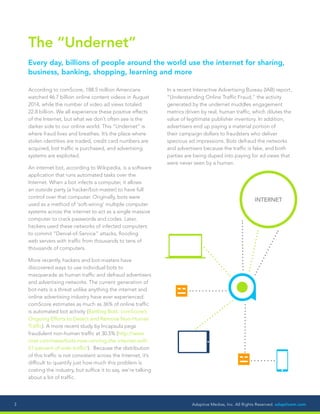
An internet bot, according to Wikipedia, is a software
application that runs automated tasks over the
Internet. When a bot infects a computer, it allows
an outside party (a hacker/bot-master) to have full
control over that computer. Originally, bots were
used as a method of ‘soft-wiring’ multiple computer
systems across the internet to act as a single massive
computer to crack passwords and codes. Later,
hackers used these networks of infected computers
to commit “Denial-of-Service” attacks, flooding
web servers with traffic from thousands to tens of
thousands of computers.
More recently, hackers and bot-masters have
discovered ways to use individual bots to
masquerade as human traffic and defraud advertisers
and advertising networks. The current generation of
bot-nets is a threat unlike anything the internet and
online advertising industry have ever experienced.
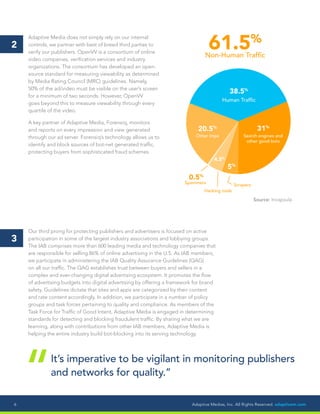
comScore estimates as much as 36% of online traffic
is automated bot activity (Battling Bots: comScore’s
Ongoing Efforts to Detect and Remove Non-Human
Traffic). A more recent study by Incapsula pegs
fraudulent non-human traffic at 30.5% (http://www.
cnet.com/news/bots-now-running-the-internet-with-
61-percent-of-web-traffic/). Because the distribution
of this traffic is not consistent across the Internet, it’s
difficult to quantify just how much this problem is
costing the industry, but suffice it to say, we’re talking
about a lot of traffic.
In a recent Interactive Advertising Bureau (IAB) report,
“Understanding Online Traffic Fraud,” the activity
generated by the undernet muddles engagement
metrics driven by real, human traffic, which dilutes the
value of legitimate publisher inventory. In addition,
advertisers end up paying a material portion of
their campaign dollars to fraudsters who deliver
specious ad impressions. Bots defraud the networks
and advertisers because the traffic is fake, and both
parties are being duped into paying for ad views that
were never seen by a human.
INTERNET
Adaptive Medias, Inc. All Rights Reserved. adaptivem.com4
Bot Logistics
Many people have difficulty understanding the incredible
sophistication of bots
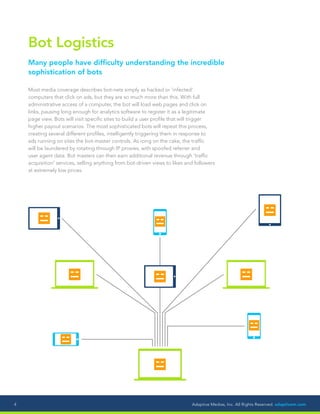
Most media coverage describes bot-nets simply as hacked or ‘infected’
computers that click on ads, but they are so much more than this. With full
administrative access of a computer, the bot will load web pages and click on
links, pausing long enough for analytics software to register it as a legitimate
page view. Bots will visit specific sites to build a user profile that will trigger
higher payout scenarios. The most sophisticated bots will repeat this process,
creating several different profiles, intelligently triggering them in response to
ads running on sites the bot-master controls. As icing on the cake, the traffic
will be laundered by rotating through IP proxies, with spoofed referrer and
user agent data. Bot masters can then earn additional revenue through ‘traffic
acquisition’ services, selling anything from bot-driven views to likes and followers
at extremely low prices.
Adaptive Medias, Inc. All Rights Reserved. adaptivem.com5
Dealing with Bot Threats
It’s always beneficial to develop a plan
to ensure quality and safety
At Adaptive Media, we have a three-pronged attack in place: an internal
playbook, 3rd party validation, and focused participation in industry self-
regulatory organizations. This system is robust and adaptive, designed to deal
with threats today and in the future.
Internal quality and compliance work begins with vetting and qualifying every
publisher before running advertising with them. Publisher websites must receive
passing marks from anti-spyware/malware/virus tools, such as SafeWeb and
SiteAdvisor. Also, each publisher site or mobile app is reviewed manually as part
of the validation process.
Are the sites’ traffic measurement ratings consistent with search engine
indexing for relevant keywords? For example, a “Top 1000” website featuring
funny videos should be found on the first two pages of searches for “funny
videos” and related terms.
Is the website frequently updated? And is the content original and unique?
Less reputable sites are notorious for stealing and scraping content from top-
level sites and passing it off as their own. If an article from WebMD.com, for
example, is also posted on “OnlineDocAdvice.info,” it’s safe to assume that
the post did not originate from the less reputable site.
Does the web site have broken elements or functionality?
Does the site have content but show no user engagement such as comments,
likes or external links?
Admittedly, quality is difficult to quantify, but here are the key items on
Adaptive Media’s checklist:
Publishers are continually monitored for patterns that would be indicative of
non-compliant activity. Websites need to be constantly monitored and examined
to ensure the publisher is continuing to offer the same quality, brand-safe
experience when they were first approved.
1
Adaptive Medias, Inc. All Rights Reserved. adaptivem.com6
Adaptive Media does not simply rely on our internal
controls, we partner with best of breed third parties to
verify our publishers. OpenVV is a consortium of online
video companies, verification services and industry
organizations. The consortium has developed an open-
source standard for measuring viewability as determined
by Media Rating Council (MRC) guidelines. Namely,
50% of the ad/video must be visible on the user’s screen
for a minimum of two seconds. However, OpenVV
goes beyond this to measure viewability through every
quartile of the video.
A key partner of Adaptive Media, Forensiq, monitors
and reports on every impression and view generated
through our ad server. Forensiq’s technology allows us to
identify and block sources of bot-­net generated traffic,
protecting buyers from sophisticated fraud schemes.
2
Our third prong for protecting publishers and advertisers is focused on active
participation in some of the largest industry associations and lobbying groups.
The IAB comprises more than 600 leading media and technology companies that
are responsible for selling 86% of online advertising in the U.S. As IAB members,
we participate in administering the IAB Quality Assurance Guidelines (QAG)
on all our traffic. The QAG establishes trust between buyers and sellers in a
complex and ever-changing digital advertising ecosystem. It promotes the flow
of advertising budgets into digital advertising by offering a framework for brand
safety. Guidelines dictate that sites and apps are categorized by their content
and rate content accordingly. In addition, we participate in a number of policy
groups and task forces pertaining to quality and compliance. As members of the
Task Force for Traffic of Good Intent, Adaptive Media is engaged in determining
standards for detecting and blocking fraudulent traffic. By sharing what we are
learning, along with contributions from other IAB members, Adaptive Media is
helping the entire industry build bot-blocking into its serving technology.
3
It’s imperative to be vigilant in monitoring publishers
and networks for quality.”
“
61.5%
Non-Human Traffic
38.5%
Human Traffic
Search engines and
other good bots
Spammers
Hacking tools
Scrapers
Other imps
31%
5%
4.5%
0.5%
20.5%
Source: Incapsula
Adaptive Medias, Inc. All Rights Reserved. adaptivem.com7
Facing the Problem
Compliance in the online advertising industry has always
been a game of cat and mouse
The Undernet’s bot-nets and fraudsters achieve certain abilities, the industry
responds with countermeasures, and the compliance cycle repeats. Bot traffic
is rarely an accident. If you find your owned-and-operated websites the victim
of bot traffic, it is vital to respond and investigate right away. Talk with the folks
responsible for managing and promoting your property. Implement a policy
against purchasing traffic in bulk, and consider partnering with a third party
compliance partner for bot detection and blocking solutions. Yes, additional
traffic creates a revenue lift, but the cons far outweigh the pros. If bot traffic is
discovered on your sites, it will cost you a lot more to not only repair the financial
damage, but also the damage to your brand and credibility.
Finding and preventing bot traffic is one thing, but what should you do if you
become aware of bot traffic affecting a partner site, such as an affiliate or other
website promoting your goods or services? Immediately suspend doing business
with the offending website and launch an investigation. Unyielding termination
is not necessary at this stage, but ensuring that you are insulated from the
bots is. Reach out to the affected publisher or website to discover the source
of the traffic to the site. Let them know about the bot or fraudulent traffic, and
communicate they will not be re-activated until they can demonstrate the traffic
is clean.
Bot traffic is rarely
an accident.”“
Adaptive Medias, Inc. All Rights Reserved. adaptivem.com8
Staying Committed to
the Path of Vigilance
As technology continues to advance, so will new threats.
Mobile is a new, uncharted territory – much like the internet in its infancy. According
to eMarketer, the amount of money being spent on mobile video is growing at a
much faster rate than desktop, with 112% for mobile video vs. 35% for online video in
2013. This rise of touch-based devices will hinder some of the industry’s bot-detection
technologies, mainly mouse movement and heat mapping. This semi-blind spot gives
bots additional cover to masquerade as mobile devices. Advances in pixeling plus
leveraging some of the unique aspects of mobile devices can help the industry keep
pace with the probable bot evolution.
The threats from the Undernet are very real, but there are ways to protect yourself.
The Undernet will only try harder and get smarter. If we don’t work together, we’re
all just individual, isolated pockets of resistance against the zombie bot-hordes.
Leverage your data, get assistance from third parties, learn to recognize bot-driven
traffic and collaborate with others. It’s going to take a little leg work as bots and
fraudsters get harder to find. However, patterns will be there just the same. Stay
committed to the path of constant vigilance, get involved with compliance standard
discussion groups and the industry standards community. Don’t stop with blocking or
blacklisting a website you’ve determined to be involved with bot-traffic. Report bad
actors to industry watchdog groups, such as the DAA, IAB, BBB Online, and TrustE.
It’s important to build a safer and smarter advertising community.
42%
No Privacy Policy
or Insufficient Disclosures
12%
Copyright/Trademark
Infringement
35%
None, or Severe Lack
of Original Content
10%
Inefficient
Design/User Experience
16%
Undiscoverable
on Search
8%
Ad
Clutter
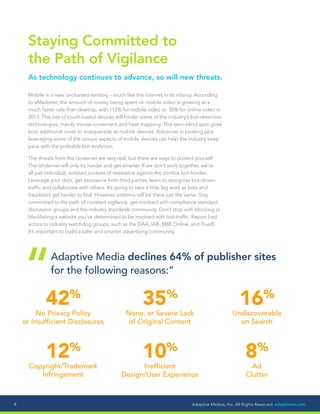
Adaptive Media declines 64% of publisher sites
for the following reasons:”
“
About Adaptive Media
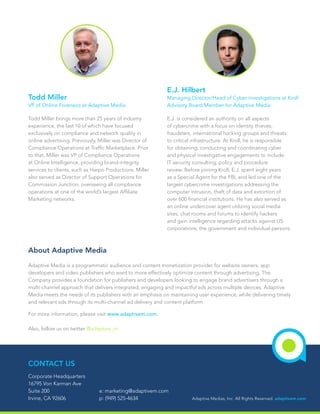
Todd Miller
VP of Online Forensics at Adaptive Media
E.J. Hilbert
Managing Director/Head of Cyber Investigations at Kroll
Advisory Board Member for Adaptive Media
Adaptive Media is a programmatic audience and content monetization provider for website owners, app
developers and video publishers who want to more effectively optimize content through advertising. The
Company provides a foundation for publishers and developers looking to engage brand advertisers through a
multi-channel approach that delivers integrated, engaging and impactful ads across multiple devices. Adaptive
Media meets the needs of its publishers with an emphasis on maintaining user experience, while delivering timely
and relevant ads through its multi-channel ad delivery and content platform.
For more information, please visit www.adaptivem.com.
Also, follow us on twitter @adaptive_m
Todd Miller brings more than 25 years of industry
experience, the last 10 of which have focused
exclusively on compliance and network quality in
online advertising. Previously, Miller was Director of
Compliance Operations at Traffic Marketplace. Prior
to that, Miller was VP of Compliance Operations
at Online Intelligence, providing brand-integrity
services to clients, such as Harpo Productions. Miller
also served as Director of Support Operations for
Commission Junction, overseeing all compliance
operations at one of the world’s largest Affiliate
Marketing networks.
E.J. is considered an authority on all aspects
of cybercrime with a focus on identity thieves,
fraudsters, international hacking groups and threats
to critical infrastructure. At Kroll, he is responsible
for obtaining, conducting and coordinating cyber
and physical investigative engagements to include
IT security consulting, policy and procedure
review. Before joining Kroll, E.J. spent eight years
as a Special Agent for the FBI, and led one of the
largest cybercrime investigations addressing the
computer intrusion, theft of data and extortion of
over 600 financial institutions. He has also served as
an online undercover agent utilizing social media
sites, chat rooms and forums to identify hackers
and gain intelligence regarding attacks against US
corporations, the government and individual persons.
Adaptive Medias, Inc. All Rights Reserved. adaptivem.com
CONTACT US
Corporate Headquarters
16795 Von Karman Ave
Suite 200
Irvine, CA 92606
e: marketing@adaptivem.com
p: (949) 525-4634

ComplianceBrief

  • 1.
    The Evolving Role ofCompliance SOLUTIONS BRIEF Adaptive Medias, Inc. All Rights Reserved. adaptivem.com
  • 2.
    2 “ The online advertisingworld has grown exponentially in the past five years. Once seen as the wild west, where anyone could grab some quick cash, it has become the mainsail of the advertising world. With that growth comes responsibility. Many of the original schemers and scammers have been forced out by legal authorities and legitimate business models. Only those who focus on clean and reliable traffic will continue to grow and move this industry forward. Adaptive Media is one of those companies. By ensuring publishers have legitimate traffic, the advertiser is protected. And by nullifying bot-based or fraudulent traffic, the consumer is protected. These steps will help return trust to the online ad world. E.J. Hilbert, Managing Director/Head of Cyber Investigations at Kroll
  • 3.
    Adaptive Medias, Inc.All Rights Reserved. adaptivem.com3 The “Undernet” Every day, billions of people around the world use the internet for sharing, business, banking, shopping, learning and more According to comScore, 188.5 million Americans watched 46.7 billion online content videos in August 2014, while the number of video ad views totaled 22.8 billion. We all experience these positive effects of the Internet, but what we don’t often see is the darker side to our online world. This “Undernet” is where fraud lives and breathes. It’s the place where stolen identities are traded, credit card numbers are acquired, bot traffic is purchased, and advertising systems are exploited. An internet bot, according to Wikipedia, is a software application that runs automated tasks over the Internet. When a bot infects a computer, it allows an outside party (a hacker/bot-master) to have full control over that computer. Originally, bots were used as a method of ‘soft-wiring’ multiple computer systems across the internet to act as a single massive computer to crack passwords and codes. Later, hackers used these networks of infected computers to commit “Denial-of-Service” attacks, flooding web servers with traffic from thousands to tens of thousands of computers. More recently, hackers and bot-masters have discovered ways to use individual bots to masquerade as human traffic and defraud advertisers and advertising networks. The current generation of bot-nets is a threat unlike anything the internet and online advertising industry have ever experienced. comScore estimates as much as 36% of online traffic is automated bot activity (Battling Bots: comScore’s Ongoing Efforts to Detect and Remove Non-Human Traffic). A more recent study by Incapsula pegs fraudulent non-human traffic at 30.5% (http://www. cnet.com/news/bots-now-running-the-internet-with- 61-percent-of-web-traffic/). Because the distribution of this traffic is not consistent across the Internet, it’s difficult to quantify just how much this problem is costing the industry, but suffice it to say, we’re talking about a lot of traffic. In a recent Interactive Advertising Bureau (IAB) report, “Understanding Online Traffic Fraud,” the activity generated by the undernet muddles engagement metrics driven by real, human traffic, which dilutes the value of legitimate publisher inventory. In addition, advertisers end up paying a material portion of their campaign dollars to fraudsters who deliver specious ad impressions. Bots defraud the networks and advertisers because the traffic is fake, and both parties are being duped into paying for ad views that were never seen by a human. INTERNET
  • 4.
    Adaptive Medias, Inc.All Rights Reserved. adaptivem.com4 Bot Logistics Many people have difficulty understanding the incredible sophistication of bots Most media coverage describes bot-nets simply as hacked or ‘infected’ computers that click on ads, but they are so much more than this. With full administrative access of a computer, the bot will load web pages and click on links, pausing long enough for analytics software to register it as a legitimate page view. Bots will visit specific sites to build a user profile that will trigger higher payout scenarios. The most sophisticated bots will repeat this process, creating several different profiles, intelligently triggering them in response to ads running on sites the bot-master controls. As icing on the cake, the traffic will be laundered by rotating through IP proxies, with spoofed referrer and user agent data. Bot masters can then earn additional revenue through ‘traffic acquisition’ services, selling anything from bot-driven views to likes and followers at extremely low prices.
  • 5.
    Adaptive Medias, Inc.All Rights Reserved. adaptivem.com5 Dealing with Bot Threats It’s always beneficial to develop a plan to ensure quality and safety At Adaptive Media, we have a three-pronged attack in place: an internal playbook, 3rd party validation, and focused participation in industry self- regulatory organizations. This system is robust and adaptive, designed to deal with threats today and in the future. Internal quality and compliance work begins with vetting and qualifying every publisher before running advertising with them. Publisher websites must receive passing marks from anti-spyware/malware/virus tools, such as SafeWeb and SiteAdvisor. Also, each publisher site or mobile app is reviewed manually as part of the validation process. Are the sites’ traffic measurement ratings consistent with search engine indexing for relevant keywords? For example, a “Top 1000” website featuring funny videos should be found on the first two pages of searches for “funny videos” and related terms. Is the website frequently updated? And is the content original and unique? Less reputable sites are notorious for stealing and scraping content from top- level sites and passing it off as their own. If an article from WebMD.com, for example, is also posted on “OnlineDocAdvice.info,” it’s safe to assume that the post did not originate from the less reputable site. Does the web site have broken elements or functionality? Does the site have content but show no user engagement such as comments, likes or external links? Admittedly, quality is difficult to quantify, but here are the key items on Adaptive Media’s checklist: Publishers are continually monitored for patterns that would be indicative of non-compliant activity. Websites need to be constantly monitored and examined to ensure the publisher is continuing to offer the same quality, brand-safe experience when they were first approved. 1
  • 6.
    Adaptive Medias, Inc.All Rights Reserved. adaptivem.com6 Adaptive Media does not simply rely on our internal controls, we partner with best of breed third parties to verify our publishers. OpenVV is a consortium of online video companies, verification services and industry organizations. The consortium has developed an open- source standard for measuring viewability as determined by Media Rating Council (MRC) guidelines. Namely, 50% of the ad/video must be visible on the user’s screen for a minimum of two seconds. However, OpenVV goes beyond this to measure viewability through every quartile of the video. A key partner of Adaptive Media, Forensiq, monitors and reports on every impression and view generated through our ad server. Forensiq’s technology allows us to identify and block sources of bot-­net generated traffic, protecting buyers from sophisticated fraud schemes. 2 Our third prong for protecting publishers and advertisers is focused on active participation in some of the largest industry associations and lobbying groups. The IAB comprises more than 600 leading media and technology companies that are responsible for selling 86% of online advertising in the U.S. As IAB members, we participate in administering the IAB Quality Assurance Guidelines (QAG) on all our traffic. The QAG establishes trust between buyers and sellers in a complex and ever-changing digital advertising ecosystem. It promotes the flow of advertising budgets into digital advertising by offering a framework for brand safety. Guidelines dictate that sites and apps are categorized by their content and rate content accordingly. In addition, we participate in a number of policy groups and task forces pertaining to quality and compliance. As members of the Task Force for Traffic of Good Intent, Adaptive Media is engaged in determining standards for detecting and blocking fraudulent traffic. By sharing what we are learning, along with contributions from other IAB members, Adaptive Media is helping the entire industry build bot-blocking into its serving technology. 3 It’s imperative to be vigilant in monitoring publishers and networks for quality.” “ 61.5% Non-Human Traffic 38.5% Human Traffic Search engines and other good bots Spammers Hacking tools Scrapers Other imps 31% 5% 4.5% 0.5% 20.5% Source: Incapsula
  • 7.
    Adaptive Medias, Inc.All Rights Reserved. adaptivem.com7 Facing the Problem Compliance in the online advertising industry has always been a game of cat and mouse The Undernet’s bot-nets and fraudsters achieve certain abilities, the industry responds with countermeasures, and the compliance cycle repeats. Bot traffic is rarely an accident. If you find your owned-and-operated websites the victim of bot traffic, it is vital to respond and investigate right away. Talk with the folks responsible for managing and promoting your property. Implement a policy against purchasing traffic in bulk, and consider partnering with a third party compliance partner for bot detection and blocking solutions. Yes, additional traffic creates a revenue lift, but the cons far outweigh the pros. If bot traffic is discovered on your sites, it will cost you a lot more to not only repair the financial damage, but also the damage to your brand and credibility. Finding and preventing bot traffic is one thing, but what should you do if you become aware of bot traffic affecting a partner site, such as an affiliate or other website promoting your goods or services? Immediately suspend doing business with the offending website and launch an investigation. Unyielding termination is not necessary at this stage, but ensuring that you are insulated from the bots is. Reach out to the affected publisher or website to discover the source of the traffic to the site. Let them know about the bot or fraudulent traffic, and communicate they will not be re-activated until they can demonstrate the traffic is clean. Bot traffic is rarely an accident.”“
  • 8.
    Adaptive Medias, Inc.All Rights Reserved. adaptivem.com8 Staying Committed to the Path of Vigilance As technology continues to advance, so will new threats. Mobile is a new, uncharted territory – much like the internet in its infancy. According to eMarketer, the amount of money being spent on mobile video is growing at a much faster rate than desktop, with 112% for mobile video vs. 35% for online video in 2013. This rise of touch-based devices will hinder some of the industry’s bot-detection technologies, mainly mouse movement and heat mapping. This semi-blind spot gives bots additional cover to masquerade as mobile devices. Advances in pixeling plus leveraging some of the unique aspects of mobile devices can help the industry keep pace with the probable bot evolution. The threats from the Undernet are very real, but there are ways to protect yourself. The Undernet will only try harder and get smarter. If we don’t work together, we’re all just individual, isolated pockets of resistance against the zombie bot-hordes. Leverage your data, get assistance from third parties, learn to recognize bot-driven traffic and collaborate with others. It’s going to take a little leg work as bots and fraudsters get harder to find. However, patterns will be there just the same. Stay committed to the path of constant vigilance, get involved with compliance standard discussion groups and the industry standards community. Don’t stop with blocking or blacklisting a website you’ve determined to be involved with bot-traffic. Report bad actors to industry watchdog groups, such as the DAA, IAB, BBB Online, and TrustE. It’s important to build a safer and smarter advertising community. 42% No Privacy Policy or Insufficient Disclosures 12% Copyright/Trademark Infringement 35% None, or Severe Lack of Original Content 10% Inefficient Design/User Experience 16% Undiscoverable on Search 8% Ad Clutter Adaptive Media declines 64% of publisher sites for the following reasons:” “
  • 9.
    About Adaptive Media ToddMiller VP of Online Forensics at Adaptive Media E.J. Hilbert Managing Director/Head of Cyber Investigations at Kroll Advisory Board Member for Adaptive Media Adaptive Media is a programmatic audience and content monetization provider for website owners, app developers and video publishers who want to more effectively optimize content through advertising. The Company provides a foundation for publishers and developers looking to engage brand advertisers through a multi-channel approach that delivers integrated, engaging and impactful ads across multiple devices. Adaptive Media meets the needs of its publishers with an emphasis on maintaining user experience, while delivering timely and relevant ads through its multi-channel ad delivery and content platform. For more information, please visit www.adaptivem.com. Also, follow us on twitter @adaptive_m Todd Miller brings more than 25 years of industry experience, the last 10 of which have focused exclusively on compliance and network quality in online advertising. Previously, Miller was Director of Compliance Operations at Traffic Marketplace. Prior to that, Miller was VP of Compliance Operations at Online Intelligence, providing brand-integrity services to clients, such as Harpo Productions. Miller also served as Director of Support Operations for Commission Junction, overseeing all compliance operations at one of the world’s largest Affiliate Marketing networks. E.J. is considered an authority on all aspects of cybercrime with a focus on identity thieves, fraudsters, international hacking groups and threats to critical infrastructure. At Kroll, he is responsible for obtaining, conducting and coordinating cyber and physical investigative engagements to include IT security consulting, policy and procedure review. Before joining Kroll, E.J. spent eight years as a Special Agent for the FBI, and led one of the largest cybercrime investigations addressing the computer intrusion, theft of data and extortion of over 600 financial institutions. He has also served as an online undercover agent utilizing social media sites, chat rooms and forums to identify hackers and gain intelligence regarding attacks against US corporations, the government and individual persons. Adaptive Medias, Inc. All Rights Reserved. adaptivem.com CONTACT US Corporate Headquarters 16795 Von Karman Ave Suite 200 Irvine, CA 92606 e: marketing@adaptivem.com p: (949) 525-4634