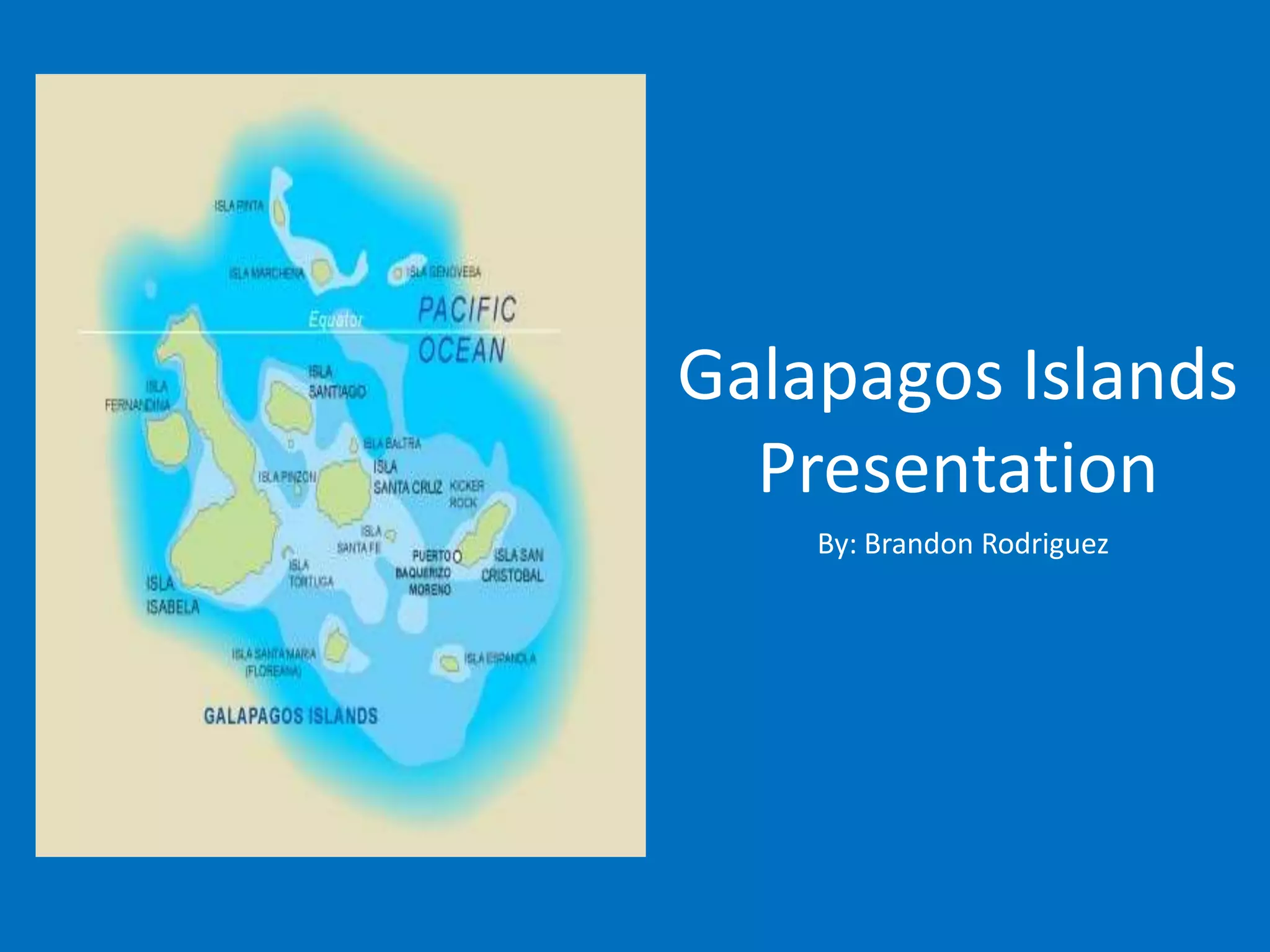
Galapagos Islands
  Presentation
    By: Brandon Rodriguez
Location
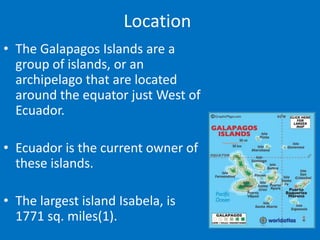
• The Galapagos Islands are a
  group of islands, or an
  archipelago that are located
  around the equator just West of
  Ecuador.

• Ecuador is the current owner of
  these islands.

• The largest island Isabela, is
  1771 sq. miles(1).
Terrain
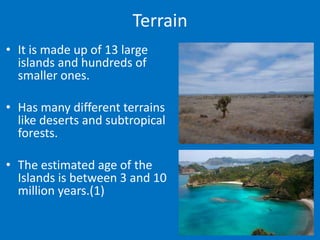
• It is made up of 13 large
  islands and hundreds of
  smaller ones.

• Has many different terrains
  like deserts and subtropical
  forests.

• The estimated age of the
  Islands is between 3 and 10
  million years.(1)
Species

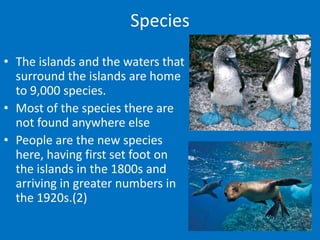
• The islands and the waters that
  surround the islands are home
  to 9,000 species.
• Most of the species there are
  not found anywhere else
• People are the new species
  here, having first set foot on
  the islands in the 1800s and
  arriving in greater numbers in
  the 1920s.(2)
“Lonesome George”
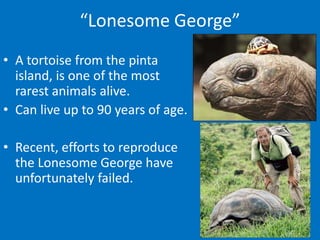
• A tortoise from the pinta
  island, is one of the most
  rarest animals alive.
• Can live up to 90 years of age.

• Recent, efforts to reproduce
  the Lonesome George have
  unfortunately failed.
The Galapagos Penguin


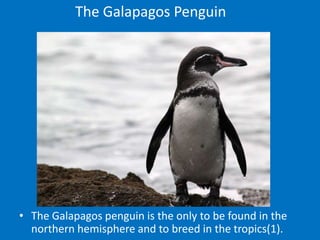
• The Galapagos penguin is the only to be found in the
  northern hemisphere and to breed in the tropics(1).
Galapagos Marine Iguana


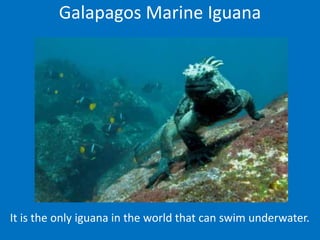
It is the only iguana in the world that can swim underwater.
Climate
• Only had 2 seasons, warm and wet
  from December to May, and cool
  and dry from June to December.
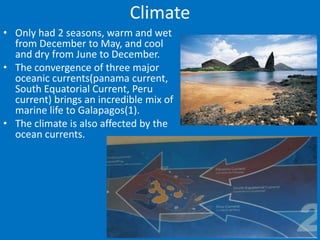
• The convergence of three major
  oceanic currents(panama current,
  South Equatorial Current, Peru
  current) brings an incredible mix of
  marine life to Galapagos(1).
• The climate is also affected by the
  ocean currents.
Issues: Early Damaging
• Pirates who passed by these
  Islands took a damaging
  effect on the wildlife early
  on.
• Giant tortoises were
  collected by pirates for
  food.
• 24% of plant species and
  50% of vertebrate species
  are still considered as
  endangered due to human
  activity in earlier times.(1)
Issues: Humans

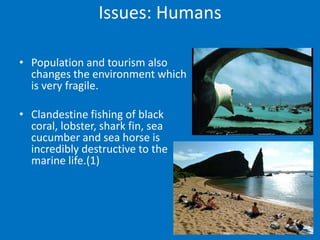
• Population and tourism also
  changes the environment which
  is very fragile.

• Clandestine fishing of black
  coral, lobster, shark fin, sea
  cucumber and sea horse is
  incredibly destructive to the
  marine life.(1)
Issues: El Nino

• 50% of marine life die from a
  sudden climate change or El
  nino.

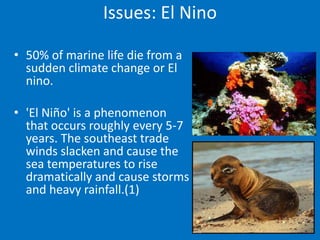
• 'El Niño' is a phenomenon
  that occurs roughly every 5-7
  years. The southeast trade
  winds slacken and cause the
  sea temperatures to rise
  dramatically and cause storms
  and heavy rainfall.(1)
Protection
• Ecuador declared all the desolate land in
  Galapagos a national park in 1959.

• Dogs and goats have been removed from
  the smaller islands to preserve other
  species.

• Environmental education efforts on the
  Islands help their inhabitants understand
  the larger picture and need for
  conservation, and responsible tourism and
  enforced park guidelines help preserve the
  Galapagos for the future.(3)
Protection
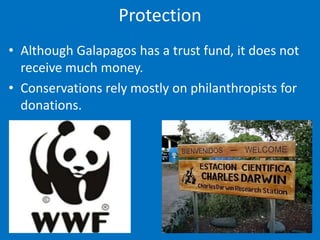
• Although Galapagos has a trust fund, it does not
  receive much money.
• Conservations rely mostly on philanthropists for
  donations.
Adopt A Blue Footed Bobby
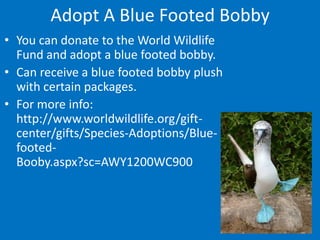
• You can donate to the World Wildlife
  Fund and adopt a blue footed bobby.
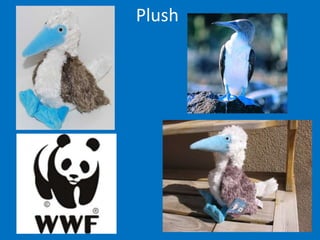
• Can receive a blue footed bobby plush
  with certain packages.
• For more info:
  http://www.worldwildlife.org/gift-
  center/gifts/Species-Adoptions/Blue-
  footed-
  Booby.aspx?sc=AWY1200WC900
Plush
Bibliography

• (1)http://www.galapagosislands.com/galapag
  os-resources/galapagos-fast-facts.html
• (2)http://www.worldwildlife.org/what/where
  wework/galapagos/index.html
• (3)http://www.galapagosislands.com/galapag
  os-conservation/galapagos-enviroment.html

Brandonrodriguez

  • 1.
    Galapagos Islands Presentation By: Brandon Rodriguez
  • 2.
    Location • The GalapagosIslands are a group of islands, or an archipelago that are located around the equator just West of Ecuador. • Ecuador is the current owner of these islands. • The largest island Isabela, is 1771 sq. miles(1).
  • 3.
    Terrain • It ismade up of 13 large islands and hundreds of smaller ones. • Has many different terrains like deserts and subtropical forests. • The estimated age of the Islands is between 3 and 10 million years.(1)
  • 4.
    Species • The islandsand the waters that surround the islands are home to 9,000 species. • Most of the species there are not found anywhere else • People are the new species here, having first set foot on the islands in the 1800s and arriving in greater numbers in the 1920s.(2)
  • 5.
    “Lonesome George” • Atortoise from the pinta island, is one of the most rarest animals alive. • Can live up to 90 years of age. • Recent, efforts to reproduce the Lonesome George have unfortunately failed.
  • 6.
    The Galapagos Penguin •The Galapagos penguin is the only to be found in the northern hemisphere and to breed in the tropics(1).
  • 7.
    Galapagos Marine Iguana Itis the only iguana in the world that can swim underwater.
  • 8.
    Climate • Only had2 seasons, warm and wet from December to May, and cool and dry from June to December. • The convergence of three major oceanic currents(panama current, South Equatorial Current, Peru current) brings an incredible mix of marine life to Galapagos(1). • The climate is also affected by the ocean currents.
  • 9.
    Issues: Early Damaging •Pirates who passed by these Islands took a damaging effect on the wildlife early on. • Giant tortoises were collected by pirates for food. • 24% of plant species and 50% of vertebrate species are still considered as endangered due to human activity in earlier times.(1)
  • 10.
    Issues: Humans • Populationand tourism also changes the environment which is very fragile. • Clandestine fishing of black coral, lobster, shark fin, sea cucumber and sea horse is incredibly destructive to the marine life.(1)
  • 11.
    Issues: El Nino •50% of marine life die from a sudden climate change or El nino. • 'El Niño' is a phenomenon that occurs roughly every 5-7 years. The southeast trade winds slacken and cause the sea temperatures to rise dramatically and cause storms and heavy rainfall.(1)
  • 12.
    Protection • Ecuador declaredall the desolate land in Galapagos a national park in 1959. • Dogs and goats have been removed from the smaller islands to preserve other species. • Environmental education efforts on the Islands help their inhabitants understand the larger picture and need for conservation, and responsible tourism and enforced park guidelines help preserve the Galapagos for the future.(3)
  • 13.
    Protection • Although Galapagoshas a trust fund, it does not receive much money. • Conservations rely mostly on philanthropists for donations.
  • 14.
    Adopt A BlueFooted Bobby • You can donate to the World Wildlife Fund and adopt a blue footed bobby. • Can receive a blue footed bobby plush with certain packages. • For more info: http://www.worldwildlife.org/gift- center/gifts/Species-Adoptions/Blue- footed- Booby.aspx?sc=AWY1200WC900
  • 15.
  • 16.
    Bibliography • (1)http://www.galapagosislands.com/galapag os-resources/galapagos-fast-facts.html • (2)http://www.worldwildlife.org/what/where wework/galapagos/index.html • (3)http://www.galapagosislands.com/galapag os-conservation/galapagos-enviroment.html