F.I.D.O.
Fully Integrated Defense OperationRob Fry - Sr Security Architect
Agenda
• The Human Problem
• The Technical Problem
• F.I.D.O. High Level
• What’s Next?
• Q & A
The Human Problem
Source: Cisco 2014 ASR, Network World, ISAC, swimlane.com, Security Week
The Human Problem
• Vendors and organizations are not doing enough to lower the bar
• 62% of organizations have not increased security training
• 83% of enterprises lack the resources or skills to protect assets
• Majority of the work is done manually… self-defeating
• Response time windows are too high
• Enforcement, mitigation is largely manual
Too Many Alerts, Too Little Time/Resources

Network defenders are overwhelmed by the volume of alerts
• Typical Fortune 1000 organization experiences thousands of new security events everyday (1)
• Data review is time consuming

Current industry best practices rely on analysts using SIEM 

technologies + manual use of threat intel feeds
• Too many false positives
• Very little guidance on how to filter the signal from the noise
The Technical Problem
Source: (1) IBM 2014 Cyber Security Intelligence Index
“There are 400 alerts in my SIEM, and I have time/resources to
investigate 10. Which 10 do I choose?” (1)
Source: (1) CISO from Fortune 200 Company
The Technical Problem
But… it WORKS in the MOVIES
The Technical Problem
F.I.D.O. = Orchestration
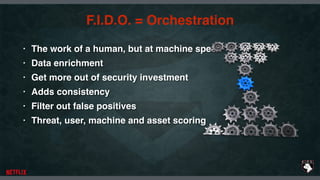
• The work of a human, but at machine speed
• Data enrichment
• Get more out of security investment
• Adds consistency
• Filter out false positives
• Threat, user, machine and asset scoring
Known -versus- Unknown
F.I.D.O. = Orchestration
Reduce Response Time
Attackers
Ability
Defender
s Ability
Source:(Verizon(Data(Breach(Report(
F.I.D.O. = Orchestration
At First, Simplicity
Disjointed Security
Network Alert Firewall/IPS/IDS
Endpoint Defense
Support Person
Support Person
=
=
Bad!
Blocked!
Malware
At First, Simplicity
Joining the disjointed
Network Alert Firewall/IPS/IDS
Endpoint Defense
Support Person
Blocked
Not Blocked
Malware
At First, Simplicity
Joining the disjointed
• Aggregate data from multiple human jobs at once
• Look for corresponding events
• Reduce severity where one detector blocks
• Reduce response time
• Opened door to other ideas
Look Outside the Security Sphere
Network Alert Firewall/IPS/IDS
Endpoint Defense
Support Person
Expanding data sources
Blocked
Not Blocked
User
Asset
Machine
Data Source
Malware
Data Source
Expanding data sources
• Systems management, inventory, HR, AD, etc.
• Added machine, user, asset posture
• Not just about the threat, context is still king
• Example: any alert against PCI, PII, Domain Admin, CEO,
etc., would be more critical
Look Outside the Security Sphere
Threat Feeds
Value in Crowdsourcing
Alert
Support Person
Data Source
User
Asset
Machine
Threat Feeds
Correlation
Threat Feeds
Crowdsourcing
Context
Validation
False Positives
Threat Feeds
• Too much data to do manually, more effective automated
• Can provide rich detailed layers of context
• As a stack, can cover the multiple layers
• Cross-correlation between feeds
• Scheduled artifact checking
• Prelude to detection
Value in Crowdsourcing
Historical Data
Alert
Support Person
Data Source
User
Asset
Machine
Threat Feeds
Correlation
Historical
Looking back is important
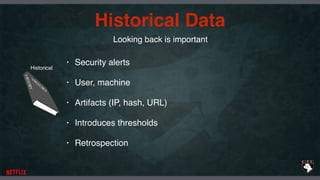
Historical Data
• Security alerts
• User, machine
• Artifacts (IP, hash, URL)
• Introduces thresholds
• Retrospection
Historical
Looking back is important
Scoring Engine
Assessing the DataAlert
Support Person
Correlation
Scoring
0%-100%
User
Asset
Machine
Threat
Total
Data Source
User
Asset
Machine
Threat Feeds
Historical
F.I.D.O.
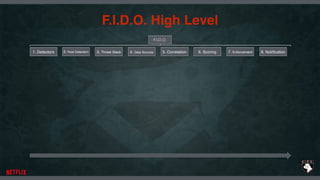
1. Detectors 2. Host Detection 3. Threat Stack 4. Data Sources 5. Correlation 6. Scoring 7. Enforcement 8. Notification
F.I.D.O. High Level
F.I.D.O. High Level
F.I.D.O.
Carbon Black
ProtectWise
Cyphort
SentinelOne
Niddel
1. Detectors
DHCP
RPC
SSH
DNS
2. Host Detection
VirusTotal
ThreatGRID
OpenDNS
ThreatExchange
AlienVault
3. Threat Stack
LDAP
Jamf
Landesk
SCCM
Endpoint
4. Data Sources
Detectors
Previous Threats
Historical User/Machine
OS
Threat Feeds
Thresholds
5. Correlation 6. Scoring 7. Enforcement 8. Notification
ARP
Palo Alto Network
HR
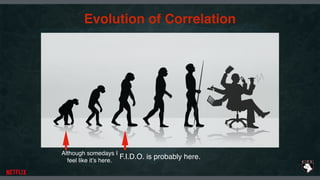
Although somedays I
feel like it’s here.
Evolution of Correlation
F.I.D.O. is probably here.
Correlation: Simple Example
Patterns in the data
Normal Suspicious Malicious
Correlation: Real World Example
Patterns in the data
Correlation: Cross Sections
Patterns in the data
66.102.255.50
eda661bf08ca0129d78f901dc561afe6549e383d
167.89.125.30
76adfe71d590173b7b6a8db01133d3eb7132bfc6
54.71.32.218
www.downloadcrest.com
463065c87d58befbfde6d150fe1d1338fa752bd6
appsom1.com
d1ut7rcibkldo.cloudfront.net/b_zq_ym_hotvideo002/hotvideo_0910_3.apk
205.210.187.209
67.207.158.254
miserupdate.aliyun.com/data/2.4.1.6/TBSecSvc.exe
wilsart.nl/images/banners/eok.swf?myid=2ac20f898f1e6a17f04952452c4d20d4
209.222.15.232
d1qd2jv3uw36vk.cloudfront.net/PlusHDrow_14_01-a1a8f801.exe
179.43.156.66
172.98.67.53
108.61.226.13
6de64d26a49b05b0e70ad50b8ed3b99a0200240c
IP/Hash/URL/Domain5x
2x
2x
4x
2x
2x
3x
2x
2x
Correlation Initiatives
• More data, different data, more data points
• Move past 1000 vectors
• More indicators
• Move laterally across data (detector, threat feed, whatever)
• Drill in multiple layers deep
• Better data enrichment algorithms for higher quality associations, thresholds,
increments
• Independent processes for correlation ( micro services ]
• Continue to evaluate ML for correlation
• F.I.D.O. is not ML, but we are working on it
• ML for scoring first (Thank you Mines.IO team)
• ML for security is hard, efficacy can be challenging
• Correlation can be repeatable
• Correlation is what security people do… codify it
Correlation Initiatives
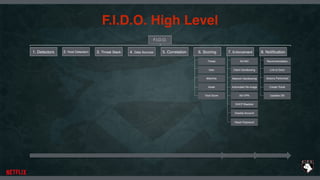
F.I.D.O. High Level
F.I.D.O.
Threat
User
Machine
Asset
Total Score
Kill NIC
Client Sandboxing
Network Sandboxing
Automated Re-image
Kill VPN
DHCP Blacklist
Disable Account
Reset Password
Recommendation
Link to Docs
Actions Performed
Create Ticket
Updates DB
1. Detectors 2. Host Detection 3. Threat Stack 4. Data Sources 5. Correlation 6. Scoring 7. Enforcement 8. Notification
F.I.D.O. High Level
F.I.D.O.
Carbon Black
ProtectWise
Cyphort
SentinelOne
DHCP
RPC
SSH
DNS
VirusTotal
ThreatGRID
OpenDNS
AlienVault
LDAP
Jamf
Landesk
SCCM
Endpoint
Detectors
Previous Threats
Historical User/Machine
OS
Threat Feeds
Thresholds
Threat
User
Machine
Asset
Total Score
Kill NIC
Client Sandboxing
Network Sandboxing
Automated Re-image
Kill VPN
DHCP Blacklist
Disable Account
Reset Password
Recommendation
Link to Docs
Actions Performed
Create Ticket
Updates DBARP
ThreatExchange
Niddel
Palo Alto Network
HR
1. Detectors 2. Host Detection 3. Threat Stack 4. Data Sources 5. Correlation 6. Scoring 7. Enforcement 8. Notification
F.I.D.O. High Level
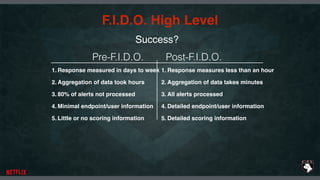
1. Response measured in days to week
2. Aggregation of data took hours
3. 80% of alerts not processed
4. Minimal endpoint/user information
5. Little or no scoring information
Pre-F.I.D.O. Post-F.I.D.O.
1. Response measures less than an hour
2. Aggregation of data takes minutes
3. All alerts processed
4. Detailed endpoint/user information
5. Detailed scoring information
Success?
F.I.D.O. High Level
Success?
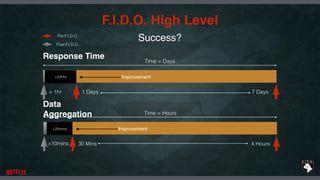
Time = Days
7 Days1 Days> 1hr
Time = Hours
4 Hours30 Mins>10mins
Response Time
Data
Aggregation
Pre-F.I.D.O.
Post-F.I.D.O.
+23hrs Improvement
+20mins Improvement
F.I.D.O. High Level
Success?
Alerts
Processed
80% of alerts not processed
Before F.I.D.O.
After F.I.D.O.
Alerts
Processed
100% of alerts processed
What’s Next?
Opportunity
What’s Next?
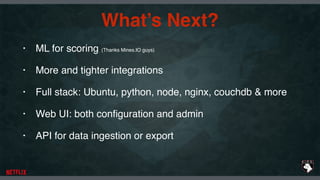
• ML for scoring (Thanks Mines.IO guys)
• More and tighter integrations
• Full stack: Ubuntu, python, node, nginx, couchdb & more
• Web UI: both configuration and admin
• API for data ingestion or export
Q&A
• Questions?
• Thank you!
• rob.fry@netflix.com

Fully Integrated Defense Operation

  • 1.
    F.I.D.O. Fully Integrated DefenseOperationRob Fry - Sr Security Architect
  • 2.
    Agenda • The HumanProblem • The Technical Problem • F.I.D.O. High Level • What’s Next? • Q & A
  • 3.
    The Human Problem Source:Cisco 2014 ASR, Network World, ISAC, swimlane.com, Security Week
  • 4.
    The Human Problem •Vendors and organizations are not doing enough to lower the bar • 62% of organizations have not increased security training • 83% of enterprises lack the resources or skills to protect assets • Majority of the work is done manually… self-defeating • Response time windows are too high • Enforcement, mitigation is largely manual
  • 5.
    Too Many Alerts,Too Little Time/Resources
 Network defenders are overwhelmed by the volume of alerts • Typical Fortune 1000 organization experiences thousands of new security events everyday (1) • Data review is time consuming
 Current industry best practices rely on analysts using SIEM 
 technologies + manual use of threat intel feeds • Too many false positives • Very little guidance on how to filter the signal from the noise The Technical Problem Source: (1) IBM 2014 Cyber Security Intelligence Index
  • 6.
    “There are 400alerts in my SIEM, and I have time/resources to investigate 10. Which 10 do I choose?” (1) Source: (1) CISO from Fortune 200 Company The Technical Problem
  • 7.
    But… it WORKSin the MOVIES The Technical Problem
  • 8.
    F.I.D.O. = Orchestration •The work of a human, but at machine speed • Data enrichment • Get more out of security investment • Adds consistency • Filter out false positives • Threat, user, machine and asset scoring
  • 9.
  • 10.
    Reduce Response Time Attackers Ability Defender sAbility Source:(Verizon(Data(Breach(Report( F.I.D.O. = Orchestration
  • 11.
    At First, Simplicity DisjointedSecurity Network Alert Firewall/IPS/IDS Endpoint Defense Support Person Support Person = = Bad! Blocked! Malware
  • 12.
    At First, Simplicity Joiningthe disjointed Network Alert Firewall/IPS/IDS Endpoint Defense Support Person Blocked Not Blocked Malware
  • 13.
    At First, Simplicity Joiningthe disjointed • Aggregate data from multiple human jobs at once • Look for corresponding events • Reduce severity where one detector blocks • Reduce response time • Opened door to other ideas
  • 14.
    Look Outside theSecurity Sphere Network Alert Firewall/IPS/IDS Endpoint Defense Support Person Expanding data sources Blocked Not Blocked User Asset Machine Data Source Malware
  • 15.
    Data Source Expanding datasources • Systems management, inventory, HR, AD, etc. • Added machine, user, asset posture • Not just about the threat, context is still king • Example: any alert against PCI, PII, Domain Admin, CEO, etc., would be more critical Look Outside the Security Sphere
  • 16.
    Threat Feeds Value inCrowdsourcing Alert Support Person Data Source User Asset Machine Threat Feeds Correlation
  • 17.
  • 18.
    Threat Feeds • Toomuch data to do manually, more effective automated • Can provide rich detailed layers of context • As a stack, can cover the multiple layers • Cross-correlation between feeds • Scheduled artifact checking • Prelude to detection Value in Crowdsourcing
  • 19.
    Historical Data Alert Support Person DataSource User Asset Machine Threat Feeds Correlation Historical Looking back is important
  • 20.
    Historical Data • Securityalerts • User, machine • Artifacts (IP, hash, URL) • Introduces thresholds • Retrospection Historical Looking back is important
  • 21.
    Scoring Engine Assessing theDataAlert Support Person Correlation Scoring 0%-100% User Asset Machine Threat Total Data Source User Asset Machine Threat Feeds Historical
  • 22.
    F.I.D.O. 1. Detectors 2.Host Detection 3. Threat Stack 4. Data Sources 5. Correlation 6. Scoring 7. Enforcement 8. Notification F.I.D.O. High Level
  • 23.
    F.I.D.O. High Level F.I.D.O. CarbonBlack ProtectWise Cyphort SentinelOne Niddel 1. Detectors DHCP RPC SSH DNS 2. Host Detection VirusTotal ThreatGRID OpenDNS ThreatExchange AlienVault 3. Threat Stack LDAP Jamf Landesk SCCM Endpoint 4. Data Sources Detectors Previous Threats Historical User/Machine OS Threat Feeds Thresholds 5. Correlation 6. Scoring 7. Enforcement 8. Notification ARP Palo Alto Network HR
  • 24.
    Although somedays I feellike it’s here. Evolution of Correlation F.I.D.O. is probably here.
  • 25.
    Correlation: Simple Example Patternsin the data Normal Suspicious Malicious
  • 26.
    Correlation: Real WorldExample Patterns in the data
  • 27.
    Correlation: Cross Sections Patternsin the data 66.102.255.50 eda661bf08ca0129d78f901dc561afe6549e383d 167.89.125.30 76adfe71d590173b7b6a8db01133d3eb7132bfc6 54.71.32.218 www.downloadcrest.com 463065c87d58befbfde6d150fe1d1338fa752bd6 appsom1.com d1ut7rcibkldo.cloudfront.net/b_zq_ym_hotvideo002/hotvideo_0910_3.apk 205.210.187.209 67.207.158.254 miserupdate.aliyun.com/data/2.4.1.6/TBSecSvc.exe wilsart.nl/images/banners/eok.swf?myid=2ac20f898f1e6a17f04952452c4d20d4 209.222.15.232 d1qd2jv3uw36vk.cloudfront.net/PlusHDrow_14_01-a1a8f801.exe 179.43.156.66 172.98.67.53 108.61.226.13 6de64d26a49b05b0e70ad50b8ed3b99a0200240c IP/Hash/URL/Domain5x 2x 2x 4x 2x 2x 3x 2x 2x
  • 28.
    Correlation Initiatives • Moredata, different data, more data points • Move past 1000 vectors • More indicators • Move laterally across data (detector, threat feed, whatever) • Drill in multiple layers deep • Better data enrichment algorithms for higher quality associations, thresholds, increments • Independent processes for correlation ( micro services ] • Continue to evaluate ML for correlation
  • 29.
    • F.I.D.O. isnot ML, but we are working on it • ML for scoring first (Thank you Mines.IO team) • ML for security is hard, efficacy can be challenging • Correlation can be repeatable • Correlation is what security people do… codify it Correlation Initiatives
  • 30.
    F.I.D.O. High Level F.I.D.O. Threat User Machine Asset TotalScore Kill NIC Client Sandboxing Network Sandboxing Automated Re-image Kill VPN DHCP Blacklist Disable Account Reset Password Recommendation Link to Docs Actions Performed Create Ticket Updates DB 1. Detectors 2. Host Detection 3. Threat Stack 4. Data Sources 5. Correlation 6. Scoring 7. Enforcement 8. Notification
  • 31.
    F.I.D.O. High Level F.I.D.O. CarbonBlack ProtectWise Cyphort SentinelOne DHCP RPC SSH DNS VirusTotal ThreatGRID OpenDNS AlienVault LDAP Jamf Landesk SCCM Endpoint Detectors Previous Threats Historical User/Machine OS Threat Feeds Thresholds Threat User Machine Asset Total Score Kill NIC Client Sandboxing Network Sandboxing Automated Re-image Kill VPN DHCP Blacklist Disable Account Reset Password Recommendation Link to Docs Actions Performed Create Ticket Updates DBARP ThreatExchange Niddel Palo Alto Network HR 1. Detectors 2. Host Detection 3. Threat Stack 4. Data Sources 5. Correlation 6. Scoring 7. Enforcement 8. Notification
  • 32.
    F.I.D.O. High Level 1.Response measured in days to week 2. Aggregation of data took hours 3. 80% of alerts not processed 4. Minimal endpoint/user information 5. Little or no scoring information Pre-F.I.D.O. Post-F.I.D.O. 1. Response measures less than an hour 2. Aggregation of data takes minutes 3. All alerts processed 4. Detailed endpoint/user information 5. Detailed scoring information Success?
  • 33.
    F.I.D.O. High Level Success? Time= Days 7 Days1 Days> 1hr Time = Hours 4 Hours30 Mins>10mins Response Time Data Aggregation Pre-F.I.D.O. Post-F.I.D.O. +23hrs Improvement +20mins Improvement
  • 34.
    F.I.D.O. High Level Success? Alerts Processed 80%of alerts not processed Before F.I.D.O. After F.I.D.O. Alerts Processed 100% of alerts processed
  • 35.
  • 36.
    What’s Next? • MLfor scoring (Thanks Mines.IO guys) • More and tighter integrations • Full stack: Ubuntu, python, node, nginx, couchdb & more • Web UI: both configuration and admin • API for data ingestion or export
  • 37.
    Q&A • Questions? • Thankyou! • rob.fry@netflix.com