Evaluation of liver fibrosis with
transient elastography (Fibroscan) and
      APRI score, in patients with
           Systemic Sclerosis


               Alejandro Muñoz Jiménez.
                  Rheumatology Unit.
        Valme University Hospital (Seville, Spain).

             alejandrogaleno@hotmail.com
Apologies for my English level…
1. Introduction.

2. Material and Methods

3. Results

4. Conclusions
1. Introduction           Systemic sclerosis (SSc) is a complex and rare autoimmune
                          disease characterized by vascular damage and sclerosis
2. Material and Methods   within the skin and internal organs.
                                         Gastrointestinal involvement.
3. Results                               Pulmonary involvement.
                                         Renal disease.
4. Conclusions                           Cardiac disease.
                                         Genitourinary.

                          The occurrence and extent of primary liver damage in SSc
                          patients have not been adequately studied.
1. Introduction           Liver disease found in association with scleroderma was first
                          described by Milbradt in 1934.
2. Material and Methods
                          Liver disease has not been considered a significant feature
3. Results                of scleroderma and, in a large series, a higher prevalence of
                          liver disease was found in the control populations.
4. Conclusions
1. Introduction           In a review of 727 patients with scleroderma only 8 (1.1%)
                          had hepatic involvement.
2. Material and Methods
                          If this uncommon complication occurs, it usually occurs 10
3. Results                to 15 years after the onset of scleroderma.
4. Conclusions
1. Introduction           However, in a retrospective review of postmortem findings
                          in scleroderma, hepatomegaly and cirrhosis were both more
2. Material and Methods   common in a matched control group.

3. Results                In a prospective assessment of the extent of visceral
                          involvement in scleroderma 16/31 (52%) patients were
4. Conclusions            shown to have abnormal liver function tests or lengthened
                          prothrombin times.
1. Introduction           In general the liver and biliary system are not affected by
                          scleroderma.
2. Material and Methods
                          However, AUTOINMUNE HEPATITIS AND PRIMARY BILIARY
3. Results                CIRRHOSIS are associated with the limited form of
                          scleroderma.
4. Conclusions
1. Introduction           The relationship between primary sclerosing cholangitis
                          (PSC) and scleroderma is extremely rare (only one case reported
2. Material and Methods   of PSC in scleroderma)

3. Results

4. Conclusions
1. Introduction           TRANSIENT ELASTOGRAPHY (FibroScan; Echosens; Paris,
                          France).
2. Material and Methods
                            Transient Elastography (TE) is a novel and non-invasive
3. Results                  technique for the evaluation of fibrosis in chronic liver
                            disease (mainly in hepatitis C virus-infected patients).
4. Conclusions
                            Sensitivity can be higher than 90% for diagnosis cirrhosis.

                            It is not widely used in practice because the results are
                            operator-dependent and the performance has been shown
                            to be inferior to clinical examination and laboratory tests.
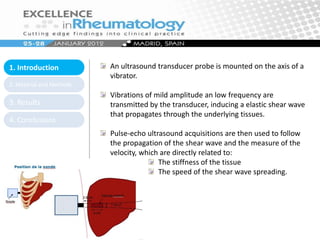
1. Introduction           An ultrasound transducer probe is mounted on the axis of a
                          vibrator.
2. Material and Methods
                          Vibrations of mild amplitude an low frequency are
3. Results                transmitted by the transducer, inducing a elastic shear wave
                          that propagates through the underlying tissues.
4. Conclusions
                          Pulse-echo ultrasound acquisitions are then used to follow
                          the propagation of the shear wave and the measure of the
                          velocity, which are directly related to:
                                         The stiffness of the tissue
                                         The speed of the shear wave spreading.
1. Introduction           In a recent prospective study involving 183 patients with
                          chronic hepatitis C, this group assessed the performance of
2. Material and Methods   TE in comparison with liver biopsy, FibroTest and APRI score.

3. Results                The combination (TE and FibroTest) offered the best
                          diagnostic performance.
4. Conclusions
1. Introduction           LIMITS OF TE:

2. Material and Methods          Obesity .

3. Results                       Ascites.
4. Conclusions
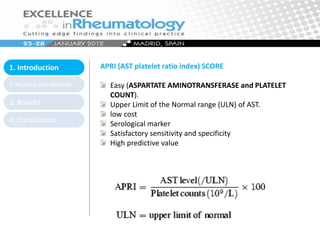
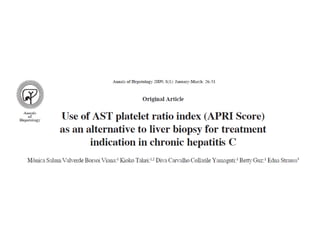
1. Introduction           APRI (AST platelet ratio index) SCORE

2. Material and Methods      Easy (ASPARTATE AMINOTRANSFERASE and PLATELET
                             COUNT).
3. Results                   Upper Limit of the Normal range (ULN) of AST.
                             low cost
4. Conclusions               Serological marker
                             Satisfactory sensitivity and specificity
                             High predictive value
1. Introduction
                                                  OUR AIM
2. Material and Methods   was to study the frequency of liver stiffness detected with TE in
                          patients with SSc and the association of liver stiffness with liver
3. Results                         disease severity measured by the APRI score.

4. Conclusions
1. Introduction.          20 patients (M/F 3/17) with a diagnosis of SSc (ACR criteria).
                          Median age 59 years (range: 34-79).
2. Material and Methods   HBV, HVC, and anti-mitochondrial antibodies were all
                          negatives.
3. Results                Alcohol consumption was less than 20 g/day in all cases.
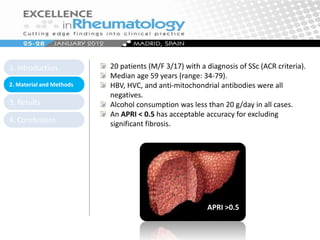
                          An APRI < 0.5 has acceptable accuracy for excluding
4. Conclusions            significant fibrosis.


                                                        APRI >0.5
1. Introduction.          Transient elastography (TE) was performed with the
                          fibroscan XL.
2. Material and Methods
                          Liver stiffness scores were expressed as kilopascals (Kpa).
3. Results
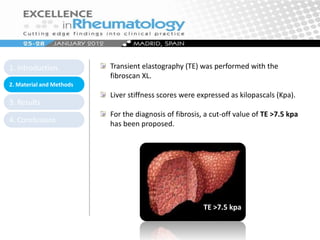
                          For the diagnosis of fibrosis, a cut-off value of TE >7.5 kpa
4. Conclusions            has been proposed.


                                                        TE >7.5 kpa
1. Introduction.          Median liver stiffness score was 5.32 Kpa (range: 3.1-9.4).

2. Material and Methods   A patient had a value of 9.4 Kpa with an ultrasound pattern
                          compatible with liver stiffness and an APRI value of 0.18
3. Results                (Only this patient had a TE ≥ 7.5 Kpa).
4. Conclusions            The median APRI value was 0.29 (range: 0.16-0.58).

                          The patient with the APRI value of 0.58 had a liver stiffness
                          score of 0.31 Kpa.

                          There were no significant statistical correlations between
                          APRI score and liver stiffness (the Spearman´s rho was of
                          0.11).
1. Introduction.          Low frecuency of significant liver fibrosis (1/20 in our study) has
                          been demonstrated with non-invasive methods in SSc patients with
2. Material and Methods   no clinical evidence of hepatic disease, as the liver could be less
                          prone to SSc-specific pathophysiologic events.
3. Results
                          The prognosis of chronic liver disease is directly related to the
4. Conclusions            development of fibrosis.

                          At present, liver biopsy is considered as the “gold standard”
                          technique for the assessment of liver fibrosis, but it has several
                          limitations (complications in 3/1000 cases).

                          On the contrary, TE is a no-invasive method to asses liver fibrosis.

                          Further research will be needed to define advantages and
                          disadvantages of this technique in this study field (Liver fibrosis/SSc)
Acknowledgements
 Rheumatology Unit. Valme University Hospital (Seville,
  Spain). Dr. J.L. Marenco and S. Rodríguez.

 Infectious Disease Unit. Valme University Hospital
  (Seville, Spain).

 Biostatistics Group. Valme University Hospital (Sevilla,
  Spain).

 Dra. Loreto Carmona. University Professor of the
  University Camilo José Cela.
Thanks…

FIBROSCAN IN SCLERODERMA

  • 1.
    Evaluation of liverfibrosis with transient elastography (Fibroscan) and APRI score, in patients with Systemic Sclerosis Alejandro Muñoz Jiménez. Rheumatology Unit. Valme University Hospital (Seville, Spain). alejandrogaleno@hotmail.com
  • 3.
    Apologies for myEnglish level…
  • 5.
    1. Introduction. 2. Materialand Methods 3. Results 4. Conclusions
  • 6.
    1. Introduction Systemic sclerosis (SSc) is a complex and rare autoimmune disease characterized by vascular damage and sclerosis 2. Material and Methods within the skin and internal organs. Gastrointestinal involvement. 3. Results Pulmonary involvement. Renal disease. 4. Conclusions Cardiac disease. Genitourinary. The occurrence and extent of primary liver damage in SSc patients have not been adequately studied.
  • 7.
    1. Introduction Liver disease found in association with scleroderma was first described by Milbradt in 1934. 2. Material and Methods Liver disease has not been considered a significant feature 3. Results of scleroderma and, in a large series, a higher prevalence of liver disease was found in the control populations. 4. Conclusions
  • 8.
    1. Introduction In a review of 727 patients with scleroderma only 8 (1.1%) had hepatic involvement. 2. Material and Methods If this uncommon complication occurs, it usually occurs 10 3. Results to 15 years after the onset of scleroderma. 4. Conclusions
  • 9.
    1. Introduction However, in a retrospective review of postmortem findings in scleroderma, hepatomegaly and cirrhosis were both more 2. Material and Methods common in a matched control group. 3. Results In a prospective assessment of the extent of visceral involvement in scleroderma 16/31 (52%) patients were 4. Conclusions shown to have abnormal liver function tests or lengthened prothrombin times.
  • 10.
    1. Introduction In general the liver and biliary system are not affected by scleroderma. 2. Material and Methods However, AUTOINMUNE HEPATITIS AND PRIMARY BILIARY 3. Results CIRRHOSIS are associated with the limited form of scleroderma. 4. Conclusions
  • 15.
    1. Introduction The relationship between primary sclerosing cholangitis (PSC) and scleroderma is extremely rare (only one case reported 2. Material and Methods of PSC in scleroderma) 3. Results 4. Conclusions
  • 16.
    1. Introduction TRANSIENT ELASTOGRAPHY (FibroScan; Echosens; Paris, France). 2. Material and Methods Transient Elastography (TE) is a novel and non-invasive 3. Results technique for the evaluation of fibrosis in chronic liver disease (mainly in hepatitis C virus-infected patients). 4. Conclusions Sensitivity can be higher than 90% for diagnosis cirrhosis. It is not widely used in practice because the results are operator-dependent and the performance has been shown to be inferior to clinical examination and laboratory tests.
  • 17.
    1. Introduction An ultrasound transducer probe is mounted on the axis of a vibrator. 2. Material and Methods Vibrations of mild amplitude an low frequency are 3. Results transmitted by the transducer, inducing a elastic shear wave that propagates through the underlying tissues. 4. Conclusions Pulse-echo ultrasound acquisitions are then used to follow the propagation of the shear wave and the measure of the velocity, which are directly related to: The stiffness of the tissue The speed of the shear wave spreading.
  • 18.
    1. Introduction In a recent prospective study involving 183 patients with chronic hepatitis C, this group assessed the performance of 2. Material and Methods TE in comparison with liver biopsy, FibroTest and APRI score. 3. Results The combination (TE and FibroTest) offered the best diagnostic performance. 4. Conclusions
  • 19.
    1. Introduction LIMITS OF TE: 2. Material and Methods Obesity . 3. Results Ascites. 4. Conclusions
  • 20.
    1. Introduction APRI (AST platelet ratio index) SCORE 2. Material and Methods Easy (ASPARTATE AMINOTRANSFERASE and PLATELET COUNT). 3. Results Upper Limit of the Normal range (ULN) of AST. low cost 4. Conclusions Serological marker Satisfactory sensitivity and specificity High predictive value
  • 22.
    1. Introduction OUR AIM 2. Material and Methods was to study the frequency of liver stiffness detected with TE in patients with SSc and the association of liver stiffness with liver 3. Results disease severity measured by the APRI score. 4. Conclusions
  • 23.
    1. Introduction. 20 patients (M/F 3/17) with a diagnosis of SSc (ACR criteria). Median age 59 years (range: 34-79). 2. Material and Methods HBV, HVC, and anti-mitochondrial antibodies were all negatives. 3. Results Alcohol consumption was less than 20 g/day in all cases. An APRI < 0.5 has acceptable accuracy for excluding 4. Conclusions significant fibrosis. APRI >0.5
  • 24.
    1. Introduction. Transient elastography (TE) was performed with the fibroscan XL. 2. Material and Methods Liver stiffness scores were expressed as kilopascals (Kpa). 3. Results For the diagnosis of fibrosis, a cut-off value of TE >7.5 kpa 4. Conclusions has been proposed. TE >7.5 kpa
  • 25.
    1. Introduction. Median liver stiffness score was 5.32 Kpa (range: 3.1-9.4). 2. Material and Methods A patient had a value of 9.4 Kpa with an ultrasound pattern compatible with liver stiffness and an APRI value of 0.18 3. Results (Only this patient had a TE ≥ 7.5 Kpa). 4. Conclusions The median APRI value was 0.29 (range: 0.16-0.58). The patient with the APRI value of 0.58 had a liver stiffness score of 0.31 Kpa. There were no significant statistical correlations between APRI score and liver stiffness (the Spearman´s rho was of 0.11).
  • 26.
    1. Introduction. Low frecuency of significant liver fibrosis (1/20 in our study) has been demonstrated with non-invasive methods in SSc patients with 2. Material and Methods no clinical evidence of hepatic disease, as the liver could be less prone to SSc-specific pathophysiologic events. 3. Results The prognosis of chronic liver disease is directly related to the 4. Conclusions development of fibrosis. At present, liver biopsy is considered as the “gold standard” technique for the assessment of liver fibrosis, but it has several limitations (complications in 3/1000 cases). On the contrary, TE is a no-invasive method to asses liver fibrosis. Further research will be needed to define advantages and disadvantages of this technique in this study field (Liver fibrosis/SSc)
  • 27.
    Acknowledgements  Rheumatology Unit.Valme University Hospital (Seville, Spain). Dr. J.L. Marenco and S. Rodríguez.  Infectious Disease Unit. Valme University Hospital (Seville, Spain).  Biostatistics Group. Valme University Hospital (Sevilla, Spain).  Dra. Loreto Carmona. University Professor of the University Camilo José Cela.
  • 28.