From Process Back to Thought Process
A Perspective on the Emotional Intelligence of Serving in a
                   Fiduciary Capacity.


         Offered By:     Wayne H. Miller
                         Chief Executive Officer
                         Denali Fiduciary Management


                       FI 360 National Conference
                                May 2008
The Human Condition


• Jim is married to his fifth wife.
• He’s a smart guy and financially very successful.
• Jim called me one day in a hyper excited state.
• He told me he had finally figured out “what it is
  with women.”
• I asked Jim if he recognized that he was the only
  common ingredient in his five marriages.
The Human Condition


• He was genuinely perplexed by the question
  and continued to speak of his discovery.
• He never paused for a moment to ask what I
  meant or why I asked that question.
The Human Condition - Exposed

• Jim was unable to efficiently process information
  regarding his relationships with women.
• He had no awareness of how his own
  shortcomings influenced his assessment.
• Jim’s sense of a new discovery missed this point.
• He has an emotional blind spot.


I suspect Jim’s four former wives already knew that.
The Human Condition - Exposed


Perhaps most importantly:


 Jim missed the opportunity to learn something
that would have been helpful to him – and others
                  around him.
The Human Condition - Exposed


 • To everyone other than Jim, his blind
   spot was obvious.
 • We call them “emotional blind spots”
   because these reflect the emotional
   foundation of a person’s identity.
The Human Condition - Exposed


• Someone with an emotional blind spot
  erroneously attributes meaning to information.
• A person lacking that emotional blind spot (a
  dispassionate observer) recognizes this
  attribution as a mistake.
The GOOD News:
Everyone has emotional blind spots.
Therefore, we are all on a similar playing field.


We are all blind to something.


The BAD news:
“Everyone” includes you (me too).
In general, the higher the IQ, the tougher it is
to get this.
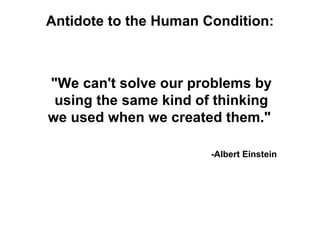
Antidote to the Human Condition:


"We can't solve our problems by
 using the same kind of thinking
we used when we created them."

                       -Albert Einstein
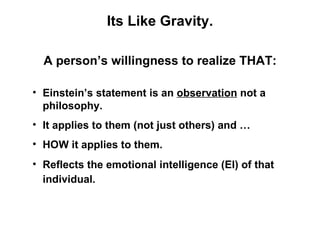
Its Like Gravity.

  A person’s willingness to realize THAT:

• Einstein’s statement is an observation not a
  philosophy.
• It applies to them (not just others) and …
• HOW it applies to them.
• Reflects the emotional intelligence (EI) of that
  individual.
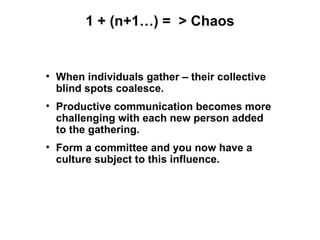
1 + (n+1…) = > Chaos


• When individuals gather – their collective
  blind spots coalesce.
• Productive communication becomes more
  challenging with each new person added
  to the gathering.
• Form a committee and you now have a
  culture subject to this influence.
Welcome to the world of
 fiduciary governance.
Predominant Identity In A Fiduciary Culture.


    “We are good people here.”

    • This identity serves as an emotional shield.
    • Its presence discourages the receptivity or
      digestion of information perceived to be
      counter productive to survival of the identity.
    • It is the life blood of “group think”.
“We are good people here” …


• Maintaining the group identity is the
  group’s (unspoken of) highest priority.
• The efficiency and effectiveness of
  retirement plan management practices
  will suffer if this identity is unchallenged.
“We are good people here” …


• … is why fiduciary governance is so critical.
• Sound governance promotes fiduciary excellence.


• Embedded in it are processes that create
  distinctions between:
   − purpose and identity
   − learning and resistance
   − substance and appearance
   − action and talk
Perspective


Evolution:
In biological sciences, the name of the process
that describes how various influences in the
environment impact the nature and presence of
genetic material within a given population.


Evolution is random not purposeful.
Evolution: A Fiduciary Imperative

Our Intention: make fiduciary processes purposeful.


  Fiduciary “evolution”: Champion the
  proliferation of single thought process that
  accepts the premise of guardianship as
  quintessential to the role …


  … and put no constraints on the application of
  that premise.
Observations


• In general, every actor on the fiduciary stage
  is conflicted.
• Some conflicts are overt - some not.
• An examination of the conflicts illustrate that
  it is the thought process of those actors that
  generates an on-going challenge for a
  fiduciary to be Purposeful.
Purposefulness and Process


If your fiduciary Processes allow for the
accommodation of your Purpose,
for whatever expediency you think important,
you will be acting in a manner that is counter
productive to the duty.


     Is a fiduciary duty a solemn duty?
Critical Questions: Context


• Who identified what it means to be a fiduciary?
• Who has set the stage and framed the debate?
• How is the debate staged and adjudicated?
• How do we speak of it?
• What metrics do we use to identify fiduciary
  conduct?
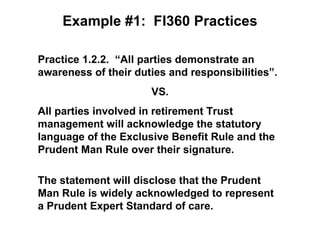
Example #1: FI360 Practices

Practice 1.2.2. “All parties demonstrate an
awareness of their duties and responsibilities”.
                      VS.
All parties involved in retirement Trust
management will acknowledge the statutory
language of the Exclusive Benefit Rule and the
Prudent Man Rule over their signature.

The statement will disclose that the Prudent
Man Rule is widely acknowledged to represent
a Prudent Expert Standard of care.
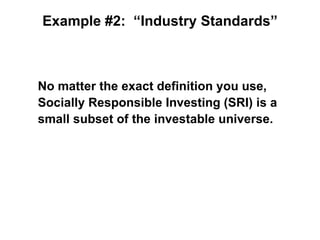
Example #2: “Industry Standards”


No matter the exact definition you use,
Socially Responsible Investing (SRI) is a
small subset of the investable universe.
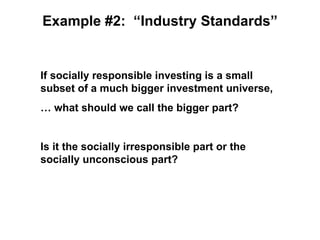
Example #2: “Industry Standards”


If socially responsible investing is a small
subset of a much bigger investment universe,
… what should we call the bigger part?


Is it the socially irresponsible part or the
socially unconscious part?
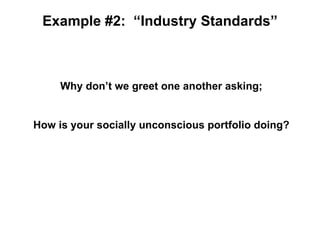
Example #2: “Industry Standards”


     Why don’t we greet one another asking;


How is your socially unconscious portfolio doing?
Example #2: “Industry Standards”


• It is counter to the identity we have of ourselves.
• We want to avoid the feeling of knowing that others
  think of us as socially unconscious or irresponsible.


       After all, WE ARE GOOD PEOPLE HERE.


Perhaps, we have more in common with our Advisory
              clients than we imagined.
Example #3: Let’s Make it Personal


Few investment advisors would stand in front of
their college age children and speak of building
 their financial security (in part) on the strength
of buying the common stock of companies that
           manufacture cluster bombs.
Example #3: Let’s Make it Personal


Most want to avoid feeling a loss of respect
   and admiration from their children.
Example #2: Let’s Make it Personal


Try explaining why they invest in such
companies ANYWAY to a parent from Lebanon.
Cluster bombs (70% of which are made in the
USA) routinely maim Lebanese children.

… and you thought “Personal” meant you.


Perhaps, we have more in common with
           Jim than we imagined.
Depending on what metric you use
   to evaluate the authenticity of
fiduciary conduct your conclusion
 regarding the appropriateness of
       any activity may differ.
Prologue …


 … like Jim, without the personal and
collective courage to examine our own
conduct, we will not come to know the
        mistakes we are making.
Prologue …


Without a willingness to examine our
conduct for its consistency with the
      values we proclaim, the
   Purposefulness of serving in a
guardianship role will be subjugated.
The willingness to engage in a courageous
      conversation is now required.


               - Inspired by poet David Whyte
Thank You.


    Denali Fiduciary Management


“Built by Fiduciaries for Fiduciaries™”


         wmiller@denalifm.com
             (206) 463 6700

Fi 360 Presentation By Wayne Miller 2008

  • 1.
    From Process Backto Thought Process A Perspective on the Emotional Intelligence of Serving in a Fiduciary Capacity. Offered By: Wayne H. Miller Chief Executive Officer Denali Fiduciary Management FI 360 National Conference May 2008
  • 2.
    The Human Condition •Jim is married to his fifth wife. • He’s a smart guy and financially very successful. • Jim called me one day in a hyper excited state. • He told me he had finally figured out “what it is with women.” • I asked Jim if he recognized that he was the only common ingredient in his five marriages.
  • 3.
    The Human Condition •He was genuinely perplexed by the question and continued to speak of his discovery. • He never paused for a moment to ask what I meant or why I asked that question.
  • 4.
    The Human Condition- Exposed • Jim was unable to efficiently process information regarding his relationships with women. • He had no awareness of how his own shortcomings influenced his assessment. • Jim’s sense of a new discovery missed this point. • He has an emotional blind spot. I suspect Jim’s four former wives already knew that.
  • 5.
    The Human Condition- Exposed Perhaps most importantly: Jim missed the opportunity to learn something that would have been helpful to him – and others around him.
  • 6.
    The Human Condition- Exposed • To everyone other than Jim, his blind spot was obvious. • We call them “emotional blind spots” because these reflect the emotional foundation of a person’s identity.
  • 7.
    The Human Condition- Exposed • Someone with an emotional blind spot erroneously attributes meaning to information. • A person lacking that emotional blind spot (a dispassionate observer) recognizes this attribution as a mistake.
  • 8.
    The GOOD News: Everyonehas emotional blind spots. Therefore, we are all on a similar playing field. We are all blind to something. The BAD news: “Everyone” includes you (me too). In general, the higher the IQ, the tougher it is to get this.
  • 9.
    Antidote to theHuman Condition: "We can't solve our problems by using the same kind of thinking we used when we created them." -Albert Einstein
  • 10.
    Its Like Gravity. A person’s willingness to realize THAT: • Einstein’s statement is an observation not a philosophy. • It applies to them (not just others) and … • HOW it applies to them. • Reflects the emotional intelligence (EI) of that individual.
  • 11.
    1 + (n+1…)= > Chaos • When individuals gather – their collective blind spots coalesce. • Productive communication becomes more challenging with each new person added to the gathering. • Form a committee and you now have a culture subject to this influence.
  • 12.
    Welcome to theworld of fiduciary governance.
  • 13.
    Predominant Identity InA Fiduciary Culture. “We are good people here.” • This identity serves as an emotional shield. • Its presence discourages the receptivity or digestion of information perceived to be counter productive to survival of the identity. • It is the life blood of “group think”.
  • 14.
    “We are goodpeople here” … • Maintaining the group identity is the group’s (unspoken of) highest priority. • The efficiency and effectiveness of retirement plan management practices will suffer if this identity is unchallenged.
  • 15.
    “We are goodpeople here” … • … is why fiduciary governance is so critical. • Sound governance promotes fiduciary excellence. • Embedded in it are processes that create distinctions between: − purpose and identity − learning and resistance − substance and appearance − action and talk
  • 16.
    Perspective Evolution: In biological sciences,the name of the process that describes how various influences in the environment impact the nature and presence of genetic material within a given population. Evolution is random not purposeful.
  • 17.
    Evolution: A FiduciaryImperative Our Intention: make fiduciary processes purposeful. Fiduciary “evolution”: Champion the proliferation of single thought process that accepts the premise of guardianship as quintessential to the role … … and put no constraints on the application of that premise.
  • 18.
    Observations • In general,every actor on the fiduciary stage is conflicted. • Some conflicts are overt - some not. • An examination of the conflicts illustrate that it is the thought process of those actors that generates an on-going challenge for a fiduciary to be Purposeful.
  • 19.
    Purposefulness and Process Ifyour fiduciary Processes allow for the accommodation of your Purpose, for whatever expediency you think important, you will be acting in a manner that is counter productive to the duty. Is a fiduciary duty a solemn duty?
  • 20.
    Critical Questions: Context •Who identified what it means to be a fiduciary? • Who has set the stage and framed the debate? • How is the debate staged and adjudicated? • How do we speak of it? • What metrics do we use to identify fiduciary conduct?
  • 21.
    Example #1: FI360Practices Practice 1.2.2. “All parties demonstrate an awareness of their duties and responsibilities”. VS. All parties involved in retirement Trust management will acknowledge the statutory language of the Exclusive Benefit Rule and the Prudent Man Rule over their signature. The statement will disclose that the Prudent Man Rule is widely acknowledged to represent a Prudent Expert Standard of care.
  • 22.
    Example #2: “IndustryStandards” No matter the exact definition you use, Socially Responsible Investing (SRI) is a small subset of the investable universe.
  • 23.
    Example #2: “IndustryStandards” If socially responsible investing is a small subset of a much bigger investment universe, … what should we call the bigger part? Is it the socially irresponsible part or the socially unconscious part?
  • 24.
    Example #2: “IndustryStandards” Why don’t we greet one another asking; How is your socially unconscious portfolio doing?
  • 25.
    Example #2: “IndustryStandards” • It is counter to the identity we have of ourselves. • We want to avoid the feeling of knowing that others think of us as socially unconscious or irresponsible. After all, WE ARE GOOD PEOPLE HERE. Perhaps, we have more in common with our Advisory clients than we imagined.
  • 26.
    Example #3: Let’sMake it Personal Few investment advisors would stand in front of their college age children and speak of building their financial security (in part) on the strength of buying the common stock of companies that manufacture cluster bombs.
  • 27.
    Example #3: Let’sMake it Personal Most want to avoid feeling a loss of respect and admiration from their children.
  • 28.
    Example #2: Let’sMake it Personal Try explaining why they invest in such companies ANYWAY to a parent from Lebanon. Cluster bombs (70% of which are made in the USA) routinely maim Lebanese children. … and you thought “Personal” meant you. Perhaps, we have more in common with Jim than we imagined.
  • 29.
    Depending on whatmetric you use to evaluate the authenticity of fiduciary conduct your conclusion regarding the appropriateness of any activity may differ.
  • 30.
    Prologue … …like Jim, without the personal and collective courage to examine our own conduct, we will not come to know the mistakes we are making.
  • 31.
    Prologue … Without awillingness to examine our conduct for its consistency with the values we proclaim, the Purposefulness of serving in a guardianship role will be subjugated.
  • 32.
    The willingness toengage in a courageous conversation is now required. - Inspired by poet David Whyte
  • 33.
    Thank You. Denali Fiduciary Management “Built by Fiduciaries for Fiduciaries™” wmiller@denalifm.com (206) 463 6700