Full Gospel Business Men’s Fellowship
International South West District 3
2015 Annual Business Seminar
Theme
The 21st Century Entrepreneur:
Opportunities and Challenges
Topic
Client Management Essentials For Business Growth
Presentation Theme/Topic
Theme
The 21st Century Entrepreneur:
Opportunities and Challenges
Topic
Client Management Essentials For Business Growth
Discussion Outline
1. Assist participants to understand how to develop and
implement effective organisational communication cultures
1. Achieve excellent service standards in business operations
1. Understand customer expectations
1. Inculcate effective principles for internalizing service
excellence
1. Achieving effective management quality
Discussion Outline…2
1. Effective Organisational Communication Culture
2. Excellent Service standards
1. Understanding Customer Expectations
2. Internalizing Service Excellence
1. Management Quality
A Little About Organisations
An ‘organisation’ is a group of individuals working together to
achieve one or more objectives. Although organisations have
been defined differently by different theorists, virtually all
definitions refer to five common features:
A Little About Organisations…/2
1. They are composed of individuals and groups of individuals
1. They are oriented towards achieving collective goals
1. They consist of different functions
1. The functions need to be coordinated
1. They exist independently of individual members who may
come and go.
What Essential Client Management
Functions Organisations Need To Perform
For Business Growth
1. EFFECTIVE ORGANISATIONAL
COMMUNICATION CULTURE
Essential Client Management Functions
Effective Organisational Communication Culture
How is Effective Communication helpful?
1. Plays a role in product development, customer relations,
employee management - virtually every facet of a business'
operations.
1. Employees are a key audience because they often serve as
the conduit to other audiences.
1. If employees are informed and engaged, communications
with other constituencies are likely to be strong as well.
Effective Organisational Communication Culture/2
Advantages
1. Helps Establish Clear Expectations
• Effective communication helps to set performance standards.
• Helps to define effective staff appraisal
Effective Organisational Communication Culture/3
Advantages
2. Helps Produce Effective Customer Ambassadors
• The more staff know about the company, its culture, its products
and services, and its response to any negative issues, the better job
they can do of serving as ambassadors to the customers and other
communities
• Staff who feel they have a strong, positive relationship with their
employers and trust the information they receive from their
employers will be more likely to share that information with others.
• Staff can be a highly valued and trusted source of information about
a company and its products and services.
Effective Organisational Communication Culture/4
Advantages
3. Helps Develop Strong Relationships
• Develops trust and loyalty
• conveys important information and provides feedback -
positive and constructive.
• Develops strong relationships with external audiences
• Helps build strong communication about products, services
and company culture and values.
Effective Organisational Communication Culture/5
Advantages
4. Helps Promote Ideas and Innovation
• Helps to open channels for new ideas and innovation because
staff can focus on improvements and spot opportunities.
• When employees know their ideas will be sought after, that
company leaders will have open minds and be responsive to
their feedback, they're more likely to contribute their ideas.
• Customers also can be a source of great ideas to help improve
products and services.
Effective Organisational Communication Culture/6
Advantages
5. Helps Build Strong Teamwork
• Effective organizational communication will lead to strong
teamwork and the ability for employees at all levels of the
organization to work together to achieve company goals.
• In addition, effective organizational communication will
provide employees the knowledge, structure and positive
work environment they need to feel comfortable dealing with
conflict and resolving issues effectively.
Essential Client Management Functions
2. Excellent Service Standards
Excellent Service Standards
How To Define Service Standard
Service standards are usually defined in terms of:
• Timeliness of Service
• Accuracy of Service, and
• Appropriateness of Service
Excellent Service Standards/2
Timeliness of Service
• ‘Delivery in three days’ or ‘calls answered in 20 seconds’ are
phrases that give the essence of a service standard that
involves a timeline.
• An organisation must accurately define the specific part of its
service offering that will give it the most advantage
Excellent Service Standards/3
Accuracy of Service
• Customers expect accurate information and accurate
deliveries – only 100% is acceptable as a standard under this
heading. Customer is paying for 100% and not 99% accuracy
Excellent Service Standards/4
Appropriateness of Service
• This often happens when the customer gets a response but it
is not appropriate to the request or complaint
Essential Client Management Functions
3. Understanding Customer Expectations
Understanding Customer Expectations
How To Understand Customer Need
Listen To Your Customers
Whether talking on the phone with a customer or conducting
business in person, take a minute to ask your customer why they
purchased your product. Call, write or visit your customers to
find out if they are happy with your quality and price.
Understanding Customer Expectations/2
How To Understand Customer Need
Empathize With Customers
When you get customer feedback, take time to put yourself in
their place. Customers want to be acknowledged for taking the
time to comment and do not want to be unfairly judged if they
have issues with your service.
Understanding Customer Expectations/3
How To Understand Customer Need
Offer Incentives
If you're a manufacturer, interacting with current or future
customers through product demos is the ideal way to find out if
your products are meeting customer expectations.
Understanding Customer Expectations/4
How To Understand Customer Need
Learn About Your Competitors
• If your trade or brands are performing poorly, then find out
the reason. Conduct a phone or email survey of your potential
customers to uncover the most outstanding qualities of other
vendors. Then, attempt to replicate those qualities in your
daily business practices.
• When competitors offer more personalized services or
attractive buying incentives that you don't, devise strategies
to create similar programs that can earn repeat customer
business.
Understanding Customer Expectations/5
How To Understand Customer Need
Give Customers Options
• Whatever your business is, always make it clear to customers
that other options exist to help them meet and enhance their
needs.
• Show customers accessories and coordinating products that
enhance their main product interest. You'll increase sales and
provide a feeling of reassurance about your product
knowledge and customer service.
Understanding Customer Expectations/6
How To Understand Customer Need
Reassure Customers That Your Services Will Meet Their
Expectations
A no-questions-asked exchange policy, money-back guarantee or
other monetary compensation can instill consumer confidence
Essential Client Management Functions
4. Internalising Service Excellence
Internalizing Service Excellence:
The Six Principles of Service Excellence
1. Clear Vision & Mission
Internalizing Service Excellence:
The Six Principles of Service Excellence
2. Specific Service Objectives
Internalizing Service Excellence:
The Six Principles of Service Excellence
3. Set achievable standards in line with 1 and 2
Internalizing Service Excellence:
The Six Principles of Service Excellence
4. Invest in learning, people and relevant technology.
Be professional
Internalizing Service Excellence:
The Six Principles of Service Excellence
5. Align your people with 1, 2 and 3
Internalizing Service Excellence:
The Six Principles of Service Excellence
6. Ensure measurement and accountability
Essential Client Management Functions
5. Management Quality
8 Management Quality Principles
Total Quality Management (TQM)
The act of overseeing all activities and tasks needed to maintain
a desired level of excellence. This includes creating and
implementing quality planning and assurance, as well as quality
control and quality improvement. It is also referred to as total
quality management (TQM).
8 Management Quality Principles
Principle 1: Customer Focus
• Organizations depend on
their customers and there-
fore should understand
current and future
customer needs, should
meet customer
requirements and strive to
exceed customer
expectations.
Benefits
• Increased revenue & market
share
• Improved customer loyalty
• Linking organisational
objectives with customer
expectations
• Measuring customer
satisfaction
• Communicating customer
expectations within the
organisation
8 Management Quality Principles
Principle 2: Leadership
Leaders establish unity of
purpose and direction of the
organization. They should
create and maintain the
internal environment in which
people can become fully
involved in achieving the
organization’s objectives
Benefits
• People will understand and be
motivated towards the
organization’s goals and
objectives
• Miscommunication between
levels of an organization will be
minimized
• Helps establish a clear vision for
the future
• Helps set goals and targets
• Providing people with the
required resources, training and
freedom to act with responsibility
and accountability
8 Management Quality Principles
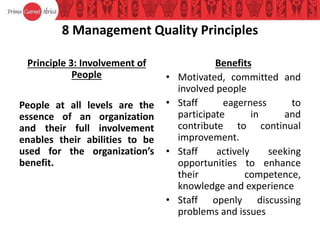
Principle 3: Involvement of
People
People at all levels are the
essence of an organization
and their full involvement
enables their abilities to be
used for the organization’s
benefit.
Benefits
• Motivated, committed and
involved people
• Staff eagerness to
participate in and
contribute to continual
improvement.
• Staff actively seeking
opportunities to enhance
their competence,
knowledge and experience
• Staff openly discussing
problems and issues
8 Management Quality Principles
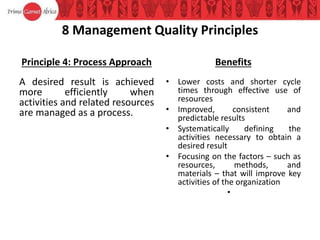
Principle 4: Process Approach
A desired result is achieved
more efficiently when
activities and related resources
are managed as a process.
Benefits
• Lower costs and shorter cycle
times through effective use of
resources
• Improved, consistent and
predictable results
• Systematically defining the
activities necessary to obtain a
desired result
• Focusing on the factors – such as
resources, methods, and
materials – that will improve key
activities of the organization
•
8 Management Quality Principles
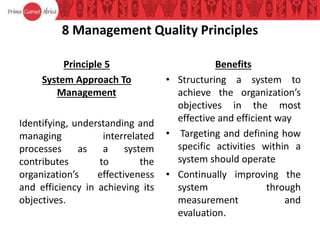
Principle 5
System Approach To
Management
Identifying, understanding and
managing interrelated
processes as a system
contributes to the
organization’s effectiveness
and efficiency in achieving its
objectives.
Benefits
• Structuring a system to
achieve the organization’s
objectives in the most
effective and efficient way
• Targeting and defining how
specific activities within a
system should operate
• Continually improving the
system through
measurement and
evaluation.
8 Management Quality Principles
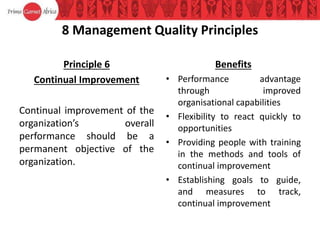
Principle 6
Continual Improvement
Continual improvement of the
organization’s overall
performance should be a
permanent objective of the
organization.
Benefits
• Performance advantage
through improved
organisational capabilities
• Flexibility to react quickly to
opportunities
• Providing people with training
in the methods and tools of
continual improvement
• Establishing goals to guide,
and measures to track,
continual improvement
8 Management Quality Principles
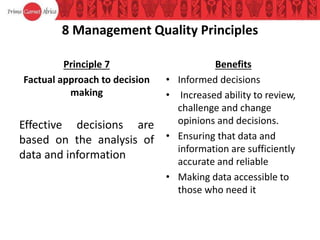
Principle 7
Factual approach to decision
making
Effective decisions are
based on the analysis of
data and information
Benefits
• Informed decisions
• Increased ability to review,
challenge and change
opinions and decisions.
• Ensuring that data and
information are sufficiently
accurate and reliable
• Making data accessible to
those who need it
8 Management Quality Principles
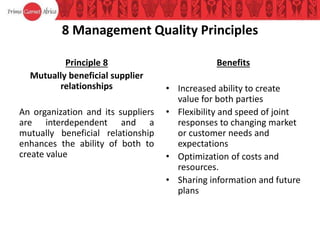
Principle 8
Mutually beneficial supplier
relationships
An organization and its suppliers
are interdependent and a
mutually beneficial relationship
enhances the ability of both to
create value
Benefits
• Increased ability to create
value for both parties
• Flexibility and speed of joint
responses to changing market
or customer needs and
expectations
• Optimization of costs and
resources.
• Sharing information and future
plans
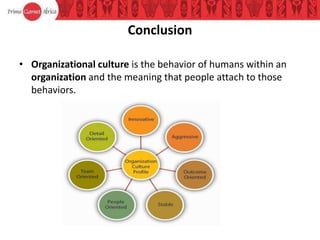
Conclusion
• Organizational culture is the behavior of humans within an
organization and the meaning that people attach to those
behaviors.
Questions, Comments, Disagreement
Thank You

FGBMFI

  • 1.
    Full Gospel BusinessMen’s Fellowship International South West District 3 2015 Annual Business Seminar Theme The 21st Century Entrepreneur: Opportunities and Challenges Topic Client Management Essentials For Business Growth
  • 2.
    Presentation Theme/Topic Theme The 21stCentury Entrepreneur: Opportunities and Challenges Topic Client Management Essentials For Business Growth
  • 3.
    Discussion Outline 1. Assistparticipants to understand how to develop and implement effective organisational communication cultures 1. Achieve excellent service standards in business operations 1. Understand customer expectations 1. Inculcate effective principles for internalizing service excellence 1. Achieving effective management quality
  • 4.
    Discussion Outline…2 1. EffectiveOrganisational Communication Culture 2. Excellent Service standards 1. Understanding Customer Expectations 2. Internalizing Service Excellence 1. Management Quality
  • 5.
    A Little AboutOrganisations An ‘organisation’ is a group of individuals working together to achieve one or more objectives. Although organisations have been defined differently by different theorists, virtually all definitions refer to five common features:
  • 6.
    A Little AboutOrganisations…/2 1. They are composed of individuals and groups of individuals 1. They are oriented towards achieving collective goals 1. They consist of different functions 1. The functions need to be coordinated 1. They exist independently of individual members who may come and go.
  • 7.
    What Essential ClientManagement Functions Organisations Need To Perform For Business Growth
  • 8.
    1. EFFECTIVE ORGANISATIONAL COMMUNICATIONCULTURE Essential Client Management Functions
  • 9.
    Effective Organisational CommunicationCulture How is Effective Communication helpful? 1. Plays a role in product development, customer relations, employee management - virtually every facet of a business' operations. 1. Employees are a key audience because they often serve as the conduit to other audiences. 1. If employees are informed and engaged, communications with other constituencies are likely to be strong as well.
  • 10.
    Effective Organisational CommunicationCulture/2 Advantages 1. Helps Establish Clear Expectations • Effective communication helps to set performance standards. • Helps to define effective staff appraisal
  • 11.
    Effective Organisational CommunicationCulture/3 Advantages 2. Helps Produce Effective Customer Ambassadors • The more staff know about the company, its culture, its products and services, and its response to any negative issues, the better job they can do of serving as ambassadors to the customers and other communities • Staff who feel they have a strong, positive relationship with their employers and trust the information they receive from their employers will be more likely to share that information with others. • Staff can be a highly valued and trusted source of information about a company and its products and services.
  • 12.
    Effective Organisational CommunicationCulture/4 Advantages 3. Helps Develop Strong Relationships • Develops trust and loyalty • conveys important information and provides feedback - positive and constructive. • Develops strong relationships with external audiences • Helps build strong communication about products, services and company culture and values.
  • 13.
    Effective Organisational CommunicationCulture/5 Advantages 4. Helps Promote Ideas and Innovation • Helps to open channels for new ideas and innovation because staff can focus on improvements and spot opportunities. • When employees know their ideas will be sought after, that company leaders will have open minds and be responsive to their feedback, they're more likely to contribute their ideas. • Customers also can be a source of great ideas to help improve products and services.
  • 14.
    Effective Organisational CommunicationCulture/6 Advantages 5. Helps Build Strong Teamwork • Effective organizational communication will lead to strong teamwork and the ability for employees at all levels of the organization to work together to achieve company goals. • In addition, effective organizational communication will provide employees the knowledge, structure and positive work environment they need to feel comfortable dealing with conflict and resolving issues effectively.
  • 15.
    Essential Client ManagementFunctions 2. Excellent Service Standards
  • 16.
    Excellent Service Standards HowTo Define Service Standard Service standards are usually defined in terms of: • Timeliness of Service • Accuracy of Service, and • Appropriateness of Service
  • 17.
    Excellent Service Standards/2 Timelinessof Service • ‘Delivery in three days’ or ‘calls answered in 20 seconds’ are phrases that give the essence of a service standard that involves a timeline. • An organisation must accurately define the specific part of its service offering that will give it the most advantage
  • 18.
    Excellent Service Standards/3 Accuracyof Service • Customers expect accurate information and accurate deliveries – only 100% is acceptable as a standard under this heading. Customer is paying for 100% and not 99% accuracy
  • 19.
    Excellent Service Standards/4 Appropriatenessof Service • This often happens when the customer gets a response but it is not appropriate to the request or complaint
  • 20.
    Essential Client ManagementFunctions 3. Understanding Customer Expectations
  • 21.
    Understanding Customer Expectations HowTo Understand Customer Need Listen To Your Customers Whether talking on the phone with a customer or conducting business in person, take a minute to ask your customer why they purchased your product. Call, write or visit your customers to find out if they are happy with your quality and price.
  • 22.
    Understanding Customer Expectations/2 HowTo Understand Customer Need Empathize With Customers When you get customer feedback, take time to put yourself in their place. Customers want to be acknowledged for taking the time to comment and do not want to be unfairly judged if they have issues with your service.
  • 23.
    Understanding Customer Expectations/3 HowTo Understand Customer Need Offer Incentives If you're a manufacturer, interacting with current or future customers through product demos is the ideal way to find out if your products are meeting customer expectations.
  • 24.
    Understanding Customer Expectations/4 HowTo Understand Customer Need Learn About Your Competitors • If your trade or brands are performing poorly, then find out the reason. Conduct a phone or email survey of your potential customers to uncover the most outstanding qualities of other vendors. Then, attempt to replicate those qualities in your daily business practices. • When competitors offer more personalized services or attractive buying incentives that you don't, devise strategies to create similar programs that can earn repeat customer business.
  • 25.
    Understanding Customer Expectations/5 HowTo Understand Customer Need Give Customers Options • Whatever your business is, always make it clear to customers that other options exist to help them meet and enhance their needs. • Show customers accessories and coordinating products that enhance their main product interest. You'll increase sales and provide a feeling of reassurance about your product knowledge and customer service.
  • 26.
    Understanding Customer Expectations/6 HowTo Understand Customer Need Reassure Customers That Your Services Will Meet Their Expectations A no-questions-asked exchange policy, money-back guarantee or other monetary compensation can instill consumer confidence
  • 27.
    Essential Client ManagementFunctions 4. Internalising Service Excellence
  • 28.
    Internalizing Service Excellence: TheSix Principles of Service Excellence 1. Clear Vision & Mission
  • 29.
    Internalizing Service Excellence: TheSix Principles of Service Excellence 2. Specific Service Objectives
  • 30.
    Internalizing Service Excellence: TheSix Principles of Service Excellence 3. Set achievable standards in line with 1 and 2
  • 31.
    Internalizing Service Excellence: TheSix Principles of Service Excellence 4. Invest in learning, people and relevant technology. Be professional
  • 32.
    Internalizing Service Excellence: TheSix Principles of Service Excellence 5. Align your people with 1, 2 and 3
  • 33.
    Internalizing Service Excellence: TheSix Principles of Service Excellence 6. Ensure measurement and accountability
  • 34.
    Essential Client ManagementFunctions 5. Management Quality
  • 35.
    8 Management QualityPrinciples Total Quality Management (TQM) The act of overseeing all activities and tasks needed to maintain a desired level of excellence. This includes creating and implementing quality planning and assurance, as well as quality control and quality improvement. It is also referred to as total quality management (TQM).
  • 36.
    8 Management QualityPrinciples Principle 1: Customer Focus • Organizations depend on their customers and there- fore should understand current and future customer needs, should meet customer requirements and strive to exceed customer expectations. Benefits • Increased revenue & market share • Improved customer loyalty • Linking organisational objectives with customer expectations • Measuring customer satisfaction • Communicating customer expectations within the organisation
  • 37.
    8 Management QualityPrinciples Principle 2: Leadership Leaders establish unity of purpose and direction of the organization. They should create and maintain the internal environment in which people can become fully involved in achieving the organization’s objectives Benefits • People will understand and be motivated towards the organization’s goals and objectives • Miscommunication between levels of an organization will be minimized • Helps establish a clear vision for the future • Helps set goals and targets • Providing people with the required resources, training and freedom to act with responsibility and accountability
  • 38.
    8 Management QualityPrinciples Principle 3: Involvement of People People at all levels are the essence of an organization and their full involvement enables their abilities to be used for the organization’s benefit. Benefits • Motivated, committed and involved people • Staff eagerness to participate in and contribute to continual improvement. • Staff actively seeking opportunities to enhance their competence, knowledge and experience • Staff openly discussing problems and issues
  • 39.
    8 Management QualityPrinciples Principle 4: Process Approach A desired result is achieved more efficiently when activities and related resources are managed as a process. Benefits • Lower costs and shorter cycle times through effective use of resources • Improved, consistent and predictable results • Systematically defining the activities necessary to obtain a desired result • Focusing on the factors – such as resources, methods, and materials – that will improve key activities of the organization •
  • 40.
    8 Management QualityPrinciples Principle 5 System Approach To Management Identifying, understanding and managing interrelated processes as a system contributes to the organization’s effectiveness and efficiency in achieving its objectives. Benefits • Structuring a system to achieve the organization’s objectives in the most effective and efficient way • Targeting and defining how specific activities within a system should operate • Continually improving the system through measurement and evaluation.
  • 41.
    8 Management QualityPrinciples Principle 6 Continual Improvement Continual improvement of the organization’s overall performance should be a permanent objective of the organization. Benefits • Performance advantage through improved organisational capabilities • Flexibility to react quickly to opportunities • Providing people with training in the methods and tools of continual improvement • Establishing goals to guide, and measures to track, continual improvement
  • 42.
    8 Management QualityPrinciples Principle 7 Factual approach to decision making Effective decisions are based on the analysis of data and information Benefits • Informed decisions • Increased ability to review, challenge and change opinions and decisions. • Ensuring that data and information are sufficiently accurate and reliable • Making data accessible to those who need it
  • 43.
    8 Management QualityPrinciples Principle 8 Mutually beneficial supplier relationships An organization and its suppliers are interdependent and a mutually beneficial relationship enhances the ability of both to create value Benefits • Increased ability to create value for both parties • Flexibility and speed of joint responses to changing market or customer needs and expectations • Optimization of costs and resources. • Sharing information and future plans
  • 44.
    Conclusion • Organizational cultureis the behavior of humans within an organization and the meaning that people attach to those behaviors.
  • 45.
  • 46.