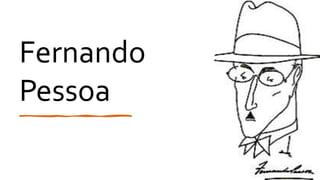
Fernando
Pessoa
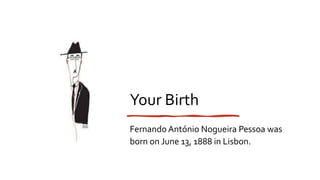
Your Birth
Fernando António Nogueira Pessoa was
born on June 13, 1888 in Lisbon.
The family
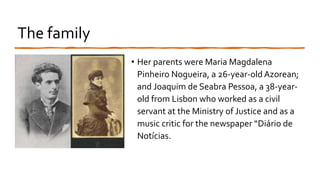
• Her parents were Maria Magdalena
Pinheiro Nogueira, a 26-year-old Azorean;
and Joaquim de Seabra Pessoa, a 38-year-
old from Lisbon who worked as a civil
servant at the Ministry of Justice and as a
music critic for the newspaper “Diário de
Notícias.
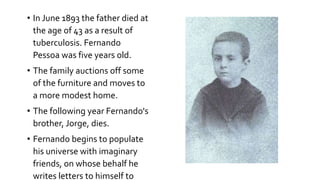
• In June 1893 the father died at
the age of 43 as a result of
tuberculosis. Fernando
Pessoa was five years old.
• The family auctions off some
of the furniture and moves to
a more modest home.
• The following year Fernando's
brother, Jorge, dies.
• Fernando begins to populate
his universe with imaginary
friends, on whose behalf he
writes letters to himself to
Durban (1896-1905)
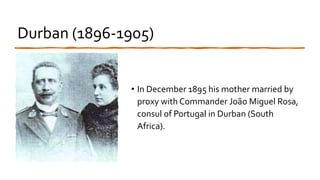
• In December 1895 his mother married by
proxy with Commander João Miguel Rosa,
consul of Portugal in Durban (South
Africa).
Durban (1896-1905)
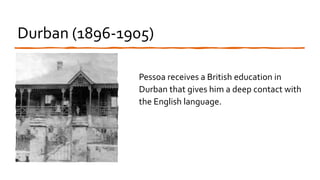
Pessoa receives a British education in
Durban that gives him a deep contact with
the English language.
Durban (1896-1905)
Reads works by
Shakespeare, Edgar
Allan Poe and Lord
Byron among others.
He masters the new
language perfectly
and becomes one of
the best students.
Durban (1896-1905)
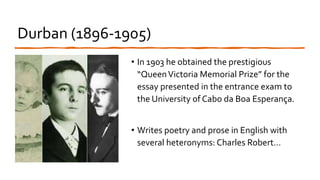
• In 1903 he obtained the prestigious
“QueenVictoria Memorial Prize” for the
essay presented in the entrance exam to
the University of Cabo da Boa Esperança.
• Writes poetry and prose in English with
several heteronyms: Charles Robert…
Return to Portugal
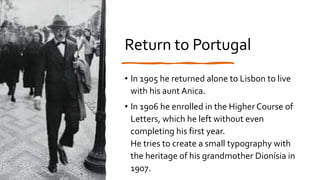
• In 1905 he returned alone to Lisbon to live
with his aunt Anica.
• In 1906 he enrolled in the Higher Course of
Letters, which he left without even
completing his first year.
He tries to create a small typography with
the heritage of his grandmother Dionísia in
1907.
The beginning of literary activity
• From 1908 he dedicated
himself to translating
commercial correspondence.
In this profession he works all
his life, having a modest public
life.
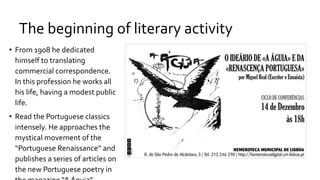
• Read the Portuguese classics
intensely. He approaches the
mystical movement of the
“Portuguese Renaissance” and
publishes a series of articles on
the new Portuguese poetry in
The “Orpheu”
magazine
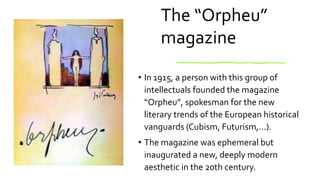
• In 1915, a person with this group of
intellectuals founded the magazine
“Orpheu”, spokesman for the new
literary trends of the European historical
vanguards (Cubism, Futurism,…).
• The magazine was ephemeral but
inaugurated a new, deeply modern
aesthetic in the 20th century.
The beginning of heteronyms
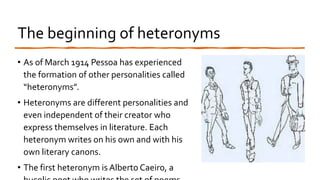
• As of March 1914 Pessoa has experienced
the formation of other personalities called
“heteronyms”.
• Heteronyms are different personalities and
even independent of their creator who
express themselves in literature. Each
heteronym writes on his own and with his
own literary canons.
• The first heteronym is Alberto Caeiro, a
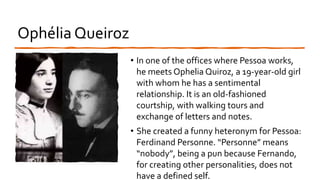
Ophélia Queiroz
• In one of the offices where Pessoa works,
he meets Ophelia Quiroz, a 19-year-old girl
with whom he has a sentimental
relationship. It is an old-fashioned
courtship, with walking tours and
exchange of letters and notes.
• She created a funny heteronym for Pessoa:
Ferdinand Personne. “Personne” means
“nobody”, being a pun because Fernando,
for creating other personalities, does not
have a defined self.
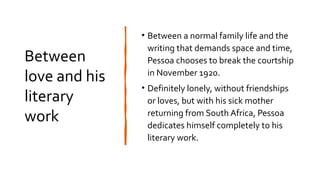
Between
love and his
literary
work
• Between a normal family life and the
writing that demands space and time,
Pessoa chooses to break the courtship
in November 1920.
• Definitely lonely, without friendships
or loves, but with his sick mother
returning from South Africa, Pessoa
dedicates himself completely to his
literary work.
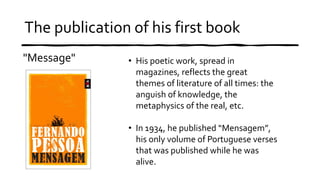
The publication of his first book
"Message" • His poetic work, spread in
magazines, reflects the great
themes of literature of all times: the
anguish of knowledge, the
metaphysics of the real, etc.
• In 1934, he published “Mensagem”,
his only volume of Portuguese verses
that was published while he was
alive.
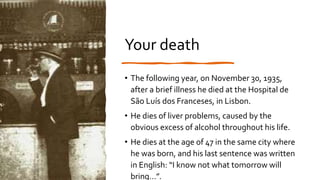
Your death
• The following year, on November 30, 1935,
after a brief illness he died at the Hospital de
São Luís dos Franceses, in Lisbon.
• He dies of liver problems, caused by the
obvious excess of alcohol throughout his life.
• He dies at the age of 47 in the same city where
he was born, and his last sentence was written
in English: “I know not what tomorrow will
bring…”.

Fernando pessoa (ingles)

  • 1.
  • 2.
    Your Birth Fernando AntónioNogueira Pessoa was born on June 13, 1888 in Lisbon.
  • 3.
    The family • Herparents were Maria Magdalena Pinheiro Nogueira, a 26-year-old Azorean; and Joaquim de Seabra Pessoa, a 38-year- old from Lisbon who worked as a civil servant at the Ministry of Justice and as a music critic for the newspaper “Diário de Notícias.
  • 4.
    • In June1893 the father died at the age of 43 as a result of tuberculosis. Fernando Pessoa was five years old. • The family auctions off some of the furniture and moves to a more modest home. • The following year Fernando's brother, Jorge, dies. • Fernando begins to populate his universe with imaginary friends, on whose behalf he writes letters to himself to
  • 5.
    Durban (1896-1905) • InDecember 1895 his mother married by proxy with Commander João Miguel Rosa, consul of Portugal in Durban (South Africa).
  • 6.
    Durban (1896-1905) Pessoa receivesa British education in Durban that gives him a deep contact with the English language.
  • 7.
    Durban (1896-1905) Reads worksby Shakespeare, Edgar Allan Poe and Lord Byron among others. He masters the new language perfectly and becomes one of the best students.
  • 8.
    Durban (1896-1905) • In1903 he obtained the prestigious “QueenVictoria Memorial Prize” for the essay presented in the entrance exam to the University of Cabo da Boa Esperança. • Writes poetry and prose in English with several heteronyms: Charles Robert…
  • 9.
    Return to Portugal •In 1905 he returned alone to Lisbon to live with his aunt Anica. • In 1906 he enrolled in the Higher Course of Letters, which he left without even completing his first year. He tries to create a small typography with the heritage of his grandmother Dionísia in 1907.
  • 10.
    The beginning ofliterary activity • From 1908 he dedicated himself to translating commercial correspondence. In this profession he works all his life, having a modest public life. • Read the Portuguese classics intensely. He approaches the mystical movement of the “Portuguese Renaissance” and publishes a series of articles on the new Portuguese poetry in
  • 11.
    The “Orpheu” magazine • In1915, a person with this group of intellectuals founded the magazine “Orpheu”, spokesman for the new literary trends of the European historical vanguards (Cubism, Futurism,…). • The magazine was ephemeral but inaugurated a new, deeply modern aesthetic in the 20th century.
  • 12.
    The beginning ofheteronyms • As of March 1914 Pessoa has experienced the formation of other personalities called “heteronyms”. • Heteronyms are different personalities and even independent of their creator who express themselves in literature. Each heteronym writes on his own and with his own literary canons. • The first heteronym is Alberto Caeiro, a
  • 13.
    Ophélia Queiroz • Inone of the offices where Pessoa works, he meets Ophelia Quiroz, a 19-year-old girl with whom he has a sentimental relationship. It is an old-fashioned courtship, with walking tours and exchange of letters and notes. • She created a funny heteronym for Pessoa: Ferdinand Personne. “Personne” means “nobody”, being a pun because Fernando, for creating other personalities, does not have a defined self.
  • 14.
    Between love and his literary work •Between a normal family life and the writing that demands space and time, Pessoa chooses to break the courtship in November 1920. • Definitely lonely, without friendships or loves, but with his sick mother returning from South Africa, Pessoa dedicates himself completely to his literary work.
  • 15.
    The publication ofhis first book "Message" • His poetic work, spread in magazines, reflects the great themes of literature of all times: the anguish of knowledge, the metaphysics of the real, etc. • In 1934, he published “Mensagem”, his only volume of Portuguese verses that was published while he was alive.
  • 16.
    Your death • Thefollowing year, on November 30, 1935, after a brief illness he died at the Hospital de São Luís dos Franceses, in Lisbon. • He dies of liver problems, caused by the obvious excess of alcohol throughout his life. • He dies at the age of 47 in the same city where he was born, and his last sentence was written in English: “I know not what tomorrow will bring…”.