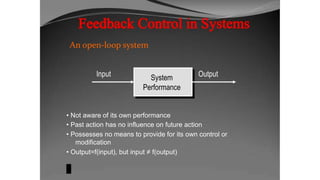
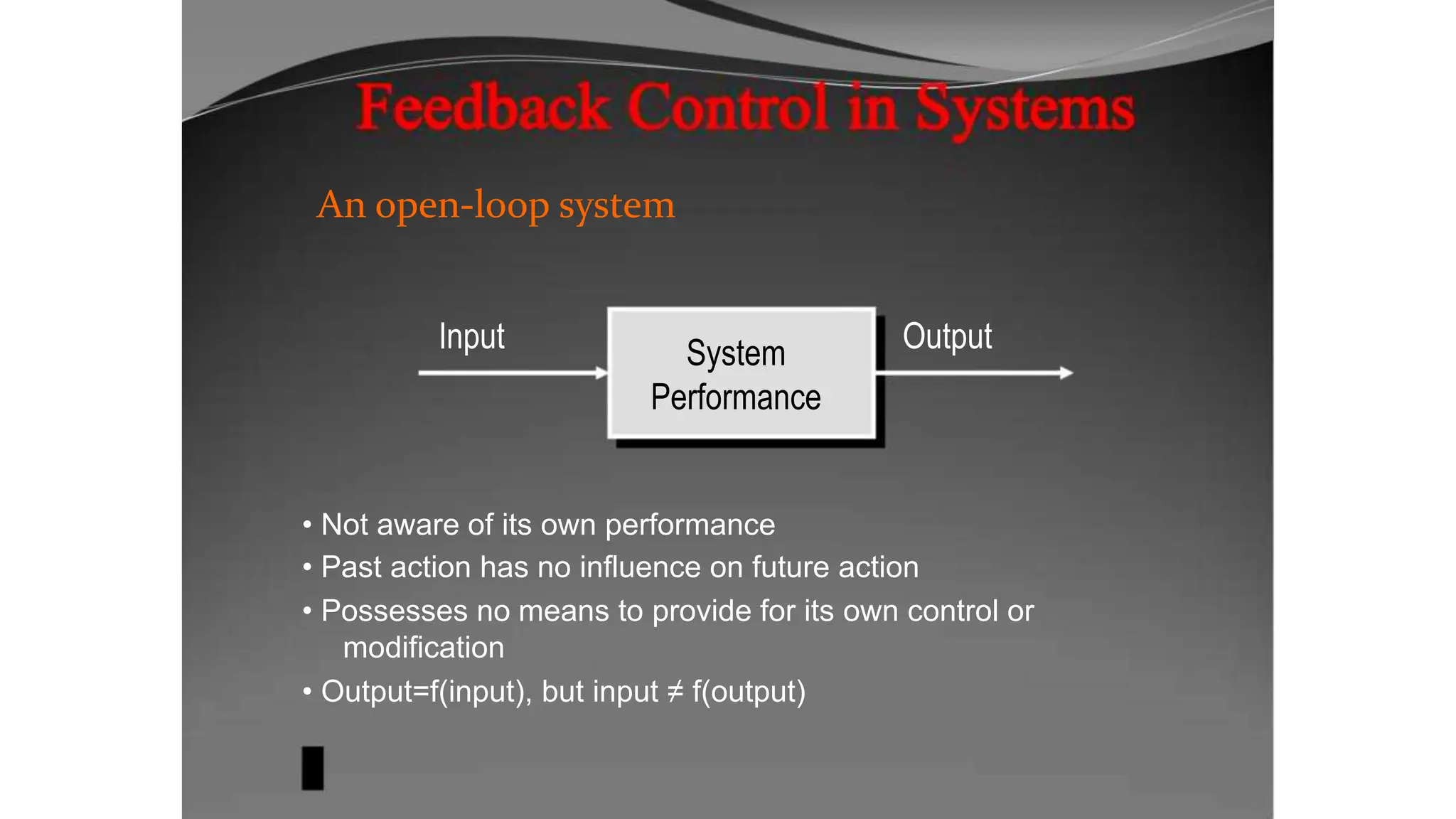
An open-loop system
Input System
Performance
Output
• Not aware of its own performance
• Past action has no influence on future action
• Possesses no means to provide for its own control or
modification
• Output=f(input), but input ≠ f(output)
Examples:
• Toaster- doesn’t know whether it burned the toast
• Watch-not self-correcting
• Auto without a driver
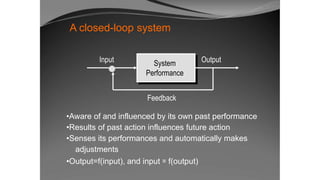
A closed-loop system
Input System
Performance
Output
Feedback
•Aware of and influenced by its own past performance
•Results of past action influences future action
•Senses its performances and automatically makes
adjustments
•Output=f(input), and input = f(output)
Examples:
• Toaster and operator - adjust to desired darkness
• Watch and owner - adjust time to “standard”
• Auto with a driver
• Feedback can be defined as the system function
that obtains data on system performance output,
compares the actual performance to the desired
performance (a standard or a criterion) and
determines the modifications (corrective action)
necessary prior to the next execution of system
performance.
feedback control in industrial systems.pptx

feedback control in industrial systems.pptx

  • 1.
    An open-loop system InputSystem Performance Output • Not aware of its own performance • Past action has no influence on future action • Possesses no means to provide for its own control or modification • Output=f(input), but input ≠ f(output)
  • 2.
    Examples: • Toaster- doesn’tknow whether it burned the toast • Watch-not self-correcting • Auto without a driver
  • 3.
    A closed-loop system InputSystem Performance Output Feedback •Aware of and influenced by its own past performance •Results of past action influences future action •Senses its performances and automatically makes adjustments •Output=f(input), and input = f(output)
  • 4.
    Examples: • Toaster andoperator - adjust to desired darkness • Watch and owner - adjust time to “standard” • Auto with a driver
  • 5.
    • Feedback canbe defined as the system function that obtains data on system performance output, compares the actual performance to the desired performance (a standard or a criterion) and determines the modifications (corrective action) necessary prior to the next execution of system performance.