SLIDESMANIA
PRESENTED BY: VEMU PRAVALIKA
GUIDED BY: MERVIN FELIX CALEB
SLIDESMANIA
WHAT IS FDI?
 Foreign Direct Investment (FDI) is a direct investment into production
or business in a country by an individual or company of another
country, either by buying a company in the target country or by
expanding operations of an existing business in that country.
SLIDESMANIA
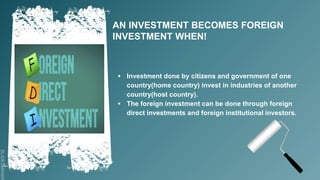
 Investment done by citizens and government of one
country(home country) invest in industries of another
country(host country).
 The foreign investment can be done through foreign
direct investments and foreign institutional investors.
AN INVESTMENT BECOMES FOREIGN
INVESTMENT WHEN!
SLIDESMANIA
NEED OF FOREIGN INVESTMENT
 Raising the level of investment.
 Upgradation of technology.
 Exploitation of natural resources.
 Improvement in exports competetiveness.
 Benefit to customer.
 Revenue to government.
SLIDESMANIA
MODES OF FDI
BY TARGET BY MOTIVE
 Mergers & Acquisitions
 Horizontal & Vertical FDI
 Forward & Backward FDI
 Resource seeking
 Market seeking
 Efficiency seeking
 Strategic – Asset seeking
SLIDESMANIA
DETERMINANTS OF FOREIGN INVESTMENT
 Political stability.
 Legal and regulatory framework.
 Size of market.
 Prices and exchange rate.
 Access to basic input.
SLIDESMANIA
FDI PROHIBITED IN
 Gambling and betting.
 Business of chitfund.
 Housing and Real estate business.
 Arms and ammunition.
 Coal and lignite.
 Animal husbandry.
 Railway transport.
SLIDESMANIA
STRENGTHS & WEAKNESSES OF GERMANY FDI
 Strategic location in the Centre of
Europe.
 Political stability and a good anchor in
international relations.
 The largest population of the European
Union.
 Infrastructure among the most
developed in the European Union.
 Strong manufacturing base (almost a
third of the GDP).
 Strong exports (high range products
and diversified clients).
 Advanced technology and expertise.
 Highly qualified work force.
 Consolidated public finances.
 Competitive taxation.
.
 Eastern part of the Germany (former DDR) is
struggling to catch up with the western part in
many areas.
 Ageing population weighs heavily on growth.
 German economy is highly dependent on
exports, especially to China.
 Ageing infrastructure.
 Unproductive service sector.
 Insufficient infrastructure for development of
start-ups.
 A low investment/GDP ratio.
 Lack of engineers.
SLIDESMANIA
STATISTICAL DATA
● According to the 2020 World Investment Report by UNCTAD, FDI inflows in Germany
decreased by almost 50% in 2019, reaching USD 36.6 billion, compared to the USD 74
billion of the previous year.
● FDI stock decreased slightly in 2019, reaching USD 953 billion (in general its level has
remained constant over the last ten years, as it amounted to USD 955 billion in 2010).
● FDIs in Germany are mostly owned by the Netherlands, Luxembourg, the US, Switzerland
and the UK, which represent more than 60% of the total stock.
● According to the latest data available from UNCTAD, in 2020 FDI inflows to Germany fell
by 61% to USD 23 billion despite a rise in cross-border M&A operations, mostly due to the
outbreak of the COVID-19 pandemic (which caused global FDIs to fall by 42% compared to
one year earlier, affecting mostly developed economies, with an average of -69%).
SLIDESMANIA
REFERENCES
 https://santandertrade.com/en/portal/establish-overseas/germany/foreign-
investment
 https://www.learnpick.in/prime/documents/ppts/details/1264/foreign-direct-
investment
 https://www.slideshare.net/snehalsoni/fdi-presentation
● VIDEO REFERENCE: https://youtu.be/onAC0elUgmc
SLIDESMANIA
ANY QUERIES?
Thank you!

FDI In GERMANY

  • 1.
    SLIDESMANIA PRESENTED BY: VEMUPRAVALIKA GUIDED BY: MERVIN FELIX CALEB
  • 2.
    SLIDESMANIA WHAT IS FDI? Foreign Direct Investment (FDI) is a direct investment into production or business in a country by an individual or company of another country, either by buying a company in the target country or by expanding operations of an existing business in that country.
  • 3.
    SLIDESMANIA  Investment doneby citizens and government of one country(home country) invest in industries of another country(host country).  The foreign investment can be done through foreign direct investments and foreign institutional investors. AN INVESTMENT BECOMES FOREIGN INVESTMENT WHEN!
  • 4.
    SLIDESMANIA NEED OF FOREIGNINVESTMENT  Raising the level of investment.  Upgradation of technology.  Exploitation of natural resources.  Improvement in exports competetiveness.  Benefit to customer.  Revenue to government.
  • 5.
    SLIDESMANIA MODES OF FDI BYTARGET BY MOTIVE  Mergers & Acquisitions  Horizontal & Vertical FDI  Forward & Backward FDI  Resource seeking  Market seeking  Efficiency seeking  Strategic – Asset seeking
  • 6.
    SLIDESMANIA DETERMINANTS OF FOREIGNINVESTMENT  Political stability.  Legal and regulatory framework.  Size of market.  Prices and exchange rate.  Access to basic input.
  • 7.
    SLIDESMANIA FDI PROHIBITED IN Gambling and betting.  Business of chitfund.  Housing and Real estate business.  Arms and ammunition.  Coal and lignite.  Animal husbandry.  Railway transport.
  • 8.
    SLIDESMANIA STRENGTHS & WEAKNESSESOF GERMANY FDI  Strategic location in the Centre of Europe.  Political stability and a good anchor in international relations.  The largest population of the European Union.  Infrastructure among the most developed in the European Union.  Strong manufacturing base (almost a third of the GDP).  Strong exports (high range products and diversified clients).  Advanced technology and expertise.  Highly qualified work force.  Consolidated public finances.  Competitive taxation. .  Eastern part of the Germany (former DDR) is struggling to catch up with the western part in many areas.  Ageing population weighs heavily on growth.  German economy is highly dependent on exports, especially to China.  Ageing infrastructure.  Unproductive service sector.  Insufficient infrastructure for development of start-ups.  A low investment/GDP ratio.  Lack of engineers.
  • 9.
    SLIDESMANIA STATISTICAL DATA ● Accordingto the 2020 World Investment Report by UNCTAD, FDI inflows in Germany decreased by almost 50% in 2019, reaching USD 36.6 billion, compared to the USD 74 billion of the previous year. ● FDI stock decreased slightly in 2019, reaching USD 953 billion (in general its level has remained constant over the last ten years, as it amounted to USD 955 billion in 2010). ● FDIs in Germany are mostly owned by the Netherlands, Luxembourg, the US, Switzerland and the UK, which represent more than 60% of the total stock. ● According to the latest data available from UNCTAD, in 2020 FDI inflows to Germany fell by 61% to USD 23 billion despite a rise in cross-border M&A operations, mostly due to the outbreak of the COVID-19 pandemic (which caused global FDIs to fall by 42% compared to one year earlier, affecting mostly developed economies, with an average of -69%).
  • 10.
  • 11.