Paper Format 
The Speaking test contains four 
parts. 
Timing 14 minutes 
Task Types 
Short exchanges with the 
interlocutor and with the other 
candidate; a 1-minute ‘long turn’; 
a collaborative task involving the 
two candidates; a discussion. 
Marks 
Candidates are awarded a mark 
for each of five criteria: 4 
analytical and 1 global. 
Cambridge English: First Speaking Description
Cambridge English: First Speaking - How it's marked 
Speaking tests are conducted by trained examiners 
Although candidates take the test in pairs or 
groups of three, throughout the test they are 
assessed on their individual performance and 
not in relation to each other. 
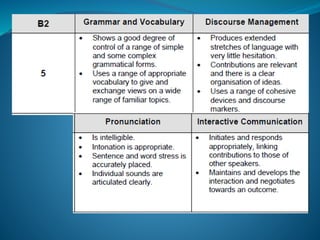
The assessor awards marks for five individual criteria: 
Grammatical Resource 
Lexical Resource 
Discourse Management 
Pronunciation 
Interactive Communication.
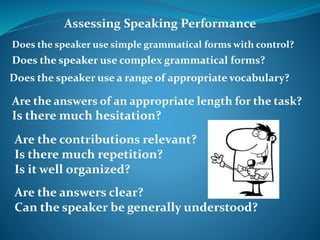
Assessing Speaking Performance 
Does the speaker use simple grammatical forms with control? 
Does the speaker use complex grammatical forms? 
Does the speaker use a range of appropriate vocabulary? 
Are the answers of an appropriate length for the task? 
Is there much hesitation? 
Are the contributions relevant? 
Is there much repetition? 
Is it well organized? 
Are the answers clear? 
Can the speaker be generally understood?
One examiner 
(the assessor) 
focuses on the 
candidate's 
performance.
FCE Speaking Test: 
Part 1 (Interview) 
Tests ability to: 
Use language for social purposes 
‘Getting-to-know-you' questions perhaps to find out 
in 3 minutes where you come from, your interests, 
your family or your studies etc. 
Q: Where are you from? Q: Tell me something about your family. 
Q: What did you enjoy most when you were at primary school? 
Q: Do you have any plans for a holiday this year? 
Q: Do you play any musical instruments?
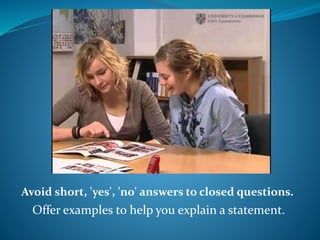
Avoid short, 'yes', 'no' answers to closed questions. 
Offer examples to help you explain a statement.
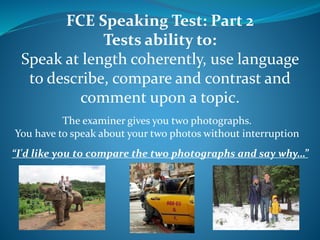
FCE Speaking Test: Part 2 
Tests ability to: 
Speak at length coherently, use language 
to describe, compare and contrast and 
comment upon a topic. 
The examiner gives you two photographs. 
You have to speak about your two photos without interruption 
“I'd like you to compare the two photographs and say why…”
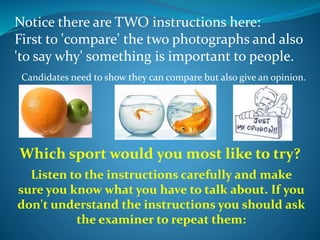
Notice there are TWO instructions here: 
First to 'compare' the two photographs and also 
'to say why' something is important to people. 
Candidates need to show they can compare but also give an opinion. 
Which sport would you most like to try? 
Listen to the instructions carefully and make 
sure you know what you have to talk about. If you 
don't understand the instructions you should ask 
the examiner to repeat them:
FCE Speaking Test: 
Part 3: (Collaborative Task) Tests ability to: 
Use language to discuss, express an 
opinion, to agree and disagree, speculate 
and evaluate etc.
First talk to each other about how 
useful each of these forms of 
transport might be for your holiday. 
Then decide which one would be best.
FCE Speaking Test 
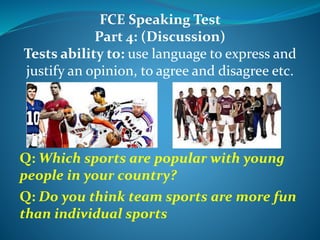
Part 4: (Discussion) 
Tests ability to: use language to express and 
justify an opinion, to agree and disagree etc. 
Q: Which sports are popular with young 
people in your country? 
Q: Do you think team sports are more fun 
than individual sports
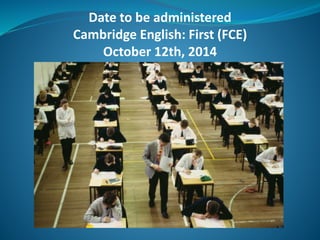
Date to be administered 
Cambridge English: First (FCE) 
October 12th, 2014

Fce speaking exam presentation

  • 2.
    Paper Format TheSpeaking test contains four parts. Timing 14 minutes Task Types Short exchanges with the interlocutor and with the other candidate; a 1-minute ‘long turn’; a collaborative task involving the two candidates; a discussion. Marks Candidates are awarded a mark for each of five criteria: 4 analytical and 1 global. Cambridge English: First Speaking Description
  • 3.
    Cambridge English: FirstSpeaking - How it's marked Speaking tests are conducted by trained examiners Although candidates take the test in pairs or groups of three, throughout the test they are assessed on their individual performance and not in relation to each other. The assessor awards marks for five individual criteria: Grammatical Resource Lexical Resource Discourse Management Pronunciation Interactive Communication.
  • 5.
    Assessing Speaking Performance Does the speaker use simple grammatical forms with control? Does the speaker use complex grammatical forms? Does the speaker use a range of appropriate vocabulary? Are the answers of an appropriate length for the task? Is there much hesitation? Are the contributions relevant? Is there much repetition? Is it well organized? Are the answers clear? Can the speaker be generally understood?
  • 6.
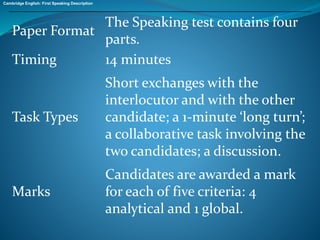
    One examiner (theassessor) focuses on the candidate's performance.
  • 7.
    FCE Speaking Test: Part 1 (Interview) Tests ability to: Use language for social purposes ‘Getting-to-know-you' questions perhaps to find out in 3 minutes where you come from, your interests, your family or your studies etc. Q: Where are you from? Q: Tell me something about your family. Q: What did you enjoy most when you were at primary school? Q: Do you have any plans for a holiday this year? Q: Do you play any musical instruments?
  • 8.
    Avoid short, 'yes','no' answers to closed questions. Offer examples to help you explain a statement.
  • 9.
    FCE Speaking Test:Part 2 Tests ability to: Speak at length coherently, use language to describe, compare and contrast and comment upon a topic. The examiner gives you two photographs. You have to speak about your two photos without interruption “I'd like you to compare the two photographs and say why…”
  • 10.
    Notice there areTWO instructions here: First to 'compare' the two photographs and also 'to say why' something is important to people. Candidates need to show they can compare but also give an opinion. Which sport would you most like to try? Listen to the instructions carefully and make sure you know what you have to talk about. If you don't understand the instructions you should ask the examiner to repeat them:
  • 11.
    FCE Speaking Test: Part 3: (Collaborative Task) Tests ability to: Use language to discuss, express an opinion, to agree and disagree, speculate and evaluate etc.
  • 12.
    First talk toeach other about how useful each of these forms of transport might be for your holiday. Then decide which one would be best.
  • 13.
    FCE Speaking Test Part 4: (Discussion) Tests ability to: use language to express and justify an opinion, to agree and disagree etc. Q: Which sports are popular with young people in your country? Q: Do you think team sports are more fun than individual sports
  • 14.
    Date to beadministered Cambridge English: First (FCE) October 12th, 2014