Efficient Overlay Architecture Based on
DSP Blocks
1
Abhishek K. Jain, Suhaib A. Fahmy, Douglas L. Maskell
School of Computer Engineering
Nanyang Technological University (NTU), Singapore
International Symposium On Field-Programmable Custom Computing Machines (FCCM)
4th May 2015, Vancouver, Canada
Coarse Grained Overlay Architectures
• Accelerator Design at a higher level of abstraction
• Fast compilation and development cycles
• Improved design productivity
• Cost: area and performance overheads
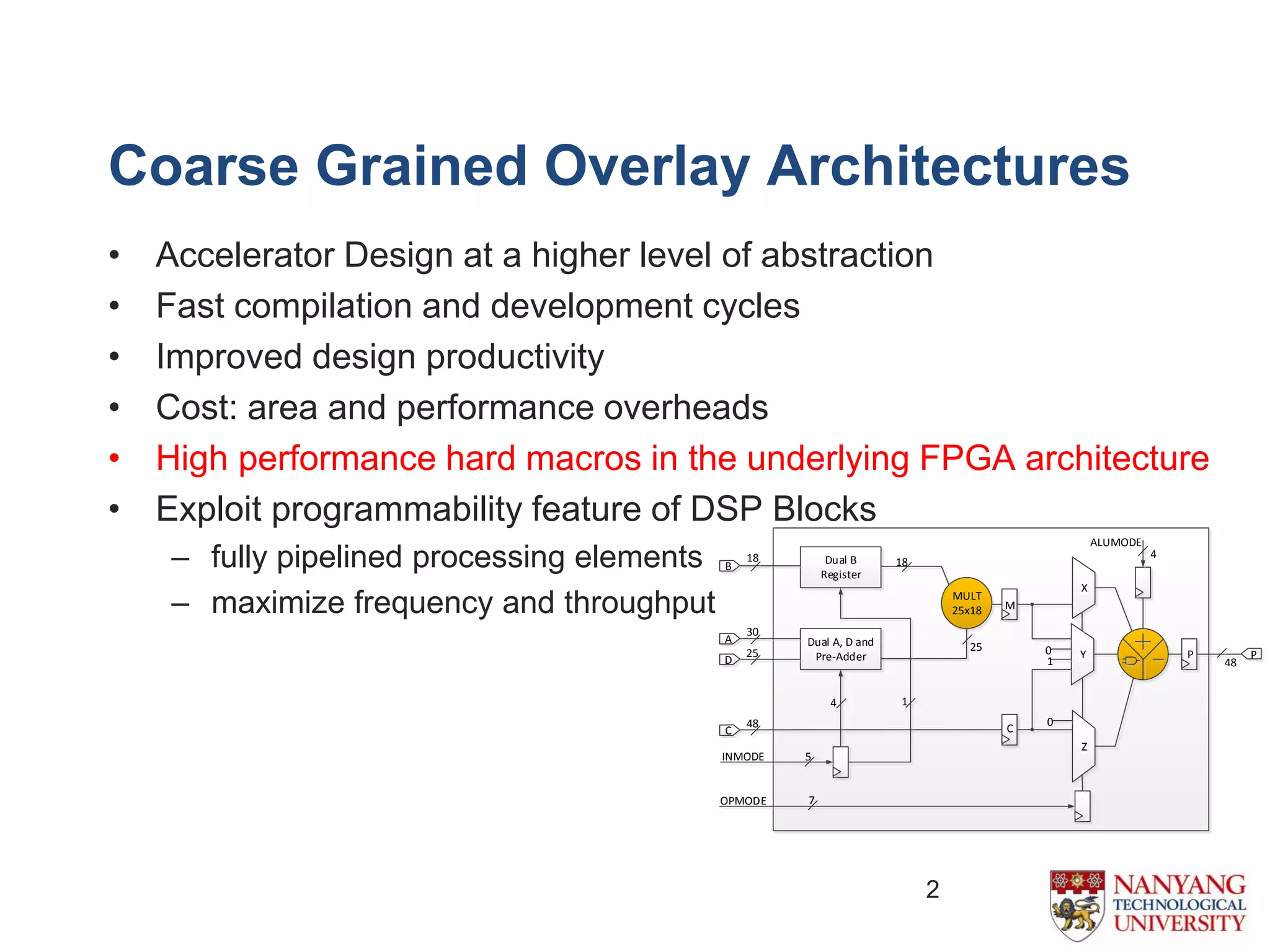
• High performance hard macros in the underlying FPGA architecture
• Exploit programmability feature of DSP Blocks
– fully pipelined processing elements
– maximize frequency and throughput
2
MULT
25x18
Dual B
Register
Dual A, D and
Pre-Adder
C
M
X
Y
Z
INMODE
OPMODE
B
A
D
C
1
0
0
P
ALUMODE
P
18
30
25
48
5
7
4 1
18
25
4
48
Proposed Overlay
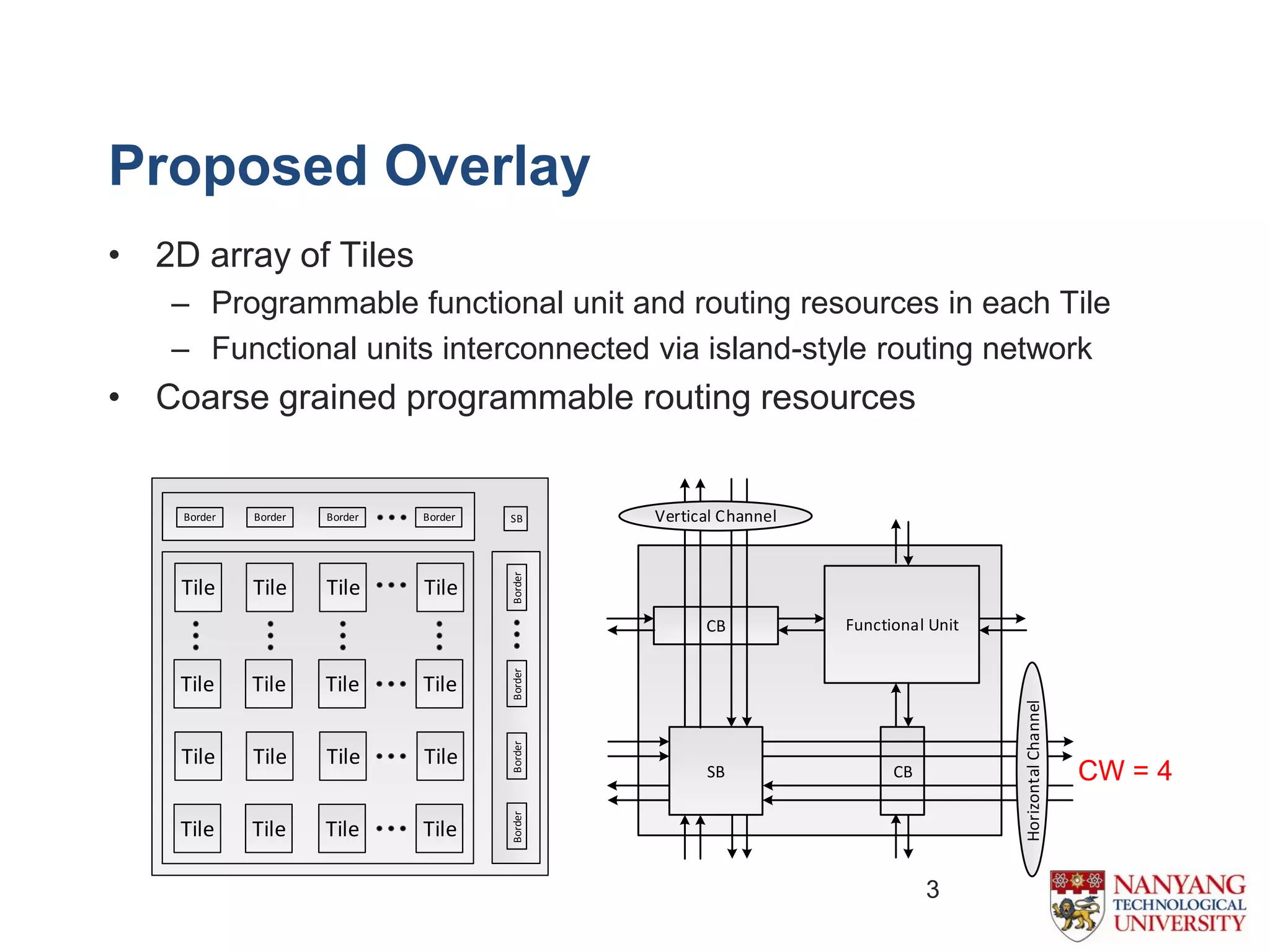
• 2D array of Tiles
– Programmable functional unit and routing resources in each Tile
– Functional units interconnected via island-style routing network
• Coarse grained programmable routing resources
3
Border Border Border Border BorderBorderBorderBorderSB
Tile Tile Tile Tile
Tile Tile Tile Tile
Tile Tile Tile Tile
Tile Tile Tile Tile
CB
SB CB
Functional Unit
Vertical Channel
HorizontalChannel
CW = 4
DSP Block based Functional Unit (FU)
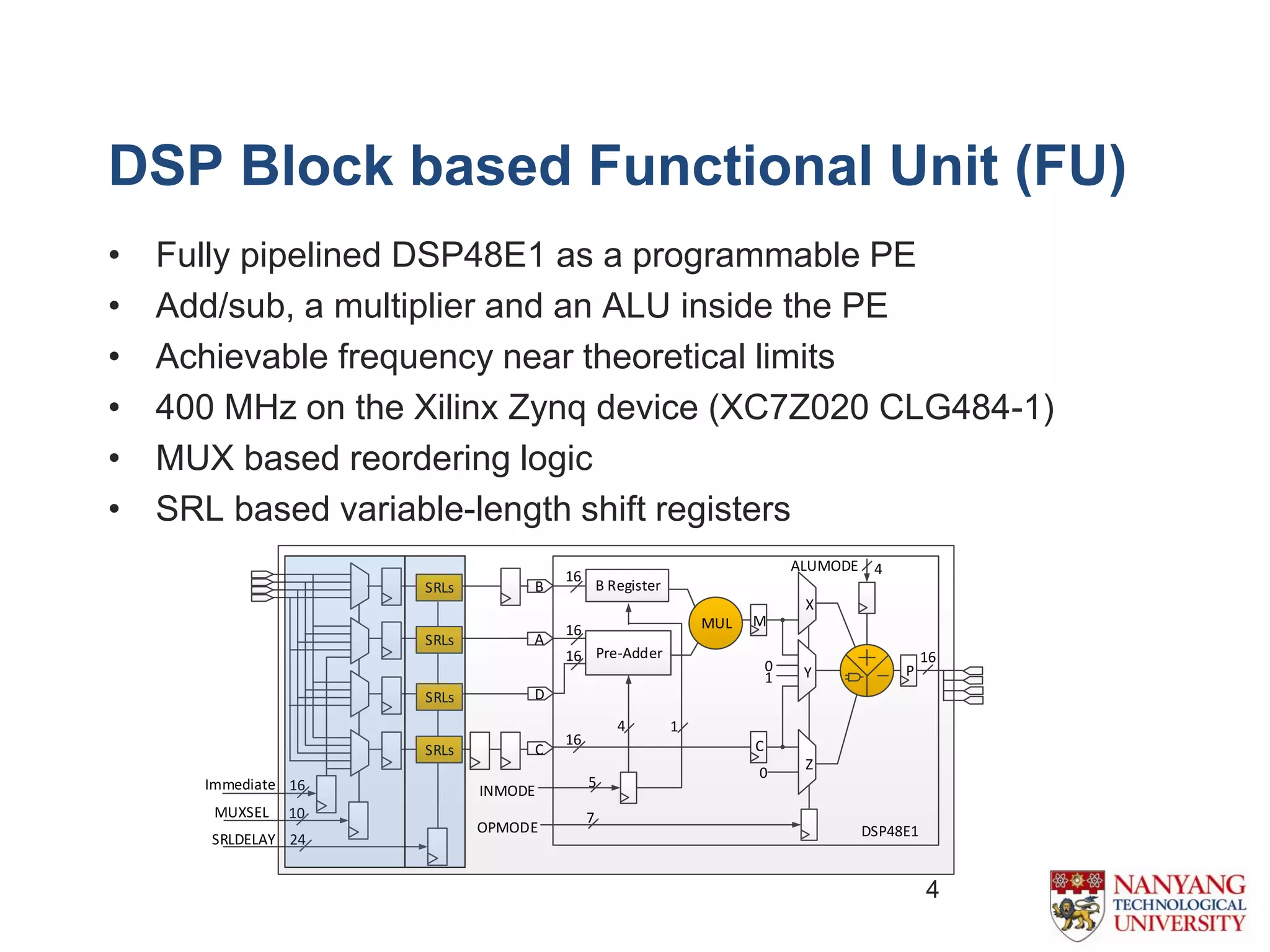
• Fully pipelined DSP48E1 as a programmable PE
• Add/sub, a multiplier and an ALU inside the PE
• Achievable frequency near theoretical limits
• 400 MHz on the Xilinx Zynq device (XC7Z020 CLG484-1)
• MUX based reordering logic
• SRL based variable-length shift registers
4
MUL
B Register
Pre-Adder
C
M
INMODE
OPMODE
B
A
D
C
1
0
0
ALUMODE
P
16
16
16
16
5
7
4 1
4
16
SRLs
SRLDELAY 24
MUXSEL 10
Immediate 16
DSP48E1
SRLs
SRLs
SRLs
X
Y
Z
5
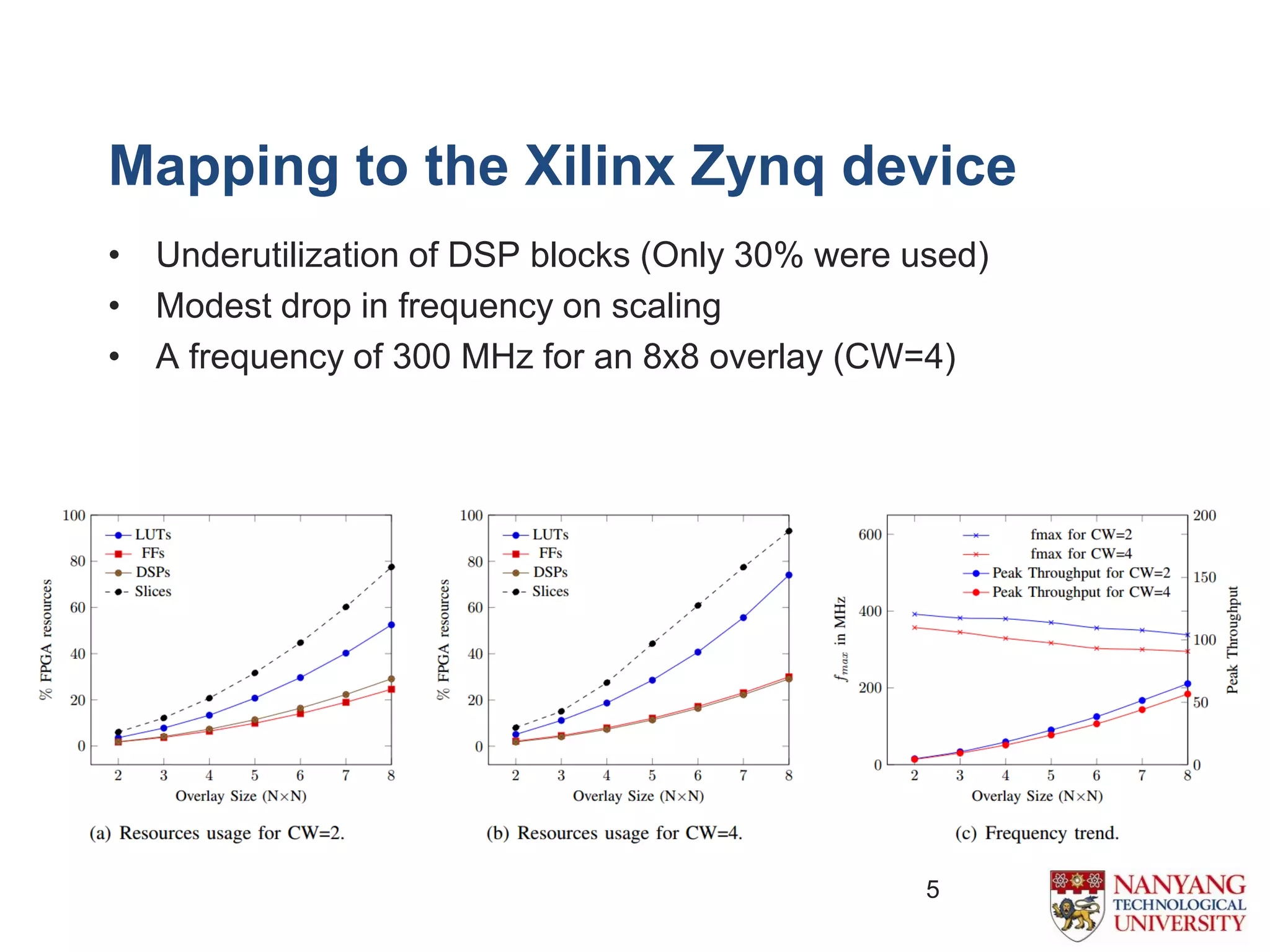
• Underutilization of DSP blocks (Only 30% were used)
• Modest drop in frequency on scaling
• A frequency of 300 MHz for an 8x8 overlay (CW=4)
Mapping to the Xilinx Zynq device
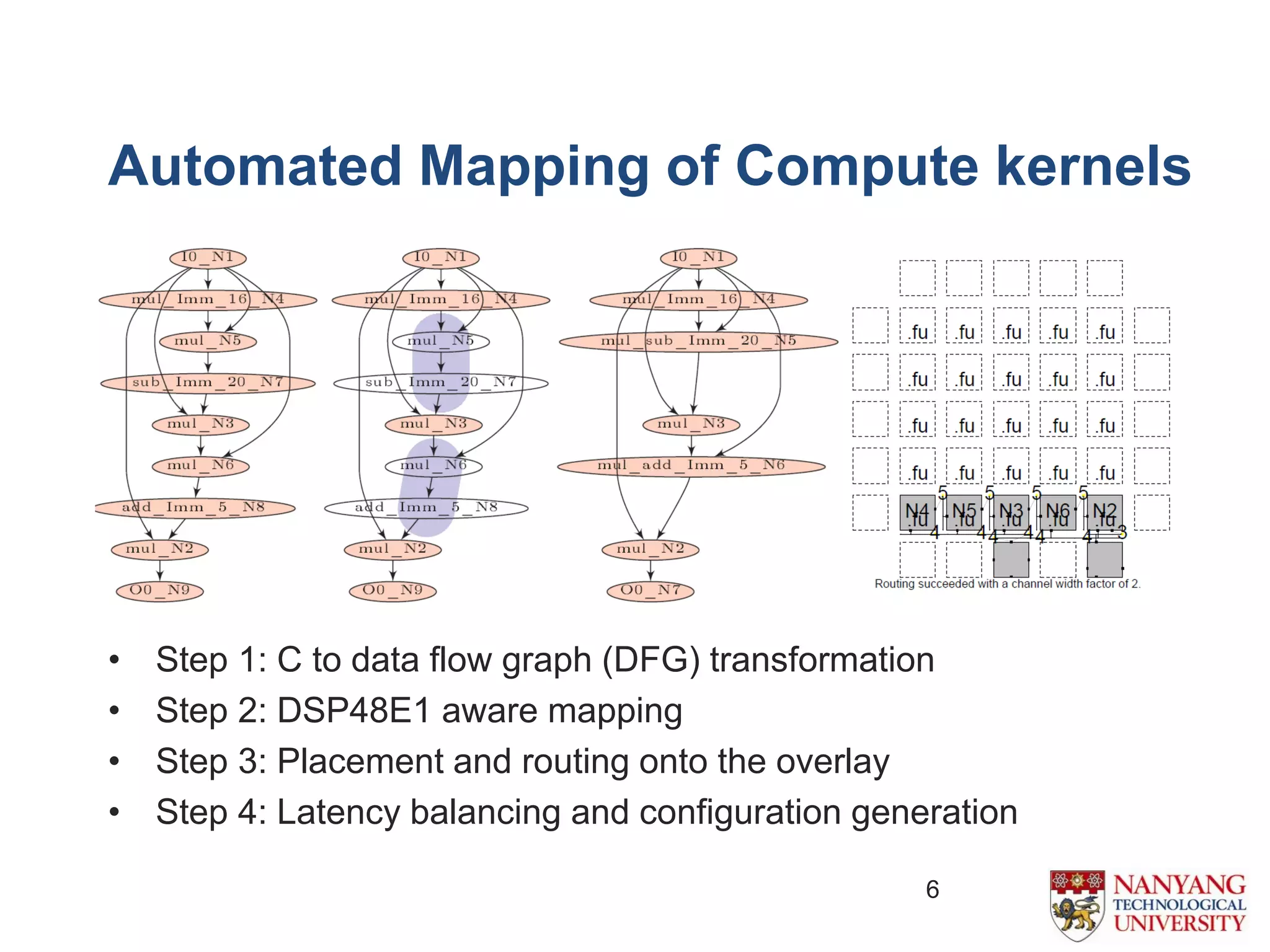
Automated Mapping of Compute kernels
6
• Step 1: C to data flow graph (DFG) transformation
• Step 2: DSP48E1 aware mapping
• Step 3: Placement and routing onto the overlay
• Step 4: Latency balancing and configuration generation
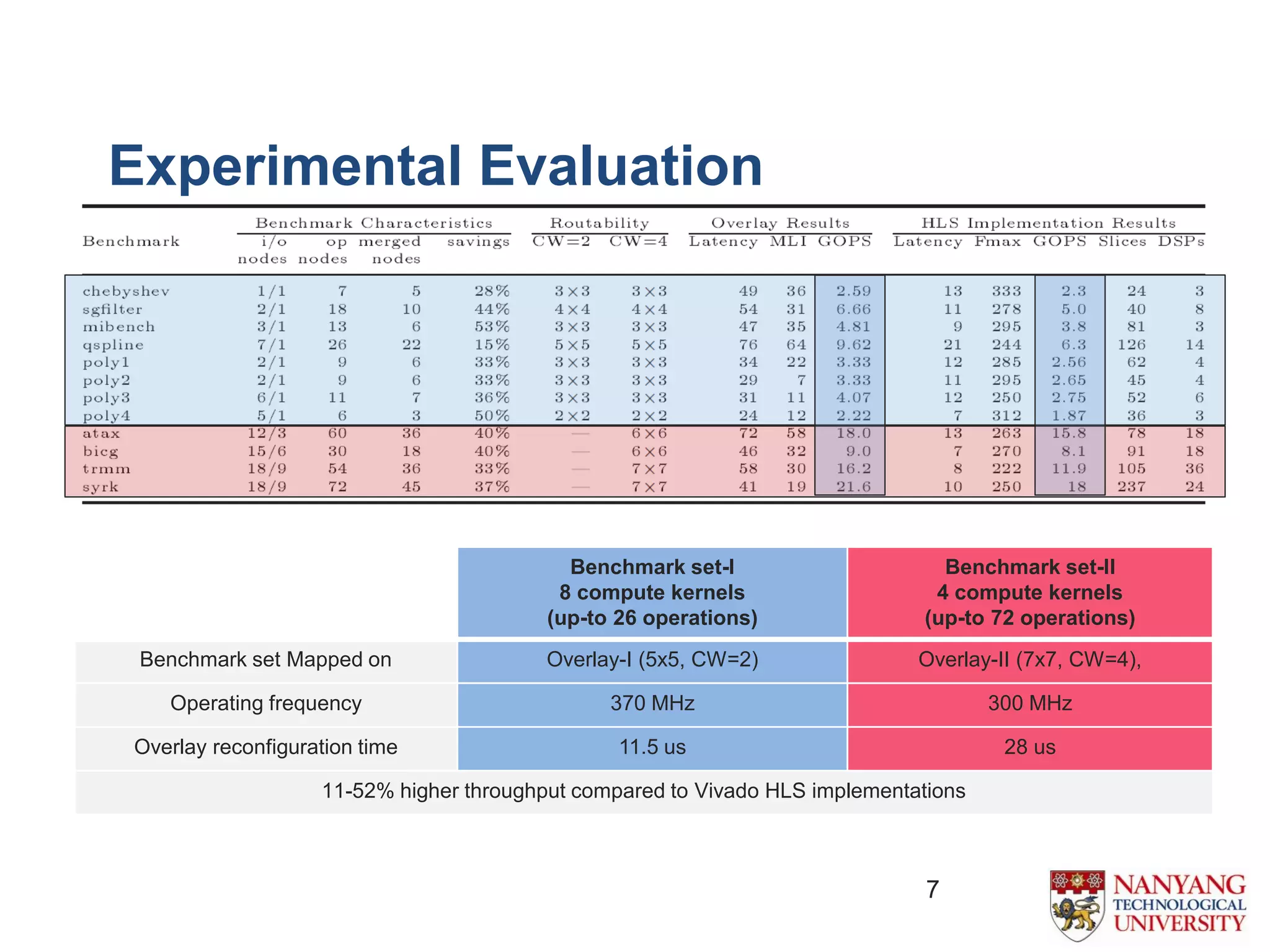
Experimental Evaluation
7
Benchmark set-I
8 compute kernels
(up-to 26 operations)
Benchmark set-II
4 compute kernels
(up-to 72 operations)
Benchmark set Mapped on Overlay-I (5x5, CW=2) Overlay-II (7x7, CW=4),
Operating frequency 370 MHz 300 MHz
Overlay reconfiguration time 11.5 us 28 us
11-52% higher throughput compared to Vivado HLS implementations
Future Work
8
• Area reduction of the overlay through careful optimizations of:
– routing architecture
– and synchronization logic.
• Alternative interconnect architectures for a low overlay routing
network

fccm2015-jain-presentation

  • 1.
    Efficient Overlay ArchitectureBased on DSP Blocks 1 Abhishek K. Jain, Suhaib A. Fahmy, Douglas L. Maskell School of Computer Engineering Nanyang Technological University (NTU), Singapore International Symposium On Field-Programmable Custom Computing Machines (FCCM) 4th May 2015, Vancouver, Canada
  • 2.
    Coarse Grained OverlayArchitectures • Accelerator Design at a higher level of abstraction • Fast compilation and development cycles • Improved design productivity • Cost: area and performance overheads • High performance hard macros in the underlying FPGA architecture • Exploit programmability feature of DSP Blocks – fully pipelined processing elements – maximize frequency and throughput 2 MULT 25x18 Dual B Register Dual A, D and Pre-Adder C M X Y Z INMODE OPMODE B A D C 1 0 0 P ALUMODE P 18 30 25 48 5 7 4 1 18 25 4 48
  • 3.
    Proposed Overlay • 2Darray of Tiles – Programmable functional unit and routing resources in each Tile – Functional units interconnected via island-style routing network • Coarse grained programmable routing resources 3 Border Border Border Border BorderBorderBorderBorderSB Tile Tile Tile Tile Tile Tile Tile Tile Tile Tile Tile Tile Tile Tile Tile Tile CB SB CB Functional Unit Vertical Channel HorizontalChannel CW = 4
  • 4.
    DSP Block basedFunctional Unit (FU) • Fully pipelined DSP48E1 as a programmable PE • Add/sub, a multiplier and an ALU inside the PE • Achievable frequency near theoretical limits • 400 MHz on the Xilinx Zynq device (XC7Z020 CLG484-1) • MUX based reordering logic • SRL based variable-length shift registers 4 MUL B Register Pre-Adder C M INMODE OPMODE B A D C 1 0 0 ALUMODE P 16 16 16 16 5 7 4 1 4 16 SRLs SRLDELAY 24 MUXSEL 10 Immediate 16 DSP48E1 SRLs SRLs SRLs X Y Z
  • 5.
    5 • Underutilization ofDSP blocks (Only 30% were used) • Modest drop in frequency on scaling • A frequency of 300 MHz for an 8x8 overlay (CW=4) Mapping to the Xilinx Zynq device
  • 6.
    Automated Mapping ofCompute kernels 6 • Step 1: C to data flow graph (DFG) transformation • Step 2: DSP48E1 aware mapping • Step 3: Placement and routing onto the overlay • Step 4: Latency balancing and configuration generation
  • 7.
    Experimental Evaluation 7 Benchmark set-I 8compute kernels (up-to 26 operations) Benchmark set-II 4 compute kernels (up-to 72 operations) Benchmark set Mapped on Overlay-I (5x5, CW=2) Overlay-II (7x7, CW=4), Operating frequency 370 MHz 300 MHz Overlay reconfiguration time 11.5 us 28 us 11-52% higher throughput compared to Vivado HLS implementations
  • 8.
    Future Work 8 • Areareduction of the overlay through careful optimizations of: – routing architecture – and synchronization logic. • Alternative interconnect architectures for a low overlay routing network