www.fao.org/plant-treaty
Marco Marsella
Digital Object Identifiers (DOIs)
for Plant Genetic Resources
and the Global Information System
(GLIS)
of the ITPGRFA
www.fao.org/plant-treaty
Background
• The International Treaty on Plant Genetic Resources for
Food and Agriculture (ITPGRFA)
• Promotes conservation and sustainable use of all Plant
Genetic Resources for Food and Agriculture and the fair
and equitable sharing of the benefits arising out of their
use
• Facilitates access to PGRFA as well as to associated
information
• Established in 2004
• 144 contracting parties
www.fao.org/plant-treaty
Article 17 of the Treaty
“The Contracting Parties shall cooperate to develop and
strengthen a global information system (GLIS) to
facilitate the exchange of information, based on existing
information systems, on scientific, technical and
environmental matters related to plant genetic resources
for food and agriculture…”
www.fao.org/plant-treaty
The SMTA
• Regulates the exchange of PGRFA in the Treaty framework
• Also regulates the exchange of information associated to
the PGRFA
• Provider’s obligation:
All available passport data and, subject to applicable law, any
other associated available non-confidential descriptive information,
shall be made available with the Plant Genetic Resources for Food
and Agriculture provided
• Recipient’s obligation:
The Recipient shall make available to the Multilateral System,
through the information system provided for in Article 17 of the
Treaty, all non-confidential information that results from research
and development carried out on the Material
Information = benefit
www.fao.org/plant-treaty
Why DOIs?
• Accurate identification of the PGR is critical for scientific
research and reliable information dissemination
• Each PGR user community has established its own
independent standards for identification
• All communities agree on the importance of a common
system of Permanent Unique Identifiers
• DOIs have been selected after consultation with experts
from many countries and diverse backgrounds
www.fao.org/plant-treaty
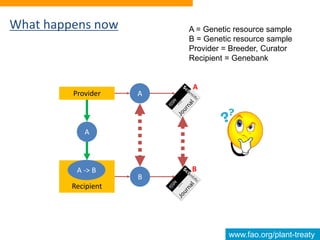
What happens now
Provider
Recipient
B
B
A
A
A
A -> B
A = Genetic resource sample
B = Genetic resource sample
Provider = Breeder, Curator
Recipient = Genebank
www.fao.org/plant-treaty
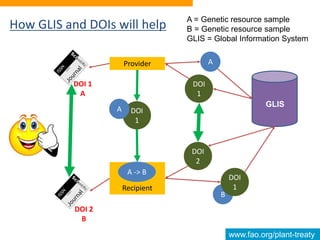
How GLIS and DOIs will help
Provider
Recipient
GLIS
DOI
1
A
A -> B
DOI
1
A
B
DOI
1
DOI
2
DOI 1
A
DOI 2
B
A = Genetic resource sample
B = Genetic resource sample
GLIS = Global Information System
www.fao.org/plant-treaty
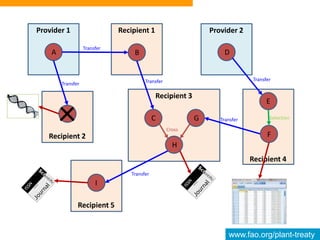
Provider 1
A
Recipient 1
B
Transfer
Recipient 2
A
Transfer
D
Provider 2
Recipient 3
C
Transfer
Recipient 5
I
Transfer
H
Cross
E
Recipient 4
Transfer
G Transfer
F
Selection
www.fao.org/plant-treaty
Assigning DOIs to PGRFAs
• What is the DOI associated to?
• Physical material, not its description
• Holder of the material
• Descriptors
• Based on Multi Crop Passport Descriptors with some extensions
• Mandatory: Holder, species, method, date, local identifier
• Recommended: Biological status, links to web resources, etc.
• Additional: Information on collecting, breeding, etc.
www.fao.org/plant-treaty
The Global Information System (GLIS)
• Identify PGRFA through Digital Object Identifiers (DOIs)
• Store basic information on PGRFA to support discovery and
resolution
• Collect links to web systems where detailed information can
be found
• Promote standards and formats to facilitate interoperability
and data sharing among systems
• Promote “blessed” systems to facilitate participation
• Capacity building and data quality improvement
www.fao.org/plant-treaty
Services offered by GLIS
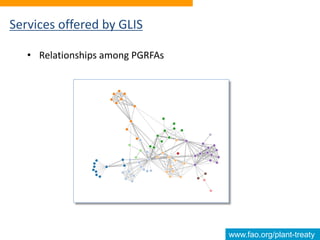
• Relationships among PGRFAs
www.fao.org/plant-treaty
Services offered by GLIS
• HasMetadata expansion
• Allows access to full set of descriptors in XML
• Descriptors in multiple formats (Content Negotiation)
• XML
• JSON
• JSON-LD
• Darwin Core-Archive
• brAPI
• EventData
• GLIS will automatically provide links to publications citing the
current PGRFA’s DOI
www.fao.org/plant-treaty
GLIS for the user community
• Free-of-charge DOI minting
• The cost is covered by the Treaty Secretariat
• The International Treaty is Member of DataCite
• The GLIS user community is represented
• Support for GLIS users
• Advice on adoption of DOIs
• Integration Toolkit
• Published formats and protocols to interoperate with GLIS
www.fao.org/plant-treaty
How you can register DOIs using GLIS
• Web form
• For small collections or for ad-hoc updates
• Excel or tab-delimited batch files
• For medium size collections or as a stop-gap solution
• XML-based protocol
• For large collections and real-time integration
www.fao.org/plant-treaty
Thank you!
http://www.fao.org/plant-treaty
PGRFA-Treaty@fao.org
marco.marsella@fao.org

FAO DOI presentation by Marco Marsella

  • 1.
    www.fao.org/plant-treaty Marco Marsella Digital ObjectIdentifiers (DOIs) for Plant Genetic Resources and the Global Information System (GLIS) of the ITPGRFA
  • 2.
    www.fao.org/plant-treaty Background • The InternationalTreaty on Plant Genetic Resources for Food and Agriculture (ITPGRFA) • Promotes conservation and sustainable use of all Plant Genetic Resources for Food and Agriculture and the fair and equitable sharing of the benefits arising out of their use • Facilitates access to PGRFA as well as to associated information • Established in 2004 • 144 contracting parties
  • 3.
    www.fao.org/plant-treaty Article 17 ofthe Treaty “The Contracting Parties shall cooperate to develop and strengthen a global information system (GLIS) to facilitate the exchange of information, based on existing information systems, on scientific, technical and environmental matters related to plant genetic resources for food and agriculture…”
  • 4.
    www.fao.org/plant-treaty The SMTA • Regulatesthe exchange of PGRFA in the Treaty framework • Also regulates the exchange of information associated to the PGRFA • Provider’s obligation: All available passport data and, subject to applicable law, any other associated available non-confidential descriptive information, shall be made available with the Plant Genetic Resources for Food and Agriculture provided • Recipient’s obligation: The Recipient shall make available to the Multilateral System, through the information system provided for in Article 17 of the Treaty, all non-confidential information that results from research and development carried out on the Material Information = benefit
  • 5.
    www.fao.org/plant-treaty Why DOIs? • Accurateidentification of the PGR is critical for scientific research and reliable information dissemination • Each PGR user community has established its own independent standards for identification • All communities agree on the importance of a common system of Permanent Unique Identifiers • DOIs have been selected after consultation with experts from many countries and diverse backgrounds
  • 6.
    www.fao.org/plant-treaty What happens now Provider Recipient B B A A A A-> B A = Genetic resource sample B = Genetic resource sample Provider = Breeder, Curator Recipient = Genebank
  • 7.
    www.fao.org/plant-treaty How GLIS andDOIs will help Provider Recipient GLIS DOI 1 A A -> B DOI 1 A B DOI 1 DOI 2 DOI 1 A DOI 2 B A = Genetic resource sample B = Genetic resource sample GLIS = Global Information System
  • 8.
    www.fao.org/plant-treaty Provider 1 A Recipient 1 B Transfer Recipient2 A Transfer D Provider 2 Recipient 3 C Transfer Recipient 5 I Transfer H Cross E Recipient 4 Transfer G Transfer F Selection
  • 9.
    www.fao.org/plant-treaty Assigning DOIs toPGRFAs • What is the DOI associated to? • Physical material, not its description • Holder of the material • Descriptors • Based on Multi Crop Passport Descriptors with some extensions • Mandatory: Holder, species, method, date, local identifier • Recommended: Biological status, links to web resources, etc. • Additional: Information on collecting, breeding, etc.
  • 10.
    www.fao.org/plant-treaty The Global InformationSystem (GLIS) • Identify PGRFA through Digital Object Identifiers (DOIs) • Store basic information on PGRFA to support discovery and resolution • Collect links to web systems where detailed information can be found • Promote standards and formats to facilitate interoperability and data sharing among systems • Promote “blessed” systems to facilitate participation • Capacity building and data quality improvement
  • 11.
    www.fao.org/plant-treaty Services offered byGLIS • Relationships among PGRFAs
  • 12.
    www.fao.org/plant-treaty Services offered byGLIS • HasMetadata expansion • Allows access to full set of descriptors in XML • Descriptors in multiple formats (Content Negotiation) • XML • JSON • JSON-LD • Darwin Core-Archive • brAPI • EventData • GLIS will automatically provide links to publications citing the current PGRFA’s DOI
  • 13.
    www.fao.org/plant-treaty GLIS for theuser community • Free-of-charge DOI minting • The cost is covered by the Treaty Secretariat • The International Treaty is Member of DataCite • The GLIS user community is represented • Support for GLIS users • Advice on adoption of DOIs • Integration Toolkit • Published formats and protocols to interoperate with GLIS
  • 14.
    www.fao.org/plant-treaty How you canregister DOIs using GLIS • Web form • For small collections or for ad-hoc updates • Excel or tab-delimited batch files • For medium size collections or as a stop-gap solution • XML-based protocol • For large collections and real-time integration
  • 15.