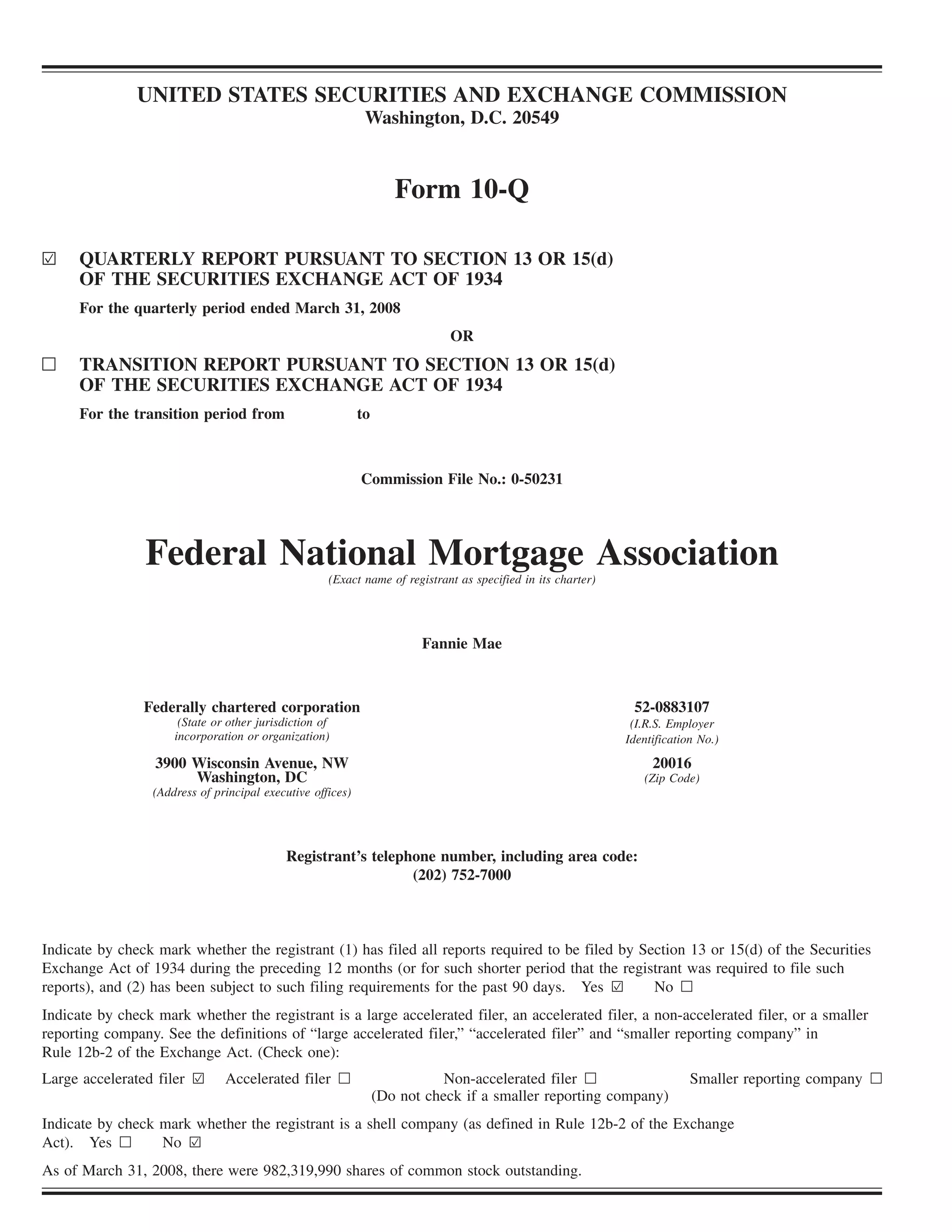
UNITED STATES SECURITIES AND EXCHANGE COMMISSION
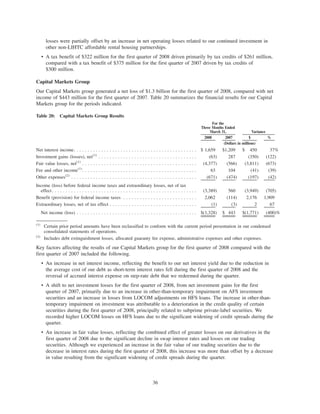
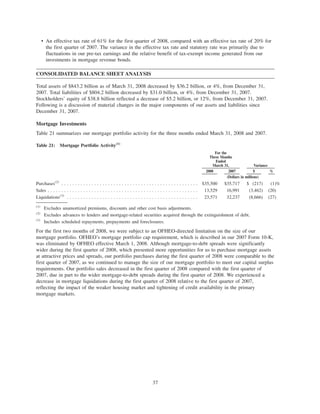
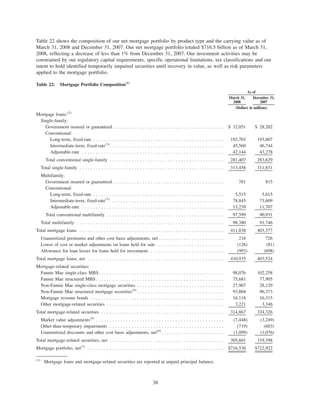
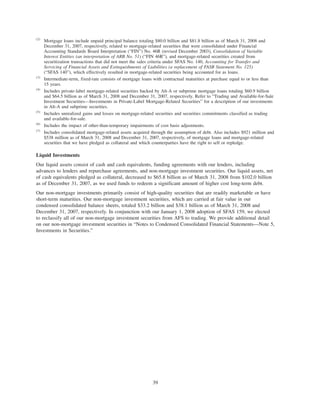
Washington, D.C. 20549
Form 10-Q
¥ QUARTERLY REPORT PURSUANT TO SECTION 13 OR 15(d)
OF THE SECURITIES EXCHANGE ACT OF 1934
For the quarterly period ended March 31, 2008
OR
n TRANSITION REPORT PURSUANT TO SECTION 13 OR 15(d)
OF THE SECURITIES EXCHANGE ACT OF 1934
For the transition period from to
Commission File No.: 0-50231
Federal National Mortgage Association(Exact name of registrant as specified in its charter)
Fannie Mae
Federally chartered corporation
(State or other jurisdiction of
incorporation or organization)
3900 Wisconsin Avenue, NW
Washington, DC
(Address of principal executive offices)
52-0883107
(I.R.S. Employer
Identification No.)
20016
(Zip Code)
Registrant’s telephone number, including area code:
(202) 752-7000
Indicate by check mark whether the registrant (1) has filed all reports required to be filed by Section 13 or 15(d) of the Securities
Exchange Act of 1934 during the preceding 12 months (or for such shorter period that the registrant was required to file such
reports), and (2) has been subject to such filing requirements for the past 90 days. Yes ¥ No n
Indicate by check mark whether the registrant is a large accelerated filer, an accelerated filer, a non-accelerated filer, or a smaller
reporting company. See the definitions of “large accelerated filer,” “accelerated filer” and “smaller reporting company” in
Rule 12b-2 of the Exchange Act. (Check one):
Large accelerated filer ¥ Accelerated filer n Non-accelerated filer n
(Do not check if a smaller reporting company)
Smaller reporting company n
Indicate by check mark whether the registrant is a shell company (as defined in Rule 12b-2 of the Exchange
Act). Yes n No ¥
As of March 31, 2008, there were 982,319,990 shares of common stock outstanding.
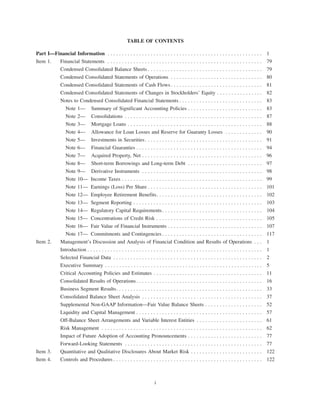
TABLE OF CONTENTS
Part I—Financial Information . . . . . . . . . . . . . . . . . . . . . . . . . . . . . . . . . . . . . . . . . . . . . . . . . . . . . . 1
Item 1. Financial Statements . . . . . . . . . . . . . . . . . . . . . . . . . . . . . . . . . . . . . . . . . . . . . . . . . . . . . . 79
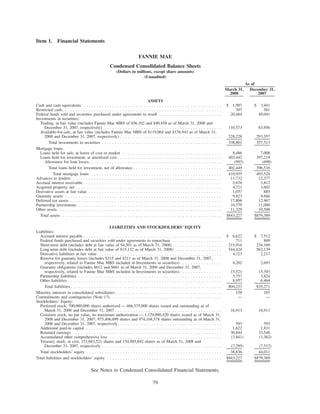
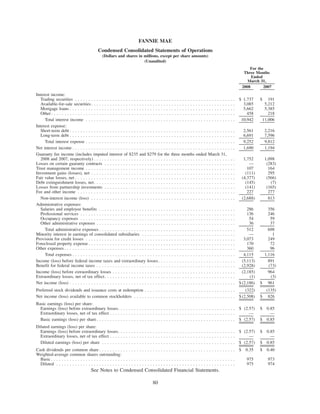
Condensed Consolidated Balance Sheets . . . . . . . . . . . . . . . . . . . . . . . . . . . . . . . . . . . . . . . . 79
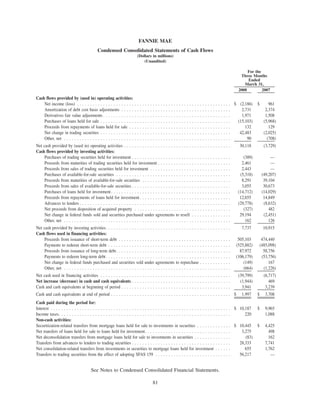
Condensed Consolidated Statements of Operations . . . . . . . . . . . . . . . . . . . . . . . . . . . . . . . . 80
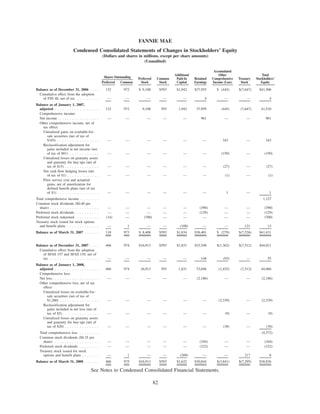
Condensed Consolidated Statements of Cash Flows . . . . . . . . . . . . . . . . . . . . . . . . . . . . . . . . 81
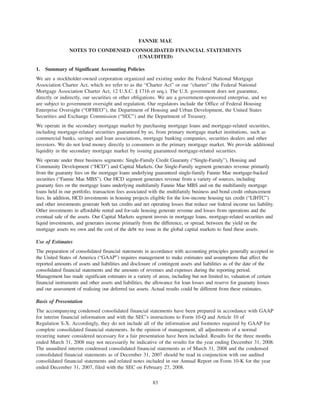
Condensed Consolidated Statements of Changes in Stockholders’ Equity . . . . . . . . . . . . . . . . 82
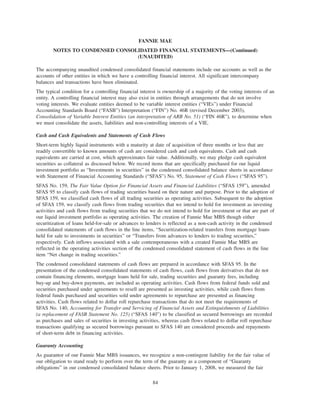
Notes to Condensed Consolidated Financial Statements . . . . . . . . . . . . . . . . . . . . . . . . . . . . . 83
Note 1— Summary of Significant Accounting Policies . . . . . . . . . . . . . . . . . . . . . . . . . . 83
Note 2— Consolidations . . . . . . . . . . . . . . . . . . . . . . . . . . . . . . . . . . . . . . . . . . . . . . . . 87
Note 3— Mortgage Loans . . . . . . . . . . . . . . . . . . . . . . . . . . . . . . . . . . . . . . . . . . . . . . . 88
Note 4— Allowance for Loan Losses and Reserve for Guaranty Losses . . . . . . . . . . . . . 90
Note 5— Investments in Securities. . . . . . . . . . . . . . . . . . . . . . . . . . . . . . . . . . . . . . . . . 91
Note 6— Financial Guaranties . . . . . . . . . . . . . . . . . . . . . . . . . . . . . . . . . . . . . . . . . . . . 94
Note 7— Acquired Property, Net . . . . . . . . . . . . . . . . . . . . . . . . . . . . . . . . . . . . . . . . . . 96
Note 8— Short-term Borrowings and Long-term Debt . . . . . . . . . . . . . . . . . . . . . . . . . . 97
Note 9— Derivative Instruments . . . . . . . . . . . . . . . . . . . . . . . . . . . . . . . . . . . . . . . . . . 98
Note 10— Income Taxes . . . . . . . . . . . . . . . . . . . . . . . . . . . . . . . . . . . . . . . . . . . . . . . . . 99
Note 11— Earnings (Loss) Per Share . . . . . . . . . . . . . . . . . . . . . . . . . . . . . . . . . . . . . . . . 101
Note 12— Employee Retirement Benefits. . . . . . . . . . . . . . . . . . . . . . . . . . . . . . . . . . . . . 102
Note 13— Segment Reporting . . . . . . . . . . . . . . . . . . . . . . . . . . . . . . . . . . . . . . . . . . . . . 103
Note 14— Regulatory Capital Requirements. . . . . . . . . . . . . . . . . . . . . . . . . . . . . . . . . . . 104
Note 15— Concentrations of Credit Risk . . . . . . . . . . . . . . . . . . . . . . . . . . . . . . . . . . . . . 105
Note 16— Fair Value of Financial Instruments . . . . . . . . . . . . . . . . . . . . . . . . . . . . . . . . . 107
Note 17— Commitments and Contingencies . . . . . . . . . . . . . . . . . . . . . . . . . . . . . . . . . . . 117
Item 2. Management’s Discussion and Analysis of Financial Condition and Results of Operations . . . 1
Introduction . . . . . . . . . . . . . . . . . . . . . . . . . . . . . . . . . . . . . . . . . . . . . . . . . . . . . . . . . . . . . 1
Selected Financial Data . . . . . . . . . . . . . . . . . . . . . . . . . . . . . . . . . . . . . . . . . . . . . . . . . . . . 2
Executive Summary . . . . . . . . . . . . . . . . . . . . . . . . . . . . . . . . . . . . . . . . . . . . . . . . . . . . . . . 5
Critical Accounting Policies and Estimates . . . . . . . . . . . . . . . . . . . . . . . . . . . . . . . . . . . . . . 11
Consolidated Results of Operations. . . . . . . . . . . . . . . . . . . . . . . . . . . . . . . . . . . . . . . . . . . . 16
Business Segment Results. . . . . . . . . . . . . . . . . . . . . . . . . . . . . . . . . . . . . . . . . . . . . . . . . . . 33
Consolidated Balance Sheet Analysis . . . . . . . . . . . . . . . . . . . . . . . . . . . . . . . . . . . . . . . . . . 37
Supplemental Non-GAAP Information—Fair Value Balance Sheets . . . . . . . . . . . . . . . . . . . . 52
Liquidity and Capital Management . . . . . . . . . . . . . . . . . . . . . . . . . . . . . . . . . . . . . . . . . . . . 57
Off-Balance Sheet Arrangements and Variable Interest Entities . . . . . . . . . . . . . . . . . . . . . . . 61
Risk Management . . . . . . . . . . . . . . . . . . . . . . . . . . . . . . . . . . . . . . . . . . . . . . . . . . . . . . . . 62
Impact of Future Adoption of Accounting Pronouncements . . . . . . . . . . . . . . . . . . . . . . . . . . 77
Forward-Looking Statements . . . . . . . . . . . . . . . . . . . . . . . . . . . . . . . . . . . . . . . . . . . . . . . . 77
Item 3. Quantitative and Qualitative Disclosures About Market Risk . . . . . . . . . . . . . . . . . . . . . . . . . 122
Item 4. Controls and Procedures . . . . . . . . . . . . . . . . . . . . . . . . . . . . . . . . . . . . . . . . . . . . . . . . . . . . 122
i
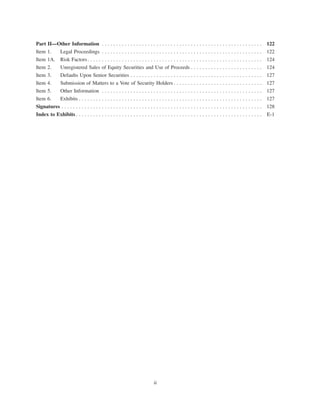
Part II—Other Information . . . . . . . . . . . . . . . . . . . . . . . . . . . . . . . . . . . . . . . . . . . . . . . . . . . . . . . . 122
Item 1. Legal Proceedings . . . . . . . . . . . . . . . . . . . . . . . . . . . . . . . . . . . . . . . . . . . . . . . . . . . . . . . . 122
Item 1A. Risk Factors. . . . . . . . . . . . . . . . . . . . . . . . . . . . . . . . . . . . . . . . . . . . . . . . . . . . . . . . . . . . . 124
Item 2. Unregistered Sales of Equity Securities and Use of Proceeds . . . . . . . . . . . . . . . . . . . . . . . . . 124
Item 3. Defaults Upon Senior Securities . . . . . . . . . . . . . . . . . . . . . . . . . . . . . . . . . . . . . . . . . . . . . . 127
Item 4. Submission of Matters to a Vote of Security Holders . . . . . . . . . . . . . . . . . . . . . . . . . . . . . . . 127
Item 5. Other Information . . . . . . . . . . . . . . . . . . . . . . . . . . . . . . . . . . . . . . . . . . . . . . . . . . . . . . . . 127
Item 6. Exhibits . . . . . . . . . . . . . . . . . . . . . . . . . . . . . . . . . . . . . . . . . . . . . . . . . . . . . . . . . . . . . . . . 127
Signatures . . . . . . . . . . . . . . . . . . . . . . . . . . . . . . . . . . . . . . . . . . . . . . . . . . . . . . . . . . . . . . . . . . . . . . 128
Index to Exhibits . . . . . . . . . . . . . . . . . . . . . . . . . . . . . . . . . . . . . . . . . . . . . . . . . . . . . . . . . . . . . . . . . E-1
ii
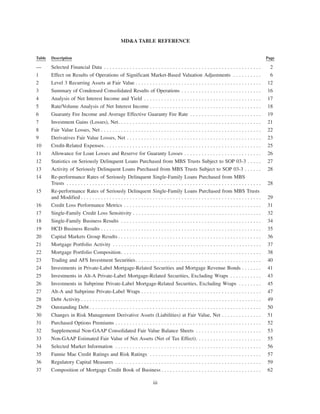
MD&A TABLE REFERENCE
Table Description Page
— Selected Financial Data . . . . . . . . . . . . . . . . . . . . . . . . . . . . . . . . . . . . . . . . . . . . . . . . . . . . . . . 2
1 Effect on Results of Operations of Significant Market-Based Valuation Adjustments . . . . . . . . . . 6
2 Level 3 Recurring Assets at Fair Value . . . . . . . . . . . . . . . . . . . . . . . . . . . . . . . . . . . . . . . . . . . . 12
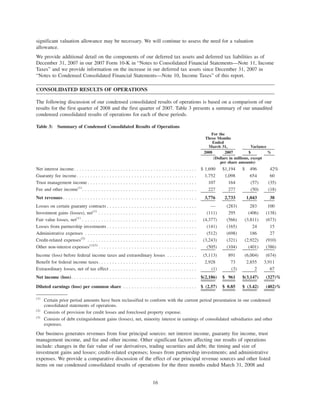
3 Summary of Condensed Consolidated Results of Operations . . . . . . . . . . . . . . . . . . . . . . . . . . . . 16
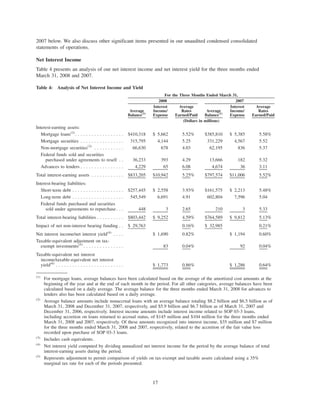
4 Analysis of Net Interest Income and Yield . . . . . . . . . . . . . . . . . . . . . . . . . . . . . . . . . . . . . . . . . 17
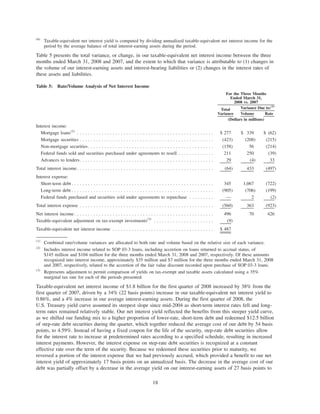
5 Rate/Volume Analysis of Net Interest Income . . . . . . . . . . . . . . . . . . . . . . . . . . . . . . . . . . . . . . . 18
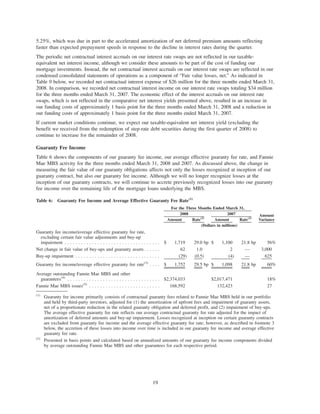
6 Guaranty Fee Income and Average Effective Guaranty Fee Rate . . . . . . . . . . . . . . . . . . . . . . . . . 19
7 Investment Gains (Losses), Net. . . . . . . . . . . . . . . . . . . . . . . . . . . . . . . . . . . . . . . . . . . . . . . . . . 21
8 Fair Value Losses, Net . . . . . . . . . . . . . . . . . . . . . . . . . . . . . . . . . . . . . . . . . . . . . . . . . . . . . . . . 22
9 Derivatives Fair Value Losses, Net . . . . . . . . . . . . . . . . . . . . . . . . . . . . . . . . . . . . . . . . . . . . . . . 23
10 Credit-Related Expenses. . . . . . . . . . . . . . . . . . . . . . . . . . . . . . . . . . . . . . . . . . . . . . . . . . . . . . . 25
11 Allowance for Loan Losses and Reserve for Guaranty Losses . . . . . . . . . . . . . . . . . . . . . . . . . . . 26
12 Statistics on Seriously Delinquent Loans Purchased from MBS Trusts Subject to SOP 03-3 . . . . . 27
13 Activity of Seriously Delinquent Loans Purchased from MBS Trusts Subject to SOP 03-3 . . . . . . 28
14 Re-performance Rates of Seriously Delinquent Single-Family Loans Purchased from MBS
Trusts . . . . . . . . . . . . . . . . . . . . . . . . . . . . . . . . . . . . . . . . . . . . . . . . . . . . . . . . . . . . . . . . . . . . 28
15 Re-performance Rates of Seriously Delinquent Single-Family Loans Purchased from MBS Trusts
and Modified . . . . . . . . . . . . . . . . . . . . . . . . . . . . . . . . . . . . . . . . . . . . . . . . . . . . . . . . . . . . . . . 29
16 Credit Loss Performance Metrics . . . . . . . . . . . . . . . . . . . . . . . . . . . . . . . . . . . . . . . . . . . . . . . . 31
17 Single-Family Credit Loss Sensitivity . . . . . . . . . . . . . . . . . . . . . . . . . . . . . . . . . . . . . . . . . . . . . 32
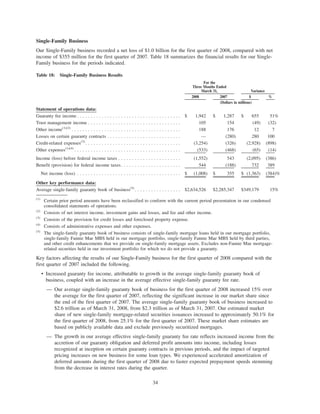
18 Single-Family Business Results . . . . . . . . . . . . . . . . . . . . . . . . . . . . . . . . . . . . . . . . . . . . . . . . . 34
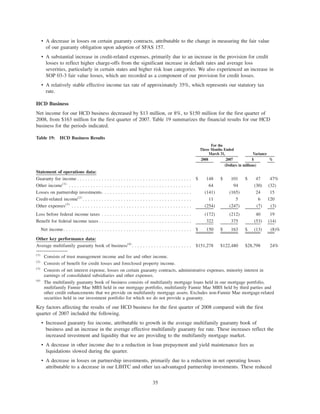
19 HCD Business Results . . . . . . . . . . . . . . . . . . . . . . . . . . . . . . . . . . . . . . . . . . . . . . . . . . . . . . . . 35
20 Capital Markets Group Results . . . . . . . . . . . . . . . . . . . . . . . . . . . . . . . . . . . . . . . . . . . . . . . . . . 36
21 Mortgage Portfolio Activity . . . . . . . . . . . . . . . . . . . . . . . . . . . . . . . . . . . . . . . . . . . . . . . . . . . . 37
22 Mortgage Portfolio Composition. . . . . . . . . . . . . . . . . . . . . . . . . . . . . . . . . . . . . . . . . . . . . . . . . 38
23 Trading and AFS Investment Securities. . . . . . . . . . . . . . . . . . . . . . . . . . . . . . . . . . . . . . . . . . . . 40
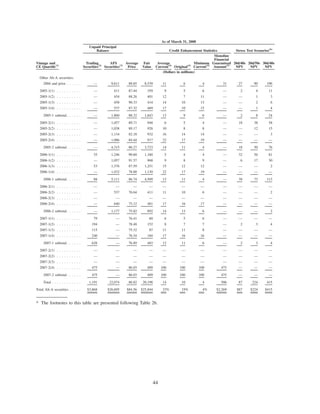
24 Investments in Private-Label Mortgage-Related Securities and Mortgage Revenue Bonds . . . . . . . 41
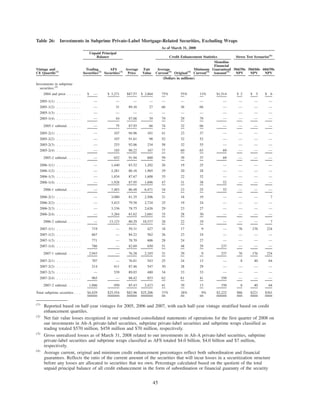
25 Investments in Alt-A Private-Label Mortgage-Related Securities, Excluding Wraps . . . . . . . . . . . 43
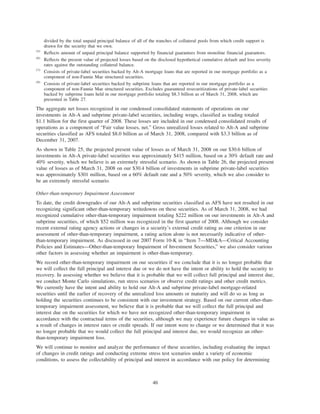
26 Investments in Subprime Private-Label Mortgage-Related Securities, Excluding Wraps . . . . . . . . 45
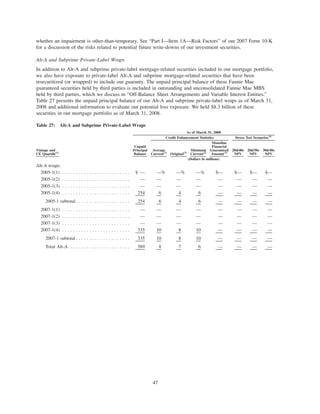
27 Alt-A and Subprime Private-Label Wraps . . . . . . . . . . . . . . . . . . . . . . . . . . . . . . . . . . . . . . . . . . 47
28 Debt Activity . . . . . . . . . . . . . . . . . . . . . . . . . . . . . . . . . . . . . . . . . . . . . . . . . . . . . . . . . . . . . . . 49
29 Outstanding Debt . . . . . . . . . . . . . . . . . . . . . . . . . . . . . . . . . . . . . . . . . . . . . . . . . . . . . . . . . . . . 50
30 Changes in Risk Management Derivative Assets (Liabilities) at Fair Value, Net . . . . . . . . . . . . . . 51
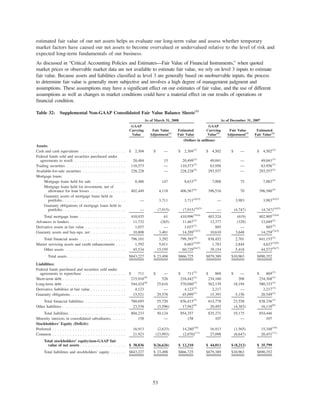
31 Purchased Options Premiums . . . . . . . . . . . . . . . . . . . . . . . . . . . . . . . . . . . . . . . . . . . . . . . . . . . 52
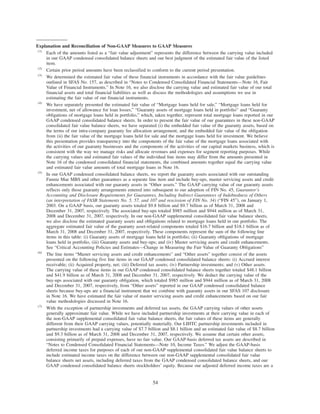
32 Supplemental Non-GAAP Consolidated Fair Value Balance Sheets . . . . . . . . . . . . . . . . . . . . . . . 53
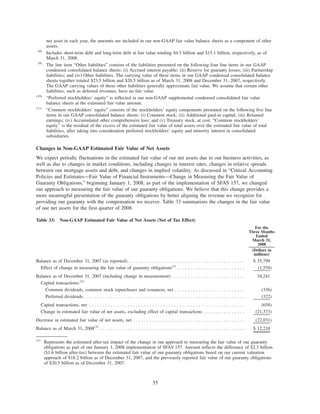
33 Non-GAAP Estimated Fair Value of Net Assets (Net of Tax Effect). . . . . . . . . . . . . . . . . . . . . . . 55
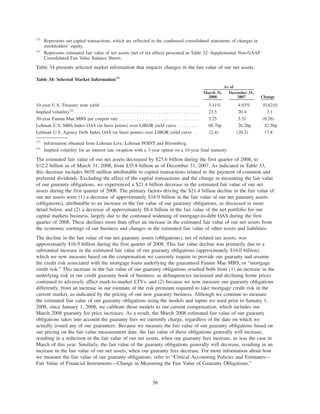
34 Selected Market Information . . . . . . . . . . . . . . . . . . . . . . . . . . . . . . . . . . . . . . . . . . . . . . . . . . . 56
35 Fannie Mae Credit Ratings and Risk Ratings . . . . . . . . . . . . . . . . . . . . . . . . . . . . . . . . . . . . . . . 57
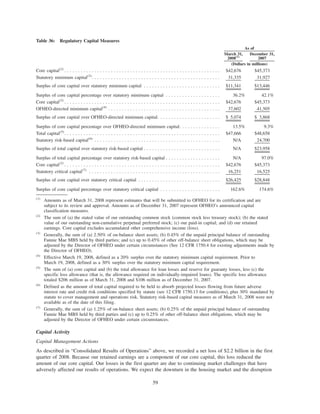
36 Regulatory Capital Measures . . . . . . . . . . . . . . . . . . . . . . . . . . . . . . . . . . . . . . . . . . . . . . . . . . . 59
37 Composition of Mortgage Credit Book of Business . . . . . . . . . . . . . . . . . . . . . . . . . . . . . . . . . . . 62
iii
Table Description Page
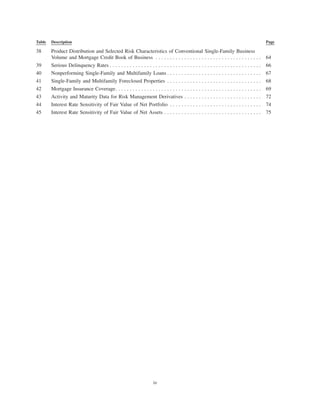
38 Product Distribution and Selected Risk Characteristics of Conventional Single-Family Business
Volume and Mortgage Credit Book of Business . . . . . . . . . . . . . . . . . . . . . . . . . . . . . . . . . . . . . 64
39 Serious Delinquency Rates . . . . . . . . . . . . . . . . . . . . . . . . . . . . . . . . . . . . . . . . . . . . . . . . . . . . . 66
40 Nonperforming Single-Family and Multifamily Loans . . . . . . . . . . . . . . . . . . . . . . . . . . . . . . . . . 67
41 Single-Family and Multifamily Foreclosed Properties . . . . . . . . . . . . . . . . . . . . . . . . . . . . . . . . . 68
42 Mortgage Insurance Coverage. . . . . . . . . . . . . . . . . . . . . . . . . . . . . . . . . . . . . . . . . . . . . . . . . . . 69
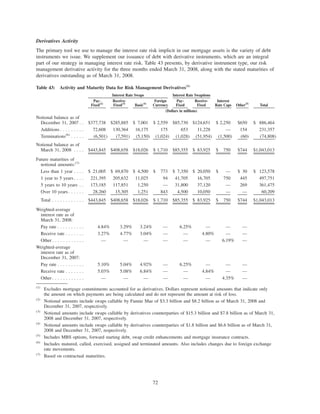
43 Activity and Maturity Data for Risk Management Derivatives . . . . . . . . . . . . . . . . . . . . . . . . . . . 72
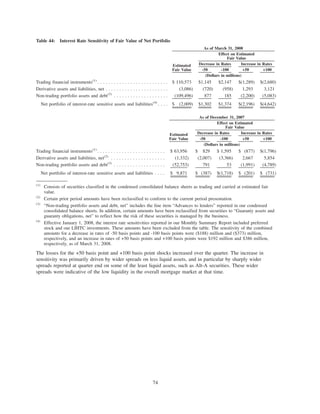
44 Interest Rate Sensitivity of Fair Value of Net Portfolio . . . . . . . . . . . . . . . . . . . . . . . . . . . . . . . . 74
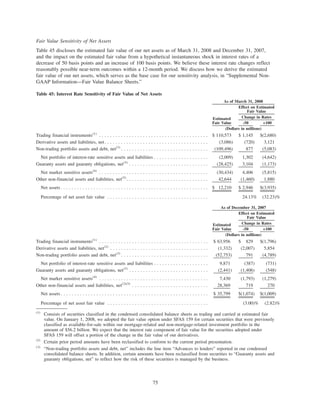
45 Interest Rate Sensitivity of Fair Value of Net Assets . . . . . . . . . . . . . . . . . . . . . . . . . . . . . . . . . . 75
iv
PART I—FINANCIAL INFORMATION
Item 2. Management’s Discussion and Analysis of Financial Condition and Results of Operations
You should read this Management’s Discussion and Analysis of Financial Condition and Results of Operations
(“MD&A”) in conjunction with our unaudited condensed consolidated financial statements and related notes,
and the more detailed information contained in our Annual Report on Form 10-K for the year ended
December 31, 2007 (“2007 Form 10-K”). The results of operations presented in our interim financial
statements and discussed in MD&A are not necessarily indicative of the results that may be expected for the
full year. Please refer to “Glossary of Terms Used in This Report” in our 2007 Form 10-K for an explanation
of key terms used throughout this discussion.
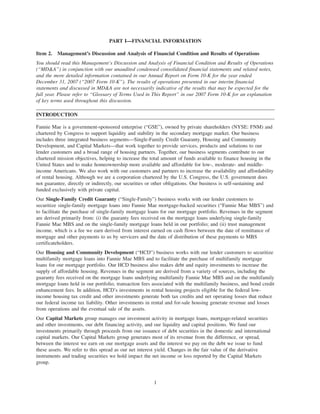
INTRODUCTION
Fannie Mae is a government-sponsored enterprise (“GSE”), owned by private shareholders (NYSE: FNM) and
chartered by Congress to support liquidity and stability in the secondary mortgage market. Our business
includes three integrated business segments—Single-Family Credit Guaranty, Housing and Community
Development, and Capital Markets—that work together to provide services, products and solutions to our
lender customers and a broad range of housing partners. Together, our business segments contribute to our
chartered mission objectives, helping to increase the total amount of funds available to finance housing in the
United States and to make homeownership more available and affordable for low-, moderate- and middle-
income Americans. We also work with our customers and partners to increase the availability and affordability
of rental housing. Although we are a corporation chartered by the U.S. Congress, the U.S. government does
not guarantee, directly or indirectly, our securities or other obligations. Our business is self-sustaining and
funded exclusively with private capital.
Our Single-Family Credit Guaranty (“Single-Family”) business works with our lender customers to
securitize single-family mortgage loans into Fannie Mae mortgage-backed securities (“Fannie Mae MBS”) and
to facilitate the purchase of single-family mortgage loans for our mortgage portfolio. Revenues in the segment
are derived primarily from: (i) the guaranty fees received on the mortgage loans underlying single-family
Fannie Mae MBS and on the single-family mortgage loans held in our portfolio; and (ii) trust management
income, which is a fee we earn derived from interest earned on cash flows between the date of remittance of
mortgage and other payments to us by servicers and the date of distribution of these payments to MBS
certificateholders.
Our Housing and Community Development (“HCD”) business works with our lender customers to securitize
multifamily mortgage loans into Fannie Mae MBS and to facilitate the purchase of multifamily mortgage
loans for our mortgage portfolio. Our HCD business also makes debt and equity investments to increase the
supply of affordable housing. Revenues in the segment are derived from a variety of sources, including the
guaranty fees received on the mortgage loans underlying multifamily Fannie Mae MBS and on the multifamily
mortgage loans held in our portfolio, transaction fees associated with the multifamily business, and bond credit
enhancement fees. In addition, HCD’s investments in rental housing projects eligible for the federal low-
income housing tax credit and other investments generate both tax credits and net operating losses that reduce
our federal income tax liability. Other investments in rental and for-sale housing generate revenue and losses
from operations and the eventual sale of the assets.
Our Capital Markets group manages our investment activity in mortgage loans, mortgage-related securities
and other investments, our debt financing activity, and our liquidity and capital positions. We fund our
investments primarily through proceeds from our issuance of debt securities in the domestic and international
capital markets. Our Capital Markets group generates most of its revenue from the difference, or spread,
between the interest we earn on our mortgage assets and the interest we pay on the debt we issue to fund
these assets. We refer to this spread as our net interest yield. Changes in the fair value of the derivative
instruments and trading securities we hold impact the net income or loss reported by the Capital Markets
group.
1
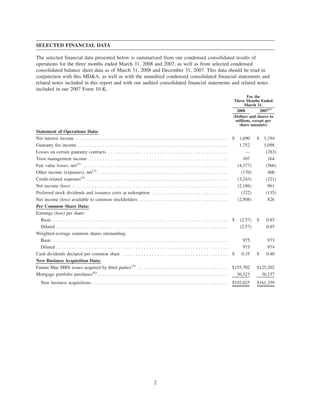
SELECTED FINANCIAL DATA
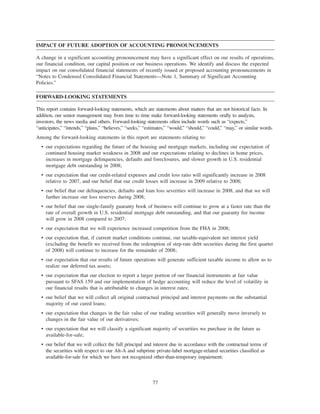
The selected financial data presented below is summarized from our condensed consolidated results of
operations for the three months ended March 31, 2008 and 2007, as well as from selected condensed
consolidated balance sheet data as of March 31, 2008 and December 31, 2007. This data should be read in
conjunction with this MD&A, as well as with the unaudited condensed consolidated financial statements and
related notes included in this report and with our audited consolidated financial statements and related notes
included in our 2007 Form 10-K.
2008 2007(1)
For the
Three Months Ended
March 31,
(Dollars and shares in
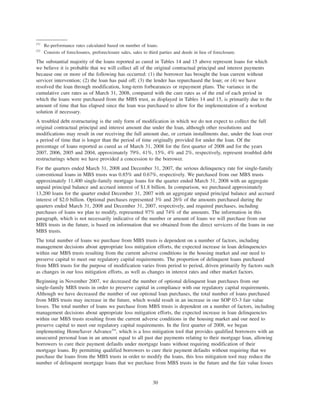
millions, except per
share amounts)
Statement of Operations Data:
Net interest income . . . . . . . . . . . . . . . . . . . . . . . . . . . . . . . . . . . . . . . . . . . . . . . . . . . . . . . . $ 1,690 $ 1,194
Guaranty fee income . . . . . . . . . . . . . . . . . . . . . . . . . . . . . . . . . . . . . . . . . . . . . . . . . . . . . . . 1,752 1,098
Losses on certain guaranty contracts . . . . . . . . . . . . . . . . . . . . . . . . . . . . . . . . . . . . . . . . . . . . — (283)
Trust management income . . . . . . . . . . . . . . . . . . . . . . . . . . . . . . . . . . . . . . . . . . . . . . . . . . . 107 164
Fair value losses, net(2)
. . . . . . . . . . . . . . . . . . . . . . . . . . . . . . . . . . . . . . . . . . . . . . . . . . . . . (4,377) (566)
Other income (expenses), net(3)
. . . . . . . . . . . . . . . . . . . . . . . . . . . . . . . . . . . . . . . . . . . . . . . . (170) 400
Credit-related expenses(4)
. . . . . . . . . . . . . . . . . . . . . . . . . . . . . . . . . . . . . . . . . . . . . . . . . . . . (3,243) (321)
Net income (loss) . . . . . . . . . . . . . . . . . . . . . . . . . . . . . . . . . . . . . . . . . . . . . . . . . . . . . . . . . (2,186) 961
Preferred stock dividends and issuance costs at redemption . . . . . . . . . . . . . . . . . . . . . . . . . . . . (322) (135)
Net income (loss) available to common stockholders . . . . . . . . . . . . . . . . . . . . . . . . . . . . . . . . . (2,508) 826
Per Common Share Data:
Earnings (loss) per share:
Basic . . . . . . . . . . . . . . . . . . . . . . . . . . . . . . . . . . . . . . . . . . . . . . . . . . . . . . . . . . . . . . . . $ (2.57) $ 0.85
Diluted . . . . . . . . . . . . . . . . . . . . . . . . . . . . . . . . . . . . . . . . . . . . . . . . . . . . . . . . . . . . . . . (2.57) 0.85
Weighted-average common shares outstanding:
Basic . . . . . . . . . . . . . . . . . . . . . . . . . . . . . . . . . . . . . . . . . . . . . . . . . . . . . . . . . . . . . . . . 975 973
Diluted . . . . . . . . . . . . . . . . . . . . . . . . . . . . . . . . . . . . . . . . . . . . . . . . . . . . . . . . . . . . . . . 975 974
Cash dividends declared per common share . . . . . . . . . . . . . . . . . . . . . . . . . . . . . . . . . . . . . . . $ 0.35 $ 0.40
New Business Acquisition Data:
Fannie Mae MBS issues acquired by third parties(5)
. . . . . . . . . . . . . . . . . . . . . . . . . . . . . . . . . $155,702 $125,202
Mortgage portfolio purchases(6)
. . . . . . . . . . . . . . . . . . . . . . . . . . . . . . . . . . . . . . . . . . . . . . . . 36,323 36,157
New business acquisitions . . . . . . . . . . . . . . . . . . . . . . . . . . . . . . . . . . . . . . . . . . . . . . . . . . $192,025 $161,359
2
March 31,
2008
December 31,
2007(1)
As of
(Dollars in millions)
Balance Sheet Data:
Investments in securities:
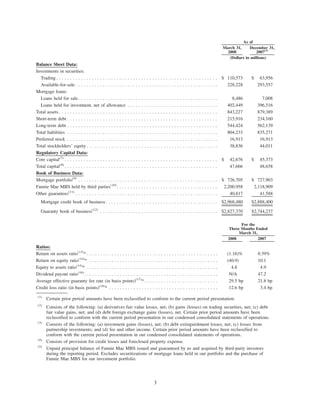
Trading . . . . . . . . . . . . . . . . . . . . . . . . . . . . . . . . . . . . . . . . . . . . . . . . . . . . . . . . . . . $ 110,573 $ 63,956
Available-for-sale . . . . . . . . . . . . . . . . . . . . . . . . . . . . . . . . . . . . . . . . . . . . . . . . . . . . 228,228 293,557
Mortgage loans:
Loans held for sale. . . . . . . . . . . . . . . . . . . . . . . . . . . . . . . . . . . . . . . . . . . . . . . . . . . 8,486 7,008
Loans held for investment, net of allowance . . . . . . . . . . . . . . . . . . . . . . . . . . . . . . . . . 402,449 396,516
Total assets . . . . . . . . . . . . . . . . . . . . . . . . . . . . . . . . . . . . . . . . . . . . . . . . . . . . . . . . . . 843,227 879,389
Short-term debt . . . . . . . . . . . . . . . . . . . . . . . . . . . . . . . . . . . . . . . . . . . . . . . . . . . . . . . 215,916 234,160
Long-term debt . . . . . . . . . . . . . . . . . . . . . . . . . . . . . . . . . . . . . . . . . . . . . . . . . . . . . . . 544,424 562,139
Total liabilities . . . . . . . . . . . . . . . . . . . . . . . . . . . . . . . . . . . . . . . . . . . . . . . . . . . . . . . 804,233 835,271
Preferred stock . . . . . . . . . . . . . . . . . . . . . . . . . . . . . . . . . . . . . . . . . . . . . . . . . . . . . . . 16,913 16,913
Total stockholders’ equity . . . . . . . . . . . . . . . . . . . . . . . . . . . . . . . . . . . . . . . . . . . . . . . . 38,836 44,011
Regulatory Capital Data:
Core capital(7)
. . . . . . . . . . . . . . . . . . . . . . . . . . . . . . . . . . . . . . . . . . . . . . . . . . . . . . . . $ 42,676 $ 45,373
Total capital(8)
. . . . . . . . . . . . . . . . . . . . . . . . . . . . . . . . . . . . . . . . . . . . . . . . . . . . . . . . 47,666 48,658
Book of Business Data:
Mortgage portfolio(9)
. . . . . . . . . . . . . . . . . . . . . . . . . . . . . . . . . . . . . . . . . . . . . . . . . . . $ 726,705 $ 727,903
Fannie Mae MBS held by third parties(10)
. . . . . . . . . . . . . . . . . . . . . . . . . . . . . . . . . . . . . 2,200,958 2,118,909
Other guarantees(11)
. . . . . . . . . . . . . . . . . . . . . . . . . . . . . . . . . . . . . . . . . . . . . . . . . . . . 40,817 41,588
Mortgage credit book of business. . . . . . . . . . . . . . . . . . . . . . . . . . . . . . . . . . . . . . . . . $2,968,480 $2,888,400
Guaranty book of business(12)
. . . . . . . . . . . . . . . . . . . . . . . . . . . . . . . . . . . . . . . . . . . $2,827,370 $2,744,237
2008 2007
For the
Three Months Ended
March 31,
Ratios:
Return on assets ratio(13)
* . . . . . . . . . . . . . . . . . . . . . . . . . . . . . . . . . . . . . . . . . . . . . . . . (1.16)% 0.39%
Return on equity ratio(14)
* . . . . . . . . . . . . . . . . . . . . . . . . . . . . . . . . . . . . . . . . . . . . . . . (40.9) 10.1
Equity to assets ratio(15)
* . . . . . . . . . . . . . . . . . . . . . . . . . . . . . . . . . . . . . . . . . . . . . . . . 4.8 4.9
Dividend payout ratio(16)
. . . . . . . . . . . . . . . . . . . . . . . . . . . . . . . . . . . . . . . . . . . . . . . . . N/A 47.2
Average effective guaranty fee rate (in basis points)(17)
* . . . . . . . . . . . . . . . . . . . . . . . . . . . 29.5 bp 21.8 bp
Credit loss ratio (in basis points)(18)
* . . . . . . . . . . . . . . . . . . . . . . . . . . . . . . . . . . . . . . . . 12.6 bp 3.4 bp
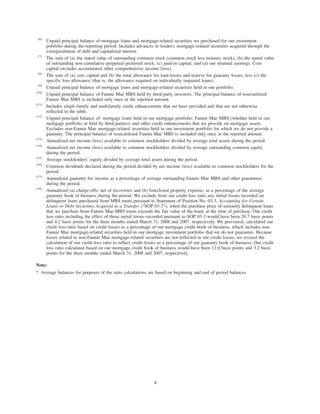
(1)
Certain prior period amounts have been reclassified to conform to the current period presentation.
(2)
Consists of the following: (a) derivatives fair value losses, net; (b) gains (losses) on trading securities, net; (c) debt
fair value gains, net; and (d) debt foreign exchange gains (losses), net. Certain prior period amounts have been
reclassified to conform with the current period presentation in our condensed consolidated statements of operations.
(3)
Consists of the following: (a) investment gains (losses), net; (b) debt extinguishment losses, net; (c) losses from
partnership investments; and (d) fee and other income. Certain prior period amounts have been reclassified to
conform with the current period presentation in our condensed consolidated statements of operations.
(4)
Consists of provision for credit losses and foreclosed property expense.
(5)
Unpaid principal balance of Fannie Mae MBS issued and guaranteed by us and acquired by third-party investors
during the reporting period. Excludes securitizations of mortgage loans held in our portfolio and the purchase of
Fannie Mae MBS for our investment portfolio.
3
(6)
Unpaid principal balance of mortgage loans and mortgage-related securities we purchased for our investment
portfolio during the reporting period. Includes advances to lenders, mortgage-related securities acquired through the
extinguishment of debt and capitalized interest.
(7)
The sum of (a) the stated value of outstanding common stock (common stock less treasury stock); (b) the stated value
of outstanding non-cumulative perpetual preferred stock; (c) paid-in capital; and (d) our retained earnings. Core
capital excludes accumulated other comprehensive income (loss).
(8)
The sum of (a) core capital and (b) the total allowance for loan losses and reserve for guaranty losses, less (c) the
specific loss allowance (that is, the allowance required on individually impaired loans).
(9)
Unpaid principal balance of mortgage loans and mortgage-related securities held in our portfolio.
(10)
Unpaid principal balance of Fannie Mae MBS held by third-party investors. The principal balance of resecuritized
Fannie Mae MBS is included only once in the reported amount.
(11)
Includes single-family and multifamily credit enhancements that we have provided and that are not otherwise
reflected in the table.
(12)
Unpaid principal balance of: mortgage loans held in our mortgage portfolio; Fannie Mae MBS (whether held in our
mortgage portfolio or held by third parties); and other credit enhancements that we provide on mortgage assets.
Excludes non-Fannie Mae mortgage-related securities held in our investment portfolio for which we do not provide a
guaranty. The principal balance of resecuritized Fannie Mae MBS is included only once in the reported amount.
(13)
Annualized net income (loss) available to common stockholders divided by average total assets during the period.
(14)
Annualized net income (loss) available to common stockholders divided by average outstanding common equity
during the period.
(15)
Average stockholders’ equity divided by average total assets during the period.
(16)
Common dividends declared during the period divided by net income (loss) available to common stockholders for the
period.
(17)
Annualized guaranty fee income as a percentage of average outstanding Fannie Mae MBS and other guarantees
during the period.
(18)
Annualized (a) charge-offs, net of recoveries and (b) foreclosed property expense, as a percentage of the average
guaranty book of business during the period. We exclude from our credit loss ratio any initial losses recorded on
delinquent loans purchased from MBS trusts pursuant to Statement of Position No. 03-3, Accounting for Certain
Loans or Debt Securities Acquired in a Transfer (“SOP 03-3”), when the purchase price of seriously delinquent loans
that we purchase from Fannie Mae MBS trusts exceeds the fair value of the loans at the time of purchase. Our credit
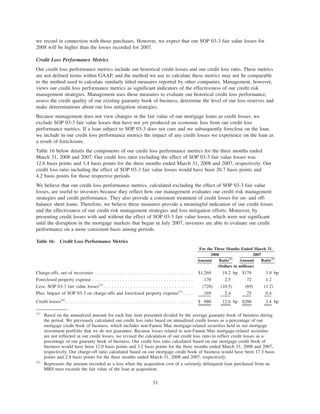
loss ratio including the effect of these initial losses recorded pursuant to SOP 03-3 would have been 20.7 basis points
and 4.2 basis points for the three months ended March 31, 2008 and 2007, respectively. We previously calculated our
credit loss ratio based on credit losses as a percentage of our mortgage credit book of business, which includes non-
Fannie Mae mortgage-related securities held in our mortgage investment portfolio that we do not guarantee. Because
losses related to non-Fannie Mae mortgage-related securities are not reflected in our credit losses, we revised the
calculation of our credit loss ratio to reflect credit losses as a percentage of our guaranty book of business. Our credit
loss ratio calculated based on our mortgage credit book of business would have been 12.0 basis points and 3.2 basis
points for the three months ended March 31, 2008 and 2007, respectively.
Note:
* Average balances for purposes of the ratio calculations are based on beginning and end of period balances.
4
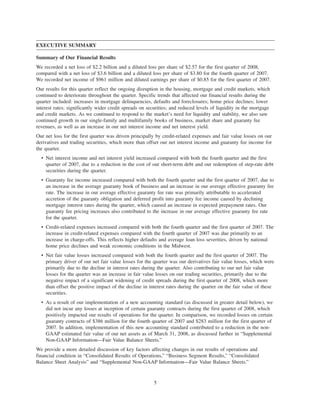
EXECUTIVE SUMMARY
Summary of Our Financial Results
We recorded a net loss of $2.2 billion and a diluted loss per share of $2.57 for the first quarter of 2008,
compared with a net loss of $3.6 billion and a diluted loss per share of $3.80 for the fourth quarter of 2007.
We recorded net income of $961 million and diluted earnings per share of $0.85 for the first quarter of 2007.
Our results for this quarter reflect the ongoing disruption in the housing, mortgage and credit markets, which
continued to deteriorate throughout the quarter. Specific trends that affected our financial results during the
quarter included: increases in mortgage delinquencies, defaults and foreclosures; home price declines; lower
interest rates; significantly wider credit spreads on securities; and reduced levels of liquidity in the mortgage
and credit markets. As we continued to respond to the market’s need for liquidity and stability, we also saw
continued growth in our single-family and multifamily books of business, market share and guaranty fee
revenues, as well as an increase in our net interest income and net interest yield.
Our net loss for the first quarter was driven principally by credit-related expenses and fair value losses on our
derivatives and trading securities, which more than offset our net interest income and guaranty fee income for
the quarter.
• Net interest income and net interest yield increased compared with both the fourth quarter and the first
quarter of 2007, due to a reduction in the cost of our short-term debt and our redemption of step-rate debt
securities during the quarter.
• Guaranty fee income increased compared with both the fourth quarter and the first quarter of 2007, due to
an increase in the average guaranty book of business and an increase in our average effective guaranty fee
rate. The increase in our average effective guaranty fee rate was primarily attributable to accelerated
accretion of the guaranty obligation and deferred profit into guaranty fee income caused by declining
mortgage interest rates during the quarter, which caused an increase in expected prepayment rates. Our
guaranty fee pricing increases also contributed to the increase in our average effective guaranty fee rate
for the quarter.
• Credit-related expenses increased compared with both the fourth quarter and the first quarter of 2007. The
increase in credit-related expenses compared with the fourth quarter of 2007 was due primarily to an
increase in charge-offs. This reflects higher defaults and average loan loss severities, driven by national
home price declines and weak economic conditions in the Midwest.
• Net fair value losses increased compared with both the fourth quarter and the first quarter of 2007. The
primary driver of our net fair value losses for the quarter was our derivatives fair value losses, which were
primarily due to the decline in interest rates during the quarter. Also contributing to our net fair value
losses for the quarter was an increase in fair value losses on our trading securities, primarily due to the
negative impact of a significant widening of credit spreads during the first quarter of 2008, which more
than offset the positive impact of the decline in interest rates during the quarter on the fair value of these
securities.
• As a result of our implementation of a new accounting standard (as discussed in greater detail below), we
did not incur any losses at inception of certain guaranty contracts during the first quarter of 2008, which
positively impacted our results of operations for the quarter. In comparison, we recorded losses on certain
guaranty contracts of $386 million for the fourth quarter of 2007 and $283 million for the first quarter of
2007. In addition, implementation of this new accounting standard contributed to a reduction in the non-
GAAP estimated fair value of our net assets as of March 31, 2008, as discussed further in “Supplemental
Non-GAAP Information—Fair Value Balance Sheets.”
We provide a more detailed discussion of key factors affecting changes in our results of operations and
financial condition in “Consolidated Results of Operations,” “Business Segment Results,” “Consolidated
Balance Sheet Analysis” and “Supplemental Non-GAAP Information—Fair Value Balance Sheets.”
5
Impact of Market-Based Valuation Adjustments on our Financial Results
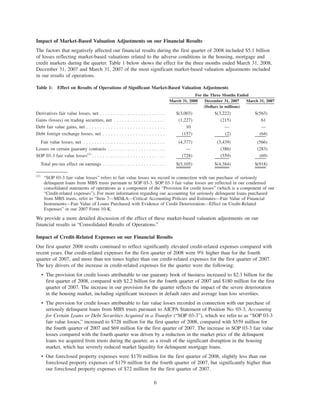
The factors that negatively affected our financial results during the first quarter of 2008 included $5.1 billion
of losses reflecting market-based valuations related to the adverse conditions in the housing, mortgage and
credit markets during the quarter. Table 1 below shows the effect for the three months ended March 31, 2008,
December 31, 2007 and March 31, 2007 of the most significant market-based valuation adjustments included
in our results of operations.
Table 1: Effect on Results of Operations of Significant Market-Based Valuation Adjustments
March 31, 2008 December 31, 2007 March 31, 2007
For the Three Months Ended
(Dollars in millions)
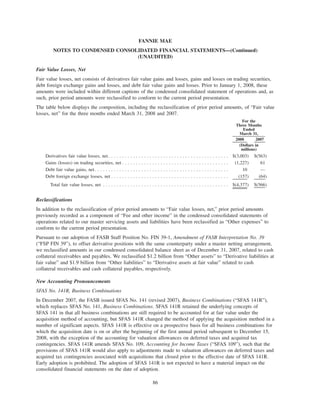
Derivatives fair value losses, net . . . . . . . . . . . . . . . . . . . . . . . . $(3,003) $(3,222) $(563)
Gains (losses) on trading securities, net . . . . . . . . . . . . . . . . . . . (1,227) (215) 61
Debt fair value gains, net . . . . . . . . . . . . . . . . . . . . . . . . . . . . . 10 — —
Debt foreign exchange losses, net . . . . . . . . . . . . . . . . . . . . . . . (157) (2) (64)
Fair value losses, net . . . . . . . . . . . . . . . . . . . . . . . . . . . . . . (4,377) (3,439) (566)
Losses on certain guaranty contracts . . . . . . . . . . . . . . . . . . . . . — (386) (283)
SOP 03-3 fair value losses(1)
. . . . . . . . . . . . . . . . . . . . . . . . . . . (728) (559) (69)
Total pre-tax effect on earnings . . . . . . . . . . . . . . . . . . . . . . . $(5,105) $(4,384) $(918)
(1)
“SOP 03-3 fair value losses” refers to fair value losses we record in connection with our purchase of seriously
delinquent loans from MBS trusts pursuant to SOP 03-3. SOP 03-3 fair value losses are reflected in our condensed
consolidated statements of operations as a component of the “Provision for credit losses” (which is a component of our
“Credit-related expenses”). For more information regarding our accounting for seriously delinquent loans purchased
from MBS trusts, refer to “Item 7—MD&A—Critical Accounting Policies and Estimates—Fair Value of Financial
Instruments—Fair Value of Loans Purchased with Evidence of Credit Deterioration—Effect on Credit-Related
Expenses” in our 2007 Form 10-K.
We provide a more detailed discussion of the effect of these market-based valuation adjustments on our
financial results in “Consolidated Results of Operations.”
Impact of Credit-Related Expenses on our Financial Results
Our first quarter 2008 results continued to reflect significantly elevated credit-related expenses compared with
recent years. Our credit-related expenses for the first quarter of 2008 were 9% higher than for the fourth
quarter of 2007, and more than ten times higher than our credit-related expenses for the first quarter of 2007.
The key drivers of the increase in credit-related expenses for the quarter were the following:
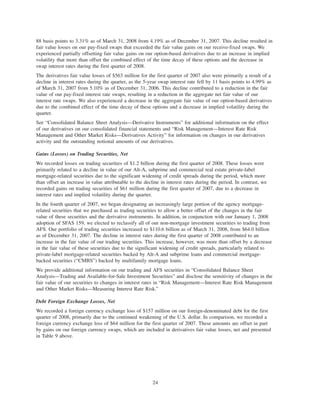
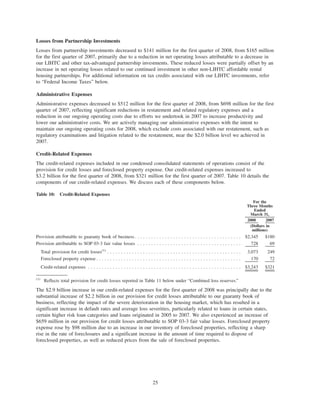
• The provision for credit losses attributable to our guaranty book of business increased to $2.3 billion for the
first quarter of 2008, compared with $2.2 billion for the fourth quarter of 2007 and $180 million for the first
quarter of 2007. The increase in our provision for the quarter reflects the impact of the severe deterioration
in the housing market, including significant increases in default rates and average loan loss severities.
• The provision for credit losses attributable to fair value losses recorded in connection with our purchase of
seriously delinquent loans from MBS trusts pursuant to AICPA Statement of Position No. 03-3, Accounting
for Certain Loans or Debt Securities Acquired in a Transfer (“SOP 03-3”), which we refer to as “SOP 03-3
fair value losses,” increased to $728 million for the first quarter of 2008, compared with $559 million for
the fourth quarter of 2007 and $69 million for the first quarter of 2007. The increase in SOP 03-3 fair value
losses compared with the fourth quarter was driven by a reduction in the market price of the delinquent
loans we acquired from trusts during the quarter, as a result of the significant disruption in the housing
market, which has severely reduced market liquidity for delinquent mortgage loans.
• Our foreclosed property expenses were $170 million for the first quarter of 2008, slightly less than our
foreclosed property expenses of $179 million for the fourth quarter of 2007, but significantly higher than
our foreclosed property expenses of $72 million for the first quarter of 2007.
6
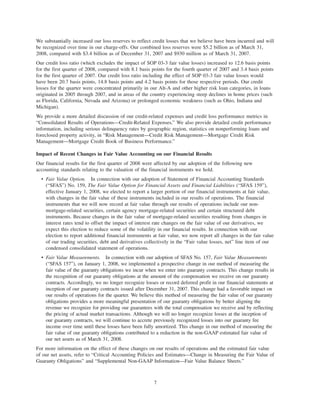
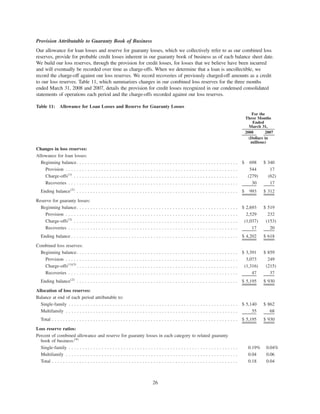
We substantially increased our loss reserves to reflect credit losses that we believe have been incurred and will
be recognized over time in our charge-offs. Our combined loss reserves were $5.2 billion as of March 31,
2008, compared with $3.4 billion as of December 31, 2007 and $930 million as of March 31, 2007.
Our credit loss ratio (which excludes the impact of SOP 03-3 fair value losses) increased to 12.6 basis points
for the first quarter of 2008, compared with 8.1 basis points for the fourth quarter of 2007 and 3.4 basis points
for the first quarter of 2007. Our credit loss ratio including the effect of SOP 03-3 fair value losses would
have been 20.7 basis points, 14.8 basis points and 4.2 basis points for those respective periods. Our credit
losses for the quarter were concentrated primarily in our Alt-A and other higher risk loan categories, in loans
originated in 2005 through 2007, and in areas of the country experiencing steep declines in home prices (such
as Florida, California, Nevada and Arizona) or prolonged economic weakness (such as Ohio, Indiana and
Michigan).
We provide a more detailed discussion of our credit-related expenses and credit loss performance metrics in
“Consolidated Results of Operations—Credit-Related Expenses.” We also provide detailed credit performance
information, including serious delinquency rates by geographic region, statistics on nonperforming loans and
foreclosed property activity, in “Risk Management—Credit Risk Management—Mortgage Credit Risk
Management—Mortgage Credit Book of Business Performance.”
Impact of Recent Changes in Fair Value Accounting on our Financial Results
Our financial results for the first quarter of 2008 were affected by our adoption of the following new
accounting standards relating to the valuation of the financial instruments we hold.
• Fair Value Option. In connection with our adoption of Statement of Financial Accounting Standards
(“SFAS”) No. 159, The Fair Value Option for Financial Assets and Financial Liabilities (“SFAS 159”),
effective January 1, 2008, we elected to report a larger portion of our financial instruments at fair value,
with changes in the fair value of these instruments included in our results of operations. The financial
instruments that we will now record at fair value through our results of operations include our non-
mortgage-related securities, certain agency mortgage-related securities and certain structured debt
instruments. Because changes in the fair value of mortgage-related securities resulting from changes in
interest rates tend to offset the impact of interest rate changes on the fair value of our derivatives, we
expect this election to reduce some of the volatility in our financial results. In connection with our
election to report additional financial instruments at fair value, we now report all changes in the fair value
of our trading securities, debt and derivatives collectively in the “Fair value losses, net” line item of our
condensed consolidated statement of operations.
• Fair Value Measurements. In connection with our adoption of SFAS No. 157, Fair Value Measurements
(“SFAS 157”), on January 1, 2008, we implemented a prospective change in our method of measuring the
fair value of the guaranty obligations we incur when we enter into guaranty contracts. This change results in
the recognition of our guaranty obligations at the amount of the compensation we receive on our guaranty
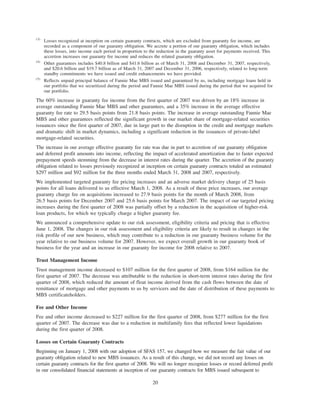
contracts. Accordingly, we no longer recognize losses or record deferred profit in our financial statements at
inception of our guaranty contracts issued after December 31, 2007. This change had a favorable impact on
our results of operations for the quarter. We believe this method of measuring the fair value of our guaranty
obligations provides a more meaningful presentation of our guaranty obligations by better aligning the
revenue we recognize for providing our guarantees with the total compensation we receive and by reflecting
the pricing of actual market transactions. Although we will no longer recognize losses at the inception of
our guaranty contracts, we will continue to accrete previously recognized losses into our guaranty fee
income over time until these losses have been fully amortized. This change in our method of measuring the
fair value of our guaranty obligations contributed to a reduction in the non-GAAP estimated fair value of
our net assets as of March 31, 2008.
For more information on the effect of these changes on our results of operations and the estimated fair value
of our net assets, refer to “Critical Accounting Policies and Estimates—Change in Measuring the Fair Value of
Guaranty Obligations” and “Supplemental Non-GAAP Information—Fair Value Balance Sheets.”
7
In addition to the changes described above, beginning in mid-April 2008, we implemented fair value hedge
accounting with respect to a portion of our derivatives to hedge, for accounting purposes, changes in the fair
value of some of our mortgage assets attributable to changes in interest rates. As a result of our election to
report a larger portion of our financial instruments at fair value pursuant to SFAS 159 and our implementation
of hedge accounting, we expect a reduction in the level of volatility in our financial results that is attributable
to changes in interest rates. However, our implementation of SFAS 159 and hedge accounting will not affect
our exposure to spread risk or the volatility in our financial results that is attributable to changes in credit
spreads.
Recent Legislative and Regulatory Developments
Recent OFHEO Actions
The Office of Federal Housing Enterprise Oversight (“OFHEO”), our safety and soundness regulator, has
recently taken the following actions:
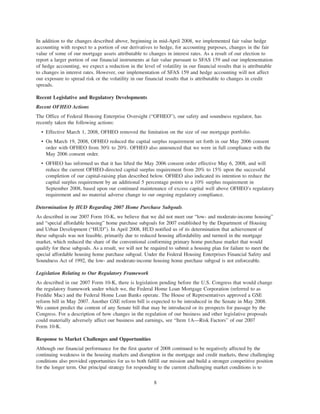
• Effective March 1, 2008, OFHEO removed the limitation on the size of our mortgage portfolio.
• On March 19, 2008, OFHEO reduced the capital surplus requirement set forth in our May 2006 consent
order with OFHEO from 30% to 20%. OFHEO also announced that we were in full compliance with the
May 2006 consent order.
• OFHEO has informed us that it has lifted the May 2006 consent order effective May 6, 2008, and will
reduce the current OFHEO-directed capital surplus requirement from 20% to 15% upon the successful
completion of our capital-raising plan described below. OFHEO also indicated its intention to reduce the
capital surplus requirement by an additional 5 percentage points to a 10% surplus requirement in
September 2008, based upon our continued maintenance of excess capital well above OFHEO’s regulatory
requirement and no material adverse change to our ongoing regulatory compliance.
Determination by HUD Regarding 2007 Home Purchase Subgoals
As described in our 2007 Form 10-K, we believe that we did not meet our “low- and moderate-income housing”
and “special affordable housing” home purchase subgoals for 2007 established by the Department of Housing
and Urban Development (“HUD”). In April 2008, HUD notified us of its determination that achievement of
these subgoals was not feasible, primarily due to reduced housing affordability and turmoil in the mortgage
market, which reduced the share of the conventional conforming primary home purchase market that would
qualify for these subgoals. As a result, we will not be required to submit a housing plan for failure to meet the
special affordable housing home purchase subgoal. Under the Federal Housing Enterprises Financial Safety and
Soundness Act of 1992, the low- and moderate-income housing home purchase subgoal is not enforceable.
Legislation Relating to Our Regulatory Framework
As described in our 2007 Form 10-K, there is legislation pending before the U.S. Congress that would change
the regulatory framework under which we, the Federal Home Loan Mortgage Corporation (referred to as
Freddie Mac) and the Federal Home Loan Banks operate. The House of Representatives approved a GSE
reform bill in May 2007. Another GSE reform bill is expected to be introduced in the Senate in May 2008.
We cannot predict the content of any Senate bill that may be introduced or its prospects for passage by the
Congress. For a description of how changes in the regulation of our business and other legislative proposals
could materially adversely affect our business and earnings, see “Item 1A—Risk Factors” of our 2007
Form 10-K.
Response to Market Challenges and Opportunities
Although our financial performance for the first quarter of 2008 continued to be negatively affected by the
continuing weakness in the housing markets and disruption in the mortgage and credit markets, these challenging
conditions also provided opportunities for us to both fulfill our mission and build a stronger competitive position
for the longer term. Our principal strategy for responding to the current challenging market conditions is to
8
prudently preserve and build our capital, while building a solid mortgage credit book of business and continuing
to fulfill our chartered mission of providing liquidity, stability and affordability to the secondary mortgage
market. We identify below a number of the steps we have taken and are taking to achieve that strategy.
Preserving and Building Capital
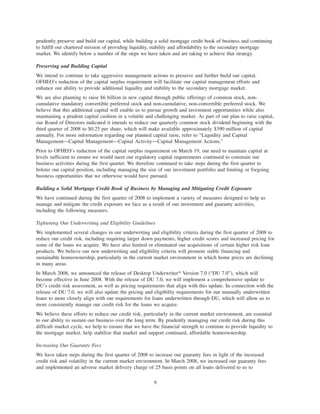
We intend to continue to take aggressive management actions to preserve and further build our capital.
OFHEO’s reduction of the capital surplus requirement will facilitate our capital management efforts and
enhance our ability to provide additional liquidity and stability to the secondary mortgage market.
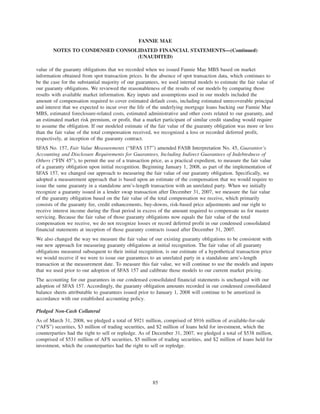
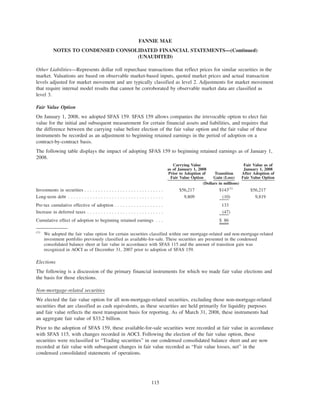
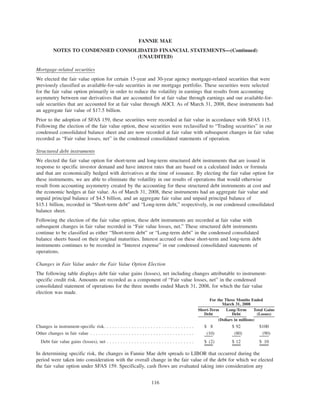
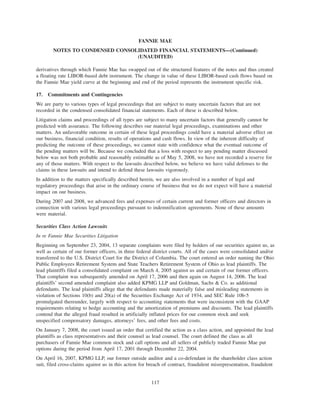
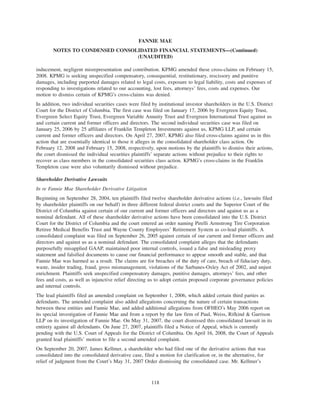
We are also planning to raise $6 billion in new capital through public offerings of common stock, non-
cumulative mandatory convertible preferred stock and non-cumulative, non-convertible preferred stock. We
believe that this additional capital will enable us to pursue growth and investment opportunities while also
maintaining a prudent capital cushion in a volatile and challenging market. As part of our plan to raise capital,
our Board of Directors indicated it intends to reduce our quarterly common stock dividend beginning with the
third quarter of 2008 to $0.25 per share, which will make available approximately $390 million of capital
annually. For more information regarding our planned capital raise, refer to “Liquidity and Capital
Management—Capital Management—Capital Activity—Capital Management Actions.”
Prior to OFHEO’s reduction of the capital surplus requirement on March 19, our need to maintain capital at
levels sufficient to ensure we would meet our regulatory capital requirements continued to constrain our
business activities during the first quarter. We therefore continued to take steps during the first quarter to
bolster our capital position, including managing the size of our investment portfolio and limiting or forgoing
business opportunities that we otherwise would have pursued.
Building a Solid Mortgage Credit Book of Business by Managing and Mitigating Credit Exposure
We have continued during the first quarter of 2008 to implement a variety of measures designed to help us
manage and mitigate the credit exposure we face as a result of our investment and guaranty activities,
including the following measures.
Tightening Our Underwriting and Eligibility Guidelines
We implemented several changes in our underwriting and eligibility criteria during the first quarter of 2008 to
reduce our credit risk, including requiring larger down payments, higher credit scores and increased pricing for
some of the loans we acquire. We have also limited or eliminated our acquisitions of certain higher risk loan
products. We believe our new underwriting and eligibility criteria will promote stable financing and
sustainable homeownership, particularly in the current market environment in which home prices are declining
in many areas.
In March 2008, we announced the release of Desktop Underwriter» Version 7.0 (“DU 7.0”), which will
become effective in June 2008. With the release of DU 7.0, we will implement a comprehensive update to
DU’s credit risk assessment, as well as pricing requirements that align with this update. In connection with the
release of DU 7.0, we will also update the pricing and eligibility requirements for our manually underwritten
loans to more closely align with our requirements for loans underwritten through DU, which will allow us to
more consistently manage our credit risk for the loans we acquire.
We believe these efforts to reduce our credit risk, particularly in the current market environment, are essential
to our ability to sustain our business over the long term. By prudently managing our credit risk during this
difficult market cycle, we help to ensure that we have the financial strength to continue to provide liquidity to
the mortgage market, help stabilize that market and support continued, affordable homeownership.
Increasing Our Guaranty Fees
We have taken steps during the first quarter of 2008 to increase our guaranty fees in light of the increased
credit risk and volatility in the current market environment. In March 2008, we increased our guaranty fees
and implemented an adverse market delivery charge of 25 basis points on all loans delivered to us to
9
compensate us for the added risk we incur during this period of increased market uncertainty. We also have
announced further increases in our guaranty fees for some loan types beginning in June 2008 and August
2008.
Loss Mitigation Activities
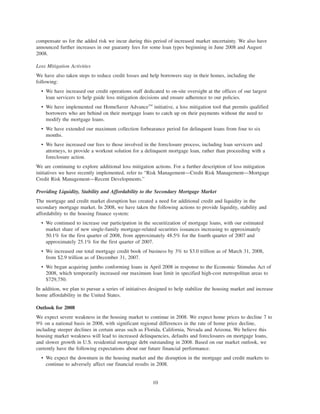
We have also taken steps to reduce credit losses and help borrowers stay in their homes, including the
following:
• We have increased our credit operations staff dedicated to on-site oversight at the offices of our largest
loan servicers to help guide loss mitigation decisions and ensure adherence to our policies.
• We have implemented our HomeSaver AdvanceTM
initiative, a loss mitigation tool that permits qualified
borrowers who are behind on their mortgage loans to catch up on their payments without the need to
modify the mortgage loans.
• We have extended our maximum collection forbearance period for delinquent loans from four to six
months.
• We have increased our fees to those involved in the foreclosure process, including loan servicers and
attorneys, to provide a workout solution for a delinquent mortgage loan, rather than proceeding with a
foreclosure action.
We are continuing to explore additional loss mitigation actions. For a further description of loss mitigation
initiatives we have recently implemented, refer to “Risk Management—Credit Risk Management—Mortgage
Credit Risk Management—Recent Developments.”
Providing Liquidity, Stability and Affordability to the Secondary Mortgage Market
The mortgage and credit market disruption has created a need for additional credit and liquidity in the
secondary mortgage market. In 2008, we have taken the following actions to provide liquidity, stability and
affordability to the housing finance system:
• We continued to increase our participation in the securitization of mortgage loans, with our estimated
market share of new single-family mortgage-related securities issuances increasing to approximately
50.1% for the first quarter of 2008, from approximately 48.5% for the fourth quarter of 2007 and
approximately 25.1% for the first quarter of 2007.
• We increased our total mortgage credit book of business by 3% to $3.0 trillion as of March 31, 2008,
from $2.9 trillion as of December 31, 2007.
• We began acquiring jumbo conforming loans in April 2008 in response to the Economic Stimulus Act of
2008, which temporarily increased our maximum loan limit in specified high-cost metropolitan areas to
$729,750.
In addition, we plan to pursue a series of initiatives designed to help stabilize the housing market and increase
home affordability in the United States.
Outlook for 2008
We expect severe weakness in the housing market to continue in 2008. We expect home prices to decline 7 to
9% on a national basis in 2008, with significant regional differences in the rate of home price decline,
including steeper declines in certain areas such as Florida, California, Nevada and Arizona. We believe this
housing market weakness will lead to increased delinquencies, defaults and foreclosures on mortgage loans,
and slower growth in U.S. residential mortgage debt outstanding in 2008. Based on our market outlook, we
currently have the following expectations about our future financial performance.
• We expect the downturn in the housing market and the disruption in the mortgage and credit markets to
continue to adversely affect our financial results in 2008.
10
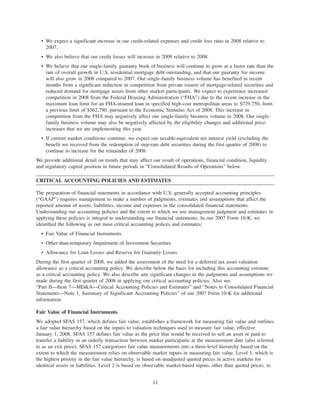
• We expect a significant increase in our credit-related expenses and credit loss ratio in 2008 relative to
2007.
• We also believe that our credit losses will increase in 2009 relative to 2008.
• We believe that our single-family guaranty book of business will continue to grow at a faster rate than the
rate of overall growth in U.S. residential mortgage debt outstanding, and that our guaranty fee income
will also grow in 2008 compared to 2007. Our single-family business volume has benefited in recent
months from a significant reduction in competition from private issuers of mortgage-related securities and
reduced demand for mortgage assets from other market participants. We expect to experience increased
competition in 2008 from the Federal Housing Administration (“FHA”) due to the recent increase in the
maximum loan limit for an FHA-insured loan in specified high-cost metropolitan areas to $729,750, from
a previous limit of $362,790, pursuant to the Economic Stimulus Act of 2008. This increase in
competition from the FHA may negatively affect our single-family business volume in 2008. Our single-
family business volume may also be negatively affected by the eligibility changes and additional price
increases that we are implementing this year.
• If current market conditions continue, we expect our taxable-equivalent net interest yield (excluding the
benefit we received from the redemption of step-rate debt securities during the first quarter of 2008) to
continue to increase for the remainder of 2008.
We provide additional detail on trends that may affect our result of operations, financial condition, liquidity
and regulatory capital position in future periods in “Consolidated Results of Operations” below.
CRITICAL ACCOUNTING POLICIES AND ESTIMATES
The preparation of financial statements in accordance with U.S. generally accepted accounting principles
(“GAAP”) requires management to make a number of judgments, estimates and assumptions that affect the
reported amount of assets, liabilities, income and expenses in the consolidated financial statements.
Understanding our accounting policies and the extent to which we use management judgment and estimates in
applying these policies is integral to understanding our financial statements. In our 2007 Form 10-K, we
identified the following as our most critical accounting polices and estimates:
• Fair Value of Financial Instruments
• Other-than-temporary Impairment of Investment Securities
• Allowance for Loan Losses and Reserve for Guaranty Losses
During the first quarter of 2008, we added the assessment of the need for a deferred tax asset valuation
allowance as a critical accounting policy. We describe below the basis for including this accounting estimate
as a critical accounting policy. We also describe any significant changes in the judgments and assumptions we
made during the first quarter of 2008 in applying our critical accounting policies. Also see
“Part II—Item 7—MD&A—Critical Accounting Policies and Estimates” and “Notes to Consolidated Financial
Statements—Note 1, Summary of Significant Accounting Policies” of our 2007 Form 10-K for additional
information.
Fair Value of Financial Instruments
We adopted SFAS 157, which defines fair value, establishes a framework for measuring fair value and outlines
a fair value hierarchy based on the inputs to valuation techniques used to measure fair value, effective
January 1, 2008. SFAS 157 defines fair value as the price that would be received to sell an asset or paid to
transfer a liability in an orderly transaction between market participants at the measurement date (also referred
to as an exit price). SFAS 157 categorizes fair value measurements into a three-level hierarchy based on the
extent to which the measurement relies on observable market inputs in measuring fair value. Level 1, which is
the highest priority in the fair value hierarchy, is based on unadjusted quoted prices in active markets for
identical assets or liabilities. Level 2 is based on observable market-based inputs, other than quoted prices, in
11
active markets for identical assets or liabilities. Level 3, which is the lowest priority in the fair value
hierarchy, is based on unobservable inputs. Assets and liabilities are classified within this hierarchy in their
entirety based on the lowest level of any input that is significant to the fair value measurement.
The use of fair value to measure our financial instruments is fundamental to our financial statements and is a
critical accounting estimate because a substantial portion of our assets and liabilities are recorded at estimated
fair value. The majority of our financial instruments carried at fair value fall within the level 2 category and
are valued primarily utilizing inputs and assumptions that are observable in the marketplace, can be derived
from observable market data or corroborated by observable levels at which transactions are executed in the
marketplace. Because items classified as level 3 are generally based on unobservable inputs, the process to
determine fair value is generally more subjective and involves a high degree of management judgment and
assumptions. These assumptions may have a significant effect on our estimates of fair value, and the use of
different assumptions as well as changes in market conditions could have a material effect on our results of
operations or financial condition. We provide additional information regarding our level 3 assets below.
Fair Value Hierarchy—Level 3 Assets
Level 3 is primarily comprised of financial instruments whose fair value is estimated based on valuation
methodologies utilizing significant inputs and assumptions that are generally less readily observable because of
limited market activity or little or no price transparency. We typically classify financial instruments as level 3
if the valuation is based on inputs from a single source, such as a dealer quotation, where we are not able to
corroborate the inputs and assumptions with other available, relevant market information. Our level 3 financial
instruments include certain mortgage- and asset-backed securities and residual interests, certain performing
residential mortgage loans, non-performing mortgage-related assets, our guaranty assets and buy-ups, our
master servicing assets and certain highly structured, complex derivative instruments.
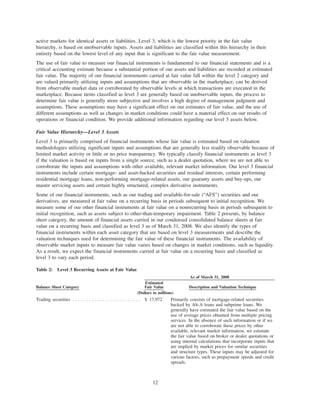
Some of our financial instruments, such as our trading and available-for-sale (“AFS”) securities and our
derivatives, are measured at fair value on a recurring basis in periods subsequent to initial recognition. We
measure some of our other financial instruments at fair value on a nonrecurring basis in periods subsequent to
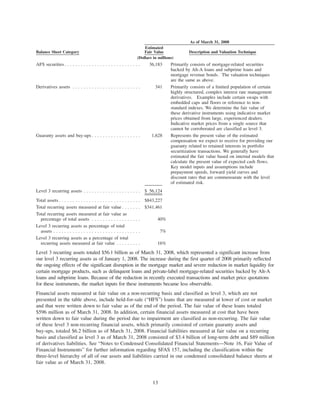
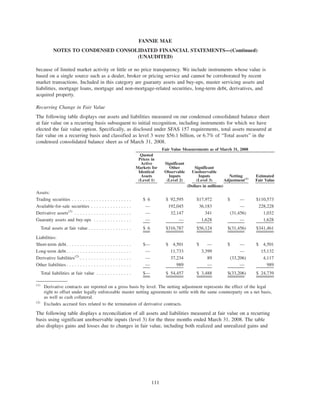
initial recognition, such as assets subject to other-than-temporary impairment. Table 2 presents, by balance
sheet category, the amount of financial assets carried in our condensed consolidated balance sheets at fair
value on a recurring basis and classified as level 3 as of March 31, 2008. We also identify the types of
financial instruments within each asset category that are based on level 3 measurements and describe the
valuation techniques used for determining the fair value of these financial instruments. The availability of
observable market inputs to measure fair value varies based on changes in market conditions, such as liquidity.
As a result, we expect the financial instruments carried at fair value on a recurring basis and classified as
level 3 to vary each period.
Table 2: Level 3 Recurring Assets at Fair Value
Balance Sheet Category
Estimated
Fair Value Description and Valuation Technique
As of March 31, 2008
(Dollars in millions)
Trading securities . . . . . . . . . . . . . . . . . . . . . . . . . $ 17,972 Primarily consists of mortgage-related securities
backed by Alt-A loans and subprime loans. We
generally have estimated the fair value based on the
use of average prices obtained from multiple pricing
services. In the absence of such information or if we
are not able to corroborate these prices by other
available, relevant market information, we estimate
the fair value based on broker or dealer quotations or
using internal calculations that incorporate inputs that
are implied by market prices for similar securities
and structure types. These inputs may be adjusted for
various factors, such as prepayment speeds and credit
spreads.
12
Balance Sheet Category
Estimated
Fair Value Description and Valuation Technique
As of March 31, 2008
(Dollars in millions)
AFS securities. . . . . . . . . . . . . . . . . . . . . . . . . . . . 36,183 Primarily consists of mortgage-related securities
backed by Alt-A loans and subprime loans and
mortgage revenue bonds. The valuation techniques
are the same as above.
Derivatives assets . . . . . . . . . . . . . . . . . . . . . . . . . 341 Primarily consists of a limited population of certain
highly structured, complex interest rate management
derivatives. Examples include certain swaps with
embedded caps and floors or reference to non-
standard indexes. We determine the fair value of
these derivative instruments using indicative market
prices obtained from large, experienced dealers.
Indicative market prices from a single source that
cannot be corroborated are classified as level 3.
Guaranty assets and buy-ups . . . . . . . . . . . . . . . . . . 1,628 Represents the present value of the estimated
compensation we expect to receive for providing our
guaranty related to retained interests in portfolio
securitization transactions. We generally have
estimated the fair value based on internal models that
calculate the present value of expected cash flows.
Key model inputs and assumptions include
prepayment speeds, forward yield curves and
discount rates that are commensurate with the level
of estimated risk.
Level 3 recurring assets . . . . . . . . . . . . . . . . . . . . . $ 56,124
Total assets . . . . . . . . . . . . . . . . . . . . . . . . . . . . . . $843,227
Total recurring assets measured at fair value . . . . . . . $341,461
Total recurring assets measured at fair value as
percentage of total assets . . . . . . . . . . . . . . . . . . 40%
Level 3 recurring assets as percentage of total
assets . . . . . . . . . . . . . . . . . . . . . . . . . . . . . . . . 7%
Level 3 recurring assets as a percentage of total
recurring assets measured at fair value . . . . . . . . . 16%
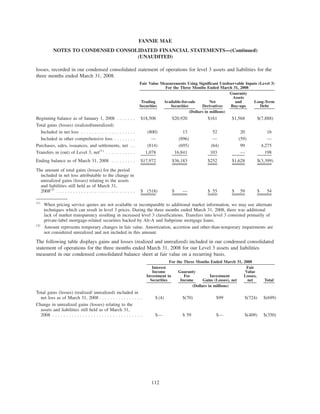
Level 3 recurring assets totaled $56.1 billion as of March 31, 2008, which represented a significant increase from
our level 3 recurring assets as of January 1, 2008. The increase during the first quarter of 2008 primarily reflected
the ongoing effects of the significant disruption in the mortgage market and severe reduction in market liquidity for
certain mortgage products, such as delinquent loans and private-label mortgage-related securities backed by Alt-A
loans and subprime loans. Because of the reduction in recently executed transactions and market price quotations
for these instruments, the market inputs for these instruments became less observable.
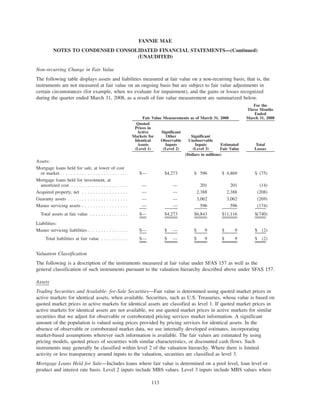
Financial assets measured at fair value on a non-recurring basis and classified as level 3, which are not
presented in the table above, include held-for-sale (“HFS”) loans that are measured at lower of cost or market
and that were written down to fair value as of the end of the period. The fair value of these loans totaled
$596 million as of March 31, 2008. In addition, certain financial assets measured at cost that have been
written down to fair value during the period due to impairment are classified as non-recurring. The fair value
of these level 3 non-recurring financial assets, which primarily consisted of certain guaranty assets and
buy-ups, totaled $6.2 billion as of March 31, 2008. Financial liabilities measured at fair value on a recurring
basis and classified as level 3 as of March 31, 2008 consisted of $3.4 billion of long-term debt and $89 million
of derivatives liabilities. See “Notes to Condensed Consolidated Financial Statements—Note 16, Fair Value of
Financial Instruments” for further information regarding SFAS 157, including the classification within the
three-level hierarchy of all of our assets and liabilities carried in our condensed consolidated balance sheets at
fair value as of March 31, 2008.
13
Fair Value Control Processes
We employ control processes to validate the fair value of our financial instruments. These control processes
are designed to ensure that the values used for financial reporting are based on observable inputs wherever
possible. In the event that observable market-based inputs are not available, the control processes are designed
to assure that the valuation approach used is appropriate and consistently applied and that the assumptions are
reasonable. Our control processes provide for segregation of duties and oversight of our fair value
methodologies and valuations by our Valuation Oversight Committee. Valuations are performed by personnel
independent of our business units. A price verification group reviews selected valuations and compares the
valuations to alternative external market data (e.g., quoted market prices, broker or dealer quotations, pricing
services, recent trading activity and comparative analyses to similar instruments) for reasonableness. The price
verification group also performs independent reviews of the assumptions used in determining the fair value of
products with material estimation risk for which observable market-based inputs do not exist. Valuation
models are regularly reviewed and approved for use for specific products by the Chief Risk Office, which also
is independent from our business units. Any changes to the valuation methodology or pricing are reviewed by
the Valuation Oversight Committee to confirm the changes are appropriate.
We continue to refine our valuation methodologies as markets and products develop and the pricing for certain
products becomes more or less transparent. While we believe our valuation methods are appropriate and
consistent with those of other market participants, the use of different methodologies or assumptions to
determine the fair value of certain financial instruments could result in a materially different estimate of fair
value as of the reporting date.
Change in Measuring the Fair Value of Guaranty Obligations
Beginning January 1, 2008, as part of the implementation of SFAS 157, we changed our approach to
measuring the fair value of our guaranty obligation. Specifically, we adopted a measurement approach that is
based upon an estimate of the compensation that we would require to issue the same guaranty in a standalone
arm’s-length transaction with an unrelated party. When we initially recognize a guaranty issued in a lender
swap transaction after December 31, 2007, we measure the fair value of the guaranty obligation based on the
fair value of the total compensation we receive, which primarily consists of the guaranty fee, credit
enhancements, buy-downs, risk-based price adjustments and our right to receive interest income during the
float period in excess of the amount required to compensate us for master servicing. Because the fair value of
those guaranty obligations now equals the fair value of the total compensation we receive, we do not
recognize losses or record deferred profit in our financial statements at inception of those guaranty contracts
issued after December 31, 2007.
We also changed the way we measure the fair value of our existing guaranty obligations, as disclosed in
“Supplemental Non-GAAP Information—Fair Value Balance Sheets” and in “Notes to Condensed
Consolidated Financial Statements,” to be consistent with our new approach for measuring guaranty
obligations at initial recognition. The fair value of all guaranty obligations measured subsequent to their initial
recognition, is our estimate of a hypothetical transaction price we would receive if we were to issue our
guarantees to an unrelated party in a standalone arm’s-length transaction at the measurement date. To measure
this fair value, we will continue to use the models and inputs that we used prior to our adoption of SFAS 157
and calibrate those models to our current market pricing.
Prior to January 1, 2008, we measured the fair value of the guaranty obligations that we recorded when we
issued Fannie Mae MBS based on market information obtained from spot transaction prices. In the absence of
spot transaction data, which was the case for the substantial majority of our guarantees, we used internal
models to estimate the fair value of our guaranty obligations. We reviewed the reasonableness of the results of
our models by comparing those results with available market information. Key inputs and assumptions used in
our models included the amount of compensation required to cover estimated default costs, including
estimated unrecoverable principal and interest that we expected to incur over the life of the underlying
mortgage loans backing our Fannie Mae MBS, estimated foreclosure-related costs, estimated administrative
and other costs related to our guaranty, and an estimated market risk premium, or profit, that a market
14
participant of similar credit standing would require to assume the obligation. If our modeled estimate of the
fair value of the guaranty obligation was more or less than the fair value of the total compensation received,
we recognized a loss or recorded deferred profit, respectively, at inception of the guaranty contract. See
“Part II—Item 7—MD&A—Critical Accounting Policies and Estimates—Fair Value of Guaranty Assets and
Guaranty Obligations—Effect on Losses on Certain Guaranty Contracts” of our 2007 Form 10-K for additional
information.
The accounting for our guarantees in our condensed consolidated financial statements is unchanged with our
adoption of SFAS 157. Accordingly, the guaranty obligation amounts recorded in our condensed consolidated
balance sheets attributable to guarantees issued prior to January 1, 2008 will continue to be amortized in
accordance with our established accounting policy. This change, however, affects the fair value of all our
existing guaranty obligations as of each measurement date, which we disclose in “Notes to Condensed
Consolidated Financial Statements” and “Supplemental Non-GAAP Information—Fair Value Balance Sheets.”
As a result of this change, the fair value of our guaranty obligations as of December 31, 2007 decreased by
$2.3 billion, to an estimated $18.2 billion, from the previously reported amount of $20.5 billion, effective
upon our January 1, 2008 adoption of SFAS 157.
Deferred Tax Assets
We recognize deferred tax assets and liabilities for the future tax consequences related to differences between
the financial statement carrying amounts of existing assets and liabilities and their respective tax bases, and for
tax credits. Our net deferred tax assets totaled $17.8 billion and $13.0 billion as of March 31, 2008 and
December 31, 2007, respectively. We evaluate our deferred tax assets for recoverability based on available
evidence, including assumptions about future profitability. We are required to establish a valuation allowance
for deferred tax assets if we determine, based on available evidence at the time the determination is made, that
it is more likely than not that some portion or all of the deferred tax assets will not be realized. In evaluating
the need for a valuation allowance, we estimate future taxable income based on management approved
business plans and ongoing tax planning strategies. We did not record a valuation allowance against our net
deferred tax assets as of March 31, 2008 or December 31, 2007 because we anticipate that it is more likely
than not that our results of future operations will generate sufficient taxable income to allow us to realize our
deferred tax assets.
If we were to determine that we would not be able to realize all or a portion of our deferred tax assets in the
future, we would reduce the deferred tax asset through a charge to income in the period in which that
determination is made. This charge could have a material adverse affect on our results of operations and
financial condition. In addition, the assumptions in making this determination are subject to change from
period to period based on changes in tax laws or variances between our future projected operating
performance and our actual results. As a result, significant management judgment is required in assessing the
possible need for a deferred tax asset valuation allowance. For these reasons and because changes in these
assumptions and estimates can materially affect our results of operations and financial condition, we have
included the assessment of a deferred tax asset valuation allowance as a critical accounting policy.
Our analysis of the need for a valuation allowance recognizes that we are in a cumulative loss position as of
the three-year period ended March 31, 2008, which is considered significant negative evidence that is
objective and verifiable and therefore, difficult to overcome. However, we believe we will generate sufficient
taxable income in future periods to realize deferred tax assets.
We are able to rely on our forecasts of future taxable income and overcome the uncertainty created by the
cumulative loss position. While current market conditions create volatility in our pre-tax income, we have
sufficient taxable income currently and in our forecasts because of the stability of our core business model and
the nature of our book to tax differences. Our forecasts of future taxable income include assumptions about the
depth and severity of housing price depreciation and credit losses; if future actual results adversely deviate in
a material way, or if unforeseen events preclude our ability to maintain our funding spreads or manage our
guaranty fees, we may not generate sufficient taxable income to realize our deferred tax assets, and a
15
significant valuation allowance may be necessary. We will continue to assess the need for a valuation
allowance.
We provide additional detail on the components of our deferred tax assets and deferred tax liabilities as of
December 31, 2007 in our 2007 Form 10-K in “Notes to Consolidated Financial Statements—Note 11, Income
Taxes” and we provide information on the increase in our deferred tax assets since December 31, 2007 in
“Notes to Condensed Consolidated Financial Statements—Note 10, Income Taxes” of this report.
CONSOLIDATED RESULTS OF OPERATIONS
The following discussion of our condensed consolidated results of operations is based on a comparison of our
results for the first quarter of 2008 and the first quarter of 2007. Table 3 presents a summary of our unaudited
condensed consolidated results of operations for each of these periods.
Table 3: Summary of Condensed Consolidated Results of Operations
2008 2007 $ %
For the
Three Months
Ended
March 31, Variance
(Dollars in millions, except
per share amounts)
Net interest income. . . . . . . . . . . . . . . . . . . . . . . . . . . . . . . . . . . . . . . . . . . . . $ 1,690 $1,194 $ 496 42%
Guaranty fee income. . . . . . . . . . . . . . . . . . . . . . . . . . . . . . . . . . . . . . . . . . . . 1,752 1,098 654 60
Trust management income . . . . . . . . . . . . . . . . . . . . . . . . . . . . . . . . . . . . . . . . 107 164 (57) (35)
Fee and other income(1)
. . . . . . . . . . . . . . . . . . . . . . . . . . . . . . . . . . . . . . . . . . 227 277 (50) (18)
Net revenues . . . . . . . . . . . . . . . . . . . . . . . . . . . . . . . . . . . . . . . . . . . . . . . . . 3,776 2,733 1,043 38
Losses on certain guaranty contracts . . . . . . . . . . . . . . . . . . . . . . . . . . . . . . . . . — (283) 283 100
Investment gains (losses), net(1)
. . . . . . . . . . . . . . . . . . . . . . . . . . . . . . . . . . . . (111) 295 (406) (138)
Fair value losses, net(1)
. . . . . . . . . . . . . . . . . . . . . . . . . . . . . . . . . . . . . . . . . . (4,377) (566) (3,811) (673)
Losses from partnership investments . . . . . . . . . . . . . . . . . . . . . . . . . . . . . . . . . (141) (165) 24 15
Administrative expenses . . . . . . . . . . . . . . . . . . . . . . . . . . . . . . . . . . . . . . . . . (512) (698) 186 27
Credit-related expenses(2)
. . . . . . . . . . . . . . . . . . . . . . . . . . . . . . . . . . . . . . . . (3,243) (321) (2,922) (910)
Other non-interest expenses(1)(3)
. . . . . . . . . . . . . . . . . . . . . . . . . . . . . . . . . . . . (505) (104) (401) (386)
Income (loss) before federal income taxes and extraordinary losses . . . . . . . . . . . (5,113) 891 (6,004) (674)
Benefit for federal income taxes. . . . . . . . . . . . . . . . . . . . . . . . . . . . . . . . . . . . 2,928 73 2,855 3,911
Extraordinary losses, net of tax effect . . . . . . . . . . . . . . . . . . . . . . . . . . . . . . . . (1) (3) 2 67
Net income (loss). . . . . . . . . . . . . . . . . . . . . . . . . . . . . . . . . . . . . . . . . . . . . . $(2,186) $ 961 $(3,147) (327)%
Diluted earnings (loss) per common share . . . . . . . . . . . . . . . . . . . . . . . . . . . $ (2.57) $ 0.85 $ (3.42) (402)%
(1)
Certain prior period amounts have been reclassified to conform with the current period presentation in our condensed
consolidated statements of operations.
(2)
Consists of provision for credit losses and foreclosed property expense.
(3)
Consists of debt extinguishment gains (losses), net, minority interest in earnings of consolidated subsidiaries and other
expenses.
Our business generates revenues from four principal sources: net interest income, guaranty fee income, trust
management income, and fee and other income. Other significant factors affecting our results of operations
include: changes in the fair value of our derivatives, trading securities and debt; the timing and size of
investment gains and losses; credit-related expenses; losses from partnership investments; and administrative
expenses. We provide a comparative discussion of the effect of our principal revenue sources and other listed
items on our condensed consolidated results of operations for the three months ended March 31, 2008 and
16
2007 below. We also discuss other significant items presented in our unaudited condensed consolidated
statements of operations.
Net Interest Income
Table 4 presents an analysis of our net interest income and net interest yield for the three months ended
March 31, 2008 and 2007.
Table 4: Analysis of Net Interest Income and Yield
Average
Balance(1)
Interest
Income/
Expense
Average
Rates
Earned/Paid
Average
Balance(1)
Interest
Income/
Expense
Average
Rates
Earned/Paid
2008 2007
For the Three Months Ended March 31,
(Dollars in millions)
Interest-earning assets:
Mortgage loans(2)
. . . . . . . . . . . . . . . . . . $410,318 $ 5,662 5.52% $385,810 $ 5,385 5.58%
Mortgage securities . . . . . . . . . . . . . . . . 315,795 4,144 5.25 331,229 4,567 5.52
Non-mortgage securities(3)
. . . . . . . . . . . 66,630 678 4.03 62,195 836 5.37
Federal funds sold and securities
purchased under agreements to resell . . 36,233 393 4.29 13,666 182 5.32
Advances to lenders . . . . . . . . . . . . . . . . 4,229 65 6.08 4,674 36 3.11
Total interest-earning assets . . . . . . . . . . . . $833,205 $10,942 5.25% $797,574 $11,006 5.52%
Interest-bearing liabilities:
Short-term debt . . . . . . . . . . . . . . . . . . . $257,445 $ 2,558 3.93% $161,575 $ 2,213 5.48%
Long-term debt . . . . . . . . . . . . . . . . . . . 545,549 6,691 4.91 602,804 7,596 5.04
Federal funds purchased and securities
sold under agreements to repurchase . . . 448 3 2.65 210 3 5.33
Total interest-bearing liabilities . . . . . . . . . . $803,442 $ 9,252 4.59% $764,589 $ 9,812 5.13%
Impact of net non-interest bearing funding . . $ 29,763 0.16% $ 32,985 0.21%
Net interest income/net interest yield(4)
. . . . $ 1,690 0.82% $ 1,194 0.60%
Taxable-equivalent adjustment on tax-
exempt investments(5)
. . . . . . . . . . . . . . . 83 0.04% 92 0.04%
Taxable-equivalent net interest
income/taxable-equivalent net interest
yield(6)
. . . . . . . . . . . . . . . . . . . . . . . . . $ 1,773 0.86% $ 1,286 0.64%
(1)
For mortgage loans, average balances have been calculated based on the average of the amortized cost amounts at the
beginning of the year and at the end of each month in the period. For all other categories, average balances have been
calculated based on a daily average. The average balance for the three months ended March 31, 2008 for advances to
lenders also has been calculated based on a daily average.
(2)
Average balance amounts include nonaccrual loans with an average balance totaling $8.2 billion and $6.5 billion as of
March 31, 2008 and December 31, 2007, respectively, and $5.9 billion and $6.7 billion as of March 31, 2007 and
December 31, 2006, respectively. Interest income amounts include interest income related to SOP 03-3 loans,
including accretion on loans returned to accrual status, of $145 million and $104 million for the three months ended
March 31, 2008 and 2007, respectively. Of these amounts recognized into interest income, $35 million and $7 million
for the three months ended March 31, 2008 and 2007, respectively, related to the accretion of the fair value loss
recorded upon purchase of SOP 03-3 loans.
(3)
Includes cash equivalents.
(4)
Net interest yield computed by dividing annualized net interest income for the period by the average balance of total
interest-earning assets during the period.
(5)
Represents adjustment to permit comparison of yields on tax-exempt and taxable assets calculated using a 35%
marginal tax rate for each of the periods presented.
17
(6)
Taxable-equivalent net interest yield is computed by dividing annualized taxable-equivalent net interest income for the
period by the average balance of total interest-earning assets during the period.
Table 5 presents the total variance, or change, in our taxable-equivalent net interest income between the three
months ended March 31, 2008 and 2007, and the extent to which that variance is attributable to (1) changes in
the volume of our interest-earning assets and interest-bearing liabilities or (2) changes in the interest rates of
these assets and liabilities.
Table 5: Rate/Volume Analysis of Net Interest Income
Total
Variance Volume Rate
Variance Due to:(1)
For the Three Months
Ended March 31,
2008 vs. 2007
(Dollars in millions)
Interest income:
Mortgage loans(2)
. . . . . . . . . . . . . . . . . . . . . . . . . . . . . . . . . . . . . . . . . . . . . . . . . . $ 277 $ 339 $ (62)
Mortgage securities . . . . . . . . . . . . . . . . . . . . . . . . . . . . . . . . . . . . . . . . . . . . . . . . . (423) (208) (215)
Non-mortgage securities. . . . . . . . . . . . . . . . . . . . . . . . . . . . . . . . . . . . . . . . . . . . . . (158) 56 (214)
Federal funds sold and securities purchased under agreements to resell . . . . . . . . . . . . . 211 250 (39)
Advances to lenders. . . . . . . . . . . . . . . . . . . . . . . . . . . . . . . . . . . . . . . . . . . . . . . . . 29 (4) 33
Total interest income. . . . . . . . . . . . . . . . . . . . . . . . . . . . . . . . . . . . . . . . . . . . . . . . . . (64) 433 (497)
Interest expense:
Short-term debt . . . . . . . . . . . . . . . . . . . . . . . . . . . . . . . . . . . . . . . . . . . . . . . . . . . . 345 1,067 (722)
Long-term debt . . . . . . . . . . . . . . . . . . . . . . . . . . . . . . . . . . . . . . . . . . . . . . . . . . . . (905) (706) (199)
Federal funds purchased and securities sold under agreements to repurchase . . . . . . . . . — 2 (2)
Total interest expense . . . . . . . . . . . . . . . . . . . . . . . . . . . . . . . . . . . . . . . . . . . . . . . . . (560) 363 (923)
Net interest income. . . . . . . . . . . . . . . . . . . . . . . . . . . . . . . . . . . . . . . . . . . . . . . . . . . 496 70 426
Taxable-equivalent adjustment on tax-exempt investments(3)
. . . . . . . . . . . . . . . . . . . . . . (9)
Taxable-equivalent net interest income . . . . . . . . . . . . . . . . . . . . . . . . . . . . . . . . . . . . . $ 487
(1)
Combined rate/volume variances are allocated to both rate and volume based on the relative size of each variance.
(2)
Includes interest income related to SOP 03-3 loans, including accretion on loans returned to accrual status, of
$145 million and $104 million for the three months ended March 31, 2008 and 2007, respectively. Of these amounts
recognized into interest income, approximately $35 million and $7 million for the three months ended March 31, 2008
and 2007, respectively, related to the accretion of the fair value discount recorded upon purchase of SOP 03-3 loans.
(3)
Represents adjustment to permit comparison of yields on tax-exempt and taxable assets calculated using a 35%
marginal tax rate for each of the periods presented.
Taxable-equivalent net interest income of $1.8 billion for the first quarter of 2008 increased by 38% from the
first quarter of 2007, driven by a 34% (22 basis points) increase in our taxable-equivalent net interest yield to
0.86%, and a 4% increase in our average interest-earning assets. During the first quarter of 2008, the
U.S. Treasury yield curve assumed its steepest slope since mid-2004 as short-term interest rates fell and long-
term rates remained relatively stable. Our net interest yield reflected the benefits from this steeper yield curve,
as we shifted our funding mix to a higher proportion of lower-rate, short-term debt and redeemed $12.5 billion
of step-rate debt securities during the quarter, which together reduced the average cost of our debt by 54 basis
points, to 4.59%. Instead of having a fixed coupon for the life of the security, step-rate debt securities allow
for the interest rate to increase at predetermined rates according to a specified schedule, resulting in increased
interest payments. However, the interest expense on step-rate debt securities is recognized at a constant
effective rate over the term of the security. Because we redeemed these securities prior to maturity, we
reversed a portion of the interest expense that we had previously accrued, which provided a benefit to our net
interest yield of approximately 17 basis points on an annualized basis. The decrease in the average cost of our
debt was partially offset by a decrease in the average yield on our interest-earning assets of 27 basis points to
18
5.25%, which was due in part to the accelerated amortization of net deferred premium amounts reflecting
faster than expected prepayment speeds in response to the decline in interest rates during the quarter.
The periodic net contractual interest accruals on our interest rate swaps are not reflected in our taxable-
equivalent net interest income, although we consider these amounts to be part of the cost of funding our
mortgage investments. Instead, the net contractual interest accruals on our interest rate swaps are reflected in our
condensed consolidated statements of operations as a component of “Fair value losses, net.” As indicated in
Table 9 below, we recorded net contractual interest expense of $26 million for the three months ended March 31,
2008. In comparison, we recorded net contractual interest income on our interest rate swaps totaling $34 million
for the three months ended March 31, 2007. The economic effect of the interest accruals on our interest rate
swaps, which is not reflected in the comparative net interest yields presented above, resulted in an increase in
our funding costs of approximately 1 basis point for the three months ended March 31, 2008 and a reduction in
our funding costs of approximately 1 basis point for the three months ended March 31, 2007.
If current market conditions continue, we expect our taxable-equivalent net interest yield (excluding the
benefit we received from the redemption of step-rate debt securities during the first quarter of 2008) to
continue to increase for the remainder of 2008.
Guaranty Fee Income
Table 6 shows the components of our guaranty fee income, our average effective guaranty fee rate, and Fannie
Mae MBS activity for the three months ended March 31, 2008 and 2007. As discussed above, the change in
measuring the fair value of our guaranty obligations affects not only the losses recognized at inception of our
guaranty contract, but also our guaranty fee income. Although we will no longer recognize losses at the
inception of our guaranty contracts, we will continue to accrete previously recognized losses into our guaranty
fee income over the remaining life of the mortgage loans underlying the MBS.
Table 6: Guaranty Fee Income and Average Effective Guaranty Fee Rate(1)
Amount Rate(2)
Amount Rate(2)
Amount
Variance
2008 2007
For the Three Months Ended March 31,
(Dollars in millions)
Guaranty fee income/average effective guaranty fee rate,
excluding certain fair value adjustments and buy-up
impairment . . . . . . . . . . . . . . . . . . . . . . . . . . . . . . . . . . . $ 1,719 29.0 bp $ 1,100 21.8 bp 56%
Net change in fair value of buy-ups and guaranty assets . . . . . . 62 1.0 2 — 3,000
Buy-up impairment . . . . . . . . . . . . . . . . . . . . . . . . . . . . . . . (29) (0.5) (4) — 625
Guaranty fee income/average effective guaranty fee rate(3)
. . . . $ 1,752 29.5 bp $ 1,098 21.8 bp 60%
Average outstanding Fannie Mae MBS and other
guarantees(4)
. . . . . . . . . . . . . . . . . . . . . . . . . . . . . . . . . . $2,374,033 $2,017,471 18%
Fannie Mae MBS issues(5)
. . . . . . . . . . . . . . . . . . . . . . . . . . 168,592 132,423 27
(1)
Guaranty fee income primarily consists of contractual guaranty fees related to Fannie Mae MBS held in our portfolio
and held by third-party investors, adjusted for (1) the amortization of upfront fees and impairment of guaranty assets,
net of a proportionate reduction in the related guaranty obligation and deferred profit, and (2) impairment of buy-ups.
The average effective guaranty fee rate reflects our average contractual guaranty fee rate adjusted for the impact of
amortization of deferred amounts and buy-up impairment. Losses recognized at inception on certain guaranty contracts
are excluded from guaranty fee income and the average effective guaranty fee rate; however, as described in footnote 3
below, the accretion of these losses into income over time is included in our guaranty fee income and average effective
guaranty fee rate.
(2)
Presented in basis points and calculated based on annualized amounts of our guaranty fee income components divided
by average outstanding Fannie Mae MBS and other guarantees for each respective period.
19
(3)
Losses recognized at inception on certain guaranty contracts, which are excluded from guaranty fee income, are
recorded as a component of our guaranty obligation. We accrete a portion of our guaranty obligation, which includes
these losses, into income each period in proportion to the reduction in the guaranty asset for payments received. This
accretion increases our guaranty fee income and reduces the related guaranty obligation.
(4)
Other guarantees includes $40.8 billion and $41.6 billion as of March 31, 2008 and December 31, 2007, respectively,
and $20.6 billion and $19.7 billion as of March 31, 2007 and December 31, 2006, respectively, related to long-term
standby commitments we have issued and credit enhancements we have provided.
(5)
Reflects unpaid principal balance of Fannie Mae MBS issued and guaranteed by us, including mortgage loans held in
our portfolio that we securitized during the period and Fannie Mae MBS issued during the period that we acquired for
our portfolio.
The 60% increase in guaranty fee income from the first quarter of 2007 was driven by an 18% increase in
average outstanding Fannie Mae MBS and other guarantees, and a 35% increase in the average effective
guaranty fee rate to 29.5 basis points from 21.8 basis points. The increase in average outstanding Fannie Mae
MBS and other guarantees reflected the significant growth in our market share of mortgage-related securities
issuances since the first quarter of 2007, due in large part to the disruption in the credit and mortgage markets
and dramatic shift in market dynamics, including a significant reduction in the issuances of private-label
mortgage-related securities.
The increase in our average effective guaranty fee rate was due in part to accretion of our guaranty obligation
and deferred profit amounts into income, reflecting the impact of accelerated amortization due to faster expected
prepayment speeds stemming from the decrease in interest rates during the quarter. The accretion of the guaranty
obligation related to losses previously recognized at inception on certain guaranty contracts totaled an estimated
$297 million and $92 million for the three months ended March 31, 2008 and 2007, respectively.
We implemented targeted guaranty fee pricing increases and an adverse market delivery charge of 25 basis
points for all loans delivered to us effective March 1, 2008. As a result of these price increases, our average
guaranty charge fee on acquisitions increased to 27.9 basis points for the month of March 2008, from
26.5 basis points for December 2007 and 25.6 basis points for March 2007. The impact of our targeted pricing
increases during the first quarter of 2008 was partially offset by a reduction in the acquisition of higher-risk
loan products, for which we typically charge a higher guaranty fee.
We announced a comprehensive update to our risk assessment, eligibility criteria and pricing that is effective
June 1, 2008. The changes in our risk assessment and eligibility criteria are likely to result in changes in the
risk profile of our new business, which may contribute to a reduction in our guaranty business volume for the
year relative to our business volume for 2007. However, we expect overall growth in our guaranty book of
business for the year and an increase in our guaranty fee income for 2008 relative to 2007.
Trust Management Income
Trust management income decreased to $107 million for the first quarter of 2008, from $164 million for the
first quarter of 2007. The decrease was attributable to the reduction in short-term interest rates during the first
quarter of 2008, which reduced the amount of float income derived from the cash flows between the date of
remittance of mortgage and other payments to us by servicers and the date of distribution of these payments to
MBS certificateholders.
Fee and Other Income
Fee and other income decreased to $227 million for the first quarter of 2008, from $277 million for the first
quarter of 2007. The decrease was due to a reduction in multifamily fees that reflected lower liquidations
during the first quarter of 2008.
Losses on Certain Guaranty Contracts
Beginning on January 1, 2008 with our adoption of SFAS 157, we changed how we measure the fair value of our
guaranty obligation related to new MBS issuances. As a result of this change, we did not record any losses on
certain guaranty contracts for the first quarter of 2008. We will no longer recognize losses or record deferred profit
in our consolidated financial statements at inception of our guaranty contracts for MBS issued subsequent to
20
December 31, 2007 because the estimated fair value of the guaranty obligation at inception will now equal the
estimated fair value of the total compensation received. For further discussion of this change, see “Critical
Accounting Policies and Estimates—Fair Value of Financial Instruments—Change in Measuring the Fair Value of
Guaranty Obligations” and “Notes to Condensed Consolidated Financial Statements—Note 1, Summary of
Significant Accounting Policies.”
We recorded losses on certain guaranty contracts totaling $283 million for the first quarter of 2007. These losses
reflected the increase in the estimated market risk premium that a market participant would require to assume our
guaranty obligations due to the decline in home prices and deterioration in credit conditions. As of March 31, 2008,
unamortized losses on certain guaranty contracts in our condensed consolidated balance sheet were $2.2 billion. The
unamortized losses represent the net guaranty asset and guaranty obligation in our condensed consolidated balance
sheet that will be accreted into income over the remaining life of the mortgage loans underlying our Fannie Mae
MBS as a component of guaranty fee income. The accretion to be recognized in future periods will be more than the
original losses on certain guaranty contracts as a result of upfront cash fees and credit enhancements received at the
inception of the guaranty arrangement that reduced the original recorded loss.
Investment Gains (Losses), Net
We summarize the components of investment gains (losses), for the three months ended March 31, 2008 and
2007 below in Table 7 and discuss significant changes in these components between periods.
Table 7: Investment Gains (Losses), Net
2008 2007
For the
Three Months
Ended
March 31,
(Dollars in
millions)
Other-than-temporary impairment on AFS securities(1)
. . . . . . . . . . . . . . . . . . . . . . . . . . . . . . . . . . . . . $ (55) $ (3)
Lower-of-cost-or-market (“LOCOM”) adjustments on held-for-sale loans . . . . . . . . . . . . . . . . . . . . . . . . (71) (3)
Gains on Fannie Mae portfolio securitizations, net . . . . . . . . . . . . . . . . . . . . . . . . . . . . . . . . . . . . . . . . 42 49
Gains on sale of AFS securities, net . . . . . . . . . . . . . . . . . . . . . . . . . . . . . . . . . . . . . . . . . . . . . . . . . . 33 271
Other investment losses, net . . . . . . . . . . . . . . . . . . . . . . . . . . . . . . . . . . . . . . . . . . . . . . . . . . . . . . . (60) (19)
Investment gains (losses), net . . . . . . . . . . . . . . . . . . . . . . . . . . . . . . . . . . . . . . . . . . . . . . . . . . . . . $(111) $295
(1)
Excludes other-than-temporary impairment on guaranty assets and buy-ups as these amounts are recognized as a
component of guaranty fee income. Refer to Table 6: Guaranty Fee Income and Average Effective Guaranty Fee Rate.
The $406 million unfavorable variance in investment gains (losses), net, for the first quarter of 2008 compared
with the first quarter of 2007 was primarily attributable to the following:
• An increase of $52 million in other-than-temporary impairment on AFS securities. We recognized other-
than-temporary impairment on our AFS securities totaling $55 million for the first quarter of 2008,
attributable to declines in the creditworthiness of certain securities, principally related to subprime
private-label securities. In contrast, we recognized other-than-temporary impairment of $3 million for the
first quarter of 2007.
• A $68 million increase in losses resulting from lower-of-cost-or-market adjustments on HFS loans, due to
the significant widening of credit spreads during the quarter.
• A decrease of $238 million in gains on the sale of AFS securities, net. We recorded net gains of
$33 million and $271 million for the first quarters of 2008 and 2007, respectively, related to the sale of
securities totaling $13.5 billion and $17.0 billion, respectively. The investment gains recorded during the
first quarter of 2007 were attributable to the recovery in value of securities we sold that we had
previously written down due to other-than-temporary impairment.
21
Fair Value Losses, Net
Fair value losses, net consists of derivatives fair value gains and losses, gains and losses on trading securities,
debt foreign exchange gains and losses, and debt fair value gains and losses. Generally, we expect changes in the
fair value of our trading securities to move inversely to changes in the fair value of our derivatives, resulting in
an offset against a portion of our derivatives gains and losses. Because the fair value of our derivatives and
trading securities are affected not only by interest rates, but also by other factors such as volatility and, for
trading securities, changes in credit spreads, changes in the fair value of our trading securities may not always
move inversely to changes in the fair value of our derivatives. Consequently, the gains and losses on our trading
securities may not result in partially offsetting losses and gains on our derivatives. In addition, our foreign
currency exchange gains and losses on our foreign-denominated debt are offset in part by corresponding losses
and gains on foreign currency swaps. We seek to eliminate our exposure to fluctuations in foreign exchange rates
by entering into foreign currency swaps that effectively convert debt denominated in a foreign currency to debt
denominated in U.S. dollars. By presenting these items together in our condensed consolidated results of
operations, we are able to show the net impact of mark-to-market adjustments that generally result in offsetting
gains and losses due to changes in interest rates. Table 8 summarizes the components of fair value losses, net for
the three months ended March 31, 2008 and 2007.
Table 8: Fair Value Losses, Net
2008 2007
For the
Three Months
Ended
March 31,
(Dollars in
millions)
Derivatives fair value losses, net. . . . . . . . . . . . . . . . . . . . . . . . . . . . . . . . . . . . . . . . . . . . . . . . . . . $(3,003) $(563)
Gains (losses) on trading securities, net . . . . . . . . . . . . . . . . . . . . . . . . . . . . . . . . . . . . . . . . . . . . . . (1,227) 61
Derivatives and trading securities fair value losses, net . . . . . . . . . . . . . . . . . . . . . . . . . . . . . . . . . (4,230) (502)
Debt foreign exchange losses, net . . . . . . . . . . . . . . . . . . . . . . . . . . . . . . . . . . . . . . . . . . . . . . . . . . (157) (64)
Debt fair value gains, net . . . . . . . . . . . . . . . . . . . . . . . . . . . . . . . . . . . . . . . . . . . . . . . . . . . . . . . 10 —
Fair value losses, net . . . . . . . . . . . . . . . . . . . . . . . . . . . . . . . . . . . . . . . . . . . . . . . . . . . . . . . . . $(4,377) $(566)
We recorded fair value losses, net of $4.4 billion for the first quarter of 2008, compared with fair value losses of
$566 million for the first quarter of 2007. As a result of the decrease in swap interest rates during the first
quarter of 2008, we experienced a significant increase in fair value losses on our derivatives. We also
experienced fair value losses on our trading securities due to the significant widening of credit spreads during
the quarter, which more than offset an increase in value attributable to the decline in interest rates during the
period.
Beginning in mid-April 2008, we implemented fair value hedge accounting with respect to a portion of our
derivatives to hedge, for accounting purposes, the interest rate risk related to some of our mortgage assets.
Hedge accounting allows us to offset the fair value gains or losses on some of our derivative instruments
against the corresponding fair value losses or gains attributable to changes in interest rates on the specific
hedged mortgage assets. As a result, we expect a reduction in the level of volatility in our financial results that
is attributable to changes in interest rates. However, our implementation of hedge accounting will not affect
our exposure to spread risk or the volatility in our financial results that is attributable to changes in credit
spreads. Because changes in the fair value of our trading securities and derivatives are affected by market
fluctuations that cannot be predicted, we cannot estimate the impact of changes in these items for the full year.
We disclose the sensitivity of changes in the fair value of our trading securities and derivatives to changes in
interest rates in “Risk Management—Interest Rate Risk Management and Other Market Risks—Measuring
Interest Rate Risk.” Below we provide additional information on the most significant components of our fair
value losses, net.
22
Derivatives Fair Value Losses, Net
Table 9 presents, by type of derivative instrument, the fair value gains and losses on our derivatives for the
three months ended March 31, 2008 and 2007. Table 9 also includes an analysis of the components of
derivatives fair value gains and losses attributable to net contractual interest accruals on our interest rate
swaps, the net change in the fair value of terminated derivative contracts through the date of termination and
the net change in the fair value of outstanding derivative contracts. We consider the net contractual interest
accruals on our interest rate swaps to be part of the cost of funding our mortgage investments.
Table 9: Derivatives Fair Value Losses, Net
2008 2007
For the
Three Months
Ended
March 31,
(Dollars in millions)
Risk management derivatives:
Swaps:
Pay-fixed . . . . . . . . . . . . . . . . . . . . . . . . . . . . . . . . . . . . . . . . . . . . . . . . . . . . . . . . . . $(15,895) $(486)
Receive-fixed . . . . . . . . . . . . . . . . . . . . . . . . . . . . . . . . . . . . . . . . . . . . . . . . . . . . . . . 12,792 363
Basis . . . . . . . . . . . . . . . . . . . . . . . . . . . . . . . . . . . . . . . . . . . . . . . . . . . . . . . . . . . . . 5 (14)
Foreign currency(1)
. . . . . . . . . . . . . . . . . . . . . . . . . . . . . . . . . . . . . . . . . . . . . . . . . . . 146 20
Swaptions:
Pay-fixed . . . . . . . . . . . . . . . . . . . . . . . . . . . . . . . . . . . . . . . . . . . . . . . . . . . . . . . . . . (189) (123)
Receive-fixed . . . . . . . . . . . . . . . . . . . . . . . . . . . . . . . . . . . . . . . . . . . . . . . . . . . . . . . 273 (303)
Interest rate caps . . . . . . . . . . . . . . . . . . . . . . . . . . . . . . . . . . . . . . . . . . . . . . . . . . . . . . (1) 1
Other(2)
. . . . . . . . . . . . . . . . . . . . . . . . . . . . . . . . . . . . . . . . . . . . . . . . . . . . . . . . . . . . . 64 (1)
Risk management derivatives fair value losses, net . . . . . . . . . . . . . . . . . . . . . . . . . . . . . (2,805) (543)
Mortgage commitment derivatives fair value losses, net . . . . . . . . . . . . . . . . . . . . . . . . . . (198) (20)
Total derivatives fair value losses, net . . . . . . . . . . . . . . . . . . . . . . . . . . . . . . . . . . . . . . $ (3,003) $(563)
Risk management derivatives fair value gains (losses) attributable to:
Net contractual interest income (expense) accruals on interest rate swaps . . . . . . . . . . . . . . . $ (26) $ 34
Net change in fair value of terminated derivative contracts from end of prior year to date of
termination . . . . . . . . . . . . . . . . . . . . . . . . . . . . . . . . . . . . . . . . . . . . . . . . . . . . . . . . . 204 (82)
Net change in fair value of outstanding derivative contracts, including derivative contracts
entered into during the period . . . . . . . . . . . . . . . . . . . . . . . . . . . . . . . . . . . . . . . . . . . . (2,983) (495)
Risk management derivatives fair value losses, net(3)
. . . . . . . . . . . . . . . . . . . . . . . . . . . . $ (2,805) $(543)
2008 2007
5-year swap interest rate:
As of January 1 . . . . . . . . . . . . . . . . . . . . . . . . . . . . . . . . . . . . . . . . . . . . . . . . . . . . . . . 4.19% 5.10%
As of March 31 . . . . . . . . . . . . . . . . . . . . . . . . . . . . . . . . . . . . . . . . . . . . . . . . . . . . . . . 3.31 4.99
(1)
Includes the effect of net contractual interest expense accruals of approximately $3 million and $18 million for the
three months ended March 31, 2008 and 2007, respectively. The change in fair value of foreign currency swaps
excluding this item resulted in a net gain of $149 million and $38 million for the three months ended March 31, 2008
and 2007, respectively.
(2)
Includes MBS options, forward starting debt, swap credit enhancements and mortgage insurance contracts.
(3)
Reflects net derivatives fair value losses, excluding mortgage commitments, recognized in the condensed consolidated
statements of operations.
The derivatives fair value losses of $3.0 billion for the first quarter of 2008 were primarily driven by the
decline in interest rates during the quarter. The 5-year swap interest rate, which is presented in Table 9, fell by
23
88 basis points to 3.31% as of March 31, 2008 from 4.19% as of December 31, 2007. This decline resulted in
fair value losses on our pay-fixed swaps that exceeded the fair value gains on our receive-fixed swaps. We
experienced partially offsetting fair value gains on our option-based derivatives due to an increase in implied
volatility that more than offset the combined effect of the time decay of these options and the decrease in
swap interest rates during the first quarter of 2008.
The derivatives fair value losses of $563 million for the first quarter of 2007 also were primarily a result of a
decline in interest rates during the quarter, as the 5-year swap interest rate fell by 11 basis points to 4.99% as
of March 31, 2007 from 5.10% as of December 31, 2006. This decline contributed to a reduction in the fair
value of our pay-fixed interest rate swaps, resulting in a reduction in the aggregate net fair value of our
interest rate swaps. We also experienced a decrease in the aggregate fair value of our option-based derivatives
due to the combined effect of the time decay of these options and a decrease in implied volatility during the
quarter.
See “Consolidated Balance Sheet Analysis—Derivative Instruments” for additional information on the effect
of our derivatives on our consolidated financial statements and “Risk Management—Interest Rate Risk
Management and Other Market Risks—Derivatives Activity” for information on changes in our derivatives
activity and the outstanding notional amounts of our derivatives.
Gains (Losses) on Trading Securities, Net
We recorded losses on trading securities of $1.2 billion during the first quarter of 2008. These losses were
primarily related to a decline in value of our Alt-A, subprime and commercial real estate private-label
mortgage-related securities due to the significant widening of credit spreads during the period, which more
than offset an increase in value attributable to the decline in interest rates during the period. In contrast, we
recorded gains on trading securities of $61 million during the first quarter of 2007, due to a decrease in
interest rates and implied volatility during the quarter.
In the fourth quarter of 2007, we began designating an increasingly large portion of the agency mortgage-
related securities that we purchased as trading securities to allow a better offset of the changes in the fair
value of these securities and the derivative instruments. In addition, in conjunction with our January 1, 2008
adoption of SFAS 159, we elected to reclassify all of our non-mortgage investment securities to trading from
AFS. Our portfolio of trading securities increased to $110.6 billion as of March 31, 2008, from $64.0 billion
as of December 31, 2007. The decline in interest rates during the first quarter of 2008 contributed to an
increase in the fair value of our trading securities. This increase, however, was more than offset by a decrease
in the fair value of these securities due to the significant widening of credit spreads, particularly related to
private-label mortgage-related securities backed by Alt-A and subprime loans and commercial mortgage-
backed securities (“CMBS”) backed by multifamily mortgage loans.
We provide additional information on our trading and AFS securities in “Consolidated Balance Sheet
Analysis—Trading and Available-for-Sale Investment Securities” and disclose the sensitivity of changes in the
fair value of our securities to changes in interest rates in “Risk Management—Interest Rate Risk Management
and Other Market Risks—Measuring Interest Rate Risk.”
Debt Foreign Exchange Losses, Net
We recorded a foreign currency exchange loss of $157 million on our foreign-denominated debt for the first
quarter of 2008, primarily due to the continued weakening of the U.S. dollar. In comparison, we recorded a
foreign currency exchange loss of $64 million for the first quarter of 2007. These amounts are offset in part
by gains on our foreign currency swaps, which are included in derivatives fair value losses, net and presented
in Table 9 above.
24
Losses from Partnership Investments
Losses from partnership investments decreased to $141 million for the first quarter of 2008, from $165 million
for the first quarter of 2007, primarily due to a reduction in net operating losses attributable to a decrease in
our LIHTC and other tax-advantaged partnership investments. These reduced losses were partially offset by an
increase in net operating losses related to our continued investment in other non-LIHTC affordable rental
housing partnerships. For additional information on tax credits associated with our LIHTC investments, refer
to “Federal Income Taxes” below.
Administrative Expenses
Administrative expenses decreased to $512 million for the first quarter of 2008, from $698 million for the first
quarter of 2007, reflecting significant reductions in restatement and related regulatory expenses and a
reduction in our ongoing operating costs due to efforts we undertook in 2007 to increase productivity and
lower our administrative costs. We are actively managing our administrative expenses with the intent to
maintain our ongoing operating costs for 2008, which exclude costs associated with our restatement, such as
regulatory examinations and litigation related to the restatement, near the $2.0 billion level we achieved in
2007.
Credit-Related Expenses
The credit-related expenses included in our condensed consolidated statements of operations consist of the
provision for credit losses and foreclosed property expense. Our credit-related expenses increased to
$3.2 billion for the first quarter of 2008, from $321 million for the first quarter of 2007. Table 10 details the
components of our credit-related expenses. We discuss each of these components below.
Table 10: Credit-Related Expenses
2008 2007
For the
Three Months
Ended
March 31,
(Dollars in
millions)
Provision attributable to guaranty book of business . . . . . . . . . . . . . . . . . . . . . . . . . . . . . . . . . . . . . . . $2,345 $180
Provision attributable to SOP 03-3 fair value losses . . . . . . . . . . . . . . . . . . . . . . . . . . . . . . . . . . . . . . 728 69
Total provision for credit losses(1)
. . . . . . . . . . . . . . . . . . . . . . . . . . . . . . . . . . . . . . . . . . . . . . . . . 3,073 249
Foreclosed property expense . . . . . . . . . . . . . . . . . . . . . . . . . . . . . . . . . . . . . . . . . . . . . . . . . . . . . 170 72
Credit-related expenses . . . . . . . . . . . . . . . . . . . . . . . . . . . . . . . . . . . . . . . . . . . . . . . . . . . . . . . . $3,243 $321
(1)
Reflects total provision for credit losses reported in Table 11 below under “Combined loss reserves.”
The $2.9 billion increase in our credit-related expenses for the first quarter of 2008 was principally due to the
substantial increase of $2.2 billion in our provision for credit losses attributable to our guaranty book of
business, reflecting the impact of the severe deterioration in the housing market, which has resulted in a
significant increase in default rates and average loss severities, particularly related to loans in certain states,
certain higher risk loan categories and loans originated in 2005 to 2007. We also experienced an increase of
$659 million in our provision for credit losses attributable to SOP 03-3 fair value losses. Foreclosed property
expense rose by $98 million due to an increase in our inventory of foreclosed properties, reflecting a sharp
rise in the rate of foreclosures and a significant increase in the amount of time required to dispose of
foreclosed properties, as well as reduced prices from the sale of foreclosed properties.
25
Provision Attributable to Guaranty Book of Business
Our allowance for loan losses and reserve for guaranty losses, which we collectively refer to as our combined loss
reserves, provide for probable credit losses inherent in our guaranty book of business as of each balance sheet date.
We build our loss reserves, through the provision for credit losses, for losses that we believe have been incurred
and will eventually be recorded over time as charge-offs. When we determine that a loan is uncollectible, we
record the charge-off against our loss reserves. We record recoveries of previously charged-off amounts as a credit
to our loss reserves. Table 11, which summarizes changes in our combined loss reserves for the three months
ended March 31, 2008 and 2007, details the provision for credit losses recognized in our condensed consolidated
statements of operations each period and the charge-offs recorded against our loss reserves.
Table 11: Allowance for Loan Losses and Reserve for Guaranty Losses
2008 2007
For the
Three Months
Ended
March 31,
(Dollars in
millions)
Changes in loss reserves:
Allowance for loan losses:
Beginning balance. . . . . . . . . . . . . . . . . . . . . . . . . . . . . . . . . . . . . . . . . . . . . . . . . . . . . . . . . . . $ 698 $ 340
Provision . . . . . . . . . . . . . . . . . . . . . . . . . . . . . . . . . . . . . . . . . . . . . . . . . . . . . . . . . . . . . . . 544 17
Charge-offs(1)
. . . . . . . . . . . . . . . . . . . . . . . . . . . . . . . . . . . . . . . . . . . . . . . . . . . . . . . . . . . . (279) (62)
Recoveries . . . . . . . . . . . . . . . . . . . . . . . . . . . . . . . . . . . . . . . . . . . . . . . . . . . . . . . . . . . . . . 30 17
Ending balance(2)
. . . . . . . . . . . . . . . . . . . . . . . . . . . . . . . . . . . . . . . . . . . . . . . . . . . . . . . . . . . $ 993 $ 312
Reserve for guaranty losses:
Beginning balance. . . . . . . . . . . . . . . . . . . . . . . . . . . . . . . . . . . . . . . . . . . . . . . . . . . . . . . . . . . $ 2,693 $ 519
Provision . . . . . . . . . . . . . . . . . . . . . . . . . . . . . . . . . . . . . . . . . . . . . . . . . . . . . . . . . . . . . . . 2,529 232
Charge-offs(3)
. . . . . . . . . . . . . . . . . . . . . . . . . . . . . . . . . . . . . . . . . . . . . . . . . . . . . . . . . . . . (1,037) (153)
Recoveries . . . . . . . . . . . . . . . . . . . . . . . . . . . . . . . . . . . . . . . . . . . . . . . . . . . . . . . . . . . . . . 17 20
Ending balance . . . . . . . . . . . . . . . . . . . . . . . . . . . . . . . . . . . . . . . . . . . . . . . . . . . . . . . . . . . . . $ 4,202 $ 618
Combined loss reserves:
Beginning balance. . . . . . . . . . . . . . . . . . . . . . . . . . . . . . . . . . . . . . . . . . . . . . . . . . . . . . . . . . . $ 3,391 $ 859
Provision . . . . . . . . . . . . . . . . . . . . . . . . . . . . . . . . . . . . . . . . . . . . . . . . . . . . . . . . . . . . . . . 3,073 249
Charge-offs(1)(3)
. . . . . . . . . . . . . . . . . . . . . . . . . . . . . . . . . . . . . . . . . . . . . . . . . . . . . . . . . . . (1,316) (215)
Recoveries . . . . . . . . . . . . . . . . . . . . . . . . . . . . . . . . . . . . . . . . . . . . . . . . . . . . . . . . . . . . . . 47 37
Ending balance(2)
. . . . . . . . . . . . . . . . . . . . . . . . . . . . . . . . . . . . . . . . . . . . . . . . . . . . . . . . . . . $ 5,195 $ 930
Allocation of loss reserves:
Balance at end of each period attributable to:
Single-family . . . . . . . . . . . . . . . . . . . . . . . . . . . . . . . . . . . . . . . . . . . . . . . . . . . . . . . . . . . . . . $ 5,140 $ 862
Multifamily . . . . . . . . . . . . . . . . . . . . . . . . . . . . . . . . . . . . . . . . . . . . . . . . . . . . . . . . . . . . . . . 55 68
Total . . . . . . . . . . . . . . . . . . . . . . . . . . . . . . . . . . . . . . . . . . . . . . . . . . . . . . . . . . . . . . . . . . . . $ 5,195 $ 930
Loss reserve ratios:
Percent of combined allowance and reserve for guaranty losses in each category to related guaranty
book of business:(4)
Single-family . . . . . . . . . . . . . . . . . . . . . . . . . . . . . . . . . . . . . . . . . . . . . . . . . . . . . . . . . . . . . . 0.19% 0.04%
Multifamily . . . . . . . . . . . . . . . . . . . . . . . . . . . . . . . . . . . . . . . . . . . . . . . . . . . . . . . . . . . . . . . 0.04 0.06
Total . . . . . . . . . . . . . . . . . . . . . . . . . . . . . . . . . . . . . . . . . . . . . . . . . . . . . . . . . . . . . . . . . . . . 0.18 0.04
26
(1)
Includes accrued interest of $78 million and $25 million for the three months ended March 31, 2008 and 2007,
respectively.
(2)
Includes $50 million and $42 million as of March 31, 2008 and 2007, respectively, for acquired loans subject to the
application of SOP 03-3.
(3)
Includes charges recorded at the date of acquisition of $728 million and $69 million for the three months ended
March 31, 2008 and 2007, respectively, for acquired loans subject to the application of SOP 03-3 where the acquisition
cost exceeded the fair value of the acquired loan.
(4)
Represents ratio of combined allowance and reserve balance by loan type to the guaranty book of business by loan
type.
The continued weakness in the housing market, including the national decline in home prices, the decrease in
home sales and the substantial increase in the number of months supply of housing inventory, has contributed
to significantly higher default rates and loan loss severities, which are the primary factors in determining the
level of our loss reserves. The number of properties we acquired through foreclosure in the first quarter of
2008 increased by 88% from the first quarter of 2007 to 20,108 properties, and our average loan loss severity
more than doubled. In response to these conditions as well as our view of current economic and market trends,
we substantially increased our loss reserves in the first quarter of 2008 by recording a provision for credit
losses attributable to our guaranty book of business of $2.3 billion, compared with $180 million for the first
quarter of 2007. The $2.3 billion was comprised of $541 million related to actual charge-offs that occurred
during the first quarter of 2008 and an incremental provision of $1.8 billion to further build our loss reserves.
As a result of the increase in our provision for credit losses, our loss reserves totaled $5.2 billion, or 0.18% of
our guaranty book of business, as of March 31, 2008, compared with $3.4 billion, or 0.12% of our guaranty
book of business, as of December 31, 2007. If the current negative trend in the housing market continues, we
expect a further increase in our loss reserves during 2008 due to higher delinquencies, defaults and loan loss
severities.
Provision Attributable to SOP 03-3 Fair Value Losses
We experienced a substantial increase in the SOP 03-3 fair value losses recorded upon the purchase of
seriously delinquent loans from MBS trusts for the first quarter of 2008 relative to the first quarter of 2007,
due to the significant disruption in the mortgage market and severe reduction in market liquidity for certain
mortgage products, such as delinquent loans, that has persisted since the beginning of July 2007. As indicated
in Table 10 above, SOP 03-3 fair value losses increased to $728 million for the first quarter of 2008,
compared with $69 million for the first quarter of 2007. We describe how we account for SOP 03-3 fair value
losses and the process we use to value loans subject to SOP 03-3 in “Part II—Item 7—MD&A—Critical
Accounting Policies and Estimates— Fair Value of Loans Purchased with Evidence of Credit
Deterioration—Effect on Credit-Related Expenses” of our 2007 Form 10-K.
Table 12 provides a quarterly comparison of the average market price, as a percentage of the unpaid principal
balance and accrued interest, of seriously delinquent loans purchased from MBS trusts and additional
information related to these loans. The decrease in the average price to 62% during the first quarter of 2008
reflected the impact of a substantial decline in prices during the month of March 2008, to 59% from 66% for
the month of January 2008.
Table 12: Statistics on Seriously Delinquent Loans Purchased from MBS Trusts Subject to SOP 03-3
Q1 Q4 Q3 Q2 Q1 Q4 Q3 Q2 Q1
2008 2007 2006
Average market price(1)
. . . . . . . . . . . . 62% 70% 72% 93% 94% 95% 95% 95% 96%
Unpaid principal balance and accrued
interest of loans purchased (dollars in
millions) . . . . . . . . . . . . . . . . . . . . $ 1,704 $ 1,832 $ 2,349 $ 881 $1,057 $ 899 $ 714 $ 759 $ 2,022
Number of seriously delinquent loans
purchased . . . . . . . . . . . . . . . . . . . 10,586 11,997 15,924 6,396 8,009 7,637 6,344 6,953 17,039
(1)
The value of primary mortgage insurance is included as a component of the average market price.
27
Table 13 presents activity related to seriously delinquent loans subject to SOP 03-3 purchased from MBS
trusts under our guaranty arrangements for the three months ended March 31, 2008.
Table 13: Activity of Seriously Delinquent Loans Purchased from MBS Trusts Subject to SOP 03-3
Contractual
Amount(1)
Market
Discount
Allowance
for Loan
Losses
Net
Investment
(Dollars in millions)
Balance as of December 31, 2007 . . . . . . . . . . . . . . . . . . . . . . . $8,096 $ (991) $(39) $7,066
Purchases of delinquent loans . . . . . . . . . . . . . . . . . . . . . . . . 1,704 (728) — 976
Provision for credit losses . . . . . . . . . . . . . . . . . . . . . . . . . . . — — (35) (35)
Principal repayments. . . . . . . . . . . . . . . . . . . . . . . . . . . . . . . (180) 46 1 (133)
Modifications and troubled debt restructurings . . . . . . . . . . . . . (915) 331 5 (579)
Foreclosures, transferred to REO . . . . . . . . . . . . . . . . . . . . . . (619) 169 18 (432)
Balance as of March 31, 2008 . . . . . . . . . . . . . . . . . . . . . . . . . . $8,086 $(1,173) $(50) $6,863
(1)
Reflects contractually required principal and accrued interest payments that we believe are probable of collection.
Tables 14 and 15 provide information about the re-performance, or cure rates, of seriously delinquent single-
family loans we purchased from MBS trusts during the first quarter of 2008, each of the quarters for 2007 and
each of the years 2004 to 2006, as of both (1) March 31, 2008 and (2) the end of each respective period in
which the loans were purchased. Table 14 includes all seriously delinquent loans we purchased from our MBS
trusts, while Table 15 includes only those seriously delinquent loans that we purchased from our MBS trusts
because we intended to modify the loan.
We believe there are inherent limitations in the re-performance statistics presented in Tables 14 and 15, both
because of the significant lag between the time a loan is purchased from an MBS trust and the conclusion of
the delinquent loan resolution process and because, in our experience, it generally takes at least 18 to
24 months to assess the ultimate re-performance of a delinquent loan. Accordingly, these re-performance
statistics, particularly those for more recent loan purchases, are likely to change, perhaps materially. As a
result, we believe the re-performance rates as of March 31, 2008 for delinquent loans purchased from MBS
trusts during 2008 and 2007, and, to a lesser extent, the latter half of 2006, may not be indicative of the
ultimate long-term performance of these loans. Moreover, as discussed in more detail following these tables,
our cure rates may be affected by changes in our loss mitigation efforts and delinquent loan purchase
practices.
Table 14: Re-performance Rates of Seriously Delinquent Single-Family Loans Purchased from MBS Trusts(1)
Q1 Q4 Q3 Q2 Q1 2007 2006 2005 2004
2008 2007
Status as of March 31, 2008
Cured without modification(2)
. . . . . . . . . . . . . . . . . . 7% 14% 18% 18% 25% 18% 37% 44% 43%
Cured with modification(3)
. . . . . . . . . . . . . . . . . . . . 37 35 19 34 29 28 28 16 15
Total cured . . . . . . . . . . . . . . . . . . . . . . . . . . . . . . . 44 49 37 52 54 46 65 60 58
Defaults(4)
. . . . . . . . . . . . . . . . . . . . . . . . . . . . . . . . 2 11 25 18 23 19 22 32 37
90 days or more delinquent . . . . . . . . . . . . . . . . . . . . 54 40 38 30 23 35 13 8 5
Total . . . . . . . . . . . . . . . . . . . . . . . . . . . . . . . . . . 100% 100% 100% 100% 100% 100% 100% 100% 100%
28
Q1 Q4 Q3 Q2 Q1 2007 2006 2005 2004
2008 2007
Status as of the End of Each Respective Period
Cured without modification(2)
. . . . . . . . . . . . . . . . . . 7% 11% 10% 11% 17% 16% 32% 31% 33%
Cured with modification(3)
. . . . . . . . . . . . . . . . . . . . 37 26 12 31 26 26 29 12 12
Total cured . . . . . . . . . . . . . . . . . . . . . . . . . . . . . . . 44 37 22 42 43 42 61 43 45
Defaults(4)
. . . . . . . . . . . . . . . . . . . . . . . . . . . . . . . . 2 4 6 3 3 13 9 12 14
90 days or more delinquent . . . . . . . . . . . . . . . . . . . . 54 59 72 55 54 45 30 45 41
Total . . . . . . . . . . . . . . . . . . . . . . . . . . . . . . . . . . 100% 100% 100% 100% 100% 100% 100% 100% 100%
(1)
Re-performance rates calculated based on number of loans.
(2)
Loans classified as cured without modification consist of the following: (1) loans that are brought current without
modification; (2) loans that are paid in full; (3) loans that are repurchased by lenders; (4) loans that have not been
modified but are returned to accrual status because they are less than 90 days delinquent; (5) loans for which the
default is resolved through long-term forbearance; and (6) loans for which the default is resolved through a repayment
plan. We do not extend the maturity date, change the interest rate or otherwise modify the principal amount of any
loan that we resolve through long-term forbearance or a repayment plan unless we first purchase the loan from the
MBS trust.
(3)
Loans classified as cured with modification consist of loans that are brought current or are less than 90 days
delinquent as a result of resolution of the default under the loan through the following: (1) a modification that does not
result in a concession to the borrower; or (2) a modification that results in a concession to a borrower, which is
referred to as a troubled debt restructuring. Concessions may include an extension of the time to repay the loan beyond
its original maturity date or a temporary or permanent reduction in the loan’s interest rate.
(4)
Consists of foreclosures, preforeclosure sales, sales to third parties and deeds in lieu of foreclosure.
Table 15 below presents cure rates only for seriously delinquent single-family loans that have been modified
after their purchase from MBS trusts. The cure rates for these modified seriously delinquent loans differ
substantially from those shown in Table 14, which presents the information for all seriously delinquent loans
purchased from our MBS trusts. Loans that have not been modified tend to start with a lower cure rate than
those of modified loans, and the cure rate tends to rise over time as loss mitigation strategies for those loans
are developed and then implemented. In contrast, modified loans tend to start with a high cure rate, and the
cure rate tends to decline over time. As shown in Table 15, the initial cure rate for modified loans as of the
end of 2006 was higher than the cure rate as of March 31, 2008.
Table 15: Re-performance Rates of Seriously Delinquent Single-Family Loans Purchased from MBS Trusts and
Modified(1)
Q1 Q4 Q3 Q2 Q1 2007 2006 2005 2004
2008 2007
Status as of March 31, 2008
Cured . . . . . . . . . . . . . . . . . . . . . . . . . . . . . . . . 99% 88% 78% 70% 71% 78% 79% 76% 73%
Defaults(2)
. . . . . . . . . . . . . . . . . . . . . . . . . . . . . — — 1 3 4 2 6 11 16
90 days or more delinquent . . . . . . . . . . . . . . . . . 1 12 21 27 25 20 15 13 11
Total . . . . . . . . . . . . . . . . . . . . . . . . . . . . . . . 100% 100% 100% 100% 100% 100% 100% 100% 100%
Q1 Q4 Q3 Q2 Q1 2007 2006 2005 2004
2008 2007
Status as of the End of Each Respective Period
Cured . . . . . . . . . . . . . . . . . . . . . . . . . . . . . . . . 99% 100% 100% 99% 99% 85% 91% 87% 88%
Defaults(2)
. . . . . . . . . . . . . . . . . . . . . . . . . . . . . — — — — — 1 1 1 1
90 days or more delinquent . . . . . . . . . . . . . . . . . 1 — — 1 1 14 8 12 11
Total . . . . . . . . . . . . . . . . . . . . . . . . . . . . . . . 100% 100% 100% 100% 100% 100% 100% 100% 100%
29
(1)
Re-performance rates calculated based on number of loans.
(2)
Consists of foreclosures, preforeclosure sales, sales to third parties and deeds in lieu of foreclosure.
The substantial majority of the loans reported as cured in Tables 14 and 15 above represent loans for which
we believe it is probable that we will collect all of the original contractual principal and interest payments
because one or more of the following has occurred: (1) the borrower has brought the loan current without
servicer intervention; (2) the loan has paid off; (3) the lender has repurchased the loan; or (4) we have
resolved the loan through modification, long-term forbearances or repayment plans. The variance in the
cumulative cure rates as of March 31, 2008, compared with the cure rates as of the end of each period in
which the loans were purchased from the MBS trust, as displayed in Tables 14 and 15, is primarily due to the
amount of time that has elapsed since the loan was purchased to allow for the implementation of a workout
solution if necessary.
A troubled debt restructuring is the only form of modification in which we do not expect to collect the full
original contractual principal and interest amount due under the loan, although other resolutions and
modifications may result in our receiving the full amount due, or certain installments due, under the loan over
a period of time that is longer than the period of time originally provided for under the loan. Of the
percentage of loans reported as cured as of March 31, 2008 for the first quarter of 2008 and for the years
2007, 2006, 2005 and 2004, approximately 79%, 41%, 15%, 4% and 2%, respectively, represent troubled debt
restructurings where we have provided a concession to the borrower.
For the quarters ended March 31, 2008 and December 31, 2007, the serious delinquency rate for single-family
conventional loans in MBS trusts was 0.85% and 0.67%, respectively. We purchased from our MBS trusts
approximately 11,400 single-family mortgage loans for the quarter ended March 31, 2008 with an aggregate
unpaid principal balance and accrued interest of $1.8 billion. In comparison, we purchased approximately
13,200 loans for the quarter ended December 31, 2007 with an aggregate unpaid principal balance and accrued
interest of $2.0 billion. Optional purchases represented 3% and 26% of the amounts purchased during the
quarters ended March 31, 2008 and December 31, 2007, respectively, and required purchases, including
purchases of loans we plan to modify, represented 97% and 74% of the amounts. The information in this
paragraph, which is not necessarily indicative of the number or amount of loans we will purchase from our
MBS trusts in the future, is based on information that we obtained from the direct servicers of the loans in our
MBS trusts.
The total number of loans we purchase from MBS trusts is dependent on a number of factors, including
management decisions about appropriate loss mitigation efforts, the expected increase in loan delinquencies
within our MBS trusts resulting from the current adverse conditions in the housing market and our need to
preserve capital to meet our regulatory capital requirements. The proportion of delinquent loans purchased
from MBS trusts for the purpose of modification varies from period to period, driven primarily by factors such
as changes in our loss mitigation efforts, as well as changes in interest rates and other market factors.
Beginning in November 2007, we decreased the number of optional delinquent loan purchases from our
single-family MBS trusts in order to preserve capital in compliance with our regulatory capital requirements.
Although we have decreased the number of our optional loan purchases, the total number of loans purchased
from MBS trusts may increase in the future, which would result in an increase in our SOP 03-3 fair value
losses. The total number of loans we purchase from MBS trusts is dependent on a number of factors, including
management decisions about appropriate loss mitigation efforts, the expected increase in loan delinquencies
within our MBS trusts resulting from the current adverse conditions in the housing market and our need to
preserve capital to meet our regulatory capital requirements. In the first quarter of 2008, we began
implementing HomeSaver AdvanceTM
, which is a loss mitigation tool that provides qualified borrowers with an
unsecured personal loan in an amount equal to all past due payments relating to their mortgage loan, allowing
borrowers to cure their payment defaults under mortgage loans without requiring modification of their
mortgage loans. By permitting qualified borrowers to cure their payment defaults without requiring that we
purchase the loans from the MBS trusts in order to modify the loans, this loss mitigation tool may reduce the
number of delinquent mortgage loans that we purchase from MBS trusts in the future and the fair value losses
30
we record in connection with those purchases. However, we expect that our SOP 03-3 fair value losses for
2008 will be higher than the losses recorded for 2007.
Credit Loss Performance Metrics
Our credit loss performance metrics include our historical credit losses and our credit loss ratio. These metrics
are not defined terms within GAAP, and the method we use to calculate these metrics may not be comparable
to the method used to calculate similarly titled measures reported by other companies. Management, however,
views our credit loss performance metrics as significant indicators of the effectiveness of our credit risk
management strategies. Management uses these measures to evaluate our historical credit loss performance,
assess the credit quality of our existing guaranty book of business, determine the level of our loss reserves and
make determinations about our loss mitigation strategies.
Because management does not view changes in the fair value of our mortgage loans as credit losses, we
exclude SOP 03-3 fair value losses that have not yet produced an economic loss from our credit loss
performance metrics. If a loan subject to SOP 03-3 does not cure and we subsequently foreclose on the loan,
we include in our credit loss performance metrics the impact of any credit losses we experience on the loan as
a result of foreclosure.
Table 16 below details the components of our credit loss performance metrics for the three months ended
March 31, 2008 and 2007. Our credit loss ratio excluding the effect of SOP 03-3 fair value losses was
12.6 basis points and 3.4 basis points for the three months ended March 31, 2008 and 2007, respectively. Our
credit loss ratio including the effect of SOP 03-3 fair value losses would have been 20.7 basis points and
4.2 basis points for those respective periods.
We believe that our credit loss performance metrics, calculated excluding the effect of SOP 03-3 fair value
losses, are useful to investors because they reflect how our management evaluates our credit risk management
strategies and credit performance. They also provide a consistent treatment of credit losses for on- and off-
balance sheet loans. Therefore, we believe these measures provide a meaningful indication of our credit losses
and the effectiveness of our credit risk management strategies and loss mitigation efforts. Moreover, by
presenting credit losses with and without the effect of SOP 03-3 fair value losses, which were not significant
until the disruption in the mortgage markets that began in July 2007, investors are able to evaluate our credit
performance on a more consistent basis among periods.
Table 16: Credit Loss Performance Metrics
Amount Ratio(1)
Amount Ratio(1)
2008 2007
For the Three Months Ended March 31,
(Dollars in millions)
Charge-offs, net of recoveries . . . . . . . . . . . . . . . . . . . . . . . . . . . . . . . . . . . . $1,269 18.2 bp $178 3.0 bp
Foreclosed property expense . . . . . . . . . . . . . . . . . . . . . . . . . . . . . . . . . . . . . 170 2.5 72 1.2
Less: SOP 03-3 fair value losses(2)
. . . . . . . . . . . . . . . . . . . . . . . . . . . . . . . . . (728) (10.5) (69) (1.2)
Plus: Impact of SOP 03-3 on charge-offs and foreclosed property expense(3)
. . . . 169 2.4 25 0.4
Credit losses(4)
. . . . . . . . . . . . . . . . . . . . . . . . . . . . . . . . . . . . . . . . . . . . . . . $ 880 12.6 bp $206 3.4 bp
(1)
Based on the annualized amount for each line item presented divided by the average guaranty book of business during
the period. We previously calculated our credit loss ratio based on annualized credit losses as a percentage of our
mortgage credit book of business, which includes non-Fannie Mae mortgage-related securities held in our mortgage
investment portfolio that we do not guarantee. Because losses related to non-Fannie Mae mortgage-related securities
are not reflected in our credit losses, we revised the calculation of our credit loss ratio to reflect credit losses as a
percentage of our guaranty book of business. Our credit loss ratio calculated based on our mortgage credit book of
business would have been 12.0 basis points and 3.2 basis points for the three months ended March 31, 2008 and 2007,
respectively. Our charge-off ratio calculated based on our mortgage credit book of business would have been 17.3 basis
points and 2.8 basis points for the three months ended March 31, 2008 and 2007, respectively.
(2)
Represents the amount recorded as a loss when the acquisition cost of a seriously delinquent loan purchased from an
MBS trust exceeds the fair value of the loan at acquisition.
31
(3)
For seriously delinquent loans purchased from MBS trusts that are recorded at a fair value amount at acquisition that
is lower than the acquisition cost, any loss recorded at foreclosure would be less than it would have been if we had
recorded the loan at its acquisition cost instead of at fair value. Accordingly, we have added back to our credit losses
the amount of charge-offs and foreclosed property expense that we would have recorded if we had calculated these
amounts based on the purchase price.
(4)
Interest forgone on nonperforming loans in our mortgage portfolio, which is presented in Table 40, reduces our net
interest income but is not reflected in our credit losses total. In addition, other-than-temporary impairment losses
resulting from deterioration in the credit quality of our mortgage-related securities and accretion of interest income on
loans subject to SOP 03-3 are excluded from credit losses.
Our credit losses for the first quarter of 2008 increased sharply over the first quarter of 2007, reflecting the
impact of further deterioration in the housing market. The national decline in home prices and the continued
economic weakness in the Midwest have contributed to higher default rates and loss severities, particularly
within certain states that have had the greatest home price depreciation and for certain higher risk loan
categories. The states of Arizona, California, Florida and Nevada, which represented approximately 27% of
our single-family conventional mortgage credit book of business as of March 31, 2008, accounted for 33% of
our credit losses for the first quarter of 2008, compared with 3% for the first quarter of 2007. Certain higher
risk loan categories, such as Alt-A loans, subprime loans, loans to borrowers with low credit scores and loans
with high LTV ratios, represented approximately 25% of our single-family conventional mortgage credit book
of business as of March 31, 2008, but accounted for approximately 66% of our credit losses for the first
quarter of 2008, compared with 51% for the first quarter of 2007. Many of these higher risk loans were
originated in 2006 and 2007.
Due to the continued housing market downturn and our expectation that home prices will decline further in
2008, we expect a significant increase in our credit-related expenses and credit loss ratio in 2008 relative to
2007.
We provide more detailed credit performance information, including serious delinquency rates by geographic
region, statistics on nonperforming loans and foreclosed property activity, in “Risk Management—Credit Risk
Management—Mortgage Credit Risk Management—Mortgage Credit Book of Business.”
Credit Loss Sensitivity
Pursuant to our September 2005 agreement with OFHEO, we disclose on a quarterly basis the present value of
the change in future expected credit losses from our existing single-family guaranty book of business from an
immediate 5% decline in single-family home prices for the entire United States. Table 17 shows for first lien
single-family whole loans we own or that back Fannie Mae MBS as of March 31, 2008 and December 31,
2007, the credit loss sensitivity results before and after consideration of projected credit risk sharing proceeds,
such as private mortgage insurance claims and other credit enhancement. The increase of $625 million in the
net credit loss sensitivity to $5.2 billion as of March 31, 2008, from $4.5 billion as of December 31, 2007 was
primarily attributable to the continued decline in home prices during the first quarter of 2008.
Table 17: Single-Family Credit Loss Sensitivity(1)
March 31,
2008
December 31,
2007
As of
(Dollars in millions)
Gross single-family credit loss sensitivity(2)
. . . . . . . . . . . . . . . . . . . . . . . . . . . . . . . . . . . $ 10,473 $ 9,644
Less: Projected credit risk sharing proceeds . . . . . . . . . . . . . . . . . . . . . . . . . . . . . . . . . . . (5,306) (5,102)
Net single-family credit loss sensitivity(2)
. . . . . . . . . . . . . . . . . . . . . . . . . . . . . . . . . . . . . $ 5,167 $ 4,542
Outstanding single-family whole loans and Fannie Mae MBS . . . . . . . . . . . . . . . . . . . . . . . $2,598,625 $2,523,440
Single-family net credit loss sensitivity as a percentage of outstanding single-family whole
loans and Fannie Mae MBS . . . . . . . . . . . . . . . . . . . . . . . . . . . . . . . . . . . . . . . . . . . . 0.20% 0.18%
(1)
For purposes of this calculation, we assume that, after the initial 5% shock, home price growth rates return to the
average of the possible growth rate paths used in our internal credit pricing models. The present value change reflects
32
the increase in future expected credit losses under this scenario, which we believe represents a reasonably high stress
scenario because it assumes an instantaneous nationwide decline in home prices, over the future expected credit losses
generated by our internal credit pricing models without this shock.
(2)
Represents total economic credit losses, which consists of credit losses and forgone interest. Calculations are based on
approximately 97% of our total single-family guaranty book of business as of both March 31, 2008 and December 31,
2007. The mortgage loans and mortgage-related securities that are included in these estimates consist of: (i) single-
family Fannie Mae MBS (whether held in our mortgage portfolio or held by third parties), excluding certain whole
loan real estate mortgage investment conduits (“REMICs”) and private-label wraps; (ii) single-family mortgage loans,
excluding mortgages secured only by second liens, subprime mortgages, manufactured housing chattel loans and
reverse mortgages; and (iii) long-term standby commitments. We expect the inclusion in our estimates of the excluded
products may impact the estimated sensitivities set forth in this table.
We generated these sensitivities using the same models that we use to estimate fair value. Because these
sensitivities represent hypothetical scenarios, they should be used with caution. They are limited in that they
assume an instantaneous uniform nationwide decline in home prices, which is not representative of the
historical pattern of changes in home prices. Home prices generally vary on a local basis. In addition, these
sensitivities are calculated independently without considering changes in other interrelated assumptions, such
as unemployment rates or other economic factors, which are likely to have a significant impact on our credit
losses.
Other Non-Interest Expenses
Other non-interest expenses increased to $505 million for the first quarter of 2008, from $104 million for the
first quarter of 2007. The increase is predominately due to higher credit enhancement expenses and a
reduction in the amount of net gains recognized on the extinguishment of debt.
Federal Income Taxes
We recorded a net tax benefit of $2.9 billion for the first quarter of 2008, due in part to the pre-tax loss for
the period as well as the tax credits generated from our LIHTC partnership investments. Although we
generated pre-tax income for the first quarter of 2007, we recorded a tax benefit of $73 million attributable to
our tax credits. Our effective income tax rate, excluding the provision or benefit for taxes related to
extraordinary amounts, was 57% and 8% for the three months ended March 31, 2008 and 2007, respectively.
The difference between our statutory income tax rate of 35% and our effective tax rate is primarily due to the
tax benefits we receive from our investments in LIHTC partnerships that help to support our affordable
housing mission. The variance in our effective tax rate between periods is primarily due to the combined
effect of fluctuations in our actual pre-tax income and our estimated annual taxable income, which affects the
relative tax benefit we expect to receive from tax-exempt income and tax credits, and changes in the actual
dollar amount of these tax benefits. In calculating our interim provision for income taxes, we use an estimate
of our annual effective tax rate, which we update each quarter based on actual historical information and
forward-looking estimates. The estimated annual effective tax rate may fluctuate each period based upon
changes in facts and circumstances, if any, as compared to those forecasted at the beginning of the year and
each interim period thereafter.
BUSINESS SEGMENT RESULTS
The presentation of the results of each of our three business segments is intended to reflect each segment as if
it were a stand-alone business. We describe the management reporting and allocation process that we use to
generate our segment results in our 2007 Form 10-K in “Notes to Consolidated Financial Statements—Note 15,
Segment Reporting.” We summarize our segment results for the first quarters of 2008 and 2007 in the tables
below and provide a discussion of these results. We include more detail on our segment results in “Notes to
Condensed Consolidated Financial Statements—Note 13, Segment Reporting.”
33
Single-Family Business
Our Single-Family business recorded a net loss of $1.0 billion for the first quarter of 2008, compared with net
income of $355 million for the first quarter of 2007. Table 18 summarizes the financial results for our Single-
Family business for the periods indicated.
Table 18: Single-Family Business Results
2008 2007 $ %
For the
Three Months Ended
March 31, Variance
(Dollars in millions)
Statement of operations data:
Guaranty fee income . . . . . . . . . . . . . . . . . . . . . . . . . . . . . . . . . . . . . . $ 1,942 $ 1,287 $ 655 51%
Trust management income . . . . . . . . . . . . . . . . . . . . . . . . . . . . . . . . . . 105 154 (49) (32)
Other income(1)(2)
. . . . . . . . . . . . . . . . . . . . . . . . . . . . . . . . . . . . . . . . 188 176 12 7
Losses on certain guaranty contracts . . . . . . . . . . . . . . . . . . . . . . . . . . . — (280) 280 100
Credit-related expenses(3)
. . . . . . . . . . . . . . . . . . . . . . . . . . . . . . . . . . . (3,254) (326) (2,928) (898)
Other expenses(1)(4)
. . . . . . . . . . . . . . . . . . . . . . . . . . . . . . . . . . . . . . . (533) (468) (65) (14)
Income (loss) before federal income taxes . . . . . . . . . . . . . . . . . . . . . . . (1,552) 543 (2,095) (386)
Benefit (provision) for federal income taxes. . . . . . . . . . . . . . . . . . . . . . 544 (188) 732 389
Net income (loss) . . . . . . . . . . . . . . . . . . . . . . . . . . . . . . . . . . . . . . $ (1,008) $ 355 $ (1,363) (384)%
Other key performance data:
Average single-family guaranty book of business(5)
. . . . . . . . . . . . . . . . . $2,634,526 $2,285,347 $349,179 15%
(1)
Certain prior period amounts have been reclassified to conform with the current period presentation in our condensed
consolidated statements of operations.
(2)
Consists of net interest income, investment gains and losses, and fee and other income.
(3)
Consists of the provision for credit losses and foreclosed property expense.
(4)
Consists of administrative expenses and other expenses.
(5)
The single-family guaranty book of business consists of single-family mortgage loans held in our mortgage portfolio,
single-family Fannie Mae MBS held in our mortgage portfolio, single-family Fannie Mae MBS held by third parties,
and other credit enhancements that we provide on single-family mortgage assets. Excludes non-Fannie Mae mortgage-
related securities held in our investment portfolio for which we do not provide a guaranty.
Key factors affecting the results of our Single-Family business for the first quarter of 2008 compared with the
first quarter of 2007 included the following.
• Increased guaranty fee income, attributable to growth in the average single-family guaranty book of
business, coupled with an increase in the average effective single-family guaranty fee rate.
— Our average single-family guaranty book of business for the first quarter of 2008 increased 15% over
the average for the first quarter of 2007, reflecting the significant increase in our market share since
the end of the first quarter of 2007. The average single-family guaranty book of business increased to
$2.6 trillion as of March 31, 2008, from $2.3 trillion as of March 31, 2007. Our estimated market
share of new single-family mortgage-related securities issuances increased to approximately 50.1% for
the first quarter of 2008, from 25.1% for the first quarter of 2007. These market share estimates are
based on publicly available data and exclude previously securitized mortgages.
— The growth in our average effective single-family guaranty fee rate reflects increased income from the
accretion of our guaranty obligation and deferred profit amounts into income, including losses
recognized at inception on certain guaranty contracts in previous periods, and the impact of targeted
pricing increases on new business for some loan types. We experienced accelerated amortization of
deferred amounts during the first quarter of 2008 due to faster expected prepayment speeds stemming
from the decrease in interest rates during the quarter.
34
• A decrease in losses on certain guaranty contracts, attributable to the change in measuring the fair value
of our guaranty obligation upon adoption of SFAS 157.
• A substantial increase in credit-related expenses, primarily due to an increase in the provision for credit
losses to reflect higher charge-offs from the significant increase in default rates and average loss
severities, particularly in certain states and higher risk loan categories. We also experienced an increase in
SOP 03-3 fair value losses, which are recorded as a component of our provision for credit losses.
• A relatively stable effective income tax rate of approximately 35%, which represents our statutory tax
rate.
HCD Business
Net income for our HCD business decreased by $13 million, or 8%, to $150 million for the first quarter of
2008, from $163 million for the first quarter of 2007. Table 19 summarizes the financial results for our HCD
business for the periods indicated.
Table 19: HCD Business Results
2008 2007 $ %
For the
Three Months Ended
March 31, Variance
(Dollars in millions)
Statement of operations data:
Guaranty fee income . . . . . . . . . . . . . . . . . . . . . . . . . . . . . . . . . . . . . . . . . . $ 148 $ 101 $ 47 47%
Other income(1)
. . . . . . . . . . . . . . . . . . . . . . . . . . . . . . . . . . . . . . . . . . . . . 64 94 (30) (32)
Losses on partnership investments. . . . . . . . . . . . . . . . . . . . . . . . . . . . . . . . . (141) (165) 24 15
Credit-related income(2)
. . . . . . . . . . . . . . . . . . . . . . . . . . . . . . . . . . . . . . . . 11 5 6 120
Other expenses(3)
. . . . . . . . . . . . . . . . . . . . . . . . . . . . . . . . . . . . . . . . . . . . (254) (247) (7) (3)
Loss before federal income taxes . . . . . . . . . . . . . . . . . . . . . . . . . . . . . . . . . (172) (212) 40 19
Benefit for federal income taxes . . . . . . . . . . . . . . . . . . . . . . . . . . . . . . . . . . 322 375 (53) (14)
Net income. . . . . . . . . . . . . . . . . . . . . . . . . . . . . . . . . . . . . . . . . . . . . . . $ 150 $ 163 $ (13) (8)%
Other key performance data:
Average multifamily guaranty book of business(4)
. . . . . . . . . . . . . . . . . . . . . . $151,278 $122,480 $28,798 24%
(1)
Consists of trust management income and fee and other income.
(2)
Consists of benefit for credit losses and foreclosed property income.
(3)
Consists of net interest expense, losses on certain guaranty contracts, administrative expenses, minority interest in
earnings of consolidated subsidiaries and other expenses.
(4)
The multifamily guaranty book of business consists of multifamily mortgage loans held in our mortgage portfolio,
multifamily Fannie Mae MBS held in our mortgage portfolio, multifamily Fannie Mae MBS held by third parties and
other credit enhancements that we provide on multifamily mortgage assets. Excludes non-Fannie Mae mortgage-related
securities held in our investment portfolio for which we do not provide a guaranty.
Key factors affecting the results of our HCD business for the first quarter of 2008 compared with the first
quarter of 2007 included the following.
• Increased guaranty fee income, attributable to growth in the average multifamily guaranty book of
business and an increase in the average effective multifamily guaranty fee rate. These increases reflect the
increased investment and liquidity that we are providing to the multifamily mortgage market.
• A decrease in other income due to a reduction in loan prepayment and yield maintenance fees as
liquidations slowed during the quarter.
• A decrease in losses on partnership investments, primarily due to a reduction in net operating losses
attributable to a decrease in our LIHTC and other tax-advantaged partnership investments. These reduced
35
losses were partially offset by an increase in net operating losses related to our continued investment in
other non-LIHTC affordable rental housing partnerships.
• A tax benefit of $322 million for the first quarter of 2008 driven primarily by tax credits of $261 million,
compared with a tax benefit of $375 million for the first quarter of 2007 driven by tax credits of
$300 million.
Capital Markets Group
Our Capital Markets group generated a net loss of $1.3 billion for the first quarter of 2008, compared with net
income of $443 million for the first quarter of 2007. Table 20 summarizes the financial results for our Capital
Markets group for the periods indicated.
Table 20: Capital Markets Group Results
2008 2007 $ %
For the
Three Months Ended
March 31, Variance
(Dollars in millions)
Net interest income. . . . . . . . . . . . . . . . . . . . . . . . . . . . . . . . . . . . . . . . . . . . . $ 1,659 $1,209 $ 450 37%
Investment gains (losses), net(1)
. . . . . . . . . . . . . . . . . . . . . . . . . . . . . . . . . . . . (63) 287 (350) (122)
Fair value losses, net(1)
. . . . . . . . . . . . . . . . . . . . . . . . . . . . . . . . . . . . . . . . . . (4,377) (566) (3,811) (673)
Fee and other income(1)
. . . . . . . . . . . . . . . . . . . . . . . . . . . . . . . . . . . . . . . . . . 63 104 (41) (39)
Other expenses(2)
. . . . . . . . . . . . . . . . . . . . . . . . . . . . . . . . . . . . . . . . . . . . . . (671) (474) (197) (42)
Income (loss) before federal income taxes and extraordinary losses, net of tax
effect . . . . . . . . . . . . . . . . . . . . . . . . . . . . . . . . . . . . . . . . . . . . . . . . . . . . . (3,389) 560 (3,949) (705)
Benefit (provision) for federal income taxes . . . . . . . . . . . . . . . . . . . . . . . . . . . 2,062 (114) 2,176 1,909
Extraordinary losses, net of tax effect . . . . . . . . . . . . . . . . . . . . . . . . . . . . . . . . (1) (3) 2 67
Net income (loss) . . . . . . . . . . . . . . . . . . . . . . . . . . . . . . . . . . . . . . . . . . . . $(1,328) $ 443 $(1,771) (400)%
(1)
Certain prior period amounts have been reclassified to conform with the current period presentation in our condensed
consolidated statements of operations.
(2)
Includes debt extinguishment losses, allocated guaranty fee expense, administrative expenses and other expenses.
Key factors affecting the results of our Capital Markets group for the first quarter of 2008 compared with the
first quarter of 2007 included the following.
• An increase in net interest income, reflecting the benefit to our net interest yield due to the reduction in
the average cost of our debt as short-term interest rates fell during the first quarter of 2008 and the
reversal of accrued interest expense on step-rate debt that we redeemed during the quarter.
• A shift to net investment losses for the first quarter of 2008, from net investment gains for the first
quarter of 2007, primarily due to an increase in other-than-temporary impairment on AFS investment
securities and an increase in losses from LOCOM adjustments on HFS loans. The increase in other-than-
temporary impairment on investment was attributable to a deterioration in the credit quality of certain
securities during the first quarter of 2008, principally related to subprime private-label securities. We
recorded higher LOCOM losses on HFS loans due to the significant widening of credit spreads during the
quarter.
• An increase in fair value losses, reflecting the combined effect of greater losses on our derivatives in the
first quarter of 2008 due to the significant decline in swap interest rates and losses on our trading
securities. Although we experienced an increase in the fair value of our trading securities due to the
decrease in interest rates during the first quarter of 2008, this increase was more than offset by a decrease
in value resulting from the significant widening of credit spreads during the quarter.
36
• An effective tax rate of 61% for the first quarter of 2008, compared with an effective tax rate of 20% for
the first quarter of 2007. The variance in the effective tax rate and statutory rate was primarily due to
fluctuations in our pre-tax earnings and the relative benefit of tax-exempt income generated from our
investments in mortgage revenue bonds.
CONSOLIDATED BALANCE SHEET ANALYSIS
Total assets of $843.2 billion as of March 31, 2008 decreased by $36.2 billion, or 4%, from December 31,
2007. Total liabilities of $804.2 billion decreased by $31.0 billion, or 4%, from December 31, 2007.
Stockholders’ equity of $38.8 billion reflected a decrease of $5.2 billion, or 12%, from December 31, 2007.
Following is a discussion of material changes in the major components of our assets and liabilities since
December 31, 2007.
Mortgage Investments
Table 21 summarizes our mortgage portfolio activity for the three months ended March 31, 2008 and 2007.
Table 21: Mortgage Portfolio Activity(1)
2008 2007 $ %
For the
Three Months
Ended
March 31, Variance
(Dollars in millions)
Purchases(2)
. . . . . . . . . . . . . . . . . . . . . . . . . . . . . . . . . . . . . . . . . . . . . . . . . . $35,500 $35,717 $ (217) (1)%
Sales . . . . . . . . . . . . . . . . . . . . . . . . . . . . . . . . . . . . . . . . . . . . . . . . . . . . . . . 13,529 16,991 (3,462) (20)
Liquidations(3)
. . . . . . . . . . . . . . . . . . . . . . . . . . . . . . . . . . . . . . . . . . . . . . . . 23,571 32,237 (8,666) (27)
(1)
Excludes unamortized premiums, discounts and other cost basis adjustments.
(2)
Excludes advances to lenders and mortgage-related securities acquired through the extinguishment of debt.
(3)
Includes scheduled repayments, prepayments and foreclosures.
For the first two months of 2008, we were subject to an OFHEO-directed limitation on the size of our
mortgage portfolio. OFHEO’s mortgage portfolio cap requirement, which is described in our 2007 Form 10-K,
was eliminated by OFHEO effective March 1, 2008. Although mortgage-to-debt spreads were significantly
wider during the first quarter of 2008, which presented more opportunities for us to purchase mortgage assets
at attractive prices and spreads, our portfolio purchases during the first quarter of 2008 were comparable to the
first quarter of 2007, as we continued to manage the size of our mortgage portfolio to meet our capital surplus
requirements. Our portfolio sales decreased in the first quarter of 2008 compared with the first quarter of
2007, due in part to the wider mortgage-to-debt spreads during the first quarter of 2008. We experienced a
decrease in mortgage liquidations during the first quarter of 2008 relative to the first quarter of 2007,
reflecting the impact of the weaker housing market and tightening of credit availability in the primary
mortgage markets.
37
Table 22 shows the composition of our net mortgage portfolio by product type and the carrying value as of
March 31, 2008 and December 31, 2007. Our net mortgage portfolio totaled $716.5 billion as of March 31,
2008, reflecting a decrease of less than 1% from December 31, 2007. Our investment activities may be
constrained by our regulatory capital requirements, specific operational limitations, tax classifications and our
intent to hold identified temporarily impaired securities until recovery in value, as well as risk parameters
applied to the mortgage portfolio.
Table 22: Mortgage Portfolio Composition(1)
March 31,
2008
December 31,
2007
As of
(Dollars in millions)
Mortgage loans:(2)
Single-family:
Government insured or guaranteed. . . . . . . . . . . . . . . . . . . . . . . . . . . . . . . . . . . . . . . . . $ 32,051 $ 28,202
Conventional:
Long-term, fixed-rate . . . . . . . . . . . . . . . . . . . . . . . . . . . . . . . . . . . . . . . . . . . . . . . . 193,703 193,607
Intermediate-term, fixed-rate(3)
. . . . . . . . . . . . . . . . . . . . . . . . . . . . . . . . . . . . . . . . . . 45,560 46,744
Adjustable-rate . . . . . . . . . . . . . . . . . . . . . . . . . . . . . . . . . . . . . . . . . . . . . . . . . . . . 42,144 43,278
Total conventional single-family . . . . . . . . . . . . . . . . . . . . . . . . . . . . . . . . . . . . . . . . . . 281,407 283,629
Total single-family . . . . . . . . . . . . . . . . . . . . . . . . . . . . . . . . . . . . . . . . . . . . . . . . . . . . . 313,458 311,831
Multifamily:
Government insured or guaranteed. . . . . . . . . . . . . . . . . . . . . . . . . . . . . . . . . . . . . . . . . 781 815
Conventional:
Long-term, fixed-rate . . . . . . . . . . . . . . . . . . . . . . . . . . . . . . . . . . . . . . . . . . . . . . . . 5,515 5,615
Intermediate-term, fixed-rate(3)
. . . . . . . . . . . . . . . . . . . . . . . . . . . . . . . . . . . . . . . . . . 78,845 73,609
Adjustable-rate . . . . . . . . . . . . . . . . . . . . . . . . . . . . . . . . . . . . . . . . . . . . . . . . . . . . 13,239 11,707
Total conventional multifamily . . . . . . . . . . . . . . . . . . . . . . . . . . . . . . . . . . . . . . . . . . . 97,599 90,931
Total multifamily . . . . . . . . . . . . . . . . . . . . . . . . . . . . . . . . . . . . . . . . . . . . . . . . . . . . . . 98,380 91,746
Total mortgage loans . . . . . . . . . . . . . . . . . . . . . . . . . . . . . . . . . . . . . . . . . . . . . . . . . . . . . 411,838 403,577
Unamortized premiums and other cost basis adjustments, net . . . . . . . . . . . . . . . . . . . . . . . . 216 726
Lower of cost or market adjustments on loans held for sale . . . . . . . . . . . . . . . . . . . . . . . . . (126) (81)
Allowance for loan losses for loans held for investment. . . . . . . . . . . . . . . . . . . . . . . . . . . . (993) (698)
Total mortgage loans, net . . . . . . . . . . . . . . . . . . . . . . . . . . . . . . . . . . . . . . . . . . . . . . . . . . 410,935 403,524
Mortgage-related securities:
Fannie Mae single-class MBS. . . . . . . . . . . . . . . . . . . . . . . . . . . . . . . . . . . . . . . . . . . . . . 98,076 102,258
Fannie Mae structured MBS. . . . . . . . . . . . . . . . . . . . . . . . . . . . . . . . . . . . . . . . . . . . . . . 75,681 77,905
Non-Fannie Mae single-class mortgage securities . . . . . . . . . . . . . . . . . . . . . . . . . . . . . . . . 27,967 28,129
Non-Fannie Mae structured mortgage securities(4)
. . . . . . . . . . . . . . . . . . . . . . . . . . . . . . . . 93,804 96,373
Mortgage revenue bonds . . . . . . . . . . . . . . . . . . . . . . . . . . . . . . . . . . . . . . . . . . . . . . . . . 16,118 16,315
Other mortgage-related securities . . . . . . . . . . . . . . . . . . . . . . . . . . . . . . . . . . . . . . . . . . . 3,221 3,346
Total mortgage-related securities . . . . . . . . . . . . . . . . . . . . . . . . . . . . . . . . . . . . . . . . . . . . . 314,867 324,326
Market value adjustments(5)
. . . . . . . . . . . . . . . . . . . . . . . . . . . . . . . . . . . . . . . . . . . . . . . (7,448) (3,249)
Other-than-temporary impairments . . . . . . . . . . . . . . . . . . . . . . . . . . . . . . . . . . . . . . . . . . (719) (603)
Unamortized discounts and other cost basis adjustments, net(6)
. . . . . . . . . . . . . . . . . . . . . . . (1,099) (1,076)
Total mortgage-related securities, net . . . . . . . . . . . . . . . . . . . . . . . . . . . . . . . . . . . . . . . . . . 305,601 319,398
Mortgage portfolio, net(7)
. . . . . . . . . . . . . . . . . . . . . . . . . . . . . . . . . . . . . . . . . . . . . . . . . . $716,536 $722,922
(1)
Mortgage loans and mortgage-related securities are reported at unpaid principal balance.
38
(2)
Mortgage loans include unpaid principal balance totaling $80.0 billion and $81.8 billion as of March 31, 2008 and
December 31, 2007, respectively, related to mortgage-related securities that were consolidated under Financial
Accounting Standards Board Interpretation (“FIN”) No. 46R (revised December 2003), Consolidation of Variable
Interest Entities (an interpretation of ARB No. 51) (“FIN 46R”), and mortgage-related securities created from
securitization transactions that did not meet the sales criteria under SFAS No. 140, Accounting for Transfer and
Servicing of Financial Assets and Extinguishments of Liabilities (a replacement of FASB Statement No. 125)
(“SFAS 140”), which effectively resulted in mortgage-related securities being accounted for as loans.
(3)
Intermediate-term, fixed-rate consists of mortgage loans with contractual maturities at purchase equal to or less than
15 years.
(4)
Includes private-label mortgage-related securities backed by Alt-A or subprime mortgage loans totaling $60.9 billion
and $64.5 billion as of March 31, 2008 and December 31, 2007, respectively. Refer to “Trading and Available-for-Sale
Investment Securities—Investments in Private-Label Mortgage-Related Securities” for a description of our investments
in Alt-A and subprime securities.
(5)
Includes unrealized gains and losses on mortgage-related securities and securities commitments classified as trading
and available-for-sale.
(6)
Includes the impact of other-than-temporary impairments of cost basis adjustments.
(7)
Includes consolidated mortgage-related assets acquired through the assumption of debt. Also includes $921 million and
$538 million as of March 31, 2008 and December 31, 2007, respectively, of mortgage loans and mortgage-related
securities that we have pledged as collateral and which counterparties have the right to sell or repledge.
Liquid Investments
Our liquid assets consist of cash and cash equivalents, funding agreements with our lenders, including
advances to lenders and repurchase agreements, and non-mortgage investment securities. Our liquid assets, net
of cash equivalents pledged as collateral, decreased to $65.8 billion as of March 31, 2008 from $102.0 billion
as of December 31, 2007, as we used funds to redeem a significant amount of higher cost long-term debt.
Our non-mortgage investments primarily consist of high-quality securities that are readily marketable or have
short-term maturities. Our non-mortgage investment securities, which are carried at fair value in our
condensed consolidated balance sheets, totaled $33.2 billion and $38.1 billion as of March 31, 2008 and
December 31, 2007, respectively. In conjunction with our January 1, 2008 adoption of SFAS 159, we elected
to reclassify all of our non-mortgage investment securities from AFS to trading. We provide additional detail
on our non-mortgage investment securities in “Notes to Condensed Consolidated Financial Statements—Note 5,
Investments in Securities.”
39
Trading and Available-for-Sale Investment Securities
Our mortgage investment securities are classified in our condensed consolidated balance sheets as either
trading or AFS and reported at fair value. All of our non-mortgage investment securities are classified in our
condensed consolidated balance sheets as trading and reported at fair value. Table 23 shows the composition
of our trading and AFS securities at amortized cost and fair value as of March 31, 2008, which totaled
$346.8 billion and $338.8 billion, respectively. We also disclose the gross unrealized gains and gross
unrealized losses related to our AFS securities as of March 31, 2008, and a stratification of these losses based
on securities that have been in a continuous unrealized loss position for less than 12 months and for 12 months
or longer.
Table 23: Trading and AFS Investment Securities
Total
Amortized
Cost(1)
Gross
Unrealized
Gains
Gross
Unrealized
Losses
Total
Fair
Value
Gross
Unrealized
Losses
Total
Fair
Value
Gross
Unrealized
Losses
Total
Fair
Value
Less Than 12
Consecutive Months
12 Consecutive
Months or Longer
As of March 31, 2008
(Dollars in millions)
Trading:
Fannie Mae single-class MBS. . $ 44,107 $ — $ — $ 45,217 $ — $ — $ — $ —
Fannie Mae structured MBS. . . 11,304 — — 10,885 — — — —
Non-Fannie Mae single-class
mortgage-related securities . . 1,171 — — 1,190 — — — —
Non-Fannie Mae structured
mortgage-related securities . . 21,153 — — 19,302 — — — —
Mortgage revenue bonds . . . . . 801 — — 779 — — — —
Other mortgage-related
securities . . . . . . . . . . . . . . — — — — — — — —
Asset-backed securities . . . . . . 14,380 — — 14,110 — — — —
Corporate debt securities . . . . . 13,050 — — 12,772 — — — —
Other non-mortgage-related
securities . . . . . . . . . . . . . . 6,314 — — 6,318 — — — —
Total trading . . . . . . . . . . . . . . . $112,280 $ — $ — $110,573 $ — $ — $ — $ —
Available for sale:
Fannie Mae single-class MBS. . $ 53,189 $ 776 $ (143) $ 53,822 $ (30) $ 6,358 $ (113) $ 7,238
Fannie Mae structured MBS. . . 64,239 1,199 (196) 65,242 (74) 6,518 (122) 7,732
Non-Fannie Mae single-class
mortgage-related securities . . 26,570 523 (21) 27,072 (10) 2,639 (11) 1,385
Non-Fannie Mae structured
mortgage-related securities . . 72,353 205 (8,195) 64,363 (3,448) 25,184 (4,747) 27,366
Mortgage revenue bonds . . . . . 15,328 92 (706) 14,714 (282) 6,046 (424) 4,028
Other mortgage-related
securities . . . . . . . . . . . . . . 2,834 203 (22) 3,015 (16) 486 (6) 60
Total available for sale . . . . . . . . $234,513 $2,998 $(9,283) $228,228 $(3,860) $47,231 $(5,423) $47,809
Total investments in securities . . . $346,793 $2,998 $(9,283) $338,801 $(3,860) $47,231 $(5,423) $47,809
(1)
Amortized cost includes unamortized premiums, discounts and other cost basis adjustments, as well as other-than-
temporary impairment write downs.
Gains and losses on our trading securities are recognized in our consolidated results of operations as a
component of “Fair value gains (losses), net,” while unrealized gains and losses on AFS securities are
recorded in stockholders’ equity as a component of AOCI. As of March 31, 2008, the amortized cost and
estimated fair value of our AFS securities totaled $234.5 billion and $228.2 billion, respectively, and the gross
unrealized gains and gross unrealized losses totaled $3.0 billion and $9.3 billion, respectively. In comparison,
as of December 31, 2007, the amortized cost and estimated fair value of our AFS securities totaled
$296.1 billion and $293.6 billion, respectively, and the gross unrealized gains and gross unrealized losses
totaled $2.3 billion and $4.8 billion, respectively. The increase in gross unrealized losses during the first
40
quarter of 2008 was primarily due to the continued widening of credit spreads during the quarter, which
reduced the fair value of substantially all of our mortgage-related securities, particularly our private-label
mortgage-related securities backed by Alt-A, subprime, and commercial loans.
Investments in Private-Label Mortgage-Related Securities
The non-Fannie Mae mortgage-related security categories presented in Table 23 above include AAA-rated
agency mortgage-related securities issued or guaranteed by Freddie Mac and Ginnie Mae and private-label
mortgage-related securities backed by Alt-A, subprime, commercial, manufactured housing and other mortgage
loans. We do not have any exposure to collateralized debt obligations, or CDOs. We classify private-label
securities as Alt-A, subprime, commercial or manufactured housing if the securities were labeled as such when
issued. We also have invested in private-label Alt-A and subprime mortgage-related securities that we have
resecuritized to include our guaranty (“wraps”), which we report in Table 23 above as a component of Fannie
Mae structured MBS. We generally have focused our purchases of these securities on the highest-rated
tranches available at the time of acquisition. Higher-rated tranches typically are supported by credit
enhancements to reduce the exposure to losses. The credit enhancements on our private-label security
investments generally are in the form of initial subordination provided by lower level tranches of these
securities, excess interest payments within the trust, prepayment proceeds within the trust and guarantees from
monoline financial guarantors based on specific performance triggers.
We owned $108.3 billion of private-label mortgage-related securities backed by Alt-A, subprime, commercial,
manufactured housing and other mortgage loans as of March 31, 2008, down from $111.1 billion as of
December 31, 2007, reflecting a reduction of $2.8 billion due to principal payments. Table 24 summarizes, by
loan type, the composition of our investments in private-label securities and mortgage revenue bonds as of
March 31, 2008 and the average credit enhancement. The average credit enhancement generally reflects the
level of cumulative losses that must be incurred before we experience a loss on the tranche of securities that
we own. Table 24 also provides information on the credit ratings of our private-label securities as of April 30,
2008. The credit rating reflects the lowest rating as reported by Standard & Poor’s (“Standard & Poor’s”),
Moody’s Investors Service (“Moody’s”), Fitch Ratings (“Fitch”) or DBRS, Limited, each of which is a
nationally recognized statistical rating organization.
Table 24: Investments in Private-Label Mortgage-Related Securities and Mortgage Revenue Bonds
Unpaid
Principal
Balance
Average
Credit
Enhancement(1)
% AAA(2)
% AA
to BBB-(2)
% Below
Investment
Grade(2)
Current %
Watchlist(3)
As of March 31, 2008 As of April 30, 2008
(Dollars in millions)
Private-label mortgage-related securities
backed by:
Alt-A mortgage loans . . . . . . . . . . . . . . . $ 30,563 23% 100% —% —% 15%
Subprime mortgage loans . . . . . . . . . . . . . 30,383 37 42 48 10 21
Commercial multifamily mortgage loans . . 25,617 30 100 — — —
Manufactured housing mortgage loans . . . . 3,193 37 20 26 54 1
Other mortgage loans(4)
. . . . . . . . . . . . . . 2,473 6 98 — 2 —
Total private-label mortgage-related
securities . . . . . . . . . . . . . . . . . . . . . . . . 92,229
Mortgage revenue bonds(5)
. . . . . . . . . . . . . . 16,118 36 55 43 2 4
Total . . . . . . . . . . . . . . . . . . . . . . . . . . . . . $108,347
(1)
Average credit enhancement percentage reflects both subordination and financial guarantees. Reflects the ratio of the
current amount of the securities that will incur losses in a securitization structure before any losses are allocated to
securities that we own. Percentage calculated based on the quotient of the total unpaid principal balance of all credit
enhancement in the form of subordination or financial guaranty of the security divided by the total unpaid principal
balance of all of the tranches of collateral pools from which credit support is drawn for the security that we own.
41
(2)
Reflects credit ratings as of April 30, 2008, calculated based on unpaid principal balance as of March 31, 2008.
Investment securities with a credit rating below BBB- or its equivalent are classified as below investment grade.
(3)
Reflects percentage of investment securities, calculated based on unpaid principal balance as of March 31, 2008, that
have been placed under review by either Standard & Poor’s, Moody’s, Fitch or DBRS, Limited.
(4)
The average credit enhancement for private-label mortgage-related securities backed by other mortgage loans excludes
unpaid principal balance of approximately $1.2 billion. Approximately $27 million of this amount is excluded from the
credit ratings and current watchlist percentages.
(5)
The average credit enhancement for private-label mortgage revenue bonds excludes unpaid principal balance of
approximately $54 million. This amount is also excluded from the credit ratings and current watchlist percentages.
Since the end of 2007 through April 30, 2008, there have been multiple credit rating downgrades of various
classes of Alt-A and subprime private-label mortgage-related securities. However, all of our Alt-A private-
label mortgage securities continued to be rated AAA as of April 30, 2008. Approximately $4.5 billion, or
15%, of our Alt-A private-label mortgage-related securities had been placed under review for possible credit
downgrade or on negative watch as of April 30, 2008.
The percentages of our subprime private-label mortgage-related securities rated AAA and rated AA to BBB- were
42% and 48%, respectively, as of April 30, 2008, compared with 97% and 3%, respectively, as of December 31,
2007. The percentage of our subprime private-label mortgage-related securities rated below investment grade was
10% as of April 30, 2008. None of these securities were rated below investment grade as of December 31, 2007.
Approximately $6.4 billion, or 21%, of our subprime private-label mortgage-related securities had been placed
under review for possible credit downgrade or on negative watch as of April 30, 2008.
We discuss our process for assessing other-than-temporary impairment on our Alt-A and subprime private-
label mortgage-related securities under “Other-than-temporary Impairment Assessment” below.
Investments in Alt-A and Subprime Private-Label Mortgage-Related Securities
Tables 25 and 26 present additional information as of March 31, 2008 for our investments in Alt-A and
subprime private-label mortgage-related securities, stratified by year of issuance (vintage) and by credit
enhancement quartile for securities issued in 2005, 2006 and 2007. The 2006 and 2007 vintages of loans
underlying these securities have experienced significantly higher delinquency and default rates. Accordingly,
the year of issuance or origination of the collateral underlying these securities is a significant factor in
evaluating our potential loss exposure.
The ABX indices, which are widely used by market participants as a barometer for evaluating the broader
subprime market, have reflected significant increases in expected default rates and a dramatic reduction in
asset prices of subprime securities, due in part to the significant illiquidity in this market. The bonds that
underlie the ABX indices at each ratings level generally are those with the longest-duration and the highest
credit risk relative to other bonds within the same respective ratings category. All AAA-rated asset-backed
security tranches, including those referenced by the ABX index, typically benefit from similar forms of credit
enhancement. However, the risk profile of the securities we hold is significantly different from the risk profile
of the subprime securities referenced in the ABX index because of the structure and duration of our securities,
which affect the timing of the cash flows. Because the substantial majority of our subprime securities
represent the highest class within each issuance, we have an earlier call on the cash flows from the principal
payments on the loans underlying these securities such that we typically receive a larger portion of our cash
flows in the first several years of the average life of our securities. As a result, we are exposed to losses for a
shorter duration and the prices on our securities are generally higher and less volatile than those reflected in
the ABX index. In contrast, the securities referenced by the ABX index are exposed to higher losses because
they are generally lower rated tranches that have a later call on the cash flows from the principal pay downs
on the loans underlying a particular mortgage-related security issuance.
We perform hypothetical scenarios, including Monte Carlo simulations, on our Alt-A and subprime securities
to assess changes in expected performance of the securities based on changes in economic conditions and
related changes in assumptions and the collectability of our outstanding principal and interest. Two key factors
that drive projected losses on the securities are default rates and average loss severity. We disclose projected
losses under three scenarios that assume certain cumulative constant default and loss severity rates against the
42
outstanding underlying collateral of the securities. The stress test scenarios for our Alt-A securities are as
follows: (1) 20% cumulative default rate and 40% average loss severity; (2) 20% cumulative default rate and
50% average loss severity; and (3) 30% cumulative default rate and 40% average loss severity. The stress test
scenarios for our subprime securities are as follows: (1) 50% cumulative default rate and 50% average loss
severity; (2) 50% cumulative default rate and 60% average loss severity; and (3) 60% cumulative default rate
and 50% average loss severity. These stress test scenarios, which we consider to be highly stressful, are
designed to stress the weaker components of our securities. Accordingly, we do not believe the estimates are
indicative of the likely overall credit performance of our securities.
Table 25: Investments in Alt-A Private-Label Mortgage-Related Securities, Excluding Wraps*
Vintage and
CE Quartile(1)
Trading
Securities(2)
AFS
Securities(3)
Average
Price
Fair
Value
Average
Current(4)
Original(4)
Minimum
Current(4)
Monoline
Financial
Guaranteed
Amount(5)
20d/40s
NPV
20d/50s
NPV
30d/40s
NPV
Unpaid Principal
Balance Credit Enhancement Statistics Stress Test Scenarios(6)
As of March 31, 2008
(Dollars in millions)
Investments in Alt-A
securities:(7)
Option ARM Alt-A
securities:
2004 and prior . . . . . . $ — $ 769 $81.05 $ 623 22% 9% 16% $ — $— $ — $ —
2005-1(1) . . . . . . . . . . — 109 78.83 86 18 7 17 — — — —
2005-1(2) . . . . . . . . . . — 180 78.67 142 19 8 19 — — — —
2005-1(3) . . . . . . . . . . — 167 78.22 131 24 13 20 — — — —
2005-1(4) . . . . . . . . . . — 176 77.44 136 55 39 33 — — — —
2005-1 subtotal. . . . . . — 632 78.23 495 30 18 17 — — — —
2005-2(1) . . . . . . . . . . — 278 78.36 218 30 21 24 — — — —
2005-2(2) . . . . . . . . . . — 126 78.19 99 35 28 35 — — — —
2005-2(3) . . . . . . . . . . — 505 78.58 396 45 39 39 — — — —
2005-2(4) . . . . . . . . . . — 351 82.86 291 100 100 100 351 — — —
2005-2 subtotal. . . . . . — 1,260 79.68 1,004 56 51 24 351 — — —
2006-1(1) . . . . . . . . . . — 136 75.84 103 21 19 11 — — — —
2006-1(2) . . . . . . . . . . — 429 76.66 329 41 38 40 — — — —
2006-1(3) . . . . . . . . . . — 403 76.54 308 45 42 45 — — —
2006-1(4) . . . . . . . . . . — 444 75.74 337 89 88 49 345 — — —
2006-1 subtotal. . . . . . — 1,412 76.26 1,077 55 53 11 345 — —
2006-2(1) . . . . . . . . . . — — — — — — — — — — —
2006-2(2) . . . . . . . . . . — 219 76.66 168 37 35 37 — — — —
2006-2(3) . . . . . . . . . . — 101 76.79 78 41 40 41 — — — —
2006-2(4) . . . . . . . . . . — 228 80.67 183 69 68 47 94 — — —
2006-2 subtotal. . . . . . — 548 78.35 429 51 50 37 94 — — —
2007-1(1) . . . . . . . . . . 216 — 71.33 154 24 24 24 — — — —
2007-1(2) . . . . . . . . . . 379 — 75.83 288 46 45 45 — — — —
2007-1(3) . . . . . . . . . . 271 — 75.81 205 48 47 48 — — — —
2007-1(4) . . . . . . . . . . 544 — 75.98 413 100 100 100 544 — — —
2007-1 subtotal. . . . . . 1,410 — 75.19 1,060 64 64 24 544 — — —
2007-2(1) . . . . . . . . . . 302 — 75.98 229 33 32 25 — — — —
2007-2(2) . . . . . . . . . . 219 — 76.78 168 47 47 47 — — — —
2007-2(3) . . . . . . . . . . 317 — 77.35 245 48 47 48 — — — —
2007-2(4) . . . . . . . . . . 429 — 73.58 316 100 100 100 429 — — —
2007-2 subtotal. . . . . . 1,267 — 75.65 958 62 62 25 429 — — —
Total . . . . . . . . . . . . 2,677 4,621 77.37 5,646 52 48 11 1,763 — — —
43
Vintage and
CE Quartile(1)
Trading
Securities(2)
AFS
Securities(3)
Average
Price
Fair
Value
Average
Current(4)
Original(4)
Minimum
Current(4)
Monoline
Financial
Guaranteed
Amount(5)
20d/40s
NPV
20d/50s
NPV
30d/40s
NPV
Unpaid Principal
Balance Credit Enhancement Statistics Stress Test Scenarios(6)
As of March 31, 2008
(Dollars in millions)
Other Alt-A securities:
2004 and prior . . . . . . — 9,611 88.85 8,539 11 6 4 31 27 90 196
2005-1(1) . . . . . . . . . . — 411 87.44 359 9 5 6 — 2 4 11
2005-1(2) . . . . . . . . . . — 454 88.26 401 12 7 11 — — 1 3
2005-1(3) . . . . . . . . . . — 458 90.33 414 14 10 13 — — 2 6
2005-1(4) . . . . . . . . . . — 537 87.32 469 17 10 15 — — 1 4
2005-1 subtotal. . . . . . — 1,860 88.32 1,643 13 9 6 — 2 8 24
2005-2(1) . . . . . . . . . . — 1,057 89.71 948 6 5 4 — 18 38 58
2005-2(2) . . . . . . . . . . — 1,038 89.17 926 10 8 8 — — 12 15
2005-2(3) . . . . . . . . . . — 1,134 82.18 932 16 14 14 — — — 3
2005-2(4) . . . . . . . . . . — 1,086 84.44 917 22 17 19 — — — —
2005-2 subtotal. . . . . . — 4,315 86.27 3,723 14 11 4 — 18 50 76
2006-1(1) . . . . . . . . . . 35 1,246 90.60 1,160 5 4 4 — 32 56 81
2006-1(2) . . . . . . . . . . — 1,057 91.57 968 9 8 9 — 6 17 30
2006-1(3) . . . . . . . . . . 53 1,376 87.59 1,251 15 12 12 — — — 2
2006-1(4) . . . . . . . . . . — 1,432 78.88 1,130 22 17 19 — — — —
2006-1 subtotal. . . . . . 88 5,111 86.74 4,509 13 11 4 — 38 73 113
2006-2(1) . . . . . . . . . . — — — — — — — — — — —
2006-2(2) . . . . . . . . . . — 537 76.64 411 11 10 6 — — — 2
2006-2(3) . . . . . . . . . . — — — — — — — — — — —
2006-2(4) . . . . . . . . . . — 640 75.12 481 17 16 17 — — — —
2006-2 subtotal. . . . . . — 1,177 75.82 892 14 13 6 — — — 2
2007-1(1) . . . . . . . . . . 79 — 76.41 60 6 5 6 — — — —
2007-1(2) . . . . . . . . . . 194 — 78.48 152 8 7 7 — 2 3 4
2007-1(3) . . . . . . . . . . 115 — 75.32 87 11 11 8 — — — —
2007-1(4) . . . . . . . . . . 240 — 76.54 184 17 16 16 — — — —
2007-1 subtotal. . . . . . 628 — 76.89 483 12 11 6 — 2 3 4
2007-2(1) . . . . . . . . . . — — — — — — — — — — —
2007-2(2) . . . . . . . . . . — — — — — — — — — — —
2007-2(3) . . . . . . . . . . — — — — — — — — — — —
2007-2(4) . . . . . . . . . . 475 — 86.03 409 100 100 100 475 — — —
2007-2 subtotal. . . . . . 475 — 86.03 409 100 100 100 475 — — —
Total . . . . . . . . . . . . 1,191 22,074 86.82 20,198 14 10 4 506 87 224 415
Total Alt-A securities . . . . . $3,868 $26,695 $84.56 $25,844 23% 19% 4% $2,269 $87 $224 $415
* The footnotes to this table are presented following Table 26.
44
Table 26: Investments in Subprime Private-Label Mortgage-Related Securities, Excluding Wraps
Vintage and
CE Quartile(1)
Trading
Securities(2)
AFS
Securities(3)
Average
Price
Fair
Value
Average
Current(4)
Original(4)
Minimum
Current(4)
Monoline
Financial
Guaranteed
Amount(5)
50d/50s
NPV
50d/60s
NPV
60d/50s
NPV
Unpaid Principal
Balance Credit Enhancement Statistics Stress Test Scenarios(6)
As of March 31, 2008
(Dollars in millions)
Investments in subprime
securities:(8)
2004 and prior . . . . . . $ — $ 3,271 $87.57 $ 2,864 75% 55% 13% $1,514 $ 2 $ 5 $ 6
2005-1(1) . . . . . . . . . . — — — — — — — — — — —
2005-1(2) . . . . . . . . . . — 31 89.16 27 66 36 66 — — — —
2005-1(3) . . . . . . . . . . — — — — — — — — — — —
2005-1(4) . . . . . . . . . . — 44 87.08 39 79 29 79 — — — —
2005-1 subtotal. . . . . . — 75 87.93 66 74 32 66 — — — —
2005-2(1) . . . . . . . . . . — 107 94.96 101 41 23 37 — — — —
2005-2(2) . . . . . . . . . . — 107 91.61 98 52 32 52 — — — —
2005-2(3) . . . . . . . . . . — 253 92.06 234 58 32 55 — — — —
2005-2(4) . . . . . . . . . . — 185 90.22 167 77 60 63 69 — — —
2005-2 subtotal. . . . . . — 652 91.94 600 59 39 37 69 — — —
2006-1(1) . . . . . . . . . . — 1,440 83.52 1,202 26 19 25 — — — —
2006-1(2) . . . . . . . . . . — 2,281 86.16 1,965 29 20 28 — — — —
2006-1(3) . . . . . . . . . . — 1,834 87.67 1,608 35 22 32 — — — —
2006-1(4) . . . . . . . . . . — 1,928 87.95 1,696 47 31 38 52 — — —
2006-1 subtotal. . . . . . — 7,483 86.48 6,471 34 23 25 52 — — —
2006-2(1) . . . . . . . . . . — 3,080 81.35 2,506 21 18 19 — — — 7
2006-2(2) . . . . . . . . . . — 3,423 79.58 2,724 25 19 24 — — — —
2006-2(3) . . . . . . . . . . — 3,336 78.75 2,626 29 23 27 — — — —
2006-2(4) . . . . . . . . . . — 3,284 81.62 2,681 35 28 30 — — — —
2006-2 subtotal. . . . . . — 13,123 80.29 10,537 28 22 19 — — — 7
2007-1(1) . . . . . . . . . . 719 — 59.31 427 18 17 9 — 76 176 224
2007-1(2) . . . . . . . . . . 667 — 84.22 562 26 23 24 — — — —
2007-1(3) . . . . . . . . . . 771 — 78.70 606 28 24 27 — — — —
2007-1(4) . . . . . . . . . . 786 — 82.69 650 51 48 29 237 — — —
2007-1 subtotal. . . . . . 2,943 — 76.28 2,245 31 29 9 237 76 176 224
2007-2(1) . . . . . . . . . . 707 — 76.81 543 25 24 13 — 8 40 64
2007-2(2) . . . . . . . . . . 214 411 87.46 547 30 28 29 — — — —
2007-2(3) . . . . . . . . . . — 539 89.03 480 34 33 33 — — — —
2007-2(4) . . . . . . . . . . 965 — 88.42 853 62 61 41 350 — — —
2007-2 subtotal. . . . . . 1,886 950 85.43 2,423 41 39 13 350 8 40 64
Total subprime securities . . . $4,829 $25,554 $82.96 $25,206 37% 28% 9% $2,222 $86 $221 $301
(1)
Reported based on half-year vintages for 2005, 2006 and 2007, with each half-year vintage stratified based on credit
enhancement quartiles.
(2)
Net fair value losses recognized in our condensed consolidated statements of operations for the first quarter of 2008 on
our investments in Alt-A private-label securities, subprime private-label securities and subprime wraps classified as
trading totaled $570 million, $458 million and $70 million, respectively.
(3)
Gross unrealized losses as of March 31, 2008 related to our investments in Alt-A private-label securities, subprime
private-label securities and subprime wraps classified as AFS totaled $4.0 billion, $4.0 billion and $7 million,
respectively.
(4)
Average current, original and minimum credit enhancement percentages reflect both subordination and financial
guarantees. Reflects the ratio of the current amount of the securities that will incur losses in a securitization structure
before any losses are allocated to securities that we own. Percentage calculated based on the quotient of the total
unpaid principal balance of all credit enhancement in the form of subordination or financial guaranty of the security
45
divided by the total unpaid principal balance of all of the tranches of collateral pools from which credit support is
drawn for the security that we own.
(5)
Reflects amount of unpaid principal balance supported by financial guarantees from monoline financial guarantors.
(6)
Reflects the present value of projected losses based on the disclosed hypothetical cumulative default and loss severity
rates against the outstanding collateral balance.
(7)
Consists of private-label securities backed by Alt-A mortgage loans that are reported in our mortgage portfolio as a
component of non-Fannie Mae structured securities.
(8)
Consists of private-label securities backed by subprime loans that are reported in our mortgage portfolio as a
component of non-Fannie Mae structured securities. Excludes guaranteed resecuritizations of private-label securities
backed by subprime loans held in our mortgage portfolio totaling $8.3 billion as of March 31, 2008, which are
presented in Table 27.
The aggregate net losses recognized in our condensed consolidated statements of operations on our
investments in Alt-A and subprime private-label securities, including wraps, classified as trading totaled
$1.1 billion for the first quarter of 2008. These losses are included in our condensed consolidated results of
operations as a component of “Fair value losses, net.” Gross unrealized losses related to Alt-A and subprime
securities classified as AFS totaled $8.0 billion as of March 31, 2008, compared with $3.3 billion as of
December 31, 2007.
As shown in Table 25, the projected present value of losses as of March 31, 2008 on our $30.6 billion of
investments in Alt-A private-label securities was approximately $415 million, based on a 30% default rate and
40% severity, which we believe is an extremely stressful scenario. As shown in Table 26, the projected present
value of losses as of March 31, 2008 on our $30.4 billion of investments in subprime private-label securities
was approximately $301 million, based on a 60% default rate and a 50% severity, which we also consider to
be an extremely stressful scenario.
Other-than-temporary Impairment Assessment
To date, the credit downgrades of our Alt-A and subprime securities classified as AFS have not resulted in our
recognizing significant other-than-temporary writedowns on these securities. As of March 31, 2008, we had
recognized cumulative other-than-temporary impairment totaling $222 million on our investments in Alt-A and
subprime securities, of which $52 million was recognized in the first quarter of 2008. Although we consider
recent external rating agency actions or changes in a security’s external credit rating as one criterion in our
assessment of other-than-temporary impairment, a rating action alone is not necessarily indicative of other-
than-temporary impairment. As discussed in our 2007 Form 10-K in “Item 7—MD&A—Critical Accounting
Policies and Estimates—Other-than-temporary Impairment of Investment Securities,” we also consider various
other factors in assessing whether an impairment is other-than-temporary.
We record other-than-temporary impairment on our securities if we conclude that it is no longer probable that
we will collect the full principal and interest due or we do not have the intent or ability to hold the security to
recovery. In assessing whether we believe that it is probable that we will collect full principal and interest due,
we conduct Monte Carlo simulations, run stress scenarios or observe credit ratings and other credit metrics.
We currently have the intent and ability to hold our Alt-A and subprime private-label mortgage-related
securities until the earlier of recovery of the unrealized loss amounts or maturity and will do so as long as
holding the securities continues to be consistent with our investment strategy. Based on our current other-than-
temporary impairment assessment, we believe that it is probable that we will collect the full principal and
interest due on the securities for which we have not recognized other-than-temporary impairment in
accordance with the contractual terms of the securities, although we may experience future changes in value as
a result of changes in interest rates or credit spreads. If our intent were to change or we determined that it was
no longer probable that we would collect the full principal and interest due, we would recognize an other-
than-temporary impairment loss.
We will continue to monitor and analyze the performance of these securities, including evaluating the impact
of changes in credit ratings and conducting extreme stress test scenarios under a variety of economic
conditions, to assess the collectability of principal and interest in accordance with our policy for determining
46
whether an impairment is other-than-temporary. See “Part I—Item 1A—Risk Factors” of our 2007 Form 10-K
for a discussion of the risks related to potential future write-downs of our investment securities.
Alt-A and Subprime Private-Label Wraps
In addition to Alt-A and subprime private-label mortgage-related securities included in our mortgage portfolio,
we also have exposure to private-label Alt-A and subprime mortgage-related securities that have been
resecuritized (or wrapped) to include our guaranty. The unpaid principal balance of these Fannie Mae
guaranteed securities held by third parties is included in outstanding and unconsolidated Fannie Mae MBS
held by third parties, which we discuss in “Off-Balance Sheet Arrangements and Variable Interest Entities.”
Table 27 presents the unpaid principal balance of our Alt-A and subprime private-label wraps as of March 31,
2008 and additional information to evaluate our potential loss exposure. We held $8.3 billion of these
securities in our mortgage portfolio as of March 31, 2008.
Table 27: Alt-A and Subprime Private-Label Wraps
Vintage and
CE Quartile(1)
Unpaid
Principal
Balance
Average
Current(2)
Original(2)
Minimum
Current(2)
Monoline
Financial
Guaranteed
Amount(3)
20d/40s
NPV
20d/50s
NPV
30d/40s
NPV
Credit Enhancement Statistics Stress Test Scenarios(4)
As of March 31, 2008
(Dollars in millions)
Alt-A wraps:
2005-1(1) . . . . . . . . . . . . . . . . . . . . . . . . . $ — —% —% —% $— $— $— $—
2005-1(2) . . . . . . . . . . . . . . . . . . . . . . . . . — — — — — — — —
2005-1(3) . . . . . . . . . . . . . . . . . . . . . . . . . — — — — — — — —
2005-1(4) . . . . . . . . . . . . . . . . . . . . . . . . . 254 6 4 6 — — — —
2005-1 subtotal . . . . . . . . . . . . . . . . . . . . 254 6 4 6 — — — —
2007-1(1) . . . . . . . . . . . . . . . . . . . . . . . . . — — — — — — — —
2007-1(2) . . . . . . . . . . . . . . . . . . . . . . . . . — — — — — — — —
2007-1(3) . . . . . . . . . . . . . . . . . . . . . . . . . — — — — — — — —
2007-1(4) . . . . . . . . . . . . . . . . . . . . . . . . . 335 10 8 10 — — — —
2007-1 subtotal . . . . . . . . . . . . . . . . . . . . 335 10 8 10 — — — —
Total Alt-A . . . . . . . . . . . . . . . . . . . . . . 589 8 7 6 — — — —
47
Vintage and
CE Quartile(1)
Unpaid
Principal
Balance
Average
Current(2)
Original(2)
Minimum
Current(2)
Monoline
Financial
Guaranteed
Amount(3)
50d/50s
NPV
50d/60s
NPV
60d/50s
NPV
Credit Enhancement Statistics Stress Test Scenarios(4)
As of March 31, 2008
(Dollars in millions)
Subprime wraps:
2004 and prior . . . . . . . . . . . . . . . . . . . . $ 929 42% 16% 20% $ 25 $— $— $—
2005-1(1) . . . . . . . . . . . . . . . . . . . . . . . . . 86 55 24 55 — — — —
2005-1(2) . . . . . . . . . . . . . . . . . . . . . . . . . 225 57 20 57 — — — —
2005-1(3) . . . . . . . . . . . . . . . . . . . . . . . . . 195 64 19 59 — — — —
2005-1(4) . . . . . . . . . . . . . . . . . . . . . . . . . 173 82 31 77 — — — —
2005-1 subtotal . . . . . . . . . . . . . . . . . . . 679 65 23 55 — — — —
2005-2(1) . . . . . . . . . . . . . . . . . . . . . . . . . 487 38 25 26 — — — 2
2005-2(2) . . . . . . . . . . . . . . . . . . . . . . . . . 709 45 32 45 — — — —
2005-2(3) . . . . . . . . . . . . . . . . . . . . . . . . . 651 48 26 45 — — — —
2005-2(4) . . . . . . . . . . . . . . . . . . . . . . . . . 737 71 52 52 214 — — —
2005-2 subtotal . . . . . . . . . . . . . . . . . . . 2,584 52 35 26 214 — — 2
2007-1(1) . . . . . . . . . . . . . . . . . . . . . . . . . 1,603 18 17 18 — — 5 47
2007-1(2) . . . . . . . . . . . . . . . . . . . . . . . . . 1,894 22 20 21 — — — 3
2007-1(3) . . . . . . . . . . . . . . . . . . . . . . . . . 1,972 25 22 23 — — — —
2007-1(4) . . . . . . . . . . . . . . . . . . . . . . . . . 1,889 29 27 28 — — — 5
2007-1 subtotal . . . . . . . . . . . . . . . . . . . 7,358 24 21 18 — — 5 55
2007-2(1) . . . . . . . . . . . . . . . . . . . . . . . . . 306 27 24 24 — — — —
2007-2(2) . . . . . . . . . . . . . . . . . . . . . . . . . — — — — — — — —
2007-2(3) . . . . . . . . . . . . . . . . . . . . . . . . . 460 31 30 31 — — — —
2007-2(4) . . . . . . . . . . . . . . . . . . . . . . . . . 522 32 30 32 — — — —
2007-2 subtotal . . . . . . . . . . . . . . . . . . . 1,288 30 29 24 — — — —
Total subprime . . . . . . . . . . . . . . . . . . . . 12,838 33 25 18 239 — 5 57
Total Alt-A and subprime wraps . . . . . . . . . . . $13,427 32% 24% 6% $239 $— $ 5 $57
(1)
Reported based on half-year vintages for 2005, 2006 and 2007, with each half-year vintage stratified based on credit
enhancement quartiles.
(2)
Average current, original and minimum credit enhancement percentages reflect both subordination and financial
guarantees. Reflects the ratio of the current amount of the securities that will incur losses in a securitization structure
before any losses are allocated to securities that we own. Percentage calculated based on the quotient of the total
unpaid principal balance of all credit enhancement in the form of subordination or financial guaranty of the security
divided by the total unpaid principal balance of all of the tranches of collateral pools from which credit support is
drawn for the security that we own.
(3)
Reflects amount of unpaid principal balance supported by financial guarantees from monoline financial guarantors.
(4)
Reflects the present value of projected losses based on the disclosed hypothetical cumulative default and loss severity
rates against the outstanding collateral balance.
48
Debt Instruments
We issue debt instruments as the primary means to fund our mortgage investments and manage our interest
rate risk exposure. Table 28 below provides a summary of our debt activity for the three months ended
March 31, 2008 and 2007.
Table 28: Debt Activity
2008 2007
For the Three Months Ended
March 31,
(Dollars in millions)
Issued during the period:(1)
Short-term:(2)
Amount:(3)
. . . . . . . . . . . . . . . . . . . . . . . . . . . . . . . . . . . . . . . . . . . . . . . . . . $436,453 $436,694
Weighted average interest rate: . . . . . . . . . . . . . . . . . . . . . . . . . . . . . . . . . . . . 2.90% 5.16%
Long-term:(4)
Amount:(3)
. . . . . . . . . . . . . . . . . . . . . . . . . . . . . . . . . . . . . . . . . . . . . . . . . . $ 88,278 $ 59,131
Weighted average interest rate: . . . . . . . . . . . . . . . . . . . . . . . . . . . . . . . . . . . . 4.03% 5.56%
Total issued:
Amount:(3)
. . . . . . . . . . . . . . . . . . . . . . . . . . . . . . . . . . . . . . . . . . . . . . . . . . $524,731 $495,825
Weighted average interest rate: . . . . . . . . . . . . . . . . . . . . . . . . . . . . . . . . . . . . 3.09% 5.20%
Repaid during the period:(1)(5)
Short-term:(2)
Amount:(3)
. . . . . . . . . . . . . . . . . . . . . . . . . . . . . . . . . . . . . . . . . . . . . . . . . . $455,630 $443,348
Weighted average interest rate: . . . . . . . . . . . . . . . . . . . . . . . . . . . . . . . . . . . . 3.47% 5.13%
Long-term:(4)
Amount:(3)
. . . . . . . . . . . . . . . . . . . . . . . . . . . . . . . . . . . . . . . . . . . . . . . . . . $106,139 $ 53,672
Weighted average interest rate: . . . . . . . . . . . . . . . . . . . . . . . . . . . . . . . . . . . . 5.06% 4.36%
Total redeemed:
Amount:(3)
. . . . . . . . . . . . . . . . . . . . . . . . . . . . . . . . . . . . . . . . . . . . . . . . . . $561,769 $497,020
Weighted average interest rate: . . . . . . . . . . . . . . . . . . . . . . . . . . . . . . . . . . . . 3.77% 5.04%
(1)
Excludes debt activity resulting from consolidations and intraday loans.
(2)
Short-term debt consists of borrowings with an original contractual maturity of one year or less. Includes Federal funds
purchased and securities sold under agreements to repurchase.
(3)
Represents the face amount at issuance or redemption.
(4)
Long-term debt consists of borrowings with an original contractual maturity of greater than one year.
(5)
Represents all payments on debt, including regularly scheduled principal payments, payments at maturity, payments as
the result of a call and payments for any other repurchases.
Despite the significant volatility in the financial markets during the first quarter of 2008, including a dramatic
widening of credit spreads in early March followed by a subsequent tightening, we remained an active issuer
of short-term and long-term debt securities to meet our consistent need for funding and rebalancing our
portfolio. We redeemed a significantly higher amount of debt during the first quarter of 2008 relative to the
first quarter of 2007, as we continued to rebalance our portfolio.
49
Table 29 summarizes our outstanding short-term borrowings and long-term debt as of March 31, 2008 and
December 31, 2007. We provide additional detail on our outstanding short-term and long-term debt in “Notes
to Condensed Consolidated Financial Statements—Note 8, Short-term Borrowings and Long-term Debt.”
Table 29: Outstanding Debt(1)
Outstanding
Weighted
Average
Interest
Rate Outstanding
Weighted
Average
Interest
Rate
March 31, 2008 December 31, 2007
(Dollars in millions)
Federal funds purchased and securities sold under agreements to
repurchase . . . . . . . . . . . . . . . . . . . . . . . . . . . . . . . . . . . . . . . . $ 711 1.49% $ 869 3.48%
Short-term debt(2)
. . . . . . . . . . . . . . . . . . . . . . . . . . . . . . . . . . . . 215,916 3.37 234,160 4.45
Long-term debt(3)
. . . . . . . . . . . . . . . . . . . . . . . . . . . . . . . . . . . . 544,424 5.05 562,139 5.25
(1)
Outstanding debt amounts and weighted average interest rates reported in this table include the effect of unamortized
discounts, premiums and other cost basis adjustments. Reported amounts as of March 31, 2008 include fair value gains
and losses associated with debt that we elected to carry at fair value pursuant to our January 1, 2008 adoption of
FAS 159. The unpaid principal balance of outstanding debt, which excludes unamortized discounts, premiums and
other cost basis adjustments, totaled $767.1 billion and $804.3 billion as March 31, 2008 and December 31, 2007,
respectively.
(2)
Short-term debt consists of borrowings with an original contractual maturity of one year or less.
(3)
Long-term debt consists of borrowings with an original contractual maturity of greater than one year. Reported
amounts include a net discount and cost basis adjustments of $11.6 billion as of both March 31, 2008 and
December 31, 2007. The unpaid principal balance of long-term debt, which excludes unamortized discounts, premiums
and other cost basis adjustments, totaled $549.5 billion and $567.2 billion as March 31, 2008 and December 31, 2007,
respectively.
Our short-term and long-term debt includes callable debt that can be redeemed in whole or in part at our
option at any time on or after a specified date. The amount of our outstanding debt that was callable totaled
$192.2 billion and had an average interest rate of 5.27% as of March 31, 2008, compared with $215.6 billion
and an average interest rate of 5.35% as of December 31, 2007.
Derivative Instruments
We supplement our issuance of debt with interest rate-related derivatives to manage the prepayment and
duration risk inherent in our mortgage investments. We present, by derivative instrument type, the estimated
fair value of derivatives recorded in our condensed consolidated balance sheets and the related outstanding
notional amount as of March 31, 2008 and December 31, 2007 in “Notes to Condensed Consolidated
Financial Statements—Note 9, Derivative Instruments.”
50
Table 30 provides an analysis of changes in the estimated fair value of the net derivative asset (liability)
amounts, excluding mortgage commitments, recorded in our consolidated balance sheets between December 31,
2007 and March 31, 2008.
Table 30: Changes in Risk Management Derivative Assets (Liabilities) at Fair Value, Net(1)
For the
Three Months
Ended
March 31,
2008
(Dollars in
millions)
Net derivative liability as of December 31, 2007(2)
. . . . . . . . . . . . . . . . . . . . . . . . . . . . . . . . . . . . . . . . $(1,321)
Effect of cash payments:
Fair value at inception of contracts entered into during the period(3)
. . . . . . . . . . . . . . . . . . . . . . . . . . . 173
Fair value at date of termination of contracts settled during the period(4)
. . . . . . . . . . . . . . . . . . . . . . . (426)
Net collateral posted. . . . . . . . . . . . . . . . . . . . . . . . . . . . . . . . . . . . . . . . . . . . . . . . . . . . . . . . . . . . 2,461
Periodic net cash contractual interest payments (receipts)(5)
. . . . . . . . . . . . . . . . . . . . . . . . . . . . . . . . . (1,148)
Total cash payments (receipts) . . . . . . . . . . . . . . . . . . . . . . . . . . . . . . . . . . . . . . . . . . . . . . . . . . . 1,060
Income statement impact of recognized amounts:
Periodic net contractual interest income (expense) accruals on interest rate swaps . . . . . . . . . . . . . . . . . (26)
Net change in fair value of terminated derivative contracts from end of prior year to date of
termination . . . . . . . . . . . . . . . . . . . . . . . . . . . . . . . . . . . . . . . . . . . . . . . . . . . . . . . . . . . . . . . . 204
Net change in fair value of outstanding derivative contracts, including derivative contracts entered into
during the period . . . . . . . . . . . . . . . . . . . . . . . . . . . . . . . . . . . . . . . . . . . . . . . . . . . . . . . . . . . . (2,983)
Derivatives fair value losses, net(6)
. . . . . . . . . . . . . . . . . . . . . . . . . . . . . . . . . . . . . . . . . . . . . . . . (2,805)
Net derivative liability as of March 31, 2008(2)
. . . . . . . . . . . . . . . . . . . . . . . . . . . . . . . . . . . . . . . . . . . $(3,066)
(1)
Excludes mortgage commitments.
(2)
Reflects the net amount of “Derivative assets at fair value” and “Derivative liabilities at fair value” recorded in our
condensed consolidated balance sheets, excluding mortgage commitments and reflects our adoption of FASB Staff
Position No. 39-1, Amendment of FASB Interpretation No. 39.
(3)
Cash payments made to purchase derivative option contracts (purchased options premiums) increase the derivative
asset recorded in the condensed consolidated balance sheets. Primarily includes upfront premiums paid or received on
option contracts. Also includes upfront cash paid or received on other derivative contracts.
(4)
Cash payments to terminate and/or sell derivative contracts reduce the derivative liability recorded in the consolidated
balance sheets. Primarily represents cash paid (received) upon termination of derivative contracts.
(5)
We accrue interest on our interest rate swap contracts based on the contractual terms and recognize the accrual as an
increase to the net derivative liability recorded in the consolidated balance sheets. The corresponding offsetting amount
is recorded as an expense and included as a component of derivatives fair value losses in the condensed consolidated
statements of operations. Periodic interest payments on our interest rate swap contracts reduce the derivative liability.
(6)
Reflects net derivatives fair value losses recognized in the condensed consolidated statements of operations, excluding
mortgage commitments.
The $1.7 billion increase in the fair value of the net derivative liability was primarily attributable to the
decrease in the aggregate net fair value of our interest rate swaps due to the decrease in swap interest rates
between December 31, 2007 and March 31, 2008, and the decrease in the aggregate fair value of our option-
based derivatives due to the combined effect of the time decay of these options and a decrease in implied
volatility during the quarter. We present, by derivative instrument type, our risk management derivative activity
for the quarter ended March 31, 2008, along with the stated maturities of our derivatives outstanding as of
March 31, 2008, in Table 43 in “Risk Management—Interest Rate Risk Management and Other Market
Risks.”
51
Table 31 provides information on our option activity for the first quarter of 2008 and the amount of
outstanding options as of March 31, 2008 based on the original premiums paid.
Table 31: Purchased Options Premiums
Original
Premium
Payments
Original
Weighted
Average Life
to Expiration
Remaining
Weighted
Average Life
(Dollars in millions)
Outstanding options as of December 31, 2007 . . . . . . . . . . . . . . . . . . . . . . . . $ 7,843 8.4 years 4.6 years
Purchases(1)
. . . . . . . . . . . . . . . . . . . . . . . . . . . . . . . . . . . . . . . . . . . . . . . . 180
Exercises . . . . . . . . . . . . . . . . . . . . . . . . . . . . . . . . . . . . . . . . . . . . . . . . . . (1,388)
Terminations . . . . . . . . . . . . . . . . . . . . . . . . . . . . . . . . . . . . . . . . . . . . . . . (23)
Expirations . . . . . . . . . . . . . . . . . . . . . . . . . . . . . . . . . . . . . . . . . . . . . . . . (70)
Outstanding options as of March 31, 2008 . . . . . . . . . . . . . . . . . . . . . . . . . . . $ 6,542 6.7 years 3.6 years
(1)
Amount of purchases is included in Table 30 as a component of the line item “Fair value at inception of contracts
entered into during the period.”
SUPPLEMENTAL NON-GAAP INFORMATION — FAIR VALUE BALANCE SHEETS
Each of the non-GAAP supplemental consolidated fair value balance sheets presented below in Table 32 reflects all
of our assets and liabilities at estimated fair value. The non-GAAP estimated fair value of our net assets (net of tax
effect) is derived from our non-GAAP fair value balance sheet. This measure is not a defined term within GAAP
and may not be comparable to similarly titled measures reported by other companies. The estimated fair value of
our net assets (net of tax effect) presented in the non-GAAP supplemental consolidated fair value balance sheets is
not intended as a substitute for amounts reported in our consolidated financial statements prepared in accordance
with GAAP. We believe, however, that the non-GAAP supplemental consolidated fair value balance sheets and the
fair value of our net assets, when used in conjunction with our consolidated financial statements prepared in
accordance with GAAP, can serve as valuable incremental tools for investors to assess changes in our overall value
over time relative to changes in market conditions. In addition, we believe that the non-GAAP supplemental
consolidated fair value balance sheets are useful to investors because they provide consistency in the measurement
and reporting of all of our assets and liabilities. Management uses this information to gain a clearer picture of
changes in our assets and liabilities from period to period, to understand how the overall value of the company is
changing from period to period and to measure the performance of our investment activities.
Cautionary Language Relating to Supplemental Non-GAAP Financial Measures
In reviewing our non-GAAP supplemental consolidated fair value balance sheets, there are a number of
important factors and limitations to consider. The estimated fair value of our net assets is calculated as of a
particular point in time based on our existing assets and liabilities and does not incorporate other factors that
may have a significant impact on that value, most notably any value from future business activities in which
we expect to engage. As a result, the estimated fair value of our net assets presented in our non-GAAP
supplemental consolidated fair value balance sheets does not represent an estimate of our net realizable value,
liquidation value or our market value as a whole. Amounts we ultimately realize from the disposition of assets
or settlement of liabilities may vary significantly from the estimated fair values presented in our non-GAAP
supplemental consolidated fair value balance sheets. Because temporary changes in market conditions can
substantially affect the fair value of our net assets, we do not believe that short-term fluctuations in the fair
value of our net assets attributable to mortgage-to-debt OAS or changes in the fair value of our net guaranty
assets are necessarily representative of the effectiveness of our investment strategy or the long-term underlying
value of our business. We believe the long-term value of our business depends primarily on our ability to
acquire new assets and funding at attractive prices and to effectively manage the risks of these assets and
liabilities over time. However, we believe that focusing on the factors that affect near-term changes in the
52
estimated fair value of our net assets helps us evaluate our long-term value and assess whether temporary
market factors have caused our net assets to become overvalued or undervalued relative to the level of risk and
expected long-term fundamentals of our business.
As discussed in “Critical Accounting Policies and Estimates—Fair Value of Financial Instruments,” when quoted
market prices or observable market data are not available to estimate fair value, we rely on level 3 inputs to estimate
fair value. Because assets and liabilities classified as level 3 are generally based on unobservable inputs, the process
to determine fair value is generally more subjective and involves a high degree of management judgment and
assumptions. These assumptions may have a significant effect on our estimates of fair value, and the use of different
assumptions as well as changes in market conditions could have a material effect on our results of operations or
financial condition.
Table 32: Supplemental Non-GAAP Consolidated Fair Value Balance Sheets(1)
GAAP
Carrying
Value
Fair Value
Adjustment(1)
Estimated
Fair Value
GAAP
Carrying
Value(2)
Fair Value
Adjustment(1)
Estimated
Fair Value(2)
As of March 31, 2008 As of December 31, 2007
(Dollars in millions)
Assets:
Cash and cash equivalents . . . . . . . . . . . . . . . . . . $ 2,304 $ — $ 2,304(3)
$ 4,502 $ — $ 4,502(3)
Federal funds sold and securities purchased under
agreements to resell. . . . . . . . . . . . . . . . . . . . . 20,484 15 20,499(3)
49,041 — 49,041(3)
Trading securities . . . . . . . . . . . . . . . . . . . . . . . 110,573 — 110,573(3)
63,956 — 63,956(3)
Available-for-sale securities . . . . . . . . . . . . . . . . . 228,228 — 228,228(3)
293,557 — 293,557(3)
Mortgage loans:
Mortgage loans held for sale . . . . . . . . . . . . . 8,486 147 8,633(4)
7,008 75 7,083(4)
Mortgage loans held for investment, net of
allowance for loan losses . . . . . . . . . . . . . . 402,449 4,118 406,567(4)
396,516 70 396,586(4)
Guaranty assets of mortgage loans held in
portfolio . . . . . . . . . . . . . . . . . . . . . . . . . — 3,711 3,711(4)(5)
— 3,983 3,983(4)(5)
Guaranty obligations of mortgage loans held in
portfolio . . . . . . . . . . . . . . . . . . . . . . . . . — (7,915) (7,915)(4)(5)
— (4,747) (4,747)(4)(5)
Total mortgage loans . . . . . . . . . . . . . . . . . . 410,935 61 410,996(3)(4)
403,524 (619) 402,905(3)(4)
Advances to lenders . . . . . . . . . . . . . . . . . . . . . . 11,732 (265) 11,467(3)
12,377 (328) 12,049(3)
Derivative assets at fair value . . . . . . . . . . . . . . . . 1,037 — 1,037(3)
885 — 885(3)
Guaranty assets and buy-ups, net . . . . . . . . . . . . . . 10,808 3,481 14,289(3)(5)
10,610 3,648 14,258(3)(5)
Total financial assets . . . . . . . . . . . . . . . . . . 796,101 3,292 799,393(3)
838,452 2,701 841,153(3)
Master servicing assets and credit enhancements . . . . 1,592 5,011 6,603(5)(6)
1,783 2,844 4,627(5)(6)
Other assets . . . . . . . . . . . . . . . . . . . . . . . . 45,534 15,195 60,729(6)(7)
39,154 5,418 44,572(6)(7)
Total assets . . . . . . . . . . . . . . . . . . . . . . . $843,227 $ 23,498 $866,725 $879,389 $10,963 $890,352
Liabilities:
Federal funds purchased and securities sold under
agreements to repurchase . . . . . . . . . . . . . . . . . $ 711 $ — $ 711(3)
$ 869 $ — $ 869(3)
Short-term debt . . . . . . . . . . . . . . . . . . . . . . . . . 215,916(8)
526 216,442(3)
234,160 208 234,368(3)
Long-term debt . . . . . . . . . . . . . . . . . . . . . . . . . 544,424(8)
25,616 570,040(3)
562,139 18,194 580,333(3)
Derivative liabilities at fair value . . . . . . . . . . . . . . 4,123 — 4,123(3)
2,217 — 2,217(3)
Guaranty obligations. . . . . . . . . . . . . . . . . . . . . . 15,521 29,578 45,099(3)
15,393 5,156 20,549(3)
Total financial liabilities . . . . . . . . . . . . . . . . 780,695 55,720 836,415(3)
814,778 23,558 838,336(3)
Other liabilities . . . . . . . . . . . . . . . . . . . . . . . . . 23,538 (5,596) 17,942(9)
20,493 (4,383) 16,110(9)
Total liabilities . . . . . . . . . . . . . . . . . . . . . . 804,233 50,124 854,357 835,271 19,175 854,446
Minority interests in consolidated subsidiaries . . . . . . 158 — 158 107 — 107
Stockholders’ Equity (Deficit):
Preferred . . . . . . . . . . . . . . . . . . . . . . . . . . . . . 16,913 (2,633) 14,280(10)
16,913 (1,565) 15,348(10)
Common . . . . . . . . . . . . . . . . . . . . . . . . . . . . . 21,923 (23,993) (2,070)(11)
27,098 (6,647) 20,451(11)
Total stockholders’ equity/non-GAAP fair
value of net assets . . . . . . . . . . . . . . . . . . $ 38,836 $(26,626) $ 12,210 $ 44,011 $ (8,212) $ 35,799
Total liabilities and stockholders’ equity . . . . . . $843,227 $ 23,498 $866,725 $879,389 $10,963 $890,352
53
Explanation and Reconciliation of Non-GAAP Measures to GAAP Measures
(1)
Each of the amounts listed as a “fair value adjustment” represents the difference between the carrying value included
in our GAAP condensed consolidated balance sheets and our best judgment of the estimated fair value of the listed
item.
(2)
Certain prior period amounts have been reclassified to conform to the current period presentation.
(3)
We determined the estimated fair value of these financial instruments in accordance with the fair value guidelines
outlined in SFAS No. 157, as described in “Notes to Condensed Consolidated Financial Statements—Note 16, Fair
Value of Financial Instruments.” In Note 16, we also disclose the carrying value and estimated fair value of our total
financial assets and total financial liabilities as well as discuss the methodologies and assumptions we use in
estimating the fair value of our financial instruments.
(4)
We have separately presented the estimated fair value of “Mortgage loans held for sale,” “Mortgage loans held for
investment, net of allowance for loan losses,” “Guaranty assets of mortgage loans held in portfolio” and “Guaranty
obligations of mortgage loans held in portfolio,” which, taken together, represent total mortgage loans reported in our
GAAP condensed consolidated balance sheets. In order to present the fair value of our guarantees in these non-GAAP
consolidated fair value balance sheets, we have separated (i) the embedded fair value of the guaranty assets, based on
the terms of our intra-company guaranty fee allocation arrangement, and the embedded fair value of the obligation
from (ii) the fair value of the mortgage loans held for sale and the mortgage loans held for investment. We believe
this presentation provides transparency into the components of the fair value of the mortgage loans associated with
the activities of our guaranty businesses and the components of the activities of our capital markets business, which is
consistent with the way we manage risks and allocate revenues and expenses for segment reporting purposes. While
the carrying values and estimated fair values of the individual line items may differ from the amounts presented in
Note 16 of the condensed consolidated financial statements, the combined amounts together equal the carrying value
and estimated fair value amounts of total mortgage loans in Note 16.
(5)
In our GAAP condensed consolidated balance sheets, we report the guaranty assets associated with our outstanding
Fannie Mae MBS and other guarantees as a separate line item and include buy-ups, master servicing assets and credit
enhancements associated with our guaranty assets in “Other assets.” The GAAP carrying value of our guaranty assets
reflects only those guaranty arrangements entered into subsequent to our adoption of FIN No. 45, Guarantor’s
Accounting and Disclosure Requirements for Guarantees, Including Indirect Guarantees of Indebtedness of Others
(an interpretation of FASB Statements No. 5, 57, and 107 and rescission of FIN No. 34) (“FIN 45”), on January 1,
2003. On a GAAP basis, our guaranty assets totaled $9.8 billion and $9.7 billion as of March 31, 2008 and
December 31, 2007, respectively. The associated buy-ups totaled $985 million and $944 million as of March 31,
2008 and December 31, 2007, respectively. In our non-GAAP supplemental consolidated fair value balance sheets,
we also disclose the estimated guaranty assets and obligations related to mortgage loans held in our portfolio. The
aggregate estimated fair value of the guaranty asset-related components totaled $16.7 billion and $18.1 billion as of
March 31, 2008 and December 31, 2007, respectively. These components represent the sum of the following line
items in this table: (i) Guaranty assets of mortgage loans held in portfolio; (ii) Guaranty obligations of mortgage
loans held in portfolio, (iii) Guaranty assets and buy-ups; and (iv) Master servicing assets and credit enhancements.
See “Critical Accounting Policies and Estimates—Change in Measuring the Fair Value of Guaranty Obligations”
(6)
The line items “Master servicing assets and credit enhancements” and “Other assets” together consist of the assets
presented on the following five line items in our GAAP condensed consolidated balance sheets: (i) Accrued interest
receivable; (ii) Acquired property, net; (iii) Deferred tax assets; (iv) Partnership investments; and (v) Other assets.
The carrying value of these items in our GAAP condensed consolidated balance sheets together totaled $48.1 billion
and $41.9 billion as of March 31, 2008 and December 31, 2007, respectively. We deduct the carrying value of the
buy-ups associated with our guaranty obligation, which totaled $985 million and $944 million as of March 31, 2008
and December 31, 2007, respectively, from “Other assets” reported in our GAAP condensed consolidated balance
sheets because buy-ups are a financial instrument that we combine with guaranty assets in our SFAS 107 disclosure
in Note 16. We have estimated the fair value of master servicing assets and credit enhancements based on our fair
value methodologies discussed in Note 16.
(7)
With the exception of partnership investments and deferred tax assets, the GAAP carrying values of other assets
generally approximate fair value. While we have included partnership investments at their carrying value in each of
the non-GAAP supplemental consolidated fair value balance sheets, the fair values of these items are generally
different from their GAAP carrying values, potentially materially. Our LIHTC partnership investments included in
partnership investments had a carrying value of $7.7 billion and $8.1 billion and an estimated fair value of $8.7 billion
and $9.3 billion as of March 31, 2008 and December 31, 2007, respectively. We assume that certain other assets,
consisting primarily of prepaid expenses, have no fair value. Our GAAP-basis deferred tax assets are described in
“Notes to Condensed Consolidated Financial Statements—Note 10, Income Taxes.” We adjust the GAAP-basis
deferred income taxes for purposes of each of our non-GAAP supplemental consolidated fair value balance sheets to
include estimated income taxes on the difference between our non-GAAP supplemental consolidated fair value
balance sheets net assets, including deferred taxes from the GAAP condensed consolidated balance sheets, and our
GAAP condensed consolidated balance sheets stockholders’ equity. Because our adjusted deferred income taxes are a
54
net asset in each year, the amounts are included in our non-GAAP fair value balance sheets as a component of other
assets.
(8)
Includes short-term debt and long-term debt at fair value totaling $4.5 billion and $15.1 billion, respectively, as of
March 31, 2008.
(9)
The line item “Other liabilities” consists of the liabilities presented on the following four line items in our GAAP
condensed consolidated balance sheets: (i) Accrued interest payable; (ii) Reserve for guaranty losses; (iii) Partnership
liabilities; and (iv) Other liabilities. The carrying value of these items in our GAAP condensed consolidated balance
sheets together totaled $23.5 billion and $20.5 billion as of March 31, 2008 and December 31, 2007, respectively.
The GAAP carrying values of these other liabilities generally approximate fair value. We assume that certain other
liabilities, such as deferred revenues, have no fair value.
(10)
“Preferred stockholders’ equity” is reflected in our non-GAAP supplemental condensed consolidated fair value
balance sheets at the estimated fair value amount.
(11)
“Common stockholders’ equity” consists of the stockholders’ equity components presented on the following five line
items in our GAAP consolidated balance sheets: (i) Common stock; (ii) Additional paid-in capital; (iii) Retained
earnings; (iv) Accumulated other comprehensive loss; and (v) Treasury stock, at cost. “Common stockholders’
equity” is the residual of the excess of the estimated fair value of total assets over the estimated fair value of total
liabilities, after taking into consideration preferred stockholders’ equity and minority interest in consolidated
subsidiaries.
Changes in Non-GAAP Estimated Fair Value of Net Assets
We expect periodic fluctuations in the estimated fair value of our net assets due to our business activities, as
well as due to changes in market conditions, including changes in interest rates, changes in relative spreads
between our mortgage assets and debt, and changes in implied volatility. As discussed in “Critical Accounting
Policies and Estimates—Fair Value of Financial Instruments—Change in Measuring the Fair Value of
Guaranty Obligations,” beginning January 1, 2008, as part of the implementation of SFAS 157, we changed
our approach to measuring the fair value of our guaranty obligations. We believe that this change provides a
more meaningful presentation of the guaranty obligations by better aligning the revenue we recognize for
providing our guaranty with the compensation we receive. Table 33 summarizes the changes in the fair value
of our net assets for the first quarter of 2008.
Table 33: Non-GAAP Estimated Fair Value of Net Assets (Net of Tax Effect)
For the
Three Months
Ended
March 31,
2008
(Dollars in
millions)
Balance as of December 31, 2007 (as reported). . . . . . . . . . . . . . . . . . . . . . . . . . . . . . . . . . . . . . . . . . . $ 35,799
Effect of change in measuring the fair value of guaranty obligations(1)
. . . . . . . . . . . . . . . . . . . . . . . . . (1,558)
Balance as of December 31, 2007 (including change in measurement) . . . . . . . . . . . . . . . . . . . . . . . . . . . 34,241
Capital transactions:(2)
Common dividends, common stock repurchases and issuances, net . . . . . . . . . . . . . . . . . . . . . . . . . . (336)
Preferred dividends . . . . . . . . . . . . . . . . . . . . . . . . . . . . . . . . . . . . . . . . . . . . . . . . . . . . . . . . . . . (322)
Capital transactions, net . . . . . . . . . . . . . . . . . . . . . . . . . . . . . . . . . . . . . . . . . . . . . . . . . . . . . . . . . (658)
Change in estimated fair value of net assets, excluding effect of capital transactions . . . . . . . . . . . . . . . (21,373)
Decrease in estimated fair value of net assets, net . . . . . . . . . . . . . . . . . . . . . . . . . . . . . . . . . . . . . . . . . (22,031)
Balance as of March 31, 2008(3)
. . . . . . . . . . . . . . . . . . . . . . . . . . . . . . . . . . . . . . . . . . . . . . . . . . . . . $ 12,210
(1)
Represents the estimated after-tax impact of the change in our approach to measuring the fair value of our guaranty
obligations as part of our January 1, 2008 implementation of SFAS 157. Amount reflects the difference of $2.3 billion
($1.6 billion after-tax) between the estimated fair value of our guaranty obligations based on our current valuation
approach of $18.2 billion as of December 31, 2007, and the previously reported fair value of our guaranty obligations
of $20.5 billion as of December 31, 2007.
55
(2)
Represents net capital transactions, which are reflected in the condensed consolidated statements of changes in
stockholders’ equity.
(3)
Represents estimated fair value of net assets (net of tax effect) presented in Table 32: Supplemental Non-GAAP
Consolidated Fair Value Balance Sheets.
Table 34 presents selected market information that impacts changes in the fair value of our net assets.
Table 34: Selected Market Information(1)
March 31,
2008
December 31,
2007 Change
As of
10-year U.S. Treasury note yield . . . . . . . . . . . . . . . . . . . . . . . . . . . . . . . . . . . . 3.41% 4.03% (0.62)%
Implied volatility(2)
. . . . . . . . . . . . . . . . . . . . . . . . . . . . . . . . . . . . . . . . . . . . . . 23.5 20.4 3.1
30-year Fannie Mae MBS par coupon rate . . . . . . . . . . . . . . . . . . . . . . . . . . . . . 5.25 5.51 (0.26)
Lehman U.S. MBS Index OAS (in basis points) over LIBOR yield curve . . . . . . . . 68.7bp 26.2bp 42.5bp
Lehman U.S. Agency Debt Index OAS (in basis points) over LIBOR yield curve . . (2.4) (20.2) 17.8
(1)
Information obtained from Lehman Live, Lehman POINT and Bloomberg.
(2)
Implied volatility for an interest rate swaption with a 3-year option on a 10-year final maturity.
The estimated fair value of our net assets decreased by $23.6 billion during the first quarter of 2008, to
$12.2 billion as of March 31, 2008, from $35.8 billion as of December 31, 2007. As indicated in Table 33,
this decrease includes $658 million attributable to capital transactions related to the payment of common and
preferred dividends. Excluding the effect of the capital transactions and the change in measuring the fair value
of our guaranty obligations, we experienced a $21.4 billion decrease in the estimated fair value of our net
assets during the first quarter of 2008. The primary factors driving the $21.4 billion decline in the fair value of
our net assets were (1) a decrease of approximately $16.9 billion in the fair value of our net guaranty assets
(obligations), attributable to an increase in the fair value of our guaranty obligations, as discussed in more
detail below, and (2) a decrease of approximately $8.4 billion in the fair value of the net portfolio for our
capital markets business, largely due to the continued widening of mortgage-to-debt OAS during the first
quarter of 2008. These declines more than offset an increase in the estimated fair value of our net assets from
the economic earnings of our business and changes in the estimated fair value of other assets and liabilities.
The decline in the fair value of our net guaranty assets (obligations), net of related tax assets, was
approximately $16.9 billion during the first quarter of 2008. This fair value decline was primarily due to a
substantial increase in the estimated fair value of our guaranty obligations (approximately $16.0 billion),
which we now measure based on the compensation we currently require to provide our guaranty and assume
the credit risk associated with the mortgage loans underlying the guaranteed Fannie Mae MBS, or “mortgage
credit risk.” This increase in the fair value of our guaranty obligations resulted both from (1) an increase in the
underlying risk in our credit guaranty book of business, as delinquencies increased and declining home prices
continued to adversely affect mark-to-market LTVs, and (2) because we now measure our guaranty obligations
differently, from an increase in our estimate of the risk premium required to take mortgage credit risk in the
current market, as indicated by the pricing of our new guaranty business. Although we continue to measure
the estimated fair value of our guaranty obligations using the models and inputs we used prior to January 1,
2008, since January 1, 2008, we calibrate those models to our current compensation, which includes our
March 2008 guaranty fee price increases. As a result, the March 2008 estimated fair value of our guaranty
obligations takes into account the guaranty fees we currently charge, regardless of the date on which we
actually issued any of our guarantees. Because we measure the fair value of our guaranty obligations based on
our pricing on the fair value measurement date, the fair value of these obligations generally will increase,
resulting in a reduction in the fair value of our net assets, when our guaranty fees increase, as was the case in
March of this year. Similarly, the fair value of the guaranty obligations generally will decrease, resulting in an
increase in the fair value of our net assets, when our guaranty fees decrease. For more information about how
we measure the fair value of our guaranty obligations, refer to “Critical Accounting Policies and Estimates—
Fair Value of Financial Instruments—Change in Measuring the Fair Value of Guaranty Obligations.”
56
In addition, the continued widening of mortgage-to-debt spreads during the first quarter of 2008 contributed
significantly (approximately $8.4 billion) to the decline in the fair value of our net portfolio. As indicated in
Table 34 above, the Lehman U.S. MBS index, which primarily includes 30-year and 15-year mortgages,
reflected a further widening of OAS during the first quarter of 2008. The OAS on securities held by us that
are not in the index, such as AAA-rated 10-year CMBS and AAA-rated private-label mortgage-related
securities, widened even more dramatically, resulting in an overall decrease in the fair value of our mortgage
assets. Debt OAS based on the Lehman U.S. Agency Debt Index to the London Interbank Offered Rate
(“LIBOR”) fell by 17.8 basis points to minus 2.4 basis points as of March 31, 2008, resulting in a decrease in
the fair value of our debt.
LIQUIDITY AND CAPITAL MANAGEMENT
Liquidity
Debt Funding
Our primary source of cash is proceeds from the issuance of our debt securities. As a result, we depend on our
ability to issue debt securities in the capital markets on an ongoing basis to meet our cash requirements. Our
short-term and long-term funding needs in the first quarter of 2008 were relatively consistent with our needs
in the first quarter of 2007; however, we shifted our funding mix to a higher proportion of lower-rate, short-
term debt during the first quarter of 2008 to benefit from the steeper yield curve during the quarter. For
information about our debt activity for the quarters ended March 31, 2008 and 2007, and our outstanding
short-term and long-term debt as of March 31, 2008 and December 31, 2007, refer to “Consolidated Balance
Sheet Analysis—Debt Instruments” and “Notes to Condensed Consolidated Financial Statements—Note 8,
Short-term Borrowings and Long-term Debt.” Our sources of liquidity remained adequate to meet both our
short-term and long-term funding needs during the first quarter of 2008, and we anticipate that they will
remain adequate.
Credit Ratings and Risk Ratings
Our ability to borrow at attractive rates is highly dependent upon our credit ratings from the major ratings
organizations. Our senior unsecured debt (both long-term and short-term), benchmark subordinated debt and
preferred stock are rated and continuously monitored by Standard & Poor’s, Moody’s and Fitch. Table 35
below sets forth the credit ratings issued by each of these rating agencies of our long-term and short-term
senior unsecured debt, subordinated debt and preferred stock as of May 2, 2008. Table 35 also sets forth our
“risk to the government” rating and our “Bank Financial Strength Rating” as of May 2, 2008.
Table 35: Fannie Mae Credit Ratings and Risk Ratings
Senior
Long-Term
Unsecured Debt
Senior
Short-Term
Unsecured Debt
Subordinated
Debt
Preferred
Stock
Risk to the
Government(1)
Bank
Financial
Strength(1)
Standard & Poor’s(2)
. . . . . . . . . . . . AAA A-1+ AA- AA- AA- —
Moody’s(3)
. . . . . . . . . . . . . . . . . . . Aaa P-1 Aa2 Aa3 — B+
Fitch(4)
. . . . . . . . . . . . . . . . . . . . . . AAA F1+ AA- AA- — —
(1)
Pursuant to our September 2005 agreement with OFHEO, we agreed to seek to obtain a rating, which will be
continuously monitored by at least one nationally recognized statistical rating organization, that assesses, among other
things, the independent financial strength or “risk to the government” of Fannie Mae operating under its authorizing
legislation but without assuming a cash infusion or extraordinary support of the government in the event of a financial
crisis.
(2)
In February 2008, Standard & Poor’s affirmed our senior debt ratings with a stable outlook, while affirming all other
ratings with a negative outlook.
(3)
In February 2008, Moody’s affirmed our debt and preferred stock ratings with a stable outlook and placed our bank
financial strength rating under review for possible downgrade.
(4)
In December 2007, Fitch affirmed all of our ratings with a stable outlook.
57
Liquidity Contingency Plan
We maintain a liquidity contingency plan in the event that factors, whether internal or external to our business,
temporarily compromise our ability to access capital through normal channels. Our contingency plan provides
for alternative sources of liquidity that we believe would allow us to meet all of our cash obligations for
90 days without relying upon the issuance of unsecured debt. In the event of a liquidity crisis in which our
access to the unsecured debt funding market becomes impaired, our primary source of liquidity is the sale or
pledge of mortgage assets in our unencumbered mortgage portfolio. Our ability to raise funds through the sale
or pledge of mortgage assets in the event that we cannot access capital through normal channels could be
limited if the markets for the sale and repurchase of mortgage-related assets experience significant disruption
or reduced levels of liquidity. Another source of liquidity in the event of a liquidity crisis is the sale of assets
in our liquid investment portfolio. Our ability to sell assets from our liquid investment portfolio could also be
limited in the event of a significant market disruption. As described in “Consolidated Balance Sheet
Analysis—Liquid Investments,” we had approximately $65.8 billion and $102.0 billion in liquid assets, net of
cash equivalents pledged as collateral, as of March 31, 2008 and December 31, 2007, respectively.
Pursuant to our September 2005 agreement with OFHEO, we periodically test our liquidity contingency plan.
We believe we were in compliance with our agreement with OFHEO to maintain and test our liquidity
contingency plan as of March 31, 2008.
Cash Flows
Three Months Ended March 31, 2008. Cash and cash equivalents of $2.0 billion as of March 31, 2008
decreased by $1.9 billion from December 31, 2007. Net cash used in financing activities totaled $39.8 billion,
primarily attributable to the redemption of a significant amount of long-term debt as interest rates fell during
the quarter. These net cash outflows were partially offset by net cash inflows generated from operating
activities of $30.1 billion, primarily resulting from the significant increase in trading securities during the
quarter, and cash flows generated from investing activities of $7.7 billion, reflecting the significant reduction
in our investment in federal funds sold and securities purchased under agreements to resell and the excess of
the proceeds from the sale and liquidation of mortgage assets over the amount of our mortgage asset
purchases.
Three Months Ended March 31, 2007. Cash and cash equivalents of $3.7 billion as of March 31, 2007
increased by $469 million from December 31, 2006. We generated cash flows from investing activities of
$10.9 billion, attributable to a reduction in mortgage asset purchases relative to the level of liquidations and
sales. These cash flows were partially offset by net cash used in financing activities of $6.7 billion, as
payments made to extinguish debt exceeded the proceeds from the issuance of debt, and net cash used in
operating activities of $3.7 billion resulting primarily from an increase in trading securities.
Capital Management
Capital Classification Measures
On March 11, 2008, OFHEO announced that we were classified as adequately capitalized as of December 31,
2007 (the most recent date for which results have been published by OFHEO).
On March 19, 2008, OFHEO reduced from 30% to 20% the amount of capital we are required to hold in
excess of our statutory minimum capital requirement. Accordingly, the capital classification measures as of
March 31, 2008 provided in the table below reflect a 20% capital surplus requirement and the capital
classification measures provided as of December 31, 2007 provided in the table below reflect a 30% capital
surplus requirement.
Table 36 displays our regulatory capital classification measures as of March 31, 2008 and December 31, 2007.
All capital classification measures as of March 31, 2008 provided in this report represent estimates that will be
submitted to OFHEO for its certification and are subject to its review and approval. They do not represent
OFHEO’s announced capital classification measures.
58
Table 36: Regulatory Capital Measures
March 31,
2008(1)
December 31,
2007
As of
(Dollars in millions)
Core capital(2)
. . . . . . . . . . . . . . . . . . . . . . . . . . . . . . . . . . . . . . . . . . . . . . . . . . . . . . . . . $42,676 $45,373
Statutory minimum capital(3)
. . . . . . . . . . . . . . . . . . . . . . . . . . . . . . . . . . . . . . . . . . . . . . . 31,335 31,927
Surplus of core capital over statutory minimum capital . . . . . . . . . . . . . . . . . . . . . . . . . . . . $11,341 $13,446
Surplus of core capital percentage over statutory minimum capital . . . . . . . . . . . . . . . . . . . . 36.2% 42.1%
Core capital(2)
. . . . . . . . . . . . . . . . . . . . . . . . . . . . . . . . . . . . . . . . . . . . . . . . . . . . . . . . . $42,676 $45,373
OFHEO-directed minimum capital(4)
. . . . . . . . . . . . . . . . . . . . . . . . . . . . . . . . . . . . . . . . . 37,602 41,505
Surplus of core capital over OFHEO-directed minimum capital. . . . . . . . . . . . . . . . . . . . . . . $ 5,074 $ 3,868
Surplus of core capital percentage over OFHEO-directed minimum capital. . . . . . . . . . . . . . . 13.5% 9.3%
Total capital(5)
. . . . . . . . . . . . . . . . . . . . . . . . . . . . . . . . . . . . . . . . . . . . . . . . . . . . . . . . . $47,666 $48,658
Statutory risk-based capital(6)
. . . . . . . . . . . . . . . . . . . . . . . . . . . . . . . . . . . . . . . . . . . . . . N/A 24,700
Surplus of total capital over statutory risk-based capital . . . . . . . . . . . . . . . . . . . . . . . . . . . . N/A $23,958
Surplus of total capital percentage over statutory risk-based capital . . . . . . . . . . . . . . . . . . . . N/A 97.0%
Core capital(2)
. . . . . . . . . . . . . . . . . . . . . . . . . . . . . . . . . . . . . . . . . . . . . . . . . . . . . . . . . $42,676 $45,373
Statutory critical capital(7)
. . . . . . . . . . . . . . . . . . . . . . . . . . . . . . . . . . . . . . . . . . . . . . . . 16,251 16,525
Surplus of core capital over statutory critical capital . . . . . . . . . . . . . . . . . . . . . . . . . . . . . . $26,425 $28,848
Surplus of core capital percentage over statutory critical capital . . . . . . . . . . . . . . . . . . . . . . 162.6% 174.6%
(1)
Amounts as of March 31, 2008 represent estimates that will be submitted to OFHEO for its certification and are
subject to its review and approval. Amounts as of December 31, 2007 represent OFHEO’s announced capital
classification measures.
(2)
The sum of (a) the stated value of our outstanding common stock (common stock less treasury stock); (b) the stated
value of our outstanding non-cumulative perpetual preferred stock; (c) our paid-in capital; and (d) our retained
earnings. Core capital excludes accumulated other comprehensive income (loss).
(3)
Generally, the sum of (a) 2.50% of on-balance sheet assets; (b) 0.45% of the unpaid principal balance of outstanding
Fannie Mae MBS held by third parties; and (c) up to 0.45% of other off-balance sheet obligations, which may be
adjusted by the Director of OFHEO under certain circumstances (See 12 CFR 1750.4 for existing adjustments made by
the Director of OFHEO).
(4)
Effective March 19, 2008, defined as a 20% surplus over the statutory minimum capital requirement. Prior to
March 19, 2008, defined as a 30% surplus over the statutory minimum capital requirement.
(5)
The sum of (a) core capital and (b) the total allowance for loan losses and reserve for guaranty losses, less (c) the
specific loss allowance (that is, the allowance required on individually-impaired loans). The specific loss allowance
totaled $206 million as of March 31, 2008 and $106 million as of December 31, 2007.
(6)
Defined as the amount of total capital required to be held to absorb projected losses flowing from future adverse
interest rate and credit risk conditions specified by statute (see 12 CFR 1750.13 for conditions), plus 30% mandated by
statute to cover management and operations risk. Statutory risk-based capital measures as of March 31, 2008 were not
available as of the date of this filing.
(7)
Generally, the sum of (a) 1.25% of on-balance sheet assets; (b) 0.25% of the unpaid principal balance of outstanding
Fannie Mae MBS held by third parties and (c) up to 0.25% of other off-balance sheet obligations, which may be
adjusted by the Director of OFHEO under certain circumstances.
Capital Activity
Capital Management Actions
As described in “Consolidated Results of Operations” above, we recorded a net loss of $2.2 billion in the first
quarter of 2008. Because our retained earnings are a component of our core capital, this loss reduced the
amount of our core capital. Our losses in the first quarter are due to continuing market challenges that have
adversely affected our results of operations. We expect the downturn in the housing market and the disruption
59
in the mortgage and credit markets to continue to negatively affect our results of operations in 2008, and
therefore to continue to negatively affect the amount of our core capital.
We were required by our May 2006 consent order with OFHEO to maintain a 30% surplus over our statutory
minimum capital requirement for most of the quarter, until OFHEO reduced this capital surplus requirement to
20% on March 19, 2008. We took several capital management actions to ensure compliance with our
regulatory capital requirements during the first quarter of 2008, including: managing the size of our investment
portfolio; selling assets to reduce the amount of capital that we were required to hold and to realize investment
gains; and reducing our common stock dividend. We also elected not to take advantage of some opportunities
to purchase mortgage assets at attractive prices and made other changes to our business practices to reduce our
losses and expenses during the first quarter of 2008. OFHEO has informed us that it will further reduce the
capital surplus requirement to 15% upon the successful completion of our capital-raising plan, and of its
intention to reduce the capital surplus requirement by an additional 5 percentage points to a 10% surplus
requirement in September 2008, based upon our continued maintenance of excess capital well above OFHEO’s
regulatory requirement and no material adverse change to our ongoing regulatory compliance. OFHEO’s
reduction of the capital surplus requirement will facilitate our capital management efforts.
In light of current market conditions, we intend to continue to take aggressive management actions to preserve
and further build our capital. We are planning to raise $6 billion in new capital through underwritten public
offerings of new securities. On May 6, 2008, we commenced two offerings totaling $4 billion of common
stock and non-cumulative mandatory convertible preferred stock. This offering will be followed in the very
near future by an offering of non-cumulative, non-convertible preferred stock. We believe that this additional
capital will enable us to pursue growth and investment opportunities while also maintaining a prudent capital
cushion in a volatile and challenging market through 2008 and 2009. Although future credit conditions are
difficult to predict, the company plans capital using stress scenarios that, among other things, assume credit
losses that are significantly higher than our current estimates, including default rate assumptions developed
from our experience with the economic conditions in California in the 1990s, extrapolated for most of the
nation. We believe that credit losses will increase in 2009 relative to 2008. Depending on the price and terms
of these securities, the sale of these securities could result in a lower trading price for our common stock. As
part of our plan to raise capital, our Board of Directors indicated it intends to reduce our quarterly common
stock dividend beginning with the third quarter of 2008 to $0.25 per share, which will make available
approximately $390 million of capital annually.
We continue to carefully monitor the current volatile market conditions to determine the impact of these
conditions on the amount of our available capital and our capital management goals. We may take a variety of
actions in addition to those described above to further preserve and build our capital, including: issuing
additional preferred, convertible preferred or common stock; further reducing or eliminating our common
stock dividend; forgoing purchase and guaranty opportunities; reducing the size of our investment portfolio
through liquidations or by selling assets; changing our current business practices to reduce our losses and
expenses; and reclassifying a portion of our investment securities from held for trading to available for sale.
Refer to “Part I—Item 1A—Risk Factors” of our 2007 Form 10-K for a more detailed discussion of how
continued declines in our earnings could negatively impact our regulatory capital position.
Common Stock
Shares of common stock outstanding, net of shares held in treasury, totaled approximately 975 million and
974 million as of March 31, 2008 and December 31, 2007, respectively. We issued 1.0 million shares of
common stock from treasury for our employee benefit plans during the quarter ended March 31, 2008. We did
not issue any common stock during the first quarter of 2008 other than in accordance with these benefit plans.
We paid common stock dividends of $0.35 per share for the first quarter of 2008. On April 18, 2008, our
Board of Directors declared common stock dividends of $0.35 per share for the second quarter of 2008,
payable on May 26, 2008. As described above, our Board of Directors indicated it intends to reduce the
common stock dividend to $0.25 per share, beginning with the third quarter of 2008. Our Board of Directors
will continue to assess dividend payments for each quarter based upon the facts and conditions existing at the
time.
60
Preferred Stock
We paid an aggregate of $322 million in preferred stock dividends in the first quarter of 2008 on our 15
outstanding series of preferred stock. On April 18, 2008, our Board of Directors declared total preferred stock
dividends of $282 million for the second quarter of 2008, payable on June 30, 2008.
On March 31, 2008, the dividend rate for our Series F Preferred Stock was reset to 1.36% per year and the dividend
rate for our Series P Preferred Stock was reset to 4.50% per year. The new dividend rate for the Series F Preferred
Stock will be in effect from and including March 31, 2008 to but excluding March 31, 2010. The new dividend rate
for the Series P Preferred Stock will be in effect from and including March 31, 2008 to but excluding June 30, 2008.
Subordinated Debt
In September 2005, we agreed with OFHEO to issue qualifying subordinated debt, rated by at least two
nationally recognized statistical rating organizations, in a quantity such that the sum of our total capital plus the
outstanding balance of our qualifying subordinated debt equals or exceeds the sum of (1) outstanding Fannie
Mae MBS held by third parties times 0.45% and (2) total on-balance sheet assets times 4%, which we refer to as
our “subordinated debt requirement.” We also agreed to take reasonable steps to maintain sufficient outstanding
subordinated debt to promote liquidity and reliable market quotes on market values. In addition, we agreed to
provide periodic public disclosure of our compliance with these commitments, including a comparison of the
quantities of qualifying subordinated debt and total capital to the levels required by our agreement with OFHEO.
As of March 31, 2008, we were in compliance with our subordinated debt requirement. The sum of our total capital
plus the outstanding balance of our qualifying subordinated debt exceeded our subordinated debt requirement by an
estimated $10.0 billion, or 23%, as of March 31, 2008, compared with an estimated $10.3 billion, or 23%, as of
December 31, 2007. As of March 31, 2008, we had $9.0 billion in outstanding qualifying subordinated debt.
OFF-BALANCE SHEET ARRANGEMENTS AND VARIABLE INTEREST ENTITIES
We enter into certain business arrangements that are not recorded in our condensed consolidated balance
sheets or may be recorded in amounts that are different from the full contract or notional amount of the
transaction. These arrangements are commonly referred to as “off-balance sheet arrangements,” and expose us
to potential losses in excess of the amounts recorded in the condensed consolidated balance sheets. The most
significant off-balance sheet arrangements that we engage in result from the mortgage loan securitization and
resecuritization transactions that we routinely enter into as part of the normal course of our business
operations. We also enter into other guaranty transactions, liquidity support transactions and hold LIHTC
partnership interests that may involve off-balance sheet arrangements.
Fannie Mae MBS Transactions and Other Financial Guarantees
As described in our 2007 Form 10-K, our maximum potential exposure to credit losses relating to our
outstanding and unconsolidated Fannie Mae MBS held by third parties and our other financial guarantees is
significantly higher than the carrying amount of the guaranty obligations and reserve for guaranty losses that
are reflected in the consolidated balance sheets. In the case of outstanding and unconsolidated Fannie Mae
MBS held by third parties, our maximum potential exposure arising from these guaranty obligations is
primarily represented by the unpaid principal balance of the mortgage loans underlying these Fannie Mae
MBS, which was $2.2 trillion and $2.1 trillion as of March 31, 2008 and December 31, 2007, respectively. In
the case of the other financial guarantees that we provide, our maximum potential exposure arising from these
guarantees is primarily represented by the unpaid principal balance of the underlying bonds and loans, which
totaled $40.8 billion and $41.6 billion as of March 31, 2008 and December 31, 2007, respectively.
LIHTC Partnership Interests
As of March 31, 2008, we had a recorded investment in LIHTC partnerships of $7.7 billion, compared with
$8.1 billion as of December 31, 2007. For additional information regarding our holdings in off-balance sheet
limited partnerships, refer to “Notes to Condensed Consolidated Financial Statements—Note 2, Consolidations.”
61
RISK MANAGEMENT
This section updates the information set forth in our 2007 Form 10-K relating to our management of risk. For
further discussion of the primary risks to our business and how we seek to manage those risks, refer to
“Part I—Item 1A—Risk Factors” and “Part II—Item 7—MD&A—Risk Management” of our 2007 Form 10-K.
Credit Risk Management
Mortgage Credit Risk Management
Recent Developments
In order to manage our credit risk in the shifting market environment, we have taken several steps to ensure
that our pricing and our eligibility and underwriting criteria more accurately reflect the current risks in the
housing market and to enhance our loss mitigation strategy in order to minimize the frequency of foreclosure.
As part of this effort, we have implemented new mortgage eligibility and pricing updates for both loans
underwritten through Desktop Underwriter» and for loans that are manually underwritten. These changes
include a comprehensive update to Desktop Underwriter’s credit risk assessment and changes in eligibility
requirements for manually underwritten loans that more closely align with loans underwritten through Desktop
Underwriter, allowing us to more consistently manage credit risk for the loans we acquire. In addition, we
revised our servicing guidelines to extend the maximum time period allowed for forbearance on delinquent
loans from four to six months.
Mortgage Credit Book of Business
Table 37 displays the composition of our entire mortgage credit book of business, which consists of both on-
and off-balance sheet arrangements, as of March 31, 2008 and December 31, 2007. Our single-family
mortgage credit book of business accounted for approximately 94% of our entire mortgage credit book of
business as of both March 31, 2008 and December 31, 2007.
Table 37: Composition of Mortgage Credit Book of Business
Conventional(3)
Government(4)
Conventional(3)
Government(4)
Conventional(3)
Government(4)
Single-Family(1)
Multifamily(2)
Total
As of March 31, 2008
(Dollars in millions)
Mortgage portfolio:(5)
Mortgage loans(6)
. . . . . . . . . . . . . . $ 281,407 $32,051 $ 97,599 $ 781 $ 379,006 $32,832
Fannie Mae MBS(6)
. . . . . . . . . . . . . 171,273 2,044 312 128 171,585 2,172
Agency mortgage-related
securities(6)(7)
. . . . . . . . . . . . . . . 31,098 1,615 — 50 31,098 1,665
Mortgage revenue bonds . . . . . . . . . 3,126 2,723 8,090 2,179 11,216 4,902
Other mortgage-related securities(8)
. . 64,530 2,055 25,617 27 90,147 2,082
Total mortgage portfolio . . . . . . . . . . . 551,434 40,488 131,618 3,165 683,052 43,653
Fannie Mae MBS held by third
parties(9)
. . . . . . . . . . . . . . . . . . . . 2,148,164 14,692 37,128 974 2,185,292 15,666
Other credit guarantees(10)
. . . . . . . . . . 23,813 — 16,951 53 40,764 53
Mortgage credit book of
business . . . . . . . . . . . . . . . . . $2,723,411 $55,180 $185,697 $4,192 $2,909,108 $59,372
Guaranty book of business . . . . . . $2,624,657 $48,787 $151,990 $1,936 $2,776,647 $50,723
62
Conventional(3)
Government(4)
Conventional(3)
Government(4)
Conventional(3)
Government(4)
Single-Family(1)
Multifamily(2)
Total
As of December 31, 2007
(Dollars in millions)
Mortgage portfolio:(5)
Mortgage loans(6)
. . . . . . . . . . . . . . $ 283,629 $28,202 $ 90,931 $ 815 $ 374,560 $29,017
Fannie Mae MBS(6)
. . . . . . . . . . . . . 177,492 2,113 322 236 177,814 2,349
Agency mortgage-related
securities(6)(7)
. . . . . . . . . . . . . . . 31,305 1,682 — 50 31,305 1,732
Mortgage revenue bonds . . . . . . . . . 3,182 2,796 8,107 2,230 11,289 5,026
Other mortgage-related securities(8)
. . 68,240 1,097 25,444 30 93,684 1,127
Total mortgage portfolio . . . . . . . . . . . 563,848 35,890 124,804 3,361 688,652 39,251
Fannie Mae MBS held by third
parties(9)
. . . . . . . . . . . . . . . . . . . . 2,064,395 15,257 38,218 1,039 2,102,613 16,296
Other credit guarantees(10)
. . . . . . . . . . 24,519 — 17,009 60 41,528 60
Mortgage credit book of
business . . . . . . . . . . . . . . . . . $2,652,762 $51,147 $180,031 $4,460 $2,832,793 $55,607
Guaranty book of business . . . . . . $2,550,035 $45,572 $146,480 $2,150 $2,696,515 $47,722
(1)
The amounts reported above reflect our total single-family mortgage credit book of business. Of these amounts, the
portion of our single-family mortgage credit book of business for which we have access to detailed loan-level
information represented approximately 98% and 95% of our total conventional single-family mortgage credit book of
business as of March 31, 2008 and December 31, 2007, respectively. Unless otherwise noted, the credit statistics we
provide in the “Credit Risk” discussion that follows relate only to this specific portion of our conventional single-
family mortgage credit book of business. The remaining portion of our conventional single-family mortgage credit
book of business consists of Freddie Mac securities, Ginnie Mae securities, private-label mortgage-related securities,
Fannie Mae MBS backed by private-label mortgage-related securities, housing-related municipal revenue bonds, other
single-family government related loans and securities, and credit enhancements that we provide on single-family
mortgage assets. Our Capital Markets group prices and manages credit risk related to this specific portion of our
conventional single-family mortgage credit book of business. We may not have access to detailed loan-level data on
these particular mortgage-related assets and therefore may not manage the credit performance of individual loans.
However, a substantial majority of these securities benefit from significant forms of credit enhancement, including
guarantees from Ginnie Mae or Freddie Mac, insurance policies, structured subordination and similar sources of credit
protection. All non-Fannie Mae agency securities held in our portfolio as of March 31, 2008 were rated AAA/Aaa by
Standard & Poor’s and Moody’s. Over 79% of non-agency mortgage-related securities held in our portfolio as of
March 31, 2008 were rated AAA/Aaa by Standard & Poor’s and Moody’s. See “Consolidated Balance Sheet
Analysis—Trading and Available-For-Sale Investment Securities—Investments in Private-Label Mortgage-Related
Securities” for additional information on these securities.
(2)
The amounts reported above reflect our total multifamily mortgage credit book of business. Of these amounts, the
portion of our multifamily mortgage credit book of business for which we have access to detailed loan-level
information represented approximately 80% of our total multifamily mortgage credit book of business as of both
March 31, 2008 and December 31, 2007. Unless otherwise noted, the credit statistics we provide in the “Credit Risk”
discussion that follows relate only to this specific portion of our multifamily mortgage credit book of business.
(3)
Refers to mortgage loans and mortgage-related securities that are not guaranteed or insured by the U.S. government or
any of its agencies.
(4)
Refers to mortgage loans and mortgage-related securities guaranteed or insured by the U.S. government or one of its
agencies.
(5)
Mortgage portfolio data is reported based on unpaid principal balance.
(6)
Includes unpaid principal balance totaling $80.0 billion and $81.8 billion as of March 31, 2008 and December 31,
2007, respectively, related to mortgage-related securities that were consolidated under FIN 46 and mortgage-related
securities created from securitization transactions that did not meet the sales criteria under SFAS 140, which
effectively resulted in these mortgage-related securities being accounted for as loans.
(7)
Includes mortgage-related securities issued by Freddie Mac and Ginnie Mae. We held mortgage-related securities
issued by Freddie Mac with both a carrying value and fair value of $31.4 billion and $31.2 billion as of March 31,
2008 and December 31, 2007, respectively, which exceeded 10% of our stockholders’ equity as of each respective
date.
63
(8)
Includes mortgage-related securities issued by entities other than Fannie Mae, Freddie Mac or Ginnie Mae.
(9)
Includes Fannie Mae MBS held by third-party investors. The principal balance of resecuritized Fannie Mae MBS is
included only once in the reported amount.
(10)
Includes single-family and multifamily credit enhancements that we have provided and that are not otherwise
reflected in the table.
Single-Family
Table 38 provides information on the product distribution of our conventional single-family business volumes
for the three months ended March 31, 2008 and 2007, and our conventional single-family mortgage credit
book of business as of March 31, 2008 and December 31, 2007. We also disclose certain other risk
characteristics of our conventional single-family mortgage credit book of business.
Table 38: Product Distribution and Selected Risk Characteristics of Conventional Single-Family Business Volume
and Mortgage Credit Book of Business(1)
2008 2007
March 31,
2008
December 31,
2007
Business Volume(2)
For the
Three Months
Ended
March 31,
Book
of Business(3)
As of
Fixed-rate:(4)
Long-term . . . . . . . . . . . . . . . . . . . . . . . . . . . . . . . . . . . . . . . . . 79% 72% 72% 71%
Intermediate-term . . . . . . . . . . . . . . . . . . . . . . . . . . . . . . . . . . . . 11 6 14 15
Interest-only . . . . . . . . . . . . . . . . . . . . . . . . . . . . . . . . . . . . . . . . 3 9 3 3
Total fixed-rate . . . . . . . . . . . . . . . . . . . . . . . . . . . . . . . . . . . . 93 87 89 89
Adjustable-rate:
Interest-only . . . . . . . . . . . . . . . . . . . . . . . . . . . . . . . . . . . . . . . . 5 9 5 5
Negative-amortizing . . . . . . . . . . . . . . . . . . . . . . . . . . . . . . . . . . — — 1 1
Other ARMs. . . . . . . . . . . . . . . . . . . . . . . . . . . . . . . . . . . . . . . . 2 4 5 5
Total adjustable-rate . . . . . . . . . . . . . . . . . . . . . . . . . . . . . . . . . 7 13 11 11
Total . . . . . . . . . . . . . . . . . . . . . . . . . . . . . . . . . . . . . . . . . . 100% 100% 100% 100%
Weighted average FICO credit score . . . . . . . . . . . . . . . . . . . . . . . . . 721 721
Estimated mark-to-market LTV ratio . . . . . . . . . . . . . . . . . . . . . . . . . 62% 61%
Percentage of conventional single-family mortgage credit book of
business with estimated mark-to-market greater than 80% . . . . . . . . 21% 20%
(1)
As noted in Table 37 above, we generally have access to detailed loan-level statistics only on conventional single-
family mortgage loans held in our portfolio and backing Fannie Mae MBS (whether held in our portfolio or held by
third parties).
(2)
Percentages calculated based on unpaid principal balance of loans at time of acquisition. Single-family business volume
refers to both single-family mortgage loans we purchase for our mortgage portfolio and single-family mortgage loans
we securitize into Fannie Mae MBS.
(3)
Percentages calculated based on unpaid principal balance of loans as of the end of each period.
(4)
Long-term fixed-rate consists of mortgage loans with maturities greater than 15 years, while intermediate-term fixed-
rate have maturities equal to or less than 15 years.
Credit risk profile summary. As indicated in Table 38, our conventional single-family mortgage credit book
of business continues to consist mostly of traditional fixed-rate mortgage loans. In addition, our volume of
single-family adjustable-rate mortgages and interest-only fixed-rate mortgages decreased significantly in the
first quarter of 2008 compared with the first quarter of 2007, in part due to the shift to more traditional fixed-
rate mortgage originations in the primary mortgage market.
Alt-A and Subprime Loans. Although Alt-A and subprime mortgage loans do not represent a significant
portion of our conventional single-family mortgage credit book of business, these loans have recently
64
accounted for a significant portion of our credit losses. See “Consolidated Results of Operations—Credit-
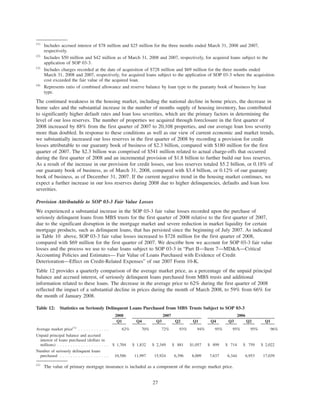
Related Expenses—Credit Loss Performance Metrics” for information on the proportion of our credit losses
attributable to Alt-A and subprime loans.
• Alt-A Loans: Alt-A mortgage loans, whether held in our portfolio or backing Fannie Mae MBS,
represented approximately 4% of our single-family business volume for the first quarter of 2008, compared
with approximately 23% for the first quarter of 2007. The significant decline in Alt-A volume is due in part
to the overall decline in the Alt-A market, as well as to our recent and continued tightening of eligibility
standards and price increases. As a result of these recent eligibility restrictions and price increases, we
believe that our volume of Alt-A mortgage loan acquisitions will continue to decline in future periods. Alt-A
mortgage loans held in our portfolio or Alt-A mortgage loans backing Fannie Mae MBS, excluding
resecuritized private-label mortgage-related securities backed by Alt-A mortgage loans, represented
approximately 11% of our total single-family mortgage credit book of business as of March 31, 2008,
compared with approximately 12% as of December 31, 2007.
• Subprime Loans: Subprime mortgage loans, whether held in our portfolio or backing Fannie Mae MBS,
represented less than 1% of our single-family business volume for the first quarter of 2008 and 2007. We
estimate that subprime mortgage loans held in our portfolio or subprime mortgage loans backing Fannie
Mae MBS, excluding resecuritized private-label mortgage-related securities backed by subprime mortgage
loans, represented approximately 0.3% of our total single-family mortgage credit book of business as of both
March 31, 2008 and December 31, 2007.
See “Consolidated Balance Sheet Analysis—Trading and Available-for-Sale Investment Securities—
Investments in Private-Label Mortgage Related Securities” for information on our investments in Alt-A and
subprime private-label mortgage-related securities, including resecuritized private-label mortgage-related
securities backed by Alt-A and subprime mortgage loans.
Multifamily
The weighted average original LTV ratio for our multifamily mortgage credit book of business was 67% as of
both March 31, 2008 and December 31, 2007. The percentage of our multifamily mortgage credit book of
business with an original LTV ratio greater than 80% was 5% as of March 31, 2008, compared with 6% as of
December 31, 2007.
Mortgage Credit Book of Business Performance
Key statistical metrics that we use to measure credit risk in our mortgage credit book of business and evaluate
credit performance include: (1) the serious delinquency rate; (2) nonperforming loans; and (3) foreclosure
activity. We provide information below on these metrics. We provide information on our credit loss
performance, another key metric we use to evaluate credit performance, in “Consolidated Results of
Operations—Credit-Related Expenses—Credit Loss Performance Metrics.”
65
Serious Delinquency
Table 39 below compares the serious delinquency rates, by geographic region, for all conventional single-
family loans and multifamily loans with credit enhancement and without credit enhancement as of March 31,
2008, December 31, 2007 and March 31, 2007.
Table 39: Serious Delinquency Rates
Book
Outstanding(1)
Serious
Delinquency
Rate(2)
Book
Outstanding(1)
Serious
Delinquency
Rate(2)
Book
Outstanding(1)
Serious
Delinquency
Rate(2)
March 31, 2008 December 31, 2007 March 31, 2007
Conventional single-family
delinquency rates by
geographic region:(3)
Midwest . . . . . . . . . . . . 17% 1.44% 17% 1.35% 17% 0.96%
Northeast . . . . . . . . . . . 18 1.05 19 0.94 19 0.67
Southeast . . . . . . . . . . . 25 1.44 25 1.18 24 0.63
Southwest . . . . . . . . . . . 16 0.94 16 0.86 16 0.62
West . . . . . . . . . . . . . . 24 0.72 23 0.50 24 0.21
Total conventional
single-family
loans . . . . . . . . . . . 100% 1.15% 100% 0.98% 100% 0.62%
Conventional single-family
loans:
Credit enhanced . . . . . . 21% 3.15% 21% 2.75% 19% 1.74%
Non-credit enhanced . . . 79 0.62 79 0.53 81 0.35
Total conventional
single-family
loans . . . . . . . . . . . 100% 1.15% 100% 0.98% 100% 0.62%
Multifamily loans:
Credit enhanced . . . . . . 88% 0.07% 88% 0.06% 91% 0.08%
Non-credit enhanced . . . 12 0.23 12 0.22 9 0.19
Total multifamily
loans . . . . . . . . . . . 100% 0.09% 100% 0.08% 100% 0.09%
(1)
Reported based on unpaid principal balance of loans, where we have detailed loan-level information.
(2)
Calculated based on number of loans for single-family and unpaid principal balance for multifamily. We include all of
the conventional single-family loans that we own and that back Fannie Mae MBS in the calculation of the single-
family delinquency rate. We include the unpaid principal balance of all multifamily loans that we own or that back
Fannie Mae MBS and any housing bonds for which we provide credit enhancement in the calculation of the
multifamily serious delinquency rate.
(3)
Midwest consists of IL, IN, IA, MI, MN, NE, ND, OH, SD and WI. Northeast includes CT, DE, ME, MA, NH, NJ,
NY, PA, PR, RI, VT and VI. Southeast consists of AL, DC, FL, GA, KY, MD, MS, NC, SC, TN, VA and WV.
Southwest consists of AZ, AR, CO, KS, LA, MO, NM, OK, TX and UT. West consists of AK, CA, GU, HI, ID, MT,
NV, OR, WA and WY.
In the first quarter of 2008, our serious delinquency rates, which are a leading indicator of potential
foreclosures, increased across our entire conventional single-family mortgage credit book of business to 1.15%
as of March 31, 2008, from 0.98% as of December 31, 2007 and 0.62% as of March 31, 2007. We
experienced the most notable increase in serious delinquency rates in states such as Arizona, California,
Florida, and Nevada, which previously experienced rapid increases in home prices and are now experiencing
sharp declines in home prices. In addition, we continued to experience significant increases in the serious
delinquency rates in some higher risk loan categories: Alt-A loans, adjustable-rate loans, interest-only loans,
negative amortization loans, loans made for the purchase of condominiums and loans with second liens. Many
66
of these higher risk loans were originated in 2006 and 2007. However, as a result of tightening our eligibility
standards, we expect that the loans we are now acquiring will have a lower credit risk relative to the loans we
acquired in 2006 and 2007.
The conventional single-family serious delinquency rates for California and Florida, which represent the two
largest states in our conventional single-family mortgage credit book of business in terms of unpaid principal
balance, climbed to 0.76% and 2.32%, respectively, as of March 31, 2008, from 0.50% and 1.59%,
respectively, as of December 31, 2007 and 0.17% and 0.49% as of March 31, 2007. The serious delinquency
rates for Alt-A and subprime loans was 2.96% and 7.42%, respectively, as of March 31, 2008, compared with
2.15% and 5.76%, respectively, as of December 31, 2007 and 0.94% and 4.62% as of March 31, 2007. We
expect the housing market to continue to deteriorate and home prices to continue to decline in these states and
on a national basis. Accordingly, we expect our single-family serious delinquency rate to continue to increase
in 2008.
The multifamily serious delinquency rate was 0.09% as of March 31, 2008, compared with 0.08% as of
December 31, 2007 and 0.09% as of March 31, 2007.
Nonperforming Loans
Table 40 provides statistics on nonperforming single-family and multifamily loans as of March 31, 2008 and
December 31, 2007.
Table 40: Nonperforming Single-Family and Multifamily Loans
March 31,
2008
December 31,
2007
(Dollars in millions)
As of
Nonperforming loans:
Nonaccrual loans . . . . . . . . . . . . . . . . . . . . . . . . . . . . . . . . . . . . . . . . . . . . . . . . . . . . . $ 8,723 $ 8,343
Troubled debt restructurings(1)
. . . . . . . . . . . . . . . . . . . . . . . . . . . . . . . . . . . . . . . . . . . . 2,211 1,765
Total nonperforming loans . . . . . . . . . . . . . . . . . . . . . . . . . . . . . . . . . . . . . . . . . . . . . $10,934 $10,108
Interest on nonperforming loans:
Interest income forgone(2)
. . . . . . . . . . . . . . . . . . . . . . . . . . . . . . . . . . . . . . . . . . . . . . . $ 114 $ 215
Interest income recognized during year(3)
. . . . . . . . . . . . . . . . . . . . . . . . . . . . . . . . . . . . 109 328
Accruing loans past due 90 days or more(4)
. . . . . . . . . . . . . . . . . . . . . . . . . . . . . . . . . . . . $ 197 $ 204
(1)
Troubled debt restructurings include loans whereby the contractual terms have been modified that result in concessions
to borrowers experiencing financial difficulties.
(2)
Forgone interest income represents the amount of interest income that would have been recorded during the period on
nonperforming loans as of the end of each period had the loans performed according to their contractual terms.
(3)
Represents interest income recognized during the period on loans classified as nonperforming as of the end of each
period.
(4)
Recorded investment of loans as of the end of each period that are 90 days or more past due and continuing to accrue
interest include loans insured or guaranteed by the U.S. government and loans where we have recourse against the
seller of the loan in the event of a default.
67
Foreclosure and REO Activity
Table 41 below provides information, by region, on our foreclosure activity for the three months ended
March 31, 2008 and 2007.
Table 41: Single-Family and Multifamily Foreclosed Properties
2008 2007
For the
Three Months
Ended
March 31,
Single-family foreclosed properties (number of properties):
Beginning of period inventory of single-family foreclosed properties (REO)(1)
. . . . . . . . . . . . . . . 33,729 25,125
Acquisitions by geographic area:(2)
Midwest . . . . . . . . . . . . . . . . . . . . . . . . . . . . . . . . . . . . . . . . . . . . . . . . . . . . . . . . . . . . 7,310 4,733
Northeast . . . . . . . . . . . . . . . . . . . . . . . . . . . . . . . . . . . . . . . . . . . . . . . . . . . . . . . . . . . 1,361 835
Southeast . . . . . . . . . . . . . . . . . . . . . . . . . . . . . . . . . . . . . . . . . . . . . . . . . . . . . . . . . . . 5,377 2,564
Southwest. . . . . . . . . . . . . . . . . . . . . . . . . . . . . . . . . . . . . . . . . . . . . . . . . . . . . . . . . . . 3,879 2,294
West . . . . . . . . . . . . . . . . . . . . . . . . . . . . . . . . . . . . . . . . . . . . . . . . . . . . . . . . . . . . . . 2,181 287
Total properties acquired through foreclosure . . . . . . . . . . . . . . . . . . . . . . . . . . . . . . . . . . . . 20,108 10,713
Dispositions of REO . . . . . . . . . . . . . . . . . . . . . . . . . . . . . . . . . . . . . . . . . . . . . . . . . . . . . (10,670) (9,544)
End of period inventory of single-family foreclosed properties (REO)(1)
. . . . . . . . . . . . . . . . . . . 43,167 26,294
Carrying value of single-family foreclosed properties (dollars in millions)(3)
. . . . . . . . . . . . . . . . $ 4,530 $ 2,241
Single-family foreclosure rate(4)
. . . . . . . . . . . . . . . . . . . . . . . . . . . . . . . . . . . . . . . . . . . . . . . 0.1% 0.1%
Multifamily foreclosed properties (number of properties):
Ending inventory of multifamily foreclosed properties (REO) . . . . . . . . . . . . . . . . . . . . . . . . . . 15 9
Carrying value of multifamily foreclosed properties (dollars in millions)(3)
. . . . . . . . . . . . . . . . . $ 60 $ 52
(1)
Includes deeds in lieu of foreclosure.
(2)
See footnote 3 to Table 39 for states included in each geographic region.
(3)
Excludes foreclosed property claims receivables, which are reported in our condensed consolidated balance sheets as a
component of “Acquired property, net.”
(4)
Estimated based on the total number of properties acquired through foreclosure as a percentage of the total number of
loans in our conventional single-family mortgage credit book of business as of the end of each respective period.
The Mortgage Bankers Association’s National Delinquency Survey released in March 2008 reported that the
rate of foreclosure starts and percent of loans in the process of foreclosure reached record levels during the
fourth quarter of 2007. The number of single-family properties we acquired through foreclosure in the first
quarter of 2008 increased by 88% from the first quarter of 2007, reflecting the impact of the continued
housing market downturn and decline in home prices throughout much of the country, particularly in the states
of Arizona, California, Florida, Nevada, and continued weak economic conditions in the Midwest. As
discussed in “Consolidated Results of Operations—Credit-Related Expenses—Credit Loss Performance
Metrics,” we have experienced a significant increase in default rates, particularly within certain states that
have had significant home price depreciation, for certain higher risk loan categories, such as Alt-A, and for
loans originated in 2006 and 2007.
The states of Arizona, California, Florida and Nevada accounted for 17% of single-family properties acquired
through foreclosure for the first quarter of 2008, compared with 4% for the first quarter of 2007, reflecting the
sharp declines in home prices that these states are now experiencing. The Midwest accounted for
approximately 36% and 44% of the single-family properties acquired through foreclosure for the first quarter
of 2008 and 2007, respectively, reflecting the continued impact of weak economic conditions in this region.
68
Alt-A mortgage loans accounted for 29% of single-family properties acquired through foreclosure for the first
quarter of 2008, compared with 17% for the first quarter of 2007.
The continued housing market downturn and decline in home prices on a national basis have resulted in a
higher percentage of our mortgage loans that transition from delinquent to foreclosure status. In addition, the
combined effect of the disruption in the subprime market, the decline in home prices and near record levels of
unsold properties have slowed the sale of, and reduced the sales prices of, our foreclosed single-family
properties. Based on these factors as well as the sharp rise in our serious delinquency rates during the first
quarter of 2008, we expect the level of foreclosures, as well as the average length of time required to dispose
of our foreclosed properties, to increase further in 2008 compared with 2007.
Institutional Counterparty Credit Risk Management
Mortgage Insurers
As of March 31, 2008, we had total mortgage insurance coverage of $111.5 billion on the single-family
mortgage loans in our guaranty book of business, of which $101.3 billion was primary mortgage insurance and
$10.2 billion was pool mortgage insurance. As of December 31, 2007, we had total mortgage insurance
coverage of $104.1 billion on the single-family mortgage loans in our guaranty book of business, of which
$93.7 billion was primary mortgage insurance and $10.4 billion was pool mortgage insurance.
Eight mortgage insurance companies provided over 99% of our mortgage insurance as of both March 31, 2008
and December 31, 2007. We received proceeds of $475 million and $290 million for the three months ended
March 31, 2008 and 2007, respectively, from our primary and pool mortgage insurance policies, lender
repurchases and other forms of credit enhancement on our single-family loans. We had outstanding receivables
from mortgage insurers of $451 million and $293 million as of March 31, 2008 and December 31, 2007,
respectively, related to amounts claimed on foreclosed properties.
Table 42 presents the primary and pool mortgage insurance coverage on single-family loans in our guaranty
book of business by mortgage insurer for our top eight mortgage insurer counterparties as of March 31, 2008,
as well as the insurer financial strength ratings of each of these counterparties as of May 2, 2008.
Table 42: Mortgage Insurance Coverage
Counterparty Name(1)
Moody’s S&P Fitch Primary Pool Total
Maximum Coverage(2)
(Dollars in millions)
Insurer Financial Strength
Ratings
As of May 2, 2008 As of March 31, 2008
Mortgage Guaranty Insurance Corporation . . . . . . . . . . . . . . Aa2 A AA $23,835 $2,804 $26,639
PMI Mortgage Insurance Co. . . . . . . . . . . . . . . . . . . . . . . . Aa2 A+ AA 14,392 2,524 16,916
Genworth Mortgage Insurance Corporation . . . . . . . . . . . . . . Aa2 AA AA 16,045 442 16,487
United Guaranty Residential Insurance Company . . . . . . . . . . Aa2 AA+ AA+ 15,396 334 15,730
Radian Guaranty, Inc. . . . . . . . . . . . . . . . . . . . . . . . . . . . . Aa3 A N/R 13,970 923 14,893
Republic Mortgage Insurance Company . . . . . . . . . . . . . . . . Aa3 AA- AA 11,226 1,720 12,946
Triad Guaranty Insurance Corporation . . . . . . . . . . . . . . . . . Baa3 BBB BB 4,387 1,487 5,874
CMG Mortgage Insurance Company(3)
. . . . . . . . . . . . . . . . . N/R AA- AA 1,901 — 1,901
(1)
Insurance coverage amounts provided for each counterparty may include coverage provided by consolidated
subsidiaries of the counterparty.
(2)
Maximum coverage refers to the aggregate dollar amount of insurance coverage (i.e., “risk in force”) on single-family
loans in our guaranty book of business and represents our maximum potential loss recovery under the applicable
mortgage insurance policies.
(3)
CMG Mortgage Insurance Company is a joint venture owned by PMI Mortgage Insurance Co. and CUNA Mutual
Investment Corporation.
Recent increases in mortgage insurance claims due to higher credit losses in recent periods have adversely
affected the financial results and condition of many mortgage insurers. In April 2008, Standard & Poor’s
69
downgraded the insurer financial strength ratings of five of our eight primary mortgage insurer counterparties.
As of March 31, 2008, these five mortgage insurers provided $77.3 billion, or 69%, of our total mortgage
insurance coverage on single-family loans in our guaranty book of business. The insurer financial strength
rating of one of these mortgage insurers, Triad Guaranty Insurance Corporation, was also downgraded several
notches by Moody’s and Fitch. In its annual report on Form 10-K for the year ended December 31, 2007,
Triad announced that it is considering a plan in which it would no longer write new business and would run
off its existing business.
In addition, as a result of the downgrades that occurred in April 2008, four of our primary mortgage insurer
counterparties’ current insurer financial strength ratings are below the “AA-” level that we require under our
qualified mortgage insurer approval requirements to be considered qualified as a “Type 1” mortgage insurer.
As of May 2, 2008, these counterparties remain qualified under our requirements to conduct business with us.
We are continuing to evaluate these counterparties on a case-by-case basis to determine whether or under what
conditions they will remain eligible to insure new mortgages sold to us. Factors that we are considering in our
evaluations include the risk profile of the insurers’ existing portfolios, the insurers’ liquidity and capital
adequacy to pay expected claims, the insurers’ plans to raise additional capital, as well as the current market
environment and our alternative sources of credit enhancement. Based on the outcome of our evaluations, we
may take a variety of actions, including imposing additional terms and conditions of approval, restricting the
insurer from conducting certain types of business, suspension or termination of the insurer’s qualification
status under our requirements, or cancelling a certificate of insurance or policy with that insurer and replacing
the insurance coverage with another provider.
Should we determine that we are no longer willing or able to conduct business with one or more of our
primary mortgage insurer counterparties, it is likely we would further increase our concentration risk with the
remaining mortgage insurers in the industry. In addition, we are generally required pursuant to our charter to
obtain credit enhancement on conventional single-family mortgage loans that we purchase or securitize with
LTV ratios over 80% at the time of purchase. Accordingly, if we are no longer willing or able to conduct
business with some of our primary mortgage insurer counterparties and we do not find suitable alternative
methods of obtaining credit enhancement for these loans, we may be restricted in our ability to purchase loans
with high LTV ratios. This restriction could negatively impact our competitive position and our earnings.
Approximately 26% of our conventional single-family business volume for the first quarter of 2008 consisted
of loans with an original LTV ratio higher than 80%.
The current weakened financial condition of many of our mortgage insurer counterparties creates an increased
risk that these counterparties will fail to fulfill their obligations to reimburse us for claims under insurance
policies. If the financial condition of one or more of these mortgage insurer counterparties deteriorates further,
it could result in a material increase in our loss reserves and the fair value of our guaranty obligations if we
determine it is probable that we would not collect all of our claims from the affected mortgage insurer, which
could adversely affect our earnings, liquidity, financial condition and capital position. In addition, if a
mortgage insurer implements a run-off plan in which the insurer no longer enters into new business, the
quality and speed of their claims processing could deteriorate. The insurer financial strength rating
downgrades of our mortgage insurer counterparties that have occurred to date have not affected our loss
reserves, nor have they materially affected the fair value of our guaranty obligations.
We continue to monitor and manage our risk exposure to mortgage insurers. Our monitoring of these insurers
includes frequent discussions with the insurers’ management, the rating agencies and insurance regulators, and
in-depth financial reviews and stress analyses of the insurers’ portfolios and capital adequacy.
Financial Guarantors
As of March 31, 2008 and December 31, 2007, we were the beneficiary of financial guarantees of
approximately $11.1 billion and $11.8 billion, respectively, on the securities held in our investment portfolio
or on securities that have been resecuritized to include a Fannie Mae guaranty and sold to third parties. The
securities covered by these guarantees consist primarily of private-label mortgage-related securities and
municipal bonds.
70
Five of our top nine financial guarantor counterparties have had their insurer financial strength ratings
downgraded by one or more of the nationally recognized statistical rating organizations since December 31,
2007. A downgrade in the ratings of one of our financial guarantor counterparties could result in a reduction
in the fair value of the securities they guarantee, which could adversely affect our earnings, financial condition
and capital position. These rating downgrades also imply an increased risk that these financial guarantors will
fail to fulfill their obligations to reimburse us for claims under their guaranty contracts. These rating
downgrades have resulted in reduced liquidity and prices for our securities for which we have obtained
financial guarantees; however, we have evaluated these guaranteed securities and we believe the underlying
collateral of these securities will generate cash flows that are adequate to repay our investments on a high
percentage of these securities. We continue to monitor the effect these rating actions may have on the value of
the securities in our investment portfolio. Refer to “Consolidated Balance Sheet Analysis—Trading and
Available-for-Sale Investment Securities—Investments in Private-Label Mortgage-Related Securities” for more
information on our investments in private-label mortgage-related securities and municipal bonds.
Custodial Depository Institutions
A total of $51.0 billion and $32.5 billion in deposits for scheduled single-family MBS payments were received
and held by 316 and 324 custodial depository institutions in the months of March 2008 and December 2007,
respectively. Of these amounts, 97% and 95% were held by institutions rated as investment grade by
Standard & Poor’s, Moody’s and Fitch as of March 31, 2008 and December 31, 2007, respectively.
Derivatives Counterparties
The notional amount of our risk management derivative instruments increased to $1.0 trillion as of March 31,
2008, from $886.5 billion as of December 31, 2007. However, our credit exposure on our risk management
derivatives, net of collateral we held, decreased to $500 million as of March 31, 2008, from $542 million as of
December 31, 2007.
Interest Rate Risk Management and Other Market Risks
A significant market risk we face and actively manage for our net portfolio is interest rate risk—the risk of
changes in our long-term earnings or in the value of our net assets due to changes in interest rates. Our net
portfolio consists of our existing investments in mortgage assets, investments in non-mortgage securities, our
outstanding debt used to fund those assets, and the derivatives used to supplement our debt instruments and
manage interest rate risk. It also includes any priced asset, debt and derivatives commitments, but excludes our
existing guaranty business. Our Capital Markets group, which has primary responsibility for managing the
interest rate risk of our net portfolio, employs an integrated interest rate risk management strategy that
includes asset selection and structuring of our liabilities, including debt and derivatives, to match and offset
the interest rate characteristics of our balance sheet assets and liabilities as much as possible.
71
Derivatives Activity
The primary tool we use to manage the interest rate risk implicit in our mortgage assets is the variety of debt
instruments we issue. We supplement our issuance of debt with derivative instruments, which are an integral
part of our strategy in managing interest rate risk. Table 43 presents, by derivative instrument type, our risk
management derivative activity for the three months ended March 31, 2008, along with the stated maturities of
derivatives outstanding as of March 31, 2008.
Table 43: Activity and Maturity Data for Risk Management Derivatives(1)
Pay-
Fixed(2)
Receive-
Fixed(3)
Basis(4)
Foreign
Currency
Pay-
Fixed
Receive-
Fixed
Interest
Rate Caps Other(5)
Total
Interest Rate Swaps Interest Rate Swaptions
(Dollars in millions)
Notional balance as of
December 31, 2007 . . $377,738 $285,885 $ 7,001 $ 2,559 $85,730 $124,651 $ 2,250 $650 $ 886,464
Additions . . . . . . . . . 72,608 130,364 16,175 175 653 11,228 — 154 231,357
Terminations(6)
. . . . . (6,501) (7,591) (5,150) (1,024) (1,028) (51,954) (1,500) (60) (74,808)
Notional balance as of
March 31, 2008 . . . . $443,845 $408,658 $18,026 $ 1,710 $85,355 $ 83,925 $ 750 $744 $1,043,013
Future maturities of
notional amounts:(7)
Less than 1 year . . . . $ 21,005 $ 69,870 $ 4,500 $ 773 $ 7,350 $ 20,050 $ — $ 30 $ 123,578
1 year to 5 years . . . . 221,395 205,632 11,025 94 41,705 16,705 750 445 497,751
5 years to 10 years . . 173,185 117,851 1,250 — 31,800 37,120 — 269 361,475
Over 10 years . . . . . . 28,260 15,305 1,251 843 4,500 10,050 — — 60,209
Total . . . . . . . . . . . . $443,845 $408,658 $18,026 $ 1,710 $85,355 $ 83,925 $ 750 $744 $1,043,013
Weighted-average
interest rate as of
March 31, 2008:
Pay rate . . . . . . . . . . 4.84% 3.29% 3.24% — 6.25% — — —
Receive rate . . . . . . . 3.27% 4.77% 3.04% — — 4.80% — —
Other . . . . . . . . . . . . — — — — — — 6.19% —
Weighted-average
interest rate as of
December 31, 2007:
Pay rate . . . . . . . . . . 5.10% 5.04% 4.92% — 6.25% — — —
Receive rate . . . . . . . 5.03% 5.08% 6.84% — — 4.84% — —
Other . . . . . . . . . . . . — — — — — — 4.35% —
(1)
Excludes mortgage commitments accounted for as derivatives. Dollars represent notional amounts that indicate only
the amount on which payments are being calculated and do not represent the amount at risk of loss.
(2)
Notional amounts include swaps callable by Fannie Mae of $3.3 billion and $8.2 billion as of March 31, 2008 and
December 31, 2007, respectively.
(3)
Notional amounts include swaps callable by derivatives counterparties of $15.3 billion and $7.8 billion as of March 31,
2008 and December 31, 2007, respectively.
(4)
Notional amounts include swaps callable by derivatives counterparties of $1.8 billion and $6.6 billion as of March 31,
2008 and December 31, 2007, respectively.
(5)
Includes MBS options, forward starting debt, swap credit enhancements and mortgage insurance contracts.
(6)
Includes matured, called, exercised, assigned and terminated amounts. Also includes changes due to foreign exchange
rate movements.
(7)
Based on contractual maturities.
72
The outstanding notional balance of our risk management derivatives increased by $156.5 billion during the
first quarter of 2008, to $1.0 trillion as of March 31, 2008. The increase reflected rebalancing activities we
undertook, which included increasing both our pay-fixed and receive-fixed interest rate swaps, in response to
the interest rate volatility during the period.
Measuring Interest Rate Risk
Because no single measure can reflect all aspects of the interest rate risk inherent in our mortgage portfolio,
we utilize various risk metrics that together provide a more complete assessment of interest rate risk. Below
we present three measures that we use to quantify our interest rate risk: (i) fair value sensitivity to changes in
interest rate levels and slope of yield curve; (ii) net asset fair value sensitivity; and (iii) duration gap. As
discussed below, each of these measures reflected an increase in our exposure to interest rates between
December 31, 2007 and March 31, 2008. This increased exposure was largely driven by wider mortgage
spreads during the period, which resulted in lower prices as of the end of the period and higher dollar
sensitivities to changes in interest rates. A lower fair value of net assets between December and March also
increased the risk metrics that we express as a percentage of the fair value of net assets.
Fair Value Sensitivity to Changes in Level and Slope of Yield Curve
We disclose on a monthly basis the estimated adverse impact on our financial condition of a 50 basis point
shift in interest rates and a 25 basis point change in the slope of the yield curve. We believe these changes
represent moderate movements in interest rates over a one-month period. Based on the current position and
estimated fair value of our net portfolio, we calculate on a daily basis the estimated amount of pre-tax losses
for our net portfolio, or reduction in fair value, expressed as a percentage of the estimated after-tax fair value
of our net assets, that would result from an immediate adverse 50 basis point parallel shift in the level of
interest rates and an immediate adverse 25 basis point change in the slope of the yield curve, calculated as
described below.
Table 44 below is an extension of our monthly net sensitivity measures. There are four primary differences
between the monthly and quarterly market risk disclosures we make: (1) our monthly disclosure is based on
the daily average reported during the month while the quarterly disclosure is based on the position and the
market environment on the last day of the month; (2) the quarterly disclosure includes the results of larger rate
shocks of up and down 100 basis points in addition to the up and down 50 basis points; (3) the prices used for
the monthly disclosure are based on internal daily estimates used during the month while the quarterly
disclosure uses final fair values determined for the last day of the month as part of our closing process; and
(4) the fair value of net assets used in the monthly disclosure is one from a prior period while the quarterly
disclosure uses the fair value of net assets at quarter end. In addition, our monthly disclosure includes LIHTC
assets and preferred stock, which are excluded from Table 44, but separately included in the footnotes of the
table.
73
Table 44: Interest Rate Sensitivity of Fair Value of Net Portfolio
Estimated
Fair Value -50 -100 +50 +100
Decrease in Rates Increase in Rates
Effect on Estimated
Fair Value
As of March 31, 2008
(Dollars in millions)
Trading financial instruments(1)
. . . . . . . . . . . . . . . . . . . . . . . . . . $ 110,573 $1,145 $2,147 $(1,289) $(2,680)
Derivative assets and liabilities, net . . . . . . . . . . . . . . . . . . . . . . . (3,086) (720) (958) 1,293 3,121
Non-trading portfolio assets and debt(3)
. . . . . . . . . . . . . . . . . . . . (109,496) 877 185 (2,200) (5,083)
Net portfolio of interest-rate sensitive assets and liabilities(4)
. . . . $ (2,009) $1,302 $1,374 $(2,196) $(4,642)
Estimated
Fair Value -50 -100 +50 +100
Decrease in Rates Increase in Rates
Effect on Estimated
Fair Value
As of December 31, 2007
(Dollars in millions)
Trading financial instruments(1)
. . . . . . . . . . . . . . . . . . . . . . . . . $ 63,956 $ 829 $ 1,595 $ (877) $(1,796)
Derivative assets and liabilities, net(2)
. . . . . . . . . . . . . . . . . . . . (1,332) (2,007) (3,366) 2,667 5,854
Non-trading portfolio assets and debt(3)
. . . . . . . . . . . . . . . . . . . (52,753) 791 53 (1,991) (4,789)
Net portfolio of interest-rate sensitive assets and liabilities . . . . $ 9,871 $ (387) $(1,718) $ (201) $ (731)
(1)
Consists of securities classified in the condensed consolidated balance sheets as trading and carried at estimated fair
value.
(2)
Certain prior period amounts have been reclassified to conform to the current period presentation.
(3)
“Non-trading portfolio assets and debt, net” includes the line item “Advances to lenders” reported in our condensed
consolidated balance sheets. In addition, certain amounts have been reclassified from securities to “Guaranty assets and
guaranty obligations, net” to reflect how the risk of these securities is managed by the business.
(4)
Effective January 1, 2008, the interest rate sensitivities reported in our Monthly Summary Report included preferred
stock and our LIHTC investments. These amounts have been excluded from the table. The sensitivity of the combined
amounts for a decrease in rates of -50 basis points and -100 basis points were ($188) million and ($373) million,
respectively, and an increase in rates of +50 basis points and +100 basis points were $192 million and $386 million,
respectively, as of March 31, 2008.
The losses for the +50 basis point and +100 basis point shocks increased over the quarter. The increase in
sensitivity was primarily driven by wider spreads on less liquid assets, and in particular by sharply wider
spreads reported at quarter end on some of the least liquid assets, such as Alt-A securities. These wider
spreads were indicative of the low liquidity in the overall mortgage market at that time.
74
Fair Value Sensitivity of Net Assets
Table 45 discloses the estimated fair value of our net assets as of March 31, 2008 and December 31, 2007,
and the impact on the estimated fair value from a hypothetical instantaneous shock in interest rates of a
decrease of 50 basis points and an increase of 100 basis points. We believe these interest rate changes reflect
reasonably possible near-term outcomes within a 12-month period. We discuss how we derive the estimated
fair value of our net assets, which serves as the base case for our sensitivity analysis, in “Supplemental Non-
GAAP Information—Fair Value Balance Sheets.”
Table 45: Interest Rate Sensitivity of Fair Value of Net Assets
Estimated
Fair Value -50 +100
Change in Rates
Effect on Estimated
Fair Value
As of March 31, 2008
(Dollars in millions)
Trading financial instruments(1)
. . . . . . . . . . . . . . . . . . . . . . . . . . . . . . . . . . . . . . . . $ 110,573 $ 1,145 $(2,680)
Derivative assets and liabilities, net. . . . . . . . . . . . . . . . . . . . . . . . . . . . . . . . . . . . . . (3,086) (720) 3,121
Non-trading portfolio assets and debt, net(3)
. . . . . . . . . . . . . . . . . . . . . . . . . . . . . . . . (109,496) 877 (5,083)
Net portfolio of interest-rate sensitive assets and liabilities . . . . . . . . . . . . . . . . . . . . (2,009) 1,302 (4,642)
Guaranty assets and guaranty obligations, net(3)
. . . . . . . . . . . . . . . . . . . . . . . . . . . . . (28,425) 3,104 (1,173)
Net market sensitive assets(4)
. . . . . . . . . . . . . . . . . . . . . . . . . . . . . . . . . . . . . . . . (30,434) 4,406 (5,815)
Other non-financial assets and liabilities, net(5)
. . . . . . . . . . . . . . . . . . . . . . . . . . . . . . 42,644 (1,460) 1,880
Net assets. . . . . . . . . . . . . . . . . . . . . . . . . . . . . . . . . . . . . . . . . . . . . . . . . . . . . . $ 12,210 $ 2,946 $(3,935)
Percentage of net asset fair value . . . . . . . . . . . . . . . . . . . . . . . . . . . . . . . . . . . . . 24.13% (32.23)%
Estimated
Fair Value -50 +100
Change in Rates
Effect on Estimated
Fair Value
As of December 31, 2007
(Dollars in millions)
Trading financial instruments(1)
. . . . . . . . . . . . . . . . . . . . . . . . . . . . . . . . . . . . . . . . $ 63,956 $ 829 $(1,796)
Derivative assets and liabilities, net(2)
. . . . . . . . . . . . . . . . . . . . . . . . . . . . . . . . . . . . (1,332) (2,007) 5,854
Non-trading portfolio assets and debt, net(3)
. . . . . . . . . . . . . . . . . . . . . . . . . . . . . . . . (52,753) 791 (4,789)
Net portfolio of interest-rate sensitive assets and liabilities . . . . . . . . . . . . . . . . . . . . 9,871 (387) (731)
Guaranty assets and guaranty obligations, net(3)
. . . . . . . . . . . . . . . . . . . . . . . . . . . . . (2,441) (1,406) (548)
Net market sensitive assets(4)
. . . . . . . . . . . . . . . . . . . . . . . . . . . . . . . . . . . . . . . . 7,430 (1,793) (1,279)
Other non-financial assets and liabilities, net(2)(5)
. . . . . . . . . . . . . . . . . . . . . . . . . . . . 28,369 719 270
Net assets . . . . . . . . . . . . . . . . . . . . . . . . . . . . . . . . . . . . . . . . . . . . . . . . . . . . . . $ 35,799 $(1,074) $(1,009)
Percentage of net asset fair value . . . . . . . . . . . . . . . . . . . . . . . . . . . . . . . . . . . . . (3.00)% (2.82)%
(1)
Consists of securities classified in the condensed consolidated balance sheets as trading and carried at estimated fair
value. On January 1, 2008, we adopted the fair value option under SFAS 159 for certain securities that were previously
classified as available-for-sale within our mortgage-related and non-mortgage-related investment portfolio in the
amount of $56.2 billion. We expect that the interest rate component of fair value for the securities adopted under
SFAS 159 will offset a portion of the change in the fair value of our derivatives.
(2)
Certain prior period amounts have been reclassified to conform to the current period presentation.
(3)
“Non-trading portfolio assets and debt, net” includes the line item “Advances to lenders” reported in our condensed
consolidated balance sheets. In addition, certain amounts have been reclassified from securities to “Guaranty assets and
guaranty obligations, net” to reflect how the risk of these securities is managed by the business.
75
(4)
Includes net financial assets and financial liabilities reported in “Notes to Condensed Consolidated Financial
Statements—Note 16, Fair Value of Financial Instruments” and additional market sensitive instruments that consist of
master servicing assets, master servicing liabilities and credit enhancements.
(5)
The sensitivity changes related to other non-financial assets and liabilities represent the tax effect on net assets under
these scenarios and do not include any interest rate sensitivity related to these items.
The net portfolio of interest-rate sensitive assets and liabilities was 24.13% for a -50 basis point shock and
(32.23)% for a +100 basis point shock as of March 31, 2008, compared with a (3.00)% for a -50 basis point
shock and (2.82)% for a +100 basis point shock as of December 31, 2007. We evaluate the sensitivity of the
fair value of our net assets, excluding the sensitivity of our guaranty assets and guaranty obligations, because,
as previously discussed, we expect that the guaranty fee income generated from future business activity will
largely replace any guaranty fee income lost as a result of mortgage prepayments due to movements in interest
rates. Our guaranty assets and our guaranty obligations generally increase in fair value when interest rates
increase and decrease in fair value when interest rates decline. The guaranty obligation has become less
sensitive on a percentage basis to increases in interest rates than it was last quarter; however, its larger size
has increased the dollar sensitivity. This impacts the dollar sensitivity of the net guaranty asset.
Duration Gap
Duration measures the price sensitivity of our assets and liabilities to changes in interest rates by quantifying
the difference between the estimated durations of our assets and liabilities. Duration gap summarizes the
extent to which estimated cash flows for assets and liabilities are matched, on average, over time and across
interest rate scenarios. A positive duration gap signals a greater exposure to rising interest rates because it
indicates that the duration of our assets exceeds the duration of our liabilities. The table below presents our
monthly effective duration gap for December 2007 and for the first three months of 2008.
Month
Effective
Duration Gap
December 2007 . . . . . . . . . . . . . . . . . . . . . . . . . . . . . . . . . . . . . . . . . . . . . . . . . . . . . . . . . . 2
January 2008 . . . . . . . . . . . . . . . . . . . . . . . . . . . . . . . . . . . . . . . . . . . . . . . . . . . . . . . . . . . . 1
February 2008 . . . . . . . . . . . . . . . . . . . . . . . . . . . . . . . . . . . . . . . . . . . . . . . . . . . . . . . . . . . 2
March 2008. . . . . . . . . . . . . . . . . . . . . . . . . . . . . . . . . . . . . . . . . . . . . . . . . . . . . . . . . . . . . 3
When interest rates are volatile, we often need to lengthen or shorten the average duration of our liabilities to
keep them closely matched with our mortgage durations, which change as expected mortgage prepayments
change. A large movement in interest rates or increased interest rate volatility could cause our duration gap to
extend outside of the range we have experienced recently. The increase in our duration gap during the first
three months of 2008 was largely due to the impact of wider spreads on our mortgage assets. Wider spreads,
which are indicative of lower liquidity, increase the discount rate and generally increase the duration of
mortgage assets. However, fluctuations in spreads generally do not affect the timing of expected cash flows
from our mortgage assets or their average lives.
There are inherent limitations in any methodology used to estimate the exposure to changes in market interest
rates. Our sensitivity analyses contemplate only certain movements in interest rates and are performed at a
particular point in time based on the estimated fair value of our existing portfolio. These sensitivity analyses
do not incorporate other factors that may have a significant effect, most notably the value from expected
future business activities and strategic actions that management may take to manage interest rate risk. As such,
these analyses are not intended to provide precise forecasts of the effect a change in market interest rates
would have on the estimated fair value of our net assets.
76
IMPACT OF FUTURE ADOPTION OF ACCOUNTING PRONOUNCEMENTS
A change in a significant accounting pronouncement may have a significant effect on our results of operations,
our financial condition, our capital position or our business operations. We identify and discuss the expected
impact on our consolidated financial statements of recently issued or proposed accounting pronouncements in
“Notes to Condensed Consolidated Financial Statements—Note 1, Summary of Significant Accounting
Policies.”
FORWARD-LOOKING STATEMENTS
This report contains forward-looking statements, which are statements about matters that are not historical facts. In
addition, our senior management may from time to time make forward-looking statements orally to analysts,
investors, the news media and others. Forward-looking statements often include words such as “expects,”
“anticipates,” “intends,” “plans,” “believes,” “seeks,” “estimates,” “would,” “should,” “could,” “may,” or similar words.
Among the forward-looking statements in this report are statements relating to:
• our expectations regarding the future of the housing and mortgage markets, including our expectation of
continued housing market weakness in 2008 and our expectations relating to declines in home prices,
increases in mortgage delinquencies, defaults and foreclosures, and slower growth in U.S. residential
mortgage debt outstanding in 2008;
• our expectation that our credit-related expenses and credit loss ratio will significantly increase in 2008
relative to 2007, and our belief that our credit losses will increase in 2009 relative to 2008;
• our belief that our delinquencies, defaults and loan loss severities will increase in 2008, and that we will
further increase our loss reserves during 2008;
• our belief that our single-family guaranty book of business will continue to grow at a faster rate than the
rate of overall growth in U.S. residential mortgage debt outstanding, and that our guaranty fee income
will grow in 2008 compared to 2007;
• our expectation that we will experience increased competition from the FHA in 2008;
• our expectation that, if current market conditions continue, our taxable-equivalent net interest yield
(excluding the benefit we received from the redemption of step-rate debt securities during the first quarter
of 2008) will continue to increase for the remainder of 2008;
• our expectation that our results of future operations will generate sufficient taxable income to allow us to
realize our deferred tax assets;
• our expectation that our election to report a larger portion of our financial instruments at fair value
pursuant to SFAS 159 and our implementation of hedge accounting will reduce the level of volatility in
our financial results that is attributable to changes in interest rates;
• our belief that we will collect all original contractual principal and interest payments on the substantial
majority of our cured loans;
• our expectation that changes in the fair value of our trading securities will generally move inversely to
changes in the fair value of our derivatives;
• our expectation that we will classify a significant majority of securities we purchase in the future as
available-for-sale;
• our belief that we will collect the full principal and interest due in accordance with the contractual terms of
the securities with respect to our Alt-A and subprime private-label mortgage-related securities classified as
available-for-sale for which we have not recognized other-than-temporary impairment;
77
• our belief that our sources of liquidity will remain adequate to meet both our short-term and long-term
funding needs;
• our belief that our volume of Alt-A mortgage loan acquisitions will continue to decline in future periods;
• our expectation that a GSE reform bill will be introduced in the Senate in May 2008;
• our expectation that housing, mortgage and credit market conditions will continue to negatively affect our
results of operations and the amount of our core capital in 2008;
• our belief that the $6 billion in additional capital that we are planning to raise will enable us to pursue
growth and investment opportunities while also maintaining a prudent capital cushion in a volatile and
challenging market through 2008 and 2009;
• our expectation that we may take any of the following actions to further preserve and build our capital,
including: issuing additional preferred, convertible preferred or common stock; further reducing or
eliminating our common stock dividend; forgoing purchase and guaranty opportunities; reducing the size
of our investment portfolio through liquidations or by selling assets; changing our current business
practices to reduce our losses and expenses; and reclassifying a portion of our investment securities from
held for trading to available for sale;
• our estimate of the effect of hypothetical declines in home prices on our credit losses;
• our estimate of the effect of hypothetical stress test scenarios on the value of our Alt-A and subprime
private-label securities and wraps; and
• our estimate of the effect of hypothetical changes in interest rates on the fair value of our financial
instruments.
Forward-looking statements reflect our management’s expectations or predictions of future conditions, events
or results based on various assumptions and management’s estimates of trends and economic factors in the
markets in which we are active, as well as our business plans. They are not guarantees of future performance.
By their nature, forward-looking statements are subject to risks and uncertainties. Our actual results and
financial condition may differ, possibly materially, from the anticipated results and financial condition
indicated in these forward-looking statements. There are a number of factors that could cause actual
conditions, events or results to differ materially from those described in the forward-looking statements
contained in this report, including those factors described in “Part I—Item 1A—Risk Factors” of our 2007
Form 10-K, filed with the SEC on February 27, 2008, as updated by “Part II—Item 1A—Risk Factors” of this
report.
Readers are cautioned to place forward-looking statements in this report or that we make from time to time
into proper context by carefully considering the factors discussed in “Part I—Item 1A—Risk Factors” of our
2007 Form 10-K and in “Part II—Item 1A—Risk Factors” of this report. These forward-looking statements are
representative only as of the date they are made, and we undertake no obligation to update any forward-
looking statement as a result of new information, future events or otherwise, except as required under the
federal securities laws.
78
Item 1. Financial Statements
FANNIE MAE
Condensed Consolidated Balance Sheets
(Dollars in millions, except share amounts)
(Unaudited)
March 31,
2008
December 31,
2007
As of
ASSETS
Cash and cash equivalents . . . . . . . . . . . . . . . . . . . . . . . . . . . . . . . . . . . . . . . . . . . . . . . . . . . . . $ 1,997 $ 3,941
Restricted cash . . . . . . . . . . . . . . . . . . . . . . . . . . . . . . . . . . . . . . . . . . . . . . . . . . . . . . . . . . . . . 307 561
Federal funds sold and securities purchased under agreements to resell . . . . . . . . . . . . . . . . . . . . . . . . 20,484 49,041
Investments in securities:
Trading, at fair value (includes Fannie Mae MBS of $56,102 and $40,458 as of March 31, 2008 and
December 31, 2007, respectively) . . . . . . . . . . . . . . . . . . . . . . . . . . . . . . . . . . . . . . . . . . . . . 110,573 63,956
Available-for-sale, at fair value (includes Fannie Mae MBS of $119,064 and $138,943 as of March 31,
2008 and December 31, 2007, respectively) . . . . . . . . . . . . . . . . . . . . . . . . . . . . . . . . . . . . . . . 228,228 293,557
Total investments in securities . . . . . . . . . . . . . . . . . . . . . . . . . . . . . . . . . . . . . . . . . . . . . . 338,801 357,513
Mortgage loans:
Loans held for sale, at lower of cost or market . . . . . . . . . . . . . . . . . . . . . . . . . . . . . . . . . . . . . . 8,486 7,008
Loans held for investment, at amortized cost . . . . . . . . . . . . . . . . . . . . . . . . . . . . . . . . . . . . . . . . 403,442 397,214
Allowance for loan losses. . . . . . . . . . . . . . . . . . . . . . . . . . . . . . . . . . . . . . . . . . . . . . . . . . . (993) (698)
Total loans held for investment, net of allowance . . . . . . . . . . . . . . . . . . . . . . . . . . . . . . . . . . 402,449 396,516
Total mortgage loans . . . . . . . . . . . . . . . . . . . . . . . . . . . . . . . . . . . . . . . . . . . . . . . . . . 410,935 403,524
Advances to lenders . . . . . . . . . . . . . . . . . . . . . . . . . . . . . . . . . . . . . . . . . . . . . . . . . . . . . . . . . 11,732 12,377
Accrued interest receivable . . . . . . . . . . . . . . . . . . . . . . . . . . . . . . . . . . . . . . . . . . . . . . . . . . . . . 3,676 3,812
Acquired property, net . . . . . . . . . . . . . . . . . . . . . . . . . . . . . . . . . . . . . . . . . . . . . . . . . . . . . . . . 4,721 3,602
Derivative assets at fair value . . . . . . . . . . . . . . . . . . . . . . . . . . . . . . . . . . . . . . . . . . . . . . . . . . . 1,037 885
Guaranty assets . . . . . . . . . . . . . . . . . . . . . . . . . . . . . . . . . . . . . . . . . . . . . . . . . . . . . . . . . . . . 9,823 9,666
Deferred tax assets . . . . . . . . . . . . . . . . . . . . . . . . . . . . . . . . . . . . . . . . . . . . . . . . . . . . . . . . . . 17,806 12,967
Partnership investments . . . . . . . . . . . . . . . . . . . . . . . . . . . . . . . . . . . . . . . . . . . . . . . . . . . . . . . 10,579 11,000
Other assets . . . . . . . . . . . . . . . . . . . . . . . . . . . . . . . . . . . . . . . . . . . . . . . . . . . . . . . . . . . . . . . 11,329 10,500
Total assets . . . . . . . . . . . . . . . . . . . . . . . . . . . . . . . . . . . . . . . . . . . . . . . . . . . . . . . . . . . . . $843,227 $879,389
LIABILITIES AND STOCKHOLDERS’ EQUITY
Liabilities:
Accrued interest payable . . . . . . . . . . . . . . . . . . . . . . . . . . . . . . . . . . . . . . . . . . . . . . . . . . . . . $ 6,622 $ 7,512
Federal funds purchased and securities sold under agreements to repurchase . . . . . . . . . . . . . . . . . . . 711 869
Short-term debt (includes debt at fair value of $4,501 as of March 31, 2008) . . . . . . . . . . . . . . . . . . . 215,916 234,160
Long-term debt (includes debt at fair value of $15,132 as of March 31, 2008) . . . . . . . . . . . . . . . . . . 544,424 562,139
Derivative liabilities at fair value . . . . . . . . . . . . . . . . . . . . . . . . . . . . . . . . . . . . . . . . . . . . . . . 4,123 2,217
Reserve for guaranty losses (includes $315 and $211 as of March 31, 2008 and December 31, 2007,
respectively, related to Fannie Mae MBS included in Investments in securities) . . . . . . . . . . . . . . . . 4,202 2,693
Guaranty obligations (includes $612 and $661 as of March 31, 2008 and December 31, 2007,
respectively, related to Fannie Mae MBS included in Investments in securities) . . . . . . . . . . . . . . . . 15,521 15,393
Partnership liabilities . . . . . . . . . . . . . . . . . . . . . . . . . . . . . . . . . . . . . . . . . . . . . . . . . . . . . . . 3,757 3,824
Other liabilities . . . . . . . . . . . . . . . . . . . . . . . . . . . . . . . . . . . . . . . . . . . . . . . . . . . . . . . . . . . 8,957 6,464
Total liabilities . . . . . . . . . . . . . . . . . . . . . . . . . . . . . . . . . . . . . . . . . . . . . . . . . . . . . . . . . . 804,233 835,271
Minority interests in consolidated subsidiaries. . . . . . . . . . . . . . . . . . . . . . . . . . . . . . . . . . . . . . . . . 158 107
Commitments and contingencies (Note 17). . . . . . . . . . . . . . . . . . . . . . . . . . . . . . . . . . . . . . . . . . . — —
Stockholders’ Equity:
Preferred stock, 700,000,000 shares authorized — 466,375,000 shares issued and outstanding as of
March 31, 2008 and December 31, 2007 . . . . . . . . . . . . . . . . . . . . . . . . . . . . . . . . . . . . . . . . . 16,913 16,913
Common stock, no par value, no maximum authorization — 1,129,090,420 shares issued as of March 31,
2008 and December 31, 2007; 975,406,899 shares and 974,104,578 shares outstanding as of March 31,
2008 and December 31, 2007, respectively. . . . . . . . . . . . . . . . . . . . . . . . . . . . . . . . . . . . . . . . 593 593
Additional paid-in capital . . . . . . . . . . . . . . . . . . . . . . . . . . . . . . . . . . . . . . . . . . . . . . . . . . . . 1,622 1,831
Retained earnings . . . . . . . . . . . . . . . . . . . . . . . . . . . . . . . . . . . . . . . . . . . . . . . . . . . . . . . . . 30,844 33,548
Accumulated other comprehensive loss . . . . . . . . . . . . . . . . . . . . . . . . . . . . . . . . . . . . . . . . . . . (3,841) (1,362)
Treasury stock, at cost, 153,683,521 shares and 154,985,842 shares as of March 31, 2008 and
December 31, 2007, respectively . . . . . . . . . . . . . . . . . . . . . . . . . . . . . . . . . . . . . . . . . . . . . . (7,295) (7,512)
Total stockholders’ equity . . . . . . . . . . . . . . . . . . . . . . . . . . . . . . . . . . . . . . . . . . . . . . . . . . . . 38,836 44,011
Total liabilities and stockholders’ equity . . . . . . . . . . . . . . . . . . . . . . . . . . . . . . . . . . . . . . . . . . . . $843,227 $879,389
See Notes to Condensed Consolidated Financial Statements.
79
FANNIE MAE
Condensed Consolidated Statements of Operations
(Dollars and shares in millions, except per share amounts)
(Unaudited)
2008 2007
For the
Three Months
Ended
March 31,
Interest income:
Trading securities . . . . . . . . . . . . . . . . . . . . . . . . . . . . . . . . . . . . . . . . . . . . . . . . . . . . . . . . . . . . $ 1,737 $ 191
Available-for-sale securities. . . . . . . . . . . . . . . . . . . . . . . . . . . . . . . . . . . . . . . . . . . . . . . . . . . . . . 3,085 5,212
Mortgage loans . . . . . . . . . . . . . . . . . . . . . . . . . . . . . . . . . . . . . . . . . . . . . . . . . . . . . . . . . . . . . . 5,662 5,385
Other . . . . . . . . . . . . . . . . . . . . . . . . . . . . . . . . . . . . . . . . . . . . . . . . . . . . . . . . . . . . . . . . . . . . . 458 218
Total interest income . . . . . . . . . . . . . . . . . . . . . . . . . . . . . . . . . . . . . . . . . . . . . . . . . . . . . . . . 10,942 11,006
Interest expense:
Short-term debt . . . . . . . . . . . . . . . . . . . . . . . . . . . . . . . . . . . . . . . . . . . . . . . . . . . . . . . . . . . . . . 2,561 2,216
Long-term debt . . . . . . . . . . . . . . . . . . . . . . . . . . . . . . . . . . . . . . . . . . . . . . . . . . . . . . . . . . . . . . 6,691 7,596
Total interest expense . . . . . . . . . . . . . . . . . . . . . . . . . . . . . . . . . . . . . . . . . . . . . . . . . . . . . . . . 9,252 9,812
Net interest income . . . . . . . . . . . . . . . . . . . . . . . . . . . . . . . . . . . . . . . . . . . . . . . . . . . . . . . . . . . . . 1,690 1,194
Guaranty fee income (includes imputed interest of $235 and $279 for the three months ended March 31,
2008 and 2007, respectively) . . . . . . . . . . . . . . . . . . . . . . . . . . . . . . . . . . . . . . . . . . . . . . . . . . . . . 1,752 1,098
Losses on certain guaranty contracts . . . . . . . . . . . . . . . . . . . . . . . . . . . . . . . . . . . . . . . . . . . . . . . . . — (283)
Trust management income . . . . . . . . . . . . . . . . . . . . . . . . . . . . . . . . . . . . . . . . . . . . . . . . . . . . . . . . 107 164
Investment gains (losses), net . . . . . . . . . . . . . . . . . . . . . . . . . . . . . . . . . . . . . . . . . . . . . . . . . . . . . . (111) 295
Fair value losses, net . . . . . . . . . . . . . . . . . . . . . . . . . . . . . . . . . . . . . . . . . . . . . . . . . . . . . . . . . . . . (4,377) (566)
Debt extinguishment losses, net. . . . . . . . . . . . . . . . . . . . . . . . . . . . . . . . . . . . . . . . . . . . . . . . . . . . . (145) (7)
Losses from partnership investments . . . . . . . . . . . . . . . . . . . . . . . . . . . . . . . . . . . . . . . . . . . . . . . . . (141) (165)
Fee and other income . . . . . . . . . . . . . . . . . . . . . . . . . . . . . . . . . . . . . . . . . . . . . . . . . . . . . . . . . . . 227 277
Non-interest income (loss) . . . . . . . . . . . . . . . . . . . . . . . . . . . . . . . . . . . . . . . . . . . . . . . . . . . . . . (2,688) 813
Administrative expenses:
Salaries and employee benefits . . . . . . . . . . . . . . . . . . . . . . . . . . . . . . . . . . . . . . . . . . . . . . . . . . . 286 356
Professional services . . . . . . . . . . . . . . . . . . . . . . . . . . . . . . . . . . . . . . . . . . . . . . . . . . . . . . . . . . 136 246
Occupancy expenses . . . . . . . . . . . . . . . . . . . . . . . . . . . . . . . . . . . . . . . . . . . . . . . . . . . . . . . . . . 54 59
Other administrative expenses . . . . . . . . . . . . . . . . . . . . . . . . . . . . . . . . . . . . . . . . . . . . . . . . . . . . 36 37
Total administrative expenses . . . . . . . . . . . . . . . . . . . . . . . . . . . . . . . . . . . . . . . . . . . . . . . . . . . 512 698
Minority interest in earnings of consolidated subsidiaries . . . . . . . . . . . . . . . . . . . . . . . . . . . . . . . . . . . — 1
Provision for credit losses . . . . . . . . . . . . . . . . . . . . . . . . . . . . . . . . . . . . . . . . . . . . . . . . . . . . . . . . 3,073 249
Foreclosed property expense . . . . . . . . . . . . . . . . . . . . . . . . . . . . . . . . . . . . . . . . . . . . . . . . . . . . . . . 170 72
Other expenses . . . . . . . . . . . . . . . . . . . . . . . . . . . . . . . . . . . . . . . . . . . . . . . . . . . . . . . . . . . . . . . . 360 96
Total expenses . . . . . . . . . . . . . . . . . . . . . . . . . . . . . . . . . . . . . . . . . . . . . . . . . . . . . . . . . . . . . 4,115 1,116
Income (loss) before federal income taxes and extraordinary losses. . . . . . . . . . . . . . . . . . . . . . . . . . . . . (5,113) 891
Benefit for federal income taxes . . . . . . . . . . . . . . . . . . . . . . . . . . . . . . . . . . . . . . . . . . . . . . . . . . . . (2,928) (73)
Income (loss) before extraordinary losses . . . . . . . . . . . . . . . . . . . . . . . . . . . . . . . . . . . . . . . . . . . . . . (2,185) 964
Extraordinary losses, net of tax effect. . . . . . . . . . . . . . . . . . . . . . . . . . . . . . . . . . . . . . . . . . . . . . . . . (1) (3)
Net income (loss) . . . . . . . . . . . . . . . . . . . . . . . . . . . . . . . . . . . . . . . . . . . . . . . . . . . . . . . . . . . . . . $ (2,186) $ 961
Preferred stock dividends and issuance costs at redemption . . . . . . . . . . . . . . . . . . . . . . . . . . . . . . . . . . (322) (135)
Net income (loss) available to common stockholders . . . . . . . . . . . . . . . . . . . . . . . . . . . . . . . . . . . . . . $ (2,508) $ 826
Basic earnings (loss) per share:
Earnings (loss) before extraordinary losses. . . . . . . . . . . . . . . . . . . . . . . . . . . . . . . . . . . . . . . . . . . . $ (2.57) $ 0.85
Extraordinary losses, net of tax effect . . . . . . . . . . . . . . . . . . . . . . . . . . . . . . . . . . . . . . . . . . . . . . . — —
Basic earnings (loss) per share. . . . . . . . . . . . . . . . . . . . . . . . . . . . . . . . . . . . . . . . . . . . . . . . . . . . $ (2.57) $ 0.85
Diluted earnings (loss) per share:
Earnings (loss) before extraordinary losses. . . . . . . . . . . . . . . . . . . . . . . . . . . . . . . . . . . . . . . . . . . . $ (2.57) $ 0.85
Extraordinary losses, net of tax effect . . . . . . . . . . . . . . . . . . . . . . . . . . . . . . . . . . . . . . . . . . . . . . . — —
Diluted earnings (loss) per share . . . . . . . . . . . . . . . . . . . . . . . . . . . . . . . . . . . . . . . . . . . . . . . . . . $ (2.57) $ 0.85
Cash dividends per common share . . . . . . . . . . . . . . . . . . . . . . . . . . . . . . . . . . . . . . . . . . . . . . . . . . . $ 0.35 $ 0.40
Weighted-average common shares outstanding:
Basic . . . . . . . . . . . . . . . . . . . . . . . . . . . . . . . . . . . . . . . . . . . . . . . . . . . . . . . . . . . . . . . . . . . . . 975 973
Diluted . . . . . . . . . . . . . . . . . . . . . . . . . . . . . . . . . . . . . . . . . . . . . . . . . . . . . . . . . . . . . . . . . . . 975 974
See Notes to Condensed Consolidated Financial Statements.
80
FANNIE MAE
Condensed Consolidated Statements of Cash Flows
(Dollars in millions)
(Unaudited)
2008 2007
For the
Three Months
Ended
March 31,
Cash flows provided by (used in) operating activities:
Net income (loss) . . . . . . . . . . . . . . . . . . . . . . . . . . . . . . . . . . . . . . . . . . . . . . . . . . . . . . . . . . . $ (2,186) $ 961
Amortization of debt cost basis adjustments . . . . . . . . . . . . . . . . . . . . . . . . . . . . . . . . . . . . . . . . . . 2,731 2,374
Derivatives fair value adjustments . . . . . . . . . . . . . . . . . . . . . . . . . . . . . . . . . . . . . . . . . . . . . . . . . 1,971 1,508
Purchases of loans held for sale . . . . . . . . . . . . . . . . . . . . . . . . . . . . . . . . . . . . . . . . . . . . . . . . . . (15,103) (5,968)
Proceeds from repayments of loans held for sale . . . . . . . . . . . . . . . . . . . . . . . . . . . . . . . . . . . . . . . 132 129
Net change in trading securities . . . . . . . . . . . . . . . . . . . . . . . . . . . . . . . . . . . . . . . . . . . . . . . . . . 42,483 (2,025)
Other, net . . . . . . . . . . . . . . . . . . . . . . . . . . . . . . . . . . . . . . . . . . . . . . . . . . . . . . . . . . . . . . . . 90 (708)
Net cash provided by (used in) operating activities . . . . . . . . . . . . . . . . . . . . . . . . . . . . . . . . . . . . . . . . . 30,118 (3,729)
Cash flows provided by investing activities:
Purchases of trading securities held for investment . . . . . . . . . . . . . . . . . . . . . . . . . . . . . . . . . . . . . . (389) —
Proceeds from maturities of trading securities held for investment . . . . . . . . . . . . . . . . . . . . . . . . . . . . 2,461 —
Proceeds from sales of trading securities held for investment . . . . . . . . . . . . . . . . . . . . . . . . . . . . . . . 2,443 —
Purchases of available-for-sale securities . . . . . . . . . . . . . . . . . . . . . . . . . . . . . . . . . . . . . . . . . . . . (5,318) (49,207)
Proceeds from maturities of available-for-sale securities . . . . . . . . . . . . . . . . . . . . . . . . . . . . . . . . . . 8,291 39,104
Proceeds from sales of available-for-sale securities . . . . . . . . . . . . . . . . . . . . . . . . . . . . . . . . . . . . . . 3,055 30,673
Purchases of loans held for investment. . . . . . . . . . . . . . . . . . . . . . . . . . . . . . . . . . . . . . . . . . . . . . (14,712) (14,029)
Proceeds from repayments of loans held for investment . . . . . . . . . . . . . . . . . . . . . . . . . . . . . . . . . . . 12,655 14,849
Advances to lenders . . . . . . . . . . . . . . . . . . . . . . . . . . . . . . . . . . . . . . . . . . . . . . . . . . . . . . . . . . (29,778) (8,632)
Net proceeds from disposition of acquired property . . . . . . . . . . . . . . . . . . . . . . . . . . . . . . . . . . . . . (327) 482
Net change in federal funds sold and securities purchased under agreements to resell . . . . . . . . . . . . . . . 29,194 (2,451)
Other, net . . . . . . . . . . . . . . . . . . . . . . . . . . . . . . . . . . . . . . . . . . . . . . . . . . . . . . . . . . . . . . . . 162 126
Net cash provided by investing activities. . . . . . . . . . . . . . . . . . . . . . . . . . . . . . . . . . . . . . . . . . . . . . . . 7,737 10,915
Cash flows used in financing activities:
Proceeds from issuance of short-term debt . . . . . . . . . . . . . . . . . . . . . . . . . . . . . . . . . . . . . . . . . . . 505,103 474,440
Payments to redeem short-term debt . . . . . . . . . . . . . . . . . . . . . . . . . . . . . . . . . . . . . . . . . . . . . . . (525,882) (485,098)
Proceeds from issuance of long-term debt. . . . . . . . . . . . . . . . . . . . . . . . . . . . . . . . . . . . . . . . . . . . 87,972 58,756
Payments to redeem long-term debt. . . . . . . . . . . . . . . . . . . . . . . . . . . . . . . . . . . . . . . . . . . . . . . . (106,179) (53,756)
Net change in federal funds purchased and securities sold under agreements to repurchase . . . . . . . . . . . . (149) 167
Other, net . . . . . . . . . . . . . . . . . . . . . . . . . . . . . . . . . . . . . . . . . . . . . . . . . . . . . . . . . . . . . . . . (664) (1,226)
Net cash used in financing activities . . . . . . . . . . . . . . . . . . . . . . . . . . . . . . . . . . . . . . . . . . . . . . . . . . (39,799) (6,717)
Net increase (decrease) in cash and cash equivalents . . . . . . . . . . . . . . . . . . . . . . . . . . . . . . . . . . . . . . (1,944) 469
Cash and cash equivalents at beginning of period . . . . . . . . . . . . . . . . . . . . . . . . . . . . . . . . . . . . . . . . . . 3,941 3,239
Cash and cash equivalents at end of period . . . . . . . . . . . . . . . . . . . . . . . . . . . . . . . . . . . . . . . . . . . . . . $ 1,997 $ 3,708
Cash paid during the period for:
Interest . . . . . . . . . . . . . . . . . . . . . . . . . . . . . . . . . . . . . . . . . . . . . . . . . . . . . . . . . . . . . . . . . . . . . $ 10,187 $ 9,965
Income taxes. . . . . . . . . . . . . . . . . . . . . . . . . . . . . . . . . . . . . . . . . . . . . . . . . . . . . . . . . . . . . . . . . . 220 1,088
Non-cash activities:
Securitization-related transfers from mortgage loans held for sale to investments in securities . . . . . . . . . . . . . $ 10,445 $ 4,425
Net transfers of loans held for sale to loans held for investment. . . . . . . . . . . . . . . . . . . . . . . . . . . . . . . . . 3,275 498
Net deconsolidation transfers from mortgage loans held for sale to investments in securities . . . . . . . . . . . . . . (83) 162
Transfers from advances to lenders to trading securities . . . . . . . . . . . . . . . . . . . . . . . . . . . . . . . . . . . . . . 28,333 7,741
Net consolidation-related transfers from investments in securities to mortgage loans held for investment . . . . . . 655 1,762
Transfers to trading securities from the effect of adopting SFAS 159 . . . . . . . . . . . . . . . . . . . . . . . . . . . . . 56,217 —
See Notes to Condensed Consolidated Financial Statements.
81
FANNIE MAE
Condensed Consolidated Statements of Changes in Stockholders’ Equity
(Dollars and shares in millions, except per share amounts)
(Unaudited)
Preferred Common
Preferred
Stock
Common
Stock
Additional
Paid-In
Capital
Retained
Earnings
Accumulated
Other
Comprehensive
Income (Loss)
Treasury
Stock
Total
Stockholders’
Equity
Shares Outstanding
Balance as of December 31, 2006 . . . . 132 972 $ 9,108 $593 $1,942 $37,955 $ (445) $(7,647) $41,506
Cumulative effect from the adoption
of FIN 48, net of tax . . . . . . . . . — — — — — 4 — — 4
Balance as of January 1, 2007,
adjusted . . . . . . . . . . . . . . . . . . 132 972 9,108 593 1,942 37,959 (445) (7,647) 41,510
Comprehensive income:
Net income. . . . . . . . . . . . . . . . . — — — — — 961 — — 961
Other comprehensive income, net of
tax effect:
Unrealized gains on available-for-
sale securities (net of tax of
$185) . . . . . . . . . . . . . . . . . — — — — — — 343 — 343
Reclassification adjustment for
gains included in net income (net
of tax of $81) . . . . . . . . . . . . — — — — — — (150) — (150)
Unrealized losses on guaranty assets
and guaranty fee buy-ups (net of
tax of $15) . . . . . . . . . . . . . . — — — — — — (27) — (27)
Net cash flow hedging losses (net
of tax of $1) . . . . . . . . . . . . . — — — — — — (1) — (1)
Prior service cost and actuarial
gains, net of amortization for
defined benefit plans (net of tax
of $1) . . . . . . . . . . . . . . . . . — — — — — — 1 — 1
Total comprehensive income . . . . . . . . 1,127
Common stock dividends ($0.40 per
share) . . . . . . . . . . . . . . . . . . . . — — — — — (390) — — (390)
Preferred stock dividends . . . . . . . . . . — — — — — (129) — — (129)
Preferred stock redeemed . . . . . . . . . . (14) — (700) — — — — — (700)
Treasury stock issued for stock options
and benefit plans . . . . . . . . . . . . . — 1 — — (108) — — 121 13
Balance as of March 31, 2007 . . . . . . 118 973 $ 8,408 $593 $1,834 $38,401 $ (279) $(7,526) $41,431
Balance as of December 31, 2007 . . . . 466 974 $16,913 $593 $1,831 $33,548 $(1,362) $(7,512) $44,011
Cumulative effect from the adoption
of SFAS 157 and SFAS 159, net of
tax . . . . . . . . . . . . . . . . . . . . — — — — — 148 (93) — 55
Balance as of January 1, 2008,
adjusted . . . . . . . . . . . . . . . . . . 466 974 16,913 593 1,831 33,696 (1,455) (7,512) 44,066
Comprehensive loss:
Net loss . . . . . . . . . . . . . . . . . . . — — — — — (2,186) — — (2,186)
Other comprehensive loss, net of tax
effect:
Unrealized losses on available-for-
sale securities (net of tax of
$1,260) . . . . . . . . . . . . . . . . — — — — — — (2,339) — (2,339)
Reclassification adjustment for
gains included in net loss (net of
tax of $5) . . . . . . . . . . . . . . . — — — — — — (9) — (9)
Unrealized losses on guaranty assets
and guaranty fee buy-ups (net of
tax of $20) . . . . . . . . . . . . . . — — — — — — (38) — (38)
Total comprehensive loss . . . . . . . . (4,572)
Common stock dividends ($0.35 per
share) . . . . . . . . . . . . . . . . . . — — — — — (344) — — (344)
Preferred stock dividends . . . . . . . . — — — — — (322) — — (322)
Treasury stock issued for stock
options and benefit plans . . . . . . . — 1 — — (209) — — 217 8
Balance as of March 31, 2008 . . . . . . 466 975 $16,913 $593 $1,622 $30,844 $(3,841) $(7,295) $38,836
See Notes to Condensed Consolidated Financial Statements.
82
FANNIE MAE
NOTES TO CONDENSED CONSOLIDATED FINANCIAL STATEMENTS
(UNAUDITED)
1. Summary of Significant Accounting Policies
We are a stockholder-owned corporation organized and existing under the Federal National Mortgage
Association Charter Act, which we refer to as the “Charter Act” or our “charter” (the Federal National
Mortgage Association Charter Act, 12 U.S.C. § 1716 et seq.). The U.S. government does not guarantee,
directly or indirectly, our securities or other obligations. We are a government-sponsored enterprise, and we
are subject to government oversight and regulation. Our regulators include the Office of Federal Housing
Enterprise Oversight (“OFHEO”), the Department of Housing and Urban Development, the United States
Securities and Exchange Commission (“SEC”) and the Department of Treasury.
We operate in the secondary mortgage market by purchasing mortgage loans and mortgage-related securities,
including mortgage-related securities guaranteed by us, from primary mortgage market institutions, such as
commercial banks, savings and loan associations, mortgage banking companies, securities dealers and other
investors. We do not lend money directly to consumers in the primary mortgage market. We provide additional
liquidity in the secondary mortgage market by issuing guaranteed mortgage-related securities.
We operate under three business segments: Single-Family Credit Guaranty (“Single-Family”), Housing and
Community Development (“HCD”) and Capital Markets. Our Single-Family segment generates revenue primarily
from the guaranty fees on the mortgage loans underlying guaranteed single-family Fannie Mae mortgage-backed
securities (“Fannie Mae MBS”). Our HCD segment generates revenue from a variety of sources, including
guaranty fees on the mortgage loans underlying multifamily Fannie Mae MBS and on the multifamily mortgage
loans held in our portfolio, transaction fees associated with the multifamily business and bond credit enhancement
fees. In addition, HCD investments in housing projects eligible for the low-income housing tax credit (“LIHTC”)
and other investments generate both tax credits and net operating losses that reduce our federal income tax liability.
Other investments in affordable rental and for-sale housing generate revenue and losses from operations and the
eventual sale of the assets. Our Capital Markets segment invests in mortgage loans, mortgage-related securities and
liquid investments, and generates income primarily from the difference, or spread, between the yield on the
mortgage assets we own and the cost of the debt we issue in the global capital markets to fund these assets.
Use of Estimates
The preparation of consolidated financial statements in accordance with accounting principles generally accepted in
the United States of America (“GAAP”) requires management to make estimates and assumptions that affect the
reported amounts of assets and liabilities and disclosure of contingent assets and liabilities as of the date of the
consolidated financial statements and the amounts of revenues and expenses during the reporting period.
Management has made significant estimates in a variety of areas, including but not limited to, valuation of certain
financial instruments and other assets and liabilities, the allowance for loan losses and reserve for guaranty losses
and our assessment of realizing our deferred tax assets. Actual results could be different from these estimates.
Basis of Presentation
The accompanying condensed consolidated financial statements have been prepared in accordance with GAAP
for interim financial information and with the SEC’s instructions to Form 10-Q and Article 10 of
Regulation S-X. Accordingly, they do not include all of the information and footnotes required by GAAP for
complete consolidated financial statements. In the opinion of management, all adjustments of a normal
recurring nature considered necessary for a fair presentation have been included. Results for the three months
ended March 31, 2008 may not necessarily be indicative of the results for the year ending December 31, 2008.
The unaudited interim condensed consolidated financial statements as of March 31, 2008 and the condensed
consolidated financial statements as of December 31, 2007 should be read in conjunction with our audited
consolidated financial statements and related notes included in our Annual Report on Form 10-K for the year
ended December 31, 2007, filed with the SEC on February 27, 2008.
83
The accompanying unaudited condensed consolidated financial statements include our accounts as well as the
accounts of other entities in which we have a controlling financial interest. All significant intercompany
balances and transactions have been eliminated.
The typical condition for a controlling financial interest is ownership of a majority of the voting interests of an
entity. A controlling financial interest may also exist in entities through arrangements that do not involve
voting interests. We evaluate entities deemed to be variable interest entities (“VIEs”) under Financial
Accounting Standards Board (“FASB”) Interpretation (“FIN”) No. 46R (revised December 2003),
Consolidation of Variable Interest Entities (an interpretation of ARB No. 51) (“FIN 46R”), to determine when
we must consolidate the assets, liabilities and non-controlling interests of a VIE.
Cash and Cash Equivalents and Statements of Cash Flows
Short-term highly liquid instruments with a maturity at date of acquisition of three months or less that are
readily convertible to known amounts of cash are considered cash and cash equivalents. Cash and cash
equivalents are carried at cost, which approximates fair value. Additionally, we may pledge cash equivalent
securities as collateral as discussed below. We record items that are specifically purchased for our liquid
investment portfolio as “Investments in securities” in the condensed consolidated balance sheets in accordance
with Statement of Financial Accounting Standards (“SFAS”) No. 95, Statement of Cash Flows (“SFAS 95”).
SFAS No. 159, The Fair Value Option for Financial Assets and Financial Liabilities (“SFAS 159”), amended
SFAS 95 to classify cash flows of trading securities based on their nature and purpose. Prior to the adoption of
SFAS 159, we classified cash flows of all trading securities as operating activities. Subsequent to the adoption
of SFAS 159, we classify cash flows from trading securities that we intend to hold for investment as investing
activities and cash flows from trading securities that we do not intend to hold for investment or that are part of
our liquid investment portfolio as operating activities. The creation of Fannie Mae MBS though either
securitization of loans held-for-sale or advances to lenders is reflected as a non-cash activity in the condensed
consolidated statements of cash flows in the line items, “Securitization-related transfers from mortgage loans
held for sale to investments in securities” or “Transfers from advances to lenders to trading securities,”
respectively. Cash inflows associated with a sale contemporaneous with a created Fannie Mae MBS are
reflected in the operating activities section of the condensed consolidated statement of cash flows in the line
item “Net change in trading securities.”
The condensed consolidated statements of cash flows are prepared in accordance with SFAS 95. In the
presentation of the condensed consolidated statements of cash flows, cash flows from derivatives that do not
contain financing elements, mortgage loans held for sale, trading securities and guaranty fees, including
buy-up and buy-down payments, are included as operating activities. Cash flows from federal funds sold and
securities purchased under agreements to resell are presented as investing activities, while cash flows from
federal funds purchased and securities sold under agreements to repurchase are presented as financing
activities. Cash flows related to dollar roll repurchase transactions that do not meet the requirements of
SFAS No. 140, Accounting for Transfer and Servicing of Financial Assets and Extinguishments of Liabilities
(a replacement of FASB Statement No. 125) (“SFAS 140”) to be classified as secured borrowings are recorded
as purchases and sales of securities in investing activities, whereas cash flows related to dollar roll repurchase
transactions qualifying as secured borrowings pursuant to SFAS 140 are considered proceeds and repayments
of short-term debt in financing activities.
Guaranty Accounting
As guarantor of our Fannie Mae MBS issuances, we recognize a non-contingent liability for the fair value of
our obligation to stand ready to perform over the term of the guaranty as a component of “Guaranty
obligations” in our condensed consolidated balance sheets. Prior to January 1, 2008, we measured the fair
84
FANNIE MAE
NOTES TO CONDENSED CONSOLIDATED FINANCIAL STATEMENTS—(Continued)
(UNAUDITED)
value of the guaranty obligations that we recorded when we issued Fannie Mae MBS based on market
information obtained from spot transaction prices. In the absence of spot transaction data, which continues to
be the case for the substantial majority of our guarantees, we used internal models to estimate the fair value of
our guaranty obligations. We reviewed the reasonableness of the results of our models by comparing those
results with available market information. Key inputs and assumptions used in our models included the
amount of compensation required to cover estimated default costs, including estimated unrecoverable principal
and interest that we expected to incur over the life of the underlying mortgage loans backing our Fannie Mae
MBS, estimated foreclosure-related costs, estimated administrative and other costs related to our guaranty, and
an estimated market risk premium, or profit, that a market participant of similar credit standing would require
to assume the obligation. If our modeled estimate of the fair value of the guaranty obligation was more or less
than the fair value of the total compensation received, we recognized a loss or recorded deferred profit,
respectively, at inception of the guaranty contract.
SFAS No. 157, Fair Value Measurements (“SFAS 157”) amended FASB Interpretation No. 45, Guarantor’s
Accounting and Disclosure Requirements for Guarantees, Including Indirect Guarantees of Indebtedness of
Others (“FIN 45”), to permit the use of a transaction price, as a practical expedient, to measure the fair value
of a guaranty obligation upon initial recognition. Beginning January 1, 2008, as part of the implementation of
SFAS 157, we changed our approach to measuring the fair value of our guaranty obligation. Specifically, we
adopted a measurement approach that is based upon an estimate of the compensation that we would require to
issue the same guaranty in a standalone arm’s-length transaction with an unrelated party. When we initially
recognize a guaranty issued in a lender swap transaction after December 31, 2007, we measure the fair value
of the guaranty obligation based on the fair value of the total compensation we receive, which primarily
consists of the guaranty fee, credit enhancements, buy-downs, risk-based price adjustments and our right to
receive interest income during the float period in excess of the amount required to compensate us for master
servicing. Because the fair value of those guaranty obligations now equals the fair value of the total
compensation we receive, we do not recognize losses or record deferred profit in our condensed consolidated
financial statements at inception of those guaranty contracts issued after December 31, 2007.
We also changed the way we measure the fair value of our existing guaranty obligations to be consistent with
our new approach for measuring guaranty obligations at initial recognition. The fair value of all guaranty
obligations measured subsequent to their initial recognition, is our estimate of a hypothetical transaction price
we would receive if we were to issue our guarantees to an unrelated party in a standalone arm’s-length
transaction at the measurement date. To measure this fair value, we will continue to use the models and inputs
that we used prior to our adoption of SFAS 157 and calibrate those models to our current market pricing.
The accounting for our guarantees in our condensed consolidated financial statements is unchanged with our
adoption of SFAS 157. Accordingly, the guaranty obligation amounts recorded in our condensed consolidated
balance sheets attributable to guarantees issued prior to January 1, 2008 will continue to be amortized in
accordance with our established accounting policy.
Pledged Non-Cash Collateral
As of March 31, 2008, we pledged a total of $921 million, comprised of $916 million of available-for-sale
(“AFS”) securities, $3 million of trading securities, and $2 million of loans held for investment, which the
counterparties had the right to sell or repledge. As of December 31, 2007, we pledged a total of $538 million,
comprised of $531 million of AFS securities, $5 million of trading securities, and $2 million of loans held for
investment, which the counterparties had the right to sell or repledge.
85
FANNIE MAE
NOTES TO CONDENSED CONSOLIDATED FINANCIAL STATEMENTS—(Continued)
(UNAUDITED)
Fair Value Losses, Net
Fair value losses, net consists of derivatives fair value gains and losses, gains and losses on trading securities,
debt foreign exchange gains and losses, and debt fair value gains and losses. Prior to January 1, 2008, these
amounts were included within different captions of the condensed consolidated statement of operations and, as
such, prior period amounts were reclassified to conform to the current period presentation.
The table below displays the composition, including the reclassification of prior period amounts, of “Fair value
losses, net” for the three months ended March 31, 2008 and 2007.
2008 2007
For the
Three Months
Ended
March 31,
(Dollars in
millions)
Derivatives fair value losses, net . . . . . . . . . . . . . . . . . . . . . . . . . . . . . . . . . . . . . . . . . . . . $(3,003) $(563)
Gains (losses) on trading securities, net . . . . . . . . . . . . . . . . . . . . . . . . . . . . . . . . . . . . . . . (1,227) 61
Debt fair value gains, net. . . . . . . . . . . . . . . . . . . . . . . . . . . . . . . . . . . . . . . . . . . . . . . . . 10 —
Debt foreign exchange losses, net . . . . . . . . . . . . . . . . . . . . . . . . . . . . . . . . . . . . . . . . . . . (157) (64)
Total fair value losses, net . . . . . . . . . . . . . . . . . . . . . . . . . . . . . . . . . . . . . . . . . . . . . . $(4,377) $(566)
Reclassifications
In addition to the reclassification of prior period amounts to “Fair value losses, net,” prior period amounts
previously recorded as a component of “Fee and other income” in the condensed consolidated statements of
operations related to our master servicing assets and liabilities have been reclassified as “Other expenses” to
conform to the current period presentation.
Pursuant to our adoption of FASB Staff Position No. FIN 39-1, Amendment of FASB Interpretation No. 39
(“FSP FIN 39”), to offset derivative positions with the same counterparty under a master netting arrangement,
we reclassified amounts in our condensed consolidated balance sheet as of December 31, 2007, related to cash
collateral receivables and payables. We reclassified $1.2 billion from “Other assets” to “Derivative liabilities at
fair value” and $1.9 billion from “Other liabilities” to “Derivative assets at fair value” related to cash
collateral receivables and cash collateral payables, respectively.
New Accounting Pronouncements
SFAS No. 141R, Business Combinations
In December 2007, the FASB issued SFAS No. 141 (revised 2007), Business Combinations (“SFAS 141R”),
which replaces SFAS No. 141, Business Combinations. SFAS 141R retained the underlying concepts of
SFAS 141 in that all business combinations are still required to be accounted for at fair value under the
acquisition method of accounting, but SFAS 141R changed the method of applying the acquisition method in a
number of significant aspects. SFAS 141R is effective on a prospective basis for all business combinations for
which the acquisition date is on or after the beginning of the first annual period subsequent to December 15,
2008, with the exception of the accounting for valuation allowances on deferred taxes and acquired tax
contingencies. SFAS 141R amends SFAS No. 109, Accounting for Income Taxes (“SFAS 109”), such that the
provisions of SFAS 141R would also apply to adjustments made to valuation allowances on deferred taxes and
acquired tax contingencies associated with acquisitions that closed prior to the effective date of SFAS 141R.
Early adoption is prohibited. The adoption of SFAS 141R is not expected to have a material impact on the
consolidated financial statements on the date of adoption.
86
FANNIE MAE
NOTES TO CONDENSED CONSOLIDATED FINANCIAL STATEMENTS—(Continued)
(UNAUDITED)
SFAS No. 160, Noncontrolling Interests in Consolidated Financial Statements, an amendment of ARB No. 51
In December 2007, the FASB issued SFAS No. 160, Noncontrolling Interests in Consolidated Financial
Statements, an amendment of ARB 51 (“SFAS 160”). SFAS 160 requires noncontrolling interests initially to be
measured at fair value and classified as a separate component of equity. Under SFAS 160, gains or losses are
not recognized from transactions with noncontrolling interests that do not result in a change in control, instead
sales of noncontrolling interests are accounted for as equity transactions. Upon deconsolidation of consolidated
entities, a gain or loss is recognized for the difference between the proceeds of that sale and the carrying
amount of the interest sold. Additionally, a new fair value is established for any remaining ownership interest
in the entity. SFAS 160 is effective for the first annual reporting period beginning on or after December 15,
2008; earlier application is prohibited. SFAS 160 is required to be adopted prospectively, with the exception of
presentation and disclosure requirements (e.g., reclassifying noncontrolling interests to appear in equity),
which are required to be adopted retrospectively. The adoption of SFAS 160 is not expected to have a material
impact on the consolidated financial statements on the date of adoption.
SFAS No. 161, Disclosures about Derivative Instruments and Hedging Activities—an amendment of FASB
Statement 133
In March 2008, the FASB issued SFAS No. 161, Disclosures about Derivative Instruments and Hedging
Activities—an amendment of FASB Statement 133 (“SFAS 161”). SFAS 161 amends and expands the
disclosure provisions in SFAS 133 for derivative instruments and hedging activities. SFAS 161 requires
qualitative disclosures about how and why derivative instruments are used and the related impact on the
financial statements. Quantitative disclosures including the fair value of derivative instruments and their gains
and losses are required in a tabular format. SFAS 161’s provisions apply to all derivative instruments including
bifurcated derivative instruments and any related hedged items. SFAS 161 is effective for financial statements
issued for fiscal years and interim periods beginning after November 15, 2008, with early application
encouraged. Since SFAS 161 only requires additional disclosures, it will not have a financial impact on our
consolidated financial statements.
SFAS No. 140, Accounting for Transfers and Servicing of Financial Assets and Extinguishments of Liabilities
and FIN No. 46R, Consolidation of Variable Interest Entities
The FASB voted to eliminate Qualifying Special Purpose Entities (“QSPEs”) from the guidance in SFAS 140
in April 2008, and is considering changes to the consolidation model prescribed by FIN 46R. While revised
standards have not been finalized and the FASB’s proposals will be subject to a public comment period, these
changes may result in our consolidating more assets and liabilities onto our consolidated balance sheet in
connection with trusts that currently meet the QSPE criteria.
2. Consolidations
We have interests in various entities that are considered to be VIEs, as defined by FIN 46R. These interests
include investments in securities issued by VIEs, such as Fannie Mae MBS created pursuant to our
securitization transactions, mortgage- and asset-backed trusts that were not created by us, limited partnership
interests in LIHTC partnerships that are established to finance the construction or development of low-income
affordable multifamily housing and other non-LIHTC limited partnership investments in affordable rental and
for-sale housing. These interests may also include our guaranty to the entity.
As of March 31, 2008 and December 31, 2007, we had $10.6 billion and $11.0 billion of partnership
investments, respectively. Of our total partnership investments, LIHTC investments represent $7.7 billion and
$8.1 billion as of March 31, 2008 and December 31, 2007, respectively. We consolidated our investments in
certain LIHTC funds. The consolidated funds, in turn, own a majority of the limited partnership interests in
87
FANNIE MAE
NOTES TO CONDENSED CONSOLIDATED FINANCIAL STATEMENTS—(Continued)
(UNAUDITED)
other LIHTC operating partnerships, which did not require consolidation under FIN 46R and are therefore
accounted for using the equity method. Such investments, which are generally funded through a combination
of debt and equity, have a recorded investment of $3.6 billion and $3.5 billion as of March 31, 2008 and
December 31, 2007, respectively.
In March 2008, we sold for cash a portfolio of investments in LIHTC partnerships reflecting approximately
$392 million in future LIHTC tax credits and the release of future capital obligations relating to the
investments. The portfolio for which these credits were applicable consisted of investments in 7 funds. In
March 2007, we sold for cash a portfolio of investments in LIHTC partnerships reflecting approximately
$676 million in future LIHTC tax credits and the release of future capital obligations relating to the
investments. The portfolio for which these credits were applicable consisted of investments in 12 funds.
3. Mortgage Loans
The following table displays the held-for-sale and held-for-investment loans in our mortgage portfolio as of
March 31, 2008 and December 31, 2007, and does not include loans underlying securities that are not
consolidated, since in those instances the mortgage loans are not included in the condensed consolidated
balance sheets.
March 31,
2008
December 31,
2007
As of
(Dollars in millions)
Single-family. . . . . . . . . . . . . . . . . . . . . . . . . . . . . . . . . . . . . . . . . . . . . . . . . . . $313,458 $311,831
Multifamily . . . . . . . . . . . . . . . . . . . . . . . . . . . . . . . . . . . . . . . . . . . . . . . . . . . . 98,380 91,746
Total unpaid principal balance of mortgage loans(1)(2)
. . . . . . . . . . . . . . . . . . . . . 411,838 403,577
Unamortized premiums, discounts and other cost basis adjustments, net . . . . . . . . . . 216 726
Lower of cost or market adjustments on loans held for sale . . . . . . . . . . . . . . . . . . (126) (81)
Allowance for loan losses for loans held for investment . . . . . . . . . . . . . . . . . . . . . (993) (698)
Total mortgage loans . . . . . . . . . . . . . . . . . . . . . . . . . . . . . . . . . . . . . . . . . . . $410,935 $403,524
(1)
Includes construction to permanent loans with an unpaid principal balance of $135 million and $149 million as of
March 31, 2008 and December 31, 2007, respectively.
(2)
Includes unpaid principal balance totaling $80.0 billion and $81.8 billion as of March 31, 2008 and December 31,
2007, respectively, related to mortgage-related securities that were consolidated under FIN 46R and mortgage-related
securities created from securitization transactions that did not meet the sales criteria under SFAS 140, which
effectively resulted in mortgage-related securities being accounted for as loans.
Loans Acquired in a Transfer
If a loan underlying a Fannie Mae MBS is in default, we have the option to purchase the loan from the MBS
trust, at the unpaid principal balance of that mortgage loan plus accrued interest, after four or more
consecutive monthly payments due under the loan are delinquent in whole or in part. We purchased delinquent
loans from MBS trusts with an unpaid principal balance plus accrued interest of $1.7 billion and $1.1 billion
for the three months ended March 31, 2008 and 2007, respectively. Under long-term standby commitments, we
purchase loans from lenders when the loans subject to these commitments meet certain delinquency criteria.
We also acquire loans upon consolidating MBS trusts when the underlying collateral of these trusts includes
loans.
We account for such loans acquired in accordance with AICPA Statement of Position 03-3, Accounting for
Certain Loans or Debt Securities Acquired in a Transfer (“SOP 03-3”), if, at acquisition, (i) there has been
88
FANNIE MAE
NOTES TO CONDENSED CONSOLIDATED FINANCIAL STATEMENTS—(Continued)
(UNAUDITED)
evidence of deterioration in the loan’s credit quality subsequent to origination; and (ii) it is probable that we
will be unable to collect all cash flows, in accordance with the terms of the contractual agreement, from the
borrower, ignoring insignificant delays. As of both March 31, 2008 and December 31, 2007, the outstanding
balance of these loans was $8.2 billion, while the carrying amount of these loans was $6.9 billion and
$7.1 billion, respectively.
Of the carrying amount of these loans, $4.2 billion and $4.3 billion were on accrual status and $2.7 billion and
$2.8 billion were on nonaccrual status as of March 31, 2008 and December 31, 2007, respectively.
The following table provides details on acquired loans accounted for in accordance with SOP 03-3 at their
respective acquisition dates for the three months ended March 31, 2008 and 2007.
2008 2007
For the
Three Months
Ended
March 31,
(Dollars in
millions)
Contractually required principal and interest payments at acquisition(1)
. . . . . . . . . . . . . . . . . $1,894 $1,256
Nonaccretable difference . . . . . . . . . . . . . . . . . . . . . . . . . . . . . . . . . . . . . . . . . . . . . . . . . 179 86
Cash flows expected to be collected at acquisition(1)
. . . . . . . . . . . . . . . . . . . . . . . . . . . . . . 1,715 1,170
Accretable yield . . . . . . . . . . . . . . . . . . . . . . . . . . . . . . . . . . . . . . . . . . . . . . . . . . . . . . . 739 182
Initial investment in acquired loans at acquisition . . . . . . . . . . . . . . . . . . . . . . . . . . . . . . . . $ 976 $ 988
(1)
Contractually required principal and interest payments at acquisition and cash flows expected to be collected at
acquisition are adjusted for the estimated timing and amount of prepayments.
We estimate the cash flows expected to be collected at acquisition using internal prepayment, interest rate and
credit risk models that incorporate management’s best estimate of certain key assumptions, such as default
rates, loss severity and prepayment speeds. The following table provides activity for the accretable yield of
these loans for the three month period ended March 31, 2008 and 2007.
2008 2007
For the
Three Months
Ended
March 31,
(Dollars in
millions)
Beginning balance . . . . . . . . . . . . . . . . . . . . . . . . . . . . . . . . . . . . . . . . . . . . . . . . . . . . . $2,252 $1,511
Additions . . . . . . . . . . . . . . . . . . . . . . . . . . . . . . . . . . . . . . . . . . . . . . . . . . . . . . . . . . . 739 182
Accretion . . . . . . . . . . . . . . . . . . . . . . . . . . . . . . . . . . . . . . . . . . . . . . . . . . . . . . . . . . . (72) (64)
Reductions(1)
. . . . . . . . . . . . . . . . . . . . . . . . . . . . . . . . . . . . . . . . . . . . . . . . . . . . . . . . . (590) (172)
Change in estimated cash flows(2)
. . . . . . . . . . . . . . . . . . . . . . . . . . . . . . . . . . . . . . . . . . . 3 342
Reclassifications to nonaccretable difference(3)
. . . . . . . . . . . . . . . . . . . . . . . . . . . . . . . . . . (87) (179)
Ending balance . . . . . . . . . . . . . . . . . . . . . . . . . . . . . . . . . . . . . . . . . . . . . . . . . . . . . . . $2,245 $1,620
(1)
Reductions are the result of liquidations and loan modifications due to troubled debt restructuring (“TDRs”).
(2)
Represents changes in expected cash flows due to changes in prepayment assumptions for SOP 03-3 loans.
(3)
Represents changes in expected cash flows due to changes in credit quality or credit assumptions for SOP 03-3 loans.
89
FANNIE MAE
NOTES TO CONDENSED CONSOLIDATED FINANCIAL STATEMENTS—(Continued)
(UNAUDITED)
The table above only includes accreted effective interest for those loans which are still being accounted for
under SOP 03-3 and does not include SOP 03-3 loans that were modified as TDRs subsequent to their
acquisition from MBS trusts. For the three months ended March 31, 2008 and 2007, we recorded interest
income of $145 million and $104 million, respectively, related to interest income from SOP 03-3 loans that
have been returned to accrual status, accretion of the fair value discount taken upon acquisition of SOP 03-3
loans and interest for loans originally acquired as an SOP 03-3 loan that were subsequently modified as TDRs.
Of the amount recognized into interest income, $35 million and $7 million in the three months ended
March 31, 2008 and 2007, respectively, related to the accretion of the fair value discount recorded upon
acquisition of SOP 03-3 loans.
Subsequent to the acquisition of these loans, we recognized an increase in “Provision for credit losses” of
$35 million and $29 million in the condensed consolidated statements of operations for the three months
ended March 31, 2008 and 2007, respectively, resulting from subsequent decreases in expected cash flows for
these acquired loans.
4. Allowance for Loan Losses and Reserve for Guaranty Losses
We maintain an allowance for loan losses for loans in our mortgage portfolio and a reserve for guaranty losses
related to loans backing Fannie Mae MBS. The allowance and reserve are calculated based on our estimate of
incurred losses. Determining the adequacy of our allowance for loan losses and reserve for guaranty losses is
complex and requires judgment about the effect of matters that are inherently uncertain. Although our loss
models include extensive historical loan performance data, our loss reserve process is subject to risks and
uncertainties.
The following table displays changes in the allowance for loan losses and reserve for guaranty losses for the
three months ended March 31, 2008 and 2007.
2008 2007
For the
Three
Months Ended
March 31,
(Dollars in
millions)
Allowance for loan losses:
Beginning balance . . . . . . . . . . . . . . . . . . . . . . . . . . . . . . . . . . . . . . . . . . . . . . . . . . . . . $ 698 $ 340
Provision . . . . . . . . . . . . . . . . . . . . . . . . . . . . . . . . . . . . . . . . . . . . . . . . . . . . . . . . . . . . 544 17
Charge-offs(1)
. . . . . . . . . . . . . . . . . . . . . . . . . . . . . . . . . . . . . . . . . . . . . . . . . . . . . . . . . (279) (62)
Recoveries . . . . . . . . . . . . . . . . . . . . . . . . . . . . . . . . . . . . . . . . . . . . . . . . . . . . . . . . . . . 30 17
Ending balance(3)
. . . . . . . . . . . . . . . . . . . . . . . . . . . . . . . . . . . . . . . . . . . . . . . . . . . . . . $ 993 $ 312
Reserve for guaranty losses:
Beginning balance . . . . . . . . . . . . . . . . . . . . . . . . . . . . . . . . . . . . . . . . . . . . . . . . . . . . . $ 2,693 $ 519
Provision . . . . . . . . . . . . . . . . . . . . . . . . . . . . . . . . . . . . . . . . . . . . . . . . . . . . . . . . . . . . 2,529 232
Charge-offs(2)
. . . . . . . . . . . . . . . . . . . . . . . . . . . . . . . . . . . . . . . . . . . . . . . . . . . . . . . . . (1,037) (153)
Recoveries . . . . . . . . . . . . . . . . . . . . . . . . . . . . . . . . . . . . . . . . . . . . . . . . . . . . . . . . . . . 17 20
Ending balance. . . . . . . . . . . . . . . . . . . . . . . . . . . . . . . . . . . . . . . . . . . . . . . . . . . . . . . . $ 4,202 $ 618
(1)
Includes accrued interest of $78 million and $25 million for the three months ended March 31, 2008 and 2007,
respectively.
90
FANNIE MAE
NOTES TO CONDENSED CONSOLIDATED FINANCIAL STATEMENTS—(Continued)
(UNAUDITED)
(2)
Includes charge of $728 million and $69 million for the three months ended March 31, 2008 and 2007, respectively,
for loans subject to SOP 03-3, where the acquisition cost exceeded the fair value of the acquired loan on the date of
acquisition.
(3)
Includes $50 million and $42 million as of March 31, 2008 and 2007, respectively, associated with acquired loans
subject to SOP 03-3.
5. Investments in Securities
Our securities portfolio contains mortgage-related and non-mortgage-related securities. The following table displays
our investments in securities, which are presented at fair value as of March 31, 2008 and December 31, 2007.
March 31,
2008
December 31,
2007
As of
(Dollars in millions)
Mortgage-related securities:
Fannie Mae single-class MBS. . . . . . . . . . . . . . . . . . . . . . . . . . . . . . . . . . . $ 99,039 $102,017
Non-Fannie Mae structured . . . . . . . . . . . . . . . . . . . . . . . . . . . . . . . . . . . . 83,665 92,467
Fannie Mae structured MBS . . . . . . . . . . . . . . . . . . . . . . . . . . . . . . . . . . . . 76,127 77,384
Non-Fannie Mae single-class . . . . . . . . . . . . . . . . . . . . . . . . . . . . . . . . . . . 28,262 28,138
Mortgage revenue bonds . . . . . . . . . . . . . . . . . . . . . . . . . . . . . . . . . . . . . . 15,493 16,213
Other . . . . . . . . . . . . . . . . . . . . . . . . . . . . . . . . . . . . . . . . . . . . . . . . . . . . 3,015 3,179
Total . . . . . . . . . . . . . . . . . . . . . . . . . . . . . . . . . . . . . . . . . . . . . . . . . . 305,601 319,398
Non-mortgage-related securities:
Asset-backed securities . . . . . . . . . . . . . . . . . . . . . . . . . . . . . . . . . . . . . . . 14,110 15,511
Corporate debt securities . . . . . . . . . . . . . . . . . . . . . . . . . . . . . . . . . . . . . . 12,772 13,515
Other . . . . . . . . . . . . . . . . . . . . . . . . . . . . . . . . . . . . . . . . . . . . . . . . . . . . 6,318 9,089
Total . . . . . . . . . . . . . . . . . . . . . . . . . . . . . . . . . . . . . . . . . . . . . . . . . . 33,200 38,115
Total investments in securities . . . . . . . . . . . . . . . . . . . . . . . . . . . . . . . . . . . . $338,801 $357,513
91
FANNIE MAE
NOTES TO CONDENSED CONSOLIDATED FINANCIAL STATEMENTS—(Continued)
(UNAUDITED)
Trading Securities
Trading securities are recorded at fair value with subsequent changes in fair value recorded as “Fair value
losses, net” in the condensed consolidated statements of operations. The following table displays our
investments in trading securities and the amount of net losses recognized from holding these securities as of
March 31, 2008 and December 31, 2007.
March 31,
2008
December 31,
2007
As of
(Dollars in millions)
Mortgage-related securities:
Fannie Mae single-class MBS . . . . . . . . . . . . . . . . . . . . . . . . . . . . . . . . . . . . . $45,217 $28,394
Fannie Mae structured MBS . . . . . . . . . . . . . . . . . . . . . . . . . . . . . . . . . . . . . . 10,885 12,064
Non-Fannie Mae structured mortgage-related securities. . . . . . . . . . . . . . . . . . . . 19,302 21,517
Non-Fannie Mae single-class mortgage-related securities . . . . . . . . . . . . . . . . . . 1,190 1,199
Mortgage revenue bonds . . . . . . . . . . . . . . . . . . . . . . . . . . . . . . . . . . . . . . . . . 779 782
Total . . . . . . . . . . . . . . . . . . . . . . . . . . . . . . . . . . . . . . . . . . . . . . . . . . . . . $77,373 $63,956
Non-mortgage-related securities:(1)
Asset-backed securities . . . . . . . . . . . . . . . . . . . . . . . . . . . . . . . . . . . . . . . . . . $14,110 $ —
Corporate debt securities . . . . . . . . . . . . . . . . . . . . . . . . . . . . . . . . . . . . . . . . . 12,772 —
Other . . . . . . . . . . . . . . . . . . . . . . . . . . . . . . . . . . . . . . . . . . . . . . . . . . . . . . 6,318 —
Total . . . . . . . . . . . . . . . . . . . . . . . . . . . . . . . . . . . . . . . . . . . . . . . . . . . . . $33,200 $ —
Losses in trading securities held in our portfolio, net . . . . . . . . . . . . . . . . . . . . . . . $ 1,706 $ 633
(1)
Reflects the election of non-mortgage securities as Trading securities effective January 1, 2008 with the adoption of
SFAS 159.
We record gains and losses on trading securities in “Fair value losses, net” in the condensed consolidated
statements of operations. For the three months ended March 31, 2008 and 2007, we recorded net trading losses
of $1.2 billion and net trading gains of $61 million, respectively. The portion of these trading gains and losses
that relates to trading securities still held at each period end was net trading losses of $682 million and net
trading gains of $33 million for the three months ended March 31, 2008 and 2007, respectively.
Available-for-Sale Securities
AFS securities are initially measured at fair value and subsequent unrealized gains and losses are recorded as
a component of AOCI, net of deferred taxes, in “Stockholders’ equity.” Gains and losses from the sale of AFS
securities are recorded to “Investment gains (losses), net” in the condensed consolidated statements of
operations. The following table displays the gross realized gains, losses and proceeds on sales of AFS
securities for the three months ended March 31, 2008 and 2007.
2008 2007
For the
Three Months
Ended March 31,
(Dollars in millions)
Gross realized gains . . . . . . . . . . . . . . . . . . . . . . . . . . . . . . . . . . . . . . . . . . . . . . . . . . . $ 75 $ 397
Gross realized losses . . . . . . . . . . . . . . . . . . . . . . . . . . . . . . . . . . . . . . . . . . . . . . . . . . . 42 126
Total proceeds . . . . . . . . . . . . . . . . . . . . . . . . . . . . . . . . . . . . . . . . . . . . . . . . . . . . . . . 3,055 26,706
92
FANNIE MAE
NOTES TO CONDENSED CONSOLIDATED FINANCIAL STATEMENTS—(Continued)
(UNAUDITED)
The following tables display the amortized cost, estimated fair values corresponding to unrealized gains and
losses, and additional information regarding unrealized losses by major security type for AFS securities held
as of March 31, 2008 and December 31, 2007.
Total
Amortized
Cost(1)
Gross
Unrealized
Gains
Gross
Unrealized
Losses
Total
Fair Value
Gross
Unrealized
Losses
Total
Fair
Value
Gross
Unrealized
Losses
Total
Fair
Value
Less Than 12
Consecutive Months
12 Consecutive
Months or Longer
As of March 31, 2008
(Dollars in millions)
Fannie Mae single-class MBS . . . . . . . . . . . . . $ 53,189 $ 776 $ (143) $ 53,822 $ (30) $ 6,358 $ (113) $ 7,238
Fannie Mae structured MBS . . . . . . . . . . . . . . 64,239 1,199 (196) 65,242 (74) 6,518 (122) 7,732
Non-Fannie Mae single-class mortgage-related
securities. . . . . . . . . . . . . . . . . . . . . . . . . 26,570 523 (21) 27,072 (10) 2,639 (11) 1,385
Non-Fannie Mae structured mortgage-related
securities. . . . . . . . . . . . . . . . . . . . . . . . . 72,353 205 (8,195) 64,363 (3,448) 25,184 (4,747) 27,366
Mortgage revenue bonds . . . . . . . . . . . . . . . . 15,328 92 (706) 14,714 (282) 6,046 (424) 4,028
Other mortgage-related securities. . . . . . . . . . . 2,834 203 (22) 3,015 (16) 486 (6) 60
Total . . . . . . . . . . . . . . . . . . . . . . . . . . . . . $234,513 $2,998 $(9,283) $228,228 $(3,860) $47,231 $(5,423) $47,809
Total
Amortized
Cost(1)
Gross
Unrealized
Gains
Gross
Unrealized
Losses
Total
Fair Value
Gross
Unrealized
Losses
Total
Fair
Value
Gross
Unrealized
Losses
Total
Fair
Value
Less Than 12
Consecutive Months
12 Consecutive
Months or Longer
As of December 31, 2007
(Dollars in millions)
Fannie Mae single-class MBS . . . . . . . . . . . . $ 73,560 $ 627 $ (564) $ 73,623 $ (39) $ 6,155 $ (525) $ 44,110
Fannie Mae structured MBS . . . . . . . . . . . . . 65,225 639 (544) 65,320 (32) 4,792 (512) 29,897
Non-Fannie Mae single-class mortgage-related
securities . . . . . . . . . . . . . . . . . . . . . . . . 26,699 334 (94) 26,939 (12) 2,439 (82) 7,328
Non-Fannie Mae structured mortgage-related
securities . . . . . . . . . . . . . . . . . . . . . . . . 73,984 317 (3,351) 70,950 (1,389) 22,925 (1,962) 30,145
Mortgage revenue bonds . . . . . . . . . . . . . . . 15,564 146 (279) 15,431 (130) 4,210 (149) 2,686
Other mortgage-related securities . . . . . . . . . . 2,949 233 (3) 3,179 (2) 114 (1) 67
Asset-backed securities . . . . . . . . . . . . . . . . 15,510 1 — 15,511 — — — —
Corporate debt securities . . . . . . . . . . . . . . . 13,506 9 — 13,515 — — — —
Other non-mortgage-related securities . . . . . . . 9,089 — — 9,089 — — — —
Total . . . . . . . . . . . . . . . . . . . . . . . . . . . . $296,086 $2,306 $(4,835) $293,557 $(1,604) $40,635 $(3,231) $114,233
(1)
Amortized cost includes unamortized premiums, discounts and other cost basis adjustments, as well as other-than-
temporary impairment.
The fair value of securities varies from period to period due to changes in interest rates and changes in credit
performance of the underlying issuer, among other factors. We recorded other-than-temporary impairment
related to investments in securities of $55 million and $3 million for the three months ended March 31, 2008
and 2007, respectively. Of the other-than-temporary impairment recognized in the three month period ended
March 31, 2008, $52 million related to certain subprime private-label securities where we concluded that it
was no longer probable that we would collect all of the contractual principal and interest amounts due or, we
determined that we did not intend to hold the security until recovery of the unrealized loss. Other-than-
temporary impairment loss recognized as “Investment gains (losses), net” in our condensed consolidated
statements of operations.
Included in the $9.3 billion of gross unrealized losses on AFS securities as of March 31, 2008 was $5.4 billion
of unrealized losses that have existed for a period of 12 consecutive months or longer. These securities are
93
FANNIE MAE
NOTES TO CONDENSED CONSOLIDATED FINANCIAL STATEMENTS—(Continued)
(UNAUDITED)
predominately rated AAA and the unrealized losses are due to the widening of credit spreads and credit
deterioration in certain collateral underlying subprime and Alt-A securities. Securities with unrealized losses
aged 12 or more months had a market value as of March 31, 2008 that was on average 90% of their amortized
cost basis. Aged unrealized losses may be recovered within a reasonable period of time when market interest
rates change and when we intend to hold the securities until the unrealized loss has been recovered. Based on
our review for impairments of AFS securities, which includes an evaluation of the collectability of cash flows,
we have concluded that the unrealized losses on AFS securities in our investment portfolio as displayed above
do not represent other-than-temporary impairment as of March 31, 2008.
6. Financial Guaranties
We generate revenue by absorbing the credit risk of mortgage loans and mortgage-related securities backing
our Fannie Mae MBS in exchange for a guaranty fee. We primarily issue single-class and multi-class Fannie
Mae MBS and guarantee to the respective MBS trusts that we will supplement amounts received by the MBS
trust as required to permit timely payment of principal and interest on the related Fannie Mae MBS,
irrespective of the cash flows received from borrowers. We also provide credit enhancements on taxable or
tax-exempt mortgage revenue bonds issued by state and local governmental entities to finance multifamily
housing for low- and moderate-income families. Additionally, we issue long-term standby commitments that
require us to purchase loans from lenders if the loans meet certain delinquency criteria.
We record a guaranty obligation for (i) guaranties on lender swap transactions issued or modified on or after
January 1, 2003, pursuant to FIN 45, (ii) guaranties on portfolio securitization transactions, (iii) credit
enhancements on mortgage revenue bonds, and (iv) our obligation to absorb losses under long-term standby
commitments. Our guaranty obligation represents our estimated obligation to stand ready to perform on these
guaranties. Our guaranty obligation is recorded at fair value at inception. The carrying amount of the guaranty
obligation, excluding deferred profit, was $11.7 billion and $11.1 billion as of March 31, 2008 and
December 31, 2007, respectively. We also record an estimate of incurred credit losses on these guaranties in
“Reserve for guaranty losses” in the condensed consolidated balance sheets.
These guaranties expose us to credit losses on the mortgage loans or, in the case of mortgage-related
securities, the underlying mortgage loans of the related securities. The contractual terms of our guaranties
range from 30 days to 30 years. However, the actual term of each guaranty may be significantly less than the
contractual term based on the prepayment characteristics of the related mortgage loans. For those guaranties
recorded in the condensed consolidated balance sheets, our maximum potential exposure under these
guaranties is primarily comprised of the unpaid principal balance of the underlying mortgage loans, which
totaled $2.2 trillion and $2.1 trillion as of March 31, 2008 and December 31, 2007, respectively. In addition,
we had exposure of $209.3 billion and $206.5 billion for other guaranties not recorded in the condensed
consolidated balance sheets as of March 31, 2008 and December 31, 2007, respectively. The maximum
number of interest payments we would make with respect to each delinquent mortgage loan pursuant to these
guaranties is typically 24 because generally we are contractually required to purchase a loan from an MBS
trust when the loan is 24 months past due. Further, we expect that the number of interest payments that we
would be required to make would be less than 24 to the extent that loans are either purchased earlier than the
mandatory purchase date or are foreclosed upon prior to 24 months of delinquency.
The maximum exposure from our guaranties is not representative of the actual loss we are likely to incur,
based on our historical loss experience. In the event we were required to make payments under our guaranties,
we would pursue recovery of these payments by exercising our rights to the collateral backing the underlying
loans and through available credit enhancements, which includes all recourse with third parties and mortgage
insurance. The maximum amount we could recover through available credit enhancements and recourse with
third parties on guaranties recorded in the condensed consolidated balance sheets was $118.8 billion and
94
FANNIE MAE
NOTES TO CONDENSED CONSOLIDATED FINANCIAL STATEMENTS—(Continued)
(UNAUDITED)
$118.5 billion as of March 31, 2008 and December 31, 2007, respectively. The maximum amount we could
recover through available credit enhancements and recourse with all third parties on other guaranties not
recorded in the condensed consolidated balance sheets was $20.3 billion and $22.7 billion as of March 31,
2008 and December 31, 2007, respectively.
The following table displays changes in our “Guaranty obligations” for the three months ended March 31,
2008 and 2007.
2008 2007
For the
Three Months Ended
March 31,
(Dollars in millions)
Balance as of beginning of period . . . . . . . . . . . . . . . . . . . . . . . . . . . . . . . . . . . . . . . . . $15,393 $11,145
Additions to guaranty obligations(1)
. . . . . . . . . . . . . . . . . . . . . . . . . . . . . . . . . . . . . . . . 2,123 1,388
Amortization of guaranty obligations into guaranty fee income. . . . . . . . . . . . . . . . . . . . . (1,839) (759)
Impact of consolidation activity(2)
. . . . . . . . . . . . . . . . . . . . . . . . . . . . . . . . . . . . . . . . . (156) (85)
Balance as of end of period . . . . . . . . . . . . . . . . . . . . . . . . . . . . . . . . . . . . . . . . . . . . . $15,521 $11,689
(1)
Represents the fair value of the contractual obligation and deferred profit at issuance of new guaranties.
(2)
Upon consolidation of MBS trusts, we derecognize our guaranty obligation to the respective trust.
Deferred profit is a component of “Guaranty obligations” in the condensed consolidated balance sheets and is
included in the table above. We recorded deferred profit on guaranties issued or modified on or after the
adoption date of FIN 45 and before the adoption of SFAS 157 on January 1, 2008, if the consideration we
expected to receive for our guaranty exceeded the estimated fair value of the guaranty obligation.
Upon the adoption of SFAS 157, the fair value of the guaranty obligation at inception will equal the fair value
of the total compensation received and there will be no losses or deferred profit on guaranty contracts issued
on or after January 1, 2008. Deferred profit had a carrying amount of $3.8 billion and $4.3 billion as of
March 31, 2008 and December 31, 2007, respectively. For the three months ended March 31, 2008 and 2007,
we recognized deferred profit amortization of $314 million and $260 million, respectively.
The fair value of the guaranty obligation, net of deferred profit, associated with the Fannie Mae MBS included
in “Investments in securities” was $975 million and $438 million as of March 31, 2008 and December 31,
2007, respectively.
95
FANNIE MAE
NOTES TO CONDENSED CONSOLIDATED FINANCIAL STATEMENTS—(Continued)
(UNAUDITED)
7. Acquired Property, Net
Acquired property, net consists of foreclosed property received in full satisfaction of a loan net of a valuation
allowance for subsequent declines in the fair value of foreclosed properties. The following table displays the
activity in acquired property and the related valuation allowance for the three months ended March 31, 2008
and 2007.
Acquired
Property
Valuation
Allowance(1)
Acquired
Property, Net
For the Three Months Ended
March 31, 2008
(Dollars in millions)
Balance as of beginning of period . . . . . . . . . . . . . . . . . . . . . . . . . . $ 3,853 $(251) $3,602
Additions . . . . . . . . . . . . . . . . . . . . . . . . . . . . . . . . . . . . . . . . . . . 2,270 (8) 2,262
Disposals . . . . . . . . . . . . . . . . . . . . . . . . . . . . . . . . . . . . . . . . . . . (1,054) 102 (952)
Write-downs, net of recoveries . . . . . . . . . . . . . . . . . . . . . . . . . . . . — (191) (191)
Balance as of end of period. . . . . . . . . . . . . . . . . . . . . . . . . . . . . . . $ 5,069 $(348) $4,721
Acquired
Property
Valuation
Allowance(1)
Acquired
Property, Net
For the Three Months Ended
March 31, 2007
(Dollars in millions)
Balance as of beginning of period . . . . . . . . . . . . . . . . . . . . . . . . . . $2,257 $(116) $2,141
Additions . . . . . . . . . . . . . . . . . . . . . . . . . . . . . . . . . . . . . . . . . . . 1,024 (3) 1,021
Disposals . . . . . . . . . . . . . . . . . . . . . . . . . . . . . . . . . . . . . . . . . . . (769) 63 (706)
Write-downs, net of recoveries . . . . . . . . . . . . . . . . . . . . . . . . . . . . — (61) (61)
Balance as of end of period. . . . . . . . . . . . . . . . . . . . . . . . . . . . . . . $2,512 $(117) $2,395
(1)
Primarily relates to property impairments in our single-family segment.
96
FANNIE MAE
NOTES TO CONDENSED CONSOLIDATED FINANCIAL STATEMENTS—(Continued)
(UNAUDITED)
8. Short-term Borrowings and Long-term Debt
Short-term Borrowings
Our short-term borrowings (borrowings with an original contractual maturity of one year or less) consist of
both “Federal funds purchased and securities sold under agreements to repurchase” and “Short-term debt” in
the condensed consolidated balance sheets. The following table displays our outstanding short-term borrowings
as of March 31, 2008 and December 31, 2007.
Outstanding
Weighted
Average
Interest
Rate(1)
Outstanding
Weighted
Average
Interest
Rate(1)
March 31, 2008 December 31, 2007
As of
(Dollars in millions)
Federal funds purchased and securities sold under
agreements to repurchase. . . . . . . . . . . . . . . . . . . . . . . $ 711 1.49% $ 869 3.48%
Fixed short-term debt:
Discount notes . . . . . . . . . . . . . . . . . . . . . . . . . . . . . . $209,751 3.39% $233,258 4.45%
Foreign exchange discount notes . . . . . . . . . . . . . . . . . 320 4.05 301 4.28
Other short-term debt . . . . . . . . . . . . . . . . . . . . . . . . . 1,344 3.16 601 4.37
Total fixed short-term debt . . . . . . . . . . . . . . . . . . . . 211,415 3.39 234,160 4.45
Floating-rate short-term debt . . . . . . . . . . . . . . . . . . . . . . 4,501 2.33 — —
Total short-term debt. . . . . . . . . . . . . . . . . . . . . . . . . . $215,916 3.37% $234,160 4.45%
(1)
Includes discounts, premiums and other cost basis adjustments.
97
FANNIE MAE
NOTES TO CONDENSED CONSOLIDATED FINANCIAL STATEMENTS—(Continued)
(UNAUDITED)
Long-term Debt
Long-term debt represents borrowings with an original contractual maturity of greater than one year. The
following table displays our outstanding long-term debt as of March 31, 2008 and December 31, 2007.
Maturities Outstanding
Weighted
Average
Interest
Rate(1)
Maturities Outstanding
Weighted
Average
Interest
Rate(1)
March 31, 2008 December 31, 2007
As of
(Dollars in millions)
Senior fixed:
Benchmark notes and bonds . . . . . . . . 2008-2030 $258,657 5.04% 2008-2030 $256,538 5.12%
Medium-term notes . . . . . . . . . . . . . . 2008-2018 166,747 4.84 2008-2017 202,315 5.06
Foreign exchange notes and bonds . . . . 2009-2028 1,392 4.21 2008-2028 2,259 3.30
Other long-term debt(2)
. . . . . . . . . . . . 2008-2038 74,396 5.97 2008-2038 69,717 6.01
Total senior fixed . . . . . . . . . . . . . . 501,192 5.11 530,829 5.20
Senior floating:
Medium-term notes(2)
. . . . . . . . . . . . . 2008-2018 24,660 3.29 2008-2017 12,676 5.87
Other long-term debt(2)
. . . . . . . . . . . . 2017-2037 992 6.58 2017-2037 1,024 7.76
Total senior floating . . . . . . . . . . . . 25,652 3.42 13,700 6.01
Subordinated fixed:
Medium-term notes . . . . . . . . . . . . . . 2008-2011 3,500 5.62 2008-2011 3,500 5.62
Other subordinated debt . . . . . . . . . . . 2012-2019 7,570 6.41 2012-2019 7,524 6.39
Total subordinated fixed . . . . . . . . . 11,070 6.16 11,024 6.14
Debt from consolidations . . . . . . . . . . . . 2008-2039 6,510 5.97 2008-2039 6,586 5.95
Total long-term debt(3)
. . . . . . . . . . . . $544,424 5.05% $562,139 5.25%
(1)
Includes discounts, premiums and other cost basis adjustments.
(2)
Includes a portion of structured debt instruments at fair value.
(3)
Reported amounts include a net discount and other cost basis adjustments of $11.6 billion as of both March 31, 2008
and December 31, 2007, respectively.
Lines of Credit
We periodically use secured and unsecured intraday funding lines of credit provided by several large financial
institutions. We post collateral which, in some circumstances, the secured party has the right to repledge to
third parties. As these lines of credit are uncommitted intraday loan facilities, we may not be able to draw on
them if and when needed. As of both March 31, 2008 and December 31, 2007, we had secured uncommitted
lines of credit of $28.0 billion and unsecured uncommitted lines of credit of $2.5 billion. No amounts were
drawn on these lines of credit as of March 31, 2008 or December 31, 2007.
9. Derivative Instruments
We use derivative instruments, in combination with our debt issuances, to reduce the duration and prepayment
risk relating to the mortgage assets we own. We also enter into commitments to purchase and sell mortgage-
related securities and commitments to purchase mortgage loans. We account for some of these commitments
as derivatives. Typically, we settle the notional amount of our mortgage commitments; however, we do not
98
FANNIE MAE
NOTES TO CONDENSED CONSOLIDATED FINANCIAL STATEMENTS—(Continued)
(UNAUDITED)
settle the notional amount of our derivative instruments. Notional amounts, therefore, simply provide the basis
for calculating actual payments or settlement amounts.
Although derivative instruments are critical to our interest rate risk management strategy, we did not apply
hedge accounting to instruments entered into during any period presented. As such, all fair value changes and
gains and losses on these derivatives, including accrued interest, were recognized in “Fair value losses, net” in
the condensed consolidated statements of operations.
The following table displays the outstanding notional balances and the estimated fair value of our derivative
instruments as of March 31, 2008 and December 31, 2007.
Notional
Amount
Estimated
Fair
Value
Notional
Amount
Estimated
Fair
Value
March 31, 2008 December 31, 2007
As of
(Dollars in millions)
Risk management derivatives:
Swaps:
Pay-fixed . . . . . . . . . . . . . . . . . . . . . . . . . . . . . . . . . $ 443,845 $(29,600) $377,738 $(14,357)
Receive-fixed . . . . . . . . . . . . . . . . . . . . . . . . . . . . . . 408,658 18,585 285,885 6,390
Basis . . . . . . . . . . . . . . . . . . . . . . . . . . . . . . . . . . . . 18,026 (30) 7,001 (21)
Foreign currency . . . . . . . . . . . . . . . . . . . . . . . . . . . . 1,710 268 2,559 353
Swaptions:
Pay-fixed . . . . . . . . . . . . . . . . . . . . . . . . . . . . . . . . . 85,355 662 85,730 849
Receive-fixed . . . . . . . . . . . . . . . . . . . . . . . . . . . . . . 83,925 6,134 124,651 5,877
Interest rate caps . . . . . . . . . . . . . . . . . . . . . . . . . . . . . . . 750 2 2,250 8
Other(1)
. . . . . . . . . . . . . . . . . . . . . . . . . . . . . . . . . . . . . . 744 117 650 71
Net collateral receivable (payable) . . . . . . . . . . . . . . . . . . . — 1,744 — (712)
Accrued interest receivable (payable) . . . . . . . . . . . . . . . . . — (948) — 221
Total risk management derivatives. . . . . . . . . . . . . . . . . . $1,043,013 $ (3,066) $886,464 $ (1,321)
Mortgage commitment derivatives:
Mortgage commitments to purchase whole loans . . . . . . . $ 3,529 $ 9 $ 1,895 $ 6
Forward contracts to purchase mortgage-related
securities . . . . . . . . . . . . . . . . . . . . . . . . . . . . . . . . . 33,552 129 25,728 91
Forward contracts to sell mortgage-related securities . . . . . 38,642 (158) 27,743 (108)
Total mortgage commitment derivatives . . . . . . . . . . . . $ 75,723 $ (20) $ 55,366 $ (11)
(1)
Includes MBS options, swap credit enhancements and mortgage insurance contracts that are accounted for as
derivatives and certain forward starting debt. The mortgage insurance contracts have payment provisions that are not
based on a notional amount.
10. Income Taxes
As of March 31, 2008, we had $605 million of unrecognized tax benefits, $8 million of the $605 million, if
resolved favorably, would reduce our effective tax rate in future periods. As of March 31, 2008 and
December 31, 2007, we had accrued interest payable related to unrecognized tax benefits of $195 million and
$28 million, respectively, and did not recognize any tax penalty payable. It is reasonably possible that changes
in our gross balance of unrecognized tax benefits may occur within the next 12 months, including possible
99
FANNIE MAE
NOTES TO CONDENSED CONSOLIDATED FINANCIAL STATEMENTS—(Continued)
(UNAUDITED)
changes in connection with an Internal Revenue Service (“IRS”) review of fair market value losses we
recognized on certain securities held in our portfolio. The increase in our unrecognized tax benefit during the
three month period ended March 31, 2008 is due to our current assessment of deductions taken in our prior
year income tax returns related to these fair market value losses. The potential increase in the unrecognized
tax benefit related to these fair market value losses is in the range of $750 million to $1.5 billion. This
increase in our unrecognized tax benefit would represent a temporary difference; therefore, it would not result
in a change to our effective tax rate.
The following table displays the changes in our unrecognized tax benefits for the three months ended
March 31, 2008.
For the Three Months
Ended
March 31, 2008
(Dollars in millions)
Beginning balance as of January 1 . . . . . . . . . . . . . . . . . . . . . . . . . . . . . . . . . . . . . . . $ 124
Additions based on tax positions related to prior years . . . . . . . . . . . . . . . . . . . . . . . . . 583
Reductions for tax positions of prior years . . . . . . . . . . . . . . . . . . . . . . . . . . . . . . . . . . (102)
Ending balance as of March 31. . . . . . . . . . . . . . . . . . . . . . . . . . . . . . . . . . . . . . . . . . $ 605
Our effective tax rate is the provision (benefit) for federal income taxes, excluding the tax effect of
extraordinary items and cumulative effect of change in accounting principle, expressed as a percentage of
income or loss before federal income taxes. The effective tax rate for the three month periods ended March 31,
2008 and 2007 was 57% and 8%, respectively, and is different from the federal statutory rate of 35% primarily
due to the benefits of our investments in housing projects eligible for the low-income housing tax credit and
other equity investments that provide tax credits, as well as our holdings of tax-exempt investments.
As of March 31, 2008 and December 31, 2007, we had deferred tax assets of $17.8 billion and $13.0 billion,
respectively. The increase in our deferred tax assets during the three month period ended March 31, 2008 primarily
relates to book to tax differences related to fair market value losses and our provision for loan losses. We have not
established a valuation allowance against our net deferred tax assets as of March 31, 2008, as we believe that it is
more likely than not that all of these assets will be realized. The need to establish a valuation allowance against
deferred tax assets is assessed periodically based on this standard as provided by SFAS 109. In this assessment,
consideration is given to both positive and negative evidence, including among other items, the nature, regularity
and severity of current and cumulative losses, forecasts of future profitability, and tax planning alternatives.
Our analysis of the need for a valuation allowance recognizes that we are in a cumulative loss position as of
the three year period ended March 31, 2008, which is considered significant negative evidence that is objective
and verifiable and therefore, difficult to overcome. However, we believe we will generate sufficient taxable
income in future periods to realize deferred tax assets.
We are able to rely on our forecasts of future taxable income and overcome the uncertainty created by the
cumulative loss position. While current market conditions create volatility in our pre-tax income, we have sufficient
taxable income currently and in our forecasts because of the stability of our core business model and the nature of
our book to tax differences. Our forecasts of future taxable income include assumptions about the depth and
severity of housing price depreciation and credit losses; if future actual results adversely deviate in a material way,
or if unforeseen events preclude our ability to maintain our funding spreads or manage our guaranty fees, we may
not generate sufficient taxable income to realize our deferred tax assets, and a significant valuation allowance may
be necessary. We will continue to assess the need for a valuation allowance.
The IRS is currently examining our 2005 and 2006 federal income tax returns. The IRS Appeals Division is
currently considering issues related to tax years 1999-2004.
100
FANNIE MAE
NOTES TO CONDENSED CONSOLIDATED FINANCIAL STATEMENTS—(Continued)
(UNAUDITED)
11. Earnings (Loss) Per Share
The following table displays the computation of basic and diluted earnings (loss) per share of common stock
for the three months ended March 31, 2008 and 2007.
2008 2007
For the
Three Months
Ended
March 31,
(Dollars and
shares in millions,
except per share
amounts)
Income (loss) before extraordinary gains (losses) . . . . . . . . . . . . . . . . . . . . . . . . . . . . . . . . $(2,185) $ 964
Extraordinary losses, net of tax effect . . . . . . . . . . . . . . . . . . . . . . . . . . . . . . . . . . . . . . . . (1) (3)
Net income (loss) . . . . . . . . . . . . . . . . . . . . . . . . . . . . . . . . . . . . . . . . . . . . . . . . . . . . . . (2,186) 961
Preferred stock dividends and issuance costs at redemption . . . . . . . . . . . . . . . . . . . . . . . . . (322) (135)
Net income (loss) available to common stockholders—basic . . . . . . . . . . . . . . . . . . . . . . . . (2,508) 826
Convertible preferred stock dividends(1)
. . . . . . . . . . . . . . . . . . . . . . . . . . . . . . . . . . . . . . . — —
Net income (loss) available to common stockholders—diluted . . . . . . . . . . . . . . . . . . . . . $(2,508) $ 826
Weighted-average common shares outstanding—basic . . . . . . . . . . . . . . . . . . . . . . . . . . . . . 975 973
Dilutive potential common shares:
Stock-based awards(2)
. . . . . . . . . . . . . . . . . . . . . . . . . . . . . . . . . . . . . . . . . . . . . . . . . — 1
Convertible preferred stock(3)
. . . . . . . . . . . . . . . . . . . . . . . . . . . . . . . . . . . . . . . . . . . . — —
Weighted-average common shares outstanding—diluted . . . . . . . . . . . . . . . . . . . . . . . . . . . 975 974
Basic earnings (loss) per share:
Earnings (loss) before extraordinary losses(4)
. . . . . . . . . . . . . . . . . . . . . . . . . . . . . . . . . $ (2.57) $0.85
Extraordinary losses, net of tax effect . . . . . . . . . . . . . . . . . . . . . . . . . . . . . . . . . . . . . . — —
Basic earnings (loss) per share. . . . . . . . . . . . . . . . . . . . . . . . . . . . . . . . . . . . . . . . . . $ (2.57) $0.85
Diluted earnings (loss) per share:
Earnings (loss) before extraordinary losses(4)
. . . . . . . . . . . . . . . . . . . . . . . . . . . . . . . . . $ (2.57) $0.85
Extraordinary losses, net of tax effect . . . . . . . . . . . . . . . . . . . . . . . . . . . . . . . . . . . . . . — —
Diluted earnings (loss) per share . . . . . . . . . . . . . . . . . . . . . . . . . . . . . . . . . . . . . . . . $ (2.57) $0.85
(1)
In the computation of diluted EPS, convertible preferred stock dividends are added back to net income (loss) available
to common stockholders when the assumed conversion of the preferred shares is dilutive and is assumed to be
converted from the beginning of the period. For the three months ended March 31, 2008 and 2007, the assumed
conversion of the preferred shares had an anti-dilutive effect.
(2)
Represents incremental shares from in-the-money nonqualified stock options and other performance awards. Weighted-
average options and performance awards to purchase approximately 23 million and 19 million shares of common stock
for the three months ended March 31, 2008 and 2007, respectively, were outstanding in each period, but were excluded
from the computation of diluted EPS since they would have been anti-dilutive.
(3)
Represents incremental shares from the assumed conversion of outstanding convertible preferred stock when the
assumed conversion of the preferred shares is dilutive and is assumed to be converted from the beginning of the
period.
(4)
Amount is net of preferred stock dividends and issuance costs at redemption.
101
FANNIE MAE
NOTES TO CONDENSED CONSOLIDATED FINANCIAL STATEMENTS—(Continued)
(UNAUDITED)
12. Employee Retirement Benefits
The following table displays components of our net periodic benefit cost for our qualified and nonqualified
pension plans and other postretirement plan for the three months ended March 31, 2008 and 2007. The net
periodic benefit cost for each period is calculated based on assumptions at the end of the prior year.
Qualified
Non-
Qualified
Other Post-
Retirement
Plan Qualified
Non-
Qualified
Other Post-
Retirement
Plan
Pension Plans Pension Plans
2008 2007
For the Three Months Ended March 31,
(Dollars in millions)
Service cost . . . . . . . . . . . . . . . . . . . . . . . . . . . . . $ 11 $ 2 $ 1 $ 14 $ 3 $ 3
Interest cost . . . . . . . . . . . . . . . . . . . . . . . . . . . . . 13 2 2 12 3 3
Expected return on plan assets . . . . . . . . . . . . . . . . (15) — — (14) — —
Amortization of net loss. . . . . . . . . . . . . . . . . . . . . — — — 1 — —
Amortization of prior service cost . . . . . . . . . . . . . . — 1 (1) — 1 —
Amortization of initial transition asset . . . . . . . . . . . — — 1 — — 1
Net periodic benefit cost. . . . . . . . . . . . . . . . . . . $ 9 $ 5 $ 3 $ 13 $ 7 $ 7
During 2008, we anticipate contributing $5 million to our nonqualified pension plans and $6 million to our
postretirement benefit plan. As of March 31, 2008, a contribution of $1 million has been made to the
nonqualified pension plans and a contribution of $1 million has been made to our postretirement benefit plan.
102
FANNIE MAE
NOTES TO CONDENSED CONSOLIDATED FINANCIAL STATEMENTS—(Continued)
(UNAUDITED)
13. Segment Reporting
We manage our business using three operating segments: Single-Family; HCD; and Capital Markets. The
following table displays our segment results for the three months ended March 31, 2008 and 2007.
Our segment financial results include directly attributable revenues and expenses. Additionally, we allocate to
each of our segments: (i) capital using OFHEO minimum capital requirements adjusted for over- or under-
capitalization; (ii) indirect administrative costs; and (iii) a provision for federal income taxes. In addition, we
allocate intercompany guaranty fee income as a charge to Capital Markets from the Single-Family and HCD
segments for managing the credit risk on mortgage loans held by the Capital Markets segment.
Single-Family HCD
Capital
Markets Total
For the Three Months Ended March 31, 2008
(Dollars in millions)
Net interest income (expense)(1)
. . . . . . . . . . . . . . . . . . . . . . . . $ 134 $(103) $ 1,659 $ 1,690
Guaranty fee income (expense)(2)
. . . . . . . . . . . . . . . . . . . . . . . 1,942 148 (338) 1,752
Trust management income . . . . . . . . . . . . . . . . . . . . . . . . . . . . 105 2 — 107
Investment losses, net . . . . . . . . . . . . . . . . . . . . . . . . . . . . . . . (48) — (63) (111)
Fair value losses, net . . . . . . . . . . . . . . . . . . . . . . . . . . . . . . . . — — (4,377) (4,377)
Debt extinguishment losses, net. . . . . . . . . . . . . . . . . . . . . . . . . — — (145) (145)
Losses from partnership investments . . . . . . . . . . . . . . . . . . . . . — (141) — (141)
Fee and other income . . . . . . . . . . . . . . . . . . . . . . . . . . . . . . . 102 62 63 227
Administrative expenses . . . . . . . . . . . . . . . . . . . . . . . . . . . . . . (286) (108) (118) (512)
(Provision) benefit for credit losses . . . . . . . . . . . . . . . . . . . . . . (3,081) 8 — (3,073)
Other expenses . . . . . . . . . . . . . . . . . . . . . . . . . . . . . . . . . . . . (420) (40) (70) (530)
Loss before federal income taxes and extraordinary losses . . . . . . (1,552) (172) (3,389) (5,113)
Benefit for federal income taxes . . . . . . . . . . . . . . . . . . . . . . . . (544) (322) (2,062) (2,928)
Income (loss) before extraordinary losses . . . . . . . . . . . . . . . . . . (1,008) 150 (1,327) (2,185)
Extraordinary losses, net of tax effect . . . . . . . . . . . . . . . . . . . . — — (1) (1)
Net income (loss). . . . . . . . . . . . . . . . . . . . . . . . . . . . . . . . . $(1,008) $ 150 $(1,328) $(2,186)
(1)
Includes cost of capital charge.
(2)
Includes intercompany guaranty fee income (expense) allocated to Single-Family and HCD from Capital Markets for
absorbing the credit risk on mortgage loans held in our portfolio.
103
FANNIE MAE
NOTES TO CONDENSED CONSOLIDATED FINANCIAL STATEMENTS—(Continued)
(UNAUDITED)
Single-Family HCD
Capital
Markets Total
For the Three Months Ended March 31, 2007
(Dollars in millions)
Net interest income (expense)(1)
. . . . . . . . . . . . . . . . . . . . . . . . . $ 79 $ (94) $1,209 $1,194
Guaranty fee income (expense)(2)
. . . . . . . . . . . . . . . . . . . . . . . . 1,287 101 (290) 1,098
Losses on certain guaranty contracts . . . . . . . . . . . . . . . . . . . . . . (280) (3) — (283)
Trust management income . . . . . . . . . . . . . . . . . . . . . . . . . . . . . 154 10 — 164
Investment gains, net(3)
. . . . . . . . . . . . . . . . . . . . . . . . . . . . . . . 8 — 287 295
Fair value losses, net(3)
. . . . . . . . . . . . . . . . . . . . . . . . . . . . . . . — — (566) (566)
Debt extinguishment losses, net . . . . . . . . . . . . . . . . . . . . . . . . . — — (7) (7)
Losses from partnership investments . . . . . . . . . . . . . . . . . . . . . . — (165) — (165)
Fee and other income(3)
. . . . . . . . . . . . . . . . . . . . . . . . . . . . . . . 89 84 104 277
Administrative expenses . . . . . . . . . . . . . . . . . . . . . . . . . . . . . . (382) (143) (173) (698)
(Provision) benefit for credit losses. . . . . . . . . . . . . . . . . . . . . . . (253) 4 — (249)
Other expenses(3)
. . . . . . . . . . . . . . . . . . . . . . . . . . . . . . . . . . . (159) (6) (4) (169)
Income (loss) before federal income taxes and extraordinary
losses . . . . . . . . . . . . . . . . . . . . . . . . . . . . . . . . . . . . . . . . . 543 (212) 560 891
Provision (benefit) for federal income taxes . . . . . . . . . . . . . . . . . 188 (375) 114 (73)
Income before extraordinary losses . . . . . . . . . . . . . . . . . . . . . . . 355 163 446 964
Extraordinary losses, net of tax effect . . . . . . . . . . . . . . . . . . . . . — — (3) (3)
Net income . . . . . . . . . . . . . . . . . . . . . . . . . . . . . . . . . . . . . $ 355 $ 163 $ 443 $ 961
(1)
Includes cost of capital charge.
(2)
Includes intercompany guaranty fee income (expense) allocated to Single-Family and HCD from Capital Markets for
absorbing the credit risk on mortgage loans held in our portfolio.
(3)
Certain prior period amounts have been reclassified to conform with the current period presentation in our condensed
consolidated statements of operations.
14. Regulatory Capital Requirements
As of December 31, 2007, we were required by our consent order with OFHEO to maintain a 30% surplus
over our statutory minimum capital requirement. On March 19, 2008, OFHEO reduced this capital surplus
requirement to 20%. In addition, through February 29, 2008, we were subject to an OFHEO-directed
limitation on the size of our mortgage portfolio. This limitation was eliminated by OFHEO effective March 1,
2008.
As of March 31, 2008, our core capital of $42.7 billion exceeded our statutory minimum capital requirement
by $11.3 billion, or 36.2%, and exceeded our OFHEO-directed minimum capital requirement by $5.1 billion,
or 13.5%. These amounts represent estimates that will be submitted to OFHEO for its certification and are
subject to its review and approval. As of December 31, 2007, our core capital of $45.4 billion exceeded our
statutory minimum capital requirement by $13.4 billion, or 42.1%, and exceeded our OFHEO-directed
minimum capital requirement by $3.9 billion, or 9.3%.
Prior to OFHEO’s March 19, 2008 announcement, our need to maintain capital at levels sufficient to ensure
we would meet our regulatory capital requirements continued to constrain our business activities. We therefore
continued to take steps during the first quarter of 2008 to bolster our capital position, including managing the
104
FANNIE MAE
NOTES TO CONDENSED CONSOLIDATED FINANCIAL STATEMENTS—(Continued)
(UNAUDITED)
size of our investment portfolio and limiting or forgoing business opportunities that we otherwise would have
pursued.
15. Concentrations of Credit Risk
Non-traditional Loans; Alt-A and Subprime Loans and Securities
We own and guarantee loans with non-traditional features, such as interest-only loans and negative-amortizing
loans. We also own and guarantee Alt-A and subprime mortgage loans and mortgage-related securities. An
Alt-A mortgage loan generally refers to a mortgage loan that can be underwritten with reduced or alternative
documentation than that required for a full documentation mortgage loan but may also include other
alternative product features. As a result, Alt-A mortgage loans generally have a higher risk of default than
non-Alt-A mortgage loans. In reporting our Alt-A exposure, we have classified mortgage loans as Alt-A if the
lenders that deliver the mortgage loans to us have classified the loans as Alt-A based on documentation or
other product features. We have classified private-label mortgage-related securities held in our investment
portfolio as Alt-A if the securities were labeled as such when issued. A subprime mortgage loan generally
refers to a mortgage loan made to a borrower with a weaker credit profile than that of a prime borrower. As a
result of the weaker credit profile, subprime borrowers have a higher likelihood of default than prime
borrowers. Subprime mortgage loans are typically originated by lenders specializing in this type of business or
by subprime divisions of large lenders, using processes unique to subprime loans. In reporting our subprime
exposure, we have classified mortgage loans as subprime if the mortgage loans are originated by one of these
specialty lenders or a subprime division of a large lender. We have classified private-label mortgage-related
securities held in our investment portfolio as subprime if the securities were labeled as such when issued. We
reduce our risk associated with these loans through credit enhancements, as described below under “Mortgage
Insurers.”
The following table displays the percentage of our conventional single-family mortgage credit book of
business that consists of interest-only loans, negative-amortizing adjustable rate mortgages (“ARMs”) and
loans with an estimated mark-to-market value loan to value (“LTV”) ratio of greater than 80% as of March 31,
2008 and December 31, 2007.
March 31, 2008 December 31, 2007
Percentage of Conventional
Single-Family Mortgage Credit
Book of Business
As of
Interest-only loans . . . . . . . . . . . . . . . . . . . . . . . . . . . . . . . . . . . . . . . . 8% 8%
Negative-amortizing ARMs. . . . . . . . . . . . . . . . . . . . . . . . . . . . . . . . . . 1 1
80%+ LTV loans . . . . . . . . . . . . . . . . . . . . . . . . . . . . . . . . . . . . . . . . . 21 20
105
FANNIE MAE
NOTES TO CONDENSED CONSOLIDATED FINANCIAL STATEMENTS—(Continued)
(UNAUDITED)
The following table displays information regarding the Alt-A and subprime mortgage loans and mortgage-
related securities in our mortgage credit book of business as of March 31, 2008 and December 31, 2007.
Unpaid
Principal
Balance
Percent of
Book of
Business(1)
Unpaid
Principal
Balance
Percent of
Book of
Business(1)
March 31,
2008
December 31,
2007
As of
(Dollars in millions)
Loans and Fannie Mae MBS:
Alt-A(2)
. . . . . . . . . . . . . . . . . . . . . . . . . . . . . . . . . . . . . . . . . . . . . $314,019 11% $318,121 12%
Subprime(3)
. . . . . . . . . . . . . . . . . . . . . . . . . . . . . . . . . . . . . . . . . . . 20,815 1 22,126 1
Total . . . . . . . . . . . . . . . . . . . . . . . . . . . . . . . . . . . . . . . . . . . . . $334,834 12% $340,247 13%
Private-label securities:
Alt-A(4)
. . . . . . . . . . . . . . . . . . . . . . . . . . . . . . . . . . . . . . . . . . . . . $ 30,563 1% $ 32,475 1%
Subprime(5)
. . . . . . . . . . . . . . . . . . . . . . . . . . . . . . . . . . . . . . . . . . . 30,383 1 32,040 1
Total . . . . . . . . . . . . . . . . . . . . . . . . . . . . . . . . . . . . . . . . . . . . . $ 60,946 2% $ 64,515 2%
(1)
Calculated based on total unpaid principal balance of the total single-family mortgage credit book of business.
(2)
Represents Alt-A mortgage loans held in our portfolio and Fannie Mae MBS backed by Alt-A mortgage loans.
(3)
Represents subprime mortgage loans held in our portfolio and Fannie Mae MBS backed by subprime mortgage loans.
(4)
Represents private-label mortgage-related securities backed by Alt-A mortgage loans.
(5)
Represents private-label mortgage-related securities backed by subprime mortgage loans.
Other concentrations
Mortgage Servicers. Mortgage servicers collect mortgage and escrow payments from borrowers, pay taxes
and insurance costs from escrow accounts, monitor and report delinquencies, and perform other required
activities on our behalf. Our business with our mortgage servicers is concentrated. Our ten largest single-
family mortgage servicers serviced 78% and 74% of our single-family mortgage credit book of business as of
March 31, 2008 and December 31, 2007, respectively. Our ten largest multifamily mortgage servicers serviced
69% and 72% of our multifamily mortgage credit book of business as of March 31, 2008 and December 31,
2007, respectively. In January 2008, our largest mortgage servicer announced that it had reached an agreement
to be acquired. Reduction in the number of mortgage servicers would result in an increase in our concentration
risk with the remaining servicers in the industry.
If one of our principal mortgage servicers fails to meet its obligations to us, it could increase our credit-related
expenses and credit losses, result in financial losses to us and have a material adverse effect on our earnings,
liquidity, financial condition and capital position.
Mortgage Insurers. We had primary and pool mortgage insurance coverage on single-family mortgage loans
in our guaranty book of business of $101.3 billion and $10.2 billion, respectively, as of March 31, 2008,
compared with $93.7 billion and $10.4 billion, respectively, as of December 31, 2007. Eight mortgage
insurance companies provided over 99% of our mortgage insurance as of March 31, 2008 and December 31,
2007.
If a mortgage insurer fails to meet its obligations to reimburse us for claims under insurance policies, we
would experience higher credit losses, which could have a material adverse effect on our earnings, liquidity,
financial condition and capital position.
106
FANNIE MAE
NOTES TO CONDENSED CONSOLIDATED FINANCIAL STATEMENTS—(Continued)
(UNAUDITED)
Financial Guarantors. We were the beneficiary of financial guaranties of approximately $11.1 billion and
$11.8 billion on the securities held in our investment portfolio as of March 31, 2008 and December 31, 2007,
respectively. The securities covered by these guaranties consist primarily of private-label mortgage-related
securities and municipal bonds. We obtained these guaranties from nine financial guaranty insurance
companies. These financial guaranty contracts assure the collectability of timely interest and ultimate principal
payments on the guaranteed securities if the cash flows generated by the underlying collateral are not
sufficient to fully support these payments.
If a financial guarantor fails to meet its obligations to us with respect to the securities for which we have
obtained financial guaranties, it could reduce the fair value of our mortgage-related securities and result in
financial losses to us, which could have a material adverse effect on our earnings, liquidity, financial condition
and capital position.
16. Fair Value of Financial Instruments
We carry financial instruments at fair value, amortized cost or lower of cost or market. As defined in
SFAS 157, fair value is the price that would be received to sell an asset or paid to transfer a liability in an
orderly transaction between market participants at the measurement date (also referred to as an exit price).
When available, the fair value of our financial instruments is based on quoted market prices, valuation
techniques that use observable market-based inputs or unobservable inputs that are corroborated by market
data. Pricing information we obtain from third parties is internally validated for reasonableness prior to use in
the consolidated financial statements.
When observable market prices are not readily available, we generally estimate the fair value using market
data alternate techniques or internally developed models using significant inputs that are generally less readily
observable from objective sources. Market data includes prices of financial instruments with similar maturities
and characteristics, duration, interest rate yield curves, measures of volatility and prepayment rates. If market
data needed to estimate fair value is not available, we estimate fair value using internally-developed models
that employ a discounted cash flow approach.
These estimates are based on pertinent information available to us at the time of the applicable reporting
periods. In certain cases, fair values are not subject to precise quantification or verification and may fluctuate
as economic and market factors vary, and our evaluation of those factors changes. Although we use our best
judgment in estimating the fair value of these financial instruments, there are inherent limitations in any
estimation technique. In these cases, a minor change in an assumption could result in a significant change in
our estimate of fair value, thereby increasing or decreasing consolidated assets, liabilities, stockholders’ equity
and net income or loss.
The fair value of financial instruments disclosure required by SFAS No. 107, Disclosures about Fair Value of
Financial Instruments, includes commitments to purchase multifamily mortgage loans, which are off-balance
sheet financial instruments that are not recorded in the condensed consolidated balance sheets. The fair value
of these commitments are included as “Mortgage loans held for investment, net of allowance for loan losses.”
The disclosure excludes certain financial instruments, such as plan obligations for pension and other
postretirement benefits, employee stock option and stock purchase plans, and also excludes all non-financial
instruments. As a result, the fair value of our financial assets and liabilities does not represent the underlying
fair value of our total consolidated assets and liabilities.
107
FANNIE MAE
NOTES TO CONDENSED CONSOLIDATED FINANCIAL STATEMENTS—(Continued)
(UNAUDITED)
The following table displays the carrying value and estimated fair value of our financial instruments as of
March 31, 2008 and December 31, 2007.
Carrying
Value
Estimated
Fair Value
Carrying
Value(1)
Estimated
Fair
Value(1)
March 31, 2008
December 31, 2007
As of
(Dollars in millions)
Assets:
Cash and cash equivalents(2)
. . . . . . . . . . . . . . . . . . . . . . . . . . . . . . . $ 2,304 $ 2,304 $ 4,502 $ 4,502
Federal funds sold and securities purchased under agreements to
resell . . . . . . . . . . . . . . . . . . . . . . . . . . . . . . . . . . . . . . . . . . . . . 20,484 20,499 49,041 49,041
Trading securities . . . . . . . . . . . . . . . . . . . . . . . . . . . . . . . . . . . . . . 110,573 110,573 63,956 63,956
Available-for-sale securities . . . . . . . . . . . . . . . . . . . . . . . . . . . . . . . 228,228 228,228 293,557 293,557
Mortgage loans held for sale. . . . . . . . . . . . . . . . . . . . . . . . . . . . . . . 8,486 8,606 7,008 7,083
Mortgage loans held for investment, net of allowance for loan losses . . 402,449 402,390 396,516 395,822
Advances to lenders. . . . . . . . . . . . . . . . . . . . . . . . . . . . . . . . . . . . . 11,732 11,467 12,377 12,049
Derivative assets . . . . . . . . . . . . . . . . . . . . . . . . . . . . . . . . . . . . . . . 1,037 1,037 885 885
Guaranty assets and buy-ups. . . . . . . . . . . . . . . . . . . . . . . . . . . . . . . 10,808 14,289 10,610 14,258
Total financial assets . . . . . . . . . . . . . . . . . . . . . . . . . . . . . . . . . . . . $796,101 $799,393 $838,452 $841,153
Liabilities:
Federal funds purchased and securities sold under agreements to
repurchase . . . . . . . . . . . . . . . . . . . . . . . . . . . . . . . . . . . . . . . . . $ 711 $ 711 $ 869 $ 869
Short-term debt . . . . . . . . . . . . . . . . . . . . . . . . . . . . . . . . . . . . . . . . 215,916 216,442 234,160 234,368
Long-term debt . . . . . . . . . . . . . . . . . . . . . . . . . . . . . . . . . . . . . . . . 544,424 570,040 562,139 580,333
Derivative liabilities. . . . . . . . . . . . . . . . . . . . . . . . . . . . . . . . . . . . . 4,123 4,123 2,217 2,217
Guaranty obligations . . . . . . . . . . . . . . . . . . . . . . . . . . . . . . . . . . . . 15,521 45,099 15,393 20,549
Total financial liabilities. . . . . . . . . . . . . . . . . . . . . . . . . . . . . . . . . . $780,695 $836,415 $814,778 $838,336
(1)
Pursuant to our adoption of FSP FIN 39-1, we have reduced “Derivative assets at fair value” and “Derivative liabilities
at fair value” in our condensed consolidated balance sheet as of December 31, 2007.
(2)
Includes restricted cash of $307 million and $561 million as of March 31, 2008 and December 31, 2007.
Notes to Fair Value of Financial Instruments
Assets
Cash and Cash Equivalents—The carrying value of cash and cash equivalents is a reasonable estimate of their
approximate fair value.
Federal Funds Sold and Securities Purchased Under Agreements to Resell—The carrying value of our federal
funds sold and securities purchased under agreements to resell approximates the fair value of these instruments
due to their short-term nature, exclusive of dollar roll repurchase transactions. The fair value of our dollar roll
repurchase transactions reflects prices for similar securities in the market.
Trading Securities and Available- for-Sale Securities—Our investments in securities are recognized at fair
value in the condensed consolidated financial statements. Fair values of securities are primarily based on
observable market prices or prices obtained from third parties. Details of these estimated fair values by type
are displayed in “Note 5, Investments in Securities.”
108
FANNIE MAE
NOTES TO CONDENSED CONSOLIDATED FINANCIAL STATEMENTS—(Continued)
(UNAUDITED)
Mortgage Loans Held for Sale—Held for sale (“HFS”) loans are reported at the lower of cost or market
(“LOCOM”) in the condensed consolidated balance sheets. We determine the fair value of our mortgage loans
based on comparisons to Fannie Mae MBS with similar characteristics. Specifically, we use the observable
market value of our Fannie Mae MBS as a base value, from which we subtract or add the fair value of the
associated guaranty asset, guaranty obligation and master servicing arrangements.
Mortgage Loans Held for Investment—Held for investment (“HFI”) loans are recorded in the condensed
consolidated balance sheets at the principal amount outstanding, net of unamortized premiums and discounts,
cost basis adjustments and an allowance for loan losses. We determine the fair value of our mortgage loans
based on comparisons to Fannie Mae MBS with similar characteristics. Specifically, we use the observable
market value of our Fannie Mae MBS as a base value, from which we subtract or add the fair value of the
associated guaranty asset, guaranty obligation and master servicing arrangements. Certain loans that do not
qualify for MBS securitization are valued using market based data for similar loans or through a model
approach that simulates a loan sale via a synthetic structure.
Advances to Lenders—The carrying value of the majority of our advances to lenders approximates the fair
value of these instruments due to their short-term nature. Advances to lenders for which the carrying value
does not approximate fair value are valued based on comparisons to Fannie Mae MBS with similar
characteristics, and applying the same pricing methodology as used for HFI loans as described above.
Derivatives Assets and Liabilities (collectively, “Derivatives”)—Our risk management derivatives and
mortgage commitment derivatives are recognized in the condensed consolidated balance sheets at fair value,
taking into consideration the effects of any legally enforceable master netting agreements that allow us to
settle derivative asset and liability positions with the same counterparty on a net basis, as well as cash
collateral. We use observable market prices or market prices obtained from third parties for derivatives, when
available. For derivative instruments where market prices are not readily available, we estimate fair value
using model-based interpolation based on direct market inputs. Direct market inputs include prices of
instruments with similar maturities and characteristics, interest rate yield curves and measures of interest rate
volatility. Details of these estimated fair values by type are displayed in “Note 9, Derivative Instruments.”
Guaranty Assets and Buy-ups—We estimate the fair value of guaranty assets based on the present value of
expected future cash flows of the underlying mortgage assets using management’s best estimate of certain key
assumptions, which include prepayment speeds, forward yield curves, and discount rates commensurate with
the risks involved. These cash flows are projected using proprietary prepayment, interest rate and credit risk
models. Because guaranty assets are like an interest-only income stream, the projected cash flows from our
guaranty assets are discounted using interest rate spreads from a representative sample of interest-only trust
securities. We reduce the spreads on interest-only trusts to adjust for the less liquid nature of the guaranty
asset. The fair value of the guaranty assets as presented in the table above and the recurring fair value
measurement table below include the fair value of any associated buy-ups, which is estimated in the same
manner as guaranty assets but are recorded separately as a component of “Other assets” in the condensed
consolidated balance sheets. While the fair value of the guaranty assets reflect all guaranty arrangements, the
carrying value primarily reflects only those arrangements entered into subsequent to our adoption of FIN 45.
Federal Funds Purchased and Securities Sold Under Agreements to Repurchase—The carrying value of our
federal funds purchased and securities sold under agreements to repurchase approximate the fair value of these
instruments due to the short-term nature of these liabilities, exclusive of dollar roll repurchase transactions.
Short-Term Debt and Long-Term Debt—We value the majority of our short-term and long-term debt using
pricing services. Where third party pricing is not available on non-callable debt, we use a discounted cash
flow approach based on the Fannie Mae yield curve with an adjustment to reflect fair values at the offer side
of the market. When third party pricing is not available for callable bonds, we use internally-developed models
109
FANNIE MAE
NOTES TO CONDENSED CONSOLIDATED FINANCIAL STATEMENTS—(Continued)
(UNAUDITED)
calibrated to market to price these bonds. To estimate the fair value of structured notes, cash flows are
evaluated taking into consideration any derivatives through which we have swapped out of the structured
features of the notes. We continue to use third party prices for subordinated debt.
Guaranty Obligations— We measure the fair value of the guaranty obligation based on the fair value of the
total compensation received, which is primarily comprised of the guaranty fee, credit enhancements, buy
downs, risk-based price adjustments and our right to receive interest income during the float period in excess
of the amount required to compensate us for master servicing. While the fair value of the guaranty obligation
reflects all guaranty arrangements, the carrying value primarily reflects only those arrangements entered into
subsequent to our adoption of FIN 45. See “Summary of Significant Accounting Policies” for information
regarding the change in approach in measuring the fair value of our guaranty obligation.
Fair Value Measurement
Effective January 1, 2008, we adopted SFAS 157, which provides a framework for measuring fair value under
GAAP, as well as expanded information about assets and liabilities measured at fair value, including the effect
of fair value measurements on earnings. The impact of adopting SFAS 157 reduced the beginning balance of
retained earnings as of January 1, 2008 by $62 million, net of tax.
As described above, the inputs used to determine fair value can be readily observable, market corroborated or
unobservable. We use valuation techniques that maximize the use of observable inputs and minimize the use
of unobservable inputs.
Valuation Hierarchy
The fair value hierarchy ranks the quality and reliability of the information used to determine fair values. We
perform a detailed analysis of the assets and liabilities that are subject to SFAS 157 to determine the
appropriate level based on the observability of the inputs used in the valuation techniques. Assets and
liabilities carried at fair value will be classified and disclosed in one of the following three categories based on
the lowest level input that is significant to the fair value measurement in its entirety:
Level 1: Quoted prices (unadjusted) in active markets for identical assets or liabilities.
Level 2: Observable market-based inputs other than quoted prices in active markets for identical
assets or liabilities.
Level 3: Unobservable inputs.
Level 1 consists of instruments whose value is based on quoted market prices in active markets, such as
U.S. Treasuries.
Level 2 includes instruments that are primarily valued using valuation techniques that use observable market-
based inputs or unobservable inputs that are corroborated by market data. These inputs consider various
assumptions, including time value, yield curve, volatility factors, prepayment speeds, default rates, loss
severity, current market and contractual prices for the underlying financial instruments, as well as other
relevant economic measures. Substantially all of these assumptions are observable in the marketplace, can be
derived from observable market data or are supported by observable levels at which transactions are executed
in the marketplace. This category also includes instruments whose values are based on quoted market prices
provided by a single dealer that is corroborated by a recent transaction. Instruments in this category include
mortgage and non-mortgage-related securities, mortgage loans held for sale, and debt and derivatives.
Level 3 is comprised of instruments whose fair value is estimated based on a market approach using alternate
techniques or internally developed models using significant inputs that are generally less readily observable
110
FANNIE MAE
NOTES TO CONDENSED CONSOLIDATED FINANCIAL STATEMENTS—(Continued)
(UNAUDITED)
because of limited market activity or little or no price transparency. We include instruments whose value is
based on a single source such as a dealer, broker or pricing service and cannot be corroborated by recent
market transactions. Included in this category are guaranty assets and buy-ups, master servicing assets and
liabilities, mortgage loans, mortgage and non-mortgage-related securities, long-term debt, derivatives, and
acquired property.
Recurring Change in Fair Value
The following table displays our assets and liabilities measured on our condensed consolidated balance sheet
at fair value on a recurring basis subsequent to initial recognition, including instruments for which we have
elected the fair value option. Specifically, as disclosed under SFAS 157 requirements, total assets measured at
fair value on a recurring basis and classified as level 3 were $56.1 billion, or 6.7% of “Total assets” in the
condensed consolidated balance sheet as of March 31, 2008.
Quoted
Prices in
Active
Markets for
Identical
Assets
(Level 1)
Significant
Other
Observable
Inputs
(Level 2)
Significant
Unobservable
Inputs
(Level 3)
Netting
Adjustment(1)
Estimated
Fair Value
Fair Value Measurements as of March 31, 2008
(Dollars in millions)
Assets:
Trading securities . . . . . . . . . . . . . . . . . . . . . . $ 6 $ 92,595 $17,972 $ — $110,573
Available-for-sale securities . . . . . . . . . . . . . . . — 192,045 36,183 — 228,228
Derivative assets(2)
. . . . . . . . . . . . . . . . . . . . . — 32,147 341 (31,456) 1,032
Guaranty assets and buy-ups . . . . . . . . . . . . . . — — 1,628 — 1,628
Total assets at fair value . . . . . . . . . . . . . . . . $ 6 $316,787 $56,124 $(31,456) $341,461
Liabilities:
Short-term debt. . . . . . . . . . . . . . . . . . . . . . . . $— $ 4,501 $ — $ — $ 4,501
Long-term debt. . . . . . . . . . . . . . . . . . . . . . . . — 11,733 3,399 — 15,132
Derivative liabilities(2)
. . . . . . . . . . . . . . . . . . . — 37,234 89 (33,206) 4,117
Other liabilities . . . . . . . . . . . . . . . . . . . . . . . . — 989 — — 989
Total liabilities at fair value . . . . . . . . . . . . . $— $ 54,457 $ 3,488 $(33,206) $ 24,739
(1)
Derivative contracts are reported on a gross basis by level. The netting adjustment represents the effect of the legal
right to offset under legally enforceable master netting agreements to settle with the same counterparty on a net basis,
as well as cash collateral.
(2)
Excludes accrued fees related to the termination of derivative contracts.
The following table displays a reconciliation of all assets and liabilities measured at fair value on a recurring
basis using significant unobservable inputs (level 3) for the three months ended March 31, 2008. The table
also displays gains and losses due to changes in fair value, including both realized and unrealized gains and
111
FANNIE MAE
NOTES TO CONDENSED CONSOLIDATED FINANCIAL STATEMENTS—(Continued)
(UNAUDITED)
losses, recorded in our condensed consolidated statement of operations for level 3 assets and liabilities for the
three months ended March 31, 2008.
Trading
Securities
Available-for-sale
Securities
Net
Derivatives
Guaranty
Assets
and
Buy-ups
Long-Term
Debt
Fair Value Measurements Using Significant Unobservable Inputs (Level 3)
For the Three Months Ended March 31, 2008
(Dollars in millions)
Beginning balance as of January 1, 2008 . . . . . . . $18,508 $20,920 $161 $1,568 $(7,888)
Total gains (losses) (realized/unrealized)
Included in net loss . . . . . . . . . . . . . . . . . . . . (800) 13 52 20 16
Included in other comprehensive loss . . . . . . . . — (896) — (59) —
Purchases, sales, issuances, and settlements, net . . (814) (695) (64) 99 4,275
Transfers in (out) of Level 3, net(1)
. . . . . . . . . . . 1,078 16,841 103 — 198
Ending balance as of March 31, 2008 . . . . . . . . . $17,972 $36,183 $252 $1,628 $(3,399)
The amount of total gains (losses) for the period
included in net loss attributable to the change in
unrealized gains (losses) relating to the assets
and liabilities still held as of March 31,
2008(2)
. . . . . . . . . . . . . . . . . . . . . . . . . . . . . $ (518) $ — $ 55 $ 59 $ 54
(1)
When pricing service quotes are not available or incomparable to additional market information, we may use alternate
techniques which can result in level 3 prices. During the three months ended March 31, 2008, there was additional
lack of market transparency resulting in increased level 3 classifications. Transfers into level 3 consisted primarily of
private-label mortgage-related securities backed by Alt-A and Subprime mortgage loans.
(2)
Amount represents temporary changes in fair value. Amortization, accretion and other-than-temporary impairments are
not considered unrealized and not included in this amount.
The following table displays gains and losses (realized and unrealized) included in our condensed consolidated
statement of operations for the three months ended March 31, 2008 for our Level 3 assets and liabilities
measured in our condensed consolidated balance sheet at fair value on a recurring basis.
Interest
Income
Investment in
Securities
Guaranty
Fee
Income
Investment
Gains (Losses), net
Fair
Value
Losses,
net Total
For the Three Months Ended March 31, 2008
(Dollars in millions)
Total gains (losses) (realized/ unrealized) included in
net loss as of March 31, 2008 . . . . . . . . . . . . . . . . $ (4) $(70) $99 $(724) $(699)
Change in unrealized gains (losses) relating to the
assets and liabilities still held as of March 31,
2008 . . . . . . . . . . . . . . . . . . . . . . . . . . . . . . . . . $— $ 59 $— $(409) $(350)
112
FANNIE MAE
NOTES TO CONDENSED CONSOLIDATED FINANCIAL STATEMENTS—(Continued)
(UNAUDITED)
Non-recurring Change in Fair Value
The following table displays assets and liabilities measured at fair value on a non-recurring basis; that is, the
instruments are not measured at fair value on an ongoing basis but are subject to fair value adjustments in
certain circumstances (for example, when we evaluate for impairment), and the gains or losses recognized
during the quarter ended March 31, 2008, as a result of fair value measurement are summarized below.
Quoted
Prices in
Active
Markets for
Identical
Assets
(Level 1)
Significant
Other
Observable
Inputs
(Level 2)
Significant
Unobservable
Inputs
(Level 3)
Estimated
Fair Value
Total
Losses
Fair Value Measurements as of March 31, 2008
For the
Three Months
Ended
March 31, 2008
(Dollars in millions)
Assets:
Mortgage loans held for sale, at lower of cost
or market . . . . . . . . . . . . . . . . . . . . . . . . . $— $4,273 $ 596 $ 4,869 $ (75)
Mortgage loans held for investment, at
amortized cost . . . . . . . . . . . . . . . . . . . . . — — 201 201 (14)
Acquired property, net . . . . . . . . . . . . . . . . . — — 2,388 2,388 (208)
Guaranty assets . . . . . . . . . . . . . . . . . . . . . . — — 3,062 3,062 (269)
Master servicing assets . . . . . . . . . . . . . . . . . — — 596 596 (174)
Total assets at fair value . . . . . . . . . . . . . . $— $4,273 $6,843 $11,116 $(740)
Liabilities:
Master servicing liabilities . . . . . . . . . . . . . . . $— $ — $ 9 $ 9 $ (2)
Total liabilities at fair value . . . . . . . . . . $— $ — $ 9 $ 9 $ (2)
Valuation Classification
The following is a description of the instruments measured at fair value under SFAS 157 as well as the
general classification of such instruments pursuant to the valuation hierarchy described above under SFAS 157.
Assets
Trading Securities and Available- for-Sale Securities—Fair value is determined using quoted market prices in
active markets for identical assets, when available. Securities, such as U.S. Treasuries, whose value is based on
quoted market prices in active markets for identical assets are classified as level 1. If quoted market prices in
active markets for identical assets are not available, we use quoted market prices in active markets for similar
securities that we adjust for observable or corroborated pricing services market information. A significant
amount of the population is valued using prices provided by pricing services for identical assets. In the
absence of observable or corroborated market data, we use internally developed estimates, incorporating
market-based assumptions wherever such information is available. The fair values are estimated by using
pricing models, quoted prices of securities with similar characteristics, or discounted cash flows. Such
instruments may generally be classified within level 2 of the valuation hierarchy. Where there is limited
activity or less transparency around inputs to the valuation, securities are classified as level 3.
Mortgage Loans Held for Sale—Includes loans where fair value is determined on a pool level, loan level or
product and interest rate basis. Level 2 inputs include MBS values. Level 3 inputs include MBS values where
113
FANNIE MAE
NOTES TO CONDENSED CONSOLIDATED FINANCIAL STATEMENTS—(Continued)
(UNAUDITED)
price is influenced significantly by extrapolation from observable market data, products in inactive markets or
unobservable inputs.
Mortgage Loans Held for Investment—Represents individually impaired loans, classified as level 3, where fair
value is less than carrying value. Includes modified and delinquent loans acquired from MBS trusts under
SOP 03-3. Valuations are based on regional prices and level 3 inputs include the collateral value used to value
the loan.
Acquired Property, Net—Includes foreclosed property received in full satisfaction of a loan. The fair value of
our foreclosed properties is determined by third-party appraisals, when available. When third-party appraisals
are not available, we estimate fair value based on factors such as prices for similar properties in similar
geographical areas and/or assessment through observation of such properties. Our acquired property is
classified within level 3 of the valuation hierarchy because significant inputs are unobservable.
Derivatives Assets and Liabilities (collectively, “Derivatives”)— The valuation of risk management derivatives
uses observable market data provided by third-party sources where available, resulting in level 2 classification.
Certain highly complex derivatives use only a single source of price information due to lack of transparency in
the market and may be modeled using significant assumptions, resulting in level 3 classification. Mortgage
commitment derivatives use observable market data, quotes and actual transaction levels adjusted for market
movement and are typically classified as level 2. Adjustments for market movement that require internal
model results and cannot be corroborated by observable market data are classified as level 3.
Guaranty Assets and Buy-ups— Guaranty assets from our retained interests in portfolio securitization are
measured at fair value on a recurring basis and are classified within level 3 of the valuation hierarchy.
Guaranty assets in a lender swap transaction that are impaired under Emerging Issues Task Force Issue
No. 99-20, Recognition of Interest Income and Impairment on Purchased Beneficial Interests and Beneficial
Interests that Continue to Be Held by a Transferor in Securitized Financial Assets, are measured at fair value
on a non-recurring basis and are classified within level 3 of the fair value hierarchy. As described above,
level 3 inputs include management’s best estimate of certain key assumptions.
Master Servicing Assets and Liabilities—We value our master servicing assets and liabilities based on the
present value of expected cash flows of the underlying mortgage assets using management’s best estimates of
certain key assumptions, which include prepayment speeds, forward yield curves, adequate compensation, and
discount rates commensurate with the risks involved. Changes in anticipated prepayment speeds, in particular,
result in fluctuations in the estimated fair values of our master servicing assets and liabilities. If actual
prepayment experience differs from the anticipated rates used in our model, this difference may result in a
material change in the fair value. Our master servicing assets and liabilities are classified within level 3 of the
valuation hierarchy.
Liabilities
Short-Term Debt and Long-Term Debt—The majority of our debt instruments are priced using pricing services.
Where third party pricing is not available on non-callable debt, we use a discounted cash flow approach based
on the Fannie Mae yield curve with an adjustment to reflect fair values at the offer side of the market. When
third party pricing is not available for callable bonds, we use internally-developed models calibrated to market
to price these bonds. Included within Short-Term Debt and Long-Term Debt are structured notes for which we
elected the fair value option under SFAS 159. To estimate the fair value of structured notes, cash flows are
evaluated taking into consideration any derivatives through which we have swapped out of the structured
features of the notes. Where the inputs into the valuation are primarily based upon observable market data, our
debt is classified within level 2 of the valuation hierarchy. Where significant inputs are unobservable or valued
with a quote from a single source, our debt is classified within level 3 of the valuation hierarchy.
114
FANNIE MAE
NOTES TO CONDENSED CONSOLIDATED FINANCIAL STATEMENTS—(Continued)
(UNAUDITED)
Other Liabilities—Represents dollar roll repurchase transactions that reflect prices for similar securities in the
market. Valuations are based on observable market-based inputs, quoted market prices and actual transaction
levels adjusted for market movement and are typically classified as level 2. Adjustments for market movement
that require internal model results that cannot be corroborated by observable market data are classified as
level 3.
Fair Value Option
On January 1, 2008, we adopted SFAS 159. SFAS 159 allows companies the irrevocable option to elect fair
value for the initial and subsequent measurement for certain financial assets and liabilities, and requires that
the difference between the carrying value before election of the fair value option and the fair value of these
instruments be recorded as an adjustment to beginning retained earnings in the period of adoption on a
contract-by-contract basis.
The following table displays the impact of adopting SFAS 159 to beginning retained earnings as of January 1,
2008.
Carrying Value
as of January 1, 2008
Prior to Adoption of
Fair Value Option
Transition
Gain (Loss)
Fair Value as of
January 1, 2008
After Adoption of
Fair Value Option
(Dollars in millions)
Investments in securities . . . . . . . . . . . . . . . . . . . . . . . . . . . . . $56,217 $143(1)
$56,217
Long-term debt . . . . . . . . . . . . . . . . . . . . . . . . . . . . . . . . . . . 9,809 (10) 9,819
Pre-tax cumulative effective of adoption . . . . . . . . . . . . . . . . . . 133
Increase in deferred taxes . . . . . . . . . . . . . . . . . . . . . . . . . . . . (47)
Cumulative effect of adoption to beginning retained earnings . . . $ 86
(1)
We adopted the fair value option for certain securities classified within our mortgage-related and non-mortgage-related
investment portfolio previously classified as available-for-sale. These securities are presented in the condensed
consolidated balance sheet at fair value in accordance with SFAS 115 and the amount of transition gain was
recognized in AOCI as of December 31, 2007 prior to adoption of SFAS 159.
Elections
The following is a discussion of the primary financial instruments for which we made fair value elections and
the basis for those elections.
Non-mortgage-related securities
We elected the fair value option for all non-mortgage-related securities, excluding those non-mortgage-related
securities that are classified as cash equivalents, as these securities are held primarily for liquidity purposes
and fair value reflects the most transparent basis for reporting. As of March 31, 2008, these instruments had
an aggregate fair value of $33.2 billion.
Prior to the adoption of SFAS 159, these available-for-sale securities were recorded at fair value in accordance
with SFAS 115, with changes recorded in AOCI. Following the election of the fair value option, these
securities were reclassified to “Trading securities” in our condensed consolidated balance sheet and are now
recorded at fair value with subsequent changes in fair value recorded as “Fair value losses, net” in the
condensed consolidated statements of operations.
115
FANNIE MAE
NOTES TO CONDENSED CONSOLIDATED FINANCIAL STATEMENTS—(Continued)
(UNAUDITED)
Mortgage-related securities
We elected the fair value option for certain 15-year and 30-year agency mortgage-related securities that were
previously classified as available-for-sale securities in our mortgage portfolio. These securities were selected
for the fair value option primarily in order to reduce the volatility in earnings that results from accounting
asymmetry between our derivatives that are accounted for at fair value through earnings and our available-for-
sale securities that are accounted for at fair value through AOCI. As of March 31, 2008, these instruments had
an aggregate fair value of $17.5 billion.
Prior to the adoption of SFAS 159, these securities were recorded at fair value in accordance with SFAS 115.
Following the election of the fair value option, these securities were reclassified to “Trading securities” in our
condensed consolidated balance sheet and are now recorded at fair value with subsequent changes in fair value
recorded as “Fair value losses, net” in the condensed consolidated statements of operation.
Structured debt instruments
We elected the fair value option for short-term and long-term structured debt instruments that are issued in
response to specific investor demand and have interest rates that are based on a calculated index or formula
and that are economically hedged with derivatives at the time of issuance. By electing the fair value option for
these instruments, we are able to eliminate the volatility in our results of operations that would otherwise
result from accounting asymmetry created by the accounting for these structured debt instruments at cost and
the economic hedges at fair value. As of March 31, 2008, these instruments had an aggregate fair value and
unpaid principal balance of $4.5 billion, and an aggregate fair value and unpaid principal balance of
$15.1 billion, recorded in “Short-term debt” and “Long-term debt,” respectively, in our condensed consolidated
balance sheet.
Following the election of the fair value option, these debt instruments are recorded at fair value with
subsequent changes in fair value recorded in “Fair value losses, net.” These structured debt instruments
continue to be classified as either “Short-term debt” or “Long-term debt” in the condensed consolidated
balance sheets based on their original maturities. Interest accrued on these short-term and long-term debt
instruments continues to be recorded in “Interest expense” in our condensed consolidated statements of
operations.
Changes in Fair Value under the Fair Value Option Election
The following table displays debt fair value gains (losses), net including changes attributable to instrument-
specific credit risk. Amounts are recorded as a component of “Fair value losses, net” in the condensed
consolidated statement of operations for the three months ended March 31, 2008, for which the fair value
election was made.
Short-Term
Debt
Long-Term
Debt
Total Gains
(Losses)
For the Three Months Ended
March 31, 2008
(Dollars in millions)
Changes in instrument-specific risk. . . . . . . . . . . . . . . . . . . . . . . . . . . . . . . . . $ 8 $ 92 $100
Other changes in fair value . . . . . . . . . . . . . . . . . . . . . . . . . . . . . . . . . . . . . . (10) (80) (90)
Debt fair value gains (losses), net . . . . . . . . . . . . . . . . . . . . . . . . . . . . . . . . $ (2) $ 12 $ 10
In determining specific risk, the changes in Fannie Mae debt spreads to LIBOR that occurred during the
period were taken into consideration with the overall change in the fair value of the debt for which we elected
the fair value option under SFAS 159. Specifically, cash flows are evaluated taking into consideration any
116
FANNIE MAE
NOTES TO CONDENSED CONSOLIDATED FINANCIAL STATEMENTS—(Continued)
(UNAUDITED)
derivatives through which Fannie Mae has swapped out of the structured features of the notes and thus created
a floating rate LIBOR-based debt instrument. The change in value of these LIBOR-based cash flows based on
the Fannie Mae yield curve at the beginning and end of the period represents the instrument specific risk.
17. Commitments and Contingencies
We are party to various types of legal proceedings that are subject to many uncertain factors that are not
recorded in the condensed consolidated financial statements. Each of these is described below.
Litigation claims and proceedings of all types are subject to many uncertain factors that generally cannot be
predicted with assurance. The following describes our material legal proceedings, examinations and other
matters. An unfavorable outcome in certain of these legal proceedings could have a material adverse effect on
our business, financial condition, results of operations and cash flows. In view of the inherent difficulty of
predicting the outcome of these proceedings, we cannot state with confidence what the eventual outcome of
the pending matters will be. Because we concluded that a loss with respect to any pending matter discussed
below was not both probable and reasonably estimable as of May 5, 2008, we have not recorded a reserve for
any of those matters. With respect to the lawsuits described below, we believe we have valid defenses to the
claims in these lawsuits and intend to defend these lawsuits vigorously.
In addition to the matters specifically described herein, we are also involved in a number of legal and
regulatory proceedings that arise in the ordinary course of business that we do not expect will have a material
impact on our business.
During 2007 and 2008, we advanced fees and expenses of certain current and former officers and directors in
connection with various legal proceedings pursuant to indemnification agreements. None of these amounts
were material.
Securities Class Action Lawsuits
In re Fannie Mae Securities Litigation
Beginning on September 23, 2004, 13 separate complaints were filed by holders of our securities against us, as
well as certain of our former officers, in three federal district courts. All of the cases were consolidated and/or
transferred to the U.S. District Court for the District of Columbia. The court entered an order naming the Ohio
Public Employees Retirement System and State Teachers Retirement System of Ohio as lead plaintiffs. The
lead plaintiffs filed a consolidated complaint on March 4, 2005 against us and certain of our former officers.
That complaint was subsequently amended on April 17, 2006 and then again on August 14, 2006. The lead
plaintiffs’ second amended complaint also added KPMG LLP and Goldman, Sachs & Co. as additional
defendants. The lead plaintiffs allege that the defendants made materially false and misleading statements in
violation of Sections 10(b) and 20(a) of the Securities Exchange Act of 1934, and SEC Rule 10b-5
promulgated thereunder, largely with respect to accounting statements that were inconsistent with the GAAP
requirements relating to hedge accounting and the amortization of premiums and discounts. The lead plaintiffs
contend that the alleged fraud resulted in artificially inflated prices for our common stock and seek
unspecified compensatory damages, attorneys’ fees, and other fees and costs.
On January 7, 2008, the court issued an order that certified the action as a class action, and appointed the lead
plaintiffs as class representatives and their counsel as lead counsel. The court defined the class as all
purchasers of Fannie Mae common stock and call options and all sellers of publicly traded Fannie Mae put
options during the period from April 17, 2001 through December 22, 2004.
On April 16, 2007, KPMG LLP, our former outside auditor and a co-defendant in the shareholder class action
suit, filed cross-claims against us in this action for breach of contract, fraudulent misrepresentation, fraudulent
117
FANNIE MAE
NOTES TO CONDENSED CONSOLIDATED FINANCIAL STATEMENTS—(Continued)
(UNAUDITED)
inducement, negligent misrepresentation and contribution. KPMG amended these cross-claims on February 15,
2008. KPMG is seeking unspecified compensatory, consequential, restitutionary, rescissory and punitive
damages, including purported damages related to legal costs, exposure to legal liability, costs and expenses of
responding to investigations related to our accounting, lost fees, attorneys’ fees, costs and expenses. Our
motion to dismiss certain of KPMG’s cross-claims was denied.
In addition, two individual securities cases were filed by institutional investor shareholders in the U.S. District
Court for the District of Columbia. The first case was filed on January 17, 2006 by Evergreen Equity Trust,
Evergreen Select Equity Trust, Evergreen Variable Annuity Trust and Evergreen International Trust against us
and certain current and former officers and directors. The second individual securities case was filed on
January 25, 2006 by 25 affiliates of Franklin Templeton Investments against us, KPMG LLP, and certain
current and former officers and directors. On April 27, 2007, KPMG also filed cross-claims against us in this
action that are essentially identical to those it alleges in the consolidated shareholder class action. On
February 12, 2008 and February 15, 2008, respectively, upon motions by the plaintiffs to dismiss their actions,
the court dismissed the individual securities plaintiffs’ separate actions without prejudice to their rights to
recover as class members in the consolidated securities class action. KPMG’s cross-claims in the Franklin
Templeton case were also voluntarily dismissed without prejudice.
Shareholder Derivative Lawsuits
In re Fannie Mae Shareholder Derivative Litigation
Beginning on September 28, 2004, ten plaintiffs filed twelve shareholder derivative actions (i.e., lawsuits filed
by shareholder plaintiffs on our behalf) in three different federal district courts and the Superior Court of the
District of Columbia against certain of our current and former officers and directors and against us as a
nominal defendant. All of these shareholder derivative actions have been consolidated into the U.S. District
Court for the District of Columbia and the court entered an order naming Pirelli Armstrong Tire Corporation
Retiree Medical Benefits Trust and Wayne County Employees’ Retirement System as co-lead plaintiffs. A
consolidated complaint was filed on September 26, 2005 against certain of our current and former officers and
directors and against us as a nominal defendant. The consolidated complaint alleges that the defendants
purposefully misapplied GAAP, maintained poor internal controls, issued a false and misleading proxy
statement and falsified documents to cause our financial performance to appear smooth and stable, and that
Fannie Mae was harmed as a result. The claims are for breaches of the duty of care, breach of fiduciary duty,
waste, insider trading, fraud, gross mismanagement, violations of the Sarbanes-Oxley Act of 2002, and unjust
enrichment. Plaintiffs seek unspecified compensatory damages, punitive damages, attorneys’ fees, and other
fees and costs, as well as injunctive relief directing us to adopt certain proposed corporate governance policies
and internal controls.
The lead plaintiffs filed an amended complaint on September 1, 2006, which added certain third parties as
defendants. The amended complaint also added allegations concerning the nature of certain transactions
between these entities and Fannie Mae, and added additional allegations from OFHEO’s May 2006 report on
its special investigation of Fannie Mae and from a report by the law firm of Paul, Weiss, Rifkind & Garrison
LLP on its investigation of Fannie Mae. On May 31, 2007, the court dismissed this consolidated lawsuit in its
entirety against all defendants. On June 27, 2007, plaintiffs filed a Notice of Appeal, which is currently
pending with the U.S. Court of Appeals for the District of Columbia. On April 16, 2008, the Court of Appeals
granted lead plaintiffs’ motion to file a second amended complaint.
On September 20, 2007, James Kellmer, a shareholder who had filed one of the derivative actions that was
consolidated into the consolidated derivative case, filed a motion for clarification or, in the alternative, for
relief of judgment from the Court’s May 31, 2007 Order dismissing the consolidated case. Mr. Kellmer’s
118
FANNIE MAE
NOTES TO CONDENSED CONSOLIDATED FINANCIAL STATEMENTS—(Continued)
(UNAUDITED)
motion seeks clarification that the Court’s May 31, 2007 dismissal order does not apply to his January 10,
2005 action, and that his case can now proceed. This motion is pending.
On June 29, 2007, Mr. Kellmer also filed a new derivative action in the U.S. District Court for the District of
Columbia. Mr. Kellmer’s new complaint alleges that he made a demand on the Board of Directors on
September 24, 2004, and that this new action should now be allowed to proceed. On December 18, 2007,
Mr. Kellmer filed an amended complaint that narrowed the list of named defendants to certain of our current
and former directors, Goldman Sachs Group, Inc. and us, as a nominal defendant. The factual allegations in
Mr. Kellmer’s 2007 amended complaint are largely duplicative of those in the amended consolidated
complaint and his amended complaint’s claims are based on theories of breach of fiduciary duty,
indemnification, negligence, violations of the Sarbanes-Oxley Act of 2002 and unjust enrichment. His
amended complaint seeks unspecified money damages, including legal fees and expenses, disgorgement and
punitive damages, as well as injunctive relief.
In addition, on July 6, 2007, Arthur Middleton filed a derivative action in the U.S. District Court for the
District of Columbia that is also based on Mr. Kellmer’s alleged September 24, 2004 demand. This complaint
names as defendants certain of our current and former officers and directors, the Goldman Sachs Group, Inc.,
Goldman, Sachs & Co. and us, as a nominal defendant. The allegations in this new complaint are essentially
identical to the allegations in the amended consolidated complaint referenced above, and this plaintiff seeks
identical relief.
On July 27, 2007, Mr. Kellmer filed a motion to consolidate these two new derivative cases and to be
appointed lead counsel. We filed a motion to dismiss Mr. Middleton’s complaint for lack of standing on
October 3, 2007, and a motion to dismiss Mr. Kellmer’s 2007 complaint for lack of subject matter jurisdiction
on October 12, 2007. These motions remain pending.
Arthur Derivative Litigation
On November 26, 2007, Patricia Browne Arthur filed a derivative action in the U.S. District Court for the
District of Columbia against certain of our current and former officers and directors and against us as a
nominal defendant. The complaint alleges that the defendants wrongfully failed to disclose our exposure to the
subprime mortgage crisis and that this failure artificially inflated our stock price and allowed certain of the
defendants to profit by selling their shares based on material inside information; and that the Board improperly
authorized the company to buy back $100 million in shares while the stock price was artificially inflated. The
complaint alleges that the defendants violated Sections 10(b) (and Rule 10b-5 promulgated thereunder) and
20(a) of the Securities Exchange Act of 1934. It also alleges breaches of fiduciary duties; misappropriation of
information; waste of corporate assets; and unjust enrichment. Plaintiff seeks damages on behalf of the
company; corporate governance changes; equitable relief in the form of attaching, impounding or imposing a
constructive trust on the individual defendants’ assets; restitution; and attorneys’ fees and costs.
ERISA Action
In re Fannie Mae ERISA Litigation (formerly David Gwyer v. Fannie Mae)
On October 15, 2004, David Gwyer filed a proposed class action complaint in the U.S. District Court for the
District of Columbia. Two additional proposed class action complaints were filed by other plaintiffs on May 6,
2005 and May 10, 2005. These cases are based on the Employee Retirement Income Security Act of 1974
(“ERISA”) and name us, our Board of Directors’ Compensation Committee and certain of our former and
current officers and directors as defendants.
These cases were consolidated on May 24, 2005 in the U.S. District Court for the District of Columbia and a
consolidated complaint was filed on June 15, 2005. The plaintiffs in this consolidated ERISA-based lawsuit
119
FANNIE MAE
NOTES TO CONDENSED CONSOLIDATED FINANCIAL STATEMENTS—(Continued)
(UNAUDITED)
purport to represent a class of participants in our Employee Stock Ownership Plan between January 1, 2001
and the present. Their claims are based on alleged breaches of fiduciary duty relating to accounting matters.
Plaintiffs seek unspecified damages, attorneys’ fees, and other fees and costs, and other injunctive and
equitable relief. On July 23, 2007, the Compensation Committee of our Board of Directors filed a motion to
dismiss, which remains pending.
Former CEO Arbitration
On September 19, 2005, Franklin D. Raines, our former Chairman and Chief Executive Officer, initiated
arbitration proceedings against Fannie Mae before the American Arbitration Association concerning our
obligations under his employment agreement. On April 24, 2006, the arbitrator issued a decision regarding the
effective date of Mr. Raines’s retirement. As a result of this decision, on November 17, 2006, the parties
entered into a consent award, which partially resolved the issue of amounts due Mr. Raines. In accordance
with the consent award, we paid Mr. Raines $2.6 million on November 17, 2006 under his employment
agreement. By agreement, final resolution of the unresolved issues was deferred until after our accounting
restatement results were announced. On June 26, 2007, counsel for Mr. Raines notified the arbitrator that the
parties were unable to resolve the following issues: Mr. Raines’s entitlement to additional shares of common
stock under our performance share plan for the three-year performance share cycle that ended in 2003;
Mr. Raines’s entitlement to shares of common stock under our performance share plan for the three-year
performance share cycles that ended in each of 2004, 2005 and 2006; and Mr. Raines’s entitlement to
additional compensation of approximately $140,000.
On April 1, 2008, the parties signed a final stipulation and consent award resolving the issues raised in
Mr. Raines’s arbitration without any additional payment by Fannie Mae. Under the final stipulation and
consent award, Mr. Raines has agreed not to sue Fannie Mae on the compensation issues reserved in the
June 26, 2007 notice to the arbitrator, as well as on any other claims relating to stock options and other forms
of incentive compensation. The agreement permits Mr. Raines to pursue such claims only in the event that
Fannie Mae directly sues Mr. Raines. In addition, the final stipulation and consent award allows Mr. Raines to
share proportionally to the extent Fannie Mae pays to other eligible recipients any additional shares of
common stock under the performance share plan for the three-year performance share cycle that ended in
2003, or any shares of stock under the performance share plan for the three-year performance share cycle that
ended in 2004.
Antitrust Lawsuits
In re G-Fees Antitrust Litigation
Since January 18, 2005, we have been served with 11 proposed class action complaints filed by single-family
borrowers that allege that we and Freddie Mac violated federal and state antitrust and consumer protection
statutes by agreeing to artificially fix, raise, maintain or stabilize the price of our and Freddie Mac’s guaranty
fees. Two of these cases were filed in state courts. The remaining cases were filed in federal court. The two
state court actions were voluntarily dismissed. The federal court actions were consolidated in the U.S. District
Court for the District of Columbia. Plaintiffs filed a consolidated amended complaint on August 5, 2005.
Plaintiffs in the consolidated action seek to represent a class of consumers whose loans allegedly “contain a
guarantee fee set by” us or Freddie Mac between January 1, 2001 and the present. Plaintiffs seek unspecified
damages, treble damages, punitive damages, and declaratory and injunctive relief, as well as attorneys’ fees
and costs.
We and Freddie Mac filed a motion to dismiss on October 11, 2005, which remains pending.
120
FANNIE MAE
NOTES TO CONDENSED CONSOLIDATED FINANCIAL STATEMENTS—(Continued)
(UNAUDITED)
Escrow Litigation
Casa Orlando Apartments, Ltd., et al. v. Federal National Mortgage Association (formerly known as Medlock
Southwest Management Corp., et al. v. Federal National Mortgage Association)
A complaint was filed against us in the U.S. District Court for the Eastern District of Texas (Texarkana
Division) on June 2, 2004, in which plaintiffs purport to represent a class of multifamily borrowers whose
mortgages are insured under Sections 221(d)(3), 236 and other sections of the National Housing Act and are
held or serviced by us. The complaint identified as a proposed class low- and moderate-income apartment
building developers who maintained uninvested escrow accounts with us or our servicer. Plaintiffs Casa
Orlando Apartments, Ltd., Jasper Housing Development Company and the Porkolab Family Trust No. 1 allege
that we violated fiduciary obligations that they contend we owed to borrowers with respect to certain escrow
accounts and that we were unjustly enriched. In particular, plaintiffs contend that, starting in 1969, we misused
these escrow funds and are therefore liable for any economic benefit we received from the use of these funds.
Plaintiffs seek a return of any profits, with accrued interest, earned by us related to the escrow accounts at
issue, as well as attorneys’ fees and costs. Our motions to dismiss and for summary judgment with respect to
the statute of limitations were denied.
Plaintiffs filed an amended complaint on December 16, 2005. On January 3, 2006, plaintiffs filed a motion for
class certification, which remains pending.
Investigation by the New York Attorney General
On November 6, 2007, the New York Attorney General’s Office issued a letter to us discussing that Office’s
investigation into appraisal practices in the mortgage industry. The letter also discussed a complaint filed by
the Attorney General’s Office against First American Corporation and its subsidiary eAppraiseIT alleging
inappropriate appraisal practices engaged in by First American and eAppraiseIT with respect to loans
appraised for Washington Mutual, Inc. On March 3, 2008, Fannie Mae, OFHEO and the New York Attorney
General entered into an agreement to take certain steps designed to enhance the accuracy and transparency of
appraisals conducted on loans delivered to Fannie Mae. Pursuant to the agreement, we agreed to adopt a
Home Valuation Protection Code, which establishes requirements governing appraisal selection, solicitation,
compensation, conflicts of interest and corporate independence. We will require that lenders represent and
warrant that appraisals conducted in connection with conventional single-family loans originated on or after
January 1, 2009 that are delivered to us conform to this Code. We also agreed to provide $12 million in
funding over a period of five years to establish an Independent Valuation Protection Institute to monitor and
study the home valuation process. In connection with this agreement, the New York Attorney General’s Office
terminated its investigation of Fannie Mae.
121
FANNIE MAE
NOTES TO CONDENSED CONSOLIDATED FINANCIAL STATEMENTS—(Continued)
(UNAUDITED)
Item 3. Quantitative and Qualitative Disclosures About Market Risk
Quantitative and qualitative disclosure about market risk is set forth in “Part I—Item 2—MD&A—Risk
Management—Interest Rate Risk Management and Other Market Risks.”
Item 4. Controls and Procedures
Evaluation of Disclosure Controls and Procedures
As required by Rule 13a-15 under the Securities Exchange Act of 1934 (the “Exchange Act”), management
has evaluated, with the participation of our Chief Executive Officer and Chief Financial Officer, the
effectiveness of our disclosure controls and procedures as of March 31, 2008. Disclosure controls and
procedures refer to controls and other procedures designed to ensure that information required to be disclosed
in the reports we file or submit under the Exchange Act is recorded, processed, summarized and reported
within the time periods specified in the rules and forms of the SEC. Disclosure controls and procedures
include, without limitation, controls and procedures designed to ensure that information required to be
disclosed by us in the reports that we file or submit under the Exchange Act is accumulated and
communicated to management, including our Chief Executive Officer and Chief Financial Officer, as
appropriate, to allow timely decisions regarding our required disclosure. In designing and evaluating our
disclosure controls and procedures, management recognizes that any controls and procedures, no matter how
well designed and operated, can provide only reasonable assurance of achieving the desired control objectives,
and management was required to apply its judgment in evaluating and implementing possible controls and
procedures.
Our Chief Executive Officer and Chief Financial Officer have concluded, based on this evaluation, that as of
March 31, 2008, the end of the period covered by this report, our disclosure controls and procedures were
effective at a reasonable assurance level.
Changes in Internal Control Over Financial Reporting
Management has evaluated, with the participation of our Chief Executive Officer and Chief Financial Officer,
whether any changes in our internal control over financial reporting that occurred during our last fiscal quarter
have materially affected, or are reasonably likely to materially affect, our internal control over financial
reporting. Based on the evaluation we conducted, management has concluded that no such changes have
occurred.
PART II—OTHER INFORMATION
Item 1. Legal Proceedings
The following information supplements and amends our discussion set forth under “Part I—Item 3—Legal
Proceedings” in our 2007 Form 10-K. In addition to the matters specifically described in this item, we are
involved in a number of legal and regulatory proceedings that arise in the ordinary course of business that do
not have a material impact on our business.
We record reserves for claims and lawsuits when they are both probable and reasonably estimable. We
presently cannot determine the ultimate resolution of the matters described below and in our 2007 Form 10-K.
For matters where the likelihood or extent of a loss is not probable or cannot be reasonably estimated, we
have not recognized in our consolidated financial statements the potential liability that may result from these
matters. If one or more of these matters is determined against us, it could have a material adverse effect on
our earnings, liquidity and financial condition.
122
Securities Class Action Lawsuits
In re Fannie Mae Securities Litigation/KPMG Litigation
In the consolidated class action lawsuit against us and certain of our former officers by holders of our
securities, the court issued an order on January 7, 2008 that certified the action as a class action, and
appointed the lead plaintiffs as class representatives and their counsel as lead counsel. The court defined the
class as all purchasers of Fannie Mae common stock and call options and all sellers of publicly traded Fannie
Mae put options during the period from April 17, 2001 through December 22, 2004.
On February 12, 2008 and February 15, 2008, respectively, upon motions by the plaintiffs to dismiss their
actions, the court dismissed the two individual securities plaintiffs’ separate actions against us and certain of
our current and former officers and directors without prejudice to their rights to recover as class members in
the consolidated securities class action. KPMG’s cross-claims in the Franklin Templeton case, one of the
individual securities plaintiffs’ actions, were also voluntarily dismissed without prejudice.
In our accounting malpractice suit against KPMG LLP, our former outside auditor, which has been
consolidated with the consolidated securities class action lawsuit for pretrial purposes, we filed an amended
complaint on February 15, 2008, adding additional allegations. We are seeking compensatory damages in
excess of $2 billion to recover costs related to our restatement and other damages. On February 15, 2008,
KPMG LLP amended cross-claims it has filed against us in the securities action. KPMG is seeking unspecified
compensatory, consequential, restitutionary, rescissory and punitive damages, including purported damages
related to legal costs, exposure to legal liability, costs and expenses of responding to investigations related to
our accounting, lost fees, attorneys’ fees, costs and expenses.
Shareholder Derivative Lawsuits
In re Fannie Mae Shareholder Derivative Litigation
In the consolidated shareholder derivative lawsuit against certain of our current and former officers and
directors and against us as a nominal defendant, on April 16, 2008, the U.S. Court of Appeals for the District
of Columbia granted lead plaintiffs’ motion to file a second amended complaint.
Investigation by the New York Attorney General
On March 3, 2008, Fannie Mae, OFHEO and the New York Attorney General entered into an agreement to
take certain steps designed to enhance the accuracy and transparency of appraisals conducted on loans
delivered to Fannie Mae. Pursuant to the agreement, we agreed to adopt a Home Valuation Protection Code,
which establishes requirements governing appraisal selection, solicitation, compensation, conflicts of interest
and corporate independence. We will require that lenders represent and warrant that appraisals conducted in
connection with conventional single-family loans originated on or after January 1, 2009 that are delivered to
us conform to this Code. We also agreed to provide $12 million in funding over a period of five years to
establish an Independent Valuation Protection Institute to monitor and study the home valuation process. In
connection with this agreement, the New York Attorney General’s Office terminated its investigation of Fannie
Mae.
Former CEO Arbitration
In the arbitration proceeding with Franklin D. Raines, our former Chairman and Chief Executive Officer, on
April 1, 2008, the parties signed a final stipulation and consent award resolving the issues raised in
Mr. Raines’s arbitration without any additional payment by Fannie Mae. Under the final stipulation and
consent award, Mr. Raines has agreed not to sue Fannie Mae on the compensation issues reserved in the
June 26, 2007 notice to the arbitrator, as well as on any other claims relating to stock options and other forms
of incentive compensation. The agreement permits Mr. Raines to pursue such claims only in the event that
Fannie Mae directly sues Mr. Raines. In addition, the final stipulation and consent award allows Mr. Raines to
share proportionally to the extent Fannie Mae pays to other eligible recipients any additional shares of
common stock under the performance share plan for the three-year performance share cycle that ended in
123
2003, or any shares of stock under the performance share plan for the three-year performance share cycle that
ended in 2004.
Item 1A. Risk Factors
In addition to the other information set forth in this report, you should carefully consider the factors discussed
under “Part I—Item 1A—Risk Factors” in our 2007 Form 10-K, as supplemented and updated by the
discussion below. These factors could materially adversely affect our business, financial condition, liquidity,
results of operations and capital position, and could cause our actual results to differ materially from our
historical results or the results contemplated by the forward-looking statements contained in this report. The
risks described in our 2007 Form 10-K and in this report are not the only risks facing us. Additional risks and
uncertainties not currently known to us or that we currently deem to be immaterial also may materially
adversely affect our business, financial condition or results of operations.
The discussion below supplements and updates the discussion of risk factors in our 2007 Form 10-K. Also
refer to the discussion in “Part I—Item 2—Management’s Discussion and Analysis of Financial Condition and
Results of Operations” in this report for additional information that may supplement or update the discussion
of risk factors in our 2007 Form 10-K.
We depend on our mortgage insurer counterparties to provide services that are critical to our business. If
one or more of these counterparties defaults on its obligations to us or becomes insolvent, it could
materially adversely affect our earnings, liquidity, financial condition and capital position.
Recent increases in mortgage insurance claims due to higher credit losses in recent periods have adversely affected
the financial results and condition of many mortgage insurers. The weakened financial condition of many of our
mortgage insurer counterparties creates an increased risk that these counterparties will fail to fulfill their obligations
to reimburse us for claims under insurance policies. If the financial condition of one or more of these mortgage
insurer counterparties deteriorates further, it could result in a material increase in our loss reserves and the fair
value of our guaranty obligations if we determine it is probable that we would not collect all of our claims from
the affected mortgage insurer, which could adversely affect our earnings, liquidity, financial condition and capital
position. In addition, if a mortgage insurer implements a run-off plan in which the insurer no longer enters into
new business, the quality and speed of their claims processing could deteriorate.
If one or more of our primary mortgage insurer counterparties were to become insolvent or no longer enter
into new business, or if we were no longer willing to conduct business with one or more of these
counterparties, it is likely we would further increase our concentration risk with the remaining mortgage
insurers in the industry. In addition, we are generally required pursuant to our charter to obtain credit
enhancement on conventional single-family mortgage loans that we purchase or securitize with loan-to-value
ratios over 80% at the time of purchase. Accordingly, if we are no longer able or willing to conduct business
with some of our primary mortgage insurer counterparties and we do not find suitable alternative methods of
obtaining credit enhancement for these loans, we may be restricted in our ability to purchase loans with high
loan-to-value ratios. This restriction could negatively impact our competitive position and our earnings.
Item 2. Unregistered Sales of Equity Securities and Use of Proceeds
(a) Unregistered Sales of Equity Securities
Recent Sales of Unregistered Securities
Under the Fannie Mae Stock Compensation Plan of 1993 and the Fannie Mae Stock Compensation Plan of
2003 (the “Plans”), we regularly provide stock compensation to employees and members of the Board of
Directors to attract, motivate and retain these individuals and promote an identity of interests with
shareholders.
In consideration of services rendered or to be rendered, we issued 4.2 million shares of restricted stock during
the quarter ended March 31, 2008. These share issuances were primarily annual awards made to employees as
124
part of our normal compensation cycle, as well as issuances made in connection with hirings and promotions.
For more information about our 2003 Stock Compensation Plan, refer to “Proposal 3: Approval of Amendment
to Fannie Mae Stock Compensation Plan of 2003—Summary Description of the Plan” in our proxy statement
for our 2007 Annual Meeting of Shareholders, filed with the SEC on November 2, 2007. In addition, 197,918
restricted stock units vested, as a result of which 129,112 shares of common stock were issued and
68,806 shares of common stock that otherwise would have been issued were withheld by us in lieu of
requiring the recipients to pay us the withholding taxes due upon vesting. Shares of restricted stock and
restricted stock units granted under the Plans typically vest in equal annual installments over three or four
years beginning on the first anniversary of the date of grant. Each restricted stock unit represents the right to
receive a share of common stock at the time of vesting. As a result, restricted stock units are generally similar
to restricted stock, except that restricted stock units do not confer voting rights on their holders.
All shares of restricted stock and restricted stock units were granted to persons who were employees or
members of the Board of Directors of Fannie Mae.
Non-management members of our Board of Directors may elect to convert their cash retainer payments into
shares of deferred common stock beginning in 2008. On March 31, 2008, we issued 4,766 shares of deferred
common stock to directors in lieu of $125,000 in cash retainer payments for the first quarter of 2008. Deferred
shares receive dividend equivalents which are reinvested in additional deferred shares. Each deferred share
represents the right to receive a share of common stock upon distribution, which is approximately six months
after the director has left the Board.
On June 15, 2007, our Board of Directors determined that a portion of contingent awards of our common
stock under our Performance Share Program would be paid out. Accordingly, on January 4, 2008, we paid out
58,943 shares of common stock to current and former employees, as a result of which 36,051 shares of
common stock were issued and 22,892 shares of common stock that otherwise would have been issued were
withheld by us in lieu of requiring the recipients to pay us the withholding taxes due upon the payment of
these awards.
In addition, on January 28, 2008, we made a final contribution of 348,757 shares to the Fannie Mae Employee
Stock Ownership Plan (“ESOP”). As part of the changes to our retirement program, participation in the ESOP
was frozen and the accounts of our current employees in the ESOP have been fully vested.
The securities we issue are “exempted securities” under laws administered by the SEC to the same extent as
securities that are obligations of, or are guaranteed as to principal and interest by, the United States. As a
result, we do not file registration statements with the SEC with respect to offerings of our securities.
Information about Certain Securities Issuances by Fannie Mae
Pursuant to SEC regulations, public companies are required to disclose certain information when they incur a
material direct financial obligation or become directly or contingently liable for a material obligation under an
off-balance sheet arrangement. The disclosure must be made in a current report on Form 8-K under Item 2.03
or, if the obligation is incurred in connection with certain types of securities offerings, in prospectuses for that
offering that are filed with the SEC.
Fannie Mae’s securities offerings are exempted from SEC registration requirements. As a result, we are not
required to and do not file registration statements or prospectuses with the SEC with respect to our securities
offerings. To comply with the disclosure requirements of Form 8-K relating to the incurrence of material
financial obligations, we report our incurrence of these types of obligations either in offering circulars or
prospectuses (or supplements thereto) that we post on our Web site or in a current report on Form 8-K, in
accordance with a “no-action” letter we received from the SEC Staff. In cases where the information is
disclosed in a prospectus or offering circular posted on our Web site, the document will be posted on our Web
site within the same time period that a prospectus for a non-exempt securities offering would be required to be
filed with the SEC.
125
The Web site address for disclosure about our debt securities is www.fanniemae.com/debtsearch. From this
address, investors can access the offering circular and related supplements for debt securities offerings under
Fannie Mae’s universal debt facility, including pricing supplements for individual issuances of debt securities.
Disclosure about our off-balance sheet obligations pursuant to some of the MBS we issue can be found at
www.fanniemae.com/mbsdisclosure. From this address, investors can access information and documents about
our MBS, including prospectuses and related prospectus supplements.
We are providing our Web site addresses and the Web site address of the SEC solely for your information.
Information appearing on our Web site or on the SEC’s Web site is not incorporated into this quarterly report
on Form 10-Q.
(b) None.
(c) Share Repurchases
Issuer Purchases of Equity Securities
The following table shows shares of our common stock we repurchased during the first quarter of 2008.
Total Number
of Shares
Purchased(1)
Average
Price Paid
per Share
Total Number of
Shares Purchased
as Part of Publicly
Announced Program(2)
Maximum Number
of Shares that
May Yet be
Purchased Under
the Program(3)(4)
(Shares in thousands)
2008
January 1-31 . . . . . . . . . . . . . . . . . . . . . . . . 361,038 $33.43 — 55,065
February 1-29. . . . . . . . . . . . . . . . . . . . . . . . 82,730 29.03 — 58,741
March 1-31 . . . . . . . . . . . . . . . . . . . . . . . . . 46,650 21.27 — 58,542
Total . . . . . . . . . . . . . . . . . . . . . . . . . . . . 490,418
(1)
Consists of shares of common stock reacquired from employees to pay an aggregate of approximately $15.5 million in withholding
taxes due upon the vesting of restricted stock.
(2)
On January 21, 2003, we publicly announced that the Board of Directors had approved a share repurchase program (the “General
Repurchase Authority”) under which we could purchase in open market transactions the sum of (a) up to 5% of the shares of common
stock outstanding as of December 31, 2002 (49.4 million shares) and (b) additional shares to offset stock issued or expected to be
issued under our employee benefit plans. No shares were repurchased during the first quarter of 2008 pursuant to the General
Repurchase Authority. The General Repurchase Authority has no specified expiration date.
(3)
Consists of the total number of shares that may yet be purchased under the General Repurchase Authority as of the end of the month,
including the number of shares that may be repurchased to offset stock that may be issued pursuant to awards outstanding under our
employee benefit plans. Repurchased shares are first offset against any issuances of stock under our employee benefit plans. To the
extent that we repurchase more shares in a given month than have been issued under our plans, the excess number of shares is
deducted from the 49.4 million shares approved for repurchase under the General Repurchase Authority. Because of new stock
issuances and expected issuances pursuant to new grants under our employee benefit plans, the number of shares that may be
purchased under the General Repurchase Authority fluctuates from month to month. See “Notes to Consolidated Financial
Statements—Note 13, Stock-Based Compensation Plans” in our 2007 Form 10-K, filed with the SEC on February 27, 2008, for
information about shares issued, shares expected to be issued, and shares remaining available for grant under our employee benefit
plans. Shares that remain available for grant under our employee benefit plans are not included in the amount of shares that may yet
be purchased reflected in the table above.
(4)
Does not reflect the surrender of 758,601 stock options by certain former executive officers pursuant to consent orders entered into
between OFHEO and these former executive officers in April 2008.
Dividend Restrictions
Our payment of dividends is subject to certain restrictions. Under the Federal Housing Enterprises Financial
Safety and Soundness Act of 1992, OFHEO has authority to prohibit capital distributions, including payment
of dividends, if we fail to meet our capital requirements. If OFHEO classifies us as significantly
undercapitalized, approval of the Director of OFHEO is required for any dividend payment. In addition, during
any period in which we defer payment of interest on qualifying subordinated debt, we may not declare or pay
126
dividends on, or redeem, purchase or acquire, our common stock or preferred stock. Our qualifying
subordinated debt requires us to defer the payment of interest for up to five years if either: (i) our core capital
is below 125% of our critical capital requirement; or (ii) our core capital is below our statutory minimum
capital requirement, and the U.S. Secretary of the Treasury, acting on our request, exercises his or her
discretionary authority pursuant to Section 304(c) of the Charter Act to purchase our debt obligations. To date,
no triggering events have occurred that would require us to defer interest payments on our qualifying
subordinated debt.
Payment of dividends on our common stock is also subject to the prior payment of dividends on our 15 series
of preferred stock, representing an aggregate of 466,375,000 shares outstanding as of March 31, 2008.
Quarterly dividends declared on the shares of our preferred stock outstanding totaled $322 million for the
quarter ended March 31, 2008.
For a description of our capital requirements, refer to “Part I—Item 1—Business—Our Charter and Regulation
of Our Activities—Regulation and Oversight of Our Activities—OFHEO Regulation” in our 2007 Form 10-K.
Item 3. Defaults Upon Senior Securities
None.
Item 4. Submission of Matters to a Vote of Security Holders
None.
Item 5. Other Information
None.
Item 6. Exhibits
An index to exhibits has been filed as part of this report beginning on page E-1 and is incorporated herein by
reference.
127
SIGNATURES
Pursuant to the requirements of the Securities Exchange Act of 1934, the registrant has duly caused this report
to be signed on its behalf by the undersigned thereunto duly authorized.
Federal National Mortgage Association
By: /s/ DANIEL H. MUDD
Daniel H. Mudd
President and Chief Executive Officer
Date: May 6, 2008
By: /s/ STEPHEN M. SWAD
Stephen M. Swad
Executive Vice President and
Chief Financial Officer
Date: May 6, 2008
128
INDEX TO EXHIBITS
Item Description
3.1 Fannie Mae Charter Act (12 U.S.C. § 1716 et seq.) (Incorporated by reference to Exhibit 3.1 to Fannie
Mae’s registration statement on Form 10, filed March 31, 2003.)
3.2 Fannie Mae Bylaws, as amended through February 29, 2008
4.1 Certificate of Designation of Terms of Fannie Mae Preferred Stock, Series D (Incorporated by reference to
Exhibit 4.1 to Fannie Mae’s registration statement on Form 10, filed March 31, 2003.)
4.2 Certificate of Designation of Terms of Fannie Mae Preferred Stock, Series E (Incorporated by reference to
Exhibit 4.2 to Fannie Mae’s registration statement on Form 10, filed March 31, 2003.)
4.3 Certificate of Designation of Terms of Fannie Mae Preferred Stock, Series F (Incorporated by reference to
Exhibit 4.3 to Fannie Mae’s registration statement on Form 10, filed March 31, 2003.)
4.4 Certificate of Designation of Terms of Fannie Mae Preferred Stock, Series G (Incorporated by reference to
Exhibit 4.4 to Fannie Mae’s registration statement on Form 10, filed March 31, 2003.)
4.5 Certificate of Designation of Terms of Fannie Mae Preferred Stock, Series H (Incorporated by reference to
Exhibit 4.5 to Fannie Mae’s registration statement on Form 10, filed March 31, 2003.)
4.6 Certificate of Designation of Terms of Fannie Mae Preferred Stock, Series I (Incorporated by reference to
Exhibit 4.6 to Fannie Mae’s registration statement on Form 10, filed March 31, 2003.)
4.7 Certificate of Designation of Terms of Fannie Mae Preferred Stock, Series L (Incorporated by reference to
Exhibit 4.2 to Fannie Mae’s Quarterly Report on Form 10-Q for the quarter ended March 31, 2003.)
4.8 Certificate of Designation of Terms of Fannie Mae Preferred Stock, Series M (Incorporated by reference to
Exhibit 4.2 to Fannie Mae’s Quarterly Report on Form 10-Q for the quarter ended June 30, 2003.)
4.9 Certificate of Designation of Terms of Fannie Mae Preferred Stock, Series N (Incorporated by reference to
Exhibit 4.1 to Fannie Mae’s Quarterly Report on Form 10-Q for the quarter ended September 30, 2003.)
4.10 Certificate of Designation of Terms of Fannie Mae Non-Cumulative Convertible Preferred Stock,
Series 2004-1 (Incorporated by reference to Exhibit 4.1 to Fannie Mae’s Current Report on Form 8-K,
filed January 4, 2005.)
4.11 Certificate of Designation of Terms of Fannie Mae Preferred Stock, Series O (Incorporated by reference to
Exhibit 4.2 to Fannie Mae’s Current Report on Form 8-K, filed January 4, 2005.)
4.12 Certificate of Designation of Terms of Fannie Mae Preferred Stock, Series P (Incorporated by reference to
Exhibit 4.1 to Fannie Mae’s Current Report on Form 8-K, filed September 28, 2007.)
4.13 Certificate of Designation of Terms of Fannie Mae Preferred Stock, Series Q (Incorporated by reference to
Exhibit 4.1 to Fannie Mae’s Current Report on Form 8-K, filed October 5, 2007.)
4.14 Certificate of Designation of Terms of Fannie Mae Preferred Stock, Series R (Incorporated by reference to
Exhibit 4.1 to Fannie Mae’s Current Report on Form 8-K, filed November 21, 2007.)
4.15 Certificate of Designation of Terms of Fannie Mae Preferred Stock, Series S (Incorporated by reference to
Exhibit 4.1 to Fannie Mae’s Current Report on Form 8-K, filed December 11, 2007.)
10.1 Fannie Mae Elective Deferred Compensation Plan II (Incorporated by reference to Exhibit 10.7 to Fannie
Mae’s Annual Report on Form 10-K for the year ended December 31, 2007.)
10.2 Federal National Mortgage Association Supplemental Pension Plan, as amended November 20, 2007
(Incorporated by reference to Exhibit 10.10 to Fannie Mae’s Annual Report on Form 10-K for the year
ended December 31, 2007.)
10.3 Fannie Mae Supplemental Pension Plan of 2003, as amended November 20, 2007 (Incorporated by
reference to Exhibit 10.12 to Fannie Mae’s Annual Report on Form 10-K for the year ended December 31,
2007.)
10.4 Fannie Mae Procedures for Deferral and Diversification of Awards, as amended effective January 1, 2008
(Incorporated by reference to Exhibit 10.20 to Fannie Mae’s Annual Report on Form 10-K for the year
ended December 31, 2007.)
10.5 Fannie Mae Supplemental Retirement Savings Plan (Incorporated by reference to Exhibit 10.22 to Fannie
Mae’s Annual Report on Form 10-K for the year ended December 31, 2007.)
10.6 Form of Restricted Stock Units Award Document adopted January 23, 2008 (Incorporated by reference to
Exhibit 10.27 to Fannie Mae’s Annual Report on Form 10-K for the year ended December 31, 2007.)
E-1
Item Description
10.7 Fannie Mae Annual Incentive Plan, as amended and restated January 1, 2007, as amended effective
January 1, 2008 (Incorporated by reference to Exhibit 10.17 to Fannie Mae’s Annual Report on Form 10-K
for the year ended December 31, 2007.)
31.1 Certification of Chief Executive Officer pursuant to Securities Exchange Act Rule 13a-14(a)
31.2 Certification of Chief Financial Officer pursuant to Securities Exchange Act Rule 13a-14(a)
32.1 Certification of Chief Executive Officer pursuant to 18 U.S.C. Section 1350
32.2 Certification of Chief Financial Officer pursuant to 18 U.S.C. Section 1350
E-2
Exhibit 31.1
CERTIFICATION
PURSUANT TO SECURITIES EXCHANGE ACT RULE 13a-14(a)
I, Daniel H. Mudd, certify that:
1. I have reviewed this Quarterly Report on Form 10-Q for the quarter ended March 31, 2008 of Fannie Mae
(formally, the Federal National Mortgage Association);
2. Based on my knowledge, this report does not contain any untrue statement of a material fact or omit to
state a material fact necessary to make the statements made, in light of the circumstances under which such
statements were made, not misleading with respect to the period covered by this report;
3. Based on my knowledge, the financial statements, and other financial information included in this report,
fairly present in all material respects the financial condition, results of operations and cash flows of the
registrant as of, and for, the periods presented in this report;
4. The registrant’s other certifying officer(s) and I are responsible for establishing and maintaining disclosure
controls and procedures (as defined in Exchange Act Rules 13a-15(e) and 15d-15(e)) and internal control
over financial reporting (as defined in Exchange Act Rules 13a-15(f) and 15d-15(f)) for the registrant and
have:
a. Designed such disclosure controls and procedures, or caused such disclosure controls and procedures to
be designed under our supervision, to ensure that material information relating to the registrant,
including its consolidated subsidiaries, is made known to us by others within those entities, particularly
during the period in which this report is being prepared;
b. Designed such internal control over financial reporting, or caused such internal control over financial
reporting to be designed under our supervision, to provide reasonable assurance regarding the reliability
of financial reporting and the preparation of financial statements for external purposes in accordance
with generally accepted accounting principles;
c. Evaluated the effectiveness of the registrant’s disclosure controls and procedures and presented in this
report our conclusions about the effectiveness of the disclosure controls and procedures, as of the end of
the period covered by this report based on such evaluation; and
d. Disclosed in this report any change in the registrant’s internal control over financial reporting that
occurred during the registrant’s most recent fiscal quarter (the registrant’s fourth fiscal quarter in the
case of an annual report) that has materially affected, or is reasonably likely to materially affect, the
registrant’s internal control over financial reporting; and
5. The registrant’s other certifying officer(s) and I have disclosed, based on our most recent evaluation of
internal control over financial reporting, to the registrant’s auditors and the audit committee of the
registrant’s board of directors (or persons performing the equivalent functions):
a. All significant deficiencies and material weaknesses in the design or operation of internal control over
financial reporting which are reasonably likely to adversely affect the registrant’s ability to record,
process, summarize and report financial information; and
b. Any fraud, whether or not material, that involves management or other employees who have a
significant role in the registrant’s internal control over financial reporting.
Date: May 6, 2008
/s/ DANIEL H. MUDD
Daniel H. Mudd
President and Chief Executive Officer
Exhibit 31.2
CERTIFICATION
PURSUANT TO SECURITIES EXCHANGE ACT RULE 13a-14(a)
I, Stephen M. Swad, certify that:
1. I have reviewed this Quarterly Report on Form 10-Q for the quarter ended March 31, 2008 of Fannie Mae
(formally, the Federal National Mortgage Association);
2. Based on my knowledge, this report does not contain any untrue statement of a material fact or omit to
state a material fact necessary to make the statements made, in light of the circumstances under which such
statements were made, not misleading with respect to the period covered by this report;
3. Based on my knowledge, the financial statements, and other financial information included in this report,
fairly present in all material respects the financial condition, results of operations and cash flows of the
registrant as of, and for, the periods presented in this report;
4. The registrant’s other certifying officer(s) and I are responsible for establishing and maintaining disclosure
controls and procedures (as defined in Exchange Act Rules 13a-15(e) and 15d-15(e)) and internal control over
financial reporting (as defined in Exchange Act Rules 13a-15(f) and 15d-15(f)) for the registrant and have:
a. Designed such disclosure controls and procedures, or caused such disclosure controls and procedures to
be designed under our supervision, to ensure that material information relating to the registrant,
including its consolidated subsidiaries, is made known to us by others within those entities, particularly
during the period in which this report is being prepared;
b. Designed such internal control over financial reporting, or caused such internal control over financial
reporting to be designed under our supervision, to provide reasonable assurance regarding the reliability
of financial reporting and the preparation of financial statements for external purposes in accordance
with generally accepted accounting principles;
c. Evaluated the effectiveness of the registrant’s disclosure controls and procedures and presented in this
report our conclusions about the effectiveness of the disclosure controls and procedures, as of the end of
the period covered by this report based on such evaluation; and
d. Disclosed in this report any change in the registrant’s internal control over financial reporting that
occurred during the registrant’s most recent fiscal quarter (the registrant’s fourth fiscal quarter in the
case of an annual report) that has materially affected, or is reasonably likely to materially affect, the
registrant’s internal control over financial reporting; and
5. The registrant’s other certifying officer(s) and I have disclosed, based on our most recent evaluation of
internal control over financial reporting, to the registrant’s auditors and the audit committee of the
registrant’s board of directors (or persons performing the equivalent functions):
a. All significant deficiencies and material weaknesses in the design or operation of internal control over
financial reporting which are reasonably likely to adversely affect the registrant’s ability to record,
process, summarize and report financial information; and
b. Any fraud, whether or not material, that involves management or other employees who have a
significant role in the registrant’s internal control over financial reporting.
Date: May 6, 2008
/s/ STEPHEN M. SWAD
Stephen M. Swad
Executive Vice President and
Chief Financial Officer
Exhibit 32.1
CERTIFICATION
PURSUANT TO 18 U.S.C. SECTION 1350,
AS ENACTED BY SECTION 906 OF THE SARBANES-OXLEY ACT OF 2002
In connection with the Quarterly Report on Form 10-Q for the quarter ended March 31, 2008 of Fannie Mae
(the “Company”), as filed with the Securities and Exchange Commission on the date hereof (the “Report”), I,
Daniel H. Mudd, President and Chief Executive Officer of Fannie Mae, certify, pursuant to 18 U.S.C.
Section 1350, as adopted pursuant to Section 906 of the Sarbanes-Oxley Act of 2002, that to my knowledge:
The Report fully complies with the requirements of Section 13(a) or 15(d) of the Securities Exchange Act of
1934; and
The information contained in the Report fairly presents, in all material respects, the financial condition and
results of operations of Fannie Mae.
Date: May 6, 2008
/s/ DANIEL H. MUDD
Daniel H. Mudd
President and Chief Executive Officer
Exhibit 32.2
CERTIFICATION
PURSUANT TO 18 U.S.C. SECTION 1350,
AS ENACTED BY SECTION 906 OF THE SARBANES-OXLEY ACT OF 2002
In connection with the Quarterly Report on Form 10-Q for the quarter ended March 31, 2008 of Fannie Mae
(the “Company”), as filed with the Securities and Exchange Commission on the date hereof (the “Report”), I,
Stephen M. Swad, Executive Vice President and Chief Financial Officer of Fannie Mae, certify, pursuant to
18 U.S.C. Section 1350, as adopted pursuant to Section 906 of the Sarbanes-Oxley Act of 2002, that to my
knowledge:
The Report fully complies with the requirements of Section 13(a) or 15(d) of the Securities Exchange Act of
1934; and
The information contained in the Report fairly presents, in all material respects, the financial condition and
results of operations of Fannie Mae.
Date: May 6, 2008
/s/ STEPHEN M. SWAD
Stephen M. Swad
Executive Vice President and
Chief Financial Officer
LE047

fannie mae 2008 First Quarter Earnings

  • 1.
    UNITED STATES SECURITIESAND EXCHANGE COMMISSION Washington, D.C. 20549 Form 10-Q ¥ QUARTERLY REPORT PURSUANT TO SECTION 13 OR 15(d) OF THE SECURITIES EXCHANGE ACT OF 1934 For the quarterly period ended March 31, 2008 OR n TRANSITION REPORT PURSUANT TO SECTION 13 OR 15(d) OF THE SECURITIES EXCHANGE ACT OF 1934 For the transition period from to Commission File No.: 0-50231 Federal National Mortgage Association(Exact name of registrant as specified in its charter) Fannie Mae Federally chartered corporation (State or other jurisdiction of incorporation or organization) 3900 Wisconsin Avenue, NW Washington, DC (Address of principal executive offices) 52-0883107 (I.R.S. Employer Identification No.) 20016 (Zip Code) Registrant’s telephone number, including area code: (202) 752-7000 Indicate by check mark whether the registrant (1) has filed all reports required to be filed by Section 13 or 15(d) of the Securities Exchange Act of 1934 during the preceding 12 months (or for such shorter period that the registrant was required to file such reports), and (2) has been subject to such filing requirements for the past 90 days. Yes ¥ No n Indicate by check mark whether the registrant is a large accelerated filer, an accelerated filer, a non-accelerated filer, or a smaller reporting company. See the definitions of “large accelerated filer,” “accelerated filer” and “smaller reporting company” in Rule 12b-2 of the Exchange Act. (Check one): Large accelerated filer ¥ Accelerated filer n Non-accelerated filer n (Do not check if a smaller reporting company) Smaller reporting company n Indicate by check mark whether the registrant is a shell company (as defined in Rule 12b-2 of the Exchange Act). Yes n No ¥ As of March 31, 2008, there were 982,319,990 shares of common stock outstanding.
  • 2.
    TABLE OF CONTENTS PartI—Financial Information . . . . . . . . . . . . . . . . . . . . . . . . . . . . . . . . . . . . . . . . . . . . . . . . . . . . . . 1 Item 1. Financial Statements . . . . . . . . . . . . . . . . . . . . . . . . . . . . . . . . . . . . . . . . . . . . . . . . . . . . . . 79 Condensed Consolidated Balance Sheets . . . . . . . . . . . . . . . . . . . . . . . . . . . . . . . . . . . . . . . . 79 Condensed Consolidated Statements of Operations . . . . . . . . . . . . . . . . . . . . . . . . . . . . . . . . 80 Condensed Consolidated Statements of Cash Flows . . . . . . . . . . . . . . . . . . . . . . . . . . . . . . . . 81 Condensed Consolidated Statements of Changes in Stockholders’ Equity . . . . . . . . . . . . . . . . 82 Notes to Condensed Consolidated Financial Statements . . . . . . . . . . . . . . . . . . . . . . . . . . . . . 83 Note 1— Summary of Significant Accounting Policies . . . . . . . . . . . . . . . . . . . . . . . . . . 83 Note 2— Consolidations . . . . . . . . . . . . . . . . . . . . . . . . . . . . . . . . . . . . . . . . . . . . . . . . 87 Note 3— Mortgage Loans . . . . . . . . . . . . . . . . . . . . . . . . . . . . . . . . . . . . . . . . . . . . . . . 88 Note 4— Allowance for Loan Losses and Reserve for Guaranty Losses . . . . . . . . . . . . . 90 Note 5— Investments in Securities. . . . . . . . . . . . . . . . . . . . . . . . . . . . . . . . . . . . . . . . . 91 Note 6— Financial Guaranties . . . . . . . . . . . . . . . . . . . . . . . . . . . . . . . . . . . . . . . . . . . . 94 Note 7— Acquired Property, Net . . . . . . . . . . . . . . . . . . . . . . . . . . . . . . . . . . . . . . . . . . 96 Note 8— Short-term Borrowings and Long-term Debt . . . . . . . . . . . . . . . . . . . . . . . . . . 97 Note 9— Derivative Instruments . . . . . . . . . . . . . . . . . . . . . . . . . . . . . . . . . . . . . . . . . . 98 Note 10— Income Taxes . . . . . . . . . . . . . . . . . . . . . . . . . . . . . . . . . . . . . . . . . . . . . . . . . 99 Note 11— Earnings (Loss) Per Share . . . . . . . . . . . . . . . . . . . . . . . . . . . . . . . . . . . . . . . . 101 Note 12— Employee Retirement Benefits. . . . . . . . . . . . . . . . . . . . . . . . . . . . . . . . . . . . . 102 Note 13— Segment Reporting . . . . . . . . . . . . . . . . . . . . . . . . . . . . . . . . . . . . . . . . . . . . . 103 Note 14— Regulatory Capital Requirements. . . . . . . . . . . . . . . . . . . . . . . . . . . . . . . . . . . 104 Note 15— Concentrations of Credit Risk . . . . . . . . . . . . . . . . . . . . . . . . . . . . . . . . . . . . . 105 Note 16— Fair Value of Financial Instruments . . . . . . . . . . . . . . . . . . . . . . . . . . . . . . . . . 107 Note 17— Commitments and Contingencies . . . . . . . . . . . . . . . . . . . . . . . . . . . . . . . . . . . 117 Item 2. Management’s Discussion and Analysis of Financial Condition and Results of Operations . . . 1 Introduction . . . . . . . . . . . . . . . . . . . . . . . . . . . . . . . . . . . . . . . . . . . . . . . . . . . . . . . . . . . . . 1 Selected Financial Data . . . . . . . . . . . . . . . . . . . . . . . . . . . . . . . . . . . . . . . . . . . . . . . . . . . . 2 Executive Summary . . . . . . . . . . . . . . . . . . . . . . . . . . . . . . . . . . . . . . . . . . . . . . . . . . . . . . . 5 Critical Accounting Policies and Estimates . . . . . . . . . . . . . . . . . . . . . . . . . . . . . . . . . . . . . . 11 Consolidated Results of Operations. . . . . . . . . . . . . . . . . . . . . . . . . . . . . . . . . . . . . . . . . . . . 16 Business Segment Results. . . . . . . . . . . . . . . . . . . . . . . . . . . . . . . . . . . . . . . . . . . . . . . . . . . 33 Consolidated Balance Sheet Analysis . . . . . . . . . . . . . . . . . . . . . . . . . . . . . . . . . . . . . . . . . . 37 Supplemental Non-GAAP Information—Fair Value Balance Sheets . . . . . . . . . . . . . . . . . . . . 52 Liquidity and Capital Management . . . . . . . . . . . . . . . . . . . . . . . . . . . . . . . . . . . . . . . . . . . . 57 Off-Balance Sheet Arrangements and Variable Interest Entities . . . . . . . . . . . . . . . . . . . . . . . 61 Risk Management . . . . . . . . . . . . . . . . . . . . . . . . . . . . . . . . . . . . . . . . . . . . . . . . . . . . . . . . 62 Impact of Future Adoption of Accounting Pronouncements . . . . . . . . . . . . . . . . . . . . . . . . . . 77 Forward-Looking Statements . . . . . . . . . . . . . . . . . . . . . . . . . . . . . . . . . . . . . . . . . . . . . . . . 77 Item 3. Quantitative and Qualitative Disclosures About Market Risk . . . . . . . . . . . . . . . . . . . . . . . . . 122 Item 4. Controls and Procedures . . . . . . . . . . . . . . . . . . . . . . . . . . . . . . . . . . . . . . . . . . . . . . . . . . . . 122 i
  • 3.
    Part II—Other Information. . . . . . . . . . . . . . . . . . . . . . . . . . . . . . . . . . . . . . . . . . . . . . . . . . . . . . . . 122 Item 1. Legal Proceedings . . . . . . . . . . . . . . . . . . . . . . . . . . . . . . . . . . . . . . . . . . . . . . . . . . . . . . . . 122 Item 1A. Risk Factors. . . . . . . . . . . . . . . . . . . . . . . . . . . . . . . . . . . . . . . . . . . . . . . . . . . . . . . . . . . . . 124 Item 2. Unregistered Sales of Equity Securities and Use of Proceeds . . . . . . . . . . . . . . . . . . . . . . . . . 124 Item 3. Defaults Upon Senior Securities . . . . . . . . . . . . . . . . . . . . . . . . . . . . . . . . . . . . . . . . . . . . . . 127 Item 4. Submission of Matters to a Vote of Security Holders . . . . . . . . . . . . . . . . . . . . . . . . . . . . . . . 127 Item 5. Other Information . . . . . . . . . . . . . . . . . . . . . . . . . . . . . . . . . . . . . . . . . . . . . . . . . . . . . . . . 127 Item 6. Exhibits . . . . . . . . . . . . . . . . . . . . . . . . . . . . . . . . . . . . . . . . . . . . . . . . . . . . . . . . . . . . . . . . 127 Signatures . . . . . . . . . . . . . . . . . . . . . . . . . . . . . . . . . . . . . . . . . . . . . . . . . . . . . . . . . . . . . . . . . . . . . . 128 Index to Exhibits . . . . . . . . . . . . . . . . . . . . . . . . . . . . . . . . . . . . . . . . . . . . . . . . . . . . . . . . . . . . . . . . . E-1 ii
  • 4.
    MD&A TABLE REFERENCE TableDescription Page — Selected Financial Data . . . . . . . . . . . . . . . . . . . . . . . . . . . . . . . . . . . . . . . . . . . . . . . . . . . . . . . 2 1 Effect on Results of Operations of Significant Market-Based Valuation Adjustments . . . . . . . . . . 6 2 Level 3 Recurring Assets at Fair Value . . . . . . . . . . . . . . . . . . . . . . . . . . . . . . . . . . . . . . . . . . . . 12 3 Summary of Condensed Consolidated Results of Operations . . . . . . . . . . . . . . . . . . . . . . . . . . . . 16 4 Analysis of Net Interest Income and Yield . . . . . . . . . . . . . . . . . . . . . . . . . . . . . . . . . . . . . . . . . 17 5 Rate/Volume Analysis of Net Interest Income . . . . . . . . . . . . . . . . . . . . . . . . . . . . . . . . . . . . . . . 18 6 Guaranty Fee Income and Average Effective Guaranty Fee Rate . . . . . . . . . . . . . . . . . . . . . . . . . 19 7 Investment Gains (Losses), Net. . . . . . . . . . . . . . . . . . . . . . . . . . . . . . . . . . . . . . . . . . . . . . . . . . 21 8 Fair Value Losses, Net . . . . . . . . . . . . . . . . . . . . . . . . . . . . . . . . . . . . . . . . . . . . . . . . . . . . . . . . 22 9 Derivatives Fair Value Losses, Net . . . . . . . . . . . . . . . . . . . . . . . . . . . . . . . . . . . . . . . . . . . . . . . 23 10 Credit-Related Expenses. . . . . . . . . . . . . . . . . . . . . . . . . . . . . . . . . . . . . . . . . . . . . . . . . . . . . . . 25 11 Allowance for Loan Losses and Reserve for Guaranty Losses . . . . . . . . . . . . . . . . . . . . . . . . . . . 26 12 Statistics on Seriously Delinquent Loans Purchased from MBS Trusts Subject to SOP 03-3 . . . . . 27 13 Activity of Seriously Delinquent Loans Purchased from MBS Trusts Subject to SOP 03-3 . . . . . . 28 14 Re-performance Rates of Seriously Delinquent Single-Family Loans Purchased from MBS Trusts . . . . . . . . . . . . . . . . . . . . . . . . . . . . . . . . . . . . . . . . . . . . . . . . . . . . . . . . . . . . . . . . . . . . 28 15 Re-performance Rates of Seriously Delinquent Single-Family Loans Purchased from MBS Trusts and Modified . . . . . . . . . . . . . . . . . . . . . . . . . . . . . . . . . . . . . . . . . . . . . . . . . . . . . . . . . . . . . . . 29 16 Credit Loss Performance Metrics . . . . . . . . . . . . . . . . . . . . . . . . . . . . . . . . . . . . . . . . . . . . . . . . 31 17 Single-Family Credit Loss Sensitivity . . . . . . . . . . . . . . . . . . . . . . . . . . . . . . . . . . . . . . . . . . . . . 32 18 Single-Family Business Results . . . . . . . . . . . . . . . . . . . . . . . . . . . . . . . . . . . . . . . . . . . . . . . . . 34 19 HCD Business Results . . . . . . . . . . . . . . . . . . . . . . . . . . . . . . . . . . . . . . . . . . . . . . . . . . . . . . . . 35 20 Capital Markets Group Results . . . . . . . . . . . . . . . . . . . . . . . . . . . . . . . . . . . . . . . . . . . . . . . . . . 36 21 Mortgage Portfolio Activity . . . . . . . . . . . . . . . . . . . . . . . . . . . . . . . . . . . . . . . . . . . . . . . . . . . . 37 22 Mortgage Portfolio Composition. . . . . . . . . . . . . . . . . . . . . . . . . . . . . . . . . . . . . . . . . . . . . . . . . 38 23 Trading and AFS Investment Securities. . . . . . . . . . . . . . . . . . . . . . . . . . . . . . . . . . . . . . . . . . . . 40 24 Investments in Private-Label Mortgage-Related Securities and Mortgage Revenue Bonds . . . . . . . 41 25 Investments in Alt-A Private-Label Mortgage-Related Securities, Excluding Wraps . . . . . . . . . . . 43 26 Investments in Subprime Private-Label Mortgage-Related Securities, Excluding Wraps . . . . . . . . 45 27 Alt-A and Subprime Private-Label Wraps . . . . . . . . . . . . . . . . . . . . . . . . . . . . . . . . . . . . . . . . . . 47 28 Debt Activity . . . . . . . . . . . . . . . . . . . . . . . . . . . . . . . . . . . . . . . . . . . . . . . . . . . . . . . . . . . . . . . 49 29 Outstanding Debt . . . . . . . . . . . . . . . . . . . . . . . . . . . . . . . . . . . . . . . . . . . . . . . . . . . . . . . . . . . . 50 30 Changes in Risk Management Derivative Assets (Liabilities) at Fair Value, Net . . . . . . . . . . . . . . 51 31 Purchased Options Premiums . . . . . . . . . . . . . . . . . . . . . . . . . . . . . . . . . . . . . . . . . . . . . . . . . . . 52 32 Supplemental Non-GAAP Consolidated Fair Value Balance Sheets . . . . . . . . . . . . . . . . . . . . . . . 53 33 Non-GAAP Estimated Fair Value of Net Assets (Net of Tax Effect). . . . . . . . . . . . . . . . . . . . . . . 55 34 Selected Market Information . . . . . . . . . . . . . . . . . . . . . . . . . . . . . . . . . . . . . . . . . . . . . . . . . . . 56 35 Fannie Mae Credit Ratings and Risk Ratings . . . . . . . . . . . . . . . . . . . . . . . . . . . . . . . . . . . . . . . 57 36 Regulatory Capital Measures . . . . . . . . . . . . . . . . . . . . . . . . . . . . . . . . . . . . . . . . . . . . . . . . . . . 59 37 Composition of Mortgage Credit Book of Business . . . . . . . . . . . . . . . . . . . . . . . . . . . . . . . . . . . 62 iii
  • 5.
    Table Description Page 38Product Distribution and Selected Risk Characteristics of Conventional Single-Family Business Volume and Mortgage Credit Book of Business . . . . . . . . . . . . . . . . . . . . . . . . . . . . . . . . . . . . . 64 39 Serious Delinquency Rates . . . . . . . . . . . . . . . . . . . . . . . . . . . . . . . . . . . . . . . . . . . . . . . . . . . . . 66 40 Nonperforming Single-Family and Multifamily Loans . . . . . . . . . . . . . . . . . . . . . . . . . . . . . . . . . 67 41 Single-Family and Multifamily Foreclosed Properties . . . . . . . . . . . . . . . . . . . . . . . . . . . . . . . . . 68 42 Mortgage Insurance Coverage. . . . . . . . . . . . . . . . . . . . . . . . . . . . . . . . . . . . . . . . . . . . . . . . . . . 69 43 Activity and Maturity Data for Risk Management Derivatives . . . . . . . . . . . . . . . . . . . . . . . . . . . 72 44 Interest Rate Sensitivity of Fair Value of Net Portfolio . . . . . . . . . . . . . . . . . . . . . . . . . . . . . . . . 74 45 Interest Rate Sensitivity of Fair Value of Net Assets . . . . . . . . . . . . . . . . . . . . . . . . . . . . . . . . . . 75 iv
  • 6.
    PART I—FINANCIAL INFORMATION Item2. Management’s Discussion and Analysis of Financial Condition and Results of Operations You should read this Management’s Discussion and Analysis of Financial Condition and Results of Operations (“MD&A”) in conjunction with our unaudited condensed consolidated financial statements and related notes, and the more detailed information contained in our Annual Report on Form 10-K for the year ended December 31, 2007 (“2007 Form 10-K”). The results of operations presented in our interim financial statements and discussed in MD&A are not necessarily indicative of the results that may be expected for the full year. Please refer to “Glossary of Terms Used in This Report” in our 2007 Form 10-K for an explanation of key terms used throughout this discussion. INTRODUCTION Fannie Mae is a government-sponsored enterprise (“GSE”), owned by private shareholders (NYSE: FNM) and chartered by Congress to support liquidity and stability in the secondary mortgage market. Our business includes three integrated business segments—Single-Family Credit Guaranty, Housing and Community Development, and Capital Markets—that work together to provide services, products and solutions to our lender customers and a broad range of housing partners. Together, our business segments contribute to our chartered mission objectives, helping to increase the total amount of funds available to finance housing in the United States and to make homeownership more available and affordable for low-, moderate- and middle- income Americans. We also work with our customers and partners to increase the availability and affordability of rental housing. Although we are a corporation chartered by the U.S. Congress, the U.S. government does not guarantee, directly or indirectly, our securities or other obligations. Our business is self-sustaining and funded exclusively with private capital. Our Single-Family Credit Guaranty (“Single-Family”) business works with our lender customers to securitize single-family mortgage loans into Fannie Mae mortgage-backed securities (“Fannie Mae MBS”) and to facilitate the purchase of single-family mortgage loans for our mortgage portfolio. Revenues in the segment are derived primarily from: (i) the guaranty fees received on the mortgage loans underlying single-family Fannie Mae MBS and on the single-family mortgage loans held in our portfolio; and (ii) trust management income, which is a fee we earn derived from interest earned on cash flows between the date of remittance of mortgage and other payments to us by servicers and the date of distribution of these payments to MBS certificateholders. Our Housing and Community Development (“HCD”) business works with our lender customers to securitize multifamily mortgage loans into Fannie Mae MBS and to facilitate the purchase of multifamily mortgage loans for our mortgage portfolio. Our HCD business also makes debt and equity investments to increase the supply of affordable housing. Revenues in the segment are derived from a variety of sources, including the guaranty fees received on the mortgage loans underlying multifamily Fannie Mae MBS and on the multifamily mortgage loans held in our portfolio, transaction fees associated with the multifamily business, and bond credit enhancement fees. In addition, HCD’s investments in rental housing projects eligible for the federal low- income housing tax credit and other investments generate both tax credits and net operating losses that reduce our federal income tax liability. Other investments in rental and for-sale housing generate revenue and losses from operations and the eventual sale of the assets. Our Capital Markets group manages our investment activity in mortgage loans, mortgage-related securities and other investments, our debt financing activity, and our liquidity and capital positions. We fund our investments primarily through proceeds from our issuance of debt securities in the domestic and international capital markets. Our Capital Markets group generates most of its revenue from the difference, or spread, between the interest we earn on our mortgage assets and the interest we pay on the debt we issue to fund these assets. We refer to this spread as our net interest yield. Changes in the fair value of the derivative instruments and trading securities we hold impact the net income or loss reported by the Capital Markets group. 1
  • 7.
    SELECTED FINANCIAL DATA Theselected financial data presented below is summarized from our condensed consolidated results of operations for the three months ended March 31, 2008 and 2007, as well as from selected condensed consolidated balance sheet data as of March 31, 2008 and December 31, 2007. This data should be read in conjunction with this MD&A, as well as with the unaudited condensed consolidated financial statements and related notes included in this report and with our audited consolidated financial statements and related notes included in our 2007 Form 10-K. 2008 2007(1) For the Three Months Ended March 31, (Dollars and shares in millions, except per share amounts) Statement of Operations Data: Net interest income . . . . . . . . . . . . . . . . . . . . . . . . . . . . . . . . . . . . . . . . . . . . . . . . . . . . . . . . $ 1,690 $ 1,194 Guaranty fee income . . . . . . . . . . . . . . . . . . . . . . . . . . . . . . . . . . . . . . . . . . . . . . . . . . . . . . . 1,752 1,098 Losses on certain guaranty contracts . . . . . . . . . . . . . . . . . . . . . . . . . . . . . . . . . . . . . . . . . . . . — (283) Trust management income . . . . . . . . . . . . . . . . . . . . . . . . . . . . . . . . . . . . . . . . . . . . . . . . . . . 107 164 Fair value losses, net(2) . . . . . . . . . . . . . . . . . . . . . . . . . . . . . . . . . . . . . . . . . . . . . . . . . . . . . (4,377) (566) Other income (expenses), net(3) . . . . . . . . . . . . . . . . . . . . . . . . . . . . . . . . . . . . . . . . . . . . . . . . (170) 400 Credit-related expenses(4) . . . . . . . . . . . . . . . . . . . . . . . . . . . . . . . . . . . . . . . . . . . . . . . . . . . . (3,243) (321) Net income (loss) . . . . . . . . . . . . . . . . . . . . . . . . . . . . . . . . . . . . . . . . . . . . . . . . . . . . . . . . . (2,186) 961 Preferred stock dividends and issuance costs at redemption . . . . . . . . . . . . . . . . . . . . . . . . . . . . (322) (135) Net income (loss) available to common stockholders . . . . . . . . . . . . . . . . . . . . . . . . . . . . . . . . . (2,508) 826 Per Common Share Data: Earnings (loss) per share: Basic . . . . . . . . . . . . . . . . . . . . . . . . . . . . . . . . . . . . . . . . . . . . . . . . . . . . . . . . . . . . . . . . $ (2.57) $ 0.85 Diluted . . . . . . . . . . . . . . . . . . . . . . . . . . . . . . . . . . . . . . . . . . . . . . . . . . . . . . . . . . . . . . . (2.57) 0.85 Weighted-average common shares outstanding: Basic . . . . . . . . . . . . . . . . . . . . . . . . . . . . . . . . . . . . . . . . . . . . . . . . . . . . . . . . . . . . . . . . 975 973 Diluted . . . . . . . . . . . . . . . . . . . . . . . . . . . . . . . . . . . . . . . . . . . . . . . . . . . . . . . . . . . . . . . 975 974 Cash dividends declared per common share . . . . . . . . . . . . . . . . . . . . . . . . . . . . . . . . . . . . . . . $ 0.35 $ 0.40 New Business Acquisition Data: Fannie Mae MBS issues acquired by third parties(5) . . . . . . . . . . . . . . . . . . . . . . . . . . . . . . . . . $155,702 $125,202 Mortgage portfolio purchases(6) . . . . . . . . . . . . . . . . . . . . . . . . . . . . . . . . . . . . . . . . . . . . . . . . 36,323 36,157 New business acquisitions . . . . . . . . . . . . . . . . . . . . . . . . . . . . . . . . . . . . . . . . . . . . . . . . . . $192,025 $161,359 2
  • 8.
    March 31, 2008 December 31, 2007(1) Asof (Dollars in millions) Balance Sheet Data: Investments in securities: Trading . . . . . . . . . . . . . . . . . . . . . . . . . . . . . . . . . . . . . . . . . . . . . . . . . . . . . . . . . . . $ 110,573 $ 63,956 Available-for-sale . . . . . . . . . . . . . . . . . . . . . . . . . . . . . . . . . . . . . . . . . . . . . . . . . . . . 228,228 293,557 Mortgage loans: Loans held for sale. . . . . . . . . . . . . . . . . . . . . . . . . . . . . . . . . . . . . . . . . . . . . . . . . . . 8,486 7,008 Loans held for investment, net of allowance . . . . . . . . . . . . . . . . . . . . . . . . . . . . . . . . . 402,449 396,516 Total assets . . . . . . . . . . . . . . . . . . . . . . . . . . . . . . . . . . . . . . . . . . . . . . . . . . . . . . . . . . 843,227 879,389 Short-term debt . . . . . . . . . . . . . . . . . . . . . . . . . . . . . . . . . . . . . . . . . . . . . . . . . . . . . . . 215,916 234,160 Long-term debt . . . . . . . . . . . . . . . . . . . . . . . . . . . . . . . . . . . . . . . . . . . . . . . . . . . . . . . 544,424 562,139 Total liabilities . . . . . . . . . . . . . . . . . . . . . . . . . . . . . . . . . . . . . . . . . . . . . . . . . . . . . . . 804,233 835,271 Preferred stock . . . . . . . . . . . . . . . . . . . . . . . . . . . . . . . . . . . . . . . . . . . . . . . . . . . . . . . 16,913 16,913 Total stockholders’ equity . . . . . . . . . . . . . . . . . . . . . . . . . . . . . . . . . . . . . . . . . . . . . . . . 38,836 44,011 Regulatory Capital Data: Core capital(7) . . . . . . . . . . . . . . . . . . . . . . . . . . . . . . . . . . . . . . . . . . . . . . . . . . . . . . . . $ 42,676 $ 45,373 Total capital(8) . . . . . . . . . . . . . . . . . . . . . . . . . . . . . . . . . . . . . . . . . . . . . . . . . . . . . . . . 47,666 48,658 Book of Business Data: Mortgage portfolio(9) . . . . . . . . . . . . . . . . . . . . . . . . . . . . . . . . . . . . . . . . . . . . . . . . . . . $ 726,705 $ 727,903 Fannie Mae MBS held by third parties(10) . . . . . . . . . . . . . . . . . . . . . . . . . . . . . . . . . . . . . 2,200,958 2,118,909 Other guarantees(11) . . . . . . . . . . . . . . . . . . . . . . . . . . . . . . . . . . . . . . . . . . . . . . . . . . . . 40,817 41,588 Mortgage credit book of business. . . . . . . . . . . . . . . . . . . . . . . . . . . . . . . . . . . . . . . . . $2,968,480 $2,888,400 Guaranty book of business(12) . . . . . . . . . . . . . . . . . . . . . . . . . . . . . . . . . . . . . . . . . . . $2,827,370 $2,744,237 2008 2007 For the Three Months Ended March 31, Ratios: Return on assets ratio(13) * . . . . . . . . . . . . . . . . . . . . . . . . . . . . . . . . . . . . . . . . . . . . . . . . (1.16)% 0.39% Return on equity ratio(14) * . . . . . . . . . . . . . . . . . . . . . . . . . . . . . . . . . . . . . . . . . . . . . . . (40.9) 10.1 Equity to assets ratio(15) * . . . . . . . . . . . . . . . . . . . . . . . . . . . . . . . . . . . . . . . . . . . . . . . . 4.8 4.9 Dividend payout ratio(16) . . . . . . . . . . . . . . . . . . . . . . . . . . . . . . . . . . . . . . . . . . . . . . . . . N/A 47.2 Average effective guaranty fee rate (in basis points)(17) * . . . . . . . . . . . . . . . . . . . . . . . . . . . 29.5 bp 21.8 bp Credit loss ratio (in basis points)(18) * . . . . . . . . . . . . . . . . . . . . . . . . . . . . . . . . . . . . . . . . 12.6 bp 3.4 bp (1) Certain prior period amounts have been reclassified to conform to the current period presentation. (2) Consists of the following: (a) derivatives fair value losses, net; (b) gains (losses) on trading securities, net; (c) debt fair value gains, net; and (d) debt foreign exchange gains (losses), net. Certain prior period amounts have been reclassified to conform with the current period presentation in our condensed consolidated statements of operations. (3) Consists of the following: (a) investment gains (losses), net; (b) debt extinguishment losses, net; (c) losses from partnership investments; and (d) fee and other income. Certain prior period amounts have been reclassified to conform with the current period presentation in our condensed consolidated statements of operations. (4) Consists of provision for credit losses and foreclosed property expense. (5) Unpaid principal balance of Fannie Mae MBS issued and guaranteed by us and acquired by third-party investors during the reporting period. Excludes securitizations of mortgage loans held in our portfolio and the purchase of Fannie Mae MBS for our investment portfolio. 3
  • 9.
    (6) Unpaid principal balanceof mortgage loans and mortgage-related securities we purchased for our investment portfolio during the reporting period. Includes advances to lenders, mortgage-related securities acquired through the extinguishment of debt and capitalized interest. (7) The sum of (a) the stated value of outstanding common stock (common stock less treasury stock); (b) the stated value of outstanding non-cumulative perpetual preferred stock; (c) paid-in capital; and (d) our retained earnings. Core capital excludes accumulated other comprehensive income (loss). (8) The sum of (a) core capital and (b) the total allowance for loan losses and reserve for guaranty losses, less (c) the specific loss allowance (that is, the allowance required on individually impaired loans). (9) Unpaid principal balance of mortgage loans and mortgage-related securities held in our portfolio. (10) Unpaid principal balance of Fannie Mae MBS held by third-party investors. The principal balance of resecuritized Fannie Mae MBS is included only once in the reported amount. (11) Includes single-family and multifamily credit enhancements that we have provided and that are not otherwise reflected in the table. (12) Unpaid principal balance of: mortgage loans held in our mortgage portfolio; Fannie Mae MBS (whether held in our mortgage portfolio or held by third parties); and other credit enhancements that we provide on mortgage assets. Excludes non-Fannie Mae mortgage-related securities held in our investment portfolio for which we do not provide a guaranty. The principal balance of resecuritized Fannie Mae MBS is included only once in the reported amount. (13) Annualized net income (loss) available to common stockholders divided by average total assets during the period. (14) Annualized net income (loss) available to common stockholders divided by average outstanding common equity during the period. (15) Average stockholders’ equity divided by average total assets during the period. (16) Common dividends declared during the period divided by net income (loss) available to common stockholders for the period. (17) Annualized guaranty fee income as a percentage of average outstanding Fannie Mae MBS and other guarantees during the period. (18) Annualized (a) charge-offs, net of recoveries and (b) foreclosed property expense, as a percentage of the average guaranty book of business during the period. We exclude from our credit loss ratio any initial losses recorded on delinquent loans purchased from MBS trusts pursuant to Statement of Position No. 03-3, Accounting for Certain Loans or Debt Securities Acquired in a Transfer (“SOP 03-3”), when the purchase price of seriously delinquent loans that we purchase from Fannie Mae MBS trusts exceeds the fair value of the loans at the time of purchase. Our credit loss ratio including the effect of these initial losses recorded pursuant to SOP 03-3 would have been 20.7 basis points and 4.2 basis points for the three months ended March 31, 2008 and 2007, respectively. We previously calculated our credit loss ratio based on credit losses as a percentage of our mortgage credit book of business, which includes non- Fannie Mae mortgage-related securities held in our mortgage investment portfolio that we do not guarantee. Because losses related to non-Fannie Mae mortgage-related securities are not reflected in our credit losses, we revised the calculation of our credit loss ratio to reflect credit losses as a percentage of our guaranty book of business. Our credit loss ratio calculated based on our mortgage credit book of business would have been 12.0 basis points and 3.2 basis points for the three months ended March 31, 2008 and 2007, respectively. Note: * Average balances for purposes of the ratio calculations are based on beginning and end of period balances. 4
  • 10.
    EXECUTIVE SUMMARY Summary ofOur Financial Results We recorded a net loss of $2.2 billion and a diluted loss per share of $2.57 for the first quarter of 2008, compared with a net loss of $3.6 billion and a diluted loss per share of $3.80 for the fourth quarter of 2007. We recorded net income of $961 million and diluted earnings per share of $0.85 for the first quarter of 2007. Our results for this quarter reflect the ongoing disruption in the housing, mortgage and credit markets, which continued to deteriorate throughout the quarter. Specific trends that affected our financial results during the quarter included: increases in mortgage delinquencies, defaults and foreclosures; home price declines; lower interest rates; significantly wider credit spreads on securities; and reduced levels of liquidity in the mortgage and credit markets. As we continued to respond to the market’s need for liquidity and stability, we also saw continued growth in our single-family and multifamily books of business, market share and guaranty fee revenues, as well as an increase in our net interest income and net interest yield. Our net loss for the first quarter was driven principally by credit-related expenses and fair value losses on our derivatives and trading securities, which more than offset our net interest income and guaranty fee income for the quarter. • Net interest income and net interest yield increased compared with both the fourth quarter and the first quarter of 2007, due to a reduction in the cost of our short-term debt and our redemption of step-rate debt securities during the quarter. • Guaranty fee income increased compared with both the fourth quarter and the first quarter of 2007, due to an increase in the average guaranty book of business and an increase in our average effective guaranty fee rate. The increase in our average effective guaranty fee rate was primarily attributable to accelerated accretion of the guaranty obligation and deferred profit into guaranty fee income caused by declining mortgage interest rates during the quarter, which caused an increase in expected prepayment rates. Our guaranty fee pricing increases also contributed to the increase in our average effective guaranty fee rate for the quarter. • Credit-related expenses increased compared with both the fourth quarter and the first quarter of 2007. The increase in credit-related expenses compared with the fourth quarter of 2007 was due primarily to an increase in charge-offs. This reflects higher defaults and average loan loss severities, driven by national home price declines and weak economic conditions in the Midwest. • Net fair value losses increased compared with both the fourth quarter and the first quarter of 2007. The primary driver of our net fair value losses for the quarter was our derivatives fair value losses, which were primarily due to the decline in interest rates during the quarter. Also contributing to our net fair value losses for the quarter was an increase in fair value losses on our trading securities, primarily due to the negative impact of a significant widening of credit spreads during the first quarter of 2008, which more than offset the positive impact of the decline in interest rates during the quarter on the fair value of these securities. • As a result of our implementation of a new accounting standard (as discussed in greater detail below), we did not incur any losses at inception of certain guaranty contracts during the first quarter of 2008, which positively impacted our results of operations for the quarter. In comparison, we recorded losses on certain guaranty contracts of $386 million for the fourth quarter of 2007 and $283 million for the first quarter of 2007. In addition, implementation of this new accounting standard contributed to a reduction in the non- GAAP estimated fair value of our net assets as of March 31, 2008, as discussed further in “Supplemental Non-GAAP Information—Fair Value Balance Sheets.” We provide a more detailed discussion of key factors affecting changes in our results of operations and financial condition in “Consolidated Results of Operations,” “Business Segment Results,” “Consolidated Balance Sheet Analysis” and “Supplemental Non-GAAP Information—Fair Value Balance Sheets.” 5
  • 11.
    Impact of Market-BasedValuation Adjustments on our Financial Results The factors that negatively affected our financial results during the first quarter of 2008 included $5.1 billion of losses reflecting market-based valuations related to the adverse conditions in the housing, mortgage and credit markets during the quarter. Table 1 below shows the effect for the three months ended March 31, 2008, December 31, 2007 and March 31, 2007 of the most significant market-based valuation adjustments included in our results of operations. Table 1: Effect on Results of Operations of Significant Market-Based Valuation Adjustments March 31, 2008 December 31, 2007 March 31, 2007 For the Three Months Ended (Dollars in millions) Derivatives fair value losses, net . . . . . . . . . . . . . . . . . . . . . . . . $(3,003) $(3,222) $(563) Gains (losses) on trading securities, net . . . . . . . . . . . . . . . . . . . (1,227) (215) 61 Debt fair value gains, net . . . . . . . . . . . . . . . . . . . . . . . . . . . . . 10 — — Debt foreign exchange losses, net . . . . . . . . . . . . . . . . . . . . . . . (157) (2) (64) Fair value losses, net . . . . . . . . . . . . . . . . . . . . . . . . . . . . . . (4,377) (3,439) (566) Losses on certain guaranty contracts . . . . . . . . . . . . . . . . . . . . . — (386) (283) SOP 03-3 fair value losses(1) . . . . . . . . . . . . . . . . . . . . . . . . . . . (728) (559) (69) Total pre-tax effect on earnings . . . . . . . . . . . . . . . . . . . . . . . $(5,105) $(4,384) $(918) (1) “SOP 03-3 fair value losses” refers to fair value losses we record in connection with our purchase of seriously delinquent loans from MBS trusts pursuant to SOP 03-3. SOP 03-3 fair value losses are reflected in our condensed consolidated statements of operations as a component of the “Provision for credit losses” (which is a component of our “Credit-related expenses”). For more information regarding our accounting for seriously delinquent loans purchased from MBS trusts, refer to “Item 7—MD&A—Critical Accounting Policies and Estimates—Fair Value of Financial Instruments—Fair Value of Loans Purchased with Evidence of Credit Deterioration—Effect on Credit-Related Expenses” in our 2007 Form 10-K. We provide a more detailed discussion of the effect of these market-based valuation adjustments on our financial results in “Consolidated Results of Operations.” Impact of Credit-Related Expenses on our Financial Results Our first quarter 2008 results continued to reflect significantly elevated credit-related expenses compared with recent years. Our credit-related expenses for the first quarter of 2008 were 9% higher than for the fourth quarter of 2007, and more than ten times higher than our credit-related expenses for the first quarter of 2007. The key drivers of the increase in credit-related expenses for the quarter were the following: • The provision for credit losses attributable to our guaranty book of business increased to $2.3 billion for the first quarter of 2008, compared with $2.2 billion for the fourth quarter of 2007 and $180 million for the first quarter of 2007. The increase in our provision for the quarter reflects the impact of the severe deterioration in the housing market, including significant increases in default rates and average loan loss severities. • The provision for credit losses attributable to fair value losses recorded in connection with our purchase of seriously delinquent loans from MBS trusts pursuant to AICPA Statement of Position No. 03-3, Accounting for Certain Loans or Debt Securities Acquired in a Transfer (“SOP 03-3”), which we refer to as “SOP 03-3 fair value losses,” increased to $728 million for the first quarter of 2008, compared with $559 million for the fourth quarter of 2007 and $69 million for the first quarter of 2007. The increase in SOP 03-3 fair value losses compared with the fourth quarter was driven by a reduction in the market price of the delinquent loans we acquired from trusts during the quarter, as a result of the significant disruption in the housing market, which has severely reduced market liquidity for delinquent mortgage loans. • Our foreclosed property expenses were $170 million for the first quarter of 2008, slightly less than our foreclosed property expenses of $179 million for the fourth quarter of 2007, but significantly higher than our foreclosed property expenses of $72 million for the first quarter of 2007. 6
  • 12.
    We substantially increasedour loss reserves to reflect credit losses that we believe have been incurred and will be recognized over time in our charge-offs. Our combined loss reserves were $5.2 billion as of March 31, 2008, compared with $3.4 billion as of December 31, 2007 and $930 million as of March 31, 2007. Our credit loss ratio (which excludes the impact of SOP 03-3 fair value losses) increased to 12.6 basis points for the first quarter of 2008, compared with 8.1 basis points for the fourth quarter of 2007 and 3.4 basis points for the first quarter of 2007. Our credit loss ratio including the effect of SOP 03-3 fair value losses would have been 20.7 basis points, 14.8 basis points and 4.2 basis points for those respective periods. Our credit losses for the quarter were concentrated primarily in our Alt-A and other higher risk loan categories, in loans originated in 2005 through 2007, and in areas of the country experiencing steep declines in home prices (such as Florida, California, Nevada and Arizona) or prolonged economic weakness (such as Ohio, Indiana and Michigan). We provide a more detailed discussion of our credit-related expenses and credit loss performance metrics in “Consolidated Results of Operations—Credit-Related Expenses.” We also provide detailed credit performance information, including serious delinquency rates by geographic region, statistics on nonperforming loans and foreclosed property activity, in “Risk Management—Credit Risk Management—Mortgage Credit Risk Management—Mortgage Credit Book of Business Performance.” Impact of Recent Changes in Fair Value Accounting on our Financial Results Our financial results for the first quarter of 2008 were affected by our adoption of the following new accounting standards relating to the valuation of the financial instruments we hold. • Fair Value Option. In connection with our adoption of Statement of Financial Accounting Standards (“SFAS”) No. 159, The Fair Value Option for Financial Assets and Financial Liabilities (“SFAS 159”), effective January 1, 2008, we elected to report a larger portion of our financial instruments at fair value, with changes in the fair value of these instruments included in our results of operations. The financial instruments that we will now record at fair value through our results of operations include our non- mortgage-related securities, certain agency mortgage-related securities and certain structured debt instruments. Because changes in the fair value of mortgage-related securities resulting from changes in interest rates tend to offset the impact of interest rate changes on the fair value of our derivatives, we expect this election to reduce some of the volatility in our financial results. In connection with our election to report additional financial instruments at fair value, we now report all changes in the fair value of our trading securities, debt and derivatives collectively in the “Fair value losses, net” line item of our condensed consolidated statement of operations. • Fair Value Measurements. In connection with our adoption of SFAS No. 157, Fair Value Measurements (“SFAS 157”), on January 1, 2008, we implemented a prospective change in our method of measuring the fair value of the guaranty obligations we incur when we enter into guaranty contracts. This change results in the recognition of our guaranty obligations at the amount of the compensation we receive on our guaranty contracts. Accordingly, we no longer recognize losses or record deferred profit in our financial statements at inception of our guaranty contracts issued after December 31, 2007. This change had a favorable impact on our results of operations for the quarter. We believe this method of measuring the fair value of our guaranty obligations provides a more meaningful presentation of our guaranty obligations by better aligning the revenue we recognize for providing our guarantees with the total compensation we receive and by reflecting the pricing of actual market transactions. Although we will no longer recognize losses at the inception of our guaranty contracts, we will continue to accrete previously recognized losses into our guaranty fee income over time until these losses have been fully amortized. This change in our method of measuring the fair value of our guaranty obligations contributed to a reduction in the non-GAAP estimated fair value of our net assets as of March 31, 2008. For more information on the effect of these changes on our results of operations and the estimated fair value of our net assets, refer to “Critical Accounting Policies and Estimates—Change in Measuring the Fair Value of Guaranty Obligations” and “Supplemental Non-GAAP Information—Fair Value Balance Sheets.” 7
  • 13.
    In addition tothe changes described above, beginning in mid-April 2008, we implemented fair value hedge accounting with respect to a portion of our derivatives to hedge, for accounting purposes, changes in the fair value of some of our mortgage assets attributable to changes in interest rates. As a result of our election to report a larger portion of our financial instruments at fair value pursuant to SFAS 159 and our implementation of hedge accounting, we expect a reduction in the level of volatility in our financial results that is attributable to changes in interest rates. However, our implementation of SFAS 159 and hedge accounting will not affect our exposure to spread risk or the volatility in our financial results that is attributable to changes in credit spreads. Recent Legislative and Regulatory Developments Recent OFHEO Actions The Office of Federal Housing Enterprise Oversight (“OFHEO”), our safety and soundness regulator, has recently taken the following actions: • Effective March 1, 2008, OFHEO removed the limitation on the size of our mortgage portfolio. • On March 19, 2008, OFHEO reduced the capital surplus requirement set forth in our May 2006 consent order with OFHEO from 30% to 20%. OFHEO also announced that we were in full compliance with the May 2006 consent order. • OFHEO has informed us that it has lifted the May 2006 consent order effective May 6, 2008, and will reduce the current OFHEO-directed capital surplus requirement from 20% to 15% upon the successful completion of our capital-raising plan described below. OFHEO also indicated its intention to reduce the capital surplus requirement by an additional 5 percentage points to a 10% surplus requirement in September 2008, based upon our continued maintenance of excess capital well above OFHEO’s regulatory requirement and no material adverse change to our ongoing regulatory compliance. Determination by HUD Regarding 2007 Home Purchase Subgoals As described in our 2007 Form 10-K, we believe that we did not meet our “low- and moderate-income housing” and “special affordable housing” home purchase subgoals for 2007 established by the Department of Housing and Urban Development (“HUD”). In April 2008, HUD notified us of its determination that achievement of these subgoals was not feasible, primarily due to reduced housing affordability and turmoil in the mortgage market, which reduced the share of the conventional conforming primary home purchase market that would qualify for these subgoals. As a result, we will not be required to submit a housing plan for failure to meet the special affordable housing home purchase subgoal. Under the Federal Housing Enterprises Financial Safety and Soundness Act of 1992, the low- and moderate-income housing home purchase subgoal is not enforceable. Legislation Relating to Our Regulatory Framework As described in our 2007 Form 10-K, there is legislation pending before the U.S. Congress that would change the regulatory framework under which we, the Federal Home Loan Mortgage Corporation (referred to as Freddie Mac) and the Federal Home Loan Banks operate. The House of Representatives approved a GSE reform bill in May 2007. Another GSE reform bill is expected to be introduced in the Senate in May 2008. We cannot predict the content of any Senate bill that may be introduced or its prospects for passage by the Congress. For a description of how changes in the regulation of our business and other legislative proposals could materially adversely affect our business and earnings, see “Item 1A—Risk Factors” of our 2007 Form 10-K. Response to Market Challenges and Opportunities Although our financial performance for the first quarter of 2008 continued to be negatively affected by the continuing weakness in the housing markets and disruption in the mortgage and credit markets, these challenging conditions also provided opportunities for us to both fulfill our mission and build a stronger competitive position for the longer term. Our principal strategy for responding to the current challenging market conditions is to 8
  • 14.
    prudently preserve andbuild our capital, while building a solid mortgage credit book of business and continuing to fulfill our chartered mission of providing liquidity, stability and affordability to the secondary mortgage market. We identify below a number of the steps we have taken and are taking to achieve that strategy. Preserving and Building Capital We intend to continue to take aggressive management actions to preserve and further build our capital. OFHEO’s reduction of the capital surplus requirement will facilitate our capital management efforts and enhance our ability to provide additional liquidity and stability to the secondary mortgage market. We are also planning to raise $6 billion in new capital through public offerings of common stock, non- cumulative mandatory convertible preferred stock and non-cumulative, non-convertible preferred stock. We believe that this additional capital will enable us to pursue growth and investment opportunities while also maintaining a prudent capital cushion in a volatile and challenging market. As part of our plan to raise capital, our Board of Directors indicated it intends to reduce our quarterly common stock dividend beginning with the third quarter of 2008 to $0.25 per share, which will make available approximately $390 million of capital annually. For more information regarding our planned capital raise, refer to “Liquidity and Capital Management—Capital Management—Capital Activity—Capital Management Actions.” Prior to OFHEO’s reduction of the capital surplus requirement on March 19, our need to maintain capital at levels sufficient to ensure we would meet our regulatory capital requirements continued to constrain our business activities during the first quarter. We therefore continued to take steps during the first quarter to bolster our capital position, including managing the size of our investment portfolio and limiting or forgoing business opportunities that we otherwise would have pursued. Building a Solid Mortgage Credit Book of Business by Managing and Mitigating Credit Exposure We have continued during the first quarter of 2008 to implement a variety of measures designed to help us manage and mitigate the credit exposure we face as a result of our investment and guaranty activities, including the following measures. Tightening Our Underwriting and Eligibility Guidelines We implemented several changes in our underwriting and eligibility criteria during the first quarter of 2008 to reduce our credit risk, including requiring larger down payments, higher credit scores and increased pricing for some of the loans we acquire. We have also limited or eliminated our acquisitions of certain higher risk loan products. We believe our new underwriting and eligibility criteria will promote stable financing and sustainable homeownership, particularly in the current market environment in which home prices are declining in many areas. In March 2008, we announced the release of Desktop Underwriter» Version 7.0 (“DU 7.0”), which will become effective in June 2008. With the release of DU 7.0, we will implement a comprehensive update to DU’s credit risk assessment, as well as pricing requirements that align with this update. In connection with the release of DU 7.0, we will also update the pricing and eligibility requirements for our manually underwritten loans to more closely align with our requirements for loans underwritten through DU, which will allow us to more consistently manage our credit risk for the loans we acquire. We believe these efforts to reduce our credit risk, particularly in the current market environment, are essential to our ability to sustain our business over the long term. By prudently managing our credit risk during this difficult market cycle, we help to ensure that we have the financial strength to continue to provide liquidity to the mortgage market, help stabilize that market and support continued, affordable homeownership. Increasing Our Guaranty Fees We have taken steps during the first quarter of 2008 to increase our guaranty fees in light of the increased credit risk and volatility in the current market environment. In March 2008, we increased our guaranty fees and implemented an adverse market delivery charge of 25 basis points on all loans delivered to us to 9
  • 15.
    compensate us forthe added risk we incur during this period of increased market uncertainty. We also have announced further increases in our guaranty fees for some loan types beginning in June 2008 and August 2008. Loss Mitigation Activities We have also taken steps to reduce credit losses and help borrowers stay in their homes, including the following: • We have increased our credit operations staff dedicated to on-site oversight at the offices of our largest loan servicers to help guide loss mitigation decisions and ensure adherence to our policies. • We have implemented our HomeSaver AdvanceTM initiative, a loss mitigation tool that permits qualified borrowers who are behind on their mortgage loans to catch up on their payments without the need to modify the mortgage loans. • We have extended our maximum collection forbearance period for delinquent loans from four to six months. • We have increased our fees to those involved in the foreclosure process, including loan servicers and attorneys, to provide a workout solution for a delinquent mortgage loan, rather than proceeding with a foreclosure action. We are continuing to explore additional loss mitigation actions. For a further description of loss mitigation initiatives we have recently implemented, refer to “Risk Management—Credit Risk Management—Mortgage Credit Risk Management—Recent Developments.” Providing Liquidity, Stability and Affordability to the Secondary Mortgage Market The mortgage and credit market disruption has created a need for additional credit and liquidity in the secondary mortgage market. In 2008, we have taken the following actions to provide liquidity, stability and affordability to the housing finance system: • We continued to increase our participation in the securitization of mortgage loans, with our estimated market share of new single-family mortgage-related securities issuances increasing to approximately 50.1% for the first quarter of 2008, from approximately 48.5% for the fourth quarter of 2007 and approximately 25.1% for the first quarter of 2007. • We increased our total mortgage credit book of business by 3% to $3.0 trillion as of March 31, 2008, from $2.9 trillion as of December 31, 2007. • We began acquiring jumbo conforming loans in April 2008 in response to the Economic Stimulus Act of 2008, which temporarily increased our maximum loan limit in specified high-cost metropolitan areas to $729,750. In addition, we plan to pursue a series of initiatives designed to help stabilize the housing market and increase home affordability in the United States. Outlook for 2008 We expect severe weakness in the housing market to continue in 2008. We expect home prices to decline 7 to 9% on a national basis in 2008, with significant regional differences in the rate of home price decline, including steeper declines in certain areas such as Florida, California, Nevada and Arizona. We believe this housing market weakness will lead to increased delinquencies, defaults and foreclosures on mortgage loans, and slower growth in U.S. residential mortgage debt outstanding in 2008. Based on our market outlook, we currently have the following expectations about our future financial performance. • We expect the downturn in the housing market and the disruption in the mortgage and credit markets to continue to adversely affect our financial results in 2008. 10
  • 16.
    • We expecta significant increase in our credit-related expenses and credit loss ratio in 2008 relative to 2007. • We also believe that our credit losses will increase in 2009 relative to 2008. • We believe that our single-family guaranty book of business will continue to grow at a faster rate than the rate of overall growth in U.S. residential mortgage debt outstanding, and that our guaranty fee income will also grow in 2008 compared to 2007. Our single-family business volume has benefited in recent months from a significant reduction in competition from private issuers of mortgage-related securities and reduced demand for mortgage assets from other market participants. We expect to experience increased competition in 2008 from the Federal Housing Administration (“FHA”) due to the recent increase in the maximum loan limit for an FHA-insured loan in specified high-cost metropolitan areas to $729,750, from a previous limit of $362,790, pursuant to the Economic Stimulus Act of 2008. This increase in competition from the FHA may negatively affect our single-family business volume in 2008. Our single- family business volume may also be negatively affected by the eligibility changes and additional price increases that we are implementing this year. • If current market conditions continue, we expect our taxable-equivalent net interest yield (excluding the benefit we received from the redemption of step-rate debt securities during the first quarter of 2008) to continue to increase for the remainder of 2008. We provide additional detail on trends that may affect our result of operations, financial condition, liquidity and regulatory capital position in future periods in “Consolidated Results of Operations” below. CRITICAL ACCOUNTING POLICIES AND ESTIMATES The preparation of financial statements in accordance with U.S. generally accepted accounting principles (“GAAP”) requires management to make a number of judgments, estimates and assumptions that affect the reported amount of assets, liabilities, income and expenses in the consolidated financial statements. Understanding our accounting policies and the extent to which we use management judgment and estimates in applying these policies is integral to understanding our financial statements. In our 2007 Form 10-K, we identified the following as our most critical accounting polices and estimates: • Fair Value of Financial Instruments • Other-than-temporary Impairment of Investment Securities • Allowance for Loan Losses and Reserve for Guaranty Losses During the first quarter of 2008, we added the assessment of the need for a deferred tax asset valuation allowance as a critical accounting policy. We describe below the basis for including this accounting estimate as a critical accounting policy. We also describe any significant changes in the judgments and assumptions we made during the first quarter of 2008 in applying our critical accounting policies. Also see “Part II—Item 7—MD&A—Critical Accounting Policies and Estimates” and “Notes to Consolidated Financial Statements—Note 1, Summary of Significant Accounting Policies” of our 2007 Form 10-K for additional information. Fair Value of Financial Instruments We adopted SFAS 157, which defines fair value, establishes a framework for measuring fair value and outlines a fair value hierarchy based on the inputs to valuation techniques used to measure fair value, effective January 1, 2008. SFAS 157 defines fair value as the price that would be received to sell an asset or paid to transfer a liability in an orderly transaction between market participants at the measurement date (also referred to as an exit price). SFAS 157 categorizes fair value measurements into a three-level hierarchy based on the extent to which the measurement relies on observable market inputs in measuring fair value. Level 1, which is the highest priority in the fair value hierarchy, is based on unadjusted quoted prices in active markets for identical assets or liabilities. Level 2 is based on observable market-based inputs, other than quoted prices, in 11
  • 17.
    active markets foridentical assets or liabilities. Level 3, which is the lowest priority in the fair value hierarchy, is based on unobservable inputs. Assets and liabilities are classified within this hierarchy in their entirety based on the lowest level of any input that is significant to the fair value measurement. The use of fair value to measure our financial instruments is fundamental to our financial statements and is a critical accounting estimate because a substantial portion of our assets and liabilities are recorded at estimated fair value. The majority of our financial instruments carried at fair value fall within the level 2 category and are valued primarily utilizing inputs and assumptions that are observable in the marketplace, can be derived from observable market data or corroborated by observable levels at which transactions are executed in the marketplace. Because items classified as level 3 are generally based on unobservable inputs, the process to determine fair value is generally more subjective and involves a high degree of management judgment and assumptions. These assumptions may have a significant effect on our estimates of fair value, and the use of different assumptions as well as changes in market conditions could have a material effect on our results of operations or financial condition. We provide additional information regarding our level 3 assets below. Fair Value Hierarchy—Level 3 Assets Level 3 is primarily comprised of financial instruments whose fair value is estimated based on valuation methodologies utilizing significant inputs and assumptions that are generally less readily observable because of limited market activity or little or no price transparency. We typically classify financial instruments as level 3 if the valuation is based on inputs from a single source, such as a dealer quotation, where we are not able to corroborate the inputs and assumptions with other available, relevant market information. Our level 3 financial instruments include certain mortgage- and asset-backed securities and residual interests, certain performing residential mortgage loans, non-performing mortgage-related assets, our guaranty assets and buy-ups, our master servicing assets and certain highly structured, complex derivative instruments. Some of our financial instruments, such as our trading and available-for-sale (“AFS”) securities and our derivatives, are measured at fair value on a recurring basis in periods subsequent to initial recognition. We measure some of our other financial instruments at fair value on a nonrecurring basis in periods subsequent to initial recognition, such as assets subject to other-than-temporary impairment. Table 2 presents, by balance sheet category, the amount of financial assets carried in our condensed consolidated balance sheets at fair value on a recurring basis and classified as level 3 as of March 31, 2008. We also identify the types of financial instruments within each asset category that are based on level 3 measurements and describe the valuation techniques used for determining the fair value of these financial instruments. The availability of observable market inputs to measure fair value varies based on changes in market conditions, such as liquidity. As a result, we expect the financial instruments carried at fair value on a recurring basis and classified as level 3 to vary each period. Table 2: Level 3 Recurring Assets at Fair Value Balance Sheet Category Estimated Fair Value Description and Valuation Technique As of March 31, 2008 (Dollars in millions) Trading securities . . . . . . . . . . . . . . . . . . . . . . . . . $ 17,972 Primarily consists of mortgage-related securities backed by Alt-A loans and subprime loans. We generally have estimated the fair value based on the use of average prices obtained from multiple pricing services. In the absence of such information or if we are not able to corroborate these prices by other available, relevant market information, we estimate the fair value based on broker or dealer quotations or using internal calculations that incorporate inputs that are implied by market prices for similar securities and structure types. These inputs may be adjusted for various factors, such as prepayment speeds and credit spreads. 12
  • 18.
    Balance Sheet Category Estimated FairValue Description and Valuation Technique As of March 31, 2008 (Dollars in millions) AFS securities. . . . . . . . . . . . . . . . . . . . . . . . . . . . 36,183 Primarily consists of mortgage-related securities backed by Alt-A loans and subprime loans and mortgage revenue bonds. The valuation techniques are the same as above. Derivatives assets . . . . . . . . . . . . . . . . . . . . . . . . . 341 Primarily consists of a limited population of certain highly structured, complex interest rate management derivatives. Examples include certain swaps with embedded caps and floors or reference to non- standard indexes. We determine the fair value of these derivative instruments using indicative market prices obtained from large, experienced dealers. Indicative market prices from a single source that cannot be corroborated are classified as level 3. Guaranty assets and buy-ups . . . . . . . . . . . . . . . . . . 1,628 Represents the present value of the estimated compensation we expect to receive for providing our guaranty related to retained interests in portfolio securitization transactions. We generally have estimated the fair value based on internal models that calculate the present value of expected cash flows. Key model inputs and assumptions include prepayment speeds, forward yield curves and discount rates that are commensurate with the level of estimated risk. Level 3 recurring assets . . . . . . . . . . . . . . . . . . . . . $ 56,124 Total assets . . . . . . . . . . . . . . . . . . . . . . . . . . . . . . $843,227 Total recurring assets measured at fair value . . . . . . . $341,461 Total recurring assets measured at fair value as percentage of total assets . . . . . . . . . . . . . . . . . . 40% Level 3 recurring assets as percentage of total assets . . . . . . . . . . . . . . . . . . . . . . . . . . . . . . . . 7% Level 3 recurring assets as a percentage of total recurring assets measured at fair value . . . . . . . . . 16% Level 3 recurring assets totaled $56.1 billion as of March 31, 2008, which represented a significant increase from our level 3 recurring assets as of January 1, 2008. The increase during the first quarter of 2008 primarily reflected the ongoing effects of the significant disruption in the mortgage market and severe reduction in market liquidity for certain mortgage products, such as delinquent loans and private-label mortgage-related securities backed by Alt-A loans and subprime loans. Because of the reduction in recently executed transactions and market price quotations for these instruments, the market inputs for these instruments became less observable. Financial assets measured at fair value on a non-recurring basis and classified as level 3, which are not presented in the table above, include held-for-sale (“HFS”) loans that are measured at lower of cost or market and that were written down to fair value as of the end of the period. The fair value of these loans totaled $596 million as of March 31, 2008. In addition, certain financial assets measured at cost that have been written down to fair value during the period due to impairment are classified as non-recurring. The fair value of these level 3 non-recurring financial assets, which primarily consisted of certain guaranty assets and buy-ups, totaled $6.2 billion as of March 31, 2008. Financial liabilities measured at fair value on a recurring basis and classified as level 3 as of March 31, 2008 consisted of $3.4 billion of long-term debt and $89 million of derivatives liabilities. See “Notes to Condensed Consolidated Financial Statements—Note 16, Fair Value of Financial Instruments” for further information regarding SFAS 157, including the classification within the three-level hierarchy of all of our assets and liabilities carried in our condensed consolidated balance sheets at fair value as of March 31, 2008. 13
  • 19.
    Fair Value ControlProcesses We employ control processes to validate the fair value of our financial instruments. These control processes are designed to ensure that the values used for financial reporting are based on observable inputs wherever possible. In the event that observable market-based inputs are not available, the control processes are designed to assure that the valuation approach used is appropriate and consistently applied and that the assumptions are reasonable. Our control processes provide for segregation of duties and oversight of our fair value methodologies and valuations by our Valuation Oversight Committee. Valuations are performed by personnel independent of our business units. A price verification group reviews selected valuations and compares the valuations to alternative external market data (e.g., quoted market prices, broker or dealer quotations, pricing services, recent trading activity and comparative analyses to similar instruments) for reasonableness. The price verification group also performs independent reviews of the assumptions used in determining the fair value of products with material estimation risk for which observable market-based inputs do not exist. Valuation models are regularly reviewed and approved for use for specific products by the Chief Risk Office, which also is independent from our business units. Any changes to the valuation methodology or pricing are reviewed by the Valuation Oversight Committee to confirm the changes are appropriate. We continue to refine our valuation methodologies as markets and products develop and the pricing for certain products becomes more or less transparent. While we believe our valuation methods are appropriate and consistent with those of other market participants, the use of different methodologies or assumptions to determine the fair value of certain financial instruments could result in a materially different estimate of fair value as of the reporting date. Change in Measuring the Fair Value of Guaranty Obligations Beginning January 1, 2008, as part of the implementation of SFAS 157, we changed our approach to measuring the fair value of our guaranty obligation. Specifically, we adopted a measurement approach that is based upon an estimate of the compensation that we would require to issue the same guaranty in a standalone arm’s-length transaction with an unrelated party. When we initially recognize a guaranty issued in a lender swap transaction after December 31, 2007, we measure the fair value of the guaranty obligation based on the fair value of the total compensation we receive, which primarily consists of the guaranty fee, credit enhancements, buy-downs, risk-based price adjustments and our right to receive interest income during the float period in excess of the amount required to compensate us for master servicing. Because the fair value of those guaranty obligations now equals the fair value of the total compensation we receive, we do not recognize losses or record deferred profit in our financial statements at inception of those guaranty contracts issued after December 31, 2007. We also changed the way we measure the fair value of our existing guaranty obligations, as disclosed in “Supplemental Non-GAAP Information—Fair Value Balance Sheets” and in “Notes to Condensed Consolidated Financial Statements,” to be consistent with our new approach for measuring guaranty obligations at initial recognition. The fair value of all guaranty obligations measured subsequent to their initial recognition, is our estimate of a hypothetical transaction price we would receive if we were to issue our guarantees to an unrelated party in a standalone arm’s-length transaction at the measurement date. To measure this fair value, we will continue to use the models and inputs that we used prior to our adoption of SFAS 157 and calibrate those models to our current market pricing. Prior to January 1, 2008, we measured the fair value of the guaranty obligations that we recorded when we issued Fannie Mae MBS based on market information obtained from spot transaction prices. In the absence of spot transaction data, which was the case for the substantial majority of our guarantees, we used internal models to estimate the fair value of our guaranty obligations. We reviewed the reasonableness of the results of our models by comparing those results with available market information. Key inputs and assumptions used in our models included the amount of compensation required to cover estimated default costs, including estimated unrecoverable principal and interest that we expected to incur over the life of the underlying mortgage loans backing our Fannie Mae MBS, estimated foreclosure-related costs, estimated administrative and other costs related to our guaranty, and an estimated market risk premium, or profit, that a market 14
  • 20.
    participant of similarcredit standing would require to assume the obligation. If our modeled estimate of the fair value of the guaranty obligation was more or less than the fair value of the total compensation received, we recognized a loss or recorded deferred profit, respectively, at inception of the guaranty contract. See “Part II—Item 7—MD&A—Critical Accounting Policies and Estimates—Fair Value of Guaranty Assets and Guaranty Obligations—Effect on Losses on Certain Guaranty Contracts” of our 2007 Form 10-K for additional information. The accounting for our guarantees in our condensed consolidated financial statements is unchanged with our adoption of SFAS 157. Accordingly, the guaranty obligation amounts recorded in our condensed consolidated balance sheets attributable to guarantees issued prior to January 1, 2008 will continue to be amortized in accordance with our established accounting policy. This change, however, affects the fair value of all our existing guaranty obligations as of each measurement date, which we disclose in “Notes to Condensed Consolidated Financial Statements” and “Supplemental Non-GAAP Information—Fair Value Balance Sheets.” As a result of this change, the fair value of our guaranty obligations as of December 31, 2007 decreased by $2.3 billion, to an estimated $18.2 billion, from the previously reported amount of $20.5 billion, effective upon our January 1, 2008 adoption of SFAS 157. Deferred Tax Assets We recognize deferred tax assets and liabilities for the future tax consequences related to differences between the financial statement carrying amounts of existing assets and liabilities and their respective tax bases, and for tax credits. Our net deferred tax assets totaled $17.8 billion and $13.0 billion as of March 31, 2008 and December 31, 2007, respectively. We evaluate our deferred tax assets for recoverability based on available evidence, including assumptions about future profitability. We are required to establish a valuation allowance for deferred tax assets if we determine, based on available evidence at the time the determination is made, that it is more likely than not that some portion or all of the deferred tax assets will not be realized. In evaluating the need for a valuation allowance, we estimate future taxable income based on management approved business plans and ongoing tax planning strategies. We did not record a valuation allowance against our net deferred tax assets as of March 31, 2008 or December 31, 2007 because we anticipate that it is more likely than not that our results of future operations will generate sufficient taxable income to allow us to realize our deferred tax assets. If we were to determine that we would not be able to realize all or a portion of our deferred tax assets in the future, we would reduce the deferred tax asset through a charge to income in the period in which that determination is made. This charge could have a material adverse affect on our results of operations and financial condition. In addition, the assumptions in making this determination are subject to change from period to period based on changes in tax laws or variances between our future projected operating performance and our actual results. As a result, significant management judgment is required in assessing the possible need for a deferred tax asset valuation allowance. For these reasons and because changes in these assumptions and estimates can materially affect our results of operations and financial condition, we have included the assessment of a deferred tax asset valuation allowance as a critical accounting policy. Our analysis of the need for a valuation allowance recognizes that we are in a cumulative loss position as of the three-year period ended March 31, 2008, which is considered significant negative evidence that is objective and verifiable and therefore, difficult to overcome. However, we believe we will generate sufficient taxable income in future periods to realize deferred tax assets. We are able to rely on our forecasts of future taxable income and overcome the uncertainty created by the cumulative loss position. While current market conditions create volatility in our pre-tax income, we have sufficient taxable income currently and in our forecasts because of the stability of our core business model and the nature of our book to tax differences. Our forecasts of future taxable income include assumptions about the depth and severity of housing price depreciation and credit losses; if future actual results adversely deviate in a material way, or if unforeseen events preclude our ability to maintain our funding spreads or manage our guaranty fees, we may not generate sufficient taxable income to realize our deferred tax assets, and a 15
  • 21.
    significant valuation allowancemay be necessary. We will continue to assess the need for a valuation allowance. We provide additional detail on the components of our deferred tax assets and deferred tax liabilities as of December 31, 2007 in our 2007 Form 10-K in “Notes to Consolidated Financial Statements—Note 11, Income Taxes” and we provide information on the increase in our deferred tax assets since December 31, 2007 in “Notes to Condensed Consolidated Financial Statements—Note 10, Income Taxes” of this report. CONSOLIDATED RESULTS OF OPERATIONS The following discussion of our condensed consolidated results of operations is based on a comparison of our results for the first quarter of 2008 and the first quarter of 2007. Table 3 presents a summary of our unaudited condensed consolidated results of operations for each of these periods. Table 3: Summary of Condensed Consolidated Results of Operations 2008 2007 $ % For the Three Months Ended March 31, Variance (Dollars in millions, except per share amounts) Net interest income. . . . . . . . . . . . . . . . . . . . . . . . . . . . . . . . . . . . . . . . . . . . . $ 1,690 $1,194 $ 496 42% Guaranty fee income. . . . . . . . . . . . . . . . . . . . . . . . . . . . . . . . . . . . . . . . . . . . 1,752 1,098 654 60 Trust management income . . . . . . . . . . . . . . . . . . . . . . . . . . . . . . . . . . . . . . . . 107 164 (57) (35) Fee and other income(1) . . . . . . . . . . . . . . . . . . . . . . . . . . . . . . . . . . . . . . . . . . 227 277 (50) (18) Net revenues . . . . . . . . . . . . . . . . . . . . . . . . . . . . . . . . . . . . . . . . . . . . . . . . . 3,776 2,733 1,043 38 Losses on certain guaranty contracts . . . . . . . . . . . . . . . . . . . . . . . . . . . . . . . . . — (283) 283 100 Investment gains (losses), net(1) . . . . . . . . . . . . . . . . . . . . . . . . . . . . . . . . . . . . (111) 295 (406) (138) Fair value losses, net(1) . . . . . . . . . . . . . . . . . . . . . . . . . . . . . . . . . . . . . . . . . . (4,377) (566) (3,811) (673) Losses from partnership investments . . . . . . . . . . . . . . . . . . . . . . . . . . . . . . . . . (141) (165) 24 15 Administrative expenses . . . . . . . . . . . . . . . . . . . . . . . . . . . . . . . . . . . . . . . . . (512) (698) 186 27 Credit-related expenses(2) . . . . . . . . . . . . . . . . . . . . . . . . . . . . . . . . . . . . . . . . (3,243) (321) (2,922) (910) Other non-interest expenses(1)(3) . . . . . . . . . . . . . . . . . . . . . . . . . . . . . . . . . . . . (505) (104) (401) (386) Income (loss) before federal income taxes and extraordinary losses . . . . . . . . . . . (5,113) 891 (6,004) (674) Benefit for federal income taxes. . . . . . . . . . . . . . . . . . . . . . . . . . . . . . . . . . . . 2,928 73 2,855 3,911 Extraordinary losses, net of tax effect . . . . . . . . . . . . . . . . . . . . . . . . . . . . . . . . (1) (3) 2 67 Net income (loss). . . . . . . . . . . . . . . . . . . . . . . . . . . . . . . . . . . . . . . . . . . . . . $(2,186) $ 961 $(3,147) (327)% Diluted earnings (loss) per common share . . . . . . . . . . . . . . . . . . . . . . . . . . . $ (2.57) $ 0.85 $ (3.42) (402)% (1) Certain prior period amounts have been reclassified to conform with the current period presentation in our condensed consolidated statements of operations. (2) Consists of provision for credit losses and foreclosed property expense. (3) Consists of debt extinguishment gains (losses), net, minority interest in earnings of consolidated subsidiaries and other expenses. Our business generates revenues from four principal sources: net interest income, guaranty fee income, trust management income, and fee and other income. Other significant factors affecting our results of operations include: changes in the fair value of our derivatives, trading securities and debt; the timing and size of investment gains and losses; credit-related expenses; losses from partnership investments; and administrative expenses. We provide a comparative discussion of the effect of our principal revenue sources and other listed items on our condensed consolidated results of operations for the three months ended March 31, 2008 and 16
  • 22.
    2007 below. Wealso discuss other significant items presented in our unaudited condensed consolidated statements of operations. Net Interest Income Table 4 presents an analysis of our net interest income and net interest yield for the three months ended March 31, 2008 and 2007. Table 4: Analysis of Net Interest Income and Yield Average Balance(1) Interest Income/ Expense Average Rates Earned/Paid Average Balance(1) Interest Income/ Expense Average Rates Earned/Paid 2008 2007 For the Three Months Ended March 31, (Dollars in millions) Interest-earning assets: Mortgage loans(2) . . . . . . . . . . . . . . . . . . $410,318 $ 5,662 5.52% $385,810 $ 5,385 5.58% Mortgage securities . . . . . . . . . . . . . . . . 315,795 4,144 5.25 331,229 4,567 5.52 Non-mortgage securities(3) . . . . . . . . . . . 66,630 678 4.03 62,195 836 5.37 Federal funds sold and securities purchased under agreements to resell . . 36,233 393 4.29 13,666 182 5.32 Advances to lenders . . . . . . . . . . . . . . . . 4,229 65 6.08 4,674 36 3.11 Total interest-earning assets . . . . . . . . . . . . $833,205 $10,942 5.25% $797,574 $11,006 5.52% Interest-bearing liabilities: Short-term debt . . . . . . . . . . . . . . . . . . . $257,445 $ 2,558 3.93% $161,575 $ 2,213 5.48% Long-term debt . . . . . . . . . . . . . . . . . . . 545,549 6,691 4.91 602,804 7,596 5.04 Federal funds purchased and securities sold under agreements to repurchase . . . 448 3 2.65 210 3 5.33 Total interest-bearing liabilities . . . . . . . . . . $803,442 $ 9,252 4.59% $764,589 $ 9,812 5.13% Impact of net non-interest bearing funding . . $ 29,763 0.16% $ 32,985 0.21% Net interest income/net interest yield(4) . . . . $ 1,690 0.82% $ 1,194 0.60% Taxable-equivalent adjustment on tax- exempt investments(5) . . . . . . . . . . . . . . . 83 0.04% 92 0.04% Taxable-equivalent net interest income/taxable-equivalent net interest yield(6) . . . . . . . . . . . . . . . . . . . . . . . . . $ 1,773 0.86% $ 1,286 0.64% (1) For mortgage loans, average balances have been calculated based on the average of the amortized cost amounts at the beginning of the year and at the end of each month in the period. For all other categories, average balances have been calculated based on a daily average. The average balance for the three months ended March 31, 2008 for advances to lenders also has been calculated based on a daily average. (2) Average balance amounts include nonaccrual loans with an average balance totaling $8.2 billion and $6.5 billion as of March 31, 2008 and December 31, 2007, respectively, and $5.9 billion and $6.7 billion as of March 31, 2007 and December 31, 2006, respectively. Interest income amounts include interest income related to SOP 03-3 loans, including accretion on loans returned to accrual status, of $145 million and $104 million for the three months ended March 31, 2008 and 2007, respectively. Of these amounts recognized into interest income, $35 million and $7 million for the three months ended March 31, 2008 and 2007, respectively, related to the accretion of the fair value loss recorded upon purchase of SOP 03-3 loans. (3) Includes cash equivalents. (4) Net interest yield computed by dividing annualized net interest income for the period by the average balance of total interest-earning assets during the period. (5) Represents adjustment to permit comparison of yields on tax-exempt and taxable assets calculated using a 35% marginal tax rate for each of the periods presented. 17
  • 23.
    (6) Taxable-equivalent net interestyield is computed by dividing annualized taxable-equivalent net interest income for the period by the average balance of total interest-earning assets during the period. Table 5 presents the total variance, or change, in our taxable-equivalent net interest income between the three months ended March 31, 2008 and 2007, and the extent to which that variance is attributable to (1) changes in the volume of our interest-earning assets and interest-bearing liabilities or (2) changes in the interest rates of these assets and liabilities. Table 5: Rate/Volume Analysis of Net Interest Income Total Variance Volume Rate Variance Due to:(1) For the Three Months Ended March 31, 2008 vs. 2007 (Dollars in millions) Interest income: Mortgage loans(2) . . . . . . . . . . . . . . . . . . . . . . . . . . . . . . . . . . . . . . . . . . . . . . . . . . $ 277 $ 339 $ (62) Mortgage securities . . . . . . . . . . . . . . . . . . . . . . . . . . . . . . . . . . . . . . . . . . . . . . . . . (423) (208) (215) Non-mortgage securities. . . . . . . . . . . . . . . . . . . . . . . . . . . . . . . . . . . . . . . . . . . . . . (158) 56 (214) Federal funds sold and securities purchased under agreements to resell . . . . . . . . . . . . . 211 250 (39) Advances to lenders. . . . . . . . . . . . . . . . . . . . . . . . . . . . . . . . . . . . . . . . . . . . . . . . . 29 (4) 33 Total interest income. . . . . . . . . . . . . . . . . . . . . . . . . . . . . . . . . . . . . . . . . . . . . . . . . . (64) 433 (497) Interest expense: Short-term debt . . . . . . . . . . . . . . . . . . . . . . . . . . . . . . . . . . . . . . . . . . . . . . . . . . . . 345 1,067 (722) Long-term debt . . . . . . . . . . . . . . . . . . . . . . . . . . . . . . . . . . . . . . . . . . . . . . . . . . . . (905) (706) (199) Federal funds purchased and securities sold under agreements to repurchase . . . . . . . . . — 2 (2) Total interest expense . . . . . . . . . . . . . . . . . . . . . . . . . . . . . . . . . . . . . . . . . . . . . . . . . (560) 363 (923) Net interest income. . . . . . . . . . . . . . . . . . . . . . . . . . . . . . . . . . . . . . . . . . . . . . . . . . . 496 70 426 Taxable-equivalent adjustment on tax-exempt investments(3) . . . . . . . . . . . . . . . . . . . . . . (9) Taxable-equivalent net interest income . . . . . . . . . . . . . . . . . . . . . . . . . . . . . . . . . . . . . $ 487 (1) Combined rate/volume variances are allocated to both rate and volume based on the relative size of each variance. (2) Includes interest income related to SOP 03-3 loans, including accretion on loans returned to accrual status, of $145 million and $104 million for the three months ended March 31, 2008 and 2007, respectively. Of these amounts recognized into interest income, approximately $35 million and $7 million for the three months ended March 31, 2008 and 2007, respectively, related to the accretion of the fair value discount recorded upon purchase of SOP 03-3 loans. (3) Represents adjustment to permit comparison of yields on tax-exempt and taxable assets calculated using a 35% marginal tax rate for each of the periods presented. Taxable-equivalent net interest income of $1.8 billion for the first quarter of 2008 increased by 38% from the first quarter of 2007, driven by a 34% (22 basis points) increase in our taxable-equivalent net interest yield to 0.86%, and a 4% increase in our average interest-earning assets. During the first quarter of 2008, the U.S. Treasury yield curve assumed its steepest slope since mid-2004 as short-term interest rates fell and long- term rates remained relatively stable. Our net interest yield reflected the benefits from this steeper yield curve, as we shifted our funding mix to a higher proportion of lower-rate, short-term debt and redeemed $12.5 billion of step-rate debt securities during the quarter, which together reduced the average cost of our debt by 54 basis points, to 4.59%. Instead of having a fixed coupon for the life of the security, step-rate debt securities allow for the interest rate to increase at predetermined rates according to a specified schedule, resulting in increased interest payments. However, the interest expense on step-rate debt securities is recognized at a constant effective rate over the term of the security. Because we redeemed these securities prior to maturity, we reversed a portion of the interest expense that we had previously accrued, which provided a benefit to our net interest yield of approximately 17 basis points on an annualized basis. The decrease in the average cost of our debt was partially offset by a decrease in the average yield on our interest-earning assets of 27 basis points to 18
  • 24.
    5.25%, which wasdue in part to the accelerated amortization of net deferred premium amounts reflecting faster than expected prepayment speeds in response to the decline in interest rates during the quarter. The periodic net contractual interest accruals on our interest rate swaps are not reflected in our taxable- equivalent net interest income, although we consider these amounts to be part of the cost of funding our mortgage investments. Instead, the net contractual interest accruals on our interest rate swaps are reflected in our condensed consolidated statements of operations as a component of “Fair value losses, net.” As indicated in Table 9 below, we recorded net contractual interest expense of $26 million for the three months ended March 31, 2008. In comparison, we recorded net contractual interest income on our interest rate swaps totaling $34 million for the three months ended March 31, 2007. The economic effect of the interest accruals on our interest rate swaps, which is not reflected in the comparative net interest yields presented above, resulted in an increase in our funding costs of approximately 1 basis point for the three months ended March 31, 2008 and a reduction in our funding costs of approximately 1 basis point for the three months ended March 31, 2007. If current market conditions continue, we expect our taxable-equivalent net interest yield (excluding the benefit we received from the redemption of step-rate debt securities during the first quarter of 2008) to continue to increase for the remainder of 2008. Guaranty Fee Income Table 6 shows the components of our guaranty fee income, our average effective guaranty fee rate, and Fannie Mae MBS activity for the three months ended March 31, 2008 and 2007. As discussed above, the change in measuring the fair value of our guaranty obligations affects not only the losses recognized at inception of our guaranty contract, but also our guaranty fee income. Although we will no longer recognize losses at the inception of our guaranty contracts, we will continue to accrete previously recognized losses into our guaranty fee income over the remaining life of the mortgage loans underlying the MBS. Table 6: Guaranty Fee Income and Average Effective Guaranty Fee Rate(1) Amount Rate(2) Amount Rate(2) Amount Variance 2008 2007 For the Three Months Ended March 31, (Dollars in millions) Guaranty fee income/average effective guaranty fee rate, excluding certain fair value adjustments and buy-up impairment . . . . . . . . . . . . . . . . . . . . . . . . . . . . . . . . . . . $ 1,719 29.0 bp $ 1,100 21.8 bp 56% Net change in fair value of buy-ups and guaranty assets . . . . . . 62 1.0 2 — 3,000 Buy-up impairment . . . . . . . . . . . . . . . . . . . . . . . . . . . . . . . (29) (0.5) (4) — 625 Guaranty fee income/average effective guaranty fee rate(3) . . . . $ 1,752 29.5 bp $ 1,098 21.8 bp 60% Average outstanding Fannie Mae MBS and other guarantees(4) . . . . . . . . . . . . . . . . . . . . . . . . . . . . . . . . . . $2,374,033 $2,017,471 18% Fannie Mae MBS issues(5) . . . . . . . . . . . . . . . . . . . . . . . . . . 168,592 132,423 27 (1) Guaranty fee income primarily consists of contractual guaranty fees related to Fannie Mae MBS held in our portfolio and held by third-party investors, adjusted for (1) the amortization of upfront fees and impairment of guaranty assets, net of a proportionate reduction in the related guaranty obligation and deferred profit, and (2) impairment of buy-ups. The average effective guaranty fee rate reflects our average contractual guaranty fee rate adjusted for the impact of amortization of deferred amounts and buy-up impairment. Losses recognized at inception on certain guaranty contracts are excluded from guaranty fee income and the average effective guaranty fee rate; however, as described in footnote 3 below, the accretion of these losses into income over time is included in our guaranty fee income and average effective guaranty fee rate. (2) Presented in basis points and calculated based on annualized amounts of our guaranty fee income components divided by average outstanding Fannie Mae MBS and other guarantees for each respective period. 19
  • 25.
    (3) Losses recognized atinception on certain guaranty contracts, which are excluded from guaranty fee income, are recorded as a component of our guaranty obligation. We accrete a portion of our guaranty obligation, which includes these losses, into income each period in proportion to the reduction in the guaranty asset for payments received. This accretion increases our guaranty fee income and reduces the related guaranty obligation. (4) Other guarantees includes $40.8 billion and $41.6 billion as of March 31, 2008 and December 31, 2007, respectively, and $20.6 billion and $19.7 billion as of March 31, 2007 and December 31, 2006, respectively, related to long-term standby commitments we have issued and credit enhancements we have provided. (5) Reflects unpaid principal balance of Fannie Mae MBS issued and guaranteed by us, including mortgage loans held in our portfolio that we securitized during the period and Fannie Mae MBS issued during the period that we acquired for our portfolio. The 60% increase in guaranty fee income from the first quarter of 2007 was driven by an 18% increase in average outstanding Fannie Mae MBS and other guarantees, and a 35% increase in the average effective guaranty fee rate to 29.5 basis points from 21.8 basis points. The increase in average outstanding Fannie Mae MBS and other guarantees reflected the significant growth in our market share of mortgage-related securities issuances since the first quarter of 2007, due in large part to the disruption in the credit and mortgage markets and dramatic shift in market dynamics, including a significant reduction in the issuances of private-label mortgage-related securities. The increase in our average effective guaranty fee rate was due in part to accretion of our guaranty obligation and deferred profit amounts into income, reflecting the impact of accelerated amortization due to faster expected prepayment speeds stemming from the decrease in interest rates during the quarter. The accretion of the guaranty obligation related to losses previously recognized at inception on certain guaranty contracts totaled an estimated $297 million and $92 million for the three months ended March 31, 2008 and 2007, respectively. We implemented targeted guaranty fee pricing increases and an adverse market delivery charge of 25 basis points for all loans delivered to us effective March 1, 2008. As a result of these price increases, our average guaranty charge fee on acquisitions increased to 27.9 basis points for the month of March 2008, from 26.5 basis points for December 2007 and 25.6 basis points for March 2007. The impact of our targeted pricing increases during the first quarter of 2008 was partially offset by a reduction in the acquisition of higher-risk loan products, for which we typically charge a higher guaranty fee. We announced a comprehensive update to our risk assessment, eligibility criteria and pricing that is effective June 1, 2008. The changes in our risk assessment and eligibility criteria are likely to result in changes in the risk profile of our new business, which may contribute to a reduction in our guaranty business volume for the year relative to our business volume for 2007. However, we expect overall growth in our guaranty book of business for the year and an increase in our guaranty fee income for 2008 relative to 2007. Trust Management Income Trust management income decreased to $107 million for the first quarter of 2008, from $164 million for the first quarter of 2007. The decrease was attributable to the reduction in short-term interest rates during the first quarter of 2008, which reduced the amount of float income derived from the cash flows between the date of remittance of mortgage and other payments to us by servicers and the date of distribution of these payments to MBS certificateholders. Fee and Other Income Fee and other income decreased to $227 million for the first quarter of 2008, from $277 million for the first quarter of 2007. The decrease was due to a reduction in multifamily fees that reflected lower liquidations during the first quarter of 2008. Losses on Certain Guaranty Contracts Beginning on January 1, 2008 with our adoption of SFAS 157, we changed how we measure the fair value of our guaranty obligation related to new MBS issuances. As a result of this change, we did not record any losses on certain guaranty contracts for the first quarter of 2008. We will no longer recognize losses or record deferred profit in our consolidated financial statements at inception of our guaranty contracts for MBS issued subsequent to 20
  • 26.
    December 31, 2007because the estimated fair value of the guaranty obligation at inception will now equal the estimated fair value of the total compensation received. For further discussion of this change, see “Critical Accounting Policies and Estimates—Fair Value of Financial Instruments—Change in Measuring the Fair Value of Guaranty Obligations” and “Notes to Condensed Consolidated Financial Statements—Note 1, Summary of Significant Accounting Policies.” We recorded losses on certain guaranty contracts totaling $283 million for the first quarter of 2007. These losses reflected the increase in the estimated market risk premium that a market participant would require to assume our guaranty obligations due to the decline in home prices and deterioration in credit conditions. As of March 31, 2008, unamortized losses on certain guaranty contracts in our condensed consolidated balance sheet were $2.2 billion. The unamortized losses represent the net guaranty asset and guaranty obligation in our condensed consolidated balance sheet that will be accreted into income over the remaining life of the mortgage loans underlying our Fannie Mae MBS as a component of guaranty fee income. The accretion to be recognized in future periods will be more than the original losses on certain guaranty contracts as a result of upfront cash fees and credit enhancements received at the inception of the guaranty arrangement that reduced the original recorded loss. Investment Gains (Losses), Net We summarize the components of investment gains (losses), for the three months ended March 31, 2008 and 2007 below in Table 7 and discuss significant changes in these components between periods. Table 7: Investment Gains (Losses), Net 2008 2007 For the Three Months Ended March 31, (Dollars in millions) Other-than-temporary impairment on AFS securities(1) . . . . . . . . . . . . . . . . . . . . . . . . . . . . . . . . . . . . . $ (55) $ (3) Lower-of-cost-or-market (“LOCOM”) adjustments on held-for-sale loans . . . . . . . . . . . . . . . . . . . . . . . . (71) (3) Gains on Fannie Mae portfolio securitizations, net . . . . . . . . . . . . . . . . . . . . . . . . . . . . . . . . . . . . . . . . 42 49 Gains on sale of AFS securities, net . . . . . . . . . . . . . . . . . . . . . . . . . . . . . . . . . . . . . . . . . . . . . . . . . . 33 271 Other investment losses, net . . . . . . . . . . . . . . . . . . . . . . . . . . . . . . . . . . . . . . . . . . . . . . . . . . . . . . . (60) (19) Investment gains (losses), net . . . . . . . . . . . . . . . . . . . . . . . . . . . . . . . . . . . . . . . . . . . . . . . . . . . . . $(111) $295 (1) Excludes other-than-temporary impairment on guaranty assets and buy-ups as these amounts are recognized as a component of guaranty fee income. Refer to Table 6: Guaranty Fee Income and Average Effective Guaranty Fee Rate. The $406 million unfavorable variance in investment gains (losses), net, for the first quarter of 2008 compared with the first quarter of 2007 was primarily attributable to the following: • An increase of $52 million in other-than-temporary impairment on AFS securities. We recognized other- than-temporary impairment on our AFS securities totaling $55 million for the first quarter of 2008, attributable to declines in the creditworthiness of certain securities, principally related to subprime private-label securities. In contrast, we recognized other-than-temporary impairment of $3 million for the first quarter of 2007. • A $68 million increase in losses resulting from lower-of-cost-or-market adjustments on HFS loans, due to the significant widening of credit spreads during the quarter. • A decrease of $238 million in gains on the sale of AFS securities, net. We recorded net gains of $33 million and $271 million for the first quarters of 2008 and 2007, respectively, related to the sale of securities totaling $13.5 billion and $17.0 billion, respectively. The investment gains recorded during the first quarter of 2007 were attributable to the recovery in value of securities we sold that we had previously written down due to other-than-temporary impairment. 21
  • 27.
    Fair Value Losses,Net Fair value losses, net consists of derivatives fair value gains and losses, gains and losses on trading securities, debt foreign exchange gains and losses, and debt fair value gains and losses. Generally, we expect changes in the fair value of our trading securities to move inversely to changes in the fair value of our derivatives, resulting in an offset against a portion of our derivatives gains and losses. Because the fair value of our derivatives and trading securities are affected not only by interest rates, but also by other factors such as volatility and, for trading securities, changes in credit spreads, changes in the fair value of our trading securities may not always move inversely to changes in the fair value of our derivatives. Consequently, the gains and losses on our trading securities may not result in partially offsetting losses and gains on our derivatives. In addition, our foreign currency exchange gains and losses on our foreign-denominated debt are offset in part by corresponding losses and gains on foreign currency swaps. We seek to eliminate our exposure to fluctuations in foreign exchange rates by entering into foreign currency swaps that effectively convert debt denominated in a foreign currency to debt denominated in U.S. dollars. By presenting these items together in our condensed consolidated results of operations, we are able to show the net impact of mark-to-market adjustments that generally result in offsetting gains and losses due to changes in interest rates. Table 8 summarizes the components of fair value losses, net for the three months ended March 31, 2008 and 2007. Table 8: Fair Value Losses, Net 2008 2007 For the Three Months Ended March 31, (Dollars in millions) Derivatives fair value losses, net. . . . . . . . . . . . . . . . . . . . . . . . . . . . . . . . . . . . . . . . . . . . . . . . . . . $(3,003) $(563) Gains (losses) on trading securities, net . . . . . . . . . . . . . . . . . . . . . . . . . . . . . . . . . . . . . . . . . . . . . . (1,227) 61 Derivatives and trading securities fair value losses, net . . . . . . . . . . . . . . . . . . . . . . . . . . . . . . . . . (4,230) (502) Debt foreign exchange losses, net . . . . . . . . . . . . . . . . . . . . . . . . . . . . . . . . . . . . . . . . . . . . . . . . . . (157) (64) Debt fair value gains, net . . . . . . . . . . . . . . . . . . . . . . . . . . . . . . . . . . . . . . . . . . . . . . . . . . . . . . . 10 — Fair value losses, net . . . . . . . . . . . . . . . . . . . . . . . . . . . . . . . . . . . . . . . . . . . . . . . . . . . . . . . . . $(4,377) $(566) We recorded fair value losses, net of $4.4 billion for the first quarter of 2008, compared with fair value losses of $566 million for the first quarter of 2007. As a result of the decrease in swap interest rates during the first quarter of 2008, we experienced a significant increase in fair value losses on our derivatives. We also experienced fair value losses on our trading securities due to the significant widening of credit spreads during the quarter, which more than offset an increase in value attributable to the decline in interest rates during the period. Beginning in mid-April 2008, we implemented fair value hedge accounting with respect to a portion of our derivatives to hedge, for accounting purposes, the interest rate risk related to some of our mortgage assets. Hedge accounting allows us to offset the fair value gains or losses on some of our derivative instruments against the corresponding fair value losses or gains attributable to changes in interest rates on the specific hedged mortgage assets. As a result, we expect a reduction in the level of volatility in our financial results that is attributable to changes in interest rates. However, our implementation of hedge accounting will not affect our exposure to spread risk or the volatility in our financial results that is attributable to changes in credit spreads. Because changes in the fair value of our trading securities and derivatives are affected by market fluctuations that cannot be predicted, we cannot estimate the impact of changes in these items for the full year. We disclose the sensitivity of changes in the fair value of our trading securities and derivatives to changes in interest rates in “Risk Management—Interest Rate Risk Management and Other Market Risks—Measuring Interest Rate Risk.” Below we provide additional information on the most significant components of our fair value losses, net. 22
  • 28.
    Derivatives Fair ValueLosses, Net Table 9 presents, by type of derivative instrument, the fair value gains and losses on our derivatives for the three months ended March 31, 2008 and 2007. Table 9 also includes an analysis of the components of derivatives fair value gains and losses attributable to net contractual interest accruals on our interest rate swaps, the net change in the fair value of terminated derivative contracts through the date of termination and the net change in the fair value of outstanding derivative contracts. We consider the net contractual interest accruals on our interest rate swaps to be part of the cost of funding our mortgage investments. Table 9: Derivatives Fair Value Losses, Net 2008 2007 For the Three Months Ended March 31, (Dollars in millions) Risk management derivatives: Swaps: Pay-fixed . . . . . . . . . . . . . . . . . . . . . . . . . . . . . . . . . . . . . . . . . . . . . . . . . . . . . . . . . . $(15,895) $(486) Receive-fixed . . . . . . . . . . . . . . . . . . . . . . . . . . . . . . . . . . . . . . . . . . . . . . . . . . . . . . . 12,792 363 Basis . . . . . . . . . . . . . . . . . . . . . . . . . . . . . . . . . . . . . . . . . . . . . . . . . . . . . . . . . . . . . 5 (14) Foreign currency(1) . . . . . . . . . . . . . . . . . . . . . . . . . . . . . . . . . . . . . . . . . . . . . . . . . . . 146 20 Swaptions: Pay-fixed . . . . . . . . . . . . . . . . . . . . . . . . . . . . . . . . . . . . . . . . . . . . . . . . . . . . . . . . . . (189) (123) Receive-fixed . . . . . . . . . . . . . . . . . . . . . . . . . . . . . . . . . . . . . . . . . . . . . . . . . . . . . . . 273 (303) Interest rate caps . . . . . . . . . . . . . . . . . . . . . . . . . . . . . . . . . . . . . . . . . . . . . . . . . . . . . . (1) 1 Other(2) . . . . . . . . . . . . . . . . . . . . . . . . . . . . . . . . . . . . . . . . . . . . . . . . . . . . . . . . . . . . . 64 (1) Risk management derivatives fair value losses, net . . . . . . . . . . . . . . . . . . . . . . . . . . . . . (2,805) (543) Mortgage commitment derivatives fair value losses, net . . . . . . . . . . . . . . . . . . . . . . . . . . (198) (20) Total derivatives fair value losses, net . . . . . . . . . . . . . . . . . . . . . . . . . . . . . . . . . . . . . . $ (3,003) $(563) Risk management derivatives fair value gains (losses) attributable to: Net contractual interest income (expense) accruals on interest rate swaps . . . . . . . . . . . . . . . $ (26) $ 34 Net change in fair value of terminated derivative contracts from end of prior year to date of termination . . . . . . . . . . . . . . . . . . . . . . . . . . . . . . . . . . . . . . . . . . . . . . . . . . . . . . . . . 204 (82) Net change in fair value of outstanding derivative contracts, including derivative contracts entered into during the period . . . . . . . . . . . . . . . . . . . . . . . . . . . . . . . . . . . . . . . . . . . . (2,983) (495) Risk management derivatives fair value losses, net(3) . . . . . . . . . . . . . . . . . . . . . . . . . . . . $ (2,805) $(543) 2008 2007 5-year swap interest rate: As of January 1 . . . . . . . . . . . . . . . . . . . . . . . . . . . . . . . . . . . . . . . . . . . . . . . . . . . . . . . 4.19% 5.10% As of March 31 . . . . . . . . . . . . . . . . . . . . . . . . . . . . . . . . . . . . . . . . . . . . . . . . . . . . . . . 3.31 4.99 (1) Includes the effect of net contractual interest expense accruals of approximately $3 million and $18 million for the three months ended March 31, 2008 and 2007, respectively. The change in fair value of foreign currency swaps excluding this item resulted in a net gain of $149 million and $38 million for the three months ended March 31, 2008 and 2007, respectively. (2) Includes MBS options, forward starting debt, swap credit enhancements and mortgage insurance contracts. (3) Reflects net derivatives fair value losses, excluding mortgage commitments, recognized in the condensed consolidated statements of operations. The derivatives fair value losses of $3.0 billion for the first quarter of 2008 were primarily driven by the decline in interest rates during the quarter. The 5-year swap interest rate, which is presented in Table 9, fell by 23
  • 29.
    88 basis pointsto 3.31% as of March 31, 2008 from 4.19% as of December 31, 2007. This decline resulted in fair value losses on our pay-fixed swaps that exceeded the fair value gains on our receive-fixed swaps. We experienced partially offsetting fair value gains on our option-based derivatives due to an increase in implied volatility that more than offset the combined effect of the time decay of these options and the decrease in swap interest rates during the first quarter of 2008. The derivatives fair value losses of $563 million for the first quarter of 2007 also were primarily a result of a decline in interest rates during the quarter, as the 5-year swap interest rate fell by 11 basis points to 4.99% as of March 31, 2007 from 5.10% as of December 31, 2006. This decline contributed to a reduction in the fair value of our pay-fixed interest rate swaps, resulting in a reduction in the aggregate net fair value of our interest rate swaps. We also experienced a decrease in the aggregate fair value of our option-based derivatives due to the combined effect of the time decay of these options and a decrease in implied volatility during the quarter. See “Consolidated Balance Sheet Analysis—Derivative Instruments” for additional information on the effect of our derivatives on our consolidated financial statements and “Risk Management—Interest Rate Risk Management and Other Market Risks—Derivatives Activity” for information on changes in our derivatives activity and the outstanding notional amounts of our derivatives. Gains (Losses) on Trading Securities, Net We recorded losses on trading securities of $1.2 billion during the first quarter of 2008. These losses were primarily related to a decline in value of our Alt-A, subprime and commercial real estate private-label mortgage-related securities due to the significant widening of credit spreads during the period, which more than offset an increase in value attributable to the decline in interest rates during the period. In contrast, we recorded gains on trading securities of $61 million during the first quarter of 2007, due to a decrease in interest rates and implied volatility during the quarter. In the fourth quarter of 2007, we began designating an increasingly large portion of the agency mortgage- related securities that we purchased as trading securities to allow a better offset of the changes in the fair value of these securities and the derivative instruments. In addition, in conjunction with our January 1, 2008 adoption of SFAS 159, we elected to reclassify all of our non-mortgage investment securities to trading from AFS. Our portfolio of trading securities increased to $110.6 billion as of March 31, 2008, from $64.0 billion as of December 31, 2007. The decline in interest rates during the first quarter of 2008 contributed to an increase in the fair value of our trading securities. This increase, however, was more than offset by a decrease in the fair value of these securities due to the significant widening of credit spreads, particularly related to private-label mortgage-related securities backed by Alt-A and subprime loans and commercial mortgage- backed securities (“CMBS”) backed by multifamily mortgage loans. We provide additional information on our trading and AFS securities in “Consolidated Balance Sheet Analysis—Trading and Available-for-Sale Investment Securities” and disclose the sensitivity of changes in the fair value of our securities to changes in interest rates in “Risk Management—Interest Rate Risk Management and Other Market Risks—Measuring Interest Rate Risk.” Debt Foreign Exchange Losses, Net We recorded a foreign currency exchange loss of $157 million on our foreign-denominated debt for the first quarter of 2008, primarily due to the continued weakening of the U.S. dollar. In comparison, we recorded a foreign currency exchange loss of $64 million for the first quarter of 2007. These amounts are offset in part by gains on our foreign currency swaps, which are included in derivatives fair value losses, net and presented in Table 9 above. 24
  • 30.
    Losses from PartnershipInvestments Losses from partnership investments decreased to $141 million for the first quarter of 2008, from $165 million for the first quarter of 2007, primarily due to a reduction in net operating losses attributable to a decrease in our LIHTC and other tax-advantaged partnership investments. These reduced losses were partially offset by an increase in net operating losses related to our continued investment in other non-LIHTC affordable rental housing partnerships. For additional information on tax credits associated with our LIHTC investments, refer to “Federal Income Taxes” below. Administrative Expenses Administrative expenses decreased to $512 million for the first quarter of 2008, from $698 million for the first quarter of 2007, reflecting significant reductions in restatement and related regulatory expenses and a reduction in our ongoing operating costs due to efforts we undertook in 2007 to increase productivity and lower our administrative costs. We are actively managing our administrative expenses with the intent to maintain our ongoing operating costs for 2008, which exclude costs associated with our restatement, such as regulatory examinations and litigation related to the restatement, near the $2.0 billion level we achieved in 2007. Credit-Related Expenses The credit-related expenses included in our condensed consolidated statements of operations consist of the provision for credit losses and foreclosed property expense. Our credit-related expenses increased to $3.2 billion for the first quarter of 2008, from $321 million for the first quarter of 2007. Table 10 details the components of our credit-related expenses. We discuss each of these components below. Table 10: Credit-Related Expenses 2008 2007 For the Three Months Ended March 31, (Dollars in millions) Provision attributable to guaranty book of business . . . . . . . . . . . . . . . . . . . . . . . . . . . . . . . . . . . . . . . $2,345 $180 Provision attributable to SOP 03-3 fair value losses . . . . . . . . . . . . . . . . . . . . . . . . . . . . . . . . . . . . . . 728 69 Total provision for credit losses(1) . . . . . . . . . . . . . . . . . . . . . . . . . . . . . . . . . . . . . . . . . . . . . . . . . 3,073 249 Foreclosed property expense . . . . . . . . . . . . . . . . . . . . . . . . . . . . . . . . . . . . . . . . . . . . . . . . . . . . . 170 72 Credit-related expenses . . . . . . . . . . . . . . . . . . . . . . . . . . . . . . . . . . . . . . . . . . . . . . . . . . . . . . . . $3,243 $321 (1) Reflects total provision for credit losses reported in Table 11 below under “Combined loss reserves.” The $2.9 billion increase in our credit-related expenses for the first quarter of 2008 was principally due to the substantial increase of $2.2 billion in our provision for credit losses attributable to our guaranty book of business, reflecting the impact of the severe deterioration in the housing market, which has resulted in a significant increase in default rates and average loss severities, particularly related to loans in certain states, certain higher risk loan categories and loans originated in 2005 to 2007. We also experienced an increase of $659 million in our provision for credit losses attributable to SOP 03-3 fair value losses. Foreclosed property expense rose by $98 million due to an increase in our inventory of foreclosed properties, reflecting a sharp rise in the rate of foreclosures and a significant increase in the amount of time required to dispose of foreclosed properties, as well as reduced prices from the sale of foreclosed properties. 25
  • 31.
    Provision Attributable toGuaranty Book of Business Our allowance for loan losses and reserve for guaranty losses, which we collectively refer to as our combined loss reserves, provide for probable credit losses inherent in our guaranty book of business as of each balance sheet date. We build our loss reserves, through the provision for credit losses, for losses that we believe have been incurred and will eventually be recorded over time as charge-offs. When we determine that a loan is uncollectible, we record the charge-off against our loss reserves. We record recoveries of previously charged-off amounts as a credit to our loss reserves. Table 11, which summarizes changes in our combined loss reserves for the three months ended March 31, 2008 and 2007, details the provision for credit losses recognized in our condensed consolidated statements of operations each period and the charge-offs recorded against our loss reserves. Table 11: Allowance for Loan Losses and Reserve for Guaranty Losses 2008 2007 For the Three Months Ended March 31, (Dollars in millions) Changes in loss reserves: Allowance for loan losses: Beginning balance. . . . . . . . . . . . . . . . . . . . . . . . . . . . . . . . . . . . . . . . . . . . . . . . . . . . . . . . . . . $ 698 $ 340 Provision . . . . . . . . . . . . . . . . . . . . . . . . . . . . . . . . . . . . . . . . . . . . . . . . . . . . . . . . . . . . . . . 544 17 Charge-offs(1) . . . . . . . . . . . . . . . . . . . . . . . . . . . . . . . . . . . . . . . . . . . . . . . . . . . . . . . . . . . . (279) (62) Recoveries . . . . . . . . . . . . . . . . . . . . . . . . . . . . . . . . . . . . . . . . . . . . . . . . . . . . . . . . . . . . . . 30 17 Ending balance(2) . . . . . . . . . . . . . . . . . . . . . . . . . . . . . . . . . . . . . . . . . . . . . . . . . . . . . . . . . . . $ 993 $ 312 Reserve for guaranty losses: Beginning balance. . . . . . . . . . . . . . . . . . . . . . . . . . . . . . . . . . . . . . . . . . . . . . . . . . . . . . . . . . . $ 2,693 $ 519 Provision . . . . . . . . . . . . . . . . . . . . . . . . . . . . . . . . . . . . . . . . . . . . . . . . . . . . . . . . . . . . . . . 2,529 232 Charge-offs(3) . . . . . . . . . . . . . . . . . . . . . . . . . . . . . . . . . . . . . . . . . . . . . . . . . . . . . . . . . . . . (1,037) (153) Recoveries . . . . . . . . . . . . . . . . . . . . . . . . . . . . . . . . . . . . . . . . . . . . . . . . . . . . . . . . . . . . . . 17 20 Ending balance . . . . . . . . . . . . . . . . . . . . . . . . . . . . . . . . . . . . . . . . . . . . . . . . . . . . . . . . . . . . . $ 4,202 $ 618 Combined loss reserves: Beginning balance. . . . . . . . . . . . . . . . . . . . . . . . . . . . . . . . . . . . . . . . . . . . . . . . . . . . . . . . . . . $ 3,391 $ 859 Provision . . . . . . . . . . . . . . . . . . . . . . . . . . . . . . . . . . . . . . . . . . . . . . . . . . . . . . . . . . . . . . . 3,073 249 Charge-offs(1)(3) . . . . . . . . . . . . . . . . . . . . . . . . . . . . . . . . . . . . . . . . . . . . . . . . . . . . . . . . . . . (1,316) (215) Recoveries . . . . . . . . . . . . . . . . . . . . . . . . . . . . . . . . . . . . . . . . . . . . . . . . . . . . . . . . . . . . . . 47 37 Ending balance(2) . . . . . . . . . . . . . . . . . . . . . . . . . . . . . . . . . . . . . . . . . . . . . . . . . . . . . . . . . . . $ 5,195 $ 930 Allocation of loss reserves: Balance at end of each period attributable to: Single-family . . . . . . . . . . . . . . . . . . . . . . . . . . . . . . . . . . . . . . . . . . . . . . . . . . . . . . . . . . . . . . $ 5,140 $ 862 Multifamily . . . . . . . . . . . . . . . . . . . . . . . . . . . . . . . . . . . . . . . . . . . . . . . . . . . . . . . . . . . . . . . 55 68 Total . . . . . . . . . . . . . . . . . . . . . . . . . . . . . . . . . . . . . . . . . . . . . . . . . . . . . . . . . . . . . . . . . . . . $ 5,195 $ 930 Loss reserve ratios: Percent of combined allowance and reserve for guaranty losses in each category to related guaranty book of business:(4) Single-family . . . . . . . . . . . . . . . . . . . . . . . . . . . . . . . . . . . . . . . . . . . . . . . . . . . . . . . . . . . . . . 0.19% 0.04% Multifamily . . . . . . . . . . . . . . . . . . . . . . . . . . . . . . . . . . . . . . . . . . . . . . . . . . . . . . . . . . . . . . . 0.04 0.06 Total . . . . . . . . . . . . . . . . . . . . . . . . . . . . . . . . . . . . . . . . . . . . . . . . . . . . . . . . . . . . . . . . . . . . 0.18 0.04 26
  • 32.
    (1) Includes accrued interestof $78 million and $25 million for the three months ended March 31, 2008 and 2007, respectively. (2) Includes $50 million and $42 million as of March 31, 2008 and 2007, respectively, for acquired loans subject to the application of SOP 03-3. (3) Includes charges recorded at the date of acquisition of $728 million and $69 million for the three months ended March 31, 2008 and 2007, respectively, for acquired loans subject to the application of SOP 03-3 where the acquisition cost exceeded the fair value of the acquired loan. (4) Represents ratio of combined allowance and reserve balance by loan type to the guaranty book of business by loan type. The continued weakness in the housing market, including the national decline in home prices, the decrease in home sales and the substantial increase in the number of months supply of housing inventory, has contributed to significantly higher default rates and loan loss severities, which are the primary factors in determining the level of our loss reserves. The number of properties we acquired through foreclosure in the first quarter of 2008 increased by 88% from the first quarter of 2007 to 20,108 properties, and our average loan loss severity more than doubled. In response to these conditions as well as our view of current economic and market trends, we substantially increased our loss reserves in the first quarter of 2008 by recording a provision for credit losses attributable to our guaranty book of business of $2.3 billion, compared with $180 million for the first quarter of 2007. The $2.3 billion was comprised of $541 million related to actual charge-offs that occurred during the first quarter of 2008 and an incremental provision of $1.8 billion to further build our loss reserves. As a result of the increase in our provision for credit losses, our loss reserves totaled $5.2 billion, or 0.18% of our guaranty book of business, as of March 31, 2008, compared with $3.4 billion, or 0.12% of our guaranty book of business, as of December 31, 2007. If the current negative trend in the housing market continues, we expect a further increase in our loss reserves during 2008 due to higher delinquencies, defaults and loan loss severities. Provision Attributable to SOP 03-3 Fair Value Losses We experienced a substantial increase in the SOP 03-3 fair value losses recorded upon the purchase of seriously delinquent loans from MBS trusts for the first quarter of 2008 relative to the first quarter of 2007, due to the significant disruption in the mortgage market and severe reduction in market liquidity for certain mortgage products, such as delinquent loans, that has persisted since the beginning of July 2007. As indicated in Table 10 above, SOP 03-3 fair value losses increased to $728 million for the first quarter of 2008, compared with $69 million for the first quarter of 2007. We describe how we account for SOP 03-3 fair value losses and the process we use to value loans subject to SOP 03-3 in “Part II—Item 7—MD&A—Critical Accounting Policies and Estimates— Fair Value of Loans Purchased with Evidence of Credit Deterioration—Effect on Credit-Related Expenses” of our 2007 Form 10-K. Table 12 provides a quarterly comparison of the average market price, as a percentage of the unpaid principal balance and accrued interest, of seriously delinquent loans purchased from MBS trusts and additional information related to these loans. The decrease in the average price to 62% during the first quarter of 2008 reflected the impact of a substantial decline in prices during the month of March 2008, to 59% from 66% for the month of January 2008. Table 12: Statistics on Seriously Delinquent Loans Purchased from MBS Trusts Subject to SOP 03-3 Q1 Q4 Q3 Q2 Q1 Q4 Q3 Q2 Q1 2008 2007 2006 Average market price(1) . . . . . . . . . . . . 62% 70% 72% 93% 94% 95% 95% 95% 96% Unpaid principal balance and accrued interest of loans purchased (dollars in millions) . . . . . . . . . . . . . . . . . . . . $ 1,704 $ 1,832 $ 2,349 $ 881 $1,057 $ 899 $ 714 $ 759 $ 2,022 Number of seriously delinquent loans purchased . . . . . . . . . . . . . . . . . . . 10,586 11,997 15,924 6,396 8,009 7,637 6,344 6,953 17,039 (1) The value of primary mortgage insurance is included as a component of the average market price. 27
  • 33.
    Table 13 presentsactivity related to seriously delinquent loans subject to SOP 03-3 purchased from MBS trusts under our guaranty arrangements for the three months ended March 31, 2008. Table 13: Activity of Seriously Delinquent Loans Purchased from MBS Trusts Subject to SOP 03-3 Contractual Amount(1) Market Discount Allowance for Loan Losses Net Investment (Dollars in millions) Balance as of December 31, 2007 . . . . . . . . . . . . . . . . . . . . . . . $8,096 $ (991) $(39) $7,066 Purchases of delinquent loans . . . . . . . . . . . . . . . . . . . . . . . . 1,704 (728) — 976 Provision for credit losses . . . . . . . . . . . . . . . . . . . . . . . . . . . — — (35) (35) Principal repayments. . . . . . . . . . . . . . . . . . . . . . . . . . . . . . . (180) 46 1 (133) Modifications and troubled debt restructurings . . . . . . . . . . . . . (915) 331 5 (579) Foreclosures, transferred to REO . . . . . . . . . . . . . . . . . . . . . . (619) 169 18 (432) Balance as of March 31, 2008 . . . . . . . . . . . . . . . . . . . . . . . . . . $8,086 $(1,173) $(50) $6,863 (1) Reflects contractually required principal and accrued interest payments that we believe are probable of collection. Tables 14 and 15 provide information about the re-performance, or cure rates, of seriously delinquent single- family loans we purchased from MBS trusts during the first quarter of 2008, each of the quarters for 2007 and each of the years 2004 to 2006, as of both (1) March 31, 2008 and (2) the end of each respective period in which the loans were purchased. Table 14 includes all seriously delinquent loans we purchased from our MBS trusts, while Table 15 includes only those seriously delinquent loans that we purchased from our MBS trusts because we intended to modify the loan. We believe there are inherent limitations in the re-performance statistics presented in Tables 14 and 15, both because of the significant lag between the time a loan is purchased from an MBS trust and the conclusion of the delinquent loan resolution process and because, in our experience, it generally takes at least 18 to 24 months to assess the ultimate re-performance of a delinquent loan. Accordingly, these re-performance statistics, particularly those for more recent loan purchases, are likely to change, perhaps materially. As a result, we believe the re-performance rates as of March 31, 2008 for delinquent loans purchased from MBS trusts during 2008 and 2007, and, to a lesser extent, the latter half of 2006, may not be indicative of the ultimate long-term performance of these loans. Moreover, as discussed in more detail following these tables, our cure rates may be affected by changes in our loss mitigation efforts and delinquent loan purchase practices. Table 14: Re-performance Rates of Seriously Delinquent Single-Family Loans Purchased from MBS Trusts(1) Q1 Q4 Q3 Q2 Q1 2007 2006 2005 2004 2008 2007 Status as of March 31, 2008 Cured without modification(2) . . . . . . . . . . . . . . . . . . 7% 14% 18% 18% 25% 18% 37% 44% 43% Cured with modification(3) . . . . . . . . . . . . . . . . . . . . 37 35 19 34 29 28 28 16 15 Total cured . . . . . . . . . . . . . . . . . . . . . . . . . . . . . . . 44 49 37 52 54 46 65 60 58 Defaults(4) . . . . . . . . . . . . . . . . . . . . . . . . . . . . . . . . 2 11 25 18 23 19 22 32 37 90 days or more delinquent . . . . . . . . . . . . . . . . . . . . 54 40 38 30 23 35 13 8 5 Total . . . . . . . . . . . . . . . . . . . . . . . . . . . . . . . . . . 100% 100% 100% 100% 100% 100% 100% 100% 100% 28
  • 34.
    Q1 Q4 Q3Q2 Q1 2007 2006 2005 2004 2008 2007 Status as of the End of Each Respective Period Cured without modification(2) . . . . . . . . . . . . . . . . . . 7% 11% 10% 11% 17% 16% 32% 31% 33% Cured with modification(3) . . . . . . . . . . . . . . . . . . . . 37 26 12 31 26 26 29 12 12 Total cured . . . . . . . . . . . . . . . . . . . . . . . . . . . . . . . 44 37 22 42 43 42 61 43 45 Defaults(4) . . . . . . . . . . . . . . . . . . . . . . . . . . . . . . . . 2 4 6 3 3 13 9 12 14 90 days or more delinquent . . . . . . . . . . . . . . . . . . . . 54 59 72 55 54 45 30 45 41 Total . . . . . . . . . . . . . . . . . . . . . . . . . . . . . . . . . . 100% 100% 100% 100% 100% 100% 100% 100% 100% (1) Re-performance rates calculated based on number of loans. (2) Loans classified as cured without modification consist of the following: (1) loans that are brought current without modification; (2) loans that are paid in full; (3) loans that are repurchased by lenders; (4) loans that have not been modified but are returned to accrual status because they are less than 90 days delinquent; (5) loans for which the default is resolved through long-term forbearance; and (6) loans for which the default is resolved through a repayment plan. We do not extend the maturity date, change the interest rate or otherwise modify the principal amount of any loan that we resolve through long-term forbearance or a repayment plan unless we first purchase the loan from the MBS trust. (3) Loans classified as cured with modification consist of loans that are brought current or are less than 90 days delinquent as a result of resolution of the default under the loan through the following: (1) a modification that does not result in a concession to the borrower; or (2) a modification that results in a concession to a borrower, which is referred to as a troubled debt restructuring. Concessions may include an extension of the time to repay the loan beyond its original maturity date or a temporary or permanent reduction in the loan’s interest rate. (4) Consists of foreclosures, preforeclosure sales, sales to third parties and deeds in lieu of foreclosure. Table 15 below presents cure rates only for seriously delinquent single-family loans that have been modified after their purchase from MBS trusts. The cure rates for these modified seriously delinquent loans differ substantially from those shown in Table 14, which presents the information for all seriously delinquent loans purchased from our MBS trusts. Loans that have not been modified tend to start with a lower cure rate than those of modified loans, and the cure rate tends to rise over time as loss mitigation strategies for those loans are developed and then implemented. In contrast, modified loans tend to start with a high cure rate, and the cure rate tends to decline over time. As shown in Table 15, the initial cure rate for modified loans as of the end of 2006 was higher than the cure rate as of March 31, 2008. Table 15: Re-performance Rates of Seriously Delinquent Single-Family Loans Purchased from MBS Trusts and Modified(1) Q1 Q4 Q3 Q2 Q1 2007 2006 2005 2004 2008 2007 Status as of March 31, 2008 Cured . . . . . . . . . . . . . . . . . . . . . . . . . . . . . . . . 99% 88% 78% 70% 71% 78% 79% 76% 73% Defaults(2) . . . . . . . . . . . . . . . . . . . . . . . . . . . . . — — 1 3 4 2 6 11 16 90 days or more delinquent . . . . . . . . . . . . . . . . . 1 12 21 27 25 20 15 13 11 Total . . . . . . . . . . . . . . . . . . . . . . . . . . . . . . . 100% 100% 100% 100% 100% 100% 100% 100% 100% Q1 Q4 Q3 Q2 Q1 2007 2006 2005 2004 2008 2007 Status as of the End of Each Respective Period Cured . . . . . . . . . . . . . . . . . . . . . . . . . . . . . . . . 99% 100% 100% 99% 99% 85% 91% 87% 88% Defaults(2) . . . . . . . . . . . . . . . . . . . . . . . . . . . . . — — — — — 1 1 1 1 90 days or more delinquent . . . . . . . . . . . . . . . . . 1 — — 1 1 14 8 12 11 Total . . . . . . . . . . . . . . . . . . . . . . . . . . . . . . . 100% 100% 100% 100% 100% 100% 100% 100% 100% 29
  • 35.
    (1) Re-performance rates calculatedbased on number of loans. (2) Consists of foreclosures, preforeclosure sales, sales to third parties and deeds in lieu of foreclosure. The substantial majority of the loans reported as cured in Tables 14 and 15 above represent loans for which we believe it is probable that we will collect all of the original contractual principal and interest payments because one or more of the following has occurred: (1) the borrower has brought the loan current without servicer intervention; (2) the loan has paid off; (3) the lender has repurchased the loan; or (4) we have resolved the loan through modification, long-term forbearances or repayment plans. The variance in the cumulative cure rates as of March 31, 2008, compared with the cure rates as of the end of each period in which the loans were purchased from the MBS trust, as displayed in Tables 14 and 15, is primarily due to the amount of time that has elapsed since the loan was purchased to allow for the implementation of a workout solution if necessary. A troubled debt restructuring is the only form of modification in which we do not expect to collect the full original contractual principal and interest amount due under the loan, although other resolutions and modifications may result in our receiving the full amount due, or certain installments due, under the loan over a period of time that is longer than the period of time originally provided for under the loan. Of the percentage of loans reported as cured as of March 31, 2008 for the first quarter of 2008 and for the years 2007, 2006, 2005 and 2004, approximately 79%, 41%, 15%, 4% and 2%, respectively, represent troubled debt restructurings where we have provided a concession to the borrower. For the quarters ended March 31, 2008 and December 31, 2007, the serious delinquency rate for single-family conventional loans in MBS trusts was 0.85% and 0.67%, respectively. We purchased from our MBS trusts approximately 11,400 single-family mortgage loans for the quarter ended March 31, 2008 with an aggregate unpaid principal balance and accrued interest of $1.8 billion. In comparison, we purchased approximately 13,200 loans for the quarter ended December 31, 2007 with an aggregate unpaid principal balance and accrued interest of $2.0 billion. Optional purchases represented 3% and 26% of the amounts purchased during the quarters ended March 31, 2008 and December 31, 2007, respectively, and required purchases, including purchases of loans we plan to modify, represented 97% and 74% of the amounts. The information in this paragraph, which is not necessarily indicative of the number or amount of loans we will purchase from our MBS trusts in the future, is based on information that we obtained from the direct servicers of the loans in our MBS trusts. The total number of loans we purchase from MBS trusts is dependent on a number of factors, including management decisions about appropriate loss mitigation efforts, the expected increase in loan delinquencies within our MBS trusts resulting from the current adverse conditions in the housing market and our need to preserve capital to meet our regulatory capital requirements. The proportion of delinquent loans purchased from MBS trusts for the purpose of modification varies from period to period, driven primarily by factors such as changes in our loss mitigation efforts, as well as changes in interest rates and other market factors. Beginning in November 2007, we decreased the number of optional delinquent loan purchases from our single-family MBS trusts in order to preserve capital in compliance with our regulatory capital requirements. Although we have decreased the number of our optional loan purchases, the total number of loans purchased from MBS trusts may increase in the future, which would result in an increase in our SOP 03-3 fair value losses. The total number of loans we purchase from MBS trusts is dependent on a number of factors, including management decisions about appropriate loss mitigation efforts, the expected increase in loan delinquencies within our MBS trusts resulting from the current adverse conditions in the housing market and our need to preserve capital to meet our regulatory capital requirements. In the first quarter of 2008, we began implementing HomeSaver AdvanceTM , which is a loss mitigation tool that provides qualified borrowers with an unsecured personal loan in an amount equal to all past due payments relating to their mortgage loan, allowing borrowers to cure their payment defaults under mortgage loans without requiring modification of their mortgage loans. By permitting qualified borrowers to cure their payment defaults without requiring that we purchase the loans from the MBS trusts in order to modify the loans, this loss mitigation tool may reduce the number of delinquent mortgage loans that we purchase from MBS trusts in the future and the fair value losses 30
  • 36.
    we record inconnection with those purchases. However, we expect that our SOP 03-3 fair value losses for 2008 will be higher than the losses recorded for 2007. Credit Loss Performance Metrics Our credit loss performance metrics include our historical credit losses and our credit loss ratio. These metrics are not defined terms within GAAP, and the method we use to calculate these metrics may not be comparable to the method used to calculate similarly titled measures reported by other companies. Management, however, views our credit loss performance metrics as significant indicators of the effectiveness of our credit risk management strategies. Management uses these measures to evaluate our historical credit loss performance, assess the credit quality of our existing guaranty book of business, determine the level of our loss reserves and make determinations about our loss mitigation strategies. Because management does not view changes in the fair value of our mortgage loans as credit losses, we exclude SOP 03-3 fair value losses that have not yet produced an economic loss from our credit loss performance metrics. If a loan subject to SOP 03-3 does not cure and we subsequently foreclose on the loan, we include in our credit loss performance metrics the impact of any credit losses we experience on the loan as a result of foreclosure. Table 16 below details the components of our credit loss performance metrics for the three months ended March 31, 2008 and 2007. Our credit loss ratio excluding the effect of SOP 03-3 fair value losses was 12.6 basis points and 3.4 basis points for the three months ended March 31, 2008 and 2007, respectively. Our credit loss ratio including the effect of SOP 03-3 fair value losses would have been 20.7 basis points and 4.2 basis points for those respective periods. We believe that our credit loss performance metrics, calculated excluding the effect of SOP 03-3 fair value losses, are useful to investors because they reflect how our management evaluates our credit risk management strategies and credit performance. They also provide a consistent treatment of credit losses for on- and off- balance sheet loans. Therefore, we believe these measures provide a meaningful indication of our credit losses and the effectiveness of our credit risk management strategies and loss mitigation efforts. Moreover, by presenting credit losses with and without the effect of SOP 03-3 fair value losses, which were not significant until the disruption in the mortgage markets that began in July 2007, investors are able to evaluate our credit performance on a more consistent basis among periods. Table 16: Credit Loss Performance Metrics Amount Ratio(1) Amount Ratio(1) 2008 2007 For the Three Months Ended March 31, (Dollars in millions) Charge-offs, net of recoveries . . . . . . . . . . . . . . . . . . . . . . . . . . . . . . . . . . . . $1,269 18.2 bp $178 3.0 bp Foreclosed property expense . . . . . . . . . . . . . . . . . . . . . . . . . . . . . . . . . . . . . 170 2.5 72 1.2 Less: SOP 03-3 fair value losses(2) . . . . . . . . . . . . . . . . . . . . . . . . . . . . . . . . . (728) (10.5) (69) (1.2) Plus: Impact of SOP 03-3 on charge-offs and foreclosed property expense(3) . . . . 169 2.4 25 0.4 Credit losses(4) . . . . . . . . . . . . . . . . . . . . . . . . . . . . . . . . . . . . . . . . . . . . . . . $ 880 12.6 bp $206 3.4 bp (1) Based on the annualized amount for each line item presented divided by the average guaranty book of business during the period. We previously calculated our credit loss ratio based on annualized credit losses as a percentage of our mortgage credit book of business, which includes non-Fannie Mae mortgage-related securities held in our mortgage investment portfolio that we do not guarantee. Because losses related to non-Fannie Mae mortgage-related securities are not reflected in our credit losses, we revised the calculation of our credit loss ratio to reflect credit losses as a percentage of our guaranty book of business. Our credit loss ratio calculated based on our mortgage credit book of business would have been 12.0 basis points and 3.2 basis points for the three months ended March 31, 2008 and 2007, respectively. Our charge-off ratio calculated based on our mortgage credit book of business would have been 17.3 basis points and 2.8 basis points for the three months ended March 31, 2008 and 2007, respectively. (2) Represents the amount recorded as a loss when the acquisition cost of a seriously delinquent loan purchased from an MBS trust exceeds the fair value of the loan at acquisition. 31
  • 37.
    (3) For seriously delinquentloans purchased from MBS trusts that are recorded at a fair value amount at acquisition that is lower than the acquisition cost, any loss recorded at foreclosure would be less than it would have been if we had recorded the loan at its acquisition cost instead of at fair value. Accordingly, we have added back to our credit losses the amount of charge-offs and foreclosed property expense that we would have recorded if we had calculated these amounts based on the purchase price. (4) Interest forgone on nonperforming loans in our mortgage portfolio, which is presented in Table 40, reduces our net interest income but is not reflected in our credit losses total. In addition, other-than-temporary impairment losses resulting from deterioration in the credit quality of our mortgage-related securities and accretion of interest income on loans subject to SOP 03-3 are excluded from credit losses. Our credit losses for the first quarter of 2008 increased sharply over the first quarter of 2007, reflecting the impact of further deterioration in the housing market. The national decline in home prices and the continued economic weakness in the Midwest have contributed to higher default rates and loss severities, particularly within certain states that have had the greatest home price depreciation and for certain higher risk loan categories. The states of Arizona, California, Florida and Nevada, which represented approximately 27% of our single-family conventional mortgage credit book of business as of March 31, 2008, accounted for 33% of our credit losses for the first quarter of 2008, compared with 3% for the first quarter of 2007. Certain higher risk loan categories, such as Alt-A loans, subprime loans, loans to borrowers with low credit scores and loans with high LTV ratios, represented approximately 25% of our single-family conventional mortgage credit book of business as of March 31, 2008, but accounted for approximately 66% of our credit losses for the first quarter of 2008, compared with 51% for the first quarter of 2007. Many of these higher risk loans were originated in 2006 and 2007. Due to the continued housing market downturn and our expectation that home prices will decline further in 2008, we expect a significant increase in our credit-related expenses and credit loss ratio in 2008 relative to 2007. We provide more detailed credit performance information, including serious delinquency rates by geographic region, statistics on nonperforming loans and foreclosed property activity, in “Risk Management—Credit Risk Management—Mortgage Credit Risk Management—Mortgage Credit Book of Business.” Credit Loss Sensitivity Pursuant to our September 2005 agreement with OFHEO, we disclose on a quarterly basis the present value of the change in future expected credit losses from our existing single-family guaranty book of business from an immediate 5% decline in single-family home prices for the entire United States. Table 17 shows for first lien single-family whole loans we own or that back Fannie Mae MBS as of March 31, 2008 and December 31, 2007, the credit loss sensitivity results before and after consideration of projected credit risk sharing proceeds, such as private mortgage insurance claims and other credit enhancement. The increase of $625 million in the net credit loss sensitivity to $5.2 billion as of March 31, 2008, from $4.5 billion as of December 31, 2007 was primarily attributable to the continued decline in home prices during the first quarter of 2008. Table 17: Single-Family Credit Loss Sensitivity(1) March 31, 2008 December 31, 2007 As of (Dollars in millions) Gross single-family credit loss sensitivity(2) . . . . . . . . . . . . . . . . . . . . . . . . . . . . . . . . . . . $ 10,473 $ 9,644 Less: Projected credit risk sharing proceeds . . . . . . . . . . . . . . . . . . . . . . . . . . . . . . . . . . . (5,306) (5,102) Net single-family credit loss sensitivity(2) . . . . . . . . . . . . . . . . . . . . . . . . . . . . . . . . . . . . . $ 5,167 $ 4,542 Outstanding single-family whole loans and Fannie Mae MBS . . . . . . . . . . . . . . . . . . . . . . . $2,598,625 $2,523,440 Single-family net credit loss sensitivity as a percentage of outstanding single-family whole loans and Fannie Mae MBS . . . . . . . . . . . . . . . . . . . . . . . . . . . . . . . . . . . . . . . . . . . . 0.20% 0.18% (1) For purposes of this calculation, we assume that, after the initial 5% shock, home price growth rates return to the average of the possible growth rate paths used in our internal credit pricing models. The present value change reflects 32
  • 38.
    the increase infuture expected credit losses under this scenario, which we believe represents a reasonably high stress scenario because it assumes an instantaneous nationwide decline in home prices, over the future expected credit losses generated by our internal credit pricing models without this shock. (2) Represents total economic credit losses, which consists of credit losses and forgone interest. Calculations are based on approximately 97% of our total single-family guaranty book of business as of both March 31, 2008 and December 31, 2007. The mortgage loans and mortgage-related securities that are included in these estimates consist of: (i) single- family Fannie Mae MBS (whether held in our mortgage portfolio or held by third parties), excluding certain whole loan real estate mortgage investment conduits (“REMICs”) and private-label wraps; (ii) single-family mortgage loans, excluding mortgages secured only by second liens, subprime mortgages, manufactured housing chattel loans and reverse mortgages; and (iii) long-term standby commitments. We expect the inclusion in our estimates of the excluded products may impact the estimated sensitivities set forth in this table. We generated these sensitivities using the same models that we use to estimate fair value. Because these sensitivities represent hypothetical scenarios, they should be used with caution. They are limited in that they assume an instantaneous uniform nationwide decline in home prices, which is not representative of the historical pattern of changes in home prices. Home prices generally vary on a local basis. In addition, these sensitivities are calculated independently without considering changes in other interrelated assumptions, such as unemployment rates or other economic factors, which are likely to have a significant impact on our credit losses. Other Non-Interest Expenses Other non-interest expenses increased to $505 million for the first quarter of 2008, from $104 million for the first quarter of 2007. The increase is predominately due to higher credit enhancement expenses and a reduction in the amount of net gains recognized on the extinguishment of debt. Federal Income Taxes We recorded a net tax benefit of $2.9 billion for the first quarter of 2008, due in part to the pre-tax loss for the period as well as the tax credits generated from our LIHTC partnership investments. Although we generated pre-tax income for the first quarter of 2007, we recorded a tax benefit of $73 million attributable to our tax credits. Our effective income tax rate, excluding the provision or benefit for taxes related to extraordinary amounts, was 57% and 8% for the three months ended March 31, 2008 and 2007, respectively. The difference between our statutory income tax rate of 35% and our effective tax rate is primarily due to the tax benefits we receive from our investments in LIHTC partnerships that help to support our affordable housing mission. The variance in our effective tax rate between periods is primarily due to the combined effect of fluctuations in our actual pre-tax income and our estimated annual taxable income, which affects the relative tax benefit we expect to receive from tax-exempt income and tax credits, and changes in the actual dollar amount of these tax benefits. In calculating our interim provision for income taxes, we use an estimate of our annual effective tax rate, which we update each quarter based on actual historical information and forward-looking estimates. The estimated annual effective tax rate may fluctuate each period based upon changes in facts and circumstances, if any, as compared to those forecasted at the beginning of the year and each interim period thereafter. BUSINESS SEGMENT RESULTS The presentation of the results of each of our three business segments is intended to reflect each segment as if it were a stand-alone business. We describe the management reporting and allocation process that we use to generate our segment results in our 2007 Form 10-K in “Notes to Consolidated Financial Statements—Note 15, Segment Reporting.” We summarize our segment results for the first quarters of 2008 and 2007 in the tables below and provide a discussion of these results. We include more detail on our segment results in “Notes to Condensed Consolidated Financial Statements—Note 13, Segment Reporting.” 33
  • 39.
    Single-Family Business Our Single-Familybusiness recorded a net loss of $1.0 billion for the first quarter of 2008, compared with net income of $355 million for the first quarter of 2007. Table 18 summarizes the financial results for our Single- Family business for the periods indicated. Table 18: Single-Family Business Results 2008 2007 $ % For the Three Months Ended March 31, Variance (Dollars in millions) Statement of operations data: Guaranty fee income . . . . . . . . . . . . . . . . . . . . . . . . . . . . . . . . . . . . . . $ 1,942 $ 1,287 $ 655 51% Trust management income . . . . . . . . . . . . . . . . . . . . . . . . . . . . . . . . . . 105 154 (49) (32) Other income(1)(2) . . . . . . . . . . . . . . . . . . . . . . . . . . . . . . . . . . . . . . . . 188 176 12 7 Losses on certain guaranty contracts . . . . . . . . . . . . . . . . . . . . . . . . . . . — (280) 280 100 Credit-related expenses(3) . . . . . . . . . . . . . . . . . . . . . . . . . . . . . . . . . . . (3,254) (326) (2,928) (898) Other expenses(1)(4) . . . . . . . . . . . . . . . . . . . . . . . . . . . . . . . . . . . . . . . (533) (468) (65) (14) Income (loss) before federal income taxes . . . . . . . . . . . . . . . . . . . . . . . (1,552) 543 (2,095) (386) Benefit (provision) for federal income taxes. . . . . . . . . . . . . . . . . . . . . . 544 (188) 732 389 Net income (loss) . . . . . . . . . . . . . . . . . . . . . . . . . . . . . . . . . . . . . . $ (1,008) $ 355 $ (1,363) (384)% Other key performance data: Average single-family guaranty book of business(5) . . . . . . . . . . . . . . . . . $2,634,526 $2,285,347 $349,179 15% (1) Certain prior period amounts have been reclassified to conform with the current period presentation in our condensed consolidated statements of operations. (2) Consists of net interest income, investment gains and losses, and fee and other income. (3) Consists of the provision for credit losses and foreclosed property expense. (4) Consists of administrative expenses and other expenses. (5) The single-family guaranty book of business consists of single-family mortgage loans held in our mortgage portfolio, single-family Fannie Mae MBS held in our mortgage portfolio, single-family Fannie Mae MBS held by third parties, and other credit enhancements that we provide on single-family mortgage assets. Excludes non-Fannie Mae mortgage- related securities held in our investment portfolio for which we do not provide a guaranty. Key factors affecting the results of our Single-Family business for the first quarter of 2008 compared with the first quarter of 2007 included the following. • Increased guaranty fee income, attributable to growth in the average single-family guaranty book of business, coupled with an increase in the average effective single-family guaranty fee rate. — Our average single-family guaranty book of business for the first quarter of 2008 increased 15% over the average for the first quarter of 2007, reflecting the significant increase in our market share since the end of the first quarter of 2007. The average single-family guaranty book of business increased to $2.6 trillion as of March 31, 2008, from $2.3 trillion as of March 31, 2007. Our estimated market share of new single-family mortgage-related securities issuances increased to approximately 50.1% for the first quarter of 2008, from 25.1% for the first quarter of 2007. These market share estimates are based on publicly available data and exclude previously securitized mortgages. — The growth in our average effective single-family guaranty fee rate reflects increased income from the accretion of our guaranty obligation and deferred profit amounts into income, including losses recognized at inception on certain guaranty contracts in previous periods, and the impact of targeted pricing increases on new business for some loan types. We experienced accelerated amortization of deferred amounts during the first quarter of 2008 due to faster expected prepayment speeds stemming from the decrease in interest rates during the quarter. 34
  • 40.
    • A decreasein losses on certain guaranty contracts, attributable to the change in measuring the fair value of our guaranty obligation upon adoption of SFAS 157. • A substantial increase in credit-related expenses, primarily due to an increase in the provision for credit losses to reflect higher charge-offs from the significant increase in default rates and average loss severities, particularly in certain states and higher risk loan categories. We also experienced an increase in SOP 03-3 fair value losses, which are recorded as a component of our provision for credit losses. • A relatively stable effective income tax rate of approximately 35%, which represents our statutory tax rate. HCD Business Net income for our HCD business decreased by $13 million, or 8%, to $150 million for the first quarter of 2008, from $163 million for the first quarter of 2007. Table 19 summarizes the financial results for our HCD business for the periods indicated. Table 19: HCD Business Results 2008 2007 $ % For the Three Months Ended March 31, Variance (Dollars in millions) Statement of operations data: Guaranty fee income . . . . . . . . . . . . . . . . . . . . . . . . . . . . . . . . . . . . . . . . . . $ 148 $ 101 $ 47 47% Other income(1) . . . . . . . . . . . . . . . . . . . . . . . . . . . . . . . . . . . . . . . . . . . . . 64 94 (30) (32) Losses on partnership investments. . . . . . . . . . . . . . . . . . . . . . . . . . . . . . . . . (141) (165) 24 15 Credit-related income(2) . . . . . . . . . . . . . . . . . . . . . . . . . . . . . . . . . . . . . . . . 11 5 6 120 Other expenses(3) . . . . . . . . . . . . . . . . . . . . . . . . . . . . . . . . . . . . . . . . . . . . (254) (247) (7) (3) Loss before federal income taxes . . . . . . . . . . . . . . . . . . . . . . . . . . . . . . . . . (172) (212) 40 19 Benefit for federal income taxes . . . . . . . . . . . . . . . . . . . . . . . . . . . . . . . . . . 322 375 (53) (14) Net income. . . . . . . . . . . . . . . . . . . . . . . . . . . . . . . . . . . . . . . . . . . . . . . $ 150 $ 163 $ (13) (8)% Other key performance data: Average multifamily guaranty book of business(4) . . . . . . . . . . . . . . . . . . . . . . $151,278 $122,480 $28,798 24% (1) Consists of trust management income and fee and other income. (2) Consists of benefit for credit losses and foreclosed property income. (3) Consists of net interest expense, losses on certain guaranty contracts, administrative expenses, minority interest in earnings of consolidated subsidiaries and other expenses. (4) The multifamily guaranty book of business consists of multifamily mortgage loans held in our mortgage portfolio, multifamily Fannie Mae MBS held in our mortgage portfolio, multifamily Fannie Mae MBS held by third parties and other credit enhancements that we provide on multifamily mortgage assets. Excludes non-Fannie Mae mortgage-related securities held in our investment portfolio for which we do not provide a guaranty. Key factors affecting the results of our HCD business for the first quarter of 2008 compared with the first quarter of 2007 included the following. • Increased guaranty fee income, attributable to growth in the average multifamily guaranty book of business and an increase in the average effective multifamily guaranty fee rate. These increases reflect the increased investment and liquidity that we are providing to the multifamily mortgage market. • A decrease in other income due to a reduction in loan prepayment and yield maintenance fees as liquidations slowed during the quarter. • A decrease in losses on partnership investments, primarily due to a reduction in net operating losses attributable to a decrease in our LIHTC and other tax-advantaged partnership investments. These reduced 35
  • 41.
    losses were partiallyoffset by an increase in net operating losses related to our continued investment in other non-LIHTC affordable rental housing partnerships. • A tax benefit of $322 million for the first quarter of 2008 driven primarily by tax credits of $261 million, compared with a tax benefit of $375 million for the first quarter of 2007 driven by tax credits of $300 million. Capital Markets Group Our Capital Markets group generated a net loss of $1.3 billion for the first quarter of 2008, compared with net income of $443 million for the first quarter of 2007. Table 20 summarizes the financial results for our Capital Markets group for the periods indicated. Table 20: Capital Markets Group Results 2008 2007 $ % For the Three Months Ended March 31, Variance (Dollars in millions) Net interest income. . . . . . . . . . . . . . . . . . . . . . . . . . . . . . . . . . . . . . . . . . . . . $ 1,659 $1,209 $ 450 37% Investment gains (losses), net(1) . . . . . . . . . . . . . . . . . . . . . . . . . . . . . . . . . . . . (63) 287 (350) (122) Fair value losses, net(1) . . . . . . . . . . . . . . . . . . . . . . . . . . . . . . . . . . . . . . . . . . (4,377) (566) (3,811) (673) Fee and other income(1) . . . . . . . . . . . . . . . . . . . . . . . . . . . . . . . . . . . . . . . . . . 63 104 (41) (39) Other expenses(2) . . . . . . . . . . . . . . . . . . . . . . . . . . . . . . . . . . . . . . . . . . . . . . (671) (474) (197) (42) Income (loss) before federal income taxes and extraordinary losses, net of tax effect . . . . . . . . . . . . . . . . . . . . . . . . . . . . . . . . . . . . . . . . . . . . . . . . . . . . . (3,389) 560 (3,949) (705) Benefit (provision) for federal income taxes . . . . . . . . . . . . . . . . . . . . . . . . . . . 2,062 (114) 2,176 1,909 Extraordinary losses, net of tax effect . . . . . . . . . . . . . . . . . . . . . . . . . . . . . . . . (1) (3) 2 67 Net income (loss) . . . . . . . . . . . . . . . . . . . . . . . . . . . . . . . . . . . . . . . . . . . . $(1,328) $ 443 $(1,771) (400)% (1) Certain prior period amounts have been reclassified to conform with the current period presentation in our condensed consolidated statements of operations. (2) Includes debt extinguishment losses, allocated guaranty fee expense, administrative expenses and other expenses. Key factors affecting the results of our Capital Markets group for the first quarter of 2008 compared with the first quarter of 2007 included the following. • An increase in net interest income, reflecting the benefit to our net interest yield due to the reduction in the average cost of our debt as short-term interest rates fell during the first quarter of 2008 and the reversal of accrued interest expense on step-rate debt that we redeemed during the quarter. • A shift to net investment losses for the first quarter of 2008, from net investment gains for the first quarter of 2007, primarily due to an increase in other-than-temporary impairment on AFS investment securities and an increase in losses from LOCOM adjustments on HFS loans. The increase in other-than- temporary impairment on investment was attributable to a deterioration in the credit quality of certain securities during the first quarter of 2008, principally related to subprime private-label securities. We recorded higher LOCOM losses on HFS loans due to the significant widening of credit spreads during the quarter. • An increase in fair value losses, reflecting the combined effect of greater losses on our derivatives in the first quarter of 2008 due to the significant decline in swap interest rates and losses on our trading securities. Although we experienced an increase in the fair value of our trading securities due to the decrease in interest rates during the first quarter of 2008, this increase was more than offset by a decrease in value resulting from the significant widening of credit spreads during the quarter. 36
  • 42.
    • An effectivetax rate of 61% for the first quarter of 2008, compared with an effective tax rate of 20% for the first quarter of 2007. The variance in the effective tax rate and statutory rate was primarily due to fluctuations in our pre-tax earnings and the relative benefit of tax-exempt income generated from our investments in mortgage revenue bonds. CONSOLIDATED BALANCE SHEET ANALYSIS Total assets of $843.2 billion as of March 31, 2008 decreased by $36.2 billion, or 4%, from December 31, 2007. Total liabilities of $804.2 billion decreased by $31.0 billion, or 4%, from December 31, 2007. Stockholders’ equity of $38.8 billion reflected a decrease of $5.2 billion, or 12%, from December 31, 2007. Following is a discussion of material changes in the major components of our assets and liabilities since December 31, 2007. Mortgage Investments Table 21 summarizes our mortgage portfolio activity for the three months ended March 31, 2008 and 2007. Table 21: Mortgage Portfolio Activity(1) 2008 2007 $ % For the Three Months Ended March 31, Variance (Dollars in millions) Purchases(2) . . . . . . . . . . . . . . . . . . . . . . . . . . . . . . . . . . . . . . . . . . . . . . . . . . $35,500 $35,717 $ (217) (1)% Sales . . . . . . . . . . . . . . . . . . . . . . . . . . . . . . . . . . . . . . . . . . . . . . . . . . . . . . . 13,529 16,991 (3,462) (20) Liquidations(3) . . . . . . . . . . . . . . . . . . . . . . . . . . . . . . . . . . . . . . . . . . . . . . . . 23,571 32,237 (8,666) (27) (1) Excludes unamortized premiums, discounts and other cost basis adjustments. (2) Excludes advances to lenders and mortgage-related securities acquired through the extinguishment of debt. (3) Includes scheduled repayments, prepayments and foreclosures. For the first two months of 2008, we were subject to an OFHEO-directed limitation on the size of our mortgage portfolio. OFHEO’s mortgage portfolio cap requirement, which is described in our 2007 Form 10-K, was eliminated by OFHEO effective March 1, 2008. Although mortgage-to-debt spreads were significantly wider during the first quarter of 2008, which presented more opportunities for us to purchase mortgage assets at attractive prices and spreads, our portfolio purchases during the first quarter of 2008 were comparable to the first quarter of 2007, as we continued to manage the size of our mortgage portfolio to meet our capital surplus requirements. Our portfolio sales decreased in the first quarter of 2008 compared with the first quarter of 2007, due in part to the wider mortgage-to-debt spreads during the first quarter of 2008. We experienced a decrease in mortgage liquidations during the first quarter of 2008 relative to the first quarter of 2007, reflecting the impact of the weaker housing market and tightening of credit availability in the primary mortgage markets. 37
  • 43.
    Table 22 showsthe composition of our net mortgage portfolio by product type and the carrying value as of March 31, 2008 and December 31, 2007. Our net mortgage portfolio totaled $716.5 billion as of March 31, 2008, reflecting a decrease of less than 1% from December 31, 2007. Our investment activities may be constrained by our regulatory capital requirements, specific operational limitations, tax classifications and our intent to hold identified temporarily impaired securities until recovery in value, as well as risk parameters applied to the mortgage portfolio. Table 22: Mortgage Portfolio Composition(1) March 31, 2008 December 31, 2007 As of (Dollars in millions) Mortgage loans:(2) Single-family: Government insured or guaranteed. . . . . . . . . . . . . . . . . . . . . . . . . . . . . . . . . . . . . . . . . $ 32,051 $ 28,202 Conventional: Long-term, fixed-rate . . . . . . . . . . . . . . . . . . . . . . . . . . . . . . . . . . . . . . . . . . . . . . . . 193,703 193,607 Intermediate-term, fixed-rate(3) . . . . . . . . . . . . . . . . . . . . . . . . . . . . . . . . . . . . . . . . . . 45,560 46,744 Adjustable-rate . . . . . . . . . . . . . . . . . . . . . . . . . . . . . . . . . . . . . . . . . . . . . . . . . . . . 42,144 43,278 Total conventional single-family . . . . . . . . . . . . . . . . . . . . . . . . . . . . . . . . . . . . . . . . . . 281,407 283,629 Total single-family . . . . . . . . . . . . . . . . . . . . . . . . . . . . . . . . . . . . . . . . . . . . . . . . . . . . . 313,458 311,831 Multifamily: Government insured or guaranteed. . . . . . . . . . . . . . . . . . . . . . . . . . . . . . . . . . . . . . . . . 781 815 Conventional: Long-term, fixed-rate . . . . . . . . . . . . . . . . . . . . . . . . . . . . . . . . . . . . . . . . . . . . . . . . 5,515 5,615 Intermediate-term, fixed-rate(3) . . . . . . . . . . . . . . . . . . . . . . . . . . . . . . . . . . . . . . . . . . 78,845 73,609 Adjustable-rate . . . . . . . . . . . . . . . . . . . . . . . . . . . . . . . . . . . . . . . . . . . . . . . . . . . . 13,239 11,707 Total conventional multifamily . . . . . . . . . . . . . . . . . . . . . . . . . . . . . . . . . . . . . . . . . . . 97,599 90,931 Total multifamily . . . . . . . . . . . . . . . . . . . . . . . . . . . . . . . . . . . . . . . . . . . . . . . . . . . . . . 98,380 91,746 Total mortgage loans . . . . . . . . . . . . . . . . . . . . . . . . . . . . . . . . . . . . . . . . . . . . . . . . . . . . . 411,838 403,577 Unamortized premiums and other cost basis adjustments, net . . . . . . . . . . . . . . . . . . . . . . . . 216 726 Lower of cost or market adjustments on loans held for sale . . . . . . . . . . . . . . . . . . . . . . . . . (126) (81) Allowance for loan losses for loans held for investment. . . . . . . . . . . . . . . . . . . . . . . . . . . . (993) (698) Total mortgage loans, net . . . . . . . . . . . . . . . . . . . . . . . . . . . . . . . . . . . . . . . . . . . . . . . . . . 410,935 403,524 Mortgage-related securities: Fannie Mae single-class MBS. . . . . . . . . . . . . . . . . . . . . . . . . . . . . . . . . . . . . . . . . . . . . . 98,076 102,258 Fannie Mae structured MBS. . . . . . . . . . . . . . . . . . . . . . . . . . . . . . . . . . . . . . . . . . . . . . . 75,681 77,905 Non-Fannie Mae single-class mortgage securities . . . . . . . . . . . . . . . . . . . . . . . . . . . . . . . . 27,967 28,129 Non-Fannie Mae structured mortgage securities(4) . . . . . . . . . . . . . . . . . . . . . . . . . . . . . . . . 93,804 96,373 Mortgage revenue bonds . . . . . . . . . . . . . . . . . . . . . . . . . . . . . . . . . . . . . . . . . . . . . . . . . 16,118 16,315 Other mortgage-related securities . . . . . . . . . . . . . . . . . . . . . . . . . . . . . . . . . . . . . . . . . . . 3,221 3,346 Total mortgage-related securities . . . . . . . . . . . . . . . . . . . . . . . . . . . . . . . . . . . . . . . . . . . . . 314,867 324,326 Market value adjustments(5) . . . . . . . . . . . . . . . . . . . . . . . . . . . . . . . . . . . . . . . . . . . . . . . (7,448) (3,249) Other-than-temporary impairments . . . . . . . . . . . . . . . . . . . . . . . . . . . . . . . . . . . . . . . . . . (719) (603) Unamortized discounts and other cost basis adjustments, net(6) . . . . . . . . . . . . . . . . . . . . . . . (1,099) (1,076) Total mortgage-related securities, net . . . . . . . . . . . . . . . . . . . . . . . . . . . . . . . . . . . . . . . . . . 305,601 319,398 Mortgage portfolio, net(7) . . . . . . . . . . . . . . . . . . . . . . . . . . . . . . . . . . . . . . . . . . . . . . . . . . $716,536 $722,922 (1) Mortgage loans and mortgage-related securities are reported at unpaid principal balance. 38
  • 44.
    (2) Mortgage loans includeunpaid principal balance totaling $80.0 billion and $81.8 billion as of March 31, 2008 and December 31, 2007, respectively, related to mortgage-related securities that were consolidated under Financial Accounting Standards Board Interpretation (“FIN”) No. 46R (revised December 2003), Consolidation of Variable Interest Entities (an interpretation of ARB No. 51) (“FIN 46R”), and mortgage-related securities created from securitization transactions that did not meet the sales criteria under SFAS No. 140, Accounting for Transfer and Servicing of Financial Assets and Extinguishments of Liabilities (a replacement of FASB Statement No. 125) (“SFAS 140”), which effectively resulted in mortgage-related securities being accounted for as loans. (3) Intermediate-term, fixed-rate consists of mortgage loans with contractual maturities at purchase equal to or less than 15 years. (4) Includes private-label mortgage-related securities backed by Alt-A or subprime mortgage loans totaling $60.9 billion and $64.5 billion as of March 31, 2008 and December 31, 2007, respectively. Refer to “Trading and Available-for-Sale Investment Securities—Investments in Private-Label Mortgage-Related Securities” for a description of our investments in Alt-A and subprime securities. (5) Includes unrealized gains and losses on mortgage-related securities and securities commitments classified as trading and available-for-sale. (6) Includes the impact of other-than-temporary impairments of cost basis adjustments. (7) Includes consolidated mortgage-related assets acquired through the assumption of debt. Also includes $921 million and $538 million as of March 31, 2008 and December 31, 2007, respectively, of mortgage loans and mortgage-related securities that we have pledged as collateral and which counterparties have the right to sell or repledge. Liquid Investments Our liquid assets consist of cash and cash equivalents, funding agreements with our lenders, including advances to lenders and repurchase agreements, and non-mortgage investment securities. Our liquid assets, net of cash equivalents pledged as collateral, decreased to $65.8 billion as of March 31, 2008 from $102.0 billion as of December 31, 2007, as we used funds to redeem a significant amount of higher cost long-term debt. Our non-mortgage investments primarily consist of high-quality securities that are readily marketable or have short-term maturities. Our non-mortgage investment securities, which are carried at fair value in our condensed consolidated balance sheets, totaled $33.2 billion and $38.1 billion as of March 31, 2008 and December 31, 2007, respectively. In conjunction with our January 1, 2008 adoption of SFAS 159, we elected to reclassify all of our non-mortgage investment securities from AFS to trading. We provide additional detail on our non-mortgage investment securities in “Notes to Condensed Consolidated Financial Statements—Note 5, Investments in Securities.” 39
  • 45.
    Trading and Available-for-SaleInvestment Securities Our mortgage investment securities are classified in our condensed consolidated balance sheets as either trading or AFS and reported at fair value. All of our non-mortgage investment securities are classified in our condensed consolidated balance sheets as trading and reported at fair value. Table 23 shows the composition of our trading and AFS securities at amortized cost and fair value as of March 31, 2008, which totaled $346.8 billion and $338.8 billion, respectively. We also disclose the gross unrealized gains and gross unrealized losses related to our AFS securities as of March 31, 2008, and a stratification of these losses based on securities that have been in a continuous unrealized loss position for less than 12 months and for 12 months or longer. Table 23: Trading and AFS Investment Securities Total Amortized Cost(1) Gross Unrealized Gains Gross Unrealized Losses Total Fair Value Gross Unrealized Losses Total Fair Value Gross Unrealized Losses Total Fair Value Less Than 12 Consecutive Months 12 Consecutive Months or Longer As of March 31, 2008 (Dollars in millions) Trading: Fannie Mae single-class MBS. . $ 44,107 $ — $ — $ 45,217 $ — $ — $ — $ — Fannie Mae structured MBS. . . 11,304 — — 10,885 — — — — Non-Fannie Mae single-class mortgage-related securities . . 1,171 — — 1,190 — — — — Non-Fannie Mae structured mortgage-related securities . . 21,153 — — 19,302 — — — — Mortgage revenue bonds . . . . . 801 — — 779 — — — — Other mortgage-related securities . . . . . . . . . . . . . . — — — — — — — — Asset-backed securities . . . . . . 14,380 — — 14,110 — — — — Corporate debt securities . . . . . 13,050 — — 12,772 — — — — Other non-mortgage-related securities . . . . . . . . . . . . . . 6,314 — — 6,318 — — — — Total trading . . . . . . . . . . . . . . . $112,280 $ — $ — $110,573 $ — $ — $ — $ — Available for sale: Fannie Mae single-class MBS. . $ 53,189 $ 776 $ (143) $ 53,822 $ (30) $ 6,358 $ (113) $ 7,238 Fannie Mae structured MBS. . . 64,239 1,199 (196) 65,242 (74) 6,518 (122) 7,732 Non-Fannie Mae single-class mortgage-related securities . . 26,570 523 (21) 27,072 (10) 2,639 (11) 1,385 Non-Fannie Mae structured mortgage-related securities . . 72,353 205 (8,195) 64,363 (3,448) 25,184 (4,747) 27,366 Mortgage revenue bonds . . . . . 15,328 92 (706) 14,714 (282) 6,046 (424) 4,028 Other mortgage-related securities . . . . . . . . . . . . . . 2,834 203 (22) 3,015 (16) 486 (6) 60 Total available for sale . . . . . . . . $234,513 $2,998 $(9,283) $228,228 $(3,860) $47,231 $(5,423) $47,809 Total investments in securities . . . $346,793 $2,998 $(9,283) $338,801 $(3,860) $47,231 $(5,423) $47,809 (1) Amortized cost includes unamortized premiums, discounts and other cost basis adjustments, as well as other-than- temporary impairment write downs. Gains and losses on our trading securities are recognized in our consolidated results of operations as a component of “Fair value gains (losses), net,” while unrealized gains and losses on AFS securities are recorded in stockholders’ equity as a component of AOCI. As of March 31, 2008, the amortized cost and estimated fair value of our AFS securities totaled $234.5 billion and $228.2 billion, respectively, and the gross unrealized gains and gross unrealized losses totaled $3.0 billion and $9.3 billion, respectively. In comparison, as of December 31, 2007, the amortized cost and estimated fair value of our AFS securities totaled $296.1 billion and $293.6 billion, respectively, and the gross unrealized gains and gross unrealized losses totaled $2.3 billion and $4.8 billion, respectively. The increase in gross unrealized losses during the first 40
  • 46.
    quarter of 2008was primarily due to the continued widening of credit spreads during the quarter, which reduced the fair value of substantially all of our mortgage-related securities, particularly our private-label mortgage-related securities backed by Alt-A, subprime, and commercial loans. Investments in Private-Label Mortgage-Related Securities The non-Fannie Mae mortgage-related security categories presented in Table 23 above include AAA-rated agency mortgage-related securities issued or guaranteed by Freddie Mac and Ginnie Mae and private-label mortgage-related securities backed by Alt-A, subprime, commercial, manufactured housing and other mortgage loans. We do not have any exposure to collateralized debt obligations, or CDOs. We classify private-label securities as Alt-A, subprime, commercial or manufactured housing if the securities were labeled as such when issued. We also have invested in private-label Alt-A and subprime mortgage-related securities that we have resecuritized to include our guaranty (“wraps”), which we report in Table 23 above as a component of Fannie Mae structured MBS. We generally have focused our purchases of these securities on the highest-rated tranches available at the time of acquisition. Higher-rated tranches typically are supported by credit enhancements to reduce the exposure to losses. The credit enhancements on our private-label security investments generally are in the form of initial subordination provided by lower level tranches of these securities, excess interest payments within the trust, prepayment proceeds within the trust and guarantees from monoline financial guarantors based on specific performance triggers. We owned $108.3 billion of private-label mortgage-related securities backed by Alt-A, subprime, commercial, manufactured housing and other mortgage loans as of March 31, 2008, down from $111.1 billion as of December 31, 2007, reflecting a reduction of $2.8 billion due to principal payments. Table 24 summarizes, by loan type, the composition of our investments in private-label securities and mortgage revenue bonds as of March 31, 2008 and the average credit enhancement. The average credit enhancement generally reflects the level of cumulative losses that must be incurred before we experience a loss on the tranche of securities that we own. Table 24 also provides information on the credit ratings of our private-label securities as of April 30, 2008. The credit rating reflects the lowest rating as reported by Standard & Poor’s (“Standard & Poor’s”), Moody’s Investors Service (“Moody’s”), Fitch Ratings (“Fitch”) or DBRS, Limited, each of which is a nationally recognized statistical rating organization. Table 24: Investments in Private-Label Mortgage-Related Securities and Mortgage Revenue Bonds Unpaid Principal Balance Average Credit Enhancement(1) % AAA(2) % AA to BBB-(2) % Below Investment Grade(2) Current % Watchlist(3) As of March 31, 2008 As of April 30, 2008 (Dollars in millions) Private-label mortgage-related securities backed by: Alt-A mortgage loans . . . . . . . . . . . . . . . $ 30,563 23% 100% —% —% 15% Subprime mortgage loans . . . . . . . . . . . . . 30,383 37 42 48 10 21 Commercial multifamily mortgage loans . . 25,617 30 100 — — — Manufactured housing mortgage loans . . . . 3,193 37 20 26 54 1 Other mortgage loans(4) . . . . . . . . . . . . . . 2,473 6 98 — 2 — Total private-label mortgage-related securities . . . . . . . . . . . . . . . . . . . . . . . . 92,229 Mortgage revenue bonds(5) . . . . . . . . . . . . . . 16,118 36 55 43 2 4 Total . . . . . . . . . . . . . . . . . . . . . . . . . . . . . $108,347 (1) Average credit enhancement percentage reflects both subordination and financial guarantees. Reflects the ratio of the current amount of the securities that will incur losses in a securitization structure before any losses are allocated to securities that we own. Percentage calculated based on the quotient of the total unpaid principal balance of all credit enhancement in the form of subordination or financial guaranty of the security divided by the total unpaid principal balance of all of the tranches of collateral pools from which credit support is drawn for the security that we own. 41
  • 47.
    (2) Reflects credit ratingsas of April 30, 2008, calculated based on unpaid principal balance as of March 31, 2008. Investment securities with a credit rating below BBB- or its equivalent are classified as below investment grade. (3) Reflects percentage of investment securities, calculated based on unpaid principal balance as of March 31, 2008, that have been placed under review by either Standard & Poor’s, Moody’s, Fitch or DBRS, Limited. (4) The average credit enhancement for private-label mortgage-related securities backed by other mortgage loans excludes unpaid principal balance of approximately $1.2 billion. Approximately $27 million of this amount is excluded from the credit ratings and current watchlist percentages. (5) The average credit enhancement for private-label mortgage revenue bonds excludes unpaid principal balance of approximately $54 million. This amount is also excluded from the credit ratings and current watchlist percentages. Since the end of 2007 through April 30, 2008, there have been multiple credit rating downgrades of various classes of Alt-A and subprime private-label mortgage-related securities. However, all of our Alt-A private- label mortgage securities continued to be rated AAA as of April 30, 2008. Approximately $4.5 billion, or 15%, of our Alt-A private-label mortgage-related securities had been placed under review for possible credit downgrade or on negative watch as of April 30, 2008. The percentages of our subprime private-label mortgage-related securities rated AAA and rated AA to BBB- were 42% and 48%, respectively, as of April 30, 2008, compared with 97% and 3%, respectively, as of December 31, 2007. The percentage of our subprime private-label mortgage-related securities rated below investment grade was 10% as of April 30, 2008. None of these securities were rated below investment grade as of December 31, 2007. Approximately $6.4 billion, or 21%, of our subprime private-label mortgage-related securities had been placed under review for possible credit downgrade or on negative watch as of April 30, 2008. We discuss our process for assessing other-than-temporary impairment on our Alt-A and subprime private- label mortgage-related securities under “Other-than-temporary Impairment Assessment” below. Investments in Alt-A and Subprime Private-Label Mortgage-Related Securities Tables 25 and 26 present additional information as of March 31, 2008 for our investments in Alt-A and subprime private-label mortgage-related securities, stratified by year of issuance (vintage) and by credit enhancement quartile for securities issued in 2005, 2006 and 2007. The 2006 and 2007 vintages of loans underlying these securities have experienced significantly higher delinquency and default rates. Accordingly, the year of issuance or origination of the collateral underlying these securities is a significant factor in evaluating our potential loss exposure. The ABX indices, which are widely used by market participants as a barometer for evaluating the broader subprime market, have reflected significant increases in expected default rates and a dramatic reduction in asset prices of subprime securities, due in part to the significant illiquidity in this market. The bonds that underlie the ABX indices at each ratings level generally are those with the longest-duration and the highest credit risk relative to other bonds within the same respective ratings category. All AAA-rated asset-backed security tranches, including those referenced by the ABX index, typically benefit from similar forms of credit enhancement. However, the risk profile of the securities we hold is significantly different from the risk profile of the subprime securities referenced in the ABX index because of the structure and duration of our securities, which affect the timing of the cash flows. Because the substantial majority of our subprime securities represent the highest class within each issuance, we have an earlier call on the cash flows from the principal payments on the loans underlying these securities such that we typically receive a larger portion of our cash flows in the first several years of the average life of our securities. As a result, we are exposed to losses for a shorter duration and the prices on our securities are generally higher and less volatile than those reflected in the ABX index. In contrast, the securities referenced by the ABX index are exposed to higher losses because they are generally lower rated tranches that have a later call on the cash flows from the principal pay downs on the loans underlying a particular mortgage-related security issuance. We perform hypothetical scenarios, including Monte Carlo simulations, on our Alt-A and subprime securities to assess changes in expected performance of the securities based on changes in economic conditions and related changes in assumptions and the collectability of our outstanding principal and interest. Two key factors that drive projected losses on the securities are default rates and average loss severity. We disclose projected losses under three scenarios that assume certain cumulative constant default and loss severity rates against the 42
  • 48.
    outstanding underlying collateralof the securities. The stress test scenarios for our Alt-A securities are as follows: (1) 20% cumulative default rate and 40% average loss severity; (2) 20% cumulative default rate and 50% average loss severity; and (3) 30% cumulative default rate and 40% average loss severity. The stress test scenarios for our subprime securities are as follows: (1) 50% cumulative default rate and 50% average loss severity; (2) 50% cumulative default rate and 60% average loss severity; and (3) 60% cumulative default rate and 50% average loss severity. These stress test scenarios, which we consider to be highly stressful, are designed to stress the weaker components of our securities. Accordingly, we do not believe the estimates are indicative of the likely overall credit performance of our securities. Table 25: Investments in Alt-A Private-Label Mortgage-Related Securities, Excluding Wraps* Vintage and CE Quartile(1) Trading Securities(2) AFS Securities(3) Average Price Fair Value Average Current(4) Original(4) Minimum Current(4) Monoline Financial Guaranteed Amount(5) 20d/40s NPV 20d/50s NPV 30d/40s NPV Unpaid Principal Balance Credit Enhancement Statistics Stress Test Scenarios(6) As of March 31, 2008 (Dollars in millions) Investments in Alt-A securities:(7) Option ARM Alt-A securities: 2004 and prior . . . . . . $ — $ 769 $81.05 $ 623 22% 9% 16% $ — $— $ — $ — 2005-1(1) . . . . . . . . . . — 109 78.83 86 18 7 17 — — — — 2005-1(2) . . . . . . . . . . — 180 78.67 142 19 8 19 — — — — 2005-1(3) . . . . . . . . . . — 167 78.22 131 24 13 20 — — — — 2005-1(4) . . . . . . . . . . — 176 77.44 136 55 39 33 — — — — 2005-1 subtotal. . . . . . — 632 78.23 495 30 18 17 — — — — 2005-2(1) . . . . . . . . . . — 278 78.36 218 30 21 24 — — — — 2005-2(2) . . . . . . . . . . — 126 78.19 99 35 28 35 — — — — 2005-2(3) . . . . . . . . . . — 505 78.58 396 45 39 39 — — — — 2005-2(4) . . . . . . . . . . — 351 82.86 291 100 100 100 351 — — — 2005-2 subtotal. . . . . . — 1,260 79.68 1,004 56 51 24 351 — — — 2006-1(1) . . . . . . . . . . — 136 75.84 103 21 19 11 — — — — 2006-1(2) . . . . . . . . . . — 429 76.66 329 41 38 40 — — — — 2006-1(3) . . . . . . . . . . — 403 76.54 308 45 42 45 — — — 2006-1(4) . . . . . . . . . . — 444 75.74 337 89 88 49 345 — — — 2006-1 subtotal. . . . . . — 1,412 76.26 1,077 55 53 11 345 — — 2006-2(1) . . . . . . . . . . — — — — — — — — — — — 2006-2(2) . . . . . . . . . . — 219 76.66 168 37 35 37 — — — — 2006-2(3) . . . . . . . . . . — 101 76.79 78 41 40 41 — — — — 2006-2(4) . . . . . . . . . . — 228 80.67 183 69 68 47 94 — — — 2006-2 subtotal. . . . . . — 548 78.35 429 51 50 37 94 — — — 2007-1(1) . . . . . . . . . . 216 — 71.33 154 24 24 24 — — — — 2007-1(2) . . . . . . . . . . 379 — 75.83 288 46 45 45 — — — — 2007-1(3) . . . . . . . . . . 271 — 75.81 205 48 47 48 — — — — 2007-1(4) . . . . . . . . . . 544 — 75.98 413 100 100 100 544 — — — 2007-1 subtotal. . . . . . 1,410 — 75.19 1,060 64 64 24 544 — — — 2007-2(1) . . . . . . . . . . 302 — 75.98 229 33 32 25 — — — — 2007-2(2) . . . . . . . . . . 219 — 76.78 168 47 47 47 — — — — 2007-2(3) . . . . . . . . . . 317 — 77.35 245 48 47 48 — — — — 2007-2(4) . . . . . . . . . . 429 — 73.58 316 100 100 100 429 — — — 2007-2 subtotal. . . . . . 1,267 — 75.65 958 62 62 25 429 — — — Total . . . . . . . . . . . . 2,677 4,621 77.37 5,646 52 48 11 1,763 — — — 43
  • 49.
    Vintage and CE Quartile(1) Trading Securities(2) AFS Securities(3) Average Price Fair Value Average Current(4) Original(4) Minimum Current(4) Monoline Financial Guaranteed Amount(5) 20d/40s NPV 20d/50s NPV 30d/40s NPV UnpaidPrincipal Balance Credit Enhancement Statistics Stress Test Scenarios(6) As of March 31, 2008 (Dollars in millions) Other Alt-A securities: 2004 and prior . . . . . . — 9,611 88.85 8,539 11 6 4 31 27 90 196 2005-1(1) . . . . . . . . . . — 411 87.44 359 9 5 6 — 2 4 11 2005-1(2) . . . . . . . . . . — 454 88.26 401 12 7 11 — — 1 3 2005-1(3) . . . . . . . . . . — 458 90.33 414 14 10 13 — — 2 6 2005-1(4) . . . . . . . . . . — 537 87.32 469 17 10 15 — — 1 4 2005-1 subtotal. . . . . . — 1,860 88.32 1,643 13 9 6 — 2 8 24 2005-2(1) . . . . . . . . . . — 1,057 89.71 948 6 5 4 — 18 38 58 2005-2(2) . . . . . . . . . . — 1,038 89.17 926 10 8 8 — — 12 15 2005-2(3) . . . . . . . . . . — 1,134 82.18 932 16 14 14 — — — 3 2005-2(4) . . . . . . . . . . — 1,086 84.44 917 22 17 19 — — — — 2005-2 subtotal. . . . . . — 4,315 86.27 3,723 14 11 4 — 18 50 76 2006-1(1) . . . . . . . . . . 35 1,246 90.60 1,160 5 4 4 — 32 56 81 2006-1(2) . . . . . . . . . . — 1,057 91.57 968 9 8 9 — 6 17 30 2006-1(3) . . . . . . . . . . 53 1,376 87.59 1,251 15 12 12 — — — 2 2006-1(4) . . . . . . . . . . — 1,432 78.88 1,130 22 17 19 — — — — 2006-1 subtotal. . . . . . 88 5,111 86.74 4,509 13 11 4 — 38 73 113 2006-2(1) . . . . . . . . . . — — — — — — — — — — — 2006-2(2) . . . . . . . . . . — 537 76.64 411 11 10 6 — — — 2 2006-2(3) . . . . . . . . . . — — — — — — — — — — — 2006-2(4) . . . . . . . . . . — 640 75.12 481 17 16 17 — — — — 2006-2 subtotal. . . . . . — 1,177 75.82 892 14 13 6 — — — 2 2007-1(1) . . . . . . . . . . 79 — 76.41 60 6 5 6 — — — — 2007-1(2) . . . . . . . . . . 194 — 78.48 152 8 7 7 — 2 3 4 2007-1(3) . . . . . . . . . . 115 — 75.32 87 11 11 8 — — — — 2007-1(4) . . . . . . . . . . 240 — 76.54 184 17 16 16 — — — — 2007-1 subtotal. . . . . . 628 — 76.89 483 12 11 6 — 2 3 4 2007-2(1) . . . . . . . . . . — — — — — — — — — — — 2007-2(2) . . . . . . . . . . — — — — — — — — — — — 2007-2(3) . . . . . . . . . . — — — — — — — — — — — 2007-2(4) . . . . . . . . . . 475 — 86.03 409 100 100 100 475 — — — 2007-2 subtotal. . . . . . 475 — 86.03 409 100 100 100 475 — — — Total . . . . . . . . . . . . 1,191 22,074 86.82 20,198 14 10 4 506 87 224 415 Total Alt-A securities . . . . . $3,868 $26,695 $84.56 $25,844 23% 19% 4% $2,269 $87 $224 $415 * The footnotes to this table are presented following Table 26. 44
  • 50.
    Table 26: Investmentsin Subprime Private-Label Mortgage-Related Securities, Excluding Wraps Vintage and CE Quartile(1) Trading Securities(2) AFS Securities(3) Average Price Fair Value Average Current(4) Original(4) Minimum Current(4) Monoline Financial Guaranteed Amount(5) 50d/50s NPV 50d/60s NPV 60d/50s NPV Unpaid Principal Balance Credit Enhancement Statistics Stress Test Scenarios(6) As of March 31, 2008 (Dollars in millions) Investments in subprime securities:(8) 2004 and prior . . . . . . $ — $ 3,271 $87.57 $ 2,864 75% 55% 13% $1,514 $ 2 $ 5 $ 6 2005-1(1) . . . . . . . . . . — — — — — — — — — — — 2005-1(2) . . . . . . . . . . — 31 89.16 27 66 36 66 — — — — 2005-1(3) . . . . . . . . . . — — — — — — — — — — — 2005-1(4) . . . . . . . . . . — 44 87.08 39 79 29 79 — — — — 2005-1 subtotal. . . . . . — 75 87.93 66 74 32 66 — — — — 2005-2(1) . . . . . . . . . . — 107 94.96 101 41 23 37 — — — — 2005-2(2) . . . . . . . . . . — 107 91.61 98 52 32 52 — — — — 2005-2(3) . . . . . . . . . . — 253 92.06 234 58 32 55 — — — — 2005-2(4) . . . . . . . . . . — 185 90.22 167 77 60 63 69 — — — 2005-2 subtotal. . . . . . — 652 91.94 600 59 39 37 69 — — — 2006-1(1) . . . . . . . . . . — 1,440 83.52 1,202 26 19 25 — — — — 2006-1(2) . . . . . . . . . . — 2,281 86.16 1,965 29 20 28 — — — — 2006-1(3) . . . . . . . . . . — 1,834 87.67 1,608 35 22 32 — — — — 2006-1(4) . . . . . . . . . . — 1,928 87.95 1,696 47 31 38 52 — — — 2006-1 subtotal. . . . . . — 7,483 86.48 6,471 34 23 25 52 — — — 2006-2(1) . . . . . . . . . . — 3,080 81.35 2,506 21 18 19 — — — 7 2006-2(2) . . . . . . . . . . — 3,423 79.58 2,724 25 19 24 — — — — 2006-2(3) . . . . . . . . . . — 3,336 78.75 2,626 29 23 27 — — — — 2006-2(4) . . . . . . . . . . — 3,284 81.62 2,681 35 28 30 — — — — 2006-2 subtotal. . . . . . — 13,123 80.29 10,537 28 22 19 — — — 7 2007-1(1) . . . . . . . . . . 719 — 59.31 427 18 17 9 — 76 176 224 2007-1(2) . . . . . . . . . . 667 — 84.22 562 26 23 24 — — — — 2007-1(3) . . . . . . . . . . 771 — 78.70 606 28 24 27 — — — — 2007-1(4) . . . . . . . . . . 786 — 82.69 650 51 48 29 237 — — — 2007-1 subtotal. . . . . . 2,943 — 76.28 2,245 31 29 9 237 76 176 224 2007-2(1) . . . . . . . . . . 707 — 76.81 543 25 24 13 — 8 40 64 2007-2(2) . . . . . . . . . . 214 411 87.46 547 30 28 29 — — — — 2007-2(3) . . . . . . . . . . — 539 89.03 480 34 33 33 — — — — 2007-2(4) . . . . . . . . . . 965 — 88.42 853 62 61 41 350 — — — 2007-2 subtotal. . . . . . 1,886 950 85.43 2,423 41 39 13 350 8 40 64 Total subprime securities . . . $4,829 $25,554 $82.96 $25,206 37% 28% 9% $2,222 $86 $221 $301 (1) Reported based on half-year vintages for 2005, 2006 and 2007, with each half-year vintage stratified based on credit enhancement quartiles. (2) Net fair value losses recognized in our condensed consolidated statements of operations for the first quarter of 2008 on our investments in Alt-A private-label securities, subprime private-label securities and subprime wraps classified as trading totaled $570 million, $458 million and $70 million, respectively. (3) Gross unrealized losses as of March 31, 2008 related to our investments in Alt-A private-label securities, subprime private-label securities and subprime wraps classified as AFS totaled $4.0 billion, $4.0 billion and $7 million, respectively. (4) Average current, original and minimum credit enhancement percentages reflect both subordination and financial guarantees. Reflects the ratio of the current amount of the securities that will incur losses in a securitization structure before any losses are allocated to securities that we own. Percentage calculated based on the quotient of the total unpaid principal balance of all credit enhancement in the form of subordination or financial guaranty of the security 45
  • 51.
    divided by thetotal unpaid principal balance of all of the tranches of collateral pools from which credit support is drawn for the security that we own. (5) Reflects amount of unpaid principal balance supported by financial guarantees from monoline financial guarantors. (6) Reflects the present value of projected losses based on the disclosed hypothetical cumulative default and loss severity rates against the outstanding collateral balance. (7) Consists of private-label securities backed by Alt-A mortgage loans that are reported in our mortgage portfolio as a component of non-Fannie Mae structured securities. (8) Consists of private-label securities backed by subprime loans that are reported in our mortgage portfolio as a component of non-Fannie Mae structured securities. Excludes guaranteed resecuritizations of private-label securities backed by subprime loans held in our mortgage portfolio totaling $8.3 billion as of March 31, 2008, which are presented in Table 27. The aggregate net losses recognized in our condensed consolidated statements of operations on our investments in Alt-A and subprime private-label securities, including wraps, classified as trading totaled $1.1 billion for the first quarter of 2008. These losses are included in our condensed consolidated results of operations as a component of “Fair value losses, net.” Gross unrealized losses related to Alt-A and subprime securities classified as AFS totaled $8.0 billion as of March 31, 2008, compared with $3.3 billion as of December 31, 2007. As shown in Table 25, the projected present value of losses as of March 31, 2008 on our $30.6 billion of investments in Alt-A private-label securities was approximately $415 million, based on a 30% default rate and 40% severity, which we believe is an extremely stressful scenario. As shown in Table 26, the projected present value of losses as of March 31, 2008 on our $30.4 billion of investments in subprime private-label securities was approximately $301 million, based on a 60% default rate and a 50% severity, which we also consider to be an extremely stressful scenario. Other-than-temporary Impairment Assessment To date, the credit downgrades of our Alt-A and subprime securities classified as AFS have not resulted in our recognizing significant other-than-temporary writedowns on these securities. As of March 31, 2008, we had recognized cumulative other-than-temporary impairment totaling $222 million on our investments in Alt-A and subprime securities, of which $52 million was recognized in the first quarter of 2008. Although we consider recent external rating agency actions or changes in a security’s external credit rating as one criterion in our assessment of other-than-temporary impairment, a rating action alone is not necessarily indicative of other- than-temporary impairment. As discussed in our 2007 Form 10-K in “Item 7—MD&A—Critical Accounting Policies and Estimates—Other-than-temporary Impairment of Investment Securities,” we also consider various other factors in assessing whether an impairment is other-than-temporary. We record other-than-temporary impairment on our securities if we conclude that it is no longer probable that we will collect the full principal and interest due or we do not have the intent or ability to hold the security to recovery. In assessing whether we believe that it is probable that we will collect full principal and interest due, we conduct Monte Carlo simulations, run stress scenarios or observe credit ratings and other credit metrics. We currently have the intent and ability to hold our Alt-A and subprime private-label mortgage-related securities until the earlier of recovery of the unrealized loss amounts or maturity and will do so as long as holding the securities continues to be consistent with our investment strategy. Based on our current other-than- temporary impairment assessment, we believe that it is probable that we will collect the full principal and interest due on the securities for which we have not recognized other-than-temporary impairment in accordance with the contractual terms of the securities, although we may experience future changes in value as a result of changes in interest rates or credit spreads. If our intent were to change or we determined that it was no longer probable that we would collect the full principal and interest due, we would recognize an other- than-temporary impairment loss. We will continue to monitor and analyze the performance of these securities, including evaluating the impact of changes in credit ratings and conducting extreme stress test scenarios under a variety of economic conditions, to assess the collectability of principal and interest in accordance with our policy for determining 46
  • 52.
    whether an impairmentis other-than-temporary. See “Part I—Item 1A—Risk Factors” of our 2007 Form 10-K for a discussion of the risks related to potential future write-downs of our investment securities. Alt-A and Subprime Private-Label Wraps In addition to Alt-A and subprime private-label mortgage-related securities included in our mortgage portfolio, we also have exposure to private-label Alt-A and subprime mortgage-related securities that have been resecuritized (or wrapped) to include our guaranty. The unpaid principal balance of these Fannie Mae guaranteed securities held by third parties is included in outstanding and unconsolidated Fannie Mae MBS held by third parties, which we discuss in “Off-Balance Sheet Arrangements and Variable Interest Entities.” Table 27 presents the unpaid principal balance of our Alt-A and subprime private-label wraps as of March 31, 2008 and additional information to evaluate our potential loss exposure. We held $8.3 billion of these securities in our mortgage portfolio as of March 31, 2008. Table 27: Alt-A and Subprime Private-Label Wraps Vintage and CE Quartile(1) Unpaid Principal Balance Average Current(2) Original(2) Minimum Current(2) Monoline Financial Guaranteed Amount(3) 20d/40s NPV 20d/50s NPV 30d/40s NPV Credit Enhancement Statistics Stress Test Scenarios(4) As of March 31, 2008 (Dollars in millions) Alt-A wraps: 2005-1(1) . . . . . . . . . . . . . . . . . . . . . . . . . $ — —% —% —% $— $— $— $— 2005-1(2) . . . . . . . . . . . . . . . . . . . . . . . . . — — — — — — — — 2005-1(3) . . . . . . . . . . . . . . . . . . . . . . . . . — — — — — — — — 2005-1(4) . . . . . . . . . . . . . . . . . . . . . . . . . 254 6 4 6 — — — — 2005-1 subtotal . . . . . . . . . . . . . . . . . . . . 254 6 4 6 — — — — 2007-1(1) . . . . . . . . . . . . . . . . . . . . . . . . . — — — — — — — — 2007-1(2) . . . . . . . . . . . . . . . . . . . . . . . . . — — — — — — — — 2007-1(3) . . . . . . . . . . . . . . . . . . . . . . . . . — — — — — — — — 2007-1(4) . . . . . . . . . . . . . . . . . . . . . . . . . 335 10 8 10 — — — — 2007-1 subtotal . . . . . . . . . . . . . . . . . . . . 335 10 8 10 — — — — Total Alt-A . . . . . . . . . . . . . . . . . . . . . . 589 8 7 6 — — — — 47
  • 53.
    Vintage and CE Quartile(1) Unpaid Principal Balance Average Current(2) Original(2) Minimum Current(2) Monoline Financial Guaranteed Amount(3) 50d/50s NPV 50d/60s NPV 60d/50s NPV CreditEnhancement Statistics Stress Test Scenarios(4) As of March 31, 2008 (Dollars in millions) Subprime wraps: 2004 and prior . . . . . . . . . . . . . . . . . . . . $ 929 42% 16% 20% $ 25 $— $— $— 2005-1(1) . . . . . . . . . . . . . . . . . . . . . . . . . 86 55 24 55 — — — — 2005-1(2) . . . . . . . . . . . . . . . . . . . . . . . . . 225 57 20 57 — — — — 2005-1(3) . . . . . . . . . . . . . . . . . . . . . . . . . 195 64 19 59 — — — — 2005-1(4) . . . . . . . . . . . . . . . . . . . . . . . . . 173 82 31 77 — — — — 2005-1 subtotal . . . . . . . . . . . . . . . . . . . 679 65 23 55 — — — — 2005-2(1) . . . . . . . . . . . . . . . . . . . . . . . . . 487 38 25 26 — — — 2 2005-2(2) . . . . . . . . . . . . . . . . . . . . . . . . . 709 45 32 45 — — — — 2005-2(3) . . . . . . . . . . . . . . . . . . . . . . . . . 651 48 26 45 — — — — 2005-2(4) . . . . . . . . . . . . . . . . . . . . . . . . . 737 71 52 52 214 — — — 2005-2 subtotal . . . . . . . . . . . . . . . . . . . 2,584 52 35 26 214 — — 2 2007-1(1) . . . . . . . . . . . . . . . . . . . . . . . . . 1,603 18 17 18 — — 5 47 2007-1(2) . . . . . . . . . . . . . . . . . . . . . . . . . 1,894 22 20 21 — — — 3 2007-1(3) . . . . . . . . . . . . . . . . . . . . . . . . . 1,972 25 22 23 — — — — 2007-1(4) . . . . . . . . . . . . . . . . . . . . . . . . . 1,889 29 27 28 — — — 5 2007-1 subtotal . . . . . . . . . . . . . . . . . . . 7,358 24 21 18 — — 5 55 2007-2(1) . . . . . . . . . . . . . . . . . . . . . . . . . 306 27 24 24 — — — — 2007-2(2) . . . . . . . . . . . . . . . . . . . . . . . . . — — — — — — — — 2007-2(3) . . . . . . . . . . . . . . . . . . . . . . . . . 460 31 30 31 — — — — 2007-2(4) . . . . . . . . . . . . . . . . . . . . . . . . . 522 32 30 32 — — — — 2007-2 subtotal . . . . . . . . . . . . . . . . . . . 1,288 30 29 24 — — — — Total subprime . . . . . . . . . . . . . . . . . . . . 12,838 33 25 18 239 — 5 57 Total Alt-A and subprime wraps . . . . . . . . . . . $13,427 32% 24% 6% $239 $— $ 5 $57 (1) Reported based on half-year vintages for 2005, 2006 and 2007, with each half-year vintage stratified based on credit enhancement quartiles. (2) Average current, original and minimum credit enhancement percentages reflect both subordination and financial guarantees. Reflects the ratio of the current amount of the securities that will incur losses in a securitization structure before any losses are allocated to securities that we own. Percentage calculated based on the quotient of the total unpaid principal balance of all credit enhancement in the form of subordination or financial guaranty of the security divided by the total unpaid principal balance of all of the tranches of collateral pools from which credit support is drawn for the security that we own. (3) Reflects amount of unpaid principal balance supported by financial guarantees from monoline financial guarantors. (4) Reflects the present value of projected losses based on the disclosed hypothetical cumulative default and loss severity rates against the outstanding collateral balance. 48
  • 54.
    Debt Instruments We issuedebt instruments as the primary means to fund our mortgage investments and manage our interest rate risk exposure. Table 28 below provides a summary of our debt activity for the three months ended March 31, 2008 and 2007. Table 28: Debt Activity 2008 2007 For the Three Months Ended March 31, (Dollars in millions) Issued during the period:(1) Short-term:(2) Amount:(3) . . . . . . . . . . . . . . . . . . . . . . . . . . . . . . . . . . . . . . . . . . . . . . . . . . $436,453 $436,694 Weighted average interest rate: . . . . . . . . . . . . . . . . . . . . . . . . . . . . . . . . . . . . 2.90% 5.16% Long-term:(4) Amount:(3) . . . . . . . . . . . . . . . . . . . . . . . . . . . . . . . . . . . . . . . . . . . . . . . . . . $ 88,278 $ 59,131 Weighted average interest rate: . . . . . . . . . . . . . . . . . . . . . . . . . . . . . . . . . . . . 4.03% 5.56% Total issued: Amount:(3) . . . . . . . . . . . . . . . . . . . . . . . . . . . . . . . . . . . . . . . . . . . . . . . . . . $524,731 $495,825 Weighted average interest rate: . . . . . . . . . . . . . . . . . . . . . . . . . . . . . . . . . . . . 3.09% 5.20% Repaid during the period:(1)(5) Short-term:(2) Amount:(3) . . . . . . . . . . . . . . . . . . . . . . . . . . . . . . . . . . . . . . . . . . . . . . . . . . $455,630 $443,348 Weighted average interest rate: . . . . . . . . . . . . . . . . . . . . . . . . . . . . . . . . . . . . 3.47% 5.13% Long-term:(4) Amount:(3) . . . . . . . . . . . . . . . . . . . . . . . . . . . . . . . . . . . . . . . . . . . . . . . . . . $106,139 $ 53,672 Weighted average interest rate: . . . . . . . . . . . . . . . . . . . . . . . . . . . . . . . . . . . . 5.06% 4.36% Total redeemed: Amount:(3) . . . . . . . . . . . . . . . . . . . . . . . . . . . . . . . . . . . . . . . . . . . . . . . . . . $561,769 $497,020 Weighted average interest rate: . . . . . . . . . . . . . . . . . . . . . . . . . . . . . . . . . . . . 3.77% 5.04% (1) Excludes debt activity resulting from consolidations and intraday loans. (2) Short-term debt consists of borrowings with an original contractual maturity of one year or less. Includes Federal funds purchased and securities sold under agreements to repurchase. (3) Represents the face amount at issuance or redemption. (4) Long-term debt consists of borrowings with an original contractual maturity of greater than one year. (5) Represents all payments on debt, including regularly scheduled principal payments, payments at maturity, payments as the result of a call and payments for any other repurchases. Despite the significant volatility in the financial markets during the first quarter of 2008, including a dramatic widening of credit spreads in early March followed by a subsequent tightening, we remained an active issuer of short-term and long-term debt securities to meet our consistent need for funding and rebalancing our portfolio. We redeemed a significantly higher amount of debt during the first quarter of 2008 relative to the first quarter of 2007, as we continued to rebalance our portfolio. 49
  • 55.
    Table 29 summarizesour outstanding short-term borrowings and long-term debt as of March 31, 2008 and December 31, 2007. We provide additional detail on our outstanding short-term and long-term debt in “Notes to Condensed Consolidated Financial Statements—Note 8, Short-term Borrowings and Long-term Debt.” Table 29: Outstanding Debt(1) Outstanding Weighted Average Interest Rate Outstanding Weighted Average Interest Rate March 31, 2008 December 31, 2007 (Dollars in millions) Federal funds purchased and securities sold under agreements to repurchase . . . . . . . . . . . . . . . . . . . . . . . . . . . . . . . . . . . . . . . . $ 711 1.49% $ 869 3.48% Short-term debt(2) . . . . . . . . . . . . . . . . . . . . . . . . . . . . . . . . . . . . 215,916 3.37 234,160 4.45 Long-term debt(3) . . . . . . . . . . . . . . . . . . . . . . . . . . . . . . . . . . . . 544,424 5.05 562,139 5.25 (1) Outstanding debt amounts and weighted average interest rates reported in this table include the effect of unamortized discounts, premiums and other cost basis adjustments. Reported amounts as of March 31, 2008 include fair value gains and losses associated with debt that we elected to carry at fair value pursuant to our January 1, 2008 adoption of FAS 159. The unpaid principal balance of outstanding debt, which excludes unamortized discounts, premiums and other cost basis adjustments, totaled $767.1 billion and $804.3 billion as March 31, 2008 and December 31, 2007, respectively. (2) Short-term debt consists of borrowings with an original contractual maturity of one year or less. (3) Long-term debt consists of borrowings with an original contractual maturity of greater than one year. Reported amounts include a net discount and cost basis adjustments of $11.6 billion as of both March 31, 2008 and December 31, 2007. The unpaid principal balance of long-term debt, which excludes unamortized discounts, premiums and other cost basis adjustments, totaled $549.5 billion and $567.2 billion as March 31, 2008 and December 31, 2007, respectively. Our short-term and long-term debt includes callable debt that can be redeemed in whole or in part at our option at any time on or after a specified date. The amount of our outstanding debt that was callable totaled $192.2 billion and had an average interest rate of 5.27% as of March 31, 2008, compared with $215.6 billion and an average interest rate of 5.35% as of December 31, 2007. Derivative Instruments We supplement our issuance of debt with interest rate-related derivatives to manage the prepayment and duration risk inherent in our mortgage investments. We present, by derivative instrument type, the estimated fair value of derivatives recorded in our condensed consolidated balance sheets and the related outstanding notional amount as of March 31, 2008 and December 31, 2007 in “Notes to Condensed Consolidated Financial Statements—Note 9, Derivative Instruments.” 50
  • 56.
    Table 30 providesan analysis of changes in the estimated fair value of the net derivative asset (liability) amounts, excluding mortgage commitments, recorded in our consolidated balance sheets between December 31, 2007 and March 31, 2008. Table 30: Changes in Risk Management Derivative Assets (Liabilities) at Fair Value, Net(1) For the Three Months Ended March 31, 2008 (Dollars in millions) Net derivative liability as of December 31, 2007(2) . . . . . . . . . . . . . . . . . . . . . . . . . . . . . . . . . . . . . . . . $(1,321) Effect of cash payments: Fair value at inception of contracts entered into during the period(3) . . . . . . . . . . . . . . . . . . . . . . . . . . . 173 Fair value at date of termination of contracts settled during the period(4) . . . . . . . . . . . . . . . . . . . . . . . (426) Net collateral posted. . . . . . . . . . . . . . . . . . . . . . . . . . . . . . . . . . . . . . . . . . . . . . . . . . . . . . . . . . . . 2,461 Periodic net cash contractual interest payments (receipts)(5) . . . . . . . . . . . . . . . . . . . . . . . . . . . . . . . . . (1,148) Total cash payments (receipts) . . . . . . . . . . . . . . . . . . . . . . . . . . . . . . . . . . . . . . . . . . . . . . . . . . . 1,060 Income statement impact of recognized amounts: Periodic net contractual interest income (expense) accruals on interest rate swaps . . . . . . . . . . . . . . . . . (26) Net change in fair value of terminated derivative contracts from end of prior year to date of termination . . . . . . . . . . . . . . . . . . . . . . . . . . . . . . . . . . . . . . . . . . . . . . . . . . . . . . . . . . . . . . . . 204 Net change in fair value of outstanding derivative contracts, including derivative contracts entered into during the period . . . . . . . . . . . . . . . . . . . . . . . . . . . . . . . . . . . . . . . . . . . . . . . . . . . . . . . . . . . . (2,983) Derivatives fair value losses, net(6) . . . . . . . . . . . . . . . . . . . . . . . . . . . . . . . . . . . . . . . . . . . . . . . . (2,805) Net derivative liability as of March 31, 2008(2) . . . . . . . . . . . . . . . . . . . . . . . . . . . . . . . . . . . . . . . . . . . $(3,066) (1) Excludes mortgage commitments. (2) Reflects the net amount of “Derivative assets at fair value” and “Derivative liabilities at fair value” recorded in our condensed consolidated balance sheets, excluding mortgage commitments and reflects our adoption of FASB Staff Position No. 39-1, Amendment of FASB Interpretation No. 39. (3) Cash payments made to purchase derivative option contracts (purchased options premiums) increase the derivative asset recorded in the condensed consolidated balance sheets. Primarily includes upfront premiums paid or received on option contracts. Also includes upfront cash paid or received on other derivative contracts. (4) Cash payments to terminate and/or sell derivative contracts reduce the derivative liability recorded in the consolidated balance sheets. Primarily represents cash paid (received) upon termination of derivative contracts. (5) We accrue interest on our interest rate swap contracts based on the contractual terms and recognize the accrual as an increase to the net derivative liability recorded in the consolidated balance sheets. The corresponding offsetting amount is recorded as an expense and included as a component of derivatives fair value losses in the condensed consolidated statements of operations. Periodic interest payments on our interest rate swap contracts reduce the derivative liability. (6) Reflects net derivatives fair value losses recognized in the condensed consolidated statements of operations, excluding mortgage commitments. The $1.7 billion increase in the fair value of the net derivative liability was primarily attributable to the decrease in the aggregate net fair value of our interest rate swaps due to the decrease in swap interest rates between December 31, 2007 and March 31, 2008, and the decrease in the aggregate fair value of our option- based derivatives due to the combined effect of the time decay of these options and a decrease in implied volatility during the quarter. We present, by derivative instrument type, our risk management derivative activity for the quarter ended March 31, 2008, along with the stated maturities of our derivatives outstanding as of March 31, 2008, in Table 43 in “Risk Management—Interest Rate Risk Management and Other Market Risks.” 51
  • 57.
    Table 31 providesinformation on our option activity for the first quarter of 2008 and the amount of outstanding options as of March 31, 2008 based on the original premiums paid. Table 31: Purchased Options Premiums Original Premium Payments Original Weighted Average Life to Expiration Remaining Weighted Average Life (Dollars in millions) Outstanding options as of December 31, 2007 . . . . . . . . . . . . . . . . . . . . . . . . $ 7,843 8.4 years 4.6 years Purchases(1) . . . . . . . . . . . . . . . . . . . . . . . . . . . . . . . . . . . . . . . . . . . . . . . . 180 Exercises . . . . . . . . . . . . . . . . . . . . . . . . . . . . . . . . . . . . . . . . . . . . . . . . . . (1,388) Terminations . . . . . . . . . . . . . . . . . . . . . . . . . . . . . . . . . . . . . . . . . . . . . . . (23) Expirations . . . . . . . . . . . . . . . . . . . . . . . . . . . . . . . . . . . . . . . . . . . . . . . . (70) Outstanding options as of March 31, 2008 . . . . . . . . . . . . . . . . . . . . . . . . . . . $ 6,542 6.7 years 3.6 years (1) Amount of purchases is included in Table 30 as a component of the line item “Fair value at inception of contracts entered into during the period.” SUPPLEMENTAL NON-GAAP INFORMATION — FAIR VALUE BALANCE SHEETS Each of the non-GAAP supplemental consolidated fair value balance sheets presented below in Table 32 reflects all of our assets and liabilities at estimated fair value. The non-GAAP estimated fair value of our net assets (net of tax effect) is derived from our non-GAAP fair value balance sheet. This measure is not a defined term within GAAP and may not be comparable to similarly titled measures reported by other companies. The estimated fair value of our net assets (net of tax effect) presented in the non-GAAP supplemental consolidated fair value balance sheets is not intended as a substitute for amounts reported in our consolidated financial statements prepared in accordance with GAAP. We believe, however, that the non-GAAP supplemental consolidated fair value balance sheets and the fair value of our net assets, when used in conjunction with our consolidated financial statements prepared in accordance with GAAP, can serve as valuable incremental tools for investors to assess changes in our overall value over time relative to changes in market conditions. In addition, we believe that the non-GAAP supplemental consolidated fair value balance sheets are useful to investors because they provide consistency in the measurement and reporting of all of our assets and liabilities. Management uses this information to gain a clearer picture of changes in our assets and liabilities from period to period, to understand how the overall value of the company is changing from period to period and to measure the performance of our investment activities. Cautionary Language Relating to Supplemental Non-GAAP Financial Measures In reviewing our non-GAAP supplemental consolidated fair value balance sheets, there are a number of important factors and limitations to consider. The estimated fair value of our net assets is calculated as of a particular point in time based on our existing assets and liabilities and does not incorporate other factors that may have a significant impact on that value, most notably any value from future business activities in which we expect to engage. As a result, the estimated fair value of our net assets presented in our non-GAAP supplemental consolidated fair value balance sheets does not represent an estimate of our net realizable value, liquidation value or our market value as a whole. Amounts we ultimately realize from the disposition of assets or settlement of liabilities may vary significantly from the estimated fair values presented in our non-GAAP supplemental consolidated fair value balance sheets. Because temporary changes in market conditions can substantially affect the fair value of our net assets, we do not believe that short-term fluctuations in the fair value of our net assets attributable to mortgage-to-debt OAS or changes in the fair value of our net guaranty assets are necessarily representative of the effectiveness of our investment strategy or the long-term underlying value of our business. We believe the long-term value of our business depends primarily on our ability to acquire new assets and funding at attractive prices and to effectively manage the risks of these assets and liabilities over time. However, we believe that focusing on the factors that affect near-term changes in the 52
  • 58.
    estimated fair valueof our net assets helps us evaluate our long-term value and assess whether temporary market factors have caused our net assets to become overvalued or undervalued relative to the level of risk and expected long-term fundamentals of our business. As discussed in “Critical Accounting Policies and Estimates—Fair Value of Financial Instruments,” when quoted market prices or observable market data are not available to estimate fair value, we rely on level 3 inputs to estimate fair value. Because assets and liabilities classified as level 3 are generally based on unobservable inputs, the process to determine fair value is generally more subjective and involves a high degree of management judgment and assumptions. These assumptions may have a significant effect on our estimates of fair value, and the use of different assumptions as well as changes in market conditions could have a material effect on our results of operations or financial condition. Table 32: Supplemental Non-GAAP Consolidated Fair Value Balance Sheets(1) GAAP Carrying Value Fair Value Adjustment(1) Estimated Fair Value GAAP Carrying Value(2) Fair Value Adjustment(1) Estimated Fair Value(2) As of March 31, 2008 As of December 31, 2007 (Dollars in millions) Assets: Cash and cash equivalents . . . . . . . . . . . . . . . . . . $ 2,304 $ — $ 2,304(3) $ 4,502 $ — $ 4,502(3) Federal funds sold and securities purchased under agreements to resell. . . . . . . . . . . . . . . . . . . . . 20,484 15 20,499(3) 49,041 — 49,041(3) Trading securities . . . . . . . . . . . . . . . . . . . . . . . 110,573 — 110,573(3) 63,956 — 63,956(3) Available-for-sale securities . . . . . . . . . . . . . . . . . 228,228 — 228,228(3) 293,557 — 293,557(3) Mortgage loans: Mortgage loans held for sale . . . . . . . . . . . . . 8,486 147 8,633(4) 7,008 75 7,083(4) Mortgage loans held for investment, net of allowance for loan losses . . . . . . . . . . . . . . 402,449 4,118 406,567(4) 396,516 70 396,586(4) Guaranty assets of mortgage loans held in portfolio . . . . . . . . . . . . . . . . . . . . . . . . . — 3,711 3,711(4)(5) — 3,983 3,983(4)(5) Guaranty obligations of mortgage loans held in portfolio . . . . . . . . . . . . . . . . . . . . . . . . . — (7,915) (7,915)(4)(5) — (4,747) (4,747)(4)(5) Total mortgage loans . . . . . . . . . . . . . . . . . . 410,935 61 410,996(3)(4) 403,524 (619) 402,905(3)(4) Advances to lenders . . . . . . . . . . . . . . . . . . . . . . 11,732 (265) 11,467(3) 12,377 (328) 12,049(3) Derivative assets at fair value . . . . . . . . . . . . . . . . 1,037 — 1,037(3) 885 — 885(3) Guaranty assets and buy-ups, net . . . . . . . . . . . . . . 10,808 3,481 14,289(3)(5) 10,610 3,648 14,258(3)(5) Total financial assets . . . . . . . . . . . . . . . . . . 796,101 3,292 799,393(3) 838,452 2,701 841,153(3) Master servicing assets and credit enhancements . . . . 1,592 5,011 6,603(5)(6) 1,783 2,844 4,627(5)(6) Other assets . . . . . . . . . . . . . . . . . . . . . . . . 45,534 15,195 60,729(6)(7) 39,154 5,418 44,572(6)(7) Total assets . . . . . . . . . . . . . . . . . . . . . . . $843,227 $ 23,498 $866,725 $879,389 $10,963 $890,352 Liabilities: Federal funds purchased and securities sold under agreements to repurchase . . . . . . . . . . . . . . . . . $ 711 $ — $ 711(3) $ 869 $ — $ 869(3) Short-term debt . . . . . . . . . . . . . . . . . . . . . . . . . 215,916(8) 526 216,442(3) 234,160 208 234,368(3) Long-term debt . . . . . . . . . . . . . . . . . . . . . . . . . 544,424(8) 25,616 570,040(3) 562,139 18,194 580,333(3) Derivative liabilities at fair value . . . . . . . . . . . . . . 4,123 — 4,123(3) 2,217 — 2,217(3) Guaranty obligations. . . . . . . . . . . . . . . . . . . . . . 15,521 29,578 45,099(3) 15,393 5,156 20,549(3) Total financial liabilities . . . . . . . . . . . . . . . . 780,695 55,720 836,415(3) 814,778 23,558 838,336(3) Other liabilities . . . . . . . . . . . . . . . . . . . . . . . . . 23,538 (5,596) 17,942(9) 20,493 (4,383) 16,110(9) Total liabilities . . . . . . . . . . . . . . . . . . . . . . 804,233 50,124 854,357 835,271 19,175 854,446 Minority interests in consolidated subsidiaries . . . . . . 158 — 158 107 — 107 Stockholders’ Equity (Deficit): Preferred . . . . . . . . . . . . . . . . . . . . . . . . . . . . . 16,913 (2,633) 14,280(10) 16,913 (1,565) 15,348(10) Common . . . . . . . . . . . . . . . . . . . . . . . . . . . . . 21,923 (23,993) (2,070)(11) 27,098 (6,647) 20,451(11) Total stockholders’ equity/non-GAAP fair value of net assets . . . . . . . . . . . . . . . . . . $ 38,836 $(26,626) $ 12,210 $ 44,011 $ (8,212) $ 35,799 Total liabilities and stockholders’ equity . . . . . . $843,227 $ 23,498 $866,725 $879,389 $10,963 $890,352 53
  • 59.
    Explanation and Reconciliationof Non-GAAP Measures to GAAP Measures (1) Each of the amounts listed as a “fair value adjustment” represents the difference between the carrying value included in our GAAP condensed consolidated balance sheets and our best judgment of the estimated fair value of the listed item. (2) Certain prior period amounts have been reclassified to conform to the current period presentation. (3) We determined the estimated fair value of these financial instruments in accordance with the fair value guidelines outlined in SFAS No. 157, as described in “Notes to Condensed Consolidated Financial Statements—Note 16, Fair Value of Financial Instruments.” In Note 16, we also disclose the carrying value and estimated fair value of our total financial assets and total financial liabilities as well as discuss the methodologies and assumptions we use in estimating the fair value of our financial instruments. (4) We have separately presented the estimated fair value of “Mortgage loans held for sale,” “Mortgage loans held for investment, net of allowance for loan losses,” “Guaranty assets of mortgage loans held in portfolio” and “Guaranty obligations of mortgage loans held in portfolio,” which, taken together, represent total mortgage loans reported in our GAAP condensed consolidated balance sheets. In order to present the fair value of our guarantees in these non-GAAP consolidated fair value balance sheets, we have separated (i) the embedded fair value of the guaranty assets, based on the terms of our intra-company guaranty fee allocation arrangement, and the embedded fair value of the obligation from (ii) the fair value of the mortgage loans held for sale and the mortgage loans held for investment. We believe this presentation provides transparency into the components of the fair value of the mortgage loans associated with the activities of our guaranty businesses and the components of the activities of our capital markets business, which is consistent with the way we manage risks and allocate revenues and expenses for segment reporting purposes. While the carrying values and estimated fair values of the individual line items may differ from the amounts presented in Note 16 of the condensed consolidated financial statements, the combined amounts together equal the carrying value and estimated fair value amounts of total mortgage loans in Note 16. (5) In our GAAP condensed consolidated balance sheets, we report the guaranty assets associated with our outstanding Fannie Mae MBS and other guarantees as a separate line item and include buy-ups, master servicing assets and credit enhancements associated with our guaranty assets in “Other assets.” The GAAP carrying value of our guaranty assets reflects only those guaranty arrangements entered into subsequent to our adoption of FIN No. 45, Guarantor’s Accounting and Disclosure Requirements for Guarantees, Including Indirect Guarantees of Indebtedness of Others (an interpretation of FASB Statements No. 5, 57, and 107 and rescission of FIN No. 34) (“FIN 45”), on January 1, 2003. On a GAAP basis, our guaranty assets totaled $9.8 billion and $9.7 billion as of March 31, 2008 and December 31, 2007, respectively. The associated buy-ups totaled $985 million and $944 million as of March 31, 2008 and December 31, 2007, respectively. In our non-GAAP supplemental consolidated fair value balance sheets, we also disclose the estimated guaranty assets and obligations related to mortgage loans held in our portfolio. The aggregate estimated fair value of the guaranty asset-related components totaled $16.7 billion and $18.1 billion as of March 31, 2008 and December 31, 2007, respectively. These components represent the sum of the following line items in this table: (i) Guaranty assets of mortgage loans held in portfolio; (ii) Guaranty obligations of mortgage loans held in portfolio, (iii) Guaranty assets and buy-ups; and (iv) Master servicing assets and credit enhancements. See “Critical Accounting Policies and Estimates—Change in Measuring the Fair Value of Guaranty Obligations” (6) The line items “Master servicing assets and credit enhancements” and “Other assets” together consist of the assets presented on the following five line items in our GAAP condensed consolidated balance sheets: (i) Accrued interest receivable; (ii) Acquired property, net; (iii) Deferred tax assets; (iv) Partnership investments; and (v) Other assets. The carrying value of these items in our GAAP condensed consolidated balance sheets together totaled $48.1 billion and $41.9 billion as of March 31, 2008 and December 31, 2007, respectively. We deduct the carrying value of the buy-ups associated with our guaranty obligation, which totaled $985 million and $944 million as of March 31, 2008 and December 31, 2007, respectively, from “Other assets” reported in our GAAP condensed consolidated balance sheets because buy-ups are a financial instrument that we combine with guaranty assets in our SFAS 107 disclosure in Note 16. We have estimated the fair value of master servicing assets and credit enhancements based on our fair value methodologies discussed in Note 16. (7) With the exception of partnership investments and deferred tax assets, the GAAP carrying values of other assets generally approximate fair value. While we have included partnership investments at their carrying value in each of the non-GAAP supplemental consolidated fair value balance sheets, the fair values of these items are generally different from their GAAP carrying values, potentially materially. Our LIHTC partnership investments included in partnership investments had a carrying value of $7.7 billion and $8.1 billion and an estimated fair value of $8.7 billion and $9.3 billion as of March 31, 2008 and December 31, 2007, respectively. We assume that certain other assets, consisting primarily of prepaid expenses, have no fair value. Our GAAP-basis deferred tax assets are described in “Notes to Condensed Consolidated Financial Statements—Note 10, Income Taxes.” We adjust the GAAP-basis deferred income taxes for purposes of each of our non-GAAP supplemental consolidated fair value balance sheets to include estimated income taxes on the difference between our non-GAAP supplemental consolidated fair value balance sheets net assets, including deferred taxes from the GAAP condensed consolidated balance sheets, and our GAAP condensed consolidated balance sheets stockholders’ equity. Because our adjusted deferred income taxes are a 54
  • 60.
    net asset ineach year, the amounts are included in our non-GAAP fair value balance sheets as a component of other assets. (8) Includes short-term debt and long-term debt at fair value totaling $4.5 billion and $15.1 billion, respectively, as of March 31, 2008. (9) The line item “Other liabilities” consists of the liabilities presented on the following four line items in our GAAP condensed consolidated balance sheets: (i) Accrued interest payable; (ii) Reserve for guaranty losses; (iii) Partnership liabilities; and (iv) Other liabilities. The carrying value of these items in our GAAP condensed consolidated balance sheets together totaled $23.5 billion and $20.5 billion as of March 31, 2008 and December 31, 2007, respectively. The GAAP carrying values of these other liabilities generally approximate fair value. We assume that certain other liabilities, such as deferred revenues, have no fair value. (10) “Preferred stockholders’ equity” is reflected in our non-GAAP supplemental condensed consolidated fair value balance sheets at the estimated fair value amount. (11) “Common stockholders’ equity” consists of the stockholders’ equity components presented on the following five line items in our GAAP consolidated balance sheets: (i) Common stock; (ii) Additional paid-in capital; (iii) Retained earnings; (iv) Accumulated other comprehensive loss; and (v) Treasury stock, at cost. “Common stockholders’ equity” is the residual of the excess of the estimated fair value of total assets over the estimated fair value of total liabilities, after taking into consideration preferred stockholders’ equity and minority interest in consolidated subsidiaries. Changes in Non-GAAP Estimated Fair Value of Net Assets We expect periodic fluctuations in the estimated fair value of our net assets due to our business activities, as well as due to changes in market conditions, including changes in interest rates, changes in relative spreads between our mortgage assets and debt, and changes in implied volatility. As discussed in “Critical Accounting Policies and Estimates—Fair Value of Financial Instruments—Change in Measuring the Fair Value of Guaranty Obligations,” beginning January 1, 2008, as part of the implementation of SFAS 157, we changed our approach to measuring the fair value of our guaranty obligations. We believe that this change provides a more meaningful presentation of the guaranty obligations by better aligning the revenue we recognize for providing our guaranty with the compensation we receive. Table 33 summarizes the changes in the fair value of our net assets for the first quarter of 2008. Table 33: Non-GAAP Estimated Fair Value of Net Assets (Net of Tax Effect) For the Three Months Ended March 31, 2008 (Dollars in millions) Balance as of December 31, 2007 (as reported). . . . . . . . . . . . . . . . . . . . . . . . . . . . . . . . . . . . . . . . . . . $ 35,799 Effect of change in measuring the fair value of guaranty obligations(1) . . . . . . . . . . . . . . . . . . . . . . . . . (1,558) Balance as of December 31, 2007 (including change in measurement) . . . . . . . . . . . . . . . . . . . . . . . . . . . 34,241 Capital transactions:(2) Common dividends, common stock repurchases and issuances, net . . . . . . . . . . . . . . . . . . . . . . . . . . (336) Preferred dividends . . . . . . . . . . . . . . . . . . . . . . . . . . . . . . . . . . . . . . . . . . . . . . . . . . . . . . . . . . . (322) Capital transactions, net . . . . . . . . . . . . . . . . . . . . . . . . . . . . . . . . . . . . . . . . . . . . . . . . . . . . . . . . . (658) Change in estimated fair value of net assets, excluding effect of capital transactions . . . . . . . . . . . . . . . (21,373) Decrease in estimated fair value of net assets, net . . . . . . . . . . . . . . . . . . . . . . . . . . . . . . . . . . . . . . . . . (22,031) Balance as of March 31, 2008(3) . . . . . . . . . . . . . . . . . . . . . . . . . . . . . . . . . . . . . . . . . . . . . . . . . . . . . $ 12,210 (1) Represents the estimated after-tax impact of the change in our approach to measuring the fair value of our guaranty obligations as part of our January 1, 2008 implementation of SFAS 157. Amount reflects the difference of $2.3 billion ($1.6 billion after-tax) between the estimated fair value of our guaranty obligations based on our current valuation approach of $18.2 billion as of December 31, 2007, and the previously reported fair value of our guaranty obligations of $20.5 billion as of December 31, 2007. 55
  • 61.
    (2) Represents net capitaltransactions, which are reflected in the condensed consolidated statements of changes in stockholders’ equity. (3) Represents estimated fair value of net assets (net of tax effect) presented in Table 32: Supplemental Non-GAAP Consolidated Fair Value Balance Sheets. Table 34 presents selected market information that impacts changes in the fair value of our net assets. Table 34: Selected Market Information(1) March 31, 2008 December 31, 2007 Change As of 10-year U.S. Treasury note yield . . . . . . . . . . . . . . . . . . . . . . . . . . . . . . . . . . . . 3.41% 4.03% (0.62)% Implied volatility(2) . . . . . . . . . . . . . . . . . . . . . . . . . . . . . . . . . . . . . . . . . . . . . . 23.5 20.4 3.1 30-year Fannie Mae MBS par coupon rate . . . . . . . . . . . . . . . . . . . . . . . . . . . . . 5.25 5.51 (0.26) Lehman U.S. MBS Index OAS (in basis points) over LIBOR yield curve . . . . . . . . 68.7bp 26.2bp 42.5bp Lehman U.S. Agency Debt Index OAS (in basis points) over LIBOR yield curve . . (2.4) (20.2) 17.8 (1) Information obtained from Lehman Live, Lehman POINT and Bloomberg. (2) Implied volatility for an interest rate swaption with a 3-year option on a 10-year final maturity. The estimated fair value of our net assets decreased by $23.6 billion during the first quarter of 2008, to $12.2 billion as of March 31, 2008, from $35.8 billion as of December 31, 2007. As indicated in Table 33, this decrease includes $658 million attributable to capital transactions related to the payment of common and preferred dividends. Excluding the effect of the capital transactions and the change in measuring the fair value of our guaranty obligations, we experienced a $21.4 billion decrease in the estimated fair value of our net assets during the first quarter of 2008. The primary factors driving the $21.4 billion decline in the fair value of our net assets were (1) a decrease of approximately $16.9 billion in the fair value of our net guaranty assets (obligations), attributable to an increase in the fair value of our guaranty obligations, as discussed in more detail below, and (2) a decrease of approximately $8.4 billion in the fair value of the net portfolio for our capital markets business, largely due to the continued widening of mortgage-to-debt OAS during the first quarter of 2008. These declines more than offset an increase in the estimated fair value of our net assets from the economic earnings of our business and changes in the estimated fair value of other assets and liabilities. The decline in the fair value of our net guaranty assets (obligations), net of related tax assets, was approximately $16.9 billion during the first quarter of 2008. This fair value decline was primarily due to a substantial increase in the estimated fair value of our guaranty obligations (approximately $16.0 billion), which we now measure based on the compensation we currently require to provide our guaranty and assume the credit risk associated with the mortgage loans underlying the guaranteed Fannie Mae MBS, or “mortgage credit risk.” This increase in the fair value of our guaranty obligations resulted both from (1) an increase in the underlying risk in our credit guaranty book of business, as delinquencies increased and declining home prices continued to adversely affect mark-to-market LTVs, and (2) because we now measure our guaranty obligations differently, from an increase in our estimate of the risk premium required to take mortgage credit risk in the current market, as indicated by the pricing of our new guaranty business. Although we continue to measure the estimated fair value of our guaranty obligations using the models and inputs we used prior to January 1, 2008, since January 1, 2008, we calibrate those models to our current compensation, which includes our March 2008 guaranty fee price increases. As a result, the March 2008 estimated fair value of our guaranty obligations takes into account the guaranty fees we currently charge, regardless of the date on which we actually issued any of our guarantees. Because we measure the fair value of our guaranty obligations based on our pricing on the fair value measurement date, the fair value of these obligations generally will increase, resulting in a reduction in the fair value of our net assets, when our guaranty fees increase, as was the case in March of this year. Similarly, the fair value of the guaranty obligations generally will decrease, resulting in an increase in the fair value of our net assets, when our guaranty fees decrease. For more information about how we measure the fair value of our guaranty obligations, refer to “Critical Accounting Policies and Estimates— Fair Value of Financial Instruments—Change in Measuring the Fair Value of Guaranty Obligations.” 56
  • 62.
    In addition, thecontinued widening of mortgage-to-debt spreads during the first quarter of 2008 contributed significantly (approximately $8.4 billion) to the decline in the fair value of our net portfolio. As indicated in Table 34 above, the Lehman U.S. MBS index, which primarily includes 30-year and 15-year mortgages, reflected a further widening of OAS during the first quarter of 2008. The OAS on securities held by us that are not in the index, such as AAA-rated 10-year CMBS and AAA-rated private-label mortgage-related securities, widened even more dramatically, resulting in an overall decrease in the fair value of our mortgage assets. Debt OAS based on the Lehman U.S. Agency Debt Index to the London Interbank Offered Rate (“LIBOR”) fell by 17.8 basis points to minus 2.4 basis points as of March 31, 2008, resulting in a decrease in the fair value of our debt. LIQUIDITY AND CAPITAL MANAGEMENT Liquidity Debt Funding Our primary source of cash is proceeds from the issuance of our debt securities. As a result, we depend on our ability to issue debt securities in the capital markets on an ongoing basis to meet our cash requirements. Our short-term and long-term funding needs in the first quarter of 2008 were relatively consistent with our needs in the first quarter of 2007; however, we shifted our funding mix to a higher proportion of lower-rate, short- term debt during the first quarter of 2008 to benefit from the steeper yield curve during the quarter. For information about our debt activity for the quarters ended March 31, 2008 and 2007, and our outstanding short-term and long-term debt as of March 31, 2008 and December 31, 2007, refer to “Consolidated Balance Sheet Analysis—Debt Instruments” and “Notes to Condensed Consolidated Financial Statements—Note 8, Short-term Borrowings and Long-term Debt.” Our sources of liquidity remained adequate to meet both our short-term and long-term funding needs during the first quarter of 2008, and we anticipate that they will remain adequate. Credit Ratings and Risk Ratings Our ability to borrow at attractive rates is highly dependent upon our credit ratings from the major ratings organizations. Our senior unsecured debt (both long-term and short-term), benchmark subordinated debt and preferred stock are rated and continuously monitored by Standard & Poor’s, Moody’s and Fitch. Table 35 below sets forth the credit ratings issued by each of these rating agencies of our long-term and short-term senior unsecured debt, subordinated debt and preferred stock as of May 2, 2008. Table 35 also sets forth our “risk to the government” rating and our “Bank Financial Strength Rating” as of May 2, 2008. Table 35: Fannie Mae Credit Ratings and Risk Ratings Senior Long-Term Unsecured Debt Senior Short-Term Unsecured Debt Subordinated Debt Preferred Stock Risk to the Government(1) Bank Financial Strength(1) Standard & Poor’s(2) . . . . . . . . . . . . AAA A-1+ AA- AA- AA- — Moody’s(3) . . . . . . . . . . . . . . . . . . . Aaa P-1 Aa2 Aa3 — B+ Fitch(4) . . . . . . . . . . . . . . . . . . . . . . AAA F1+ AA- AA- — — (1) Pursuant to our September 2005 agreement with OFHEO, we agreed to seek to obtain a rating, which will be continuously monitored by at least one nationally recognized statistical rating organization, that assesses, among other things, the independent financial strength or “risk to the government” of Fannie Mae operating under its authorizing legislation but without assuming a cash infusion or extraordinary support of the government in the event of a financial crisis. (2) In February 2008, Standard & Poor’s affirmed our senior debt ratings with a stable outlook, while affirming all other ratings with a negative outlook. (3) In February 2008, Moody’s affirmed our debt and preferred stock ratings with a stable outlook and placed our bank financial strength rating under review for possible downgrade. (4) In December 2007, Fitch affirmed all of our ratings with a stable outlook. 57
  • 63.
    Liquidity Contingency Plan Wemaintain a liquidity contingency plan in the event that factors, whether internal or external to our business, temporarily compromise our ability to access capital through normal channels. Our contingency plan provides for alternative sources of liquidity that we believe would allow us to meet all of our cash obligations for 90 days without relying upon the issuance of unsecured debt. In the event of a liquidity crisis in which our access to the unsecured debt funding market becomes impaired, our primary source of liquidity is the sale or pledge of mortgage assets in our unencumbered mortgage portfolio. Our ability to raise funds through the sale or pledge of mortgage assets in the event that we cannot access capital through normal channels could be limited if the markets for the sale and repurchase of mortgage-related assets experience significant disruption or reduced levels of liquidity. Another source of liquidity in the event of a liquidity crisis is the sale of assets in our liquid investment portfolio. Our ability to sell assets from our liquid investment portfolio could also be limited in the event of a significant market disruption. As described in “Consolidated Balance Sheet Analysis—Liquid Investments,” we had approximately $65.8 billion and $102.0 billion in liquid assets, net of cash equivalents pledged as collateral, as of March 31, 2008 and December 31, 2007, respectively. Pursuant to our September 2005 agreement with OFHEO, we periodically test our liquidity contingency plan. We believe we were in compliance with our agreement with OFHEO to maintain and test our liquidity contingency plan as of March 31, 2008. Cash Flows Three Months Ended March 31, 2008. Cash and cash equivalents of $2.0 billion as of March 31, 2008 decreased by $1.9 billion from December 31, 2007. Net cash used in financing activities totaled $39.8 billion, primarily attributable to the redemption of a significant amount of long-term debt as interest rates fell during the quarter. These net cash outflows were partially offset by net cash inflows generated from operating activities of $30.1 billion, primarily resulting from the significant increase in trading securities during the quarter, and cash flows generated from investing activities of $7.7 billion, reflecting the significant reduction in our investment in federal funds sold and securities purchased under agreements to resell and the excess of the proceeds from the sale and liquidation of mortgage assets over the amount of our mortgage asset purchases. Three Months Ended March 31, 2007. Cash and cash equivalents of $3.7 billion as of March 31, 2007 increased by $469 million from December 31, 2006. We generated cash flows from investing activities of $10.9 billion, attributable to a reduction in mortgage asset purchases relative to the level of liquidations and sales. These cash flows were partially offset by net cash used in financing activities of $6.7 billion, as payments made to extinguish debt exceeded the proceeds from the issuance of debt, and net cash used in operating activities of $3.7 billion resulting primarily from an increase in trading securities. Capital Management Capital Classification Measures On March 11, 2008, OFHEO announced that we were classified as adequately capitalized as of December 31, 2007 (the most recent date for which results have been published by OFHEO). On March 19, 2008, OFHEO reduced from 30% to 20% the amount of capital we are required to hold in excess of our statutory minimum capital requirement. Accordingly, the capital classification measures as of March 31, 2008 provided in the table below reflect a 20% capital surplus requirement and the capital classification measures provided as of December 31, 2007 provided in the table below reflect a 30% capital surplus requirement. Table 36 displays our regulatory capital classification measures as of March 31, 2008 and December 31, 2007. All capital classification measures as of March 31, 2008 provided in this report represent estimates that will be submitted to OFHEO for its certification and are subject to its review and approval. They do not represent OFHEO’s announced capital classification measures. 58
  • 64.
    Table 36: RegulatoryCapital Measures March 31, 2008(1) December 31, 2007 As of (Dollars in millions) Core capital(2) . . . . . . . . . . . . . . . . . . . . . . . . . . . . . . . . . . . . . . . . . . . . . . . . . . . . . . . . . $42,676 $45,373 Statutory minimum capital(3) . . . . . . . . . . . . . . . . . . . . . . . . . . . . . . . . . . . . . . . . . . . . . . . 31,335 31,927 Surplus of core capital over statutory minimum capital . . . . . . . . . . . . . . . . . . . . . . . . . . . . $11,341 $13,446 Surplus of core capital percentage over statutory minimum capital . . . . . . . . . . . . . . . . . . . . 36.2% 42.1% Core capital(2) . . . . . . . . . . . . . . . . . . . . . . . . . . . . . . . . . . . . . . . . . . . . . . . . . . . . . . . . . $42,676 $45,373 OFHEO-directed minimum capital(4) . . . . . . . . . . . . . . . . . . . . . . . . . . . . . . . . . . . . . . . . . 37,602 41,505 Surplus of core capital over OFHEO-directed minimum capital. . . . . . . . . . . . . . . . . . . . . . . $ 5,074 $ 3,868 Surplus of core capital percentage over OFHEO-directed minimum capital. . . . . . . . . . . . . . . 13.5% 9.3% Total capital(5) . . . . . . . . . . . . . . . . . . . . . . . . . . . . . . . . . . . . . . . . . . . . . . . . . . . . . . . . . $47,666 $48,658 Statutory risk-based capital(6) . . . . . . . . . . . . . . . . . . . . . . . . . . . . . . . . . . . . . . . . . . . . . . N/A 24,700 Surplus of total capital over statutory risk-based capital . . . . . . . . . . . . . . . . . . . . . . . . . . . . N/A $23,958 Surplus of total capital percentage over statutory risk-based capital . . . . . . . . . . . . . . . . . . . . N/A 97.0% Core capital(2) . . . . . . . . . . . . . . . . . . . . . . . . . . . . . . . . . . . . . . . . . . . . . . . . . . . . . . . . . $42,676 $45,373 Statutory critical capital(7) . . . . . . . . . . . . . . . . . . . . . . . . . . . . . . . . . . . . . . . . . . . . . . . . 16,251 16,525 Surplus of core capital over statutory critical capital . . . . . . . . . . . . . . . . . . . . . . . . . . . . . . $26,425 $28,848 Surplus of core capital percentage over statutory critical capital . . . . . . . . . . . . . . . . . . . . . . 162.6% 174.6% (1) Amounts as of March 31, 2008 represent estimates that will be submitted to OFHEO for its certification and are subject to its review and approval. Amounts as of December 31, 2007 represent OFHEO’s announced capital classification measures. (2) The sum of (a) the stated value of our outstanding common stock (common stock less treasury stock); (b) the stated value of our outstanding non-cumulative perpetual preferred stock; (c) our paid-in capital; and (d) our retained earnings. Core capital excludes accumulated other comprehensive income (loss). (3) Generally, the sum of (a) 2.50% of on-balance sheet assets; (b) 0.45% of the unpaid principal balance of outstanding Fannie Mae MBS held by third parties; and (c) up to 0.45% of other off-balance sheet obligations, which may be adjusted by the Director of OFHEO under certain circumstances (See 12 CFR 1750.4 for existing adjustments made by the Director of OFHEO). (4) Effective March 19, 2008, defined as a 20% surplus over the statutory minimum capital requirement. Prior to March 19, 2008, defined as a 30% surplus over the statutory minimum capital requirement. (5) The sum of (a) core capital and (b) the total allowance for loan losses and reserve for guaranty losses, less (c) the specific loss allowance (that is, the allowance required on individually-impaired loans). The specific loss allowance totaled $206 million as of March 31, 2008 and $106 million as of December 31, 2007. (6) Defined as the amount of total capital required to be held to absorb projected losses flowing from future adverse interest rate and credit risk conditions specified by statute (see 12 CFR 1750.13 for conditions), plus 30% mandated by statute to cover management and operations risk. Statutory risk-based capital measures as of March 31, 2008 were not available as of the date of this filing. (7) Generally, the sum of (a) 1.25% of on-balance sheet assets; (b) 0.25% of the unpaid principal balance of outstanding Fannie Mae MBS held by third parties and (c) up to 0.25% of other off-balance sheet obligations, which may be adjusted by the Director of OFHEO under certain circumstances. Capital Activity Capital Management Actions As described in “Consolidated Results of Operations” above, we recorded a net loss of $2.2 billion in the first quarter of 2008. Because our retained earnings are a component of our core capital, this loss reduced the amount of our core capital. Our losses in the first quarter are due to continuing market challenges that have adversely affected our results of operations. We expect the downturn in the housing market and the disruption 59
  • 65.
    in the mortgageand credit markets to continue to negatively affect our results of operations in 2008, and therefore to continue to negatively affect the amount of our core capital. We were required by our May 2006 consent order with OFHEO to maintain a 30% surplus over our statutory minimum capital requirement for most of the quarter, until OFHEO reduced this capital surplus requirement to 20% on March 19, 2008. We took several capital management actions to ensure compliance with our regulatory capital requirements during the first quarter of 2008, including: managing the size of our investment portfolio; selling assets to reduce the amount of capital that we were required to hold and to realize investment gains; and reducing our common stock dividend. We also elected not to take advantage of some opportunities to purchase mortgage assets at attractive prices and made other changes to our business practices to reduce our losses and expenses during the first quarter of 2008. OFHEO has informed us that it will further reduce the capital surplus requirement to 15% upon the successful completion of our capital-raising plan, and of its intention to reduce the capital surplus requirement by an additional 5 percentage points to a 10% surplus requirement in September 2008, based upon our continued maintenance of excess capital well above OFHEO’s regulatory requirement and no material adverse change to our ongoing regulatory compliance. OFHEO’s reduction of the capital surplus requirement will facilitate our capital management efforts. In light of current market conditions, we intend to continue to take aggressive management actions to preserve and further build our capital. We are planning to raise $6 billion in new capital through underwritten public offerings of new securities. On May 6, 2008, we commenced two offerings totaling $4 billion of common stock and non-cumulative mandatory convertible preferred stock. This offering will be followed in the very near future by an offering of non-cumulative, non-convertible preferred stock. We believe that this additional capital will enable us to pursue growth and investment opportunities while also maintaining a prudent capital cushion in a volatile and challenging market through 2008 and 2009. Although future credit conditions are difficult to predict, the company plans capital using stress scenarios that, among other things, assume credit losses that are significantly higher than our current estimates, including default rate assumptions developed from our experience with the economic conditions in California in the 1990s, extrapolated for most of the nation. We believe that credit losses will increase in 2009 relative to 2008. Depending on the price and terms of these securities, the sale of these securities could result in a lower trading price for our common stock. As part of our plan to raise capital, our Board of Directors indicated it intends to reduce our quarterly common stock dividend beginning with the third quarter of 2008 to $0.25 per share, which will make available approximately $390 million of capital annually. We continue to carefully monitor the current volatile market conditions to determine the impact of these conditions on the amount of our available capital and our capital management goals. We may take a variety of actions in addition to those described above to further preserve and build our capital, including: issuing additional preferred, convertible preferred or common stock; further reducing or eliminating our common stock dividend; forgoing purchase and guaranty opportunities; reducing the size of our investment portfolio through liquidations or by selling assets; changing our current business practices to reduce our losses and expenses; and reclassifying a portion of our investment securities from held for trading to available for sale. Refer to “Part I—Item 1A—Risk Factors” of our 2007 Form 10-K for a more detailed discussion of how continued declines in our earnings could negatively impact our regulatory capital position. Common Stock Shares of common stock outstanding, net of shares held in treasury, totaled approximately 975 million and 974 million as of March 31, 2008 and December 31, 2007, respectively. We issued 1.0 million shares of common stock from treasury for our employee benefit plans during the quarter ended March 31, 2008. We did not issue any common stock during the first quarter of 2008 other than in accordance with these benefit plans. We paid common stock dividends of $0.35 per share for the first quarter of 2008. On April 18, 2008, our Board of Directors declared common stock dividends of $0.35 per share for the second quarter of 2008, payable on May 26, 2008. As described above, our Board of Directors indicated it intends to reduce the common stock dividend to $0.25 per share, beginning with the third quarter of 2008. Our Board of Directors will continue to assess dividend payments for each quarter based upon the facts and conditions existing at the time. 60
  • 66.
    Preferred Stock We paidan aggregate of $322 million in preferred stock dividends in the first quarter of 2008 on our 15 outstanding series of preferred stock. On April 18, 2008, our Board of Directors declared total preferred stock dividends of $282 million for the second quarter of 2008, payable on June 30, 2008. On March 31, 2008, the dividend rate for our Series F Preferred Stock was reset to 1.36% per year and the dividend rate for our Series P Preferred Stock was reset to 4.50% per year. The new dividend rate for the Series F Preferred Stock will be in effect from and including March 31, 2008 to but excluding March 31, 2010. The new dividend rate for the Series P Preferred Stock will be in effect from and including March 31, 2008 to but excluding June 30, 2008. Subordinated Debt In September 2005, we agreed with OFHEO to issue qualifying subordinated debt, rated by at least two nationally recognized statistical rating organizations, in a quantity such that the sum of our total capital plus the outstanding balance of our qualifying subordinated debt equals or exceeds the sum of (1) outstanding Fannie Mae MBS held by third parties times 0.45% and (2) total on-balance sheet assets times 4%, which we refer to as our “subordinated debt requirement.” We also agreed to take reasonable steps to maintain sufficient outstanding subordinated debt to promote liquidity and reliable market quotes on market values. In addition, we agreed to provide periodic public disclosure of our compliance with these commitments, including a comparison of the quantities of qualifying subordinated debt and total capital to the levels required by our agreement with OFHEO. As of March 31, 2008, we were in compliance with our subordinated debt requirement. The sum of our total capital plus the outstanding balance of our qualifying subordinated debt exceeded our subordinated debt requirement by an estimated $10.0 billion, or 23%, as of March 31, 2008, compared with an estimated $10.3 billion, or 23%, as of December 31, 2007. As of March 31, 2008, we had $9.0 billion in outstanding qualifying subordinated debt. OFF-BALANCE SHEET ARRANGEMENTS AND VARIABLE INTEREST ENTITIES We enter into certain business arrangements that are not recorded in our condensed consolidated balance sheets or may be recorded in amounts that are different from the full contract or notional amount of the transaction. These arrangements are commonly referred to as “off-balance sheet arrangements,” and expose us to potential losses in excess of the amounts recorded in the condensed consolidated balance sheets. The most significant off-balance sheet arrangements that we engage in result from the mortgage loan securitization and resecuritization transactions that we routinely enter into as part of the normal course of our business operations. We also enter into other guaranty transactions, liquidity support transactions and hold LIHTC partnership interests that may involve off-balance sheet arrangements. Fannie Mae MBS Transactions and Other Financial Guarantees As described in our 2007 Form 10-K, our maximum potential exposure to credit losses relating to our outstanding and unconsolidated Fannie Mae MBS held by third parties and our other financial guarantees is significantly higher than the carrying amount of the guaranty obligations and reserve for guaranty losses that are reflected in the consolidated balance sheets. In the case of outstanding and unconsolidated Fannie Mae MBS held by third parties, our maximum potential exposure arising from these guaranty obligations is primarily represented by the unpaid principal balance of the mortgage loans underlying these Fannie Mae MBS, which was $2.2 trillion and $2.1 trillion as of March 31, 2008 and December 31, 2007, respectively. In the case of the other financial guarantees that we provide, our maximum potential exposure arising from these guarantees is primarily represented by the unpaid principal balance of the underlying bonds and loans, which totaled $40.8 billion and $41.6 billion as of March 31, 2008 and December 31, 2007, respectively. LIHTC Partnership Interests As of March 31, 2008, we had a recorded investment in LIHTC partnerships of $7.7 billion, compared with $8.1 billion as of December 31, 2007. For additional information regarding our holdings in off-balance sheet limited partnerships, refer to “Notes to Condensed Consolidated Financial Statements—Note 2, Consolidations.” 61
  • 67.
    RISK MANAGEMENT This sectionupdates the information set forth in our 2007 Form 10-K relating to our management of risk. For further discussion of the primary risks to our business and how we seek to manage those risks, refer to “Part I—Item 1A—Risk Factors” and “Part II—Item 7—MD&A—Risk Management” of our 2007 Form 10-K. Credit Risk Management Mortgage Credit Risk Management Recent Developments In order to manage our credit risk in the shifting market environment, we have taken several steps to ensure that our pricing and our eligibility and underwriting criteria more accurately reflect the current risks in the housing market and to enhance our loss mitigation strategy in order to minimize the frequency of foreclosure. As part of this effort, we have implemented new mortgage eligibility and pricing updates for both loans underwritten through Desktop Underwriter» and for loans that are manually underwritten. These changes include a comprehensive update to Desktop Underwriter’s credit risk assessment and changes in eligibility requirements for manually underwritten loans that more closely align with loans underwritten through Desktop Underwriter, allowing us to more consistently manage credit risk for the loans we acquire. In addition, we revised our servicing guidelines to extend the maximum time period allowed for forbearance on delinquent loans from four to six months. Mortgage Credit Book of Business Table 37 displays the composition of our entire mortgage credit book of business, which consists of both on- and off-balance sheet arrangements, as of March 31, 2008 and December 31, 2007. Our single-family mortgage credit book of business accounted for approximately 94% of our entire mortgage credit book of business as of both March 31, 2008 and December 31, 2007. Table 37: Composition of Mortgage Credit Book of Business Conventional(3) Government(4) Conventional(3) Government(4) Conventional(3) Government(4) Single-Family(1) Multifamily(2) Total As of March 31, 2008 (Dollars in millions) Mortgage portfolio:(5) Mortgage loans(6) . . . . . . . . . . . . . . $ 281,407 $32,051 $ 97,599 $ 781 $ 379,006 $32,832 Fannie Mae MBS(6) . . . . . . . . . . . . . 171,273 2,044 312 128 171,585 2,172 Agency mortgage-related securities(6)(7) . . . . . . . . . . . . . . . 31,098 1,615 — 50 31,098 1,665 Mortgage revenue bonds . . . . . . . . . 3,126 2,723 8,090 2,179 11,216 4,902 Other mortgage-related securities(8) . . 64,530 2,055 25,617 27 90,147 2,082 Total mortgage portfolio . . . . . . . . . . . 551,434 40,488 131,618 3,165 683,052 43,653 Fannie Mae MBS held by third parties(9) . . . . . . . . . . . . . . . . . . . . 2,148,164 14,692 37,128 974 2,185,292 15,666 Other credit guarantees(10) . . . . . . . . . . 23,813 — 16,951 53 40,764 53 Mortgage credit book of business . . . . . . . . . . . . . . . . . $2,723,411 $55,180 $185,697 $4,192 $2,909,108 $59,372 Guaranty book of business . . . . . . $2,624,657 $48,787 $151,990 $1,936 $2,776,647 $50,723 62
  • 68.
    Conventional(3) Government(4) Conventional(3) Government(4) Conventional(3) Government(4) Single-Family(1) Multifamily(2) Total As of December31, 2007 (Dollars in millions) Mortgage portfolio:(5) Mortgage loans(6) . . . . . . . . . . . . . . $ 283,629 $28,202 $ 90,931 $ 815 $ 374,560 $29,017 Fannie Mae MBS(6) . . . . . . . . . . . . . 177,492 2,113 322 236 177,814 2,349 Agency mortgage-related securities(6)(7) . . . . . . . . . . . . . . . 31,305 1,682 — 50 31,305 1,732 Mortgage revenue bonds . . . . . . . . . 3,182 2,796 8,107 2,230 11,289 5,026 Other mortgage-related securities(8) . . 68,240 1,097 25,444 30 93,684 1,127 Total mortgage portfolio . . . . . . . . . . . 563,848 35,890 124,804 3,361 688,652 39,251 Fannie Mae MBS held by third parties(9) . . . . . . . . . . . . . . . . . . . . 2,064,395 15,257 38,218 1,039 2,102,613 16,296 Other credit guarantees(10) . . . . . . . . . . 24,519 — 17,009 60 41,528 60 Mortgage credit book of business . . . . . . . . . . . . . . . . . $2,652,762 $51,147 $180,031 $4,460 $2,832,793 $55,607 Guaranty book of business . . . . . . $2,550,035 $45,572 $146,480 $2,150 $2,696,515 $47,722 (1) The amounts reported above reflect our total single-family mortgage credit book of business. Of these amounts, the portion of our single-family mortgage credit book of business for which we have access to detailed loan-level information represented approximately 98% and 95% of our total conventional single-family mortgage credit book of business as of March 31, 2008 and December 31, 2007, respectively. Unless otherwise noted, the credit statistics we provide in the “Credit Risk” discussion that follows relate only to this specific portion of our conventional single- family mortgage credit book of business. The remaining portion of our conventional single-family mortgage credit book of business consists of Freddie Mac securities, Ginnie Mae securities, private-label mortgage-related securities, Fannie Mae MBS backed by private-label mortgage-related securities, housing-related municipal revenue bonds, other single-family government related loans and securities, and credit enhancements that we provide on single-family mortgage assets. Our Capital Markets group prices and manages credit risk related to this specific portion of our conventional single-family mortgage credit book of business. We may not have access to detailed loan-level data on these particular mortgage-related assets and therefore may not manage the credit performance of individual loans. However, a substantial majority of these securities benefit from significant forms of credit enhancement, including guarantees from Ginnie Mae or Freddie Mac, insurance policies, structured subordination and similar sources of credit protection. All non-Fannie Mae agency securities held in our portfolio as of March 31, 2008 were rated AAA/Aaa by Standard & Poor’s and Moody’s. Over 79% of non-agency mortgage-related securities held in our portfolio as of March 31, 2008 were rated AAA/Aaa by Standard & Poor’s and Moody’s. See “Consolidated Balance Sheet Analysis—Trading and Available-For-Sale Investment Securities—Investments in Private-Label Mortgage-Related Securities” for additional information on these securities. (2) The amounts reported above reflect our total multifamily mortgage credit book of business. Of these amounts, the portion of our multifamily mortgage credit book of business for which we have access to detailed loan-level information represented approximately 80% of our total multifamily mortgage credit book of business as of both March 31, 2008 and December 31, 2007. Unless otherwise noted, the credit statistics we provide in the “Credit Risk” discussion that follows relate only to this specific portion of our multifamily mortgage credit book of business. (3) Refers to mortgage loans and mortgage-related securities that are not guaranteed or insured by the U.S. government or any of its agencies. (4) Refers to mortgage loans and mortgage-related securities guaranteed or insured by the U.S. government or one of its agencies. (5) Mortgage portfolio data is reported based on unpaid principal balance. (6) Includes unpaid principal balance totaling $80.0 billion and $81.8 billion as of March 31, 2008 and December 31, 2007, respectively, related to mortgage-related securities that were consolidated under FIN 46 and mortgage-related securities created from securitization transactions that did not meet the sales criteria under SFAS 140, which effectively resulted in these mortgage-related securities being accounted for as loans. (7) Includes mortgage-related securities issued by Freddie Mac and Ginnie Mae. We held mortgage-related securities issued by Freddie Mac with both a carrying value and fair value of $31.4 billion and $31.2 billion as of March 31, 2008 and December 31, 2007, respectively, which exceeded 10% of our stockholders’ equity as of each respective date. 63
  • 69.
    (8) Includes mortgage-related securitiesissued by entities other than Fannie Mae, Freddie Mac or Ginnie Mae. (9) Includes Fannie Mae MBS held by third-party investors. The principal balance of resecuritized Fannie Mae MBS is included only once in the reported amount. (10) Includes single-family and multifamily credit enhancements that we have provided and that are not otherwise reflected in the table. Single-Family Table 38 provides information on the product distribution of our conventional single-family business volumes for the three months ended March 31, 2008 and 2007, and our conventional single-family mortgage credit book of business as of March 31, 2008 and December 31, 2007. We also disclose certain other risk characteristics of our conventional single-family mortgage credit book of business. Table 38: Product Distribution and Selected Risk Characteristics of Conventional Single-Family Business Volume and Mortgage Credit Book of Business(1) 2008 2007 March 31, 2008 December 31, 2007 Business Volume(2) For the Three Months Ended March 31, Book of Business(3) As of Fixed-rate:(4) Long-term . . . . . . . . . . . . . . . . . . . . . . . . . . . . . . . . . . . . . . . . . 79% 72% 72% 71% Intermediate-term . . . . . . . . . . . . . . . . . . . . . . . . . . . . . . . . . . . . 11 6 14 15 Interest-only . . . . . . . . . . . . . . . . . . . . . . . . . . . . . . . . . . . . . . . . 3 9 3 3 Total fixed-rate . . . . . . . . . . . . . . . . . . . . . . . . . . . . . . . . . . . . 93 87 89 89 Adjustable-rate: Interest-only . . . . . . . . . . . . . . . . . . . . . . . . . . . . . . . . . . . . . . . . 5 9 5 5 Negative-amortizing . . . . . . . . . . . . . . . . . . . . . . . . . . . . . . . . . . — — 1 1 Other ARMs. . . . . . . . . . . . . . . . . . . . . . . . . . . . . . . . . . . . . . . . 2 4 5 5 Total adjustable-rate . . . . . . . . . . . . . . . . . . . . . . . . . . . . . . . . . 7 13 11 11 Total . . . . . . . . . . . . . . . . . . . . . . . . . . . . . . . . . . . . . . . . . . 100% 100% 100% 100% Weighted average FICO credit score . . . . . . . . . . . . . . . . . . . . . . . . . 721 721 Estimated mark-to-market LTV ratio . . . . . . . . . . . . . . . . . . . . . . . . . 62% 61% Percentage of conventional single-family mortgage credit book of business with estimated mark-to-market greater than 80% . . . . . . . . 21% 20% (1) As noted in Table 37 above, we generally have access to detailed loan-level statistics only on conventional single- family mortgage loans held in our portfolio and backing Fannie Mae MBS (whether held in our portfolio or held by third parties). (2) Percentages calculated based on unpaid principal balance of loans at time of acquisition. Single-family business volume refers to both single-family mortgage loans we purchase for our mortgage portfolio and single-family mortgage loans we securitize into Fannie Mae MBS. (3) Percentages calculated based on unpaid principal balance of loans as of the end of each period. (4) Long-term fixed-rate consists of mortgage loans with maturities greater than 15 years, while intermediate-term fixed- rate have maturities equal to or less than 15 years. Credit risk profile summary. As indicated in Table 38, our conventional single-family mortgage credit book of business continues to consist mostly of traditional fixed-rate mortgage loans. In addition, our volume of single-family adjustable-rate mortgages and interest-only fixed-rate mortgages decreased significantly in the first quarter of 2008 compared with the first quarter of 2007, in part due to the shift to more traditional fixed- rate mortgage originations in the primary mortgage market. Alt-A and Subprime Loans. Although Alt-A and subprime mortgage loans do not represent a significant portion of our conventional single-family mortgage credit book of business, these loans have recently 64
  • 70.
    accounted for asignificant portion of our credit losses. See “Consolidated Results of Operations—Credit- Related Expenses—Credit Loss Performance Metrics” for information on the proportion of our credit losses attributable to Alt-A and subprime loans. • Alt-A Loans: Alt-A mortgage loans, whether held in our portfolio or backing Fannie Mae MBS, represented approximately 4% of our single-family business volume for the first quarter of 2008, compared with approximately 23% for the first quarter of 2007. The significant decline in Alt-A volume is due in part to the overall decline in the Alt-A market, as well as to our recent and continued tightening of eligibility standards and price increases. As a result of these recent eligibility restrictions and price increases, we believe that our volume of Alt-A mortgage loan acquisitions will continue to decline in future periods. Alt-A mortgage loans held in our portfolio or Alt-A mortgage loans backing Fannie Mae MBS, excluding resecuritized private-label mortgage-related securities backed by Alt-A mortgage loans, represented approximately 11% of our total single-family mortgage credit book of business as of March 31, 2008, compared with approximately 12% as of December 31, 2007. • Subprime Loans: Subprime mortgage loans, whether held in our portfolio or backing Fannie Mae MBS, represented less than 1% of our single-family business volume for the first quarter of 2008 and 2007. We estimate that subprime mortgage loans held in our portfolio or subprime mortgage loans backing Fannie Mae MBS, excluding resecuritized private-label mortgage-related securities backed by subprime mortgage loans, represented approximately 0.3% of our total single-family mortgage credit book of business as of both March 31, 2008 and December 31, 2007. See “Consolidated Balance Sheet Analysis—Trading and Available-for-Sale Investment Securities— Investments in Private-Label Mortgage Related Securities” for information on our investments in Alt-A and subprime private-label mortgage-related securities, including resecuritized private-label mortgage-related securities backed by Alt-A and subprime mortgage loans. Multifamily The weighted average original LTV ratio for our multifamily mortgage credit book of business was 67% as of both March 31, 2008 and December 31, 2007. The percentage of our multifamily mortgage credit book of business with an original LTV ratio greater than 80% was 5% as of March 31, 2008, compared with 6% as of December 31, 2007. Mortgage Credit Book of Business Performance Key statistical metrics that we use to measure credit risk in our mortgage credit book of business and evaluate credit performance include: (1) the serious delinquency rate; (2) nonperforming loans; and (3) foreclosure activity. We provide information below on these metrics. We provide information on our credit loss performance, another key metric we use to evaluate credit performance, in “Consolidated Results of Operations—Credit-Related Expenses—Credit Loss Performance Metrics.” 65
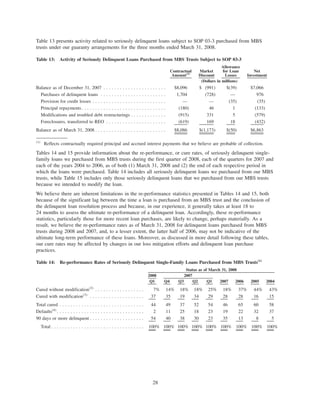
  • 71.
    Serious Delinquency Table 39below compares the serious delinquency rates, by geographic region, for all conventional single- family loans and multifamily loans with credit enhancement and without credit enhancement as of March 31, 2008, December 31, 2007 and March 31, 2007. Table 39: Serious Delinquency Rates Book Outstanding(1) Serious Delinquency Rate(2) Book Outstanding(1) Serious Delinquency Rate(2) Book Outstanding(1) Serious Delinquency Rate(2) March 31, 2008 December 31, 2007 March 31, 2007 Conventional single-family delinquency rates by geographic region:(3) Midwest . . . . . . . . . . . . 17% 1.44% 17% 1.35% 17% 0.96% Northeast . . . . . . . . . . . 18 1.05 19 0.94 19 0.67 Southeast . . . . . . . . . . . 25 1.44 25 1.18 24 0.63 Southwest . . . . . . . . . . . 16 0.94 16 0.86 16 0.62 West . . . . . . . . . . . . . . 24 0.72 23 0.50 24 0.21 Total conventional single-family loans . . . . . . . . . . . 100% 1.15% 100% 0.98% 100% 0.62% Conventional single-family loans: Credit enhanced . . . . . . 21% 3.15% 21% 2.75% 19% 1.74% Non-credit enhanced . . . 79 0.62 79 0.53 81 0.35 Total conventional single-family loans . . . . . . . . . . . 100% 1.15% 100% 0.98% 100% 0.62% Multifamily loans: Credit enhanced . . . . . . 88% 0.07% 88% 0.06% 91% 0.08% Non-credit enhanced . . . 12 0.23 12 0.22 9 0.19 Total multifamily loans . . . . . . . . . . . 100% 0.09% 100% 0.08% 100% 0.09% (1) Reported based on unpaid principal balance of loans, where we have detailed loan-level information. (2) Calculated based on number of loans for single-family and unpaid principal balance for multifamily. We include all of the conventional single-family loans that we own and that back Fannie Mae MBS in the calculation of the single- family delinquency rate. We include the unpaid principal balance of all multifamily loans that we own or that back Fannie Mae MBS and any housing bonds for which we provide credit enhancement in the calculation of the multifamily serious delinquency rate. (3) Midwest consists of IL, IN, IA, MI, MN, NE, ND, OH, SD and WI. Northeast includes CT, DE, ME, MA, NH, NJ, NY, PA, PR, RI, VT and VI. Southeast consists of AL, DC, FL, GA, KY, MD, MS, NC, SC, TN, VA and WV. Southwest consists of AZ, AR, CO, KS, LA, MO, NM, OK, TX and UT. West consists of AK, CA, GU, HI, ID, MT, NV, OR, WA and WY. In the first quarter of 2008, our serious delinquency rates, which are a leading indicator of potential foreclosures, increased across our entire conventional single-family mortgage credit book of business to 1.15% as of March 31, 2008, from 0.98% as of December 31, 2007 and 0.62% as of March 31, 2007. We experienced the most notable increase in serious delinquency rates in states such as Arizona, California, Florida, and Nevada, which previously experienced rapid increases in home prices and are now experiencing sharp declines in home prices. In addition, we continued to experience significant increases in the serious delinquency rates in some higher risk loan categories: Alt-A loans, adjustable-rate loans, interest-only loans, negative amortization loans, loans made for the purchase of condominiums and loans with second liens. Many 66
  • 72.
    of these higherrisk loans were originated in 2006 and 2007. However, as a result of tightening our eligibility standards, we expect that the loans we are now acquiring will have a lower credit risk relative to the loans we acquired in 2006 and 2007. The conventional single-family serious delinquency rates for California and Florida, which represent the two largest states in our conventional single-family mortgage credit book of business in terms of unpaid principal balance, climbed to 0.76% and 2.32%, respectively, as of March 31, 2008, from 0.50% and 1.59%, respectively, as of December 31, 2007 and 0.17% and 0.49% as of March 31, 2007. The serious delinquency rates for Alt-A and subprime loans was 2.96% and 7.42%, respectively, as of March 31, 2008, compared with 2.15% and 5.76%, respectively, as of December 31, 2007 and 0.94% and 4.62% as of March 31, 2007. We expect the housing market to continue to deteriorate and home prices to continue to decline in these states and on a national basis. Accordingly, we expect our single-family serious delinquency rate to continue to increase in 2008. The multifamily serious delinquency rate was 0.09% as of March 31, 2008, compared with 0.08% as of December 31, 2007 and 0.09% as of March 31, 2007. Nonperforming Loans Table 40 provides statistics on nonperforming single-family and multifamily loans as of March 31, 2008 and December 31, 2007. Table 40: Nonperforming Single-Family and Multifamily Loans March 31, 2008 December 31, 2007 (Dollars in millions) As of Nonperforming loans: Nonaccrual loans . . . . . . . . . . . . . . . . . . . . . . . . . . . . . . . . . . . . . . . . . . . . . . . . . . . . . $ 8,723 $ 8,343 Troubled debt restructurings(1) . . . . . . . . . . . . . . . . . . . . . . . . . . . . . . . . . . . . . . . . . . . . 2,211 1,765 Total nonperforming loans . . . . . . . . . . . . . . . . . . . . . . . . . . . . . . . . . . . . . . . . . . . . . $10,934 $10,108 Interest on nonperforming loans: Interest income forgone(2) . . . . . . . . . . . . . . . . . . . . . . . . . . . . . . . . . . . . . . . . . . . . . . . $ 114 $ 215 Interest income recognized during year(3) . . . . . . . . . . . . . . . . . . . . . . . . . . . . . . . . . . . . 109 328 Accruing loans past due 90 days or more(4) . . . . . . . . . . . . . . . . . . . . . . . . . . . . . . . . . . . . $ 197 $ 204 (1) Troubled debt restructurings include loans whereby the contractual terms have been modified that result in concessions to borrowers experiencing financial difficulties. (2) Forgone interest income represents the amount of interest income that would have been recorded during the period on nonperforming loans as of the end of each period had the loans performed according to their contractual terms. (3) Represents interest income recognized during the period on loans classified as nonperforming as of the end of each period. (4) Recorded investment of loans as of the end of each period that are 90 days or more past due and continuing to accrue interest include loans insured or guaranteed by the U.S. government and loans where we have recourse against the seller of the loan in the event of a default. 67
  • 73.
    Foreclosure and REOActivity Table 41 below provides information, by region, on our foreclosure activity for the three months ended March 31, 2008 and 2007. Table 41: Single-Family and Multifamily Foreclosed Properties 2008 2007 For the Three Months Ended March 31, Single-family foreclosed properties (number of properties): Beginning of period inventory of single-family foreclosed properties (REO)(1) . . . . . . . . . . . . . . . 33,729 25,125 Acquisitions by geographic area:(2) Midwest . . . . . . . . . . . . . . . . . . . . . . . . . . . . . . . . . . . . . . . . . . . . . . . . . . . . . . . . . . . . 7,310 4,733 Northeast . . . . . . . . . . . . . . . . . . . . . . . . . . . . . . . . . . . . . . . . . . . . . . . . . . . . . . . . . . . 1,361 835 Southeast . . . . . . . . . . . . . . . . . . . . . . . . . . . . . . . . . . . . . . . . . . . . . . . . . . . . . . . . . . . 5,377 2,564 Southwest. . . . . . . . . . . . . . . . . . . . . . . . . . . . . . . . . . . . . . . . . . . . . . . . . . . . . . . . . . . 3,879 2,294 West . . . . . . . . . . . . . . . . . . . . . . . . . . . . . . . . . . . . . . . . . . . . . . . . . . . . . . . . . . . . . . 2,181 287 Total properties acquired through foreclosure . . . . . . . . . . . . . . . . . . . . . . . . . . . . . . . . . . . . 20,108 10,713 Dispositions of REO . . . . . . . . . . . . . . . . . . . . . . . . . . . . . . . . . . . . . . . . . . . . . . . . . . . . . (10,670) (9,544) End of period inventory of single-family foreclosed properties (REO)(1) . . . . . . . . . . . . . . . . . . . 43,167 26,294 Carrying value of single-family foreclosed properties (dollars in millions)(3) . . . . . . . . . . . . . . . . $ 4,530 $ 2,241 Single-family foreclosure rate(4) . . . . . . . . . . . . . . . . . . . . . . . . . . . . . . . . . . . . . . . . . . . . . . . 0.1% 0.1% Multifamily foreclosed properties (number of properties): Ending inventory of multifamily foreclosed properties (REO) . . . . . . . . . . . . . . . . . . . . . . . . . . 15 9 Carrying value of multifamily foreclosed properties (dollars in millions)(3) . . . . . . . . . . . . . . . . . $ 60 $ 52 (1) Includes deeds in lieu of foreclosure. (2) See footnote 3 to Table 39 for states included in each geographic region. (3) Excludes foreclosed property claims receivables, which are reported in our condensed consolidated balance sheets as a component of “Acquired property, net.” (4) Estimated based on the total number of properties acquired through foreclosure as a percentage of the total number of loans in our conventional single-family mortgage credit book of business as of the end of each respective period. The Mortgage Bankers Association’s National Delinquency Survey released in March 2008 reported that the rate of foreclosure starts and percent of loans in the process of foreclosure reached record levels during the fourth quarter of 2007. The number of single-family properties we acquired through foreclosure in the first quarter of 2008 increased by 88% from the first quarter of 2007, reflecting the impact of the continued housing market downturn and decline in home prices throughout much of the country, particularly in the states of Arizona, California, Florida, Nevada, and continued weak economic conditions in the Midwest. As discussed in “Consolidated Results of Operations—Credit-Related Expenses—Credit Loss Performance Metrics,” we have experienced a significant increase in default rates, particularly within certain states that have had significant home price depreciation, for certain higher risk loan categories, such as Alt-A, and for loans originated in 2006 and 2007. The states of Arizona, California, Florida and Nevada accounted for 17% of single-family properties acquired through foreclosure for the first quarter of 2008, compared with 4% for the first quarter of 2007, reflecting the sharp declines in home prices that these states are now experiencing. The Midwest accounted for approximately 36% and 44% of the single-family properties acquired through foreclosure for the first quarter of 2008 and 2007, respectively, reflecting the continued impact of weak economic conditions in this region. 68
  • 74.
    Alt-A mortgage loansaccounted for 29% of single-family properties acquired through foreclosure for the first quarter of 2008, compared with 17% for the first quarter of 2007. The continued housing market downturn and decline in home prices on a national basis have resulted in a higher percentage of our mortgage loans that transition from delinquent to foreclosure status. In addition, the combined effect of the disruption in the subprime market, the decline in home prices and near record levels of unsold properties have slowed the sale of, and reduced the sales prices of, our foreclosed single-family properties. Based on these factors as well as the sharp rise in our serious delinquency rates during the first quarter of 2008, we expect the level of foreclosures, as well as the average length of time required to dispose of our foreclosed properties, to increase further in 2008 compared with 2007. Institutional Counterparty Credit Risk Management Mortgage Insurers As of March 31, 2008, we had total mortgage insurance coverage of $111.5 billion on the single-family mortgage loans in our guaranty book of business, of which $101.3 billion was primary mortgage insurance and $10.2 billion was pool mortgage insurance. As of December 31, 2007, we had total mortgage insurance coverage of $104.1 billion on the single-family mortgage loans in our guaranty book of business, of which $93.7 billion was primary mortgage insurance and $10.4 billion was pool mortgage insurance. Eight mortgage insurance companies provided over 99% of our mortgage insurance as of both March 31, 2008 and December 31, 2007. We received proceeds of $475 million and $290 million for the three months ended March 31, 2008 and 2007, respectively, from our primary and pool mortgage insurance policies, lender repurchases and other forms of credit enhancement on our single-family loans. We had outstanding receivables from mortgage insurers of $451 million and $293 million as of March 31, 2008 and December 31, 2007, respectively, related to amounts claimed on foreclosed properties. Table 42 presents the primary and pool mortgage insurance coverage on single-family loans in our guaranty book of business by mortgage insurer for our top eight mortgage insurer counterparties as of March 31, 2008, as well as the insurer financial strength ratings of each of these counterparties as of May 2, 2008. Table 42: Mortgage Insurance Coverage Counterparty Name(1) Moody’s S&P Fitch Primary Pool Total Maximum Coverage(2) (Dollars in millions) Insurer Financial Strength Ratings As of May 2, 2008 As of March 31, 2008 Mortgage Guaranty Insurance Corporation . . . . . . . . . . . . . . Aa2 A AA $23,835 $2,804 $26,639 PMI Mortgage Insurance Co. . . . . . . . . . . . . . . . . . . . . . . . Aa2 A+ AA 14,392 2,524 16,916 Genworth Mortgage Insurance Corporation . . . . . . . . . . . . . . Aa2 AA AA 16,045 442 16,487 United Guaranty Residential Insurance Company . . . . . . . . . . Aa2 AA+ AA+ 15,396 334 15,730 Radian Guaranty, Inc. . . . . . . . . . . . . . . . . . . . . . . . . . . . . Aa3 A N/R 13,970 923 14,893 Republic Mortgage Insurance Company . . . . . . . . . . . . . . . . Aa3 AA- AA 11,226 1,720 12,946 Triad Guaranty Insurance Corporation . . . . . . . . . . . . . . . . . Baa3 BBB BB 4,387 1,487 5,874 CMG Mortgage Insurance Company(3) . . . . . . . . . . . . . . . . . N/R AA- AA 1,901 — 1,901 (1) Insurance coverage amounts provided for each counterparty may include coverage provided by consolidated subsidiaries of the counterparty. (2) Maximum coverage refers to the aggregate dollar amount of insurance coverage (i.e., “risk in force”) on single-family loans in our guaranty book of business and represents our maximum potential loss recovery under the applicable mortgage insurance policies. (3) CMG Mortgage Insurance Company is a joint venture owned by PMI Mortgage Insurance Co. and CUNA Mutual Investment Corporation. Recent increases in mortgage insurance claims due to higher credit losses in recent periods have adversely affected the financial results and condition of many mortgage insurers. In April 2008, Standard & Poor’s 69
  • 75.
    downgraded the insurerfinancial strength ratings of five of our eight primary mortgage insurer counterparties. As of March 31, 2008, these five mortgage insurers provided $77.3 billion, or 69%, of our total mortgage insurance coverage on single-family loans in our guaranty book of business. The insurer financial strength rating of one of these mortgage insurers, Triad Guaranty Insurance Corporation, was also downgraded several notches by Moody’s and Fitch. In its annual report on Form 10-K for the year ended December 31, 2007, Triad announced that it is considering a plan in which it would no longer write new business and would run off its existing business. In addition, as a result of the downgrades that occurred in April 2008, four of our primary mortgage insurer counterparties’ current insurer financial strength ratings are below the “AA-” level that we require under our qualified mortgage insurer approval requirements to be considered qualified as a “Type 1” mortgage insurer. As of May 2, 2008, these counterparties remain qualified under our requirements to conduct business with us. We are continuing to evaluate these counterparties on a case-by-case basis to determine whether or under what conditions they will remain eligible to insure new mortgages sold to us. Factors that we are considering in our evaluations include the risk profile of the insurers’ existing portfolios, the insurers’ liquidity and capital adequacy to pay expected claims, the insurers’ plans to raise additional capital, as well as the current market environment and our alternative sources of credit enhancement. Based on the outcome of our evaluations, we may take a variety of actions, including imposing additional terms and conditions of approval, restricting the insurer from conducting certain types of business, suspension or termination of the insurer’s qualification status under our requirements, or cancelling a certificate of insurance or policy with that insurer and replacing the insurance coverage with another provider. Should we determine that we are no longer willing or able to conduct business with one or more of our primary mortgage insurer counterparties, it is likely we would further increase our concentration risk with the remaining mortgage insurers in the industry. In addition, we are generally required pursuant to our charter to obtain credit enhancement on conventional single-family mortgage loans that we purchase or securitize with LTV ratios over 80% at the time of purchase. Accordingly, if we are no longer willing or able to conduct business with some of our primary mortgage insurer counterparties and we do not find suitable alternative methods of obtaining credit enhancement for these loans, we may be restricted in our ability to purchase loans with high LTV ratios. This restriction could negatively impact our competitive position and our earnings. Approximately 26% of our conventional single-family business volume for the first quarter of 2008 consisted of loans with an original LTV ratio higher than 80%. The current weakened financial condition of many of our mortgage insurer counterparties creates an increased risk that these counterparties will fail to fulfill their obligations to reimburse us for claims under insurance policies. If the financial condition of one or more of these mortgage insurer counterparties deteriorates further, it could result in a material increase in our loss reserves and the fair value of our guaranty obligations if we determine it is probable that we would not collect all of our claims from the affected mortgage insurer, which could adversely affect our earnings, liquidity, financial condition and capital position. In addition, if a mortgage insurer implements a run-off plan in which the insurer no longer enters into new business, the quality and speed of their claims processing could deteriorate. The insurer financial strength rating downgrades of our mortgage insurer counterparties that have occurred to date have not affected our loss reserves, nor have they materially affected the fair value of our guaranty obligations. We continue to monitor and manage our risk exposure to mortgage insurers. Our monitoring of these insurers includes frequent discussions with the insurers’ management, the rating agencies and insurance regulators, and in-depth financial reviews and stress analyses of the insurers’ portfolios and capital adequacy. Financial Guarantors As of March 31, 2008 and December 31, 2007, we were the beneficiary of financial guarantees of approximately $11.1 billion and $11.8 billion, respectively, on the securities held in our investment portfolio or on securities that have been resecuritized to include a Fannie Mae guaranty and sold to third parties. The securities covered by these guarantees consist primarily of private-label mortgage-related securities and municipal bonds. 70
  • 76.
    Five of ourtop nine financial guarantor counterparties have had their insurer financial strength ratings downgraded by one or more of the nationally recognized statistical rating organizations since December 31, 2007. A downgrade in the ratings of one of our financial guarantor counterparties could result in a reduction in the fair value of the securities they guarantee, which could adversely affect our earnings, financial condition and capital position. These rating downgrades also imply an increased risk that these financial guarantors will fail to fulfill their obligations to reimburse us for claims under their guaranty contracts. These rating downgrades have resulted in reduced liquidity and prices for our securities for which we have obtained financial guarantees; however, we have evaluated these guaranteed securities and we believe the underlying collateral of these securities will generate cash flows that are adequate to repay our investments on a high percentage of these securities. We continue to monitor the effect these rating actions may have on the value of the securities in our investment portfolio. Refer to “Consolidated Balance Sheet Analysis—Trading and Available-for-Sale Investment Securities—Investments in Private-Label Mortgage-Related Securities” for more information on our investments in private-label mortgage-related securities and municipal bonds. Custodial Depository Institutions A total of $51.0 billion and $32.5 billion in deposits for scheduled single-family MBS payments were received and held by 316 and 324 custodial depository institutions in the months of March 2008 and December 2007, respectively. Of these amounts, 97% and 95% were held by institutions rated as investment grade by Standard & Poor’s, Moody’s and Fitch as of March 31, 2008 and December 31, 2007, respectively. Derivatives Counterparties The notional amount of our risk management derivative instruments increased to $1.0 trillion as of March 31, 2008, from $886.5 billion as of December 31, 2007. However, our credit exposure on our risk management derivatives, net of collateral we held, decreased to $500 million as of March 31, 2008, from $542 million as of December 31, 2007. Interest Rate Risk Management and Other Market Risks A significant market risk we face and actively manage for our net portfolio is interest rate risk—the risk of changes in our long-term earnings or in the value of our net assets due to changes in interest rates. Our net portfolio consists of our existing investments in mortgage assets, investments in non-mortgage securities, our outstanding debt used to fund those assets, and the derivatives used to supplement our debt instruments and manage interest rate risk. It also includes any priced asset, debt and derivatives commitments, but excludes our existing guaranty business. Our Capital Markets group, which has primary responsibility for managing the interest rate risk of our net portfolio, employs an integrated interest rate risk management strategy that includes asset selection and structuring of our liabilities, including debt and derivatives, to match and offset the interest rate characteristics of our balance sheet assets and liabilities as much as possible. 71
  • 77.
    Derivatives Activity The primarytool we use to manage the interest rate risk implicit in our mortgage assets is the variety of debt instruments we issue. We supplement our issuance of debt with derivative instruments, which are an integral part of our strategy in managing interest rate risk. Table 43 presents, by derivative instrument type, our risk management derivative activity for the three months ended March 31, 2008, along with the stated maturities of derivatives outstanding as of March 31, 2008. Table 43: Activity and Maturity Data for Risk Management Derivatives(1) Pay- Fixed(2) Receive- Fixed(3) Basis(4) Foreign Currency Pay- Fixed Receive- Fixed Interest Rate Caps Other(5) Total Interest Rate Swaps Interest Rate Swaptions (Dollars in millions) Notional balance as of December 31, 2007 . . $377,738 $285,885 $ 7,001 $ 2,559 $85,730 $124,651 $ 2,250 $650 $ 886,464 Additions . . . . . . . . . 72,608 130,364 16,175 175 653 11,228 — 154 231,357 Terminations(6) . . . . . (6,501) (7,591) (5,150) (1,024) (1,028) (51,954) (1,500) (60) (74,808) Notional balance as of March 31, 2008 . . . . $443,845 $408,658 $18,026 $ 1,710 $85,355 $ 83,925 $ 750 $744 $1,043,013 Future maturities of notional amounts:(7) Less than 1 year . . . . $ 21,005 $ 69,870 $ 4,500 $ 773 $ 7,350 $ 20,050 $ — $ 30 $ 123,578 1 year to 5 years . . . . 221,395 205,632 11,025 94 41,705 16,705 750 445 497,751 5 years to 10 years . . 173,185 117,851 1,250 — 31,800 37,120 — 269 361,475 Over 10 years . . . . . . 28,260 15,305 1,251 843 4,500 10,050 — — 60,209 Total . . . . . . . . . . . . $443,845 $408,658 $18,026 $ 1,710 $85,355 $ 83,925 $ 750 $744 $1,043,013 Weighted-average interest rate as of March 31, 2008: Pay rate . . . . . . . . . . 4.84% 3.29% 3.24% — 6.25% — — — Receive rate . . . . . . . 3.27% 4.77% 3.04% — — 4.80% — — Other . . . . . . . . . . . . — — — — — — 6.19% — Weighted-average interest rate as of December 31, 2007: Pay rate . . . . . . . . . . 5.10% 5.04% 4.92% — 6.25% — — — Receive rate . . . . . . . 5.03% 5.08% 6.84% — — 4.84% — — Other . . . . . . . . . . . . — — — — — — 4.35% — (1) Excludes mortgage commitments accounted for as derivatives. Dollars represent notional amounts that indicate only the amount on which payments are being calculated and do not represent the amount at risk of loss. (2) Notional amounts include swaps callable by Fannie Mae of $3.3 billion and $8.2 billion as of March 31, 2008 and December 31, 2007, respectively. (3) Notional amounts include swaps callable by derivatives counterparties of $15.3 billion and $7.8 billion as of March 31, 2008 and December 31, 2007, respectively. (4) Notional amounts include swaps callable by derivatives counterparties of $1.8 billion and $6.6 billion as of March 31, 2008 and December 31, 2007, respectively. (5) Includes MBS options, forward starting debt, swap credit enhancements and mortgage insurance contracts. (6) Includes matured, called, exercised, assigned and terminated amounts. Also includes changes due to foreign exchange rate movements. (7) Based on contractual maturities. 72
  • 78.
    The outstanding notionalbalance of our risk management derivatives increased by $156.5 billion during the first quarter of 2008, to $1.0 trillion as of March 31, 2008. The increase reflected rebalancing activities we undertook, which included increasing both our pay-fixed and receive-fixed interest rate swaps, in response to the interest rate volatility during the period. Measuring Interest Rate Risk Because no single measure can reflect all aspects of the interest rate risk inherent in our mortgage portfolio, we utilize various risk metrics that together provide a more complete assessment of interest rate risk. Below we present three measures that we use to quantify our interest rate risk: (i) fair value sensitivity to changes in interest rate levels and slope of yield curve; (ii) net asset fair value sensitivity; and (iii) duration gap. As discussed below, each of these measures reflected an increase in our exposure to interest rates between December 31, 2007 and March 31, 2008. This increased exposure was largely driven by wider mortgage spreads during the period, which resulted in lower prices as of the end of the period and higher dollar sensitivities to changes in interest rates. A lower fair value of net assets between December and March also increased the risk metrics that we express as a percentage of the fair value of net assets. Fair Value Sensitivity to Changes in Level and Slope of Yield Curve We disclose on a monthly basis the estimated adverse impact on our financial condition of a 50 basis point shift in interest rates and a 25 basis point change in the slope of the yield curve. We believe these changes represent moderate movements in interest rates over a one-month period. Based on the current position and estimated fair value of our net portfolio, we calculate on a daily basis the estimated amount of pre-tax losses for our net portfolio, or reduction in fair value, expressed as a percentage of the estimated after-tax fair value of our net assets, that would result from an immediate adverse 50 basis point parallel shift in the level of interest rates and an immediate adverse 25 basis point change in the slope of the yield curve, calculated as described below. Table 44 below is an extension of our monthly net sensitivity measures. There are four primary differences between the monthly and quarterly market risk disclosures we make: (1) our monthly disclosure is based on the daily average reported during the month while the quarterly disclosure is based on the position and the market environment on the last day of the month; (2) the quarterly disclosure includes the results of larger rate shocks of up and down 100 basis points in addition to the up and down 50 basis points; (3) the prices used for the monthly disclosure are based on internal daily estimates used during the month while the quarterly disclosure uses final fair values determined for the last day of the month as part of our closing process; and (4) the fair value of net assets used in the monthly disclosure is one from a prior period while the quarterly disclosure uses the fair value of net assets at quarter end. In addition, our monthly disclosure includes LIHTC assets and preferred stock, which are excluded from Table 44, but separately included in the footnotes of the table. 73
  • 79.
    Table 44: InterestRate Sensitivity of Fair Value of Net Portfolio Estimated Fair Value -50 -100 +50 +100 Decrease in Rates Increase in Rates Effect on Estimated Fair Value As of March 31, 2008 (Dollars in millions) Trading financial instruments(1) . . . . . . . . . . . . . . . . . . . . . . . . . . $ 110,573 $1,145 $2,147 $(1,289) $(2,680) Derivative assets and liabilities, net . . . . . . . . . . . . . . . . . . . . . . . (3,086) (720) (958) 1,293 3,121 Non-trading portfolio assets and debt(3) . . . . . . . . . . . . . . . . . . . . (109,496) 877 185 (2,200) (5,083) Net portfolio of interest-rate sensitive assets and liabilities(4) . . . . $ (2,009) $1,302 $1,374 $(2,196) $(4,642) Estimated Fair Value -50 -100 +50 +100 Decrease in Rates Increase in Rates Effect on Estimated Fair Value As of December 31, 2007 (Dollars in millions) Trading financial instruments(1) . . . . . . . . . . . . . . . . . . . . . . . . . $ 63,956 $ 829 $ 1,595 $ (877) $(1,796) Derivative assets and liabilities, net(2) . . . . . . . . . . . . . . . . . . . . (1,332) (2,007) (3,366) 2,667 5,854 Non-trading portfolio assets and debt(3) . . . . . . . . . . . . . . . . . . . (52,753) 791 53 (1,991) (4,789) Net portfolio of interest-rate sensitive assets and liabilities . . . . $ 9,871 $ (387) $(1,718) $ (201) $ (731) (1) Consists of securities classified in the condensed consolidated balance sheets as trading and carried at estimated fair value. (2) Certain prior period amounts have been reclassified to conform to the current period presentation. (3) “Non-trading portfolio assets and debt, net” includes the line item “Advances to lenders” reported in our condensed consolidated balance sheets. In addition, certain amounts have been reclassified from securities to “Guaranty assets and guaranty obligations, net” to reflect how the risk of these securities is managed by the business. (4) Effective January 1, 2008, the interest rate sensitivities reported in our Monthly Summary Report included preferred stock and our LIHTC investments. These amounts have been excluded from the table. The sensitivity of the combined amounts for a decrease in rates of -50 basis points and -100 basis points were ($188) million and ($373) million, respectively, and an increase in rates of +50 basis points and +100 basis points were $192 million and $386 million, respectively, as of March 31, 2008. The losses for the +50 basis point and +100 basis point shocks increased over the quarter. The increase in sensitivity was primarily driven by wider spreads on less liquid assets, and in particular by sharply wider spreads reported at quarter end on some of the least liquid assets, such as Alt-A securities. These wider spreads were indicative of the low liquidity in the overall mortgage market at that time. 74
  • 80.
    Fair Value Sensitivityof Net Assets Table 45 discloses the estimated fair value of our net assets as of March 31, 2008 and December 31, 2007, and the impact on the estimated fair value from a hypothetical instantaneous shock in interest rates of a decrease of 50 basis points and an increase of 100 basis points. We believe these interest rate changes reflect reasonably possible near-term outcomes within a 12-month period. We discuss how we derive the estimated fair value of our net assets, which serves as the base case for our sensitivity analysis, in “Supplemental Non- GAAP Information—Fair Value Balance Sheets.” Table 45: Interest Rate Sensitivity of Fair Value of Net Assets Estimated Fair Value -50 +100 Change in Rates Effect on Estimated Fair Value As of March 31, 2008 (Dollars in millions) Trading financial instruments(1) . . . . . . . . . . . . . . . . . . . . . . . . . . . . . . . . . . . . . . . . $ 110,573 $ 1,145 $(2,680) Derivative assets and liabilities, net. . . . . . . . . . . . . . . . . . . . . . . . . . . . . . . . . . . . . . (3,086) (720) 3,121 Non-trading portfolio assets and debt, net(3) . . . . . . . . . . . . . . . . . . . . . . . . . . . . . . . . (109,496) 877 (5,083) Net portfolio of interest-rate sensitive assets and liabilities . . . . . . . . . . . . . . . . . . . . (2,009) 1,302 (4,642) Guaranty assets and guaranty obligations, net(3) . . . . . . . . . . . . . . . . . . . . . . . . . . . . . (28,425) 3,104 (1,173) Net market sensitive assets(4) . . . . . . . . . . . . . . . . . . . . . . . . . . . . . . . . . . . . . . . . (30,434) 4,406 (5,815) Other non-financial assets and liabilities, net(5) . . . . . . . . . . . . . . . . . . . . . . . . . . . . . . 42,644 (1,460) 1,880 Net assets. . . . . . . . . . . . . . . . . . . . . . . . . . . . . . . . . . . . . . . . . . . . . . . . . . . . . . $ 12,210 $ 2,946 $(3,935) Percentage of net asset fair value . . . . . . . . . . . . . . . . . . . . . . . . . . . . . . . . . . . . . 24.13% (32.23)% Estimated Fair Value -50 +100 Change in Rates Effect on Estimated Fair Value As of December 31, 2007 (Dollars in millions) Trading financial instruments(1) . . . . . . . . . . . . . . . . . . . . . . . . . . . . . . . . . . . . . . . . $ 63,956 $ 829 $(1,796) Derivative assets and liabilities, net(2) . . . . . . . . . . . . . . . . . . . . . . . . . . . . . . . . . . . . (1,332) (2,007) 5,854 Non-trading portfolio assets and debt, net(3) . . . . . . . . . . . . . . . . . . . . . . . . . . . . . . . . (52,753) 791 (4,789) Net portfolio of interest-rate sensitive assets and liabilities . . . . . . . . . . . . . . . . . . . . 9,871 (387) (731) Guaranty assets and guaranty obligations, net(3) . . . . . . . . . . . . . . . . . . . . . . . . . . . . . (2,441) (1,406) (548) Net market sensitive assets(4) . . . . . . . . . . . . . . . . . . . . . . . . . . . . . . . . . . . . . . . . 7,430 (1,793) (1,279) Other non-financial assets and liabilities, net(2)(5) . . . . . . . . . . . . . . . . . . . . . . . . . . . . 28,369 719 270 Net assets . . . . . . . . . . . . . . . . . . . . . . . . . . . . . . . . . . . . . . . . . . . . . . . . . . . . . . $ 35,799 $(1,074) $(1,009) Percentage of net asset fair value . . . . . . . . . . . . . . . . . . . . . . . . . . . . . . . . . . . . . (3.00)% (2.82)% (1) Consists of securities classified in the condensed consolidated balance sheets as trading and carried at estimated fair value. On January 1, 2008, we adopted the fair value option under SFAS 159 for certain securities that were previously classified as available-for-sale within our mortgage-related and non-mortgage-related investment portfolio in the amount of $56.2 billion. We expect that the interest rate component of fair value for the securities adopted under SFAS 159 will offset a portion of the change in the fair value of our derivatives. (2) Certain prior period amounts have been reclassified to conform to the current period presentation. (3) “Non-trading portfolio assets and debt, net” includes the line item “Advances to lenders” reported in our condensed consolidated balance sheets. In addition, certain amounts have been reclassified from securities to “Guaranty assets and guaranty obligations, net” to reflect how the risk of these securities is managed by the business. 75
  • 81.
    (4) Includes net financialassets and financial liabilities reported in “Notes to Condensed Consolidated Financial Statements—Note 16, Fair Value of Financial Instruments” and additional market sensitive instruments that consist of master servicing assets, master servicing liabilities and credit enhancements. (5) The sensitivity changes related to other non-financial assets and liabilities represent the tax effect on net assets under these scenarios and do not include any interest rate sensitivity related to these items. The net portfolio of interest-rate sensitive assets and liabilities was 24.13% for a -50 basis point shock and (32.23)% for a +100 basis point shock as of March 31, 2008, compared with a (3.00)% for a -50 basis point shock and (2.82)% for a +100 basis point shock as of December 31, 2007. We evaluate the sensitivity of the fair value of our net assets, excluding the sensitivity of our guaranty assets and guaranty obligations, because, as previously discussed, we expect that the guaranty fee income generated from future business activity will largely replace any guaranty fee income lost as a result of mortgage prepayments due to movements in interest rates. Our guaranty assets and our guaranty obligations generally increase in fair value when interest rates increase and decrease in fair value when interest rates decline. The guaranty obligation has become less sensitive on a percentage basis to increases in interest rates than it was last quarter; however, its larger size has increased the dollar sensitivity. This impacts the dollar sensitivity of the net guaranty asset. Duration Gap Duration measures the price sensitivity of our assets and liabilities to changes in interest rates by quantifying the difference between the estimated durations of our assets and liabilities. Duration gap summarizes the extent to which estimated cash flows for assets and liabilities are matched, on average, over time and across interest rate scenarios. A positive duration gap signals a greater exposure to rising interest rates because it indicates that the duration of our assets exceeds the duration of our liabilities. The table below presents our monthly effective duration gap for December 2007 and for the first three months of 2008. Month Effective Duration Gap December 2007 . . . . . . . . . . . . . . . . . . . . . . . . . . . . . . . . . . . . . . . . . . . . . . . . . . . . . . . . . . 2 January 2008 . . . . . . . . . . . . . . . . . . . . . . . . . . . . . . . . . . . . . . . . . . . . . . . . . . . . . . . . . . . . 1 February 2008 . . . . . . . . . . . . . . . . . . . . . . . . . . . . . . . . . . . . . . . . . . . . . . . . . . . . . . . . . . . 2 March 2008. . . . . . . . . . . . . . . . . . . . . . . . . . . . . . . . . . . . . . . . . . . . . . . . . . . . . . . . . . . . . 3 When interest rates are volatile, we often need to lengthen or shorten the average duration of our liabilities to keep them closely matched with our mortgage durations, which change as expected mortgage prepayments change. A large movement in interest rates or increased interest rate volatility could cause our duration gap to extend outside of the range we have experienced recently. The increase in our duration gap during the first three months of 2008 was largely due to the impact of wider spreads on our mortgage assets. Wider spreads, which are indicative of lower liquidity, increase the discount rate and generally increase the duration of mortgage assets. However, fluctuations in spreads generally do not affect the timing of expected cash flows from our mortgage assets or their average lives. There are inherent limitations in any methodology used to estimate the exposure to changes in market interest rates. Our sensitivity analyses contemplate only certain movements in interest rates and are performed at a particular point in time based on the estimated fair value of our existing portfolio. These sensitivity analyses do not incorporate other factors that may have a significant effect, most notably the value from expected future business activities and strategic actions that management may take to manage interest rate risk. As such, these analyses are not intended to provide precise forecasts of the effect a change in market interest rates would have on the estimated fair value of our net assets. 76
  • 82.
    IMPACT OF FUTUREADOPTION OF ACCOUNTING PRONOUNCEMENTS A change in a significant accounting pronouncement may have a significant effect on our results of operations, our financial condition, our capital position or our business operations. We identify and discuss the expected impact on our consolidated financial statements of recently issued or proposed accounting pronouncements in “Notes to Condensed Consolidated Financial Statements—Note 1, Summary of Significant Accounting Policies.” FORWARD-LOOKING STATEMENTS This report contains forward-looking statements, which are statements about matters that are not historical facts. In addition, our senior management may from time to time make forward-looking statements orally to analysts, investors, the news media and others. Forward-looking statements often include words such as “expects,” “anticipates,” “intends,” “plans,” “believes,” “seeks,” “estimates,” “would,” “should,” “could,” “may,” or similar words. Among the forward-looking statements in this report are statements relating to: • our expectations regarding the future of the housing and mortgage markets, including our expectation of continued housing market weakness in 2008 and our expectations relating to declines in home prices, increases in mortgage delinquencies, defaults and foreclosures, and slower growth in U.S. residential mortgage debt outstanding in 2008; • our expectation that our credit-related expenses and credit loss ratio will significantly increase in 2008 relative to 2007, and our belief that our credit losses will increase in 2009 relative to 2008; • our belief that our delinquencies, defaults and loan loss severities will increase in 2008, and that we will further increase our loss reserves during 2008; • our belief that our single-family guaranty book of business will continue to grow at a faster rate than the rate of overall growth in U.S. residential mortgage debt outstanding, and that our guaranty fee income will grow in 2008 compared to 2007; • our expectation that we will experience increased competition from the FHA in 2008; • our expectation that, if current market conditions continue, our taxable-equivalent net interest yield (excluding the benefit we received from the redemption of step-rate debt securities during the first quarter of 2008) will continue to increase for the remainder of 2008; • our expectation that our results of future operations will generate sufficient taxable income to allow us to realize our deferred tax assets; • our expectation that our election to report a larger portion of our financial instruments at fair value pursuant to SFAS 159 and our implementation of hedge accounting will reduce the level of volatility in our financial results that is attributable to changes in interest rates; • our belief that we will collect all original contractual principal and interest payments on the substantial majority of our cured loans; • our expectation that changes in the fair value of our trading securities will generally move inversely to changes in the fair value of our derivatives; • our expectation that we will classify a significant majority of securities we purchase in the future as available-for-sale; • our belief that we will collect the full principal and interest due in accordance with the contractual terms of the securities with respect to our Alt-A and subprime private-label mortgage-related securities classified as available-for-sale for which we have not recognized other-than-temporary impairment; 77
  • 83.
    • our beliefthat our sources of liquidity will remain adequate to meet both our short-term and long-term funding needs; • our belief that our volume of Alt-A mortgage loan acquisitions will continue to decline in future periods; • our expectation that a GSE reform bill will be introduced in the Senate in May 2008; • our expectation that housing, mortgage and credit market conditions will continue to negatively affect our results of operations and the amount of our core capital in 2008; • our belief that the $6 billion in additional capital that we are planning to raise will enable us to pursue growth and investment opportunities while also maintaining a prudent capital cushion in a volatile and challenging market through 2008 and 2009; • our expectation that we may take any of the following actions to further preserve and build our capital, including: issuing additional preferred, convertible preferred or common stock; further reducing or eliminating our common stock dividend; forgoing purchase and guaranty opportunities; reducing the size of our investment portfolio through liquidations or by selling assets; changing our current business practices to reduce our losses and expenses; and reclassifying a portion of our investment securities from held for trading to available for sale; • our estimate of the effect of hypothetical declines in home prices on our credit losses; • our estimate of the effect of hypothetical stress test scenarios on the value of our Alt-A and subprime private-label securities and wraps; and • our estimate of the effect of hypothetical changes in interest rates on the fair value of our financial instruments. Forward-looking statements reflect our management’s expectations or predictions of future conditions, events or results based on various assumptions and management’s estimates of trends and economic factors in the markets in which we are active, as well as our business plans. They are not guarantees of future performance. By their nature, forward-looking statements are subject to risks and uncertainties. Our actual results and financial condition may differ, possibly materially, from the anticipated results and financial condition indicated in these forward-looking statements. There are a number of factors that could cause actual conditions, events or results to differ materially from those described in the forward-looking statements contained in this report, including those factors described in “Part I—Item 1A—Risk Factors” of our 2007 Form 10-K, filed with the SEC on February 27, 2008, as updated by “Part II—Item 1A—Risk Factors” of this report. Readers are cautioned to place forward-looking statements in this report or that we make from time to time into proper context by carefully considering the factors discussed in “Part I—Item 1A—Risk Factors” of our 2007 Form 10-K and in “Part II—Item 1A—Risk Factors” of this report. These forward-looking statements are representative only as of the date they are made, and we undertake no obligation to update any forward- looking statement as a result of new information, future events or otherwise, except as required under the federal securities laws. 78
  • 84.
    Item 1. FinancialStatements FANNIE MAE Condensed Consolidated Balance Sheets (Dollars in millions, except share amounts) (Unaudited) March 31, 2008 December 31, 2007 As of ASSETS Cash and cash equivalents . . . . . . . . . . . . . . . . . . . . . . . . . . . . . . . . . . . . . . . . . . . . . . . . . . . . . $ 1,997 $ 3,941 Restricted cash . . . . . . . . . . . . . . . . . . . . . . . . . . . . . . . . . . . . . . . . . . . . . . . . . . . . . . . . . . . . . 307 561 Federal funds sold and securities purchased under agreements to resell . . . . . . . . . . . . . . . . . . . . . . . . 20,484 49,041 Investments in securities: Trading, at fair value (includes Fannie Mae MBS of $56,102 and $40,458 as of March 31, 2008 and December 31, 2007, respectively) . . . . . . . . . . . . . . . . . . . . . . . . . . . . . . . . . . . . . . . . . . . . . 110,573 63,956 Available-for-sale, at fair value (includes Fannie Mae MBS of $119,064 and $138,943 as of March 31, 2008 and December 31, 2007, respectively) . . . . . . . . . . . . . . . . . . . . . . . . . . . . . . . . . . . . . . . 228,228 293,557 Total investments in securities . . . . . . . . . . . . . . . . . . . . . . . . . . . . . . . . . . . . . . . . . . . . . . 338,801 357,513 Mortgage loans: Loans held for sale, at lower of cost or market . . . . . . . . . . . . . . . . . . . . . . . . . . . . . . . . . . . . . . 8,486 7,008 Loans held for investment, at amortized cost . . . . . . . . . . . . . . . . . . . . . . . . . . . . . . . . . . . . . . . . 403,442 397,214 Allowance for loan losses. . . . . . . . . . . . . . . . . . . . . . . . . . . . . . . . . . . . . . . . . . . . . . . . . . . (993) (698) Total loans held for investment, net of allowance . . . . . . . . . . . . . . . . . . . . . . . . . . . . . . . . . . 402,449 396,516 Total mortgage loans . . . . . . . . . . . . . . . . . . . . . . . . . . . . . . . . . . . . . . . . . . . . . . . . . . 410,935 403,524 Advances to lenders . . . . . . . . . . . . . . . . . . . . . . . . . . . . . . . . . . . . . . . . . . . . . . . . . . . . . . . . . 11,732 12,377 Accrued interest receivable . . . . . . . . . . . . . . . . . . . . . . . . . . . . . . . . . . . . . . . . . . . . . . . . . . . . . 3,676 3,812 Acquired property, net . . . . . . . . . . . . . . . . . . . . . . . . . . . . . . . . . . . . . . . . . . . . . . . . . . . . . . . . 4,721 3,602 Derivative assets at fair value . . . . . . . . . . . . . . . . . . . . . . . . . . . . . . . . . . . . . . . . . . . . . . . . . . . 1,037 885 Guaranty assets . . . . . . . . . . . . . . . . . . . . . . . . . . . . . . . . . . . . . . . . . . . . . . . . . . . . . . . . . . . . 9,823 9,666 Deferred tax assets . . . . . . . . . . . . . . . . . . . . . . . . . . . . . . . . . . . . . . . . . . . . . . . . . . . . . . . . . . 17,806 12,967 Partnership investments . . . . . . . . . . . . . . . . . . . . . . . . . . . . . . . . . . . . . . . . . . . . . . . . . . . . . . . 10,579 11,000 Other assets . . . . . . . . . . . . . . . . . . . . . . . . . . . . . . . . . . . . . . . . . . . . . . . . . . . . . . . . . . . . . . . 11,329 10,500 Total assets . . . . . . . . . . . . . . . . . . . . . . . . . . . . . . . . . . . . . . . . . . . . . . . . . . . . . . . . . . . . . $843,227 $879,389 LIABILITIES AND STOCKHOLDERS’ EQUITY Liabilities: Accrued interest payable . . . . . . . . . . . . . . . . . . . . . . . . . . . . . . . . . . . . . . . . . . . . . . . . . . . . . $ 6,622 $ 7,512 Federal funds purchased and securities sold under agreements to repurchase . . . . . . . . . . . . . . . . . . . 711 869 Short-term debt (includes debt at fair value of $4,501 as of March 31, 2008) . . . . . . . . . . . . . . . . . . . 215,916 234,160 Long-term debt (includes debt at fair value of $15,132 as of March 31, 2008) . . . . . . . . . . . . . . . . . . 544,424 562,139 Derivative liabilities at fair value . . . . . . . . . . . . . . . . . . . . . . . . . . . . . . . . . . . . . . . . . . . . . . . 4,123 2,217 Reserve for guaranty losses (includes $315 and $211 as of March 31, 2008 and December 31, 2007, respectively, related to Fannie Mae MBS included in Investments in securities) . . . . . . . . . . . . . . . . 4,202 2,693 Guaranty obligations (includes $612 and $661 as of March 31, 2008 and December 31, 2007, respectively, related to Fannie Mae MBS included in Investments in securities) . . . . . . . . . . . . . . . . 15,521 15,393 Partnership liabilities . . . . . . . . . . . . . . . . . . . . . . . . . . . . . . . . . . . . . . . . . . . . . . . . . . . . . . . 3,757 3,824 Other liabilities . . . . . . . . . . . . . . . . . . . . . . . . . . . . . . . . . . . . . . . . . . . . . . . . . . . . . . . . . . . 8,957 6,464 Total liabilities . . . . . . . . . . . . . . . . . . . . . . . . . . . . . . . . . . . . . . . . . . . . . . . . . . . . . . . . . . 804,233 835,271 Minority interests in consolidated subsidiaries. . . . . . . . . . . . . . . . . . . . . . . . . . . . . . . . . . . . . . . . . 158 107 Commitments and contingencies (Note 17). . . . . . . . . . . . . . . . . . . . . . . . . . . . . . . . . . . . . . . . . . . — — Stockholders’ Equity: Preferred stock, 700,000,000 shares authorized — 466,375,000 shares issued and outstanding as of March 31, 2008 and December 31, 2007 . . . . . . . . . . . . . . . . . . . . . . . . . . . . . . . . . . . . . . . . . 16,913 16,913 Common stock, no par value, no maximum authorization — 1,129,090,420 shares issued as of March 31, 2008 and December 31, 2007; 975,406,899 shares and 974,104,578 shares outstanding as of March 31, 2008 and December 31, 2007, respectively. . . . . . . . . . . . . . . . . . . . . . . . . . . . . . . . . . . . . . . . 593 593 Additional paid-in capital . . . . . . . . . . . . . . . . . . . . . . . . . . . . . . . . . . . . . . . . . . . . . . . . . . . . 1,622 1,831 Retained earnings . . . . . . . . . . . . . . . . . . . . . . . . . . . . . . . . . . . . . . . . . . . . . . . . . . . . . . . . . 30,844 33,548 Accumulated other comprehensive loss . . . . . . . . . . . . . . . . . . . . . . . . . . . . . . . . . . . . . . . . . . . (3,841) (1,362) Treasury stock, at cost, 153,683,521 shares and 154,985,842 shares as of March 31, 2008 and December 31, 2007, respectively . . . . . . . . . . . . . . . . . . . . . . . . . . . . . . . . . . . . . . . . . . . . . . (7,295) (7,512) Total stockholders’ equity . . . . . . . . . . . . . . . . . . . . . . . . . . . . . . . . . . . . . . . . . . . . . . . . . . . . 38,836 44,011 Total liabilities and stockholders’ equity . . . . . . . . . . . . . . . . . . . . . . . . . . . . . . . . . . . . . . . . . . . . $843,227 $879,389 See Notes to Condensed Consolidated Financial Statements. 79
  • 85.
    FANNIE MAE Condensed ConsolidatedStatements of Operations (Dollars and shares in millions, except per share amounts) (Unaudited) 2008 2007 For the Three Months Ended March 31, Interest income: Trading securities . . . . . . . . . . . . . . . . . . . . . . . . . . . . . . . . . . . . . . . . . . . . . . . . . . . . . . . . . . . . $ 1,737 $ 191 Available-for-sale securities. . . . . . . . . . . . . . . . . . . . . . . . . . . . . . . . . . . . . . . . . . . . . . . . . . . . . . 3,085 5,212 Mortgage loans . . . . . . . . . . . . . . . . . . . . . . . . . . . . . . . . . . . . . . . . . . . . . . . . . . . . . . . . . . . . . . 5,662 5,385 Other . . . . . . . . . . . . . . . . . . . . . . . . . . . . . . . . . . . . . . . . . . . . . . . . . . . . . . . . . . . . . . . . . . . . . 458 218 Total interest income . . . . . . . . . . . . . . . . . . . . . . . . . . . . . . . . . . . . . . . . . . . . . . . . . . . . . . . . 10,942 11,006 Interest expense: Short-term debt . . . . . . . . . . . . . . . . . . . . . . . . . . . . . . . . . . . . . . . . . . . . . . . . . . . . . . . . . . . . . . 2,561 2,216 Long-term debt . . . . . . . . . . . . . . . . . . . . . . . . . . . . . . . . . . . . . . . . . . . . . . . . . . . . . . . . . . . . . . 6,691 7,596 Total interest expense . . . . . . . . . . . . . . . . . . . . . . . . . . . . . . . . . . . . . . . . . . . . . . . . . . . . . . . . 9,252 9,812 Net interest income . . . . . . . . . . . . . . . . . . . . . . . . . . . . . . . . . . . . . . . . . . . . . . . . . . . . . . . . . . . . . 1,690 1,194 Guaranty fee income (includes imputed interest of $235 and $279 for the three months ended March 31, 2008 and 2007, respectively) . . . . . . . . . . . . . . . . . . . . . . . . . . . . . . . . . . . . . . . . . . . . . . . . . . . . . 1,752 1,098 Losses on certain guaranty contracts . . . . . . . . . . . . . . . . . . . . . . . . . . . . . . . . . . . . . . . . . . . . . . . . . — (283) Trust management income . . . . . . . . . . . . . . . . . . . . . . . . . . . . . . . . . . . . . . . . . . . . . . . . . . . . . . . . 107 164 Investment gains (losses), net . . . . . . . . . . . . . . . . . . . . . . . . . . . . . . . . . . . . . . . . . . . . . . . . . . . . . . (111) 295 Fair value losses, net . . . . . . . . . . . . . . . . . . . . . . . . . . . . . . . . . . . . . . . . . . . . . . . . . . . . . . . . . . . . (4,377) (566) Debt extinguishment losses, net. . . . . . . . . . . . . . . . . . . . . . . . . . . . . . . . . . . . . . . . . . . . . . . . . . . . . (145) (7) Losses from partnership investments . . . . . . . . . . . . . . . . . . . . . . . . . . . . . . . . . . . . . . . . . . . . . . . . . (141) (165) Fee and other income . . . . . . . . . . . . . . . . . . . . . . . . . . . . . . . . . . . . . . . . . . . . . . . . . . . . . . . . . . . 227 277 Non-interest income (loss) . . . . . . . . . . . . . . . . . . . . . . . . . . . . . . . . . . . . . . . . . . . . . . . . . . . . . . (2,688) 813 Administrative expenses: Salaries and employee benefits . . . . . . . . . . . . . . . . . . . . . . . . . . . . . . . . . . . . . . . . . . . . . . . . . . . 286 356 Professional services . . . . . . . . . . . . . . . . . . . . . . . . . . . . . . . . . . . . . . . . . . . . . . . . . . . . . . . . . . 136 246 Occupancy expenses . . . . . . . . . . . . . . . . . . . . . . . . . . . . . . . . . . . . . . . . . . . . . . . . . . . . . . . . . . 54 59 Other administrative expenses . . . . . . . . . . . . . . . . . . . . . . . . . . . . . . . . . . . . . . . . . . . . . . . . . . . . 36 37 Total administrative expenses . . . . . . . . . . . . . . . . . . . . . . . . . . . . . . . . . . . . . . . . . . . . . . . . . . . 512 698 Minority interest in earnings of consolidated subsidiaries . . . . . . . . . . . . . . . . . . . . . . . . . . . . . . . . . . . — 1 Provision for credit losses . . . . . . . . . . . . . . . . . . . . . . . . . . . . . . . . . . . . . . . . . . . . . . . . . . . . . . . . 3,073 249 Foreclosed property expense . . . . . . . . . . . . . . . . . . . . . . . . . . . . . . . . . . . . . . . . . . . . . . . . . . . . . . . 170 72 Other expenses . . . . . . . . . . . . . . . . . . . . . . . . . . . . . . . . . . . . . . . . . . . . . . . . . . . . . . . . . . . . . . . . 360 96 Total expenses . . . . . . . . . . . . . . . . . . . . . . . . . . . . . . . . . . . . . . . . . . . . . . . . . . . . . . . . . . . . . 4,115 1,116 Income (loss) before federal income taxes and extraordinary losses. . . . . . . . . . . . . . . . . . . . . . . . . . . . . (5,113) 891 Benefit for federal income taxes . . . . . . . . . . . . . . . . . . . . . . . . . . . . . . . . . . . . . . . . . . . . . . . . . . . . (2,928) (73) Income (loss) before extraordinary losses . . . . . . . . . . . . . . . . . . . . . . . . . . . . . . . . . . . . . . . . . . . . . . (2,185) 964 Extraordinary losses, net of tax effect. . . . . . . . . . . . . . . . . . . . . . . . . . . . . . . . . . . . . . . . . . . . . . . . . (1) (3) Net income (loss) . . . . . . . . . . . . . . . . . . . . . . . . . . . . . . . . . . . . . . . . . . . . . . . . . . . . . . . . . . . . . . $ (2,186) $ 961 Preferred stock dividends and issuance costs at redemption . . . . . . . . . . . . . . . . . . . . . . . . . . . . . . . . . . (322) (135) Net income (loss) available to common stockholders . . . . . . . . . . . . . . . . . . . . . . . . . . . . . . . . . . . . . . $ (2,508) $ 826 Basic earnings (loss) per share: Earnings (loss) before extraordinary losses. . . . . . . . . . . . . . . . . . . . . . . . . . . . . . . . . . . . . . . . . . . . $ (2.57) $ 0.85 Extraordinary losses, net of tax effect . . . . . . . . . . . . . . . . . . . . . . . . . . . . . . . . . . . . . . . . . . . . . . . — — Basic earnings (loss) per share. . . . . . . . . . . . . . . . . . . . . . . . . . . . . . . . . . . . . . . . . . . . . . . . . . . . $ (2.57) $ 0.85 Diluted earnings (loss) per share: Earnings (loss) before extraordinary losses. . . . . . . . . . . . . . . . . . . . . . . . . . . . . . . . . . . . . . . . . . . . $ (2.57) $ 0.85 Extraordinary losses, net of tax effect . . . . . . . . . . . . . . . . . . . . . . . . . . . . . . . . . . . . . . . . . . . . . . . — — Diluted earnings (loss) per share . . . . . . . . . . . . . . . . . . . . . . . . . . . . . . . . . . . . . . . . . . . . . . . . . . $ (2.57) $ 0.85 Cash dividends per common share . . . . . . . . . . . . . . . . . . . . . . . . . . . . . . . . . . . . . . . . . . . . . . . . . . . $ 0.35 $ 0.40 Weighted-average common shares outstanding: Basic . . . . . . . . . . . . . . . . . . . . . . . . . . . . . . . . . . . . . . . . . . . . . . . . . . . . . . . . . . . . . . . . . . . . . 975 973 Diluted . . . . . . . . . . . . . . . . . . . . . . . . . . . . . . . . . . . . . . . . . . . . . . . . . . . . . . . . . . . . . . . . . . . 975 974 See Notes to Condensed Consolidated Financial Statements. 80
  • 86.
    FANNIE MAE Condensed ConsolidatedStatements of Cash Flows (Dollars in millions) (Unaudited) 2008 2007 For the Three Months Ended March 31, Cash flows provided by (used in) operating activities: Net income (loss) . . . . . . . . . . . . . . . . . . . . . . . . . . . . . . . . . . . . . . . . . . . . . . . . . . . . . . . . . . . $ (2,186) $ 961 Amortization of debt cost basis adjustments . . . . . . . . . . . . . . . . . . . . . . . . . . . . . . . . . . . . . . . . . . 2,731 2,374 Derivatives fair value adjustments . . . . . . . . . . . . . . . . . . . . . . . . . . . . . . . . . . . . . . . . . . . . . . . . . 1,971 1,508 Purchases of loans held for sale . . . . . . . . . . . . . . . . . . . . . . . . . . . . . . . . . . . . . . . . . . . . . . . . . . (15,103) (5,968) Proceeds from repayments of loans held for sale . . . . . . . . . . . . . . . . . . . . . . . . . . . . . . . . . . . . . . . 132 129 Net change in trading securities . . . . . . . . . . . . . . . . . . . . . . . . . . . . . . . . . . . . . . . . . . . . . . . . . . 42,483 (2,025) Other, net . . . . . . . . . . . . . . . . . . . . . . . . . . . . . . . . . . . . . . . . . . . . . . . . . . . . . . . . . . . . . . . . 90 (708) Net cash provided by (used in) operating activities . . . . . . . . . . . . . . . . . . . . . . . . . . . . . . . . . . . . . . . . . 30,118 (3,729) Cash flows provided by investing activities: Purchases of trading securities held for investment . . . . . . . . . . . . . . . . . . . . . . . . . . . . . . . . . . . . . . (389) — Proceeds from maturities of trading securities held for investment . . . . . . . . . . . . . . . . . . . . . . . . . . . . 2,461 — Proceeds from sales of trading securities held for investment . . . . . . . . . . . . . . . . . . . . . . . . . . . . . . . 2,443 — Purchases of available-for-sale securities . . . . . . . . . . . . . . . . . . . . . . . . . . . . . . . . . . . . . . . . . . . . (5,318) (49,207) Proceeds from maturities of available-for-sale securities . . . . . . . . . . . . . . . . . . . . . . . . . . . . . . . . . . 8,291 39,104 Proceeds from sales of available-for-sale securities . . . . . . . . . . . . . . . . . . . . . . . . . . . . . . . . . . . . . . 3,055 30,673 Purchases of loans held for investment. . . . . . . . . . . . . . . . . . . . . . . . . . . . . . . . . . . . . . . . . . . . . . (14,712) (14,029) Proceeds from repayments of loans held for investment . . . . . . . . . . . . . . . . . . . . . . . . . . . . . . . . . . . 12,655 14,849 Advances to lenders . . . . . . . . . . . . . . . . . . . . . . . . . . . . . . . . . . . . . . . . . . . . . . . . . . . . . . . . . . (29,778) (8,632) Net proceeds from disposition of acquired property . . . . . . . . . . . . . . . . . . . . . . . . . . . . . . . . . . . . . (327) 482 Net change in federal funds sold and securities purchased under agreements to resell . . . . . . . . . . . . . . . 29,194 (2,451) Other, net . . . . . . . . . . . . . . . . . . . . . . . . . . . . . . . . . . . . . . . . . . . . . . . . . . . . . . . . . . . . . . . . 162 126 Net cash provided by investing activities. . . . . . . . . . . . . . . . . . . . . . . . . . . . . . . . . . . . . . . . . . . . . . . . 7,737 10,915 Cash flows used in financing activities: Proceeds from issuance of short-term debt . . . . . . . . . . . . . . . . . . . . . . . . . . . . . . . . . . . . . . . . . . . 505,103 474,440 Payments to redeem short-term debt . . . . . . . . . . . . . . . . . . . . . . . . . . . . . . . . . . . . . . . . . . . . . . . (525,882) (485,098) Proceeds from issuance of long-term debt. . . . . . . . . . . . . . . . . . . . . . . . . . . . . . . . . . . . . . . . . . . . 87,972 58,756 Payments to redeem long-term debt. . . . . . . . . . . . . . . . . . . . . . . . . . . . . . . . . . . . . . . . . . . . . . . . (106,179) (53,756) Net change in federal funds purchased and securities sold under agreements to repurchase . . . . . . . . . . . . (149) 167 Other, net . . . . . . . . . . . . . . . . . . . . . . . . . . . . . . . . . . . . . . . . . . . . . . . . . . . . . . . . . . . . . . . . (664) (1,226) Net cash used in financing activities . . . . . . . . . . . . . . . . . . . . . . . . . . . . . . . . . . . . . . . . . . . . . . . . . . (39,799) (6,717) Net increase (decrease) in cash and cash equivalents . . . . . . . . . . . . . . . . . . . . . . . . . . . . . . . . . . . . . . (1,944) 469 Cash and cash equivalents at beginning of period . . . . . . . . . . . . . . . . . . . . . . . . . . . . . . . . . . . . . . . . . . 3,941 3,239 Cash and cash equivalents at end of period . . . . . . . . . . . . . . . . . . . . . . . . . . . . . . . . . . . . . . . . . . . . . . $ 1,997 $ 3,708 Cash paid during the period for: Interest . . . . . . . . . . . . . . . . . . . . . . . . . . . . . . . . . . . . . . . . . . . . . . . . . . . . . . . . . . . . . . . . . . . . . $ 10,187 $ 9,965 Income taxes. . . . . . . . . . . . . . . . . . . . . . . . . . . . . . . . . . . . . . . . . . . . . . . . . . . . . . . . . . . . . . . . . . 220 1,088 Non-cash activities: Securitization-related transfers from mortgage loans held for sale to investments in securities . . . . . . . . . . . . . $ 10,445 $ 4,425 Net transfers of loans held for sale to loans held for investment. . . . . . . . . . . . . . . . . . . . . . . . . . . . . . . . . 3,275 498 Net deconsolidation transfers from mortgage loans held for sale to investments in securities . . . . . . . . . . . . . . (83) 162 Transfers from advances to lenders to trading securities . . . . . . . . . . . . . . . . . . . . . . . . . . . . . . . . . . . . . . 28,333 7,741 Net consolidation-related transfers from investments in securities to mortgage loans held for investment . . . . . . 655 1,762 Transfers to trading securities from the effect of adopting SFAS 159 . . . . . . . . . . . . . . . . . . . . . . . . . . . . . 56,217 — See Notes to Condensed Consolidated Financial Statements. 81
  • 87.
    FANNIE MAE Condensed ConsolidatedStatements of Changes in Stockholders’ Equity (Dollars and shares in millions, except per share amounts) (Unaudited) Preferred Common Preferred Stock Common Stock Additional Paid-In Capital Retained Earnings Accumulated Other Comprehensive Income (Loss) Treasury Stock Total Stockholders’ Equity Shares Outstanding Balance as of December 31, 2006 . . . . 132 972 $ 9,108 $593 $1,942 $37,955 $ (445) $(7,647) $41,506 Cumulative effect from the adoption of FIN 48, net of tax . . . . . . . . . — — — — — 4 — — 4 Balance as of January 1, 2007, adjusted . . . . . . . . . . . . . . . . . . 132 972 9,108 593 1,942 37,959 (445) (7,647) 41,510 Comprehensive income: Net income. . . . . . . . . . . . . . . . . — — — — — 961 — — 961 Other comprehensive income, net of tax effect: Unrealized gains on available-for- sale securities (net of tax of $185) . . . . . . . . . . . . . . . . . — — — — — — 343 — 343 Reclassification adjustment for gains included in net income (net of tax of $81) . . . . . . . . . . . . — — — — — — (150) — (150) Unrealized losses on guaranty assets and guaranty fee buy-ups (net of tax of $15) . . . . . . . . . . . . . . — — — — — — (27) — (27) Net cash flow hedging losses (net of tax of $1) . . . . . . . . . . . . . — — — — — — (1) — (1) Prior service cost and actuarial gains, net of amortization for defined benefit plans (net of tax of $1) . . . . . . . . . . . . . . . . . — — — — — — 1 — 1 Total comprehensive income . . . . . . . . 1,127 Common stock dividends ($0.40 per share) . . . . . . . . . . . . . . . . . . . . — — — — — (390) — — (390) Preferred stock dividends . . . . . . . . . . — — — — — (129) — — (129) Preferred stock redeemed . . . . . . . . . . (14) — (700) — — — — — (700) Treasury stock issued for stock options and benefit plans . . . . . . . . . . . . . — 1 — — (108) — — 121 13 Balance as of March 31, 2007 . . . . . . 118 973 $ 8,408 $593 $1,834 $38,401 $ (279) $(7,526) $41,431 Balance as of December 31, 2007 . . . . 466 974 $16,913 $593 $1,831 $33,548 $(1,362) $(7,512) $44,011 Cumulative effect from the adoption of SFAS 157 and SFAS 159, net of tax . . . . . . . . . . . . . . . . . . . . — — — — — 148 (93) — 55 Balance as of January 1, 2008, adjusted . . . . . . . . . . . . . . . . . . 466 974 16,913 593 1,831 33,696 (1,455) (7,512) 44,066 Comprehensive loss: Net loss . . . . . . . . . . . . . . . . . . . — — — — — (2,186) — — (2,186) Other comprehensive loss, net of tax effect: Unrealized losses on available-for- sale securities (net of tax of $1,260) . . . . . . . . . . . . . . . . — — — — — — (2,339) — (2,339) Reclassification adjustment for gains included in net loss (net of tax of $5) . . . . . . . . . . . . . . . — — — — — — (9) — (9) Unrealized losses on guaranty assets and guaranty fee buy-ups (net of tax of $20) . . . . . . . . . . . . . . — — — — — — (38) — (38) Total comprehensive loss . . . . . . . . (4,572) Common stock dividends ($0.35 per share) . . . . . . . . . . . . . . . . . . — — — — — (344) — — (344) Preferred stock dividends . . . . . . . . — — — — — (322) — — (322) Treasury stock issued for stock options and benefit plans . . . . . . . — 1 — — (209) — — 217 8 Balance as of March 31, 2008 . . . . . . 466 975 $16,913 $593 $1,622 $30,844 $(3,841) $(7,295) $38,836 See Notes to Condensed Consolidated Financial Statements. 82
  • 88.
    FANNIE MAE NOTES TOCONDENSED CONSOLIDATED FINANCIAL STATEMENTS (UNAUDITED) 1. Summary of Significant Accounting Policies We are a stockholder-owned corporation organized and existing under the Federal National Mortgage Association Charter Act, which we refer to as the “Charter Act” or our “charter” (the Federal National Mortgage Association Charter Act, 12 U.S.C. § 1716 et seq.). The U.S. government does not guarantee, directly or indirectly, our securities or other obligations. We are a government-sponsored enterprise, and we are subject to government oversight and regulation. Our regulators include the Office of Federal Housing Enterprise Oversight (“OFHEO”), the Department of Housing and Urban Development, the United States Securities and Exchange Commission (“SEC”) and the Department of Treasury. We operate in the secondary mortgage market by purchasing mortgage loans and mortgage-related securities, including mortgage-related securities guaranteed by us, from primary mortgage market institutions, such as commercial banks, savings and loan associations, mortgage banking companies, securities dealers and other investors. We do not lend money directly to consumers in the primary mortgage market. We provide additional liquidity in the secondary mortgage market by issuing guaranteed mortgage-related securities. We operate under three business segments: Single-Family Credit Guaranty (“Single-Family”), Housing and Community Development (“HCD”) and Capital Markets. Our Single-Family segment generates revenue primarily from the guaranty fees on the mortgage loans underlying guaranteed single-family Fannie Mae mortgage-backed securities (“Fannie Mae MBS”). Our HCD segment generates revenue from a variety of sources, including guaranty fees on the mortgage loans underlying multifamily Fannie Mae MBS and on the multifamily mortgage loans held in our portfolio, transaction fees associated with the multifamily business and bond credit enhancement fees. In addition, HCD investments in housing projects eligible for the low-income housing tax credit (“LIHTC”) and other investments generate both tax credits and net operating losses that reduce our federal income tax liability. Other investments in affordable rental and for-sale housing generate revenue and losses from operations and the eventual sale of the assets. Our Capital Markets segment invests in mortgage loans, mortgage-related securities and liquid investments, and generates income primarily from the difference, or spread, between the yield on the mortgage assets we own and the cost of the debt we issue in the global capital markets to fund these assets. Use of Estimates The preparation of consolidated financial statements in accordance with accounting principles generally accepted in the United States of America (“GAAP”) requires management to make estimates and assumptions that affect the reported amounts of assets and liabilities and disclosure of contingent assets and liabilities as of the date of the consolidated financial statements and the amounts of revenues and expenses during the reporting period. Management has made significant estimates in a variety of areas, including but not limited to, valuation of certain financial instruments and other assets and liabilities, the allowance for loan losses and reserve for guaranty losses and our assessment of realizing our deferred tax assets. Actual results could be different from these estimates. Basis of Presentation The accompanying condensed consolidated financial statements have been prepared in accordance with GAAP for interim financial information and with the SEC’s instructions to Form 10-Q and Article 10 of Regulation S-X. Accordingly, they do not include all of the information and footnotes required by GAAP for complete consolidated financial statements. In the opinion of management, all adjustments of a normal recurring nature considered necessary for a fair presentation have been included. Results for the three months ended March 31, 2008 may not necessarily be indicative of the results for the year ending December 31, 2008. The unaudited interim condensed consolidated financial statements as of March 31, 2008 and the condensed consolidated financial statements as of December 31, 2007 should be read in conjunction with our audited consolidated financial statements and related notes included in our Annual Report on Form 10-K for the year ended December 31, 2007, filed with the SEC on February 27, 2008. 83
  • 89.
    The accompanying unauditedcondensed consolidated financial statements include our accounts as well as the accounts of other entities in which we have a controlling financial interest. All significant intercompany balances and transactions have been eliminated. The typical condition for a controlling financial interest is ownership of a majority of the voting interests of an entity. A controlling financial interest may also exist in entities through arrangements that do not involve voting interests. We evaluate entities deemed to be variable interest entities (“VIEs”) under Financial Accounting Standards Board (“FASB”) Interpretation (“FIN”) No. 46R (revised December 2003), Consolidation of Variable Interest Entities (an interpretation of ARB No. 51) (“FIN 46R”), to determine when we must consolidate the assets, liabilities and non-controlling interests of a VIE. Cash and Cash Equivalents and Statements of Cash Flows Short-term highly liquid instruments with a maturity at date of acquisition of three months or less that are readily convertible to known amounts of cash are considered cash and cash equivalents. Cash and cash equivalents are carried at cost, which approximates fair value. Additionally, we may pledge cash equivalent securities as collateral as discussed below. We record items that are specifically purchased for our liquid investment portfolio as “Investments in securities” in the condensed consolidated balance sheets in accordance with Statement of Financial Accounting Standards (“SFAS”) No. 95, Statement of Cash Flows (“SFAS 95”). SFAS No. 159, The Fair Value Option for Financial Assets and Financial Liabilities (“SFAS 159”), amended SFAS 95 to classify cash flows of trading securities based on their nature and purpose. Prior to the adoption of SFAS 159, we classified cash flows of all trading securities as operating activities. Subsequent to the adoption of SFAS 159, we classify cash flows from trading securities that we intend to hold for investment as investing activities and cash flows from trading securities that we do not intend to hold for investment or that are part of our liquid investment portfolio as operating activities. The creation of Fannie Mae MBS though either securitization of loans held-for-sale or advances to lenders is reflected as a non-cash activity in the condensed consolidated statements of cash flows in the line items, “Securitization-related transfers from mortgage loans held for sale to investments in securities” or “Transfers from advances to lenders to trading securities,” respectively. Cash inflows associated with a sale contemporaneous with a created Fannie Mae MBS are reflected in the operating activities section of the condensed consolidated statement of cash flows in the line item “Net change in trading securities.” The condensed consolidated statements of cash flows are prepared in accordance with SFAS 95. In the presentation of the condensed consolidated statements of cash flows, cash flows from derivatives that do not contain financing elements, mortgage loans held for sale, trading securities and guaranty fees, including buy-up and buy-down payments, are included as operating activities. Cash flows from federal funds sold and securities purchased under agreements to resell are presented as investing activities, while cash flows from federal funds purchased and securities sold under agreements to repurchase are presented as financing activities. Cash flows related to dollar roll repurchase transactions that do not meet the requirements of SFAS No. 140, Accounting for Transfer and Servicing of Financial Assets and Extinguishments of Liabilities (a replacement of FASB Statement No. 125) (“SFAS 140”) to be classified as secured borrowings are recorded as purchases and sales of securities in investing activities, whereas cash flows related to dollar roll repurchase transactions qualifying as secured borrowings pursuant to SFAS 140 are considered proceeds and repayments of short-term debt in financing activities. Guaranty Accounting As guarantor of our Fannie Mae MBS issuances, we recognize a non-contingent liability for the fair value of our obligation to stand ready to perform over the term of the guaranty as a component of “Guaranty obligations” in our condensed consolidated balance sheets. Prior to January 1, 2008, we measured the fair 84 FANNIE MAE NOTES TO CONDENSED CONSOLIDATED FINANCIAL STATEMENTS—(Continued) (UNAUDITED)
  • 90.
    value of theguaranty obligations that we recorded when we issued Fannie Mae MBS based on market information obtained from spot transaction prices. In the absence of spot transaction data, which continues to be the case for the substantial majority of our guarantees, we used internal models to estimate the fair value of our guaranty obligations. We reviewed the reasonableness of the results of our models by comparing those results with available market information. Key inputs and assumptions used in our models included the amount of compensation required to cover estimated default costs, including estimated unrecoverable principal and interest that we expected to incur over the life of the underlying mortgage loans backing our Fannie Mae MBS, estimated foreclosure-related costs, estimated administrative and other costs related to our guaranty, and an estimated market risk premium, or profit, that a market participant of similar credit standing would require to assume the obligation. If our modeled estimate of the fair value of the guaranty obligation was more or less than the fair value of the total compensation received, we recognized a loss or recorded deferred profit, respectively, at inception of the guaranty contract. SFAS No. 157, Fair Value Measurements (“SFAS 157”) amended FASB Interpretation No. 45, Guarantor’s Accounting and Disclosure Requirements for Guarantees, Including Indirect Guarantees of Indebtedness of Others (“FIN 45”), to permit the use of a transaction price, as a practical expedient, to measure the fair value of a guaranty obligation upon initial recognition. Beginning January 1, 2008, as part of the implementation of SFAS 157, we changed our approach to measuring the fair value of our guaranty obligation. Specifically, we adopted a measurement approach that is based upon an estimate of the compensation that we would require to issue the same guaranty in a standalone arm’s-length transaction with an unrelated party. When we initially recognize a guaranty issued in a lender swap transaction after December 31, 2007, we measure the fair value of the guaranty obligation based on the fair value of the total compensation we receive, which primarily consists of the guaranty fee, credit enhancements, buy-downs, risk-based price adjustments and our right to receive interest income during the float period in excess of the amount required to compensate us for master servicing. Because the fair value of those guaranty obligations now equals the fair value of the total compensation we receive, we do not recognize losses or record deferred profit in our condensed consolidated financial statements at inception of those guaranty contracts issued after December 31, 2007. We also changed the way we measure the fair value of our existing guaranty obligations to be consistent with our new approach for measuring guaranty obligations at initial recognition. The fair value of all guaranty obligations measured subsequent to their initial recognition, is our estimate of a hypothetical transaction price we would receive if we were to issue our guarantees to an unrelated party in a standalone arm’s-length transaction at the measurement date. To measure this fair value, we will continue to use the models and inputs that we used prior to our adoption of SFAS 157 and calibrate those models to our current market pricing. The accounting for our guarantees in our condensed consolidated financial statements is unchanged with our adoption of SFAS 157. Accordingly, the guaranty obligation amounts recorded in our condensed consolidated balance sheets attributable to guarantees issued prior to January 1, 2008 will continue to be amortized in accordance with our established accounting policy. Pledged Non-Cash Collateral As of March 31, 2008, we pledged a total of $921 million, comprised of $916 million of available-for-sale (“AFS”) securities, $3 million of trading securities, and $2 million of loans held for investment, which the counterparties had the right to sell or repledge. As of December 31, 2007, we pledged a total of $538 million, comprised of $531 million of AFS securities, $5 million of trading securities, and $2 million of loans held for investment, which the counterparties had the right to sell or repledge. 85 FANNIE MAE NOTES TO CONDENSED CONSOLIDATED FINANCIAL STATEMENTS—(Continued) (UNAUDITED)
  • 91.
    Fair Value Losses,Net Fair value losses, net consists of derivatives fair value gains and losses, gains and losses on trading securities, debt foreign exchange gains and losses, and debt fair value gains and losses. Prior to January 1, 2008, these amounts were included within different captions of the condensed consolidated statement of operations and, as such, prior period amounts were reclassified to conform to the current period presentation. The table below displays the composition, including the reclassification of prior period amounts, of “Fair value losses, net” for the three months ended March 31, 2008 and 2007. 2008 2007 For the Three Months Ended March 31, (Dollars in millions) Derivatives fair value losses, net . . . . . . . . . . . . . . . . . . . . . . . . . . . . . . . . . . . . . . . . . . . . $(3,003) $(563) Gains (losses) on trading securities, net . . . . . . . . . . . . . . . . . . . . . . . . . . . . . . . . . . . . . . . (1,227) 61 Debt fair value gains, net. . . . . . . . . . . . . . . . . . . . . . . . . . . . . . . . . . . . . . . . . . . . . . . . . 10 — Debt foreign exchange losses, net . . . . . . . . . . . . . . . . . . . . . . . . . . . . . . . . . . . . . . . . . . . (157) (64) Total fair value losses, net . . . . . . . . . . . . . . . . . . . . . . . . . . . . . . . . . . . . . . . . . . . . . . $(4,377) $(566) Reclassifications In addition to the reclassification of prior period amounts to “Fair value losses, net,” prior period amounts previously recorded as a component of “Fee and other income” in the condensed consolidated statements of operations related to our master servicing assets and liabilities have been reclassified as “Other expenses” to conform to the current period presentation. Pursuant to our adoption of FASB Staff Position No. FIN 39-1, Amendment of FASB Interpretation No. 39 (“FSP FIN 39”), to offset derivative positions with the same counterparty under a master netting arrangement, we reclassified amounts in our condensed consolidated balance sheet as of December 31, 2007, related to cash collateral receivables and payables. We reclassified $1.2 billion from “Other assets” to “Derivative liabilities at fair value” and $1.9 billion from “Other liabilities” to “Derivative assets at fair value” related to cash collateral receivables and cash collateral payables, respectively. New Accounting Pronouncements SFAS No. 141R, Business Combinations In December 2007, the FASB issued SFAS No. 141 (revised 2007), Business Combinations (“SFAS 141R”), which replaces SFAS No. 141, Business Combinations. SFAS 141R retained the underlying concepts of SFAS 141 in that all business combinations are still required to be accounted for at fair value under the acquisition method of accounting, but SFAS 141R changed the method of applying the acquisition method in a number of significant aspects. SFAS 141R is effective on a prospective basis for all business combinations for which the acquisition date is on or after the beginning of the first annual period subsequent to December 15, 2008, with the exception of the accounting for valuation allowances on deferred taxes and acquired tax contingencies. SFAS 141R amends SFAS No. 109, Accounting for Income Taxes (“SFAS 109”), such that the provisions of SFAS 141R would also apply to adjustments made to valuation allowances on deferred taxes and acquired tax contingencies associated with acquisitions that closed prior to the effective date of SFAS 141R. Early adoption is prohibited. The adoption of SFAS 141R is not expected to have a material impact on the consolidated financial statements on the date of adoption. 86 FANNIE MAE NOTES TO CONDENSED CONSOLIDATED FINANCIAL STATEMENTS—(Continued) (UNAUDITED)
  • 92.
    SFAS No. 160,Noncontrolling Interests in Consolidated Financial Statements, an amendment of ARB No. 51 In December 2007, the FASB issued SFAS No. 160, Noncontrolling Interests in Consolidated Financial Statements, an amendment of ARB 51 (“SFAS 160”). SFAS 160 requires noncontrolling interests initially to be measured at fair value and classified as a separate component of equity. Under SFAS 160, gains or losses are not recognized from transactions with noncontrolling interests that do not result in a change in control, instead sales of noncontrolling interests are accounted for as equity transactions. Upon deconsolidation of consolidated entities, a gain or loss is recognized for the difference between the proceeds of that sale and the carrying amount of the interest sold. Additionally, a new fair value is established for any remaining ownership interest in the entity. SFAS 160 is effective for the first annual reporting period beginning on or after December 15, 2008; earlier application is prohibited. SFAS 160 is required to be adopted prospectively, with the exception of presentation and disclosure requirements (e.g., reclassifying noncontrolling interests to appear in equity), which are required to be adopted retrospectively. The adoption of SFAS 160 is not expected to have a material impact on the consolidated financial statements on the date of adoption. SFAS No. 161, Disclosures about Derivative Instruments and Hedging Activities—an amendment of FASB Statement 133 In March 2008, the FASB issued SFAS No. 161, Disclosures about Derivative Instruments and Hedging Activities—an amendment of FASB Statement 133 (“SFAS 161”). SFAS 161 amends and expands the disclosure provisions in SFAS 133 for derivative instruments and hedging activities. SFAS 161 requires qualitative disclosures about how and why derivative instruments are used and the related impact on the financial statements. Quantitative disclosures including the fair value of derivative instruments and their gains and losses are required in a tabular format. SFAS 161’s provisions apply to all derivative instruments including bifurcated derivative instruments and any related hedged items. SFAS 161 is effective for financial statements issued for fiscal years and interim periods beginning after November 15, 2008, with early application encouraged. Since SFAS 161 only requires additional disclosures, it will not have a financial impact on our consolidated financial statements. SFAS No. 140, Accounting for Transfers and Servicing of Financial Assets and Extinguishments of Liabilities and FIN No. 46R, Consolidation of Variable Interest Entities The FASB voted to eliminate Qualifying Special Purpose Entities (“QSPEs”) from the guidance in SFAS 140 in April 2008, and is considering changes to the consolidation model prescribed by FIN 46R. While revised standards have not been finalized and the FASB’s proposals will be subject to a public comment period, these changes may result in our consolidating more assets and liabilities onto our consolidated balance sheet in connection with trusts that currently meet the QSPE criteria. 2. Consolidations We have interests in various entities that are considered to be VIEs, as defined by FIN 46R. These interests include investments in securities issued by VIEs, such as Fannie Mae MBS created pursuant to our securitization transactions, mortgage- and asset-backed trusts that were not created by us, limited partnership interests in LIHTC partnerships that are established to finance the construction or development of low-income affordable multifamily housing and other non-LIHTC limited partnership investments in affordable rental and for-sale housing. These interests may also include our guaranty to the entity. As of March 31, 2008 and December 31, 2007, we had $10.6 billion and $11.0 billion of partnership investments, respectively. Of our total partnership investments, LIHTC investments represent $7.7 billion and $8.1 billion as of March 31, 2008 and December 31, 2007, respectively. We consolidated our investments in certain LIHTC funds. The consolidated funds, in turn, own a majority of the limited partnership interests in 87 FANNIE MAE NOTES TO CONDENSED CONSOLIDATED FINANCIAL STATEMENTS—(Continued) (UNAUDITED)
  • 93.
    other LIHTC operatingpartnerships, which did not require consolidation under FIN 46R and are therefore accounted for using the equity method. Such investments, which are generally funded through a combination of debt and equity, have a recorded investment of $3.6 billion and $3.5 billion as of March 31, 2008 and December 31, 2007, respectively. In March 2008, we sold for cash a portfolio of investments in LIHTC partnerships reflecting approximately $392 million in future LIHTC tax credits and the release of future capital obligations relating to the investments. The portfolio for which these credits were applicable consisted of investments in 7 funds. In March 2007, we sold for cash a portfolio of investments in LIHTC partnerships reflecting approximately $676 million in future LIHTC tax credits and the release of future capital obligations relating to the investments. The portfolio for which these credits were applicable consisted of investments in 12 funds. 3. Mortgage Loans The following table displays the held-for-sale and held-for-investment loans in our mortgage portfolio as of March 31, 2008 and December 31, 2007, and does not include loans underlying securities that are not consolidated, since in those instances the mortgage loans are not included in the condensed consolidated balance sheets. March 31, 2008 December 31, 2007 As of (Dollars in millions) Single-family. . . . . . . . . . . . . . . . . . . . . . . . . . . . . . . . . . . . . . . . . . . . . . . . . . . $313,458 $311,831 Multifamily . . . . . . . . . . . . . . . . . . . . . . . . . . . . . . . . . . . . . . . . . . . . . . . . . . . . 98,380 91,746 Total unpaid principal balance of mortgage loans(1)(2) . . . . . . . . . . . . . . . . . . . . . 411,838 403,577 Unamortized premiums, discounts and other cost basis adjustments, net . . . . . . . . . . 216 726 Lower of cost or market adjustments on loans held for sale . . . . . . . . . . . . . . . . . . (126) (81) Allowance for loan losses for loans held for investment . . . . . . . . . . . . . . . . . . . . . (993) (698) Total mortgage loans . . . . . . . . . . . . . . . . . . . . . . . . . . . . . . . . . . . . . . . . . . . $410,935 $403,524 (1) Includes construction to permanent loans with an unpaid principal balance of $135 million and $149 million as of March 31, 2008 and December 31, 2007, respectively. (2) Includes unpaid principal balance totaling $80.0 billion and $81.8 billion as of March 31, 2008 and December 31, 2007, respectively, related to mortgage-related securities that were consolidated under FIN 46R and mortgage-related securities created from securitization transactions that did not meet the sales criteria under SFAS 140, which effectively resulted in mortgage-related securities being accounted for as loans. Loans Acquired in a Transfer If a loan underlying a Fannie Mae MBS is in default, we have the option to purchase the loan from the MBS trust, at the unpaid principal balance of that mortgage loan plus accrued interest, after four or more consecutive monthly payments due under the loan are delinquent in whole or in part. We purchased delinquent loans from MBS trusts with an unpaid principal balance plus accrued interest of $1.7 billion and $1.1 billion for the three months ended March 31, 2008 and 2007, respectively. Under long-term standby commitments, we purchase loans from lenders when the loans subject to these commitments meet certain delinquency criteria. We also acquire loans upon consolidating MBS trusts when the underlying collateral of these trusts includes loans. We account for such loans acquired in accordance with AICPA Statement of Position 03-3, Accounting for Certain Loans or Debt Securities Acquired in a Transfer (“SOP 03-3”), if, at acquisition, (i) there has been 88 FANNIE MAE NOTES TO CONDENSED CONSOLIDATED FINANCIAL STATEMENTS—(Continued) (UNAUDITED)
  • 94.
    evidence of deteriorationin the loan’s credit quality subsequent to origination; and (ii) it is probable that we will be unable to collect all cash flows, in accordance with the terms of the contractual agreement, from the borrower, ignoring insignificant delays. As of both March 31, 2008 and December 31, 2007, the outstanding balance of these loans was $8.2 billion, while the carrying amount of these loans was $6.9 billion and $7.1 billion, respectively. Of the carrying amount of these loans, $4.2 billion and $4.3 billion were on accrual status and $2.7 billion and $2.8 billion were on nonaccrual status as of March 31, 2008 and December 31, 2007, respectively. The following table provides details on acquired loans accounted for in accordance with SOP 03-3 at their respective acquisition dates for the three months ended March 31, 2008 and 2007. 2008 2007 For the Three Months Ended March 31, (Dollars in millions) Contractually required principal and interest payments at acquisition(1) . . . . . . . . . . . . . . . . . $1,894 $1,256 Nonaccretable difference . . . . . . . . . . . . . . . . . . . . . . . . . . . . . . . . . . . . . . . . . . . . . . . . . 179 86 Cash flows expected to be collected at acquisition(1) . . . . . . . . . . . . . . . . . . . . . . . . . . . . . . 1,715 1,170 Accretable yield . . . . . . . . . . . . . . . . . . . . . . . . . . . . . . . . . . . . . . . . . . . . . . . . . . . . . . . 739 182 Initial investment in acquired loans at acquisition . . . . . . . . . . . . . . . . . . . . . . . . . . . . . . . . $ 976 $ 988 (1) Contractually required principal and interest payments at acquisition and cash flows expected to be collected at acquisition are adjusted for the estimated timing and amount of prepayments. We estimate the cash flows expected to be collected at acquisition using internal prepayment, interest rate and credit risk models that incorporate management’s best estimate of certain key assumptions, such as default rates, loss severity and prepayment speeds. The following table provides activity for the accretable yield of these loans for the three month period ended March 31, 2008 and 2007. 2008 2007 For the Three Months Ended March 31, (Dollars in millions) Beginning balance . . . . . . . . . . . . . . . . . . . . . . . . . . . . . . . . . . . . . . . . . . . . . . . . . . . . . $2,252 $1,511 Additions . . . . . . . . . . . . . . . . . . . . . . . . . . . . . . . . . . . . . . . . . . . . . . . . . . . . . . . . . . . 739 182 Accretion . . . . . . . . . . . . . . . . . . . . . . . . . . . . . . . . . . . . . . . . . . . . . . . . . . . . . . . . . . . (72) (64) Reductions(1) . . . . . . . . . . . . . . . . . . . . . . . . . . . . . . . . . . . . . . . . . . . . . . . . . . . . . . . . . (590) (172) Change in estimated cash flows(2) . . . . . . . . . . . . . . . . . . . . . . . . . . . . . . . . . . . . . . . . . . . 3 342 Reclassifications to nonaccretable difference(3) . . . . . . . . . . . . . . . . . . . . . . . . . . . . . . . . . . (87) (179) Ending balance . . . . . . . . . . . . . . . . . . . . . . . . . . . . . . . . . . . . . . . . . . . . . . . . . . . . . . . $2,245 $1,620 (1) Reductions are the result of liquidations and loan modifications due to troubled debt restructuring (“TDRs”). (2) Represents changes in expected cash flows due to changes in prepayment assumptions for SOP 03-3 loans. (3) Represents changes in expected cash flows due to changes in credit quality or credit assumptions for SOP 03-3 loans. 89 FANNIE MAE NOTES TO CONDENSED CONSOLIDATED FINANCIAL STATEMENTS—(Continued) (UNAUDITED)
  • 95.
    The table aboveonly includes accreted effective interest for those loans which are still being accounted for under SOP 03-3 and does not include SOP 03-3 loans that were modified as TDRs subsequent to their acquisition from MBS trusts. For the three months ended March 31, 2008 and 2007, we recorded interest income of $145 million and $104 million, respectively, related to interest income from SOP 03-3 loans that have been returned to accrual status, accretion of the fair value discount taken upon acquisition of SOP 03-3 loans and interest for loans originally acquired as an SOP 03-3 loan that were subsequently modified as TDRs. Of the amount recognized into interest income, $35 million and $7 million in the three months ended March 31, 2008 and 2007, respectively, related to the accretion of the fair value discount recorded upon acquisition of SOP 03-3 loans. Subsequent to the acquisition of these loans, we recognized an increase in “Provision for credit losses” of $35 million and $29 million in the condensed consolidated statements of operations for the three months ended March 31, 2008 and 2007, respectively, resulting from subsequent decreases in expected cash flows for these acquired loans. 4. Allowance for Loan Losses and Reserve for Guaranty Losses We maintain an allowance for loan losses for loans in our mortgage portfolio and a reserve for guaranty losses related to loans backing Fannie Mae MBS. The allowance and reserve are calculated based on our estimate of incurred losses. Determining the adequacy of our allowance for loan losses and reserve for guaranty losses is complex and requires judgment about the effect of matters that are inherently uncertain. Although our loss models include extensive historical loan performance data, our loss reserve process is subject to risks and uncertainties. The following table displays changes in the allowance for loan losses and reserve for guaranty losses for the three months ended March 31, 2008 and 2007. 2008 2007 For the Three Months Ended March 31, (Dollars in millions) Allowance for loan losses: Beginning balance . . . . . . . . . . . . . . . . . . . . . . . . . . . . . . . . . . . . . . . . . . . . . . . . . . . . . $ 698 $ 340 Provision . . . . . . . . . . . . . . . . . . . . . . . . . . . . . . . . . . . . . . . . . . . . . . . . . . . . . . . . . . . . 544 17 Charge-offs(1) . . . . . . . . . . . . . . . . . . . . . . . . . . . . . . . . . . . . . . . . . . . . . . . . . . . . . . . . . (279) (62) Recoveries . . . . . . . . . . . . . . . . . . . . . . . . . . . . . . . . . . . . . . . . . . . . . . . . . . . . . . . . . . . 30 17 Ending balance(3) . . . . . . . . . . . . . . . . . . . . . . . . . . . . . . . . . . . . . . . . . . . . . . . . . . . . . . $ 993 $ 312 Reserve for guaranty losses: Beginning balance . . . . . . . . . . . . . . . . . . . . . . . . . . . . . . . . . . . . . . . . . . . . . . . . . . . . . $ 2,693 $ 519 Provision . . . . . . . . . . . . . . . . . . . . . . . . . . . . . . . . . . . . . . . . . . . . . . . . . . . . . . . . . . . . 2,529 232 Charge-offs(2) . . . . . . . . . . . . . . . . . . . . . . . . . . . . . . . . . . . . . . . . . . . . . . . . . . . . . . . . . (1,037) (153) Recoveries . . . . . . . . . . . . . . . . . . . . . . . . . . . . . . . . . . . . . . . . . . . . . . . . . . . . . . . . . . . 17 20 Ending balance. . . . . . . . . . . . . . . . . . . . . . . . . . . . . . . . . . . . . . . . . . . . . . . . . . . . . . . . $ 4,202 $ 618 (1) Includes accrued interest of $78 million and $25 million for the three months ended March 31, 2008 and 2007, respectively. 90 FANNIE MAE NOTES TO CONDENSED CONSOLIDATED FINANCIAL STATEMENTS—(Continued) (UNAUDITED)
  • 96.
    (2) Includes charge of$728 million and $69 million for the three months ended March 31, 2008 and 2007, respectively, for loans subject to SOP 03-3, where the acquisition cost exceeded the fair value of the acquired loan on the date of acquisition. (3) Includes $50 million and $42 million as of March 31, 2008 and 2007, respectively, associated with acquired loans subject to SOP 03-3. 5. Investments in Securities Our securities portfolio contains mortgage-related and non-mortgage-related securities. The following table displays our investments in securities, which are presented at fair value as of March 31, 2008 and December 31, 2007. March 31, 2008 December 31, 2007 As of (Dollars in millions) Mortgage-related securities: Fannie Mae single-class MBS. . . . . . . . . . . . . . . . . . . . . . . . . . . . . . . . . . . $ 99,039 $102,017 Non-Fannie Mae structured . . . . . . . . . . . . . . . . . . . . . . . . . . . . . . . . . . . . 83,665 92,467 Fannie Mae structured MBS . . . . . . . . . . . . . . . . . . . . . . . . . . . . . . . . . . . . 76,127 77,384 Non-Fannie Mae single-class . . . . . . . . . . . . . . . . . . . . . . . . . . . . . . . . . . . 28,262 28,138 Mortgage revenue bonds . . . . . . . . . . . . . . . . . . . . . . . . . . . . . . . . . . . . . . 15,493 16,213 Other . . . . . . . . . . . . . . . . . . . . . . . . . . . . . . . . . . . . . . . . . . . . . . . . . . . . 3,015 3,179 Total . . . . . . . . . . . . . . . . . . . . . . . . . . . . . . . . . . . . . . . . . . . . . . . . . . 305,601 319,398 Non-mortgage-related securities: Asset-backed securities . . . . . . . . . . . . . . . . . . . . . . . . . . . . . . . . . . . . . . . 14,110 15,511 Corporate debt securities . . . . . . . . . . . . . . . . . . . . . . . . . . . . . . . . . . . . . . 12,772 13,515 Other . . . . . . . . . . . . . . . . . . . . . . . . . . . . . . . . . . . . . . . . . . . . . . . . . . . . 6,318 9,089 Total . . . . . . . . . . . . . . . . . . . . . . . . . . . . . . . . . . . . . . . . . . . . . . . . . . 33,200 38,115 Total investments in securities . . . . . . . . . . . . . . . . . . . . . . . . . . . . . . . . . . . . $338,801 $357,513 91 FANNIE MAE NOTES TO CONDENSED CONSOLIDATED FINANCIAL STATEMENTS—(Continued) (UNAUDITED)
  • 97.
    Trading Securities Trading securitiesare recorded at fair value with subsequent changes in fair value recorded as “Fair value losses, net” in the condensed consolidated statements of operations. The following table displays our investments in trading securities and the amount of net losses recognized from holding these securities as of March 31, 2008 and December 31, 2007. March 31, 2008 December 31, 2007 As of (Dollars in millions) Mortgage-related securities: Fannie Mae single-class MBS . . . . . . . . . . . . . . . . . . . . . . . . . . . . . . . . . . . . . $45,217 $28,394 Fannie Mae structured MBS . . . . . . . . . . . . . . . . . . . . . . . . . . . . . . . . . . . . . . 10,885 12,064 Non-Fannie Mae structured mortgage-related securities. . . . . . . . . . . . . . . . . . . . 19,302 21,517 Non-Fannie Mae single-class mortgage-related securities . . . . . . . . . . . . . . . . . . 1,190 1,199 Mortgage revenue bonds . . . . . . . . . . . . . . . . . . . . . . . . . . . . . . . . . . . . . . . . . 779 782 Total . . . . . . . . . . . . . . . . . . . . . . . . . . . . . . . . . . . . . . . . . . . . . . . . . . . . . $77,373 $63,956 Non-mortgage-related securities:(1) Asset-backed securities . . . . . . . . . . . . . . . . . . . . . . . . . . . . . . . . . . . . . . . . . . $14,110 $ — Corporate debt securities . . . . . . . . . . . . . . . . . . . . . . . . . . . . . . . . . . . . . . . . . 12,772 — Other . . . . . . . . . . . . . . . . . . . . . . . . . . . . . . . . . . . . . . . . . . . . . . . . . . . . . . 6,318 — Total . . . . . . . . . . . . . . . . . . . . . . . . . . . . . . . . . . . . . . . . . . . . . . . . . . . . . $33,200 $ — Losses in trading securities held in our portfolio, net . . . . . . . . . . . . . . . . . . . . . . . $ 1,706 $ 633 (1) Reflects the election of non-mortgage securities as Trading securities effective January 1, 2008 with the adoption of SFAS 159. We record gains and losses on trading securities in “Fair value losses, net” in the condensed consolidated statements of operations. For the three months ended March 31, 2008 and 2007, we recorded net trading losses of $1.2 billion and net trading gains of $61 million, respectively. The portion of these trading gains and losses that relates to trading securities still held at each period end was net trading losses of $682 million and net trading gains of $33 million for the three months ended March 31, 2008 and 2007, respectively. Available-for-Sale Securities AFS securities are initially measured at fair value and subsequent unrealized gains and losses are recorded as a component of AOCI, net of deferred taxes, in “Stockholders’ equity.” Gains and losses from the sale of AFS securities are recorded to “Investment gains (losses), net” in the condensed consolidated statements of operations. The following table displays the gross realized gains, losses and proceeds on sales of AFS securities for the three months ended March 31, 2008 and 2007. 2008 2007 For the Three Months Ended March 31, (Dollars in millions) Gross realized gains . . . . . . . . . . . . . . . . . . . . . . . . . . . . . . . . . . . . . . . . . . . . . . . . . . . $ 75 $ 397 Gross realized losses . . . . . . . . . . . . . . . . . . . . . . . . . . . . . . . . . . . . . . . . . . . . . . . . . . . 42 126 Total proceeds . . . . . . . . . . . . . . . . . . . . . . . . . . . . . . . . . . . . . . . . . . . . . . . . . . . . . . . 3,055 26,706 92 FANNIE MAE NOTES TO CONDENSED CONSOLIDATED FINANCIAL STATEMENTS—(Continued) (UNAUDITED)
  • 98.
    The following tablesdisplay the amortized cost, estimated fair values corresponding to unrealized gains and losses, and additional information regarding unrealized losses by major security type for AFS securities held as of March 31, 2008 and December 31, 2007. Total Amortized Cost(1) Gross Unrealized Gains Gross Unrealized Losses Total Fair Value Gross Unrealized Losses Total Fair Value Gross Unrealized Losses Total Fair Value Less Than 12 Consecutive Months 12 Consecutive Months or Longer As of March 31, 2008 (Dollars in millions) Fannie Mae single-class MBS . . . . . . . . . . . . . $ 53,189 $ 776 $ (143) $ 53,822 $ (30) $ 6,358 $ (113) $ 7,238 Fannie Mae structured MBS . . . . . . . . . . . . . . 64,239 1,199 (196) 65,242 (74) 6,518 (122) 7,732 Non-Fannie Mae single-class mortgage-related securities. . . . . . . . . . . . . . . . . . . . . . . . . 26,570 523 (21) 27,072 (10) 2,639 (11) 1,385 Non-Fannie Mae structured mortgage-related securities. . . . . . . . . . . . . . . . . . . . . . . . . 72,353 205 (8,195) 64,363 (3,448) 25,184 (4,747) 27,366 Mortgage revenue bonds . . . . . . . . . . . . . . . . 15,328 92 (706) 14,714 (282) 6,046 (424) 4,028 Other mortgage-related securities. . . . . . . . . . . 2,834 203 (22) 3,015 (16) 486 (6) 60 Total . . . . . . . . . . . . . . . . . . . . . . . . . . . . . $234,513 $2,998 $(9,283) $228,228 $(3,860) $47,231 $(5,423) $47,809 Total Amortized Cost(1) Gross Unrealized Gains Gross Unrealized Losses Total Fair Value Gross Unrealized Losses Total Fair Value Gross Unrealized Losses Total Fair Value Less Than 12 Consecutive Months 12 Consecutive Months or Longer As of December 31, 2007 (Dollars in millions) Fannie Mae single-class MBS . . . . . . . . . . . . $ 73,560 $ 627 $ (564) $ 73,623 $ (39) $ 6,155 $ (525) $ 44,110 Fannie Mae structured MBS . . . . . . . . . . . . . 65,225 639 (544) 65,320 (32) 4,792 (512) 29,897 Non-Fannie Mae single-class mortgage-related securities . . . . . . . . . . . . . . . . . . . . . . . . 26,699 334 (94) 26,939 (12) 2,439 (82) 7,328 Non-Fannie Mae structured mortgage-related securities . . . . . . . . . . . . . . . . . . . . . . . . 73,984 317 (3,351) 70,950 (1,389) 22,925 (1,962) 30,145 Mortgage revenue bonds . . . . . . . . . . . . . . . 15,564 146 (279) 15,431 (130) 4,210 (149) 2,686 Other mortgage-related securities . . . . . . . . . . 2,949 233 (3) 3,179 (2) 114 (1) 67 Asset-backed securities . . . . . . . . . . . . . . . . 15,510 1 — 15,511 — — — — Corporate debt securities . . . . . . . . . . . . . . . 13,506 9 — 13,515 — — — — Other non-mortgage-related securities . . . . . . . 9,089 — — 9,089 — — — — Total . . . . . . . . . . . . . . . . . . . . . . . . . . . . $296,086 $2,306 $(4,835) $293,557 $(1,604) $40,635 $(3,231) $114,233 (1) Amortized cost includes unamortized premiums, discounts and other cost basis adjustments, as well as other-than- temporary impairment. The fair value of securities varies from period to period due to changes in interest rates and changes in credit performance of the underlying issuer, among other factors. We recorded other-than-temporary impairment related to investments in securities of $55 million and $3 million for the three months ended March 31, 2008 and 2007, respectively. Of the other-than-temporary impairment recognized in the three month period ended March 31, 2008, $52 million related to certain subprime private-label securities where we concluded that it was no longer probable that we would collect all of the contractual principal and interest amounts due or, we determined that we did not intend to hold the security until recovery of the unrealized loss. Other-than- temporary impairment loss recognized as “Investment gains (losses), net” in our condensed consolidated statements of operations. Included in the $9.3 billion of gross unrealized losses on AFS securities as of March 31, 2008 was $5.4 billion of unrealized losses that have existed for a period of 12 consecutive months or longer. These securities are 93 FANNIE MAE NOTES TO CONDENSED CONSOLIDATED FINANCIAL STATEMENTS—(Continued) (UNAUDITED)
  • 99.
    predominately rated AAAand the unrealized losses are due to the widening of credit spreads and credit deterioration in certain collateral underlying subprime and Alt-A securities. Securities with unrealized losses aged 12 or more months had a market value as of March 31, 2008 that was on average 90% of their amortized cost basis. Aged unrealized losses may be recovered within a reasonable period of time when market interest rates change and when we intend to hold the securities until the unrealized loss has been recovered. Based on our review for impairments of AFS securities, which includes an evaluation of the collectability of cash flows, we have concluded that the unrealized losses on AFS securities in our investment portfolio as displayed above do not represent other-than-temporary impairment as of March 31, 2008. 6. Financial Guaranties We generate revenue by absorbing the credit risk of mortgage loans and mortgage-related securities backing our Fannie Mae MBS in exchange for a guaranty fee. We primarily issue single-class and multi-class Fannie Mae MBS and guarantee to the respective MBS trusts that we will supplement amounts received by the MBS trust as required to permit timely payment of principal and interest on the related Fannie Mae MBS, irrespective of the cash flows received from borrowers. We also provide credit enhancements on taxable or tax-exempt mortgage revenue bonds issued by state and local governmental entities to finance multifamily housing for low- and moderate-income families. Additionally, we issue long-term standby commitments that require us to purchase loans from lenders if the loans meet certain delinquency criteria. We record a guaranty obligation for (i) guaranties on lender swap transactions issued or modified on or after January 1, 2003, pursuant to FIN 45, (ii) guaranties on portfolio securitization transactions, (iii) credit enhancements on mortgage revenue bonds, and (iv) our obligation to absorb losses under long-term standby commitments. Our guaranty obligation represents our estimated obligation to stand ready to perform on these guaranties. Our guaranty obligation is recorded at fair value at inception. The carrying amount of the guaranty obligation, excluding deferred profit, was $11.7 billion and $11.1 billion as of March 31, 2008 and December 31, 2007, respectively. We also record an estimate of incurred credit losses on these guaranties in “Reserve for guaranty losses” in the condensed consolidated balance sheets. These guaranties expose us to credit losses on the mortgage loans or, in the case of mortgage-related securities, the underlying mortgage loans of the related securities. The contractual terms of our guaranties range from 30 days to 30 years. However, the actual term of each guaranty may be significantly less than the contractual term based on the prepayment characteristics of the related mortgage loans. For those guaranties recorded in the condensed consolidated balance sheets, our maximum potential exposure under these guaranties is primarily comprised of the unpaid principal balance of the underlying mortgage loans, which totaled $2.2 trillion and $2.1 trillion as of March 31, 2008 and December 31, 2007, respectively. In addition, we had exposure of $209.3 billion and $206.5 billion for other guaranties not recorded in the condensed consolidated balance sheets as of March 31, 2008 and December 31, 2007, respectively. The maximum number of interest payments we would make with respect to each delinquent mortgage loan pursuant to these guaranties is typically 24 because generally we are contractually required to purchase a loan from an MBS trust when the loan is 24 months past due. Further, we expect that the number of interest payments that we would be required to make would be less than 24 to the extent that loans are either purchased earlier than the mandatory purchase date or are foreclosed upon prior to 24 months of delinquency. The maximum exposure from our guaranties is not representative of the actual loss we are likely to incur, based on our historical loss experience. In the event we were required to make payments under our guaranties, we would pursue recovery of these payments by exercising our rights to the collateral backing the underlying loans and through available credit enhancements, which includes all recourse with third parties and mortgage insurance. The maximum amount we could recover through available credit enhancements and recourse with third parties on guaranties recorded in the condensed consolidated balance sheets was $118.8 billion and 94 FANNIE MAE NOTES TO CONDENSED CONSOLIDATED FINANCIAL STATEMENTS—(Continued) (UNAUDITED)
  • 100.
    $118.5 billion asof March 31, 2008 and December 31, 2007, respectively. The maximum amount we could recover through available credit enhancements and recourse with all third parties on other guaranties not recorded in the condensed consolidated balance sheets was $20.3 billion and $22.7 billion as of March 31, 2008 and December 31, 2007, respectively. The following table displays changes in our “Guaranty obligations” for the three months ended March 31, 2008 and 2007. 2008 2007 For the Three Months Ended March 31, (Dollars in millions) Balance as of beginning of period . . . . . . . . . . . . . . . . . . . . . . . . . . . . . . . . . . . . . . . . . $15,393 $11,145 Additions to guaranty obligations(1) . . . . . . . . . . . . . . . . . . . . . . . . . . . . . . . . . . . . . . . . 2,123 1,388 Amortization of guaranty obligations into guaranty fee income. . . . . . . . . . . . . . . . . . . . . (1,839) (759) Impact of consolidation activity(2) . . . . . . . . . . . . . . . . . . . . . . . . . . . . . . . . . . . . . . . . . (156) (85) Balance as of end of period . . . . . . . . . . . . . . . . . . . . . . . . . . . . . . . . . . . . . . . . . . . . . $15,521 $11,689 (1) Represents the fair value of the contractual obligation and deferred profit at issuance of new guaranties. (2) Upon consolidation of MBS trusts, we derecognize our guaranty obligation to the respective trust. Deferred profit is a component of “Guaranty obligations” in the condensed consolidated balance sheets and is included in the table above. We recorded deferred profit on guaranties issued or modified on or after the adoption date of FIN 45 and before the adoption of SFAS 157 on January 1, 2008, if the consideration we expected to receive for our guaranty exceeded the estimated fair value of the guaranty obligation. Upon the adoption of SFAS 157, the fair value of the guaranty obligation at inception will equal the fair value of the total compensation received and there will be no losses or deferred profit on guaranty contracts issued on or after January 1, 2008. Deferred profit had a carrying amount of $3.8 billion and $4.3 billion as of March 31, 2008 and December 31, 2007, respectively. For the three months ended March 31, 2008 and 2007, we recognized deferred profit amortization of $314 million and $260 million, respectively. The fair value of the guaranty obligation, net of deferred profit, associated with the Fannie Mae MBS included in “Investments in securities” was $975 million and $438 million as of March 31, 2008 and December 31, 2007, respectively. 95 FANNIE MAE NOTES TO CONDENSED CONSOLIDATED FINANCIAL STATEMENTS—(Continued) (UNAUDITED)
  • 101.
    7. Acquired Property,Net Acquired property, net consists of foreclosed property received in full satisfaction of a loan net of a valuation allowance for subsequent declines in the fair value of foreclosed properties. The following table displays the activity in acquired property and the related valuation allowance for the three months ended March 31, 2008 and 2007. Acquired Property Valuation Allowance(1) Acquired Property, Net For the Three Months Ended March 31, 2008 (Dollars in millions) Balance as of beginning of period . . . . . . . . . . . . . . . . . . . . . . . . . . $ 3,853 $(251) $3,602 Additions . . . . . . . . . . . . . . . . . . . . . . . . . . . . . . . . . . . . . . . . . . . 2,270 (8) 2,262 Disposals . . . . . . . . . . . . . . . . . . . . . . . . . . . . . . . . . . . . . . . . . . . (1,054) 102 (952) Write-downs, net of recoveries . . . . . . . . . . . . . . . . . . . . . . . . . . . . — (191) (191) Balance as of end of period. . . . . . . . . . . . . . . . . . . . . . . . . . . . . . . $ 5,069 $(348) $4,721 Acquired Property Valuation Allowance(1) Acquired Property, Net For the Three Months Ended March 31, 2007 (Dollars in millions) Balance as of beginning of period . . . . . . . . . . . . . . . . . . . . . . . . . . $2,257 $(116) $2,141 Additions . . . . . . . . . . . . . . . . . . . . . . . . . . . . . . . . . . . . . . . . . . . 1,024 (3) 1,021 Disposals . . . . . . . . . . . . . . . . . . . . . . . . . . . . . . . . . . . . . . . . . . . (769) 63 (706) Write-downs, net of recoveries . . . . . . . . . . . . . . . . . . . . . . . . . . . . — (61) (61) Balance as of end of period. . . . . . . . . . . . . . . . . . . . . . . . . . . . . . . $2,512 $(117) $2,395 (1) Primarily relates to property impairments in our single-family segment. 96 FANNIE MAE NOTES TO CONDENSED CONSOLIDATED FINANCIAL STATEMENTS—(Continued) (UNAUDITED)
  • 102.
    8. Short-term Borrowingsand Long-term Debt Short-term Borrowings Our short-term borrowings (borrowings with an original contractual maturity of one year or less) consist of both “Federal funds purchased and securities sold under agreements to repurchase” and “Short-term debt” in the condensed consolidated balance sheets. The following table displays our outstanding short-term borrowings as of March 31, 2008 and December 31, 2007. Outstanding Weighted Average Interest Rate(1) Outstanding Weighted Average Interest Rate(1) March 31, 2008 December 31, 2007 As of (Dollars in millions) Federal funds purchased and securities sold under agreements to repurchase. . . . . . . . . . . . . . . . . . . . . . . $ 711 1.49% $ 869 3.48% Fixed short-term debt: Discount notes . . . . . . . . . . . . . . . . . . . . . . . . . . . . . . $209,751 3.39% $233,258 4.45% Foreign exchange discount notes . . . . . . . . . . . . . . . . . 320 4.05 301 4.28 Other short-term debt . . . . . . . . . . . . . . . . . . . . . . . . . 1,344 3.16 601 4.37 Total fixed short-term debt . . . . . . . . . . . . . . . . . . . . 211,415 3.39 234,160 4.45 Floating-rate short-term debt . . . . . . . . . . . . . . . . . . . . . . 4,501 2.33 — — Total short-term debt. . . . . . . . . . . . . . . . . . . . . . . . . . $215,916 3.37% $234,160 4.45% (1) Includes discounts, premiums and other cost basis adjustments. 97 FANNIE MAE NOTES TO CONDENSED CONSOLIDATED FINANCIAL STATEMENTS—(Continued) (UNAUDITED)
  • 103.
    Long-term Debt Long-term debtrepresents borrowings with an original contractual maturity of greater than one year. The following table displays our outstanding long-term debt as of March 31, 2008 and December 31, 2007. Maturities Outstanding Weighted Average Interest Rate(1) Maturities Outstanding Weighted Average Interest Rate(1) March 31, 2008 December 31, 2007 As of (Dollars in millions) Senior fixed: Benchmark notes and bonds . . . . . . . . 2008-2030 $258,657 5.04% 2008-2030 $256,538 5.12% Medium-term notes . . . . . . . . . . . . . . 2008-2018 166,747 4.84 2008-2017 202,315 5.06 Foreign exchange notes and bonds . . . . 2009-2028 1,392 4.21 2008-2028 2,259 3.30 Other long-term debt(2) . . . . . . . . . . . . 2008-2038 74,396 5.97 2008-2038 69,717 6.01 Total senior fixed . . . . . . . . . . . . . . 501,192 5.11 530,829 5.20 Senior floating: Medium-term notes(2) . . . . . . . . . . . . . 2008-2018 24,660 3.29 2008-2017 12,676 5.87 Other long-term debt(2) . . . . . . . . . . . . 2017-2037 992 6.58 2017-2037 1,024 7.76 Total senior floating . . . . . . . . . . . . 25,652 3.42 13,700 6.01 Subordinated fixed: Medium-term notes . . . . . . . . . . . . . . 2008-2011 3,500 5.62 2008-2011 3,500 5.62 Other subordinated debt . . . . . . . . . . . 2012-2019 7,570 6.41 2012-2019 7,524 6.39 Total subordinated fixed . . . . . . . . . 11,070 6.16 11,024 6.14 Debt from consolidations . . . . . . . . . . . . 2008-2039 6,510 5.97 2008-2039 6,586 5.95 Total long-term debt(3) . . . . . . . . . . . . $544,424 5.05% $562,139 5.25% (1) Includes discounts, premiums and other cost basis adjustments. (2) Includes a portion of structured debt instruments at fair value. (3) Reported amounts include a net discount and other cost basis adjustments of $11.6 billion as of both March 31, 2008 and December 31, 2007, respectively. Lines of Credit We periodically use secured and unsecured intraday funding lines of credit provided by several large financial institutions. We post collateral which, in some circumstances, the secured party has the right to repledge to third parties. As these lines of credit are uncommitted intraday loan facilities, we may not be able to draw on them if and when needed. As of both March 31, 2008 and December 31, 2007, we had secured uncommitted lines of credit of $28.0 billion and unsecured uncommitted lines of credit of $2.5 billion. No amounts were drawn on these lines of credit as of March 31, 2008 or December 31, 2007. 9. Derivative Instruments We use derivative instruments, in combination with our debt issuances, to reduce the duration and prepayment risk relating to the mortgage assets we own. We also enter into commitments to purchase and sell mortgage- related securities and commitments to purchase mortgage loans. We account for some of these commitments as derivatives. Typically, we settle the notional amount of our mortgage commitments; however, we do not 98 FANNIE MAE NOTES TO CONDENSED CONSOLIDATED FINANCIAL STATEMENTS—(Continued) (UNAUDITED)
  • 104.
    settle the notionalamount of our derivative instruments. Notional amounts, therefore, simply provide the basis for calculating actual payments or settlement amounts. Although derivative instruments are critical to our interest rate risk management strategy, we did not apply hedge accounting to instruments entered into during any period presented. As such, all fair value changes and gains and losses on these derivatives, including accrued interest, were recognized in “Fair value losses, net” in the condensed consolidated statements of operations. The following table displays the outstanding notional balances and the estimated fair value of our derivative instruments as of March 31, 2008 and December 31, 2007. Notional Amount Estimated Fair Value Notional Amount Estimated Fair Value March 31, 2008 December 31, 2007 As of (Dollars in millions) Risk management derivatives: Swaps: Pay-fixed . . . . . . . . . . . . . . . . . . . . . . . . . . . . . . . . . $ 443,845 $(29,600) $377,738 $(14,357) Receive-fixed . . . . . . . . . . . . . . . . . . . . . . . . . . . . . . 408,658 18,585 285,885 6,390 Basis . . . . . . . . . . . . . . . . . . . . . . . . . . . . . . . . . . . . 18,026 (30) 7,001 (21) Foreign currency . . . . . . . . . . . . . . . . . . . . . . . . . . . . 1,710 268 2,559 353 Swaptions: Pay-fixed . . . . . . . . . . . . . . . . . . . . . . . . . . . . . . . . . 85,355 662 85,730 849 Receive-fixed . . . . . . . . . . . . . . . . . . . . . . . . . . . . . . 83,925 6,134 124,651 5,877 Interest rate caps . . . . . . . . . . . . . . . . . . . . . . . . . . . . . . . 750 2 2,250 8 Other(1) . . . . . . . . . . . . . . . . . . . . . . . . . . . . . . . . . . . . . . 744 117 650 71 Net collateral receivable (payable) . . . . . . . . . . . . . . . . . . . — 1,744 — (712) Accrued interest receivable (payable) . . . . . . . . . . . . . . . . . — (948) — 221 Total risk management derivatives. . . . . . . . . . . . . . . . . . $1,043,013 $ (3,066) $886,464 $ (1,321) Mortgage commitment derivatives: Mortgage commitments to purchase whole loans . . . . . . . $ 3,529 $ 9 $ 1,895 $ 6 Forward contracts to purchase mortgage-related securities . . . . . . . . . . . . . . . . . . . . . . . . . . . . . . . . . 33,552 129 25,728 91 Forward contracts to sell mortgage-related securities . . . . . 38,642 (158) 27,743 (108) Total mortgage commitment derivatives . . . . . . . . . . . . $ 75,723 $ (20) $ 55,366 $ (11) (1) Includes MBS options, swap credit enhancements and mortgage insurance contracts that are accounted for as derivatives and certain forward starting debt. The mortgage insurance contracts have payment provisions that are not based on a notional amount. 10. Income Taxes As of March 31, 2008, we had $605 million of unrecognized tax benefits, $8 million of the $605 million, if resolved favorably, would reduce our effective tax rate in future periods. As of March 31, 2008 and December 31, 2007, we had accrued interest payable related to unrecognized tax benefits of $195 million and $28 million, respectively, and did not recognize any tax penalty payable. It is reasonably possible that changes in our gross balance of unrecognized tax benefits may occur within the next 12 months, including possible 99 FANNIE MAE NOTES TO CONDENSED CONSOLIDATED FINANCIAL STATEMENTS—(Continued) (UNAUDITED)
  • 105.
    changes in connectionwith an Internal Revenue Service (“IRS”) review of fair market value losses we recognized on certain securities held in our portfolio. The increase in our unrecognized tax benefit during the three month period ended March 31, 2008 is due to our current assessment of deductions taken in our prior year income tax returns related to these fair market value losses. The potential increase in the unrecognized tax benefit related to these fair market value losses is in the range of $750 million to $1.5 billion. This increase in our unrecognized tax benefit would represent a temporary difference; therefore, it would not result in a change to our effective tax rate. The following table displays the changes in our unrecognized tax benefits for the three months ended March 31, 2008. For the Three Months Ended March 31, 2008 (Dollars in millions) Beginning balance as of January 1 . . . . . . . . . . . . . . . . . . . . . . . . . . . . . . . . . . . . . . . $ 124 Additions based on tax positions related to prior years . . . . . . . . . . . . . . . . . . . . . . . . . 583 Reductions for tax positions of prior years . . . . . . . . . . . . . . . . . . . . . . . . . . . . . . . . . . (102) Ending balance as of March 31. . . . . . . . . . . . . . . . . . . . . . . . . . . . . . . . . . . . . . . . . . $ 605 Our effective tax rate is the provision (benefit) for federal income taxes, excluding the tax effect of extraordinary items and cumulative effect of change in accounting principle, expressed as a percentage of income or loss before federal income taxes. The effective tax rate for the three month periods ended March 31, 2008 and 2007 was 57% and 8%, respectively, and is different from the federal statutory rate of 35% primarily due to the benefits of our investments in housing projects eligible for the low-income housing tax credit and other equity investments that provide tax credits, as well as our holdings of tax-exempt investments. As of March 31, 2008 and December 31, 2007, we had deferred tax assets of $17.8 billion and $13.0 billion, respectively. The increase in our deferred tax assets during the three month period ended March 31, 2008 primarily relates to book to tax differences related to fair market value losses and our provision for loan losses. We have not established a valuation allowance against our net deferred tax assets as of March 31, 2008, as we believe that it is more likely than not that all of these assets will be realized. The need to establish a valuation allowance against deferred tax assets is assessed periodically based on this standard as provided by SFAS 109. In this assessment, consideration is given to both positive and negative evidence, including among other items, the nature, regularity and severity of current and cumulative losses, forecasts of future profitability, and tax planning alternatives. Our analysis of the need for a valuation allowance recognizes that we are in a cumulative loss position as of the three year period ended March 31, 2008, which is considered significant negative evidence that is objective and verifiable and therefore, difficult to overcome. However, we believe we will generate sufficient taxable income in future periods to realize deferred tax assets. We are able to rely on our forecasts of future taxable income and overcome the uncertainty created by the cumulative loss position. While current market conditions create volatility in our pre-tax income, we have sufficient taxable income currently and in our forecasts because of the stability of our core business model and the nature of our book to tax differences. Our forecasts of future taxable income include assumptions about the depth and severity of housing price depreciation and credit losses; if future actual results adversely deviate in a material way, or if unforeseen events preclude our ability to maintain our funding spreads or manage our guaranty fees, we may not generate sufficient taxable income to realize our deferred tax assets, and a significant valuation allowance may be necessary. We will continue to assess the need for a valuation allowance. The IRS is currently examining our 2005 and 2006 federal income tax returns. The IRS Appeals Division is currently considering issues related to tax years 1999-2004. 100 FANNIE MAE NOTES TO CONDENSED CONSOLIDATED FINANCIAL STATEMENTS—(Continued) (UNAUDITED)
  • 106.
    11. Earnings (Loss)Per Share The following table displays the computation of basic and diluted earnings (loss) per share of common stock for the three months ended March 31, 2008 and 2007. 2008 2007 For the Three Months Ended March 31, (Dollars and shares in millions, except per share amounts) Income (loss) before extraordinary gains (losses) . . . . . . . . . . . . . . . . . . . . . . . . . . . . . . . . $(2,185) $ 964 Extraordinary losses, net of tax effect . . . . . . . . . . . . . . . . . . . . . . . . . . . . . . . . . . . . . . . . (1) (3) Net income (loss) . . . . . . . . . . . . . . . . . . . . . . . . . . . . . . . . . . . . . . . . . . . . . . . . . . . . . . (2,186) 961 Preferred stock dividends and issuance costs at redemption . . . . . . . . . . . . . . . . . . . . . . . . . (322) (135) Net income (loss) available to common stockholders—basic . . . . . . . . . . . . . . . . . . . . . . . . (2,508) 826 Convertible preferred stock dividends(1) . . . . . . . . . . . . . . . . . . . . . . . . . . . . . . . . . . . . . . . — — Net income (loss) available to common stockholders—diluted . . . . . . . . . . . . . . . . . . . . . $(2,508) $ 826 Weighted-average common shares outstanding—basic . . . . . . . . . . . . . . . . . . . . . . . . . . . . . 975 973 Dilutive potential common shares: Stock-based awards(2) . . . . . . . . . . . . . . . . . . . . . . . . . . . . . . . . . . . . . . . . . . . . . . . . . — 1 Convertible preferred stock(3) . . . . . . . . . . . . . . . . . . . . . . . . . . . . . . . . . . . . . . . . . . . . — — Weighted-average common shares outstanding—diluted . . . . . . . . . . . . . . . . . . . . . . . . . . . 975 974 Basic earnings (loss) per share: Earnings (loss) before extraordinary losses(4) . . . . . . . . . . . . . . . . . . . . . . . . . . . . . . . . . $ (2.57) $0.85 Extraordinary losses, net of tax effect . . . . . . . . . . . . . . . . . . . . . . . . . . . . . . . . . . . . . . — — Basic earnings (loss) per share. . . . . . . . . . . . . . . . . . . . . . . . . . . . . . . . . . . . . . . . . . $ (2.57) $0.85 Diluted earnings (loss) per share: Earnings (loss) before extraordinary losses(4) . . . . . . . . . . . . . . . . . . . . . . . . . . . . . . . . . $ (2.57) $0.85 Extraordinary losses, net of tax effect . . . . . . . . . . . . . . . . . . . . . . . . . . . . . . . . . . . . . . — — Diluted earnings (loss) per share . . . . . . . . . . . . . . . . . . . . . . . . . . . . . . . . . . . . . . . . $ (2.57) $0.85 (1) In the computation of diluted EPS, convertible preferred stock dividends are added back to net income (loss) available to common stockholders when the assumed conversion of the preferred shares is dilutive and is assumed to be converted from the beginning of the period. For the three months ended March 31, 2008 and 2007, the assumed conversion of the preferred shares had an anti-dilutive effect. (2) Represents incremental shares from in-the-money nonqualified stock options and other performance awards. Weighted- average options and performance awards to purchase approximately 23 million and 19 million shares of common stock for the three months ended March 31, 2008 and 2007, respectively, were outstanding in each period, but were excluded from the computation of diluted EPS since they would have been anti-dilutive. (3) Represents incremental shares from the assumed conversion of outstanding convertible preferred stock when the assumed conversion of the preferred shares is dilutive and is assumed to be converted from the beginning of the period. (4) Amount is net of preferred stock dividends and issuance costs at redemption. 101 FANNIE MAE NOTES TO CONDENSED CONSOLIDATED FINANCIAL STATEMENTS—(Continued) (UNAUDITED)
  • 107.
    12. Employee RetirementBenefits The following table displays components of our net periodic benefit cost for our qualified and nonqualified pension plans and other postretirement plan for the three months ended March 31, 2008 and 2007. The net periodic benefit cost for each period is calculated based on assumptions at the end of the prior year. Qualified Non- Qualified Other Post- Retirement Plan Qualified Non- Qualified Other Post- Retirement Plan Pension Plans Pension Plans 2008 2007 For the Three Months Ended March 31, (Dollars in millions) Service cost . . . . . . . . . . . . . . . . . . . . . . . . . . . . . $ 11 $ 2 $ 1 $ 14 $ 3 $ 3 Interest cost . . . . . . . . . . . . . . . . . . . . . . . . . . . . . 13 2 2 12 3 3 Expected return on plan assets . . . . . . . . . . . . . . . . (15) — — (14) — — Amortization of net loss. . . . . . . . . . . . . . . . . . . . . — — — 1 — — Amortization of prior service cost . . . . . . . . . . . . . . — 1 (1) — 1 — Amortization of initial transition asset . . . . . . . . . . . — — 1 — — 1 Net periodic benefit cost. . . . . . . . . . . . . . . . . . . $ 9 $ 5 $ 3 $ 13 $ 7 $ 7 During 2008, we anticipate contributing $5 million to our nonqualified pension plans and $6 million to our postretirement benefit plan. As of March 31, 2008, a contribution of $1 million has been made to the nonqualified pension plans and a contribution of $1 million has been made to our postretirement benefit plan. 102 FANNIE MAE NOTES TO CONDENSED CONSOLIDATED FINANCIAL STATEMENTS—(Continued) (UNAUDITED)
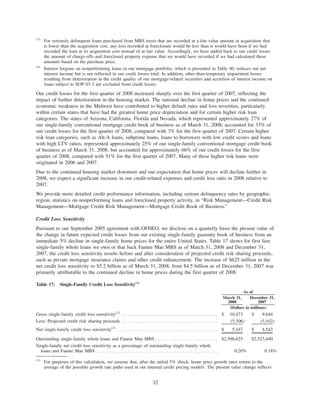
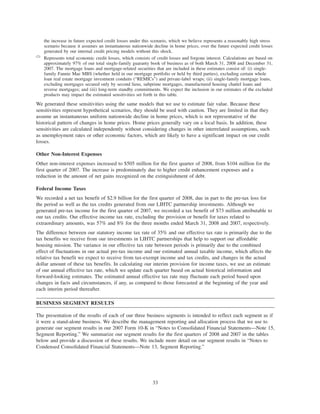
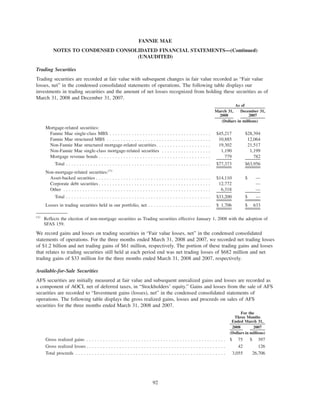
  • 108.
    13. Segment Reporting Wemanage our business using three operating segments: Single-Family; HCD; and Capital Markets. The following table displays our segment results for the three months ended March 31, 2008 and 2007. Our segment financial results include directly attributable revenues and expenses. Additionally, we allocate to each of our segments: (i) capital using OFHEO minimum capital requirements adjusted for over- or under- capitalization; (ii) indirect administrative costs; and (iii) a provision for federal income taxes. In addition, we allocate intercompany guaranty fee income as a charge to Capital Markets from the Single-Family and HCD segments for managing the credit risk on mortgage loans held by the Capital Markets segment. Single-Family HCD Capital Markets Total For the Three Months Ended March 31, 2008 (Dollars in millions) Net interest income (expense)(1) . . . . . . . . . . . . . . . . . . . . . . . . $ 134 $(103) $ 1,659 $ 1,690 Guaranty fee income (expense)(2) . . . . . . . . . . . . . . . . . . . . . . . 1,942 148 (338) 1,752 Trust management income . . . . . . . . . . . . . . . . . . . . . . . . . . . . 105 2 — 107 Investment losses, net . . . . . . . . . . . . . . . . . . . . . . . . . . . . . . . (48) — (63) (111) Fair value losses, net . . . . . . . . . . . . . . . . . . . . . . . . . . . . . . . . — — (4,377) (4,377) Debt extinguishment losses, net. . . . . . . . . . . . . . . . . . . . . . . . . — — (145) (145) Losses from partnership investments . . . . . . . . . . . . . . . . . . . . . — (141) — (141) Fee and other income . . . . . . . . . . . . . . . . . . . . . . . . . . . . . . . 102 62 63 227 Administrative expenses . . . . . . . . . . . . . . . . . . . . . . . . . . . . . . (286) (108) (118) (512) (Provision) benefit for credit losses . . . . . . . . . . . . . . . . . . . . . . (3,081) 8 — (3,073) Other expenses . . . . . . . . . . . . . . . . . . . . . . . . . . . . . . . . . . . . (420) (40) (70) (530) Loss before federal income taxes and extraordinary losses . . . . . . (1,552) (172) (3,389) (5,113) Benefit for federal income taxes . . . . . . . . . . . . . . . . . . . . . . . . (544) (322) (2,062) (2,928) Income (loss) before extraordinary losses . . . . . . . . . . . . . . . . . . (1,008) 150 (1,327) (2,185) Extraordinary losses, net of tax effect . . . . . . . . . . . . . . . . . . . . — — (1) (1) Net income (loss). . . . . . . . . . . . . . . . . . . . . . . . . . . . . . . . . $(1,008) $ 150 $(1,328) $(2,186) (1) Includes cost of capital charge. (2) Includes intercompany guaranty fee income (expense) allocated to Single-Family and HCD from Capital Markets for absorbing the credit risk on mortgage loans held in our portfolio. 103 FANNIE MAE NOTES TO CONDENSED CONSOLIDATED FINANCIAL STATEMENTS—(Continued) (UNAUDITED)
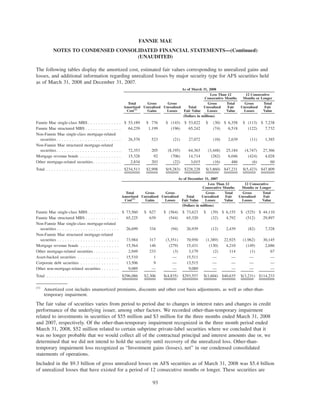
  • 109.
    Single-Family HCD Capital Markets Total Forthe Three Months Ended March 31, 2007 (Dollars in millions) Net interest income (expense)(1) . . . . . . . . . . . . . . . . . . . . . . . . . $ 79 $ (94) $1,209 $1,194 Guaranty fee income (expense)(2) . . . . . . . . . . . . . . . . . . . . . . . . 1,287 101 (290) 1,098 Losses on certain guaranty contracts . . . . . . . . . . . . . . . . . . . . . . (280) (3) — (283) Trust management income . . . . . . . . . . . . . . . . . . . . . . . . . . . . . 154 10 — 164 Investment gains, net(3) . . . . . . . . . . . . . . . . . . . . . . . . . . . . . . . 8 — 287 295 Fair value losses, net(3) . . . . . . . . . . . . . . . . . . . . . . . . . . . . . . . — — (566) (566) Debt extinguishment losses, net . . . . . . . . . . . . . . . . . . . . . . . . . — — (7) (7) Losses from partnership investments . . . . . . . . . . . . . . . . . . . . . . — (165) — (165) Fee and other income(3) . . . . . . . . . . . . . . . . . . . . . . . . . . . . . . . 89 84 104 277 Administrative expenses . . . . . . . . . . . . . . . . . . . . . . . . . . . . . . (382) (143) (173) (698) (Provision) benefit for credit losses. . . . . . . . . . . . . . . . . . . . . . . (253) 4 — (249) Other expenses(3) . . . . . . . . . . . . . . . . . . . . . . . . . . . . . . . . . . . (159) (6) (4) (169) Income (loss) before federal income taxes and extraordinary losses . . . . . . . . . . . . . . . . . . . . . . . . . . . . . . . . . . . . . . . . . 543 (212) 560 891 Provision (benefit) for federal income taxes . . . . . . . . . . . . . . . . . 188 (375) 114 (73) Income before extraordinary losses . . . . . . . . . . . . . . . . . . . . . . . 355 163 446 964 Extraordinary losses, net of tax effect . . . . . . . . . . . . . . . . . . . . . — — (3) (3) Net income . . . . . . . . . . . . . . . . . . . . . . . . . . . . . . . . . . . . . $ 355 $ 163 $ 443 $ 961 (1) Includes cost of capital charge. (2) Includes intercompany guaranty fee income (expense) allocated to Single-Family and HCD from Capital Markets for absorbing the credit risk on mortgage loans held in our portfolio. (3) Certain prior period amounts have been reclassified to conform with the current period presentation in our condensed consolidated statements of operations. 14. Regulatory Capital Requirements As of December 31, 2007, we were required by our consent order with OFHEO to maintain a 30% surplus over our statutory minimum capital requirement. On March 19, 2008, OFHEO reduced this capital surplus requirement to 20%. In addition, through February 29, 2008, we were subject to an OFHEO-directed limitation on the size of our mortgage portfolio. This limitation was eliminated by OFHEO effective March 1, 2008. As of March 31, 2008, our core capital of $42.7 billion exceeded our statutory minimum capital requirement by $11.3 billion, or 36.2%, and exceeded our OFHEO-directed minimum capital requirement by $5.1 billion, or 13.5%. These amounts represent estimates that will be submitted to OFHEO for its certification and are subject to its review and approval. As of December 31, 2007, our core capital of $45.4 billion exceeded our statutory minimum capital requirement by $13.4 billion, or 42.1%, and exceeded our OFHEO-directed minimum capital requirement by $3.9 billion, or 9.3%. Prior to OFHEO’s March 19, 2008 announcement, our need to maintain capital at levels sufficient to ensure we would meet our regulatory capital requirements continued to constrain our business activities. We therefore continued to take steps during the first quarter of 2008 to bolster our capital position, including managing the 104 FANNIE MAE NOTES TO CONDENSED CONSOLIDATED FINANCIAL STATEMENTS—(Continued) (UNAUDITED)
  • 110.
    size of ourinvestment portfolio and limiting or forgoing business opportunities that we otherwise would have pursued. 15. Concentrations of Credit Risk Non-traditional Loans; Alt-A and Subprime Loans and Securities We own and guarantee loans with non-traditional features, such as interest-only loans and negative-amortizing loans. We also own and guarantee Alt-A and subprime mortgage loans and mortgage-related securities. An Alt-A mortgage loan generally refers to a mortgage loan that can be underwritten with reduced or alternative documentation than that required for a full documentation mortgage loan but may also include other alternative product features. As a result, Alt-A mortgage loans generally have a higher risk of default than non-Alt-A mortgage loans. In reporting our Alt-A exposure, we have classified mortgage loans as Alt-A if the lenders that deliver the mortgage loans to us have classified the loans as Alt-A based on documentation or other product features. We have classified private-label mortgage-related securities held in our investment portfolio as Alt-A if the securities were labeled as such when issued. A subprime mortgage loan generally refers to a mortgage loan made to a borrower with a weaker credit profile than that of a prime borrower. As a result of the weaker credit profile, subprime borrowers have a higher likelihood of default than prime borrowers. Subprime mortgage loans are typically originated by lenders specializing in this type of business or by subprime divisions of large lenders, using processes unique to subprime loans. In reporting our subprime exposure, we have classified mortgage loans as subprime if the mortgage loans are originated by one of these specialty lenders or a subprime division of a large lender. We have classified private-label mortgage-related securities held in our investment portfolio as subprime if the securities were labeled as such when issued. We reduce our risk associated with these loans through credit enhancements, as described below under “Mortgage Insurers.” The following table displays the percentage of our conventional single-family mortgage credit book of business that consists of interest-only loans, negative-amortizing adjustable rate mortgages (“ARMs”) and loans with an estimated mark-to-market value loan to value (“LTV”) ratio of greater than 80% as of March 31, 2008 and December 31, 2007. March 31, 2008 December 31, 2007 Percentage of Conventional Single-Family Mortgage Credit Book of Business As of Interest-only loans . . . . . . . . . . . . . . . . . . . . . . . . . . . . . . . . . . . . . . . . 8% 8% Negative-amortizing ARMs. . . . . . . . . . . . . . . . . . . . . . . . . . . . . . . . . . 1 1 80%+ LTV loans . . . . . . . . . . . . . . . . . . . . . . . . . . . . . . . . . . . . . . . . . 21 20 105 FANNIE MAE NOTES TO CONDENSED CONSOLIDATED FINANCIAL STATEMENTS—(Continued) (UNAUDITED)
  • 111.
    The following tabledisplays information regarding the Alt-A and subprime mortgage loans and mortgage- related securities in our mortgage credit book of business as of March 31, 2008 and December 31, 2007. Unpaid Principal Balance Percent of Book of Business(1) Unpaid Principal Balance Percent of Book of Business(1) March 31, 2008 December 31, 2007 As of (Dollars in millions) Loans and Fannie Mae MBS: Alt-A(2) . . . . . . . . . . . . . . . . . . . . . . . . . . . . . . . . . . . . . . . . . . . . . $314,019 11% $318,121 12% Subprime(3) . . . . . . . . . . . . . . . . . . . . . . . . . . . . . . . . . . . . . . . . . . . 20,815 1 22,126 1 Total . . . . . . . . . . . . . . . . . . . . . . . . . . . . . . . . . . . . . . . . . . . . . $334,834 12% $340,247 13% Private-label securities: Alt-A(4) . . . . . . . . . . . . . . . . . . . . . . . . . . . . . . . . . . . . . . . . . . . . . $ 30,563 1% $ 32,475 1% Subprime(5) . . . . . . . . . . . . . . . . . . . . . . . . . . . . . . . . . . . . . . . . . . . 30,383 1 32,040 1 Total . . . . . . . . . . . . . . . . . . . . . . . . . . . . . . . . . . . . . . . . . . . . . $ 60,946 2% $ 64,515 2% (1) Calculated based on total unpaid principal balance of the total single-family mortgage credit book of business. (2) Represents Alt-A mortgage loans held in our portfolio and Fannie Mae MBS backed by Alt-A mortgage loans. (3) Represents subprime mortgage loans held in our portfolio and Fannie Mae MBS backed by subprime mortgage loans. (4) Represents private-label mortgage-related securities backed by Alt-A mortgage loans. (5) Represents private-label mortgage-related securities backed by subprime mortgage loans. Other concentrations Mortgage Servicers. Mortgage servicers collect mortgage and escrow payments from borrowers, pay taxes and insurance costs from escrow accounts, monitor and report delinquencies, and perform other required activities on our behalf. Our business with our mortgage servicers is concentrated. Our ten largest single- family mortgage servicers serviced 78% and 74% of our single-family mortgage credit book of business as of March 31, 2008 and December 31, 2007, respectively. Our ten largest multifamily mortgage servicers serviced 69% and 72% of our multifamily mortgage credit book of business as of March 31, 2008 and December 31, 2007, respectively. In January 2008, our largest mortgage servicer announced that it had reached an agreement to be acquired. Reduction in the number of mortgage servicers would result in an increase in our concentration risk with the remaining servicers in the industry. If one of our principal mortgage servicers fails to meet its obligations to us, it could increase our credit-related expenses and credit losses, result in financial losses to us and have a material adverse effect on our earnings, liquidity, financial condition and capital position. Mortgage Insurers. We had primary and pool mortgage insurance coverage on single-family mortgage loans in our guaranty book of business of $101.3 billion and $10.2 billion, respectively, as of March 31, 2008, compared with $93.7 billion and $10.4 billion, respectively, as of December 31, 2007. Eight mortgage insurance companies provided over 99% of our mortgage insurance as of March 31, 2008 and December 31, 2007. If a mortgage insurer fails to meet its obligations to reimburse us for claims under insurance policies, we would experience higher credit losses, which could have a material adverse effect on our earnings, liquidity, financial condition and capital position. 106 FANNIE MAE NOTES TO CONDENSED CONSOLIDATED FINANCIAL STATEMENTS—(Continued) (UNAUDITED)
  • 112.
    Financial Guarantors. Wewere the beneficiary of financial guaranties of approximately $11.1 billion and $11.8 billion on the securities held in our investment portfolio as of March 31, 2008 and December 31, 2007, respectively. The securities covered by these guaranties consist primarily of private-label mortgage-related securities and municipal bonds. We obtained these guaranties from nine financial guaranty insurance companies. These financial guaranty contracts assure the collectability of timely interest and ultimate principal payments on the guaranteed securities if the cash flows generated by the underlying collateral are not sufficient to fully support these payments. If a financial guarantor fails to meet its obligations to us with respect to the securities for which we have obtained financial guaranties, it could reduce the fair value of our mortgage-related securities and result in financial losses to us, which could have a material adverse effect on our earnings, liquidity, financial condition and capital position. 16. Fair Value of Financial Instruments We carry financial instruments at fair value, amortized cost or lower of cost or market. As defined in SFAS 157, fair value is the price that would be received to sell an asset or paid to transfer a liability in an orderly transaction between market participants at the measurement date (also referred to as an exit price). When available, the fair value of our financial instruments is based on quoted market prices, valuation techniques that use observable market-based inputs or unobservable inputs that are corroborated by market data. Pricing information we obtain from third parties is internally validated for reasonableness prior to use in the consolidated financial statements. When observable market prices are not readily available, we generally estimate the fair value using market data alternate techniques or internally developed models using significant inputs that are generally less readily observable from objective sources. Market data includes prices of financial instruments with similar maturities and characteristics, duration, interest rate yield curves, measures of volatility and prepayment rates. If market data needed to estimate fair value is not available, we estimate fair value using internally-developed models that employ a discounted cash flow approach. These estimates are based on pertinent information available to us at the time of the applicable reporting periods. In certain cases, fair values are not subject to precise quantification or verification and may fluctuate as economic and market factors vary, and our evaluation of those factors changes. Although we use our best judgment in estimating the fair value of these financial instruments, there are inherent limitations in any estimation technique. In these cases, a minor change in an assumption could result in a significant change in our estimate of fair value, thereby increasing or decreasing consolidated assets, liabilities, stockholders’ equity and net income or loss. The fair value of financial instruments disclosure required by SFAS No. 107, Disclosures about Fair Value of Financial Instruments, includes commitments to purchase multifamily mortgage loans, which are off-balance sheet financial instruments that are not recorded in the condensed consolidated balance sheets. The fair value of these commitments are included as “Mortgage loans held for investment, net of allowance for loan losses.” The disclosure excludes certain financial instruments, such as plan obligations for pension and other postretirement benefits, employee stock option and stock purchase plans, and also excludes all non-financial instruments. As a result, the fair value of our financial assets and liabilities does not represent the underlying fair value of our total consolidated assets and liabilities. 107 FANNIE MAE NOTES TO CONDENSED CONSOLIDATED FINANCIAL STATEMENTS—(Continued) (UNAUDITED)
  • 113.
    The following tabledisplays the carrying value and estimated fair value of our financial instruments as of March 31, 2008 and December 31, 2007. Carrying Value Estimated Fair Value Carrying Value(1) Estimated Fair Value(1) March 31, 2008 December 31, 2007 As of (Dollars in millions) Assets: Cash and cash equivalents(2) . . . . . . . . . . . . . . . . . . . . . . . . . . . . . . . $ 2,304 $ 2,304 $ 4,502 $ 4,502 Federal funds sold and securities purchased under agreements to resell . . . . . . . . . . . . . . . . . . . . . . . . . . . . . . . . . . . . . . . . . . . . . 20,484 20,499 49,041 49,041 Trading securities . . . . . . . . . . . . . . . . . . . . . . . . . . . . . . . . . . . . . . 110,573 110,573 63,956 63,956 Available-for-sale securities . . . . . . . . . . . . . . . . . . . . . . . . . . . . . . . 228,228 228,228 293,557 293,557 Mortgage loans held for sale. . . . . . . . . . . . . . . . . . . . . . . . . . . . . . . 8,486 8,606 7,008 7,083 Mortgage loans held for investment, net of allowance for loan losses . . 402,449 402,390 396,516 395,822 Advances to lenders. . . . . . . . . . . . . . . . . . . . . . . . . . . . . . . . . . . . . 11,732 11,467 12,377 12,049 Derivative assets . . . . . . . . . . . . . . . . . . . . . . . . . . . . . . . . . . . . . . . 1,037 1,037 885 885 Guaranty assets and buy-ups. . . . . . . . . . . . . . . . . . . . . . . . . . . . . . . 10,808 14,289 10,610 14,258 Total financial assets . . . . . . . . . . . . . . . . . . . . . . . . . . . . . . . . . . . . $796,101 $799,393 $838,452 $841,153 Liabilities: Federal funds purchased and securities sold under agreements to repurchase . . . . . . . . . . . . . . . . . . . . . . . . . . . . . . . . . . . . . . . . . $ 711 $ 711 $ 869 $ 869 Short-term debt . . . . . . . . . . . . . . . . . . . . . . . . . . . . . . . . . . . . . . . . 215,916 216,442 234,160 234,368 Long-term debt . . . . . . . . . . . . . . . . . . . . . . . . . . . . . . . . . . . . . . . . 544,424 570,040 562,139 580,333 Derivative liabilities. . . . . . . . . . . . . . . . . . . . . . . . . . . . . . . . . . . . . 4,123 4,123 2,217 2,217 Guaranty obligations . . . . . . . . . . . . . . . . . . . . . . . . . . . . . . . . . . . . 15,521 45,099 15,393 20,549 Total financial liabilities. . . . . . . . . . . . . . . . . . . . . . . . . . . . . . . . . . $780,695 $836,415 $814,778 $838,336 (1) Pursuant to our adoption of FSP FIN 39-1, we have reduced “Derivative assets at fair value” and “Derivative liabilities at fair value” in our condensed consolidated balance sheet as of December 31, 2007. (2) Includes restricted cash of $307 million and $561 million as of March 31, 2008 and December 31, 2007. Notes to Fair Value of Financial Instruments Assets Cash and Cash Equivalents—The carrying value of cash and cash equivalents is a reasonable estimate of their approximate fair value. Federal Funds Sold and Securities Purchased Under Agreements to Resell—The carrying value of our federal funds sold and securities purchased under agreements to resell approximates the fair value of these instruments due to their short-term nature, exclusive of dollar roll repurchase transactions. The fair value of our dollar roll repurchase transactions reflects prices for similar securities in the market. Trading Securities and Available- for-Sale Securities—Our investments in securities are recognized at fair value in the condensed consolidated financial statements. Fair values of securities are primarily based on observable market prices or prices obtained from third parties. Details of these estimated fair values by type are displayed in “Note 5, Investments in Securities.” 108 FANNIE MAE NOTES TO CONDENSED CONSOLIDATED FINANCIAL STATEMENTS—(Continued) (UNAUDITED)
  • 114.
    Mortgage Loans Heldfor Sale—Held for sale (“HFS”) loans are reported at the lower of cost or market (“LOCOM”) in the condensed consolidated balance sheets. We determine the fair value of our mortgage loans based on comparisons to Fannie Mae MBS with similar characteristics. Specifically, we use the observable market value of our Fannie Mae MBS as a base value, from which we subtract or add the fair value of the associated guaranty asset, guaranty obligation and master servicing arrangements. Mortgage Loans Held for Investment—Held for investment (“HFI”) loans are recorded in the condensed consolidated balance sheets at the principal amount outstanding, net of unamortized premiums and discounts, cost basis adjustments and an allowance for loan losses. We determine the fair value of our mortgage loans based on comparisons to Fannie Mae MBS with similar characteristics. Specifically, we use the observable market value of our Fannie Mae MBS as a base value, from which we subtract or add the fair value of the associated guaranty asset, guaranty obligation and master servicing arrangements. Certain loans that do not qualify for MBS securitization are valued using market based data for similar loans or through a model approach that simulates a loan sale via a synthetic structure. Advances to Lenders—The carrying value of the majority of our advances to lenders approximates the fair value of these instruments due to their short-term nature. Advances to lenders for which the carrying value does not approximate fair value are valued based on comparisons to Fannie Mae MBS with similar characteristics, and applying the same pricing methodology as used for HFI loans as described above. Derivatives Assets and Liabilities (collectively, “Derivatives”)—Our risk management derivatives and mortgage commitment derivatives are recognized in the condensed consolidated balance sheets at fair value, taking into consideration the effects of any legally enforceable master netting agreements that allow us to settle derivative asset and liability positions with the same counterparty on a net basis, as well as cash collateral. We use observable market prices or market prices obtained from third parties for derivatives, when available. For derivative instruments where market prices are not readily available, we estimate fair value using model-based interpolation based on direct market inputs. Direct market inputs include prices of instruments with similar maturities and characteristics, interest rate yield curves and measures of interest rate volatility. Details of these estimated fair values by type are displayed in “Note 9, Derivative Instruments.” Guaranty Assets and Buy-ups—We estimate the fair value of guaranty assets based on the present value of expected future cash flows of the underlying mortgage assets using management’s best estimate of certain key assumptions, which include prepayment speeds, forward yield curves, and discount rates commensurate with the risks involved. These cash flows are projected using proprietary prepayment, interest rate and credit risk models. Because guaranty assets are like an interest-only income stream, the projected cash flows from our guaranty assets are discounted using interest rate spreads from a representative sample of interest-only trust securities. We reduce the spreads on interest-only trusts to adjust for the less liquid nature of the guaranty asset. The fair value of the guaranty assets as presented in the table above and the recurring fair value measurement table below include the fair value of any associated buy-ups, which is estimated in the same manner as guaranty assets but are recorded separately as a component of “Other assets” in the condensed consolidated balance sheets. While the fair value of the guaranty assets reflect all guaranty arrangements, the carrying value primarily reflects only those arrangements entered into subsequent to our adoption of FIN 45. Federal Funds Purchased and Securities Sold Under Agreements to Repurchase—The carrying value of our federal funds purchased and securities sold under agreements to repurchase approximate the fair value of these instruments due to the short-term nature of these liabilities, exclusive of dollar roll repurchase transactions. Short-Term Debt and Long-Term Debt—We value the majority of our short-term and long-term debt using pricing services. Where third party pricing is not available on non-callable debt, we use a discounted cash flow approach based on the Fannie Mae yield curve with an adjustment to reflect fair values at the offer side of the market. When third party pricing is not available for callable bonds, we use internally-developed models 109 FANNIE MAE NOTES TO CONDENSED CONSOLIDATED FINANCIAL STATEMENTS—(Continued) (UNAUDITED)
  • 115.
    calibrated to marketto price these bonds. To estimate the fair value of structured notes, cash flows are evaluated taking into consideration any derivatives through which we have swapped out of the structured features of the notes. We continue to use third party prices for subordinated debt. Guaranty Obligations— We measure the fair value of the guaranty obligation based on the fair value of the total compensation received, which is primarily comprised of the guaranty fee, credit enhancements, buy downs, risk-based price adjustments and our right to receive interest income during the float period in excess of the amount required to compensate us for master servicing. While the fair value of the guaranty obligation reflects all guaranty arrangements, the carrying value primarily reflects only those arrangements entered into subsequent to our adoption of FIN 45. See “Summary of Significant Accounting Policies” for information regarding the change in approach in measuring the fair value of our guaranty obligation. Fair Value Measurement Effective January 1, 2008, we adopted SFAS 157, which provides a framework for measuring fair value under GAAP, as well as expanded information about assets and liabilities measured at fair value, including the effect of fair value measurements on earnings. The impact of adopting SFAS 157 reduced the beginning balance of retained earnings as of January 1, 2008 by $62 million, net of tax. As described above, the inputs used to determine fair value can be readily observable, market corroborated or unobservable. We use valuation techniques that maximize the use of observable inputs and minimize the use of unobservable inputs. Valuation Hierarchy The fair value hierarchy ranks the quality and reliability of the information used to determine fair values. We perform a detailed analysis of the assets and liabilities that are subject to SFAS 157 to determine the appropriate level based on the observability of the inputs used in the valuation techniques. Assets and liabilities carried at fair value will be classified and disclosed in one of the following three categories based on the lowest level input that is significant to the fair value measurement in its entirety: Level 1: Quoted prices (unadjusted) in active markets for identical assets or liabilities. Level 2: Observable market-based inputs other than quoted prices in active markets for identical assets or liabilities. Level 3: Unobservable inputs. Level 1 consists of instruments whose value is based on quoted market prices in active markets, such as U.S. Treasuries. Level 2 includes instruments that are primarily valued using valuation techniques that use observable market- based inputs or unobservable inputs that are corroborated by market data. These inputs consider various assumptions, including time value, yield curve, volatility factors, prepayment speeds, default rates, loss severity, current market and contractual prices for the underlying financial instruments, as well as other relevant economic measures. Substantially all of these assumptions are observable in the marketplace, can be derived from observable market data or are supported by observable levels at which transactions are executed in the marketplace. This category also includes instruments whose values are based on quoted market prices provided by a single dealer that is corroborated by a recent transaction. Instruments in this category include mortgage and non-mortgage-related securities, mortgage loans held for sale, and debt and derivatives. Level 3 is comprised of instruments whose fair value is estimated based on a market approach using alternate techniques or internally developed models using significant inputs that are generally less readily observable 110 FANNIE MAE NOTES TO CONDENSED CONSOLIDATED FINANCIAL STATEMENTS—(Continued) (UNAUDITED)
  • 116.
    because of limitedmarket activity or little or no price transparency. We include instruments whose value is based on a single source such as a dealer, broker or pricing service and cannot be corroborated by recent market transactions. Included in this category are guaranty assets and buy-ups, master servicing assets and liabilities, mortgage loans, mortgage and non-mortgage-related securities, long-term debt, derivatives, and acquired property. Recurring Change in Fair Value The following table displays our assets and liabilities measured on our condensed consolidated balance sheet at fair value on a recurring basis subsequent to initial recognition, including instruments for which we have elected the fair value option. Specifically, as disclosed under SFAS 157 requirements, total assets measured at fair value on a recurring basis and classified as level 3 were $56.1 billion, or 6.7% of “Total assets” in the condensed consolidated balance sheet as of March 31, 2008. Quoted Prices in Active Markets for Identical Assets (Level 1) Significant Other Observable Inputs (Level 2) Significant Unobservable Inputs (Level 3) Netting Adjustment(1) Estimated Fair Value Fair Value Measurements as of March 31, 2008 (Dollars in millions) Assets: Trading securities . . . . . . . . . . . . . . . . . . . . . . $ 6 $ 92,595 $17,972 $ — $110,573 Available-for-sale securities . . . . . . . . . . . . . . . — 192,045 36,183 — 228,228 Derivative assets(2) . . . . . . . . . . . . . . . . . . . . . — 32,147 341 (31,456) 1,032 Guaranty assets and buy-ups . . . . . . . . . . . . . . — — 1,628 — 1,628 Total assets at fair value . . . . . . . . . . . . . . . . $ 6 $316,787 $56,124 $(31,456) $341,461 Liabilities: Short-term debt. . . . . . . . . . . . . . . . . . . . . . . . $— $ 4,501 $ — $ — $ 4,501 Long-term debt. . . . . . . . . . . . . . . . . . . . . . . . — 11,733 3,399 — 15,132 Derivative liabilities(2) . . . . . . . . . . . . . . . . . . . — 37,234 89 (33,206) 4,117 Other liabilities . . . . . . . . . . . . . . . . . . . . . . . . — 989 — — 989 Total liabilities at fair value . . . . . . . . . . . . . $— $ 54,457 $ 3,488 $(33,206) $ 24,739 (1) Derivative contracts are reported on a gross basis by level. The netting adjustment represents the effect of the legal right to offset under legally enforceable master netting agreements to settle with the same counterparty on a net basis, as well as cash collateral. (2) Excludes accrued fees related to the termination of derivative contracts. The following table displays a reconciliation of all assets and liabilities measured at fair value on a recurring basis using significant unobservable inputs (level 3) for the three months ended March 31, 2008. The table also displays gains and losses due to changes in fair value, including both realized and unrealized gains and 111 FANNIE MAE NOTES TO CONDENSED CONSOLIDATED FINANCIAL STATEMENTS—(Continued) (UNAUDITED)
  • 117.
    losses, recorded inour condensed consolidated statement of operations for level 3 assets and liabilities for the three months ended March 31, 2008. Trading Securities Available-for-sale Securities Net Derivatives Guaranty Assets and Buy-ups Long-Term Debt Fair Value Measurements Using Significant Unobservable Inputs (Level 3) For the Three Months Ended March 31, 2008 (Dollars in millions) Beginning balance as of January 1, 2008 . . . . . . . $18,508 $20,920 $161 $1,568 $(7,888) Total gains (losses) (realized/unrealized) Included in net loss . . . . . . . . . . . . . . . . . . . . (800) 13 52 20 16 Included in other comprehensive loss . . . . . . . . — (896) — (59) — Purchases, sales, issuances, and settlements, net . . (814) (695) (64) 99 4,275 Transfers in (out) of Level 3, net(1) . . . . . . . . . . . 1,078 16,841 103 — 198 Ending balance as of March 31, 2008 . . . . . . . . . $17,972 $36,183 $252 $1,628 $(3,399) The amount of total gains (losses) for the period included in net loss attributable to the change in unrealized gains (losses) relating to the assets and liabilities still held as of March 31, 2008(2) . . . . . . . . . . . . . . . . . . . . . . . . . . . . . $ (518) $ — $ 55 $ 59 $ 54 (1) When pricing service quotes are not available or incomparable to additional market information, we may use alternate techniques which can result in level 3 prices. During the three months ended March 31, 2008, there was additional lack of market transparency resulting in increased level 3 classifications. Transfers into level 3 consisted primarily of private-label mortgage-related securities backed by Alt-A and Subprime mortgage loans. (2) Amount represents temporary changes in fair value. Amortization, accretion and other-than-temporary impairments are not considered unrealized and not included in this amount. The following table displays gains and losses (realized and unrealized) included in our condensed consolidated statement of operations for the three months ended March 31, 2008 for our Level 3 assets and liabilities measured in our condensed consolidated balance sheet at fair value on a recurring basis. Interest Income Investment in Securities Guaranty Fee Income Investment Gains (Losses), net Fair Value Losses, net Total For the Three Months Ended March 31, 2008 (Dollars in millions) Total gains (losses) (realized/ unrealized) included in net loss as of March 31, 2008 . . . . . . . . . . . . . . . . $ (4) $(70) $99 $(724) $(699) Change in unrealized gains (losses) relating to the assets and liabilities still held as of March 31, 2008 . . . . . . . . . . . . . . . . . . . . . . . . . . . . . . . . . $— $ 59 $— $(409) $(350) 112 FANNIE MAE NOTES TO CONDENSED CONSOLIDATED FINANCIAL STATEMENTS—(Continued) (UNAUDITED)
  • 118.
    Non-recurring Change inFair Value The following table displays assets and liabilities measured at fair value on a non-recurring basis; that is, the instruments are not measured at fair value on an ongoing basis but are subject to fair value adjustments in certain circumstances (for example, when we evaluate for impairment), and the gains or losses recognized during the quarter ended March 31, 2008, as a result of fair value measurement are summarized below. Quoted Prices in Active Markets for Identical Assets (Level 1) Significant Other Observable Inputs (Level 2) Significant Unobservable Inputs (Level 3) Estimated Fair Value Total Losses Fair Value Measurements as of March 31, 2008 For the Three Months Ended March 31, 2008 (Dollars in millions) Assets: Mortgage loans held for sale, at lower of cost or market . . . . . . . . . . . . . . . . . . . . . . . . . $— $4,273 $ 596 $ 4,869 $ (75) Mortgage loans held for investment, at amortized cost . . . . . . . . . . . . . . . . . . . . . — — 201 201 (14) Acquired property, net . . . . . . . . . . . . . . . . . — — 2,388 2,388 (208) Guaranty assets . . . . . . . . . . . . . . . . . . . . . . — — 3,062 3,062 (269) Master servicing assets . . . . . . . . . . . . . . . . . — — 596 596 (174) Total assets at fair value . . . . . . . . . . . . . . $— $4,273 $6,843 $11,116 $(740) Liabilities: Master servicing liabilities . . . . . . . . . . . . . . . $— $ — $ 9 $ 9 $ (2) Total liabilities at fair value . . . . . . . . . . $— $ — $ 9 $ 9 $ (2) Valuation Classification The following is a description of the instruments measured at fair value under SFAS 157 as well as the general classification of such instruments pursuant to the valuation hierarchy described above under SFAS 157. Assets Trading Securities and Available- for-Sale Securities—Fair value is determined using quoted market prices in active markets for identical assets, when available. Securities, such as U.S. Treasuries, whose value is based on quoted market prices in active markets for identical assets are classified as level 1. If quoted market prices in active markets for identical assets are not available, we use quoted market prices in active markets for similar securities that we adjust for observable or corroborated pricing services market information. A significant amount of the population is valued using prices provided by pricing services for identical assets. In the absence of observable or corroborated market data, we use internally developed estimates, incorporating market-based assumptions wherever such information is available. The fair values are estimated by using pricing models, quoted prices of securities with similar characteristics, or discounted cash flows. Such instruments may generally be classified within level 2 of the valuation hierarchy. Where there is limited activity or less transparency around inputs to the valuation, securities are classified as level 3. Mortgage Loans Held for Sale—Includes loans where fair value is determined on a pool level, loan level or product and interest rate basis. Level 2 inputs include MBS values. Level 3 inputs include MBS values where 113 FANNIE MAE NOTES TO CONDENSED CONSOLIDATED FINANCIAL STATEMENTS—(Continued) (UNAUDITED)
  • 119.
    price is influencedsignificantly by extrapolation from observable market data, products in inactive markets or unobservable inputs. Mortgage Loans Held for Investment—Represents individually impaired loans, classified as level 3, where fair value is less than carrying value. Includes modified and delinquent loans acquired from MBS trusts under SOP 03-3. Valuations are based on regional prices and level 3 inputs include the collateral value used to value the loan. Acquired Property, Net—Includes foreclosed property received in full satisfaction of a loan. The fair value of our foreclosed properties is determined by third-party appraisals, when available. When third-party appraisals are not available, we estimate fair value based on factors such as prices for similar properties in similar geographical areas and/or assessment through observation of such properties. Our acquired property is classified within level 3 of the valuation hierarchy because significant inputs are unobservable. Derivatives Assets and Liabilities (collectively, “Derivatives”)— The valuation of risk management derivatives uses observable market data provided by third-party sources where available, resulting in level 2 classification. Certain highly complex derivatives use only a single source of price information due to lack of transparency in the market and may be modeled using significant assumptions, resulting in level 3 classification. Mortgage commitment derivatives use observable market data, quotes and actual transaction levels adjusted for market movement and are typically classified as level 2. Adjustments for market movement that require internal model results and cannot be corroborated by observable market data are classified as level 3. Guaranty Assets and Buy-ups— Guaranty assets from our retained interests in portfolio securitization are measured at fair value on a recurring basis and are classified within level 3 of the valuation hierarchy. Guaranty assets in a lender swap transaction that are impaired under Emerging Issues Task Force Issue No. 99-20, Recognition of Interest Income and Impairment on Purchased Beneficial Interests and Beneficial Interests that Continue to Be Held by a Transferor in Securitized Financial Assets, are measured at fair value on a non-recurring basis and are classified within level 3 of the fair value hierarchy. As described above, level 3 inputs include management’s best estimate of certain key assumptions. Master Servicing Assets and Liabilities—We value our master servicing assets and liabilities based on the present value of expected cash flows of the underlying mortgage assets using management’s best estimates of certain key assumptions, which include prepayment speeds, forward yield curves, adequate compensation, and discount rates commensurate with the risks involved. Changes in anticipated prepayment speeds, in particular, result in fluctuations in the estimated fair values of our master servicing assets and liabilities. If actual prepayment experience differs from the anticipated rates used in our model, this difference may result in a material change in the fair value. Our master servicing assets and liabilities are classified within level 3 of the valuation hierarchy. Liabilities Short-Term Debt and Long-Term Debt—The majority of our debt instruments are priced using pricing services. Where third party pricing is not available on non-callable debt, we use a discounted cash flow approach based on the Fannie Mae yield curve with an adjustment to reflect fair values at the offer side of the market. When third party pricing is not available for callable bonds, we use internally-developed models calibrated to market to price these bonds. Included within Short-Term Debt and Long-Term Debt are structured notes for which we elected the fair value option under SFAS 159. To estimate the fair value of structured notes, cash flows are evaluated taking into consideration any derivatives through which we have swapped out of the structured features of the notes. Where the inputs into the valuation are primarily based upon observable market data, our debt is classified within level 2 of the valuation hierarchy. Where significant inputs are unobservable or valued with a quote from a single source, our debt is classified within level 3 of the valuation hierarchy. 114 FANNIE MAE NOTES TO CONDENSED CONSOLIDATED FINANCIAL STATEMENTS—(Continued) (UNAUDITED)
  • 120.
    Other Liabilities—Represents dollarroll repurchase transactions that reflect prices for similar securities in the market. Valuations are based on observable market-based inputs, quoted market prices and actual transaction levels adjusted for market movement and are typically classified as level 2. Adjustments for market movement that require internal model results that cannot be corroborated by observable market data are classified as level 3. Fair Value Option On January 1, 2008, we adopted SFAS 159. SFAS 159 allows companies the irrevocable option to elect fair value for the initial and subsequent measurement for certain financial assets and liabilities, and requires that the difference between the carrying value before election of the fair value option and the fair value of these instruments be recorded as an adjustment to beginning retained earnings in the period of adoption on a contract-by-contract basis. The following table displays the impact of adopting SFAS 159 to beginning retained earnings as of January 1, 2008. Carrying Value as of January 1, 2008 Prior to Adoption of Fair Value Option Transition Gain (Loss) Fair Value as of January 1, 2008 After Adoption of Fair Value Option (Dollars in millions) Investments in securities . . . . . . . . . . . . . . . . . . . . . . . . . . . . . $56,217 $143(1) $56,217 Long-term debt . . . . . . . . . . . . . . . . . . . . . . . . . . . . . . . . . . . 9,809 (10) 9,819 Pre-tax cumulative effective of adoption . . . . . . . . . . . . . . . . . . 133 Increase in deferred taxes . . . . . . . . . . . . . . . . . . . . . . . . . . . . (47) Cumulative effect of adoption to beginning retained earnings . . . $ 86 (1) We adopted the fair value option for certain securities classified within our mortgage-related and non-mortgage-related investment portfolio previously classified as available-for-sale. These securities are presented in the condensed consolidated balance sheet at fair value in accordance with SFAS 115 and the amount of transition gain was recognized in AOCI as of December 31, 2007 prior to adoption of SFAS 159. Elections The following is a discussion of the primary financial instruments for which we made fair value elections and the basis for those elections. Non-mortgage-related securities We elected the fair value option for all non-mortgage-related securities, excluding those non-mortgage-related securities that are classified as cash equivalents, as these securities are held primarily for liquidity purposes and fair value reflects the most transparent basis for reporting. As of March 31, 2008, these instruments had an aggregate fair value of $33.2 billion. Prior to the adoption of SFAS 159, these available-for-sale securities were recorded at fair value in accordance with SFAS 115, with changes recorded in AOCI. Following the election of the fair value option, these securities were reclassified to “Trading securities” in our condensed consolidated balance sheet and are now recorded at fair value with subsequent changes in fair value recorded as “Fair value losses, net” in the condensed consolidated statements of operations. 115 FANNIE MAE NOTES TO CONDENSED CONSOLIDATED FINANCIAL STATEMENTS—(Continued) (UNAUDITED)
  • 121.
    Mortgage-related securities We electedthe fair value option for certain 15-year and 30-year agency mortgage-related securities that were previously classified as available-for-sale securities in our mortgage portfolio. These securities were selected for the fair value option primarily in order to reduce the volatility in earnings that results from accounting asymmetry between our derivatives that are accounted for at fair value through earnings and our available-for- sale securities that are accounted for at fair value through AOCI. As of March 31, 2008, these instruments had an aggregate fair value of $17.5 billion. Prior to the adoption of SFAS 159, these securities were recorded at fair value in accordance with SFAS 115. Following the election of the fair value option, these securities were reclassified to “Trading securities” in our condensed consolidated balance sheet and are now recorded at fair value with subsequent changes in fair value recorded as “Fair value losses, net” in the condensed consolidated statements of operation. Structured debt instruments We elected the fair value option for short-term and long-term structured debt instruments that are issued in response to specific investor demand and have interest rates that are based on a calculated index or formula and that are economically hedged with derivatives at the time of issuance. By electing the fair value option for these instruments, we are able to eliminate the volatility in our results of operations that would otherwise result from accounting asymmetry created by the accounting for these structured debt instruments at cost and the economic hedges at fair value. As of March 31, 2008, these instruments had an aggregate fair value and unpaid principal balance of $4.5 billion, and an aggregate fair value and unpaid principal balance of $15.1 billion, recorded in “Short-term debt” and “Long-term debt,” respectively, in our condensed consolidated balance sheet. Following the election of the fair value option, these debt instruments are recorded at fair value with subsequent changes in fair value recorded in “Fair value losses, net.” These structured debt instruments continue to be classified as either “Short-term debt” or “Long-term debt” in the condensed consolidated balance sheets based on their original maturities. Interest accrued on these short-term and long-term debt instruments continues to be recorded in “Interest expense” in our condensed consolidated statements of operations. Changes in Fair Value under the Fair Value Option Election The following table displays debt fair value gains (losses), net including changes attributable to instrument- specific credit risk. Amounts are recorded as a component of “Fair value losses, net” in the condensed consolidated statement of operations for the three months ended March 31, 2008, for which the fair value election was made. Short-Term Debt Long-Term Debt Total Gains (Losses) For the Three Months Ended March 31, 2008 (Dollars in millions) Changes in instrument-specific risk. . . . . . . . . . . . . . . . . . . . . . . . . . . . . . . . . $ 8 $ 92 $100 Other changes in fair value . . . . . . . . . . . . . . . . . . . . . . . . . . . . . . . . . . . . . . (10) (80) (90) Debt fair value gains (losses), net . . . . . . . . . . . . . . . . . . . . . . . . . . . . . . . . $ (2) $ 12 $ 10 In determining specific risk, the changes in Fannie Mae debt spreads to LIBOR that occurred during the period were taken into consideration with the overall change in the fair value of the debt for which we elected the fair value option under SFAS 159. Specifically, cash flows are evaluated taking into consideration any 116 FANNIE MAE NOTES TO CONDENSED CONSOLIDATED FINANCIAL STATEMENTS—(Continued) (UNAUDITED)
  • 122.
    derivatives through whichFannie Mae has swapped out of the structured features of the notes and thus created a floating rate LIBOR-based debt instrument. The change in value of these LIBOR-based cash flows based on the Fannie Mae yield curve at the beginning and end of the period represents the instrument specific risk. 17. Commitments and Contingencies We are party to various types of legal proceedings that are subject to many uncertain factors that are not recorded in the condensed consolidated financial statements. Each of these is described below. Litigation claims and proceedings of all types are subject to many uncertain factors that generally cannot be predicted with assurance. The following describes our material legal proceedings, examinations and other matters. An unfavorable outcome in certain of these legal proceedings could have a material adverse effect on our business, financial condition, results of operations and cash flows. In view of the inherent difficulty of predicting the outcome of these proceedings, we cannot state with confidence what the eventual outcome of the pending matters will be. Because we concluded that a loss with respect to any pending matter discussed below was not both probable and reasonably estimable as of May 5, 2008, we have not recorded a reserve for any of those matters. With respect to the lawsuits described below, we believe we have valid defenses to the claims in these lawsuits and intend to defend these lawsuits vigorously. In addition to the matters specifically described herein, we are also involved in a number of legal and regulatory proceedings that arise in the ordinary course of business that we do not expect will have a material impact on our business. During 2007 and 2008, we advanced fees and expenses of certain current and former officers and directors in connection with various legal proceedings pursuant to indemnification agreements. None of these amounts were material. Securities Class Action Lawsuits In re Fannie Mae Securities Litigation Beginning on September 23, 2004, 13 separate complaints were filed by holders of our securities against us, as well as certain of our former officers, in three federal district courts. All of the cases were consolidated and/or transferred to the U.S. District Court for the District of Columbia. The court entered an order naming the Ohio Public Employees Retirement System and State Teachers Retirement System of Ohio as lead plaintiffs. The lead plaintiffs filed a consolidated complaint on March 4, 2005 against us and certain of our former officers. That complaint was subsequently amended on April 17, 2006 and then again on August 14, 2006. The lead plaintiffs’ second amended complaint also added KPMG LLP and Goldman, Sachs & Co. as additional defendants. The lead plaintiffs allege that the defendants made materially false and misleading statements in violation of Sections 10(b) and 20(a) of the Securities Exchange Act of 1934, and SEC Rule 10b-5 promulgated thereunder, largely with respect to accounting statements that were inconsistent with the GAAP requirements relating to hedge accounting and the amortization of premiums and discounts. The lead plaintiffs contend that the alleged fraud resulted in artificially inflated prices for our common stock and seek unspecified compensatory damages, attorneys’ fees, and other fees and costs. On January 7, 2008, the court issued an order that certified the action as a class action, and appointed the lead plaintiffs as class representatives and their counsel as lead counsel. The court defined the class as all purchasers of Fannie Mae common stock and call options and all sellers of publicly traded Fannie Mae put options during the period from April 17, 2001 through December 22, 2004. On April 16, 2007, KPMG LLP, our former outside auditor and a co-defendant in the shareholder class action suit, filed cross-claims against us in this action for breach of contract, fraudulent misrepresentation, fraudulent 117 FANNIE MAE NOTES TO CONDENSED CONSOLIDATED FINANCIAL STATEMENTS—(Continued) (UNAUDITED)
  • 123.
    inducement, negligent misrepresentationand contribution. KPMG amended these cross-claims on February 15, 2008. KPMG is seeking unspecified compensatory, consequential, restitutionary, rescissory and punitive damages, including purported damages related to legal costs, exposure to legal liability, costs and expenses of responding to investigations related to our accounting, lost fees, attorneys’ fees, costs and expenses. Our motion to dismiss certain of KPMG’s cross-claims was denied. In addition, two individual securities cases were filed by institutional investor shareholders in the U.S. District Court for the District of Columbia. The first case was filed on January 17, 2006 by Evergreen Equity Trust, Evergreen Select Equity Trust, Evergreen Variable Annuity Trust and Evergreen International Trust against us and certain current and former officers and directors. The second individual securities case was filed on January 25, 2006 by 25 affiliates of Franklin Templeton Investments against us, KPMG LLP, and certain current and former officers and directors. On April 27, 2007, KPMG also filed cross-claims against us in this action that are essentially identical to those it alleges in the consolidated shareholder class action. On February 12, 2008 and February 15, 2008, respectively, upon motions by the plaintiffs to dismiss their actions, the court dismissed the individual securities plaintiffs’ separate actions without prejudice to their rights to recover as class members in the consolidated securities class action. KPMG’s cross-claims in the Franklin Templeton case were also voluntarily dismissed without prejudice. Shareholder Derivative Lawsuits In re Fannie Mae Shareholder Derivative Litigation Beginning on September 28, 2004, ten plaintiffs filed twelve shareholder derivative actions (i.e., lawsuits filed by shareholder plaintiffs on our behalf) in three different federal district courts and the Superior Court of the District of Columbia against certain of our current and former officers and directors and against us as a nominal defendant. All of these shareholder derivative actions have been consolidated into the U.S. District Court for the District of Columbia and the court entered an order naming Pirelli Armstrong Tire Corporation Retiree Medical Benefits Trust and Wayne County Employees’ Retirement System as co-lead plaintiffs. A consolidated complaint was filed on September 26, 2005 against certain of our current and former officers and directors and against us as a nominal defendant. The consolidated complaint alleges that the defendants purposefully misapplied GAAP, maintained poor internal controls, issued a false and misleading proxy statement and falsified documents to cause our financial performance to appear smooth and stable, and that Fannie Mae was harmed as a result. The claims are for breaches of the duty of care, breach of fiduciary duty, waste, insider trading, fraud, gross mismanagement, violations of the Sarbanes-Oxley Act of 2002, and unjust enrichment. Plaintiffs seek unspecified compensatory damages, punitive damages, attorneys’ fees, and other fees and costs, as well as injunctive relief directing us to adopt certain proposed corporate governance policies and internal controls. The lead plaintiffs filed an amended complaint on September 1, 2006, which added certain third parties as defendants. The amended complaint also added allegations concerning the nature of certain transactions between these entities and Fannie Mae, and added additional allegations from OFHEO’s May 2006 report on its special investigation of Fannie Mae and from a report by the law firm of Paul, Weiss, Rifkind & Garrison LLP on its investigation of Fannie Mae. On May 31, 2007, the court dismissed this consolidated lawsuit in its entirety against all defendants. On June 27, 2007, plaintiffs filed a Notice of Appeal, which is currently pending with the U.S. Court of Appeals for the District of Columbia. On April 16, 2008, the Court of Appeals granted lead plaintiffs’ motion to file a second amended complaint. On September 20, 2007, James Kellmer, a shareholder who had filed one of the derivative actions that was consolidated into the consolidated derivative case, filed a motion for clarification or, in the alternative, for relief of judgment from the Court’s May 31, 2007 Order dismissing the consolidated case. Mr. Kellmer’s 118 FANNIE MAE NOTES TO CONDENSED CONSOLIDATED FINANCIAL STATEMENTS—(Continued) (UNAUDITED)
  • 124.
    motion seeks clarificationthat the Court’s May 31, 2007 dismissal order does not apply to his January 10, 2005 action, and that his case can now proceed. This motion is pending. On June 29, 2007, Mr. Kellmer also filed a new derivative action in the U.S. District Court for the District of Columbia. Mr. Kellmer’s new complaint alleges that he made a demand on the Board of Directors on September 24, 2004, and that this new action should now be allowed to proceed. On December 18, 2007, Mr. Kellmer filed an amended complaint that narrowed the list of named defendants to certain of our current and former directors, Goldman Sachs Group, Inc. and us, as a nominal defendant. The factual allegations in Mr. Kellmer’s 2007 amended complaint are largely duplicative of those in the amended consolidated complaint and his amended complaint’s claims are based on theories of breach of fiduciary duty, indemnification, negligence, violations of the Sarbanes-Oxley Act of 2002 and unjust enrichment. His amended complaint seeks unspecified money damages, including legal fees and expenses, disgorgement and punitive damages, as well as injunctive relief. In addition, on July 6, 2007, Arthur Middleton filed a derivative action in the U.S. District Court for the District of Columbia that is also based on Mr. Kellmer’s alleged September 24, 2004 demand. This complaint names as defendants certain of our current and former officers and directors, the Goldman Sachs Group, Inc., Goldman, Sachs & Co. and us, as a nominal defendant. The allegations in this new complaint are essentially identical to the allegations in the amended consolidated complaint referenced above, and this plaintiff seeks identical relief. On July 27, 2007, Mr. Kellmer filed a motion to consolidate these two new derivative cases and to be appointed lead counsel. We filed a motion to dismiss Mr. Middleton’s complaint for lack of standing on October 3, 2007, and a motion to dismiss Mr. Kellmer’s 2007 complaint for lack of subject matter jurisdiction on October 12, 2007. These motions remain pending. Arthur Derivative Litigation On November 26, 2007, Patricia Browne Arthur filed a derivative action in the U.S. District Court for the District of Columbia against certain of our current and former officers and directors and against us as a nominal defendant. The complaint alleges that the defendants wrongfully failed to disclose our exposure to the subprime mortgage crisis and that this failure artificially inflated our stock price and allowed certain of the defendants to profit by selling their shares based on material inside information; and that the Board improperly authorized the company to buy back $100 million in shares while the stock price was artificially inflated. The complaint alleges that the defendants violated Sections 10(b) (and Rule 10b-5 promulgated thereunder) and 20(a) of the Securities Exchange Act of 1934. It also alleges breaches of fiduciary duties; misappropriation of information; waste of corporate assets; and unjust enrichment. Plaintiff seeks damages on behalf of the company; corporate governance changes; equitable relief in the form of attaching, impounding or imposing a constructive trust on the individual defendants’ assets; restitution; and attorneys’ fees and costs. ERISA Action In re Fannie Mae ERISA Litigation (formerly David Gwyer v. Fannie Mae) On October 15, 2004, David Gwyer filed a proposed class action complaint in the U.S. District Court for the District of Columbia. Two additional proposed class action complaints were filed by other plaintiffs on May 6, 2005 and May 10, 2005. These cases are based on the Employee Retirement Income Security Act of 1974 (“ERISA”) and name us, our Board of Directors’ Compensation Committee and certain of our former and current officers and directors as defendants. These cases were consolidated on May 24, 2005 in the U.S. District Court for the District of Columbia and a consolidated complaint was filed on June 15, 2005. The plaintiffs in this consolidated ERISA-based lawsuit 119 FANNIE MAE NOTES TO CONDENSED CONSOLIDATED FINANCIAL STATEMENTS—(Continued) (UNAUDITED)
  • 125.
    purport to representa class of participants in our Employee Stock Ownership Plan between January 1, 2001 and the present. Their claims are based on alleged breaches of fiduciary duty relating to accounting matters. Plaintiffs seek unspecified damages, attorneys’ fees, and other fees and costs, and other injunctive and equitable relief. On July 23, 2007, the Compensation Committee of our Board of Directors filed a motion to dismiss, which remains pending. Former CEO Arbitration On September 19, 2005, Franklin D. Raines, our former Chairman and Chief Executive Officer, initiated arbitration proceedings against Fannie Mae before the American Arbitration Association concerning our obligations under his employment agreement. On April 24, 2006, the arbitrator issued a decision regarding the effective date of Mr. Raines’s retirement. As a result of this decision, on November 17, 2006, the parties entered into a consent award, which partially resolved the issue of amounts due Mr. Raines. In accordance with the consent award, we paid Mr. Raines $2.6 million on November 17, 2006 under his employment agreement. By agreement, final resolution of the unresolved issues was deferred until after our accounting restatement results were announced. On June 26, 2007, counsel for Mr. Raines notified the arbitrator that the parties were unable to resolve the following issues: Mr. Raines’s entitlement to additional shares of common stock under our performance share plan for the three-year performance share cycle that ended in 2003; Mr. Raines’s entitlement to shares of common stock under our performance share plan for the three-year performance share cycles that ended in each of 2004, 2005 and 2006; and Mr. Raines’s entitlement to additional compensation of approximately $140,000. On April 1, 2008, the parties signed a final stipulation and consent award resolving the issues raised in Mr. Raines’s arbitration without any additional payment by Fannie Mae. Under the final stipulation and consent award, Mr. Raines has agreed not to sue Fannie Mae on the compensation issues reserved in the June 26, 2007 notice to the arbitrator, as well as on any other claims relating to stock options and other forms of incentive compensation. The agreement permits Mr. Raines to pursue such claims only in the event that Fannie Mae directly sues Mr. Raines. In addition, the final stipulation and consent award allows Mr. Raines to share proportionally to the extent Fannie Mae pays to other eligible recipients any additional shares of common stock under the performance share plan for the three-year performance share cycle that ended in 2003, or any shares of stock under the performance share plan for the three-year performance share cycle that ended in 2004. Antitrust Lawsuits In re G-Fees Antitrust Litigation Since January 18, 2005, we have been served with 11 proposed class action complaints filed by single-family borrowers that allege that we and Freddie Mac violated federal and state antitrust and consumer protection statutes by agreeing to artificially fix, raise, maintain or stabilize the price of our and Freddie Mac’s guaranty fees. Two of these cases were filed in state courts. The remaining cases were filed in federal court. The two state court actions were voluntarily dismissed. The federal court actions were consolidated in the U.S. District Court for the District of Columbia. Plaintiffs filed a consolidated amended complaint on August 5, 2005. Plaintiffs in the consolidated action seek to represent a class of consumers whose loans allegedly “contain a guarantee fee set by” us or Freddie Mac between January 1, 2001 and the present. Plaintiffs seek unspecified damages, treble damages, punitive damages, and declaratory and injunctive relief, as well as attorneys’ fees and costs. We and Freddie Mac filed a motion to dismiss on October 11, 2005, which remains pending. 120 FANNIE MAE NOTES TO CONDENSED CONSOLIDATED FINANCIAL STATEMENTS—(Continued) (UNAUDITED)
  • 126.
    Escrow Litigation Casa OrlandoApartments, Ltd., et al. v. Federal National Mortgage Association (formerly known as Medlock Southwest Management Corp., et al. v. Federal National Mortgage Association) A complaint was filed against us in the U.S. District Court for the Eastern District of Texas (Texarkana Division) on June 2, 2004, in which plaintiffs purport to represent a class of multifamily borrowers whose mortgages are insured under Sections 221(d)(3), 236 and other sections of the National Housing Act and are held or serviced by us. The complaint identified as a proposed class low- and moderate-income apartment building developers who maintained uninvested escrow accounts with us or our servicer. Plaintiffs Casa Orlando Apartments, Ltd., Jasper Housing Development Company and the Porkolab Family Trust No. 1 allege that we violated fiduciary obligations that they contend we owed to borrowers with respect to certain escrow accounts and that we were unjustly enriched. In particular, plaintiffs contend that, starting in 1969, we misused these escrow funds and are therefore liable for any economic benefit we received from the use of these funds. Plaintiffs seek a return of any profits, with accrued interest, earned by us related to the escrow accounts at issue, as well as attorneys’ fees and costs. Our motions to dismiss and for summary judgment with respect to the statute of limitations were denied. Plaintiffs filed an amended complaint on December 16, 2005. On January 3, 2006, plaintiffs filed a motion for class certification, which remains pending. Investigation by the New York Attorney General On November 6, 2007, the New York Attorney General’s Office issued a letter to us discussing that Office’s investigation into appraisal practices in the mortgage industry. The letter also discussed a complaint filed by the Attorney General’s Office against First American Corporation and its subsidiary eAppraiseIT alleging inappropriate appraisal practices engaged in by First American and eAppraiseIT with respect to loans appraised for Washington Mutual, Inc. On March 3, 2008, Fannie Mae, OFHEO and the New York Attorney General entered into an agreement to take certain steps designed to enhance the accuracy and transparency of appraisals conducted on loans delivered to Fannie Mae. Pursuant to the agreement, we agreed to adopt a Home Valuation Protection Code, which establishes requirements governing appraisal selection, solicitation, compensation, conflicts of interest and corporate independence. We will require that lenders represent and warrant that appraisals conducted in connection with conventional single-family loans originated on or after January 1, 2009 that are delivered to us conform to this Code. We also agreed to provide $12 million in funding over a period of five years to establish an Independent Valuation Protection Institute to monitor and study the home valuation process. In connection with this agreement, the New York Attorney General’s Office terminated its investigation of Fannie Mae. 121 FANNIE MAE NOTES TO CONDENSED CONSOLIDATED FINANCIAL STATEMENTS—(Continued) (UNAUDITED)
  • 127.
    Item 3. Quantitativeand Qualitative Disclosures About Market Risk Quantitative and qualitative disclosure about market risk is set forth in “Part I—Item 2—MD&A—Risk Management—Interest Rate Risk Management and Other Market Risks.” Item 4. Controls and Procedures Evaluation of Disclosure Controls and Procedures As required by Rule 13a-15 under the Securities Exchange Act of 1934 (the “Exchange Act”), management has evaluated, with the participation of our Chief Executive Officer and Chief Financial Officer, the effectiveness of our disclosure controls and procedures as of March 31, 2008. Disclosure controls and procedures refer to controls and other procedures designed to ensure that information required to be disclosed in the reports we file or submit under the Exchange Act is recorded, processed, summarized and reported within the time periods specified in the rules and forms of the SEC. Disclosure controls and procedures include, without limitation, controls and procedures designed to ensure that information required to be disclosed by us in the reports that we file or submit under the Exchange Act is accumulated and communicated to management, including our Chief Executive Officer and Chief Financial Officer, as appropriate, to allow timely decisions regarding our required disclosure. In designing and evaluating our disclosure controls and procedures, management recognizes that any controls and procedures, no matter how well designed and operated, can provide only reasonable assurance of achieving the desired control objectives, and management was required to apply its judgment in evaluating and implementing possible controls and procedures. Our Chief Executive Officer and Chief Financial Officer have concluded, based on this evaluation, that as of March 31, 2008, the end of the period covered by this report, our disclosure controls and procedures were effective at a reasonable assurance level. Changes in Internal Control Over Financial Reporting Management has evaluated, with the participation of our Chief Executive Officer and Chief Financial Officer, whether any changes in our internal control over financial reporting that occurred during our last fiscal quarter have materially affected, or are reasonably likely to materially affect, our internal control over financial reporting. Based on the evaluation we conducted, management has concluded that no such changes have occurred. PART II—OTHER INFORMATION Item 1. Legal Proceedings The following information supplements and amends our discussion set forth under “Part I—Item 3—Legal Proceedings” in our 2007 Form 10-K. In addition to the matters specifically described in this item, we are involved in a number of legal and regulatory proceedings that arise in the ordinary course of business that do not have a material impact on our business. We record reserves for claims and lawsuits when they are both probable and reasonably estimable. We presently cannot determine the ultimate resolution of the matters described below and in our 2007 Form 10-K. For matters where the likelihood or extent of a loss is not probable or cannot be reasonably estimated, we have not recognized in our consolidated financial statements the potential liability that may result from these matters. If one or more of these matters is determined against us, it could have a material adverse effect on our earnings, liquidity and financial condition. 122
  • 128.
    Securities Class ActionLawsuits In re Fannie Mae Securities Litigation/KPMG Litigation In the consolidated class action lawsuit against us and certain of our former officers by holders of our securities, the court issued an order on January 7, 2008 that certified the action as a class action, and appointed the lead plaintiffs as class representatives and their counsel as lead counsel. The court defined the class as all purchasers of Fannie Mae common stock and call options and all sellers of publicly traded Fannie Mae put options during the period from April 17, 2001 through December 22, 2004. On February 12, 2008 and February 15, 2008, respectively, upon motions by the plaintiffs to dismiss their actions, the court dismissed the two individual securities plaintiffs’ separate actions against us and certain of our current and former officers and directors without prejudice to their rights to recover as class members in the consolidated securities class action. KPMG’s cross-claims in the Franklin Templeton case, one of the individual securities plaintiffs’ actions, were also voluntarily dismissed without prejudice. In our accounting malpractice suit against KPMG LLP, our former outside auditor, which has been consolidated with the consolidated securities class action lawsuit for pretrial purposes, we filed an amended complaint on February 15, 2008, adding additional allegations. We are seeking compensatory damages in excess of $2 billion to recover costs related to our restatement and other damages. On February 15, 2008, KPMG LLP amended cross-claims it has filed against us in the securities action. KPMG is seeking unspecified compensatory, consequential, restitutionary, rescissory and punitive damages, including purported damages related to legal costs, exposure to legal liability, costs and expenses of responding to investigations related to our accounting, lost fees, attorneys’ fees, costs and expenses. Shareholder Derivative Lawsuits In re Fannie Mae Shareholder Derivative Litigation In the consolidated shareholder derivative lawsuit against certain of our current and former officers and directors and against us as a nominal defendant, on April 16, 2008, the U.S. Court of Appeals for the District of Columbia granted lead plaintiffs’ motion to file a second amended complaint. Investigation by the New York Attorney General On March 3, 2008, Fannie Mae, OFHEO and the New York Attorney General entered into an agreement to take certain steps designed to enhance the accuracy and transparency of appraisals conducted on loans delivered to Fannie Mae. Pursuant to the agreement, we agreed to adopt a Home Valuation Protection Code, which establishes requirements governing appraisal selection, solicitation, compensation, conflicts of interest and corporate independence. We will require that lenders represent and warrant that appraisals conducted in connection with conventional single-family loans originated on or after January 1, 2009 that are delivered to us conform to this Code. We also agreed to provide $12 million in funding over a period of five years to establish an Independent Valuation Protection Institute to monitor and study the home valuation process. In connection with this agreement, the New York Attorney General’s Office terminated its investigation of Fannie Mae. Former CEO Arbitration In the arbitration proceeding with Franklin D. Raines, our former Chairman and Chief Executive Officer, on April 1, 2008, the parties signed a final stipulation and consent award resolving the issues raised in Mr. Raines’s arbitration without any additional payment by Fannie Mae. Under the final stipulation and consent award, Mr. Raines has agreed not to sue Fannie Mae on the compensation issues reserved in the June 26, 2007 notice to the arbitrator, as well as on any other claims relating to stock options and other forms of incentive compensation. The agreement permits Mr. Raines to pursue such claims only in the event that Fannie Mae directly sues Mr. Raines. In addition, the final stipulation and consent award allows Mr. Raines to share proportionally to the extent Fannie Mae pays to other eligible recipients any additional shares of common stock under the performance share plan for the three-year performance share cycle that ended in 123
  • 129.
    2003, or anyshares of stock under the performance share plan for the three-year performance share cycle that ended in 2004. Item 1A. Risk Factors In addition to the other information set forth in this report, you should carefully consider the factors discussed under “Part I—Item 1A—Risk Factors” in our 2007 Form 10-K, as supplemented and updated by the discussion below. These factors could materially adversely affect our business, financial condition, liquidity, results of operations and capital position, and could cause our actual results to differ materially from our historical results or the results contemplated by the forward-looking statements contained in this report. The risks described in our 2007 Form 10-K and in this report are not the only risks facing us. Additional risks and uncertainties not currently known to us or that we currently deem to be immaterial also may materially adversely affect our business, financial condition or results of operations. The discussion below supplements and updates the discussion of risk factors in our 2007 Form 10-K. Also refer to the discussion in “Part I—Item 2—Management’s Discussion and Analysis of Financial Condition and Results of Operations” in this report for additional information that may supplement or update the discussion of risk factors in our 2007 Form 10-K. We depend on our mortgage insurer counterparties to provide services that are critical to our business. If one or more of these counterparties defaults on its obligations to us or becomes insolvent, it could materially adversely affect our earnings, liquidity, financial condition and capital position. Recent increases in mortgage insurance claims due to higher credit losses in recent periods have adversely affected the financial results and condition of many mortgage insurers. The weakened financial condition of many of our mortgage insurer counterparties creates an increased risk that these counterparties will fail to fulfill their obligations to reimburse us for claims under insurance policies. If the financial condition of one or more of these mortgage insurer counterparties deteriorates further, it could result in a material increase in our loss reserves and the fair value of our guaranty obligations if we determine it is probable that we would not collect all of our claims from the affected mortgage insurer, which could adversely affect our earnings, liquidity, financial condition and capital position. In addition, if a mortgage insurer implements a run-off plan in which the insurer no longer enters into new business, the quality and speed of their claims processing could deteriorate. If one or more of our primary mortgage insurer counterparties were to become insolvent or no longer enter into new business, or if we were no longer willing to conduct business with one or more of these counterparties, it is likely we would further increase our concentration risk with the remaining mortgage insurers in the industry. In addition, we are generally required pursuant to our charter to obtain credit enhancement on conventional single-family mortgage loans that we purchase or securitize with loan-to-value ratios over 80% at the time of purchase. Accordingly, if we are no longer able or willing to conduct business with some of our primary mortgage insurer counterparties and we do not find suitable alternative methods of obtaining credit enhancement for these loans, we may be restricted in our ability to purchase loans with high loan-to-value ratios. This restriction could negatively impact our competitive position and our earnings. Item 2. Unregistered Sales of Equity Securities and Use of Proceeds (a) Unregistered Sales of Equity Securities Recent Sales of Unregistered Securities Under the Fannie Mae Stock Compensation Plan of 1993 and the Fannie Mae Stock Compensation Plan of 2003 (the “Plans”), we regularly provide stock compensation to employees and members of the Board of Directors to attract, motivate and retain these individuals and promote an identity of interests with shareholders. In consideration of services rendered or to be rendered, we issued 4.2 million shares of restricted stock during the quarter ended March 31, 2008. These share issuances were primarily annual awards made to employees as 124
  • 130.
    part of ournormal compensation cycle, as well as issuances made in connection with hirings and promotions. For more information about our 2003 Stock Compensation Plan, refer to “Proposal 3: Approval of Amendment to Fannie Mae Stock Compensation Plan of 2003—Summary Description of the Plan” in our proxy statement for our 2007 Annual Meeting of Shareholders, filed with the SEC on November 2, 2007. In addition, 197,918 restricted stock units vested, as a result of which 129,112 shares of common stock were issued and 68,806 shares of common stock that otherwise would have been issued were withheld by us in lieu of requiring the recipients to pay us the withholding taxes due upon vesting. Shares of restricted stock and restricted stock units granted under the Plans typically vest in equal annual installments over three or four years beginning on the first anniversary of the date of grant. Each restricted stock unit represents the right to receive a share of common stock at the time of vesting. As a result, restricted stock units are generally similar to restricted stock, except that restricted stock units do not confer voting rights on their holders. All shares of restricted stock and restricted stock units were granted to persons who were employees or members of the Board of Directors of Fannie Mae. Non-management members of our Board of Directors may elect to convert their cash retainer payments into shares of deferred common stock beginning in 2008. On March 31, 2008, we issued 4,766 shares of deferred common stock to directors in lieu of $125,000 in cash retainer payments for the first quarter of 2008. Deferred shares receive dividend equivalents which are reinvested in additional deferred shares. Each deferred share represents the right to receive a share of common stock upon distribution, which is approximately six months after the director has left the Board. On June 15, 2007, our Board of Directors determined that a portion of contingent awards of our common stock under our Performance Share Program would be paid out. Accordingly, on January 4, 2008, we paid out 58,943 shares of common stock to current and former employees, as a result of which 36,051 shares of common stock were issued and 22,892 shares of common stock that otherwise would have been issued were withheld by us in lieu of requiring the recipients to pay us the withholding taxes due upon the payment of these awards. In addition, on January 28, 2008, we made a final contribution of 348,757 shares to the Fannie Mae Employee Stock Ownership Plan (“ESOP”). As part of the changes to our retirement program, participation in the ESOP was frozen and the accounts of our current employees in the ESOP have been fully vested. The securities we issue are “exempted securities” under laws administered by the SEC to the same extent as securities that are obligations of, or are guaranteed as to principal and interest by, the United States. As a result, we do not file registration statements with the SEC with respect to offerings of our securities. Information about Certain Securities Issuances by Fannie Mae Pursuant to SEC regulations, public companies are required to disclose certain information when they incur a material direct financial obligation or become directly or contingently liable for a material obligation under an off-balance sheet arrangement. The disclosure must be made in a current report on Form 8-K under Item 2.03 or, if the obligation is incurred in connection with certain types of securities offerings, in prospectuses for that offering that are filed with the SEC. Fannie Mae’s securities offerings are exempted from SEC registration requirements. As a result, we are not required to and do not file registration statements or prospectuses with the SEC with respect to our securities offerings. To comply with the disclosure requirements of Form 8-K relating to the incurrence of material financial obligations, we report our incurrence of these types of obligations either in offering circulars or prospectuses (or supplements thereto) that we post on our Web site or in a current report on Form 8-K, in accordance with a “no-action” letter we received from the SEC Staff. In cases where the information is disclosed in a prospectus or offering circular posted on our Web site, the document will be posted on our Web site within the same time period that a prospectus for a non-exempt securities offering would be required to be filed with the SEC. 125
  • 131.
    The Web siteaddress for disclosure about our debt securities is www.fanniemae.com/debtsearch. From this address, investors can access the offering circular and related supplements for debt securities offerings under Fannie Mae’s universal debt facility, including pricing supplements for individual issuances of debt securities. Disclosure about our off-balance sheet obligations pursuant to some of the MBS we issue can be found at www.fanniemae.com/mbsdisclosure. From this address, investors can access information and documents about our MBS, including prospectuses and related prospectus supplements. We are providing our Web site addresses and the Web site address of the SEC solely for your information. Information appearing on our Web site or on the SEC’s Web site is not incorporated into this quarterly report on Form 10-Q. (b) None. (c) Share Repurchases Issuer Purchases of Equity Securities The following table shows shares of our common stock we repurchased during the first quarter of 2008. Total Number of Shares Purchased(1) Average Price Paid per Share Total Number of Shares Purchased as Part of Publicly Announced Program(2) Maximum Number of Shares that May Yet be Purchased Under the Program(3)(4) (Shares in thousands) 2008 January 1-31 . . . . . . . . . . . . . . . . . . . . . . . . 361,038 $33.43 — 55,065 February 1-29. . . . . . . . . . . . . . . . . . . . . . . . 82,730 29.03 — 58,741 March 1-31 . . . . . . . . . . . . . . . . . . . . . . . . . 46,650 21.27 — 58,542 Total . . . . . . . . . . . . . . . . . . . . . . . . . . . . 490,418 (1) Consists of shares of common stock reacquired from employees to pay an aggregate of approximately $15.5 million in withholding taxes due upon the vesting of restricted stock. (2) On January 21, 2003, we publicly announced that the Board of Directors had approved a share repurchase program (the “General Repurchase Authority”) under which we could purchase in open market transactions the sum of (a) up to 5% of the shares of common stock outstanding as of December 31, 2002 (49.4 million shares) and (b) additional shares to offset stock issued or expected to be issued under our employee benefit plans. No shares were repurchased during the first quarter of 2008 pursuant to the General Repurchase Authority. The General Repurchase Authority has no specified expiration date. (3) Consists of the total number of shares that may yet be purchased under the General Repurchase Authority as of the end of the month, including the number of shares that may be repurchased to offset stock that may be issued pursuant to awards outstanding under our employee benefit plans. Repurchased shares are first offset against any issuances of stock under our employee benefit plans. To the extent that we repurchase more shares in a given month than have been issued under our plans, the excess number of shares is deducted from the 49.4 million shares approved for repurchase under the General Repurchase Authority. Because of new stock issuances and expected issuances pursuant to new grants under our employee benefit plans, the number of shares that may be purchased under the General Repurchase Authority fluctuates from month to month. See “Notes to Consolidated Financial Statements—Note 13, Stock-Based Compensation Plans” in our 2007 Form 10-K, filed with the SEC on February 27, 2008, for information about shares issued, shares expected to be issued, and shares remaining available for grant under our employee benefit plans. Shares that remain available for grant under our employee benefit plans are not included in the amount of shares that may yet be purchased reflected in the table above. (4) Does not reflect the surrender of 758,601 stock options by certain former executive officers pursuant to consent orders entered into between OFHEO and these former executive officers in April 2008. Dividend Restrictions Our payment of dividends is subject to certain restrictions. Under the Federal Housing Enterprises Financial Safety and Soundness Act of 1992, OFHEO has authority to prohibit capital distributions, including payment of dividends, if we fail to meet our capital requirements. If OFHEO classifies us as significantly undercapitalized, approval of the Director of OFHEO is required for any dividend payment. In addition, during any period in which we defer payment of interest on qualifying subordinated debt, we may not declare or pay 126
  • 132.
    dividends on, orredeem, purchase or acquire, our common stock or preferred stock. Our qualifying subordinated debt requires us to defer the payment of interest for up to five years if either: (i) our core capital is below 125% of our critical capital requirement; or (ii) our core capital is below our statutory minimum capital requirement, and the U.S. Secretary of the Treasury, acting on our request, exercises his or her discretionary authority pursuant to Section 304(c) of the Charter Act to purchase our debt obligations. To date, no triggering events have occurred that would require us to defer interest payments on our qualifying subordinated debt. Payment of dividends on our common stock is also subject to the prior payment of dividends on our 15 series of preferred stock, representing an aggregate of 466,375,000 shares outstanding as of March 31, 2008. Quarterly dividends declared on the shares of our preferred stock outstanding totaled $322 million for the quarter ended March 31, 2008. For a description of our capital requirements, refer to “Part I—Item 1—Business—Our Charter and Regulation of Our Activities—Regulation and Oversight of Our Activities—OFHEO Regulation” in our 2007 Form 10-K. Item 3. Defaults Upon Senior Securities None. Item 4. Submission of Matters to a Vote of Security Holders None. Item 5. Other Information None. Item 6. Exhibits An index to exhibits has been filed as part of this report beginning on page E-1 and is incorporated herein by reference. 127
  • 133.
    SIGNATURES Pursuant to therequirements of the Securities Exchange Act of 1934, the registrant has duly caused this report to be signed on its behalf by the undersigned thereunto duly authorized. Federal National Mortgage Association By: /s/ DANIEL H. MUDD Daniel H. Mudd President and Chief Executive Officer Date: May 6, 2008 By: /s/ STEPHEN M. SWAD Stephen M. Swad Executive Vice President and Chief Financial Officer Date: May 6, 2008 128
  • 134.
    INDEX TO EXHIBITS ItemDescription 3.1 Fannie Mae Charter Act (12 U.S.C. § 1716 et seq.) (Incorporated by reference to Exhibit 3.1 to Fannie Mae’s registration statement on Form 10, filed March 31, 2003.) 3.2 Fannie Mae Bylaws, as amended through February 29, 2008 4.1 Certificate of Designation of Terms of Fannie Mae Preferred Stock, Series D (Incorporated by reference to Exhibit 4.1 to Fannie Mae’s registration statement on Form 10, filed March 31, 2003.) 4.2 Certificate of Designation of Terms of Fannie Mae Preferred Stock, Series E (Incorporated by reference to Exhibit 4.2 to Fannie Mae’s registration statement on Form 10, filed March 31, 2003.) 4.3 Certificate of Designation of Terms of Fannie Mae Preferred Stock, Series F (Incorporated by reference to Exhibit 4.3 to Fannie Mae’s registration statement on Form 10, filed March 31, 2003.) 4.4 Certificate of Designation of Terms of Fannie Mae Preferred Stock, Series G (Incorporated by reference to Exhibit 4.4 to Fannie Mae’s registration statement on Form 10, filed March 31, 2003.) 4.5 Certificate of Designation of Terms of Fannie Mae Preferred Stock, Series H (Incorporated by reference to Exhibit 4.5 to Fannie Mae’s registration statement on Form 10, filed March 31, 2003.) 4.6 Certificate of Designation of Terms of Fannie Mae Preferred Stock, Series I (Incorporated by reference to Exhibit 4.6 to Fannie Mae’s registration statement on Form 10, filed March 31, 2003.) 4.7 Certificate of Designation of Terms of Fannie Mae Preferred Stock, Series L (Incorporated by reference to Exhibit 4.2 to Fannie Mae’s Quarterly Report on Form 10-Q for the quarter ended March 31, 2003.) 4.8 Certificate of Designation of Terms of Fannie Mae Preferred Stock, Series M (Incorporated by reference to Exhibit 4.2 to Fannie Mae’s Quarterly Report on Form 10-Q for the quarter ended June 30, 2003.) 4.9 Certificate of Designation of Terms of Fannie Mae Preferred Stock, Series N (Incorporated by reference to Exhibit 4.1 to Fannie Mae’s Quarterly Report on Form 10-Q for the quarter ended September 30, 2003.) 4.10 Certificate of Designation of Terms of Fannie Mae Non-Cumulative Convertible Preferred Stock, Series 2004-1 (Incorporated by reference to Exhibit 4.1 to Fannie Mae’s Current Report on Form 8-K, filed January 4, 2005.) 4.11 Certificate of Designation of Terms of Fannie Mae Preferred Stock, Series O (Incorporated by reference to Exhibit 4.2 to Fannie Mae’s Current Report on Form 8-K, filed January 4, 2005.) 4.12 Certificate of Designation of Terms of Fannie Mae Preferred Stock, Series P (Incorporated by reference to Exhibit 4.1 to Fannie Mae’s Current Report on Form 8-K, filed September 28, 2007.) 4.13 Certificate of Designation of Terms of Fannie Mae Preferred Stock, Series Q (Incorporated by reference to Exhibit 4.1 to Fannie Mae’s Current Report on Form 8-K, filed October 5, 2007.) 4.14 Certificate of Designation of Terms of Fannie Mae Preferred Stock, Series R (Incorporated by reference to Exhibit 4.1 to Fannie Mae’s Current Report on Form 8-K, filed November 21, 2007.) 4.15 Certificate of Designation of Terms of Fannie Mae Preferred Stock, Series S (Incorporated by reference to Exhibit 4.1 to Fannie Mae’s Current Report on Form 8-K, filed December 11, 2007.) 10.1 Fannie Mae Elective Deferred Compensation Plan II (Incorporated by reference to Exhibit 10.7 to Fannie Mae’s Annual Report on Form 10-K for the year ended December 31, 2007.) 10.2 Federal National Mortgage Association Supplemental Pension Plan, as amended November 20, 2007 (Incorporated by reference to Exhibit 10.10 to Fannie Mae’s Annual Report on Form 10-K for the year ended December 31, 2007.) 10.3 Fannie Mae Supplemental Pension Plan of 2003, as amended November 20, 2007 (Incorporated by reference to Exhibit 10.12 to Fannie Mae’s Annual Report on Form 10-K for the year ended December 31, 2007.) 10.4 Fannie Mae Procedures for Deferral and Diversification of Awards, as amended effective January 1, 2008 (Incorporated by reference to Exhibit 10.20 to Fannie Mae’s Annual Report on Form 10-K for the year ended December 31, 2007.) 10.5 Fannie Mae Supplemental Retirement Savings Plan (Incorporated by reference to Exhibit 10.22 to Fannie Mae’s Annual Report on Form 10-K for the year ended December 31, 2007.) 10.6 Form of Restricted Stock Units Award Document adopted January 23, 2008 (Incorporated by reference to Exhibit 10.27 to Fannie Mae’s Annual Report on Form 10-K for the year ended December 31, 2007.) E-1
  • 135.
    Item Description 10.7 FannieMae Annual Incentive Plan, as amended and restated January 1, 2007, as amended effective January 1, 2008 (Incorporated by reference to Exhibit 10.17 to Fannie Mae’s Annual Report on Form 10-K for the year ended December 31, 2007.) 31.1 Certification of Chief Executive Officer pursuant to Securities Exchange Act Rule 13a-14(a) 31.2 Certification of Chief Financial Officer pursuant to Securities Exchange Act Rule 13a-14(a) 32.1 Certification of Chief Executive Officer pursuant to 18 U.S.C. Section 1350 32.2 Certification of Chief Financial Officer pursuant to 18 U.S.C. Section 1350 E-2
  • 136.
    Exhibit 31.1 CERTIFICATION PURSUANT TOSECURITIES EXCHANGE ACT RULE 13a-14(a) I, Daniel H. Mudd, certify that: 1. I have reviewed this Quarterly Report on Form 10-Q for the quarter ended March 31, 2008 of Fannie Mae (formally, the Federal National Mortgage Association); 2. Based on my knowledge, this report does not contain any untrue statement of a material fact or omit to state a material fact necessary to make the statements made, in light of the circumstances under which such statements were made, not misleading with respect to the period covered by this report; 3. Based on my knowledge, the financial statements, and other financial information included in this report, fairly present in all material respects the financial condition, results of operations and cash flows of the registrant as of, and for, the periods presented in this report; 4. The registrant’s other certifying officer(s) and I are responsible for establishing and maintaining disclosure controls and procedures (as defined in Exchange Act Rules 13a-15(e) and 15d-15(e)) and internal control over financial reporting (as defined in Exchange Act Rules 13a-15(f) and 15d-15(f)) for the registrant and have: a. Designed such disclosure controls and procedures, or caused such disclosure controls and procedures to be designed under our supervision, to ensure that material information relating to the registrant, including its consolidated subsidiaries, is made known to us by others within those entities, particularly during the period in which this report is being prepared; b. Designed such internal control over financial reporting, or caused such internal control over financial reporting to be designed under our supervision, to provide reasonable assurance regarding the reliability of financial reporting and the preparation of financial statements for external purposes in accordance with generally accepted accounting principles; c. Evaluated the effectiveness of the registrant’s disclosure controls and procedures and presented in this report our conclusions about the effectiveness of the disclosure controls and procedures, as of the end of the period covered by this report based on such evaluation; and d. Disclosed in this report any change in the registrant’s internal control over financial reporting that occurred during the registrant’s most recent fiscal quarter (the registrant’s fourth fiscal quarter in the case of an annual report) that has materially affected, or is reasonably likely to materially affect, the registrant’s internal control over financial reporting; and 5. The registrant’s other certifying officer(s) and I have disclosed, based on our most recent evaluation of internal control over financial reporting, to the registrant’s auditors and the audit committee of the registrant’s board of directors (or persons performing the equivalent functions): a. All significant deficiencies and material weaknesses in the design or operation of internal control over financial reporting which are reasonably likely to adversely affect the registrant’s ability to record, process, summarize and report financial information; and b. Any fraud, whether or not material, that involves management or other employees who have a significant role in the registrant’s internal control over financial reporting. Date: May 6, 2008 /s/ DANIEL H. MUDD Daniel H. Mudd President and Chief Executive Officer
  • 137.
    Exhibit 31.2 CERTIFICATION PURSUANT TOSECURITIES EXCHANGE ACT RULE 13a-14(a) I, Stephen M. Swad, certify that: 1. I have reviewed this Quarterly Report on Form 10-Q for the quarter ended March 31, 2008 of Fannie Mae (formally, the Federal National Mortgage Association); 2. Based on my knowledge, this report does not contain any untrue statement of a material fact or omit to state a material fact necessary to make the statements made, in light of the circumstances under which such statements were made, not misleading with respect to the period covered by this report; 3. Based on my knowledge, the financial statements, and other financial information included in this report, fairly present in all material respects the financial condition, results of operations and cash flows of the registrant as of, and for, the periods presented in this report; 4. The registrant’s other certifying officer(s) and I are responsible for establishing and maintaining disclosure controls and procedures (as defined in Exchange Act Rules 13a-15(e) and 15d-15(e)) and internal control over financial reporting (as defined in Exchange Act Rules 13a-15(f) and 15d-15(f)) for the registrant and have: a. Designed such disclosure controls and procedures, or caused such disclosure controls and procedures to be designed under our supervision, to ensure that material information relating to the registrant, including its consolidated subsidiaries, is made known to us by others within those entities, particularly during the period in which this report is being prepared; b. Designed such internal control over financial reporting, or caused such internal control over financial reporting to be designed under our supervision, to provide reasonable assurance regarding the reliability of financial reporting and the preparation of financial statements for external purposes in accordance with generally accepted accounting principles; c. Evaluated the effectiveness of the registrant’s disclosure controls and procedures and presented in this report our conclusions about the effectiveness of the disclosure controls and procedures, as of the end of the period covered by this report based on such evaluation; and d. Disclosed in this report any change in the registrant’s internal control over financial reporting that occurred during the registrant’s most recent fiscal quarter (the registrant’s fourth fiscal quarter in the case of an annual report) that has materially affected, or is reasonably likely to materially affect, the registrant’s internal control over financial reporting; and 5. The registrant’s other certifying officer(s) and I have disclosed, based on our most recent evaluation of internal control over financial reporting, to the registrant’s auditors and the audit committee of the registrant’s board of directors (or persons performing the equivalent functions): a. All significant deficiencies and material weaknesses in the design or operation of internal control over financial reporting which are reasonably likely to adversely affect the registrant’s ability to record, process, summarize and report financial information; and b. Any fraud, whether or not material, that involves management or other employees who have a significant role in the registrant’s internal control over financial reporting. Date: May 6, 2008 /s/ STEPHEN M. SWAD Stephen M. Swad Executive Vice President and Chief Financial Officer
  • 138.
    Exhibit 32.1 CERTIFICATION PURSUANT TO18 U.S.C. SECTION 1350, AS ENACTED BY SECTION 906 OF THE SARBANES-OXLEY ACT OF 2002 In connection with the Quarterly Report on Form 10-Q for the quarter ended March 31, 2008 of Fannie Mae (the “Company”), as filed with the Securities and Exchange Commission on the date hereof (the “Report”), I, Daniel H. Mudd, President and Chief Executive Officer of Fannie Mae, certify, pursuant to 18 U.S.C. Section 1350, as adopted pursuant to Section 906 of the Sarbanes-Oxley Act of 2002, that to my knowledge: The Report fully complies with the requirements of Section 13(a) or 15(d) of the Securities Exchange Act of 1934; and The information contained in the Report fairly presents, in all material respects, the financial condition and results of operations of Fannie Mae. Date: May 6, 2008 /s/ DANIEL H. MUDD Daniel H. Mudd President and Chief Executive Officer
  • 139.
    Exhibit 32.2 CERTIFICATION PURSUANT TO18 U.S.C. SECTION 1350, AS ENACTED BY SECTION 906 OF THE SARBANES-OXLEY ACT OF 2002 In connection with the Quarterly Report on Form 10-Q for the quarter ended March 31, 2008 of Fannie Mae (the “Company”), as filed with the Securities and Exchange Commission on the date hereof (the “Report”), I, Stephen M. Swad, Executive Vice President and Chief Financial Officer of Fannie Mae, certify, pursuant to 18 U.S.C. Section 1350, as adopted pursuant to Section 906 of the Sarbanes-Oxley Act of 2002, that to my knowledge: The Report fully complies with the requirements of Section 13(a) or 15(d) of the Securities Exchange Act of 1934; and The information contained in the Report fairly presents, in all material respects, the financial condition and results of operations of Fannie Mae. Date: May 6, 2008 /s/ STEPHEN M. SWAD Stephen M. Swad Executive Vice President and Chief Financial Officer
  • 140.