Lockheed Martin Corporation
Proxy Statement
Notice of 2008 Annual Meeting of Stockholders
April 24, 2008
Lockheed Martin Corporation
6801 Rockledge Drive Bethesda, MD 20817
Robert J. Stevens
Chairman, President and Chief Executive Officer
March 14, 2008
Dear Fellow Stockholders:
On behalf of the Board of Directors, I would like to invite you to attend our 2008 Annual Meeting of
Stockholders. We will meet on Thursday, April 24, 2008, at 10:30 a.m., Central Daylight Time, at the Sheraton
Arlington Hotel, 1500 Convention Center Drive, Arlington, Texas 76011. Prior to the meeting, you are invited to
join the Board and senior management at a reception at 10:00 a.m. If you cannot attend, you may listen to a webcast
of the Annual Meeting through our website, http://www.lockheedmartin.com/investor.
Two of our directors, Marcus C. Bennett and Eugene F. Murphy, will not stand for re-election and plan to retire
from the Board upon expiration of their terms in April. We are immensely grateful for their many valuable
contributions to our great Corporation and we wish them well in their retirements. With sadness, we note the death of
Douglas C. Yearley on October 7, 2007. We will miss him greatly and give tribute to his dedicated service to our
Company and Board for so many years.
The Annual Meeting will include discussion and voting on the matters described in the accompanying notice
and Proxy Statement. Whether or not you plan to attend, please be sure to vote your shares. You may vote your
shares by returning the enclosed proxy card, or by following the instructions for Internet or telephone voting printed
on the proxy card. If you plan to attend, please let us know by marking the appropriate box when you cast your vote.
Thank you for your continued support of Lockheed Martin. I look forward to seeing you in Texas.
Sincerely,
Robert J. Stevens
LOCKHEED MARTIN CORPORATION
6801 Rockledge Drive
Bethesda, Maryland 20817
NOTICE OF 2008 ANNUAL MEETING OF STOCKHOLDERS
DATE . . . . . . . . . . . . . . . . . . . . . . . . . . Thursday, April 24, 2008
TIME . . . . . . . . . . . . . . . . . . . . . . . . . . 10:30 a.m. Central Daylight Time
PLACE . . . . . . . . . . . . . . . . . . . . . . . . . Sheraton Arlington Hotel
1500 Convention Center Drive
Arlington, Texas 76011
WEBCAST . . . . . . . . . . . . . . . . . . . . . . You may listen to a live webcast of our Annual Meeting at
http://www.lockheedmartin.com/investor. Listening to the webcast will
not represent attendance at the Annual Meeting and you will not be able
to cast your vote on our website during the live webcast.
ITEMS OF BUSINESS . . . . . . . . . . . . . (1) Election of 13 directors to serve on the Board for a one-year term
ending at next year’s Annual Meeting;
(2) Ratification of the appointment of Ernst & Young LLP, an
independent registered public accounting firm, as our independent
auditors for the coming year;
(3) Management Proposal to amend the Charter to provide for
“simple” majority voting;
(4) Management Proposal to amend the Charter to delete Article XIII,
Approval of Certain Transactions and Other Matters;
(5) Management Proposal to authorize additional shares and extend
approval of performance goals for the 2003 Incentive Performance
Award Plan;
(6) Management Proposal to adopt the 2009 Directors Equity Plan;
(7) Stockholder Proposal to adopt a requirement that the Corporation
identify certain additional executive officers in its future proxy
statements;
(8) Stockholder Proposal to require the Corporation to provide a
written report to stockholders on certain information relating to the
Corporation’s depleted uranium and other nuclear weapons related
involvement;
(9) Stockholder Proposal to allow the Corporation’s stockholders to
adopt a policy to give stockholders an opportunity to vote on a
resolution, proposed by management, to ratify the compensation of
the named executive officers; and
(10) Consideration of any other matters that may properly come before
the meeting.
RECORD DATE . . . . . . . . . . . . . . . . . Stockholders of record at the close of business on March 3, 2008 are
entitled to vote at the meeting.
ANNUAL REPORT . . . . . . . . . . . . . . We have enclosed our 2007 Annual Report on Form 10-K. The report is
not part of the proxy soliciting materials for the Annual Meeting.
PROXY VOTING . . . . . . . . . . . . . . . . It is important that you vote your shares, so that your shares are counted
at the Annual Meeting. You may vote your shares by completing and
returning the enclosed proxy card, or by following the instructions printed
on the proxy card or contained in the Proxy Statement for Internet or
telephone voting.
Lillian M. Trippett
Vice President, Corporate Secretary and
Associate General Counsel
March 14, 2008
TABLE OF CONTENTS
Page
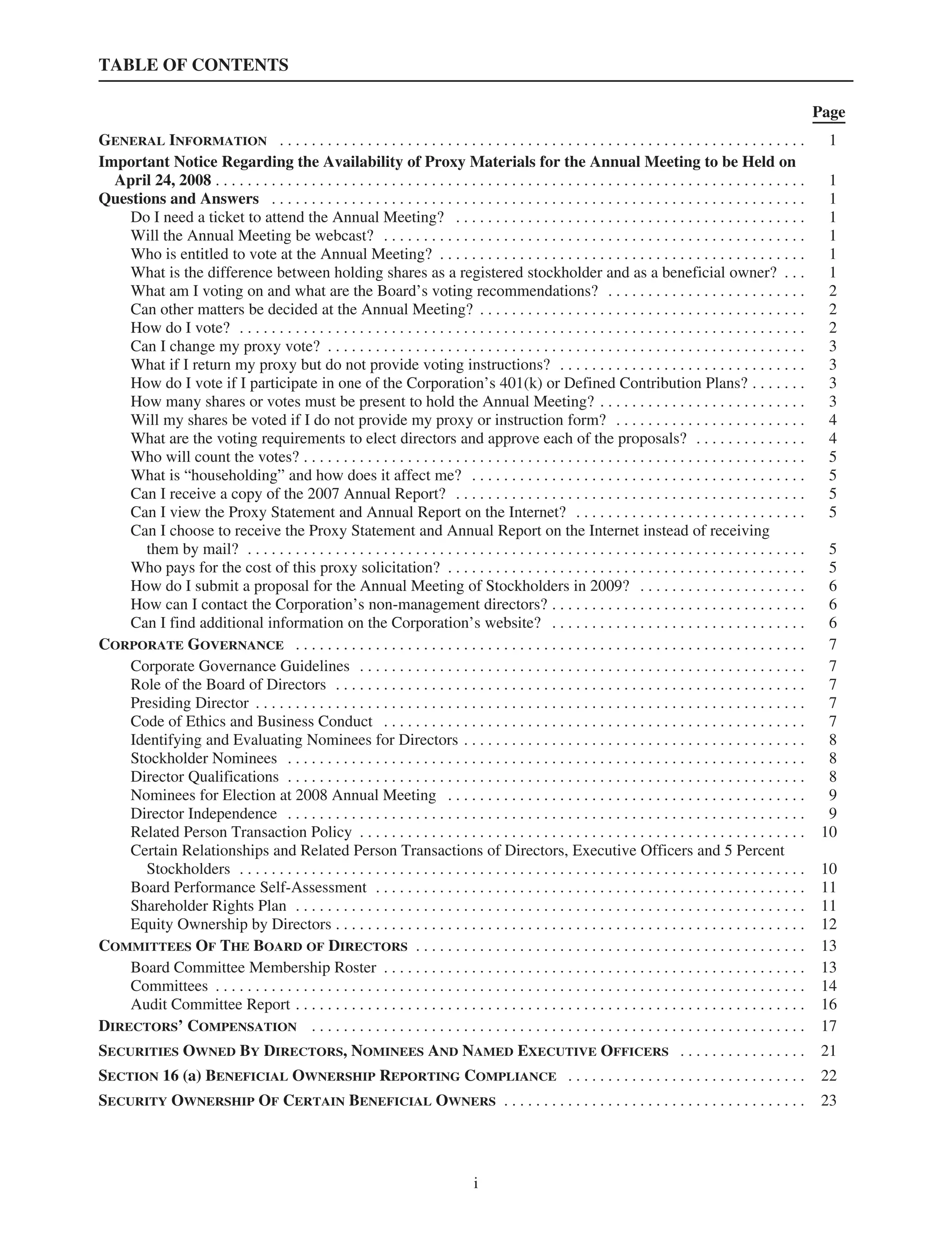
GENERAL INFORMATION . . . . . . . . . . . . . . . . . . . . . . . . . . . . . . . . . . . . . . . . . . . . . . . . . . . . . . . . . . . . . . . . . . 1
Important Notice Regarding the Availability of Proxy Materials for the Annual Meeting to be Held on
April 24, 2008 . . . . . . . . . . . . . . . . . . . . . . . . . . . . . . . . . . . . . . . . . . . . . . . . . . . . . . . . . . . . . . . . . . . . . . . . . . 1
Questions and Answers . . . . . . . . . . . . . . . . . . . . . . . . . . . . . . . . . . . . . . . . . . . . . . . . . . . . . . . . . . . . . . . . . . . 1
Do I need a ticket to attend the Annual Meeting? . . . . . . . . . . . . . . . . . . . . . . . . . . . . . . . . . . . . . . . . . . . . 1
Will the Annual Meeting be webcast? . . . . . . . . . . . . . . . . . . . . . . . . . . . . . . . . . . . . . . . . . . . . . . . . . . . . . 1
Who is entitled to vote at the Annual Meeting? . . . . . . . . . . . . . . . . . . . . . . . . . . . . . . . . . . . . . . . . . . . . . . 1
What is the difference between holding shares as a registered stockholder and as a beneficial owner? . . . 1
What am I voting on and what are the Board’s voting recommendations? . . . . . . . . . . . . . . . . . . . . . . . . . 2
Can other matters be decided at the Annual Meeting? . . . . . . . . . . . . . . . . . . . . . . . . . . . . . . . . . . . . . . . . . 2
How do I vote? . . . . . . . . . . . . . . . . . . . . . . . . . . . . . . . . . . . . . . . . . . . . . . . . . . . . . . . . . . . . . . . . . . . . . . . 2
Can I change my proxy vote? . . . . . . . . . . . . . . . . . . . . . . . . . . . . . . . . . . . . . . . . . . . . . . . . . . . . . . . . . . . . 3
What if I return my proxy but do not provide voting instructions? . . . . . . . . . . . . . . . . . . . . . . . . . . . . . . . 3
How do I vote if I participate in one of the Corporation’s 401(k) or Defined Contribution Plans? . . . . . . . 3
How many shares or votes must be present to hold the Annual Meeting? . . . . . . . . . . . . . . . . . . . . . . . . . . 3
Will my shares be voted if I do not provide my proxy or instruction form? . . . . . . . . . . . . . . . . . . . . . . . . 4
What are the voting requirements to elect directors and approve each of the proposals? . . . . . . . . . . . . . . 4
Who will count the votes? . . . . . . . . . . . . . . . . . . . . . . . . . . . . . . . . . . . . . . . . . . . . . . . . . . . . . . . . . . . . . . . 5
What is “householding” and how does it affect me? . . . . . . . . . . . . . . . . . . . . . . . . . . . . . . . . . . . . . . . . . . 5
Can I receive a copy of the 2007 Annual Report? . . . . . . . . . . . . . . . . . . . . . . . . . . . . . . . . . . . . . . . . . . . . 5
Can I view the Proxy Statement and Annual Report on the Internet? . . . . . . . . . . . . . . . . . . . . . . . . . . . . . 5
Can I choose to receive the Proxy Statement and Annual Report on the Internet instead of receiving
them by mail? . . . . . . . . . . . . . . . . . . . . . . . . . . . . . . . . . . . . . . . . . . . . . . . . . . . . . . . . . . . . . . . . . . . . . . 5
Who pays for the cost of this proxy solicitation? . . . . . . . . . . . . . . . . . . . . . . . . . . . . . . . . . . . . . . . . . . . . . 5
How do I submit a proposal for the Annual Meeting of Stockholders in 2009? . . . . . . . . . . . . . . . . . . . . . 6
How can I contact the Corporation’s non-management directors? . . . . . . . . . . . . . . . . . . . . . . . . . . . . . . . . 6
Can I find additional information on the Corporation’s website? . . . . . . . . . . . . . . . . . . . . . . . . . . . . . . . . 6
CORPORATE GOVERNANCE . . . . . . . . . . . . . . . . . . . . . . . . . . . . . . . . . . . . . . . . . . . . . . . . . . . . . . . . . . . . . . . . 7
Corporate Governance Guidelines . . . . . . . . . . . . . . . . . . . . . . . . . . . . . . . . . . . . . . . . . . . . . . . . . . . . . . . . 7
Role of the Board of Directors . . . . . . . . . . . . . . . . . . . . . . . . . . . . . . . . . . . . . . . . . . . . . . . . . . . . . . . . . . . 7
Presiding Director . . . . . . . . . . . . . . . . . . . . . . . . . . . . . . . . . . . . . . . . . . . . . . . . . . . . . . . . . . . . . . . . . . . . . 7
Code of Ethics and Business Conduct . . . . . . . . . . . . . . . . . . . . . . . . . . . . . . . . . . . . . . . . . . . . . . . . . . . . . 7
Identifying and Evaluating Nominees for Directors . . . . . . . . . . . . . . . . . . . . . . . . . . . . . . . . . . . . . . . . . . . 8
Stockholder Nominees . . . . . . . . . . . . . . . . . . . . . . . . . . . . . . . . . . . . . . . . . . . . . . . . . . . . . . . . . . . . . . . . . 8
Director Qualifications . . . . . . . . . . . . . . . . . . . . . . . . . . . . . . . . . . . . . . . . . . . . . . . . . . . . . . . . . . . . . . . . . 8
Nominees for Election at 2008 Annual Meeting . . . . . . . . . . . . . . . . . . . . . . . . . . . . . . . . . . . . . . . . . . . . . 9
Director Independence . . . . . . . . . . . . . . . . . . . . . . . . . . . . . . . . . . . . . . . . . . . . . . . . . . . . . . . . . . . . . . . . . 9
Related Person Transaction Policy . . . . . . . . . . . . . . . . . . . . . . . . . . . . . . . . . . . . . . . . . . . . . . . . . . . . . . . . 10
Certain Relationships and Related Person Transactions of Directors, Executive Officers and 5 Percent
Stockholders . . . . . . . . . . . . . . . . . . . . . . . . . . . . . . . . . . . . . . . . . . . . . . . . . . . . . . . . . . . . . . . . . . . . . . . 10
Board Performance Self-Assessment . . . . . . . . . . . . . . . . . . . . . . . . . . . . . . . . . . . . . . . . . . . . . . . . . . . . . . 11
Shareholder Rights Plan . . . . . . . . . . . . . . . . . . . . . . . . . . . . . . . . . . . . . . . . . . . . . . . . . . . . . . . . . . . . . . . . 11
Equity Ownership by Directors . . . . . . . . . . . . . . . . . . . . . . . . . . . . . . . . . . . . . . . . . . . . . . . . . . . . . . . . . . . 12
COMMITTEES OF THE BOARD OF DIRECTORS . . . . . . . . . . . . . . . . . . . . . . . . . . . . . . . . . . . . . . . . . . . . . . . . . 13
Board Committee Membership Roster . . . . . . . . . . . . . . . . . . . . . . . . . . . . . . . . . . . . . . . . . . . . . . . . . . . . . 13
Committees . . . . . . . . . . . . . . . . . . . . . . . . . . . . . . . . . . . . . . . . . . . . . . . . . . . . . . . . . . . . . . . . . . . . . . . . . . 14
Audit Committee Report . . . . . . . . . . . . . . . . . . . . . . . . . . . . . . . . . . . . . . . . . . . . . . . . . . . . . . . . . . . . . . . . 16
DIRECTORS’ COMPENSATION . . . . . . . . . . . . . . . . . . . . . . . . . . . . . . . . . . . . . . . . . . . . . . . . . . . . . . . . . . . . . . 17
SECURITIES OWNED BY DIRECTORS, NOMINEES AND NAMED EXECUTIVE OFFICERS . . . . . . . . . . . . . . . . 21
SECTION 16 (a) BENEFICIAL OWNERSHIP REPORTING COMPLIANCE . . . . . . . . . . . . . . . . . . . . . . . . . . . . . . 22
SECURITY OWNERSHIP OF CERTAIN BENEFICIAL OWNERS . . . . . . . . . . . . . . . . . . . . . . . . . . . . . . . . . . . . . . 23
i
TABLE OF CONTENTS
Page
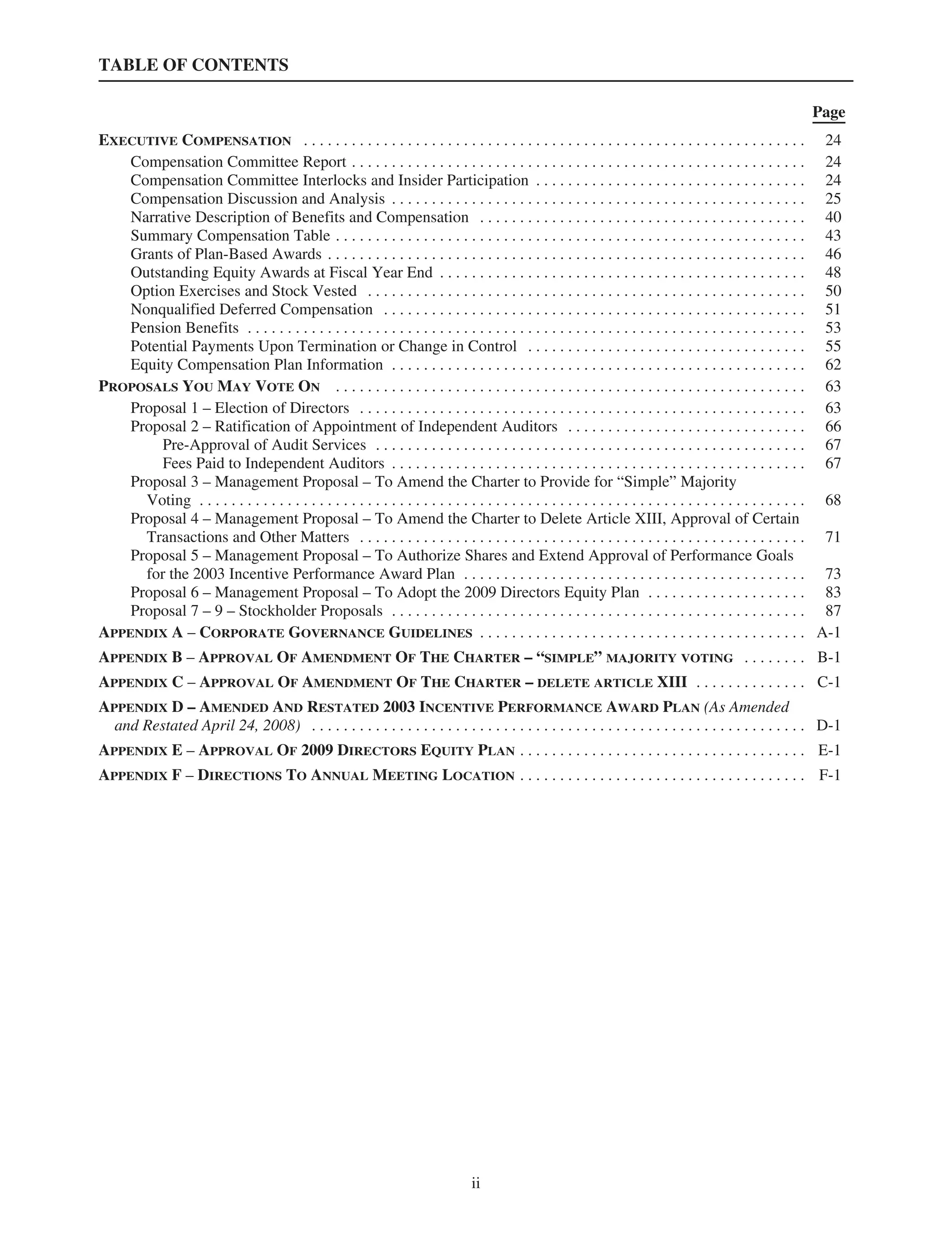
EXECUTIVE COMPENSATION . . . . . . . . . . . . . . . . . . . . . . . . . . . . . . . . . . . . . . . . . . . . . . . . . . . . . . . . . . . . . . . 24
Compensation Committee Report . . . . . . . . . . . . . . . . . . . . . . . . . . . . . . . . . . . . . . . . . . . . . . . . . . . . . . . . . 24
Compensation Committee Interlocks and Insider Participation . . . . . . . . . . . . . . . . . . . . . . . . . . . . . . . . . . 24
Compensation Discussion and Analysis . . . . . . . . . . . . . . . . . . . . . . . . . . . . . . . . . . . . . . . . . . . . . . . . . . . . 25
Narrative Description of Benefits and Compensation . . . . . . . . . . . . . . . . . . . . . . . . . . . . . . . . . . . . . . . . . 40
Summary Compensation Table . . . . . . . . . . . . . . . . . . . . . . . . . . . . . . . . . . . . . . . . . . . . . . . . . . . . . . . . . . . 43
Grants of Plan-Based Awards . . . . . . . . . . . . . . . . . . . . . . . . . . . . . . . . . . . . . . . . . . . . . . . . . . . . . . . . . . . . 46
Outstanding Equity Awards at Fiscal Year End . . . . . . . . . . . . . . . . . . . . . . . . . . . . . . . . . . . . . . . . . . . . . . 48
Option Exercises and Stock Vested . . . . . . . . . . . . . . . . . . . . . . . . . . . . . . . . . . . . . . . . . . . . . . . . . . . . . . . 50
Nonqualified Deferred Compensation . . . . . . . . . . . . . . . . . . . . . . . . . . . . . . . . . . . . . . . . . . . . . . . . . . . . . 51
Pension Benefits . . . . . . . . . . . . . . . . . . . . . . . . . . . . . . . . . . . . . . . . . . . . . . . . . . . . . . . . . . . . . . . . . . . . . . 53
Potential Payments Upon Termination or Change in Control . . . . . . . . . . . . . . . . . . . . . . . . . . . . . . . . . . . 55
Equity Compensation Plan Information . . . . . . . . . . . . . . . . . . . . . . . . . . . . . . . . . . . . . . . . . . . . . . . . . . . . 62
PROPOSALS YOU MAY VOTE ON . . . . . . . . . . . . . . . . . . . . . . . . . . . . . . . . . . . . . . . . . . . . . . . . . . . . . . . . . . . 63
Proposal 1 – Election of Directors . . . . . . . . . . . . . . . . . . . . . . . . . . . . . . . . . . . . . . . . . . . . . . . . . . . . . . . . 63
Proposal 2 – Ratification of Appointment of Independent Auditors . . . . . . . . . . . . . . . . . . . . . . . . . . . . . . 66
Pre-Approval of Audit Services . . . . . . . . . . . . . . . . . . . . . . . . . . . . . . . . . . . . . . . . . . . . . . . . . . . . . . 67
Fees Paid to Independent Auditors . . . . . . . . . . . . . . . . . . . . . . . . . . . . . . . . . . . . . . . . . . . . . . . . . . . . 67
Proposal 3 – Management Proposal – To Amend the Charter to Provide for “Simple” Majority
Voting . . . . . . . . . . . . . . . . . . . . . . . . . . . . . . . . . . . . . . . . . . . . . . . . . . . . . . . . . . . . . . . . . . . . . . . . . . . . 68
Proposal 4 – Management Proposal – To Amend the Charter to Delete Article XIII, Approval of Certain
Transactions and Other Matters . . . . . . . . . . . . . . . . . . . . . . . . . . . . . . . . . . . . . . . . . . . . . . . . . . . . . . . . 71
Proposal 5 – Management Proposal – To Authorize Shares and Extend Approval of Performance Goals
for the 2003 Incentive Performance Award Plan . . . . . . . . . . . . . . . . . . . . . . . . . . . . . . . . . . . . . . . . . . . 73
Proposal 6 – Management Proposal – To Adopt the 2009 Directors Equity Plan . . . . . . . . . . . . . . . . . . . . 83
Proposal 7 – 9 – Stockholder Proposals . . . . . . . . . . . . . . . . . . . . . . . . . . . . . . . . . . . . . . . . . . . . . . . . . . . . 87
APPENDIX A – CORPORATE GOVERNANCE GUIDELINES . . . . . . . . . . . . . . . . . . . . . . . . . . . . . . . . . . . . . . . . . A-1
APPENDIX B – APPROVAL OF AMENDMENT OF THE CHARTER – “SIMPLE” MAJORITY VOTING . . . . . . . . B-1
APPENDIX C – APPROVAL OF AMENDMENT OF THE CHARTER – DELETE ARTICLE XIII . . . . . . . . . . . . . . C-1
APPENDIX D – AMENDED AND RESTATED 2003 INCENTIVE PERFORMANCE AWARD PLAN (As Amended
and Restated April 24, 2008) . . . . . . . . . . . . . . . . . . . . . . . . . . . . . . . . . . . . . . . . . . . . . . . . . . . . . . . . . . . . . . D-1
APPENDIX E – APPROVAL OF 2009 DIRECTORS EQUITY PLAN . . . . . . . . . . . . . . . . . . . . . . . . . . . . . . . . . . . . E-1
APPENDIX F – DIRECTIONS TO ANNUAL MEETING LOCATION . . . . . . . . . . . . . . . . . . . . . . . . . . . . . . . . . . . . F-1
ii
GENERAL INFORMATION
We are furnishing these proxy materials in connection
with the solicitation of proxies, on behalf of your
Board of Directors (the “Board”), to be voted at our
2008 Annual Meeting of Stockholders (the “Annual
Meeting”) and at any adjournment or postponement.
Lockheed Martin Corporation (the “Corporation”) is a
Maryland corporation.
You are invited to attend our Annual Meeting, which
will be held on April 24, 2008, at 10:30 a.m., Central
Daylight Time, at the Sheraton Arlington Hotel, 1500
Convention Center Drive, Arlington, Texas 76011.
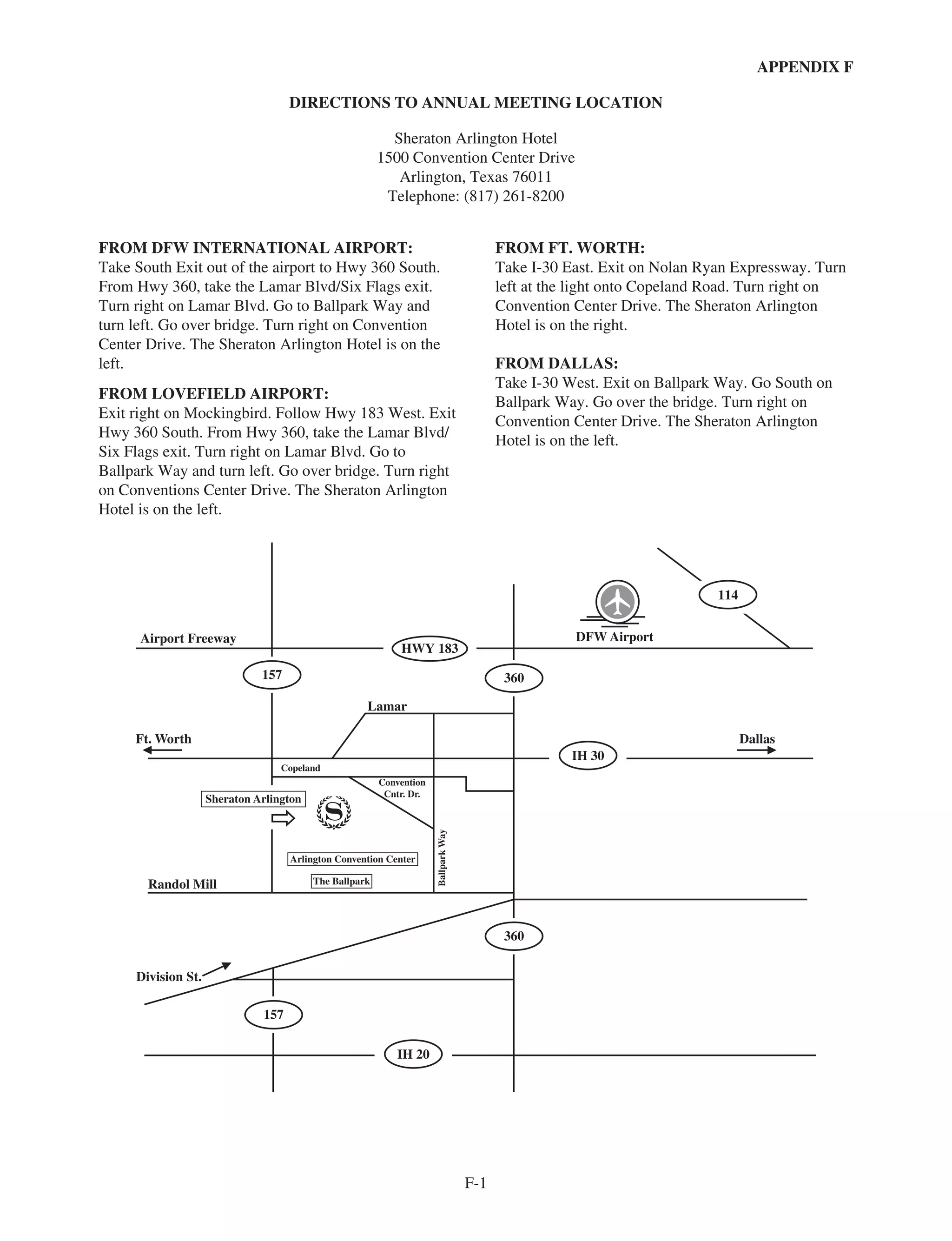
Directions to the meeting appear at the back of this
Proxy Statement at Appendix F.
We began mailing the notice, Proxy Statement and
proxy card for the Annual Meeting, and our Annual
Report, to stockholders on or about March 14, 2008.
Important Notice Regarding the Availability of
Proxy Materials for the Annual Meeting to be Held
on April 24, 2008.
The Proxy Statement and Annual Report are
available at
http://www.lockheedmartin.com/investor.
Questions and Answers
Do I need a ticket to attend the Annual Meeting?
You will need an admission ticket (or proof of
ownership) and a form of valid photo identification to
attend the Annual Meeting. An admission ticket is
attached to your proxy card. Please detach the ticket
and bring it with you to the meeting. If you vote
electronically by the Internet, you will be guided to an
online site where you will be able to print an admission
ticket. If you hold shares through an account with a
bank or broker, you will need to contact your bank or
broker and request a legally valid proxy from the
owner of record to vote your shares. This will serve as
your admission ticket.
A recent brokerage statement or letter from your
broker showing that you owned Lockheed Martin stock
in your account as of March 3, 2008 (the “Record
Date”) also will qualify you for admission. In that case,
you will not be able to vote your shares, since they
only may be voted by the record holder or a valid
proxy holder.
If you do not have an admission ticket (or proof of
ownership) and valid photo identification, you will not
be admitted to the Annual Meeting. As a safety
measure, all attendees must leave any bags, briefcases
or packages at the registration desk prior to entering
the meeting room.
Will the Annual Meeting be webcast?
Yes. We will webcast the Annual Meeting live on
April 24, 2008. You are invited to visit
http://www.lockheedmartin.com/investor at
10:30 a.m., Central Daylight Time, on April 24, 2008
to access the live webcast. Registration for the webcast
is required. Stockholders who wish to access the
webcast should pre-register on our website. Listening
to our Annual Meeting webcast will not represent
attendance at the meeting, and you will not be able to
cast your vote as part of the live webcast.
Who is entitled to vote at the Annual Meeting?
Holders of our common stock, $1 par value per share,
at the close of business on March 3, 2008 are entitled
to vote their shares at the Annual Meeting. As of the
Record Date, there were 404,972,360 shares
outstanding. Each share outstanding on the Record
Date is entitled to one vote on each proposal presented
at the Annual Meeting. This includes shares held
through Direct Invest, our dividend reinvestment and
stock purchase plan or through our employee benefit
plans. Your proxy card shows the number of shares
held in your account(s).
What is the difference between holding shares as a
registered stockholder and as a beneficial owner?
If your shares are registered directly in your name with
our transfer agent, Computershare Trust Company,
N.A., you are considered the “registered stockholder”
of those shares. We mail the proxy materials and our
2007 Annual Report to you directly.
If your shares are held in a stock brokerage account or
by a bank or other nominee, you are considered the
“beneficial owner” of the shares that are registered in
street name. In this case, the proxy materials and our
2007 Annual Report were forwarded to you by your
broker, bank or other nominee who is considered the
registered stockholder. As the beneficial owner, you
have the right to direct your broker, bank or other
nominee how to vote your shares by following the
voting instructions included in the mailing.
1
GENERAL INFORMATION
Employees with shares allocated in an employee
benefit plan account will not receive a paper mailing
and should review the information on procedures for
employees on page 3.
What am I voting on and what are the Board’s
voting recommendations?
Our stockholders will be voting on the following items
which are described in more detail beginning on
page 63:
Item
No. Description
Board’s Voting
Recommendation
1 Election of directors FOR all nominees
2 Ratification of appointment
of Ernst & Young LLP,
independent registered
public accounting firm
FOR this proposal
3-6 Management proposals FOR these proposals
7-9 Stockholder proposals AGAINST these
proposals
Can other matters be decided at the Annual
Meeting?
At the time the Proxy Statement went to press, we were
not aware of any other matters to be presented at the
Annual Meeting.
If other matters are properly presented for
consideration at the Annual Meeting, the proxy holders
appointed by your Board (who are named in your
proxy card if you are a registered stockholder) will
have the discretion to vote on those matters for you in
accordance with their best judgment.
How do I vote?
If your shares are registered in your name, you may
vote using any of the methods described below. If your
shares are held in the name of a broker, bank or other
nominee, your nominee will provide you with voting
instructions.
Internet or By Telephone
Our Internet and telephone voting procedures for
registered stockholders are designed to authenticate
your identity, allow you to give your voting
instructions and confirm that those instructions are
properly recorded.
You may access the Internet voting site at
http://www.investorvote.com. Please have your proxy
card in hand when you go online. You will receive
instructional screen prompts to guide you through the
voting process. You also will have the ability to
confirm your voting selections before your vote is
recorded.
You can vote by calling toll free 1-800-652-8683
within the U.S., Canada and Puerto Rico or
1-781-575-2300 from outside the U.S. Please have
your proxy card in hand when you call. You will
receive voice prompts to guide you through the
process, and an opportunity to confirm your voting
selections before your vote is recorded.
Internet and telephone voting facilities for registered
stockholders will be available 24 hours a day up until
11:59 p.m., Eastern Daylight Time, on April 23, 2008.
If you vote on the Internet or by telephone, you do not
have to return your proxy card.
The availability of Internet and telephone voting for
beneficial owners will depend on the voting processes
of your broker, bank or other nominee. We recommend
that you follow the voting instructions in the materials
that you receive from your nominee.
By Mail
Simply mark, date and sign the proxy card and return it
in the postage-paid envelope provided.
If you want to vote in accordance with the Board’s
recommendations, simply sign, date and return the
proxy card. The named proxy holders will vote
unmarked proxy cards per the Board’s
recommendations.
If you are a registered stockholder, and the postage-
paid envelope is missing, please mail your completed
proxy card to Lockheed Martin Corporation, c/o
Computershare Investor Services, P.O. Box 43116,
Providence, RI 02940-5107.
2
GENERAL INFORMATION
In person at the Annual Meeting
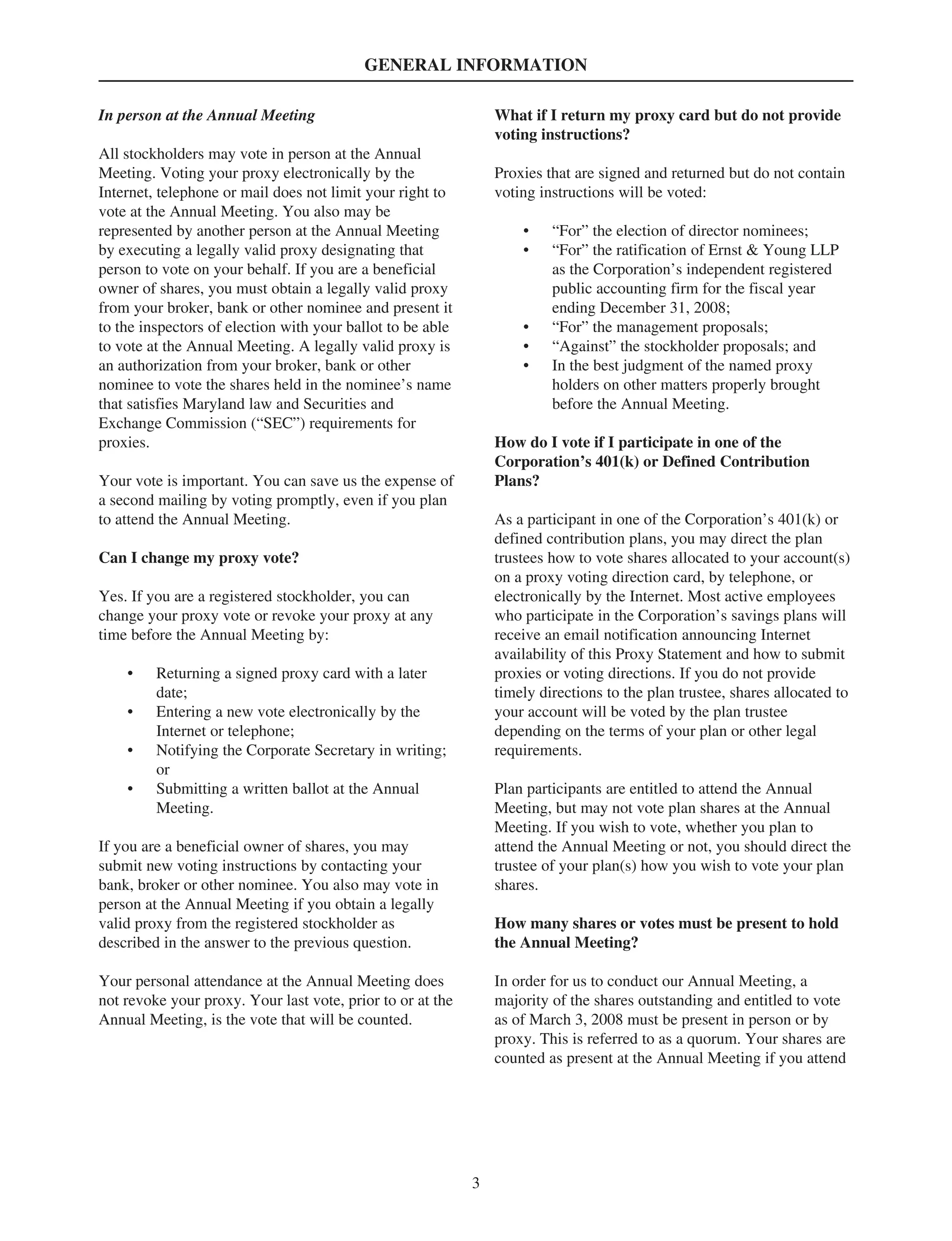
All stockholders may vote in person at the Annual
Meeting. Voting your proxy electronically by the
Internet, telephone or mail does not limit your right to
vote at the Annual Meeting. You also may be
represented by another person at the Annual Meeting
by executing a legally valid proxy designating that
person to vote on your behalf. If you are a beneficial
owner of shares, you must obtain a legally valid proxy
from your broker, bank or other nominee and present it
to the inspectors of election with your ballot to be able
to vote at the Annual Meeting. A legally valid proxy is
an authorization from your broker, bank or other
nominee to vote the shares held in the nominee’s name
that satisfies Maryland law and Securities and
Exchange Commission (“SEC”) requirements for
proxies.
Your vote is important. You can save us the expense of
a second mailing by voting promptly, even if you plan
to attend the Annual Meeting.
Can I change my proxy vote?
Yes. If you are a registered stockholder, you can
change your proxy vote or revoke your proxy at any
time before the Annual Meeting by:
• Returning a signed proxy card with a later
date;
• Entering a new vote electronically by the
Internet or telephone;
• Notifying the Corporate Secretary in writing;
or
• Submitting a written ballot at the Annual
Meeting.
If you are a beneficial owner of shares, you may
submit new voting instructions by contacting your
bank, broker or other nominee. You also may vote in
person at the Annual Meeting if you obtain a legally
valid proxy from the registered stockholder as
described in the answer to the previous question.
Your personal attendance at the Annual Meeting does
not revoke your proxy. Your last vote, prior to or at the
Annual Meeting, is the vote that will be counted.
What if I return my proxy card but do not provide
voting instructions?
Proxies that are signed and returned but do not contain
voting instructions will be voted:
• “For” the election of director nominees;
• “For” the ratification of Ernst & Young LLP
as the Corporation’s independent registered
public accounting firm for the fiscal year
ending December 31, 2008;
• “For” the management proposals;
• “Against” the stockholder proposals; and
• In the best judgment of the named proxy
holders on other matters properly brought
before the Annual Meeting.
How do I vote if I participate in one of the
Corporation’s 401(k) or Defined Contribution
Plans?
As a participant in one of the Corporation’s 401(k) or
defined contribution plans, you may direct the plan
trustees how to vote shares allocated to your account(s)
on a proxy voting direction card, by telephone, or
electronically by the Internet. Most active employees
who participate in the Corporation’s savings plans will
receive an email notification announcing Internet
availability of this Proxy Statement and how to submit
proxies or voting directions. If you do not provide
timely directions to the plan trustee, shares allocated to
your account will be voted by the plan trustee
depending on the terms of your plan or other legal
requirements.
Plan participants are entitled to attend the Annual
Meeting, but may not vote plan shares at the Annual
Meeting. If you wish to vote, whether you plan to
attend the Annual Meeting or not, you should direct the
trustee of your plan(s) how you wish to vote your plan
shares.
How many shares or votes must be present to hold
the Annual Meeting?
In order for us to conduct our Annual Meeting, a
majority of the shares outstanding and entitled to vote
as of March 3, 2008 must be present in person or by
proxy. This is referred to as a quorum. Your shares are
counted as present at the Annual Meeting if you attend
3
GENERAL INFORMATION
the Annual Meeting and vote in person or if you
properly return a proxy by Internet, telephone or mail.
We will count abstentions and broker non-votes for
purposes of determining whether a quorum exists at the
meeting.
Will my shares be voted if I do not provide my
proxy or instruction form?
If you are a registered stockholder, your shares will not
be voted unless you provide a proxy or vote in person
at the Annual Meeting. If you are a participant in one
of the Corporation’s 401(k) or defined contribution
plans and you do not provide timely directions to the
plan trustee, shares allocated to your account will be
voted by the plan trustee depending on the terms of
your plan or other legal requirements. If you hold
shares through an account with a bank, broker or other
nominee and you do not provide voting instructions,
your shares still may be voted on certain matters.
Brokerage firms have authority under New York Stock
Exchange (“NYSE”) rules to vote shares on routine
matters for which their customers do not provide
voting instructions. The election of directors, the
ratification of Ernst & Young LLP as our independent
registered public accounting firm for 2008 and
Management Proposal 3 are considered routine
matters. Management Proposals 4, 5 and 6 and the
stockholder proposals are not considered routine. If a
proposal is not routine and the brokerage firm does not
receive voting instructions from the beneficial owner,
the brokerage firm cannot vote the shares on that
proposal. Shares for which a broker is not authorized to
vote are known as “broker non-votes.” Because we
require the affirmative vote of a majority of the
outstanding shares to approve a proposal, broker
non-votes have the effect of a negative vote on each of
the management and stockholder proposals.
What are the voting requirements to elect directors
and approve each of the proposals?
The affirmative vote of a majority of the votes entitled
to be cast at a meeting, duly called and at which a
quorum is present, is required to take or authorize
action upon any matter that properly may come before
the meeting, unless applicable law or our Charter
provides otherwise for a particular matter. A higher
voting standard is required to approve one of
management’s proposals. The voting standards are as
follows:
Proposal Standard
1 Election of Directors Majority of votes
entitled to be cast
2 Approval of Ernst &
Young LLP
Majority of votes
entitled to be cast
3 Management proposal
to amend the Charter
to provide for
“simple” majority
voting
Majority of votes
entitled to be cast
4 Management proposal
to amend the Charter
to delete Article XIII,
Approval of Certain
Transactions and
Other Matters
80% of the votes entitled
to be cast
5 Management proposal
to authorize additional
shares and extend
approval of
performance goals for
the 2003 Incentive
Performance Award
Plan
Majority of votes
entitled to be cast
6 Management proposal
to adopt the 2009
Directors Equity Plan
Majority of votes
entitled to be cast
7-9 Stockholder proposals Majority of votes
entitled to be cast
For the election of directors, a vote withheld from a
nominee for director has the effect of a vote against
that nominee. For the vote for each director, the
ratification of the selection of Ernst & Young LLP, the
management proposals and each of the stockholder
proposals, an abstention has the effect of a vote against
the proposal.
4
GENERAL INFORMATION
Who will count the votes?
Representatives of our transfer agent, Computershare
Trust Company, N.A., will tabulate the votes and act as
inspectors of election for the 2008 Annual Meeting.
What is “householding” and how does it affect me?
We have adopted a procedure approved by the SEC
called “householding.” Under this procedure, we send
only one Annual Report and Proxy Statement to
eligible stockholders who share a single address, unless
we have received instructions to the contrary from any
stockholder at that address. This practice is designed to
reduce our printing and postage costs. Stockholders
who participate in householding will continue to
receive separate proxy cards. We do not use
householding for any other stockholder mailings, such
as dividend checks, Forms 1099 or account statements.
If you are eligible for householding, but receive
multiple copies of the Annual Report and Proxy
Statement and prefer to receive only a single copy of
each of these documents for your household, please
contact our transfer agent, Computershare Trust
Company, N.A., Shareholder Relations, P.O. Box
43023, Providence, RI 02940-3023 or call
1-877-498-8861. If you are a registered stockholder
residing at an address with other registered
stockholders and wish to receive a separate Annual
Report or Proxy Statement in the future, please contact
Computershare as indicated above. If you own shares
through a bank, broker or other nominee, you should
contact the nominee concerning householding
procedures.
Can I receive a copy of the 2007 Annual Report?
Yes. We will provide a copy of our 2007 Annual
Report without charge, upon written request, to any
registered or beneficial owner of common stock
entitled to vote at the Annual Meeting. Requests should
be made in writing addressed to Investor Relations,
Lockheed Martin Corporation, 6801 Rockledge Drive,
Bethesda, MD 20817, by calling Lockheed Martin
Shareholder Direct at 1-800-568-9758 or by accessing
the Corporation’s website at
http://www.lockheedmartin.com/investor. The SEC
also maintains a website at http://www.sec.gov that
contains reports, proxy statements and other
information regarding Lockheed Martin.
Can I view the Proxy Statement and Annual Report
on the Internet?
Yes. The Proxy Statement and Annual Report are
available on the Internet at
http://www.lockheedmartin.com/investor. All
stockholders will receive paper copies of the Proxy
Statement, proxy card and Annual Report by mail
unless the stockholder has consented to electronic
delivery or is an employee with shares allocated in an
employee benefit plan as noted immediately below.
Can I choose to receive the Proxy Statement and
Annual Report on the Internet instead of receiving
them by mail?
Yes. If you are a registered or beneficial stockholder,
you can elect to receive future Annual Reports and
Proxy Statements on the Internet only and not receive
copies in the mail by visiting
http://investor.shareholder.com/lmt/shareholder.cfm
and completing the online consent form. Your request
for electronic transmission will remain in effect for all
future Annual Reports and Proxy Statements, unless
withdrawn. Withdrawal procedures also are located at
this website.
Most active employees who participate in the
Corporation’s savings plans will receive an email
notification announcing Internet availability of the
2007 and future editions of the Annual Report and
Proxy Statement. A paper copy will not be provided
unless requested by the employee.
Who pays for the cost of this proxy solicitation?
The Corporation pays for the cost of soliciting proxies
on behalf of the Board for the Annual Meeting. We
may solicit proxies by mail, telephone, Internet or in
person. We may make arrangements with brokerage
houses and other custodians, nominees, and fiduciaries
to send proxy material to beneficial owners on our
behalf. We reimburse them for their reasonable
expenses. We have retained Morrow & Co., LLC to aid
in the solicitation of proxies and to verify related
records at a fee of $45,000 plus expenses. To the extent
necessary to ensure sufficient representation at the
Annual Meeting, we may request the return of proxies
by mail, express delivery, courier, telephone, Internet
or other means. Stockholders are requested to return
their proxies without delay.
5
GENERAL INFORMATION
How do I submit a proposal for the Annual Meeting
of Stockholders in 2009?
Any stockholder who wishes to submit a proposal for
consideration at the 2009 Annual Meeting and for
inclusion in the 2009 Proxy Statement should send
their proposal to:
Lockheed Martin Corporation
Attention: Vice President and Corporate Secretary
6801 Rockledge Drive
Bethesda, MD 20817.
Proposals must be received no later than November 14,
2008 and satisfy the requirements under applicable
SEC Rules (including SEC Rule 14a-8) to be included
in the Proxy Statement and on the proxy card that will
be used for solicitation of proxies by the Board for the
2009 Annual Meeting.
Our Bylaws also require advance notice of any proposal
by a stockholder to be presented at the Annual Meeting
that is not included in our Proxy Statement and on the
proxy card, including any proposal for the nomination of
a director for election. To be properly brought before the
2009 Annual Meeting, written nominations for directors
or other business to be introduced by a stockholder must
be received between the dates of November 14, 2008 and
December 14, 2008, inclusive. A notice of a stockholder
proposal must contain information required by our
Bylaws about the matter to be brought before the meeting
and about the stockholder proponent. Waiver of these
requirements by us in a particular instance does not
constitute a waiver applicable to any other stockholder
proposal, nor does it obligate us to waive the requirements
for future submissions. A list of the information which is
required to be included in a stockholder proposal may be
found in Section 1.11 of our Bylaws at
http://www.lockheedmartin.com/investor.
How can I contact the Corporation’s
non-management directors?
Stockholders may communicate confidentially with the
presiding director or with the non-management directors
as a group. If you wish to raise a question or concern to
the presiding director or the non-management directors
as a group, you may do so by contacting:
Mr. James R. Ukropina
Chairman, Nominating and Corporate Governance
Committee
or
Directors
c/o Nominating and Corporate Governance Committee
Lockheed Martin Corporation
6801 Rockledge Drive, MP 220
Bethesda, MD 20817.
Our Vice President and Corporate Secretary reviews all
correspondence sent to the Board. The Board has
authorized our Vice President and Corporate Secretary
to respond to correspondence regarding routine
stockholder matters and services (e.g., stock transfer,
dividends, etc.). Correspondence from stockholders
relating to accounting, internal controls or auditing
matters are immediately brought to the attention of the
Audit Committee. All other correspondence is
forwarded to the Chairman of the Nominating and
Corporate Governance Committee who determines
whether distribution to the full Board for review is
appropriate. Any director may at any time review a log
of all correspondence addressed to the Board and
request copies of such correspondence.
Can I find additional information on the
Corporation’s website?
Yes. Although the information contained on our
website is not part of this Proxy Statement, you will
find information about the Corporation and our
corporate governance practices at
http://www.lockheedmartin.com/investor. Our website
contains information about our Board, Board
committees, our Charter and Bylaws, Code of Ethics
and Business Conduct, Corporate Governance
Guidelines, and information about insider transactions.
Stockholders may obtain, without charge, hard copies
of the above documents by writing to:
Investor Relations
Lockheed Martin Corporation
6801 Rockledge Drive
Bethesda, MD 20817.
6
CORPORATE GOVERNANCE
Corporate Governance Guidelines
Lockheed Martin is committed to maintaining and
practicing the highest standards of ethics and corporate
governance. The Board has adopted Corporate
Governance Guidelines that describe the framework
within which the Board and its Committees oversee the
governance of the Corporation. The current guidelines
are included as Appendix A to the Proxy Statement and
posted at http://www.lockheedmartin.com/investor.
The guidelines contain the Board’s views on a number
of governance topics. They reflect our commitment to,
and appreciation of, the importance of good
governance in protecting and enhancing stockholder
value. Our governance guidelines are not static. The
Nominating and Corporate Governance Committee
(“Governance Committee”) of the Board regularly
assesses our governance practices in light of new or
emerging trends and practices.
Our guidelines cover a wide range of subjects,
including: the role of the Board and director
responsibilities; the designation of a presiding director;
director independence standards; director nomination
procedures and qualifications; a comprehensive Code
of Ethics and Business Conduct; procedures for annual
evaluations of the Board, its committees and directors;
director stock ownership; a clawback policy for
executive incentive compensation; and a policy for the
review, approval and ratification of related person
transactions.
The Board has approved an amendment to the
Corporate Governance Guidelines that will become
effective if stockholders approve Proposal 3 to amend
the Charter to provide for “simple” majority voting.
The amendment to the Corporate Governance
Guidelines is set forth as part of Appendix B. The
amendment sets forth the Board’s expectation that any
nominee who fails to receive a majority of the votes
cast for election would submit his or her resignation to
the Board and provides procedures for the Board to use
in considering whether to accept or reject the
resignation. If stockholders do not approve Proposal 3
to amend the Charter, the described changes to the
Corporate Governance Guidelines will not be
implemented.
Described below are some of the significant corporate
governance practices that have been instituted by the
Board.
Role of the Board of Directors
The Board plays an active role in overseeing
management and representing the interests of
stockholders. Directors are expected to attend all Board
meetings, the meetings of committees on which they
serve and the Annual Meeting of Stockholders.
Directors also are frequently consulted for advice and
counsel between formal meetings.
In 2007, the Board met a total of 10 times. All directors
attended at least 75% of the total board and committee
meetings to which they were assigned in 2007. All
directors attended the 2007 Annual Meeting of
Stockholders.
Presiding Director
Our Corporate Governance Guidelines provide for the
Chairman of the Governance Committee to preside
over all executive sessions of the independent
directors. In addition to presiding over executive
sessions of the non-management directors, the
Presiding Director also serves as a contact person to
facilitate communications among stockholders, the
non-management directors, the Corporation’s
management and employees, and other constituents.
Mr. James R. Ukropina currently serves as our
Presiding Director.
Code of Ethics and Business Conduct
At Lockheed Martin, ethics is part of our history and
culture. We are committed to ethical behavior in all
that we do. This is reflected in our vision statement
“Powered by Innovation, Guided by Integrity, We Help
Our Customers Achieve Their Most Challenging
Goals,” and our value statements: “Do What’s Right;”
“Respect Others;” and “Perform with Excellence.”
We have had an ethics code in place since the
Corporation was formed in 1995, well before codes
became fashionable or required for stock exchange
listing. We and our heritage companies were among
the first in the aerospace and defense industry to adopt
an ethics code.
Our Code of Ethics and Business Conduct, “Setting the
Standard,” applies to all directors, officers, and
employees. It sets forth our policies and expectations
on a number of topics, including our commitment to
good citizenship and integrity, promoting a positive
7
CORPORATE GOVERNANCE
and safe work environment, transparency in our public
disclosures, avoiding conflicts of interest,
confidentiality, preservation and use of company
assets, compliance with laws (including insider trading
laws), and business ethics.
We also maintain a toll-free ethics help line for
employees as a means of raising concerns or seeking
advice. The help line is available to all employees
worldwide, 7 days a week, 24 hours a day. Employees
using the help line may choose to remain anonymous.
All help line inquiries are forwarded to the
Corporation’s Office of Ethics and Business Conduct.
Our Ethics Office is headed by our Vice President -
Ethics and Business Conduct who reports directly to
the Chief Executive Officer (“CEO”) and the Ethics
and Corporate Responsibility Committee of the Board.
Any matters reported to our Ethics Office, whether
through the help line or otherwise, involving
accounting, internal control or audit matters, or any
fraud involving management or persons who have a
significant role in the Corporation’s internal controls,
also are reported directly to the Audit Committee.
Each of our directors and employees participate in
annual ethics training, which consists of a live training
session. We also devote significant resources to our
business conduct compliance training program. In
2007, our employees completed over 500,000 on-line
business conduct compliance training modules.
Our Code of Ethics and Business Conduct is posted on
our website at
http://www.lockheedmartin.com/investor. Printed
copies of our Code may be obtained, without charge,
by contacting Investor Relations, Lockheed Martin
Corporation, 6801 Rockledge Drive, Bethesda,
MD 20817.
In 2007, there were no waivers from any provisions of
our Code or amendments applicable to any director or
executive officer. It is our intent to disclose any such
waivers or amendments promptly to stockholders by
posting on our website.
Identifying and Evaluating Nominees for Directors
Each year, the Governance Committee recommends to
the Board the slate of directors to serve as
management’s nominees for election by the
stockholders at the Annual Meeting. The process for
identifying and evaluating candidates to be nominated
to the Board starts with an evaluation of a candidate by
the Chairman of the Governance Committee followed
by the entire Governance Committee and the CEO.
Director candidates may also be identified by
stockholders. The Corporation also has utilized outside
search firms, including Korn/Ferry International and
Russell Reynolds Associates, to identify potential
candidates.
Stockholder Nominees
Stockholder proposals for nominations to the Board
should be submitted to the Nominating and Corporate
Governance Committee, care of the Vice President and
Corporate Secretary, at 6801 Rockledge Drive,
Bethesda, MD 20817. To be considered by the Board
for nomination at the 2009 Annual Meeting, written
notice of nominations by a stockholder must be
received between the dates of November 14, 2008 and
December 14, 2008, inclusive.
The information requirements for any stockholder
proposal or nomination can be found in Section 1.11
of our Bylaws, at
http://www.lockheedmartin.com/investor. A summary
of the requirements can be found in the “General
Information” section of this Proxy Statement on
page 6. Self-nominations will not be considered.
Proposed stockholder nominees are presented to the
Chairman of the Governance Committee, who decides
if further consideration should be given to the
nomination by the Governance Committee.
Director Qualifications
The Board seeks a diverse group of candidates who at a
minimum possess the background, skills, expertise and
time to make a significant contribution to the Board,
the Corporation, and its stockholders. The Governance
Committee annually reviews and establishes the
criteria for selection of director nominees. The criteria
used by the Governance Committee in nominating the
current slate of nominees include the following:
• meets Bylaw age requirement;
• reflects highest personal and professional
integrity;
• meets NYSE independence criteria;
• has relevant educational background;
• has exemplary professional background;
8
CORPORATE GOVERNANCE
• has relevant past and current employment
affiliation(s), Board affiliations and
experience;
• is free from conflicts of interest;
• is technology-proficient;
• has demonstrated effectiveness;
• possesses sound judgment;
• brings a diverse background;
• has adequate time to devote to Board
responsibilities; and
• represents the best interests of all
stockholders.
Nominees for Election at 2008 Annual Meeting
There are 13 nominees for election to the Board at the
Annual Meeting. Their biographical information starts
on page 63. Each nominee currently serves as a director,
except Mr. Burritt who is a nominee for the first time.
Each nominee was recommended for nomination by the
Governance Committee of the Board. Two of our
current directors, Marcus C. Bennett and Eugene F.
Murphy, are retiring from the Board at the 2008 Annual
Meeting. The Governance Committee has determined
that all of the current directors and nominees, except for
Mr. Stevens, are independent under the listing standards
of the NYSE and our Corporate Governance Guidelines.
The Board ratified the slate of nominees and
recommends that the stockholders vote for the election
of all of the individuals nominated by the Board.
Director Independence
Under applicable NYSE listing standards, a majority of
the Board and each member of the Audit Committee,
Governance Committee, and Management
Development and Compensation Committee
(“Compensation Committee”) must be independent.
Under the NYSE rules and our Corporate Governance
Guidelines, a director is not independent if the director
has a direct or indirect material relationship with the
Corporation. The Governance Committee annually
reviews the independence of all directors and reports
its findings to the full Board. To assist in this review,
the Board has adopted director independence
guidelines that are included in our overall Corporate
Governance Guidelines.
Our director independence guidelines set forth certain
relationships between the Corporation and directors
and their immediate family members, or affiliated
entities, that the Board, in its judgment, has deemed to
be material or immaterial for purposes of assessing a
director’s independence. In the event a director has a
relationship with the Corporation that is not addressed
in the independence guidelines, the independent
members of the Board determine whether such
relationship is material.
The Board has determined that the following directors
are independent: E. C. “Pete” Aldridge, Jr., Nolan D.
Archibald, Marcus C. Bennett, James O. Ellis, Jr.,
Gwendolyn S. King, James M. Loy, Douglas H.
McCorkindale, Eugene F. Murphy, Joseph W. Ralston,
Frank Savage, James M. Schneider, Anne Stevens,
James R. Ukropina and that Douglas C. Yearley was
independent during his tenure with the Board in 2007.
The Board also determined that Mr. Burritt, a nominee
for election at the 2008 Annual Meeting, is
independent. As Chairman, President and CEO, Robert
J. Stevens is an employee of the Corporation and is not
independent under the NYSE listing standards or our
Corporate Governance Guidelines.
In determining that each of the non-management
directors or nominees is independent, the Board
considered the relationships described under “Certain
Relationships and Related Person Transactions of
Directors, Executive Officers and 5 Percent
Stockholders,” on page 10, which it determined were
immaterial to the individual’s independence.
The Governance Committee and Board also considered
that the Corporation in the ordinary course of business
purchases products and services from, or sells products
and services to, companies at which some of our
directors (or nominee) are or have been directors or
officers. In each case, the amount paid to or received
from these companies did not exceed the greater of $1
million or 2% of the total revenue of the Corporation or
the other company. These relationships included:
Mr. Aldridge, a director of Alion Science and
Technology Corporation and of Global Crossing, Ltd.;
Mr. Bennett, a director of Martin Marietta Materials,
Inc.; Mr. Burritt, a director of Factory Mutual Insurance
Company (FM Global); Mr. Ellis, a director of Inmarsat
plc. and Level 3 Communications, Inc.; Mrs. King, a
director of Marsh & McLennan Companies, Inc.;
Mr. McCorkindale, a director of Prudential Mutual
funds; Mr. Ralston, a director of The Timken Company
and URS Corporation; and Mr. Savage, a director of
Bloomberg, L.P. In determining that these relationships
9
CORPORATE GOVERNANCE
did not affect the independence of those directors, the
Board considered that none of the directors (or nominee)
serving as directors or officers of other companies had
any direct material interest in, or received any special
compensation in connection with, the Corporation’s
business relationships with those companies.
The Governance Committee and Board also
determined that Mr. Ukropina’s status as Of Counsel to
O’Melveny & Myers LLP, a law firm used by the
Corporation, does not affect his independence.
Mr. Ukropina, who retired from the firm in 2000, is not
a partner, member or officer of the firm, nor does he
provide legal services to the Corporation. The
Governance Committee and Board are further satisfied
that, because Mr. Ukropina is retired and provides no
active services to O’Melveny & Myers LLP, he is
independent for purposes of serving on the Audit
Committee.
Related Person Transaction Policy
In February 2007, the Board approved a written policy
and procedures for the review, approval and
ratification of transactions among the Corporation and
its directors, executive officers and their related
interests. A copy of the policy is available at
http://www.lockheedmartin.com/investor. Under the
policy, all related person transactions (as defined in the
policy) are to be reviewed by the Governance
Committee of the Board. The Governance Committee
may approve or ratify related person transactions at its
discretion if deemed fair and reasonable to the
Corporation. This may include situations where the
Corporation provides products or services to related
persons on an arm’s length basis on terms comparable
to those provided to unrelated third parties. Any
director who participates in or is the subject of an
existing or potential related person transaction may not
participate in the decision-making process of the
Governance Committee with respect to that
transaction.
Under the policy, and consistent with SEC regulations,
a related person transaction is any transaction in which
the Corporation was, is, or will be a participant, where
the amount involved exceeds $120,000 and in which a
related person had, has, or will have a direct or indirect
material interest. A related person includes any director
or executive officer of the company, any person who is
known to be the beneficial owner of more than 5% of
any class of the company’s voting securities, an
immediate family member of any person described
above; and any firm, corporation, or other entity
controlled by any person described above.
The policy requires each director and executive officer
to complete an annual questionnaire to identify their
related interests and persons, and to notify the
Corporation of changes in that information. Based on
that information, the Corporation maintains a master
list of related persons for purposes of tracking and
reporting related person transactions.
The policy contemplates that the Governance
Committee may ratify transactions after they
commence or pre-approve categories of transactions or
relationships, because it may not be possible or
practical to pre-approve all related person transactions.
If the Governance Committee declines to approve or
ratify, the related person transaction is referred to
management to make a recommendation to the
Governance Committee concerning whether the
transaction should be terminated or amended in a
manner that is acceptable to the Governance
Committee.
Certain Relationships and Related Person
Transactions of Directors, Executive Officers and 5
Percent Stockholders
The following transactions or relationships are
considered to be “related person” transactions under
our corporate policy and applicable SEC regulations.
Each of these transactions was reviewed, approved or
ratified by the Governance Committee of the Board in
February 2008.
One of our directors, Mr. Schneider, served as Senior
Vice President of Dell, Inc. until February 2007. In
2007, we paid $54,188,000 for the purchase of
computer equipment and services from Dell in the
ordinary course of business, which amount represented
less than 1% of Dell’s 2007 revenues.
Two of our directors, Messrs. Loy and Ralston, are
employed as Senior Counselor and Vice Chairman,
respectively, of The Cohen Group, a consulting
business that performs services for the Corporation. In
2007, we paid The Cohen Group approximately
$710,000 for consulting services and expenses.
Mr. Burritt, a director nominee, is the Chief Financial
Officer of Caterpillar Inc. In 2007, the Corporation
10
CORPORATE GOVERNANCE
paid approximately $1,000,000 to Caterpillar (which
amount represented less than 1% of Caterpillar’s 2007
revenues) for equipment purchases, rental fees, and
processing qualifying offset credits under industrial
cooperation requirements in Poland. The Corporation’s
relationship with Caterpillar predates Mr. Burritt’s
consideration as a nominee.
We currently employ approximately 140,000
employees and have an active recruitment program for
soliciting job applications from qualified candidates.
We seek to hire the most qualified candidates and
consequently do not preclude the hiring of family
members. The employment of various family members
of current directors and executive officers is described
below.
These relationships (and 2007 base salary including
Management Incentive Compensation Plan (“MICP”)
bonus, stock options, restricted stock units (“RSUs”) or
Long-Term Incentive Performance (“LTIP”) awards
granted in 2007, where applicable) include
Mr. Bennett’s son-in-law, Jeffrey D. MacLauchlan,
Vice President, Finance and Business Operations for
our Information Systems & Global Services business
area ($323,231 in base salary, $265,900 in MICP, a
stock option award of 6,000 shares, 3,600 RSUs, and a
target LTIP award for the 2007 to 2009 performance
cycle of $110,000); and Mr. Ralston’s brother-in-law,
Mark E. Dougherty, Director, Business Development
Analyst ($141,704). Those individuals also participate
in other employee benefit plans and arrangements
which are generally made available to other employees
at their level (including health, welfare, vacation and
retirement plans). The compensation of each family
member was established in accordance with the
Corporation’s employment and compensation practices
applicable to employees with equivalent qualifications,
experience and responsibilities. None of these
individuals served as an executive officer during 2007.
In addition, from time to time, the Corporation has
purchased services in the ordinary course of business
from a financial institution that beneficially owns 5%
or more of Lockheed Martin’s common stock. In 2007,
the Corporation paid fees of $6,066,000 to State Street
Bank and Trust Company for credit facility and benefit
plan administration fees. The Corporation also paid
$1,859,000 to CitiStreet, an affiliate of State Street
Bank and Trust Company, for benefit plan
administration fees. In 2007, the Corporation paid fees
of $268,000 to Barclay’s Global Investors, N.A. in
credit facility and foreign exchange fees. The
Corporation paid U.S. Trust Company, National
Association $701,000 for benefit plan management
fees. U.S. Trust and Barclay’s each have filed a
Schedule 13G indicating that they beneficially own
less than 5% of Lockheed Martin’s common stock.
The Board also considered comments made and issues
raised by others concerning the qualifications of
directors. On May 11, 2004, the Secretary of the U.S.
Department of Labor and certain former outside
directors of Enron Corporation, including Mr. Savage,
entered into a consent decree which provides, among
other things, that for the five year period following
entry of the decree, none of the former Enron directors
will, without the consent of the Secretary of Labor,
serve an ERISA-covered plan in a fiduciary capacity in
the manner set forth in the decree. It is the view of the
Governance Committee that service by Mr. Savage on
the Board of the Corporation or any of its committees
is permitted by the decree.
Board Performance Self-Assessment
Each year the Board evaluates its performance and
effectiveness. Each director completes an evaluation
form developed by the Governance Committee to
solicit feedback on specific aspects of the Board’s role,
organization and meetings. The collective ratings and
comments are compiled by the Vice President, Internal
Audit, and presented to the full Board. Each Board
Committee conducts an annual performance self-
assessment through a similar process.
Shareholder Rights Plan
The Corporation does not have a Shareholder Rights
Plan, or so called “Poison Pill.” As part of our
Corporate Governance Guidelines, the Board has
communicated that it has no intention of adopting one
at this time. If the Board does choose to adopt a
Shareholder Rights Plan, the Board has indicated that it
would seek stockholder ratification within 12 months
from the date of adoption.
11
CORPORATE GOVERNANCE
Equity Ownership by Directors
The Board believes that directors and management
should hold meaningful equity ownership positions in
the Corporation. To further encourage a link between
director and stockholder interests, the Board has
adopted stock ownership guidelines for directors.
Similar guidelines apply to our management. Directors
receive half of their compensation in the form of
Lockheed Martin common stock units or stock options
(with the potential to defer the remaining cash portion
in stock units). In addition, directors are expected to
own shares or stock units equal to two times the annual
retainer within five years of joining the Board. Until a
director has achieved these stock ownership guidelines,
a director is expected to select common stock units as
the form of any annual equity compensation award.
12
COMMITTEES OF THE BOARD OF DIRECTORS
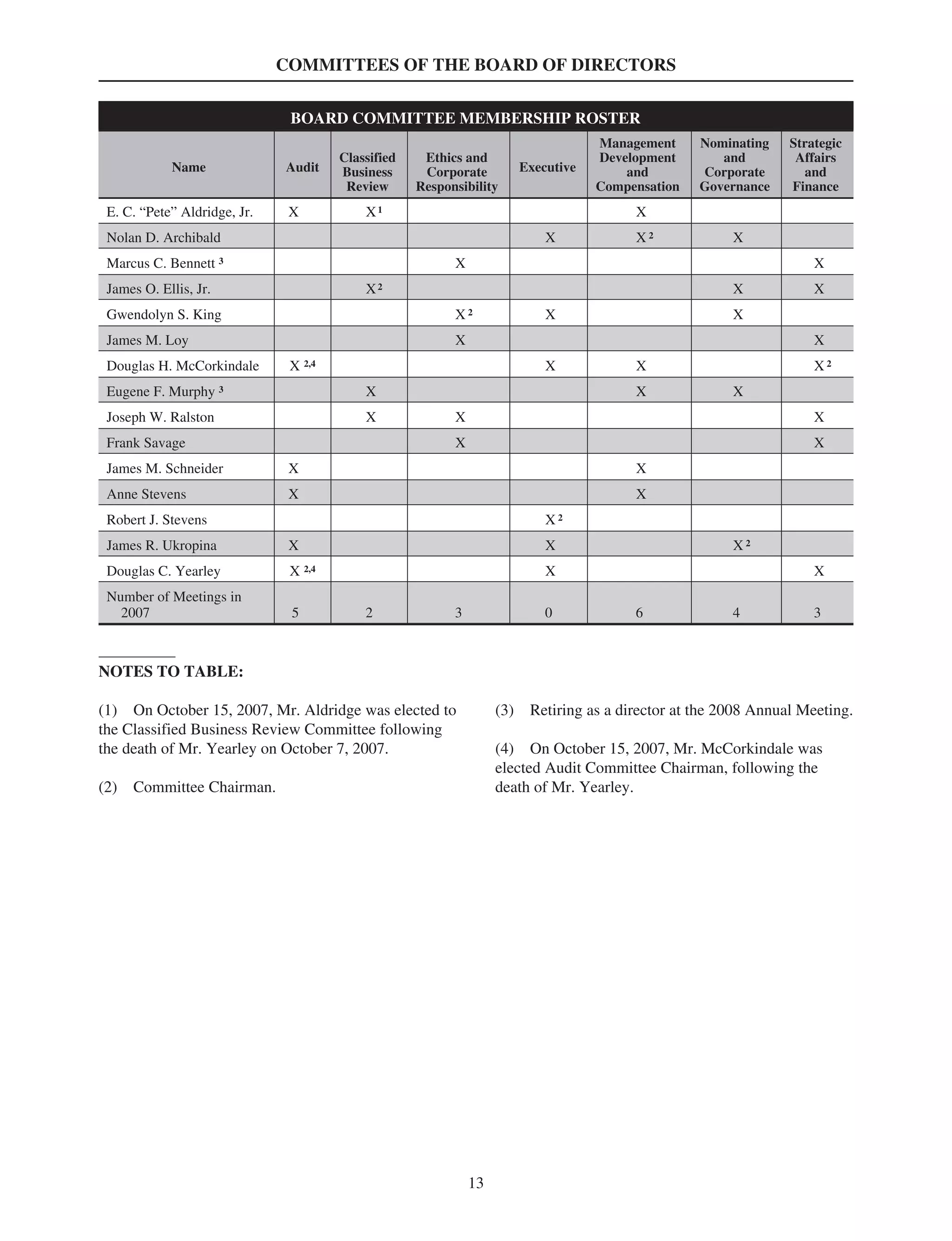
BOARD COMMITTEE MEMBERSHIP ROSTER
Name Audit
Classified
Business
Review
Ethics and
Corporate
Responsibility
Executive
Management
Development
and
Compensation
Nominating
and
Corporate
Governance
Strategic
Affairs
and
Finance
E. C. “Pete” Aldridge, Jr. X X1 X
Nolan D. Archibald X X 2 X
Marcus C. Bennett 3 X X
James O. Ellis, Jr. X2 X X
Gwendolyn S. King X 2 X X
James M. Loy X X
Douglas H. McCorkindale X 2,4 X X X 2
Eugene F. Murphy 3 X X X
Joseph W. Ralston X X X
Frank Savage X X
James M. Schneider X X
Anne Stevens X X
Robert J. Stevens X 2
James R. Ukropina X X X 2
Douglas C. Yearley X 2,4 X X
Number of Meetings in
2007 5 2 3 0 6 4 3
NOTES TO TABLE:
(1) On October 15, 2007, Mr. Aldridge was elected to
the Classified Business Review Committee following
the death of Mr. Yearley on October 7, 2007.
(2) Committee Chairman.
(3) Retiring as a director at the 2008 Annual Meeting.
(4) On October 15, 2007, Mr. McCorkindale was
elected Audit Committee Chairman, following the
death of Mr. Yearley.
13
COMMITTEES OF THE BOARD OF DIRECTORS
Committees
The Board has six standing committees as prescribed
by our Bylaws:
• Audit;
• Ethics and Corporate Responsibility;
• Executive;
• Management Development and
Compensation;
• Nominating and Corporate Governance; and
• Strategic Affairs and Finance.
The Board has established a special Classified
Business Review Committee.
Our Bylaws contain the charter for each of the standing
committees. Our Bylaws and the charter of the
Classified Business Review Committee are posted at
http://www.lockheedmartin.com/investor under the
heading “Corporate Governance.”
Audit Committee
The Audit Committee oversees our financial reporting
process on behalf of the Board. It is directly
responsible for the appointment, compensation, and
oversight of the Corporation’s independent auditors.
The functions of the Audit Committee are further
described under the heading “Audit Committee
Report” on page 16.
All the members of the Audit Committee are
independent within the meaning of the NYSE listing
standards, our Corporate Governance Guidelines, and
applicable SEC regulations. In order to be considered
independent under SEC regulations, a member of the
Audit Committee cannot accept any consulting,
advisory or other compensatory fee from the
Corporation, or be an affiliated person of the
Corporation or its subsidiaries.
The Board has determined that Mr. McCorkindale,
Chairman of the Audit Committee, Mr. Schneider, and
Mr. Burritt (as a nominee) are qualified audit
committee financial experts within the meaning of SEC
regulations, and they have the accounting and related
financial management expertise within the meaning of
the NYSE listing standards.
Ethics and Corporate Responsibility Committee
The Ethics and Corporate Responsibility Committee
monitors compliance and recommends changes to our
Code of Ethics and Business Conduct. It reviews our
policies, procedures and compliance in the areas of
environmental, safety and health, Equal Employment
Opportunity, and diversity. It also oversees matters
pertaining to community and public relations,
including government relations and charitable
contributions.
Executive Committee
The Executive Committee primarily serves as a means
for taking action requiring Board approval between
regularly scheduled meetings of the Board. The
Executive Committee is authorized to act for the full
Board on matters other than those specifically reserved
by Maryland law to the Board.
Management Development and Compensation
Committee
The Management Development and Compensation
Committee is responsible for reviewing and approving
corporate goals and objectives relevant to the
compensation of the CEO, evaluating the performance
of the CEO and, either as a committee or together with
the other independent members of the Board,
determining and approving the compensation levels of
the CEO and senior management. The Compensation
Committee has not delegated to employees of the
Corporation authority to make decisions on the amount
paid as salary, bonus, long-term incentives, or equity
awards to the CEO or the other named executive
officers (“NEOs”) listed in the “Summary
Compensation Table.”
Additional information regarding the role of the
Compensation Committee and our compensation
practices and procedures is provided under the captions
“Compensation Committee Report” on page 24 and
“Compensation Discussion and Analysis” beginning on
page 25 and specifically to the discussion on
Governance Considerations in Compensation
Decisions beginning on page 37.
All members of the Compensation Committee are
independent within the meaning of the NYSE listing
standards and our Corporate Governance Guidelines.
14
COMMITTEES OF THE BOARD OF DIRECTORS
Nominating and Corporate Governance Committee
The Nominating and Corporate Governance
Committee is responsible for developing and
implementing policies and practices relating to
corporate governance, including our Corporate
Governance Guidelines. The Governance Committee
assists the Board by selecting and recommending
Board nominees, making recommendations concerning
the composition of Board committees, and by
overseeing the Board and committee evaluation
process.
The Governance Committee reviews and recommends
to the Board the compensation of directors. Our
executive officers do not play a role in determining
director pay, although the Chairman of the Board is
consulted regarding the impact of any change in director
pay on the Corporation as a whole. During 2007, Hewitt
Associates, Inc. (“Hewitt”) an outside compensation
consultant, assisted the Governance Committee by
providing market data on director pay at other
companies. Director pay remained unchanged in 2007.
The functions of the Governance Committee are
further described under the caption “Corporate
Governance.” All members of the Governance
Committee are independent within the meaning of the
NYSE listing standards and our Corporate Governance
Guidelines.
Strategic Affairs and Finance Committee
The Strategic Affairs and Finance Committee reviews
and recommends to the Board our long-term strategy
including allocation of corporate resources.
Classified Business Review Committee
The Classified Business Review Committee assists the
Board in fulfilling its oversight responsibilities relating
to the Corporation’s business activities that require
special security clearance levels for access to
information.
15
COMMITTEES OF THE BOARD OF DIRECTORS
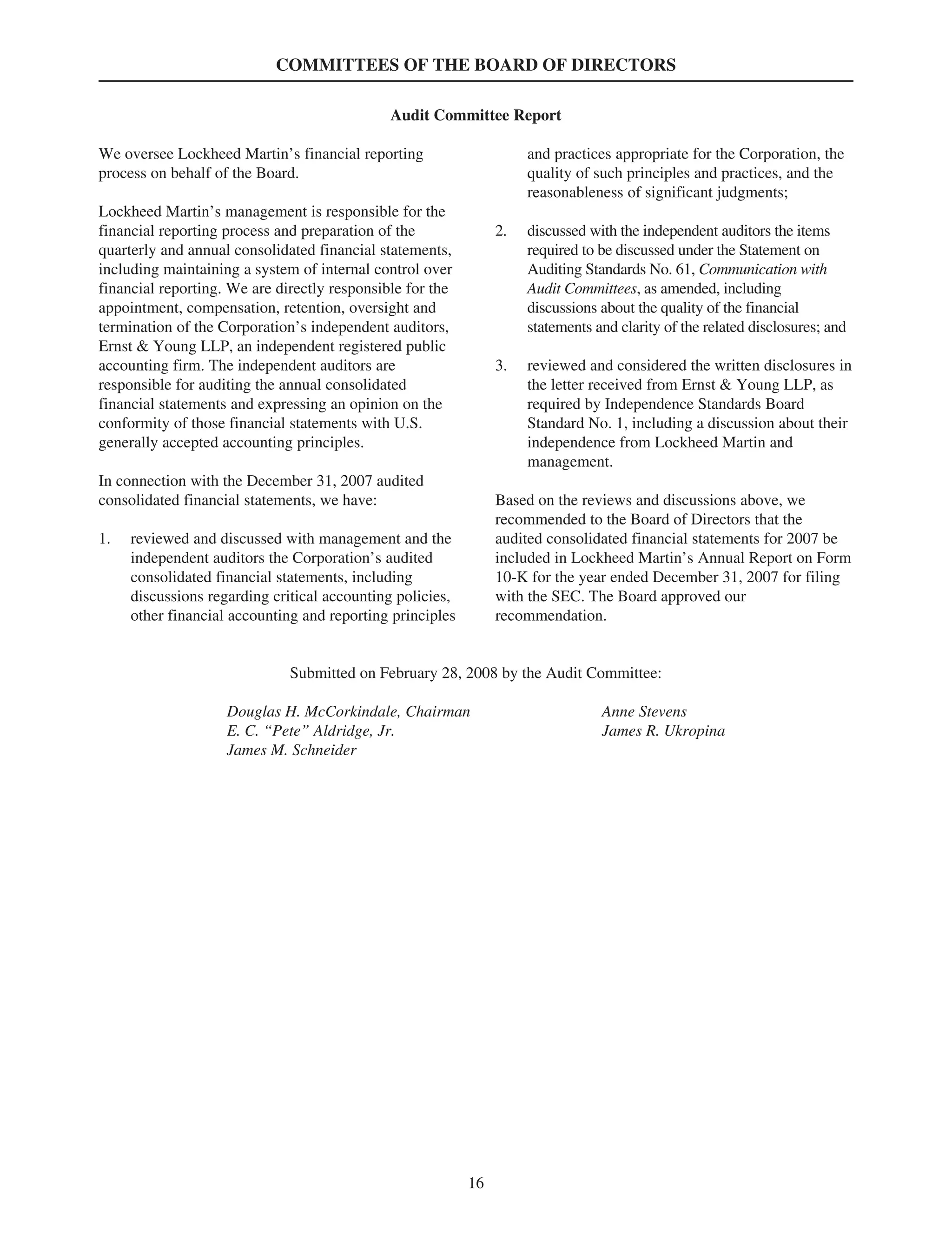
Audit Committee Report
We oversee Lockheed Martin’s financial reporting
process on behalf of the Board.
Lockheed Martin’s management is responsible for the
financial reporting process and preparation of the
quarterly and annual consolidated financial statements,
including maintaining a system of internal control over
financial reporting. We are directly responsible for the
appointment, compensation, retention, oversight and
termination of the Corporation’s independent auditors,
Ernst & Young LLP, an independent registered public
accounting firm. The independent auditors are
responsible for auditing the annual consolidated
financial statements and expressing an opinion on the
conformity of those financial statements with U.S.
generally accepted accounting principles.
In connection with the December 31, 2007 audited
consolidated financial statements, we have:
1. reviewed and discussed with management and the
independent auditors the Corporation’s audited
consolidated financial statements, including
discussions regarding critical accounting policies,
other financial accounting and reporting principles
and practices appropriate for the Corporation, the
quality of such principles and practices, and the
reasonableness of significant judgments;
2. discussed with the independent auditors the items
required to be discussed under the Statement on
Auditing Standards No. 61, Communication with
Audit Committees, as amended, including
discussions about the quality of the financial
statements and clarity of the related disclosures; and
3. reviewed and considered the written disclosures in
the letter received from Ernst & Young LLP, as
required by Independence Standards Board
Standard No. 1, including a discussion about their
independence from Lockheed Martin and
management.
Based on the reviews and discussions above, we
recommended to the Board of Directors that the
audited consolidated financial statements for 2007 be
included in Lockheed Martin’s Annual Report on Form
10-K for the year ended December 31, 2007 for filing
with the SEC. The Board approved our
recommendation.
Submitted on February 28, 2008 by the Audit Committee:
Douglas H. McCorkindale, Chairman Anne Stevens
E. C. “Pete” Aldridge, Jr. James R. Ukropina
James M. Schneider
16
DIRECTORS’ COMPENSATION
2007 ANNUAL DIRECTORS’ COMPENSATION
Cash retainer . . . . . . . . . . . . . . . . . . . . . . . . . . . . . . . . . . . . . . . . $110,000
Stock retainer . . . . . . . . . . . . . . . . . . . . . . . . . . . . . . . . . . . . . . . . $110,000 payable under the Lockheed Martin
Corporation Directors Equity Plan (“Directors
Equity Plan”)
Committee Chairman retainer . . . . . . . . . . . . . . . . . . . . . . . . . . . $12,500 (other than Audit Committee Chairman)
Audit Committee Chairman retainer . . . . . . . . . . . . . . . . . . . . . . $20,000
Deferred compensation plan . . . . . . . . . . . . . . . . . . . . . . . . . . . . Cash retainer deferrable with earnings at prime
rate, Standard & Poor’s 500 Index (“S&P 500
Index”) or Lockheed Martin stock return
Travel accident insurance . . . . . . . . . . . . . . . . . . . . . . . . . . . . . . $1,000,000
Matching Gift for Colleges and Universities Program . . . . . . . . Match of $1 per $1 of director contributions, up
to $10,000 per director, to eligible educational
institutions in accordance with matching program
available to all employees
Director education institutes/activities . . . . . . . . . . . . . . . . . . . . Reimbursed for costs and expenses
Perquisites . . . . . . . . . . . . . . . . . . . . . . . . . . . . . . . . . . . . . . . . . . Home computer system and Internet access, tax
gross-ups and incremental travel expenses for
personal corporate aircraft use and for
accompanying spouse while on travel
Under the Directors Equity Plan, each non-employee
director may elect to receive:
• a number of stock units with a value on
January 15 equal to the annual stock retainer
amount ($110,000);
• options to purchase a number of shares of
Lockheed Martin common stock, which
options have an aggregate value on
January 15 of the annual retainer amount; or
• a combination of stock units with a value on
January 15 equal to 50% of the annual stock
retainer amount and options to purchase a
number of shares of Lockheed Martin
common stock which options have an
aggregate fair market value on January 15 of
50% of the annual stock retainer amount.
Except in certain circumstances, options and stock
units vest on the first anniversary of grant. Upon a
change in control or a director’s retirement, death or
disability, the director’s stock units and outstanding
options become fully vested, and the director would
have the right to exercise their options six months
following the grant date. Upon a director’s termination
of service from our Board, we distribute the vested
stock units, at the director’s election, in whole shares of
stock or in cash, in a lump sum or in up to ten annual
installments. Prior to distribution, a director has no
voting, dividend or other rights with respect to the
stock units held under the plan, but is credited with
additional stock units representing dividend equivalents
(converted to stock units based on the closing market
price of our common stock on the dividend payment
dates). The options have a term of ten years.
17
DIRECTORS’ COMPENSATION
The Directors Equity Plan provides that the grants are
made with respect to a particular year on January 15 or
the next business day if January 15 is not a business
day. The exercise price (in the case of option grants) is
the closing price for our stock on the NYSE on the date
of grant.
The Directors Equity Plan was approved by
stockholders in 1999, and has a term of ten years.
Management has proposed the adoption of a new plan
(Proposal 6 on the proxy card) providing comparable
compensation to replace the existing Directors Equity
Plan, effective January 1, 2009. A discussion of the
proposal begins on page 83.
The Lockheed Martin Corporation Directors’ Deferred
Compensation Plan (“Directors’ Deferred
Compensation Plan”) provides non-employee directors
the opportunity to defer up to 100% of the cash portion
of their fees. Deferred amounts earn interest at a rate
that tracks the performance of the prime rate, the
published index for the S&P 500 Index (with dividends
reinvested), or our common stock (with dividends
reinvested), at the director’s election. We distribute
participating directors deferred fees at the director’s
election in a lump sum or in up to 15 installments
commencing at a designated time following
termination.
Each director may elect to be provided with a home
computer and printer. We provide technical assistance
for the computer equipment and Internet access.
18
DIRECTORS’ COMPENSATION
Name
Fees Earned or
Paid in Cash 1
($)
Stock
Awards 2
($)
Option
Awards 3
($)
Change in
Pension Value
and
Nonqualified
Deferred
Compensation
Earnings 4,5
($)
All Other
Compensation 6,7,8
($)
Total 9
($)
(a) (b) (c) (d) (f) (g) (h)
E. C. “Pete” Aldridge, Jr. 110,000 196,494 0 0 386 306,880
Nolan D. Archibald 122,500 218,769 0 0 10,000 351,269
Marcus C. Bennett 110,000 302,113 0 20,322 6,516 10 438,951
James O. Ellis, Jr. 122,500 163,320 0 0 2,716 288,536
Gwendolyn S. King 122,500 328,955 0 3,852 307 455,614
James M. Loy 110,000 149,093 0 0 0 259,093
Douglas H. McCorkindale 126,731 128,171 54,639 0 6,000 315,541
Eugene F. Murphy 110,000 16,895 109,298 8,799 12,841 257,833
Joseph W. Ralston 110,000 200,406 0 0 731 311,137
Frank Savage 110,000 223,160 0 0 208 333,368
James M. Schneider 110,000 71,557 54,639 0 17,512 253,708
Anne Stevens 110,000 184,434 0 6,446 425 301,305
James R. Ukropina 122,500 328,955 0 0 4,697 456,152
Douglas C. Yearley 100,000 328,955 0 0 11,182 440,137
NOTES TO TABLE:
(1) Represents the aggregate dollar amount of 2007 fees
earned or paid in cash for services as a director, including
annual retainer fees and committee chairman fees.
(2) Represents the amount recognized in accordance
with Statement of Financial Accounting Standards
No. 123(R), Share-Based Payments (FAS 123(R))
(other than disregarding the estimate of forfeitures
resulting from a failure to vest) and the assumptions set
forth in Note 11 to our financial statements for the year
ended December 31, 2007 for stock units awarded to
the directors under the Directors Equity Plan for 2007
and the appreciation associated with units awarded in
2007 and prior years under the Directors Equity Plan
and Lockheed Martin Corporation Directors’ Deferred
Stock Plan (“Directors’ Deferred Stock Plan”),
including dividend equivalents credited as stock units.
We recognize expense based upon the change in
market value during the year for all stock units credited
to the director, whether credited in 2007 or prior years.
The outstanding number of stock units credited to each
director under the Directors Equity Plan as of
December 31, 2007 was Mr. Aldridge 6,344;
Mr. Archibald 7,879; Mr. Bennett 13,621; Mr. Ellis
4,059; Mrs. King 14,307; Mr. Loy 3,079;
Mr. McCorkindale 5,234; Mr. Ralston 6,614;
Mr. Savage 7,018; Mr. Schneider 1,333; Ms. Stevens
5,513; Mr. Ukropina 14,307; and Mr. Yearley 14,307.
For 2007, each of Mrs. King, Ms. Stevens and Messrs.
Aldridge, Archibald, Bennett, Ellis, Loy, Ralston,
Savage, Ukropina, and Yearley were credited with
1,134 stock units with an aggregate grant date value of
$110,000, and each of Messrs. McCorkindale and
Schneider were credited with 567 units with an
aggregate grant date value of $55,000. The grant date
value is based on the closing price of our stock on
January 16, 2007 ($97.00). The outstanding number of
stock units credited to each director under the
Directors’ Deferred Stock Plan as of December 31,
2007 was 1,164 for Mrs. King and Messrs. Murphy,
Savage, Ukropina, and Yearley.
19
DIRECTORS’ COMPENSATION
(3) Represents the amount recognized in accordance
with FAS 123(R) (other than disregarding the estimate
of forfeitures resulting from a failure to vest) in our
financial statements for the year ended December 31,
2007 for options granted to Messrs. McCorkindale,
Murphy, and Schneider in 2006 and 2007. We
recognize expense ratably in monthly increments over
the one-year vesting period. The assumptions used in
determining the fair value of the options is set forth in
Note 11 to our financial statements contained in our
Annual Reports on Form 10-K for the years ended
December 31, 2007 and 2006. For 2007, we awarded
each of Messrs. McCorkindale and Schneider 2,291
options with an aggregate grant date value of $54,984
and Mr. Murphy 4,583 options with an aggregate grant
date value of $109,992. The grant date value for
options granted in 2007 ($24.00 per share) is based on
the closing price of our stock on January 16, 2007
($97.00) and for options granted in 2006 ($16.55 per
share) is based on the closing price of our stock on
January 17, 2006 ($65.72). The outstanding number of
stock options awarded to each director as of
December 31, 2007 was Mr. McCorkindale 16,631;
Mr. Murphy 43,430; and Mr. Schneider 5,590, all of
which vested on January 17, 2008.
(4) Column (e) deleted because we did not have a
Non-Equity Incentive Plan in 2007.
(5) Includes a portion of the interest earned in 2007
by Messrs. Bennett and Murphy, Mrs. King, and
Ms. Stevens on cash retainer fees credited to the
“prime rate” investment option under the Directors’
Deferred Compensation Plan. The amount shown is the
amount in excess of 120% of the Applicable Federal
Rate published by the Internal Revenue Service
(“IRS”).
(6) Includes the cost to the Corporation of providing
Internet access, tax gross-up payments and the
incremental cost of a director’s personal use of
corporate aircraft and spousal travel while
accompanying a director on business travel.
(7) Includes contributions made by the Corporation
to eligible educational institutions in an amount
matching the contribution of the director to that
institution. Matching contributions in 2007 were made
on behalf of Mr. Archibald $10,000; Mr. Bennett
$5,000; Mr. Ellis $2,500; Mr. McCorkindale $6,000;
Mr. Murphy $10,000; Mr. Schneider $10,000;
Mr. Ukropina $2,000; and Mr. Yearley $10,000. The
matching program is the same as the program available
to all employees.
(8) Neither Mr. Loy’s nor Mr. Ralston’s
compensation includes fees paid to The Cohen Group
for consulting services. These fees are described in the
section on “Certain Relationships and Related Person
Transactions of Directors, Executive Officers and 5
Percent Stockholders” on page 10.
(9) Variances in the amounts reported for each
director in columns (b), (c), and (d) due to the
inclusion of fees for service as a committee chairman
and historical variations in equity grant elections and
board tenure that result in differences in the amount
expensed for each director in 2007. Numbers have
been rounded to the nearest dollar.
(10) Mr. Bennett participates in deferred
compensation and other plans related to his service as a
director of an acquired company (COMSAT
Corporation) and his prior service as an officer of
Martin Marietta Corporation and Lockheed Martin.
None of the benefits under these plans were earned for
service as a director of Lockheed Martin and they are
not included in the table. The aggregate earnings with
respect to his service as a director of COMSAT
Corporation for 2007 were $18,867.
20
SECURITIES OWNED BY DIRECTORS, NOMINEES AND NAMED
EXECUTIVE OFFICERS
The following table shows the Lockheed Martin
common stock beneficially owned and stock units
credited to each NEO, director, nominee, and all
directors, nominees and executive officers as a group
as of February 1, 2008. Except as otherwise noted, the
named individuals had sole voting and investment
power with respect to such securities. The total
common stock and stock units owned by each director
and executive officer represented less than 1% of our
outstanding common stock. All amounts are rounded to
the nearest whole share. No shares have been pledged.
Name of Individual or
Identity of Group
Common Stock
Beneficially
Owned 1,2.3
Stock Units Total
E. C. “Pete” Aldridge, Jr. . . . . . . . . . . . . . . . . . . . . . . . . . . . . . . 0 7,374 5 7,374
Nolan D. Archibald . . . . . . . . . . . . . . . . . . . . . . . . . . . . . . . . . . . 0 8,909 5 8,909
Marcus C. Bennett . . . . . . . . . . . . . . . . . . . . . . . . . . . . . . . . . . . . 5,892 13,964 5 19,856
David B. Burritt . . . . . . . . . . . . . . . . . . . . . . . . . . . . . . . . . . . . . . . 0 0 0
Robert B. Coutts . . . . . . . . . . . . . . . . . . . . . . . . . . . . . . . . . . . . . 212,524 36,496 6,7,8 249,020
James O. Ellis, Jr. . . . . . . . . . . . . . . . . . . . . . . . . . . . . . . . . . . . . 200 5,089 5 5,289
Linda R. Gooden . . . . . . . . . . . . . . . . . . . . . . . . . . . . . . . . . . . . . 42,195 17,380 7,8 59,575
Ralph D. Heath . . . . . . . . . . . . . . . . . . . . . . . . . . . . . . . . . . . . . . 136,252 30,032 6,7,8 166,284
Gwendolyn S. King . . . . . . . . . . . . . . . . . . . . . . . . . . . . . . . . . . . 568 4 16,500 5,9 17,068
Christopher E. Kubasik . . . . . . . . . . . . . . . . . . . . . . . . . . . . . . . . 193,242 63,052 6,7,8 256,294
James M. Loy . . . . . . . . . . . . . . . . . . . . . . . . . . . . . . . . . . . . . . . 0 4,108 5 4,108
Joanne M. Maguire . . . . . . . . . . . . . . . . . . . . . . . . . . . . . . . . . . . 88,691 26,724 6,7,8 115,415
Douglas H. McCorkindale . . . . . . . . . . . . . . . . . . . . . . . . . . . . . . 16,631 15,527 5,10 32,158
Eugene F. Murphy . . . . . . . . . . . . . . . . . . . . . . . . . . . . . . . . . . . . 49,430 1,164 9 50,594
Joseph W. Ralston . . . . . . . . . . . . . . . . . . . . . . . . . . . . . . . . . . . . 0 7,644 5 7,644
Frank Savage . . . . . . . . . . . . . . . . . . . . . . . . . . . . . . . . . . . . . . . . 1 27,989 5,9,10,11 27,990
James M. Schneider . . . . . . . . . . . . . . . . . . . . . . . . . . . . . . . . . . . 7,590 1,848 5 9,438
Anne Stevens . . . . . . . . . . . . . . . . . . . . . . . . . . . . . . . . . . . . . . . . 0 6,543 5 6,543
Robert J. Stevens . . . . . . . . . . . . . . . . . . . . . . . . . . . . . . . . . . . . . 913,946 252,501 6,7,8 1,166,447
Bruce L. Tanner . . . . . . . . . . . . . . . . . . . . . . . . . . . . . . . . . . . . . . 39,509 10,961 6,7,8 50,470
James R. Ukropina . . . . . . . . . . . . . . . . . . . . . . . . . . . . . . . . . . . 1,630 20,206 5,9,10,11 21,836
All directors, nominees and executive officers as a group 24
individuals including those named above) . . . . . . . . . . . . . . . 1,779,300 607,442 2,386,742
NOTES TO TABLE:
(1) Includes restricted stock awards (“RSAs”) for
Messrs. Coutts, Heath, Kubasik, and Stevens, and Mss.
Gooden and Maguire in the amount of 16,667; 10,000;
10,000; 33,334; 10,000; and 10,000, respectively.
(2) Includes shares not currently owned but which
could be acquired within 60 days following February 1,
2008 through the exercise of stock options for Messrs.
Coutts, Heath, Kubasik, McCorkindale, Murphy,
Schneider, Stevens, and Tanner, and Mss. Gooden and
Maguire in the amount of 172,100; 121,033; 165,033;
16,631; 43,430; 5,590; 837,500; 37,966; 23,634; and
74,800 shares, respectively.
(3) Includes shares attributable to the participant’s
account in the Lockheed Martin Salaried Savings Plan
(“SSP”) for Messrs. Bennett, Coutts, Heath, Kubasik,
Stevens, and Tanner, and Mss. Gooden and Maguire in
the amount of 891; 23; 1,542; 1,065; 23; 1,543; 4,782;
and 679, respectively. Participants have voting power
and investment power over the shares.
(4) Includes shares that have shared voting and
investment power.
(5) Includes stock units under the Directors Equity
Plan. Mrs. King, Ms. Stevens, and Messrs. Aldridge,
21
SECURITIES OWNED BY DIRECTORS, NOMINEES AND NAMED
EXECUTIVE OFFICERS
Archibald, Bennett, Ellis, Loy, McCorkindale, Ralston,
Savage, Schneider, and Ukropina have been credited with
15,336; 6,543; 7,374; 8,909; 13,965; 5,089; 4,108; 5,749;
7,644; 8,047; 1,848; and 15,336 units, respectively. Units
are distributed in the form of cash or stock as elected by the
director. There are no voting rights associated with stock
units.
(6) Includes stock units attributable to the participant’s
account under the Lockheed Martin Corporation
Supplemental Savings Plan (“NQSSP”) for Messrs. Coutts,
Heath, Kubasik, Stevens, and Tanner, and Ms. Maguire in
the amount of 66; 1,907; 1,807; 447; 868; and 584,
respectively. Amounts credited to a participant’s account in
the NQSSP are distributed in cash following termination of
employment. There are no voting rights associated with stock
units.
(7) Includes stock units attributable to the participant’s
account under the Lockheed Martin Corporation Deferred
Management Incentive Compensation Plan (“DMICP”)
(including units credited under the LTIP program awards
under the Lockheed Martin 1995 Omnibus Performance
Award Plan (“Award Plan”) and the Lockheed Martin
Corporation Amended and Restated 2003 Incentive
Performance Award Plan (“IPA Plan”)) for Messrs. Coutts,
Heath, Kubasik, Stevens, and Tanner, and Mss. Gooden and
Maguire in the amount of 25,580; 15,574; 34,045; 59,554;
4,443; 7,180; and 16,341, respectively. Although most of
the units will be distributed following termination or
retirement in shares of stock, none of the units are
convertible into shares of stock within 60 days of
February 1, 2008. There are no voting rights associated
with stock units.
(8) Includes RSUs for Messrs. Coutts, Heath, Kubasik,
Stevens, and Tanner, and Mss. Gooden and Maguire in the
amount of 10,850; 12,550; 27,200; 192,500; 5,650; 10,200;
and 9,800, respectively. The RSUs represent a contingent
right to receive one share of common stock. There are no
voting rights associated with RSUs.
(9) Includes stock units under the Directors’ Deferred
Stock Plan for Mrs. King and Messrs. Murphy, Savage, and
Ukropina each in the amount of 1,164. There are no voting
rights associated with stock units.
(10) Includes stock units under the Directors’ Deferred
Compensation Plan representing deferred cash
compensation for Messrs. McCorkindale, Savage, and
Ukropina in the amount of 9,778; 16,276; and 3,211,
respectively. The stock units (including dividend
equivalents credited as stock units) are distributed in the
form of cash. There are no voting rights associated with
stock units.
(11) Includes shares held in trust under the former
Deferred Compensation Plan for Directors of Lockheed
Corporation. Deferred amounts are distributable after a
participant ceases to be a director. In the event a
participant’s status as a director is involuntarily terminated
other than by death, common stock in the director’s trust
account will be distributed within 15 days of termination.
Messrs. Savage and Ukropina have been credited with
2,502 and 494 shares, respectively, pursuant to the plan.
The directors do not have or share voting or investment
power for their respective shares held in the trust except in
the event of a tender offer.
SECTION 16(a) BENEFICIAL OWNERSHIP REPORTING COMPLIANCE
Section 16(a) of the Securities Exchange Act of 1934
requires that our executive officers and directors (and
persons who own more than 10% of our equity securities)
file reports of ownership and changes in ownership with the
SEC, the NYSE and with us. Based solely on our review of
copies of forms and written representations from reporting
persons, we believe that all ownership filing requirements
were timely met during 2007.
22
SECURITY OWNERSHIP OF CERTAIN BENEFICIAL OWNERS
The following table shows information regarding each
person known to be a “beneficial owner” of more than
5% of our common stock. For purposes of this table,
beneficial ownership of securities generally means the
power to vote or dispose of securities, regardless of any
economic interest in the securities. All information
shown is based on information reported by the filer on
a Schedule 13G filed with the SEC on the dates
indicated in the footnotes to this table.
Name and Address of Beneficial Owner Class of Stock
Amount and Nature of
Beneficial Ownership
Percent of Class
Owned
State Street Bank and Trust Company
State Street Financial Center
One Lincoln Street
Boston, Massachusetts 02111
Common 76,269,829 1 18.6%
FMR LLC
82 Devonshire Street
Boston, Massachusetts 02109
Common 24,548,079 2 5.9%
Marsico Capital Management, LLC
1200 17th Street, Suite 1600
Denver, Colorado 80202
Common 23,858,337 3 5.8%
NOTES TO TABLE:
(1) As reported on a Schedule 13G filed on
February 13, 2008 by State Street Bank and Trust
Company (“State Street”), State Street had beneficial
ownership of and shared dispositive power with respect
to 76,269,829 shares of common stock, of which
64,318,045 shares of common stock were held by it as
trustee for certain Lockheed Martin employee benefit
plans. State Street also reported that it had sole voting
power with respect to 14,188,940 shares, of which
2,237,156 shares of common stock it had sole voting
power as trustee for certain Lockheed Martin employee
benefit plans. State Street has expressly disclaimed
beneficial ownership of the shares reported on its
Schedule 13G.
(2) As reported on a Schedule 13G/A filed on
February 22, 2008 by FMR LLC (“FMR”), FMR had
beneficial ownership of and sole dispositive power
with respect to 24,548,079 shares of common stock.
FMR has sole power to vote 2,854,026 shares and
shared voting or dispositive power for none of the
shares. FMR’s Schedule 13G includes shares
beneficially owned by Edward C. Johnson 3rd
(21,411,673 shares), Fidelity Management & Research
Company (21,411,673 shares), Pyramis Global
Advisors, LLC (559,200 shares), Pyramis Global
Advisors Trust Company (1,121,208 shares), Strategic
Advisers, Inc. (9,053 shares), and Fidelity International
Limited (1,446,945 shares). FMR and Fidelity
International Limited are of the view that they are not
acting as a “group” for purposes of Section 13(d) and
that they are not otherwise required to attribute to each
other the beneficial ownership of securities beneficially
owned by the other corporation.
(3) As reported on a Schedule 13G filed on
February 13, 2008 by Marsico Capital Management,
LLC (“Marsico”), Marsico had beneficial ownership of
and sole dispositive power over 23,858,337 shares and
sole voting power over 19,745,394 shares.
23
EXECUTIVE COMPENSATION
Compensation Committee Report
The Management Development and Compensation
Committee makes recommendations to the Board of
Directors concerning the compensation of the
Corporation’s executives. We have reviewed and
discussed with management the Compensation
Discussion and Analysis included in the Corporation’s
Schedule 14A Proxy Statement, filed pursuant to
Section 14(a) of the Securities Exchange Act of 1934,
as amended (the “Proxy”). Based on that review and
discussion, we recommended to the Board of Directors
that the Compensation Discussion and Analysis be
included in the Proxy and incorporated by reference in
the Corporation’s Annual Report on Form 10-K for the
year ended December 31, 2007. The Board has
approved that recommendation.
Submitted on February 28, 2008 by the Management Development
and Compensation Committee:
Nolan D. Archibald, Chairman Eugene F. Murphy
E. C. “Pete” Aldridge, Jr. James M. Schneider
Douglas H. McCorkindale Anne Stevens
Compensation Committee Interlocks and Insider Participation
There are no relationships required to be disclosed under this section.
24
EXECUTIVE COMPENSATION
Compensation Discussion and Analysis
Executive Summary of Compensation Analysis
The goal of our compensation program is to attract
talented people to work for us, motivate our key people,
and keep them working for us. To do that, we look
carefully at what our competitors and other large
companies pay to see what our NEOs might be offered
to go work for somebody else. We also consider the
individual characteristics of our key people that may
make them more or less vulnerable to recruitment by
others or difficult to replace, such as level of experience,
time in position, unique knowledge or skills, and
leadership qualities. Relationships with customers and
performance on particular programs may also play a role
because they make somebody harder to replace.
We pay NEOs a base salary and we also put a
significant portion of the executive’s compensation at
risk by tying pay to specified levels of performance
each year, and over longer periods of time. Tying pay
to performance motivates people to perform and
rewards those who respond by doing a great job. Our
compensation program contains incentive opportunities
that measure performance against key financial
numbers and other metrics; it also contains qualitative
standards that allow for the subjective judgments we
believe are essential to evaluating individuals.
It is our intent to award superior pay for superior
performance. Our compensation plans also authorize
payment in some circumstances when objectives are
not being achieved in order to provide a continuing
incentive for strong performance.
We consider individual performance in base salary
decisions and both individual and business performance
in our annual bonus program. In contrast, the amounts
paid out under our long-term incentive program are
based solely on the Corporation’s performance. We
think that mix makes sense because it focuses on
individual achievement, while also strongly encouraging
those individuals to care how well the entire team does.
In 2007, our financial results exceeded our projections
across the board and the price of our stock increased
14%. Since 2005, our stock price has increased 65% and
since 2003, it has increased 105%. For the three-year
period 2005-2007, our market capitalization increased
by $19 billion. Those results came from outstanding
individual work and team work. As a result, our key
people have been highly compensated under both our
short-term and long-term incentive plans. As we have
designed our incentive plans, if our NEOs keep
producing superior results, they will continue to be
highly paid. If their achievements do not meet or exceed
our goals, their pay will reflect that fact.
We provide more detail on our process, the information
shared with the Committee, and 2007 pay decisions
below. We have limited the discussion in this
Compensation Discussion and Analysis (“CD&A”) to a
description of how decisions were made for 2007. A
discussion of the components of our executive
compensation program precedes the compensation
tables, beginning on page 40. References to “the
Committee” in this CD&A mean the Management
Development and Compensation Committee of our
Board.
Discussion and Analysis
The following table lists the elements of our executive
compensation program, the reason we use the element,
and what the element rewards:
Element Reason We Use It What Is Rewarded
Base Salary • Fixed rate of pay is the form used in most
U.S. companies for compensation
• A sustained high level of performance
• Demonstrated success in meeting or
exceeding key financial and other
business objectives
• Highly developed skills and abilities
critical to the success of the business unit
or Corporation
• Experience and time in position
25
EXECUTIVE COMPENSATION
Element Reason We Use It What Is Rewarded
Annual Bonus
(MICP)
• Incentivize NEOs to meet or exceed
stated business and individual goals by
placing a substantial portion of a NEO’s
annual compensation at risk
• Organizational performance during the
year against our publicly-disclosed
forecast and other measures of
performance
• Individual performance during the year
measured against identified goals
Long-Term
Incentives:
Stock Options • Link a NEO’s compensation to
stockholder return
• Retain a NEO through vesting period
• Increase in stock price
• Commitment to remain with the
Corporation
RSUs • Retain a NEO through vesting period
• Link a NEO’s compensation to
stockholder return
• Commitment to remain with the
Corporation
• Increase in stock price
LTIP Award • Represents performance-based
compensation
• Link a NEO’s compensation to financial
metrics that are important to stockholders
• Performance relative to other companies
as measured by Total Stockholder Return
(“TSR”)
• Meeting or exceeding stated goal for
increasing return on invested capital
(“ROIC”)
• Meeting or exceeding stated goal for cash
generation
The NEOs participate in the pension, savings, health
care and other welfare benefit plans available to other
employees and restoration pension and savings plans
that maintain benefit levels for employees whose
benefits otherwise would be reduced because of IRS
limitations on benefits payable from tax-qualified
plans. The NEOs also participate in a deferral plan (the
DMICP) that permits the deferral of MICP bonuses and
LTIP payments. We provide very limited perquisites
and post-employment benefits to our NEOs.
Role of the Committee
All our NEOs are at-will employees and serve at the
pleasure of our Board. The Committee is responsible
for the compensation of the Corporation’s NEOs. It
reviews and approves corporate goals and objectives
for the CEO and recommends the compensation for the
CEO to the independent members of the Board which
reviews and approves the compensation of the CEO
and each of the other NEOs. The Committee reviews
the recommendations of the CEO for the compensation
of the other NEOs and approves the compensation of
those officers.
Use of Data from Other Companies in 2007
In order to determine what other companies pay NEOs
with comparable responsibilities, we asked Hewitt to
collect compensation data from a group of publicly
held companies (referred to as our “Comparator
Group”) in the aerospace and defense industry and
other companies of a size, complexity, and quality
similar to ours. The following companies made up the
26
EXECUTIVE COMPENSATION
Comparator Group we used in 2007 for making
compensation decisions:
• 3M Company
• Alcoa Inc.
• Altria Group, Inc.
• AT&T Inc.
• The Boeing Company
• Bristol-Myers Squibb Company
• ConAgra, Inc.
• The Dow Chemical Company
• Eastman Kodak Company
• E.I. du Pont de Nemours & Company
• FedEx Corporation
• General Dynamics Corporation
• Hewlett-Packard Company
• Honeywell International Inc.
• IBM Corporation
• International Paper Company
• Johnson & Johnson
• Merck & Co. Inc.
• Motorola, Inc.
• Northrop Grumman Corporation
• PepsiCo, Inc.
• The Procter & Gamble Company
• Raytheon Company
• United Technologies Corporation
• Valero Energy Corporation
To compare our compensation with compensation paid
in other companies within the Comparator Group,
Hewitt collected data for the compensation paid by the
companies in 2006 and then made several adjustments.
Among other things, Hewitt adjusted Comparator
Group data to take into account that the companies in
the Comparator Group were not the same size. For
example, the 2005 sales of companies in our 2006
Comparator Group ranged from $11.6 billion to $91.1
billion. Our sales in 2005 were $37.2 billion. To create
data that would provide a reference point for us, CEO
and Chief Financial Officer (“CFO”) compensation
was adjusted based on revenues, and business area
Executive Vice President data were adjusted based on
the revenues of their business areas. Hewitt also
applied an aging factor to the Comparator Group data
to establish a market value as of September 1, 2007.
The purpose of these adjustments is to derive amounts
that a corporation the same size as ours would pay its
executives in comparable positions.
After these adjustments, Hewitt determined the 50th
percentile for each position for base pay, annual
incentive bonus opportunities, and aggregate long-term
incentive compensation opportunities or targets. Hewitt
derived the economic value for long-term incentive
compensation from standard statistical measures, such
as the Black-Scholes model for option pricing. We
allocated the aggregate long-term incentive
compensation economic value among individual
components of long-term incentive compensation, such
as stock options, RSUs, or long-term cash performance
awards based on our desired mix of those elements.
Information on total compensation came from
combining Comparator Group data on individual
elements of compensation.
For the short-term and long-term incentive pay
components, we looked at targets and ranges of
possible compensation but did not compare actual
payments under our incentive programs to market data
because it is not useful for benchmarking. Incentive
compensation payouts are contingent upon a number of
factors, including such things as market performance,
vesting periods, deferrals, and how long the person
held the stock or the options.
In 2007, consistent with historical practice, we did not
designate a specific percentile as a target for the
individual components or for total compensation.
Information on market percentiles was provided as a
reference point and as an item of information rather
than as a target. Market data and performance metrics
are important tools for analyzing compensation, but are
not the only factors. Compensation decisions
necessarily involve judgments about the best mix and
balance of compensation elements needed to attract
qualified employees, retain employees, and reward or
recognize performance.
In making individual compensation decisions,
management considered a number of factors together
with the market data and made recommendations to the
Committee with respect to each element of
compensation after considering individual performance
and other factors including a sustained high level of
performance, demonstrated success in meeting or
exceeding key financial and other business objectives,
proven ability to create stockholder value, highly
developed skills and abilities critical to the success of
the business, and experience and time in position.
Individual compensation decisions are, in the end,
based on review and assessment by the Committee and
Mr. Stevens (with respect to the NEOs other than
27
EXECUTIVE COMPENSATION
himself) of these and other subjective factors. As a
result, total compensation (or any particular part of it)
was based on a combination of factors and may differ
materially from the derived 50th percentile of the
Comparator Group.
Role of Compensation Consultants
Hewitt was retained by the Corporation in 2007 to
serve as its compensation consultant to gather, among
other things, Comparator Group data. In 2007, Hewitt
also prepared reports using Comparator Group data on
employment agreements and the mix of elements in
long-term incentive compensation.
In addition to Hewitt, the Committee separately
engaged its own compensation consultant, Watson
Wyatt Worldwide, Inc. (“Watson Wyatt”), with whom
it reviews selected matters, using the same Comparator
Group. In 2007, Watson Wyatt provided information to
the Committee on employment agreements, reported
on 2007 proxy Comparator Group data, and prepared a
total accumulated wealth analysis comparing the NEOs
to the Comparator Group; the purpose of the total
accumulated wealth analysis was to provide the
Committee with a broad perspective on compensation.
Role of Management in Compensation Decisions
Our Chairman, President and CEO, with input from our
Senior Vice President, Human Resources and data
from Hewitt, provided the Committee with information
on recommended base salary, annual bonuses, and
long-term incentive grants for our NEOs (other than
the CEO), along with the 50th percentile of the
Comparator Group data and historical data for each
NEO. The Senior Vice President, Human Resources
also calculated for the NEOs (other than the CEO) the
resulting percentage above or below the market for
varying levels of compensation and interpolated the
potential market percentile for levels of compensation.
For the CEO, the Senior Vice President, Human
Resources did not recommend a specific amount of
compensation. He presented a schedule with a range of
possible payments to the CEO for each element of
compensation in relationship to the 50th and 75th
percentiles; for the CEO, the schedule also showed
ranges of total cash compensation using the sum of
base salary and MICP awards. The purpose of this
schedule was to estimate what percentile of pay would
result from different levels of payments.
The Executive Vice President and CFO developed
internal financial goals within stockholder-approved
metrics for our long-term incentive program and
assessed organizational performance under those
metrics and under the financial, operational and
strategic goals set by the Committee for our short-term
incentive program. The role of the officers in decisions
relating to the specific elements of our program is
described in more detail in the discussion of individual
elements below.
Role of Industry Considerations in Compensation
Decisions
The nature of our business requires that we adopt a
business strategy that anticipates customers’ needs,
understands their expectations, and measures our
success by our customers’ success. To execute this
strategy, especially over the long life of many of our
programs and products, requires retention of key
leaders. The pool of executive talent with knowledge
of customer requirements, expertise in government cost
accounting standards, high-level security clearances
and experience in managing long-term, technically
advanced contracts is limited. To that end, our
compensation package contains many elements
designed to enhance retention.
As a government contractor, we are subject to the
Federal Acquisition Regulation, which limits the
reimbursement of costs by our government customers
for senior executive compensation to a benchmark
compensation cap established each year. The
benchmark cap applies to the CEO and our four most
highly compensated NEOs at our headquarters, plus
the five most highly compensated employees in
management positions. When comparing senior
executive compensation to the benchmark cap, all
wages, salary, bonuses, and deferred compensation for
the year, whether paid, earned or otherwise accrued,
must be included. For 2007, the benchmark
compensation cap published in the Federal Register
was $597,912. Any amounts over the cap were
considered unallowable and therefore not recoverable
under our government contracts.
We also have contracts that require that we provide a
summary of contract performance to the Board or
person having responsibility for setting the
compensation of senior management annually so that
performance can be considered in setting the
28
EXECUTIVE COMPENSATION
compensation of the contractor’s senior executives —
defined as the five most highly compensated
employees at the corporate level, to include the CEO.
Compensation Decisions in 2007
Timing of Compensation Decisions
The Committee made compensation decisions with
respect to 2007 as follows:
January 2007 January 2008
• Determined Merit
Increases
• Awarded MICP
Bonuses For 2007
Performance
• Awarded Long-Term
Incentive
Compensation, as
follows:
• Certified LTIP
Payments For 2005-
2007 cycle
O Stock Options
O RSUs
O LTIP – 2007-2009
Cycle Targets
Established
• Certified
Performance for
2007 RSU Grants
• Certified LTIP
Payments for 2004-
2006 cycle
Base Salary Determinations in 2007
CEO Merit Increase
At its January 2007 meeting, the Committee met
separately with the Senior Vice President, Human
Resources to prepare its recommendation for the Board
as to all the elements of Mr. Stevens’ compensation,
including a merit increase. At that time, the Committee
reviewed compensation paid to Mr. Stevens in 2006
comprised of the 2005 MICP bonus paid in January
2006, his 2006 base salary, and economic values for
long-term incentive compensation awarded to him in
January 2006 consisting of stock options, RSUs and
LTIP awards (exclusive of the additional RSU award
made to him for retention purposes). The value of each
element was assessed against data provided by Hewitt
for the 50th and 75th percentile of the Comparator
Group companies. The data showed that the economic
value of the compensation Mr. Stevens received in
2006 (MICP bonus, base salary, options, LTIP and
RSUs, other than the retention grant) exceeded the 50th
percentile but was less than the 75th percentile of our
Comparator Group. For 2007, the Committee
designated a merit increase that would place
Mr. Stevens, using the data presented at the meeting, at
the 75th percentile for base salary. This decision was
based on the Corporation’s record-breaking
performance in 2006 in which the Corporation
exceeded all of its publicly disclosed goals, as well as
Mr. Stevens’ consistently high performance and
acknowledged leadership in the industry and among
corporate CEOs generally.
Merit Increases For Other NEOs
In addition to Comparator Group data on the other
NEO positions, the Senior Vice President, Human
Resources provided information to the Committee on
our guidelines on merit increases generally, which
links the size of a salary merit increase to whether the
officer’s current salary fell above or below the 50th
percentile of the Comparator Group. For example,
under the guidelines, smaller raises (as a percentage)
are recommended for contributors whose salary
already exceeds the 50th percentile, while larger raises
(as a percentage) were recommended for contributors
whose salary falls below the 50th percentile.
Our NEOs are high performers and receive raises
reflecting that performance. Prior to the merit increase,
the salaries of Mr. Heath and Mss. Gooden and
Maguire were below the 50th percentile derived from
Comparator Group data for their positions. For Messrs.
Kubasik and Coutts, salaries prior to the increase
exceeded the 50th percentile. For Mr. Kubasik, the
Committee concluded that his exceptional performance
in the prior year and public recognition as an
outstanding chief financial officer made him an
attractive candidate for recruitment by other
companies, thereby warranting a larger merit increase.
Mr. Coutts’ merit increase was based on Electronic
Systems multi-year success in generating cash and
winning key programs. Mr. Tanner received a raise in
January 2007 when he was the Vice President of
Finance and Business Operations in the Aeronautics
Business Area and so was evaluated by management at
the time by reference to his job within the business
area. When he was promoted to Executive Vice
President and CFO, his salary was raised to $500,000,
which placed him well below the 50th percentile for
chief financial officers within the Comparator Group.
29
EXECUTIVE COMPENSATION
At that time, the Committee considered that he would
receive another merit increase in February 2008 to
bring him closer to the 50th percentile.
The following chart shows the salary of each NEO
after the merit increase as a percentage of the 50th
percentile of our Comparator Group:
Salary As A Percentage
Of 50th Percentile
(after raise in January 2007)
Mr. Stevens 107%
Mr. Tanner* 69%
Ms. Gooden 89%
Mr. Heath 98%
Mr. Kubasik 117%
Ms. Maguire 98%
Mr. Coutts 138%
* September 2007 salary increase
MICP Decisions For 2007 Performance
MICP is our annual bonus program. Each NEO is
assigned a target percentage of base salary determined
by the level of contribution and responsibility of the
NEO’s position, and in a range comparable to annual
incentive targets for similar positions in the
Comparator Group. The target amounts are reported in
the “Grants of Plan-Based Awards” table and range
from 75% to 125% of salary. We calculate MICP
bonuses as follows:
Annual Base
Salary
X
Target
Level
X
Corporate
Factor
X
Individual
Factor
The following chart shows the target percentages for
each NEO:
% of Base
Pay Target
Mr. Stevens 125%
Other NEOs* 75%
* Mr. Tanner’s MICP bonus was based on his rate of
pay in the first week of December 2007 but was
prorated for four months at the 75% applicable to the
CFO position and eight months at a target of 45%, the
target applicable to him prior to promotion as
Executive Vice President and CFO.
The amount ultimately paid to a NEO may range from
0% to 195% of the target percentage and is based on
the Committee’s evaluation of business and individual
performance during the year.
MICP award targets are reviewed periodically and
were last updated in 2005. Recent survey information
revealed that our NEO target awards lag the market.
An assessment will be made in 2008 with respect to
updating MICP award targets.
Corporate performance factors range from 0 to 1.5;
individual performance factors range from 0 to 1.3, the
target is a percentage of base salary as of the first pay
period of December. The following table shows the
performance level associated with each factor:
Factor Corporate Performance
1.50 Far exceeded organizational
objectives in all categories.
1.30 On balance, exceeded high
performance expectations in most
categories.
1.00 Achieved all objectives or on
balance met high performance
expectations.
0.75 Met most objectives. Overall
performance was good, but not as
high as possible or expected.
0.50 Met few objectives, but overall
performance not as good as possible
or expected.
0.00 Did not achieve sufficient overall
performance level.
Factor Individual Performance
1.20 – 1.30 Performance vastly superior to
expectations and peers within the
organization.
1.05 – 1.15 Consistently exceeds expected
performance.
1.00 Consistently meets all requirements
and expectations.
0.80 – 0.95 Performance meets most, but not all
job requirements and expectations.
0.60 – 0.75 Performance meets some objectives,
but overall performance below
expected levels.
0.00 Performance fails to meet job
requirements.
30
EXECUTIVE COMPENSATION
The higher numbers associated with corporate
performance reflect the importance we place on team
performance. Ratings for both corporate and individual
performance may be assigned at intervals between the
levels noted in the tables above.
MICP in 2007—Performance Objectives
In the first quarter of 2007, based on input from the
Senior Vice President, Human Resources and
Mr. Kubasik who was the Executive Vice President
and CFO at that time, the Committee established
quantitative and qualitative corporate objectives, which
served as the corporate objectives for the NEOs and the
individual objectives for the CEO. The objectives for
financial performance included sales, cash, ROIC 1,
and operating margin in ranges consistent with our
outlook for 2007 as publicly disclosed in connection
with our release of earnings for the year ended
December 31, 2006. The Corporation believes that
setting objectives consistent with the ranges contained
in our public forecast ties compensation to our
effectiveness in meeting our public commitments to
our stockholders.
The Committee also established operating, strategic
and other qualitative objectives for a wide range of
corporate initiatives, such as achieving mission success
on ongoing programs, earning a high rate of available
award fees, performance recovery on troubled
programs, continuing efforts on our diversity initiative,
developing new lines of business, deploying cash to
increase value, increasing productivity, developing
leaders under our “Full Spectrum Leadership”
program, differentiating our Corporation from
competitors, progress in staffing for strategic talent and
reducing rate of escalation of employee health care
costs through health and wellness programs.
Each of the NEOs (other than the CEO) established
individual objectives in the first quarter of 2007. The
individual objectives of the business area Executive
1 We define ROIC in our 2007 Annual Report on Form
10-K as net earnings plus after-tax interest expense
divided by average invested capital (stockholders’
equity plus debt), after adjusting stockholders’ equity
by adding back amounts related to post-retirement
benefit plans. See “Selected Financial Data,” Note (g),
included in our 2007 Annual Report on Form 10-K, for
further definition and calculation methodology.
Vice Presidents largely reflected the organizational
goals for the business area for which the NEO is
responsible. For functional area NEOs, individual
objectives represent achievements important for that
year for that functional area.
Organizational objectives are both quantitative and
qualitative and provide a framework for reviewing
performance. Meeting, exceeding, or falling short of an
identified objective does not mandate a particular
organizational rating, but is considered as one factor
among many for evaluating the year’s performance.
The weight given to each objective, and the overall
organizational rating, are subject to the discretion of
the Committee, which also has the discretion to
consider other factors.
In January of 2008, the Executive Vice President and
CFO in conjunction with the Senior Vice President,
Human Resources prepared an assessment of our
operational, strategic, and financial results and an
initial recommendation for the annual MICP corporate
rating. The recommendation was reviewed by the
CEO. The CEO, with assistance from the Senior Vice
President, Human Resources, assessed the performance
of the individual NEOs (other than himself) and
recommended individual ratings for the other NEOs to
the Committee. The Committee assessed the
performance of the CEO and determined the corporate
rating and individual rating for the CEO.
The Committee assessed 2007 corporate performance
at its January 2008 meeting as far exceeding
organizational objectives, for a rating of 1.45. In
making its determination, the Committee reviewed
2007 financial, operational and strategic performance.
2007 Financial performance:
The Committee considered financial performance
against our 2007 performance objectives which were
consistent with our forecast as disclosed publicly in
January 2007, as well as our long range plan.
Performance exceeded the established objectives and
was at record levels.
31
EXECUTIVE COMPENSATION
2007 Performance
Objectives
(Public Forecast) 2007 Results
Sales $40.25 – 41.25B $41.86B
Segment Operating
Profit 2 $4.200 – 4.325B $4.69B
Earnings Per Share
(“EPS”) $5.80 – 6.00 $7.10
Cash From Ops ≥$3.9B $4.2B
ROIC >17.5% 21.4%
Segment Operating
Margin 10.5% 11.2%
2007 Operational performance:
For operational performance, the Committee took into
account:
• Our successful performance on 294 of 295
key events
• Successful consolidation of two business
areas into the Information Systems and Global
Services Business Area
• Continued reduction of program losses
• Continued improvement in our diversity
maturity model score
• Implementation of our long-term health cost
containment program
• Continued improvements in our
safety-on-the-job program
2007 Strategic performance:
As to strategic results, the Committee noted:
• Our track record in maintaining existing
business and winning new business
• Growth in key areas of our work force
reflecting success in our efforts to
O Attract and retain technical skills
2 Segment Operating Profit represents the total earnings
from our business segments before interest, taxes and
unallocated corporate expense net. See “Note 15 –
Information on Business Segments” to our financial
statements included as part of our 2007 Annual Report
on Form 10-K for a reconciliation of Segment Operating
Profit to Consolidated Operating Profit.
O Differentiate our workforce and corporate
culture
O Plan for leadership and knowledge
succession
Among disappointments noted by the Committee were
issues in some of our development contracts.
CEO MICP Bonus for 2007
In determining Mr. Stevens’ MICP bonus, the
Committee considered our overall high level of
corporate performance as well as Mr. Stevens’ total
cash compensation in 2007 and his projected cash
compensation for 2008. For his 2007 total cash
compensation, the Committee reviewed the 2006
MICP bonus paid in January 2007, his 2007 base
salary, and target amounts for long-term incentive
compensation awarded to him in January 2007,
consisting of stock options, RSUs and LTIP awards.
Taking these items into account, Mr. Stevens’ total
cash compensation for 2007 was estimated as placing
him above the 50th percentile of the Comparator Group
but below the 75th percentile. For 2008 total cash
compensation, the Committee considered the various
items to be awarded at the January 2008 meeting,
including his 2008 base salary as adjusted for a merit
increase, the MICP bonus for 2007 and the long-term
incentive awards to be made at the January 2008
meeting. In light of our performance in 2007, the
consistent and sustained track record of Mr. Stevens in
the prior years and the 98.6% increase in our TSR for
the 2005-2007 period, the Committee designated MICP
and other elements of compensation equal to the 75th
percentile of the Comparator Group. This resulted in a
MICP bonus for 2007 in the amount of $3,900,000,
approximately equivalent to an individual factor of 1.3,
the highest possible.
MICP for the Other NEOs in 2007
The Committee reviewed each of the other NEOs in
the context of the strong overall performance of the
Corporation and concluded that each performed in a
manner vastly superior to expectations and peers
within the organization, a conclusion meriting an
32
EXECUTIVE COMPENSATION
individual factor of 1.20 – 1.30 under the terms of our
MICP plan. For each of the Business Area Executive
Vice Presidents, the Committee noted the following
achievements:
Performance Highlights
Ms. Gooden • Successful reorganization of
IS&GS
• Growth in operating profit
• Growth in sales
• MSD and RLM acquisitions
Mr. Heath • Successful performance, in
particular
O F-22 Collier Award
O F-35 STOVL (short take-off
and vertical landing) roll-out
• Increase in new orders, notably
O C-130J for Canada and
Norway
O F-16 for Turkey
Ms. Maguire • 100% Mission Success
• 120th consecutive Fleet Ballistic
Missile test
• Growth in sales and profit
• Delivery of 4 commercial satellites
Due to her superior performance in the Space business
area, Ms. Maguire was assessed at a 1.25 individual
factor. The Committee concluded that Ms. Gooden
warranted the highest possible individual factor of 1.3
based on the integration of two business areas into
IS&GS in her first year as an Executive Vice President.
The Committee also concluded that Aeronautics’ 21%
increase in operating profit as well as its overall
financial and operational performance should be
acknowledged by awarding Messrs. Heath and Tanner,
who served as Vice President of Finance and Business
Operations of that business area, 1.3 individual factors.
The Committee also considered Mr. Tanner’s transition
to the position of corporate CFO in the last three
months of 2007. The Committee assessed Mr. Kubasik
at a 1.3 based on his significant role in achieving the
Corporation’s overall financial objectives for 2007 and
his transition to the role of Executive Vice President of
a business area. Finally, the Committee assessed
Mr. Coutts at 1.2, consistent with his Retirement
Transition Agreement which required a minimum 1.2
rating.
As part of its review, the Committee considered the
limitations in the MICP plan based on cash flow (0.3%
of cash flow for the CEO and 0.2% for each of the
other officers subject to the limitation). The Committee
certified that none of the awards exceeded the
percentage limits. These limitations were approved at
our April 2006 Annual Meeting of Stockholders, and
are intended to qualify MICP payments as
“performance-based compensation,” exempt from the
$1 million limit on deductibility under Internal
Revenue Code Section 162(m).
For purposes of the MICP awards for 2007, “cash
flow” means net cash flow from operations adjusted
for:
• The aggregate difference between the
amount forecasted in our long range plan to
be contributed to our pension plans and the
actual amounts contributed; and
• Any tax payments or benefits associated with
the divestiture of business units.
Long-Term Incentive Program
In 2007, long-term incentive compensation awards
consisted of stock options, RSUs, and a cash-based
long-term incentive performance award. For the long-
term incentive compensation program, the Senior Vice
President, Human Resources advised the Committee of
the economic value of long-term incentive
compensation opportunities at the 50th percentile of the
Comparator Group and the recommended economic
value for each NEO. Based on factors identified by the
Senior Vice President, Human Resources as time in
position, skill levels, and history of performance, the
Committee approved adjustments to the economic
value derived from the Comparator Group 50th
percentile to come up with a desired economic value
for each NEO. For example, the desired economic
value for long-term incentive compensation for a NEO
new to his or her position generally falls below the 50th
percentile, while the desired economic value for more
senior NEOs may, depending upon performance
history and other factors, exceed the 50th percentile.
The following chart shows the relationship between the
economic value of long-term incentive awards in 2007
for each NEO and economic value at the 50th percentile
33
EXECUTIVE COMPENSATION
for that position within our Comparator Group and the
percentage of compensation that is at risk (MICP and
long-term incentive compensation) for each NEO. In
this chart, total compensation includes rate of base pay
approved in January 2007, MICP target and the
economic value of long-term incentive compensation.
LTI as
Percentage of
50th Percentile
Combined MICP
and LTI as
Percentage of Total
Compensation
Mr. Stevens 122% 89%
Mr. Tanner 90% 56%
Ms. Gooden 83% 76%
Mr. Heath 100% 77%
Mr. Kubasik 109% 78%
Ms. Maguire 84% 75%
Mr. Coutts 111% 74%
We allocate that economic value according to our mix
of long-term incentive compensation elements as
shown below:
50%
30%
20%
Stock Options
LTIP (Economic Value)
RSUs
The Senior Vice President, Human Resources
recommended this mix to the Committee based on its
view that it reflects current long-term incentive
compensation in the market. In 2007, the mix was
reviewed by Hewitt. Based on the review, we
concluded our mix of elements did not deviate
significantly from the Comparator Group. For long-
term incentive awards made to the CEO in January
2007, the Committee increased the weight given to
RSUs so that the allocation to Mr. Stevens was 46%, in
stock options, 27% LTIP and 27% in RSUs.
Option Grants in 2007
Grant sizes are calculated by multiplying the
approximate 50% (46% for the CEO) weight we have
given to stock options in our executive compensation
program by the desired economic value for long-term
incentives for the NEO and dividing that result by the
value of a single option as determined under the Black-
Scholes methodology and based on assumptions used
for recognizing expense in accordance with FAS
123(R). These assumptions are set out in Note 11 to
our financial statements for the year ended
December 31, 2007. Option grants made in January
2007 are included in the “Grants of Plan-Based
Awards” table. The terms are more fully described in
the “Narrative Description of Benefits and
Compensation” beginning on page 40.
LTIP in 2007
Our LTIP is a cash-based long-term incentive program
that measures corporate performance over a three-year
cycle using performance criteria established by the
Committee at the beginning of the performance period.
The LTIP program is intended to qualify as
“performance-based” compensation exempt from the
$1 million limit on deductibility of compensation under
Internal Revenue Code Section 162(m). LTIP
represents approximately 30% of the economic value
we intend to deliver through long-term incentives. For
each cycle, we establish a dollar target for each NEO,
reported for the 2007-2009 cycle in the “Grants of
Plan-Based Awards” table. We discount the LTIP
economic value to 75% of the target to account for
performance risk and potential forfeiture. In other
words, the economic value of the LTIP will be 75% of
the target assigned to the NEO.
The LTIP is a performance-metric derived plan.
Neither the Committee nor management has any
authority to adjust LTIP payouts. Since its inception in
1999, payments under the LTIP have been as follows:
Performance
Cycle
Percent of Target
Award Earned
1999-2000 0%
1999-2001 91%
2000-2002 200%
2001-2003 185%
2002-2004 70%
2003-2005 0%
2004-2006 180%
34
EXECUTIVE COMPENSATION
Cycles prior to the 2006-2008 cycle measured
performance on the basis of the relative ranking of our
TSR (change in stock price plus reinvestment of
dividends) through the performance cycle to the other
companies that make up the S&P 500 Index. Beginning
with the 2006-2008 cycle, we used the TSR of the S&P
Industrials Index as an external metric for 50% of the
LTIP and measured the change in ROIC from 2005 and
cash from operations against our long range plan as
internal metrics for the other 50%. We changed the
metrics because the narrower scope of the S&P
Industrials Index tests our performance more closely
against companies like ours and internal metrics test
our ability to predict our performance and provide
transparent disclosure. We chose TSR, ROIC and cash
because these metrics are standard measures of
performance important to stockholders and provide
insight into the quality of earnings.
LTIP Awards for the 2007-2009 Cycle
Our 2007-2009 LTIP measures corporate performance
over a three-year cycle from January 1, 2007 through
December 31, 2009. It rewards performance during this
period against pre-established internal and external
metrics and continued tenure.
The amount earned at the end of the 2007-2009
performance cycle will be assessed against an external
performance metric and an internal performance metric.
• External Performance Factor - 50% of
Award: The External Performance Factor
compares our percentile ranking in three-year
TSR to the TSR of each of the other original
companies in the S&P Industrials Index at the
beginning of the period in accordance with the
table below. Interpolation between points in
the table occurs on a straight-line basis.
The chart below shows the percentage assigned to the
External Performance Factor for the 2007-2009 cycle.
Percentile Ranking
External Performance
Factor
75th or higher 200%
60th 150%
50th 100% (target)
40th 50%
35th 25%
Below 35th 0%
• Internal Performance Factor—50% of Award:
The Internal Performance Factor contains two
internal performance metrics measured over
the three-year period. Under the ROIC 3
component (25% of award), 100% of target is
payable if we achieve our ROIC plan. Two
hundred percent of target would be payable if
ROIC exceeds our 2007 long-range plan by
more than 40 basis points. No amount is
payable if the change in ROIC is more than 40
basis points below our 2007 long-range plan.
Under the cumulative Cash Flow 4 from
operations component (25% of award), 100%
of target is payable if we achieve our
cumulative Cash Flow plan. Two hundred
percent of target would be payable if
cumulative Cash Flow from operations
exceeds our 2007 long-range plan by $1
billion. No amount is payable if cumulative
Cash Flow from operations is more than $1
billion below our plan.
3 ROIC is defined in the award agreement as A divided by B,
where:
A = Average annual (i) net income plus (ii) interest
expense times one minus the highest marginal
federal corporate tax rate; and
B = Average year end (beginning with the year end
immediately preceding the beginning of the
performance period) (i) debt (including current
maturities of long-term debt) plus (ii) stockholders’
equity plus the post-retirement plan amounts
determined at year end as included in our Statement
of Stockholder Equity.
4 Cash Flow during the performance period is defined as net
cash flow from operations but not taking into account:
– The aggregate difference between the amount
forecasted in our 2007 long-range plan to be
contributed to our defined benefit pension plans
during the performance period and the actual
amounts we contribute during the performance
period; and
– Any tax payments or benefits during the
performance period associated with the divestiture
of business units.
35
EXECUTIVE COMPENSATION
Payment of LTIP Awards for the 2005-2007 Cycle
Each of the NEOs (other than Mr. Tanner) received
LTIP target awards in 2005 for the 2005-2007
performance cycle. The Committee reviewed and
certified performance for the 2005-2007 cycle at its
January 2008 meeting; the amounts paid under the
2005-2007 LTIP are shown in column (g) of the
“Summary Compensation Table.”
The 2005-2007 LTIP cycle measured performance by
comparing our percentile ranking of TSR in the three-
year performance period to the TSR of the other
companies in the S&P 500 Index at the beginning of
the cycle.
Percentile Ranking
External Performance
Factor
85th or higher 200%
75th 150%
60th 100%
50th 70%
40th 25%
Below 40th 0%
During the 2005-2007 periods, the Corporation
performed at the 88.5th percentile, earning a payout
under the LTIP of 200% of target. The 2005-2007
performance cycle did not contain an internal
performance metric.
RSUs in 2007
We determined RSU grant sizes by multiplying the
approximate 20% weight given RSUs (27% for the
CEO) times the desired economic value for long-term
incentives derived from Comparator Group data and
dividing that amount by the estimated grant date value
of one restricted share.
The RSUs granted in 2007 may be forfeited if the NEO
does not continue to work for us for the entire three-year
vesting period or if the value of the RSU grant for a
NEO exceeded a specified percentage of cash flow in
2007. For the RSUs granted in 2007, a forfeiture would
occur if the value of the RSUs on the date of grant
exceeded 0.2% (for Mr. Stevens) and 0.04% (for each of
the other NEOs) of 2007 corporate cash flow as defined
in the RSU award agreement. If this were to occur, the
NEO would forfeit a number of RSUs equal in value to
the shortfall. Based on 2007 cash flow, no NEO
forfeited RSUs granted in January 2007 for performance
reasons. This performance feature is intended to qualify
the RSUs as “performance-based compensation” exempt
from the $1 million limit on the deductibility of
compensation under Internal Revenue Code
Section 162(m). The 2007 RSU award agreement
defines cash flow in the same manner as cash flow for
the MICP awards as described on page 33.
Perquisites, Personal Benefits, and Other Executive
Compensation
Perquisites and other personal benefits provided to the
NEOs in 2007 are disclosed in the “Summary
Compensation Table.” In order to ensure the security
of our executives in uncertain times, the Committee
has also adopted a resolution directing that Messrs.
Stevens and Kubasik (and others on an as-advisable
basis depending upon the circumstances) use corporate
aircraft for business and personal travel.
Post-Employment, Change in Control, and
Severance Benefits
Upon certain terminations of employment, including
death, disability, retirement, layoff, divestiture or a
change in control, the NEOs may become eligible for
immediate payment of benefits previously earned or
accelerated vesting of long-term incentives in full or on
a pro-rata basis. The purpose of these provisions is to
protect previously earned or granted benefits by making
them available following the event. We view the vesting
(or continued vesting) to be an important retention
feature for senior level employees. Our plans do not
provide for additional benefits or tax gross-ups. Because
termination benefits consist of previously granted or
earned benefits, we do not consider termination benefits
as a separate item in compensation decisions.
In the event of a change in control, our plans provide
for the acceleration of the payment of earned pension
benefits and nonqualified deferred compensation and
the vesting of previously granted long-term incentive
awards. In the case of stock options and LTIP, vesting
following a change in control is “single-trigger” and
occurs upon the change in control. In the case of RSUs
and RSAs, the vesting is double trigger and requires
both a change in control and termination of
employment.
RSAs and RSUs generally have been used to address
retention issues. In that context, the double trigger
36
EXECUTIVE COMPENSATION
encourages continued employment and retention. In
contrast, stock options are made to a larger group of
employees and are used for more traditional
compensatory reasons; that is, they are intended to
reward common stock appreciation and enable
recipients to share in both the risk and rewards of stock
ownership through stock depreciation or appreciation.
Given the predominantly compensatory nature of the
awards tied to stock appreciation, immediate vesting
upon a change in control permits participants to
participate in any price appreciation associated with a
change in control or control premium, on a basis
similar to that available to stockholders as a whole.
In 2007, we entered into a Retirement Transition
Agreement with Mr. Coutts in order to accommodate
his retirement while ensuring his availability to assist
in an orderly transfer of management responsibilities.
The section of this Proxy Statement entitled “Potential
Payments Upon Termination or Change In Control”
provides further information on post-employment
payments, including Mr. Coutts’ agreement.
Compensation Design Changes in 2007
Post-Retirement Death Benefit
In 2007, we terminated the Lockheed Martin
Corporation Post-Retirement Death Benefit Plan for
Elected Officers (“PRDB Plan”). The Committee had
amended this plan previously to limit participation to
employees who became elected officers prior to
January 1, 2007. We terminated the PRDB Plan for
several reasons, including our desire to eliminate a
balance sheet liability and the two-tier benefit structure
among elected officers. The actuarial present value of
the benefit that would have been paid upon the death of
an officer following retirement will be payable to each
of the NEOs (other than Mr. Tanner) in March 2008.
The amounts to be paid are in column (i) of the
“Summary Compensation Table.”
Executive Severance Plan
Our NEOs do not have employment agreements. In
2007, the Committee reviewed whether employment
agreements would serve a corporate purpose.
Following the review, the Committee concluded they
would not, but decided to review the possibility of
adopting an executive severance plan. In January 2008,
the Board approved the Lockheed Martin Corporation
Severance Benefit Plan For Certain Management
Employees (“Executive Severance Plan”). Benefits are
payable under this plan in the event of a company-
initiated termination of employment other than for
cause. All of the NEOs could become eligible for the
new plan.
The Board adopted the plan in order to standardize the
process by which company-initiated terminations are
handled and to facilitate orderly succession planning.
The benefit payable in the plan is one times the NEO’s
base salary and the equivalent of one year’s target
MICP bonus. For the CEO, the multiplier is 2.99
instead of 1. The Committee viewed a higher multiplier
for the CEO to be competitive with prevailing market
practices.
In addition, NEOs participating in the plan will receive
a lump-sum payment to cover the cost of medical
benefits for one year and outplacement and relocation
services. In order to receive the full severance benefit,
the NEO must execute a release of claims and an
agreement containing post-employment non-compete
and non-solicitation covenants comparable to those
included in our 2008 stock option, RSU and LTIP
award agreements.
Governance Considerations in Compensation
Decisions
Independence of Compensation Consultant to
Committee
The Committee has adopted a policy directing that its
consultant be independent. The Committee intends to
perform an annual independence assessment of the
consultant, reviewing the nature and level of work
performed for the Committee during the year, the
nature of other services performed for the Corporation,
and the amount of fees paid to the firm in relation to
the firm’s total revenues. The consultant also provides
an annual independence letter to the Committee.
Based on its review and standards, the Committee
concluded Watson Wyatt was independent in 2007. As
part of its review, the Committee pre-approved up to
$2 million worth of work that Watson Wyatt could
perform for the Corporation in 2007; the Committee
further determined that the provision of other
pre-approved services would not impair Watson
Wyatt’s independence, so long as the total of such
services does not exceed 2% of Watson Wyatt’s annual
37
EXECUTIVE COMPENSATION
revenues. The Committee further authorized the
Committee Chairman or any member of the Committee
to pre-approve the performance of up to $500,000 in
additional services by Watson Wyatt for the
Committee, so long as that work was consistent with
the work already approved.
Policy Regarding Timing of Option and Other Equity
Grants
The Corporation has also adopted a corporate policy
statement concerning the grant of equity awards which
provides:
• The Committee is responsible for determining
the grant date of all equity awards.
• No equity award may be backdated.
• The grant date will not be earlier than the date
the Committee approves the equity award. A
future date may be used. If the Committee’s
action occurs in close proximity to the release
of earnings or during a trading blackout
period, the Committee’s practice has been to
designate as the date of grant a future date at
least 48 hours following the release of
earnings or other material information.
• Equity awards are presented to the Committee
in January of each year. Off-cycle awards may
be considered in the Committee’s discretion
in special circumstances, which may include
hiring, retention or acquisition transactions.
The closing price for our stock on the NYSE on the
date specified as the date of grant is the exercise price
for an option award.
In January 2008, the Committee adopted a resolution
containing a formula that would adjust the grants
approved by the Committee if changes in the market
result in the value of the long-term incentive plan
awards increasing or decreasing by more than 10%
between the time the recommendations are prepared
and the date of the grant (approximately 11 business
days). In that circumstance, the grants would be
re-adjusted pursuant to the formula so that the grants
provided the desired economic value. No adjustment
was necessary for 2008 awards.
Clawback and Other Protective Provisions
In January 2008, the Board amended its Corporate
Governance Guidelines to include what is commonly
referred to as a clawback policy. Under the policy, if
the Board determines that
• an officer’s intentional misconduct or gross
negligence, or failure to report another
person’s such acts, was a contributing factor
to a requirement that we restate all or a
portion of our financial statements; or
• an officer engaged in fraud, bribery, or other
illegal act, or the officer’s intentional
misconduct or gross negligence contributed to
another person’s fraud, bribery or other illegal
act (including a failure to report such an act),
that in either case adversely impacted the
Corporation’s financial position or reputation, the
Board shall take such action as it deems in the best
interests of the Corporation and necessary to remedy
the misconduct and prevent its recurrence. The policy
notes that, among other things, the Board may seek to
recover or require reimbursement of any amount
awarded to the officer after January 1, 2008 in the form
of an MICP bonus or long-term incentive award.
In order to implement the policy on clawbacks, to
ensure that proprietary information is protected and to
facilitate retention of key employees, the Committee
amended the MICP and included provisions in the
award agreements for the RSUs, stock options, and
LTIP awarded in January 2008, setting forth our right
to recapture amounts covered by the policy. The award
agreements also contain post-employment restrictive
covenants. These covenants include, in the case of the
NEOs, an agreement:
• Not to accept employment or provide services
to specified companies or solicit our
employees or customers for two years
following termination; and
• To protect our information, cooperate in
investigations, and not disparage the
Corporation.
38
EXECUTIVE COMPENSATION
No award will be effective unless the NEO agrees to
the restrictive covenants and the provision
implementing the clawback policy.
Stock Ownership Guidelines
We expect the NEOs to maintain an ownership interest
in the Corporation and have established Stock
Ownership Guidelines for Key Employees, as follows:
• For the CEO: 5 times base salary; and
• For the other NEOs: 3 times base salary.
Guidelines may be satisfied with ownership of
common stock in the following categories:
• Shares owned directly;
• Shares owned by a spouse or trust;
• Shares represented by monies invested in
401(k) Corporation common stock funds or
comparable plans;
• Share equivalents as represented by income
deferred to the Company Stock Investment
Option of the DMICP; and
• Unvested restricted shares and RSUs.
The NEOs are asked to report on progress toward
attainment of our stock ownership goals during the
annual DMICP deferral election period, in increments
of 25% of goal, and asked to indicate when they will
achieve the next higher level toward their goal.
39
EXECUTIVE COMPENSATION
Narrative Description of Benefits and Compensation
The “Summary Compensation Table” and
accompanying tables below provide information
concerning compensation paid to the CEO (Mr.
Stevens), each employee serving as the CFO during
2007 (Messrs. Kubasik and Tanner), and the three most
highly compensated executive officers (other than the
CEO and the CFO) (Mr. Heath and Mss. Gooden and
Maguire). The tables also include Mr. Coutts, a former
executive officer, who would have been included in the
three most highly compensated executives had he been
a NEO at the end of the year.
In the narrative below and footnotes that accompany
each table, we have provided information on the terms
of the elements of our compensation program as
follows:
Type of
Compensation
Table Page
Short-Term Incentive
or Bonus
Summary
Compensation Table
43
LTIP Awards Summary
Compensation Table
43
Grants of Plan-Based
Awards
46
Stock Options Summary
Compensation Table
43
Grants of Plan-Based
Awards
46
RSUs Grants of Plan-Based
Awards
46
Summary
Compensation Table
43
Deferred Compensation Nonqualified
Deferred
Compensation
51
Pension Benefits Pension Benefits 53
Benefits Payable Upon
Termination,
Resignation,
Retirement, Change in
Control, Disability,
Death, Divestiture
Potential Payments
Upon Termination or
Change in Control
58
Short Term Incentive and Annual Bonus Plan
Our NEOs are eligible for bonuses under the MICP.
Each NEO is assigned a target percentage of base
salary determined by the level of contribution and
responsibility of the NEO’s position, and in a range
comparable to annual incentive targets for similar
positions in the Comparator Group. The targets are
listed in the “Grants of Plan-Based Awards” table.
Although the MICP considers performance against
quantitative and qualitative goals, we disclosed MICP
payments in 2007 as a bonus in column (d) of the
“Summary Compensation Table” because of the
discretionary features of the plan.
LTIP Awards
At the end of a three-year performance period, 50% of
the combined amount earned under the LTIP
performance measures is payable in cash. Payment of
the remaining portion of the award is deferred for two
years, subject to continued employment, and treated
during that period as if it were invested in our common
stock. Amounts deferred become payable in cash on
the second anniversary date of the end of the
performance period.
Awards are subject to forfeiture upon termination of
employment prior to the end of the performance period
(or second anniversary of the end of the performance
period in the case of the deferred portion). In the case
of retirement, death, disability, divestiture or change in
control occurring prior to the end of the performance
cycle, awards are prorated, or if the event occurs
during the two-year mandatory deferral period, awards
are paid out immediately. Termination payments are
discussed in more detail in the “Potential Payments
Upon Termination or Change in Control” section.
Column (g) of the “Summary Compensation Table”
shows LTIP amounts paid in January 2008 for the
2005-2007 cycle. The “Grants of Plan-Based Awards”
table shows the targets established by the Committee in
January 2007 for LTIP based on performance in 2007-
2009.
40
EXECUTIVE COMPENSATION
Equity Awards
In 2007, NEOs received equity grants under the IPA
Plan in the form of RSUs and stock options. The 2007
RSUs were subject to a three-year service-based
vesting schedule. In order to have a nonforfeitable right
to the RSUs, an award recipient must remain an
employee for three years following the grant date,
except in the case of death, disability, divestiture or
change in control. If the employee retires or is laid off
after January 29, 2008 but prior to the third anniversary
of the grant, a pro rata portion of the RSUs becomes
nonforfeitable. The RSUs were also forfeitable to the
extent the value of the RSUs on January 29, 2007 was
greater than .2% of 2007 cash flow in the case of
Mr. Stevens or .04% of 2007 cash flow for the other
executives. For 2007, no forfeiture was required.
Some of the NEOs received RSAs in 2003 and 2004, a
portion of which vested in 2007 and 2006. All
remaining RSAs will vest in 2008.
Under the 2007 option grant award agreements,
options have a ten-year term and vest and become
exercisable in three equal installments on the first,
second and third anniversary dates following the grant.
Options will expire 30 days following termination of
employment, except in the case of death, disability,
divestiture, layoff or retirement. In the event of death
or disability, all outstanding options will vest
immediately and expire ten years after the date of grant
(i.e., the normal expiration date of the award). In cases
of layoff, the term of any outstanding options will
remain ten years and the options become exercisable
on the date the options would have otherwise vested
had the NEO remained our employee. In cases of
divestiture, the options will become exercisable on the
date the options would have otherwise vested and any
outstanding options terminate five years from the
effective date of the divestiture or on the option’s
normal expiration date, whichever occurs first. In cases
of retirement on or after the first vesting date, the term
of any outstanding options will not change and the
options will become exercisable on the date the options
would have otherwise vested. Retirement before the
first vesting date will result in forfeiture of the award.
Upon a change in control, all options vest immediately.
Nonqualified Deferred Compensation Account
Plans
Participants in our tax-qualified 401(k) plan may
contribute up to 25% of base salary. Pre-tax
contributions in excess of the Internal Revenue Code
limitations are contributed to the NQSSP. In addition,
we make a matching contribution equal to 50% of up
to the first 8% of compensation contributed by the
participant. Employee and company matching
contributions to the 401(k) plan and the NQSSP are
nonforfeitable at all times. NQSSP contributions are
credited with earnings that match the performance of
publicly available investment funds or our stock
performance, as elected by the NEO. Each of the
NQSSP investment options is available under our
tax-qualified 401(k) plan for salaried employees. The
NQSSP provides for payment following termination of
employment in a lump sum or up to 20 annual
installments at the NEO’s election. All amounts
accumulated and unpaid under the NQSSP must be
paid in a lump sum within 15 calendar days following
a change in control.
The DMICP provides the opportunity to defer, until
termination of employment or beyond, the receipt of all
or a portion of bonuses earned under the MICP, LTIP
awards and amounts paid in respect of the termination
of the PRDB Plan. The DMICP provides that a NEO
may choose between two alternatives for crediting
earnings. Under the Stock Investment Option, earnings
on deferred amounts will accrue at a rate that tracks the
performance of our common stock (including
reinvestment of dividends). Under the Interest
Investment Option, earnings on deferred amounts will
accrue at a rate equivalent to the then published rate for
computing the present value of future benefits under
Cost Accounting Standard No. 415, Deferred
Compensation. Amounts attributable to the Stock
Investment Option will be paid in shares of our
common stock. Fifty percent of any LTIP award is
mandatorily deferred for two years to the Stock
Investment Option and remains subject to the
continued employment requirements of the award. All
amounts accumulated under the DMICP must be paid
in a lump sum within 15 days following a change in
control.
41
EXECUTIVE COMPENSATION
Retirement Plans
During 2007, the NEOs participated in the Lockheed
Martin Corporation Salaried Employee Retirement
Program (“LMRP”), which is a combination of the
following prior plans for salaried employees with some
protected benefits: Lockheed Martin Corporation
Retirement Income Plan which covered former Martin
Marietta employees; Lockheed Martin Corporation
Retirement Income Plan III which covered former
Loral Corporation employees; and Lockheed Martin
Corporation Retirement Plan for Certain Salaried
Employees which covered former Lockheed employees
(collectively, the “Prior Plan”).
The calculation of retirement benefits under the LMRP
is determined by a formula which takes into account
the participant’s years of credited service and average
compensation for the highest three years of the last ten
years of employment. Average compensation includes
the employee’s normal rate of pay (without overtime),
bonuses earned under the MICP and lump sum
payments in lieu of a salary increase. Normal
retirement age is 65; however, benefits are payable as
early as age 55 at a reduced amount or without
reduction at age 60. A NEO who retires between ages
60 and 62 is eligible for payments ending at age 62
when eligibility for social security commences.
Benefits are payable as a monthly annuity for the
lifetime of the employee, as a joint and survivor
annuity, as a life annuity with a five or ten year
guarantee, or as a level income annuity.
The calculation of retirement benefits under the Prior
Plan is based on a number of formulas, some of which
take into account the participant’s years of credited
service and pay over the career of the employee.
Certain other formulas in the Prior Plan are based upon
the final average compensation and credited service of
the employee. Pay under certain formulas in the Prior
Plan currently includes salary, commissions, overtime,
shift differential, lump sum pay in lieu of a salary
increase, MICP bonuses awarded that year, and 401(k)
and pre-tax contributions. The Prior Plan also contains
a Personal Retirement Provision which is an account
balance based on past allocations. This account balance
is available as a lump sum at termination or can be
converted to an annuity. A portion of Mr. Stevens’
pension was earned under the Prior Plan.
The NEOs also participate in nonqualified
supplemental retirement plans. These supplemental
plans pay benefits in excess of Internal Revenue Code
limits on qualified plan benefits or in some instances in
accordance with a grandfathered or special pension
formula. The nonqualified benefits are payable in the
same form as benefits are paid under the LMRP,
although lump-sum payments are available under some
supplemental plans.
Messrs. Stevens, Coutts, and Heath qualify for early
retirement under the LMRP, based upon having
attained age 55 with at least five years of service.
Messrs. Kubasik and Tanner, and Mss. Gooden and
Maguire did not qualify for early retirement in 2007.
42
EXECUTIVE COMPENSATION
The following table shows annual and long-term
compensation awarded, earned or paid for services in
all capacities to the NEOs for the fiscal year ended
December 31, 2007. Numbers have been rounded to
the nearest dollar.
SUMMARY COMPENSATION TABLE
Name and Principal
Position 1
(a)
Year
(b)
Salary 2
($)
(c)
Bonus 3
($)
(d)
Stock
Awards 4
($)
(e)
Option
Awards 5
($)
(f)
Non-Equity
Incentive Plan
Compensation 6
($)
(g)
Change in
Pension
Value and
Nonqualified
Deferred
Compensation
Earnings 7
($)
(h)
All Other
Compensation 8,9
($)
(i)
Total
($)
(j)
Robert J. Stevens 2007 1,627,500 3,900,000 3,262,688 10,233,549 8,500,000 1,870,845 1,544,651 30,939,233
Chairman, President &
Chief Executive Officer
2006 1,465,154 3,700,000 2,343,506 4,038,812 3,600,000 2,085,495 1,370,553 18,603,520
Bruce L. Tanner
Executive Vice President
& Chief Financial Officer
2007 398,492 517,500 67,327 149,057 0 350,134 165,607 1,648,117
Linda R. Gooden
Executive Vice President
Information Systems &
Global Services
2007 519,711 742,200 306,855 426,115 700,000 819,481 608,182 4,122,544
Ralph D. Heath 2007 646,346 926,000 364,862 846,789 1,300,000 1,709,864 504,224 6,298,085
Executive Vice President
Aeronautics
2006 572,885 884,800 304,394 641,120 585,000 1,382,850 333,321 4,704,370
Christopher E. Kubasik 2007 837,019 1,201,700 683,575 817,777 1,350,000 243,298 701,336 5,834,705
Executive Vice President
Electronic Systems
2006 734,731 1,133,400 459,413 657,469 990,000 295,876 115,701 4,386,590
Joanne M. Maguire
Executive Vice President
Space Systems
2007 558,077 768,000 306,855 426,115 700,000 233,152 443,238 3,435,436
Robert B. Coutts 2007 891,346 1,174,500 493,462 928,185 1,700,000 1,056,975 669,811 6,914,278
Executive Vice President
2006 818,750 1,195,300 462,324 774,195 1,530,000 1,650,512 87,264 6,518,345
NOTES TO TABLE:
(1) Our compensation tables include two principal
financial officers for 2007. Mr. Kubasik served in that
role as Executive Vice President and CFO until
September 1, 2007 when Mr. Tanner was elected to that
position. Mr. Coutts served as Executive Vice
President, Electronic Systems until September 1, 2007.
No information is provided for 2006 compensation for
Mr. Tanner and Mss. Gooden and Maguire because
none of them were NEOs in 2006.
(2) Salary is paid weekly in arrears. In column (c), we
reported salary based on the year in which it was paid.
(3) The annual bonuses for performance in 2007
(paid in 2008) under the MICP are listed in column
(d). MICP awards are based on both quantitative and
subjective assessments of performance over a
one-year period.
(4) Represents the amount recognized in accordance
with FAS 123(R) (other than disregarding the estimate
of forfeitures relating to failure to vest) in our
financial statements for the years ended December 31,
2007 and 2006 for RSUs granted to each of the listed
NEOs in 2007 and 2006 and RSAs granted in 2004 to
Messrs. Stevens, Coutts, and Heath, and Mss. Gooden
and Maguire and in 2003 to Mr. Kubasik. The
assumptions used in determining the fair value of the
stock awards are set forth in Note 11 to our financial
statements contained in our Annual Report on Form
10-K for the years ended December 31, 2007 and
2006. We recognize expense ratably over the three-
year vesting period for the RSUs and the four-year
vesting period for the RSAs.
43
EXECUTIVE COMPENSATION
(5) Of the $10,233,549 shown in column (f) for
Mr. Stevens, $5,327,625 is attributable to accelerated
expense resulting from becoming retirement eligible
(attainment of age 55 with five years of service).
Column (f) reports the amount recognized in
accordance with FAS 123(R) (other than disregarding
the estimate of forfeitures relating to failure to vest) in
our financial statements for the years ended
December 31, 2007 and 2006 for options granted to
each of the NEOs in 2007 and options granted to
Messrs. Stevens, Kubasik, and Tanner, and Mss.
Gooden and Maguire in 2006, 2005, and 2004, and to
Messrs. Coutts and Heath in 2006. The assumptions
used in determining the fair value of the options are set
forth in Note 11 to our financial statements contained
in our Annual Report on Form 10-K for the years
ended December 31, 2007 and 2006. We recognize
expense ratably in monthly increments over the three-
year vesting period for active non-retirement eligible
employees and over the initial one-year vesting period
for active, retirement eligible employees. When an
option holder becomes retirement eligible, we
accelerate the recognition of any expense not
previously recognized for options held for at least one
year. Because of the varying ages of the NEOs, options
granted at the same time are expensed over different
time periods. Messrs. Stevens, Heath, and Coutts
attained age 55 prior to 2007. Messrs. Kubasik and
Tanner, and Mss. Gooden and Maguire had not
attained age 55 by 2007. The following chart illustrates
the portion of the three-year amortization that we
expensed for each NEO for each grant for the year
ending December 31, 2007 and the expense
acceleration that occurred for Mr. Stevens during 2007:
2007 Grant 2006 Grant 2005 Grant 2004 Grant
Mr. Stevens 11 months 25 months 13 months 1 month
Mr. Tanner 11 months 12 months 12 months 1 month
Ms. Gooden 11 months 12 months 12 months 1 month
Mr. Heath 11 months 1 month Previously expensed Previously expensed
Mr. Kubasik 11 months 12 months 12 months 1 month
Ms. Maguire 11 months 12 months 12 months 1 month
Mr. Coutts 11 months 1 month Previously expensed Previously expensed
Amounts expensed prior to January 1, 2006 were
recognized as stock compensation expense in the pro
forma disclosures in Note 1 to our financial statements
in our Annual Report on Form 10-K for the year ended
December 31, 2005, in accordance with FAS 123,
Accounting for Stock-Based Compensation.
(6) Represents amounts reported for LTIP awards in
2007 for the 2005-2007 performance cycle and for
2006 for the 2004-2006 performance cycle. Fifty
percent of the amount shown is deferred by the
Corporation for two years in the form of stock units.
Any deferred amounts (whether mandatory deferrals by
the Corporation or deferrals by the executive) are
reported for the year earned and not when paid to the
executive. See footnote (6) to “Nonqualified Deferred
Compensation” table on page 52.
(7) Amounts represent solely the aggregate change in
the accumulated benefit under all defined benefit and
actuarial pension plans (including supplemental plans)
for 2007 (from December 31, 2006 to December 31,
2007) and for 2006 (from December 31, 2005 to
December 31, 2006). The amounts were computed
using the same assumptions we used for financial
statement reporting purposes under FAS 87,
Employers’ Accounting for Pensions and described in
Note 12 to our financial statements contained in our
Annual Report on Form 10-K for the years ended
December 31, 2007 and 2006, except that the amounts
were calculated based on benefits commencing at age
60 for each of the NEOs. We used age 60 rather than
the plans’ normal retirement age of 65 because an
employee may commence receiving pension benefits at
age 60 without any reduction for early commencement.
A portion of Mr. Stevens’ and Mr. Heath’s benefit was
earned under grandfathered plans that apply a reduction
for early commencement at age 60. The amounts
shown for Messrs. Stevens and Heath reflect the
44
EXECUTIVE COMPENSATION
reduction. Amounts paid under our plans use
assumptions contained in the plans and may be
different than those used for financial statement
reporting purposes.
(8) Perquisites and other personal benefits provided
to the NEOs in 2007 included: use of company aircraft
for personal travel; home security systems and
monitoring; annual executive physical; home office
equipment and expenses; club membership initiation
fee (grandfathered prior to elimination of the program),
and relocation expenses. Some or all of the NEOs also
received the following perquisites, none of which
individually exceeded $1,000 for any executive:
personal liability insurance, accidental death and
dismemberment insurance, accompanying spousal
travel expenses, corporate logo items, and occasional
meals. Not all of the listed perquisites or personal
benefits were provided to each NEO. The cost of any
category of the listed perquisites and personal benefits
did not exceed the greater of $25,000 or 10% of total
perquisites and personal benefits for any NEO, except
as noted: Mr. Stevens (home security - $160,263);
Mr. Tanner (relocation expense - $70,777); and
Ms. Gooden (relocation expense - $152,239). The
incremental cost of use of company aircraft for
personal travel was calculated based on the total
personal travel flight hours multiplied by the estimated
hourly aircraft operating costs for 2007 (including fuel,
maintenance and other variable costs, but excluding
fixed capital costs for the aircraft, hangar facilities and
staff salaries). The home security and relocation
expense amounts noted above represent the aggregate
payments made by the Corporation for such services,
products or reimbursements provided in 2007. Column
(i) includes a post-retirement death benefit lump sum
amount to be paid out on March 14, 2008 to the
following NEOs pursuant to the PRDB Plan:
Mr. Stevens $1,040,000 Mr. Kubasik $571,000
Ms. Gooden $ 360,000 Ms. Maguire $386,000
Mr. Heath $ 420,000 Mr. Coutts $570,000
The PRDB Plan was terminated in 2007.
(9) In addition to the perquisites and PRDB benefit
described in footnote (8) for 2007, column (i) contains
other items of compensation listed in the chart below.*
All items in the chart below are paid under employee-
wide programs except the tax gross-ups and the
NQSSP match.
* Chart for footnote 9
Tax
Gross-Ups
($)
Company
Matching
Contribution
to SSP
(401(k) Plan)
($)
Company
Matching
Contribution
to NQSSP
(nonqualified
401(k) Plan)
($)
Group Life
Insurance
($)
Vacation
Payout
(excess of
400 hours)
($)
Company
Matching
Contribution
to Gifts for Colleges
& Universities
Program
($)
Mr. Stevens 227,074 2,480 62,520 10,062 35,135 0
Mr. Tanner 63,454 2,480 13,331 1,109 12,821 0
Ms. Gooden 70,259 9,000 0 2,341 11,558 0
Mr. Heath 9,953 6,207 19,609 5,971 38,127 0
Mr. Kubasik 57,706 5,636 27,787 2,663 0 10,000
Ms. Maguire 22,377 7,750 14,542 0 0 0
Mr. Coutts 31,669 2,480 33,136 8,256 11,459 10,000
45
EXECUTIVE COMPENSATION
GRANTS OF PLAN-BASED AWARDS
Name
(a)
Grant
Date
(b)
Estimated Future
Payouts Under Non-Equity
Incentive Plan Awards 1
Estimated Future
Payouts Under Equity
Incentive Plan Awards 2
All Other
Option
Awards:
Number of
Securities
Underlying
Options 5
(#)
(j)
Exercise
or Base
Price of
Option
Awards
($/Sh)
(k)
Grant
Date Fair
Value of
Stock
and
Option
Awards 6
($)
(l)
Threshold 3
($)
(c)
Target
($)
(d)
Maximum 4
($)
(e)
Threshold
(#)
(f)
Target
(#)
(g)
Maximum
(#)
(h)
Robert J. Stevens
Chairman, President &
Chief Executive Officer
1/29/2007 LTIP 1,075,000 4,300,000 8,600,000 0 32,500 32,500 - - 3,121,950
1/29/2007 - - - - - - 225,000 96.06 5,397,750
Bruce L. Tanner
Executive Vice President
& Chief Financial Officer
1/29/2007 LTIP 37,500 150,000 300,000 0 750 750 - - 72,045
1/29/2007 - - - - - - 7,400 96.06 177,526
Linda R. Gooden
Executive Vice President
Information Systems &
Global Services
1/29/2007 LTIP 131,250 525,000 1,050,000 0 2,600 2,600 - - 249,756
1/29/2007 - - - - - - 26,400 96.06 633,336
Ralph D. Heath
Executive Vice President
Aeronautics
1/29/2007 LTIP 175,000 700,000 1,400,000 0 3,650 3,650 - - 350,619
1/29/2007 - - - - - - 36,100 96.06 866,039
Christopher E. Kubasik
Executive Vice President
Electronic Systems
1/29/2007 LTIP 231,250 925,000 1,850,000 0 4,700 4,700 - - 451,482
1/29/2007 - - - - - - 48,100 96.06 1,153,919
Joanne M. Maguire
Executive Vice President
Space Systems
1/29/2007 LTIP 131,250 525,000 1,050,000 0 2,600 2,600 - - 249,756
1/29/2007 - - - - - - 26,400 96.06 633,336
Robert B. Coutts
Executive Vice President LTIP 71/29/2007 187,500 750,000 1,500,000 0 3,850 3,850 - - 369,831
1/29/2007 - - - - - - 39,300 96.06 942,807
NOTES TO TABLE:
(1) Includes LTIP awards for the 2007-2009 cycle.
(2) Shows the number of RSUs granted under the
IPA Plan by the Compensation Committee on
January 29, 2007. RSUs were subject to forfeiture to
the extent the value of the RSUs on January 29, 2007
was greater than .2% of 2007 cash from operations in
the case of Mr. Stevens or .04% of 2007 cash from
operations for the other NEOs. None of the RSUs were
forfeited. The RSUs vest on the third anniversary of
grant, except that vesting may occur earlier as
described in the “Narrative of Compensation and
Benefits” beginning on page 40. Column (i) deleted
because there were no other stock awards in 2007. We
showed the RSUs in columns (f) through (h) because of
the potential for forfeiture based on a performance
metric using 2007 cash flow from operations.
(3) The threshold is the minimum amount payable for
a certain level of performance stated in the LTIP award
agreement. If performance falls below the stated level
of performance, no amount would be paid. Assuming
any payment is earned, the minimum amount payable
under the LTIP is 25% of the target.
46
EXECUTIVE COMPENSATION
(4) The maximum award payable under the LTIP is
200% of target.
(5) Includes the number of stock options granted
under the IPA Plan by the Compensation Committee
on January 29, 2007.
(6) The assumptions used for determining the grant
date fair value are set forth in Note 11 to our financial
statements contained in our Annual Report on Form
10-K for the year ended December 31, 2007. The grant
date fair value for the January 29, 2007 equity awards
was $23.99 for each option and $96.06 for each RSU
granted on January 29, 2007.
(7) Because of Mr. Coutts’ retirement in the first half
of 2008, the amount payable under LTIP will be
prorated.
47
EXECUTIVE COMPENSATION
OUTSTANDING EQUITY AWARDS AT FISCAL YEAR END
OPTION AWARDS STOCK AWARDS
Name
Number of
Securities
Underlying
Unexercised
Options
Number of
Securities
Underlying
Unexercised
Options 1
Option
Exercise
Price
Option
Expiration
Date
Number of
Shares or Units
of Stock That
Have Not
Vested
Market Value
of Shares or
Units of Stock
That Have Not
Vested 2,3
(#)
Exercisable
(#)
Unexercisable
($) (#) ($)
(a) (b) (c) (e) (f) (g) (h)
Robert J. Stevens
Chairman, President &
Chief Executive Officer
0 225,000 4 96.06 1/29/2017 32,500 5 3,420,950
100,000 200,000 6 67.97 2/01/2016 92,000 7 9,683,920
200,000 100,000 8 57.81 1/31/2015 40,000 9 4,210,400
175,000 0 49.27 1/29/2014 33,334 10 3,508,737
87,500 0 51.10 1/28/2013 - -
Bruce L. Tanner
Executive Vice President
& Chief Financial Officer
0 7,400 4 96.06 1/29/2017 750 5 78,945
2,000 4,000 6 67.97 2/01/2016 2,000 9 210,520
7,666 3,834 8 57.81 1/31/2015 - -
12,000 0 49.27 1/29/2014 - -
8,000 0 51.10 1/28/2013 - -
Linda R. Gooden
Executive Vice President
Information Systems &
Global Services
0 26,400 4 96.06 1/29/2017 2,600 5 273,676
0 12,000 6 67.97 2/01/2016 4,300 9 452,618
333 8,334 8 57.81 1/31/2015 10,000 10 1,052,600
167 0 49.27 1/29/2014 - -
Ralph D. Heath
Executive Vice President
Aeronautics
0 36,100 4 96.06 1/29/2017 3,650 5 384,199
12,000 24,000 6 67.97 2/01/2016 5,500 9 578,930
33,333 16,667 8 57.81 1/31/2015 10,000 10 1,052,600
20,000 0 49.27 1/29/2014 - -
15,000 0 51.10 1/28/2013 - -
Christopher E. Kubasik
Executive Vice President
Electronic Systems
0 48,100 4 96.06 1/29/2017 4,700 5 494,722
12,000 24,000 6 67.97 2/01/2016 17,500 9,11 1,842,050
33,333 16,667 8 57.81 1/31/2015 10,000 12 1,052,600
40,000 0 49.27 1/29/2014 - -
35,000 0 51.10 1/28/2013 - -
Joanne M. Maguire
Executive Vice President
Space Systems
0 26,400 4 96.06 1/29/2017 2,600 5 273,676
6,000 12,000 6 67.97 2/01/2016 4,300 9 452,618
16,666 8,334 8 57.81 1/31/2015 10,000 10 1,052,600
20,000 0 49.27 1/29/2014 - -
9,000 0 45.36 4/17/2013 - -
Robert B. Coutts
Executive Vice President
0 39,300 4 96.06 1/29/2017 3,850 5 405,251
14,500 29,000 6 67.97 2/01/2016 7,000 9 736,820
40,000 20,000 8 57.81 1/31/2015 16,667 10 1,754,368
70,000 0 49.27 1/29/2014 - -
NOTES TO TABLE:
(1) Column (d) omitted because none of the NEOs
held options that qualified as equity incentive plan
awards at 2007 year end. We reported RSUs granted in
January 2007 as equity incentive awards in columns
(f) through (h) of the “Grants of Plan-Based Awards”
table. The performance feature of the RSU grants was
satisfied at the end of 2007.
(2) Columns (i) and (j) omitted because none of the
NEOs held stock awards that qualified as equity
incentive plan awards at 2007 year end.
(3) Column (h) based on December 31, 2007 closing
price for our stock ($105.26).
(4) Stock options granted on January 29, 2007, vest
in three equal annual installments on January 29,
2008, January 29, 2009, and January 29, 2010, except
48
EXECUTIVE COMPENSATION
that vesting may occur earlier as described in the
“Narrative Description of Benefits and Compensation”
beginning on page 40.
(5) RSUs granted on January 29, 2007 vest on
January 29, 2010, except that vesting may occur earlier
as described in the “Narrative Description of Benefits
and Compensation” beginning on page 40.
(6) Stock options granted on February 1, 2006, vest
in three equal annual installments on February 1,
2007, February 1, 2008, and February 1, 2009, except
that vesting may occur earlier as described in the
“Narrative Description of Benefits and Compensation”
beginning on page 40.
(7) The February 1, 2006 RSU award to Mr. Stevens
includes extended vesting terms for a portion of the
RSUs (92,000 RSUs). The purpose of the extended
vesting was to retain Mr. Stevens to age 60 and
beyond. The grant vests gradually as he reaches
specified ages ranging from 60 to 65 as shown in the
table below.
Vesting Date Age
Number of
RSUs Vesting
September 8, 2011 60 55,200
September 8, 2012 61 7,360
September 8, 2013 62 7,360
September 8, 2014 63 7,360
September 8, 2015 64 7,360
September 8, 2016 65 7,360
Total 92,000
(8) Stock options granted on January 31, 2005, vest
in three equal annual installments on January 31,
2006, January 31, 2007, and January 31, 2008, except
that vesting may occur earlier as described in the
“Narrative Description of Benefits and Compensation”
beginning on page 40.
(9) RSUs granted on February 1, 2006 vest on
February 1, 2009, except that vesting may occur earlier
as described in the “Narrative Description of Benefits
and Compensation” beginning on page 40.
(10) One-third of the RSAs granted on March 31,
2004, vested on March 31, 2007 and two-thirds vest on
March 31, 2008. Restrictions will terminate prior to the
normal vesting date upon the death, disability, layoff,
divestiture or retirement (following the attainment of
age 65) of the NEO. In addition, restrictions will lapse
upon a change in control, which results in the
termination of employment of the NEO for good cause.
Any shares on which restrictions have not lapsed will
be forfeited in the event that the NEO terminates
employment with us for any other reason. Until the
restrictions lapse, the NEOs have the right to receive
cash dividends on the restricted stock and the right to
vote the restricted stock, and will generally have the
rights and privileges of a stockholder, except that they
may not sell, transfer, assign, pledge, use as collateral
or otherwise dispose of or encumber the restricted
stock. The grant was conditioned on execution by the
NEO of an agreement not to compete.
(11) Mr. Kubasik received an award of 8,500 RSUs
on February 1, 2006 and an award of 9,000 RSUs on
September 28, 2006. The award terms for
Mr. Kubasik’s second award are the same as the terms
contained in the February 2006 grants, except the
performance goal was based on 2007 cash flow and the
vesting date is September 28, 2009.
(12) RSAs granted on June 25, 2003. Restrictions on
15,000 shares of Mr. Kubasik’s award lapsed on
June 25, 2006 and will lapse on the remaining 10,000
shares on June 25, 2008. Restrictions will terminate
prior to the normal vesting date upon death or
disability. In addition, restrictions will lapse upon a
change in control, which results in termination of
employment for good cause. Any shares on which
restrictions have not lapsed will be forfeited in the
event that Mr. Kubasik terminates employment with
the Corporation for any other reason. Until the
restrictions lapse, Mr. Kubasik has the right to receive
cash dividends on the restricted stock and the right to
vote the restricted stock, and will generally have the
rights and privileges of a stockholder, except that he
may not sell, transfer, assign, pledge, use as collateral
or otherwise dispose of or encumber the restricted
stock.
49
EXECUTIVE COMPENSATION
OPTION EXERCISES AND STOCK VESTED
OPTION AWARDS STOCK AWARDS
Name
Number of
Shares Acquired
on Exercise
(#)
Value Realized
on Exercise 1
($)
Number of
Shares Acquired
on Vesting
(#)
Value Realized
on Vesting 2
($)
(a) (b) (c) (d) (e)
Robert J. Stevens
Chairman, President &
Chief Executive Officer
387,500 19,374,688 16,666 3 1,616,935
Bruce L. Tanner
Executive Vice President
& Chief Financial Officer
8,000 394,000 0 0
Linda R. Gooden
Executive Vice President
Information Systems &
Global Services
20,500 797,062 5,000 4 485,100
Ralph D. Heath
Executive Vice President
Aeronautics
20,000 1,157,334 5,000 4 485,100
Christopher E. Kubasik
Executive Vice President
Electronic Systems
50,000 2,804,499 0 0
Joanne M. Maguire
Executive Vice President
Space Systems
0 0 5,000 4 485,100
Robert B. Coutts
Executive Vice President
84,000 4,048,651 8,333 5 808,468
NOTES TO TABLE:
(1) Value realized calculated based on the difference
between the aggregate exercise price of the option and
the sale price per share.
(2) Value realized calculated based on the number of
shares multiplied by the closing market price of our
stock on the date of vesting.
(3) Partial vesting on March 31, 2007 of RSAs
granted on March 31, 2004. The original award was
50,000 RSAs, of which 16,666 shares vested on
March 31, 2007.
(4) Partial vesting on March 31, 2007 of RSAs
granted on March 31, 2004. The original award was
15,000 RSAs, of which 5,000 shares vested on
March 31, 2007.
(5) Partial vesting on March 31, 2007 of RSAs
granted on March 31, 2004. The original award was
25,000 RSAs, of which 8,333 shares vested on
March 31, 2007.
50
EXECUTIVE COMPENSATION
NONQUALIFIED DEFERRED COMPENSATION 1
Name
Executive
Contributions
in Last FY 2
($)
Registrant
Contributions
in Last FY 3
($)
Aggregate
Earnings
in Last FY
($)
Aggregate
Withdrawals/
Distributions 4
($)
Aggregate
Balance at
Last FYE 5,6
($)
(a) (b) (c) (d) (e) (f)
Robert J. Stevens
Chairman, President &
Chief Executive Officer
NQSSP 390,750 62,520 122,814 0 2,309,856
DMICP Bonus 0 0 3,024 0 21,901
DMICP LTIP1 (Mandatory) 0 1,773,900 284,467 1,181,016 2,058,367
DMICP LTIP2 (Voluntary) 0 0 0 0 0
TOTAL 390,750 1,836,420 410,305 1,181,016 4,390,124
Bruce L. Tanner
Executive Vice President
& Chief Financial Officer
NQSSP 83,320 13,331 23,033 0 416,052
DMICP Bonus 140,138 0 74,404 0 710,591
DMICP LTIP1(Mandatory) 0 0 0 0 0
DMICP LTIP2 (Voluntary) 0 0 0 0 0
TOTAL 223,458 13,331 97,437 0 1,126,643
Linda R. Gooden
Executive Vice President
Information Systems &
Global Services
NQSSP 0 0 0 0 0
DMICP Bonus 4,928 0 8,063 0 101,286
DMICP LTIP1 (Mandatory) 0 266,085 42,670 162,390 308,755
DMICP LTIP2 (Voluntary) 4,928 0 16,830 0 218,464
TOTAL 9,856 266,085 67,563 162,390 628,505
Ralph D. Heath
Executive Vice President
Aeronautics
NQSSP 122,553 19,609 33,264 0 850,818
DMICP Bonus 217,993 0 144,761 0 1,929,746
DMICP LTIP1 (Mandatory) 0 288,259 46,226 0 334,485
DMICP LTIP2 (Voluntary) 0 0 0 0 0
TOTAL 340,546 307,868 224,251 0 3,115,049
Christopher E. Kubasik
Executive Vice President
Electronic Systems
NQSSP 76,414 27,787 44,764 0 546,090
DMICP Bonus 279,192 0 206,067 0 1,730,047
DMICP LTIP1 (Mandatory) 0 487,823 78,228 354,305 566,051
DMICP LTIP2 (Voluntary) 283,705 0 84,150 0 781,900
TOTAL 639,311 515,610 413,209 354,305 3,624,088
Joanne M. Maguire
Executive Vice President
Space Systems
NQSSP 29,085 14,542 10,423 0 155,557
DMICP Bonus 0 0 119,235 0 987,606
DMICP LTIP1 (Mandatory) 0 288,259 46,226 0 334,485
DMICP LTIP2 (Voluntary) 288,259 0 28,866 0 317,125
TOTAL 317,344 302,801 204,750 0 1,794,773
Robert B. Coutts
Executive Vice President NQSSP 207,096 33,136 122,752 0 1,473,229
DMICP Bonus 0 0 321,728 0 3,137,912
DMICP LTIP1 (Mandatory) 0 753,908 120,898 560,982 874,806
DMICP LTIP2 (Voluntary) 0 0 0 0 0
TOTAL 207,096 787,044 565,378 560,982 5,485,947
NOTES TO TABLE:
(1) This table reports compensation deferred under
our NQSSP and DMICP. The NQSSP is a non-
qualified 401(k) plan with an employer match on a
portion of the salary deferral. Three types of
compensation could be deferred into the DMICP:
• Bonuses payable under our MICP Plan
(“DMICP Bonus”).
• Amounts earned under our LTIP program but
mandatorily deferred for two years (and
51
EXECUTIVE COMPENSATION
subject to forfeiture) (“DMICP LTIP1
(Mandatory)”).
• Amounts payable under our LTIP program
and voluntarily deferred (“DMICP LTIP2
(Voluntary)”).
(2) Includes 2007 salary deferrals to NQSSP, MICP
bonus paid in 2007 for 2006 performance deferred to
DMICP, and voluntary deferrals of LTIP for 2002-
2004 cycle and the 2004-2006 cycle to DMICP.
The table reflects the year in which the deferral is
credited to the NEO’s account (2007) and not the year
in which it was earned (2006).
(3) Includes 2007 match to NQSSP. The NQSSP
match is also included in column (i) of the “Summary
Compensation Table.”
(4) Includes distributions of mandatory LTIP deferral
from 2002-2004 cycle in January 2007 following end
of two-year deferral period.
(5) Of the amounts shown in column (f), the
following table* lists the aggregate contributions made
by the NEO since commencement of participation in
the respective plan:
* Chart for footnote 5
Amount
Reported in
Column (f) NQSSP
DMICP
(MICP Bonus)
DMICP
(LTIP2) Total
($) ($) ($) ($) ($)
Mr. Stevens 4,390,124 1,552,344 7,884 0 1,560,228
Mr. Tanner 1,126,643 262,642 458,031 0 720,673
Ms. Gooden 628,505 0 54,203 71,017 125,220
Mr. Heath 3,115,049 524,971 1,460,676 0 1,985,647
Mr. Kubasik 3,624,088 277,466 1,057,047 327,063 1,661,576
Ms. Maguire 1,794,773 85,370 587,457 288,259 961,086
Mr. Coutts 5,485,947 832,833 1,613,166 0 2,445,999
(6) The following table** lists the amounts reported
as executive or registrant contributions in columns
(b) and (c) of this table that are also reported as
compensation in the “Summary Compensation Table”
for 2007. These contributions consist of NEO and
corporation matching contributions made to the
NQSSP for service in 2007. The following table also
lists the amounts reported in column (f) as part of the
aggregate balance at last fiscal year (2007) that is
reported as compensation for 2006 in the “Summary
Compensation Table.” These amounts consist of NEO
and corporation matching contributions made to the
NQSSP for service in 2006. These amounts also
include deferred MICP awarded for performance in
2006 but which amounts were not credited to accounts
until 2007 and deferred voluntary and mandatory LTIP
awarded for performance in 2004-2006 but which
amounts were not credited to accounts until 2007. No
amounts reported as earnings in this table were
reported as earnings in the “Summary Compensation
Table” for either 2006 or 2007.
**Chart for footnote 6
Of Amount Reported in Column (f)
Amount
Reported in
Column (f)
($)
NEO and Company
Contributions Reported in
“Summary Compensation
Table” for 2007
($)
Amount Reported in
“Summary Compensation
Table” for 2006
($)
Mr. Stevens 4,390,124 453,270 2,184,064
Mr. Tanner 1,126,643 96,652 -
Ms. Gooden 628,505 0 -
Mr. Heath 3,115,049 142,162 655,894
Mr. Kubasik 3,624,088 104,200 1,053,298
Ms. Maguire 1,794,773 43,627 -
Mr. Coutts 5,485,947 240,232 975,505
52
EXECUTIVE COMPENSATION
PENSION BENEFITS
Name Plan Name 1
Number of Years
Credited Service
Present Value of
Accumulated
Benefit 2,3
Payments
During Last
Fiscal Year
(#) ($) ($)
(a) (b) (c) (d) (e)
Robert J. Stevens
Chairman, President &
Chief Executive Officer
Lockheed Martin Corporation Salaried
Employee Retirement Program 20.6 472,786 0
Lockheed Martin Corporation
Supplemental Retirement Plan - 9,241,252 0
Bruce L. Tanner
Executive Vice President
& Chief Financial Officer
Lockheed Martin Corporation Salaried
Employee Retirement Program 25.1 439,912 0
Lockheed Martin Corporation
Supplemental Retirement Plan - 973,475 0
Linda R. Gooden
Executive Vice President
Information Systems &
Global Services
Lockheed Martin Corporation Salaried
Employee Retirement Program 27.5 747,664 0
Lockheed Martin Corporation
Supplemental Retirement Plan - 2,859,566 0
Ralph D. Heath
Executive Vice President
Aeronautics
Lockheed Martin Corporation Salaried
Employee Retirement Program 31.6 1,083,223 0
Lockheed Martin Corporation
Supplemental Retirement Plan - 5,505,472 0
Christopher E. Kubasik
Executive Vice President
Electronic Systems
Lockheed Martin Corporation Salaried
Employee Retirement Program 8.2 128,983 0
Lockheed Martin Corporation
Supplemental Retirement Plan - 1,043,030 0
Joanne M. Maguire
Executive Vice President
Space Systems
Lockheed Martin Corporation Salaried
Employee Retirement Program 4.9 125,413 0
Lockheed Martin Corporation
Supplemental Retirement Plan - 571,973 0
Robert B. Coutts 4
Executive Vice President
Lockheed Martin Corporation Salaried
Employee Retirement Program 35.4 1,117,372 0
Lockheed Martin Corporation
Supplemental Retirement Plan - 9,644,343 0
Lockheed Martin Supplementary
Pension Plan for Transferred Employees of GE
Operations - 1,232,931 0
NOTES TO TABLE:
(1) The Lockheed Martin Corporation Supplemental
Retirement Plan (“Supplemental Retirement Plan”) and
the Lockheed Martin Supplementary Pension Plan for
Transferred Employees of GE Operations (collectively,
the “SERPS”) provide benefits in excess of the benefit
payable under our tax-qualified plans. All service
recognized under the tax-qualified plans is recognized
under the SERPs although a benefit would be earned
under the SERPs only in years when the employee’s
total accrued benefit would exceed the benefit accrued
under the qualified plans.
(2) The amounts in column (d) were computed using
the same assumptions we used for financial statement
reporting purposes under FAS 87 and described in
Note 12 to our financial statements contained in our
Annual Report on Form 10-K for the year ended
December 31, 2007, except that the amounts were
calculated based on benefits commencing at age 60.
We used age 60 rather than the plans’ normal
retirement age of 65 because an employee may
commence receiving pension benefits at age 60 without
any reduction for early commencement.
53
EXECUTIVE COMPENSATION
A portion of Messrs. Stevens’ and Heath’s benefit was
earned under grandfathered plans that apply a reduction
for early commencement at age 60. The amounts
shown for Messrs. Stevens and Heath reflect the
reduction for early commencement of the benefit.
Amounts paid under our plans use assumptions
contained in the plans and may be different than those
used for financial statement reporting purposes.
(3) Only the benefit payable under the Supplemental
Retirement Plan is payable in the form of a lump sum.
If an executive elected a lump sum payment, the
amount of the lump sum would be based on plan
assumptions and not the assumptions used for financial
statement reporting purposes. As a result, the actual
lump sum payment would be an amount different than
what is reported in this table. Because the discount rate
used for financial statement purposes (6.375%) was
higher than the plan rate of 4% on December 31, 2007
(Pension Benefit Guaranty Corporation (or PBGC) rate
for terminating pension plans plus 1%), the lump sum
payment would be larger than the amount shown in this
table. The age of the executive at retirement would also
impact the size of the lump sum payment. The amount
using plan assumptions is shown on the “Potential
Payments Upon Termination or Change in Control”
table.
(4) Mr. Coutts participated in a plan that, prior to
1995, required employee contributions as a condition
to participation. In addition, employees could elect to
contribute amounts in addition to the required amounts.
The employee contributions for the period after 1988
are accounted for separately and may be paid in the
form of an annuity or lump sum following retirement.
Interest in 2007 on the required portion of the
contributions (the “PPA”) was credited at the lesser of
the Plan Rate or 120% of the Applicable Federal Rate
in January 2006 (4.24%). Interest in 2007 for the
voluntary portion of the contributions (the “VPA”) was
credited at the greater of the Plan Rate or 120%
Applicable Federal Rate in January 2007. The Plan
Rate was determined at the beginning of 2007 and was
equal to the 3-year average of the annual 10-year
constant maturity yield (semi-annual basis) on U.S.
Treasury Securities for the preceding three years
(5.39%). The amounts payable are as follows:
Name
12/31/06
Monthly
Annuity
12/31/07
Monthly
Annuity
12/31/06
Lump Sum
Payable
12/31/07
Lump Sum
Payable
Mr. Coutts $282.73 $302.82 $49,476.36 $51,930.96
54
EXECUTIVE COMPENSATION
POTENTIAL PAYMENTS UPON TERMINATION OR
CHANGE IN CONTROL
On August 10, 2007, we announced that Mr. Coutts
would be retiring in April 2008. In connection with his
planned retirement, we entered into a Retirement
Transition Agreement with Mr. Coutts to assure an
orderly transition of management responsibilities.
Some of the key terms of the agreement with
Mr. Coutts include:
• Continued employment with us as an
Executive Vice President until his retirement;
• A cash payment, payable on October 1, 2008,
equal to his current annual salary and an
amount in respect of what would have been
paid to him as MICP for 2008 in the amount
of $1,053,000;
• A cash payment of $500,000 in April 2010 in
respect of certain equity awards in which he
will not vest as a result of his retirement; and
• Continued participation in our compensation
and benefit programs until his retirement with
the result that he received an MICP bonus for
2007, a payment for the 2005-2007 LTIP
cycle (and to the extent payments are made
under the 2006-2008, 2007-2009 LTIP,
payments prorated to reflect his period of
employment during those cycles), continued
vesting in options and RSUs granted in 2006
and 2007, vesting in RSAs granted in 2004,
and coverage under our employee benefit
programs generally.
As consideration for those payments, Mr. Coutts
agreed to maintain the confidentiality of proprietary
information obtained while an executive officer,
cooperate with any investigations or litigation related
to the Corporation, and not work for certain competing
businesses or solicit employees for employment for an
agreed upon period.
The chart below summarizes the benefits that become
payable to a NEO at, following, or in connection with
any termination, including without limitation
resignation, severance, retirement or a constructive
termination of a NEO, or a change in control of the
registrant under the terms of our benefit plans. Our
plans do not contain specific provisions regarding
termination for cause. Provisions unique to RSU and
RSA grants to Messrs. Stevens and Kubasik are
described in footnotes 7, 11, and 12 to the
“Outstanding Equity Awards at Fiscal Year End” table
on page 48.
The chart is limited to executive benefits and does not
include benefits available generally to salaried
employees such as 401(k) and other defined
contribution plans, severance or retiree medical
benefits.
SUMMARY OF PAYMENT TRIGGERS
Plan Retirement
Change In
Control
Death/Disability/
Layoff Divestiture 1
Termination/
Resignation
Pension 2 Payable on a
reduced basis at age
55; payable on a non-
reduced basis at age
60; steeper reduction
for early commence-
ment at age 55 for
terminations prior to
age 55 than for
terminations after age
55.
Spousal benefit as
required by law in
event of death unless
waived by
participant; no
provision for
disability. Layoff
between age 53 and
55 or before age 55
with 25 years of
service is eligible for
the more favorable
actuarial reductions
for participants
terminating at age 55.
No provisions;
absent a negotiated
transfer of liability
to buyer, treated as
retirement or
termination.
Payable on a reduced
basis at age 55;
payable on
a non-reduced basis at
age 60; steeper
reduction for early
commencement at age
55 for terminations
prior to age 55 than
for terminations after
age 55.
55
EXECUTIVE COMPENSATION
SUMMARY OF PAYMENT TRIGGERS
Plan Retirement
Change In
Control
Death/Disability/
Layoff Divestiture 1
Termination/
Resignation
• Qualified
Pension
Annuity form only. No acceleration. Annuity form only. No acceleration. Annuity form only.
• SERP
Pension 2
Annuity or lump sum. Lump sum. Annuity or lump
sum.
Annuity or lump sum.
LTIP Prorated payment at
the end of the three
year performance
period for retirement
during that period.
Payment for
retirement during two
year mandatory
deferral period based
on closing price for
our stock.
Immediate prorated
payment following
change in control
for event occurring
during performance
period. Immediate
payment for change
in control during
two year mandatory
deferral period
based on closing
price for our stock.
Prorated payment at
the end of the three
year performance
period for death,
disability or layoff
during that period.
Payment in event of
death, disability or
layoff during two
year mandatory
deferral period based
on closing price for
our stock.
Prorated payment at
the end of the three
year performance
period for divestiture
during that period.
Payment for
divestiture during
two year mandatory
deferral period based
on closing price for
our stock.
Forfeit if termination
occurs prior to age 55;
termination on or
after age 55 treated as
retirement.
Options Forfeit unvested
options if retirement
occurs prior to 1 year
anniversary of date of
grant. If retirement
occurs after 1 year
anniversary, 10 yr.
term of options
unaffected and
unvested options
become exercisable
on date the options
would have otherwise
vested.
Immediate vesting. Immediate vesting in
event of death/
disability. In the
case of layoff,
unvested options
become exercisable
on date the options
would have
otherwise vested. 10
yr. term of options
unaffected.
Term of options
limited to 5 years;
options become
exercisable on date
the options would
have otherwise
vested.
Vested options expire
30 days after
termination or
resignation. Forfeit
unvested options if
termination occurs
prior to age 55;
resignation on or after
55 treated as
retirement.
RSUs Forfeit RSUs if
retirement occurs
prior to 1 year
anniversary of date of
grant; otherwise vest
in one-third increments
for each full year of
service following date
of grant.
Immediate vesting
following
termination.
Immediate vesting,
following death or
disability. Forfeit
RSUs if layoff
occurs prior to one
year anniversary of
date of grant;
otherwise vest in
one-third increments
for each full year of
service following
date of grant.
Immediate vesting. Forfeit unvested
RSUs if termination
occurs prior to age 55;
termination on or
after 55 treated as
retirement.
56
EXECUTIVE COMPENSATION
SUMMARY OF PAYMENT TRIGGERS
Plan Retirement
Change In
Control
Death/Disability/
Layoff Divestiture 1
Termination/
Resignation
RSAs Immediate vesting if
retirement occurs
after age 65.
Double trigger
vesting; following
change in control,
vesting occurs
following
termination by
executive for good
cause within two
years.
Immediate vesting. Immediate vesting. Forfeit unvested
RSAs if termination
occurs prior to age 65.
MICP 3 Full year payment. No provision. No provision for
death; practice is to
prorate for death
after 6/30. May
prorate for disability
or layoff after 6/30.
No provision. Full year payment.
DMICP 4 Lump sum or
installment payment
in accordance with
participant elections.
Immediate lump
sum payment.
Lump sum or
installment payment
in accordance with
participant elections,
except lump sum
only for layoff prior
to age 55.
Follows termination
provisions.
Lump sum if
termination is prior to
age 55; after age 55,
lump sum or
installment payment
in accordance with
participant elections.
NQSSP 5 Lump sum or
installment payment
in accordance with
participant elections.
Immediate lump
sum payment.
Lump sum for death;
for disability or
layoff, lump sum or
installment payment
in accordance with
participant elections.
Lump sum or
installment payment
in accordance with
participant elections.
Lump sum or
installment payment
in accordance with
participant elections.
PRDB 6 Payment of present
value in March 2008.
Benefit forfeited. Benefit forfeited
except for death.
Benefit forfeited. Benefit forfeited
unless age 55.
NOTES TO TABLE:
(1) Divestiture is defined as a transaction which results
in the transfer of control of a business operation to any
person, corporation, association, partnership, joint venture
or other business entity of which less than 50% of the
voting stock or other equity interests (in the case of
entities other than corporations) is owned or controlled
directly or indirectly, by us, one or more of our
subsidiaries or by a combination thereof following the
transaction.
(2) See “Pension Benefits” table for present value of
accumulated benefit.
(3) See “Grants of Plan-Based Awards” table for
quantification.
(4) See “Nonqualified Deferred Compensation” table
for amount.
(5) See “Nonqualified Deferred Compensation” table
for amount.
(6) The PRDB Plan as in effect prior to June 1, 2007,
provided a death benefit for retired elected officers at a
level of 1.5 times the officer’s base salary at the time of
retirement. The PRDB Plan was terminated in 2007
and the lump sum present value was paid to elected
officers in our employ on March 14, 2008. An
employee who terminated prior to that date forfeited
the benefit unless the employee was 55.
57
EXECUTIVE COMPENSATION
The following charts quantify the payments under
executive compensation plans as a result of a change in
vesting provisions in stock options, RSUs, RSAs and
LTIP awards and the lump sum payable under
supplemental pension plans that would be made
assuming a termination event occurred on
December 31, 2007. Payments under other plans do not
change as a result of the termination event and
quantification of those payments are found elsewhere
in this proxy or are paid under plans available generally
to salaried employees. The table also does not include
payments under the Executive Severance Plan because
it was not in effect on December 31, 2007. In the charts
below, a zero indicates a forfeiture and a dash
(—) indicates no provision covers the event or the
NEO is ineligible for a payment.
POTENTIAL PAYMENTS UPON TERMINATION OR
CHANGE IN CONTROL
Name Retirement
Change In
Control
Death/
Disability Layoff Divestiture
Termination/
Resignation 1
($) ($) ($) ($) ($) ($)
Robert J. Stevens
Chairman, President &
Chief Executive Officer
Pension SERP 2 12,257,254 12,257,254 12,257,254 12,257,254 12,257,254 12,257,254
LTIP 07-09 3 2,777,886 1,360,305 2,777,886 2,777,886 2,777,886 2,777,886
LTIP 06-08 4 4,044,021 5,736,200 4,044,021 4,044,021 4,044,021 4,044,021
LTIP 05-07 5 4,250,000 4,250,000 4,250,000 4,250,000 4,250,000 4,250,000
LTIP 04-06 2,058,367 2,058,367 2,058,367 2,058,367 2,058,367 2,058,367
Options 1/07 0 2,070,000 2,070,000 2,070,000 2,070,000 0
Options 2/06 6 7,458,000 7,458,000 7,458,000 7,458,000 7,458,000 7,458,000
Options 1/05 4,745,000 4,745,000 4,745,000 4,745,000 4,745,000 4,745,000
RSUs 1/07 0 3,420,950 3,420,950 0 3,420,950 0
RSUs 2/06 7 1,403,432 13,894,320 13,894,320 — — 1,403,432
RSAs 7 0 3,508,772 3,508,772 3,508,772 3,508,772 0
Post-Ret. Death Ben.8 1,040,000 0 1,040,000 1,040,000 1,040,000 1,040,000
TOTAL 40,033,960 60,759,168 61,524,570 44,209,300 47,630,250 40,033,960
Bruce L. Tanner 9
Executive Vice President
& Chief Financial Officer
Pension SERP 2 — 901,983 — — — —
LTIP 07-09 3 — 47,453 96,903 96,903 96,903 —
LTIP 06-08 4 — — — — — —
LTIP 05-07 5 — — — — — —
LTIP 04-06 — — — — — —
Options 1/07 — 68,080 68,080 68,080 68,080 0
Options 2/06 6 — 149,160 149,160 149,160 149,160 0
Options 1/05 — 181,939 181,939 181,939 181,939 0
RSUs 1/07 — 78,945 78,945 0 78,945 0
RSUs 2/06 7 — 210,520 210,520 70,173 210,520 0
RSAs — — — — — —
Post-Ret. Death Ben.8 — — — — — —
TOTAL — 1,638,080 785,547 566,255 785,547 —
Linda R. Gooden 9
Executive Vice President
Information Systems &
Global Services
Pension SERP 2 — 2,854,215 — — — —
LTIP 07-09 3 — 166,084 339,161 339,161 339,161 0
LTIP 06-08 4 — 466,900 329,165 329,165 329,165 0
LTIP 05-07 5 — 350,000 350,000 350,000 350,000 0
LTIP 04-06 — 308,755 308,755 308,755 308,755 0
Options 1/07 — 242,880 242,880 242,880 242,880 0
Options 2/06 6 — 447,480 447,480 447,480 447,480 0
Options 1/05 — 395,464 395,464 395,464 395,464 0
RSUs 1/07 — 273,676 273,676 0 273,676 0
RSUs 2/06 7 — 452,618 452,618 150,873 452,618 0
RSAs 7 — 1,052,600 1,052,600 1,052,600 1,052,600 0
Post-Ret. Death Ben.8 — 0 0 0 0 0
TOTAL — 7,010,672 4,191,799 3,616,378 4,191,799 —
58
EXECUTIVE COMPENSATION
POTENTIAL PAYMENTS UPON TERMINATION OR
CHANGE IN CONTROL
Name Retirement
Change In
Control
Death/
Disability Layoff Divestiture
Termination/
Resignation 1
($) ($) ($) ($) ($) ($)
Ralph D. Heath
Executive Vice President
Aeronautics
Pension SERP 2 6,229,832 6,229,832 6,229,832 6,229,832 6,229,832 6,229,832
LTIP 07-09 3 452,214 221,445 452,214 452,214 452,214 452,214
LTIP 06-08 4 611,306 867,100 611,306 611,306 611,306 611,306
LTIP 05-07 5 650,000 650,000 650,000 650,000 650,000 650,000
LTIP 04-06 334,485 334,485 334,485 334,485 334,485 334,485
Options 1/07 0 332,120 332,120 332,120 332,120 0
Options 2/06 6 894,960 894,960 894,960 894,960 894,960 894,960
Options 1/05 790,833 790,833 790,833 790,833 790,833 790,833
RSUs 1/07 0 384,199 384,199 0 384,199 0
RSUs 2/06 7 192,942 578,930 578,930 192,942 578,930 192,942
RSAs 7 0 1,052,600 1,052,600 1,052,600 1,052,600 0
Post-Ret. Death Ben. 8 420,000 0 420,000 420,000 420,000 420,000
TOTAL 10,576,572 12,336,504 12,731,479 11,961,292 12,731,479 10,576,572
Christopher E. Kubasik 9
Executive Vice President
Electronic Systems
Pension SERP 2 — 1,005,251 — — — —
LTIP 07-09 3 — 292,624 597,569 597,569 597,569 0
LTIP 06-08 4 — 933,800 658,329 658,329 658,329 0
LTIP 05-07 5 — 675,000 675,000 675,000 675,000 0
LTIP 04-06 — 566,051 566,051 566,051 566,051 0
Options 1/07 — 442,520 442,520 442,520 442,520 0
Options 2/06 6 — 894,960 894,960 894,960 894,960 0
Options 1/05 — 790,833 790,833 790,833 790,833 0
RSUs 1/07 — 494,722 494,722 0 494,722 0
RSUs 2/06 7 — 894,710 894,710 298,237 894,710 0
RSUs 9/06 — 947,340 947,340 315,780 947,340 0
RSAs 7 — 1,052,600 1,052,600 — — 0
Post-Ret. Death Ben.8 — 0 0 0 0 0
TOTAL — 8,990,411 8,014,634 5,239,279 6,962,034 -
Joanne M. Maguire 9
Executive Vice President
Space Systems
Pension SERP 2 — 588,604 0 0 0 0
LTIP 07-09 3 — 166,084 339,161 339,161 339,161 0
LTIP 06-08 4 — 433,550 305,653 305,653 305,653 0
LTIP 05-07 5 — 350,000 350,000 350,000 350,000 0
LTIP 04-06 — 334,485 334,485 334,485 334,485 0
Options 1/07 — 242,880 242,880 242,880 242,880 0
Options 2/06 6 — 447,480 447,480 447,480 447,480 0
Options 1/05 — 395,464 395,464 395,464 395,464 0
RSUs 1/07 — 273,676 273,676 0 273,676 0
RSUs 2/06 7 — 452,618 452,618 150,873 452,618 0
RSAs 7 — 1,052,600 1,052,600 1,052,600 1,052,600 0
Post-Ret. Death Ben.8 — 0 0 0 0 0
TOTAL — 4,737,441 4,194,017 3,618,596 4,194,017 0
Robert B. Coutts
Executive Vice President
Pension SERP 2 12,306,838 12,306,838 12,306,838 12,306,838 12,306,838 12,306,838
LTIP 07-09 3 484,515 237,263 484,515 484,515 484,515 484,515
LTIP 06-08 4 799,400 1,133,900 799,400 799,400 799,400 799,400
LTIP 05-07 5 850,000 850,000 850,000 850,000 850,000 850,000
LTIP 04-06 874,806 874,806 874,806 874,806 874,806 874,806
Options 1/07 0 361,560 361,560 361,560 361,560 0
Options 2/06 6 1,081,410 1,081,410 1,081,410 1,081,410 1,081,410 1,081,410
Options 1/05 949,000 949,000 949,000 949,000 949,000 949,000
RSUs 1/07 0 405,251 405,251 0 405,251 0
RSUs 2/06 7 245,572 736,820 736,820 245,572 736,820 245,572
RSAs 7 0 1,754,333 1,754,333 1,754,333 1,754,333 0
Post-Ret. Death Ben.8 570,000 0 570,000 570,000 570,000 570,000
TOTAL 18,161,541 20,691,181 21,173,933 20,277,434 21,173,933 18,161,541
59
EXECUTIVE COMPENSATION
NOTES TO TABLE:
(1) Resignation by executives who are eligible for
retirement, for purposes of this chart, is treated as
retirement.
(2) The SERP lump sum value was calculated using
plan assumptions and age of executive as of
December 31, 2007. Payments under the SERP do not
commence prior to age 55 except in the case of a
change in control. Messrs. Kubasik and Tanner, and
Mss. Gooden and Maguire had not attained age 55 by
December 31, 2007 and would only be eligible for an
immediate lump sum for a December 31, 2007
termination in the event of a change in control. The
lump sum payable to each of them upon change in
control has been reduced to reflect early payment. The
Plan assumptions in effect for December 31, 2007 are:
4.0% discount rate and 1983 Group Annuity Mortality
table. In the event of any other termination, Messrs.
Kubasik and Tanner and Ms. Gooden’s accrued pension
benefit would be payable at age 55. Ms. Maguire was
not vested in the SERP.
(3) Mss. Gooden and Maguire, and Messrs. Tanner
and Kubasik would receive a payment in the event of
death, disability, layoff or change in control; each of
these four NEOs would forfeit the award for any other
termination. Except for change in control, the amount
shown for LTIP 2007-2009 performance cycle is an
estimate based on our performance as of December 31,
2007 measured using the metrics contained in the award
agreement, prorated by a factor of .333. The amount
shown would not be paid until the conclusion of the
three-year performance cycle (December 31, 2009) and
could be more or less than the amount in the table,
depending upon actual performance. The payment
shown for a change in control is based on the formula
in the award agreement and would be payable
immediately following the change in control.
(4) Mss. Gooden and Maguire, and Mr. Kubasik
would receive a payment in the event of death,
disability, layoff or change in control; each of these
three NEOs would forfeit the award for any other
termination. Except for change in control, the amount
shown for LTIP 2006-2008 performance cycle is an
estimate based on our performance as of December 31,
2007 measured using the metrics contained in the award
agreement, prorated by a factor of .667. The actual
amount would not be paid until the conclusion of the
three-year performance cycle (December 31, 2008) and
could be more or less than the amount in the table,
depending upon actual performance. The payment
shown for a change in control is based on the formula
in the award agreement and would be payable
immediately following the change in control.
Mr. Tanner did not receive a LTIP grant for the
2006-2008 cycle.
(5) Mss. Gooden and Maguire, and Mr. Kubasik
would receive a payment in the event of death,
disability, layoff or change in control; each of these
three NEOs would forfeit the award for any other
termination. For the LTIP 2005-2007 cycle, the amount
shown in the table is one-half of the amount shown in
column (g) of the “Summary Compensation Table” and
represents the portion of the award that is mandatorily
deferred as of December 31, 2007 (the end of the 2005-
2007 performance cycle). In the event of retirement,
layoff, change in control, death, disability or
divestiture, the mandatorily deferred portion would be
paid in a lump sum. Mr. Tanner did not receive a LTIP
grant for the 2005-2007 cycle.
(6) The value attributable to the vesting of stock
options was based upon the number of unvested stock
options multiplied by the difference between the
closing price for our stock on December 31, 2007
($105.26) and the option exercise price. See
“Outstanding Equity Awards at Fiscal Year End” table
for terms of option grants. For the three NEOs eligible
to retire (Messrs. Stevens, Heath, and Coutts), options
are treated as vesting 100% in the event of all
terminations.
(7) The value attributable to the vesting of RSUs or
RSAs was based upon the closing price of our stock on
December 31, 2007 ($105.26). See “Outstanding Equity
Awards at Fiscal Year End” table for terms of RSUs
and RSAs. All 2007 RSUs would be forfeited for a
layoff occurring on December 31, 2007. RSUs granted
in 2006 vest on a prorated basis for a layoff occurring
on December 31, 2007. Neither Mr. Stevens’ 2006 RSU
agreement nor Mr. Kubasik’s RSA agreement contain
vesting provisions for divestiture or layoff. RSAs and
RSUs have a double trigger in the event of a change in
control (termination following the change in control);
the table assumes both elements of the double trigger
occurred. Mr. Tanner did not receive a grant of RSAs.
60
EXECUTIVE COMPENSATION
(8) On June 28, 2007, the Board adopted an
amendment terminating the Plan and providing for a
one-time termination cash payment based on the
projected future death benefit. The amounts will be
payable in March 2008 (or may be deferred to the
DMICP). All such amounts are included in the
“Summary Compensation Table” (see footnote 8 in the
“Summary Compensation Table”). Employees
terminating on December 31, 2007 would forfeit the
benefit unless age 55. Mr. Tanner was not eligible for
this Plan.
(9) Messrs. Kubasik and Tanner, and Mss. Gooden
and Maguire were not eligible for retirement on
December 31, 2007.
61
EXECUTIVE COMPENSATION
The following table provides information about the
Corporation’s equity compensation plans that authorize
the issuance of shares of Lockheed Martin common
stock to employees and directors. The information is
provided as of December 31, 2007.
EQUITY COMPENSATION PLAN INFORMATION
Plan category
Number of securities to be
issued upon exercise of
outstanding options, warrants
and rights
Weighted-average exercise
price of outstanding options,
warrants and rights
Number of securities remaining
available for future issuance
under equity compensation plans
(excluding securities reflected in
column (a))
(#) ($) (#)
(a) (b) (c)
Equity compensation
plans approved by
security holders 1, 2, 3
22,486,294 59.99 12,391,751
Equity compensation
plans not approved by
security holders 4
1,764,594 — 3,235,406
Total 2,3,4 24,250,888 59.99 15,627,157
NOTES TO TABLE:
(1) As of December 31, 2007 there were 11,502,100
shares available for grant under the IPA Plan as
options, stock appreciation rights (“SARs”), RSAs or
RSUs; there are no restrictions on the number of the
available shares that may be issued in respect of SARs
or stock units. As currently in effect, no more than 28%
of shares authorized under the IPA Plan (9,660,000
shares) may be issued as RSAs. As of December 31,
2007, 2,421,002 shares have been granted as restricted
stock under the IPA Plan (300,001 as RSAs and
2,121,001 as RSUs). Of the 11,502,100 shares
available for grant on December 31, 2007, 3,559,065
and 879,908 shares are issuable pursuant to grants on
January 28, 2008 of options and RSUs, respectively.
Amounts in column (c) also include 889,651 shares
that may be issued under the Directors Equity Plan and
5,820 shares that may be issued under the Directors’
Deferred Stock Plan, a plan that was approved by the
stockholders in 1995; effective May 1, 1999 no
additional shares may be awarded under the Directors’
Deferred Stock Plan. Stock units payable in cash only
under the IPA Plan, former Award Plan or other plans
sponsored by the Corporation are not included in the
table. For RSAs, shares are issued at the date of grant
but remain subject to forfeiture; for RSUs, shares are
issued once the restricted period ends and the shares
are no longer forfeitable.
(2) At December 31, 2007 a total of 294,253 shares
of Lockheed Martin common stock were issuable upon
the exercise of the options assumed by the Corporation
in connection with the COMSAT Corporation
acquisition. The weighted average exercise price of
those outstanding options was $24.22 per share. The
amounts exclude 3,490 stock grants held in a trust
pursuant to the Deferred Compensation Plan for
Directors of Lockheed Corporation. No further grants
may be made under the assumed plans.
(3) The maximum number of shares of stock that
may be subject to stock options, SARs, restricted stock
and stock units granted or issued under the IPA Plan in
any calendar year is 1.6% of the Corporation’s
outstanding shares of stock on December 31 of the
calendar year immediately preceding the date of grant
62
EXECUTIVE COMPENSATION
of the award, calculated in a manner consistent with the
method used for calculating outstanding shares for
reporting in the Annual Report.
(4) Employees may defer MICP and LTIP amounts
earned and payable to them to the DMICP. At the
election of the employee, deferred amounts are credited
as stock units at the closing price of our stock on the
date the deferral is effective. Amounts equal to our
dividend are credited as stock units at the time we pay
a dividend. Following termination of employment, a
number of shares of stock equal to the number of stock
units credited to the employee’s DMICP account are
distributed to the employee. There is no discount or
value transfer on the stock distributed. As a result, the
phantom stock units also were not considered in
calculating the total weighted-average exercise price in
column (b).
PROPOSALS YOU MAY VOTE ON
ELECTION OF DIRECTORS
(Proposal 1 on Proxy Card)
There are 13 nominees for election to the Board this
year, and their biographical information is provided
below. Each nominee is currently serving as a director
(except Mr. Burritt who is a nominee for the first time).
Directors and nominees are expected to attend the
Annual Meeting. All directors nominated for election
at the 2007 Annual Meeting attended the 2007 Annual
Meeting. All nominees are elected to a one-year annual
term that will end at the 2009 Annual Meeting. If any
of the nominees are unable to stand for reelection at the
2008 Annual Meeting (an event which is not
anticipated), the Board may reduce its size or designate
a substitute. If a substitute is designated, proxy holders
may vote for the substitute nominee or refrain from
voting for any other nominee at their discretion. If any
other matters come before the stockholders at the
Annual Meeting, the persons holding the proxies will
vote in their discretion the shares represented by proxy.
Directors’ ages are as of the 2008 Annual Meeting.
Your Board unanimously recommends a vote FOR
each of the director nominees.
Nominees
E. C. “Pete” Aldridge, Jr.
Director since June 2003
Age 69
Under Secretary of Defense (Acquisition, Technology, and Logistics) since May 2001 until his
retirement in May 2003. President and Chief Executive Officer of The Aerospace Corporation
from March 1992 to May 2001; President of the McDonnell Douglas Electronic Systems
Company from December 1988 to March 1992; Secretary of the Air Force from June 1986 to December 1988; Under
Secretary of the Air Force from 1981 to 1986; director of Global Crossing Ltd. and Alion Science and Technology
Corporation.
Nolan D. Archibald
Director since April 2002
Age 64
Chairman of the Board and Chief Executive Officer of The Black & Decker Corporation since
1986. President of The Black & Decker Corporation since 1985 and Chief Operating Officer of
The Black & Decker Corporation from 1985 to 1986; held various management positions at
Beatrice Companies, Inc., from 1977 to 1985, including Senior Vice President and President of the Consumer &
Commercial Products Group; director of The Black & Decker Corporation, Brunswick Corporation and Huntsman
Corporation.
63
PROPOSALS YOU MAY VOTE ON
David B. Burritt
Director Nominee for 2008
Age 52
Vice President and Chief Financial Officer of Caterpillar Inc. since 2004; Corporate Controller
and Chief Accounting Officer of Caterpillar from 2002 to 2004; various positions of increasing
responsibility for Caterpillar in finance, tax, accounting and international operations for Caterpillar from 1978 to
2002; and director of Factory Mutual Insurance Company (FM Global).
James O. Ellis, Jr.
Director since November 2004
Age 60
President and Chief Executive Officer, Institute of Nuclear Power Operations since May 2005.
Retired from active duty in July 2004; Admiral and Commander, United States Strategic
Command, Offutt Air Force Base, Nebraska from October 2002 to July 2004; Commander in
Chief, United States Strategic Command from November 2001 to September 2002; Commander in Chief, U.S. Naval
Forces, Europe and Commander in Chief, Allied Forces from October 1998 to September 2000; Deputy Chief of
Naval Operations (Plans, Policy and Operations) from November 1996 to September 1998; director of Level 3
Communications, Inc. and Inmarsat plc.
Gwendolyn S. King
Director since March 1995
Age 67
President of Podium Prose, a Washington, D.C. speaker’s bureau and speechwriting service,
since 2000. Founding Partner, The Directors’ Council, a corporate board search firm, from
October 2003 to June 2005; Senior Vice President of Corporate and Public Affairs of PECO
Energy Company (formerly Philadelphia Electric Company) from October 1992 until her retirement in February
1998; Commissioner of the Social Security Administration from August 1989 to September 1992; director of
Pharmacia from 1999 to 2003; director of Countrywide Financial Corporation from 2001 to 2004; director of
Monsanto Company and Marsh & McLennan Companies, Inc.
James M. Loy
Director since August 2005
Age 65
Senior Counselor, The Cohen Group since 2005. Deputy Secretary of Homeland Security from
2003 to 2005; Administrator, Transportation Security Administration from 2002 to 2003;
Commandant, U.S. Coast Guard from 1998 to 2002; Coast Guard Chief of Staff from 1996 to
1998; Commander of the Coast Guard’s Atlantic Area from 1994 to 1996; director of L-1 Identity Solutions, Inc.
Douglas H. McCorkindale
Director since April 2001
Age 68
Chairman of Gannett Co., Inc. (“Gannett”) since 2001 until his retirement in June 2006. Chief
Executive Officer of Gannett from June 2000 to 2005, President of Gannett from 1997 to 2005,
Vice Chairman of Gannett from 1984 to January 2001, Chief Financial Officer of Gannett from
1979 to 1997, Chief Administrative Officer of Gannett from 1985 to 1997; director of Continental Airlines, Inc. and
a director or trustee of numerous Mutual Funds in the Prudential Group of Newark, NJ. The Board has determined
that Mr. McCorkindale meets the SEC’s criteria of an audit committee financial expert.
64
PROPOSALS YOU MAY VOTE ON
Joseph W. Ralston
Director since April 2003
Age 64
Vice Chairman of The Cohen Group, Washington, D.C. since March 2003. Retired from active
duty on March 1, 2003. Commander, U.S. European Command and Supreme Allied Commander
Europe, NATO, Mons, Belgium from May 2000 to January 2003; Vice Chairman, Joint Chiefs
of Staff, Washington, D.C. from March 1996 to April 2000; director of The Timken Company and URS Corporation.
Frank Savage
Director since March 1995
Age 69
Chief Executive Officer of Savage Holdings LLC since August 2001. Chairman of Alliance
Capital Management International, a division of Alliance Capital Management LP, an
investment management company from 1993 to July 31, 2001; Senior Vice President of The
Equitable Life Assurance Society of the United States from 1987 to 1996; Chairman of the Board of Equitable
Capital Management Corporation from 1992 to 1993, Vice Chairman of the Board of Equitable Capital Management
Corporation from 1986 to 1992; Trustee Emeritus of Johns Hopkins University; former Chairman and Trustee
Emeritus of the Board of Trustees of Howard University; director of Enron Corporation from 1999 to 2002; director
of Alliance Capital Management L.P. from 1993 to 2004 and Qualcomm Inc. from 1996 to 2004.
James M. Schneider
Director since December 2005
Age 55
Chairman, Frontier Bancshares, Inc. since February 2007. Senior Vice President, Dell Inc. from
2000 to February 3, 2007, Chief Financial Officer, Dell Inc. from 2000 to December 2006, Chief
Information Officer on an interim basis from 1999 to 2000; Senior Vice President of Finance,
MCI Communications Corp. from 1993 until joining Dell in 1996; Partner with Price Waterhouse from 1983-1993;
held various management positions with Price Waterhouse from 1974 to 1983; director of The Gap, Inc. and General
Communication, Inc. The Board has determined that Mr. Schneider meets the SEC’s criteria of an audit committee
financial expert.
Anne Stevens
Director since September 2002
Age 59
Chairman, President and Chief Executive Officer of Carpenter Technology Corporation since
November 1, 2006. Executive Vice President, Ford Motor Company and Chief Operating
Officer, The Americas, from November 2005 until her retirement in October 2006; Group Vice
President, Canada, Mexico and South America, Ford Motor Company from October 2003 to October 2005, Vice
President, North America Vehicle Operations of Ford Motor Company from August 2001 to October 2003, Vice
President, North America Assembly Operations of Ford Motor Company from April 2001 to August 2001. Held
various management positions at Ford Motor Company from 1990, including executive director in Vehicle
Operations in North America. Held various engineering, manufacturing and marketing positions at Exxon Chemical
Co. before joining Ford. Member of the National Academy of Engineering and Trustee of Drexel University.
65
PROPOSALS YOU MAY VOTE ON
Robert J. Stevens
Director since October 2000
Age 56
Chairman of Lockheed Martin since April 2005. Chief Executive Officer of Lockheed Martin
since August 2004, President of Lockheed Martin since October 23, 2000, Chief Operating
Officer of Lockheed Martin from October 2000 to August 2004, Executive Vice President and
Chief Financial Officer of Lockheed Martin from October 1999 to March 2001, Vice President of Strategic
Development of Lockheed Martin from November 1998 to October 1999; President and Chief Operating Officer of
the former Lockheed Martin Energy and Environment Sector from January 1998 to June 1999; President of
Lockheed Martin Air Traffic Management Division from June 1996 through January 1998; Executive Vice President
and Senior Vice President and Chief Financial Officer of Air Traffic Management from December 1993 to May
1996; General Manager of Loral Systems Manufacturing Company from 1987 to 1993; director of Monsanto
Company.
James R. Ukropina
Director since March 1995
Age 70
Chief Executive Officer, Directions, LLC, since 2002. Partner of O’Melveny & Myers LLP
from 1992 to 2000; member of the Board of Trustees of Stanford University from 1990 to 2000;
director of Trust Company of the West, Pacific Life Insurance Company, Central Natural
Resources, Inc. and Internet Brands.
Your Board unanimously recommends that you vote FOR the election of each of the director nominees.
RATIFICATION OF APPOINTMENT OF
INDEPENDENT AUDITORS
(Proposal 2 on Proxy Card)
The Audit Committee ( the “Committee”) has
appointed Ernst & Young LLP, an independent
registered public accounting firm, as the independent
auditors to audit our books, records and accounts for
the year ending December 31, 2008. Ernst & Young
LLP served as our independent public accountants in
2007. The services provided to the Corporation by
Ernst & Young LLP for the last fiscal year are
described under the caption “Fees Paid to Independent
Auditors” below. Stockholder approval of the
appointment is not required. The Board believes that
obtaining stockholder ratification of the appointment is
a sound governance practice. If the stockholders do not
vote on an advisory basis in favor of Ernst & Young
LLP, the Committee will reconsider whether to hire the
firm and may retain Ernst & Young LLP or hire
another firm without resubmitting the matter for
stockholders to approve. The Committee retains the
discretion at any time to appoint a different
independent auditor.
Representatives of Ernst & Young LLP are expected to
be available at the Annual Meeting to respond to
appropriate questions and to make a statement if they
desire.
Your Board unanimously recommends a vote FOR
the ratification of appointment of Ernst & Young
LLP as independent auditors in 2008.
66
PROPOSALS YOU MAY VOTE ON
Pre-Approval of Audit Services
The Committee pre-approves all audits, audit-related,
tax and other services performed by the independent
auditor. The Committee pre-approves specific
categories of services up to pre-established fee
thresholds. Unless the type of service has been
pre-approved, the Committee must approve that
specific service before the independent auditor may
perform it. In addition, separate approval is required if
the amount of fees for any pre-approved category of
service exceeds the fee thresholds established by the
Committee. The Committee may delegate to one or
more of its members pre-approval authority with
respect to permitted services provided that the member
must report any pre-approval decisions to the
Committee at its next scheduled meeting.
Fees Paid to Independent Auditors
The following table presents the fees billed by Ernst &
Young LLP, an independent registered public
accounting firm, for audit, audit-related services, tax
services and all other services rendered for 2007 and
2006.
Ernst & Young Fees 2007 2006
Audit Fees 1 . . . . . . . . . . . . . . . . . . . . . . . . . . . . . . . . . . . . . . . . . . . . . . . $16,300,000 $15,800,000
Audit-Related Fees 2 . . . . . . . . . . . . . . . . . . . . . . . . . . . . . . . . . . . . . . . . $1,000,000 $100,000
Tax Fees 3 . . . . . . . . . . . . . . . . . . . . . . . . . . . . . . . . . . . . . . . . . . . . . . . . $2,700,000 $3,300,000
All Other Fees 4 . . . . . . . . . . . . . . . . . . . . . . . . . . . . . . . . . . . . . . . . . . . . $200,000 $200,000
NOTES TO TABLE:
(1) Audit fees principally include those for services
related to the integrated annual audit of the
consolidated financial statements, including the audit
of internal control over financial reporting under
Section 404 of the Sarbanes-Oxley Act, statutory audits
of foreign subsidiaries, SEC registration statements and
other filings, and consultation on accounting matters.
(2) Audit-related fees principally include those for
services related to employee benefit plan audits and
acquisitions and divestitures. The amount for 2007
includes the fees for the independent audit firm which
performs the annual audits of our employee benefit
plans. That firm became an affiliate of Ernst & Young
in the fourth quarter of 2006.
(3) Tax fees principally include domestic tax
advisory services related to state and local tax services,
export sales, and other tax matters, and tax compliance
services for foreign subsidiaries.
(4) All other fees principally include those for
government contracting services.
All fees were pre-approved in accordance with the
Committee’s pre-approval policy. The Committee
considered and concluded that the provision of those
services by Ernst & Young LLP was compatible with
the maintenance of the auditor’s independence in
conducting its auditing functions.
67
PROPOSALS YOU MAY VOTE ON
MANAGEMENT PROPOSAL—TO AMEND THE CHARTER
TO PROVIDE FOR “SIMPLE” MAJORITY VOTING
(Proposal 3 on Proxy Card)
We are proposing to amend our Charter to modify the
provisions relating to the vote required of our
stockholders to take actions generally and in
connection with the election of directors. The changes
we are proposing are consistent with the so called
“simple” majority voting provisions adopted by many
other publicly traded corporations over the last several
years. We believe that the proposed changes to the
Charter, together with the related amendments to the
Corporation’s Bylaws and Corporate Governance
Guidelines that the Board has approved, subject to
approval of the amendment of the Charter at the
Annual Meeting, reflect the current consensus of best
practices for the election of directors. The principal
features of the proposed amendment and the related
changes to our Bylaws and Corporate Governance
Guidelines include:
• Implementation of a uniform “simple”
majority vote standard for all matters
requiring the approval of stockholders, other
than those matters for which Maryland law
requires a higher vote;
• Miscellaneous non-substantive and clarifying
amendments to conform the director removal
language in our Charter to the language
included in the Maryland General Corporation
Law;
• Amendments to the Bylaws of the
Corporation, which will become effective
without stockholder approval upon approval
of the amendment to our Charter by the
stockholders, to provide for a “simple”
majority vote in uncontested elections of
directors, with a default to a “plurality” vote
standard in contested director elections; and
• Amendments to our Corporate Governance
Guidelines, which already have been approved
by the Board and will be effective without
stockholder approval upon amendment of the
Charter, to provide that a director who does
not receive the required vote of stockholders
in an uncontested election must submit his or
her resignation to the Board for its review and
consideration following the stockholder
meeting at which the director fails to receive
the required “simple” majority vote.
This summary does not contain all the information that
may be important to you. The complete text of the
proposed Charter amendment and the relevant changes
to the Bylaws and our Corporate Governance
Guidelines that have been approved by the Board
subject to approval of the Charter amendment is
included in Appendix B to this Proxy Statement. The
following summary is qualified in its entirety by
reference to Appendix B. Stockholders are not being
asked to vote on the amendments to the Bylaws or the
Corporate Governance Guidelines. You are urged to
read Appendix B in its entirety.
Full implementation of a uniform “simple” majority
vote standard for all matters requiring the approval of
stockholders, other than those matters for which
Maryland law requires a higher vote, is subject to
approval of Proposal 4 to amend the Charter to delete
Article XIII, discussed on pages 71 through 72. If
Proposal 4 is not approved by stockholders by the
requisite vote, the voting requirements set forth in
Article XIII of the Charter would continue to apply.
Majority Vote Standard
Our Charter currently requires that, with the exception
of actions that as a matter of Maryland law or as a
result of specific provisions in our Charter require a
higher vote, all actions taken or authorized by the
stockholders be approved by the affirmative vote of a
majority of all votes entitled to be cast on the matter.
As we have disclosed in connection with prior
meetings of our stockholders, this current Charter
provision effectively means that an abstention by a
stockholder or the failure of a stockholder to cast a vote
at a stockholders meeting (including by not returning a
properly executed proxy for shares owned by the
stockholder) has the same effect as an affirmative vote
against a proposal presented at a stockholder meeting
or, in the case of the election of directors, the same
effect as a “withhold authority” vote.
The proposed amendment would not change the
majority of the votes entitled to be cast standard for
extraordinary corporate actions, such as Charter
68
PROPOSALS YOU MAY VOTE ON
amendments, mergers, consolidations, share
exchanges, sales of all or substantially all of the assets
of the Corporation and dissolution, that otherwise
require a higher vote under Maryland law. As a result
of other provisions of Maryland law, however, the
proposed amendment and the related amendments to
the Bylaws discussed below, would have the effect of
reducing the vote required for all other matters
submitted to stockholders for a vote to a “simple”
majority of all votes cast on the matter at a meeting at
which a quorum is present in person or by proxy. If the
proposed amendment is approved, stockholder
proposals considered at future meetings as well as
management proposals relating to, among other things,
the approval of equity incentive arrangements and the
ratification of the selection of auditors, would only
require this “simple” majority vote. As a result, it may
be easier for stockholder proposals and these ordinary
management proposals to achieve the vote required for
their passage.
With respect to the election of directors, Maryland law
provides that, unless the charter or bylaws of a
Maryland corporation provide otherwise, directors are
elected by a plurality vote. A plurality vote standard
was adopted in most modern corporate statutes to
ensure that a sufficient number of directors are elected
each year and that vacancies are not created on a board
of directors simply because stockholders do not
respond to proxy solicitations or, in the case of
contested elections, no directors receive a majority
vote. This plurality standard, however, literally means
that if there are three directors to be elected at a
stockholders meeting, the three director candidates
who receive the most number of affirmative votes,
regardless of how many votes that might be, are
elected. Some commentators have observed that this
plurality voting standard means that in an uncontested
election, a director who received only one vote could
be elected to a board of directors. Although this
observation may be true, in the context of publicly
traded companies, this result is highly unlikely. It is
also true, however, that in a situation in which there is
significant stockholder opposition to a particular
director or group of directors, under a plurality vote
standard a director of a publicly traded company could
be reelected even though more votes were “withheld”
from the director than were cast “for” the director.
Our proposed Charter amendment does not specifically
address the election of directors. Instead, we have
elected to implement “simple” majority voting for the
election of directors in the same way that the
overwhelming number of Maryland corporations and
corporations incorporated in Delaware and other
jurisdictions have implemented majority voting for
directors; namely, by including the director voting
provisions in our Bylaws. Appendix B includes the text
of the amendment to Article I, Section 1.07 of our
Bylaws as it would be amended. This amendment to
our Bylaws has been approved by the directors and will
be effective, without further action of our directors,
upon approval of the proposed Charter amendment.
Under the amended provisions of our Bylaws, the
following votes would apply for the election of
directors:
• Uncontested elections – for a director
nominee to be elected, more votes would have
to be cast “for” the nominee than are cast
“against” the nominee; and
• Contested elections – to ensure that the
required numbers of directors are elected at
the meeting, we would apply a plurality vote
standard for the election of directors.
In proposing the amendment to our Charter and
approving the amendment to our Bylaws contemplated
above, the Board recognizes that a majority voting
standard for the election of directors in an uncontested
election (whether it is the current majority of the votes
entitled to be cast standard in our Charter or the
majority of the votes cast standard contemplated by the
foregoing amendments) could result in vacancies on
the board if the nominees do not receive the required
vote. In such a situation, we believe that under current
Maryland law any nominees who were serving as
directors of the Corporation at the time of the meeting
and were seeking reelection would continue to serve on
our board as “holdover” directors. Unlike Delaware,
which has adopted amendments to its corporate law to
make it clear that directors can submit binding
irrevocable resignations under such a circumstance,
current Maryland law does not include such a
provision. As a result, the Board has adopted an
amendment to its Corporate Governance Guidelines
that expresses the expectation of the Board that
nominees who fail to receive the required vote will
submit their resignation to the Board for its
consideration as follows:
• The resignation would be referred to the
Governance Committee for its consideration;
69
PROPOSALS YOU MAY VOTE ON
• The Governance Committee would consider
all the relevant facts, including the director’s
qualifications and past and expected future
contributions to the Board, the overall
composition of the Board and independence
and other requirements of law and NYSE
rules, and make a recommendation to the
Board as to whether the resignation should be
accepted;
• Within 90 days after certification of the vote
for the stockholder meeting, the Board will
make a final decision whether to accept the
resignation; and
• The Board will promptly and publicly disclose
its decision and, if the decision is to reject the
resignation, will disclose the reasons for its
decision.
Another effect of the proposed amendment to our
Charter is that, because the relevant provisions would
be contained in our Bylaws and Corporate Governance
Guidelines, which do not require stockholder approval
to amend, future amendments could be affected by the
Board without the approval of the stockholders. The
Board has indicated that it does not currently intend to
further amend these provisions.
Vote Required
The majority voting amendment to our Charter requires
the affirmative vote of a majority of the votes entitled
to be cast at the Annual Meeting.
The Board believes that the proposed amendment to
our Charter and the actions it has taken to amend our
Bylaws and Corporate Governance Guidelines subject
to the approval of the proposed amendment of the
Charter reflect an appropriate balance of stockholders’
interests, the need for continuity and the need to ensure
that a fully functioning board consisting of an
appropriate number of directors with a relevant mix of
experience is in place at all times. The Board also
believes that this proposal is consistent with consensus
best corporate governance practices for companies like
the Corporation.
The Board unanimously recommends a vote FOR
the amendment to our Charter relating to “simple”
majority voting that is set forth in Appendix B.
70
PROPOSALS YOU MAY VOTE ON
MANAGEMENT PROPOSAL – TO AMEND THE CHARTER TO DELETE
ARTICLE XIII, APPROVAL OF CERTAIN TRANSACTIONS AND OTHER MATTERS
(Proposal 4 on Proxy Card)
We are proposing to amend our Charter to delete
ARTICLE XIII in its entirety, which contains
provisions that:
• require a super-majority vote of at least 80%
of the votes entitled to be cast at the Annual
Meeting to amend Article XIII (if approved by
the stockholders, there will be no further
super-majority votes remaining in the
Corporation’s Charter);
• prohibit the payment of “greenmail” unless
approved by the affirmative vote of a majority
of the shares held by stockholders other than
the recipient or its affiliates;
• require the affirmative vote of a majority of
the shares held by persons who are
unaffiliated with a 5% or greater stockholder
of the Corporation to approve certain
transactions involving the 5% or greater
stockholder; and
• entitle stockholders to cumulative voting with
respect to the election of directors if any
person owns 40% or more of the then-
outstanding voting power, subject to certain
exceptions.
In connection with the Board’s continuing review of
best practices in corporate governance, the
Corporation’s management has had a number of
discussions with institutional and other stockholders as
well as representatives of various stockholder advocacy
groups. In response to input received from our
stockholders, the Board has evaluated the continuing
need for the provisions contained in ARTICLE XIII.
The Board recognizes that these provisions may have
unintended anti-takeover effects by, in certain
circumstances, creating an impediment to the
acquisition of control of the Corporation by a third
party that otherwise might be in the best interests of the
Corporation. The Board believes that the removal of
these provisions from the current Charter will reflect
prevailing best practices for corporate governance and
eliminate any possible anti-takeover effect of these
provisions.
This summary does not contain all the information that
may be important to you. The complete text of
ARTICLE XIII as reflected in the current Charter of
the Corporation is included in Appendix C to this
Proxy Statement. The discussion of ARTICLE XIII in
this summary of the proposed amendment is qualified
in its entirety by reference to Appendix C. You are
urged to read Appendix C in its entirety.
Prohibition on the Payment of Greenmail
Our Charter currently provides that any purchase by us
of shares of Voting Stock (as defined in ARTICLE
XIII) from any person who has been a beneficial owner
for less than two years of 5% or more of outstanding
shares of our Voting Stock, an “Interested
Stockholder,” other than pursuant to an offer to holders
of all the outstanding shares of the same class at a price
in excess of the market price of the stock, must first be
approved by the affirmative vote of holders of a
majority of outstanding shares of Voting Stock not
owned by the Interested Stockholder. This anti-
greenmail provision has been in our Charter since our
inception and is designed to limit the ability of a party
that has acquired a significant portion of our stock from
requiring the payment from our Board of a premium to
the then current market value for such person’s shares
in order for the person to terminate a takeover attempt.
The provision also may have the effect of impeding a
third party from initiating a takeover attempt that
otherwise may have a positive effect for our
stockholders. As a result, the Board has concluded that,
on balance, it is in the best interests of the Corporation
to eliminate the stockholder vote required to approve
such payments in order to avoid any impediment the
prohibition on such payments may have on a person
seeking to effect a takeover or otherwise acquire a
significant interest in the Corporation. The removal of
this provision will permit the Board to make such
payments without stockholder approval if the Board
determines the payment to be in the best interests of the
Corporation.
Certain Transactions with Interested Stockholders
ARTICLE XIII of our current Charter further provides
that the affirmative vote of a majority of the shares
held by persons who are unaffiliated with an Interested
71
PROPOSALS YOU MAY VOTE ON
Stockholders is required to approve certain transactions
involving the Interested Stockholder. Such transactions
include (i) a merger or consolidation with the
Interested Stockholder; (ii) the sale, lease, exchange,
mortgage, pledge, transfer or other disposition of
$10,000,000 or more of our assets to or with the
Interested Stockholder; (iii) the issuance or transfer by
us of equity securities with a fair market value of more
than $10,000,000 to the Interested Stockholder; (iv) the
adoption of any plan for the liquidation or dissolution
of the Corporation proposed by the Interested
Stockholder; and (v) any other transaction that has the
effect of increasing the proportionate share of any class
of equity or convertible securities owned by the
Interested Stockholder. Absent this provision, if a
stockholder vote otherwise would be required to
approve a transaction, the Interested Stockholder
would be entitled to vote and have such vote included
in the approval of the transaction. In addition, unless
Maryland law requires the affirmative vote of a
majority of the votes entitled to be cast, the only vote
required, assuming approval of the majority voting
provisions contemplated by the amendment to our
Charter included in Proposal 3, would be the
affirmative vote of a “simple” majority of all votes cast
on the proposed transaction (including any votes by the
Interested Stockholder) involving the Interested
Stockholder. The current provision in ARTICLE XIII
therefore could require the vote of a greater percentage
of shares held by persons unaffiliated with the
Interested Stockholder and could have the effect of
discouraging unsolicited offers to acquire the
Corporation or the acquisition of a significant interest
in the Corporation, and could have the effect of making
the consummation of any such offer more difficult
even if the offer otherwise was in the best interest of
the Corporation. As a result, the Board has concluded
that it is in the best interest of the Corporation to
eliminate the separate stockholder vote required to
approve such transactions contained in ARTICLE XIII.
Cumulative Voting for Directors
Under the current Charter, if any person other than
the Corporation itself or certain of our affiliates
beneficially owns Voting Stock representing 40% or
more of the votes entitled to be cast by all holders of
outstanding Voting Stock, (i) our directors will be
elected by cumulative voting, and (ii) one or more
candidates may be nominated by certain disinterested
directors or by any beneficial owner of Voting Stock
with a market value of $250,000 or more. Cumulative
voting provides each stockholder with one vote for
each director being elected and permits each
stockholder to cast any or all of their votes for one or
more directors. This provision could make it more
difficult for a person to effect an acquisition of control
of the Corporation by increasing the number of shares
of Voting Stock necessary to elect directors who would
be able to effect control of our Board. The Board has
concluded that it is in the best interests of the
Corporation to eliminate the cumulative voting
provision contained in ARTICLE XIII.
Vote Required
The amendment to our Charter deleting ARTICLE XIII
in its entirety requires the affirmative vote of at least
80% of the votes entitled to be cast at the Annual
Meeting.
The Board believes that (i) each of the provisions
described above may have anti-takeover effects by, in
certain circumstances, creating a disincentive to a
person making an unsolicited offer to acquire the
Corporation or otherwise creating an impediment that
may frustrate or delay persons otherwise seeking to
obtain control of the Corporation and (ii) removal of
the provisions contained in ARTICLE XIII from the
current Charter will reflect prevailing best practices for
corporate governance and eliminate any possible anti-
takeover effect of these provisions.
The Board unanimously recommends a vote FOR
the amendment to our Charter to delete ARTICLE
XIII in its entirety.
72
PROPOSALS YOU MAY VOTE ON
MANAGEMENT PROPOSAL – TO AUTHORIZE SHARES AND EXTEND APPROVAL
OF PERFORMANCE GOALS FOR THE 2003 INCENTIVE PERFORMANCE AWARD PLAN
(Proposal 5 on Proxy Card)
Share-based and cash-based incentive awards have
been a significant component of the Corporation’s
management compensation since 1995. In 2003, the
Board adopted, and stockholders approved, the
Lockheed Martin Corporation 2003 Incentive
Performance Award Plan (“IPA Plan” or “Plan”). In
2005, the Board and stockholders approved
amendments to the Plan.
We are proposing to amend the IPA Plan to increase
the aggregate number of shares of our stock available
under the Plan by an additional 10,000,000 shares. We
also are asking stockholders to extend the approval of
the performance-based goals applicable to awards
under the Plan.
The principal features of the IPA Plan as it exists today
and as it is proposed to be amended are summarized
below. This summary does not contain all the
information that may be important to you. A copy of
the complete text of the IPA Plan as it is proposed to be
amended and restated is included in Appendix D to this
Proxy Statement, and the following description is
qualified in its entirety by reference to the text of the
IPA Plan. You are urged to read the IPA Plan as it is
proposed to be amended and restated in its entirety.
PROPOSED IPA PLAN AMENDMENT
The IPA Plan authorizes an independent committee of
the Board (the “Committee”) to award stock options,
restricted stock, SARs, stock units and cash-based
performance awards to key employees for the purpose
of attracting, motivating, retaining and rewarding
talented and experienced employees. The Management
Development and Compensation Committee performs
this function and is composed entirely of independent
directors.
We are proposing to increase the aggregate number of
shares of our stock available under the Plan by an
additional 10,000,000 shares. As of December 31,
2007, there were 11,502,100 shares available for future
share-based awards under the Plan. By increasing the
number of shares available under the Plan, we believe
we will have the flexibility to provide appropriate
equity incentives for a number of years based on the
nature of our existing business and the size of our
existing workforce.
The Corporation believes that the dilution level
resulting from approval of the amendment to add
10,000,000 shares to the IPA Plan (and the number of
shares for directors’ grants under the 2009 Directors
Equity Plan described on page 83) is moderate and
consistent with stockholder interests. Using data as of
December 31, 2007 but taking into account stockholder
approval of this proposal and the proposal for the 2009
Directors Equity Plan, we calculated a dilution level of
less than 10% by dividing the number of shares subject
to existing awards or available for future grants under
our plans by our fully diluted shares outstanding as
follows:
Shares subject to option awards . . . . . . . 20,365,293
Shares subject to RSU awards . . . . . . . . 2,121,001
Available for grant under IPA . . . . . . . . 11,502,100
Available for grant under DEP* . . . . . . . 889,651
Additional shares for IPA Plan . . . . . . . . 10,000,000
Additional shares for 2009 Directors
Equity Plan . . . . . . . . . . . . . . . . . . . . . 600,000
Sum of Above . . . . . . . . . . . . . . . . . . . . 45,478,045
Common shares outstanding . . . . . . . . . 411,609,150
Fully diluted shares outstanding . . . . . . . 457,087,195
* There are 889,651 shares available for grant under
the existing Directors Equity Plan that will no longer
be available for grant if the 2009 Directors Equity Plan
is approved.
PROPOSED EXTENSION OF
APPROVAL OF PERFORMANCE-BASED
GOALS UNDER THE PLAN
We are proposing that stockholders approve the
extension of performance-based goals applicable to
awards under the Plan for three additional years. The
performance goals must be approved by stockholders
to preserve, to the extent possible, our tax deduction for
certain awards made under the Plan in accordance with
Section 162(m) of the Internal Revenue Code of 1986.
73
PROPOSALS YOU MAY VOTE ON
Section 162(m) denies a publicly-held corporation a
tax deduction for certain compensation in excess of $1
million paid to “covered employees” (generally, the
top five NEOs in the “Summary Compensation
Table”), unless the compensation qualified as
performance-based compensation. IRS regulations
generally require that stockholders approve the
material terms of performance goals, and that
performance goals be submitted for re-approval no
later than five years after initial approval or earlier if
the performance goals are materially modified.
Stockholders initially approved these goals when the
plan was adopted in 2003 and approved amendments to
the goals in 2005. The goals are approved currently
until April 2010. Stockholder approval at the 2008
Annual Meeting would extend the approval period
from 2010 until 2013.
The material terms of the performance goals of the
Plan include:
• Eligibility—the employees eligible to receive
compensation;
• Business Criteria upon which the performance
goals are based; and
• Participant Award Limits—the maximum
amount of compensation that may be paid to
an employee during a specified period if the
performance goals are met.
Eligibility
Awards under the Plan may be granted to key salaried
employees (including officers) of the Corporation and
its subsidiaries. All officers of the Corporation (one of
whom also is a director of the Corporation) are among
those eligible to receive awards.
The number of key salaried employees of the
Corporation and its subsidiaries eligible to receive
awards in any given year is subject to the discretion of
the Committee. In January 2008, share-based awards in
the form of stock options or RSUs were made to
approximately 2,500 employees; and cash-based LTIP
awards were made to less than 100 employees.
Approximately 5,300 employees and former
employees currently are participants in the Plan. In
addition, the individual employees who are to receive
future awards, the number of awards that will be
granted to any employee or group of employees, and
the amounts payable with respect to future awards have
not been determined at this time.
Business Criteria for Performance Goals
The business criteria for performance awards under the
Plan are any one or a combination of (each as defined
in the Plan):
• EPS;
• TSR;
• Cash flow; and
• ROIC.
Performance goals are applied over either consecutive
or rolling cycles of more than one but not more than
five fiscal years. Specific cycles, weightings of more
than one performance goal and target levels of
performance upon which actual payments are based, as
well as the award levels payable upon achievement of
specified levels of performance, are determined by the
Committee not later than the applicable deadline under
Section 162(m) and in any event at a time when
achievement of such targets is substantially uncertain.
These variables may change from cycle to cycle.
Appropriate adjustments to the performance goals and
targets in respect of performance-based awards may be
made by the Committee based upon objective criteria
in the case of significant acquisitions or dispositions,
extraordinary gains or losses, material changes in
accounting principles or practices, or certain other
events that in any case were not anticipated (or the
effects of which were not anticipated) at the time goals
were established, in order to neutralize the effect of
such events on the cash-based awards, provided in each
case that the nature of any such adjustments is
specified at the time the performance goals or targets
are established by the Committee.
The Committee must certify the achievement of the
applicable performance goals and the actual amount
payable to each participant under the cash-based
awards prior to payment. The Committee may retain
discretion to reduce, but not increase, the amount
payable under a cash-based award to any participant,
notwithstanding the achievement of targeted
performance goals. Cash-based awards may be
accelerated in the event of a change in control of the
Corporation, as described below.
74
PROPOSALS YOU MAY VOTE ON
We have used cash flow, TSR and ROIC as
performance goals in cash-based LTIP awards and cash
flow in RSU awards. The business criteria for the LTIP
awards is described on pages 33 through 35 and for the
RSUs on page 36. In addition, other types of awards
under the Plan may be granted to qualify as
performance-based compensation under
Section 162(m). Stock options and SARs granted under
the Plan are intended to qualify as performance-based
compensation. In addition, restricted stock and stock
units may be granted under the Plan to qualify as
performance-based compensation under
Section 162(m). The performance goals for share-
based awards are any one or a combination of the
performance goals discussed above. The certification
and payout procedures and nature of Committee
discretion with respect to the share-based awards are
substantially the same as for the Section 162(m) cash-
based awards.
Participant Award Limits
The maximum annual amounts payable to any one
participant as performance-based awards are as
follows:
• Cash Maximum: The aggregate amount
payable to any participant under all cash-
based awards granted under the Plan during
any calendar year is $5,000,000. There is no
maximum aggregate dollar amount of cash-
based awards under the Plan.
• Share Maximum: The aggregate number of
shares of stock issuable under the Plan for
options, SARs, restricted stock or stock units
granted as performance-based awards during
any calendar year to any participant may not
exceed 1,000,000. Of that amount, the
maximum number of shares of stock that may
be granted as RSAs during any calendar year
to any participant (including as performance-
based awards) may not exceed 250,000
shares.
The annual limit on the maximum number of
shares of our stock that may be subject to
share-based awards in any given year is 1.6%
of our outstanding shares as of the preceding
December 31. The maximum number of
shares of our stock subject to share-based
awards is calculated based on the number of
shares reported as outstanding at year end in
our Annual Report on Form 10-K or our
Annual Report to stockholders.
• Share-Unit Awards Payable in Cash: The
maximum number of stock units or SARs
under the Plan payable in cash during any
calendar year to any participant as
performance-based awards is 300,000.
HIGHLIGHTS OF CERTAIN
CONTINUING PROVISIONS OF THE IPA PLAN
• No Discount Stock Options or Back Dating:
The Plan prohibits the grant of a stock option
with an exercise price less than the fair market
value of our stock on the date of grant.
• No Repricing of Stock Options: The Plan
prohibits the repricing of stock options either
by amendment of an award agreement or by
substitution of a new option award at a lower
price.
• Minimum Vesting and Holding Periods:
The Plan provides for minimum three-year
vesting of stock options and RSUs.
• Material Amendments to the Plan Require
Stockholder Approval: The Plan states that a
material amendment to the Plan will not be
effective unless approved by our stockholders.
The Plan defines those items that are deemed
to be material amendments.
• Independent Committee Administration:
The Plan is administered by a committee of
the Board whose members satisfy the
disinterested administration requirements of
Rule 16b-3 under the Securities Exchange Act
of 1934 and the “outside director”
requirement of Internal Revenue Code
Section 162(m).
• No Liberal Share Counting: The IPA Plan
permits the unexercised, unconverted,
undistributed, or forfeited portion of an award
to be re-issued under the IPA Plan. The
Corporation has not and does not intend to
re-use or re-issue shares (1) tendered in
payment of an option; (2) withheld for taxes;
or (3) repurchased by the Corporation using
stock option proceeds.
75
PROPOSALS YOU MAY VOTE ON
SUMMARY OF THE IPA PLAN AND
PROPOSED AMENDMENTS
Types of Awards
The Plan authorizes awards in the form of nonqualified
stock options, incentive stock options (“ISOs”), SARs,
restricted stock, stock units or cash-based incentive
awards, such as performance units. Awards may be
granted singly or in combination with other awards,
consistent with the terms of the Plan.
Stock Options: Stock options are rights to purchase a
specified number of shares of Lockheed Martin’s
common stock at an exercise price of not less than
100% of the fair market value of the stock on the date
of grant. Stock options that are granted as ISOs are
granted with such additional terms as are necessary to
satisfy the applicable requirements of the tax law. The
fair market value of the Lockheed Martin common
stock for which ISOs are exercisable for the first time
by an optionee during any calendar year cannot exceed
$100,000 (measured as of the date of grant) under
current tax law. Other option awards are not limited in
this manner. No ISOs have been issued under the Plan
to date.
SARs: SARs entitle the recipient to receive, upon
surrender of the SAR, an amount (payable in cash and/
or stock) equal to the excess, if any, of the fair market
value of a share of our common stock on the date the
SAR is surrendered over the fair market value of a
share of our common stock on the date of grant of the
SAR, or the exercise price of a related stock option.
SARs may be granted on a freestanding basis, in
relation to a stock option or in “tandem” with a stock
option, such that the exercise of either the option or the
SAR cancels the recipient’s rights under the tandem
award with respect to the number of shares so
exercised.
Restricted Stock: Restricted stock is Lockheed Martin
common stock issued to the recipient, typically for
minimal lawful consideration or for labor or services to
be performed and subject to risk of forfeiture and
restrictions and limitations on transfer, the vesting of
which may depend on individual or corporate
performance, continued service or other criteria.
Stock Units: A stock unit is an award represented by a
bookkeeping credit equal to the fair market value of a
share of our stock on the date of grant. Stock units are
not outstanding shares of stock and do not entitle a
participant to voting or other rights; however, an award
of stock units may provide for the crediting of
additional stock units based on the value of dividends
paid on our stock while the award is outstanding. In
addition, the Committee has discretion to make cash
payments in an amount equal to dividends paid on our
stock in lieu of crediting additional stock units based
on the value of those dividends.
The Plan also provides for the grant of cash-based
performance awards, or LTIP awards, that are not
denominated in nor derive their value from a price
related to shares of our stock. These awards are
payable only in cash. Cash-based awards to executive
officers under the Plan are intended to satisfy the
requirements for performance-based compensation
under Section 162(m) of the Internal Revenue Code.
Authorized Shares
The stock that may be issued pursuant to an award
under this Plan is Lockheed Martin common stock, par
value $1.00. Stock may be authorized but unissued
stock or stock acquired by the Corporation or any of its
subsidiaries, subsequently or in anticipation of a
transaction under this Plan, in the open market or in
privately negotiated transactions. The closing price of
our stock as reported by the NYSE on March 3, 2008
was $104.00 per share.
Currently, the Lockheed Martin common stock that
may be issued in respect of awards under the Plan may
not exceed 34,500,000 shares. Of the 34,500,000
shares authorized for the Plan, the aggregate number of
shares of stock that may be issued as restricted stock
under the Plan is limited to 28% of the shares
authorized under the Plan (9,660,000 shares). The Plan
also authorizes the issuance of 34,500,000 share units
for share-based awards exercisable for or payable in
cash. Share-based awards payable in cash or stock
(whether at the discretion of the Corporation or the
participant) initially are counted against each of the
share limit and the share unit limit. When payment is
ultimately made with respect to the award in shares or
cash, a number of shares or share units relating to the
alternative form of consideration not so paid is
re-credited to the applicable limit. Stock units payable
in shares of our stock are not counted against the share
limit for RSAs.
76
PROPOSALS YOU MAY VOTE ON
We are proposing to increase the aggregate number of
shares of our stock that may be issued in respect of
awards under the Plan from 34,500,000 to 44,500,000.
As amended, the percentage of shares that may be
issued as restricted stock under the Plan would remain
unchanged at 28% of the shares authorized under the
Plan (which would permit the issuance of up to
12,460,000 shares as restricted stock).
Any unexercised or undistributed portion of any expired,
cancelled, terminated or forfeited award, or alternative
form of consideration under an award that is not paid in
connection with the settlement of any portion of an
award, is again available for award under the Plan,
whether or not the participant has received benefits of
ownership (such as dividends or dividend equivalents or
voting rights) during the period in which the
participant’s ownership was restricted or otherwise not
vested. Although shares subject to cancelled options or
SARs are counted against the individual share-based
award limits, only shares actually issued or share units
actually paid are charged against the aggregate share or
share unit limits, respectively, under the Plan.
Terms of Awards
Each award under the Plan is evidenced by an award
agreement in a form approved by the Committee
setting forth, in the case of share-based awards, the
number of shares of stock or share units, as applicable,
subject to the award, and the price (if any) and term of
the award and, in the case of performance-based
awards, the applicable performance goals. Awards
under the Plan that are not vested or exercised
generally are nontransferable by a holder (other than
by will or the laws of descent and distribution). The
date of grant is the date a resolution granting the award
is adopted or a future date specified by the Committee.
The Plan sets forth minimum vesting requirements for
option and RSAs and awards of stock units payable in
stock. Vesting requirements for other awards are at the
discretion of the Committee. In the case of options, the
award agreement is deemed to provide a minimum
vesting schedule pursuant to which no award of
options may become fully exercisable prior to the
second anniversary of the grant. To the extent an award
provides for vesting in installments over a period of no
less than two years, no portion of an award of options
may become exercisable prior to the first anniversary
of the date of grant. In the event a participant is not our
employee on the date on which an option would
otherwise vest, the options subject to that vesting date
are forfeited. Notwithstanding the foregoing,
• any award agreement governing options may
provide for any additional vesting
requirements, including but not limited to
longer periods of required employment or the
achievement of performance goals;
• any award agreement may provide that all or a
portion of the options subject to an award vest
immediately or, alternatively, vest in
accordance with the vesting schedule but
without regard to the requirement for
continued employment in the event of a
change in control, or in the case of
termination of employment with the
Corporation due to death, disability, layoff,
retirement or divestiture, or in the case of a
vesting period longer than two years, vest and
become exercisable or fail to be forfeited and
continue to vest in accordance with the
schedule in the award agreement prior to the
expiration of any period longer than two years
for any reason designated by the Committee;
• any award agreement may provide that
employment by another entity be treated as
employment by the Corporation in the event a
participant terminates employment with the
Corporation on account of a divestiture; and
• award agreements for options covering, in the
aggregate, up to 1,500,000 shares of stock
may contain a shorter or no vesting
requirement for all or a portion of the options
subject to the award.
In addition, a minimum six-month period must elapse
between the date of initial grant of an option and the
sale of the underlying shares of stock.
In the case of restricted stock, the award agreement
prohibits the sale of any shares of restricted stock prior
to the third anniversary of the date of grant and must
require the forfeiture of all shares of restricted stock
subject to the award in the event that the participant
does not remain our employee for at least three years
following the date of grant. Notwithstanding the
foregoing,
• any award agreement governing restricted
stock may provide for additional vesting
requirements, including but not limited to
77
PROPOSALS YOU MAY VOTE ON
longer periods of required employment or the
achievement of performance goals; and
• any award agreement may provide that
restricted stock vest prior to the third
anniversary of the date of grant in the event of
a change in control or in the case of
termination of employment with the
Corporation due to death, disability, layoff,
retirement or divestiture, or in the case of a
vesting period longer than three years, prior to
the expiration of any period longer than three
years for any reason designated by the
Committee.
The same vesting requirements apply to stock units
payable in stock unless the stock units are granted in
conjunction with, or part of, another award.
Neither the Committee nor the Board has retained the
authority to waive the minimum vesting and holding
period requirements for options and restricted stock (or
stock units payable in stock). However, the Committee
(or the Board) may reserve in an award agreement the
authority to waive vesting requirements for stock units
payable in cash, SARs or cash-based awards or vesting
requirements in excess of the minimum requirements
described above for options and restricted stock (or
stock units payable in stock), and otherwise may effect
these changes by formally amending the Plan to
change these vesting or holding period requirements
and delete the provisions that limit such waivers.
Award agreements may contain any other terms,
consistent with the Plan, as are necessary, appropriate,
or desirable to effect an award, including provisions
describing the treatment of an award in the event of the
death, disability, layoff, retirement, divestiture or other
termination of a participant’s employment with or
services to the Corporation, any provisions relating to
the vesting, exercisability, forfeiture or cancellation of
the awards, any requirements for continued
employment, any other restrictions or conditions
(including performance requirements and holding
periods) of the award and the method by which the
restrictions or conditions lapse, and the effect on the
award of a change in control. Award agreement terms
are subject, in the case of performance-based awards,
to the requirements for “performance-based
compensation” under Internal Revenue Code
Section 162(m) and also, in the case of options and
restricted stock, to the minimum vesting and holding
period requirements described above. Award
agreements may also contain a non-competition clause
requiring the forfeiture of an award (whether or not
vested) on account of activities deemed by the
Committee in its sole discretion to be harmful to the
Corporation, including but not limited to employment
with a competitor and misuse of our proprietary or
confidential information. In 2008, we incorporated
post-employment restrictions and authority to recoup
awards in the event of a restatement or other activity
determined to harm the Corporation in award
agreements for elected officers and employees with
LTIP awards. See page 38.
The Plan provides the Committee with the ability to
make awards in the form of stock units payable in
either cash or shares of our stock. The Plan currently
provides, at the discretion of the Committee, for the
crediting of additional stock units when dividends are
declared on our stock. The Committee also has
discretion to make an immediate cash payment equal to
the dividends declared on our stock to holders of stock
units instead of crediting additional stock units.
Consideration and Payment; Withholding
Full payment for shares purchased on exercise of any
option, along with payment of any required tax
withholding, must be made at the time of such exercise
in cash or, if permitted by the Committee, in exchange
for a promissory note in favor of the Corporation, in
shares of stock having a fair market value equivalent to
the exercise price and withholding obligation, or any
combination thereof, or pursuant to “cashless exercise”
procedures. Any payment required in respect of other
awards may be in such amount and in any lawful form
of consideration as may be authorized by the
Committee, including future services as our employee.
No executive officer may use a promissory note or
cashless exercise if that method of payment would be
considered a “personal loan” for purposes of
Section 402 of the Sarbanes-Oxley Act of 2002.
Term of Awards
The maximum term of unvested or unexercised awards
is 10 years after the initial date of grant.
78
PROPOSALS YOU MAY VOTE ON
Adjustments to Stock; Corporate Reorganizations
The number and kind of shares available for grant and
the shares subject to outstanding awards (as well as
individual share and share unit limits on awards,
performance targets and exercise prices of awards)
may be adjusted to reflect the effect of a stock
dividend, split, recapitalization, spinoff, merger,
consolidation, reorganization, combination or
exchange of shares, extraordinary dividend or
redemption or other distribution or other similar
transaction.
Change in Control
The Committee is authorized to include specific
provisions in award agreements relating to the
treatment of awards in the event of a “Change in
Control” of the Corporation (as defined in the Plan)
and is authorized to take certain other actions in such
an event, including but not limited to acceleration or
extension of time for vesting. Change in control under
the Plan is defined generally to include a change in
ownership involving 25% or more of the outstanding
voting securities of the Corporation (or a combined
entity), a transfer of substantially all of its assets, or a
change in a majority of the members of its Board as a
result of any such change or reorganization or a
contested election.
With respect to awards granted after 2004, there is a
special limitation to the change in control definition.
This limitation is designed to satisfy one of the
conditions in the new rules in the Internal Revenue
Code relating to the taxation of deferred compensation
with respect to any awards that are subject to these new
rules. Under the terms of the proposed amendments, if
an award is subject to these new deferred
compensation rules, the benefits only would be
accelerated if the events that constituted a change in
control under the Plan also constituted a change in the
ownership or effective control of the Corporation or in
the ownership of a substantial portion of the assets of
the Corporation within the meaning of the new rules.
Administration
The Plan provides that it shall be administered by a
committee of the Corporation’s Board, constituted so
as to permit the plan to comply with the “non-
employee director” provisions of Rule 16b-3 under the
Exchange Act and the “outside director” requirements
of Section 162(m) of the Internal Revenue Code. At
the present time, the Management Development and
Compensation Committee serves as the Committee
under the Plan. The Committee has the authority to
designate recipients of awards, determine or modify
the form, amount, terms, conditions, restrictions, and
limitations of awards, including vesting provisions,
terms of exercise of an award, expiration dates and the
treatment of an award in the event of the retirement,
disability, death or other termination of a participant’s
employment with the Corporation, and to construe and
interpret the Plan. The authority of the Committee is
subject to any express limitation in the Plan, including
the mandatory vesting and non-waiver requirements
for options and restricted stock.
The Committee also has the authority to grant awards
under the Plan in substitution for or as the result of the
assumption of stock incentive awards held by
employees of other entities who become employees of
the Corporation or a subsidiary as a result of a merger
or acquisition of the entity.
The Committee may delegate to the officers or
employees of the Corporation or its subsidiaries the
authority to execute and deliver such instruments and
documents and to take actions necessary, advisable or
convenient for the effective administration of the Plan.
It is intended generally that the share-based awards
under the Plan and the Plan itself comply with and (as
to share-based awards) be interpreted in a manner that,
in the case of awards to participants who are subject to
Section 16 of the Exchange Act, satisfy the applicable
requirements of Rule 16b-3, so that such persons are
entitled to the benefits of Rule 16b-3 or other
exemptions under that Section. In general, it is not
anticipated that the cash-based awards will be subject
to Section 16. The Plan provides that neither the
Corporation nor any member of the Corporation’s
Board or of the Committee shall have any liability to
any person for any action taken or not taken in good
faith under the Plan. The Plan also provides that it is
the intent of the Corporation that, to the extent awards
under the Plan are considered deferred compensation,
the awards will satisfy the requirements of the new
deferred compensation provisions of 409A of the
Internal Revenue Code, and to make it clear that the
Committee is to interpret and administer the Plan
accordingly.
79
PROPOSALS YOU MAY VOTE ON
Duration, Amendment and Termination
The Plan will remain in existence as to all outstanding
awards until all awards are either exercised or
terminated; however, no award can be made after
February 28, 2013.
The Board has the authority to terminate, suspend or
discontinue the Plan at any time. The Board may
amend the Plan at any time, provided that any material
amendment to the Plan will not be effective unless
approved by the Corporation’s stockholders.
For this purpose, an amendment is considered to be a
“material” amendment only if it would –
• materially increase the number of shares of
stock available under the Plan or issuable to a
Participant;
• change the types of awards that may be
granted under the Plan;
• expand the class of persons eligible to receive
awards or otherwise participate in the Plan;
• reduce the price at which an option is
exercisable either by amendment of an award
agreement or by substitution of a new option
award at a reduced price; or
• require stockholder approval pursuant to the
New Stock Exchange Listed Company
Manual (so long as the Corporation is a listed
corporation on the NYSE) or other applicable
law.
The Committee may at any time alter or amend any or
all award agreements under this Plan in any manner
that would be authorized for a new award under the
Plan so long as such an amendment would not require
approval of the Corporation’s stockholders, if such
amendment was made to the Plan. No action by the
Board or the Committee, however, shall affect
adversely any outstanding award without the consent in
writing of the participant entitled to the award.
Because the Committee retains the discretion to set and
change the specific targets for each performance period
under a performance-based award intended to be
exempt from Section 162(m), stockholder ratification
of the performance goals will be required, in any event
at five-year intervals in the future to exempt awards
granted under the Plan from the limitations on
deductibility.
Non-Exclusivity
The Plan is not exclusive and does not limit the
authority of the Corporation’s Board or its committees
to grant awards or authorize any other compensation,
with or without reference to our common stock, under
any other plan or authority. The Plan has not been and
is not expected to be our exclusive cash incentive plan
for eligible persons (including executive officers);
other cash incentive plans may be retained and/or
developed to implement our compensation objectives
and policies.
Federal Income Tax Consequences
The following is a general description of Federal
income tax consequences to participants and the
Corporation relating to nonqualified stock options and
ISOs and certain other awards that may be granted
under the Plan. This discussion does not purport to
cover all tax consequences relating to stock options
and other awards.
An optionee will not recognize taxable income upon
the grant of a nonqualified stock option. Upon exercise
of the option, the optionee will recognize ordinary
compensation income equal to the excess of the fair
market value of the Lockheed Martin common stock
on the date the option is exercised over the option
price, which would have been no less than the fair
market value on the date of grant. The tax basis of the
option stock in the hands of the optionee will equal the
option price plus the amount of ordinary compensation
income the optionee recognizes upon exercise of the
option, and the holding period for tax purposes will
commence on the day the option is exercised. An
optionee who exercises and holds option stock and
sells at a later date will recognize capital gain or loss
measured by the difference between the tax basis of the
stock and the amount realized on the sale. Such gain or
loss will be long-term if the stock is held for more than
one year after exercise, and short-term if held for one
year or less. The Corporation or a subsidiary will be
entitled to a deduction equal to the amount of ordinary
compensation income recognized by the optionee. The
deduction will be allowed at the same time the
optionee recognizes the income.
80
PROPOSALS YOU MAY VOTE ON
An optionee will not recognize taxable income upon
the grant of an ISO, and generally will not recognize
income upon exercise of the option provided such
optionee was an employee of the Corporation or a
subsidiary at all times from the date of grant until three
months prior to exercise. For alternative minimum tax
purposes, however, the amount by which the fair
market value of the Lockheed Martin common stock
on the date of exercise exceeds the option price will be
includible in alternative minimum taxable income, and
such amount will be added to the tax basis of such
stock for purposes of determining alternative minimum
taxable income in the year the stock is sold. An
optionee, who exercises an ISO and sells the shares
more than two years after the grant date and more than
one year after exercise, will recognize long-term
capital gain or loss equal to the difference between the
sales proceeds and the option price. An optionee who
sells such shares within two years after the grant date
or within one year after exercise will recognize
ordinary compensation income in an amount equal to
the lesser of (a) the difference between the fair market
value of such shares on the date of exercise and the
option price or (b) the difference between the sales
proceeds and the option price. Any remaining gain or
loss will be treated as a capital gain or loss. The
Corporation or a subsidiary will be entitled to a
deduction with respect to an ISO only in the amount of
ordinary compensation income recognized by the
optionee. The deduction will be allowable at the same
time the optionee recognizes the income.
RSAs will be taxable to the participant as
compensation income when the awards no longer are
subject to a substantial risk of forfeiture (unless the
award is earlier forfeited) based on the excess of the
stock’s fair market value at that time over the purchase
price (if any), unless the participant elects to pay tax at
the time of the grant based on the then-current market
price. If the participant elects on a timely basis to be
taxed upon grant and the stock is later forfeited,
however, the participant will receive no tax deduction.
The Corporation will be entitled to a tax deduction
equal to the amount of compensation income
recognized by the participant at the same time the
participant recognizes the income. Unless the
participant elects to be taxed at the time of grant on the
restricted stock as described above, any dividends paid
to the participant with respect to the restricted stock
during the restricted period will be taxable to the
participant as compensation income and subject to
withholding of income and FICA taxes. The
Corporation will be entitled to a deduction for such
dividends at that time. Dividends paid with respect to
such stock after the termination or expiration of the
restricted period (or during the restricted period if the
participant elected to be taxed at time of grant)
generally will be taxed as dividend income, and the
Corporation will not be entitled to a tax deduction for
such dividends.
The tax consequences of RSUs, whether payable in
stock or in cash, are similar to the tax consequences of
restricted stock, except that the participant may not elect
to be taxed at the time of grant. The Federal income tax
consequences of other awards authorized under the Plan
will generally follow certain basic patterns: SARs are
taxed in substantially the same manner as nonqualified
stock options; performance bonuses generally are
subject to tax when the payment is received; and cash-
based awards generally are subject to tax at the time of
payment. In each of the foregoing cases when the
participant recognizes income, the Corporation generally
will be entitled to a corresponding tax deduction. If, as a
result of a change in control event, a participant’s
options or SARs or other rights become immediately
exercisable, or restrictions immediately lapse on an
award, or cash, shares or other benefits covered by
another type of award are immediately vested or issued,
the additional economic value, if any, attributable to the
acceleration or issuance may be deemed a “parachute
payment” under Section 280G of the Internal Revenue
Code. In such case, the participant may be subject to a
20% non-deductible excise tax as to all or a portion of
such economic value, in addition to any income tax
payable. The Corporation will not be entitled to a
deduction for that portion of any parachute payment that
is subject to the excise tax.
Notwithstanding any of the foregoing discussion with
respect to the deductibility of compensation under the
Plan, Section 162(m) of the Internal Revenue Code
would render non-deductible to the Corporation certain
compensation in excess of $1 million in any year to
certain executive officers of the Corporation, unless
such excess compensation is “performance-based” (as
defined) or is otherwise exempt from Section 162(m).
The applicable conditions of an exemption for a
performance-based compensation plan include, among
others, a requirement that the stockholders approve the
material terms of the plan. Stock options, SARs and
certain (but not all) other types of awards that may be
81
PROPOSALS YOU MAY VOTE ON
granted to executive officers as contemplated by the
Plan are intended to qualify for the exemption for
performance-based compensation under
Section 162(m).
PREVIOUS EQUITY GRANTS
UNDER THE IPA PLAN
The following table provides information about all
previous equity grants under the IPA Plan since it was
adopted in 2003. Future equity grants to the individuals
and groups identified below are not determinable at
this time. The information is provided as of
December 31, 2007.
Number of Equity
Awards Granted Since
Inception of IPA Plan
Name of Individual or
Identity of Group
Stock
Options
(#)
Restricted
Stock
(#)
Mr. Stevens 1,000,000 214,500
Mr. Tanner 36,900 2,750
Ms. Gooden 89,400 21,900
Mr. Heath 142,100 24,150
Mr. Kubasik 174,100 47,200
Ms. Maguire 89,400 21,900
Mr. Coutts 212,800 35,850
All Current Executive Officers 1,678,300 350,250
All Current Directors who are not
Executive Officers 0 0
Nominees for Election as
Director 1 0 0
All Employees (Including
Officers who are not Executive
Officers) 19,367,950 2,515,095
No other person received 5% or more of the total
options granted to all participants under the IPA Plan. In
addition, Jeffrey D. MacLauchlan, Mr. Bennett’s
son-in-law, received option grants for 44,300 shares and
6,250 RSUs under the Plan. No other associate of a
director, nominee for election as a director or executive
officer received option grants or RSUs under the Plan.
1 Directors who are not employees of Lockheed Martin
are not eligible to receive options under the IPA Plan
but are eligible to receive options under the Directors
Equity Plan. The only nominee for election as a
director who is an employee of Lockheed Martin and
received any equity awards under the IPA Plan was
Mr. Stevens.
In addition, on January 28, 2008, 3,559,065 and
879,908 shares were granted pursuant to stock options
and RSUs, respectively.
Required Vote for Approval and Consequences of
Vote
The affirmative vote of a majority of the shares
outstanding and entitled to vote at the 2008 Annual
Meeting is needed to authorize the additional shares
and extend approval of performance goals under the
Plan.
If stockholders extend approval of the goals, we can
continue to take until April 2013, to the extent
possible, deductions for the amounts payable under
performance awards that are in excess of $1 million in
any year for certain of our executive officers. We also
would have the ability to grant share-based awards in
an amount up to an additional 10,000,000 shares.
If stockholders do not reapprove the extension of the
performance goals applicable to the Plan at the 2008
Annual Meeting, no performance awards under the
Plan would be made after April 2010. Absent
stockholder approval, we may grant awards after April
2010 to executive officers and other employees that are
not intended to qualify for the exemption for
performance-based compensation under
Section 162(m), under the Plan or under any other
benefit plan. In addition, absent stockholder approval
of the performance-based goals, we may grant
nonqualified stock options and SARs that would
qualify for the exemption under Section 162(m).
Similarly, if stockholders do not approve the proposal
and do not increase the number of shares authorized,
we could continue to grant share-based awards up to
the existing authorization under the Plan.
The Board unanimously recommends a vote FOR
the authorization of shares and the extension of
performance goals for the 2003 Incentive
Performance Award Plan as set forth in
Appendix D.
82
PROPOSALS YOU MAY VOTE ON
MANAGEMENT PROPOSAL – TO ADOPT THE
2009 DIRECTORS EQUITY PLAN
(Proposal 6 on Proxy Card)
Equity awards have been a important component of
director compensation since 1999 when our
stockholders approved our existing Directors Equity
Plan. That plan has a term of 10 years and management
is proposing a new plan to replace the existing plan. If
approved by our stockholders, the Lockheed Martin
Corporation 2009 Directors Equity Plan (“2009 Equity
Plan”) would be effective January 1, 2009. Until that
time, equity incentives will continue to be available to
new directors under the existing Directors Equity Plan.
The principal features of the 2009 Equity Plan are
summarized below. This summary does not contain all
the information that may be important to you. A copy
of the complete text of the 2009 Equity Plan is
included in Appendix E to this Proxy Statement, and
the following description is qualified in its entirety by
reference to the text of the 2009 Equity Plan. You are
urged to read the 2009 Equity Plan in its entirety.
Highlights of the 2009 Equity Plan
• A designated percentage (currently 50%) of the
Director’s retainer is paid in equity
• Each Director chooses one of the following three
forms of payment for the equity retainer:
– 100% in Stock Units,
– 100% in Stock Options, or
– 50% in Stock Units and 50% in Stock Options
• Equity retainer grants are made at the beginning of
each year, following release of our annual earnings
for the prior year and the first meeting of the
Board in each year
• 2009 Equity Plan to be effective January 1, 2009
with no grants made under the existing Directors
Equity Plan after that date
• Approximately 250,000 fewer shares will be
available under the 2009 Equity Plan than under
the Directors Equity Plan
Summary of the 2009 Equity Plan
The 2009 Equity Plan continues the equity component
of our directors’ compensation program that has been
in place since our stockholders approved the
predecessor plan in 1999. The purpose of the 2009
Equity Plan is to align the economic interests of the
directors with the interests of stockholders by including
equity as a component of pay and to attract, motivate
and retain experienced and knowledgeable directors.
The Board has adopted the 2009 Equity Plan, subject to
the approval by our stockholders.
If approved, compensation awarded under the 2009
Equity Plan will constitute approximately 50% of each
eligible director’s annual retainer, with the remaining
portion payable in cash. The amount of the annual
retainer and the designated percentage of the retainer
that is subject to equity awards under the 2009 Equity
Plan can be changed by the Board from time to time. If
the 2009 Equity Plan is approved by stockholders, we
will register under the Securities Act of 1933, as
amended, 600,000 shares of our common stock for
issuance pursuant to awards granted under the 2009
Equity Plan. As of December 31, 2007, 889,651 shares
of our common stock remain authorized and available
for issuance pursuant to grants under the existing
Directors Equity Plan. From the time of adoption of the
Directors Equity Plan through December 31, 2007, the
Corporation has made or plans to make grants of stock
options that account for approximately 110,349 of the
1,000,000 authorized shares originally reserved for the
Directors Equity Plan. We have also granted
approximately 104,778 units payable in stock or cash
upon termination, as elected by the director. In January
2009, the directors received awards under the Directors
Equity Plan with respect to another 7,472 stock options
and 10,642 stock units. If the 2009 Equity Plan is
approved, the only awards that will be made under the
existing Directors Equity Plan between April 24, 2008
and December 31, 2008 will be to individuals who first
become directors during that period. After December 31,
2008, no further grants will be made under the existing
Directors Equity Plan and the shares available for grant
under that plan will not be used for new grants. Instead,
up to 600,000 shares will be available for grant under the
2009 Equity Plan.
83
PROPOSALS YOU MAY VOTE ON
If adopted, the 2009 Equity Plan will apply to directors
who are not officers or employees of the Corporation
or its subsidiaries. Twelve of the directors proposed for
election at our 2008 Annual Meeting will be eligible on
January 1, 2009 to participate in the 2009 Equity Plan
if they are continuing to serve as directors at that time.
Mr. Stevens, as Chairman, President and CEO of the
Corporation, is not eligible to participate in the 2009
Equity Plan.
Under the 2009 Equity Plan, each eligible director will
elect to receive a designated percentage of the value of
the annual retainer approved by the Governance
Committee of the Board in one of the following ways:
(1) 100% in the form of stock units; (2) 50% in stock
units and 50% in options to purchase shares of our
common stock; or (3) 100% in the form of options to
purchase shares of our common stock. The designated
percentage initially is authorized to be 50%, but it may
be changed by the Board from time to time. The value
of a stock unit will be equal to the closing price for our
common stock on the date of grant as reported on the
composite tape of the NYSE. The value of a stock
option will be the fair market value of our stock as
determined using the option pricing methodology as
applied by the Corporation for purposes of its financial
statements at the time of grant and will be based on the
closing price for our stock on the date of grant.
The date of grant of the awards will be the second
business day after the later of the date that we issue a
press release concerning our financial results for the
previous year, or the date of our first Board meeting of
the year. If either of these two events will occur after
February 15, however, then February 15, or the next
business after February 15 if February 15 is not a
business day, will be the award date. If a director is not
a member of the Board on this regular award date,
however, then the award date for that director will be
the first business day of the month following the month
in which the director is elected to the Board. We chose
this formulation for the date of grant to be consistent
with our policy to wait until two business days after we
release earnings and, to the extent possible, use the
same date of grant for director equity grants as is used
for awards to employees. The equity grants to
employees typically are made at our January Board
meeting, with a date of grant at least two business days
after our earnings release.
Stock Units
A stock unit is a bookkeeping entry that represents the
value of a share of our common stock. For all stock
units granted to directors on the regular award date, the
stock units will vest 50% on June 30 following the
award date and 50% on December 31 following the
award date, assuming continued service as a director
through such dates. For awards of stock units to new
directors granted other than on the regular award date,
100% of the stock units for that award will vest on
December 31 following the award date, assuming
continued service as a director through such date.
Stock units may vest earlier upon a change in control
or the director’s retirement, death or disability. In
addition, if stock units have been awarded to a director
prior to the date of our annual meeting of stockholders
for a given year, and the director does not stand for
reelection (other than by reason of retirement, death or
disability) or does not receive a sufficient number of
votes to be reelected, then one-third of such award will
vest on the date of the annual meeting of stockholders.
During the period a director’s interest is represented by
stock units, a director will have no voting, dividend or
other rights with respect to the underlying shares of our
stock, but will receive additional stock units
representing dividend equivalents based on cash
distributions on the underlying shares (converted to
stock units based on the closing market price of the our
common stock on the applicable dividend payment
dates). The dividend equivalent units will vest when
the related stock units vest.
Upon a director’s termination of service as a director,
the vested stock units will be distributed, at the election
of the director, in whole shares of our common stock,
in an amount in cash based on the fair market value of
our common stock as reported by the NYSE on the
date of the director’s termination, or in a combination
of shares and cash. All unvested stock units will be
forfeited. A director may irrevocably elect to receive
his or her accrued stock units in a lump sum or in equal
annual installments over a period of up to 20 years
after termination of service. In the case of a director’s
termination of service as a result of death or disability,
the stock units will be paid in cash in a lump sum. In
addition, if the number of stock units and related
dividend equivalent units credited to a director’s
account has a fair market value of equal to or less than
$10,000 on the date of termination, then the stock units
84
PROPOSALS YOU MAY VOTE ON
will be paid as a lump sum in cash. All elections
related to a director’s stock units will apply to any
dividend equivalent rights related to those stock units.
Options
Under the 2009 Equity Plan, options are rights to
purchase a specified number of shares of our common
stock at an exercise price equal to 100% of the fair
market value of the stock on the award date. The
options are nonqualified stock options and have a term
of 10 years.
For all options granted to directors on the regular award
date, the stock units will vest 50% on June 30 following
the award date and 50% on December 31 following the
award date, assuming continued service as a director
through such dates. For awards of options to new
directors granted other than on the regular award date,
100% of the options for that award will vest on
December 31 following the award date, assuming
continued service as a director through such date.
Options may vest earlier upon a change in control or the
director’s retirement, death or disability. In addition, if
options have been awarded to a director prior to the date
of our annual meeting of stockholders for a given year,
and the director does not stand for reelection (other than
by reason of retirement, death or disability) or does not
receive a sufficient number of votes to be reelected, then
one-third of such option award will vest on the date of
the annual meeting of stockholders.
A director will have no voting, dividend or other
stockholder rights for the shares of common stock
covered by an option until the director becomes the
holder of record of those shares. To exercise an option,
the director must pay the exercise price of the option in
cash at the time of exercise. The exercising director
also may choose to tender shares of our common stock
to the Corporation as all or partial payment for the
shares underlying the options being exercised or take
advantage of customary cashless exercise procedures
to exercise his or her shares.
Administration; Change in Control.
The 2009 Equity Plan may be amended by the Board,
in its sole discretion, without stockholder approval,
unless approval of a change is required to preserve the
qualifying status of the 2009 Equity Plan under Rule
16b-3 under the Exchange Act or to comply with the
listing standards of the NYSE. The equity payable
under the 2009 Equity Plan is intended to constitute a
designated percentage (initially 50%) of the
compensation paid to a director each year and if the
directors approve an increase in the total annual
retainer, the value of the annual awards under the 2009
Equity Plan will increase. It is not anticipated that
stockholder approval of an increase in the total annual
retainer would be sought. Any amendments made
without stockholder approval could increase the costs
of the 2009 Equity Plan. A director’s consent would be
required to revoke or alter an outstanding award in a
manner unfavorable to such director.
The aggregate number of shares of common stock that
may be issued under the 2009 Equity Plan may not
exceed 600,000 shares; provided, that this number of
shares is subject to adjustment in event of a stock split,
recapitalization or other reorganization. The term of
the 2009 Equity Plan is 10 years, from the effective
date of January 1, 2009.
Upon a “Change in Control” (as defined in the 2009
Equity Plan), a director’s stock units and outstanding
options become fully vested, and directors will have
the right to exercise their options immediately. A
Change in Control under the 2009 Equity Plan is
defined generally to include a change in ownership
involving 25% or more of the outstanding voting
securities of the Corporation (or a combined entity), a
liquidation or dissolution, a transfer of substantially all
of our assets or a change in majority of the members of
our Board as a result of any such change or
reorganization or any contested election.
Federal Tax Consequences
In general, under current federal income tax laws,
stock units under the 2009 Equity Plan will be included
in a director’s taxable income and deductible to the
Corporation based on the fair market value of the
common stock at the time stock units are paid in cash
or shares following termination of service.
A director will not recognize taxable income upon the
grant of an option to purchase shares of common stock.
Upon exercise of the option, a director will recognize
ordinary income equal to the excess of the fair market
value of the common stock on the date the option is
exercised over the exercise price paid for the shares of
common stock underlying the option. The tax basis of
the option stock will equal the option price for the
85
PROPOSALS YOU MAY VOTE ON
stock plus the amount of ordinary income that the
director recognizes upon exercise of the option, and the
holding period for tax purposes will commence on the
day the option is exercised. A director who sells option
stock will recognize a capital gain or loss measured by
the difference between the tax basis of the stock and
the amount realized on the sale. Such gain or loss will
be long-term if the stock is held for more than one year
after exercise, and short-term if held for one year or
less. The Corporation will be entitled to a deduction
equal to the amount of ordinary compensation income
recognized by the director. The deduction will be
allowed at the same time that the director recognizes
the income.
Plan Benefits
Based upon the awards made under the existing
Directors Equity Plan, which are comparable to the
awards available under the 2009 Equity Plan, the
annual benefits to be awarded to the non-employee
directors as a group are as follows:
DIRECTORS EQUITY PLAN
Position 1
Dollar
Value 2
($)
Number
of
Units 3
(#)
Number
of
Options 4
(#)
Non-Employee Directors
as a Group (11)
100% in Stock Units 990,000 9,269 N/A
100% in Options 0 N/A 0
50% in Stock Units;
50% in Options 220,007 1,030 5,604
NOTES TO TABLE:
(1) Only directors would be eligible to receive
options and stock units under the 2009 Equity Plan, if
approved. No employees will receive grants pursuant
to the plan. This chart also excludes Messrs. Bennett
and Murphy who will retire at the 2008 Annual
Meeting and Mr. Burritt whose election is first being
considered at the 2008 Annual Meeting.
(2) The value of the equity portion of a director’s
retainer in 2008 was $110,000.
(3) The value of a stock unit was based on a price of
$106.81 per share, the closing price for our common
stock on January 15, 2008, the date of grant under the
existing Directors Equity Plan.
(4) The value of an option was determined using the
closing price of our stock on January 15, 2008 and
determined using the Black Scholes option pricing
methodology as applied by the Corporation.
No other person will receive 5% or more of the total
options to be granted to all participants under the 2009
Equity Plan.
Required Vote for Approval and Consequences of
Vote
The affirmative vote of a majority of the votes entitled
to cast at the Annual Meeting is required to approve
the 2009 Equity Plan.
The Board unanimously recommends a vote FOR
adoption of the 2009 Directors Equity Plan as set
forth in Appendix E.
86
PROPOSALS YOU MAY VOTE ON
STOCKHOLDER PROPOSALS
The following stockholder proposals and related
supporting statements represent the views of the
stockholders who submitted them, and not the views of
Lockheed Martin Corporation. Lockheed Martin
Corporation is not responsible for, and does not
endorse, the content of any stockholder proposal or
supporting statement. These stockholder proposals and
supporting statements are included in this Proxy
Statement pursuant to rules established by the SEC.
STOCKHOLDER PROPOSAL
By Evelyn Y. Davis
(Proposal 7 on Proxy Card)
Mrs. Evelyn Y. Davis, Watergate Office Building,
2600 Virginia Avenue, N.W., Suite 215, Washington,
D.C. 20037, the owner of 648 shares of common stock
of the Corporation has notified the Corporation that she
intends to present the following proposal at this year’s
Annual Meeting:
RESOLVED: “That the shareholders recommend that
the Board take the necessary steps that Lockheed
Martin specifically identify by name and corporate title
in all future proxy statements those executive officers,
not otherwise so identified, who are contractually
entitled to receive in excess of $500,000 annually as a
base salary, together with whatever other additional
compensation bonuses and other cash payments were
due them.”
REASONS: “In support of such proposed Resolution it
is clear that the shareholders have a right to
comprehensively evaluate the management in the
manner in which the Corporation is being operated and
its resources utilized.” “At present only a few of the
most senior executive officers are so identified, and not
the many other senior executive officers who should
contribute to the ultimate success of the Corporation.”
“Through such additional identification the
shareholders will then be provided an opportunity to
better evaluate the soundness and efficacy of the
overall management.”
“Last year the owners of 23,881,496 shares,
representing approximately 7% of shares voting, voted
FOR this proposal.”
“If you AGREE, please mark your proxy FOR this
proposal.”
Your Board unanimously recommends a vote
AGAINST this Proposal.
Lockheed Martin must continue to attract and retain the
best talent in our executive ranks. Competition for
talented individuals is fierce, and Lockheed Martin
disclosure of key employee salaries and bonuses,
beyond that required by law and that provided by
competitors, could place us at a competitive
disadvantage. Disclosure of the requested information
could provide competitive information about key
employees that might invite recruitment by our
competitors and could hamper our ability to attract and
retain key talent. We do not believe that this proposal
ultimately serves the best interests of stockholders.
For these reasons, your Board unanimously
recommends a vote AGAINST the proposal.
STOCKHOLDER PROPOSAL
By The Sisters of Mercy of the Americas, Regional
Community of Detroit Charitable Trust and Other
Groups
(Proposal 8 on Proxy Card)
The Sisters of Mercy of the Americas, Regional
Community of Detroit, 29000 Eleven Mile Road,
Farmington Hills, Michigan 48336-1405, the owner of
1,100 shares of common stock of the Corporation; the
Congregation of the Sisters of Charity of the Incarnate
Word, P. O. Box 230969, 6510 Lawndale, Houston,
Texas 77223-0969, the owner of 100 shares of
common stock of the Corporation; the Congregation of
Sisters of St. Agnes, 320 County Road K, Fond du Lac,
Wisconsin 54935, the owner of 32 shares of common
stock of the Corporation; the Sisters of Saint Joseph,
Mount Saint Joseph Convent, 9701 Germantown
Avenue, Philadelphia, Pennsylvania 19118-2693, the
owner of 50 shares of common stock of the
Corporation; the Mount St. Scholastica Benedictine
Sisters, 801 South 8th Street, Atchison, Kansas 66002,
the owner of 925 shares of common stock of the
Corporation; the Pension Boards – United Church of
Christ, Inc., 475 Riverside Drive, Room 1020, New
York, New York 10115-0059, the owner of 82,667
shares of Common Stock of the Corporation; The
Sisters of St. Francis of Philadelphia, Office of
Corporate Social Responsibility, 609 South Convent
Road, Aston, Pennsylvania 19014-1207, the owner of
87
PROPOSALS YOU MAY VOTE ON
Sisters of St. Francis of Philadelphia, Office of
Corporate Social Responsibility, 609 South Convent
Road, Aston, Pennsylvania 19014-1207, the owner of
at least $2,000 worth of Lockheed Martin common
stock of the Corporation; the Sisters of Charity of Saint
Elizabeth, P. O. Box 476, Convent Station, New Jersey
07961-0476, the owner of 100 shares of common stock
of the Corporation; the Mercy Investment Program,
205 Avenue C, #10E, New York, New York 10009,
the owner of 100 shares of common stock of the
Corporation; the Nuns of the Third Order of St.
Dominic, Dominican Sisters, 3600 Broadway, Great
Bend, Kansas 67530-3692, the owner of 60 shares of
common stock of the Corporation; the Dominican
Sisters of Springfield Illinois, Sacred Heart Convent,
1237 West Monroe Street, Springfield, Illinois 62704,
the owner of 40 shares of common stock of the
Corporation; the Sisters of St. Joseph, Office of Peace
and Justice, 975 E. Gardenia, Madison Heights,
Michigan 48071, the owner of 107 shares of Common
Stock of the Corporation; the Loretto Literary &
Benevolent Institution, 590 East Lockwood, St. Louis,
MO 63119-3279, the owner of 448 shares of common
stock of the Corporation have notified the Corporation
that they intend to present the following proposal at
this year’s Annual Meeting:
Lockheed Martin
DEPLETED URANIUM and NWP FACILITIES
MANAGEMENT – 2008
Whereas:
Production, transport and storage of depleted uranium
(DU) and DU use to strengthen weapons impact
soldiers, National Guard and private contractors in war
zones, workers and residents of communities
surrounding manufacturing facilities. We believe this
could lead to increased healthcare costs, worker
compensation claims, damage to the environment and
water table and property loss cases.
DU, a long-lived radioactive and toxic waste, is a
byproduct of enriching uranium. It is pyrophoric,
burning spontaneously on impact. When a DU shell
hits its target, it burns, losing anywhere from 40% to
70% of its mass and dispersing fine dust that can be
carried long distances by winds or absorbed directly
into the soil and groundwater. It presents a severe
respiratory hazard for military and civilian personnel
and some veterans suspect it has left them with cancers
and other health problems.
Though studies have not established the risk clearly,
legislators are advancing bills to provide sophisticated
testing for exposure in the 1991 Gulf War and the wars
in Iraq and Afghanistan. The National Academies in
2000 studied DU and Gulf War veterans and said there
was insufficient evidence linking it to certain cancers,
respiratory, nervous system and liver illnesses. But
they recommended more study. Sophisticated testing
proponents say an existing test used by the federal
government is inadequate for detecting toxic levels of
DU and not always readily available to veterans.
Louisiana and Connecticut and Louisiana have passed
such legislation.
The DOD in its 2001 base closings report concedes DU
ammunitions, missile components, warheads and
air-launched projectiles tested at military bases in 36
U.S. states have caused contamination.
Lockheed Martin is number 1 DOD contractor with
$27.3 billion in 2006 contracts and number 3
Department of Energy contractor, (Government
Executive, 8-15-07), which includes management of
sites such as Sandia Laboratories.
Resolved: shareholders request the Board of Directors
to make available to all shareholders within six months
of the annual meeting, a written report on Lockheed
Martin’s depleted uranium and other nuclear weapons
related involvement, excluding confidential and
proprietary information.
Statement of Support:
We believe corporations developing and producing
weapons of mass destruction have an ethical
responsibility to explain company policies and
decision-making processes, which justify production of
DU and radiation-related weaponry.
We suggest the report be posted on our Company’s
website and include:
1. a brief history of Lockheed Martin’s
involvement in management of nuclear
weapons sites and production of DU
weapons components e.g. dates of contract
awards and renewals, bidding criteria.
2. human, workplace and environmental safety
precautions e.g. safeguards for
transportation, storage, impact on land and
water and waste disposal situating and
monitoring.
88
PROPOSALS YOU MAY VOTE ON
3. health and safety record at facilities i.e.
accidents/incidents involving production,
storage or transport of weapons, DU weapon
components or waste products.
4. financial arrangements e.g. offsets from
lobbying costs; liability in the event of an
accident/incident; agreements with state/
other local governments about storage in
local communities.
5. policies and procedures for cooperating fully
with persons, organizations and government
agencies planning and carrying out health/
safety assessment studies.
Your Board unanimously recommends a vote
AGAINST this proposal.
Our Annual Report on Form 10-K and quarterly reports
on Form 10-Q provide extensive information
concerning the company’s military and defense-related
products and services. We play a key support role to
the United States government in national security,
which includes handling uranium and depleted
uranium in connection with various assembly, testing,
and servicing activities under government contracts.
Lockheed Martin handles these materials in
conformance with applicable regulations, licenses,
permits and safe work practices with particular regard
for worker exposure, environmental impact, security,
and transportation safety. Our programs are augmented
by rigorous internal compliance programs and U.S.
Government reviews.
We intend to continue to perform work in support of
the national security interests of our country while
assuring that appropriate measures are taken to protect
the environment and the safety and health of all
affected parties. The Board sees little value in a report
to stockholders justifying our continued role in support
of U.S. Government interests and strongly
recommends that the proposal not be adopted.
For these reasons, your Board unanimously
recommends a vote AGAINST the proposal.
STOCKHOLDER PROPOSAL
By John Chevedden
(Proposal 9 on Proxy Card)
Mr. John Chevedden, 2215 Nelson Avenue, No. 205,
Redondo Beach, California 90278, the owner of 100
shares of common stock of the Corporation has
notified the Corporation that he intends to present the
following proposal at this year’s Annual Meeting:
9 – Shareholder Say on Executive Pay
RESOLVED, that shareholders of our company request
our board to adopt a policy to give shareholders the
opportunity at each annual shareholder meeting to vote
on an advisory resolution, proposed by management, to
ratify the compensation of the named executive
officers (NEOs) set forth in the proxy statement’s
Summary Compensation Table (SCT) and the
accompanying narrative disclosure of material factors
provided to understand the SCT (but not the
Compensation Discussion and Analysis). The proposal
submitted to shareholders should make clear that the
vote is non-binding and would not affect any
compensation paid or awarded to any NEO.
Investors are increasingly concerned about
mushrooming executive pay which often appears to be
insufficiently aligned with the creation of shareholder
value. As a result, shareholders filed more than 60 “say
on pay” resolutions with companies in 2007, averaging
a 42% vote. In fact, seven resolutions exceeded a
majority vote. Verizon Communications (VZ) and
Aflac (AFL) decided to present such a resolution to a
shareholder vote.
A bill to provide for annual advisory votes on
executive pay passed in the U.S. House of
Representatives by a 2-to-1 margin.
The merits of adopting this proposal should also be
considered in the context of our company’s overall
corporate governance. For instance in 2007 the
following governance status was reported (and certain
concerns are noted):
• The Corporate Library
http://www.thecorporatelibrary.com, independent
investment research firm rated our company:
“F” in Corporate Governance.
“Very High Concern” on Board
Composition.
“High Governance Risk Assessment.”
“Very High Concern” in Executive Pay.
• Five directors had potential conflicts of
interest due to their non-director links to our
company:
Mr. Savage
Mr. Bennett
89
PROPOSALS YOU MAY VOTE ON
Mr. Ralston
Mr. Loy
Mr. Schneider
• Each of our directors received withhold votes
of 26% to 31% in 2007.
• Our Directors still had a $1 million gift
program – Conflict of interest concern.
• We had two “Problem Directors” according to
The Corporate Library:
1) Mr. Savage due to his service on the
Enron board during Enron’s collapse.
2) Ms. King due to her service on the
Marsh & McLennan board when the New
York State Attorney General sued Marsh for
alleged bid rigging, price fixing, and
kickbacks.
Additionally:
• We had no shareholder right to:
1) Cumulative voting.
2) Act by written consent.
• Two directors were designated “Accelerated
Vesting” directors due to service on boards that
sped up stock option vesting in order to avoid
recognizing the related cost:
Mr. Schneider
Mr. McCorkindale
• We had no Lead Director or Independent
Chairman.
• Our directors also served on 4 boards rated D
by the Corporate Library:
1) Mr. Ralston Timken (TKR)
2) Mr. Stevens Monsanto (MON)
3) Mr. Schneider The Gap (GPS)
General Communication
(GNCMA)
The above concerns shows there is room for
improvement and reinforces the reason to take one step
forward now and encourage our board to respond
positively to this proposal:
Shareholder Say on Executive Pay –
Yes on 9
Your Board unanimously recommends a vote
AGAINST this Proposal.
At Lockheed Martin, we regularly seek, and listen to,
the views of our stockholders. Stockholder input at this
company, both formal and informal, is the rule, not the
exception. Stockholders have the opportunity to
express their views and vote on the adoption of our
equity incentive and other performance-based plans.
Less formally, our stockholders have ample
opportunity to communicate with us in writing, in
face-to-face conversations at the Annual Meeting, or
through the many visits our executives make to
stockholders.
We believe we also produce an easy-to-read
Compensation Discussion and Analysis in our annual
proxy statement. We work hard to describe in plain
language our entire compensation program and the
specific pay decisions made by the independent
directors who make up our Management Development
and Compensation Committee and our Board. We
think that disclosure equips our stockholders to
communicate their views to us, and we welcome those
views. Our stockholders also have the ability to express
their views when voting annually to elect directors. In
short, we have a hard time seeing what the “say on
pay” vote adds to our relationship with our owners and
their ability to be heard about the compensation
decisions we make.
We believe that adopting an annual vote on executive
pay is unnecessary and could put Lockheed Martin at a
competitive disadvantage or negatively affect
stockholder value. Human capital is our most
important asset. This proposal could lead to a
perception that compensation opportunities at
Lockheed Martin may be negatively affected by this
practice, when compared to opportunities at other
companies that have not adopted this practice.
For these reasons, your Board unanimously
recommends a vote AGAINST the proposal.
90
APPENDIX A
CORPORATE GOVERNANCE GUIDELINES
January 28, 2008
1. Role of the Board and Director Responsibilities
The role of the Board is to oversee the management of the Corporation and to represent the interests of all
Lockheed Martin stockholders. The Board of Directors meets in regular session at least seven times per year,
and as otherwise required. Directors are expected to attend all Board meetings and meetings of committees on
which they serve, and they are frequently called upon for advice and counsel between formal meetings.
Directors review advance meeting materials that are provided to each director in advance of each meeting. Each
director is encouraged and expected to ask questions of and raise issues with management to ensure the conduct
of careful and cautious oversight.
2. Selection of Chairman
The Corporation’s Bylaws provide that the directors shall annually elect a Chairman from among the directors.
The Corporation’s policy as to whether the role of the Chief Executive Officer and Chairman should be separate
is to adopt the practice which best serves the Corporation’s needs at any particular time.
3. Presiding Director
The Chairman of the Nominating and Corporate Governance Committee shall preside over all sessions of the
independent directors.
4. Size of Board
The Board has determined that a board size of twelve to fifteen is currently optimum.
5. Director Independence
A majority of the Board of Directors must consist of independent directors within the meaning of the New York
Stock Exchange listing standards. The Board believes that a substantial majority of the Board should be
independent and takes this belief into consideration in evaluating potential nominees for election as a director.
6. Board Definition of What Constitutes Independence for Directors
Pursuant to New York Stock Exchange listing standards, no director qualifies as independent unless the Board
affirmatively determines that the director has no material relationship with Lockheed Martin other than as a
director (either directly or as a partner, significant stockholder or executive officer of an organization that has a
relationship with Lockheed Martin). The Board will make determinations concerning a director’s independence
based on a broad consideration of all relevant facts and circumstances. A director is not independent if:
(i) the director is, or has been within the last three years, an employee of Lockheed Martin, or an immediate
family member is, or has been within the last three years, an executive officer of Lockheed Martin;
(ii) the director has received, or has an immediate family member who is an executive officer and has
received, during any twelve-month period within the last three years, more than $100,000 in direct
compensation from Lockheed Martin, other than director and committee fees and pension or other forms of
deferred compensation for prior service (provided such compensation is not contingent in any way on
continued service);
(iii) (A) the director or an immediate family member is a current partner of a firm that is Lockheed Martin’s
internal or external auditor; (B) the director is a current employee of such a firm; (C) the director has an
immediate family member who is a current employee of such a firm and who participates in the firm’s
audit, assurance or tax compliance (but not tax planning) practice; or (D) the director or an immediate
A-1
family member was within the last three years (but is no longer) a partner or employee of such a firm and
personally worked on Lockheed Martin’s audit within that time;
(iv) the director or an immediate family member is, or has been within the last three years, employed as an
executive officer of another company where any of Lockheed Martin’s present executive officers at the
same time serves or served on that company’s compensation committee; or
(v) the director is a current employee, or an immediate family member is a current executive officer, of a
company that has made payments to, or received payments from, Lockheed Martin for property or services
in an amount which, in any of the last three fiscal years, exceeds the greater of $1 million, or 2 percent of
such other company’s consolidated gross revenues (as reported in the last completed fiscal year of such
other company).
Categorical Standards of Independence
The Board has established the following additional categorical standards of independence to assist it in making
independence determinations:
Business Relationships. Any payments by Lockheed Martin to a business employing a director, employing a
director’s immediate family member as an executive officer, or which is 10 percent or more owned by a director
or an immediate family member of a director, for goods or services, or other contractual arrangements, must be
made in the ordinary course of business and on substantially the same terms as those prevailing at the time for
comparable transactions with non-affiliated persons. The following relationships are not considered material
relationships that would impair a director’s independence:
• serving as a director of another company that does business with Lockheed Martin if the director receives
no special compensation in respect of that business other than as a director of either entity;
• serving as an executive officer of another company that does business with Lockheed Martin if (a) the
annual sales to Lockheed Martin during such company’s preceding fiscal year do not exceed the greater of
$1 million or 2 percent of the gross annual revenues of such company, or (b) the annual purchases from
Lockheed Martin do not exceed the greater of $1 million or 2 percent of the gross annual revenues of
Lockheed Martin;
• ownership of less than a 10 percent equity interest in another corporation or organization that does business
with Lockheed Martin (other than a general partnership interest);
• serving as a partner of or of counsel to a law firm if the director does not personally perform any legal
services for Lockheed Martin, and the annual fees paid to the firm by Lockheed Martin during such firm’s
preceding fiscal year do not exceed the greater of $1 million or 2 percent of the gross annual revenues of
such firm; and
• serving on the board of another public company on which an executive officer also serves as a board
member, except for prohibited compensation committee interlocks.
Relationships with Not-for-Profit Entities. Contributions to tax exempt organizations by Lockheed Martin or its
foundation shall not be considered “payments” for purposes of Section 6(v) of the independence definition
above, provided however that Lockheed Martin shall disclose in its annual proxy statement, or in the annual
report on Form 10-K filed with the SEC, any such contributions made by Lockheed Martin to any tax exempt
organization in which any independent director serves as an executive officer if, within the preceding three
years, contributions in any single fiscal year from Lockheed Martin to the organization exceeded the greater of
$1 million, or 2 percent of such tax exempt organization’s consolidated gross revenues.
In cases where a director has a relationship that is not described above or is otherwise not covered by the above
examples, a majority of the Company’s independent directors, after considering all of the relevant
circumstances, may make a determination whether or not such relationship is material and whether the director
may therefore be considered independent under the NYSE rules. In that event, the Company will explain the
basis of any such determinations in the next proxy statement.
A-2
For purposes of this section, (i) “immediate family member” shall have the meaning set forth in the NYSE and
SEC independence rules; (ii) the term “executive officer” has the same meaning specified for the term “officer”
in Rule 16a-1(f) under the Securities Exchange Act of 1934; and (iii) “Lockheed Martin” includes any
subsidiary of Lockheed Martin that is required to be consolidated under U.S. generally accepted accounting
principles.
7. Board Membership Criteria
The Board seeks a diverse group of candidates who at a minimum, possess the background, skills, expertise and
time to make a significant contribution to the Board, to the Corporation and its stockholders. Additional
potential criteria against which candidates may be measured may include the following (which are re-assessed
annually):
• meets bylaw age requirement;
• reflects highest personal and professional integrity;
• meets NYSE independence criteria;
• has relevant educational background;
• has exemplary professional background;
• has relevant past and current employment affiliation(s), Board affiliations and experience;
• is free from conflicts of interest;
• is technology-proficient;
• has demonstrated effectiveness;
• possesses sound judgment;
• brings a diverse background;
• has adequate time to devote to Board responsibilities; and
• represents the best interests of all stockholders.
Annually the Nominating and Corporate Governance Committee reviews the qualifications and backgrounds of
each individual director, as well as the overall composition of the Board, and recommends to the Board the slate
of directors to be nominated for election at the annual meeting of stockholders. Nominations to the Board may
also be submitted to the Nominating and Corporate Governance Committee by the Corporation’s stockholders.
8. Former Officers’ Board Membership
The Board has instituted a practice whereby upon retirement from the Corporation, an employee-director will
retire from the Board of Directors (at the time of retirement from the Corporation) unless continued service on
the Board is recommended by the Nominating and Corporate Governance Committee and by the Board of
Directors.
9. Extending the Invitation to a New Potential Director to Join the Board
The invitation to join the Board is extended by the Chairman or the Chairman of the Nominating and Corporate
Governance Committee on behalf of the Board of Directors.
10. Directors Who Change Their Present Job Responsibility
Any director who experiences a significant change in responsibilities or assignment should expect to resign
from the Board, unless the Nominating and Corporate Governance Committee recommends to the Board that
continued service on the Board is appropriate and the Board concurs.
11. Term Limits
Members of the Board of Directors are nominated by the Nominating and Corporate Governance Committee of
the Board for election by the stockholders at each annual meeting.
12. Retirement Age
The Corporation’s Bylaws provide that a director will retire from the Board at the annual meeting of
stockholders following the director’s 72nd birthday.
A-3
13. Code of Ethics
The Corporation’s Code of Ethics and Business Conduct (http://www.lockheedmartin.com) applies to members
of the Board of Directors, as well as Lockheed Martin employees, agents, consultants, contract labor, and
others, when they are representing or acting for the Corporation.
14. Independent Auditor Partner Rotation
Lead and concurring partners within Lockheed Martin’s independent auditing firm will rotate in accordance
with Securities and Exchange Commission (SEC) regulations.
15. Director Education/Orientation
The Board of Directors is committed to orienting new directors and providing continuing education for existing
directors, including customized educational workshops and facilitating directors’ attendance at director
education institutes.
16. Committees
The Board currently is organized into six committees whose members are independent pursuant to the New
York Stock Exchange: Audit; Ethics and Corporate Responsibility; Executive; Management Development and
Compensation; Nominating and Corporate Governance; and Strategic Affairs and Finance. Provisions with
respect to membership, responsibilities, authorities and governance of each of these committees and their
subcommittees are set forth in the committee charters (http://www.lockheedmartin.com). From time to time, the
Board may provide for such other standing or special committees as may be necessary to carry out its
responsibilities.
17. Assignment of Committee Members
The Nominating and Corporate Governance Committee of the Board is responsible for the assignment of Board
members to various committees. To fully utilize the diverse backgrounds of the membership, it is desirable that
all independent directors serve on at least one of the committees and that committee assignments rotate
periodically.
18. Frequency and Length of Meetings; Telephonic Attendance
The Chairman of the Board, and the Committee Chairman, as appropriate, determine the frequency and length
of meetings of the Board, and committees, respectively. The Audit Committee meets at least four times
annually; the Ethics and Corporate Responsibility Committee, the Management Development and
Compensation Committee, and the Strategic Affairs and Finance Committee, each meet at least three times
annually; and the Nominating and Corporate Governance Committee meets at least twice annually in regularly
scheduled sessions. Executive Committee meetings are scheduled as needed. Telephonic attendance at regular
Board meetings is not allowed, except for special or extenuating circumstances as authorized by the Chairman
of the Board. The Chairman of the relevant committee, in the case of committee meetings, shall determine
whether telephonic attendance is permissible.
19. Committee Agenda
The Chairman of each committee, as appropriate, in consultation with management, develops the meeting
agenda. To the extent feasible, the committee meeting schedules are set one year in advance.
20. Board Agenda
The Chairman establishes the agenda for each Board meeting having periodically consulted with the Chairman
of the Nominating and Corporate Governance Committee.
21. Presentations
To the extent practicable, Board presentations are distributed in advance to the directors. Proprietary or
otherwise sensitive materials may be reserved for distribution at the Board meeting.
22. Regular Attendance of Non-Directors at Board and Committee Meetings
The Chairman of the Board, or Committee, as appropriate, designates the guest attendees at any Board or
Committee meeting, who are present for the purpose of making presentations; responding to questions by the
directors, or providing counsel on specific matters within their areas of expertise.
A-4
23. Performance Evaluation of the Board
Each director will participate in an annual performance evaluation of the Board and the Committees on which
he or she serves at least annually to determine whether the Board and its committees are functioning effectively.
24. Executive Sessions of Non-Management Directors
At least three Board meetings per year will include an executive session of the non-management directors. In
each case, these sessions will include a discussion of the performance of the Chairman and Chief Executive
Officer. The Chairman of the Nominating and Corporate Governance Committee presides during the executive
sessions (provided that the Chairman of the Nominating and Corporate Governance Committee is a
non-employee director), and he or she will report the results to the Chairman and Chief Executive Officer on all
relevant matters, or invite the Chairman and CEO to join the executive session for further discussion, as
appropriate. If the group of non-management directors includes directors who are not independent directors, at
least one executive session including only independent directors will be scheduled each year.
25. Director Compensation
The Nominating and Corporate Governance Committee of the Board is responsible for determining Board
compensation. Management reviews with the Committee on an annual basis the status of Board compensation
relative to a peer industry survey group. The Corporation’s director compensation program is structured to align
the interests of Board members, executives and stockholders; to attract and retain high quality director talent;
and to focus on stewardship rather than attendance.
26. Director Stock Ownership
To further encourage a link between director and stockholder interests, the Board has adopted stock ownership
guidelines for directors. Directors receive at least half of their compensation in the form of Lockheed Martin
common stock units or stock options (with the potential to defer the remaining cash portion in stock units). In
addition, directors are expected to own shares or stock units equal to 2 times the annual retainer within 5 years
of joining the Board. Until a director has achieved these stock ownership guidelines, a director is expected to
select common stock units as the form of any annual equity compensation award.
27. Director Access to Senior Management and Independent Advisors
Directors have access to the Corporation’s management. Directors shall not give direction, other than through
the Chief Executive Officer. The Board encourages management to include key managers in Board meetings
who can share their expertise with respect to matters before the Board. This also enables the Board to gain
exposure to key managers with future potential in the Corporation. Directors may also engage and have access
to the Board’s independent advisors.
28. Compensation Consultant Independence
The outside advisors to the Management Development and Compensation Committee will maintain
independence relative to their providing counsel and advice to the Committee, and otherwise providing advice
and services to the Corporation. On an annual basis, the Committee will perform an assessment of its advisory
firm’s independence. In performing this assessment, the Committee will consider the nature and level of work
performed for the Committee during the year, the nature of other services performed for the Corporation and the
amount of fees paid to the firm in relation to the firm’s total revenues. The advisory firm will prepare and
provide to the Committee an independence letter annually based on criteria set forth by the Committee. The
Committee will discuss the letter with the firm and consider it in its assessment.
29. Formal Evaluation of the Chief Executive Officer
The Management Development and Compensation Committee evaluates the Chief Executive Officer annually,
and reviews its actions with the Board of Directors. The Board communicates its views to the Chief Executive
Officer through the Chairman of the Management Development and Compensation Committee. The
Management Development and Compensation Committee’s evaluation of the Chief Executive Officer is based
upon a combination of objective and subjective criteria and is discussed fully each year in the Corporation’s
annual proxy statement.
A-5
30. Management Succession
A Board approved Chief Executive Officer succession plan is in place, which includes policies and principles
for selection and performance review as well as policies regarding succession in the event of an emergency or
the retirement of the Chief Executive Officer. The Management Development and Compensation Committee
reports annually to the Board on succession planning and management development activities. The Chief
Executive Officer meets periodically with the Management Development and Compensation Committee to
make available his recommendations and evaluations of potential successors, along with a review of
development plans recommended for succession candidates and others in the senior management group.
31. Clawback Policy For Executive Incentive Compensation
If the Board of Directors determines that any elected officer’s intentional misconduct, gross negligence, or
failure to report another’s intentional misconduct or gross negligence:
• was a contributing factor to the Corporation having to restate any of its financial statements filed with the
Securities and Exchange Commission; or
• constituted fraud, bribery or other illegal act (or contributed to another person’s fraud, bribery or other illegal
act) which adversely impacted the Corporation’s financial position or reputation;
then, after consideration of all the facts and circumstances that the Board of Directors in its sole discretion
considers relevant, the Board of Directors shall take such action as it deems to be in the best interests of the
Corporation and necessary to remedy the misconduct and prevent its recurrence. Among other things, the Board
of Directors may, to the fullest extent permitted by law, seek to recover or require reimbursement of incentive
performance and equity awards made to the elected officer after January 1, 2008 under any plan providing for
incentive compensation, equity compensation or performance-based compensation. This policy applies to
annual management incentive compensation (or bonus) awards, long-term incentive performance awards, stock
options, restricted stock awards and restricted stock units. Provisions authorizing the recovery of awards have
been incorporated into the award agreements after January 1, 2008 under the Corporation’s Amended and
Restated 2003 Incentive Performance Award Plan. Recovery or reimbursement from the elected officer may
include recoupment of money or shares, immediate forfeiture of unvested awards, and cancellation of
outstanding vested awards.
32. Board Interaction with Institutional Investors, the Press, Customers, Etc.
The Board looks to Management to speak for the Corporation, but recognizes that individual directors may
sometimes communicate with third parties on matters affecting the Corporation. Before doing so, to the extent
feasible, directors are encouraged to consult with Management.
33. Related Person Transactions
The Board has adopted a policy which requires that any transaction in excess of $120,000 between the
Corporation and any director, executive officer, 5 percent and greater stockholder, any member of their
immediate family, or their related interests be disclosed to and reviewed, approved or ratified by the
Nominating and Corporate Governance Committee of the Board. The Committee in its discretion may approve
any transaction with a related person that it determines is fair and reasonable to the Corporation.
A-6
34. How to contact the Non-management Directors of Lockheed Martin Corporation
The Nominating and Corporate Governance Committee of the Lockheed Martin Board of Directors has created
a process by which parties may communicate directly and confidentially with the presiding director or with the
non-management directors as a group. If you wish to raise a question or concern to the presiding director or the
non-management directors as a group, you may do so by contacting:
Chairman
Nominating and Corporate Governance Committee
or
Nominating and Corporate Governance Committee
Lockheed Martin Corporation
6801 Rockledge Drive
Bethesda, MD 20817
Signed by the Board of Directors:
E. C. “Pete” Aldridge, Jr. Eugene F. Murphy
Nolan D. Archibald Joseph W. Ralston
Marcus C. Bennett Frank Savage
James O. Ellis, Jr. James M. Schneider
Gwendolyn S. King Anne Stevens
James M. Loy Robert J. Stevens
Douglas H. McCorkindale James R. Ukropina
Revised January 28, 2008
A-7
APPENDIX B
APPROVAL OF AMENDMENT
OF THE CHARTER – “SIMPLE” MAJORITY VOTING
Under the terms of the proposed amendment of the Charter contemplated by Proposal 3 submitted by the Corporation
for the consideration of stockholders, Article V, Section 3 of our Charter would be amended as follows1:
SECTION 3. Subject to the terms of any shares of Series Preferred Stock that may be outstanding from
time to time, any director or the entire Board of Directors may be removed from office as a director or directors
at any time, but only for cause, by the affirmative vote at a duly called meeting of stockholders of a majority of
the votes which all holders of the then outstanding shares of capital stock of the Corporation would be entitled
to be cast at an annualgenerally for the election of directors, voting together as a single class.
Under the terms of the proposed amendment of the Charter contemplated by Proposal 3 submitted by the Corporation
for the consideration of stockholders, Article VII, Section 5 of our Charter would be amended as follows:
SECTION 5. Notwithstanding any provision of law requiring the approval or authorization of any action to
be taken or authorized by the affirmative vote of theby holders of a designated proportion of the shares of stock
of the Corporation, or to be otherwise taken or authorized by vote of the stockholders, such action shall be
effective and valid, except as otherwise required by provisions of the Charter, if taken or entitled to cast a
greater number of votes than a majority of all the votes entitled to be cast on the matter, any such action shall be
valid and effective if approved and authorized by the affirmative vote, at a meeting, of a majority of all the
votes entitled to be cast on the matter.
* * * * * * * * *
The Board of Directors has approved the following revised Article I, Section 1.07 of the Corporation’s Bylaws,
which will be effective upon the filing with the State Department of Assessments and Taxation of the State of
Maryland of Articles of Amendment to the Charter of the Corporation implementing the amendment contemplated
by Proposal 3 submitted by the Corporation for the consideration of stockholders:
Section 1.07 VOTES REQUIRED. Unless applicable law or the Charter of the Corporation provides
otherwise, the affirmative vote of a majority of the votes cast at a meeting of stockholders, duly called and at
which a quorum is present in person or by proxy, shall be required to take or authorize action upon any matter
which may properly come before the meeting. Unless the Charter provides for a greater or lesser number of
votes per share or limits or denies voting rights, each outstanding share of stock, regardless of class, shall be
entitled to one vote on each matter submitted to a vote at a meeting of stockholders; but no share shall be
entitled to any vote if any installment payable thereon is overdue and unpaid.
Notwithstanding the foregoing provisions of this Section 1.07, a nominee for election by the stockholders
to the Board of Directors shall only be elected if the votes cast for the nominee’s election exceed the votes cast
against the nominee’s election; provided, however, that a plurality of all votes cast at a meeting of stockholders
at which a quorum is present is sufficient to elect a nominee to the Board of Directors if, in connection with the
meeting, (i) a stockholder has duly nominated an individual for election to the Board of Directors in accordance
with the advance notice and other nomination procedures and requirements adopted by the Corporation from
time to time and set forth in these Bylaws and (ii) the stockholder nomination has not been withdrawn on or
prior to the date that is fourteen (14) days prior to the date on which the Corporation first mails its notice of
meeting to the stockholders. If directors are to be elected by a plurality of all votes cast at a meeting,
stockholders shall not be permitted to vote against a nominee for election to the Board of Directors.
1 Proposed changes are noted by underlining proposed new language and striking out proposed deletions.
B-1
The Board of Directors has approved the following Corporate Governance Guideline, which will be effective upon
the filing with the State Department of Assessments and Taxation of the State of Maryland of Articles of
Amendment to the Charter of the Corporation implementing the amendment contemplated by Proposal 3 submitted
by the Corporation for the consideration of stockholders:
Guideline 13. Failure to Receive the Required Vote for Election as a Director
If an incumbent director fails to receive the vote required by the Corporation’s Bylaws for election as a director
in an uncontested election, the director shall promptly offer his or her resignation to the Board for consideration.
The Nominating and Corporate Governance Committee will make a recommendation to the Board as to whether
to accept or reject the tendered resignation, or whether other action is recommended. In reaching its decision,
the Board will consider the Nominating and Corporate Governance Committee’s recommendation and may
consider any other factors it deems relevant, which may include the director’s qualifications, the director’s past
and expected future contributions to the Corporation, the overall composition of the Board and Committees of
the Board, whether accepting the tendered resignation would cause the Corporation to fail to meet any
applicable rule or regulation (including the New York Stock Exchange rules and the requirements of the federal
securities laws) and the percentage of outstanding shares represented by the votes cast at the meeting. The
Board will act on the resignation within 90 days following certification of the stockholder vote for the meeting
and will promptly disclose its decision and rationale as to whether to accept the resignation (or the reasons for
rejecting the resignation, if applicable) in a press release, in a filing with the Securities and Exchange
Commission or by other public announcement, including a posting on the Company’s website.
A director who has offered to resign will not participate in the deliberations of the Nominating and Corporate
Governance Committee or in the Board’s consideration of the Committee’s recommendation with respect to that
director. If as a result of this Guideline 13 a majority of the members of the Nominating and Corporate Governance
Committee have offered to resign, then the independent directors (determined pursuant to Guideline 6 of these
Corporate Governance Guidelines) who have not offered to resign, without further action by the Board, shall
constitute a Committee of the Board, for the purpose of considering the offers to resign, making recommendations to
the Board to accept or reject those offers and, if appropriate, making recommendations to take other actions. If there
are no such independent directors, then all of the independent directors, excluding the director whose offer to resign
is being considered, without further action of the Board, shall constitute a Committee of the Board to consider each
offer to resign, make a recommendation to the Board to accept or reject that offer and, if appropriate, make a
recommendation to take other actions.
If a director’s resignation is accepted by the Board pursuant to this Guideline 13, or if a nominee for director who is
not an incumbent director is not elected, the Board may fill the resulting vacancy or may decrease the size of the
Board pursuant to the Corporation’s Bylaws. The Board may not fill any vacancy so created with a director who was
not elected at the meeting by the vote required under the Corporation’s Bylaws.
B-2
APPENDIX C
APPROVAL OF AMENDMENT
OF THE CHARTER – DELETE ARTICLE XIII
Set forth below is the text of ARTICLE XIII of the Charter of the Corporation. Proposal 4 submitted for the
consideration of stockholders by the Corporation would delete ARTICLE XIII in its entirety.
ARTICLE XIII
Approval of Certain Transactions and Other Matters
SECTION 1. Any purchase by the Corporation of shares of Voting Stock (as hereinafter defined) from an
Interested Stockholder (as hereinafter defined) who has beneficially owned such securities for less than two years
prior to the date of such purchase or any agreement in respect thereof, other than pursuant to an offer to the holders
of all of the outstanding shares of the same class as those so purchased, at a per share price in excess of the Market
Price (as hereinafter defined), at the time of such purchase, of the shares so purchased, shall require the affirmative
vote of the holders of a majority of the voting power of the Voting Stock not beneficially owned by the Interested
Stockholder, voting together as a single class.
SECTION 2. In addition to any affirmative vote required by law or the Charter:
Clause 1. Any merger or consolidation of the Corporation or any Subsidiary (as hereinafter defined) with
(i) any Interested Stockholder or (ii) any other corporation (whether or not itself an Interested Stockholder)
which is, or after such merger or consolidation would be, an Affiliate (as hereinafter defined) of an Interested
Stockholder;
Clause 2. Any sale, lease, exchange, mortgage, pledge, transfer, or other disposition (in one transaction or a
series of transactions) to or with any Interested Stockholder or any Affiliate of any Interested Stockholder of
any assets of the Corporation or any Subsidiary having an aggregate Fair Market Value (as hereinafter defined)
of $10,000,000 or more;
Clause 3. The issuance or transfer by the Corporation or any Subsidiary (in one transaction or a series of
transactions) of any equity securities of the Corporation or any Subsidiary having an aggregate Fair Market
Value of $10,000,000 or more to any Interested Stockholder or any Affiliate of any Interested Stockholder in
exchange for cash, securities, or other property (or combination thereof);
Clause 4. The adoption of any plan or proposal for the liquidation or dissolution of the Corporation
proposed by or on behalf of an Interested Stockholder or any Affiliate of any Interested Stockholder; or
Clause 5. Any reclassification of securities (including any reverse stock split), or recapitalization of the
Corporation, or any merger or consolidation of the Corporation with any of its Subsidiaries, or any other
transaction (whether or not with or into or otherwise involving an Interested Stockholder) which has the effect,
directly or indirectly, of increasing the proportionate share of the outstanding shares of any class of equity or
convertible securities of the Corporation or any Subsidiary which is directly or indirectly owned by any
Interested Stockholder or any Affiliate of any Interested Stockholder;
shall require the affirmative vote of the holders of a majority of the voting power of the Voting Stock not beneficially
owned by any Interested Stockholder, voting together as a single class; provided, however, that no such vote shall be
required for (i) the purchase by the Corporation of shares of Voting Stock from an Interested Stockholder unless such
vote is required by Section 1 of this Article XIII, (ii) any transaction approved by a majority of the Disinterested
Directors (as hereinafter defined), or (iii) any transaction with an Interested Stockholder who has beneficially owned
his shares of Voting Stock for two years or more.
C-1
SECTION 3.
Clause 1. In the event that there shall exist a Substantial Stockholder (as hereinafter defined) of the Corporation
and such existence shall be known or made known to the Corporation in advance of a meeting of stockholders at
which directors will be elected, each holder of Voting Stock shall be entitled, in connection with any vote taken for
such election of directors, to as many votes as shall equal the number of votes which (except for this provision as to
cumulative voting) such stockholder would be entitled to cast for the election of directors with respect to such
stockholder’s shares of Voting Stock multiplied by the number of directors to be elected, and such stockholder may
cast all of such votes for a single director or may distribute them among the number of directors to be voted for, or
for any two or more of them as such stockholder may see fit.
Clause 2. In connection with any election of directors in which stockholders are entitled to cumulative voting,
one or more candidates may be nominated by a majority of the Disinterested Directors or by any person who is the
beneficial owner of shares of Voting Stock having an aggregate Market Price of $250,000 or more.
Clause 3. The Corporation’s proxy statement and other communications with respect to such an election shall
contain on an equal basis and at the expense of the Corporation, descriptions and other statements of or with respect
to all nominees for election which qualify under the procedures set forth in this Section 3.
SECTION 4. For the purpose of this Article XIII:
Clause 1. A “person” shall mean any individual, firm, corporation, partnership, or other entity.
Clause 2. “Voting Stock” shall mean all outstanding shares of capital stock of the Corporation entitled to vote
generally in the election of directors and each reference to a proportion of shares of Voting Stock shall refer to such
proportion of the votes entitled to be cast by such shares.
Clause 3. “Interested Stockholder” shall mean any person (other than the Corporation or any Subsidiary or any
employee benefit plan maintained by the Corporation or any Subsidiary) who or which:
(a) is the beneficial owner, directly or indirectly, of 5% or more of the voting power of the outstanding
Voting Stock;
(b) is an Affiliate of the Corporation and at any time within the two-year period immediately prior to the
date as of which a determination is being made was the beneficial owner, directly or indirectly, of 5% or more
of the voting power of the then outstanding Voting Stock; or
(c) is an assignee of or has otherwise succeeded to any shares of Voting Stock which were at any time
within the two-year period immediately prior to the date as of which a determination is being made beneficially
owned by any person described in Clauses 3(a) or 3(b) of this Section 4 if such assignment or succession shall
have occurred in the course of a transaction or series of transactions not involving a public offering within the
meaning of the Securities Act of 1933, as amended.
Clause 4. The term “Substantial Stockholder” shall mean any person (other than the Corporation or any
Subsidiary or any employee benefit plan maintained by the Corporation or any Subsidiary) who or which is the
beneficial owner of Voting Stock representing 40% or more of the votes entitled to be cast by the holders of all the
outstanding shares of Voting Stock.
Clause 5. A person shall be a “beneficial owner” of any Voting Stock:
(a) which such person or any of its Affiliates or Associates (as hereinafter defined) beneficially owns,
directly or indirectly;
(b) which such person or any of its Affiliates or Associates has (i) the right to acquire (whether such right
is exercisable immediately or only after the passage of time) pursuant to any agreement, arrangement, or
understanding, or upon the exercise of conversion rights, exchange rights, warrants or options, or otherwise, or
(ii) the right to vote pursuant to any agreement, arrangement, or understanding; or
C-2
(c) which are beneficially owned, directly or indirectly, by any other person with which such person or any
of its Affiliates or Associates has any agreement, arrangement, or understanding for the purpose of acquiring,
holding, voting, or disposing of any shares of Voting Stock.
Clause 6.
(a) For the purposes of determining whether a person is an Interested Stockholder pursuant to Clause 3 of
this Section 4 or a Substantial Stockholder pursuant to Clause 4 of this Section 4, the number of shares of
Voting Stock deemed to be outstanding shall include shares deemed owned through application of Clause 5 of
this Section 4, but shall not include any other shares of Voting Stock which may be issuable pursuant to any
agreement, arrangement, or understanding, or upon exercise of conversion rights, warrants or options, or
otherwise.
(b) Notwithstanding anything to the contrary in Clause 3 or Clause 4 of this Section 4, none of the
Subsidiaries of the Corporation, shall be an “Interested Stockholder” or a “Substantial Stockholder”.
Clause 7. “Affiliate” and “Associate” shall have the respective meanings ascribed to such terms in Rule 12b-2
of the General Rules and Regulations under the Exchange Act.
Clause 8. “Subsidiary” shall mean any corporation of which a majority of the voting stock thereof entitled to
vote generally in the election of directors is owned, directly or indirectly, by the Corporation (or another corporation,
if so indicated).
Clause 9. “Market Price” shall mean: the last closing sale price immediately preceding the time in question of a
share of the stock in question on the Composite Tape for New York Stock Exchange — Listed Stocks, or if such
stock is not quoted on the Composite Tape, on the New York Stock Exchange, Inc., or if such stock is not listed on
such Exchange, on the principal United States securities exchange registered under the Securities Exchange Act of
1934 on which such stock is listed, or if such stock is not listed on any such exchange, the last closing bid quotation
with respect to a share of such stock immediately preceding the time in question on the National Association of
Securities Dealers, Inc. Automated Quotations System or any system then in use (or any other system of reporting or
ascertaining quotations then available), or if such stock is not so quoted, the Fair Market Value at the time in
question of a share of such stock as determined by the Board of Directors in good faith.
Clause 10. “Fair Market Value” shall mean:
(a) in the case of stock, the Market Price, and
(b) in the case of property other than cash or stock, the fair market value of such property on the date in
question as determined by the Board of Directors in good faith.
Clause 11. “Disinterested Director” shall mean any member of the Board of Directors of the Corporation who is
unaffiliated with an Interested Stockholder and was a member of the Board of Directors prior to the time that the
Interested Stockholder became an Interested Stockholder, and any successor of a Disinterested Director who is
unaffiliated with an Interested Stockholder as is recommended to succeed a Disinterested Director by a majority of
Disinterested Directors then on the Board of Directors.
SECTION 5. A majority of the Disinterested Directors shall have the power and duty to determine for the
purposes of this Article XIII, on the basis of information known to them after reasonable inquiry, whether (i) a
person is an Interested Stockholder, (ii) a person is a Substantial Stockholder, or (iii) a transaction or series of
transactions constitutes one of the transactions described in Section 2 of this Article XIII.
SECTION 6. Notwithstanding any other provisions of the Charter (and notwithstanding the fact that a lesser
percentage may be specified by law, the Charter, or the Bylaws of the Corporation), the affirmative vote of the
holders of at least 80% of the votes entitled to be cast by holders of outstanding Voting Stock, voting together as a
single class, shall be required to amend or repeal, or adopt any provisions inconsistent with, this Article XIII.
C-3
APPENDIX D
LOCKHEED MARTIN CORPORATION AMENDED AND RESTATED
2003 INCENTIVE PERFORMANCE AWARD PLAN
As Amended and Restated April 24, 2008
SECTION 1. Purpose.
The purpose of this Plan is to benefit the Corporation’s stockholders by encouraging high levels of performance
by individuals who contribute to the success of the Corporation and its Subsidiaries and to enable the Corporation
and its Subsidiaries to attract, motivate, retain and reward talented and experienced individuals. This purpose is to be
accomplished by providing eligible employees with an opportunity to obtain or increase their proprietary interest in
the Corporation and by providing eligible employees with additional incentives to join or remain with the
Corporation and its Subsidiaries.
SECTION 2. Definitions; Rules of Construction.
(a) Defined Terms. The terms defined in this Section shall have the following meanings for purposes of this
Plan:
“Award” means an award granted pursuant to Section 4.
“Award Agreement” means an agreement described in Section 6 entered into between the Corporation
and a Participant, setting forth the terms and conditions of an Award granted to a Participant.
“Beneficiary” means a person or persons (including a trust or trusts) validly designated by a
Participant as the Participant’s beneficiary under this Plan, or, in the absence of a valid designation, the
personal representative of the Participant’s estate in the event of a Participant’s death.
“Board of Directors” or “Board” means the Board of Directors of the Corporation.
“Cash-Based Awards” means Awards that, if paid, must be paid in cash and that are neither
denominated in nor have a value derived from the value of, nor an exercise or conversion privilege at a
price related to, shares of Stock, as described in Section 4(a)(6).
“Cash Flow” means cash and cash equivalents derived from either (i) net cash flow from operations
or (ii) net cash flow from operations, financings and investing activities, as determined by the Committee
at the time an Award is granted.
“Change in Control” means a change in control as defined in Section 7(c).
“Code” means the Internal Revenue Code of 1986, as amended from time to time.
“Committee” means the Committee described in Section 8.
“Corporation” means Lockheed Martin Corporation.
“Date of Grant” means the date specified by the Committee as the date on which an Award is to be
granted (which date shall be no earlier than the date the resolution approving the Award is adopted by the
Committee), or if no such date is specified by the Committee, the date on which the Committee adopts a
resolution making the Award.
“Employee” means any officer (whether or not also a director) or any key salaried employee of the
Corporation or any of its Subsidiaries, but excludes, in the case of an Incentive Stock Option, an Employee
of any Subsidiary that is not a “subsidiary corporation” of the Corporation as defined in Code
Section 424(f).
D-1
“EPS” means earnings per common share on a fully diluted basis determined in accordance with
generally accepted accounting principles in the United States.
“Exchange Act” means the Securities Exchange Act of 1934, as amended from time to time.
“Executive Officer” means executive officer as defined in Rule 3b-7 under the Exchange Act,
provided that, if the Board has designated the executive officers of the Corporation for purposes of
reporting under the Exchange Act, the designation by the Board shall be conclusive for purposes of this
Plan.
“Fair Market Value” means the closing sale price of the relevant security as reported by the New
York Stock Exchange on its web site as the closing price (or, if the security is not so listed or if the
principal market on which it is traded is not the New York Stock Exchange, such other reporting system as
shall be selected by the Committee) on the relevant date, or, if no sale of the security is reported for that
date, the next preceding day for which there is a reported sale. The Committee shall determine the Fair
Market Value of any security that is not publicly traded, using criteria as it shall determine, in its sole
direction, to be appropriate for the valuation.
“Insider” means any person who is subject to the reporting obligations of Section 16(a) of the
Exchange Act.
“Option” means a Nonqualified Stock Option or an Incentive Stock Option as described in
Section 4(a)(1) or(2).
“Participant” means an Employee who is granted an Award pursuant to this Plan so long as the
Award remains outstanding.
“Performance-Based Awards” means an Award contemplated by Section 4(b).
“Performance Goal” means EPS or ROIC or Cash Flow or Total Stockholder Return, and
“Performance Goals” means any combination thereof.
“Plan” means this Lockheed Martin Corporation 2003 Incentive Performance Award Plan.
“ROIC” means return on invested capital calculated as (A) (i) net income plus (ii) interest expense
times one minus the highest marginal federal corporate tax rate, divided by (B) (i) the average quarter end
debt (including current maturities of long-term debt) plus (ii) the average quarter end stockholders’ equity,
in each case determined in accordance with generally accepted accounting principles in the United States.
“Rule 16b-3” means Rule 16b-3 under Section 16 of the Exchange Act, as amended from time to
time.
“Share-Based Awards” means Awards that are payable or denominated in or have a value derived
from the value of, or an exercise or conversion privilege at a price related to, shares of Stock, as described
in Sections 4(a)(1) through (5).
“Share Units” means the number of units under a Share-Based Award that is payable solely in cash or
is actually paid in cash, determined by reference to the number of shares of Stock by which the Share-
Based Award is measured.
“Stock” means shares of common stock of the Corporation, par value $1.00 per share, subject to
adjustments made under Section 7 or by operation of law.
“Subsidiary” means, as to any person, any corporation, association, partnership, joint venture or other
business entity of which 50 percent or more of the voting stock or other equity interests (in the case of
entities other than corporations), is owned or controlled (directly or indirectly) by that entity, or by one or
more of the Subsidiaries of that entity, or by a combination thereof.
D-2
“Total Stockholder Return” means with respect to the Corporation or other entities (if measured on a
relative basis), the (i) change in the market price of its common stock (as quoted in the principal market on
which it is traded as of the beginning and ending of the period) plus dividends and other distributions paid,
divided by (ii) the beginning quoted market price, all of which is adjusted for any changes in equity
structure, including but not limited to stock splits and stock dividends.
(b) Financial and Accounting Terms. Except as otherwise expressly provided or the context otherwise requires,
financial and accounting terms, including terms defined herein as Performance Goals, are used as defined for
purposes of, and shall be determined in accordance with, generally accepted accounting principles in the United
States and as derived from the consolidated financial statements of the Corporation, prepared in the ordinary course
of business and filed with the Securities and Exchange Commission from time to time.
(c) Rules of Construction. For purposes of this Plan and the Award Agreements, unless otherwise expressly
provided or the context otherwise requires, the terms defined in this Plan include the plural and the singular, and
pronouns of either gender or neuter shall include, as appropriate, the other pronoun forms.
SECTION 3. Eligibility.
Any one or more Awards may be granted to any individual who is an Employee on the Date of Grant and who is
designated by the Committee to receive an Award, provided that no individual who beneficially owns Stock
possessing five percent (5 percent) or more of the combined voting power of all classes of stock of the Corporation
shall be eligible to participate in this Plan.
SECTION 4. Awards.
(a) Type of Awards. The Committee may grant any of the following types of Awards, either singly or in
combination with other Awards:
(1) Nonqualified Stock Options. A Nonqualified Stock Option is an Award in the form of an option to
purchase Stock that is not intended to comply with the requirements of Code Section 422 or any successor
provision of the Code. The exercise price of each Nonqualified Stock Option granted under this Plan shall be
not less than the Fair Market Value of the Stock on the Date of Grant of the Option. All Nonqualified Stock
Options shall be treated as Performance-Based Awards subject to the applicable restrictions of Section 4(b).
(2) Incentive Stock Options. An Incentive Stock Option is an Award in the form of an option to purchase
Stock that is intended to comply with the requirements of Code Section 422 or any successor section of the
Code. The exercise price of each Incentive Stock Option granted under this Plan shall be not less than the Fair
Market Value of the Stock on the Date of Grant of the Option. To the extent that the aggregate “fair market
value” of Stock with respect to which one or more incentive stock options first become exercisable by a
Participant in any calendar year exceeds $100,000, taking into account both Stock subject to Incentive Stock
Options under this Plan and stock subject to incentive stock options under all other plans of the Corporation or
of other entities referenced in Code Section 422(d)(1), the options shall be treated as Nonqualified Stock
Options. For this purpose, the “fair market value” of the Stock subject to options shall be determined as of the
Date of Grant of the Options. All Incentive Stock Options shall be treated as Performance-Based Awards
subject to the applicable restrictions of Section 4(b).
(3) Stock Appreciation Rights. A Stock Appreciation Right is an Award in the form of a right to receive,
upon surrender of the right, but without other payment, an amount based on appreciation in the value of Stock
over a base price established in the Award, payable in cash, Stock or such other form or combination of forms
of payout, at times and upon conditions (which may include a Change in Control), as may be approved by the
Committee. The minimum base price of a Stock Appreciation Right granted under this Plan shall be not less
than the Fair Market Value of the underlying Stock on the Date of Grant of the Stock Appreciation Right, or, in
the case of a Stock Appreciation Right related to an Option (whether already outstanding or concurrently
granted), the exercise price of the related Option. All Stock Appreciation Rights shall be treated as
Performance-Based Awards subject to the applicable restrictions under Section 4(b).
D-3
(4) Restricted Stock. Restricted Stock is an Award of shares of Stock of the Corporation that are issued, but
subject to restrictions on transfer and/or such other restrictions on incidents of ownership as the Committee may
determine. Awards of Restricted Stock to Executive Officers that are either granted or vest upon attainment of
one or more of the Performance Goals shall only be granted as Performance-Based Awards subject to the
applicable restrictions under Section 4(b).
(5) Stock Units. A Stock Unit is an Award payable in cash or Stock and represented by a bookkeeping
credit where the amount represented by the bookkeeping credit for each Stock Unit equals the Fair Market
Value of a share of Stock on the Date of Grant and which amount shall be subsequently increased or decreased
to reflect the Fair Market Value of a share of Stock on any date from the Date of Grant up to the date the Stock
Unit is paid to the Participant in cash or Stock. Stock Units are not outstanding shares of Stock and do not
entitle a Participant to voting or other rights with respect to Stock; provided, however, that an Award of Stock
Units may provide for a cash payment in an amount equal to the dividends paid on Stock while the Award is
outstanding or the crediting of additional Stock Units based on the value of dividends paid on Stock while the
Award is outstanding. Stock Unit Awards to Executive Officers that are either granted or vest upon attainment
of one or more of the Performance Goals shall only be granted as Performance-Based Awards subject to the
applicable restrictions under Section 4(b).
(6) Cash-Based Awards. Cash-Based Awards are Awards that provide Participants with the opportunity to
earn a cash payment based upon the level of performance of the Corporation relative to one or more
Performance Goals established by the Committee for an award cycle of more than one but not more than five
years. For each award cycle, the Committee shall determine the size of the Awards, the Performance Goals, the
performance targets as to each of the Performance Goals, the level or levels of achievement necessary for award
payments and the weighting of the Performance Goals, if more than one Performance Goal is applicable. Cash-
Based Awards to Executive Officers that are either granted or become vested, exercisable or payable based on
attainment of one or more Performance Goals shall only be granted as Performance-Based Awards subject to
the applicable restrictions under Section 4(b).
(b) Special Performance-Based Awards. Without limiting the generality of the foregoing, any of the types of
Awards listed in Section 4(a) may be granted as awards that satisfy the requirements for “performance-based
compensation” within the meaning of Code Section 162(m) (“Performance-Based Awards”), the grant, vesting,
exercisability or payment of which depends on the degree of achievement of the Performance Goals relative to
preestablished targeted levels for the Corporation on a consolidated basis. Notwithstanding anything contained in
this Section 4(b) to the contrary, any Option or Stock Appreciation Right shall be subject only to the requirements of
clause (1) and Sections 4(c)(1) and (2) below in order for such Awards to satisfy the requirements for Performance-
Based Awards under this Section 4(b) (with such Awards hereinafter referred to as a “Qualifying Option” or a
“Qualifying Stock Appreciation Right,” respectively). With the exception of any Qualifying Option or Qualifying
Stock Appreciation Right, an Award that is intended to satisfy the requirements of this Section 4(b) shall be
designated as a Performance-Based Award at the time of grant. Nothing in this Plan shall limit the ability of the
Committee to grant Options or Stock Appreciation Rights with an exercise price or a base price greater than Fair
Market Value on the Date of Grant or to make the vesting of the Options or Stock Appreciation Rights subject to
Performance Goals or other business objectives.
(1) Eligible Class. The eligible class of persons for Awards under this Section 4(b) shall be all Employees.
(2) Performance Goals. The performance goals for any Awards under this Section 4(b) (other than
Qualifying Options and Qualifying Stock Appreciation Rights) shall be, on an absolute or relative basis, one or
more of the Performance Goals. The specific performance target(s) with respect to Performance Goal(s) must be
established by the Committee in advance of the deadlines applicable under Code Section 162(m) and while the
performance relating to the Performance Goal(s) remains substantially uncertain.
(3) Committee Certification. Before any Performance-Based Award under this Section 4(b) (other than
Qualifying Options and Qualifying Stock Appreciation Rights) is paid, the Committee must certify in writing
(by resolution or otherwise) that the applicable Performance Goal(s) and any other material terms of the
D-4
Performance-Based Award were satisfied; provided, however, that a Performance-Based Award may be paid
without regard to the satisfaction of the applicable Performance Goal in the event of a Change in Control as
provided in Section 7(b).
(4) Terms and Conditions of Awards; Committee Discretion to Reduce Performance Awards. The
Committee shall have discretion to determine the conditions, restrictions or other limitations, in accordance with
and subject to the terms of this Plan and Code Section 162(m), on the payment of individual Performance-Based
Awards under this Section 4(b). To the extent set forth in an Award Agreement, the Committee may reserve the
right to reduce the amount payable in accordance with any standards or on any other basis (including the
Committee’s discretion), as the Committee may determine.
(5) Adjustments for Material Changes. The Committee shall have the right to specify any adjustment that it
deems necessary or appropriate to any Performance Goals and/or performance targets to take into account or
exclude any extraordinary gain or loss or other event that is considered an extraordinary item under generally
accepted accounting principles in the United States, provided that the Committee exercises this right to specify
the adjustment at the time the Performance Goals and/or performance targets are established under this
Section 4(b). In addition, the Committee shall have the right to specify any adjustment that it deems necessary
or appropriate to take into account or exclude any other gain or loss or event recognized under any accounting
policy or practice affecting the Corporation and/or any Performance Goals or performance targets, provided that
the Committee exercises this right to exclude or take such gain or loss or event into account at the time the
related Performance Goals and/or performance targets are established under this Section 4(b).
(6) Interpretation. Except as specifically provided in this Section 4(b), the provisions of this Section 4(b)
shall be interpreted and administered by the Committee in a manner consistent with the requirements for
exemption of Performance-Based Awards granted to Executive Officers as “performance-based compensation”
under Code Section 162(m) and the regulations thereunder.
(c) Individual Limits.
(1) Share-Based Awards. The maximum number of shares of Stock or Share Units that are issuable under
the Plan pursuant to Options, Stock Appreciation Rights payable in shares of Stock, Restricted Stock or Stock
Units payable in shares of Stock (described under Section 4(a)(5)) that are granted as Performance-Based
Awards during any calendar year to any Participant shall not exceed 1,000,000, subject to adjustment as
provided in Section 7; provided, that the maximum number of shares of Stock that may be granted as Restricted
Stock Awards during any calendar year to any Participant under the Plan (including as Performance-Based
Awards) shall not exceed 250,000 shares, subject to adjustment as provided in Section 7. Awards that are
canceled during the year shall be counted against this limit.
(2) Share Unit Awards. The maximum number of Share Units that are issuable as Stock Units payable in
cash only or Stock Appreciation Rights payable in cash only during any calendar year to any Participant as
Performance-Based Awards shall not exceed 300,000, subject to adjustment as provided in Section 7. Awards
that are canceled due to expiration or forfeiture during the year shall be counted against this limit.
(3) Cash-Based Awards. The aggregate amount of compensation to be paid to any Participant in respect of
those Cash-Based Awards that are granted during any calendar year as Performance-Based Awards shall not
exceed $5,000,000.
(d) Maximum Term of Awards. No Award that contemplates exercise or conversion may be exercised or
converted to any extent, and no other Award that defers vesting, shall remain outstanding and unexercised,
unconverted or unvested more than ten (10) years after the date the Award was initially granted.
(e) Code Section 409A. It is the intent of the Corporation that no Award under the Plan be subject to taxation
under Section 409A(a)(1) of the Code. Accordingly, if the Committee determines that an Award granted under the
Plan is subject to Section 409A of the Code, such Award shall be interpreted and administered to meet the
requirements of Sections 409A(a)(2), (3) and (4) of the Code and thus to be exempt from taxation under
Section 409A(a)(1) of the Code.
D-5
SECTION 5. Shares of Stock and Share Units Available Under Plan.
(a) Aggregate Share Limit for Share-Based Awards. The maximum number of shares of Stock that may be
subject to Options (including Incentive Stock Options), Stock Appreciation Rights, Restricted Stock and Stock Units
granted or issued under the Plan is 44,500,000, subject to adjustment as provided in this Section 5 or Section 7.
(b) Annual Share Limit for Share-Based Awards. Subject to Section 5(a), the maximum number of shares of
Stock that may be subject to Options (including Incentive Stock Options), Stock Appreciation Rights, Restricted
Stock and Stock Units granted or issued in any calendar year is 1.6 percent of the Corporation’s outstanding shares
of Stock on December 31 of the calendar year immediately preceding the Date of Grant of the Award, as reported by
the Corporation in its Annual Report on Form 10-K or its Annual Report to Shareholders for such year. The number
of shares of Stock available for grant or issuance under this Section 5(b) in any calendar year shall be increased by
the number of shares of Stock available under the Plan for grant or issuance under this Section 5(b) in previous
calendar years but not covered by Awards granted as Options (including Incentive Stock Options), Stock
Appreciation Rights, Restricted Stock and Stock Units in previous calendar years.
(c) Aggregate Share Unit Limit. The maximum number of Share Units that may be issued as Stock Units
payable in cash only and Stock Appreciation Rights payable in cash only under the Plan is 22,500,000, subject to
adjustment as provided in this Section 5 or Section 7.
(d) Shares Available For Restricted Stock Grants. The maximum number of shares of Stock that may be issued
as Restricted Stock under the Plan is 28 percent of the shares authorized under Section 5(a) of the Plan, subject to
adjustment as provided in this Section 5 or Section 7.
(e) Reissue of Shares and Share Units. Any unexercised, unconverted or undistributed portion of any Award
resulting from termination, expiration or forfeiture of that Award, or any alternative form of consideration under an
Award that is not paid in connection with the settlement of an Award or any portion of an Award, shall again be
available for Award under Section 5(a), 5(b), 5(c) or 5(d), as applicable, whether or not the Participant has received
benefits of ownership (such as dividends or dividend equivalents or voting rights) during the period in which the
Participant’s ownership was restricted or otherwise not vested. Shares of Stock that are issued pursuant to Restricted
Stock Awards and subsequently reacquired by the Corporation due to termination, expiration or forfeiture of the
Award shall also be available for reissuance under the Plan.
(f) Interpretive Issues. Additional rules for determining the number of shares of Stock or Share Units authorized
under this Plan or available for grant or issuance from time to time may be adopted by the Committee, as it deems
necessary or appropriate.
(g) Source of Shares; No Fractional Shares. The Stock that may be issued (which term includes Stock reissued
or otherwise delivered) pursuant to an Award under this Plan may be authorized but unissued Stock or Stock
acquired by the Corporation or any of its Subsidiaries, subsequently or in anticipation of a transaction under this
Plan, in the open market or in privately negotiated transactions. No fractional shares of Stock shall be issued under
the Plan, but fractional interests may be accumulated pursuant to the terms of an Award.
(h) Consideration. The Stock issued under this Plan may be issued (subject to Section 10(d)) for any lawful
form of consideration, the value of which equals the par value of the Stock or such greater or lesser value as the
Committee, consistent with Sections 10(d), may require.
(i) Purchase or Exercise Price; Withholding. The exercise or purchase price (if any) of the Stock issuable
pursuant to any Award and any withholding obligation under applicable tax laws shall be paid in cash or, subject to
the Committee’s express authorization and the terms, restrictions, conditions and procedures as the Committee may
in its sole discretion impose (subject to Section 10(d)), any one or combination of (i) cash, (ii) the delivery of shares
of Stock, (iii) a reduction in the amount of Stock or other amounts otherwise issuable or payable pursuant to such
Award, (iv) the delivery of a promissory note, or other obligation for the future payment in money, or (v) in the case
of purchase price only, labor or service as an Employee to be performed or actually performed. In the case of a
D-6
payment by the means described in clause (ii) or (iii) above, the Stock to be so delivered or offset shall be
determined by reference to the Fair Market Value of the Stock on the date as of which the payment or offset is made.
Notwithstanding the foregoing, no Insider shall be permitted to satisfy the purchase or exercise price or withholding
obligation with respect to an Award by using a method of payment otherwise authorized under the Plan or an Award
Agreement if such method of payment would constitute a personal loan under Section 13(k) of the Exchange Act. If
an Award Agreement to a Participant who is not an Insider authorizes a method of payment that would constitute a
personal loan under Section 13(k) of the Exchange Act and the Participant subsequently becomes an Insider, then the
payment method will no longer be available to the Participant and the Committee shall take whatever steps are
necessary to make such payment method void as to such Participant, including but not limited to requiring the
immediate payment of any note or loan previously obtained in connection with an Award.
(j) Cashless Exercise. Subject to any restrictions on Insiders pursuant to Section 13(k) of the Exchange Act, the
Committee may permit the exercise of the Award and payment of any applicable withholding tax in respect of an
Award by delivery of notice, subject to the Corporation’s receipt from a third party of payment (or commitment to
make payment) in full in cash for the exercise price and the applicable withholding prior to issuance of Stock, in the
manner and subject to the procedures as may be established by the Committee.
SECTION 6. Award Agreements.
Each Award under this Plan shall be evidenced by an Award Agreement in a form approved by the Committee
setting forth, in the case of Share-Based Awards, the number of shares of Stock or Share Units, as applicable, subject
to the Award, and the price (if any) and term of the Award and, in the case of Performance-Based Awards, the
applicable Performance Goals. The Award Agreement also shall set forth (or incorporate by reference) other material
terms and conditions applicable to the Award as determined by the Committee consistent with the limitations of this
Plan.
(a) Mandatory Provisions for Options. Award Agreements for Options shall be deemed to contain the following
provisions:
(1) Vesting: A provision providing for a minimum vesting schedule pursuant to which no Award of
Options may become fully exercisable prior to the second anniversary of the Date of Grant, and to the extent an
Award provides for vesting in installments over a period of no less than two years, no portion of an Award of
Options may become exercisable prior to the first anniversary of the Date of Grant. In the event that the
Participant is not an Employee on the date on which an Option would otherwise vest and become exercisable,
the Options subject to that vesting date will be forfeited. Notwithstanding the foregoing, (i) any Award
Agreement governing Options may provide for any additional vesting requirements, including but not limited to
longer periods of required employment or the achievement of Performance Goals; (ii) any Award Agreement
may provide that all or a portion of the Options subject to an Award vest immediately or, alternatively, vest in
accordance with the vesting schedule but without regard to the requirement for continued employment with the
Corporation (or a Subsidiary) in the event of a Change in Control, or in the case of termination of employment
with the Corporation (or a Subsidiary) due to death, disability, layoff, retirement or divestiture, or in the case of
a vesting period longer than two years, vest and become exercisable or fail to be forfeited and continue to vest
in accordance with the schedule in the Award Agreement prior to the expiration of any period longer than two
years for any reason designated by the Committee; (iii) any Award Agreement may provide that employment by
another entity be treated as employment by the Corporation (or a Subsidiary) in the event a Participant
terminates employment with the Corporation (or a Subsidiary) on account of a divestiture; and (iv) Award
Agreements for Options covering, in the aggregate, up to 1,500,000 shares of Stock may contain a shorter or no
vesting requirement for all or a portion of the Options subject to the Award.
(2) Option Holding Period: Subject to the authority of the Committee under Section 7, a minimum
six-month period shall elapse between the date of initial grant of any Option and the sale of the underlying
shares of Stock, and the Corporation may impose legend and other restrictions on the Stock issued on exercise
of the Options to enforce this requirement.
D-7
(3) No Waivers: A provision that neither the Committee nor the Board of Directors has retained the
authority to waive the requirements set forth in Sections 6(a)(1) and (2).
(b) Mandatory Provisions for Restricted Stock and Stock Units Payable in Stock. Award Agreements for
Restricted Stock shall be deemed to contain the following provisions:
(1) Vesting: A provision prohibiting the sale of any shares of Restricted Stock granted under an Award
prior to the third anniversary of the Date of Grant of the Award and requiring the forfeiture of all shares of
Restricted Stock subject to the Award in the event that the Participant does not remain an Employee for at least
three years following the Date of Grant of the Restricted Stock; provided, that (i) any Award Agreement
governing Restricted Stock may provide for any additional vesting requirements, including but not limited to
longer periods of required employment or the achievement of Performance Goals; and (ii) any Award
Agreement may provide that Restricted Stock vests prior to the third anniversary of the Date of Grant (A) in the
event of a Change in Control, (B) in the case of termination of employment with the Corporation (or a
Subsidiary) due to death, disability, layoff, retirement or divestiture, or (C) in the case of a vesting period longer
than three years, prior to the expiration of any period longer than three years for any reason designated by the
Committee. The vesting requirements of this Section 6(b) shall also apply to Award Agreements governing
Stock Units payable in Stock unless the Stock Units are granted in conjunction with, or part of another Award.
(2) No Waivers: A provision that neither the Committee nor the Board of Directors has retained the
authority to waive the requirements set forth in Section 6(b)(1).
(c) Mandatory Provisions Applicable to All Award Agreements. Award Agreements shall be subject to the
terms of this Plan and shall be deemed to include the following terms, unless the Committee in the Award
Agreement consistent with applicable legal considerations, provides otherwise:
(1) Non-assignability: The Award shall not be assignable nor transferable, except by will or by the laws of
descent and distribution, and during the lifetime of a Participant, the Award shall be exercised only by the
Participant or by his or her guardian or legal representative. The designation of a Beneficiary hereunder shall
not constitute a transfer prohibited by the foregoing provisions.
(2) Rights as Stockholder: A Participant shall have no rights as a holder of Stock with respect to any
unissued securities covered by an Award until the date the Participant becomes the holder of record of the
securities. Except as provided in Section 7, no adjustment or other provision shall be made for dividends or
other stockholder rights, except to the extent that the Award Agreement provides for dividend equivalents or
similar economic benefits.
(3) Withholding: The Participant shall be responsible for payment of any taxes or similar charges required
by law to be withheld from an Award, or an amount paid in satisfaction of an Award and these obligations shall
be paid by the Participant on or prior to the payment of the Award. In the case of an Award payable in cash, the
withholding obligation shall be satisfied by withholding the applicable amount and paying the net amount in
cash to the Participant. In the case of an Award paid in shares of Stock, a Participant shall satisfy the
withholding obligation as provided in Section 5(i).
(d) Other Provisions. Award Agreements may include other terms and conditions as the Committee shall
approve, including but not limited to the following:
(1) Other Terms and Conditions: Any other terms consistent with the terms of this Plan as are necessary,
appropriate, or desirable to effect the Award to the Participant, including provisions describing the treatment of
an Award in the event of the death, disability, layoff, retirement, divestiture or other termination of a
Participant’s employment with or services to the Corporation or a Subsidiary, any provisions relating to the
vesting, exercisability, forfeiture or cancellation of the Awards, any requirements for continued employment,
any other restrictions or conditions (including performance requirements and holding periods) of the Award and
the method by which the restrictions or conditions lapse, and the effect on the Award of a Change in Control,
D-8
subject, in the case of Performance-Based Awards, to the requirements for “performance-based compensation”
under Code Section 162(m) and in the case of Options and Restricted Stock, to the requirements of Sections
6(a) (b), and (7).
(2) Non-competition clause: A provision requiring the forfeiture of an Award (whether or not vested) on
account of activities deemed by the Committee in its sole discretion to be harmful to the Corporation, including
but not limited to employment with a competitor and misuse of the Corporation’s proprietary or confidential
information.
(e) Contract Rights, Forms and Signatures. Any obligation of the Corporation to any Participant with respect to
an Award shall be based solely upon contractual obligations created by this Plan and an Award Agreement. Subject
to the provisions of Section 8(h), no Award shall be enforceable until the Award Agreement or an acknowledgement
of receipt has been signed by the Participant and on behalf of the Corporation by an Executive Officer (other than the
recipient) or his or her delegate. By executing the Award Agreement or an acknowledgement of receipt, a Participant
shall be deemed to have accepted and consented to the terms of this Plan and any action taken in good faith under
this Plan by and within the discretion of the Committee, the Board of Directors or their delegates. Unless the Award
Agreement otherwise expressly provides, there shall be no third party beneficiaries of the obligations of the
Corporation to the Participant under the Award Agreement.
SECTION 7. Adjustments; Change in Control; Acquisitions.
(a) Adjustments. If there shall occur any recapitalization, stock split (including a stock split in the form of a
stock dividend), reverse stock split, merger, combination, consolidation, or other reorganization or any extraordinary
dividend or other extraordinary distribution in respect of the Stock (whether in the form of cash, Stock or other
property), or any split-up, spin-off, split-off, extraordinary redemption, or exchange of outstanding Stock, or there
shall occur any other similar corporate transaction or event in respect of the Stock, or a sale of substantially all the
assets of the Corporation as an entirety, then the Committee shall, in the manner and to the extent, if any, as it deems
appropriate and equitable to the Participants and consistent with the terms of this Plan, and taking into consideration
the effect of the event on the holders of the Stock, proportionately adjust any or all of the following:
(1) the number and type of shares of Stock and Share Units that thereafter may be made the subject of
Awards (including the specific maximum and numbers of shares of Stock or Share Units set forth elsewhere in
this Plan),
(2) the number and type of shares of Stock, other property, Share Units or cash subject to any or all
outstanding Awards,
(3) the grant, purchase or exercise price, or conversion ratio of any or all outstanding Awards, or of the
Stock, other property or Share Units underlying the Awards,
(4) the securities, cash or other property deliverable upon exercise or conversion of any or all outstanding
Awards,
(5) subject to Section 4(b), the performance targets or standards appropriate to any outstanding
Performance-Based Awards, or
(6) any other terms as are affected by the event.
Notwithstanding the foregoing, in the case of an Incentive Stock Option, no adjustment shall be made that would
cause this Plan to violate Section 424(a) of the Code or any successor provisions thereto, without the written consent
of the Participant adversely affected thereby. The Committee may act prior to an event described in this Section 7(a)
(including at the time of an Award by means of more specific provisions in the Award Agreement) if deemed
necessary or appropriate to permit the Participant to realize the benefits intended to be conveyed by an Award in
respect of the Stock in the case of an event described in Section 7(a).
D-9
(b) Change in Control. The Committee may, in the Award Agreement, provide for the effect of a Change in
Control on an Award. Such provisions may include but are not limited to any one or more of the following with
respect to any or all Awards: (i) the specific consequences of a Change in Control on the Awards; (ii) the
acceleration or extension of time periods for purposes of exercising, vesting in, or realizing gain from, the Awards;
(iii) a reservation of the Committee’s right to determine in its discretion at any time that there shall be full
acceleration or no acceleration of benefits under the Awards; (iv) that only certain or limited benefits under the
Awards shall be accelerated; (v) that the Awards shall be accelerated for a limited time only; or (vi) that acceleration
of the Awards shall be subject to additional conditions precedent (such as a termination of employment following a
Change in Control).
In addition to any action required or authorized by the terms of an Award, the Committee may take any other
action it deems appropriate to ensure the equitable treatment of Participants in the event of or in anticipation of a
Change in Control, including but not limited to any one or more of the following with respect to any or all Awards:
(i) the waiver of conditions on the Awards that were imposed for the benefit of the Corporation; (ii) provision for the
cash settlement of the Awards for their equivalent cash value, as determined by the Committee, as of the date of the
Change in Control; or (iii) such other modification or adjustment to the Awards as the Committee deems appropriate
to maintain and protect the rights and interests of Participants upon or following the Change in Control. The
Committee also may accord any Participant a right to refuse any acceleration of exercisability, vesting or benefits,
whether pursuant to the Award Agreement or otherwise, in such circumstances as the Committee may approve.
Notwithstanding the foregoing provisions of this Section 7(b) or any provision in an Award Agreement to the
contrary, if any Award to any Insider is accelerated to a date that is less than six months after the Date of Grant, the
Committee may prohibit a sale of the underlying Stock (other than a sale by operation or law in exchange for or
through conversion into other securities), and the Corporation may impose legend and other restrictions on the Stock
to enforce this prohibition.
(c) Change in Control Definition. For purposes of this Plan, a “Change in Control” shall include and be deemed
to occur upon one or more of the following events:
(1) A tender offer or exchange offer is consummated for the ownership of securities of the Corporation
representing 25 percent or more of the combined voting power of the Corporation’s then outstanding voting
securities entitled to vote in the election of directors of the Corporation.
(2) The Corporation is merged, combined, consolidated, recapitalized or otherwise reorganized with one or
more other entities that are not Subsidiaries and, as a result of the merger, combination, consolidation,
recapitalization or other reorganization, less than 75 percent of the outstanding voting securities of the surviving
or resulting corporation shall immediately after the event be owned in the aggregate by the stockholders of the
Corporation (directly or indirectly), determined on the basis of record ownership as of the date of determination
of holders entitled to vote on the action (or in the absence of a vote, the day immediately prior to the event).
(3) Any person (as this term is used in Sections 3(a)(9) and 13(d)(3) of the Exchange Act, but excluding
any person described in and satisfying the conditions of Rule 13d-1(b)(1) thereunder), becomes the beneficial
owner (as defined in Rule 13d-3 under the Exchange Act), directly or indirectly, of securities of the Corporation
representing 25 percent or more of the combined voting power of the Corporation’s then outstanding securities
entitled to vote in the election of directors of the Corporation.
(4) At any time within any period of two years after a tender offer, merger, combination, consolidation,
recapitalization, or other reorganization or a contested election, or any combination of these events, the
“Incumbent Directors” shall cease to constitute at least a majority of the authorized number of members of the
Board. For purposes hereof, “Incumbent Directors” shall mean the persons who were members of the Board
immediately before the first of these events and the persons who were elected or nominated as their successors
or pursuant to increases in the size of the Board by a vote of at least three- fourths of the Board members who
were then Board members (or successors or additional members so elected or nominated).
D-10
(5) The stockholders of the Corporation approve a plan of liquidation and dissolution or the sale or transfer
of substantially all of the Corporation’s business and/or assets as an entirety to an entity that is not a Subsidiary.
With respect to Awards granted on or after April 28, 2005, in the event the Committee determines that an
Award could be subject to taxation under Section 409A(a)(1) of the Code, a Change in Control shall have no effect
on the Award unless the Change in Control also would constitute a change in the ownership or effective control of
the Corporation or in the ownership of a substantial portion of the assets of the Corporation within the meaning of
Section 409A(a)(2)(A)(v) of the Code.
(d) Business Acquisitions. Awards may be granted under this Plan on terms and conditions as the Committee
considers appropriate, which may differ from those otherwise required by this Plan to the extent necessary to reflect
a substitution for or assumption of stock incentive awards held by employees of other entities who become
Employees of the Corporation or a Subsidiary as the result of a merger of the employing entity with, or the
acquisition of the property or stock of the employing entity by, the Corporation or a Subsidiary, directly or indirectly.
SECTION 8. Administration.
(a) Committee Authority and Structure. This Plan and all Awards granted under this Plan shall be administered
by the Management Development and Compensation Committee of the Board or such other committee of the Board
as may be designated by the Board and constituted so as to permit this Plan to comply with the disinterested
administration requirements of Rule 16b-3 under the Exchange Act and the “outside director” requirement of Code
Section 162(m). The Board shall designate the members of the Committee.
(b) Selection and Grant. The Committee shall have the authority to determine the Employees to whom Awards
will be granted under this Plan, the type of Award or Awards to be made, and the nature, amount, pricing, timing,
and other terms of Awards to be made to any one or more of these individuals, subject to the terms of this Plan.
(c) Construction and Interpretation. The Committee shall have the power to interpret and administer this Plan
and Award Agreements, and to adopt, amend and rescind related rules and procedures. All questions of interpretation
and determinations with respect to this Plan, the number of shares of Stock, Stock Appreciation Rights, or units or
other Awards granted, and the terms of any Award Agreements, the adjustments required or permitted by Section 7,
and other determinations hereunder shall be made by the Committee and its determination shall be final and
conclusive upon all parties in interest. In the event of any conflict between an Award Agreement and any
non-discretionary provisions of this Plan, the terms of this Plan shall govern.
(d) Limited Authority of Committee to Change Terms of Awards. In addition to the Committee’s authority
under other provisions of this Plan (including Sections 7 and 9), the Committee shall have the authority to accelerate
the exercisability or vesting of an Award, to extend the term or waive early termination provisions of an Award
(subject to the maximum ten-year term under Section 4(a)), and to waive the Corporation’s rights with respect to an
Award or restrictive conditions of an Award (including forfeiture conditions), in any case in such circumstances as
the Committee deems appropriate. Notwithstanding the foregoing, the Committee’s authority under this Section 8(d)
is subject to any express limitations of this Plan (including under Sections 6(a), 6(b), 7 and 9) and this Section 8(d)
does not authorize the Committee to accelerate exercisability or vesting or waive early termination provisions if that
acceleration or waiver would be inconsistent with the mandatory vesting requirements set forth in Sections 6(a)(1)
and 6(b)(1).
(e) Rule 16b-3 Conditions; Bifurcation of Plan. It is the intent of the Corporation that this Plan and Share-Based
Awards hereunder satisfy and be interpreted in a manner, that, in the case of Participants who are or may be Insiders,
satisfies any applicable requirements of Rule 16b-3, so that these persons will be entitled to the benefits of Rule
16b-3 or other exemptive rules under Section 16 under the Exchange Act and will not be subjected to avoidable
liability thereunder as to Awards intended to be entitled to the benefits of Rule 16b-3. If any provision of this Plan or
of any Award would otherwise frustrate or conflict with the intent expressed in this Section 8(e), that provision to the
extent possible shall be interpreted and deemed amended so as to avoid such conflict. To the extent of any remaining
D-11
irreconcilable conflict with this intent, the provision shall be deemed disregarded as to Awards intended as Rule
16b-3 exempt Awards. Notwithstanding anything to the contrary in this Plan, the provisions of this Plan may at any
time be bifurcated by the Board or the Committee in any manner so that certain provisions of this Plan or any Award
Agreement intended (or required in order) to satisfy the applicable requirements of Rule 16b-3 are only applicable to
Insiders and to those Awards to Insiders intended to satisfy the requirements of Rule 16b-3.
(f) Delegation and Reliance. The Committee may delegate to the officers or employees of the Corporation the
authority to execute and deliver those instruments and documents, to do all acts and things, and to take all other steps
deemed necessary, advisable or convenient for the effective administration of this Plan in accordance with its terms
and purpose, except that the Committee may not delegate any discretionary authority to grant or amend an Award or
with respect to substantive decisions or functions regarding this Plan or Awards as these relate to the material terms
of Performance-Based Awards to Executive Officers or to the timing, eligibility, pricing, amount or other material
terms of Awards to Insiders. In making any determination or in taking or not taking any action under this Plan, the
Board and the Committee may obtain and may rely upon the advice of experts, including professional advisors to the
Corporation. No director, officer, employee or agent of the Corporation shall be liable for any such action or
determination taken or made or omitted in good faith.
(g) Exculpation and Indemnity. Neither the Corporation nor any member of the Board of Directors or of the
Committee, nor any other person participating in any determination of any question under this Plan, or in the
interpretation, administration or application of this Plan, shall have any liability to any party for any action taken or
not taken in good faith under this Plan or for the failure of an Award (or action in respect of an Award) to satisfy
Code requirements as to incentive stock options or to realize other intended tax consequences, to qualify for
exemption or relief under Rule 16b-3 or to comply with any other law, compliance with which is not required on the
part of the Corporation.
(h) Notices, Signature, Delivery. Whenever a signature, notice or delivery of a document is required or
appropriate under the Plan or pursuant to an Award Agreement, signature, notice or delivery may be accomplished
by paper or written format, or to the extent authorized by the Committee, subject to Section 10(d), by electronic
means. In the event the Committee authorizes electronic means for the signature, notice or delivery of a document
hereunder, the electronic record or confirmation of that signature, notice or delivery maintained by or on behalf of
the Committee shall for purposes of this Plan and any applicable Award Agreement be treated as if it was a written
signature or notice and was delivered in the manner provided herein for a written document.
SECTION 9. Amendment and Termination of this Plan.
The Board of Directors may at any time terminate, suspend or discontinue this Plan. The Board of Directors
may amend this Plan at any time, provided that any material amendment to the Plan will not be effective unless
approved by the Corporation’s stockholders. For this purpose, a material amendment is any amendment that would
(i) materially increase the number of shares of Stock available under the Plan or issuable to a Participant (other than
a change in the number of shares made pursuant to Section 7); (ii) change the types of awards that may be granted
under the Plan; (iii) expand the class of persons eligible to receive awards or otherwise participate in the Plan;
(iv) reduce the price at which an Option is exercisable either by amendment of an Award Agreement or by
substitution of a new Option Award at a reduced price (other than as permitted in Section 7); or (v) require
stockholder approval pursuant to the New Stock Exchange Listed Company Manual (so long as the Corporation is a
listed company on the New York Stock Exchange) or applicable law. The Committee may at any time alter or amend
any or all Award Agreements under this Plan in any manner that would be authorized for a new Award under this
Plan, including but not limited to any manner set forth in Section 8(d) (subject to any applicable limitations
thereunder), so long as such an amendment would not require approval of the Corporation’s stockholders, if such
amendment was made to the Plan. Notwithstanding the foregoing, no such action by the Board or the Committee
shall, in any manner adverse to a Participant other than as expressly permitted by the terms of an Award Agreement,
affect any Award then outstanding and evidenced by an Award Agreement without the consent in writing of the
Participant or a Beneficiary who has become entitled to an Award.
D-12
SECTION 10. Miscellaneous.
(a) Unfunded Plan. This Plan shall be unfunded. Neither the Corporation, the Board of Directors nor the
Committee shall be required to segregate any assets that may at any time be represented by Awards made pursuant to
this Plan. Neither the Corporation, the Board of Directors, nor the Committee shall be deemed to be a trustee of any
amounts to be paid or securities to be issued under this Plan.
(b) Rights of Employees.
(1) No Right to an Award. Status as an Employee shall not be construed as a commitment that any one or
more Awards will be made under this Plan to an Employee or to Employees generally. Status as a Participant
shall not entitle the Participant to any additional future Awards.
(2) No Assurance of Employment. Nothing contained in this Plan (or in any other documents related to this
Plan or to any Award) shall confer upon any Employee or Participant any right to continue in the employ or
other service of the Corporation or any Subsidiary or constitute any contract (of employment or otherwise) or
limit in any way the right of the Corporation or any Subsidiary to change a person’s compensation or other
benefits or to terminate the employment of a person with or without cause.
(c) Effective Date; Duration. This Plan has been adopted by the Board of Directors of the Corporation and shall
become effective upon and shall be subject to the approval of the Corporation’s stockholders. This Plan shall remain
in effect until any and all Awards under this Plan have been exercised, converted or terminated under the terms of
this Plan and applicable Award Agreements. Notwithstanding the foregoing, no Award may be granted under this
Plan after February 28, 2013. Notwithstanding the foregoing, any Award granted under the Plan on or prior to
February 28, 2013 may be amended after such date in any manner that would have been permitted prior to such date,
except that no such amendment shall increase the number of shares of Stock or Stock Units subject to, comprising or
referenced in such Award (other than in accordance with Section 7(a)).
(d) Compliance with Laws. This Plan, Award Agreements, and the grant, exercise, conversion, operation and
vesting of Awards, and the issuance and delivery of shares of Stock and/or other securities or property or the
payment of cash under this Plan, Awards or Award Agreements, are subject to compliance with all applicable federal
and state laws, rules and regulations (including but not limited to state and federal insider trading, registration,
reporting and other securities laws and federal margin requirements) and to such approvals by any listing, regulatory
or governmental authority as may, in the opinion of counsel for the Corporation, be necessary or advisable to comply
with all legal requirements. Any securities delivered under this Plan shall be subject to such restrictions (and the
person acquiring such securities shall, if requested by the Corporation, provide such evidence, assurance and
representations to the Corporation as to compliance with any thereof) as counsel to the Corporation may deem
necessary or desirable to assure compliance with all applicable legal requirements.
(e) Applicable Law. This Plan, Award Agreements and any related documents and matters shall be governed by
and in accordance with the laws of the State of Maryland, except as to matters of federal law.
(f) Non-Exclusivity of Plan. Nothing in this Plan shall limit or be deemed to limit the authority of the
Corporation, the Board of Directors or the Committee to grant awards or authorize any other compensation, with or
without reference to the Stock, under any other plan or authority.
D-13
APPENDIX E
APPROVAL OF 2009 DIRECTORS EQUITY PLAN
LOCKHEED MARTIN CORPORATION
2009 DIRECTORS EQUITY PLAN
ARTICLE I
TITLE, PURPOSE AND AUTHORIZED SHARES
This Plan shall be known as the “Lockheed Martin Corporation 2009 Directors Equity Plan” and shall become
effective on January 1, 2009. The purpose of this Plan is to attract, motivate and retain experienced and
knowledgeable directors for the Corporation and to further align their economic interests with the interests of
stockholders generally. The total number of shares of Common Stock that may be subject to Options granted and
Units awarded under this Plan is 600,000, subject to adjustment in accordance with Section 7.1. Shares of Common
Stock subject to an Option terminating or expiring for any reason prior to its exercise, and Units that are forfeited
pursuant to this Plan, once again shall be available for Awards under this Plan.
ARTICLE II
DEFINITIONS
The following terms have the meanings specified below unless the context clearly indicates otherwise:
“Accounts” means a Director’s Stock Unit Account and Dividend Equivalent Stock Account.
“Annual Equity Award Amount” means a dollar amount equal to the Designated Equity Percentage multiplied
by the Annual Retainer Amount, each determined as of the applicable Award Date.
“Annual Meeting” means an annual meeting of the stockholders of the Corporation at which Directors are
elected by the stockholders.
“Annual Retainer Amount” means the dollar amount of the aggregate annual retainer payable by the
Corporation to a Director for service as a member of the Board of Directors (excluding any retainer amount for
service on committees of the Board of Directors), as it may be established from time to time.
“Award” means an award granted pursuant to Section 3.1.
“Award Date” means the second Business Day following the later of (i) the date of the first regular meeting of
the Board of Directors in each calendar year or (ii) the date on which the Corporation publicly releases its financial
results for the previous calendar year; provided, however, that if such second Business Day is later than February 15
of a given calendar year, the Award Date shall be February 15 of that year (or if February 15 is not a Business Day,
the next Business Day) (such date, a “Regular Award Date”). Notwithstanding the foregoing, in the event that in a
given calendar year a Director is not a member of the Board of Directors on the Regular Award Date, the Award
Date for that calendar year for that Director shall be the first Business Day of the month following the month in
which the Director is elected to the Board of Directors (such date, an “Interim Award Date”).
“Beneficiary” or “Beneficiaries” has the meaning specified in Section 8.2(b).
“Board of Directors” or “Board” means the Board of Directors of the Corporation.
“Business Day” means a day other than a Saturday, Sunday or other day on which commercial banks in New
York, New York are authorized or required by law to close.
E-1
“Change in Control” means:
(i) A tender offer or exchange offer is consummated for the ownership of securities of the Corporation
representing 25% or more of the combined voting power of the Corporation’s then outstanding voting
securities entitled to vote in the election of directors of the Corporation.
(ii) The Corporation is merged, combined, consolidated, recapitalized or otherwise reorganized with
one or more other entities that are not Subsidiaries and, as a result of the merger, combination,
consolidation, recapitalization or other reorganization, less than 75% of the outstanding voting securities of
the surviving or resulting corporation shall immediately after the event be owned in the aggregate by the
stockholders of the Corporation (directly or indirectly), determined on the basis of record ownership as of
the date of determination of holders entitled to vote on the action (or in the absence of a vote, the day
immediately prior to the event).
(iii) Any person (as this term is used in Section 3(a)(9) and Section 13(d)(3) of the Exchange Act, but
excluding any person described in and satisfying the conditions of Rule 13d-1(b) (1) thereunder), becomes
the beneficial owner (as defined in Rule 13d-3 under the Exchange Act), directly or indirectly, of securities
of the Corporation representing 25% or more of the combined voting power of the Corporation’s then
outstanding securities entitled to vote in the election of directors of the Corporation.
(iv) At any time within any period of two years after a tender offer, merger, combination,
consolidation, recapitalization, or other reorganization or a contested election, or any combination of these
events, the Incumbent Directors shall cease to constitute at least a majority of the authorized number of
members of the Board. For purposes of this provision, “Incumbent Directors” means the persons who
were members of the Board immediately before the first of these events and the persons who were elected
or nominated as their successors or pursuant to increases in the size of the Board by a vote of at least 75%
of the Board members who were then Board members (or successors or additional members so elected or
nominated).
(v) The stockholders of the Corporation approve a plan of liquidation and dissolution or the sale or
transfer of all or substantially all of the Corporation’s business and/or assets as an entirety to an entity that
is not a Subsidiary.
Notwithstanding the foregoing, in the event the Board of Directors or a committee of the Board determines that an
Award could be subject to taxation under Section 409A(a)(1) of the Code, a Change in Control shall have no effect
on the Award unless the Change in Control also would constitute a change in the ownership or effective control of
the Corporation, or in the ownership of a substantial portion of the assets of the Corporation, within the meaning of
Section 409A(a)(2)(A)(v) of the Code.
“Code” means the Internal Revenue Code of 1986, as amended from time to time.
“Common Stock” or “Stock” means shares of Common Stock of the Corporation, par value $1.00 per share,
subject to adjustments made pursuant to Section 7.1 or by operation of law.
“Corporation” means Lockheed Martin Corporation, a Maryland corporation, and its successors and assigns.
“Designated Equity Percentage” means the percentage of the Annual Retainer Amount determined from time
to time by the Board of Directors or a committee of the Board as payable in Options or Units or a combination
thereof under this Plan; provided, however, that absent such a determination, the Designated Equity Percentage shall
be 50%.
“Director” means a member of the Board of Directors of the Corporation who is not an officer or employee of
the Corporation or any of its subsidiaries.
“Disability” means “disabled” within the meaning of Section 409A(a)(2)(C) of the Code.
E-2
“Dividend Equivalent” means the amount of cash dividends or other cash distributions that would have been
paid by the Corporation on Stock Units then credited to a Director’s Accounts had those Stock Units been shares of
Common Stock.
“Dividend Equivalent Stock Account” means the bookkeeping account maintained by the Corporation on behalf
of a Director which is credited with Dividend Equivalents in the form of Stock Units in accordance with Section 4.2.
“Effective Date” means January 1, 2009.
“Exchange Act” means the Securities Exchange Act of 1934, as amended from time to time.
“Fair Market Value” means, for purposes of determining the exercise price of an Option or the value of a Stock
Unit, the closing price of the Stock as reported on the composite tape of the New York Stock Exchange on the
relevant date, or, if no sale of Stock is reported for that day, the next succeeding day for which there is a reported
sale. For purposes of determining the number of Options to be issued as part or all of an Award pursuant to
Section 3.1(a), (b) or (c), Fair Market Value shall mean the fair market value of an option to buy Stock granted on
the applicable Award Date as determined using the option pricing methodology as applied by the Corporation for its
financial statement reporting purposes as of the Award Date.
“Option” means a nonqualified option to purchase shares of Common Stock with the terms and conditions
described in Article V.
“Plan” means the Lockheed Martin Corporation 2009 Directors Equity Plan.
“Retirement” means retirement from the Corporation as a Director at an Annual Meeting at which the Director
is not eligible to stand for reelection as a result of the mandatory retirement age provisions of Section 2.03 of the
Corporation’s Bylaws.
“Stock Unit” or “Unit” means a non-voting unit of measurement that is deemed for bookkeeping purposes to be
equivalent to an outstanding share of Common Stock of the Corporation.
“Stock Unit Account” means the bookkeeping account maintained by the Corporation on behalf of each
Director who is credited with Stock Units in accordance with Section 4.1.
“Subsidiary” means, as to any person, any corporation, association, partnership, limited liability company, joint
venture or other business entity of which 50% or more of the voting stock or other equity interests (in the case of
entities other than corporations), is owned or controlled (directly or indirectly) by that entity, or by one or more
Subsidiaries of that entity, or by a combination thereof.
ARTICLE III
PARTICIPATION
3.1 Award.
(a) On each Regular Award Date during the term of this Plan, each Director shall be granted, in the form
elected by the Director in accordance with Section 3.2, one of the following Awards:
(i) Units with a Fair Market Value equal to the Annual Equity Award Amount, which Units shall be
credited to the Director’s Stock Unit Account;
(ii) Units with a Fair Market Value equal to 50% of the Annual Equity Award Amount, which Units
shall be credited to the Director’s Stock Unit Account, and Options with a Fair Market Value equal to 50%
of the Annual Equity Award Amount; or
(iii) Options with a Fair Market Value equal to the Annual Equity Award Amount.
E-3
(b) In the case of a Director who is not serving as a Director on the Regular Award Date for a given
calendar year but (i) is elected a Director at the Annual Meeting for that year, or (ii) is elected a Director to fill a
vacancy at any other time during the year, on the Interim Award Date for the calendar year in which the Director is
so elected the Director shall be granted, in the form elected by the Director in accordance with Section 3.2, an Award
that shall be prorated based on the number of full months remaining in the calendar year. With respect to Awards
granted pursuant to this Section 3.1(b), a Director shall be entitled to elect in accordance with Section 3.2 whether
the Award is to be payable in Units, Options or a combination of Units and Options in the proportions contemplated
by Section 3.1(a) for Awards granted on a Regular Award Date.
(c) In the case of a Director who will be eligible for Retirement at the Annual Meeting following a Regular
Award Date, the Award to be made to the Director on that Regular Award Date shall be one-third of the amount of
the Award the Director otherwise would be entitled to receive under Section 3.1(a).
(d) For purposes of this Section 3.1, Fair Market Value shall be determined on the applicable Award Date.
3.2 Election. On or prior to December 31 of the calendar year prior to each Award Date, a Director must file
an election form, as provided by the Corporation, with the Secretary of the Corporation specifying the form of the
Award the Director elects to receive pursuant to Section 3.1. A Director’s election shall be irrevocable during any
calendar year in which it is in effect. A Director’s election as to the form of an Award shall remain in effect and shall
be deemed to have been made for the next calendar year unless the Director files a revised election form with the
Secretary of the Corporation by December 31 of the calendar year. Notwithstanding the foregoing, in a Director’s
first year of service on the Board, an election as to the form of Award the Director elects to receive shall be valid if it
is filed within 30 days after the Director commences service as a Director and in any event prior to the applicable
Award Date. At the time a Director makes an election specifying the form of Award the Director elects to receive
pursuant to Section 3.1, the Director also shall specify the manner and form of distribution, pursuant to Section 4.4,
for the particular Award to which the election relates. In the absence of an initial election as to the form of Award,
the Director shall be deemed to have elected an Award consisting entirely of Units and shall be deemed to have
elected a lump sum distribution payable in Stock. If a Director makes an initial election to receive Units, but does not
make an election as to the manner and form of distribution, the Director shall be deemed to have elected a lump sum
distribution payable in Stock. Any election by a Director of the manner and form of distribution of an Award shall be
subject to change as provided in Section 4.4(f).
ARTICLE IV
STOCK UNITS
4.1 Stock Unit Account. If a Director elects an Award consisting in whole or in part of Stock Units, the
Stock Unit Account of the Director shall be credited on the Award Date with either (i) Units determined pursuant to
Section 3.1(a)(i) and, to the extent applicable, Section 3.1(b) or (c), or (ii) Units determined pursuant to
Section 3.1(a)(ii) and, to the extent applicable, Section 3.1(b) or (c).
4.2 Dividend Equivalents; Dividend Equivalent Stock Account
(a) Allocation of Dividend Equivalents. Each Director shall be entitled to receive Dividend Equivalents on
the Units credited to his or her Accounts, both before and after a termination of service. The Dividend Equivalents
shall be credited to the Director’s Dividend Equivalent Stock Account in accordance with Section 4.2(b) below.
(b) Dividend Equivalent Stock Account . Each Director’s Dividend Equivalent Stock Account shall be
credited from time to time with an additional number of Units determined by dividing the dollar amount of the
Director’s Dividend Equivalents by the Fair Market Value of a share of Common Stock as of the date on which the
dividends to which such Dividend Equivalents relate are payable to stockholders of the Corporation. The Units
credited to a Director’s Dividend Equivalent Stock Account shall be allocated (for purposes of distribution) in
accordance with Section 4.4(b) and shall be subject to adjustment in accordance with Section 7.1.
E-4
4.3 Vesting of Stock Unit Account and Dividend Equivalent Stock Account. A Director’s Units held in his
or her Stock Unit Account shall vest as follows: 50% of the Units shall vest on June 30 following the applicable
Award Date and 50% of the Units shall vest on December 31 following the applicable Award Date. Notwithstanding
the foregoing provisions of this Section 4.3, all Units held in a Director’s Stock Unit Account shall vest (i) upon a
Change in Control or upon termination of service as a Director as a result of the Director’s Retirement, death or
Disability, (ii) in the case of Units awarded pursuant to Section 3.1(b), 100% on December 31 following the
applicable Interim Award Date, and (iii) in the case of Units awarded prior to the date of the Annual Meeting for a
given year where a Director does not stand for reelection at the Annual Meeting (other than as a result of Retirement,
death or Disability) or stands for reelection but is not elected at the Annual Meeting, one-third on the day of the
Annual Meeting. A Director’s Units held in his or her Dividend Equivalent Stock Account shall vest when the
related Units in the Stock Unit Account vest. Except as set forth above, if a Director’s service as a Director
terminates, all unvested Units shall be forfeited.
4.4 Distribution of Benefits
(a) Commencement of Benefits Distribution. Subject to the terms of Section 4.3 and this Section 4.4, each
Director shall be entitled to receive a distribution of his or her Accounts upon a termination of service as a Director
for any reason. Benefits shall be distributed at the time or times set forth in this Section 4.4.
(b) Manner of Distribution
(i) Basic Distributions. The benefits payable under this Section 4.4 shall be distributed to the Director
in a lump sum payable entirely in Stock, unless the Director elects in writing (on forms provided by the
Corporation), either at the time of making the initial election or by the time specified in Section 4.4(f), to
receive a distribution of benefits entirely or partially in cash or a distribution of benefits in up to 20 annual
installments. Elections with respect to any Units in the Stock Unit Account shall apply to all related Units
in a Director’s Dividend Equivalent Stock Account. If installment payments are elected, the installment
payments shall commence as of the later of the first Business Day of the month following a Director’s
termination of service as a Director or, if necessary to ensure that an exemption is available pursuant to
Rule 16b-3 under the Exchange Act, the first Business Day of the seventh month following a Director’s
termination of service as a Director, and thereafter shall be made on the first Business Day of such month
on an annual basis until all such installment payments have been made. To the extent an installment is
payable in cash, the amount of the installment shall be equal to (i) the Fair Market Value of the Units
allocated to a Director’s Accounts and subject to a cash distribution election as of the last Business Day of
the month preceding the particular installment payment, divided by (ii) the number of installments yet to
be paid.
(ii) Special Distribution Rules. Notwithstanding the foregoing, if the aggregate vested balance in a
Director’s Accounts at the date of termination of service as a Director has a Fair Market Value equal to or
less than $10,000, then the balance shall be distributed in a lump sum in cash on the first Business Day of
the month following the date of termination of service as a Director. In no event shall any payment made
pursuant to the previous sentence be made after March 15 of the calendar year following the year in which
the Director has terminated service as a director of the Corporation. In the event of a Change in Control,
either prior to or after the Director has terminated service, or in the event a Director’s termination of
service is a result of death or Disability, the benefits payable under this Section 4.4 shall be distributed to
the Director or the Director’s Beneficiaries in a lump sum in cash. A distribution under the preceding
sentence in the event of a Change in Control shall be authorized only to the extent the Company
determines that the resulting distribution would not subject the Director to liability for interest or tax under
Section 409A of the Code. In the event a Director has elected installment payments in respect of Units held
in the Director’s Accounts and prior to the final installment payment the Director dies, the remaining
installment payments shall be paid to the Beneficiaries in a lump sum in cash.
(c) Form of Distribution. Stock Units shall be paid and distributed by means of a distribution of (i) an
equivalent whole number of shares of Common Stock or (ii) cash in an amount equal to the Fair Market Value of an
equivalent number of shares of Common Stock as of the date on which the Director’s service as a Director
E-5
terminates (or, (a) in the case of installment payments under Section 4.4(b)(i), as of the last Business Day of the
month preceding the particular installment payment, or (b) in the case of cash distributions as a result of
Section 4.4(b)(ii), as of the date of the event that triggers the payment). Any fractional interest in a Unit shall be paid
in cash and only at the time of the final distribution to a Director or his or her Beneficiaries. In the event of a
termination of service as a Director, the Director may elect to have Stock Units credited to the Director’s Stock Unit
Account and Dividend Equivalent Stock Account paid and distributed in the form of cash, whole shares of Common
Stock or a combination of cash and whole shares of Common Stock by making a written election (on forms provided
by the Corporation) as to the percentage the Director elects to receive in the form of cash and the percentage the
Director elects to receive in whole shares of Common Stock, which election shall be made on or before the close of
business on the last day on which the Director serves as a member of the Board of Directors.
(d) Sub-Accounts. The Board of Directors or a committee of the Board to whom the Board has delegated its
authority under this Plan (or any person to whom the Board of Directors or a committee of the Board has further
delegated ministerial, bookkeeping or other non-discretionary functions pursuant to Section 6.2) may maintain such
sub-accounts within a Director’s Accounts as may be necessary or convenient to determine which Units are subject
to any distribution elections under Section 3.2 and Section 4.4(b).
(e) Limitations of Distributions. Notwithstanding anything herein to the contrary, no distribution may be
made in respect of any Units prior to the six-month anniversary of the crediting of the Units to a Director’s Stock
Unit Account (or, in the case of Units held in a Director’s Dividend Equivalent Stock Account, prior to the six-month
anniversary of the crediting of the related Units to the Director’s Stock Unit Account). Notwithstanding any other
provisions of this Plan to the contrary, in the event Section 409A(a)(2)(B)(i) of the Code applies because a Director
was a key employee of the Corporation within the meaning of that section, any distribution to the Director under this
Plan shall be delayed until six months after separation from service as a Director (or, if earlier, the date of the
Director’s death).
(f) Timing of Distributions. A Director may change any election as to whether the distribution is to be
made in a lump sum or in installment payments, with respect to all of the Director’s Accounts or with respect to one
or more specific Awards under this Plan, by executing and delivering to the Corporation a new election form (on the
form prescribed by the Corporation). Any such election must be made prior to the close of business on the last day
on which the Director serves as a member of the Board of Directors and at least 12 months before the date the first
payment would be due under the Director’s previous election; provided, however, that the first payment must be
delayed by at least 60 months from the date the first payment would be due under the Director’s previous election. In
the event a change of election does not satisfy the requirements of this Section 4.4(f), the election shall be void and
the Director’s Award shall be distributed at the time and in the manner contemplated by the previous valid election
of the Director or, if no such valid election exists, in a lump sum.
4.5 Limitations on Rights Associated with Units. A Director’s Accounts shall be memorandum accounts on
the books of the Corporation. Units credited to a Director’s Accounts shall be used solely as a device for the
determination of the number of shares of Common Stock or the amount of cash to be distributed to the Director in
accordance with this Plan. Units shall not be treated as property or as a trust fund of any kind, and shall not create a
security interest in any property of the Corporation or any of its Subsidiaries; provided, however, that the
Corporation shall reserve shares of Common Stock to satisfy its obligations under this Plan. All shares of Common
Stock or other amounts attributed to the Units shall be and remain the sole property of the Corporation, and each
Director’s rights in the Units are limited to the right to receive shares of Common Stock or cash in the future in
accordance with this Plan. No Director shall be entitled to any voting or other rights of a stockholder with respect to
Units granted under this Plan unless and until shares of Common Stock are distributed to the Director under this
Plan. The number of Units credited under this Article shall be subject to adjustment in accordance with Section 7.1.
E-6
ARTICLE V
STOCK OPTIONS
All Options granted pursuant to this Plan shall be subject to the following terms and conditions:
5.1 Exercise Price. The exercise price of each Option granted under this Plan shall be equal to 100% of the
Fair Market Value of the Stock on the applicable Award Date.
5.2 Non-transferability of Options. Options shall not be assignable or transferable by the Director other
than by bequest or by the laws of descent and distribution. Options shall be exercisable during the Director’s lifetime
only by the Director or by his or her guardian or legal representative. The designation of a Beneficiary under this
Plan and the transfer of an Option to a Beneficiary upon a Director’s death is not a prohibited transfer under this
Plan.
5.3 Vesting; Term of Options; Limitations on Exercisability. Options shall become exercisable as follows:
50% of the Options shall become exercisable on June 30 following the applicable Award Date and 50% of the
Options shall become exercisable on December 31 following the applicable Award Date. Notwithstanding the
foregoing provisions of this Section 5.3, (i) upon a Change in Control or in the event a Director’s service as a
Director terminates by reason of the Director’s Retirement, death or Disability, all Options shall become exercisable,
(ii) all Options awarded pursuant to Section 3.1(b) shall become exercisable on December 31 following the
applicable Interim Award Date and (iii) in the case of Options awarded prior to the Annual Meeting for a given year
where a Director does not stand for reelection at the Annual Meeting (other than as a result of Retirement, death or
Disability) or stands for reelection but is not elected at the Annual Meeting, one-third of the Options shall become
exercisable on the day of the Annual Meeting. Options shall expire on the tenth anniversary of the applicable Award
Date; provided, however, that, except as set forth above, if a Director’s service as a Director terminates, all unvested
Options shall be forfeited.
5.4 Payment of Exercise Price. The exercise price of Options shall be paid in cash at the time of exercise,
except that in lieu of all or part of the cash, the Director may tender Stock to the Corporation having a Fair Market
Value equal to the exercise price, less any cash paid. In addition to the foregoing, subject to any restrictions
contemplated by Section 13(k) of the Exchange Act, the Board may permit the exercise of an Option and payment of
any applicable withholding tax in respect of an Option by delivery of notice, subject to the Corporation’s receipt
from a third party of payment (or commitment to make payment) in full in cash for the exercise price and the
applicable withholding prior to issuance of Stock, in the manner and subject to the procedures as may be established
from time to time. The Fair Market Value of Stock tendered as payment of all or part of the price of Options shall be
determined as of the Business Day on which the Options are exercised.
5.5 Rights as Stockholder. A Director or his or her Beneficiary shall have no rights as a stockholder of the
Corporation with respect to any unissued shares of Common Stock covered by an Option until the date the Director
or Beneficiary exercises the Option and becomes the holder of record of the underlying shares of Common Stock.
Except as provided in Section 7.1, no adjustment or other provision shall be made for dividends or other rights as a
stockholder until such time as a Director or his or her Beneficiary becomes the holder of record of the underlying
shares of Common Stock.
ARTICLE VI
ADMINISTRATION
6.1 Administration. This Plan shall be self-executing and shall operate as a formula plan. To the extent
necessary for the operation of this Plan, it shall be construed, interpreted and administered by the Board of Directors
or a committee of the Board appointed by the Board to act on its behalf under this Plan. Notwithstanding the
foregoing but subject to Sections 7.1 and 7.2, the Board shall have no authority to change the exercise price of any
outstanding Option granted under this Plan and no Director shall participate in any decision relating solely to his or
her benefits (other than approval of the Award).
6.2 Decisions Final; Delegation; Reliance; and Limitation on Liability. Any determination of the Board
of Directors or a committee of the Board to whom the Board has delegated authority under this Plan shall be
E-7
conclusive. In performing its duties, the Board of Directors or any such committee of the Board shall be entitled to
rely on public records and on information, opinions, reports or statements prepared or presented by officers or
employees of the Corporation or other experts believed to be reliable and competent. The Board of Directors or a
committee of the Board to whom the Board has delegated authority may delegate ministerial, bookkeeping and other
non-discretionary functions to individuals who are officers or employees of the Corporation.
Neither the Corporation nor any member of the Board of Directors, nor any other person participating in any
determination of any question under this Plan, or in the interpretation, administration or application of this Plan, shall
have any liability to any party for any action taken or not taken in good faith under this Plan or for the failure of an
Award (or action or payment in respect of an Award) to satisfy Code requirements for realization of intended tax
consequences, to qualify for exemption or relief under Rule 16b-3 under the Exchange Act, or to comply with any
other law, compliance with which is not required by the Corporation.
ARTICLE VII
PLAN CHANGES AND TERMINATION
7.1 Adjustments upon Changes in Common Stock. If there shall occur any recapitalization, stock split
(including a stock split in the form of a stock dividend), reverse stock split, merger, combination, consolidation or
other reorganization or any extraordinary dividend or other extraordinary distribution in respect of the Stock
(whether in the form of cash, Stock or other property), or any split-up, spin-off, split-off, extraordinary redemption,
or exchange of outstanding Stock, or there shall occur any other similar corporate transaction or event in respect of
the Stock, or a sale of all or substantially all the assets of the Corporation as an entirety, then the Board of Directors
or a committee of the Board to whom the Board has delegated authority shall, in the manner and to the extent, if any,
as it deems appropriate and equitable and consistent with the terms of this Plan, and taking into consideration the
effect of the event on the holders of the Stock as well as on Directors holding Options or Units under this Plan,
proportionately adjust any or all of the following:
(i) the number of shares of Stock and Units or the type of securities that thereafter may be made the
subject of Awards (including the specific maximum and number of shares of Stock or Units set forth
elsewhere in this Plan);
(ii) the number of shares of Stock, Units, other securities or cash subject to any or all outstanding
Awards;
(iii) the exercise price of any outstanding Options;
(iv) the securities, cash or other property deliverable upon exercise of any or all outstanding Options;
or
(v) any other terms as are affected by the event.
The Board of Directors or a committee of the Board to whom the Board has delegated authority may act prior to an
event described in this Section 7.1 (including at the time of an Award by means of more specific provisions in the
Award Agreement) if deemed necessary or appropriate to permit a Director or his or her Beneficiaries to realize the
benefits intended to be conveyed by an Award in the case of an event described in this Section 7.1.
7.2 Amendments. The Board of Directors shall have the right to amend this Plan in whole or in part or to
suspend or terminate this Plan, except that no amendment shall be made that would result in liability for interest or
tax under Code Section 409A and no amendment, suspension, or termination may cancel or otherwise adversely
affect in any way, without written consent, any Director’s rights with respect to (i) Stock Units and Dividend
Equivalents credited to his or her Accounts or (ii) Options awarded prior to the effective date of the amendment,
suspension or termination.
7.3 Term. Awards may be made under this Plan for a period of 10 years from the Effective Date, but
continuance of this Plan is not a contractual obligation of the Corporation. In the event that the Board of Directors
decides to terminate this Plan, it shall notify the Directors of its action in writing, and this Plan shall be terminated at
E-8
the time set by the Board of Directors. Notwithstanding any termination of this Plan, unless otherwise agreed in
writing by the applicable Director or his or her Beneficiaries, any outstanding Awards as of the date of termination of
this Plan shall continue in effect on the terms and subject to the conditions set forth in this Plan.
7.4 Distributions in Respect of Units upon Termination. If this Plan terminates pursuant to Section 7.3, the
distribution of the Accounts of a Director shall be made at the time provided in Section 4.4 and in a manner
consistent with any elections made or deemed to have been made by the Director pursuant to Section 4.4.
ARTICLE VIII
MISCELLANEOUS
8.1 Limitation on Directors’ Rights. Participation in this Plan shall not give any Director the right to
continue to serve as a member of the Board of Directors or any rights or interests other than as provided in this Plan.
No Director shall have any right to any payment or benefit except to the extent provided in this Plan or in any other
plan, arrangement or binding contract set forth in a written agreement with the Corporation. This Plan shall create
only a contractual obligation of the Corporation to provide the benefits described in this Plan and shall not be
construed as creating a trust. This Plan has no assets and Directors shall only have rights as general unsecured
creditors of the Corporation for any amounts credited or vested and benefits payable under this Plan.
8.2 Beneficiaries.
(a) Beneficiary Designation. Upon forms provided and in accordance with procedures established by the
Corporation, each Director may designate in writing (and change a previous designation of) the Beneficiary or
Beneficiaries (as defined in Section 8.2(b)) that the Director chooses to receive the cash or Common Stock payable
under this Plan after his or her death, subject to applicable laws (including any applicable community property and
probate laws).
(b) Definition of Beneficiary. A Director’s “Beneficiary” or “Beneficiaries” shall be the person or persons,
including a trust or trusts, validly designated by the Director in writing on a form provided by the Corporation or, in
the absence of a valid designation, the personal representative of the Director’s estate in the event of the Director’s
death.
8.3 Corporation’s Right to Withhold. The Corporation shall satisfy state and federal income tax
withholding obligations, if any, arising upon distribution of a Director’s Account or arising out of the issuance of
shares of Common Stock upon the exercise of Options granted under this Plan by withholding cash or reducing the
number of shares of Common Stock otherwise deliverable to the Director or his or her Beneficiary or Beneficiaries
by the appropriate number of shares (based on the Fair Market Value on the date of the distribution or, in the case of
the exercise of Options, on the day on which the Options are exercised) required to satisfy such tax withholding
obligation. If the Corporation, for any reason, cannot satisfy the tax withholding obligation in accordance with the
preceding sentence, the Director shall pay or provide for payment in cash of the amount of any taxes that the
Corporation may be required to withhold with respect to the benefits hereunder.
8.4 Benefits Not Assignable; Obligations Binding Upon Successors. Except as provided in Section 8.2,
benefits of a Director under this Plan shall not be assignable or transferable and any purported transfer, assignment,
pledge or other encumbrance or attachment of any payments or benefits under this Plan, or any interest therein, shall
not be permitted or recognized. Obligations of the Corporation under this Plan shall be binding upon successors of
the Corporation.
8.5 Governing Law; Severability. The validity of this Plan or any of its provisions shall be construed,
administered and governed in all respects under and by the laws of the State of Maryland without regard to conflict
of laws provisions of Maryland law. If any provisions of this Plan shall be held by a court of competent jurisdiction
to be invalid or unenforceable, the remaining provisions hereof shall continue to be fully effective.
8.6 Compliance With Laws. This Plan and the offer, issuance and delivery of shares of Common Stock and/
or the payment and deferral of compensation under this Plan are subject to compliance with all applicable federal and
E-9
state laws, rules and regulations (including but not limited to state and federal reporting, registration, insider trading
and other securities laws) and to such approvals by any stock exchange, listing agency or regulatory or governmental
authority as may, in the opinion of counsel for the Corporation, be necessary or advisable in connection therewith.
Any securities delivered under this Plan shall be subject to such restrictions, and the person acquiring the securities
shall, if requested by the Corporation, provide such assurances and representations to the Corporation as the
Corporation may deem necessary or desirable to assure compliance with all applicable legal requirements.
8.7 Plan Construction. It is the intent of the Corporation that this Plan satisfy and be interpreted in a manner
that satisfies the applicable requirements of Rule 16b-3 under the Exchange Act so that Directors will be entitled to
the benefits of Rule 16b-3 or other exemptive rules under Section 16 of the Exchange Act and will not be subjected
to liability thereunder. This Plan also is intended to comply with the requirements of Section 409A of the Code and
any regulations or other guidance issued thereunder so that Directors are not subject to liability for interest or tax
under Section 409A. If any provision of this Plan is determined not to conform to the requirements of Section 409A
of the Code, this Plan shall be interpreted to omit the offending provision. Any interpretation contrary to the
foregoing shall be avoided.
8.8 Headings Not Part of Plan. Headings and subheadings in this Plan are inserted for reference only and
are not to be considered in the interpretation of any provisions of this Plan.
This Plan has been approved by the Board of Directors on February 28, 2008, and if approved by the stockholders of
the Corporation at the 2008 annual meeting of stockholders shall be effective as of January 1, 2009.
E-10
APPENDIX F
DIRECTIONS TO ANNUAL MEETING LOCATION
Sheraton Arlington Hotel
1500 Convention Center Drive
Arlington, Texas 76011
Telephone: (817) 261-8200
FROM DFW INTERNATIONAL AIRPORT:
Take South Exit out of the airport to Hwy 360 South.
From Hwy 360, take the Lamar Blvd/Six Flags exit.
Turn right on Lamar Blvd. Go to Ballpark Way and
turn left. Go over bridge. Turn right on Convention
Center Drive. The Sheraton Arlington Hotel is on the
left.
FROM LOVEFIELD AIRPORT:
Exit right on Mockingbird. Follow Hwy 183 West. Exit
Hwy 360 South. From Hwy 360, take the Lamar Blvd/
Six Flags exit. Turn right on Lamar Blvd. Go to
Ballpark Way and turn left. Go over bridge. Turn right
on Conventions Center Drive. The Sheraton Arlington
Hotel is on the left.
FROM FT. WORTH:
Take I-30 East. Exit on Nolan Ryan Expressway. Turn
left at the light onto Copeland Road. Turn right on
Convention Center Drive. The Sheraton Arlington
Hotel is on the right.
FROM DALLAS:
Take I-30 West. Exit on Ballpark Way. Go South on
Ballpark Way. Go over the bridge. Turn right on
Convention Center Drive. The Sheraton Arlington
Hotel is on the left.
114
IH 30
IH 20
360
360
157
157
HWY 183
Randol Mill
Ft. Worth
Division St.
Lamar
Airport Freeway
Dallas
DFW Airport
Copeland
Convention
Cntr. Dr.
BallparkWay
Sheraton Arlington
Arlington Convention Center
The Ballpark
F-1
Lockheed Martin Corporation
6801 Rockledge Drive
Bethesda, MD 20817
www.lockheedmartin.com
Printed on recycled paper

lockheed martin2008 Proxy Statement

  • 1.
    Lockheed Martin Corporation ProxyStatement Notice of 2008 Annual Meeting of Stockholders April 24, 2008
  • 3.
    Lockheed Martin Corporation 6801Rockledge Drive Bethesda, MD 20817 Robert J. Stevens Chairman, President and Chief Executive Officer March 14, 2008 Dear Fellow Stockholders: On behalf of the Board of Directors, I would like to invite you to attend our 2008 Annual Meeting of Stockholders. We will meet on Thursday, April 24, 2008, at 10:30 a.m., Central Daylight Time, at the Sheraton Arlington Hotel, 1500 Convention Center Drive, Arlington, Texas 76011. Prior to the meeting, you are invited to join the Board and senior management at a reception at 10:00 a.m. If you cannot attend, you may listen to a webcast of the Annual Meeting through our website, http://www.lockheedmartin.com/investor. Two of our directors, Marcus C. Bennett and Eugene F. Murphy, will not stand for re-election and plan to retire from the Board upon expiration of their terms in April. We are immensely grateful for their many valuable contributions to our great Corporation and we wish them well in their retirements. With sadness, we note the death of Douglas C. Yearley on October 7, 2007. We will miss him greatly and give tribute to his dedicated service to our Company and Board for so many years. The Annual Meeting will include discussion and voting on the matters described in the accompanying notice and Proxy Statement. Whether or not you plan to attend, please be sure to vote your shares. You may vote your shares by returning the enclosed proxy card, or by following the instructions for Internet or telephone voting printed on the proxy card. If you plan to attend, please let us know by marking the appropriate box when you cast your vote. Thank you for your continued support of Lockheed Martin. I look forward to seeing you in Texas. Sincerely, Robert J. Stevens
  • 5.
    LOCKHEED MARTIN CORPORATION 6801Rockledge Drive Bethesda, Maryland 20817 NOTICE OF 2008 ANNUAL MEETING OF STOCKHOLDERS DATE . . . . . . . . . . . . . . . . . . . . . . . . . . Thursday, April 24, 2008 TIME . . . . . . . . . . . . . . . . . . . . . . . . . . 10:30 a.m. Central Daylight Time PLACE . . . . . . . . . . . . . . . . . . . . . . . . . Sheraton Arlington Hotel 1500 Convention Center Drive Arlington, Texas 76011 WEBCAST . . . . . . . . . . . . . . . . . . . . . . You may listen to a live webcast of our Annual Meeting at http://www.lockheedmartin.com/investor. Listening to the webcast will not represent attendance at the Annual Meeting and you will not be able to cast your vote on our website during the live webcast. ITEMS OF BUSINESS . . . . . . . . . . . . . (1) Election of 13 directors to serve on the Board for a one-year term ending at next year’s Annual Meeting; (2) Ratification of the appointment of Ernst & Young LLP, an independent registered public accounting firm, as our independent auditors for the coming year; (3) Management Proposal to amend the Charter to provide for “simple” majority voting; (4) Management Proposal to amend the Charter to delete Article XIII, Approval of Certain Transactions and Other Matters; (5) Management Proposal to authorize additional shares and extend approval of performance goals for the 2003 Incentive Performance Award Plan; (6) Management Proposal to adopt the 2009 Directors Equity Plan; (7) Stockholder Proposal to adopt a requirement that the Corporation identify certain additional executive officers in its future proxy statements; (8) Stockholder Proposal to require the Corporation to provide a written report to stockholders on certain information relating to the Corporation’s depleted uranium and other nuclear weapons related involvement; (9) Stockholder Proposal to allow the Corporation’s stockholders to adopt a policy to give stockholders an opportunity to vote on a resolution, proposed by management, to ratify the compensation of the named executive officers; and (10) Consideration of any other matters that may properly come before the meeting. RECORD DATE . . . . . . . . . . . . . . . . . Stockholders of record at the close of business on March 3, 2008 are entitled to vote at the meeting. ANNUAL REPORT . . . . . . . . . . . . . . We have enclosed our 2007 Annual Report on Form 10-K. The report is not part of the proxy soliciting materials for the Annual Meeting. PROXY VOTING . . . . . . . . . . . . . . . . It is important that you vote your shares, so that your shares are counted at the Annual Meeting. You may vote your shares by completing and returning the enclosed proxy card, or by following the instructions printed on the proxy card or contained in the Proxy Statement for Internet or telephone voting. Lillian M. Trippett Vice President, Corporate Secretary and Associate General Counsel March 14, 2008
  • 7.
    TABLE OF CONTENTS Page GENERALINFORMATION . . . . . . . . . . . . . . . . . . . . . . . . . . . . . . . . . . . . . . . . . . . . . . . . . . . . . . . . . . . . . . . . . . 1 Important Notice Regarding the Availability of Proxy Materials for the Annual Meeting to be Held on April 24, 2008 . . . . . . . . . . . . . . . . . . . . . . . . . . . . . . . . . . . . . . . . . . . . . . . . . . . . . . . . . . . . . . . . . . . . . . . . . . 1 Questions and Answers . . . . . . . . . . . . . . . . . . . . . . . . . . . . . . . . . . . . . . . . . . . . . . . . . . . . . . . . . . . . . . . . . . . 1 Do I need a ticket to attend the Annual Meeting? . . . . . . . . . . . . . . . . . . . . . . . . . . . . . . . . . . . . . . . . . . . . 1 Will the Annual Meeting be webcast? . . . . . . . . . . . . . . . . . . . . . . . . . . . . . . . . . . . . . . . . . . . . . . . . . . . . . 1 Who is entitled to vote at the Annual Meeting? . . . . . . . . . . . . . . . . . . . . . . . . . . . . . . . . . . . . . . . . . . . . . . 1 What is the difference between holding shares as a registered stockholder and as a beneficial owner? . . . 1 What am I voting on and what are the Board’s voting recommendations? . . . . . . . . . . . . . . . . . . . . . . . . . 2 Can other matters be decided at the Annual Meeting? . . . . . . . . . . . . . . . . . . . . . . . . . . . . . . . . . . . . . . . . . 2 How do I vote? . . . . . . . . . . . . . . . . . . . . . . . . . . . . . . . . . . . . . . . . . . . . . . . . . . . . . . . . . . . . . . . . . . . . . . . 2 Can I change my proxy vote? . . . . . . . . . . . . . . . . . . . . . . . . . . . . . . . . . . . . . . . . . . . . . . . . . . . . . . . . . . . . 3 What if I return my proxy but do not provide voting instructions? . . . . . . . . . . . . . . . . . . . . . . . . . . . . . . . 3 How do I vote if I participate in one of the Corporation’s 401(k) or Defined Contribution Plans? . . . . . . . 3 How many shares or votes must be present to hold the Annual Meeting? . . . . . . . . . . . . . . . . . . . . . . . . . . 3 Will my shares be voted if I do not provide my proxy or instruction form? . . . . . . . . . . . . . . . . . . . . . . . . 4 What are the voting requirements to elect directors and approve each of the proposals? . . . . . . . . . . . . . . 4 Who will count the votes? . . . . . . . . . . . . . . . . . . . . . . . . . . . . . . . . . . . . . . . . . . . . . . . . . . . . . . . . . . . . . . . 5 What is “householding” and how does it affect me? . . . . . . . . . . . . . . . . . . . . . . . . . . . . . . . . . . . . . . . . . . 5 Can I receive a copy of the 2007 Annual Report? . . . . . . . . . . . . . . . . . . . . . . . . . . . . . . . . . . . . . . . . . . . . 5 Can I view the Proxy Statement and Annual Report on the Internet? . . . . . . . . . . . . . . . . . . . . . . . . . . . . . 5 Can I choose to receive the Proxy Statement and Annual Report on the Internet instead of receiving them by mail? . . . . . . . . . . . . . . . . . . . . . . . . . . . . . . . . . . . . . . . . . . . . . . . . . . . . . . . . . . . . . . . . . . . . . . 5 Who pays for the cost of this proxy solicitation? . . . . . . . . . . . . . . . . . . . . . . . . . . . . . . . . . . . . . . . . . . . . . 5 How do I submit a proposal for the Annual Meeting of Stockholders in 2009? . . . . . . . . . . . . . . . . . . . . . 6 How can I contact the Corporation’s non-management directors? . . . . . . . . . . . . . . . . . . . . . . . . . . . . . . . . 6 Can I find additional information on the Corporation’s website? . . . . . . . . . . . . . . . . . . . . . . . . . . . . . . . . 6 CORPORATE GOVERNANCE . . . . . . . . . . . . . . . . . . . . . . . . . . . . . . . . . . . . . . . . . . . . . . . . . . . . . . . . . . . . . . . . 7 Corporate Governance Guidelines . . . . . . . . . . . . . . . . . . . . . . . . . . . . . . . . . . . . . . . . . . . . . . . . . . . . . . . . 7 Role of the Board of Directors . . . . . . . . . . . . . . . . . . . . . . . . . . . . . . . . . . . . . . . . . . . . . . . . . . . . . . . . . . . 7 Presiding Director . . . . . . . . . . . . . . . . . . . . . . . . . . . . . . . . . . . . . . . . . . . . . . . . . . . . . . . . . . . . . . . . . . . . . 7 Code of Ethics and Business Conduct . . . . . . . . . . . . . . . . . . . . . . . . . . . . . . . . . . . . . . . . . . . . . . . . . . . . . 7 Identifying and Evaluating Nominees for Directors . . . . . . . . . . . . . . . . . . . . . . . . . . . . . . . . . . . . . . . . . . . 8 Stockholder Nominees . . . . . . . . . . . . . . . . . . . . . . . . . . . . . . . . . . . . . . . . . . . . . . . . . . . . . . . . . . . . . . . . . 8 Director Qualifications . . . . . . . . . . . . . . . . . . . . . . . . . . . . . . . . . . . . . . . . . . . . . . . . . . . . . . . . . . . . . . . . . 8 Nominees for Election at 2008 Annual Meeting . . . . . . . . . . . . . . . . . . . . . . . . . . . . . . . . . . . . . . . . . . . . . 9 Director Independence . . . . . . . . . . . . . . . . . . . . . . . . . . . . . . . . . . . . . . . . . . . . . . . . . . . . . . . . . . . . . . . . . 9 Related Person Transaction Policy . . . . . . . . . . . . . . . . . . . . . . . . . . . . . . . . . . . . . . . . . . . . . . . . . . . . . . . . 10 Certain Relationships and Related Person Transactions of Directors, Executive Officers and 5 Percent Stockholders . . . . . . . . . . . . . . . . . . . . . . . . . . . . . . . . . . . . . . . . . . . . . . . . . . . . . . . . . . . . . . . . . . . . . . . 10 Board Performance Self-Assessment . . . . . . . . . . . . . . . . . . . . . . . . . . . . . . . . . . . . . . . . . . . . . . . . . . . . . . 11 Shareholder Rights Plan . . . . . . . . . . . . . . . . . . . . . . . . . . . . . . . . . . . . . . . . . . . . . . . . . . . . . . . . . . . . . . . . 11 Equity Ownership by Directors . . . . . . . . . . . . . . . . . . . . . . . . . . . . . . . . . . . . . . . . . . . . . . . . . . . . . . . . . . . 12 COMMITTEES OF THE BOARD OF DIRECTORS . . . . . . . . . . . . . . . . . . . . . . . . . . . . . . . . . . . . . . . . . . . . . . . . . 13 Board Committee Membership Roster . . . . . . . . . . . . . . . . . . . . . . . . . . . . . . . . . . . . . . . . . . . . . . . . . . . . . 13 Committees . . . . . . . . . . . . . . . . . . . . . . . . . . . . . . . . . . . . . . . . . . . . . . . . . . . . . . . . . . . . . . . . . . . . . . . . . . 14 Audit Committee Report . . . . . . . . . . . . . . . . . . . . . . . . . . . . . . . . . . . . . . . . . . . . . . . . . . . . . . . . . . . . . . . . 16 DIRECTORS’ COMPENSATION . . . . . . . . . . . . . . . . . . . . . . . . . . . . . . . . . . . . . . . . . . . . . . . . . . . . . . . . . . . . . . 17 SECURITIES OWNED BY DIRECTORS, NOMINEES AND NAMED EXECUTIVE OFFICERS . . . . . . . . . . . . . . . . 21 SECTION 16 (a) BENEFICIAL OWNERSHIP REPORTING COMPLIANCE . . . . . . . . . . . . . . . . . . . . . . . . . . . . . . 22 SECURITY OWNERSHIP OF CERTAIN BENEFICIAL OWNERS . . . . . . . . . . . . . . . . . . . . . . . . . . . . . . . . . . . . . . 23 i
  • 8.
    TABLE OF CONTENTS Page EXECUTIVECOMPENSATION . . . . . . . . . . . . . . . . . . . . . . . . . . . . . . . . . . . . . . . . . . . . . . . . . . . . . . . . . . . . . . . 24 Compensation Committee Report . . . . . . . . . . . . . . . . . . . . . . . . . . . . . . . . . . . . . . . . . . . . . . . . . . . . . . . . . 24 Compensation Committee Interlocks and Insider Participation . . . . . . . . . . . . . . . . . . . . . . . . . . . . . . . . . . 24 Compensation Discussion and Analysis . . . . . . . . . . . . . . . . . . . . . . . . . . . . . . . . . . . . . . . . . . . . . . . . . . . . 25 Narrative Description of Benefits and Compensation . . . . . . . . . . . . . . . . . . . . . . . . . . . . . . . . . . . . . . . . . 40 Summary Compensation Table . . . . . . . . . . . . . . . . . . . . . . . . . . . . . . . . . . . . . . . . . . . . . . . . . . . . . . . . . . . 43 Grants of Plan-Based Awards . . . . . . . . . . . . . . . . . . . . . . . . . . . . . . . . . . . . . . . . . . . . . . . . . . . . . . . . . . . . 46 Outstanding Equity Awards at Fiscal Year End . . . . . . . . . . . . . . . . . . . . . . . . . . . . . . . . . . . . . . . . . . . . . . 48 Option Exercises and Stock Vested . . . . . . . . . . . . . . . . . . . . . . . . . . . . . . . . . . . . . . . . . . . . . . . . . . . . . . . 50 Nonqualified Deferred Compensation . . . . . . . . . . . . . . . . . . . . . . . . . . . . . . . . . . . . . . . . . . . . . . . . . . . . . 51 Pension Benefits . . . . . . . . . . . . . . . . . . . . . . . . . . . . . . . . . . . . . . . . . . . . . . . . . . . . . . . . . . . . . . . . . . . . . . 53 Potential Payments Upon Termination or Change in Control . . . . . . . . . . . . . . . . . . . . . . . . . . . . . . . . . . . 55 Equity Compensation Plan Information . . . . . . . . . . . . . . . . . . . . . . . . . . . . . . . . . . . . . . . . . . . . . . . . . . . . 62 PROPOSALS YOU MAY VOTE ON . . . . . . . . . . . . . . . . . . . . . . . . . . . . . . . . . . . . . . . . . . . . . . . . . . . . . . . . . . . 63 Proposal 1 – Election of Directors . . . . . . . . . . . . . . . . . . . . . . . . . . . . . . . . . . . . . . . . . . . . . . . . . . . . . . . . 63 Proposal 2 – Ratification of Appointment of Independent Auditors . . . . . . . . . . . . . . . . . . . . . . . . . . . . . . 66 Pre-Approval of Audit Services . . . . . . . . . . . . . . . . . . . . . . . . . . . . . . . . . . . . . . . . . . . . . . . . . . . . . . 67 Fees Paid to Independent Auditors . . . . . . . . . . . . . . . . . . . . . . . . . . . . . . . . . . . . . . . . . . . . . . . . . . . . 67 Proposal 3 – Management Proposal – To Amend the Charter to Provide for “Simple” Majority Voting . . . . . . . . . . . . . . . . . . . . . . . . . . . . . . . . . . . . . . . . . . . . . . . . . . . . . . . . . . . . . . . . . . . . . . . . . . . . 68 Proposal 4 – Management Proposal – To Amend the Charter to Delete Article XIII, Approval of Certain Transactions and Other Matters . . . . . . . . . . . . . . . . . . . . . . . . . . . . . . . . . . . . . . . . . . . . . . . . . . . . . . . . 71 Proposal 5 – Management Proposal – To Authorize Shares and Extend Approval of Performance Goals for the 2003 Incentive Performance Award Plan . . . . . . . . . . . . . . . . . . . . . . . . . . . . . . . . . . . . . . . . . . . 73 Proposal 6 – Management Proposal – To Adopt the 2009 Directors Equity Plan . . . . . . . . . . . . . . . . . . . . 83 Proposal 7 – 9 – Stockholder Proposals . . . . . . . . . . . . . . . . . . . . . . . . . . . . . . . . . . . . . . . . . . . . . . . . . . . . 87 APPENDIX A – CORPORATE GOVERNANCE GUIDELINES . . . . . . . . . . . . . . . . . . . . . . . . . . . . . . . . . . . . . . . . . A-1 APPENDIX B – APPROVAL OF AMENDMENT OF THE CHARTER – “SIMPLE” MAJORITY VOTING . . . . . . . . B-1 APPENDIX C – APPROVAL OF AMENDMENT OF THE CHARTER – DELETE ARTICLE XIII . . . . . . . . . . . . . . C-1 APPENDIX D – AMENDED AND RESTATED 2003 INCENTIVE PERFORMANCE AWARD PLAN (As Amended and Restated April 24, 2008) . . . . . . . . . . . . . . . . . . . . . . . . . . . . . . . . . . . . . . . . . . . . . . . . . . . . . . . . . . . . . . D-1 APPENDIX E – APPROVAL OF 2009 DIRECTORS EQUITY PLAN . . . . . . . . . . . . . . . . . . . . . . . . . . . . . . . . . . . . E-1 APPENDIX F – DIRECTIONS TO ANNUAL MEETING LOCATION . . . . . . . . . . . . . . . . . . . . . . . . . . . . . . . . . . . . F-1 ii
  • 9.
    GENERAL INFORMATION We arefurnishing these proxy materials in connection with the solicitation of proxies, on behalf of your Board of Directors (the “Board”), to be voted at our 2008 Annual Meeting of Stockholders (the “Annual Meeting”) and at any adjournment or postponement. Lockheed Martin Corporation (the “Corporation”) is a Maryland corporation. You are invited to attend our Annual Meeting, which will be held on April 24, 2008, at 10:30 a.m., Central Daylight Time, at the Sheraton Arlington Hotel, 1500 Convention Center Drive, Arlington, Texas 76011. Directions to the meeting appear at the back of this Proxy Statement at Appendix F. We began mailing the notice, Proxy Statement and proxy card for the Annual Meeting, and our Annual Report, to stockholders on or about March 14, 2008. Important Notice Regarding the Availability of Proxy Materials for the Annual Meeting to be Held on April 24, 2008. The Proxy Statement and Annual Report are available at http://www.lockheedmartin.com/investor. Questions and Answers Do I need a ticket to attend the Annual Meeting? You will need an admission ticket (or proof of ownership) and a form of valid photo identification to attend the Annual Meeting. An admission ticket is attached to your proxy card. Please detach the ticket and bring it with you to the meeting. If you vote electronically by the Internet, you will be guided to an online site where you will be able to print an admission ticket. If you hold shares through an account with a bank or broker, you will need to contact your bank or broker and request a legally valid proxy from the owner of record to vote your shares. This will serve as your admission ticket. A recent brokerage statement or letter from your broker showing that you owned Lockheed Martin stock in your account as of March 3, 2008 (the “Record Date”) also will qualify you for admission. In that case, you will not be able to vote your shares, since they only may be voted by the record holder or a valid proxy holder. If you do not have an admission ticket (or proof of ownership) and valid photo identification, you will not be admitted to the Annual Meeting. As a safety measure, all attendees must leave any bags, briefcases or packages at the registration desk prior to entering the meeting room. Will the Annual Meeting be webcast? Yes. We will webcast the Annual Meeting live on April 24, 2008. You are invited to visit http://www.lockheedmartin.com/investor at 10:30 a.m., Central Daylight Time, on April 24, 2008 to access the live webcast. Registration for the webcast is required. Stockholders who wish to access the webcast should pre-register on our website. Listening to our Annual Meeting webcast will not represent attendance at the meeting, and you will not be able to cast your vote as part of the live webcast. Who is entitled to vote at the Annual Meeting? Holders of our common stock, $1 par value per share, at the close of business on March 3, 2008 are entitled to vote their shares at the Annual Meeting. As of the Record Date, there were 404,972,360 shares outstanding. Each share outstanding on the Record Date is entitled to one vote on each proposal presented at the Annual Meeting. This includes shares held through Direct Invest, our dividend reinvestment and stock purchase plan or through our employee benefit plans. Your proxy card shows the number of shares held in your account(s). What is the difference between holding shares as a registered stockholder and as a beneficial owner? If your shares are registered directly in your name with our transfer agent, Computershare Trust Company, N.A., you are considered the “registered stockholder” of those shares. We mail the proxy materials and our 2007 Annual Report to you directly. If your shares are held in a stock brokerage account or by a bank or other nominee, you are considered the “beneficial owner” of the shares that are registered in street name. In this case, the proxy materials and our 2007 Annual Report were forwarded to you by your broker, bank or other nominee who is considered the registered stockholder. As the beneficial owner, you have the right to direct your broker, bank or other nominee how to vote your shares by following the voting instructions included in the mailing. 1
  • 10.
    GENERAL INFORMATION Employees withshares allocated in an employee benefit plan account will not receive a paper mailing and should review the information on procedures for employees on page 3. What am I voting on and what are the Board’s voting recommendations? Our stockholders will be voting on the following items which are described in more detail beginning on page 63: Item No. Description Board’s Voting Recommendation 1 Election of directors FOR all nominees 2 Ratification of appointment of Ernst & Young LLP, independent registered public accounting firm FOR this proposal 3-6 Management proposals FOR these proposals 7-9 Stockholder proposals AGAINST these proposals Can other matters be decided at the Annual Meeting? At the time the Proxy Statement went to press, we were not aware of any other matters to be presented at the Annual Meeting. If other matters are properly presented for consideration at the Annual Meeting, the proxy holders appointed by your Board (who are named in your proxy card if you are a registered stockholder) will have the discretion to vote on those matters for you in accordance with their best judgment. How do I vote? If your shares are registered in your name, you may vote using any of the methods described below. If your shares are held in the name of a broker, bank or other nominee, your nominee will provide you with voting instructions. Internet or By Telephone Our Internet and telephone voting procedures for registered stockholders are designed to authenticate your identity, allow you to give your voting instructions and confirm that those instructions are properly recorded. You may access the Internet voting site at http://www.investorvote.com. Please have your proxy card in hand when you go online. You will receive instructional screen prompts to guide you through the voting process. You also will have the ability to confirm your voting selections before your vote is recorded. You can vote by calling toll free 1-800-652-8683 within the U.S., Canada and Puerto Rico or 1-781-575-2300 from outside the U.S. Please have your proxy card in hand when you call. You will receive voice prompts to guide you through the process, and an opportunity to confirm your voting selections before your vote is recorded. Internet and telephone voting facilities for registered stockholders will be available 24 hours a day up until 11:59 p.m., Eastern Daylight Time, on April 23, 2008. If you vote on the Internet or by telephone, you do not have to return your proxy card. The availability of Internet and telephone voting for beneficial owners will depend on the voting processes of your broker, bank or other nominee. We recommend that you follow the voting instructions in the materials that you receive from your nominee. By Mail Simply mark, date and sign the proxy card and return it in the postage-paid envelope provided. If you want to vote in accordance with the Board’s recommendations, simply sign, date and return the proxy card. The named proxy holders will vote unmarked proxy cards per the Board’s recommendations. If you are a registered stockholder, and the postage- paid envelope is missing, please mail your completed proxy card to Lockheed Martin Corporation, c/o Computershare Investor Services, P.O. Box 43116, Providence, RI 02940-5107. 2
  • 11.
    GENERAL INFORMATION In personat the Annual Meeting All stockholders may vote in person at the Annual Meeting. Voting your proxy electronically by the Internet, telephone or mail does not limit your right to vote at the Annual Meeting. You also may be represented by another person at the Annual Meeting by executing a legally valid proxy designating that person to vote on your behalf. If you are a beneficial owner of shares, you must obtain a legally valid proxy from your broker, bank or other nominee and present it to the inspectors of election with your ballot to be able to vote at the Annual Meeting. A legally valid proxy is an authorization from your broker, bank or other nominee to vote the shares held in the nominee’s name that satisfies Maryland law and Securities and Exchange Commission (“SEC”) requirements for proxies. Your vote is important. You can save us the expense of a second mailing by voting promptly, even if you plan to attend the Annual Meeting. Can I change my proxy vote? Yes. If you are a registered stockholder, you can change your proxy vote or revoke your proxy at any time before the Annual Meeting by: • Returning a signed proxy card with a later date; • Entering a new vote electronically by the Internet or telephone; • Notifying the Corporate Secretary in writing; or • Submitting a written ballot at the Annual Meeting. If you are a beneficial owner of shares, you may submit new voting instructions by contacting your bank, broker or other nominee. You also may vote in person at the Annual Meeting if you obtain a legally valid proxy from the registered stockholder as described in the answer to the previous question. Your personal attendance at the Annual Meeting does not revoke your proxy. Your last vote, prior to or at the Annual Meeting, is the vote that will be counted. What if I return my proxy card but do not provide voting instructions? Proxies that are signed and returned but do not contain voting instructions will be voted: • “For” the election of director nominees; • “For” the ratification of Ernst & Young LLP as the Corporation’s independent registered public accounting firm for the fiscal year ending December 31, 2008; • “For” the management proposals; • “Against” the stockholder proposals; and • In the best judgment of the named proxy holders on other matters properly brought before the Annual Meeting. How do I vote if I participate in one of the Corporation’s 401(k) or Defined Contribution Plans? As a participant in one of the Corporation’s 401(k) or defined contribution plans, you may direct the plan trustees how to vote shares allocated to your account(s) on a proxy voting direction card, by telephone, or electronically by the Internet. Most active employees who participate in the Corporation’s savings plans will receive an email notification announcing Internet availability of this Proxy Statement and how to submit proxies or voting directions. If you do not provide timely directions to the plan trustee, shares allocated to your account will be voted by the plan trustee depending on the terms of your plan or other legal requirements. Plan participants are entitled to attend the Annual Meeting, but may not vote plan shares at the Annual Meeting. If you wish to vote, whether you plan to attend the Annual Meeting or not, you should direct the trustee of your plan(s) how you wish to vote your plan shares. How many shares or votes must be present to hold the Annual Meeting? In order for us to conduct our Annual Meeting, a majority of the shares outstanding and entitled to vote as of March 3, 2008 must be present in person or by proxy. This is referred to as a quorum. Your shares are counted as present at the Annual Meeting if you attend 3
  • 12.
    GENERAL INFORMATION the AnnualMeeting and vote in person or if you properly return a proxy by Internet, telephone or mail. We will count abstentions and broker non-votes for purposes of determining whether a quorum exists at the meeting. Will my shares be voted if I do not provide my proxy or instruction form? If you are a registered stockholder, your shares will not be voted unless you provide a proxy or vote in person at the Annual Meeting. If you are a participant in one of the Corporation’s 401(k) or defined contribution plans and you do not provide timely directions to the plan trustee, shares allocated to your account will be voted by the plan trustee depending on the terms of your plan or other legal requirements. If you hold shares through an account with a bank, broker or other nominee and you do not provide voting instructions, your shares still may be voted on certain matters. Brokerage firms have authority under New York Stock Exchange (“NYSE”) rules to vote shares on routine matters for which their customers do not provide voting instructions. The election of directors, the ratification of Ernst & Young LLP as our independent registered public accounting firm for 2008 and Management Proposal 3 are considered routine matters. Management Proposals 4, 5 and 6 and the stockholder proposals are not considered routine. If a proposal is not routine and the brokerage firm does not receive voting instructions from the beneficial owner, the brokerage firm cannot vote the shares on that proposal. Shares for which a broker is not authorized to vote are known as “broker non-votes.” Because we require the affirmative vote of a majority of the outstanding shares to approve a proposal, broker non-votes have the effect of a negative vote on each of the management and stockholder proposals. What are the voting requirements to elect directors and approve each of the proposals? The affirmative vote of a majority of the votes entitled to be cast at a meeting, duly called and at which a quorum is present, is required to take or authorize action upon any matter that properly may come before the meeting, unless applicable law or our Charter provides otherwise for a particular matter. A higher voting standard is required to approve one of management’s proposals. The voting standards are as follows: Proposal Standard 1 Election of Directors Majority of votes entitled to be cast 2 Approval of Ernst & Young LLP Majority of votes entitled to be cast 3 Management proposal to amend the Charter to provide for “simple” majority voting Majority of votes entitled to be cast 4 Management proposal to amend the Charter to delete Article XIII, Approval of Certain Transactions and Other Matters 80% of the votes entitled to be cast 5 Management proposal to authorize additional shares and extend approval of performance goals for the 2003 Incentive Performance Award Plan Majority of votes entitled to be cast 6 Management proposal to adopt the 2009 Directors Equity Plan Majority of votes entitled to be cast 7-9 Stockholder proposals Majority of votes entitled to be cast For the election of directors, a vote withheld from a nominee for director has the effect of a vote against that nominee. For the vote for each director, the ratification of the selection of Ernst & Young LLP, the management proposals and each of the stockholder proposals, an abstention has the effect of a vote against the proposal. 4
  • 13.
    GENERAL INFORMATION Who willcount the votes? Representatives of our transfer agent, Computershare Trust Company, N.A., will tabulate the votes and act as inspectors of election for the 2008 Annual Meeting. What is “householding” and how does it affect me? We have adopted a procedure approved by the SEC called “householding.” Under this procedure, we send only one Annual Report and Proxy Statement to eligible stockholders who share a single address, unless we have received instructions to the contrary from any stockholder at that address. This practice is designed to reduce our printing and postage costs. Stockholders who participate in householding will continue to receive separate proxy cards. We do not use householding for any other stockholder mailings, such as dividend checks, Forms 1099 or account statements. If you are eligible for householding, but receive multiple copies of the Annual Report and Proxy Statement and prefer to receive only a single copy of each of these documents for your household, please contact our transfer agent, Computershare Trust Company, N.A., Shareholder Relations, P.O. Box 43023, Providence, RI 02940-3023 or call 1-877-498-8861. If you are a registered stockholder residing at an address with other registered stockholders and wish to receive a separate Annual Report or Proxy Statement in the future, please contact Computershare as indicated above. If you own shares through a bank, broker or other nominee, you should contact the nominee concerning householding procedures. Can I receive a copy of the 2007 Annual Report? Yes. We will provide a copy of our 2007 Annual Report without charge, upon written request, to any registered or beneficial owner of common stock entitled to vote at the Annual Meeting. Requests should be made in writing addressed to Investor Relations, Lockheed Martin Corporation, 6801 Rockledge Drive, Bethesda, MD 20817, by calling Lockheed Martin Shareholder Direct at 1-800-568-9758 or by accessing the Corporation’s website at http://www.lockheedmartin.com/investor. The SEC also maintains a website at http://www.sec.gov that contains reports, proxy statements and other information regarding Lockheed Martin. Can I view the Proxy Statement and Annual Report on the Internet? Yes. The Proxy Statement and Annual Report are available on the Internet at http://www.lockheedmartin.com/investor. All stockholders will receive paper copies of the Proxy Statement, proxy card and Annual Report by mail unless the stockholder has consented to electronic delivery or is an employee with shares allocated in an employee benefit plan as noted immediately below. Can I choose to receive the Proxy Statement and Annual Report on the Internet instead of receiving them by mail? Yes. If you are a registered or beneficial stockholder, you can elect to receive future Annual Reports and Proxy Statements on the Internet only and not receive copies in the mail by visiting http://investor.shareholder.com/lmt/shareholder.cfm and completing the online consent form. Your request for electronic transmission will remain in effect for all future Annual Reports and Proxy Statements, unless withdrawn. Withdrawal procedures also are located at this website. Most active employees who participate in the Corporation’s savings plans will receive an email notification announcing Internet availability of the 2007 and future editions of the Annual Report and Proxy Statement. A paper copy will not be provided unless requested by the employee. Who pays for the cost of this proxy solicitation? The Corporation pays for the cost of soliciting proxies on behalf of the Board for the Annual Meeting. We may solicit proxies by mail, telephone, Internet or in person. We may make arrangements with brokerage houses and other custodians, nominees, and fiduciaries to send proxy material to beneficial owners on our behalf. We reimburse them for their reasonable expenses. We have retained Morrow & Co., LLC to aid in the solicitation of proxies and to verify related records at a fee of $45,000 plus expenses. To the extent necessary to ensure sufficient representation at the Annual Meeting, we may request the return of proxies by mail, express delivery, courier, telephone, Internet or other means. Stockholders are requested to return their proxies without delay. 5
  • 14.
    GENERAL INFORMATION How doI submit a proposal for the Annual Meeting of Stockholders in 2009? Any stockholder who wishes to submit a proposal for consideration at the 2009 Annual Meeting and for inclusion in the 2009 Proxy Statement should send their proposal to: Lockheed Martin Corporation Attention: Vice President and Corporate Secretary 6801 Rockledge Drive Bethesda, MD 20817. Proposals must be received no later than November 14, 2008 and satisfy the requirements under applicable SEC Rules (including SEC Rule 14a-8) to be included in the Proxy Statement and on the proxy card that will be used for solicitation of proxies by the Board for the 2009 Annual Meeting. Our Bylaws also require advance notice of any proposal by a stockholder to be presented at the Annual Meeting that is not included in our Proxy Statement and on the proxy card, including any proposal for the nomination of a director for election. To be properly brought before the 2009 Annual Meeting, written nominations for directors or other business to be introduced by a stockholder must be received between the dates of November 14, 2008 and December 14, 2008, inclusive. A notice of a stockholder proposal must contain information required by our Bylaws about the matter to be brought before the meeting and about the stockholder proponent. Waiver of these requirements by us in a particular instance does not constitute a waiver applicable to any other stockholder proposal, nor does it obligate us to waive the requirements for future submissions. A list of the information which is required to be included in a stockholder proposal may be found in Section 1.11 of our Bylaws at http://www.lockheedmartin.com/investor. How can I contact the Corporation’s non-management directors? Stockholders may communicate confidentially with the presiding director or with the non-management directors as a group. If you wish to raise a question or concern to the presiding director or the non-management directors as a group, you may do so by contacting: Mr. James R. Ukropina Chairman, Nominating and Corporate Governance Committee or Directors c/o Nominating and Corporate Governance Committee Lockheed Martin Corporation 6801 Rockledge Drive, MP 220 Bethesda, MD 20817. Our Vice President and Corporate Secretary reviews all correspondence sent to the Board. The Board has authorized our Vice President and Corporate Secretary to respond to correspondence regarding routine stockholder matters and services (e.g., stock transfer, dividends, etc.). Correspondence from stockholders relating to accounting, internal controls or auditing matters are immediately brought to the attention of the Audit Committee. All other correspondence is forwarded to the Chairman of the Nominating and Corporate Governance Committee who determines whether distribution to the full Board for review is appropriate. Any director may at any time review a log of all correspondence addressed to the Board and request copies of such correspondence. Can I find additional information on the Corporation’s website? Yes. Although the information contained on our website is not part of this Proxy Statement, you will find information about the Corporation and our corporate governance practices at http://www.lockheedmartin.com/investor. Our website contains information about our Board, Board committees, our Charter and Bylaws, Code of Ethics and Business Conduct, Corporate Governance Guidelines, and information about insider transactions. Stockholders may obtain, without charge, hard copies of the above documents by writing to: Investor Relations Lockheed Martin Corporation 6801 Rockledge Drive Bethesda, MD 20817. 6
  • 15.
    CORPORATE GOVERNANCE Corporate GovernanceGuidelines Lockheed Martin is committed to maintaining and practicing the highest standards of ethics and corporate governance. The Board has adopted Corporate Governance Guidelines that describe the framework within which the Board and its Committees oversee the governance of the Corporation. The current guidelines are included as Appendix A to the Proxy Statement and posted at http://www.lockheedmartin.com/investor. The guidelines contain the Board’s views on a number of governance topics. They reflect our commitment to, and appreciation of, the importance of good governance in protecting and enhancing stockholder value. Our governance guidelines are not static. The Nominating and Corporate Governance Committee (“Governance Committee”) of the Board regularly assesses our governance practices in light of new or emerging trends and practices. Our guidelines cover a wide range of subjects, including: the role of the Board and director responsibilities; the designation of a presiding director; director independence standards; director nomination procedures and qualifications; a comprehensive Code of Ethics and Business Conduct; procedures for annual evaluations of the Board, its committees and directors; director stock ownership; a clawback policy for executive incentive compensation; and a policy for the review, approval and ratification of related person transactions. The Board has approved an amendment to the Corporate Governance Guidelines that will become effective if stockholders approve Proposal 3 to amend the Charter to provide for “simple” majority voting. The amendment to the Corporate Governance Guidelines is set forth as part of Appendix B. The amendment sets forth the Board’s expectation that any nominee who fails to receive a majority of the votes cast for election would submit his or her resignation to the Board and provides procedures for the Board to use in considering whether to accept or reject the resignation. If stockholders do not approve Proposal 3 to amend the Charter, the described changes to the Corporate Governance Guidelines will not be implemented. Described below are some of the significant corporate governance practices that have been instituted by the Board. Role of the Board of Directors The Board plays an active role in overseeing management and representing the interests of stockholders. Directors are expected to attend all Board meetings, the meetings of committees on which they serve and the Annual Meeting of Stockholders. Directors also are frequently consulted for advice and counsel between formal meetings. In 2007, the Board met a total of 10 times. All directors attended at least 75% of the total board and committee meetings to which they were assigned in 2007. All directors attended the 2007 Annual Meeting of Stockholders. Presiding Director Our Corporate Governance Guidelines provide for the Chairman of the Governance Committee to preside over all executive sessions of the independent directors. In addition to presiding over executive sessions of the non-management directors, the Presiding Director also serves as a contact person to facilitate communications among stockholders, the non-management directors, the Corporation’s management and employees, and other constituents. Mr. James R. Ukropina currently serves as our Presiding Director. Code of Ethics and Business Conduct At Lockheed Martin, ethics is part of our history and culture. We are committed to ethical behavior in all that we do. This is reflected in our vision statement “Powered by Innovation, Guided by Integrity, We Help Our Customers Achieve Their Most Challenging Goals,” and our value statements: “Do What’s Right;” “Respect Others;” and “Perform with Excellence.” We have had an ethics code in place since the Corporation was formed in 1995, well before codes became fashionable or required for stock exchange listing. We and our heritage companies were among the first in the aerospace and defense industry to adopt an ethics code. Our Code of Ethics and Business Conduct, “Setting the Standard,” applies to all directors, officers, and employees. It sets forth our policies and expectations on a number of topics, including our commitment to good citizenship and integrity, promoting a positive 7
  • 16.
    CORPORATE GOVERNANCE and safework environment, transparency in our public disclosures, avoiding conflicts of interest, confidentiality, preservation and use of company assets, compliance with laws (including insider trading laws), and business ethics. We also maintain a toll-free ethics help line for employees as a means of raising concerns or seeking advice. The help line is available to all employees worldwide, 7 days a week, 24 hours a day. Employees using the help line may choose to remain anonymous. All help line inquiries are forwarded to the Corporation’s Office of Ethics and Business Conduct. Our Ethics Office is headed by our Vice President - Ethics and Business Conduct who reports directly to the Chief Executive Officer (“CEO”) and the Ethics and Corporate Responsibility Committee of the Board. Any matters reported to our Ethics Office, whether through the help line or otherwise, involving accounting, internal control or audit matters, or any fraud involving management or persons who have a significant role in the Corporation’s internal controls, also are reported directly to the Audit Committee. Each of our directors and employees participate in annual ethics training, which consists of a live training session. We also devote significant resources to our business conduct compliance training program. In 2007, our employees completed over 500,000 on-line business conduct compliance training modules. Our Code of Ethics and Business Conduct is posted on our website at http://www.lockheedmartin.com/investor. Printed copies of our Code may be obtained, without charge, by contacting Investor Relations, Lockheed Martin Corporation, 6801 Rockledge Drive, Bethesda, MD 20817. In 2007, there were no waivers from any provisions of our Code or amendments applicable to any director or executive officer. It is our intent to disclose any such waivers or amendments promptly to stockholders by posting on our website. Identifying and Evaluating Nominees for Directors Each year, the Governance Committee recommends to the Board the slate of directors to serve as management’s nominees for election by the stockholders at the Annual Meeting. The process for identifying and evaluating candidates to be nominated to the Board starts with an evaluation of a candidate by the Chairman of the Governance Committee followed by the entire Governance Committee and the CEO. Director candidates may also be identified by stockholders. The Corporation also has utilized outside search firms, including Korn/Ferry International and Russell Reynolds Associates, to identify potential candidates. Stockholder Nominees Stockholder proposals for nominations to the Board should be submitted to the Nominating and Corporate Governance Committee, care of the Vice President and Corporate Secretary, at 6801 Rockledge Drive, Bethesda, MD 20817. To be considered by the Board for nomination at the 2009 Annual Meeting, written notice of nominations by a stockholder must be received between the dates of November 14, 2008 and December 14, 2008, inclusive. The information requirements for any stockholder proposal or nomination can be found in Section 1.11 of our Bylaws, at http://www.lockheedmartin.com/investor. A summary of the requirements can be found in the “General Information” section of this Proxy Statement on page 6. Self-nominations will not be considered. Proposed stockholder nominees are presented to the Chairman of the Governance Committee, who decides if further consideration should be given to the nomination by the Governance Committee. Director Qualifications The Board seeks a diverse group of candidates who at a minimum possess the background, skills, expertise and time to make a significant contribution to the Board, the Corporation, and its stockholders. The Governance Committee annually reviews and establishes the criteria for selection of director nominees. The criteria used by the Governance Committee in nominating the current slate of nominees include the following: • meets Bylaw age requirement; • reflects highest personal and professional integrity; • meets NYSE independence criteria; • has relevant educational background; • has exemplary professional background; 8
  • 17.
    CORPORATE GOVERNANCE • hasrelevant past and current employment affiliation(s), Board affiliations and experience; • is free from conflicts of interest; • is technology-proficient; • has demonstrated effectiveness; • possesses sound judgment; • brings a diverse background; • has adequate time to devote to Board responsibilities; and • represents the best interests of all stockholders. Nominees for Election at 2008 Annual Meeting There are 13 nominees for election to the Board at the Annual Meeting. Their biographical information starts on page 63. Each nominee currently serves as a director, except Mr. Burritt who is a nominee for the first time. Each nominee was recommended for nomination by the Governance Committee of the Board. Two of our current directors, Marcus C. Bennett and Eugene F. Murphy, are retiring from the Board at the 2008 Annual Meeting. The Governance Committee has determined that all of the current directors and nominees, except for Mr. Stevens, are independent under the listing standards of the NYSE and our Corporate Governance Guidelines. The Board ratified the slate of nominees and recommends that the stockholders vote for the election of all of the individuals nominated by the Board. Director Independence Under applicable NYSE listing standards, a majority of the Board and each member of the Audit Committee, Governance Committee, and Management Development and Compensation Committee (“Compensation Committee”) must be independent. Under the NYSE rules and our Corporate Governance Guidelines, a director is not independent if the director has a direct or indirect material relationship with the Corporation. The Governance Committee annually reviews the independence of all directors and reports its findings to the full Board. To assist in this review, the Board has adopted director independence guidelines that are included in our overall Corporate Governance Guidelines. Our director independence guidelines set forth certain relationships between the Corporation and directors and their immediate family members, or affiliated entities, that the Board, in its judgment, has deemed to be material or immaterial for purposes of assessing a director’s independence. In the event a director has a relationship with the Corporation that is not addressed in the independence guidelines, the independent members of the Board determine whether such relationship is material. The Board has determined that the following directors are independent: E. C. “Pete” Aldridge, Jr., Nolan D. Archibald, Marcus C. Bennett, James O. Ellis, Jr., Gwendolyn S. King, James M. Loy, Douglas H. McCorkindale, Eugene F. Murphy, Joseph W. Ralston, Frank Savage, James M. Schneider, Anne Stevens, James R. Ukropina and that Douglas C. Yearley was independent during his tenure with the Board in 2007. The Board also determined that Mr. Burritt, a nominee for election at the 2008 Annual Meeting, is independent. As Chairman, President and CEO, Robert J. Stevens is an employee of the Corporation and is not independent under the NYSE listing standards or our Corporate Governance Guidelines. In determining that each of the non-management directors or nominees is independent, the Board considered the relationships described under “Certain Relationships and Related Person Transactions of Directors, Executive Officers and 5 Percent Stockholders,” on page 10, which it determined were immaterial to the individual’s independence. The Governance Committee and Board also considered that the Corporation in the ordinary course of business purchases products and services from, or sells products and services to, companies at which some of our directors (or nominee) are or have been directors or officers. In each case, the amount paid to or received from these companies did not exceed the greater of $1 million or 2% of the total revenue of the Corporation or the other company. These relationships included: Mr. Aldridge, a director of Alion Science and Technology Corporation and of Global Crossing, Ltd.; Mr. Bennett, a director of Martin Marietta Materials, Inc.; Mr. Burritt, a director of Factory Mutual Insurance Company (FM Global); Mr. Ellis, a director of Inmarsat plc. and Level 3 Communications, Inc.; Mrs. King, a director of Marsh & McLennan Companies, Inc.; Mr. McCorkindale, a director of Prudential Mutual funds; Mr. Ralston, a director of The Timken Company and URS Corporation; and Mr. Savage, a director of Bloomberg, L.P. In determining that these relationships 9
  • 18.
    CORPORATE GOVERNANCE did notaffect the independence of those directors, the Board considered that none of the directors (or nominee) serving as directors or officers of other companies had any direct material interest in, or received any special compensation in connection with, the Corporation’s business relationships with those companies. The Governance Committee and Board also determined that Mr. Ukropina’s status as Of Counsel to O’Melveny & Myers LLP, a law firm used by the Corporation, does not affect his independence. Mr. Ukropina, who retired from the firm in 2000, is not a partner, member or officer of the firm, nor does he provide legal services to the Corporation. The Governance Committee and Board are further satisfied that, because Mr. Ukropina is retired and provides no active services to O’Melveny & Myers LLP, he is independent for purposes of serving on the Audit Committee. Related Person Transaction Policy In February 2007, the Board approved a written policy and procedures for the review, approval and ratification of transactions among the Corporation and its directors, executive officers and their related interests. A copy of the policy is available at http://www.lockheedmartin.com/investor. Under the policy, all related person transactions (as defined in the policy) are to be reviewed by the Governance Committee of the Board. The Governance Committee may approve or ratify related person transactions at its discretion if deemed fair and reasonable to the Corporation. This may include situations where the Corporation provides products or services to related persons on an arm’s length basis on terms comparable to those provided to unrelated third parties. Any director who participates in or is the subject of an existing or potential related person transaction may not participate in the decision-making process of the Governance Committee with respect to that transaction. Under the policy, and consistent with SEC regulations, a related person transaction is any transaction in which the Corporation was, is, or will be a participant, where the amount involved exceeds $120,000 and in which a related person had, has, or will have a direct or indirect material interest. A related person includes any director or executive officer of the company, any person who is known to be the beneficial owner of more than 5% of any class of the company’s voting securities, an immediate family member of any person described above; and any firm, corporation, or other entity controlled by any person described above. The policy requires each director and executive officer to complete an annual questionnaire to identify their related interests and persons, and to notify the Corporation of changes in that information. Based on that information, the Corporation maintains a master list of related persons for purposes of tracking and reporting related person transactions. The policy contemplates that the Governance Committee may ratify transactions after they commence or pre-approve categories of transactions or relationships, because it may not be possible or practical to pre-approve all related person transactions. If the Governance Committee declines to approve or ratify, the related person transaction is referred to management to make a recommendation to the Governance Committee concerning whether the transaction should be terminated or amended in a manner that is acceptable to the Governance Committee. Certain Relationships and Related Person Transactions of Directors, Executive Officers and 5 Percent Stockholders The following transactions or relationships are considered to be “related person” transactions under our corporate policy and applicable SEC regulations. Each of these transactions was reviewed, approved or ratified by the Governance Committee of the Board in February 2008. One of our directors, Mr. Schneider, served as Senior Vice President of Dell, Inc. until February 2007. In 2007, we paid $54,188,000 for the purchase of computer equipment and services from Dell in the ordinary course of business, which amount represented less than 1% of Dell’s 2007 revenues. Two of our directors, Messrs. Loy and Ralston, are employed as Senior Counselor and Vice Chairman, respectively, of The Cohen Group, a consulting business that performs services for the Corporation. In 2007, we paid The Cohen Group approximately $710,000 for consulting services and expenses. Mr. Burritt, a director nominee, is the Chief Financial Officer of Caterpillar Inc. In 2007, the Corporation 10
  • 19.
    CORPORATE GOVERNANCE paid approximately$1,000,000 to Caterpillar (which amount represented less than 1% of Caterpillar’s 2007 revenues) for equipment purchases, rental fees, and processing qualifying offset credits under industrial cooperation requirements in Poland. The Corporation’s relationship with Caterpillar predates Mr. Burritt’s consideration as a nominee. We currently employ approximately 140,000 employees and have an active recruitment program for soliciting job applications from qualified candidates. We seek to hire the most qualified candidates and consequently do not preclude the hiring of family members. The employment of various family members of current directors and executive officers is described below. These relationships (and 2007 base salary including Management Incentive Compensation Plan (“MICP”) bonus, stock options, restricted stock units (“RSUs”) or Long-Term Incentive Performance (“LTIP”) awards granted in 2007, where applicable) include Mr. Bennett’s son-in-law, Jeffrey D. MacLauchlan, Vice President, Finance and Business Operations for our Information Systems & Global Services business area ($323,231 in base salary, $265,900 in MICP, a stock option award of 6,000 shares, 3,600 RSUs, and a target LTIP award for the 2007 to 2009 performance cycle of $110,000); and Mr. Ralston’s brother-in-law, Mark E. Dougherty, Director, Business Development Analyst ($141,704). Those individuals also participate in other employee benefit plans and arrangements which are generally made available to other employees at their level (including health, welfare, vacation and retirement plans). The compensation of each family member was established in accordance with the Corporation’s employment and compensation practices applicable to employees with equivalent qualifications, experience and responsibilities. None of these individuals served as an executive officer during 2007. In addition, from time to time, the Corporation has purchased services in the ordinary course of business from a financial institution that beneficially owns 5% or more of Lockheed Martin’s common stock. In 2007, the Corporation paid fees of $6,066,000 to State Street Bank and Trust Company for credit facility and benefit plan administration fees. The Corporation also paid $1,859,000 to CitiStreet, an affiliate of State Street Bank and Trust Company, for benefit plan administration fees. In 2007, the Corporation paid fees of $268,000 to Barclay’s Global Investors, N.A. in credit facility and foreign exchange fees. The Corporation paid U.S. Trust Company, National Association $701,000 for benefit plan management fees. U.S. Trust and Barclay’s each have filed a Schedule 13G indicating that they beneficially own less than 5% of Lockheed Martin’s common stock. The Board also considered comments made and issues raised by others concerning the qualifications of directors. On May 11, 2004, the Secretary of the U.S. Department of Labor and certain former outside directors of Enron Corporation, including Mr. Savage, entered into a consent decree which provides, among other things, that for the five year period following entry of the decree, none of the former Enron directors will, without the consent of the Secretary of Labor, serve an ERISA-covered plan in a fiduciary capacity in the manner set forth in the decree. It is the view of the Governance Committee that service by Mr. Savage on the Board of the Corporation or any of its committees is permitted by the decree. Board Performance Self-Assessment Each year the Board evaluates its performance and effectiveness. Each director completes an evaluation form developed by the Governance Committee to solicit feedback on specific aspects of the Board’s role, organization and meetings. The collective ratings and comments are compiled by the Vice President, Internal Audit, and presented to the full Board. Each Board Committee conducts an annual performance self- assessment through a similar process. Shareholder Rights Plan The Corporation does not have a Shareholder Rights Plan, or so called “Poison Pill.” As part of our Corporate Governance Guidelines, the Board has communicated that it has no intention of adopting one at this time. If the Board does choose to adopt a Shareholder Rights Plan, the Board has indicated that it would seek stockholder ratification within 12 months from the date of adoption. 11
  • 20.
    CORPORATE GOVERNANCE Equity Ownershipby Directors The Board believes that directors and management should hold meaningful equity ownership positions in the Corporation. To further encourage a link between director and stockholder interests, the Board has adopted stock ownership guidelines for directors. Similar guidelines apply to our management. Directors receive half of their compensation in the form of Lockheed Martin common stock units or stock options (with the potential to defer the remaining cash portion in stock units). In addition, directors are expected to own shares or stock units equal to two times the annual retainer within five years of joining the Board. Until a director has achieved these stock ownership guidelines, a director is expected to select common stock units as the form of any annual equity compensation award. 12
  • 21.
    COMMITTEES OF THEBOARD OF DIRECTORS BOARD COMMITTEE MEMBERSHIP ROSTER Name Audit Classified Business Review Ethics and Corporate Responsibility Executive Management Development and Compensation Nominating and Corporate Governance Strategic Affairs and Finance E. C. “Pete” Aldridge, Jr. X X1 X Nolan D. Archibald X X 2 X Marcus C. Bennett 3 X X James O. Ellis, Jr. X2 X X Gwendolyn S. King X 2 X X James M. Loy X X Douglas H. McCorkindale X 2,4 X X X 2 Eugene F. Murphy 3 X X X Joseph W. Ralston X X X Frank Savage X X James M. Schneider X X Anne Stevens X X Robert J. Stevens X 2 James R. Ukropina X X X 2 Douglas C. Yearley X 2,4 X X Number of Meetings in 2007 5 2 3 0 6 4 3 NOTES TO TABLE: (1) On October 15, 2007, Mr. Aldridge was elected to the Classified Business Review Committee following the death of Mr. Yearley on October 7, 2007. (2) Committee Chairman. (3) Retiring as a director at the 2008 Annual Meeting. (4) On October 15, 2007, Mr. McCorkindale was elected Audit Committee Chairman, following the death of Mr. Yearley. 13
  • 22.
    COMMITTEES OF THEBOARD OF DIRECTORS Committees The Board has six standing committees as prescribed by our Bylaws: • Audit; • Ethics and Corporate Responsibility; • Executive; • Management Development and Compensation; • Nominating and Corporate Governance; and • Strategic Affairs and Finance. The Board has established a special Classified Business Review Committee. Our Bylaws contain the charter for each of the standing committees. Our Bylaws and the charter of the Classified Business Review Committee are posted at http://www.lockheedmartin.com/investor under the heading “Corporate Governance.” Audit Committee The Audit Committee oversees our financial reporting process on behalf of the Board. It is directly responsible for the appointment, compensation, and oversight of the Corporation’s independent auditors. The functions of the Audit Committee are further described under the heading “Audit Committee Report” on page 16. All the members of the Audit Committee are independent within the meaning of the NYSE listing standards, our Corporate Governance Guidelines, and applicable SEC regulations. In order to be considered independent under SEC regulations, a member of the Audit Committee cannot accept any consulting, advisory or other compensatory fee from the Corporation, or be an affiliated person of the Corporation or its subsidiaries. The Board has determined that Mr. McCorkindale, Chairman of the Audit Committee, Mr. Schneider, and Mr. Burritt (as a nominee) are qualified audit committee financial experts within the meaning of SEC regulations, and they have the accounting and related financial management expertise within the meaning of the NYSE listing standards. Ethics and Corporate Responsibility Committee The Ethics and Corporate Responsibility Committee monitors compliance and recommends changes to our Code of Ethics and Business Conduct. It reviews our policies, procedures and compliance in the areas of environmental, safety and health, Equal Employment Opportunity, and diversity. It also oversees matters pertaining to community and public relations, including government relations and charitable contributions. Executive Committee The Executive Committee primarily serves as a means for taking action requiring Board approval between regularly scheduled meetings of the Board. The Executive Committee is authorized to act for the full Board on matters other than those specifically reserved by Maryland law to the Board. Management Development and Compensation Committee The Management Development and Compensation Committee is responsible for reviewing and approving corporate goals and objectives relevant to the compensation of the CEO, evaluating the performance of the CEO and, either as a committee or together with the other independent members of the Board, determining and approving the compensation levels of the CEO and senior management. The Compensation Committee has not delegated to employees of the Corporation authority to make decisions on the amount paid as salary, bonus, long-term incentives, or equity awards to the CEO or the other named executive officers (“NEOs”) listed in the “Summary Compensation Table.” Additional information regarding the role of the Compensation Committee and our compensation practices and procedures is provided under the captions “Compensation Committee Report” on page 24 and “Compensation Discussion and Analysis” beginning on page 25 and specifically to the discussion on Governance Considerations in Compensation Decisions beginning on page 37. All members of the Compensation Committee are independent within the meaning of the NYSE listing standards and our Corporate Governance Guidelines. 14
  • 23.
    COMMITTEES OF THEBOARD OF DIRECTORS Nominating and Corporate Governance Committee The Nominating and Corporate Governance Committee is responsible for developing and implementing policies and practices relating to corporate governance, including our Corporate Governance Guidelines. The Governance Committee assists the Board by selecting and recommending Board nominees, making recommendations concerning the composition of Board committees, and by overseeing the Board and committee evaluation process. The Governance Committee reviews and recommends to the Board the compensation of directors. Our executive officers do not play a role in determining director pay, although the Chairman of the Board is consulted regarding the impact of any change in director pay on the Corporation as a whole. During 2007, Hewitt Associates, Inc. (“Hewitt”) an outside compensation consultant, assisted the Governance Committee by providing market data on director pay at other companies. Director pay remained unchanged in 2007. The functions of the Governance Committee are further described under the caption “Corporate Governance.” All members of the Governance Committee are independent within the meaning of the NYSE listing standards and our Corporate Governance Guidelines. Strategic Affairs and Finance Committee The Strategic Affairs and Finance Committee reviews and recommends to the Board our long-term strategy including allocation of corporate resources. Classified Business Review Committee The Classified Business Review Committee assists the Board in fulfilling its oversight responsibilities relating to the Corporation’s business activities that require special security clearance levels for access to information. 15
  • 24.
    COMMITTEES OF THEBOARD OF DIRECTORS Audit Committee Report We oversee Lockheed Martin’s financial reporting process on behalf of the Board. Lockheed Martin’s management is responsible for the financial reporting process and preparation of the quarterly and annual consolidated financial statements, including maintaining a system of internal control over financial reporting. We are directly responsible for the appointment, compensation, retention, oversight and termination of the Corporation’s independent auditors, Ernst & Young LLP, an independent registered public accounting firm. The independent auditors are responsible for auditing the annual consolidated financial statements and expressing an opinion on the conformity of those financial statements with U.S. generally accepted accounting principles. In connection with the December 31, 2007 audited consolidated financial statements, we have: 1. reviewed and discussed with management and the independent auditors the Corporation’s audited consolidated financial statements, including discussions regarding critical accounting policies, other financial accounting and reporting principles and practices appropriate for the Corporation, the quality of such principles and practices, and the reasonableness of significant judgments; 2. discussed with the independent auditors the items required to be discussed under the Statement on Auditing Standards No. 61, Communication with Audit Committees, as amended, including discussions about the quality of the financial statements and clarity of the related disclosures; and 3. reviewed and considered the written disclosures in the letter received from Ernst & Young LLP, as required by Independence Standards Board Standard No. 1, including a discussion about their independence from Lockheed Martin and management. Based on the reviews and discussions above, we recommended to the Board of Directors that the audited consolidated financial statements for 2007 be included in Lockheed Martin’s Annual Report on Form 10-K for the year ended December 31, 2007 for filing with the SEC. The Board approved our recommendation. Submitted on February 28, 2008 by the Audit Committee: Douglas H. McCorkindale, Chairman Anne Stevens E. C. “Pete” Aldridge, Jr. James R. Ukropina James M. Schneider 16
  • 25.
    DIRECTORS’ COMPENSATION 2007 ANNUALDIRECTORS’ COMPENSATION Cash retainer . . . . . . . . . . . . . . . . . . . . . . . . . . . . . . . . . . . . . . . . $110,000 Stock retainer . . . . . . . . . . . . . . . . . . . . . . . . . . . . . . . . . . . . . . . . $110,000 payable under the Lockheed Martin Corporation Directors Equity Plan (“Directors Equity Plan”) Committee Chairman retainer . . . . . . . . . . . . . . . . . . . . . . . . . . . $12,500 (other than Audit Committee Chairman) Audit Committee Chairman retainer . . . . . . . . . . . . . . . . . . . . . . $20,000 Deferred compensation plan . . . . . . . . . . . . . . . . . . . . . . . . . . . . Cash retainer deferrable with earnings at prime rate, Standard & Poor’s 500 Index (“S&P 500 Index”) or Lockheed Martin stock return Travel accident insurance . . . . . . . . . . . . . . . . . . . . . . . . . . . . . . $1,000,000 Matching Gift for Colleges and Universities Program . . . . . . . . Match of $1 per $1 of director contributions, up to $10,000 per director, to eligible educational institutions in accordance with matching program available to all employees Director education institutes/activities . . . . . . . . . . . . . . . . . . . . Reimbursed for costs and expenses Perquisites . . . . . . . . . . . . . . . . . . . . . . . . . . . . . . . . . . . . . . . . . . Home computer system and Internet access, tax gross-ups and incremental travel expenses for personal corporate aircraft use and for accompanying spouse while on travel Under the Directors Equity Plan, each non-employee director may elect to receive: • a number of stock units with a value on January 15 equal to the annual stock retainer amount ($110,000); • options to purchase a number of shares of Lockheed Martin common stock, which options have an aggregate value on January 15 of the annual retainer amount; or • a combination of stock units with a value on January 15 equal to 50% of the annual stock retainer amount and options to purchase a number of shares of Lockheed Martin common stock which options have an aggregate fair market value on January 15 of 50% of the annual stock retainer amount. Except in certain circumstances, options and stock units vest on the first anniversary of grant. Upon a change in control or a director’s retirement, death or disability, the director’s stock units and outstanding options become fully vested, and the director would have the right to exercise their options six months following the grant date. Upon a director’s termination of service from our Board, we distribute the vested stock units, at the director’s election, in whole shares of stock or in cash, in a lump sum or in up to ten annual installments. Prior to distribution, a director has no voting, dividend or other rights with respect to the stock units held under the plan, but is credited with additional stock units representing dividend equivalents (converted to stock units based on the closing market price of our common stock on the dividend payment dates). The options have a term of ten years. 17
  • 26.
    DIRECTORS’ COMPENSATION The DirectorsEquity Plan provides that the grants are made with respect to a particular year on January 15 or the next business day if January 15 is not a business day. The exercise price (in the case of option grants) is the closing price for our stock on the NYSE on the date of grant. The Directors Equity Plan was approved by stockholders in 1999, and has a term of ten years. Management has proposed the adoption of a new plan (Proposal 6 on the proxy card) providing comparable compensation to replace the existing Directors Equity Plan, effective January 1, 2009. A discussion of the proposal begins on page 83. The Lockheed Martin Corporation Directors’ Deferred Compensation Plan (“Directors’ Deferred Compensation Plan”) provides non-employee directors the opportunity to defer up to 100% of the cash portion of their fees. Deferred amounts earn interest at a rate that tracks the performance of the prime rate, the published index for the S&P 500 Index (with dividends reinvested), or our common stock (with dividends reinvested), at the director’s election. We distribute participating directors deferred fees at the director’s election in a lump sum or in up to 15 installments commencing at a designated time following termination. Each director may elect to be provided with a home computer and printer. We provide technical assistance for the computer equipment and Internet access. 18
  • 27.
    DIRECTORS’ COMPENSATION DIRECTORS’ COMPENSATION Name FeesEarned or Paid in Cash 1 ($) Stock Awards 2 ($) Option Awards 3 ($) Change in Pension Value and Nonqualified Deferred Compensation Earnings 4,5 ($) All Other Compensation 6,7,8 ($) Total 9 ($) (a) (b) (c) (d) (f) (g) (h) E. C. “Pete” Aldridge, Jr. 110,000 196,494 0 0 386 306,880 Nolan D. Archibald 122,500 218,769 0 0 10,000 351,269 Marcus C. Bennett 110,000 302,113 0 20,322 6,516 10 438,951 James O. Ellis, Jr. 122,500 163,320 0 0 2,716 288,536 Gwendolyn S. King 122,500 328,955 0 3,852 307 455,614 James M. Loy 110,000 149,093 0 0 0 259,093 Douglas H. McCorkindale 126,731 128,171 54,639 0 6,000 315,541 Eugene F. Murphy 110,000 16,895 109,298 8,799 12,841 257,833 Joseph W. Ralston 110,000 200,406 0 0 731 311,137 Frank Savage 110,000 223,160 0 0 208 333,368 James M. Schneider 110,000 71,557 54,639 0 17,512 253,708 Anne Stevens 110,000 184,434 0 6,446 425 301,305 James R. Ukropina 122,500 328,955 0 0 4,697 456,152 Douglas C. Yearley 100,000 328,955 0 0 11,182 440,137 NOTES TO TABLE: (1) Represents the aggregate dollar amount of 2007 fees earned or paid in cash for services as a director, including annual retainer fees and committee chairman fees. (2) Represents the amount recognized in accordance with Statement of Financial Accounting Standards No. 123(R), Share-Based Payments (FAS 123(R)) (other than disregarding the estimate of forfeitures resulting from a failure to vest) and the assumptions set forth in Note 11 to our financial statements for the year ended December 31, 2007 for stock units awarded to the directors under the Directors Equity Plan for 2007 and the appreciation associated with units awarded in 2007 and prior years under the Directors Equity Plan and Lockheed Martin Corporation Directors’ Deferred Stock Plan (“Directors’ Deferred Stock Plan”), including dividend equivalents credited as stock units. We recognize expense based upon the change in market value during the year for all stock units credited to the director, whether credited in 2007 or prior years. The outstanding number of stock units credited to each director under the Directors Equity Plan as of December 31, 2007 was Mr. Aldridge 6,344; Mr. Archibald 7,879; Mr. Bennett 13,621; Mr. Ellis 4,059; Mrs. King 14,307; Mr. Loy 3,079; Mr. McCorkindale 5,234; Mr. Ralston 6,614; Mr. Savage 7,018; Mr. Schneider 1,333; Ms. Stevens 5,513; Mr. Ukropina 14,307; and Mr. Yearley 14,307. For 2007, each of Mrs. King, Ms. Stevens and Messrs. Aldridge, Archibald, Bennett, Ellis, Loy, Ralston, Savage, Ukropina, and Yearley were credited with 1,134 stock units with an aggregate grant date value of $110,000, and each of Messrs. McCorkindale and Schneider were credited with 567 units with an aggregate grant date value of $55,000. The grant date value is based on the closing price of our stock on January 16, 2007 ($97.00). The outstanding number of stock units credited to each director under the Directors’ Deferred Stock Plan as of December 31, 2007 was 1,164 for Mrs. King and Messrs. Murphy, Savage, Ukropina, and Yearley. 19
  • 28.
    DIRECTORS’ COMPENSATION (3) Representsthe amount recognized in accordance with FAS 123(R) (other than disregarding the estimate of forfeitures resulting from a failure to vest) in our financial statements for the year ended December 31, 2007 for options granted to Messrs. McCorkindale, Murphy, and Schneider in 2006 and 2007. We recognize expense ratably in monthly increments over the one-year vesting period. The assumptions used in determining the fair value of the options is set forth in Note 11 to our financial statements contained in our Annual Reports on Form 10-K for the years ended December 31, 2007 and 2006. For 2007, we awarded each of Messrs. McCorkindale and Schneider 2,291 options with an aggregate grant date value of $54,984 and Mr. Murphy 4,583 options with an aggregate grant date value of $109,992. The grant date value for options granted in 2007 ($24.00 per share) is based on the closing price of our stock on January 16, 2007 ($97.00) and for options granted in 2006 ($16.55 per share) is based on the closing price of our stock on January 17, 2006 ($65.72). The outstanding number of stock options awarded to each director as of December 31, 2007 was Mr. McCorkindale 16,631; Mr. Murphy 43,430; and Mr. Schneider 5,590, all of which vested on January 17, 2008. (4) Column (e) deleted because we did not have a Non-Equity Incentive Plan in 2007. (5) Includes a portion of the interest earned in 2007 by Messrs. Bennett and Murphy, Mrs. King, and Ms. Stevens on cash retainer fees credited to the “prime rate” investment option under the Directors’ Deferred Compensation Plan. The amount shown is the amount in excess of 120% of the Applicable Federal Rate published by the Internal Revenue Service (“IRS”). (6) Includes the cost to the Corporation of providing Internet access, tax gross-up payments and the incremental cost of a director’s personal use of corporate aircraft and spousal travel while accompanying a director on business travel. (7) Includes contributions made by the Corporation to eligible educational institutions in an amount matching the contribution of the director to that institution. Matching contributions in 2007 were made on behalf of Mr. Archibald $10,000; Mr. Bennett $5,000; Mr. Ellis $2,500; Mr. McCorkindale $6,000; Mr. Murphy $10,000; Mr. Schneider $10,000; Mr. Ukropina $2,000; and Mr. Yearley $10,000. The matching program is the same as the program available to all employees. (8) Neither Mr. Loy’s nor Mr. Ralston’s compensation includes fees paid to The Cohen Group for consulting services. These fees are described in the section on “Certain Relationships and Related Person Transactions of Directors, Executive Officers and 5 Percent Stockholders” on page 10. (9) Variances in the amounts reported for each director in columns (b), (c), and (d) due to the inclusion of fees for service as a committee chairman and historical variations in equity grant elections and board tenure that result in differences in the amount expensed for each director in 2007. Numbers have been rounded to the nearest dollar. (10) Mr. Bennett participates in deferred compensation and other plans related to his service as a director of an acquired company (COMSAT Corporation) and his prior service as an officer of Martin Marietta Corporation and Lockheed Martin. None of the benefits under these plans were earned for service as a director of Lockheed Martin and they are not included in the table. The aggregate earnings with respect to his service as a director of COMSAT Corporation for 2007 were $18,867. 20
  • 29.
    SECURITIES OWNED BYDIRECTORS, NOMINEES AND NAMED EXECUTIVE OFFICERS The following table shows the Lockheed Martin common stock beneficially owned and stock units credited to each NEO, director, nominee, and all directors, nominees and executive officers as a group as of February 1, 2008. Except as otherwise noted, the named individuals had sole voting and investment power with respect to such securities. The total common stock and stock units owned by each director and executive officer represented less than 1% of our outstanding common stock. All amounts are rounded to the nearest whole share. No shares have been pledged. Name of Individual or Identity of Group Common Stock Beneficially Owned 1,2.3 Stock Units Total E. C. “Pete” Aldridge, Jr. . . . . . . . . . . . . . . . . . . . . . . . . . . . . . . 0 7,374 5 7,374 Nolan D. Archibald . . . . . . . . . . . . . . . . . . . . . . . . . . . . . . . . . . . 0 8,909 5 8,909 Marcus C. Bennett . . . . . . . . . . . . . . . . . . . . . . . . . . . . . . . . . . . . 5,892 13,964 5 19,856 David B. Burritt . . . . . . . . . . . . . . . . . . . . . . . . . . . . . . . . . . . . . . . 0 0 0 Robert B. Coutts . . . . . . . . . . . . . . . . . . . . . . . . . . . . . . . . . . . . . 212,524 36,496 6,7,8 249,020 James O. Ellis, Jr. . . . . . . . . . . . . . . . . . . . . . . . . . . . . . . . . . . . . 200 5,089 5 5,289 Linda R. Gooden . . . . . . . . . . . . . . . . . . . . . . . . . . . . . . . . . . . . . 42,195 17,380 7,8 59,575 Ralph D. Heath . . . . . . . . . . . . . . . . . . . . . . . . . . . . . . . . . . . . . . 136,252 30,032 6,7,8 166,284 Gwendolyn S. King . . . . . . . . . . . . . . . . . . . . . . . . . . . . . . . . . . . 568 4 16,500 5,9 17,068 Christopher E. Kubasik . . . . . . . . . . . . . . . . . . . . . . . . . . . . . . . . 193,242 63,052 6,7,8 256,294 James M. Loy . . . . . . . . . . . . . . . . . . . . . . . . . . . . . . . . . . . . . . . 0 4,108 5 4,108 Joanne M. Maguire . . . . . . . . . . . . . . . . . . . . . . . . . . . . . . . . . . . 88,691 26,724 6,7,8 115,415 Douglas H. McCorkindale . . . . . . . . . . . . . . . . . . . . . . . . . . . . . . 16,631 15,527 5,10 32,158 Eugene F. Murphy . . . . . . . . . . . . . . . . . . . . . . . . . . . . . . . . . . . . 49,430 1,164 9 50,594 Joseph W. Ralston . . . . . . . . . . . . . . . . . . . . . . . . . . . . . . . . . . . . 0 7,644 5 7,644 Frank Savage . . . . . . . . . . . . . . . . . . . . . . . . . . . . . . . . . . . . . . . . 1 27,989 5,9,10,11 27,990 James M. Schneider . . . . . . . . . . . . . . . . . . . . . . . . . . . . . . . . . . . 7,590 1,848 5 9,438 Anne Stevens . . . . . . . . . . . . . . . . . . . . . . . . . . . . . . . . . . . . . . . . 0 6,543 5 6,543 Robert J. Stevens . . . . . . . . . . . . . . . . . . . . . . . . . . . . . . . . . . . . . 913,946 252,501 6,7,8 1,166,447 Bruce L. Tanner . . . . . . . . . . . . . . . . . . . . . . . . . . . . . . . . . . . . . . 39,509 10,961 6,7,8 50,470 James R. Ukropina . . . . . . . . . . . . . . . . . . . . . . . . . . . . . . . . . . . 1,630 20,206 5,9,10,11 21,836 All directors, nominees and executive officers as a group 24 individuals including those named above) . . . . . . . . . . . . . . . 1,779,300 607,442 2,386,742 NOTES TO TABLE: (1) Includes restricted stock awards (“RSAs”) for Messrs. Coutts, Heath, Kubasik, and Stevens, and Mss. Gooden and Maguire in the amount of 16,667; 10,000; 10,000; 33,334; 10,000; and 10,000, respectively. (2) Includes shares not currently owned but which could be acquired within 60 days following February 1, 2008 through the exercise of stock options for Messrs. Coutts, Heath, Kubasik, McCorkindale, Murphy, Schneider, Stevens, and Tanner, and Mss. Gooden and Maguire in the amount of 172,100; 121,033; 165,033; 16,631; 43,430; 5,590; 837,500; 37,966; 23,634; and 74,800 shares, respectively. (3) Includes shares attributable to the participant’s account in the Lockheed Martin Salaried Savings Plan (“SSP”) for Messrs. Bennett, Coutts, Heath, Kubasik, Stevens, and Tanner, and Mss. Gooden and Maguire in the amount of 891; 23; 1,542; 1,065; 23; 1,543; 4,782; and 679, respectively. Participants have voting power and investment power over the shares. (4) Includes shares that have shared voting and investment power. (5) Includes stock units under the Directors Equity Plan. Mrs. King, Ms. Stevens, and Messrs. Aldridge, 21
  • 30.
    SECURITIES OWNED BYDIRECTORS, NOMINEES AND NAMED EXECUTIVE OFFICERS Archibald, Bennett, Ellis, Loy, McCorkindale, Ralston, Savage, Schneider, and Ukropina have been credited with 15,336; 6,543; 7,374; 8,909; 13,965; 5,089; 4,108; 5,749; 7,644; 8,047; 1,848; and 15,336 units, respectively. Units are distributed in the form of cash or stock as elected by the director. There are no voting rights associated with stock units. (6) Includes stock units attributable to the participant’s account under the Lockheed Martin Corporation Supplemental Savings Plan (“NQSSP”) for Messrs. Coutts, Heath, Kubasik, Stevens, and Tanner, and Ms. Maguire in the amount of 66; 1,907; 1,807; 447; 868; and 584, respectively. Amounts credited to a participant’s account in the NQSSP are distributed in cash following termination of employment. There are no voting rights associated with stock units. (7) Includes stock units attributable to the participant’s account under the Lockheed Martin Corporation Deferred Management Incentive Compensation Plan (“DMICP”) (including units credited under the LTIP program awards under the Lockheed Martin 1995 Omnibus Performance Award Plan (“Award Plan”) and the Lockheed Martin Corporation Amended and Restated 2003 Incentive Performance Award Plan (“IPA Plan”)) for Messrs. Coutts, Heath, Kubasik, Stevens, and Tanner, and Mss. Gooden and Maguire in the amount of 25,580; 15,574; 34,045; 59,554; 4,443; 7,180; and 16,341, respectively. Although most of the units will be distributed following termination or retirement in shares of stock, none of the units are convertible into shares of stock within 60 days of February 1, 2008. There are no voting rights associated with stock units. (8) Includes RSUs for Messrs. Coutts, Heath, Kubasik, Stevens, and Tanner, and Mss. Gooden and Maguire in the amount of 10,850; 12,550; 27,200; 192,500; 5,650; 10,200; and 9,800, respectively. The RSUs represent a contingent right to receive one share of common stock. There are no voting rights associated with RSUs. (9) Includes stock units under the Directors’ Deferred Stock Plan for Mrs. King and Messrs. Murphy, Savage, and Ukropina each in the amount of 1,164. There are no voting rights associated with stock units. (10) Includes stock units under the Directors’ Deferred Compensation Plan representing deferred cash compensation for Messrs. McCorkindale, Savage, and Ukropina in the amount of 9,778; 16,276; and 3,211, respectively. The stock units (including dividend equivalents credited as stock units) are distributed in the form of cash. There are no voting rights associated with stock units. (11) Includes shares held in trust under the former Deferred Compensation Plan for Directors of Lockheed Corporation. Deferred amounts are distributable after a participant ceases to be a director. In the event a participant’s status as a director is involuntarily terminated other than by death, common stock in the director’s trust account will be distributed within 15 days of termination. Messrs. Savage and Ukropina have been credited with 2,502 and 494 shares, respectively, pursuant to the plan. The directors do not have or share voting or investment power for their respective shares held in the trust except in the event of a tender offer. SECTION 16(a) BENEFICIAL OWNERSHIP REPORTING COMPLIANCE Section 16(a) of the Securities Exchange Act of 1934 requires that our executive officers and directors (and persons who own more than 10% of our equity securities) file reports of ownership and changes in ownership with the SEC, the NYSE and with us. Based solely on our review of copies of forms and written representations from reporting persons, we believe that all ownership filing requirements were timely met during 2007. 22
  • 31.
    SECURITY OWNERSHIP OFCERTAIN BENEFICIAL OWNERS The following table shows information regarding each person known to be a “beneficial owner” of more than 5% of our common stock. For purposes of this table, beneficial ownership of securities generally means the power to vote or dispose of securities, regardless of any economic interest in the securities. All information shown is based on information reported by the filer on a Schedule 13G filed with the SEC on the dates indicated in the footnotes to this table. Name and Address of Beneficial Owner Class of Stock Amount and Nature of Beneficial Ownership Percent of Class Owned State Street Bank and Trust Company State Street Financial Center One Lincoln Street Boston, Massachusetts 02111 Common 76,269,829 1 18.6% FMR LLC 82 Devonshire Street Boston, Massachusetts 02109 Common 24,548,079 2 5.9% Marsico Capital Management, LLC 1200 17th Street, Suite 1600 Denver, Colorado 80202 Common 23,858,337 3 5.8% NOTES TO TABLE: (1) As reported on a Schedule 13G filed on February 13, 2008 by State Street Bank and Trust Company (“State Street”), State Street had beneficial ownership of and shared dispositive power with respect to 76,269,829 shares of common stock, of which 64,318,045 shares of common stock were held by it as trustee for certain Lockheed Martin employee benefit plans. State Street also reported that it had sole voting power with respect to 14,188,940 shares, of which 2,237,156 shares of common stock it had sole voting power as trustee for certain Lockheed Martin employee benefit plans. State Street has expressly disclaimed beneficial ownership of the shares reported on its Schedule 13G. (2) As reported on a Schedule 13G/A filed on February 22, 2008 by FMR LLC (“FMR”), FMR had beneficial ownership of and sole dispositive power with respect to 24,548,079 shares of common stock. FMR has sole power to vote 2,854,026 shares and shared voting or dispositive power for none of the shares. FMR’s Schedule 13G includes shares beneficially owned by Edward C. Johnson 3rd (21,411,673 shares), Fidelity Management & Research Company (21,411,673 shares), Pyramis Global Advisors, LLC (559,200 shares), Pyramis Global Advisors Trust Company (1,121,208 shares), Strategic Advisers, Inc. (9,053 shares), and Fidelity International Limited (1,446,945 shares). FMR and Fidelity International Limited are of the view that they are not acting as a “group” for purposes of Section 13(d) and that they are not otherwise required to attribute to each other the beneficial ownership of securities beneficially owned by the other corporation. (3) As reported on a Schedule 13G filed on February 13, 2008 by Marsico Capital Management, LLC (“Marsico”), Marsico had beneficial ownership of and sole dispositive power over 23,858,337 shares and sole voting power over 19,745,394 shares. 23
  • 32.
    EXECUTIVE COMPENSATION Compensation CommitteeReport The Management Development and Compensation Committee makes recommendations to the Board of Directors concerning the compensation of the Corporation’s executives. We have reviewed and discussed with management the Compensation Discussion and Analysis included in the Corporation’s Schedule 14A Proxy Statement, filed pursuant to Section 14(a) of the Securities Exchange Act of 1934, as amended (the “Proxy”). Based on that review and discussion, we recommended to the Board of Directors that the Compensation Discussion and Analysis be included in the Proxy and incorporated by reference in the Corporation’s Annual Report on Form 10-K for the year ended December 31, 2007. The Board has approved that recommendation. Submitted on February 28, 2008 by the Management Development and Compensation Committee: Nolan D. Archibald, Chairman Eugene F. Murphy E. C. “Pete” Aldridge, Jr. James M. Schneider Douglas H. McCorkindale Anne Stevens Compensation Committee Interlocks and Insider Participation There are no relationships required to be disclosed under this section. 24
  • 33.
    EXECUTIVE COMPENSATION Compensation Discussionand Analysis Executive Summary of Compensation Analysis The goal of our compensation program is to attract talented people to work for us, motivate our key people, and keep them working for us. To do that, we look carefully at what our competitors and other large companies pay to see what our NEOs might be offered to go work for somebody else. We also consider the individual characteristics of our key people that may make them more or less vulnerable to recruitment by others or difficult to replace, such as level of experience, time in position, unique knowledge or skills, and leadership qualities. Relationships with customers and performance on particular programs may also play a role because they make somebody harder to replace. We pay NEOs a base salary and we also put a significant portion of the executive’s compensation at risk by tying pay to specified levels of performance each year, and over longer periods of time. Tying pay to performance motivates people to perform and rewards those who respond by doing a great job. Our compensation program contains incentive opportunities that measure performance against key financial numbers and other metrics; it also contains qualitative standards that allow for the subjective judgments we believe are essential to evaluating individuals. It is our intent to award superior pay for superior performance. Our compensation plans also authorize payment in some circumstances when objectives are not being achieved in order to provide a continuing incentive for strong performance. We consider individual performance in base salary decisions and both individual and business performance in our annual bonus program. In contrast, the amounts paid out under our long-term incentive program are based solely on the Corporation’s performance. We think that mix makes sense because it focuses on individual achievement, while also strongly encouraging those individuals to care how well the entire team does. In 2007, our financial results exceeded our projections across the board and the price of our stock increased 14%. Since 2005, our stock price has increased 65% and since 2003, it has increased 105%. For the three-year period 2005-2007, our market capitalization increased by $19 billion. Those results came from outstanding individual work and team work. As a result, our key people have been highly compensated under both our short-term and long-term incentive plans. As we have designed our incentive plans, if our NEOs keep producing superior results, they will continue to be highly paid. If their achievements do not meet or exceed our goals, their pay will reflect that fact. We provide more detail on our process, the information shared with the Committee, and 2007 pay decisions below. We have limited the discussion in this Compensation Discussion and Analysis (“CD&A”) to a description of how decisions were made for 2007. A discussion of the components of our executive compensation program precedes the compensation tables, beginning on page 40. References to “the Committee” in this CD&A mean the Management Development and Compensation Committee of our Board. Discussion and Analysis The following table lists the elements of our executive compensation program, the reason we use the element, and what the element rewards: Element Reason We Use It What Is Rewarded Base Salary • Fixed rate of pay is the form used in most U.S. companies for compensation • A sustained high level of performance • Demonstrated success in meeting or exceeding key financial and other business objectives • Highly developed skills and abilities critical to the success of the business unit or Corporation • Experience and time in position 25
  • 34.
    EXECUTIVE COMPENSATION Element ReasonWe Use It What Is Rewarded Annual Bonus (MICP) • Incentivize NEOs to meet or exceed stated business and individual goals by placing a substantial portion of a NEO’s annual compensation at risk • Organizational performance during the year against our publicly-disclosed forecast and other measures of performance • Individual performance during the year measured against identified goals Long-Term Incentives: Stock Options • Link a NEO’s compensation to stockholder return • Retain a NEO through vesting period • Increase in stock price • Commitment to remain with the Corporation RSUs • Retain a NEO through vesting period • Link a NEO’s compensation to stockholder return • Commitment to remain with the Corporation • Increase in stock price LTIP Award • Represents performance-based compensation • Link a NEO’s compensation to financial metrics that are important to stockholders • Performance relative to other companies as measured by Total Stockholder Return (“TSR”) • Meeting or exceeding stated goal for increasing return on invested capital (“ROIC”) • Meeting or exceeding stated goal for cash generation The NEOs participate in the pension, savings, health care and other welfare benefit plans available to other employees and restoration pension and savings plans that maintain benefit levels for employees whose benefits otherwise would be reduced because of IRS limitations on benefits payable from tax-qualified plans. The NEOs also participate in a deferral plan (the DMICP) that permits the deferral of MICP bonuses and LTIP payments. We provide very limited perquisites and post-employment benefits to our NEOs. Role of the Committee All our NEOs are at-will employees and serve at the pleasure of our Board. The Committee is responsible for the compensation of the Corporation’s NEOs. It reviews and approves corporate goals and objectives for the CEO and recommends the compensation for the CEO to the independent members of the Board which reviews and approves the compensation of the CEO and each of the other NEOs. The Committee reviews the recommendations of the CEO for the compensation of the other NEOs and approves the compensation of those officers. Use of Data from Other Companies in 2007 In order to determine what other companies pay NEOs with comparable responsibilities, we asked Hewitt to collect compensation data from a group of publicly held companies (referred to as our “Comparator Group”) in the aerospace and defense industry and other companies of a size, complexity, and quality similar to ours. The following companies made up the 26
  • 35.
    EXECUTIVE COMPENSATION Comparator Groupwe used in 2007 for making compensation decisions: • 3M Company • Alcoa Inc. • Altria Group, Inc. • AT&T Inc. • The Boeing Company • Bristol-Myers Squibb Company • ConAgra, Inc. • The Dow Chemical Company • Eastman Kodak Company • E.I. du Pont de Nemours & Company • FedEx Corporation • General Dynamics Corporation • Hewlett-Packard Company • Honeywell International Inc. • IBM Corporation • International Paper Company • Johnson & Johnson • Merck & Co. Inc. • Motorola, Inc. • Northrop Grumman Corporation • PepsiCo, Inc. • The Procter & Gamble Company • Raytheon Company • United Technologies Corporation • Valero Energy Corporation To compare our compensation with compensation paid in other companies within the Comparator Group, Hewitt collected data for the compensation paid by the companies in 2006 and then made several adjustments. Among other things, Hewitt adjusted Comparator Group data to take into account that the companies in the Comparator Group were not the same size. For example, the 2005 sales of companies in our 2006 Comparator Group ranged from $11.6 billion to $91.1 billion. Our sales in 2005 were $37.2 billion. To create data that would provide a reference point for us, CEO and Chief Financial Officer (“CFO”) compensation was adjusted based on revenues, and business area Executive Vice President data were adjusted based on the revenues of their business areas. Hewitt also applied an aging factor to the Comparator Group data to establish a market value as of September 1, 2007. The purpose of these adjustments is to derive amounts that a corporation the same size as ours would pay its executives in comparable positions. After these adjustments, Hewitt determined the 50th percentile for each position for base pay, annual incentive bonus opportunities, and aggregate long-term incentive compensation opportunities or targets. Hewitt derived the economic value for long-term incentive compensation from standard statistical measures, such as the Black-Scholes model for option pricing. We allocated the aggregate long-term incentive compensation economic value among individual components of long-term incentive compensation, such as stock options, RSUs, or long-term cash performance awards based on our desired mix of those elements. Information on total compensation came from combining Comparator Group data on individual elements of compensation. For the short-term and long-term incentive pay components, we looked at targets and ranges of possible compensation but did not compare actual payments under our incentive programs to market data because it is not useful for benchmarking. Incentive compensation payouts are contingent upon a number of factors, including such things as market performance, vesting periods, deferrals, and how long the person held the stock or the options. In 2007, consistent with historical practice, we did not designate a specific percentile as a target for the individual components or for total compensation. Information on market percentiles was provided as a reference point and as an item of information rather than as a target. Market data and performance metrics are important tools for analyzing compensation, but are not the only factors. Compensation decisions necessarily involve judgments about the best mix and balance of compensation elements needed to attract qualified employees, retain employees, and reward or recognize performance. In making individual compensation decisions, management considered a number of factors together with the market data and made recommendations to the Committee with respect to each element of compensation after considering individual performance and other factors including a sustained high level of performance, demonstrated success in meeting or exceeding key financial and other business objectives, proven ability to create stockholder value, highly developed skills and abilities critical to the success of the business, and experience and time in position. Individual compensation decisions are, in the end, based on review and assessment by the Committee and Mr. Stevens (with respect to the NEOs other than 27
  • 36.
    EXECUTIVE COMPENSATION himself) ofthese and other subjective factors. As a result, total compensation (or any particular part of it) was based on a combination of factors and may differ materially from the derived 50th percentile of the Comparator Group. Role of Compensation Consultants Hewitt was retained by the Corporation in 2007 to serve as its compensation consultant to gather, among other things, Comparator Group data. In 2007, Hewitt also prepared reports using Comparator Group data on employment agreements and the mix of elements in long-term incentive compensation. In addition to Hewitt, the Committee separately engaged its own compensation consultant, Watson Wyatt Worldwide, Inc. (“Watson Wyatt”), with whom it reviews selected matters, using the same Comparator Group. In 2007, Watson Wyatt provided information to the Committee on employment agreements, reported on 2007 proxy Comparator Group data, and prepared a total accumulated wealth analysis comparing the NEOs to the Comparator Group; the purpose of the total accumulated wealth analysis was to provide the Committee with a broad perspective on compensation. Role of Management in Compensation Decisions Our Chairman, President and CEO, with input from our Senior Vice President, Human Resources and data from Hewitt, provided the Committee with information on recommended base salary, annual bonuses, and long-term incentive grants for our NEOs (other than the CEO), along with the 50th percentile of the Comparator Group data and historical data for each NEO. The Senior Vice President, Human Resources also calculated for the NEOs (other than the CEO) the resulting percentage above or below the market for varying levels of compensation and interpolated the potential market percentile for levels of compensation. For the CEO, the Senior Vice President, Human Resources did not recommend a specific amount of compensation. He presented a schedule with a range of possible payments to the CEO for each element of compensation in relationship to the 50th and 75th percentiles; for the CEO, the schedule also showed ranges of total cash compensation using the sum of base salary and MICP awards. The purpose of this schedule was to estimate what percentile of pay would result from different levels of payments. The Executive Vice President and CFO developed internal financial goals within stockholder-approved metrics for our long-term incentive program and assessed organizational performance under those metrics and under the financial, operational and strategic goals set by the Committee for our short-term incentive program. The role of the officers in decisions relating to the specific elements of our program is described in more detail in the discussion of individual elements below. Role of Industry Considerations in Compensation Decisions The nature of our business requires that we adopt a business strategy that anticipates customers’ needs, understands their expectations, and measures our success by our customers’ success. To execute this strategy, especially over the long life of many of our programs and products, requires retention of key leaders. The pool of executive talent with knowledge of customer requirements, expertise in government cost accounting standards, high-level security clearances and experience in managing long-term, technically advanced contracts is limited. To that end, our compensation package contains many elements designed to enhance retention. As a government contractor, we are subject to the Federal Acquisition Regulation, which limits the reimbursement of costs by our government customers for senior executive compensation to a benchmark compensation cap established each year. The benchmark cap applies to the CEO and our four most highly compensated NEOs at our headquarters, plus the five most highly compensated employees in management positions. When comparing senior executive compensation to the benchmark cap, all wages, salary, bonuses, and deferred compensation for the year, whether paid, earned or otherwise accrued, must be included. For 2007, the benchmark compensation cap published in the Federal Register was $597,912. Any amounts over the cap were considered unallowable and therefore not recoverable under our government contracts. We also have contracts that require that we provide a summary of contract performance to the Board or person having responsibility for setting the compensation of senior management annually so that performance can be considered in setting the 28
  • 37.
    EXECUTIVE COMPENSATION compensation ofthe contractor’s senior executives — defined as the five most highly compensated employees at the corporate level, to include the CEO. Compensation Decisions in 2007 Timing of Compensation Decisions The Committee made compensation decisions with respect to 2007 as follows: January 2007 January 2008 • Determined Merit Increases • Awarded MICP Bonuses For 2007 Performance • Awarded Long-Term Incentive Compensation, as follows: • Certified LTIP Payments For 2005- 2007 cycle O Stock Options O RSUs O LTIP – 2007-2009 Cycle Targets Established • Certified Performance for 2007 RSU Grants • Certified LTIP Payments for 2004- 2006 cycle Base Salary Determinations in 2007 CEO Merit Increase At its January 2007 meeting, the Committee met separately with the Senior Vice President, Human Resources to prepare its recommendation for the Board as to all the elements of Mr. Stevens’ compensation, including a merit increase. At that time, the Committee reviewed compensation paid to Mr. Stevens in 2006 comprised of the 2005 MICP bonus paid in January 2006, his 2006 base salary, and economic values for long-term incentive compensation awarded to him in January 2006 consisting of stock options, RSUs and LTIP awards (exclusive of the additional RSU award made to him for retention purposes). The value of each element was assessed against data provided by Hewitt for the 50th and 75th percentile of the Comparator Group companies. The data showed that the economic value of the compensation Mr. Stevens received in 2006 (MICP bonus, base salary, options, LTIP and RSUs, other than the retention grant) exceeded the 50th percentile but was less than the 75th percentile of our Comparator Group. For 2007, the Committee designated a merit increase that would place Mr. Stevens, using the data presented at the meeting, at the 75th percentile for base salary. This decision was based on the Corporation’s record-breaking performance in 2006 in which the Corporation exceeded all of its publicly disclosed goals, as well as Mr. Stevens’ consistently high performance and acknowledged leadership in the industry and among corporate CEOs generally. Merit Increases For Other NEOs In addition to Comparator Group data on the other NEO positions, the Senior Vice President, Human Resources provided information to the Committee on our guidelines on merit increases generally, which links the size of a salary merit increase to whether the officer’s current salary fell above or below the 50th percentile of the Comparator Group. For example, under the guidelines, smaller raises (as a percentage) are recommended for contributors whose salary already exceeds the 50th percentile, while larger raises (as a percentage) were recommended for contributors whose salary falls below the 50th percentile. Our NEOs are high performers and receive raises reflecting that performance. Prior to the merit increase, the salaries of Mr. Heath and Mss. Gooden and Maguire were below the 50th percentile derived from Comparator Group data for their positions. For Messrs. Kubasik and Coutts, salaries prior to the increase exceeded the 50th percentile. For Mr. Kubasik, the Committee concluded that his exceptional performance in the prior year and public recognition as an outstanding chief financial officer made him an attractive candidate for recruitment by other companies, thereby warranting a larger merit increase. Mr. Coutts’ merit increase was based on Electronic Systems multi-year success in generating cash and winning key programs. Mr. Tanner received a raise in January 2007 when he was the Vice President of Finance and Business Operations in the Aeronautics Business Area and so was evaluated by management at the time by reference to his job within the business area. When he was promoted to Executive Vice President and CFO, his salary was raised to $500,000, which placed him well below the 50th percentile for chief financial officers within the Comparator Group. 29
  • 38.
    EXECUTIVE COMPENSATION At thattime, the Committee considered that he would receive another merit increase in February 2008 to bring him closer to the 50th percentile. The following chart shows the salary of each NEO after the merit increase as a percentage of the 50th percentile of our Comparator Group: Salary As A Percentage Of 50th Percentile (after raise in January 2007) Mr. Stevens 107% Mr. Tanner* 69% Ms. Gooden 89% Mr. Heath 98% Mr. Kubasik 117% Ms. Maguire 98% Mr. Coutts 138% * September 2007 salary increase MICP Decisions For 2007 Performance MICP is our annual bonus program. Each NEO is assigned a target percentage of base salary determined by the level of contribution and responsibility of the NEO’s position, and in a range comparable to annual incentive targets for similar positions in the Comparator Group. The target amounts are reported in the “Grants of Plan-Based Awards” table and range from 75% to 125% of salary. We calculate MICP bonuses as follows: Annual Base Salary X Target Level X Corporate Factor X Individual Factor The following chart shows the target percentages for each NEO: % of Base Pay Target Mr. Stevens 125% Other NEOs* 75% * Mr. Tanner’s MICP bonus was based on his rate of pay in the first week of December 2007 but was prorated for four months at the 75% applicable to the CFO position and eight months at a target of 45%, the target applicable to him prior to promotion as Executive Vice President and CFO. The amount ultimately paid to a NEO may range from 0% to 195% of the target percentage and is based on the Committee’s evaluation of business and individual performance during the year. MICP award targets are reviewed periodically and were last updated in 2005. Recent survey information revealed that our NEO target awards lag the market. An assessment will be made in 2008 with respect to updating MICP award targets. Corporate performance factors range from 0 to 1.5; individual performance factors range from 0 to 1.3, the target is a percentage of base salary as of the first pay period of December. The following table shows the performance level associated with each factor: Factor Corporate Performance 1.50 Far exceeded organizational objectives in all categories. 1.30 On balance, exceeded high performance expectations in most categories. 1.00 Achieved all objectives or on balance met high performance expectations. 0.75 Met most objectives. Overall performance was good, but not as high as possible or expected. 0.50 Met few objectives, but overall performance not as good as possible or expected. 0.00 Did not achieve sufficient overall performance level. Factor Individual Performance 1.20 – 1.30 Performance vastly superior to expectations and peers within the organization. 1.05 – 1.15 Consistently exceeds expected performance. 1.00 Consistently meets all requirements and expectations. 0.80 – 0.95 Performance meets most, but not all job requirements and expectations. 0.60 – 0.75 Performance meets some objectives, but overall performance below expected levels. 0.00 Performance fails to meet job requirements. 30
  • 39.
    EXECUTIVE COMPENSATION The highernumbers associated with corporate performance reflect the importance we place on team performance. Ratings for both corporate and individual performance may be assigned at intervals between the levels noted in the tables above. MICP in 2007—Performance Objectives In the first quarter of 2007, based on input from the Senior Vice President, Human Resources and Mr. Kubasik who was the Executive Vice President and CFO at that time, the Committee established quantitative and qualitative corporate objectives, which served as the corporate objectives for the NEOs and the individual objectives for the CEO. The objectives for financial performance included sales, cash, ROIC 1, and operating margin in ranges consistent with our outlook for 2007 as publicly disclosed in connection with our release of earnings for the year ended December 31, 2006. The Corporation believes that setting objectives consistent with the ranges contained in our public forecast ties compensation to our effectiveness in meeting our public commitments to our stockholders. The Committee also established operating, strategic and other qualitative objectives for a wide range of corporate initiatives, such as achieving mission success on ongoing programs, earning a high rate of available award fees, performance recovery on troubled programs, continuing efforts on our diversity initiative, developing new lines of business, deploying cash to increase value, increasing productivity, developing leaders under our “Full Spectrum Leadership” program, differentiating our Corporation from competitors, progress in staffing for strategic talent and reducing rate of escalation of employee health care costs through health and wellness programs. Each of the NEOs (other than the CEO) established individual objectives in the first quarter of 2007. The individual objectives of the business area Executive 1 We define ROIC in our 2007 Annual Report on Form 10-K as net earnings plus after-tax interest expense divided by average invested capital (stockholders’ equity plus debt), after adjusting stockholders’ equity by adding back amounts related to post-retirement benefit plans. See “Selected Financial Data,” Note (g), included in our 2007 Annual Report on Form 10-K, for further definition and calculation methodology. Vice Presidents largely reflected the organizational goals for the business area for which the NEO is responsible. For functional area NEOs, individual objectives represent achievements important for that year for that functional area. Organizational objectives are both quantitative and qualitative and provide a framework for reviewing performance. Meeting, exceeding, or falling short of an identified objective does not mandate a particular organizational rating, but is considered as one factor among many for evaluating the year’s performance. The weight given to each objective, and the overall organizational rating, are subject to the discretion of the Committee, which also has the discretion to consider other factors. In January of 2008, the Executive Vice President and CFO in conjunction with the Senior Vice President, Human Resources prepared an assessment of our operational, strategic, and financial results and an initial recommendation for the annual MICP corporate rating. The recommendation was reviewed by the CEO. The CEO, with assistance from the Senior Vice President, Human Resources, assessed the performance of the individual NEOs (other than himself) and recommended individual ratings for the other NEOs to the Committee. The Committee assessed the performance of the CEO and determined the corporate rating and individual rating for the CEO. The Committee assessed 2007 corporate performance at its January 2008 meeting as far exceeding organizational objectives, for a rating of 1.45. In making its determination, the Committee reviewed 2007 financial, operational and strategic performance. 2007 Financial performance: The Committee considered financial performance against our 2007 performance objectives which were consistent with our forecast as disclosed publicly in January 2007, as well as our long range plan. Performance exceeded the established objectives and was at record levels. 31
  • 40.
    EXECUTIVE COMPENSATION 2007 Performance Objectives (PublicForecast) 2007 Results Sales $40.25 – 41.25B $41.86B Segment Operating Profit 2 $4.200 – 4.325B $4.69B Earnings Per Share (“EPS”) $5.80 – 6.00 $7.10 Cash From Ops ≥$3.9B $4.2B ROIC >17.5% 21.4% Segment Operating Margin 10.5% 11.2% 2007 Operational performance: For operational performance, the Committee took into account: • Our successful performance on 294 of 295 key events • Successful consolidation of two business areas into the Information Systems and Global Services Business Area • Continued reduction of program losses • Continued improvement in our diversity maturity model score • Implementation of our long-term health cost containment program • Continued improvements in our safety-on-the-job program 2007 Strategic performance: As to strategic results, the Committee noted: • Our track record in maintaining existing business and winning new business • Growth in key areas of our work force reflecting success in our efforts to O Attract and retain technical skills 2 Segment Operating Profit represents the total earnings from our business segments before interest, taxes and unallocated corporate expense net. See “Note 15 – Information on Business Segments” to our financial statements included as part of our 2007 Annual Report on Form 10-K for a reconciliation of Segment Operating Profit to Consolidated Operating Profit. O Differentiate our workforce and corporate culture O Plan for leadership and knowledge succession Among disappointments noted by the Committee were issues in some of our development contracts. CEO MICP Bonus for 2007 In determining Mr. Stevens’ MICP bonus, the Committee considered our overall high level of corporate performance as well as Mr. Stevens’ total cash compensation in 2007 and his projected cash compensation for 2008. For his 2007 total cash compensation, the Committee reviewed the 2006 MICP bonus paid in January 2007, his 2007 base salary, and target amounts for long-term incentive compensation awarded to him in January 2007, consisting of stock options, RSUs and LTIP awards. Taking these items into account, Mr. Stevens’ total cash compensation for 2007 was estimated as placing him above the 50th percentile of the Comparator Group but below the 75th percentile. For 2008 total cash compensation, the Committee considered the various items to be awarded at the January 2008 meeting, including his 2008 base salary as adjusted for a merit increase, the MICP bonus for 2007 and the long-term incentive awards to be made at the January 2008 meeting. In light of our performance in 2007, the consistent and sustained track record of Mr. Stevens in the prior years and the 98.6% increase in our TSR for the 2005-2007 period, the Committee designated MICP and other elements of compensation equal to the 75th percentile of the Comparator Group. This resulted in a MICP bonus for 2007 in the amount of $3,900,000, approximately equivalent to an individual factor of 1.3, the highest possible. MICP for the Other NEOs in 2007 The Committee reviewed each of the other NEOs in the context of the strong overall performance of the Corporation and concluded that each performed in a manner vastly superior to expectations and peers within the organization, a conclusion meriting an 32
  • 41.
    EXECUTIVE COMPENSATION individual factorof 1.20 – 1.30 under the terms of our MICP plan. For each of the Business Area Executive Vice Presidents, the Committee noted the following achievements: Performance Highlights Ms. Gooden • Successful reorganization of IS&GS • Growth in operating profit • Growth in sales • MSD and RLM acquisitions Mr. Heath • Successful performance, in particular O F-22 Collier Award O F-35 STOVL (short take-off and vertical landing) roll-out • Increase in new orders, notably O C-130J for Canada and Norway O F-16 for Turkey Ms. Maguire • 100% Mission Success • 120th consecutive Fleet Ballistic Missile test • Growth in sales and profit • Delivery of 4 commercial satellites Due to her superior performance in the Space business area, Ms. Maguire was assessed at a 1.25 individual factor. The Committee concluded that Ms. Gooden warranted the highest possible individual factor of 1.3 based on the integration of two business areas into IS&GS in her first year as an Executive Vice President. The Committee also concluded that Aeronautics’ 21% increase in operating profit as well as its overall financial and operational performance should be acknowledged by awarding Messrs. Heath and Tanner, who served as Vice President of Finance and Business Operations of that business area, 1.3 individual factors. The Committee also considered Mr. Tanner’s transition to the position of corporate CFO in the last three months of 2007. The Committee assessed Mr. Kubasik at a 1.3 based on his significant role in achieving the Corporation’s overall financial objectives for 2007 and his transition to the role of Executive Vice President of a business area. Finally, the Committee assessed Mr. Coutts at 1.2, consistent with his Retirement Transition Agreement which required a minimum 1.2 rating. As part of its review, the Committee considered the limitations in the MICP plan based on cash flow (0.3% of cash flow for the CEO and 0.2% for each of the other officers subject to the limitation). The Committee certified that none of the awards exceeded the percentage limits. These limitations were approved at our April 2006 Annual Meeting of Stockholders, and are intended to qualify MICP payments as “performance-based compensation,” exempt from the $1 million limit on deductibility under Internal Revenue Code Section 162(m). For purposes of the MICP awards for 2007, “cash flow” means net cash flow from operations adjusted for: • The aggregate difference between the amount forecasted in our long range plan to be contributed to our pension plans and the actual amounts contributed; and • Any tax payments or benefits associated with the divestiture of business units. Long-Term Incentive Program In 2007, long-term incentive compensation awards consisted of stock options, RSUs, and a cash-based long-term incentive performance award. For the long- term incentive compensation program, the Senior Vice President, Human Resources advised the Committee of the economic value of long-term incentive compensation opportunities at the 50th percentile of the Comparator Group and the recommended economic value for each NEO. Based on factors identified by the Senior Vice President, Human Resources as time in position, skill levels, and history of performance, the Committee approved adjustments to the economic value derived from the Comparator Group 50th percentile to come up with a desired economic value for each NEO. For example, the desired economic value for long-term incentive compensation for a NEO new to his or her position generally falls below the 50th percentile, while the desired economic value for more senior NEOs may, depending upon performance history and other factors, exceed the 50th percentile. The following chart shows the relationship between the economic value of long-term incentive awards in 2007 for each NEO and economic value at the 50th percentile 33
  • 42.
    EXECUTIVE COMPENSATION for thatposition within our Comparator Group and the percentage of compensation that is at risk (MICP and long-term incentive compensation) for each NEO. In this chart, total compensation includes rate of base pay approved in January 2007, MICP target and the economic value of long-term incentive compensation. LTI as Percentage of 50th Percentile Combined MICP and LTI as Percentage of Total Compensation Mr. Stevens 122% 89% Mr. Tanner 90% 56% Ms. Gooden 83% 76% Mr. Heath 100% 77% Mr. Kubasik 109% 78% Ms. Maguire 84% 75% Mr. Coutts 111% 74% We allocate that economic value according to our mix of long-term incentive compensation elements as shown below: 50% 30% 20% Stock Options LTIP (Economic Value) RSUs The Senior Vice President, Human Resources recommended this mix to the Committee based on its view that it reflects current long-term incentive compensation in the market. In 2007, the mix was reviewed by Hewitt. Based on the review, we concluded our mix of elements did not deviate significantly from the Comparator Group. For long- term incentive awards made to the CEO in January 2007, the Committee increased the weight given to RSUs so that the allocation to Mr. Stevens was 46%, in stock options, 27% LTIP and 27% in RSUs. Option Grants in 2007 Grant sizes are calculated by multiplying the approximate 50% (46% for the CEO) weight we have given to stock options in our executive compensation program by the desired economic value for long-term incentives for the NEO and dividing that result by the value of a single option as determined under the Black- Scholes methodology and based on assumptions used for recognizing expense in accordance with FAS 123(R). These assumptions are set out in Note 11 to our financial statements for the year ended December 31, 2007. Option grants made in January 2007 are included in the “Grants of Plan-Based Awards” table. The terms are more fully described in the “Narrative Description of Benefits and Compensation” beginning on page 40. LTIP in 2007 Our LTIP is a cash-based long-term incentive program that measures corporate performance over a three-year cycle using performance criteria established by the Committee at the beginning of the performance period. The LTIP program is intended to qualify as “performance-based” compensation exempt from the $1 million limit on deductibility of compensation under Internal Revenue Code Section 162(m). LTIP represents approximately 30% of the economic value we intend to deliver through long-term incentives. For each cycle, we establish a dollar target for each NEO, reported for the 2007-2009 cycle in the “Grants of Plan-Based Awards” table. We discount the LTIP economic value to 75% of the target to account for performance risk and potential forfeiture. In other words, the economic value of the LTIP will be 75% of the target assigned to the NEO. The LTIP is a performance-metric derived plan. Neither the Committee nor management has any authority to adjust LTIP payouts. Since its inception in 1999, payments under the LTIP have been as follows: Performance Cycle Percent of Target Award Earned 1999-2000 0% 1999-2001 91% 2000-2002 200% 2001-2003 185% 2002-2004 70% 2003-2005 0% 2004-2006 180% 34
  • 43.
    EXECUTIVE COMPENSATION Cycles priorto the 2006-2008 cycle measured performance on the basis of the relative ranking of our TSR (change in stock price plus reinvestment of dividends) through the performance cycle to the other companies that make up the S&P 500 Index. Beginning with the 2006-2008 cycle, we used the TSR of the S&P Industrials Index as an external metric for 50% of the LTIP and measured the change in ROIC from 2005 and cash from operations against our long range plan as internal metrics for the other 50%. We changed the metrics because the narrower scope of the S&P Industrials Index tests our performance more closely against companies like ours and internal metrics test our ability to predict our performance and provide transparent disclosure. We chose TSR, ROIC and cash because these metrics are standard measures of performance important to stockholders and provide insight into the quality of earnings. LTIP Awards for the 2007-2009 Cycle Our 2007-2009 LTIP measures corporate performance over a three-year cycle from January 1, 2007 through December 31, 2009. It rewards performance during this period against pre-established internal and external metrics and continued tenure. The amount earned at the end of the 2007-2009 performance cycle will be assessed against an external performance metric and an internal performance metric. • External Performance Factor - 50% of Award: The External Performance Factor compares our percentile ranking in three-year TSR to the TSR of each of the other original companies in the S&P Industrials Index at the beginning of the period in accordance with the table below. Interpolation between points in the table occurs on a straight-line basis. The chart below shows the percentage assigned to the External Performance Factor for the 2007-2009 cycle. Percentile Ranking External Performance Factor 75th or higher 200% 60th 150% 50th 100% (target) 40th 50% 35th 25% Below 35th 0% • Internal Performance Factor—50% of Award: The Internal Performance Factor contains two internal performance metrics measured over the three-year period. Under the ROIC 3 component (25% of award), 100% of target is payable if we achieve our ROIC plan. Two hundred percent of target would be payable if ROIC exceeds our 2007 long-range plan by more than 40 basis points. No amount is payable if the change in ROIC is more than 40 basis points below our 2007 long-range plan. Under the cumulative Cash Flow 4 from operations component (25% of award), 100% of target is payable if we achieve our cumulative Cash Flow plan. Two hundred percent of target would be payable if cumulative Cash Flow from operations exceeds our 2007 long-range plan by $1 billion. No amount is payable if cumulative Cash Flow from operations is more than $1 billion below our plan. 3 ROIC is defined in the award agreement as A divided by B, where: A = Average annual (i) net income plus (ii) interest expense times one minus the highest marginal federal corporate tax rate; and B = Average year end (beginning with the year end immediately preceding the beginning of the performance period) (i) debt (including current maturities of long-term debt) plus (ii) stockholders’ equity plus the post-retirement plan amounts determined at year end as included in our Statement of Stockholder Equity. 4 Cash Flow during the performance period is defined as net cash flow from operations but not taking into account: – The aggregate difference between the amount forecasted in our 2007 long-range plan to be contributed to our defined benefit pension plans during the performance period and the actual amounts we contribute during the performance period; and – Any tax payments or benefits during the performance period associated with the divestiture of business units. 35
  • 44.
    EXECUTIVE COMPENSATION Payment ofLTIP Awards for the 2005-2007 Cycle Each of the NEOs (other than Mr. Tanner) received LTIP target awards in 2005 for the 2005-2007 performance cycle. The Committee reviewed and certified performance for the 2005-2007 cycle at its January 2008 meeting; the amounts paid under the 2005-2007 LTIP are shown in column (g) of the “Summary Compensation Table.” The 2005-2007 LTIP cycle measured performance by comparing our percentile ranking of TSR in the three- year performance period to the TSR of the other companies in the S&P 500 Index at the beginning of the cycle. Percentile Ranking External Performance Factor 85th or higher 200% 75th 150% 60th 100% 50th 70% 40th 25% Below 40th 0% During the 2005-2007 periods, the Corporation performed at the 88.5th percentile, earning a payout under the LTIP of 200% of target. The 2005-2007 performance cycle did not contain an internal performance metric. RSUs in 2007 We determined RSU grant sizes by multiplying the approximate 20% weight given RSUs (27% for the CEO) times the desired economic value for long-term incentives derived from Comparator Group data and dividing that amount by the estimated grant date value of one restricted share. The RSUs granted in 2007 may be forfeited if the NEO does not continue to work for us for the entire three-year vesting period or if the value of the RSU grant for a NEO exceeded a specified percentage of cash flow in 2007. For the RSUs granted in 2007, a forfeiture would occur if the value of the RSUs on the date of grant exceeded 0.2% (for Mr. Stevens) and 0.04% (for each of the other NEOs) of 2007 corporate cash flow as defined in the RSU award agreement. If this were to occur, the NEO would forfeit a number of RSUs equal in value to the shortfall. Based on 2007 cash flow, no NEO forfeited RSUs granted in January 2007 for performance reasons. This performance feature is intended to qualify the RSUs as “performance-based compensation” exempt from the $1 million limit on the deductibility of compensation under Internal Revenue Code Section 162(m). The 2007 RSU award agreement defines cash flow in the same manner as cash flow for the MICP awards as described on page 33. Perquisites, Personal Benefits, and Other Executive Compensation Perquisites and other personal benefits provided to the NEOs in 2007 are disclosed in the “Summary Compensation Table.” In order to ensure the security of our executives in uncertain times, the Committee has also adopted a resolution directing that Messrs. Stevens and Kubasik (and others on an as-advisable basis depending upon the circumstances) use corporate aircraft for business and personal travel. Post-Employment, Change in Control, and Severance Benefits Upon certain terminations of employment, including death, disability, retirement, layoff, divestiture or a change in control, the NEOs may become eligible for immediate payment of benefits previously earned or accelerated vesting of long-term incentives in full or on a pro-rata basis. The purpose of these provisions is to protect previously earned or granted benefits by making them available following the event. We view the vesting (or continued vesting) to be an important retention feature for senior level employees. Our plans do not provide for additional benefits or tax gross-ups. Because termination benefits consist of previously granted or earned benefits, we do not consider termination benefits as a separate item in compensation decisions. In the event of a change in control, our plans provide for the acceleration of the payment of earned pension benefits and nonqualified deferred compensation and the vesting of previously granted long-term incentive awards. In the case of stock options and LTIP, vesting following a change in control is “single-trigger” and occurs upon the change in control. In the case of RSUs and RSAs, the vesting is double trigger and requires both a change in control and termination of employment. RSAs and RSUs generally have been used to address retention issues. In that context, the double trigger 36
  • 45.
    EXECUTIVE COMPENSATION encourages continuedemployment and retention. In contrast, stock options are made to a larger group of employees and are used for more traditional compensatory reasons; that is, they are intended to reward common stock appreciation and enable recipients to share in both the risk and rewards of stock ownership through stock depreciation or appreciation. Given the predominantly compensatory nature of the awards tied to stock appreciation, immediate vesting upon a change in control permits participants to participate in any price appreciation associated with a change in control or control premium, on a basis similar to that available to stockholders as a whole. In 2007, we entered into a Retirement Transition Agreement with Mr. Coutts in order to accommodate his retirement while ensuring his availability to assist in an orderly transfer of management responsibilities. The section of this Proxy Statement entitled “Potential Payments Upon Termination or Change In Control” provides further information on post-employment payments, including Mr. Coutts’ agreement. Compensation Design Changes in 2007 Post-Retirement Death Benefit In 2007, we terminated the Lockheed Martin Corporation Post-Retirement Death Benefit Plan for Elected Officers (“PRDB Plan”). The Committee had amended this plan previously to limit participation to employees who became elected officers prior to January 1, 2007. We terminated the PRDB Plan for several reasons, including our desire to eliminate a balance sheet liability and the two-tier benefit structure among elected officers. The actuarial present value of the benefit that would have been paid upon the death of an officer following retirement will be payable to each of the NEOs (other than Mr. Tanner) in March 2008. The amounts to be paid are in column (i) of the “Summary Compensation Table.” Executive Severance Plan Our NEOs do not have employment agreements. In 2007, the Committee reviewed whether employment agreements would serve a corporate purpose. Following the review, the Committee concluded they would not, but decided to review the possibility of adopting an executive severance plan. In January 2008, the Board approved the Lockheed Martin Corporation Severance Benefit Plan For Certain Management Employees (“Executive Severance Plan”). Benefits are payable under this plan in the event of a company- initiated termination of employment other than for cause. All of the NEOs could become eligible for the new plan. The Board adopted the plan in order to standardize the process by which company-initiated terminations are handled and to facilitate orderly succession planning. The benefit payable in the plan is one times the NEO’s base salary and the equivalent of one year’s target MICP bonus. For the CEO, the multiplier is 2.99 instead of 1. The Committee viewed a higher multiplier for the CEO to be competitive with prevailing market practices. In addition, NEOs participating in the plan will receive a lump-sum payment to cover the cost of medical benefits for one year and outplacement and relocation services. In order to receive the full severance benefit, the NEO must execute a release of claims and an agreement containing post-employment non-compete and non-solicitation covenants comparable to those included in our 2008 stock option, RSU and LTIP award agreements. Governance Considerations in Compensation Decisions Independence of Compensation Consultant to Committee The Committee has adopted a policy directing that its consultant be independent. The Committee intends to perform an annual independence assessment of the consultant, reviewing the nature and level of work performed for the Committee during the year, the nature of other services performed for the Corporation, and the amount of fees paid to the firm in relation to the firm’s total revenues. The consultant also provides an annual independence letter to the Committee. Based on its review and standards, the Committee concluded Watson Wyatt was independent in 2007. As part of its review, the Committee pre-approved up to $2 million worth of work that Watson Wyatt could perform for the Corporation in 2007; the Committee further determined that the provision of other pre-approved services would not impair Watson Wyatt’s independence, so long as the total of such services does not exceed 2% of Watson Wyatt’s annual 37
  • 46.
    EXECUTIVE COMPENSATION revenues. TheCommittee further authorized the Committee Chairman or any member of the Committee to pre-approve the performance of up to $500,000 in additional services by Watson Wyatt for the Committee, so long as that work was consistent with the work already approved. Policy Regarding Timing of Option and Other Equity Grants The Corporation has also adopted a corporate policy statement concerning the grant of equity awards which provides: • The Committee is responsible for determining the grant date of all equity awards. • No equity award may be backdated. • The grant date will not be earlier than the date the Committee approves the equity award. A future date may be used. If the Committee’s action occurs in close proximity to the release of earnings or during a trading blackout period, the Committee’s practice has been to designate as the date of grant a future date at least 48 hours following the release of earnings or other material information. • Equity awards are presented to the Committee in January of each year. Off-cycle awards may be considered in the Committee’s discretion in special circumstances, which may include hiring, retention or acquisition transactions. The closing price for our stock on the NYSE on the date specified as the date of grant is the exercise price for an option award. In January 2008, the Committee adopted a resolution containing a formula that would adjust the grants approved by the Committee if changes in the market result in the value of the long-term incentive plan awards increasing or decreasing by more than 10% between the time the recommendations are prepared and the date of the grant (approximately 11 business days). In that circumstance, the grants would be re-adjusted pursuant to the formula so that the grants provided the desired economic value. No adjustment was necessary for 2008 awards. Clawback and Other Protective Provisions In January 2008, the Board amended its Corporate Governance Guidelines to include what is commonly referred to as a clawback policy. Under the policy, if the Board determines that • an officer’s intentional misconduct or gross negligence, or failure to report another person’s such acts, was a contributing factor to a requirement that we restate all or a portion of our financial statements; or • an officer engaged in fraud, bribery, or other illegal act, or the officer’s intentional misconduct or gross negligence contributed to another person’s fraud, bribery or other illegal act (including a failure to report such an act), that in either case adversely impacted the Corporation’s financial position or reputation, the Board shall take such action as it deems in the best interests of the Corporation and necessary to remedy the misconduct and prevent its recurrence. The policy notes that, among other things, the Board may seek to recover or require reimbursement of any amount awarded to the officer after January 1, 2008 in the form of an MICP bonus or long-term incentive award. In order to implement the policy on clawbacks, to ensure that proprietary information is protected and to facilitate retention of key employees, the Committee amended the MICP and included provisions in the award agreements for the RSUs, stock options, and LTIP awarded in January 2008, setting forth our right to recapture amounts covered by the policy. The award agreements also contain post-employment restrictive covenants. These covenants include, in the case of the NEOs, an agreement: • Not to accept employment or provide services to specified companies or solicit our employees or customers for two years following termination; and • To protect our information, cooperate in investigations, and not disparage the Corporation. 38
  • 47.
    EXECUTIVE COMPENSATION No awardwill be effective unless the NEO agrees to the restrictive covenants and the provision implementing the clawback policy. Stock Ownership Guidelines We expect the NEOs to maintain an ownership interest in the Corporation and have established Stock Ownership Guidelines for Key Employees, as follows: • For the CEO: 5 times base salary; and • For the other NEOs: 3 times base salary. Guidelines may be satisfied with ownership of common stock in the following categories: • Shares owned directly; • Shares owned by a spouse or trust; • Shares represented by monies invested in 401(k) Corporation common stock funds or comparable plans; • Share equivalents as represented by income deferred to the Company Stock Investment Option of the DMICP; and • Unvested restricted shares and RSUs. The NEOs are asked to report on progress toward attainment of our stock ownership goals during the annual DMICP deferral election period, in increments of 25% of goal, and asked to indicate when they will achieve the next higher level toward their goal. 39
  • 48.
    EXECUTIVE COMPENSATION Narrative Descriptionof Benefits and Compensation The “Summary Compensation Table” and accompanying tables below provide information concerning compensation paid to the CEO (Mr. Stevens), each employee serving as the CFO during 2007 (Messrs. Kubasik and Tanner), and the three most highly compensated executive officers (other than the CEO and the CFO) (Mr. Heath and Mss. Gooden and Maguire). The tables also include Mr. Coutts, a former executive officer, who would have been included in the three most highly compensated executives had he been a NEO at the end of the year. In the narrative below and footnotes that accompany each table, we have provided information on the terms of the elements of our compensation program as follows: Type of Compensation Table Page Short-Term Incentive or Bonus Summary Compensation Table 43 LTIP Awards Summary Compensation Table 43 Grants of Plan-Based Awards 46 Stock Options Summary Compensation Table 43 Grants of Plan-Based Awards 46 RSUs Grants of Plan-Based Awards 46 Summary Compensation Table 43 Deferred Compensation Nonqualified Deferred Compensation 51 Pension Benefits Pension Benefits 53 Benefits Payable Upon Termination, Resignation, Retirement, Change in Control, Disability, Death, Divestiture Potential Payments Upon Termination or Change in Control 58 Short Term Incentive and Annual Bonus Plan Our NEOs are eligible for bonuses under the MICP. Each NEO is assigned a target percentage of base salary determined by the level of contribution and responsibility of the NEO’s position, and in a range comparable to annual incentive targets for similar positions in the Comparator Group. The targets are listed in the “Grants of Plan-Based Awards” table. Although the MICP considers performance against quantitative and qualitative goals, we disclosed MICP payments in 2007 as a bonus in column (d) of the “Summary Compensation Table” because of the discretionary features of the plan. LTIP Awards At the end of a three-year performance period, 50% of the combined amount earned under the LTIP performance measures is payable in cash. Payment of the remaining portion of the award is deferred for two years, subject to continued employment, and treated during that period as if it were invested in our common stock. Amounts deferred become payable in cash on the second anniversary date of the end of the performance period. Awards are subject to forfeiture upon termination of employment prior to the end of the performance period (or second anniversary of the end of the performance period in the case of the deferred portion). In the case of retirement, death, disability, divestiture or change in control occurring prior to the end of the performance cycle, awards are prorated, or if the event occurs during the two-year mandatory deferral period, awards are paid out immediately. Termination payments are discussed in more detail in the “Potential Payments Upon Termination or Change in Control” section. Column (g) of the “Summary Compensation Table” shows LTIP amounts paid in January 2008 for the 2005-2007 cycle. The “Grants of Plan-Based Awards” table shows the targets established by the Committee in January 2007 for LTIP based on performance in 2007- 2009. 40
  • 49.
    EXECUTIVE COMPENSATION Equity Awards In2007, NEOs received equity grants under the IPA Plan in the form of RSUs and stock options. The 2007 RSUs were subject to a three-year service-based vesting schedule. In order to have a nonforfeitable right to the RSUs, an award recipient must remain an employee for three years following the grant date, except in the case of death, disability, divestiture or change in control. If the employee retires or is laid off after January 29, 2008 but prior to the third anniversary of the grant, a pro rata portion of the RSUs becomes nonforfeitable. The RSUs were also forfeitable to the extent the value of the RSUs on January 29, 2007 was greater than .2% of 2007 cash flow in the case of Mr. Stevens or .04% of 2007 cash flow for the other executives. For 2007, no forfeiture was required. Some of the NEOs received RSAs in 2003 and 2004, a portion of which vested in 2007 and 2006. All remaining RSAs will vest in 2008. Under the 2007 option grant award agreements, options have a ten-year term and vest and become exercisable in three equal installments on the first, second and third anniversary dates following the grant. Options will expire 30 days following termination of employment, except in the case of death, disability, divestiture, layoff or retirement. In the event of death or disability, all outstanding options will vest immediately and expire ten years after the date of grant (i.e., the normal expiration date of the award). In cases of layoff, the term of any outstanding options will remain ten years and the options become exercisable on the date the options would have otherwise vested had the NEO remained our employee. In cases of divestiture, the options will become exercisable on the date the options would have otherwise vested and any outstanding options terminate five years from the effective date of the divestiture or on the option’s normal expiration date, whichever occurs first. In cases of retirement on or after the first vesting date, the term of any outstanding options will not change and the options will become exercisable on the date the options would have otherwise vested. Retirement before the first vesting date will result in forfeiture of the award. Upon a change in control, all options vest immediately. Nonqualified Deferred Compensation Account Plans Participants in our tax-qualified 401(k) plan may contribute up to 25% of base salary. Pre-tax contributions in excess of the Internal Revenue Code limitations are contributed to the NQSSP. In addition, we make a matching contribution equal to 50% of up to the first 8% of compensation contributed by the participant. Employee and company matching contributions to the 401(k) plan and the NQSSP are nonforfeitable at all times. NQSSP contributions are credited with earnings that match the performance of publicly available investment funds or our stock performance, as elected by the NEO. Each of the NQSSP investment options is available under our tax-qualified 401(k) plan for salaried employees. The NQSSP provides for payment following termination of employment in a lump sum or up to 20 annual installments at the NEO’s election. All amounts accumulated and unpaid under the NQSSP must be paid in a lump sum within 15 calendar days following a change in control. The DMICP provides the opportunity to defer, until termination of employment or beyond, the receipt of all or a portion of bonuses earned under the MICP, LTIP awards and amounts paid in respect of the termination of the PRDB Plan. The DMICP provides that a NEO may choose between two alternatives for crediting earnings. Under the Stock Investment Option, earnings on deferred amounts will accrue at a rate that tracks the performance of our common stock (including reinvestment of dividends). Under the Interest Investment Option, earnings on deferred amounts will accrue at a rate equivalent to the then published rate for computing the present value of future benefits under Cost Accounting Standard No. 415, Deferred Compensation. Amounts attributable to the Stock Investment Option will be paid in shares of our common stock. Fifty percent of any LTIP award is mandatorily deferred for two years to the Stock Investment Option and remains subject to the continued employment requirements of the award. All amounts accumulated under the DMICP must be paid in a lump sum within 15 days following a change in control. 41
  • 50.
    EXECUTIVE COMPENSATION Retirement Plans During2007, the NEOs participated in the Lockheed Martin Corporation Salaried Employee Retirement Program (“LMRP”), which is a combination of the following prior plans for salaried employees with some protected benefits: Lockheed Martin Corporation Retirement Income Plan which covered former Martin Marietta employees; Lockheed Martin Corporation Retirement Income Plan III which covered former Loral Corporation employees; and Lockheed Martin Corporation Retirement Plan for Certain Salaried Employees which covered former Lockheed employees (collectively, the “Prior Plan”). The calculation of retirement benefits under the LMRP is determined by a formula which takes into account the participant’s years of credited service and average compensation for the highest three years of the last ten years of employment. Average compensation includes the employee’s normal rate of pay (without overtime), bonuses earned under the MICP and lump sum payments in lieu of a salary increase. Normal retirement age is 65; however, benefits are payable as early as age 55 at a reduced amount or without reduction at age 60. A NEO who retires between ages 60 and 62 is eligible for payments ending at age 62 when eligibility for social security commences. Benefits are payable as a monthly annuity for the lifetime of the employee, as a joint and survivor annuity, as a life annuity with a five or ten year guarantee, or as a level income annuity. The calculation of retirement benefits under the Prior Plan is based on a number of formulas, some of which take into account the participant’s years of credited service and pay over the career of the employee. Certain other formulas in the Prior Plan are based upon the final average compensation and credited service of the employee. Pay under certain formulas in the Prior Plan currently includes salary, commissions, overtime, shift differential, lump sum pay in lieu of a salary increase, MICP bonuses awarded that year, and 401(k) and pre-tax contributions. The Prior Plan also contains a Personal Retirement Provision which is an account balance based on past allocations. This account balance is available as a lump sum at termination or can be converted to an annuity. A portion of Mr. Stevens’ pension was earned under the Prior Plan. The NEOs also participate in nonqualified supplemental retirement plans. These supplemental plans pay benefits in excess of Internal Revenue Code limits on qualified plan benefits or in some instances in accordance with a grandfathered or special pension formula. The nonqualified benefits are payable in the same form as benefits are paid under the LMRP, although lump-sum payments are available under some supplemental plans. Messrs. Stevens, Coutts, and Heath qualify for early retirement under the LMRP, based upon having attained age 55 with at least five years of service. Messrs. Kubasik and Tanner, and Mss. Gooden and Maguire did not qualify for early retirement in 2007. 42
  • 51.
    EXECUTIVE COMPENSATION The followingtable shows annual and long-term compensation awarded, earned or paid for services in all capacities to the NEOs for the fiscal year ended December 31, 2007. Numbers have been rounded to the nearest dollar. SUMMARY COMPENSATION TABLE Name and Principal Position 1 (a) Year (b) Salary 2 ($) (c) Bonus 3 ($) (d) Stock Awards 4 ($) (e) Option Awards 5 ($) (f) Non-Equity Incentive Plan Compensation 6 ($) (g) Change in Pension Value and Nonqualified Deferred Compensation Earnings 7 ($) (h) All Other Compensation 8,9 ($) (i) Total ($) (j) Robert J. Stevens 2007 1,627,500 3,900,000 3,262,688 10,233,549 8,500,000 1,870,845 1,544,651 30,939,233 Chairman, President & Chief Executive Officer 2006 1,465,154 3,700,000 2,343,506 4,038,812 3,600,000 2,085,495 1,370,553 18,603,520 Bruce L. Tanner Executive Vice President & Chief Financial Officer 2007 398,492 517,500 67,327 149,057 0 350,134 165,607 1,648,117 Linda R. Gooden Executive Vice President Information Systems & Global Services 2007 519,711 742,200 306,855 426,115 700,000 819,481 608,182 4,122,544 Ralph D. Heath 2007 646,346 926,000 364,862 846,789 1,300,000 1,709,864 504,224 6,298,085 Executive Vice President Aeronautics 2006 572,885 884,800 304,394 641,120 585,000 1,382,850 333,321 4,704,370 Christopher E. Kubasik 2007 837,019 1,201,700 683,575 817,777 1,350,000 243,298 701,336 5,834,705 Executive Vice President Electronic Systems 2006 734,731 1,133,400 459,413 657,469 990,000 295,876 115,701 4,386,590 Joanne M. Maguire Executive Vice President Space Systems 2007 558,077 768,000 306,855 426,115 700,000 233,152 443,238 3,435,436 Robert B. Coutts 2007 891,346 1,174,500 493,462 928,185 1,700,000 1,056,975 669,811 6,914,278 Executive Vice President 2006 818,750 1,195,300 462,324 774,195 1,530,000 1,650,512 87,264 6,518,345 NOTES TO TABLE: (1) Our compensation tables include two principal financial officers for 2007. Mr. Kubasik served in that role as Executive Vice President and CFO until September 1, 2007 when Mr. Tanner was elected to that position. Mr. Coutts served as Executive Vice President, Electronic Systems until September 1, 2007. No information is provided for 2006 compensation for Mr. Tanner and Mss. Gooden and Maguire because none of them were NEOs in 2006. (2) Salary is paid weekly in arrears. In column (c), we reported salary based on the year in which it was paid. (3) The annual bonuses for performance in 2007 (paid in 2008) under the MICP are listed in column (d). MICP awards are based on both quantitative and subjective assessments of performance over a one-year period. (4) Represents the amount recognized in accordance with FAS 123(R) (other than disregarding the estimate of forfeitures relating to failure to vest) in our financial statements for the years ended December 31, 2007 and 2006 for RSUs granted to each of the listed NEOs in 2007 and 2006 and RSAs granted in 2004 to Messrs. Stevens, Coutts, and Heath, and Mss. Gooden and Maguire and in 2003 to Mr. Kubasik. The assumptions used in determining the fair value of the stock awards are set forth in Note 11 to our financial statements contained in our Annual Report on Form 10-K for the years ended December 31, 2007 and 2006. We recognize expense ratably over the three- year vesting period for the RSUs and the four-year vesting period for the RSAs. 43
  • 52.
    EXECUTIVE COMPENSATION (5) Ofthe $10,233,549 shown in column (f) for Mr. Stevens, $5,327,625 is attributable to accelerated expense resulting from becoming retirement eligible (attainment of age 55 with five years of service). Column (f) reports the amount recognized in accordance with FAS 123(R) (other than disregarding the estimate of forfeitures relating to failure to vest) in our financial statements for the years ended December 31, 2007 and 2006 for options granted to each of the NEOs in 2007 and options granted to Messrs. Stevens, Kubasik, and Tanner, and Mss. Gooden and Maguire in 2006, 2005, and 2004, and to Messrs. Coutts and Heath in 2006. The assumptions used in determining the fair value of the options are set forth in Note 11 to our financial statements contained in our Annual Report on Form 10-K for the years ended December 31, 2007 and 2006. We recognize expense ratably in monthly increments over the three- year vesting period for active non-retirement eligible employees and over the initial one-year vesting period for active, retirement eligible employees. When an option holder becomes retirement eligible, we accelerate the recognition of any expense not previously recognized for options held for at least one year. Because of the varying ages of the NEOs, options granted at the same time are expensed over different time periods. Messrs. Stevens, Heath, and Coutts attained age 55 prior to 2007. Messrs. Kubasik and Tanner, and Mss. Gooden and Maguire had not attained age 55 by 2007. The following chart illustrates the portion of the three-year amortization that we expensed for each NEO for each grant for the year ending December 31, 2007 and the expense acceleration that occurred for Mr. Stevens during 2007: 2007 Grant 2006 Grant 2005 Grant 2004 Grant Mr. Stevens 11 months 25 months 13 months 1 month Mr. Tanner 11 months 12 months 12 months 1 month Ms. Gooden 11 months 12 months 12 months 1 month Mr. Heath 11 months 1 month Previously expensed Previously expensed Mr. Kubasik 11 months 12 months 12 months 1 month Ms. Maguire 11 months 12 months 12 months 1 month Mr. Coutts 11 months 1 month Previously expensed Previously expensed Amounts expensed prior to January 1, 2006 were recognized as stock compensation expense in the pro forma disclosures in Note 1 to our financial statements in our Annual Report on Form 10-K for the year ended December 31, 2005, in accordance with FAS 123, Accounting for Stock-Based Compensation. (6) Represents amounts reported for LTIP awards in 2007 for the 2005-2007 performance cycle and for 2006 for the 2004-2006 performance cycle. Fifty percent of the amount shown is deferred by the Corporation for two years in the form of stock units. Any deferred amounts (whether mandatory deferrals by the Corporation or deferrals by the executive) are reported for the year earned and not when paid to the executive. See footnote (6) to “Nonqualified Deferred Compensation” table on page 52. (7) Amounts represent solely the aggregate change in the accumulated benefit under all defined benefit and actuarial pension plans (including supplemental plans) for 2007 (from December 31, 2006 to December 31, 2007) and for 2006 (from December 31, 2005 to December 31, 2006). The amounts were computed using the same assumptions we used for financial statement reporting purposes under FAS 87, Employers’ Accounting for Pensions and described in Note 12 to our financial statements contained in our Annual Report on Form 10-K for the years ended December 31, 2007 and 2006, except that the amounts were calculated based on benefits commencing at age 60 for each of the NEOs. We used age 60 rather than the plans’ normal retirement age of 65 because an employee may commence receiving pension benefits at age 60 without any reduction for early commencement. A portion of Mr. Stevens’ and Mr. Heath’s benefit was earned under grandfathered plans that apply a reduction for early commencement at age 60. The amounts shown for Messrs. Stevens and Heath reflect the 44
  • 53.
    EXECUTIVE COMPENSATION reduction. Amountspaid under our plans use assumptions contained in the plans and may be different than those used for financial statement reporting purposes. (8) Perquisites and other personal benefits provided to the NEOs in 2007 included: use of company aircraft for personal travel; home security systems and monitoring; annual executive physical; home office equipment and expenses; club membership initiation fee (grandfathered prior to elimination of the program), and relocation expenses. Some or all of the NEOs also received the following perquisites, none of which individually exceeded $1,000 for any executive: personal liability insurance, accidental death and dismemberment insurance, accompanying spousal travel expenses, corporate logo items, and occasional meals. Not all of the listed perquisites or personal benefits were provided to each NEO. The cost of any category of the listed perquisites and personal benefits did not exceed the greater of $25,000 or 10% of total perquisites and personal benefits for any NEO, except as noted: Mr. Stevens (home security - $160,263); Mr. Tanner (relocation expense - $70,777); and Ms. Gooden (relocation expense - $152,239). The incremental cost of use of company aircraft for personal travel was calculated based on the total personal travel flight hours multiplied by the estimated hourly aircraft operating costs for 2007 (including fuel, maintenance and other variable costs, but excluding fixed capital costs for the aircraft, hangar facilities and staff salaries). The home security and relocation expense amounts noted above represent the aggregate payments made by the Corporation for such services, products or reimbursements provided in 2007. Column (i) includes a post-retirement death benefit lump sum amount to be paid out on March 14, 2008 to the following NEOs pursuant to the PRDB Plan: Mr. Stevens $1,040,000 Mr. Kubasik $571,000 Ms. Gooden $ 360,000 Ms. Maguire $386,000 Mr. Heath $ 420,000 Mr. Coutts $570,000 The PRDB Plan was terminated in 2007. (9) In addition to the perquisites and PRDB benefit described in footnote (8) for 2007, column (i) contains other items of compensation listed in the chart below.* All items in the chart below are paid under employee- wide programs except the tax gross-ups and the NQSSP match. * Chart for footnote 9 Tax Gross-Ups ($) Company Matching Contribution to SSP (401(k) Plan) ($) Company Matching Contribution to NQSSP (nonqualified 401(k) Plan) ($) Group Life Insurance ($) Vacation Payout (excess of 400 hours) ($) Company Matching Contribution to Gifts for Colleges & Universities Program ($) Mr. Stevens 227,074 2,480 62,520 10,062 35,135 0 Mr. Tanner 63,454 2,480 13,331 1,109 12,821 0 Ms. Gooden 70,259 9,000 0 2,341 11,558 0 Mr. Heath 9,953 6,207 19,609 5,971 38,127 0 Mr. Kubasik 57,706 5,636 27,787 2,663 0 10,000 Ms. Maguire 22,377 7,750 14,542 0 0 0 Mr. Coutts 31,669 2,480 33,136 8,256 11,459 10,000 45
  • 54.
    EXECUTIVE COMPENSATION GRANTS OFPLAN-BASED AWARDS Name (a) Grant Date (b) Estimated Future Payouts Under Non-Equity Incentive Plan Awards 1 Estimated Future Payouts Under Equity Incentive Plan Awards 2 All Other Option Awards: Number of Securities Underlying Options 5 (#) (j) Exercise or Base Price of Option Awards ($/Sh) (k) Grant Date Fair Value of Stock and Option Awards 6 ($) (l) Threshold 3 ($) (c) Target ($) (d) Maximum 4 ($) (e) Threshold (#) (f) Target (#) (g) Maximum (#) (h) Robert J. Stevens Chairman, President & Chief Executive Officer 1/29/2007 LTIP 1,075,000 4,300,000 8,600,000 0 32,500 32,500 - - 3,121,950 1/29/2007 - - - - - - 225,000 96.06 5,397,750 Bruce L. Tanner Executive Vice President & Chief Financial Officer 1/29/2007 LTIP 37,500 150,000 300,000 0 750 750 - - 72,045 1/29/2007 - - - - - - 7,400 96.06 177,526 Linda R. Gooden Executive Vice President Information Systems & Global Services 1/29/2007 LTIP 131,250 525,000 1,050,000 0 2,600 2,600 - - 249,756 1/29/2007 - - - - - - 26,400 96.06 633,336 Ralph D. Heath Executive Vice President Aeronautics 1/29/2007 LTIP 175,000 700,000 1,400,000 0 3,650 3,650 - - 350,619 1/29/2007 - - - - - - 36,100 96.06 866,039 Christopher E. Kubasik Executive Vice President Electronic Systems 1/29/2007 LTIP 231,250 925,000 1,850,000 0 4,700 4,700 - - 451,482 1/29/2007 - - - - - - 48,100 96.06 1,153,919 Joanne M. Maguire Executive Vice President Space Systems 1/29/2007 LTIP 131,250 525,000 1,050,000 0 2,600 2,600 - - 249,756 1/29/2007 - - - - - - 26,400 96.06 633,336 Robert B. Coutts Executive Vice President LTIP 71/29/2007 187,500 750,000 1,500,000 0 3,850 3,850 - - 369,831 1/29/2007 - - - - - - 39,300 96.06 942,807 NOTES TO TABLE: (1) Includes LTIP awards for the 2007-2009 cycle. (2) Shows the number of RSUs granted under the IPA Plan by the Compensation Committee on January 29, 2007. RSUs were subject to forfeiture to the extent the value of the RSUs on January 29, 2007 was greater than .2% of 2007 cash from operations in the case of Mr. Stevens or .04% of 2007 cash from operations for the other NEOs. None of the RSUs were forfeited. The RSUs vest on the third anniversary of grant, except that vesting may occur earlier as described in the “Narrative of Compensation and Benefits” beginning on page 40. Column (i) deleted because there were no other stock awards in 2007. We showed the RSUs in columns (f) through (h) because of the potential for forfeiture based on a performance metric using 2007 cash flow from operations. (3) The threshold is the minimum amount payable for a certain level of performance stated in the LTIP award agreement. If performance falls below the stated level of performance, no amount would be paid. Assuming any payment is earned, the minimum amount payable under the LTIP is 25% of the target. 46
  • 55.
    EXECUTIVE COMPENSATION (4) Themaximum award payable under the LTIP is 200% of target. (5) Includes the number of stock options granted under the IPA Plan by the Compensation Committee on January 29, 2007. (6) The assumptions used for determining the grant date fair value are set forth in Note 11 to our financial statements contained in our Annual Report on Form 10-K for the year ended December 31, 2007. The grant date fair value for the January 29, 2007 equity awards was $23.99 for each option and $96.06 for each RSU granted on January 29, 2007. (7) Because of Mr. Coutts’ retirement in the first half of 2008, the amount payable under LTIP will be prorated. 47
  • 56.
    EXECUTIVE COMPENSATION OUTSTANDING EQUITYAWARDS AT FISCAL YEAR END OPTION AWARDS STOCK AWARDS Name Number of Securities Underlying Unexercised Options Number of Securities Underlying Unexercised Options 1 Option Exercise Price Option Expiration Date Number of Shares or Units of Stock That Have Not Vested Market Value of Shares or Units of Stock That Have Not Vested 2,3 (#) Exercisable (#) Unexercisable ($) (#) ($) (a) (b) (c) (e) (f) (g) (h) Robert J. Stevens Chairman, President & Chief Executive Officer 0 225,000 4 96.06 1/29/2017 32,500 5 3,420,950 100,000 200,000 6 67.97 2/01/2016 92,000 7 9,683,920 200,000 100,000 8 57.81 1/31/2015 40,000 9 4,210,400 175,000 0 49.27 1/29/2014 33,334 10 3,508,737 87,500 0 51.10 1/28/2013 - - Bruce L. Tanner Executive Vice President & Chief Financial Officer 0 7,400 4 96.06 1/29/2017 750 5 78,945 2,000 4,000 6 67.97 2/01/2016 2,000 9 210,520 7,666 3,834 8 57.81 1/31/2015 - - 12,000 0 49.27 1/29/2014 - - 8,000 0 51.10 1/28/2013 - - Linda R. Gooden Executive Vice President Information Systems & Global Services 0 26,400 4 96.06 1/29/2017 2,600 5 273,676 0 12,000 6 67.97 2/01/2016 4,300 9 452,618 333 8,334 8 57.81 1/31/2015 10,000 10 1,052,600 167 0 49.27 1/29/2014 - - Ralph D. Heath Executive Vice President Aeronautics 0 36,100 4 96.06 1/29/2017 3,650 5 384,199 12,000 24,000 6 67.97 2/01/2016 5,500 9 578,930 33,333 16,667 8 57.81 1/31/2015 10,000 10 1,052,600 20,000 0 49.27 1/29/2014 - - 15,000 0 51.10 1/28/2013 - - Christopher E. Kubasik Executive Vice President Electronic Systems 0 48,100 4 96.06 1/29/2017 4,700 5 494,722 12,000 24,000 6 67.97 2/01/2016 17,500 9,11 1,842,050 33,333 16,667 8 57.81 1/31/2015 10,000 12 1,052,600 40,000 0 49.27 1/29/2014 - - 35,000 0 51.10 1/28/2013 - - Joanne M. Maguire Executive Vice President Space Systems 0 26,400 4 96.06 1/29/2017 2,600 5 273,676 6,000 12,000 6 67.97 2/01/2016 4,300 9 452,618 16,666 8,334 8 57.81 1/31/2015 10,000 10 1,052,600 20,000 0 49.27 1/29/2014 - - 9,000 0 45.36 4/17/2013 - - Robert B. Coutts Executive Vice President 0 39,300 4 96.06 1/29/2017 3,850 5 405,251 14,500 29,000 6 67.97 2/01/2016 7,000 9 736,820 40,000 20,000 8 57.81 1/31/2015 16,667 10 1,754,368 70,000 0 49.27 1/29/2014 - - NOTES TO TABLE: (1) Column (d) omitted because none of the NEOs held options that qualified as equity incentive plan awards at 2007 year end. We reported RSUs granted in January 2007 as equity incentive awards in columns (f) through (h) of the “Grants of Plan-Based Awards” table. The performance feature of the RSU grants was satisfied at the end of 2007. (2) Columns (i) and (j) omitted because none of the NEOs held stock awards that qualified as equity incentive plan awards at 2007 year end. (3) Column (h) based on December 31, 2007 closing price for our stock ($105.26). (4) Stock options granted on January 29, 2007, vest in three equal annual installments on January 29, 2008, January 29, 2009, and January 29, 2010, except 48
  • 57.
    EXECUTIVE COMPENSATION that vestingmay occur earlier as described in the “Narrative Description of Benefits and Compensation” beginning on page 40. (5) RSUs granted on January 29, 2007 vest on January 29, 2010, except that vesting may occur earlier as described in the “Narrative Description of Benefits and Compensation” beginning on page 40. (6) Stock options granted on February 1, 2006, vest in three equal annual installments on February 1, 2007, February 1, 2008, and February 1, 2009, except that vesting may occur earlier as described in the “Narrative Description of Benefits and Compensation” beginning on page 40. (7) The February 1, 2006 RSU award to Mr. Stevens includes extended vesting terms for a portion of the RSUs (92,000 RSUs). The purpose of the extended vesting was to retain Mr. Stevens to age 60 and beyond. The grant vests gradually as he reaches specified ages ranging from 60 to 65 as shown in the table below. Vesting Date Age Number of RSUs Vesting September 8, 2011 60 55,200 September 8, 2012 61 7,360 September 8, 2013 62 7,360 September 8, 2014 63 7,360 September 8, 2015 64 7,360 September 8, 2016 65 7,360 Total 92,000 (8) Stock options granted on January 31, 2005, vest in three equal annual installments on January 31, 2006, January 31, 2007, and January 31, 2008, except that vesting may occur earlier as described in the “Narrative Description of Benefits and Compensation” beginning on page 40. (9) RSUs granted on February 1, 2006 vest on February 1, 2009, except that vesting may occur earlier as described in the “Narrative Description of Benefits and Compensation” beginning on page 40. (10) One-third of the RSAs granted on March 31, 2004, vested on March 31, 2007 and two-thirds vest on March 31, 2008. Restrictions will terminate prior to the normal vesting date upon the death, disability, layoff, divestiture or retirement (following the attainment of age 65) of the NEO. In addition, restrictions will lapse upon a change in control, which results in the termination of employment of the NEO for good cause. Any shares on which restrictions have not lapsed will be forfeited in the event that the NEO terminates employment with us for any other reason. Until the restrictions lapse, the NEOs have the right to receive cash dividends on the restricted stock and the right to vote the restricted stock, and will generally have the rights and privileges of a stockholder, except that they may not sell, transfer, assign, pledge, use as collateral or otherwise dispose of or encumber the restricted stock. The grant was conditioned on execution by the NEO of an agreement not to compete. (11) Mr. Kubasik received an award of 8,500 RSUs on February 1, 2006 and an award of 9,000 RSUs on September 28, 2006. The award terms for Mr. Kubasik’s second award are the same as the terms contained in the February 2006 grants, except the performance goal was based on 2007 cash flow and the vesting date is September 28, 2009. (12) RSAs granted on June 25, 2003. Restrictions on 15,000 shares of Mr. Kubasik’s award lapsed on June 25, 2006 and will lapse on the remaining 10,000 shares on June 25, 2008. Restrictions will terminate prior to the normal vesting date upon death or disability. In addition, restrictions will lapse upon a change in control, which results in termination of employment for good cause. Any shares on which restrictions have not lapsed will be forfeited in the event that Mr. Kubasik terminates employment with the Corporation for any other reason. Until the restrictions lapse, Mr. Kubasik has the right to receive cash dividends on the restricted stock and the right to vote the restricted stock, and will generally have the rights and privileges of a stockholder, except that he may not sell, transfer, assign, pledge, use as collateral or otherwise dispose of or encumber the restricted stock. 49
  • 58.
    EXECUTIVE COMPENSATION OPTION EXERCISESAND STOCK VESTED OPTION AWARDS STOCK AWARDS Name Number of Shares Acquired on Exercise (#) Value Realized on Exercise 1 ($) Number of Shares Acquired on Vesting (#) Value Realized on Vesting 2 ($) (a) (b) (c) (d) (e) Robert J. Stevens Chairman, President & Chief Executive Officer 387,500 19,374,688 16,666 3 1,616,935 Bruce L. Tanner Executive Vice President & Chief Financial Officer 8,000 394,000 0 0 Linda R. Gooden Executive Vice President Information Systems & Global Services 20,500 797,062 5,000 4 485,100 Ralph D. Heath Executive Vice President Aeronautics 20,000 1,157,334 5,000 4 485,100 Christopher E. Kubasik Executive Vice President Electronic Systems 50,000 2,804,499 0 0 Joanne M. Maguire Executive Vice President Space Systems 0 0 5,000 4 485,100 Robert B. Coutts Executive Vice President 84,000 4,048,651 8,333 5 808,468 NOTES TO TABLE: (1) Value realized calculated based on the difference between the aggregate exercise price of the option and the sale price per share. (2) Value realized calculated based on the number of shares multiplied by the closing market price of our stock on the date of vesting. (3) Partial vesting on March 31, 2007 of RSAs granted on March 31, 2004. The original award was 50,000 RSAs, of which 16,666 shares vested on March 31, 2007. (4) Partial vesting on March 31, 2007 of RSAs granted on March 31, 2004. The original award was 15,000 RSAs, of which 5,000 shares vested on March 31, 2007. (5) Partial vesting on March 31, 2007 of RSAs granted on March 31, 2004. The original award was 25,000 RSAs, of which 8,333 shares vested on March 31, 2007. 50
  • 59.
    EXECUTIVE COMPENSATION NONQUALIFIED DEFERREDCOMPENSATION 1 Name Executive Contributions in Last FY 2 ($) Registrant Contributions in Last FY 3 ($) Aggregate Earnings in Last FY ($) Aggregate Withdrawals/ Distributions 4 ($) Aggregate Balance at Last FYE 5,6 ($) (a) (b) (c) (d) (e) (f) Robert J. Stevens Chairman, President & Chief Executive Officer NQSSP 390,750 62,520 122,814 0 2,309,856 DMICP Bonus 0 0 3,024 0 21,901 DMICP LTIP1 (Mandatory) 0 1,773,900 284,467 1,181,016 2,058,367 DMICP LTIP2 (Voluntary) 0 0 0 0 0 TOTAL 390,750 1,836,420 410,305 1,181,016 4,390,124 Bruce L. Tanner Executive Vice President & Chief Financial Officer NQSSP 83,320 13,331 23,033 0 416,052 DMICP Bonus 140,138 0 74,404 0 710,591 DMICP LTIP1(Mandatory) 0 0 0 0 0 DMICP LTIP2 (Voluntary) 0 0 0 0 0 TOTAL 223,458 13,331 97,437 0 1,126,643 Linda R. Gooden Executive Vice President Information Systems & Global Services NQSSP 0 0 0 0 0 DMICP Bonus 4,928 0 8,063 0 101,286 DMICP LTIP1 (Mandatory) 0 266,085 42,670 162,390 308,755 DMICP LTIP2 (Voluntary) 4,928 0 16,830 0 218,464 TOTAL 9,856 266,085 67,563 162,390 628,505 Ralph D. Heath Executive Vice President Aeronautics NQSSP 122,553 19,609 33,264 0 850,818 DMICP Bonus 217,993 0 144,761 0 1,929,746 DMICP LTIP1 (Mandatory) 0 288,259 46,226 0 334,485 DMICP LTIP2 (Voluntary) 0 0 0 0 0 TOTAL 340,546 307,868 224,251 0 3,115,049 Christopher E. Kubasik Executive Vice President Electronic Systems NQSSP 76,414 27,787 44,764 0 546,090 DMICP Bonus 279,192 0 206,067 0 1,730,047 DMICP LTIP1 (Mandatory) 0 487,823 78,228 354,305 566,051 DMICP LTIP2 (Voluntary) 283,705 0 84,150 0 781,900 TOTAL 639,311 515,610 413,209 354,305 3,624,088 Joanne M. Maguire Executive Vice President Space Systems NQSSP 29,085 14,542 10,423 0 155,557 DMICP Bonus 0 0 119,235 0 987,606 DMICP LTIP1 (Mandatory) 0 288,259 46,226 0 334,485 DMICP LTIP2 (Voluntary) 288,259 0 28,866 0 317,125 TOTAL 317,344 302,801 204,750 0 1,794,773 Robert B. Coutts Executive Vice President NQSSP 207,096 33,136 122,752 0 1,473,229 DMICP Bonus 0 0 321,728 0 3,137,912 DMICP LTIP1 (Mandatory) 0 753,908 120,898 560,982 874,806 DMICP LTIP2 (Voluntary) 0 0 0 0 0 TOTAL 207,096 787,044 565,378 560,982 5,485,947 NOTES TO TABLE: (1) This table reports compensation deferred under our NQSSP and DMICP. The NQSSP is a non- qualified 401(k) plan with an employer match on a portion of the salary deferral. Three types of compensation could be deferred into the DMICP: • Bonuses payable under our MICP Plan (“DMICP Bonus”). • Amounts earned under our LTIP program but mandatorily deferred for two years (and 51
  • 60.
    EXECUTIVE COMPENSATION subject toforfeiture) (“DMICP LTIP1 (Mandatory)”). • Amounts payable under our LTIP program and voluntarily deferred (“DMICP LTIP2 (Voluntary)”). (2) Includes 2007 salary deferrals to NQSSP, MICP bonus paid in 2007 for 2006 performance deferred to DMICP, and voluntary deferrals of LTIP for 2002- 2004 cycle and the 2004-2006 cycle to DMICP. The table reflects the year in which the deferral is credited to the NEO’s account (2007) and not the year in which it was earned (2006). (3) Includes 2007 match to NQSSP. The NQSSP match is also included in column (i) of the “Summary Compensation Table.” (4) Includes distributions of mandatory LTIP deferral from 2002-2004 cycle in January 2007 following end of two-year deferral period. (5) Of the amounts shown in column (f), the following table* lists the aggregate contributions made by the NEO since commencement of participation in the respective plan: * Chart for footnote 5 Amount Reported in Column (f) NQSSP DMICP (MICP Bonus) DMICP (LTIP2) Total ($) ($) ($) ($) ($) Mr. Stevens 4,390,124 1,552,344 7,884 0 1,560,228 Mr. Tanner 1,126,643 262,642 458,031 0 720,673 Ms. Gooden 628,505 0 54,203 71,017 125,220 Mr. Heath 3,115,049 524,971 1,460,676 0 1,985,647 Mr. Kubasik 3,624,088 277,466 1,057,047 327,063 1,661,576 Ms. Maguire 1,794,773 85,370 587,457 288,259 961,086 Mr. Coutts 5,485,947 832,833 1,613,166 0 2,445,999 (6) The following table** lists the amounts reported as executive or registrant contributions in columns (b) and (c) of this table that are also reported as compensation in the “Summary Compensation Table” for 2007. These contributions consist of NEO and corporation matching contributions made to the NQSSP for service in 2007. The following table also lists the amounts reported in column (f) as part of the aggregate balance at last fiscal year (2007) that is reported as compensation for 2006 in the “Summary Compensation Table.” These amounts consist of NEO and corporation matching contributions made to the NQSSP for service in 2006. These amounts also include deferred MICP awarded for performance in 2006 but which amounts were not credited to accounts until 2007 and deferred voluntary and mandatory LTIP awarded for performance in 2004-2006 but which amounts were not credited to accounts until 2007. No amounts reported as earnings in this table were reported as earnings in the “Summary Compensation Table” for either 2006 or 2007. **Chart for footnote 6 Of Amount Reported in Column (f) Amount Reported in Column (f) ($) NEO and Company Contributions Reported in “Summary Compensation Table” for 2007 ($) Amount Reported in “Summary Compensation Table” for 2006 ($) Mr. Stevens 4,390,124 453,270 2,184,064 Mr. Tanner 1,126,643 96,652 - Ms. Gooden 628,505 0 - Mr. Heath 3,115,049 142,162 655,894 Mr. Kubasik 3,624,088 104,200 1,053,298 Ms. Maguire 1,794,773 43,627 - Mr. Coutts 5,485,947 240,232 975,505 52
  • 61.
    EXECUTIVE COMPENSATION PENSION BENEFITS NamePlan Name 1 Number of Years Credited Service Present Value of Accumulated Benefit 2,3 Payments During Last Fiscal Year (#) ($) ($) (a) (b) (c) (d) (e) Robert J. Stevens Chairman, President & Chief Executive Officer Lockheed Martin Corporation Salaried Employee Retirement Program 20.6 472,786 0 Lockheed Martin Corporation Supplemental Retirement Plan - 9,241,252 0 Bruce L. Tanner Executive Vice President & Chief Financial Officer Lockheed Martin Corporation Salaried Employee Retirement Program 25.1 439,912 0 Lockheed Martin Corporation Supplemental Retirement Plan - 973,475 0 Linda R. Gooden Executive Vice President Information Systems & Global Services Lockheed Martin Corporation Salaried Employee Retirement Program 27.5 747,664 0 Lockheed Martin Corporation Supplemental Retirement Plan - 2,859,566 0 Ralph D. Heath Executive Vice President Aeronautics Lockheed Martin Corporation Salaried Employee Retirement Program 31.6 1,083,223 0 Lockheed Martin Corporation Supplemental Retirement Plan - 5,505,472 0 Christopher E. Kubasik Executive Vice President Electronic Systems Lockheed Martin Corporation Salaried Employee Retirement Program 8.2 128,983 0 Lockheed Martin Corporation Supplemental Retirement Plan - 1,043,030 0 Joanne M. Maguire Executive Vice President Space Systems Lockheed Martin Corporation Salaried Employee Retirement Program 4.9 125,413 0 Lockheed Martin Corporation Supplemental Retirement Plan - 571,973 0 Robert B. Coutts 4 Executive Vice President Lockheed Martin Corporation Salaried Employee Retirement Program 35.4 1,117,372 0 Lockheed Martin Corporation Supplemental Retirement Plan - 9,644,343 0 Lockheed Martin Supplementary Pension Plan for Transferred Employees of GE Operations - 1,232,931 0 NOTES TO TABLE: (1) The Lockheed Martin Corporation Supplemental Retirement Plan (“Supplemental Retirement Plan”) and the Lockheed Martin Supplementary Pension Plan for Transferred Employees of GE Operations (collectively, the “SERPS”) provide benefits in excess of the benefit payable under our tax-qualified plans. All service recognized under the tax-qualified plans is recognized under the SERPs although a benefit would be earned under the SERPs only in years when the employee’s total accrued benefit would exceed the benefit accrued under the qualified plans. (2) The amounts in column (d) were computed using the same assumptions we used for financial statement reporting purposes under FAS 87 and described in Note 12 to our financial statements contained in our Annual Report on Form 10-K for the year ended December 31, 2007, except that the amounts were calculated based on benefits commencing at age 60. We used age 60 rather than the plans’ normal retirement age of 65 because an employee may commence receiving pension benefits at age 60 without any reduction for early commencement. 53
  • 62.
    EXECUTIVE COMPENSATION A portionof Messrs. Stevens’ and Heath’s benefit was earned under grandfathered plans that apply a reduction for early commencement at age 60. The amounts shown for Messrs. Stevens and Heath reflect the reduction for early commencement of the benefit. Amounts paid under our plans use assumptions contained in the plans and may be different than those used for financial statement reporting purposes. (3) Only the benefit payable under the Supplemental Retirement Plan is payable in the form of a lump sum. If an executive elected a lump sum payment, the amount of the lump sum would be based on plan assumptions and not the assumptions used for financial statement reporting purposes. As a result, the actual lump sum payment would be an amount different than what is reported in this table. Because the discount rate used for financial statement purposes (6.375%) was higher than the plan rate of 4% on December 31, 2007 (Pension Benefit Guaranty Corporation (or PBGC) rate for terminating pension plans plus 1%), the lump sum payment would be larger than the amount shown in this table. The age of the executive at retirement would also impact the size of the lump sum payment. The amount using plan assumptions is shown on the “Potential Payments Upon Termination or Change in Control” table. (4) Mr. Coutts participated in a plan that, prior to 1995, required employee contributions as a condition to participation. In addition, employees could elect to contribute amounts in addition to the required amounts. The employee contributions for the period after 1988 are accounted for separately and may be paid in the form of an annuity or lump sum following retirement. Interest in 2007 on the required portion of the contributions (the “PPA”) was credited at the lesser of the Plan Rate or 120% of the Applicable Federal Rate in January 2006 (4.24%). Interest in 2007 for the voluntary portion of the contributions (the “VPA”) was credited at the greater of the Plan Rate or 120% Applicable Federal Rate in January 2007. The Plan Rate was determined at the beginning of 2007 and was equal to the 3-year average of the annual 10-year constant maturity yield (semi-annual basis) on U.S. Treasury Securities for the preceding three years (5.39%). The amounts payable are as follows: Name 12/31/06 Monthly Annuity 12/31/07 Monthly Annuity 12/31/06 Lump Sum Payable 12/31/07 Lump Sum Payable Mr. Coutts $282.73 $302.82 $49,476.36 $51,930.96 54
  • 63.
    EXECUTIVE COMPENSATION POTENTIAL PAYMENTSUPON TERMINATION OR CHANGE IN CONTROL On August 10, 2007, we announced that Mr. Coutts would be retiring in April 2008. In connection with his planned retirement, we entered into a Retirement Transition Agreement with Mr. Coutts to assure an orderly transition of management responsibilities. Some of the key terms of the agreement with Mr. Coutts include: • Continued employment with us as an Executive Vice President until his retirement; • A cash payment, payable on October 1, 2008, equal to his current annual salary and an amount in respect of what would have been paid to him as MICP for 2008 in the amount of $1,053,000; • A cash payment of $500,000 in April 2010 in respect of certain equity awards in which he will not vest as a result of his retirement; and • Continued participation in our compensation and benefit programs until his retirement with the result that he received an MICP bonus for 2007, a payment for the 2005-2007 LTIP cycle (and to the extent payments are made under the 2006-2008, 2007-2009 LTIP, payments prorated to reflect his period of employment during those cycles), continued vesting in options and RSUs granted in 2006 and 2007, vesting in RSAs granted in 2004, and coverage under our employee benefit programs generally. As consideration for those payments, Mr. Coutts agreed to maintain the confidentiality of proprietary information obtained while an executive officer, cooperate with any investigations or litigation related to the Corporation, and not work for certain competing businesses or solicit employees for employment for an agreed upon period. The chart below summarizes the benefits that become payable to a NEO at, following, or in connection with any termination, including without limitation resignation, severance, retirement or a constructive termination of a NEO, or a change in control of the registrant under the terms of our benefit plans. Our plans do not contain specific provisions regarding termination for cause. Provisions unique to RSU and RSA grants to Messrs. Stevens and Kubasik are described in footnotes 7, 11, and 12 to the “Outstanding Equity Awards at Fiscal Year End” table on page 48. The chart is limited to executive benefits and does not include benefits available generally to salaried employees such as 401(k) and other defined contribution plans, severance or retiree medical benefits. SUMMARY OF PAYMENT TRIGGERS Plan Retirement Change In Control Death/Disability/ Layoff Divestiture 1 Termination/ Resignation Pension 2 Payable on a reduced basis at age 55; payable on a non- reduced basis at age 60; steeper reduction for early commence- ment at age 55 for terminations prior to age 55 than for terminations after age 55. Spousal benefit as required by law in event of death unless waived by participant; no provision for disability. Layoff between age 53 and 55 or before age 55 with 25 years of service is eligible for the more favorable actuarial reductions for participants terminating at age 55. No provisions; absent a negotiated transfer of liability to buyer, treated as retirement or termination. Payable on a reduced basis at age 55; payable on a non-reduced basis at age 60; steeper reduction for early commencement at age 55 for terminations prior to age 55 than for terminations after age 55. 55
  • 64.
    EXECUTIVE COMPENSATION SUMMARY OFPAYMENT TRIGGERS Plan Retirement Change In Control Death/Disability/ Layoff Divestiture 1 Termination/ Resignation • Qualified Pension Annuity form only. No acceleration. Annuity form only. No acceleration. Annuity form only. • SERP Pension 2 Annuity or lump sum. Lump sum. Annuity or lump sum. Annuity or lump sum. LTIP Prorated payment at the end of the three year performance period for retirement during that period. Payment for retirement during two year mandatory deferral period based on closing price for our stock. Immediate prorated payment following change in control for event occurring during performance period. Immediate payment for change in control during two year mandatory deferral period based on closing price for our stock. Prorated payment at the end of the three year performance period for death, disability or layoff during that period. Payment in event of death, disability or layoff during two year mandatory deferral period based on closing price for our stock. Prorated payment at the end of the three year performance period for divestiture during that period. Payment for divestiture during two year mandatory deferral period based on closing price for our stock. Forfeit if termination occurs prior to age 55; termination on or after age 55 treated as retirement. Options Forfeit unvested options if retirement occurs prior to 1 year anniversary of date of grant. If retirement occurs after 1 year anniversary, 10 yr. term of options unaffected and unvested options become exercisable on date the options would have otherwise vested. Immediate vesting. Immediate vesting in event of death/ disability. In the case of layoff, unvested options become exercisable on date the options would have otherwise vested. 10 yr. term of options unaffected. Term of options limited to 5 years; options become exercisable on date the options would have otherwise vested. Vested options expire 30 days after termination or resignation. Forfeit unvested options if termination occurs prior to age 55; resignation on or after 55 treated as retirement. RSUs Forfeit RSUs if retirement occurs prior to 1 year anniversary of date of grant; otherwise vest in one-third increments for each full year of service following date of grant. Immediate vesting following termination. Immediate vesting, following death or disability. Forfeit RSUs if layoff occurs prior to one year anniversary of date of grant; otherwise vest in one-third increments for each full year of service following date of grant. Immediate vesting. Forfeit unvested RSUs if termination occurs prior to age 55; termination on or after 55 treated as retirement. 56
  • 65.
    EXECUTIVE COMPENSATION SUMMARY OFPAYMENT TRIGGERS Plan Retirement Change In Control Death/Disability/ Layoff Divestiture 1 Termination/ Resignation RSAs Immediate vesting if retirement occurs after age 65. Double trigger vesting; following change in control, vesting occurs following termination by executive for good cause within two years. Immediate vesting. Immediate vesting. Forfeit unvested RSAs if termination occurs prior to age 65. MICP 3 Full year payment. No provision. No provision for death; practice is to prorate for death after 6/30. May prorate for disability or layoff after 6/30. No provision. Full year payment. DMICP 4 Lump sum or installment payment in accordance with participant elections. Immediate lump sum payment. Lump sum or installment payment in accordance with participant elections, except lump sum only for layoff prior to age 55. Follows termination provisions. Lump sum if termination is prior to age 55; after age 55, lump sum or installment payment in accordance with participant elections. NQSSP 5 Lump sum or installment payment in accordance with participant elections. Immediate lump sum payment. Lump sum for death; for disability or layoff, lump sum or installment payment in accordance with participant elections. Lump sum or installment payment in accordance with participant elections. Lump sum or installment payment in accordance with participant elections. PRDB 6 Payment of present value in March 2008. Benefit forfeited. Benefit forfeited except for death. Benefit forfeited. Benefit forfeited unless age 55. NOTES TO TABLE: (1) Divestiture is defined as a transaction which results in the transfer of control of a business operation to any person, corporation, association, partnership, joint venture or other business entity of which less than 50% of the voting stock or other equity interests (in the case of entities other than corporations) is owned or controlled directly or indirectly, by us, one or more of our subsidiaries or by a combination thereof following the transaction. (2) See “Pension Benefits” table for present value of accumulated benefit. (3) See “Grants of Plan-Based Awards” table for quantification. (4) See “Nonqualified Deferred Compensation” table for amount. (5) See “Nonqualified Deferred Compensation” table for amount. (6) The PRDB Plan as in effect prior to June 1, 2007, provided a death benefit for retired elected officers at a level of 1.5 times the officer’s base salary at the time of retirement. The PRDB Plan was terminated in 2007 and the lump sum present value was paid to elected officers in our employ on March 14, 2008. An employee who terminated prior to that date forfeited the benefit unless the employee was 55. 57
  • 66.
    EXECUTIVE COMPENSATION The followingcharts quantify the payments under executive compensation plans as a result of a change in vesting provisions in stock options, RSUs, RSAs and LTIP awards and the lump sum payable under supplemental pension plans that would be made assuming a termination event occurred on December 31, 2007. Payments under other plans do not change as a result of the termination event and quantification of those payments are found elsewhere in this proxy or are paid under plans available generally to salaried employees. The table also does not include payments under the Executive Severance Plan because it was not in effect on December 31, 2007. In the charts below, a zero indicates a forfeiture and a dash (—) indicates no provision covers the event or the NEO is ineligible for a payment. POTENTIAL PAYMENTS UPON TERMINATION OR CHANGE IN CONTROL Name Retirement Change In Control Death/ Disability Layoff Divestiture Termination/ Resignation 1 ($) ($) ($) ($) ($) ($) Robert J. Stevens Chairman, President & Chief Executive Officer Pension SERP 2 12,257,254 12,257,254 12,257,254 12,257,254 12,257,254 12,257,254 LTIP 07-09 3 2,777,886 1,360,305 2,777,886 2,777,886 2,777,886 2,777,886 LTIP 06-08 4 4,044,021 5,736,200 4,044,021 4,044,021 4,044,021 4,044,021 LTIP 05-07 5 4,250,000 4,250,000 4,250,000 4,250,000 4,250,000 4,250,000 LTIP 04-06 2,058,367 2,058,367 2,058,367 2,058,367 2,058,367 2,058,367 Options 1/07 0 2,070,000 2,070,000 2,070,000 2,070,000 0 Options 2/06 6 7,458,000 7,458,000 7,458,000 7,458,000 7,458,000 7,458,000 Options 1/05 4,745,000 4,745,000 4,745,000 4,745,000 4,745,000 4,745,000 RSUs 1/07 0 3,420,950 3,420,950 0 3,420,950 0 RSUs 2/06 7 1,403,432 13,894,320 13,894,320 — — 1,403,432 RSAs 7 0 3,508,772 3,508,772 3,508,772 3,508,772 0 Post-Ret. Death Ben.8 1,040,000 0 1,040,000 1,040,000 1,040,000 1,040,000 TOTAL 40,033,960 60,759,168 61,524,570 44,209,300 47,630,250 40,033,960 Bruce L. Tanner 9 Executive Vice President & Chief Financial Officer Pension SERP 2 — 901,983 — — — — LTIP 07-09 3 — 47,453 96,903 96,903 96,903 — LTIP 06-08 4 — — — — — — LTIP 05-07 5 — — — — — — LTIP 04-06 — — — — — — Options 1/07 — 68,080 68,080 68,080 68,080 0 Options 2/06 6 — 149,160 149,160 149,160 149,160 0 Options 1/05 — 181,939 181,939 181,939 181,939 0 RSUs 1/07 — 78,945 78,945 0 78,945 0 RSUs 2/06 7 — 210,520 210,520 70,173 210,520 0 RSAs — — — — — — Post-Ret. Death Ben.8 — — — — — — TOTAL — 1,638,080 785,547 566,255 785,547 — Linda R. Gooden 9 Executive Vice President Information Systems & Global Services Pension SERP 2 — 2,854,215 — — — — LTIP 07-09 3 — 166,084 339,161 339,161 339,161 0 LTIP 06-08 4 — 466,900 329,165 329,165 329,165 0 LTIP 05-07 5 — 350,000 350,000 350,000 350,000 0 LTIP 04-06 — 308,755 308,755 308,755 308,755 0 Options 1/07 — 242,880 242,880 242,880 242,880 0 Options 2/06 6 — 447,480 447,480 447,480 447,480 0 Options 1/05 — 395,464 395,464 395,464 395,464 0 RSUs 1/07 — 273,676 273,676 0 273,676 0 RSUs 2/06 7 — 452,618 452,618 150,873 452,618 0 RSAs 7 — 1,052,600 1,052,600 1,052,600 1,052,600 0 Post-Ret. Death Ben.8 — 0 0 0 0 0 TOTAL — 7,010,672 4,191,799 3,616,378 4,191,799 — 58
  • 67.
    EXECUTIVE COMPENSATION POTENTIAL PAYMENTSUPON TERMINATION OR CHANGE IN CONTROL Name Retirement Change In Control Death/ Disability Layoff Divestiture Termination/ Resignation 1 ($) ($) ($) ($) ($) ($) Ralph D. Heath Executive Vice President Aeronautics Pension SERP 2 6,229,832 6,229,832 6,229,832 6,229,832 6,229,832 6,229,832 LTIP 07-09 3 452,214 221,445 452,214 452,214 452,214 452,214 LTIP 06-08 4 611,306 867,100 611,306 611,306 611,306 611,306 LTIP 05-07 5 650,000 650,000 650,000 650,000 650,000 650,000 LTIP 04-06 334,485 334,485 334,485 334,485 334,485 334,485 Options 1/07 0 332,120 332,120 332,120 332,120 0 Options 2/06 6 894,960 894,960 894,960 894,960 894,960 894,960 Options 1/05 790,833 790,833 790,833 790,833 790,833 790,833 RSUs 1/07 0 384,199 384,199 0 384,199 0 RSUs 2/06 7 192,942 578,930 578,930 192,942 578,930 192,942 RSAs 7 0 1,052,600 1,052,600 1,052,600 1,052,600 0 Post-Ret. Death Ben. 8 420,000 0 420,000 420,000 420,000 420,000 TOTAL 10,576,572 12,336,504 12,731,479 11,961,292 12,731,479 10,576,572 Christopher E. Kubasik 9 Executive Vice President Electronic Systems Pension SERP 2 — 1,005,251 — — — — LTIP 07-09 3 — 292,624 597,569 597,569 597,569 0 LTIP 06-08 4 — 933,800 658,329 658,329 658,329 0 LTIP 05-07 5 — 675,000 675,000 675,000 675,000 0 LTIP 04-06 — 566,051 566,051 566,051 566,051 0 Options 1/07 — 442,520 442,520 442,520 442,520 0 Options 2/06 6 — 894,960 894,960 894,960 894,960 0 Options 1/05 — 790,833 790,833 790,833 790,833 0 RSUs 1/07 — 494,722 494,722 0 494,722 0 RSUs 2/06 7 — 894,710 894,710 298,237 894,710 0 RSUs 9/06 — 947,340 947,340 315,780 947,340 0 RSAs 7 — 1,052,600 1,052,600 — — 0 Post-Ret. Death Ben.8 — 0 0 0 0 0 TOTAL — 8,990,411 8,014,634 5,239,279 6,962,034 - Joanne M. Maguire 9 Executive Vice President Space Systems Pension SERP 2 — 588,604 0 0 0 0 LTIP 07-09 3 — 166,084 339,161 339,161 339,161 0 LTIP 06-08 4 — 433,550 305,653 305,653 305,653 0 LTIP 05-07 5 — 350,000 350,000 350,000 350,000 0 LTIP 04-06 — 334,485 334,485 334,485 334,485 0 Options 1/07 — 242,880 242,880 242,880 242,880 0 Options 2/06 6 — 447,480 447,480 447,480 447,480 0 Options 1/05 — 395,464 395,464 395,464 395,464 0 RSUs 1/07 — 273,676 273,676 0 273,676 0 RSUs 2/06 7 — 452,618 452,618 150,873 452,618 0 RSAs 7 — 1,052,600 1,052,600 1,052,600 1,052,600 0 Post-Ret. Death Ben.8 — 0 0 0 0 0 TOTAL — 4,737,441 4,194,017 3,618,596 4,194,017 0 Robert B. Coutts Executive Vice President Pension SERP 2 12,306,838 12,306,838 12,306,838 12,306,838 12,306,838 12,306,838 LTIP 07-09 3 484,515 237,263 484,515 484,515 484,515 484,515 LTIP 06-08 4 799,400 1,133,900 799,400 799,400 799,400 799,400 LTIP 05-07 5 850,000 850,000 850,000 850,000 850,000 850,000 LTIP 04-06 874,806 874,806 874,806 874,806 874,806 874,806 Options 1/07 0 361,560 361,560 361,560 361,560 0 Options 2/06 6 1,081,410 1,081,410 1,081,410 1,081,410 1,081,410 1,081,410 Options 1/05 949,000 949,000 949,000 949,000 949,000 949,000 RSUs 1/07 0 405,251 405,251 0 405,251 0 RSUs 2/06 7 245,572 736,820 736,820 245,572 736,820 245,572 RSAs 7 0 1,754,333 1,754,333 1,754,333 1,754,333 0 Post-Ret. Death Ben.8 570,000 0 570,000 570,000 570,000 570,000 TOTAL 18,161,541 20,691,181 21,173,933 20,277,434 21,173,933 18,161,541 59
  • 68.
    EXECUTIVE COMPENSATION NOTES TOTABLE: (1) Resignation by executives who are eligible for retirement, for purposes of this chart, is treated as retirement. (2) The SERP lump sum value was calculated using plan assumptions and age of executive as of December 31, 2007. Payments under the SERP do not commence prior to age 55 except in the case of a change in control. Messrs. Kubasik and Tanner, and Mss. Gooden and Maguire had not attained age 55 by December 31, 2007 and would only be eligible for an immediate lump sum for a December 31, 2007 termination in the event of a change in control. The lump sum payable to each of them upon change in control has been reduced to reflect early payment. The Plan assumptions in effect for December 31, 2007 are: 4.0% discount rate and 1983 Group Annuity Mortality table. In the event of any other termination, Messrs. Kubasik and Tanner and Ms. Gooden’s accrued pension benefit would be payable at age 55. Ms. Maguire was not vested in the SERP. (3) Mss. Gooden and Maguire, and Messrs. Tanner and Kubasik would receive a payment in the event of death, disability, layoff or change in control; each of these four NEOs would forfeit the award for any other termination. Except for change in control, the amount shown for LTIP 2007-2009 performance cycle is an estimate based on our performance as of December 31, 2007 measured using the metrics contained in the award agreement, prorated by a factor of .333. The amount shown would not be paid until the conclusion of the three-year performance cycle (December 31, 2009) and could be more or less than the amount in the table, depending upon actual performance. The payment shown for a change in control is based on the formula in the award agreement and would be payable immediately following the change in control. (4) Mss. Gooden and Maguire, and Mr. Kubasik would receive a payment in the event of death, disability, layoff or change in control; each of these three NEOs would forfeit the award for any other termination. Except for change in control, the amount shown for LTIP 2006-2008 performance cycle is an estimate based on our performance as of December 31, 2007 measured using the metrics contained in the award agreement, prorated by a factor of .667. The actual amount would not be paid until the conclusion of the three-year performance cycle (December 31, 2008) and could be more or less than the amount in the table, depending upon actual performance. The payment shown for a change in control is based on the formula in the award agreement and would be payable immediately following the change in control. Mr. Tanner did not receive a LTIP grant for the 2006-2008 cycle. (5) Mss. Gooden and Maguire, and Mr. Kubasik would receive a payment in the event of death, disability, layoff or change in control; each of these three NEOs would forfeit the award for any other termination. For the LTIP 2005-2007 cycle, the amount shown in the table is one-half of the amount shown in column (g) of the “Summary Compensation Table” and represents the portion of the award that is mandatorily deferred as of December 31, 2007 (the end of the 2005- 2007 performance cycle). In the event of retirement, layoff, change in control, death, disability or divestiture, the mandatorily deferred portion would be paid in a lump sum. Mr. Tanner did not receive a LTIP grant for the 2005-2007 cycle. (6) The value attributable to the vesting of stock options was based upon the number of unvested stock options multiplied by the difference between the closing price for our stock on December 31, 2007 ($105.26) and the option exercise price. See “Outstanding Equity Awards at Fiscal Year End” table for terms of option grants. For the three NEOs eligible to retire (Messrs. Stevens, Heath, and Coutts), options are treated as vesting 100% in the event of all terminations. (7) The value attributable to the vesting of RSUs or RSAs was based upon the closing price of our stock on December 31, 2007 ($105.26). See “Outstanding Equity Awards at Fiscal Year End” table for terms of RSUs and RSAs. All 2007 RSUs would be forfeited for a layoff occurring on December 31, 2007. RSUs granted in 2006 vest on a prorated basis for a layoff occurring on December 31, 2007. Neither Mr. Stevens’ 2006 RSU agreement nor Mr. Kubasik’s RSA agreement contain vesting provisions for divestiture or layoff. RSAs and RSUs have a double trigger in the event of a change in control (termination following the change in control); the table assumes both elements of the double trigger occurred. Mr. Tanner did not receive a grant of RSAs. 60
  • 69.
    EXECUTIVE COMPENSATION (8) OnJune 28, 2007, the Board adopted an amendment terminating the Plan and providing for a one-time termination cash payment based on the projected future death benefit. The amounts will be payable in March 2008 (or may be deferred to the DMICP). All such amounts are included in the “Summary Compensation Table” (see footnote 8 in the “Summary Compensation Table”). Employees terminating on December 31, 2007 would forfeit the benefit unless age 55. Mr. Tanner was not eligible for this Plan. (9) Messrs. Kubasik and Tanner, and Mss. Gooden and Maguire were not eligible for retirement on December 31, 2007. 61
  • 70.
    EXECUTIVE COMPENSATION The followingtable provides information about the Corporation’s equity compensation plans that authorize the issuance of shares of Lockheed Martin common stock to employees and directors. The information is provided as of December 31, 2007. EQUITY COMPENSATION PLAN INFORMATION Plan category Number of securities to be issued upon exercise of outstanding options, warrants and rights Weighted-average exercise price of outstanding options, warrants and rights Number of securities remaining available for future issuance under equity compensation plans (excluding securities reflected in column (a)) (#) ($) (#) (a) (b) (c) Equity compensation plans approved by security holders 1, 2, 3 22,486,294 59.99 12,391,751 Equity compensation plans not approved by security holders 4 1,764,594 — 3,235,406 Total 2,3,4 24,250,888 59.99 15,627,157 NOTES TO TABLE: (1) As of December 31, 2007 there were 11,502,100 shares available for grant under the IPA Plan as options, stock appreciation rights (“SARs”), RSAs or RSUs; there are no restrictions on the number of the available shares that may be issued in respect of SARs or stock units. As currently in effect, no more than 28% of shares authorized under the IPA Plan (9,660,000 shares) may be issued as RSAs. As of December 31, 2007, 2,421,002 shares have been granted as restricted stock under the IPA Plan (300,001 as RSAs and 2,121,001 as RSUs). Of the 11,502,100 shares available for grant on December 31, 2007, 3,559,065 and 879,908 shares are issuable pursuant to grants on January 28, 2008 of options and RSUs, respectively. Amounts in column (c) also include 889,651 shares that may be issued under the Directors Equity Plan and 5,820 shares that may be issued under the Directors’ Deferred Stock Plan, a plan that was approved by the stockholders in 1995; effective May 1, 1999 no additional shares may be awarded under the Directors’ Deferred Stock Plan. Stock units payable in cash only under the IPA Plan, former Award Plan or other plans sponsored by the Corporation are not included in the table. For RSAs, shares are issued at the date of grant but remain subject to forfeiture; for RSUs, shares are issued once the restricted period ends and the shares are no longer forfeitable. (2) At December 31, 2007 a total of 294,253 shares of Lockheed Martin common stock were issuable upon the exercise of the options assumed by the Corporation in connection with the COMSAT Corporation acquisition. The weighted average exercise price of those outstanding options was $24.22 per share. The amounts exclude 3,490 stock grants held in a trust pursuant to the Deferred Compensation Plan for Directors of Lockheed Corporation. No further grants may be made under the assumed plans. (3) The maximum number of shares of stock that may be subject to stock options, SARs, restricted stock and stock units granted or issued under the IPA Plan in any calendar year is 1.6% of the Corporation’s outstanding shares of stock on December 31 of the calendar year immediately preceding the date of grant 62
  • 71.
    EXECUTIVE COMPENSATION of theaward, calculated in a manner consistent with the method used for calculating outstanding shares for reporting in the Annual Report. (4) Employees may defer MICP and LTIP amounts earned and payable to them to the DMICP. At the election of the employee, deferred amounts are credited as stock units at the closing price of our stock on the date the deferral is effective. Amounts equal to our dividend are credited as stock units at the time we pay a dividend. Following termination of employment, a number of shares of stock equal to the number of stock units credited to the employee’s DMICP account are distributed to the employee. There is no discount or value transfer on the stock distributed. As a result, the phantom stock units also were not considered in calculating the total weighted-average exercise price in column (b). PROPOSALS YOU MAY VOTE ON ELECTION OF DIRECTORS (Proposal 1 on Proxy Card) There are 13 nominees for election to the Board this year, and their biographical information is provided below. Each nominee is currently serving as a director (except Mr. Burritt who is a nominee for the first time). Directors and nominees are expected to attend the Annual Meeting. All directors nominated for election at the 2007 Annual Meeting attended the 2007 Annual Meeting. All nominees are elected to a one-year annual term that will end at the 2009 Annual Meeting. If any of the nominees are unable to stand for reelection at the 2008 Annual Meeting (an event which is not anticipated), the Board may reduce its size or designate a substitute. If a substitute is designated, proxy holders may vote for the substitute nominee or refrain from voting for any other nominee at their discretion. If any other matters come before the stockholders at the Annual Meeting, the persons holding the proxies will vote in their discretion the shares represented by proxy. Directors’ ages are as of the 2008 Annual Meeting. Your Board unanimously recommends a vote FOR each of the director nominees. Nominees E. C. “Pete” Aldridge, Jr. Director since June 2003 Age 69 Under Secretary of Defense (Acquisition, Technology, and Logistics) since May 2001 until his retirement in May 2003. President and Chief Executive Officer of The Aerospace Corporation from March 1992 to May 2001; President of the McDonnell Douglas Electronic Systems Company from December 1988 to March 1992; Secretary of the Air Force from June 1986 to December 1988; Under Secretary of the Air Force from 1981 to 1986; director of Global Crossing Ltd. and Alion Science and Technology Corporation. Nolan D. Archibald Director since April 2002 Age 64 Chairman of the Board and Chief Executive Officer of The Black & Decker Corporation since 1986. President of The Black & Decker Corporation since 1985 and Chief Operating Officer of The Black & Decker Corporation from 1985 to 1986; held various management positions at Beatrice Companies, Inc., from 1977 to 1985, including Senior Vice President and President of the Consumer & Commercial Products Group; director of The Black & Decker Corporation, Brunswick Corporation and Huntsman Corporation. 63
  • 72.
    PROPOSALS YOU MAYVOTE ON David B. Burritt Director Nominee for 2008 Age 52 Vice President and Chief Financial Officer of Caterpillar Inc. since 2004; Corporate Controller and Chief Accounting Officer of Caterpillar from 2002 to 2004; various positions of increasing responsibility for Caterpillar in finance, tax, accounting and international operations for Caterpillar from 1978 to 2002; and director of Factory Mutual Insurance Company (FM Global). James O. Ellis, Jr. Director since November 2004 Age 60 President and Chief Executive Officer, Institute of Nuclear Power Operations since May 2005. Retired from active duty in July 2004; Admiral and Commander, United States Strategic Command, Offutt Air Force Base, Nebraska from October 2002 to July 2004; Commander in Chief, United States Strategic Command from November 2001 to September 2002; Commander in Chief, U.S. Naval Forces, Europe and Commander in Chief, Allied Forces from October 1998 to September 2000; Deputy Chief of Naval Operations (Plans, Policy and Operations) from November 1996 to September 1998; director of Level 3 Communications, Inc. and Inmarsat plc. Gwendolyn S. King Director since March 1995 Age 67 President of Podium Prose, a Washington, D.C. speaker’s bureau and speechwriting service, since 2000. Founding Partner, The Directors’ Council, a corporate board search firm, from October 2003 to June 2005; Senior Vice President of Corporate and Public Affairs of PECO Energy Company (formerly Philadelphia Electric Company) from October 1992 until her retirement in February 1998; Commissioner of the Social Security Administration from August 1989 to September 1992; director of Pharmacia from 1999 to 2003; director of Countrywide Financial Corporation from 2001 to 2004; director of Monsanto Company and Marsh & McLennan Companies, Inc. James M. Loy Director since August 2005 Age 65 Senior Counselor, The Cohen Group since 2005. Deputy Secretary of Homeland Security from 2003 to 2005; Administrator, Transportation Security Administration from 2002 to 2003; Commandant, U.S. Coast Guard from 1998 to 2002; Coast Guard Chief of Staff from 1996 to 1998; Commander of the Coast Guard’s Atlantic Area from 1994 to 1996; director of L-1 Identity Solutions, Inc. Douglas H. McCorkindale Director since April 2001 Age 68 Chairman of Gannett Co., Inc. (“Gannett”) since 2001 until his retirement in June 2006. Chief Executive Officer of Gannett from June 2000 to 2005, President of Gannett from 1997 to 2005, Vice Chairman of Gannett from 1984 to January 2001, Chief Financial Officer of Gannett from 1979 to 1997, Chief Administrative Officer of Gannett from 1985 to 1997; director of Continental Airlines, Inc. and a director or trustee of numerous Mutual Funds in the Prudential Group of Newark, NJ. The Board has determined that Mr. McCorkindale meets the SEC’s criteria of an audit committee financial expert. 64
  • 73.
    PROPOSALS YOU MAYVOTE ON Joseph W. Ralston Director since April 2003 Age 64 Vice Chairman of The Cohen Group, Washington, D.C. since March 2003. Retired from active duty on March 1, 2003. Commander, U.S. European Command and Supreme Allied Commander Europe, NATO, Mons, Belgium from May 2000 to January 2003; Vice Chairman, Joint Chiefs of Staff, Washington, D.C. from March 1996 to April 2000; director of The Timken Company and URS Corporation. Frank Savage Director since March 1995 Age 69 Chief Executive Officer of Savage Holdings LLC since August 2001. Chairman of Alliance Capital Management International, a division of Alliance Capital Management LP, an investment management company from 1993 to July 31, 2001; Senior Vice President of The Equitable Life Assurance Society of the United States from 1987 to 1996; Chairman of the Board of Equitable Capital Management Corporation from 1992 to 1993, Vice Chairman of the Board of Equitable Capital Management Corporation from 1986 to 1992; Trustee Emeritus of Johns Hopkins University; former Chairman and Trustee Emeritus of the Board of Trustees of Howard University; director of Enron Corporation from 1999 to 2002; director of Alliance Capital Management L.P. from 1993 to 2004 and Qualcomm Inc. from 1996 to 2004. James M. Schneider Director since December 2005 Age 55 Chairman, Frontier Bancshares, Inc. since February 2007. Senior Vice President, Dell Inc. from 2000 to February 3, 2007, Chief Financial Officer, Dell Inc. from 2000 to December 2006, Chief Information Officer on an interim basis from 1999 to 2000; Senior Vice President of Finance, MCI Communications Corp. from 1993 until joining Dell in 1996; Partner with Price Waterhouse from 1983-1993; held various management positions with Price Waterhouse from 1974 to 1983; director of The Gap, Inc. and General Communication, Inc. The Board has determined that Mr. Schneider meets the SEC’s criteria of an audit committee financial expert. Anne Stevens Director since September 2002 Age 59 Chairman, President and Chief Executive Officer of Carpenter Technology Corporation since November 1, 2006. Executive Vice President, Ford Motor Company and Chief Operating Officer, The Americas, from November 2005 until her retirement in October 2006; Group Vice President, Canada, Mexico and South America, Ford Motor Company from October 2003 to October 2005, Vice President, North America Vehicle Operations of Ford Motor Company from August 2001 to October 2003, Vice President, North America Assembly Operations of Ford Motor Company from April 2001 to August 2001. Held various management positions at Ford Motor Company from 1990, including executive director in Vehicle Operations in North America. Held various engineering, manufacturing and marketing positions at Exxon Chemical Co. before joining Ford. Member of the National Academy of Engineering and Trustee of Drexel University. 65
  • 74.
    PROPOSALS YOU MAYVOTE ON Robert J. Stevens Director since October 2000 Age 56 Chairman of Lockheed Martin since April 2005. Chief Executive Officer of Lockheed Martin since August 2004, President of Lockheed Martin since October 23, 2000, Chief Operating Officer of Lockheed Martin from October 2000 to August 2004, Executive Vice President and Chief Financial Officer of Lockheed Martin from October 1999 to March 2001, Vice President of Strategic Development of Lockheed Martin from November 1998 to October 1999; President and Chief Operating Officer of the former Lockheed Martin Energy and Environment Sector from January 1998 to June 1999; President of Lockheed Martin Air Traffic Management Division from June 1996 through January 1998; Executive Vice President and Senior Vice President and Chief Financial Officer of Air Traffic Management from December 1993 to May 1996; General Manager of Loral Systems Manufacturing Company from 1987 to 1993; director of Monsanto Company. James R. Ukropina Director since March 1995 Age 70 Chief Executive Officer, Directions, LLC, since 2002. Partner of O’Melveny & Myers LLP from 1992 to 2000; member of the Board of Trustees of Stanford University from 1990 to 2000; director of Trust Company of the West, Pacific Life Insurance Company, Central Natural Resources, Inc. and Internet Brands. Your Board unanimously recommends that you vote FOR the election of each of the director nominees. RATIFICATION OF APPOINTMENT OF INDEPENDENT AUDITORS (Proposal 2 on Proxy Card) The Audit Committee ( the “Committee”) has appointed Ernst & Young LLP, an independent registered public accounting firm, as the independent auditors to audit our books, records and accounts for the year ending December 31, 2008. Ernst & Young LLP served as our independent public accountants in 2007. The services provided to the Corporation by Ernst & Young LLP for the last fiscal year are described under the caption “Fees Paid to Independent Auditors” below. Stockholder approval of the appointment is not required. The Board believes that obtaining stockholder ratification of the appointment is a sound governance practice. If the stockholders do not vote on an advisory basis in favor of Ernst & Young LLP, the Committee will reconsider whether to hire the firm and may retain Ernst & Young LLP or hire another firm without resubmitting the matter for stockholders to approve. The Committee retains the discretion at any time to appoint a different independent auditor. Representatives of Ernst & Young LLP are expected to be available at the Annual Meeting to respond to appropriate questions and to make a statement if they desire. Your Board unanimously recommends a vote FOR the ratification of appointment of Ernst & Young LLP as independent auditors in 2008. 66
  • 75.
    PROPOSALS YOU MAYVOTE ON Pre-Approval of Audit Services The Committee pre-approves all audits, audit-related, tax and other services performed by the independent auditor. The Committee pre-approves specific categories of services up to pre-established fee thresholds. Unless the type of service has been pre-approved, the Committee must approve that specific service before the independent auditor may perform it. In addition, separate approval is required if the amount of fees for any pre-approved category of service exceeds the fee thresholds established by the Committee. The Committee may delegate to one or more of its members pre-approval authority with respect to permitted services provided that the member must report any pre-approval decisions to the Committee at its next scheduled meeting. Fees Paid to Independent Auditors The following table presents the fees billed by Ernst & Young LLP, an independent registered public accounting firm, for audit, audit-related services, tax services and all other services rendered for 2007 and 2006. Ernst & Young Fees 2007 2006 Audit Fees 1 . . . . . . . . . . . . . . . . . . . . . . . . . . . . . . . . . . . . . . . . . . . . . . . $16,300,000 $15,800,000 Audit-Related Fees 2 . . . . . . . . . . . . . . . . . . . . . . . . . . . . . . . . . . . . . . . . $1,000,000 $100,000 Tax Fees 3 . . . . . . . . . . . . . . . . . . . . . . . . . . . . . . . . . . . . . . . . . . . . . . . . $2,700,000 $3,300,000 All Other Fees 4 . . . . . . . . . . . . . . . . . . . . . . . . . . . . . . . . . . . . . . . . . . . . $200,000 $200,000 NOTES TO TABLE: (1) Audit fees principally include those for services related to the integrated annual audit of the consolidated financial statements, including the audit of internal control over financial reporting under Section 404 of the Sarbanes-Oxley Act, statutory audits of foreign subsidiaries, SEC registration statements and other filings, and consultation on accounting matters. (2) Audit-related fees principally include those for services related to employee benefit plan audits and acquisitions and divestitures. The amount for 2007 includes the fees for the independent audit firm which performs the annual audits of our employee benefit plans. That firm became an affiliate of Ernst & Young in the fourth quarter of 2006. (3) Tax fees principally include domestic tax advisory services related to state and local tax services, export sales, and other tax matters, and tax compliance services for foreign subsidiaries. (4) All other fees principally include those for government contracting services. All fees were pre-approved in accordance with the Committee’s pre-approval policy. The Committee considered and concluded that the provision of those services by Ernst & Young LLP was compatible with the maintenance of the auditor’s independence in conducting its auditing functions. 67
  • 76.
    PROPOSALS YOU MAYVOTE ON MANAGEMENT PROPOSAL—TO AMEND THE CHARTER TO PROVIDE FOR “SIMPLE” MAJORITY VOTING (Proposal 3 on Proxy Card) We are proposing to amend our Charter to modify the provisions relating to the vote required of our stockholders to take actions generally and in connection with the election of directors. The changes we are proposing are consistent with the so called “simple” majority voting provisions adopted by many other publicly traded corporations over the last several years. We believe that the proposed changes to the Charter, together with the related amendments to the Corporation’s Bylaws and Corporate Governance Guidelines that the Board has approved, subject to approval of the amendment of the Charter at the Annual Meeting, reflect the current consensus of best practices for the election of directors. The principal features of the proposed amendment and the related changes to our Bylaws and Corporate Governance Guidelines include: • Implementation of a uniform “simple” majority vote standard for all matters requiring the approval of stockholders, other than those matters for which Maryland law requires a higher vote; • Miscellaneous non-substantive and clarifying amendments to conform the director removal language in our Charter to the language included in the Maryland General Corporation Law; • Amendments to the Bylaws of the Corporation, which will become effective without stockholder approval upon approval of the amendment to our Charter by the stockholders, to provide for a “simple” majority vote in uncontested elections of directors, with a default to a “plurality” vote standard in contested director elections; and • Amendments to our Corporate Governance Guidelines, which already have been approved by the Board and will be effective without stockholder approval upon amendment of the Charter, to provide that a director who does not receive the required vote of stockholders in an uncontested election must submit his or her resignation to the Board for its review and consideration following the stockholder meeting at which the director fails to receive the required “simple” majority vote. This summary does not contain all the information that may be important to you. The complete text of the proposed Charter amendment and the relevant changes to the Bylaws and our Corporate Governance Guidelines that have been approved by the Board subject to approval of the Charter amendment is included in Appendix B to this Proxy Statement. The following summary is qualified in its entirety by reference to Appendix B. Stockholders are not being asked to vote on the amendments to the Bylaws or the Corporate Governance Guidelines. You are urged to read Appendix B in its entirety. Full implementation of a uniform “simple” majority vote standard for all matters requiring the approval of stockholders, other than those matters for which Maryland law requires a higher vote, is subject to approval of Proposal 4 to amend the Charter to delete Article XIII, discussed on pages 71 through 72. If Proposal 4 is not approved by stockholders by the requisite vote, the voting requirements set forth in Article XIII of the Charter would continue to apply. Majority Vote Standard Our Charter currently requires that, with the exception of actions that as a matter of Maryland law or as a result of specific provisions in our Charter require a higher vote, all actions taken or authorized by the stockholders be approved by the affirmative vote of a majority of all votes entitled to be cast on the matter. As we have disclosed in connection with prior meetings of our stockholders, this current Charter provision effectively means that an abstention by a stockholder or the failure of a stockholder to cast a vote at a stockholders meeting (including by not returning a properly executed proxy for shares owned by the stockholder) has the same effect as an affirmative vote against a proposal presented at a stockholder meeting or, in the case of the election of directors, the same effect as a “withhold authority” vote. The proposed amendment would not change the majority of the votes entitled to be cast standard for extraordinary corporate actions, such as Charter 68
  • 77.
    PROPOSALS YOU MAYVOTE ON amendments, mergers, consolidations, share exchanges, sales of all or substantially all of the assets of the Corporation and dissolution, that otherwise require a higher vote under Maryland law. As a result of other provisions of Maryland law, however, the proposed amendment and the related amendments to the Bylaws discussed below, would have the effect of reducing the vote required for all other matters submitted to stockholders for a vote to a “simple” majority of all votes cast on the matter at a meeting at which a quorum is present in person or by proxy. If the proposed amendment is approved, stockholder proposals considered at future meetings as well as management proposals relating to, among other things, the approval of equity incentive arrangements and the ratification of the selection of auditors, would only require this “simple” majority vote. As a result, it may be easier for stockholder proposals and these ordinary management proposals to achieve the vote required for their passage. With respect to the election of directors, Maryland law provides that, unless the charter or bylaws of a Maryland corporation provide otherwise, directors are elected by a plurality vote. A plurality vote standard was adopted in most modern corporate statutes to ensure that a sufficient number of directors are elected each year and that vacancies are not created on a board of directors simply because stockholders do not respond to proxy solicitations or, in the case of contested elections, no directors receive a majority vote. This plurality standard, however, literally means that if there are three directors to be elected at a stockholders meeting, the three director candidates who receive the most number of affirmative votes, regardless of how many votes that might be, are elected. Some commentators have observed that this plurality voting standard means that in an uncontested election, a director who received only one vote could be elected to a board of directors. Although this observation may be true, in the context of publicly traded companies, this result is highly unlikely. It is also true, however, that in a situation in which there is significant stockholder opposition to a particular director or group of directors, under a plurality vote standard a director of a publicly traded company could be reelected even though more votes were “withheld” from the director than were cast “for” the director. Our proposed Charter amendment does not specifically address the election of directors. Instead, we have elected to implement “simple” majority voting for the election of directors in the same way that the overwhelming number of Maryland corporations and corporations incorporated in Delaware and other jurisdictions have implemented majority voting for directors; namely, by including the director voting provisions in our Bylaws. Appendix B includes the text of the amendment to Article I, Section 1.07 of our Bylaws as it would be amended. This amendment to our Bylaws has been approved by the directors and will be effective, without further action of our directors, upon approval of the proposed Charter amendment. Under the amended provisions of our Bylaws, the following votes would apply for the election of directors: • Uncontested elections – for a director nominee to be elected, more votes would have to be cast “for” the nominee than are cast “against” the nominee; and • Contested elections – to ensure that the required numbers of directors are elected at the meeting, we would apply a plurality vote standard for the election of directors. In proposing the amendment to our Charter and approving the amendment to our Bylaws contemplated above, the Board recognizes that a majority voting standard for the election of directors in an uncontested election (whether it is the current majority of the votes entitled to be cast standard in our Charter or the majority of the votes cast standard contemplated by the foregoing amendments) could result in vacancies on the board if the nominees do not receive the required vote. In such a situation, we believe that under current Maryland law any nominees who were serving as directors of the Corporation at the time of the meeting and were seeking reelection would continue to serve on our board as “holdover” directors. Unlike Delaware, which has adopted amendments to its corporate law to make it clear that directors can submit binding irrevocable resignations under such a circumstance, current Maryland law does not include such a provision. As a result, the Board has adopted an amendment to its Corporate Governance Guidelines that expresses the expectation of the Board that nominees who fail to receive the required vote will submit their resignation to the Board for its consideration as follows: • The resignation would be referred to the Governance Committee for its consideration; 69
  • 78.
    PROPOSALS YOU MAYVOTE ON • The Governance Committee would consider all the relevant facts, including the director’s qualifications and past and expected future contributions to the Board, the overall composition of the Board and independence and other requirements of law and NYSE rules, and make a recommendation to the Board as to whether the resignation should be accepted; • Within 90 days after certification of the vote for the stockholder meeting, the Board will make a final decision whether to accept the resignation; and • The Board will promptly and publicly disclose its decision and, if the decision is to reject the resignation, will disclose the reasons for its decision. Another effect of the proposed amendment to our Charter is that, because the relevant provisions would be contained in our Bylaws and Corporate Governance Guidelines, which do not require stockholder approval to amend, future amendments could be affected by the Board without the approval of the stockholders. The Board has indicated that it does not currently intend to further amend these provisions. Vote Required The majority voting amendment to our Charter requires the affirmative vote of a majority of the votes entitled to be cast at the Annual Meeting. The Board believes that the proposed amendment to our Charter and the actions it has taken to amend our Bylaws and Corporate Governance Guidelines subject to the approval of the proposed amendment of the Charter reflect an appropriate balance of stockholders’ interests, the need for continuity and the need to ensure that a fully functioning board consisting of an appropriate number of directors with a relevant mix of experience is in place at all times. The Board also believes that this proposal is consistent with consensus best corporate governance practices for companies like the Corporation. The Board unanimously recommends a vote FOR the amendment to our Charter relating to “simple” majority voting that is set forth in Appendix B. 70
  • 79.
    PROPOSALS YOU MAYVOTE ON MANAGEMENT PROPOSAL – TO AMEND THE CHARTER TO DELETE ARTICLE XIII, APPROVAL OF CERTAIN TRANSACTIONS AND OTHER MATTERS (Proposal 4 on Proxy Card) We are proposing to amend our Charter to delete ARTICLE XIII in its entirety, which contains provisions that: • require a super-majority vote of at least 80% of the votes entitled to be cast at the Annual Meeting to amend Article XIII (if approved by the stockholders, there will be no further super-majority votes remaining in the Corporation’s Charter); • prohibit the payment of “greenmail” unless approved by the affirmative vote of a majority of the shares held by stockholders other than the recipient or its affiliates; • require the affirmative vote of a majority of the shares held by persons who are unaffiliated with a 5% or greater stockholder of the Corporation to approve certain transactions involving the 5% or greater stockholder; and • entitle stockholders to cumulative voting with respect to the election of directors if any person owns 40% or more of the then- outstanding voting power, subject to certain exceptions. In connection with the Board’s continuing review of best practices in corporate governance, the Corporation’s management has had a number of discussions with institutional and other stockholders as well as representatives of various stockholder advocacy groups. In response to input received from our stockholders, the Board has evaluated the continuing need for the provisions contained in ARTICLE XIII. The Board recognizes that these provisions may have unintended anti-takeover effects by, in certain circumstances, creating an impediment to the acquisition of control of the Corporation by a third party that otherwise might be in the best interests of the Corporation. The Board believes that the removal of these provisions from the current Charter will reflect prevailing best practices for corporate governance and eliminate any possible anti-takeover effect of these provisions. This summary does not contain all the information that may be important to you. The complete text of ARTICLE XIII as reflected in the current Charter of the Corporation is included in Appendix C to this Proxy Statement. The discussion of ARTICLE XIII in this summary of the proposed amendment is qualified in its entirety by reference to Appendix C. You are urged to read Appendix C in its entirety. Prohibition on the Payment of Greenmail Our Charter currently provides that any purchase by us of shares of Voting Stock (as defined in ARTICLE XIII) from any person who has been a beneficial owner for less than two years of 5% or more of outstanding shares of our Voting Stock, an “Interested Stockholder,” other than pursuant to an offer to holders of all the outstanding shares of the same class at a price in excess of the market price of the stock, must first be approved by the affirmative vote of holders of a majority of outstanding shares of Voting Stock not owned by the Interested Stockholder. This anti- greenmail provision has been in our Charter since our inception and is designed to limit the ability of a party that has acquired a significant portion of our stock from requiring the payment from our Board of a premium to the then current market value for such person’s shares in order for the person to terminate a takeover attempt. The provision also may have the effect of impeding a third party from initiating a takeover attempt that otherwise may have a positive effect for our stockholders. As a result, the Board has concluded that, on balance, it is in the best interests of the Corporation to eliminate the stockholder vote required to approve such payments in order to avoid any impediment the prohibition on such payments may have on a person seeking to effect a takeover or otherwise acquire a significant interest in the Corporation. The removal of this provision will permit the Board to make such payments without stockholder approval if the Board determines the payment to be in the best interests of the Corporation. Certain Transactions with Interested Stockholders ARTICLE XIII of our current Charter further provides that the affirmative vote of a majority of the shares held by persons who are unaffiliated with an Interested 71
  • 80.
    PROPOSALS YOU MAYVOTE ON Stockholders is required to approve certain transactions involving the Interested Stockholder. Such transactions include (i) a merger or consolidation with the Interested Stockholder; (ii) the sale, lease, exchange, mortgage, pledge, transfer or other disposition of $10,000,000 or more of our assets to or with the Interested Stockholder; (iii) the issuance or transfer by us of equity securities with a fair market value of more than $10,000,000 to the Interested Stockholder; (iv) the adoption of any plan for the liquidation or dissolution of the Corporation proposed by the Interested Stockholder; and (v) any other transaction that has the effect of increasing the proportionate share of any class of equity or convertible securities owned by the Interested Stockholder. Absent this provision, if a stockholder vote otherwise would be required to approve a transaction, the Interested Stockholder would be entitled to vote and have such vote included in the approval of the transaction. In addition, unless Maryland law requires the affirmative vote of a majority of the votes entitled to be cast, the only vote required, assuming approval of the majority voting provisions contemplated by the amendment to our Charter included in Proposal 3, would be the affirmative vote of a “simple” majority of all votes cast on the proposed transaction (including any votes by the Interested Stockholder) involving the Interested Stockholder. The current provision in ARTICLE XIII therefore could require the vote of a greater percentage of shares held by persons unaffiliated with the Interested Stockholder and could have the effect of discouraging unsolicited offers to acquire the Corporation or the acquisition of a significant interest in the Corporation, and could have the effect of making the consummation of any such offer more difficult even if the offer otherwise was in the best interest of the Corporation. As a result, the Board has concluded that it is in the best interest of the Corporation to eliminate the separate stockholder vote required to approve such transactions contained in ARTICLE XIII. Cumulative Voting for Directors Under the current Charter, if any person other than the Corporation itself or certain of our affiliates beneficially owns Voting Stock representing 40% or more of the votes entitled to be cast by all holders of outstanding Voting Stock, (i) our directors will be elected by cumulative voting, and (ii) one or more candidates may be nominated by certain disinterested directors or by any beneficial owner of Voting Stock with a market value of $250,000 or more. Cumulative voting provides each stockholder with one vote for each director being elected and permits each stockholder to cast any or all of their votes for one or more directors. This provision could make it more difficult for a person to effect an acquisition of control of the Corporation by increasing the number of shares of Voting Stock necessary to elect directors who would be able to effect control of our Board. The Board has concluded that it is in the best interests of the Corporation to eliminate the cumulative voting provision contained in ARTICLE XIII. Vote Required The amendment to our Charter deleting ARTICLE XIII in its entirety requires the affirmative vote of at least 80% of the votes entitled to be cast at the Annual Meeting. The Board believes that (i) each of the provisions described above may have anti-takeover effects by, in certain circumstances, creating a disincentive to a person making an unsolicited offer to acquire the Corporation or otherwise creating an impediment that may frustrate or delay persons otherwise seeking to obtain control of the Corporation and (ii) removal of the provisions contained in ARTICLE XIII from the current Charter will reflect prevailing best practices for corporate governance and eliminate any possible anti- takeover effect of these provisions. The Board unanimously recommends a vote FOR the amendment to our Charter to delete ARTICLE XIII in its entirety. 72
  • 81.
    PROPOSALS YOU MAYVOTE ON MANAGEMENT PROPOSAL – TO AUTHORIZE SHARES AND EXTEND APPROVAL OF PERFORMANCE GOALS FOR THE 2003 INCENTIVE PERFORMANCE AWARD PLAN (Proposal 5 on Proxy Card) Share-based and cash-based incentive awards have been a significant component of the Corporation’s management compensation since 1995. In 2003, the Board adopted, and stockholders approved, the Lockheed Martin Corporation 2003 Incentive Performance Award Plan (“IPA Plan” or “Plan”). In 2005, the Board and stockholders approved amendments to the Plan. We are proposing to amend the IPA Plan to increase the aggregate number of shares of our stock available under the Plan by an additional 10,000,000 shares. We also are asking stockholders to extend the approval of the performance-based goals applicable to awards under the Plan. The principal features of the IPA Plan as it exists today and as it is proposed to be amended are summarized below. This summary does not contain all the information that may be important to you. A copy of the complete text of the IPA Plan as it is proposed to be amended and restated is included in Appendix D to this Proxy Statement, and the following description is qualified in its entirety by reference to the text of the IPA Plan. You are urged to read the IPA Plan as it is proposed to be amended and restated in its entirety. PROPOSED IPA PLAN AMENDMENT The IPA Plan authorizes an independent committee of the Board (the “Committee”) to award stock options, restricted stock, SARs, stock units and cash-based performance awards to key employees for the purpose of attracting, motivating, retaining and rewarding talented and experienced employees. The Management Development and Compensation Committee performs this function and is composed entirely of independent directors. We are proposing to increase the aggregate number of shares of our stock available under the Plan by an additional 10,000,000 shares. As of December 31, 2007, there were 11,502,100 shares available for future share-based awards under the Plan. By increasing the number of shares available under the Plan, we believe we will have the flexibility to provide appropriate equity incentives for a number of years based on the nature of our existing business and the size of our existing workforce. The Corporation believes that the dilution level resulting from approval of the amendment to add 10,000,000 shares to the IPA Plan (and the number of shares for directors’ grants under the 2009 Directors Equity Plan described on page 83) is moderate and consistent with stockholder interests. Using data as of December 31, 2007 but taking into account stockholder approval of this proposal and the proposal for the 2009 Directors Equity Plan, we calculated a dilution level of less than 10% by dividing the number of shares subject to existing awards or available for future grants under our plans by our fully diluted shares outstanding as follows: Shares subject to option awards . . . . . . . 20,365,293 Shares subject to RSU awards . . . . . . . . 2,121,001 Available for grant under IPA . . . . . . . . 11,502,100 Available for grant under DEP* . . . . . . . 889,651 Additional shares for IPA Plan . . . . . . . . 10,000,000 Additional shares for 2009 Directors Equity Plan . . . . . . . . . . . . . . . . . . . . . 600,000 Sum of Above . . . . . . . . . . . . . . . . . . . . 45,478,045 Common shares outstanding . . . . . . . . . 411,609,150 Fully diluted shares outstanding . . . . . . . 457,087,195 * There are 889,651 shares available for grant under the existing Directors Equity Plan that will no longer be available for grant if the 2009 Directors Equity Plan is approved. PROPOSED EXTENSION OF APPROVAL OF PERFORMANCE-BASED GOALS UNDER THE PLAN We are proposing that stockholders approve the extension of performance-based goals applicable to awards under the Plan for three additional years. The performance goals must be approved by stockholders to preserve, to the extent possible, our tax deduction for certain awards made under the Plan in accordance with Section 162(m) of the Internal Revenue Code of 1986. 73
  • 82.
    PROPOSALS YOU MAYVOTE ON Section 162(m) denies a publicly-held corporation a tax deduction for certain compensation in excess of $1 million paid to “covered employees” (generally, the top five NEOs in the “Summary Compensation Table”), unless the compensation qualified as performance-based compensation. IRS regulations generally require that stockholders approve the material terms of performance goals, and that performance goals be submitted for re-approval no later than five years after initial approval or earlier if the performance goals are materially modified. Stockholders initially approved these goals when the plan was adopted in 2003 and approved amendments to the goals in 2005. The goals are approved currently until April 2010. Stockholder approval at the 2008 Annual Meeting would extend the approval period from 2010 until 2013. The material terms of the performance goals of the Plan include: • Eligibility—the employees eligible to receive compensation; • Business Criteria upon which the performance goals are based; and • Participant Award Limits—the maximum amount of compensation that may be paid to an employee during a specified period if the performance goals are met. Eligibility Awards under the Plan may be granted to key salaried employees (including officers) of the Corporation and its subsidiaries. All officers of the Corporation (one of whom also is a director of the Corporation) are among those eligible to receive awards. The number of key salaried employees of the Corporation and its subsidiaries eligible to receive awards in any given year is subject to the discretion of the Committee. In January 2008, share-based awards in the form of stock options or RSUs were made to approximately 2,500 employees; and cash-based LTIP awards were made to less than 100 employees. Approximately 5,300 employees and former employees currently are participants in the Plan. In addition, the individual employees who are to receive future awards, the number of awards that will be granted to any employee or group of employees, and the amounts payable with respect to future awards have not been determined at this time. Business Criteria for Performance Goals The business criteria for performance awards under the Plan are any one or a combination of (each as defined in the Plan): • EPS; • TSR; • Cash flow; and • ROIC. Performance goals are applied over either consecutive or rolling cycles of more than one but not more than five fiscal years. Specific cycles, weightings of more than one performance goal and target levels of performance upon which actual payments are based, as well as the award levels payable upon achievement of specified levels of performance, are determined by the Committee not later than the applicable deadline under Section 162(m) and in any event at a time when achievement of such targets is substantially uncertain. These variables may change from cycle to cycle. Appropriate adjustments to the performance goals and targets in respect of performance-based awards may be made by the Committee based upon objective criteria in the case of significant acquisitions or dispositions, extraordinary gains or losses, material changes in accounting principles or practices, or certain other events that in any case were not anticipated (or the effects of which were not anticipated) at the time goals were established, in order to neutralize the effect of such events on the cash-based awards, provided in each case that the nature of any such adjustments is specified at the time the performance goals or targets are established by the Committee. The Committee must certify the achievement of the applicable performance goals and the actual amount payable to each participant under the cash-based awards prior to payment. The Committee may retain discretion to reduce, but not increase, the amount payable under a cash-based award to any participant, notwithstanding the achievement of targeted performance goals. Cash-based awards may be accelerated in the event of a change in control of the Corporation, as described below. 74
  • 83.
    PROPOSALS YOU MAYVOTE ON We have used cash flow, TSR and ROIC as performance goals in cash-based LTIP awards and cash flow in RSU awards. The business criteria for the LTIP awards is described on pages 33 through 35 and for the RSUs on page 36. In addition, other types of awards under the Plan may be granted to qualify as performance-based compensation under Section 162(m). Stock options and SARs granted under the Plan are intended to qualify as performance-based compensation. In addition, restricted stock and stock units may be granted under the Plan to qualify as performance-based compensation under Section 162(m). The performance goals for share- based awards are any one or a combination of the performance goals discussed above. The certification and payout procedures and nature of Committee discretion with respect to the share-based awards are substantially the same as for the Section 162(m) cash- based awards. Participant Award Limits The maximum annual amounts payable to any one participant as performance-based awards are as follows: • Cash Maximum: The aggregate amount payable to any participant under all cash- based awards granted under the Plan during any calendar year is $5,000,000. There is no maximum aggregate dollar amount of cash- based awards under the Plan. • Share Maximum: The aggregate number of shares of stock issuable under the Plan for options, SARs, restricted stock or stock units granted as performance-based awards during any calendar year to any participant may not exceed 1,000,000. Of that amount, the maximum number of shares of stock that may be granted as RSAs during any calendar year to any participant (including as performance- based awards) may not exceed 250,000 shares. The annual limit on the maximum number of shares of our stock that may be subject to share-based awards in any given year is 1.6% of our outstanding shares as of the preceding December 31. The maximum number of shares of our stock subject to share-based awards is calculated based on the number of shares reported as outstanding at year end in our Annual Report on Form 10-K or our Annual Report to stockholders. • Share-Unit Awards Payable in Cash: The maximum number of stock units or SARs under the Plan payable in cash during any calendar year to any participant as performance-based awards is 300,000. HIGHLIGHTS OF CERTAIN CONTINUING PROVISIONS OF THE IPA PLAN • No Discount Stock Options or Back Dating: The Plan prohibits the grant of a stock option with an exercise price less than the fair market value of our stock on the date of grant. • No Repricing of Stock Options: The Plan prohibits the repricing of stock options either by amendment of an award agreement or by substitution of a new option award at a lower price. • Minimum Vesting and Holding Periods: The Plan provides for minimum three-year vesting of stock options and RSUs. • Material Amendments to the Plan Require Stockholder Approval: The Plan states that a material amendment to the Plan will not be effective unless approved by our stockholders. The Plan defines those items that are deemed to be material amendments. • Independent Committee Administration: The Plan is administered by a committee of the Board whose members satisfy the disinterested administration requirements of Rule 16b-3 under the Securities Exchange Act of 1934 and the “outside director” requirement of Internal Revenue Code Section 162(m). • No Liberal Share Counting: The IPA Plan permits the unexercised, unconverted, undistributed, or forfeited portion of an award to be re-issued under the IPA Plan. The Corporation has not and does not intend to re-use or re-issue shares (1) tendered in payment of an option; (2) withheld for taxes; or (3) repurchased by the Corporation using stock option proceeds. 75
  • 84.
    PROPOSALS YOU MAYVOTE ON SUMMARY OF THE IPA PLAN AND PROPOSED AMENDMENTS Types of Awards The Plan authorizes awards in the form of nonqualified stock options, incentive stock options (“ISOs”), SARs, restricted stock, stock units or cash-based incentive awards, such as performance units. Awards may be granted singly or in combination with other awards, consistent with the terms of the Plan. Stock Options: Stock options are rights to purchase a specified number of shares of Lockheed Martin’s common stock at an exercise price of not less than 100% of the fair market value of the stock on the date of grant. Stock options that are granted as ISOs are granted with such additional terms as are necessary to satisfy the applicable requirements of the tax law. The fair market value of the Lockheed Martin common stock for which ISOs are exercisable for the first time by an optionee during any calendar year cannot exceed $100,000 (measured as of the date of grant) under current tax law. Other option awards are not limited in this manner. No ISOs have been issued under the Plan to date. SARs: SARs entitle the recipient to receive, upon surrender of the SAR, an amount (payable in cash and/ or stock) equal to the excess, if any, of the fair market value of a share of our common stock on the date the SAR is surrendered over the fair market value of a share of our common stock on the date of grant of the SAR, or the exercise price of a related stock option. SARs may be granted on a freestanding basis, in relation to a stock option or in “tandem” with a stock option, such that the exercise of either the option or the SAR cancels the recipient’s rights under the tandem award with respect to the number of shares so exercised. Restricted Stock: Restricted stock is Lockheed Martin common stock issued to the recipient, typically for minimal lawful consideration or for labor or services to be performed and subject to risk of forfeiture and restrictions and limitations on transfer, the vesting of which may depend on individual or corporate performance, continued service or other criteria. Stock Units: A stock unit is an award represented by a bookkeeping credit equal to the fair market value of a share of our stock on the date of grant. Stock units are not outstanding shares of stock and do not entitle a participant to voting or other rights; however, an award of stock units may provide for the crediting of additional stock units based on the value of dividends paid on our stock while the award is outstanding. In addition, the Committee has discretion to make cash payments in an amount equal to dividends paid on our stock in lieu of crediting additional stock units based on the value of those dividends. The Plan also provides for the grant of cash-based performance awards, or LTIP awards, that are not denominated in nor derive their value from a price related to shares of our stock. These awards are payable only in cash. Cash-based awards to executive officers under the Plan are intended to satisfy the requirements for performance-based compensation under Section 162(m) of the Internal Revenue Code. Authorized Shares The stock that may be issued pursuant to an award under this Plan is Lockheed Martin common stock, par value $1.00. Stock may be authorized but unissued stock or stock acquired by the Corporation or any of its subsidiaries, subsequently or in anticipation of a transaction under this Plan, in the open market or in privately negotiated transactions. The closing price of our stock as reported by the NYSE on March 3, 2008 was $104.00 per share. Currently, the Lockheed Martin common stock that may be issued in respect of awards under the Plan may not exceed 34,500,000 shares. Of the 34,500,000 shares authorized for the Plan, the aggregate number of shares of stock that may be issued as restricted stock under the Plan is limited to 28% of the shares authorized under the Plan (9,660,000 shares). The Plan also authorizes the issuance of 34,500,000 share units for share-based awards exercisable for or payable in cash. Share-based awards payable in cash or stock (whether at the discretion of the Corporation or the participant) initially are counted against each of the share limit and the share unit limit. When payment is ultimately made with respect to the award in shares or cash, a number of shares or share units relating to the alternative form of consideration not so paid is re-credited to the applicable limit. Stock units payable in shares of our stock are not counted against the share limit for RSAs. 76
  • 85.
    PROPOSALS YOU MAYVOTE ON We are proposing to increase the aggregate number of shares of our stock that may be issued in respect of awards under the Plan from 34,500,000 to 44,500,000. As amended, the percentage of shares that may be issued as restricted stock under the Plan would remain unchanged at 28% of the shares authorized under the Plan (which would permit the issuance of up to 12,460,000 shares as restricted stock). Any unexercised or undistributed portion of any expired, cancelled, terminated or forfeited award, or alternative form of consideration under an award that is not paid in connection with the settlement of any portion of an award, is again available for award under the Plan, whether or not the participant has received benefits of ownership (such as dividends or dividend equivalents or voting rights) during the period in which the participant’s ownership was restricted or otherwise not vested. Although shares subject to cancelled options or SARs are counted against the individual share-based award limits, only shares actually issued or share units actually paid are charged against the aggregate share or share unit limits, respectively, under the Plan. Terms of Awards Each award under the Plan is evidenced by an award agreement in a form approved by the Committee setting forth, in the case of share-based awards, the number of shares of stock or share units, as applicable, subject to the award, and the price (if any) and term of the award and, in the case of performance-based awards, the applicable performance goals. Awards under the Plan that are not vested or exercised generally are nontransferable by a holder (other than by will or the laws of descent and distribution). The date of grant is the date a resolution granting the award is adopted or a future date specified by the Committee. The Plan sets forth minimum vesting requirements for option and RSAs and awards of stock units payable in stock. Vesting requirements for other awards are at the discretion of the Committee. In the case of options, the award agreement is deemed to provide a minimum vesting schedule pursuant to which no award of options may become fully exercisable prior to the second anniversary of the grant. To the extent an award provides for vesting in installments over a period of no less than two years, no portion of an award of options may become exercisable prior to the first anniversary of the date of grant. In the event a participant is not our employee on the date on which an option would otherwise vest, the options subject to that vesting date are forfeited. Notwithstanding the foregoing, • any award agreement governing options may provide for any additional vesting requirements, including but not limited to longer periods of required employment or the achievement of performance goals; • any award agreement may provide that all or a portion of the options subject to an award vest immediately or, alternatively, vest in accordance with the vesting schedule but without regard to the requirement for continued employment in the event of a change in control, or in the case of termination of employment with the Corporation due to death, disability, layoff, retirement or divestiture, or in the case of a vesting period longer than two years, vest and become exercisable or fail to be forfeited and continue to vest in accordance with the schedule in the award agreement prior to the expiration of any period longer than two years for any reason designated by the Committee; • any award agreement may provide that employment by another entity be treated as employment by the Corporation in the event a participant terminates employment with the Corporation on account of a divestiture; and • award agreements for options covering, in the aggregate, up to 1,500,000 shares of stock may contain a shorter or no vesting requirement for all or a portion of the options subject to the award. In addition, a minimum six-month period must elapse between the date of initial grant of an option and the sale of the underlying shares of stock. In the case of restricted stock, the award agreement prohibits the sale of any shares of restricted stock prior to the third anniversary of the date of grant and must require the forfeiture of all shares of restricted stock subject to the award in the event that the participant does not remain our employee for at least three years following the date of grant. Notwithstanding the foregoing, • any award agreement governing restricted stock may provide for additional vesting requirements, including but not limited to 77
  • 86.
    PROPOSALS YOU MAYVOTE ON longer periods of required employment or the achievement of performance goals; and • any award agreement may provide that restricted stock vest prior to the third anniversary of the date of grant in the event of a change in control or in the case of termination of employment with the Corporation due to death, disability, layoff, retirement or divestiture, or in the case of a vesting period longer than three years, prior to the expiration of any period longer than three years for any reason designated by the Committee. The same vesting requirements apply to stock units payable in stock unless the stock units are granted in conjunction with, or part of, another award. Neither the Committee nor the Board has retained the authority to waive the minimum vesting and holding period requirements for options and restricted stock (or stock units payable in stock). However, the Committee (or the Board) may reserve in an award agreement the authority to waive vesting requirements for stock units payable in cash, SARs or cash-based awards or vesting requirements in excess of the minimum requirements described above for options and restricted stock (or stock units payable in stock), and otherwise may effect these changes by formally amending the Plan to change these vesting or holding period requirements and delete the provisions that limit such waivers. Award agreements may contain any other terms, consistent with the Plan, as are necessary, appropriate, or desirable to effect an award, including provisions describing the treatment of an award in the event of the death, disability, layoff, retirement, divestiture or other termination of a participant’s employment with or services to the Corporation, any provisions relating to the vesting, exercisability, forfeiture or cancellation of the awards, any requirements for continued employment, any other restrictions or conditions (including performance requirements and holding periods) of the award and the method by which the restrictions or conditions lapse, and the effect on the award of a change in control. Award agreement terms are subject, in the case of performance-based awards, to the requirements for “performance-based compensation” under Internal Revenue Code Section 162(m) and also, in the case of options and restricted stock, to the minimum vesting and holding period requirements described above. Award agreements may also contain a non-competition clause requiring the forfeiture of an award (whether or not vested) on account of activities deemed by the Committee in its sole discretion to be harmful to the Corporation, including but not limited to employment with a competitor and misuse of our proprietary or confidential information. In 2008, we incorporated post-employment restrictions and authority to recoup awards in the event of a restatement or other activity determined to harm the Corporation in award agreements for elected officers and employees with LTIP awards. See page 38. The Plan provides the Committee with the ability to make awards in the form of stock units payable in either cash or shares of our stock. The Plan currently provides, at the discretion of the Committee, for the crediting of additional stock units when dividends are declared on our stock. The Committee also has discretion to make an immediate cash payment equal to the dividends declared on our stock to holders of stock units instead of crediting additional stock units. Consideration and Payment; Withholding Full payment for shares purchased on exercise of any option, along with payment of any required tax withholding, must be made at the time of such exercise in cash or, if permitted by the Committee, in exchange for a promissory note in favor of the Corporation, in shares of stock having a fair market value equivalent to the exercise price and withholding obligation, or any combination thereof, or pursuant to “cashless exercise” procedures. Any payment required in respect of other awards may be in such amount and in any lawful form of consideration as may be authorized by the Committee, including future services as our employee. No executive officer may use a promissory note or cashless exercise if that method of payment would be considered a “personal loan” for purposes of Section 402 of the Sarbanes-Oxley Act of 2002. Term of Awards The maximum term of unvested or unexercised awards is 10 years after the initial date of grant. 78
  • 87.
    PROPOSALS YOU MAYVOTE ON Adjustments to Stock; Corporate Reorganizations The number and kind of shares available for grant and the shares subject to outstanding awards (as well as individual share and share unit limits on awards, performance targets and exercise prices of awards) may be adjusted to reflect the effect of a stock dividend, split, recapitalization, spinoff, merger, consolidation, reorganization, combination or exchange of shares, extraordinary dividend or redemption or other distribution or other similar transaction. Change in Control The Committee is authorized to include specific provisions in award agreements relating to the treatment of awards in the event of a “Change in Control” of the Corporation (as defined in the Plan) and is authorized to take certain other actions in such an event, including but not limited to acceleration or extension of time for vesting. Change in control under the Plan is defined generally to include a change in ownership involving 25% or more of the outstanding voting securities of the Corporation (or a combined entity), a transfer of substantially all of its assets, or a change in a majority of the members of its Board as a result of any such change or reorganization or a contested election. With respect to awards granted after 2004, there is a special limitation to the change in control definition. This limitation is designed to satisfy one of the conditions in the new rules in the Internal Revenue Code relating to the taxation of deferred compensation with respect to any awards that are subject to these new rules. Under the terms of the proposed amendments, if an award is subject to these new deferred compensation rules, the benefits only would be accelerated if the events that constituted a change in control under the Plan also constituted a change in the ownership or effective control of the Corporation or in the ownership of a substantial portion of the assets of the Corporation within the meaning of the new rules. Administration The Plan provides that it shall be administered by a committee of the Corporation’s Board, constituted so as to permit the plan to comply with the “non- employee director” provisions of Rule 16b-3 under the Exchange Act and the “outside director” requirements of Section 162(m) of the Internal Revenue Code. At the present time, the Management Development and Compensation Committee serves as the Committee under the Plan. The Committee has the authority to designate recipients of awards, determine or modify the form, amount, terms, conditions, restrictions, and limitations of awards, including vesting provisions, terms of exercise of an award, expiration dates and the treatment of an award in the event of the retirement, disability, death or other termination of a participant’s employment with the Corporation, and to construe and interpret the Plan. The authority of the Committee is subject to any express limitation in the Plan, including the mandatory vesting and non-waiver requirements for options and restricted stock. The Committee also has the authority to grant awards under the Plan in substitution for or as the result of the assumption of stock incentive awards held by employees of other entities who become employees of the Corporation or a subsidiary as a result of a merger or acquisition of the entity. The Committee may delegate to the officers or employees of the Corporation or its subsidiaries the authority to execute and deliver such instruments and documents and to take actions necessary, advisable or convenient for the effective administration of the Plan. It is intended generally that the share-based awards under the Plan and the Plan itself comply with and (as to share-based awards) be interpreted in a manner that, in the case of awards to participants who are subject to Section 16 of the Exchange Act, satisfy the applicable requirements of Rule 16b-3, so that such persons are entitled to the benefits of Rule 16b-3 or other exemptions under that Section. In general, it is not anticipated that the cash-based awards will be subject to Section 16. The Plan provides that neither the Corporation nor any member of the Corporation’s Board or of the Committee shall have any liability to any person for any action taken or not taken in good faith under the Plan. The Plan also provides that it is the intent of the Corporation that, to the extent awards under the Plan are considered deferred compensation, the awards will satisfy the requirements of the new deferred compensation provisions of 409A of the Internal Revenue Code, and to make it clear that the Committee is to interpret and administer the Plan accordingly. 79
  • 88.
    PROPOSALS YOU MAYVOTE ON Duration, Amendment and Termination The Plan will remain in existence as to all outstanding awards until all awards are either exercised or terminated; however, no award can be made after February 28, 2013. The Board has the authority to terminate, suspend or discontinue the Plan at any time. The Board may amend the Plan at any time, provided that any material amendment to the Plan will not be effective unless approved by the Corporation’s stockholders. For this purpose, an amendment is considered to be a “material” amendment only if it would – • materially increase the number of shares of stock available under the Plan or issuable to a Participant; • change the types of awards that may be granted under the Plan; • expand the class of persons eligible to receive awards or otherwise participate in the Plan; • reduce the price at which an option is exercisable either by amendment of an award agreement or by substitution of a new option award at a reduced price; or • require stockholder approval pursuant to the New Stock Exchange Listed Company Manual (so long as the Corporation is a listed corporation on the NYSE) or other applicable law. The Committee may at any time alter or amend any or all award agreements under this Plan in any manner that would be authorized for a new award under the Plan so long as such an amendment would not require approval of the Corporation’s stockholders, if such amendment was made to the Plan. No action by the Board or the Committee, however, shall affect adversely any outstanding award without the consent in writing of the participant entitled to the award. Because the Committee retains the discretion to set and change the specific targets for each performance period under a performance-based award intended to be exempt from Section 162(m), stockholder ratification of the performance goals will be required, in any event at five-year intervals in the future to exempt awards granted under the Plan from the limitations on deductibility. Non-Exclusivity The Plan is not exclusive and does not limit the authority of the Corporation’s Board or its committees to grant awards or authorize any other compensation, with or without reference to our common stock, under any other plan or authority. The Plan has not been and is not expected to be our exclusive cash incentive plan for eligible persons (including executive officers); other cash incentive plans may be retained and/or developed to implement our compensation objectives and policies. Federal Income Tax Consequences The following is a general description of Federal income tax consequences to participants and the Corporation relating to nonqualified stock options and ISOs and certain other awards that may be granted under the Plan. This discussion does not purport to cover all tax consequences relating to stock options and other awards. An optionee will not recognize taxable income upon the grant of a nonqualified stock option. Upon exercise of the option, the optionee will recognize ordinary compensation income equal to the excess of the fair market value of the Lockheed Martin common stock on the date the option is exercised over the option price, which would have been no less than the fair market value on the date of grant. The tax basis of the option stock in the hands of the optionee will equal the option price plus the amount of ordinary compensation income the optionee recognizes upon exercise of the option, and the holding period for tax purposes will commence on the day the option is exercised. An optionee who exercises and holds option stock and sells at a later date will recognize capital gain or loss measured by the difference between the tax basis of the stock and the amount realized on the sale. Such gain or loss will be long-term if the stock is held for more than one year after exercise, and short-term if held for one year or less. The Corporation or a subsidiary will be entitled to a deduction equal to the amount of ordinary compensation income recognized by the optionee. The deduction will be allowed at the same time the optionee recognizes the income. 80
  • 89.
    PROPOSALS YOU MAYVOTE ON An optionee will not recognize taxable income upon the grant of an ISO, and generally will not recognize income upon exercise of the option provided such optionee was an employee of the Corporation or a subsidiary at all times from the date of grant until three months prior to exercise. For alternative minimum tax purposes, however, the amount by which the fair market value of the Lockheed Martin common stock on the date of exercise exceeds the option price will be includible in alternative minimum taxable income, and such amount will be added to the tax basis of such stock for purposes of determining alternative minimum taxable income in the year the stock is sold. An optionee, who exercises an ISO and sells the shares more than two years after the grant date and more than one year after exercise, will recognize long-term capital gain or loss equal to the difference between the sales proceeds and the option price. An optionee who sells such shares within two years after the grant date or within one year after exercise will recognize ordinary compensation income in an amount equal to the lesser of (a) the difference between the fair market value of such shares on the date of exercise and the option price or (b) the difference between the sales proceeds and the option price. Any remaining gain or loss will be treated as a capital gain or loss. The Corporation or a subsidiary will be entitled to a deduction with respect to an ISO only in the amount of ordinary compensation income recognized by the optionee. The deduction will be allowable at the same time the optionee recognizes the income. RSAs will be taxable to the participant as compensation income when the awards no longer are subject to a substantial risk of forfeiture (unless the award is earlier forfeited) based on the excess of the stock’s fair market value at that time over the purchase price (if any), unless the participant elects to pay tax at the time of the grant based on the then-current market price. If the participant elects on a timely basis to be taxed upon grant and the stock is later forfeited, however, the participant will receive no tax deduction. The Corporation will be entitled to a tax deduction equal to the amount of compensation income recognized by the participant at the same time the participant recognizes the income. Unless the participant elects to be taxed at the time of grant on the restricted stock as described above, any dividends paid to the participant with respect to the restricted stock during the restricted period will be taxable to the participant as compensation income and subject to withholding of income and FICA taxes. The Corporation will be entitled to a deduction for such dividends at that time. Dividends paid with respect to such stock after the termination or expiration of the restricted period (or during the restricted period if the participant elected to be taxed at time of grant) generally will be taxed as dividend income, and the Corporation will not be entitled to a tax deduction for such dividends. The tax consequences of RSUs, whether payable in stock or in cash, are similar to the tax consequences of restricted stock, except that the participant may not elect to be taxed at the time of grant. The Federal income tax consequences of other awards authorized under the Plan will generally follow certain basic patterns: SARs are taxed in substantially the same manner as nonqualified stock options; performance bonuses generally are subject to tax when the payment is received; and cash- based awards generally are subject to tax at the time of payment. In each of the foregoing cases when the participant recognizes income, the Corporation generally will be entitled to a corresponding tax deduction. If, as a result of a change in control event, a participant’s options or SARs or other rights become immediately exercisable, or restrictions immediately lapse on an award, or cash, shares or other benefits covered by another type of award are immediately vested or issued, the additional economic value, if any, attributable to the acceleration or issuance may be deemed a “parachute payment” under Section 280G of the Internal Revenue Code. In such case, the participant may be subject to a 20% non-deductible excise tax as to all or a portion of such economic value, in addition to any income tax payable. The Corporation will not be entitled to a deduction for that portion of any parachute payment that is subject to the excise tax. Notwithstanding any of the foregoing discussion with respect to the deductibility of compensation under the Plan, Section 162(m) of the Internal Revenue Code would render non-deductible to the Corporation certain compensation in excess of $1 million in any year to certain executive officers of the Corporation, unless such excess compensation is “performance-based” (as defined) or is otherwise exempt from Section 162(m). The applicable conditions of an exemption for a performance-based compensation plan include, among others, a requirement that the stockholders approve the material terms of the plan. Stock options, SARs and certain (but not all) other types of awards that may be 81
  • 90.
    PROPOSALS YOU MAYVOTE ON granted to executive officers as contemplated by the Plan are intended to qualify for the exemption for performance-based compensation under Section 162(m). PREVIOUS EQUITY GRANTS UNDER THE IPA PLAN The following table provides information about all previous equity grants under the IPA Plan since it was adopted in 2003. Future equity grants to the individuals and groups identified below are not determinable at this time. The information is provided as of December 31, 2007. Number of Equity Awards Granted Since Inception of IPA Plan Name of Individual or Identity of Group Stock Options (#) Restricted Stock (#) Mr. Stevens 1,000,000 214,500 Mr. Tanner 36,900 2,750 Ms. Gooden 89,400 21,900 Mr. Heath 142,100 24,150 Mr. Kubasik 174,100 47,200 Ms. Maguire 89,400 21,900 Mr. Coutts 212,800 35,850 All Current Executive Officers 1,678,300 350,250 All Current Directors who are not Executive Officers 0 0 Nominees for Election as Director 1 0 0 All Employees (Including Officers who are not Executive Officers) 19,367,950 2,515,095 No other person received 5% or more of the total options granted to all participants under the IPA Plan. In addition, Jeffrey D. MacLauchlan, Mr. Bennett’s son-in-law, received option grants for 44,300 shares and 6,250 RSUs under the Plan. No other associate of a director, nominee for election as a director or executive officer received option grants or RSUs under the Plan. 1 Directors who are not employees of Lockheed Martin are not eligible to receive options under the IPA Plan but are eligible to receive options under the Directors Equity Plan. The only nominee for election as a director who is an employee of Lockheed Martin and received any equity awards under the IPA Plan was Mr. Stevens. In addition, on January 28, 2008, 3,559,065 and 879,908 shares were granted pursuant to stock options and RSUs, respectively. Required Vote for Approval and Consequences of Vote The affirmative vote of a majority of the shares outstanding and entitled to vote at the 2008 Annual Meeting is needed to authorize the additional shares and extend approval of performance goals under the Plan. If stockholders extend approval of the goals, we can continue to take until April 2013, to the extent possible, deductions for the amounts payable under performance awards that are in excess of $1 million in any year for certain of our executive officers. We also would have the ability to grant share-based awards in an amount up to an additional 10,000,000 shares. If stockholders do not reapprove the extension of the performance goals applicable to the Plan at the 2008 Annual Meeting, no performance awards under the Plan would be made after April 2010. Absent stockholder approval, we may grant awards after April 2010 to executive officers and other employees that are not intended to qualify for the exemption for performance-based compensation under Section 162(m), under the Plan or under any other benefit plan. In addition, absent stockholder approval of the performance-based goals, we may grant nonqualified stock options and SARs that would qualify for the exemption under Section 162(m). Similarly, if stockholders do not approve the proposal and do not increase the number of shares authorized, we could continue to grant share-based awards up to the existing authorization under the Plan. The Board unanimously recommends a vote FOR the authorization of shares and the extension of performance goals for the 2003 Incentive Performance Award Plan as set forth in Appendix D. 82
  • 91.
    PROPOSALS YOU MAYVOTE ON MANAGEMENT PROPOSAL – TO ADOPT THE 2009 DIRECTORS EQUITY PLAN (Proposal 6 on Proxy Card) Equity awards have been a important component of director compensation since 1999 when our stockholders approved our existing Directors Equity Plan. That plan has a term of 10 years and management is proposing a new plan to replace the existing plan. If approved by our stockholders, the Lockheed Martin Corporation 2009 Directors Equity Plan (“2009 Equity Plan”) would be effective January 1, 2009. Until that time, equity incentives will continue to be available to new directors under the existing Directors Equity Plan. The principal features of the 2009 Equity Plan are summarized below. This summary does not contain all the information that may be important to you. A copy of the complete text of the 2009 Equity Plan is included in Appendix E to this Proxy Statement, and the following description is qualified in its entirety by reference to the text of the 2009 Equity Plan. You are urged to read the 2009 Equity Plan in its entirety. Highlights of the 2009 Equity Plan • A designated percentage (currently 50%) of the Director’s retainer is paid in equity • Each Director chooses one of the following three forms of payment for the equity retainer: – 100% in Stock Units, – 100% in Stock Options, or – 50% in Stock Units and 50% in Stock Options • Equity retainer grants are made at the beginning of each year, following release of our annual earnings for the prior year and the first meeting of the Board in each year • 2009 Equity Plan to be effective January 1, 2009 with no grants made under the existing Directors Equity Plan after that date • Approximately 250,000 fewer shares will be available under the 2009 Equity Plan than under the Directors Equity Plan Summary of the 2009 Equity Plan The 2009 Equity Plan continues the equity component of our directors’ compensation program that has been in place since our stockholders approved the predecessor plan in 1999. The purpose of the 2009 Equity Plan is to align the economic interests of the directors with the interests of stockholders by including equity as a component of pay and to attract, motivate and retain experienced and knowledgeable directors. The Board has adopted the 2009 Equity Plan, subject to the approval by our stockholders. If approved, compensation awarded under the 2009 Equity Plan will constitute approximately 50% of each eligible director’s annual retainer, with the remaining portion payable in cash. The amount of the annual retainer and the designated percentage of the retainer that is subject to equity awards under the 2009 Equity Plan can be changed by the Board from time to time. If the 2009 Equity Plan is approved by stockholders, we will register under the Securities Act of 1933, as amended, 600,000 shares of our common stock for issuance pursuant to awards granted under the 2009 Equity Plan. As of December 31, 2007, 889,651 shares of our common stock remain authorized and available for issuance pursuant to grants under the existing Directors Equity Plan. From the time of adoption of the Directors Equity Plan through December 31, 2007, the Corporation has made or plans to make grants of stock options that account for approximately 110,349 of the 1,000,000 authorized shares originally reserved for the Directors Equity Plan. We have also granted approximately 104,778 units payable in stock or cash upon termination, as elected by the director. In January 2009, the directors received awards under the Directors Equity Plan with respect to another 7,472 stock options and 10,642 stock units. If the 2009 Equity Plan is approved, the only awards that will be made under the existing Directors Equity Plan between April 24, 2008 and December 31, 2008 will be to individuals who first become directors during that period. After December 31, 2008, no further grants will be made under the existing Directors Equity Plan and the shares available for grant under that plan will not be used for new grants. Instead, up to 600,000 shares will be available for grant under the 2009 Equity Plan. 83
  • 92.
    PROPOSALS YOU MAYVOTE ON If adopted, the 2009 Equity Plan will apply to directors who are not officers or employees of the Corporation or its subsidiaries. Twelve of the directors proposed for election at our 2008 Annual Meeting will be eligible on January 1, 2009 to participate in the 2009 Equity Plan if they are continuing to serve as directors at that time. Mr. Stevens, as Chairman, President and CEO of the Corporation, is not eligible to participate in the 2009 Equity Plan. Under the 2009 Equity Plan, each eligible director will elect to receive a designated percentage of the value of the annual retainer approved by the Governance Committee of the Board in one of the following ways: (1) 100% in the form of stock units; (2) 50% in stock units and 50% in options to purchase shares of our common stock; or (3) 100% in the form of options to purchase shares of our common stock. The designated percentage initially is authorized to be 50%, but it may be changed by the Board from time to time. The value of a stock unit will be equal to the closing price for our common stock on the date of grant as reported on the composite tape of the NYSE. The value of a stock option will be the fair market value of our stock as determined using the option pricing methodology as applied by the Corporation for purposes of its financial statements at the time of grant and will be based on the closing price for our stock on the date of grant. The date of grant of the awards will be the second business day after the later of the date that we issue a press release concerning our financial results for the previous year, or the date of our first Board meeting of the year. If either of these two events will occur after February 15, however, then February 15, or the next business after February 15 if February 15 is not a business day, will be the award date. If a director is not a member of the Board on this regular award date, however, then the award date for that director will be the first business day of the month following the month in which the director is elected to the Board. We chose this formulation for the date of grant to be consistent with our policy to wait until two business days after we release earnings and, to the extent possible, use the same date of grant for director equity grants as is used for awards to employees. The equity grants to employees typically are made at our January Board meeting, with a date of grant at least two business days after our earnings release. Stock Units A stock unit is a bookkeeping entry that represents the value of a share of our common stock. For all stock units granted to directors on the regular award date, the stock units will vest 50% on June 30 following the award date and 50% on December 31 following the award date, assuming continued service as a director through such dates. For awards of stock units to new directors granted other than on the regular award date, 100% of the stock units for that award will vest on December 31 following the award date, assuming continued service as a director through such date. Stock units may vest earlier upon a change in control or the director’s retirement, death or disability. In addition, if stock units have been awarded to a director prior to the date of our annual meeting of stockholders for a given year, and the director does not stand for reelection (other than by reason of retirement, death or disability) or does not receive a sufficient number of votes to be reelected, then one-third of such award will vest on the date of the annual meeting of stockholders. During the period a director’s interest is represented by stock units, a director will have no voting, dividend or other rights with respect to the underlying shares of our stock, but will receive additional stock units representing dividend equivalents based on cash distributions on the underlying shares (converted to stock units based on the closing market price of the our common stock on the applicable dividend payment dates). The dividend equivalent units will vest when the related stock units vest. Upon a director’s termination of service as a director, the vested stock units will be distributed, at the election of the director, in whole shares of our common stock, in an amount in cash based on the fair market value of our common stock as reported by the NYSE on the date of the director’s termination, or in a combination of shares and cash. All unvested stock units will be forfeited. A director may irrevocably elect to receive his or her accrued stock units in a lump sum or in equal annual installments over a period of up to 20 years after termination of service. In the case of a director’s termination of service as a result of death or disability, the stock units will be paid in cash in a lump sum. In addition, if the number of stock units and related dividend equivalent units credited to a director’s account has a fair market value of equal to or less than $10,000 on the date of termination, then the stock units 84
  • 93.
    PROPOSALS YOU MAYVOTE ON will be paid as a lump sum in cash. All elections related to a director’s stock units will apply to any dividend equivalent rights related to those stock units. Options Under the 2009 Equity Plan, options are rights to purchase a specified number of shares of our common stock at an exercise price equal to 100% of the fair market value of the stock on the award date. The options are nonqualified stock options and have a term of 10 years. For all options granted to directors on the regular award date, the stock units will vest 50% on June 30 following the award date and 50% on December 31 following the award date, assuming continued service as a director through such dates. For awards of options to new directors granted other than on the regular award date, 100% of the options for that award will vest on December 31 following the award date, assuming continued service as a director through such date. Options may vest earlier upon a change in control or the director’s retirement, death or disability. In addition, if options have been awarded to a director prior to the date of our annual meeting of stockholders for a given year, and the director does not stand for reelection (other than by reason of retirement, death or disability) or does not receive a sufficient number of votes to be reelected, then one-third of such option award will vest on the date of the annual meeting of stockholders. A director will have no voting, dividend or other stockholder rights for the shares of common stock covered by an option until the director becomes the holder of record of those shares. To exercise an option, the director must pay the exercise price of the option in cash at the time of exercise. The exercising director also may choose to tender shares of our common stock to the Corporation as all or partial payment for the shares underlying the options being exercised or take advantage of customary cashless exercise procedures to exercise his or her shares. Administration; Change in Control. The 2009 Equity Plan may be amended by the Board, in its sole discretion, without stockholder approval, unless approval of a change is required to preserve the qualifying status of the 2009 Equity Plan under Rule 16b-3 under the Exchange Act or to comply with the listing standards of the NYSE. The equity payable under the 2009 Equity Plan is intended to constitute a designated percentage (initially 50%) of the compensation paid to a director each year and if the directors approve an increase in the total annual retainer, the value of the annual awards under the 2009 Equity Plan will increase. It is not anticipated that stockholder approval of an increase in the total annual retainer would be sought. Any amendments made without stockholder approval could increase the costs of the 2009 Equity Plan. A director’s consent would be required to revoke or alter an outstanding award in a manner unfavorable to such director. The aggregate number of shares of common stock that may be issued under the 2009 Equity Plan may not exceed 600,000 shares; provided, that this number of shares is subject to adjustment in event of a stock split, recapitalization or other reorganization. The term of the 2009 Equity Plan is 10 years, from the effective date of January 1, 2009. Upon a “Change in Control” (as defined in the 2009 Equity Plan), a director’s stock units and outstanding options become fully vested, and directors will have the right to exercise their options immediately. A Change in Control under the 2009 Equity Plan is defined generally to include a change in ownership involving 25% or more of the outstanding voting securities of the Corporation (or a combined entity), a liquidation or dissolution, a transfer of substantially all of our assets or a change in majority of the members of our Board as a result of any such change or reorganization or any contested election. Federal Tax Consequences In general, under current federal income tax laws, stock units under the 2009 Equity Plan will be included in a director’s taxable income and deductible to the Corporation based on the fair market value of the common stock at the time stock units are paid in cash or shares following termination of service. A director will not recognize taxable income upon the grant of an option to purchase shares of common stock. Upon exercise of the option, a director will recognize ordinary income equal to the excess of the fair market value of the common stock on the date the option is exercised over the exercise price paid for the shares of common stock underlying the option. The tax basis of the option stock will equal the option price for the 85
  • 94.
    PROPOSALS YOU MAYVOTE ON stock plus the amount of ordinary income that the director recognizes upon exercise of the option, and the holding period for tax purposes will commence on the day the option is exercised. A director who sells option stock will recognize a capital gain or loss measured by the difference between the tax basis of the stock and the amount realized on the sale. Such gain or loss will be long-term if the stock is held for more than one year after exercise, and short-term if held for one year or less. The Corporation will be entitled to a deduction equal to the amount of ordinary compensation income recognized by the director. The deduction will be allowed at the same time that the director recognizes the income. Plan Benefits Based upon the awards made under the existing Directors Equity Plan, which are comparable to the awards available under the 2009 Equity Plan, the annual benefits to be awarded to the non-employee directors as a group are as follows: DIRECTORS EQUITY PLAN Position 1 Dollar Value 2 ($) Number of Units 3 (#) Number of Options 4 (#) Non-Employee Directors as a Group (11) 100% in Stock Units 990,000 9,269 N/A 100% in Options 0 N/A 0 50% in Stock Units; 50% in Options 220,007 1,030 5,604 NOTES TO TABLE: (1) Only directors would be eligible to receive options and stock units under the 2009 Equity Plan, if approved. No employees will receive grants pursuant to the plan. This chart also excludes Messrs. Bennett and Murphy who will retire at the 2008 Annual Meeting and Mr. Burritt whose election is first being considered at the 2008 Annual Meeting. (2) The value of the equity portion of a director’s retainer in 2008 was $110,000. (3) The value of a stock unit was based on a price of $106.81 per share, the closing price for our common stock on January 15, 2008, the date of grant under the existing Directors Equity Plan. (4) The value of an option was determined using the closing price of our stock on January 15, 2008 and determined using the Black Scholes option pricing methodology as applied by the Corporation. No other person will receive 5% or more of the total options to be granted to all participants under the 2009 Equity Plan. Required Vote for Approval and Consequences of Vote The affirmative vote of a majority of the votes entitled to cast at the Annual Meeting is required to approve the 2009 Equity Plan. The Board unanimously recommends a vote FOR adoption of the 2009 Directors Equity Plan as set forth in Appendix E. 86
  • 95.
    PROPOSALS YOU MAYVOTE ON STOCKHOLDER PROPOSALS The following stockholder proposals and related supporting statements represent the views of the stockholders who submitted them, and not the views of Lockheed Martin Corporation. Lockheed Martin Corporation is not responsible for, and does not endorse, the content of any stockholder proposal or supporting statement. These stockholder proposals and supporting statements are included in this Proxy Statement pursuant to rules established by the SEC. STOCKHOLDER PROPOSAL By Evelyn Y. Davis (Proposal 7 on Proxy Card) Mrs. Evelyn Y. Davis, Watergate Office Building, 2600 Virginia Avenue, N.W., Suite 215, Washington, D.C. 20037, the owner of 648 shares of common stock of the Corporation has notified the Corporation that she intends to present the following proposal at this year’s Annual Meeting: RESOLVED: “That the shareholders recommend that the Board take the necessary steps that Lockheed Martin specifically identify by name and corporate title in all future proxy statements those executive officers, not otherwise so identified, who are contractually entitled to receive in excess of $500,000 annually as a base salary, together with whatever other additional compensation bonuses and other cash payments were due them.” REASONS: “In support of such proposed Resolution it is clear that the shareholders have a right to comprehensively evaluate the management in the manner in which the Corporation is being operated and its resources utilized.” “At present only a few of the most senior executive officers are so identified, and not the many other senior executive officers who should contribute to the ultimate success of the Corporation.” “Through such additional identification the shareholders will then be provided an opportunity to better evaluate the soundness and efficacy of the overall management.” “Last year the owners of 23,881,496 shares, representing approximately 7% of shares voting, voted FOR this proposal.” “If you AGREE, please mark your proxy FOR this proposal.” Your Board unanimously recommends a vote AGAINST this Proposal. Lockheed Martin must continue to attract and retain the best talent in our executive ranks. Competition for talented individuals is fierce, and Lockheed Martin disclosure of key employee salaries and bonuses, beyond that required by law and that provided by competitors, could place us at a competitive disadvantage. Disclosure of the requested information could provide competitive information about key employees that might invite recruitment by our competitors and could hamper our ability to attract and retain key talent. We do not believe that this proposal ultimately serves the best interests of stockholders. For these reasons, your Board unanimously recommends a vote AGAINST the proposal. STOCKHOLDER PROPOSAL By The Sisters of Mercy of the Americas, Regional Community of Detroit Charitable Trust and Other Groups (Proposal 8 on Proxy Card) The Sisters of Mercy of the Americas, Regional Community of Detroit, 29000 Eleven Mile Road, Farmington Hills, Michigan 48336-1405, the owner of 1,100 shares of common stock of the Corporation; the Congregation of the Sisters of Charity of the Incarnate Word, P. O. Box 230969, 6510 Lawndale, Houston, Texas 77223-0969, the owner of 100 shares of common stock of the Corporation; the Congregation of Sisters of St. Agnes, 320 County Road K, Fond du Lac, Wisconsin 54935, the owner of 32 shares of common stock of the Corporation; the Sisters of Saint Joseph, Mount Saint Joseph Convent, 9701 Germantown Avenue, Philadelphia, Pennsylvania 19118-2693, the owner of 50 shares of common stock of the Corporation; the Mount St. Scholastica Benedictine Sisters, 801 South 8th Street, Atchison, Kansas 66002, the owner of 925 shares of common stock of the Corporation; the Pension Boards – United Church of Christ, Inc., 475 Riverside Drive, Room 1020, New York, New York 10115-0059, the owner of 82,667 shares of Common Stock of the Corporation; The Sisters of St. Francis of Philadelphia, Office of Corporate Social Responsibility, 609 South Convent Road, Aston, Pennsylvania 19014-1207, the owner of 87
  • 96.
    PROPOSALS YOU MAYVOTE ON Sisters of St. Francis of Philadelphia, Office of Corporate Social Responsibility, 609 South Convent Road, Aston, Pennsylvania 19014-1207, the owner of at least $2,000 worth of Lockheed Martin common stock of the Corporation; the Sisters of Charity of Saint Elizabeth, P. O. Box 476, Convent Station, New Jersey 07961-0476, the owner of 100 shares of common stock of the Corporation; the Mercy Investment Program, 205 Avenue C, #10E, New York, New York 10009, the owner of 100 shares of common stock of the Corporation; the Nuns of the Third Order of St. Dominic, Dominican Sisters, 3600 Broadway, Great Bend, Kansas 67530-3692, the owner of 60 shares of common stock of the Corporation; the Dominican Sisters of Springfield Illinois, Sacred Heart Convent, 1237 West Monroe Street, Springfield, Illinois 62704, the owner of 40 shares of common stock of the Corporation; the Sisters of St. Joseph, Office of Peace and Justice, 975 E. Gardenia, Madison Heights, Michigan 48071, the owner of 107 shares of Common Stock of the Corporation; the Loretto Literary & Benevolent Institution, 590 East Lockwood, St. Louis, MO 63119-3279, the owner of 448 shares of common stock of the Corporation have notified the Corporation that they intend to present the following proposal at this year’s Annual Meeting: Lockheed Martin DEPLETED URANIUM and NWP FACILITIES MANAGEMENT – 2008 Whereas: Production, transport and storage of depleted uranium (DU) and DU use to strengthen weapons impact soldiers, National Guard and private contractors in war zones, workers and residents of communities surrounding manufacturing facilities. We believe this could lead to increased healthcare costs, worker compensation claims, damage to the environment and water table and property loss cases. DU, a long-lived radioactive and toxic waste, is a byproduct of enriching uranium. It is pyrophoric, burning spontaneously on impact. When a DU shell hits its target, it burns, losing anywhere from 40% to 70% of its mass and dispersing fine dust that can be carried long distances by winds or absorbed directly into the soil and groundwater. It presents a severe respiratory hazard for military and civilian personnel and some veterans suspect it has left them with cancers and other health problems. Though studies have not established the risk clearly, legislators are advancing bills to provide sophisticated testing for exposure in the 1991 Gulf War and the wars in Iraq and Afghanistan. The National Academies in 2000 studied DU and Gulf War veterans and said there was insufficient evidence linking it to certain cancers, respiratory, nervous system and liver illnesses. But they recommended more study. Sophisticated testing proponents say an existing test used by the federal government is inadequate for detecting toxic levels of DU and not always readily available to veterans. Louisiana and Connecticut and Louisiana have passed such legislation. The DOD in its 2001 base closings report concedes DU ammunitions, missile components, warheads and air-launched projectiles tested at military bases in 36 U.S. states have caused contamination. Lockheed Martin is number 1 DOD contractor with $27.3 billion in 2006 contracts and number 3 Department of Energy contractor, (Government Executive, 8-15-07), which includes management of sites such as Sandia Laboratories. Resolved: shareholders request the Board of Directors to make available to all shareholders within six months of the annual meeting, a written report on Lockheed Martin’s depleted uranium and other nuclear weapons related involvement, excluding confidential and proprietary information. Statement of Support: We believe corporations developing and producing weapons of mass destruction have an ethical responsibility to explain company policies and decision-making processes, which justify production of DU and radiation-related weaponry. We suggest the report be posted on our Company’s website and include: 1. a brief history of Lockheed Martin’s involvement in management of nuclear weapons sites and production of DU weapons components e.g. dates of contract awards and renewals, bidding criteria. 2. human, workplace and environmental safety precautions e.g. safeguards for transportation, storage, impact on land and water and waste disposal situating and monitoring. 88
  • 97.
    PROPOSALS YOU MAYVOTE ON 3. health and safety record at facilities i.e. accidents/incidents involving production, storage or transport of weapons, DU weapon components or waste products. 4. financial arrangements e.g. offsets from lobbying costs; liability in the event of an accident/incident; agreements with state/ other local governments about storage in local communities. 5. policies and procedures for cooperating fully with persons, organizations and government agencies planning and carrying out health/ safety assessment studies. Your Board unanimously recommends a vote AGAINST this proposal. Our Annual Report on Form 10-K and quarterly reports on Form 10-Q provide extensive information concerning the company’s military and defense-related products and services. We play a key support role to the United States government in national security, which includes handling uranium and depleted uranium in connection with various assembly, testing, and servicing activities under government contracts. Lockheed Martin handles these materials in conformance with applicable regulations, licenses, permits and safe work practices with particular regard for worker exposure, environmental impact, security, and transportation safety. Our programs are augmented by rigorous internal compliance programs and U.S. Government reviews. We intend to continue to perform work in support of the national security interests of our country while assuring that appropriate measures are taken to protect the environment and the safety and health of all affected parties. The Board sees little value in a report to stockholders justifying our continued role in support of U.S. Government interests and strongly recommends that the proposal not be adopted. For these reasons, your Board unanimously recommends a vote AGAINST the proposal. STOCKHOLDER PROPOSAL By John Chevedden (Proposal 9 on Proxy Card) Mr. John Chevedden, 2215 Nelson Avenue, No. 205, Redondo Beach, California 90278, the owner of 100 shares of common stock of the Corporation has notified the Corporation that he intends to present the following proposal at this year’s Annual Meeting: 9 – Shareholder Say on Executive Pay RESOLVED, that shareholders of our company request our board to adopt a policy to give shareholders the opportunity at each annual shareholder meeting to vote on an advisory resolution, proposed by management, to ratify the compensation of the named executive officers (NEOs) set forth in the proxy statement’s Summary Compensation Table (SCT) and the accompanying narrative disclosure of material factors provided to understand the SCT (but not the Compensation Discussion and Analysis). The proposal submitted to shareholders should make clear that the vote is non-binding and would not affect any compensation paid or awarded to any NEO. Investors are increasingly concerned about mushrooming executive pay which often appears to be insufficiently aligned with the creation of shareholder value. As a result, shareholders filed more than 60 “say on pay” resolutions with companies in 2007, averaging a 42% vote. In fact, seven resolutions exceeded a majority vote. Verizon Communications (VZ) and Aflac (AFL) decided to present such a resolution to a shareholder vote. A bill to provide for annual advisory votes on executive pay passed in the U.S. House of Representatives by a 2-to-1 margin. The merits of adopting this proposal should also be considered in the context of our company’s overall corporate governance. For instance in 2007 the following governance status was reported (and certain concerns are noted): • The Corporate Library http://www.thecorporatelibrary.com, independent investment research firm rated our company: “F” in Corporate Governance. “Very High Concern” on Board Composition. “High Governance Risk Assessment.” “Very High Concern” in Executive Pay. • Five directors had potential conflicts of interest due to their non-director links to our company: Mr. Savage Mr. Bennett 89
  • 98.
    PROPOSALS YOU MAYVOTE ON Mr. Ralston Mr. Loy Mr. Schneider • Each of our directors received withhold votes of 26% to 31% in 2007. • Our Directors still had a $1 million gift program – Conflict of interest concern. • We had two “Problem Directors” according to The Corporate Library: 1) Mr. Savage due to his service on the Enron board during Enron’s collapse. 2) Ms. King due to her service on the Marsh & McLennan board when the New York State Attorney General sued Marsh for alleged bid rigging, price fixing, and kickbacks. Additionally: • We had no shareholder right to: 1) Cumulative voting. 2) Act by written consent. • Two directors were designated “Accelerated Vesting” directors due to service on boards that sped up stock option vesting in order to avoid recognizing the related cost: Mr. Schneider Mr. McCorkindale • We had no Lead Director or Independent Chairman. • Our directors also served on 4 boards rated D by the Corporate Library: 1) Mr. Ralston Timken (TKR) 2) Mr. Stevens Monsanto (MON) 3) Mr. Schneider The Gap (GPS) General Communication (GNCMA) The above concerns shows there is room for improvement and reinforces the reason to take one step forward now and encourage our board to respond positively to this proposal: Shareholder Say on Executive Pay – Yes on 9 Your Board unanimously recommends a vote AGAINST this Proposal. At Lockheed Martin, we regularly seek, and listen to, the views of our stockholders. Stockholder input at this company, both formal and informal, is the rule, not the exception. Stockholders have the opportunity to express their views and vote on the adoption of our equity incentive and other performance-based plans. Less formally, our stockholders have ample opportunity to communicate with us in writing, in face-to-face conversations at the Annual Meeting, or through the many visits our executives make to stockholders. We believe we also produce an easy-to-read Compensation Discussion and Analysis in our annual proxy statement. We work hard to describe in plain language our entire compensation program and the specific pay decisions made by the independent directors who make up our Management Development and Compensation Committee and our Board. We think that disclosure equips our stockholders to communicate their views to us, and we welcome those views. Our stockholders also have the ability to express their views when voting annually to elect directors. In short, we have a hard time seeing what the “say on pay” vote adds to our relationship with our owners and their ability to be heard about the compensation decisions we make. We believe that adopting an annual vote on executive pay is unnecessary and could put Lockheed Martin at a competitive disadvantage or negatively affect stockholder value. Human capital is our most important asset. This proposal could lead to a perception that compensation opportunities at Lockheed Martin may be negatively affected by this practice, when compared to opportunities at other companies that have not adopted this practice. For these reasons, your Board unanimously recommends a vote AGAINST the proposal. 90
  • 99.
    APPENDIX A CORPORATE GOVERNANCEGUIDELINES January 28, 2008 1. Role of the Board and Director Responsibilities The role of the Board is to oversee the management of the Corporation and to represent the interests of all Lockheed Martin stockholders. The Board of Directors meets in regular session at least seven times per year, and as otherwise required. Directors are expected to attend all Board meetings and meetings of committees on which they serve, and they are frequently called upon for advice and counsel between formal meetings. Directors review advance meeting materials that are provided to each director in advance of each meeting. Each director is encouraged and expected to ask questions of and raise issues with management to ensure the conduct of careful and cautious oversight. 2. Selection of Chairman The Corporation’s Bylaws provide that the directors shall annually elect a Chairman from among the directors. The Corporation’s policy as to whether the role of the Chief Executive Officer and Chairman should be separate is to adopt the practice which best serves the Corporation’s needs at any particular time. 3. Presiding Director The Chairman of the Nominating and Corporate Governance Committee shall preside over all sessions of the independent directors. 4. Size of Board The Board has determined that a board size of twelve to fifteen is currently optimum. 5. Director Independence A majority of the Board of Directors must consist of independent directors within the meaning of the New York Stock Exchange listing standards. The Board believes that a substantial majority of the Board should be independent and takes this belief into consideration in evaluating potential nominees for election as a director. 6. Board Definition of What Constitutes Independence for Directors Pursuant to New York Stock Exchange listing standards, no director qualifies as independent unless the Board affirmatively determines that the director has no material relationship with Lockheed Martin other than as a director (either directly or as a partner, significant stockholder or executive officer of an organization that has a relationship with Lockheed Martin). The Board will make determinations concerning a director’s independence based on a broad consideration of all relevant facts and circumstances. A director is not independent if: (i) the director is, or has been within the last three years, an employee of Lockheed Martin, or an immediate family member is, or has been within the last three years, an executive officer of Lockheed Martin; (ii) the director has received, or has an immediate family member who is an executive officer and has received, during any twelve-month period within the last three years, more than $100,000 in direct compensation from Lockheed Martin, other than director and committee fees and pension or other forms of deferred compensation for prior service (provided such compensation is not contingent in any way on continued service); (iii) (A) the director or an immediate family member is a current partner of a firm that is Lockheed Martin’s internal or external auditor; (B) the director is a current employee of such a firm; (C) the director has an immediate family member who is a current employee of such a firm and who participates in the firm’s audit, assurance or tax compliance (but not tax planning) practice; or (D) the director or an immediate A-1
  • 100.
    family member waswithin the last three years (but is no longer) a partner or employee of such a firm and personally worked on Lockheed Martin’s audit within that time; (iv) the director or an immediate family member is, or has been within the last three years, employed as an executive officer of another company where any of Lockheed Martin’s present executive officers at the same time serves or served on that company’s compensation committee; or (v) the director is a current employee, or an immediate family member is a current executive officer, of a company that has made payments to, or received payments from, Lockheed Martin for property or services in an amount which, in any of the last three fiscal years, exceeds the greater of $1 million, or 2 percent of such other company’s consolidated gross revenues (as reported in the last completed fiscal year of such other company). Categorical Standards of Independence The Board has established the following additional categorical standards of independence to assist it in making independence determinations: Business Relationships. Any payments by Lockheed Martin to a business employing a director, employing a director’s immediate family member as an executive officer, or which is 10 percent or more owned by a director or an immediate family member of a director, for goods or services, or other contractual arrangements, must be made in the ordinary course of business and on substantially the same terms as those prevailing at the time for comparable transactions with non-affiliated persons. The following relationships are not considered material relationships that would impair a director’s independence: • serving as a director of another company that does business with Lockheed Martin if the director receives no special compensation in respect of that business other than as a director of either entity; • serving as an executive officer of another company that does business with Lockheed Martin if (a) the annual sales to Lockheed Martin during such company’s preceding fiscal year do not exceed the greater of $1 million or 2 percent of the gross annual revenues of such company, or (b) the annual purchases from Lockheed Martin do not exceed the greater of $1 million or 2 percent of the gross annual revenues of Lockheed Martin; • ownership of less than a 10 percent equity interest in another corporation or organization that does business with Lockheed Martin (other than a general partnership interest); • serving as a partner of or of counsel to a law firm if the director does not personally perform any legal services for Lockheed Martin, and the annual fees paid to the firm by Lockheed Martin during such firm’s preceding fiscal year do not exceed the greater of $1 million or 2 percent of the gross annual revenues of such firm; and • serving on the board of another public company on which an executive officer also serves as a board member, except for prohibited compensation committee interlocks. Relationships with Not-for-Profit Entities. Contributions to tax exempt organizations by Lockheed Martin or its foundation shall not be considered “payments” for purposes of Section 6(v) of the independence definition above, provided however that Lockheed Martin shall disclose in its annual proxy statement, or in the annual report on Form 10-K filed with the SEC, any such contributions made by Lockheed Martin to any tax exempt organization in which any independent director serves as an executive officer if, within the preceding three years, contributions in any single fiscal year from Lockheed Martin to the organization exceeded the greater of $1 million, or 2 percent of such tax exempt organization’s consolidated gross revenues. In cases where a director has a relationship that is not described above or is otherwise not covered by the above examples, a majority of the Company’s independent directors, after considering all of the relevant circumstances, may make a determination whether or not such relationship is material and whether the director may therefore be considered independent under the NYSE rules. In that event, the Company will explain the basis of any such determinations in the next proxy statement. A-2
  • 101.
    For purposes ofthis section, (i) “immediate family member” shall have the meaning set forth in the NYSE and SEC independence rules; (ii) the term “executive officer” has the same meaning specified for the term “officer” in Rule 16a-1(f) under the Securities Exchange Act of 1934; and (iii) “Lockheed Martin” includes any subsidiary of Lockheed Martin that is required to be consolidated under U.S. generally accepted accounting principles. 7. Board Membership Criteria The Board seeks a diverse group of candidates who at a minimum, possess the background, skills, expertise and time to make a significant contribution to the Board, to the Corporation and its stockholders. Additional potential criteria against which candidates may be measured may include the following (which are re-assessed annually): • meets bylaw age requirement; • reflects highest personal and professional integrity; • meets NYSE independence criteria; • has relevant educational background; • has exemplary professional background; • has relevant past and current employment affiliation(s), Board affiliations and experience; • is free from conflicts of interest; • is technology-proficient; • has demonstrated effectiveness; • possesses sound judgment; • brings a diverse background; • has adequate time to devote to Board responsibilities; and • represents the best interests of all stockholders. Annually the Nominating and Corporate Governance Committee reviews the qualifications and backgrounds of each individual director, as well as the overall composition of the Board, and recommends to the Board the slate of directors to be nominated for election at the annual meeting of stockholders. Nominations to the Board may also be submitted to the Nominating and Corporate Governance Committee by the Corporation’s stockholders. 8. Former Officers’ Board Membership The Board has instituted a practice whereby upon retirement from the Corporation, an employee-director will retire from the Board of Directors (at the time of retirement from the Corporation) unless continued service on the Board is recommended by the Nominating and Corporate Governance Committee and by the Board of Directors. 9. Extending the Invitation to a New Potential Director to Join the Board The invitation to join the Board is extended by the Chairman or the Chairman of the Nominating and Corporate Governance Committee on behalf of the Board of Directors. 10. Directors Who Change Their Present Job Responsibility Any director who experiences a significant change in responsibilities or assignment should expect to resign from the Board, unless the Nominating and Corporate Governance Committee recommends to the Board that continued service on the Board is appropriate and the Board concurs. 11. Term Limits Members of the Board of Directors are nominated by the Nominating and Corporate Governance Committee of the Board for election by the stockholders at each annual meeting. 12. Retirement Age The Corporation’s Bylaws provide that a director will retire from the Board at the annual meeting of stockholders following the director’s 72nd birthday. A-3
  • 102.
    13. Code ofEthics The Corporation’s Code of Ethics and Business Conduct (http://www.lockheedmartin.com) applies to members of the Board of Directors, as well as Lockheed Martin employees, agents, consultants, contract labor, and others, when they are representing or acting for the Corporation. 14. Independent Auditor Partner Rotation Lead and concurring partners within Lockheed Martin’s independent auditing firm will rotate in accordance with Securities and Exchange Commission (SEC) regulations. 15. Director Education/Orientation The Board of Directors is committed to orienting new directors and providing continuing education for existing directors, including customized educational workshops and facilitating directors’ attendance at director education institutes. 16. Committees The Board currently is organized into six committees whose members are independent pursuant to the New York Stock Exchange: Audit; Ethics and Corporate Responsibility; Executive; Management Development and Compensation; Nominating and Corporate Governance; and Strategic Affairs and Finance. Provisions with respect to membership, responsibilities, authorities and governance of each of these committees and their subcommittees are set forth in the committee charters (http://www.lockheedmartin.com). From time to time, the Board may provide for such other standing or special committees as may be necessary to carry out its responsibilities. 17. Assignment of Committee Members The Nominating and Corporate Governance Committee of the Board is responsible for the assignment of Board members to various committees. To fully utilize the diverse backgrounds of the membership, it is desirable that all independent directors serve on at least one of the committees and that committee assignments rotate periodically. 18. Frequency and Length of Meetings; Telephonic Attendance The Chairman of the Board, and the Committee Chairman, as appropriate, determine the frequency and length of meetings of the Board, and committees, respectively. The Audit Committee meets at least four times annually; the Ethics and Corporate Responsibility Committee, the Management Development and Compensation Committee, and the Strategic Affairs and Finance Committee, each meet at least three times annually; and the Nominating and Corporate Governance Committee meets at least twice annually in regularly scheduled sessions. Executive Committee meetings are scheduled as needed. Telephonic attendance at regular Board meetings is not allowed, except for special or extenuating circumstances as authorized by the Chairman of the Board. The Chairman of the relevant committee, in the case of committee meetings, shall determine whether telephonic attendance is permissible. 19. Committee Agenda The Chairman of each committee, as appropriate, in consultation with management, develops the meeting agenda. To the extent feasible, the committee meeting schedules are set one year in advance. 20. Board Agenda The Chairman establishes the agenda for each Board meeting having periodically consulted with the Chairman of the Nominating and Corporate Governance Committee. 21. Presentations To the extent practicable, Board presentations are distributed in advance to the directors. Proprietary or otherwise sensitive materials may be reserved for distribution at the Board meeting. 22. Regular Attendance of Non-Directors at Board and Committee Meetings The Chairman of the Board, or Committee, as appropriate, designates the guest attendees at any Board or Committee meeting, who are present for the purpose of making presentations; responding to questions by the directors, or providing counsel on specific matters within their areas of expertise. A-4
  • 103.
    23. Performance Evaluationof the Board Each director will participate in an annual performance evaluation of the Board and the Committees on which he or she serves at least annually to determine whether the Board and its committees are functioning effectively. 24. Executive Sessions of Non-Management Directors At least three Board meetings per year will include an executive session of the non-management directors. In each case, these sessions will include a discussion of the performance of the Chairman and Chief Executive Officer. The Chairman of the Nominating and Corporate Governance Committee presides during the executive sessions (provided that the Chairman of the Nominating and Corporate Governance Committee is a non-employee director), and he or she will report the results to the Chairman and Chief Executive Officer on all relevant matters, or invite the Chairman and CEO to join the executive session for further discussion, as appropriate. If the group of non-management directors includes directors who are not independent directors, at least one executive session including only independent directors will be scheduled each year. 25. Director Compensation The Nominating and Corporate Governance Committee of the Board is responsible for determining Board compensation. Management reviews with the Committee on an annual basis the status of Board compensation relative to a peer industry survey group. The Corporation’s director compensation program is structured to align the interests of Board members, executives and stockholders; to attract and retain high quality director talent; and to focus on stewardship rather than attendance. 26. Director Stock Ownership To further encourage a link between director and stockholder interests, the Board has adopted stock ownership guidelines for directors. Directors receive at least half of their compensation in the form of Lockheed Martin common stock units or stock options (with the potential to defer the remaining cash portion in stock units). In addition, directors are expected to own shares or stock units equal to 2 times the annual retainer within 5 years of joining the Board. Until a director has achieved these stock ownership guidelines, a director is expected to select common stock units as the form of any annual equity compensation award. 27. Director Access to Senior Management and Independent Advisors Directors have access to the Corporation’s management. Directors shall not give direction, other than through the Chief Executive Officer. The Board encourages management to include key managers in Board meetings who can share their expertise with respect to matters before the Board. This also enables the Board to gain exposure to key managers with future potential in the Corporation. Directors may also engage and have access to the Board’s independent advisors. 28. Compensation Consultant Independence The outside advisors to the Management Development and Compensation Committee will maintain independence relative to their providing counsel and advice to the Committee, and otherwise providing advice and services to the Corporation. On an annual basis, the Committee will perform an assessment of its advisory firm’s independence. In performing this assessment, the Committee will consider the nature and level of work performed for the Committee during the year, the nature of other services performed for the Corporation and the amount of fees paid to the firm in relation to the firm’s total revenues. The advisory firm will prepare and provide to the Committee an independence letter annually based on criteria set forth by the Committee. The Committee will discuss the letter with the firm and consider it in its assessment. 29. Formal Evaluation of the Chief Executive Officer The Management Development and Compensation Committee evaluates the Chief Executive Officer annually, and reviews its actions with the Board of Directors. The Board communicates its views to the Chief Executive Officer through the Chairman of the Management Development and Compensation Committee. The Management Development and Compensation Committee’s evaluation of the Chief Executive Officer is based upon a combination of objective and subjective criteria and is discussed fully each year in the Corporation’s annual proxy statement. A-5
  • 104.
    30. Management Succession ABoard approved Chief Executive Officer succession plan is in place, which includes policies and principles for selection and performance review as well as policies regarding succession in the event of an emergency or the retirement of the Chief Executive Officer. The Management Development and Compensation Committee reports annually to the Board on succession planning and management development activities. The Chief Executive Officer meets periodically with the Management Development and Compensation Committee to make available his recommendations and evaluations of potential successors, along with a review of development plans recommended for succession candidates and others in the senior management group. 31. Clawback Policy For Executive Incentive Compensation If the Board of Directors determines that any elected officer’s intentional misconduct, gross negligence, or failure to report another’s intentional misconduct or gross negligence: • was a contributing factor to the Corporation having to restate any of its financial statements filed with the Securities and Exchange Commission; or • constituted fraud, bribery or other illegal act (or contributed to another person’s fraud, bribery or other illegal act) which adversely impacted the Corporation’s financial position or reputation; then, after consideration of all the facts and circumstances that the Board of Directors in its sole discretion considers relevant, the Board of Directors shall take such action as it deems to be in the best interests of the Corporation and necessary to remedy the misconduct and prevent its recurrence. Among other things, the Board of Directors may, to the fullest extent permitted by law, seek to recover or require reimbursement of incentive performance and equity awards made to the elected officer after January 1, 2008 under any plan providing for incentive compensation, equity compensation or performance-based compensation. This policy applies to annual management incentive compensation (or bonus) awards, long-term incentive performance awards, stock options, restricted stock awards and restricted stock units. Provisions authorizing the recovery of awards have been incorporated into the award agreements after January 1, 2008 under the Corporation’s Amended and Restated 2003 Incentive Performance Award Plan. Recovery or reimbursement from the elected officer may include recoupment of money or shares, immediate forfeiture of unvested awards, and cancellation of outstanding vested awards. 32. Board Interaction with Institutional Investors, the Press, Customers, Etc. The Board looks to Management to speak for the Corporation, but recognizes that individual directors may sometimes communicate with third parties on matters affecting the Corporation. Before doing so, to the extent feasible, directors are encouraged to consult with Management. 33. Related Person Transactions The Board has adopted a policy which requires that any transaction in excess of $120,000 between the Corporation and any director, executive officer, 5 percent and greater stockholder, any member of their immediate family, or their related interests be disclosed to and reviewed, approved or ratified by the Nominating and Corporate Governance Committee of the Board. The Committee in its discretion may approve any transaction with a related person that it determines is fair and reasonable to the Corporation. A-6
  • 105.
    34. How tocontact the Non-management Directors of Lockheed Martin Corporation The Nominating and Corporate Governance Committee of the Lockheed Martin Board of Directors has created a process by which parties may communicate directly and confidentially with the presiding director or with the non-management directors as a group. If you wish to raise a question or concern to the presiding director or the non-management directors as a group, you may do so by contacting: Chairman Nominating and Corporate Governance Committee or Nominating and Corporate Governance Committee Lockheed Martin Corporation 6801 Rockledge Drive Bethesda, MD 20817 Signed by the Board of Directors: E. C. “Pete” Aldridge, Jr. Eugene F. Murphy Nolan D. Archibald Joseph W. Ralston Marcus C. Bennett Frank Savage James O. Ellis, Jr. James M. Schneider Gwendolyn S. King Anne Stevens James M. Loy Robert J. Stevens Douglas H. McCorkindale James R. Ukropina Revised January 28, 2008 A-7
  • 106.
    APPENDIX B APPROVAL OFAMENDMENT OF THE CHARTER – “SIMPLE” MAJORITY VOTING Under the terms of the proposed amendment of the Charter contemplated by Proposal 3 submitted by the Corporation for the consideration of stockholders, Article V, Section 3 of our Charter would be amended as follows1: SECTION 3. Subject to the terms of any shares of Series Preferred Stock that may be outstanding from time to time, any director or the entire Board of Directors may be removed from office as a director or directors at any time, but only for cause, by the affirmative vote at a duly called meeting of stockholders of a majority of the votes which all holders of the then outstanding shares of capital stock of the Corporation would be entitled to be cast at an annualgenerally for the election of directors, voting together as a single class. Under the terms of the proposed amendment of the Charter contemplated by Proposal 3 submitted by the Corporation for the consideration of stockholders, Article VII, Section 5 of our Charter would be amended as follows: SECTION 5. Notwithstanding any provision of law requiring the approval or authorization of any action to be taken or authorized by the affirmative vote of theby holders of a designated proportion of the shares of stock of the Corporation, or to be otherwise taken or authorized by vote of the stockholders, such action shall be effective and valid, except as otherwise required by provisions of the Charter, if taken or entitled to cast a greater number of votes than a majority of all the votes entitled to be cast on the matter, any such action shall be valid and effective if approved and authorized by the affirmative vote, at a meeting, of a majority of all the votes entitled to be cast on the matter. * * * * * * * * * The Board of Directors has approved the following revised Article I, Section 1.07 of the Corporation’s Bylaws, which will be effective upon the filing with the State Department of Assessments and Taxation of the State of Maryland of Articles of Amendment to the Charter of the Corporation implementing the amendment contemplated by Proposal 3 submitted by the Corporation for the consideration of stockholders: Section 1.07 VOTES REQUIRED. Unless applicable law or the Charter of the Corporation provides otherwise, the affirmative vote of a majority of the votes cast at a meeting of stockholders, duly called and at which a quorum is present in person or by proxy, shall be required to take or authorize action upon any matter which may properly come before the meeting. Unless the Charter provides for a greater or lesser number of votes per share or limits or denies voting rights, each outstanding share of stock, regardless of class, shall be entitled to one vote on each matter submitted to a vote at a meeting of stockholders; but no share shall be entitled to any vote if any installment payable thereon is overdue and unpaid. Notwithstanding the foregoing provisions of this Section 1.07, a nominee for election by the stockholders to the Board of Directors shall only be elected if the votes cast for the nominee’s election exceed the votes cast against the nominee’s election; provided, however, that a plurality of all votes cast at a meeting of stockholders at which a quorum is present is sufficient to elect a nominee to the Board of Directors if, in connection with the meeting, (i) a stockholder has duly nominated an individual for election to the Board of Directors in accordance with the advance notice and other nomination procedures and requirements adopted by the Corporation from time to time and set forth in these Bylaws and (ii) the stockholder nomination has not been withdrawn on or prior to the date that is fourteen (14) days prior to the date on which the Corporation first mails its notice of meeting to the stockholders. If directors are to be elected by a plurality of all votes cast at a meeting, stockholders shall not be permitted to vote against a nominee for election to the Board of Directors. 1 Proposed changes are noted by underlining proposed new language and striking out proposed deletions. B-1
  • 107.
    The Board ofDirectors has approved the following Corporate Governance Guideline, which will be effective upon the filing with the State Department of Assessments and Taxation of the State of Maryland of Articles of Amendment to the Charter of the Corporation implementing the amendment contemplated by Proposal 3 submitted by the Corporation for the consideration of stockholders: Guideline 13. Failure to Receive the Required Vote for Election as a Director If an incumbent director fails to receive the vote required by the Corporation’s Bylaws for election as a director in an uncontested election, the director shall promptly offer his or her resignation to the Board for consideration. The Nominating and Corporate Governance Committee will make a recommendation to the Board as to whether to accept or reject the tendered resignation, or whether other action is recommended. In reaching its decision, the Board will consider the Nominating and Corporate Governance Committee’s recommendation and may consider any other factors it deems relevant, which may include the director’s qualifications, the director’s past and expected future contributions to the Corporation, the overall composition of the Board and Committees of the Board, whether accepting the tendered resignation would cause the Corporation to fail to meet any applicable rule or regulation (including the New York Stock Exchange rules and the requirements of the federal securities laws) and the percentage of outstanding shares represented by the votes cast at the meeting. The Board will act on the resignation within 90 days following certification of the stockholder vote for the meeting and will promptly disclose its decision and rationale as to whether to accept the resignation (or the reasons for rejecting the resignation, if applicable) in a press release, in a filing with the Securities and Exchange Commission or by other public announcement, including a posting on the Company’s website. A director who has offered to resign will not participate in the deliberations of the Nominating and Corporate Governance Committee or in the Board’s consideration of the Committee’s recommendation with respect to that director. If as a result of this Guideline 13 a majority of the members of the Nominating and Corporate Governance Committee have offered to resign, then the independent directors (determined pursuant to Guideline 6 of these Corporate Governance Guidelines) who have not offered to resign, without further action by the Board, shall constitute a Committee of the Board, for the purpose of considering the offers to resign, making recommendations to the Board to accept or reject those offers and, if appropriate, making recommendations to take other actions. If there are no such independent directors, then all of the independent directors, excluding the director whose offer to resign is being considered, without further action of the Board, shall constitute a Committee of the Board to consider each offer to resign, make a recommendation to the Board to accept or reject that offer and, if appropriate, make a recommendation to take other actions. If a director’s resignation is accepted by the Board pursuant to this Guideline 13, or if a nominee for director who is not an incumbent director is not elected, the Board may fill the resulting vacancy or may decrease the size of the Board pursuant to the Corporation’s Bylaws. The Board may not fill any vacancy so created with a director who was not elected at the meeting by the vote required under the Corporation’s Bylaws. B-2
  • 108.
    APPENDIX C APPROVAL OFAMENDMENT OF THE CHARTER – DELETE ARTICLE XIII Set forth below is the text of ARTICLE XIII of the Charter of the Corporation. Proposal 4 submitted for the consideration of stockholders by the Corporation would delete ARTICLE XIII in its entirety. ARTICLE XIII Approval of Certain Transactions and Other Matters SECTION 1. Any purchase by the Corporation of shares of Voting Stock (as hereinafter defined) from an Interested Stockholder (as hereinafter defined) who has beneficially owned such securities for less than two years prior to the date of such purchase or any agreement in respect thereof, other than pursuant to an offer to the holders of all of the outstanding shares of the same class as those so purchased, at a per share price in excess of the Market Price (as hereinafter defined), at the time of such purchase, of the shares so purchased, shall require the affirmative vote of the holders of a majority of the voting power of the Voting Stock not beneficially owned by the Interested Stockholder, voting together as a single class. SECTION 2. In addition to any affirmative vote required by law or the Charter: Clause 1. Any merger or consolidation of the Corporation or any Subsidiary (as hereinafter defined) with (i) any Interested Stockholder or (ii) any other corporation (whether or not itself an Interested Stockholder) which is, or after such merger or consolidation would be, an Affiliate (as hereinafter defined) of an Interested Stockholder; Clause 2. Any sale, lease, exchange, mortgage, pledge, transfer, or other disposition (in one transaction or a series of transactions) to or with any Interested Stockholder or any Affiliate of any Interested Stockholder of any assets of the Corporation or any Subsidiary having an aggregate Fair Market Value (as hereinafter defined) of $10,000,000 or more; Clause 3. The issuance or transfer by the Corporation or any Subsidiary (in one transaction or a series of transactions) of any equity securities of the Corporation or any Subsidiary having an aggregate Fair Market Value of $10,000,000 or more to any Interested Stockholder or any Affiliate of any Interested Stockholder in exchange for cash, securities, or other property (or combination thereof); Clause 4. The adoption of any plan or proposal for the liquidation or dissolution of the Corporation proposed by or on behalf of an Interested Stockholder or any Affiliate of any Interested Stockholder; or Clause 5. Any reclassification of securities (including any reverse stock split), or recapitalization of the Corporation, or any merger or consolidation of the Corporation with any of its Subsidiaries, or any other transaction (whether or not with or into or otherwise involving an Interested Stockholder) which has the effect, directly or indirectly, of increasing the proportionate share of the outstanding shares of any class of equity or convertible securities of the Corporation or any Subsidiary which is directly or indirectly owned by any Interested Stockholder or any Affiliate of any Interested Stockholder; shall require the affirmative vote of the holders of a majority of the voting power of the Voting Stock not beneficially owned by any Interested Stockholder, voting together as a single class; provided, however, that no such vote shall be required for (i) the purchase by the Corporation of shares of Voting Stock from an Interested Stockholder unless such vote is required by Section 1 of this Article XIII, (ii) any transaction approved by a majority of the Disinterested Directors (as hereinafter defined), or (iii) any transaction with an Interested Stockholder who has beneficially owned his shares of Voting Stock for two years or more. C-1
  • 109.
    SECTION 3. Clause 1.In the event that there shall exist a Substantial Stockholder (as hereinafter defined) of the Corporation and such existence shall be known or made known to the Corporation in advance of a meeting of stockholders at which directors will be elected, each holder of Voting Stock shall be entitled, in connection with any vote taken for such election of directors, to as many votes as shall equal the number of votes which (except for this provision as to cumulative voting) such stockholder would be entitled to cast for the election of directors with respect to such stockholder’s shares of Voting Stock multiplied by the number of directors to be elected, and such stockholder may cast all of such votes for a single director or may distribute them among the number of directors to be voted for, or for any two or more of them as such stockholder may see fit. Clause 2. In connection with any election of directors in which stockholders are entitled to cumulative voting, one or more candidates may be nominated by a majority of the Disinterested Directors or by any person who is the beneficial owner of shares of Voting Stock having an aggregate Market Price of $250,000 or more. Clause 3. The Corporation’s proxy statement and other communications with respect to such an election shall contain on an equal basis and at the expense of the Corporation, descriptions and other statements of or with respect to all nominees for election which qualify under the procedures set forth in this Section 3. SECTION 4. For the purpose of this Article XIII: Clause 1. A “person” shall mean any individual, firm, corporation, partnership, or other entity. Clause 2. “Voting Stock” shall mean all outstanding shares of capital stock of the Corporation entitled to vote generally in the election of directors and each reference to a proportion of shares of Voting Stock shall refer to such proportion of the votes entitled to be cast by such shares. Clause 3. “Interested Stockholder” shall mean any person (other than the Corporation or any Subsidiary or any employee benefit plan maintained by the Corporation or any Subsidiary) who or which: (a) is the beneficial owner, directly or indirectly, of 5% or more of the voting power of the outstanding Voting Stock; (b) is an Affiliate of the Corporation and at any time within the two-year period immediately prior to the date as of which a determination is being made was the beneficial owner, directly or indirectly, of 5% or more of the voting power of the then outstanding Voting Stock; or (c) is an assignee of or has otherwise succeeded to any shares of Voting Stock which were at any time within the two-year period immediately prior to the date as of which a determination is being made beneficially owned by any person described in Clauses 3(a) or 3(b) of this Section 4 if such assignment or succession shall have occurred in the course of a transaction or series of transactions not involving a public offering within the meaning of the Securities Act of 1933, as amended. Clause 4. The term “Substantial Stockholder” shall mean any person (other than the Corporation or any Subsidiary or any employee benefit plan maintained by the Corporation or any Subsidiary) who or which is the beneficial owner of Voting Stock representing 40% or more of the votes entitled to be cast by the holders of all the outstanding shares of Voting Stock. Clause 5. A person shall be a “beneficial owner” of any Voting Stock: (a) which such person or any of its Affiliates or Associates (as hereinafter defined) beneficially owns, directly or indirectly; (b) which such person or any of its Affiliates or Associates has (i) the right to acquire (whether such right is exercisable immediately or only after the passage of time) pursuant to any agreement, arrangement, or understanding, or upon the exercise of conversion rights, exchange rights, warrants or options, or otherwise, or (ii) the right to vote pursuant to any agreement, arrangement, or understanding; or C-2
  • 110.
    (c) which arebeneficially owned, directly or indirectly, by any other person with which such person or any of its Affiliates or Associates has any agreement, arrangement, or understanding for the purpose of acquiring, holding, voting, or disposing of any shares of Voting Stock. Clause 6. (a) For the purposes of determining whether a person is an Interested Stockholder pursuant to Clause 3 of this Section 4 or a Substantial Stockholder pursuant to Clause 4 of this Section 4, the number of shares of Voting Stock deemed to be outstanding shall include shares deemed owned through application of Clause 5 of this Section 4, but shall not include any other shares of Voting Stock which may be issuable pursuant to any agreement, arrangement, or understanding, or upon exercise of conversion rights, warrants or options, or otherwise. (b) Notwithstanding anything to the contrary in Clause 3 or Clause 4 of this Section 4, none of the Subsidiaries of the Corporation, shall be an “Interested Stockholder” or a “Substantial Stockholder”. Clause 7. “Affiliate” and “Associate” shall have the respective meanings ascribed to such terms in Rule 12b-2 of the General Rules and Regulations under the Exchange Act. Clause 8. “Subsidiary” shall mean any corporation of which a majority of the voting stock thereof entitled to vote generally in the election of directors is owned, directly or indirectly, by the Corporation (or another corporation, if so indicated). Clause 9. “Market Price” shall mean: the last closing sale price immediately preceding the time in question of a share of the stock in question on the Composite Tape for New York Stock Exchange — Listed Stocks, or if such stock is not quoted on the Composite Tape, on the New York Stock Exchange, Inc., or if such stock is not listed on such Exchange, on the principal United States securities exchange registered under the Securities Exchange Act of 1934 on which such stock is listed, or if such stock is not listed on any such exchange, the last closing bid quotation with respect to a share of such stock immediately preceding the time in question on the National Association of Securities Dealers, Inc. Automated Quotations System or any system then in use (or any other system of reporting or ascertaining quotations then available), or if such stock is not so quoted, the Fair Market Value at the time in question of a share of such stock as determined by the Board of Directors in good faith. Clause 10. “Fair Market Value” shall mean: (a) in the case of stock, the Market Price, and (b) in the case of property other than cash or stock, the fair market value of such property on the date in question as determined by the Board of Directors in good faith. Clause 11. “Disinterested Director” shall mean any member of the Board of Directors of the Corporation who is unaffiliated with an Interested Stockholder and was a member of the Board of Directors prior to the time that the Interested Stockholder became an Interested Stockholder, and any successor of a Disinterested Director who is unaffiliated with an Interested Stockholder as is recommended to succeed a Disinterested Director by a majority of Disinterested Directors then on the Board of Directors. SECTION 5. A majority of the Disinterested Directors shall have the power and duty to determine for the purposes of this Article XIII, on the basis of information known to them after reasonable inquiry, whether (i) a person is an Interested Stockholder, (ii) a person is a Substantial Stockholder, or (iii) a transaction or series of transactions constitutes one of the transactions described in Section 2 of this Article XIII. SECTION 6. Notwithstanding any other provisions of the Charter (and notwithstanding the fact that a lesser percentage may be specified by law, the Charter, or the Bylaws of the Corporation), the affirmative vote of the holders of at least 80% of the votes entitled to be cast by holders of outstanding Voting Stock, voting together as a single class, shall be required to amend or repeal, or adopt any provisions inconsistent with, this Article XIII. C-3
  • 111.
    APPENDIX D LOCKHEED MARTINCORPORATION AMENDED AND RESTATED 2003 INCENTIVE PERFORMANCE AWARD PLAN As Amended and Restated April 24, 2008 SECTION 1. Purpose. The purpose of this Plan is to benefit the Corporation’s stockholders by encouraging high levels of performance by individuals who contribute to the success of the Corporation and its Subsidiaries and to enable the Corporation and its Subsidiaries to attract, motivate, retain and reward talented and experienced individuals. This purpose is to be accomplished by providing eligible employees with an opportunity to obtain or increase their proprietary interest in the Corporation and by providing eligible employees with additional incentives to join or remain with the Corporation and its Subsidiaries. SECTION 2. Definitions; Rules of Construction. (a) Defined Terms. The terms defined in this Section shall have the following meanings for purposes of this Plan: “Award” means an award granted pursuant to Section 4. “Award Agreement” means an agreement described in Section 6 entered into between the Corporation and a Participant, setting forth the terms and conditions of an Award granted to a Participant. “Beneficiary” means a person or persons (including a trust or trusts) validly designated by a Participant as the Participant’s beneficiary under this Plan, or, in the absence of a valid designation, the personal representative of the Participant’s estate in the event of a Participant’s death. “Board of Directors” or “Board” means the Board of Directors of the Corporation. “Cash-Based Awards” means Awards that, if paid, must be paid in cash and that are neither denominated in nor have a value derived from the value of, nor an exercise or conversion privilege at a price related to, shares of Stock, as described in Section 4(a)(6). “Cash Flow” means cash and cash equivalents derived from either (i) net cash flow from operations or (ii) net cash flow from operations, financings and investing activities, as determined by the Committee at the time an Award is granted. “Change in Control” means a change in control as defined in Section 7(c). “Code” means the Internal Revenue Code of 1986, as amended from time to time. “Committee” means the Committee described in Section 8. “Corporation” means Lockheed Martin Corporation. “Date of Grant” means the date specified by the Committee as the date on which an Award is to be granted (which date shall be no earlier than the date the resolution approving the Award is adopted by the Committee), or if no such date is specified by the Committee, the date on which the Committee adopts a resolution making the Award. “Employee” means any officer (whether or not also a director) or any key salaried employee of the Corporation or any of its Subsidiaries, but excludes, in the case of an Incentive Stock Option, an Employee of any Subsidiary that is not a “subsidiary corporation” of the Corporation as defined in Code Section 424(f). D-1
  • 112.
    “EPS” means earningsper common share on a fully diluted basis determined in accordance with generally accepted accounting principles in the United States. “Exchange Act” means the Securities Exchange Act of 1934, as amended from time to time. “Executive Officer” means executive officer as defined in Rule 3b-7 under the Exchange Act, provided that, if the Board has designated the executive officers of the Corporation for purposes of reporting under the Exchange Act, the designation by the Board shall be conclusive for purposes of this Plan. “Fair Market Value” means the closing sale price of the relevant security as reported by the New York Stock Exchange on its web site as the closing price (or, if the security is not so listed or if the principal market on which it is traded is not the New York Stock Exchange, such other reporting system as shall be selected by the Committee) on the relevant date, or, if no sale of the security is reported for that date, the next preceding day for which there is a reported sale. The Committee shall determine the Fair Market Value of any security that is not publicly traded, using criteria as it shall determine, in its sole direction, to be appropriate for the valuation. “Insider” means any person who is subject to the reporting obligations of Section 16(a) of the Exchange Act. “Option” means a Nonqualified Stock Option or an Incentive Stock Option as described in Section 4(a)(1) or(2). “Participant” means an Employee who is granted an Award pursuant to this Plan so long as the Award remains outstanding. “Performance-Based Awards” means an Award contemplated by Section 4(b). “Performance Goal” means EPS or ROIC or Cash Flow or Total Stockholder Return, and “Performance Goals” means any combination thereof. “Plan” means this Lockheed Martin Corporation 2003 Incentive Performance Award Plan. “ROIC” means return on invested capital calculated as (A) (i) net income plus (ii) interest expense times one minus the highest marginal federal corporate tax rate, divided by (B) (i) the average quarter end debt (including current maturities of long-term debt) plus (ii) the average quarter end stockholders’ equity, in each case determined in accordance with generally accepted accounting principles in the United States. “Rule 16b-3” means Rule 16b-3 under Section 16 of the Exchange Act, as amended from time to time. “Share-Based Awards” means Awards that are payable or denominated in or have a value derived from the value of, or an exercise or conversion privilege at a price related to, shares of Stock, as described in Sections 4(a)(1) through (5). “Share Units” means the number of units under a Share-Based Award that is payable solely in cash or is actually paid in cash, determined by reference to the number of shares of Stock by which the Share- Based Award is measured. “Stock” means shares of common stock of the Corporation, par value $1.00 per share, subject to adjustments made under Section 7 or by operation of law. “Subsidiary” means, as to any person, any corporation, association, partnership, joint venture or other business entity of which 50 percent or more of the voting stock or other equity interests (in the case of entities other than corporations), is owned or controlled (directly or indirectly) by that entity, or by one or more of the Subsidiaries of that entity, or by a combination thereof. D-2
  • 113.
    “Total Stockholder Return”means with respect to the Corporation or other entities (if measured on a relative basis), the (i) change in the market price of its common stock (as quoted in the principal market on which it is traded as of the beginning and ending of the period) plus dividends and other distributions paid, divided by (ii) the beginning quoted market price, all of which is adjusted for any changes in equity structure, including but not limited to stock splits and stock dividends. (b) Financial and Accounting Terms. Except as otherwise expressly provided or the context otherwise requires, financial and accounting terms, including terms defined herein as Performance Goals, are used as defined for purposes of, and shall be determined in accordance with, generally accepted accounting principles in the United States and as derived from the consolidated financial statements of the Corporation, prepared in the ordinary course of business and filed with the Securities and Exchange Commission from time to time. (c) Rules of Construction. For purposes of this Plan and the Award Agreements, unless otherwise expressly provided or the context otherwise requires, the terms defined in this Plan include the plural and the singular, and pronouns of either gender or neuter shall include, as appropriate, the other pronoun forms. SECTION 3. Eligibility. Any one or more Awards may be granted to any individual who is an Employee on the Date of Grant and who is designated by the Committee to receive an Award, provided that no individual who beneficially owns Stock possessing five percent (5 percent) or more of the combined voting power of all classes of stock of the Corporation shall be eligible to participate in this Plan. SECTION 4. Awards. (a) Type of Awards. The Committee may grant any of the following types of Awards, either singly or in combination with other Awards: (1) Nonqualified Stock Options. A Nonqualified Stock Option is an Award in the form of an option to purchase Stock that is not intended to comply with the requirements of Code Section 422 or any successor provision of the Code. The exercise price of each Nonqualified Stock Option granted under this Plan shall be not less than the Fair Market Value of the Stock on the Date of Grant of the Option. All Nonqualified Stock Options shall be treated as Performance-Based Awards subject to the applicable restrictions of Section 4(b). (2) Incentive Stock Options. An Incentive Stock Option is an Award in the form of an option to purchase Stock that is intended to comply with the requirements of Code Section 422 or any successor section of the Code. The exercise price of each Incentive Stock Option granted under this Plan shall be not less than the Fair Market Value of the Stock on the Date of Grant of the Option. To the extent that the aggregate “fair market value” of Stock with respect to which one or more incentive stock options first become exercisable by a Participant in any calendar year exceeds $100,000, taking into account both Stock subject to Incentive Stock Options under this Plan and stock subject to incentive stock options under all other plans of the Corporation or of other entities referenced in Code Section 422(d)(1), the options shall be treated as Nonqualified Stock Options. For this purpose, the “fair market value” of the Stock subject to options shall be determined as of the Date of Grant of the Options. All Incentive Stock Options shall be treated as Performance-Based Awards subject to the applicable restrictions of Section 4(b). (3) Stock Appreciation Rights. A Stock Appreciation Right is an Award in the form of a right to receive, upon surrender of the right, but without other payment, an amount based on appreciation in the value of Stock over a base price established in the Award, payable in cash, Stock or such other form or combination of forms of payout, at times and upon conditions (which may include a Change in Control), as may be approved by the Committee. The minimum base price of a Stock Appreciation Right granted under this Plan shall be not less than the Fair Market Value of the underlying Stock on the Date of Grant of the Stock Appreciation Right, or, in the case of a Stock Appreciation Right related to an Option (whether already outstanding or concurrently granted), the exercise price of the related Option. All Stock Appreciation Rights shall be treated as Performance-Based Awards subject to the applicable restrictions under Section 4(b). D-3
  • 114.
    (4) Restricted Stock.Restricted Stock is an Award of shares of Stock of the Corporation that are issued, but subject to restrictions on transfer and/or such other restrictions on incidents of ownership as the Committee may determine. Awards of Restricted Stock to Executive Officers that are either granted or vest upon attainment of one or more of the Performance Goals shall only be granted as Performance-Based Awards subject to the applicable restrictions under Section 4(b). (5) Stock Units. A Stock Unit is an Award payable in cash or Stock and represented by a bookkeeping credit where the amount represented by the bookkeeping credit for each Stock Unit equals the Fair Market Value of a share of Stock on the Date of Grant and which amount shall be subsequently increased or decreased to reflect the Fair Market Value of a share of Stock on any date from the Date of Grant up to the date the Stock Unit is paid to the Participant in cash or Stock. Stock Units are not outstanding shares of Stock and do not entitle a Participant to voting or other rights with respect to Stock; provided, however, that an Award of Stock Units may provide for a cash payment in an amount equal to the dividends paid on Stock while the Award is outstanding or the crediting of additional Stock Units based on the value of dividends paid on Stock while the Award is outstanding. Stock Unit Awards to Executive Officers that are either granted or vest upon attainment of one or more of the Performance Goals shall only be granted as Performance-Based Awards subject to the applicable restrictions under Section 4(b). (6) Cash-Based Awards. Cash-Based Awards are Awards that provide Participants with the opportunity to earn a cash payment based upon the level of performance of the Corporation relative to one or more Performance Goals established by the Committee for an award cycle of more than one but not more than five years. For each award cycle, the Committee shall determine the size of the Awards, the Performance Goals, the performance targets as to each of the Performance Goals, the level or levels of achievement necessary for award payments and the weighting of the Performance Goals, if more than one Performance Goal is applicable. Cash- Based Awards to Executive Officers that are either granted or become vested, exercisable or payable based on attainment of one or more Performance Goals shall only be granted as Performance-Based Awards subject to the applicable restrictions under Section 4(b). (b) Special Performance-Based Awards. Without limiting the generality of the foregoing, any of the types of Awards listed in Section 4(a) may be granted as awards that satisfy the requirements for “performance-based compensation” within the meaning of Code Section 162(m) (“Performance-Based Awards”), the grant, vesting, exercisability or payment of which depends on the degree of achievement of the Performance Goals relative to preestablished targeted levels for the Corporation on a consolidated basis. Notwithstanding anything contained in this Section 4(b) to the contrary, any Option or Stock Appreciation Right shall be subject only to the requirements of clause (1) and Sections 4(c)(1) and (2) below in order for such Awards to satisfy the requirements for Performance- Based Awards under this Section 4(b) (with such Awards hereinafter referred to as a “Qualifying Option” or a “Qualifying Stock Appreciation Right,” respectively). With the exception of any Qualifying Option or Qualifying Stock Appreciation Right, an Award that is intended to satisfy the requirements of this Section 4(b) shall be designated as a Performance-Based Award at the time of grant. Nothing in this Plan shall limit the ability of the Committee to grant Options or Stock Appreciation Rights with an exercise price or a base price greater than Fair Market Value on the Date of Grant or to make the vesting of the Options or Stock Appreciation Rights subject to Performance Goals or other business objectives. (1) Eligible Class. The eligible class of persons for Awards under this Section 4(b) shall be all Employees. (2) Performance Goals. The performance goals for any Awards under this Section 4(b) (other than Qualifying Options and Qualifying Stock Appreciation Rights) shall be, on an absolute or relative basis, one or more of the Performance Goals. The specific performance target(s) with respect to Performance Goal(s) must be established by the Committee in advance of the deadlines applicable under Code Section 162(m) and while the performance relating to the Performance Goal(s) remains substantially uncertain. (3) Committee Certification. Before any Performance-Based Award under this Section 4(b) (other than Qualifying Options and Qualifying Stock Appreciation Rights) is paid, the Committee must certify in writing (by resolution or otherwise) that the applicable Performance Goal(s) and any other material terms of the D-4
  • 115.
    Performance-Based Award weresatisfied; provided, however, that a Performance-Based Award may be paid without regard to the satisfaction of the applicable Performance Goal in the event of a Change in Control as provided in Section 7(b). (4) Terms and Conditions of Awards; Committee Discretion to Reduce Performance Awards. The Committee shall have discretion to determine the conditions, restrictions or other limitations, in accordance with and subject to the terms of this Plan and Code Section 162(m), on the payment of individual Performance-Based Awards under this Section 4(b). To the extent set forth in an Award Agreement, the Committee may reserve the right to reduce the amount payable in accordance with any standards or on any other basis (including the Committee’s discretion), as the Committee may determine. (5) Adjustments for Material Changes. The Committee shall have the right to specify any adjustment that it deems necessary or appropriate to any Performance Goals and/or performance targets to take into account or exclude any extraordinary gain or loss or other event that is considered an extraordinary item under generally accepted accounting principles in the United States, provided that the Committee exercises this right to specify the adjustment at the time the Performance Goals and/or performance targets are established under this Section 4(b). In addition, the Committee shall have the right to specify any adjustment that it deems necessary or appropriate to take into account or exclude any other gain or loss or event recognized under any accounting policy or practice affecting the Corporation and/or any Performance Goals or performance targets, provided that the Committee exercises this right to exclude or take such gain or loss or event into account at the time the related Performance Goals and/or performance targets are established under this Section 4(b). (6) Interpretation. Except as specifically provided in this Section 4(b), the provisions of this Section 4(b) shall be interpreted and administered by the Committee in a manner consistent with the requirements for exemption of Performance-Based Awards granted to Executive Officers as “performance-based compensation” under Code Section 162(m) and the regulations thereunder. (c) Individual Limits. (1) Share-Based Awards. The maximum number of shares of Stock or Share Units that are issuable under the Plan pursuant to Options, Stock Appreciation Rights payable in shares of Stock, Restricted Stock or Stock Units payable in shares of Stock (described under Section 4(a)(5)) that are granted as Performance-Based Awards during any calendar year to any Participant shall not exceed 1,000,000, subject to adjustment as provided in Section 7; provided, that the maximum number of shares of Stock that may be granted as Restricted Stock Awards during any calendar year to any Participant under the Plan (including as Performance-Based Awards) shall not exceed 250,000 shares, subject to adjustment as provided in Section 7. Awards that are canceled during the year shall be counted against this limit. (2) Share Unit Awards. The maximum number of Share Units that are issuable as Stock Units payable in cash only or Stock Appreciation Rights payable in cash only during any calendar year to any Participant as Performance-Based Awards shall not exceed 300,000, subject to adjustment as provided in Section 7. Awards that are canceled due to expiration or forfeiture during the year shall be counted against this limit. (3) Cash-Based Awards. The aggregate amount of compensation to be paid to any Participant in respect of those Cash-Based Awards that are granted during any calendar year as Performance-Based Awards shall not exceed $5,000,000. (d) Maximum Term of Awards. No Award that contemplates exercise or conversion may be exercised or converted to any extent, and no other Award that defers vesting, shall remain outstanding and unexercised, unconverted or unvested more than ten (10) years after the date the Award was initially granted. (e) Code Section 409A. It is the intent of the Corporation that no Award under the Plan be subject to taxation under Section 409A(a)(1) of the Code. Accordingly, if the Committee determines that an Award granted under the Plan is subject to Section 409A of the Code, such Award shall be interpreted and administered to meet the requirements of Sections 409A(a)(2), (3) and (4) of the Code and thus to be exempt from taxation under Section 409A(a)(1) of the Code. D-5
  • 116.
    SECTION 5. Sharesof Stock and Share Units Available Under Plan. (a) Aggregate Share Limit for Share-Based Awards. The maximum number of shares of Stock that may be subject to Options (including Incentive Stock Options), Stock Appreciation Rights, Restricted Stock and Stock Units granted or issued under the Plan is 44,500,000, subject to adjustment as provided in this Section 5 or Section 7. (b) Annual Share Limit for Share-Based Awards. Subject to Section 5(a), the maximum number of shares of Stock that may be subject to Options (including Incentive Stock Options), Stock Appreciation Rights, Restricted Stock and Stock Units granted or issued in any calendar year is 1.6 percent of the Corporation’s outstanding shares of Stock on December 31 of the calendar year immediately preceding the Date of Grant of the Award, as reported by the Corporation in its Annual Report on Form 10-K or its Annual Report to Shareholders for such year. The number of shares of Stock available for grant or issuance under this Section 5(b) in any calendar year shall be increased by the number of shares of Stock available under the Plan for grant or issuance under this Section 5(b) in previous calendar years but not covered by Awards granted as Options (including Incentive Stock Options), Stock Appreciation Rights, Restricted Stock and Stock Units in previous calendar years. (c) Aggregate Share Unit Limit. The maximum number of Share Units that may be issued as Stock Units payable in cash only and Stock Appreciation Rights payable in cash only under the Plan is 22,500,000, subject to adjustment as provided in this Section 5 or Section 7. (d) Shares Available For Restricted Stock Grants. The maximum number of shares of Stock that may be issued as Restricted Stock under the Plan is 28 percent of the shares authorized under Section 5(a) of the Plan, subject to adjustment as provided in this Section 5 or Section 7. (e) Reissue of Shares and Share Units. Any unexercised, unconverted or undistributed portion of any Award resulting from termination, expiration or forfeiture of that Award, or any alternative form of consideration under an Award that is not paid in connection with the settlement of an Award or any portion of an Award, shall again be available for Award under Section 5(a), 5(b), 5(c) or 5(d), as applicable, whether or not the Participant has received benefits of ownership (such as dividends or dividend equivalents or voting rights) during the period in which the Participant’s ownership was restricted or otherwise not vested. Shares of Stock that are issued pursuant to Restricted Stock Awards and subsequently reacquired by the Corporation due to termination, expiration or forfeiture of the Award shall also be available for reissuance under the Plan. (f) Interpretive Issues. Additional rules for determining the number of shares of Stock or Share Units authorized under this Plan or available for grant or issuance from time to time may be adopted by the Committee, as it deems necessary or appropriate. (g) Source of Shares; No Fractional Shares. The Stock that may be issued (which term includes Stock reissued or otherwise delivered) pursuant to an Award under this Plan may be authorized but unissued Stock or Stock acquired by the Corporation or any of its Subsidiaries, subsequently or in anticipation of a transaction under this Plan, in the open market or in privately negotiated transactions. No fractional shares of Stock shall be issued under the Plan, but fractional interests may be accumulated pursuant to the terms of an Award. (h) Consideration. The Stock issued under this Plan may be issued (subject to Section 10(d)) for any lawful form of consideration, the value of which equals the par value of the Stock or such greater or lesser value as the Committee, consistent with Sections 10(d), may require. (i) Purchase or Exercise Price; Withholding. The exercise or purchase price (if any) of the Stock issuable pursuant to any Award and any withholding obligation under applicable tax laws shall be paid in cash or, subject to the Committee’s express authorization and the terms, restrictions, conditions and procedures as the Committee may in its sole discretion impose (subject to Section 10(d)), any one or combination of (i) cash, (ii) the delivery of shares of Stock, (iii) a reduction in the amount of Stock or other amounts otherwise issuable or payable pursuant to such Award, (iv) the delivery of a promissory note, or other obligation for the future payment in money, or (v) in the case of purchase price only, labor or service as an Employee to be performed or actually performed. In the case of a D-6
  • 117.
    payment by themeans described in clause (ii) or (iii) above, the Stock to be so delivered or offset shall be determined by reference to the Fair Market Value of the Stock on the date as of which the payment or offset is made. Notwithstanding the foregoing, no Insider shall be permitted to satisfy the purchase or exercise price or withholding obligation with respect to an Award by using a method of payment otherwise authorized under the Plan or an Award Agreement if such method of payment would constitute a personal loan under Section 13(k) of the Exchange Act. If an Award Agreement to a Participant who is not an Insider authorizes a method of payment that would constitute a personal loan under Section 13(k) of the Exchange Act and the Participant subsequently becomes an Insider, then the payment method will no longer be available to the Participant and the Committee shall take whatever steps are necessary to make such payment method void as to such Participant, including but not limited to requiring the immediate payment of any note or loan previously obtained in connection with an Award. (j) Cashless Exercise. Subject to any restrictions on Insiders pursuant to Section 13(k) of the Exchange Act, the Committee may permit the exercise of the Award and payment of any applicable withholding tax in respect of an Award by delivery of notice, subject to the Corporation’s receipt from a third party of payment (or commitment to make payment) in full in cash for the exercise price and the applicable withholding prior to issuance of Stock, in the manner and subject to the procedures as may be established by the Committee. SECTION 6. Award Agreements. Each Award under this Plan shall be evidenced by an Award Agreement in a form approved by the Committee setting forth, in the case of Share-Based Awards, the number of shares of Stock or Share Units, as applicable, subject to the Award, and the price (if any) and term of the Award and, in the case of Performance-Based Awards, the applicable Performance Goals. The Award Agreement also shall set forth (or incorporate by reference) other material terms and conditions applicable to the Award as determined by the Committee consistent with the limitations of this Plan. (a) Mandatory Provisions for Options. Award Agreements for Options shall be deemed to contain the following provisions: (1) Vesting: A provision providing for a minimum vesting schedule pursuant to which no Award of Options may become fully exercisable prior to the second anniversary of the Date of Grant, and to the extent an Award provides for vesting in installments over a period of no less than two years, no portion of an Award of Options may become exercisable prior to the first anniversary of the Date of Grant. In the event that the Participant is not an Employee on the date on which an Option would otherwise vest and become exercisable, the Options subject to that vesting date will be forfeited. Notwithstanding the foregoing, (i) any Award Agreement governing Options may provide for any additional vesting requirements, including but not limited to longer periods of required employment or the achievement of Performance Goals; (ii) any Award Agreement may provide that all or a portion of the Options subject to an Award vest immediately or, alternatively, vest in accordance with the vesting schedule but without regard to the requirement for continued employment with the Corporation (or a Subsidiary) in the event of a Change in Control, or in the case of termination of employment with the Corporation (or a Subsidiary) due to death, disability, layoff, retirement or divestiture, or in the case of a vesting period longer than two years, vest and become exercisable or fail to be forfeited and continue to vest in accordance with the schedule in the Award Agreement prior to the expiration of any period longer than two years for any reason designated by the Committee; (iii) any Award Agreement may provide that employment by another entity be treated as employment by the Corporation (or a Subsidiary) in the event a Participant terminates employment with the Corporation (or a Subsidiary) on account of a divestiture; and (iv) Award Agreements for Options covering, in the aggregate, up to 1,500,000 shares of Stock may contain a shorter or no vesting requirement for all or a portion of the Options subject to the Award. (2) Option Holding Period: Subject to the authority of the Committee under Section 7, a minimum six-month period shall elapse between the date of initial grant of any Option and the sale of the underlying shares of Stock, and the Corporation may impose legend and other restrictions on the Stock issued on exercise of the Options to enforce this requirement. D-7
  • 118.
    (3) No Waivers:A provision that neither the Committee nor the Board of Directors has retained the authority to waive the requirements set forth in Sections 6(a)(1) and (2). (b) Mandatory Provisions for Restricted Stock and Stock Units Payable in Stock. Award Agreements for Restricted Stock shall be deemed to contain the following provisions: (1) Vesting: A provision prohibiting the sale of any shares of Restricted Stock granted under an Award prior to the third anniversary of the Date of Grant of the Award and requiring the forfeiture of all shares of Restricted Stock subject to the Award in the event that the Participant does not remain an Employee for at least three years following the Date of Grant of the Restricted Stock; provided, that (i) any Award Agreement governing Restricted Stock may provide for any additional vesting requirements, including but not limited to longer periods of required employment or the achievement of Performance Goals; and (ii) any Award Agreement may provide that Restricted Stock vests prior to the third anniversary of the Date of Grant (A) in the event of a Change in Control, (B) in the case of termination of employment with the Corporation (or a Subsidiary) due to death, disability, layoff, retirement or divestiture, or (C) in the case of a vesting period longer than three years, prior to the expiration of any period longer than three years for any reason designated by the Committee. The vesting requirements of this Section 6(b) shall also apply to Award Agreements governing Stock Units payable in Stock unless the Stock Units are granted in conjunction with, or part of another Award. (2) No Waivers: A provision that neither the Committee nor the Board of Directors has retained the authority to waive the requirements set forth in Section 6(b)(1). (c) Mandatory Provisions Applicable to All Award Agreements. Award Agreements shall be subject to the terms of this Plan and shall be deemed to include the following terms, unless the Committee in the Award Agreement consistent with applicable legal considerations, provides otherwise: (1) Non-assignability: The Award shall not be assignable nor transferable, except by will or by the laws of descent and distribution, and during the lifetime of a Participant, the Award shall be exercised only by the Participant or by his or her guardian or legal representative. The designation of a Beneficiary hereunder shall not constitute a transfer prohibited by the foregoing provisions. (2) Rights as Stockholder: A Participant shall have no rights as a holder of Stock with respect to any unissued securities covered by an Award until the date the Participant becomes the holder of record of the securities. Except as provided in Section 7, no adjustment or other provision shall be made for dividends or other stockholder rights, except to the extent that the Award Agreement provides for dividend equivalents or similar economic benefits. (3) Withholding: The Participant shall be responsible for payment of any taxes or similar charges required by law to be withheld from an Award, or an amount paid in satisfaction of an Award and these obligations shall be paid by the Participant on or prior to the payment of the Award. In the case of an Award payable in cash, the withholding obligation shall be satisfied by withholding the applicable amount and paying the net amount in cash to the Participant. In the case of an Award paid in shares of Stock, a Participant shall satisfy the withholding obligation as provided in Section 5(i). (d) Other Provisions. Award Agreements may include other terms and conditions as the Committee shall approve, including but not limited to the following: (1) Other Terms and Conditions: Any other terms consistent with the terms of this Plan as are necessary, appropriate, or desirable to effect the Award to the Participant, including provisions describing the treatment of an Award in the event of the death, disability, layoff, retirement, divestiture or other termination of a Participant’s employment with or services to the Corporation or a Subsidiary, any provisions relating to the vesting, exercisability, forfeiture or cancellation of the Awards, any requirements for continued employment, any other restrictions or conditions (including performance requirements and holding periods) of the Award and the method by which the restrictions or conditions lapse, and the effect on the Award of a Change in Control, D-8
  • 119.
    subject, in thecase of Performance-Based Awards, to the requirements for “performance-based compensation” under Code Section 162(m) and in the case of Options and Restricted Stock, to the requirements of Sections 6(a) (b), and (7). (2) Non-competition clause: A provision requiring the forfeiture of an Award (whether or not vested) on account of activities deemed by the Committee in its sole discretion to be harmful to the Corporation, including but not limited to employment with a competitor and misuse of the Corporation’s proprietary or confidential information. (e) Contract Rights, Forms and Signatures. Any obligation of the Corporation to any Participant with respect to an Award shall be based solely upon contractual obligations created by this Plan and an Award Agreement. Subject to the provisions of Section 8(h), no Award shall be enforceable until the Award Agreement or an acknowledgement of receipt has been signed by the Participant and on behalf of the Corporation by an Executive Officer (other than the recipient) or his or her delegate. By executing the Award Agreement or an acknowledgement of receipt, a Participant shall be deemed to have accepted and consented to the terms of this Plan and any action taken in good faith under this Plan by and within the discretion of the Committee, the Board of Directors or their delegates. Unless the Award Agreement otherwise expressly provides, there shall be no third party beneficiaries of the obligations of the Corporation to the Participant under the Award Agreement. SECTION 7. Adjustments; Change in Control; Acquisitions. (a) Adjustments. If there shall occur any recapitalization, stock split (including a stock split in the form of a stock dividend), reverse stock split, merger, combination, consolidation, or other reorganization or any extraordinary dividend or other extraordinary distribution in respect of the Stock (whether in the form of cash, Stock or other property), or any split-up, spin-off, split-off, extraordinary redemption, or exchange of outstanding Stock, or there shall occur any other similar corporate transaction or event in respect of the Stock, or a sale of substantially all the assets of the Corporation as an entirety, then the Committee shall, in the manner and to the extent, if any, as it deems appropriate and equitable to the Participants and consistent with the terms of this Plan, and taking into consideration the effect of the event on the holders of the Stock, proportionately adjust any or all of the following: (1) the number and type of shares of Stock and Share Units that thereafter may be made the subject of Awards (including the specific maximum and numbers of shares of Stock or Share Units set forth elsewhere in this Plan), (2) the number and type of shares of Stock, other property, Share Units or cash subject to any or all outstanding Awards, (3) the grant, purchase or exercise price, or conversion ratio of any or all outstanding Awards, or of the Stock, other property or Share Units underlying the Awards, (4) the securities, cash or other property deliverable upon exercise or conversion of any or all outstanding Awards, (5) subject to Section 4(b), the performance targets or standards appropriate to any outstanding Performance-Based Awards, or (6) any other terms as are affected by the event. Notwithstanding the foregoing, in the case of an Incentive Stock Option, no adjustment shall be made that would cause this Plan to violate Section 424(a) of the Code or any successor provisions thereto, without the written consent of the Participant adversely affected thereby. The Committee may act prior to an event described in this Section 7(a) (including at the time of an Award by means of more specific provisions in the Award Agreement) if deemed necessary or appropriate to permit the Participant to realize the benefits intended to be conveyed by an Award in respect of the Stock in the case of an event described in Section 7(a). D-9
  • 120.
    (b) Change inControl. The Committee may, in the Award Agreement, provide for the effect of a Change in Control on an Award. Such provisions may include but are not limited to any one or more of the following with respect to any or all Awards: (i) the specific consequences of a Change in Control on the Awards; (ii) the acceleration or extension of time periods for purposes of exercising, vesting in, or realizing gain from, the Awards; (iii) a reservation of the Committee’s right to determine in its discretion at any time that there shall be full acceleration or no acceleration of benefits under the Awards; (iv) that only certain or limited benefits under the Awards shall be accelerated; (v) that the Awards shall be accelerated for a limited time only; or (vi) that acceleration of the Awards shall be subject to additional conditions precedent (such as a termination of employment following a Change in Control). In addition to any action required or authorized by the terms of an Award, the Committee may take any other action it deems appropriate to ensure the equitable treatment of Participants in the event of or in anticipation of a Change in Control, including but not limited to any one or more of the following with respect to any or all Awards: (i) the waiver of conditions on the Awards that were imposed for the benefit of the Corporation; (ii) provision for the cash settlement of the Awards for their equivalent cash value, as determined by the Committee, as of the date of the Change in Control; or (iii) such other modification or adjustment to the Awards as the Committee deems appropriate to maintain and protect the rights and interests of Participants upon or following the Change in Control. The Committee also may accord any Participant a right to refuse any acceleration of exercisability, vesting or benefits, whether pursuant to the Award Agreement or otherwise, in such circumstances as the Committee may approve. Notwithstanding the foregoing provisions of this Section 7(b) or any provision in an Award Agreement to the contrary, if any Award to any Insider is accelerated to a date that is less than six months after the Date of Grant, the Committee may prohibit a sale of the underlying Stock (other than a sale by operation or law in exchange for or through conversion into other securities), and the Corporation may impose legend and other restrictions on the Stock to enforce this prohibition. (c) Change in Control Definition. For purposes of this Plan, a “Change in Control” shall include and be deemed to occur upon one or more of the following events: (1) A tender offer or exchange offer is consummated for the ownership of securities of the Corporation representing 25 percent or more of the combined voting power of the Corporation’s then outstanding voting securities entitled to vote in the election of directors of the Corporation. (2) The Corporation is merged, combined, consolidated, recapitalized or otherwise reorganized with one or more other entities that are not Subsidiaries and, as a result of the merger, combination, consolidation, recapitalization or other reorganization, less than 75 percent of the outstanding voting securities of the surviving or resulting corporation shall immediately after the event be owned in the aggregate by the stockholders of the Corporation (directly or indirectly), determined on the basis of record ownership as of the date of determination of holders entitled to vote on the action (or in the absence of a vote, the day immediately prior to the event). (3) Any person (as this term is used in Sections 3(a)(9) and 13(d)(3) of the Exchange Act, but excluding any person described in and satisfying the conditions of Rule 13d-1(b)(1) thereunder), becomes the beneficial owner (as defined in Rule 13d-3 under the Exchange Act), directly or indirectly, of securities of the Corporation representing 25 percent or more of the combined voting power of the Corporation’s then outstanding securities entitled to vote in the election of directors of the Corporation. (4) At any time within any period of two years after a tender offer, merger, combination, consolidation, recapitalization, or other reorganization or a contested election, or any combination of these events, the “Incumbent Directors” shall cease to constitute at least a majority of the authorized number of members of the Board. For purposes hereof, “Incumbent Directors” shall mean the persons who were members of the Board immediately before the first of these events and the persons who were elected or nominated as their successors or pursuant to increases in the size of the Board by a vote of at least three- fourths of the Board members who were then Board members (or successors or additional members so elected or nominated). D-10
  • 121.
    (5) The stockholdersof the Corporation approve a plan of liquidation and dissolution or the sale or transfer of substantially all of the Corporation’s business and/or assets as an entirety to an entity that is not a Subsidiary. With respect to Awards granted on or after April 28, 2005, in the event the Committee determines that an Award could be subject to taxation under Section 409A(a)(1) of the Code, a Change in Control shall have no effect on the Award unless the Change in Control also would constitute a change in the ownership or effective control of the Corporation or in the ownership of a substantial portion of the assets of the Corporation within the meaning of Section 409A(a)(2)(A)(v) of the Code. (d) Business Acquisitions. Awards may be granted under this Plan on terms and conditions as the Committee considers appropriate, which may differ from those otherwise required by this Plan to the extent necessary to reflect a substitution for or assumption of stock incentive awards held by employees of other entities who become Employees of the Corporation or a Subsidiary as the result of a merger of the employing entity with, or the acquisition of the property or stock of the employing entity by, the Corporation or a Subsidiary, directly or indirectly. SECTION 8. Administration. (a) Committee Authority and Structure. This Plan and all Awards granted under this Plan shall be administered by the Management Development and Compensation Committee of the Board or such other committee of the Board as may be designated by the Board and constituted so as to permit this Plan to comply with the disinterested administration requirements of Rule 16b-3 under the Exchange Act and the “outside director” requirement of Code Section 162(m). The Board shall designate the members of the Committee. (b) Selection and Grant. The Committee shall have the authority to determine the Employees to whom Awards will be granted under this Plan, the type of Award or Awards to be made, and the nature, amount, pricing, timing, and other terms of Awards to be made to any one or more of these individuals, subject to the terms of this Plan. (c) Construction and Interpretation. The Committee shall have the power to interpret and administer this Plan and Award Agreements, and to adopt, amend and rescind related rules and procedures. All questions of interpretation and determinations with respect to this Plan, the number of shares of Stock, Stock Appreciation Rights, or units or other Awards granted, and the terms of any Award Agreements, the adjustments required or permitted by Section 7, and other determinations hereunder shall be made by the Committee and its determination shall be final and conclusive upon all parties in interest. In the event of any conflict between an Award Agreement and any non-discretionary provisions of this Plan, the terms of this Plan shall govern. (d) Limited Authority of Committee to Change Terms of Awards. In addition to the Committee’s authority under other provisions of this Plan (including Sections 7 and 9), the Committee shall have the authority to accelerate the exercisability or vesting of an Award, to extend the term or waive early termination provisions of an Award (subject to the maximum ten-year term under Section 4(a)), and to waive the Corporation’s rights with respect to an Award or restrictive conditions of an Award (including forfeiture conditions), in any case in such circumstances as the Committee deems appropriate. Notwithstanding the foregoing, the Committee’s authority under this Section 8(d) is subject to any express limitations of this Plan (including under Sections 6(a), 6(b), 7 and 9) and this Section 8(d) does not authorize the Committee to accelerate exercisability or vesting or waive early termination provisions if that acceleration or waiver would be inconsistent with the mandatory vesting requirements set forth in Sections 6(a)(1) and 6(b)(1). (e) Rule 16b-3 Conditions; Bifurcation of Plan. It is the intent of the Corporation that this Plan and Share-Based Awards hereunder satisfy and be interpreted in a manner, that, in the case of Participants who are or may be Insiders, satisfies any applicable requirements of Rule 16b-3, so that these persons will be entitled to the benefits of Rule 16b-3 or other exemptive rules under Section 16 under the Exchange Act and will not be subjected to avoidable liability thereunder as to Awards intended to be entitled to the benefits of Rule 16b-3. If any provision of this Plan or of any Award would otherwise frustrate or conflict with the intent expressed in this Section 8(e), that provision to the extent possible shall be interpreted and deemed amended so as to avoid such conflict. To the extent of any remaining D-11
  • 122.
    irreconcilable conflict withthis intent, the provision shall be deemed disregarded as to Awards intended as Rule 16b-3 exempt Awards. Notwithstanding anything to the contrary in this Plan, the provisions of this Plan may at any time be bifurcated by the Board or the Committee in any manner so that certain provisions of this Plan or any Award Agreement intended (or required in order) to satisfy the applicable requirements of Rule 16b-3 are only applicable to Insiders and to those Awards to Insiders intended to satisfy the requirements of Rule 16b-3. (f) Delegation and Reliance. The Committee may delegate to the officers or employees of the Corporation the authority to execute and deliver those instruments and documents, to do all acts and things, and to take all other steps deemed necessary, advisable or convenient for the effective administration of this Plan in accordance with its terms and purpose, except that the Committee may not delegate any discretionary authority to grant or amend an Award or with respect to substantive decisions or functions regarding this Plan or Awards as these relate to the material terms of Performance-Based Awards to Executive Officers or to the timing, eligibility, pricing, amount or other material terms of Awards to Insiders. In making any determination or in taking or not taking any action under this Plan, the Board and the Committee may obtain and may rely upon the advice of experts, including professional advisors to the Corporation. No director, officer, employee or agent of the Corporation shall be liable for any such action or determination taken or made or omitted in good faith. (g) Exculpation and Indemnity. Neither the Corporation nor any member of the Board of Directors or of the Committee, nor any other person participating in any determination of any question under this Plan, or in the interpretation, administration or application of this Plan, shall have any liability to any party for any action taken or not taken in good faith under this Plan or for the failure of an Award (or action in respect of an Award) to satisfy Code requirements as to incentive stock options or to realize other intended tax consequences, to qualify for exemption or relief under Rule 16b-3 or to comply with any other law, compliance with which is not required on the part of the Corporation. (h) Notices, Signature, Delivery. Whenever a signature, notice or delivery of a document is required or appropriate under the Plan or pursuant to an Award Agreement, signature, notice or delivery may be accomplished by paper or written format, or to the extent authorized by the Committee, subject to Section 10(d), by electronic means. In the event the Committee authorizes electronic means for the signature, notice or delivery of a document hereunder, the electronic record or confirmation of that signature, notice or delivery maintained by or on behalf of the Committee shall for purposes of this Plan and any applicable Award Agreement be treated as if it was a written signature or notice and was delivered in the manner provided herein for a written document. SECTION 9. Amendment and Termination of this Plan. The Board of Directors may at any time terminate, suspend or discontinue this Plan. The Board of Directors may amend this Plan at any time, provided that any material amendment to the Plan will not be effective unless approved by the Corporation’s stockholders. For this purpose, a material amendment is any amendment that would (i) materially increase the number of shares of Stock available under the Plan or issuable to a Participant (other than a change in the number of shares made pursuant to Section 7); (ii) change the types of awards that may be granted under the Plan; (iii) expand the class of persons eligible to receive awards or otherwise participate in the Plan; (iv) reduce the price at which an Option is exercisable either by amendment of an Award Agreement or by substitution of a new Option Award at a reduced price (other than as permitted in Section 7); or (v) require stockholder approval pursuant to the New Stock Exchange Listed Company Manual (so long as the Corporation is a listed company on the New York Stock Exchange) or applicable law. The Committee may at any time alter or amend any or all Award Agreements under this Plan in any manner that would be authorized for a new Award under this Plan, including but not limited to any manner set forth in Section 8(d) (subject to any applicable limitations thereunder), so long as such an amendment would not require approval of the Corporation’s stockholders, if such amendment was made to the Plan. Notwithstanding the foregoing, no such action by the Board or the Committee shall, in any manner adverse to a Participant other than as expressly permitted by the terms of an Award Agreement, affect any Award then outstanding and evidenced by an Award Agreement without the consent in writing of the Participant or a Beneficiary who has become entitled to an Award. D-12
  • 123.
    SECTION 10. Miscellaneous. (a)Unfunded Plan. This Plan shall be unfunded. Neither the Corporation, the Board of Directors nor the Committee shall be required to segregate any assets that may at any time be represented by Awards made pursuant to this Plan. Neither the Corporation, the Board of Directors, nor the Committee shall be deemed to be a trustee of any amounts to be paid or securities to be issued under this Plan. (b) Rights of Employees. (1) No Right to an Award. Status as an Employee shall not be construed as a commitment that any one or more Awards will be made under this Plan to an Employee or to Employees generally. Status as a Participant shall not entitle the Participant to any additional future Awards. (2) No Assurance of Employment. Nothing contained in this Plan (or in any other documents related to this Plan or to any Award) shall confer upon any Employee or Participant any right to continue in the employ or other service of the Corporation or any Subsidiary or constitute any contract (of employment or otherwise) or limit in any way the right of the Corporation or any Subsidiary to change a person’s compensation or other benefits or to terminate the employment of a person with or without cause. (c) Effective Date; Duration. This Plan has been adopted by the Board of Directors of the Corporation and shall become effective upon and shall be subject to the approval of the Corporation’s stockholders. This Plan shall remain in effect until any and all Awards under this Plan have been exercised, converted or terminated under the terms of this Plan and applicable Award Agreements. Notwithstanding the foregoing, no Award may be granted under this Plan after February 28, 2013. Notwithstanding the foregoing, any Award granted under the Plan on or prior to February 28, 2013 may be amended after such date in any manner that would have been permitted prior to such date, except that no such amendment shall increase the number of shares of Stock or Stock Units subject to, comprising or referenced in such Award (other than in accordance with Section 7(a)). (d) Compliance with Laws. This Plan, Award Agreements, and the grant, exercise, conversion, operation and vesting of Awards, and the issuance and delivery of shares of Stock and/or other securities or property or the payment of cash under this Plan, Awards or Award Agreements, are subject to compliance with all applicable federal and state laws, rules and regulations (including but not limited to state and federal insider trading, registration, reporting and other securities laws and federal margin requirements) and to such approvals by any listing, regulatory or governmental authority as may, in the opinion of counsel for the Corporation, be necessary or advisable to comply with all legal requirements. Any securities delivered under this Plan shall be subject to such restrictions (and the person acquiring such securities shall, if requested by the Corporation, provide such evidence, assurance and representations to the Corporation as to compliance with any thereof) as counsel to the Corporation may deem necessary or desirable to assure compliance with all applicable legal requirements. (e) Applicable Law. This Plan, Award Agreements and any related documents and matters shall be governed by and in accordance with the laws of the State of Maryland, except as to matters of federal law. (f) Non-Exclusivity of Plan. Nothing in this Plan shall limit or be deemed to limit the authority of the Corporation, the Board of Directors or the Committee to grant awards or authorize any other compensation, with or without reference to the Stock, under any other plan or authority. D-13
  • 124.
    APPENDIX E APPROVAL OF2009 DIRECTORS EQUITY PLAN LOCKHEED MARTIN CORPORATION 2009 DIRECTORS EQUITY PLAN ARTICLE I TITLE, PURPOSE AND AUTHORIZED SHARES This Plan shall be known as the “Lockheed Martin Corporation 2009 Directors Equity Plan” and shall become effective on January 1, 2009. The purpose of this Plan is to attract, motivate and retain experienced and knowledgeable directors for the Corporation and to further align their economic interests with the interests of stockholders generally. The total number of shares of Common Stock that may be subject to Options granted and Units awarded under this Plan is 600,000, subject to adjustment in accordance with Section 7.1. Shares of Common Stock subject to an Option terminating or expiring for any reason prior to its exercise, and Units that are forfeited pursuant to this Plan, once again shall be available for Awards under this Plan. ARTICLE II DEFINITIONS The following terms have the meanings specified below unless the context clearly indicates otherwise: “Accounts” means a Director’s Stock Unit Account and Dividend Equivalent Stock Account. “Annual Equity Award Amount” means a dollar amount equal to the Designated Equity Percentage multiplied by the Annual Retainer Amount, each determined as of the applicable Award Date. “Annual Meeting” means an annual meeting of the stockholders of the Corporation at which Directors are elected by the stockholders. “Annual Retainer Amount” means the dollar amount of the aggregate annual retainer payable by the Corporation to a Director for service as a member of the Board of Directors (excluding any retainer amount for service on committees of the Board of Directors), as it may be established from time to time. “Award” means an award granted pursuant to Section 3.1. “Award Date” means the second Business Day following the later of (i) the date of the first regular meeting of the Board of Directors in each calendar year or (ii) the date on which the Corporation publicly releases its financial results for the previous calendar year; provided, however, that if such second Business Day is later than February 15 of a given calendar year, the Award Date shall be February 15 of that year (or if February 15 is not a Business Day, the next Business Day) (such date, a “Regular Award Date”). Notwithstanding the foregoing, in the event that in a given calendar year a Director is not a member of the Board of Directors on the Regular Award Date, the Award Date for that calendar year for that Director shall be the first Business Day of the month following the month in which the Director is elected to the Board of Directors (such date, an “Interim Award Date”). “Beneficiary” or “Beneficiaries” has the meaning specified in Section 8.2(b). “Board of Directors” or “Board” means the Board of Directors of the Corporation. “Business Day” means a day other than a Saturday, Sunday or other day on which commercial banks in New York, New York are authorized or required by law to close. E-1
  • 125.
    “Change in Control”means: (i) A tender offer or exchange offer is consummated for the ownership of securities of the Corporation representing 25% or more of the combined voting power of the Corporation’s then outstanding voting securities entitled to vote in the election of directors of the Corporation. (ii) The Corporation is merged, combined, consolidated, recapitalized or otherwise reorganized with one or more other entities that are not Subsidiaries and, as a result of the merger, combination, consolidation, recapitalization or other reorganization, less than 75% of the outstanding voting securities of the surviving or resulting corporation shall immediately after the event be owned in the aggregate by the stockholders of the Corporation (directly or indirectly), determined on the basis of record ownership as of the date of determination of holders entitled to vote on the action (or in the absence of a vote, the day immediately prior to the event). (iii) Any person (as this term is used in Section 3(a)(9) and Section 13(d)(3) of the Exchange Act, but excluding any person described in and satisfying the conditions of Rule 13d-1(b) (1) thereunder), becomes the beneficial owner (as defined in Rule 13d-3 under the Exchange Act), directly or indirectly, of securities of the Corporation representing 25% or more of the combined voting power of the Corporation’s then outstanding securities entitled to vote in the election of directors of the Corporation. (iv) At any time within any period of two years after a tender offer, merger, combination, consolidation, recapitalization, or other reorganization or a contested election, or any combination of these events, the Incumbent Directors shall cease to constitute at least a majority of the authorized number of members of the Board. For purposes of this provision, “Incumbent Directors” means the persons who were members of the Board immediately before the first of these events and the persons who were elected or nominated as their successors or pursuant to increases in the size of the Board by a vote of at least 75% of the Board members who were then Board members (or successors or additional members so elected or nominated). (v) The stockholders of the Corporation approve a plan of liquidation and dissolution or the sale or transfer of all or substantially all of the Corporation’s business and/or assets as an entirety to an entity that is not a Subsidiary. Notwithstanding the foregoing, in the event the Board of Directors or a committee of the Board determines that an Award could be subject to taxation under Section 409A(a)(1) of the Code, a Change in Control shall have no effect on the Award unless the Change in Control also would constitute a change in the ownership or effective control of the Corporation, or in the ownership of a substantial portion of the assets of the Corporation, within the meaning of Section 409A(a)(2)(A)(v) of the Code. “Code” means the Internal Revenue Code of 1986, as amended from time to time. “Common Stock” or “Stock” means shares of Common Stock of the Corporation, par value $1.00 per share, subject to adjustments made pursuant to Section 7.1 or by operation of law. “Corporation” means Lockheed Martin Corporation, a Maryland corporation, and its successors and assigns. “Designated Equity Percentage” means the percentage of the Annual Retainer Amount determined from time to time by the Board of Directors or a committee of the Board as payable in Options or Units or a combination thereof under this Plan; provided, however, that absent such a determination, the Designated Equity Percentage shall be 50%. “Director” means a member of the Board of Directors of the Corporation who is not an officer or employee of the Corporation or any of its subsidiaries. “Disability” means “disabled” within the meaning of Section 409A(a)(2)(C) of the Code. E-2
  • 126.
    “Dividend Equivalent” meansthe amount of cash dividends or other cash distributions that would have been paid by the Corporation on Stock Units then credited to a Director’s Accounts had those Stock Units been shares of Common Stock. “Dividend Equivalent Stock Account” means the bookkeeping account maintained by the Corporation on behalf of a Director which is credited with Dividend Equivalents in the form of Stock Units in accordance with Section 4.2. “Effective Date” means January 1, 2009. “Exchange Act” means the Securities Exchange Act of 1934, as amended from time to time. “Fair Market Value” means, for purposes of determining the exercise price of an Option or the value of a Stock Unit, the closing price of the Stock as reported on the composite tape of the New York Stock Exchange on the relevant date, or, if no sale of Stock is reported for that day, the next succeeding day for which there is a reported sale. For purposes of determining the number of Options to be issued as part or all of an Award pursuant to Section 3.1(a), (b) or (c), Fair Market Value shall mean the fair market value of an option to buy Stock granted on the applicable Award Date as determined using the option pricing methodology as applied by the Corporation for its financial statement reporting purposes as of the Award Date. “Option” means a nonqualified option to purchase shares of Common Stock with the terms and conditions described in Article V. “Plan” means the Lockheed Martin Corporation 2009 Directors Equity Plan. “Retirement” means retirement from the Corporation as a Director at an Annual Meeting at which the Director is not eligible to stand for reelection as a result of the mandatory retirement age provisions of Section 2.03 of the Corporation’s Bylaws. “Stock Unit” or “Unit” means a non-voting unit of measurement that is deemed for bookkeeping purposes to be equivalent to an outstanding share of Common Stock of the Corporation. “Stock Unit Account” means the bookkeeping account maintained by the Corporation on behalf of each Director who is credited with Stock Units in accordance with Section 4.1. “Subsidiary” means, as to any person, any corporation, association, partnership, limited liability company, joint venture or other business entity of which 50% or more of the voting stock or other equity interests (in the case of entities other than corporations), is owned or controlled (directly or indirectly) by that entity, or by one or more Subsidiaries of that entity, or by a combination thereof. ARTICLE III PARTICIPATION 3.1 Award. (a) On each Regular Award Date during the term of this Plan, each Director shall be granted, in the form elected by the Director in accordance with Section 3.2, one of the following Awards: (i) Units with a Fair Market Value equal to the Annual Equity Award Amount, which Units shall be credited to the Director’s Stock Unit Account; (ii) Units with a Fair Market Value equal to 50% of the Annual Equity Award Amount, which Units shall be credited to the Director’s Stock Unit Account, and Options with a Fair Market Value equal to 50% of the Annual Equity Award Amount; or (iii) Options with a Fair Market Value equal to the Annual Equity Award Amount. E-3
  • 127.
    (b) In thecase of a Director who is not serving as a Director on the Regular Award Date for a given calendar year but (i) is elected a Director at the Annual Meeting for that year, or (ii) is elected a Director to fill a vacancy at any other time during the year, on the Interim Award Date for the calendar year in which the Director is so elected the Director shall be granted, in the form elected by the Director in accordance with Section 3.2, an Award that shall be prorated based on the number of full months remaining in the calendar year. With respect to Awards granted pursuant to this Section 3.1(b), a Director shall be entitled to elect in accordance with Section 3.2 whether the Award is to be payable in Units, Options or a combination of Units and Options in the proportions contemplated by Section 3.1(a) for Awards granted on a Regular Award Date. (c) In the case of a Director who will be eligible for Retirement at the Annual Meeting following a Regular Award Date, the Award to be made to the Director on that Regular Award Date shall be one-third of the amount of the Award the Director otherwise would be entitled to receive under Section 3.1(a). (d) For purposes of this Section 3.1, Fair Market Value shall be determined on the applicable Award Date. 3.2 Election. On or prior to December 31 of the calendar year prior to each Award Date, a Director must file an election form, as provided by the Corporation, with the Secretary of the Corporation specifying the form of the Award the Director elects to receive pursuant to Section 3.1. A Director’s election shall be irrevocable during any calendar year in which it is in effect. A Director’s election as to the form of an Award shall remain in effect and shall be deemed to have been made for the next calendar year unless the Director files a revised election form with the Secretary of the Corporation by December 31 of the calendar year. Notwithstanding the foregoing, in a Director’s first year of service on the Board, an election as to the form of Award the Director elects to receive shall be valid if it is filed within 30 days after the Director commences service as a Director and in any event prior to the applicable Award Date. At the time a Director makes an election specifying the form of Award the Director elects to receive pursuant to Section 3.1, the Director also shall specify the manner and form of distribution, pursuant to Section 4.4, for the particular Award to which the election relates. In the absence of an initial election as to the form of Award, the Director shall be deemed to have elected an Award consisting entirely of Units and shall be deemed to have elected a lump sum distribution payable in Stock. If a Director makes an initial election to receive Units, but does not make an election as to the manner and form of distribution, the Director shall be deemed to have elected a lump sum distribution payable in Stock. Any election by a Director of the manner and form of distribution of an Award shall be subject to change as provided in Section 4.4(f). ARTICLE IV STOCK UNITS 4.1 Stock Unit Account. If a Director elects an Award consisting in whole or in part of Stock Units, the Stock Unit Account of the Director shall be credited on the Award Date with either (i) Units determined pursuant to Section 3.1(a)(i) and, to the extent applicable, Section 3.1(b) or (c), or (ii) Units determined pursuant to Section 3.1(a)(ii) and, to the extent applicable, Section 3.1(b) or (c). 4.2 Dividend Equivalents; Dividend Equivalent Stock Account (a) Allocation of Dividend Equivalents. Each Director shall be entitled to receive Dividend Equivalents on the Units credited to his or her Accounts, both before and after a termination of service. The Dividend Equivalents shall be credited to the Director’s Dividend Equivalent Stock Account in accordance with Section 4.2(b) below. (b) Dividend Equivalent Stock Account . Each Director’s Dividend Equivalent Stock Account shall be credited from time to time with an additional number of Units determined by dividing the dollar amount of the Director’s Dividend Equivalents by the Fair Market Value of a share of Common Stock as of the date on which the dividends to which such Dividend Equivalents relate are payable to stockholders of the Corporation. The Units credited to a Director’s Dividend Equivalent Stock Account shall be allocated (for purposes of distribution) in accordance with Section 4.4(b) and shall be subject to adjustment in accordance with Section 7.1. E-4
  • 128.
    4.3 Vesting ofStock Unit Account and Dividend Equivalent Stock Account. A Director’s Units held in his or her Stock Unit Account shall vest as follows: 50% of the Units shall vest on June 30 following the applicable Award Date and 50% of the Units shall vest on December 31 following the applicable Award Date. Notwithstanding the foregoing provisions of this Section 4.3, all Units held in a Director’s Stock Unit Account shall vest (i) upon a Change in Control or upon termination of service as a Director as a result of the Director’s Retirement, death or Disability, (ii) in the case of Units awarded pursuant to Section 3.1(b), 100% on December 31 following the applicable Interim Award Date, and (iii) in the case of Units awarded prior to the date of the Annual Meeting for a given year where a Director does not stand for reelection at the Annual Meeting (other than as a result of Retirement, death or Disability) or stands for reelection but is not elected at the Annual Meeting, one-third on the day of the Annual Meeting. A Director’s Units held in his or her Dividend Equivalent Stock Account shall vest when the related Units in the Stock Unit Account vest. Except as set forth above, if a Director’s service as a Director terminates, all unvested Units shall be forfeited. 4.4 Distribution of Benefits (a) Commencement of Benefits Distribution. Subject to the terms of Section 4.3 and this Section 4.4, each Director shall be entitled to receive a distribution of his or her Accounts upon a termination of service as a Director for any reason. Benefits shall be distributed at the time or times set forth in this Section 4.4. (b) Manner of Distribution (i) Basic Distributions. The benefits payable under this Section 4.4 shall be distributed to the Director in a lump sum payable entirely in Stock, unless the Director elects in writing (on forms provided by the Corporation), either at the time of making the initial election or by the time specified in Section 4.4(f), to receive a distribution of benefits entirely or partially in cash or a distribution of benefits in up to 20 annual installments. Elections with respect to any Units in the Stock Unit Account shall apply to all related Units in a Director’s Dividend Equivalent Stock Account. If installment payments are elected, the installment payments shall commence as of the later of the first Business Day of the month following a Director’s termination of service as a Director or, if necessary to ensure that an exemption is available pursuant to Rule 16b-3 under the Exchange Act, the first Business Day of the seventh month following a Director’s termination of service as a Director, and thereafter shall be made on the first Business Day of such month on an annual basis until all such installment payments have been made. To the extent an installment is payable in cash, the amount of the installment shall be equal to (i) the Fair Market Value of the Units allocated to a Director’s Accounts and subject to a cash distribution election as of the last Business Day of the month preceding the particular installment payment, divided by (ii) the number of installments yet to be paid. (ii) Special Distribution Rules. Notwithstanding the foregoing, if the aggregate vested balance in a Director’s Accounts at the date of termination of service as a Director has a Fair Market Value equal to or less than $10,000, then the balance shall be distributed in a lump sum in cash on the first Business Day of the month following the date of termination of service as a Director. In no event shall any payment made pursuant to the previous sentence be made after March 15 of the calendar year following the year in which the Director has terminated service as a director of the Corporation. In the event of a Change in Control, either prior to or after the Director has terminated service, or in the event a Director’s termination of service is a result of death or Disability, the benefits payable under this Section 4.4 shall be distributed to the Director or the Director’s Beneficiaries in a lump sum in cash. A distribution under the preceding sentence in the event of a Change in Control shall be authorized only to the extent the Company determines that the resulting distribution would not subject the Director to liability for interest or tax under Section 409A of the Code. In the event a Director has elected installment payments in respect of Units held in the Director’s Accounts and prior to the final installment payment the Director dies, the remaining installment payments shall be paid to the Beneficiaries in a lump sum in cash. (c) Form of Distribution. Stock Units shall be paid and distributed by means of a distribution of (i) an equivalent whole number of shares of Common Stock or (ii) cash in an amount equal to the Fair Market Value of an equivalent number of shares of Common Stock as of the date on which the Director’s service as a Director E-5
  • 129.
    terminates (or, (a)in the case of installment payments under Section 4.4(b)(i), as of the last Business Day of the month preceding the particular installment payment, or (b) in the case of cash distributions as a result of Section 4.4(b)(ii), as of the date of the event that triggers the payment). Any fractional interest in a Unit shall be paid in cash and only at the time of the final distribution to a Director or his or her Beneficiaries. In the event of a termination of service as a Director, the Director may elect to have Stock Units credited to the Director’s Stock Unit Account and Dividend Equivalent Stock Account paid and distributed in the form of cash, whole shares of Common Stock or a combination of cash and whole shares of Common Stock by making a written election (on forms provided by the Corporation) as to the percentage the Director elects to receive in the form of cash and the percentage the Director elects to receive in whole shares of Common Stock, which election shall be made on or before the close of business on the last day on which the Director serves as a member of the Board of Directors. (d) Sub-Accounts. The Board of Directors or a committee of the Board to whom the Board has delegated its authority under this Plan (or any person to whom the Board of Directors or a committee of the Board has further delegated ministerial, bookkeeping or other non-discretionary functions pursuant to Section 6.2) may maintain such sub-accounts within a Director’s Accounts as may be necessary or convenient to determine which Units are subject to any distribution elections under Section 3.2 and Section 4.4(b). (e) Limitations of Distributions. Notwithstanding anything herein to the contrary, no distribution may be made in respect of any Units prior to the six-month anniversary of the crediting of the Units to a Director’s Stock Unit Account (or, in the case of Units held in a Director’s Dividend Equivalent Stock Account, prior to the six-month anniversary of the crediting of the related Units to the Director’s Stock Unit Account). Notwithstanding any other provisions of this Plan to the contrary, in the event Section 409A(a)(2)(B)(i) of the Code applies because a Director was a key employee of the Corporation within the meaning of that section, any distribution to the Director under this Plan shall be delayed until six months after separation from service as a Director (or, if earlier, the date of the Director’s death). (f) Timing of Distributions. A Director may change any election as to whether the distribution is to be made in a lump sum or in installment payments, with respect to all of the Director’s Accounts or with respect to one or more specific Awards under this Plan, by executing and delivering to the Corporation a new election form (on the form prescribed by the Corporation). Any such election must be made prior to the close of business on the last day on which the Director serves as a member of the Board of Directors and at least 12 months before the date the first payment would be due under the Director’s previous election; provided, however, that the first payment must be delayed by at least 60 months from the date the first payment would be due under the Director’s previous election. In the event a change of election does not satisfy the requirements of this Section 4.4(f), the election shall be void and the Director’s Award shall be distributed at the time and in the manner contemplated by the previous valid election of the Director or, if no such valid election exists, in a lump sum. 4.5 Limitations on Rights Associated with Units. A Director’s Accounts shall be memorandum accounts on the books of the Corporation. Units credited to a Director’s Accounts shall be used solely as a device for the determination of the number of shares of Common Stock or the amount of cash to be distributed to the Director in accordance with this Plan. Units shall not be treated as property or as a trust fund of any kind, and shall not create a security interest in any property of the Corporation or any of its Subsidiaries; provided, however, that the Corporation shall reserve shares of Common Stock to satisfy its obligations under this Plan. All shares of Common Stock or other amounts attributed to the Units shall be and remain the sole property of the Corporation, and each Director’s rights in the Units are limited to the right to receive shares of Common Stock or cash in the future in accordance with this Plan. No Director shall be entitled to any voting or other rights of a stockholder with respect to Units granted under this Plan unless and until shares of Common Stock are distributed to the Director under this Plan. The number of Units credited under this Article shall be subject to adjustment in accordance with Section 7.1. E-6
  • 130.
    ARTICLE V STOCK OPTIONS AllOptions granted pursuant to this Plan shall be subject to the following terms and conditions: 5.1 Exercise Price. The exercise price of each Option granted under this Plan shall be equal to 100% of the Fair Market Value of the Stock on the applicable Award Date. 5.2 Non-transferability of Options. Options shall not be assignable or transferable by the Director other than by bequest or by the laws of descent and distribution. Options shall be exercisable during the Director’s lifetime only by the Director or by his or her guardian or legal representative. The designation of a Beneficiary under this Plan and the transfer of an Option to a Beneficiary upon a Director’s death is not a prohibited transfer under this Plan. 5.3 Vesting; Term of Options; Limitations on Exercisability. Options shall become exercisable as follows: 50% of the Options shall become exercisable on June 30 following the applicable Award Date and 50% of the Options shall become exercisable on December 31 following the applicable Award Date. Notwithstanding the foregoing provisions of this Section 5.3, (i) upon a Change in Control or in the event a Director’s service as a Director terminates by reason of the Director’s Retirement, death or Disability, all Options shall become exercisable, (ii) all Options awarded pursuant to Section 3.1(b) shall become exercisable on December 31 following the applicable Interim Award Date and (iii) in the case of Options awarded prior to the Annual Meeting for a given year where a Director does not stand for reelection at the Annual Meeting (other than as a result of Retirement, death or Disability) or stands for reelection but is not elected at the Annual Meeting, one-third of the Options shall become exercisable on the day of the Annual Meeting. Options shall expire on the tenth anniversary of the applicable Award Date; provided, however, that, except as set forth above, if a Director’s service as a Director terminates, all unvested Options shall be forfeited. 5.4 Payment of Exercise Price. The exercise price of Options shall be paid in cash at the time of exercise, except that in lieu of all or part of the cash, the Director may tender Stock to the Corporation having a Fair Market Value equal to the exercise price, less any cash paid. In addition to the foregoing, subject to any restrictions contemplated by Section 13(k) of the Exchange Act, the Board may permit the exercise of an Option and payment of any applicable withholding tax in respect of an Option by delivery of notice, subject to the Corporation’s receipt from a third party of payment (or commitment to make payment) in full in cash for the exercise price and the applicable withholding prior to issuance of Stock, in the manner and subject to the procedures as may be established from time to time. The Fair Market Value of Stock tendered as payment of all or part of the price of Options shall be determined as of the Business Day on which the Options are exercised. 5.5 Rights as Stockholder. A Director or his or her Beneficiary shall have no rights as a stockholder of the Corporation with respect to any unissued shares of Common Stock covered by an Option until the date the Director or Beneficiary exercises the Option and becomes the holder of record of the underlying shares of Common Stock. Except as provided in Section 7.1, no adjustment or other provision shall be made for dividends or other rights as a stockholder until such time as a Director or his or her Beneficiary becomes the holder of record of the underlying shares of Common Stock. ARTICLE VI ADMINISTRATION 6.1 Administration. This Plan shall be self-executing and shall operate as a formula plan. To the extent necessary for the operation of this Plan, it shall be construed, interpreted and administered by the Board of Directors or a committee of the Board appointed by the Board to act on its behalf under this Plan. Notwithstanding the foregoing but subject to Sections 7.1 and 7.2, the Board shall have no authority to change the exercise price of any outstanding Option granted under this Plan and no Director shall participate in any decision relating solely to his or her benefits (other than approval of the Award). 6.2 Decisions Final; Delegation; Reliance; and Limitation on Liability. Any determination of the Board of Directors or a committee of the Board to whom the Board has delegated authority under this Plan shall be E-7
  • 131.
    conclusive. In performingits duties, the Board of Directors or any such committee of the Board shall be entitled to rely on public records and on information, opinions, reports or statements prepared or presented by officers or employees of the Corporation or other experts believed to be reliable and competent. The Board of Directors or a committee of the Board to whom the Board has delegated authority may delegate ministerial, bookkeeping and other non-discretionary functions to individuals who are officers or employees of the Corporation. Neither the Corporation nor any member of the Board of Directors, nor any other person participating in any determination of any question under this Plan, or in the interpretation, administration or application of this Plan, shall have any liability to any party for any action taken or not taken in good faith under this Plan or for the failure of an Award (or action or payment in respect of an Award) to satisfy Code requirements for realization of intended tax consequences, to qualify for exemption or relief under Rule 16b-3 under the Exchange Act, or to comply with any other law, compliance with which is not required by the Corporation. ARTICLE VII PLAN CHANGES AND TERMINATION 7.1 Adjustments upon Changes in Common Stock. If there shall occur any recapitalization, stock split (including a stock split in the form of a stock dividend), reverse stock split, merger, combination, consolidation or other reorganization or any extraordinary dividend or other extraordinary distribution in respect of the Stock (whether in the form of cash, Stock or other property), or any split-up, spin-off, split-off, extraordinary redemption, or exchange of outstanding Stock, or there shall occur any other similar corporate transaction or event in respect of the Stock, or a sale of all or substantially all the assets of the Corporation as an entirety, then the Board of Directors or a committee of the Board to whom the Board has delegated authority shall, in the manner and to the extent, if any, as it deems appropriate and equitable and consistent with the terms of this Plan, and taking into consideration the effect of the event on the holders of the Stock as well as on Directors holding Options or Units under this Plan, proportionately adjust any or all of the following: (i) the number of shares of Stock and Units or the type of securities that thereafter may be made the subject of Awards (including the specific maximum and number of shares of Stock or Units set forth elsewhere in this Plan); (ii) the number of shares of Stock, Units, other securities or cash subject to any or all outstanding Awards; (iii) the exercise price of any outstanding Options; (iv) the securities, cash or other property deliverable upon exercise of any or all outstanding Options; or (v) any other terms as are affected by the event. The Board of Directors or a committee of the Board to whom the Board has delegated authority may act prior to an event described in this Section 7.1 (including at the time of an Award by means of more specific provisions in the Award Agreement) if deemed necessary or appropriate to permit a Director or his or her Beneficiaries to realize the benefits intended to be conveyed by an Award in the case of an event described in this Section 7.1. 7.2 Amendments. The Board of Directors shall have the right to amend this Plan in whole or in part or to suspend or terminate this Plan, except that no amendment shall be made that would result in liability for interest or tax under Code Section 409A and no amendment, suspension, or termination may cancel or otherwise adversely affect in any way, without written consent, any Director’s rights with respect to (i) Stock Units and Dividend Equivalents credited to his or her Accounts or (ii) Options awarded prior to the effective date of the amendment, suspension or termination. 7.3 Term. Awards may be made under this Plan for a period of 10 years from the Effective Date, but continuance of this Plan is not a contractual obligation of the Corporation. In the event that the Board of Directors decides to terminate this Plan, it shall notify the Directors of its action in writing, and this Plan shall be terminated at E-8
  • 132.
    the time setby the Board of Directors. Notwithstanding any termination of this Plan, unless otherwise agreed in writing by the applicable Director or his or her Beneficiaries, any outstanding Awards as of the date of termination of this Plan shall continue in effect on the terms and subject to the conditions set forth in this Plan. 7.4 Distributions in Respect of Units upon Termination. If this Plan terminates pursuant to Section 7.3, the distribution of the Accounts of a Director shall be made at the time provided in Section 4.4 and in a manner consistent with any elections made or deemed to have been made by the Director pursuant to Section 4.4. ARTICLE VIII MISCELLANEOUS 8.1 Limitation on Directors’ Rights. Participation in this Plan shall not give any Director the right to continue to serve as a member of the Board of Directors or any rights or interests other than as provided in this Plan. No Director shall have any right to any payment or benefit except to the extent provided in this Plan or in any other plan, arrangement or binding contract set forth in a written agreement with the Corporation. This Plan shall create only a contractual obligation of the Corporation to provide the benefits described in this Plan and shall not be construed as creating a trust. This Plan has no assets and Directors shall only have rights as general unsecured creditors of the Corporation for any amounts credited or vested and benefits payable under this Plan. 8.2 Beneficiaries. (a) Beneficiary Designation. Upon forms provided and in accordance with procedures established by the Corporation, each Director may designate in writing (and change a previous designation of) the Beneficiary or Beneficiaries (as defined in Section 8.2(b)) that the Director chooses to receive the cash or Common Stock payable under this Plan after his or her death, subject to applicable laws (including any applicable community property and probate laws). (b) Definition of Beneficiary. A Director’s “Beneficiary” or “Beneficiaries” shall be the person or persons, including a trust or trusts, validly designated by the Director in writing on a form provided by the Corporation or, in the absence of a valid designation, the personal representative of the Director’s estate in the event of the Director’s death. 8.3 Corporation’s Right to Withhold. The Corporation shall satisfy state and federal income tax withholding obligations, if any, arising upon distribution of a Director’s Account or arising out of the issuance of shares of Common Stock upon the exercise of Options granted under this Plan by withholding cash or reducing the number of shares of Common Stock otherwise deliverable to the Director or his or her Beneficiary or Beneficiaries by the appropriate number of shares (based on the Fair Market Value on the date of the distribution or, in the case of the exercise of Options, on the day on which the Options are exercised) required to satisfy such tax withholding obligation. If the Corporation, for any reason, cannot satisfy the tax withholding obligation in accordance with the preceding sentence, the Director shall pay or provide for payment in cash of the amount of any taxes that the Corporation may be required to withhold with respect to the benefits hereunder. 8.4 Benefits Not Assignable; Obligations Binding Upon Successors. Except as provided in Section 8.2, benefits of a Director under this Plan shall not be assignable or transferable and any purported transfer, assignment, pledge or other encumbrance or attachment of any payments or benefits under this Plan, or any interest therein, shall not be permitted or recognized. Obligations of the Corporation under this Plan shall be binding upon successors of the Corporation. 8.5 Governing Law; Severability. The validity of this Plan or any of its provisions shall be construed, administered and governed in all respects under and by the laws of the State of Maryland without regard to conflict of laws provisions of Maryland law. If any provisions of this Plan shall be held by a court of competent jurisdiction to be invalid or unenforceable, the remaining provisions hereof shall continue to be fully effective. 8.6 Compliance With Laws. This Plan and the offer, issuance and delivery of shares of Common Stock and/ or the payment and deferral of compensation under this Plan are subject to compliance with all applicable federal and E-9
  • 133.
    state laws, rulesand regulations (including but not limited to state and federal reporting, registration, insider trading and other securities laws) and to such approvals by any stock exchange, listing agency or regulatory or governmental authority as may, in the opinion of counsel for the Corporation, be necessary or advisable in connection therewith. Any securities delivered under this Plan shall be subject to such restrictions, and the person acquiring the securities shall, if requested by the Corporation, provide such assurances and representations to the Corporation as the Corporation may deem necessary or desirable to assure compliance with all applicable legal requirements. 8.7 Plan Construction. It is the intent of the Corporation that this Plan satisfy and be interpreted in a manner that satisfies the applicable requirements of Rule 16b-3 under the Exchange Act so that Directors will be entitled to the benefits of Rule 16b-3 or other exemptive rules under Section 16 of the Exchange Act and will not be subjected to liability thereunder. This Plan also is intended to comply with the requirements of Section 409A of the Code and any regulations or other guidance issued thereunder so that Directors are not subject to liability for interest or tax under Section 409A. If any provision of this Plan is determined not to conform to the requirements of Section 409A of the Code, this Plan shall be interpreted to omit the offending provision. Any interpretation contrary to the foregoing shall be avoided. 8.8 Headings Not Part of Plan. Headings and subheadings in this Plan are inserted for reference only and are not to be considered in the interpretation of any provisions of this Plan. This Plan has been approved by the Board of Directors on February 28, 2008, and if approved by the stockholders of the Corporation at the 2008 annual meeting of stockholders shall be effective as of January 1, 2009. E-10
  • 134.
    APPENDIX F DIRECTIONS TOANNUAL MEETING LOCATION Sheraton Arlington Hotel 1500 Convention Center Drive Arlington, Texas 76011 Telephone: (817) 261-8200 FROM DFW INTERNATIONAL AIRPORT: Take South Exit out of the airport to Hwy 360 South. From Hwy 360, take the Lamar Blvd/Six Flags exit. Turn right on Lamar Blvd. Go to Ballpark Way and turn left. Go over bridge. Turn right on Convention Center Drive. The Sheraton Arlington Hotel is on the left. FROM LOVEFIELD AIRPORT: Exit right on Mockingbird. Follow Hwy 183 West. Exit Hwy 360 South. From Hwy 360, take the Lamar Blvd/ Six Flags exit. Turn right on Lamar Blvd. Go to Ballpark Way and turn left. Go over bridge. Turn right on Conventions Center Drive. The Sheraton Arlington Hotel is on the left. FROM FT. WORTH: Take I-30 East. Exit on Nolan Ryan Expressway. Turn left at the light onto Copeland Road. Turn right on Convention Center Drive. The Sheraton Arlington Hotel is on the right. FROM DALLAS: Take I-30 West. Exit on Ballpark Way. Go South on Ballpark Way. Go over the bridge. Turn right on Convention Center Drive. The Sheraton Arlington Hotel is on the left. 114 IH 30 IH 20 360 360 157 157 HWY 183 Randol Mill Ft. Worth Division St. Lamar Airport Freeway Dallas DFW Airport Copeland Convention Cntr. Dr. BallparkWay Sheraton Arlington Arlington Convention Center The Ballpark F-1
  • 136.
    Lockheed Martin Corporation 6801Rockledge Drive Bethesda, MD 20817 www.lockheedmartin.com Printed on recycled paper