FinancialStatementsandinvestorinformation
2017
How to read Metso’s reports for 2017
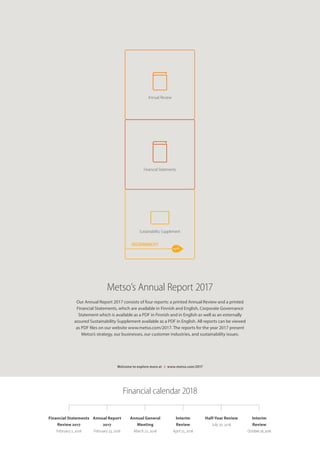
Metso has published four reports that together form
the Annual Report for 2017. This Financial Statements
has been published and printed in English and Finnish.
The“Read more”section contains additional sources
and information.
To read all of the four reports, the Annual Review,
the Financial Statements, the Corporate Governance
Statement and the Sustainability Supplement,
please visit our website www.metso.com/2017. On
the website, you can read our Annual Review and
Corporate Governance Statement for 2017 as a PDF file
in either English or Finnish. Sustainability information is
presented on the website in English, as a PDF file. The
Sustainability Supplement has been externally assured.
	metso.com
	metso.com/2017
	twitter.com/metsogroup
	facebook.com/metsoworld
	youtube.com/metsoworld
Readmore
|  Metso Financial Statements 2017  | 1
From the CEO
Last year was two-fold for Metso.There was a clear upward trend in all
our customer industries and especially the mining cycle saw a positive
turnaround. Our orders increased by 9%, driven by both the Minerals
and Flow Control segments. Our sales grew 5% to EUR 2.7 billion, but
this growth was not reflected on the bottom line, as our operating
profit (EBIT) totaled EUR 218 million, compared to EUR 227 million
in 2016.The most significant negative impacts on our results were
attributable to charges related to the challenges we faced in mining
projects and to ramping up our activity levels towards the end of the
year in the services business of the Minerals segment. Earnings per
share were further affected by one-off tax-related items totaling EUR
29 million, and EPS therefore came in at only EUR 0.68, compared to
EUR 0.87 in 2016. Our balance sheet and financial position, on the
other hand, continue to be healthy with net gearing at 1.8%.
Executing our strategy
Going forward, our market environment is expected to remain good,
providing us with attractive opportunities for profitable growth.To be
better equipped to execute on our growth plans, we implemented a
strategy review and an organizational change during the second half
of 2017.The outcome of those was that the fundamental elements of
Metso’s strategy are unchanged; we continue to target a leading posi-
tion in the chosen Minerals and Flow Control industries. However, the
way we are executing our strategy is being transformed. Compared
to the previous structure with three business areas, Metso now has
seven dedicated business areas: Mining Equipment, Aggregates
Equipment, Minerals Services, Minerals Consumables, Valves, Pumps,
and Recycling. Each of the seven business areas has clear priorities
and action plans to drive growth and improve financial performance
in their distinctive businesses.The new operating model further
strengthens the accountability of our businesses and speeds up
decision making to enable both the implementation of our growth
plans and an agile response to changes in the markets and in our
customers’needs.
We will also continue to increase the use of digital technologies
and data to create value for our customers through better productiv-
ity. Metso’s digital program is targeting to find real solutions that will
help our customers succeed.The digital initiatives go together with
our increased efforts in R&D, and we will invest more in innovation.
We are convinced that Metso has a role in tackling the opportunities
and challenges of a circular economy, urbanization and climate
change.Through the products and services that we innovate and
offer to our customers, we can have a noticeable impact on overall
efficiency and the sustainability of our customer industries.
Strong focus in improving performance
Our priorities for 2018 are crystal clear. We want to grow faster than
the market organically and complement that with acquisitions. All
our business areas face growing demand in their markets and they
have solid plans to capitalize on those opportunities. Even more im-
portantly, we need to improve our delivery capability and operational
efficiency to show better profitability alongside sales growth. Actions
needed for improved profitability have been implemented as of late
2017, and I am confident that results will be seen during 2018.
I want to thank all my colleagues at Metso, our customers, part-
ners, and shareholders for their support and commitment in 2017.
From the CEO
After several years of a challenging market environment we saw improving demand
in all our customer industries. Despite this, our results were affected by challenges
in mining projects and shortcomings in our ability to respond to a significant ramp-
up of activity in the Minerals services business. Corrective actions are in place
and Metso is in a good position – both financially and in terms of organizational
capability – to capitalize on the favorable market environment.
Eeva Sipilä
Interim President and CEO, CFO
2  |  Metso Financial Statements 2017  |
Board of Directors’ Report,
Financial Statements 2017
and investor information
Financial Statements 2017 comprise the audited Consolidated Financial Statements of Metso and Parent company
Financial Statements as well as the Board of Directors´ Report. Corporate Governance statement has been published
separately and is available on our website www.metso.com.
Table of contents
BOARD OF DIRECTORS’ REPORT
Financial year 2017  . . . . . . . . . . . . . . . . . . . . . . . . . . . . . . . . . . . . . . . . . . . . . . . 3
Non-financial information  . . . . . . . . . . . . . . . . . . . . . . . . . . . . . . . . . . . . . . 7
Corporate Governance Statement  . . . . . . . . . . . . . . . . . . . . . . . . . . . .  9
Shares and Shareholders  . . . . . . . . . . . . . . . . . . . . . . . . . . . . . . . . . . . . . .  10
Key Figures  . . . . . . . . . . . . . . . . . . . . . . . . . . . . . . . . . . . . . . . . . . . . . . . . . . . . . .  14
Board of Directors’ proposal on the use of profit  . . . . . . . . . .  16
CONSOLIDATED FINANCIAL STATEMENTS
Consolidated Statements of Income  . . . . . . . . . . . . . . . . . . . . . . . . .  17
Consolidated Statements of Comprehensive Income  . . . . .  17
Consolidated Balance Sheet  . . . . . . . . . . . . . . . . . . . . . . . . . . . . . . . . . .  18
Consolidated Statements of Cash Flows  . . . . . . . . . . . . . . . . . . . . 20
Consolidated Statements of Changes in
Shareholders’ Equity  . . . . . . . . . . . . . . . . . . . . . . . . . . . . . . . . . . . . . . . . . . . . 21
Notes to the Consolidated Financial Statements  . . . . . . . . . . 22
	 Group performance . . . . . . . . . . . . . . . . . . . . . . . . . . . . . . . . . . . . . . . .  23
		 Performance
		 1	 Reporting segments  . . . . . . . . . . . . . . . . . . . . . . . . . . . . . . . . . . . . . .  23
		 2	 Geographical information  . . . . . . . . . . . . . . . . . . . . . . . . . . . . . . . .  26
		 3	 Sales by category  . . . . . . . . . . . . . . . . . . . . . . . . . . . . . . . . . . . . . . . . .  27
		 4	 Selling, general and administrative expenses  . . . . . . . . . . . . . .  28
		 5	 Other operating income and expenses  . . . . . . . . . . . . . . . . . . . .  28
		 6	 Personnel expenses and the number of personnel  . . . . . . . . . 28
		 7	 Share-based payments  . . . . . . . . . . . . . . . . . . . . . . . . . . . . . . . . . . .  29
		 8	 Financial income and expenses  . . . . . . . . . . . . . . . . . . . . . . . . . . .  31
		 9	 Income taxes  . . . . . . . . . . . . . . . . . . . . . . . . . . . . . . . . . . . . . . . . . . . . .  31
		 10	 Earnings per share . . . . . . . . . . . . . . . . . . . . . . . . . . . . . . . . . . . . . . . .  33
		 Operational assets and liabilities
		 11	 Net working capital and capital employed  . . . . . . . . . . . . . . . .  34
		 12	 Trade and other receivables  . . . . . . . . . . . . . . . . . . . . . . . . . . . . . .  35
		 13	Inventory  . . . . . . . . . . . . . . . . . . . . . . . . . . . . . . . . . . . . . . . . . . . . . . . .  36
		 14	 Trade and other payables  . . . . . . . . . . . . . . . . . . . . . . . . . . . . . . . . .  36
		 15	Provisions  . . . . . . . . . . . . . . . . . . . . . . . . . . . . . . . . . . . . . . . . . . . . . . . .  37
		 16	 Post employment obligations  . . . . . . . . . . . . . . . . . . . . . . . . . . . . .  38
	 Intangible and tangible assets  . . . . . . . . . . . . . . . . . . . . . . . . . . .  42
		 17	 Goodwill and other intangible assets  . . . . . . . . . . . . . . . . . . . . .  42
		 18	 Tangible assets  . . . . . . . . . . . . . . . . . . . . . . . . . . . . . . . . . . . . . . . . . . .  44
		 19	 Depreciation and amortization  . . . . . . . . . . . . . . . . . . . . . . . . . . .  46
		 20	 Lease commitments  . . . . . . . . . . . . . . . . . . . . . . . . . . . . . . . . . . . . . .  46
	 Capital structure and financial instruments  . . . . . . . . . . . .  47
		 21	 Financial risk management  . . . . . . . . . . . . . . . . . . . . . . . . . . . . . . .  47
		 22	 Financial assets and liabilities by category  . . . . . . . . . . . . . . . . .  51
		 23	 Liquid funds . . . . . . . . . . . . . . . . . . . . . . . . . . . . . . . . . . . . . . . . . . . . . . 54
		 24	Equity  . . . . . . . . . . . . . . . . . . . . . . . . . . . . . . . . . . . . . . . . . . . . . . . . . . . .  54
		 25	Borrowings  . . . . . . . . . . . . . . . . . . . . . . . . . . . . . . . . . . . . . . . . . . . . . . .  56
		 26	 Interest bearing net debt reconciliation  . . . . . . . . . . . . . . . . . . .  57
		 27	 Contingent liabilities and other commitments  . . . . . . . . . . . . .  57
		 28	 Derivative instruments  . . . . . . . . . . . . . . . . . . . . . . . . . . . . . . . . . . .  58
	 Consolidation  . . . . . . . . . . . . . . . . . . . . . . . . . . . . . . . . . . . . . . . . . . . . . .  60
		 29	Subsidiaries . . . . . . . . . . . . . . . . . . . . . . . . . . . . . . . . . . . . . . . . . . . . . . .  61
		 30	 Associated companies, joint ventures and
	 related party transactions  . . . . . . . . . . . . . . . . . . . . . . . . . . . . . . . .  62
		 31	 Acquisitions and business disposals  . . . . . . . . . . . . . . . . . . . . . . .  63
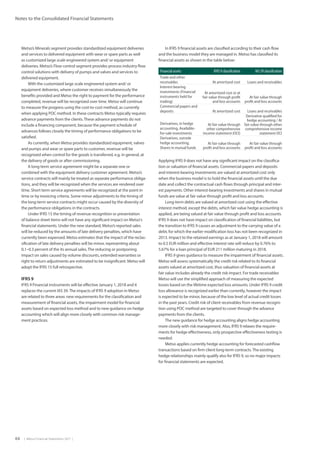
		 32	 New accounting standards  . . . . . . . . . . . . . . . . . . . . . . . . . . . . . . .  63
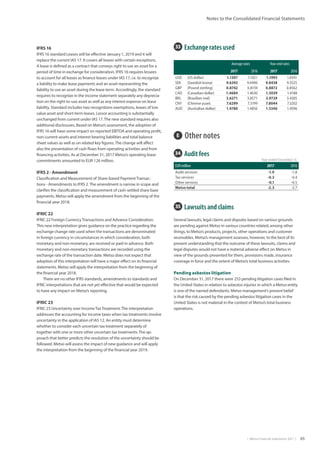
		 33	 Exchange rates used  . . . . . . . . . . . . . . . . . . . . . . . . . . . . . . . . . . . . . .  65
	 Other notes  . . . . . . . . . . . . . . . . . . . . . . . . . . . . . . . . . . . . . . . . . . . . . . . . .  65
		 34	 Audit fees  . . . . . . . . . . . . . . . . . . . . . . . . . . . . . . . . . . . . . . . . . . . . . . . .  65
		 35	 Lawsuits and claims  . . . . . . . . . . . . . . . . . . . . . . . . . . . . . . . . . . . . . .  65
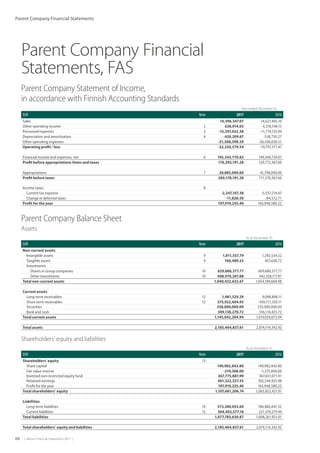
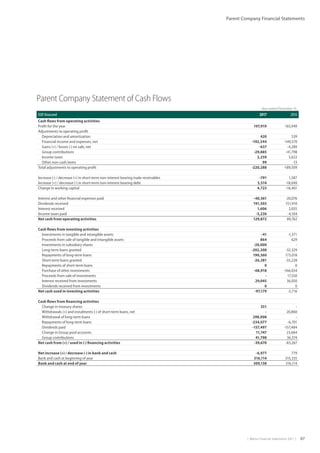
Parent company financial statements, FAS  . . . . . . . . . . . . . . . . . 66
SIGNATURES OF THE BOARD OF DIRECTORS’ REPORT AND
FINANCIAL STATEMENTS . . . . . . . . . . . . . . . . . . . . . . . . . . . . . . . . . . . . . . . . . . 76
Auditor’s Report  . . . . . . . . . . . . . . . . . . . . . . . . . . . . . . . . . . . . . . . . . . . . . . . . . 77
INVESTOR INFORMATION
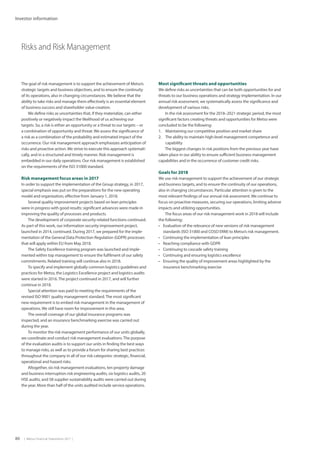
Risks and risk management  . . . . . . . . . . . . . . . . . . . . . . . . . . . . . . . . . . . 80
Board of Directors . . . . . . . . . . . . . . . . . . . . . . . . . . . . . . . . . . . . . . . . . . . . . . 82
Metso Executive Team  . . . . . . . . . . . . . . . . . . . . . . . . . . . . . . . . . . . . . . . . . 84
Investor information 2017 . . . . . . . . . . . . . . . . . . . . . . . . . . . . . . . . . . . . . . 86
Annual General Meeting 2018 . . . . . . . . . . . . . . . . . . . . . . . . . . . . . . . . . 88
|  Metso Financial Statements 2017  | 3
Board of Directors’ Report
Financial year 2017
Operating environment
The operating environment in our customer industries improved in
2017 compared to 2016. Demand was strongest in the aggregates
business. Mining customers increased their productivity-related invest-
ments.This resulted in higher demand for services, while the mining
equipment market saw improving demand, especially for replacements
and smaller capital expenditure. Activity in Flow Control’s main markets
was strong in day-to-day and services, while projects improved some-
what compared to the low level of the second half of the previous year.
Orders received and order backlog
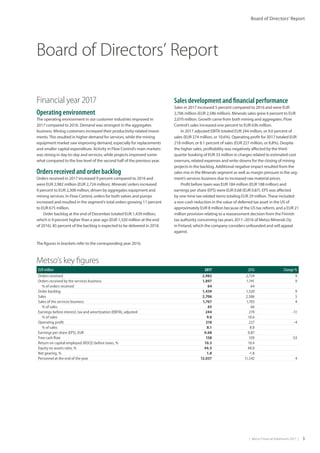
Orders received in 2017 increased 9 percent compared to 2016 and
were EUR 2,982 million (EUR 2,724 million). Minerals’orders increased
9 percent to EUR 2,308 million, driven by aggregates equipment and
mining services. In Flow Control, orders for both valves and pumps
increased and resulted in the segment’s total orders growing 11 percent
to EUR 675 million.
Order backlog at the end of December totaled EUR 1,439 million,
which is 9 percent higher than a year ago (EUR 1,320 million at the end
of 2016). 85 percent of the backlog is expected to be delivered in 2018.
Sales development and financial performance
Sales in 2017 increased 5 percent compared to 2016 and were EUR
2,706 million (EUR 2,586 million). Minerals sales grew 6 percent to EUR
2,070 million. Growth came from both mining and aggregates. Flow
Control’s sales increased one percent to EUR 636 million.
In 2017 adjusted EBITA totaled EUR 244 million, or 9.0 percent of
sales (EUR 274 million, or 10.6%). Operating profit for 2017 totaled EUR
218 million, or 8.1 percent of sales (EUR 227 million, or 8.8%). Despite
the higher sales, profitability was negatively affected by the third-
quarter booking of EUR 33 million in charges related to estimated cost
overruns, related expenses and write-downs for the closing of mining
projects in the backlog. Additional negative impact resulted from the
sales mix in the Minerals segment as well as margin pressure in the seg-
ment’s services business due to increased raw material prices.
Profit before taxes was EUR 184 million (EUR 188 million) and
earnings per share (EPS) were EUR 0.68 (EUR 0.87). EPS was affected
by one-time tax-related items totaling EUR 29 million.These included
a non-cash reduction in the value of deferred tax asset in the US of
approximately EUR 8 million because of the US tax reform, and a EUR 21
million provision relating to a reassessment decision from the Finnish
tax authority concerning tax years 2011–2016 of Metso Minerals Oy
in Finland, which the company considers unfounded and will appeal
against.
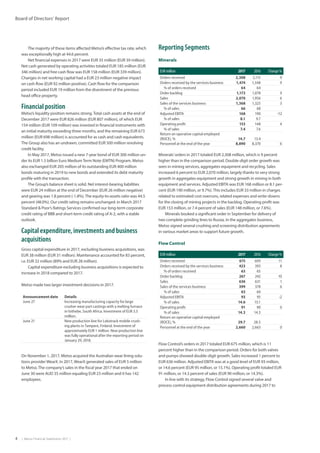
Metso’s key figures
EUR million 2017 2016 Change %
Orders received 2,982 2,724 9
Orders received by the services business 1,897 1,741 9
% of orders received 64 64
Order backlog 1,439 1,320 9
Sales 2,706 2,586 5
Sales of the services business 1,767 1,703 4
% of sales 65 66
Earnings before interest, tax and amortization (EBITA), adjusted 244 274 -11
% of sales 9.0 10.6
Operating profit 218 227 -4
% of sales 8.1 8.8
Earnings per share (EPS), EUR 0.68 0.87
Free cash flow 158 339 -53
Return on capital employed (ROCE) before taxes, % 10.3 10.4
Equity-to-assets ratio, % 44.5 48.0
Net gearing, % 1.8 -1.8
Personnel at the end of the year 12,037 11,542 4
The figures in brackets refer to the corresponding year 2016.
4  |  Metso Financial Statements 2017  |
Board of Directors’ Report
The majority of these items affected Metso’s effective tax rate, which
was exceptionally high at 44.6 percent.
Net financial expenses in 2017 were EUR 35 million (EUR 39 million).
Net cash generated by operating activities totaled EUR 185 million (EUR
346 million) and free cash flow was EUR 158 million (EUR 339 million).
Changes in net working capital had a EUR 23 million negative impact
on cash flow (EUR 92 million positive). Cash flow for the comparison
period included EUR 19 million from the divestment of the previous
head office property.
Financial position
Metso’s liquidity position remains strong.Total cash assets at the end of
December 2017 were EUR 826 million (EUR 807 million), of which EUR
154 million (EUR 109 million) was invested in financial instruments with
an initial maturity exceeding three months, and the remaining EUR 673
million (EUR 698 million) is accounted for as cash and cash equivalents.
The Group also has an undrawn, committed EUR 500 million revolving
credit facility.
In May 2017, Metso issued a new 7-year bond of EUR 300 million un-
der its EUR 1.5 billion Euro MediumTerm Note (EMTN) Program. Metso
also exchanged EUR 205 million of its outstanding EUR 400 million
bonds maturing in 2019 to new bonds and extended its debt maturity
profile with the transaction.
The Group’s balance sheet is solid. Net interest-bearing liabilities
were EUR 24 million at the end of December (EUR 26 million negative)
and gearing was 1.8 percent (-1.8%).The equity-to-assets ratio was 44.5
percent (48.0%). Our credit rating remains unchanged: in March 2017
Standard & Poor’s Ratings Services confirmed our long-term corporate
credit rating of BBB and short-term credit rating of A-2, with a stable
outlook.
Capital expenditure, investments and business
acquisitions
Gross capital expenditure in 2017, excluding business acquisitions, was
EUR 38 million (EUR 31 million). Maintenance accounted for 83 percent,
i.e. EUR 32 million (89% and EUR 28 million).
Capital expenditure excluding business acquisitions is expected to
increase in 2018 compared to 2017.
Metso made two larger investment decisions in 2017.
Announcement date Details
June 27 Increasing manufacturing capacity for large
crusher wear part castings with a melting furnace
in Isithebe, South Africa. Investment of EUR 3.5
million.
June 21 New production line for Lokotrack mobile crush-
ing plants in Tampere, Finland. Investment of
approximately EUR 1 million. New production line
was fully operational after the reporting period on
January 29, 2018.
On November 1, 2017, Metso acquired the Australian wear lining solu-
tions provider WearX. In 2017, WearX generated sales of EUR 5 million
to Metso.The company’s sales in the fiscal year 2017 that ended on
June 30 were AUD 35 million equaling EUR 23 million and it has 142
employees.
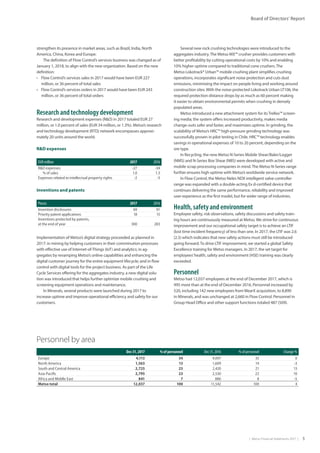
Reporting Segments
Minerals
EUR million 2017 2016 Change %
Orders received 2,308 2,115 9
Orders received by the services business 1,474 1,348 9
% of orders received 64 64
Order backlog 1,173 1,078 9
Sales 2,070 1,956 6
Sales of the services business 1,368 1,325 3
% of sales 66 68
Adjusted EBITA 168 190 -12
% of sales 8.1 9.7
Operating profit 153 148 4
% of sales 7.4 7.6
Return on operative capital employed
(ROCE), % 14.7 13.4
Personnel at the end of the year 8,890 8,370 6
Minerals’orders in 2017 totaled EUR 2,308 million, which is 9 percent
higher than in the comparison period. Double-digit order growth was
seen in mining services, aggregates equipment and recycling. Sales
increased 6 percent to EUR 2,070 million, largely thanks to very strong
growth in aggregates equipment and strong growth in mining in both
equipment and services. Adjusted EBITA was EUR 168 million or 8.1 per-
cent (EUR 190 million, or 9.7%).This includes EUR 33 million in charges
related to estimated cost overruns, related expenses and write-downs
for the closing of mining projects in the backlog. Operating profit was
EUR 153 million, or 7.4 percent of sales (EUR 148 million, or 7.6%).
Minerals booked a significant order in September for delivery of
two complete grinding lines to Russia. In the aggregates business,
Metso signed several crushing and screening distribution agreements
in various market areas to support future growth.
Flow Control
EUR million 2017 2016 Change %
Orders received 675 609 11
Orders received by the services business 423 393 8
% of orders received 63 65
Order backlog 267 242 10
Sales 636 631 1
Sales of the services business 399 378 6
% of sales 63 60
Adjusted EBITA 93 95 -2
% of sales 14.6 15.1
Operating profit 91 90 0
% of sales 14.3 14.3
Return on operative capital employed
(ROCE), % 29.7 28.5
Personnel at the end of the year 2,660 2,663 0
Flow Control’s orders in 2017 totaled EUR 675 million, which is 11
percent higher than in the comparison period. Orders for both valves
and pumps showed double-digit growth. Sales increased 1 percent to
EUR 636 million. Adjusted EBITA was at a good level of EUR 93 million,
or 14.6 percent (EUR 95 million, or 15.1%). Operating profit totaled EUR
91 million, or 14.3 percent of sales (EUR 90 million, or 14.3%).
In line with its strategy, Flow Control signed several valve and
process control equipment distribution agreements during 2017 to
|  Metso Financial Statements 2017  | 5
Board of Directors’ Report
strengthen its presence in market areas, such as Brazil, India, North
America, China, Korea and Europe.
The definition of Flow Control’s services business was changed as of
January 1, 2018, to align with the new organization. Based on the new
definition:
•	 Flow Control’s services sales in 2017 would have been EUR 227
­million, or 36 percent of total sales
•	 Flow Control’s services orders in 2017 would have been EUR 243
million, or 36 percent of total orders
Research and technology development
Research and development expenses (RD) in 2017 totaled EUR 27
million, or 1.0 percent of sales (EUR 34 million, or 1.3%). Metso’s research
and technology development (RTD) network encompasses approxi-
mately 20 units around the world.
RD expenses
EUR million 2017 2016
RD expenses -27 -34
% of sales 1.0 1.3
Expenses related to intellectual property rights -2 -3
Inventions and patents
Pieces 2017 2016
Invention disclosures 69 91
Priority patent applications 18 15
Inventions protected by patents,
at the end of year 300 283
Implementation of Metso’s digital strategy proceeded as planned in
2017: in mining by helping customers in their comminution processes
with effective use of Internet-of-Things (IoT) and analytics; in ag-
gregates by revamping Metso’s online capabilities and enhancing the
digital customer journey for the entire equipment lifecycle; and in flow
control with digital tools for the project business. As part of the Life
Cycle Services offering for the aggregates industry, a new digital solu-
tion was introduced that helps further optimize mobile crushing and
screening equipment operations and maintenance.
In Minerals, several products were launched during 2017 to
increase uptime and improve operational efficiency and safety for our
­customers.
Several new rock crushing technologies were introduced to the
aggregates industry.The Metso MX™ crusher provides customers with
better profitability by cutting operational costs by 10% and enabling
10% higher uptime compared to traditional cone crushers.The
Metso Lokotrack® Urban™ mobile crushing plant simplifies crushing
operations, incorporates significant noise protection and cuts dust
emissions, minimizing the impact on people living and working around
construction sites. With the noise-protected Lokotrack Urban LT106, the
required protection distance drops by as much as 60 percent making
it easier to obtain environmental permits when crushing in densely
populated areas.
Metso introduced a new attachment system for itsTrellex™ screen-
ing media; the system offers increased productivity, makes media
change-outs safer and faster, and maximizes uptime. In grinding, the
scalability of Metso’s HRC™ high-pressure grinding technology was
successfully proven in pilot testing in Chile. HRC™ technology enables
savings in operational expenses of 10 to 20 percent, depending on the
ore type.
In Recycling, the new Metso N-Series Mobile Shear/Baler/Logger
(NMS) and N-Series Box Shear (NBS) were developed with active and
mobile scrap processing companies in mind.The Metso N-Series range
further ensures high uptime with Metso’s worldwide service network.
In Flow Control, the Metso Neles NDX intelligent valve controller
range was expanded with a double-acting Ex d-certified device that
continues delivering the same performance, reliability and improved
user experience as the first model, but for wider range of industries.
Health, safety and environment
Employee safety, risk observations, safety discussions and safety train-
ing hours are continuously measured at Metso. We strive for continuous
improvement and our occupational safety target is to achieve an LTIF
(lost time incident frequency) of less than one. In 2017, the LTIF was 2.6
(2.5) which indicates that new safety actions must still be introduced
going forward.To drive LTIF improvement, we started a global Safety
Excellence training for Metso managers. In 2017, the set target for
employees’health, safety and environment (HSE) training was clearly
exceeded.
Personnel
Metso had 12,037 employees at the end of December 2017, which is
495 more than at the end of December 2016. Personnel increased by
520, including 142 new employees from WearX acquisition, to 8,890
in Minerals, and was unchanged at 2,660 in Flow Control. Personnel in
Group Head Office and other support functions totaled 487 (509).
Personnel by area
Dec 31, 2017 % of personnel Dec 31, 2016 % of personnel Change %
Europe 4,113 34 4,097 35 0
North America 1,563 13 1,609 14 -3
South and Central America 2,725 23 2,420 21 13
Asia-Pacific 2,795 23 2,530 22 10
Africa and Middle East 841 7 886 8 -5
Metso total 12,037 100 11,542 100 4
6  |  Metso Financial Statements 2017  |
Board of Directors’ Report
Annual General Meeting
The Annual General Meeting 2017 was held in Helsinki on March 23,
2017. A total of 1,457 shareholders representing 60 percent of the
company’s votes participated either in person or by proxy.The AGM ap-
proved the Financial Statements for 2016 and discharged the members
of the Board of Directors and the President and CEO from liability for
the 2016 financial year.The Nomination Board’s propos­als concerning
Board members and their remuneration were also approved.The
Authorized Public Accountant firm Ernst Young, and Mikko Järven-
tausta were elected as the company’s Auditor and principal responsible
auditor until the end of the next Annual General Meeting.The dividend
of EUR 1.05 per share was paid on April 4, 2017, in accordance with the
AGM’s decision.
The AGM approved the proposal of the Board of Directors to
authorize the Board to decide on the repurchase of Metso shares as
well as to decide on donations to universities.The Board decided on
authorizations to three universities,Tampere University ofTechnology,
Aalto University and the University of Oulu, totaling EUR one million on
June 8, 2017.
Board of Directors
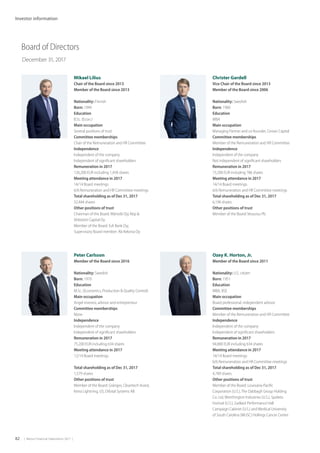
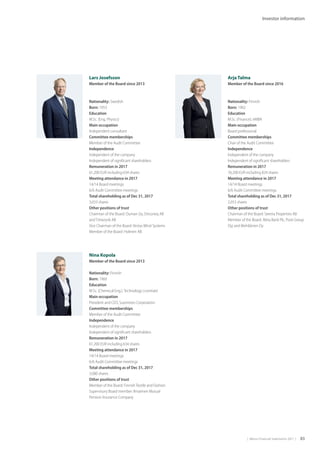
Metso’s Board of Directors in 2017 consisted of Mikael Lilius (Chair),
Christer Gardell (Vice Chair), Peter Carlsson, Ozey K. Horton Jr., Lars
Josefsson, Nina Kopola and ArjaTalma.The Board’s Audit Committee
consisted of ArjaTalma (Chair), Lars Josefsson and Nina Kopola.The
Remuneration and HR Committee consisted of Mikael Lilius (Chair),
Christer Gardell and Ozey K. Horton Jr.
After the reporting period, on January 22, 2018, it was announced
that Shareholders’Nomination Board will propose to the next An-
nual General Meeting that the Board of Directors should have eight
members and that Mikael Lilius, Christer Gardell, Peter Carlsson, Ozey
K. Horton, Jr., Lars Josefsson, Nina Kopola and ArjaTalma should be
re-elected. Mr. Antti Mäkinen, Managing Director of Solidium Oy, will
be proposed as a new Board member. Mikael Lilius will be proposed to
continue as Chair and Christer Gardell as Vice Chair of the Board.This
and other proposals by the Nomination Board will be included in the
Annual General Meeting invitation.
President and CEO
Matti Kähkönen was the President and CEO for the period of January
1–July 31, 2017. Nico Delvaux assumed his position as President and
CEO on August 1, 2017, but resigned on December 18 and will leave his
duties on February 2, 2018. After the reporting period, on January 22,
2018, CFO Eeva Sipilä was appointed Metso’s interim President and CEO
as of February 3, 2018.
New operating model
Metso’s new operating model and organization were announced on
September 25, 2017. Effective from January 1, 2018, it is designed to
accelerate strategy implementation by strengthening the services and
product businesses in the minerals and flow control markets with more
focus and agility. Metso’s new business areas are: Mining Equipment,
Aggregates Equipment, Minerals Services, Minerals Consumables,
Recycling, Valves, and Pumps.The Group’s reporting segments, Minerals
and Flow Control, remained unchanged.
Shares and share trading
As of December 31, 2017, Metso’s share capital was EUR 140,982,843.80
and the number of shares was 150,348,256.This included 351,128
treasury shares held by the Parent Company, which represented 0.2
percent of all shares and votes.There were no changes in the number
of shares or in share capital in 2017. A total of 126,888,336 Metso shares
were traded on Nasdaq OMX Helsinki in 2017, equivalent to a turnover
of EUR 3,749 million. Metso’s market capitalization, excluding shares
held by the Parent Company was EUR 4,270 million (EUR 4,065 million
at the end of 2016).
Metso share performance on Nasdaq OMX Helsinki
EUR 2017
Closing price 28.47
Highest share price 33.73
Lowest share price 26.46
Volume weighted average trading price 29.55
In addition to Nasdaq OMX Helsinki, Metso’s ADRs (American
Depositary Receipts) are traded on the International OTCQX market
in the United States under the ticker symbol ’MXCYY’, with four ADRs
representing one Metso share.The closing price of the Metso ADR on
December 31, 2017, was USD 8.40.
Flagging notifications
Under the provisions of the Finnish Securities Markets Act, sharehold-
ers of listed companies have an obligation to notify both the Finnish
Financial Supervision Authority and the company of changes when
their holdings reach, exceed or fall below a certain threshold. Metso is
not aware of any shareholders’agreements regarding Metso shares or
voting rights. All flagging notifications have been released as a stock
exchange release and the list of flaggings is also available at
www.metso.com/flaggings.
Short-termbusinessrisksandmarketuncertainties
Uncertainties in economic growth and political developments globally
might affect our customer industries, reduce the investment appetite
and cut spending among our customers, and thereby weaken the de-
mand for Metso’s products and services as well as affect business opera-
tions.There are also other market- or customer-related risks that may
cause on-going projects to be postponed, delayed or discontinued.
Continued growth and inflation in our markets might pose chal-
lenges to our supply chain and price management and could have an
impact on our margins.
Exchange rate fluctuations and changes in commodity prices might
affect our order intake, sales and financial performance, although the
wide scope of our operations limits the exposure to single currencies or
commodities. Metso hedges currency exposure linked to firm delivery
and purchase agreements.
Uncertain market conditions might adversely affect our customers’
payment behavior and increase the risk of lawsuits, claims and disputes
taken against Metso in various countries related to, among other
things, Metso’s products, projects and other operations.
An emerging risk area continues to be information security and
cyber threats, which can potentially disturb or disrupt Metso’s busi-
nesses and operations.
Market outlook
Demand for our products and services is expected to develop as
­follows:
•	 Remain stable for Minerals equipment and services
•	 Remain stable for Flow Control equipment and services
The outlook represents our expected sequential market development
with a rolling six-month view.
|  Metso Financial Statements 2017  | 7
Board of Directors’ Report
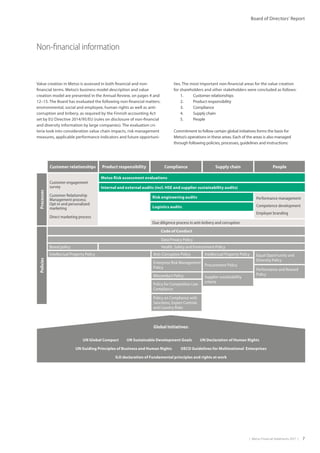
Value creation in Metso is assessed in both financial and non-
financial terms. Metso’s business model description and value
creation model are presented in the Annual Review, on pages 4 and
12–15. The Board has evaluated the following non-financial matters:
environmental, social and employee, human rights as well as anti-
corruption and bribery, as required by the Finnish accounting Act
set by EU Directive 2014/95/EU (rules on disclosure of non-financial
and diversity information by large companies). The evaluation cri-
teria took into consideration value chain impacts, risk management
measures, applicable performance indicators and future opportuni-
ties. The most important non-financial areas for the value creation
for shareholders and other stakeholders were concluded as follows:
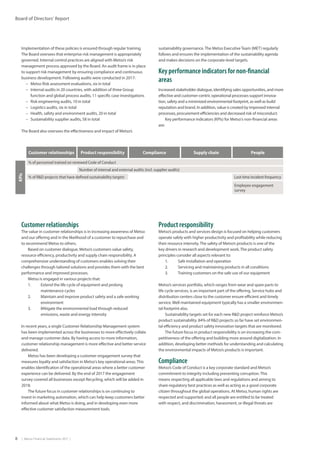
1. 	 Customer relationships
2. 	 Product responsibility
3. 	 Compliance
4. 	 Supply chain
5. 	 People
Commitment to follow certain global initiatives forms the basis for
Metso’s operations in these areas. Each of the areas is also managed
through following policies, processes, guidelines and instructions:
Non-financial information
Customer relationships ComplianceProduct responsibility Supply chain People
Global Initiatives:
UN Global Compact UN Sustainable Development Goals UN Declaration of Human Rights
UN Guiding Principles of Business and Human Rights OECD Guidelines for Multinational Enterprises
ILO declaration of Fundamental principles and rights at work
International Chamber of Commerce Business Charter for sustainable development
Anti-Corruption Policy
Policy for Competition Law
Compliance
Policy on Compliance with
Sanctions, Export Controls
and Country Risks
ProcessesPolicies
Metso Risk assessment evaluations
Code of Conduct
Data Privacy Policy
Brand policy
Intellectual Property PolicyIntellectual Property Policy
Enterprise Risk Management
Policy
Procurement Policy
Equal Opportunity and
Diversity Policy
Misconduct Policy Supplier sustainability
criteria
Performance and Reward
Policy
Health, Safety and Environment Policy
Internal and external audits (incl. HSE and supplier sustainability audits)
Performance management
Competence development
Employer branding
Customer engagement
survey
Customer Relationship
Management process;
Opt-in and personalized
marketing
Direct marketing process
Risk engineering audits
Due diligence process in anti-bribery and corruption
Logistics audits
8  |  Metso Financial Statements 2017  |
Board of Directors’ Report
Implementation of these policies is ensured through regular training.
The Board oversees that enterprise risk management is appropriately
governed. Internal control practices are aligned with Metso’s risk
management process approved by the Board. An audit frame is in place
to support risk management by ensuring compliance and continuous
business development. Following audits were conducted in 2017:
–– Metso Risk assessment evaluations, six in total
–– Internal audits in 20 countries, with addition of three Group
­function and global process audits, 11 specific case investigations
–– Risk engineering audits, 10 in total
–– Logistics audits, six in total
–– Health, safety and environment audits, 20 in total
–– Sustainability supplier audits, 58 in total
The Board also oversees the effectiveness and impact of Metso’s
sustainability governance.The Metso ExecutiveTeam (MET) regularly
follows and ensures the implementation of the sustainability agenda
and makes decisions on the corporate-level targets.
Key performance indicators for non-financial
areas
Increased stakeholder dialogue, identifying sales opportunities, and more
effective and customer-centric operational processes support innova-
tion, safety and a minimized environmental footprint, as well as build
reputation and brand. In addition, value is created by improved internal
processes, procurement efficiencies and decreased risk of misconduct.
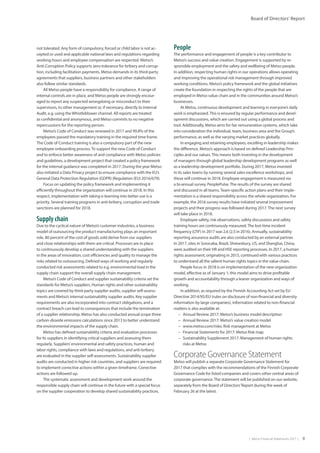
Key performance indicators (KPIs) for Metso's non-financial areas
are:
Customer relationships
The value in customer relationships is in increasing awareness of Metso
and our offering and in the likelihood of a customer to repurchase and
to recommend Metso to others.
Based on customer dialogue, Metso’s customers value safety,
resource efficiency, productivity and supply chain responsibility. A
comprehensive understanding of customers enables solving their
challenges through tailored solutions and provides them with the best
performance and improved processes.
Metso is engaged in various projects that:
1.	Extend the life cycle of equipment and prolong
­maintenance cycles
2.	Maintain and improve product safety and a safe working
environment
3.	Mitigate the environmental load through reduced
­emissions, waste and energy intensity
In recent years, a single Customer Relationship Management system
has been implemented across the businesses to more effectively collate
and manage customer data. By having access to more information,
customer relationship management is more effective and better service
delivered.
Metso has been developing a customer engagement survey that
measures loyalty and satisfaction in Metso's key operational areas.This
enables identification of the operational areas where a better customer
experience can be delivered. By the end of 2017 the engagement
survey covered all businesses except Recycling, which will be added in
2018.
The future focus in customer relationships is on continuing to
invest in marketing automation, which can help keep customers better
informed about what Metso is doing, and in developing even more
effective customer satisfaction measurement tools.
Product responsibility
Metso’s products and services design is focused on helping customers
operate safely with higher productivity and profitability while reducing
their resource intensity.The safety of Metso’s products is one of the
key drivers in research and development work.The product safety
principles consider all aspects relevant to:
1.	 Safe installation and operation
2.	 Servicing and maintaining products in all conditions
3.	 Training customers on the safe use of our equipment
Metso’s services portfolio, which ranges from wear and spare parts to
life cycle services, is an important part of the offering. Service hubs and
distribution centers close to the customer ensure efficient and timely
service. Well maintained equipment typically has a smaller environmen-
tal footprint also.
Sustainability targets set for each new RD project reinforce Metso’s
product sustainability. 84% of RD projects so far have set environmen-
tal efficiency and product safety innovation targets that are monitored.
The future focus in product responsibility is on increasing the com-
petitiveness of the offering and building more around digitalization. In
addition, developing better methods for understanding and calculating
the environmental impacts of Metso’s products is important.
Compliance
Metso’s Code of Conduct is a key corporate standard and Metso’s
commitment to integrity including preventing corruption.This
means respecting all applicable laws and regulations and aiming to
share regulatory best practices as well as acting as a good corporate
citizen throughout the global operations. At Metso, human rights are
respected and supported: and all people are entitled to be treated
with respect, and discrimination, harassment, or illegal threats are
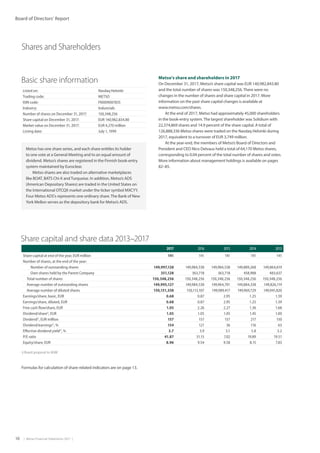
KPIs
Customer relationships ComplianceProduct responsibility Supply chain People
% of RD projects that have defined sustainability targets Lost-time incident frequency
Employee engagement
survey
Number of internal and external audits (incl. supplier audits)
% of personnel trained on renewed Code of Conduct
|  Metso Financial Statements 2017  | 9
Board of Directors’ Report
not tolerated. Any form of compulsory, forced or child labor is not ac-
cepted or used and applicable national laws and regulations regarding
working hours and employee compensation are respected. Metso’s
Anti-Corruption Policy supports zero-tolerance for bribery and corrup-
tion, including facilitation payments. Metso demands in its third-party
agreements that suppliers, business partners and other stakeholders
also follow similar standards.
All Metso people have a responsibility for compliance. A range of
internal controls are in place, and Metso people are strongly encour-
aged to report any suspected wrongdoing or misconduct to their
supervisors, to other management or, if necessary, directly to Internal
Audit, e.g. using the Whistleblower channel. All reports are treated
as confidential and anonymous, and Metso commits to no negative
repercussions for the reporting person.
Metso’s Code of Conduct was renewed in 2017 and 99.8% of the
employees passed the mandatory training in the required time frame.
The Code of Conduct training is also a compulsory part of the new
employee onboarding process.To support the new Code of Conduct
and to enforce better awareness of and compliance with Metso policies
and guidelines, a development project that created a policy framework
for the internal guidance was completed in 2017. During the year Metso
also initiated a Data Privacy project to ensure compliance with the EU’s
General Data Protection Regulation (GDPR) (Regulation (EU) 2016/679).
Focus on updating the policy framework and implementing it
efficiently throughout the organization will continue in 2018. In this
respect, implementation with taking e-learning into better use is a
priority. Several training programs in anti-bribery, corruption and trade
sanctions are planned for 2018.
Supply chain
Due to the cyclical nature of Metso’s customer industries, a business
model of outsourcing the product manufacturing plays an important
role. 80 percent of the cost of goods sold derive from our suppliers
and close relationships with them are critical. Processes are in place
to continuously develop a shared understanding with the suppliers
in the areas of innovation, cost efficiencies and quality to manage the
risks related to outsourcing. Defined ways of working and regularly
conducted risk assessments related to e.g. environmental load in the
supply chain support the overall supply chain management.
Metso’s Code of Conduct and supplier sustainability criteria set the
standards for Metso’s suppliers. Human rights and other sustainability
topics are covered by third-party supplier audits, supplier self-assess-
ments and Metso’s internal sustainability supplier audits. Key supplier
requirements are also incorporated into contract obligations, and a
contract breach can lead to consequences that include the termination
of a supplier relationship. Metso has also conducted annual scope three
carbon-dioxide emissions calculations since 2013 to better understand
the environmental impacts of the supply chain.
Metso has defined sustainability criteria and evaluation processes
for its suppliers in identifying critical suppliers and assessing them
regularly. Suppliers’environmental and safety practices, human and
labor rights, compliance with laws and regulations, and anti-bribery
are evaluated in the supplier self-assessments. Sustainability supplier
audits are conducted in higher risk countries, and suppliers are required
to implement corrective actions within a given timeframe. Corrective
actions are followed up.
The systematic assessment and development work around the
responsible supply chain will continue in the future with a special focus
on the supplier cooperation to develop shared sustainability practices.
People
The performance and engagement of people is a key contributor to
Metso’s success and value creation. Engagement is supported by re-
sponsible employment and the safety and wellbeing of Metso people.
In addition, respecting human rights in our operations allows operating
and improving the operational risk management through improved
working conditions. Metso’s policy framework and the global initiatives
create the foundation in respecting the rights of the people that are
employed in Metso value chain and in the communities around Metso’s
businesses.
At Metso, continuous development and learning in everyone’s daily
work is emphasized.This is ensured by regular performance and devel-
opment discussions, which are carried out using a global process and
tool. Additionally, Metso aims for fair remuneration systems, which take
into consideration the individual, team, business area and the Group’s
performance, as well as the varying market practices globally.
In engaging and retaining employees, excelling in leadership makes
the difference. Metso’s approach is based on defined Leadership Prin-
ciples and our values.This means both investing in the development
of managers through global leadership development programs as well
as a leadership development portfolio. During 2017, Metso invested
in its sales teams by running several sales excellence workshops, and
these will continue in 2018. Employee engagement is measured via
a bi-annual survey, PeoplePulse.The results of the survey are shared
and discussed in all teams.Team-specific action plans and their imple-
mentation is a shared responsibility across the whole organization. For
example, the 2016 survey results have initiated several improvement
projects and their progress was followed during 2017.The next survey
will take place in 2018.
Employee safety, risk observations, safety discussions and safety
training hours are continuously measured.The lost-time incident
frequency (LTIF) in 2017 was 2.6 (2.5 in 2016). Annually, sustainability
reporting assurance audits are also conducted by an external partner.
In 2017, sites in Sorocaba, Brazil, Shrewsbury, US, and Shanghai, China,
were audited on their HR and HSE reporting processes. In 2017, a human
rights assessment, originating in 2015, continued with various practices
to understand all the salient human rights topics in the value chain.
People focus in 2018 is on implementation of the new organization
model, effective as of January 1; this model aims to drive profitable
growth and accountability through a leaner organization and ways of
working.
In addition, as required by the Finnish Accounting Act set by EU
Directive 2014/95/EU (rules on disclosure of non-financial and diversity
information by large companies), information related to non-financial
matters is also available at:
–– Annual Review 2017: Metso’s business model description
–– Annual Review 2017: Metso’s value creation model
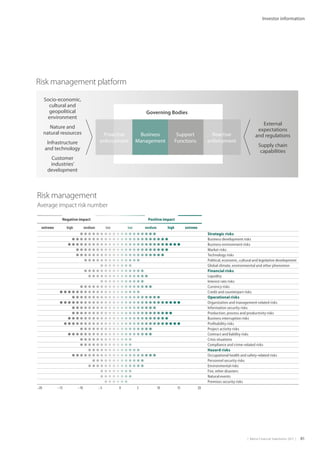
–– www.metso.com/risks: Risk management at Metso
–– Financial Statements for 2017: Metso Risk map
–– Sustainability Supplement 2017: Management of human rights
risks at Metso
Corporate Governance Statement
Metso will publish a separate Corporate Governance Statement for
2017 that complies with the recommendations of the Finnish Corporate
Governance Code for listed companies and covers other central areas of
corporate governance.The statement will be published on our website,
separately from the Board of Directors’Report during the week of
February 26 at the latest.
10  |  Metso Financial Statements 2017  |
Board of Directors’ Report
Shares and Shareholders
Basic share information
Listed on: Nasdaq Helsinki
Trading code: METSO
ISIN code: FI0009007835
Industry: Industrials
Number of shares on December 31, 2017: 150,348,256
Share capital on December 31, 2017: EUR 140,982,834.80
Market value on December 31, 2017: EUR 4,270 million
Listing date: July 1, 1999
2017 2016 2015 2014 2013
Share capital at end of the year, EUR million 141 141 141 141 141
Number of shares, at the end of the year:
Number of outstanding shares 149,997,128 149,984,538 149,984,538 149,889,268 149,864,619
Own shares held by the Parent Company 351,128 363,718 363,718 458,988 483,637
Total number of shares 150,348,256 150,348,256 150,348,256 150,348,256 150,348,256
Average number of outstanding shares 149,995,127 149,984,538 149,964,701 149,884,338 149,826,119
Average number of diluted shares 150,151,338 150,113,107 149,989,417 149,969,729 149,941,820
Earnings/share, basic, EUR 0.68 0.87 2.95 1.25 1.59
Earnings/share, diluted, EUR 0.68 0.87 2.95 1.25 1.59
Free cash flow/share, EUR 1.05 2.26 2.27 1.36 1.68
Dividend/share1)
, EUR 1.05 1.05 1.05 1.45 1.00
Dividend1)
, EUR million 157 157 157 217 150
Dividend/earnings1)
, % 154 121 36 116 63
Effective dividend yield1)
, % 3.7 3.9 5.1 5.8 3.2
P/E ratio 41.87 31.15 7.02 19.89 19.51
Equity/share, EUR 8.96 9.54 9.58 8.15 7.83
1) Board proposal to AGM
Formulas for calculation of share-related indicators are on page 13.
Share capital and share data 2013–2017
Metso has one share series, and each share entitles its holder
to one vote at a General Meeting and to an equal amount of
dividend. Metso’s shares are registered in the Finnish book-entry
system maintained by Euroclear.
Metso shares are also traded on alternative marketplaces
like BOAT, BATS Chi-X andTurquoise. In addition, Metso’s ADS
(American Depositary Shares) are traded in the United States on
the International OTCQX market under the ticker symbol MXCYY.
Four Metso ADS's represents one ordinary share.The Bank of New
York Mellon serves as the depository bank for Metso’s ADS.
Metso’s share and shareholders in 2017
On December 31, 2017, Metso’s share capital was EUR 140,982,843.80
and the total number of shares was 150,348,256.There were no
changes in the number of shares and share capital in 2017. More
information on the past share capital changes is available at
www.metso.com/shares.
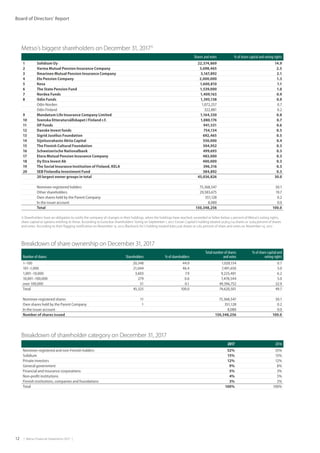
At the end of 2017, Metso had approximately 45,000 shareholders
in the book-entry system.The largest shareholder was Solidium with
22,374,869 shares and 14.9 percent of the share capital. A total of
126,888,336 Metso shares were traded on the Nasdaq Helsinki during
2017, equivalent to a turnover of EUR 3,749 million.
At the year-end, the members of Metso’s Board of Directors and
President and CEO Nico Delvaux held a total of 64,170 Metso shares,
corresponding to 0.04 percent of the total number of shares and votes.
More information about management holdings is available on pages
82–85.
|  Metso Financial Statements 2017  | 11
Board of Directors’ Report
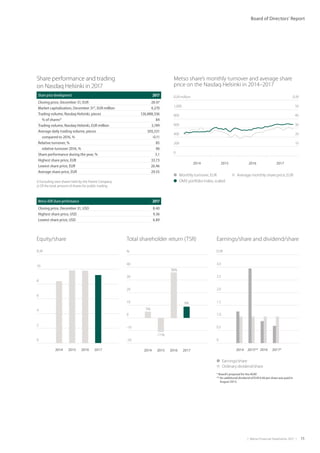
2014 2015 2016 2017
Equity/share
EUR
10
8
6
4
2
0
%
40
30
20
10
0
-10
-20
2014 2015 2016 2017
Total shareholder return (TSR)
36%
9%
5%
-11%
Share performance and trading
on Nasdaq Helsinki in 2017
2014 2015 2016 2017
Metso share’s monthly turnover and average share
price on the Nasdaq Helsinki in 2014–2017
Monthly turnover, EUR Average monthly share price, EUR
OMX portfolio index, scaled
EUR million EUR
1,000 50
800 40
600 30
400 20
200 10
0
Share price development 2017
Closing price, December 31, EUR 28.47
Market capitalization, December 311)
, EUR million 4,270
Trading volume, Nasdaq Helsinki, pieces 126,888,336
% of shares2)
84
Trading volume, Nasdaq Helsinki, EUR million 3,749
Average daily trading volume, pieces 505,531
compared to 2016, % -0.11
Relative turnover, % 85
relative turnover 2016, % 96
Share performance during the year, % 5.1
Highest share price, EUR 33.73
Lowest share price, EUR 26.46
Average share price, EUR 29.55
1) Excluding own shares held by the Parent Company
2) Of the total amount of shares for public trading
Metso ADR share performance 2017
Closing price, December 31, USD 8.40
Highest share price, USD 9.36
Lowest share price, USD 6.89
2014 2015** 2016 2017*
Earnings/share and dividend/share
* Board’s proposal for the AGM
** An additional dividend of EUR 0.40 per share was paid in
August 2015.
Earnings/share
Ordinary dividend/share
EUR
3.0
2.5
2.0
1.5
1.0
0.5
0
12  |  Metso Financial Statements 2017  |
Board of Directors’ Report
Metso´s biggest shareholders on December 31, 20171)
Shares and votes % of share capital and voting rights
1 Solidium Oy 22,374,869 14.9
2 Varma Mutual Pension Insurance Company 3,698,465 2.5
3 Ilmarinen Mutual Pension Insurance Company 3,167,892 2.1
4 Elo Pension Company 2,000,000 1.3
5 Keva 1,600,810 1.1
6 The State Pension Fund 1,539,000 1.0
7 Nordea Funds 1,409,163 0.9
8 Odin Funds 1,395,138 0.9
Odin Norden 1,072,257 0.7
Odin Finland 322,881 0.2
9 Mandatum Life Insurance Company Limited 1,164,330 0.8
10 Svenska litteratursällskapet i Finland r.f. 1,080,176 0.7
11 OP Funds 941,531 0.6
12 Danske Invest funds 754,134 0.5
13 Sigrid Jusélius Foundation 692,465 0.5
14 Sijoitusrahasto Aktia Capital 550,000 0.4
15 The Finnish Cultural Foundation 504,952 0.3
16 Schweizerische Nationalbank 499,693 0.3
17 Etera Mutual Pension Insurance Company 483,000 0.3
18 Oy Etra Invest Ab 400,000 0.3
19 The Social Insurance Institution of Finland, KELA 396,316 0.3
20 SEB Finlandia Investment Fund 384,892 0.3
20 largest owner groups in total 45,036,826 30.0
Nominee-registered holders 75,368,547 50.1
Other shareholders 29,583,675 19.7
Own shares held by the Parent Company 351,128 0.2
In the issuer account 8,080 0.0
Total 150,348,256 100.0
1) Shareholders have an obligation to notify the company of changes in their holdings, when the holdings have reached, exceeded or fallen below 5 percent of Metso’s voting rights,
share capital or options entitling to these. According to Euroclear shareholders’ listing on September 1, 2017 Cevian Capital’s holding totaled 20,813,714 shares or 13.84 percent of shares
and votes. According to their flagging notification on November 15, 2017, Blackrock Inc’s holding totaled 8,801,526 shares or 5.85 percent of share and votes on November 14, 2017.
Breakdown of share ownership on December 31, 2017
Number of shares Shareholders % of shareholders
Total number of shares
and votes
% of share capital and
voting rights
1–100 20,348 44.9 1,028,154 0.7
101–1,000 21,044 46.4 7,491,650 5.0
1,001–10,000 3,603 7.9 9,225,401 6.2
10,001–100,000 279 0.6 7,478,544 5.0
over 100,000 51 0.1 49,396,752 32.9
Total 45,325 100.0 74,620,501 49.7
Nominee-registered shares 11 75,368,547 50.1
Own shares held by the Parent Company 1 351,128 0.2
In the issuer account 8,080 0.0
Number of shares issued 150,348,256 100.0
Breakdown of shareholder category on December 31, 2017
2017 2016
Nominee-registered and non-Finnish holders 52% 55%
Solidium 15% 15%
Private investors 12% 12%
General government 9% 8%
Financial and insurance corporations 5% 3%
Non-profit institutions 4% 5%
Finnish institutions, companies and foundations 3% 2%
Total 100% 100%
|  Metso Financial Statements 2017  | 13
Board of Directors’ Report
Flaggings
Under the provisions of the Finnish Securities Markets Act, sharehold-
ers of listed companies have an obligation to notify both the Finnish
Financial Supervision Authority and the company of changes when
their holdings reach, exceed or fall below a certain threshold. Metso
is not aware of any shareholders’agreements regarding Metso shares
or voting rights. All flagging notifications have been released as a
stock exchange release and the list of flaggings is also available at
www.metso.com/flaggings.
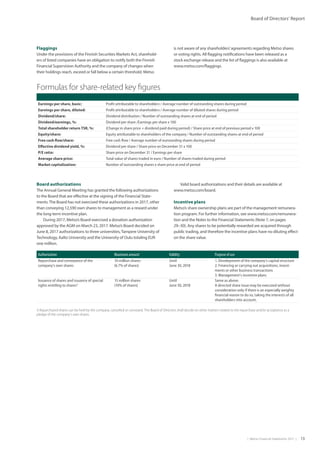
Formulas for share-related key figures
Earnings per share, basic: Profit attributable to shareholders / Average number of outstanding shares during period
Earnings per share, diluted: Profit attributable to shareholders / Average number of diluted shares during period
Dividend/share: Dividend distribution / Number of outstanding shares at end of period
Dividend/earnings, %: Dividend per share /Earnings per share x 100
Total shareholder return TSR, %: (Change in share price + dividend paid during period) / Share price at end of previous period x 100
Equity/share: Equity attributable to shareholders of the company / Number of outstanding shares at end of period
Free cash flow/share: Free cash flow / Average number of outstanding shares during period
Effective dividend yield, %: Dividend per share / Share price on December 31 x 100
P/E ratio: Share price on December 31 / Earnings per share
Average share price: Total value of shares traded in euro / Number of shares traded during period
Market capitalization: Number of outstanding shares x share price at end of period
Authorization Maximum amount Validity Purpose of use
Repurchase and conveyance of the
company’s own shares
10 million shares
(6.7% of shares)
Until
June 30, 2018
1. Development of the company's capital structure
2. Financing or carrying out acquisitions, invest-
ments or other business transactions
3. Management's incentive plans
Issuance of shares and issuance of special
rights entitling to shares1)
15 million shares
(10% of shares)
Until
June 30, 2018
Same as above.
A directed share issue may be executed without
consideration only if there is an especially weighty
financial reason to do so, taking the interests of all
shareholders into account.
1) Repurchased shares can be held by the company, cancelled or conveyed. The Board of Directors shall decide on other matters related to the repurchase and/or acceptance as a
pledge of the company’s own shares.
Board authorizations
The Annual General Meeting has granted the following authorizations
to the Board that are effective at the signing of the Financial State-
ments.The Board has not exercised these authorizations in 2017, other
than conveying 12,590 own shares to management as a reward under
the long-term incentive plan.
During 2017, Metso’s Board exercised a donation authorization
approved by the AGM on March 23, 2017. Metso’s Board decided on
June 8, 2017 authorizations to three universities,Tampere University of
Technology, Aalto University and the University of Oulu totaling EUR
one million.
Valid board authorizations and their details are available at
www.metso.com/board.
Incentive plans
Metso’s share ownership plans are part of the management remunera-
tion program. For further information, see www.metso.com/remunera-
tion and the Notes to the Financial Statements (Note 7, on pages
29–30). Any shares to be potentially rewarded are acquired through
public trading, and therefore the incentive plans have no diluting effect
on the share value.
14  |  Metso Financial Statements 2017  |
Board of Directors’ Report
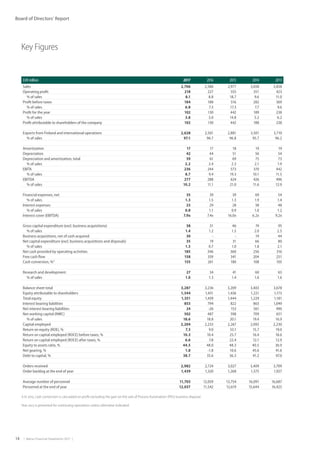
Key Figures
EUR million 2017 2016 2015 2014 2013
Sales 2,706 2,586 2,977 3,658 3,858
Operating profit 218 227 555 351 423
% of sales 8.1 8.8 18.7 9.6 11.0
Profit before taxes 184 188 516 282 369
% of sales 6.8 7.3 17.3 7.7 9.6
Profit for the year 102 130 442 189 238
% of sales 3.8 5.0 14.8 5.2 6.2
Profit attributable to shareholders of the company 102 130 442 188 238
Exports from Finland and international operations 2,628 2,501 2,881 3,501 3,710
% of sales 97.1 96.7 96.8 95.7 96.2
Amortization 17 17 18 19 19
Depreciation 42 44 51 56 54
Depreciation and amortization, total 59 61 69 75 73
% of sales 2.2 2.4 2.3 2.1 1.9
EBITA 236 244 573 370 442
% of sales 8.7 9.4 19.3 10.1 11.5
EBITDA 277 288 624 426 496
% of sales 10.2 11.1 21.0 11.6 12.9
Financial expenses, net 35 39 39 69 54
% of sales 1.3 1.5 1.3 1.9 1.4
Interest expenses 23 29 28 38 48
% of sales 0.8 1.1 0.9 1.0 1.2
Interest cover (EBITDA) 7.9x 7.4x 16.0x 6.2x 9.2x
Gross capital expenditure (excl. business acquisitions) 38 31 46 74 95
% of sales 1.4 1.2 1.5 2.0 2.5
Business acquisitions, net of cash acquired 30 - - 19 44
Net capital expenditure (excl. business acquisitions and disposals) 35 19 31 66 80
% of sales 1.3 0.7 1.0 1.8 2.1
Net cash provided by operating activities 185 346 360 256 316
Free cash flow 158 339 341 204 251
Cash conversion, %1)
155 261 180 108 105
Research and development 27 34 41 60 63
% of sales 1.0 1.3 1.4 1.6 1.6
Balance sheet total 3,287 3,236 3,209 3,403 3,678
Equity attributable to shareholders 1,344 1,431 1,436 1,221 1,173
Total equity 1,351 1,439 1,444 1,229 1,181
Interest bearing liabilities 853 794 822 863 1,049
Net interest bearing liabilities 24 -26 153 561 490
Net working capital (NWC) 502 487 598 709 651
% of sales 18.6 18.8 20.1 19.4 16.9
Capital employed 2,204 2,233 2,267 2,092 2,230
Return on equity (ROE), % 7.3 9.0 33.1 15.7 19.0
Return on capital employed (ROCE) before taxes, % 10.3 10.4 25.7 16.4 18.6
Return on capital employed (ROCE) after taxes, % 6.6 7.8 22.4 12.1 12.9
Equity to assets ratio, % 44.5 48.0 48.3 40.5 36.9
Net gearing, % 1.8 -1.8 10.6 45.6 41.6
Debt to capital, % 38.7 35.6 36.3 41.2 47.0
Orders received 2,982 2,724 3,027 3,409 3,709
Order backlog at the end of year 1,439 1,320 1,268 1,575 1,927
Average number of personnel 11,703 12,059 13,754 16,091 16,687
Personnel at the end of year 12,037 11,542 12,619 15,644 16,425
1) In 2015, cash conversion is calculated on profit excluding the gain on the sale of Process Automation (PAS) business disposal.
Year 2013 is presented for continuing operations unless otherwise indicated.
|  Metso Financial Statements 2017  | 15
Board of Directors’ Report
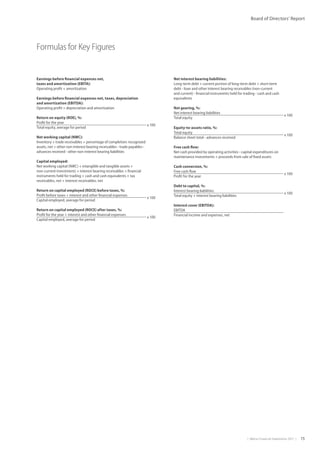
Earnings before financial expenses net,
taxes and amortization (EBITA):
Operating profit + amortization
Earnings before financial expenses net, taxes, depreciation
and amortization (EBITDA):
Operating profit + depreciation and amortization
Return on equity (ROE), %:
Profit for the year
x 100
Total equity, average for period
Net working capital (NWC):
Inventory + trade receivables + percentage of completion: ­recognized
assets, net + other non-interest bearing receivables - trade payables -
advances received - other non-interest bearing liabilities
Capital employed:
Net working capital (NWC) + intangible and tangible assets +
non-current investments + interest bearing receivables + financial
­instruments held for trading + cash and cash equivalents + tax
receivables, net + interest receivables, net
Return on capital employed (ROCE) before taxes, %:
Profit before taxes + interest and other financial expenses
x 100
Capital employed, average for period
Return on capital employed (ROCE) after taxes, %:
Profit for the year + interest and other financial expenses
x 100
Capital employed, average for period
Formulas for Key Figures	
Net interest bearing liabilities:
Long-term debt + current portion of long-term debt + short-term
debt - loan and other interest bearing receivables (non-current
and current) - financial instruments held for trading - cash and cash
equivalents
Net gearing, %:
Net interest bearing liabilities
x 100
Total equity
Equity-to-assets ratio, %:
Total equity
x 100
Balance sheet total - advances received
Free cash flow:
Net cash provided by operating activities - capital expenditures on
maintenance investments + proceeds from sale of fixed assets
Cash conversion, %:
Free cash flow
x 100
Profit for the year
Debt to capital, %:
Interest bearing liabilities
x 100
Total equity + interest bearing liabilities
Interest cover (EBITDA):
EBITDA
Financial income and expenses, net
16  |  Metso Financial Statements 2017  |
Board of Directors’ Report
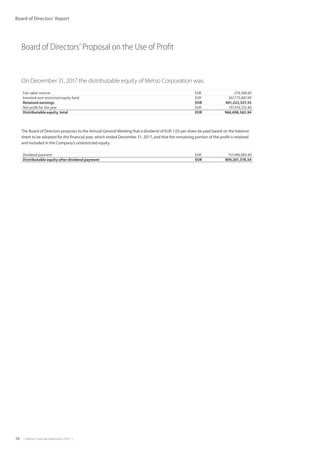
Board of Directors’ Proposal on the Use of Profit
On December 31, 2017 the distributable equity of Metso Corporation was:
Fair value reserve EUR -219,308.00
Invested non-restricted equity fund EUR 367,775,887.99
Retained earnings EUR 401,222,527.55
Net profit for the year EUR 197,919,255.40
Distributable equity, total EUR 966,698,362.94
Dividend payment EUR 157,496,984.40
Distributable equity after dividend payment EUR 809,201,378.54
The Board of Directors proposes to the Annual General Meeting that a dividend of EUR 1.05 per share be paid based on the balance
sheet to be adopted for the financial year, which ended December 31, 2017, and that the remaining portion of the profit is retained
and included in the Company’s unrestricted equity.
|  Metso Financial Statements 2017  | 17
Consolidated Financial Statements
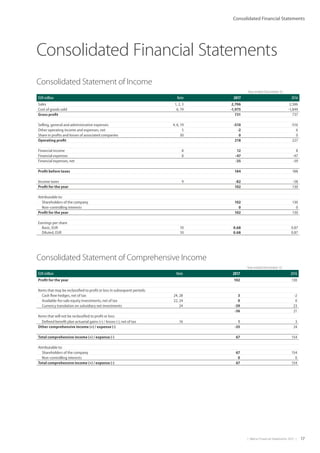
Consolidated Statement of Income
Year ended December 31,
EUR million Note 2017 2016
Sales 1, 2, 3 2,706 2,586
Cost of goods sold 6, 19 -1,975 -1,849
Gross profit 731 737
Selling, general and administrative expenses 4, 6, 19 -510 -516
Other operating income and expenses, net 5 -2 6
Share in profits and losses of associated companies 30 0 0
Operating profit 218 227
Financial income 8 12 8
Financial expenses 8 -47 -47
Financial expenses, net -35 -39
Profit before taxes 184 188
Income taxes 9 -82 -58
Profit for the year 102 130
Attributable to:
Shareholders of the company 102 130
Non-controlling interests 0 0
Profit for the year 102 130
Earnings per share
Basic, EUR 10 0.68 0.87
Diluted, EUR 10 0.68 0.87
Consolidated Financial Statements
Consolidated Statement of Comprehensive Income
Year ended December 31,
EUR million Note 2017 2016
Profit for the year 102 130
Items that may be reclassified to profit or loss in subsequent periods:
Cash flow hedges, net of tax 24, 28 3 -2
Available-for-sale equity investments, net of tax 22, 24 0 0
Currency translation on subsidiary net investments 24 -39 23
-36 21
Items that will not be reclassified to profit or loss:
Defined benefit plan actuarial gains (+) / losses (-), net of tax 16 1 3
Other comprehensive income (+) / expense (-) -35 24
Total comprehensive income (+) / expense (-) 67 154
Attributable to:
Shareholders of the company 67 154
Non-controlling interests 0 0
Total comprehensive income (+) / expense (-) 67 154
18  |  Metso Financial Statements 2017  |
Consolidated Financial Statements
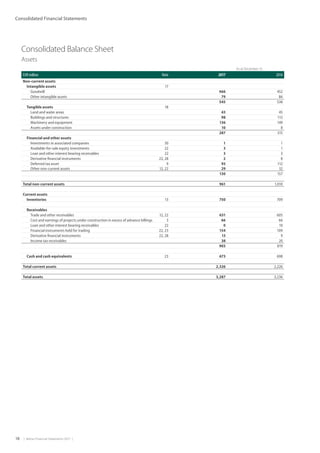
Consolidated Balance Sheet
Assets
As at December 31,
EUR million Note 2017 2016
Non-current assets
Intangible assets 17
Goodwill 466 452
Other intangible assets 79 86
545 538
Tangible assets 18
Land and water areas 43 45
Buildings and structures 98 113
Machinery and equipment 136 149
Assets under construction 10 8
287 315
Financial and other assets
Investments in associated companies 30 1 1
Available-for-sale equity investments 22 3 1
Loan and other interest bearing receivables 22 3 3
Derivative financial instruments 22, 28 2 8
Deferred tax asset 9 93 112
Other non-current assets 12, 22 29 32
130 157
Total non-current assets 961 1,010
Current assets
Inventories 13 750 709
Receivables
Trade and other receivables 12, 22 631 605
Cost and earnings of projects under construction in excess of advance billings 3 66 66
Loan and other interest bearing receivables 22 0 10
Financial instruments held for trading 22, 23 154 109
Derivative financial instruments 22, 28 13 9
Income tax receivables 38 20
903 819
Cash and cash equivalents 23 673 698
Total current assets 2,326 2,226
Total assets 3,287 3,236
|  Metso Financial Statements 2017  | 19
Consolidated Financial Statements
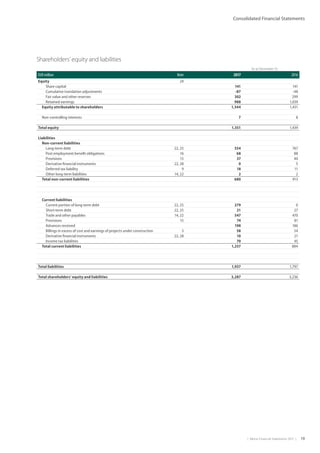
Shareholders’ equity and liabilities
As at December 31,
EUR million Note 2017 2016
Equity 24
Share capital 141 141
Cumulative translation adjustments -87 -48
Fair value and other reserves 302 299
Retained earnings 988 1,039
Equity attributable to shareholders 1,344 1,431
Non-controlling interests 7 8
Total equity 1,351 1,439
Liabilities
Non-current liabilities
Long-term debt 22, 25 554 767
Post employment benefit obligations 16 68 88
Provisions 15 37 40
Derivative financial instruments 22, 28 0 5
Deferred tax liability 9 18 11
Other long-term liabilities 14, 22 2 2
Total non-current liabilities 680 913
Current liabilities
Current portion of long-term debt 22, 25 279 0
Short-term debt 22, 25 21 27
Trade and other payables 14, 22 547 470
Provisions 15 74 81
Advances received 198 186
Billings in excess of cost and earnings of projects under construction 3 58 54
Derivative financial instruments 22, 28 10 21
Income tax liabilities 70 45
Total current liabilities 1,257 884
Total liabilities 1,937 1,797
Total shareholders’ equity and liabilities 3,287 3,236
20  |  Metso Financial Statements 2017  |
Consolidated Financial Statements
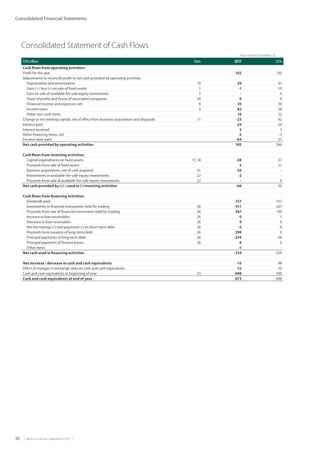
Consolidated Statement of Cash Flows
Year ended December 31,
EUR million Note 2017 2016
Cash flows from operating activities:
Profit for the year 102 130
Adjustments to reconcile profit to net cash provided by operating activities
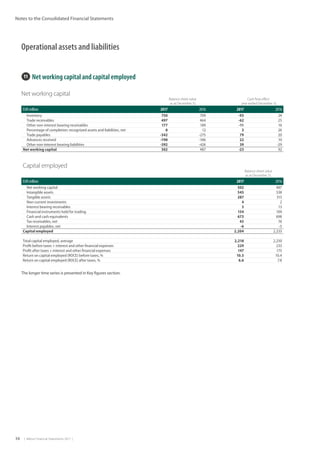
Depreciation and amortization 19 59 61
Gain (-) / loss (+) on sale of fixed assets 5 -1 -10
Gain on sale of available-for-sale equity investments 5 - 0
Share of profits and losses of associated companies 30 0 0
Financial income and expenses, net 8 35 39
Income taxes 9 82 58
Other non-cash items 16 22
Change in net working capital, net of effect from business acquisitions and disposals 11 -23 92
Interest paid -24 -29
Interest received 5 7
Other financing items, net -2 -3
Income taxes paid -64 -21
Net cash provided by operating activities 185 346
Cash flows from investing activities:
Capital expenditures on fixed assets 17, 18 -38 -31
Proceeds from sale of fixed assets 5 21
Business acquisitions, net of cash acquired 31 -30 -
Investments in available-for-sale equity investments 22 -2 -
Proceeds from sale of available-for-sale equity investments 22 - 0
Net cash provided by (+) / used in (-) investing activities -66 -10
Cash flows from financing activities:
Dividends paid -157 -157
Investments in financial instruments held for trading 26 -411 -201
Proceeds from sale of financial instruments held for trading 26 367 159
Increase in loan receivables 26 0 1
Decrease in loan receivables 26 9 0
Net borrowings (+) and payments (-) on short-term debt 26 -5 -4
Proceeds from issuance of long-term debt 26 298 0
Principal payments of long-term debt 26 -234 -36
Principal payments of finance leases 26 0 0
Other items -1 -
Net cash used in financing activities -134 -239
Net increase / decrease in cash and cash equivalents -15 98
Effect of changes in exchange rates on cash and cash equivalents -12 10
Cash and cash equivalents at beginning of year 23 698 590
Cash and cash equivalents at end of year 673 698
|  Metso Financial Statements 2017  | 21
Consolidated Financial Statements
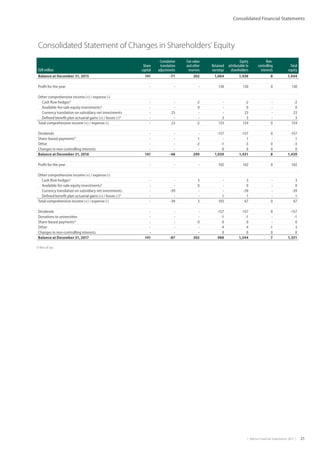
Consolidated Statement of Changes in Shareholders’ Equity
EUR million
Share
capital
Cumulative
translation
adjustments
Fair value
and other
reserves
Retained
earnings
Equity
attributable to
shareholders
Non-
controlling
interests
Total
equity
Balance at December 31, 2015 141 -71 302 1,064 1,436 8 1,444
Profit for the year - - - 130 130 0 130
Other comprehensive income (+) / expense (-)
Cash flow hedges1)
- - -2 - -2 - -2
Available-for-sale equity investments1)
- - 0 - 0 - 0
Currency translation on subsidiary net investments - 23 - - 23 - 23
Defined benefit plan actuarial gains (+) / losses (-)1)
- - - 3 3 - 3
Total comprehensive income (+) / expense (-) - 23 -2 133 154 0 154
Dividends - - - -157 -157 0 -157
Share-based payments1)
- - 1 - 1 - 1
Other - - -2 -1 -3 0 -3
Changes in non-controlling interests - - - 0 0 0 0
Balance at December 31, 2016 141 -48 299 1,039 1,431 8 1,439
Profit for the year - - - 102 102 0 102
Other comprehensive income (+) / expense (-)
Cash flow hedges1)
- - 3 - 3 - 3
Available-for-sale equity investments1)
- - 0 - 0 - 0
Currency translation on subsidiary net investments - -39 - - -39 - -39
Defined benefit plan actuarial gains (+) / losses (-)1)
- - - 1 1 - 1
Total comprehensive income (+) / expense (-) - -39 3 103 67 0 67
Dividends - - - -157 -157 0 -157
Donations to universities - - - -1 -1 - -1
Share-based payments1)
- - 0 0 0 - 0
Other - - - 4 4 -1 3
Changes in non-controlling interests - - - 0 0 0 0
Balance at December 31, 2017 141 -87 302 988 1,344 7 1,351
1) Net of tax
22  |  Metso Financial Statements 2017  |
Notes to the Consolidated Financial Statements
Basic information
Metso Corporation (the“Parent Company”) and its subsidiaries (to-
gether with the Parent Company,“Metso”or the“Group”) form a world
leading industrial group as an equipment and service provider for the
mining and aggregates industries and in the flow control business.
Its main customers operate in the mining, aggregates and oil and gas
industries.The Group has two reporting segments, Minerals and Flow
Control, more information in note 1.
Metso Corporation is a publicly listed company and its shares
are listed on the Nasdaq OMX Helsinki Ltd under the trading symbol
METSO. Metso Corporation is domiciled in Finland and the address of
the Group Head Office isTöölönlahdenkatu 2, 00100 Helsinki, Finland.
These consolidated financial statements were authorized for issue by
the Board of Directors on February 1, 2018 after which, in accordance
with Finnish Company Law, the financial statements are either ap-
proved, amended or rejected in the Annual General Meeting.
Basis of preparation
The consolidated financial statements have been prepared in accord-
ance with International Financial Reporting Standards (IFRS) and IFRIC
Interpretations as adopted by European Union.The consolidated finan-
cial statements have been prepared on a historical cost basis, except for
financial assets and liabilities classified as at fair value through profit or
loss, available-for-sale investments, financial instruments held for trad-
ing and derivative instruments, which are recognized at fair value.
The financial statements are presented in euros, which is the Parent
Company’s functional currency and Metso’s presentation currency.The
figures presented have been rounded to the nearest million and conse-
quently the sum of individual figures might differ from the presented
total figure.
Metso’s more detailed accounting policies are disclosed in the
relevant note to the financial statements.
Critical accounting estimates and judgments by
management
The preparation of financial statements, in conformity with IFRS,
requires management to make estimates and assumptions and to
exercise its judgment in the process of applying the group’s accounting
policies.These affect the reported amounts of assets and liabilities
and disclosure of contingent assets and liabilities at the dates of the
financial statements and the reported amounts of revenues and
expenses during the reporting period. Actual results could differ from
those estimates.The assets and liabilities involving a higher degree of
judgment or complexity, or areas where assumptions and estimates are
significant to Metso’s consolidated financial statements are disclosed in
the following notes:
Note 3	 Sales by category	
Note 7	 Share-based payments	
Note 9	 Income taxes	
Note 12	 Trade and other receivables	
Note 13	 Inventory	
Note 15	 Provisions	
Note 16	 Post employment obligations	
Note 17	 Goodwill and other intangible assets	
Note 18	 Tangible assets
Note 25 	 Borrowings
Note 31 	 Acquisitions and business disposals
How to read Metso Group’s Financial statement?
Metso structured the content of its Financial Statements in order to disclose the financial information in a more user-friendly way. Disclosed
Metso Group’s Financial Statements represent Metso Corporation’s statutory financial statements. Notes to consolidated financial state-
ments have been combined to the sections representing group performance, capital structure and financing as well as the principles
of preparation.The accounting policy applied and critical estimates and assessments required by the management are included in the
relevant note under headings“Accounting policy”or“Estimates and assessments by management”.
 ACCOUNTING POLICY  ESTIMATES AND ASSESSMENTS BY MANAGEMENT
|  Metso Financial Statements 2017  | 23
Notes to the Consolidated Financial Statements
 ACCOUNTING POLICY
Performance
A  Group performance
1  Reporting segments
Metso’s reporting segments are based on the type of business opera-
tions. Operating segments are reported in a manner consistent with the
internal reporting provided to the Board of Directors, which has been
identified as Metso’s chief operating decision-maker being responsible
for allocating resources and assessing the performance of the operating
segments, selecting key employees, as well as deciding on strategy,
major development projects, business acquisitions, investments,
organization and financing.The accounting policy applied to segment
reporting are the same as those used in preparing the consolidated
financial statements.
Metso is measuring the performance of segments with operating
profit/loss (EBIT). In addition, Metso uses alternative performance
measures to reflect the underlying business performance and to
improve comparability between financial periods: earnings before
interest, tax and amortization (EBITA), adjusted and Return on operative
capital employed for reporting segments (segment ROCE). Adjustment
items comprise capacity adjustment costs, outcome of material intel-
lectual property rights disputes, gains and losses on business disposals
and other infrequent events.Their nature and net effect on cost of
goods sold, selling, general and administrative expenses as well as
other operating income and expenses are presented in the segment
information. Alternative performance measures should, however, not
be considered as a substitute for measures of performance in accord-
ance with the IFRS.
Corporate structure
Metso Group is a global supplier of sustainable technology and services
for mining, aggregates, oil and gas, pulp, paper and other process
industries.
Metso reports its results consistently with its the strategy and
reporting structure, which consists of two segments: Minerals and Flow
Control.The Minerals segment covers mining, aggregates and recycling
businesses.The Flow Control segment covers valves and pumps
­businesses.
The Minerals segment supplies technology, process solutions,
machinery and services for aggregates production, mining, minerals
processing and recycling. In 2017 and 2016 the segment was organized
in two business areas: Minerals Capital and Minerals Services. From
the beginning of 2018 segment is organized in five business areas:
Mining Equipment, Aggregates Equipment, Minerals Services, Minerals
Consumables and Recycling.	
The Flow Control segment supplies process industry flow control
solutions and services. Flow Control customers operate in oil and gas,
pulp and paper and other process industries.The segment is organized
in two business areas: Valves and Pumps.The Flow Control segment will
continue in same structure in 2018.	
The Group Head Office and other is comprised of the Parent Com-
pany with centralized group functions such as treasury and tax as well as
shared service centers and holding companies.
Financial income and expenses and income taxes are not allocated
to segments but included in the income statement of Group Head
Office and other.The treasury activities of Metso are centralized into the
GroupTreasury to benefit from cost efficiency obtained from pooling
arrangements, financial risk management, bargaining power, cash
management, and other measures. Metso has a centralized Group tax
management function.The objective of Group tax management is to
ensure compliance and optimized and predictable overall tax cost for
Metso.
Segment assets comprise intangible and tangible assets, invest-
ments in associated companies and joint ventures, available-for-sale
equity investments, inventories and non-interest bearing operating
assets and receivables.They exclude interest bearing assets, cash and
cash equivalents, income tax receivables and deferred tax assets, which
are included in the assets of Group Head Office and other.
Segment liabilities comprise non-interest bearing operating liabili-
ties and exclude income tax liabilities, deferred tax liabilities and interest
bearing liabilities, which are included in the liabilities of Group Head
Office and other.
Non-cash write-downs include write-offs made to the value of
receivables and inventories and impairment and other write-offs
recognized to reduce the value of intangible or tangible assets and other
assets.
Gross capital expenditure comprises investments in intangible and
tangible assets, associated companies and joint ventures and additions
through business acquisitions.
Intra-group transactions are at arm’s length basis.
24  |  Metso Financial Statements 2017  |
Notes to the Consolidated Financial Statements
Information about Metso’s reportable segments as of and for the years ended December 31, 2017 and 2016 is presented in the following tables.
EUR million Minerals Flow Control
Group Head
Office and
other Eliminations
Metso
total
2017
External sales 2,070 636 0 - 2,706
Intra-group sales 0 0 - 0 -
Sales 2,070 636 0 0 2,706
EBITA 159.7 93.1 -17.2 0 235.6
% of sales 7.7 14.6 n/a - 8.7
Adjusted EBITA 167.9 93.1 -17.2 - 243.7
% of sales 8.1 14.6 n/a - 9.0
Operating profit/loss 153.4 90.8 -25.8 - 218.4
% of sales 7.4 14.3 n/a - 8.1
Adjustment items in cost of goods sold -6.4 0 - - -6.4
Adjustment items in selling, general and administrative expenses -1.7 0 - - -1.7
Total adjustment items -8.1 - - - -8.1
Amortization -6 -2 -9 - -17
Depreciation -30 -11 0 - -42
Gross capital expenditure (including business acquisitions) 59 8 1 - 68
Non-cash write-downs1)
-11 -5 0 - -17
Intangible and tangible assets 696 118 17 - 832
Investments in associated companies 1 - - - 1
Available-for-sale equity investments 0 0 3 - 3
Inventories and other non-interest bearing assets 1,153 312 25 - 1,491
Interest bearing receivables - - 3 - 3
Tax receivables and deferred tax assets - - 131 - 131
Liquid funds - - 826 - 826
Total assets 1,850 431 1,006 - 3,287
Non-interest bearing liabilities 800 140 55 - 995
Tax payables and deferred tax liability - - 88 - 88
Interest bearing debt - - 853 - 853
Total liabilities 800 140 996 - 1,937
Operative capital employed / Capital employed 1,050 290 863 - 2,204
Segment ROCE % / ROCE % 14.7 29.7 n/a - 10.3
Orders received 2,308 675 - 0 2,982
Order backlog 1,173 267 - 0 1,439
1) Write-downs of intangible and tangible assets, inventories and trade receivables.
Operative capital employed:
Intangible and tangible assets + investments in associated companies and
joint ventures + available-for-sale equity investments + inventories + non-
interest bearing operative assets and receivables (external) - non-interest
bearing operating liabilities (external)
Formulas for key figures:
Return on operative capital employed (segment ROCE), %:
Operating profit (EBIT)
x 100
Operative capital employed (month end average)
2017
EUR million Minerals Flow Control
Group Head office
and other Metso total
Adjusted EBITA 167.9 93.1 -17.2 243.7
% of sales 8.1 14.6 - 9.0
Capacity adjustment expenses -8.1 0 - -8.1
Amortization of intangible assets -6.3 -2.4 -8.5 -17.2
Operating profit 153.4 90.8 -25.7 218.4
Adjustment items and amortization of intangible assets
|  Metso Financial Statements 2017  | 25
Notes to the Consolidated Financial Statements
EUR million Minerals Flow Control
Group Head
Office and
other Eliminations
Metso
total
2016
External sales 1,956 630 - - 2,586
Intra-group sales 0 1 0 -1 -
Sales 1,956 631 - -1 2,586
EBITA 154.0 93.0 -2.7 0 244.3
% of sales 7.9 14.7 n/a - 9.4
Adjusted EBITA 190.3 95.0 -11.3 - 274.0
% of sales 9.7 15.1 n/a - 10.6
Operating profit/loss 148.0 90.4 -11.4 - 227.1
% of sales 7.6 14.3 n/a - 8.8
Adjustment items in cost of goods sold -23.3 -1.4 - - -24.7
Adjustment items in selling, general and administrative expenses -7.6 -0.6 -1.8 - -10.0
Adjustment items in other operating income and expenses, net -5.4 - 10.4 - 5.0
Total adjustment items -36.3 -2.0 8.6 - -29.7
Amortization -6 -3 -8 - -17
Depreciation -31 -12 -1 - -44
Gross capital expenditure (including business acquisitions) 19 7 5 - 31
Non-cash write-downs1)
-15 -6 0 - -21
Intangible and tangible assets 696 132 25 - 853
Investments in associated companies 1 - - - 1
Available-for-sale equity investments 0 0 1 - 1
Inventories and other non-interest bearing assets 1,082 312 35 - 1,429
Interest bearing receivables - - 13 - 13
Tax receivables and deferred tax assets - - 132 - 132
Liquid funds - - 807 - 807
Total assets 1,779 444 1,013 - 3,236
Non-interest bearing liabilities 733 130 84 - 947
Tax payables and deferred tax liability - - 56 - 56
Interest bearing debt - - 794 - 794
Total liabilities 733 130 934 - 1,797
Operative capital employed / Capital employed 1,046 314 873 - 2,233
Segment ROCE % / ROCE % 13.4 28.5 n/a - 10.4
Orders received 2,115 609 - 0 2,724
Order backlog 1,078 242 - 0 1,320
1) Write-downs of intangible and tangible assets, inventories and trade receivables.
2016
EUR million Minerals Flow Control
Group Head office
and other Metso total
Adjusted EBITA 190.3 95.0 -11.3 274.0
% of sales 9.7 15.1 - 10.6
Capacity adjustment expenses -33.1 -2.0 - -35.1
Gain on divestment of the head office property - - 10.4 10.4
Other costs -3.2 - -1.8 -5.0
Amortization of intangible assets -6.0 -2.6 -8.7 -17.3
Operating profit 148.0 90.4 -11.4 227.1
Adjustment items and amortization of intangible assets
26  |  Metso Financial Statements 2017  |
Notes to the Consolidated Financial Statements
 ACCOUNTING POLICY
2  Geographical information
Metso presents the geographical segments’sales by location of custom-
ers. Non-current assets and gross capital expenditure are presented by
location of assets.
Metso’s businesses are present in over 50 countries providing strong
diversification.The main market areas are Europe and North America
accounting for approximately 46 percent of sales. Metso has production
units on all inhabited continents.
Sales to unaffiliated customers by destination:
Year ended December 31,
EUR million 2017 2016
Finland 85 87
Other European countries 600 555
North America 554 569
South and Central America 536 521
Asia-Pacific 672 608
Africa and Middle East 259 246
Metso total 2,706 2,586
Metso’s exports from Finland by destination,
including intra-group sales:
Year ended December 31,
EUR million 2017 2016
European countries 233 203
North America 80 71
South and Central America 25 24
Asia-Pacific 150 131
Africa and Middle East 45 34
Metso total 533 463
Non-current assets by location:
As at December 31,
EUR million 2017 2016
Finland 68 81
Other European countries 86 85
North America 85 103
South and Central America 58 65
Asia-Pacific 110 119
Africa and Middle East 8 7
Non-allocated 448 428
Metso total 863 888
Gross capital expenditure by location:
As at December 31,
EUR million 2017 2016
Finland 5 9
Other European countries 9 5
North America 4 3
South and Central America 8 6
Asia-Pacific 8 7
Africa and Middle East 3 1
Metso total 38 31
Non-current assets comprise intangible and tangible assets, invest-
ments in associated companies, available-for-sale equity investments
and other non-interest bearing non-current assets. Non-allocated assets
include mainly goodwill and other allocated assets arising from busi-
ness acquisitions that have not been pushed down to the subsidiaries’
books.
Gross capital expenditure comprises investments in intangible and
tangible assets, associated companies and joint ventures.
|  Metso Financial Statements 2017  | 27
Notes to the Consolidated Financial Statements
 ACCOUNTING POLICY
 ESTIMATES AND ASSESSMENTS BY MANAGEMENT
3  Sales by category	
Metso’s sales consist of sales of engineered systems, projects, equip-
ment and related services in the Minerals segment and sales of prod-
ucts, process solutions and related services work in the Flow Control
segment.
Sales from goods and services sold are recognized, net of sales
taxes and discounts, when substantially all the risks and rewards of
ownership are transferred to the buyer or when legal title of the goods
and responsibility for shipment has been transferred to the buyer.The
transfer of risk takes place either when the goods are shipped or when
made available to the buyer for shipment depending on the terms of
the contract.The credit worthiness of the buyer is verified before enter-
ing into a sale. However, if a risk of non-payment arises after revenue
recognition, a provision for non-collectability is established.
Metso applies the percentage-of-completion method,“POC
method”, for recognizing long-term delivery contracts of engineered
systems and construction projects. Sales recognized under the POC
method is based on estimated revenue, costs and profit.The stage of
completion is determined by the cost-to-cost method of accounting. In
the cost-to-cost method, sales and profits are recorded after consider-
ing the ratio of accumulated costs to estimated total costs to complete
each contract. Subcontractor materials, labor and equipment, are
included in sales and costs of goods sold when Metso is responsible
for the ultimate acceptability of the project. A projected potential loss
on a firm commitment is recognized in the income statement, when it
becomes known.The estimated revenue, costs and profit, together with
the planned delivery schedule of the projects are subject to regular
revisions as the contract progresses to completion. Revisions in profit
estimates are charged through profit and loss account in the period in
which the change becomes known.
Sales from short-term service contracts are recognized once the
service has been rendered. Sales from long-term service contracts are
recognized using the percentage-of-completion method.
Sales recognized under the percentage of completion method require
management to be able to estimate total sales, costs, margin and
cash flow to complete the project.To assess the stage of completion
and margin to be recognized as well as the total costs estimated to
complete the project requires judgments by management throughout
the project delivery.The most critical judgments, needed in case of a
loss-making project, are the estimates on the time needed to close the
project and the total outcome. Changes in general market conditions
and their possible impact to contracts need to be predicted as well. If
the total outcome of the project can be predicted reliably, Metso ap-
plies the POC method only.	
Hedging of foreign currency denominated firm
commitments
Under Metso hedging policy, business units are required to hedge their
foreign currency risk when they become engaged in a firm commit-
ment denominated in a currency other than their functional currency.
The commitment can be either internal to Metso or external. When
a firm commitment qualifies for recognition under the percentage
of completion method, the business unit applies cash flow hedge
accounting and recognizes the effect of the hedging instruments in
Sales by recognition method:
   Year ended December 31,
EUR
million
2017
EUR
million
2016
% of
sales
2017
% of
sales
2016
Percentage of completion (POC)
recognition1)
215 189 8 7
Recognition at the delivery 2,491 2,397 92 93
Sales total 2,706 2,586 100 100
1) The percentage of completion (POC) was highest in the Minerals segment, where it
accounted for 10 percent in 2017 and 2016.
Balance sheet items of uncompleted projects at
December 31 is as follows:
EUR million 2017 2016
Projects where cost and earnings exceed billings
Cost and earnings of uncompleted projects 383 598
Billings of projects 317 532
Net 66 66
Projects where billings exceed cost and earnings
Cost and earnings of uncompleted projects 305 343
Billings of projects 363 397
Net 58 54
Major customers
In 2017 and 2016 Metso did not have a single customer to which sales
would have exceeded 10 percent of the consolidated sales.
Sales by category:
Year ended December 31,
EUR million 2017 2016
Sales of services 1,767 1,703
Sales of projects, equipment and goods 940 883
Sales total 2,706 2,586
other comprehensive income (OCI) until the commitment is recognized.
Though Metso has defined the characteristics triggering a firm commit-
ment, the final realization of the unrecognized commitment depends
also on factors beyond management control, which cannot be foreseen
when initiating the hedging relationship. Such factors can be a change
in the market environment causing the other party to postpone or
cancel the commitment.To the extent possible, management strives to
include clauses in its contracts that reduce the impact of such adverse
events on its results.
28  |  Metso Financial Statements 2017  |
Notes to the Consolidated Financial Statements
 ACCOUNTING POLICY
 ACCOUNTING POLICY
4  Selling, general and administrative expenses 6  Personnel expenses and the number
of personnel
5  Other operating income and expenses
Other operating income and expenses, net, comprise income and ex-
penses that do not directly relate to the operating activity of businesses
within Metso or which arise from unrealized and realized changes in fair
value of foreign currency denominated financial instruments related to
operations, including forward exchange contracts. Such items include
costs related to significant restructuring programs, gains and losses on
disposal of assets, and foreign exchange gains and losses, excluding
those qualifying for hedge accounting and those, which are reported
under financial income and expenses, net. Additionally, non-recovera-
ble foreign taxes, which are not based on taxable profits, are reported in
other operating income and expenses, net. In particular, these include
foreign taxes and such like payments not based on DoubleTaxation
Treaties in force.
Year ended December 31,
EUR million 2017 2016
Marketing and selling expenses -287 -284
Research and development expenses, net -27 -34
Administrative expenses -196 -198
Metso total -510 -516
Year ended December 31,
EUR million 2017 2016
Gain on sale of fixed assets 1 12
Rental income 1 1
Foreign exchange gains1)
48 42
Other income 7 9
Other operating income, total 57 64
Loss on sale of fixed assets 0 -2
Impairment on fixed assets -3 -1
Foreign exchange losses1)
-48 -43
Other expenses -8 -12
Other operating expenses, total -59 -58
Other operating income and expenses, net -2 6
1) Includes foreign exchange gains and losses resulting from trade receivables and
payables and related derivatives.
Personnel expenses
Year ended December 31,
EUR million 2017 2016
Salaries and wages -515 -511
Pension costs, defined contribution plans -37 -31
Pension costs, defined benefit plans1)
-5 -5
Other post-employment benefits1)
0 -1
Share-based payments2)
-2 -2
Other indirect employee costs -91 -105
Metso total -650 -655
1) For more information on pension costs, see note 16.
2) For more information on share-based payments, see note 7.
Research and development expenses,
consist of following:
Year ended December 31,
EUR million 2017 2016
Research and development expenses, total -27 -34
Capital expenditure 0 1
Grants received 0 0
Depreciation and amortization -1 -1
Research and development expenses, net -27 -34
Number of personnel at end of year:
2017 2016
Minerals 8,890 8,370
Flow Control 2,660 2,663
Group Head Office and others total 487 509
Metso total 12,037 11,542
Average number of personnel during the period:
2017 2016
Minerals 8,557 8,762
Flow Control 2,645 2,779
Group Head Office and others total 501 518
Metso total 11,703 12,059
Board remuneration:
EUR thousand 2017 2016
Serving Board members at December 31, 2017:
Mikael Lilius -126 -126
Christer Gardell -73 -73
Peter Carlsson -75 -72
Ozey K. Horton, Jr. -95 -95
Lars Josefsson -61 -61
Nina Kopola -61 -61
Arja Talma -76 -72
Raimo Brand1)
-5 -
Former Board members:
Wilson Nelio Brumer -8 -81
Eeva Sipilä - -3
Markku Aapakari1)
-2 -8
Total -582 -652
1) Has attended meetings as a personnel representative, without voting right.
According to the decision of the 2017 Annual General Meeting, the an-
nual fees paid to the Board members are: Chair of the Board EUR 110,000,
Vice Chair of the Board EUR 62,000 and other Board members EUR 50,000.
An additional annual remuneration is paid to the member of the Board
elected in the position of Chair of the Audit Committee EUR 15,000 and
Chair of HR and Remuneration Committee EUR 5,000.
In addition, an attendance fee of EUR 700 per meeting attended,
including committee meetings, is paid to members whose residence
is in the Nordic countries, EUR 1,400 to members whose residence is
elsewhere in Europe and EUR 2,800 for those residing outside Europe.
Compensation for travel expenses and daily allowances are paid in ac-
cordance with Metso’s travel policy.
Based on the decision of the 2017 Annual General Meeting, 40
percent of the Board’s annual fees were used to buy Metso shares from
the market.The shares were acquired within the two weeks following the
publication of the first-quarter 2017 Interim Review.
Research and development expenses comprise salaries, administration
costs, depreciation and amortization of tangible and intangible assets
and are mainly recognized as incurred. When material development
costs meet certain capitalization criteria under IAS 38, they are capital-
ized and amortized over the expected useful life of the underlying
technology.
|  Metso Financial Statements 2017  | 29
Notes to the Consolidated Financial Statements
 ESTIMATES AND ASSESSMENTS BY MANAGEMENT
The remuneration paid to President and CEO Nico Delvaux is presented
in the table above.The fringe benefits comprised a telephone as well
as housing and medical benefit. Mr. Delvaux participates in the remu-
neration programs according to the respective terms and conditions
decided by the Board. For more information on share-based payments,
see note 7.
According to his executive contract, Nico Delvaux is eligible to retire
at the age of 63 and belongs to a supplementary defined contribu-
tion pension plan with 20 percent contribution of annual salary.The
notice period for both parties is six months. Only, if the agreement is
terminated by the company prior to the second anniversary of the
employment the severance pay is full monthly salary multiplied by
eighteen and after this, the severance pay is twelve months. For years
ended December 31, 2017 there were no contributions toward supple-
mentary pension plan for Mr. Delvaux. For the years ended December
31, 2017 and December 31, 2016 contributions made to the executive
defined benefit plan, which former President and CEO Matti Kähkönen
belonged to, amounted to EUR 974 thousand and EUR 445 thousand.
Metso has subscribed supplementary pension plans for senior man-
agement for retirement, the beneficiaries include the Metso Executive
Team. For the years ended December 31, 2017 and December 31, 2016
these pension premium payments totaled EUR 245 thousand and EUR
262 thousand.
Board share ownership in Metso:
December 31, 2017
Mikael Lilius 32,444
Christer Gardell 6,196
Peter Carlsson 1,579
Ozey K. Horton, Jr. 4,789
Lars Josefsson 3,033
Nina Kopola 3,080
Arja Talma 2,053
Total 53,174
Executive Team share ownership in Metso:
December 31, 2017
Nico Delvaux 10,650
Eeva Sipilä 7,661
Victor Tapia -
John Quinlivan 3,103
Merja Kamppari 8,207
Urs Pennanen 200
Jani Puroranta -
Total 29,821
EUR Annual salary
Performance
bonus paid
Fringe
benefits
Share-based
payment Total
2017
President and CEO Nico Delvaux1)
299,408 - 9,128 - 308,536
President and CEO Matti Kähkönen2)
406,765 135,000 12,544 66,824 621,133
Other Executive Team members 2,307,889 161,517 19,205 138,207 2,626,818
Total 3,014,062 296,517 40,877 205,031 3,556,487
2016
President and CEO Matti Kähkönen 610,136 111,840 21,885 - 743,861
Other Executive Team members 2,150,756 186,647 29,938 - 2,367,341
Total 2,760,892 298,487 51,823 - 3,111,202
1) President and CEO from August 1, 2017 onwards
2) President and CEO between January 1–July 31, 2017
Remuneration paid to Chief Executive Officer and other Executive Team members:
 ACCOUNTING POLICY
7  Share-based payments
Metso has share-based incentive plans for its key personnel.
The equity-settled share awards are valued based on the market price
of Metso shares as of the grant date, and recognized as an employee
benefit expense over the vesting period with a corresponding entry in
other reserves of equity.The historical development of Metso shares and
the expected dividends have been taken into account when calculating
the fair value.The liability resulting from the cash-settled transactions is
measured based on the market price of Metso shares as of the balance
sheet date and accrued as an employee benefit expense with corre-
sponding entry in the current liabilities until the settlement date.
Market conditions, such as the total shareholder return upon which
vesting is conditioned, is taken into account when estimating the fair
value of the equity instruments granted.The expense relating to market
condition is recognized irrespective of whether that market condition
is satisfied.
Non-market vesting conditions, such as operating profit, services
business growth, return on capital employed and earnings per share
targets are included in assumptions about the amount of share-based
payments that are expected to vest. At each balance sheet date, Metso
revises its estimates on the amount of share-based payments that are
expected to vest.The impact of the revision to the previous estimate
is recognized through consolidated statement of income with a cor-
responding adjustment to equity and current liabilities, as appropriate.
At each balance sheet date, management revises its estimates for the
number of shares that are expected to vest. As part of this evaluation,
Metso takes into account the changes in the forecasted performance
of the Group and its reporting segments, the expected turnover of
the personnel benefiting from the incentive plan and other pertinent
information impacting the number of shares to vest.
Long-term incentive plan for 2012–2014
In December 2011, Metso’s Board of Directors decided to establish a
share-based incentive plan that had three performance periods: calen-
dar years 2012, 2013 and 2014.
All performance periods and related two-year vesting periods have
been completed. A total of 95,270 treasury shares were used to pay
rewards to 56 participants in March 2015, no shares were delivered in
2016, as the targets set for the performance period 2013 were not met.
In 2017 a total of 12,590 treasure shares were used to pay rewards to 49
participants from 2014 plan.
30  |  Metso Financial Statements 2017  |
Notes to the Consolidated Financial Statements
Long-term incentive plan for 2015 and thereafter
In December 2014, Metso’s Board decided on a long-term share-based
incentive plan for the Metso management and key employees, with
a Performance Share Plan (PSP) as the main structure. In addition, the
Board decided to establish a Restricted Share Plan (RSP) as a comple-
mentary share-based incentive structure for specific situations.
The commencement of each new PSP and RSP plan, and earning
criteria for each new PSP plan will be subject to separate decisions by
the Board.The PSP consists of annually commencing performance
share plan, each with a three-year earning period, and the complemen-
tary RSP consists of annually commencing restricted share plans, each
with a three-year vesting period.
Performance Share Plan 2015–2017
The earning criteria for the PSP 2015–2017 and the potential reward
are based on the total shareholder return (TSR) of Metso’s share during
2015–2017. At the end of 2017, there were 79 participants in the plan
and the potential reward corresponds to a maximum of 286,210 Metso
shares, out of which the Metso ExecutiveTeam can receive a maximum
reward of 16,600 shares.The potential reward will be paid in 2018.
Performance Share Plan 2016–2018
The earning criteria for the PSP 2016–2018 and the potential reward
are based on the total shareholder return (TSR) of Metso’s share during
2016–2018. At the end of 2017, there were 86 participants in the plan
and the potential reward corresponds to a maximum of 376,000 Metso
shares, out of which the Metso ExecutiveTeam can receive a maximum
reward of 51,800 shares.The potential reward will be paid in 2019.
Performance Share Plan 2017–2019
In December 2016, the Board decided to continue the long-term incen-
tive plans.The potential share reward payable under the PSP 2017–2019
are based on the total shareholder return of Metso’s share during
2017–2019. At the end of 2017, there were 95 participants in the plan
and the potential reward corresponds to a maximum of 395,800 Metso
shares, out of which the Metso ExecutiveTeam can receive a maximum
reward of 110,000 shares.The potential reward will be paid in 2020.
Restricted Share Plan 2017–2019
At the end of 2017, there were 5 participants in the RSP plan and the
potential reward corresponds to a 15,900 Metso shares, out of which the
Metso ExecutiveTeam can receive a maximum reward of 12,500 shares.
The potential reward will be paid in 2020.
The possible rewards will be paid partly in company shares and partly
in cash.The proportion to be paid in cash is intended to cover taxes and
tax-related costs arising from the reward to the participants. If a partici-
pant’s employment or service ends for reasons relating to the participant
before the reward payment, no reward will be paid.
Beneficiaries of and granted shares under the share ownership plan as at December 31, 2017:
Metso
Executive Team Shares
Other
beneficiaries Shares
Beneficiaries
total Shares total
Plan 2014–2016
Granted 2017 7 3,875 42 8,715 49 12,590
Costs recognized for the share ownership plans:
EUR thousand
Plan
2014–2016
Plan PSP
2015–2017
Plan PSP
2016–2018
Plan PSP
2017–2019 Total
2017
Metso Executive Team -32 -26 -189 -240 -487
Other beneficiaries -86 -151 -779 -575 -1,591
Total -118 -177 -968 -815 -2,078
2016
Metso Executive Team -65 -107 -345 - -517
Other beneficiaries -175 -486 -736 - -1,397
Total -240 -593 -1,081 - -1,914
As of the balance sheet date, a liability of EUR 443 thousand was recognized as an accrued expense for the cash-settled portion of plan PSP 2017–2019, EUR 1,717 thousand from plan PSP
2016–2018 and EUR 434 thousand from plan PSP 2015–2017.
|  Metso Financial Statements 2017  | 31
Notes to the Consolidated Financial Statements
 ESTIMATES AND ASSESSMENTS BY MANAGEMENT
 ACCOUNTING POLICY
8  Financial income and expenses
9  Income taxes
Income taxes in the consolidated income statement includes taxes of
subsidiaries based on taxable income for the current period, tax adjust-
ments for previous periods and the changes in deferred taxes.The
other comprehensive income statement (OCI) includes taxes on items
presented in OCI. Deferred taxes are determined for temporary differ-
ences arising between the tax base of assets and liabilities and their
financial statement carrying amounts, measured using substantially
enacted tax rates.
Metso is subject to income tax in its operating countries. Metso’s
management is required to make certain assumptions and estimates
in preparing the annual tax calculations for which the ultimate tax
consequences is uncertain. Annually Metso has tax audits ongoing in
several subsidiaries and Metso recognizes tax liabilities for anticipated
tax audit issues based on estimates of whether additional taxes will
be due. Where the final outcome of these issues is different from the
estimated amounts, the difference will impact the income tax in the
period in which such determination is made.
Year ended December 31,
EUR million 2017 2016
Financial income
Dividends received 0 0
Interest income on cash and cash equivalents 4 7
Income on financial investments 0 0
Other financial income1)
8 1
Financial income total 12 8
Financial expenses
Interest expenses from financial liabilities at amortized cost -23 -29
Interest expenses on financial leases 0 0
Other financial expenses -23 -16
Net loss from foreign exchange -1 -2
Financial expenses total -47 -47
Financial income and expenses, net -35 -39
1) In 2017 other financial income includes gain of EUR 7 million on loan modification.
The components of income taxes are as follows:
Year ended December 31,
EUR million 2017 2016
Income taxes for the period -62 -64
Income taxes for prior years -13 0
Change in deferred tax asset / liability -7 6
Income taxes -82 -58
Year ended December 31,
EUR million 2017 2016
Income before taxes 184 188
Income tax at Finnish statutory tax rate of 20.0% -37 -38
Effect of different tax rates in foreign subsidiaries -16 -15
Non-deductible expenses -7 -2
Tax exempt income or tax incentives 2 0
Foreign non-creditable withholding taxes -2 -4
Effect of enacted change in tax rates1)
-8 0
Reassessment of deferred taxes for prior years -1 0
Income tax for prior years2)
-13 0
Other 1 -2
Income taxes -82 -58
1) Revaluation impact on deferred tax assets and liabilities caused by US tax reform.
2) Includes EUR 15 million tax charge due to reassessment decision by Finnish tax
authorities for years 2011–2016.
The differences between income tax expense computed at the Finnish
statutory rate and income tax expense provided on earnings are as
follows:
32  |  Metso Financial Statements 2017  |
Notes to the Consolidated Financial Statements
 ESTIMATES AND ASSESSMENTS BY MANAGEMENT
Reconciliation of deferred tax balances:
EUR million
Balance at
beginning of year
Charged to income
statement
Charged to
shareholders’
equity
Acquisitions and
disposals
Translation
differences
Balance at end
of year
2017
Deferred tax assets
Tax losses carried forward 10 1 0 - 0 11
Fixed assets 11 -1 - - 0 10
Inventory 35 -9 - - -3 24
Provisions 22 1 - - -2 21
Accruals 15 -6 - - -1 7
Pension related items 14 0 -7 - - 7
Other 24 2 -1 0 -2 22
Total deferred tax assets1)
131 -12 -8 0 -8 103
Offset against deferred tax liabilities -19 0 - - - -10
Net deferred tax assets 112 -12 -8 0 -8 93
Deferred tax liabilities
Purchase price allocations 8 -1 - 3 - 10
Fixed assets 8 -2 - - -1 5
Other 15 -2 - - - 13
Total deferred tax liabilities1)
30 -5 - - -1 28
Offset against deferred tax assets -19 0 - - - -10
Net deferred tax liabilities 11 -5 - - -1 18
Deferred tax assets, net 101 -7 -8 3 -7 77
1) Metso has reclassified the presentation of deferred tax assets and liabilities on a gross basis and the opening balance line items have been adjusted accordingly.
In determining the deferred tax assets and liabilities, Metso is required
to make certain assumptions and estimates on in particular future
operating performance and the taxable income of subsidiaries, recover-
ability of tax loss carry-forwards and potential changes of tax laws in
jurisdictions where Metso operates. A deferred tax liability based on
foreign subsidiaries undistributed earnings has been provided only
where Metso management has elected to distribute such earnings in
the coming years and the distribution is subject to taxation. Because
the tax consequences are difficult to predict, the deferred tax asset and
liabilities may need to be adjusted in coming financial years, which will
have an impact in the period in which such determination is made.
 ACCOUNTING POLICY
The deferred tax asset or liability is determined for temporary differ-
ences arising between the tax bases of assets and liabilities and their
financial statement carrying amounts using the substantially enacted
tax rates expected to apply in future years.Typical temporary differ-
ences arise from provisions, depreciation and amortization expense,
inter-company inventory margins, defined benefit plans and tax loss
carry forwards. Deferred tax liabilities are recognized in the balance
sheet in full, and the deferred tax assets are only recognized if it is prob-
able there will be taxable income in the future against which deferred
tax can be used. Deferred tax assets are set off against deferred tax
liabilities if they relate to taxes levied by the same taxation authority.
Tax effects of components in other comprehensive income:
Year ended December 31,
2017 2016
EUR million Before taxes Tax After taxes Before taxes Tax After taxes
Cash flow hedges 4 -1 3 -3 1 -2
Defined benefit plan actuarial gains (+) / losses (-) 8 -7 1 4 -1 3
Currency translation on subsidiary net investments -39 - -39 23 - 23
Total comprehensive income (+) / expense (-) -27 -8 -35 24 0 24
Current tax -1 1
Deferred tax -7 -1
Total -8 0
|  Metso Financial Statements 2017  | 33
Notes to the Consolidated Financial Statements
EUR million
Balance at
beginning of year
Charged to income
statement
Charged to
shareholders’
equity
Translation
differences
Balance at end
of year
2016
Deferred tax assets
Tax losses carried forward 11 -1 0 0 10
Fixed assets 8 1 - 0 9
Inventory 32 -10 - 2 24
Provisions 18 5 - 0 23
Accruals 10 5 - 1 16
Pension related items 23 4 -1 0 26
Other 14 -6 0 0 8
Total deferred tax assets 116 -2 -1 3 116
Offset against deferred tax liabilities -8 4 - - -4
Net deferred tax assets 108 2 -1 3 112
Deferred tax liabilities
Purchase price allocations 11 0 - 0 11
Fixed assets 4 -2 - 0 2
Other 8 -6 - 0 2
Total deferred tax liabilities 23 -8 - 0 15
Offset against deferred tax assets -8 4 - - -4
Net deferred tax liabilities 15 -4 - 0 11
Deferred tax assets, net 93 6 -1 3 101
For the years ended December 31, 2016 and 2015, respectively, earnings of EUR 133 million and EUR 151 million would have been subject to recognition of a deferred tax liability, had
Metso management decided on distribution in coming years.
10  Earnings per share
Earnings per share are calculated as follows:
Basic
Basic earnings per share are calculated by dividing the profit attributable to shareholders of the company by the weighted average number of shares
issued and outstanding for the year, excluding own shares held by the Parent company.
        Year ended December 31,
2017 2016
Profit attributable to shareholders of the company, EUR million 102 130
Weighted average number of shares issued and outstanding (in thousands) 149,995 149,985
Earnings per share, basic, EUR 0.68 0.87
        Year ended December 31,
2017 2016
Profit attributable to shareholders of the company, EUR million 102 130
Weighted average number of shares issued and outstanding (in thousands) 149,995 149,985
Adjustment for potential shares distributed (in thousands) 156 128
Weighted average number of diluted shares issued and outstanding (in thousands) 150,151 150,113
Earnings per share, diluted, EUR 0.68 0.87
Diluted
The shares to be potentially issued in the future are treated as outstanding shares when calculating the“Diluted earnings per share”if they have a
dilutive effect.The own shares held by Metso are reissued within the terms of the share ownership plan to the key personnel if the targets defined in
the plan are met. Diluted earnings per share are calculated by increasing the weighted average number of outstanding shares with the number of
those shares, which would be distributed to the beneficiaries based on the results achieved, if the conditional earnings period ended at the end of the
financial period in question. As at December 31, 2017, Metso held 351,128 own shares intended for the share ownership plans.
34  |  Metso Financial Statements 2017  |
Notes to the Consolidated Financial Statements
11  Net working capital and capital employed
Net working capital
        Balance sheet value
        as at December 31,
       Cash flow effect
        year ended December 31,
EUR million 2017 2016 2017 2016
Inventory 750 709 -93 24
Trade receivables 497 464 -62 25
Other non-interest bearing receivables 177 189 -11 16
Percentage of completion: recognized assets and liabilities, net 8 12 3 26
Trade payables -342 -275 79 20
Advances received -198 -186 22 10
Other non-interest bearing liabilities -392 -426 39 -29
Net working capital 502 487 -23 92
Capital employed
       Balance sheet value
       as at December 31,
EUR million 2017 2016
Net working capital 502 487
Intangible assets 545 538
Tangible assets 287 315
Non-current investments 4 2
Interest bearing receivables 3 13
Financial instruments held for trading 154 109
Cash and cash equivalents 673 698
Tax receivables, net 43 76
Interest payables, net -6 -5
Capital employed 2,204 2,233
Total capital employed, average 2,218 2,250
Profit before taxes + interest and other financial expenses 229 233
Profit after taxes + interest and other financial expenses 147 175
Return on capital employed (ROCE) before taxes, % 10.3 10.4
Return on capital employed (ROCE) after taxes, % 6.6 7.8
The longer time series is presented in Key figures section.
Operational assets and liabilities
|  Metso Financial Statements 2017  | 35
Notes to the Consolidated Financial Statements
 ESTIMATES AND ASSESSMENTS BY MANAGEMENT ACCOUNTING POLICY
Provision for impairment of trade receivables has changed as follows:
        Year ended December 31,
EUR million 2017 2016
Balance at beginning of year 44 46
Impact of exchange rates -2 -1
Additions charged to expense 12 13
Increase from business acquisitions 0 -
Used reserve 0 -3
Deductions / other additions -5 -11
Balance at end of year 49 44
Analysis of non-interest bearing trade receivables by age:
        Year ended December 31,
EUR million 2017 2016
Trade receivables, not due at reporting date 339 323
Trade receivables 1–30 days past due 81 71
Trade receivables 31–60 days past due 38 23
Trade receivables 61–90 days past due 16 16
Trade receivables 91–180 days past due 14 18
Trade receivables more than 180 days past due 9 13
Metso total 497 464
12  Trade and other receivables
Trade receivables and other non-interest bearing receivables are rec-
ognized in the balance sheet at fair value, which can be subsequently
written down due to impairment.The impairment is expensed under
selling, general and administrative expenses. Bad debts are written off
when official announcement of receivership, liquidation or bankruptcy
is received confirming that the receivable will not be honored.	
Where extended payment terms, exceeding one year, are offered to
customers, the invoiced amount is discounted to its present value and
interest income is recognized over the credit term.
Metso’s policy is to calculate an impairment loss based on the best
estimate of the amounts that are potentially uncollectable at the
balance sheet date.The estimates are based on a systematic review
and evaluation performed as part of the credit-risk evaluation process.
As part of this evaluation, Metso takes into account the history of
collections, the size of receivable balances, changes in payment terms
and current economic events and conditions. Metso’s management
actively monitors the amount of receivables past due and days of sales
outstanding globally and initiates action as necessary.
                        As at December 31,
EUR million Non-current
2017
Current Total Non-current
2016
Current Total
Non-interest bearing receivables
Loan receivables 0 - 0 0 - 0
Trade receivables - 497 497 - 464 464
Prepaid expenses and accrued income - 53 53 - 48 48
Other receivables 28 81 109 32 93 125
Metso total 29 631 660 32 605 637
Other non-interest bearing receivables included EUR 17 million in 2017 (EUR 22 million in 2016) of Brazilian tax credits arising from delivery of goods
and transfer of services (ICMS) recognized by local subsidiaries. Of that amount EUR 2 million was classified as long-term in 2017 (EUR 1 million in 2016).
36  |  Metso Financial Statements 2017  |
Notes to the Consolidated Financial Statements
 ESTIMATES AND ASSESSMENTS BY MANAGEMENT
 ACCOUNTING POLICY
 ACCOUNTING POLICY
13  Inventory
Inventories are valued at the lower of historical cost calculated or net
realizable value. Costs are measured on a weighted average cost basis
and include purchase costs as well as transportation and processing
costs.The costs of finished goods include direct materials, wages and
salaries plus employer social contributions, subcontracting and other
direct costs, as well as a portion of production and project administra-
tion overheads. Net realizable value is the estimated amount that can
be realized from the sale of the asset in the normal course of business
less costs to sell.		
Inventories are shown net of a provision for obsolete and slow-
moving inventories. Metso’s policy is to maintain a provision for
slow-moving and obsolete inventory based on the best estimate of
such amounts at the balance sheet date. An obsolescence provision is
charged to income statement in the period in which the obsolescence
is determined. Estimates are based on a systematic, on-going review
and evaluation of inventory balance.
Trade-in equipment received is recorded as inventory at the lower
of cost or net realizable value.
Inventory valuation requires management to make estimates and
judgements particularly relating to obsolescence and expected selling
prices in different market conditions. It also entails management’s as-
sessment of the general market trends in global markets.
14  Trade and other payables
The fair values and carrying amounts of trade and other payables
are considered to be the same due to the short-term maturities.The
maturities of the current non-interest bearing liabilities rarely exceed
six months.The maturities of trade payables are largely determined by
the trade practices and individual agreements between Metso and its
supplier.
Accrued personnel costs, including holiday pay, are settled in ac-
cordance with local laws and regulations.
As at December 31,
2017 2016
EUR million Non-current Current Total Non-current Current Total
Non-interest bearing payables
Trade payables - 342 342 - 275 275
Accrued interests - 7 7 - 6 6
Accrued personnel costs - 85 85 - 77 77
Accrued project costs - 30 30 - 35 35
VAT payables - 41 41 - 29 29
Other payables 2 43 46 2 48 50
Metso total 2 547 550 2 470 472
Inventory
        As at December 31,
EUR million 2017 2016
Materials and supplies 121 107
Work in process 164 142
Finished products 465 460
Inventory 750 709
The cost of inventories recognized as expense amounted to EUR 1,940 million in 2017 and EUR 1,813 million in 2016.
Provision for inventory obsolescence has changed as follows:
EUR million 2017 2016
Balance at beginning of year 71 64
Impact of exchange rates -5 2
Additions charged to expense 12 13
Used reserve -1 -4
Deductions / other additions -10 -4
Balance at end of year 66 71
|  Metso Financial Statements 2017  | 37
Notes to the Consolidated Financial Statements
 ESTIMATES AND ASSESSMENTS BY MANAGEMENT
 ACCOUNTING POLICY
15  Provisions
Provisions are recognized when the Group has a legal or constructive
obligation as a result of a past event, and it is probable that financial
benefits will be required to settle the obligation and a reliable estimate
can be made of the amount of the obligation.
Provisions, for which settlement is expected to occur more than one
year after the initial recognition, are discounted to their present value
and adjusted in subsequent closings for the time effect.
Warranty and guarantee provisions
Metso issues various types of contractual product warranties under
which it generally guarantees the performance levels agreed in the
sales contract, the performance of products delivered during an agreed
warranty period and services rendered for a certain period or term.The
provision for estimated warranty costs is based on historical realized
warranty costs for deliveries of standard products and services in the
past.The typical warranty period is 12 months from the accepted
delivery.The adequacy of provisions is assessed periodically on a case
by case basis.
Restructuring and capacity adjustment costs
A provision for restructuring and capacity adjustment costs is
recognized only after management has approved, committed to and
started to implement a formal plan. Employee termination benefits
are recognized after the representatives of employees or individual
employees have been informed of the intended measures in detail
and the related compensation packages can be reliably measured.
The costs included in a provision for capacity adjustment are those
costs that are either incremental or incurred as a direct result of the
plan or are as the result of a continuing contractual obligation with no
continuing economic benefit to Metso or a penalty incurred to cancel
the contractual obligation. Restructuring and capacity adjustment
costs are recognized in either cost of goods sold or selling, general and
administrative expenses depending on the nature of the restructuring
expenses. Restructuring costs can also include other costs incurred as
a result of the plan, which are recorded under other operating income
and expenses, net, such as asset write-downs.
Environmental remediation costs
Metso recognizes provisions associated with environmental reme-
diation obligations when there is a present obligation as a result of
past events, an outflow of resources is considered probable and the
obligation can be estimated reliably. Such provisions are adjusted as
further information develops or circumstances change. Recoveries of
environmental remediation costs from other parties are recorded as
assets when their receipt is deemed virtually certain.
Provision for loss making projects
A provision for loss making projects is booked when the costs needed
to settle the performance obligations of the contract exceed the con-
sideration to be received. Such a provision for the unrecognized portion
of the loss is recognized immediately when these conditions have been
met and is revised according to the progress of the project.
Provisions booked require management to estimate the future costs
needed to settle the obligations and to estimate the possible outcomes
of claims or lawsuits.The outcome depends on future development
and events, so the final costs needed and timing to settle the obligation
may differ from the initial provision estimated.
For larger and long-term delivery projects and sales involving new
technology, additional warranty provisions can be established on a case
by case basis to take into account the potentially increased risk.
As at December 31,
2017 2016
EUR million Non-current Current Total Non-current Current Total
Warranty and guarantee provision 0 48 48 0 39 39
Restructuring provision 1 11 12 1 28 29
Environmental remedial provision 0 1 1 0 1 1
Other provisions1)
36 14 50 39 13 52
Provisions total 37 74 111 40 81 121
1) Includes provisions related to lawsuits, personnel liabilities and loss making projects.
The provisions, including both non-current and current, have changed as follows
during the financial year 2017:
EUR million
Warranty and guarantee
provision
Restructuring
provision
Environmental
remediation provision Total
Balance at beginning of year 39 29 1 69
Impact of exchange rates -2 -2 0 -4
Addition charged to expense 37 1 0 38
Used reserve -24 -15 0 -39
Reversal of reserve / other changes -2 -1 0 -3
Balance at end of year 2017 48 12 1 61
38  |  Metso Financial Statements 2017  |
Notes to the Consolidated Financial Statements
 ESTIMATES AND ASSESSMENTS BY MANAGEMENT ACCOUNTING POLICY
16  Post employment obligations
Metso has several different pension schemes in accordance with
local regulations and practices in countries where it operates. In
certain countries, the pension schemes are defined benefit plans with
retirement, disability, death, and other post-retirement benefits, such
as health services, and termination income benefits.The retirement
benefits are usually based on the number of service years and the salary
levels of the final service years. Metso has both defined contribution
and defined benefit schemes.The schemes are generally funded
through payments to insurance companies or to trustee-administered
funds. Other arrangements are unfunded with benefits being paid
directly by Metso as they fall due. All arrangements are subject to local
tax and legal restrictions in their respective jurisdictions.
In the case of defined benefit plans, the liability recognized from
the plan is the present value of the defined benefit obligation as of the
balance sheet date less the fair value of the plan assets. Independent
actuaries calculate the defined benefit obligation by applying the
projected unit credit method under.The present value of the defined
benefit obligation is determined by discounting the estimated future
cash flows using the interest rates of high-quality corporate bonds that
are denominated in the currency in which the benefits will be paid,
and having maturity approximating to the terms of the related pension
obligation.The cost of providing retirement and other post-retirement
benefits to personnel is recognized in the income statement concur-
rently with the service rendered by personnel. Net interest is recorded
through financial income and expenses in the income statement. Actu-
arial gains and losses arising from experience adjustments and changes
in actuarial assumptions are recognized through other comprehensive
income (OCI) in shareholders’equity in the period in which they arise.
Past service costs, gains and losses on curtailments or settlements are
recognized immediately in the income statement.
The contributions to defined contribution plans and multi-
employer and insured plans are recognized in the income statement
concurrently with the payment obligations.
The present value of the pension obligations is based on annual actu-
arial calculations, which use several assumptions such as the discount
rate and expected return on assets, salary and pension increases and
other actuarial factors. As a result, the liability recorded on Metso’s
balance sheet and cash contributions to funded arrangements are
sensitive to changes. Where the actuarial experience differs from
those assumptions gains and losses result, which are recognized in
OCI. Sensitivity analyses on the present value of the defined benefit
obligation have been presented in the tables. Assets of Metso’s funded
arrangements are managed by external fund managers.The allocation
of assets is reviewed regularly by those responsible for managing
Metso’s arrangements based on local legislation, professional advice
and consultation with Metso, based on acceptable risk tolerances.
Metso’s pension and other post-employment plans
The pension arrangements in the US, Canada and the UK together
represent 74 percent of Metso’s defined benefit obligation and 82
percent of its pension assets.These arrangements provide income in
retirement which is substantially based on salary and service at or near
retirement. In the US and Canada annual valuations are carried out to
determine whether cash funding contributions are required in accord-
ance with local legislation. In the UK, Metso’s defined benefit pension
arrangement is closed to the future accrual. Plan assets are held by a
separate pension fund and are administered by a board of trustees.
Cash contributions are determined on a triennial basis in accordance
with local funding legislation, with the level of cash payments being
agreed between the trustees and Metso. Defined benefit pension
arrangements in Sweden are offered in accordance with collective labor
agreements and are unfunded.
Assets of Metso’s funded arrangements are managed by external
fund managers.The allocation of assets is reviewed regularly by
those responsible for managing Metso’s arrangements based on local
legislation, professional advice and consultation with Metso, based on
acceptable risk tolerances.
The expected contributions to plans in 2018 are EUR 8 million. Metso
paid contributions of EUR 10 million to defined benefit plans in 2017.
The amounts recognized as of December 31 in the balance sheet were as follows:
   Pension benefits
   Other post
   employment benefits    Total
EUR million 2017 2016 2017 2016 2017 2016
Present value of funded obligations 260 291 - - 260 291
Fair value of plan assets -280 -300 - - -280 -300
-20 -9 - - -20 -9
Present value of unfunded obligations 45 47 27 32 71 79
Unrecognized asset 1 0 - - 1 0
Net liability recognized 25 38 27 32 52 70
Amounts in the balance sheet:
Liabilities 41 56 27 32 68 88
Assets 16 18 - - 16 18
Net liability recognized 25 38 27 32 52 70
|  Metso Financial Statements 2017  | 39
Notes to the Consolidated Financial Statements
Movements in the net liability recognized in the balance sheet were as follows:
Pension and other post employment benefits
EUR million 2017 2016
Net liability at beginning of year 70 77
Net expense recognized in the income statement 5 7
Employer contributions -10 -15
Gain (+) / loss (-) recognized through OCI -9 -4
Translation differences -4 5
Net liability at end of year 52 70
The amounts recognized in the income statement were as follows:
   Pension benefits
   Other post
   employment benefits    Total
EUR million 2017 2016 2017 2016 2017 2016
Employer’s current service cost 5 4 0 0 5 4
Net interest on net surplus (+) / deficit (-) 0 1 1 1 1 2
Settlements 0 0 - - - 0
Recognition of past service cost (+) / credit (-) 0 0 -1 - -1 0
Administration costs paid by the scheme 0 0 - - 0 0
Expense (+) / income (-) recognized in the income statement 5 5 0 1 5 6
The changes in the value of the defined benefit obligation were as follows:
  Pension benefits
   Other post
   employment benefits    Total
EUR million 2017 2016 2017 2016 2017 2016
Defined benefit obligation at beginning of year 338 330 32 31 370 361
Other adjustment to present value - - - - 0 0
Employer’s current service cost 4 4 0 0 4 4
Interest cost 9 11 1 1 10 12
Plan participant contributions - 0 - - - 0
Past service cost (+) / credit (-) - - - 0 - 0
Actuarial gain (-) / loss (+) due to change in financial assumptions 7 23 1 8 23
Actuarial (gain)/loss on liabilities due to change in demographic ­assumptions -2 2 - - -2 2
Actuarial gain (-) / loss (+) due to experience -3 -5 -2 0 -5 -5
Settlements -6 -3 - - -6 -3
Benefits paid from the arrangement -17 -16 - - -17 -16
Benefits paid direct by employer -4 -3 -2 -1 -6 -4
Translation differences -21 -5 -3 1 -24 -4
Defined benefit obligation at end of year 305 338 27 32 332 370
The amounts recognized through OCI were as follows:
Pension benefits
   Other post
   employment benefits    Total
EUR million 2017 2016 2017 2016 2017 2016
Return on plan assets, excluding amounts included in interest
expense (+) / income (-) -10 -25 - - -10 -25
Actuarial gain (-) / loss (+) on liabilities due to change in financial assumptions 7 23 1 1 8 24
Actuarial gain (-) / loss (+) on liabilities due to change in demographic
­assumptions -2 2 -0 - -2 2
Actuarial gain (-) / loss (+) on liabilities due to experience -3 -4 -2 0 -5 -4
Gain (-) / loss (+) as result of asset ceiling - -1 - - - -1
Total gain (-) / loss (+) recognized through OCI -8 -5 -1 1 -9 -4
40  |  Metso Financial Statements 2017  |
Notes to the Consolidated Financial Statements
The major categories of plan assets as a percentage of total plan assets
as at December 31 were as follows:
   Quoted    Unquoted    Total
2017 2016 2017 2016 2017 2016
Equity securities 23% 28% 0% 0% 23% 28%
Bonds 28% 24% 2% 2% 30% 26%
Property 1% 1% 0% 0% 1% 1%
Cash 1% 1% 0% 0% 1% 1%
Insurance contracts 1% 1% 13% 15% 14% 16%
Other 3% 3% 28% 25% 31% 28%
Total 57% 58% 43% 42% 100% 100%
The principal actuarial assumptions at December 31 expressed as weighted averages:
2017 2016
Benefit obligation:
Discount rate 2.87% 3.32%
Rate of salary increase 3.05% 3.09%
Rate of pension increase 2.66% 2.86%
Expense in income statement:
Discount rate 3.32% 3.68%
Rate of salary increase 3.09% 3.00%
Rate of pension increase 2.86% 2.81%
The changes in the fair value of the plan assets during the year were as follows:
Pension and other post employment benefits total
EUR million 2017 2016
Fair value of assets at beginning of year 300 284
Interest income on assets 9 10
Return on plan assets excluding interest income 9 25
Assets distributed on settlements -6 -4
Employer contributions 10 15
Plan participant contributions 0 0
Benefits paid from the arrangements -17 -16
Benefits paid direct by employer -6 -5
Administration expenses paid from the scheme 0 0
Translation differences -19 -9
Fair value of assets at end of year 280 300
As at 31, December 2017 there were no plan assets invested in affiliated or property occupied by affiliated companies.
|  Metso Financial Statements 2017  | 41
Notes to the Consolidated Financial Statements
The weighted average life expectancy (expressed in years) used for the major defined benefit plans are as
follows:
Life expectancy at age of 65
for a male member currently aged 65
Life expectancy at age of 65
for a male member currently aged 45
Country 2017 2016 2017 2016
United Kingdom 22.1 22.2 23.5 23.9
United States 20.7 20.9 22.6 22.5
Canada 21.7 21.4 22.8 22.0
Life expectancy is allowed for in the assessment of the Defined Benefit Obligation using mortality tables which are generally based on experience
within the country in which the arrangement is located with (in many cases) an allowance made for anticipated future improvements in longevity.
2017 2016
Pension Other Total Pension Other Total
Discount rate
Increase of 0.25% -8.6 -0.6 -9.2 -9.7 -0.8 -10.5
Decrease of 0.25% 9.0 0.7 9.7 10.3 0.8 11.1
Salary increase rate
Increase of 0.25% 0.2 0.1 0.3 0.3 0.1 0.4
Decrease of 0.25% -0.1 -0.1 -0.2 -0.3 -0.1 -0.4
Pension increase rate
Increase of 0.25% 3.2 - 3.2 3.7 - 3.7
Decrease of 0.25% -3.1 - -3.1 -3.4 - -3.4
Medical cost trend
Increase of 0.25% - 1.0 1.0 - 1.7 1.7
Decrease of 0.25% - -1.0 -1.0 - -1.4 -1.4
Life expectancy
Increase of one year 13.9 0.7 14.6 14.5 0.7 15.2
Decrease of one year -13.7 -0.7 -14.4 -14.2 -0.7 -14.9
Sensitivity analyses on present value of Defined Benefit Obligation in below table presents the present value of the Defined Benefit Obligation when
major assumptions are changes while others held constant.
2017 2016
Pension Other Total Pension Other Total
At the end of year 12.0 10.1 11.8 12.4 10.0 12.2
Weighted average duration of Defined Benefit Obligation expressed in years
42  |  Metso Financial Statements 2017  |
Notes to the Consolidated Financial Statements
 ACCOUNTING POLICY
B  Intangible and tangible assets
17  Goodwill and other intangible assets
Goodwill and other intangible assets with
an indefinite useful life
Recognized goodwill represents the excess of acquisition costs over the
fair value of net identified assets acquired and liabilities assumed and the
fair values of previously owned interests and non-controlling interests.
Goodwill is allocated to cash-generating units (CGUs), which are either
reportable segments such as Minerals and Flow Control or separate busi-
ness areas under the reportable segments.When Metso reorganizes its
reporting structure, goodwill is reallocated to the cash generating units
affected based on their relative fair values at the time of the reorganiza-
tion.The carrying value of goodwill is tested with the CGU’s value in use
or CGU’s fair value less costs of disposal, when appropriate.
Other intangible assets with an indefinite useful life, such as brand
values, are not amortized. Currently such assets are tested for impair-
ment annually as part of the appropriate CGU tested for impairment.
Previous losses on impairment are only reversed to the extent that
the new carrying amount of the assets does not exceed the carrying
amount the asset would have had, if the asset had not been impaired.
Other intangible assets
Other intangible assets with a definite useful life, mainly trademarks,
patents, licenses, IT software or acquired order backlog are measured at
costs less accumulated amortizations and impairment losses.
Amortization of intangible assets
Amortization of intangible assets with a definite useful life is calculated
on a straight-line basis over the useful life of the assets as follows:
Patents and licenses	 5–10 years
Computer software	 3–5 years
Technology	 3–15 years
Customer relationships	 3–12 years
Other intangibles 	 1–15 years
The carrying value of intangible assets subject to amortization is re-
viewed for impairment whenever events or circumstances indicate that
the carrying amount of an asset may not be recoverable. A previously
recognized impairment loss may be reversed if there is a significant im-
provement of the circumstances having initially caused the ­impairment,
Goodwill and other intangible assets
EUR million Goodwill
Patents and
licenses
Capitalized
software
Other intangible
assets
Intangible assets
total
2017
Acquisition cost at beginning of year 452 24 93 119 688
Translation differences -5 -1 -2 -5 -13
Business acquisitions 19 4 - 7 30
Capital expenditure - 1 0 2 3
Reclassifications - 1 2 -3 0
Other changes - -1 0 -1 -2
Acquisition cost at end of year 466 28 93 119 706
Accumulated amortization at beginning of year - -19 -70 -61 -150
Translation differences - 1 2 2 5
Other changes - 1 - - 1
Impairment losses - 0 0 0 0
Amortization charges for the year - -2 -8 -7 -17
Accumulated amortization at end of year - -19 -76 -66 -161
Net book value at end of year 466 9 17 53 545
2016
Acquisition cost at beginning of year 452 28 91 119 690
Translation differences 0 0 1 1 2
Capital expenditure - 1 0 3 4
Reclassifications - 0 2 -2 0
Other changes - -5 -1 -2 -8
Acquisition cost at end of year 452 24 93 119 688
Accumulated amortization at beginning of year - -22 -62 -56 -140
Translation differences - 0 -1 -1 -2
Other changes - 5 1 3 9
Impairment losses - 0 0 0 0
Amortization charges for the year - -2 -8 -7 -17
Accumulated amortization at end of year - -19 -70 -61 -150
Net book value at end of year 452 5 23 58 538
|  Metso Financial Statements 2017  | 43
Notes to the Consolidated Financial Statements
 ACCOUNTING POLICY
 ESTIMATES AND ASSESSMENTS BY MANAGEMENT
Goodwill allocation to cash generating units
EUR million Minerals Flow Control
Goodwill
total
2017
Balance at beginning of year 407 45 452
Translation differences and other changes -4 -1 -5
Acquisitions/disposals 19 - 19
Balance at end of year 422 44 466
As percent of total goodwill 91% 9% 100%
2016
Balance at beginning of year 407 45 452
Translation differences and other changes 0 0 0
Acquisitions/disposals - - -
Balance at end of year 407 45 452
As percent of total goodwill 90% 10% 100%
In 2017 an increase of EUR 19 million in goodwill was caused by the acquisition of WearX Holding Pty Ltd (note 31). In 2016 there were no acquisitions
or business transfers between the segments.The value of other intangible assets with indefinite useful life amounted to EUR 16 million in 2017 (EUR 16
million in 2016), which comprises of the brand values in Minerals segment.
but not to a higher value than the carrying amount, which would have
been recorded had there been no impairment in prior years.
Research and development expenses comprise salaries, administra-
tion costs, depreciation and amortization of tangible and intangible
assets and they are mainly recognized as incurred. When material
development costs meet certain capitalization criteria under IAS 38,
they are capitalized and amortized during the expected useful life of
the underlying technology.
Impairment testing
Goodwill and other intangible assets with an indefinite useful life are
tested for impairment annually.The testing of goodwill and other
intangible assets with an indefinite useful life is performed at the cash
generating unit level. When the carrying value of goodwill exceeds the
recoverable value, an impairment is recognized in the income state-
ment under depreciations and amortizations. Impairment losses on
goodwill are not reversed. Currently Metso’s management has defined
two separate CGUs, Minerals and Flow Control, to which goodwill has
been allocated.
The recoverable amounts of CGU’s are based on value in use calcu-
lations, where the estimated future cash flows of CGUs are discounted
to their present value.The cash flows are derived from the current year’s
last quarter estimate, the following year’s budget and the approved
strategy for the next four years, beyond which cash flows are calculated
using the terminal value method.The terminal growth rate used is
based on management’s judgment regarding the average long-term
growth. Cash flows include only normal maintenance investments and
exclude any potential investments that enhance the CGUs performance
and acquisitions.
Value in use calculations are inherently judgmental and highly suscepti-
ble to change from period to period because they require management
to make assumptions about future supply and demand related to its
individual business units, future sales prices, profit margins and achiev-
able efficiency savings over time.The value of benefits and savings
expected from the efficiency improvement programs are inherently
subjective. Metso management estimates sales growth rate and EBITDA
development for the testing period as well as the discount factor used.
The present value of the cash generating units is discounted using the
CGU’s weighted average cost of capital (WACC) calculated by Metso.
WACC calculations include judgments on regarding. among other
things. relevant beta factors, peer companies and capital structure to
use. A CGU WACC, before tax of 10.8% was used for Minerals segment
and 11.0% for the Flow Control segment.
Metso performs impairment testing annually, or whenever there is
an indication of impairment.Typical triggering events are material and
permanent deterioration in the global economy or political environment,
observed significant under-performance relative to projected future
performance and significant changes in Metso’s strategic orientations.
Expected useful lives and remaining amortization periods for other
intangible assets are reviewed annually by management. Acquisitions,
disposals and restructuring actions typically generate a need for the
reassessment of the recoverable amounts and remaining useful lives of
the assets. When other intangible assets are measured at fair value less
costs of disposal, the selling price, incremental costs and selling costs
need to be estimated by management.
Upon initial acquisition Metso uses readily available market values
to determine the fair values of acquired net assets to be allocated.
However, when this is not possible, the valuation is based on past per-
formance of such an asset and expected future cash generating capac-
ity, which requires management to make estimates and assumptions of
the future performance and use of these assets. Any change in Metso’s
future business priorities may affect the recoverable amounts.
44  |  Metso Financial Statements 2017  |
Notes to the Consolidated Financial Statements
 ACCOUNTING POLICY
18  Tangible assets
Tangible assets are stated at historical cost, less accumulated deprecia-
tion and impairment loss, if any.The tangible assets of acquired subsidi-
aries are measured at their fair value at the acquisition date.
Depreciation is calculated on a straight-line basis over the expected
useful lives of the assets as follows:
Buildings and structures	 15–40 years
Machinery and equipment 	 3–20 years
Land and water areas are not depreciated.
Expected useful lives are reviewed at each balance sheet date
and if they differ significantly from previous estimates, the remaining
depreciation periods are adjusted accordingly.
Subsequent improvement costs related to an asset are included in
the carrying value of such asset or recognized as a separate asset, as
appropriate, only when the future economic benefits associated with
the costs are probable and the related costs can be separated from
normal maintenance costs.
Metso reviews tangible assets to be held and used by the company
for impairment whenever events and changes in circumstances indi-
cate that the carrying amount of an asset may not be recoverable. Gains
and losses on the disposal of tangible asset and possible impairments
are recognized in other operating income and expenses. Previously
recognized impairment loss may be reversed if there is a significant
improvement to the circumstances having initially caused the impair-
ment, however not to a higher value than the carrying amount, which
would have been recorded had there been no impairment in prior
years.
Finance leases are capitalized at the inception of the lease at the
lower of the fair value of the leased property or the present value of the
minimum lease payments. Each lease payment is allocated between
the liability and finance charges.The corresponding rental obligations,
net of finance charges, are included in long-term debt and the interest
element is charged to income statement over the lease period.Tangible
assets acquired under finance leases are depreciated over the useful life
of the asset or over the lease period, if shorter.
Capitalized interests
The interest expenses of self-constructed investments are capitalized
in Metso’s financial statements.The capitalized interest expense is
amortized over the estimated useful life of the underlying asset.
Government grants
Government grants relating to additions to tangible assets are
deducted from the acquisition cost of the asset and they reduce the
depreciation charge of the related asset. Other government grants
are deferred and recognized as profit concurrently with the costs they
compensate.
Minerals Flow Control
Sales growth in four years estimate period 9.9% 7.3%
EBITDA % range in four years estimate
period 12.0%–14.4% 14.2%–17.4%
Growth rate in the terminal period 1.7% 1.7%
WACC after tax 8.0% 7.9%
WACC before tax 10.8% 11.0%
Terminal growth from
1.7% to 1.2%
Terminal growth from
1.7% to 1.2% and WACC
increase by 2% points
Minerals -6% -28%
Flow Control -6% -29%
Metso total -6% -30%
Annual impairment test in 2017
As at December 31, 2017, goodwill amounted to EUR 466 million
­equaling 34.7% of the equity. In 2017, Metso’s reporting structure and
the allocation of goodwill remained the same as in 2016.The cash
generating units tested in 2017 were the reporting segments Minerals
and Flow Control and the cost of centralized group services is allocated
to CGUs based on their proportional share on the sales volume.
Given that the recoverable amounts of each CGU significantly
exceeded the carrying value tested, no indication of impairment was
found in 2017.The value in use calculations derived from estimates,
budgets and four years' strategy figures at the end of year were subse-
quently reviewed by Metso’s management and approved by the Board
of Directors.
Key assumptions used
The key assumptions used in assessing the recoverable amount are the
profitability and growth rate for the estimate period, long term average
growth in the terminal period and discount rate.The values used in
2017 were as follows:
Values assigned to key assumptions reflect past experience and the
management’s expectations on the future sales and production vol-
umes, which are based on the current structure and production capac-
ity of each cash generating unit.The cyclicality and current market situ-
ation of each cash generating unit have been considered separately. In
addition, data on growth, demand and price development provided by
various research institutions have been utilized.The growth rate of 1,7%
for the terminal period, is based on the long-term expectations on the
growth in the Metso’s market environments, considering the current
low interest rate environment and overall financial market situation.
WACC (Weighted average cost of capital) before tax, is used as a
discount factor in the calculations. It takes into account the expected
return on both debt and equity and has been derived from the WACC
on comparable peer industry betas, capital structure and tax rates.
CGU WACCs are evaluated annually for testing and CGU specific risk is
incorporated through individual beta factors from the market data of
the segment’s peer companies.
Sensitivity analysis	
The sensitivity to impairment of each cash generating unit was tested by:
a) reducing the terminal growth rate from 1.7% to 1.2%
b) reducing the terminal growth rate from 1.7% to 1.2% and increasing
WACC of 2.0% points
The reductions into present values of CGUs in the sensitivity analysis
were as follows:
The sensitivity tests also include several cash projections on break
even levels of EBITA %, WACC and sales growth based on reasonable
change in the future performance of the CGU. However, the impact on
the present value obtained is limited as long as there is no permanent
weakening expected for the business, which would affect the terminal
value. Based on these sensitivity analysis, the management believes
that no reasonably possible change of the key assumptions used would
cause the carrying value of any cash generating unit to exceed its
recoverable amount. In 2017, the sensitivity tests did not indicate risks of
impairment.
|  Metso Financial Statements 2017  | 45
Notes to the Consolidated Financial Statements
 ESTIMATES AND ASSESSMENTS BY MANAGEMENT
Acquisitions, disposals and restructuring actions typically generate a
need for the reassessment of the recoverable values and remaining use-
ful lives of the assets. When tangible assets are valued at fair value less
costs of disposal, selling price, incremental costs and selling costs need
to be estimated by management.
Tangible assets
EUR million Land and water areas
Buildings and
structures
Machinery and
equipment
Assets under
construction
Tangible assets
total
2017
Acquisition cost at beginning of year 45 245 572 8 870
Translation differences -2 -14 -34 -1 -51
Business acquisitions - 0 2 0 2
Capital expenditure 0 2 22 11 35
Reclassifications 0 0 8 -8 0
Other changes 0 -4 -12 0 -16
Acquisition cost at end of year 43 229 558 10 840
Accumulated depreciation at beginning of year - -132 -423 - -555
Translation differences - 7 25 - 32
Business acquisitions - 0 0 - 0
Other changes - 4 10 - 14
Impairment losses 0 -1 -1 - -2
Amortization charges for the year - -9 -33 - -42
Accumulated depreciation at end of year - -131 -422 - -553
Net book value at end of year 43 98 136 10 287
2016
Acquisition cost at beginning of year 49 254 564 10 877
Translation differences 0 5 20 1 26
Capital expenditure 0 1 16 9 26
Reclassifications 0 2 10 -12 0
Other changes -4 -17 -38 0 -59
Acquisition cost at end of year 45 245 572 8 870
Accumulated depreciation at beginning of year - -131 -403 - -534
Translation differences - -3 -17 - -20
Other changes - 13 36 - 49
Impairment losses 0 -1 -5 - -6
Amortization charges for the year - -10 -34 - -44
Accumulated depreciation at end of year - -132 -423 - -555
Net book value at end of year 45 113 149 8 315
Financial leases recognized are included in tangible assets and the carrying values at the year-end 2017 and 2016 is less than EUR 1 million.
46  |  Metso Financial Statements 2017  |
Notes to the Consolidated Financial Statements
 ACCOUNTING POLICY – AS LESSEE
20  Lease commitments
Leases of tangible assets, under which Metso does not have a signifi-
cant portion of the risks and rewards of ownership, are classified as
operating leases. Payments under operating leases are recognized in
the income statement as incurred over the lease term and the com-
mitment of noncancelable future payments is shown as an off-balance
sheet liability. Leases classified as finance leases are reported in the
tangible assets (see note 18).
Metso has operating leases for offices, manufacturing and warehouse
facility, company cars and IT equipment and software. Certain contracts
contain renewal options for various periods of time.
Future minimum payments under operating leases are as follows:
EUR million 2017 2016
Less than 1 year 36 38
More than 1 year and less than 2 years 29 29
More than 2 years and less than 3 years 19 23
More than 3 years and less than 4 years 14 15
More than 4 years and less than 5 years 10 10
More than 5 years 17 25
Total minimum lease payments 126 140
Total rental expenses amounted to EUR 43 million and EUR 41 million in
years 2017 and 2016, respectively.
19  Depreciation and amortization
Year ended December 31,
EUR million 2017 2016
Intangible assets from acquisitions -5 -5
Other intangible assets -12 -12
Tangible assets
Buildings and structures -9 -10
Machinery and equipment -33 -34
Total -59 -61
Depreciation and amortization by function are as
follows:
Year ended December 31,
EUR million 2017 2016
Cost of goods sold -35 -36
Selling, general and administrative expenses
Marketing and selling -3 -4
Research and development -1 0
Administrative -20 -21
Total -59 -61
|  Metso Financial Statements 2017  | 47
Notes to the Consolidated Financial Statements
maturity of long-term debt.The tables below analyze the repayments
and interests on Metso’s liabilities by the remaining maturities from the
balance sheet date to the contractual maturity date.The net interest
payments of interest rate swaps hedging long-term loans are included
in the long-term debt repayment figures.
Maturities as of December 31, 2016
EUR million 1 year 1–5 years 5 years
Long-term debt
Repayments 0 676 100
Interests 18 38 5
Short-term debt
Repayments 27 - -
Interests 1 - -
Trade payables 274 - -
Other liabilities 10 - -
Metso total 330 714 105
Financial guarantee contracts -
Maturities as of December 31, 2017
EUR million 1 year 1–5 years 5 years
Long-term debt
Repayments 283 274 300
Interests 14 30 7
Short-term debt
Repayments 21 - -
Interests 0 - -
Trade payables 342 - -
Other liabilities 10 - -
Metso total 670 304 307
Financial guarantee contracts -
C  Capital structure and financial instruments
21  Financial risk managements
As a global company, Metso is exposed to a variety of business and
financial risks. Financial risks are managed centrally by the GroupTreas-
ury under annually reviewed written policies approved by the Board of
Directors.Treasury operations are monitored by theTreasury Manage-
mentTeam chaired by the CFO. GroupTreasury identifies, evaluates and
hedges financial risks in close co-operation with the operating units.
GroupTreasury functions as counterparty to the operating units, man-
ages centrally external funding and is responsible for the management
of financial assets and appropriate hedging measures.The objective of
financial risk management is to minimize potential adverse effects on
Metso’s financial performance.
Sensitivity analysis
Sensitivity analysis figures presented in connection with different finan-
cial risks are based on the risk exposures at the balance sheet date.The
sensitivity is calculated by assuming a change in one of the risk factors
of a financial instrument, such as interest or currency. It is not likely that
the future volatility of a risk factor will develop in accordance with the
test assumptions and that only one factor would be impacted.
When calculating the sensitivity, Metso has chosen to use market
conventions in assuming a one percentage point (100 basis points)
variation in interest rates, 10 percent change in foreign exchange rates
and in commodity prices because this provides better comparability
from one period to another and information on the volatility to users
of financial statements. Metso is aware that such assumptions may not
be realistic when compared to past volatility and they are not intended
to reflect the future. Metso has chosen not to use past volatility as this
could mislead the users of financial statements to assume the analysis
reflect management’s view on the future volatility of the financial
instruments.
Liquidity and refinancing risk and capital structure
management
Liquidity or refinancing risk arises when a company is not able to
arrange funding at terms and conditions corresponding to its credit-
worthiness. Sufficient cash, short-term investments and committed
and uncommitted credit facilities are maintained to protect short-term
liquidity. Diversification of funding among different markets and
adequate number of financial institutions is used to safeguard the
availability of liquidity at all times. GroupTreasury monitors bank ac-
count structures, cash balances and forecasts of the operating units and
manages the utilization of the consolidated cash resources.
The liquidity position of the Group remained strong supported by
the solid cash flow from operations, maturity structure of the funding
and the available back up credit facilities. At the end of 2017 (end of
2016 respectively) cash and cash equivalents amounted to EUR 673
million (EUR 698 million), financial instruments held for trading EUR
104 million (EUR 109 million), committed undrawn credit facilities to
EUR 500 million (EUR 500 million) and committed undrawn European
Investment Bank loan facility to EUR 40 million.The syndicated revolv-
ing credit facility matures in June 2021. Additionally, the uncommitted
Finnish Commercial Paper program totaling EUR 500 million can be
utilized for funding.
Metso’s refinancing risk is managed by balancing the proportion
of short-term and long-term debt as well as the average remaining
Detailed information on balance sheet items is presented in other notes
to consolidated financial statements.
Capital structure is assessed regularly by the Board of Directors and
managed operationally by the GroupTreasury.
Capital structure management in Metso comprises both equity and
interest bearing debt. As of December 31, 2017, the equity attributable
to shareholders was EUR 1,353 million (EUR 1,430 million) and the
amount of interest bearing debt was EUR 853 million (EUR 795 million).
The objectives are to safeguard the ongoing business operations and
to optimize the cost of capital. Metso has a target to maintain a solid
investment grade credit rating.
Metso’s credit rating as at December 31, 2017:
Standard  Poor’s 	 BBB / A-2
There are no prepayment covenants in Metso’s financial contracts
which would be triggered by changes in credit rating. Financial
covenants included in some loan agreements refer to Metso’s capital
structure. Metso is in compliance with all covenants and other terms of
its debt instruments.
Capital structure ratios and the formulas for years 2013–2017 are
included in chapter Key figures in these Financial Statements.
48  |  Metso Financial Statements 2017  |
Notes to the Consolidated Financial Statements
Interest rate risk
Interest rate risk arises when changes in market interest rates and inter-
est margins influence finance costs, returns on financial investments
and valuation of interest bearing balance sheet items. Interest rate risks
are managed by balancing the ratio between fixed and floating interest
rates and administrating duration of debt and investment portfolios.
Additionally, Metso may use derivative instruments such as forward rate
agreements, swaps, options and futures contracts to mitigate the risks
arising from interest bearing assets and liabilities.The interest rate risk
is managed and controlled by the GroupTreasury and measured using
sensitivity analysis and duration of long term debt.The Macaulay Dura-
tion of long term debt was 2.3 years on December 31, 2017 (1.9 years).
At the end of 2017 the balance sheet items exposed to interest rate
risk were interest bearing assets of EUR 829 million (EUR 820 million) and
interest bearing debt of EUR 853 million (EUR 795 million). Of the total
interest bearing debt 70 percent (68%) was denominated in EUR but 98
percent (97%) had exposure only to the risk of interest rate of EUR.
The basis for the interest rate risk sensitivity analysis is an aggregate
group level interest rate exposure, composed of interest bearing assets,
interest bearing debt and financial derivatives, such as interest rate
swaps and options, which are used to hedge the underlying exposures.
For all interest bearing current debt and assets to be fixed during next
12 months a one percentage point move upwards or downwards in
interest rates with all other variables held constant would have an effect
on Metso’s net interest expenses, net of taxes, of EUR +/- 1.4 million
(EUR +/- 1.9 million).
A one percentage point move upwards or downwards in all interest
rates with all other variables held constant would have following ef-
fects, net of taxes, in income statement and equity:
Effects in
Income statement +/- 0.1 +/- 1.7
Equity +/- 0.1 +/- 0.4
The effect in the income statement comprises the changes in the fair
value of financial instruments which are directly recognized in the
income statement as well as financial instruments under fair value
hedge accounting.The effect in the equity is comprised of the changes
in the fair value of derivatives qualifying as effective cash flow hedge
instruments for long-term floating rate debt.
Foreign exchange risk
Metso operates globally and is exposed to foreign exchange risk in
several currencies, although the geographical diversity of operations
decreases the significance of any individual currency. About 80 percent
of Metso’s sales originate from outside the euro zone; the main curren-
cies being Euro, US dollar, Australian dollar, Chilean peso, Chinese yuan,
Brazilian real and Swedish krona.
Transaction exposure
Foreign exchange transaction exposure arises when an operating unit
has commercial or financial transactions and payments in other than
its own functional currency, and when related cash inflow and outflow
amounts are not equal or concurrent.
In accordance with the MetsoTreasury Policy, operating units are
required to hedge in full the foreign currency exposures on balance
sheet and other firm commitments. Future cash flows denominated in
a currency other than the functional currency of the unit are hedged
with internal foreign exchange contracts with the GroupTreasury for
periods, which do not usually exceed two years. Operating units also do
some hedging directly with banks in countries, where regulation does
not allow corporate internal cross-border contracts.
GroupTreasury monitors the net position of each currency and de-
cides to what extent a currency position is to be closed. GroupTreasury
is, however, responsible for entering into external forward transaction
corresponding to the internal forward transaction whenever an operat-
ing unit applies hedge accounting. MetsoTreasury Policy defines upper
limits on the open currency exposures managed by the GroupTreasury;
limits have been calculated on the basis of their potential profit impact.
To manage the foreign currency exposure GroupTreasury may use
forward exchange contracts and foreign exchange options.
Total amount of foreign currency exposures on December 31 was
as follows:
EUR million 2017 2016
Operational items 254 206
Financial items 535 442
Hedges -745 -630
Total exposure 44 18
This aggregate group level currency exposure is the basis for the sensi-
tivity analysis of foreign exchange risk.This exposure, net of respective
hedges, is composed of all assets and liabilities denominated in foreign
currencies, projected cash flows for unrecognized firm commitments,
both short- and long-term sales and purchase contracts and anticipated
operational cash flows to the extent their realization has been deemed
highly probable and therefore hedged.This analysis excludes net
foreign currency investments in subsidiaries together with instruments
hedging these investments.
Assuming euro to appreciate or depreciate ten percent against all
other currencies, the impact on cash flows, net of taxes, derived from
the year-end net exposure as defined above, would be EUR -/+ 2.8
million (EUR -/+ 2.5 million), which is mainly related to US dollar.Trans-
action exposure is spread over about 35 currencies and as of December
31, 2017 the biggest open exposures were in US dollar (43%) and China
offshore renminbi (13%).
A sensitivity analysis of financial instruments as required by IFRS 7,
excludes following items: projected cash flows for unrecognized firm
commitments, advance payments, both short- and long-term purchase
contracts and anticipated operational cash flows.The next table pre-
sents the effects, net of taxes, of a +/- 10 percent change in EUR foreign
exchange rates:
Effects in
Income statement -/+ 2.4 +/- 1.3 +/- 0.5 +/- 1.5 +/- 1.8
Equity -/+ 1.4 +/- 3.1 +/- 0.3 +/- 4.2 -/+ 5.7
Effect in equity is the fair value change in derivatives contracts qualify-
ing as cash flow hedges for unrecognized firm commitments. Effect
in income statement is the fair value change for all other financial
instruments exposed to foreign exchange risk including derivatives,
which qualify as cash flow hedges, to the extent the underlying sales
transaction, recognized under the percentage of completion method,
has been recognized as revenue.
|  Metso Financial Statements 2017  | 49
Notes to the Consolidated Financial Statements
Translation risk
Foreign exchange translation exposure arises when the equity of a sub-
sidiary is denominated in currency other than the functional currency
of the Parent Company.The major translation exposures are in Chinese
yuan, Brazilian real, Chilean peso and Swedish krona, which altogether
comprise approximately 60 percent of the total equity exposure. Metso
is currently not hedging any equity exposure.
Commodity risk
Commodity risk arises from variations in prices of raw materials and of
supplies. Metso units identify their commodity price hedging needs
and hedges are executed through the GroupTreasury using approved
counterparties and instruments. Hedging is done on a rolling basis with
a declining hedging level over time.
Electricity exposure in the Nordic units has been hedged with
electricity forwards, which are designated as hedges of highly probable
future electricity purchases. Execution of electricity hedging has been
outsourced to an external broker. As of December 31, 2017, Metso had
outstanding electricity forwards amounting to 14 GWh (35 GWh).
To reduce its exposure to the volatility caused by the surcharge
for certain metal alloys (Alloy Adjustment Factor) comprised in the
price of stainless steel charged by its suppliers, Metso has entered into
average-price swap agreements for nickel.The Alloy Adjustment Factor
is based on monthly average prices of its components of which nickel is
the most significant. As of December 31, 2017, Metso had outstanding
nickel swaps amounting to 270 tons (288 tons).
The sensitivity analysis of the commodity prices based on financial
instruments under IFRS 7 comprises the net aggregate amount of com-
modities bought through forward contracts and swaps but excludes
the anticipated future consumption of raw materials and electricity.
A 10 percent change upwards or downwards in commodity prices
would have effects, net of taxes, in the range of +/-0.0–0.2 to the
income statement and equity in years 2017 and 2016.
As cash flow hedge accounting is applied, the effective portion of
electricity forwards is recognized in equity.The ineffective portion is
recognized in the income statement. Hedge accounting is not applied
to nickel agreements, and the change in the fair value is recorded in the
income statement.
Other commodity risks are not managed using financial derivative
instruments.
Credit and counterparty risk
Credit or counterparty risk is defined as the possibility of a customer or
a financial counterparty not fulfilling its commitments towards Metso.
The operating units of Metso are primarily responsible for credit risks
pertaining to sales and procurement activities.The units assess the
credit quality of their customers, by taking into account their financial
position, past experience and other relevant factors. When appropriate,
advance payments, letters of credit and third party guarantees or credit
insurance are used to mitigate credit risks. GroupTreasury provides
centralized services related to customer financing and seeks to ensure
that the principles of theTreasury Policy are adhered to with respect
to terms of payment and required collateral. Metso has no significant
concentrations of credit risks.
The maximum credit risk equals the carrying value of trade and loan
receivables.The credit quality is evaluated both on the basis of aging of
the trade receivables and also on the basis of customer specific analysis.
The aging structure of trade receivables is presented in note 12.
Counterparty risk arises also from financial transactions agreed
upon with banks, financial institutions and corporates.The risk is
managed by careful selection of banks and other counterparties, by
counterparty specific limits determined in theTreasury Policy, and
netting agreements such as ISDA (Master agreement of International
Swaps and Derivatives Association).The compliance with counterparty
limits is regularly monitored.
The maximum amount of financial counterparty risk is calculated
as the fair value financial assets available for sale or held for trading,
derivatives and cash and cash equivalents on the balance sheet date.
Fair value estimation
For those financial assets and liabilities which have been recognized at
fair value in the balance sheet, the following measurement hierarchy
and valuation methods have been applied:
Level 1	Quoted unadjusted prices at the balance sheet date in
active markets.The market prices are readily and regularly
available from an exchange, dealer, broker, market informa-
tion service system, pricing service or regulatory agency.
The quoted market price used for financial assets is the
current bid price. Level 1 financial instruments include debt
and equity investments classified as financial instruments
available-for-sale or at fair value in the income statement.
Level 2	The fair value of financial instruments in Level 2 is deter-
mined using valuation techniques.These techniques utilize
observable market data readily and regularly available from
an exchange, dealer, broker, market information service sys-
tem, pricing service or regulatory agency. Level 2 financial
instruments include:
•	 Over-the-counter derivatives classified as financial assets/
liabilities at fair value in the income statement or qualified
for hedge accounting
•	 Debt securities classified as financial instruments at fair
value in the income statement
•	 Fixed rate debt under fair value hedge accounting
Level 3	A financial instrument is categorized into Level 3 if the calcu-
lation of the fair value cannot be based on observable market
data. Metso had no such instruments in 2017 or in 2016.
50  |  Metso Financial Statements 2017  |
Notes to the Consolidated Financial Statements
December 31, 2016
EUR million Level 1 Level 2 Level 3
Assets
Financial assets at fair value through profit and loss accounts
Derivatives - 4 -
Securities 7 102 -
Derivatives qualified for hedge accounting - 13 -
Available for sale investments
Equity investments - - -
Total assets 7 119 -
Liabilities
Financial liabilities at fair value through profit and loss accounts
Derivatives - 20 -
Long term debt at fair value - 414 -
Derivatives qualified for hedge accounting - 6 -
Total liabilities - 440 -
The tables below present Metso’s financial assets and liabilities that are measured at fair value:
December 31, 2017
EUR million Level 1 Level 2 Level 3
Assets
Financial assets at fair value through profit and loss accounts
Derivatives - 8 -
Securities 2 152 -
Derivatives qualified for hedge accounting - 7 -
Available for sale investments
Equity investments - - -
Total assets 2 167 -
Liabilities
Financial liabilities at fair value through profit and loss accounts
Derivatives - 4 -
Long term debt at fair value - 399 -
Derivatives qualified for hedge accounting - 6 -
Total liabilities - 409 -
|  Metso Financial Statements 2017  | 51
Notes to the Consolidated Financial Statements
 ACCOUNTING POLICY
22  Financial assets and liabilities by category
Metso classifies its financial instruments into the following categories:
financial assets and liabilities at fair value through profit or loss,
loans and receivables, available-for-sale financial assets and financial
liabilities measured at amortized cost.The classification is determined
at the acquisition depending on the intended purpose. Financial assets
and liabilities are classified as non-current items, when the remaining
maturity exceed 12 months and as current items, when the remaining
maturity is less than 12 months.
Financial assets and liabilities at fair value through profit or
loss
This category includes financial instruments held for trading, which
comprise investments in financial instruments and time deposits with
various maturities exceeding three months. In addition, derivatives that
do not meet hedge accounting criteria are classified in this category.
The instruments are measured at fair value quarterly with any change
in fair value recognized through profit and loss accounts. Purchases and
sales of available-for-sale financial assets are recognized on the transac-
tion date at fair value including transaction costs and any gain or loss at
disposal and impairment are recognized in the income statement.
Long-term fixed rate debt hedged with derivatives that qualified for
hedge accounting (fair value hedge) are included in this category. Gains
and losses at disposal are recognized in the income statement.
Loans and receivables
Loans and receivables include interest bearing loans and other receiva-
bles as well as non-interest bearing receivables. Loans and receivables
are initially recognized at fair value including transaction costs and
subsequently recognized at amortized cost using the effective interest
method.They are subject to regular and systematic review as to collect-
ability. If all or part of a loan receivable is deemed to be unrecoverable,
an impairment loss is recognized for the shortfall between the carrying
value and the present value of the expected cash flows. Interest income
on loan and other interest bearing receivables is included in financial
income and expenses.Transactions involving loans and receivables are
recognized or derecognized on the trade date.
Available-for-sale financial assets
Available-for-sale equity investments include shares in listed and
unlisted companies. Available-for-sale shares in listed companies are
carried at fair value, based on quoted market prices at close of busi-
ness on the balance sheet date. Unrealized gains and losses arising
from changes in fair value are recognized through OCI in the fair value
reserve of equity. Any gains and losses at disposal and impairment
are recognized in the income statement and the accumulated change
in fair value previously recorded in the fair value reserve of equity is
reversed through OCI. Unlisted shares, for which fair values cannot be
measured reliably, are recognized at cost less impairment, if any.
Available-for-sale financial investments in debt instruments, which
have been contracted as part of the cash management of Metso,
comprise investments in financial instruments, such as bonds, com-
mercial paper and time deposits.The instruments are measured at fair
value quarterly with any change in fair value recognized through OCI
in the fair value reserve of equity. Any gains and losses at disposal and
impairment recognized in the income statement and the accumu-
lated change in fair value previously recorded in the fair value reserve
of equity is reversed through OCI. Investments with maturities of less
than three months are included in Cash and cash equivalents.
At each balance sheet date, Metso assesses whether there is ob-
jective evidence of impairment for an available-for-sale financial asset
or of a group of assets under this category. In case of a significant or
prolonged decline in the fair value of such an asset compared to its
acquisition value, the accumulated net loss is reversed from equity
and recognized in the income statement.
Liabilities measured at amortized cost
Long-term debt is typically classified in this category. It is initially
recognized at fair value, net of transaction costs incurred, and
subsequently measured at amortized cost using the effective interest
method. Debts covered by a fair value hedge is recognized at fair
value through the profit and loss accounts.
52  |  Metso Financial Statements 2017  |
Notes to the Consolidated Financial Statements
Financial assets and liabilities divided by categories were as follows as of December 31:
EUR million
Assets at fair value
through profit and
loss accounts
Derivatives qualified
for hedge accounting Loans and receivables
Available-for-sale
financial assets Carrying value Fair value
2017
Non-current assets
Available-for-sale equity investments - - - 3 3 3
Loan receivables - - 3 - 3 3
Derivative financial instruments 1 1 - - 2 2
Other receivables - - 12 - 12 12
Metso total 1 1 15 3 20 20
Current assets
Loan receivables - - 0 - 0 0
Financial instruments held for trading 154 - - - 154 154
Trade receivables - - 497 - 497 497
Derivative financial instruments 7 6 - - 13 13
Other receivables - - 134 - 134 134
Cash and cash equivalents - - 673 - 673 673
Metso total 161 6 1,304 - 1,471 1,471
EUR million
Liabilities at fair value
through profit and
loss accounts
Derivatives qualified
for hedge accounting
Financial liabilities
measured at
amortized cost Carrying value Fair value
2017
Non-current liabilities
Bonds 181 - 373 554 574
Finance lease obligations - - - 0 0
Other long-term debt - - - 0 0
Derivative financial instruments 0 0 - 0 0
Other liabilities - - 2 2 2
Metso total 181 - 375 556 576
Current liabilities
Current portion of long-term debt 209 - 69 279 284
Short-term debt - - 21 21 21
Trade payables - - 342 342 342
Derivative financial instruments 4 6 - 10 10
Other liabilities - - 206 206 206
Metso total 213 6 638 857 863
|  Metso Financial Statements 2017  | 53
Notes to the Consolidated Financial Statements
EUR million
Assets at
fair value through
profit and loss
Derivatives
qualified for
hedge accounting
Loans and
receivables
Available-for-sale
financial assets Carrying value Fair value
2016
Non-current assets
Available-for-sale equity investments - - - 1 1 1
Loan receivables - - 3 - 3 3
Derivative financial instruments - 8 - - 8 8
Other receivables - - 15 - 15 15
Metso total - 8 18 1 27 27
Current assets
Loan receivables - - 10 - 10 10
Financial instruments held for trading 109 - - - 109 109
Trade receivables - - 464 - 464 464
Derivative financial instruments 4 5 - - 9 9
Other receivables - - 141 - 141 141
Cash and cash equivalents - - 698 - 698 698
Metso total 113 5 1,313 - 1,431 1,431
EUR million
Liabilities at fair value
through profit and
loss accounts
Derivatives qualified
for hedge ac-counting
Financial liabilities
measured at
amortized cost Carrying value Fair value
2016
Non-current liabilities
Bonds 202 - 367 569 578
Loans from financial institutions 198 - - 198 212
Finance lease obligations - - - 0 0
Other long-term debt - - - 0 0
Derivative financial instruments 4 1 - 5 5
Other liabilities - - 2 2 2
Metso total 404 1 369 774 797
Current liabilities
Current portion of long-term debt - - 0 0 0
Short-term debt - - 27 27 27
Trade payables - - 274 274 274
Derivative financial instruments 16 5 - 21 21
Other liabilities - - 196 196 196
Metso total 16 5 497 518 518
Carrying value of other financial assets and liabilities than those presented in the fair value level table in note 21 approximates their fair value. Fair
value of other debt is calculated as net present value.
For more information on derivative financial instruments, see note 28.
54  |  Metso Financial Statements 2017  |
Notes to the Consolidated Financial Statements
 ACCOUNTING POLICY  ACCOUNTING POLICY
24  Equity
Issue of new shares and own shares
Transaction costs directly attributable to the issue of new shares or
options are shown net of their tax effect in equity as a deduction from
the proceeds.
Own shares held by the Parent Company valued at the historical
acquisition price are deducted from equity. Should such shares be
subsequently sold or reissued, the consideration received, net of
any directly attributable transaction costs and related income tax, is
recorded in equity.
Translation differences
The translation differences arising from subsidiary net investments
and non-current subsidiary loans without agreed settlement dates are
recognized through the Other Comprehensive Income (OCI) to cumula-
tive translation adjustments under equity. When Metso hedges the net
investment of its foreign subsidiaries with foreign currency loans and
with financial derivatives, the translation difference is adjusted by the
currency effect of the hedging instruments which has been recorded,
net of taxes, through OCI in equity. When a foreign entity is disposed of,
the respective accumulated translation difference, including the effect
from qualifying hedging instruments, is reversed through OCI and
recognized in the consolidated statements of income as part of the gain
or loss on the sale. If the equity of a subsidiary denominated in a foreign
currency is reduced by a return of capital, the translation difference
relating to the reduction is reversed through OCI and recognized in the
consolidated statements of income.
Dividend proposal
Dividends proposed by the Board of Directors are not recognized in the
financial statements until they have been approved by the shareholders
in the Annual General Meeting.
Share capital and number of shares
Metso Corporation’s registered share capital, which is fully paid, was
EUR 140,982,843.80 as at December 31, 2017 and 2016. 	
2017 2016
Number of outstanding
shares at beginning of year 149,984,538 149,984,538
Shares granted from share
ownership plans 12,590 -
Number of outstanding
shares at end of year 149,997,128 149,984,538
Own shares held by the
Parent Company 351,128 363,718
Total number of shares at
end of year 150,348,256 150,348,256
23  Liquid funds
Cash and cash equivalents consist of cash in banks, deposits and liquid
commercial papers with maturities of three months or less.
Financial instruments held for trading consist of highly liquid invest-
ments, which are part of Metso’s cash management.These deposit and
debt investments have maturity of more than three months but less
than twelve months.They are measured at fair value quarterly with any
changes in fair value recognized through other comprehensive income
(OCI) in the fair value reserve of equity. Any gains and losses at disposal
and impairment are recognized in the income statement.
As at December 31,
EUR million 2017 2016
Financial instruments held for trading 154 109
Bank and cash 361 403
Commercial papers and other deposits 311 295
Cash and cash equivalents 673 698
Liquid funds total 826 807
At the year-end portfolio, commercial papers and deposits had an aver-
age interest rate of 0.70% (0.57%), while financial instruments held for
trading had an average interest rate of 0.03% (0.18%).
As at December 31, 2017 the acquisition price of 351,128 own shares
held by the Parent Company was EUR 8,086,132.65 and was recognized
in treasury stock.
|  Metso Financial Statements 2017  | 55
Notes to the Consolidated Financial Statements
Changes in fair value and other reserves
EUR million Treasury stock Hedge reserve Fair value reserve Legal reserve Other reserves Total
Balance as of December 31, 2015 -9 -2 4 16 293 302
Cash flow hedges
Fair value gains (+) / losses (-)1)
- 4 - - - 4
Transferred to the income statement1)
Sales - -1 - - - -1
Cost of goods sold / Administrative expenses - -1 - - - -1
Interest income / expenses - -4 - - - -4
Available-for-sale equity investments and
­share-based rewards
Fair value gains (+) / losses (-)1)
- - 0 - - 0
Transferred to the income statement1)
- - 0 - - 0
Share-based payments1)
- - 1 - - 1
Other - - - -2 - -2
Balance as of December 31, 2016 -9 -4 5 14 293 299
Cash flow hedges
Fair value gains (+)/losses (-)1)
- 6 - - - 6
Transferred to the income statement1)
Sales - -1 - - - -1
Cost of goods sold / Administrative expenses - 0 - - - 0
Interest income / expenses - -3 - - - -3
Available-for-sale equity investments and
share-based rewards
Fair value gains (+) / losses (-)1)
- - 0 - - 0
Transferred to the income statement1)
- - 0 - - 0
Share-based payments1)
- - 1 - - 1
Balance as of December 31, 2017 -9 -2 6 14 293 302
1) Net of taxes
Dividend proposal
The Board of Directors proposes that a dividend of EUR 1.05 per share
be paid based on the balance sheet to be adopted for the financial year
which ended December 31, 2017 and the remaining portion of the
profit be retained and carried forward in the Company’s unrestricted
equity.These financial statements do not reflect this dividend payable
of EUR 157 million.
Fair value and other reserves
The hedge reserve includes the fair value movements of derivative
financial instruments which qualify as cash flow hedges.
The fair value reserve includes the change in fair values of assets
classified as available-for-sale. Share-based payments are presented
within the fair value reserve.
The legal reserve consists of restricted equity, which has been
transferred from distributable funds under the Articles of Association,
local company act or by a decision of the shareholders.
The other reserves consist of the distributable fund and the
invested non-restricted equity fund held by the Parent Company.
Cumulative translation adjustments included in the shareholders’ equity
EUR million 2017 2016
Cumulative translation adjustment at beginning of year -48 -71
Change in currency translation on subsidiary net investments -39 23
Cumulative translation adjustment at end of year -87 -48
56  |  Metso Financial Statements 2017  |
Notes to the Consolidated Financial Statements
 ACCOUNTING POLICY
25  Borrowings
Long-term debt is initially recognized at fair value, net of transaction costs
incurred and subsequently measured at amortized cost using the effective
interest method. Borrowings covered by a fair value hedge are recognized
at fair value through the profit or loss. A portion of long-term debt is clas-
sified as short-term debt, when the settlement of the liability is due within
12 months from the balance sheet date. Borrowings are derecognized
only if the contractual obligation is discharged, cancelled or expired.
Transaction costs arising from modification to debt instruments
are included in the carrying value of the debt and amortized using
the effective interest method over the remaining period of the modi-
fied liability provided that the new conditions obtained through the
modification do not substantially differ from those of the original debt.
The assessment of whether the conditions are substantially different
is based on a comparison of the discounted present value of the cash
flows under the new terms and the present value of the remaining cash
flows of the original financial liability. Modification gain or loss, will
be recognized in the income statement at the time of non-substantial
modification.
      As at December 31,
       Carrying values    Fair values1)
EUR million 2017 2016 2017 2016
Bonds 554 569 574 578
Loans from financial institutions - 198 - 212
Finance lease obligations 0 0 0 0
Other long-term debt 0 0 0 0
Total long-term interest bearing debt 554 767 574 790
Current portion of bonds 69 - 73 -
Current portion of loans from financial institutions 209 0 211 -
Loans from financial institutions 21 27 21 27
Total short-term interest bearing debt 299 27 305 27
1) The fair values of long-term debt are equal to the present value of their future cash flows.
Metso has a Euro MediumTerm Note Program (EMTN) of EUR 1.5 billion,
under which EUR 623 million at carrying value were outstanding at the
end of 2017 (EUR 569 million in 2016). EUR 454 million (EUR 398 million)
of the outstanding amount were public bonds and EUR 169 million
(EUR 171 million) private placements.
During the first quarter of 2017 Metso purchased EUR 15 million
and in May 2017 EUR 205 million of initially EUR 400 million bonds
maturing in 2019 and in May 2017 issued a new bond of EUR 300 mil-
lion maturing in 2024.Transaction in May qualified as a non-substantial
modification and the gain of EUR 7 million was recognized in the
income statement. At the end of year, the carrying value of the bond is
EUR 279 million, with the effective interest rate of 2.33%.
Long term loans from financial institutions consists of a USD
denominated bank loan with fixed interest.The loan has been effec-
tively hedged with a cross currency interest rate swap so the loan has
exposure only to the risk of interest rate of EUR.The average interest
rates in 2017 amounted to 0.96% (0.99% in 2016).The loan matures in
April 2018.
Short term loans from financial institutions consists of bank loans
withdrawn by Metso subsidiaries to fund local operations.The loans are
mainly Indian rupee denominated.The weighted average interest rate
applicable to the short-term borrowing at December 31, 2017 was 3.9%
(6.3% in 2016). In 2018, interest amounting to EUR 0.4 million is expected
to be paid concurrently with respective principals on the short-term
debt presented above.
Metso has a syndicated revolving credit facility of EUR 500 million
with 10 banks, maturing in 2021. In addition, Metso has a EUR 40 million
committed loan facility for research, development and innovation costs
with a disbursement period until June 2019, and a tenor up to ten years
from European Investment Bank. Metso also has a Finnish commercial
paper program amounting to EUR 500 million. All three additional fund-
ing facilities were undrawn at the end of 2017 and 2016.
Bonds:
EUR million
Nominal interest
rate at the end of
2017
Effective interest
rate at the end of
2017
Outstanding
original loan
amount 2017 2016
Public bond 2012–2019 2.75% 2.91% 174 175 398
Public bond 2017–2024 1.125% 2.33% 300 279 -
Private placements maturing 2018–2022 0.86–4.70% 170 169 171
Bonds total 644 623 569
Outstanding carrying
value at the end of
Contractual maturities of interest bearing debt as at December 31, 2017 are as follows
EUR million 2018 2019 2020 2021 2022 Later Metso total
Bonds 86 183 7 7 107 307 697
Repayments 72 174 - - 100 300 646
Interests 14 9 7 7 7 7 51
Loans from financial institutions 233 0 0 0 0 0 233
Repayments 232 0 0 0 0 0 232
Interests 1 - - - - - 1
Total 319 183 7 7 107 307 930
Repayments 304 174 0 0 100 300 878
Interests 15 9 7 7 7 7 52
The maturities of derivative financial instruments are presented in note 28.
|  Metso Financial Statements 2017  | 57
Notes to the Consolidated Financial Statements
 ACCOUNTING POLICY
27  Contingent liabilities and other commitments
The repurchase commitments represent engagements whereby Metso
agrees to purchase back equipment sold to customer.The conditions
triggering the buy back obligation are specific to each sales contract.
As at December 31,
EUR million 2017 2016
Metso group
On behalf of others
Guarantees1)
274 273
Other commitments
Repurchase commitments 3 2
Other contingencies 3 3
Metso total 6 6
1) External guarantees given by parent and group companies.
Metso companies have guaranteed obligations arising in the ordinary
course of business.These guarantees have typically been given to se-
cure customer’s advance payments or to secure commercial contractual
obligations, or given counter guarantees to banks, which have given
commercial guarantees to a group company.
26  Interest bearing net debt reconciliation
Net interest bearing liabilities
EUR million 2017 2016
Long-term interest bearing debt1)
833 767
Short-term interest bearing debt 21 27
Loan and other interest bearing receivables -3 -13
Financial instruments held for trading -154 -109
Cash and cash equivalents -673 -698
Net interest bearing liabilities 24 -26
1) Including current portion of long-term debt EUR 279 million in 2017 (in 2016 there were no current portions).
Changes in net interest bearing liabilities
EUR million
Balance at
beginning of year Cash flows Acquisitions
Translation
differences
Other non-cash
movements
Balance at end
of year
2017
Long-term interest bearing debt 767 64 - 0 1 833
Finance lease debt 0 0 - 0 - 0
Short-term interest bearing debt 27 -5 0 -2 - 21
Loan and other interest bearing receivables -13 9 - 0 - -3
Financial instruments held for trading -109 -44 - - - -154
Cash and cash equivalents -698 15 -1 12 - -673
Net interest bearing liabilities -26 39 -1 10 1 24
2016
Long-term interest bearing debt 792 -36 - 3 8 767
Finance lease debt 0 0 - 0 - 0
Short-term interest bearing debt 30 -4 - 1 - 27
Loan and other interest bearing receivables -12 -1 - 0 0 -13
Financial instruments held for trading -67 -42 - - - -109
Cash and cash equivalents -590 -98 - -10 - -698
Net interest bearing liabilities 153 -181 - -6 8 -26
58  |  Metso Financial Statements 2017  |
Notes to the Consolidated Financial Statements
 ACCOUNTING POLICY
28  Derivative instruments
Derivatives are initially recognized in the balance sheet at fair value
and subsequently measured at fair value at each balance sheet date.
Derivatives are designated at inception as hedges of firm commitments
or forecasted transactions (cash flow hedges), hedges of fixed rate debt
(fair value hedges), hedges of net investment in a foreign operation (net
investment hedges), or derivatives at fair value through profit and loss
accounts that do not meet the hedge accounting criteria.
Where it applies hedge accounting, Metso documents at inception
the relationship between the hedging instruments and hedged items
in accordance with its risk management strategy and objectives. Metso
also tests the effectiveness of the hedge relationships at hedge incep-
tion and quarterly both prospectively and retrospectively.
Derivatives are classified as non-current assets or liabilities when
the remaining maturities exceed 12 months and as current assets or
liabilities when the remaining maturities are less than 12 months.		
Cash flow hedge
Metso applies cash flow hedge accounting to certain interest rate
swaps, foreign currency forward contracts and electricity forwards.
Metso designates only the currency component of the foreign
currency forward contracts as the hedging instrument to hedge foreign
currency denominated firm commitments.The interest component
is recognized under other operating income and expenses, net. Any
gain or loss relating to the effective portion of the currency forward
contracts is recognized in the income statement concurrently with the
underlying instrument in the same line item.The effective portion of
foreign currency forwards hedging sales and purchases is recognized
in sales and cost of goods sold, respectively.The gain or loss relating to
the effective portion of interest rate swaps hedging variable rate bor-
rowings is reversed from the hedge reserve through OCI to the income
statement within financial items concurrently with the recognition
of the underlying instrument. Both at hedge inception and at each
balance sheet date an assessment is performed to ensure the continued
effectiveness of the designated component of the derivatives in offset-
ting changes in the fair values of the cash flows of hedged items.
Metso regularly assesses the effectiveness of the changes in the fair
value of electricity forwards in offsetting the changes in the fair value
of the underlying forecasted electricity purchases in various countries.
Any gain or loss relating to the effective portion of electricity forward
contracts is recognized under cost of goods sold.
The effective portion of the derivatives is recognized through OCI
in the hedge reserve under equity and reversed through OCI to be
recognized in the income statement concurrently with the underlying
transaction being hedged.
Any gain or loss relating to the ineffective portion of the derivatives
is reported under other operating income and expenses, net or under
financial items when contracted to hedge variable rate borrowings.
Should a hedged transaction no longer be expected to occur, any
cumulative gain or loss previously recognized under equity is reversed
through OCI to the income statement.
Fair value hedge
Metso applies fair value hedge accounting to certain fixed rate loans.
The change in fair value of the interest rate swap hedging the loan is
recognized in the income statement concurrently with the change in
value of the underlying instrument. Both at inception and quarterly the
effectiveness of the derivatives is tested by comparing their change in
fair value against those of the underlying instruments.
Derivatives at fair value through profit and loss accounts
Certain derivative instruments do not qualify for hedge accounting.
These instruments, which have been contracted to mitigate risks arising
from operating and financing activities, comprise foreign exchange
forward contracts, currency and interest rate options, interest rate
swaps and swap agreements for nickel.
Changes in the fair value of interest rate swaps are recognized
in interest expenses. Changes in the fair value of foreign exchange
forward contracts are mainly recognized in other operating income and
expenses. However, when the foreign exchange forwards have been
contracted to mitigate the exchange rate risks arising from foreign
currency denominated cash and from financial instruments used for
cash management, the changes in fair value of the derivatives are
recognized in financial income and expenses, net. Changes in the fair
value of other derivative instruments such as commodity instruments
are recognized in other operating income and expenses, net.
Fair value estimation of derivative instruments
The fair value of the foreign currency forward contracts is determined
using forward exchange market rates at the balance sheet date.The fair
value of the interest rate swaps is calculated as the present value of the
estimated future cash flows based on observable yield curves.The fair
value of the commodity forwards and swaps is based on quoted market
prices at the balance sheet date.The fair value of options is determined
using the Black-Scholes valuation model.
|  Metso Financial Statements 2017  | 59
Notes to the Consolidated Financial Statements
Notional amounts and fair values of derivative financial instruments
EUR million
Notional
amount
Fair value,
assets
Fair value,
liabilities
Fair value,
net
2017
Forward exchange contracts1)
1,347 13 10 3
Interest rate swaps 432 2 0 2
Cross currency swaps 244 - 1 1
Option agreements - - - -
Electricity forward contracts2)
14 - 0 0
Nickel swap contracts3)
270 0 - 0
Metso total 15 10 5
2016
Forward exchange contracts1)
998 9 20 -11
Interest rate swaps 245 8 5 3
Cross currency swaps 244 0 1 -1
Option agreements - - - -
Electricity forward contracts2)
35 - 0 0
Nickel swap contracts3)
288 0 0 0
Metso total 17 26 -9
1) Some 41 percent and 30 percent of the notional amount at the end of 2017 and 2016, respectively, qualified for cash flow hedge accounting
2) Notional amount in GWh
3) Notional amount in tons
The notional amounts indicate the volumes in the use of derivatives, but do not indicate the exposure to risk.
Derivative financial instruments recognized in balance sheet
2017 2016
EUR million Assets Liabilities Assets Liabilities
Interest rate swaps - cash flow hedges - - - -
Interest rate swaps - fair value hedges 1 0 8 -
Interest rate swaps - non-qualifying hedges 1 0 - 5
2 0 8 5
Cross currency swaps - cash flow hedges - 0 - 1
Cross currency swaps - fair value hedges 0 1 0 -
0 1 0 1
Forward exchange contracts - cash flow hedges 6 6 5 5
Forward exchange contracts - non-qualifying hedges 7 4 4 15
13 10 9 20
Electricity forward contracts - cash flow hedges - 0 - 0
Nickel swaps - non-qualifying hedges 0 - 0 0
Options - non-qualifying hedges - - - -
Derivatives total 15 10 17 26
In the year ended December 31, 2017 there was ineffectiveness related to the cash flow hedges, which resulted in recognition of EUR 0.1 million loss (a loss
of EUR 0.05 million in year 2016) in the income statement. As at December 31, 2017 the fixed interest rates of swaps varied from 1.0 percent to 3.9 percent.
Maturities of financial derivatives expressed as notional amounts at the year end
EUR million 2018 2019 2020 2021 Later
Forward exchange contracts 1,343 4 - - -
Interest rate swaps - 200 - 20 125
Cross currency swaps 244 - - - -
Option agreements - - - - -
Electricity forward contracts1)
14 - - - -
Nickel swap contracts2)
252 18 - - -
1) Notional amount in GWh
2) Notional amount in tons
60  |  Metso Financial Statements 2017  |
Notes to the Consolidated Financial Statements
 ACCOUNTING POLICY
D  Consolidation
Principles of consolidation
Subsidiaries
The consolidated financial statements include the financial statements
of the Parent Company and each of those companies over which Metso
exercises control. Control is achieved when Metso is exposed, or has
rights, to variable returns from the investee and has the ability to affect
those returns through its power over the investee.The companies
acquired during the financial period have been consolidated from the
date Metso acquired control. Subsidiaries sold or distributed to the
owners have been included up to their date of disposal.
All intercompany transactions, balances and gains or losses
on transactions between subsidiaries are eliminated as part of the
consolidation process. Non-controlling interests are presented in the
consolidated balance sheet within equity, separate from equity attribut-
able to shareholders. Non-controlling interests are separately disclosed
in the consolidated statement of income.
Acquisitions of businesses are accounted for using the acquisition
method.The purchase consideration of an acquisition is measured at
fair value over the assets given up, shares issued or liabilities incurred
or assumed at the date of acquisition. For each acquisition, the non-
controlling interest in the acquiree, if any, can be recognized either at
fair value or at the non-controlling interest’s proportionate share of the
acquiree’s net assets.The excess acquisition price over the fair value
of net assets acquired is recognized as goodwill (see also intangible
assets). If the purchase consideration is less than the fair value of the
Group’s share of the net assets acquired, the difference is recognized
directly through profit and loss accounts.
When Metso ceases to have control, any retained interest in equity
is re-measured to its fair value at the date when control is lost, with
the change in carrying amount recognized in profit or loss.The fair
value is the initial carrying amount for the purposes of subsequently
accounting for the retained interest as an associate, joint venture or
financial asset. In addition, any amounts previously recognized in other
comprehensive income in respect of that entity are accounted for as if
the group had directly disposed of the related assets or liabilities.
Non-controlling interest
Transactions with non-controlling interests are regarded as transactions
with equity owners. In the case of purchases from non-controlling in-
terests, the difference between any consideration paid and the relevant
share of the carrying value of net assets acquired in the subsidiary is
recorded in shareholders’equity. Gains or losses on disposal to non-
controlling interests are also recorded directly in shareholders’equity.
Non-current assets or disposal group held-for-sale
Metso classifies a non-current asset or disposal group as held for sale if
it’s carrying amount will be recovered principally through a sale trans-
action rather than through continuing use.These assets are valued at
the lower of its carrying value and fair value less costs to sell, and assets
subject to depreciation or amortization are no longer amortized. Assets
related to non-current assets or a disposal group classified a held-for-
sale are disclosed separately from other assets, but financial statements
for prior periods are not reclassified.
Foreign currency translation
The financial statements are presented in euros, which is the Parent
Company’s functional currency and Metso’s presentation currency.
Transactions in foreign currencies are recorded at the rates of
exchange prevailing at the date of the transaction. At the end of the
reporting period, unsettled foreign currency transaction balances are
valued at the rates of exchange prevailing at the balance sheet date.
Trade related foreign currency exchange gains and losses are recorded
in other operating income and expenses, unless the foreign currency
denominated transactions are subject to hedge accounting, in which
case the related exchange gains and losses are recorded in the same
line item as the hedged transaction. Foreign exchange gains and losses
associated with financing are entered as a net amount under financial
income and expenses.
The statements of income of subsidiaries with a functional currency
different from the presentation currency are translated into euros at the
average month end exchange rates for the financial year, and the bal-
ance sheets are translated at the exchange rate in effect on the balance
sheet date.This exchange rate difference is recorded through other
comprehensive income/expense (OCI) within cumulative translation
adjustments under equity.
The translation differences arising from subsidiary net investments
and long-term subsidiary loans without agreed settlement dates are
recognized through OCI with in cumulative translation adjustments
under equity. When Metso hedges the net investment of its foreign
subsidiaries with foreign currency loans and financial derivatives, the
translation difference is adjusted by the currency effect of hedging
instruments which has been recorded, net of taxes, through OCI under
equity. When a foreign entity is disposed of, the respective accumulated
translation difference, including the effect from qualifying hedging
instruments, is reversed through OCI and recognized in the consoli-
dated statements of income as part of the gain or loss on the sale. If
the equity of a foreign currency denominated subsidiary is reduced by
reimbursement of invested funds, the translation difference relating to
the reduction is reversed through OCI and recognized in the consoli-
dated statements of income.
Net investment hedge
Metso may hedge its net foreign investments in certain currencies to
reduce the effect of exchange rate fluctuations.The hedging instru-
ments are mainly foreign currency loans and foreign currency forward
contracts. Both realized and unrealized exchange gains and losses
measured on these instruments are recorded, net of taxes, through OCI
in a separate component of equity against the translation differences
arising from consolidation to the extent these hedges are effective.The
interest portion of derivatives qualifying as hedges of net investment is
recognized under financial income and expenses, net.
|  Metso Financial Statements 2017  | 61
Notes to the Consolidated Financial Statements
29  Subsidiaries
Country and company name Ownership, %
Algeria
Metso Algeria EURL 100.0%
Argentina
Metso Argentina SA 100.0%
Australia
Metso Australia Ltd 100.0%
WearX Holdings Pty Ltd 100.0%
WearX Pty Ltd 100.0%
WearX Zambia Ltd 100.0%
WearX Employee Services Pty Ltd 100.0%
Wear Application  Management Services Pty Ltd 100.0%
Wamcast Pty Ltd 100.0%
Precision Rubber NSW Pty Ltd 100.0%
Austria
Metso Austria GmbH 100.0%
Brazil
Metso Brazil Indústria e Comércio Ltda 100.0%
Canada
Metso Flow Control Canada Ltd 100.0%
Metso Minerals Canada Inc. 100.0%
Metso Shared Services Ltd 100.0%
Chile
Metso Chile SpA 100.0%
China
Metso (China) Investment Co. Ltd 100.0%
Metso Flow Control (Shanghai) Co. Ltd 100.0%
Metso Minerals (Quzhou) Co. Ltd 100.0%
Metso Minerals (Tianjin) Co. Ltd 100.0%
Metso Minerals (Tianjin) International Trade Co. Ltd 100.0%
Shaoguan City Shaorui Heavy Industries Co. Ltd 75.0%
Czech Republic
Metso Czech Republic s.r.o. 100.0%
Denmark
Metso Denmark A/S 100.0%
Finland
Metso Flow Control Oy 100.0%
Metso Minerals Oy 100.0%
Metso Shared Services Oy 100.0%
Rauma Oy 100.0%
France
Metso France SAS 100.0%
Germany
Metso Germany GmbH 100.0%
Metso Mapag GmbH 100.0%
Ghana
Metso Ghana Ltd 100.0%
India
Metso India Private Ltd 100.0%
Indonesia
PT Metso Minerals Indonesia 99.9%
Italy
Metso Italy S.p.A 100.0%
Japan
Metso Japan Co. Ltd 100.0%
Kazakhstan
Metso (Kazakhstan) LLP 100.0%
Malaysia
Metso Malaysia Sdn. Bhd. 100.0%
Country and company name Ownership, %
Mexico
Metso (Mexico) SA de CV 100.0%
Metso SA de CV 100.0%
Netherlands
Metso Benelux B.V. 100.0%
Norway
Metso Norway AS 100.0%
Panama
Metso Panama SA 100.0%
Peru
Metso Perú SA 100.0%
Poland
Metso Poland Sp.z.o.o 100.0%
Portugal
Metso Automation Portugal Lda 100.0%
Metso Minerals (Portugal) Lda 100.0%
Qatar
Metso Automation Qatar LLC1)
49.0%
Russia
OOO Metso 100.0%
Saudi Arabia
Metso Plant Saudi Arabia LLC 70.0%
Singapore
Metso Asia Pacific Pte Ltd 100.0%
South Africa
Metso Mining and Construction (South Africa) Pty Ltd 74.9%
Metso South Africa Pty Ltd 100.0%
South Korea
Metso Korea Co. Ltd 100.0%
Spain
Forjas del Guadalquivir, S.L.U 100.0%
Metso Espana SA 100.0%
Metso Spain Holding, S.L.U 100.0%
Santa Ana de Bolueta Grinding Media, S.A.U 100.0%
Sweden
Metso Sweden AB 100.0%
Thailand
Metso (Thailand) Co. Ltd 48.4%
Turkey
Metso Minerals Anonim Sirketi 100.0%
United Arab Emirates
Metso Flow Control LLC1)
49.0%
Metso FZE (Dubai) 100.0%
United Kingdom
Metso Captive Insurance Limited 100.0%
Metso UK Ltd 100.0%
United States
Metso Flow Control USA Inc. 100.0%
Metso Minerals Industries Inc. 100.0%
Metso USA Inc. 100.0%
Neles-Jamesbury Inc. 100.0%
Vietnam
Metso Vietnam Co. Ltd 100.0%
Zambia
Metso Zambia Ltd 100.0%
Zimbabwe
Metso Minerals Zimbabwe PVT Ltd 100.0%
1) has been 100% consolidated
62  |  Metso Financial Statements 2017  |
Notes to the Consolidated Financial Statements
 ACCOUNTING POLICY
30  Associated companies, joint ventures
	 and related party transactions
As at December 31,
EUR million 2017 2016
Investments in associated companies and joint ventures
Acquisition cost at beginning of year 2 2
Acquisition cost at end of year 2 2
Equity adjustments in investments in associated
­companies and joint ventures
Equity adjustments at beginning of year -1 -1
Share of results 0 0
Translation differences 0 0
Equity adjustments at end of year -1 -1
Carrying value of investments in associated
companies and joint ventures at end of year 1 1
As at December 31,
2017 2016
EUR million Ownership
Carrying
value Ownership
Carrying
value
Liugong Metso
Construction Equipment
(Shanghai) Co. Ltd 50.0% 1 50.0% 1
Others 0 0
Total investments in
associated companies
and joint ventures 1 1
Year ended December 31,
EUR million 2017 2016
Assets 2 3
Liabilities 2 2
Sales 2 1
Profit 0 0
Year ended December 31,
EUR million 2017 2016
Sales 1 2
Purchases 0 -1
Receivables 3 2
Payables - -
Related party transactions
The following transactions were carried out with associated companies
and joint ventures and the following balances have arisen from such
transactions:
The amounts representing Metso’s share of the assets and liabilities,
sales and results of the associated companies and joint ventures, which
have been accounted for using the equity method are as follows:
The equity method of accounting is used for investments in associated
companies in which the investment provides Metso the ability to
exercise significant influence over the operating and financial policies
of the investee company. Such influence is presumed to exist for invest-
ments in companies in which Metso’s direct or indirect shareholding
is between 20 and 50 percent of the voting rights or if Metso is able
to exercise significant influence. Investments in associated companies
are initially recognized at cost after which Metso’s share of their post-
acquisition retained profits and losses is included as part of investments
in associated companies in the consolidated balance sheets.
Under the equity method, the share of profits and losses of as-
sociated companies and joint ventures is presented separately in the
consolidated statements of income.
A joint arrangement is an arrangement of which two or more par-
ties have joint control. Within Metso Group, all the joint arrangements
are joint ventures. Investments in joint ventures in which Metso has
the power to jointly govern the financial and operating activities of the
investee company are accounted for using the equity method. Invest-
ments in joint ventures in which Metso has the control over the financial
and operating activities of the investee company are fully consolidated
and a non-controlling interest is recognized.
|  Metso Financial Statements 2017  | 63
Notes to the Consolidated Financial Statements
31  Acquisitions and business disposals
Acquisitions
On November 1, 2017 Metso acquired 100% of the share capital of
Australian WearX Holding Pty Ltd, which is wear lining solutions pro-
vider.The acquisition strengthens Metso’s position in mining services
in Australian markets.The business was consolidated into the Minerals
segment.
The assets and liabilities recognized as a result of the acquisition were
as follows:
EUR million
Intangible assets 11
Tangible assets 2
Inventory 1
Trade receivables 5
Cash 1
Trade payables -2
Other liabilities -4
Deferred tax liability -3
Net identifiable assets acquired 12
Goodwill 19
Net assets acquired 31
Purchase consideration 31
The goodwill is attributable to synergies related mainly to the extended
offering in the wear lining business in the whole group, sourcing and
personnel know-how. Goodwill is not deductible for tax purposes.
The acquired business contributed sales of EUR 5 million to the
Metso Group for the period from November 1, 2017, to December 31,
2017.The company’s sales in the twelve months fiscal year 2017 that
ended June 30, amounted to EUR 23 million and the number of person-
nel was 142.
Initial calculation on goodwill generated is based on the acquired
company’s result adjusted by changes in accounting principles and
effects from the fair value adjustments of acquired assets and related
tax adjustments.
Consideration paid - cash outflow
EUR million
Cash consideration -31
Cash and cash equivalents acquired 1
Net cash outflow - investing activities -30
Acquisition costs of EUR 0.4 million are expensed and included in other
expenses in income statement and in operating cash flow in the state-
ment of cash flows.
Acquisitions 2016
Metso made no business acquisitions in 2016.
Disposals
Metso made no business disposals in 2017 or in 2016.
32  New accounting standards
New and amended standards adopted 2017
IAS 7 - Amendment
Disclosure initiative - amendment to IAS 7 Statement of Cash Flows.The
amendment requires entities to provide disclosures about changes in
financial activities. Metso has adopted this amendment in the financial
statements 2017, see note 26 Net debt reconciliation.
IAS 12 - Amendment
Recognition of deferred tax assets for unrealized losses - Amendment to
IAS 12.The amendment clarifies the accounting for deferred tax assets
for unrealized losses on debt instruments measured at fair value.
New and amended standards to be applied
IFRS 15
IFRS 15 standard will be effective as of January 1, 2018, and it replaces
IAS 18 covering revenue recognition of goods and services and IAS 11
covering revenue recognition of construction contracts. Under IFRS 15
the principle is that revenue is recognized when the control of goods
or services is transferred to a customer. Metso has assessed the impact
of applying the new standard through the main revenue streams as
follows:
Reporting
segment Revenue stream
Revenue recognition
IFRS 15
Revenue recognition
IAS 18, IAS 11
Minerals
Engineered system
deliveries Over time
Percentage of
completion (POC)
Minerals
Standardized equip-
ment deliveries At a point in time
At the delivery or
commissioning
Minerals
Long-term service
agreements with
wear/spare parts Over time
Percentage of
completion (POC)
Minerals/
Flow
Control
Short term service
agreements with
wear/spare parts At a point in time
When service
rendered
When wear/spare
parts delivered
Flow
Control
Valves and pumps
deliveries At a point in time At the delivery
64  |  Metso Financial Statements 2017  |
Notes to the Consolidated Financial Statements
Metso’s Minerals segment provides standardized equipment deliveries
and services to delivered equipment with wear or spare parts as well
as customized large scale engineered system and/ or equipment
deliveries. Metso’s Flow control segment provides process industry flow
control solutions with delivery of pumps and valves and services to
delivered equipment.
With the customized large scale engineered system and/ or
equipment deliveries, where customer receives simultaneously the
benefits provided and Metso the right to payment for the performance
completed, revenue will be recognized over time. Metso will continue
to measure the progress using the cost-to-cost method, as currently
when applying POC method. In these contracts Metso typically requires
advance payments from the clients.These advance payments do not
include a financing component, because the payment schedule of
advances follows closely the timing of performance obligations to be
satisfied.
As currently, when Metso provides standardized equipment, valves
and pumps and wear or spare parts to customer, revenue will be
recognized when control for the goods is transferred, e.g. in general, at
the delivery of goods or after commissioning.
A long-term service agreement might be a separate one or
combined with the equipment delivery customer agreement. Metso’s
service contracts will mainly be treated as separate performance obliga-
tions, and they will be recognized when the services are rendered over
time. Short term service agreements will be recognized at the point in
time or by invoicing criteria. Some minor adjustments to the timing of
the long-term service contracts might occur caused by the diversity of
the performance obligations in the contracts.
Under IFRS 15 the timing of revenue recognition or presentation
of balance sheet items will not have any significant impact on Metso's
financial statements. Under the new standard, Metso’s reported sales
will be reduced by the amounts of late delivery penalties, which have
currently been expensed. Metso estimates that the impact of the reclas-
sification of late delivery penalties will be minor, representing about
0.1–0.3 percent of the its annual sales.The reducing or postponing
impact on sales caused by volume discounts, extended warranties or
right to return adjustments are estimated to be insignificant. Metso will
adopt the IFRS 15 full retrospective.
IFRS 9
IFRS 9 Financial instruments will be effective January 1, 2018 and it
replaces the current IAS 39.The impacts of IFRS 9 adoption in Metso
are related to three areas: new requirements for the classification and
measurement of financial assets, the impairment model for financial
assets based on expected loss method and to new guidance on hedge
accounting which will align more closely with common risk manage-
ment practices.
In IFRS 9 financial assets are classified according to their cash flow
and the business model they are managed in. Metso has classified its
financial assets as shown in the table below:
Financial assets IFRS 9 classification IAS 39 classification
Trade and other
receivables At amortized cost Loans and receivables
Interest-bearing
investments (Financial
instruments held for
trading)
At amortized cost or at
fair value through profit
and loss accounts
At fair value through
profit and loss accounts
Commercial papers and
deposits At amortized cost Loans and receivables
Derivatives, in hedge
accounting, Available-
for-sale investments
At fair value through
other comprehensive
income statement (OCI)
Derivative qualified for
hedge accounting / At
fair value through other
comprehensive income
statement OCI
Derivatives, outside
hedge accounting,
Shares in mutual funds
At fair value through
profit and loss accounts
At fair value through
profit and loss accounts
Applying IFRS 9 does not have any significant impact on the classifica-
tion or valuation of financial assets. Commercial papers and deposits
and interest-bearing investments are valued at amortized cost only
when the business model is to hold the financial assets until the due
date and collect the contractual cash flows through principal and inter-
est payments. Other interest-bearing investments and shares in mutual
funds are value at fair value through profit and loss accounts.
Long-term debts are valued at amortized cost using the effective
interest method, except the debts, which fair value hedge accounting is
applied, are being valued at fair value through profit and loss accounts.
IFRS 9 does not have impact on classification of financial liabilities, but
the transition to IFRS 9 causes an adjustment to the carrying value of a
debt, for which the earlier modification loss has not been recognized in
2013. Impact to the retained earnings as at January 1, 2018 will amount
to 0.5 EUR million and effective interest rate will reduce by 0.76% to
5.67% for a loan principal of EUR 211 million maturing in 2018.
IFRS 9 gives guidance to measure the impairment of financial assets.
Metso will assess systematically the credit risk related to its financial
assets valued at amortized cost, thus valuation of financial assets at
fair value includes already the credit risk impact. For trade receivables
Metso will use the simplified approach of measuring the expected
losses based on the lifetime expected loss amounts. Under IFRS 9 credit
loss allowance is recognized earlier than currently, however the impact
is expected to be minor, because of the low level of actual credit losses
in the past years. Credit risk of client receivables from revenue recogni-
tion using POC method are targeted to cover through the advance
payments from the clients.
The new guidance for hedge accounting aligns hedge accounting
more closely with risk management. Also, IFRS 9 relaxes the require-
ments for hedge effectiveness, only prospective effectiveness testing is
needed.
Metso applies currently hedge accounting for forecasted cashflow
transactions based on firm client long-term contracts.The existing
hedge relationships mainly qualify also for IFRS 9, so no major impacts
for financial statements are expected.
|  Metso Financial Statements 2017  | 65
Notes to the Consolidated Financial Statements
34  Audit fees
35  Lawsuits and claims
Several lawsuits, legal claims and disputes based on various grounds
are pending against Metso in various countries related, among other
things, to Metso’s products, projects, other operations and customer
receivables. Metso’s management assesses, however, to the best of its
present understanding that the outcome of these lawsuits, claims and
legal disputes would not have a material adverse effect on Metso in
view of the grounds presented for them, provisions made, insurance
coverage in force and the extent of Metso’s total business activities.
Pending asbestos litigation
On December 31, 2017 there were 253 pending litigation cases filed in
the United States in relation to asbestos injuries in which a Metso entity
is one of the named defendants. Metso management’s present belief
is that the risk caused by the pending asbestos litigation cases in the
United States is not material in the context of Metso’s total business
operations.
Year ended December 31,
EUR million 2017 2016
Audit services -1.9 -1.8
Tax services -0.3 -0.4
Other services -0.1 -0.5
Metso total -2.3 -2.7
E  Other notes
33  Exchange rates used
Average rates Year-end rates
2017 2016 2017 2016
USD (US dollar) 1.1307 1.1021 1.1993 1.0541
SEK (Swedish krona) 9.6392 9.4496 9.8438 9.5525
GBP (Pound sterling) 0.8742 0.8159 0.8872 0.8562
CAD (Canadian dollar) 1.4684 1.4630 1.5039 1.4188
BRL (Brazilian real) 3.6271 3.8571 3.9729 3.4305
CNY (Chinese yuan) 7.6299 7.3199 7.8044 7.3202
AUD (Australian dollar) 1.4780 1.4856 1.5346 1.4596
IFRS 16
IFRS 16 standard Leases will be effective January 1, 2019 and it will
replace the current IAS 17. It covers all leases with certain exceptions.
A lease is defined as a contract that conveys right to use an asset for a
period of time in exchange for consideration. IFRS 16 requires lessees
to account for all leases as finance leases under IAS 17, i.e. to recognize
a liability to make lease payments and an asset representing the
liability to use an asset during the lease term. Accordingly, the standard
requires to recognize in the income statement separately any deprecia-
tion on the right-to-use asset as well as any interest expense on lease
liability. Standard includes two recognitions exemptions, leases of low
value asset and short-term leases. Lessor accounting is substantially
unchanged from current under IAS 17.The new standard requires also
additional disclosures. Based on Metso’s assessment, the adoption of
IFRS 16 will have some impact on reported EBITDA and operating profit,
non-current assets and interest bearing liabilities and total balance
sheet values as well as on related key figures.The change will affect
also the presentation of cash flows from operating activities and from
financing activities. As at December 31, 2017 Metso’s operating lease
commitments amounted to EUR 126 million.
IFRS 2 - Amendment
Classification and Measurement of Share-based PaymentTransac-
tions - Amendments to IFRS 2.The amendment is narrow in scope and
clarifies the classification and measurement of cash-settled share base
payments. Metso will apply the amendment from the beginning of the
financial year 2018.
IFRIC 22
IFRIC 22 Foreign CurrencyTransactions and Advance Consideration.
This new interpretation gives guidance on the practice regarding the
exchange change rate used when the transactions are denominated
in foreign currency in circumstances in which consideration, both
monetary and non-monetary, are received or paid in advance. Both
monetary and non-monetary transactions are recorded using the
exchange rate of the transaction date. Metso does not expect that
adoption of this interpretation will have a major effect on its financial
statements. Metso will apply the interpretation from the beginning of
the financial year 2018.
There are no other IFRS standards, amendments to standards and
IFRIC interpretations that are not yet effective that would be expected
to have any impact on Metso’s reporting.
IFRIC 23
IFRIC 23 Uncertainty over IncomeTaxTreatment.The interpretation
addresses the accounting for income taxes when tax treatments involve
uncertainty in the application of IAS 12. An entity must determine
whether to consider each uncertain tax treatment separately of
together with one or more other uncertain tax treatments.The ap-
proach that better predicts the resolution of the uncertainty should be
followed. Metso will assess the impact of new guidance and will apply
the interpretation from the beginning of the financial year 2019.
66  |  Metso Financial Statements 2017  |
Parent Company Financial Statements
Parent Company Balance Sheet
Assets
         As at December 31,
EUR Note 2017 2016
Non-current assets
Intangible assets 9 1,011,557.79 1,293,534.52
Tangible assets 9 760,489.23 857,638.72
Investments
Shares in Group companies 10 629,680,377.77 609,680,377.77
Other investments 10 408,970,207.88 442,358,117.97
Total non-current assets 1,040,422,632.67 1,054,189,668.98
Current assets
Long-term receivables 12 1,981,529.29 9,098,898.11
Short-term receivables 12 575,922,404.93 459,711,350.11
Securities 258,000,000.00 235,000,000.00
Bank and cash 309,138,270.72 316,114,425.72
Total current assets 1,145,042,204.94 1,019,924,673.94
Total assets 2,185,464,837.61 2,074,114,342.92
Shareholders’ equity and liabilities
         As at December 31,
EUR Note 2017 2016
Shareholders’ equity 13
Share capital 140,982,843.80 140,982,843.80
Fair value reserve -219,308.00 -1,275,000.00
Invested non-restricted equity fund 367,775,887.99 367,651,071.91
Retained earnings 401,222,527.55 392,544,925.98
Profit for the year 197,919,255.40 165,948,580.22
Total shareholders’ equity 1,107,681,206.74 1,065,852,421.91
Liabilities
Long-term liabilities 14 573,380,053.69 786,882,641.52
Current liabilities 15 504,403,577.18 221,379,279.49
Total liabilities 1,077,783,630.87 1,008,261,921.01
Total shareholders’ equity and liabilities 2,185,464,837.61 2,074,114,342.92
Parent Company Statement of Income,
in accordance with Finnish Accounting Standards
         Year ended December 31,
EUR Note 2017 2016
Sales 14,396,347.07 14,627,405.10
Other operating income 2 638,914.03 4,318,148.15
Personnel expenses 3 -15,297,032.38 -11,774,135.94
Depreciation and amortization 4 -420,209.67 -538,750.27
Other operating expenses -21,568,598.59 -26,430,038.51
Operating profit / loss -22,250,579.54 -19,797,371.47
Financial income and expenses, net 6 192,543,770.82 149,569,739.07
Profit before appropriations items and taxes 170,293,191.28 129,772,367.60
Appropriations 7 29,885,000.00 41,798,000.00
Profit before taxes 200,178,191.28 171,570,367.60
Income taxes 8
Current tax expense -2,247,107.38 -5,537,214.67
Change in deferred taxes -11,828.50 -84,572.71
Profit for the year 197,919,255.40 165,948,580.22
Parent Company Financial
Statements, FAS
|  Metso Financial Statements 2017  | 67
Parent Company Financial Statements
Parent Company Statement of Cash Flows
Year ended December 31,
EUR thousand 2017 2016
Cash flows from operating activities
Profit for the year 197,919 165,949
Adjustments to operating profit
Depreciation and amortization 420 539
Financial income and expenses, net -192,544 -149,570
Gains (+) / losses (-) on sale, net -637 -4,289
Group contributions -29,885 -41,798
Income taxes 2,259 5,622
Other non-cash items 99 -13
Total adjustments to operating profit -220,288 -189,509
Increase (-) / decrease (+) in short-term non-interest bearing trade receivables -791 1,587
Increase (+) / decrease (-) in short-term non-interest bearing debt 5,514 -18,049
Change in working capital 4,723 -16,461
Interest and other financial expenses paid -40,361 -20,076
Dividends received 191,503 151,910
Interest received 1,606 2,055
Income taxes paid -5,230 -4,104
Net cash from operating activities 129,872 89,762
Cash flows from investing activities
Investments in tangible and intangible assets -41 -1,371
Proceeds from sale of tangible and intangible assets 864 629
Investments in subsidiary shares -20,000 -
Long-term loans granted -202,208 -32,329
Repayments of long-term loans 190,360 173,018
Short-term loans granted -26,281 -33,228
Repayments of short-term loans 0 0
Purchase of other investments -68,918 -166,034
Proceeds from sale of investments - 17,550
Interest received from investments 29,045 36,050
Dividends received from investments 0 0
Net cash used in investing activities -97,179 -5,716
Cash flows from financing activities
Change in treasury shares 351 -
Withdrawals (+) and instalments (-) of short-term loans, net - 20,860
Withdrawal of long-term loans 298,008 -
Repayments of long-term loans -234,077 -6,701
Dividends paid -157,497 -157,484
Change in Group pool accounts 11,747 23,684
Group contributions 41,798 36,374
Net cash from (+) / used in (-) financing activities -39,670 -83,267
Net increase (+) / decrease (-) in bank and cash -6,977 779
Bank and cash at beginning of year 316,114 315,335
Bank and cash at end of year 309,138 316,114
68  |  Metso Financial Statements 2017  |
Parent Company Financial Statements
2  Other operating income
Year ended December 31,
EUR thousand 2017 2016
Gain on disposal of subsidiary shares -227 4 231
Gain on sale of fixed assets 864 59
Other 2 28
Total 639 4 318
Year ended December 31,
EUR thousand 2017 2016
Fringe benefits 518 236
3  Personnel expenses
Year ended December 31,
EUR thousand 2017 2016
Salaries and wages -12,247 -9,345
Pension costs -2,586 -1,959
Other indirect employee costs -464 -470
Total -15,297 -11,774
Remuneration paid to management:
Year ended December 31,
EUR thousand 2017 2016
Chief Executive Officer -930 -744
Board members1)
-575 -644
Total -1,505 -1,388
1) Board remuneration is presented in note 6 for Consolidated Financial Statements.
Number of personnel:
Year ended December 31,
2017 2016
Personnel at end of year 110 101
Average number of personnel during the year 110 103
1  Accounting principles
The parent company financial statements have been prepared in ac-
cordance with the Finnish Generally Accepted Accounting Principles for
the period January 1 - December 31, 2017.The financial statements are
presented in euros.
Foreign currency translations
Transactions in foreign currencies are recorded at the rates of exchange
prevailing at the date of the transaction. At the end of accounting
period, monetary items are valued at the rate of exchange prevailing at
the end of period.
Tangible and intangible assets
Tangible and intangible assets are valued at historical cost, less ac-
cumulated depreciation according to plan. Land and water areas are
not depreciated.
Depreciation and amortization is calculated on a straight-line basis
over the expected useful lives of the assets as follows:
Computer software	 3–5 years
Other intangibles	 10 years
Buildings and structures	 20–25 years
Machinery and equipment	 3–5 years
Other tangible assets	 20 years	
Financial Instruments
Metso’s financial risk management is carried out by a central treasury
department (GroupTreasury) under the policies approved by the Board
of Directors. GroupTreasury functions in co-operation with the operat-
ing units to minimize financial risks both in the Parent Company and
the Group.
Long-term debt is initially recognized at fair value, net of transaction
costs incurred. In subsequent periods, they are valued at amortized
cost using the effective interest rate method. Debts, which are hedged
with a fair value hedge are recognized at fair value through the profit
and loss accounts, unrealized adjustment is presented in hedge reserve.
Transaction costs arising from issuance of bonds are recognized over
the life of the bond using the effective yield method.The unrecognized
portion as of the balance sheet date is presented as a decrease in
liabilities. Derivatives outside hedge accounting are valued at fair value
through profit and loss accounts under the Finnish Accounting
Act 5:2a §.
Forward exchange contracts are measured at fair value.The change
in fair value is recognized as income or expense in the profit and loss.
The fair value of forward exchange contracts is determined using
forward exchange market rates at the balance sheet date.
Bank and cash as well as securities consist of cash in the bank ac-
counts and investments of liquid funds in interest bearing instruments.
Financial assets are measured at historical cost, less possible impair-
ment loss.
Provisions
Provisions are unrealized costs, for which the company is committed
and which will not provide any income in the future and which are
likely to occur. Change in the provision are included in the income
statement.
Notes to the Parent Company Financial Statements, FAS
Income taxes
Income tax expense includes taxes calculated for the financial year,
adjustments to prior year taxes and change in the deferred taxes. A
deferred tax liability or asset has been determined for all temporary
differences between the tax bases of assets and liabilities and their
amounts in financial reporting, using the enacted tax rates effective
for the future years.The deferred tax liabilities are recognized in the
balance sheet in full, and the deferred tax assets are recognized when it
is probable that there will be sufficient taxable profit against which the
asset can be utilized.
|  Metso Financial Statements 2017  | 69
Parent Company Financial Statements
4  Depreciation and amortization
Depreciation and amortization expenses consist of the following:
Year ended December 31,
EUR thousand 2017 2016
Buildings and structures -30 -30
Machinery and equipment -108 -104
Other tangible assets 0 -169
Intangible assets -282 -236
Total -420 -539
6  Financial income and expenses
Year ended December 31,
EUR thousand 2017 2016
Dividends received from
Group companies 191,502 151,905
Others 1 6
Total 191,503 151,911
Interest income from investments from
Group companies 29,169 35,695
Others 342 808
Total 29,511 36,503
Other interest and financial income from
Others 6,843 158
Exchange rate differences 192 925
Interest and financial income, total 228,049 189,497
Interest expenses to
Group companies -371 -448
Others -37,370 -37,288
Other financial expenses
Fair value change in derivatives 2,236 -2,191
Interest and other financial expenses, total -35,505 -39,927
Financial income and expenses, net 192,544 149,570
7  Appropriations
Year ended December 31,
EUR thousand 2017 2016
Group contributions received 29,885 41,798
8  Income taxes
Year ended December 31,
EUR thousand 2017 2016
Income taxes on operating activities -2,238 -4,344
Income taxes for prior years -9 -1,193
Change in deferred taxes -12 -85
Total -2,259 -5,622
5  Audit fees
Year ended December 31,
EUR thousand 2017 2016
Audit services -501 -694
Tax services -106 -122
Other services -217 -90
Total -824 -906
70  |  Metso Financial Statements 2017  |
Parent Company Financial Statements
EUR thousand
Intangible
assets Land areas
Buildings and
structures
Machinery and
equipment
Other
tangible assets
Tangible
assets total Total
2017
Acquisition cost at beginning of year 4,174 156 747 786 318 2,007 6,181
Additions 0 - - 60 - 60 60
Decreases - - - -5 -14 -19 -19
Acquisition cost at end of year 4,174 156 747 841 304 2,048 6,222
Accumulated depreciation at beginning of year -2,880 - -657 -294 -199 -1,150 -4,030
Accumulated depreciation of decreases - - - 0 - 0 0
Depreciation for the year -282 - -30 -108 0 -138 -420
Accumulated depreciation at end of year -3,162 0 -687 -402 -199 0 -4,450
Net carrying value at end of year 1,012 156 60 439 105 0 1,772
EUR thousand
Intangible
assets Land areas
Buildings and
structures
Machinery and
equipment
Other
tangible assets
Tangible
assets total Total
2016
Acquisition cost at beginning of year 5,088 160 747 1,083 381 2,371 7,459
Additions 903 - - 468 - 468 1,371
Decreases -1,817 -4 - -765 -63 -832 -2,649
Acquisition cost at end of year 4,174 156 747 786 318 2,007 6,181
Accumulated depreciation at beginning of year -4,217 - -627 -887 -31 -1,545 -5,762
Accumulated depreciation of decreases 1,573 - - 697 1 698 2,271
Depreciation for the year -236 - -30 -104 -169 -303 -539
Accumulated depreciation at end of year -2,880 - -657 -294 -199 -1,150 -4,030
Net carrying value at end of year 1,294 156 90 492 119 857 2,151
9  Fixed assets
|  Metso Financial Statements 2017  | 71
Parent Company Financial Statements
11  Shareholdings
Subsidiaries
Domicile Ownership %
Metso Shared Services Oy Finland, Helsinki 100.0
Metso Flow Control Canada Ltd Canada, St. Laurent 100.0
Metso Shared Services Ltd Canada, Lachine 100.0
Metso Captive Insurance Limited Great Britain, Guernsey 100.0
Metso (China) Investment Co. Ltd China, Shanghai 100.0
Metso Flow Control Oy Finland, Helsinki 100.0
Metso Minerals Oy Finland, Helsinki 100.0
Metso Minerals Canada Inc. Canada, Belleville 100.0
Metso France SAS France, Macon 100.0
Metso USA Inc. USA, Duluth 100.0
Rauma Oy Finland, Helsinki 100.0
EUR thousand
Shares in
Group companies Other shares
Receivables from
Group companies
Receivables from
other companies
Other investments
total
2017
Acquisition cost at beginning of year 609,680 977 440,341 1,040 442,358
Additions 20,000 1,938 202,208 0 204,146
Decreases 0 0 -237,494 -40 -237,534
Acquisition cost at end of year 629,680 2,915 405,055 1,000 408,970
Net carrying value at end of year 629,680 2,915 405,055 1,000 408,970
2016
Acquisition cost at beginning of year 622,815 1,161 580,815 9,696 591,672
Additions - -15 32,329 - 32,314
Decreases -13,135 -169 -172,803 -8,656 -181,628
Acquisition cost at end of year 609,680 977 440,341 1,040 442,358
Net carrying value at end of year 609,680 977 440,341 1,040 442,358
10  Investments
72  |  Metso Financial Statements 2017  |
Parent Company Financial Statements
12  Specification of receivables
Long-term receivables
      As at December 31,
EUR thousand 2017 2016
Deferred tax asset 126 402
Derivatives 1,680 8,129
Long-term receivables from others 176 568
Long-term receivables total 1,982 9,099
Specification of prepaid expenses and accrued income
      As at December 31,
EUR thousand 2017 2016
Prepaid expenses and accrued income from Group companies
Group contribution receivables 29,885 41,798
Accrued interest income 3,331 3,907
Other accrued items 4,373 1,958
Total 37,589 47,663
Prepaid expenses and accrued income from others
Accrued interest income 119 514
Accrued derivatives 12,831 7,871
Other accrued items 25,824 15,714
Total 38,774 24,099
Short-term receivables
      As at December 31,
EUR thousand 2017 2016
Trade receivables from
Group companies 31,033 30,517
Others 830 54
Total 31,863 30,571
Loan receivables from
Group companies 312,510 238,087
Others 40 9,083
Total 312,550 247,170
Prepaid expenses and accrued income from
Group companies 37,589 47,663
Others 38,774 24,099
Total 76,363 71,762
Other receivables
Investments 153,563 109,583
VAT receivable 1,487 595
Other receivables 96 30
Total 155,146 110,208
Short-term receivables total 575,922 459,711
|  Metso Financial Statements 2017  | 73
Parent Company Financial Statements
EUR thousand 2017 2016
Share capital at beginning of year 140,983 140,983
Share capital at end of year 140,983 140,983
Fair value reserve at beginning of year -1,275 -
Change 1,056 -1,275
Fair value reserve at end of year -219 -1,275
Invested non-restricted equity fund at beginning of year 367,651 367,651
Change 125 -
Invested non-restricted equity fund at end of year 367,776 367,651
Retained earnings at beginning of year 558,494 550,030
Dividend distribution -157,497 -157,485
Other change 226 -
Retained earnings at end of year 401,223 392,545
Profit for the year 197,919 165,949
Total shareholders’ equity at end of year 1,107,682 1,065,852
Distributable funds at December 31
EUR 2017 2016
Fair value reserve -219,308.00 -1,275,000.00
Invested non-restricted equity fund 367,775,887.99 367,651,071.91
Retained earnings 401,222,527.55 392,544,925.98
Profit for the year 197,919,255.40 165,948,580.22
Total distributable funds 966,698,362.94 924,869,578.11
At the end of the year, Metso Oyj held 351,128 treasury shares.The acquisition price of EUR 8,086,132.65 has been deducted from retained earnings.
13  Shareholders’ equity
74  |  Metso Financial Statements 2017  |
Parent Company Financial Statements
15  Short-term liabilities
           As at December 31,
EUR thousand 2017 2016
Short-term interest bearing debt
Bonds 69,453 -
Loans from financial institutions 213,289 -
Group companies 49,756 53,747
Group pool accounts 117,197 111,359
Total 449,695 165,106
Trade payables to
Group companies 28,830 23,499
Others 3,325 2,398
Total 32,155 25,897
Accrued expenses and deferred income to
Group companies 1,964 179
Others 20,232 29,908
Total 22,196 30,087
Other short-term non-interest bearing debt to
Others 357 289
Short-term liabilities total 504,403 221,379
Short-term liabilities to Group companies total 197,747 188,784
Specification of accrued expenses and deferred income
           As at December 31,
EUR thousand 2017 2016
Accrued expenses and deferred income to Group companies
Accrued interest expenses 91 130
Other accrued items 1,873 49
Total 1,964 179
Accrued expenses and deferred income to others
Accrued interest expenses 5,950 5,843
Accrued derivatives 10,070 20,756
Accrued salaries, wages and social costs 3,557 2,436
Other accrued items 655 873
Total 20,232 29,908
14  Long-term liabilities
           As at December 31,
EUR thousand 2017 2016
Bonds from1)
Others 573,106 569,069
Loans from financial institutions - 212,798
Interest derivatives 274 5,016
Total 573,380 786,883
1) Specification of bonds and the fair values in Note 25 for Consolidated Financial Statements.
Debt maturing later than in five years’ time
           As at December 31,
EUR thousand 2017 2016
Bonds 300,000 100,000
|  Metso Financial Statements 2017  | 75
Parent Company Financial Statements
Voucher class
General journal and general ledger in electronic format
Specifications of accounts receivable and payable in electronic format
Bank vouchers 16, 42 in electronic format
Sales invoices RV, 11 in electronic format
Purchase invoices 23, 25 in electronic format
Payroll accounting with vouchers 33 in electronic format
Journal entries 01, 02, 31, 46, 51, 52, 59, 64, 66, 79 in electronic format
Journal entries 34, 35 in electronic format
Notes vouchers in electronic format
16  Other contingencies
Guarantees
           As at December 31.
EUR thousand 2017 2016
Guarantees on behalf of subsidiaries 235,126 264 818
Lease commitments
           As at December 31.
EUR thousand 2017 2016
Payments in the following year 1,153 1,148
Payments later 4,861 5,876
Total 6,014 7,024
List of account books used in parent company
76  |  Metso Financial Statements 2017  |
Board of Directors’ Proposal on the Use of Profit
Helsinki, February 1, 2018
	 Mikael Lilius		 Christer Gardell	
	 Chairman of the Board		 Vice Chairman of the Board	
	 Peter Carlsson 		 Ozey K. Horton, Jr. 	
	 Member of the Board		 Member of the Board	
	 Lars Josefsson		 Nina Kopola	
	 Member of the Board		 Member of the Board	
	 ArjaTalma
	 Member of the Board
	 Nico Delvaux
	 President and CEO
The auditor´s note
Our auditor’s report has been issued today.
Helsinki, February 1, 2018
Ernst Young Oy
Authorized Public Accountant Firm
Mikko Järventausta
Authorized Public Accountant
Signatures of the board of directors´
report and Financial statements
|  Metso Financial Statements 2017  | 77
Auditor’s Report
Auditor’s Report
(Translation of the Finnish original)
To the Annual General Meeting of Metso Oyj
Report on the Audit of Financial Statements
Opinion
We have audited the financial statements of Metso Oyj (business
identity code 1538032-5) for the year ended 31 December, 2017.The
financial statements comprise the consolidated balance sheet, income
statement, statement of comprehensive income, statement of changes
in equity, statement of cash flows and notes, including a summary of
significant accounting policies, as well as the parent company’s balance
sheet, income statement, statement of cash flows and notes.
In our opinion
•	 the consolidated financial statements give a true and fair view of the
group’s financial position as well as its financial performance and
its cash flows in accordance with International Financial Reporting
Standards (IFRS) as adopted by the EU.
•	 the financial statements give a true and fair view of the parent com-
pany’s financial performance and financial position in accordance
with the laws and regulations governing the preparation of financial
statements in Finland and comply with statutory requirements.
Our opinion is consistent with the additional report submitted to the
Audit Committee.
Basis for Opinion
We conducted our audit in accordance with good auditing practice in
Finland. Our responsibilities under good auditing practice are further
described in the Auditor’s Responsibilities for the Audit of Financial
­Statements section of our report.
We are independent of the parent company and of the group com-
panies in accordance with the ethical requirements that are applicable
in Finland and are relevant to our audit, and we have fulfilled our other
ethical responsibilities in accordance with these requirements.
In our best knowledge and understanding, the non-audit services
that we have provided to the parent company and group companies
are in compliance with laws and regulations applicable in Finland
regarding these services, and we have not provided any prohibited
non-audit services referred to in Article 5(1) of regulation (EU) 537/2014.
The non-audit services that we have provided have been disclosed in
note 34 to the consolidated financial statements.
We believe that the audit evidence we have obtained is sufficient
and appropriate to provide a basis for our opinion.
Key Audit Matters
Key audit matters are those matters that, in our professional judgment,
were of most significance in our audit of the financial statements of
the current period.These matters were addressed in the context of our
audit of the financial statements as a whole, and in forming our opinion
thereon, and we do not provide a separate opinion on these matters.
We have fulfilled the responsibilities described in the Auditor’s
responsibilities for the audit of the financial statements section of our
report, including in relation to these matters. Accordingly, our audit
included the performance of procedures designed to respond to our
assessment of the risks of material misstatement of the financial state-
ments.The results of our audit procedures, including the procedures
performed to address the matters below, provide the basis for our audit
opinion on the accompanying financial statements.
We have also addressed the risk of management override of internal
controls.This includes consideration of whether there was evidence of
management bias that represented a risk of material misstatement due
to fraud.
Revenue recognition of long-term contracts
The accounting principles and disclosures about revenue recognition of
­long-term contracts are included in Note 3.
Metso’s Minerals segment delivers complete installations to its cus-
tomers, where the moment of signing a sales contract and the final
acceptance of a delivery by the customer may take place in different
financial periods. In accordance with its accounting principles, Metso
applies the percentage-of-completion method (“POC method”) for
recognizing such fixed price long-term delivery projects. In year 2017
in total 215 million euro of Metso Minerals segment’s sales were
recognized using the POC method.
The recognition of revenue and the estimation of the outcome
of projects require significant management’s judgment, in particular
with respect to estimating the stage of completion, cost to complete
and the expected time to completion. Significant judgment is
required to assess the expected loss when it is expected that the total
project costs will exceed the project revenues. In addition, the areas
with significant judgment are considered to be more prone to the risk
that the assumptions may be deliberately misappropriated. Based
on above revenue recognition of long-term contracts was a key audit
matter.This matter was also a significant risk of material misstatement
referred to in EU Regulation No 537/2014, point (c) of Article 10(2).
Our audit procedures to address the risk of material misstatement in
respect of the long-term contracts included:
•	 Assessing of the Group’s accounting policies over revenue recogni-
tion of long-term fixed price contracts.
•	 Examination of the project documentation such as contracts, legal
opinions and other written communication.
•	 Quarterly analytical procedures throughout the audit period.
•	 Review of financial KPI’s, development and current status of
projects by
–– comparing the contract to our prior experience with similar
contracts,
–– reviewing the changes in estimated revenues, costs and
reserves, and
–– discussions with the different levels of organization including pro-
ject responsible, business management and group management.
•	 Analyzing key elements in management’s estimates such as the
estimated future costs to complete and the estimated time neces-
sary to complete the project.
•	 Evaluating the appropriateness of the Group’s disclosures in
respect of revenue recognition.
78  |  Metso Financial Statements 2017  |
Auditor’s Report
Key Audit Matter How our audit addressed the Key Audit Matter
Valuation of goodwill
The accounting principles and disclosures about goodwill are included in
Note 17.
The annual impairment test was a key audit matter because the as-
sessment process is judgmental, it is based on assumptions relating to
market or economic conditions extending to the future, and because
of the significance of the goodwill to the financial statements. As
of balance sheet date December 31, 2017, the value of goodwill
amounted to 466 million euro representing 14% of the total assets
and 34% of the total equity.The valuation of goodwill is based on the
management’s estimate about the value-in-use calculations of the
cash generating units. Based on management judgment the cash
generating units of Metso are Minerals segment and Flow Control
segment.There are a number of assumptions used to determine
the value-in-use, including the revenue growth, the EBITDA and the
discount rate applied on net cash-flows. Estimated values-in-use may
vary significantly when the underlying assumptions are changed and
the changes in above-mentioned individual assumptions may result
in an impairment of goodwill.
Our audit procedures included involving valuation specialists to assist
us in evaluating the assumptions and methodologies by comparing
the management’s assumptions to externally derived data and to
our independently calculated industry averages. In particular those
relating to
•	 the forecasted revenue growth,
•	 the EBITDA and
•	 the weighted average cost of capital used to discount the net
cash-flows.
We tested the accuracy of the impairment calculations prepared by
the management and compared the sum of discounted cash flows to
Metso’s market capitalization. In addition, we assessed the sufficiency
of the disclosures as well as whether the disclosures about the sensi-
tivity of the impairment assessment are appropriate.
Valuation of trade and other receivables
The accounting principles and disclosures about trade and other
­receivables are included in Note 12.
Valuation of trade and other receivables was a key audit matter
because of the significance of overdue trade and other receivables
to the financial statements as a whole. As of balance sheet date
December 31, 2017, the carrying value of trade and other receivables
amounted to 660 million euros, of which 77 million euros were trade
receivables overdue for more than 30 days. Carrying value of trade
and other receivables is a result of gross receivables, which is netted
by a provision for bad debts based on management’s judgment.The
resulting net value is the carrying value in the balance sheet. Valua-
tion of trade and other receivables at year end requires management
to evaluate probability of the recoverability of receivables and to
record a provision based on judgment for receivables for which pay-
ment is not probable.
On group level we evaluated the valuation methods applied on valu-
ation of trade and other receivables as well as performed quarterly
analyses of overdue and undue gross receivable balance develop-
ment and corresponding movement in bad debt reserve. In addition,
we analyzed management’s assessment of the recoverability of the
most significant aged and overdue receivables considering historical
payment patterns, legal opinions as well as recent communications
with the counterparties and dunning procedures. In subsidiaries our
audit procedures in connection with the valuation of trade and other
receivables included analysis of the aging of receivables as well as
evaluation the recoverability of individual aged receivable balances
by sending receivable balance confirmation requests and testing of
subsequent cash receipts.
Income taxes
The accounting principles and disclosures about income taxes are
included in Note 9.
Income taxes was a key audit matter amongst other things because of
•	 Metso’s business is international and in the normal course of busi-
ness Metso makes judgments and estimates in connection with tax
issues and tax exposures resulting in the recognition of deferred
tax assets and liabilities as well as tax provisions.
•	 As a result of a tax audit in Metso Minerals Oy, Metso has
recognized a tax reassessment charge of 21 million euro in the
consolidated financial statements resulting from the transactions
with the foreign subsidiaries.
We performed audit procedures on the calculation and valuation
of current tax and deferred tax. Procedures included assessment of
correspondence with tax authorities and evaluation of tax exposures.
In addition, we evaluated the appropriateness of the recognition
principles and the sufficiency of the given disclosures.
Our audit procedures on income taxes included involving tax
specialists, who assisted us both on group level and in significant
components in evaluating the assumptions and methodologies ap-
plied by the management.
Responsibilities of the Board of Directors and the Managing
Director for the Financial Statements
The Board of Directors and the Managing Director are responsible for
the preparation of consolidated financial statements that give a true and
fair view in accordance with International Financial Reporting Standards
(IFRS) as adopted by the EU, and of financial statements that give a true
and fair view in accordance with the laws and regulations governing the
preparation of financial statements in Finland and comply with statu-
tory requirements.The Board of Directors and the Managing Director
are also responsible for such internal control as they determine is neces-
sary to enable the preparation of financial statements that are free from
material misstatement, whether due to fraud or error.
In preparing the financial statements, the Board of Directors and the
Managing Director are responsible for assessing the parent company’s
and the group’s ability to continue as going concern, disclosing, as
applicable, matters relating to going concern and using the going
concern basis of accounting.The financial statements are prepared
using the going concern basis of accounting unless there is an intention
to liquidate the parent company or the group or cease operations, or
there is no realistic alternative but to do so.
|  Metso Financial Statements 2017  | 79
Auditor’s Report
Auditor’s Responsibilities for the Audit of Financial Statements
Our objectives are to obtain reasonable assurance on whether the
financial statements as a whole are free from material misstatement,
whether due to fraud or error, and to issue an auditor’s report that
includes our opinion. Reasonable assurance is a high level of assurance,
but is not a guarantee that an audit conducted in accordance with
good auditing practice will always detect a material misstatement
when it exists. Misstatements can arise from fraud or error and are con-
sidered material if, individually or in aggregate, they could reasonably
be expected to influence the economic decisions of users taken on the
basis of the financial statements.
As part of an audit in accordance with good auditing practice, we
exercise professional judgment and maintain professional skepticism
throughout the audit. We also:
•	 Identify and assess the risks of material misstatement of the financial
statements, whether due to fraud or error, design and perform audit
procedures responsive to those risks, and obtain audit evidence that
is sufficient and appropriate to provide a basis for our opinion.The
risk of not detecting a material misstatement resulting from fraud
is higher than for one resulting from error, as fraud may involve
collusion, forgery, intentional omissions, misrepresentations, or the
override of internal control.
•	 Obtain an understanding of internal control relevant to the audit in
order to design audit procedures that are appropriate in the circum-
stances, but not for the purpose of expressing an opinion on the
effectiveness of the parent company’s or the group’s internal control.
•	 Evaluate the appropriateness of accounting policies used and the
reasonableness of accounting estimates and related disclosures
made by management.
•	 Conclude on the appropriateness of the Board of Directors’and the
Managing Director’s use of the going concern basis of accounting
and based on the audit evidence obtained, whether a material
uncertainty exists related to events or conditions that may cast sig-
nificant doubt on the parent company’s or the group’s ability to con-
tinue as a going concern. If we conclude that a material uncertainty
exists, we are required to draw attention in our auditor’s report to the
related disclosures in the financial statements or, if such disclosures
are inadequate, to modify our opinion. Our conclusions are based on
the audit evidence obtained up to the date of our auditor’s report.
However, future events or conditions may cause the parent company
or the group to cease to continue as a going concern.
•	 Evaluate the overall presentation, structure and content of the finan-
cial statements, including the disclosures, and whether the financial
statements represent the underlying transactions and events so that
the financial statements give a true and fair view.
•	 Obtain sufficient appropriate audit evidence regarding the financial
information of the entities or business activities within the group to
express an opinion on the consolidated financial statements. We are
responsible for the direction, supervision and performance of the
group audit. We remain solely responsible for our audit opinion.
We communicate with those charged with governance regarding,
among other matters, the planned scope and timing of the audit and
significant audit findings, including any significant deficiencies in
internal control that we identify during our audit.
We also provide those charged with governance with a statement
that we have complied with relevant ethical requirements regarding
independence, and communicate with them all relationships and other
matters that may reasonably be thought to bear on our independence,
and where applicable, related safeguards.
From the matters communicated with those charged with govern-
ance, we determine those matters that were of most significance in the
audit of the financial statements of the current period and are therefore
the key audit matters. We describe these matters in our auditor’s report
unless law or regulation precludes public disclosure about the matter
or when, in extremely rare circumstances, we determine that a matter
should not be communicated in our report because the adverse con-
sequences of doing so would reasonably be expected to outweigh the
public interest benefits of such communication.
Other Reporting Requirements
Information on our audit engagement
We were first appointed as auditors by the Annual General Meeting
on 29 March 2012, and our appointment represents a total period of
uninterrupted engagement of six years.
Other information
The Board of Directors and the Managing Director are responsible for
the other information.The other information comprises the report
of the Board of Directors and the information included in the Annual
Report, but does not include the financial statements and our auditor’s
report thereon. We have obtained the report of the Board of Directors
prior to the date of this auditor’s report, and the Annual Report is
expected to be made available to us after that date.
Our opinion on the financial statements does not cover the other
information.
In connection with our audit of the financial statements, our
responsibility is to read the other information identified above and, in
doing so, consider whether the other information is materially incon-
sistent with the financial statements or our knowledge obtained in the
audit, or otherwise appears to be materially misstated. With respect to
report of the Board of Directors, our responsibility also includes consid-
ering whether the report of the Board of Directors has been prepared in
accordance with the applicable laws and regulations.
In our opinion, the information in the report of the Board of Direc-
tors is consistent with the information in the financial statements and
the report of the Board of Directors has been prepared in accordance
with the applicable laws and regulations.
If, based on the work we have performed on the other information
that we obtained prior to the date of this auditor’s report, we conclude
that there is a material misstatement of this other information, we are
required to report that fact. We have nothing to report in this regard.
Opinions based on assignment of the Audit Committee
We support that the financial statements and the consolidated financial
statements should be adopted.The proposal by the Board of Directors
regarding the use of the profit shown in the balance sheet is in compli-
ance with the Limited Liability Companies Act. We support that the
Members of the Board of Directors and the President and CEOs of the
parent company should be discharged from liability for the financial
period audited by us.
Helsinki, February 1, 2018
Ernst Young Oy
Authorized Public Accountant Firm
Mikko Järventausta
Authorized Public Accountant
80  |  Metso Financial Statements 2017  |
Investor information
Risks and Risk Management
The goal of risk management is to support the achievement of Metso’s
strategic targets and business objectives, and to ensure the continuity
of its operations, also in changing circumstances. We believe that the
ability to take risks and manage them effectively is an essential element
of business success and shareholder value creation.
We define risks as uncertainties that, if they materialize, can either
positively or negatively impact the likelihood of us achieving our
targets. So, a risk is either an opportunity or a threat to our targets – or
a combination of opportunity and threat. We assess the significance of
a risk as a combination of the probability and estimated impact of the
occurrence. Our risk management approach emphasizes anticipation of
risks and proactive action. We strive to execute this approach systemati-
cally, and in a structured and timely manner. Risk management is
embedded in our daily operations. Our risk management is established
on the requirements of the ISO 31000 standard.
Risk management focus areas in 2017
In order to support the implementation of the Group strategy, in 2017,
special emphasis was put on the preparations for the new operating
model and organization, effective from January 1, 2018.
Several quality improvement projects based on lean principles
were in progress with good results: significant advances were made in
improving the quality of processes and products.
The development of corporate security-related functions continued.
As part of this work, our information security improvement project,
launched in 2014, continued. During 2017, we prepared for the imple-
mentation of the General Data Protection Regulation (GDPR) processes
that will apply within EU from May 2018.
The Safety Excellence training program was launched and imple-
mented within top management to ensure the fulfilment of our safety
commitments. Related training will continue also in 2018.
To specify and implement globally common logistics guidelines and
practices for Metso, the Logistics Excellence project and logistics audits
were started in 2016.The project continued in 2017, and will further
continue in 2018.
Special attention was paid to meeting the requirements of the
revised ISO 9001 quality management standard.The most significant
new requirement is to embed risk management in the management of
operations. We still have room for improvement in this area.
The overall coverage of our global insurance programs was
inspected, and an insurance benchmarking exercise was carried out
during the year.
To monitor the risk management performance of our units globally,
we coordinate and conduct risk management evaluations.The purpose
of the evaluation audits is to support our units in finding the best ways
to manage risks, as well as to provide a forum for sharing best practices
throughout the company in all of our risk categories: strategic, financial,
operational and hazard risks.
Altogether, six risk management evaluations, ten property damage
and business interruption risk engineering audits, six logistics audits, 20
HSE audits, and 58 supplier sustainability audits were carried out during
the year. More than half of the units audited include service operations.
Most significant threats and opportunities
We define risks as uncertainties that can be both opportunities for and
threats to our business operations and strategy implementation. In our
annual risk assessment, we systematically assess the significance and
development of various risks.
In the risk assessment for the 2018–2021 strategic period, the most
significant factors creating threats and opportunities for Metso were
concluded to be the following:
1.	 Maintaining our competitive position and market share
2.	 The ability to maintain high-level management competence and
capability
The biggest changes in risk positions from the previous year have
taken place in our ability to ensure sufficient business management
capabilities and in the occurrence of customer credit risks.
Goals for 2018
We use risk management to support the achievement of our strategic
and business targets, and to ensure the continuity of our operations,
also in changing circumstances. Particular attention is given to the
most relevant findings of our annual risk assessment. We continue to
focus on proactive measures, securing our operations, limiting adverse
impacts and utilizing opportunities.
The focus areas of our risk management work in 2018 will include
the following:
•	 Evaluation of the relevance of new versions of risk management
standards (ISO 31000 and COSO ERM) to Metso’s risk management.
•	 Continuing the implementation of lean principles
•	 Reaching compliance with GDPR
•	 Continuing to cascade safety training
•	 Continuing and ensuring logistics excellence
•	 Ensuring the quality of improvement areas highlighted by the
­insurance benchmarking exercise
|  Metso Financial Statements 2017  | 81
Investor information
Average impact risk number
Risk management
highmediumlow extremehigh medium lowextreme
Negative impact Positive impact
0 5 10 15–10 –5–15–20 20
Strategic risks
Business development risks
Business environment risks
Market risks
Technology risks
Political, economic, cultural and legislative development
Global climate, environmental and other phenomen
Financial risks
Liquidity
Interest rate risks
Currency risks
Credit and counterpart risks
Operational risks
Organization and management-related risks
Information security risks
Production, process and productivity risks
Business interruption risks
Profitability risks
Project activity risks
Contract and liability risks
Crisis situations
Compliance and crime-related risks
Hazard risks
Occupational health and safety-related risks
Personnel security risks
Environmental risks
Fire, other disasters
Natural events
Premises security risks
Governing Bodies
Socio-economic,
cultural and
geopolitical
environment
Nature and
natural resources
Infrastructure
and technology
Customer
industries’
development
External
expectations
and regulations
Supply chain
capabilities
Business
Management
Support
Functions
Reactive
enforcement
Risk management platform
Proactive
enforcement
82  |  Metso Financial Statements 2017  |
Investor information
Board of Directors
December 31, 2017
Mikael Lilius
Chair of the Board since 2013
Member of the Board since 2013
Nationality: Finnish
Born: 1949
Education
B.Sc. (Econ.)
Main occupation
Several positions of trust
Committee memberships
Chair of the Remuneration and HR Committee
Independence
Independent of the company
Independent of significant shareholders
Remuneration in 2017
126,200 EUR including 1,458 shares
Meeting attendance in 2017
14/14 Board meetings
6/6 Remuneration and HR Committee meetings
Total shareholding as of Dec 31, 2017
32,444 shares
Other positions of trust
Chairman of the Board: Wärtsilä Oyj Abp 
Ahlström Capital Oy
Member of the Board: Evli Bank Oyj
Supervisory Board member: Ab Kelonia Oy
 
Ozey K. Horton, Jr.
Member of the Board since 2011
Nationality: U.S. citizen
Born: 1951
Education
MBA, BSE
Main occupation
Board professional, independent advisor
Committee memberships
Member of the Remuneration and HR Committee
Independence
Independent of the company
Independent of significant shareholders
Remuneration in 2017
94,800 EUR including 634 shares
Meeting attendance in 2017
14/14 Board meetings
6/6 Remuneration and HR Committee meetings
Total shareholding as of Dec 31, 2017
4,789 shares
Other positions of trust
Member of the Board: Louisiana-Pacific
Corporation (U.S.), The Dabbagh Group Holding
Co. Ltd, Worthington Industries (U.S.), Spoleto
Festival (U.S.), Gaillard Performance Hall
Campaign Cabinet (U.S.) and Medical University
of South Carolina (MUSC) Hollings Cancer Center
 
Christer Gardell
Vice Chair of the Board since 2013
Member of the Board since 2006
Nationality: Swedish
Born: 1960
Education
MBA
Main occupation
Managing Partner and co-founder, Cevian Capital
Committee memberships
Member of the Remuneration and HR Committee
Independence
Independent of the company
Not independent of significant shareholders
Remuneration in 2017
73,200 EUR including 786 shares
Meeting attendance in 2017
14/14 Board meetings
6/6 Remuneration and HR Committee meetings
Total shareholding as of Dec 31, 2017
6,196 shares
Other positions of trust
Member of the Board: Vesuvius Plc
 
Peter Carlsson
Member of the Board since 2016
Nationality: Swedish
Born: 1970
Education
M.Sc. (Economics, Production  Quality Control)
Main occupation
Angel investor, advisor and entrepreneur
Committee memberships
None
Independence
Independent of the company
Independent of significant shareholders
Remuneration in 2017
75,200 EUR including 634 shares
Meeting attendance in 2017
12/14 Board meetings
Total shareholding as of Dec 31, 2017
1,579 shares
Other positions of trust
Member of the Board: Gränges, Cleantech Invest,
Ketra Lightning, US, Orbital Systems AB
|  Metso Financial Statements 2017  | 83
Investor information
Nina Kopola
Member of the Board since 2013
Nationality: Finnish
Born: 1960
Education
M.Sc. (Chemical Eng.), Technology Licentiate
Main occupation
President and CEO, Suominen Corporation
Committee memberships
Member of the Audit Committee
Independence
Independent of the company
Independent of significant shareholders
Remuneration in 2017
61,200 EUR including 634 shares
Meeting attendance in 2017
14/14 Board meetings
6/6 Audit Committee meetings
Total shareholding as of Dec 31, 2017
3,080 shares
Other positions of trust
Member of the Board: Finnish Textile and Fashion
Supervisory Board member: Ilmarinen Mutual
Pension Insurance Company
 
Arja Talma
Member of the Board since 2016
Nationality: Finnish
Born: 1962
Education
M.Sc. (Finance), eMBA
Main occupation
Board professional
Committee memberships
Chair of the Audit Committee
Independence
Independent of the company
Independent of significant shareholders
Remuneration in 2017
76,200 EUR including 824 shares
Meeting attendance in 2017
14/14 Board meetings
6/6 Audit Committee meetings
Total shareholding as of Dec 31, 2017
2,053 shares
Other positions of trust
Chairman of the Board: Serena Properties AB
Member of the Board: Aktia Bank Plc, Posti Group
Oyj and Mehiläinen Oy
Lars Josefsson
Member of the Board since 2013
Nationality: Swedish
Born: 1953
Education
M.Sc. (Eng. Physics)
Main occupation
Independent consultant
Committee memberships
Member of the Audit Committee
Independence
Independent of the company
Independent of significant shareholders
Remuneration in 2017
61,200 EUR including 634 shares
Meeting attendance in 2017
14/14 Board meetings
6/6 Audit Committee meetings
Total shareholding as of Dec 31, 2017
3,033 shares
Other positions of trust
Chairman of the Board: Ouman Oy, Driconeq AB
and Timezynk AB
Vice Chairman of the Board: Vestas Wind Systems
Member of the Board: Holmen AB
84  |  Metso Financial Statements 2017  |
Investor information
Executive Team
February 3, 2018
Eeva Sipilä
Interim President and CEO, CFO
Joined the company in 2016
Member of the Executive Team since 2016
Nationality: Finnish
Born: 1973
Education
M.Sc. (Econ.), CEFA
Total shareholding as of Dec 31, 2017
7,661 shares
Key experience
CFO, Cargotec Corporation, 2008–2016
Senior Vice President, Investor Relations and
Communications, Cargotec Corporation, 2005–2008
Vice President, Investor Relations, Metso
Corporation, 2002–2005
Equity Analyst, Mandatum, Sampo-Leonia and
Leonia Bank, 1999–2002
Key positions of trust
Member of the Board and Audit Committee,
Outokumpu Corporation, 2017–
Mikko Keto
President, Minerals Services
Joined the company in 2010
Member of the Executive Team since 2018
Nationality: Finnish
Born: 1967
Education
M.Sc. in Economics
Total shareholding as of Dec 31, 2017
No shares
Key experience
Senior Vice President, Spare Parts business line,
Metso, 2016–2017
Several management positions in different
services functions, Metso, 2010–2015
Head of Sales, Maintenance business unit, KONE
Corporation, 2008–2009
Various international management and sales
positions, Nokia Networks, 1994–2007
 
Victor Tapia
President, Mining Equipment
Joined the company in 2017
Member of the Executive Team since 2017
Nationality: Peruvian
Born: 1966
Education
Bachelor in Geology, Engineering Geologist
Total shareholding as of Dec 31, 2017
No shares
Key experience
President, Surface and Exploration Drilling, Atlas
Copco AB, 2013–2016
President, Geotechnical and Exploration, Atlas
Copco AB, 2011–2013
General Manager, Atlas Copco Mining and
Construction in Mexico, 2007–2011
Business Development Manager, Atlas Copco
Mining and Construction in Argentina, 2005–2007
 
Markku Simula
President, Aggregates Equipment
Joined the company in 1991
Member of the Executive Team since 2018
Nationality: Finnish
Born: 1966
Education
M.Sc. in Engineering
Total shareholding as of Dec 31, 2017
3,941 shares
Key experience
Senior Vice President, Aggregates business line,
Metso, 2016–2017
Senior Vice President, Oil and Gas business line,
Metso, 2014–2015
President, Flow Control business unit, Metso,
2008–2014
Various international management positions, Metso
Automation, Neles Automation, Neles Controls and
Neles-Jamesbury, 1991–2008
 
|  Metso Financial Statements 2017  | 85
Investor information
Sami Takaluoma
President, Minerals Consumables
Joined the company in 1997
Member of the Executive Team since 2018
Nationality: Finnish
Born: 1973
Education
M.Sc. in Engineering
Total shareholding as of Dec 31, 2017
91 shares
Key experience
Vice President, Market area Nordics, Metso,
2014–2017
General Manager, Market Area UK  Ireland, Metso,
2010–2014
Various management positions, Wears Business line,
Metso, 2003–2010
Uffe Hansen
President, Recycling
Joined the company in 2016
Member of the Executive Team since 2018
Nationality: Danish
Born: 1969
Education
Master Sc. B.A.
Total shareholding as of Dec 31, 2017
No shares
Key experience
Senior Vice President, Recycling business line,
Metso, 2016–2017
Chief Commercial Officer, Triax A/S, 2013–2016
Vice President, Global Sales and Service, Metso
Recycling, 2011–2013
Various management positions, Stibo Group,
1996–2011
 
John Quinlivan
President, Valves, and Pumps
Joined the company in 1989
Member of the Executive Team since 2015
Nationality: U.S. citizen
Born: 1961
Education
B.S. Mechanical Engineering
Total shareholding as of Dec 31, 2017
3,103 shares
Key experience
Senior Vice President, Global Operations, Metso
Flow Control and Metso Automation, 2012–2015
President, Metso Automation and Field Systems
North America, 2004–2012
Merja Kamppari
Senior Vice President, Human Resources
Joined the company in 2009
Member of the Executive Team since 2011
Nationality: Finnish
Born: 1958
Education
M.Sc. (Econ.)
Total shareholding as of Dec 31, 2017
8,207 shares
Key experience
Head of Operational Excellence, HR and Head of
Global HR, Nokia Siemens Networks, 2007–2009
Vice President, Human Resources, Nokia
Networks, 2005–2007
Several international managerial HR positions,
Nokia Networks, 1998–2005
Jani Puroranta
Chief Digital Officer
Joined the company in 2016
Member of the Executive Team since 2016
Nationality: Finnish
Born: 1974
Education
M.Sc. Economics, MBA (INSEAD)
Total shareholding as of Dec 31, 2017
No shares
Key experience
Director for Analytics and Product Strategy, Bilot,
2014–2016
Managing Director and CEO, Alekstra, 2011–2013
CEO and other managerial positions in Wulff Oy,
2008–2011
86  |  Metso Financial Statements 2017  |
Investor information
Market estimates
and analyst reports
We actively monitor market expectations and will review, if
requested so by an analyst, their earnings model for factual
accuracy or information that is in the public domain. We do
not comment on or take any responsibility for estimates or
forecasts published by capital market representatives nor do
we comment on the company’s valuation or share price devel-
opment, give preference to one particular analyst, or distribute
analyst reports to the investment community.
We maintain a list of the analysts following Metso on a
regular basis on our website at www.metso.com/analysts.
Investor Relations function and policies
The main task of Investor Relations is to support the correct valuation
of Metso’s share by providing up-to-date information on matters
concerning our operations, operating environment, strategy, objec-
tives, financial performance and market outlook. Our goal is to provide
correct, adequate and current information regularly and impartially to
all market participants. We aim for promptness, transparency, agility
and excellent service.
Investor Relations is responsible for all investor communications,
including contacts with capital market representatives. All investor
meeting requests are processed centrally at Investor Relations. In
addition to financial reports and actively updated web-pages, our
investor communications include investor meetings and seminars in
which corporate executives actively participate. We also arrange Capital
Markets Day events. In addition, we regularly gather and analyze
market information and investor feedback for use by top management
and the Board of Directors.
During the 21-day period prior to publication of the annual,
half-year or interim financial results, we are not in contact with capital
market representatives or financial media. At other times, we are happy
to answer inquiries of analysts and investors by phone, email or at ar-
ranged investor meetings. Contact details are available on page 87.
Our disclosure policy has been approved by the Board of Directors.
It describes the main principles and practices of our stock exchange
communications as well as other important disclosure practices we
follow.The purpose of the policy is to promote reliable and consist-
ent disclosure of information and to describe the decision-making
procedures relevant to disclosing market-relevant information. More
information and our Disclosure Policy are available at www.metso.com/
disclosure-policy.
Our releases are divided into three categories: stock exchange
releases, corporate press releases and trade press releases.The category
of a release is based on MAR requirements, on the materiality and
relevance of the information as well as on internal guidelines.
Stock exchange releases are used for releasing inside information
according to MAR. Corporate press releases are used for communicat-
ing about business events that do not include inside information but
are estimated to be newsworthy or of general interest to stakeholders.
Trade press releases are used for discussing our products and technol-
ogy and other topics that are of interest to our customer industries and
the trade media.
Our financial reviews and our releases, as well as their email
subscription, are available in Finnish and English on our website at
www.metso.com/news. We disclose information about our financial
performance according to a schedule announced in advance. Financial
information and key figures are disclosed on the Metso Group and seg-
ment level: Minerals and Flow Control.
Guidance on our financial
communications
The principle of equality in our investor communications
means giving all market participants simultaneous and timely
access to the information they need to be able to determine
the value of the Metso share in an informed manner. We follow
the rules and recommendations of:
•	 Finnish Corporate Governance Code 2015
•	 Finnish Companies Act
•	 Accounting Act
•	 Finnish Securities Markets Act
•	 Market Abuse Regulation ((EU) N:o 596/2014 (“MAR”))
•	 Rules, regulations and guidelines of Nasdaq Helsinki Ltd and
the Finnish Financial Supervisory Authority
Market outlook
In conjunction with the Q3/2017 Interim Review we changed
the way we comment on our market outlook. Going forward,
our commentary focuses on the expected sequential market
development with a rolling six-month view on the reporting
segment level.
Our current market outlook is as follows (outlook updated
February 2, 2018):
- Remain stable for Minerals equipment and services
- Remain stable for Flow Control equipment and services
|  Metso Financial Statements 2017  | 87
Investor information
Publication dates of financial reviews and reports in 2018
Financial statements for 2017 February 2, 2018
Annual Report 2017 February 23, 2018
Interim review
for January–March 2018 April 25, 2018
Half year financial review 2018 July 26, 2018
Interim review
for January–September 2018 October 26, 2018
Shareholder’s change of address
Shareholders are kindly asked to notify of changes in their address to
the bank, brokerage firm or other account operator with which they
have a book-entry securities account.
Metso’s activities in the capital markets during 2017
In 2017, the Investor Relations team hosted 150 investor meetings
and held 25 pre-scheduled conference calls. We participated in 15
roadshows in NewYork, Boston, London, Paris, Frankfurt, Copenhagen,
Edinburgh, Oslo and Stockholm. We also attended investor seminars
in San Francisco, London, Stockholm and Helsinki. Metso’s Investor
Relations and executives also met with investors at the world’s largest
aggregates seminar, CONExpo 2017, in Las Vegas. Our Capital Markets
Day was held in Finland on June 1, with some 60 investors, analysts and
bankers taking part. During the year the Investor Relations team and
senior management met or talked with close to 300 equity investors
and analysts in total. We also met with over 300 private investors at
events held in Finland.
During 2017, we continued the development of our investor
webpages and, consequently, were ranked second in the Large cap
category of the annual Best Investor Pages on the Web competi-
tion arranged by the Finnish Foundation for Share Promotion, the
Finnish Society of Financial Analysts and the Finnish weekly journal
Talouselämä. Metso’s Investors pages were praised especially for the
comprehensive and clear‘Metso as an investment’section.
IR CONTACTS
Juha Rouhiainen
Vice President, Investor Relations
Tel. +358 20 484 3253
juha.rouhiainen@metso.com
Tanja Mäkinen
Investor Relations Specialist
+358 20 484 3117
tanja.makinen@metso.com
88  |  Metso Financial Statements 2017  |
Investor information
Annual General Meeting 2018
Metso’s Annual General Meeting 2018 will be held at 3:00 pm onThurs-
day, March 22, 2018, at Messukeskus Conference Centre in Helsinki,
Finland.
Notice of the meeting including all meeting proposals has been
published as a stock exchange release on February 2, 2018 and is also
available at www.metso.com/agm.
Important dates related to AGM 2018
Record date of AGM March 12, 2018
Registration period ends March 19, 2018 at 10:00 EET
Dividend ex-date March 23, 2018
Record date of dividend payment March 26, 2018
Date of dividend payment April 4, 2018
Minutes of the meeting available April 5, 2018 at the latest
Registration and proxies
Registration is available at www.metso.com/agm or by telephone on
+358 10 808 300. Shareholders are required to provide their name,
personal or company identification number, address and telephone
number with their registration.
Originals of possible proxy documents must be delivered before
registration period ends to the address Metso Corporation/ AGM, P.O.
Box 1220, FI-00101 Helsinki, Finland.
Nominee registered shares
Holders of nominee registered shares have the right to participate in
the AGM by virtue of the shares, which would entitle them to be regis-
tered in Metso’s shareholder register on the record date of the AGM. In
addition, participation requires that these shareholders are temporarily
registered in Metso’s shareholder register before the registration period
ends. More detailed instructions are available in the meeting notice.
Nomination Board
The Nomination Board prepares proposals to the Annual General Meet-
ing regarding the composition of the Board and the Board’s remunera-
tion.The Nomination Board ahead of the Annual General Meeting 2018
consists of:
•	 Niko Pakalén, Partner, Cevian Capital AB; (Chair)
•	 Eija Ailasmaa, Vice Chair of the Board, Solidium Oy
•	 Risto Murto, President and CEO, Varma Mutual Pension Insurance
Company
•	 Mikko Mursula, Chief Investment Officer, Ilmarinen Mutual Pension
Insurance Company
Mikael Lilius, Chairman of Metso’s Board of Directors, serves as the
Nomination Board’s expert member.
Nomination Board proposal for the 2018 AGM
After the reporting period, on January 24, 2018 Nomination Board gave
their proposal for the Board composition and remuneration.
The Nomination Board proposes that the Board of Directors will consist
of eight (8) members:
•	 Mikael Lilius (Chair)
•	 Christer Gardell (Vice Chair)
•	 Peter Carlsson
•	 Ozey K. Horton, Jr.
•	 Lars Josefsson
•	 Nina Kopola
•	 ArjaTalma
•	 Antti Mäkinen
Mr. Antti Mäkinen will be proposed as a new Board member. Antti
­Mäkinen (Master of Laws, born 1961, Finnish citizen) is Managing
­Director of Solidium Oy.
All candidates have given their consent to be elected and have
been assessed as being independent of the company and its significant
shareholders, except for Christer Gardell and Antti Mäkinen, who have
been assessed to be independent of the company but not independent
of a significant shareholder.
Nomination Board proposes that remuneration of the Board members
will be as follows:
•	 Chair – EUR 120,000
•	 Vice Chair – EUR 66,000
•	 Other members – EUR 53,000
Additional remuneration:
•	 Chair of the Audit Committee – EUR 20,000
•	 Members of the Audit Committee – EUR 10,000
•	 Chair of the Remuneration and HR Committee – EUR 10,000
•	 Members of the Remuneration and HR Committee – EUR 5,000
Meeting fees (excl. committee meetings) are paid based on residence:
•	 Nordic countries – EUR 800
•	 Other European countries – EUR 1,600
•	 Outside Europe – EUR 3,200
As a condition for the remuneration, 40% of the fixed annual remunera-
tion is to be used for purchasing Metso’s shares.
The Nomination Board notes that a personnel representative will
participate as an external expert in the Board meetings also during
the next Board term within the limitations imposed by Finnish law and
with no voting rights or legal liability for the Board’s decisions.The new
Board of Directors will invite the personnel representative as its external
expert in its assembly meeting.
Resolutions of the AGM
Resolutions of the AGM will be published as a stock exchange release
without delay after the meeting has finished.
More information about the Annual General Meeting and the meet-
ing proposals are available on our website at www.metso.com/agm.
Metso’s Annual Report 2017
Our Annual Report 2017 consists of four reports: a printed Annual Review and a printed
Financial Statements, which are available in Finnish and English, Corporate Governance
Statement which is available as a PDF in Finnish and in English as well as an externally
assured Sustainability Supplement available as a PDF in English. All reports can be viewed
as PDF files on our website www.metso.com/2017. The reports for the year 2017 present
Metso’s strategy, our businesses, our customer industries, and sustainability issues.
Welcome to explore more at  www.metso.com/2017
Sustainability Supplement
SUSTAINABILITY
Annual Review
Financial Statements
Review 2017
February 2, 2018
Annual General
Meeting
March 22, 2018
Half-Year Review
July 26, 2018
Annual Report
2017
February 23, 2018
Interim
Review
October26,2018
Interim
Review
April 25, 2018
Financial calendar 2018
Metso Corporation
Töölönlahdenkatu 2
PO Box 1220, FI-00100 Helsinki, Finland
Tel: +358 20 484 100
metso.com
About this report
Concept, design and production:
Miltton Oy
Paper: Multioffset 250/120g/m2
Printing: Hämeen Kirjapaino Oy

Metso Financial Statements 2017

  • 1.
  • 2.
    How to readMetso’s reports for 2017 Metso has published four reports that together form the Annual Report for 2017. This Financial Statements has been published and printed in English and Finnish. The“Read more”section contains additional sources and information. To read all of the four reports, the Annual Review, the Financial Statements, the Corporate Governance Statement and the Sustainability Supplement, please visit our website www.metso.com/2017. On the website, you can read our Annual Review and Corporate Governance Statement for 2017 as a PDF file in either English or Finnish. Sustainability information is presented on the website in English, as a PDF file. The Sustainability Supplement has been externally assured. metso.com metso.com/2017 twitter.com/metsogroup facebook.com/metsoworld youtube.com/metsoworld Readmore
  • 3.
    |  Metso FinancialStatements 2017  | 1 From the CEO Last year was two-fold for Metso.There was a clear upward trend in all our customer industries and especially the mining cycle saw a positive turnaround. Our orders increased by 9%, driven by both the Minerals and Flow Control segments. Our sales grew 5% to EUR 2.7 billion, but this growth was not reflected on the bottom line, as our operating profit (EBIT) totaled EUR 218 million, compared to EUR 227 million in 2016.The most significant negative impacts on our results were attributable to charges related to the challenges we faced in mining projects and to ramping up our activity levels towards the end of the year in the services business of the Minerals segment. Earnings per share were further affected by one-off tax-related items totaling EUR 29 million, and EPS therefore came in at only EUR 0.68, compared to EUR 0.87 in 2016. Our balance sheet and financial position, on the other hand, continue to be healthy with net gearing at 1.8%. Executing our strategy Going forward, our market environment is expected to remain good, providing us with attractive opportunities for profitable growth.To be better equipped to execute on our growth plans, we implemented a strategy review and an organizational change during the second half of 2017.The outcome of those was that the fundamental elements of Metso’s strategy are unchanged; we continue to target a leading posi- tion in the chosen Minerals and Flow Control industries. However, the way we are executing our strategy is being transformed. Compared to the previous structure with three business areas, Metso now has seven dedicated business areas: Mining Equipment, Aggregates Equipment, Minerals Services, Minerals Consumables, Valves, Pumps, and Recycling. Each of the seven business areas has clear priorities and action plans to drive growth and improve financial performance in their distinctive businesses.The new operating model further strengthens the accountability of our businesses and speeds up decision making to enable both the implementation of our growth plans and an agile response to changes in the markets and in our customers’needs. We will also continue to increase the use of digital technologies and data to create value for our customers through better productiv- ity. Metso’s digital program is targeting to find real solutions that will help our customers succeed.The digital initiatives go together with our increased efforts in R&D, and we will invest more in innovation. We are convinced that Metso has a role in tackling the opportunities and challenges of a circular economy, urbanization and climate change.Through the products and services that we innovate and offer to our customers, we can have a noticeable impact on overall efficiency and the sustainability of our customer industries. Strong focus in improving performance Our priorities for 2018 are crystal clear. We want to grow faster than the market organically and complement that with acquisitions. All our business areas face growing demand in their markets and they have solid plans to capitalize on those opportunities. Even more im- portantly, we need to improve our delivery capability and operational efficiency to show better profitability alongside sales growth. Actions needed for improved profitability have been implemented as of late 2017, and I am confident that results will be seen during 2018. I want to thank all my colleagues at Metso, our customers, part- ners, and shareholders for their support and commitment in 2017. From the CEO After several years of a challenging market environment we saw improving demand in all our customer industries. Despite this, our results were affected by challenges in mining projects and shortcomings in our ability to respond to a significant ramp- up of activity in the Minerals services business. Corrective actions are in place and Metso is in a good position – both financially and in terms of organizational capability – to capitalize on the favorable market environment. Eeva Sipilä Interim President and CEO, CFO
  • 4.
    2  |  MetsoFinancial Statements 2017  | Board of Directors’ Report, Financial Statements 2017 and investor information Financial Statements 2017 comprise the audited Consolidated Financial Statements of Metso and Parent company Financial Statements as well as the Board of Directors´ Report. Corporate Governance statement has been published separately and is available on our website www.metso.com. Table of contents BOARD OF DIRECTORS’ REPORT Financial year 2017 . . . . . . . . . . . . . . . . . . . . . . . . . . . . . . . . . . . . . . . . . . . . . . . 3 Non-financial information . . . . . . . . . . . . . . . . . . . . . . . . . . . . . . . . . . . . . . 7 Corporate Governance Statement . . . . . . . . . . . . . . . . . . . . . . . . . . . . 9 Shares and Shareholders . . . . . . . . . . . . . . . . . . . . . . . . . . . . . . . . . . . . . . 10 Key Figures . . . . . . . . . . . . . . . . . . . . . . . . . . . . . . . . . . . . . . . . . . . . . . . . . . . . . . 14 Board of Directors’ proposal on the use of profit . . . . . . . . . . 16 CONSOLIDATED FINANCIAL STATEMENTS Consolidated Statements of Income . . . . . . . . . . . . . . . . . . . . . . . . . 17 Consolidated Statements of Comprehensive Income . . . . . 17 Consolidated Balance Sheet . . . . . . . . . . . . . . . . . . . . . . . . . . . . . . . . . . 18 Consolidated Statements of Cash Flows . . . . . . . . . . . . . . . . . . . . 20 Consolidated Statements of Changes in Shareholders’ Equity . . . . . . . . . . . . . . . . . . . . . . . . . . . . . . . . . . . . . . . . . . . . 21 Notes to the Consolidated Financial Statements . . . . . . . . . . 22 Group performance . . . . . . . . . . . . . . . . . . . . . . . . . . . . . . . . . . . . . . . . 23 Performance 1 Reporting segments . . . . . . . . . . . . . . . . . . . . . . . . . . . . . . . . . . . . . . 23 2 Geographical information . . . . . . . . . . . . . . . . . . . . . . . . . . . . . . . . 26 3 Sales by category . . . . . . . . . . . . . . . . . . . . . . . . . . . . . . . . . . . . . . . . . 27 4 Selling, general and administrative expenses . . . . . . . . . . . . . . 28 5 Other operating income and expenses . . . . . . . . . . . . . . . . . . . . 28 6 Personnel expenses and the number of personnel . . . . . . . . . 28 7 Share-based payments . . . . . . . . . . . . . . . . . . . . . . . . . . . . . . . . . . . 29 8 Financial income and expenses . . . . . . . . . . . . . . . . . . . . . . . . . . . 31 9 Income taxes . . . . . . . . . . . . . . . . . . . . . . . . . . . . . . . . . . . . . . . . . . . . . 31 10 Earnings per share . . . . . . . . . . . . . . . . . . . . . . . . . . . . . . . . . . . . . . . . 33 Operational assets and liabilities 11 Net working capital and capital employed . . . . . . . . . . . . . . . . 34 12 Trade and other receivables . . . . . . . . . . . . . . . . . . . . . . . . . . . . . . 35 13 Inventory . . . . . . . . . . . . . . . . . . . . . . . . . . . . . . . . . . . . . . . . . . . . . . . . 36 14 Trade and other payables . . . . . . . . . . . . . . . . . . . . . . . . . . . . . . . . . 36 15 Provisions . . . . . . . . . . . . . . . . . . . . . . . . . . . . . . . . . . . . . . . . . . . . . . . . 37 16 Post employment obligations . . . . . . . . . . . . . . . . . . . . . . . . . . . . . 38 Intangible and tangible assets . . . . . . . . . . . . . . . . . . . . . . . . . . . 42 17 Goodwill and other intangible assets . . . . . . . . . . . . . . . . . . . . . 42 18 Tangible assets . . . . . . . . . . . . . . . . . . . . . . . . . . . . . . . . . . . . . . . . . . . 44 19 Depreciation and amortization . . . . . . . . . . . . . . . . . . . . . . . . . . . 46 20 Lease commitments . . . . . . . . . . . . . . . . . . . . . . . . . . . . . . . . . . . . . . 46 Capital structure and financial instruments . . . . . . . . . . . . 47 21 Financial risk management . . . . . . . . . . . . . . . . . . . . . . . . . . . . . . . 47 22 Financial assets and liabilities by category . . . . . . . . . . . . . . . . . 51 23 Liquid funds . . . . . . . . . . . . . . . . . . . . . . . . . . . . . . . . . . . . . . . . . . . . . . 54 24 Equity . . . . . . . . . . . . . . . . . . . . . . . . . . . . . . . . . . . . . . . . . . . . . . . . . . . . 54 25 Borrowings . . . . . . . . . . . . . . . . . . . . . . . . . . . . . . . . . . . . . . . . . . . . . . . 56 26 Interest bearing net debt reconciliation . . . . . . . . . . . . . . . . . . . 57 27 Contingent liabilities and other commitments . . . . . . . . . . . . . 57 28 Derivative instruments . . . . . . . . . . . . . . . . . . . . . . . . . . . . . . . . . . . 58 Consolidation . . . . . . . . . . . . . . . . . . . . . . . . . . . . . . . . . . . . . . . . . . . . . . 60 29 Subsidiaries . . . . . . . . . . . . . . . . . . . . . . . . . . . . . . . . . . . . . . . . . . . . . . . 61 30 Associated companies, joint ventures and related party transactions . . . . . . . . . . . . . . . . . . . . . . . . . . . . . . . . 62 31 Acquisitions and business disposals . . . . . . . . . . . . . . . . . . . . . . . 63 32 New accounting standards . . . . . . . . . . . . . . . . . . . . . . . . . . . . . . . 63 33 Exchange rates used . . . . . . . . . . . . . . . . . . . . . . . . . . . . . . . . . . . . . . 65 Other notes . . . . . . . . . . . . . . . . . . . . . . . . . . . . . . . . . . . . . . . . . . . . . . . . . 65 34 Audit fees . . . . . . . . . . . . . . . . . . . . . . . . . . . . . . . . . . . . . . . . . . . . . . . . 65 35 Lawsuits and claims . . . . . . . . . . . . . . . . . . . . . . . . . . . . . . . . . . . . . . 65 Parent company financial statements, FAS . . . . . . . . . . . . . . . . . 66 SIGNATURES OF THE BOARD OF DIRECTORS’ REPORT AND FINANCIAL STATEMENTS . . . . . . . . . . . . . . . . . . . . . . . . . . . . . . . . . . . . . . . . . . 76 Auditor’s Report . . . . . . . . . . . . . . . . . . . . . . . . . . . . . . . . . . . . . . . . . . . . . . . . . 77 INVESTOR INFORMATION Risks and risk management . . . . . . . . . . . . . . . . . . . . . . . . . . . . . . . . . . . 80 Board of Directors . . . . . . . . . . . . . . . . . . . . . . . . . . . . . . . . . . . . . . . . . . . . . . 82 Metso Executive Team . . . . . . . . . . . . . . . . . . . . . . . . . . . . . . . . . . . . . . . . . 84 Investor information 2017 . . . . . . . . . . . . . . . . . . . . . . . . . . . . . . . . . . . . . . 86 Annual General Meeting 2018 . . . . . . . . . . . . . . . . . . . . . . . . . . . . . . . . . 88
  • 5.
    |  Metso FinancialStatements 2017  | 3 Board of Directors’ Report Board of Directors’ Report Financial year 2017 Operating environment The operating environment in our customer industries improved in 2017 compared to 2016. Demand was strongest in the aggregates business. Mining customers increased their productivity-related invest- ments.This resulted in higher demand for services, while the mining equipment market saw improving demand, especially for replacements and smaller capital expenditure. Activity in Flow Control’s main markets was strong in day-to-day and services, while projects improved some- what compared to the low level of the second half of the previous year. Orders received and order backlog Orders received in 2017 increased 9 percent compared to 2016 and were EUR 2,982 million (EUR 2,724 million). Minerals’orders increased 9 percent to EUR 2,308 million, driven by aggregates equipment and mining services. In Flow Control, orders for both valves and pumps increased and resulted in the segment’s total orders growing 11 percent to EUR 675 million. Order backlog at the end of December totaled EUR 1,439 million, which is 9 percent higher than a year ago (EUR 1,320 million at the end of 2016). 85 percent of the backlog is expected to be delivered in 2018. Sales development and financial performance Sales in 2017 increased 5 percent compared to 2016 and were EUR 2,706 million (EUR 2,586 million). Minerals sales grew 6 percent to EUR 2,070 million. Growth came from both mining and aggregates. Flow Control’s sales increased one percent to EUR 636 million. In 2017 adjusted EBITA totaled EUR 244 million, or 9.0 percent of sales (EUR 274 million, or 10.6%). Operating profit for 2017 totaled EUR 218 million, or 8.1 percent of sales (EUR 227 million, or 8.8%). Despite the higher sales, profitability was negatively affected by the third- quarter booking of EUR 33 million in charges related to estimated cost overruns, related expenses and write-downs for the closing of mining projects in the backlog. Additional negative impact resulted from the sales mix in the Minerals segment as well as margin pressure in the seg- ment’s services business due to increased raw material prices. Profit before taxes was EUR 184 million (EUR 188 million) and earnings per share (EPS) were EUR 0.68 (EUR 0.87). EPS was affected by one-time tax-related items totaling EUR 29 million.These included a non-cash reduction in the value of deferred tax asset in the US of approximately EUR 8 million because of the US tax reform, and a EUR 21 million provision relating to a reassessment decision from the Finnish tax authority concerning tax years 2011–2016 of Metso Minerals Oy in Finland, which the company considers unfounded and will appeal against. Metso’s key figures EUR million 2017 2016 Change % Orders received 2,982 2,724 9 Orders received by the services business 1,897 1,741 9 % of orders received 64 64 Order backlog 1,439 1,320 9 Sales 2,706 2,586 5 Sales of the services business 1,767 1,703 4 % of sales 65 66 Earnings before interest, tax and amortization (EBITA), adjusted 244 274 -11 % of sales 9.0 10.6 Operating profit 218 227 -4 % of sales 8.1 8.8 Earnings per share (EPS), EUR 0.68 0.87 Free cash flow 158 339 -53 Return on capital employed (ROCE) before taxes, % 10.3 10.4 Equity-to-assets ratio, % 44.5 48.0 Net gearing, % 1.8 -1.8 Personnel at the end of the year 12,037 11,542 4 The figures in brackets refer to the corresponding year 2016.
  • 6.
    4  |  MetsoFinancial Statements 2017  | Board of Directors’ Report The majority of these items affected Metso’s effective tax rate, which was exceptionally high at 44.6 percent. Net financial expenses in 2017 were EUR 35 million (EUR 39 million). Net cash generated by operating activities totaled EUR 185 million (EUR 346 million) and free cash flow was EUR 158 million (EUR 339 million). Changes in net working capital had a EUR 23 million negative impact on cash flow (EUR 92 million positive). Cash flow for the comparison period included EUR 19 million from the divestment of the previous head office property. Financial position Metso’s liquidity position remains strong.Total cash assets at the end of December 2017 were EUR 826 million (EUR 807 million), of which EUR 154 million (EUR 109 million) was invested in financial instruments with an initial maturity exceeding three months, and the remaining EUR 673 million (EUR 698 million) is accounted for as cash and cash equivalents. The Group also has an undrawn, committed EUR 500 million revolving credit facility. In May 2017, Metso issued a new 7-year bond of EUR 300 million un- der its EUR 1.5 billion Euro MediumTerm Note (EMTN) Program. Metso also exchanged EUR 205 million of its outstanding EUR 400 million bonds maturing in 2019 to new bonds and extended its debt maturity profile with the transaction. The Group’s balance sheet is solid. Net interest-bearing liabilities were EUR 24 million at the end of December (EUR 26 million negative) and gearing was 1.8 percent (-1.8%).The equity-to-assets ratio was 44.5 percent (48.0%). Our credit rating remains unchanged: in March 2017 Standard & Poor’s Ratings Services confirmed our long-term corporate credit rating of BBB and short-term credit rating of A-2, with a stable outlook. Capital expenditure, investments and business acquisitions Gross capital expenditure in 2017, excluding business acquisitions, was EUR 38 million (EUR 31 million). Maintenance accounted for 83 percent, i.e. EUR 32 million (89% and EUR 28 million). Capital expenditure excluding business acquisitions is expected to increase in 2018 compared to 2017. Metso made two larger investment decisions in 2017. Announcement date Details June 27 Increasing manufacturing capacity for large crusher wear part castings with a melting furnace in Isithebe, South Africa. Investment of EUR 3.5 million. June 21 New production line for Lokotrack mobile crush- ing plants in Tampere, Finland. Investment of approximately EUR 1 million. New production line was fully operational after the reporting period on January 29, 2018. On November 1, 2017, Metso acquired the Australian wear lining solu- tions provider WearX. In 2017, WearX generated sales of EUR 5 million to Metso.The company’s sales in the fiscal year 2017 that ended on June 30 were AUD 35 million equaling EUR 23 million and it has 142 employees. Reporting Segments Minerals EUR million 2017 2016 Change % Orders received 2,308 2,115 9 Orders received by the services business 1,474 1,348 9 % of orders received 64 64 Order backlog 1,173 1,078 9 Sales 2,070 1,956 6 Sales of the services business 1,368 1,325 3 % of sales 66 68 Adjusted EBITA 168 190 -12 % of sales 8.1 9.7 Operating profit 153 148 4 % of sales 7.4 7.6 Return on operative capital employed (ROCE), % 14.7 13.4 Personnel at the end of the year 8,890 8,370 6 Minerals’orders in 2017 totaled EUR 2,308 million, which is 9 percent higher than in the comparison period. Double-digit order growth was seen in mining services, aggregates equipment and recycling. Sales increased 6 percent to EUR 2,070 million, largely thanks to very strong growth in aggregates equipment and strong growth in mining in both equipment and services. Adjusted EBITA was EUR 168 million or 8.1 per- cent (EUR 190 million, or 9.7%).This includes EUR 33 million in charges related to estimated cost overruns, related expenses and write-downs for the closing of mining projects in the backlog. Operating profit was EUR 153 million, or 7.4 percent of sales (EUR 148 million, or 7.6%). Minerals booked a significant order in September for delivery of two complete grinding lines to Russia. In the aggregates business, Metso signed several crushing and screening distribution agreements in various market areas to support future growth. Flow Control EUR million 2017 2016 Change % Orders received 675 609 11 Orders received by the services business 423 393 8 % of orders received 63 65 Order backlog 267 242 10 Sales 636 631 1 Sales of the services business 399 378 6 % of sales 63 60 Adjusted EBITA 93 95 -2 % of sales 14.6 15.1 Operating profit 91 90 0 % of sales 14.3 14.3 Return on operative capital employed (ROCE), % 29.7 28.5 Personnel at the end of the year 2,660 2,663 0 Flow Control’s orders in 2017 totaled EUR 675 million, which is 11 percent higher than in the comparison period. Orders for both valves and pumps showed double-digit growth. Sales increased 1 percent to EUR 636 million. Adjusted EBITA was at a good level of EUR 93 million, or 14.6 percent (EUR 95 million, or 15.1%). Operating profit totaled EUR 91 million, or 14.3 percent of sales (EUR 90 million, or 14.3%). In line with its strategy, Flow Control signed several valve and process control equipment distribution agreements during 2017 to
  • 7.
    |  Metso FinancialStatements 2017  | 5 Board of Directors’ Report strengthen its presence in market areas, such as Brazil, India, North America, China, Korea and Europe. The definition of Flow Control’s services business was changed as of January 1, 2018, to align with the new organization. Based on the new definition: • Flow Control’s services sales in 2017 would have been EUR 227 ­million, or 36 percent of total sales • Flow Control’s services orders in 2017 would have been EUR 243 million, or 36 percent of total orders Research and technology development Research and development expenses (RD) in 2017 totaled EUR 27 million, or 1.0 percent of sales (EUR 34 million, or 1.3%). Metso’s research and technology development (RTD) network encompasses approxi- mately 20 units around the world. RD expenses EUR million 2017 2016 RD expenses -27 -34 % of sales 1.0 1.3 Expenses related to intellectual property rights -2 -3 Inventions and patents Pieces 2017 2016 Invention disclosures 69 91 Priority patent applications 18 15 Inventions protected by patents, at the end of year 300 283 Implementation of Metso’s digital strategy proceeded as planned in 2017: in mining by helping customers in their comminution processes with effective use of Internet-of-Things (IoT) and analytics; in ag- gregates by revamping Metso’s online capabilities and enhancing the digital customer journey for the entire equipment lifecycle; and in flow control with digital tools for the project business. As part of the Life Cycle Services offering for the aggregates industry, a new digital solu- tion was introduced that helps further optimize mobile crushing and screening equipment operations and maintenance. In Minerals, several products were launched during 2017 to increase uptime and improve operational efficiency and safety for our ­customers. Several new rock crushing technologies were introduced to the aggregates industry.The Metso MX™ crusher provides customers with better profitability by cutting operational costs by 10% and enabling 10% higher uptime compared to traditional cone crushers.The Metso Lokotrack® Urban™ mobile crushing plant simplifies crushing operations, incorporates significant noise protection and cuts dust emissions, minimizing the impact on people living and working around construction sites. With the noise-protected Lokotrack Urban LT106, the required protection distance drops by as much as 60 percent making it easier to obtain environmental permits when crushing in densely populated areas. Metso introduced a new attachment system for itsTrellex™ screen- ing media; the system offers increased productivity, makes media change-outs safer and faster, and maximizes uptime. In grinding, the scalability of Metso’s HRC™ high-pressure grinding technology was successfully proven in pilot testing in Chile. HRC™ technology enables savings in operational expenses of 10 to 20 percent, depending on the ore type. In Recycling, the new Metso N-Series Mobile Shear/Baler/Logger (NMS) and N-Series Box Shear (NBS) were developed with active and mobile scrap processing companies in mind.The Metso N-Series range further ensures high uptime with Metso’s worldwide service network. In Flow Control, the Metso Neles NDX intelligent valve controller range was expanded with a double-acting Ex d-certified device that continues delivering the same performance, reliability and improved user experience as the first model, but for wider range of industries. Health, safety and environment Employee safety, risk observations, safety discussions and safety train- ing hours are continuously measured at Metso. We strive for continuous improvement and our occupational safety target is to achieve an LTIF (lost time incident frequency) of less than one. In 2017, the LTIF was 2.6 (2.5) which indicates that new safety actions must still be introduced going forward.To drive LTIF improvement, we started a global Safety Excellence training for Metso managers. In 2017, the set target for employees’health, safety and environment (HSE) training was clearly exceeded. Personnel Metso had 12,037 employees at the end of December 2017, which is 495 more than at the end of December 2016. Personnel increased by 520, including 142 new employees from WearX acquisition, to 8,890 in Minerals, and was unchanged at 2,660 in Flow Control. Personnel in Group Head Office and other support functions totaled 487 (509). Personnel by area Dec 31, 2017 % of personnel Dec 31, 2016 % of personnel Change % Europe 4,113 34 4,097 35 0 North America 1,563 13 1,609 14 -3 South and Central America 2,725 23 2,420 21 13 Asia-Pacific 2,795 23 2,530 22 10 Africa and Middle East 841 7 886 8 -5 Metso total 12,037 100 11,542 100 4
  • 8.
    6  |  MetsoFinancial Statements 2017  | Board of Directors’ Report Annual General Meeting The Annual General Meeting 2017 was held in Helsinki on March 23, 2017. A total of 1,457 shareholders representing 60 percent of the company’s votes participated either in person or by proxy.The AGM ap- proved the Financial Statements for 2016 and discharged the members of the Board of Directors and the President and CEO from liability for the 2016 financial year.The Nomination Board’s propos­als concerning Board members and their remuneration were also approved.The Authorized Public Accountant firm Ernst Young, and Mikko Järven- tausta were elected as the company’s Auditor and principal responsible auditor until the end of the next Annual General Meeting.The dividend of EUR 1.05 per share was paid on April 4, 2017, in accordance with the AGM’s decision. The AGM approved the proposal of the Board of Directors to authorize the Board to decide on the repurchase of Metso shares as well as to decide on donations to universities.The Board decided on authorizations to three universities,Tampere University ofTechnology, Aalto University and the University of Oulu, totaling EUR one million on June 8, 2017. Board of Directors Metso’s Board of Directors in 2017 consisted of Mikael Lilius (Chair), Christer Gardell (Vice Chair), Peter Carlsson, Ozey K. Horton Jr., Lars Josefsson, Nina Kopola and ArjaTalma.The Board’s Audit Committee consisted of ArjaTalma (Chair), Lars Josefsson and Nina Kopola.The Remuneration and HR Committee consisted of Mikael Lilius (Chair), Christer Gardell and Ozey K. Horton Jr. After the reporting period, on January 22, 2018, it was announced that Shareholders’Nomination Board will propose to the next An- nual General Meeting that the Board of Directors should have eight members and that Mikael Lilius, Christer Gardell, Peter Carlsson, Ozey K. Horton, Jr., Lars Josefsson, Nina Kopola and ArjaTalma should be re-elected. Mr. Antti Mäkinen, Managing Director of Solidium Oy, will be proposed as a new Board member. Mikael Lilius will be proposed to continue as Chair and Christer Gardell as Vice Chair of the Board.This and other proposals by the Nomination Board will be included in the Annual General Meeting invitation. President and CEO Matti Kähkönen was the President and CEO for the period of January 1–July 31, 2017. Nico Delvaux assumed his position as President and CEO on August 1, 2017, but resigned on December 18 and will leave his duties on February 2, 2018. After the reporting period, on January 22, 2018, CFO Eeva Sipilä was appointed Metso’s interim President and CEO as of February 3, 2018. New operating model Metso’s new operating model and organization were announced on September 25, 2017. Effective from January 1, 2018, it is designed to accelerate strategy implementation by strengthening the services and product businesses in the minerals and flow control markets with more focus and agility. Metso’s new business areas are: Mining Equipment, Aggregates Equipment, Minerals Services, Minerals Consumables, Recycling, Valves, and Pumps.The Group’s reporting segments, Minerals and Flow Control, remained unchanged. Shares and share trading As of December 31, 2017, Metso’s share capital was EUR 140,982,843.80 and the number of shares was 150,348,256.This included 351,128 treasury shares held by the Parent Company, which represented 0.2 percent of all shares and votes.There were no changes in the number of shares or in share capital in 2017. A total of 126,888,336 Metso shares were traded on Nasdaq OMX Helsinki in 2017, equivalent to a turnover of EUR 3,749 million. Metso’s market capitalization, excluding shares held by the Parent Company was EUR 4,270 million (EUR 4,065 million at the end of 2016). Metso share performance on Nasdaq OMX Helsinki EUR 2017 Closing price 28.47 Highest share price 33.73 Lowest share price 26.46 Volume weighted average trading price 29.55 In addition to Nasdaq OMX Helsinki, Metso’s ADRs (American Depositary Receipts) are traded on the International OTCQX market in the United States under the ticker symbol ’MXCYY’, with four ADRs representing one Metso share.The closing price of the Metso ADR on December 31, 2017, was USD 8.40. Flagging notifications Under the provisions of the Finnish Securities Markets Act, sharehold- ers of listed companies have an obligation to notify both the Finnish Financial Supervision Authority and the company of changes when their holdings reach, exceed or fall below a certain threshold. Metso is not aware of any shareholders’agreements regarding Metso shares or voting rights. All flagging notifications have been released as a stock exchange release and the list of flaggings is also available at www.metso.com/flaggings. Short-termbusinessrisksandmarketuncertainties Uncertainties in economic growth and political developments globally might affect our customer industries, reduce the investment appetite and cut spending among our customers, and thereby weaken the de- mand for Metso’s products and services as well as affect business opera- tions.There are also other market- or customer-related risks that may cause on-going projects to be postponed, delayed or discontinued. Continued growth and inflation in our markets might pose chal- lenges to our supply chain and price management and could have an impact on our margins. Exchange rate fluctuations and changes in commodity prices might affect our order intake, sales and financial performance, although the wide scope of our operations limits the exposure to single currencies or commodities. Metso hedges currency exposure linked to firm delivery and purchase agreements. Uncertain market conditions might adversely affect our customers’ payment behavior and increase the risk of lawsuits, claims and disputes taken against Metso in various countries related to, among other things, Metso’s products, projects and other operations. An emerging risk area continues to be information security and cyber threats, which can potentially disturb or disrupt Metso’s busi- nesses and operations. Market outlook Demand for our products and services is expected to develop as ­follows: • Remain stable for Minerals equipment and services • Remain stable for Flow Control equipment and services The outlook represents our expected sequential market development with a rolling six-month view.
  • 9.
    |  Metso FinancialStatements 2017  | 7 Board of Directors’ Report Value creation in Metso is assessed in both financial and non- financial terms. Metso’s business model description and value creation model are presented in the Annual Review, on pages 4 and 12–15. The Board has evaluated the following non-financial matters: environmental, social and employee, human rights as well as anti- corruption and bribery, as required by the Finnish accounting Act set by EU Directive 2014/95/EU (rules on disclosure of non-financial and diversity information by large companies). The evaluation cri- teria took into consideration value chain impacts, risk management measures, applicable performance indicators and future opportuni- ties. The most important non-financial areas for the value creation for shareholders and other stakeholders were concluded as follows: 1. Customer relationships 2. Product responsibility 3. Compliance 4. Supply chain 5. People Commitment to follow certain global initiatives forms the basis for Metso’s operations in these areas. Each of the areas is also managed through following policies, processes, guidelines and instructions: Non-financial information Customer relationships ComplianceProduct responsibility Supply chain People Global Initiatives: UN Global Compact UN Sustainable Development Goals UN Declaration of Human Rights UN Guiding Principles of Business and Human Rights OECD Guidelines for Multinational Enterprises ILO declaration of Fundamental principles and rights at work International Chamber of Commerce Business Charter for sustainable development Anti-Corruption Policy Policy for Competition Law Compliance Policy on Compliance with Sanctions, Export Controls and Country Risks ProcessesPolicies Metso Risk assessment evaluations Code of Conduct Data Privacy Policy Brand policy Intellectual Property PolicyIntellectual Property Policy Enterprise Risk Management Policy Procurement Policy Equal Opportunity and Diversity Policy Misconduct Policy Supplier sustainability criteria Performance and Reward Policy Health, Safety and Environment Policy Internal and external audits (incl. HSE and supplier sustainability audits) Performance management Competence development Employer branding Customer engagement survey Customer Relationship Management process; Opt-in and personalized marketing Direct marketing process Risk engineering audits Due diligence process in anti-bribery and corruption Logistics audits
  • 10.
    8  |  MetsoFinancial Statements 2017  | Board of Directors’ Report Implementation of these policies is ensured through regular training. The Board oversees that enterprise risk management is appropriately governed. Internal control practices are aligned with Metso’s risk management process approved by the Board. An audit frame is in place to support risk management by ensuring compliance and continuous business development. Following audits were conducted in 2017: –– Metso Risk assessment evaluations, six in total –– Internal audits in 20 countries, with addition of three Group ­function and global process audits, 11 specific case investigations –– Risk engineering audits, 10 in total –– Logistics audits, six in total –– Health, safety and environment audits, 20 in total –– Sustainability supplier audits, 58 in total The Board also oversees the effectiveness and impact of Metso’s sustainability governance.The Metso ExecutiveTeam (MET) regularly follows and ensures the implementation of the sustainability agenda and makes decisions on the corporate-level targets. Key performance indicators for non-financial areas Increased stakeholder dialogue, identifying sales opportunities, and more effective and customer-centric operational processes support innova- tion, safety and a minimized environmental footprint, as well as build reputation and brand. In addition, value is created by improved internal processes, procurement efficiencies and decreased risk of misconduct. Key performance indicators (KPIs) for Metso's non-financial areas are: Customer relationships The value in customer relationships is in increasing awareness of Metso and our offering and in the likelihood of a customer to repurchase and to recommend Metso to others. Based on customer dialogue, Metso’s customers value safety, resource efficiency, productivity and supply chain responsibility. A comprehensive understanding of customers enables solving their challenges through tailored solutions and provides them with the best performance and improved processes. Metso is engaged in various projects that: 1. Extend the life cycle of equipment and prolong ­maintenance cycles 2. Maintain and improve product safety and a safe working environment 3. Mitigate the environmental load through reduced ­emissions, waste and energy intensity In recent years, a single Customer Relationship Management system has been implemented across the businesses to more effectively collate and manage customer data. By having access to more information, customer relationship management is more effective and better service delivered. Metso has been developing a customer engagement survey that measures loyalty and satisfaction in Metso's key operational areas.This enables identification of the operational areas where a better customer experience can be delivered. By the end of 2017 the engagement survey covered all businesses except Recycling, which will be added in 2018. The future focus in customer relationships is on continuing to invest in marketing automation, which can help keep customers better informed about what Metso is doing, and in developing even more effective customer satisfaction measurement tools. Product responsibility Metso’s products and services design is focused on helping customers operate safely with higher productivity and profitability while reducing their resource intensity.The safety of Metso’s products is one of the key drivers in research and development work.The product safety principles consider all aspects relevant to: 1. Safe installation and operation 2. Servicing and maintaining products in all conditions 3. Training customers on the safe use of our equipment Metso’s services portfolio, which ranges from wear and spare parts to life cycle services, is an important part of the offering. Service hubs and distribution centers close to the customer ensure efficient and timely service. Well maintained equipment typically has a smaller environmen- tal footprint also. Sustainability targets set for each new RD project reinforce Metso’s product sustainability. 84% of RD projects so far have set environmen- tal efficiency and product safety innovation targets that are monitored. The future focus in product responsibility is on increasing the com- petitiveness of the offering and building more around digitalization. In addition, developing better methods for understanding and calculating the environmental impacts of Metso’s products is important. Compliance Metso’s Code of Conduct is a key corporate standard and Metso’s commitment to integrity including preventing corruption.This means respecting all applicable laws and regulations and aiming to share regulatory best practices as well as acting as a good corporate citizen throughout the global operations. At Metso, human rights are respected and supported: and all people are entitled to be treated with respect, and discrimination, harassment, or illegal threats are KPIs Customer relationships ComplianceProduct responsibility Supply chain People % of RD projects that have defined sustainability targets Lost-time incident frequency Employee engagement survey Number of internal and external audits (incl. supplier audits) % of personnel trained on renewed Code of Conduct
  • 11.
    |  Metso FinancialStatements 2017  | 9 Board of Directors’ Report not tolerated. Any form of compulsory, forced or child labor is not ac- cepted or used and applicable national laws and regulations regarding working hours and employee compensation are respected. Metso’s Anti-Corruption Policy supports zero-tolerance for bribery and corrup- tion, including facilitation payments. Metso demands in its third-party agreements that suppliers, business partners and other stakeholders also follow similar standards. All Metso people have a responsibility for compliance. A range of internal controls are in place, and Metso people are strongly encour- aged to report any suspected wrongdoing or misconduct to their supervisors, to other management or, if necessary, directly to Internal Audit, e.g. using the Whistleblower channel. All reports are treated as confidential and anonymous, and Metso commits to no negative repercussions for the reporting person. Metso’s Code of Conduct was renewed in 2017 and 99.8% of the employees passed the mandatory training in the required time frame. The Code of Conduct training is also a compulsory part of the new employee onboarding process.To support the new Code of Conduct and to enforce better awareness of and compliance with Metso policies and guidelines, a development project that created a policy framework for the internal guidance was completed in 2017. During the year Metso also initiated a Data Privacy project to ensure compliance with the EU’s General Data Protection Regulation (GDPR) (Regulation (EU) 2016/679). Focus on updating the policy framework and implementing it efficiently throughout the organization will continue in 2018. In this respect, implementation with taking e-learning into better use is a priority. Several training programs in anti-bribery, corruption and trade sanctions are planned for 2018. Supply chain Due to the cyclical nature of Metso’s customer industries, a business model of outsourcing the product manufacturing plays an important role. 80 percent of the cost of goods sold derive from our suppliers and close relationships with them are critical. Processes are in place to continuously develop a shared understanding with the suppliers in the areas of innovation, cost efficiencies and quality to manage the risks related to outsourcing. Defined ways of working and regularly conducted risk assessments related to e.g. environmental load in the supply chain support the overall supply chain management. Metso’s Code of Conduct and supplier sustainability criteria set the standards for Metso’s suppliers. Human rights and other sustainability topics are covered by third-party supplier audits, supplier self-assess- ments and Metso’s internal sustainability supplier audits. Key supplier requirements are also incorporated into contract obligations, and a contract breach can lead to consequences that include the termination of a supplier relationship. Metso has also conducted annual scope three carbon-dioxide emissions calculations since 2013 to better understand the environmental impacts of the supply chain. Metso has defined sustainability criteria and evaluation processes for its suppliers in identifying critical suppliers and assessing them regularly. Suppliers’environmental and safety practices, human and labor rights, compliance with laws and regulations, and anti-bribery are evaluated in the supplier self-assessments. Sustainability supplier audits are conducted in higher risk countries, and suppliers are required to implement corrective actions within a given timeframe. Corrective actions are followed up. The systematic assessment and development work around the responsible supply chain will continue in the future with a special focus on the supplier cooperation to develop shared sustainability practices. People The performance and engagement of people is a key contributor to Metso’s success and value creation. Engagement is supported by re- sponsible employment and the safety and wellbeing of Metso people. In addition, respecting human rights in our operations allows operating and improving the operational risk management through improved working conditions. Metso’s policy framework and the global initiatives create the foundation in respecting the rights of the people that are employed in Metso value chain and in the communities around Metso’s businesses. At Metso, continuous development and learning in everyone’s daily work is emphasized.This is ensured by regular performance and devel- opment discussions, which are carried out using a global process and tool. Additionally, Metso aims for fair remuneration systems, which take into consideration the individual, team, business area and the Group’s performance, as well as the varying market practices globally. In engaging and retaining employees, excelling in leadership makes the difference. Metso’s approach is based on defined Leadership Prin- ciples and our values.This means both investing in the development of managers through global leadership development programs as well as a leadership development portfolio. During 2017, Metso invested in its sales teams by running several sales excellence workshops, and these will continue in 2018. Employee engagement is measured via a bi-annual survey, PeoplePulse.The results of the survey are shared and discussed in all teams.Team-specific action plans and their imple- mentation is a shared responsibility across the whole organization. For example, the 2016 survey results have initiated several improvement projects and their progress was followed during 2017.The next survey will take place in 2018. Employee safety, risk observations, safety discussions and safety training hours are continuously measured.The lost-time incident frequency (LTIF) in 2017 was 2.6 (2.5 in 2016). Annually, sustainability reporting assurance audits are also conducted by an external partner. In 2017, sites in Sorocaba, Brazil, Shrewsbury, US, and Shanghai, China, were audited on their HR and HSE reporting processes. In 2017, a human rights assessment, originating in 2015, continued with various practices to understand all the salient human rights topics in the value chain. People focus in 2018 is on implementation of the new organization model, effective as of January 1; this model aims to drive profitable growth and accountability through a leaner organization and ways of working. In addition, as required by the Finnish Accounting Act set by EU Directive 2014/95/EU (rules on disclosure of non-financial and diversity information by large companies), information related to non-financial matters is also available at: –– Annual Review 2017: Metso’s business model description –– Annual Review 2017: Metso’s value creation model –– www.metso.com/risks: Risk management at Metso –– Financial Statements for 2017: Metso Risk map –– Sustainability Supplement 2017: Management of human rights risks at Metso Corporate Governance Statement Metso will publish a separate Corporate Governance Statement for 2017 that complies with the recommendations of the Finnish Corporate Governance Code for listed companies and covers other central areas of corporate governance.The statement will be published on our website, separately from the Board of Directors’Report during the week of February 26 at the latest.
  • 12.
    10  |  MetsoFinancial Statements 2017  | Board of Directors’ Report Shares and Shareholders Basic share information Listed on: Nasdaq Helsinki Trading code: METSO ISIN code: FI0009007835 Industry: Industrials Number of shares on December 31, 2017: 150,348,256 Share capital on December 31, 2017: EUR 140,982,834.80 Market value on December 31, 2017: EUR 4,270 million Listing date: July 1, 1999 2017 2016 2015 2014 2013 Share capital at end of the year, EUR million 141 141 141 141 141 Number of shares, at the end of the year: Number of outstanding shares 149,997,128 149,984,538 149,984,538 149,889,268 149,864,619 Own shares held by the Parent Company 351,128 363,718 363,718 458,988 483,637 Total number of shares 150,348,256 150,348,256 150,348,256 150,348,256 150,348,256 Average number of outstanding shares 149,995,127 149,984,538 149,964,701 149,884,338 149,826,119 Average number of diluted shares 150,151,338 150,113,107 149,989,417 149,969,729 149,941,820 Earnings/share, basic, EUR 0.68 0.87 2.95 1.25 1.59 Earnings/share, diluted, EUR 0.68 0.87 2.95 1.25 1.59 Free cash flow/share, EUR 1.05 2.26 2.27 1.36 1.68 Dividend/share1) , EUR 1.05 1.05 1.05 1.45 1.00 Dividend1) , EUR million 157 157 157 217 150 Dividend/earnings1) , % 154 121 36 116 63 Effective dividend yield1) , % 3.7 3.9 5.1 5.8 3.2 P/E ratio 41.87 31.15 7.02 19.89 19.51 Equity/share, EUR 8.96 9.54 9.58 8.15 7.83 1) Board proposal to AGM Formulas for calculation of share-related indicators are on page 13. Share capital and share data 2013–2017 Metso has one share series, and each share entitles its holder to one vote at a General Meeting and to an equal amount of dividend. Metso’s shares are registered in the Finnish book-entry system maintained by Euroclear. Metso shares are also traded on alternative marketplaces like BOAT, BATS Chi-X andTurquoise. In addition, Metso’s ADS (American Depositary Shares) are traded in the United States on the International OTCQX market under the ticker symbol MXCYY. Four Metso ADS's represents one ordinary share.The Bank of New York Mellon serves as the depository bank for Metso’s ADS. Metso’s share and shareholders in 2017 On December 31, 2017, Metso’s share capital was EUR 140,982,843.80 and the total number of shares was 150,348,256.There were no changes in the number of shares and share capital in 2017. More information on the past share capital changes is available at www.metso.com/shares. At the end of 2017, Metso had approximately 45,000 shareholders in the book-entry system.The largest shareholder was Solidium with 22,374,869 shares and 14.9 percent of the share capital. A total of 126,888,336 Metso shares were traded on the Nasdaq Helsinki during 2017, equivalent to a turnover of EUR 3,749 million. At the year-end, the members of Metso’s Board of Directors and President and CEO Nico Delvaux held a total of 64,170 Metso shares, corresponding to 0.04 percent of the total number of shares and votes. More information about management holdings is available on pages 82–85.
  • 13.
    |  Metso FinancialStatements 2017  | 11 Board of Directors’ Report 2014 2015 2016 2017 Equity/share EUR 10 8 6 4 2 0 % 40 30 20 10 0 -10 -20 2014 2015 2016 2017 Total shareholder return (TSR) 36% 9% 5% -11% Share performance and trading on Nasdaq Helsinki in 2017 2014 2015 2016 2017 Metso share’s monthly turnover and average share price on the Nasdaq Helsinki in 2014–2017 Monthly turnover, EUR Average monthly share price, EUR OMX portfolio index, scaled EUR million EUR 1,000 50 800 40 600 30 400 20 200 10 0 Share price development 2017 Closing price, December 31, EUR 28.47 Market capitalization, December 311) , EUR million 4,270 Trading volume, Nasdaq Helsinki, pieces 126,888,336 % of shares2) 84 Trading volume, Nasdaq Helsinki, EUR million 3,749 Average daily trading volume, pieces 505,531 compared to 2016, % -0.11 Relative turnover, % 85 relative turnover 2016, % 96 Share performance during the year, % 5.1 Highest share price, EUR 33.73 Lowest share price, EUR 26.46 Average share price, EUR 29.55 1) Excluding own shares held by the Parent Company 2) Of the total amount of shares for public trading Metso ADR share performance 2017 Closing price, December 31, USD 8.40 Highest share price, USD 9.36 Lowest share price, USD 6.89 2014 2015** 2016 2017* Earnings/share and dividend/share * Board’s proposal for the AGM ** An additional dividend of EUR 0.40 per share was paid in August 2015. Earnings/share Ordinary dividend/share EUR 3.0 2.5 2.0 1.5 1.0 0.5 0
  • 14.
    12  |  MetsoFinancial Statements 2017  | Board of Directors’ Report Metso´s biggest shareholders on December 31, 20171) Shares and votes % of share capital and voting rights 1 Solidium Oy 22,374,869 14.9 2 Varma Mutual Pension Insurance Company 3,698,465 2.5 3 Ilmarinen Mutual Pension Insurance Company 3,167,892 2.1 4 Elo Pension Company 2,000,000 1.3 5 Keva 1,600,810 1.1 6 The State Pension Fund 1,539,000 1.0 7 Nordea Funds 1,409,163 0.9 8 Odin Funds 1,395,138 0.9 Odin Norden 1,072,257 0.7 Odin Finland 322,881 0.2 9 Mandatum Life Insurance Company Limited 1,164,330 0.8 10 Svenska litteratursällskapet i Finland r.f. 1,080,176 0.7 11 OP Funds 941,531 0.6 12 Danske Invest funds 754,134 0.5 13 Sigrid Jusélius Foundation 692,465 0.5 14 Sijoitusrahasto Aktia Capital 550,000 0.4 15 The Finnish Cultural Foundation 504,952 0.3 16 Schweizerische Nationalbank 499,693 0.3 17 Etera Mutual Pension Insurance Company 483,000 0.3 18 Oy Etra Invest Ab 400,000 0.3 19 The Social Insurance Institution of Finland, KELA 396,316 0.3 20 SEB Finlandia Investment Fund 384,892 0.3 20 largest owner groups in total 45,036,826 30.0 Nominee-registered holders 75,368,547 50.1 Other shareholders 29,583,675 19.7 Own shares held by the Parent Company 351,128 0.2 In the issuer account 8,080 0.0 Total 150,348,256 100.0 1) Shareholders have an obligation to notify the company of changes in their holdings, when the holdings have reached, exceeded or fallen below 5 percent of Metso’s voting rights, share capital or options entitling to these. According to Euroclear shareholders’ listing on September 1, 2017 Cevian Capital’s holding totaled 20,813,714 shares or 13.84 percent of shares and votes. According to their flagging notification on November 15, 2017, Blackrock Inc’s holding totaled 8,801,526 shares or 5.85 percent of share and votes on November 14, 2017. Breakdown of share ownership on December 31, 2017 Number of shares Shareholders % of shareholders Total number of shares and votes % of share capital and voting rights 1–100 20,348 44.9 1,028,154 0.7 101–1,000 21,044 46.4 7,491,650 5.0 1,001–10,000 3,603 7.9 9,225,401 6.2 10,001–100,000 279 0.6 7,478,544 5.0 over 100,000 51 0.1 49,396,752 32.9 Total 45,325 100.0 74,620,501 49.7 Nominee-registered shares 11 75,368,547 50.1 Own shares held by the Parent Company 1 351,128 0.2 In the issuer account 8,080 0.0 Number of shares issued 150,348,256 100.0 Breakdown of shareholder category on December 31, 2017 2017 2016 Nominee-registered and non-Finnish holders 52% 55% Solidium 15% 15% Private investors 12% 12% General government 9% 8% Financial and insurance corporations 5% 3% Non-profit institutions 4% 5% Finnish institutions, companies and foundations 3% 2% Total 100% 100%
  • 15.
    |  Metso FinancialStatements 2017  | 13 Board of Directors’ Report Flaggings Under the provisions of the Finnish Securities Markets Act, sharehold- ers of listed companies have an obligation to notify both the Finnish Financial Supervision Authority and the company of changes when their holdings reach, exceed or fall below a certain threshold. Metso is not aware of any shareholders’agreements regarding Metso shares or voting rights. All flagging notifications have been released as a stock exchange release and the list of flaggings is also available at www.metso.com/flaggings. Formulas for share-related key figures Earnings per share, basic: Profit attributable to shareholders / Average number of outstanding shares during period Earnings per share, diluted: Profit attributable to shareholders / Average number of diluted shares during period Dividend/share: Dividend distribution / Number of outstanding shares at end of period Dividend/earnings, %: Dividend per share /Earnings per share x 100 Total shareholder return TSR, %: (Change in share price + dividend paid during period) / Share price at end of previous period x 100 Equity/share: Equity attributable to shareholders of the company / Number of outstanding shares at end of period Free cash flow/share: Free cash flow / Average number of outstanding shares during period Effective dividend yield, %: Dividend per share / Share price on December 31 x 100 P/E ratio: Share price on December 31 / Earnings per share Average share price: Total value of shares traded in euro / Number of shares traded during period Market capitalization: Number of outstanding shares x share price at end of period Authorization Maximum amount Validity Purpose of use Repurchase and conveyance of the company’s own shares 10 million shares (6.7% of shares) Until June 30, 2018 1. Development of the company's capital structure 2. Financing or carrying out acquisitions, invest- ments or other business transactions 3. Management's incentive plans Issuance of shares and issuance of special rights entitling to shares1) 15 million shares (10% of shares) Until June 30, 2018 Same as above. A directed share issue may be executed without consideration only if there is an especially weighty financial reason to do so, taking the interests of all shareholders into account. 1) Repurchased shares can be held by the company, cancelled or conveyed. The Board of Directors shall decide on other matters related to the repurchase and/or acceptance as a pledge of the company’s own shares. Board authorizations The Annual General Meeting has granted the following authorizations to the Board that are effective at the signing of the Financial State- ments.The Board has not exercised these authorizations in 2017, other than conveying 12,590 own shares to management as a reward under the long-term incentive plan. During 2017, Metso’s Board exercised a donation authorization approved by the AGM on March 23, 2017. Metso’s Board decided on June 8, 2017 authorizations to three universities,Tampere University of Technology, Aalto University and the University of Oulu totaling EUR one million. Valid board authorizations and their details are available at www.metso.com/board. Incentive plans Metso’s share ownership plans are part of the management remunera- tion program. For further information, see www.metso.com/remunera- tion and the Notes to the Financial Statements (Note 7, on pages 29–30). Any shares to be potentially rewarded are acquired through public trading, and therefore the incentive plans have no diluting effect on the share value.
  • 16.
    14  |  MetsoFinancial Statements 2017  | Board of Directors’ Report Key Figures EUR million 2017 2016 2015 2014 2013 Sales 2,706 2,586 2,977 3,658 3,858 Operating profit 218 227 555 351 423 % of sales 8.1 8.8 18.7 9.6 11.0 Profit before taxes 184 188 516 282 369 % of sales 6.8 7.3 17.3 7.7 9.6 Profit for the year 102 130 442 189 238 % of sales 3.8 5.0 14.8 5.2 6.2 Profit attributable to shareholders of the company 102 130 442 188 238 Exports from Finland and international operations 2,628 2,501 2,881 3,501 3,710 % of sales 97.1 96.7 96.8 95.7 96.2 Amortization 17 17 18 19 19 Depreciation 42 44 51 56 54 Depreciation and amortization, total 59 61 69 75 73 % of sales 2.2 2.4 2.3 2.1 1.9 EBITA 236 244 573 370 442 % of sales 8.7 9.4 19.3 10.1 11.5 EBITDA 277 288 624 426 496 % of sales 10.2 11.1 21.0 11.6 12.9 Financial expenses, net 35 39 39 69 54 % of sales 1.3 1.5 1.3 1.9 1.4 Interest expenses 23 29 28 38 48 % of sales 0.8 1.1 0.9 1.0 1.2 Interest cover (EBITDA) 7.9x 7.4x 16.0x 6.2x 9.2x Gross capital expenditure (excl. business acquisitions) 38 31 46 74 95 % of sales 1.4 1.2 1.5 2.0 2.5 Business acquisitions, net of cash acquired 30 - - 19 44 Net capital expenditure (excl. business acquisitions and disposals) 35 19 31 66 80 % of sales 1.3 0.7 1.0 1.8 2.1 Net cash provided by operating activities 185 346 360 256 316 Free cash flow 158 339 341 204 251 Cash conversion, %1) 155 261 180 108 105 Research and development 27 34 41 60 63 % of sales 1.0 1.3 1.4 1.6 1.6 Balance sheet total 3,287 3,236 3,209 3,403 3,678 Equity attributable to shareholders 1,344 1,431 1,436 1,221 1,173 Total equity 1,351 1,439 1,444 1,229 1,181 Interest bearing liabilities 853 794 822 863 1,049 Net interest bearing liabilities 24 -26 153 561 490 Net working capital (NWC) 502 487 598 709 651 % of sales 18.6 18.8 20.1 19.4 16.9 Capital employed 2,204 2,233 2,267 2,092 2,230 Return on equity (ROE), % 7.3 9.0 33.1 15.7 19.0 Return on capital employed (ROCE) before taxes, % 10.3 10.4 25.7 16.4 18.6 Return on capital employed (ROCE) after taxes, % 6.6 7.8 22.4 12.1 12.9 Equity to assets ratio, % 44.5 48.0 48.3 40.5 36.9 Net gearing, % 1.8 -1.8 10.6 45.6 41.6 Debt to capital, % 38.7 35.6 36.3 41.2 47.0 Orders received 2,982 2,724 3,027 3,409 3,709 Order backlog at the end of year 1,439 1,320 1,268 1,575 1,927 Average number of personnel 11,703 12,059 13,754 16,091 16,687 Personnel at the end of year 12,037 11,542 12,619 15,644 16,425 1) In 2015, cash conversion is calculated on profit excluding the gain on the sale of Process Automation (PAS) business disposal. Year 2013 is presented for continuing operations unless otherwise indicated.
  • 17.
    |  Metso FinancialStatements 2017  | 15 Board of Directors’ Report Earnings before financial expenses net, taxes and amortization (EBITA): Operating profit + amortization Earnings before financial expenses net, taxes, depreciation and amortization (EBITDA): Operating profit + depreciation and amortization Return on equity (ROE), %: Profit for the year x 100 Total equity, average for period Net working capital (NWC): Inventory + trade receivables + percentage of completion: ­recognized assets, net + other non-interest bearing receivables - trade payables - advances received - other non-interest bearing liabilities Capital employed: Net working capital (NWC) + intangible and tangible assets + non-current investments + interest bearing receivables + financial ­instruments held for trading + cash and cash equivalents + tax receivables, net + interest receivables, net Return on capital employed (ROCE) before taxes, %: Profit before taxes + interest and other financial expenses x 100 Capital employed, average for period Return on capital employed (ROCE) after taxes, %: Profit for the year + interest and other financial expenses x 100 Capital employed, average for period Formulas for Key Figures Net interest bearing liabilities: Long-term debt + current portion of long-term debt + short-term debt - loan and other interest bearing receivables (non-current and current) - financial instruments held for trading - cash and cash equivalents Net gearing, %: Net interest bearing liabilities x 100 Total equity Equity-to-assets ratio, %: Total equity x 100 Balance sheet total - advances received Free cash flow: Net cash provided by operating activities - capital expenditures on maintenance investments + proceeds from sale of fixed assets Cash conversion, %: Free cash flow x 100 Profit for the year Debt to capital, %: Interest bearing liabilities x 100 Total equity + interest bearing liabilities Interest cover (EBITDA): EBITDA Financial income and expenses, net
  • 18.
    16  |  MetsoFinancial Statements 2017  | Board of Directors’ Report Board of Directors’ Proposal on the Use of Profit On December 31, 2017 the distributable equity of Metso Corporation was: Fair value reserve EUR -219,308.00 Invested non-restricted equity fund EUR 367,775,887.99 Retained earnings EUR 401,222,527.55 Net profit for the year EUR 197,919,255.40 Distributable equity, total EUR 966,698,362.94 Dividend payment EUR 157,496,984.40 Distributable equity after dividend payment EUR 809,201,378.54 The Board of Directors proposes to the Annual General Meeting that a dividend of EUR 1.05 per share be paid based on the balance sheet to be adopted for the financial year, which ended December 31, 2017, and that the remaining portion of the profit is retained and included in the Company’s unrestricted equity.
  • 19.
    |  Metso FinancialStatements 2017  | 17 Consolidated Financial Statements Consolidated Statement of Income Year ended December 31, EUR million Note 2017 2016 Sales 1, 2, 3 2,706 2,586 Cost of goods sold 6, 19 -1,975 -1,849 Gross profit 731 737 Selling, general and administrative expenses 4, 6, 19 -510 -516 Other operating income and expenses, net 5 -2 6 Share in profits and losses of associated companies 30 0 0 Operating profit 218 227 Financial income 8 12 8 Financial expenses 8 -47 -47 Financial expenses, net -35 -39 Profit before taxes 184 188 Income taxes 9 -82 -58 Profit for the year 102 130 Attributable to: Shareholders of the company 102 130 Non-controlling interests 0 0 Profit for the year 102 130 Earnings per share Basic, EUR 10 0.68 0.87 Diluted, EUR 10 0.68 0.87 Consolidated Financial Statements Consolidated Statement of Comprehensive Income Year ended December 31, EUR million Note 2017 2016 Profit for the year 102 130 Items that may be reclassified to profit or loss in subsequent periods: Cash flow hedges, net of tax 24, 28 3 -2 Available-for-sale equity investments, net of tax 22, 24 0 0 Currency translation on subsidiary net investments 24 -39 23 -36 21 Items that will not be reclassified to profit or loss: Defined benefit plan actuarial gains (+) / losses (-), net of tax 16 1 3 Other comprehensive income (+) / expense (-) -35 24 Total comprehensive income (+) / expense (-) 67 154 Attributable to: Shareholders of the company 67 154 Non-controlling interests 0 0 Total comprehensive income (+) / expense (-) 67 154
  • 20.
    18  |  MetsoFinancial Statements 2017  | Consolidated Financial Statements Consolidated Balance Sheet Assets As at December 31, EUR million Note 2017 2016 Non-current assets Intangible assets 17 Goodwill 466 452 Other intangible assets 79 86 545 538 Tangible assets 18 Land and water areas 43 45 Buildings and structures 98 113 Machinery and equipment 136 149 Assets under construction 10 8 287 315 Financial and other assets Investments in associated companies 30 1 1 Available-for-sale equity investments 22 3 1 Loan and other interest bearing receivables 22 3 3 Derivative financial instruments 22, 28 2 8 Deferred tax asset 9 93 112 Other non-current assets 12, 22 29 32 130 157 Total non-current assets 961 1,010 Current assets Inventories 13 750 709 Receivables Trade and other receivables 12, 22 631 605 Cost and earnings of projects under construction in excess of advance billings 3 66 66 Loan and other interest bearing receivables 22 0 10 Financial instruments held for trading 22, 23 154 109 Derivative financial instruments 22, 28 13 9 Income tax receivables 38 20 903 819 Cash and cash equivalents 23 673 698 Total current assets 2,326 2,226 Total assets 3,287 3,236
  • 21.
    |  Metso FinancialStatements 2017  | 19 Consolidated Financial Statements Shareholders’ equity and liabilities As at December 31, EUR million Note 2017 2016 Equity 24 Share capital 141 141 Cumulative translation adjustments -87 -48 Fair value and other reserves 302 299 Retained earnings 988 1,039 Equity attributable to shareholders 1,344 1,431 Non-controlling interests 7 8 Total equity 1,351 1,439 Liabilities Non-current liabilities Long-term debt 22, 25 554 767 Post employment benefit obligations 16 68 88 Provisions 15 37 40 Derivative financial instruments 22, 28 0 5 Deferred tax liability 9 18 11 Other long-term liabilities 14, 22 2 2 Total non-current liabilities 680 913 Current liabilities Current portion of long-term debt 22, 25 279 0 Short-term debt 22, 25 21 27 Trade and other payables 14, 22 547 470 Provisions 15 74 81 Advances received 198 186 Billings in excess of cost and earnings of projects under construction 3 58 54 Derivative financial instruments 22, 28 10 21 Income tax liabilities 70 45 Total current liabilities 1,257 884 Total liabilities 1,937 1,797 Total shareholders’ equity and liabilities 3,287 3,236
  • 22.
    20  |  MetsoFinancial Statements 2017  | Consolidated Financial Statements Consolidated Statement of Cash Flows Year ended December 31, EUR million Note 2017 2016 Cash flows from operating activities: Profit for the year 102 130 Adjustments to reconcile profit to net cash provided by operating activities Depreciation and amortization 19 59 61 Gain (-) / loss (+) on sale of fixed assets 5 -1 -10 Gain on sale of available-for-sale equity investments 5 - 0 Share of profits and losses of associated companies 30 0 0 Financial income and expenses, net 8 35 39 Income taxes 9 82 58 Other non-cash items 16 22 Change in net working capital, net of effect from business acquisitions and disposals 11 -23 92 Interest paid -24 -29 Interest received 5 7 Other financing items, net -2 -3 Income taxes paid -64 -21 Net cash provided by operating activities 185 346 Cash flows from investing activities: Capital expenditures on fixed assets 17, 18 -38 -31 Proceeds from sale of fixed assets 5 21 Business acquisitions, net of cash acquired 31 -30 - Investments in available-for-sale equity investments 22 -2 - Proceeds from sale of available-for-sale equity investments 22 - 0 Net cash provided by (+) / used in (-) investing activities -66 -10 Cash flows from financing activities: Dividends paid -157 -157 Investments in financial instruments held for trading 26 -411 -201 Proceeds from sale of financial instruments held for trading 26 367 159 Increase in loan receivables 26 0 1 Decrease in loan receivables 26 9 0 Net borrowings (+) and payments (-) on short-term debt 26 -5 -4 Proceeds from issuance of long-term debt 26 298 0 Principal payments of long-term debt 26 -234 -36 Principal payments of finance leases 26 0 0 Other items -1 - Net cash used in financing activities -134 -239 Net increase / decrease in cash and cash equivalents -15 98 Effect of changes in exchange rates on cash and cash equivalents -12 10 Cash and cash equivalents at beginning of year 23 698 590 Cash and cash equivalents at end of year 673 698
  • 23.
    |  Metso FinancialStatements 2017  | 21 Consolidated Financial Statements Consolidated Statement of Changes in Shareholders’ Equity EUR million Share capital Cumulative translation adjustments Fair value and other reserves Retained earnings Equity attributable to shareholders Non- controlling interests Total equity Balance at December 31, 2015 141 -71 302 1,064 1,436 8 1,444 Profit for the year - - - 130 130 0 130 Other comprehensive income (+) / expense (-) Cash flow hedges1) - - -2 - -2 - -2 Available-for-sale equity investments1) - - 0 - 0 - 0 Currency translation on subsidiary net investments - 23 - - 23 - 23 Defined benefit plan actuarial gains (+) / losses (-)1) - - - 3 3 - 3 Total comprehensive income (+) / expense (-) - 23 -2 133 154 0 154 Dividends - - - -157 -157 0 -157 Share-based payments1) - - 1 - 1 - 1 Other - - -2 -1 -3 0 -3 Changes in non-controlling interests - - - 0 0 0 0 Balance at December 31, 2016 141 -48 299 1,039 1,431 8 1,439 Profit for the year - - - 102 102 0 102 Other comprehensive income (+) / expense (-) Cash flow hedges1) - - 3 - 3 - 3 Available-for-sale equity investments1) - - 0 - 0 - 0 Currency translation on subsidiary net investments - -39 - - -39 - -39 Defined benefit plan actuarial gains (+) / losses (-)1) - - - 1 1 - 1 Total comprehensive income (+) / expense (-) - -39 3 103 67 0 67 Dividends - - - -157 -157 0 -157 Donations to universities - - - -1 -1 - -1 Share-based payments1) - - 0 0 0 - 0 Other - - - 4 4 -1 3 Changes in non-controlling interests - - - 0 0 0 0 Balance at December 31, 2017 141 -87 302 988 1,344 7 1,351 1) Net of tax
  • 24.
    22  |  MetsoFinancial Statements 2017  | Notes to the Consolidated Financial Statements Notes to the Consolidated Financial Statements Basic information Metso Corporation (the“Parent Company”) and its subsidiaries (to- gether with the Parent Company,“Metso”or the“Group”) form a world leading industrial group as an equipment and service provider for the mining and aggregates industries and in the flow control business. Its main customers operate in the mining, aggregates and oil and gas industries.The Group has two reporting segments, Minerals and Flow Control, more information in note 1. Metso Corporation is a publicly listed company and its shares are listed on the Nasdaq OMX Helsinki Ltd under the trading symbol METSO. Metso Corporation is domiciled in Finland and the address of the Group Head Office isTöölönlahdenkatu 2, 00100 Helsinki, Finland. These consolidated financial statements were authorized for issue by the Board of Directors on February 1, 2018 after which, in accordance with Finnish Company Law, the financial statements are either ap- proved, amended or rejected in the Annual General Meeting. Basis of preparation The consolidated financial statements have been prepared in accord- ance with International Financial Reporting Standards (IFRS) and IFRIC Interpretations as adopted by European Union.The consolidated finan- cial statements have been prepared on a historical cost basis, except for financial assets and liabilities classified as at fair value through profit or loss, available-for-sale investments, financial instruments held for trad- ing and derivative instruments, which are recognized at fair value. The financial statements are presented in euros, which is the Parent Company’s functional currency and Metso’s presentation currency.The figures presented have been rounded to the nearest million and conse- quently the sum of individual figures might differ from the presented total figure. Metso’s more detailed accounting policies are disclosed in the relevant note to the financial statements. Critical accounting estimates and judgments by management The preparation of financial statements, in conformity with IFRS, requires management to make estimates and assumptions and to exercise its judgment in the process of applying the group’s accounting policies.These affect the reported amounts of assets and liabilities and disclosure of contingent assets and liabilities at the dates of the financial statements and the reported amounts of revenues and expenses during the reporting period. Actual results could differ from those estimates.The assets and liabilities involving a higher degree of judgment or complexity, or areas where assumptions and estimates are significant to Metso’s consolidated financial statements are disclosed in the following notes: Note 3 Sales by category Note 7 Share-based payments Note 9 Income taxes Note 12 Trade and other receivables Note 13 Inventory Note 15 Provisions Note 16 Post employment obligations Note 17 Goodwill and other intangible assets Note 18 Tangible assets Note 25 Borrowings Note 31 Acquisitions and business disposals How to read Metso Group’s Financial statement? Metso structured the content of its Financial Statements in order to disclose the financial information in a more user-friendly way. Disclosed Metso Group’s Financial Statements represent Metso Corporation’s statutory financial statements. Notes to consolidated financial state- ments have been combined to the sections representing group performance, capital structure and financing as well as the principles of preparation.The accounting policy applied and critical estimates and assessments required by the management are included in the relevant note under headings“Accounting policy”or“Estimates and assessments by management”.  ACCOUNTING POLICY  ESTIMATES AND ASSESSMENTS BY MANAGEMENT
  • 25.
    |  Metso FinancialStatements 2017  | 23 Notes to the Consolidated Financial Statements  ACCOUNTING POLICY Performance A  Group performance 1  Reporting segments Metso’s reporting segments are based on the type of business opera- tions. Operating segments are reported in a manner consistent with the internal reporting provided to the Board of Directors, which has been identified as Metso’s chief operating decision-maker being responsible for allocating resources and assessing the performance of the operating segments, selecting key employees, as well as deciding on strategy, major development projects, business acquisitions, investments, organization and financing.The accounting policy applied to segment reporting are the same as those used in preparing the consolidated financial statements. Metso is measuring the performance of segments with operating profit/loss (EBIT). In addition, Metso uses alternative performance measures to reflect the underlying business performance and to improve comparability between financial periods: earnings before interest, tax and amortization (EBITA), adjusted and Return on operative capital employed for reporting segments (segment ROCE). Adjustment items comprise capacity adjustment costs, outcome of material intel- lectual property rights disputes, gains and losses on business disposals and other infrequent events.Their nature and net effect on cost of goods sold, selling, general and administrative expenses as well as other operating income and expenses are presented in the segment information. Alternative performance measures should, however, not be considered as a substitute for measures of performance in accord- ance with the IFRS. Corporate structure Metso Group is a global supplier of sustainable technology and services for mining, aggregates, oil and gas, pulp, paper and other process industries. Metso reports its results consistently with its the strategy and reporting structure, which consists of two segments: Minerals and Flow Control.The Minerals segment covers mining, aggregates and recycling businesses.The Flow Control segment covers valves and pumps ­businesses. The Minerals segment supplies technology, process solutions, machinery and services for aggregates production, mining, minerals processing and recycling. In 2017 and 2016 the segment was organized in two business areas: Minerals Capital and Minerals Services. From the beginning of 2018 segment is organized in five business areas: Mining Equipment, Aggregates Equipment, Minerals Services, Minerals Consumables and Recycling. The Flow Control segment supplies process industry flow control solutions and services. Flow Control customers operate in oil and gas, pulp and paper and other process industries.The segment is organized in two business areas: Valves and Pumps.The Flow Control segment will continue in same structure in 2018. The Group Head Office and other is comprised of the Parent Com- pany with centralized group functions such as treasury and tax as well as shared service centers and holding companies. Financial income and expenses and income taxes are not allocated to segments but included in the income statement of Group Head Office and other.The treasury activities of Metso are centralized into the GroupTreasury to benefit from cost efficiency obtained from pooling arrangements, financial risk management, bargaining power, cash management, and other measures. Metso has a centralized Group tax management function.The objective of Group tax management is to ensure compliance and optimized and predictable overall tax cost for Metso. Segment assets comprise intangible and tangible assets, invest- ments in associated companies and joint ventures, available-for-sale equity investments, inventories and non-interest bearing operating assets and receivables.They exclude interest bearing assets, cash and cash equivalents, income tax receivables and deferred tax assets, which are included in the assets of Group Head Office and other. Segment liabilities comprise non-interest bearing operating liabili- ties and exclude income tax liabilities, deferred tax liabilities and interest bearing liabilities, which are included in the liabilities of Group Head Office and other. Non-cash write-downs include write-offs made to the value of receivables and inventories and impairment and other write-offs recognized to reduce the value of intangible or tangible assets and other assets. Gross capital expenditure comprises investments in intangible and tangible assets, associated companies and joint ventures and additions through business acquisitions. Intra-group transactions are at arm’s length basis.
  • 26.
    24  |  MetsoFinancial Statements 2017  | Notes to the Consolidated Financial Statements Information about Metso’s reportable segments as of and for the years ended December 31, 2017 and 2016 is presented in the following tables. EUR million Minerals Flow Control Group Head Office and other Eliminations Metso total 2017 External sales 2,070 636 0 - 2,706 Intra-group sales 0 0 - 0 - Sales 2,070 636 0 0 2,706 EBITA 159.7 93.1 -17.2 0 235.6 % of sales 7.7 14.6 n/a - 8.7 Adjusted EBITA 167.9 93.1 -17.2 - 243.7 % of sales 8.1 14.6 n/a - 9.0 Operating profit/loss 153.4 90.8 -25.8 - 218.4 % of sales 7.4 14.3 n/a - 8.1 Adjustment items in cost of goods sold -6.4 0 - - -6.4 Adjustment items in selling, general and administrative expenses -1.7 0 - - -1.7 Total adjustment items -8.1 - - - -8.1 Amortization -6 -2 -9 - -17 Depreciation -30 -11 0 - -42 Gross capital expenditure (including business acquisitions) 59 8 1 - 68 Non-cash write-downs1) -11 -5 0 - -17 Intangible and tangible assets 696 118 17 - 832 Investments in associated companies 1 - - - 1 Available-for-sale equity investments 0 0 3 - 3 Inventories and other non-interest bearing assets 1,153 312 25 - 1,491 Interest bearing receivables - - 3 - 3 Tax receivables and deferred tax assets - - 131 - 131 Liquid funds - - 826 - 826 Total assets 1,850 431 1,006 - 3,287 Non-interest bearing liabilities 800 140 55 - 995 Tax payables and deferred tax liability - - 88 - 88 Interest bearing debt - - 853 - 853 Total liabilities 800 140 996 - 1,937 Operative capital employed / Capital employed 1,050 290 863 - 2,204 Segment ROCE % / ROCE % 14.7 29.7 n/a - 10.3 Orders received 2,308 675 - 0 2,982 Order backlog 1,173 267 - 0 1,439 1) Write-downs of intangible and tangible assets, inventories and trade receivables. Operative capital employed: Intangible and tangible assets + investments in associated companies and joint ventures + available-for-sale equity investments + inventories + non- interest bearing operative assets and receivables (external) - non-interest bearing operating liabilities (external) Formulas for key figures: Return on operative capital employed (segment ROCE), %: Operating profit (EBIT) x 100 Operative capital employed (month end average) 2017 EUR million Minerals Flow Control Group Head office and other Metso total Adjusted EBITA 167.9 93.1 -17.2 243.7 % of sales 8.1 14.6 - 9.0 Capacity adjustment expenses -8.1 0 - -8.1 Amortization of intangible assets -6.3 -2.4 -8.5 -17.2 Operating profit 153.4 90.8 -25.7 218.4 Adjustment items and amortization of intangible assets
  • 27.
    |  Metso FinancialStatements 2017  | 25 Notes to the Consolidated Financial Statements EUR million Minerals Flow Control Group Head Office and other Eliminations Metso total 2016 External sales 1,956 630 - - 2,586 Intra-group sales 0 1 0 -1 - Sales 1,956 631 - -1 2,586 EBITA 154.0 93.0 -2.7 0 244.3 % of sales 7.9 14.7 n/a - 9.4 Adjusted EBITA 190.3 95.0 -11.3 - 274.0 % of sales 9.7 15.1 n/a - 10.6 Operating profit/loss 148.0 90.4 -11.4 - 227.1 % of sales 7.6 14.3 n/a - 8.8 Adjustment items in cost of goods sold -23.3 -1.4 - - -24.7 Adjustment items in selling, general and administrative expenses -7.6 -0.6 -1.8 - -10.0 Adjustment items in other operating income and expenses, net -5.4 - 10.4 - 5.0 Total adjustment items -36.3 -2.0 8.6 - -29.7 Amortization -6 -3 -8 - -17 Depreciation -31 -12 -1 - -44 Gross capital expenditure (including business acquisitions) 19 7 5 - 31 Non-cash write-downs1) -15 -6 0 - -21 Intangible and tangible assets 696 132 25 - 853 Investments in associated companies 1 - - - 1 Available-for-sale equity investments 0 0 1 - 1 Inventories and other non-interest bearing assets 1,082 312 35 - 1,429 Interest bearing receivables - - 13 - 13 Tax receivables and deferred tax assets - - 132 - 132 Liquid funds - - 807 - 807 Total assets 1,779 444 1,013 - 3,236 Non-interest bearing liabilities 733 130 84 - 947 Tax payables and deferred tax liability - - 56 - 56 Interest bearing debt - - 794 - 794 Total liabilities 733 130 934 - 1,797 Operative capital employed / Capital employed 1,046 314 873 - 2,233 Segment ROCE % / ROCE % 13.4 28.5 n/a - 10.4 Orders received 2,115 609 - 0 2,724 Order backlog 1,078 242 - 0 1,320 1) Write-downs of intangible and tangible assets, inventories and trade receivables. 2016 EUR million Minerals Flow Control Group Head office and other Metso total Adjusted EBITA 190.3 95.0 -11.3 274.0 % of sales 9.7 15.1 - 10.6 Capacity adjustment expenses -33.1 -2.0 - -35.1 Gain on divestment of the head office property - - 10.4 10.4 Other costs -3.2 - -1.8 -5.0 Amortization of intangible assets -6.0 -2.6 -8.7 -17.3 Operating profit 148.0 90.4 -11.4 227.1 Adjustment items and amortization of intangible assets
  • 28.
    26  |  MetsoFinancial Statements 2017  | Notes to the Consolidated Financial Statements  ACCOUNTING POLICY 2  Geographical information Metso presents the geographical segments’sales by location of custom- ers. Non-current assets and gross capital expenditure are presented by location of assets. Metso’s businesses are present in over 50 countries providing strong diversification.The main market areas are Europe and North America accounting for approximately 46 percent of sales. Metso has production units on all inhabited continents. Sales to unaffiliated customers by destination: Year ended December 31, EUR million 2017 2016 Finland 85 87 Other European countries 600 555 North America 554 569 South and Central America 536 521 Asia-Pacific 672 608 Africa and Middle East 259 246 Metso total 2,706 2,586 Metso’s exports from Finland by destination, including intra-group sales: Year ended December 31, EUR million 2017 2016 European countries 233 203 North America 80 71 South and Central America 25 24 Asia-Pacific 150 131 Africa and Middle East 45 34 Metso total 533 463 Non-current assets by location: As at December 31, EUR million 2017 2016 Finland 68 81 Other European countries 86 85 North America 85 103 South and Central America 58 65 Asia-Pacific 110 119 Africa and Middle East 8 7 Non-allocated 448 428 Metso total 863 888 Gross capital expenditure by location: As at December 31, EUR million 2017 2016 Finland 5 9 Other European countries 9 5 North America 4 3 South and Central America 8 6 Asia-Pacific 8 7 Africa and Middle East 3 1 Metso total 38 31 Non-current assets comprise intangible and tangible assets, invest- ments in associated companies, available-for-sale equity investments and other non-interest bearing non-current assets. Non-allocated assets include mainly goodwill and other allocated assets arising from busi- ness acquisitions that have not been pushed down to the subsidiaries’ books. Gross capital expenditure comprises investments in intangible and tangible assets, associated companies and joint ventures.
  • 29.
    |  Metso FinancialStatements 2017  | 27 Notes to the Consolidated Financial Statements  ACCOUNTING POLICY  ESTIMATES AND ASSESSMENTS BY MANAGEMENT 3  Sales by category Metso’s sales consist of sales of engineered systems, projects, equip- ment and related services in the Minerals segment and sales of prod- ucts, process solutions and related services work in the Flow Control segment. Sales from goods and services sold are recognized, net of sales taxes and discounts, when substantially all the risks and rewards of ownership are transferred to the buyer or when legal title of the goods and responsibility for shipment has been transferred to the buyer.The transfer of risk takes place either when the goods are shipped or when made available to the buyer for shipment depending on the terms of the contract.The credit worthiness of the buyer is verified before enter- ing into a sale. However, if a risk of non-payment arises after revenue recognition, a provision for non-collectability is established. Metso applies the percentage-of-completion method,“POC method”, for recognizing long-term delivery contracts of engineered systems and construction projects. Sales recognized under the POC method is based on estimated revenue, costs and profit.The stage of completion is determined by the cost-to-cost method of accounting. In the cost-to-cost method, sales and profits are recorded after consider- ing the ratio of accumulated costs to estimated total costs to complete each contract. Subcontractor materials, labor and equipment, are included in sales and costs of goods sold when Metso is responsible for the ultimate acceptability of the project. A projected potential loss on a firm commitment is recognized in the income statement, when it becomes known.The estimated revenue, costs and profit, together with the planned delivery schedule of the projects are subject to regular revisions as the contract progresses to completion. Revisions in profit estimates are charged through profit and loss account in the period in which the change becomes known. Sales from short-term service contracts are recognized once the service has been rendered. Sales from long-term service contracts are recognized using the percentage-of-completion method. Sales recognized under the percentage of completion method require management to be able to estimate total sales, costs, margin and cash flow to complete the project.To assess the stage of completion and margin to be recognized as well as the total costs estimated to complete the project requires judgments by management throughout the project delivery.The most critical judgments, needed in case of a loss-making project, are the estimates on the time needed to close the project and the total outcome. Changes in general market conditions and their possible impact to contracts need to be predicted as well. If the total outcome of the project can be predicted reliably, Metso ap- plies the POC method only. Hedging of foreign currency denominated firm commitments Under Metso hedging policy, business units are required to hedge their foreign currency risk when they become engaged in a firm commit- ment denominated in a currency other than their functional currency. The commitment can be either internal to Metso or external. When a firm commitment qualifies for recognition under the percentage of completion method, the business unit applies cash flow hedge accounting and recognizes the effect of the hedging instruments in Sales by recognition method:    Year ended December 31, EUR million 2017 EUR million 2016 % of sales 2017 % of sales 2016 Percentage of completion (POC) recognition1) 215 189 8 7 Recognition at the delivery 2,491 2,397 92 93 Sales total 2,706 2,586 100 100 1) The percentage of completion (POC) was highest in the Minerals segment, where it accounted for 10 percent in 2017 and 2016. Balance sheet items of uncompleted projects at December 31 is as follows: EUR million 2017 2016 Projects where cost and earnings exceed billings Cost and earnings of uncompleted projects 383 598 Billings of projects 317 532 Net 66 66 Projects where billings exceed cost and earnings Cost and earnings of uncompleted projects 305 343 Billings of projects 363 397 Net 58 54 Major customers In 2017 and 2016 Metso did not have a single customer to which sales would have exceeded 10 percent of the consolidated sales. Sales by category: Year ended December 31, EUR million 2017 2016 Sales of services 1,767 1,703 Sales of projects, equipment and goods 940 883 Sales total 2,706 2,586 other comprehensive income (OCI) until the commitment is recognized. Though Metso has defined the characteristics triggering a firm commit- ment, the final realization of the unrecognized commitment depends also on factors beyond management control, which cannot be foreseen when initiating the hedging relationship. Such factors can be a change in the market environment causing the other party to postpone or cancel the commitment.To the extent possible, management strives to include clauses in its contracts that reduce the impact of such adverse events on its results.
  • 30.
    28  |  MetsoFinancial Statements 2017  | Notes to the Consolidated Financial Statements  ACCOUNTING POLICY  ACCOUNTING POLICY 4  Selling, general and administrative expenses 6  Personnel expenses and the number of personnel 5  Other operating income and expenses Other operating income and expenses, net, comprise income and ex- penses that do not directly relate to the operating activity of businesses within Metso or which arise from unrealized and realized changes in fair value of foreign currency denominated financial instruments related to operations, including forward exchange contracts. Such items include costs related to significant restructuring programs, gains and losses on disposal of assets, and foreign exchange gains and losses, excluding those qualifying for hedge accounting and those, which are reported under financial income and expenses, net. Additionally, non-recovera- ble foreign taxes, which are not based on taxable profits, are reported in other operating income and expenses, net. In particular, these include foreign taxes and such like payments not based on DoubleTaxation Treaties in force. Year ended December 31, EUR million 2017 2016 Marketing and selling expenses -287 -284 Research and development expenses, net -27 -34 Administrative expenses -196 -198 Metso total -510 -516 Year ended December 31, EUR million 2017 2016 Gain on sale of fixed assets 1 12 Rental income 1 1 Foreign exchange gains1) 48 42 Other income 7 9 Other operating income, total 57 64 Loss on sale of fixed assets 0 -2 Impairment on fixed assets -3 -1 Foreign exchange losses1) -48 -43 Other expenses -8 -12 Other operating expenses, total -59 -58 Other operating income and expenses, net -2 6 1) Includes foreign exchange gains and losses resulting from trade receivables and payables and related derivatives. Personnel expenses Year ended December 31, EUR million 2017 2016 Salaries and wages -515 -511 Pension costs, defined contribution plans -37 -31 Pension costs, defined benefit plans1) -5 -5 Other post-employment benefits1) 0 -1 Share-based payments2) -2 -2 Other indirect employee costs -91 -105 Metso total -650 -655 1) For more information on pension costs, see note 16. 2) For more information on share-based payments, see note 7. Research and development expenses, consist of following: Year ended December 31, EUR million 2017 2016 Research and development expenses, total -27 -34 Capital expenditure 0 1 Grants received 0 0 Depreciation and amortization -1 -1 Research and development expenses, net -27 -34 Number of personnel at end of year: 2017 2016 Minerals 8,890 8,370 Flow Control 2,660 2,663 Group Head Office and others total 487 509 Metso total 12,037 11,542 Average number of personnel during the period: 2017 2016 Minerals 8,557 8,762 Flow Control 2,645 2,779 Group Head Office and others total 501 518 Metso total 11,703 12,059 Board remuneration: EUR thousand 2017 2016 Serving Board members at December 31, 2017: Mikael Lilius -126 -126 Christer Gardell -73 -73 Peter Carlsson -75 -72 Ozey K. Horton, Jr. -95 -95 Lars Josefsson -61 -61 Nina Kopola -61 -61 Arja Talma -76 -72 Raimo Brand1) -5 - Former Board members: Wilson Nelio Brumer -8 -81 Eeva Sipilä - -3 Markku Aapakari1) -2 -8 Total -582 -652 1) Has attended meetings as a personnel representative, without voting right. According to the decision of the 2017 Annual General Meeting, the an- nual fees paid to the Board members are: Chair of the Board EUR 110,000, Vice Chair of the Board EUR 62,000 and other Board members EUR 50,000. An additional annual remuneration is paid to the member of the Board elected in the position of Chair of the Audit Committee EUR 15,000 and Chair of HR and Remuneration Committee EUR 5,000. In addition, an attendance fee of EUR 700 per meeting attended, including committee meetings, is paid to members whose residence is in the Nordic countries, EUR 1,400 to members whose residence is elsewhere in Europe and EUR 2,800 for those residing outside Europe. Compensation for travel expenses and daily allowances are paid in ac- cordance with Metso’s travel policy. Based on the decision of the 2017 Annual General Meeting, 40 percent of the Board’s annual fees were used to buy Metso shares from the market.The shares were acquired within the two weeks following the publication of the first-quarter 2017 Interim Review. Research and development expenses comprise salaries, administration costs, depreciation and amortization of tangible and intangible assets and are mainly recognized as incurred. When material development costs meet certain capitalization criteria under IAS 38, they are capital- ized and amortized over the expected useful life of the underlying technology.
  • 31.
    |  Metso FinancialStatements 2017  | 29 Notes to the Consolidated Financial Statements  ESTIMATES AND ASSESSMENTS BY MANAGEMENT The remuneration paid to President and CEO Nico Delvaux is presented in the table above.The fringe benefits comprised a telephone as well as housing and medical benefit. Mr. Delvaux participates in the remu- neration programs according to the respective terms and conditions decided by the Board. For more information on share-based payments, see note 7. According to his executive contract, Nico Delvaux is eligible to retire at the age of 63 and belongs to a supplementary defined contribu- tion pension plan with 20 percent contribution of annual salary.The notice period for both parties is six months. Only, if the agreement is terminated by the company prior to the second anniversary of the employment the severance pay is full monthly salary multiplied by eighteen and after this, the severance pay is twelve months. For years ended December 31, 2017 there were no contributions toward supple- mentary pension plan for Mr. Delvaux. For the years ended December 31, 2017 and December 31, 2016 contributions made to the executive defined benefit plan, which former President and CEO Matti Kähkönen belonged to, amounted to EUR 974 thousand and EUR 445 thousand. Metso has subscribed supplementary pension plans for senior man- agement for retirement, the beneficiaries include the Metso Executive Team. For the years ended December 31, 2017 and December 31, 2016 these pension premium payments totaled EUR 245 thousand and EUR 262 thousand. Board share ownership in Metso: December 31, 2017 Mikael Lilius 32,444 Christer Gardell 6,196 Peter Carlsson 1,579 Ozey K. Horton, Jr. 4,789 Lars Josefsson 3,033 Nina Kopola 3,080 Arja Talma 2,053 Total 53,174 Executive Team share ownership in Metso: December 31, 2017 Nico Delvaux 10,650 Eeva Sipilä 7,661 Victor Tapia - John Quinlivan 3,103 Merja Kamppari 8,207 Urs Pennanen 200 Jani Puroranta - Total 29,821 EUR Annual salary Performance bonus paid Fringe benefits Share-based payment Total 2017 President and CEO Nico Delvaux1) 299,408 - 9,128 - 308,536 President and CEO Matti Kähkönen2) 406,765 135,000 12,544 66,824 621,133 Other Executive Team members 2,307,889 161,517 19,205 138,207 2,626,818 Total 3,014,062 296,517 40,877 205,031 3,556,487 2016 President and CEO Matti Kähkönen 610,136 111,840 21,885 - 743,861 Other Executive Team members 2,150,756 186,647 29,938 - 2,367,341 Total 2,760,892 298,487 51,823 - 3,111,202 1) President and CEO from August 1, 2017 onwards 2) President and CEO between January 1–July 31, 2017 Remuneration paid to Chief Executive Officer and other Executive Team members:  ACCOUNTING POLICY 7  Share-based payments Metso has share-based incentive plans for its key personnel. The equity-settled share awards are valued based on the market price of Metso shares as of the grant date, and recognized as an employee benefit expense over the vesting period with a corresponding entry in other reserves of equity.The historical development of Metso shares and the expected dividends have been taken into account when calculating the fair value.The liability resulting from the cash-settled transactions is measured based on the market price of Metso shares as of the balance sheet date and accrued as an employee benefit expense with corre- sponding entry in the current liabilities until the settlement date. Market conditions, such as the total shareholder return upon which vesting is conditioned, is taken into account when estimating the fair value of the equity instruments granted.The expense relating to market condition is recognized irrespective of whether that market condition is satisfied. Non-market vesting conditions, such as operating profit, services business growth, return on capital employed and earnings per share targets are included in assumptions about the amount of share-based payments that are expected to vest. At each balance sheet date, Metso revises its estimates on the amount of share-based payments that are expected to vest.The impact of the revision to the previous estimate is recognized through consolidated statement of income with a cor- responding adjustment to equity and current liabilities, as appropriate. At each balance sheet date, management revises its estimates for the number of shares that are expected to vest. As part of this evaluation, Metso takes into account the changes in the forecasted performance of the Group and its reporting segments, the expected turnover of the personnel benefiting from the incentive plan and other pertinent information impacting the number of shares to vest. Long-term incentive plan for 2012–2014 In December 2011, Metso’s Board of Directors decided to establish a share-based incentive plan that had three performance periods: calen- dar years 2012, 2013 and 2014. All performance periods and related two-year vesting periods have been completed. A total of 95,270 treasury shares were used to pay rewards to 56 participants in March 2015, no shares were delivered in 2016, as the targets set for the performance period 2013 were not met. In 2017 a total of 12,590 treasure shares were used to pay rewards to 49 participants from 2014 plan.
  • 32.
    30  |  MetsoFinancial Statements 2017  | Notes to the Consolidated Financial Statements Long-term incentive plan for 2015 and thereafter In December 2014, Metso’s Board decided on a long-term share-based incentive plan for the Metso management and key employees, with a Performance Share Plan (PSP) as the main structure. In addition, the Board decided to establish a Restricted Share Plan (RSP) as a comple- mentary share-based incentive structure for specific situations. The commencement of each new PSP and RSP plan, and earning criteria for each new PSP plan will be subject to separate decisions by the Board.The PSP consists of annually commencing performance share plan, each with a three-year earning period, and the complemen- tary RSP consists of annually commencing restricted share plans, each with a three-year vesting period. Performance Share Plan 2015–2017 The earning criteria for the PSP 2015–2017 and the potential reward are based on the total shareholder return (TSR) of Metso’s share during 2015–2017. At the end of 2017, there were 79 participants in the plan and the potential reward corresponds to a maximum of 286,210 Metso shares, out of which the Metso ExecutiveTeam can receive a maximum reward of 16,600 shares.The potential reward will be paid in 2018. Performance Share Plan 2016–2018 The earning criteria for the PSP 2016–2018 and the potential reward are based on the total shareholder return (TSR) of Metso’s share during 2016–2018. At the end of 2017, there were 86 participants in the plan and the potential reward corresponds to a maximum of 376,000 Metso shares, out of which the Metso ExecutiveTeam can receive a maximum reward of 51,800 shares.The potential reward will be paid in 2019. Performance Share Plan 2017–2019 In December 2016, the Board decided to continue the long-term incen- tive plans.The potential share reward payable under the PSP 2017–2019 are based on the total shareholder return of Metso’s share during 2017–2019. At the end of 2017, there were 95 participants in the plan and the potential reward corresponds to a maximum of 395,800 Metso shares, out of which the Metso ExecutiveTeam can receive a maximum reward of 110,000 shares.The potential reward will be paid in 2020. Restricted Share Plan 2017–2019 At the end of 2017, there were 5 participants in the RSP plan and the potential reward corresponds to a 15,900 Metso shares, out of which the Metso ExecutiveTeam can receive a maximum reward of 12,500 shares. The potential reward will be paid in 2020. The possible rewards will be paid partly in company shares and partly in cash.The proportion to be paid in cash is intended to cover taxes and tax-related costs arising from the reward to the participants. If a partici- pant’s employment or service ends for reasons relating to the participant before the reward payment, no reward will be paid. Beneficiaries of and granted shares under the share ownership plan as at December 31, 2017: Metso Executive Team Shares Other beneficiaries Shares Beneficiaries total Shares total Plan 2014–2016 Granted 2017 7 3,875 42 8,715 49 12,590 Costs recognized for the share ownership plans: EUR thousand Plan 2014–2016 Plan PSP 2015–2017 Plan PSP 2016–2018 Plan PSP 2017–2019 Total 2017 Metso Executive Team -32 -26 -189 -240 -487 Other beneficiaries -86 -151 -779 -575 -1,591 Total -118 -177 -968 -815 -2,078 2016 Metso Executive Team -65 -107 -345 - -517 Other beneficiaries -175 -486 -736 - -1,397 Total -240 -593 -1,081 - -1,914 As of the balance sheet date, a liability of EUR 443 thousand was recognized as an accrued expense for the cash-settled portion of plan PSP 2017–2019, EUR 1,717 thousand from plan PSP 2016–2018 and EUR 434 thousand from plan PSP 2015–2017.
  • 33.
    |  Metso FinancialStatements 2017  | 31 Notes to the Consolidated Financial Statements  ESTIMATES AND ASSESSMENTS BY MANAGEMENT  ACCOUNTING POLICY 8  Financial income and expenses 9  Income taxes Income taxes in the consolidated income statement includes taxes of subsidiaries based on taxable income for the current period, tax adjust- ments for previous periods and the changes in deferred taxes.The other comprehensive income statement (OCI) includes taxes on items presented in OCI. Deferred taxes are determined for temporary differ- ences arising between the tax base of assets and liabilities and their financial statement carrying amounts, measured using substantially enacted tax rates. Metso is subject to income tax in its operating countries. Metso’s management is required to make certain assumptions and estimates in preparing the annual tax calculations for which the ultimate tax consequences is uncertain. Annually Metso has tax audits ongoing in several subsidiaries and Metso recognizes tax liabilities for anticipated tax audit issues based on estimates of whether additional taxes will be due. Where the final outcome of these issues is different from the estimated amounts, the difference will impact the income tax in the period in which such determination is made. Year ended December 31, EUR million 2017 2016 Financial income Dividends received 0 0 Interest income on cash and cash equivalents 4 7 Income on financial investments 0 0 Other financial income1) 8 1 Financial income total 12 8 Financial expenses Interest expenses from financial liabilities at amortized cost -23 -29 Interest expenses on financial leases 0 0 Other financial expenses -23 -16 Net loss from foreign exchange -1 -2 Financial expenses total -47 -47 Financial income and expenses, net -35 -39 1) In 2017 other financial income includes gain of EUR 7 million on loan modification. The components of income taxes are as follows: Year ended December 31, EUR million 2017 2016 Income taxes for the period -62 -64 Income taxes for prior years -13 0 Change in deferred tax asset / liability -7 6 Income taxes -82 -58 Year ended December 31, EUR million 2017 2016 Income before taxes 184 188 Income tax at Finnish statutory tax rate of 20.0% -37 -38 Effect of different tax rates in foreign subsidiaries -16 -15 Non-deductible expenses -7 -2 Tax exempt income or tax incentives 2 0 Foreign non-creditable withholding taxes -2 -4 Effect of enacted change in tax rates1) -8 0 Reassessment of deferred taxes for prior years -1 0 Income tax for prior years2) -13 0 Other 1 -2 Income taxes -82 -58 1) Revaluation impact on deferred tax assets and liabilities caused by US tax reform. 2) Includes EUR 15 million tax charge due to reassessment decision by Finnish tax authorities for years 2011–2016. The differences between income tax expense computed at the Finnish statutory rate and income tax expense provided on earnings are as follows:
  • 34.
    32  |  MetsoFinancial Statements 2017  | Notes to the Consolidated Financial Statements  ESTIMATES AND ASSESSMENTS BY MANAGEMENT Reconciliation of deferred tax balances: EUR million Balance at beginning of year Charged to income statement Charged to shareholders’ equity Acquisitions and disposals Translation differences Balance at end of year 2017 Deferred tax assets Tax losses carried forward 10 1 0 - 0 11 Fixed assets 11 -1 - - 0 10 Inventory 35 -9 - - -3 24 Provisions 22 1 - - -2 21 Accruals 15 -6 - - -1 7 Pension related items 14 0 -7 - - 7 Other 24 2 -1 0 -2 22 Total deferred tax assets1) 131 -12 -8 0 -8 103 Offset against deferred tax liabilities -19 0 - - - -10 Net deferred tax assets 112 -12 -8 0 -8 93 Deferred tax liabilities Purchase price allocations 8 -1 - 3 - 10 Fixed assets 8 -2 - - -1 5 Other 15 -2 - - - 13 Total deferred tax liabilities1) 30 -5 - - -1 28 Offset against deferred tax assets -19 0 - - - -10 Net deferred tax liabilities 11 -5 - - -1 18 Deferred tax assets, net 101 -7 -8 3 -7 77 1) Metso has reclassified the presentation of deferred tax assets and liabilities on a gross basis and the opening balance line items have been adjusted accordingly. In determining the deferred tax assets and liabilities, Metso is required to make certain assumptions and estimates on in particular future operating performance and the taxable income of subsidiaries, recover- ability of tax loss carry-forwards and potential changes of tax laws in jurisdictions where Metso operates. A deferred tax liability based on foreign subsidiaries undistributed earnings has been provided only where Metso management has elected to distribute such earnings in the coming years and the distribution is subject to taxation. Because the tax consequences are difficult to predict, the deferred tax asset and liabilities may need to be adjusted in coming financial years, which will have an impact in the period in which such determination is made.  ACCOUNTING POLICY The deferred tax asset or liability is determined for temporary differ- ences arising between the tax bases of assets and liabilities and their financial statement carrying amounts using the substantially enacted tax rates expected to apply in future years.Typical temporary differ- ences arise from provisions, depreciation and amortization expense, inter-company inventory margins, defined benefit plans and tax loss carry forwards. Deferred tax liabilities are recognized in the balance sheet in full, and the deferred tax assets are only recognized if it is prob- able there will be taxable income in the future against which deferred tax can be used. Deferred tax assets are set off against deferred tax liabilities if they relate to taxes levied by the same taxation authority. Tax effects of components in other comprehensive income: Year ended December 31, 2017 2016 EUR million Before taxes Tax After taxes Before taxes Tax After taxes Cash flow hedges 4 -1 3 -3 1 -2 Defined benefit plan actuarial gains (+) / losses (-) 8 -7 1 4 -1 3 Currency translation on subsidiary net investments -39 - -39 23 - 23 Total comprehensive income (+) / expense (-) -27 -8 -35 24 0 24 Current tax -1 1 Deferred tax -7 -1 Total -8 0
  • 35.
    |  Metso FinancialStatements 2017  | 33 Notes to the Consolidated Financial Statements EUR million Balance at beginning of year Charged to income statement Charged to shareholders’ equity Translation differences Balance at end of year 2016 Deferred tax assets Tax losses carried forward 11 -1 0 0 10 Fixed assets 8 1 - 0 9 Inventory 32 -10 - 2 24 Provisions 18 5 - 0 23 Accruals 10 5 - 1 16 Pension related items 23 4 -1 0 26 Other 14 -6 0 0 8 Total deferred tax assets 116 -2 -1 3 116 Offset against deferred tax liabilities -8 4 - - -4 Net deferred tax assets 108 2 -1 3 112 Deferred tax liabilities Purchase price allocations 11 0 - 0 11 Fixed assets 4 -2 - 0 2 Other 8 -6 - 0 2 Total deferred tax liabilities 23 -8 - 0 15 Offset against deferred tax assets -8 4 - - -4 Net deferred tax liabilities 15 -4 - 0 11 Deferred tax assets, net 93 6 -1 3 101 For the years ended December 31, 2016 and 2015, respectively, earnings of EUR 133 million and EUR 151 million would have been subject to recognition of a deferred tax liability, had Metso management decided on distribution in coming years. 10  Earnings per share Earnings per share are calculated as follows: Basic Basic earnings per share are calculated by dividing the profit attributable to shareholders of the company by the weighted average number of shares issued and outstanding for the year, excluding own shares held by the Parent company.         Year ended December 31, 2017 2016 Profit attributable to shareholders of the company, EUR million 102 130 Weighted average number of shares issued and outstanding (in thousands) 149,995 149,985 Earnings per share, basic, EUR 0.68 0.87         Year ended December 31, 2017 2016 Profit attributable to shareholders of the company, EUR million 102 130 Weighted average number of shares issued and outstanding (in thousands) 149,995 149,985 Adjustment for potential shares distributed (in thousands) 156 128 Weighted average number of diluted shares issued and outstanding (in thousands) 150,151 150,113 Earnings per share, diluted, EUR 0.68 0.87 Diluted The shares to be potentially issued in the future are treated as outstanding shares when calculating the“Diluted earnings per share”if they have a dilutive effect.The own shares held by Metso are reissued within the terms of the share ownership plan to the key personnel if the targets defined in the plan are met. Diluted earnings per share are calculated by increasing the weighted average number of outstanding shares with the number of those shares, which would be distributed to the beneficiaries based on the results achieved, if the conditional earnings period ended at the end of the financial period in question. As at December 31, 2017, Metso held 351,128 own shares intended for the share ownership plans.
  • 36.
    34  |  MetsoFinancial Statements 2017  | Notes to the Consolidated Financial Statements 11  Net working capital and capital employed Net working capital         Balance sheet value         as at December 31,        Cash flow effect         year ended December 31, EUR million 2017 2016 2017 2016 Inventory 750 709 -93 24 Trade receivables 497 464 -62 25 Other non-interest bearing receivables 177 189 -11 16 Percentage of completion: recognized assets and liabilities, net 8 12 3 26 Trade payables -342 -275 79 20 Advances received -198 -186 22 10 Other non-interest bearing liabilities -392 -426 39 -29 Net working capital 502 487 -23 92 Capital employed        Balance sheet value        as at December 31, EUR million 2017 2016 Net working capital 502 487 Intangible assets 545 538 Tangible assets 287 315 Non-current investments 4 2 Interest bearing receivables 3 13 Financial instruments held for trading 154 109 Cash and cash equivalents 673 698 Tax receivables, net 43 76 Interest payables, net -6 -5 Capital employed 2,204 2,233 Total capital employed, average 2,218 2,250 Profit before taxes + interest and other financial expenses 229 233 Profit after taxes + interest and other financial expenses 147 175 Return on capital employed (ROCE) before taxes, % 10.3 10.4 Return on capital employed (ROCE) after taxes, % 6.6 7.8 The longer time series is presented in Key figures section. Operational assets and liabilities
  • 37.
    |  Metso FinancialStatements 2017  | 35 Notes to the Consolidated Financial Statements  ESTIMATES AND ASSESSMENTS BY MANAGEMENT ACCOUNTING POLICY Provision for impairment of trade receivables has changed as follows:         Year ended December 31, EUR million 2017 2016 Balance at beginning of year 44 46 Impact of exchange rates -2 -1 Additions charged to expense 12 13 Increase from business acquisitions 0 - Used reserve 0 -3 Deductions / other additions -5 -11 Balance at end of year 49 44 Analysis of non-interest bearing trade receivables by age:         Year ended December 31, EUR million 2017 2016 Trade receivables, not due at reporting date 339 323 Trade receivables 1–30 days past due 81 71 Trade receivables 31–60 days past due 38 23 Trade receivables 61–90 days past due 16 16 Trade receivables 91–180 days past due 14 18 Trade receivables more than 180 days past due 9 13 Metso total 497 464 12  Trade and other receivables Trade receivables and other non-interest bearing receivables are rec- ognized in the balance sheet at fair value, which can be subsequently written down due to impairment.The impairment is expensed under selling, general and administrative expenses. Bad debts are written off when official announcement of receivership, liquidation or bankruptcy is received confirming that the receivable will not be honored. Where extended payment terms, exceeding one year, are offered to customers, the invoiced amount is discounted to its present value and interest income is recognized over the credit term. Metso’s policy is to calculate an impairment loss based on the best estimate of the amounts that are potentially uncollectable at the balance sheet date.The estimates are based on a systematic review and evaluation performed as part of the credit-risk evaluation process. As part of this evaluation, Metso takes into account the history of collections, the size of receivable balances, changes in payment terms and current economic events and conditions. Metso’s management actively monitors the amount of receivables past due and days of sales outstanding globally and initiates action as necessary.                         As at December 31, EUR million Non-current 2017 Current Total Non-current 2016 Current Total Non-interest bearing receivables Loan receivables 0 - 0 0 - 0 Trade receivables - 497 497 - 464 464 Prepaid expenses and accrued income - 53 53 - 48 48 Other receivables 28 81 109 32 93 125 Metso total 29 631 660 32 605 637 Other non-interest bearing receivables included EUR 17 million in 2017 (EUR 22 million in 2016) of Brazilian tax credits arising from delivery of goods and transfer of services (ICMS) recognized by local subsidiaries. Of that amount EUR 2 million was classified as long-term in 2017 (EUR 1 million in 2016).
  • 38.
    36  |  MetsoFinancial Statements 2017  | Notes to the Consolidated Financial Statements  ESTIMATES AND ASSESSMENTS BY MANAGEMENT  ACCOUNTING POLICY  ACCOUNTING POLICY 13  Inventory Inventories are valued at the lower of historical cost calculated or net realizable value. Costs are measured on a weighted average cost basis and include purchase costs as well as transportation and processing costs.The costs of finished goods include direct materials, wages and salaries plus employer social contributions, subcontracting and other direct costs, as well as a portion of production and project administra- tion overheads. Net realizable value is the estimated amount that can be realized from the sale of the asset in the normal course of business less costs to sell. Inventories are shown net of a provision for obsolete and slow- moving inventories. Metso’s policy is to maintain a provision for slow-moving and obsolete inventory based on the best estimate of such amounts at the balance sheet date. An obsolescence provision is charged to income statement in the period in which the obsolescence is determined. Estimates are based on a systematic, on-going review and evaluation of inventory balance. Trade-in equipment received is recorded as inventory at the lower of cost or net realizable value. Inventory valuation requires management to make estimates and judgements particularly relating to obsolescence and expected selling prices in different market conditions. It also entails management’s as- sessment of the general market trends in global markets. 14  Trade and other payables The fair values and carrying amounts of trade and other payables are considered to be the same due to the short-term maturities.The maturities of the current non-interest bearing liabilities rarely exceed six months.The maturities of trade payables are largely determined by the trade practices and individual agreements between Metso and its supplier. Accrued personnel costs, including holiday pay, are settled in ac- cordance with local laws and regulations. As at December 31, 2017 2016 EUR million Non-current Current Total Non-current Current Total Non-interest bearing payables Trade payables - 342 342 - 275 275 Accrued interests - 7 7 - 6 6 Accrued personnel costs - 85 85 - 77 77 Accrued project costs - 30 30 - 35 35 VAT payables - 41 41 - 29 29 Other payables 2 43 46 2 48 50 Metso total 2 547 550 2 470 472 Inventory         As at December 31, EUR million 2017 2016 Materials and supplies 121 107 Work in process 164 142 Finished products 465 460 Inventory 750 709 The cost of inventories recognized as expense amounted to EUR 1,940 million in 2017 and EUR 1,813 million in 2016. Provision for inventory obsolescence has changed as follows: EUR million 2017 2016 Balance at beginning of year 71 64 Impact of exchange rates -5 2 Additions charged to expense 12 13 Used reserve -1 -4 Deductions / other additions -10 -4 Balance at end of year 66 71
  • 39.
    |  Metso FinancialStatements 2017  | 37 Notes to the Consolidated Financial Statements  ESTIMATES AND ASSESSMENTS BY MANAGEMENT  ACCOUNTING POLICY 15  Provisions Provisions are recognized when the Group has a legal or constructive obligation as a result of a past event, and it is probable that financial benefits will be required to settle the obligation and a reliable estimate can be made of the amount of the obligation. Provisions, for which settlement is expected to occur more than one year after the initial recognition, are discounted to their present value and adjusted in subsequent closings for the time effect. Warranty and guarantee provisions Metso issues various types of contractual product warranties under which it generally guarantees the performance levels agreed in the sales contract, the performance of products delivered during an agreed warranty period and services rendered for a certain period or term.The provision for estimated warranty costs is based on historical realized warranty costs for deliveries of standard products and services in the past.The typical warranty period is 12 months from the accepted delivery.The adequacy of provisions is assessed periodically on a case by case basis. Restructuring and capacity adjustment costs A provision for restructuring and capacity adjustment costs is recognized only after management has approved, committed to and started to implement a formal plan. Employee termination benefits are recognized after the representatives of employees or individual employees have been informed of the intended measures in detail and the related compensation packages can be reliably measured. The costs included in a provision for capacity adjustment are those costs that are either incremental or incurred as a direct result of the plan or are as the result of a continuing contractual obligation with no continuing economic benefit to Metso or a penalty incurred to cancel the contractual obligation. Restructuring and capacity adjustment costs are recognized in either cost of goods sold or selling, general and administrative expenses depending on the nature of the restructuring expenses. Restructuring costs can also include other costs incurred as a result of the plan, which are recorded under other operating income and expenses, net, such as asset write-downs. Environmental remediation costs Metso recognizes provisions associated with environmental reme- diation obligations when there is a present obligation as a result of past events, an outflow of resources is considered probable and the obligation can be estimated reliably. Such provisions are adjusted as further information develops or circumstances change. Recoveries of environmental remediation costs from other parties are recorded as assets when their receipt is deemed virtually certain. Provision for loss making projects A provision for loss making projects is booked when the costs needed to settle the performance obligations of the contract exceed the con- sideration to be received. Such a provision for the unrecognized portion of the loss is recognized immediately when these conditions have been met and is revised according to the progress of the project. Provisions booked require management to estimate the future costs needed to settle the obligations and to estimate the possible outcomes of claims or lawsuits.The outcome depends on future development and events, so the final costs needed and timing to settle the obligation may differ from the initial provision estimated. For larger and long-term delivery projects and sales involving new technology, additional warranty provisions can be established on a case by case basis to take into account the potentially increased risk. As at December 31, 2017 2016 EUR million Non-current Current Total Non-current Current Total Warranty and guarantee provision 0 48 48 0 39 39 Restructuring provision 1 11 12 1 28 29 Environmental remedial provision 0 1 1 0 1 1 Other provisions1) 36 14 50 39 13 52 Provisions total 37 74 111 40 81 121 1) Includes provisions related to lawsuits, personnel liabilities and loss making projects. The provisions, including both non-current and current, have changed as follows during the financial year 2017: EUR million Warranty and guarantee provision Restructuring provision Environmental remediation provision Total Balance at beginning of year 39 29 1 69 Impact of exchange rates -2 -2 0 -4 Addition charged to expense 37 1 0 38 Used reserve -24 -15 0 -39 Reversal of reserve / other changes -2 -1 0 -3 Balance at end of year 2017 48 12 1 61
  • 40.
    38  |  MetsoFinancial Statements 2017  | Notes to the Consolidated Financial Statements  ESTIMATES AND ASSESSMENTS BY MANAGEMENT ACCOUNTING POLICY 16  Post employment obligations Metso has several different pension schemes in accordance with local regulations and practices in countries where it operates. In certain countries, the pension schemes are defined benefit plans with retirement, disability, death, and other post-retirement benefits, such as health services, and termination income benefits.The retirement benefits are usually based on the number of service years and the salary levels of the final service years. Metso has both defined contribution and defined benefit schemes.The schemes are generally funded through payments to insurance companies or to trustee-administered funds. Other arrangements are unfunded with benefits being paid directly by Metso as they fall due. All arrangements are subject to local tax and legal restrictions in their respective jurisdictions. In the case of defined benefit plans, the liability recognized from the plan is the present value of the defined benefit obligation as of the balance sheet date less the fair value of the plan assets. Independent actuaries calculate the defined benefit obligation by applying the projected unit credit method under.The present value of the defined benefit obligation is determined by discounting the estimated future cash flows using the interest rates of high-quality corporate bonds that are denominated in the currency in which the benefits will be paid, and having maturity approximating to the terms of the related pension obligation.The cost of providing retirement and other post-retirement benefits to personnel is recognized in the income statement concur- rently with the service rendered by personnel. Net interest is recorded through financial income and expenses in the income statement. Actu- arial gains and losses arising from experience adjustments and changes in actuarial assumptions are recognized through other comprehensive income (OCI) in shareholders’equity in the period in which they arise. Past service costs, gains and losses on curtailments or settlements are recognized immediately in the income statement. The contributions to defined contribution plans and multi- employer and insured plans are recognized in the income statement concurrently with the payment obligations. The present value of the pension obligations is based on annual actu- arial calculations, which use several assumptions such as the discount rate and expected return on assets, salary and pension increases and other actuarial factors. As a result, the liability recorded on Metso’s balance sheet and cash contributions to funded arrangements are sensitive to changes. Where the actuarial experience differs from those assumptions gains and losses result, which are recognized in OCI. Sensitivity analyses on the present value of the defined benefit obligation have been presented in the tables. Assets of Metso’s funded arrangements are managed by external fund managers.The allocation of assets is reviewed regularly by those responsible for managing Metso’s arrangements based on local legislation, professional advice and consultation with Metso, based on acceptable risk tolerances. Metso’s pension and other post-employment plans The pension arrangements in the US, Canada and the UK together represent 74 percent of Metso’s defined benefit obligation and 82 percent of its pension assets.These arrangements provide income in retirement which is substantially based on salary and service at or near retirement. In the US and Canada annual valuations are carried out to determine whether cash funding contributions are required in accord- ance with local legislation. In the UK, Metso’s defined benefit pension arrangement is closed to the future accrual. Plan assets are held by a separate pension fund and are administered by a board of trustees. Cash contributions are determined on a triennial basis in accordance with local funding legislation, with the level of cash payments being agreed between the trustees and Metso. Defined benefit pension arrangements in Sweden are offered in accordance with collective labor agreements and are unfunded. Assets of Metso’s funded arrangements are managed by external fund managers.The allocation of assets is reviewed regularly by those responsible for managing Metso’s arrangements based on local legislation, professional advice and consultation with Metso, based on acceptable risk tolerances. The expected contributions to plans in 2018 are EUR 8 million. Metso paid contributions of EUR 10 million to defined benefit plans in 2017. The amounts recognized as of December 31 in the balance sheet were as follows:    Pension benefits    Other post    employment benefits    Total EUR million 2017 2016 2017 2016 2017 2016 Present value of funded obligations 260 291 - - 260 291 Fair value of plan assets -280 -300 - - -280 -300 -20 -9 - - -20 -9 Present value of unfunded obligations 45 47 27 32 71 79 Unrecognized asset 1 0 - - 1 0 Net liability recognized 25 38 27 32 52 70 Amounts in the balance sheet: Liabilities 41 56 27 32 68 88 Assets 16 18 - - 16 18 Net liability recognized 25 38 27 32 52 70
  • 41.
    |  Metso FinancialStatements 2017  | 39 Notes to the Consolidated Financial Statements Movements in the net liability recognized in the balance sheet were as follows: Pension and other post employment benefits EUR million 2017 2016 Net liability at beginning of year 70 77 Net expense recognized in the income statement 5 7 Employer contributions -10 -15 Gain (+) / loss (-) recognized through OCI -9 -4 Translation differences -4 5 Net liability at end of year 52 70 The amounts recognized in the income statement were as follows:    Pension benefits    Other post    employment benefits    Total EUR million 2017 2016 2017 2016 2017 2016 Employer’s current service cost 5 4 0 0 5 4 Net interest on net surplus (+) / deficit (-) 0 1 1 1 1 2 Settlements 0 0 - - - 0 Recognition of past service cost (+) / credit (-) 0 0 -1 - -1 0 Administration costs paid by the scheme 0 0 - - 0 0 Expense (+) / income (-) recognized in the income statement 5 5 0 1 5 6 The changes in the value of the defined benefit obligation were as follows:   Pension benefits    Other post    employment benefits    Total EUR million 2017 2016 2017 2016 2017 2016 Defined benefit obligation at beginning of year 338 330 32 31 370 361 Other adjustment to present value - - - - 0 0 Employer’s current service cost 4 4 0 0 4 4 Interest cost 9 11 1 1 10 12 Plan participant contributions - 0 - - - 0 Past service cost (+) / credit (-) - - - 0 - 0 Actuarial gain (-) / loss (+) due to change in financial assumptions 7 23 1 8 23 Actuarial (gain)/loss on liabilities due to change in demographic ­assumptions -2 2 - - -2 2 Actuarial gain (-) / loss (+) due to experience -3 -5 -2 0 -5 -5 Settlements -6 -3 - - -6 -3 Benefits paid from the arrangement -17 -16 - - -17 -16 Benefits paid direct by employer -4 -3 -2 -1 -6 -4 Translation differences -21 -5 -3 1 -24 -4 Defined benefit obligation at end of year 305 338 27 32 332 370 The amounts recognized through OCI were as follows: Pension benefits    Other post    employment benefits    Total EUR million 2017 2016 2017 2016 2017 2016 Return on plan assets, excluding amounts included in interest expense (+) / income (-) -10 -25 - - -10 -25 Actuarial gain (-) / loss (+) on liabilities due to change in financial assumptions 7 23 1 1 8 24 Actuarial gain (-) / loss (+) on liabilities due to change in demographic ­assumptions -2 2 -0 - -2 2 Actuarial gain (-) / loss (+) on liabilities due to experience -3 -4 -2 0 -5 -4 Gain (-) / loss (+) as result of asset ceiling - -1 - - - -1 Total gain (-) / loss (+) recognized through OCI -8 -5 -1 1 -9 -4
  • 42.
    40  |  MetsoFinancial Statements 2017  | Notes to the Consolidated Financial Statements The major categories of plan assets as a percentage of total plan assets as at December 31 were as follows:    Quoted    Unquoted    Total 2017 2016 2017 2016 2017 2016 Equity securities 23% 28% 0% 0% 23% 28% Bonds 28% 24% 2% 2% 30% 26% Property 1% 1% 0% 0% 1% 1% Cash 1% 1% 0% 0% 1% 1% Insurance contracts 1% 1% 13% 15% 14% 16% Other 3% 3% 28% 25% 31% 28% Total 57% 58% 43% 42% 100% 100% The principal actuarial assumptions at December 31 expressed as weighted averages: 2017 2016 Benefit obligation: Discount rate 2.87% 3.32% Rate of salary increase 3.05% 3.09% Rate of pension increase 2.66% 2.86% Expense in income statement: Discount rate 3.32% 3.68% Rate of salary increase 3.09% 3.00% Rate of pension increase 2.86% 2.81% The changes in the fair value of the plan assets during the year were as follows: Pension and other post employment benefits total EUR million 2017 2016 Fair value of assets at beginning of year 300 284 Interest income on assets 9 10 Return on plan assets excluding interest income 9 25 Assets distributed on settlements -6 -4 Employer contributions 10 15 Plan participant contributions 0 0 Benefits paid from the arrangements -17 -16 Benefits paid direct by employer -6 -5 Administration expenses paid from the scheme 0 0 Translation differences -19 -9 Fair value of assets at end of year 280 300 As at 31, December 2017 there were no plan assets invested in affiliated or property occupied by affiliated companies.
  • 43.
    |  Metso FinancialStatements 2017  | 41 Notes to the Consolidated Financial Statements The weighted average life expectancy (expressed in years) used for the major defined benefit plans are as follows: Life expectancy at age of 65 for a male member currently aged 65 Life expectancy at age of 65 for a male member currently aged 45 Country 2017 2016 2017 2016 United Kingdom 22.1 22.2 23.5 23.9 United States 20.7 20.9 22.6 22.5 Canada 21.7 21.4 22.8 22.0 Life expectancy is allowed for in the assessment of the Defined Benefit Obligation using mortality tables which are generally based on experience within the country in which the arrangement is located with (in many cases) an allowance made for anticipated future improvements in longevity. 2017 2016 Pension Other Total Pension Other Total Discount rate Increase of 0.25% -8.6 -0.6 -9.2 -9.7 -0.8 -10.5 Decrease of 0.25% 9.0 0.7 9.7 10.3 0.8 11.1 Salary increase rate Increase of 0.25% 0.2 0.1 0.3 0.3 0.1 0.4 Decrease of 0.25% -0.1 -0.1 -0.2 -0.3 -0.1 -0.4 Pension increase rate Increase of 0.25% 3.2 - 3.2 3.7 - 3.7 Decrease of 0.25% -3.1 - -3.1 -3.4 - -3.4 Medical cost trend Increase of 0.25% - 1.0 1.0 - 1.7 1.7 Decrease of 0.25% - -1.0 -1.0 - -1.4 -1.4 Life expectancy Increase of one year 13.9 0.7 14.6 14.5 0.7 15.2 Decrease of one year -13.7 -0.7 -14.4 -14.2 -0.7 -14.9 Sensitivity analyses on present value of Defined Benefit Obligation in below table presents the present value of the Defined Benefit Obligation when major assumptions are changes while others held constant. 2017 2016 Pension Other Total Pension Other Total At the end of year 12.0 10.1 11.8 12.4 10.0 12.2 Weighted average duration of Defined Benefit Obligation expressed in years
  • 44.
    42  |  MetsoFinancial Statements 2017  | Notes to the Consolidated Financial Statements  ACCOUNTING POLICY B  Intangible and tangible assets 17  Goodwill and other intangible assets Goodwill and other intangible assets with an indefinite useful life Recognized goodwill represents the excess of acquisition costs over the fair value of net identified assets acquired and liabilities assumed and the fair values of previously owned interests and non-controlling interests. Goodwill is allocated to cash-generating units (CGUs), which are either reportable segments such as Minerals and Flow Control or separate busi- ness areas under the reportable segments.When Metso reorganizes its reporting structure, goodwill is reallocated to the cash generating units affected based on their relative fair values at the time of the reorganiza- tion.The carrying value of goodwill is tested with the CGU’s value in use or CGU’s fair value less costs of disposal, when appropriate. Other intangible assets with an indefinite useful life, such as brand values, are not amortized. Currently such assets are tested for impair- ment annually as part of the appropriate CGU tested for impairment. Previous losses on impairment are only reversed to the extent that the new carrying amount of the assets does not exceed the carrying amount the asset would have had, if the asset had not been impaired. Other intangible assets Other intangible assets with a definite useful life, mainly trademarks, patents, licenses, IT software or acquired order backlog are measured at costs less accumulated amortizations and impairment losses. Amortization of intangible assets Amortization of intangible assets with a definite useful life is calculated on a straight-line basis over the useful life of the assets as follows: Patents and licenses 5–10 years Computer software 3–5 years Technology 3–15 years Customer relationships 3–12 years Other intangibles 1–15 years The carrying value of intangible assets subject to amortization is re- viewed for impairment whenever events or circumstances indicate that the carrying amount of an asset may not be recoverable. A previously recognized impairment loss may be reversed if there is a significant im- provement of the circumstances having initially caused the ­impairment, Goodwill and other intangible assets EUR million Goodwill Patents and licenses Capitalized software Other intangible assets Intangible assets total 2017 Acquisition cost at beginning of year 452 24 93 119 688 Translation differences -5 -1 -2 -5 -13 Business acquisitions 19 4 - 7 30 Capital expenditure - 1 0 2 3 Reclassifications - 1 2 -3 0 Other changes - -1 0 -1 -2 Acquisition cost at end of year 466 28 93 119 706 Accumulated amortization at beginning of year - -19 -70 -61 -150 Translation differences - 1 2 2 5 Other changes - 1 - - 1 Impairment losses - 0 0 0 0 Amortization charges for the year - -2 -8 -7 -17 Accumulated amortization at end of year - -19 -76 -66 -161 Net book value at end of year 466 9 17 53 545 2016 Acquisition cost at beginning of year 452 28 91 119 690 Translation differences 0 0 1 1 2 Capital expenditure - 1 0 3 4 Reclassifications - 0 2 -2 0 Other changes - -5 -1 -2 -8 Acquisition cost at end of year 452 24 93 119 688 Accumulated amortization at beginning of year - -22 -62 -56 -140 Translation differences - 0 -1 -1 -2 Other changes - 5 1 3 9 Impairment losses - 0 0 0 0 Amortization charges for the year - -2 -8 -7 -17 Accumulated amortization at end of year - -19 -70 -61 -150 Net book value at end of year 452 5 23 58 538
  • 45.
    |  Metso FinancialStatements 2017  | 43 Notes to the Consolidated Financial Statements  ACCOUNTING POLICY  ESTIMATES AND ASSESSMENTS BY MANAGEMENT Goodwill allocation to cash generating units EUR million Minerals Flow Control Goodwill total 2017 Balance at beginning of year 407 45 452 Translation differences and other changes -4 -1 -5 Acquisitions/disposals 19 - 19 Balance at end of year 422 44 466 As percent of total goodwill 91% 9% 100% 2016 Balance at beginning of year 407 45 452 Translation differences and other changes 0 0 0 Acquisitions/disposals - - - Balance at end of year 407 45 452 As percent of total goodwill 90% 10% 100% In 2017 an increase of EUR 19 million in goodwill was caused by the acquisition of WearX Holding Pty Ltd (note 31). In 2016 there were no acquisitions or business transfers between the segments.The value of other intangible assets with indefinite useful life amounted to EUR 16 million in 2017 (EUR 16 million in 2016), which comprises of the brand values in Minerals segment. but not to a higher value than the carrying amount, which would have been recorded had there been no impairment in prior years. Research and development expenses comprise salaries, administra- tion costs, depreciation and amortization of tangible and intangible assets and they are mainly recognized as incurred. When material development costs meet certain capitalization criteria under IAS 38, they are capitalized and amortized during the expected useful life of the underlying technology. Impairment testing Goodwill and other intangible assets with an indefinite useful life are tested for impairment annually.The testing of goodwill and other intangible assets with an indefinite useful life is performed at the cash generating unit level. When the carrying value of goodwill exceeds the recoverable value, an impairment is recognized in the income state- ment under depreciations and amortizations. Impairment losses on goodwill are not reversed. Currently Metso’s management has defined two separate CGUs, Minerals and Flow Control, to which goodwill has been allocated. The recoverable amounts of CGU’s are based on value in use calcu- lations, where the estimated future cash flows of CGUs are discounted to their present value.The cash flows are derived from the current year’s last quarter estimate, the following year’s budget and the approved strategy for the next four years, beyond which cash flows are calculated using the terminal value method.The terminal growth rate used is based on management’s judgment regarding the average long-term growth. Cash flows include only normal maintenance investments and exclude any potential investments that enhance the CGUs performance and acquisitions. Value in use calculations are inherently judgmental and highly suscepti- ble to change from period to period because they require management to make assumptions about future supply and demand related to its individual business units, future sales prices, profit margins and achiev- able efficiency savings over time.The value of benefits and savings expected from the efficiency improvement programs are inherently subjective. Metso management estimates sales growth rate and EBITDA development for the testing period as well as the discount factor used. The present value of the cash generating units is discounted using the CGU’s weighted average cost of capital (WACC) calculated by Metso. WACC calculations include judgments on regarding. among other things. relevant beta factors, peer companies and capital structure to use. A CGU WACC, before tax of 10.8% was used for Minerals segment and 11.0% for the Flow Control segment. Metso performs impairment testing annually, or whenever there is an indication of impairment.Typical triggering events are material and permanent deterioration in the global economy or political environment, observed significant under-performance relative to projected future performance and significant changes in Metso’s strategic orientations. Expected useful lives and remaining amortization periods for other intangible assets are reviewed annually by management. Acquisitions, disposals and restructuring actions typically generate a need for the reassessment of the recoverable amounts and remaining useful lives of the assets. When other intangible assets are measured at fair value less costs of disposal, the selling price, incremental costs and selling costs need to be estimated by management. Upon initial acquisition Metso uses readily available market values to determine the fair values of acquired net assets to be allocated. However, when this is not possible, the valuation is based on past per- formance of such an asset and expected future cash generating capac- ity, which requires management to make estimates and assumptions of the future performance and use of these assets. Any change in Metso’s future business priorities may affect the recoverable amounts.
  • 46.
    44  |  MetsoFinancial Statements 2017  | Notes to the Consolidated Financial Statements  ACCOUNTING POLICY 18  Tangible assets Tangible assets are stated at historical cost, less accumulated deprecia- tion and impairment loss, if any.The tangible assets of acquired subsidi- aries are measured at their fair value at the acquisition date. Depreciation is calculated on a straight-line basis over the expected useful lives of the assets as follows: Buildings and structures 15–40 years Machinery and equipment 3–20 years Land and water areas are not depreciated. Expected useful lives are reviewed at each balance sheet date and if they differ significantly from previous estimates, the remaining depreciation periods are adjusted accordingly. Subsequent improvement costs related to an asset are included in the carrying value of such asset or recognized as a separate asset, as appropriate, only when the future economic benefits associated with the costs are probable and the related costs can be separated from normal maintenance costs. Metso reviews tangible assets to be held and used by the company for impairment whenever events and changes in circumstances indi- cate that the carrying amount of an asset may not be recoverable. Gains and losses on the disposal of tangible asset and possible impairments are recognized in other operating income and expenses. Previously recognized impairment loss may be reversed if there is a significant improvement to the circumstances having initially caused the impair- ment, however not to a higher value than the carrying amount, which would have been recorded had there been no impairment in prior years. Finance leases are capitalized at the inception of the lease at the lower of the fair value of the leased property or the present value of the minimum lease payments. Each lease payment is allocated between the liability and finance charges.The corresponding rental obligations, net of finance charges, are included in long-term debt and the interest element is charged to income statement over the lease period.Tangible assets acquired under finance leases are depreciated over the useful life of the asset or over the lease period, if shorter. Capitalized interests The interest expenses of self-constructed investments are capitalized in Metso’s financial statements.The capitalized interest expense is amortized over the estimated useful life of the underlying asset. Government grants Government grants relating to additions to tangible assets are deducted from the acquisition cost of the asset and they reduce the depreciation charge of the related asset. Other government grants are deferred and recognized as profit concurrently with the costs they compensate. Minerals Flow Control Sales growth in four years estimate period 9.9% 7.3% EBITDA % range in four years estimate period 12.0%–14.4% 14.2%–17.4% Growth rate in the terminal period 1.7% 1.7% WACC after tax 8.0% 7.9% WACC before tax 10.8% 11.0% Terminal growth from 1.7% to 1.2% Terminal growth from 1.7% to 1.2% and WACC increase by 2% points Minerals -6% -28% Flow Control -6% -29% Metso total -6% -30% Annual impairment test in 2017 As at December 31, 2017, goodwill amounted to EUR 466 million ­equaling 34.7% of the equity. In 2017, Metso’s reporting structure and the allocation of goodwill remained the same as in 2016.The cash generating units tested in 2017 were the reporting segments Minerals and Flow Control and the cost of centralized group services is allocated to CGUs based on their proportional share on the sales volume. Given that the recoverable amounts of each CGU significantly exceeded the carrying value tested, no indication of impairment was found in 2017.The value in use calculations derived from estimates, budgets and four years' strategy figures at the end of year were subse- quently reviewed by Metso’s management and approved by the Board of Directors. Key assumptions used The key assumptions used in assessing the recoverable amount are the profitability and growth rate for the estimate period, long term average growth in the terminal period and discount rate.The values used in 2017 were as follows: Values assigned to key assumptions reflect past experience and the management’s expectations on the future sales and production vol- umes, which are based on the current structure and production capac- ity of each cash generating unit.The cyclicality and current market situ- ation of each cash generating unit have been considered separately. In addition, data on growth, demand and price development provided by various research institutions have been utilized.The growth rate of 1,7% for the terminal period, is based on the long-term expectations on the growth in the Metso’s market environments, considering the current low interest rate environment and overall financial market situation. WACC (Weighted average cost of capital) before tax, is used as a discount factor in the calculations. It takes into account the expected return on both debt and equity and has been derived from the WACC on comparable peer industry betas, capital structure and tax rates. CGU WACCs are evaluated annually for testing and CGU specific risk is incorporated through individual beta factors from the market data of the segment’s peer companies. Sensitivity analysis The sensitivity to impairment of each cash generating unit was tested by: a) reducing the terminal growth rate from 1.7% to 1.2% b) reducing the terminal growth rate from 1.7% to 1.2% and increasing WACC of 2.0% points The reductions into present values of CGUs in the sensitivity analysis were as follows: The sensitivity tests also include several cash projections on break even levels of EBITA %, WACC and sales growth based on reasonable change in the future performance of the CGU. However, the impact on the present value obtained is limited as long as there is no permanent weakening expected for the business, which would affect the terminal value. Based on these sensitivity analysis, the management believes that no reasonably possible change of the key assumptions used would cause the carrying value of any cash generating unit to exceed its recoverable amount. In 2017, the sensitivity tests did not indicate risks of impairment.
  • 47.
    |  Metso FinancialStatements 2017  | 45 Notes to the Consolidated Financial Statements  ESTIMATES AND ASSESSMENTS BY MANAGEMENT Acquisitions, disposals and restructuring actions typically generate a need for the reassessment of the recoverable values and remaining use- ful lives of the assets. When tangible assets are valued at fair value less costs of disposal, selling price, incremental costs and selling costs need to be estimated by management. Tangible assets EUR million Land and water areas Buildings and structures Machinery and equipment Assets under construction Tangible assets total 2017 Acquisition cost at beginning of year 45 245 572 8 870 Translation differences -2 -14 -34 -1 -51 Business acquisitions - 0 2 0 2 Capital expenditure 0 2 22 11 35 Reclassifications 0 0 8 -8 0 Other changes 0 -4 -12 0 -16 Acquisition cost at end of year 43 229 558 10 840 Accumulated depreciation at beginning of year - -132 -423 - -555 Translation differences - 7 25 - 32 Business acquisitions - 0 0 - 0 Other changes - 4 10 - 14 Impairment losses 0 -1 -1 - -2 Amortization charges for the year - -9 -33 - -42 Accumulated depreciation at end of year - -131 -422 - -553 Net book value at end of year 43 98 136 10 287 2016 Acquisition cost at beginning of year 49 254 564 10 877 Translation differences 0 5 20 1 26 Capital expenditure 0 1 16 9 26 Reclassifications 0 2 10 -12 0 Other changes -4 -17 -38 0 -59 Acquisition cost at end of year 45 245 572 8 870 Accumulated depreciation at beginning of year - -131 -403 - -534 Translation differences - -3 -17 - -20 Other changes - 13 36 - 49 Impairment losses 0 -1 -5 - -6 Amortization charges for the year - -10 -34 - -44 Accumulated depreciation at end of year - -132 -423 - -555 Net book value at end of year 45 113 149 8 315 Financial leases recognized are included in tangible assets and the carrying values at the year-end 2017 and 2016 is less than EUR 1 million.
  • 48.
    46  |  MetsoFinancial Statements 2017  | Notes to the Consolidated Financial Statements  ACCOUNTING POLICY – AS LESSEE 20  Lease commitments Leases of tangible assets, under which Metso does not have a signifi- cant portion of the risks and rewards of ownership, are classified as operating leases. Payments under operating leases are recognized in the income statement as incurred over the lease term and the com- mitment of noncancelable future payments is shown as an off-balance sheet liability. Leases classified as finance leases are reported in the tangible assets (see note 18). Metso has operating leases for offices, manufacturing and warehouse facility, company cars and IT equipment and software. Certain contracts contain renewal options for various periods of time. Future minimum payments under operating leases are as follows: EUR million 2017 2016 Less than 1 year 36 38 More than 1 year and less than 2 years 29 29 More than 2 years and less than 3 years 19 23 More than 3 years and less than 4 years 14 15 More than 4 years and less than 5 years 10 10 More than 5 years 17 25 Total minimum lease payments 126 140 Total rental expenses amounted to EUR 43 million and EUR 41 million in years 2017 and 2016, respectively. 19  Depreciation and amortization Year ended December 31, EUR million 2017 2016 Intangible assets from acquisitions -5 -5 Other intangible assets -12 -12 Tangible assets Buildings and structures -9 -10 Machinery and equipment -33 -34 Total -59 -61 Depreciation and amortization by function are as follows: Year ended December 31, EUR million 2017 2016 Cost of goods sold -35 -36 Selling, general and administrative expenses Marketing and selling -3 -4 Research and development -1 0 Administrative -20 -21 Total -59 -61
  • 49.
    |  Metso FinancialStatements 2017  | 47 Notes to the Consolidated Financial Statements maturity of long-term debt.The tables below analyze the repayments and interests on Metso’s liabilities by the remaining maturities from the balance sheet date to the contractual maturity date.The net interest payments of interest rate swaps hedging long-term loans are included in the long-term debt repayment figures. Maturities as of December 31, 2016 EUR million 1 year 1–5 years 5 years Long-term debt Repayments 0 676 100 Interests 18 38 5 Short-term debt Repayments 27 - - Interests 1 - - Trade payables 274 - - Other liabilities 10 - - Metso total 330 714 105 Financial guarantee contracts - Maturities as of December 31, 2017 EUR million 1 year 1–5 years 5 years Long-term debt Repayments 283 274 300 Interests 14 30 7 Short-term debt Repayments 21 - - Interests 0 - - Trade payables 342 - - Other liabilities 10 - - Metso total 670 304 307 Financial guarantee contracts - C  Capital structure and financial instruments 21  Financial risk managements As a global company, Metso is exposed to a variety of business and financial risks. Financial risks are managed centrally by the GroupTreas- ury under annually reviewed written policies approved by the Board of Directors.Treasury operations are monitored by theTreasury Manage- mentTeam chaired by the CFO. GroupTreasury identifies, evaluates and hedges financial risks in close co-operation with the operating units. GroupTreasury functions as counterparty to the operating units, man- ages centrally external funding and is responsible for the management of financial assets and appropriate hedging measures.The objective of financial risk management is to minimize potential adverse effects on Metso’s financial performance. Sensitivity analysis Sensitivity analysis figures presented in connection with different finan- cial risks are based on the risk exposures at the balance sheet date.The sensitivity is calculated by assuming a change in one of the risk factors of a financial instrument, such as interest or currency. It is not likely that the future volatility of a risk factor will develop in accordance with the test assumptions and that only one factor would be impacted. When calculating the sensitivity, Metso has chosen to use market conventions in assuming a one percentage point (100 basis points) variation in interest rates, 10 percent change in foreign exchange rates and in commodity prices because this provides better comparability from one period to another and information on the volatility to users of financial statements. Metso is aware that such assumptions may not be realistic when compared to past volatility and they are not intended to reflect the future. Metso has chosen not to use past volatility as this could mislead the users of financial statements to assume the analysis reflect management’s view on the future volatility of the financial instruments. Liquidity and refinancing risk and capital structure management Liquidity or refinancing risk arises when a company is not able to arrange funding at terms and conditions corresponding to its credit- worthiness. Sufficient cash, short-term investments and committed and uncommitted credit facilities are maintained to protect short-term liquidity. Diversification of funding among different markets and adequate number of financial institutions is used to safeguard the availability of liquidity at all times. GroupTreasury monitors bank ac- count structures, cash balances and forecasts of the operating units and manages the utilization of the consolidated cash resources. The liquidity position of the Group remained strong supported by the solid cash flow from operations, maturity structure of the funding and the available back up credit facilities. At the end of 2017 (end of 2016 respectively) cash and cash equivalents amounted to EUR 673 million (EUR 698 million), financial instruments held for trading EUR 104 million (EUR 109 million), committed undrawn credit facilities to EUR 500 million (EUR 500 million) and committed undrawn European Investment Bank loan facility to EUR 40 million.The syndicated revolv- ing credit facility matures in June 2021. Additionally, the uncommitted Finnish Commercial Paper program totaling EUR 500 million can be utilized for funding. Metso’s refinancing risk is managed by balancing the proportion of short-term and long-term debt as well as the average remaining Detailed information on balance sheet items is presented in other notes to consolidated financial statements. Capital structure is assessed regularly by the Board of Directors and managed operationally by the GroupTreasury. Capital structure management in Metso comprises both equity and interest bearing debt. As of December 31, 2017, the equity attributable to shareholders was EUR 1,353 million (EUR 1,430 million) and the amount of interest bearing debt was EUR 853 million (EUR 795 million). The objectives are to safeguard the ongoing business operations and to optimize the cost of capital. Metso has a target to maintain a solid investment grade credit rating. Metso’s credit rating as at December 31, 2017: Standard Poor’s BBB / A-2 There are no prepayment covenants in Metso’s financial contracts which would be triggered by changes in credit rating. Financial covenants included in some loan agreements refer to Metso’s capital structure. Metso is in compliance with all covenants and other terms of its debt instruments. Capital structure ratios and the formulas for years 2013–2017 are included in chapter Key figures in these Financial Statements.
  • 50.
    48  |  MetsoFinancial Statements 2017  | Notes to the Consolidated Financial Statements Interest rate risk Interest rate risk arises when changes in market interest rates and inter- est margins influence finance costs, returns on financial investments and valuation of interest bearing balance sheet items. Interest rate risks are managed by balancing the ratio between fixed and floating interest rates and administrating duration of debt and investment portfolios. Additionally, Metso may use derivative instruments such as forward rate agreements, swaps, options and futures contracts to mitigate the risks arising from interest bearing assets and liabilities.The interest rate risk is managed and controlled by the GroupTreasury and measured using sensitivity analysis and duration of long term debt.The Macaulay Dura- tion of long term debt was 2.3 years on December 31, 2017 (1.9 years). At the end of 2017 the balance sheet items exposed to interest rate risk were interest bearing assets of EUR 829 million (EUR 820 million) and interest bearing debt of EUR 853 million (EUR 795 million). Of the total interest bearing debt 70 percent (68%) was denominated in EUR but 98 percent (97%) had exposure only to the risk of interest rate of EUR. The basis for the interest rate risk sensitivity analysis is an aggregate group level interest rate exposure, composed of interest bearing assets, interest bearing debt and financial derivatives, such as interest rate swaps and options, which are used to hedge the underlying exposures. For all interest bearing current debt and assets to be fixed during next 12 months a one percentage point move upwards or downwards in interest rates with all other variables held constant would have an effect on Metso’s net interest expenses, net of taxes, of EUR +/- 1.4 million (EUR +/- 1.9 million). A one percentage point move upwards or downwards in all interest rates with all other variables held constant would have following ef- fects, net of taxes, in income statement and equity: Effects in Income statement +/- 0.1 +/- 1.7 Equity +/- 0.1 +/- 0.4 The effect in the income statement comprises the changes in the fair value of financial instruments which are directly recognized in the income statement as well as financial instruments under fair value hedge accounting.The effect in the equity is comprised of the changes in the fair value of derivatives qualifying as effective cash flow hedge instruments for long-term floating rate debt. Foreign exchange risk Metso operates globally and is exposed to foreign exchange risk in several currencies, although the geographical diversity of operations decreases the significance of any individual currency. About 80 percent of Metso’s sales originate from outside the euro zone; the main curren- cies being Euro, US dollar, Australian dollar, Chilean peso, Chinese yuan, Brazilian real and Swedish krona. Transaction exposure Foreign exchange transaction exposure arises when an operating unit has commercial or financial transactions and payments in other than its own functional currency, and when related cash inflow and outflow amounts are not equal or concurrent. In accordance with the MetsoTreasury Policy, operating units are required to hedge in full the foreign currency exposures on balance sheet and other firm commitments. Future cash flows denominated in a currency other than the functional currency of the unit are hedged with internal foreign exchange contracts with the GroupTreasury for periods, which do not usually exceed two years. Operating units also do some hedging directly with banks in countries, where regulation does not allow corporate internal cross-border contracts. GroupTreasury monitors the net position of each currency and de- cides to what extent a currency position is to be closed. GroupTreasury is, however, responsible for entering into external forward transaction corresponding to the internal forward transaction whenever an operat- ing unit applies hedge accounting. MetsoTreasury Policy defines upper limits on the open currency exposures managed by the GroupTreasury; limits have been calculated on the basis of their potential profit impact. To manage the foreign currency exposure GroupTreasury may use forward exchange contracts and foreign exchange options. Total amount of foreign currency exposures on December 31 was as follows: EUR million 2017 2016 Operational items 254 206 Financial items 535 442 Hedges -745 -630 Total exposure 44 18 This aggregate group level currency exposure is the basis for the sensi- tivity analysis of foreign exchange risk.This exposure, net of respective hedges, is composed of all assets and liabilities denominated in foreign currencies, projected cash flows for unrecognized firm commitments, both short- and long-term sales and purchase contracts and anticipated operational cash flows to the extent their realization has been deemed highly probable and therefore hedged.This analysis excludes net foreign currency investments in subsidiaries together with instruments hedging these investments. Assuming euro to appreciate or depreciate ten percent against all other currencies, the impact on cash flows, net of taxes, derived from the year-end net exposure as defined above, would be EUR -/+ 2.8 million (EUR -/+ 2.5 million), which is mainly related to US dollar.Trans- action exposure is spread over about 35 currencies and as of December 31, 2017 the biggest open exposures were in US dollar (43%) and China offshore renminbi (13%). A sensitivity analysis of financial instruments as required by IFRS 7, excludes following items: projected cash flows for unrecognized firm commitments, advance payments, both short- and long-term purchase contracts and anticipated operational cash flows.The next table pre- sents the effects, net of taxes, of a +/- 10 percent change in EUR foreign exchange rates: Effects in Income statement -/+ 2.4 +/- 1.3 +/- 0.5 +/- 1.5 +/- 1.8 Equity -/+ 1.4 +/- 3.1 +/- 0.3 +/- 4.2 -/+ 5.7 Effect in equity is the fair value change in derivatives contracts qualify- ing as cash flow hedges for unrecognized firm commitments. Effect in income statement is the fair value change for all other financial instruments exposed to foreign exchange risk including derivatives, which qualify as cash flow hedges, to the extent the underlying sales transaction, recognized under the percentage of completion method, has been recognized as revenue.
  • 51.
    |  Metso FinancialStatements 2017  | 49 Notes to the Consolidated Financial Statements Translation risk Foreign exchange translation exposure arises when the equity of a sub- sidiary is denominated in currency other than the functional currency of the Parent Company.The major translation exposures are in Chinese yuan, Brazilian real, Chilean peso and Swedish krona, which altogether comprise approximately 60 percent of the total equity exposure. Metso is currently not hedging any equity exposure. Commodity risk Commodity risk arises from variations in prices of raw materials and of supplies. Metso units identify their commodity price hedging needs and hedges are executed through the GroupTreasury using approved counterparties and instruments. Hedging is done on a rolling basis with a declining hedging level over time. Electricity exposure in the Nordic units has been hedged with electricity forwards, which are designated as hedges of highly probable future electricity purchases. Execution of electricity hedging has been outsourced to an external broker. As of December 31, 2017, Metso had outstanding electricity forwards amounting to 14 GWh (35 GWh). To reduce its exposure to the volatility caused by the surcharge for certain metal alloys (Alloy Adjustment Factor) comprised in the price of stainless steel charged by its suppliers, Metso has entered into average-price swap agreements for nickel.The Alloy Adjustment Factor is based on monthly average prices of its components of which nickel is the most significant. As of December 31, 2017, Metso had outstanding nickel swaps amounting to 270 tons (288 tons). The sensitivity analysis of the commodity prices based on financial instruments under IFRS 7 comprises the net aggregate amount of com- modities bought through forward contracts and swaps but excludes the anticipated future consumption of raw materials and electricity. A 10 percent change upwards or downwards in commodity prices would have effects, net of taxes, in the range of +/-0.0–0.2 to the income statement and equity in years 2017 and 2016. As cash flow hedge accounting is applied, the effective portion of electricity forwards is recognized in equity.The ineffective portion is recognized in the income statement. Hedge accounting is not applied to nickel agreements, and the change in the fair value is recorded in the income statement. Other commodity risks are not managed using financial derivative instruments. Credit and counterparty risk Credit or counterparty risk is defined as the possibility of a customer or a financial counterparty not fulfilling its commitments towards Metso. The operating units of Metso are primarily responsible for credit risks pertaining to sales and procurement activities.The units assess the credit quality of their customers, by taking into account their financial position, past experience and other relevant factors. When appropriate, advance payments, letters of credit and third party guarantees or credit insurance are used to mitigate credit risks. GroupTreasury provides centralized services related to customer financing and seeks to ensure that the principles of theTreasury Policy are adhered to with respect to terms of payment and required collateral. Metso has no significant concentrations of credit risks. The maximum credit risk equals the carrying value of trade and loan receivables.The credit quality is evaluated both on the basis of aging of the trade receivables and also on the basis of customer specific analysis. The aging structure of trade receivables is presented in note 12. Counterparty risk arises also from financial transactions agreed upon with banks, financial institutions and corporates.The risk is managed by careful selection of banks and other counterparties, by counterparty specific limits determined in theTreasury Policy, and netting agreements such as ISDA (Master agreement of International Swaps and Derivatives Association).The compliance with counterparty limits is regularly monitored. The maximum amount of financial counterparty risk is calculated as the fair value financial assets available for sale or held for trading, derivatives and cash and cash equivalents on the balance sheet date. Fair value estimation For those financial assets and liabilities which have been recognized at fair value in the balance sheet, the following measurement hierarchy and valuation methods have been applied: Level 1 Quoted unadjusted prices at the balance sheet date in active markets.The market prices are readily and regularly available from an exchange, dealer, broker, market informa- tion service system, pricing service or regulatory agency. The quoted market price used for financial assets is the current bid price. Level 1 financial instruments include debt and equity investments classified as financial instruments available-for-sale or at fair value in the income statement. Level 2 The fair value of financial instruments in Level 2 is deter- mined using valuation techniques.These techniques utilize observable market data readily and regularly available from an exchange, dealer, broker, market information service sys- tem, pricing service or regulatory agency. Level 2 financial instruments include: • Over-the-counter derivatives classified as financial assets/ liabilities at fair value in the income statement or qualified for hedge accounting • Debt securities classified as financial instruments at fair value in the income statement • Fixed rate debt under fair value hedge accounting Level 3 A financial instrument is categorized into Level 3 if the calcu- lation of the fair value cannot be based on observable market data. Metso had no such instruments in 2017 or in 2016.
  • 52.
    50  |  MetsoFinancial Statements 2017  | Notes to the Consolidated Financial Statements December 31, 2016 EUR million Level 1 Level 2 Level 3 Assets Financial assets at fair value through profit and loss accounts Derivatives - 4 - Securities 7 102 - Derivatives qualified for hedge accounting - 13 - Available for sale investments Equity investments - - - Total assets 7 119 - Liabilities Financial liabilities at fair value through profit and loss accounts Derivatives - 20 - Long term debt at fair value - 414 - Derivatives qualified for hedge accounting - 6 - Total liabilities - 440 - The tables below present Metso’s financial assets and liabilities that are measured at fair value: December 31, 2017 EUR million Level 1 Level 2 Level 3 Assets Financial assets at fair value through profit and loss accounts Derivatives - 8 - Securities 2 152 - Derivatives qualified for hedge accounting - 7 - Available for sale investments Equity investments - - - Total assets 2 167 - Liabilities Financial liabilities at fair value through profit and loss accounts Derivatives - 4 - Long term debt at fair value - 399 - Derivatives qualified for hedge accounting - 6 - Total liabilities - 409 -
  • 53.
    |  Metso FinancialStatements 2017  | 51 Notes to the Consolidated Financial Statements  ACCOUNTING POLICY 22  Financial assets and liabilities by category Metso classifies its financial instruments into the following categories: financial assets and liabilities at fair value through profit or loss, loans and receivables, available-for-sale financial assets and financial liabilities measured at amortized cost.The classification is determined at the acquisition depending on the intended purpose. Financial assets and liabilities are classified as non-current items, when the remaining maturity exceed 12 months and as current items, when the remaining maturity is less than 12 months. Financial assets and liabilities at fair value through profit or loss This category includes financial instruments held for trading, which comprise investments in financial instruments and time deposits with various maturities exceeding three months. In addition, derivatives that do not meet hedge accounting criteria are classified in this category. The instruments are measured at fair value quarterly with any change in fair value recognized through profit and loss accounts. Purchases and sales of available-for-sale financial assets are recognized on the transac- tion date at fair value including transaction costs and any gain or loss at disposal and impairment are recognized in the income statement. Long-term fixed rate debt hedged with derivatives that qualified for hedge accounting (fair value hedge) are included in this category. Gains and losses at disposal are recognized in the income statement. Loans and receivables Loans and receivables include interest bearing loans and other receiva- bles as well as non-interest bearing receivables. Loans and receivables are initially recognized at fair value including transaction costs and subsequently recognized at amortized cost using the effective interest method.They are subject to regular and systematic review as to collect- ability. If all or part of a loan receivable is deemed to be unrecoverable, an impairment loss is recognized for the shortfall between the carrying value and the present value of the expected cash flows. Interest income on loan and other interest bearing receivables is included in financial income and expenses.Transactions involving loans and receivables are recognized or derecognized on the trade date. Available-for-sale financial assets Available-for-sale equity investments include shares in listed and unlisted companies. Available-for-sale shares in listed companies are carried at fair value, based on quoted market prices at close of busi- ness on the balance sheet date. Unrealized gains and losses arising from changes in fair value are recognized through OCI in the fair value reserve of equity. Any gains and losses at disposal and impairment are recognized in the income statement and the accumulated change in fair value previously recorded in the fair value reserve of equity is reversed through OCI. Unlisted shares, for which fair values cannot be measured reliably, are recognized at cost less impairment, if any. Available-for-sale financial investments in debt instruments, which have been contracted as part of the cash management of Metso, comprise investments in financial instruments, such as bonds, com- mercial paper and time deposits.The instruments are measured at fair value quarterly with any change in fair value recognized through OCI in the fair value reserve of equity. Any gains and losses at disposal and impairment recognized in the income statement and the accumu- lated change in fair value previously recorded in the fair value reserve of equity is reversed through OCI. Investments with maturities of less than three months are included in Cash and cash equivalents. At each balance sheet date, Metso assesses whether there is ob- jective evidence of impairment for an available-for-sale financial asset or of a group of assets under this category. In case of a significant or prolonged decline in the fair value of such an asset compared to its acquisition value, the accumulated net loss is reversed from equity and recognized in the income statement. Liabilities measured at amortized cost Long-term debt is typically classified in this category. It is initially recognized at fair value, net of transaction costs incurred, and subsequently measured at amortized cost using the effective interest method. Debts covered by a fair value hedge is recognized at fair value through the profit and loss accounts.
  • 54.
    52  |  MetsoFinancial Statements 2017  | Notes to the Consolidated Financial Statements Financial assets and liabilities divided by categories were as follows as of December 31: EUR million Assets at fair value through profit and loss accounts Derivatives qualified for hedge accounting Loans and receivables Available-for-sale financial assets Carrying value Fair value 2017 Non-current assets Available-for-sale equity investments - - - 3 3 3 Loan receivables - - 3 - 3 3 Derivative financial instruments 1 1 - - 2 2 Other receivables - - 12 - 12 12 Metso total 1 1 15 3 20 20 Current assets Loan receivables - - 0 - 0 0 Financial instruments held for trading 154 - - - 154 154 Trade receivables - - 497 - 497 497 Derivative financial instruments 7 6 - - 13 13 Other receivables - - 134 - 134 134 Cash and cash equivalents - - 673 - 673 673 Metso total 161 6 1,304 - 1,471 1,471 EUR million Liabilities at fair value through profit and loss accounts Derivatives qualified for hedge accounting Financial liabilities measured at amortized cost Carrying value Fair value 2017 Non-current liabilities Bonds 181 - 373 554 574 Finance lease obligations - - - 0 0 Other long-term debt - - - 0 0 Derivative financial instruments 0 0 - 0 0 Other liabilities - - 2 2 2 Metso total 181 - 375 556 576 Current liabilities Current portion of long-term debt 209 - 69 279 284 Short-term debt - - 21 21 21 Trade payables - - 342 342 342 Derivative financial instruments 4 6 - 10 10 Other liabilities - - 206 206 206 Metso total 213 6 638 857 863
  • 55.
    |  Metso FinancialStatements 2017  | 53 Notes to the Consolidated Financial Statements EUR million Assets at fair value through profit and loss Derivatives qualified for hedge accounting Loans and receivables Available-for-sale financial assets Carrying value Fair value 2016 Non-current assets Available-for-sale equity investments - - - 1 1 1 Loan receivables - - 3 - 3 3 Derivative financial instruments - 8 - - 8 8 Other receivables - - 15 - 15 15 Metso total - 8 18 1 27 27 Current assets Loan receivables - - 10 - 10 10 Financial instruments held for trading 109 - - - 109 109 Trade receivables - - 464 - 464 464 Derivative financial instruments 4 5 - - 9 9 Other receivables - - 141 - 141 141 Cash and cash equivalents - - 698 - 698 698 Metso total 113 5 1,313 - 1,431 1,431 EUR million Liabilities at fair value through profit and loss accounts Derivatives qualified for hedge ac-counting Financial liabilities measured at amortized cost Carrying value Fair value 2016 Non-current liabilities Bonds 202 - 367 569 578 Loans from financial institutions 198 - - 198 212 Finance lease obligations - - - 0 0 Other long-term debt - - - 0 0 Derivative financial instruments 4 1 - 5 5 Other liabilities - - 2 2 2 Metso total 404 1 369 774 797 Current liabilities Current portion of long-term debt - - 0 0 0 Short-term debt - - 27 27 27 Trade payables - - 274 274 274 Derivative financial instruments 16 5 - 21 21 Other liabilities - - 196 196 196 Metso total 16 5 497 518 518 Carrying value of other financial assets and liabilities than those presented in the fair value level table in note 21 approximates their fair value. Fair value of other debt is calculated as net present value. For more information on derivative financial instruments, see note 28.
  • 56.
    54  |  MetsoFinancial Statements 2017  | Notes to the Consolidated Financial Statements  ACCOUNTING POLICY  ACCOUNTING POLICY 24  Equity Issue of new shares and own shares Transaction costs directly attributable to the issue of new shares or options are shown net of their tax effect in equity as a deduction from the proceeds. Own shares held by the Parent Company valued at the historical acquisition price are deducted from equity. Should such shares be subsequently sold or reissued, the consideration received, net of any directly attributable transaction costs and related income tax, is recorded in equity. Translation differences The translation differences arising from subsidiary net investments and non-current subsidiary loans without agreed settlement dates are recognized through the Other Comprehensive Income (OCI) to cumula- tive translation adjustments under equity. When Metso hedges the net investment of its foreign subsidiaries with foreign currency loans and with financial derivatives, the translation difference is adjusted by the currency effect of the hedging instruments which has been recorded, net of taxes, through OCI in equity. When a foreign entity is disposed of, the respective accumulated translation difference, including the effect from qualifying hedging instruments, is reversed through OCI and recognized in the consolidated statements of income as part of the gain or loss on the sale. If the equity of a subsidiary denominated in a foreign currency is reduced by a return of capital, the translation difference relating to the reduction is reversed through OCI and recognized in the consolidated statements of income. Dividend proposal Dividends proposed by the Board of Directors are not recognized in the financial statements until they have been approved by the shareholders in the Annual General Meeting. Share capital and number of shares Metso Corporation’s registered share capital, which is fully paid, was EUR 140,982,843.80 as at December 31, 2017 and 2016. 2017 2016 Number of outstanding shares at beginning of year 149,984,538 149,984,538 Shares granted from share ownership plans 12,590 - Number of outstanding shares at end of year 149,997,128 149,984,538 Own shares held by the Parent Company 351,128 363,718 Total number of shares at end of year 150,348,256 150,348,256 23  Liquid funds Cash and cash equivalents consist of cash in banks, deposits and liquid commercial papers with maturities of three months or less. Financial instruments held for trading consist of highly liquid invest- ments, which are part of Metso’s cash management.These deposit and debt investments have maturity of more than three months but less than twelve months.They are measured at fair value quarterly with any changes in fair value recognized through other comprehensive income (OCI) in the fair value reserve of equity. Any gains and losses at disposal and impairment are recognized in the income statement. As at December 31, EUR million 2017 2016 Financial instruments held for trading 154 109 Bank and cash 361 403 Commercial papers and other deposits 311 295 Cash and cash equivalents 673 698 Liquid funds total 826 807 At the year-end portfolio, commercial papers and deposits had an aver- age interest rate of 0.70% (0.57%), while financial instruments held for trading had an average interest rate of 0.03% (0.18%). As at December 31, 2017 the acquisition price of 351,128 own shares held by the Parent Company was EUR 8,086,132.65 and was recognized in treasury stock.
  • 57.
    |  Metso FinancialStatements 2017  | 55 Notes to the Consolidated Financial Statements Changes in fair value and other reserves EUR million Treasury stock Hedge reserve Fair value reserve Legal reserve Other reserves Total Balance as of December 31, 2015 -9 -2 4 16 293 302 Cash flow hedges Fair value gains (+) / losses (-)1) - 4 - - - 4 Transferred to the income statement1) Sales - -1 - - - -1 Cost of goods sold / Administrative expenses - -1 - - - -1 Interest income / expenses - -4 - - - -4 Available-for-sale equity investments and ­share-based rewards Fair value gains (+) / losses (-)1) - - 0 - - 0 Transferred to the income statement1) - - 0 - - 0 Share-based payments1) - - 1 - - 1 Other - - - -2 - -2 Balance as of December 31, 2016 -9 -4 5 14 293 299 Cash flow hedges Fair value gains (+)/losses (-)1) - 6 - - - 6 Transferred to the income statement1) Sales - -1 - - - -1 Cost of goods sold / Administrative expenses - 0 - - - 0 Interest income / expenses - -3 - - - -3 Available-for-sale equity investments and share-based rewards Fair value gains (+) / losses (-)1) - - 0 - - 0 Transferred to the income statement1) - - 0 - - 0 Share-based payments1) - - 1 - - 1 Balance as of December 31, 2017 -9 -2 6 14 293 302 1) Net of taxes Dividend proposal The Board of Directors proposes that a dividend of EUR 1.05 per share be paid based on the balance sheet to be adopted for the financial year which ended December 31, 2017 and the remaining portion of the profit be retained and carried forward in the Company’s unrestricted equity.These financial statements do not reflect this dividend payable of EUR 157 million. Fair value and other reserves The hedge reserve includes the fair value movements of derivative financial instruments which qualify as cash flow hedges. The fair value reserve includes the change in fair values of assets classified as available-for-sale. Share-based payments are presented within the fair value reserve. The legal reserve consists of restricted equity, which has been transferred from distributable funds under the Articles of Association, local company act or by a decision of the shareholders. The other reserves consist of the distributable fund and the invested non-restricted equity fund held by the Parent Company. Cumulative translation adjustments included in the shareholders’ equity EUR million 2017 2016 Cumulative translation adjustment at beginning of year -48 -71 Change in currency translation on subsidiary net investments -39 23 Cumulative translation adjustment at end of year -87 -48
  • 58.
    56  |  MetsoFinancial Statements 2017  | Notes to the Consolidated Financial Statements  ACCOUNTING POLICY 25  Borrowings Long-term debt is initially recognized at fair value, net of transaction costs incurred and subsequently measured at amortized cost using the effective interest method. Borrowings covered by a fair value hedge are recognized at fair value through the profit or loss. A portion of long-term debt is clas- sified as short-term debt, when the settlement of the liability is due within 12 months from the balance sheet date. Borrowings are derecognized only if the contractual obligation is discharged, cancelled or expired. Transaction costs arising from modification to debt instruments are included in the carrying value of the debt and amortized using the effective interest method over the remaining period of the modi- fied liability provided that the new conditions obtained through the modification do not substantially differ from those of the original debt. The assessment of whether the conditions are substantially different is based on a comparison of the discounted present value of the cash flows under the new terms and the present value of the remaining cash flows of the original financial liability. Modification gain or loss, will be recognized in the income statement at the time of non-substantial modification.       As at December 31,        Carrying values    Fair values1) EUR million 2017 2016 2017 2016 Bonds 554 569 574 578 Loans from financial institutions - 198 - 212 Finance lease obligations 0 0 0 0 Other long-term debt 0 0 0 0 Total long-term interest bearing debt 554 767 574 790 Current portion of bonds 69 - 73 - Current portion of loans from financial institutions 209 0 211 - Loans from financial institutions 21 27 21 27 Total short-term interest bearing debt 299 27 305 27 1) The fair values of long-term debt are equal to the present value of their future cash flows. Metso has a Euro MediumTerm Note Program (EMTN) of EUR 1.5 billion, under which EUR 623 million at carrying value were outstanding at the end of 2017 (EUR 569 million in 2016). EUR 454 million (EUR 398 million) of the outstanding amount were public bonds and EUR 169 million (EUR 171 million) private placements. During the first quarter of 2017 Metso purchased EUR 15 million and in May 2017 EUR 205 million of initially EUR 400 million bonds maturing in 2019 and in May 2017 issued a new bond of EUR 300 mil- lion maturing in 2024.Transaction in May qualified as a non-substantial modification and the gain of EUR 7 million was recognized in the income statement. At the end of year, the carrying value of the bond is EUR 279 million, with the effective interest rate of 2.33%. Long term loans from financial institutions consists of a USD denominated bank loan with fixed interest.The loan has been effec- tively hedged with a cross currency interest rate swap so the loan has exposure only to the risk of interest rate of EUR.The average interest rates in 2017 amounted to 0.96% (0.99% in 2016).The loan matures in April 2018. Short term loans from financial institutions consists of bank loans withdrawn by Metso subsidiaries to fund local operations.The loans are mainly Indian rupee denominated.The weighted average interest rate applicable to the short-term borrowing at December 31, 2017 was 3.9% (6.3% in 2016). In 2018, interest amounting to EUR 0.4 million is expected to be paid concurrently with respective principals on the short-term debt presented above. Metso has a syndicated revolving credit facility of EUR 500 million with 10 banks, maturing in 2021. In addition, Metso has a EUR 40 million committed loan facility for research, development and innovation costs with a disbursement period until June 2019, and a tenor up to ten years from European Investment Bank. Metso also has a Finnish commercial paper program amounting to EUR 500 million. All three additional fund- ing facilities were undrawn at the end of 2017 and 2016. Bonds: EUR million Nominal interest rate at the end of 2017 Effective interest rate at the end of 2017 Outstanding original loan amount 2017 2016 Public bond 2012–2019 2.75% 2.91% 174 175 398 Public bond 2017–2024 1.125% 2.33% 300 279 - Private placements maturing 2018–2022 0.86–4.70% 170 169 171 Bonds total 644 623 569 Outstanding carrying value at the end of Contractual maturities of interest bearing debt as at December 31, 2017 are as follows EUR million 2018 2019 2020 2021 2022 Later Metso total Bonds 86 183 7 7 107 307 697 Repayments 72 174 - - 100 300 646 Interests 14 9 7 7 7 7 51 Loans from financial institutions 233 0 0 0 0 0 233 Repayments 232 0 0 0 0 0 232 Interests 1 - - - - - 1 Total 319 183 7 7 107 307 930 Repayments 304 174 0 0 100 300 878 Interests 15 9 7 7 7 7 52 The maturities of derivative financial instruments are presented in note 28.
  • 59.
    |  Metso FinancialStatements 2017  | 57 Notes to the Consolidated Financial Statements  ACCOUNTING POLICY 27  Contingent liabilities and other commitments The repurchase commitments represent engagements whereby Metso agrees to purchase back equipment sold to customer.The conditions triggering the buy back obligation are specific to each sales contract. As at December 31, EUR million 2017 2016 Metso group On behalf of others Guarantees1) 274 273 Other commitments Repurchase commitments 3 2 Other contingencies 3 3 Metso total 6 6 1) External guarantees given by parent and group companies. Metso companies have guaranteed obligations arising in the ordinary course of business.These guarantees have typically been given to se- cure customer’s advance payments or to secure commercial contractual obligations, or given counter guarantees to banks, which have given commercial guarantees to a group company. 26  Interest bearing net debt reconciliation Net interest bearing liabilities EUR million 2017 2016 Long-term interest bearing debt1) 833 767 Short-term interest bearing debt 21 27 Loan and other interest bearing receivables -3 -13 Financial instruments held for trading -154 -109 Cash and cash equivalents -673 -698 Net interest bearing liabilities 24 -26 1) Including current portion of long-term debt EUR 279 million in 2017 (in 2016 there were no current portions). Changes in net interest bearing liabilities EUR million Balance at beginning of year Cash flows Acquisitions Translation differences Other non-cash movements Balance at end of year 2017 Long-term interest bearing debt 767 64 - 0 1 833 Finance lease debt 0 0 - 0 - 0 Short-term interest bearing debt 27 -5 0 -2 - 21 Loan and other interest bearing receivables -13 9 - 0 - -3 Financial instruments held for trading -109 -44 - - - -154 Cash and cash equivalents -698 15 -1 12 - -673 Net interest bearing liabilities -26 39 -1 10 1 24 2016 Long-term interest bearing debt 792 -36 - 3 8 767 Finance lease debt 0 0 - 0 - 0 Short-term interest bearing debt 30 -4 - 1 - 27 Loan and other interest bearing receivables -12 -1 - 0 0 -13 Financial instruments held for trading -67 -42 - - - -109 Cash and cash equivalents -590 -98 - -10 - -698 Net interest bearing liabilities 153 -181 - -6 8 -26
  • 60.
    58  |  MetsoFinancial Statements 2017  | Notes to the Consolidated Financial Statements  ACCOUNTING POLICY 28  Derivative instruments Derivatives are initially recognized in the balance sheet at fair value and subsequently measured at fair value at each balance sheet date. Derivatives are designated at inception as hedges of firm commitments or forecasted transactions (cash flow hedges), hedges of fixed rate debt (fair value hedges), hedges of net investment in a foreign operation (net investment hedges), or derivatives at fair value through profit and loss accounts that do not meet the hedge accounting criteria. Where it applies hedge accounting, Metso documents at inception the relationship between the hedging instruments and hedged items in accordance with its risk management strategy and objectives. Metso also tests the effectiveness of the hedge relationships at hedge incep- tion and quarterly both prospectively and retrospectively. Derivatives are classified as non-current assets or liabilities when the remaining maturities exceed 12 months and as current assets or liabilities when the remaining maturities are less than 12 months. Cash flow hedge Metso applies cash flow hedge accounting to certain interest rate swaps, foreign currency forward contracts and electricity forwards. Metso designates only the currency component of the foreign currency forward contracts as the hedging instrument to hedge foreign currency denominated firm commitments.The interest component is recognized under other operating income and expenses, net. Any gain or loss relating to the effective portion of the currency forward contracts is recognized in the income statement concurrently with the underlying instrument in the same line item.The effective portion of foreign currency forwards hedging sales and purchases is recognized in sales and cost of goods sold, respectively.The gain or loss relating to the effective portion of interest rate swaps hedging variable rate bor- rowings is reversed from the hedge reserve through OCI to the income statement within financial items concurrently with the recognition of the underlying instrument. Both at hedge inception and at each balance sheet date an assessment is performed to ensure the continued effectiveness of the designated component of the derivatives in offset- ting changes in the fair values of the cash flows of hedged items. Metso regularly assesses the effectiveness of the changes in the fair value of electricity forwards in offsetting the changes in the fair value of the underlying forecasted electricity purchases in various countries. Any gain or loss relating to the effective portion of electricity forward contracts is recognized under cost of goods sold. The effective portion of the derivatives is recognized through OCI in the hedge reserve under equity and reversed through OCI to be recognized in the income statement concurrently with the underlying transaction being hedged. Any gain or loss relating to the ineffective portion of the derivatives is reported under other operating income and expenses, net or under financial items when contracted to hedge variable rate borrowings. Should a hedged transaction no longer be expected to occur, any cumulative gain or loss previously recognized under equity is reversed through OCI to the income statement. Fair value hedge Metso applies fair value hedge accounting to certain fixed rate loans. The change in fair value of the interest rate swap hedging the loan is recognized in the income statement concurrently with the change in value of the underlying instrument. Both at inception and quarterly the effectiveness of the derivatives is tested by comparing their change in fair value against those of the underlying instruments. Derivatives at fair value through profit and loss accounts Certain derivative instruments do not qualify for hedge accounting. These instruments, which have been contracted to mitigate risks arising from operating and financing activities, comprise foreign exchange forward contracts, currency and interest rate options, interest rate swaps and swap agreements for nickel. Changes in the fair value of interest rate swaps are recognized in interest expenses. Changes in the fair value of foreign exchange forward contracts are mainly recognized in other operating income and expenses. However, when the foreign exchange forwards have been contracted to mitigate the exchange rate risks arising from foreign currency denominated cash and from financial instruments used for cash management, the changes in fair value of the derivatives are recognized in financial income and expenses, net. Changes in the fair value of other derivative instruments such as commodity instruments are recognized in other operating income and expenses, net. Fair value estimation of derivative instruments The fair value of the foreign currency forward contracts is determined using forward exchange market rates at the balance sheet date.The fair value of the interest rate swaps is calculated as the present value of the estimated future cash flows based on observable yield curves.The fair value of the commodity forwards and swaps is based on quoted market prices at the balance sheet date.The fair value of options is determined using the Black-Scholes valuation model.
  • 61.
    |  Metso FinancialStatements 2017  | 59 Notes to the Consolidated Financial Statements Notional amounts and fair values of derivative financial instruments EUR million Notional amount Fair value, assets Fair value, liabilities Fair value, net 2017 Forward exchange contracts1) 1,347 13 10 3 Interest rate swaps 432 2 0 2 Cross currency swaps 244 - 1 1 Option agreements - - - - Electricity forward contracts2) 14 - 0 0 Nickel swap contracts3) 270 0 - 0 Metso total 15 10 5 2016 Forward exchange contracts1) 998 9 20 -11 Interest rate swaps 245 8 5 3 Cross currency swaps 244 0 1 -1 Option agreements - - - - Electricity forward contracts2) 35 - 0 0 Nickel swap contracts3) 288 0 0 0 Metso total 17 26 -9 1) Some 41 percent and 30 percent of the notional amount at the end of 2017 and 2016, respectively, qualified for cash flow hedge accounting 2) Notional amount in GWh 3) Notional amount in tons The notional amounts indicate the volumes in the use of derivatives, but do not indicate the exposure to risk. Derivative financial instruments recognized in balance sheet 2017 2016 EUR million Assets Liabilities Assets Liabilities Interest rate swaps - cash flow hedges - - - - Interest rate swaps - fair value hedges 1 0 8 - Interest rate swaps - non-qualifying hedges 1 0 - 5 2 0 8 5 Cross currency swaps - cash flow hedges - 0 - 1 Cross currency swaps - fair value hedges 0 1 0 - 0 1 0 1 Forward exchange contracts - cash flow hedges 6 6 5 5 Forward exchange contracts - non-qualifying hedges 7 4 4 15 13 10 9 20 Electricity forward contracts - cash flow hedges - 0 - 0 Nickel swaps - non-qualifying hedges 0 - 0 0 Options - non-qualifying hedges - - - - Derivatives total 15 10 17 26 In the year ended December 31, 2017 there was ineffectiveness related to the cash flow hedges, which resulted in recognition of EUR 0.1 million loss (a loss of EUR 0.05 million in year 2016) in the income statement. As at December 31, 2017 the fixed interest rates of swaps varied from 1.0 percent to 3.9 percent. Maturities of financial derivatives expressed as notional amounts at the year end EUR million 2018 2019 2020 2021 Later Forward exchange contracts 1,343 4 - - - Interest rate swaps - 200 - 20 125 Cross currency swaps 244 - - - - Option agreements - - - - - Electricity forward contracts1) 14 - - - - Nickel swap contracts2) 252 18 - - - 1) Notional amount in GWh 2) Notional amount in tons
  • 62.
    60  |  MetsoFinancial Statements 2017  | Notes to the Consolidated Financial Statements  ACCOUNTING POLICY D  Consolidation Principles of consolidation Subsidiaries The consolidated financial statements include the financial statements of the Parent Company and each of those companies over which Metso exercises control. Control is achieved when Metso is exposed, or has rights, to variable returns from the investee and has the ability to affect those returns through its power over the investee.The companies acquired during the financial period have been consolidated from the date Metso acquired control. Subsidiaries sold or distributed to the owners have been included up to their date of disposal. All intercompany transactions, balances and gains or losses on transactions between subsidiaries are eliminated as part of the consolidation process. Non-controlling interests are presented in the consolidated balance sheet within equity, separate from equity attribut- able to shareholders. Non-controlling interests are separately disclosed in the consolidated statement of income. Acquisitions of businesses are accounted for using the acquisition method.The purchase consideration of an acquisition is measured at fair value over the assets given up, shares issued or liabilities incurred or assumed at the date of acquisition. For each acquisition, the non- controlling interest in the acquiree, if any, can be recognized either at fair value or at the non-controlling interest’s proportionate share of the acquiree’s net assets.The excess acquisition price over the fair value of net assets acquired is recognized as goodwill (see also intangible assets). If the purchase consideration is less than the fair value of the Group’s share of the net assets acquired, the difference is recognized directly through profit and loss accounts. When Metso ceases to have control, any retained interest in equity is re-measured to its fair value at the date when control is lost, with the change in carrying amount recognized in profit or loss.The fair value is the initial carrying amount for the purposes of subsequently accounting for the retained interest as an associate, joint venture or financial asset. In addition, any amounts previously recognized in other comprehensive income in respect of that entity are accounted for as if the group had directly disposed of the related assets or liabilities. Non-controlling interest Transactions with non-controlling interests are regarded as transactions with equity owners. In the case of purchases from non-controlling in- terests, the difference between any consideration paid and the relevant share of the carrying value of net assets acquired in the subsidiary is recorded in shareholders’equity. Gains or losses on disposal to non- controlling interests are also recorded directly in shareholders’equity. Non-current assets or disposal group held-for-sale Metso classifies a non-current asset or disposal group as held for sale if it’s carrying amount will be recovered principally through a sale trans- action rather than through continuing use.These assets are valued at the lower of its carrying value and fair value less costs to sell, and assets subject to depreciation or amortization are no longer amortized. Assets related to non-current assets or a disposal group classified a held-for- sale are disclosed separately from other assets, but financial statements for prior periods are not reclassified. Foreign currency translation The financial statements are presented in euros, which is the Parent Company’s functional currency and Metso’s presentation currency. Transactions in foreign currencies are recorded at the rates of exchange prevailing at the date of the transaction. At the end of the reporting period, unsettled foreign currency transaction balances are valued at the rates of exchange prevailing at the balance sheet date. Trade related foreign currency exchange gains and losses are recorded in other operating income and expenses, unless the foreign currency denominated transactions are subject to hedge accounting, in which case the related exchange gains and losses are recorded in the same line item as the hedged transaction. Foreign exchange gains and losses associated with financing are entered as a net amount under financial income and expenses. The statements of income of subsidiaries with a functional currency different from the presentation currency are translated into euros at the average month end exchange rates for the financial year, and the bal- ance sheets are translated at the exchange rate in effect on the balance sheet date.This exchange rate difference is recorded through other comprehensive income/expense (OCI) within cumulative translation adjustments under equity. The translation differences arising from subsidiary net investments and long-term subsidiary loans without agreed settlement dates are recognized through OCI with in cumulative translation adjustments under equity. When Metso hedges the net investment of its foreign subsidiaries with foreign currency loans and financial derivatives, the translation difference is adjusted by the currency effect of hedging instruments which has been recorded, net of taxes, through OCI under equity. When a foreign entity is disposed of, the respective accumulated translation difference, including the effect from qualifying hedging instruments, is reversed through OCI and recognized in the consoli- dated statements of income as part of the gain or loss on the sale. If the equity of a foreign currency denominated subsidiary is reduced by reimbursement of invested funds, the translation difference relating to the reduction is reversed through OCI and recognized in the consoli- dated statements of income. Net investment hedge Metso may hedge its net foreign investments in certain currencies to reduce the effect of exchange rate fluctuations.The hedging instru- ments are mainly foreign currency loans and foreign currency forward contracts. Both realized and unrealized exchange gains and losses measured on these instruments are recorded, net of taxes, through OCI in a separate component of equity against the translation differences arising from consolidation to the extent these hedges are effective.The interest portion of derivatives qualifying as hedges of net investment is recognized under financial income and expenses, net.
  • 63.
    |  Metso FinancialStatements 2017  | 61 Notes to the Consolidated Financial Statements 29  Subsidiaries Country and company name Ownership, % Algeria Metso Algeria EURL 100.0% Argentina Metso Argentina SA 100.0% Australia Metso Australia Ltd 100.0% WearX Holdings Pty Ltd 100.0% WearX Pty Ltd 100.0% WearX Zambia Ltd 100.0% WearX Employee Services Pty Ltd 100.0% Wear Application Management Services Pty Ltd 100.0% Wamcast Pty Ltd 100.0% Precision Rubber NSW Pty Ltd 100.0% Austria Metso Austria GmbH 100.0% Brazil Metso Brazil Indústria e Comércio Ltda 100.0% Canada Metso Flow Control Canada Ltd 100.0% Metso Minerals Canada Inc. 100.0% Metso Shared Services Ltd 100.0% Chile Metso Chile SpA 100.0% China Metso (China) Investment Co. Ltd 100.0% Metso Flow Control (Shanghai) Co. Ltd 100.0% Metso Minerals (Quzhou) Co. Ltd 100.0% Metso Minerals (Tianjin) Co. Ltd 100.0% Metso Minerals (Tianjin) International Trade Co. Ltd 100.0% Shaoguan City Shaorui Heavy Industries Co. Ltd 75.0% Czech Republic Metso Czech Republic s.r.o. 100.0% Denmark Metso Denmark A/S 100.0% Finland Metso Flow Control Oy 100.0% Metso Minerals Oy 100.0% Metso Shared Services Oy 100.0% Rauma Oy 100.0% France Metso France SAS 100.0% Germany Metso Germany GmbH 100.0% Metso Mapag GmbH 100.0% Ghana Metso Ghana Ltd 100.0% India Metso India Private Ltd 100.0% Indonesia PT Metso Minerals Indonesia 99.9% Italy Metso Italy S.p.A 100.0% Japan Metso Japan Co. Ltd 100.0% Kazakhstan Metso (Kazakhstan) LLP 100.0% Malaysia Metso Malaysia Sdn. Bhd. 100.0% Country and company name Ownership, % Mexico Metso (Mexico) SA de CV 100.0% Metso SA de CV 100.0% Netherlands Metso Benelux B.V. 100.0% Norway Metso Norway AS 100.0% Panama Metso Panama SA 100.0% Peru Metso Perú SA 100.0% Poland Metso Poland Sp.z.o.o 100.0% Portugal Metso Automation Portugal Lda 100.0% Metso Minerals (Portugal) Lda 100.0% Qatar Metso Automation Qatar LLC1) 49.0% Russia OOO Metso 100.0% Saudi Arabia Metso Plant Saudi Arabia LLC 70.0% Singapore Metso Asia Pacific Pte Ltd 100.0% South Africa Metso Mining and Construction (South Africa) Pty Ltd 74.9% Metso South Africa Pty Ltd 100.0% South Korea Metso Korea Co. Ltd 100.0% Spain Forjas del Guadalquivir, S.L.U 100.0% Metso Espana SA 100.0% Metso Spain Holding, S.L.U 100.0% Santa Ana de Bolueta Grinding Media, S.A.U 100.0% Sweden Metso Sweden AB 100.0% Thailand Metso (Thailand) Co. Ltd 48.4% Turkey Metso Minerals Anonim Sirketi 100.0% United Arab Emirates Metso Flow Control LLC1) 49.0% Metso FZE (Dubai) 100.0% United Kingdom Metso Captive Insurance Limited 100.0% Metso UK Ltd 100.0% United States Metso Flow Control USA Inc. 100.0% Metso Minerals Industries Inc. 100.0% Metso USA Inc. 100.0% Neles-Jamesbury Inc. 100.0% Vietnam Metso Vietnam Co. Ltd 100.0% Zambia Metso Zambia Ltd 100.0% Zimbabwe Metso Minerals Zimbabwe PVT Ltd 100.0% 1) has been 100% consolidated
  • 64.
    62  |  MetsoFinancial Statements 2017  | Notes to the Consolidated Financial Statements  ACCOUNTING POLICY 30  Associated companies, joint ventures and related party transactions As at December 31, EUR million 2017 2016 Investments in associated companies and joint ventures Acquisition cost at beginning of year 2 2 Acquisition cost at end of year 2 2 Equity adjustments in investments in associated ­companies and joint ventures Equity adjustments at beginning of year -1 -1 Share of results 0 0 Translation differences 0 0 Equity adjustments at end of year -1 -1 Carrying value of investments in associated companies and joint ventures at end of year 1 1 As at December 31, 2017 2016 EUR million Ownership Carrying value Ownership Carrying value Liugong Metso Construction Equipment (Shanghai) Co. Ltd 50.0% 1 50.0% 1 Others 0 0 Total investments in associated companies and joint ventures 1 1 Year ended December 31, EUR million 2017 2016 Assets 2 3 Liabilities 2 2 Sales 2 1 Profit 0 0 Year ended December 31, EUR million 2017 2016 Sales 1 2 Purchases 0 -1 Receivables 3 2 Payables - - Related party transactions The following transactions were carried out with associated companies and joint ventures and the following balances have arisen from such transactions: The amounts representing Metso’s share of the assets and liabilities, sales and results of the associated companies and joint ventures, which have been accounted for using the equity method are as follows: The equity method of accounting is used for investments in associated companies in which the investment provides Metso the ability to exercise significant influence over the operating and financial policies of the investee company. Such influence is presumed to exist for invest- ments in companies in which Metso’s direct or indirect shareholding is between 20 and 50 percent of the voting rights or if Metso is able to exercise significant influence. Investments in associated companies are initially recognized at cost after which Metso’s share of their post- acquisition retained profits and losses is included as part of investments in associated companies in the consolidated balance sheets. Under the equity method, the share of profits and losses of as- sociated companies and joint ventures is presented separately in the consolidated statements of income. A joint arrangement is an arrangement of which two or more par- ties have joint control. Within Metso Group, all the joint arrangements are joint ventures. Investments in joint ventures in which Metso has the power to jointly govern the financial and operating activities of the investee company are accounted for using the equity method. Invest- ments in joint ventures in which Metso has the control over the financial and operating activities of the investee company are fully consolidated and a non-controlling interest is recognized.
  • 65.
    |  Metso FinancialStatements 2017  | 63 Notes to the Consolidated Financial Statements 31  Acquisitions and business disposals Acquisitions On November 1, 2017 Metso acquired 100% of the share capital of Australian WearX Holding Pty Ltd, which is wear lining solutions pro- vider.The acquisition strengthens Metso’s position in mining services in Australian markets.The business was consolidated into the Minerals segment. The assets and liabilities recognized as a result of the acquisition were as follows: EUR million Intangible assets 11 Tangible assets 2 Inventory 1 Trade receivables 5 Cash 1 Trade payables -2 Other liabilities -4 Deferred tax liability -3 Net identifiable assets acquired 12 Goodwill 19 Net assets acquired 31 Purchase consideration 31 The goodwill is attributable to synergies related mainly to the extended offering in the wear lining business in the whole group, sourcing and personnel know-how. Goodwill is not deductible for tax purposes. The acquired business contributed sales of EUR 5 million to the Metso Group for the period from November 1, 2017, to December 31, 2017.The company’s sales in the twelve months fiscal year 2017 that ended June 30, amounted to EUR 23 million and the number of person- nel was 142. Initial calculation on goodwill generated is based on the acquired company’s result adjusted by changes in accounting principles and effects from the fair value adjustments of acquired assets and related tax adjustments. Consideration paid - cash outflow EUR million Cash consideration -31 Cash and cash equivalents acquired 1 Net cash outflow - investing activities -30 Acquisition costs of EUR 0.4 million are expensed and included in other expenses in income statement and in operating cash flow in the state- ment of cash flows. Acquisitions 2016 Metso made no business acquisitions in 2016. Disposals Metso made no business disposals in 2017 or in 2016. 32  New accounting standards New and amended standards adopted 2017 IAS 7 - Amendment Disclosure initiative - amendment to IAS 7 Statement of Cash Flows.The amendment requires entities to provide disclosures about changes in financial activities. Metso has adopted this amendment in the financial statements 2017, see note 26 Net debt reconciliation. IAS 12 - Amendment Recognition of deferred tax assets for unrealized losses - Amendment to IAS 12.The amendment clarifies the accounting for deferred tax assets for unrealized losses on debt instruments measured at fair value. New and amended standards to be applied IFRS 15 IFRS 15 standard will be effective as of January 1, 2018, and it replaces IAS 18 covering revenue recognition of goods and services and IAS 11 covering revenue recognition of construction contracts. Under IFRS 15 the principle is that revenue is recognized when the control of goods or services is transferred to a customer. Metso has assessed the impact of applying the new standard through the main revenue streams as follows: Reporting segment Revenue stream Revenue recognition IFRS 15 Revenue recognition IAS 18, IAS 11 Minerals Engineered system deliveries Over time Percentage of completion (POC) Minerals Standardized equip- ment deliveries At a point in time At the delivery or commissioning Minerals Long-term service agreements with wear/spare parts Over time Percentage of completion (POC) Minerals/ Flow Control Short term service agreements with wear/spare parts At a point in time When service rendered When wear/spare parts delivered Flow Control Valves and pumps deliveries At a point in time At the delivery
  • 66.
    64  |  MetsoFinancial Statements 2017  | Notes to the Consolidated Financial Statements Metso’s Minerals segment provides standardized equipment deliveries and services to delivered equipment with wear or spare parts as well as customized large scale engineered system and/ or equipment deliveries. Metso’s Flow control segment provides process industry flow control solutions with delivery of pumps and valves and services to delivered equipment. With the customized large scale engineered system and/ or equipment deliveries, where customer receives simultaneously the benefits provided and Metso the right to payment for the performance completed, revenue will be recognized over time. Metso will continue to measure the progress using the cost-to-cost method, as currently when applying POC method. In these contracts Metso typically requires advance payments from the clients.These advance payments do not include a financing component, because the payment schedule of advances follows closely the timing of performance obligations to be satisfied. As currently, when Metso provides standardized equipment, valves and pumps and wear or spare parts to customer, revenue will be recognized when control for the goods is transferred, e.g. in general, at the delivery of goods or after commissioning. A long-term service agreement might be a separate one or combined with the equipment delivery customer agreement. Metso’s service contracts will mainly be treated as separate performance obliga- tions, and they will be recognized when the services are rendered over time. Short term service agreements will be recognized at the point in time or by invoicing criteria. Some minor adjustments to the timing of the long-term service contracts might occur caused by the diversity of the performance obligations in the contracts. Under IFRS 15 the timing of revenue recognition or presentation of balance sheet items will not have any significant impact on Metso's financial statements. Under the new standard, Metso’s reported sales will be reduced by the amounts of late delivery penalties, which have currently been expensed. Metso estimates that the impact of the reclas- sification of late delivery penalties will be minor, representing about 0.1–0.3 percent of the its annual sales.The reducing or postponing impact on sales caused by volume discounts, extended warranties or right to return adjustments are estimated to be insignificant. Metso will adopt the IFRS 15 full retrospective. IFRS 9 IFRS 9 Financial instruments will be effective January 1, 2018 and it replaces the current IAS 39.The impacts of IFRS 9 adoption in Metso are related to three areas: new requirements for the classification and measurement of financial assets, the impairment model for financial assets based on expected loss method and to new guidance on hedge accounting which will align more closely with common risk manage- ment practices. In IFRS 9 financial assets are classified according to their cash flow and the business model they are managed in. Metso has classified its financial assets as shown in the table below: Financial assets IFRS 9 classification IAS 39 classification Trade and other receivables At amortized cost Loans and receivables Interest-bearing investments (Financial instruments held for trading) At amortized cost or at fair value through profit and loss accounts At fair value through profit and loss accounts Commercial papers and deposits At amortized cost Loans and receivables Derivatives, in hedge accounting, Available- for-sale investments At fair value through other comprehensive income statement (OCI) Derivative qualified for hedge accounting / At fair value through other comprehensive income statement OCI Derivatives, outside hedge accounting, Shares in mutual funds At fair value through profit and loss accounts At fair value through profit and loss accounts Applying IFRS 9 does not have any significant impact on the classifica- tion or valuation of financial assets. Commercial papers and deposits and interest-bearing investments are valued at amortized cost only when the business model is to hold the financial assets until the due date and collect the contractual cash flows through principal and inter- est payments. Other interest-bearing investments and shares in mutual funds are value at fair value through profit and loss accounts. Long-term debts are valued at amortized cost using the effective interest method, except the debts, which fair value hedge accounting is applied, are being valued at fair value through profit and loss accounts. IFRS 9 does not have impact on classification of financial liabilities, but the transition to IFRS 9 causes an adjustment to the carrying value of a debt, for which the earlier modification loss has not been recognized in 2013. Impact to the retained earnings as at January 1, 2018 will amount to 0.5 EUR million and effective interest rate will reduce by 0.76% to 5.67% for a loan principal of EUR 211 million maturing in 2018. IFRS 9 gives guidance to measure the impairment of financial assets. Metso will assess systematically the credit risk related to its financial assets valued at amortized cost, thus valuation of financial assets at fair value includes already the credit risk impact. For trade receivables Metso will use the simplified approach of measuring the expected losses based on the lifetime expected loss amounts. Under IFRS 9 credit loss allowance is recognized earlier than currently, however the impact is expected to be minor, because of the low level of actual credit losses in the past years. Credit risk of client receivables from revenue recogni- tion using POC method are targeted to cover through the advance payments from the clients. The new guidance for hedge accounting aligns hedge accounting more closely with risk management. Also, IFRS 9 relaxes the require- ments for hedge effectiveness, only prospective effectiveness testing is needed. Metso applies currently hedge accounting for forecasted cashflow transactions based on firm client long-term contracts.The existing hedge relationships mainly qualify also for IFRS 9, so no major impacts for financial statements are expected.
  • 67.
    |  Metso FinancialStatements 2017  | 65 Notes to the Consolidated Financial Statements 34  Audit fees 35  Lawsuits and claims Several lawsuits, legal claims and disputes based on various grounds are pending against Metso in various countries related, among other things, to Metso’s products, projects, other operations and customer receivables. Metso’s management assesses, however, to the best of its present understanding that the outcome of these lawsuits, claims and legal disputes would not have a material adverse effect on Metso in view of the grounds presented for them, provisions made, insurance coverage in force and the extent of Metso’s total business activities. Pending asbestos litigation On December 31, 2017 there were 253 pending litigation cases filed in the United States in relation to asbestos injuries in which a Metso entity is one of the named defendants. Metso management’s present belief is that the risk caused by the pending asbestos litigation cases in the United States is not material in the context of Metso’s total business operations. Year ended December 31, EUR million 2017 2016 Audit services -1.9 -1.8 Tax services -0.3 -0.4 Other services -0.1 -0.5 Metso total -2.3 -2.7 E  Other notes 33  Exchange rates used Average rates Year-end rates 2017 2016 2017 2016 USD (US dollar) 1.1307 1.1021 1.1993 1.0541 SEK (Swedish krona) 9.6392 9.4496 9.8438 9.5525 GBP (Pound sterling) 0.8742 0.8159 0.8872 0.8562 CAD (Canadian dollar) 1.4684 1.4630 1.5039 1.4188 BRL (Brazilian real) 3.6271 3.8571 3.9729 3.4305 CNY (Chinese yuan) 7.6299 7.3199 7.8044 7.3202 AUD (Australian dollar) 1.4780 1.4856 1.5346 1.4596 IFRS 16 IFRS 16 standard Leases will be effective January 1, 2019 and it will replace the current IAS 17. It covers all leases with certain exceptions. A lease is defined as a contract that conveys right to use an asset for a period of time in exchange for consideration. IFRS 16 requires lessees to account for all leases as finance leases under IAS 17, i.e. to recognize a liability to make lease payments and an asset representing the liability to use an asset during the lease term. Accordingly, the standard requires to recognize in the income statement separately any deprecia- tion on the right-to-use asset as well as any interest expense on lease liability. Standard includes two recognitions exemptions, leases of low value asset and short-term leases. Lessor accounting is substantially unchanged from current under IAS 17.The new standard requires also additional disclosures. Based on Metso’s assessment, the adoption of IFRS 16 will have some impact on reported EBITDA and operating profit, non-current assets and interest bearing liabilities and total balance sheet values as well as on related key figures.The change will affect also the presentation of cash flows from operating activities and from financing activities. As at December 31, 2017 Metso’s operating lease commitments amounted to EUR 126 million. IFRS 2 - Amendment Classification and Measurement of Share-based PaymentTransac- tions - Amendments to IFRS 2.The amendment is narrow in scope and clarifies the classification and measurement of cash-settled share base payments. Metso will apply the amendment from the beginning of the financial year 2018. IFRIC 22 IFRIC 22 Foreign CurrencyTransactions and Advance Consideration. This new interpretation gives guidance on the practice regarding the exchange change rate used when the transactions are denominated in foreign currency in circumstances in which consideration, both monetary and non-monetary, are received or paid in advance. Both monetary and non-monetary transactions are recorded using the exchange rate of the transaction date. Metso does not expect that adoption of this interpretation will have a major effect on its financial statements. Metso will apply the interpretation from the beginning of the financial year 2018. There are no other IFRS standards, amendments to standards and IFRIC interpretations that are not yet effective that would be expected to have any impact on Metso’s reporting. IFRIC 23 IFRIC 23 Uncertainty over IncomeTaxTreatment.The interpretation addresses the accounting for income taxes when tax treatments involve uncertainty in the application of IAS 12. An entity must determine whether to consider each uncertain tax treatment separately of together with one or more other uncertain tax treatments.The ap- proach that better predicts the resolution of the uncertainty should be followed. Metso will assess the impact of new guidance and will apply the interpretation from the beginning of the financial year 2019.
  • 68.
    66  |  MetsoFinancial Statements 2017  | Parent Company Financial Statements Parent Company Balance Sheet Assets          As at December 31, EUR Note 2017 2016 Non-current assets Intangible assets 9 1,011,557.79 1,293,534.52 Tangible assets 9 760,489.23 857,638.72 Investments Shares in Group companies 10 629,680,377.77 609,680,377.77 Other investments 10 408,970,207.88 442,358,117.97 Total non-current assets 1,040,422,632.67 1,054,189,668.98 Current assets Long-term receivables 12 1,981,529.29 9,098,898.11 Short-term receivables 12 575,922,404.93 459,711,350.11 Securities 258,000,000.00 235,000,000.00 Bank and cash 309,138,270.72 316,114,425.72 Total current assets 1,145,042,204.94 1,019,924,673.94 Total assets 2,185,464,837.61 2,074,114,342.92 Shareholders’ equity and liabilities          As at December 31, EUR Note 2017 2016 Shareholders’ equity 13 Share capital 140,982,843.80 140,982,843.80 Fair value reserve -219,308.00 -1,275,000.00 Invested non-restricted equity fund 367,775,887.99 367,651,071.91 Retained earnings 401,222,527.55 392,544,925.98 Profit for the year 197,919,255.40 165,948,580.22 Total shareholders’ equity 1,107,681,206.74 1,065,852,421.91 Liabilities Long-term liabilities 14 573,380,053.69 786,882,641.52 Current liabilities 15 504,403,577.18 221,379,279.49 Total liabilities 1,077,783,630.87 1,008,261,921.01 Total shareholders’ equity and liabilities 2,185,464,837.61 2,074,114,342.92 Parent Company Statement of Income, in accordance with Finnish Accounting Standards          Year ended December 31, EUR Note 2017 2016 Sales 14,396,347.07 14,627,405.10 Other operating income 2 638,914.03 4,318,148.15 Personnel expenses 3 -15,297,032.38 -11,774,135.94 Depreciation and amortization 4 -420,209.67 -538,750.27 Other operating expenses -21,568,598.59 -26,430,038.51 Operating profit / loss -22,250,579.54 -19,797,371.47 Financial income and expenses, net 6 192,543,770.82 149,569,739.07 Profit before appropriations items and taxes 170,293,191.28 129,772,367.60 Appropriations 7 29,885,000.00 41,798,000.00 Profit before taxes 200,178,191.28 171,570,367.60 Income taxes 8 Current tax expense -2,247,107.38 -5,537,214.67 Change in deferred taxes -11,828.50 -84,572.71 Profit for the year 197,919,255.40 165,948,580.22 Parent Company Financial Statements, FAS
  • 69.
    |  Metso FinancialStatements 2017  | 67 Parent Company Financial Statements Parent Company Statement of Cash Flows Year ended December 31, EUR thousand 2017 2016 Cash flows from operating activities Profit for the year 197,919 165,949 Adjustments to operating profit Depreciation and amortization 420 539 Financial income and expenses, net -192,544 -149,570 Gains (+) / losses (-) on sale, net -637 -4,289 Group contributions -29,885 -41,798 Income taxes 2,259 5,622 Other non-cash items 99 -13 Total adjustments to operating profit -220,288 -189,509 Increase (-) / decrease (+) in short-term non-interest bearing trade receivables -791 1,587 Increase (+) / decrease (-) in short-term non-interest bearing debt 5,514 -18,049 Change in working capital 4,723 -16,461 Interest and other financial expenses paid -40,361 -20,076 Dividends received 191,503 151,910 Interest received 1,606 2,055 Income taxes paid -5,230 -4,104 Net cash from operating activities 129,872 89,762 Cash flows from investing activities Investments in tangible and intangible assets -41 -1,371 Proceeds from sale of tangible and intangible assets 864 629 Investments in subsidiary shares -20,000 - Long-term loans granted -202,208 -32,329 Repayments of long-term loans 190,360 173,018 Short-term loans granted -26,281 -33,228 Repayments of short-term loans 0 0 Purchase of other investments -68,918 -166,034 Proceeds from sale of investments - 17,550 Interest received from investments 29,045 36,050 Dividends received from investments 0 0 Net cash used in investing activities -97,179 -5,716 Cash flows from financing activities Change in treasury shares 351 - Withdrawals (+) and instalments (-) of short-term loans, net - 20,860 Withdrawal of long-term loans 298,008 - Repayments of long-term loans -234,077 -6,701 Dividends paid -157,497 -157,484 Change in Group pool accounts 11,747 23,684 Group contributions 41,798 36,374 Net cash from (+) / used in (-) financing activities -39,670 -83,267 Net increase (+) / decrease (-) in bank and cash -6,977 779 Bank and cash at beginning of year 316,114 315,335 Bank and cash at end of year 309,138 316,114
  • 70.
    68  |  MetsoFinancial Statements 2017  | Parent Company Financial Statements 2  Other operating income Year ended December 31, EUR thousand 2017 2016 Gain on disposal of subsidiary shares -227 4 231 Gain on sale of fixed assets 864 59 Other 2 28 Total 639 4 318 Year ended December 31, EUR thousand 2017 2016 Fringe benefits 518 236 3  Personnel expenses Year ended December 31, EUR thousand 2017 2016 Salaries and wages -12,247 -9,345 Pension costs -2,586 -1,959 Other indirect employee costs -464 -470 Total -15,297 -11,774 Remuneration paid to management: Year ended December 31, EUR thousand 2017 2016 Chief Executive Officer -930 -744 Board members1) -575 -644 Total -1,505 -1,388 1) Board remuneration is presented in note 6 for Consolidated Financial Statements. Number of personnel: Year ended December 31, 2017 2016 Personnel at end of year 110 101 Average number of personnel during the year 110 103 1  Accounting principles The parent company financial statements have been prepared in ac- cordance with the Finnish Generally Accepted Accounting Principles for the period January 1 - December 31, 2017.The financial statements are presented in euros. Foreign currency translations Transactions in foreign currencies are recorded at the rates of exchange prevailing at the date of the transaction. At the end of accounting period, monetary items are valued at the rate of exchange prevailing at the end of period. Tangible and intangible assets Tangible and intangible assets are valued at historical cost, less ac- cumulated depreciation according to plan. Land and water areas are not depreciated. Depreciation and amortization is calculated on a straight-line basis over the expected useful lives of the assets as follows: Computer software 3–5 years Other intangibles 10 years Buildings and structures 20–25 years Machinery and equipment 3–5 years Other tangible assets 20 years Financial Instruments Metso’s financial risk management is carried out by a central treasury department (GroupTreasury) under the policies approved by the Board of Directors. GroupTreasury functions in co-operation with the operat- ing units to minimize financial risks both in the Parent Company and the Group. Long-term debt is initially recognized at fair value, net of transaction costs incurred. In subsequent periods, they are valued at amortized cost using the effective interest rate method. Debts, which are hedged with a fair value hedge are recognized at fair value through the profit and loss accounts, unrealized adjustment is presented in hedge reserve. Transaction costs arising from issuance of bonds are recognized over the life of the bond using the effective yield method.The unrecognized portion as of the balance sheet date is presented as a decrease in liabilities. Derivatives outside hedge accounting are valued at fair value through profit and loss accounts under the Finnish Accounting Act 5:2a §. Forward exchange contracts are measured at fair value.The change in fair value is recognized as income or expense in the profit and loss. The fair value of forward exchange contracts is determined using forward exchange market rates at the balance sheet date. Bank and cash as well as securities consist of cash in the bank ac- counts and investments of liquid funds in interest bearing instruments. Financial assets are measured at historical cost, less possible impair- ment loss. Provisions Provisions are unrealized costs, for which the company is committed and which will not provide any income in the future and which are likely to occur. Change in the provision are included in the income statement. Notes to the Parent Company Financial Statements, FAS Income taxes Income tax expense includes taxes calculated for the financial year, adjustments to prior year taxes and change in the deferred taxes. A deferred tax liability or asset has been determined for all temporary differences between the tax bases of assets and liabilities and their amounts in financial reporting, using the enacted tax rates effective for the future years.The deferred tax liabilities are recognized in the balance sheet in full, and the deferred tax assets are recognized when it is probable that there will be sufficient taxable profit against which the asset can be utilized.
  • 71.
    |  Metso FinancialStatements 2017  | 69 Parent Company Financial Statements 4  Depreciation and amortization Depreciation and amortization expenses consist of the following: Year ended December 31, EUR thousand 2017 2016 Buildings and structures -30 -30 Machinery and equipment -108 -104 Other tangible assets 0 -169 Intangible assets -282 -236 Total -420 -539 6  Financial income and expenses Year ended December 31, EUR thousand 2017 2016 Dividends received from Group companies 191,502 151,905 Others 1 6 Total 191,503 151,911 Interest income from investments from Group companies 29,169 35,695 Others 342 808 Total 29,511 36,503 Other interest and financial income from Others 6,843 158 Exchange rate differences 192 925 Interest and financial income, total 228,049 189,497 Interest expenses to Group companies -371 -448 Others -37,370 -37,288 Other financial expenses Fair value change in derivatives 2,236 -2,191 Interest and other financial expenses, total -35,505 -39,927 Financial income and expenses, net 192,544 149,570 7  Appropriations Year ended December 31, EUR thousand 2017 2016 Group contributions received 29,885 41,798 8  Income taxes Year ended December 31, EUR thousand 2017 2016 Income taxes on operating activities -2,238 -4,344 Income taxes for prior years -9 -1,193 Change in deferred taxes -12 -85 Total -2,259 -5,622 5  Audit fees Year ended December 31, EUR thousand 2017 2016 Audit services -501 -694 Tax services -106 -122 Other services -217 -90 Total -824 -906
  • 72.
    70  |  MetsoFinancial Statements 2017  | Parent Company Financial Statements EUR thousand Intangible assets Land areas Buildings and structures Machinery and equipment Other tangible assets Tangible assets total Total 2017 Acquisition cost at beginning of year 4,174 156 747 786 318 2,007 6,181 Additions 0 - - 60 - 60 60 Decreases - - - -5 -14 -19 -19 Acquisition cost at end of year 4,174 156 747 841 304 2,048 6,222 Accumulated depreciation at beginning of year -2,880 - -657 -294 -199 -1,150 -4,030 Accumulated depreciation of decreases - - - 0 - 0 0 Depreciation for the year -282 - -30 -108 0 -138 -420 Accumulated depreciation at end of year -3,162 0 -687 -402 -199 0 -4,450 Net carrying value at end of year 1,012 156 60 439 105 0 1,772 EUR thousand Intangible assets Land areas Buildings and structures Machinery and equipment Other tangible assets Tangible assets total Total 2016 Acquisition cost at beginning of year 5,088 160 747 1,083 381 2,371 7,459 Additions 903 - - 468 - 468 1,371 Decreases -1,817 -4 - -765 -63 -832 -2,649 Acquisition cost at end of year 4,174 156 747 786 318 2,007 6,181 Accumulated depreciation at beginning of year -4,217 - -627 -887 -31 -1,545 -5,762 Accumulated depreciation of decreases 1,573 - - 697 1 698 2,271 Depreciation for the year -236 - -30 -104 -169 -303 -539 Accumulated depreciation at end of year -2,880 - -657 -294 -199 -1,150 -4,030 Net carrying value at end of year 1,294 156 90 492 119 857 2,151 9  Fixed assets
  • 73.
    |  Metso FinancialStatements 2017  | 71 Parent Company Financial Statements 11  Shareholdings Subsidiaries Domicile Ownership % Metso Shared Services Oy Finland, Helsinki 100.0 Metso Flow Control Canada Ltd Canada, St. Laurent 100.0 Metso Shared Services Ltd Canada, Lachine 100.0 Metso Captive Insurance Limited Great Britain, Guernsey 100.0 Metso (China) Investment Co. Ltd China, Shanghai 100.0 Metso Flow Control Oy Finland, Helsinki 100.0 Metso Minerals Oy Finland, Helsinki 100.0 Metso Minerals Canada Inc. Canada, Belleville 100.0 Metso France SAS France, Macon 100.0 Metso USA Inc. USA, Duluth 100.0 Rauma Oy Finland, Helsinki 100.0 EUR thousand Shares in Group companies Other shares Receivables from Group companies Receivables from other companies Other investments total 2017 Acquisition cost at beginning of year 609,680 977 440,341 1,040 442,358 Additions 20,000 1,938 202,208 0 204,146 Decreases 0 0 -237,494 -40 -237,534 Acquisition cost at end of year 629,680 2,915 405,055 1,000 408,970 Net carrying value at end of year 629,680 2,915 405,055 1,000 408,970 2016 Acquisition cost at beginning of year 622,815 1,161 580,815 9,696 591,672 Additions - -15 32,329 - 32,314 Decreases -13,135 -169 -172,803 -8,656 -181,628 Acquisition cost at end of year 609,680 977 440,341 1,040 442,358 Net carrying value at end of year 609,680 977 440,341 1,040 442,358 10  Investments
  • 74.
    72  |  MetsoFinancial Statements 2017  | Parent Company Financial Statements 12  Specification of receivables Long-term receivables       As at December 31, EUR thousand 2017 2016 Deferred tax asset 126 402 Derivatives 1,680 8,129 Long-term receivables from others 176 568 Long-term receivables total 1,982 9,099 Specification of prepaid expenses and accrued income       As at December 31, EUR thousand 2017 2016 Prepaid expenses and accrued income from Group companies Group contribution receivables 29,885 41,798 Accrued interest income 3,331 3,907 Other accrued items 4,373 1,958 Total 37,589 47,663 Prepaid expenses and accrued income from others Accrued interest income 119 514 Accrued derivatives 12,831 7,871 Other accrued items 25,824 15,714 Total 38,774 24,099 Short-term receivables       As at December 31, EUR thousand 2017 2016 Trade receivables from Group companies 31,033 30,517 Others 830 54 Total 31,863 30,571 Loan receivables from Group companies 312,510 238,087 Others 40 9,083 Total 312,550 247,170 Prepaid expenses and accrued income from Group companies 37,589 47,663 Others 38,774 24,099 Total 76,363 71,762 Other receivables Investments 153,563 109,583 VAT receivable 1,487 595 Other receivables 96 30 Total 155,146 110,208 Short-term receivables total 575,922 459,711
  • 75.
    |  Metso FinancialStatements 2017  | 73 Parent Company Financial Statements EUR thousand 2017 2016 Share capital at beginning of year 140,983 140,983 Share capital at end of year 140,983 140,983 Fair value reserve at beginning of year -1,275 - Change 1,056 -1,275 Fair value reserve at end of year -219 -1,275 Invested non-restricted equity fund at beginning of year 367,651 367,651 Change 125 - Invested non-restricted equity fund at end of year 367,776 367,651 Retained earnings at beginning of year 558,494 550,030 Dividend distribution -157,497 -157,485 Other change 226 - Retained earnings at end of year 401,223 392,545 Profit for the year 197,919 165,949 Total shareholders’ equity at end of year 1,107,682 1,065,852 Distributable funds at December 31 EUR 2017 2016 Fair value reserve -219,308.00 -1,275,000.00 Invested non-restricted equity fund 367,775,887.99 367,651,071.91 Retained earnings 401,222,527.55 392,544,925.98 Profit for the year 197,919,255.40 165,948,580.22 Total distributable funds 966,698,362.94 924,869,578.11 At the end of the year, Metso Oyj held 351,128 treasury shares.The acquisition price of EUR 8,086,132.65 has been deducted from retained earnings. 13  Shareholders’ equity
  • 76.
    74  |  MetsoFinancial Statements 2017  | Parent Company Financial Statements 15  Short-term liabilities            As at December 31, EUR thousand 2017 2016 Short-term interest bearing debt Bonds 69,453 - Loans from financial institutions 213,289 - Group companies 49,756 53,747 Group pool accounts 117,197 111,359 Total 449,695 165,106 Trade payables to Group companies 28,830 23,499 Others 3,325 2,398 Total 32,155 25,897 Accrued expenses and deferred income to Group companies 1,964 179 Others 20,232 29,908 Total 22,196 30,087 Other short-term non-interest bearing debt to Others 357 289 Short-term liabilities total 504,403 221,379 Short-term liabilities to Group companies total 197,747 188,784 Specification of accrued expenses and deferred income            As at December 31, EUR thousand 2017 2016 Accrued expenses and deferred income to Group companies Accrued interest expenses 91 130 Other accrued items 1,873 49 Total 1,964 179 Accrued expenses and deferred income to others Accrued interest expenses 5,950 5,843 Accrued derivatives 10,070 20,756 Accrued salaries, wages and social costs 3,557 2,436 Other accrued items 655 873 Total 20,232 29,908 14  Long-term liabilities            As at December 31, EUR thousand 2017 2016 Bonds from1) Others 573,106 569,069 Loans from financial institutions - 212,798 Interest derivatives 274 5,016 Total 573,380 786,883 1) Specification of bonds and the fair values in Note 25 for Consolidated Financial Statements. Debt maturing later than in five years’ time            As at December 31, EUR thousand 2017 2016 Bonds 300,000 100,000
  • 77.
    |  Metso FinancialStatements 2017  | 75 Parent Company Financial Statements Voucher class General journal and general ledger in electronic format Specifications of accounts receivable and payable in electronic format Bank vouchers 16, 42 in electronic format Sales invoices RV, 11 in electronic format Purchase invoices 23, 25 in electronic format Payroll accounting with vouchers 33 in electronic format Journal entries 01, 02, 31, 46, 51, 52, 59, 64, 66, 79 in electronic format Journal entries 34, 35 in electronic format Notes vouchers in electronic format 16  Other contingencies Guarantees            As at December 31. EUR thousand 2017 2016 Guarantees on behalf of subsidiaries 235,126 264 818 Lease commitments            As at December 31. EUR thousand 2017 2016 Payments in the following year 1,153 1,148 Payments later 4,861 5,876 Total 6,014 7,024 List of account books used in parent company
  • 78.
    76  |  MetsoFinancial Statements 2017  | Board of Directors’ Proposal on the Use of Profit Helsinki, February 1, 2018 Mikael Lilius Christer Gardell Chairman of the Board Vice Chairman of the Board Peter Carlsson Ozey K. Horton, Jr. Member of the Board Member of the Board Lars Josefsson Nina Kopola Member of the Board Member of the Board ArjaTalma Member of the Board Nico Delvaux President and CEO The auditor´s note Our auditor’s report has been issued today. Helsinki, February 1, 2018 Ernst Young Oy Authorized Public Accountant Firm Mikko Järventausta Authorized Public Accountant Signatures of the board of directors´ report and Financial statements
  • 79.
    |  Metso FinancialStatements 2017  | 77 Auditor’s Report Auditor’s Report (Translation of the Finnish original) To the Annual General Meeting of Metso Oyj Report on the Audit of Financial Statements Opinion We have audited the financial statements of Metso Oyj (business identity code 1538032-5) for the year ended 31 December, 2017.The financial statements comprise the consolidated balance sheet, income statement, statement of comprehensive income, statement of changes in equity, statement of cash flows and notes, including a summary of significant accounting policies, as well as the parent company’s balance sheet, income statement, statement of cash flows and notes. In our opinion • the consolidated financial statements give a true and fair view of the group’s financial position as well as its financial performance and its cash flows in accordance with International Financial Reporting Standards (IFRS) as adopted by the EU. • the financial statements give a true and fair view of the parent com- pany’s financial performance and financial position in accordance with the laws and regulations governing the preparation of financial statements in Finland and comply with statutory requirements. Our opinion is consistent with the additional report submitted to the Audit Committee. Basis for Opinion We conducted our audit in accordance with good auditing practice in Finland. Our responsibilities under good auditing practice are further described in the Auditor’s Responsibilities for the Audit of Financial ­Statements section of our report. We are independent of the parent company and of the group com- panies in accordance with the ethical requirements that are applicable in Finland and are relevant to our audit, and we have fulfilled our other ethical responsibilities in accordance with these requirements. In our best knowledge and understanding, the non-audit services that we have provided to the parent company and group companies are in compliance with laws and regulations applicable in Finland regarding these services, and we have not provided any prohibited non-audit services referred to in Article 5(1) of regulation (EU) 537/2014. The non-audit services that we have provided have been disclosed in note 34 to the consolidated financial statements. We believe that the audit evidence we have obtained is sufficient and appropriate to provide a basis for our opinion. Key Audit Matters Key audit matters are those matters that, in our professional judgment, were of most significance in our audit of the financial statements of the current period.These matters were addressed in the context of our audit of the financial statements as a whole, and in forming our opinion thereon, and we do not provide a separate opinion on these matters. We have fulfilled the responsibilities described in the Auditor’s responsibilities for the audit of the financial statements section of our report, including in relation to these matters. Accordingly, our audit included the performance of procedures designed to respond to our assessment of the risks of material misstatement of the financial state- ments.The results of our audit procedures, including the procedures performed to address the matters below, provide the basis for our audit opinion on the accompanying financial statements. We have also addressed the risk of management override of internal controls.This includes consideration of whether there was evidence of management bias that represented a risk of material misstatement due to fraud. Revenue recognition of long-term contracts The accounting principles and disclosures about revenue recognition of ­long-term contracts are included in Note 3. Metso’s Minerals segment delivers complete installations to its cus- tomers, where the moment of signing a sales contract and the final acceptance of a delivery by the customer may take place in different financial periods. In accordance with its accounting principles, Metso applies the percentage-of-completion method (“POC method”) for recognizing such fixed price long-term delivery projects. In year 2017 in total 215 million euro of Metso Minerals segment’s sales were recognized using the POC method. The recognition of revenue and the estimation of the outcome of projects require significant management’s judgment, in particular with respect to estimating the stage of completion, cost to complete and the expected time to completion. Significant judgment is required to assess the expected loss when it is expected that the total project costs will exceed the project revenues. In addition, the areas with significant judgment are considered to be more prone to the risk that the assumptions may be deliberately misappropriated. Based on above revenue recognition of long-term contracts was a key audit matter.This matter was also a significant risk of material misstatement referred to in EU Regulation No 537/2014, point (c) of Article 10(2). Our audit procedures to address the risk of material misstatement in respect of the long-term contracts included: • Assessing of the Group’s accounting policies over revenue recogni- tion of long-term fixed price contracts. • Examination of the project documentation such as contracts, legal opinions and other written communication. • Quarterly analytical procedures throughout the audit period. • Review of financial KPI’s, development and current status of projects by –– comparing the contract to our prior experience with similar contracts, –– reviewing the changes in estimated revenues, costs and reserves, and –– discussions with the different levels of organization including pro- ject responsible, business management and group management. • Analyzing key elements in management’s estimates such as the estimated future costs to complete and the estimated time neces- sary to complete the project. • Evaluating the appropriateness of the Group’s disclosures in respect of revenue recognition.
  • 80.
    78  |  MetsoFinancial Statements 2017  | Auditor’s Report Key Audit Matter How our audit addressed the Key Audit Matter Valuation of goodwill The accounting principles and disclosures about goodwill are included in Note 17. The annual impairment test was a key audit matter because the as- sessment process is judgmental, it is based on assumptions relating to market or economic conditions extending to the future, and because of the significance of the goodwill to the financial statements. As of balance sheet date December 31, 2017, the value of goodwill amounted to 466 million euro representing 14% of the total assets and 34% of the total equity.The valuation of goodwill is based on the management’s estimate about the value-in-use calculations of the cash generating units. Based on management judgment the cash generating units of Metso are Minerals segment and Flow Control segment.There are a number of assumptions used to determine the value-in-use, including the revenue growth, the EBITDA and the discount rate applied on net cash-flows. Estimated values-in-use may vary significantly when the underlying assumptions are changed and the changes in above-mentioned individual assumptions may result in an impairment of goodwill. Our audit procedures included involving valuation specialists to assist us in evaluating the assumptions and methodologies by comparing the management’s assumptions to externally derived data and to our independently calculated industry averages. In particular those relating to • the forecasted revenue growth, • the EBITDA and • the weighted average cost of capital used to discount the net cash-flows. We tested the accuracy of the impairment calculations prepared by the management and compared the sum of discounted cash flows to Metso’s market capitalization. In addition, we assessed the sufficiency of the disclosures as well as whether the disclosures about the sensi- tivity of the impairment assessment are appropriate. Valuation of trade and other receivables The accounting principles and disclosures about trade and other ­receivables are included in Note 12. Valuation of trade and other receivables was a key audit matter because of the significance of overdue trade and other receivables to the financial statements as a whole. As of balance sheet date December 31, 2017, the carrying value of trade and other receivables amounted to 660 million euros, of which 77 million euros were trade receivables overdue for more than 30 days. Carrying value of trade and other receivables is a result of gross receivables, which is netted by a provision for bad debts based on management’s judgment.The resulting net value is the carrying value in the balance sheet. Valua- tion of trade and other receivables at year end requires management to evaluate probability of the recoverability of receivables and to record a provision based on judgment for receivables for which pay- ment is not probable. On group level we evaluated the valuation methods applied on valu- ation of trade and other receivables as well as performed quarterly analyses of overdue and undue gross receivable balance develop- ment and corresponding movement in bad debt reserve. In addition, we analyzed management’s assessment of the recoverability of the most significant aged and overdue receivables considering historical payment patterns, legal opinions as well as recent communications with the counterparties and dunning procedures. In subsidiaries our audit procedures in connection with the valuation of trade and other receivables included analysis of the aging of receivables as well as evaluation the recoverability of individual aged receivable balances by sending receivable balance confirmation requests and testing of subsequent cash receipts. Income taxes The accounting principles and disclosures about income taxes are included in Note 9. Income taxes was a key audit matter amongst other things because of • Metso’s business is international and in the normal course of busi- ness Metso makes judgments and estimates in connection with tax issues and tax exposures resulting in the recognition of deferred tax assets and liabilities as well as tax provisions. • As a result of a tax audit in Metso Minerals Oy, Metso has recognized a tax reassessment charge of 21 million euro in the consolidated financial statements resulting from the transactions with the foreign subsidiaries. We performed audit procedures on the calculation and valuation of current tax and deferred tax. Procedures included assessment of correspondence with tax authorities and evaluation of tax exposures. In addition, we evaluated the appropriateness of the recognition principles and the sufficiency of the given disclosures. Our audit procedures on income taxes included involving tax specialists, who assisted us both on group level and in significant components in evaluating the assumptions and methodologies ap- plied by the management. Responsibilities of the Board of Directors and the Managing Director for the Financial Statements The Board of Directors and the Managing Director are responsible for the preparation of consolidated financial statements that give a true and fair view in accordance with International Financial Reporting Standards (IFRS) as adopted by the EU, and of financial statements that give a true and fair view in accordance with the laws and regulations governing the preparation of financial statements in Finland and comply with statu- tory requirements.The Board of Directors and the Managing Director are also responsible for such internal control as they determine is neces- sary to enable the preparation of financial statements that are free from material misstatement, whether due to fraud or error. In preparing the financial statements, the Board of Directors and the Managing Director are responsible for assessing the parent company’s and the group’s ability to continue as going concern, disclosing, as applicable, matters relating to going concern and using the going concern basis of accounting.The financial statements are prepared using the going concern basis of accounting unless there is an intention to liquidate the parent company or the group or cease operations, or there is no realistic alternative but to do so.
  • 81.
    |  Metso FinancialStatements 2017  | 79 Auditor’s Report Auditor’s Responsibilities for the Audit of Financial Statements Our objectives are to obtain reasonable assurance on whether the financial statements as a whole are free from material misstatement, whether due to fraud or error, and to issue an auditor’s report that includes our opinion. Reasonable assurance is a high level of assurance, but is not a guarantee that an audit conducted in accordance with good auditing practice will always detect a material misstatement when it exists. Misstatements can arise from fraud or error and are con- sidered material if, individually or in aggregate, they could reasonably be expected to influence the economic decisions of users taken on the basis of the financial statements. As part of an audit in accordance with good auditing practice, we exercise professional judgment and maintain professional skepticism throughout the audit. We also: • Identify and assess the risks of material misstatement of the financial statements, whether due to fraud or error, design and perform audit procedures responsive to those risks, and obtain audit evidence that is sufficient and appropriate to provide a basis for our opinion.The risk of not detecting a material misstatement resulting from fraud is higher than for one resulting from error, as fraud may involve collusion, forgery, intentional omissions, misrepresentations, or the override of internal control. • Obtain an understanding of internal control relevant to the audit in order to design audit procedures that are appropriate in the circum- stances, but not for the purpose of expressing an opinion on the effectiveness of the parent company’s or the group’s internal control. • Evaluate the appropriateness of accounting policies used and the reasonableness of accounting estimates and related disclosures made by management. • Conclude on the appropriateness of the Board of Directors’and the Managing Director’s use of the going concern basis of accounting and based on the audit evidence obtained, whether a material uncertainty exists related to events or conditions that may cast sig- nificant doubt on the parent company’s or the group’s ability to con- tinue as a going concern. If we conclude that a material uncertainty exists, we are required to draw attention in our auditor’s report to the related disclosures in the financial statements or, if such disclosures are inadequate, to modify our opinion. Our conclusions are based on the audit evidence obtained up to the date of our auditor’s report. However, future events or conditions may cause the parent company or the group to cease to continue as a going concern. • Evaluate the overall presentation, structure and content of the finan- cial statements, including the disclosures, and whether the financial statements represent the underlying transactions and events so that the financial statements give a true and fair view. • Obtain sufficient appropriate audit evidence regarding the financial information of the entities or business activities within the group to express an opinion on the consolidated financial statements. We are responsible for the direction, supervision and performance of the group audit. We remain solely responsible for our audit opinion. We communicate with those charged with governance regarding, among other matters, the planned scope and timing of the audit and significant audit findings, including any significant deficiencies in internal control that we identify during our audit. We also provide those charged with governance with a statement that we have complied with relevant ethical requirements regarding independence, and communicate with them all relationships and other matters that may reasonably be thought to bear on our independence, and where applicable, related safeguards. From the matters communicated with those charged with govern- ance, we determine those matters that were of most significance in the audit of the financial statements of the current period and are therefore the key audit matters. We describe these matters in our auditor’s report unless law or regulation precludes public disclosure about the matter or when, in extremely rare circumstances, we determine that a matter should not be communicated in our report because the adverse con- sequences of doing so would reasonably be expected to outweigh the public interest benefits of such communication. Other Reporting Requirements Information on our audit engagement We were first appointed as auditors by the Annual General Meeting on 29 March 2012, and our appointment represents a total period of uninterrupted engagement of six years. Other information The Board of Directors and the Managing Director are responsible for the other information.The other information comprises the report of the Board of Directors and the information included in the Annual Report, but does not include the financial statements and our auditor’s report thereon. We have obtained the report of the Board of Directors prior to the date of this auditor’s report, and the Annual Report is expected to be made available to us after that date. Our opinion on the financial statements does not cover the other information. In connection with our audit of the financial statements, our responsibility is to read the other information identified above and, in doing so, consider whether the other information is materially incon- sistent with the financial statements or our knowledge obtained in the audit, or otherwise appears to be materially misstated. With respect to report of the Board of Directors, our responsibility also includes consid- ering whether the report of the Board of Directors has been prepared in accordance with the applicable laws and regulations. In our opinion, the information in the report of the Board of Direc- tors is consistent with the information in the financial statements and the report of the Board of Directors has been prepared in accordance with the applicable laws and regulations. If, based on the work we have performed on the other information that we obtained prior to the date of this auditor’s report, we conclude that there is a material misstatement of this other information, we are required to report that fact. We have nothing to report in this regard. Opinions based on assignment of the Audit Committee We support that the financial statements and the consolidated financial statements should be adopted.The proposal by the Board of Directors regarding the use of the profit shown in the balance sheet is in compli- ance with the Limited Liability Companies Act. We support that the Members of the Board of Directors and the President and CEOs of the parent company should be discharged from liability for the financial period audited by us. Helsinki, February 1, 2018 Ernst Young Oy Authorized Public Accountant Firm Mikko Järventausta Authorized Public Accountant
  • 82.
    80  |  MetsoFinancial Statements 2017  | Investor information Risks and Risk Management The goal of risk management is to support the achievement of Metso’s strategic targets and business objectives, and to ensure the continuity of its operations, also in changing circumstances. We believe that the ability to take risks and manage them effectively is an essential element of business success and shareholder value creation. We define risks as uncertainties that, if they materialize, can either positively or negatively impact the likelihood of us achieving our targets. So, a risk is either an opportunity or a threat to our targets – or a combination of opportunity and threat. We assess the significance of a risk as a combination of the probability and estimated impact of the occurrence. Our risk management approach emphasizes anticipation of risks and proactive action. We strive to execute this approach systemati- cally, and in a structured and timely manner. Risk management is embedded in our daily operations. Our risk management is established on the requirements of the ISO 31000 standard. Risk management focus areas in 2017 In order to support the implementation of the Group strategy, in 2017, special emphasis was put on the preparations for the new operating model and organization, effective from January 1, 2018. Several quality improvement projects based on lean principles were in progress with good results: significant advances were made in improving the quality of processes and products. The development of corporate security-related functions continued. As part of this work, our information security improvement project, launched in 2014, continued. During 2017, we prepared for the imple- mentation of the General Data Protection Regulation (GDPR) processes that will apply within EU from May 2018. The Safety Excellence training program was launched and imple- mented within top management to ensure the fulfilment of our safety commitments. Related training will continue also in 2018. To specify and implement globally common logistics guidelines and practices for Metso, the Logistics Excellence project and logistics audits were started in 2016.The project continued in 2017, and will further continue in 2018. Special attention was paid to meeting the requirements of the revised ISO 9001 quality management standard.The most significant new requirement is to embed risk management in the management of operations. We still have room for improvement in this area. The overall coverage of our global insurance programs was inspected, and an insurance benchmarking exercise was carried out during the year. To monitor the risk management performance of our units globally, we coordinate and conduct risk management evaluations.The purpose of the evaluation audits is to support our units in finding the best ways to manage risks, as well as to provide a forum for sharing best practices throughout the company in all of our risk categories: strategic, financial, operational and hazard risks. Altogether, six risk management evaluations, ten property damage and business interruption risk engineering audits, six logistics audits, 20 HSE audits, and 58 supplier sustainability audits were carried out during the year. More than half of the units audited include service operations. Most significant threats and opportunities We define risks as uncertainties that can be both opportunities for and threats to our business operations and strategy implementation. In our annual risk assessment, we systematically assess the significance and development of various risks. In the risk assessment for the 2018–2021 strategic period, the most significant factors creating threats and opportunities for Metso were concluded to be the following: 1. Maintaining our competitive position and market share 2. The ability to maintain high-level management competence and capability The biggest changes in risk positions from the previous year have taken place in our ability to ensure sufficient business management capabilities and in the occurrence of customer credit risks. Goals for 2018 We use risk management to support the achievement of our strategic and business targets, and to ensure the continuity of our operations, also in changing circumstances. Particular attention is given to the most relevant findings of our annual risk assessment. We continue to focus on proactive measures, securing our operations, limiting adverse impacts and utilizing opportunities. The focus areas of our risk management work in 2018 will include the following: • Evaluation of the relevance of new versions of risk management standards (ISO 31000 and COSO ERM) to Metso’s risk management. • Continuing the implementation of lean principles • Reaching compliance with GDPR • Continuing to cascade safety training • Continuing and ensuring logistics excellence • Ensuring the quality of improvement areas highlighted by the ­insurance benchmarking exercise
  • 83.
    |  Metso FinancialStatements 2017  | 81 Investor information Average impact risk number Risk management highmediumlow extremehigh medium lowextreme Negative impact Positive impact 0 5 10 15–10 –5–15–20 20 Strategic risks Business development risks Business environment risks Market risks Technology risks Political, economic, cultural and legislative development Global climate, environmental and other phenomen Financial risks Liquidity Interest rate risks Currency risks Credit and counterpart risks Operational risks Organization and management-related risks Information security risks Production, process and productivity risks Business interruption risks Profitability risks Project activity risks Contract and liability risks Crisis situations Compliance and crime-related risks Hazard risks Occupational health and safety-related risks Personnel security risks Environmental risks Fire, other disasters Natural events Premises security risks Governing Bodies Socio-economic, cultural and geopolitical environment Nature and natural resources Infrastructure and technology Customer industries’ development External expectations and regulations Supply chain capabilities Business Management Support Functions Reactive enforcement Risk management platform Proactive enforcement
  • 84.
    82  |  MetsoFinancial Statements 2017  | Investor information Board of Directors December 31, 2017 Mikael Lilius Chair of the Board since 2013 Member of the Board since 2013 Nationality: Finnish Born: 1949 Education B.Sc. (Econ.) Main occupation Several positions of trust Committee memberships Chair of the Remuneration and HR Committee Independence Independent of the company Independent of significant shareholders Remuneration in 2017 126,200 EUR including 1,458 shares Meeting attendance in 2017 14/14 Board meetings 6/6 Remuneration and HR Committee meetings Total shareholding as of Dec 31, 2017 32,444 shares Other positions of trust Chairman of the Board: Wärtsilä Oyj Abp Ahlström Capital Oy Member of the Board: Evli Bank Oyj Supervisory Board member: Ab Kelonia Oy   Ozey K. Horton, Jr. Member of the Board since 2011 Nationality: U.S. citizen Born: 1951 Education MBA, BSE Main occupation Board professional, independent advisor Committee memberships Member of the Remuneration and HR Committee Independence Independent of the company Independent of significant shareholders Remuneration in 2017 94,800 EUR including 634 shares Meeting attendance in 2017 14/14 Board meetings 6/6 Remuneration and HR Committee meetings Total shareholding as of Dec 31, 2017 4,789 shares Other positions of trust Member of the Board: Louisiana-Pacific Corporation (U.S.), The Dabbagh Group Holding Co. Ltd, Worthington Industries (U.S.), Spoleto Festival (U.S.), Gaillard Performance Hall Campaign Cabinet (U.S.) and Medical University of South Carolina (MUSC) Hollings Cancer Center   Christer Gardell Vice Chair of the Board since 2013 Member of the Board since 2006 Nationality: Swedish Born: 1960 Education MBA Main occupation Managing Partner and co-founder, Cevian Capital Committee memberships Member of the Remuneration and HR Committee Independence Independent of the company Not independent of significant shareholders Remuneration in 2017 73,200 EUR including 786 shares Meeting attendance in 2017 14/14 Board meetings 6/6 Remuneration and HR Committee meetings Total shareholding as of Dec 31, 2017 6,196 shares Other positions of trust Member of the Board: Vesuvius Plc   Peter Carlsson Member of the Board since 2016 Nationality: Swedish Born: 1970 Education M.Sc. (Economics, Production Quality Control) Main occupation Angel investor, advisor and entrepreneur Committee memberships None Independence Independent of the company Independent of significant shareholders Remuneration in 2017 75,200 EUR including 634 shares Meeting attendance in 2017 12/14 Board meetings Total shareholding as of Dec 31, 2017 1,579 shares Other positions of trust Member of the Board: Gränges, Cleantech Invest, Ketra Lightning, US, Orbital Systems AB
  • 85.
    |  Metso FinancialStatements 2017  | 83 Investor information Nina Kopola Member of the Board since 2013 Nationality: Finnish Born: 1960 Education M.Sc. (Chemical Eng.), Technology Licentiate Main occupation President and CEO, Suominen Corporation Committee memberships Member of the Audit Committee Independence Independent of the company Independent of significant shareholders Remuneration in 2017 61,200 EUR including 634 shares Meeting attendance in 2017 14/14 Board meetings 6/6 Audit Committee meetings Total shareholding as of Dec 31, 2017 3,080 shares Other positions of trust Member of the Board: Finnish Textile and Fashion Supervisory Board member: Ilmarinen Mutual Pension Insurance Company   Arja Talma Member of the Board since 2016 Nationality: Finnish Born: 1962 Education M.Sc. (Finance), eMBA Main occupation Board professional Committee memberships Chair of the Audit Committee Independence Independent of the company Independent of significant shareholders Remuneration in 2017 76,200 EUR including 824 shares Meeting attendance in 2017 14/14 Board meetings 6/6 Audit Committee meetings Total shareholding as of Dec 31, 2017 2,053 shares Other positions of trust Chairman of the Board: Serena Properties AB Member of the Board: Aktia Bank Plc, Posti Group Oyj and Mehiläinen Oy Lars Josefsson Member of the Board since 2013 Nationality: Swedish Born: 1953 Education M.Sc. (Eng. Physics) Main occupation Independent consultant Committee memberships Member of the Audit Committee Independence Independent of the company Independent of significant shareholders Remuneration in 2017 61,200 EUR including 634 shares Meeting attendance in 2017 14/14 Board meetings 6/6 Audit Committee meetings Total shareholding as of Dec 31, 2017 3,033 shares Other positions of trust Chairman of the Board: Ouman Oy, Driconeq AB and Timezynk AB Vice Chairman of the Board: Vestas Wind Systems Member of the Board: Holmen AB
  • 86.
    84  |  MetsoFinancial Statements 2017  | Investor information Executive Team February 3, 2018 Eeva Sipilä Interim President and CEO, CFO Joined the company in 2016 Member of the Executive Team since 2016 Nationality: Finnish Born: 1973 Education M.Sc. (Econ.), CEFA Total shareholding as of Dec 31, 2017 7,661 shares Key experience CFO, Cargotec Corporation, 2008–2016 Senior Vice President, Investor Relations and Communications, Cargotec Corporation, 2005–2008 Vice President, Investor Relations, Metso Corporation, 2002–2005 Equity Analyst, Mandatum, Sampo-Leonia and Leonia Bank, 1999–2002 Key positions of trust Member of the Board and Audit Committee, Outokumpu Corporation, 2017– Mikko Keto President, Minerals Services Joined the company in 2010 Member of the Executive Team since 2018 Nationality: Finnish Born: 1967 Education M.Sc. in Economics Total shareholding as of Dec 31, 2017 No shares Key experience Senior Vice President, Spare Parts business line, Metso, 2016–2017 Several management positions in different services functions, Metso, 2010–2015 Head of Sales, Maintenance business unit, KONE Corporation, 2008–2009 Various international management and sales positions, Nokia Networks, 1994–2007   Victor Tapia President, Mining Equipment Joined the company in 2017 Member of the Executive Team since 2017 Nationality: Peruvian Born: 1966 Education Bachelor in Geology, Engineering Geologist Total shareholding as of Dec 31, 2017 No shares Key experience President, Surface and Exploration Drilling, Atlas Copco AB, 2013–2016 President, Geotechnical and Exploration, Atlas Copco AB, 2011–2013 General Manager, Atlas Copco Mining and Construction in Mexico, 2007–2011 Business Development Manager, Atlas Copco Mining and Construction in Argentina, 2005–2007   Markku Simula President, Aggregates Equipment Joined the company in 1991 Member of the Executive Team since 2018 Nationality: Finnish Born: 1966 Education M.Sc. in Engineering Total shareholding as of Dec 31, 2017 3,941 shares Key experience Senior Vice President, Aggregates business line, Metso, 2016–2017 Senior Vice President, Oil and Gas business line, Metso, 2014–2015 President, Flow Control business unit, Metso, 2008–2014 Various international management positions, Metso Automation, Neles Automation, Neles Controls and Neles-Jamesbury, 1991–2008  
  • 87.
    |  Metso FinancialStatements 2017  | 85 Investor information Sami Takaluoma President, Minerals Consumables Joined the company in 1997 Member of the Executive Team since 2018 Nationality: Finnish Born: 1973 Education M.Sc. in Engineering Total shareholding as of Dec 31, 2017 91 shares Key experience Vice President, Market area Nordics, Metso, 2014–2017 General Manager, Market Area UK Ireland, Metso, 2010–2014 Various management positions, Wears Business line, Metso, 2003–2010 Uffe Hansen President, Recycling Joined the company in 2016 Member of the Executive Team since 2018 Nationality: Danish Born: 1969 Education Master Sc. B.A. Total shareholding as of Dec 31, 2017 No shares Key experience Senior Vice President, Recycling business line, Metso, 2016–2017 Chief Commercial Officer, Triax A/S, 2013–2016 Vice President, Global Sales and Service, Metso Recycling, 2011–2013 Various management positions, Stibo Group, 1996–2011   John Quinlivan President, Valves, and Pumps Joined the company in 1989 Member of the Executive Team since 2015 Nationality: U.S. citizen Born: 1961 Education B.S. Mechanical Engineering Total shareholding as of Dec 31, 2017 3,103 shares Key experience Senior Vice President, Global Operations, Metso Flow Control and Metso Automation, 2012–2015 President, Metso Automation and Field Systems North America, 2004–2012 Merja Kamppari Senior Vice President, Human Resources Joined the company in 2009 Member of the Executive Team since 2011 Nationality: Finnish Born: 1958 Education M.Sc. (Econ.) Total shareholding as of Dec 31, 2017 8,207 shares Key experience Head of Operational Excellence, HR and Head of Global HR, Nokia Siemens Networks, 2007–2009 Vice President, Human Resources, Nokia Networks, 2005–2007 Several international managerial HR positions, Nokia Networks, 1998–2005 Jani Puroranta Chief Digital Officer Joined the company in 2016 Member of the Executive Team since 2016 Nationality: Finnish Born: 1974 Education M.Sc. Economics, MBA (INSEAD) Total shareholding as of Dec 31, 2017 No shares Key experience Director for Analytics and Product Strategy, Bilot, 2014–2016 Managing Director and CEO, Alekstra, 2011–2013 CEO and other managerial positions in Wulff Oy, 2008–2011
  • 88.
    86  |  MetsoFinancial Statements 2017  | Investor information Investor information Market estimates and analyst reports We actively monitor market expectations and will review, if requested so by an analyst, their earnings model for factual accuracy or information that is in the public domain. We do not comment on or take any responsibility for estimates or forecasts published by capital market representatives nor do we comment on the company’s valuation or share price devel- opment, give preference to one particular analyst, or distribute analyst reports to the investment community. We maintain a list of the analysts following Metso on a regular basis on our website at www.metso.com/analysts. Investor Relations function and policies The main task of Investor Relations is to support the correct valuation of Metso’s share by providing up-to-date information on matters concerning our operations, operating environment, strategy, objec- tives, financial performance and market outlook. Our goal is to provide correct, adequate and current information regularly and impartially to all market participants. We aim for promptness, transparency, agility and excellent service. Investor Relations is responsible for all investor communications, including contacts with capital market representatives. All investor meeting requests are processed centrally at Investor Relations. In addition to financial reports and actively updated web-pages, our investor communications include investor meetings and seminars in which corporate executives actively participate. We also arrange Capital Markets Day events. In addition, we regularly gather and analyze market information and investor feedback for use by top management and the Board of Directors. During the 21-day period prior to publication of the annual, half-year or interim financial results, we are not in contact with capital market representatives or financial media. At other times, we are happy to answer inquiries of analysts and investors by phone, email or at ar- ranged investor meetings. Contact details are available on page 87. Our disclosure policy has been approved by the Board of Directors. It describes the main principles and practices of our stock exchange communications as well as other important disclosure practices we follow.The purpose of the policy is to promote reliable and consist- ent disclosure of information and to describe the decision-making procedures relevant to disclosing market-relevant information. More information and our Disclosure Policy are available at www.metso.com/ disclosure-policy. Our releases are divided into three categories: stock exchange releases, corporate press releases and trade press releases.The category of a release is based on MAR requirements, on the materiality and relevance of the information as well as on internal guidelines. Stock exchange releases are used for releasing inside information according to MAR. Corporate press releases are used for communicat- ing about business events that do not include inside information but are estimated to be newsworthy or of general interest to stakeholders. Trade press releases are used for discussing our products and technol- ogy and other topics that are of interest to our customer industries and the trade media. Our financial reviews and our releases, as well as their email subscription, are available in Finnish and English on our website at www.metso.com/news. We disclose information about our financial performance according to a schedule announced in advance. Financial information and key figures are disclosed on the Metso Group and seg- ment level: Minerals and Flow Control. Guidance on our financial communications The principle of equality in our investor communications means giving all market participants simultaneous and timely access to the information they need to be able to determine the value of the Metso share in an informed manner. We follow the rules and recommendations of: • Finnish Corporate Governance Code 2015 • Finnish Companies Act • Accounting Act • Finnish Securities Markets Act • Market Abuse Regulation ((EU) N:o 596/2014 (“MAR”)) • Rules, regulations and guidelines of Nasdaq Helsinki Ltd and the Finnish Financial Supervisory Authority Market outlook In conjunction with the Q3/2017 Interim Review we changed the way we comment on our market outlook. Going forward, our commentary focuses on the expected sequential market development with a rolling six-month view on the reporting segment level. Our current market outlook is as follows (outlook updated February 2, 2018): - Remain stable for Minerals equipment and services - Remain stable for Flow Control equipment and services
  • 89.
    |  Metso FinancialStatements 2017  | 87 Investor information Publication dates of financial reviews and reports in 2018 Financial statements for 2017 February 2, 2018 Annual Report 2017 February 23, 2018 Interim review for January–March 2018 April 25, 2018 Half year financial review 2018 July 26, 2018 Interim review for January–September 2018 October 26, 2018 Shareholder’s change of address Shareholders are kindly asked to notify of changes in their address to the bank, brokerage firm or other account operator with which they have a book-entry securities account. Metso’s activities in the capital markets during 2017 In 2017, the Investor Relations team hosted 150 investor meetings and held 25 pre-scheduled conference calls. We participated in 15 roadshows in NewYork, Boston, London, Paris, Frankfurt, Copenhagen, Edinburgh, Oslo and Stockholm. We also attended investor seminars in San Francisco, London, Stockholm and Helsinki. Metso’s Investor Relations and executives also met with investors at the world’s largest aggregates seminar, CONExpo 2017, in Las Vegas. Our Capital Markets Day was held in Finland on June 1, with some 60 investors, analysts and bankers taking part. During the year the Investor Relations team and senior management met or talked with close to 300 equity investors and analysts in total. We also met with over 300 private investors at events held in Finland. During 2017, we continued the development of our investor webpages and, consequently, were ranked second in the Large cap category of the annual Best Investor Pages on the Web competi- tion arranged by the Finnish Foundation for Share Promotion, the Finnish Society of Financial Analysts and the Finnish weekly journal Talouselämä. Metso’s Investors pages were praised especially for the comprehensive and clear‘Metso as an investment’section. IR CONTACTS Juha Rouhiainen Vice President, Investor Relations Tel. +358 20 484 3253 juha.rouhiainen@metso.com Tanja Mäkinen Investor Relations Specialist +358 20 484 3117 tanja.makinen@metso.com
  • 90.
    88  |  MetsoFinancial Statements 2017  | Investor information Annual General Meeting 2018 Metso’s Annual General Meeting 2018 will be held at 3:00 pm onThurs- day, March 22, 2018, at Messukeskus Conference Centre in Helsinki, Finland. Notice of the meeting including all meeting proposals has been published as a stock exchange release on February 2, 2018 and is also available at www.metso.com/agm. Important dates related to AGM 2018 Record date of AGM March 12, 2018 Registration period ends March 19, 2018 at 10:00 EET Dividend ex-date March 23, 2018 Record date of dividend payment March 26, 2018 Date of dividend payment April 4, 2018 Minutes of the meeting available April 5, 2018 at the latest Registration and proxies Registration is available at www.metso.com/agm or by telephone on +358 10 808 300. Shareholders are required to provide their name, personal or company identification number, address and telephone number with their registration. Originals of possible proxy documents must be delivered before registration period ends to the address Metso Corporation/ AGM, P.O. Box 1220, FI-00101 Helsinki, Finland. Nominee registered shares Holders of nominee registered shares have the right to participate in the AGM by virtue of the shares, which would entitle them to be regis- tered in Metso’s shareholder register on the record date of the AGM. In addition, participation requires that these shareholders are temporarily registered in Metso’s shareholder register before the registration period ends. More detailed instructions are available in the meeting notice. Nomination Board The Nomination Board prepares proposals to the Annual General Meet- ing regarding the composition of the Board and the Board’s remunera- tion.The Nomination Board ahead of the Annual General Meeting 2018 consists of: • Niko Pakalén, Partner, Cevian Capital AB; (Chair) • Eija Ailasmaa, Vice Chair of the Board, Solidium Oy • Risto Murto, President and CEO, Varma Mutual Pension Insurance Company • Mikko Mursula, Chief Investment Officer, Ilmarinen Mutual Pension Insurance Company Mikael Lilius, Chairman of Metso’s Board of Directors, serves as the Nomination Board’s expert member. Nomination Board proposal for the 2018 AGM After the reporting period, on January 24, 2018 Nomination Board gave their proposal for the Board composition and remuneration. The Nomination Board proposes that the Board of Directors will consist of eight (8) members: • Mikael Lilius (Chair) • Christer Gardell (Vice Chair) • Peter Carlsson • Ozey K. Horton, Jr. • Lars Josefsson • Nina Kopola • ArjaTalma • Antti Mäkinen Mr. Antti Mäkinen will be proposed as a new Board member. Antti ­Mäkinen (Master of Laws, born 1961, Finnish citizen) is Managing ­Director of Solidium Oy. All candidates have given their consent to be elected and have been assessed as being independent of the company and its significant shareholders, except for Christer Gardell and Antti Mäkinen, who have been assessed to be independent of the company but not independent of a significant shareholder. Nomination Board proposes that remuneration of the Board members will be as follows: • Chair – EUR 120,000 • Vice Chair – EUR 66,000 • Other members – EUR 53,000 Additional remuneration: • Chair of the Audit Committee – EUR 20,000 • Members of the Audit Committee – EUR 10,000 • Chair of the Remuneration and HR Committee – EUR 10,000 • Members of the Remuneration and HR Committee – EUR 5,000 Meeting fees (excl. committee meetings) are paid based on residence: • Nordic countries – EUR 800 • Other European countries – EUR 1,600 • Outside Europe – EUR 3,200 As a condition for the remuneration, 40% of the fixed annual remunera- tion is to be used for purchasing Metso’s shares. The Nomination Board notes that a personnel representative will participate as an external expert in the Board meetings also during the next Board term within the limitations imposed by Finnish law and with no voting rights or legal liability for the Board’s decisions.The new Board of Directors will invite the personnel representative as its external expert in its assembly meeting. Resolutions of the AGM Resolutions of the AGM will be published as a stock exchange release without delay after the meeting has finished. More information about the Annual General Meeting and the meet- ing proposals are available on our website at www.metso.com/agm.
  • 91.
    Metso’s Annual Report2017 Our Annual Report 2017 consists of four reports: a printed Annual Review and a printed Financial Statements, which are available in Finnish and English, Corporate Governance Statement which is available as a PDF in Finnish and in English as well as an externally assured Sustainability Supplement available as a PDF in English. All reports can be viewed as PDF files on our website www.metso.com/2017. The reports for the year 2017 present Metso’s strategy, our businesses, our customer industries, and sustainability issues. Welcome to explore more at  www.metso.com/2017 Sustainability Supplement SUSTAINABILITY Annual Review Financial Statements Financial Statements Review 2017 February 2, 2018 Annual General Meeting March 22, 2018 Half-Year Review July 26, 2018 Annual Report 2017 February 23, 2018 Interim Review October26,2018 Interim Review April 25, 2018 Financial calendar 2018
  • 92.
    Metso Corporation Töölönlahdenkatu 2 POBox 1220, FI-00100 Helsinki, Finland Tel: +358 20 484 100 metso.com About this report Concept, design and production: Miltton Oy Paper: Multioffset 250/120g/m2 Printing: Hämeen Kirjapaino Oy