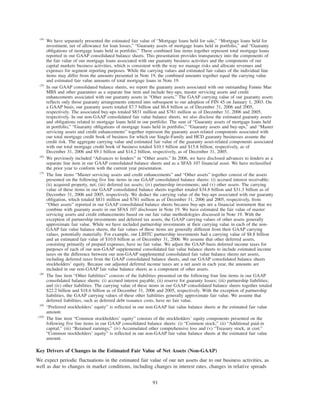
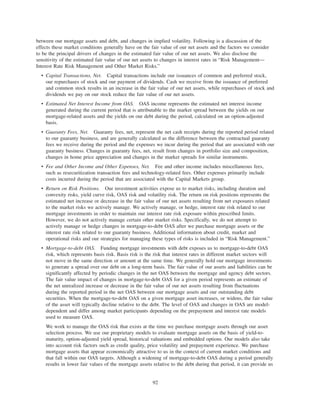
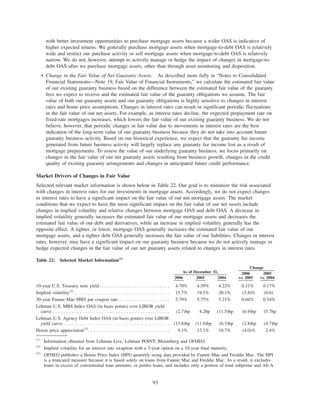
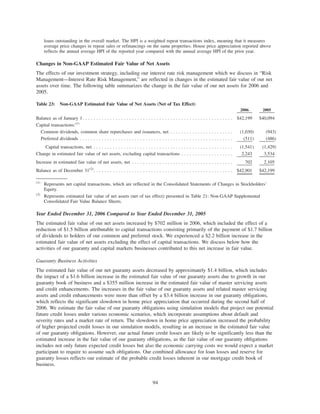
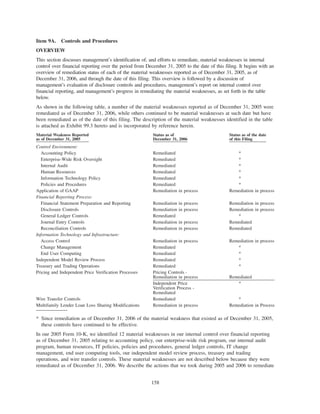
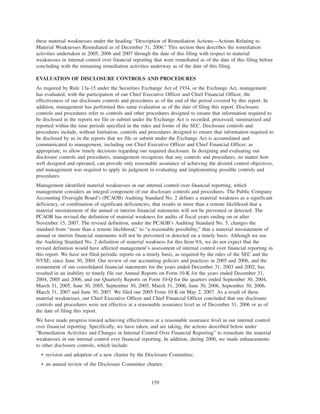
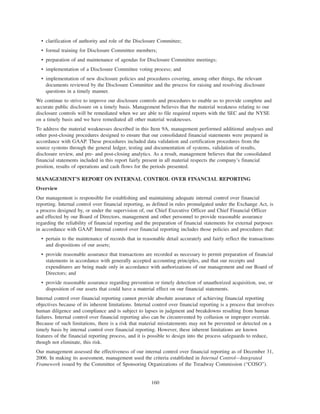
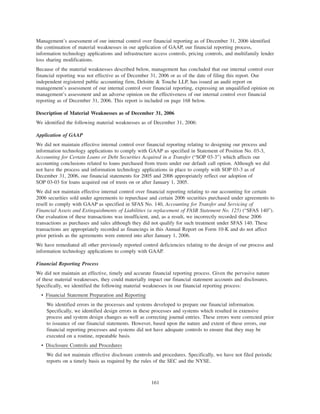
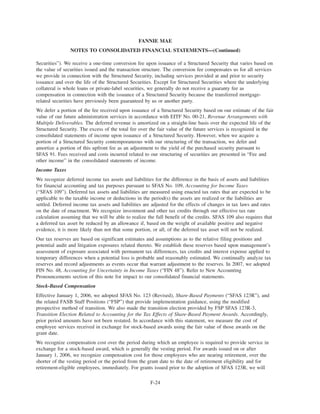
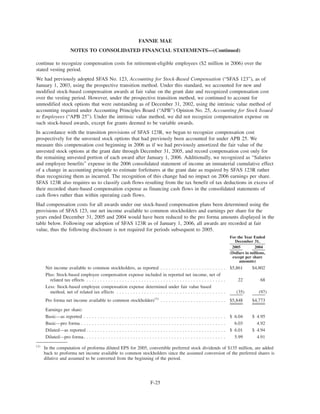
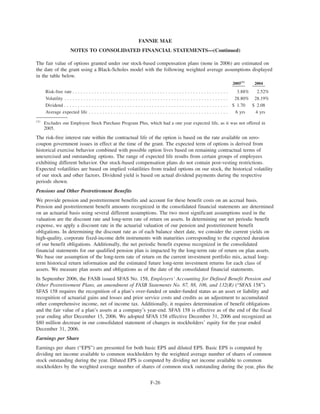
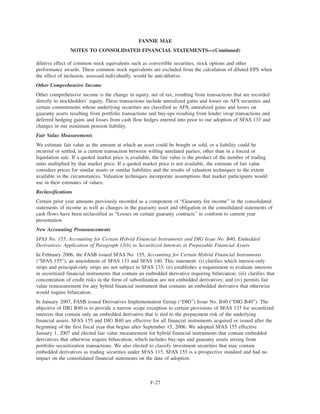
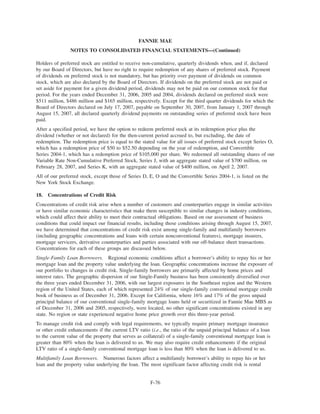
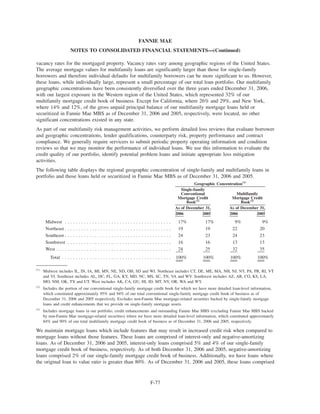
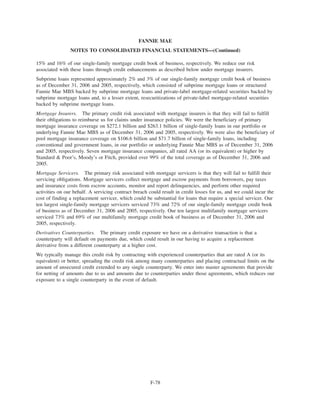
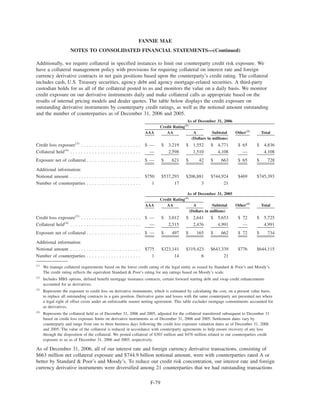
UNITED STATES SECURITIES AND EXCHANGE COMMISSION
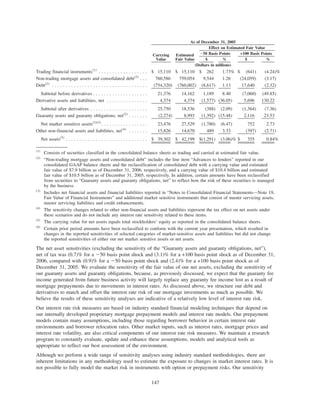
Washington, D.C. 20549
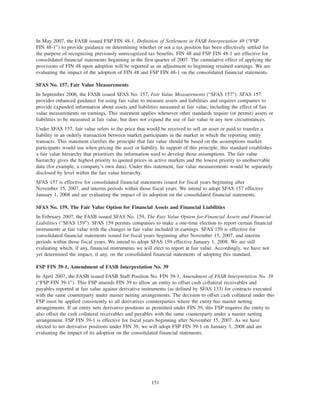
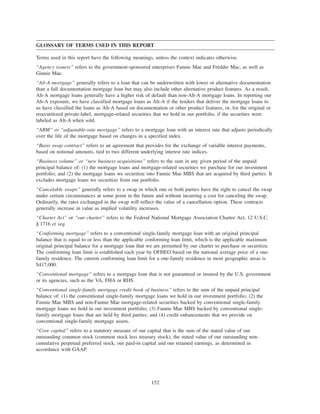
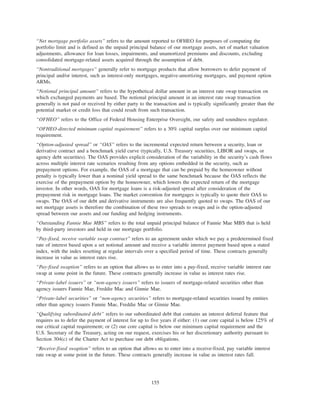
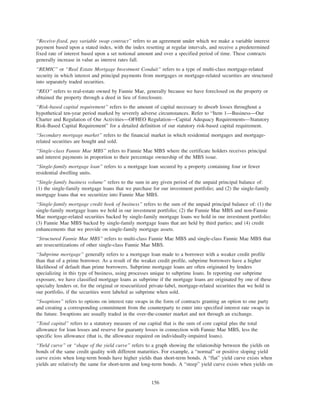
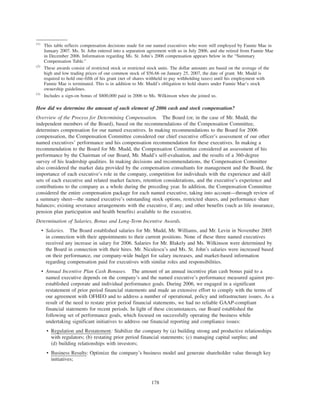
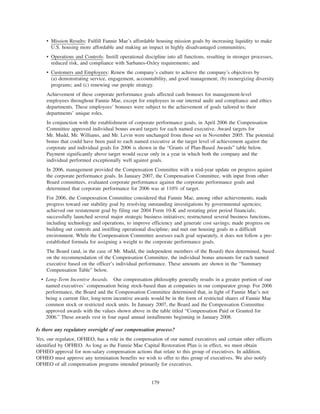
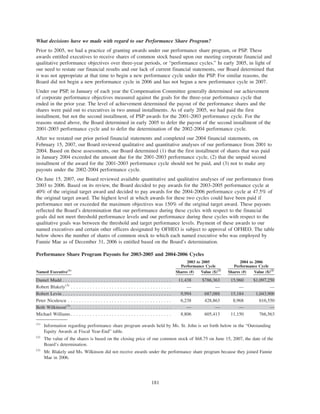
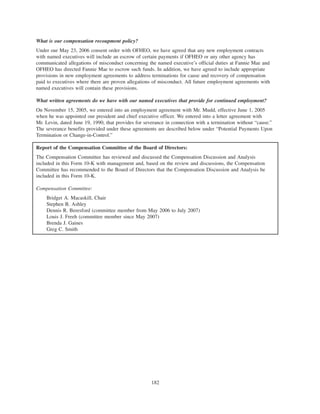
Form 10-K
ANNUAL REPORT PURSUANT TO SECTION 13 OR 15(d)
OF THE SECURITIES EXCHANGE ACT OF 1934
For the fiscal year ended December 31, 2006
Commission File No.: 0-50231
Federal National Mortgage Association
(Exact name of registrant as specified in its charter)
Fannie Mae
Federally chartered corporation 52-0883107
(State or other jurisdiction of
incorporation or organization)
(I.R.S. Employer
Identification No.)
3900 Wisconsin Avenue,
NW Washington, DC
(Address of principal executive offices)
20016
(Zip Code)
Registrant’s telephone number, including area code:
(202) 752-7000
Securities registered pursuant to Section 12(b) of the Act:
None
Securities registered pursuant to Section 12(g) of the Act:
Common Stock, without par value
(Title of class)
Indicate by check mark if the registrant is a well-known seasoned issuer, as defined in Rule 405 of the
Securities Act. Yes n No ¥
Indicate by check mark if the registrant is not required to file reports pursuant to Section 13 or 15(d) of the
Act. Yes n No ¥
Indicate by check mark whether the registrant (1) has filed all reports required to be filed by Section 13 or
15(d) of the Securities Exchange Act of 1934 during the preceding 12 months (or for such shorter period that
the registrant was required to file such reports), and (2) has been subject to such filing requirements for the
past 90 days. Yes n No ¥
Indicate by check mark if disclosure of delinquent filers pursuant to Item 405 of Regulation S-K is not
contained herein, and will not be contained, to the best of registrant’s knowledge, in definitive proxy or
information statements incorporated by reference in Part III of this Form 10-K or any amendment to this
Form 10-K. n
Indicate by check mark whether the registrant is a large accelerated filer, an accelerated filer, or a non-
accelerated filer. See definition of “accelerated filer and large accelerated filer” in Rule 12b-2 of the Exchange
Act. (Check one):
Large accelerated filer ¥ Accelerated filer n Non-accelerated filer n
Indicate by check mark whether the registrant is a shell company (as defined in Rule 12b-2 of the
Act). Yes n No ¥
The aggregate market value of the common stock held by non-affiliates of the registrant computed by
reference to the price at which the common stock was last sold on June 29, 2007 (the last business day of the
registrant’s most recently completed second fiscal quarter) was approximately $63,724 million.
As of June 30, 2007, there were 973,451,598 shares of common stock of the registrant outstanding.
DOCUMENTS INCORPORATED BY REFERENCE
None.
TABLE OF CONTENTS
PART I . . . . . . . . . . . . . . . . . . . . . . . . . . . . . . . . . . . . . . . . . . . . . . . . . . . . . . . . . . . . . . . . . . . . . . . . 1
Item 1. Business. . . . . . . . . . . . . . . . . . . . . . . . . . . . . . . . . . . . . . . . . . . . . . . . . . . . . . . . . . . . . . . 1
Explanatory Note About This Report . . . . . . . . . . . . . . . . . . . . . . . . . . . . . . . . . . . . . . . . . 1
Overview . . . . . . . . . . . . . . . . . . . . . . . . . . . . . . . . . . . . . . . . . . . . . . . . . . . . . . . . . . . . . . 1
Residential Mortgage Market Overview. . . . . . . . . . . . . . . . . . . . . . . . . . . . . . . . . . . . . . . . 2
Our Customers . . . . . . . . . . . . . . . . . . . . . . . . . . . . . . . . . . . . . . . . . . . . . . . . . . . . . . . . . . 4
Business Segments . . . . . . . . . . . . . . . . . . . . . . . . . . . . . . . . . . . . . . . . . . . . . . . . . . . . . . . 4
Risk Management. . . . . . . . . . . . . . . . . . . . . . . . . . . . . . . . . . . . . . . . . . . . . . . . . . . . . . . . 11
Competition . . . . . . . . . . . . . . . . . . . . . . . . . . . . . . . . . . . . . . . . . . . . . . . . . . . . . . . . . . . . 11
Our Charter and Regulation of Our Activities . . . . . . . . . . . . . . . . . . . . . . . . . . . . . . . . . . . 12
Employees . . . . . . . . . . . . . . . . . . . . . . . . . . . . . . . . . . . . . . . . . . . . . . . . . . . . . . . . . . . . . 20
Where You Can Find Additional Information . . . . . . . . . . . . . . . . . . . . . . . . . . . . . . . . . . . 20
Forward-Looking Statements . . . . . . . . . . . . . . . . . . . . . . . . . . . . . . . . . . . . . . . . . . . . . . . 21
Item 1A. Risk Factors . . . . . . . . . . . . . . . . . . . . . . . . . . . . . . . . . . . . . . . . . . . . . . . . . . . . . . . . . . . . 22
Item 1B. Unresolved Staff Comments . . . . . . . . . . . . . . . . . . . . . . . . . . . . . . . . . . . . . . . . . . . . . . . . 33
Item 2. Properties. . . . . . . . . . . . . . . . . . . . . . . . . . . . . . . . . . . . . . . . . . . . . . . . . . . . . . . . . . . . . . 33
Item 3. Legal Proceedings . . . . . . . . . . . . . . . . . . . . . . . . . . . . . . . . . . . . . . . . . . . . . . . . . . . . . . . 33
Item 4. Submission of Matters to a Vote of Security Holders . . . . . . . . . . . . . . . . . . . . . . . . . . . . . . 39
PART II . . . . . . . . . . . . . . . . . . . . . . . . . . . . . . . . . . . . . . . . . . . . . . . . . . . . . . . . . . . . . . . . . . . . . . . 40
Item 5. Market for Registrant’s Common Equity, Related Stockholder Matters and Issuer Purchases
of Equity Securities . . . . . . . . . . . . . . . . . . . . . . . . . . . . . . . . . . . . . . . . . . . . . . . . . . . . . . 40
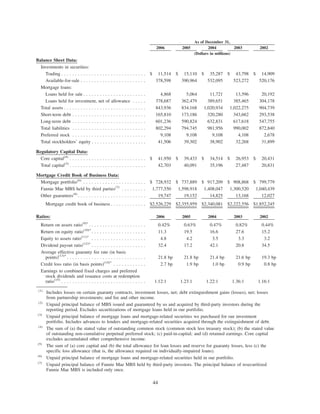
Item 6. Selected Financial Data . . . . . . . . . . . . . . . . . . . . . . . . . . . . . . . . . . . . . . . . . . . . . . . . . . . 43
Item 7. Management’s Discussion and Analysis of Financial Condition and Results of Operations . . 46
Organization of MD&A . . . . . . . . . . . . . . . . . . . . . . . . . . . . . . . . . . . . . . . . . . . . . . . . . . . 46
Executive Summary . . . . . . . . . . . . . . . . . . . . . . . . . . . . . . . . . . . . . . . . . . . . . . . . . . . . . . 46
Critical Accounting Policies and Estimates . . . . . . . . . . . . . . . . . . . . . . . . . . . . . . . . . . . . . 53
Consolidated Results of Operations . . . . . . . . . . . . . . . . . . . . . . . . . . . . . . . . . . . . . . . . . . . 59
Business Segment Results. . . . . . . . . . . . . . . . . . . . . . . . . . . . . . . . . . . . . . . . . . . . . . . . . . 74
Consolidated Balance Sheet Analysis . . . . . . . . . . . . . . . . . . . . . . . . . . . . . . . . . . . . . . . . . 79
Supplemental Non-GAAP Information—Fair Value Balance Sheet . . . . . . . . . . . . . . . . . . . . 88
Liquidity and Capital Management . . . . . . . . . . . . . . . . . . . . . . . . . . . . . . . . . . . . . . . . . . . 95
Off-Balance Sheet Arrangements and Variable Interest Entities . . . . . . . . . . . . . . . . . . . . . . 104
2006 Quarterly Review . . . . . . . . . . . . . . . . . . . . . . . . . . . . . . . . . . . . . . . . . . . . . . . . . . . . 107
Risk Management. . . . . . . . . . . . . . . . . . . . . . . . . . . . . . . . . . . . . . . . . . . . . . . . . . . . . . . . 117
Impact of Future Adoption of New Accounting Pronouncements . . . . . . . . . . . . . . . . . . . . . 150
Glossary of Terms Used in This Report. . . . . . . . . . . . . . . . . . . . . . . . . . . . . . . . . . . . . . . . 152
Item 7A. Quantitative and Qualitative Disclosures About Market Risk . . . . . . . . . . . . . . . . . . . . . . . . 157
Item 8. Financial Statements and Supplementary Data . . . . . . . . . . . . . . . . . . . . . . . . . . . . . . . . . . . 157
Item 9. Changes in and Disagreements with Accountants on Accounting and Financial Disclosure . . 157
Item 9A. Controls and Procedures . . . . . . . . . . . . . . . . . . . . . . . . . . . . . . . . . . . . . . . . . . . . . . . . . . . 158
Item 9B. Other Information. . . . . . . . . . . . . . . . . . . . . . . . . . . . . . . . . . . . . . . . . . . . . . . . . . . . . . . . 169
i
PART III. . . . . . . . . . . . . . . . . . . . . . . . . . . . . . . . . . . . . . . . . . . . . . . . . . . . . . . . . . . . . . . . . . . . . . . 170
Item 10. Directors, Executive Officers and Corporate Governance . . . . . . . . . . . . . . . . . . . . . . . . . . . 170
Item 11. Executive Compensation. . . . . . . . . . . . . . . . . . . . . . . . . . . . . . . . . . . . . . . . . . . . . . . . . . . 175
Item 12. Security Ownership of Certain Beneficial Owners and Management and Related
Stockholder Matters . . . . . . . . . . . . . . . . . . . . . . . . . . . . . . . . . . . . . . . . . . . . . . . . . . . . . . 202
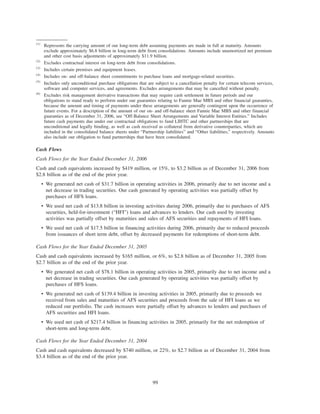
Item 13. Certain Relationships and Related Transactions, and Director Independence . . . . . . . . . . . . . 205
Item 14. Principal Accountant Fees and Services. . . . . . . . . . . . . . . . . . . . . . . . . . . . . . . . . . . . . . . . 210
PART IV . . . . . . . . . . . . . . . . . . . . . . . . . . . . . . . . . . . . . . . . . . . . . . . . . . . . . . . . . . . . . . . . . . . . . . . 211
Item 15. Exhibits and Financial Statement Schedules . . . . . . . . . . . . . . . . . . . . . . . . . . . . . . . . . . . . 211
INDEX TO EXHIBITS . . . . . . . . . . . . . . . . . . . . . . . . . . . . . . . . . . . . . . . . . . . . . . . . . . . . . . . . . . . . E-1
ii
MD&A TABLE REFERENCE
Table Description Page
— Selected Financial Data . . . . . . . . . . . . . . . . . . . . . . . . . . . . . . . . . . . . . . . . . . . . . . . . . . . . . . . 43
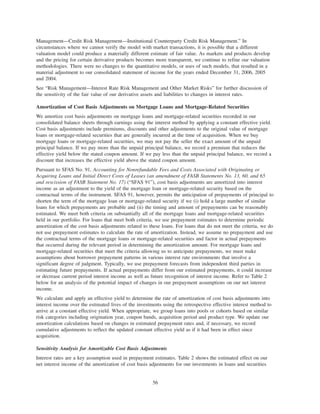
1 Derivative Assets and Liabilities at Estimated Fair Value. . . . . . . . . . . . . . . . . . . . . . . . . . . . . . . 55
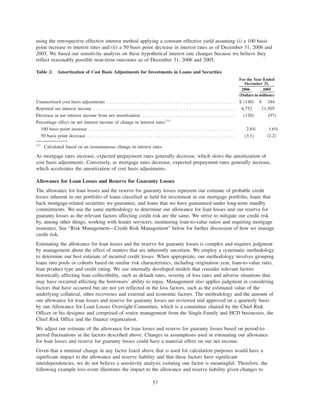
2 Amortization of Cost Basis Adjustments for Investments in Loans and Securities . . . . . . . . . . . . . 57
3 Condensed Consolidated Results of Operations . . . . . . . . . . . . . . . . . . . . . . . . . . . . . . . . . . . . . . 59
4 Analysis of Net Interest Income and Yield . . . . . . . . . . . . . . . . . . . . . . . . . . . . . . . . . . . . . . . . . 61
5 Rate/Volume Analysis of Net Interest Income . . . . . . . . . . . . . . . . . . . . . . . . . . . . . . . . . . . . . . . 62
6 Analysis of Guaranty Fee Income and Average Effective Guaranty Fee Rate . . . . . . . . . . . . . . . . 64
7 Fee and Other Income . . . . . . . . . . . . . . . . . . . . . . . . . . . . . . . . . . . . . . . . . . . . . . . . . . . . . . . . 65
8 Investment Losses, Net. . . . . . . . . . . . . . . . . . . . . . . . . . . . . . . . . . . . . . . . . . . . . . . . . . . . . . . . 66
9 Derivatives Fair Value Gains (Losses), Net . . . . . . . . . . . . . . . . . . . . . . . . . . . . . . . . . . . . . . . . . 68
10 Administrative Expenses . . . . . . . . . . . . . . . . . . . . . . . . . . . . . . . . . . . . . . . . . . . . . . . . . . . . . . 71
11 Business Segment Summary Financial Information . . . . . . . . . . . . . . . . . . . . . . . . . . . . . . . . . . . 74
12 Mortgage Portfolio Composition. . . . . . . . . . . . . . . . . . . . . . . . . . . . . . . . . . . . . . . . . . . . . . . . . 79
13 Mortgage Portfolio Activity . . . . . . . . . . . . . . . . . . . . . . . . . . . . . . . . . . . . . . . . . . . . . . . . . . . . 81
14 Non-Mortgage Investments. . . . . . . . . . . . . . . . . . . . . . . . . . . . . . . . . . . . . . . . . . . . . . . . . . . . . 82
15 Amortized Cost, Maturity and Average Yield of Investments in Available-for-Sale Securities . . . . 82
16 Outstanding Debt . . . . . . . . . . . . . . . . . . . . . . . . . . . . . . . . . . . . . . . . . . . . . . . . . . . . . . . . . . . . 83
17 Outstanding Short-Term Borrowings . . . . . . . . . . . . . . . . . . . . . . . . . . . . . . . . . . . . . . . . . . . . . . 84
18 Notional and Fair Value of Derivatives . . . . . . . . . . . . . . . . . . . . . . . . . . . . . . . . . . . . . . . . . . . . 86
19 Changes in Risk Management Derivative Assets (Liabilities) at Fair Value, Net . . . . . . . . . . . . . . 87
20 Purchased Options Premiums . . . . . . . . . . . . . . . . . . . . . . . . . . . . . . . . . . . . . . . . . . . . . . . . . . . 88
21 Non-GAAP Supplemental Consolidated Fair Value Balance Sheets . . . . . . . . . . . . . . . . . . . . . . . 90
22 Selected Market Information . . . . . . . . . . . . . . . . . . . . . . . . . . . . . . . . . . . . . . . . . . . . . . . . . . . 93
23 Non-GAAP Estimated Fair Value of Net Assets (Net of Tax Effect). . . . . . . . . . . . . . . . . . . . . . . 94
24 Debt Activity . . . . . . . . . . . . . . . . . . . . . . . . . . . . . . . . . . . . . . . . . . . . . . . . . . . . . . . . . . . . . . . 96
25 Fannie Mae Debt Credit Ratings. . . . . . . . . . . . . . . . . . . . . . . . . . . . . . . . . . . . . . . . . . . . . . . . . 98
26 Contractual Obligations . . . . . . . . . . . . . . . . . . . . . . . . . . . . . . . . . . . . . . . . . . . . . . . . . . . . . . . 99
27 Regulatory Capital Surplus . . . . . . . . . . . . . . . . . . . . . . . . . . . . . . . . . . . . . . . . . . . . . . . . . . . . . 101
28 On-and Off-Balance Sheet MBS and Other Guaranty Arrangements. . . . . . . . . . . . . . . . . . . . . . . 106
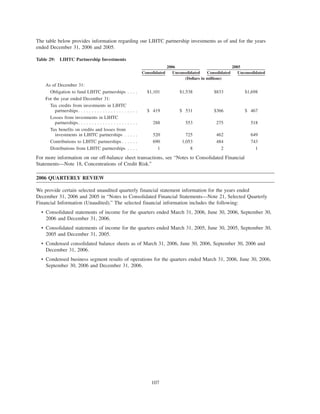
29 LIHTC Partnership Investments . . . . . . . . . . . . . . . . . . . . . . . . . . . . . . . . . . . . . . . . . . . . . . . . . 107
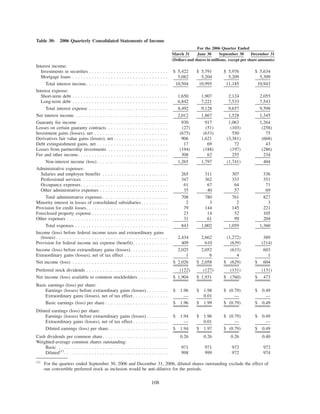
30 2006 Quarterly Consolidated Statements of Income. . . . . . . . . . . . . . . . . . . . . . . . . . . . . . . . . . . 108
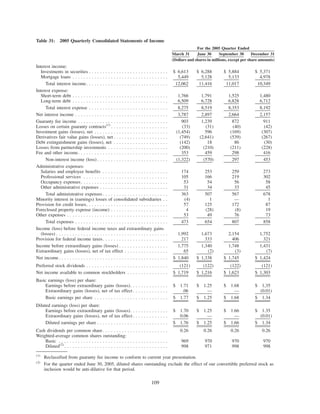
31 2005 Quarterly Consolidated Statements of Income. . . . . . . . . . . . . . . . . . . . . . . . . . . . . . . . . . . 109
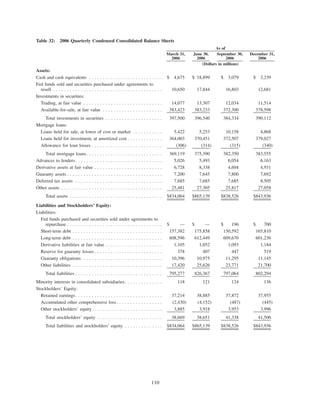
32 2006 Quarterly Condensed Consolidated Balance Sheets . . . . . . . . . . . . . . . . . . . . . . . . . . . . . . . 110
33 2006 Quarterly Condensed Business Segment Results . . . . . . . . . . . . . . . . . . . . . . . . . . . . . . . . . 111
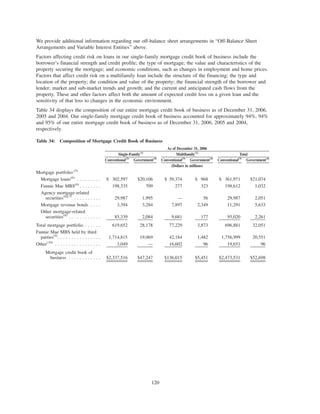
34 Composition of Mortgage Credit Book of Business . . . . . . . . . . . . . . . . . . . . . . . . . . . . . . . . . . . 120
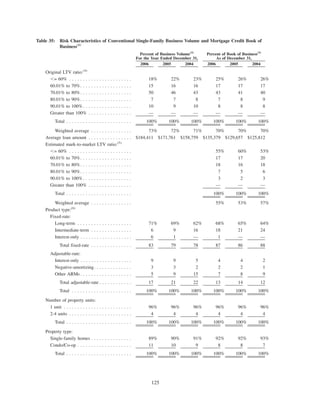
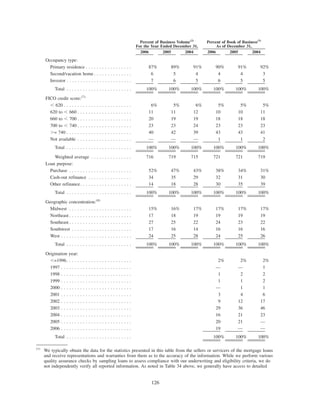
35 Risk Characteristics of Conventional Single-Family Business Volume and Mortgage Credit Book
of Business . . . . . . . . . . . . . . . . . . . . . . . . . . . . . . . . . . . . . . . . . . . . . . . . . . . . . . . . . . . . . . . . 125
36 Statistics on Conventional Single-Family Problem Loan Workouts . . . . . . . . . . . . . . . . . . . . . . . . 129
iii
Table Description Page
37 Serious Delinquency Rates . . . . . . . . . . . . . . . . . . . . . . . . . . . . . . . . . . . . . . . . . . . . . . . . . . . . . 131
38 Nonperforming Single-Family and Multifamily Loans . . . . . . . . . . . . . . . . . . . . . . . . . . . . . . . . . 132
39 Single-Family and Multifamily Foreclosed Properties . . . . . . . . . . . . . . . . . . . . . . . . . . . . . . . . . 133
40 Single-Family and Multifamily Credit Loss Performance . . . . . . . . . . . . . . . . . . . . . . . . . . . . . . . 134
41 Single-Family Credit Loss Sensitivity . . . . . . . . . . . . . . . . . . . . . . . . . . . . . . . . . . . . . . . . . . . . . 135
42 Allowance for Loan Losses and Reserve for Guaranty Losses . . . . . . . . . . . . . . . . . . . . . . . . . . . 136
43 Credit Loss Exposure of Risk Management Derivative Instruments . . . . . . . . . . . . . . . . . . . . . . . 139
44 Activity and Maturity Data for Risk Management Derivatives . . . . . . . . . . . . . . . . . . . . . . . . . . . 144
45 Interest Rate Sensitivity of Fair Value of Net Assets . . . . . . . . . . . . . . . . . . . . . . . . . . . . . . . . . . 146
iv
PART I
Because of the complexity of our business and the financial services industry in which we operate, we have
included in this Annual Report on Form 10-K a glossary under “Item 7—MD&A—Glossary of Terms Used in
This Report” beginning on page 152.
Item 1. Business
EXPLANATORY NOTE ABOUT THIS REPORT
We filed our Annual Report on Form 10-K for the year ended December 31, 2005 (“2005 Form 10-K”) on
May 2, 2007, after filing our Annual Report on Form 10-K for the year ended December 31, 2004 (“2004
Form 10-K”) on December 6, 2006. The filing of these reports represented a significant step in our efforts to
return to timely financial reporting. Our 2004 Form 10-K contained our consolidated financial statements and
related notes for the year ended December 31, 2004, as well as a restatement of our previously issued
consolidated financial statements and related notes for the years ended December 31, 2003 and 2002, and for
the quarters ended June 30, 2004 and March 31, 2004. The filing of the 2004 Form 10-K, the 2005 Form 10-K
and this Annual Report on Form 10-K for the year ended December 31, 2006 (“2006 Form 10-K”) were
delayed significantly as a result of the substantial time and effort devoted to ongoing controls remediation, and
systems reengineering and development in order to complete the restatement of our financial results for 2003
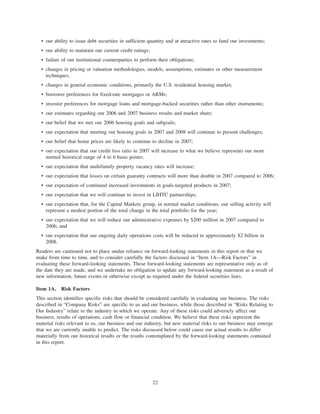
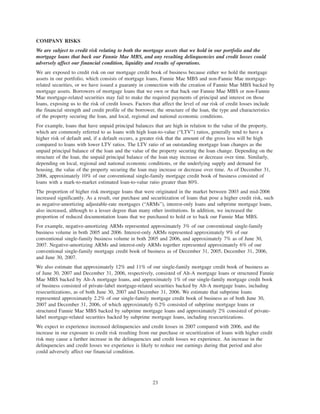
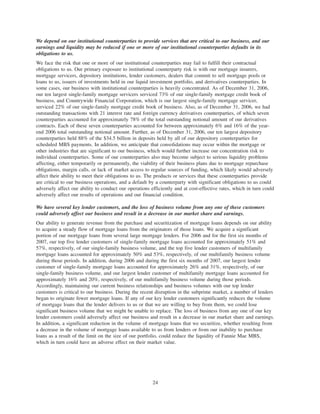
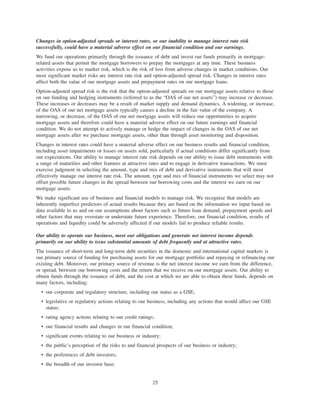
and 2002, as presented in our 2004 Form 10-K. Because of the delay in our periodic reporting, where
appropriate, the information contained in this report reflects more current information about our business,
including information of the type we have included in previous Forms 12b-25 that we have filed with the
Securities and Exchange Commission (“SEC”) to report the late filing of prior periodic reports. All amounts in
this 2006 Form 10-K affected by the restatement adjustments reported in our 2004 Form 10-K reflect those
amounts as restated.
In lieu of filing quarterly reports for 2006, we have included in this report substantially all of the information
required to be included in quarterly reports. We have made significant progress in our efforts to remediate
material weaknesses that have prevented us from reporting our financial results on a timely basis. On June 8,
2007, we announced that we plan to become a current filer by the end of February 2008 with the filing of our
Annual Report on Form 10-K for the year ended December 31, 2007 (“2007 Form 10-K”) with the SEC. At
this time, we are confirming our expectation that we will file our 2007 Form 10-K on a timely basis. In
addition, we expect to file our Forms 10-Q for the first, second, and third quarters of 2007 by December 31,
2007.
OVERVIEW
Fannie Mae’s activities enhance the liquidity and stability of the mortgage market and contribute to making
housing in the United States more affordable and more available to low-, moderate- and middle-income
Americans. These activities include providing funds to mortgage lenders through our purchases of mortgage
assets, and issuing and guaranteeing mortgage-related securities that facilitate the flow of additional funds into
the mortgage market. We also make other investments that increase the supply of affordable housing.
We are a government-sponsored enterprise (“GSE”) chartered by the U.S. Congress under the name “Federal
National Mortgage Association” and are aligned with national policies to support expanded access to housing
and increased opportunities for homeownership. We are subject to government oversight and regulation. Our
regulators include the Office of Federal Housing Enterprise Oversight (“OFHEO”), the Department of Housing
and Urban Development (“HUD”), the SEC, and the Department of the Treasury.
Although we are a corporation chartered by the U.S. Congress, the U.S. government does not guarantee,
directly or indirectly, our securities or other obligations. We are a stockholder-owned corporation, and our
business is self-sustaining and funded exclusively with private capital. Our common stock is listed on the New
York Stock Exchange (“NYSE”), and traded under the symbol “FNM.” Our debt securities are actively traded
in the over-the-counter market.
1
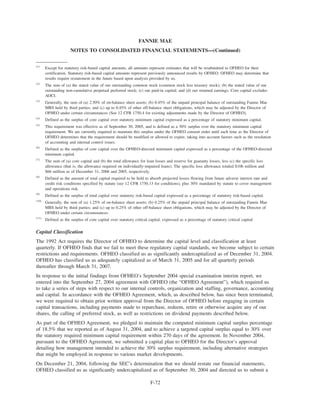
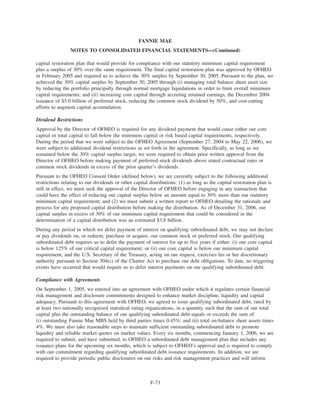
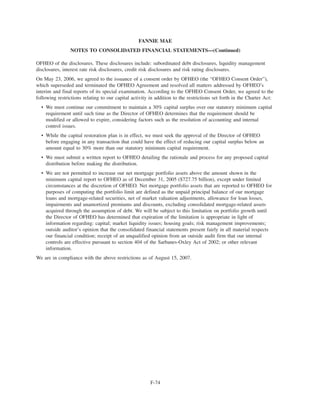
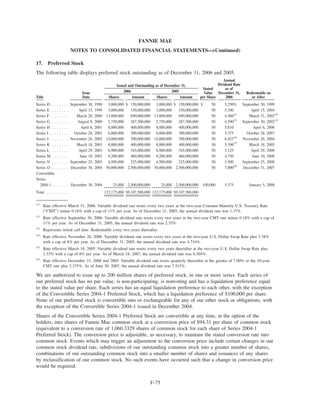
RESIDENTIAL MORTGAGE MARKET OVERVIEW
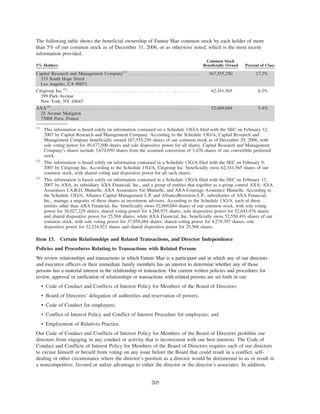
We operate in the U.S. residential mortgage market, specifically in the secondary mortgage market where
mortgages are bought and sold. We discuss below the dynamics of the residential mortgage market and our
role in the secondary mortgage market.
Residential Mortgage Market
Our business operates within the U.S. residential mortgage market, and therefore, we consider the amount of
U.S. residential mortgage debt outstanding to be the best measure of the size of our overall market. As of
March 31, 2007, the latest date for which information was available, the amount of U.S. residential mortgage
debt outstanding was estimated by the Federal Reserve to be approximately $11.2 trillion (including $10.4
trillion of single-family mortgages). Our mortgage credit book of business, which includes mortgage assets we
hold in our investment portfolio, our Fannie Mae mortgage-backed securities held by third parties and credit
enhancements that we provide on mortgage assets, was $2.6 trillion as of March 31, 2007, or approximately
23% of total U.S. residential mortgage debt outstanding. “Fannie Mae mortgage-backed securities” or “Fannie
Mae MBS” generally refers to those mortgage-related securities that we issue and with respect to which we
guarantee to the related trusts that we will supplement amounts received by those MBS trusts as required to
permit timely payment of principal and interest on the Fannie Mae MBS. We also issue some forms of
mortgage-related securities for which we do not provide this guaranty.
The U.S. residential mortgage market has experienced strong long-term growth. According to Federal Reserve
estimates, growth in U.S. residential mortgage debt outstanding averaged 10.6% per year from 1945 to 2006,
which is faster than the 6.9% average growth in the overall U.S. economy over the same period, as measured
by nominal gross domestic product. Growth in U.S. residential mortgage debt outstanding was particularly
strong between 2001 and mid-2006 (with an average annualized growth rate of 12.8%). As indicated in the
table below, which provides a comparison of overall housing and mortgage market statistics to our business
activity, total U.S. residential mortgage debt outstanding grew at an even faster rate of approximately 14% in
2005. Growth in U.S. residential mortgage debt slowed to approximately 9% in 2006, and slowed further in
early 2007, with an annualized first quarter growth rate of nearly 6%, the slowest rate of growth in almost
10 years.
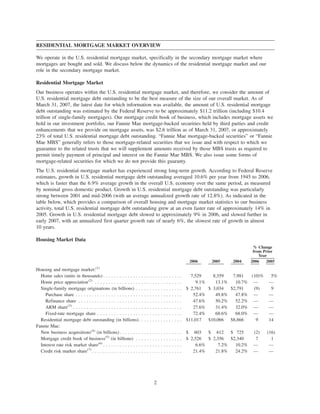
Housing Market Data
2006 2005 2004 2006 2005
% Change
from Prior
Year
Housing and mortgage market:(1)
Home sales (units in thousands) . . . . . . . . . . . . . . . . . . . . . . . . . . . . . 7,529 8,359 7,981 (10)% 5%
Home price appreciation(2)
. . . . . . . . . . . . . . . . . . . . . . . . . . . . . . . . 9.1% 13.1% 10.7% — —
Single-family mortgage originations (in billions) . . . . . . . . . . . . . . . . . $ 2,761 $ 3,034 $2,791 (9) 9
Purchase share . . . . . . . . . . . . . . . . . . . . . . . . . . . . . . . . . . . . . . . 52.4% 49.8% 47.8% — —
Refinance share . . . . . . . . . . . . . . . . . . . . . . . . . . . . . . . . . . . . . . 47.6% 50.2% 52.2% — —
ARM share(3)
. . . . . . . . . . . . . . . . . . . . . . . . . . . . . . . . . . . . . . . . 27.6% 31.4% 32.0% — —
Fixed-rate mortgage share . . . . . . . . . . . . . . . . . . . . . . . . . . . . . . . 72.4% 68.6% 68.0% — —
Residential mortgage debt outstanding (in billions). . . . . . . . . . . . . . . . $11,017 $10,066 $8,866 9 14
Fannie Mae:
New business acquisitions(4)
(in billions). . . . . . . . . . . . . . . . . . . . . . . $ 603 $ 612 $ 725 (2) (16)
Mortgage credit book of business(5)
(in billions) . . . . . . . . . . . . . . . . . $ 2,526 $ 2,356 $2,340 7 1
Interest rate risk market share(6)
. . . . . . . . . . . . . . . . . . . . . . . . . . . . . 6.6% 7.2% 10.2% — —
Credit risk market share(7)
. . . . . . . . . . . . . . . . . . . . . . . . . . . . . . . . . 21.4% 21.8% 24.2% — —
2
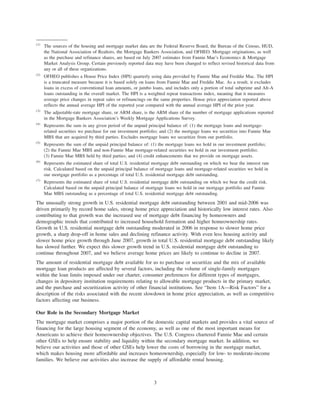
(1)
The sources of the housing and mortgage market data are the Federal Reserve Board, the Bureau of the Census, HUD,
the National Association of Realtors, the Mortgage Bankers Association, and OFHEO. Mortgage originations, as well
as the purchase and refinance shares, are based on July 2007 estimates from Fannie Mae’s Economics & Mortgage
Market Analysis Group. Certain previously reported data may have been changed to reflect revised historical data from
any or all of these organizations.
(2)
OFHEO publishes a House Price Index (HPI) quarterly using data provided by Fannie Mae and Freddie Mac. The HPI
is a truncated measure because it is based solely on loans from Fannie Mae and Freddie Mac. As a result, it excludes
loans in excess of conventional loan amounts, or jumbo loans, and includes only a portion of total subprime and Alt-A
loans outstanding in the overall market. The HPI is a weighted repeat transactions index, meaning that it measures
average price changes in repeat sales or refinancings on the same properties. House price appreciation reported above
reflects the annual average HPI of the reported year compared with the annual average HPI of the prior year.
(3)
The adjustable-rate mortgage share, or ARM share, is the ARM share of the number of mortgage applications reported
in the Mortgage Bankers Association’s Weekly Mortgage Applications Survey.
(4)
Represents the sum in any given period of the unpaid principal balance of: (1) the mortgage loans and mortgage-
related securities we purchase for our investment portfolio; and (2) the mortgage loans we securitize into Fannie Mae
MBS that are acquired by third parties. Excludes mortgage loans we securitize from our portfolio.
(5)
Represents the sum of the unpaid principal balance of: (1) the mortgage loans we hold in our investment portfolio;
(2) the Fannie Mae MBS and non-Fannie Mae mortgage-related securities we hold in our investment portfolio;
(3) Fannie Mae MBS held by third parties; and (4) credit enhancements that we provide on mortgage assets.
(6)
Represents the estimated share of total U.S. residential mortgage debt outstanding on which we bear the interest rate
risk. Calculated based on the unpaid principal balance of mortgage loans and mortgage-related securities we hold in
our mortgage portfolio as a percentage of total U.S. residential mortgage debt outstanding.
(7)
Represents the estimated share of total U.S. residential mortgage debt outstanding on which we bear the credit risk.
Calculated based on the unpaid principal balance of mortgage loans we hold in our mortgage portfolio and Fannie
Mae MBS outstanding as a percentage of total U.S. residential mortgage debt outstanding.
The unusually strong growth in U.S. residential mortgage debt outstanding between 2001 and mid-2006 was
driven primarily by record home sales, strong home price appreciation and historically low interest rates. Also
contributing to that growth was the increased use of mortgage debt financing by homeowners and
demographic trends that contributed to increased household formation and higher homeownership rates.
Growth in U.S. residential mortgage debt outstanding moderated in 2006 in response to slower home price
growth, a sharp drop-off in home sales and declining refinance activity. With even less housing activity and
slower home price growth through June 2007, growth in total U.S. residential mortgage debt outstanding likely
has slowed further. We expect this slower growth trend in U.S. residential mortgage debt outstanding to
continue throughout 2007, and we believe average home prices are likely to continue to decline in 2007.
The amount of residential mortgage debt available for us to purchase or securitize and the mix of available
mortgage loan products are affected by several factors, including the volume of single-family mortgages
within the loan limits imposed under our charter, consumer preferences for different types of mortgages,
changes in depository institution requirements relating to allowable mortgage products in the primary market,
and the purchase and securitization activity of other financial institutions. See “Item 1A—Risk Factors” for a
description of the risks associated with the recent slowdown in home price appreciation, as well as competitive
factors affecting our business.
Our Role in the Secondary Mortgage Market
The mortgage market comprises a major portion of the domestic capital markets and provides a vital source of
financing for the large housing segment of the economy, as well as one of the most important means for
Americans to achieve their homeownership objectives. The U.S. Congress chartered Fannie Mae and certain
other GSEs to help ensure stability and liquidity within the secondary mortgage market. In addition, we
believe our activities and those of other GSEs help lower the costs of borrowing in the mortgage market,
which makes housing more affordable and increases homeownership, especially for low- to moderate-income
families. We believe our activities also increase the supply of affordable rental housing.
3
We operate in the secondary mortgage market where mortgages are bought and sold. We securitize mortgage
loans originated by lenders in the primary mortgage market into Fannie Mae MBS, which can then be readily
bought and sold in the secondary mortgage market. We also participate in the secondary mortgage market by
purchasing mortgage loans (often referred to as “whole loans”) and mortgage-related securities, including
Fannie Mae MBS, for our mortgage portfolio. By delivering loans to us in exchange for Fannie Mae MBS,
lenders gain the advantage of holding a highly liquid instrument that offers them the flexibility to determine
under what conditions they will hold or sell the MBS. By selling loans and mortgage-related securities to us,
lenders replenish their funds and, consequently, are able to make additional loans. Under our charter, we may
not lend money directly to consumers in the primary mortgage market.
OUR CUSTOMERS
Our principal customers are lenders that operate within the primary mortgage market where mortgage loans
are originated and funds are loaned to borrowers. Our customers include mortgage banking companies,
investment banks, savings and loan associations, savings banks, commercial banks, credit unions, community
banks, and state and local housing finance agencies. Lenders originating mortgages in the primary mortgage
market often sell them in the secondary mortgage market in the form of loans or in the form of mortgage-
related securities.
Our lender customers supply mortgage loans both for securitization into Fannie Mae MBS and for purchase
for our mortgage portfolio. During 2006, over 1,000 lenders delivered mortgage loans to us, either for
securitization or for purchase. We acquire a significant portion of our single-family mortgage loans from
several large mortgage lenders. During 2006, our top five lender customers, in the aggregate, accounted for
approximately 51% of our single-family business volume compared with 49% in 2005. Our top customer,
Countrywide Financial Corporation (through its subsidiaries), accounted for approximately 26% of our single-
family business volume in 2006 compared with 25% in 2005. Due to increasing consolidation within the
mortgage industry, we, as well as our competitors, seek business from a decreasing number of large mortgage
lenders. See “Item 1A—Risk Factors” for a discussion of the risks that this customer concentration poses to
our business.
BUSINESS SEGMENTS
We operate an integrated business that contributes to providing liquidity to the mortgage market and
increasing the availability and affordability of housing in the U.S. We are organized in three complementary
business segments:
• Our Single-Family Credit Guaranty (“Single-Family”) business works with our lender customers to
securitize single-family mortgage loans into Fannie Mae MBS and to facilitate the purchase of single-
family mortgage loans for our mortgage portfolio. Our Single-Family business has responsibility for
managing our credit risk exposure relating to the single-family Fannie Mae MBS held by third parties, as
well as managing and pricing the credit risk of the single-family mortgage loans and single-family Fannie
Mae MBS held in our own mortgage portfolio. Revenues in the segment are derived primarily from the
guaranty fees the segment receives as compensation for assuming the credit risk on the mortgage loans
underlying single-family Fannie Mae MBS and on the single-family mortgage loans held in our portfolio.
• Our Housing and Community Development (“HCD”) business works with our lender customers to
securitize multifamily mortgage loans into Fannie Mae MBS and to facilitate the purchase of multifamily
mortgage loans for our mortgage portfolio. Our HCD business also helps to expand the supply of
affordable housing by investing in rental and for-sale housing projects, including rental housing that is
eligible for federal low-income housing tax credits. Our HCD business has responsibility for managing
our credit risk exposure relating to the multifamily Fannie Mae MBS held by third parties, as well as
managing and pricing the credit risk of the multifamily mortgage loans and multifamily Fannie Mae MBS
held in our mortgage portfolio. Revenues in the segment are derived from a variety of sources, including
the guaranty fees the segment receives as compensation for assuming the credit risk on the mortgage
4
loans underlying multifamily Fannie Mae MBS and on the multifamily mortgage loans held in our
portfolio, transaction fees associated with the multifamily business and bond credit enhancement fees. In
addition, HCD’s investments in rental housing projects eligible for the federal low-income housing tax
credit generate both tax credits and net operating losses that reduce our federal income tax liability. Other
investments in rental and for-sale housing generate revenue from operations and the eventual sale of the
assets.
• Our Capital Markets group manages our investment activity in mortgage loans and mortgage-related
securities, and has responsibility for managing our assets and liabilities and our liquidity and capital
positions. Through the issuance of debt securities in the capital markets, our Capital Markets group
attracts capital from investors globally to finance housing in the U.S. In addition, our Capital Markets
group increases the liquidity of the mortgage market by maintaining a constant presence as an active
investor in mortgage assets and in particular supports the liquidity and value of Fannie Mae MBS in a
variety of market conditions. Our Capital Markets group has responsibility for managing the credit risk of
the non-Fannie Mae mortgage-related securities in our portfolio and for managing our interest rate risk.
Our Capital Markets group generates income primarily from the difference, or spread, between the yield
on the mortgage assets we own and the cost of the debt we issue in the global capital markets to fund
these assets.
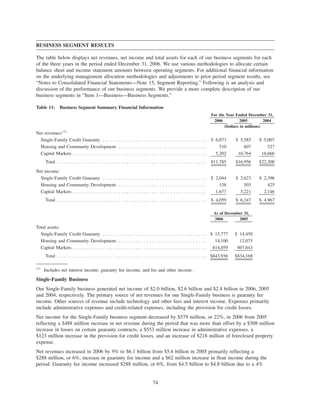
The table below displays net revenues, net income and total assets for each of our business segments for each
of the three years during the period ended December 31, 2006.
Business Segment Summary Financial Information
2006 2005 2004
For the Year Ended December 31,
(Dollars in millions)
Net revenues:(1)
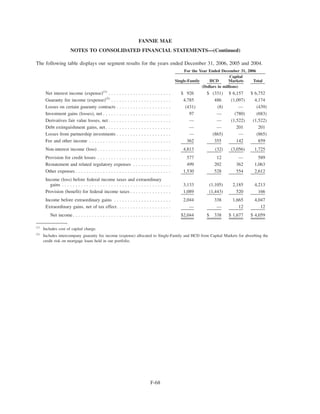
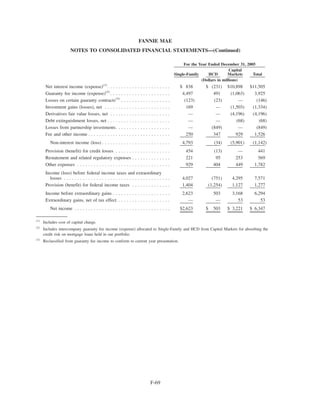
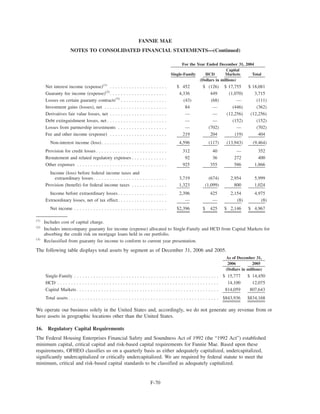
Single-Family Credit Guaranty . . . . . . . . . . . . . . . . . . . . . . . . . . . . . . . . . $ 6,073 $ 5,585 $ 5,007
Housing and Community Development . . . . . . . . . . . . . . . . . . . . . . . . . . . 510 607 527
Capital Markets. . . . . . . . . . . . . . . . . . . . . . . . . . . . . . . . . . . . . . . . . . . . 5,202 10,764 16,666
Total . . . . . . . . . . . . . . . . . . . . . . . . . . . . . . . . . . . . . . . . . . . . . . . . . $11,785 $16,956 $22,200
Net income:
Single-Family Credit Guaranty . . . . . . . . . . . . . . . . . . . . . . . . . . . . . . . . . $ 2,044 $ 2,623 $ 2,396
Housing and Community Development . . . . . . . . . . . . . . . . . . . . . . . . . . . 338 503 425
Capital Markets. . . . . . . . . . . . . . . . . . . . . . . . . . . . . . . . . . . . . . . . . . . . 1,677 3,221 2,146
Total . . . . . . . . . . . . . . . . . . . . . . . . . . . . . . . . . . . . . . . . . . . . . . . . . $ 4,059 $ 6,347 $ 4,967
2006 2005
As of December 31,
Total assets:
Single-Family Credit Guaranty . . . . . . . . . . . . . . . . . . . . . . . . . . . . . . . . . $ 15,777 $ 14,450
Housing and Community Development . . . . . . . . . . . . . . . . . . . . . . . . . . . 14,100 12,075
Capital Markets . . . . . . . . . . . . . . . . . . . . . . . . . . . . . . . . . . . . . . . . . . . 814,059 807,643
Total . . . . . . . . . . . . . . . . . . . . . . . . . . . . . . . . . . . . . . . . . . . . . . . . . $843,936 $834,168
(1)
Includes net interest income, guaranty fee income, and fee and other income.
We use various management methodologies to allocate certain balance sheet and income statement line items,
including capital and administrative costs, and to apply guaranty fees for managing credit risk, to the
responsible operating segment. For a description of our allocation methodologies, see “Notes to Consolidated
Financial Statements—Note 15, Segment Reporting.” For further information on the results of operations and
assets of our business segments, see “Item 7—MD&A—Business Segment Results.”
5
Single-Family Credit Guaranty
Our Single-Family business provides guaranty services principally by assuming the credit risk of the single-
family mortgage loans underlying our guaranteed Fannie Mae MBS held by third parties. Our Single-Family
business also assumes the credit risk of the single-family mortgage loans held in our investment portfolio, as
well as the single-family mortgage loans underlying Fannie Mae MBS held in our portfolio.
Our most common type of guaranty transaction is referred to as a “lender swap transaction.” Mortgage lenders
that operate in the primary mortgage market generally deliver pools of mortgage loans to us in exchange for
Fannie Mae MBS backed by these loans. After receiving the loans in a lender swap transaction, we place them
in a trust that is established for the sole purpose of holding the loans separate and apart from our assets. We
serve as trustee for the trust. Upon creation of the trust, we deliver to the lender (or its designee) Fannie Mae
MBS that are backed by the pool of mortgage loans in the trust and that represent a beneficial ownership
interest in each of the loans. We guarantee to each MBS trust that we will supplement amounts received by
the MBS trust as required to permit timely payment of principal and interest on the related Fannie Mae MBS.
The mortgage servicers for the underlying mortgage loans collect the principal and interest payments from the
borrowers. We permit them to retain a portion of the interest payment as compensation for servicing the
mortgage loans before distributing the principal and remaining interest payments to us. We retain a portion of
the interest payment as the fee for providing our guaranty. Then, on behalf of the trust, we make monthly
distributions to the Fannie Mae MBS certificate holders from the principal and interest payments and other
collections on the underlying mortgage loans.
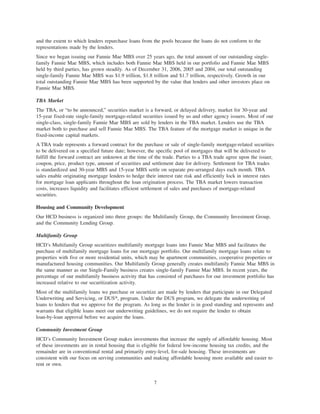
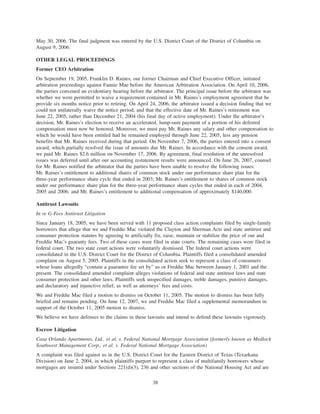
The following diagram illustrates the basic process by which we create a typical Fannie Mae MBS in the case
where a lender chooses to sell the Fannie Mae MBS to a third-party investor.
Lenders
Investors
$$ Mortgages
Fannie Mae
MBS
We create Fannie Mae MBS
backed by pools of mortgage
loans and return the MBS to
lenders. We assume credit
risk, for which we receive
guaranty fees.
2
Fannie
Lenders sell
Fannie Mae
MBS to
investors.
3
MBS
TrustFannie Mae
MBS
Lenders
originate
mortgage loans
with borrowers.
1
$$
Mortgages
Fannie Mae
MBS
Mortgages
Borrowers
The aggregate amount of single-family guaranty fees we receive in any period depends on the amount of
Fannie Mae MBS outstanding during that period and the applicable guaranty fee rates. The amount of Fannie
Mae MBS outstanding at any time is primarily determined by the rate at which we issue new Fannie Mae
MBS and by the repayment rate for the loans underlying our outstanding Fannie Mae MBS. Less significant
factors affecting the amount of Fannie Mae MBS outstanding are the rates of borrower defaults on the loans
6
and the extent to which lenders repurchase loans from the pools because the loans do not conform to the
representations made by the lenders.
Since we began issuing our Fannie Mae MBS over 25 years ago, the total amount of our outstanding single-
family Fannie Mae MBS, which includes both Fannie Mae MBS held in our portfolio and Fannie Mae MBS
held by third parties, has grown steadily. As of December 31, 2006, 2005 and 2004, our total outstanding
single-family Fannie Mae MBS was $1.9 trillion, $1.8 trillion and $1.7 trillion, respectively. Growth in our
total outstanding Fannie Mae MBS has been supported by the value that lenders and other investors place on
Fannie Mae MBS.
TBA Market
The TBA, or “to be announced,” securities market is a forward, or delayed delivery, market for 30-year and
15-year fixed-rate single-family mortgage-related securities issued by us and other agency issuers. Most of our
single-class, single-family Fannie Mae MBS are sold by lenders in the TBA market. Lenders use the TBA
market both to purchase and sell Fannie Mae MBS. The TBA feature of the mortgage market is unique in the
fixed-income capital markets.
A TBA trade represents a forward contract for the purchase or sale of single-family mortgage-related securities
to be delivered on a specified future date; however, the specific pool of mortgages that will be delivered to
fulfill the forward contract are unknown at the time of the trade. Parties to a TBA trade agree upon the issuer,
coupon, price, product type, amount of securities and settlement date for delivery. Settlement for TBA trades
is standardized and 30-year MBS and 15-year MBS settle on separate pre-arranged days each month. TBA
sales enable originating mortgage lenders to hedge their interest rate risk and efficiently lock in interest rates
for mortgage loan applicants throughout the loan origination process. The TBA market lowers transaction
costs, increases liquidity and facilitates efficient settlement of sales and purchases of mortgage-related
securities.
Housing and Community Development
Our HCD business is organized into three groups: the Multifamily Group, the Community Investment Group,
and the Community Lending Group.
Multifamily Group
HCD’s Multifamily Group securitizes multifamily mortgage loans into Fannie Mae MBS and facilitates the
purchase of multifamily mortgage loans for our mortgage portfolio. Our multifamily mortgage loans relate to
properties with five or more residential units, which may be apartment communities, cooperative properties or
manufactured housing communities. Our Multifamily Group generally creates multifamily Fannie Mae MBS in
the same manner as our Single-Family business creates single-family Fannie Mae MBS. In recent years, the
percentage of our multifamily business activity that has consisted of purchases for our investment portfolio has
increased relative to our securitization activity.
Most of the multifamily loans we purchase or securitize are made by lenders that participate in our Delegated
Underwriting and Servicing, or DUS», program. Under the DUS program, we delegate the underwriting of
loans to lenders that we approve for the program. As long as the lender is in good standing and represents and
warrants that eligible loans meet our underwriting guidelines, we do not require the lender to obtain
loan-by-loan approval before we acquire the loans.
Community Investment Group
HCD’s Community Investment Group makes investments that increase the supply of affordable housing. Most
of these investments are in rental housing that is eligible for federal low-income housing tax credits, and the
remainder are in conventional rental and primarily entry-level, for-sale housing. These investments are
consistent with our focus on serving communities and making affordable housing more available and easier to
rent or own.
7
The Community Investment Group’s investments have been made predominantly in low-income housing tax
credit (“LIHTC”) limited partnerships or limited liability companies (referred to collectively as “LIHTC
partnerships”) that directly or indirectly own an interest in rental housing developed or rehabilitated by the
LIHTC partnerships. By renting a specified portion of the housing units to qualified low-income tenants over a
15-year period, the LIHTC partnerships become eligible for the federal low-income housing tax credit, which
was enacted as part of the Tax Reform Act of 1986 to encourage investment by private developers and
investors in low-income rental housing. Failure to qualify as an affordable housing project over the entire
15-year period may result in the recapture of a portion of the tax credits. The LIHTC partnerships are
generally organized by fund manager sponsors who seek investments with third-party developers that, in turn,
develop or rehabilitate the properties and then manage them. We invest in these partnerships as a limited
partner or non-managing limited liability company member, with the fund manager acting as the general
partner or managing member. We earn a return on our investments in LIHTC partnerships through reductions
in our federal income tax liability that result from both our use of the tax credits for which the LIHTC
partnerships qualify, and the deductibility of the LIHTC partnerships’ net operating losses.
In addition to investing in LIHTC partnerships, HCD’s Community Investment Group makes equity
investments in rental and for-sale housing, typically through fund managers or directly with developers and
operators that are well-recognized firms within the industry. Because we invest as a limited partner or as a
non-managing member in a limited liability company, our exposure is generally limited to the amount of our
investment. Our equity investments in for-sale housing generally involve the acquisition, development and/or
construction of entry-level homes or the conversion of existing housing to entry-level homes.
Community Lending Group
HCD’s Community Lending Group supports the expansion of available housing by participating in specialized
debt financing for a variety of customers and by acquiring mortgage loans. These activities include:
• acquiring multifamily loans from a variety of lending institutions that do not participate in our DUS»
program;
• helping to meet the financing needs of single-family and multifamily home builders by purchasing
participation interests in acquisition, development and construction (“AD&C”) loans from lending
institutions;
• providing loans to Community Development Financial Institution intermediaries to re-lend for community
revitalization projects that expand the supply of affordable housing stock; and
• providing financing for single-family and multifamily housing to housing finance agencies, public housing
authorities and municipalities.
In July 2006, OFHEO advised us to suspend new AD&C business until we finalized and implemented
specified policies and procedures required to strengthen risk management practices related to this business. We
have implemented these new policies and procedures and have also implemented new controls and reporting
mechanisms relating to our AD&C business. We received approval from OFHEO on June 8, 2007 to re-enter
the secured AD&C business in a graduated manner. However, OFHEO advised us not to re-enter the
unsecured AD&C business until matters relating to our engagement in certain market activities and unsecured
lending are resolved with HUD.
Capital Markets
Our Capital Markets group manages our investment activity in mortgage loans, mortgage-related securities and
other liquid investments. We purchase mortgage loans and mortgage-related securities from mortgage lenders,
securities dealers, investors and other market participants. We also sell mortgage loans and mortgage-related
securities. We fund these investments primarily through proceeds from our issuance of debt securities in the
domestic and international capital markets.
8
Our Capital Markets group earns most of its income from the difference, or spread, between the interest we
earn on our mortgage portfolio and the interest we pay on the debt we issue to fund this portfolio. We refer to
this spread as our net interest yield. Our Capital Markets group uses various debt and derivative instruments to
help manage the interest rate risk inherent in our mortgage portfolio. Changes in the fair value of the
derivative instruments and trading securities we hold impact the net income reported by the Capital Markets
group business segment.
Mortgage Investments
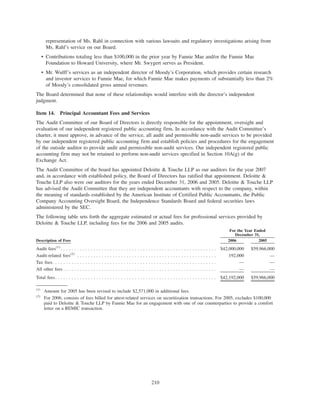
Our net mortgage portfolio totaled $726.1 billion and $736.5 billion as of December 31, 2006 and 2005,
respectively. We estimate that the amount of our net mortgage portfolio was approximately $720.0 billion as
of June 30, 2007. As part of our May 2006 consent order with OFHEO, we agreed not to increase our “net
mortgage portfolio assets” above the amount shown in our minimum capital report as of December 31, 2005
($727.75 billion), except in limited circumstances at OFHEO’s discretion. Our “net mortgage portfolio assets”
are defined as the unpaid principal balance of our mortgage assets, net of market valuation adjustments,
allowance for loan losses, impairments, and unamortized premiums and discounts, excluding consolidated
mortgage-related assets acquired through the assumption of debt. We will be subject to this limitation on
mortgage investment growth until the Director of OFHEO has determined that modification or expiration of
the limitation is appropriate in light of specified factors such as resolution of accounting and internal control
issues. We estimate that our net mortgage portfolio assets totaled approximately $714.9 billion and
$719.6 billion as of June 30, 2007 and December 31, 2006, respectively. On August 1, 2007, we requested that
OFHEO grant us a 10% increase in the limit on the amount of our net mortgage portfolio assets. On
August 10, 2007, OFHEO advised us that, while it will keep under active consideration our request for this
increase, it is not authorizing any significant changes at this time. For additional information on our capital
requirements and regulations affecting the amount of our mortgage investments, see “Our Charter and
Regulation of Our Activities.”
Our mortgage investments include both mortgage-related securities and mortgage loans. We purchase primarily
conventional single-family fixed-rate or adjustable-rate, first lien mortgage loans, or mortgage-related
securities backed by these types of loans. In addition, we purchase loans insured by the Federal Housing
Authority (“FHA”), loans guaranteed by the Department of Veterans Affairs (“VA”) or by the Rural Housing
Service of the Department of Agriculture (“RHS”), manufactured housing loans, multifamily mortgage loans,
subordinate lien mortgage loans (for example, loans secured by second liens) and other mortgage-related
securities. Most of these loans are prepayable at the option of the borrower. We make some of our investments
in mortgage-related securities in the TBA market, which we describe above under “Single-Family—TBA
Market.” Our investments in mortgage-related securities include structured mortgage-related securities such as
real estate mortgage investment conduits (“REMICs”). The interest rates on the structured mortgage-related
securities held in our portfolio may not be the same as the interest rates on the underlying loans. For example,
we may hold a floating rate REMIC security with an interest rate that adjusts periodically based on changes in
a specified market reference rate, such as the London Inter-Bank Offered Rate (“LIBOR”); however, the
REMIC may be backed by fixed-rate mortgage loans. For information on the composition of our mortgage
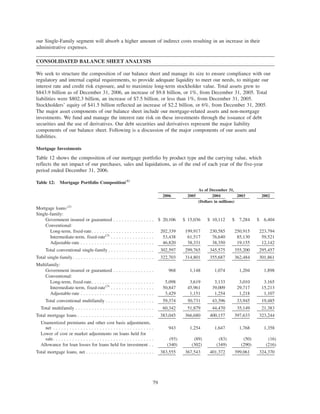
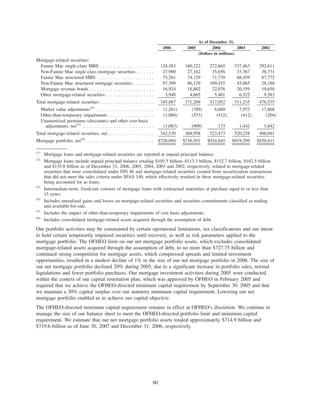
investment portfolio by product type, refer to Table 12 in “Item 7—MD&A—Consolidated Balance Sheet
Analysis.”
Investment Activities
Our Capital Markets group seeks to maximize long-term total returns while fulfilling our chartered liquidity
function. The Capital Markets group’s purchases and sales of mortgage assets in any given period generally
has been determined by the rates of return that we expect to be able to earn on the equity capital underlying
our investments. When we expect to earn returns greater than our cost of equity capital, we generally will be
an active purchaser of mortgage loans and mortgage-related securities. When few opportunities exist to earn
returns above our cost of equity capital, we generally will be a less active purchaser, and may be a net seller,
of mortgage loans and mortgage-related securities. This investment strategy is consistent with our chartered
liquidity function, as the periods during which our purchase of mortgage assets is economically attractive to us
generally have been periods in which market demand for mortgage assets is low.
9
The spread between the amount we earn on mortgage assets available for purchase or sale and our funding
costs, after consideration of the net risks associated with the investment, is an important factor in determining
whether we are a net buyer or seller of mortgage assets. When the spread between the yield on mortgage
assets and our borrowing costs is wide, which is typically when demand for mortgage assets from other
investors is low, we will look for opportunities to add liquidity to the market primarily by purchasing
mortgage assets and issuing debt to investors to fund those purchases. When this spread is narrow, which is
typically when market demand for mortgage assets is high, we will look for opportunities to meet demand by
selling mortgage assets from our portfolio. Even in periods of high market demand for mortgage assets,
however, we expect to be an active purchaser of less liquid forms of mortgage loans and mortgage-related
securities. The amount of our purchases of these mortgage loans and mortgage-related securities may be less
than the amortization, prepayments and sales of mortgage loans we hold and, as a result, our investment
balances may decline during periods of high market demand. In normal market conditions, however, we expect
our selling activity will represent a modest portion of the total change in the total portfolio for the year.
Customer Transactions and Services
Our Capital Markets group provides our lender customers and their affiliates with services that include:
• offering to purchase a wide variety of mortgage assets, including non-standard mortgage loan products,
which we either retain in our portfolio for investment or sell to other investors as a service to assist our
customers in accessing the market;
• segregating customer portfolios to obtain optimal pricing for their mortgage loans (for example,
segregating Community Reinvestment Act or “CRA” eligible loans, which typically command a
premium);
• providing funds at the loan delivery date for purchase of loans delivered for securitization; and
• assisting customers with the hedging of their mortgage business, including by entering into options and
forward contracts on mortgage-related securities, which we offset in the capital markets.
These activities provide a significant flow of assets for our mortgage portfolio, help to create a broader market
for our customers and enhance liquidity in the secondary mortgage market.
In connection with our customer transactions and services activities, we may enter into forward commitments
to purchase mortgage loans or mortgage-related securities that we decide not to retain in our portfolio. In
these instances, we generally will enter into an offsetting sell commitment with another investor or require the
lender to deliver a sell commitment to us when the lender delivers the loans to be pooled into mortgage-
related securities.
Funding Our Investments
Our Capital Markets group funds its investments primarily through the issuance of debt securities, primarily
short-term debt securities, in the domestic and international capital markets. The objective of our debt
financing activities is to manage our liquidity requirements while obtaining funds as efficiently as possible.
We structure our financings not only to satisfy our funding and risk management requirements, but also to
access the capital markets in an orderly manner using debt securities designed to appeal to a wide range of
investors. International investors, seeking many of the features offered in our debt programs for their
U.S. dollar-denominated investments, have been a significant and growing source of funding in recent years.
Although we are a corporation chartered by the U.S. Congress, neither the U.S. government nor any
instrumentality of the U.S. government guarantees any of our debt, and we are solely responsible for our debt
obligations. Our debt trades in the “agency sector” of the capital markets, along with the debt of other GSEs.
Debt in the agency sector benefits from bank regulations that allow commercial banks to invest in our debt
and other agency debt to a greater extent than other debt. These factors, along with the high credit rating of
our senior unsecured debt securities and the manner in which we conduct our financing programs, contribute
to the favorable trading characteristics of our debt. As a result, we generally are able to borrow at lower
interest rates than other corporate debt issuers. For information on the credit ratings of our long-term and
10
short-term senior unsecured debt, qualifying subordinated debt and preferred stock, refer to
“Item 7—MD&A—Liquidity and Capital Management—Liquidity—Credit Ratings and Risk Ratings.”
Securitization Activities
Our Capital Markets group engages in two principal types of securitization activities:
• creating and issuing Fannie Mae MBS from our mortgage portfolio assets, either for sale into the
secondary market or to retain in our portfolio; and
• issuing structured Fannie Mae MBS for customers in exchange for a transaction fee.
Our Capital Markets group creates Fannie Mae MBS using mortgage loans and mortgage-related securities
that we hold in our investment portfolio, referred to as “portfolio securitizations.” We currently securitize a
majority of the single-family mortgage loans we purchase within the first month of purchase. Our Capital
Markets group may sell these Fannie Mae MBS into the secondary market or may retain the Fannie Mae MBS
in our investment portfolio. In addition, the Capital Markets group issues structured, or multi-class, Fannie
Mae MBS. The structured Fannie Mae MBS are generally created through swap transactions, typically with
our lender customers or securities dealer customers. In these transactions, the customer “swaps” a mortgage-
related security they own for a structured Fannie Mae MBS we issue. This process is referred to as
“resecuritization.” Our Capital Markets group earns transaction fees for issuing structured Fannie Mae MBS
for third parties.
RISK MANAGEMENT
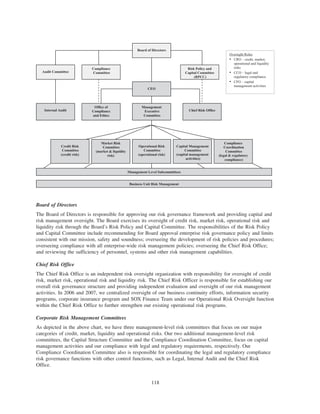
Risk is an inherent part of our business activities. Our risk management framework and governance structure
is intended to provide comprehensive controls and ongoing management of the major risks inherent in our
business activities. Our ability to properly identify, measure, monitor and report risk is critical to our
soundness and profitability. Our businesses expose us to the following four major categories of risk:
• Credit Risk. Credit risk is the risk of financial loss resulting from the failure of a borrower or
institutional counterparty to honor its contractual obligations to us and exists primarily in our mortgage
credit book of business, derivatives portfolio and liquid investment portfolio.
• Market Risk. Market risk represents the exposure to potential changes in the market value of our net
assets from changes in prevailing market conditions. A significant market risk we face and actively
manage is interest rate risk—the risk of changes in our long-term earnings or in the value of our net
assets due to changes in interest rates.
• Operational Risk. Operational risk relates to the risk of loss resulting from inadequate or failed internal
processes, people or systems, or from external events.
• Liquidity Risk. Liquidity risk is the risk to our earnings and capital arising from an inability to meet our
cash obligations in a timely manner.
For a complete discussion of our methods for managing risk, refer to “Item 7—MD&A—Risk Management.”
COMPETITION
Our competitors include the Federal Home Loan Mortgage Corporation, referred to as Freddie Mac, the
Federal Home Loan Banks, financial institutions, securities dealers, insurance companies, pension funds,
investment funds, and other investors.
We compete to purchase mortgage assets for our investment portfolio or to securitize them into Fannie Mae
MBS. Our market share of mortgage assets purchased for our investment portfolio or securitized into Fannie
Mae MBS is affected by the amount of residential mortgage loans offered for sale in the secondary market by
loan originators and other market participants. The decreased rate of growth in U.S. residential mortgage debt
outstanding in 2006 and continuing into 2007 has decreased the supply of mortgage originations, available for
11
purchase or securitization. Our market share is also affected by the mix of available mortgage loan products
and the credit risk and prices associated with those loans.
In addition, we compete for low-cost debt funding with institutions that hold mortgage portfolios, including
Freddie Mac and the Federal Home Loan Banks.
We have been the largest issuer of mortgage-related securities in every year since 1990. Competition for the
issuance of mortgage-related securities is intense and participants compete on the basis of the value of their
products and services relative to the prices they charge. Value can be delivered through the liquidity and
trading levels for an issuer’s securities, the range of products and services offered, and the reliability and
consistency with which it conducts its business. In recent years, there has been a significant increase in the
issuance of mortgage-related securities by non-agency issuers, which has caused a decrease in our share of the
market for new issuances of single-family mortgage-related securities. Non-agency issuers, also referred to as
private-label issuers, are those issuers of mortgage-related securities other than agency issuers Fannie Mae,
Freddie Mac and Ginnie Mae. Our estimated market share of new single-family mortgage-related securities
issuance has fallen during the past several years, from 45.0% in 2003 to 23.7% in 2006, a slight increase from
our estimated market share of 23.5% in 2005. We estimate that total single-family mortgage-related securities
issued by all mortgage market participants, including Fannie Mae, during the quarter ended June 30, 2007
increased by approximately 6.9% to an estimated $530.9 billion, compared with an estimated $496.8 billion
issued during the quarter ended December 31, 2006. In the quarter ended June 30, 2007, our estimated market
share of new single-family mortgage-related securities issuance was 28.3%. Our estimates of market share are
based on publicly available data and exclude previously securitized mortgages. Although we expect our market
share to increase in 2007 compared to 2006, we expect our Single-Family business to continue to face
significant competition from private-label issuers.
We also expect private-label issuers to provide increased competition to our HCD business through their use of
commercial mortgage-backed securities (“CMBS”), which often package loans secured by multifamily
residential property with higher yielding loans secured by commercial properties.
OUR CHARTER AND REGULATION OF OUR ACTIVITIES
We are a stockholder-owned corporation organized and existing under the Federal National Mortgage
Association Charter Act, which we refer to as the Charter Act or our charter. We were established in 1938
pursuant to the National Housing Act and originally operated as a U.S. government entity. Title III of the
National Housing Act amended our charter in 1954, and we became a mixed-ownership corporation, with our
preferred stock owned by the federal government and our non-voting common stock held by private investors.
In 1968, our charter was further amended and our predecessor entity was divided into the present Fannie Mae
and Ginnie Mae. Ginnie Mae remained a government entity, but all of the preferred stock of Fannie Mae that
had been held by the U.S. government was retired, and Fannie Mae became privately owned.
Charter Act
The Charter Act, as it was further amended from 1970 through 1998, sets forth the activities that we are
permitted to conduct, authorizes us to issue debt and equity securities, and describes our general corporate
powers. The Charter Act states that our purpose is to:
• provide stability in the secondary market for residential mortgages;
• respond appropriately to the private capital market;
• provide ongoing assistance to the secondary market for residential mortgages (including activities relating
to mortgages on housing for low- and moderate-income families involving a reasonable economic return
that may be less than the return earned on other activities) by increasing the liquidity of mortgage
investments and improving the distribution of investment capital available for residential mortgage
financing; and
12
• promote access to mortgage credit throughout the nation (including central cities, rural areas and
underserved areas) by increasing the liquidity of mortgage investments and improving the distribution of
investment capital available for residential mortgage financing.
In addition to the alignment of our overall strategy with these purposes, all of our business activities must be
permissible under the Charter Act. Our charter authorizes us to, among other things, purchase, service, sell,
lend on the security of, or otherwise deal in certain mortgage loans; issue debt obligations and mortgage-
related securities; and “do all things as are necessary or incidental to the proper management of [our] affairs
and the proper conduct of [our] business.”
Loan Standards
Mortgage loans we purchase or securitize must meet the following standards required by the Charter Act.
• Principal Balance Limitations. Our charter permits us to purchase and securitize conventional mortgage
loans (i.e., loans that are not federally insured or guaranteed) secured by either a single-family or
multifamily property. Single-family conventional mortgage loans are generally subject to maximum
original principal balance limits. The principal balance limits are often referred to as “conforming loan
limits” and are established each year by OFHEO based on the national average price of a one-family
residence. For 2006 and 2007, the conforming loan limit for a one-family residence is $417,000. Higher
original principal balance limits apply to mortgage loans secured by two- to four-family residences and
also to loans in Alaska, Hawaii, Guam and the Virgin Islands. No statutory limits apply to the maximum
original principal balance of multifamily mortgage loans that we purchase or securitize. In addition, the
Charter Act imposes no maximum original principal balance limits on loans we purchase or securitize that
are either insured by the FHA or guaranteed by the VA.
• Quality Standards. The Charter Act requires that, so far as practicable and in our judgment, the
mortgage loans we purchase or securitize must be of a quality, type and class that generally meet the
purchase standards of private institutional mortgage investors. To comply with this requirement and for
the efficient operation of our business, we have eligibility policies and make available guidelines for the
mortgage loans we purchase or securitize as well as for the sellers and servicers of these loans.
• Loan-to-Value and Credit Enhancement Requirements. The Charter Act generally requires credit
enhancement on any conventional single-family mortgage loan that we purchase or securitize if it has a
loan-to-value ratio over 80% at the time of purchase. Credit enhancement may take the form of insurance
or a guaranty issued by a qualified insurer, a repurchase arrangement with the seller of the loans or a
seller-retained loan participation interest.
Other Charter Act Limitations and Requirements
In addition to specifying our purpose, authorizing our activities and establishing various limitations and
requirements relating to the loans we purchase and securitize, the Charter Act has the following provisions.
• Issuances of Our Securities. The Charter Act authorizes us, upon approval of the Secretary of the
Treasury, to issue debt obligations and mortgage-related securities. At the discretion of the Secretary of
the Treasury, the U.S. Department of the Treasury may purchase obligations of Fannie Mae up to a
maximum of $2.25 billion outstanding at any one time. We have not used this facility since our transition
from government ownership in 1968. Neither the U.S. nor any of its agencies guarantees our debt or
mortgage-related securities or is obligated to finance our operations or assist us in any other manner.
• Exemptions for Our Securities. Securities we issue are “exempted securities” under laws administered by
the SEC. As a result, registration statements with respect to offerings of our securities are not filed with
the SEC. In March 2003, however, we voluntarily registered our common stock with the SEC under
Section 12(g) of the Securities Exchange Act of 1934 (the “Exchange Act”). As a result, we are required
to file periodic and current reports with the SEC, including annual reports on Form 10-K, quarterly
reports on Form 10-Q and current reports on Form 8-K. Since undertaking to restate our 2002 and 2003
consolidated financial statements and improve our accounting practices and internal control over financial
13
reporting, we have not been a current filer of our periodic reports on Form 10-K or Form 10-Q. We have
issued or restated financial statements for 2002-2005, and with the filing of this 2006 Form 10-K, we are
issuing financial statements for 2006. We are continuing to improve our accounting and internal control
over financial reporting and are striving to become a current filer as soon as practicable. We are also
required to file proxy statements with the SEC. We have not filed a proxy statement relating to an annual
meeting of shareholders since 2004. On June 8, 2007, we announced plans to hold an annual meeting of
shareholders on December 14, 2007. In addition, our directors and certain officers are required to file
reports with the SEC relating to their ownership of Fannie Mae equity securities.
• Exemption from Specified Taxes. Pursuant to the Charter Act, we are exempt from taxation by states,
counties, municipalities or local taxing authorities, except for taxation by those authorities on our real
property. However, we are not exempt from the payment of federal corporate income taxes.
• Other Limitations and Requirements. Under the Charter Act, we may not originate mortgage loans or
advance funds to a mortgage seller on an interim basis, using mortgage loans as collateral, pending the
sale of the mortgages in the secondary market. In addition, we may only purchase or securitize mortgages
originated in the U.S., including the District of Columbia, the Commonwealth of Puerto Rico, and the
territories and possessions of the U.S.
Regulation and Oversight of Our Activities
As a federally chartered corporation, we are subject to Congressional legislation and oversight and are
regulated by HUD and OFHEO. In addition, we are subject to regulation by the U.S. Department of the
Treasury and by the SEC. The Government Accountability Office is authorized to audit our programs,
activities, receipts, expenditures and financial transactions.
HUD Regulation
Program Approval
HUD has general regulatory authority to promulgate rules and regulations to carry out the purposes of the
Charter Act, excluding authority over matters granted exclusively to OFHEO. We are required under the
Charter Act to obtain approval of the Secretary of HUD for any new conventional mortgage program that is
significantly different from those approved or engaged in prior to the enactment of the Federal Housing
Enterprises Financial Safety and Soundness Act of 1992 (the “1992 Act”). The Secretary of HUD must
approve any new program unless the Charter Act does not authorize it or the Secretary finds that it is not in
the public interest.
HUD periodically conducts reviews of our activities to ensure compliance with the Charter Act and other
regulatory requirements. On June 13, 2006, HUD announced that it would conduct a review of our investments
and holdings, including certain equity and debt investments classified in our consolidated financial statements
as “other assets/other liabilities,” to determine whether our investment activities are consistent with our charter
authority. We are fully cooperating with this review, but cannot predict whether the outcome of this review
may require us to modify our investment approach or restrict our current business activities.
Annual Housing Goals and Subgoals
For each calendar year, we are subject to housing goals and subgoals set by HUD. The goals, which are set as
a percentage of the total number of dwelling units underlying our total mortgage purchases, are intended to
expand housing opportunities (1) for low- and moderate-income families, (2) in HUD-defined underserved
areas, including central cities and rural areas, and (3) for low-income families in low-income areas and for
very low-income families, which is referred to as “special affordable housing.” In addition, HUD has
established three home purchase subgoals that are expressed as percentages of the total number of mortgages
we purchase that finance the purchase of single-family, owner-occupied properties located in metropolitan
areas, and a subgoal for multifamily special affordable housing that is expressed as a dollar amount. We report
14
our progress toward achieving our housing goals to HUD on a quarterly basis, and we are required to submit a
report to HUD and Congress on our performance in meeting our housing goals on an annual basis.
Included in eligible mortgage loan purchases are loans underlying our Fannie Mae MBS issuances, subordinate
mortgage loans and refinanced mortgage loans. Several activities are excluded from eligible mortgage loan
purchases, such as most purchases of non-conventional mortgage loans, equity investments (even if they
facilitate low-income housing), mortgage loans secured by second homes and commitments to purchase or
securitize mortgage loans at a later date.
In November 2004, HUD published a final regulation amending its housing goals rule, effective January 1,
2005. The regulation increased the housing goal levels for each year through 2008 and also created the three
home purchase mortgage subgoals described above. These increasing housing goals and subgoals are designed
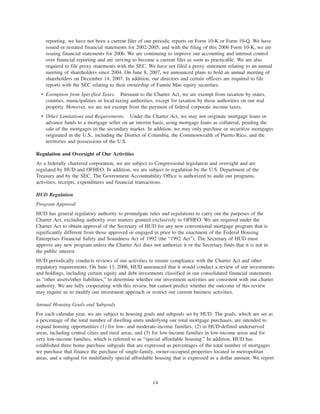
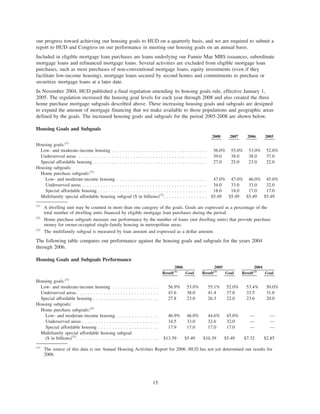
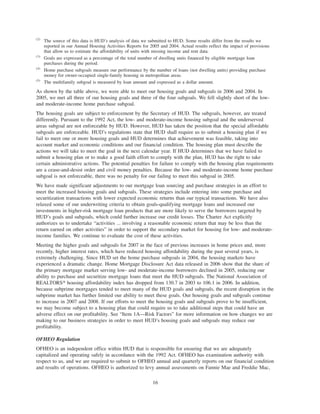
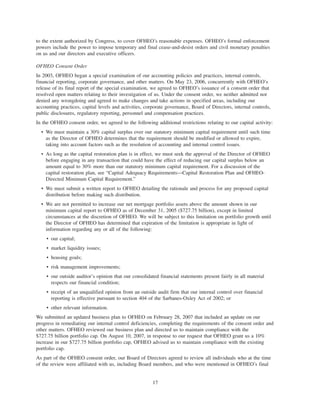
to expand the amount of mortgage financing that we make available to those populations and geographic areas
defined by the goals. The increased housing goals and subgoals for the period 2005-2008 are shown below.
Housing Goals and Subgoals
2008 2007 2006 2005
Housing goals:(1)
Low- and moderate-income housing . . . . . . . . . . . . . . . . . . . . . . . . . . . . . . . . . . . 56.0% 55.0% 53.0% 52.0%
Underserved areas . . . . . . . . . . . . . . . . . . . . . . . . . . . . . . . . . . . . . . . . . . . . . . . 39.0 38.0 38.0 37.0
Special affordable housing. . . . . . . . . . . . . . . . . . . . . . . . . . . . . . . . . . . . . . . . . . 27.0 25.0 23.0 22.0
Housing subgoals:
Home purchase subgoals:(2)
Low- and moderate-income housing . . . . . . . . . . . . . . . . . . . . . . . . . . . . . . . . . 47.0% 47.0% 46.0% 45.0%
Underserved areas . . . . . . . . . . . . . . . . . . . . . . . . . . . . . . . . . . . . . . . . . . . . . . 34.0 33.0 33.0 32.0
Special affordable housing . . . . . . . . . . . . . . . . . . . . . . . . . . . . . . . . . . . . . . . . 18.0 18.0 17.0 17.0
Multifamily special affordable housing subgoal ($ in billions)(3)
. . . . . . . . . . . . . . . . $5.49 $5.49 $5.49 $5.49
(1)
A dwelling unit may be counted in more than one category of the goals. Goals are expressed as a percentage of the
total number of dwelling units financed by eligible mortgage loan purchases during the period.
(2)
Home purchase subgoals measure our performance by the number of loans (not dwelling units) that provide purchase
money for owner-occupied single-family housing in metropolitan areas.
(3)
The multifamily subgoal is measured by loan amount and expressed as a dollar amount.
The following table compares our performance against the housing goals and subgoals for the years 2004
through 2006.
Housing Goals and Subgoals Performance
Result(1)
Goal Result(2)
Goal Result(2)
Goal
2006 2005 2004
Housing goals:(3)
Low- and moderate-income housing . . . . . . . . . . . . . . . . . 56.9% 53.0% 55.1% 52.0% 53.4% 50.0%
Underserved areas . . . . . . . . . . . . . . . . . . . . . . . . . . . . . . 43.6 38.0 41.4 37.0 33.5 31.0
Special affordable housing . . . . . . . . . . . . . . . . . . . . . . . . 27.8 23.0 26.3 22.0 23.6 20.0
Housing subgoals:
Home purchase subgoals:(4)
Low- and moderate-income housing. . . . . . . . . . . . . . . . 46.9% 46.0% 44.6% 45.0% — —
Underserved areas . . . . . . . . . . . . . . . . . . . . . . . . . . . . 34.5 33.0 32.6 32.0 — —
Special affordable housing . . . . . . . . . . . . . . . . . . . . . . 17.9 17.0 17.0 17.0 — —
Multifamily special affordable housing subgoal
($ in billions)(5)
. . . . . . . . . . . . . . . . . . . . . . . . . . . . . . $13.39 $5.49 $10.39 $5.49 $7.32 $2.85
(1)
The source of this data is our Annual Housing Activities Report for 2006. HUD has not yet determined our results for
2006.
15
(2)
The source of this data is HUD’s analysis of data we submitted to HUD. Some results differ from the results we
reported in our Annual Housing Activities Reports for 2005 and 2004. Actual results reflect the impact of provisions
that allow us to estimate the affordability of units with missing income and rent data.
(3)
Goals are expressed as a percentage of the total number of dwelling units financed by eligible mortgage loan
purchases during the period.
(4)
Home purchase subgoals measure our performance by the number of loans (not dwelling units) providing purchase
money for owner-occupied single-family housing in metropolitan areas.
(5)
The multifamily subgoal is measured by loan amount and expressed as a dollar amount.
As shown by the table above, we were able to meet our housing goals and subgoals in 2006 and 2004. In
2005, we met all three of our housing goals and three of the four subgoals. We fell slightly short of the low-
and moderate-income home purchase subgoal.
The housing goals are subject to enforcement by the Secretary of HUD. The subgoals, however, are treated
differently. Pursuant to the 1992 Act, the low- and moderate-income housing subgoal and the underserved
areas subgoal are not enforceable by HUD. However, HUD has taken the position that the special affordable
subgoals are enforceable. HUD’s regulations state that HUD shall require us to submit a housing plan if we
fail to meet one or more housing goals and HUD determines that achievement was feasible, taking into
account market and economic conditions and our financial condition. The housing plan must describe the
actions we will take to meet the goal in the next calendar year. If HUD determines that we have failed to
submit a housing plan or to make a good faith effort to comply with the plan, HUD has the right to take
certain administrative actions. The potential penalties for failure to comply with the housing plan requirements
are a cease-and-desist order and civil money penalties. Because the low- and moderate-income home purchase
subgoal is not enforceable, there was no penalty for our failing to meet this subgoal in 2005.
We have made significant adjustments to our mortgage loan sourcing and purchase strategies in an effort to
meet the increased housing goals and subgoals. These strategies include entering into some purchase and
securitization transactions with lower expected economic returns than our typical transactions. We have also
relaxed some of our underwriting criteria to obtain goals-qualifying mortgage loans and increased our
investments in higher-risk mortgage loan products that are more likely to serve the borrowers targeted by
HUD’s goals and subgoals, which could further increase our credit losses. The Charter Act explicitly
authorizes us to undertake “activities ... involving a reasonable economic return that may be less than the
return earned on other activities” in order to support the secondary market for housing for low- and moderate-
income families. We continue to evaluate the cost of these activities.
Meeting the higher goals and subgoals for 2007 in the face of previous increases in home prices and, more
recently, higher interest rates, which have reduced housing affordability during the past several years, is
extremely challenging. Since HUD set the home purchase subgoals in 2004, the housing markets have
experienced a dramatic change. Home Mortgage Disclosure Act data released in 2006 show that the share of
the primary mortgage market serving low- and moderate-income borrowers declined in 2005, reducing our
ability to purchase and securitize mortgage loans that meet the HUD subgoals. The National Association of
REALTORS» housing affordability index has dropped from 130.7 in 2003 to 106.1 in 2006. In addition,
because subprime mortgages tended to meet many of the HUD goals and subgoals, the recent disruption in the
subprime market has further limited our ability to meet these goals. Our housing goals and subgoals continue
to increase in 2007 and 2008. If our efforts to meet the housing goals and subgoals prove to be insufficient,
we may become subject to a housing plan that could require us to take additional steps that could have an
adverse effect on our profitability. See “Item 1A—Risk Factors” for more information on how changes we are
making to our business strategies in order to meet HUD’s housing goals and subgoals may reduce our
profitability.
OFHEO Regulation
OFHEO is an independent office within HUD that is responsible for ensuring that we are adequately
capitalized and operating safely in accordance with the 1992 Act. OFHEO has examination authority with
respect to us, and we are required to submit to OFHEO annual and quarterly reports on our financial condition
and results of operations. OFHEO is authorized to levy annual assessments on Fannie Mae and Freddie Mac,
16
to the extent authorized by Congress, to cover OFHEO’s reasonable expenses. OFHEO’s formal enforcement
powers include the power to impose temporary and final cease-and-desist orders and civil monetary penalties
on us and our directors and executive officers.
OFHEO Consent Order
In 2003, OFHEO began a special examination of our accounting policies and practices, internal controls,
financial reporting, corporate governance, and other matters. On May 23, 2006, concurrently with OFHEO’s
release of its final report of the special examination, we agreed to OFHEO’s issuance of a consent order that
resolved open matters relating to their investigation of us. Under the consent order, we neither admitted nor
denied any wrongdoing and agreed to make changes and take actions in specified areas, including our
accounting practices, capital levels and activities, corporate governance, Board of Directors, internal controls,
public disclosures, regulatory reporting, personnel and compensation practices.
In the OFHEO consent order, we agreed to the following additional restrictions relating to our capital activity:
• We must maintain a 30% capital surplus over our statutory minimum capital requirement until such time
as the Director of OFHEO determines that the requirement should be modified or allowed to expire,
taking into account factors such as the resolution of accounting and internal control issues.
• As long as the capital restoration plan is in effect, we must seek the approval of the Director of OFHEO
before engaging in any transaction that could have the effect of reducing our capital surplus below an
amount equal to 30% more than our statutory minimum capital requirement. For a discussion of the
capital restoration plan, see “Capital Adequacy Requirements—Capital Restoration Plan and OFHEO-
Directed Minimum Capital Requirement.”
• We must submit a written report to OFHEO detailing the rationale and process for any proposed capital
distribution before making such distribution.
• We are not permitted to increase our net mortgage portfolio assets above the amount shown in our
minimum capital report to OFHEO as of December 31, 2005 ($727.75 billion), except in limited
circumstances at the discretion of OFHEO. We will be subject to this limitation on portfolio growth until
the Director of OFHEO has determined that expiration of the limitation is appropriate in light of
information regarding any or all of the following:
• our capital;
• market liquidity issues;
• housing goals;
• risk management improvements;
• our outside auditor’s opinion that our consolidated financial statements present fairly in all material
respects our financial condition;
• receipt of an unqualified opinion from an outside audit firm that our internal control over financial
reporting is effective pursuant to section 404 of the Sarbanes-Oxley Act of 2002; or
• other relevant information.
We submitted an updated business plan to OFHEO on February 28, 2007 that included an update on our
progress in remediating our internal control deficiencies, completing the requirements of the consent order and
other matters. OFHEO reviewed our business plan and directed us to maintain compliance with the
$727.75 billion portfolio cap. On August 10, 2007, in response to our request that OFHEO grant us a 10%
increase in our $727.75 billion portfolio cap, OFHEO advised us to maintain compliance with the existing
portfolio cap.
As part of the OFHEO consent order, our Board of Directors agreed to review all individuals who at the time
of the review were affiliated with us, including Board members, and who were mentioned in OFHEO’s final
17
report of the special examination as participating in any misconduct for suitability to remain in their positions
or for other remedial actions. The Board created a special committee made up of independent Board members,
none of whom had served on the Board prior to December 2004, to conduct this review. In October 2006, the
special committee completed its review and reported its findings and recommendations to OFHEO. We have
since implemented the actions recommended in that report.
In its Annual Report to Congress released April 10, 2007, OFHEO recognized that, as of December 31, 2006,
we had complied with 67% of the requirements of the OFHEO consent order. We believe that we are making
progress toward completing the OFHEO consent order requirements.
In addition, as part of the OFHEO consent order, we agreed to pay a $400 million civil penalty, with
$50 million payable to the U.S. Treasury and $350 million payable to the SEC for distribution to stockholders
pursuant to the Fair Funds for Investors provision of the Sarbanes-Oxley Act of 2002. We paid this civil
penalty in full in 2006 and recorded an expense in our 2004 consolidated financial statements. This expense
was not deductible for tax purposes.
Capital Adequacy Requirements
We are subject to capital adequacy requirements established by the 1992 Act. The statutory capital framework
incorporates two different quantitative assessments of capital—a minimum capital requirement and a risk-
based capital requirement. The minimum capital requirement is ratio-based, while the risk-based capital
requirement is based on simulated stress test performance. The 1992 Act requires us to maintain sufficient
capital to meet both of these requirements in order to be classified as “adequately capitalized.” OFHEO is
permitted or required to take remedial action if we fail to meet our capital requirements, depending on which
requirement we fail to meet. We are required to submit a capital restoration plan if OFHEO classifies us as
“significantly undercapitalized.” Even if we meet our capital requirements, OFHEO has the ability to take
additional supervisory actions if the Director determines that we have failed to make reasonable efforts to
comply with that plan or are engaging in unapproved conduct that could result in a rapid depletion of our core
capital, or if the value of the property securing mortgage loans we hold or have securitized has decreased
significantly.
The 1992 Act also gives OFHEO the authority, after following prescribed procedures, to appoint a conservator.
Under OFHEO’s regulations, appointment of a conservator is mandatory, with limited exceptions, if we are
critically undercapitalized (that is, if our core capital is less than our required critical capital). OFHEO has
discretion under its rules to appoint a conservator if we are significantly undercapitalized (that is, if our core
capital is less than our required minimum capital), and alternative remedies are unavailable. The 1992 Act and
OFHEO’s rules also specify other grounds for appointing a conservator.
In addition, under the OFHEO consent order, we are currently required to maintain a 30% capital surplus over
our statutory minimum capital requirement. Consistent with OFHEO’s disclosures, we refer to this
requirement, which is described in more detail below under “Capital Restoration Plan and OFHEO-Directed
Minimum Capital Requirement,” as the “OFHEO-directed minimum capital requirement.” We are subject to
continuous examination by OFHEO to ensure that we meet these capital adequacy requirements on an ongoing
basis.
Statutory Minimum Capital Requirement. OFHEO’s ratio-based minimum capital standard ties our capital
requirements to the size of our book of business. For purposes of the statutory minimum capital requirement,
we are in compliance if our core capital equals or exceeds our minimum capital requirement. Core capital is
defined by statute as the sum of the stated value of outstanding common stock (common stock less treasury
stock), the stated value of outstanding non-cumulative perpetual preferred stock, paid-in capital and retained
earnings, as determined in accordance with U.S. generally accepted accounting principles (“GAAP”). Our
minimum capital requirement is generally equal to the sum of:
• 2.50% of on-balance sheet assets;
• 0.45% of the unpaid principal balance of outstanding Fannie Mae MBS held by third parties; and
18
• up to 0.45% of other off-balance sheet obligations.
Each quarter, as part of its capital classification announcement, OFHEO publishes our standing relative to the
statutory minimum capital requirement and the OFHEO-directed minimum capital requirement. For a
description of the amounts by which our core capital exceeded our statutory minimum capital requirement as
of March 31, 2007, December 31, 2006, and December 31, 2005, see “Item 7—MD&A—Liquidity and
Capital Management—Capital Management—Capital Classification Measures.”
Statutory Risk-Based Capital Requirement. OFHEO’s risk-based capital standard ties our capital requirements
to the risk in our book of business, as measured by a stress test model. The stress test simulates our financial
performance over a ten-year period of severe economic conditions characterized by both extreme interest rate
movements and high mortgage default rates. Simulation results indicate the amount of capital required to
survive this prolonged period of economic stress without new business or active risk management action. In
addition to this model-based amount, the risk-based capital requirement includes a 30% surcharge to cover
unspecified management and operations risks.
Our total capital base is used to meet our risk-based capital requirement. Total capital is defined by statute as
the sum of our core capital plus the total allowance for loan losses and reserve for guaranty losses in
connection with Fannie Mae MBS, less the specific loss allowance (that is, the allowance required on
individually-impaired loans). Each quarter, OFHEO runs a detailed profile of our book of business through the
stress test simulation model. The model generates cash flows and financial statements to evaluate our risk and
measure our capital adequacy during the ten-year stress horizon. As part of its quarterly capital classification
announcement, OFHEO makes these stress test results publicly available. For a description of the amounts by
which our total capital exceeded our statutory risk-based capital requirement as of December 31, 2006 and
2005, see “Item 7—MD&A—Liquidity and Capital Management—Capital Management—Capital
Classification Measures.”
Capital Restoration Plan and OFHEO-Directed Minimum Capital Requirement. OFHEO concluded in its
September 2004 interim report on its special examination that we had misapplied GAAP relating to hedge
accounting and the amortization of purchase premiums and discounts on securities and loans and on other
deferred charges. In December 2004, the SEC’s Office of the Chief Accountant affirmed OFHEO’s conclusion.
We estimated that the disallowed hedge accounting treatments would result in a $9.0 billion cumulative
reduction in our core capital as of September 30, 2004. As a result, on December 21, 2004, OFHEO classified
us as significantly undercapitalized as of September 30, 2004, and directed us to submit a capital restoration
plan that would provide for compliance with our statutory minimum capital requirement plus a surplus of 30%
over the statutory minimum capital requirement. Pursuant to OFHEO’s directive, we submitted a capital
restoration plan. On February 17, 2005, OFHEO accepted our capital restoration plan, which indicated our
intention to achieve the OFHEO-directed minimum capital requirement by September 30, 2005.
We implemented the capital restoration plan by generating additional capital through retained earnings,
significantly reducing the size of our investment portfolio, issuing $5.0 billion of non-cumulative preferred
stock, reducing our dividend and implementing cost-cutting efforts. OFHEO announced on November 1, 2005
that, as of September 30, 2005, we had achieved the OFHEO-directed minimum capital requirement. OFHEO
actively monitors our compliance with the capital restoration plan, pursuant to which we provide quarterly
capital plan updates to OFHEO. We believe that we continue to be in compliance with the plan as of the date
of this filing. For a description of the amounts by which our core capital exceeded the OFHEO-directed
minimum capital requirement as of March 31, 2007, December 31, 2006 and 2005, see “Item 7—MD&A—
Liquidity and Capital Management—Capital Management—Capital Classification Measures.”
Statutory Critical Capital Requirement. Our critical capital requirement is the amount of core capital below
which we would be classified as critically undercapitalized and generally would be required to be placed in
conservatorship. Our critical capital requirement is generally equal to the sum of:
• 1.25% of on-balance sheet assets;
• 0.25% of the unpaid principal balance of outstanding Fannie Mae MBS held by third parties; and
19
• up to 0.25% of other off-balance sheet obligations.
For a description of the amounts by which our core capital exceeded our statutory critical capital requirement
as of December 31, 2006 and 2005, see “Item 7—MD&A—Liquidity and Capital Management—Capital
Management—Capital Classification Measures.”
OFHEO Direction on Interagency Guidance on Nontraditional Mortgages and Subprime Lending
In September 2006, five federal financial regulatory agencies jointly issued “Interagency Guidance on
Nontraditional Mortgage Product Risks” to address risks posed by mortgage products that allow borrowers to
defer repayment of principal or interest, and the layering of risks that results from combining these product
types with other features that may compound risk. In June 2007, the same financial regulatory agencies
published the final “Statement on Subprime Mortgage Lending,” which addresses risks relating to certain
subprime mortgages. Together, the agencies directed regulated financial institutions that originate
nontraditional and subprime mortgage loans to follow prudent lending practices, including safe and sound
underwriting practices and providing borrowers with clear and balanced information about the relative benefits
and risks of these products sufficiently early in the process to enable them to make informed decisions.
OFHEO directed us to apply the risk management, underwriting and consumer protection principles of the
nontraditional and subprime mortgage guidances to mortgages we purchase or guarantee. In response to the
guidance and OFHEO’s directive, we are implementing changes to our Desktop Underwriter» automated
underwriting system and have notified our lender customers of the dates by which we expect all loans sent to
us to be in compliance with the guidances.
Recent Legislative Developments and Possible Changes in Our Regulations and Oversight
There is legislation pending before the U.S. Congress that would change the regulatory framework under
which we, Freddie Mac and the Federal Home Loan Banks operate. On May 22, 2007, the House of
Representatives approved a bill that would establish a new, independent regulator for us and the other GSEs,
with broad authority over both safety and soundness and mission.
As of the date of this filing, one GSE reform bill has been introduced in the Senate and another is expected. For a
description of how the changes in the regulation of our business contemplated by these GSE reform bills or other
legislative proposals could materially adversely affect our business and earnings, see “Item 1A—Risk Factors.”
EMPLOYEES
As of December 31, 2006, we employed approximately 6,600 personnel, including full-time and part-time
employees, term employees and employees on leave. As of June 30, 2007, we employed approximately
6,400 personnel, including full-time and part-time employees, term employees and employees on leave.
WHERE YOU CAN FIND ADDITIONAL INFORMATION
We file reports, proxy statements and other information with the SEC. We make available free of charge
through our Web site our annual reports on Form 10-K, quarterly reports on Form 10-Q, current reports on
Form 8-K and all other SEC reports and amendments to those reports as soon as reasonably practicable after
we electronically file the material with, or furnish it to, the SEC. Our Web site address is
www.fanniemae.com. Materials that we file with the SEC are also available from the SEC’s Web site,
www.sec.gov. In addition, these materials may be inspected, without charge, and copies may be obtained at
prescribed rates, at the SEC’s Public Reference Room at 100 F Street, NE, Room 1580, Washington, DC
20549. You may obtain information on the operation of the Public Reference Room by calling the SEC at
1-800-SEC-0330. You may also request copies of any filing from us, at no cost, by telephone at
(202) 752-7000 or by mail at 3900 Wisconsin Avenue, NW, Washington, DC 20016.
Effective March 31, 2003, we voluntarily registered our common stock with the SEC under Section 12(g) of
the Exchange Act. Our common stock, as well as the debt, preferred stock and mortgage-backed securities we
20
issue, are exempt from registration under the Securities Act of 1933 and are “exempted” securities under the
Exchange Act. The voluntary registration of our common stock does not affect the exempt status of the debt,
equity and mortgage-backed securities that we issue.
With regard to OFHEO’s regulation of our activities, you may obtain materials from OFHEO’s Web site,
www.ofheo.gov. These materials include the September 2004 interim report of OFHEO’s findings of its special
examination and the May 2006 final report on its findings.
We are providing our Web site address and the Web site addresses of the SEC and OFHEO solely for your
information. Information appearing on our Web site or on the SEC’s Web site or OFHEO’s Web site is not
incorporated into this Annual Report on Form 10-K except as specifically stated in this Annual Report on
Form 10-K.
FORWARD-LOOKING STATEMENTS
This report contains forward-looking statements, which are statements about matters that are not historical
facts. In addition, our senior management may from time to time make forward-looking statements orally to
analysts, investors, the news media and others. Forward-looking statements often include words such as
“expects,” “anticipates,” “intends,” “plans,” “believes,” “seeks,” “estimates,” “would,” “should,” “could,”
“may,” or similar words.
Forward-looking statements reflect our management’s expectations or predictions of future conditions, events
or results based on various assumptions and management’s estimates of trends and economic factors in the
markets in which we are active, as well as our business plans. They are not guarantees of future performance.
By their nature, forward-looking statements are subject to risks and uncertainties. Our actual results and
financial condition may differ, possibly materially, from the anticipated results and financial condition
indicated in these forward-looking statements. There are a number of factors that could cause actual
conditions, events or results to differ materially from those described in the forward-looking statements
contained in this report, including those factors described in “Item 1A—Risk Factors.”
Factors that could cause actual conditions, events or results to differ materially from those expressed in any
forward-looking statements include, among others:
• our expectation that we will file our 2007 Form 10-K on a timely basis, and that we will file our Forms
10-Q for the first, second, and third quarters of 2007 by December 31, 2007;
• our ability to compete in the mortgage and financial services industry and to develop and implement
strategies to adapt to changing industry trends;
• our ability to achieve and maintain effective internal control over financial reporting;
• our ability to become and remain current in our SEC financial reporting obligations;
• our ability to overcome reputational harm and negative publicity;
• our ability to continue to operate in compliance with the terms of the OFHEO consent order, including
complying with the capital restoration plan provided for by the order;
• changes in applicable legislative or regulatory requirements, including enactment of new oversight
legislation, changes to our charter, housing goals, regulatory capital requirements, the exercise or assertion
of regulatory or administrative authority beyond historical practice, or regulation of the subprime market;
• the expiration of the limitation on our portfolio growth, or our ability to obtain relief from the limitation;
• volatility in our financial results due to volatility in the fair value of our financial instruments;
• our ability to manage credit risk successfully;
• changes in our assumptions regarding interest rates, rates of growth of our business and spreads we expect
to earn or required capital levels;
21
• our ability to issue debt securities in sufficient quantity and at attractive rates to fund our investments;
• our ability to maintain our current credit ratings;
• failure of our institutional counterparties to perform their obligations;
• changes in pricing or valuation methodologies, models, assumptions, estimates or other measurement
techniques;
• changes in general economic conditions, primarily the U.S. residential housing market;
• borrower preferences for fixed-rate mortgages or ARMs;
• investor preferences for mortgage loans and mortgage-backed securities rather than other instruments;
• our estimates regarding our 2006 and 2007 business results and market share;
• our belief that we met our 2006 housing goals and subgoals;
• our expectation that meeting our housing goals in 2007 and 2008 will continue to present challenges;
• our belief that home prices are likely to continue to decline in 2007;
• our expectation that our credit loss ratio in 2007 will increase to what we believe represents our more
normal historical range of 4 to 6 basis points;
• our expectation that multifamily property vacancy rates will increase;
• our expectation that losses on certain guaranty contracts will more than double in 2007 compared to 2006;
• our expectation of continued increased investments in goals-targeted products in 2007;
• our expectation that we will continue to invest in LIHTC partnerships;
• our expectation that, for the Capital Markets group, in normal market conditions, our selling activity will
represent a modest portion of the total change in the total portfolio for the year;
• our expectation that we will reduce our administrative expenses by $200 million in 2007 compared to
2006; and
• our expectation that our ongoing daily operations costs will be reduced to approximately $2 billion in
2008.
Readers are cautioned not to place undue reliance on forward-looking statements in this report or that we
make from time to time, and to consider carefully the factors discussed in “Item 1A—Risk Factors” in
evaluating these forward-looking statements. These forward-looking statements are representative only as of
the date they are made, and we undertake no obligation to update any forward-looking statement as a result of
new information, future events or otherwise except as required under the federal securities laws.
Item 1A. Risk Factors
This section identifies specific risks that should be considered carefully in evaluating our business. The risks
described in “Company Risks” are specific to us and our business, while those described in “Risks Relating to
Our Industry” relate to the industry in which we operate. Any of these risks could adversely affect our
business, results of operations, cash flow or financial condition. We believe that these risks represent the
material risks relevant to us, our business and our industry, but new material risks to our business may emerge
that we are currently unable to predict. The risks discussed below could cause our actual results to differ
materially from our historical results or the results contemplated by the forward-looking statements contained
in this report.
22
COMPANY RISKS
We are subject to credit risk relating to both the mortgage assets that we hold in our portfolio and the
mortgage loans that back our Fannie Mae MBS, and any resulting delinquencies and credit losses could
adversely affect our financial condition, liquidity and results of operations.
We are exposed to credit risk on our mortgage credit book of business because either we hold the mortgage
assets in our portfolio, which consists of mortgage loans, Fannie Mae MBS and non-Fannie Mae mortgage-
related securities, or we have issued a guaranty in connection with the creation of Fannie Mae MBS backed by
mortgage assets. Borrowers of mortgage loans that we own or that back our Fannie Mae MBS or non-Fannie
Mae mortgage-related securities may fail to make the required payments of principal and interest on those
loans, exposing us to the risk of credit losses. Factors that affect the level of our risk of credit losses include
the financial strength and credit profile of the borrower, the structure of the loan, the type and characteristics
of the property securing the loan, and local, regional and national economic conditions.
For example, loans that have unpaid principal balances that are high in relation to the value of the property,
which are commonly referred to as loans with high loan-to-value (“LTV”) ratios, generally tend to have a
higher risk of default and, if a default occurs, a greater risk that the amount of the gross loss will be high
compared to loans with lower LTV ratios. The LTV ratio of an outstanding mortgage loan changes as the
unpaid principal balance of the loan and the value of the property securing the loan change. Depending on the
structure of the loan, the unpaid principal balance of the loan may increase or decrease over time. Similarly,
depending on local, regional and national economic conditions, or the underlying supply and demand for
housing, the value of the property securing the loan may increase or decrease over time. As of December 31,
2006, approximately 10% of our conventional single-family mortgage credit book of business consisted of
loans with a mark-to-market estimated loan-to-value ratio greater than 80%.
The proportion of higher risk mortgage loans that were originated in the market between 2003 and mid-2006
increased significantly. As a result, our purchase and securitization of loans that pose a higher credit risk, such
as negative-amortizing adjustable-rate mortgages (“ARMs”), interest-only loans and subprime mortgage loans,
also increased, although to a lesser degree than many other institutions. In addition, we increased the
proportion of reduced documentation loans that we purchased to hold or to back our Fannie Mae MBS.
For example, negative-amortizing ARMs represented approximately 3% of our conventional single-family
business volume in both 2005 and 2006. Interest-only ARMs represented approximately 9% of our
conventional single-family business volume in both 2005 and 2006, and approximately 7% as of June 30,
2007. Negative-amortizing ARMs and interest-only ARMs together represented approximately 6% of our
conventional single-family mortgage credit book of business as of December 31, 2005, December 31, 2006,
and June 30, 2007.
We also estimate that approximately 12% and 11% of our single-family mortgage credit book of business as
of June 30, 2007 and December 31, 2006, respectively, consisted of Alt-A mortgage loans or structured Fannie
Mae MBS backed by Alt-A mortgage loans, and approximately 1% of our single-family mortgage credit book
of business consisted of private-label mortgage-related securities backed by Alt-A mortgage loans, including
resecuritizations, as of both June 30, 2007 and December 31, 2006. We estimate that subprime loans
represented approximately 2.2% of our single-family mortgage credit book of business as of both June 30,
2007 and December 31, 2006, of which approximately 0.2% consisted of subprime mortgage loans or
structured Fannie Mae MBS backed by subprime mortgage loans and approximately 2% consisted of private-
label mortgage-related securities backed by subprime mortgage loans, including resecuritizations.
We expect to experience increased delinquencies and credit losses in 2007 compared with 2006, and the
increase in our exposure to credit risk resulting from our purchase or securitization of loans with higher credit
risk may cause a further increase in the delinquencies and credit losses we experience. An increase in the
delinquencies and credit losses we experience is likely to reduce our earnings during that period and also
could adversely affect our financial condition.
23
We depend on our institutional counterparties to provide services that are critical to our business, and our
earnings and liquidity may be reduced if one or more of our institutional counterparties defaults in its
obligations to us.
We face the risk that one or more of our institutional counterparties may fail to fulfill their contractual
obligations to us. Our primary exposure to institutional counterparty risk is with our mortgage insurers,
mortgage servicers, depository institutions, lender customers, dealers that commit to sell mortgage pools or
loans to us, issuers of investments held in our liquid investment portfolio, and derivatives counterparties. In
some cases, our business with institutional counterparties is heavily concentrated. As of December 31, 2006,
our ten largest single-family mortgage servicers serviced 73% of our single-family mortgage credit book of
business, and Countrywide Financial Corporation, which is our largest single-family mortgage servicer,
serviced 22% of our single-family mortgage credit book of business. Also, as of December 31, 2006, we had
outstanding transactions with 21 interest rate and foreign currency derivatives counterparties, of which seven
counterparties accounted for approximately 78% of the total outstanding notional amount of our derivatives
contracts. Each of these seven counterparties accounted for between approximately 6% and 16% of the year-
end 2006 total outstanding notional amount. Further, as of December 31, 2006, our ten largest depository
counterparties held 88% of the $34.5 billion in deposits held by all of our depository counterparties for
scheduled MBS payments. In addition, we anticipate that consolidations may occur within the mortgage or
other industries that are significant to our business, which would further increase our concentration risk to
individual counterparties. Some of our counterparties also may become subject to serious liquidity problems
affecting, either temporarily or permanently, the viability of their business plans due to mortgage repurchase
obligations, margin calls, or lack of market access to regular sources of funding, which likely would adversely
affect their ability to meet their obligations to us. The products or services that these counterparties provide
are critical to our business operations, and a default by a counterparty with significant obligations to us could
adversely affect our ability to conduct our operations efficiently and at cost-effective rates, which in turn could
adversely affect our results of operations and our financial condition.
We have several key lender customers, and the loss of business volume from any one of these customers
could adversely affect our business and result in a decrease in our market share and earnings.
Our ability to generate revenue from the purchase and securitization of mortgage loans depends on our ability
to acquire a steady flow of mortgage loans from the originators of those loans. We acquire a significant
portion of our mortgage loans from several large mortgage lenders. For 2006 and for the first six months of
2007, our top five lender customers of single-family mortgage loans accounted for approximately 51% and
57%, respectively, of our single-family business volume, and the top five lender customers of multifamily
mortgage loans accounted for approximately 50% and 53%, respectively, of our multifamily business volume
during those periods. In addition, during 2006 and during the first six months of 2007, our largest lender
customer of single-family mortgage loans accounted for approximately 26% and 31%, respectively, of our
single-family business volume, and our largest lender customer of multifamily mortgage loans accounted for
approximately 16% and 20%, respectively, of our multifamily business volume during those periods.
Accordingly, maintaining our current business relationships and business volumes with our top lender
customers is critical to our business. During the recent disruption in the subprime market, a number of lenders
began to originate fewer mortgage loans. If any of our key lender customers significantly reduces the volume
of mortgage loans that the lender delivers to us or that we are willing to buy from them, we could lose
significant business volume that we might be unable to replace. The loss of business from any one of our key
lender customers could adversely affect our business and result in a decrease in our market share and earnings.
In addition, a significant reduction in the volume of mortgage loans that we securitize, whether resulting from
a decrease in the volume of mortgage loans available to us from lenders or from our inability to purchase
loans as a result of the limit on the size of our portfolio, could reduce the liquidity of Fannie Mae MBS,
which in turn could have an adverse effect on their market value.
24
Changes in option-adjusted spreads or interest rates, or our inability to manage interest rate risk
successfully, could have a material adverse effect on our financial condition and our earnings.
We fund our operations primarily through the issuance of debt and invest our funds primarily in mortgage-
related assets that permit the mortgage borrowers to prepay the mortgages at any time. These business
activities expose us to market risk, which is the risk of loss from adverse changes in market conditions. Our
most significant market risks are interest rate risk and option-adjusted spread risk. Changes in interest rates
affect both the value of our mortgage assets and prepayment rates on our mortgage loans.
Option-adjusted spread risk is the risk that the option-adjusted spreads on our mortgage assets relative to those
on our funding and hedging instruments (referred to as the “OAS of our net assets”) may increase or decrease.
These increases or decreases may be a result of market supply and demand dynamics. A widening, or increase,
of the OAS of our net mortgage assets typically causes a decline in the fair value of the company. A
narrowing, or decrease, of the OAS of our net mortgage assets will reduce our opportunities to acquire
mortgage assets and therefore could have a material adverse effect on our future earnings and financial
condition. We do not attempt to actively manage or hedge the impact of changes in the OAS of our net
mortgage assets after we purchase mortgage assets, other than through asset monitoring and disposition.
Changes in interest rates could have a material adverse effect on our business results and financial condition,
including asset impairments or losses on assets sold, particularly if actual conditions differ significantly from
our expectations. Our ability to manage interest rate risk depends on our ability to issue debt instruments with
a range of maturities and other features at attractive rates and to engage in derivative transactions. We must
exercise judgment in selecting the amount, type and mix of debt and derivative instruments that will most
effectively manage our interest rate risk. The amount, type and mix of financial instruments we select may not
offset possible future changes in the spread between our borrowing costs and the interest we earn on our
mortgage assets.
We make significant use of business and financial models to manage risk. We recognize that models are
inherently imperfect predictors of actual results because they are based on the information we input based on
data available to us and on our assumptions about factors such as future loan demand, prepayment speeds and
other factors that may overstate or understate future experience. Therefore, our financial condition, results of
operations and liquidity could be adversely affected if our models fail to produce reliable results.
Our ability to operate our business, meet our obligations and generate net interest income depends
primarily on our ability to issue substantial amounts of debt frequently and at attractive rates.
The issuance of short-term and long-term debt securities in the domestic and international capital markets is
our primary source of funding for purchasing assets for our mortgage portfolio and repaying or refinancing our
existing debt. Moreover, our primary source of revenue is the net interest income we earn from the difference,
or spread, between our borrowing costs and the return that we receive on our mortgage assets. Our ability to
obtain funds through the issuance of debt, and the cost at which we are able to obtain these funds, depends on
many factors, including:
• our corporate and regulatory structure, including our status as a GSE;
• legislative or regulatory actions relating to our business, including any actions that would affect our GSE
status;
• rating agency actions relating to our credit ratings;
• our financial results and changes in our financial condition;
• significant events relating to our business or industry;
• the public’s perception of the risks to and financial prospects of our business or industry;
• the preferences of debt investors;
• the breadth of our investor base;
25
• prevailing conditions in the capital markets;
• foreign exchange rates;
• interest rate fluctuations;
• competition from other issuers of AAA-rated agency debt;
• general economic conditions in the U.S. and abroad; and
• broader trade and political considerations among the U.S. and other countries.
Approximately 49.1% of the Benchmark Notes we issued in 2006 were purchased by non-U.S. investors,
including both private institutions and non-U.S. governments and government agencies. Accordingly, a
significant reduction in the purchase of our debt securities by non-U.S. investors could have a material adverse
effect on both the amount of debt securities we are able to issue and the price we are able to obtain for these
securities. Many of the factors that affect the amount of our securities that foreign investors purchase,
including economic downturns in the countries where these investors are located, currency exchange rates and
changes in domestic or foreign fiscal or monetary policies, are outside our control.
If we are unable to issue debt securities at attractive rates in amounts sufficient to operate our business and
meet our obligations, it would have a material adverse effect on our liquidity, financial condition and results of
operations.
On June 13, 2006, the U.S. Department of the Treasury announced that it would undertake a review of its
process for approving our issuances of debt, which could adversely impact our flexibility in issuing debt
securities in the future, including our ability to issue securities that are responsive to the marketplace. We
cannot predict whether the outcome of this review will materially impact our current business activities.
Our business is subject to laws and regulations that restrict our operations, that limit the amount of our net
mortgage portfolio assets and that restrict our ability to compete optimally, any of which may adversely
affect our profitability.
As a federally chartered corporation, we are subject to the limitations imposed by the Charter Act, extensive
regulation, supervision and examination by OFHEO and HUD, and regulation by other federal agencies, such
as the U.S. Department of the Treasury and the SEC. We are also subject to many laws and regulations that
affect our business, including those regarding taxation and privacy. In addition, the policy, approach or
regulatory philosophy of these agencies can materially affect our business.
Regulation by OFHEO could adversely affect our results of operations and financial condition. OFHEO has
broad authority to regulate our operations and management in order to ensure our financial safety and
soundness. For example, to meet our capital plan requirements in 2005, we made significant changes to our
business in 2005, including reducing the size of our mortgage portfolio by approximately 20% and reducing
our quarterly common stock dividend by 50%. Pursuant to our May 2006 consent order with OFHEO, we may
not increase our net mortgage portfolio assets above the amount shown in our minimum capital report as of
December 31, 2005 ($727.75 billion), except in limited circumstances at OFHEO’s discretion. As of August 10,
2007, OFHEO has advised us that we should continue to comply with the $727.75 billion limit on our net
mortgage portfolio assets. We anticipate that this limit on the size of our mortgage portfolio may restrict the
growth of our net income or may cause it to decrease. This limitation on the size of our portfolio currently
prevents us from purchasing assets that we would purchase if we were not subject to this limitation. In
addition, to comply with our remediation obligations, we have incurred significant administrative expenses.
Together, these changes contributed to a reduction in our earnings for the year ended December 31, 2006, as
compared to the year ended December 31, 2005. We expect the limitation on the size of our mortgage
portfolio will have, and the amount of our administrative expenses will continue to have, a negative impact on
our earnings in 2007. Similarly, any new or additional regulations that OFHEO may adopt in the future could
adversely affect our future earnings and financial condition.
26
The consent order also prohibits our Board of Directors from increasing the dividend at any time if payment
of the increased dividend would reduce our capital surplus to less than the OFHEO-directed minimum capital
requirement. In addition, the OFHEO consent order requires us to provide OFHEO with prior notice of any
planned dividend and a description of the rationale for its payment.
If we fail to comply with any of our agreements with OFHEO or with any OFHEO regulation, including those
relating to our minimum, core, risk-based or OFHEO-directed capital, we may incur penalties and could be
subject to further restrictions on our activities and operations, or to investigation and enforcement actions by
OFHEO.
Regulation by HUD and Charter Act limitations could adversely affect our results of operations. HUD
supervises our compliance with the Charter Act, which defines our permissible business activities. For
example, we may not purchase single-family loans in excess of our conforming loan limits, which are set
annually based on U.S. home prices. The conforming loan limit for a one-family mortgage loan in most
geographic regions is currently $417,000. In addition, under the Charter Act, our business is limited to the
U.S. housing finance sector. As a result of these limitations on our ability to diversify our operations, our
financial condition and earnings depend almost entirely on conditions in a single sector of the U.S. economy,
specifically, the U.S. housing market. Our substantial reliance on conditions in the U.S. housing market may
adversely affect the investment returns we are able to generate. In addition, the Secretary of HUD must
approve any new Fannie Mae conventional mortgage program that is significantly different from those
approved or engaged in prior to the enactment of the 1992 Act. As a result, our ability to respond quickly to
changes in market conditions by offering new programs in response to these changes is subject to HUD’s prior
approval process. These restrictions on our business operations may negatively affect our ability to compete
successfully with other companies in the mortgage industry from time to time, which in turn may reduce our
market share, our earnings and our financial condition.
HUD has established housing goals and subgoals for our business. HUD’s housing goals require that a
specified portion of our business relate to the purchase or securitization of mortgage loans that finance
housing for low- and moderate-income households, housing in underserved areas and qualified housing under
the definition of special affordable housing. HUD has increased our housing goals through 2008, and has
created purchase money mortgage subgoals that also increase through 2008. These changes in our housing
goals and subgoals and declining affordability have made it increasingly challenging to meet our housing
goals and subgoals. If we do not meet any enforceable housing goal or subgoal, we may become subject to
increased HUD oversight for the following year or be subject to civil money penalties.
Our efforts to meet the increased housing goals and subgoals established by HUD for 2007 and future years
may reduce our profitability. In order to obtain business that contributes to our housing goals and subgoals, we
have made significant adjustments to our mortgage loan sourcing and purchase strategies. These strategies
include entering into some purchase and securitization transactions with lower expected economic returns than
our typical transactions. We have also relaxed some of our underwriting criteria to obtain goals-qualifying
mortgage loans and increased our investments in higher-risk mortgage loan products that are more likely to
serve the borrowers targeted by HUD’s goals and subgoals, which could further increase our credit losses.
A decrease in our current credit ratings would have an adverse effect on our ability to issue debt on
acceptable terms, which would reduce our liquidity and our earnings.
Our borrowing costs and our broad access to the debt capital markets depend in large part on our high credit
ratings, particularly on our senior unsecured debt. Our ratings are subject to revision or withdrawal at any time
by the rating agencies. Any reduction in our credit ratings could increase our borrowing costs, limit our access
to the capital markets and trigger additional collateral requirements in derivative contracts and other borrowing
arrangements. A substantial reduction in our credit ratings would reduce our earnings and materially adversely
affect our liquidity, our ability to conduct our normal business operations and our competitive position. A
description of our credit ratings and current ratings outlook is included in “Item 7—MD&A—Liquidity and
Capital Management—Liquidity—Credit Ratings and Risk Ratings.”
27
Material weaknesses and other control deficiencies relating to our internal control over financial reporting
could result in errors in our reported results and could have a material adverse effect on our operations,
investor confidence in our business and the trading prices of our securities.
Management’s assessment of our internal control over financial reporting as of December 31, 2006 identified
eight material weaknesses in our internal control over financial reporting. As described in “Item 9A—Controls
and Procedures—Management’s Report on Internal Control Over Financial Reporting—Description of Material
Weaknesses as of December 31, 2006,” we have not yet remediated material weaknesses in our application of
GAAP relating to our accounting for certain 2006 securities sold under agreements to repurchase and certain
2006 securities purchased under agreements to resell, our financial reporting process, our information
technology applications and infrastructure access controls, and our multifamily lender loss sharing
modifications. Until they are remediated, these material weaknesses could lead to errors in our reported
financial results and could have a material adverse effect on our operations, investor confidence in our
business and the trading prices of our securities. In addition, we are not able at this time to file our periodic
reports with the SEC on a timely basis. We believe that we will not have remediated the material weakness
relating to our disclosure controls and procedures until we are able to file required reports with the SEC and
the NYSE on a timely basis and have remediated all material weaknesses.
In the future, we may identify further material weaknesses or significant deficiencies in our internal control
over financial reporting that we have not discovered to date. In addition, we cannot be certain that we will be
able to maintain adequate controls over our financial processes and reporting in the future.
Our business faces significant operational risks and an operational failure could materially adversely affect
our business and our operations.
Shortcomings or failures in our internal processes, people or systems could have a material adverse effect on
our risk management, liquidity, financial condition and results of operations; disrupt our business; and result in
legislative or regulatory intervention, damage to our reputation and liability to customers. For example, our
business is dependent on our ability to manage and process, on a daily basis, a large number of transactions
across numerous and diverse markets. These transactions are subject to various legal and regulatory standards.
We rely on the ability of our employees and our internal financial, accounting, cash management, data
processing and other operating systems, as well as technological systems operated by third parties, to process
these transactions and to manage our business. As a result of events that are wholly or partially beyond our
control, these employees or third parties could engage in improper or unauthorized actions, or these systems
could fail to operate properly. In the event of a breakdown in the operation of our or a third party’s systems,
or improper actions by employees or third parties, we could experience financial losses, business disruptions,
legal and regulatory sanctions, and reputational damage.
Because we use a process of delegated underwriting (with lenders representing and warranting certain criteria)
for the single-family mortgage loans we purchase and securitize, we do not independently verify most
borrower information that is provided to us. This exposes us to mortgage fraud risk, which is the risk that one
or more of the parties involved in a transaction (the borrower, seller, broker, appraiser, title agent, lender or
servicer) will misrepresent the facts about a mortgage loan. We may experience financial losses and
reputational damage as a result of mortgage fraud.
In addition, our operations rely on the secure processing, storage and transmission of a large volume of private
borrower information, such as names, residential addresses, social security numbers, credit rating data and
other consumer financial information. Despite the protective measures we take to reduce the likelihood of
information breaches, this information could be exposed in several ways, including through unauthorized
access to our computer systems, employee error, computer viruses that attack our computer systems, software
or networks, accidental delivery of information to an unauthorized party and loss of unencrypted media
containing this information. Any of these events could result in significant financial losses, legal and
regulatory sanctions, and reputational damage.
28
Competition in the mortgage and financial services industries, and the need to develop, enhance, and
implement strategies to adapt to changing trends in the mortgage industry and capital markets, may
adversely affect our financial condition and earnings.
We compete to acquire mortgage assets for our mortgage portfolio or to securitize mortgage assets into Fannie
Mae MBS based on a number of factors, including our speed and reliability in closing transactions, our
products and services, the liquidity of Fannie Mae MBS, our reputation and our pricing. We face competition
in the secondary mortgage market from other GSEs and from large commercial banks, savings and loan
institutions, securities dealers, investment funds, insurance companies and other financial institutions. In
addition, increased consolidation within the financial services industry has created larger financial institutions,
increasing pricing pressure. The recent decreased rate of growth in U.S. residential mortgage debt outstanding
in 2006 and continuing into 2007 has also increased competition in the secondary mortgage market by
decreasing the supply of new mortgage loans available for purchase.
We also expect private-label issuers to provide increased competition to our HCD business through their use of
CMBS, which often package loans secured by multifamily residential property together with higher yielding
loans secured by commercial properties.
This increased competition may adversely affect our business and financial condition and reduce our earnings.
Our ability to develop, enhance, and implement strategies to adapt to changing conditions in the mortgage
industry and capital markets, may adversely affect our financial condition and earnings.
The manner in which we compete and the products for which we compete are affected by changing conditions
which can take the form of trends or sudden changes to trends in our industry. If we do not effectively
respond to these changes, or if our strategies to respond to these changes are not as successful as our prior
business strategies, our earnings and liquidity may be reduced and our business and financial condition could
be adversely affected. For example, in recent years, the proportion of single-family mortgage loan originations
consisting of nontraditional mortgages has increased, and demand for traditional 30-year fixed-rate mortgages,
which represents the largest portion of our business volume, decreased. We did not purchase or guarantee
large amounts of these nontraditional mortgages in 2004, 2005 or 2006 and, as a result, our estimated share of
the single-family mortgage market decreased substantially during this period.
Additionally, we may not be able to execute successfully any new or enhanced strategies that we adopt to
address changing conditions. In addition, our strategies, even if fully implemented, may not increase our share
of the secondary mortgage market, our revenues or our earnings due to factors beyond our control.
Legislation that would change the regulation of our business could, if enacted, reduce our competitiveness
and adversely affect our liquidity, results of operations and financial condition.
The U.S. Congress continues to consider legislation that, if enacted, could materially restrict our operations
and adversely affect our business and our earnings. On May 22, 2007, the House of Representatives approved
a bill, H.R. 1427, that would establish a new, independent regulator for us and the other GSEs, with broad
authority over both safety and soundness and mission. The bill, if enacted into law, would affect us in
significant ways, including:
• authorizing the regulator to establish standards by which it may limit the composition and growth of our
mortgage investment portfolio;
• authorizing the regulator to increase the level of our required capital for safety and soundness;
• authorizing the regulator to review new and existing products and activities for safety and soundness and
mission compliance, and requiring prior regulatory approval for all new products;
• restructuring the housing goals and changing the method for enforcing compliance;
• authorizing, and in some instances requiring, the appointment of a receiver if we become critically
undercapitalized; and
29
• requiring us and Freddie Mac to contribute a percentage of our book of business—the sponsor of the bill
has estimated a total contribution by us and Freddie Mac combined of $500 million to $600 million
per year—to a fund to support affordable housing.
More recently, on July 31, 2007, the House Committee on Financial Services approved a bill to create an
affordable housing trust fund (H.R. 2895). This bill creates an annually funded “Trust Fund” that does not
seek to impose any new obligations on us that do not already exist under H.R. 1427, but is dependent upon
passage of H.R. 1427 for funding.
As of the date of this filing, the only GSE reform bill that has been introduced in the Senate is S. 1100. This
bill is substantially similar to a bill that was approved by the Senate Committee on Banking, Housing, and
Urban Affairs in July 2005, and differs from H.R. 1427 in a number of respects. It is expected that a version
of GSE reform legislation more similar to H.R. 1427 could be introduced in the Senate, but the timing is
uncertain. Further, we cannot predict the content of any Senate bill that may be introduced or its prospects for
Committee approval or passage by the full Senate.
Enactment of GSE legislation similar to these bills could significantly increase the costs of our compliance
with regulatory requirements and limit our ability to compete effectively in the market, resulting in a material
adverse effect on our business and earnings, our ability to fulfill our mission, and our ability to recruit and
retain qualified officers and directors. We cannot predict the prospects for the enactment, timing or content of
any congressional legislation, or the impact that any enacted legislation could have on our financial condition
or results of operations.
In many cases, our accounting policies and methods, which are fundamental to how we report our financial
condition and results of operations, require management to make estimates and rely on the use of models
about matters that are inherently uncertain.
Our accounting policies and methods are fundamental to how we record and report our financial condition and
results of operations. Our management must exercise judgment in applying many of these accounting policies
and methods so that these policies and methods comply with GAAP and reflect management’s judgment of the
most appropriate manner to report our financial condition and results of operations. In some cases,
management must select the appropriate accounting policy or method from two or more alternatives, any of
which might be reasonable under the circumstances but might affect the amount of assets, liabilities, revenues
and expenses that we report. See “Notes to Consolidated Financial Statements—Note 1, Summary of
Significant Accounting Policies” for a description of our significant accounting policies.
We have identified the following four accounting policies as critical to the presentation of our financial
condition and results of operations:
• estimating the fair value of financial instruments;
• amortizing cost basis adjustments on mortgage loans and mortgage-related securities held in our portfolio
and underlying outstanding Fannie Mae MBS using the effective interest method;
• determining our allowance for loan losses and reserve for guaranty losses; and
• determining whether an entity in which we have an ownership interest is a variable interest entity and
whether we are the primary beneficiary of that variable interest entity and therefore must consolidate the
entity.
We believe these policies are critical because they require management to make particularly subjective or
complex judgments about matters that are inherently uncertain and because of the likelihood that materially
different amounts would be reported under different conditions or using different assumptions. Due to the
complexity of these critical accounting policies, our accounting methods relating to these policies involve
substantial use of models. Models are inherently imperfect predictors of actual results because they are based
on assumptions, including assumptions about future events, and actual results could differ significantly.
30
The lack of current financial and operating information about the company, along with the restatement
of our consolidated financial statements and related events, have had, and likely will continue to have, a
material adverse effect on our business and reputation, including increased regulatory requirements and
legislative and regulatory scrutiny.
We are subject to risks associated with our announcement in December 2004 that we would restate our
previously filed consolidated financial statements. The 2004 Form 10-K that we filed in December 2006,
which included restated consolidated financial statements for the years ended December 31, 2003 and 2002
and the six months ended June 30, 2004, was the first periodic report we filed with the SEC since August
2004. Since that time, we have filed our 2005 Form 10-K and this 2006 Form 10-K. Our need to restate our
historical financial statements, the delay in producing both restated and more current consolidated financial
statements and related problems have had, and in the future may continue to have, an adverse effect on our
business and reputation. In addition, we believe that the negative publicity to which we have been subject as a
result of our restatement of prior period financial statements and related problems has further contributed to
declines in the price of our common stock, an increase in the regulatory requirements to which we are subject,
and in legislative and regulatory scrutiny of our business, and could increase our cost of funds and affect our
customer relationships.
We are subject to pending civil litigation that, if decided against us, could require us to pay substantial
judgments, settlements or other penalties.
A number of lawsuits have been filed against us and certain of our current and former officers and directors
relating to our accounting restatement. These suits are currently pending in the U.S. District Court for the
District of Columbia and fall within three primary categories: a consolidated shareholder class action lawsuit
and two related individual securities actions filed by institutional investors; a consolidated shareholder
derivative lawsuit; and a consolidated Employee Retirement Income Security Act of 1974 (“ERISA”)-based
class action lawsuit. The consolidated shareholder derivative action was dismissed on May 31, 2007, but the
plaintiffs have initiated an appeal with the U.S. Court of Appeals for the District of Columbia, and, in
addition, two new derivative actions have been filed. We may be required to pay substantial judgments,
settlements or other penalties and incur significant expenses in connection with the consolidated shareholder
class action and consolidated ERISA-based class action, which could have a material adverse effect on our
business, our results of operations and our cash flows. In addition, our current and former directors, officers
and employees may be entitled to reimbursement for the costs and expenses of these lawsuits pursuant to our
indemnification obligations with those persons. We are also a party to several other lawsuits that, if decided
against us, could require us to pay substantial judgments, settlements or other penalties. These include a
proposed class action lawsuit alleging violations of federal and state antitrust laws and state consumer
protection laws in connection with the setting of our guaranty fees and a proposed class action lawsuit alleging
that we violated purported fiduciary duties with respect to certain escrow accounts for FHA-insured
multifamily mortgage loans. We are unable at this time to estimate our potential liability in these matters. We
expect all of these lawsuits to be time-consuming, and they may divert management’s attention and resources
from our ordinary business operations. More information regarding these lawsuits is included in “Item 3—
Legal Proceedings” and “Notes to Consolidated Financial Statements—Note 20, Commitments and
Contingencies.”
The occurrence of a major natural or other disaster in the U.S. could increase our delinquency rates and
credit losses or disrupt our business operations and lead to financial losses.
The occurrence of a major natural disaster, terrorist attack or health epidemic in the U.S. could increase our
delinquency rates and credit losses in the affected region or regions, which could have a material adverse
effect on our financial condition and results of operations. For example, we experienced an increase in our
delinquency rates and credit losses as a result of Hurricane Katrina. In addition, as of December 31, 2006,
approximately 16% of the gross unpaid principal balance of the conventional single-family loans we held or
securitized in Fannie Mae MBS and approximately 26% of the gross unpaid principal balance of the
multifamily loans we held or securitized in Fannie Mae MBS were concentrated in California. Due to this
31
geographic concentration in California, a major earthquake or other disaster in that state could lead to
significant increases in delinquency rates and credit losses.
The contingency plans and facilities that we have in place may be insufficient to prevent a disruption in the
infrastructure that supports our business and the communities in which we are located from having an adverse
effect on our ability to conduct business. Potential disruptions may include those involving electrical,
communications, transportation and other services we use or that are provided to us. Substantially all of our
senior management and investment personnel work out of our offices in the Washington, DC metropolitan
area. If a disruption occurs and our senior management or other employees are unable to occupy our offices,
communicate with other personnel or travel to other locations, our ability to service and interact with each
other and with our customers may suffer, and we may not be successful in implementing contingency plans
that depend on communication or travel.
RISKS RELATING TO OUR INDUSTRY
A continuing, or broader, decline in U.S. home prices or in activity in the U.S. housing market could
negatively impact our earnings and financial condition.
U.S. home prices rose significantly in recent years. This period of extraordinary home price appreciation has
ended. By many measures, prices have declined in 2007, and we expect that they will continue to decline for
the remainder of this year and in 2008. Declines in home prices are likely to result in increased delinquencies
or defaults on the mortgage assets we own or that back our guaranteed Fannie Mae MBS. In addition, home
price declines would reduce the fair value of our mortgage assets. Further, a significant portion of mortgage
loans made in recent years contain adjustable-rate terms in which the interest rates are likely to increase
periodically throughout the term of the loan or after an initial period in which the rates are fixed. Many ARMs
are expected to reset during the remainder of 2007 and 2008 and are expected to require increases in monthly
payments, which may lead to increased delinquencies or defaults. In addition, the prevalence of loans made
based on limited or no credit or income documentation also increases the likelihood of future increases in
delinquencies or defaults on mortgage loans. An increase in delinquencies or defaults likely will result in a
higher level of credit losses, which in turn will reduce our earnings.
Our business volume is affected by the rate of growth in total U.S. residential mortgage debt outstanding and
the size of the U.S. residential mortgage market. Recently, the rate of growth in total U.S. residential mortgage
debt outstanding has slowed sharply in response to the reduced activity in the housing market and national
declines in home prices. This trend could be exacerbated if recent increases in mortgage delinquencies and
defaults continue. A decline in this growth rate reduces the number of mortgage loans available for us to
purchase or securitize, which in turn could lead to a reduction in our net interest income and guaranty fee
income. In addition, spreads have expanded in all sectors of the mortgage market, including in the fixed-rate
agency MBS market, resulting in at least some price deterioration. This, in turn, has affected the liquidity of
many lenders, including lenders that primarily offered only prime mortgage loans. If liquidity issues continue,
or increase, the amount of U.S. residential mortgage debt outstanding may decrease, perhaps significantly,
which would adversely affect our earnings and could adversely affect the liquidity of our Fannie Mae MBS.
Changes in general market and economic conditions in the U.S. and abroad may adversely affect our
financial condition and results of operations.
Our financial condition and results of operations may be adversely affected by changes in general market and
economic conditions in the U.S. and abroad. These conditions include short-term and long-term interest rates,
the value of the U.S. dollar compared with the value of foreign currencies, fluctuations in both the debt and
equity capital markets, employment growth and unemployment rates, and the strength of the U.S. national
economy and local economies in the U.S. and economies of other countries with investors that hold our debt.
These conditions are beyond our control, and may change suddenly and dramatically.
32
Changes in market and economic conditions could adversely affect us in many ways, including the following:
• fluctuations in the global debt and equity capital markets, including sudden and unexpected changes in
short-term or long-term interest rates, could decrease the fair value of our mortgage assets, derivatives
positions and other investments, negatively affect our ability to issue debt at attractive rates, and reduce
our net interest income; and
• an economic downturn or rising unemployment in the U.S. could decrease homeowner demand for
mortgage loans and increase the number of homeowners who become delinquent or default on their
mortgage loans. An increase in delinquencies or defaults would likely result in a higher level of credit
losses, which would reduce our earnings. Also, decreased homeowner demand for mortgage loans could
reduce our guaranty fee income, net interest income and the fair value of our mortgage assets. An
economic downturn could also increase the risk that our counterparties will default on their obligations to
us, resulting in an increase in our liabilities and a reduction in our earnings.
Item 1B. Unresolved Staff Comments
None.
Item 2. Properties
We own our principal office, which is located at 3900 Wisconsin Avenue, NW, Washington, DC, as well as
additional Washington, DC facilities at 3939 Wisconsin Avenue, NW and 4250 Connecticut Avenue, NW. We
also own two office facilities in Herndon, Virginia, as well as two additional facilities located in Reston,
Virginia, and Urbana, Maryland. These owned facilities contain a total of approximately 1,460,000 square feet
of space. We lease the land underlying the 4250 Connecticut Avenue building pursuant to a ground lease that
automatically renews on July 1, 2029 for an additional 49 years unless we elect to terminate the lease by
providing notice to the landlord of our decision to terminate at least one year prior to the automatic renewal
date. In addition, we lease approximately 407,038 square feet of office space at 4000 Wisconsin Avenue, NW,
which is adjacent to our principal office. The present lease term for 4000 Wisconsin Avenue expires in April
2008. We have exercised the second of three 5-year renewal options that were included under the original
lease terms and this will extend the lease through April 2013. We have one additional 5-year renewal option
remaining under the original lease. We also lease an additional approximately 471,000 square feet of office
space at seven locations in Washington, DC, suburban Virginia and Maryland. We maintain approximately
454,000 square feet of office space in leased premises in Pasadena, California; Atlanta, Georgia; Chicago,
Illinois; Philadelphia, Pennsylvania; and Dallas, Texas. In addition, we lease offices for 58 Fannie Mae
Community Business Centers around the U.S., which work with cities, rural areas and underserved
communities.
Item 3. Legal Proceedings
This item describes the material legal proceedings, examinations and other matters that: (1) were pending as
of December 31, 2006; (2) were terminated during the period from January 1, 2006 through the date of filing
of this report; or (3) are pending as of the date of filing of this report. Accordingly, if applicable, the
description of a matter will include developments that have occurred since December 31, 2006, as well as
those that occurred during 2006.
In addition to the matters specifically described in this item, we are involved in a number of legal and
regulatory proceedings that arise in the ordinary course of business that do not have a material impact on our
business.
Litigation claims and proceedings of all types are subject to many factors that generally cannot be predicted
accurately. For additional information on these proceedings, see “Notes to Consolidated Financial
Statements—Note 20, Commitments and Contingencies.”
33
RESTATEMENT-RELATED MATTERS
Securities Class Action Lawsuits
In re Fannie Mae Securities Litigation
Beginning on September 23, 2004, 13 separate complaints were filed by holders of our securities against us, as
well as certain of our former officers, in three federal district courts. The complaints in these lawsuits purport
to have been made on behalf of a class of plaintiffs consisting of purchasers of Fannie Mae securities between
April 17, 2001 and September 21, 2004. The complaints alleged that we and certain of our former officers
made material misrepresentations and/or omissions of material facts in violation of the federal securities laws.
Plaintiffs’ claims were based on findings contained in OFHEO’s September 2004 interim report regarding its
findings to that date in its special examination of our accounting policies, practices and controls.
All of the cases were consolidated and/or transferred to the U.S. District Court for the District of Columbia. A
consolidated complaint was filed on March 4, 2005 against us and former officers Franklin D. Raines,
J. Timothy Howard, and Leanne Spencer. The court entered an order naming the Ohio Public Employees
Retirement System and State Teachers Retirement System of Ohio as lead plaintiffs. The consolidated
complaint generally made the same allegations as the individually-filed complaints. More specifically, the
consolidated complaint alleged that the defendants made materially false and misleading statements in
violation of Sections 10(b) and 20(a) of the Securities Exchange Act of 1934, and SEC Rule 10b-5
promulgated thereunder, largely with respect to accounting statements that were inconsistent with the GAAP
requirements relating to hedge accounting and the amortization of premiums and discounts. Plaintiffs contend
that the alleged fraud resulted in artificially inflated prices for our common stock. Plaintiffs seek unspecified
compensatory damages, attorneys’ fees, and other fees and costs. Discovery commenced in this action
following the denial of the motions to dismiss filed by us and the former officer defendants on February 10,
2006.
On April 17, 2006, the plaintiffs in the consolidated class action filed an amended consolidated complaint that
added purchasers of publicly traded call options and sellers of publicly traded put options to the putative class
and sought to extend the end of the putative class period from September 21, 2004 to September 27, 2005. On
August 14, 2006, the plaintiffs filed a second amended complaint adding KPMG LLP and Goldman, Sachs &
Co. as additional defendants and adding allegations based on the May 2006 report issued by OFHEO and the
February 2006 report issued by Paul, Weiss, Rifkind, Wharton & Garrison LLP. Our answer to the second
amended complaint was filed on January 16, 2007. Plaintiffs filed a motion for class certification on May 17,
2006, and a hearing on that motion was held on June 21, 2007.
On April 16, 2007, KPMG filed cross-claims against us in this action for breach of contract, fraudulent
misrepresentation, fraudulent inducement, negligent misrepresentation, and contribution. KPMG is seeking
unspecified compensatory, consequential, restitutionary, rescissory, and punitive damages, including purported
damages related to injury to KPMG’s reputation, legal costs, exposure to legal liability, costs and expenses of
responding to investigations related to our accounting, and lost fees. KPMG is also seeking attorneys’ fees,
costs, and expenses. Fannie Mae filed a motion to dismiss certain of KPMG’s cross-claims. That motion was
denied on June 27, 2007. We have separately filed a case against KPMG, which is discussed below under
“Other Legal Proceedings—KPMG Litigation.”
In addition, two individual securities cases have been filed by institutional investor shareholders in the
U.S. District Court for the District of Columbia. The first case was filed on January 17, 2006 by Evergreen
Equity Trust, Evergreen Select Equity Trust, Evergreen Variable Annuity Trust, and Evergreen International
Trust against us and the following current and former officers and directors: Franklin D. Raines, J. Timothy
Howard, Leanne Spencer, Thomas P. Gerrity, Anne M. Mulcahy, Frederick V. Malek, Taylor Segue, III,
William Harvey, Joe K. Pickett, Victor Ashe, Stephen B. Ashley, Molly Bordonaro, Kenneth M. Duberstein,
Jamie Gorelick, Manuel Justiz, Ann McLaughlin Korologos, Donald B. Marron, Daniel H. Mudd, H. Patrick
Swygert, and Leslie Rahl.
34
The second individual securities case was filed on January 25, 2006 by 25 affiliates of Franklin Templeton
Investments against us, KPMG LLP, and the following current and former officers and directors:
Franklin D. Raines, J. Timothy Howard, Leanne Spencer, Thomas P. Gerrity, Anne M. Mulcahy,
Frederick V Malek, Taylor Segue, III, William Harvey, Joe K. Pickett, Victor Ashe, Stephen B. Ashley,
Molly Bordonaro, Kenneth M. Duberstein, Jamie Gorelick, Manuel Justiz, Ann McLaughlin Korologos,
Donald B. Marron, Daniel H. Mudd, H. Patrick Swygert, and Leslie Rahl. On April 27, 2007, KPMG also
filed cross-claims against us in this action that are essentially identical to those it alleges in the consolidated
class action case.
The two related individual securities actions assert various federal and state securities law and common law
claims against us and certain of our current and former officers and directors based upon essentially the same
alleged conduct as that at issue in the consolidated shareholder class action, and also assert insider trading
claims against certain former officers. Both cases seek unspecified compensatory and punitive damages,
attorneys’ fees, and other fees and costs. In addition, the Evergreen plaintiffs seek an award of treble damages
under state law.
On May 12, 2006, the individual securities plaintiffs voluntarily dismissed defendants Victor Ashe and Molly
Bordonaro from both cases. On June 29, 2006 and then again on August 14 and 15, 2006, the individual
securities plaintiffs filed first amended complaints and then second amended complaints adding additional
allegations regarding improper accounting practices. The second amended complaints each added Radian
Guaranty Inc. as a defendant. The court has consolidated these cases as part of the consolidated shareholder
class action for pretrial purposes and possibly through final judgment. On July 31, 2007, the court dismissed
all of the individual securities plaintiffs’ claims against Thomas P. Gerrity, Anne M. Mulcahy, Frederick V.
Malek, Taylor Segue, III, William Harvey, Joe K. Pickett, Victor Ashe, Stephen B. Ashley, Molly Bordonaro,
Kenneth M. Duberstein, Jamie Gorelick, Manuel Justiz, Ann McLaughlin Korologos, Donald B. Marron,
Daniel H. Mudd, H. Patrick Swygert, Leslie Rahl, and Radian Guaranty Inc. In addition, the court dismissed
the individual securities plaintiffs’ state law claims and certain of their federal securities law claims against us,
Franklin D. Raines, J. Timothy Howard, and Leanne Spencer. It also limited the individual securities plaintiffs’
insider trading claims against Franklin D. Raines, J. Timothy Howard and Leanne Spencer.
Shareholder Derivative Lawsuits
In re Fannie Mae Shareholder Derivative Litigation
Beginning on September 28, 2004, ten plaintiffs filed twelve shareholder derivative actions (i.e., lawsuits filed
by shareholder plaintiffs on our behalf) in three different federal district courts and the Superior Court of the
District of Columbia on behalf of the company against certain of our current and former officers and directors
and against us as a nominal defendant. Plaintiffs contend that the defendants purposefully misapplied GAAP,
maintained poor internal controls, issued a false and misleading proxy statement, and falsified documents to
cause our financial performance to appear smooth and stable, and that Fannie Mae was harmed as a result.
The claims are for breaches of the duty of care, breach of fiduciary duty, waste, insider trading, fraud, gross
mismanagement, violations of the Sarbanes-Oxley Act of 2002, and unjust enrichment. Plaintiffs seek
unspecified compensatory damages, punitive damages, attorneys’ fees, and other fees and costs, as well as
injunctive relief related to the adoption by us of certain proposed corporate governance policies and internal
controls.
All of these individual actions have been consolidated into the U.S. District Court for the District of Columbia
and the court entered an order naming Pirelli Armstrong Tire Corporation Retiree Medical Benefits Trust and
Wayne County Employees’ Retirement System as co-lead plaintiffs. A consolidated complaint was filed on
September 26, 2005. The consolidated complaint named the following current and former officers and
directors as defendants: Franklin D. Raines, J. Timothy Howard, Thomas P. Gerrity, Frederick V. Malek, Joe
K. Pickett, Anne M. Mulcahy, Daniel H. Mudd, Kenneth M. Duberstein, Stephen B. Ashley, Ann McLaughlin
Korologos, Donald B. Marron, Leslie Rahl, H. Patrick Swygert, and John K. Wulff.
The plaintiffs filed an amended complaint on September 1, 2006. Among other things, the amended complaint
added The Goldman Sachs Group, Inc., Goldman, Sachs & Co., Inc., Lehman Brothers, Inc., and Radian
35
Insurance Inc. as defendants, added allegations concerning the nature of certain transactions between these
entities and Fannie Mae, added additional allegations from OFHEO’s May 2006 report on its special
examination and the Paul Weiss report, and added other additional details. The plaintiffs have since voluntarily
dismissed those newly added third-party defendants. We filed motions to dismiss the first amended complaint
and on May 31, 2007, the court issued a Memorandum Opinion and Order dismissing plaintiffs’ derivative
lawsuit for failing to make a demand on the Board of Directors or to plead specific facts demonstrating that
such a demand was excused based upon futility. On June 27, 2007, plaintiffs filed a Notice of Appeal with the
U.S. Court of Appeals for the District of Columbia.
On June 29, 2007, one of the original plaintiffs (James Kellmer) in the derivative action filed a new derivative
action in the U.S. District Court for the District of Columbia. Mr. Kellmer had originally filed a shareholder
derivative action on January 10, 2005, which was later consolidated into the main derivative case.
Mr. Kellmer’s new complaint alleges that he made a demand on the Board of Directors on September 24,
2004, and that his action should now be allowed to proceed independently. In addition to naming all of the
defendants who were named in the amended consolidated complaint, Mr. Kellmer names the following new
defendants: James Johnson, Lawrence Small, Jamie Gorelick, Victor Ashe, Molly Bordonaro, William Harvey,
Taylor Segue, III, Manuel Justiz, Vincent Mai, Roger Birk, Stephen Friedman, Garry Mauro, Maynard
Jackson, Esteban Torres, KPMG LLP and The Goldman Sachs Group, Inc.
The factual allegations in Mr. Kellmer’s new complaint are largely duplicative of those in the amended
consolidated complaint and it alleges causes of action against the current and former officers and directors
based on theories of breach of fiduciary duty, indemnification, negligence, violations of the Sarbanes-Oxley
Act of 2002 and unjust enrichment. The complaint seeks unspecified money damages, including legal fees and
expenses, disgorgement and punitive damages, as well as injunctive relief.
In addition, another derivative action based on Mr. Kellmer’s alleged September 24, 2004 demand was filed on
July 6, 2007 by Arthur Middleton in the United States District Court for the District of Columbia. This
complaint names the following current and former officers and directors as defendants: Franklin D. Raines,
J. Timothy Howard, Daniel H. Mudd, Kenneth M. Duberstein, Stephen B. Ashley, Thomas P. Gerrity, Ann
Korologos, Frederic V. Malek, Donald B. Marron, Joe K. Pickett, Leslie Rahl, H. Patrick Swygert, Anne M.
Mulcahy, John K. Wulff, The Goldman Sachs Group, Inc., and Goldman, Sachs & Co. The allegations in this
new complaint are essentially identical to the allegations in the amended consolidated complaint referenced
above, and this plaintiff seeks the identical relief.
ERISA Action
In re Fannie Mae ERISA Litigation (formerly David Gwyer v. Fannie Mae)
Three ERISA-based cases have been filed against us, our Board of Directors’ Compensation Committee, and
against the following former and current officers and directors: Franklin D. Raines, J. Timothy Howard,
Daniel H. Mudd, Vincent A. Mai, Stephen Friedman, Anne M. Mulcahy, Ann McLaughlin Korologos,
Joe K. Pickett, Donald B. Marron, Kathy Gallo and Leanne Spencer.
On October 15, 2004, David Gwyer filed a class action complaint in the U.S. District Court for the District of
Columbia. Two additional class action complaints were filed by other plaintiffs on May 6, 2005 and May 10,
2005. These cases were consolidated on May 24, 2005 in the U.S. District Court for the District of Columbia.
A consolidated complaint was filed on June 15, 2005. The plaintiffs in the consolidated ERISA-based lawsuit
purport to represent a class of participants in our ESOP between January 1, 2001 and the present. Their claims
are based on alleged breaches of fiduciary duty relating to accounting matters discussed in our SEC filings and
in OFHEO’s interim report. Plaintiffs seek unspecified damages, attorneys’ fees, and other fees and costs, and
other injunctive and equitable relief. We and the other defendants filed motions to dismiss the consolidated
complaint. These motions were denied on May 8, 2007.
We believe we have defenses to the claims in all of these restatement-related lawsuits and intend to defend
these lawsuits vigorously.
36
Department of Labor ESOP Investigation
In November 2003, the Department of Labor commenced a review of our ESOP and Retirement Savings Plan.
The Department of Labor has concluded its investigation of our Retirement Savings Plan, but continues to
review the ESOP. We continue to cooperate fully in this investigation.
RESTATEMENT-RELATED INVESTIGATIONS BY THE U.S. ATTORNEY’S OFFICE, OFHEO AND
THE SEC
U.S. Attorney’s Office Investigation
In October 2004, we were told by the U.S. Attorney’s Office for the District of Columbia that it was
conducting an investigation of our accounting policies and practices. In August 2006, we were advised by the
U.S. Attorney’s Office for the District of Columbia that it was discontinuing its investigation of us and does
not plan to file charges against us.
OFHEO Special Examination and Settlement
In July 2003, OFHEO notified us that it intended to conduct a special examination of our accounting policies
and internal controls, as well as other areas of inquiry. OFHEO began its special examination in
November 2003 and delivered an interim report of its findings in September 2004. On May 23, 2006, OFHEO
released the final report on its special examination. OFHEO’s final report concluded that, during the period
covered by the report (1998 to mid-2004), a large number of our accounting policies and practices did not
comply with GAAP and we had serious problems in our internal controls, financial reporting and corporate
governance. The final OFHEO report is available on our Web site (www.fanniemae.com) and on OFHEO’s
Web site (www.ofheo.gov).
Concurrent with OFHEO’s release of its final report, we entered into comprehensive settlements that resolved
open matters with the OFHEO special examination, as well as with the SEC’s related investigation (described
below). As part of the OFHEO settlement, we agreed to OFHEO’s issuance of a consent order. In entering into
this settlement, we neither admitted nor denied any wrongdoing or any asserted or implied finding or other
basis for the consent order. We also agreed to pay a $400 million civil penalty, with $50 million payable to
the U.S. Treasury and $350 million payable to the SEC for distribution to certain shareholders pursuant to the
Fair Funds for Investors provision of the Sarbanes-Oxley Act of 2002. We have paid this civil penalty in full.
For a description of the OFHEO consent order, see “Item 1—Business—Our Charter and Regulation of Our
Activities—OFHEO Regulation—OFHEO Consent Order.”
SEC Investigation and Settlement
Following the issuance of the September 2004 interim OFHEO report, the SEC informed us that it was
investigating our accounting practices.
Concurrently, at our request, the SEC reviewed our accounting practices with respect to hedge accounting and
the amortization of premiums and discounts, which OFHEO’s interim report had concluded did not comply
with GAAP. On December 15, 2004, the SEC’s Office of the Chief Accountant announced that it had advised
us to (1) restate our financial statements filed with the SEC to eliminate the use of hedge accounting, and
(2) evaluate our accounting for the amortization of premiums and discounts, and restate our financial
statements filed with the SEC if the amounts required for correction were material. The SEC’s Office of the
Chief Accountant also advised us to reevaluate the GAAP and non-GAAP information that we previously
provided to investors.
On May 23, 2006, without admitting or denying the SEC’s allegations, we consented to the entry of a final
judgment requiring us to pay the civil penalty described above and permanently restraining and enjoining us
from future violations of the anti-fraud, books and records, internal controls and reporting provisions of the
federal securities laws. The settlement resolved all claims asserted against us in the SEC’s civil proceeding.
Our consent to the final judgment was filed as an exhibit to the Form 8-K that we filed with the SEC on
37
May 30, 2006. The final judgment was entered by the U.S. District Court of the District of Columbia on
August 9, 2006.
OTHER LEGAL PROCEEDINGS
Former CEO Arbitration
On September 19, 2005, Franklin D. Raines, our former Chairman and Chief Executive Officer, initiated
arbitration proceedings against Fannie Mae before the American Arbitration Association. On April 10, 2006,
the parties convened an evidentiary hearing before the arbitrator. The principal issue before the arbitrator was
whether we were permitted to waive a requirement contained in Mr. Raines’s employment agreement that he
provide six months notice prior to retiring. On April 24, 2006, the arbitrator issued a decision finding that we
could not unilaterally waive the notice period, and that the effective date of Mr. Raines’s retirement was
June 22, 2005, rather than December 21, 2004 (his final day of active employment). Under the arbitrator’s
decision, Mr. Raines’s election to receive an accelerated, lump-sum payment of a portion of his deferred
compensation must now be honored. Moreover, we must pay Mr. Raines any salary and other compensation to
which he would have been entitled had he remained employed through June 22, 2005, less any pension
benefits that Mr. Raines received during that period. On November 7, 2006, the parties entered into a consent
award, which partially resolved the issue of amounts due Mr. Raines. In accordance with the consent award,
we paid Mr. Raines $2.6 million on November 17, 2006. By agreement, final resolution of the unresolved
issues was deferred until after our accounting restatement results were announced. On June 26, 2007, counsel
for Mr. Raines notified the arbitrator that the parties have been unable to resolve the following issues:
Mr. Raines’s entitlement to additional shares of common stock under our performance share plan for the
three-year performance share cycle that ended in 2003; Mr. Raines’s entitlement to shares of common stock
under our performance share plan for the three-year performance share cycles that ended in each of 2004,
2005 and 2006; and Mr. Raines’s entitlement to additional compensation of approximately $140,000.
Antitrust Lawsuits
In re G-Fees Antitrust Litigation
Since January 18, 2005, we have been served with 11 proposed class action complaints filed by single-family
borrowers that allege that we and Freddie Mac violated the Clayton and Sherman Acts and state antitrust and
consumer protection statutes by agreeing to artificially fix, raise, maintain or stabilize the price of our and
Freddie Mac’s guaranty fees. Two of these cases were filed in state courts. The remaining cases were filed in
federal court. The two state court actions were voluntarily dismissed. The federal court actions were
consolidated in the U.S. District Court for the District of Columbia. Plaintiffs filed a consolidated amended
complaint on August 5, 2005. Plaintiffs in the consolidated action seek to represent a class of consumers
whose loans allegedly “contain a guarantee fee set by” us or Freddie Mac between January 1, 2001 and the
present. The consolidated amended complaint alleges violations of federal and state antitrust laws and state
consumer protection and other laws. Plaintiffs seek unspecified damages, treble damages, punitive damages,
and declaratory and injunctive relief, as well as attorneys’ fees and costs.
We and Freddie Mac filed a motion to dismiss on October 11, 2005. The motion to dismiss has been fully
briefed and remains pending. On June 12, 2007, we and Freddie Mac filed a supplemental memorandum in
support of the October 11, 2005 motion to dismiss.
We believe we have defenses to the claims in these lawsuits and intend to defend these lawsuits vigorously.
Escrow Litigation
Casa Orlando Apartments, Ltd., et al. v. Federal National Mortgage Association (formerly known as Medlock
Southwest Management Corp., et al. v. Federal National Mortgage Association)
A complaint was filed against us in the U.S. District Court for the Eastern District of Texas (Texarkana
Division) on June 2, 2004, in which plaintiffs purport to represent a class of multifamily borrowers whose
mortgages are insured under Sections 221(d)(3), 236 and other sections of the National Housing Act and are
38
held or serviced by us. The complaint identified as a class low- and moderate-income apartment building
developers who maintained uninvested escrow accounts with us or our servicer. Plaintiffs Casa Orlando
Apartments, Ltd., Jasper Housing Development Company, and the Porkolab Family Trust No. 1 allege that we
violated fiduciary obligations that they contend we owe to borrowers with respect to certain escrow accounts
and that we were unjustly enriched. In particular, plaintiffs contend that, starting in 1969, we misused these
escrow funds and are therefore liable for any economic benefit we received from the use of these funds.
Plaintiffs seek a return of any profits, with accrued interest, earned by us related to the escrow accounts at
issue, as well as attorneys’ fees and costs.
Our motions to dismiss and motion for summary judgment were denied on March 10, 2005. We filed a partial
motion for reconsideration of our motion for summary judgment, which was denied on February 24, 2006.
Plaintiffs have filed an amended complaint and a motion for class certification, which was fully briefed and
remains pending.
We believe we have defenses to the claims in this lawsuit and intend to defend this lawsuit vigorously.
KPMG Litigation
Fannie Mae v. KPMG LLP
On December 12, 2006, we filed suit against KPMG LLP, our former outside auditor, in the Superior Court of
the District of Columbia. The complaint alleges state law negligence and breach of contract claims related to
certain audit and other services provided by KPMG. We are seeking compensatory damages in excess of
$2 billion to recover costs related to our restatement and other damages. On December 12, 2006, KPMG
removed the case to the U.S. District Court for the District of Columbia. KPMG filed a motion to dismiss our
complaint, which was denied on June 13, 2007. On June 13, 2007, the court granted KPMG’s motion to
consolidate this action with In re Fannie Mae Securities Litigation for pretrial purposes.
See “Restatement-Related Matters—Securities Class Action Lawsuits—In re Fannie Mae Securities
Litigation,” for a discussion of KPMG’s cross claims against us.
Item 4. Submission of Matters to a Vote of Security Holders
None.
39
PART II
Item 5. Market for Registrant’s Common Equity, Related Stockholder Matters and Issuer Purchases of
Equity Securities
Our common stock is publicly traded on the New York and Chicago stock exchanges and is identified by the
ticker symbol “FNM.” The transfer agent and registrar for our common stock is Computershare,
P.O. Box 43081, Providence, Rhode Island 02940.
Common Stock Data
The following table shows, for the periods indicated, the high and low sales prices per share of our common
stock in the consolidated transaction reporting system as reported in the Bloomberg Financial Markets service,
as well as the dividends per share declared in each period.
Quarter High Low Dividend
2005
First quarter . . . . . . . . . . . . . . . . . . . . . . . . . . . . . . . . . . . . . . . . . . . . . . . . . $71.70 $53.72 $0.26
Second quarter . . . . . . . . . . . . . . . . . . . . . . . . . . . . . . . . . . . . . . . . . . . . . . . 61.66 49.75 0.26
Third quarter. . . . . . . . . . . . . . . . . . . . . . . . . . . . . . . . . . . . . . . . . . . . . . . . . 60.21 41.34 0.26
Fourth quarter . . . . . . . . . . . . . . . . . . . . . . . . . . . . . . . . . . . . . . . . . . . . . . . . 50.80 41.41 0.26
2006
First quarter . . . . . . . . . . . . . . . . . . . . . . . . . . . . . . . . . . . . . . . . . . . . . . . . . $58.60 $48.41 $0.26
Second quarter . . . . . . . . . . . . . . . . . . . . . . . . . . . . . . . . . . . . . . . . . . . . . . . 54.53 46.17 0.26
Third quarter. . . . . . . . . . . . . . . . . . . . . . . . . . . . . . . . . . . . . . . . . . . . . . . . . 56.31 46.30 0.26
Fourth quarter . . . . . . . . . . . . . . . . . . . . . . . . . . . . . . . . . . . . . . . . . . . . . . . . 62.37 54.40 0.40
Holders
As of June 30, 2007, we had approximately 19,000 registered holders of record of our common stock.
Dividends
The table set forth under “Common Stock Data” above presents the dividends we declared on our common
stock from the first quarter of 2005 through and including the fourth quarter of 2006.
In January 2005, our Board of Directors reduced our quarterly common stock dividend rate by 50%, from
$0.52 per share to $0.26 per share. We reduced our common stock dividend rate in order to increase our
capital surplus, which was a component of our capital restoration plan. See “Item 1—Business—Our Charter
and Regulation of Our Activities—OFHEO Regulation—Capital Restoration Plan and OFHEO-Directed
Minimum Capital Requirement” for a description of our capital restoration plan. In December 2006, the Board
of Directors increased the common stock dividend to $0.40 per share and on May 1, 2007, the Board of
Directors again increased the common stock dividend to $0.50 per share. Our Board of Directors will continue
to assess dividend payments for each quarter based upon the facts and conditions existing at the time.
Our payment of dividends is subject to certain restrictions, including the submission of prior notification to
OFHEO detailing the rationale and process for the proposed dividend and prior approval by the Director of
OFHEO of any dividend payment that would cause our capital to fall below specified capital levels. See
“Item 1—Business—Our Charter and Regulation of Our Activities—OFHEO Regulation—Capital Adequacy
Requirements” for a description of these restrictions. Payment of dividends on our common stock is also
subject to the prior payment of dividends on our 11 series of preferred stock, representing an aggregate of
110,175,000 shares outstanding as of June 30, 2007. Quarterly dividends declared on the shares of our
preferred stock outstanding totaled $243.6 million for the six months ended June 30, 2007. See “Notes to
Consolidated Financial Statements—Note 17, Preferred Stock” for detailed information on our preferred stock
dividends.
40
Securities Authorized for Issuance under Equity Compensation Plans
The information required by Item 201(d) of Regulation S-K is provided under “Item 12—Security Ownership
of Certain Beneficial Owners and Management and Related Stockholder Matters,” which is incorporated
herein by reference.
Recent Sales of Unregistered Securities
Information about sales and issuances of our unregistered securities during 2006 was provided in Forms 8-K
we filed on May 9, 2006, August 9, 2006, November 8, 2006, and February 27, 2007.
The securities we issue are “exempted securities” under the Securities Act and the Exchange Act to the same
extent as obligations of, or guaranteed as to principal and interest by, the U.S. As a result, we do not file
registration statements with the SEC with respect to offerings of our securities.
Purchases of Equity Securities by the Issuer
The following table shows shares of our common stock we repurchased from January 2006 through
December 2006.
Total Number
of Shares
Purchased(1)
Average
Price Paid
per Share
Total Number of
Shares Purchased
as Part of Publicly
Announced Program(2)
Maximum Number
of Shares that
May Yet be
Purchased Under
the Program(3)(4)
(Shares in thousands)
2006
January . . . . . . . . . . . . . . . . . . . . . 196 $53.23 — 60,596
February. . . . . . . . . . . . . . . . . . . . . 58 58.10 — 60,112
March . . . . . . . . . . . . . . . . . . . . . . 61 54.04 — 60,269
April . . . . . . . . . . . . . . . . . . . . . . . 10 52.60 — 61,267
May. . . . . . . . . . . . . . . . . . . . . . . . 13 50.38 4 61,160
June. . . . . . . . . . . . . . . . . . . . . . . . 13 48.11 4 61,046
July . . . . . . . . . . . . . . . . . . . . . . . . 11 48.55 — 60,983
August . . . . . . . . . . . . . . . . . . . . . . 52 49.29 23 60,900
September . . . . . . . . . . . . . . . . . . . 19 53.91 7 60,669
October . . . . . . . . . . . . . . . . . . . . . 210 58.32 — 60,526
November. . . . . . . . . . . . . . . . . . . . 231 59.92 — 60,047
December . . . . . . . . . . . . . . . . . . . . 26 60.07 9 59,517
Total . . . . . . . . . . . . . . . . . . . . . 900 $56.32 47 59,517
(1)
In addition to shares repurchased as part of the publicly announced programs described in footnote 2 below,
these shares consist of: (a) 349,446 shares of common stock reacquired from employees to pay an aggregate of
approximately $18.9 million in withholding taxes due upon the vesting of restricted stock; (b) 73,181 shares of
common stock reacquired from employees to pay an aggregate of approximately $4.3 million in withholding taxes
due upon the exercise of stock options; (c) 418,847 shares of common stock repurchased from employees and
members of our Board of Directors to pay an aggregate exercise price of approximately $24.4 million for stock
options; and (d) 12,150 shares of common stock repurchased from employees in a limited number of instances
relating to employees’ financial hardship.
(2)
Consists of 47,440 shares of common stock repurchased from employees pursuant to our publicly announced employee
stock repurchase program. On May 9, 2006, we announced that the Board of Directors had authorized a stock
repurchase program (the “Employee Stock Repurchase Program”) under which we may repurchase up to $100 million
of our shares of common stock from non-officer employees. On January 21, 2003, we publicly announced that the
Board of Directors had approved a stock repurchase program (the “General Repurchase Authority”) under which we
could purchase in open market transactions the sum of (a) up to 5% of the shares of common stock outstanding as of
December 31, 2002 (49.4 million shares) and (b) additional shares to offset stock issued or expected to be issued under
our employee benefit plans. Neither the General Repurchase Authority nor the Employee Stock Repurchase Program
has a specified expiration date.
41
(3)
Consists of the total number of shares that may yet be purchased under the General Repurchase Authority as of the
end of the month, including the number of shares that may be repurchased to offset stock that may be issued
pursuant to the Stock Compensation Plan of 1993 and the Stock Compensation Plan of 2003. Repurchased shares
are first offset against any issuances of stock under our employee benefit plans. To the extent that we repurchase
more shares than have been issued under our plans in a given month, the excess number of shares is deducted from
the 49.4 million shares approved for repurchase under the General Repurchase Authority. Because of new stock
issuances and expected issuances pursuant to new grants under our employee benefit plans, the number of shares
that may be purchased under the General Repurchase Authority fluctuates from month to month. No shares were
repurchased from August 2004 through December 2006 in the open market pursuant to the General Repurchase
Authority. See “Notes to Consolidated Financial Statements—Note 13, Stock-Based Compensation Plans,” for
information about shares issued, shares expected to be issued, and shares remaining available for grant under our
employee benefit plans. Excludes the remaining number of shares authorized to be repurchased under the
Employee Stock Repurchase Program. Assuming a price per share of $59.76, the average of the high and low stock
prices of Fannie Mae common stock on December 29, 2006, approximately 1.6 million shares may yet be
purchased under the Employee Stock Repurchase Program.
(4)
Amounts presented for 2006 do not reflect the determinations made by our Board of Directors in February 2007 and in
June 2007 not to pay out certain shares expected to be issued under our plans. See “Notes to Consolidated Financial
Statements—Note 13, Stock-Based Compensation Plans” for a description of these shares.
42
Item 6. Selected Financial Data
The selected consolidated financial data presented below is summarized from our results of operations for the
five-year period ended December 31, 2006, as well as selected consolidated balance sheet data as of
December 31, 2006, 2005, 2004, 2003, and 2002. The data presented below should be read in conjunction
with the audited consolidated financial statements and related notes and with “Item 7—MD&A” included in
this Annual Report on Form 10-K.
2006 2005 2004 2003 2002
For the Year Ended December 31,
(Dollars in millions, except per share amounts)
Income Statement Data:
Net interest income . . . . . . . . . . . . . . . . . . . . . . . . . . $ 6,752 $ 11,505 $ 18,081 $ 19,477 $ 18,426
Guaranty fee income . . . . . . . . . . . . . . . . . . . . . . . . . 4,174 3,925 3,715 3,376 2,516
Derivative fair value losses, net. . . . . . . . . . . . . . . . . . (1,522) (4,196) (12,256) (6,289) (12,919)
Other income (loss)(1)
. . . . . . . . . . . . . . . . . . . . . . . . (927) (871) (923) (4,315) (1,735)
Income before extraordinary gains (losses) and
cumulative effect of change in accounting principle . . 4,047 6,294 4,975 7,852 3,914
Extraordinary gains (losses), net of tax effect . . . . . . . . 12 53 (8) 195 —
Cumulative effect of change in accounting principle, net
of tax effect . . . . . . . . . . . . . . . . . . . . . . . . . . . . . — — — 34 —
Net income . . . . . . . . . . . . . . . . . . . . . . . . . . . . 4,059 6,347 4,967 8,081 3,914
Preferred stock dividends and issuance costs at
redemption . . . . . . . . . . . . . . . . . . . . . . . . . . . . . . (511) (486) (165) (150) (111)
Net income available to common stockholders . . . . 3,548 5,861 4,802 7,931 3,803
Per Common Share Data:
Earnings per share before extraordinary gains (losses)
and cumulative effect of change in accounting
principle:
Basic . . . . . . . . . . . . . . . . . . . . . . . . . . . . . . . . . . $ 3.64 $ 5.99 $ 4.96 $ 7.88 $ 3.83
Diluted . . . . . . . . . . . . . . . . . . . . . . . . . . . . . . . . . 3.64 5.96 4.94 7.85 3.81
Earnings per share after extraordinary gains (losses) and
cumulative effect of change in accounting principle:
Basic . . . . . . . . . . . . . . . . . . . . . . . . . . . . . . . . . . $ 3.65 $ 6.04 $ 4.95 $ 8.12 $ 3.83
Diluted . . . . . . . . . . . . . . . . . . . . . . . . . . . . . . . . . 3.65 6.01 4.94 8.08 3.81
Weighted-average common shares outstanding:
Basic . . . . . . . . . . . . . . . . . . . . . . . . . . . . . . . . . . 971 970 970 977 992
Diluted . . . . . . . . . . . . . . . . . . . . . . . . . . . . . . . . . 972 998 973 981 998
Cash dividends declared per share . . . . . . . . . . . . . . . . $ 1.18 $ 1.04 $ 2.08 $ 1.68 $ 1.32
New Business Acquisition Data:
Fannie Mae MBS issues acquired by third parties(2)
. . . $417,471 $465,632 $462,542 $ 850,204 $478,260
Mortgage portfolio purchases(3)
. . . . . . . . . . . . . . . . . . 185,507 146,640 262,647 572,852 370,641
New business acquisitions . . . . . . . . . . . . . . . . . . . . $602,978 $612,272 $725,189 $1,423,056 $848,901
43
2006 2005 2004 2003 2002
As of December 31,
(Dollars in millions)
Balance Sheet Data:
Investments in securities:
Trading . . . . . . . . . . . . . . . . . . . . . . . . . . . . . . . $ 11,514 $ 15,110 $ 35,287 $ 43,798 $ 14,909
Available-for-sale . . . . . . . . . . . . . . . . . . . . . . . . 378,598 390,964 532,095 523,272 520,176
Mortgage loans:
Loans held for sale . . . . . . . . . . . . . . . . . . . . . . . 4,868 5,064 11,721 13,596 20,192
Loans held for investment, net of allowance . . . . . 378,687 362,479 389,651 385,465 304,178
Total assets . . . . . . . . . . . . . . . . . . . . . . . . . . . . . . 843,936 834,168 1,020,934 1,022,275 904,739
Short-term debt . . . . . . . . . . . . . . . . . . . . . . . . . . . 165,810 173,186 320,280 343,662 293,538
Long-term debt . . . . . . . . . . . . . . . . . . . . . . . . . . . 601,236 590,824 632,831 617,618 547,755
Total liabilities . . . . . . . . . . . . . . . . . . . . . . . . . . . 802,294 794,745 981,956 990,002 872,840
Preferred stock . . . . . . . . . . . . . . . . . . . . . . . . . . . 9,108 9,108 9,108 4,108 2,678
Total stockholders’ equity . . . . . . . . . . . . . . . . . . . . 41,506 39,302 38,902 32,268 31,899
Regulatory Capital Data:
Core capital(4)
. . . . . . . . . . . . . . . . . . . . . . . . . . . . $ 41,950 $ 39,433 $ 34,514 $ 26,953 $ 20,431
Total capital(5)
. . . . . . . . . . . . . . . . . . . . . . . . . . . . 42,703 40,091 35,196 27,487 20,831
Mortgage Credit Book of Business Data:
Mortgage portfolio(6)
. . . . . . . . . . . . . . . . . . . . . . . $ 728,932 $ 737,889 $ 917,209 $ 908,868 $ 799,779
Fannie Mae MBS held by third parties(7)
. . . . . . . . . 1,777,550 1,598,918 1,408,047 1,300,520 1,040,439
Other guarantees(8)
. . . . . . . . . . . . . . . . . . . . . . . . . 19,747 19,152 14,825 13,168 12,027
Mortgage credit book of business . . . . . . . . . . . . . $2,526,229 $2,355,959 $2,340,081 $2,222,556 $1,852,245
Ratios: 2006 2005 2004 2003 2002
Return on assets ratio(9)*
. . . . . . . . . . . . . . . . . . . . . 0.42% 0.63% 0.47% 0.82% 0.44%
Return on equity ratio(10)*
. . . . . . . . . . . . . . . . . . . . 11.3 19.5 16.6 27.6 15.2
Equity to assets ratio(11)*
. . . . . . . . . . . . . . . . . . . . 4.8 4.2 3.5 3.3 3.2
Dividend payout ratio(12)*
. . . . . . . . . . . . . . . . . . . . 32.4 17.2 42.1 20.8 34.5
Average effective guaranty fee rate (in basis
points)(13)*
. . . . . . . . . . . . . . . . . . . . . . . . . . . . . 21.8 bp 21.8 bp 21.4 bp 21.6 bp 19.3 bp
Credit loss ratio (in basis points)(14)*
. . . . . . . . . . . . 2.7 bp 1.9 bp 1.0 bp 0.9 bp 0.8 bp
Earnings to combined fixed charges and preferred
stock dividends and issuance costs at redemption
ratio(15)
. . . . . . . . . . . . . . . . . . . . . . . . . . . . . . . 1.12:1 1.23:1 1.22:1 1.36:1 1.16:1
(1)
Includes losses on certain guaranty contracts, investment losses, net; debt extinguishment gains (losses), net; losses
from partnership investments; and fee and other income.
(2)
Unpaid principal balance of MBS issued and guaranteed by us and acquired by third-party investors during the
reporting period. Excludes securitizations of mortgage loans held in our portfolio.
(3)
Unpaid principal balance of mortgage loans and mortgage-related securities we purchased for our investment
portfolio. Includes advances to lenders and mortgage-related securities acquired through the extinguishment of debt.
(4)
The sum of (a) the stated value of outstanding common stock (common stock less treasury stock); (b) the stated value
of outstanding non-cumulative perpetual preferred stock; (c) paid-in-capital; and (d) retained earnings. Core capital
excludes accumulated other comprehensive income.
(5)
The sum of (a) core capital and (b) the total allowance for loan losses and reserve for guaranty losses, less (c) the
specific loss allowance (that is, the allowance required on individually-impaired loans).
(6)
Unpaid principal balance of mortgage loans and mortgage-related securities held in our portfolio.
(7)
Unpaid principal balance of Fannie Mae MBS held by third-party investors. The principal balance of resecuritized
Fannie Mae MBS is included only once.
44
(8)
Includes additional credit enhancements that we provide not otherwise reflected in the table.
(9)
Net income available to common stockholders divided by average total assets.
(10)
Net income available to common stockholders divided by average outstanding common equity.
(11)
Average stockholders’ equity divided by average total assets.
(12)
Common dividend payments divided by net income available to common stockholders.
(13)
Guaranty fee income as a percentage of average outstanding Fannie Mae MBS and other guaranties.
(14)
Charge-offs, net of recoveries and foreclosed property expense (income), as a percentage of the average mortgage
credit book of business.
(15)
“Earnings” includes reported income before extraordinary gains (losses), net of tax effect and cumulative effect of
change in accounting principle, net of tax effect plus (a) provision for federal income taxes, minority interest in
earnings (losses) of consolidated subsidiaries, losses from partnership investments, capitalized interest and total
interest expense. “Combined fixed charges and preferred stock dividends and issuance costs at redemption” includes
(a) fixed charges (b) preferred stock dividends and issuance costs on redemptions of preferred stock, defined as
pretax earnings required to pay dividends on outstanding preferred stock using our effective income tax rate for the
relevant periods. Fixed charges represent total interest expense and capitalized interest.
Note:
* Average balances for purposes of the ratio calculations are based on beginning and end of year balances.
45
Item 7. Management’s Discussion and Analysis of Financial Condition and Results of Operations
ORGANIZATION OF MD&A
We intend for our MD&A to provide information that will assist the reader in better understanding our
consolidated financial statements. Our MD&A explains the changes in certain key items in our consolidated
financial statements from year to year, the primary factors driving those changes, our risk management
processes and results, any known trends or uncertainties of which we are aware that we believe may have a
material effect on our future performance, as well as how certain accounting principles affect our consolidated
financial statements. Our MD&A also provides information about our three complementary business segments
in order to explain how the activities of each segment impact our results of operations and financial condition.
This discussion should be read in conjunction with our consolidated financial statements as of December 31,
2006 and the notes accompanying those consolidated financial statements. Readers should also review
carefully “Item 1—Business—Forward-Looking Statements” and “Item 1A—Risk Factors” for a description of
the forward-looking statements in this report and a discussion of the factors that might cause our actual results
to differ, perhaps materially, from these forward-looking statements. Please refer to “Glossary of Terms Used
in This Report” for an explanation of key terms used throughout this discussion.
Our MD&A is organized as follows:
Section Page
• Executive Summary . . . . . . . . . . . . . . . . . . . . . . . . . . . . . . . . . . . . . . . . . . . . . . . . . . . . . . . . . . . . . . 46
• Critical Accounting Policies and Estimates. . . . . . . . . . . . . . . . . . . . . . . . . . . . . . . . . . . . . . . . . . . . . 53
• Consolidated Results of Operations . . . . . . . . . . . . . . . . . . . . . . . . . . . . . . . . . . . . . . . . . . . . . . . . . . 59
• Business Segment Results . . . . . . . . . . . . . . . . . . . . . . . . . . . . . . . . . . . . . . . . . . . . . . . . . . . . . . . . . 74
• Consolidated Balance Sheet Analysis . . . . . . . . . . . . . . . . . . . . . . . . . . . . . . . . . . . . . . . . . . . . . . . . . 79
• Supplemental Non-GAAP Information—Fair Value Balance Sheet . . . . . . . . . . . . . . . . . . . . . . . . . . . 88
• Liquidity and Capital Management . . . . . . . . . . . . . . . . . . . . . . . . . . . . . . . . . . . . . . . . . . . . . . . . . . 96
• Off-Balance Sheet Arrangements and Variable Interest Entities . . . . . . . . . . . . . . . . . . . . . . . . . . . . . . 105
• 2006 Quarterly Review . . . . . . . . . . . . . . . . . . . . . . . . . . . . . . . . . . . . . . . . . . . . . . . . . . . . . . . . . . . 108
• Risk Management . . . . . . . . . . . . . . . . . . . . . . . . . . . . . . . . . . . . . . . . . . . . . . . . . . . . . . . . . . . . . . . 118
• Impact of Future Adoption of New Accounting Pronouncements. . . . . . . . . . . . . . . . . . . . . . . . . . . . . 151
• Glossary of Terms Used in This Report . . . . . . . . . . . . . . . . . . . . . . . . . . . . . . . . . . . . . . . . . . . . . . . 153
EXECUTIVE SUMMARY
Our Mission and Business
Fannie Mae is a mission-driven company, owned by private shareholders (NYSE: FNM) and chartered by
Congress to support liquidity and stability in the secondary mortgage market. Our business includes three
integrated business segments—Single-Family, HCD and Capital Markets—that work together to provide
services, products and solutions to our lender customers and a broad range of housing partners. Together, our
business segments contribute to our chartered mission objectives, helping to increase the total amount of funds
available to finance housing in the U.S. and to make homeownership more available and affordable for low-,
moderate- and middle-income Americans. We also work with our customers and partners to increase the
availability and affordability of rental housing.
46
Market and Economic Factors Affecting Our Business
Market Environment: 2001 to Mid-2006
Our business and financial performance are significantly affected by the dynamics of the U.S. residential
mortgage market, including the total amount of residential mortgage debt outstanding, the volume and
composition of mortgage originations, the level of competition for mortgage assets generally among investors,
and the mortgage credit environment.
Between 2001 and mid-2006, the housing and mortgage markets experienced a sustained period of growth due
to a combination of factors, including low mortgage interest rates, positive demographic drivers such as
household and immigration growth, and an increase in purchases of homes by investors—all of which fueled
extraordinary growth in home prices. As home prices climbed, decreasing affordability led to significant
mortgage product innovation and rapid growth in mortgage products other than fully amortizing, fixed-rate,
prime mortgage loans, especially between 2004 and mid-2006. Notably, there was rapid growth in interest-
only and negative-amortizing loans, as well as adjustable rate mortgages with initial periods of low fixed rates.
These types of loans generally required lower initial monthly payments either because the initial interest rates
were lower or because they allowed borrowers to defer repayment of principal or interest. At the same time,
there was a relaxation of credit underwriting standards, as the subprime and Alt-A sectors grew rapidly. The
features of these new mortgage products allowed more borrowers to obtain mortgage loans, which contributed
to continued growth in the housing market. As these products increased in popularity, the proportion of fully
amortizing, fixed-rate mortgage originations, which historically have represented the majority of our mortgage
credit book of business, decreased significantly.
Between 2001 and mid-2006, the substantial growth in mortgage originations and residential mortgage debt
outstanding led to substantial growth in our mortgage credit book of business. In addition, we experienced
historically low levels of credit losses due in part to the significant increase in home prices. As the
composition of loan originations shifted from fixed-rate mortgages to a greater share of higher risk, less
traditional mortgages, we concluded that the market’s pricing of a significant portion of these loans did not
appropriately reflect the underlying, and often layered, credit risks associated with these products. Based on
this assessment, we made a strategic decision to forgo the guaranty of a significant proportion of mortgage
loans because they did not meet our risk and pricing criteria. As a result of our decision to maintain a
disciplined approach to managing our participation in the single-family mortgage market, we ceded significant
market share of issuances of single-family mortgage-related securities to our competitors. We believe,
however, that this decision has helped us maintain a mortgage credit book of business with strong credit
characteristics overall.
Change in Market Environment: Mid-2006 to Present
After five consecutive years of record home sales, however, the housing market slowed sharply in 2006,
especially in the second half of the year. Housing starts fell by 13%; home sales fell by almost 10%; purchase
originations fell for the first time this decade; and national home price appreciation slowed sharply in the
second half of the year, with some regions of the country experiencing declines in home prices. Several factors
contributed to this softening of the housing market, including: below-trend job growth; a decrease in the
affordability of homes; and a decline in the share of mortgage originations made to investors and purchasers
of second homes. In addition, as short-term interest rates climbed significantly during 2006 relative to long-
term interest rates, the yield curve flattened, causing a continued narrowing of the spreads between the rates
available for ARMs and fixed-rate mortgage loans. This change reduced the utility of ARM products as a
means of increasing home price affordability for borrowers. As a result, for the first time in six years,
residential mortgage debt outstanding grew at single-digit rates in 2006. During the first quarter of 2007, this
growth rate declined to 6%, its lowest level in nearly 10 years.
As interest rates increased, many subprime loans (namely, ARMs with interest rates that were fixed for only
two to three years) began to reset in 2006 from their below-market initial rates to higher interest rates, often at
levels higher than then current market rates. The substantial increase in monthly mortgage payments resulting
from the reset of the interest rates on these loans, along with increasing interest rates in the market generally
47
and on all types of adjustable rate loans in particular, caused default rates to increase, particularly among
subprime mortgages. The Mortgage Bankers Association reported in its June 2007 National Delinquency
Survey that the serious delinquency rate on subprime loans had increased to 8.45% in the first quarter of 2007,
compared with 6.32% in the first quarter of 2006. This increase in foreclosures and depressed home prices
contributed to higher levels of unsold inventories during 2006 and into 2007. A number of subprime lenders
exited the subprime market, and the federal financial regulatory agencies issued guidance tightening lending
standards for nontraditional loans. As a result of these dynamics, the flow of capital for subprime lending has
slowed substantially, which has affected the market for mortgage-related securities backed by subprime
mortgages.
This combination of narrower spreads between the interest rates available for ARMs and the interest rates
available for fixed-rate mortgage loans, increased scrutiny by federal regulators, reduced investor activity in
the housing market and the subprime market disruption has led to a sharp decline in the prevalence of ARMs
and nontraditional loans, an increase in fixed-rate mortgage originations, and wider spreads across all types of
mortgage assets.
Impact of Subprime Market on Our Business
We believe that the limited scale and disciplined nature of our participation in the subprime market has helped
to protect the company from a material adverse impact of the recent disruption in that market to date. We
estimate that, as of June 30, 2007, subprime mortgage loans or structured Fannie Mae MBS backed by
subprime mortgage loans represented approximately 0.2% of our single-family mortgage credit book of
business. As of June 30, 2007, we had invested in private-label securities backed by subprime mortgage loans
totaling $47.2 billion, which represented approximately 2% of our single-family mortgage credit book of
business. Of this $47.2 billion, approximately $46.9 billion was rated AAA or the equivalent by two nationally
recognized statistical rating agencies, with an overall weighted average credit enhancement of 32% and a
minimum credit enhancement of 13%. As of the close of business on August 15, 2007, the day before this
filing, none of our $47.2 billion of subprime-backed securities had been the subject of a credit ratings
downgrade, and none had been placed on negative watch by the ratings agencies.
While we have not suffered significant losses from our investments in subprime mortgage-related securities as
of the date of this filing the subprime market disruption has contributed to the overall decline in home prices
and to the increased inventory of unsold properties. We expect the overall erosion of property values and
excess inventories to slow the sale and reduce the sales price of our foreclosed properties. As a result, we
expect higher loss severities on our foreclosed properties in 2007.
Summary of Our Financial Results
Consolidated Results
Net income and diluted earnings per share totaled $4.1 billion and $3.65, respectively, in 2006, compared with
$6.3 billion and $6.01 in 2005, and $5.0 billion and $4.94 in 2004. The primary drivers of the decrease in net
income in 2006 were substantially lower net interest income, higher administrative expenses, and higher
credit-related expenses. The negative impact of these items was partially offset by a decrease in derivative fair
value losses, lower investment losses, higher guaranty income and a decrease in our tax provision. Below are
additional comparative highlights of our performance.
48
2006 versus 2005 2005 versus 2004
• New business acquisitions decreased 2% from 2005
• 7% growth in our mortgage credit book of business
• 41% decrease in net interest income to $6.8 billion
• 46 basis points decrease in net interest yield to 0.85%
• 6% increase in guaranty fee income to $4.2 billion
• Derivative fair value losses of $1.5 billion, compared
with derivative fair value losses of $4.2 billion in
2005
• $961 million, or 45%, increase in administrative
expenses to $3.1 billion
• 83% increase in credit-related expenses to $783 million
• $2.2 billion increase in stockholders’ equity to
$41.5 billion
• $702 million increase in the non-GAAP estimated fair
value of our net assets (net of tax effect) to
$42.9 billion
• New business acquisitions decreased 16% from 2004
• 1% growth in our mortgage credit book of business
• 36% decrease in net interest income to $11.5 billion
• 55 basis points decrease in net interest yield to 1.31%
• 6% increase in guaranty fee income to $3.9 billion
• Derivative fair value losses of $4.2 billion, compared
with derivative fair value losses of $12.3 billion in
2004
• $459 million, or 28%, increase in administrative
expenses to $2.1 billion
• 18% increase in credit-related expenses to $428 million
• $0.4 billion increase in stockholders’ equity to
$39.3 billion
• $2.1 billion increase in the non-GAAP estimated
fair value of our net assets (net of tax effect) to
$42.2 billion
Both our GAAP net income and the fair value of net assets are affected by our business activities, as well as
changes in market conditions, including changes in the relative spread between our mortgage assets and debt,
changes in interest rates and changes in implied interest rate volatility. A detailed discussion of the impact of
these market variables on our financial performance and other key drivers of year-over-year changes can be
found in “Consolidated Results of Operations” and “Supplemental Non-GAAP Information-Fair Value Balance
Sheet.”
Because our assets and liabilities consist predominately of financial instruments that are recorded in a variety
of ways in our consolidated financial statements, we expect our earnings to vary, perhaps substantially, from
period to period and also result in volatility in our stockholders’ equity and regulatory capital. Specifically,
under GAAP we measure and record some financial instruments at fair value, while other financial
instruments are recorded at historical cost. We discuss the manner in which we recognize various financial
instruments in our financial statements in “Critical Accounting Policies—Fair Value of Financial Instruments.”
One of the major drivers of volatility in our financial performance measures, including GAAP net income, is
the accounting treatment for derivatives used to manage interest rate risk in our mortgage portfolio. When we
purchase mortgage assets, we use a combination of debt and derivatives to fund those assets and manage the
inherent interest rate risk in our mortgage investments. Our net income reflects changes in the fair value of the
derivatives we use to manage interest rate risk; however, it does not reflect offsetting changes in the fair value
of the majority of our mortgage investments or in any of our debt obligations.
We do not evaluate or manage changes in the fair value of our various financial instruments on a stand-alone
basis. Rather, we manage the interest rate exposure on our net assets, which includes all of our assets and
liabilities, on an aggregate basis regardless of the manner in which changes in the fair value of different types
of financial instruments are recorded in our consolidated financial statements. In “Supplemental Non-GAAP
Information—Fair Value Balance Sheet,” we provide a fair value balance sheet that presents all of our assets
and liabilities on a comparable basis. Management uses the fair value balance sheet, in conjunction with other
risk management measures, to assess our risk profile, evaluate the effectiveness of our risk management
strategies and adjust our risk management decisions as necessary. Because the fair value of our net assets
reflects the full impact of management’s actions as well as current market conditions, management uses this
information to assess performance and gauge how much management is adding to the long-term value of the
company.
49
Outlook
Industry trends that we believe will have a continued effect on our financial results during 2007 include the
decline in the growth of mortgage debt outstanding, the decline in home prices, increasing mortgage interest
rates and the disruption in the mortgage market. These factors have led to an increase in the inventory of
unsold homes, which has contributed to slower home sales and reduced sale prices following a borrower
default on a mortgage loan. As a result of these same factors, however, we expect the growth in our book of
business to exceed growth of U.S. residential mortgage debt outstanding as borrowers refinance into the longer
term fixed-rate mortgage loans that have always represented the substantial majority of our mortgage credit
book of business.
• As a result of the decrease in the volume of our interest-earning assets and further increases in the cost of
our debt, we expect to experience a continued decline in our net interest income in 2007 at a rate
somewhat below the rate of decline in 2006.
• We anticipate that the losses we incur at inception of guaranty contracts will more than double in 2007
compared to 2006 as a result of the decline in home prices.
• We anticipate a significant increase in our credit losses and credit-related expenses beginning in 2007
compared to the low, and often historically low, level of credit losses and credit-related expenses that we
have experienced during the past few years. We expect that our credit loss ratio in 2007 will increase to
what we believe represents our more normal historical range of 4 to 6 basis points, although this ratio
may move outside that range depending on market factors and the risk profile of our mortgage credit
book of business. Market factors that we believe will have a significant effect on our credit losses and
credit-related expenses primarily include lack of job stability or growth, declines in home prices and
increases in interest rates.
Based on historical housing market data, we believe that a downturn in the housing market is part of the
normal industry cycle. We believe that underlying demographic factors, such as household formation rates, the
portion of the population within the age ranges conducive to purchasing homes, and the increase in
homeownership rates as a result of the high level of immigration during the past 25 years, will support
continued long-term demand for new capital to finance the substantial and sustained housing finance needs of
American homebuyers.
Business Segment Results
Single-Family Results
Our Single-Family business generated net income of $2.0 billion, $2.6 billion and $2.4 billion in 2006, 2005
and 2004, respectively. Guaranty fee income for our single-family business totaled $4.8 billion in 2006 and
$4.5 billion in 2005, reflecting an increase in our total single-family mortgage credit book of business from
$2.2 trillion in 2005 to $2.4 trillion in 2006, and an increase in the average effective guaranty fee rate on the
book. The average effective guaranty fee rate is calculated as guaranty fee income as a percentage of the
average single-family mortgage credit book of business and excludes losses on certain guaranty contracts.
Our total issuance of single-family Fannie Mae MBS declined by approximately 5% to $476.1 billion in 2006
compared with $500.7 billion in 2005. This decline was consistent with the decline in mortgage-related
securities issued by all market participants in 2006. Our total issuance of single-family Fannie Mae MBS for
the quarter and six months ended June 30, 2007 increased by approximately 26% and 22%, respectively, to an
estimated $148.5 billion and $280.2 billion, compared with $117.7 billion and $229.9 billion for the quarter
and six months ended June 30, 2006.
We estimate that our market share of single-family mortgage-related securities issuance increased in each
quarter of 2006, reaching 24.7% in the fourth quarter. This trend continued into 2007 as we recorded
estimated market shares of 25.0% and 28.3% in the first and second quarters, respectively. These estimates,
which are based on publicly available data, exclude previously securitized mortgages and do not reflect
purchases of single-family mortgage whole loans. We remained the largest issuer of mortgage-related
securities in 2006 and the first two quarters of 2007. This contributed to our strong position in the overall
50
market for outstanding mortgage-related securities, which benefited the liquidity and pricing of our MBS
relative to securities issued by other market participants.
We believe that our approach to the management of credit risk during the past several years has contributed to
our maintenance of a credit book with strong credit characteristics overall, as measured by loan-to-value
ratios, credit scores and other loan characteristics that reflect the effectiveness of our credit risk management
strategy. At the end of 2006, we estimate that we held or guaranteed approximately 22% of U.S. single-family
mortgage debt outstanding. We anticipate that the nature of our credit book, along with our risk management
strategies, will tend to reduce the impact on us of the current disruption in the mortgage market. A detailed
discussion of our credit risk management strategies and results can be found in “Risk Management—Credit
Risk Management.”
A detailed discussion of the operations, results and factors impacting our Single-Family business can be found
in “Business Segment Results—Single-Family Business.”
HCD Results
Our HCD business generated net income of $338 million, $503 million and $425 million in 2006, 2005 and
2004, respectively.
Our total issuance of multifamily Fannie Mae MBS declined by approximately 40% to $5.6 billion in 2006
compared with $9.4 billion in 2005 due, in part, to a decision to move more of our volume to portfolio
purchases. Our total multifamily mortgage credit book of business increased to an estimated $141.5 billion as
of December 31, 2006 compared with $131.7 billion as of December 31, 2005. For the six months ended
June 30, 2007, our total issuance of multifamily Fannie Mae MBS totaled $2.1 billion and our total
multifamily mortgage credit book of business increased to an estimated $158.8 billion as of June 30, 2007. At
the end of 2006, we estimate that we held or guaranteed approximately 17% of U.S. multifamily mortgage
debt outstanding.
Our tax-advantaged investments, primarily our LIHTC partnerships, continued to contribute significantly to net
income by lowering our effective corporate tax rate. LIHTC investments totaled $8.8 billion in 2006 compared
with $7.7 billion in 2005. The tax benefit associated with our LIHTC investments was the primary reason our
2006 effective corporate tax-rate was reduced from the federal statutory rate of 35% to approximately 4%.
A detailed discussion of the operations, results and factors impacting our HCD business can be found in
“Business Segment Results—HCD Business.”
Capital Markets Results
Our Capital Markets group generated net income of $1.7 billion, $3.2 billion and $2.1 billion in 2006, 2005
and 2004, respectively.
Our gross mortgage portfolio balance as of December 31, 2006 was essentially unchanged from the balance as
of December 31, 2005, decreasing by less than 1% to $724.4 billion. Net interest income decreased
substantially in 2006 due to a lower average portfolio balance and a decline in the spread between the average
yield on these assets and our borrowing costs. This decline was offset by a 92%, or $1.2 billion, decline in
interest expense accruals on interest rate swaps, which we consider an important component of our cost of
funding. Our gross mortgage portfolio balance decreased to $722.5 billion as of June 30, 2007, consisting of
Fannie Mae MBS, loans, non-Fannie Mae agency securities, and non-Fannie Mae non-agency securities
totaling $274.5 billion, $293.0 billion, $32.2 billion, and $122.8 billion, respectively. Our gross mortgage
portfolio balance is calculated as the unpaid principal balances of our mortgage loans, and does not reflect, for
example, market valuation adjustments, allowance for loan losses, impairments, unamortized premiums and
discounts and the amortization of discounts, premiums, and issuance costs.
The effective management of interest rate risk is fundamental to the overall management of our Capital
Markets group. We employ an integrated interest rate risk management strategy that includes asset selection
and structuring of our liabilities to match and offset the interest rate characteristics of our balance sheet assets
51
and liabilities as much as possible. We believe one measure of the general effectiveness of our interest rate
risk management is the estimated impact on our financial condition of changes in the level and slope of the
yield curve. We discuss our interest rate risk management in “Risk Management—Interest Rate Risk and
Other Market Risks.”
A detailed discussion of the operations, results and factors impacting our Capital Markets group can be found
in “Business Segment Results—Capital Markets Group.”
Key 2006 Priorities
We evaluated our performance in 2006 based not only on our financial results, but also in terms of key non-
financial priorities for the year. We entered 2006 focused on building a fundamentally stronger and more
sound company while managing our businesses effectively in an extremely challenging competitive
environment. We gained further clarity on areas of deficiency or weakness in our company in two reports
issued during the course of 2006. In February 2006, the law firm of Paul, Weiss, Rifkind, Wharton & Garrison
LLP issued a report which was the result of an extensive, independent investigation commissioned by our
Board of Directors that reviewed matters related to our accounting, governance, structure and internal controls.
In May 2006, OFHEO released the final report of its special examination. Our overriding objective, to
effectively and expeditiously address matters raised in these reports while working to achieve our primary
mission and business objectives, was reflected in the following corporate priorities, which were approved by
our Board of Directors for 2006.
• Stabilization: Completing the restatement of our financial statements, effectively managing our capital
surplus, building strong and productive relationships with our regulators, and strengthening relationships
with our shareholders and the investment community. These formed the key elements of our objective to
stabilize our company.
• We completed the restatement of our financial statements with the filing of our 2004 10-K on
December 6, 2006. We achieved other milestones in our efforts to become a current filer when we filed
our 2005 10-K on May 2, 2007, and with the filing of this 2006 10-K. We expect to become a current
filer by the end of February 2008.
• We made progress toward our stated objective of establishing a common stock dividend competitive
with a peer group of large financial institutions by increasing our dividend in the fourth quarter of 2006
and again in the second quarter of 2007. Additionally, our efforts to effectively deploy excess capital
have included the redemption of two expensive series of preferred shares.
• We view our comprehensive settlements with OFHEO and the SEC, announced on May 23, 2006, as an
important early step in building strong relationships with our regulators.
• Build our businesses: Building on the existing strengths of our three businesses. This was a key
objective for 2006. During the year, we introduced a number of initiatives focused on optimizing business
operations, increasing profitability, identifying opportunities to expand sources of revenue within our
charter and generating shareholder value. For example, our Capital Markets group teamed with our HCD
business to add multifamily-only CMBS to the asset classes in which we invest. In our Single-Family
business, we continued to work with our lender partners to support mortgage products across a broader
range of the credit spectrum in ways that we believe will represent an attractive use of our shareholders’
capital.
• Deliver on mission: Achieving our mission objectives, which we view as one of the primary measures of
our company’s success. In 2006, we took significant steps to address the challenges of meeting our
liquidity mission and our HUD goals, including implementing enhancements to MyCommunityMortgage»,
an affordable housing outreach program. In 2007, we introduced HomeStayTM
, a set of initiatives designed
to help our lender partners protect borrowers and to provide some stability to the subprime mortgage
market.
52
• Instill operational discipline: Making continued progress in building out robust controls and instilling
operational discipline into all of our functions. We have also made considerable progress in our efforts to
remediate identified material weaknesses in our internal control over financial reporting. At December 31,
2005, we reported 20 material weaknesses. During 2006 and the first two quarters of 2007, we reduced
the number of outstanding material weaknesses to five, and for each remaining material weakness,
remediation plans are either underway or have been completed and await testing for effectiveness.
• Focus on our customers and employees: Focusing on reshaping the culture of Fannie Mae to fully reflect
the levels of service, engagement, accountability and good management that we believe should characterize
a company privileged to serve such an important role in a large and vital market. This, including the
ongoing renewal of our people strategy, continues to be a priority of the company.
Current Corporate Priorities
We have adopted and are aggressively pursuing the following key corporate objectives, which we believe will
contribute to the achievement of our mission and business objectives:
• Grow Revenue: We are engaged in a company-wide effort to explore additional opportunities to serve
mortgage lenders, housing agencies and organizations, investors, shareholders, the housing finance market
and the company’s affordable housing mission with the goal of increasing our revenue base.
• Reduce Costs: Management is committed to cost competitiveness and productivity, and, to that end, has
undertaken a company-wide effort to reduce our projected ongoing daily operations costs in 2007 by
$200 million compared to 2006. For the longer-term, management intends to reduce the overall cost basis
of the company through focused efforts to streamline operations and increase productivity. Our stated
objective is to reduce our ongoing daily operations costs, which excludes costs associated with our efforts
to return to current financial reporting and various costs that we do not expect to incur on a regular basis,
to approximately $2 billion in 2008.
• Exceed Mission: In 2006, we achieved all of our housing goals and subgoals. Our objective is to
continue to support the populations targeted by the housing goals by developing products to reach
underserved populations and those with unique needs, such as residents of the Gulf Coast. We also intend
to provide and expand, as far as possible, liquidity to the overall mortgage market.
• “Get Current”: This key objective refers to our commitment to complete and file our 2006 and 2007
financial statements and remediation of the company’s operational and control weaknesses. Becoming a
current filer with effective internal controls is a top priority.
• Operate in “Real Time”: We have set a longer-term goal of reengineering the company’s business
operations to make the enterprise more streamlined, efficient, productive and responsive to the market,
lender customers and partners, and regulators.
• Accelerate Culture Change: Strengthening our corporate culture remains a top corporate priority. Fannie
Mae’s culture change efforts are designed to foster professionalism, competitiveness, and humility through
the attributes of service, engagement, accountability and, good management.
CRITICAL ACCOUNTING POLICIES AND ESTIMATES
The preparation of financial statements in accordance with GAAP requires management to make a number of
judgments, estimates and assumptions that affect the reported amount of assets, liabilities, income and
expenses in the consolidated financial statements. Understanding our accounting policies and the extent to
which we use management judgment and estimates in applying these policies is integral to understanding our
financial statements. We describe our most significant accounting policies in “Notes to Consolidated Financial
Statements—Note 1, Summary of Significant Accounting Policies.”
We have identified four of our accounting policies that require significant estimates and judgments and have a
significant impact on our financial condition and results of operations. These policies are considered critical
53
because the estimated amounts are likely to fluctuate from period to period due to the significant judgments
and assumptions about highly complex and inherently uncertain matters and because the use of different
assumptions related to these estimates could have a material impact on our financial condition or results of
operations. These four accounting policies are: (i) the fair value of financial instruments; (ii) the amortization
of cost basis adjustments using the effective interest method; (iii) the allowance for loan losses and reserve for
guaranty losses; and (iv) the assessment of variable interest entities. We evaluate our critical accounting
estimates and judgments required by our policies on an ongoing basis and update them as necessary based on
changing conditions. Management has discussed each of these significant accounting policies, the related
estimates and its judgments with the Audit Committee of the Board of Directors.
Fair Value of Financial Instruments
The use of fair value to measure our financial instruments is fundamental to our financial statements and is
our most critical accounting estimate because a substantial portion of our assets and liabilities are recorded at
estimated fair value. In certain circumstances, our valuation techniques may involve a high degree of
management judgment. The principal assets and liabilities that we record at fair value, and the manner in
which changes in fair value affect our earnings and stockholders’ equity, are summarized below.
• Derivatives initiated for risk management purposes and mortgage commitments: Recorded in the
consolidated balance sheets at fair value with changes in fair value recognized in earnings;
• Guaranty assets and guaranty obligations: Recorded in the consolidated balance sheets at fair value at
inception of the guaranty obligation. The guaranty obligation affects earnings over time through
amortization into income as we collect guaranty fees and reduce the related guaranty asset receivable;
• Investments in available-for-sale (“AFS”) or trading securities: Recorded in the consolidated balance
sheets at fair value. Unrealized gains and losses on trading securities are recognized in earnings.
Unrealized gains and losses on AFS securities are deferred and recorded in stockholders’ equity as a
component of accumulated other comprehensive income (“AOCI”);
• Held-for-sale (“HFS”) loans: Recorded in the consolidated balance sheets at the lower of cost or market
with changes in the fair value (not to exceed the cost basis of these loans) recognized in earnings; and
• Retained interests in securitizations and guaranty fee buy-ups on Fannie Mae MBS: Recorded in the
consolidated balance sheets at fair value with unrealized gains and losses recorded in stockholders’ equity
as a component of AOCI.
Fair value is defined as the amount at which a financial instrument could be exchanged in a current
transaction between willing unrelated parties, other than in a forced or liquidation sale. We determine the fair
value of these assets and obligations based on our judgment of appropriate valuation methods and
assumptions. The degree of management judgment involved in determining the fair value of a financial
instrument depends on the availability and reliability of relevant market data, such as quoted market prices.
Financial instruments that are actively traded and have quoted market prices or readily available market data
require minimal judgment in determining fair value. When observable market prices and data are not readily
available or do not exist, management must make fair value estimates based on assumptions and judgments. In
these cases, even minor changes in management’s assumptions could result in significant changes in our
estimate of fair value. These changes could increase or decrease the value of our assets, liabilities,
stockholders’ equity and net income. We estimate fair values using the following practices:
• We use actual, observable market prices or market prices obtained from multiple third parties when
available. Pricing information obtained from third parties is internally validated for reasonableness prior to
use in the consolidated financial statements.
• Where observable market prices are not readily available, we estimate the fair value using market data
and model-based interpolations using standard models that are widely accepted within the industry.
Market data includes prices of instruments with similar maturities and characteristics, duration, interest
rate yield curves, measures of volatility and prepayment rates.
54
• If market data used to estimate fair value as described above is not available, we estimate fair value using
internally developed models that employ techniques such as a discounted cash flow approach. These
models include market-based assumptions that are also derived from internally developed models for
prepayment speeds, default rates and severity.
In September 2006, the FASB issued Statement of Financial Accounting Standards (“SFAS”) No. 157, Fair
Value Measurements (“SFAS 157”), which establishes a framework for measuring fair value under GAAP.
SFAS 157 provides a three-level fair value hierarchy for classifying the source of information used in fair
value measures and requires increased disclosures about the sources and measurements of fair value. SFAS 157
is required to be implemented on January 1, 2008. We are currently evaluating whether adoption of this
standard will result in any changes to our valuation practices. See “Item 7—MD&A—Impact of Future
Adoption of New Accounting Pronouncements” for further discussion of SFAS 157.
Estimating fair value is also a critical part of our impairment evaluation process. When the fair value of an
investment declines below the carrying value, we assess whether the impairment is other-than-temporary based
on management’s judgment. If management concludes that a security is other-than-temporarily impaired, we
reduce the carrying value of the security and record a reduction in our net income. Factors that we consider in
determining whether a decline in the fair value of an investment is other-than-temporary include the length of
time and the extent to which fair value is less than its carrying amount and our intent and ability to hold the
investment until its value recovers.
Fair Value of Derivatives
Of the financial instruments that we record at fair value in our consolidated balance sheets, changes in the fair
value of our derivatives generally have the most significant impact on the variability of our earnings. The
following table summarizes the estimated fair values of derivative assets and liabilities recorded in our
consolidated balance sheets as of December 31, 2006 and 2005.
Table 1: Derivative Assets and Liabilities at Estimated Fair Value
2006 2005
As of December 31,
(Dollars in millions)
Derivative assets at fair value . . . . . . . . . . . . . . . . . . . . . . . . . . . . . . . . . . . . . . . . . . . . . . . . . . . $ 4,931 $ 5,803
Derivative liabilities at fair value . . . . . . . . . . . . . . . . . . . . . . . . . . . . . . . . . . . . . . . . . . . . . . . . . (1,184) (1,429)
Net derivative assets at fair value . . . . . . . . . . . . . . . . . . . . . . . . . . . . . . . . . . . . . . . . . . . . . . . $ 3,747 $ 4,374
We present the estimated fair values of our derivatives by the type of derivative instrument in Table 18 of
“Consolidated Balance Sheet Analysis—Derivative Instruments.” Our derivatives consist primarily of over-the-
counter (“OTC”) contracts and commitments to purchase and sell mortgage assets. While exchange-traded
derivatives can generally be valued using observable market prices or market parameters, OTC derivatives are
generally valued using industry-standard models or model-based interpolations that utilize market inputs
obtained from widely accepted third-party sources. The valuation models that we use to derive the fair values
of our OTC derivatives require inputs such as the contractual terms, market prices, yield curves, and measures
of volatility. A substantial majority of our OTC derivatives trade in liquid markets, such as generic forwards,
interest rate swaps and options; in those cases, model selection and inputs do not involve significant
judgments.
When internal pricing models are used to determine fair value, we use recently executed comparable
transactions and other observable market data to validate the results of the model. Consistent with market
practice, we have individually negotiated agreements with certain counterparties to exchange collateral based
on the level of fair values of the derivative contracts they have executed. Through our derivatives collateral
exchange process, one party or both parties to a derivative contract provides the other party with information
about the fair value of the derivative contract to calculate the amount of collateral required. This sharing of
fair value information provides additional support of the recorded fair value for relevant OTC derivative
instruments. For more information regarding our derivative counterparty risk practices, see “Risk
55
Management—Credit Risk Management—Institutional Counterparty Credit Risk Management.” In
circumstances where we cannot verify the model with market transactions, it is possible that a different
valuation model could produce a materially different estimate of fair value. As markets and products develop
and the pricing for certain derivative products becomes more transparent, we continue to refine our valuation
methodologies. There were no changes to the quantitative models, or uses of such models, that resulted in a
material adjustment to our consolidated statement of income for the years ended December 31, 2006, 2005
and 2004.
See “Risk Management—Interest Rate Risk Management and Other Market Risks” for further discussion of
the sensitivity of the fair value of our derivative assets and liabilities to changes in interest rates.
Amortization of Cost Basis Adjustments on Mortgage Loans and Mortgage-Related Securities
We amortize cost basis adjustments on mortgage loans and mortgage-related securities recorded in our
consolidated balance sheets through earnings using the interest method by applying a constant effective yield.
Cost basis adjustments include premiums, discounts and other adjustments to the original value of mortgage
loans or mortgage-related securities that are generally incurred at the time of acquisition. When we buy
mortgage loans or mortgage-related securities, we may not pay the seller the exact amount of the unpaid
principal balance. If we pay more than the unpaid principal balance, we record a premium that reduces the
effective yield below the stated coupon amount. If we pay less than the unpaid principal balance, we record a
discount that increases the effective yield above the stated coupon amount.
Pursuant to SFAS No. 91, Accounting for Nonrefundable Fees and Costs Associated with Originating or
Acquiring Loans and Initial Direct Costs of Leases (an amendment of FASB Statements No. 13, 60, and 65
and rescission of FASB Statement No. 17) (“SFAS 91”), cost basis adjustments are amortized into interest
income as an adjustment to the yield of the mortgage loan or mortgage-related security based on the
contractual terms of the instrument. SFAS 91, however, permits the anticipation of prepayments of principal to
shorten the term of the mortgage loan or mortgage-related security if we (i) hold a large number of similar
loans for which prepayments are probable and (ii) the timing and amount of prepayments can be reasonably
estimated. We meet both criteria on substantially all of the mortgage loans and mortgage-related securities
held in our portfolio. For loans that meet both criteria, we use prepayment estimates to determine periodic
amortization of the cost basis adjustments related to these loans. For loans that do not meet the criteria, we do
not use prepayment estimates to calculate the rate of amortization. Instead, we assume no prepayment and use
the contractual terms of the mortgage loans or mortgage-related securities and factor in actual prepayments
that occurred during the relevant period in determining the amortization amount. For mortgage loans and
mortgage-related securities that meet the criteria allowing us to anticipate prepayments, we must make
assumptions about borrower prepayment patterns in various interest rate environments that involve a
significant degree of judgment. Typically, we use prepayment forecasts from independent third parties in
estimating future prepayments. If actual prepayments differ from our estimated prepayments, it could increase
or decrease current period interest income as well as future recognition of interest income. Refer to Table 2
below for an analysis of the potential impact of changes in our prepayment assumptions on our net interest
income.
We calculate and apply an effective yield to determine the rate of amortization of cost basis adjustments into
interest income over the estimated lives of the investments using the retrospective effective interest method to
arrive at a constant effective yield. When appropriate, we group loans into pools or cohorts based on similar
risk categories including origination year, coupon bands, acquisition period and product type. We update our
amortization calculations based on changes in estimated prepayment rates and, if necessary, we record
cumulative adjustments to reflect the updated constant effective yield as if it had been in effect since
acquisition.
Sensitivity Analysis for Amortizable Cost Basis Adjustments
Interest rates are a key assumption used in prepayment estimates. Table 2 shows the estimated effect on our
net interest income of the amortization of cost basis adjustments for our investments in loans and securities
56
using the retrospective effective interest method applying a constant effective yield assuming (i) a 100 basis
point increase in interest rates and (ii) a 50 basis point decrease in interest rates as of December 31, 2006 and
2005. We based our sensitivity analysis on these hypothetical interest rate changes because we believe they
reflect reasonably possible near-term outcomes as of December 31, 2006 and 2005.
Table 2: Amortization of Cost Basis Adjustments for Investments in Loans and Securities
2006 2005
For the Year Ended
December 31,
(Dollars in millions)
Unamortized cost basis adjustments . . . . . . . . . . . . . . . . . . . . . . . . . . . . . . . . . . . . . . . . . . . . . . . $ (140) $ 344
Reported net interest income . . . . . . . . . . . . . . . . . . . . . . . . . . . . . . . . . . . . . . . . . . . . . . . . . . . . 6,752 11,505
Decrease in net interest income from net amortization . . . . . . . . . . . . . . . . . . . . . . . . . . . . . . . . . . (120) (97)
Percentage effect on net interest income of change in interest rates:(1)
100 basis point increase . . . . . . . . . . . . . . . . . . . . . . . . . . . . . . . . . . . . . . . . . . . . . . . . . . . . . . 2.6% 1.6%
50 basis point decrease . . . . . . . . . . . . . . . . . . . . . . . . . . . . . . . . . . . . . . . . . . . . . . . . . . . . . . (3.1) (2.2)
(1)
Calculated based on an instantaneous change in interest rates.
As mortgage rates increase, expected prepayment rates generally decrease, which slows the amortization of
cost basis adjustments. Conversely, as mortgage rates decrease, expected prepayment rates generally increase,
which accelerates the amortization of cost basis adjustments.
Allowance for Loan Losses and Reserve for Guaranty Losses
The allowance for loan losses and the reserve for guaranty losses represent our estimate of probable credit
losses inherent in our portfolio of loans classified as held for investment in our mortgage portfolio, loans that
back mortgage-related securities we guarantee, and loans that we have guaranteed under long-term standby
commitments. We use the same methodology to determine our allowance for loan losses and our reserve for
guaranty losses as the relevant factors affecting credit risk are the same. We strive to mitigate our credit risk
by, among other things, working with lender servicers, monitoring loan-to-value ratios and requiring mortgage
insurance. See “Risk Management—Credit Risk Management” below for further discussion of how we manage
credit risk.
Estimating the allowance for loan losses and the reserve for guaranty losses is complex and requires judgment
by management about the effect of matters that are inherently uncertain. We employ a systematic methodology
to determine our best estimate of incurred credit losses. When appropriate, our methodology involves grouping
loans into pools or cohorts based on similar risk characteristics, including origination year, loan-to-value ratio,
loan product type and credit rating. We use internally developed models that consider relevant factors
historically affecting loan collectibility, such as default rates, severity of loss rates and adverse situations that
may have occurred affecting the borrowers’ ability to repay. Management also applies judgment in considering
factors that have occurred but are not yet reflected in the loss factors, such as the estimated value of the
underlying collateral, other recoveries and external and economic factors. The methodology and the amount of
our allowance for loan losses and reserve for guaranty losses are reviewed and approved on a quarterly basis
by our Allowance for Loan Losses Oversight Committee, which is a committee chaired by the Chief Risk
Officer or his designee and comprised of senior management from the Single-Family and HCD businesses, the
Chief Risk Office and the finance organization.
We adjust our estimate of the allowance for loan losses and reserve for guaranty losses based on period-to-
period fluctuations in the factors described above. Changes in assumptions used in estimating our allowance
for loan losses and reserve for guaranty losses could have a material effect on our net income.
Given that a minimal change in any factor listed above that is used for calculation purposes would have a
significant impact to the allowance and reserve liability and that these factors have significant
interdependencies, we do not believe a sensitivity analysis isolating one factor is meaningful. Therefore, the
following example loss event illustrates the impact to the allowance and reserve liability given changes to
57
multiple assumptions used for these factors. For example, the occurrence of a natural disaster, such as a
hurricane, may ultimately have an adverse impact on net income and our allowance for loan losses and reserve
for guaranty losses. The damage to the properties that serve as collateral for the mortgages held in our
portfolio and the mortgages underlying our mortgage-backed securities could increase our exposure to credit
risk if the damage to the properties is not covered by hazard or flood insurance. Our estimate of probable
credit losses related to a hurricane would involve considerable judgment and assumptions about the extent of
the property damage, the impact on borrower default rates, the value of the collateral underlying the loans and
the amount of insurance recoveries. In the case of Hurricane Katrina in 2005, we preliminarily estimated
default rates, severity of loss rates, value of the underlying collateral, and other potential recoveries. As more
information became available, we determined that the property damage was less extensive than had previously
been estimated and the amount of insurance recoveries would be greater than previously expected.
Accordingly, we revised our initial September 30, 2005 estimate of $395 million pre-tax in credit losses to an
estimate of $45 million pre-tax in credit losses by the end of 2006.
Consolidation—Variable Interest Entities
We are a party to various entities that are considered to be variable interest entities (“VIEs”) as defined in
FASB Interpretation No. 46 (revised December 2003), Consolidation of Variable Interest Entities (an
interpretation of ARB No. 51) (“FIN 46R”). Generally, a VIE is a corporation, partnership, trust or any other
legal structure that either does not have equity investors with substantive voting rights or has equity investors
that do not provide sufficient financial resources for the entity to support its activities. We invest in securities
issued by VIEs, including Fannie Mae MBS created as part of our securitization program, certain mortgage-
and asset-backed securities that were not issued by us and interests in LIHTC partnerships and other limited
partnerships. Our involvement with a VIE may also include providing a guaranty to the entity.
FIN 46R indicates that if an entity is a VIE, either a qualitative or a quantitative assessment may be required
to support the conclusion of which party, if any, is the primary beneficiary. The primary beneficiary is the
party that will absorb a majority of the expected losses or a majority of the expected returns. If the entity is
determined to be a VIE, and we either qualitatively or quantitatively determine that we are the primary
beneficiary, we are required to consolidate the assets, liabilities and non-controlling interests of that entity.
There is a significant amount of judgment required in interpreting the provisions of FIN 46R and applying
them to specific transactions. To determine whether we are the primary beneficiary of an entity, we first
perform a qualitative analysis, which requires certain subjective decisions regarding our assessment, including,
but not limited to, the design of the entity, the variability that the entity was designed to create and pass along
to its interest holders, the rights of the parties and the purpose of the arrangement. If we cannot conclude after
qualitative analysis whether we are the primary beneficiary, we perform a quantitative analysis. Quantifying
the variability of a VIE’s assets is complex and subjective, requiring analysis of a significant number of
possible future outcomes as well as the probability of each outcome occurring. The results of each possible
outcome are allocated to the parties holding interests in the VIE and, based on the allocation, a calculation is
performed to determine which, if any, is the primary beneficiary. The analysis is required when we first
become involved with the VIE and on each subsequent date in which there is a reconsideration event (e.g., a
purchase of additional beneficial interests).
We perform qualitative analyses on certain mortgage-backed and asset-backed investment trusts. These qualitative
analyses consider whether the nature of our variable interests exposes us to credit or prepayment risk, the two
primary drivers of variability for these VIEs. For those mortgage-backed investment trusts that we evaluate using
quantitative analyses, we use internal models to generate Monte Carlo simulations of cash flows associated with
the different credit, interest rate and home price environments. Material assumptions include our projections of
interest rates and home prices, as well as our expectations of prepayment, default and severity rates. The projection
of future cash flows is a subjective process involving significant management judgment, primarily due to inherent
uncertainties related to the interest rate and home price environment, as well as the actual credit performance of the
mortgage loans and securities that are held by each investment trust. If we determine that an investment trust meets
the criteria of a VIE, we consolidate the investment trust when our models indicate that we are likely to absorb
more than 50% of the variability in the expected losses or expected residual returns.
58
We also examine our LIHTC partnerships and other limited partnerships to determine if consolidation is required.
We use internal cash flow models that are applied to a sample of the partnerships to qualitatively evaluate
homogenous populations to determine if these entities are VIEs and, if so, whether we are the primary beneficiary.
Material assumptions we make in determining whether the partnerships are VIEs and, if so, whether we are the
primary beneficiary, include the degree of development cost overruns related to the construction of the building, the
probability of the lender foreclosing on the building, as well as an investor’s ability to use the tax credits to offset
taxable income. The projection of cash flows and probabilities related to these cash flows requires significant
management judgment because of the inherent limitations that relate to the use of historical loss and cost overrun
data for the projection of future events. Additionally, we apply similar assumptions and cash flow models to
determine the VIE and primary beneficiary status of our other limited partnership investments.
We are exempt from applying FIN 46R to certain investment trusts if the investment trusts meet the criteria of
a qualifying special purpose entity (“QSPE”), and if we do not have the unilateral ability to cause the trust to
liquidate or change the trust’s QSPE status. The QSPE requirements significantly limit the activities in which
a QSPE may engage and the types of assets and liabilities it may hold. Management judgment is required to
determine whether a trust’s activities meet the QSPE requirements. To the extent any trust fails to meet these
criteria, we would be required to consolidate its assets and liabilities if, based on the provisions of FIN 46R,
we are determined to be the primary beneficiary of the entity.
The FASB currently is assessing the guidance for QSPEs, which may affect the entities we consolidate in
future periods.
CONSOLIDATED RESULTS OF OPERATIONS
The following discussion of our consolidated results of operations is based on our results for the years ended
December 31, 2006, 2005 and 2004. Table 3 presents a condensed summary of our consolidated results of
operations for these periods.
Table 3: Condensed Consolidated Results of Operations
2006 2005 2004 $ % $ %
For the Year Ended December 31, 2006 vs. 2005 2005 vs. 2004
Variance
(Dollars in millions, except per share amounts)
Net interest income. . . . . . . . . . . . . . . . . . . . . . . $ 6,752 $11,505 $ 18,081 $(4,753) (41)% $(6,576) (36)%
Guaranty fee income. . . . . . . . . . . . . . . . . . . . . . 4,174 3,925 3,715 249 6 210 6
Losses on certain guaranty contracts . . . . . . . . . . . (439) (146) (111) (293) (201) (35) (32)
Fee and other income . . . . . . . . . . . . . . . . . . . . . 859 1,526 404 (667) (44) 1,122 278
Investment losses, net . . . . . . . . . . . . . . . . . . . . . (683) (1,334) (362) 651 49 (972) (269)
Derivatives fair value losses, net. . . . . . . . . . . . . . (1,522) (4,196) (12,256) 2,674 64 8,060 66
Debt extinguishment gains (losses), net . . . . . . . . . 201 (68) (152) 269 396 84 55
Losses from partnership investments . . . . . . . . . . . (865) (849) (702) (16) (2) (147) (21)
Administrative expenses . . . . . . . . . . . . . . . . . . . (3,076) (2,115) (1,656) (961) (45) (459) (28)
Credit-related expenses(1)
. . . . . . . . . . . . . . . . . . (783) (428) (363) (355) (83) (65) (18)
Other non-interest expenses . . . . . . . . . . . . . . . . . (405) (249) (599) (156) (63) 350 58
Income before federal income taxes and
extraordinary gains (losses) . . . . . . . . . . . . . . . 4,213 7,571 5,999 (3,358) (44) 1,572 26
Provision for federal income taxes . . . . . . . . . . . . (166) (1,277) (1,024) 1,111 87 (253) (25)
Extraordinary gains (losses), net of tax effect. . . . . 12 53 (8) (41) (77) 61 763
Net income . . . . . . . . . . . . . . . . . . . . . . . . . . . . $ 4,059 $ 6,347 $ 4,967 $(2,288) (36)% $ 1,380 28%
Diluted earnings per common share . . . . . . . . . . . $ 3.65 $ 6.01 $ 4.94 $ (2.36) (39)% $ 1.07 22%
(1)
Includes provision for credit losses and foreclosed property expense (income).
59
Our GAAP net income and diluted earnings per share totaled $4.1 billion and $3.65, respectively, in 2006,
compared with $6.3 billion and $6.01 in 2005 and $5.0 billion and $4.94 in 2004. We expect high levels of
period-to-period volatility in our results of operations and financial condition as part of our normal business
activities. This volatility is primarily due to changes in market conditions that result in periodic fluctuations in
the estimated fair value of our derivative instruments, which we recognize in our consolidated statements of
income as “Derivatives fair value losses, net.” The estimated fair value of our derivatives may fluctuate
substantially from period to period because of changes in interest rates, expected interest rate volatility and our
derivative activity. Based on the composition of our derivatives, we generally expect to report decreases in the
aggregate fair value of our derivatives as interest rates decrease.
Our business segments generate revenues from three principal sources: net interest income, guaranty fee
income, and fee and other income. Other significant factors affecting our net income include the timing and
size of investment and debt repurchase gains and losses, equity investments, the provision for credit losses,
and administrative expenses. We provide a comparative discussion of the effect of our principal revenue
sources and other listed items on our consolidated results of operations for the three-year period ended
December 31, 2006 below. We also discuss other significant items presented in our consolidated statements of
income.
Net Interest Income
Net interest income, which is the difference between interest income and interest expense, is a primary source
of our revenue. Interest income consists of interest on our consolidated interest-earning assets, plus income
from the amortization of discounts for assets acquired at prices below the principal value, less expense from
the amortization of premiums for assets acquired at prices above principal value. Interest expense consists of
contractual interest on our interest-bearing liabilities and amortization of any cost basis adjustments, including
premiums and discounts, which arise in conjunction with the issuance of our debt. The amount of interest
income and interest expense recognized in the consolidated statements of income is affected by our investment
activity, debt activity, asset yields and our cost of debt. We expect net interest income to fluctuate based on
changes in interest rates and changes in the amount and composition of our interest-earning assets and
interest-bearing liabilities. Table 4 presents an analysis of our net interest income and net interest yield for
2006, 2005 and 2004.
As described below in “Derivatives Fair Value Losses, Net,” we supplement our issuance of debt with interest
rate-related derivatives to manage the prepayment and duration risk inherent in our mortgage investments. The
effect of these derivatives, in particular the periodic net interest expense accruals on interest rate swaps, is not
reflected in net interest income. See “Derivatives Fair Value Losses, Net” for additional information.
60
Table 4: Analysis of Net Interest Income and Yield
Average
Balance(1)
Interest
Income/
Expense
Average
Rates
Earned/
Paid
Average
Balance(1)
Interest
Income/
Expense
Average
Rates
Earned/
Paid
Average
Balance(1)
Interest
Income/
Expense
Average
Rates
Earned/
Paid
2006 2005 2004
For the Year Ended December 31,
(Dollars in millions)
Interest-earning assets:
Mortgage loans(2)
. . . . . . $376,016 $20,804 5.53% $384,869 $20,688 5.38% $400,603 $21,390 5.34%
Mortgage securities . . . . . 356,872 19,313 5.41 443,270 22,163 5.00 514,529 25,302 4.92
Non-mortgage
securities(3)
. . . . . . . . . 45,138 2,734 6.06 41,369 1,590 3.84 46,440 1,009 2.17
Federal funds sold and
securities purchased
under agreements to
resell . . . . . . . . . . . . . 13,376 641 4.79 6,415 299 4.66 8,308 84 1.01
Advances to lenders . . . . . 5,365 135 2.52 4,468 104 2.33 4,773 33 0.69
Total interest-earning
assets . . . . . . . . . . . . . . . $796,767 $43,627 5.48% $880,391 $44,844 5.09% $974,653 $47,818 4.91%
Interest-bearing liabilities:
Short-term debt . . . . . . . . $164,566 $ 7,724 4.69% $246,733 $ 6,535 2.65% $331,971 $ 4,380 1.32%
Long-term debt . . . . . . . . 604,555 29,139 4.82 611,827 26,777 4.38 625,225 25,338 4.05
Federal funds purchased
and securities sold
under agreements to
repurchase . . . . . . . . . . 320 12 3.75 1,552 27 1.74 3,037 19 0.63
Total interest-bearing
liabilities . . . . . . . . . . . . $769,441 $36,875 4.79% $860,112 $33,339 3.88% $960,233 $29,737 3.10%
Impact of net non-interest
bearing funding . . . . . . . . $ 27,326 0.16% $ 20,279 0.10% $ 14,420 0.05%
Net interest income/net
interest yield(4)
. . . . . . . . $ 6,752 0.85% $11,505 1.31% $18,081 1.86%
(1)
Average balances for 2006 were calculated based on the average of the amortized cost amount at the beginning of the
year and the amortized cost amount at the end of each respective quarter of the year. Average balances for 2005 and
2004 were calculated based on the average of the amortized cost amount at the beginning of each respective year and
the amortized cost amount at the end of each respective year.
(2)
Includes nonaccrual loans with an average balance totaling $6.7 billion, $7.4 billion and $7.6 billion for the years
ended December 31, 2006, 2005 and 2004, respectively.
(3)
Includes cash equivalents.
(4)
We calculate our net interest yield by dividing our net interest income for the period by the average balance of our
total interest-earning assets during the period.
61
Table 5 presents the change, or variance, in our net interest income between 2006 and 2005 and between 2005
and 2004 that is attributable to changes in the volume of our interest-earning assets and interest-bearing
liabilities and changes in interest rates.
Table 5: Rate/Volume Analysis of Net Interest Income
Total
Variance Volume Rate
Total
Variance Volume Rate
Variance Due to:(1)
Variance Due to:(1)
2006 vs. 2005 2005 vs. 2004
(Dollars in millions)
Interest income:
Mortgage loans . . . . . . . . . . . . . . . . . . . . . . . . . . . $ 116 $ (482) $ 598 $ (702) $ (845) $ 143
Mortgage securities . . . . . . . . . . . . . . . . . . . . . . . . (2,850) (4,570) 1,720 (3,139) (3,557) 418
Non-mortgage securities . . . . . . . . . . . . . . . . . . . . . 1,144 156 988 581 (121) 702
Federal funds sold and securities purchased under
agreements to resell . . . . . . . . . . . . . . . . . . . . . . 342 333 9 215 (23) 238
Advances to lenders. . . . . . . . . . . . . . . . . . . . . . . . 31 22 9 71 (2) 73
Total interest income . . . . . . . . . . . . . . . . . . . . . . . . . (1,217) (4,541) 3,324 (2,974) (4,548) 1,574
Interest expense:
Short-term debt . . . . . . . . . . . . . . . . . . . . . . . . . . . 1,189 (2,683) 3,872 2,155 (1,355) 3,510
Long-term debt . . . . . . . . . . . . . . . . . . . . . . . . . . . 2,362 (322) 2,684 1,439 (552) 1,991
Federal funds purchased and securities sold under
agreements to repurchase . . . . . . . . . . . . . . . . . . (15) (32) 17 8 (13) 21
Total interest expense . . . . . . . . . . . . . . . . . . . . . . . . 3,536 (3,037) 6,573 3,602 (1,920) 5,522
Net interest income . . . . . . . . . . . . . . . . . . . . . . . . . . $(4,753) $(1,504) $(3,249) $(6,576) $(2,628) $(3,948)
(1)
Combined rate/volume variances are allocated to both rate and volume based on the relative size of each variance.
Net interest income of $6.8 billion for 2006 decreased 41% from $11.5 billion in 2005, driven by a 9%
decrease in our average interest-earning assets and a 35% (46 basis points) decline in our net interest yield to
0.85%. The decrease in our average interest-earning assets was due to a lower level of mortgage asset
purchases relative to the level of sales and liquidations during 2006. Sales, liquidations, and reduced purchases
had the net effect of reducing our average interest-earning assets and resulted in a decrease of 1% in the
balance of our net mortgage portfolio to $726.1 billion as of December 31, 2006. Lower portfolio balances
have the effect of reducing the net interest income generated by our portfolio. We continued to experience
compression in our net interest margin as the cost of our debt increased due to the interest rate environment.
As the Federal Reserve raised the short-term Federal Funds target rate by 100 basis points to 5.25%, the
highest level since 2001, the yield curve remained flat-to-inverted throughout 2006 and the cost of our short-
term debt rose significantly. The overall increase in the average cost of our debt of 91 basis points more than
offset a 39 basis point increase in the average yield on our interest-earning assets in 2006.
Net interest income of $11.5 billion for 2005 decreased 36% from $18.1 billion in 2004, driven by a 10%
decrease in our average interest-earning assets and a 30% (55 basis points) decline in our net interest yield to
1.31%. The decrease in our average interest-earning assets was due to a lower volume of interest-earning
assets attributable to liquidations and a significant increase in the sale of fixed-rate mortgage assets from our
portfolio, coupled with a reduced level of mortgage purchases. Sales, liquidations, and reduced purchases had
the net effect of reducing our average interest-earning assets and resulted in a decrease of 20% in the balance
of our net mortgage portfolio to $736.5 billion as of December 31, 2005. While our overall debt funding needs
declined in 2005, our net interest yield was compressed because of a 78 basis point increase in our average
debt funding costs in 2005 that primarily resulted from increases of short-term interest rates by the Federal
Reserve of 200 basis points from year end 2004 to year end 2005 and a significant flattening of the yield
curve. The increased cost of our debt more than offset an 18 basis point increase in the average yield on our
interest-earning assets in 2005.
62
Based on the decrease in the volume of our interest-earning assets and the decline in the spread between the
average yield on those assets and our borrowing costs that we began to experience at the end of 2004 and that
continued throughout 2006, we expect a continued downward trend in our net interest income and net interest
yield in 2007, at a rate somewhat below the rate of decline in 2006.
Guaranty Fee Income
Guaranty fee income primarily consists of contractual guaranty fees related to Fannie Mae MBS held in our
portfolio and held by third-party investors, adjusted for the amortization of upfront fees and impairment of
guaranty assets, net of a proportionate reduction in the related guaranty obligation and deferred profit, and
impairment of buy-ups.
Guaranty fee income is primarily affected by the amount of outstanding Fannie Mae MBS and our other
guaranties and the compensation we receive for providing our guaranty on Fannie Mae MBS and for providing
other guaranties. The amount of compensation we receive and the form of payment varies depending on
factors such as the risk profile of the securitized loans, the level of credit risk we assume and the negotiated
payment arrangement with the lender. Our payment arrangements may be in the form of an upfront exchange
of payments, an ongoing payment stream from the cash flows of the MBS trusts, or a combination. We
typically negotiate a contractual guaranty fee with the lender and collect the fee on a monthly basis based on
the contractual fee rate multiplied by the unpaid principal balance of loans underlying a Fannie Mae MBS
issuance. In lieu of charging a higher contractual fee rate for loans with greater credit risk, we may require
that the lender pay an upfront fee to compensate us for assuming the additional credit risk. We refer to this
payment as a risk-based pricing adjustment. We also may adjust the monthly contractual guaranty fee rate so
that the pass-through coupon rates on Fannie Mae MBS are in more easily tradable increments of a whole or
half percent by making an upfront payment to the lender (“buy-up”) or receiving an upfront payment from the
lender (“buy-down”).
As we receive monthly contractual payments for our guaranty obligation, we recognize guaranty fee income.
We defer upfront risk-based pricing adjustments and buy-down payments that we receive from lenders and
recognize these amounts as a component of guaranty fee income over the expected life of the underlying
assets of the related MBS trusts. We record buy-up payments we make to lenders as an asset and reduce the
recorded asset as cash flows are received over the expected life of the underlying assets of the related MBS
trusts. We assess buy-ups for other-than-temporary impairment and include any impairment recognized as a
component of guaranty fee income. The extent to which we amortize deferred payments into income depends
on the rate of expected prepayments, which is affected by interest rates. In general, as interest rates decrease,
expected prepayment rates increase, resulting in accelerated accretion into income of deferred fee amounts,
which increases our guaranty fee income. Prepayment rates also affect the estimated fair value of buy-ups.
Faster than expected prepayment rates shorten the average expected life of the underlying assets of the related
MBS trusts, which reduces the value of our buy-up assets and may trigger the recognition of other-than
temporary impairment.
63
The average effective guaranty fee rate reflects our average contractual guaranty fee rate adjusted for the
impact of amortization of deferred amounts and buy-up impairment. Losses on certain guaranty contracts are
excluded from the average effective guaranty fee rate. Table 6 shows our guaranty fee income, including and
excluding buy-up impairment, our average effective guaranty fee rate, and Fannie Mae MBS activity for 2006,
2005 and 2004.
Table 6: Analysis of Guaranty Fee Income and Average Effective Guaranty Fee Rate
Amount Rate(1)
Amount Rate(1)
Amount Rate(1)
2006
vs. 2005
2005
vs. 2004
2006 2005 2004
For the Year Ended December 31, % Change
(Dollars in millions)
Guaranty fee income/average
effective guaranty fee rate,
excluding buy-up impairment . . $ 4,212 22.0 bp $ 3,974 22.1 bp $ 3,751 21.6 bp 6% 6%
Buy-up impairment . . . . . . . . . . . (38) (0.2) (49) (0.3) (36) (0.2) (22) 36
Guaranty fee income/average
effective guaranty fee rate(2)
. . . $ 4,174 21.8 bp $ 3,925 21.8 bp $ 3,715 21.4 bp 6% 6%
Average outstanding Fannie Mae
MBS and other guaranties(3)
. . . $1,915,457 $1,797,547 $1,733,060 7% 4%
Fannie Mae MBS issues(4)
. . . . . . 481,704 510,138 552,482 (6) (8)
(1)
Presented in basis points and calculated based on guaranty fee income components divided by average outstanding
Fannie Mae MBS and other guaranties for each respective year.
(2)
Includes the effect of the reclassification from “Guaranty fee income” to “Losses on certain guaranty contracts” of
$146 million and $111 million for 2005 and 2004, respectively.
(3)
Other guaranties include $19.7 billion, $19.2 billion and $14.7 billion as of December 31, 2006, 2005 and 2004,
respectively, related to long-term standby commitments we have issued and credit enhancements we have provided.
(4)
Reflects unpaid principal balance of MBS issued and guaranteed by us, including mortgage loans held in our portfolio
that we securitized during the period and MBS issued during the period that we acquired for our portfolio.
The 6% increase in guaranty fee income in 2006 from 2005 was driven by a 7% increase in average
outstanding Fannie Mae MBS and other guaranties, due principally to slower liquidations than experienced in
prior periods. The 6% increase in guaranty fee income in 2005 from 2004 was largely due to a 4% increase in
average outstanding Fannie Mae MBS and other guaranties. Our average effective guaranty fee rate, which
includes the effect of buy-up impairment and excludes losses on certain guaranty contracts, remained steady
during the three-year period at 21.8 basis points for 2006 and 2005 and 21.4 basis points for 2004.
Growth in outstanding Fannie Mae MBS depends largely on the volume of mortgage assets made available for
securitization and our assessment of the credit risk and pricing dynamics of these mortgage assets. Our MBS
issuances decreased in 2006; however, our outstanding Fannie Mae MBS grew because of the reduced level of
liquidations in 2006. The decline in MBS issuances in 2006 continues the trend observed in 2005 and 2004.
Originations of traditional mortgages, such as conventional fixed-rate loans, which historically have
represented the majority of our business volume, began to decline during 2004. Originations of lower credit
quality loans, loans with reduced documentation and loans to fund investor properties increased, resulting in a
shift in the product mix in the primary mortgage market. Competition from private-label issuers, which have
been a significant source of funding for these mortgage products, reduced our market share and level of MBS
issuances. In 2006, we began to increase our participation in these product types where we concluded that it
would be economically advantageous or that it would contribute to our mission objectives, a trend that has
continued in 2007.
Our average effective guaranty fee rate, excluding the effect of buy-up impairments and losses on certain
guaranty contracts, was 22.0 basis points in 2006, 22.1 basis points in 2005 and 21.6 basis points in 2004. The
decrease in 2006 was primarily due to slower prepayments. As prepayment speeds decrease, we recognize
deferred guaranty income at a slower rate.
64
Losses on Certain Guaranty Contracts
While our guaranty fees are subject to competitive pressure and we may enter into transactions with lower
expected economic returns than our typical transactions to achieve our housing goals or to maintain our
market share, we expect the vast majority of our MBS guaranty transactions to generate positive economic
returns over the lives of the related MBS. We negotiate guaranty contracts with our customers based upon our
view of the overall economics of the transaction; however, the accounting for our guaranty-related assets and
liabilities is not determined at the contract level. Instead, it is determined separately for each individual MBS
issuance. We recognize an immediate loss in earnings on new credit guaranteed Fannie Mae MBS issuances
where our modeled expectation of returns is below what we believe a market participant would require for that
credit risk inclusive of a reasonable profit margin. Although we determine losses at an individual MBS
issuance level, we largely price our credit guaranty business on an overall contract basis and establish a single
guaranty fee for all the loans included in the contract. Accordingly, a guaranty transaction may result in some
loan pools for which we recognize a loss immediately in earnings and other loan pools for which we record
deferred profits that are recognized as a component of guaranty fee income over the life of the loans
underlying the MBS issuance. We expect that we will subsequently recover the losses recognized at inception
on certain guaranty contracts in our consolidated statements of income over time in proportion to our receipt
of contractual guaranty fees on those guaranties.
The losses on guaranty transactions that we were required to recognize immediately in earnings totaled
$439 million, $146 million and $111 million in 2006, 2005 and 2004, respectively. The increase in these
losses in 2006 was driven primarily by the slowdown in home price appreciation in 2006, which resulted in an
increase in our modeled expectation of credit risk and higher initial losses on some of our guaranty pools. In
addition, our expanded efforts to increase the amount of mortgage financing that we make available to target
populations and geographic areas to support our housing goals contributed to the increase in losses during
2006. Because of the likelihood that home prices will continue to decline in 2007, as well as our continued
investment in loans that support our housing goals, we expect these losses to more than double in 2007
from 2006.
Fee and Other Income
Fee and other income includes transaction fees, technology fees, multifamily fees and foreign currency
exchange gains and losses. Transaction, technology and multifamily fees are largely driven by business
volume, while foreign currency exchange gains and losses are driven by fluctuations in exchange rates on our
foreign-denominated debt. Table 7 displays the components of fee and other income.
Table 7: Fee and Other Income
2006 2005 2004
For the Year Ended December 31,
(Dollars in millions)
Transaction fees . . . . . . . . . . . . . . . . . . . . . . . . . . . . . . . . . . . . . . . . . . . . . . . . $ 124 $ 136 $ 152
Technology fees . . . . . . . . . . . . . . . . . . . . . . . . . . . . . . . . . . . . . . . . . . . . . . . . 216 223 214
Multifamily fees . . . . . . . . . . . . . . . . . . . . . . . . . . . . . . . . . . . . . . . . . . . . . . . . 292 432 244
Foreign currency exchange gains (losses) . . . . . . . . . . . . . . . . . . . . . . . . . . . . . . (230) 625 (304)
Other . . . . . . . . . . . . . . . . . . . . . . . . . . . . . . . . . . . . . . . . . . . . . . . . . . . . . . . . 457 110 98
Fee and other income . . . . . . . . . . . . . . . . . . . . . . . . . . . . . . . . . . . . . . . . . . $ 859 $1,526 $ 404
The $667 million decrease in fee and other income in 2006 from 2005 was primarily due to a foreign currency
exchange loss of $230 million in 2006, compared with a foreign currency exchange gain of $625 million in
2005. The $625 million foreign currency gain recorded in 2005 stemmed from a strengthening of the
U.S. dollar relative to the Japanese yen. In addition, we experienced a $140 million decrease in multifamily
fees due to a reduction in refinancing volumes, which were significantly higher in 2005 than in 2006 or 2004.
These decreases were partially offset by a $347 million increase in other fee income, of which $191 million
was due to the recognition of defeasance fees on consolidated multifamily loans and $111 million was due to
65
the reclassification of float income. Float income is income that we earn on cash we hold during the period
between when payments are received by us on Fannie Mae MBS and when we remit these payments to
certificateholders. We previously recorded float income as a component of interest income. In November 2006,
we made operational changes to segregate these funds from our corporate funds, and we began recording float
income as a component of “Fee and other income,” instead of as a component of “Interest income.”
The $1.1 billion increase in fee and other income in 2005 over 2004 was primarily due to the foreign currency
exchange gain of $625 million recorded in 2005, compared with a foreign currency exchange loss of
$304 million recorded in 2004. In addition, we experienced a $188 million increase in multifamily fees due to
a significant increase in refinancing volumes during 2005.
Our foreign currency exchange gains (losses) are offset by corresponding net losses (gains) on foreign
currency swaps, which are recognized in our consolidated statements of income as a component of
“Derivatives fair value gains (losses), net.” We seek to eliminate our exposure to fluctuations in foreign
exchange rates by entering into foreign currency swaps that effectively convert debt denominated in a foreign
currency to debt denominated in U.S. dollars.
Investment Losses, Net
Investment losses, net includes other-than-temporary impairment on AFS securities, lower-of-cost-or-market
adjustments on HFS loans, gains and losses recognized on the securitization of loans from our portfolio and
the sale of securities, unrealized gains and losses on trading securities and other investment losses. Investment
gains and losses may fluctuate significantly from period to period depending upon our portfolio investment
and securitization activities, changes in market conditions that may result in fluctuations in the fair value of
trading securities, and other-than-temporary impairment. We recorded investment losses of $683 million,
$1.3 billion and $362 million in 2006, 2005 and 2004, respectively. Table 8 details the components of
investment gains and losses for each year.
Table 8: Investment Losses, Net
2006 2005 2004
For the Year Ended December 31,
(Dollars in millions)
Other-than-temporary impairment on AFS securities(1)
. . . . . . . . . . . . . . . . . . . $(853) $(1,246) $(389)
Lower-of-cost-or-market adjustments on HFS loans. . . . . . . . . . . . . . . . . . . . . . (47) (114) (110)
Gains (losses) on Fannie Mae portfolio securitizations, net . . . . . . . . . . . . . . . . 152 259 (34)
Gains on sale of investment securities, net . . . . . . . . . . . . . . . . . . . . . . . . . . . . 106 225 185
Unrealized gains (losses) on trading securities, net . . . . . . . . . . . . . . . . . . . . . . 8 (415) 24
Other investment losses, net . . . . . . . . . . . . . . . . . . . . . . . . . . . . . . . . . . . . . . . (49) (43) (38)
Investment losses, net. . . . . . . . . . . . . . . . . . . . . . . . . . . . . . . . . . . . . . . . . . $(683) $(1,334) $(362)
(1)
Excludes other-than-temporary impairment on guaranty assets and buy-ups as these amounts are recognized as a
component of guaranty fee income.
Other-than-temporary impairment occurs when we determine that it is probable we will be unable to collect all
of the contractual principal and interest payments of a security or if we do not have the ability and intent to
hold the security until it recovers to its carrying amount. We consider many factors in assessing other-than-
temporary impairment, including the severity and duration of the impairment, recent events specific to the
issuer and/or the industry to which the issuer belongs, external credit ratings and recent downgrades, as well as
our ability and intent to hold such securities until recovery. We generally view changes in the fair value of our
AFS securities caused by movements in interest rates to be temporary. When we either decide to sell a
security in an unrealized loss position and do not expect the fair value of the security to fully recover prior to
the expected time of sale or determine that a security in an unrealized loss position may be sold in future
periods prior to recovery of the impairment, we identify the security as other-than-temporarily impaired in the
period that the decision to sell or the determination that the security may be sold is made. For all other
66
securities in an unrealized loss position resulting primarily from increases in interest rates, we have the
positive intent and ability to hold such securities until the earlier of full recovery or maturity. We may
subsequently recover other-than-temporary impairment amounts we record on securities if we collect all of the
contractual principal and interest payments due or if we sell the security at an amount greater than its carrying
value.
The $651 million decrease in investment losses, net in 2006 from 2005 was attributable to the following:
• A decrease of $393 million in other-than-temporary impairment on AFS securities. We recognized other-
than-temporary impairment of $853 million in 2006, compared with $1.2 billion in 2005. The other-than-
temporary impairment of $853 million in 2006 resulted from continued interest rate increases in the first
half of 2006, which caused the fair value of certain securities to decline below carrying value. Because
we previously recognized significant other-than-temporary amounts on certain securities in 2005 that
reduced the carrying value of these securities, the amount of other-than-temporary impairment recognized
in 2006 declined relative to 2005.
• A $423 million shift in unrealized amounts recognized on trading securities. We recorded unrealized gains
of $8 million in 2006, compared with unrealized losses of $415 million in 2005. The unrealized gain in
2006 reflects an increase in the fair value of trading securities due to a decrease in implied volatility
during the year. The vast majority of these unrealized gains, however, were offset by unrealized losses
that resulted from the general increase in interest rates during the year. In 2005, we recorded an
unrealized loss mainly due to fair value losses resulting from the increase in interest rates and the
widening of option adjusted spreads.
The $1.0 billion increase in investment losses, net in 2005 from 2004 was attributable to the combined effect
of the following:
• An increase of $857 million in other-than-temporary impairment on AFS securities. We recognized other-
than-temporary impairment of $1.2 billion in 2005 versus $389 million in 2004. The rising interest rate
environment in 2005 caused an overall decline in the fair value of our mortgage-related securities below
the carrying value. The increase in impairment was primarily due to the write down in 2005 of certain
mortgage-related securities to fair value because we sold these securities before the interest rate
impairments recovered.
• An increase of $439 million in unrealized losses on trading securities. We recorded net unrealized losses
on trading securities of $415 million in 2005, compared with net unrealized gains of $24 million in 2004.
The increase in medium- and long-term interest rates during 2005 caused the fair value of our trading
securities to decline, resulting in significant unrealized losses for the year. We experienced unrealized
gains on trading securities during 2004 due to the modest decrease in long-term interest rates during the
year.
• A net gain of $259 million in 2005 on Fannie Mae portfolio securitizations, compared with a net loss of
$34 million in 2004. We experienced a significant increase in portfolio securitizations in 2005 relative to
2004. Cash proceeds from portfolio securitizations totaled $55.0 billion in 2005, compared with
$12.3 billion in 2004.
On August 15, 2007, the Audit Committee of our Board of Directors reviewed and discussed, with our
independent registered public accounting firm, the conclusion of our Chief Financial Officer and our
Controller that we are required under GAAP to recognize the other-than-temporary impairment charges
described in this 2006 Form 10-K for the year ended December 31, 2006. The Audit Committee affirmed that
material impairments had occurred.
During the first six months of 2007, we increased our portfolio of trading securities to approximately
$50 billion and have recorded losses on these securities. Changes in the fair value of our trading securities
generally move inversely to changes in the fair value of our derivatives. Through the first half of the year,
gains in the fair value of our derivatives more than offset the losses on our trading securities. In light of the
market conditions as of the date of this filing and uncertainty about how long the markets will remain volatile,
we may experience an increased level of volatility in the fair value of our trading securities for the remainder
67
of 2007. Because the fair value of our trading securities is affected by market fluctuations that cannot be
predicted, we cannot estimate the impact of changes in the fair value of our trading securities for the full year.
Derivatives Fair Value Losses, Net
Table 9 presents, by type of derivative instrument, the fair value gains and losses, net on our derivatives.
Table 9 also includes an analysis of the components of derivatives fair value gains and losses attributable to
net contractual interest expense accruals on our interest rate swaps, terminated derivative contracts and
outstanding derivative contracts. The five-year interest rate swap rate is a key reference interest rate affecting
the estimated fair value of our derivatives. We present this rate as of the end of each quarter of 2006, 2005
and 2004 in the table below.
Table 9: Derivatives Fair Value Gains (Losses), Net
2006 2005 2004
For the Year Ended December 31,
(Dollars in millions)
Risk management derivatives:
Swaps:
Pay-fixed . . . . . . . . . . . . . . . . . . . . . . . . . . . . . . . . . . . . . . . . . . . . . . . . . . . . . $ 2,181 $ 549 $(10,640)
Receive-fixed . . . . . . . . . . . . . . . . . . . . . . . . . . . . . . . . . . . . . . . . . . . . . . . . . . (390) (1,118) 3,917
Basis swaps . . . . . . . . . . . . . . . . . . . . . . . . . . . . . . . . . . . . . . . . . . . . . . . . . . . 26 (2) 51
Foreign currency swaps(1)
. . . . . . . . . . . . . . . . . . . . . . . . . . . . . . . . . . . . . . . . . . 105 (673) 379
Swaptions:
Pay-fixed . . . . . . . . . . . . . . . . . . . . . . . . . . . . . . . . . . . . . . . . . . . . . . . . . . . . . (1,148) (1,393) (3,841)
Receive-fixed . . . . . . . . . . . . . . . . . . . . . . . . . . . . . . . . . . . . . . . . . . . . . . . . . . (2,480) (2,071) (1,913)
Interest rate caps. . . . . . . . . . . . . . . . . . . . . . . . . . . . . . . . . . . . . . . . . . . . . . . . . . 100 283 (140)
Other(2)
. . . . . . . . . . . . . . . . . . . . . . . . . . . . . . . . . . . . . . . . . . . . . . . . . . . . . . . . 6 8 (22)
Risk management derivatives fair value losses, net . . . . . . . . . . . . . . . . . . . . . . . . (1,600) (4,417) (12,209)
Mortgage commitment derivatives fair value gains (losses), net(3)
. . . . . . . . . . . . . . 78 221 (47)
Total derivatives fair value losses, net . . . . . . . . . . . . . . . . . . . . . . . . . . . . . . . . . $(1,522) $(4,196) $(12,256)
Risk management derivatives fair value gains (losses) attributable to:
Net contractual interest expense accruals on interest rate swaps . . . . . . . . . . . . . . . . . $ (111) $(1,325) $ (4,981)
Net change in fair value of terminated derivative contracts from end of prior year to
date of termination . . . . . . . . . . . . . . . . . . . . . . . . . . . . . . . . . . . . . . . . . . . . . . (176) (1,434) (4,096)
Net change in fair value of outstanding derivative contracts, including derivative
contracts entered into during the period . . . . . . . . . . . . . . . . . . . . . . . . . . . . . . . . (1,313) (1,658) (3,132)
Risk management derivatives fair value losses, net(4)
. . . . . . . . . . . . . . . . . . . . . . . $(1,600) $(4,417) $(12,209)
2006 2005 2004
5-year swap rate:
Quarter ended March 31 . . . . . . . . . . . . . . . . . . . . . . . . . . . . . . . . . . . . . . . . . . . . 5.31% 4.63% 3.17%
Quarter ended June 30 . . . . . . . . . . . . . . . . . . . . . . . . . . . . . . . . . . . . . . . . . . . . . . 5.65 4.15 4.30
Quarter ended September 30. . . . . . . . . . . . . . . . . . . . . . . . . . . . . . . . . . . . . . . . . . 5.08 4.66 3.81
Quarter ended December 31 . . . . . . . . . . . . . . . . . . . . . . . . . . . . . . . . . . . . . . . . . . 5.10 4.88 4.02
(1)
Includes the effect of net contractual interest expense of approximately $71 million for 2006. The change in fair value
of foreign currency swaps excluding this item resulted in a net gain of $176 million.
(2)
Includes MBS options, forward starting debt, forward purchase and sale agreements, swap credit enhancements,
mortgage insurance contracts and exchange-traded futures.
68
(3)
The subsequent recognition in our consolidated statements of income associated with cost basis adjustments that we
record upon the settlement of mortgage commitments accounted for as derivatives resulted in income of approximately
$14 million in 2006 and expense of $870 million and $541 million in 2005 and 2004, respectively. These amounts are
reflected in our consolidated statements of income as a component of either “Net interest income” or “Investment
losses, net.”
(4)
Reflects net derivatives fair value losses recognized in the consolidated statements of income, excluding mortgage
commitments.
Because a significant portion of our derivatives consists of pay-fixed swaps, we expect the aggregate estimated
fair value of our derivatives to decline and result in derivatives losses when interest rates decline because we
are paying a higher fixed rate of interest relative to the current interest rate environment. Conversely, we
expect the aggregate fair value to increase when interest rates rise. In addition, even when there is no change
in interest rates or implied volatility, we generally would expect to record aggregate net fair value losses on
our derivatives because we have a significant amount of purchased options where the time value of the upfront
premium we pay for these options decreases due to the passage of time relative to the expiration date of these
options.
As shown in Table 9 above, we recorded net contractual interest expense accruals on interest rate swaps
totaling $111 million, $1.3 billion and $5.0 billion in 2006, 2005 and 2004, respectively. These amounts,
which we consider to be part of the cost of funding our mortgage investments, are included in the derivatives
fair value losses recognized in the consolidated statements of income. If we had elected to fund our mortgage
investments with long-term fixed-rate debt instead of a combination of short-term variable-rate debt and
interest rate swaps, the expense related to our interest rate swap accruals would have been reflected as interest
expense, resulting in a reduction in our net interest income and net interest yield, instead of as a component of
our derivatives fair value losses.
Interest rates have generally trended up since the end of 2004 and remained at overall higher levels through
July 2007. The $2.7 billion and $8.1 billion decrease in derivative losses in 2006 and 2005, respectively, was
largely attributable to the upward trend in interest rates. As a result, the aggregate fair value of our interest
rate swaps increased and we experienced a significant reduction in the net contractual interest expense
recognized on our interest rate swaps. This increase in fair value was partially offset by decreases in the fair
value of our option-based derivatives during each year due to the combined effect of time decay of these
options and decreases in implied volatility in each of these years. While we recorded fair value gains on our
derivatives for the first six months of 2007, the financial markets have exhibited extraordinary volatility since
mid-July 2007. In light of the market conditions as of the date of this filing and uncertainty about how long
the markets will remain volatile, we may experience an increased level of volatility in the fair value of our
derivatives for the remainder of 2007. Because the fair value of our derivatives is affected by market
fluctuations that cannot be predicted, we cannot estimate the impact of changes in the fair value of our
derivatives for the full year.
While changes in the estimated fair value of our derivatives resulted in net expense in each reported period,
we incurred this expense as part of our overall interest rate risk management strategy to economically hedge
the prepayment and duration risk of our mortgage investments. The derivatives fair value gains and losses
recognized in our consolidated statements of income should be examined in the context of our overall interest
rate risk management objectives and strategy, including the economic objective of our use of various types of
derivative instruments, the factors that drive changes in the fair value of our derivatives, how these factors
affect changes in the fair value of other assets and liabilities, and the differences in accounting for our
derivatives and other financial instruments. We provide additional information on our use of derivatives to
manage interest rate risk and the effect on our consolidated financial statements in “MD&A—Consolidated
Balance Sheet Analysis—Derivative Instruments” and “MD&A—Risk Management—Interest Rate Risk
Management and Other Market Risks.”
Debt Extinguishment Gains (Losses), Net
We call debt securities in order to reduce future debt costs as a part of our integrated interest rate risk
management strategy. We also repurchase debt in order to enhance the liquidity of our debt. Debt
69
extinguishment losses (and gains) are affected by the level of debt extinguishment activity and the price
performance of our debt securities. The gain or loss we recognize when we call or repurchase debt is based on
the difference between the call price or fair value of the debt and the carrying value. Typically, the amount of
debt repurchased has a greater impact on gains and losses recognized on debt extinguishments than the
amount of debt called. Debt repurchases, unlike debt calls, may require the payment of a premium and
therefore result in higher extinguishment costs. As a result, we historically have generally repurchased high
interest rate debt at times (and in amounts) when we believed we had sufficient income available to absorb or
offset those higher costs.
We recognized a net gain of $201 million in 2006 from the repurchase of $15.5 billion and the call of
$24.1 billion of outstanding debt. These gains resulted from our decision to take advantage of favorable
funding spreads during 2006 relative to LIBOR to issue new debt and to repurchase outstanding debt trading
at attractive prices. In comparison, we recognized a loss of $68 million in 2005 from the repurchase of
$22.9 billion and the call of $28.0 billion of outstanding debt and a loss of $152 million in 2004 from the
repurchase of $4.3 billion and the call of $155.6 billion of outstanding debt.
Losses from Partnership Investments
Our partnership investments totaled approximately $10.6 billion and $9.3 billion as of December 31, 2006 and
2005, respectively. In some cases, we consolidate these entities in our financial statements. In other cases, we
account for these investments using the equity method and record our share of operating losses in the
consolidated statements of income as “Losses from partnership investments.” Investments we accounted for
under the equity method totaled $4.9 billion and $4.5 billion as of December 31, 2006 and 2005, respectively.
We provide additional information about these investments and applicable accounting in “Off-Balance Sheet
Arrangements and Variable Interest Entities—LIHTC Partnership Interests.”
Losses from partnership investments, net totaled $865 million, $849 million and $702 million in 2006, 2005
and 2004, respectively. These increased losses were primarily the result of continuing increases in the amount
we invest in LIHTC partnerships. We consider these investments to be a significant channel for advancing our
affordable housing mission. Accordingly, we expect to continue to invest in LIHTC partnerships, and we
anticipate that these new investments will generate additional net operating losses and tax credits in the future.
However, we recently sold two portfolios of LIHTC investments and expect that we may sell LIHTC
investments in the future if we believe that the economic return from the sale will be greater than the benefit
we would receive from continuing to hold these investments. In March 2007, we sold a portfolio of
investments in LIHTC partnerships totaling approximately $676 million in potential future tax credits. In July
2007, we sold a second portfolio of investments in LIHTC partnerships totaling approximately $254 million in
potential future tax credits. Together, these equity interests represented approximately 11% of our overall
LIHTC portfolio. For more information on tax credits associated with our LIHTC investments, refer to
“Provision for Federal Income Taxes” below.
70
Administrative Expenses
Administrative expenses include costs incurred to run our daily operations, such as salaries and employee
benefits, professional services, occupancy costs and technology expenses. Administrative expenses also include
costs associated with our efforts to return to timely financial reporting and restructuring costs. Expenses
included in our efforts to return to timely financial reporting include costs of restatement and related
regulatory examinations, investigations and litigation and also include remediation costs. The table below
details the components of these costs.
Table 10: Administrative Expenses
2006 2005 2004
2006
vs. 2005
2005
vs. 2004
For the Year Ended December 31,
% Change
(Dollars in millions)
Ongoing daily operations costs . . . . . . . . . . . . . . . . . $2,013 $1,546 $1,656 30% (7)%
Restatement and related regulatory expenses(1)
. . . . . . 1,063 569 —(2)
87 —
Total administrative expenses . . . . . . . . . . . . . . . . . $3,076 $2,115 $1,656 45% 28%
(1)
Includes costs of restatement and related regulatory examinations, investigations and litigation. Also includes
remediation costs.
(2)
Excludes the $400 million civil penalty that we paid to the U.S. Treasury in 2006 pursuant to our settlements with
OFHEO and the SEC that we recognized in our consolidated income statement in 2004 as a component of “Other
expenses.” However, we include this amount in the line item “Restatement and related regulatory expenses” for
business segment reporting purposes.
The increases in administrative expenses in 2006 and in 2005 were primarily due to costs associated with our
efforts to return to timely financial reporting. In addition, we experienced an increase in our ongoing daily
operations costs during 2006 due to an increase in our hiring efforts and staffing levels, as we redesigned our
organizational structure to enhance our risk governance framework and strengthen our internal controls. We
anticipate that the costs associated with the preparation of our audited consolidated financial statements and
periodic SEC reports will continue to have a substantial impact on administrative expenses at least until we
are current in filing our periodic financial reports with the SEC.
Beginning in January 2007, we undertook a thorough review of our costs as part of a broad reengineering
initiative to increase productivity and lower administrative costs. We have previously disclosed that, while
continuing to focus on core competencies and controls, we expect to reduce our administrative expenses by
$200 million in 2007 compared with 2006, primarily through a reduction in employee and contract resources.
In June 2007, we introduced a voluntary early retirement program that allowed eligible employees to elect to
retire early and receive a severance package that included retirement benefits. We estimate that the costs of
this early retirement program and various involuntary severance initiatives we have implemented or expect to
implement during 2007 will total approximately $100 million in 2007. We continue to believe that we will be
successful in reducing our total administrative expenses for 2007 by $200 million compared with 2006.
As we have previously disclosed, we expect the level of our ongoing daily operations costs to exceed the level
of these expenses for 2006 and prior years because of the significant investment we have made to remediate
material weaknesses in our internal controls by enhancing our organizational structure and systems. We
expect, however, that our 2007 productivity and cost reduction reengineering initiative will reduce our ongoing
daily operations costs to approximately $2 billion in 2008. Our ongoing daily operations costs, or “run rate,”
excludes costs associated with our efforts to return to current financial reporting and also excludes various
costs, such as restructuring and litigation costs that we do not expect to incur on a regular basis. We,
therefore, do not consider these expenses to be part of our run rate.
Administrative expenses totaled an estimated $659 million and $1.4 billion for the quarter and six months
ended June 30, 2007, respectively, compared with $780 million and $1.5 billion for the quarter and six months
ended June 30, 2006, respectively. Of these amounts, restatement and related regulatory expenses and
restructuring costs totaled an estimated $152 million and $323 million for the quarter and six months ended
71
June 30, 2007, respectively, compared with $286 million and $573 million for the quarter and six months
ended June 30, 2006, respectively.
Credit-Related Expenses
Credit-related expenses include the provision for credit losses and foreclosed property expense (income). Our
credit-related expenses increased to $783 million in 2006, from $428 million in 2005 and $363 million in
2004. Following is a discussion of how changes in the provision for credit losses and foreclosed property
expense (income) affected our credit-related expenses in each year.
Provision for Credit Losses
The level of the provision for loan losses in each period reflects our assessment of the combined allowance for
loan losses and reserve for guaranty losses, taking into consideration factors such as loan product mix, current
levels of non-performing loans, historical loss severity and default rate trends, and economic conditions as of
the balance sheet date.
The provision for credit losses totaled $589 million in 2006, an increase of $148 million, or 34%, over 2005.
This increase reflects the impact of a trend of higher charge-offs that began in the second half of 2006. We
began to experience higher default rates and loan loss severities in 2006 due to the significant slowdown in
home price appreciation and continued economic weakness in the Midwest.
The provision for credit losses totaled $441 million in 2005, an increase of $89 million, or 25%, from the
provision in 2004. This increase primarily related to our recording a provision for credit losses of $106 million
in 2005 for single-family and multifamily properties affected by Hurricane Katrina. In addition, we increased
our provision for credit losses in 2005 as a result of our adoption of Statement of Position 03-3, Accounting
for Certain Loans or Debt Securities Acquired in a Transfer (“SOP 03-3”). Under SOP 03-3, we are required
to record loans we purchase from Fannie Mae MBS trusts due to default at fair value because these loans have
deteriorated in credit quality since origination. The excess of the purchase price over the fair value, if any,
increases our provision for credit losses because it is recorded as a charge to “Reserve for guarantee losses” in
the consolidated balance sheet.
Based on the likelihood that home prices will continue to decline during 2007, we expect the level of
foreclosures and the related expense to increase for 2007. As a result, we expect a significant increase in
credit-related expenses and credit losses in 2007. We provide additional detail on credit losses and factors
affecting our allowance for loan losses and reserve for guaranty losses in “Risk Management—Credit Risk
Management—Mortgage Credit Risk Management” and “Critical Accounting Policies and Estimates—
Allowance for Loan Losses and Reserve for Guaranty Losses.”
Foreclosed Property Expense (Income)
Foreclosed property expense (income) is affected by the level of foreclosures and the effectiveness of our
property management and sales operations, which employ strategies designed to shorten our holding time,
maximize our recovery and mitigate credit losses. Home price appreciation trends and the level of credit
enhancement on loans also have an impact on foreclosed property expense (income).
We recorded foreclosed property expense of $194 million in 2006, income of $13 million in 2005 and expense
of $11 million in 2004. The accelerated rate of home price appreciation during 2005 and 2004 helped to
mitigate our foreclosure losses and resulted in gains on the sale of certain REO properties. As the housing
market began to soften in 2006 and the rate of home price appreciation slowed, we experienced an increase in
the level of foreclosures, as well as losses on foreclosed properties, particularly in the Midwest, which
accounted for a majority of the increase in foreclosed property expense in 2006. Based on the likelihood that
home prices will continue to decline in 2007, we expect the level of foreclosures and the related expense to
increase in 2007. As a result, we expect a significant increase in the amount of our credit losses in 2007.
72
Other Non-Interest Expenses
Other Expenses
Other expenses include credit enhancement expenses that relate to the amortization of the credit enhancement
asset we record at inception of certain guaranty contracts, costs associated with the purchase of additional
mortgage insurance to protect against credit losses, regulatory penalties and other miscellaneous expenses.
Other expenses totaled $395 million, $251 million and $607 million in 2006, 2005 and 2004, respectively.
The $144 million increase in other expenses in 2006 over 2005 was attributable to higher credit enhancement
expense, due in part to our acquisition of insurance coverage related to our increased purchase of
nontraditional mortgage products that we believe may present higher credit risk, such as Alt-A and subprime
loans. In addition, we dissolved an MBS trust in 2006 for which we had a remaining unamortized credit
enhancement asset as of the date of dissolution of $126 million. We were required to recognize this
unamortized amount as credit enhancement expense in 2006. The $356 million decrease in other expenses in
2005 from 2004 was attributable to the $400 million civil penalty that we accrued in 2004 and paid to the
U.S. Treasury in 2006 pursuant to our settlements with OFHEO and the SEC.
Provision for Federal Income Taxes
Our effective income tax rate, excluding the provision or benefit for taxes related to extraordinary amounts,
was reduced below the 35% statutory rate to 4%, 17% and 17% in 2006, 2005 and 2004, respectively. The
difference between the statutory rate and our effective tax rate is primarily due to the tax benefits we receive
from our investments in LIHTC partnerships that help to support our affordable housing mission. As disclosed
in “Notes to Consolidated Financial Statements—Note 11, Income Taxes,” our effective tax rate would have
been 29%, 30% and 32% in 2006, 2005 and 2004, respectively, if we had not received the tax benefits from
our investments in LIHTC partnerships.
The variance in our effective income tax rate over the past three years is primarily due to the combined effect
of fluctuations in our pre-tax income, which affects the relative tax benefit of tax-exempt income and tax
credits, and an increase in the actual dollar amount of tax credits.
The extent to which we are able to use all of the tax credits generated by existing or future investments in
housing tax credit partnerships to reduce our federal income tax liability will depend on the amount of our
future federal income tax liability, which we cannot predict with certainty. In addition, our ability to use tax
credits in any given year may be limited by the corporate alternative minimum tax rules, which ensure that
corporations pay at least a minimum amount of federal income tax annually. We were not able to use all the
tax credits we received for 2006 and 2005 in the year the credits were generated because our income tax
liability, after applying all such credits, would have been reduced below the minimum tax amount. We were
able to apply a portion of the 2005 unused credits to reduce our income tax liability for 2004 and expect to
use the remainder for 2006. We expect to use the remaining credits generated in 2006 in future years, to the
extent permissible. Because we plan to continue investing in LIHTC partnerships, we expect tax credits related
to these investments to grow in the future, which is likely to significantly reduce our effective tax rate below
the 35% statutory rate assuming we are able to use all of the tax credits generated. If we are limited in our use
of the tax credits related to these investments and we conclude that the economic return from selling the
investment is likely to be greater than the benefit we would receive from continuing to hold these investments,
we may also sell certain LIHTC investments, as we did in 2007.
We recorded a net deferred tax asset of $8.5 billion and $7.7 billion as of December 31, 2006 and 2005,
respectively, arising principally from differences in the timing of the recognition of derivatives fair value gains
and losses for financial statement and income tax purposes. We have not recorded a valuation allowance
against our net deferred tax asset as we anticipate it is more likely than not that the results of future operations
will generate sufficient taxable income to allow us to realize the entire tax benefit.
73
BUSINESS SEGMENT RESULTS
The table below displays net revenues, net income and total assets for each of our business segments for each
of the three years in the period ended December 31, 2006. We use various methodologies to allocate certain
balance sheet and income statement amounts between operating segments. For additional financial information
on the underlying management allocation methodologies and adjustments to prior period segment results, see
“Notes to Consolidated Financial Statements—Note 15, Segment Reporting.” Following is an analysis and
discussion of the performance of our business segments. We provide a more complete description of our
business segments in “Item 1—Business—Business Segments.”
Table 11: Business Segment Summary Financial Information
2006 2005 2004
For the Year Ended December 31,
(Dollars in millions)
Net revenues:(1)
Single-Family Credit Guaranty . . . . . . . . . . . . . . . . . . . . . . . . . . . . . . . . . . . . . . $ 6,073 $ 5,585 $ 5,007
Housing and Community Development . . . . . . . . . . . . . . . . . . . . . . . . . . . . . . . . 510 607 527
Capital Markets . . . . . . . . . . . . . . . . . . . . . . . . . . . . . . . . . . . . . . . . . . . . . . . . . 5,202 10,764 16,666
Total. . . . . . . . . . . . . . . . . . . . . . . . . . . . . . . . . . . . . . . . . . . . . . . . . . . . . . . $11,785 $16,956 $22,200
Net income:
Single-Family Credit Guaranty . . . . . . . . . . . . . . . . . . . . . . . . . . . . . . . . . . . . . . $ 2,044 $ 2,623 $ 2,396
Housing and Community Development . . . . . . . . . . . . . . . . . . . . . . . . . . . . . . . . 338 503 425
Capital Markets . . . . . . . . . . . . . . . . . . . . . . . . . . . . . . . . . . . . . . . . . . . . . . . . . 1,677 3,221 2,146
Total. . . . . . . . . . . . . . . . . . . . . . . . . . . . . . . . . . . . . . . . . . . . . . . . . . . . . . . $ 4,059 $ 6,347 $ 4,967
2006 2005
As of December 31,
Total assets:
Single-Family Credit Guaranty . . . . . . . . . . . . . . . . . . . . . . . . . . . . . . . . . . . . . . $ 15,777 $ 14,450
Housing and Community Development. . . . . . . . . . . . . . . . . . . . . . . . . . . . . . . . . 14,100 12,075
Capital Markets . . . . . . . . . . . . . . . . . . . . . . . . . . . . . . . . . . . . . . . . . . . . . . . . . 814,059 807,643
Total . . . . . . . . . . . . . . . . . . . . . . . . . . . . . . . . . . . . . . . . . . . . . . . . . . . . . . . $843,936 $834,168
(1)
Includes net interest income, guaranty fee income, and fee and other income.
Single-Family Business
Our Single-Family business generated net income of $2.0 billion, $2.6 billion and $2.4 billion in 2006, 2005
and 2004, respectively. The primary source of net revenues for our Single-Family business is guaranty fee
income. Other sources of revenue include technology and other fees and interest income. Expenses primarily
include administrative expenses and credit-related expenses, including the provision for credit losses.
Net income for the Single-Family business segment decreased by $579 million, or 22%, in 2006 from 2005
reflecting a $488 million increase in net revenue during the period that was more than offset by a $308 million
increase in losses on certain guaranty contracts, a $553 million increase in administrative expenses, a
$123 million increase in the provision for credit losses, and an increase of $218 million of foreclosed property
expense.
Net revenues increased in 2006 by 9% to $6.1 billion from $5.6 billion in 2005 primarily reflecting a
$288 million, or 6%, increase in guaranty fee income and a $62 million increase in float income during the
period. Guaranty fee income increased $288 million, or 6%, from $4.5 billion to $4.8 billion due to a 4%
74
growth in the average single-family mortgage credit book of business, and an increase in the average effective
guaranty fee rate on the book. The average effective guaranty fee rate is calculated as guaranty fee income as
a percentage of the average single-family mortgage credit book of business and excludes losses on certain
guaranty contracts. Float income, the interest income that we earn on cash flows from the date of the
remittance by servicers to us until the date of distribution by us to MBS certificate holders, increased by
$62 million, or 12%, in 2006 from 2005 due to an increase in short-term interest rates during the year.
In 2006, losses on certain guaranty contracts increased by $308 million as compared to 2005. This loss is
determined and recorded at an individual MBS issuance level and our credit guaranty business is largely
priced on an overall contract basis where a single guaranty fee is established for all loans in a deal. The loans
in that deal may be included in a single MBS issuance or in multiple MBS issuances. These losses are
recorded on new credit guaranteed MBS issuances where our modeled expectation of returns is below what we
believe a market participant would require for such credit risk inclusive of a reasonable profit margin. The
increase in 2006 is attributable, in part, to our efforts to increase the amount of mortgage financing that we
make available to target populations and geographic areas in support of housing goals. As home price
appreciation slows, our modeled expectation of credit risk in such loans increases, resulting in higher losses.
Expenses increased by 76% in 2006 from 2005 due to an increase in the segment allocation of indirect
corporate expenses during the period mostly driven by an increase in costs associated with our restatement and
related matters, as well as an increase of $218 million of foreclosed property expense.
The provision for credit losses of $577 million in 2006, an increase of $123 million from 2005, was primarily
attributable to a $221 million addition to the allowance for credit losses in the fourth quarter reflecting
continued credit weakness in the Midwest region and a decline in home prices in some regions in the second
half of the year which has an impact on the number of loans that will default and the amount of the charge off
in the event of a default. The prior year provision for credit losses included the impact of Hurricane Katrina.
While the credit environment was strong in the first half of 2006, the fundamentals that drive low credit
losses, such as defaults and loss severity, began to weaken in the latter half of the year. This was evidenced by
the steady growth in acquired properties and higher foreclosed property expense due to declining property
values. Additionally, we recorded $201 million of foreclosed property expense in 2006, compared to gains of
$17 million in 2005, due to the weakening home prices, particularly concentrated in the Midwest. We expect
weakening home prices to continue to result in significantly higher credit losses in 2007.
Net income for the Single-Family business segment increased by $227 million or 9% in 2005 from 2004,
primarily due to a $578 million increase in net revenues during the period that was offset by a $129 million
increase in administrative expenses and $142 million increase in the provision for credit losses. Net revenues
increased in 2005 by 12% to $5.6 billion as a result of higher guaranty fee income and float income. Guaranty
fee income for 2005 increased slightly from 2004 as the average single-family mortgage credit book of
business increased 3%. The average effective guaranty fee rate remained essentially unchanged from year to
year. Float income increased by $282 million in 2005 due to an increase in short-term interest rates during the
year. Expenses increased by 13% in 2005 due to the increase in administrative expenses resulting from costs
associated with our restatement and related matters. The provision for credit losses increased by 46% to
$454 million in 2005, primarily attributable to our provision for credit losses related to Hurricane Katrina and
our implementation of SOP 03-3.
During the period 2004 to 2006, there was intense competition for the purchase of mortgage assets by a
growing number of mortgage investors through a variety of investment vehicles and structures. During these
years, affordability issues, combined with a variety of new mortgage products being introduced and accepted
by investors, encouraged consumers to take advantage of adjustable-rate mortgages, including nontraditional
products such as interest-only ARMs, negative-amortizing ARMs and a variety of other product and risk
combinations. The increased demand for floating-rate and subprime mortgage loans accelerated the growth of
competing securitization options in the form of private-label mortgage-related securities. The demand for these
products slowed in 2007.
Single-family mortgage originations in the primary mortgage market totaled $2.8 trillion, $3.0 trillion and
$2.8 trillion in 2006, 2005 and 2004, respectively. The $3.0 trillion in originations in 2005 represented the
75
second strongest year in history. Based on our assessment of the underlying risk, we made a strategic decision
to not pursue the guaranty of a significant portion of mortgage loan originations during 2004 and 2005, ceding
market share of new single-family mortgage-related securities issuances to private-label issuers. While we
maintained the same strategic approach in 2006, our market share did not decline significantly in 2006. Our
estimated overall market share of new single-family mortgage-related securities issuance for 2006 was
approximately 23.7% in 2006, compared with 23.5% in 2005 and 29.2% in 2004. We estimate that our market
share will increase slightly in 2007 as the marketplace shifts towards more fixed-rate mortgage products. Our
total single-family Fannie Mae MBS outstanding increased to $2.1 trillion as of June 30, 2007, from
$1.9 trillion as of June 30, 2006. The market share estimates are based on publicly available data and exclude
previously securitized mortgages.
Our conventional single-family mortgage credit book of business remained relatively strong from 2004 to
2006. We believe that our assessment and approach to the management of credit risk during these years
allowed us to maintain a conventional single-family mortgage credit book of business with strong credit risk
characteristics as evidenced by our credit losses, which remained low during the three-year period from 2004
to 2006.
We are focused on understanding and serving our customers’ needs, strengthening our relationships with key
partners, and helping lenders reach and serve new, emerging and nontraditional markets by providing more
flexible mortgage options, including Alt-A and subprime products, which have represented an increased
proportion of mortgage originations in recent years. We have increased our participation in these types of
products where we have concluded that it would be economically advantageous and/or that it would contribute
to our mission objectives. Our participation in these products reflects our assessment of anticipated guaranty
fee income in light of our expectation for potentially higher credit losses. We continue to closely monitor
credit risk and pricing dynamics across the full spectrum of mortgage product types. Our assessment of these
dynamics will continue to determine the timing and level of our acquisitions of these types of mortgage
products.
HCD Business
Our HCD business generated net income of $338 million, $503 million and $425 million in 2006, 2005 and
2004, respectively. The primary sources of net revenues for our HCD business are guaranty fee income and
fee and other income. Expenses primarily include administrative expenses, credit-related expenses and our
share of net operating losses associated with LIHTC investments that are offset by the related tax benefits
from these investments.
Net income for the HCD business segment decreased by $165 million, or 33%, in 2006 from 2005 resulting
from an increase in administrative expenses and credit enhancement expense and a decline in net revenues,
which were partially offset by investment tax credits as HCD increased its investment activity. LIHTC
investments, which comprise the largest proportion of investment activity for this segment, increased to
$8.8 billion in 2006, compared to $7.7 billion in 2005, and generated tax benefits that were the primary driver
in reducing our 2006 effective corporate tax rate to approximately 4%. Losses from partnership investments
were $865 million in 2006, a slight increase as compared to 2005. Guaranty fee income remained essentially
unchanged in 2006 from 2005. Expenses increased 46% in 2006 from 2005 primarily due to an increase in the
segment allocation of indirect corporate expenses during the period mostly driven by an increase in costs
associated with our restatement and related matters, and higher credit enhancement expenses associated with a
large multifamily transaction that liquidated in 2006.
Net income for the HCD business segment increased by $78 million, or 18%, in 2005 from 2004 as a result of
increased tax benefits from tax-advantaged investments and higher fee and other income, which were partially
offset by an increase in administrative expenses. LIHTC investments totaled $7.7 billion in 2005 compared to
$6.8 billion in 2004. Losses from partnership investments increased by $147 million as HCD increased its
investment activity but were more than offset by increased LIHTC tax benefits. Guaranty fee income was up
due to the 5% increase in the average multifamily mortgage credit book of business in 2005. Fee and other
income was up $143 million in 2005 to $347 million primarily due to an increase in multifamily transaction
76
fees caused by higher borrower refinancing activity in 2005 as compared to 2004. Expenses increased 28% in
2005 due to an increase in the segment’s allocation of a portion of the costs associated with our restatement
and related matters.
We expect to maintain our LIHTC partnership investments strategy in the future, which is likely to continue to
result in an effective tax rate significantly below the statutory rate of 35%. We view these investments as a
significant vehicle for advancing our affordable housing mission and expect to continue to invest in LIHTC
partnerships. In March 2007, we sold a portfolio of investments in LIHTC partnerships totaling approximately
$676 million in LIHTC credits. In July 2007, we sold a second portfolio of investments in LIHTC partnerships
totaling approximately $254 million in LIHTC credits. Together, these equity interests represented
approximately 11% of our overall LIHTC portfolio. We may sell additional LIHTC investments in the future if
we believe that the economic return from the sale will be greater than the benefit we would receive from
continuing to hold these investments.
HCD’s Multifamily Group continued to benefit from the improvement in multifamily real estate fundamentals
during 2006. Rental unit vacancies declined to an estimated 5.3% nationally at year-end 2006 for institutional-
type multifamily properties, compared to an estimated vacancy rate of approximately 6.1% at the end of 2005.
However, the multifamily real estate sector is beginning to experience the effects of the overall slowdown in
the housing market. We expect the vacancy rate for multifamily rental properties to increase in 2007 as a
result of an increasing supply of new condominiums reverting to rental units. As of March 31, 2007, estimated
vacancy rates were approximately 5.8%.
We are one of the largest participants in the multifamily secondary market. HCD’s multifamily business has
been challenged in recent years. Competition has been fueled by private-label issuers of CMBS and aggressive
bidding for multifamily debt among institutional investors, which reflects the high level of funds available for
investment in the secondary mortgage market. We have responded to market challenges with an increased
emphasis on serving partner needs with customized lending options and advanced a number of efficiency
initiatives to make it quicker, easier and less expensive to do business with us.
HCD continues to grow and diversify its business into new areas that expand the supply of affordable housing,
such as increased investment in rental and for-sale housing projects, including LIHTC investments. HCD
further enables the expansion of affordable housing stock by participating in specialized debt financing,
acquiring mortgage loans from a variety of new public and private partners, and increasing other community
lending activities.
Capital Markets Group
Our Capital Markets group generated net income of $1.7 billion, $3.2 billion and $2.1 billion in 2006, 2005
and 2004, respectively. The primary sources of net revenues for our Capital Markets group include net interest
income and fee and other income. Derivatives fair value losses, investment gains and losses, and debt
extinguishment gains and losses also have a significant impact on the financial performance of our Capital
Markets group.
Net income for the Capital Markets group decreased by $1.5 billion or 48%, in 2006 from 2005, primarily due
to a significant decline in net interest income, which was partially offset by a reduction in derivatives fair
value losses, lower impairment expense and lower income tax expense.
Net interest income was $6.2 billion, $10.9 billion, and $17.8 billion in 2006, 2005 and 2004, respectively.
The decrease in net interest income of $4.7 billion, or 44%, in 2006 from 2005 was driven by lower average
balances of asset in 2006 versus 2005 and by the compression of the spread between interest earned on our
assets and interest expense on our debt. In addition, our product mix shifted as floating-rate securities and
adjustable-rate mortgage products increased as a percentage of our total mortgage portfolio. Increasing interest
rates had the effect of increasing the cost of our debt, which further reduced net interest income. The decrease
in fee and other income was primarily attributable to a foreign currency exchange loss of $230 million in 2006
compared with a foreign currency exchange gain of $625 million in 2005 on our foreign denominated debt. As
discussed in “Risk Management—Interest Rate Risk Management and Other Market Risks,” when we issue
77
foreign-denominated debt, we swap out of the foreign currency completely at the time of the debt issue in
order to minimize our exposure to currency risk. As a result, our foreign currency exchange losses are
primarily offset by gains in fair value of the related derivatives.
Investment losses decreased by $723 million or 48%, due to a decrease in the amount of impairments
recognized on AFS securities in 2006 as compared to 2005, combined with a decline in unrealized losses
recognized on our trading securities. We recognized other-than-temporary impairment of $853 million in 2006
as compared to $1.2 billion in 2005. The decrease in other-than-temporary impairment in 2006 was due to the
level of the change in interest rates in 2006 relative to 2005, coupled with impairment amounts recognized on
these securities in 2005. We recorded unrealized gains on trading securities of $8 million in 2006, compared
with unrealized losses of $415 million in 2005. The unrealized gain in 2006 reflects favorable changes in fair
value due to implied volatility, virtually offset by increasing interest rates during the year. In 2005, we
recorded an unrealized loss mainly due to fair value losses resulting from the increase in interest rates and the
widening of option adjusted spreads.
Derivatives fair value losses decreased 64% to $1.5 billion in 2006 primarily due to the overall rise in interest
rates in 2006 from 2005, which resulted in an increase in the fair value of our derivatives. In particular, the
aggregate fair value of our interest rate swaps increased and we experienced a significant reduction in the net
contractual interest expense recognized on our interest rate swaps. This increase in fair value was partially
offset by decreases in the fair value of our option-based derivatives during each year due to the combined
effect of time decay of these options and decreases in implied volatility in each of these years.
Expenses increased 30% in 2006 from 2005 primarily due to an increase in the segment allocation of indirect
corporate expenses during the period, mostly driven by an increase in costs associated with our restatement
and related matters. The provision for income taxes decreased by $607 million as a result of lower segment
net income in 2006.
Net income for the Capital Markets group increased by $1.1 billion, or 50%, in 2005 from 2004. The reduction in
net interest income and an increase in investment losses were offset by lower derivatives fair value losses. Net
interest income decreased $6.9 billion, or 39%, in 2005 from 2004 largely due to a 10% decline in the average
mortgage portfolio balance resulting from a decrease in securities purchases and an increase in sales activity
throughout 2005. The majority of the portfolio sales and a large portion of portfolio liquidations were comprised of
fixed-rate Fannie Mae MBS, which caused the product mix of the portfolio to shift slightly as floating-rate
securities and adjustable-rate mortgage products increased as a percentage of our total mortgage portfolio. In
addition, significant increases in short-term interest rates had the effect of increasing the cost of our short-term
debt, which further reduced net interest income. The significant increase in fee and other income was primarily
attributable to foreign currency exchange gains on our foreign-denominated debt as the dollar strengthened against
the Japanese yen in 2005 as compared to 2004. Derivatives fair value losses dropped 66% to $4.2 billion in 2005,
reflecting a rise in interest rates that resulted in (i) the fair value of our interest rate derivatives to increase relative
to 2004 and (ii) the spread between our pay-fixed and receive-variable swap positions to narrow causing our
interest accruals on our interest rate swaps to decrease by $3.7 billion.
The Capital Markets group continues to seek ways to maximize long-term total returns while fulfilling our
chartered liquidity function. Our total return management involves acquiring mortgage assets that allow us to
achieve an acceptable spread over our cost of funding. In an effort to gain better returns, we have acquired
new products for which we have been attractively compensated for the risk assumed. We will continue to seek
out these beneficial opportunities in the future.
Changes to Business Segment Reporting in 2007
During 2007, we began to develop new metrics based on fair value changes, inclusive of fee income and costs
incurred, and may use these measures in the future as an indicator of segment profitability. Refer to “Glossary
of Terms Used in This Report” for additional information on option-adjusted spreads.
Additionally, we changed our methodology for the allocation of indirect administrative expenses, primarily our
corporate overhead functions, to better align these expenses to the segment these functions serve. As a result,
78
our Single-Family segment will absorb a higher amount of indirect costs resulting in an increase in their
administrative expenses.
CONSOLIDATED BALANCE SHEET ANALYSIS
We seek to structure the composition of our balance sheet and manage its size to ensure compliance with our
regulatory and internal capital requirements, to provide adequate liquidity to meet our needs, to mitigate our
interest rate and credit risk exposure, and to maximize long-term stockholder value. Total assets grew to
$843.9 billion as of December 31, 2006, an increase of $9.8 billion, or 1%, from December 31, 2005. Total
liabilities were $802.3 billion, an increase of $7.5 billion, or less than 1%, from December 31, 2005.
Stockholders’ equity of $41.5 billion reflected an increase of $2.2 billion, or 6%, from December 31, 2005.
The major asset components of our balance sheet include our mortgage-related assets and non-mortgage
investments. We fund and manage the interest rate risk on these investments through the issuance of debt
securities and the use of derivatives. Our debt securities and derivatives represent the major liability
components of our balance sheet. Following is a discussion of the major components of our assets and
liabilities.
Mortgage Investments
Table 12 shows the composition of our mortgage portfolio by product type and the carrying value, which
reflects the net impact of our purchases, sales and liquidations, as of the end of each year of the five-year
period ended December 31, 2006.
Table 12: Mortgage Portfolio Composition(1)
2006 2005 2004 2003 2002
As of December 31,
(Dollars in millions)
Mortgage loans:(2)
Single-family:
Government insured or guaranteed . . . . . . . . . . . . . . . $ 20,106 $ 15,036 $ 10,112 $ 7,284 $ 6,404
Conventional:
Long-term, fixed-rate. . . . . . . . . . . . . . . . . . . . . . . 202,339 199,917 230,585 250,915 223,794
Intermediate-term, fixed-rate(3)
. . . . . . . . . . . . . . . . 53,438 61,517 76,640 85,130 59,521
Adjustable-rate . . . . . . . . . . . . . . . . . . . . . . . . . . . 46,820 38,331 38,350 19,155 12,142
Total conventional single-family . . . . . . . . . . . . . . . . . 302,597 299,765 345,575 355,200 295,457
Total single-family. . . . . . . . . . . . . . . . . . . . . . . . . . . . . . 322,703 314,801 355,687 362,484 301,861
Multifamily:
Government insured or guaranteed . . . . . . . . . . . . . . . 968 1,148 1,074 1,204 1,898
Conventional:
Long-term, fixed-rate. . . . . . . . . . . . . . . . . . . . . . . 5,098 3,619 3,133 3,010 3,165
Intermediate-term, fixed-rate(3)
. . . . . . . . . . . . . . . . 50,847 45,961 39,009 29,717 15,213
Adjustable-rate . . . . . . . . . . . . . . . . . . . . . . . . . . . 3,429 1,151 1,254 1,218 1,107
Total conventional multifamily . . . . . . . . . . . . . . . . . . 59,374 50,731 43,396 33,945 19,485
Total multifamily . . . . . . . . . . . . . . . . . . . . . . . . . . . . . 60,342 51,879 44,470 35,149 21,383
Total mortgage loans . . . . . . . . . . . . . . . . . . . . . . . . . . . . 383,045 366,680 400,157 397,633 323,244
Unamortized premiums and other cost basis adjustments,
net . . . . . . . . . . . . . . . . . . . . . . . . . . . . . . . . . . . . . 943 1,254 1,647 1,768 1,358
Lower of cost or market adjustments on loans held for
sale. . . . . . . . . . . . . . . . . . . . . . . . . . . . . . . . . . . . . (93) (89) (83) (50) (16)
Allowance for loan losses for loans held for investment . . (340) (302) (349) (290) (216)
Total mortgage loans, net . . . . . . . . . . . . . . . . . . . . . . . . . 383,555 367,543 401,372 399,061 324,370
79
2006 2005 2004 2003 2002
As of December 31,
(Dollars in millions)
Mortgage-related securities:
Fannie Mae single-class MBS . . . . . . . . . . . . . . . . . . . . 124,383 160,322 272,665 337,463 292,611
Non-Fannie Mae single-class mortgage securities. . . . . . . 27,980 27,162 35,656 33,367 38,731
Fannie Mae structured MBS . . . . . . . . . . . . . . . . . . . . . 75,261 74,129 71,739 68,459 87,772
Non-Fannie Mae structured mortgage securities . . . . . . . . 97,399 86,129 109,455 45,065 28,188
Mortgage revenue bonds . . . . . . . . . . . . . . . . . . . . . . . . 16,924 18,802 22,076 20,359 19,650
Other mortgage-related securities . . . . . . . . . . . . . . . . . . 3,940 4,665 5,461 6,522 9,583
Total mortgage-related securities . . . . . . . . . . . . . . . . . . . . 345,887 371,209 517,052 511,235 476,535
Market value adjustments(4)
. . . . . . . . . . . . . . . . . . . . . (1,261) (789) 6,680 7,973 17,868
Other-than-temporary impairments . . . . . . . . . . . . . . . . . (1,004) (553) (432) (412) (204)
Unamortized premiums (discounts) and other cost basis
adjustments, net(5)
. . . . . . . . . . . . . . . . . . . . . . . . . . (1,083) (909) 173 1,442 1,842
Total mortgage-related securities, net . . . . . . . . . . . . . . . . . 342,539 368,958 523,473 520,238 496,041
Mortgage portfolio, net(6)
. . . . . . . . . . . . . . . . . . . . . . . . . $726,094 $736,501 $924,845 $919,299 $820,411
(1)
Mortgage loans and mortgage-related securities are reported at unpaid principal balance.
(2)
Mortgage loans include unpaid principal balance totaling $105.5 billion, $113.3 billion, $152.7 billion, $162.5 billion
and $135.8 billion as of December 31, 2006, 2005, 2004, 2003 and 2002, respectively, related to mortgage-related
securities that were consolidated under FIN 46 and mortgage-related securities created from securitization transactions
that did not meet the sales criteria under SFAS 140, which effectively resulted in these mortgage-related securities
being accounted for as loans.
(3)
Intermediate-term, fixed-rate consists of mortgage loans with contractual maturities at purchase equal to or less than
15 years.
(4)
Includes unrealized gains and losses on mortgage-related securities and securities commitments classified as trading
and available-for-sale.
(5)
Includes the impact of other-than-temporary impairments of cost basis adjustments.
(6)
Includes consolidated mortgage-related assets acquired through the assumption of debt.
Our portfolio activities may be constrained by certain operational limitations, tax classifications and our intent
to hold certain temporarily impaired securities until recovery, as well as risk parameters applied to the
mortgage portfolio. The OFHEO limit on our net mortgage portfolio assets, which excludes consolidated
mortgage-related assets acquired through the assumption of debt, to no more than $727.75 billion and
continued strong competition for mortgage assets, which compressed spreads and limited investment
opportunities, resulted in a modest decline of 1% in the size of our net mortgage portfolio in 2006. The size of
our net mortgage portfolio declined 20% during 2005, due to a significant increase in portfolio sales, normal
liquidations and fewer portfolio purchases. Our mortgage investment activities during 2005 were conducted
within the context of our capital restoration plan, which was approved by OFHEO in February 2005 and
required that we achieve the OFHEO-directed minimum capital requirement by September 30, 2005 and that
we maintain a 30% capital surplus over our statutory minimum capital requirement. Lowering our net
mortgage portfolio enabled us to achieve our capital objective.
The OFHEO-directed minimum capital requirement remains in effect at OFHEO’s discretion. We continue to
manage the size of our balance sheet to meet the OFHEO-directed portfolio limit and minimum capital
requirement. We estimate that our net mortgage portfolio assets totaled approximately $714.9 billion and
$719.6 billion as of June 30, 2007 and December 31, 2006, respectively.
80
Table 13 summarizes our mortgage portfolio activity for 2006, 2005 and 2004.
Table 13: Mortgage Portfolio Activity(1)
2006 2005 2004 2006 2005 2004 2006 2005 2004
Purchases(2)
Sales Liquidations(3)
(Dollars in millions)
Mortgage loans:
Fixed-rate:
Long-term . . . . . . . . . . . $ 65,680 $ 60,267 $ 53,305 $ — $ 1 $ — $ 35,336 $ 55,427 $ 69,182
Intermediate-term(4)
. . . . . 16,044 18,824 23,470 — 9 — 28,009 38,603 31,446
Total fixed-rate loans . . . . . 81,724 79,091 76,775 — 10 — 63,345 94,030 100,628
Adjustable-rate loans . . . . . 9,431 5,515 9,118 — 41 66 10,003 11,392 7,640
Total mortgage loans . . . . . . . 91,155 84,606 85,893 — 51 66 73,348 105,422 108,268
Mortgage securities:
Fixed-rate:
Long-term . . . . . . . . . . . 18,948 13,630 58,412 42,538 93,910 14,691 37,254 83,861 107,309
Intermediate-term(5)
. . . . . . . . 6,945 832 4,834 4,977 12,117 3,460 4,354 6,670 8,097
Total fixed-rate securities. . . 25,893 14,462 63,246 47,515 106,027 18,151 41,608 90,531 115,406
Adjustable-rate securities. . . 64,718 46,359 109,339 5,160 7,562 161 38,442 51,165 24,785
Total mortgage securities . . . . 90,611 60,821 172,585 52,675 113,589 18,312 80,050 141,696 140,191
Total mortgage portfolio . . . . . $181,766 $145,427 $258,478 $52,675 $113,640 $18,378 $153,398 $247,118 $248,459
Annual liquidation rate . . . . . . 21.0% 30.7% 27.9%
(1)
Excludes unamortized premiums, discounts and other cost basis adjustments.
(2)
Excludes advances to lenders and mortgage-related securities acquired through the extinguishment of debt.
(3)
Includes scheduled repayments, prepayments and foreclosures.
(4)
Consists of mortgage loans with contractual maturities at purchase equal to or less than 15 years.
(5)
Consists of mortgage securities with maturities of 15 years or less at issue date.
The changing product mix of originations in our underlying market had a pronounced effect on the
composition of mortgage assets purchased for our portfolio during 2006, 2005 and 2004. Due to a higher
percentage of adjustable-rate mortgage originations in the primary mortgage market during these years, a
larger proportion of our purchases consisted of ARMs and floating-rate mortgage-related securities and a
lower proportion of 30-year fixed-rate assets relative to historical norms.
As indicated above in Table 13, portfolio purchases were significantly lower in 2006 and 2005 than in 2004,
due to narrowing mortgage-to-debt spreads, as well as our focus on managing the size of our balance sheet to
achieve our capital plan objectives. We also experienced a considerable decline in the level of portfolio sales
and liquidations for 2006 relative to 2005. During 2006, the timing of certain portfolio sales was affected by
our portfolio limit. However, we believe that sales from our portfolio in 2006, consisting primarily of 30-year
fixed-rate Fannie Mae MBS, were attractive economically and contributed to our total return objectives.
While portfolio liquidations in 2005 were comparable to 2004, we experienced a significant increase in
portfolio sales in 2005. This increase was due in part to the intense competition for mortgage assets, which
increased the number of economically attractive opportunities to sell certain mortgage assets, particularly
15-year and 30-year fixed-rate mortgage-related securities. These sales were aligned with our need to lower
portfolio balances to achieve our capital plan objectives. The higher level of sales of fixed-rate securities in
2005 contributed to the shift in the product mix of our portfolio.
For the first six months of 2007, portfolio purchases decreased by approximately 14% from the same prior
year period to $85.2 billion. Portfolio sales increased by approximately 1% to $25.1 billion, and portfolio
liquidations decreased by approximately 12% to $62.0 billion.
81
Non-Mortgage Investments
As discussed further in “Liquidity and Capital Management,” our Capital Markets group also purchases non-
mortgage investments. Our non-mortgage investments consist primarily of high-quality securities that are
readily marketable or have short-term maturities, such as commercial paper. Our liquid assets, net of any cash
and cash equivalents pledged as collateral, totaled approximately $69.4 billion and $52.2 billion as of
December 31, 2006 and 2005, respectively. Our investments in non-mortgage securities, which account for the
majority of our liquid assets, totaled $47.6 billion and $37.1 billion of December 31, 2006 and 2005,
respectively. Our non-mortgage investments, which are carried at fair value in our consolidated balance sheets,
are presented below as of December 31, 2006, 2005 and 2004.
Table 14: Non-Mortgage Investments
2006 2005 2004
As of December 31,
(Dollars in millions)
Non-mortgage-related securities:
Asset-backed securities . . . . . . . . . . . . . . . . . . . . . . . . . . . . . . . . . . . . . . . . . . . . . . . $18,914 $19,190 $25,645
Corporate debt securities . . . . . . . . . . . . . . . . . . . . . . . . . . . . . . . . . . . . . . . . . . . . . . 17,594 11,840 15,098
Commercial paper . . . . . . . . . . . . . . . . . . . . . . . . . . . . . . . . . . . . . . . . . . . . . . . . . . 10,010 5,139 1,337
Other . . . . . . . . . . . . . . . . . . . . . . . . . . . . . . . . . . . . . . . . . . . . . . . . . . . . . . . . . . . 1,055 947 1,829
Total non-mortgage-related securities. . . . . . . . . . . . . . . . . . . . . . . . . . . . . . . . . . . . $47,573 $37,116 $43,909
Table 15 shows the amortized cost, maturity and weighted average yield of our investments in mortgage and
non-mortgage securities as of December 31, 2006.
Table 15: Amortized Cost, Maturity and Average Yield of Investments in Available-for-Sale Securities
Total
Amortized
Cost(1)
Total
Fair
Value
Amortized
Cost(1)
Fair
Value
Amortized
Cost(1)
Fair
Value
Amortized
Cost(1)
Fair
Value
Amortized
Cost(1)
Fair
Value
One Year or Less
After One Year
Through Five Years
After Five Years
Through Ten Years After Ten Years
As of December 31, 2006
(Dollars in millions)
Fannie Mae single-
class MBS(2)
. . . . . . . . $111,521 $110,924 $ 20 $ 20 $ 428 $ 429 $ 2,473 $ 2,493 $108,600 $107,982
Non-Fannie Mae structured
mortgage securities(2)
. . . 97,458 97,300 — — — — 5,959 6,052 91,499 91,248
Fannie Mae structured
MBS(2)
. . . . . . . . . . . . 75,333 74,684 25 25 30 30 885 880 74,393 73,749
Non-Fannie Mae single-
class mortgage
securities(2)
. . . . . . . . . 27,239 27,146 3 3 83 81 235 236 26,918 26,826
Mortgage revenue bonds . . 16,956 17,221 86 85 314 312 721 729 15,835 16,095
Other mortgage-related
securities(3)
. . . . . . . . . 3,504 3,750 — — — — 1 1 3,503 3,749
Asset-backed securities(2)
. . 18,906 18,914 56 56 7,304 7,306 8,106 8,110 3,440 3,442
Corporate debt securities . . 17,573 17,594 2,294 2,295 15,279 15,299 — — — —
Commercial paper . . . . . . 10,010 10,010 10,010 10,010 — — — — — —
Other non-mortgage-related
securities . . . . . . . . . . . 986 1,055 953 1,022 33 33 — — — —
Total . . . . . . . . . . . . . . $379,486 $378,598 $13,447 $13,516 $23,471 $23,490 $18,380 $18,501 $324,188 $323,091
Yield(4)
. . . . . . . . . . . . 5.47% 6.42% 3.84% 3.72% 5.64%
(1)
Amortized cost includes unamortized premiums, discounts and other cost basis adjustments, as well as other-than-
temporary impairment write downs.
82
(2)
Asset-backed securities, including mortgage-backed securities, are reported based on contractual maturities assuming
no prepayments. The contractual maturity of asset-backed securities generally is not a reliable indicator of the
expected life because borrowers typically have the right to repay these obligations at any time.
(3)
Includes commitments related to mortgage securities that are accounted for as securities.
(4)
Yields are determined by dividing interest income (including the amortization and accretion of premiums, discounts
and other cost basis adjustments) by amortized cost balances as of year-end.
Debt Instruments
Table 16 shows the amount of our outstanding short-term borrowings and long-term debt as of December 31,
2006 and 2005.
Table 16: Outstanding Debt(1)
Outstanding
Weighted
Average
Interest
Rate Outstanding
Weighted
Average
Interest
Rate
December 31, 2006 December 31, 2005
(Dollars in millions)
Federal funds purchased and securities sold under agreements to
repurchase . . . . . . . . . . . . . . . . . . . . . . . . . . . . . . . . . . . . . . . . $ 700 5.36% $ 705 3.90%
Short-term debt:
Fixed rate . . . . . . . . . . . . . . . . . . . . . . . . . . . . . . . . . . . . . . . . $164,686 5.16% $168,953 4.07%
Floating rate . . . . . . . . . . . . . . . . . . . . . . . . . . . . . . . . . . . . . . — — 645 4.16
From consolidations . . . . . . . . . . . . . . . . . . . . . . . . . . . . . . . . . 1,124 5.32 3,588 4.25
Total short-term debt . . . . . . . . . . . . . . . . . . . . . . . . . . . . . . . $165,810 5.16% $173,186 4.07%
Long-term debt:
Senior fixed rate . . . . . . . . . . . . . . . . . . . . . . . . . . . . . . . . . . . $576,099 4.98% $546,516 4.50%
Senior floating-rate. . . . . . . . . . . . . . . . . . . . . . . . . . . . . . . . . . 5,522 5.06 23,257 4.34
Subordinated fixed-rate . . . . . . . . . . . . . . . . . . . . . . . . . . . . . . . 12,852 5.91 14,244 5.85
From consolidations . . . . . . . . . . . . . . . . . . . . . . . . . . . . . . . . . 6,763 5.98 6,807 5.85
Total long-term debt(2)
. . . . . . . . . . . . . . . . . . . . . . . . . . . . . . $601,236 5.01% $590,824 4.54%
(1)
Outstanding debt amounts and weighted average interest rate reported in this table include the effect of unamortized
discounts, premiums and other cost basis adjustments. The unpaid principal balance of outstanding debt, which
excludes unamortized discounts, premiums and other cost basis adjustments, totaled $789.4 billion as June 30, 2007,
compared with $773.4 billion as of December 31, 2006.
(2)
Reported amounts include a net premium and cost basis adjustments of $11.9 billion and $10.7 billion as of
December 31, 2006 and 2005, respectively.
In 2006, we experienced a continuation of a trend that began in 2004, as our long-term debt securities have
continued to increase as a percentage of our total debt outstanding. Much of this increase can be attributed to
a relatively flat yield curve in 2006 that enabled us to refinance short-term debt with various forms of long-
term debt and allowed us to take advantage of historically low funding costs for a longer period, reducing our
debt rollover risk. In addition, a significant amount of our long-term debt matured or was redeemed. As a
result, despite our portfolio limit, we have been an active issuer of both short- and long-term debt for
refunding and rebalancing purposes. We present our debt activity in Table 24 in “Liquidity and Capital
Management—Liquidity.”
83
Table 17 below presents additional information for each category of our short-term borrowings.
Table 17: Outstanding Short-Term Borrowings
Outstanding
Weighted
Average
Interest Rate(1)
Outstanding(2)
Weighted
Average
Interest Rate(1)
Maximum
Outstanding(3)
As of December 31, Average During the Year
2006
(Dollars in millions)
Federal funds purchased and securities
sold under agreements to
repurchase . . . . . . . . . . . . . . . . . . . $ 700 5.36% $ 485 2.00% $ 2,096
Fixed-rate short-term debt:
Discount notes . . . . . . . . . . . . . . . . $158,785 5.16% $155,548 4.86% $170,268
Foreign exchange discount notes . . . 194 4.09 959 3.50 2,009
Other fixed-rate short-term debt . . . . 5,707 5.24 1,236 4.57 5,704
Floating-rate short-term debt . . . . . . . . — — 220 1.95 645
Debt from consolidations . . . . . . . . . . 1,124 5.32 2,483 4.73 3,485
Total short-term debt . . . . . . . . . . $165,810 5.16%
Outstanding
Weighted
Average
Interest Rate(1)
Outstanding(2)
Weighted
Average
Interest Rate(1)
Maximum
Outstanding(3)
As of December 31, Average During the Year
2005
(Dollars in millions)
Federal funds purchased and securities
sold under agreements to
repurchase . . . . . . . . . . . . . . . . . . . $ 705 3.90% $ 2,202 2.88% $ 6,143
Fixed-rate short-term debt:
Discount notes . . . . . . . . . . . . . . . . $166,645 4.08% $205,152 3.15% $281,117
Foreign exchange discount notes . . . 1,367 2.66 3,931 2.00 8,191
Other fixed-rate short-term debt . . . . 941 3.75 1,429 3.03 3,570
Floating-rate short-term debt . . . . . . . . 645 4.16 3,383 3.26 6,250
Debt from consolidations . . . . . . . . . . 3,588 4.25 4,394 3.25 4,891
Total short-term debt . . . . . . . . . . $173,186 4.07%
84
Outstanding
Weighted
Average
Interest Rate(1)
Outstanding(2)
Weighted
Average
Interest Rate(1)
Maximum
Outstanding(3)
As of December 31, Average During the Year
2004
(Dollars in millions)
Federal funds purchased and securities
sold under agreements to
repurchase . . . . . . . . . . . . . . . . . . . $ 2,400 1.90% $ 2,704 0.80% $ 10,455
Fixed-rate short-term debt:
Discount notes . . . . . . . . . . . . . . . . $299,728 2.14% $306,539 1.42% $323,289
Foreign exchange discount notes . . . 6,591 0.84 3,064 1.10 7,089
Other fixed-rate short-term debt . . . . 3,724 1.59 3,236 1.43 3,779
Floating-rate short-term debt . . . . . . . . 6,250 2.19 7,548 1.41 9,135
Debt from consolidations . . . . . . . . . . 3,987 2.20 2,989 1.54 3,987
Total short-term debt . . . . . . . . . . $320,280 2.11%
(1)
Includes unamortized discounts, premiums and other cost basis adjustments.
(2)
Average amount outstanding during the year has been calculated using month-end balances.
(3)
Maximum outstanding represents the highest month-end outstanding balance during the year.
Derivative Instruments
While we use debt instruments as the primary means to fund our mortgage investments and manage our
interest rate risk exposure, we supplement our issuance of debt with interest rate-related derivatives to manage
the prepayment and duration risk inherent in our mortgage investments. As an example, by combining a pay-
fixed swap with short-term variable-rate debt, we can achieve the economic effect of converting short-term
variable-rate debt into long-term fixed-rate debt. By combining a pay-fixed swaption with short-term variable-
rate debt, we can achieve the economic effect of converting short-term variable-rate debt into long-term
callable debt. The cost of derivatives used in our management of interest rate risk is an inherent part of the
cost of funding and hedging our mortgage investments and is economically similar to the interest expense that
we recognize on the debt we issue to fund our mortgage investments. However, because we do not apply
hedge accounting to our derivatives, the fair value gains or losses on our derivatives, including the periodic net
contractual interest expense accruals on our swaps, are reported as “Derivatives fair value losses, net” in our
consolidated statements of income rather than as interest expense.
Our derivatives consist primarily of OTC contracts and commitments to purchase and sell mortgage assets that
are valued using a variety of valuation models. The primary factors affecting changes in the fair value of our
derivatives include the following:
• Changes in the level of interest rates: Because our derivatives portfolio as of December 31, 2006, 2005
and 2004 predominately consisted of pay-fixed swaps, we typically reported declines in fair value as
interest rates decreased and increases in fair value as interest rates increased. As part of our economic
hedging strategy, these derivatives, in combination with our debt issuances, are intended to offset changes
in the fair value of our mortgage assets, which tend to increase in value when interest rates decrease and,
conversely, decrease in value when interest rates rise.
• Implied interest rate volatility: We purchase option-based derivatives to economically hedge the
embedded prepayment option in our mortgage investments. A key variable in estimating the fair value of
option-based derivatives is implied volatility, which reflects the market’s expectation about the future
volatility of interest rates. Assuming all other factors are held equal, including interest rates, a decrease in
implied volatility would reduce the fair value of our derivatives and an increase in implied volatility
would increase the fair value.
85
• Changes in our derivative activity: As interest rates change, we are likely to take actions to rebalance
our portfolio to manage our interest rate exposure. As interest rates decrease, expected mortgage
prepayments are likely to increase, which reduces the duration of our mortgage investments. In this
scenario, we generally will rebalance our existing portfolio to manage this risk by terminating pay-fixed
swaps or adding receive-fixed swaps, which shortens the duration of our liabilities. Conversely, when
interest rates increase and the duration of our mortgage assets increases, we are likely to rebalance our
existing portfolio by adding pay-fixed swaps that have the effect of extending the duration of our
liabilities. We also add derivatives in various interest rate environments to hedge the risk of incremental
mortgage purchases that we are not able to accomplish solely through our issuance of debt securities.
• Time value of purchased options: Intrinsic value and time value are the two primary components of an
option’s price. The intrinsic value is the amount that can be immediately realized by exercising the
option—the amount by which the market rate exceeds or is below the strike rate, such that the option is
in-the-money. The time value of an option is the amount by which the price of an option exceeds its
intrinsic value. As the remaining life of an option shortens due to the passage of time, the time value of
the option declines. We generally have recorded aggregate net fair value losses on our derivatives due to
the effect of the passage of time on the fair value of our purchased options.
Table 18 presents, by derivative instrument type, the estimated fair value of derivatives recorded in our
condensed consolidated balance sheets and the related outstanding notional amount as of December 31, 2006
and 2005.
Table 18: Notional and Fair Value of Derivatives
Notional
Amount
Estimated
Fair
Value(1)
Notional
Amount
Estimated
Fair
Value(1)
2006 2005
As of December 31,
(Dollars in millions)
Risk management derivatives:
Swaps:
Pay-fixed . . . . . . . . . . . . . . . . . . . . . . . . . . . . . . . . . . . . . . . . . $268,068 $(1,447) $188,787 $(2,954)
Receive-fixed . . . . . . . . . . . . . . . . . . . . . . . . . . . . . . . . . . . . . . 247,084 (615) 123,907 (1,301)
Basis swaps . . . . . . . . . . . . . . . . . . . . . . . . . . . . . . . . . . . . . . . 950 (2) 4,000 (2)
Foreign currency swaps . . . . . . . . . . . . . . . . . . . . . . . . . . . . . . . 4,551 371 5,645 200
Swaptions:
Pay-fixed . . . . . . . . . . . . . . . . . . . . . . . . . . . . . . . . . . . . . . . . . 95,350 1,102 149,405 2,270
Receive-fixed . . . . . . . . . . . . . . . . . . . . . . . . . . . . . . . . . . . . . . 114,921 3,721 138,595 6,202
Interest rate caps . . . . . . . . . . . . . . . . . . . . . . . . . . . . . . . . . . . . 14,000 124 33,000 436
Other(2)
. . . . . . . . . . . . . . . . . . . . . . . . . . . . . . . . . . . . . . . . . . . . 469 65 776 69
Risk management derivatives excluding accrued interest . . . . . . . . . . . . 745,393 3,319 644,115 4,920
Accrued interest receivable (payable) . . . . . . . . . . . . . . . . . . . . . . . . . — 406 — (548)
Total risk management derivatives . . . . . . . . . . . . . . . . . . . . . . . . $745,393 $ 3,725 $644,115 $ 4,372
Mortgage commitment derivatives:
Mortgage commitments to purchase whole loans. . . . . . . . . . . . . . . . $ 1,741 $ (6) $ 2,081 $ 6
Forward contracts to purchase mortgage-related securities . . . . . . . . . 16,556 (25) 17,993 62
Forward contracts to sell mortgage-related securities . . . . . . . . . . . . . 21,631 53 19,120 (66)
Total mortgage commitment derivatives . . . . . . . . . . . . . . . . . . . . $ 39,928 $ 22 $ 39,194 $ 2
(1)
Represents the net amount of “Derivative assets at fair value” and “Derivative liabilities at fair value” in the
consolidated balance sheets.
86
(2)
Includes MBS options, swap credit enhancements, forward starting debt and the fair value of mortgage insurance
contracts that are accounted for as derivatives. These mortgage insurance contracts have payment provisions that are
not based on a notional amount.
Table 19 provides an analysis of items affecting the estimated fair value of the net derivative asset (liability)
amounts, excluding mortgage commitments, that were recorded in our consolidated balance sheets as of
December 31, 2006, 2005 and 2004. As indicated in Table 19, we recorded a net derivative asset, excluding
mortgage commitments, of $3.7 billion and $4.4 billion in our consolidated balance sheets as of December 31,
2006 and 2005, respectively. The general effects on our consolidated financial statements of the changes in the
estimated fair value of our derivatives shown in this table are described following the table.
Table 19: Changes in Risk Management Derivative Assets (Liabilities) at Fair Value, Net(1)
2006 2005 2004
As of December 31,
(Dollars in millions)
Beginning net derivative asset(2)
. . . . . . . . . . . . . . . . . . . . . . . . . . . . . . . . . . . . . . . . . $ 4,372 $ 5,432 $ 3,988
Effect of cash payments:
Fair value at inception of contracts entered into during the period(3)
. . . . . . . . . . . . . . (7) 846 2,998
Fair value at date of termination of contracts settled during the period(4)
. . . . . . . . . . . (106) 879 4,129
Periodic net cash contractual interest payments. . . . . . . . . . . . . . . . . . . . . . . . . . . . . 1,066 1,632 6,526
Total cash payments. . . . . . . . . . . . . . . . . . . . . . . . . . . . . . . . . . . . . . . . . . . . . . 953 3,357 13,653
Income statement impact of recognized amounts:
Periodic net contractual interest expense accruals on interest rate swaps . . . . . . . . . . . (111) (1,325) (4,981)
Net change in fair value during the period . . . . . . . . . . . . . . . . . . . . . . . . . . . . . . . . (1,489) (3,092) (7,228)
Derivatives fair value losses, net(5)
. . . . . . . . . . . . . . . . . . . . . . . . . . . . . . . . . . . . (1,600) (4,417) (12,209)
Ending net derivative asset(2)
. . . . . . . . . . . . . . . . . . . . . . . . . . . . . . . . . . . . . . . . . . . $ 3,725 $ 4,372 $ 5,432
(1)
Excludes mortgage commitments.
(2)
Represents the net of “Derivative assets at fair value” and “Derivative liabilities at fair value” recorded in our
consolidated balance sheets, excluding mortgage commitments.
(3)
Primarily includes upfront premiums paid or received on option contracts. Our net upfront premium payments on
option contracts were less than $1 million in 2006 and totaled $853 million and $3.0 billion in 2005 and 2004,
respectively. Also includes upfront cash paid or received on other derivative contracts. Additional detail on option
premium payments provided below in Table 20.
(4)
Primarily represents cash paid (received) upon termination of derivative contracts. The original fair value at
termination and related weighted average life in years at termination for those contracts with original scheduled
maturities during or after 2006, 2005 and 2004 were $13.9 billion and 9.7 years; $14.9 billion and 7.6 years; and
$15.3 billion and 6.6 years, respectively.
(5)
Reflects net derivatives fair value losses recognized in the consolidated statements of income, excluding mortgage
commitments.
Amounts presented in Table 19 have the following effects on our consolidated financial statements:
• Cash payments made to purchase derivative option contracts (purchased options premiums) increase the
derivative asset recorded in the consolidated balance sheets.
• Cash payments to terminate and/or sell derivative contracts reduce the derivative liability recorded in the
consolidated balance sheets.
• We accrue interest on our interest rate swap contracts based on the contractual terms and recognize the
accrual as an increase to the net derivative liability recorded in the consolidated balance sheets. The
corresponding offsetting amount is recorded as an expense and included as a component of derivatives
fair value losses in the consolidated statements of income. Periodic interest payments on our interest rate
swap contracts reduce the derivative liability.
87
• Changes in the estimated fair value that increase the derivative liability or decrease the derivative asset
are recorded as losses in the consolidated statements of income.
• Changes in the estimated fair value that decrease the derivative liability or increase the derivative asset
are recorded as gains in the consolidated statements of income.
The upfront premiums we pay to enter into option contracts primarily relate to swaption agreements, which
give us the right to enter into a specific swap for a defined period of time at a specified rate. We can exercise
the option up to the designated date. Table 20 provides information on our option activity during 2006 and
2005 and the amount of outstanding options as of the end of each year based on the original premiums paid.
Table 20: Purchased Options Premiums(1)
Original
Premium
Payments
Original
Weighted
Average Life
to Expiration
Remaining
Weighted
Average Life
(Dollars in millions)
Outstanding options as of December 31, 2002 . . . . . . . . . . . . . . . . . . . . . . . . $ 9,363 3.3 years 2.8 years
Outstanding options as of December 31, 2003 . . . . . . . . . . . . . . . . . . . . . . . . $12,463 4.8 years 3.7 years
Outstanding options as of December 31, 2004 . . . . . . . . . . . . . . . . . . . . . . . . $13,230 5.6 years 4.0 years
Purchases(1)
. . . . . . . . . . . . . . . . . . . . . . . . . . . . . . . . . . . . . . . . . . . . . . 853
Exercises . . . . . . . . . . . . . . . . . . . . . . . . . . . . . . . . . . . . . . . . . . . . . . . . (1,027)
Expirations . . . . . . . . . . . . . . . . . . . . . . . . . . . . . . . . . . . . . . . . . . . . . . . (1,398)
Outstanding options as of December 31, 2005 . . . . . . . . . . . . . . . . . . . . . . . . $11,658 6.5 years 4.3 years
Purchases(1)
. . . . . . . . . . . . . . . . . . . . . . . . . . . . . . . . . . . . . . . . . . . . . . —
Exercises . . . . . . . . . . . . . . . . . . . . . . . . . . . . . . . . . . . . . . . . . . . . . . . . (1,811)
Terminations . . . . . . . . . . . . . . . . . . . . . . . . . . . . . . . . . . . . . . . . . . . . . . (278)
Expirations . . . . . . . . . . . . . . . . . . . . . . . . . . . . . . . . . . . . . . . . . . . . . . . (800)
Outstanding options as of December 31, 2006 . . . . . . . . . . . . . . . . . . . . . . . . $ 8,769 9.2 years 5.7 years
(1)
Amount of purchases is included in Table 19 as a component of the line item “Fair value at inception of contracts
entered into during the period.” Purchases for 2004 are included in Footnote 3 of Table 19.
As more fully described in “Risk Management—Interest Rate Risk Management and Other Market Risks,” we
believe our duration gap, which is a measure of the difference between the estimated durations of our interest
rate sensitive assets and liabilities, and the interest rate sensitivity of our net asset fair value are useful tools in
assessing our interest rate exposure and our management of that exposure, as these measures show the extent
to which changes in the fair value of our mortgage investments are offset by changes in the fair value of our
debt and derivatives.
SUPPLEMENTAL NON-GAAP INFORMATION—FAIR VALUE BALANCE SHEET
Because our assets and liabilities consist predominately of financial instruments, we routinely use fair value
measures to make investment decisions and to measure, monitor and manage our risk. The balance sheets
presented in our consolidated financial statements reflect some financial assets measured and reported at fair
value while other financial assets, along with most of our financial liabilities, are measured and reported at
historical cost.
Each of the non-GAAP supplemental consolidated fair value balance sheets presented below in Table 21
reflects all of our assets and liabilities at estimated fair value. Estimated fair value is the amount at which an
asset or liability could be exchanged between willing parties, other than in a forced or liquidation sale.
88
The non-GAAP estimated fair value of our net assets (net of tax effect) is derived from our non-GAAP fair
value balance sheet. This measure is not a defined term within GAAP and may not be comparable to similarly
titled measures reported by other companies. The estimated fair value of our net assets (net of tax effect)
presented in the non-GAAP supplemental consolidated fair value balance sheets is not intended as a substitute
for amounts reported in our consolidated financial statements prepared in accordance with GAAP. We believe,
however, that the non-GAAP supplemental consolidated fair value balance sheets and the fair value of our net
assets, when used in conjunction with our consolidated financial statements prepared in accordance with
GAAP, can serve as valuable incremental tools for investors to assess changes in our overall value over time
relative to changes in market conditions. In addition, we believe that the non-GAAP supplemental
consolidated fair value balance sheets are useful to investors because they provide consistency in the
measurement and reporting of all of our assets and liabilities. Management, particularly our Capital Markets
group, uses this information to gain a clearer picture of changes in our assets and liabilities from period to
period, to understand how the overall value of the company is changing from period to period and to measure
the performance of our Capital Markets investment activities.
Cautionary Language Relating to Supplemental Non-GAAP Financial Measures
In reviewing our non-GAAP supplemental consolidated fair value balance sheets, there are a number of
important factors and limitations to consider. The estimated fair value of our net assets is calculated as of a
particular point in time based on our existing assets and liabilities and does not incorporate other factors that
may have a significant impact on that value, most notably any value from future business activities in which
we expect to engage. As a result, the estimated fair value of our net assets presented in our non-GAAP
supplemental consolidated fair value balance sheets does not represent an estimate of our net realizable value,
liquidation value or our market value as a whole. Amounts we ultimately realize from the disposition of assets
or settlement of liabilities may vary significantly from the estimated fair values presented in our non-GAAP
supplemental consolidated fair value balance sheets. Because temporary changes in market conditions can
substantially affect the fair value of our net assets, we do not believe that short-term fluctuations in the fair
value of our net assets attributable to mortgage-to-debt OAS or changes in the fair value of our net guaranty
assets are necessarily representative of the effectiveness of our investment strategy or the long-term underlying
value of our business. We believe the long-term value of our business depends primarily on our ability to
acquire new assets and funding at attractive prices and to effectively manage the risks of these assets and
liabilities over time. However, we believe that focusing on the factors that affect near-term changes in the
estimated fair value of our net assets helps us evaluate our long-term value and assess whether temporary
market factors have caused our net assets to become overvalued or undervalued relative to the level of risk and
expected long-term fundamentals of our business.
In addition, as discussed in “Critical Accounting Policies and Estimates—Fair Value of Financial Instruments,”
when quoted market prices or observable market data are not available, we rely on internally developed
models that may require management judgment and assumptions to estimate fair value. Differences in
assumptions used in our models could result in significant changes in our estimates of fair value.
89
Table 21: Non-GAAP Supplemental Consolidated Fair Value Balance Sheets(1)
GAAP
Carrying
Value
Fair Value
Adjustment(2)
Estimated
Fair Value
GAAP
Carrying
Value
Fair Value
Adjustment(2)
Estimated
Fair Value
As of December 31, 2006 As of December 31, 2005
(Dollars in millions)
Assets:
Cash and cash equivalents . . . . . . . . . . . . . $ 3,972 $ — $ 3,972(3)
$ 3,575 $ — $ 3,575(3)
Federal funds sold and securities purchased
under agreements to resell . . . . . . . . . . . 12,681 — 12,681(3)
8,900 — 8,900(3)
Trading securities . . . . . . . . . . . . . . . . . . . 11,514 — 11,514(3)
15,110 — 15,110(3)
Available-for-sale securities . . . . . . . . . . . . 378,598 — 378,598(3)
390,964 — 390,964(3)
Mortgage loans:
Mortgage loans held for sale . . . . . . . . . 4,868 (88) 4,780(3)(4)
5,064 17 5,081(3)(4)
Mortgage loans held for investment, net
of allowance for loan losses . . . . . . . . 378,687 (2,821) 375,866(4)
362,479 (1,463) 361,016(4)
Guaranty assets of mortgage loans held
in portfolio . . . . . . . . . . . . . . . . . . . . — 3,669 3,669(4)(5)
— 3,609 3,609(4)(5)
Guaranty obligations of mortgage loans
held in portfolio . . . . . . . . . . . . . . . . — (2,831) (2,831)(4)(5)
— (2,477) (2,477)(4)(5)
Total mortgage loans . . . . . . . . . . . . . 383,555 (2,071) 381,484(3)(4)
367,543 (314) 367,229(3)(4)
Advances to lenders(6)
. . . . . . . . . . . . . . . . 6,163 (152) 6,011(3)
4,086 — 4,086(3)
Derivative assets at fair value. . . . . . . . . . . 4,931 — 4,931(3)
5,803 — 5,803(3)
Guaranty assets and buy-ups . . . . . . . . . . . 8,523 3,737 12,260(3)(5)
7,629 3,077 10,706(3)(5)
Total financial assets . . . . . . . . . . . . . . . 809,937 1,514 811,451(3)
803,610 2,763 806,373(3)
Master servicing assets and credit
enhancements . . . . . . . . . . . . . . . . . . . . 1,624 1,063 2,687(5)(7)
1,471 861 2,332(5)(7)
Other assets . . . . . . . . . . . . . . . . . . . . . . . 32,375 (948) 31,427(7)
29,087 (1,722) 27,365(7)
Total assets . . . . . . . . . . . . . . . . . . . . . $843,936 $ 1,629 $845,565 $834,168 $ 1,902 $836,070
Liabilities:
Federal funds purchased and securities sold
under agreements to repurchase . . . . . . . $ 700 $ — $ 700(3)
$ 705 $ — $ 705(3)
Short-term debt . . . . . . . . . . . . . . . . . . . . 165,810 (63) 165,747(3)
173,186 (209) 172,977(3)
Long-term debt . . . . . . . . . . . . . . . . . . . . 601,236 5,358 606,594(3)
590,824 5,978 596,802(3)
Derivative liabilities at fair value . . . . . . . . 1,184 — 1,184(3)
1,429 — 1,429(3)
Guaranty obligations. . . . . . . . . . . . . . . . . 11,145 (2,960) 8,185(3)
10,016 (4,848) 5,168(3)
Total financial liabilities . . . . . . . . . . . . 780,075 2,335 782,410(3)
776,160 921 777,081(3)
Other liabilities . . . . . . . . . . . . . . . . . . . . 22,219 (2,101) 20,118(8)
18,585 (1,916) 16,669(8)
Total liabilities . . . . . . . . . . . . . . . . . . . 802,294 234 802,528 794,745 (995) 793,750
Minority interests in consolidated
subsidiaries . . . . . . . . . . . . . . . . . . . . 136 — 136 121 — 121
Stockholders’ Equity:
Preferred . . . . . . . . . . . . . . . . . . . . . . . . . 9,108 (90) 9,018(9)
9,108 (330) 8,778(9)
Common . . . . . . . . . . . . . . . . . . . . . . . . . 32,398 1,485 33,883(10)
30,194 3,227 33,421(10)
Total stockholders’ equity/non-GAAP
fair value of net assets . . . . . . . . . . . $ 41,506 $ 1,395 $ 42,901 $ 39,302 $ 2,897 $ 42,199
Total liabilities and stockholders’
equity/non-GAAP fair value of net
assets . . . . . . . . . . . . . . . . . . . . . . . . $843,936 $ 1,629 $845,565 $834,168 $ 1,902 $836,070
Explanation and Reconciliation of Non-GAAP Measures to GAAP Measures
(1)
Certain prior year amounts have been reclassified to conform with the current year presentation.
(2)
Each of the amounts listed as a “fair value adjustment” represents the difference between the carrying value included
in our GAAP consolidated balance sheets and our best judgment of the estimated fair value of the listed asset or
liability.
(3)
We determined the estimated fair value of these financial instruments in accordance with the fair value guidelines
outlined in SFAS No. 107, Disclosures about Fair Value of Financial Instruments (“SFAS 107”), as described in
“Notes to Consolidated Financial Statements—Note 19, Fair Value of Financial Instruments.” In Note 19, we also
disclose the carrying value and estimated fair value of our total financial assets and total financial liabilities as well
as discuss the methodologies and assumptions we use in estimating the fair value of our financial instruments.
90
(4)
We have separately presented the estimated fair value of “Mortgage loans held for sale,” “Mortgage loans held for
investment, net of allowance for loan losses,” “Guaranty assets of mortgage loans held in portfolio,” and “Guaranty
obligations of mortgage loans held in portfolio.” These combined line items together represent total mortgage loans
reported in our GAAP consolidated balance sheets. This presentation provides transparency into the components of
the fair value of our mortgage loans associated with our guaranty business activities and the components of our
capital markets business activities, which is consistent with the way we manage risks and allocate revenues and
expenses for segment reporting purposes. While the carrying values and estimated fair values of the individual line
items may differ from the amounts presented in Note 19, the combined amounts together equal the carrying value
and estimated fair value amounts of total mortgage loans in Note 19.
(5)
In our GAAP consolidated balance sheets, we report the guaranty assets associated with our outstanding Fannie Mae
MBS and other guaranties as a separate line item and include buy-ups, master servicing assets and credit
enhancements associated with our guaranty assets in “Other assets.” The GAAP carrying value of our guaranty assets
reflects only those guaranty arrangements entered into subsequent to our adoption of FIN 45 on January 1, 2003. On
a GAAP basis, our guaranty assets totaled $7.7 billion and $6.8 billion as of December 31, 2006 and 2005,
respectively. The associated buy-ups totaled $831 million and $781 million as of December 31, 2006 and 2005,
respectively. In our non-GAAP consolidated fair value balance sheets, we also disclose the estimated guaranty assets
and obligations related to mortgage loans held in our portfolio. The sum of “Guaranty assets of mortgage loans held
in portfolio,” “Guaranty obligations of mortgage loans held in portfolio,” “Guaranty assets and buy-ups,” and “Master
servicing assets and credit enhancements” together represent the guaranty asset-related components associated with
our total mortgage credit book of business for which our Single-Family and HCD guaranty businesses assume the
credit risk. The aggregate carrying value and estimated fair value of the guaranty asset-related components associated
with our total mortgage credit book of business totaled $10.1 billion and $15.8 billion, respectively, as of
December 31, 2006 and $9.1 billion and $14.2 billion, respectively, as of December 31, 2005.
(6)
We previously included “Advances to lenders” in “Other assets.” In 2006, we have disclosed advances to lenders as a
separate line item in our GAAP consolidated balance sheets and as a SFAS 107 financial asset. We have reclassified
the prior year to conform with the current year presentation.
(7)
The line items “Master servicing assets and credit enhancements” and “Other assets” together consist of the assets
presented on the following five line items in our GAAP consolidated balance sheets: (i) accrued interest receivable;
(ii) acquired property, net; (iii) deferred tax assets; (iv) partnership investments; and (v) other assets. The carrying
value of these items in our GAAP consolidated balance sheets together totaled $34.8 billion and $31.3 billion as of
December 31, 2006 and 2005, respectively. We deduct the carrying value of the buy-ups associated with our guaranty
obligation, which totaled $831 million and $781 million as of December 31, 2006 and 2005, respectively, from
“Other assets” reported in our GAAP consolidated balance sheets because buy-ups are a financial instrument that we
combine with guaranty assets in our SFAS 107 disclosure in Note 19. We have estimated the fair value of master
servicing assets and credit enhancements based on our fair value methodologies discussed in Note 19. With the
exception of partnership investments and deferred tax assets, the GAAP carrying values of other assets generally
approximate fair value. While we have included partnership investments at their carrying value in each of the non-
GAAP fair value balance sheets, the fair values of these items are generally different from their GAAP carrying
values, potentially materially. For example, our LIHTC partnership investments had a carrying value of $8.8 billion
and an estimated fair value of $10.0 billion as of December 31, 2006. We assume that other deferred assets,
consisting primarily of prepaid expenses, have no fair value. We adjust the GAAP-basis deferred income taxes for
purposes of each of our non-GAAP supplemental consolidated fair value balance sheets to include estimated income
taxes on the difference between our non-GAAP supplemental consolidated fair value balance sheets net assets,
including deferred taxes from the GAAP consolidated balance sheets, and our GAAP consolidated balance sheets
stockholders’ equity. Because our adjusted deferred income taxes are a net asset in each year, the amounts are
included in our non-GAAP fair value balance sheets as a component of other assets.
(8)
The line item “Other liabilities” consists of the liabilities presented on the following four line items in our GAAP
consolidated balance sheets: (i) accrued interest payable; (ii) reserve for guaranty losses; (iii) partnership liabilities;
and (iv) other liabilities. The carrying value of these items in our GAAP consolidated balance sheets together totaled
$22.2 billion and $18.6 billion as of December 31, 2006 and 2005, respectively. With the exception of partnership
liabilities, the GAAP carrying values of these other liabilities generally approximate fair value. We assume that
deferred liabilities, such as deferred debt issuance costs, have no fair value.
(9)
“Preferred stockholders’ equity” is reflected in our non-GAAP fair value balance sheets at the estimated fair value
amount.
(10)
The line item “Common stockholders’ equity” consists of the stockholders’ equity components presented on the
following five line items in our GAAP consolidated balance sheets: (i) “Common stock;” (ii) “Additional paid-in
capital;” (iii) “Retained earnings;” (iv) Accumulated other comprehensive loss and (v) “Treasury stock, at cost.”
“Common stockholders’ equity” is reflected in our non-GAAP fair value balance sheets at the estimated fair value
amount.
Key Drivers of Changes in the Estimated Fair Value of Net Assets (Non-GAAP)
We expect periodic fluctuations in the estimated fair value of our net assets due to our business activities, as
well as due to changes in market conditions, including changes in interest rates, changes in relative spreads
91
between our mortgage assets and debt, and changes in implied volatility. Following is a discussion of the
effects these market conditions generally have on the fair value of our net assets and the factors we consider
to be the principal drivers of changes in the estimated fair value of our net assets. We also disclose the
sensitivity of the estimated fair value of our net assets to changes in interest rates in “Risk Management—
Interest Rate Risk Management and Other Market Risks.”
• Capital Transactions, Net. Capital transactions include our issuances of common and preferred stock,
our repurchases of stock and our payment of dividends. Cash we receive from the issuance of preferred
and common stock results in an increase in the fair value of our net assets, while repurchases of stock and
dividends we pay on our stock reduce the fair value of our net assets.
• Estimated Net Interest Income from OAS. OAS income represents the estimated net interest income
generated during the current period that is attributable to the market spread between the yields on our
mortgage-related assets and the yields on our debt during the period, calculated on an option-adjusted
basis.
• Guaranty Fees, Net. Guaranty fees, net, represent the net cash receipts during the reported period related
to our guaranty business, and are generally calculated as the difference between the contractual guaranty
fees we receive during the period and the expenses we incur during the period that are associated with our
guaranty business. Changes in guaranty fees, net, result from changes in portfolio size and composition,
changes in home price appreciation and changes in the market spreads for similar instruments.
• Fee and Other Income and Other Expenses, Net. Fee and other income includes miscellaneous fees,
such as resecuritization transaction fees and technology-related fees. Other expenses primarily include
costs incurred during the period that are associated with the Capital Markets group.
• Return on Risk Positions. Our investment activities expose us to market risks, including duration and
convexity risks, yield curve risk, OAS risk and volatility risk. The return on risk positions represents the
estimated net increase or decrease in the fair value of our net assets resulting from net exposures related
to the market risks we actively manage. We actively manage, or hedge, interest rate risk related to our
mortgage investments in order to maintain our interest rate risk exposure within prescribed limits.
However, we do not actively manage certain other market risks. Specifically, we do not attempt to
actively manage or hedge changes in mortgage-to-debt OAS after we purchase mortgage assets or the
interest rate risk related to our guaranty business. Additional information about credit, market and
operational risks and our strategies for managing these types of risks is included in “Risk Management.”
• Mortgage-to-debt OAS. Funding mortgage investments with debt exposes us to mortgage-to-debt OAS
risk, which represents basis risk. Basis risk is the risk that interest rates in different market sectors will
not move in the same direction or amount at the same time. We generally hold our mortgage investments
to generate a spread over our debt on a long-term basis. The fair value of our assets and liabilities can be
significantly affected by periodic changes in the net OAS between the mortgage and agency debt sectors.
The fair value impact of changes in mortgage-to-debt OAS for a given period represents an estimate of
the net unrealized increase or decrease in the fair value of our net assets resulting from fluctuations
during the reported period in the net OAS between our mortgage assets and our outstanding debt
securities. When the mortgage-to-debt OAS on a given mortgage asset increases, or widens, the fair value
of the asset will typically decline relative to the debt. The level of OAS and changes in OAS are model-
dependent and differ among market participants depending on the prepayment and interest rate models
used to measure OAS.
We work to manage the OAS risk that exists at the time we purchase mortgage assets through our asset
selection process. We use our proprietary models to evaluate mortgage assets on the basis of yield-to-
maturity, option-adjusted yield spread, historical valuations and embedded options. Our models also take
into account risk factors such as credit quality, price volatility and prepayment experience. We purchase
mortgage assets that appear economically attractive to us in the context of current market conditions and
that fall within our OAS targets. Although a widening of mortgage-to-debt OAS during a period generally
results in lower fair values of the mortgage assets relative to the debt during that period, it can provide us
92
with better investment opportunities to purchase mortgage assets because a wider OAS is indicative of
higher expected returns. We generally purchase mortgage assets when mortgage-to-debt OAS is relatively
wide and restrict our purchase activity or sell mortgage assets when mortgage-to-debt OAS is relatively
narrow. We do not, however, attempt to actively manage or hedge the impact of changes in mortgage-to-
debt OAS after we purchase mortgage assets, other than through asset monitoring and disposition.
• Change in the Fair Value of Net Guaranty Assets. As described more fully in “Notes to Consolidated
Financial Statements—Note 19, Fair Value of Financial Instruments,” we calculate the estimated fair value
of our existing guaranty business based on the difference between the estimated fair value of the guaranty
fees we expect to receive and the estimated fair value of the guaranty obligations we assume. The fair
value of both our guaranty assets and our guaranty obligations is highly sensitive to changes in interest
rates and home price assumptions. Changes in interest rates can result in significant periodic fluctuations
in the fair value of our net assets. For example, as interest rates decline, the expected prepayment rate on
fixed-rate mortgages increases, which lowers the fair value of our existing guaranty business. We do not
believe, however, that periodic changes in fair value due to movements in interest rates are the best
indication of the long-term value of our guaranty business because they do not take into account future
guaranty business activity. Based on our historical experience, we expect that the guaranty fee income
generated from future business activity will largely replace any guaranty fee income lost as a result of
mortgage prepayments. To assess the value of our underlying guaranty business, we focus primarily on
changes in the fair value of our net guaranty assets resulting from business growth, changes in the credit
quality of existing guaranty arrangements and changes in anticipated future credit performance.
Market Drivers of Changes in Fair Value
Selected relevant market information is shown below in Table 22. Our goal is to minimize the risk associated
with changes in interest rates for our investments in mortgage assets. Accordingly, we do not expect changes
in interest rates to have a significant impact on the fair value of our net mortgage assets. The market
conditions that we expect to have the most significant impact on the fair value of our net assets include
changes in implied volatility and relative changes between mortgage OAS and debt OAS. A decrease in
implied volatility generally increases the estimated fair value of our mortgage assets and decreases the
estimated fair value of our debt and derivatives, while an increase in implied volatility generally has the
opposite effect. A tighter, or lower, mortgage OAS generally increases the estimated fair value of our
mortgage assets, and a tighter debt OAS generally increases the fair value of our liabilities. Changes in interest
rates, however, may have a significant impact on our guaranty business because we do not actively manage or
hedge expected changes in the fair value of our net guaranty assets related to changes in interest rates.
Table 22: Selected Market Information(1)
2006 2005 2004
2006
vs. 2005
2005
vs. 2004
As of December 31,
Change
10-year U.S. Treasury note yield. . . . . . . . . . . . . . . . . . . . . . . . . . 4.70% 4.39% 4.22% 0.31% 0.17%
Implied volatility(2)
. . . . . . . . . . . . . . . . . . . . . . . . . . . . . . . . . . . 15.7% 19.5% 20.1% (3.8)% (0.6)
30-year Fannie Mae MBS par coupon rate . . . . . . . . . . . . . . . . . . . 5.79% 5.75% 5.21% 0.04% 0.54%
Lehman U.S. MBS Index OAS (in basis points) over LIBOR yield
curve . . . . . . . . . . . . . . . . . . . . . . . . . . . . . . . . . . . . . . . . . . . (2.7)bp 4.2bp (11.5)bp (6.9)bp 15.7bp
Lehman U.S. Agency Debt Index OAS (in basis points) over LIBOR
yield curve . . . . . . . . . . . . . . . . . . . . . . . . . . . . . . . . . . . . . . . (13.8)bp (11.0)bp (6.3)bp (2.8)bp (4.7)bp
House price appreciation(3)
. . . . . . . . . . . . . . . . . . . . . . . . . . . . . . 9.1% 13.1% 10.7% (4.0)% 2.4%
(1)
Information obtained from Lehman Live, Lehman POINT, Bloomberg and OFHEO.
(2)
Implied volatility for an interest rate swaption with a 3-year option on a 10-year final maturity.
(3)
OFHEO publishes a House Price Index (HPI) quarterly using data provided by Fannie Mae and Freddie Mac. The HPI
is a truncated measure because it is based solely on loans from Fannie Mae and Freddie Mac. As a result, it excludes
loans in excess of conventional loan amounts, or jumbo loans, and includes only a portion of total subprime and Alt-A
93
loans outstanding in the overall market. The HPI is a weighted repeat transactions index, meaning that it measures
average price changes in repeat sales or refinancings on the same properties. House price appreciation reported above
reflects the annual average HPI of the reported year compared with the annual average HPI of the prior year.
Changes in Non-GAAP Estimated Fair Value of Net Assets
The effects of our investment strategy, including our interest rate risk management which we discuss in “Risk
Management—Interest Rate Risk Management,” are reflected in changes in the estimated fair value of our net
assets over time. The following table summarizes the change in the fair value of our net assets for 2006 and
2005.
Table 23: Non-GAAP Estimated Fair Value of Net Assets (Net of Tax Effect)
2006 2005
Balance as of January 1. . . . . . . . . . . . . . . . . . . . . . . . . . . . . . . . . . . . . . . . . . . . . . . . . . . . . . . $42,199 $40,094
Capital transactions:(1)
Common dividends, common share repurchases and issuances, net . . . . . . . . . . . . . . . . . . . . . . . (1,030) (943)
Preferred dividends . . . . . . . . . . . . . . . . . . . . . . . . . . . . . . . . . . . . . . . . . . . . . . . . . . . . . . . . (511) (486)
Capital transactions, net . . . . . . . . . . . . . . . . . . . . . . . . . . . . . . . . . . . . . . . . . . . . . . . . . . . (1,541) (1,429)
Change in estimated fair value of net assets, excluding capital transactions . . . . . . . . . . . . . . . . . . . 2,243 3,534
Increase in estimated fair value of net assets, net . . . . . . . . . . . . . . . . . . . . . . . . . . . . . . . . . . . . . 702 2,105
Balance as of December 31(2)
. . . . . . . . . . . . . . . . . . . . . . . . . . . . . . . . . . . . . . . . . . . . . . . . . . . $42,901 $42,199
(1)
Represents net capital transactions, which are reflected in the Consolidated Statements of Changes in Stockholders’
Equity.
(2)
Represents estimated fair value of net assets (net of tax effect) presented in Table 21: Non-GAAP Supplemental
Consolidated Fair Value Balance Sheets.
Year Ended December 31, 2006 Compared to Year Ended December 31, 2005
The estimated fair value of our net assets increased by $702 million in 2006, which included the effect of a
reduction of $1.5 billion attributable to capital transactions consisting primarily of the payment of $1.7 billion
of dividends to holders of our common and preferred stock. We experienced a $2.2 billion increase in the
estimated fair value of net assets excluding the effect of capital transactions. We discuss below how the
activities of our guaranty and capital markets businesses contributed to this net increase in fair value.
Guaranty Business Activities
The estimated fair value of our net guaranty assets decreased by approximately $1.4 billion, which includes
the impact of a $1.6 billion increase in the estimated fair value of our guaranty assets due to growth in our
guaranty book of business and a $355 million increase in the estimated fair value of master servicing assets
and credit enhancements. The increases in the fair value of our guaranty assets and related master servicing
assets and credit enhancements were more than offset by a $3.4 billion increase in our guaranty obligations,
which reflects the significant slowdown in home price appreciation that occurred during the second half of
2006. We estimate the fair value of our guaranty obligations using simulation models that project our potential
future credit losses under various economic scenarios, which incorporate assumptions about default and
severity rates and a market rate of return. The slowdown in home price appreciation increased the probability
of higher projected credit losses in our simulation models, resulting in an increase in the estimated fair value
of our guaranty obligations. However, our actual future credit losses are likely to be significantly less than the
estimated increase in the fair value of our guaranty obligations, as the fair value of our guaranty obligations
includes not only future expected credit losses but also the economic carrying costs we would expect a market
participant to require to assume such obligations. Our combined allowance for loan losses and reserve for
guaranty losses reflects our estimate of the probable credit losses inherent in our mortgage credit book of
business.
94
Capital Markets Business Activities
As indicated in Table 22 above, the Lehman U.S. MBS index, which primarily includes 30-year and 15-year
mortgages, reflected a decrease in OAS during 2006. However, during 2006, the OAS on securities held by us
that are not in the index, such as hybrid ARMs and REMICs, widened and resulted in an overall widening of
the OAS for mortgage assets held in our portfolio during 2006 and a decrease in the fair value of our
mortgage assets. In addition, debt OAS based on the Lehman U.S. Agency Debt Index to LIBOR decreased by
2.8 basis points to minus 13.8 basis points as of year-end 2006, resulting in an increase in the fair value of our
liabilities that further decreased the overall fair value of our net assets. More than offsetting the decline in the
fair value of our net assets due to movements in spreads was an increase in fair value due to the decrease in
implied volatility during 2006. The combined effect of these market changes and net cash inflows resulted in a
modest increase in the fair value of our capital markets business.
Year Ended December 31, 2005 Compared to Year Ended December 31, 2004
The estimated fair value of our net assets increased by $2.1 billion in 2005, which included the effect of the
payment of $1.4 billion of dividends to holders of our common and preferred stock. We experienced a
$3.5 billion increase in the estimated fair value of net assets excluding the effect of capital transactions. We
discuss below how the activities of our guaranty and capital markets businesses contributed to this net increase
in fair value.
Guaranty Business Activities
The estimated fair value of our net guaranty assets increased by approximately $1.5 billion. This increase in
fair value was primarily due to higher interest rates and a significant increase in home price appreciation
during the year. The 30-year Fannie Mae MBS par coupon rate and the 10-year U.S. Treasury note yield
increased in 2005, which slowed the rate of expected prepayments and increased the fair value of our net
guaranty assets.
Capital Markets Business Activities
Mortgage OAS based on the Lehman U.S. MBS Index to LIBOR increased by 15.7 basis points to 4.2 basis
points as of year-end 2005, from minus 11.5 basis points as of year-end 2004. Debt OAS based on the
Lehman U.S. Agency Debt Index to LIBOR decreased by 4.7 basis points to minus 11.0 basis points as of
year-end 2005, from minus 6.3 basis points as of year-end 2004. This net increase in mortgage-to-debt OAS, a
slight decline in interest rates and the flattening of the yield curve resulted in a decline in the fair value of our
net mortgage assets. More than offsetting this decline were the cash inflows from our net mortgage assets and
a slight decrease in implied volatility.
LIQUIDITY AND CAPITAL MANAGEMENT
Liquidity is essential to our business. We actively manage our liquidity and capital position with the objective
of preserving stable, reliable and cost-effective sources of cash to meet all of our current and future operating
financial commitments and regulatory capital requirements. We obtain the funds we need to operate our
business primarily from the proceeds we receive from the issuance of debt. We seek to maintain sufficient
excess liquidity in the event that factors, whether internal or external to our business, temporarily prevent us
from issuing debt in the capital markets.
Liquidity
We manage our cash position on a daily basis. Our primary source of cash is proceeds from the issuance of
our debt securities, especially short-term debt securities. Our uses of cash currently consist primarily of: the
repayment of matured, redeemed and repurchased debt; the purchase of mortgage loans, mortgage-related
securities and other investments; and the payment of interest payments on outstanding debt.
95
Debt Funding
Because our primary source of cash is proceeds from the issuance of our debt securities, we depend on our
continuing ability to issue debt securities in the capital markets to meet our cash requirements. We issue a
variety of non-callable and callable debt securities in the domestic and international capital markets in a wide
range of maturities to meet our large and continuous funding needs. Our Capital Markets group is responsible
for the issuance of debt securities to meet our funding needs. Table 24 below provides a summary of our debt
activity for the years ended December 31, 2006, 2005 and 2004.
Table 24: Debt Activity
2006 2005 2004
For the Year Ended December 31,
(Dollars in millions)
Issued during the year:(1)
Short-term:(2)
Amount:(3)
. . . . . . . . . . . . . . . . . . . . . . . . . . . . . . . . . . . . . . . . . . . . . . $2,107,737 $2,795,854 $2,055,759
Weighted average interest rate: . . . . . . . . . . . . . . . . . . . . . . . . . . . . . . . . 4.85% 3.20% 1.50%
Long-term:
Amount:(3)
. . . . . . . . . . . . . . . . . . . . . . . . . . . . . . . . . . . . . . . . . . . . . . $ 181,427 $ 156,437 $ 252,658
Weighted average interest rate: . . . . . . . . . . . . . . . . . . . . . . . . . . . . . . . . 5.49% 4.41% 2.90%
Total issued:
Amount:(3)
. . . . . . . . . . . . . . . . . . . . . . . . . . . . . . . . . . . . . . . . . . . . . . $2,289,164 $2,952,291 $2,308,417
Weighted average interest rate: . . . . . . . . . . . . . . . . . . . . . . . . . . . . . . . . 4.90% 3.26% 1.66%
Redeemed during the year:(1)(4)
Short-term:(2)
Amount:(3)
. . . . . . . . . . . . . . . . . . . . . . . . . . . . . . . . . . . . . . . . . . . . . . $2,112,364 $2,944,027 $2,081,726
Weighted average interest rate: . . . . . . . . . . . . . . . . . . . . . . . . . . . . . . . . 4.44% 3.03% 1.34%
Long-term:
Amount:(3)
. . . . . . . . . . . . . . . . . . . . . . . . . . . . . . . . . . . . . . . . . . . . . . $ 169,397 $ 196,957 $ 238,686
Weighted average interest rate: . . . . . . . . . . . . . . . . . . . . . . . . . . . . . . . . 3.97% 3.51% 3.26%
Total redeemed:
Amount:3)
. . . . . . . . . . . . . . . . . . . . . . . . . . . . . . . . . . . . . . . . . . . . . . $2,281,761 $3,140,984 $2,320,412
Weighted average interest rate: . . . . . . . . . . . . . . . . . . . . . . . . . . . . . . . . 4.41% 3.06% 1.54%
(1)
Excludes debt activity resulting from consolidations and intraday loans.
(2)
Includes Federal funds purchased and securities sold under agreements to repurchase.
(3)
Represents the face amount at issuance or redemption.
(4)
Represents all payments on debt, including regularly scheduled principal payments, payments at maturity, payments as
the result of a call and payments for any other repurchases.
We are one of the world’s largest issuers of unsecured debt securities. We issue debt on a regular basis in
significant amounts in the capital markets and have a diversified funding base of domestic and international
investors. Purchasers of our debt securities include fund managers, commercial banks, pension funds,
insurance companies, foreign central banks, state and local governments, and retail investors. Purchasers of our
debt securities are also geographically diversified, with a significant portion of our investors located in the
U.S., Europe and Asia. The diversity of our debt investors enhances our financial flexibility and limits our
dependence on any one source of funding. Our status as a GSE and our current “AAA” (or its equivalent)
senior long-term unsecured debt credit ratings are critical to our ability to continuously access the debt capital
markets to borrow at attractive rates. The U.S. government does not guarantee our debt, directly or indirectly,
and our debt does not constitute a debt or obligation of the U.S. government.
We require regular access to the capital markets because we rely primarily on the issuance of our short-term
debt to fund our operations. Our sources of liquidity have consistently been adequate to meet both our short-
96
term and long-term funding needs, and we anticipate that they will remain adequate. Due to the reduction in
the size of our mortgage portfolio after December 31, 2004 pursuant to our capital restoration plan, our debt
funding requirements have been lower in 2005, 2006 and in 2007 to date than in 2003 and 2004. However, we
remain an active issuer of short-term and long-term debt securities. During 2006, we issued $2.1 trillion in
short-term debt, and $181 million in long-term debt. Our short-term and long-term funding needs during 2007
and 2008 are generally expected to be consistent with our needs during 2006, and with the uses of cash
described above under “Liquidity.”
As described in “Item 1—Business—Our Charter and Regulation of Our Activities—Regulation and Oversight
of Our Activities—OFHEO Regulation—OFHEO Consent Order,” pursuant to the OFHEO consent order, we
are currently not permitted to increase our net mortgage portfolio assets above the amount shown in our
minimum capital report to OFHEO as of December 31, 2005 ($727.75 billion). We expect that, over the long
term, our funding needs and sources of liquidity will remain relatively consistent with current needs and
sources. We may increase our issuance of debt in future years if we decide to increase our purchase of
mortgage assets following any modification or expiration of the current limitation on the size of our mortgage
portfolio.
On June 13, 2006, the U.S. Department of the Treasury announced that it would undertake a review of its
process for approving our issuances of debt, which could adversely impact our flexibility in issuing debt
securities in the future. We cannot predict whether the outcome of this review will materially impact our
current debt issuance activities.
Change in the Federal Reserve Board’s Payments System Risk Policy
On July 20, 2006, the Federal Reserve Banks implemented changes to the Federal Reserve Board’s “Policy
Statement on Payments System Risk.” The changes pertain to the processing of principal and interest
payments, via the Fedwire system, for securities issued by GSEs and certain international organizations,
including us.
Prior to July 2006, the Federal Reserve Bank had exempted us from overdraft fees relating to the processing
of interest and redemption payments on our debt and Fannie Mae MBS. We were permitted to overdraw our
account at the Federal Reserve Bank for these payments and would make periodic payments throughout the
business day until our account balance was zero. Since July 2006, we have been required to fund interest and
redemption payments on our debt and Fannie Mae MBS before the Federal Reserve Banks, acting as our fiscal
agent, will execute the payments on our behalf. We compensate the Federal Reserve Banks for this service.
Because we receive funds and make payments throughout each business day, we have implemented actions,
including revising our funding strategies, to ensure that we will have access to funds to meet our payment
obligations in a timely manner. We have established and periodically may use secured and unsecured intraday
funding lines of credit with several large financial institutions. In 2006, we opened six intraday lines of credit
with financial institutions in connection with the revised Federal Reserve policy. Certain of these lines of
credit require that we post collateral which, in certain limited circumstances, the secured party has the right to
repledge to third parties, including the Federal Reserve Bank. As of December 31, 2006, we have
approximately $30 billion of securities available for pledge to these parties. These lines of credit are
uncommitted intraday loan facilities. As a result, while we expect to continue to use these facilities, we may
not be able to draw on them if and when needed. We are currently funding security holder payments on a
daily basis and are fully compliant with the revised Federal Reserve policy.
Credit Ratings and Risk Ratings
Our ability to borrow at attractive rates is highly dependent upon our credit ratings. Our senior unsecured debt
(both long-term and short-term), benchmark subordinated debt and preferred stock are rated and continuously
monitored by Standard & Poor’s, a division of The McGraw Hill Companies (“Standard & Poor’s”), Moody’s
Investor Service (“Moody’s”), and Fitch Ratings (“Fitch”), each of which is a nationally recognized statistical
rating organization. Table 25 below sets forth the credit ratings issued by each of these rating agencies of our
97
long-term and short-term senior unsecured debt, qualifying benchmark subordinated debt and preferred stock
as of August 15, 2007.
Table 25: Fannie Mae Debt Credit Ratings
Senior
Long-Term
Unsecured Debt
Senior
Short-Term
Unsecured Debt
Qualifying
Benchmark
Subordinated Debt
Preferred
Stock
Standard & Poor’s. . . . . . . . . . . . . . . . . . . . . . . . . AAA A-1+ AA-(1)
AA-(1)
Moody’s . . . . . . . . . . . . . . . . . . . . . . . . . . . . . . . Aaa P-1 Aa2(2)
Aa3(2)
Fitch . . . . . . . . . . . . . . . . . . . . . . . . . . . . . . . . . . AAA F1+ AA-(3)
AA-(4)
(1)
On December 7, 2006, Standard & Poor’s removed our ‘AA-’ preferred stock and subordinated debt ratings from
“CreditWatch with negative implications.” The ratings were affirmed and the outlook is negative.
(2)
On December 15, 2005, Moody’s confirmed our preferred stock and subordinated debt ratings with a “stable outlook.”
(3)
On December 7, 2006, Fitch removed our subordinated debt rating from “Rating Watch Negative” and affirmed the
‘AA-’ rating. The outlook is stable.
(4)
On December 7, 2006, Fitch upgraded our preferred stock rating to ‘AA-’ from ‘A+’ and removed the “Rating Watch
Negative.” The outlook is stable.
Pursuant to our September 1, 2005 agreement with OFHEO, we agreed to seek to obtain a rating, which will be
continuously monitored by at least one nationally recognized statistical rating organization, that assesses, among
other things, the independent financial strength or “risk to the government” of Fannie Mae operating under its
authorizing legislation but without assuming a cash infusion or extraordinary support of the government in the
event of a financial crisis. We also agreed to provide periodic public disclosure of this rating.
Our “risk to the government” rating by Standard & Poor’s as of August 15, 2007 is ‘AA-’ with a negative
outlook. On December 7, 2006, Standard & Poor’s removed this rating from “CreditWatch with negative
implications” and placed the rating on a negative outlook. Our “Bank Financial Strength Rating” by Moody’s
as of August 15, 2007 is ‘B+’ with a stable outlook.
We do not have any covenants in our existing debt agreements that would be violated by a downgrade in our
credit ratings. To date, we have not experienced any limitations in our ability to access the capital markets due
to a credit ratings downgrade. See “Item 1A—Risk Factors” for a discussion of the potential risks associated
with a downgrade of our credit ratings.
Contractual Obligations
Table 26 summarizes our expectation as to the effect on our liquidity and cash flows in future periods of our
minimum debt payments and other material noncancelable contractual obligations as of December 31, 2006.
Our current contractual obligations as of the date of this report are different than the contractual obligations as
of December 31, 2006 presented in the table below, primarily with respect to our debt obligations. We had
total outstanding debt of $767.7 billion and $764.7 billion as of December 31, 2006 and 2005, respectively.
Table 26: Contractual Obligations
Total
Less than
1 Year
1 to 3
Years
3 to 5
Years
More than
5 Years
Payments Due by Period as of December 31, 2006
(Dollars in millions)
Long-term debt obligations(1)
. . . . . . . . . . . . . . . . . . . . . . $594,473 $134,560 $187,050 $105,508 $167,355
Contractual interest on long-term debt obligations(2)
. . . . . . 154,166 27,430 39,310 24,812 62,614
Operating lease obligations(3)
. . . . . . . . . . . . . . . . . . . . . . 181 36 47 40 58
Purchase obligations:
Mortgage commitments(4)
. . . . . . . . . . . . . . . . . . . . . . 21,799 21,681 118 — —
Other purchase obligations(5)
. . . . . . . . . . . . . . . . . . . . 85 74 11 — —
Other long-term liabilities reflected in the consolidated
balance sheet(6)
. . . . . . . . . . . . . . . . . . . . . . . . . . . . . . 5,433 3,882 1,145 182 224
Total contractual obligations . . . . . . . . . . . . . . . . . . . . . . $776,137 $187,663 $227,681 $130,542 $230,251
98
(1)
Represents the carrying amount of our long-term debt assuming payments are made in full at maturity. Amounts
exclude approximately $6.8 billion in long-term debt from consolidations. Amounts include unamortized net premium
and other cost basis adjustments of approximately $11.9 billion.
(2)
Excludes contractual interest on long-term debt from consolidations.
(3)
Includes certain premises and equipment leases.
(4)
Includes on- and off-balance sheet commitments to purchase loans and mortgage-related securities.
(5)
Includes only unconditional purchase obligations that are subject to a cancellation penalty for certain telecom services,
software and computer services, and agreements. Excludes arrangements that may be cancelled without penalty.
(6)
Excludes risk management derivative transactions that may require cash settlement in future periods and our
obligations to stand ready to perform under our guaranties relating to Fannie Mae MBS and other financial guaranties,
because the amount and timing of payments under these arrangements are generally contingent upon the occurrence of
future events. For a description of the amount of our on- and off-balance sheet Fannie Mae MBS and other financial
guaranties as of December 31, 2006, see “Off-Balance Sheet Arrangements and Variable Interest Entities.” Includes
future cash payments due under our contractual obligations to fund LIHTC and other partnerships that are
unconditional and legally binding, as well as cash received as collateral from derivative counterparties, which are
included in the consolidated balance sheets under “Partnership liabilities” and “Other liabilities,” respectively. Amounts
also include our obligation to fund partnerships that have been consolidated.
Cash Flows
Cash Flows for the Year Ended December 31, 2006
Cash and cash equivalents increased by $419 million, or 15%, to $3.2 billion as of December 31, 2006 from
$2.8 billion as of the end of the prior year.
• We generated net cash of $31.7 billion in operating activities in 2006, primarily due to net income and a
net decrease in trading securities. Our cash generated by operating activities was partially offset by
purchases of HFS loans.
• We used net cash of $13.8 billion in investing activities during 2006, primarily due to purchases of AFS
securities, held-for-investment (“HFI”) loans and advances to lenders. Our cash used by investing
activities was partially offset by maturities and sales of AFS securities and repayments of HFI loans.
• We used net cash of $17.5 billion in financing activities during 2006, primarily due to reduced proceeds
from issuances of short term debt, offset by decreased payments for redemptions of short-term debt.
Cash Flows for the Year Ended December 31, 2005
Cash and cash equivalents increased by $165 million, or 6%, to $2.8 billion as of December 31, 2005 from
$2.7 billion as of the end of the prior year.
• We generated net cash of $78.1 billion in operating activities in 2005, primarily due to net income and a
net decrease in trading securities. Our cash generated by operating activities was partially offset by
purchases of HFS loans.
• We generated net cash of $139.4 billion in investing activities in 2005, primarily due to proceeds we
received from sales and maturities of AFS securities and proceeds from the sale of HFI loans as we
reduced our portfolio. The cash increases were partially offset by advances to lenders and purchases of
AFS securities and HFI loans.
• We used net cash of $217.4 billion in financing activities in 2005, primarily for the net redemption of
short-term and long-term debt.
Cash Flows for the Year Ended December 31, 2004
Cash and cash equivalents decreased by $740 million, or 22%, to $2.7 billion as of December 31, 2004 from
$3.4 billion as of the end of the prior year.
99
• We generated net cash of $41.6 billion in operating activities in 2004, primarily due to net income and a
net decrease in trading securities. Our cash generated by operating activities was partially offset by
purchases of HFS loans.
• We used net cash of $16.8 billion in investing activities in 2004, primarily due to advances to lenders and
purchases of AFS securities and HFI loans. The cash we used in investing activities was partially offset
by proceeds we received from maturities of AFS securities and repayments of HFI loans.
• We used net cash of $25.5 billion in financing activities in 2004, primarily for the redemption of short-
term and long-term debt. The cash we used in financing activities was offset primarily by issuances of our
short-term and long-term debt.
Capital Management
Our objective in managing capital is to maximize long-term stockholder value through the pursuit of business
opportunities that provide attractive returns while maintaining capital at levels sufficient to ensure compliance
with both our regulatory and internal capital requirements.
Capital Management Framework
As part of its responsibilities under the 1992 Act, OFHEO has regulatory authority as to the capital
requirements established by the 1992 Act, issuing regulations on capital adequacy and enforcing capital
standards. The 1992 Act capital standards include minimum and critical capital requirements calculated as
specified percentages of our assets and our off-balance sheet obligations, such as outstanding guaranties. In
addition, the 1992 Act capital requirements include a risk-based capital requirement that is calculated as the
amount of capital needed to withstand a severe ten-year stress period characterized by extreme movements in
interest rates and simultaneous severe credit losses. Moreover, to allow for management and operations risks,
an additional 30% is added to the amount necessary to withstand the ten-year stress period. A detailed
description of our regulatory capital requirements can be found in “Item 1—Business—Our Charter and
Regulation of Our Activities—OFHEO Regulation—Capital Adequacy Requirements.”
Our internal economic capital requirements represent management’s view of the capital required to support our
risk posture and are used to guide capital deployment decisions to maximize long-term stockholder value. Our
economic capital framework relies upon both stress test and value-at-risk analyses that measure capital
solvency using long-term financial simulations and near-term market value shocks. We currently target a
combined corporate economic capital requirement that is less than our regulatory capital requirements.
To ensure compliance with each of our regulatory capital requirements, we maintain different levels of capital
surplus for each capital requirement. The optimal surplus amount for each capital measure is directly tied to
the volatility of the capital requirement and related core capital base. Because it is explicitly tied to risk, the
statutory risk-based capital requirement tends to be more volatile than the ratio-based minimum capital
requirement. Quarterly changes in economic conditions (such as interest rates, spreads and home prices) can
materially impact the calculated risk-based capital requirement, as was the case in 2006. As a consequence,
we generally seek to maintain a larger surplus over the risk-based capital requirement to ensure continued
compliance.
While we are able to reasonably estimate the size of our book of business and therefore our minimum capital
requirement, the amount of our reported core capital holdings at each period end is less certain without hedge
accounting treatment. Changes in the fair value of our derivatives may result in significant fluctuations in our
capital holdings from period to period. Accordingly, we target a surplus above the statutory minimum capital
requirement and OFHEO-directed minimum capital requirement to accommodate a wide range of possible
valuation changes that might adversely impact our core capital base.
100
Capital Classification Measures
The table below shows our core capital, total capital and other capital classification measures as of
December 31, 2006 and 2005.
Table 27: Regulatory Capital Surplus
2006(1)
2005
As of December 31,
(Dollars in millions)
Core capital(2)
. . . . . . . . . . . . . . . . . . . . . . . . . . . . . . . . . . . . . . . . . . . . . . . . . . . . . . . . . . . . . $41,950 $39,433
Statutory minimum capital(3)
. . . . . . . . . . . . . . . . . . . . . . . . . . . . . . . . . . . . . . . . . . . . . . . . . . . 29,359 28,233
Surplus of core capital over required minimum capital . . . . . . . . . . . . . . . . . . . . . . . . . . . . . . . . . 12,591 11,200
Surplus of core capital percentage over required minimum capital(4)
. . . . . . . . . . . . . . . . . . . . . . . . 42.9% 39.7%
Core capital(2)
. . . . . . . . . . . . . . . . . . . . . . . . . . . . . . . . . . . . . . . . . . . . . . . . . . . . . . . . . . . . . $41,950 $39,433
OFHEO-directed minimum capital(5)
. . . . . . . . . . . . . . . . . . . . . . . . . . . . . . . . . . . . . . . . . . . . . . 38,166 36,703
Surplus of core capital over OFHEO-directed minimum capital . . . . . . . . . . . . . . . . . . . . . . . . . . . 3,784 2,730
Surplus of core capital percentage over OFHEO-directed minimum capital(6)
. . . . . . . . . . . . . . . . . . 9.9% 7.4%
Total capital(7)
. . . . . . . . . . . . . . . . . . . . . . . . . . . . . . . . . . . . . . . . . . . . . . . . . . . . . . . . . . . . . $42,703 $40,091
Statutory risk-based capital(8)
. . . . . . . . . . . . . . . . . . . . . . . . . . . . . . . . . . . . . . . . . . . . . . . . . . . 26,870 12,636
Surplus of total capital over required risk-based capital . . . . . . . . . . . . . . . . . . . . . . . . . . . . . . . . . $15,833 $27,455
Surplus of total capital percentage over required risk-based capital(9)
. . . . . . . . . . . . . . . . . . . . . . . 58.9% 217.3%
Core capital(2)
. . . . . . . . . . . . . . . . . . . . . . . . . . . . . . . . . . . . . . . . . . . . . . . . . . . . . . . . . . . . . $41,950 $39,433
Statutory critical capital(10)
. . . . . . . . . . . . . . . . . . . . . . . . . . . . . . . . . . . . . . . . . . . . . . . . . . . . 15,149 14,536
Surplus of core capital over required critical capital . . . . . . . . . . . . . . . . . . . . . . . . . . . . . . . . . . . $26,801 $24,897
Surplus of core capital percentage over required critical capital(11)
. . . . . . . . . . . . . . . . . . . . . . . . . 176.9% 171.3%
(1)
Except for statutory risk-based capital amounts, all amounts represent estimates that will be resubmitted to OFHEO
for their certification. Statutory risk-based capital amounts represent previously announced results by OFHEO.
OFHEO may determine that results require restatement in the future based upon analysis provided by us.
(2)
The sum of (a) the stated value of our outstanding common stock (common stock less treasury stock); (b) the stated
value of our outstanding non-cumulative perpetual preferred stock; (c) our paid-in capital; and (d) our retained
earnings. Core capital excludes AOCI.
(3)
Generally, the sum of (a) 2.50% of on-balance sheet assets; (b) 0.45% of the unpaid principal balance of outstanding
Fannie Mae MBS held by third parties; and (c) up to 0.45% of other off-balance sheet obligations, which may be
adjusted by the Director of OFHEO under certain circumstances (See 12 CFR 1750.4 for existing adjustments made
by the Director of OFHEO).
(4)
Defined as the surplus of core capital over statutory minimum capital expressed as a percentage of statutory
minimum capital.
(5)
This requirement was effective as of September 30, 2005, and is defined as a 30% surplus over the statutory
minimum capital requirement. We are currently required to maintain this surplus under the OFHEO consent order
until such time as the Director of OFHEO determines that the requirement should be modified or allowed to expire,
taking into account factors such as the resolution of accounting and internal control issues.
(6)
Defined as the surplus of core capital over the OFHEO-directed minimum capital expressed as a percentage of the
OFHEO-directed minimum capital.
(7)
The sum of (a) core capital and (b) the total allowance for loan losses and reserve for guaranty losses, less (c) the
specific loss allowance (that is, the allowance required on individually-impaired loans). The specific loss allowance
totaled $106 million and $66 million as of December 31, 2006 and 2005, respectively.
(8)
Defined as the amount of total capital required to be held to absorb projected losses flowing from future adverse
interest rate and credit risk conditions specified by statute (see 12 CFR 1750.13 for conditions), plus 30% mandated
by statute to cover management and operations risk.
(9)
Defined as the surplus of total capital over statutory risk-based capital expressed as a percentage of statutory risk-
based capital.
101
(10)
Generally, the sum of (a) 1.25% of on-balance sheet assets; (b) 0.25% of the unpaid principal balance of outstanding
Fannie Mae MBS held by third parties; and (c) up to 0.25% of other off-balance sheet obligations, which may be
adjusted by the Director of OFHEO under certain circumstances.
(11)
Defined as the surplus of core capital over statutory critical capital, expressed as a percentage of statutory critical
capital.
For each quarter of 2005 and 2006, we have been classified by OFHEO as adequately capitalized. On June 28,
2007, OFHEO announced that we were classified as adequately capitalized as of March 31, 2007 (the most
recent quarter for which OFHEO has published its capital classification). Our adjusted core capital of
$42.3 billion as of March 31, 2007 exceeded our adjusted statutory minimum capital requirement by
$12.8 billion, and our adjusted OFHEO-directed minimum capital requirement by $3.9 billion. Because we
have not yet prepared audited consolidated financial statements for any periods after December 31, 2006,
OFHEO’s capital classifications for periods after December 31, 2006 are based on our estimates of our
financial condition as of those periods and remain subject to revision.
Common Stock
Shares of common stock outstanding, net of shares held in treasury, totaled approximately 972 million and
971 million as of December 31, 2006 and 2005, respectively. We issued 1.6 million and 1.5 million shares of
common stock from treasury for our employee benefit plans during 2006 and 2005, respectively, We did not
issue any common stock during 2006 and 2005 other than in accordance with these plans. Our ability to issue
common stock will be limited until we have returned to timely financial reporting.
In January 2003, our Board of Directors approved a stock repurchase program (the “General Repurchase
Authority”) authorizing us to repurchase up to 5% of our shares of common stock outstanding as of
December 31, 2002, as well as additional shares to offset stock issued, or expected to be issued, under our
employee benefit plans. Under this General Repurchase Authority, which does not have a specified expiration
date, we repurchased 7.2 million shares of common stock at a weighted average cost per share of $73.67 in
2004. We have not repurchased any shares from the open market pursuant to this General Repurchase
Authority since July 2004.
In November 2004, OFHEO agreed that our September 27, 2004 agreement with OFHEO did not impair our
ability to repurchase shares from employees under certain employee benefit plan transactions, including
reacquiring shares for: payment of withholding taxes on the vesting of restricted stock; payment of
withholding taxes due upon the exercise of employee stock options; and payment of the exercise price on
stock options. OFHEO also approved our request to repurchase shares from employees in limited
circumstances relating to financial hardship.
Since April 2005, we have prohibited all of our employees from engaging in purchases or sales of our
securities except in limited circumstances relating to financial hardship. In November 2005, our Board of
Directors authorized the creation of a stock repurchase program that permits us to repurchase up to
$100 million of our shares from our non-officer employees, who are employees below the level of vice
president. Under the program, we may repurchase shares weekly at fair market value only during the 30-
trading day period following our quarterly filings on Form 12b-25 with the SEC. Officers and members of our
Board of Directors are not permitted to participate in the program. On March 22, 2006, OFHEO advised us
that it had no objection to our proceeding with the program on the terms described to OFHEO. We
implemented the program in May 2006. From May 31, 2006 to June 30, 2007, we purchased an aggregate of
82,321 shares of common stock from our employees under the program. The employee stock repurchase
program does not have a specified expiration date.
Non-Cumulative Preferred Stock
We have not issued preferred stock since December 31, 2004. We did not redeem any preferred stock during
2006 and 2005. We redeemed our Series J Preferred stock on February 28, 2007, and our Series K Preferred
Stock on April 2, 2007.
102
Subordinated Debt
On September 1, 2005, we agreed with OFHEO to make specific commitments relating to the issuance of
qualifying subordinated debt. These commitments replaced our October 2000 voluntary initiatives relating to
the maintenance of qualifying subordinated debt. We agreed to issue qualifying subordinated debt, rated by at
least two nationally recognized statistical rating organizations, in a quantity such that the sum of our total
capital plus the outstanding balance of our qualifying subordinated debt equals or exceeds the sum of
(1) outstanding Fannie Mae MBS held by third parties times 0.45% and (2) total on-balance sheet assets times
4%, which we refer to as our “subordinated debt requirement.” We must also take reasonable steps to maintain
sufficient outstanding subordinated debt to promote liquidity and reliable market quotes on market values. We
also agreed to provide periodic public disclosure of our compliance with these commitments, including a
comparison of the quantities of qualifying subordinated debt and total capital to the levels required by our
agreement with OFHEO.
Every six months, commencing January 1, 2006, we are required to submit to OFHEO a subordinated debt
management plan that includes any issuance plans for the upcoming six months. Although it is not a
component of core capital, qualifying subordinated debt supplements our equity capital. It is designed to
provide a risk-absorbing layer to supplement core capital for the benefit of senior debt holders. In addition, the
spread between the trading prices of our qualifying subordinated debt and our senior debt serves as a market
indicator to investors of the relative credit risk of our debt. A narrow spread between the trading prices of our
qualifying subordinated debt and senior debt implies that the market perceives the credit risk of our debt to be
relatively low. A wider spread between these prices implies that the market perceives our debt to have a higher
relative credit risk.
Our total capital plus the outstanding balance of our qualifying subordinated debt was approximately
$50.2 billion and exceeded our subordinated debt requirement by an estimated $8.2 billion as of March 31,
2007 (the most recent date for which results have been published by OFHEO). The sum of our total capital
plus the outstanding balance of our qualifying subordinated debt exceeded our subordinated debt requirement
by an estimated $8.6 billion, or 20.7%, as of December 31, 2006, and by $8.3 billion, or 20.4%, as of
December 31, 2005. Because we have not yet prepared audited consolidated financial statements for any
periods after December 31, 2006, determinations for periods after December 31, 2006 are based on our
estimates of our financial condition as of those periods and remain subject to revision. Qualifying subordinated
debt with a remaining maturity of less than five years receives only partial credit in this calculation. One-fifth
of the outstanding amount is excluded each year during the instrument’s last five years before maturity and,
when the remaining maturity is less than one year, the instrument is entirely excluded.
Qualifying subordinated debt is defined as subordinated debt that contains an interest deferral feature that
requires us to defer the payment of interest for up to five years if either:
• our core capital is below 125% of our critical capital requirement; or
• our core capital is below our minimum capital requirement, and the U.S. Secretary of the Treasury, acting
on our request, exercises his or her discretionary authority pursuant to Section 304(c) of the Charter Act
to purchase our debt obligations.
Core capital is defined by OFHEO and represents the sum of the stated value of our outstanding common
stock (common stock less treasury stock), the stated value of our outstanding non-cumulative perpetual
preferred stock, our paid-in capital and our retained earnings, as determined in accordance with GAAP.
During any period in which we defer payment of interest on qualifying subordinated debt, we may not declare
or pay dividends on, or redeem, purchase or acquire, our common stock or preferred stock. To date, no
triggering events have occurred that would require us to defer interest payments on our qualifying
subordinated debt.
Prior to our September 1, 2005 agreement with OFHEO, pursuant to our voluntary initiatives, we sought to
maintain sufficient qualifying subordinated debt to bring the sum of total capital and outstanding qualifying
subordinated debt to at least 4% of on-balance sheet assets, after providing adequate capital to support Fannie
103
Mae MBS held by third parties that is not included in the consolidated balance sheets. We had qualifying
subordinated debt with a carrying amount of $12.5 billion as of both December 31, 2004 and 2003, which,
together with our total capital, constituted 4.0% and 3.3% of our on-balance sheet assets as of December 31,
2004 and 2003, respectively. Under the voluntary initiatives, qualifying subordinated debt with a remaining
maturity of less than five years did not receive a partial credit in this calculation.
We have not issued any subordinated debt securities since 2003. We had qualifying subordinated debt totaling
$2.0 billion and $1.5 billion, based on redemption value, that matured in January 2007 and May 2006,
respectively. As of the date of this filing, we have $9.0 billion in outstanding qualifying subordinated debt.
Dividends
In January 2005, our Board of Directors reduced our quarterly dividend rate by 50%, from $0.52 per share of
common stock to $0.26 per share of common stock. We reduced our common stock dividend rate in order to
increase our capital surplus, which was a component of our capital restoration plan. In December 2006, the
Board of Directors increased our dividend rate to $0.40 per share of common stock, beginning in the fourth
quarter of 2006, and increased our dividend rate again to $0.50 per share of common stock, beginning in the
second quarter of 2007.
We paid common stock dividends of:
• $0.26 per share for each quarter of 2005 and for the first, second and third quarters of 2006;
• $0.40 per share for the fourth quarter of 2006 and first quarter of 2007; and
• $0.50 per share for the second quarter of 2007.
On July 17, 2007, our Board of Directors declared common stock dividends of $0.50 per share for the third
quarter of 2007, payable on August 27, 2007. Our Board of Directors has approved preferred stock dividends
for periods commencing December 31, 2004, up to but excluding September 30, 2007. See “Notes to
Consolidated Financial Statements—Note 17, Preferred Stock” for detailed information on our preferred stock
dividends.
OFF-BALANCE SHEET ARRANGEMENTS AND VARIABLE INTEREST ENTITIES
We enter into certain business arrangements to facilitate our statutory purpose of providing liquidity to the
secondary mortgage market and to reduce our exposure to interest rate fluctuations. We form arrangements to
meet the financial needs of our customers and manage our credit, market or liquidity risks. Some of these
arrangements are not recorded in the consolidated balance sheets or may be recorded in amounts different
from the full contract or notional amount of the transaction, depending on the nature or structure of, and
accounting required to be applied to, the arrangement. These arrangements are commonly referred to as “off-
balance sheet arrangements,” and expose us to potential losses in excess of the amounts recorded in the
consolidated balance sheets.
The most significant off-balance sheet arrangements that we engage in result from the mortgage loan
securitization and resecuritization transactions that we routinely enter into as part of the normal course of our
business operations. Our Single-Family business generates most of its revenues through the guaranty fees
earned from these securitization transactions. In addition, our HCD business generates a significant amount of
its revenues through the guaranty fees earned from these securitization transactions. We also enter into other
guaranty transactions and hold LIHTC partnership interests that may involve off-balance sheet arrangements.
Fannie Mae MBS Transactions and Other Financial Guaranties
As described in “Item 1—Business,” both our Single-Family business and our HCD business generate
revenues through guaranty fees earned in connection with the issuance of Fannie Mae MBS. In connection
with our guaranties issued or modified on or after January 1, 2003, we record in the consolidated balance
sheets a guaranty obligation based on an estimate of our non-contingent obligation to stand ready to perform
104
under these guaranties. We also record in the consolidated balance sheets a reserve for guaranty losses based
on an estimate of our incurred credit losses on all of our guaranties, irrespective of the issuance date.
While we hold some Fannie Mae MBS in our mortgage portfolio, the substantial majority of outstanding
Fannie Mae MBS is held by third parties and therefore is generally not reflected in the consolidated balance
sheets. Of the $2.0 trillion and $1.9 trillion in total outstanding Fannie Mae MBS as of December 31, 2006
and 2005, respectively, we held $199.6 billion and $234.5 billion, respectively, in our portfolio. Fannie Mae
MBS held in our portfolio is reflected in the consolidated balance sheets as “Investments in securities.” We
consolidate certain Fannie Mae MBS trusts depending on the significance of our interest in those MBS trusts.
Upon consolidation, we recognize the assets of the consolidated trust. As of December 31, 2006 and 2005, we
recognized $105.6 billion and $111.3 billion, respectively, of assets from the consolidation of certain MBS
trusts. As of December 31, 2006 and 2005, there was approximately $1.8 trillion and $1.6 trillion, respectively,
in outstanding and unconsolidated Fannie Mae MBS held by third parties, which is not reflected in the
consolidated balance sheets.
While our guaranties relating to Fannie Mae MBS represent the substantial majority of our guaranty activity,
we also provide other financial guaranties. Our HCD business provides credit enhancements primarily for
taxable and tax-exempt bonds issued by state and local governmental entities to finance multifamily housing
for low- and moderate-income families. Under these credit enhancement arrangements, we guarantee to the
trust that we will supplement proceeds as required to permit timely payment on the related bonds, which
improves the bond ratings and thereby results in lower-cost financing for multifamily housing. Our HCD
business generates revenue from the fees earned on these transactions. These transactions also contribute to
our housing goals and help us meet other mission-related objectives.
Our maximum potential exposure to credit losses relating to our outstanding and unconsolidated Fannie Mae
MBS held by third parties and our other financial guaranties is significantly higher than the carrying amount
of the guaranty obligations and reserve for guaranty losses that are reflected in the consolidated balance
sheets. In the case of outstanding and unconsolidated Fannie Mae MBS held by third parties, our maximum
potential exposure arising from these guaranties is primarily represented by the unpaid principal balance of the
mortgage loans underlying these Fannie Mae MBS, which was $1.8 trillion and $1.6 trillion as of
December 31, 2006 and 2005, respectively. In the case of our other financial guaranties, our maximum
potential exposure is primarily represented by the unpaid principal balance of the underlying bonds and loans,
which totaled $19.7 billion and $19.2 billion as of December 31, 2006 and 2005, respectively.
Based on our historical credit losses, which represent less than 0.03% of our mortgage credit book of business
for each year from 2004 to 2006, we do not believe that the maximum exposure on our Fannie Mae MBS and
other credit-related guaranties is representative of our actual credit exposure relating to these guaranties. In the
event that we were required to make payments under these guaranties, we would pursue recovery of these
payments by exercising our rights to the collateral backing the underlying loans or through available credit
enhancements (which includes all recourse with third parties and mortgage insurance).
105
The table below presents a summary of our on- and off-balance sheet Fannie Mae MBS and other guaranty
obligations as of December 31, 2006 and 2005.
Table 28: On- and Off-Balance Sheet MBS and Other Guaranty Arrangements
2006 2005
As of December 31,
(Dollars in millions)
Fannie Mae MBS and other guaranties outstanding(1)
. . . . . . . . . . . . . . . . . . . . . . . . . . . . . . $1,996,941 $1,852,521
Less: Fannie Mae MBS held in portfolio(2)
. . . . . . . . . . . . . . . . . . . . . . . . . . . . . . . . . . . . . 199,644 234,451
Fannie Mae MBS held by third parties and other guaranties . . . . . . . . . . . . . . . . . . . . . . . . . $1,797,297 $1,618,070
(1)
Includes $19.7 billion and $19.2 billion in unpaid principal balance of other guaranties as of December 31, 2006 and
2005, respectively. Excludes $105.6 billion and $111.3 billion in unpaid principal balance of consolidated Fannie Mae
MBS as of December 31, 2006 and 2005, respectively.
(2)
Amounts represent unpaid principal balance and are recorded in “Investments in securities” in the consolidated balance
sheets.
For more information on our securitization transactions, including the interests we retain in these transactions,
cash flows from these transactions, and our accounting for these transactions, see “Notes to Consolidated
Financial Statements—Note 6, Portfolio Securitizations,” “Notes to Consolidated Financial Statements—Note 8,
Financial Guaranties and Master Servicing” and “Notes to Consolidated Financial Statements—Note 18,
Concentrations of Credit Risk.” For information on the revenues and expenses associated with our Single-
Family and HCD businesses, refer to “Business Segment Results.”
LIHTC Partnership Interests
In most instances, we are not the primary beneficiary of our LIHTC partnership investments, and therefore our
consolidated balance sheets reflect only our investment in the partnership, rather than the full amount of the
partnership’s assets and liabilities. In certain instances, we have been determined to be the primary beneficiary
of the investments, and therefore all of the partnership assets and liabilities have been recorded in the
consolidated balance sheets, and the portion of these investments owned by third parties is recorded in the
consolidated balance sheets as an offsetting minority interest. Our investments in LIHTC partnerships are
recorded in the consolidated balance sheets as “Partnership investments.”
In cases where we are not the primary beneficiary of these investments, we account for our investments in
LIHTC partnerships by using the equity method of accounting or the effective yield method of accounting, as
appropriate. In each case, we record in the consolidated financial statements our share of the income and
losses of the partnerships, as well as our share of the tax credits and tax benefits of the partnerships. Our share
of the operating losses generated by our LIHTC partnerships is recorded in the consolidated statements of
income under “Loss from partnership investments.” The tax credits and benefits associated with any operating
losses incurred by these LIHTC partnerships are recorded in the consolidated statements of income within our
“Provision for federal income taxes.”
As of December 31, 2006, we had a recorded investment in these LIHTC partnerships of $8.8 billion. Our risk
exposure relating to these LIHTC partnerships is limited to the amount of our investment and the possible
recapture of the tax benefits we have received from the partnership. Neither creditors of, nor equity investors
in, these partnerships have any recourse to our general credit. To manage the risks associated with a
partnership, we track compliance with the LIHTC requirements, as well as the property condition and financial
performance of the underlying investment throughout the life of the investment. In addition, we evaluate the
strength of the partnership’s sponsor through periodic financial and operating assessments. Further, in some of
our LIHTC partnership investments, our exposure to loss is further mitigated by our having a guaranteed
economic return from an investment grade counterparty.
106
The table below provides information regarding our LIHTC partnership investments as of and for the years
ended December 31, 2006 and 2005.
Table 29: LIHTC Partnership Investments
Consolidated Unconsolidated Consolidated Unconsolidated
2006 2005
(Dollars in millions)
As of December 31:
Obligation to fund LIHTC partnerships . . . . $1,101 $1,538 $833 $1,698
For the year ended December 31:
Tax credits from investments in LIHTC
partnerships. . . . . . . . . . . . . . . . . . . . . . $ 419 $ 531 $366 $ 467
Losses from investments in LIHTC
partnerships. . . . . . . . . . . . . . . . . . . . . . 288 553 275 518
Tax benefits on credits and losses from
investments in LIHTC partnerships . . . . . 520 725 462 649
Contributions to LIHTC partnerships . . . . . . 690 1,053 484 743
Distributions from LIHTC partnerships . . . . 1 8 2 1
For more information on our off-balance sheet transactions, see “Notes to Consolidated Financial
Statements—Note 18, Concentrations of Credit Risk.”
2006 QUARTERLY REVIEW
We provide certain selected unaudited quarterly financial statement information for the years ended
December 31, 2006 and 2005 in “Notes to Consolidated Financial Statements—Note 21, Selected Quarterly
Financial Information (Unaudited).” The selected financial information includes the following:
• Consolidated statements of income for the quarters ended March 31, 2006, June 30, 2006, September 30,
2006 and December 31, 2006.
• Consolidated statements of income for the quarters ended March 31, 2005, June 30, 2005, September 30,
2005 and December 31, 2005.
• Condensed consolidated balance sheets as of March 31, 2006, June 30, 2006, September 30, 2006 and
December 31, 2006.
• Condensed business segment results of operations for the quarters ended March 31, 2006, June 30, 2006,
September 30, 2006 and December 31, 2006.
107
Table 30: 2006 Quarterly Consolidated Statements of Income
March 31 June 30 September 30 December 31
For the 2006 Quarter Ended
(Dollars and shares in millions, except per share amounts)
Interest income:
Investments in securities . . . . . . . . . . . . . . . . . . . . . . . . . . . . . $ 5,422 $ 5,791 $ 5,976 $ 5,634
Mortgage loans . . . . . . . . . . . . . . . . . . . . . . . . . . . . . . . . . . . 5,082 5,204 5,209 5,309
Total interest income. . . . . . . . . . . . . . . . . . . . . . . . . . . . . . 10,504 10,995 11,185 10,943
Interest expense:
Short-term debt . . . . . . . . . . . . . . . . . . . . . . . . . . . . . . . . . . . 1,650 1,907 2,124 2,055
Long-term debt . . . . . . . . . . . . . . . . . . . . . . . . . . . . . . . . . . . 6,842 7,221 7,533 7,543
Total interest expense . . . . . . . . . . . . . . . . . . . . . . . . . . . . . 8,492 9,128 9,657 9,598
Net interest income . . . . . . . . . . . . . . . . . . . . . . . . . . . . . . . . . . 2,012 1,867 1,528 1,345
Guaranty fee income . . . . . . . . . . . . . . . . . . . . . . . . . . . . . . . . . 930 917 1,063 1,264
Losses on certain guaranty contracts . . . . . . . . . . . . . . . . . . . . . . (27) (51) (103) (258)
Investment gains (losses), net . . . . . . . . . . . . . . . . . . . . . . . . . . . (675) (633) 550 75
Derivatives fair value gains (losses), net . . . . . . . . . . . . . . . . . . . . 906 1,621 (3,381) (668)
Debt extinguishment gains, net . . . . . . . . . . . . . . . . . . . . . . . . . . 17 69 72 43
Losses from partnership investments . . . . . . . . . . . . . . . . . . . . . . (194) (188) (197) (286)
Fee and other income. . . . . . . . . . . . . . . . . . . . . . . . . . . . . . . . . 308 62 255 234
Non-interest income (loss) . . . . . . . . . . . . . . . . . . . . . . . . . . 1,265 1,797 (1,741) 404
Administrative expenses:
Salaries and employee benefits . . . . . . . . . . . . . . . . . . . . . . . . 265 311 307 336
Professional services . . . . . . . . . . . . . . . . . . . . . . . . . . . . . . . 347 362 333 351
Occupancy expenses. . . . . . . . . . . . . . . . . . . . . . . . . . . . . . . . 61 67 64 71
Other administrative expenses . . . . . . . . . . . . . . . . . . . . . . . . . 35 40 57 69
Total administrative expenses . . . . . . . . . . . . . . . . . . . . . . . . 708 780 761 827
Minority interest in losses of consolidated subsidiaries. . . . . . . . . . 2 3 2 3
Provision for credit losses. . . . . . . . . . . . . . . . . . . . . . . . . . . . . . 79 144 145 221
Foreclosed property expense . . . . . . . . . . . . . . . . . . . . . . . . . . . . 23 14 52 105
Other expenses . . . . . . . . . . . . . . . . . . . . . . . . . . . . . . . . . . . . . 31 61 99 204
Total expenses . . . . . . . . . . . . . . . . . . . . . . . . . . . . . . . . . . 843 1,002 1,059 1,360
Income (loss) before federal income taxes and extraordinary gains
(losses) . . . . . . . . . . . . . . . . . . . . . . . . . . . . . . . . . . . . . . . . . 2,434 2,662 (1,272) 389
Provision for federal income tax expense (benefit). . . . . . . . . . . . . 409 610 (639) (214)
Income (loss) before extraordinary gains (losses). . . . . . . . . . . . . . 2,025 2,052 (633) 603
Extraordinary gains (losses), net of tax effect . . . . . . . . . . . . . . . . 1 6 4 1
Net income (loss) . . . . . . . . . . . . . . . . . . . . . . . . . . . . . . . . . . . $ 2,026 $ 2,058 $ (629) $ 604
Preferred stock dividends . . . . . . . . . . . . . . . . . . . . . . . . . . . . . . (122) (127) (131) (131)
Net income (loss) available to common stockholders . . . . . . . . . . . $ 1,904 $ 1,931 $ (760) $ 473
Basic earnings (loss) per share:
Earnings (losses) before extraordinary gains (losses) . . . . . . . . $ 1.96 $ 1.98 $ (0.79) $ 0.49
Extraordinary gains (losses), net of tax effect . . . . . . . . . . . . . — 0.01 — —
Basic earnings (loss) per share . . . . . . . . . . . . . . . . . . . . . . . $ 1.96 $ 1.99 $ (0.79) $ 0.49
Diluted earnings (loss) per share:
Earnings (losses) before extraordinary gains (losses) . . . . . . . . $ 1.94 $ 1.96 $ (0.79) $ 0.49
Extraordinary gains (losses), net of tax effect . . . . . . . . . . . . . — 0.01 — —
Diluted earnings (loss) per share. . . . . . . . . . . . . . . . . . . . . . $ 1.94 $ 1.97 $ (0.79) $ 0.49
Cash dividends per common share. . . . . . . . . . . . . . . . . . . . . . . . 0.26 0.26 0.26 0.40
Weighted-average common shares outstanding:
Basic . . . . . . . . . . . . . . . . . . . . . . . . . . . . . . . . . . . . . . . . 971 971 972 972
Diluted(1)
. . . . . . . . . . . . . . . . . . . . . . . . . . . . . . . . . . . . . . 998 999 972 974
(1)
For the quarters ended September 30, 2006 and December 31, 2006, diluted shares outstanding exclude the effect of
our convertible preferred stock as inclusion would be anti-dilutive for the periods.
108
Table 31: 2005 Quarterly Consolidated Statements of Income
March 31 June 30 September 30 December 31
For the 2005 Quarter Ended
(Dollars and shares in millions, except per share amounts)
Interest income:
Investments in securities . . . . . . . . . . . . . . . . . . . . . . . . . . . . . $ 6,613 $ 6,288 $ 5,884 $ 5,371
Mortgage loans . . . . . . . . . . . . . . . . . . . . . . . . . . . . . . . . . . . 5,449 5,128 5,133 4,978
Total interest income. . . . . . . . . . . . . . . . . . . . . . . . . . . . . . 12,062 11,416 11,017 10,349
Interest expense:
Short-term debt . . . . . . . . . . . . . . . . . . . . . . . . . . . . . . . . . . . 1,766 1,791 1,525 1,480
Long-term debt . . . . . . . . . . . . . . . . . . . . . . . . . . . . . . . . . . . 6,509 6,728 6,828 6,712
Total interest expense . . . . . . . . . . . . . . . . . . . . . . . . . . . . . 8,275 8,519 8,353 8,192
Net interest income . . . . . . . . . . . . . . . . . . . . . . . . . . . . . . . . . . 3,787 2,897 2,664 2,157
Guaranty fee income . . . . . . . . . . . . . . . . . . . . . . . . . . . . . . . . . 903 1,239 872 911
Losses on certain guaranty contracts(1)
. . . . . . . . . . . . . . . . . . . . . (33) (31) (40) (42)
Investment gains (losses), net . . . . . . . . . . . . . . . . . . . . . . . . . . . (1,454) 596 (169) (307)
Derivatives fair value gains (losses), net . . . . . . . . . . . . . . . . . . . . (749) (2,641) (539) (267)
Debt extinguishment gains (losses), net . . . . . . . . . . . . . . . . . . . . (142) 18 86 (30)
Losses from partnership investments . . . . . . . . . . . . . . . . . . . . . . (200) (210) (211) (228)
Fee and other income. . . . . . . . . . . . . . . . . . . . . . . . . . . . . . . . . 353 459 298 416
Non-interest income (loss) . . . . . . . . . . . . . . . . . . . . . . . . . . (1,322) (570) 297 453
Administrative expenses:
Salaries and employee benefits . . . . . . . . . . . . . . . . . . . . . . . . 174 253 259 273
Professional services . . . . . . . . . . . . . . . . . . . . . . . . . . . . . . . 105 166 219 302
Occupancy expenses. . . . . . . . . . . . . . . . . . . . . . . . . . . . . . . . 53 54 56 58
Other administrative expenses . . . . . . . . . . . . . . . . . . . . . . . . . 31 34 33 45
Total administrative expenses . . . . . . . . . . . . . . . . . . . . . . . . 363 507 567 678
Minority interest in (earnings) losses of consolidated subsidiaries . . (4) 1 — 1
Provision for credit losses. . . . . . . . . . . . . . . . . . . . . . . . . . . . . . 57 125 172 87
Foreclosed property expense (income) . . . . . . . . . . . . . . . . . . . . . 4 (28) (8) 19
Other expenses . . . . . . . . . . . . . . . . . . . . . . . . . . . . . . . . . . . . . 53 49 76 73
Total expenses . . . . . . . . . . . . . . . . . . . . . . . . . . . . . . . . . . 473 654 807 858
Income (loss) before federal income taxes and extraordinary gains
(losses) . . . . . . . . . . . . . . . . . . . . . . . . . . . . . . . . . . . . . . . . . 1,992 1,673 2,154 1,752
Provision for federal income taxes. . . . . . . . . . . . . . . . . . . . . . . . 217 333 406 321
Income before extraordinary gains (losses) . . . . . . . . . . . . . . . . . . 1,775 1,340 1,748 1,431
Extraordinary gains (losses), net of tax effect . . . . . . . . . . . . . . . . 65 (2) (3) (7)
Net income . . . . . . . . . . . . . . . . . . . . . . . . . . . . . . . . . . . . . . . . $ 1,840 $ 1,338 $ 1,745 $ 1,424
Preferred stock dividends . . . . . . . . . . . . . . . . . . . . . . . . . . . . . . (121) (122) (122) (121)
Net income available to common stockholders . . . . . . . . . . . . . . . $ 1,719 $ 1,216 $ 1,623 $ 1,303
Basic earnings (loss) per share:
Earnings before extraordinary gains (losses). . . . . . . . . . . . . . $ 1.71 $ 1.25 $ 1.68 $ 1,35
Extraordinary gains (losses), net of tax effect . . . . . . . . . . . . . .06 — — (0.01)
Basic earnings per share . . . . . . . . . . . . . . . . . . . . . . . . . . . $ 1.77 $ 1.25 $ 1.68 $ 1.34
Diluted earnings (loss) per share:
Earnings before extraordinary gains (losses). . . . . . . . . . . . . . $ 1.70 $ 1.25 $ 1.66 $ 1.35
Extraordinary gains (losses), net of tax effect . . . . . . . . . . . . . 0.06 — — (0.01)
Diluted earnings per share . . . . . . . . . . . . . . . . . . . . . . . . . . $ 1.76 $ 1.25 $ 1.66 $ 1.34
Cash dividends per common share. . . . . . . . . . . . . . . . . . . . . . . . 0.26 0.26 0.26 0.26
Weighted-average common shares outstanding:
Basic . . . . . . . . . . . . . . . . . . . . . . . . . . . . . . . . . . . . . . . . 969 970 970 970
Diluted(2)
. . . . . . . . . . . . . . . . . . . . . . . . . . . . . . . . . . . . . . 998 971 998 998
(1)
Reclassified from guaranty fee income to conform to current year presentation.
(2)
For the quarter ended June 30, 2005, diluted shares outstanding exclude the effect of our convertible preferred stock as
inclusion would be anti-dilutive for that period.
109
Table 32: 2006 Quarterly Condensed Consolidated Balance Sheets
March 31,
2006
June 30,
2006
September 30,
2006
December 31,
2006
As of
(Dollars in millions)
Assets:
Cash and cash equivalents . . . . . . . . . . . . . . . . . . . . . . . . . . . $ 4,675 $ 18,899 $ 3,079 $ 3,239
Fed funds sold and securities purchased under agreements to
resell . . . . . . . . . . . . . . . . . . . . . . . . . . . . . . . . . . . . . . . . 10,650 17,844 16,803 12,681
Investments in securities:
Trading, at fair value . . . . . . . . . . . . . . . . . . . . . . . . . . . . . 14,077 13,307 12,034 11,514
Available-for-sale, at fair value . . . . . . . . . . . . . . . . . . . . . . 383,423 383,233 372,300 378,598
Total investments in securities . . . . . . . . . . . . . . . . . . . . . 397,500 396,540 384,334 390,112
Mortgage loans:
Loans held for sale, at lower of cost or market . . . . . . . . . . . 5,422 5,253 10,158 4,868
Loans held for investment, at amortized cost . . . . . . . . . . . . . 364,003 370,451 372,507 379,027
Allowance for loan losses . . . . . . . . . . . . . . . . . . . . . . . . . . (306) (314) (315) (340)
Total mortgage loans. . . . . . . . . . . . . . . . . . . . . . . . . . . . 369,119 375,390 382,350 383,555
Advances to lenders. . . . . . . . . . . . . . . . . . . . . . . . . . . . . . . . 5,026 5,493 6,054 6,163
Derivative assets at fair value . . . . . . . . . . . . . . . . . . . . . . . . . 6,728 8,338 4,604 4,931
Guaranty assets . . . . . . . . . . . . . . . . . . . . . . . . . . . . . . . . . . . 7,200 7,645 7,800 7,692
Deferred tax assets . . . . . . . . . . . . . . . . . . . . . . . . . . . . . . . . 7,685 7,685 7,685 8,505
Other assets . . . . . . . . . . . . . . . . . . . . . . . . . . . . . . . . . . . . . 25,481 27,305 25,817 27,058
Total assets . . . . . . . . . . . . . . . . . . . . . . . . . . . . . . . . . . $834,064 $865,139 $838,526 $843,936
Liabilities and Stockholders’ Equity:
Liabilities:
Fed funds purchased and securities sold under agreements to
repurchase . . . . . . . . . . . . . . . . . . . . . . . . . . . . . . . . . . . $ — $ — $ 196 $ 700
Short-term debt . . . . . . . . . . . . . . . . . . . . . . . . . . . . . . . . . 157,382 175,858 150,592 165,810
Long-term debt . . . . . . . . . . . . . . . . . . . . . . . . . . . . . . . . . 608,596 612,449 609,670 601,236
Derivative liabilities at fair value . . . . . . . . . . . . . . . . . . . . . 1,105 1,052 1,093 1,184
Reserve for guaranty losses . . . . . . . . . . . . . . . . . . . . . . . . . 378 407 447 519
Guaranty obligations . . . . . . . . . . . . . . . . . . . . . . . . . . . . . 10,396 10,975 11,295 11,145
Other liabilities . . . . . . . . . . . . . . . . . . . . . . . . . . . . . . . . . 17,420 25,626 23,771 21,700
Total liabilities . . . . . . . . . . . . . . . . . . . . . . . . . . . . . . . . 795,277 826,367 797,064 802,294
Minority interests in consolidated subsidiaries. . . . . . . . . . . . . . 118 121 124 136
Stockholders’ Equity:
Retained earnings. . . . . . . . . . . . . . . . . . . . . . . . . . . . . . . . 37,214 38,885 37,872 37,955
Accumulated other comprehensive loss. . . . . . . . . . . . . . . . . (2,430) (4,152) (487) (445)
Other stockholders’ equity. . . . . . . . . . . . . . . . . . . . . . . . . . 3,885 3,918 3,953 3,996
Total stockholders’ equity . . . . . . . . . . . . . . . . . . . . . . . . 38,669 38,651 41,338 41,506
Total liabilities and stockholders’ equity . . . . . . . . . . . . . . $834,064 $865,139 $838,526 $843,936
110
Table 33: 2006 Quarterly Condensed Business Segment Results
Single-Family
Credit Guaranty HCD
Capital
Markets Total
For the Quarter Ended March 31, 2006
(Dollars in millions)
Net interest income (expense)(1)
. . . . . . . . . . . . . . . . . . . . . . . . . $ 245 $ (75) $1,842 $2,012
Guaranty fee income (expense)(2)
. . . . . . . . . . . . . . . . . . . . . . . . 1,079 119 (268) 930
Losses on certain guaranty contracts . . . . . . . . . . . . . . . . . . . . . . (26) (1) — (27)
Investment gains (losses), net . . . . . . . . . . . . . . . . . . . . . . . . . . . 22 — (697) (675)
Derivatives fair value gains, net. . . . . . . . . . . . . . . . . . . . . . . . . . — — 906 906
Debt extinguishment gains, net . . . . . . . . . . . . . . . . . . . . . . . . . . — — 17 17
Losses from partnership investments . . . . . . . . . . . . . . . . . . . . . . — (194) — (194)
Fee and other income. . . . . . . . . . . . . . . . . . . . . . . . . . . . . . . . . 63 70 175 308
Administrative expenses . . . . . . . . . . . . . . . . . . . . . . . . . . . . . . . (339) (129) (240) (708)
(Provision) benefit for credit losses . . . . . . . . . . . . . . . . . . . . . . . (84) 5 — (79)
Other income (expense) . . . . . . . . . . . . . . . . . . . . . . . . . . . . . . . (78) 23 (1) (56)
Income (loss) before federal income taxes and extraordinary gains . . 882 (182) 1,734 2,434
Provision (benefit) for federal income taxes . . . . . . . . . . . . . . . . . 307 (328) 430 409
Income before extraordinary gains . . . . . . . . . . . . . . . . . . . . . . . . 575 146 1,304 2,025
Extraordinary gains, net of tax effect . . . . . . . . . . . . . . . . . . . . . . — — 1 1
Net income . . . . . . . . . . . . . . . . . . . . . . . . . . . . . . . . . . . . . . $ 575 $ 146 $1,305 $2,026
(1)
Includes cost of capital charge.
(2)
Includes intercompany guaranty fee income (expense) allocated to Single-Family and HCD from Capital Markets for
absorbing the credit risk on mortgage loans held in our portfolio.
Single-Family
Credit Guaranty HCD
Capital
Markets Total
For the Quarter Ended June 30, 2006
(Dollars in millions)
Net interest income (expense)(1)
. . . . . . . . . . . . . . . . . . . . . . . . . $ 263 $ (81) $1,685 $1,867
Guaranty fee income (expense)(2)
. . . . . . . . . . . . . . . . . . . . . . . . 1,085 105 (273) 917
Losses on certain guaranty contracts . . . . . . . . . . . . . . . . . . . . . . (48) (3) — (51)
Investment gains (losses), net . . . . . . . . . . . . . . . . . . . . . . . . . . . 30 — (663) (633)
Derivatives fair value gains, net. . . . . . . . . . . . . . . . . . . . . . . . . . — — 1,621 1,621
Debt extinguishment gains, net . . . . . . . . . . . . . . . . . . . . . . . . . . — — 69 69
Losses from partnership investments . . . . . . . . . . . . . . . . . . . . . . — (188) — (188)
Fee and other income (expense) . . . . . . . . . . . . . . . . . . . . . . . . . 62 73 (73) 62
Administrative expenses . . . . . . . . . . . . . . . . . . . . . . . . . . . . . . . (383) (150) (247) (780)
Provision for credit losses. . . . . . . . . . . . . . . . . . . . . . . . . . . . . . (130) (14) — (144)
Other expenses . . . . . . . . . . . . . . . . . . . . . . . . . . . . . . . . . . . . . (66) (10) (2) (78)
Income (loss) before federal income taxes and extraordinary gains . . 813 (268) 2,117 2,662
Provision (benefit) for federal income taxes . . . . . . . . . . . . . . . . . 281 (357) 686 610
Income before extraordinary gains . . . . . . . . . . . . . . . . . . . . . . . . 532 89 1,431 2,052
Extraordinary gains, net of tax effect . . . . . . . . . . . . . . . . . . . . . . — — 6 6
Net income . . . . . . . . . . . . . . . . . . . . . . . . . . . . . . . . . . . . . . $ 532 $ 89 $1,437 $2,058
(1)
Includes cost of capital charge.
(2)
Includes intercompany guaranty fee income (expense) allocated to Single-Family and HCD from Capital Markets for
absorbing the credit risk on mortgage loans held in our portfolio.
111
Single-Family
Credit Guaranty HCD
Capital
Markets Total
For the Quarter Ended September 30, 2006
(Dollars in millions)
Net interest income (expense)(1)
. . . . . . . . . . . . . . . . . . . . . . $ 257 $ (81) $ 1,352 $ 1,528
Guaranty fee income (expense)(2)
. . . . . . . . . . . . . . . . . . . . . 1,242 99 (278) 1,063
Losses on certain guaranty contracts . . . . . . . . . . . . . . . . . . . (101) (2) — (103)
Investment gains, net . . . . . . . . . . . . . . . . . . . . . . . . . . . . . . 21 — 529 550
Derivatives fair value losses, net . . . . . . . . . . . . . . . . . . . . . . — — (3,381) (3,381)
Debt extinguishment gains, net . . . . . . . . . . . . . . . . . . . . . . . — — 72 72
Losses from partnership investments . . . . . . . . . . . . . . . . . . . — (197) — (197)
Fee and other income . . . . . . . . . . . . . . . . . . . . . . . . . . . . . 67 71 117 255
Administrative expenses . . . . . . . . . . . . . . . . . . . . . . . . . . . . (391) (144) (226) (761)
Provision for credit losses . . . . . . . . . . . . . . . . . . . . . . . . . . (142) (3) — (145)
Other income (expense) . . . . . . . . . . . . . . . . . . . . . . . . . . . . (141) (14) 2 (153)
Income (loss) before federal income taxes and extraordinary
gains . . . . . . . . . . . . . . . . . . . . . . . . . . . . . . . . . . . . . . . 812 (271) (1,813) (1,272)
Provision (benefit) for federal income taxes . . . . . . . . . . . . . . 283 (360) (562) (639)
Income (loss) before extraordinary gains . . . . . . . . . . . . . . . . 529 89 (1,251) (633)
Extraordinary gains, net of tax effect . . . . . . . . . . . . . . . . . . . — — 4 4
Net income (loss). . . . . . . . . . . . . . . . . . . . . . . . . . . . . . . $ 529 $ 89 $(1,247) $ (629)
(1)
Includes cost of capital charge.
(2)
Includes intercompany guaranty fee income (expense) allocated to Single-Family and HCD from Capital Markets for
absorbing the credit risk on mortgage loans and held in our portfolio.
Single-Family
Credit Guaranty HCD
Capital
Markets Total
For the Quarter Ended December 31, 2006
(Dollars in millions)
Net interest income (expense)(1)
. . . . . . . . . . . . . . . . . . . . . . . $ 161 $ (94) $1,278 $1,345
Guaranty fee income (expense)(2)
. . . . . . . . . . . . . . . . . . . . . . 1,379 163 (278) 1,264
Losses on certain guaranty contracts . . . . . . . . . . . . . . . . . . . . (256) (2) — (258)
Investment gains, net . . . . . . . . . . . . . . . . . . . . . . . . . . . . . . 24 — 51 75
Derivatives fair value losses, net. . . . . . . . . . . . . . . . . . . . . . . — — (668) (668)
Debt extinguishment gains, net. . . . . . . . . . . . . . . . . . . . . . . . — — 43 43
Losses from partnership investments . . . . . . . . . . . . . . . . . . . . — (286) — (286)
Fee and other income (expense) . . . . . . . . . . . . . . . . . . . . . . . 170 141 (77) 234
Administrative expenses . . . . . . . . . . . . . . . . . . . . . . . . . . . . (453) (173) (201) (827)
Provision for credit losses . . . . . . . . . . . . . . . . . . . . . . . . . . . (221) — — (221)
Other expenses. . . . . . . . . . . . . . . . . . . . . . . . . . . . . . . . . . . (178) (133) (1) (312)
Income (loss) before federal income taxes and extraordinary
gains . . . . . . . . . . . . . . . . . . . . . . . . . . . . . . . . . . . . . . . . 626 (384) 147 389
Provision (benefit) for federal income taxes . . . . . . . . . . . . . . . 218 (398) (34) (214)
Income before extraordinary gains . . . . . . . . . . . . . . . . . . . . . 408 14 181 603
Extraordinary gains, net of tax effect . . . . . . . . . . . . . . . . . . . — — 1 1
Net income . . . . . . . . . . . . . . . . . . . . . . . . . . . . . . . . . . . $ 408 $ 14 $ 182 $ 604
(1)
Includes cost of capital charge.
(2)
Includes intercompany guaranty fee income (expense) allocated to Single-Family and HCD from Capital Markets for
absorbing the credit risk on mortgage loans held in our portfolio.
112
During the year ended December 31, 2006, our earnings fluctuated from quarter to quarter and included net
income of $2.0 billion for the quarter ended March 31, 2006, net income of $2.1 billion for the quarter ended
June 30, 2006, a net loss of $629 million for the quarter ended September 30, 2006 and net income of
$604 million for the quarter ended December 31, 2006. As discussed in the “Consolidated Results of
Operations” section above, we expect that our annual and quarterly results will be volatile, primarily due to
changes in market conditions that result in periodic fluctuations in the estimated fair value of our derivative
instruments. This is reflected in the consolidated statements of income as “Derivatives fair value losses, net.”
The following is a review of our results for the quarterly interim periods in 2006 as compared to the same
quarterly interim periods in 2005.
First Quarter Ended March 31, 2006 versus First Quarter Ended March 31, 2005
We recorded net income of $2.0 billion for the first quarter of 2006 compared to net income of $1.8 billion
for the first quarter of 2005. The increase in net income was due to a lower level of net investment losses and
recognition of net derivatives fair value gains in the first quarter of 2006 as compared to net derivatives fair
value losses in the first quarter of 2005, which were offset by a lower level of net interest income and higher
administrative expenses.
Net interest income totaled $2.0 billion for the first quarter of 2006 as compared to $3.8 billion for the first
quarter of 2005. The reduction in net interest income was due primarily to lower average balances in our
mortgage portfolio for the first quarter of 2006 as a result of our 2005 portfolio sales as well as to liquidations
and to continued compression of our net interest yield.
Net investment losses totaled $675 million for the first quarter of 2006 as compared to $1.5 billion for the first
quarter of 2005. The lower level of net losses resulted from lower other-than-temporary impairment charges on
available-for-sale securities as well as lower net unrealized holding losses on trading securities.
We recorded net derivatives fair value gains of $906 million for the first quarter of 2006 as compared to net
derivatives fair value losses of $749 million for the first quarter of 2005. The net gains recorded in the first
quarter of 2006 were due to an increase in the fair value of open derivative positions as of March 31, 2006
resulting from an increase in interest rates combined with lower net interest costs on interest rate swaps due to
the rising rates and lower termination costs. The net losses recorded in the first quarter of 2005 were the result
of higher net interest costs on interest rate swaps, termination costs and declines in the fair value of open
derivative positions as of March 31, 2005.
We recorded debt extinguishment gains of $17 million for the first quarter of 2006 as compared to debt
extinguishment losses of $142 million for the first quarter of 2005. The gains in 2006 were the result of our
decision to take advantage of favorable funding spreads relative to LIBOR on new debt issuances and
repurchase outstanding debt trading at attractive prices.
Administrative expenses totaled $708 million for the first quarter of 2006 as compared to $363 million for the
first quarter of 2005. The increase in administrative expenses was due to higher professional service fees as a
result of the restatement and reaudit of our financial results, which were $242 million higher in the first
quarter of 2006 as compared to the first quarter of 2005, as well as to higher salaries and employee benefit
expenses as a result of increasing our staffing to address the restatement and remediation efforts.
We recorded a provision for federal income tax expense of $409 million for the first quarter of 2006 as
compared to $217 million for the first quarter 2005. The increase in provision for income taxes in the first
quarter of 2006 as compared to the first quarter of 2005 primarily relates to a $442 million increase in income
before taxes. The provision includes taxes accrued on income at the federal statutory rate of 35% adjusted for
tax credits recognized for our equity investments in affordable housing projects and tax benefits resulting from
our holdings of tax-exempt investments.
Second Quarter Ended June 30, 2006 versus Second Quarter Ended June 30, 2005
We recorded net income of $2.1 billion in the second quarter of 2006 compared to net income of $1.3 billion
in the second quarter of 2005. The increase in net income was due to recognition of net derivatives fair value
113
gains in the second quarter of 2006 as compared to net derivatives fair value losses in the second quarter of
2005. The increase was offset primarily by a lower level of net interest income and recognition of net
investment losses in the second quarter of 2006 as compared to net investment gains in the second quarter of
2005.
Net interest income totaled $1.9 billion for the second quarter of 2006 as compared to $2.9 billion for the
second quarter of 2005. The reduction in net interest income was due primarily to lower average balances in
our mortgage portfolio for the second quarter of 2006 as a result of our 2005 portfolio sales as well as to
liquidations and to continued compression of our net interest yield.
Guaranty fee income totaled $917 million for the second quarter of 2006 as compared to $1.2 billion for the
second quarter of 2005. The decrease in guaranty fee income was due to an increase in interest rates in the
second quarter of 2006 resulting in the deceleration of amortization of deferred fees net of impairment charges
for guaranty assets as opposed to a decline in interest rates in the second quarter of 2005 resulting in the
acceleration of amortization of deferred fees net of impairment charges. An increase in mortgage rates reduces
the rate of expected mortgage loan prepayments thereby increasing the average expected life of the guaranty
assets and slowing the rate of amortization of deferred fees.
Net investment losses totaled $633 million for the second quarter of 2006 as compared to net investment gains
of $596 million for the second quarter of 2005. The net losses recorded in the second quarter of 2006
reflected net unrealized holding losses on trading securities as interest rates rose during the second quarter of
2006 and other-than-temporary impairment charges on available-for-sale securities due to rising rates and an
intent to sell the securities. Net gains recorded in the second quarter of 2005 reflected net unrealized holding
gains on trading securities as interest rates declined during the second quarter of 2005.
We recorded net derivatives fair value gains of $1.6 billion for the second quarter of 2006 as compared to net
derivatives fair value losses of $2.6 billion for the second quarter of 2005. The net gains recorded in the
second quarter of 2006 were due to an increase in the fair value of open derivative positions as of June 30,
2006 resulting from an increase in interest rates combined with lower net interest costs on interest rate swaps.
The net losses recorded in the second quarter of 2005 were the result of losses in the fair value of open
derivative positions as of June 30, 2005 caused by a decrease in interest rates during the second quarter of
2005 and higher net interest costs on interest rate swaps.
Fee and other income totaled $62 million for the second quarter of 2006 as compared to $459 million for the
second quarter of 2005. The decrease in fee and other income was primarily the result of recognition of
foreign exchange losses on foreign-denominated debt in the second quarter of 2006 of $161 million as
compared to the recognition of foreign exchange gains in the second quarter of 2005 of $226 million. These
gains (losses) were offset by corresponding gains (losses) on foreign currency swaps recorded as a component
of “Derivatives fair value gains (losses), net in the consolidated statements of income as we eliminate our
exposure to fluctuations in foreign exchange rates by entering into foreign currency swaps to convert foreign-
denominated debt to U.S. dollars.
Administrative expenses totaled $780 million for the second quarter of 2006 as compared to $507 million for
the second quarter of 2005. The increase in administrative expenses was due to higher professional service
fees as a result of the restatement and reaudit of our financial results, which were $196 million higher in the
second quarter of 2006 as compared to the second quarter of 2005, as well as to higher salaries and employee
benefit expenses as a result of increasing our staffing to address the restatement and remediation efforts.
We recorded a provision for federal income tax expense of $610 million for the second quarter of 2006 as
compared to $333 million for the second quarter of 2005. The increase in provision for income taxes in the
second quarter of 2006 as compared to the second quarter of 2005 primarily relates to a $989 million increase
in income before taxes. The provision includes taxes accrued on income at the federal statutory rate of 35%
adjusted for tax credits recognized for our equity investments in affordable housing projects and tax benefits
resulting from our holdings of tax-exempt investments.
114
Third Quarter Ended September 30, 2006 versus Third Quarter Ended September 30, 2005
We recorded a net loss of $629 million for the third quarter of 2006 compared to net income of $1.7 billion
for the third quarter of 2005. The decrease in net income was due to recognition of a higher level of net
derivatives fair value losses and a lower level of net interest income offset by recognition of net investment
gains in the third quarter of 2006 compared to net investment losses in the third quarter of 2005.
Net interest income totaled $1.5 billion for the third quarter of 2006 as compared to $2.7 billion for the third
quarter of 2005. The reduction in net interest income was due primarily to lower average balances in our
mortgage portfolio for the third quarter of 2006 as a result of our 2005 portfolio sales as well as to
liquidations and to continued compression of our net interest yield.
Guaranty fee income totaled $1.1 billion for the third quarter of 2006 as compared to $872 million for the
third quarter of 2005. The increase in guaranty fee income was due to the acceleration of amortization of
deferred fees net of impairment charges for guaranty assets resulting from a decline in interest rates in the
third quarter of 2006.
Net investment gains in the third quarter of 2006 totaled $550 million as compared to net investment losses of
$169 million for the third quarter of 2005. The net gains recorded in the third quarter of 2006 reflected net
unrealized holding gains on trading securities as interest rates declined during the quarter. The net investment
losses recorded in the third quarter of 2005 were attributable to net unrealized holding losses on trading
securities due to rising interest rates during the quarter.
We recorded net derivatives fair value losses of $3.4 billion for the third quarter of 2006 as compared to
$539 million for the third quarter of 2005. The net losses recorded in the third quarter of 2006 were due to a
decrease in the fair value of open derivative positions as of September 30, 2006 resulting from a decline in
interest rates. The net losses recorded in the third quarter of 2005 were attributable to a decline in the fair
value of open derivative positions as of September 30, 2005 and net interest costs on interest rate swaps.
Administrative expenses totaled $761 million for the third quarter of 2006 as compared to $567 million for the
third quarter of 2005. The increase in administrative expenses was due to higher professional service fees as a
result of the restatement and reaudit of our financial results, which were $114 million higher in the third
quarter of 2006 as compared to the third quarter of 2005, as well as to higher salaries and employee benefit
expenses as a result of increasing our staffing to address the restatement and remediation efforts.
The provision for credit losses totaled $145 million for the third quarter of 2006 as compared to $172 million
for the third quarter of 2005. The provision for credit losses for the third quarter of 2006 increased
sequentially from the second quarter of 2006 as we began to observe an increase in default rates. However, the
provision for credit losses in the third quarter of 2006 was slightly lower than the third quarter of 2005 as the
third quarter of 2005 included $106 million for our estimate of incurred losses related to Hurricane Katrina.
We recorded a provision for federal income tax benefit of $639 million for the third quarter of 2006 as
compared to a provision for federal income tax expense of $406 million for the third quarter of 2005. The
federal income tax benefit in the third quarter of 2006 relates to a loss before taxes for the third quarter of
2006 as compared to income before taxes for the third quarter of 2005 at the federal statutory rate of 35%
adjusted for tax credits recognized for our equity investments in affordable housing projects and tax benefits
resulting from our holdings of tax-exempt investments.
Fourth Quarter Ended December 31, 2006 versus Fourth Quarter Ended December 31, 2005
We recorded net income of $604 million for the fourth quarter of 2006 compared to net income of $1.4 billion
for the fourth quarter of 2005. The decrease in net income was due to a lower level of net interest income and
recognition of a higher level of net derivatives fair value losses.
Net interest income totaled $1.3 billion for the fourth quarter of 2006 as compared to $2.2 billion for the
fourth quarter 2005. The reduction in net interest income was due primarily to a higher cost of funds in the
fourth quarter of 2006 resulting in a compressed net interest yield as compared to the fourth quarter of 2005.
115
Guaranty fee income totaled $1.3 billion for the fourth quarter of 2006 as compared to $911 million for the
fourth quarter of 2005. The increase in guaranty fee income was due to the acceleration of amortization of
deferred fees net of impairment charges for guaranty assets resulting from a decline in interest rates in the
fourth quarter of 2006 as well as the early liquidation of an HCD guaranty contract that accelerated
amortization of the remaining associated guaranty fee income.
Losses on certain guaranty contracts totaled $258 million for the fourth quarter of 2006 as compared to
$42 million for the fourth quarter of 2005. The increased loss during the fourth quarter of 2006 relates
primarily to the slowdown in home appreciation in the latter half of 2006, which resulted in an increase in our
modeled expectation of credit risk and higher initial losses on some of our MBS issuances.
Net investment gains in the fourth quarter of 2006 totaled $75 million as compared to net investment losses of
$307 million for the fourth quarter of 2005. The net losses recorded in the fourth quarter of 2005 were
attributable to other-than-temporary impairment charges on available-for-sale securities due to rising rates and
an intent to sell the securities and unrealized holding losses on trading securities as a result of rising interest
rates.
We recorded net derivatives fair value losses of $668 million for the fourth quarter of 2006 as compared to
$267 million for the fourth quarter of 2005. The net losses in 2006 were due to a decrease in the fair value of
open derivative positions as of December 31, 2006 resulting from a small decline in interest rates. The net
losses in 2005 were due to a decrease in fair value of open derivative positions as of December 31, 2005 and
net interest costs on interest rate swaps.
Fee and other income totaled $234 million for the fourth quarter of 2006 as compared to $416 million for the
fourth quarter of 2005. The decrease in fee and other income was primarily the result of recognition of foreign
exchange losses on foreign-denominated debt in the fourth quarter of 2006 of $107 million as compared to the
recognition of foreign exchange gains in the fourth quarter of 2005 of $138 million. These gains (losses) were
offset by corresponding gains (losses) on foreign currency swaps recorded as a component of “Derivatives fair
value gains (losses), net” in the consolidated statements of income as we eliminate our exposure to
fluctuations in foreign exchange rates by entering into foreign currency swaps to convert foreign-denominated
debt to U.S. dollars. Additionally, in the fourth quarter of 2006, we recorded float income of $111 million as
fee and other income, which prior to November 2006 was recorded as net interest income.
Administrative expenses totaled $827 million for the fourth quarter of 2006 as compared to $678 million for
the fourth quarter of 2005. The increase in administrative expenses was due to higher professional service fees
as a result of the restatement and reaudit of our financial results, which were $49 million higher in the fourth
quarter of 2006 as compared to the fourth quarter of 2005, as well as to higher salaries and employee benefit
expenses as a result of increasing our staffing to address the restatement and remediation efforts.
The provision for credit losses totaled $221 million for the fourth quarter of 2006 as compared to $87 million
for the fourth quarter of 2005. The provision for credit losses for the fourth quarter of 2006 increased as
compared to the fourth quarter of 2005 as a result of an observable trend of increasing defaults that began in
the third quarter of 2006.
Other expenses totaled $204 million for the fourth quarter of 2006 as compared to $73 million for the fourth
quarter of 2005. Other expenses for the fourth quarter of 2006 increased as compared to the fourth quarter of
2005 as a result of the early liquidation of an HCD guaranty contract that accelerated amortization of the
remaining credit enhancement asset as well as accelerated amortization of the remaining associated guaranty
fee income.
We recorded a provision for a federal income tax benefit of $214 million for the fourth quarter of 2006 as
compared to a provision for federal income tax expense of $321 million for the fourth quarter of 2005. The
federal income tax benefit for the fourth quarter of 2006 relates to a reduction in our effective tax rate from
the projected income tax rate applied during the first nine months of 2006 upon completion of our annual
calculation of provision for income taxes. In the fourth quarter of 2005, higher net income before income
taxes offset any differences between the actual and projected income tax rate resulting in income tax expense.
These amounts reflect the federal statutory rate of 35% adjusted for tax credits recognized for our equity
116
investments in affordable housing projects and tax benefits resulting from our holdings of tax-exempt
investments.
RISK MANAGEMENT
As discussed in “Item 1—Business—Risk Management,” our businesses expose us to the following four major
categories of risks that often overlap: credit risk, market risk, operational risk and liquidity risk. We also are
subject to a number of other risks that could adversely impact our business, financial condition, results of
operations and cash flows, including legal and reputational risks that may arise due to a failure to comply with
laws, regulations or ethical standards and codes of conduct applicable to our business activities and functions.
See “Item 1A—Risk Factors.”
Effective management of risks is an integral part of our business and critical to our safety and soundness. In
the following sections, we provide an overview of our corporate risk governance structure and risk
management processes, which are intended to identify, measure, monitor and control the principal risks we
assume in conducting our business activities in accordance with defined policies and procedures. Following the
risk governance overview, we provide additional information on how we manage each of our four major
categories of risk.
Risk Governance
Our corporate risk framework is intended to ensure that people and processes are organized in a way that
promotes a cross-functional approach to risk management and that controls are in place to better manage our
risks. Basic tenets of our corporate risk framework include:
• establishing corporate-wide policies for risk management,
• delegating to business units primary responsibility for the management of the day-to-day risks inherent in
the activities of the business unit,
• enacting policies and procedures designed to ensure that we have an independent risk oversight function
with appropriate checks and balances throughout our company, and
• monitoring aggregate risks and compliance with risk policies at a corporate level.
As shown in the following chart, our corporate risk framework is supported by a governance structure
encompassing the Board of Directors, an independent corporate risk oversight organization, business units,
management-level risk committees and Internal Audit.
117
Board of Directors
Risk Policy and
Capital Committee
(RPCC)
Compliance
CommitteeAudit Committee
Internal Audit
CEO
Chief Risk Office
Office of
Compliance
and Ethics
Capital Management
Committee
(capital management
activities)
Credit Risk
Committee
(credit risk)
Market Risk
Committee
(market & liquidity
risk)
Operational Risk
Committee
(operational risk)
Management
Executive
Committee
Compliance
Coordination
Committee
(legal & regulatory
compliance)
Management Level Subcommittees
Business Unit Risk Management
Oversight Roles
• CRO – credit, market,
operational and liquidity
risks
• CCO – legal and
regulatory compliance
• CFO – capital
management activities
Board of Directors
The Board of Directors is responsible for approving our risk governance framework and providing capital and
risk management oversight. The Board exercises its oversight of credit risk, market risk, operational risk and
liquidity risk through the Board’s Risk Policy and Capital Committee. The responsibilities of the Risk Policy
and Capital Committee include recommending for Board approval enterprise risk governance policy and limits
consistent with our mission, safety and soundness; overseeing the development of risk policies and procedures;
overseeing compliance with all enterprise-wide risk management policies; overseeing the Chief Risk Office;
and reviewing the sufficiency of personnel, systems and other risk management capabilities.
Chief Risk Office
The Chief Risk Office is an independent risk oversight organization with responsibility for oversight of credit
risk, market risk, operational risk and liquidity risk. The Chief Risk Officer is responsible for establishing our
overall risk governance structure and providing independent evaluation and oversight of our risk management
activities. In 2006 and 2007, we centralized oversight of our business continuity efforts, information security
programs, corporate insurance program and SOX Finance Team under our Operational Risk Oversight function
within the Chief Risk Office to further strengthen our existing operational risk programs.
Corporate Risk Management Committees
As depicted in the above chart, we have three management-level risk committees that focus on our major
categories of credit, market, liquidity and operational risks. Our two additional management-level risk
committees, the Capital Structure Committee and the Compliance Coordination Committee, focus on capital
management activities and our compliance with legal and regulatory requirements, respectively. Our
Compliance Coordination Committee also is responsible for coordinating the legal and regulatory compliance
risk governance functions with other control functions, such as Legal, Internal Audit and the Chief Risk
Office.
118
The Management Executive Committee, which is chaired by the Chief Executive Officer and composed of
principal executive officers of the company, has responsibility for reviewing and providing oversight of our
enterprise-wide risk tolerance policies and our enterprise-wide risk framework, addressing issues referred to it
by our risk committees, addressing matters that involve multiple types of risks and addressing other significant
business and reputational risks.
Business Units
Each business unit is responsible for identifying, measuring and managing key credit risks within its business
consistent with corporate policies. In addition, each business unit has business unit risk managers who are
responsible for ensuring that there are clear delineations of responsibility for managing credit risk, adequate
systems for measuring credit risk, appropriately structured limits on risk taking, effective internal controls and
a comprehensive risk reporting process. As part of our risk governance structure, we have established within
each business unit risk committees that are responsible for decisions relating to risk strategy, policies and
controls.
Internal Audit and Office of Compliance and Ethics
Our Internal Audit group, under the direction of the Chief Audit Executive, provides an objective assessment
of the design and execution of our internal control system, including our management systems, our risk
governance, and our policies and procedures. Internal Audit activities are designed to provide reasonable
assurance that resources are safeguarded; significant financial, managerial and operating information is
complete, accurate and reliable; and employee actions comply with our policies and applicable laws and
regulations.
Our Office of Compliance and Ethics, under the direction of the Chief Compliance Officer, is responsible for
developing corporate policies related to compliance, ethics and investigations; overseeing our compliance activities
and coordinating our OFHEO and HUD regulatory reporting and examinations; developing and promoting a code
of ethical conduct; anti-fraud management; and evaluating and investigating any allegations of misconduct.
Credit Risk Management
We are generally subject to two types of credit risk: mortgage credit risk and institutional counterparty credit
risk. The degree of credit risk to which we are exposed will vary based on many factors, including the risk
profile of the borrower or counterparty, the contractual terms of the agreement, the amount of the transaction,
repayment sources, the availability and quality of collateral and other factors relevant to current market
conditions, events and expectations. We evaluate these factors and actively manage, on an aggregate basis, the
extent and nature of the credit risk we bear, with the objective of ensuring that we are adequately compensated
for the credit risk we take, consistent with our mission goals. We discuss how we manage mortgage credit risk
in the section below, and we discuss how we manage institutional counterparty risk beginning on page 137.
We also discuss measures that we use to assess our credit risk exposure.
Mortgage Credit Risk Management
Mortgage credit risk is the risk that a borrower will fail to make required mortgage payments. We are exposed
to credit risk on our mortgage credit book of business because we either hold the mortgage assets or have
issued a guaranty in connection with the creation of Fannie Mae MBS backed by mortgage assets. Our
mortgage credit book of business consists of the following on-and off-balance sheet arrangements:
• single-family and multifamily mortgage loans held in our portfolio;
• Fannie Mae MBS and non-Fannie Mae mortgage-related securities held in our portfolio;
• Fannie Mae MBS held by third-party investors; and
• credit enhancements that we provide on mortgage assets.
119
We provide additional information regarding our off-balance sheet arrangements in “Off-Balance Sheet
Arrangements and Variable Interest Entities” above.
Factors affecting credit risk on loans in our single-family mortgage credit book of business include the
borrower’s financial strength and credit profile; the type of mortgage; the value and characteristics of the
property securing the mortgage; and economic conditions, such as changes in employment and home prices.
Factors that affect credit risk on a multifamily loan include the structure of the financing; the type and
location of the property; the condition and value of the property; the financial strength of the borrower and
lender; market and sub-market trends and growth; and the current and anticipated cash flows from the
property. These and other factors affect both the amount of expected credit loss on a given loan and the
sensitivity of that loss to changes in the economic environment.
Table 34 displays the composition of our entire mortgage credit book of business as of December 31, 2006,
2005 and 2004. Our single-family mortgage credit book of business accounted for approximately 94%, 94%
and 95% of our entire mortgage credit book of business as of December 31, 2006, 2005 and 2004,
respectively.
Table 34: Composition of Mortgage Credit Book of Business
Conventional(3)
Government(4)
Conventional(3)
Government(4)
Conventional(3)
Government(4)
Single-Family(1)
Multifamily(2)
Total
As of December 31, 2006
(Dollars in millions)
Mortgage portfolio:(5)
Mortgage loans(6)
. . . . . . . . . $ 302,597 $20,106 $ 59,374 $ 968 $ 361,971 $21,074
Fannie Mae MBS(6)
. . . . . . . . 198,335 709 277 323 198,612 1,032
Agency mortgage-related
securities(6)(7)
. . . . . . . . . . 29,987 1,995 — 56 29,987 2,051
Mortgage revenue bonds . . . . 3,394 3,284 7,897 2,349 11,291 5,633
Other mortgage-related
securities(8)
. . . . . . . . . . . . 85,339 2,084 9,681 177 95,020 2,261
Total mortgage portfolio . . . . . . 619,652 28,178 77,229 3,873 696,881 32,051
Fannie Mae MBS held by third
parties(9)
. . . . . . . . . . . . . . . . 1,714,815 19,069 42,184 1,482 1,756,999 20,551
Other(10)
. . . . . . . . . . . . . . . . . 3,049 — 16,602 96 19,651 96
Mortgage credit book of
business . . . . . . . . . . . . $2,337,516 $47,247 $136,015 $5,451 $2,473,531 $52,698
120
Conventional(3)
Government(4)
Conventional(3)
Government(4)
Conventional(3)
Government(4)
Single-Family(1)
Multifamily(2)
Total
As of December 31, 2005
(Dollars in millions)
Mortgage portfolio:(5)
Mortgage loans(6)
. . . . . . . . . $ 299,765 $15,036 $ 50,731 $1,148 $ 350,496 $16,184
Fannie Mae MBS(6)
. . . . . . . . 232,574 1,001 404 472 232,978 1,473
Agency mortgage-related
securities(6)(7)
. . . . . . . . . . 28,604 2,380 — 57 28,604 2,437
Mortgage revenue bonds . . . . 4,000 3,965 8,375 2,462 12,375 6,427
Other mortgage-related
securities(8)
. . . . . . . . . . . . 85,698 1,174 — 43 85,698 1,217
Total mortgage portfolio . . . . . . 650,641 23,556 59,510 4,182 710,151 27,738
Fannie Mae MBS held by third
parties(9)
. . . . . . . . . . . . . . . . 1,523,043 23,734 50,345 1,796 1,573,388 25,530
Other(10)
. . . . . . . . . . . . . . . . . 3,291 — 15,718 143 19,009 143
Mortgage credit book of
business . . . . . . . . . . . . $2,176,975 $47,290 $125,573 $6,121 $2,302,548 $53,411
Conventional(3)
Government(4)
Conventional(3)
Government(4)
Conventional(3)
Government(4)
Single-Family(1)
Multifamily(2)
Total
As of December 31, 2004
(Dollars in millions)
Mortgage portfolio:(5)
Mortgage loans(6)
. . . . . . . . . $ 345,575 $10,112 $ 43,396 $1,074 $ 388,971 $11,186
Fannie Mae MBS(6)
. . . . . . . . 341,768 1,239 505 892 342,273 2,131
Agency mortgage-related
securities(6)(7)
. . . . . . . . . . 37,422 4,273 — 68 37,422 4,341
Mortgage revenue bonds . . . . 6,344 4,951 8,037 2,744 14,381 7,695
Other mortgage-related
securities(8)
. . . . . . . . . . . . 108,082 669 12 46 108,094 715
Total mortgage portfolio . . . . . . 839,191 21,244 51,950 4,824 891,141 26,068
Fannie Mae MBS held by third
parties(9)
. . . . . . . . . . . . . . . . 1,319,066 32,337 54,639 2,005 1,373,705 34,342
Other(10)
. . . . . . . . . . . . . . . . . 346 — 14,111 368 14,457 368
Mortgage credit book of
business . . . . . . . . . . . . $2,158,603 $53,581 $120,700 $7,197 $2,279,303 $60,778
(1)
The amounts reported above reflect our total single-family mortgage credit book of business. Of these amounts, the
portion of our single-family mortgage credit book of business for which we have access to detailed loan-level
information represented approximately 95%, 94% and 92% of our total conventional single-family mortgage credit
book of business as of December 31, 2006, 2005 and 2004, respectively. Unless otherwise noted, the credit statistics
we provide in the “Credit Risk” discussion that follows relate only to this specific portion of our conventional single-
family mortgage credit book of business. The remaining portion of our conventional single-family mortgage credit
book of business consists of non-Fannie Mae mortgage-related securities backed by single-family mortgage loans and
credit enhancements that we provide on single-family mortgage assets. Non-Fannie Mae mortgage-related securities
held in our portfolio include Freddie Mac securities, Ginnie Mae securities, private-label mortgage-related securities,
Fannie Mae MBS backed by private-label mortgage-related securities, and housing-related municipal revenue bonds.
Our Capital Markets group prices and manages credit risk related to this specific portion of our conventional single-
family mortgage credit book of business. We may not have access to detailed loan-level data on these particular
mortgage-related assets and therefore may not manage the credit performance of individual loans. However, a
substantial majority of these securities benefit from significant forms of credit enhancement, including guarantees
from Ginnie Mae or Freddie Mac, insurance policies, structured subordination and similar sources of credit
protection. All non-Fannie Mae agency securities held in our portfolio as of December 31, 2006 were rated AAA/Aaa
by Standard & Poor’s and Moody’s. Over 90% of non-agency mortgage-related securities held in our portfolio as of
December 31, 2006 and June 30, 2007 were rated AAA/Aaa by Standard & Poor’s and Moody’s.
121
(2)
The amounts reported above reflect our total multifamily mortgage credit book of business. Of these amounts, the
portion of our multifamily mortgage credit book of business for which we have access to detailed loan-level
information represented approximately 84% of our total multifamily mortgage credit book as of December 31, 2006
and approximately 90% as of December 31, 2005 and 2004. Unless otherwise noted, the credit statistics we provide
in the “Credit Risk” discussion that follows relate only to this specific portion of our multifamily mortgage credit
book of business.
(3)
Refers to mortgage loans and mortgage-related securities that are not guaranteed or insured by the U.S. government
or any of its agencies.
(4)
Refers to mortgage loans and mortgage-related securities guaranteed or insured by the U.S. government or one of its
agencies.
(5)
Mortgage portfolio data is reported based on unpaid principal balance.
(6)
Includes unpaid principal balance totaling $105.5 billion, $113.3 billion, $152.7 billion, $162.5 billion and $135.8
billion as of December 31, 2006, 2005, 2004, 2003 and 2002, respectively, related to mortgage-related securities that
were consolidated under FIN 46 and mortgage-related securities created from securitization transactions that did not
meet the sales criteria under SFAS 140, which effectively resulted in these mortgage-related securities being
accounted for as loans.
(7)
Includes mortgage-related securities issued by Freddie Mac and Ginnie Mae. As of December 31, 2006, we held
mortgage-related securities issued by Freddie Mac with a carrying value and fair value of $29.5 billion, which
exceeded 10% of our stockholders’ equity.
(8)
Includes mortgage-related securities issued by entities other than Fannie Mae, Freddie Mac or Ginnie Mae.
(9)
Includes Fannie Mae MBS held by third-party investors. The principal balance of resecuritized Fannie Mae MBS is
included only once in the reported amount.
(10)
Includes single-family and multifamily credit enhancements that we have provided and that are not otherwise
reflected in the table.
Our strategy in managing mortgage credit risk consists of three primary components: (1) acquisition policy
and standards; (2) portfolio monitoring and diversification; and (3) credit loss management. We use various
metrics to evaluate credit performance in our mortgage credit book of business. We estimate incurred credit
losses inherent in our mortgage credit book of business as of each balance sheet date and maintain a combined
balance of allowance for loan losses and reserve for guaranty losses at a level we believe reflects these losses.
Acquisition Policy and Standards
We use proprietary models and analytical tools to price and measure credit risk at acquisition. Our loan
underwriting and eligibility guidelines are intended to provide a comprehensive analysis of borrowers and
mortgage loans based upon known risk characteristics. The underwriting of single-family mortgage loans
primarily focuses on an evaluation of the borrower’s creditworthiness and ability to repay the loan based on
the value of the property and LTV ratio, the loan purpose and the loan product features. The underwriting of
multifamily mortgage loans primarily focuses on an evaluation of expected cash flows from the property for
repayment, the historical and projected performance of the property, and the property’s physical condition and
third-party reports, including appraisals and engineering and environmental reports. Our guidelines for both
types of loans require a comprehensive analysis of the property value, the LTV ratio, the local market, and the
borrower and their investment in the property. For multifamily equity investments, such as LIHTC investments
and investments in other rental or for sale housing developments, we also evaluate the strength of our
investment sponsors and third-party asset managers.
Lenders generally represent and warrant that they have complied with both our underwriting and asset
acquisition requirements when they sell us mortgage loans, when they request securitization of their loans into
Fannie Mae MBS or when they request that we provide credit enhancement in connection with an affordable
housing bond transaction. We have policies and various quality assurance procedures that we use to review a
sample of loans to assess compliance with our underwriting and eligibility criteria. After completion of a
transaction, we assess the characteristics and quality of the lender’s loans and processes through a post-
purchase review of selected loans based on the product type or risk profile of the loans, the lender’s historical
underwriting practices, the market and submarket conditions. We also conduct on-site reviews of lender
operations and periodically review comparisons of actual loan performance to expected performance. If we
identify underwriting or eligibility deficiencies, we may take a variety of actions, including increasing the
122
lender credit loss sharing or requiring the lender to repurchase a loan, depending on the severity of the issues
identified.
The use of credit enhancements is an important part of our acquisition policy and standards, although it also
exposes us to institutional counterparty risk. The amount of credit enhancement we obtain on any mortgage
loan depends on our charter requirements and our assessment of risk. In addition to the credit enhancement
required by our charter, we may obtain supplemental credit enhancement for some mortgage loans, typically
those with higher credit risk. Our use of discretionary credit enhancements depends on our view of the
inherent credit risk, the price of the credit enhancement, and our risk versus return objective.
Single-Family
Our Single-Family business is responsible for pricing and managing credit risk relating to the portion of our
single-family mortgage credit book of business consisting of single-family mortgage loans and Fannie Mae
MBS backed by single-family mortgage loans (whether held in our portfolio or held by third parties).
We have developed a proprietary automated underwriting system, Desktop Underwriter», which measures
default risk by assessing the primary risk factors of a mortgage, including the LTV ratio, the borrower’s credit
profile, the type of mortgage, the loan purpose, and other mortgage and borrower characteristics. Subject to
our review and approval, we also purchase and securitize mortgage loans that have been underwritten using
other automated underwriting systems, as well as mortgage loans underwritten to agreed-upon standards that
differ from our standard underwriting and eligibility criteria.
Based on our current acquisition policy and standards, we may accept single-family loans originated with LTV
ratios of up to 100%. Our charter requires that conventional single-family mortgage loans that we purchase or
that back Fannie Mae MBS with LTV ratios above 80% at acquisition be covered by one or more of the
following: (i) primary mortgage insurance; (ii) a seller’s agreement to repurchase or replace any mortgage loan
in default (for such period and under such circumstances as we may require); or (iii) retention by the seller of
at least a 10% participation interest in the mortgage loans.
Primary mortgage insurance is the most common type of credit enhancement in our single-family mortgage
credit book of business and is typically provided on a loan-level basis. Primary mortgage insurance transfers
varying portions of the credit risk associated with a mortgage loan to a third-party insurer. Mortgage insurers
may also provide pool mortgage insurance, which is insurance that applies to a defined group of loans. Pool
mortgage insurance benefits typically are based on actual loss incurred and are subject to an aggregate loss
limit. The percentage of our conventional single-family mortgage credit book of business with credit
enhancement, including primary mortgage, pool mortgage insurance, lender recourse and shared risk, was
19%, 18% and 19% as of December 31, 2006, 2005 and 2004, respectively. The percentage of our
conventional single-family mortgage credit book of business with credit enhancement has not changed
significantly since the end of 2006.
Housing and Community Development
Our HCD business is responsible for pricing and managing the credit risk on multifamily mortgage loans we
purchase and on Fannie Mae MBS backed by multifamily loans (whether held in our portfolio or held by third
parties).
Multifamily loans we purchase or that back Fannie Mae MBS are either underwritten by a Fannie Mae-
approved lender or subject to our underwriting review prior to closing. Many of our agreements delegate the
underwriting decisions to the lender, principally through our Delegated Underwriting and Servicing, or DUS»,
program. Loans delivered to us by DUS lenders represented approximately 94%, 87% and 89% of our
multifamily mortgage credit book of business as of December 31, 2006, 2005 and 2004, respectively.
We use various types of credit enhancement arrangements for our multifamily loans, including lender risk
sharing, lender repurchase agreements, pool insurance, subordinated participations in mortgage loans or
structured pools, cash and letter of credit collateral agreements, and cross-collateralization/cross-default
provisions. The most prevalent form of credit enhancement is lender risk sharing. Lenders in the DUS
123
program typically share in loan-level credit losses in one of two ways: either (i) they bear losses up to the first
5% of unpaid principal balance of the loan and share in remaining losses up to a prescribed limit or (ii) they
agree to share with us up to one-third of the credit losses on an equal basis. The percentage of our multifamily
credit book of business with credit enhancement was 96% as of December 31, 2006 and 95% as of
December 31, 2005 and 2004.
Monitoring and Portfolio Diversification
Single-Family
Our single-family mortgage credit book of business is diversified based on several factors that influence credit
quality, including the following:
• LTV ratio. LTV ratio is a strong predictor of credit performance. The likelihood of default and the gross
severity of a loss in the event of default are typically lower as the LTV ratio decreases.
• Product type. Certain loan product types have features that may result in increased risk. Intermediate-
term, fixed-rate mortgages generally exhibit the lowest default rates, followed by long-term, fixed-rate
mortgages. ARMs and balloon/reset mortgages typically exhibit higher default rates than fixed-rate
mortgages, partly because the borrower’s future payments may rise or fall, within limits, as interest rates
change. Negative-amortizing and interest-only loans also default more often than traditional fixed-rate
mortgage loans.
• Number of units. Mortgages on one-unit properties tend to have lower credit risk than mortgages on
multiple-unit properties.
• Property type. Certain property types have a higher risk of default. For example, condominiums
generally are considered to have higher credit risk than single-family detached properties.
• Occupancy type. Mortgages on properties occupied by the borrower as a primary or secondary residence
tend to have lower credit risk than mortgages on investment properties.
• Credit score. Credit score is a measure often used by the financial services industry, including our
company, to assess borrower credit quality. Credit scores are generated by credit repositories and
calculated based on proprietary statistical models that evaluate many types of information on a borrower’s
credit report and predict the likelihood that a borrower will repay future obligations as expected. A higher
credit score typically indicates a lower degree of credit risk.
• Loan purpose. Loan purpose indicates how the borrower intends to use the funds from a mortgage loan.
Cash-out refinancings have a higher risk of default than either mortgage loans used for the purchase of a
property or other refinancings that restrict the amount of cash back to the borrower.
• Geographic concentration. Local economic conditions affect borrowers’ ability to repay loans and the
value of collateral underlying loans. Geographic diversification reduces mortgage credit risk.
• Loan age. We monitor year of origination and loan age, which is defined as the number of years since
origination. Statistically, the peak ages for default are currently from two to six years after origination.
Table 35 presents our conventional single-family business volumes, based on the key risk characteristics
above, for 2006, 2005 and 2004 and our conventional single-family mortgage credit book of business as of the
end of each respective year.
124
Table 35: Risk Characteristics of Conventional Single-Family Business Volume and Mortgage Credit Book of
Business(1)
2006 2005 2004 2006 2005 2004
Percent of Business Volume(2)
For the Year Ended December 31,
Percent of Book of Business(3)
As of December 31,
Original LTV ratio:(4)
Ͻ= 60% . . . . . . . . . . . . . . . . . . . . . . . 18% 22% 23% 25% 26% 26%
60.01% to 70%. . . . . . . . . . . . . . . . . . . 15 16 16 17 17 17
70.01% to 80%. . . . . . . . . . . . . . . . . . . 50 46 43 43 41 40
80.01% to 90%. . . . . . . . . . . . . . . . . . . 7 7 8 7 8 9
90.01% to 100% . . . . . . . . . . . . . . . . . . 10 9 10 8 8 8
Greater than 100% . . . . . . . . . . . . . . . . — — — — — —
Total . . . . . . . . . . . . . . . . . . . . . . . . 100% 100% 100% 100% 100% 100%
Weighted average . . . . . . . . . . . . . . . 73% 72% 71% 70% 70% 70%
Average loan amount . . . . . . . . . . . . . . . . $184,411 $171,761 $158,759 $135,379 $129,657 $125,812
Estimated mark-to-market LTV ratio:(5)
Ͻ= 60% . . . . . . . . . . . . . . . . . . . . . . . 55% 60% 53%
60.01% to 70%. . . . . . . . . . . . . . . . . . . 17 17 20
70.01% to 80%. . . . . . . . . . . . . . . . . . . 18 16 18
80.01% to 90%. . . . . . . . . . . . . . . . . . . 7 5 6
90.01% to 100% . . . . . . . . . . . . . . . . . . 3 2 3
Greater than 100% . . . . . . . . . . . . . . . . — — —
Total . . . . . . . . . . . . . . . . . . . . . . . . 100% 100% 100%
Weighted average . . . . . . . . . . . . . . . 55% 53% 57%
Product type:(6)
Fixed-rate:
Long-term . . . . . . . . . . . . . . . . . . . . 71% 69% 62% 68% 65% 64%
Intermediate-term . . . . . . . . . . . . . . . 6 9 16 18 21 24
Interest-only . . . . . . . . . . . . . . . . . . . 6 1 — 1 — —
Total fixed-rate . . . . . . . . . . . . . . . 83 79 78 87 86 88
Adjustable-rate:
Interest-only . . . . . . . . . . . . . . . . . . . 9 9 5 4 4 2
Negative-amortizing. . . . . . . . . . . . . . 3 3 2 2 2 1
Other ARMs. . . . . . . . . . . . . . . . . . . 5 9 15 7 8 9
Total adjustable-rate . . . . . . . . . . . . 17 21 22 13 14 12
Total . . . . . . . . . . . . . . . . . . . . . . 100% 100% 100% 100% 100% 100%
Number of property units:
1 unit . . . . . . . . . . . . . . . . . . . . . . . . . 96% 96% 96% 96% 96% 96%
2-4 units . . . . . . . . . . . . . . . . . . . . . . . 4 4 4 4 4 4
Total . . . . . . . . . . . . . . . . . . . . . . . . 100% 100% 100% 100% 100% 100%
Property type:
Single-family homes . . . . . . . . . . . . . . . 89% 90% 91% 92% 92% 93%
Condo/Co-op . . . . . . . . . . . . . . . . . . . . 11 10 9 8 8 7
Total . . . . . . . . . . . . . . . . . . . . . . . . 100% 100% 100% 100% 100% 100%
125
2006 2005 2004 2006 2005 2004
Percent of Business Volume(2)
For the Year Ended December 31,
Percent of Book of Business(3)
As of December 31,
Occupancy type:
Primary residence . . . . . . . . . . . . . . . . . 87% 89% 91% 90% 91% 92%
Second/vacation home . . . . . . . . . . . . . . 6 5 4 4 4 3
Investor . . . . . . . . . . . . . . . . . . . . . . . . 7 6 5 6 5 5
Total . . . . . . . . . . . . . . . . . . . . . . . . 100% 100% 100% 100% 100% 100%
FICO credit score:(7)
Ͻ 620 . . . . . . . . . . . . . . . . . . . . . . . . . 6% 5% 6% 5% 5% 5%
620 to Ͻ 660 . . . . . . . . . . . . . . . . . . . . 11 11 12 10 10 11
660 to Ͻ 700 . . . . . . . . . . . . . . . . . . . . 20 19 19 18 18 18
700 to Ͻ 740 . . . . . . . . . . . . . . . . . . . . 23 23 24 23 23 23
Ͼ= 740 . . . . . . . . . . . . . . . . . . . . . . . . 40 42 39 43 43 41
Not available . . . . . . . . . . . . . . . . . . . . — — — 1 1 2
Total . . . . . . . . . . . . . . . . . . . . . . . . 100% 100% 100% 100% 100% 100%
Weighted average . . . . . . . . . . . . . . . 716 719 715 721 721 719
Loan purpose:
Purchase . . . . . . . . . . . . . . . . . . . . . . . 52% 47% 43% 38% 34% 31%
Cash-out refinance . . . . . . . . . . . . . . . . 34 35 29 32 31 30
Other refinance. . . . . . . . . . . . . . . . . . . 14 18 28 30 35 39
Total . . . . . . . . . . . . . . . . . . . . . . . . 100% 100% 100% 100% 100% 100%
Geographic concentration:(8)
Midwest . . . . . . . . . . . . . . . . . . . . . . . 15% 16% 17% 17% 17% 17%
Northeast . . . . . . . . . . . . . . . . . . . . . . . 17 18 19 19 19 19
Southeast . . . . . . . . . . . . . . . . . . . . . . . 27 25 22 24 23 22
Southwest . . . . . . . . . . . . . . . . . . . . . . 17 16 14 16 16 16
West . . . . . . . . . . . . . . . . . . . . . . . . . . 24 25 28 24 25 26
Total . . . . . . . . . . . . . . . . . . . . . . . . 100% 100% 100% 100% 100% 100%
Origination year:
Ͻ=1996. . . . . . . . . . . . . . . . . . . . . . . . 2% 2% 2%
1997 . . . . . . . . . . . . . . . . . . . . . . . . . . — — 1
1998 . . . . . . . . . . . . . . . . . . . . . . . . . . 1 2 2
1999 . . . . . . . . . . . . . . . . . . . . . . . . . . 1 1 2
2000 . . . . . . . . . . . . . . . . . . . . . . . . . . — 1 1
2001 . . . . . . . . . . . . . . . . . . . . . . . . . . 3 4 6
2002 . . . . . . . . . . . . . . . . . . . . . . . . . . 9 12 17
2003 . . . . . . . . . . . . . . . . . . . . . . . . . . 29 36 46
2004 . . . . . . . . . . . . . . . . . . . . . . . . . . 16 21 23
2005 . . . . . . . . . . . . . . . . . . . . . . . . . . 20 21 —
2006 . . . . . . . . . . . . . . . . . . . . . . . . . . 19 — —
Total . . . . . . . . . . . . . . . . . . . . . . . . 100% 100% 100%
(1)
We typically obtain the data for the statistics presented in this table from the sellers or servicers of the mortgage loans
and receive representations and warranties from them as to the accuracy of the information. While we perform various
quality assurance checks by sampling loans to assess compliance with our underwriting and eligibility criteria, we do
not independently verify all reported information. As noted in Table 34 above, we generally have access to detailed
126
loan-level statistics only on conventional single-family mortgage loans held in our portfolio and backing Fannie MBS
(whether held in our portfolio or held by third parties).
(2)
Percentages calculated based on unpaid principal balance of loans at time of acquisition.
(3)
Percentages calculated based on unpaid principal balance of loans as of the end of each period.
(4)
The original LTV ratio generally is based on the appraised property value reported to us at the time of acquisition of the
loan and the original unpaid principal balance of the loan. Excludes loans for which this information is not readily available.
(5)
The aggregate estimated mark-to-market LTV ratio is based on the estimated current value of the property, calculated
using an internal valuation model that estimates periodic changes in home value, and the unpaid principal balance of
the loan as of the date of each reported period. Excludes loans for which this information is not readily available.
(6)
Long-term fixed-rate consists of mortgage loans with maturities greater than 15 years, while intermediate-term fixed-
rate have maturities equal to or less than 15 years. Fixed-rate mortgage loans and ARMs represented an estimated 90%
and 10%, respectively, of our single-family business volume for the first six months of 2007.
(7)
Reflects Fair Isaac Corporation credit score, referred to as FICO» score, which is a commonly used credit score that
ranges from a low of 300 to a high of 850. We obtain borrower credit scores on the majority of single-family
mortgage loans that we purchase or that back Fannie Mae MBS.
(8)
Midwest consists of IL, IN, IA, MI, MN, NE, ND, OH, SD and WI. Northeast includes CT, DE, ME, MA, NH, NJ,
NY, PA, PR, RI, VT and VI. Southeast consists of AL, DC, FL, GA, KY, MD, MS, NC, SC, TN, VA and WV.
Southwest consists of AZ, AR, CO, KS, LA, MO, NM, OK, TX and UT. West consists of AK, CA, GU, HI, ID, MT,
NV, OR, WA and WY.
While we expect the substantial slowdown in the housing market to increase our future credit losses, we
believe the overall credit quality of the mortgage loans in our conventional single-family mortgage credit book
of business continued to remain strong as of December 31, 2006, as evidenced by the risk characteristics
presented above in Table 35. Our mortgage credit book of business continues to consist mostly of traditional
fixed-rate mortgage loans. Over 95% of our conventional single-family mortgage credit book of business
consists of loans secured by one-unit properties. The weighted average credit score within our single-family
mortgage credit book of business remained high and the estimated mark-to-market LTV ratio remained below
60%. Approximately 10% of our conventional single-family mortgage credit book of business had an
estimated mark-to-market LTV ratio greater than 80% as of December 31, 2006. Of that 10% portion, over
76% of the loans were covered by credit enhancement. The remainder of these loans, which would have
required credit enhancement at acquisition if the original LTV ratios had been above 80%, were not covered
by credit enhancement as of December 31, 2006. While the LTV ratios of these loans were at or below 80% at
the time of acquisition, they increased above 80% subsequent to acquisition due to declines in home price
appreciation over time, partially offset by loan principal payments. In examining the geographic concentration
of these high LTV loans, there was no metropolitan statistical area with more than 5% of this segment of our
conventional single-family mortgage credit book of business. The three largest metropolitan statistical area
concentrations were in Atlanta, Chicago and Detroit.
As of June 30, 2007, the weighted average credit score, the original LTV ratio and the weighted average estimated
mark-to-market LTV ratio for our conventional single-family book of business were 722, 71% and 57%,
respectively. Approximately 13% of our conventional single-family mortgage credit book of business had an
estimated mark-to-market LTV ratio greater than 80% as of June 30, 2007. The portion of our conventional single-
family mortgage credit book of business for which we have access to detailed loan-level information represented
approximately 95% of our total conventional single-family mortgage credit book of business as of June 30, 2007.
The acquisition of mortgage loans with features that make it easier for borrowers to obtain a mortgage loan
has produced the most notable change in the overall risk profile of our single-family mortgage credit book of
business in recent years. We have worked closely with our lender customers to provide liquidity for loans with
these features, including the following:
Interest-Only and Negative Amortization Loans: Interest-only mortgage loans (that are available with both
fixed-rate and adjustable-rate terms) and ARMs that have the potential for negative amortization offer lower
initial monthly payments by allowing borrowers to defer repayment of principal or interest. As a result of the
shift in the product profile of new business, interest-only ARMs and negative-amortizing ARMs increased to
approximately 12% of our conventional single-family business volume in 2006 and 2005, compared with
approximately 7% in 2004. Interest-only ARMs and negative amortizing ARMs together represented
127
approximately 6% of our conventional single-family mortgage credit book of business as of December 31,
2006 and 2005. Interest-only ARMs and negative-amortizing ARMs represented approximately 7% of our
conventional single-family business volume for the first six months of 2007 and accounted for approximately
6% of our conventional single-family mortgage credit book of business as of June 30, 2007.
Alt-A Loans: There has been an increasing industry trend towards streamlining the mortgage loan
underwriting process by reducing the documentation requirements and accepting alternative or nontraditional
documentation. The industry generally refers to these loans as Alt-A. We usually acquire mortgage loans
originated as Alt-A from our traditional lenders that generally specialize in originating prime mortgage loans.
These lenders typically originate Alt-A loans as a complementary product offering and generally follow an
origination path similar to that used for their prime origination process. The majority of our Alt-A mortgage
loans are fixed-rate, and the weighted average credit score of borrowers under our Alt-A mortgage loans is
comparable to that of our overall single-family mortgage credit book of business. We estimate that
approximately 11% of our total single-family mortgage credit book of business as of December 31, 2006
consisted of Alt-A mortgage loans or structured Fannie Mae MBS backed by Alt-A mortgage loans. This
percentage increased to approximately 12% as of June 30, 2007.
Subprime Loans: In recent years, we have increased our acquisitions of loans to borrowers with riskier credit
profiles, referred to as subprime loans by the industry. Subprime mortgage loans that we acquire are generally
originated by lenders specializing in this type of business, using processes unique to subprime loans. Based on
data published by National Mortgage News and our internal economic analysis of the mortgage market,
subprime mortgage loan originations have increased sharply in recent years, rising to a record high of
approximately 24% of single-family mortgage loan originations in the first quarter of 2006, from
approximately 9% in the first quarter of 2002. Subprime mortgage loans represented approximately 13% of
single-family mortgage debt outstanding as of the end of 2006, compared with approximately 9% as of the
end of 2002. Our acquisitions of subprime mortgage loans have been significantly less than the overall
market’s share. We estimate that approximately 0.2% of our total single-family mortgage credit book of
business as of December 31, 2006 consisted of subprime mortgage loans or structured Fannie Mae MBS
backed by subprime mortgage loans. This percentage remained unchanged as of June 30, 2007.
Our acquisitions of Alt-A and subprime mortgage loans generally have been accompanied by the purchase of
credit enhancements that materially reduce our exposure to credit losses on these mortgages. We closely
monitor credit risk and pricing dynamics across the full spectrum of mortgage product types. We will
determine the timing and level of our acquisitions of these types of mortgages in the future based on our
continued assessment of these dynamics.
We also have invested in highly rated private-label mortgage-related securities that are backed by Alt-A or
subprime mortgage loans. We believe our credit exposure to the Alt-A and subprime mortgage loans underlying the
private-label mortgage-related securities in our portfolio is limited because, to date, we have focused our purchases
on the highest-rated tranches of these securities available at the time of acquisition. In 2007, we began to acquire a
limited amount of private-label mortgage-related securities of other investment grades. We estimate that private-
label mortgage-related securities backed by Alt-A loans and private-label mortgage-related securities backed by
subprime mortgage loans, including resecuritizations, accounted for approximately 1% and 2%, respectively, of our
single-family mortgage credit book of business as of June 30, 2007.
Housing and Community Development
Diversification within our multifamily mortgage credit book of business and equity investments business by
geographic concentration, term-to-maturity, interest rate structure, borrower concentration and credit enhancement
arrangements is an important factor that influences credit quality and performance and helps reduce our credit risk.
We monitor the performance and risk concentrations of our multifamily debt and equity investments and the
underlying properties on an ongoing basis throughout the lifecycle of the investment at the loan, equity
investment, fund, property and portfolio level. We closely track the physical condition of the property, the
historical performance of the investment, loan or property, the relevant local market and economic conditions
that may signal changing risk or return profiles and other risk factors. For example, we closely monitor the
128
rental payment trends and vacancy levels in local markets to identify loans or investments that merit closer
attention or loss mitigation actions. We also monitor our LIHTC investments for program compliance.
For our investments in multifamily loans, the primary asset management responsibilities are performed by our
DUS lenders. Similarly, for many of our equity investments, the primary asset management is performed by
our syndicators, our fund advisors, our joint venture partners or other third parties. We periodically evaluate
the performance of our third-party service providers for compliance with our asset management criteria.
Credit Loss Management
Single-Family
We manage problem loans to mitigate credit losses. In our experience, early intervention is critical to
controlling credit losses. If a mortgage loan does not perform, we work in partnership with the servicers of our
loans to minimize the frequency of foreclosure as well as the severity of loss. Our loan management strategy
begins with payment collection and work-out guidelines designed to minimize the number of borrowers who
fall behind on their obligations and to help borrowers who are delinquent from falling further behind on their
payments.
We require our single-family servicers to pursue various resolutions of problem loans as an alternative to
foreclosure, including:
• repayment plans in which borrowers repay past due principal and interest over a reasonable period of time
through a temporarily higher monthly payment;
• loan modifications in which past due interest amounts are added to the loan principal amount and
recovered over the remaining life of the loan, and other loan adjustments;
• forbearances in which the lender agrees to suspend or reduce borrower payments for a period of time;
• accepting deeds in lieu of foreclosure whereby the borrower signs over title to the property without the
added expense of a foreclosure proceeding; and
• preforeclosure sales in which the borrower, working with the servicer, sells the home and pays off all or
part of the outstanding loan, accrued interest and other expenses from the sale proceeds.
The table below presents statistics on the resolution of conventional single-family problem loans for the years
ended December 31, 2006, 2005 and 2004.
Table 36: Statistics on Conventional Single-Family Problem Loan Workouts
Unpaid
Principal
Balance
Number
of Loans
Unpaid
Principal
Balance
Number
of Loans
Unpaid
Principal
Balance
Number
of Loans
2006 2005 2004
As of December 31,
(Dollars in millions)
Modifications(1)
. . . . . . . . . . . . . . . . . . . . . . . . . . . . . . $3,173 27,607 $2,292 20,732 $2,519 22,591
Repayment plans and forbearances completed . . . . . . . . . 1,908 17,324 1,470 13,540 1,226 11,573
Pre-foreclosure sales . . . . . . . . . . . . . . . . . . . . . . . . . . . 238 1,960 300 2,478 311 2,575
Deeds in lieu of foreclosure . . . . . . . . . . . . . . . . . . . . . . 52 496 38 384 35 330
Total problem loan workouts . . . . . . . . . . . . . . . . . . . $5,371 47,387 $4,100 37,134 $4,091 37,069
Percent of conventional single-family mortgage credit
book of business . . . . . . . . . . . . . . . . . . . . . . . . . . 0.2% 0.3% 0.2% 0.2% 0.2% 0.2%
(1)
Modifications include troubled debt restructurings, which result in concessions to borrowers, and other modifications to
the contractual terms of the loan that do not result in concessions to the borrower.
129
Of the conventional single-family problem loans that are resolved through modification, long-term forbearance
or repayment plans, our performance experience after 36 months following the inception of these types of
plans, based on the period 1999 to 2003, has been that approximately 66% of these loans remain current or
have been paid in full. Approximately 12% of these loans were terminated through foreclosure. The remaining
loans continue in a delinquent status.
Housing and Community Development
When a multifamily loan does not perform, we work with our loan servicers to minimize the severity of loss
by taking appropriate loss mitigation steps. We permit our multifamily servicers to pursue various options as
an alternative to foreclosure, including modifying the terms of the loan, selling the loan, and preforeclosure
sales. The resolution strategy depends in part on the borrower’s level of cooperation, the performance of the
market or submarket, the value of the property, the condition of the property, any remaining equity in the
property and the borrower’s ability to provide additional equity for the property. The unpaid principal balance
of modified multifamily loans totaled $84 million, $165 million and $224 million for the years ended
December 31, 2006, 2005, and 2004, respectively, which represented 0.06%, 0.13% and 0.18% of our total
multifamily mortgage credit book of business as of the end of each respective period.
Our risk exposure related to our LIHTC investments is limited to the amount of our investment and the
possible recapture of the tax benefits we have received from the partnership. When a non-guaranteed LIHTC
investment does not perform, we work with our syndicator partner. The resolution strategy depends on:
• the local general partner’s ability to meet obligations;
• the value of the property;
• the ability to restructure the debt;
• the financial and workout capacity of the syndicator partner; and
• the strength of the market or submarket.
If a guaranteed LIHTC investment does not perform, the guarantor remits funds to us in an amount that
provides us with the return provided for in the guaranty contract. Our risk in this situation is that the guarantor
will not perform. Refer to “Institutional Counterparty Credit Risk Management” below for a discussion of how
we manage the credit risk associated with our counterparties.
Mortgage Credit Book Performance
Key metrics used to measure credit risk in our mortgage credit book of business and evaluate credit
performance include (i) the serious delinquency rate, (ii) nonperforming loans, (iii) foreclosure activity, and
(iv) credit losses.
Serious Delinquency
The serious delinquency rate is an indicator of potential future foreclosures, although most loans that become
seriously delinquent do not result in foreclosure. The rate at which new loans become seriously delinquent and
the rate at which existing seriously delinquent loans are resolved significantly affect the level of future credit
losses. Home price appreciation decreases the risk of default because a borrower with enough equity in a
home generally can sell the home or draw on equity in the home to avoid foreclosure. The presence of credit
enhancements mitigates credit losses caused by defaults.
We classify single-family loans as seriously delinquent when a borrower has missed three or more consecutive
monthly payments, and the loan has not been brought current or extinguished through foreclosure, payoff or
other resolution. A loan referred to foreclosure but not yet foreclosed is also considered seriously delinquent.
Loans that are subject to a repayment plan are classified as seriously delinquent until the borrower has missed
fewer than three consecutive monthly payments. We classify multifamily loans as seriously delinquent when
payment is 60 days or more past due.
130
The table below presents by geographic region the serious delinquency rates for all conventional single-family
loans. We also provide a comparison of the serious delinquency rates, with credit enhancements and without
credit enhancements, for all conventional single-family loans and for multifamily loans.
Table 37: Serious Delinquency Rates
Book
Outstanding(1)
Serious
Delinquency
Rate(2)
Book
Outstanding(1)
Serious
Delinquency
Rate(2)
Book
Outstanding(1)
Serious
Delinquency
Rate(2)
2006 2005 2004
As of December 31,
Conventional single-family delinquency
rates by geographic region:(3)
Midwest . . . . . . . . . . . . . . . . . . . . . . . 17% 1.01% 17% 0.99% 17% 0.88%
Northeast . . . . . . . . . . . . . . . . . . . . . . 19 0.67 19 0.62 19 0.63
Southeast . . . . . . . . . . . . . . . . . . . . . . 24 0.68 23 0.83 22 0.75
Southwest. . . . . . . . . . . . . . . . . . . . . . 16 0.69 16 1.32 16 0.67
West . . . . . . . . . . . . . . . . . . . . . . . . . 24 0.20 25 0.19 26 0.24
Total conventional single-family loans. . 100% 0.65% 100% 0.79% 100% 0.63%
Conventional single-family loans:
Credit enhanced . . . . . . . . . . . . . . . . . 19% 1.81% 18% 2.14% 19% 1.84%
Non-credit enhanced . . . . . . . . . . . . . . 81 0.37 82 0.47 81 0.33
Total conventional single-family loans. . 100% 0.65% 100% 0.79% 100% 0.63%
Multifamily loans:
Credit enhanced . . . . . . . . . . . . . . . . . 96% 0.07% 95% 0.34% 95% 0.11%
Non-credit enhanced . . . . . . . . . . . . . . 4 0.35 5 0.02 5 0.13
Total multifamily loans. . . . . . . . . . . 100% 0.08% 100% 0.32% 100% 0.11%
(1)
Reported based on unpaid principal balance of loans, where we have detailed loan-level information.
(2)
Calculated based on number of loans for single-family and unpaid principal balance for multifamily. We include all of
the conventional single-family loans that we own and that back Fannie Mae MBS in the calculation of the single-
family delinquency rate. We include the unpaid principal balance of all multifamily loans that we own or that back
Fannie Mae MBS and any housing bonds for which we provide credit enhancement in the calculation of the
multifamily serious delinquency rate.
(3)
See footnote 8 to Table 35 for states included in each geographic region.
We experienced a decline in our overall serious delinquency rates during 2006, primarily due to payoffs and
the resolution of problem associated with loans secured by properties in the Southwest region affected by
Hurricane Katrina. However, the serious delinquency rate for the Midwest region increased due to continued
economic weakness in this region, particularly in the Midwestern states of Ohio, Michigan and Indiana. The
aftermath of Hurricane Katrina during the fourth quarter of 2005 resulted in an increase in our single-family
and multifamily serious delinquency rates as of the end of 2005. Our serious delinquency rate for single-
family and multifamily, excluding the effect of loans impacted by Hurricane Katrina, was 0.64% and 0.12%,
respectively, as of December 31, 2005. These serious delinquency rates were comparable to our serious
delinquency rates as of December 31, 2004.
We expect our overall serious delinquency rates to increase in 2007 due to the likely continued decline in
national home prices and the continued impact of weak economic conditions in the Midwest. In addition,
California and Florida, which represent the two largest states in our single-family mortgage credit book of
business, have experienced notable reversals in home price appreciation. The serious delinquency rates for
California and Florida remained relatively flat during 2006 and ended the year at 0.15% and 0.43%,
respectively. However, the serious delinquency rates for California and Florida climbed to 0.20% and 0.65%,
respectively, as of June 30, 2007, from 0.10% and 0.34%, respectively, as of the end of June 2006. Our overall
131
serious delinquency rates for conventional single-family loans and multifamily loans were 0.64% and 0.09%,
respectively, as of June 30, 2007.
Nonperforming Loans
We classify conventional single-family loans, including delinquent loans purchased from an MBS trust
pursuant to the terms of the related trust indenture or trust agreement, as nonperforming and place them on
nonaccrual status at the earlier of when payment of principal and interest is three months or more past due
according to the loan’s contractual terms or when, in our opinion, collectibility of interest or principal on the
loan is not reasonably assured. We classify conventional multifamily loans as nonperforming and place them
on nonaccrual status at the earlier of when payment of principal and interest is three months or more past due
according to the loan’s contractual terms or when we determine that collectibility of all principal or interest is
not reasonably assured based on an individual loan level assessment. We continue to accrue interest on
nonperforming loans that are federally insured or guaranteed by the U.S. government. Table 38 provides
statistics on nonperforming single-family and multifamily loans as of the end of each year of the five-year
period ending December 31, 2006.
Table 38: Nonperforming Single-Family and Multifamily Loans
2006 2005 2004 2003 2002
As of December 31,
(Dollars in millions)
Nonperforming loans:
Nonaccrual loans . . . . . . . . . . . . . . . . . . . . . . . . . . . . . . . . . . . . $5,961 $8,356 $7,987 $7,742 $6,303
Troubled debt restructurings(1)
. . . . . . . . . . . . . . . . . . . . . . . . . . . 1,086 661 816 673 580
Total nonperforming loans . . . . . . . . . . . . . . . . . . . . . . . . . . . . . . . $7,047 $9,017 $8,803 $8,415 $6,883
Interest on nonperforming loans:
Interest income forgone(2)
. . . . . . . . . . . . . . . . . . . . . . . . . . . . . . $ 163 $ 184 $ 188 $ 192 $ 149
Interest income recognized during year(3)
. . . . . . . . . . . . . . . . . . . 295 405 381 376 331
Accruing loans past due 90 days or more(4)
. . . . . . . . . . . . . . . . . . . . . $ 147 $ 185 $ 187 $ 225 $ 251
(1)
Troubled debt restructurings include loans whereby the contractual terms have been modified that result in concessions
to borrowers experiencing financial difficulties.
(2)
Forgone interest income represents the amount of interest income that would have been recorded during the year on
nonperforming loans as of December 31 had the loans performed according to their contractual terms.
(3)
Represents interest income recognized during the year on loans classified as nonperforming as of December 31.
(4)
Recorded investment of loans as of December 31 that are 90 days or more past due and continuing to accrue interest
include loans insured or guaranteed by the government and loans where we have recourse against the seller of the loan
in the event of a default.
132
Foreclosure and REO Activity
Foreclosure and real estate owned (“REO”) activity affect the level of credit losses. The table below provides
information, by region, on our foreclosure activity for the years ended December 31, 2006, 2005 and 2004.
Regional REO acquisition and charge-off trends generally follow a pattern that is similar to, but lags, that of
regional delinquency trends.
Table 39: Single-Family and Multifamily Foreclosed Properties
2006 2005 2004
For the Year Ended December 31,
Single-family foreclosed properties (number of properties):
Beginning inventory of single-family foreclosed properties (REO)(1)
. . . . . . . . . . . . 20,943 18,361 13,749
Acquisitions by geographic area:(2)
Midwest . . . . . . . . . . . . . . . . . . . . . . . . . . . . . . . . . . . . . . . . . . . . . . . . . . 16,128 11,777 10,149
Northeast . . . . . . . . . . . . . . . . . . . . . . . . . . . . . . . . . . . . . . . . . . . . . . . . . . 2,638 2,405 2,318
Southeast . . . . . . . . . . . . . . . . . . . . . . . . . . . . . . . . . . . . . . . . . . . . . . . . . . 9,280 9,470 10,275
Southwest . . . . . . . . . . . . . . . . . . . . . . . . . . . . . . . . . . . . . . . . . . . . . . . . . 7,958 8,099 8,422
West . . . . . . . . . . . . . . . . . . . . . . . . . . . . . . . . . . . . . . . . . . . . . . . . . . . . . 576 809 1,739
Total properties acquired through foreclosure. . . . . . . . . . . . . . . . . . . . . . . . . . . 36,580 32,560 32,903
Dispositions of REO. . . . . . . . . . . . . . . . . . . . . . . . . . . . . . . . . . . . . . . . . . . . (32,398) (29,978) (28,291)
Ending inventory of single-family foreclosed properties (REO)(1)
. . . . . . . . . . . . . . 25,125 20,943 18,361
Carrying value of single-family foreclosed properties (dollars in millions)(3)
. . . . . . . $ 1,999 $ 1,642 $ 1,493
Single-family foreclosure rate(4)
. . . . . . . . . . . . . . . . . . . . . . . . . . . . . . . . . . . . . 0.2% 0.2% 0.2%
Multifamily foreclosed properties:
Ending inventory of multifamily foreclosed properties (REO) . . . . . . . . . . . . . . . . . 8 8 18
Carrying value of multifamily foreclosed properties (dollars in millions)(3)
. . . . . . . . $ 49 $ 51 $ 131
(1)
Includes deeds in lieu of foreclosure.
(2)
See footnote 8 to Table 35 for states included in each geographic region.
(3)
Excludes foreclosed property claims receivables, which are reported in our consolidated balance sheets as a component
of “Acquired property, net.”
(4)
Estimated based on the total number of properties acquired through foreclosure as a percentage of the total number of
loans in our conventional single-family mortgage credit book as of the end of each respective year.
While our single-family foreclosure rate remained relatively stable over the period 2004 to 2006, averaging
approximately 0.2% of our conventional single-family mortgage credit book of business, the number of single-
family properties acquired through foreclosure rose by 12% in 2006, following a decline of 1% in 2005. The
increase in foreclosures in 2006 was driven partly by the general overall slowing of the housing market, as
well as weak economic conditions in the Midwest, particularly Ohio, Indiana and Michigan. The Midwest
accounted for approximately 20% of the loans in our conventional single-family mortgage credit book of
business during the three-year period ended December 31, 2006; however, this region accounted for
approximately 44%, 36% and 31% of the single-family properties acquired through foreclosure in 2006, 2005
and 2004, respectively.
In light of the continued weakness of economic fundamentals in the Midwest, such as employment levels and
lack of home price appreciation, we expect an increase in foreclosure and REO incidence and credit losses in
that region in 2007 for both our single-family and multifamily mortgage credit book of business. In addition,
the disruption in the subprime market, the overall erosion of property values and near record levels of unsold
properties, together are likely to slow the sale of and reduce the sales price of our foreclosed properties. As a
result, we expect an increase in our overall level of foreclosures and credit losses for 2007.
133
Credit Losses
Credit loss performance is a significant indicator of the effectiveness of our credit risk management strategies.
Credit losses include charge-offs plus foreclosed property expense (income). Credit losses for the years ended
December 31, 2006, 2005 and 2004 are presented in Table 40.
Table 40: Single-Family and Multifamily Credit Loss Performance
Single-
Family Multifamily Total
Single-
Family Multifamily Total
Single-
Family Multifamily Total
2006 2005 2004
For the Year Ended December 31,
(Dollars in millions)
Charge-offs, net of recoveries. . . . $440 $ 14 $454 $437 $ 25 $462 $189 $ 21 $ 210
Foreclosed property expense
(income) . . . . . . . . . . . . . . . . 201 (7) 194 (17) 4 (13) (17) 28 11
Credit losses(1)
. . . . . . . . . . . . . . $641 $ 7 $648 $420 $ 29 $449 $172 $ 49 $ 221
Charge-off ratio (basis points)(2)
. . 1.9bp 1.0bp 1.9bp 2.0bp 1.9bp 2.0bp 0.9bp 1.7bp 0.9 bp
Credit loss ratio (basis points)(3)
. . 2.8bp 0.5bp 2.7bp 1.9bp 2.2bp 1.9bp 0.8bp 4.0bp 1.0 bp
(1)
Interest forgone on nonperforming loans in our mortgage portfolio, which is presented in Table 38, reduces our net
interest income but is not reflected in our credit losses total. In addition, other-than-temporary impairment resulting
from deterioration in credit quality of our mortgage-related securities is not included in our credit losses.
(2)
Represents charge-offs, net of recoveries, divided by average total mortgage credit book of business.
(3)
Represents credit losses divided by average total mortgage credit book of business.
During the period 2004 to 2006, our credit losses trended upward but still remained at what we consider to be
low levels, not exceeding 0.03% of our mortgage credit book of business during any given year. While there
was a rapid acceleration of home price appreciation during the period from 1999 to mid-2006, there was a
significant slowdown in home price appreciation during the second half 2006, which fueled higher loan loss
severities and default rates and contributed to an increase in charge-offs. As a result of economic indicators
that suggest home prices are likely to continue to decline in 2007, we expect our credit losses for 2007 to
increase significantly over 2006 as our credit loss ratio moves back to what we believe represents our more
normal historical average range of 4 to 6 basis points. In certain periods, however, our credit loss ratio may
move outside of this historical average range depending on market factors and the risk profile of our mortgage
credit book of business.
Losses from Hurricane Katrina increased our credit losses in 2005. Our exposure to losses as a result of
Hurricane Katrina arose primarily from Fannie Mae MBS backed by loans secured by properties in the
affected areas, our portfolio holdings of mortgage loans and mortgage-related securities backed by loans
secured by properties in the affected areas, and real estate that we own in the affected areas. We recorded a
provision for credit losses of $106 million (after-tax loss of $69 million) in the third quarter of 2005 for
estimated losses related to both single-family and multifamily properties affected by Hurricane Katrina.
We use internally developed models to assess our sensitivity to credit losses based on current data on home
values, borrower payment patterns, non-mortgage consumer credit history and management’s economic
outlook. We examine a range of potential economic scenarios to monitor the sensitivity of credit losses. Our
models indicate that home price movements are an important predictor of credit performance. We disclose on
a quarterly basis the estimated impact on our expected credit losses from an immediate 5% decline in single-
family home prices for the entire United States, which we believe is a stressful scenario based on housing data
from OFHEO. Historical statistics from OFHEO’s house price index reports indicate the national average rate
of home price appreciation over the last 20 years has been about 5.3%, while the lowest national average
annual appreciation rate in any single year has been 0.3%. However, we believe that the decline in home
prices in 2007 is likely to continue.
134
Table 41 shows our single-family credit loss sensitivity, before and after consideration of the effect of
projected credit risk sharing proceeds, such as private mortgage insurance claims and other credit
enhancement, as of December 31, 2006 and 2005. These estimated credit loss sensitivities are generated using
the same models that we use to estimate fair value and impairment. We have made certain modifications to
our models from those used to report previous credit loss sensitivities. The increase in the net credit loss
sensitivity of $818 million, or 72%, to $2.0 billion as of December 31, 2006, was attributable to the significant
slowing of home price appreciation during the second half of 2006.
Table 41: Single-Family Credit Loss Sensitivity(1)
2006 2005
As of December 31,
(Dollars in millions)
Gross credit loss sensitivity(2)
. . . . . . . . . . . . . . . . . . . . . . . . . . . . . . . . . . . . . . . . . . . . . . $ 3,887 $ 2,310
Less: Projected credit risk sharing proceeds. . . . . . . . . . . . . . . . . . . . . . . . . . . . . . . . . . . . . (1,926) (1,167)
Net credit loss sensitivity . . . . . . . . . . . . . . . . . . . . . . . . . . . . . . . . . . . . . . . . . . . . . . . . . $ 1,961 $ 1,143
Single-family whole loans and Fannie Mae MBS . . . . . . . . . . . . . . . . . . . . . . . . . . . . . . . . . $2,203,246 $2,035,704
Single-family net credit loss sensitivity as a percentage of single-family whole loans and
Fannie Mae MBS . . . . . . . . . . . . . . . . . . . . . . . . . . . . . . . . . . . . . . . . . . . . . . . . . . . . . 0.09% 0.06%
(1)
Represents total economic credit losses, which include net charge-offs/recoveries, foreclosed property expenses, forgone
interest and the cost of carrying foreclosed properties. Calculations based on approximately 92% of our total single-
family mortgage credit book of business as of December 31, 2006 and 2005. The mortgage loans and mortgage-related
securities that are included in these estimates consist of single-family single-class Fannie Mae MBS (whether held in our
portfolio or held by third parties) and single-family mortgage loans, excluding mortgages secured only by second liens
and reverse mortgages. We expect the inclusion in our estimates of these excluded products may impact the estimated
sensitivities set forth in the preceding paragraphs.
(2)
Reflects the gross sensitivity of our expected future credit losses to an immediate 5% decline in home values for first
lien single-family whole loans we own or that back Fannie Mae MBS. After the initial shock, we estimate home price
growth rates return to the rate projected by our credit pricing models.
Allowance for Loan Losses and Reserve for Guaranty Losses
We maintain a separate allowance for loan losses for single-family and multifamily loans classified as held for
investment in our mortgage portfolio and a reserve for guaranty losses for credit losses associated with certain
mortgage loans that back Fannie Mae MBS held in our portfolio and held by other investors. The allowance
for loan losses and reserve for guaranty losses represent our estimate of incurred credit losses inherent in our
loans held for investment and loans underlying Fannie Mae MBS, respectively, as of each balance sheet date.
We use the same methodology to determine our allowance for loan losses and our reserve for guaranty losses
because the relevant factors affecting credit risk are the same. For a discussion of the methodology used in
developing our allowance for loan losses and reserve for guaranty losses, see “Notes to Consolidated Financial
Statements—Note 1, Summary of Significant Accounting Policies.”
We report the allowance for loan losses and reserve for guaranty losses as separate line items in the
consolidated balance sheets. The provision for credit losses is reported in the consolidated statements of
income. Table 42 summarizes changes in our allowance for loan losses and reserve for guaranty losses for the
five-year period ended December 31, 2006.
135
Table 42: Allowance for Loan Losses and Reserve for Guaranty Losses
2006 2005 2004 2003 2002
As of December 31,
(Dollars in millions)
Allowance for loan losses:
Beginning balance . . . . . . . . . . . . . . . . . . . . . . . . . . . . . . . . . . . . . . . . $ 302 $ 349 $ 290 $ 216 $ 168
Provision . . . . . . . . . . . . . . . . . . . . . . . . . . . . . . . . . . . . . . . . . . . . . 174 124 174 187 128
Charge-offs(1)
. . . . . . . . . . . . . . . . . . . . . . . . . . . . . . . . . . . . . . . . . . (206) (267) (321) (270) (175)
Recoveries . . . . . . . . . . . . . . . . . . . . . . . . . . . . . . . . . . . . . . . . . . . . 70 96 131 72 27
Increase from the reserve for guaranty losses(2)
. . . . . . . . . . . . . . . . . . — — 75 85 68
Ending balance(3)
. . . . . . . . . . . . . . . . . . . . . . . . . . . . . . . . . . . . . . . . . $ 340 $ 302 $ 349 $ 290 $ 216
Reserve for guaranty losses:
Beginning balance . . . . . . . . . . . . . . . . . . . . . . . . . . . . . . . . . . . . . . . . $ 422 $ 396 $ 313 $ 223 $ 138
Provision . . . . . . . . . . . . . . . . . . . . . . . . . . . . . . . . . . . . . . . . . . . . . 415 317 178 178 156
Charge-offs(4)
. . . . . . . . . . . . . . . . . . . . . . . . . . . . . . . . . . . . . . . . . . (336) (302) (24) (7) (11)
Recoveries . . . . . . . . . . . . . . . . . . . . . . . . . . . . . . . . . . . . . . . . . . . . 18 11 4 4 8
Decrease to the allowance for loan losses(2)
. . . . . . . . . . . . . . . . . . . . . — — (75) (85) (68)
Ending balance . . . . . . . . . . . . . . . . . . . . . . . . . . . . . . . . . . . . . . . . . . $ 519 $ 422 $ 396 $ 313 $ 223
Combined allowance for loan losses and reserve for guaranty losses:
Beginning balance . . . . . . . . . . . . . . . . . . . . . . . . . . . . . . . . . . . . . . . . $ 724 $ 745 $ 603 $ 439 $ 306
Provision . . . . . . . . . . . . . . . . . . . . . . . . . . . . . . . . . . . . . . . . . . . . . 589 441 352 365 284
Charge-offs(1)
. . . . . . . . . . . . . . . . . . . . . . . . . . . . . . . . . . . . . . . . . . (542) (569) (345) (277) (186)
Recoveries . . . . . . . . . . . . . . . . . . . . . . . . . . . . . . . . . . . . . . . . . . . . 88 107 135 76 35
Ending balance . . . . . . . . . . . . . . . . . . . . . . . . . . . . . . . . . . . . . . . . . . $ 859 $ 724 $ 745 $ 603 $ 439
Balance at end of each period attributable to:
Single-family . . . . . . . . . . . . . . . . . . . . . . . . . . . . . . . . . . . . . . . . . . . . $ 785 $ 647 $ 644 $ 516 $ 374
Multifamily . . . . . . . . . . . . . . . . . . . . . . . . . . . . . . . . . . . . . . . . . . . . . 74 77 101 87 65
Total. . . . . . . . . . . . . . . . . . . . . . . . . . . . . . . . . . . . . . . . . . . . . . . . . . $ 859 $ 724 $ 745 $ 603 $ 439
Percent of combined allowance and reserve in each category to related
mortgage credit book of business:(5)
Single-family . . . . . . . . . . . . . . . . . . . . . . . . . . . . . . . . . . . . . . . . . . . . 0.03% 0.03% 0.03% 0.02% 0.02%
Multifamily . . . . . . . . . . . . . . . . . . . . . . . . . . . . . . . . . . . . . . . . . . . . . 0.05 0.06 0.08 0.07 0.07
Total. . . . . . . . . . . . . . . . . . . . . . . . . . . . . . . . . . . . . . . . . . . . . . . . . . 0.03 0.03 0.03 0.03 0.02
(1)
Includes accrued interest of $39 million, $24 million, $29 million and $29 million and $24 million for the years ended
December 31, 2006, 2005, 2004, 2003 and 2002, respectively.
(2)
Includes decrease in reserve for guaranty losses and increase in allowance for loan losses due to the purchase of
delinquent loans from MBS pools. Effective with our adoption of SOP 03-3 on January 1, 2005, we record delinquent
loans purchased from Fannie Mae MBS pools at fair value upon acquisition. We no longer record an increase in the
allowance for loan losses and reduction in the reserve for guaranty losses when we purchase these loans.
(3)
Includes $28 million and $22 million as of December 31, 2006 and 2005, respectively, for acquired loans subject to
the application of SOP 03-3.
(4)
Includes charge of $204 million and $251 million in 2006 and 2005, respectively, for acquired loans subject to the
application of SOP 03-3 where the acquisition price exceeded the fair value of the acquired loan.
(5)
Represents ratio of combined allowance and reserve balance by loan type to total mortgage credit book of business by
loan type.
Our combined allowance for loan losses and reserve for guaranty losses totaled $859 million as of
December 31, 2006, compared with $724 million, $745 million, $603 million and $439 million as of
December 31, 2005, 2004, 2003 and 2002, respectively. The combined allowance for loan losses and reserve
136
for guaranty losses as a percentage of our total mortgage credit book of business has remained relatively
stable, averaging between 0.02% and 0.03%.
The increase of $135 million in 2006 was attributable to an increase in the provision for credit losses due to
higher charge-offs, which were driven by an observed trend of higher loan loss severities and default rates that
we began to experience during the second half of 2006. In 2005, we increased our combined allowance for
loan losses and reserve for guaranty losses by $67 million for estimated losses related to Hurricane Katrina.
This increase was more than offset by a decrease in the allowance for loan losses and reserve for guaranty
losses due to the significant increase in home prices during 2005.
The increase in our combined allowance for loan losses and reserve for guaranty losses from 2002 to 2004
was primarily due to significant growth in our mortgage credit book of business during this period, combined
with a reduction in subsequent recourse proceeds from lenders on certain charged-off loans and an increase in
loans with higher risk characteristics. In the fourth quarter of 2004, we recorded an increase of $142 million in
our combined allowance for loan losses and reserve for guaranty losses due to the observed reduction in lender
recourse proceeds.
Based on prevailing housing and economic conditions, which have resulted in higher defaults, foreclosures and
loss severities, we expect our combined allowance for loan losses and reserve for guaranty losses to increase
in 2007, both in absolute terms and as a percentage of our mortgage credit book of business. However, we
believe that our acquisition criteria have provided us with a high quality mortgage credit book of business.
While we expect our credit loss ratio to significantly increase in 2007 from the historically low levels of the
past several years, we anticipate that it will move back to what we believe represents our more normal
historical average range of 4 to 6 basis points. In certain periods, however, our credit loss ratio may move
outside of this historical average range depending on market factors and the risk profile of our mortgage credit
book of business.
Institutional Counterparty Credit Risk Management
Institutional counterparty risk is the risk that institutional counterparties may be unable to fulfill their
contractual obligations to us. Our primary exposure to institutional counterparty risk exists with our lending
partners and servicers, mortgage insurers, dealers who distribute our debt securities or who commit to sell
mortgage pools or loans, issuers of investments included in our liquid investment portfolio, and derivatives
counterparties.
Lenders with Risk Sharing
The primary risk associated with lenders providing risk sharing agreements is that they will fail to reimburse
us for losses as required under these agreements. We had recourse to lenders for losses on single-family loans
totaling an estimated $53.7 billion and $55.0 billion as of December 31, 2006 and 2005, respectively. The
credit quality of these counterparties is generally high. Investment grade counterparties, based on the lower of
Standard & Poor’s, Moody’s and Fitch ratings, accounted for 53% and 55% of lender recourse obligations as
of December 31, 2006 and 2005, respectively. Only 2% of these counterparties were rated by either
Standard & Poor’s, Moody’s or Fitch as below investment grade as of December 31, 2006 and 2005. The
remaining counterparties were not rated by rating agencies, but were rated internally. In addition, we require
some lenders to pledge collateral to secure their recourse obligations. We held $112 million and $61 million in
collateral as of December 31, 2006 and 2005, respectively, to secure single-family recourse transactions. In
addition, a portion of servicing fees on loans includes recourse to certain lenders, and the credit support for
such lender recourse considers the value of the mortgage servicing assets for these counterparties.
We had full or partial recourse to lenders on multifamily loans totaling $112.5 billion and $111.1 billion as of
December 31, 2006 and 2005, respectively. Our multifamily recourse obligations generally were partially or
fully secured by reserves held in custodial accounts, insurance policies, letters of credit from investment grade
counterparties rated A or better, or investment agreements.
137
Mortgage Servicers
The primary risk associated with mortgage servicers is that they will fail to fulfill their servicing obligations.
Mortgage servicers collect mortgage and escrow payments from borrowers, pay taxes and insurance costs from
escrow accounts, monitor and report delinquencies, and perform other required activities on our behalf. A
servicing contract breach could result in credit losses for us or could cause us to incur the cost of finding a
replacement servicer. We have minimum standards and financial requirements for mortgage servicers,
including requiring servicers to maintain a minimum level of servicing fees that would be available to
compensate a replacement servicer in the event of a servicing contract breach.
Our ten largest single-family mortgage servicers serviced 73% and 72% of our single-family mortgage credit
book of business, and the largest single-family mortgage servicer serviced 22% of our single-family mortgage
credit book of business as of December 31, 2006 and 2005. Our ten largest multifamily servicers serviced
73% and 69% of our multifamily mortgage credit book of business as of December 31, 2006 and 2005,
respectively. The largest multifamily mortgage servicer serviced 14% and 10% of our multifamily mortgage
credit book of business as of December 31, 2006 and 2005, respectively.
Custodial Depository Institutions
The primary risk associated with custodial depository institutions is that they may fail while holding
remittances of borrower payments of principal and interest due to us, in which case we may be required to
replace the funds to make payments that are due to Fannie Mae MBS holders. We mitigate this risk by
establishing qualifying standards for depository custodial institutions, including minimum credit ratings, and
limiting depositories to federally regulated or insured institutions that are classified as well capitalized by their
regulator. In addition, we have the right to withdraw custodial funds at any time upon written demand or
establish other controls, including requiring more frequent remittances or setting limits on aggregate deposits
with a custodian.
A total of $34.5 billion and $38.4 billion in deposits for scheduled MBS payments were held by 347 and 371
custodial institutions as of December 31, 2006 and 2005, respectively. Of this amount, 96% and 91% were
held by institutions rated as investment grade by Standard & Poor’s, Moody’s and Fitch as of December 31,
2006 and 2005, respectively. Our ten largest depository counterparties held 88% and 86% of these deposits as
of December 31, 2006 and 2005, respectively.
Mortgage Insurers
The primary risk associated with mortgage insurers is that they will fail to fulfill their obligations to reimburse
us for claims under insurance policies. We manage this risk by maintaining a certification process that
establishes eligibility requirements that an insurer must meet to become and remain a qualified mortgage
insurer. Qualified mortgage insurers generally must obtain and maintain external ratings of claims paying
ability, with a minimum acceptable level of Aa3 from Moody’s and AA- from Standard & Poor’s and Fitch.
We perform periodic on-site reviews of mortgage insurers to confirm compliance with eligibility requirements
and to evaluate their management and control practices.
We were the beneficiary of primary mortgage insurance coverage on $272.1 billion of single-family loans in
our portfolio or underlying Fannie Mae MBS as of December 31, 2006, which represented approximately 12%
of our single-family mortgage credit book of business, compared with $263.1 billion, or approximately 13%,
of our single-family mortgage credit book of business as of December 31, 2005. As of December 31, 2006, we
were the beneficiary of pool mortgage insurance coverage on $106.6 billion of single-family loans, including
conventional and government loans, in our portfolio or underlying Fannie Mae MBS, compared with
$71.7 billion as of December 31, 2005. Seven mortgage insurance companies, all rated AA (or its equivalent)
or higher by Standard & Poor’s, Moody’s or Fitch, provided over 99% of the total coverage as of
December 31, 2006 and 2005.
On February 6, 2007, two major mortgage insurers, MGIC Investment Corporation and Radian Group Inc.
announced an agreement to merge. If this merger is completed or any similar future consolidations within the
138
mortgage industry occur, it will increase further our concentration risk to individual companies and may
require us to take additional steps to mitigate this risk.
Debt Security and Mortgage Dealers
The primary credit risk associated with dealers who commit to place our debt securities is that they will fail to
honor their contracts to take delivery of the debt, which could result in delayed issuance of the debt through
another dealer. The primary credit risk associated with dealers who make forward commitments to deliver
mortgage pools to us is that they may fail to deliver the agreed-upon loans to us at the agreed-upon date,
which could result in our having to replace the mortgage pools at higher cost to meet a forward commitment
to sell the MBS. We manage these risks by establishing approval standards and limits on exposure and
monitoring both our exposure positions and changes in the credit quality of dealers.
Mortgage Originators and Investors
We are routinely exposed to pre-settlement risk through the purchase, sale and financing of mortgage loans
and mortgage-related securities with mortgage originators and mortgage investors. The risk is the possibility
that the market moves against us at the same time the counterparty is unable or unwilling to either deliver
mortgage assets or pay a pair-off fee. On average, the time between trade and settlement is about 35 days. We
manage this risk by determining position limits with these counterparties, based upon our assessment of their
creditworthiness, and we monitor and manage these exposures. Based upon this assessment, we may, in some
cases, require counterparties to post collateral.
Derivatives Counterparties
The primary credit exposure that we have on a derivative transaction is that a counterparty will default on
payments due, which could result in us having to acquire a replacement derivative from a different
counterparty at a higher cost. Our derivative credit exposure relates principally to interest rate and foreign
currency derivative contracts. Typically, we manage this exposure by contracting with experienced
counterparties that are rated A (or its equivalent) or better. These counterparties consist of large banks, broker-
dealers and other financial institutions that have a significant presence in the derivatives market, most of
which are based in the United States. To date, we have never experienced a loss on a derivative transaction
due to credit default by a counterparty.
We estimate our exposure to credit loss on derivative instruments by calculating the replacement cost, on a
present value basis, to settle at current market prices all outstanding derivative contracts in a net gain position
by counterparty where the right of legal offset exists, such as master netting agreements. Derivatives in a gain
position are reported in the consolidated balance sheet as “Derivative assets at fair value.” Table 43 presents
our assessment of our credit loss exposure by counterparty credit rating on outstanding risk management
derivative contracts as of December 31, 2006 and 2005. We present the outstanding notional amount and
activity for our risk management derivatives in Table 18 in “MD&A—Consolidated Balance Sheet
Analysis—Derivative Instruments.”
Table 43: Credit Loss Exposure of Risk Management Derivative Instruments
AAA AA A Subtotal Other(2)
Total
Credit Rating(1)
As of December 31, 2006
(Dollars in millions)
Credit loss exposure(3)
. . . . . . . . . . . . . . . . . . . . . . $ — $ 3,219 $ 1,552 $ 4,771 $ 65 $ 4,836
Less: Collateral held(4)
. . . . . . . . . . . . . . . . . . . . . . — 2,598 1,510 4,108 — 4,108
Exposure net of collateral . . . . . . . . . . . . . . . . . . . . $ — $ 621 $ 42 $ 663 $ 65 $ 728
Additional information:
Notional amount . . . . . . . . . . . . . . . . . . . . . . . . $750 $537,293 $206,881 $744,924 $469 $745,393
Number of counterparties . . . . . . . . . . . . . . . . . . 1 17 3 21
139
AAA AA A Subtotal Other(2)
Total
Credit Rating(1)
As of December 31, 2005
(Dollars in millions)
Credit loss exposure(3)
. . . . . . . . . . . . . . . . . . . . . . $ — $ 3,012 $ 2,641 $ 5,653 $ 72 $ 5,725
Less: Collateral held(4)
. . . . . . . . . . . . . . . . . . . . . . — 2,515 2,476 4,991 — 4,991
Exposure net of collateral . . . . . . . . . . . . . . . . . . . . $ — $ 497 $ 165 $ 662 $ 72 $ 734
Additional information:
Notional amount . . . . . . . . . . . . . . . . . . . . . . . . $775 $323,141 $319,423 $643,339 $776 $644,115
Number of counterparties . . . . . . . . . . . . . . . . . . 1 14 6 21
(1)
We manage collateral requirements based on the lower credit rating, as issued by Standard & Poor’s and Moody’s, of
the legal entity. The credit rating reflects the equivalent Standard & Poor’s rating for any ratings based on Moody’s
scale.
(2)
Includes MBS options, defined benefit mortgage insurance contracts, forward starting debt and swap credit
enhancements accounted for as derivatives.
(3)
Represents the exposure to credit loss on derivative instruments, which is estimated by calculating the cost, on a
present value basis, to replace all outstanding contracts in a gain position. Derivative gains and losses with the same
counterparty are presented net where a legal right of offset exists under an enforceable master settlement agreement.
This table excludes mortgage commitments accounted for as derivatives.
(4)
Represents the collateral amount held as of December 31, 2006 and 2005, adjusted for any collateral transferred
subsequent to December 31, based on credit loss exposure limits on derivative instruments as of December 31, 2006
and 2005. The actual collateral settlement dates, which vary by counterparty, ranged from one to three business days
after the December 31, 2006 and 2005 credit loss exposure valuation dates. The value of the collateral is reduced in
accordance with counterparty agreements to help ensure recovery of any loss through the disposition of the collateral.
We posted $303 million and $476 million of collateral related to our counterparties’ credit exposure to us as of
December 31, 2006 and 2005, respectively.
We expect the credit exposure on derivative contracts to fluctuate with changes in interest rates, implied
volatility and the collateral thresholds of the counterparties. To reduce our credit risk concentration, we
diversify our derivative contracts among different counterparties. Of the 21 risk management derivatives
counterparties that we had outstanding transactions with as of December 31, 2006, seven of these
counterparties accounted for approximately 78% of the total outstanding notional amount, and each of these
seven counterparties accounted for between approximately 6% and 16% of the total outstanding notional
amount. Each of the remaining counterparties accounted for less than 5% of the total outstanding notional
amount as of December 31, 2006.
Approximately 85% of our net derivatives exposure of $728 million as of December 31, 2006 was with
13 interest rate and foreign currency derivative counterparties rated AA- or better by Standard & Poor’s and
Aa3 or better by Moody’s. The percentage of our net exposure with these counterparties ranged from
approximately 2% to 10%, or approximately $12 million to $74 million, as of December 31, 2006.
We mitigate our net exposure on our risk management derivative transactions through a collateral management
policy, which consists of four primary components.
• Minimum Collateral Threshold. Our derivatives counterparties are obligated to post collateral when
exposure to credit losses exceeds agreed-upon thresholds that are based on credit ratings. The amount of
collateral generally must equal the excess of exposure over the threshold amount.
• Collateral Valuation Percentages. We require counterparties to post specific types of collateral to meet
their collateral requirements. The collateral posted by our counterparties as of December 31, 2006
consisted of cash, U.S. Treasury securities, agency debt and agency mortgage-related securities. We
assign each type of collateral a specific valuation percentage based on its relative risk. In cases where
the valuation percentage for a certain type of collateral is less than 100%, we require counterparties to
post an additional amount of collateral to meet their requirements.
140
• Over-collateralization Based on Low Credit Ratings. We further reduce our net exposure on derivatives
by generally requiring over-collateralization from counterparties whose credit ratings have dropped
below predetermined levels. Counterparties with credit ratings falling below these levels must post
collateral beyond the amounts previously noted to meet their overall requirements.
• Daily Monitoring Procedures. On a daily basis, we value our derivative collateral positions for each
counterparty using both internal and external pricing models, compare the exposure to counterparty
limits, and determine whether additional collateral is required. We evaluate any additional exposure to a
counterparty beyond our model tolerance level based on our corporate credit policy framework for
managing counterparty risk. We also enter into master agreements that provide for netting of amounts
due to us and amounts due to counterparties under those agreements.
Issuers of Securities in our Liquid Investment Portfolio
The primary credit exposure associated with issuers of investments held in our liquid investment portfolio is
that the issuer will not repay principal and interest in accordance with the contractual terms. We mitigate this
risk by restricting these investments to high credit quality short- and medium-term instruments, such as
commercial paper, asset-backed securities and corporate floating rate notes, which are broadly traded in the
financial markets. Approximately 99% and 98% of our non-mortgage securities as of December 31, 2006 and
2005, respectively, had a credit rating of A (or its equivalent) or higher, based on the lowest of Standard &
Poor’s, Moody’s or Fitch ratings. We have a duration policy that limits the effective maturity on these
investments to five years and limits the credit spread and interest rate durations to three years.
Interest Rate Risk Management and Other Market Risks
Our most significant market risks are interest rate risk and spread risk, which primarily arise from the
prepayment uncertainty associated with investing in mortgage-related assets with prepayment options and from
the changing supply and demand for mortgage assets. The majority of our mortgage assets are intermediate-
term or long-term fixed-rate loans that borrowers have the option to pay at any time before the scheduled
maturity date or continue paying until the stated maturity. An inverse relationship exists between changes in
interest rates and the value of fixed-rate investments, including mortgages. As interest rates decline, the value
or price of fixed-rate mortgages held in our portfolio will generally increase because mortgage assets
originated at the prevailing interest rates are likely to have lower yields and prices than the assets we currently
hold in our portfolio. Conversely, an increase in interest rates tends to result in a reduction in the value of our
assets. As interest rates decline prepayment rates tend to increase because more favorable financing is
available to the borrower, which shortens the duration of our mortgage assets. The opposite effect occurs as
interest rates increase.
One way of reducing the interest rate risk associated with investing in long-term, fixed-rate mortgages is to
fund these investments with long-term debt with similar offsetting characteristics. This strategy is complicated
by the fact that most borrowers have the option of prepaying their mortgages at any time, a factor that is
beyond our control and driven to a large extent by changes in interest rates. In addition, funding mortgage
investments with debt results in mortgage-to-debt OAS risk, or basis risk, which is the risk that interest rates
in different market sectors will not move in the same direction or amount at the same time.
Our Capital Markets group is responsible for managing interest rate risk subject to our strategic objectives and
corporate risk policies and limits. As discussed in “Supplemental Non-GAAP Information—Fair Value
Balance Sheet,” we do not attempt to actively manage or hedge the impact of changes in mortgage-to-debt
OAS after we purchase mortgage assets, other than through asset monitoring and disposition. We accept
period-to-period volatility in our financial performance due to mortgage-to-debt OAS consistent with our
corporate risk principles. The following discussion explains our interest rate risk management process,
including the actions we take to manage interest rate risk and the measures we use to monitor interest rate
risk.
141
Interest Rate Risk Management Strategies
Our portfolio of interest rate-sensitive instruments includes our investments in mortgage loans and securities,
the debt issued to fund those assets, and the derivatives we use to manage interest rate risk. These assets and
liabilities have a variety of risk profiles and sensitivities. We employ an integrated interest rate risk
management strategy that includes asset selection and structuring of our liabilities to match and offset the
interest rate characteristics of our balance sheet assets and liabilities as much as possible. Our strategy consists
of the following principal elements:
• Debt Instruments: We issue a broad range of both callable and non-callable debt instruments to manage
the duration and prepayment risk of expected cash flows of the mortgage assets we own.
• Derivative Instruments: We supplement our issuance of debt with derivative instruments to further
reduce duration and prepayment risks.
• Monitoring and Active Portfolio Rebalancing: We continually monitor our risk positions and actively
rebalance our portfolio of interest rate-sensitive financial instruments to maintain a close match between
the duration of our assets and liabilities.
Debt Instruments
The primary tool we use to manage the interest rate risk implicit in our mortgage assets is the variety of debt
instruments we issue. We fund the purchase of mortgage assets with a combination of equity and debt. The
debt we issue is a mix that typically consists of short- and long-term, non-callable debt and callable debt. The
varied maturities and flexibility of these debt combinations help us in reducing the mismatch of cash flows
between assets and liabilities in order to manage the duration risk associated with an investment in long-term
fixed-rate assets. Callable debt helps us manage the prepayment risk associated with fixed-rate mortgage assets
because the duration of callable debt changes when interest rates change in a manner similar to changes in the
duration of mortgage assets.
Derivative Instruments
Derivative instruments also are an integral part of our strategy in managing interest rate risk. Derivative
instruments may be privately negotiated contracts, which are often referred to as OTC derivatives, or they may
be listed and traded on an exchange. When deciding whether to use derivatives instead of issuing debt
securities to reach the same goal, we consider a number of factors, such as cost, efficiency, the effect on our
liquidity and capital, and our overall interest rate risk management strategy. We choose to use derivatives
when we believe they will provide greater relative value or more efficient execution of our strategy than debt
securities. The derivatives we use for interest rate risk management purposes consist primarily of
OTC contracts that fall into three broad categories:
• Interest rate swap contracts. An interest rate swap is a transaction between two parties in which each
agrees to exchange payments tied to different interest rates or indices for a specified period of time,
generally based on a notional amount of principal. The types of interest rate swaps we use include pay-
fixed, receive variable swaps; receive-fixed, pay variable swaps; and basis swaps.
• Interest rate option contracts. These contracts primarily include pay-fixed swaptions, receive-fixed
swaptions, cancelable swaps and interest rate caps.
• Foreign currency swaps. These swaps convert debt that we issue in foreign-denominated currencies
into U.S. dollars. We enter into foreign currency swaps only to the extent that we issue foreign currency
debt.
We provide additional descriptions of the specific types of derivatives we use, including the typical effect on
the fair value of each instrument as interest rates change, in “Glossary of Terms Used in This Report.”
We use interest rate swaps and interest rate options, in combination with our issuance of debt securities, to
better match both the duration and prepayment risk of our mortgages. We are generally an end user of
142
derivatives and our principal purpose in using derivatives is to manage our aggregate interest rate risk profile
within prescribed risk parameters. We generally only use derivatives that are highly liquid and relatively
straightforward to value. We use derivatives for four primary purposes:
(1) As a substitute for notes and bonds that we issue in the debt markets.
We can use a mix of debt issuances and derivatives to achieve the same duration matching that would be
achieved by issuing only debt securities. The primary types of derivatives used for this purpose include pay-
fixed and receive-fixed interest rate swaps (used as substitutes for non-callable debt) and pay-fixed and
receive-fixed swaptions (used as substitutes for callable debt).
(2) To achieve risk management objectives not obtainable with debt market securities.
As an example, we can use the derivative markets to purchase swaptions to add characteristics not obtainable
in the debt markets. Some of the characteristics of the option embedded in a callable bond are dependent on
the market environment at issuance and the par issuance price of the bond. Thus, in a callable bond we can
not specify certain characteristics, such as specifying an “out-of-the-money” option, which could allow us to
more closely match the interest rate risk being hedged. We use option-based derivatives, such as swaptions,
because they provide the added flexibility to fully specify the terms of the option, thereby allowing us to more
closely match the interest rate risk being hedged.
(3) To quickly and efficiently rebalance our portfolio.
While we have a number of rebalancing tools available to us, it is often most efficient for us to rebalance our
portfolio by adding new derivatives or by terminating existing derivative positions. For example, when interest
rates fall and mortgage durations shorten, we can shorten the duration of our debt by entering into receive-
fixed interest rate swaps that convert longer-duration, fixed-term debt into shorter-duration, floating-rate debt
or by terminating existing pay-fixed interest rate swaps. This use of derivatives helps increase our funding
flexibility while helping us maintain our interest rate risk within policy limits. The types of derivative
instruments we use most often to rebalance our portfolio include pay-fixed and receive-fixed interest rate
swaps.
(4) To hedge foreign currency exposure.
We occasionally issue debt in a foreign currency. Our foreign-denominated debt represents less than 1% of our
total debt outstanding. Because all of our assets are denominated in U.S. dollars, we enter into currency swaps
to effectively convert the foreign-denominated debt into U.S. dollar-denominated debt. We are able to
minimize our exposure to currency risk by swapping out of foreign currencies completely at the time of the
debt issue.
Decisions regarding the repositioning of our derivatives portfolio are based upon current assessments of our
interest rate risk profile and economic conditions, including the composition of our consolidated balance
sheets and relative mix of our debt and derivative positions, the interest rate environment and expected trends.
Table 44 presents, by derivative instrument type, our risk management derivative activity for the years ended
December 31, 2006 and 2005, along with the stated maturities of derivatives outstanding as of December 31,
2006.
143
Table 44: Activity and Maturity Data for Risk Management Derivatives(1)
Pay-Fixed(2)
Receive-
Fixed(3)
Basis(4)
Foreign
Currency Pay-Fixed
Receive-
Fixed
Interest
Rate Caps Other(5)
Total
Interest Rate Swaps
Interest Rate
Swaptions
(Dollars in millions)
Notional balance as of
December 31, 2004 . . . . . $142,017 $ 81,193 $ 32,273 $ 11,453 $170,705 $147,570 $104,150 $ 733 $ 690,094
Additions . . . . . . . . . . . 141,775 156,475 1,300 9,147 14,750 25,250 — 7,409 356,106
Terminations(6)
. . . . . . . . (95,005) (113,761) (29,573) (14,955) (36,050) (34,225) (71,150) (7,366) (402,085)
Notional balance as of
December 31, 2005 . . . . . $188,787 $ 123,907 $ 4,000 $ 5,645 $149,405 $138,595 $ 33,000 $ 776 $ 644,115
Additions . . . . . . . . . . . 132,411 176,870 3,350 3,870 783 255 — 2,852 320,391
Terminations(6)
. . . . . . . . (53,130) (53,693) (6,400) (4,964) (54,838) (23,929) (19,000) (3,159) (219,113)
Notional balance as of
December 31, 2006 . . . . . $268,068 $ 247,084 $ 950 $ 4,551 $ 95,350 $114,921 $ 14,000 $ 469 $ 745,393
Future maturities of notional
amounts:(7)
Less than 1 year . . . . . . . $ 15,950 $ 36,430 $ 200 $ 2,390 $ 2,000 $ 7,300 $ 11,750 $ 40 $ 76,060
1 year to 5 years. . . . . . . 107,981 149,789 — 1,329 45,050 20,876 1,500 69 326,594
5 years to 10 years . . . . . 112,835 53,325 100 — 43,250 74,245 750 360 284,865
Over 10 years . . . . . . . . 31,302 7,540 650 832 5,050 12,500 — — 57,874
Total . . . . . . . . . . . . $268,068 $ 247,084 $ 950 $ 4,551 $ 95,350 $114,921 $ 14,000 $ 469 $ 745,393
Weighted-average interest
rate as of December 31,
2006:
Pay rate . . . . . . . . . . . . 5.10% 5.35% 5.29% — 6.18% — — —
Receive rate . . . . . . . . . 5.36% 5.01% 6.58% — — 4.92% — —
Other . . . . . . . . . . . . . . — — — — — — 3.55% —
Weighted-average interest
rate as of December 31,
2005:
Pay rate . . . . . . . . . . . . 5.02% 4.36% 4.04% — 5.94% — — —
Receive rate . . . . . . . . . 4.37% 4.38% 4.13% — — 5.03% — —
Other . . . . . . . . . . . . . . — — — — — — 2.97% —
(1)
Excludes mortgage commitments accounted for as derivatives. Dollars represent notional amounts that indicate only
the amount on which payments are being calculated and do not represent the amount at risk of loss.
(2)
Notional amounts include swaps callable by Fannie Mae of $10.8 billion and $14.3 billion as of December 31, 2006
and 2005, respectively.
(3)
Notional amounts include swaps callable by derivatives counterparties of $6.7 billion and $3.6 billion as of
December 31, 2006 and 2005, respectively.
(4)
Notional amounts include swaps callable by derivatives counterparties of $600 million as of December 31, 2006.
(5)
Includes MBS options, forward starting debt and swap credit enhancements.
(6)
Includes matured, called, exercised, assigned and terminated amounts. Also includes changes due to foreign exchange
rate movements.
(7)
Based on contractual maturities.
The outstanding notional balance of our risk management derivatives increased to $745.4 billion as of
December 31, 2006. The $101.3 billion increase during 2006 reflects higher balances of both pay-fixed and
receive-fixed swaps, partially offset by a reduction in interest rate swaptions. In response to the general
increase in interest rates during the first half of 2006, which lengthened the duration of our mortgage assets,
we generally added to our net pay-fixed swap position to extend the duration of our liabilities to more closely
match the expected duration of our assets. During the second half of the year, when interest rates generally
declined and the duration of our mortgage assets shortened, we added to our net receive-fixed swap position to
shorten the duration of our liabilities. During 2005, we decreased the outstanding notional balance of our risk
management derivatives by $46.0 billion to $644.1 billion as of December 31, 2005. The key driver of this
decline was the termination of derivatives in connection with the elimination of debt that was used to fund
mortgage assets that we sold.
Since December 31, 2006, the outstanding notional balance of our risk management derivatives has increased
by $40.6 billion to $786.0 billion as of June 30, 2007. This increase was mainly due to an increase in our pay-
144
fixed swaps to extend the duration of our liabilities in response to the general increase in interest rates during
the first half of 2007, which lengthened the duration of our mortgage assets.
Monitoring and Active Portfolio Rebalancing
Because single-family borrowers typically can prepay a mortgage at any time prior to maturity, the borrower’s
mortgage is economically similar to callable debt. By investing in mortgage assets, we assume this inherent
prepayment risk. As described above, we attempt to offset the prepayment risk and cover our short position
either by issuing callable debt that we can redeem at our option or by purchasing option-based derivatives that
we can exercise at our option. We also manage the prepayment risk of our assets relative to our funding
through active portfolio rebalancing. We develop rebalancing actions based on a number of factors, including
an assessment of current market conditions and various interest rate risk measures, which we describe below.
Measuring Interest Rate Risk
We are subject to Board and management market risk limits, which are monitored by our Capital Markets
group and the Chief Risk Office and reviewed regularly by senior management and the appropriate risk
committee. Our interest rate risk measurement framework is based on the fair value of our assets, liabilities
and derivative instruments and the sensitivity of these fair values to changes in market factors. Because no
single measure can reflect all aspects of the interest rate risk inherent in our mortgage portfolio, we utilize
various risk metrics that together provide a more complete assessment of interest rate risk. We measure and
monitor the fair value sensitivity to both small and large changes in the level of interest rates, changes in the
slope and shape of the yield curve, and changes in interest rate volatility. We also calculate and monitor
industry standard risk metrics that are based on fair value measures, such as duration and convexity, as well as
value at-risk. In addition, we perform a range of stress test analyses that measure the sensitivity of the
portfolio to severe hypothetical changes in market conditions. We produce a series of daily, weekly, monthly,
and quarterly analyses that are used by the company to manage and monitor our interest rate risk position.
Below we discuss three measures that we use to quantify our interest rate risk: (i) fair value sensitivity to
interest rate level and slope shock, (ii) duration gap and (iii) net asset fair value sensitivity.
Fair Value Sensitivity to Changes in Level and Slope of Yield Curve
In July 2007, we disclosed in our Monthly Summary Report, which is submitted to the SEC in a Current
Report on Form 8-K and made available on our Web site, the estimated impact on our financial condition of
changes in the level and slope of the yield curve. Our disclosure presents the estimated pre-tax losses—
expressed as a percentage of the estimated after-tax fair value of our net assets—resulting from an immediate
adverse 50 basis point parallel shift in the level of LIBOR rates and an immediate adverse 25 basis point
change in the slope of the LIBOR yield curve. We believe these changes represent moderate movements in
interest rates. As of June 30, 2007, we estimated our exposure to a 50 basis point shift in the level of interest
rates and a 25 basis point change in the slope of the yield curve was (1)% and 0%, respectively. We intend to
publish these two new interest rate risk measures each month in our Monthly Summary Report.
Assets included in these interest rate sensitivity measures consist of our existing mortgage portfolio, non-
mortgage investments and priced asset commitments. Liabilities consist of our existing debt instruments,
derivative instruments and priced debt and derivative commitments. The calculation excludes the interest rate
sensitivity of our guaranty business because we expect that the guaranty fee income generated from future
business activity will largely replace any guaranty fee income lost as a result of mortgage prepayments due to
movements in interest rates.
Duration Gap
Duration measures the price sensitivity of our assets and liabilities to changes in interest rates by quantifying
the difference between the estimated durations of our assets and liabilities. Duration gap summarizes the
extent to which estimated cash flows for assets and liabilities are matched, on average, over time and across
145
interest rate scenarios. A positive duration gap signals a greater exposure to rising interest rates because it
indicates that the duration of our assets exceeds the duration of our liabilities.
Our effective duration gap, which we report on a monthly basis in our Monthly Summary Report, reflects the
estimate used contemporaneously by management as of the reported date to manage the interest rate risk of
our portfolio. Our effective duration gap calculation includes the same assets and liabilities that we include in
calculating the above interest rate level and slope fair value sensitivity measures. We seek to keep our assets
and liabilities matched within a duration tolerance of plus or minus six months. When interest rates are
volatile, we often need to lengthen or shorten the average duration of our liabilities to keep them closely
matched with our mortgage durations, which change as expected mortgage prepayments change.
Beginning with June 2007 and for future months, we prospectively changed the methodology we use to
calculate our monthly effective duration gap. The revised calculation reflects the difference between the
proportional fair value weightings of our assets and liabilities. In prior months, the duration gap was not
calculated on a weighted basis and was simply the daily average of the difference between the duration of our
assets and the duration of our liabilities. Our revised methodology presents our effective duration gap on a
basis that is consistent with the fair value sensitivity measures of changes in the level and slope of the yield
curve discussed above. Based on the revised methodology, our duration gap was plus 1 month for the month
of June 2007. Under the previous methodology, our duration gap for June 2007 would have measured minus
1 month, or approximately 2 months less than the effective duration gap under the revised methodology. Our
monthly duration gap, based on our previous methodology, did not exceed plus or minus one month from
October 2004 through June 2007.
Fair Value Sensitivity of Net Assets
Table 45 discloses the estimated fair value of our net assets as of December 31, 2006 and 2005, and the
impact on the estimated fair value from a hypothetical instantaneous shock in interest rates of a 50 basis
points decrease and a 100 basis points increase. We selected these interest rate changes because we believe
they reflect reasonably possible near-term outcomes within a 12-month period. We discuss how we derive the
estimated fair value of our net assets, which serves as the base case for our sensitivity analysis, in
“Supplemental Non-GAAP Information—Fair Value Balance Sheet.”
Table 45: Interest Rate Sensitivity of Fair Value of Net Assets
Carrying
Value
Estimated
Fair Value $ % $ %
Ϫ50 Basis Points +100 Basis Points
Effect on Estimated Fair Value
As of December 31, 2006(6)
(Dollars in
millions)
Trading financial instruments(1)
. . . . . . . . . . . . . . . . . $ 11,514 $ 11,514 $ 210 1.82% $ (499) (4.33)%
Non-trading mortgage assets and consolidated debt(2)
. . 777,084 774,012 9,515 1.23 (23,431) (3.03)
Debt(2)
. . . . . . . . . . . . . . . . . . . . . . . . . . . . . . . . . . . (759,860) (765,144) (8,351) 1.09 17,737 (2.32)
Subtotal before derivatives . . . . . . . . . . . . . . . . . . . 28,738 20,382 1,374 6.74 (6,193) (30.38)
Derivative assets and liabilities, net. . . . . . . . . . . . . . . 3,747 3,747 (1,866) (49.80) 4,130 110.22
Subtotal after derivatives . . . . . . . . . . . . . . . . . . . . 32,485 24,129 (492) (2.04) (2,063) (8.55)
Guaranty assets and guaranty obligations, net(2)
. . . . . . (2,445) 7,593 (1,309) (17.24) 1,664 21.91
Net market sensitive assets(2)(3)
. . . . . . . . . . . . . . . . 30,040 31,722 (1,801) (5.68) (399) (1.26)
Other non-financial assets and liabilities, net(4)
. . . . . . . 11,466 11,179 636 5.69 146 1.31
Net assets(5)
. . . . . . . . . . . . . . . . . . . . . . . . . . . . . $ 41,506 $ 42,901 $(1,165) (2.72)% $ (253) (0.59)%
146
Carrying
Value
Estimated
Fair Value $ % $ %
Ϫ50 Basis Points +100 Basis Points
Effect on Estimated Fair Value
As of December 31, 2005
(Dollars in millions)
Trading financial instruments(1)
. . . . . . . . . . . . . . . . . . $ 15,110 $ 15,110 $ 262 1.73% $ (641) (4.24)%
Non-trading mortgage assets and consolidated debt(2)
. . . 760,586 759,054 9,544 1.26 (24,059) (3.17)
Debt(2)
. . . . . . . . . . . . . . . . . . . . . . . . . . . . . . . . . . . (754,320) (760,002) (8,617) 1.13 17,640 (2.32)
Subtotal before derivatives . . . . . . . . . . . . . . . . . . . . 21,376 14,162 1,189 8.40 (7,060) (49.85)
Derivative assets and liabilities, net . . . . . . . . . . . . . . . 4,374 4,374 (1,577) (36.05) 5,696 130.22
Subtotal after derivatives . . . . . . . . . . . . . . . . . . . . . 25,750 18,536 (388) (2.09) (1,364) (7.36)
Guaranty assets and guaranty obligations, net(2)
. . . . . . . (2,274) 8,993 (1,392) (15.48) 2,116 23.53
Net market sensitive assets(2)(3)
. . . . . . . . . . . . . . . . . 23,476 27,529 (1,780) (6.47) 752 2.73
Other non-financial assets and liabilities, net(4)
. . . . . . . 15,826 14,670 489 3.33 (397) (2.71)
Net assets(5)
. . . . . . . . . . . . . . . . . . . . . . . . . . . . . . $ 39,302 $ 42,199 $(1,291) (3.06)% $ 355 0.84%
(1)
Consists of securities classified in the consolidated balance sheets as trading and carried at estimated fair value.
(2)
“Non-trading mortgage assets and consolidated debt” includes the line item “Advances to lenders” reported in our
consolidated GAAP balance sheets and the reclassification of consolidated debt with a carrying value and estimated
fair value of $7.9 billion as of December 31, 2006, respectively, and a carrying value of $10.4 billion and estimated
fair value of $10.5 billion as of December 31, 2005, respectively. In addition, certain amounts have been reclassified
from securities to “Guaranty assets and guaranty obligations, net” to reflect how the risk of these securities is managed
by the business.
(3)
Includes net financial assets and financial liabilities reported in “Notes to Consolidated Financial Statements—Note 19,
Fair Value of Financial Instruments” and additional market sensitive instruments that consist of master servicing assets,
master servicing liabilities and credit enhancements.
(4)
The sensitivity changes related to other non-financial assets and liabilities represent the tax effect on net assets under
these scenarios and do not include any interest rate sensitivity related to these items.
(5)
The carrying value for net assets equals total stockholders’ equity as reported in the consolidated balance sheets.
(6)
Certain prior period amounts have been reclassified to conform with the current year presentation, which resulted in
changes in the reported sensitivities of selected categories of market-sensitive assets and liabilities but did not change
the reported sensitivities of either our net market sensitive assets or net assets.
The net asset sensitivities (excluding the sensitivity of the “Guaranty assets and guaranty obligations, net”),
net of tax was (0.7)% for a Ϫ50 basis point shock and (3.1)% for a +100 basis point shock as of December 31,
2006, compared with (0.9)% for a Ϫ50 basis point shock and (2.4)% for a +100 basis point shock as of
December 31, 2005. We evaluate the sensitivity of the fair value of our net assets, excluding the sensitivity of
our guaranty assets and guaranty obligations, because, as previously discussed, we expect that the guaranty fee
income generated from future business activity will largely replace any guaranty fee income lost as a result of
mortgage prepayments due to movements in interest rates. As discussed above, we structure our debt and
derivatives to match and offset the interest rate risk of our mortgage investments as much as possible. We
believe the results of these sensitivity analyses are indicative of a relatively low level of interest rate risk.
Our interest rate risk measures are based on industry standard financial modeling techniques that depend on
our internally developed proprietary mortgage prepayment models and interest rate models. Our prepayment
models contain many assumptions, including those regarding borrower behavior in certain interest rate
environments and borrower relocation rates. Other market inputs, such as interest rates, mortgage prices and
interest rate volatility, are also critical components of our interest rate risk measures. We maintain a research
program to constantly evaluate, update and enhance these assumptions, models and analytical tools as
appropriate to reflect our best assessment of the environment.
Although we perform a wide range of sensitivity analyses using industry standard methodologies, there are
inherent limitations in any methodology used to estimate the exposure to changes in market interest rates. It is
not possible to fully model the market risk in instruments with option or prepayment risks. Our sensitivity
147
analysis contemplate only certain movements in interest rates and are performed at a particular point in time
based on the estimated fair value of our existing portfolio. These sensitivity analyses do not incorporate other
factors that may have a significant effect, most notably the value from expected future business activities and
strategic actions that management may take to manage interest rate risk. As such, these analyses are not
intended to provide precise forecasts of the effect a change in market interest rates would have on us.
Operational Risk Management
Operational risk can manifest itself in many ways, including accounting or operational errors, business
disruptions, fraud, technological failures and other operational challenges resulting from failed or inadequate
internal controls. These events may potentially result in financial losses and other damage to our business,
including reputational harm. In 2006, we implemented a new operational risk management framework that
includes policies designed to identify, measure, monitor and manage operational risks across the company. In
November 2006, we submitted a detailed three-year plan on the design and implementation of this framework
to OFHEO as required by our consent order with OFHEO. Our operational risk management framework is
based on the Basel Committee guidance on sound practices for the management of operational risk broadly
adopted by U.S. commercial banks comparable in size to Fannie Mae. The framework incorporates elements
such as the monitoring of operational loss events, tracking of key risk indicators, use of common terminology
to describe risks and self-assessments of risks and controls in place to mitigate operational risks. We have
recently hired several new senior officers with significant expertise in operational risk management to
implement this new framework.
In addition to the corporate operational risk oversight function, we also maintain programs for the
management of our exposure to other key operational risks, such as mortgage fraud, breaches in information
security and external disruptions to business continuity. These risks are not unique to us and are inherent in
the financial services industry.
Liquidity Risk Management
Liquidity risk is the risk to our earnings and capital that would arise from an inability to meet our cash
obligations in a timely manner. Because liquidity is essential to our business, we have adopted a
comprehensive liquidity risk policy that is designed to provide us with sufficient flexibility to address both
liquidity events specific to our business and market-wide liquidity events. Our liquidity risk policy governs our
management of liquidity risk and outlines our methods for measuring and monitoring liquidity risk. Our
liquidity risk policy, which has been approved by our Board of Directors, outlines the roles and responsibilities
for managing liquidity risk within the company.
We conduct daily liquidity management activities to achieve the goals of our liquidity risk policy. The primary
tools that we employ for liquidity management include the following:
• daily monitoring and reporting of our liquidity position;
• daily forecasting of our ability to meet our liquidity needs over a 90-day period without relying upon the
issuance of unsecured debt;
• daily monitoring of market and economic factors that may impact our liquidity;
• a defined escalation process for bringing any liquidity issues or concerns that may arise to the attention
of higher levels of our management;
• routine testing of our ability to rely upon identified sources of liquidity;
• periodic reporting of our liquidity position to management and oversight by the Market Risk Committee
and Board of Directors;
• periodic review and testing of our liquidity management controls by our Internal Audit department;
• maintaining unencumbered mortgage assets that are available as collateral for secured borrowings
pursuant to repurchase agreements or for sale; and
148
• maintaining an investment portfolio of liquid non-mortgage assets that are readily marketable or have
short-term maturities so that we can quickly and easily convert these assets into cash.
Liquidity Contingency Plan
Our liquidity risk policy includes a contingency plan in the event that factors, whether internal or external to
our business, temporarily compromise our ability to access capital through normal channels. Our contingency
plan provides for alternative sources of liquidity that would allow us to meet all of our cash obligations for
90 days without relying upon the issuance of unsecured debt. If our access to the capital markets becomes
impaired, our contingency plan designates our unencumbered mortgage portfolio as our primary source of
liquidity. Our unencumbered mortgage portfolio consists of unencumbered mortgage loans and mortgage-
related securities that could be pledged as collateral for borrowing in the market for mortgage repurchase
agreements or sold to generate additional funds. Substantially all of our mortgage portfolio would have been
eligible to be pledged as collateral under repurchase agreements as of December 31, 2006 and 2005. We did
not have any outstanding securities sold under agreements to repurchase as of December 31, 2006 and 2005,
and we did not pledge any mortgage loans held in our portfolio as collateral under repurchase agreements as
of each of these dates. However, we have pledged mortgage-related securities and mortgage-related securities
that were consolidated as loans under FIN 46R and under other agreements, including pledged collateral
required to facilitate our trading activities. For further information on collateral pledged, see “Notes to
Consolidated Financial Statements—Note 1, Summary of Significant Accounting Policies—Collateral.”
Our liquid investment portfolio is also a source of liquidity in the event that we cannot access the capital
markets. Our liquid investment portfolio consists primarily of high-quality non-mortgage investments that are
readily marketable or have short-term maturities. We had approximately $69.4 billion and $52.2 billion in
liquid assets, net of any cash and cash equivalents pledged as collateral, as of December 31, 2006 and 2005,
respectively.
OFHEO Supervision
Pursuant to its role as our safety and soundness regulator, OFHEO monitors our liquidity management
practices and audits our liquidity position on a continuous basis. On September 1, 2005, we entered into an
agreement with OFHEO that formalized and updated the voluntary initiatives that we announced in October
2000 to enhance market discipline, liquidity and capital. Pursuant to this agreement, we agreed to certain
commitments pertaining to management of our liquidity, including:
• complying with principles of sound liquidity management consistent with industry practice;
• maintenance of a portfolio of highly liquid assets;
• maintenance of a functional contingency plan providing for at least three months’ liquidity without
relying upon the issuance of unsecured debt; and
• periodic testing of our contingency plan in consultation with an OFHEO examiner.
Each of these commitments is addressed in our liquidity risk policy. We further agreed to periodic public
disclosure regarding our compliance with the plan for maintaining three months’ liquidity and meeting the
commitment for periodic testing. We believe we were in compliance with our commitment to maintain and
test our functional contingency plan as of December 31, 2006 and June 30, 2007. We are currently in the
process of revising our liquidity management policies in consultation with OFHEO. We expect that OFHEO
will finalize its review of our proposed changes to our liquidity risk policy during the third quarter of 2007.
149
IMPACT OF FUTURE ADOPTION OF NEW ACCOUNTING PRONOUNCEMENTS
SFAS No. 155, Accounting for Certain Hybrid Financial Instruments and DIG Issue No. B40, Embedded
Derivatives: Application of Paragraph 13(b) to Securitized Interests in Prepayable Financial Assets
In February 2006, the FASB issued SFAS No. 155, Accounting for Certain Hybrid Financial Instruments
(“SFAS 155”), an amendment of SFAS 133 and SFAS 140. This statement: (i) clarifies which interest-only
strips and principal-only strips are not subject to SFAS 133; (ii) establishes a requirement to evaluate interests
in securitized financial instruments that contain an embedded derivative requiring bifurcation; (iii) clarifies that
concentration of credit risks in the form of subordination are not embedded derivatives; and (iv) permits fair
value remeasurement for any hybrid financial instrument that contains an embedded derivative that otherwise
would require bifurcation.
In January 2007, FASB issued Derivatives Implementation Group (“DIG”) Issue No. B40 (“DIG B40”). The
objective of DIG B40 is to provide a narrow scope exception to certain provisions of SFAS 133 for securitized
interests that contain only an embedded derivative that is tied to the prepayment risk of the underlying
financial assets. SFAS 155 and DIG B40 are effective for all financial instruments acquired or issued after the
beginning of the first fiscal year that begins after September 15, 2006. We adopted SFAS 155 effective
January 1, 2007 and elected fair value measurement for hybrid financial instruments that contain embedded
derivatives that otherwise require bifurcation, which includes buy-ups and guaranty assets arising from
portfolio securitization transactions. We also elected to classify investment securities that may contain
embedded derivatives as trading securities under SFAS 115. SFAS 155 is a prospective standard and had no
impact on the consolidated financial statements on the date of adoption.
SFAS No. 156, Accounting for Servicing of Financial Assets
In March 2006, the FASB issued SFAS No. 156, Accounting for Servicing of Financial Assets, an amendment
of FASB Statement No. 140 (“SFAS 156”). SFAS 156 modifies SFAS 140 by requiring that mortgage servicing
rights (“MSRs”) be initially recognized at fair value and by providing the option to either (i) carry MSRs at
fair value with changes in fair value recognized in earnings or (ii) continue recognizing periodic amortization
expense and assess the MSRs for impairment as was originally required by SFAS 140. This option is available
by class of servicing asset or liability. This statement also changes the calculation of the gain from the sale of
financial assets by requiring that the fair value of servicing rights be considered part of the proceeds received
in exchange for the sale of the assets.
SFAS 156 is effective for all separately recognized servicing assets and liabilities acquired or issued after the
beginning of a fiscal year that begins after September 15, 2006, with early adoption permitted. We adopted
SFAS 156 effective January 1, 2007, with no material impact to the consolidated financial statements because
we are not electing to measure MSRs at fair value subsequent to their initial recognition.
FIN 48, Accounting for Uncertainty in Income Taxes and FSP FIN 48-1 Definition of Settlement in
FASB Interpretation 48
In July 2006, the FASB issued FIN 48, Accounting for Uncertainty in Income Taxes (“FIN 48”). FIN 48
supplements SFAS 109 by defining a threshold for recognizing tax benefits in the consolidated financial
statements. FIN 48 provides a two-step approach to recognizing and measuring tax benefits when a benefit’s
realization is uncertain. First, we must determine whether the benefit is to be recognized and then the amount
to be recognized. Income tax benefits should be recognized when, based on the technical merits of a tax
position, we believe that if upon examination, including resolution of any appeals or litigation process, it is
more likely than not (a probability of greater than 50%) that the tax position would be sustained as filed. The
benefit recognized for a tax position that meets the more-likely-than-not criterion is measured based on the
largest amount of tax benefit that is more than 50% likely to be realized upon ultimate settlement with the
taxing authority, taking into consideration the amounts and probabilities of the outcomes upon settlement.
150
In May 2007, the FASB issued FSP FIN 48-1, Definition of Settlement in FASB Interpretation 48 (“FSP
FIN 48-1”) to provide guidance on determining whether or not a tax position has been effectively settled for
the purpose of recognizing previously unrecognized tax benefits. FIN 48 and FSP FIN 48-1 are effective for
consolidated financial statements beginning in the first quarter of 2007. The cumulative effect of applying the
provisions of FIN 48 upon adoption will be reported as an adjustment to beginning retained earnings. We are
evaluating the impact of the adoption of FIN 48 and FSP FIN 48-1 on the consolidated financial statements.
SFAS No. 157, Fair Value Measurements
In September 2006, the FASB issued SFAS No. 157, Fair Value Measurements (“SFAS 157”). SFAS 157
provides enhanced guidance for using fair value to measure assets and liabilities and requires companies to
provide expanded information about assets and liabilities measured at fair value, including the effect of fair
value measurements on earnings. This statement applies whenever other standards require (or permit) assets or
liabilities to be measured at fair value, but does not expand the use of fair value in any new circumstances.
Under SFAS 157, fair value refers to the price that would be received to sell an asset or paid to transfer a
liability in an orderly transaction between market participants in the market in which the reporting entity
transacts. This statement clarifies the principle that fair value should be based on the assumptions market
participants would use when pricing the asset or liability. In support of this principle, this standard establishes
a fair value hierarchy that prioritizes the information used to develop those assumptions. The fair value
hierarchy gives the highest priority to quoted prices in active markets and the lowest priority to unobservable
data (for example, a company’s own data). Under this statement, fair value measurements would be separately
disclosed by level within the fair value hierarchy.
SFAS 157 is effective for consolidated financial statements issued for fiscal years beginning after
November 15, 2007, and interim periods within those fiscal years. We intend to adopt SFAS 157 effective
January 1, 2008 and are evaluating the impact of its adoption on the consolidated financial statements.
SFAS No. 159, The Fair Value Option for Financial Assets and Financial Liabilities
In February 2007, the FASB issued SFAS No. 159, The Fair Value Option for Financial Assets and Financial
Liabilities (“SFAS 159”). SFAS 159 permits companies to make a one-time election to report certain financial
instruments at fair value with the changes in fair value included in earnings. SFAS 159 is effective for
consolidated financial statements issued for fiscal years beginning after November 15, 2007, and interim
periods within those fiscal years. We intend to adopt SFAS 159 effective January 1, 2008. We are still
evaluating which, if any, financial instruments we will elect to report at fair value. Accordingly, we have not
yet determined the impact, if any, on the consolidated financial statements of adopting this standard.
FSP FIN 39-1, Amendment of FASB Interpretation No. 39
In April 2007, the FASB issued FASB Staff Position No. FIN 39-1, Amendment of FASB Interpretation No. 39
(“FSP FIN 39-1”). This FSP amends FIN 39 to allow an entity to offset cash collateral receivables and
payables reported at fair value against derivative instruments (as defined by SFAS 133) for contracts executed
with the same counterparty under master netting arrangements. The decision to offset cash collateral under this
FSP must be applied consistently to all derivatives counterparties where the entity has master netting
arrangements. If an entity nets derivative positions as permitted under FIN 39, this FSP requires the entity to
also offset the cash collateral receivables and payables with the same counterparty under a master netting
arrangement. FSP FIN 39-1 is effective for fiscal years beginning after November 15, 2007. As we have
elected to net derivative positions under FIN 39, we will adopt FSP FIN 39-1 on January 1, 2008 and are
evaluating the impact of its adoption on the consolidated financial statements.
151
GLOSSARY OF TERMS USED IN THIS REPORT
Terms used in this report have the following meanings, unless the context indicates otherwise.
“Agency issuers” refers to the government-sponsored enterprises Fannie Mae and Freddie Mac, as well as
Ginnie Mae.
“Alt-A mortgage” generally refers to a loan that can be underwritten with lower or alternative documentation
than a full documentation mortgage loan but may also include other alternative product features. As a result,
Alt-A mortgage loans generally have a higher risk of default than non-Alt-A mortgage loans. In reporting our
Alt-A exposure, we have classified mortgage loans as Alt-A if the lenders that deliver the mortgage loans to
us have classified the loans as Alt-A based on documentation or other product features, or, for the original or
resecuritized private-label, mortgage-related securities that we hold in our portfolio, if the securities were
labeled as Alt-A when sold.
“ARM” or “adjustable-rate mortgage” refers to a mortgage loan with an interest rate that adjusts periodically
over the life of the mortgage based on changes in a specified index.
“Basis swap contract” refers to an agreement that provides for the exchange of variable interest payments,
based on notional amounts, tied to two different underlying interest rate indices.
“Business volume” or “new business acquisitions” refers to the sum in any given period of the unpaid
principal balance of: (1) the mortgage loans and mortgage-related securities we purchase for our investment
portfolio; and (2) the mortgage loans we securitize into Fannie Mae MBS that are acquired by third parties. It
excludes mortgage loans we securitize from our portfolio.
“Cancelable swaps” generally refers to a swap in which one or both parties have the right to cancel the swap
under certain circumstances at some point in the future and without incurring a cost for canceling the swap.
Ordinarily, the rates exchanged in the swap will reflect the value of a cancellation option. These contracts
generally increase in value as implied volatility increases.
“Charter Act” or “our charter” refers to the Federal National Mortgage Association Charter Act, 12 U.S.C.
§ 1716 et seq.
“Conforming mortgage” refers to a conventional single-family mortgage loan with an original principal
balance that is equal to or less than the applicable conforming loan limit, which is the applicable maximum
original principal balance for a mortgage loan that we are permitted by our charter to purchase or securitize.
The conforming loan limit is established each year by OFHEO based on the national average price of a one-
family residence. The current conforming loan limit for a one-family residence in most geographic areas is
$417,000.
“Conventional mortgage” refers to a mortgage loan that is not guaranteed or insured by the U.S. government
or its agencies, such as the VA, FHA or RHS.
“Conventional single-family mortgage credit book of business” refers to the sum of the unpaid principal
balance of: (1) the conventional single-family mortgage loans we hold in our investment portfolio; (2) the
Fannie Mae MBS and non-Fannie Mae mortgage-related securities backed by conventional single-family
mortgage loans we hold in our investment portfolio; (3) Fannie Mae MBS backed by conventional single-
family mortgage loans that are held by third parties; and (4) credit enhancements that we provide on
conventional single-family mortgage assets.
“Core capital” refers to a statutory measure of our capital that is the sum of the stated value of our
outstanding common stock (common stock less treasury stock), the stated value of our outstanding non-
cumulative perpetual preferred stock, our paid-in capital and our retained earnings, as determined in
accordance with GAAP.
152
“Credit enhancement” refers to a method to reduce credit risk by requiring collateral, letters of credit,
mortgage insurance, corporate guaranties, or other agreements to provide an entity with some assurance that it
will be recompensed to some degree in the event of a financial loss.
“Critical capital requirement” refers to the amount of core capital below which we would be classified by
OFHEO as critically undercapitalized and generally would be required to be placed in conservatorship. Our
critical capital requirement is generally equal to the sum of: (1) 1.25% of on-balance sheet assets; (2) 0.25%
of the unpaid principal balance of outstanding Fannie Mae MBS held by third parties; and (3) up to 0.25% of
other off-balance sheet obligations.
“Delinquency” refers to an instance in which a principal or interest payment on a mortgage loan has not been
made in full by the due date.
“Derivative” refers to a financial instrument that derives its value based on changes in an underlying asset,
such as security or commodity prices, interest rates, currency rates or other financial indices. Examples of
derivatives include futures, options and swaps.
“Duration” refers to the sensitivity of the value of a security to changes in interest rates. The duration of a
financial instrument is the expected percentage change in its value in the event of a change in interest rates of
100 basis points.
“DUS»” refers to our Delegated Underwriting and Servicing Program. Under this program, we delegate the
underwriting of loans to lenders that we approve for the program, and these lenders are not required to obtain
loan-by-loan approval before we acquire the loans from them.
“Fannie Mae mortgage-backed securities” or “Fannie Mae MBS” generally refer to those mortgage-related
securities that we issue and with respect to which we guarantee to the related trusts that we will supplement
amounts received by the MBS trust as required to permit timely payment of principal and interest on the
related Fannie Mae MBS. We also issue some forms of mortgage-related securities for which we do not
provide this guaranty. The term “Fannie Mae MBS” refers to all forms of mortgage-related securities that we
issue, including single-class Fannie Mae MBS and multi-class Fannie Mae MBS.
“Fixed-rate mortgage” refers to a mortgage loan with an interest rate that does not change during the entire
term of the loan.
“GAAP” refers to generally accepted accounting principles in the U.S.
“GSEs” refers to government-sponsored enterprises such as Fannie Mae, Freddie Mac and the Federal Home
Loan Banks.
“HUD” refers to the Department of Housing and Urban Development.
“Implied volatility” refers to the market’s expectation of potential changes in interest rates.
“Interest-only loan” refers to a mortgage loan that allows the borrower to pay only the monthly interest due,
and none of the principal, for a fixed term. After the end of that term the borrower can choose to refinance,
pay the principal balance in a lump sum, or begin paying the monthly scheduled principal due on the loan,
which results in a higher monthly payment at that time. Interest-only loans can be adjustable-rate or fixed-rate
mortgage loans.
“Interest rate cap” refers to a contract in which we receive money when a reference interest rate, typically
LIBOR, exceeds an agreed-upon referenced strike price. The value generally increases as reference interest
rates rise. Although an interest rate cap is not an option it has option-like characteristics.
“Interest rate swap” refers to a transaction between two parties in which each agrees to exchange payments
tied to different interest rates or indices for a specified period of time, generally based on a notional principal
amount. An interest rate swap is a type of derivative.
“Intermediate-term mortgage” refers to a mortgage loan with a contractual maturity at the time of purchase
equal to or less than 15 years.
153
“LIHTC partnerships” refer to low-income housing tax credit limited partnerships or limited liability
companies. For a description of these partnerships, refer to “Business Segments—Housing and Community
Development—Community Investment Group” above.
“Liquid assets” refers to our holdings of non-mortgage investments, cash and cash equivalents, and funding
agreements with our lenders, including advances to lenders and repurchase agreements.
“Loans,” “mortgage loans” and “mortgages” refer to both whole loans and loan participations, secured by
residential real estate, cooperative shares or by manufactured housing units.
“Loan-to-value ratio” or “LTV ratio” refers to the ratio, at any point in time, of the unpaid principal amount
of a borrower’s mortgage loan to the value of the property that serves as collateral for the loan (expressed as a
percentage).
“Minimum capital requirement” refers to the amount of core capital below which we would be classified by
OFHEO as undercapitalized. Our minimum capital requirement is generally equal to the sum of: (1) 2.50% of
on-balance sheet assets; (2) 0.45% of the unpaid principal balance of outstanding Fannie Mae MBS held by
third parties; and (3) up to 0.45% of other off-balance sheet obligations.
“Mortgage assets,” when referring to our assets, refers to both mortgage loans and mortgage-related securities
we hold in our portfolio.
“Mortgage credit book of business” or “book of business” refers to the sum of the unpaid principal balance
of: (1) the mortgage loans we hold in our investment portfolio; (2) the Fannie Mae MBS and non-Fannie Mae
mortgage-related securities we hold in our investment portfolio; (3) Fannie Mae MBS that are held by third
parties; and (4) credit enhancements that we provide on mortgage assets.
“Mortgage-related securities” or “mortgage-backed securities” refer generally to securities that represent
beneficial interests in pools of mortgage loans or other mortgage-related securities. These securities may be
issued by Fannie Mae or by others.
“Multi-class Fannie Mae MBS” refers to Fannie Mae MBS, including REMICs, where the cash flows on the
underlying single-class and/or multi-class Fannie Mae MBS, other mortgage-related securities or mortgage
loans are divided creating several classes of securities, each of which represents a beneficial ownership interest
in a separate portion of cash flows. By separating the cash flows, the resulting classes may consist of:
(1) interest-only payments; (2) principal-only payments; (3) different portions of the principal and interest
payments; or (4) combinations of each of these. Terms to maturity of some multi-class Fannie Mae MBS,
particularly REMIC classes, may match or be shorter than the maturity of the underlying mortgage loans
and/or mortgage-related securities. As a result, each of the classes in a multi-class Fannie Mae MBS may have
a different coupon rate, average life, repayment sensitivity or final maturity.
“Multifamily mortgage loan” refers to a mortgage loan secured by a property containing five or more
residential dwelling units.
“Multifamily business volume” refers to the sum in any given period of the unpaid principal balance of: (1) the
multifamily mortgage loans we purchase for our investment portfolio; (2) the multifamily mortgage loans we
securitize into Fannie Mae MBS; and (3) credit enhancements that we provide on our multifamily mortgage
assets.
“Multifamily mortgage credit book of business” refers to the sum of the unpaid principal balance of: (1) the
multifamily mortgage loans we hold in our investment portfolio; (2) the Fannie Mae MBS and non-Fannie
Mae mortgage-related securities backed by multifamily mortgage loans we hold in our investment portfolio;
(3) Fannie Mae MBS backed by multifamily mortgage loans that are held by third parties; and (4) credit
enhancements that we provide on multifamily mortgage assets.
“Negative-amortizing loan” refers to a mortgage loan that allows the borrower to make monthly payments that
are less than the interest actually accrued for the period. The unpaid interest is added to the principal balance
of the loan, which increases the outstanding loan balance. Negative-amortizing loans are typically adjustable-
rate mortgage loans.
154
“Net mortgage portfolio assets” refers to the amount reported to OFHEO for purposes of computing the
portfolio limit and is defined as the unpaid principal balance of our mortgage assets, net of market valuation
adjustments, allowance for loan losses, impairments, and unamortized premiums and discounts, excluding
consolidated mortgage-related assets acquired through the assumption of debt.
“Nontraditional mortgages” generally refer to mortgage products that allow borrowers to defer payment of
principal and/or interest, such as interest-only mortgages, negative-amortizing mortgages, and payment option
ARMs.
“Notional principal amount” refers to the hypothetical dollar amount in an interest rate swap transaction on
which exchanged payments are based. The notional principal amount in an interest rate swap transaction
generally is not paid or received by either party to the transaction and is typically significantly greater than the
potential market or credit loss that could result from such transaction.
“OFHEO” refers to the Office of Federal Housing Enterprise Oversight, our safety and soundness regulator.
“OFHEO-directed minimum capital requirement” refers to a 30% capital surplus over our minimum capital
requirement.
“Option-adjusted spread” or “OAS” refers to the incremental expected return between a security, loan or
derivative contract and a benchmark yield curve (typically, U.S. Treasury securities, LIBOR and swaps, or
agency debt securities). The OAS provides explicit consideration of the variability in the security’s cash flows
across multiple interest rate scenarios resulting from any options embedded in the security, such as
prepayment options. For example, the OAS of a mortgage that can be prepaid by the homeowner without
penalty is typically lower than a nominal yield spread to the same benchmark because the OAS reflects the
exercise of the prepayment option by the homeowner, which lowers the expected return of the mortgage
investor. In other words, OAS for mortgage loans is a risk-adjusted spread after consideration of the
prepayment risk in mortgage loans. The market convention for mortgages is typically to quote their OAS to
swaps. The OAS of our debt and derivative instruments are also frequently quoted to swaps. The OAS of our
net mortgage assets is therefore the combination of these two spreads to swaps and is the option-adjusted
spread between our assets and our funding and hedging instruments.
“Outstanding Fannie Mae MBS” refers to the total unpaid principal balance of Fannie Mae MBS that is held
by third-party investors and held in our mortgage portfolio.
“Pay-fixed, receive variable swap contract” refers to an agreement under which we pay a predetermined fixed
rate of interest based upon a set notional amount and receive a variable interest payment based upon a stated
index, with the index resetting at regular intervals over a specified period of time. These contracts generally
increase in value as interest rates rise.
“Pay-fixed swaption” refers to an option that allows us to enter into a pay-fixed, receive variable interest rate
swap at some point in the future. These contracts generally increase in value as interest rates rise.
“Private-label issuers” or “non-agency issuers” refers to issuers of mortgage-related securities other than
agency issuers Fannie Mae, Freddie Mac and Ginnie Mae.
“Private-label securities” or “non-agency securities” refers to mortgage-related securities issued by entities
other than agency issuers Fannie Mae, Freddie Mac or Ginnie Mae.
“Qualifying subordinated debt” refers to our subordinated debt that contains an interest deferral feature that
requires us to defer the payment of interest for up to five years if either: (1) our core capital is below 125% of
our critical capital requirement; or (2) our core capital is below our minimum capital requirement and the
U.S. Secretary of the Treasury, acting on our request, exercises his or her discretionary authority pursuant to
Section 304(c) of the Charter Act to purchase our debt obligations.
“Receive-fixed swaption” refers to an option that allows us to enter into a receive-fixed, pay variable interest
rate swap at some point in the future. These contracts generally increase in value as interest rates fall.
155
“Receive-fixed, pay variable swap contract” refers to an agreement under which we make a variable interest
payment based upon a stated index, with the index resetting at regular intervals, and receive a predetermined
fixed rate of interest based upon a set notional amount and over a specified period of time. These contracts
generally increase in value as interest rates fall.
“REMIC” or “Real Estate Mortgage Investment Conduit” refers to a type of multi-class mortgage-related
security in which interest and principal payments from mortgages or mortgage-related securities are structured
into separately traded securities.
“REO” refers to real-estate owned by Fannie Mae, generally because we have foreclosed on the property or
obtained the property through a deed in lieu of foreclosure.
“Risk-based capital requirement” refers to the amount of capital necessary to absorb losses throughout a
hypothetical ten-year period marked by severely adverse circumstances. Refer to “Item 1—Business—Our
Charter and Regulation of Our Activities—OFHEO Regulation—Capital Adequacy Requirements—Statutory
Risk-Based Capital Requirement” for a detailed definition of our statutory risk-based capital requirement.
“Secondary mortgage market” refers to the financial market in which residential mortgages and mortgage-
related securities are bought and sold.
“Single-class Fannie Mae MBS” refers to Fannie Mae MBS where the certificate holders receives principal
and interest payments in proportion to their percentage ownership of the MBS issue.
“Single-family mortgage loan” refers to a mortgage loan secured by a property containing four or fewer
residential dwelling units.
“Single-family business volume” refers to the sum in any given period of the unpaid principal balance of:
(1) the single-family mortgage loans that we purchase for our investment portfolio; and (2) the single-family
mortgage loans that we securitize into Fannie Mae MBS.
“Single-family mortgage credit book of business” refers to the sum of the unpaid principal balance of: (1) the
single-family mortgage loans we hold in our investment portfolio; (2) the Fannie Mae MBS and non-Fannie
Mae mortgage-related securities backed by single-family mortgage loans we hold in our investment portfolio;
(3) Fannie Mae MBS backed by single-family mortgage loans that are held by third parties; and (4) credit
enhancements that we provide on single-family mortgage assets.
“Structured Fannie Mae MBS” refers to multi-class Fannie Mae MBS and single-class Fannie Mae MBS that
are resecuritizations of other single-class Fannie Mae MBS.
“Subprime mortgage” generally refers to a mortgage loan made to a borrower with a weaker credit profile
than that of a prime borrower. As a result of the weaker credit profile, subprime borrowers have a higher
likelihood of default than prime borrowers. Subprime mortgage loans are often originated by lenders
specializing in this type of business, using processes unique to subprime loans. In reporting our subprime
exposure, we have classified mortgage loans as subprime if the mortgage loans are originated by one of these
specialty lenders or, for the original or resecuritized private-label, mortgage-related securities that we hold in
our portfolio, if the securities were labeled as subprime when sold.
“Swaptions” refers to options on interest rate swaps in the form of contracts granting an option to one party
and creating a corresponding commitment from the counterparty to enter into specified interest rate swaps in
the future. Swaptions are usually traded in the over-the-counter market and not through an exchange.
“Total capital” refers to a statutory measure of our capital that is the sum of core capital plus the total
allowance for loan losses and reserve for guaranty losses in connection with Fannie Mae MBS, less the
specific loss allowance (that is, the allowance required on individually-impaired loans).
“Yield curve” or “shape of the yield curve” refers to a graph showing the relationship between the yields on
bonds of the same credit quality with different maturities. For example, a “normal” or positive sloping yield
curve exists when long-term bonds have higher yields than short-term bonds. A “flat” yield curve exists when
yields are relatively the same for short-term and long-term bonds. A “steep” yield curve exists when yields on
156
long-term bonds are significantly higher than on short-term bonds. An “inverted” yield curve exists when
yields on long-term bonds are lower than yields on short-term bonds.
Item 7A. Quantitative and Qualitative Disclosures About Market Risk
Quantitative and qualitative disclosure about market risk is set forth on pages 141 through 148 of this Annual
Report on Form 10-K under the caption “Item 7—MD&A—Risk Management—Interest Rate Risk
Management and Other Market Risks.”
Item 8. Financial Statements and Supplementary Data
Our consolidated financial statements and notes thereto are included elsewhere in this Annual Report on
Form 10-K as described below in “Item 15—Exhibits and Financial Statement Schedules.”
Item 9. Changes in and Disagreements with Accountants on Accounting and Financial Disclosure
None.
157
Item 9A. Controls and Procedures
OVERVIEW
This section discusses management’s identification of, and efforts to remediate, material weaknesses in internal
control over financial reporting over the period from December 31, 2005 to the date of this filing. It begins with an
overview of remediation status of each of the material weaknesses reported as of December 31, 2005, as of
December 31, 2006, and through the date of this filing. This overview is followed by a discussion of
management’s evaluation of disclosure controls and procedures, management’s report on internal control over
financial reporting, and management’s progress in remediating the material weaknesses, as set forth in the table
below.
As shown in the following table, a number of the material weaknesses reported as of December 31, 2005 were
remediated as of December 31, 2006, while others continued to be material weaknesses at such date but have
been remediated as of the date of this filing. The description of the material weaknesses identified in the table
is attached as Exhibit 99.3 hereto and is incorporated by reference herein.
Material Weakness Reported
as of December 31, 2005
Status as of
December 31, 2006
Status as of the date
of this Filing
Control Environment:
Accounting Policy Remediated *
Enterprise-Wide Risk Oversight Remediated *
Internal Audit Remediated *
Human Resources Remediated *
Information Technology Policy Remediated *
Policies and Procedures Remediated *
Application of GAAP Remediation in process Remediation in process
Financial Reporting Process:
Financial Statement Preparation and Reporting Remediation in process Remediation in process
Disclosure Controls Remediation in process Remediation in process
General Ledger Controls Remediated *
Journal Entry Controls Remediation in process Remediated
Reconciliation Controls Remediation in process Remediated
Information Technology and Infrastructure:
Access Control Remediation in process Remediation in process
Change Management Remediated *
End User Computing Remediated *
Independent Model Review Process Remediated *
Treasury and Trading Operations Remediated *
Pricing and Independent Price Verification Processes Pricing Controls -
Remediation in process Remediated
Independent Price
Verification Process -
Remediated
*
Wire Transfer Controls Remediated *
Multifamily Lender Loan Loss Sharing Modifications Remediation in process Remediation in Process
* Since remediation as of December 31, 2006 of the material weakness that existed as of December 31, 2005,
these controls have continued to be effective.
In our 2005 Form 10-K, we identified 12 material weaknesses in our internal control over financial reporting
as of December 31, 2005 relating to accounting policy, our enterprise-wide risk program, our internal audit
program, human resources, IT policies, policies and procedures, general ledger controls, IT change
management, end user computing tools, our independent model review process, treasury and trading
operations, and wire transfer controls. These material weaknesses are not described below because they were
remediated as of December 31, 2006. We describe the actions that we took during 2005 and 2006 to remediate
158
these material weaknesses under the heading “Description of Remediation Actions—Actions Relating to
Material Weaknesses Remediated as of December 31, 2006.” This section then describes the remediation
activities undertaken in 2005, 2006 and 2007 through the date of this filing with respect to material
weaknesses in internal control over financial reporting that were remediated as of the date of this filing before
concluding with the remaining remediation activities underway as of the date of this filing.
EVALUATION OF DISCLOSURE CONTROLS AND PROCEDURES
As required by Rule 13a-15 under the Securities Exchange Act of 1934, or the Exchange Act, management
has evaluated, with the participation of our Chief Executive Officer and Chief Financial Officer, the
effectiveness of our disclosure controls and procedures as of the end of the period covered by this report. In
addition, management has performed this same evaluation as of the date of filing this report. Disclosure
controls and procedures refer to controls and other procedures designed to ensure that information required to
be disclosed in the reports we file or submit under the Exchange Act is recorded, processed, summarized and
reported within the time periods specified in the rules and forms of the SEC. Disclosure controls and
procedures include, without limitation, controls and procedures designed to ensure that information required to
be disclosed by us in the reports that we file or submit under the Exchange Act is accumulated and
communicated to management, including our Chief Executive Officer and Chief Financial Officer, as
appropriate, to allow timely decisions regarding our required disclosure. In designing and evaluating our
disclosure controls and procedures, management recognizes that any controls and procedures, no matter how
well designed and operated, can provide only reasonable assurance of achieving the desired control objectives,
and management was required to apply its judgment in evaluating and implementing possible controls and
procedures.
Management identified material weaknesses in our internal control over financial reporting, which
management considers an integral component of our disclosure controls and procedures. The Public Company
Accounting Oversight Board’s (PCAOB) Auditing Standard No. 2 defines a material weakness as a significant
deficiency, or combination of significant deficiencies, that results in more than a remote likelihood that a
material misstatement of the annual or interim financial statements will not be prevented or detected. The
PCAOB has revised the definition of material weakness for audits of fiscal years ending on or after
November 15, 2007. The revised definition, under the PCAOB’s Auditing Standard No. 5, changes the
standard from “more than a remote likelihood,” to “a reasonable possibility,” that a material misstatement of
annual or interim financial statements will not be prevented or detected on a timely basis. Although we use
the Auditing Standard No. 2 definition of material weakness for this Item 9A, we do not expect that the
revised definition would have affected management’s assessment of internal control over financial reporting in
this report. We have not filed periodic reports on a timely basis, as required by the rules of the SEC and the
NYSE, since June 30, 2004. Our review of our accounting policies and practices in 2005 and 2006, and the
restatement of our consolidated financial statements for the years ended December 31, 2003 and 2002, has
resulted in an inability to timely file our Annual Reports on Form 10-K for the years ended December 31,
2004, 2005 and 2006, and our Quarterly Reports on Form 10-Q for the quarters ended September 30, 2004,
March 31, 2005, June 30, 2005, September 30, 2005, March 31, 2006, June 30, 2006, September 30, 2006,
March 31, 2007 and June 30, 2007. We filed our 2005 Form 10-K on May 2, 2007. As a result of these
material weaknesses, our Chief Executive Officer and Chief Financial Officer concluded that our disclosure
controls and procedures were not effective at a reasonable assurance level as of December 31, 2006 or as of
the date of filing this report.
We have made progress toward achieving effectiveness at a reasonable assurance level in our internal control
over financial reporting. Specifically, we have taken, and are taking, the actions described below under
“Remediation Activities and Changes in Internal Control Over Financial Reporting” to remediate the material
weaknesses in our internal control over financial reporting. In addition, during 2006, we made enhancements
to other disclosure controls, which include:
• revision and adoption of a new charter by the Disclosure Committee;
• an annual review of the Disclosure Committee charter;
159
• clarification of authority and role of the Disclosure Committee;
• formal training for Disclosure Committee members;
• preparation of and maintenance of agendas for Disclosure Committee meetings;
• implementation of a Disclosure Committee voting process; and
• implementation of new disclosure policies and procedures covering, among other things, the relevant
documents reviewed by the Disclosure Committee and the process for raising and resolving disclosure
questions in a timely manner.
We continue to strive to improve our disclosure controls and procedures to enable us to provide complete and
accurate public disclosure on a timely basis. Management believes that the material weakness relating to our
disclosure controls will be remediated when we are able to file required reports with the SEC and the NYSE
on a timely basis and we have remediated all other material weaknesses.
To address the material weaknesses described in this Item 9A, management performed additional analyses and
other post-closing procedures designed to ensure that our consolidated financial statements were prepared in
accordance with GAAP. These procedures included data validation and certification procedures from the
source systems through the general ledger, testing and documentation of systems, validation of results,
disclosure review, and pre- and post-closing analytics. As a result, management believes that the consolidated
financial statements included in this report fairly present in all material respects the company’s financial
position, results of operations and cash flows for the periods presented.
MANAGEMENT’S REPORT ON INTERNAL CONTROL OVER FINANCIAL REPORTING
Overview
Our management is responsible for establishing and maintaining adequate internal control over financial
reporting. Internal control over financial reporting, as defined in rules promulgated under the Exchange Act, is
a process designed by, or under the supervision of, our Chief Executive Officer and Chief Financial Officer
and effected by our Board of Directors, management and other personnel to provide reasonable assurance
regarding the reliability of financial reporting and the preparation of financial statements for external purposes
in accordance with GAAP. Internal control over financial reporting includes those policies and procedures that:
• pertain to the maintenance of records that in reasonable detail accurately and fairly reflect the transactions
and dispositions of our assets;
• provide reasonable assurance that transactions are recorded as necessary to permit preparation of financial
statements in accordance with generally accepted accounting principles, and that our receipts and
expenditures are being made only in accordance with authorizations of our management and our Board of
Directors; and
• provide reasonable assurance regarding prevention or timely detection of unauthorized acquisition, use, or
disposition of our assets that could have a material effect on our financial statements.
Internal control over financial reporting cannot provide absolute assurance of achieving financial reporting
objectives because of its inherent limitations. Internal control over financial reporting is a process that involves
human diligence and compliance and is subject to lapses in judgment and breakdowns resulting from human
failures. Internal control over financial reporting also can be circumvented by collusion or improper override.
Because of such limitations, there is a risk that material misstatements may not be prevented or detected on a
timely basis by internal control over financial reporting. However, these inherent limitations are known
features of the financial reporting process, and it is possible to design into the process safeguards to reduce,
though not eliminate, this risk.
Our management assessed the effectiveness of our internal control over financial reporting as of December 31,
2006. In making its assessment, management used the criteria established in Internal Control—Integrated
Framework issued by the Committee of Sponsoring Organizations of the Treadway Commission (“COSO”).
160
Management’s assessment of our internal control over financial reporting as of December 31, 2006 identified
the continuation of material weaknesses in our application of GAAP, our financial reporting process,
information technology applications and infrastructure access controls, pricing controls, and multifamily lender
loss sharing modifications.
Because of the material weaknesses described below, management has concluded that our internal control over
financial reporting was not effective as of December 31, 2006 or as of the date of filing this report. Our
independent registered public accounting firm, Deloitte & Touche LLP, has issued an audit report on
management’s assessment of our internal control over financial reporting, expressing an unqualified opinion on
management’s assessment and an adverse opinion on the effectiveness of our internal control over financial
reporting as of December 31, 2006. This report is included on page 168 below.
Description of Material Weaknesses as of December 31, 2006
We identified the following material weaknesses as of December 31, 2006:
Application of GAAP
We did not maintain effective internal control over financial reporting relating to designing our process and
information technology applications to comply with GAAP as specified in Statement of Position No. 03-3,
Accounting for Certain Loans or Debt Securities Acquired in a Transfer (“SOP 03-3”) which affects our
accounting conclusions related to loans purchased from trusts under our default call option. Although we did
not have the process and information technology applications in place to comply with SOP 03-3 as of
December 31, 2006, our financial statements for 2005 and 2006 appropriately reflect our adoption of
SOP 03-03 for loans acquired out of trusts on or after January 1, 2005.
We did not maintain effective internal control over financial reporting relating to our accounting for certain
2006 securities sold under agreements to repurchase and certain 2006 securities purchased under agreements to
resell to comply with GAAP as specified in SFAS No. 140, Accounting for Transfer and Servicing of
Financial Assets and Extinguishments of Liabilities (a replacement of FASB Statement No. 125) (“SFAS 140”).
Our evaluation of these transactions was insufficient, and, as a result, we incorrectly recorded these 2006
transactions as purchases and sales although they did not qualify for such treatment under SFAS 140. These
transactions are appropriately recorded as financings in this Annual Report on Form 10-K and do not affect
prior periods as the agreements were entered into after January 1, 2006.
We have remediated all other previously reported control deficiencies relating to the design of our process and
information technology applications to comply with GAAP.
Financial Reporting Process
We did not maintain an effective, timely and accurate financial reporting process. Given the pervasive nature
of these material weaknesses, they could materially impact our financial statement accounts and disclosures.
Specifically, we identified the following material weaknesses in our financial reporting process:
• Financial Statement Preparation and Reporting
We identified errors in the processes and systems developed to prepare our financial information.
Specifically, we identified design errors in these processes and systems which resulted in extensive
process and system design changes as well as correcting journal entries. These errors were corrected prior
to issuance of our financial statements. However, based upon the nature and extent of these errors, our
financial reporting processes and systems did not have adequate controls to ensure that they may be
executed on a routine, repeatable basis.
• Disclosure Controls and Procedures
We did not maintain effective disclosure controls and procedures. Specifically, we have not filed periodic
reports on a timely basis as required by the rules of the SEC and the NYSE.
161
• Journal Entry Controls
We did not maintain effective internal control over financial reporting relating to the recording of journal
entries, both recurring and non-recurring. Specifically, the design and operation of this control was
inadequate for ensuring that journal entries were prepared by personnel with adequate knowledge of the
activity being posted. The entries were not supported by appropriate documentation and were not
reviewed at the appropriate level to ensure the accuracy and completeness of the entries recorded.
• Reconciliation Controls
We did not maintain effective internal control over financial reporting relating to the reconciliation of
many of our financial statement accounts and other data records that served as inputs to those accounts.
Specifically, the design and operation of this control was inadequate for ensuring that our accounts were
complete, accurate and in agreement with detailed supporting documentation. In addition, this control did
not ensure proper review and approval of reconciliations by appropriate personnel.
Information Technology Applications and Infrastructure Access Control
We did not maintain effective internal control over financial reporting relating to the design of controls over
access to financial reporting applications and data. Specifically, ineffective controls included inappropriate
access to programs and data, lack of periodic review and monitoring of such access, and lack of clearly
communicated policies and procedures governing information technology security and access. Furthermore, we
did not maintain effective logging and monitoring of servers and databases to ensure that access was both
appropriate and authorized. Given the pervasive nature of this material weakness, it could materially impact
our financial statement accounts and disclosures.
Pricing Controls
We did not maintain effective internal control over financial reporting with respect to the design of our
controls related to our pricing processes for securities. As a result, our accounting conclusions, including
certain conclusions related to the fair value of our securities and unrealized gains and losses, could have been
materially affected.
Multifamily Lender Loss Sharing Modifications
We did not maintain effective internal control over financial reporting with respect to the design of our
controls related to maintaining and recording accurate multifamily lender loss sharing information in our
information systems. As a result, our accounting conclusions, including certain conclusions related to
consolidation, could have been materially affected.
REMEDIATION ACTIVITIES AND CHANGES IN INTERNAL CONTROL OVER FINANCIAL
REPORTING
Overview
Management has evaluated, with the participation of our Chief Executive Officer and Chief Financial Officer,
whether any changes in our internal control over financial reporting that occurred during the period from
January 1, 2005 through the date of this filing have materially affected, or are reasonably likely to materially
affect, our internal control over financial reporting. Based on the evaluation management conducted,
substantial changes were implemented and tested during the period from January 1, 2005 through the date of
this filing to remediate our material weaknesses in internal control over financial reporting.
With respect to the remaining material weaknesses described above, we are implementing new internal controls
and testing to assess their effectiveness. Management will not make a final determination that we have completed
our remediation of these remaining material weaknesses until we have completed testing of our newly implemented
internal controls. We currently estimate that we will not complete implementing and testing of all of these new
controls until the filing of our Annual Report on Form 10-K for the year ended December 31, 2007; however, we
162
anticipate that we may complete testing with respect to some of our remaining material weaknesses prior to that
time. Further, we believe that we will not have remediated the material weakness relating to our disclosure controls
and procedures until we are able to file required reports with the SEC and the NYSE on a timely basis. Deloitte &
Touche LLP will independently assess the effectiveness of our internal control over financial reporting, but will
make that assessment only in connection with its audit of our consolidated financial statements for the year ended
December 31, 2007. In addition, our internal control environment will continue to be modified and enhanced in
order to enable us to file periodic reports with the SEC on a current basis in the future.
Management believes the measures that we have implemented to remediate the material weaknesses in internal
control over financial reporting have had a material impact on our internal control over financial reporting
since December 31, 2004. Changes in our internal control over financial reporting that have materially
affected, or are reasonably likely to materially affect, our internal control over financial reporting are
described below.
Description of Remediation Actions
Actions Relating to Material Weaknesses Remediated as of December 31, 2006
The discussion below describes the actions that management took during 2005 and 2006 to remediate material
weaknesses in internal control over financial reporting that were identified as of December 31, 2005.
Control Environment
• Accounting Policy
In September 2006, we completed a full assessment of all our accounting policies designed to ensure
their compliance with GAAP, which required us to revise substantially all of these accounting policies. As
part of this process, we engaged accounting experts to advise on our accounting policies. We currently
maintain a written, comprehensive set of GAAP-compliant financial accounting policies. All of these
accounting policies have been communicated to the appropriate accounting functions.
Staff in the accounting policy function works closely with each of the business units and financial
reporting to facilitate accurate accounting policy interpretation and to address new or emerging
accounting policy issues. Accounting standard-setting developments are actively monitored, with
implementation impacts researched in coordination with the Controller’s department, business unit
personnel and other divisions that would be impacted. Additionally, accounting policy is actively engaged
in new product and process approval designed to ensure that the correct accounting policy decisions are
reached and implemented.
In addition, in order to provide a segregation of duties between those who develop our accounting
policies and those who implement them, as part of our organizational redesign, reporting responsibility
for the accounting policy function was moved from the Controller to the CFO. Since May 2005, we have
changed leadership and significantly augmented the numbers and quality of staff in the accounting policy
function.
• Enterprise-Wide Risk Oversight
We completed the establishment of an enterprise-wide risk organization with oversight of credit risk,
market risk, operational risk, and independent model review in 2006. In June 2006, we hired a Chief Risk
Officer, and new senior officers responsible for credit risk oversight and operational risk oversight
reporting to the new Chief Risk Officer. In September 2006, we also hired a senior officer responsible for
market risk oversight, capital methodology and model review. We developed and communicated
corporate-wide risk policies and enhanced our business unit risk management processes. We implemented
a new organizational risk structure that includes risk management personnel within each business unit.
Those individuals report to business unit leadership and have responsibility for implementing the
corporate-wide risk policies in their respective business units. We also enhanced Board monitoring and
communication regarding credit risk and market risk through adoption of a new charter for the Risk
163
Policy and Capital Committee of the Board of Directors in July 2006. The Chief Risk Officer reports
independently to the Risk Policy and Capital Committee, and also reports directly to the Chief Executive
Officer.
• Internal Audit
In July 2005, management and the Audit Committee of the Board appointed a new Chief Audit Executive
from outside the company. The Chief Audit Executive reports directly to the Audit Committee with
indirect reporting to the Chief Executive Officer. The Chief Audit Executive enhanced the level of
communication with the Audit Committee, which includes increased communication with the Chairman
of the Audit Committee and enhanced detail within the formal reports to the Audit Committee.
Additionally, the Internal Audit function completed a comprehensive review and analysis of its
organizational design and audit processes, including organizational structure, staffing levels, skill
assessments, audit planning, audit execution and reporting. Internal Audit has filled its key management
positions and continues to reassess and enhance its staffing. The Internal Audit management team was
expanded in 2006 from one officer to four, three of whom were external hires. All officers in the Internal
Audit department hold one or more of the following professional credentials: certified public accountant,
certified internal auditor, certified fraud examiner, certified information systems auditor or certified bank
auditor. As of January 2006, Internal Audit developed and communicated a risk-based audit plan, which it
reports upon regularly to the Audit Committee.
• Human Resources
As part of our organizational redesign, we repositioned and redefined the role of our human resources
function. In October 2006, this included implementation of a new performance assessment process,
enhancement of job descriptions, and clearly communicated policies and procedures regarding human
resources. We also hired additional personnel into HR functions to assist in strengthening the role of
human resources within the company. Additionally, we completed a comprehensive corporate review of
delegations of authority and developed and communicated a corporate-wide policy.
• Information Technology Policy
We implemented an information technology standard setting board in 2005 that governs the development
and communication of information technology policies, corporate technology standards and, in September
2006, implemented detailed technology operating procedures throughout the company. In addition, in
November 2006, we hired a new Chief Information Officer responsible for oversight of all of our
technology efforts.
• Policies and Procedures
In September 2006, we implemented corporate-wide standards for policies and procedures for use
throughout our business to support a uniform approach to the documentation of current policies,
procedures and delegated authority in most areas of the company. Concurrent with our corporate policy
and procedures initiative, each of our business units identified and corrected deficient policies and
procedures documentation for processes relevant to internal control over financial reporting. As noted
above, we also completed a comprehensive corporate review of delegations of authority and developed
and communicated a corporate-wide policy.
Financial Reporting Process
• General Ledger Controls
We implemented additional review and approval controls to manage the addition and deletion of general
ledger accounts. We also strengthened supervisory review controls over account management and the
periodic close process. These controls were implemented in the second quarter of 2006.
164
Information Technology Applications and Infrastructure
• Change Management
We implemented additional procedures in September 2006 to control changes to all of the applications
that are material to our financial reporting process. Such procedures include standard request, approval
and review controls over any system or data change. Significant changes are managed through a
governance committee of corporate representatives from technology and business unit management. In
addition, we have implemented reconciliation or user controls designed to ensure that the desired change
was implemented as intended.
• End User Computing
We implemented procedures to control changes to our end user computing (“EUC”) applications, such as
spreadsheets. These procedures included:
• ongoing identification of EUCs used in all significant financial reporting processes;
• protecting EUCs through maintenance on a controlled platform, implemented in August 2006, within
our IT infrastructure where EUC access can be controlled using a process similar to the corporate
application access provision process;
• version control for a significant portion of EUCs; and
• data change control for a significant portion of EUCs.
Independent Model Review Process
A corporate model policy approved in September 2005 established an independent model review process that
assesses and validates on a regular basis whether the models and assumptions are reasonable for their intended
use. We established an independent model review function under the Chief Risk Officer. As of December 31,
2006, we applied this process to our most critical financial models pursuant to our new independent model
review process.
Treasury and Trading Operations
We redesigned our process for authorizing, approving, validating and settling trades, including segregating
duties among trading, settlement and valuation activities within both our treasury and trading operations. In
addition, with the assistance of an independent consulting firm, we assessed the organizational design of our
treasury and trading operations, and completed changes in those functions in December 2006.
Wire Transfer Controls
We completed the implementation of redesigned controls related to our wire transfer activity in September
2006. Specifically, we implemented system changes, developed multiple department policies and created a
cross functional team to develop enhancements to our wire transfer process and controls. As a result, we
enhanced our access controls by segregating the wire initiation and wire system access functions, implemented
a periodic access review process and strengthened our access approval procedures. Additionally, we eliminated
the use of paper manual wire transfers from our standard processes and have reduced our list of inactive
counterparty wire instructions in our database. Lastly, we also increased business unit staffing levels and hired
an external consultant to provide best practice and industry standards guidance.
Independent Price Verification Process
In 2006 we established an independent price verification process with appropriate segregation of duties from
our pricing function. This function implemented independent validation controls to provide verification of fair
value prices through comparisons with external market sources and analytical procedures for prices.
165
Actions Relating to Material Weaknesses Remediated as of the Date of this Filing
The discussion below describes the actions that management took during 2005, 2006 and 2007 through the
date of this filing to remediate the material weaknesses in internal control over financial reporting that were
remediated as of the date of this filing.
Application of GAAP
We assessed the impact of SOP 03-3, and modified our process and information technology applications in the
first quarter of 2007 to ensure the appropriate application of GAAP in accordance with the recently issued
standard.
Financial Reporting Process
• Journal Entry Controls
We completed implementation of enhanced processes and controls in our journal entry creation and
approval process in the second quarter of 2007. The new process includes additional training on the
creation of journal entries, required journal entry support and the required review and approval of journal
entries. Additional controls were added to specify thresholds for journal entry approval while creating a
separate function for the ongoing monitoring of journal entry generation and compliance.
• Reconciliation Controls
We completed the implementation of a redesigned process in the third quarter of 2007. These process
changes ensure that all of our general ledger accounts are reconciled on a timely basis. We assigned
primary and supervisory account management responsibility for all of our general ledger accounts, and
review this information on a quarterly basis. We have also provided detailed training on account
reconciliations. Reconciliation completion, review and issue management is monitored each month to
ensure compliance with our policies.
Pricing Controls
We completed improvements to our control processes for pricing securities during the third quarter of 2007
which included supervisory review over data inputs, model outputs and computational accuracy. During 2006
we also redesigned our processes for the pricing of our liabilities and derivatives to include additional
supervisory review and additional controls over data inputs and model outputs.
Remediation Actions Relating to Remaining Material Weaknesses
The discussion below describes the actions that management has taken and is in the process of taking to
remediate our remaining material weaknesses in internal control over financial reporting.
Application of GAAP
Although we have not yet remediated the material weakness relating to our accounting for certain securities
sold under agreements to repurchase and certain securities purchased under agreements to resell to comply
with GAAP as specified in SFAS 140, we are updating our procedures for the evaluation and recordation of
these transactions in our accounting records to ensure that transactions are recorded appropriately under
SFAS 140.
Financial Reporting Process
• Financial Statement Preparation and Reporting
Although we have not yet remediated this material weakness, as of the date of this filing, we have
redesigned our financial reporting processes and implemented technological changes which have resulted
in generating the consolidated financial statements included in this Annual Report on Form 10-K. This
redesigned process also includes requirements for appropriate review and approval of the consolidated
financial statements by qualified accounting personnel.
166
Further, during 2007, we continue to enhance the financial statement preparation and reporting by
developing enhanced data sourcing and business processes to enable a sustainable, repeatable financial
close and reporting process. We continue to identify and communicate requirements earlier, while
ensuring that our systems have adequate controls and documentation prior to implementation. We have
also provided detailed training on cash flow statement and disclosure preparation. Additionally, we are
implementing additional analytics to facilitate a more thorough and timely review of the results of
operations.
• Disclosure Controls and Procedures
While we have made progress toward achieving effectiveness at a reasonable assurance level in our
disclosure controls and procedures, as discussed under “Evaluation of Disclosure Controls and
Procedures” above, management believes that this material weakness will not be remediated until we are
able to file required reports with the SEC and the NYSE on a timely basis and have remediated all
material weaknesses.
Access Controls for Information Technology Applications and Infrastructure
Although we have not yet remediated this material weakness, as of the date of this filing, we designed and
implemented procedures and technology to control access to all of the applications that are within all
significant financial reporting processes in August 2006. Such procedures include standard request, review and
approval controls over any addition or deletion to system access. In addition, we perform regular, periodic
monitoring of authorized users designed to ensure that only authorized users have access to systems and that
such access is commensurate with current job responsibilities. We also implemented additional procedures to
monitor our platforms and databases, with corresponding escalation and review of potential incidents.
We are further standardizing and automating the process to add or remove a user’s access to applications that
are material to our financial reporting process. In addition, we are improving automation of the workflow for
requesting, approving, granting, revoking and reviewing access privileges on technology platforms that support
applications that are material to our financial reporting process.
Multifamily Lender Loss Sharing Modifications
Although we have not yet remediated this material weakness, as of the date of this filing, we are
implementing independent validation controls during 2007 to provide verification of recourse data associated
with multifamily loans and deals with product characteristics and lender agreements. Further, we have
redesigned our processes and controls for monitoring changes to contractual arrangements, and updating and
validating such changes in our systems.
167
REPORT OF INDEPENDENT REGISTERED PUBLIC ACCOUNTING FIRM
To the Board of Directors and Stockholders of
Fannie Mae
Washington, DC
We have audited management’s assessment, included in the accompanying Management’s Report on Internal
Control over Financial Reporting, that Fannie Mae and consolidated entities (the “Company”) did not
maintain effective internal control over financial reporting as of December 31, 2006, because of the effect of
the material weaknesses identified in management’s assessment based on criteria established in Internal
Control—Integrated Framework issued by the Committee of Sponsoring Organizations of the Treadway
Commission. The Company’s management is responsible for maintaining effective internal control over
financial reporting and for its assessment of the effectiveness of internal control over financial reporting. Our
responsibility is to express an opinion on management’s assessment and an opinion on the effectiveness of the
Company’s internal control over financial reporting based on our audit.
We conducted our audit in accordance with the standards of the Public Company Accounting Oversight Board
(United States). Those standards require that we plan and perform the audit to obtain reasonable assurance
about whether effective internal control over financial reporting was maintained in all material respects. Our
audit included obtaining an understanding of internal control over financial reporting, evaluating
management’s assessment, testing and evaluating the design and operating effectiveness of internal control,
and performing such other procedures as we considered necessary in the circumstances. We believe that our
audit provides a reasonable basis for our opinions.
A company’s internal control over financial reporting is a process designed by, or under the supervision of, the
company’s principal executive and principal financial officers, or persons performing similar functions, and
effected by the company’s board of directors, management, and other personnel to provide reasonable
assurance regarding the reliability of financial reporting and the preparation of financial statements for external
purposes in accordance with generally accepted accounting principles. A company’s internal control over
financial reporting includes those policies and procedures that (1) pertain to the maintenance of records that,
in reasonable detail, accurately and fairly reflect the transactions and dispositions of the assets of the
company; (2) provide reasonable assurance that transactions are recorded as necessary to permit preparation of
financial statements in accordance with generally accepted accounting principles, and that receipts and
expenditures of the company are being made only in accordance with authorizations of management and
directors of the company; and (3) provide reasonable assurance regarding prevention or timely detection of
unauthorized acquisition, use, or disposition of the company’s assets that could have a material effect on the
financial statements.
Because of the inherent limitations of internal control over financial reporting, including the possibility of
collusion or improper management override of controls, material misstatements due to error or fraud may not
be prevented or detected on a timely basis. Also, projections of any evaluation of the effectiveness of the
internal control over financial reporting to future periods are subject to the risk that the controls may become
inadequate because of changes in conditions, or that the degree of compliance with the policies or procedures
may deteriorate.
A material weakness is a significant deficiency, or combination of significant deficiencies, that results in more
than a remote likelihood that a material misstatement of the annual or interim financial statements will not be
prevented or detected. The following material weaknesses have been identified and included in management’s
assessment:
• Application of Accounting Principles Generally Accepted in the United States of America—The Company
did not maintain effective internal control relating to designing its process and information technology
applications to comply with accounting principles generally accepted in the United States of America as
specified in Statement of Position No. 03-3, Accounting for Certain Loans or Debt Securities Acquired in a
Transfer (SOP 03-3) which affects the Company’s accounting conclusions related to loans purchased from
trusts under the default call option.
168
Additionally, the Company did not maintain effective internal control over financial reporting relating to its
accounting for certain 2006 securities sold under agreements to repurchase and certain 2006 securities
purchased under agreements to resell to comply with GAAP as specified in Statement of Financial
Accounting Standards (“SFAS”) No. 140, Accounting for Transfer and Servicing of Financial Assets and
Extinguishments of Liabilities (a replacement of FASB Statement No. 125) (SFAS 140). The Company’s
evaluation of these transactions was insufficient, and, as a result, the Company incorrectly recorded these
2006 transactions as purchases and sales although they did not qualify for such treatment under SFAS 140.
• Financial Reporting Process—The Company did not maintain an effective, timely and accurate financial
reporting process, including a lack of timely and complete financial statement reviews, effective disclosure
controls and procedures, and journal entry controls, and appropriate reconciliation processes. Given the
pervasive nature of these material weaknesses, they could materially impact the Company’s financial
statement accounts and disclosures.
• Information Technology Applications and Infrastructure Access Control—The design of internal control was
inadequate with respect to access to financial reporting applications and data. Given the pervasive nature of
this material weakness, it could materially impact the Company’s financial statement accounts and
disclosures.
• Pricing Control—The design of internal control over financial reporting was inadequate with respect to the
process related to the pricing process for securities. As a result, the Company’s accounting conclusions,
including certain conclusions related to the fair value of its securities and unrealized gains and losses, could
have been materially affected.
• Multifamily Lender Loan Loss Sharing Modifications—The design of internal control was inadequate with
respect to maintaining and recording accurate multifamily lender loss sharing information in the Company’s
information systems. As a result, the accounting conclusions, including certain conclusions related to
consolidation, could have been materially affected.
These material weaknesses were considered in determining the nature, timing, and extent of audit tests applied
in our audit of the consolidated financial statements as of and for the year ended December 31, 2006, of the
Company and this report does not affect our report on such financial statements.
In our opinion, management’s assessment that the Company did not maintain effective internal control over
financial reporting as of December 31, 2006, is fairly stated, in all material respects, based on the criteria
established in Internal Control—Integrated Framework issued by the Committee of Sponsoring Organizations
of the Treadway Commission. Also in our opinion, because of the effect of the material weaknesses described
above on the achievement of the objectives of the control criteria, the Company has not maintained effective
internal control over financial reporting as of December 31, 2006, based on the criteria established in Internal
Control—Integrated Framework issued by the Committee of Sponsoring Organizations of the Treadway
Commission.
We have also audited, in accordance with the standards of the Public Company Accounting Oversight Board
(United States), the consolidated financial statements as of and for the year ended December 31, 2006, of the
Company and our report dated August 15, 2007 expressed an unqualified opinion on those financial
statements.
/s/ Deloitte & Touche LLP
Washington, DC
August 15, 2007
Item 9B. Other Information
None.
169
PART III
Item 10. Directors, Executive Officers and Corporate Governance
Directors
Our current directors are listed below. They have provided the following information about their principal
occupation, business experience and other matters.
Stephen B. Ashley, 67, has been Chairman and Chief Executive Officer of The Ashley Group, a group of
commercial and multifamily real estate, brokerage and investment companies, since 1995. The Ashley Group
is comprised of S.B. Ashley Management Corporation, S.B. Ashley Brokerage Corporation and S.B. Ashley &
Associates Venture Company, LLC. From 1991 to 1995, Mr. Ashley served as Chairman and Chief Executive
Officer of Sibley Mortgage Corporation, a commercial, multifamily, and single-family mortgage banking firm,
and Sibley Real Estate Services, Inc. Mr. Ashley is a past President of the Mortgage Bankers Association of
America and has over 40 years of experience in the real estate and real estate financing industries. Mr. Ashley
also serves as a director of Manning & Napier Fund, Inc. In addition, Mr. Ashley serves as a trustee of
Cornell University. Mr. Ashley has been a Fannie Mae director since May 1995 and Chairman of Fannie
Mae’s Board since December 2004.
Dennis R. Beresford, 68, has served as Ernst & Young Executive Professor of Accounting at the J.M. Tull
School of Accounting, Terry College of Business, University of Georgia since 1997. From 1987 to 1997,
Mr. Beresford served as Chairman of the Financial Accounting Standards Board, or FASB, the designated
organization in the private sector for establishing standards of financial accounting and reporting in the
U.S. From 1961 to 1986, Mr. Beresford was with Ernst & Young LLP, including ten years as a Senior Partner
and National Director of Accounting. Mr. Beresford is a member of the Board of Directors and Chairman of
the Audit Committee of Kimberly-Clark Corporation and Legg Mason, Inc. In addition, Mr. Beresford was
recently appointed to the SEC Advisory Committee on Improvements to Financial Reporting. Mr. Beresford is
a certified public accountant. Mr. Beresford has been a Fannie Mae director since May 2006.
Louis J. Freeh, 57, is President of Freeh Group International, LLC, a practice of former federal judges and
former senior FBI leaders who provide legal, governance, investigative, litigation, and risk management
services. He previously served as General Counsel, Corporate Secretary and Ethics Officer at MBNA
Corporation, as well as Vice Chairman of MBNA America Bank N.A., from 2001 to January 2006. Mr. Freeh
served as the Director of the FBI from 1993 to 2001 and as U.S. District Judge, Southern District of New
York from 1991 to 1993. Mr. Freeh is a director of Bristol-Myers Squibb Company and L-1 Identity Solutions,
Inc. Mr. Freeh has been a director since May 2007.
Brenda J. Gaines, 58, served as President and Chief Executive Officer of Diners Club North America, a
subsidiary of Citigroup, from October 2002 until her retirement in April 2004. She served as President, Diners
Club North America, from February 1999 to September 2002. From 1988 until her appointment as President,
she held various positions within Diners Club North America, Citigroup and Citigroup’s predecessor
corporations. She also served as Deputy Chief of Staff for the Mayor of the City of Chicago from 1985 to
1987 and as Chicago Commissioner of Housing from 1983 to 1985. In addition, Ms. Gaines serves as a
director of Office Depot, NICOR, Inc. and Tenet Healthcare Corporation. Ms. Gaines has been a Fannie Mae
director since September 2006.
Karen N. Horn, Ph.D., 63, is a Senior Managing Director of Brock Capital Group LLC, an advisory and
investment firm, a position she has held since 2003. She served as Managing Director, Private Client Services
of Marsh Inc., a subsidiary of Marsh & McLennan Companies, Inc., from 1999 until her retirement in 2003.
She served as Senior Managing Director and Head of International Private Banking at Bankers Trust Company
from 1996 to 1999, as Chairman and Chief Executive Officer, Bank One, Cleveland, from 1987 to 1996 and
as President of the Federal Reserve Bank of Cleveland from 1982 to 1987. Ms. Horn is a director of Eli Lilly
and Company and Simon Property Group, Inc. and a director or trustee of all T. Rowe Price funds and trusts.
She also serves as a vice-chairman of the U.S. Russia Investment Fund, a presidential appointment. Ms. Horn
has been a Fannie Mae director since September 2006.
170
Bridget A. Macaskill, 59, is the Principal of BAM Consulting LLC, an independent financial services
consulting firm, which she founded in 2003. Ms. Macaskill has been providing consulting services to the
financial services industry since 2001. Ms. Macaskill previously held several positions at Oppenheimer Funds,
Inc. including serving as Chairman of the Board from 2000 to 2001, Chief Executive Officer from 1995 to
2001 and President from 1991 to 2000. Ms. Macaskill is a director of Prudential plc and Scottish & Newcastle
plc. She also serves on the Board of Trustees of the College Retirement Equities Fund (CREF) and the TIAA-
CREF Funds. Ms. Macaskill has been a Fannie Mae director since December 2005.
Daniel H. Mudd, 48, has served as President and Chief Executive Officer of Fannie Mae since June 2005.
Mr. Mudd previously served as Vice Chairman of Fannie Mae’s Board of Directors and interim Chief
Executive Officer, from December 2004 to June 2005, and as Vice Chairman and Chief Operating Officer
from February 2000 to December 2004. Prior to his employment with Fannie Mae, Mr. Mudd was President
and Chief Executive Officer of GE Capital, Japan, a diversified financial services company and a wholly-
owned subsidiary of the General Electric Company, from April 1999 to February 2000. He also served as
President of GE Capital, Asia Pacific, from May 1996 to June 1999. Mr. Mudd has served as a director of the
Fannie Mae Foundation since March 2000, serving as Vice Chairman from September 2003 to December
2004, interim Chairman from December 2004 to June 2005, and Chairman since June 2005. Mr. Mudd serves
as a director of Fortress Investment Group LLC. Until May 2007, Mr. Mudd also served as a director of Ryder
System, Inc. Mr. Mudd has been a Fannie Mae director since February 2000.
Joe K. Pickett, 62, retired from HomeSide International, Inc. in 2001, where he had served as Chairman since
1996. He also served as Chief Executive Officer of HomeSide International, Inc. from 1996 to 2001.
HomeSide International was the parent of HomeSide Lending, Inc., a mortgage banking company that was
previously known as BancBoston Mortgage Corporation. Mr. Pickett also served as Chairman and Chief
Executive Officer of HomeSide Lending from 1990 to 1999. Mr. Pickett is a past President of the Mortgage
Bankers Association of America. Mr. Pickett has been a Fannie Mae director since May 1996.
Leslie Rahl, 57, is the founder of and has been President of Capital Market Risk Advisors, Inc., a financial
advisory firm specializing in risk management, hedge funds and capital market strategy, since 1994.
Previously, Ms. Rahl spent 19 years at Citibank, including nine years as Vice President and Division Head,
Derivatives Group—North America. She is currently a director of Canadian Imperial Bank of Commerce, or
CIBC, the International Association of Financial Engineers and the Fischer Black Memorial Foundation. She
is a former director of the International Swaps Dealers Association. Ms. Rahl has been a Fannie Mae director
since February 2004.
Greg C. Smith, 55, retired in March 2006 from Ford Motor Company, or Ford, where he had served as Vice
Chairman since October 2005. Mr. Smith held several positions at Ford including serving as the Executive
Vice President and President, The Americas, from 2004 to 2005. He was Group Vice President of Ford and
Chairman and Chief Executive Officer of Ford Motor Credit Company, or Ford Credit, an indirect, wholly-
owned subsidiary of Ford, from 2002 to 2004. He also served as the Chief Operating Officer of Ford Credit
from 2001 to 2002, and President, Ford Credit North America from 1997 to 2001. Mr. Smith is a former
Chairman of the American Financial Services Association. Mr. Smith currently serves as a director of Penske
Corp. He has been a Fannie Mae director since April 2005.
H. Patrick Swygert, 64, has been President of Howard University since 1995. He also serves as a director of
Hartford Financial Services Group, Inc. and United Technologies Corporation. In addition, Mr. Swygert is a
member of the Central Intelligence Agency External Advisory Board. Mr. Swygert has been a Fannie Mae
director since January 2000.
John K. Wulff, 58, has been the non-executive Chairman of the Board of Hercules Incorporated, a
manufacturer and supplier of specialty chemical products, since December 2003. Mr. Wulff was first elected
as a director of Hercules in July 2003, and served as interim Chairman from October 2003 to December 2003.
Mr. Wulff also served as a member of the FASB from July 2001 until June 2003. From 1996 until 2001,
Mr. Wulff was Chief Financial Officer of Union Carbide Corporation, a chemicals and polymers company. In
addition to serving as a director of Hercules Incorporated, Mr. Wulff is a director of Sunoco, Inc., Celanese
Corporation and Moody’s Corporation. Mr. Wulff has been a Fannie Mae director since December 2004.
171
Corporate Governance
Under the Charter Act, our Board of Directors consists of 18 directors, 5 of whom are appointed by the
U.S. President. The terms of the most recent Presidential appointees to Fannie Mae’s Board expired on
May 25, 2004 and the President declined to reappoint or replace them. Pursuant to the Charter Act, those five
Board positions will remain open unless and until the President names new appointees. There is currently one
additional vacancy on our Board.
Fannie Mae’s bylaws provide that each director holds office for the term to which he or she was elected or
appointed and until his or her successor is chosen and qualified or until he or she dies, resigns, retires or is
removed from office in accordance with the law, whichever occurs first. Under the Charter Act, each director
is elected or appointed for a term ending on the date of our next stockholders’ meeting.
Corporate Governance Information, Committee Charters and Codes of Conduct
Our Corporate Governance Guidelines, as well as the charters for standing Board committees, including our
Board’s Audit Committee, Compensation Committee and Nominating and Corporate Governance Committee,
are posted on our Web site, www.fanniemae.com, under “Corporate Governance.”
We have a Code of Conduct that is applicable to all officers and employees and a Code of Conduct and
Conflicts of Interest Policy for Members of the Board of Directors. Our Code of Conduct also serves as the
code of ethics for our Chief Executive Officer and senior financial officers required by the Sarbanes-Oxley
Act of 2002 and implementing regulations of the SEC. These codes have been posted on our Web site,
www.fanniemae.com, under “Corporate Governance.” We will make disclosures by posting on our Web site
any change to or waiver from these codes for any of our executive officers or directors.
Copies of these documents also are available in print to any stockholder who requests them.
Audit Committee Membership
Our Board has a standing Audit Committee consisting of Dennis Beresford, who is the Chair, Stephen Ashley,
Karen Horn, Greg Smith and John Wulff, all of whom are independent under the NYSE listing standards,
Fannie Mae’s Corporate Governance Guidelines and other SEC rules and regulations applicable to audit
committees. The Board has determined that Mr. Beresford, Ms. Horn, Mr. Smith and Mr. Wulff have the
requisite experience to qualify as “audit committee financial experts” under the rules and regulations of the
SEC and has designated each of them as such.
Annual Certifications
The NYSE listing standards require each listed company’s chief executive officer to certify annually that he or
she is not aware of any violation by the company of the NYSE’s corporate governance listing standards,
qualifying the certification to the extent necessary. In December 2006, we submitted to the NYSE our Chief
Executive Officer’s certificate without qualification. With the filing of this 2006 Form 10-K, we are filing our
annual consolidated financial statements for 2006 and related certifications by our Chief Executive Officer and
Chief Financial Officer required by the Sarbanes-Oxley Act of 2002.
Executive Sessions
Our non-management directors meet regularly in executive session without management present. Time for an
executive session is reserved at every regularly scheduled Board meeting. The non-executive Chairman of the
Board, Mr. Ashley, typically presides over these sessions.
Communications with Directors
Interested parties wishing to communicate any concerns or questions about us to the non-executive Chairman
of the Board or to our non-management directors as a group may do so by electronic mail addressed to
“board@fanniemae.com,” or by U.S. mail addressed to Fannie Mae Directors, c/o Office of the Corporate
172
Secretary, Fannie Mae, Mail Stop 1H-2S/05, 3900 Wisconsin Avenue NW, Washington, DC 20016-2892.
Communications may be addressed to a specific director or directors, including Mr. Ashley, the Chairman of
the Board, or to groups of directors, such as the independent or non-management directors.
The Office of the Corporate Secretary is responsible for processing all communications received through these
procedures and for forwarding communications as appropriate.
Any stockholder who wishes to submit a candidate for director for consideration by the Nominating and
Corporate Governance Committee should submit a written notice to Fannie Mae Director Nominees, c/o Office
of the Corporate Secretary, Fannie Mae, Mail Stop 1H-2S/05, 3900 Wisconsin Avenue, NW, Washington, DC
20016-2892.
Executive Officers
Our current executive officers who are not also members of the Board of Directors are listed below. They have
provided the following information about their principal occupation, business experience and other matters.
Kenneth J. Bacon, 52, has been Executive Vice President—Housing and Community Development since July
2005. He was interim head of Housing and Community Development from January 2005 to July 2005. He was
Senior Vice President—Multifamily Lending and Investment from May 2000 to January 2005, and Senior Vice
President—American Communities Fund from October 1999 to May 2000. From August 1998 to October
1999 he was Senior Vice President of the Community Development Capital Corporation. He was Senior Vice
President of Fannie Mae’s Northeastern Regional Office in Philadelphia from May 1993 to August 1998.
Mr. Bacon has served as a director of the Fannie Mae Foundation since January 1995 and as Vice Chairman
since January 2005. Mr. Bacon is also a director of Comcast Corporation, Corporation for Supportive Housing
and Maret School. He is a member of the Executive Leadership Council and the Real Estate Round Table.
Robert T. Blakely, 65, has been Executive Vice President and Chief Financial Officer since January 2006. Prior
to joining Fannie Mae, Mr. Blakely was Executive Vice President, Chief Financial Officer and Chief
Accounting Officer of MCI, Inc. since April 2005, and Executive Vice President and Chief Financial Officer
of MCI from April 2003 to April 2005. Prior to that date, he was President of Performance Enhancement
Group, Inc., a business development services firm, from July 2002 to April 2003, Executive Vice President
and Chief Financial Officer of Lyondell Chemical Company from November 1999 to June 2002, and
Executive Vice President of Tenneco, Inc. from 1996 to November 1999 and Chief Financial Officer from
1981 to November 1999. Mr. Blakely is also a Trustee of the Financial Accounting Foundation, which
oversees the FASB. Mr. Blakely is a director of Natural Resources Partners L.P. and Westlake Chemicals
Corporation. Mr. Blakely joined Fannie Mae in January 2006. Mr. Blakely has advised us of his intention to
step down as Fannie Mae’s Chief Financial Officer during 2007 following a transition period. Information
about Fannie Mae’s Chief Financial Officer Designate, Stephen M. Swad, appears below.
Enrico Dallavecchia, 45, has been Executive Vice President and Chief Risk Officer since June 2006. Prior to
joining Fannie Mae, Mr. Dallavecchia was with JP Morgan Chase, where he served as Head of Market Risk
for Retail Financial Services, Chief Investment Office and Asset Wealth Management from April 2005 to May
2006 and as Market Risk Officer for Global Treasury, Retail Financial Services, Credit Cards and Proprietary
Positioning Division and Co-head of Market Risk Technology, the group responsible for developing,
implementing and maintaining the firm-wide market risk measurement systems, from December 1998 to
March 2005.
Linda K. Knight, 57, has been Executive Vice President—Enterprise Operations since April 2007. Prior to her
present appointment, Ms. Knight served as Executive Vice President—Capital Markets from March 2006 to
April 2007. Before that, Ms. Knight served as Senior Vice President and Treasurer from February 1993 to
March 2006, and Vice President and Assistant Treasurer from November 1986 to February 1993. Ms. Knight
held the position of Director, Treasurer’s Office from November 1984 to November 1986. Ms. Knight joined
Fannie Mae in August 1982 as a senior market analyst.
Robert J. Levin, 51, has been Executive Vice President and Chief Business Officer since November 2005.
Mr. Levin was Fannie Mae’s interim Chief Financial Officer from December 2004 to January 2006. Prior to
173
that position, Mr. Levin was the Executive Vice President of Housing and Community Development from June
1998 to December 2004. From June 1990 to June 1998, he was Executive Vice President—Marketing.
Mr. Levin has previously served as a director and as treasurer of the Fannie Mae Foundation. Mr. Levin joined
Fannie Mae in 1981.
Thomas A. Lund, 48, has been Executive Vice President—Single-Family Mortgage Business since July 2005.
He was interim head of Single-Family Mortgage Business from January 2005 to July 2005 and Senior Vice
President—Chief Acquisitions Office from January 2004 to January 2005. Mr. Lund served as Senior Vice
President—Investor Channel from August 2000 to January 2004; Senior Vice President—Southwestern
Regional Office, Dallas, Texas from July 1996 to July 2000; and Vice President for marketing from January
1995 to July 1996.
Rahul N. Merchant, 51, has been Executive Vice President and Chief Information Officer since November
2006. Prior to joining Fannie Mae, Mr. Merchant was with Merrill Lynch & Co., where he served as Head of
Technology from 2004 to 2006 and as Head of Global Business Technology for Merrill Lynch’s Global
Markets and Investment Banking division from 2000 to 2004. Before joining Merrill, he served as Executive
Vice President at Dresdner, Kleinwort and Benson, a global investment bank, from 1998 to 2000. He also
previously served as Senior Vice President at Sanwa Financial Products and First Vice President at Lehman
Brothers, Inc. Mr. Merchant serves on the board of advisors of the American India Foundation.
Peter S. Niculescu, 47, has been Executive Vice President—Capital Markets (previously Mortgage Portfolio)
since November 2002. Mr. Niculescu joined Fannie Mae in March 1999 as Senior Vice President—Portfolio
Strategy and served in that position until November 2002.
William B. Senhauser, 44, has been Senior Vice President and Chief Compliance Officer since December
2005. Prior to his present appointment, Mr. Senhauser was Vice President for Regulatory Agreements and
Restatement from October 2004 to December 2005 and Vice President for Operating Initiatives from January
2003 to September 2004. Mr. Senhauser joined Fannie Mae in 2000 as Vice President for Fair Lending.
Stephen M. Swad, 46, has been serving as our Executive Vice President and Chief Financial Officer Designate
since May 2007. We expect Mr. Swad to become the Chief Financial Officer when Mr. Blakely steps down
from that role. As Chief Financial Officer, Mr. Swad will be Fannie Mae’s principal financial officer. Mr. Swad
was previously Executive Vice President and Chief Financial Officer at AOL, LLC, from February 2003 to
February 2007. Before joining AOL, Mr. Swad served as Executive Vice President of Finance and
Administration at Turner Broadcasting System Inc.’s Turner Entertainment Group, from April 2002 to
February 2003. From 1998 through 2002, he was with Time Warner, where he served in various corporate
finance roles. Prior to that Mr. Swad was a partner in KPMG’s national office and also worked as the Deputy
Chief Accountant at the Securities and Exchange Commission.
Beth A. Wilkinson, 44, has been Executive Vice President—General Counsel and Corporate Secretary since
February 2006. Prior to joining Fannie Mae, Ms. Wilkinson was a partner and co-chair, White Collar Practice
Group for Latham & Watkins LLP, from 1998 to 2006. Before joining Latham, she served as a prosecutor and
special counsel for U.S. v. McVeigh and Nichols from 1996 to 1998. During her tenure at the Department of
Justice, Ms. Wilkinson was appointed principal deputy of the Terrorism & Violent Crime Section in 1995, and
served as Special Counsel to the Deputy Attorney General from 1995 to 1996. Ms. Wilkinson also served as
an Assistant U.S. Attorney in the Eastern District of New York from 1991 to 1995. Prior to that time,
Ms. Wilkinson was a Captain in the U.S. Army serving as an assistant to the general counsel of the Army for
Intelligence & Special Operations from 1987 to 1991.
Michael J. Williams, 49, has been Executive Vice President and Chief Operating Officer since November
2005. Mr. Williams was Fannie Mae’s Executive Vice President for Regulatory Agreements and Restatement
from February 2005 to November 2005. Mr. Williams also served as President—Fannie Mae eBusiness from
July 2000 to February 2005 and as Senior Vice President—e-commerce from July 1999 to July 2000. Prior to
this, Mr. Williams served in various roles in the Single-Family and Corporate Information Systems divisions of
the company. Mr. Williams joined Fannie Mae in 1991.
174
Under our bylaws, each executive officer holds office until his or her successor is chosen and qualified or until
he or she resigns, retires or is removed from office.
Section 16(a) Beneficial Ownership Reporting Compliance
Our directors and officers file with the SEC reports on their ownership of our stock and on changes in their
stock ownership. Based on a review of forms filed during 2006 or with respect to 2006 and on written
representations from our directors and officers, we believe that all of our directors and officers filed all
required reports and reported all transactions reportable during 2006, except that Julie St. John, our former
Chief Information Officer, reported one transaction late.
Item 11. Executive Compensation
Compensation Discussion and Analysis
This section discusses the principles underlying our compensation policies and decisions relating to our Chief
Executive Officer, our Chief Financial Officer and our Chief Business Officer, who served as our Chief
Financial Officer during part of 2006, and our next four most highly compensated executive officers during
2006. We refer to these individuals below as the named executives. For 2006, our named executives were:
• Daniel Mudd, President and Chief Executive Officer
• Robert Blakely, Executive Vice President and Chief Financial Officer
• Robert Levin, Executive Vice President and Chief Business Officer
• Peter Niculescu, Executive Vice President—Capital Markets
• Beth Wilkinson, Executive Vice President, General Counsel and Corporate Secretary
• Michael Williams, Executive Vice President and Chief Operating Officer
• Julie St. John, former Executive Vice President and Chief Information Officer.
What are the goals of our compensation program?
Our compensation philosophy provides that our compensation program should attract, retain, and reward the
skilled talent needed to successfully manage a leading financial services company. Compensation must also be
consistent with our charter, which requires that compensation be reasonable and comparable with the
compensation of executives performing similar duties in similar businesses.
Consistent with our compensation philosophy and our charter, our compensation program is designed to:
• drive a “pay for performance” perspective that rewards company and individual performance, while
supporting our mission to help more families achieve homeownership;
• promote a long-term focus and align management’s and shareholders’ interests by providing a greater
portion of compensation that is stock-based for more senior members of management;
• foster compliance with legal and regulatory requirements; and
• provide compensation that is straightforward and easy to understand.
Our company goals for our cash bonuses under our annual incentive plan for 2006 are set forth below under
“How did we determine the amount of each element of 2006 cash and stock compensation?”
How does comparability factor into our executive compensation decisions?
Both our charter and our compensation philosophy require that we consider comparability in setting executive
compensation. We determine comparability by reviewing executive compensation practices of a group of high-
quality, diversified financial services companies, which we refer to as our comparator group. Among this
group, our earning assets are substantially larger than the median, but in many cases our operations are less
175
diverse. These companies have pay practices similar to ours and we compete with them for executive talent.
The members of the comparator group are initially selected by management with the assistance of its outside
executive compensation consultant, Johnson Associates, Inc. The composition of the comparator group is then
reviewed with the Compensation Committee. In 2006, we used the same comparator group as we did in 2005.
The members of our comparator group for 2006 were:
Allstate American Express American International Group
Bank of America Capital One CitiGroup
Countrywide Freddie Mac JP Morgan Chase
MetLife National City Prudential
SunTrust Banks U.S. Bancorp Wachovia
Washington Mutual Wells Fargo
For 2006 compensation, we used as a guideline the median, or 50th
percentile, of the total of salary, bonus and
equity compensation paid at companies in our comparator group. In determining an executive’s compensation,
the Compensation Committee and Board were free to vary above or below the median if they determined it
was appropriate as a result of factors such as the experience and expertise of the executive, our need for
specific skill sets, and the executive’s performance. For particular positions, data from companies outside our
comparator group were used to provide a broader perspective and ensure that we had a comprehensive view of
the market for executives with certain specific skills or experience.
How do we use outside executive compensation consultants?
Management receives advice on executive compensation matters from the executive compensation consulting
firm of Johnson Associates, Inc. Johnson Associates provides no other services to Fannie Mae.
The Board of Directors retains the executive compensation consulting firm of Semler Brossy Consulting
Group to provide independent executive and board compensation information and advice. Semler Brossy
provides no other services to Fannie Mae.
What were the elements of compensation for our named executives for 2006, and why did we pay those
elements?
Compensation for our named executives for 2006 consisted of salaries, cash incentive bonuses, long-term
incentive awards, employee benefits and perquisites. We provided this compensation mix in order to maintain
a competitive compensation program and to reinforce our corporate objectives. Salary was paid on a bi-weekly
basis throughout the year, while annual bonuses and long-term incentive awards relating to 2006 performance
were paid or granted in January 2007.
Salary, Bonuses, and Long-Term Incentive Awards.
• Salary is the basic cash compensation for the executive’s performance of his or her job responsibilities. It
is intended to reflect the executive’s level of responsibility and individual performance over time.
• Annual incentive cash bonuses reward executives based on a combination of corporate and individual
performance during the year measured against pre-established corporate goals and individual goals
designed to align with the corporate goals. We also use sign-on bonuses or guaranteed first-year bonus
minimums from time to time to recruit executives with critical skills.
• Long-term incentive awards are stock-based awards that vest over a period of years. For 2006
performance, these awards were delivered in the form of restricted stock or restricted stock units with a
four-year vesting schedule. We believe that providing a significant portion of senior management
compensation through long-term incentive awards based on our common stock and with a multi-year
vesting schedule aligns the long-term interests of our senior management with those of our other
shareholders, reinforcing a shared interest in company performance. Long-term incentive awards may also
be used as sign-on bonuses to recruit executives.
176
Employee Benefits.
Our employee benefits are a fundamental part of our compensation program and serve as an important tool in
recruiting and retaining executives.
• Pension Benefits. Our named executives participate in our Executive Pension Plan. This plan is a non-
qualified, defined benefit plan that supplements the pension benefits payable to the named executive under
our tax-qualified pension plan, which is the “Retirement Plan” discussed below under “Pension
Benefits—Fannie Mae Retirement Plan.” The annual pension benefit (when combined with our Retirement
Plan) for our executive vice presidents equals 40%, and for our chief executive officer equals 50%, of the
executive’s highest average covered compensation earned during any 36 consecutive months within the
last 120 months of employment. Covered compensation under the plan is limited to 150% of base salary
for our executive vice presidents and 200% of base salary for our chief executive officer.
A named executive is not entitled to receive a pension benefit under the Executive Pension Plan until the
executive has completed five years of service as a plan participant, at which point the pension benefit
becomes 50% vested and continues vesting at the rate of 10% per year during the next five years. We
consider the Executive Pension Plan an important component of our executives’ total compensation and
believe requiring ten years of service as a participant before full vesting serves as a significant retention
tool. Our Executive Pension Plan is discussed in more detail below under “Pension Benefits.”
• Other Employee Benefits and Plans. In general, named executives are eligible for the employee benefits
available to our employee population as a whole, including our medical insurance plans, our 401(k) plan,
and our matching gifts program. Named executives also are eligible to participate in programs we make
available only to management employees at varying levels, including our elective deferred compensation
plan.
• Severance benefits. Our chief executive officer and our chief business officer are entitled to receive
severance benefits under agreements we entered into with them. During 2006, our named executives other
than Mr. Mudd were eligible to receive severance benefits under certain circumstances pursuant to a
severance program no longer available to them. See “Potential Payments Upon Termination or
Change-in-Control.”
Perquisites.
In 2006, we provided our named executives relatively limited perquisites not available to our general
employee population, based primarily on business needs. We also provided perquisites to the extent
appropriate and reasonable for retaining and attracting executives. These perquisites, and recent changes we
have made to eliminate or require reimbursement of certain perquisites, are discussed below under “How and
why have we changed our policy on perquisites?”
How do we look at total compensation for 2006?
The following chart shows information about the salary, bonuses, and long-term incentive awards that were
paid or granted for 2006.
Compensation Paid or Granted for 2006
Named Executive(1)
Base Salary as
of 12/31/06
2006 Bonus
(Paid in 2007)
2006 Long-Term
Incentive Award
(Granted in 2007)(2)
Total of Base Salary,
Bonus, Long-Term
Incentive Award
Daniel Mudd . . . . . . . . . . . . . . . . . . . . . . $950,000 $3,500,000 $9,999,947 $14,449,947
Robert Blakely . . . . . . . . . . . . . . . . . . . . . 650,000 1,290,575 3,299,361 5,239,936
Robert Levin . . . . . . . . . . . . . . . . . . . . . . 750,000 2,087,250 6,667,104 9,504,354
Peter Niculescu . . . . . . . . . . . . . . . . . . . . . 539,977 1,029,060 2,839,945 4,408,982
Beth Wilkinson . . . . . . . . . . . . . . . . . . . . . 575,000 1,947,988(3)
2,770,316 5,293,304
Michael Williams . . . . . . . . . . . . . . . . . . . 650,000 1,630,200 5,247,443 7,527,643
177
(1)
This table reflects compensation decisions made for our named executives who were still employed by Fannie Mae in
January 2007. Ms. St. John entered into a separation agreement with us in July 2006, and she retired from Fannie Mae
in December 2006. Information regarding Ms. St. John’s 2006 compensation appears below in the “Summary
Compensation Table.”
(2)
These awards consist of restricted stock or restricted stock units. The dollar amounts are based on the average of the
high and low trading prices of our common stock of $56.66 on January 25, 2007, the date of grant. Mr. Mudd is
required to hold one-fifth of his grant (net of shares withheld to pay withholding taxes) until his employment with
Fannie Mae is terminated. This is in addition to Mr. Mudd’s obligation to hold shares under Fannie Mae’s stock
ownership guidelines.
(3)
Includes a sign-on bonus of $800,000 paid in 2006 to Ms. Wilkinson when she joined us.
How did we determine the amount of each element of 2006 cash and stock compensation?
Overview of the Process for Determining Compensation. The Board (or, in the case of Mr. Mudd, the
independent members of the Board), based on the recommendations of the Compensation Committee,
determines compensation for our named executives. In making recommendations to the Board for 2006
compensation, the Compensation Committee considered our chief executive officer’s assessment of our other
named executives’ performance and his compensation recommendation for these executives. In making a
recommendation to the Board for Mr. Mudd, the Compensation Committee considered an assessment of his
performance by the Chairman of our Board, Mr. Mudd’s self-evaluation, and the results of a 360-degree
survey of his leadership qualities. In making decisions and recommendations, the Compensation Committee
also considered the market data provided by the compensation consultants for management and the Board, the
importance of each executive’s role in the company, competition for individuals with the experience and skill
sets of each executive and related market factors, retention considerations, and the executive’s experience and
contributions to the company as a whole during the preceding year. In addition, the Compensation Committee
considered the entire compensation package for each named executive, taking into account—through review of
a summary sheet—the named executive’s outstanding stock options, restricted shares, and performance share
balances; existing severance arrangements with the executive, if any; and other benefits (such as life insurance,
pension plan participation and health benefits) available to the executive.
Determination of Salaries, Bonus and Long-Term Incentive Awards.
• Salaries. The Board established salaries for Mr. Mudd, Mr. Williams, and Mr. Levin in November 2005
in connection with their appointments to their current positions. None of these three named executives
received any increase in salary for 2006. Salaries for Mr. Blakely and Ms. Wilkinson were determined by
the Board in connection with their hires. Mr. Niculescu’s and Ms. St. John’s salaries were increased based
on their performance, our company-wide budget for salary increases, and market-based information
regarding compensation paid for executives with similar roles and responsibilities.
• Annual Incentive Plan Cash Bonuses. The amount of an annual incentive plan cash bonus paid to a
named executive depends on the company’s and the named executive’s performance measured against pre-
established corporate and individual performance goals. During 2006, we engaged in a significant
restatement of prior period financial statements and made an extensive effort to comply with the terms of
our agreement with OFHEO and to address a number of operational, policy and infrastructure issues. As a
result of the need to restate prior period financial statements, we had no reliable GAAP-compliant
financial statements for recent periods. In light of these circumstances, our Board established the
following set of performance goals, which focused on successfully operating the business while
undertaking significant initiatives to address our financial reporting and compliance issues:
• Regulation and Restatement: Stabilize the company by (a) building strong and productive relationships
with regulators; (b) restating prior period financial statements; (c) managing capital surplus; and
(d) building relationships with investors;
• Business Results: Optimize the company’s business model and generate shareholder value through key
initiatives;
178
• Mission Results: Fulfill Fannie Mae’s affordable housing mission goals by increasing liquidity to make
U.S. housing more affordable and making an impact in highly disadvantaged communities;
• Operations and Controls: Instill operational discipline into all functions, resulting in stronger processes,
reduced risk, and compliance with Sarbanes-Oxley requirements; and
• Customers and Employees: Renew the company’s culture to achieve the company’s objectives by
(a) demonstrating service, engagement, accountability, and good management; (b) reenergizing diversity
programs; and (c) renewing our people strategy.
Achievement of these corporate performance goals affected cash bonuses for management-level
employees throughout Fannie Mae, except for employees in our internal audit and compliance and ethics
departments. These employees’ bonuses were subject to the achievement of goals tailored to their
departments’ unique roles.
In conjunction with the establishment of corporate performance goals, in April 2006 the Compensation
Committee approved individual bonus award targets for each named executive. Award targets for
Mr. Mudd, Mr. Williams, and Mr. Levin were unchanged from those set in November 2005. The potential
bonus that could have been paid to each named executive at the target level of achievement against the
corporate and individual goals for 2006 is shown in the “Grants of Plan-Based Awards” table below.
Payment significantly above target would occur only in a year in which both the company and the
individual performed exceptionally well against goals.
In 2006, management provided the Compensation Committee with a mid-year update on progress against
the corporate performance goals. In January 2007, the Compensation Committee, with input from other
Board committees, evaluated corporate performance against the corporate performance goals and
determined that corporate performance for 2006 was at 110% of target.
For 2006, the Compensation Committee considered that Fannie Mae, among other achievements, made
progress toward our stability goal by resolving outstanding investigations by governmental agencies;
achieved our restatement goal by filing our 2004 Form 10-K and restating prior period financials;
successfully launched several major strategic business initiatives; restructured several business functions,
including technology and operations, to improve efficiency and generate cost savings; made progress on
building out controls and instilling operational discipline; and met our housing goals in a difficult
environment. While the Compensation Committee assesses each goal separately, it does not follow a pre-
established formula for assigning a weight to the corporate performance goals.
The Board (and, in the case of Mr. Mudd, the independent members of the Board) then determined, based
on the recommendation of the Compensation Committee, the individual bonus amounts for each named
executive based on the officer’s individual performance. These amounts are shown in the “Summary
Compensation Table” below.
• Long-Term Incentive Awards. Our compensation philosophy generally results in a greater portion of our
named executives’ compensation being stock-based than at companies in our comparator group. For 2006
performance, the Board and the Compensation Committee determined that, in light of Fannie Mae’s not
being a current filer, long-term incentive awards would be in the form of restricted shares of Fannie Mae
common stock or restricted stock units. In January 2007, the Board and the Compensation Committee
approved awards with the values shown above in the table titled “Compensation Paid or Granted for
2006.” These awards vest in four equal annual installments beginning in January 2008.
Is there any regulatory oversight of our compensation process?
Yes, our regulator, OFHEO, has a role in the compensation of our named executives and certain other officers
identified by OFHEO. As long as the Fannie Mae Capital Restoration Plan is in effect, we must obtain
OFHEO approval for non-salary compensation actions that relate to this group of executives. In addition,
OFHEO must approve any termination benefits we wish to offer to this group of executives. We also notify
OFHEO of all compensation programs intended primarily for executives.
179
What are our practices for determining when we grant equity awards?
All restricted stock or restricted stock unit grants to senior executives, including the named executives, are
granted on the date of approval by the Board or Compensation Committee or, if later, on the date the
executive commences employment with us, with one exception. In February 2006, the Board granted senior
executives restricted stock and restricted stock unit awards in dollar-denominated amounts, with the number of
shares to be determined by dividing the dollar amounts by the trading price of Fannie Mae’s common stock.
The Board deferred the determination of how many shares of restricted stock each executive would receive
until after the filing of our next Form 12b-25. That ensured that the results of the review of Fannie Mae by
Paul, Weiss, Rifkind, Wharton & Garrison LLP would be publicly available prior to the determination date.
The deferral of the grant date was structured to result in executives’ receiving whichever number of shares was
lower—the number determined using the trading price at the time of the grant approval or the number
determined using the trading price after the results of the Paul, Weiss report were made public. Stock awards
to employees below the level of senior vice president are allocated by the chief executive officer pursuant to a
delegation from the Compensation Committee. We are not currently granting stock options to employees and
do not expect to grant options before we become a current filer.
What are our stock ownership requirements?
We encourage our directors, officers and employees to own our stock in order to align their interests with the
interests of shareholders. Our chief executive officer is required to hold shares of Fannie Mae common stock
with a value equal to five times his base salary. In addition, our chief executive officer’s long-term incentive
award for 2006 included a separate stock ownership requirement described above in footnote 2 to the
“Compensation Paid or Granted for 2006” table. Our other named executives are required to hold Fannie Mae
common stock with a value equal to two times base salary. Senior executives have three years from the time
of appointment to reach the expected ownership level. In addition to our stock ownership requirements, our
officers are prohibited from purchasing and selling derivative securities related to Fannie Mae equity
securities, including warrants, puts and calls, or from dealing in any derivative securities other than pursuant to
our stock-based benefit plans.
How and why have we changed our policy on perquisites?
Perquisites represent a very small portion of the overall compensation package for our named executives.
During 2006, Fannie Mae provided the named executives with perquisites that included a financial counseling
benefit, personal use of certain of Fannie Mae’s cars and drivers, excess personal liability insurance, annual
physical exams, executive life insurance, airline club memberships, and dining services, as well as tax
gross-ups related to the excess personal liability and life insurance benefit. In addition, all members of our
Board of Directors, including Mr. Mudd, participated in the Director’s Charitable Award program.
Our policy provides that perquisites should be based on business needs, and that existing perquisites should be
evaluated from time to time and eliminated if no longer appropriate. Consistent with this policy, in February
2007 the following perquisites were eliminated:
• reimbursement for financial counseling—effective July 1, 2007;
• use of company transportation for any non-business purpose without reimbursement—effective January 1,
2007;
• personal use of company-owned memberships at country clubs—effective January 1, 2008;
• excess liability insurance—effective January 1, 2008 for all officers and March 1, 2007 for any person
who became an officer on or after that date; and
• the tax “gross-up” to cover taxes due on any excess liability insurance or life insurance provided by
Fannie Mae to officers—effective January 1, 2008.
180
What decisions have we made with regard to our Performance Share Program?
Prior to 2005, we had a practice of granting awards under our performance share program, or PSP. These
awards entitled executives to receive shares of common stock based upon our meeting corporate financial and
qualitative performance objectives over three-year periods, or “performance cycles.” In early 2005, in light of
our need to restate our financial results and our lack of current financial statements, our Board determined that
it was not appropriate at that time to begin a new performance cycle under the PSP. For similar reasons, the
Board did not begin a new performance cycle in 2006 and has not begun a new performance cycle in 2007.
Under our PSP, in January of each year the Compensation Committee generally determined our achievement
of corporate performance objectives measured against the goals for the three-year performance cycle that
ended in the prior year. The level of achievement determined the payout of the performance shares and the
shares were paid out to executives in two annual installments. As of early 2005, we had paid the first
installment, but not the second installment, of PSP awards for the 2001-2003 performance cycle. For the
reasons stated above, the Board determined in early 2005 to defer the payout of the second installment of the
2001-2003 performance cycle and to defer the determination of the 2002-2004 performance cycle.
After we restated our prior period financial statements and completed our 2004 financial statements, on
February 15, 2007, our Board reviewed qualitative and quantitative analyses of our performance from 2001 to
2004. Based on these assessments, our Board determined (1) that the first installment of shares that was paid
in January 2004 exceeded the amount due for the 2001-2003 performance cycle, (2) that the unpaid second
installment of the award for the 2001-2003 performance cycle should not be paid, and (3) not to make any
payouts under the 2002-2004 performance cycle.
On June 15, 2007, our Board reviewed available quantitative and qualitative analyses of our performance from
2003 to 2006. Based on its review, the Board decided to pay awards for the 2003-2005 performance cycle at
40% of the original target award and decided to pay awards for the 2004-2006 performance cycle at 47.5% of
the original target award. The highest level at which awards for these two cycles could have been paid if
performance met or exceeded the maximum objectives was 150% of the original target award. These payouts
reflected the Board’s determination that our performance during these cycles with respect to the financial
goals did not meet threshold performance levels and our performance during these cycles with respect to the
qualitative goals was between the threshold and target performance levels. Payment of these awards to our
named executives and certain other officers designated by OFHEO is subject to approval of OFHEO. The table
below shows the number of shares of common stock to which each named executive who was employed by
Fannie Mae as of December 31, 2006 is entitled based on the Board’s determination.
Performance Share Program Payouts for 2003-2005 and 2004-2006 Cycles
Named Executive(1)
Shares (#) Value ($)(2)
2003 to 2005
Performance Cycle
2004 to 2006
Performance Cycle
Daniel Mudd . . . . . . . . . . . . . . . . . . . . . . . . . . . . . . . . . . . . . . . . 11,438 $786,363 15,960 $1,097,250
Robert Blakely(3)
. . . . . . . . . . . . . . . . . . . . . . . . . . . . . . . . . . . . . — — — —
Robert Levin . . . . . . . . . . . . . . . . . . . . . . . . . . . . . . . . . . . . . . . . 9,994 687,088 15,184 1,043,900
Peter Niculescu . . . . . . . . . . . . . . . . . . . . . . . . . . . . . . . . . . . . . . 6,238 428,863 8,968 616,550
Beth Wilkinson(3)
. . . . . . . . . . . . . . . . . . . . . . . . . . . . . . . . . . . . . — — — —
Michael Williams . . . . . . . . . . . . . . . . . . . . . . . . . . . . . . . . . . . . . 8,806 605,413 11,150 766,563
(1)
Information regarding performance share program awards held by Ms. St. John is set forth below in the “Outstanding
Equity Awards at Fiscal Year-End” table.
(2)
The value of the shares is based on the closing price of our common stock of $68.75 on June 15, 2007, the date of the
Board’s determination.
(3)
Mr. Blakely and Ms. Wilkinson did not receive awards under the performance share program because they joined Fannie
Mae in 2006.
181
What is our compensation recoupment policy?
Under our May 23, 2006 consent order with OFHEO, we have agreed that any new employment contracts
with named executives will include an escrow of certain payments if OFHEO or any other agency has
communicated allegations of misconduct concerning the named executive’s official duties at Fannie Mae and
OFHEO has directed Fannie Mae to escrow such funds. In addition, we have agreed to include appropriate
provisions in new employment agreements to address terminations for cause and recovery of compensation
paid to executives where there are proven allegations of misconduct. All future employment agreements with
named executives will contain these provisions.
What written agreements do we have with our named executives that provide for continued employment?
On November 15, 2005, we entered into an employment agreement with Mr. Mudd, effective June 1, 2005
when he was appointed our president and chief executive officer. We entered into a letter agreement with
Mr. Levin, dated June 19, 1990, that provides for severance in connection with a termination without “cause.”
The severance benefits provided under these agreements are described below under “Potential Payments Upon
Termination or Change-in-Control.”
Report of the Compensation Committee of the Board of Directors:
The Compensation Committee has reviewed and discussed the Compensation Discussion and Analysis
included in this Form 10-K with management and, based on the review and discussions, the Compensation
Committee has recommended to the Board of Directors that the Compensation Discussion and Analysis be
included in this Form 10-K.
Compensation Committee:
Bridget A. Macaskill, Chair
Stephen B. Ashley
Dennis R. Beresford (committee member from May 2006 to July 2007)
Louis J. Freeh (committee member since May 2007)
Brenda J. Gaines
Greg C. Smith
182
Summary Compensation Table for 2006
The following table shows summary compensation information for the named executives for 2006.
Name and Principal
Position Year
Salary
($)(1)
Bonus
($)(2)
Stock
Awards
($)(3)
Option
Awards
($)(4)
Non-Equity
Incentive Plan
Compensation
($)(2)
Change in
Pension Value
and
Nonqualified
Deferred
Compensation
Earnings ($)(5)
All Other
Compensation
($)(6)
Total
($)
Daniel Mudd . . . . . . . . . . . 2006 $950,000 — $4,799,057 $962,112 $3,500,000 $932,958 $ 136,072 $11,280,199
President and Chief
Executive Officer
Robert Blakely . . . . . . . . . . 2006 587,500 $ 926,250 3,898,589 — 364,325 209,087 140,480 6,126,231
Executive Vice President
and Chief Financial Officer
Robert Levin . . . . . . . . . . . 2006 750,000 — 2,477,097 883,442 2,087,250 307,078 70,710 6,575,577
Executive Vice President,
Chief Business Officer and
former Chief Financial
Officer
Peter Niculescu . . . . . . . . . . 2006 538,188 — 1,388,328 533,816 1,029,060 232,562 39,906 3,761,860
Executive Vice
President—Capital Markets
Beth Wilkinson . . . . . . . . . . 2006 490,961 1,748,750 396,712 — 199,238 198,413 35,578 3,069,652
Executive Vice President,
General Counsel and
Corporate Secretary
Michael Williams . . . . . . . . 2006 650,000 — 1,808,182 701,446 1,630,200 371,753 69,482 5,231,063
Executive Vice President
and Chief Operating Officer
Julie St. John(7)
. . . . . . . . . . 2006 536,618 — 1,514,019 744,008 — 936,773 1,841,777 5,573,195
Former Executive Vice
President and Chief
Information Officer
(1)
Mr. Mudd is entitled to a minimum base salary of $950,000 under his employment agreement. “Salary” for Mr. Blakely
includes $275,000 he elected to defer to later years.
(2)
Except as otherwise noted, amounts reported in the “Bonus” column do not include amounts earned under our annual
incentive plan, which are shown in the “Non-Equity Incentive Plan Compensation” column. In 2007, Mr. Blakely was
awarded a total bonus of $1,290,575 under our annual incentive plan, which he deferred to later years. Of this amount,
we guaranteed him in connection with his joining Fannie Mae a minimum bonus of $926,250 for 2006, which we have
reported in the “Bonus” column. Ms. Wilkinson was awarded a total bonus of $1,147,988 under our annual incentive
plan for 2007. Of this amount, Ms. Wilkinson was guaranteed to receive $948,750 in connection with her joining
Fannie Mae. We have reported the guaranteed amount, along with an $800,000 sign-on bonus Ms. Wilkinson received,
in the “Bonus” column.
(3)
These amounts represent the dollar amounts we recognized for financial statement reporting purposes with respect to
2006 for the fair value of restricted stock, restricted stock units and performance shares granted during 2006 and in
prior years in accordance with SFAS 123R. As required by SEC rules, the amounts shown exclude the impact of
estimated forfeitures related to service-based vesting conditions and do not reflect the impact of Ms. St. John’s actual
forfeiture of 27,931 shares of restricted stock and performance shares upon her departure from Fannie Mae in
December 2006. As a result of the Board’s decision to pay out awards at 40% for the 2003-2005 performance cycle
and at 47.5% for the 2004-2006 performance cycle, we reversed expenses we previously recorded based on our
estimate that awards would be paid out at 50%. To the extent these expenses were recorded prior to 2006, the amounts
above do not reflect the reversal of these expenses.
The SFAS 123R grant date fair value of restricted stock and restricted stock units is calculated as the average of the
high and low trading price of our common stock on the date of grant. Because performance shares do not participate
in dividends during the three-year performance cycle and include a cap on the market value to be paid equal to three
times the grant date market value, the SFAS 123R grant date fair value of performance shares is calculated as the
market value on date of grant, less the present value of expected dividends over the three-year performance period
discounted at the risk-free rate, less the value of the three-times cap based on a Black-Scholes option pricing model.
(4)
These amounts represent the dollar amounts we recognized for financial statement reporting purposes with respect to
2006 for the fair value of stock option awards granted during 2004 and in prior years in accordance with SFAS 123R.
No named executive has received a stock option award since January 2004. As required by SEC rules, the amounts
183
shown exclude the impact of estimated forfeitures related to service-based vesting conditions. For the assumptions
used in calculating the value of these awards, see “Notes to Consolidated Financial Statements—Note 1, Summary of
Significant Accounting Policies—Stock-Based Compensation.”
(5)
The reported amounts represent change in pension value.
(6)
The table below shows more information about the components of the “All Other Compensation” column. The
Charitable Award Program amounts reflect a matching contribution program under which an employee who contributes
to the Fannie Mae Political Action Committee may direct that an equal amount, up to $5,000, be donated by Fannie
Mae to charities chosen by the employee in the employee’s name. Mr. Mudd’s “Charitable Award Program” amount
consists of $5,000 under this matching program plus $15,447 for our incremental cost of his participation in our
charitable award program for directors, which is described below under “Director Compensation Information.” We
calculated our incremental cost of each director’s participation in our charitable award program for directors based on
(1) the present value of our expected future payment of the benefit that became vested during 2006 and (2) the time
value during 2006 of amounts vested for that director in prior years. We estimated the present values of our expected
future payment based on the age and gender of our directors, the RP 2000 white collar mortality table projected to
2010, and a discount rate of approximately 5.5%. Ms. St. John’s “Payments in Connection with Termination of
Employment” shown in the table below consist of: $794,463 in severance payments, $943,035 in a 2006 annual
incentive plan cash bonus award, and $18,000 for outplacement services. Under the terms of her separation agreement,
Ms. St. John received a bonus equal to a prorated share of her target bonus adjusted for corporate performance. In
addition to the amounts shown in the “Certain Components of All Other Compensation” table below, Mr. Williams’
“All Other Compensation” includes our incremental cost of providing tax counseling and financial planning services
and dining services. Amounts shown under “All Other Compensation” do not include gifts made by the Fannie Mae
Foundation under its matching gifts program, under which gifts made by our employees and directors to 501(c)(3)
charities are matched, up to an aggregate total of $10,500 in any calendar year. No amounts are included for this
program because the matching gifts are made by the Fannie Mae Foundation, not Fannie Mae.
Certain Components of “All Other Compensation” for 2006
Executive
401(k)
Plan
Matching
Contributions
Universal
Life
Insurance
Coverage
Premiums
Universal
Life
Insurance
Tax
Gross-up
Excess
Liability
Insurance
Coverage
Premiums
Excess
Liability
Insurance
Tax
Gross-up
Charitable
Award
Programs
Payments in
Connection
with
Termination
of Employment
Daniel Mudd . . . . . $6,600 $58,650 $48,278 $1,150 $947 $20,447 —
Robert Blakely. . . . — 86,709 46,998 1,150 623 5,000 —
Robert Levin . . . . . 6,600 31,715 25,326 1,150 918 5,000 —
Peter Niculescu . . . 6,600 18,101 13,216 1,150 840 — —
Beth Wilkinson . . . 6,600 14,400 7,805 1,150 623 5,000 —
Michael Williams. . 6,600 23,304 18,610 1,150 918 5,000 —
Julie St. John. . . . . 6,600 39,921 32,861 1,150 947 4,800 1,755,498
(7)
Ms. St. John entered into a separation agreement with us in July 2006, and she retired from Fannie Mae in December
2006. Her separation benefits were provided pursuant to the Board-approved management severance program and were
approved by OFHEO.
184
Grants of Plan-Based Awards in 2006
The following table shows grants of awards made under our Annual Incentive Plan and our Stock
Compensation Plan of 2003 to the named executives during 2006.
Name Grant Date(1)
Award Approval
Date(1)
Target ($)
All Other Stock
Awards:
Number of
Shares of Stock
or Units (#)(3)
Grant Date Fair
Value of Stock
and Option
Awards ($)(4)
Estimated Possible Payouts
Under Non-Equity
Incentive Plan
Awards(2)
Daniel Mudd. . . . . . . 3/22/2006 2/8/2006 146,574 $7,905,469
$2,612,500
Robert Blakely . . . . . 1/30/2006 11/8/2005 10,000 575,600
3/22/2006 2/8/2006 61,611 3,322,989
1,235,000
Robert Levin. . . . . . . 3/22/2006 2/8/2006 78,257 4,220,791
1,650,000
Peter Niculescu . . . . . 3/22/2006 2/8/2006 32,948 1,777,050
890,961
Beth Wilkinson . . . . . 2/16/2006 12/19/2005 25,000 1,365,375
948,750
Michael Williams . . . 3/22/2006 2/8/2006 61,611 3,322,989
1,235,000
Julie St. John . . . . . . 3/22/2006 2/8/2006 21,679 1,169,257
873,909
(1)
The “Grant Date” column shows the grant date for equity awards determined for financial statement reporting purposes
pursuant to SFAS 123R. The “Award Approval Date” column shows the date our Board approved the equity awards.
On February 8, 2006, our Board approved restricted stock and restricted stock unit awards for which the final number
of shares could not be determined until March 22, 2006, which is the grant date for these awards. These grants are
discussed in more detail above in “Compensation Discussion and Analysis—What are our practices for determining
when we grant equity awards?” The other equity awards listed in the table above reflect a grant date equal to the
executive’s starting date with Fannie Mae.
(2)
The amounts shown are the target amounts established by our Board for 2006 performance under our Annual Incentive
Plan. The amount paid to a named executive is based on Fannie Mae’s and the individual’s performance against
corporate and individual pre-established goals. Our Board and Compensation Committee also retain discretion to pay
bonuses in amounts below or above the amount derived from measuring performance against corporate and individual
goals. It is expected that performance against corporate goals will normally be in the range of 75% to 125% of target.
For 2006, the Board determined that corporate performance was 110% of the corporate target. Based on a combination
of 2006 corporate and individual performance, Mr. Mudd received a bonus of 134% of his target, Mr. Blakely a bonus
of 105% of his target, Mr. Levin a bonus of 127% of his target, Mr. Niculescu a bonus of 116% of his target,
Ms. Wilkinson a bonus of 121% of her target, and Mr. Williams a bonus of 132% of his target. Ms. St. John received
a prorated bonus based on 110% of her target under the terms of her separation agreement based solely on corporate
performance. The amounts actually awarded are reported as “Bonus” and “Non-Equity Incentive Plan Compensation”
in the Summary Compensation Table, as explained in footnote 2 to that table.
(3)
Consists of restricted stock or restricted stock units awarded under our Stock Compensation Plan of 2003. The
amounts shown for Messrs. Mudd, Levin, Niculescu, and Williams represent stock that vests in four equal annual
installments beginning in March 2007. Similarly, Ms. St. John received restricted stock that would have vested in the
same manner. However, upon her retirement, Ms. St. John received accelerated vesting of the first installment of these
shares, and forfeited the balance of these shares. The amount shown for Ms. Wilkinson represents stock that vests in
three equal annual installments beginning in February 2007. As the holder of restricted stock the named executive has
the rights and privileges of a shareholder as to the restricted common stock, other than the ability to sell or otherwise
transfer it, including the right to receive any dividends declared with respect to the stock and the right to provide
instructions on how to vote.
For Mr. Blakely, the amounts shown are restricted stock units, which represent the right to receive a share of
unrestricted common stock for each unit upon vesting. The grant of 10,000 units vests in three equal annual
installments beginning in January 2007 and the grant of 61,611 units vests in four equal annual installments beginning
in March 2007. Because he is already 65, Mr. Blakely’s restricted stock units will vest fully upon his retirement from
Fannie Mae. As the holder of restricted stock units, Mr. Blakely receives dividend equivalents on the units, but does
not have the right to vote, sell or otherwise transfer the stock represented by the units until the restrictions lapse and
shares are issued.
185
(4)
The SFAS 123R grant date fair value of restricted stock and restricted stock unit awards is calculated as the average of
the high and low trading price of our common stock on the date of grant.
Outstanding Equity Awards at 2006 Fiscal Year-End
The following table shows outstanding stock option awards, unvested restricted stock and restricted stock unit
awards and performance share program awards held by the named executives as of December 31, 2006. The
market value of option and stock awards shown in the table below is based on a per share price of $59.39,
which was the closing market price of our common stock on December 29, 2006.
Name
Award
Type(1)
Grant Date or
Performance
Period
Number of
Securities
Underlying
Unexercised
Options (#)
Exercisable
Number of
Securities
Underlying
Unexercised
Options (#)
Unexercisable
Option
Exercise
Price
($)
Option
Expiration
Date
Number of
Shares or
Units of
Stock That
Have Not
Vested
(#)
Market
Value of
Shares or
Units of
Stock That
Have Not
Vested
($)
Equity
Incentive
Plan
Awards:
Number of
Unearned
Shares,
Units or
Other
Rights That
Have Not
Vested
(#)(3)
Equity
Incentive
Plan
Awards:
Market or
Payout
Value of
Unearned
Shares,
Units or Other
Rights That
Have Not
Vested
($)(3)
Option Awards(2)
Stock Awards(2)
Daniel Mudd . . . . . . O 2/23/2000 114,855 52.78 2/23/2010
O 2/23/2000 116,710(4)
52.78 1/18/2010
O 11/21/2000 89,730 77.10 11/21/2010
O 11/20/2001 87,194 80.95 11/20/2011
O 1/21/2003 62,188 20,730 69.43 1/21/2013
O 1/23/2004 52,874 52,875 78.32 1/23/2014
RSU 3/10/2005 63,806(5)
3,789,438
RS 11/15/2005 21,178(6)
1,257,761
RS 3/22/2006 146,574(7)
8,705,030
PSP 1/1/2001 to 30,045(8)
$1,784,373(8)
12/31/2003
PSP 1/1/2002 to 15,149(9)
899,699(9)
12/31/2004
PSP 1/1/2003 to 11,438(10)
679,303(10)
12/31/2005
PSP 1/1/2004 to 33,599(11)
1,995,445(11)
12/31/2006
Robert Blakely . . . . . RSU 1/30/2006 10,000(5)
593,900
RSU 3/22/2006 61,611(7)
3,659,077
Robert Levin . . . . . . O 11/18/1997 46,110 51.72 11/16/2007
O 11/17/1998 43,650 69.31 11/17/2008
O 11/16/1999 47,300 71.50 11/16/2009
O 1/18/2000 56,572(4)
62.50 1/18/2010
O 11/21/2000 43,430 77.10 11/21/2010
O 11/20/2001 44,735 80.95 11/20/2011
O 1/21/2003 54,333 18,112 69.43 1/21/2013
O 1/23/2004 50,306 50,307 78.32 1/23/2014
RS 1/23/2004 1,460 86,709
RS 3/10/2005 36,099(5)
2,143,920
RS 3/22/2006 78,257(7)
4,647,683
PSP 1/1/2001 to 14,543(8)
863,709(8)
12/31/2003
PSP 1/1/2002 to 7,772(9)
461,579(9)
12/31/2004
PSP 1/1/2003 to 9,994(10)
593,544(10)
12/31/2005
186
Name
Award
Type(1)
Grant Date or
Performance
Period
Number of
Securities
Underlying
Unexercised
Options (#)
Exercisable
Number of
Securities
Underlying
Unexercised
Options (#)
Unexercisable
Option
Exercise
Price
($)
Option
Expiration
Date
Number of
Shares or
Units of
Stock That
Have Not
Vested
(#)
Market
Value of
Shares or
Units of
Stock That
Have Not
Vested
($)
Equity
Incentive
Plan
Awards:
Number of
Unearned
Shares,
Units or
Other
Rights That
Have Not
Vested
(#)(3)
Equity
Incentive
Plan
Awards:
Market or
Payout
Value of
Unearned
Shares,
Units or Other
Rights That
Have Not
Vested
($)(3)
Option Awards(2)
Stock Awards(2)
PSP 1/1/2004 to 31,967(11)
1,898,520(11)
12/31/2006
Peter Niculescu . . . . . O 3/8/1999 16,000 70.72 3/6/2009
O 11/16/1999 14,340 71.50 11/16/2009
O 1/18/2000 24,804(4)
62.50 1/18/2010
O 11/21/2000 12,120 77.10 11/21/2010
O 11/20/2001 13,150 80.95 11/20/2011
O 1/21/2003 33,912 11,305 69.43 1/21/2013
O 1/21/2003 7,288(4)
69.43 1/18/2010
O 1/23/2004 29,712 29,713 78.32 1/23/2014
RS 3/10/2005 23,032(5)
1,367,870
RS 3/22/2006 32,948(7)
1,956,782
PSP 1/1/2001 to 4,298(8)
255,258(8)
12/31/2003
PSP 1/1/2002 to 2,272(9)
134,934(9)
12/31/2004
PSP 1/1/2003 to 6,238(10)
370,475(10)
12/31/2005
PSP 1/1/2004 to 18,881(11)
1,121,343(11)
12/31/2006
Beth Wilkinson . . . . . RS 2/16/2006 25,000(5)
1,484,750
Michael Williams . . . O 11/18/1997 11,920 51.72 11/16/2007
O 11/17/1998 11,390 69.31 11/17/2008
O 11/16/1999 12,290 71.50 11/16/2009
O 1/18/2000 20,027(4)
62.50 1/18/2010
O 11/21/2000 35,610 77.10 11/21/2010
O 1/16/2001 13,087(4)
78.56 1/18/2010
O 11/20/2001 44,735 80.95 11/20/2011
O 1/21/2003 47,877 15,959 69.43 1/21/2013
O 1/23/2004 36,940 36,940 78.32 1/23/2014
RS 3/10/2005 25,342(5)
1,505,061
RS 3/22/2006 61,611(7)
3,659,077
PSP 1/1/2001 to 11,925(8)
708,226(8)
12/31/2003
PSP 1/1/2002 to 7,772(9)
461,579(9)
12/31/2004
PSP 1/1/2003 to 8,806(10)
522,988(10)
12/31/2005
PSP 1/1/2004 to 23,473(11)
1,394,061(11)
12/31/2006
187
Name
Award
Type(1)
Grant Date or
Performance
Period
Number of
Securities
Underlying
Unexercised
Options (#)
Exercisable
Number of
Securities
Underlying
Unexercised
Options (#)
Unexercisable
Option
Exercise
Price
($)
Option
Expiration
Date
Number of
Shares or
Units of
Stock That
Have Not
Vested
(#)
Market
Value of
Shares or
Units of
Stock That
Have Not
Vested
($)
Equity
Incentive
Plan
Awards:
Number of
Unearned
Shares,
Units or
Other
Rights That
Have Not
Vested
(#)(3)
Equity
Incentive
Plan
Awards:
Market or
Payout
Value of
Unearned
Shares,
Units or Other
Rights That
Have Not
Vested
($)(3)
Option Awards(2)
Stock Awards(2)
Julie St. John . . . . . . O 11/18/1997 11,610 51.72 11/16/2007
O 11/17/1998 11,390 69.31 11/17/2008
O 11/16/1999 11,680 71.50 11/16/2009
O 1/18/2000 18,373(4)
62.50 1/18/2010
O 11/21/2000 35,610 77.10 11/21/2010
O 1/16/2001 17,320(4)
78.56 1/18/2010
O 11/20/2001 44,735 80.95 11/20/2011
O 1/21/2003 63,836 69.43 1/21/2013
O 1/23/2004 55,410 78.32 1/23/2014
PSP 1/1/2001 to 11,925(8)
708,226(8)
12/31/2003
PSP 1/1/2002 to 7,772(9)
461,579(9)
12/31/2004
PSP 1/1/2003 to 8,806(10)
522,988(10)
12/31/2005
PSP 1/1/2004 to 23,147(11)
1,374,700(11)
12/31/2006
(1)
O indicates stock options; RS indicates restricted stock; RSU indicates restricted stock units; and PSP indicates
performance share program awards.
(2)
Except as otherwise indicated, all awards of options, restricted stock, and restricted stock units listed in this table vest
in four equal annual installments beginning on the first anniversary of the date of grant. Amounts reported in this
table for restricted stock and restricted stock units represent only the unvested portion of awards. Amounts reported in
this table for options represent only the unexercised portions of awards.
(3)
As described in “Compensation Discussion and Analysis,” beginning in early 2005 the Board deferred the
determination of whether outstanding awards under our performance share program were earned, because we did not
have reliable financial data for the relevant performance cycles.
(4)
The stock options vested 100% on January 23, 2004.
(5)
The initial award amount vests in three equal annual installments beginning on the first anniversary of the date of
grant.
(6)
The initial award amount vests in three equal annual installments beginning on March 10, 2006.
(7)
The initial award amount vests in four equal annual installments beginning on January 24, 2007. In connection with
the stock awards with a grant date of March 22, 2006, each of our named executives other than Mr. Mudd also
received a cash award payable in four equal annual installments beginning on January 24, 2007. As of December 31,
2006, the unpaid portion of our named executives’ cash awards were as follows: Mr. Blakely and Mr. Williams,
$1,656,270; Mr. Levin, $2,103,750; and Mr. Niculescu, $885,720.
(8)
The amounts shown represent the maximum amount of common stock that the Board could have awarded as of the
end of 2006 for the 2001-2003 performance cycle, which equals the second installment of the awards the
Compensation Committee determined performance for in January 2004. As described in “Compensation Discussion
and Analysis,” the Board determined in February 2007 not to pay any of these shares.
(9)
The amounts shown represent the amount of common stock that would have been paid if the Compensation
Committee had determined that we met threshold performance levels with respect to financial and qualitative goals
for this performance cycle. As described in “Compensation Discussion and Analysis,” the Board determined in
February 2007 not to pay any of these shares.
(10)
As described in “Compensation Discussion and Analysis,” the Board determined in June 2007 that our performance
during this cycle did not meet the threshold performance level for the financial goal and was between the threshold
and target performance levels for the qualitative goals. In accordance with SEC rules, because the payment amounts
188
determined by the Board are the amounts that would have been paid if our performance had met threshold goals, we
have shown these amounts in the table.
(11)
As described in “Compensation Discussion and Analysis,” the Board determined in June 2007 that our performance
during this cycle did not meet the threshold performance level for the financial goal and was between the threshold
and target performance levels for the qualitative goals. In accordance with SEC rules, because the payment amounts
determined by the Board exceed the amounts that would have been paid if our performance had met threshold goals,
we have shown in this table the amount of common stock that would have been paid if our performance had met
target levels.
Option Exercises and Stock Vested in 2006
The following table shows information regarding stock option exercises by and vesting of restricted stock and
restricted stock unit awards held by the named executives during 2006.
Name
Number of
Shares Acquired on
Exercise (#)
Value Realized on
Exercise ($)(1)
Number of
Shares Acquired on
Vesting (#)
Value Realized on
Vesting ($)(2)
Option Awards Stock Awards
Daniel Mudd . . . . . . . . . . . . . . . . . . — — 31,904 $1,717,392
— — 10,588 569,952
Robert Blakely . . . . . . . . . . . . . . . . . — — — —
Robert Levin . . . . . . . . . . . . . . . . . . — — 730 38,734
— — 18,050 971,632
30,680 $566,736 — —
Peter Niculescu. . . . . . . . . . . . . . . . . — — 11,516 619,906
— — 1,000 57,900
Beth Wilkinson . . . . . . . . . . . . . . . . . — — — —
Michael Williams . . . . . . . . . . . . . . . — — 12,671 682,080
13,310 245,869 — —
Julie St. John . . . . . . . . . . . . . . . . . . 12,430 234,399 — —
— — 11,516 619,906
— — 11,516 692,342
— — 5,419 325,790
(1)
The value realized on exercise has been determined by multiplying the number of shares exercised by the difference
between the fair market value of our common stock at the time of exercise and the per share exercise price of the
options.
(2)
The value realized on vesting has been determined by multiplying the number of shares of stock or units by the fair
market value of our common stock on the vesting date.
Pension Benefits
The table below sets forth information on the pension benefits for the named executives under each of the
following pension plans:
Fannie Mae Retirement Plan
The Federal National Mortgage Association Retirement Plan for Employees Not Covered Under Civil Service
Retirement Law, which we refer to as the Retirement Plan, provides benefits for those eligible employees,
including the named executives, who are not covered by the federal Civil Service retirement law. Normal
retirement benefits are computed on a single life basis using a formula based on final average annual earnings
and years of credited service. Participants are fully vested when they complete five years of credited service.
Since 1989, provisions of the Internal Revenue Code of 1986, as amended, have limited the amount of annual
compensation that may be used for calculating pension benefits and the annual benefit that may be paid. For
2006, the statutory compensation and benefit caps were $220,000 and $175,000, respectively. Before 1989,
189
some employees accrued benefits based on higher income levels. For employees who retire before age 65,
benefits are reduced by stated percentages for each year that they are younger than 65.
Executive Pension Plan
We adopted the Executive Pension Plan to supplement the benefits payable to key officers under the
Retirement Plan. The Compensation Committee approves the participants in the Executive Pension Plan, who
include the named executives. The Board of Directors approves each participant’s pension goal, which is part
of the formula that determines pension benefits. Payments under the Executive Pension Plan are reduced by
any amounts payable under the Retirement Plan.
The annual pension benefit (when combined with the Retirement Plan benefit) for Mr. Mudd equals 50% and
for our other named executives equals 40% of the named executive’s highest average covered compensation
earned during any 36 consecutive months within the last 120 months of employment. Covered compensation
generally is a participant’s average annual base salary, including deferred compensation, plus the participant’s
other taxable compensation (excluding income or gain in connection with the exercise of stock options) earned
for the relevant year, in an amount up to 150% of base salary for our executive vice presidents and 200% of
base salary for Mr. Mudd. As a result, Mr. Mudd’s maximum annual benefit under the Executive Pension Plan
is 100% of his salary. The other named executives could receive a maximum annual benefit equal to 60% of
salary. Effective for benefits earned on and after March 1, 2007, the only taxable compensation other than
base salary considered for the purpose of calculating covered compensation is a participant’s annual incentive
plan cash bonus.
Participants who retire before age 60 generally receive a reduced benefit. The benefit is reduced by 2% for
each year between the year in which benefit payments begin and the year in which the participant turns 60.
However, Mr. Mudd’s employment agreement provides that his benefit will be reduced by 3% for each year. A
participant is not entitled to receive a pension benefit under the Executive Pension Plan until the participant
has completed five years of service as a plan participant, at which point the pension benefit becomes 50%
vested and continues vesting at the rate of 10% per year during the next five years. The benefit payment
typically is a monthly amount equal to 1/12th of the participant’s annual retirement benefit payable during the
lives of the participant and the participant’s surviving spouse. If a participant dies before receiving benefits
under the Executive Pension Plan, generally his or her surviving spouse will be entitled to a death benefit that
begins when the spouse reaches age 55, based on the participant’s pension benefit at the date of death.
Supplemental Pension Plans
We adopted the Supplemental Pension Plan to provide supplemental retirement benefits to employees whose
salary exceeds the statutory compensation cap applicable to the Retirement Plan or whose benefit under the
Retirement Plan is limited by the statutory benefit cap applicable to the Retirement Plan and who do not
participate in or are not fully vested in the Executive Pension Plan . Separately, we adopted the 2003
Supplemental Pension Plan to provide additional benefits to our officers based on their annual cash bonuses,
which are not taken into account under the Supplemental Pension Plan. Officers who do not participate in or
are not fully vested in the Executive Pension Plan may receive benefits under the 2003 Supplemental Pension
Plan. Benefits under the supplemental pension plans vest at the same time as benefits under the Retirement
Plan. For purposes of determining benefits under the 2003 Supplemental Pension Plan, the amount of an
officer’s annual cash bonus taken into account is limited to 50% of the officer’s base salary. Benefits under the
supplemental pension plans typically commence at the same time as benefits under the Retirement Plan.
190
The table below shows information about years of credited service and the present value of accumulated
benefits for each named executive under each of our pension plans. The Executive Pension Plan supplements
the benefits payable to named executives under the Fannie Mae Retirement Plan; amounts are shown for both
these plans in the table. Amounts are not shown for our supplemental pension plans, except for Mr. Blakely,
because no benefits would be paid under these plans if a named executive’s benefit under the Executive
Pension Plan, together with the named executive’s benefit under the Retirement Plan, exceeded his or her
combined benefits under the supplemental plans and the Fannie Mae Retirement Plan. At the time that a
named executive other than Mr. Blakely retires, we expect the Executive Pension Plan will always pay a
greater benefit. As a result, we have included only the values that would be payable under the Retirement Plan
and the Executive Pension Plan. Because Mr. Blakely has advised us of his intention to step down as Fannie
Mae’s Chief Financial Officer during 2007, before he becomes entitled to receive benefits under the Executive
Pension Plan, his benefits will be greater under our supplemental plans and, as a result, we have included
values for Mr. Blakely under those plans rather than under our Executive Pension Plan.
Pension Benefits for 2006
Name of Executive Plan Name
Number of Years Credited
Service
(#)(1)
Present Value of Accumulated
Benefit
($)(2)
Daniel Mudd(3)
. . . . . . . . . Fannie Mae Retirement Plan 7 $ 101,102
Supplemental Pension Plan
2003 Supplemental Pension Plan
Executive Pension Plan 7 4,066,367
Robert Blakely(4)
. . . . . . . Fannie Mae Retirement Plan 1 45,022
Supplemental Pension Plan 1 93,441
2003 Supplemental Pension Plan 1 70,624
Executive Pension Plan
Robert Levin . . . . . . . . . . Fannie Mae Retirement Plan 26 461,776
Supplemental Pension Plan
2003 Supplemental Pension Plan
Executive Pension Plan 17 2,758,908
Peter Niculescu. . . . . . . . . Fannie Mae Retirement Plan 8 108,689
Supplemental Pension Plan
2003 Supplemental Pension Plan
Executive Pension Plan 4 631,129
Beth Wilkinson. . . . . . . . . Fannie Mae Retirement Plan 1 11,818
Supplemental Pension Plan
2003 Supplemental Pension Plan
Executive Pension Plan 1 186,595
Michael Williams . . . . . . . Fannie Mae Retirement Plan 16 245,231
Supplemental Pension Plan
2003 Supplemental Pension Plan
Executive Pension Plan 6 1,151,288
Julie St. John(4)
. . . . . . . . . Fannie Mae Retirement Plan 16 379,149
Supplemental Pension Plan
2003 Supplemental Pension Plan
Executive Pension Plan 7 2,259,133
(1)
Mr. Levin, Mr. Niculescu, Mr. Williams, and Ms. St. John each have fewer years of credited service under the
Executive Pension Plan than under the Retirement Plan because they worked at Fannie Mae prior to becoming
participants in the Executive Pension Plan.
(2)
The present value has been calculated for the Executive Pension Plan assuming the named executives will remain in
service until age 60, the normal retirement age under the Executive Pension Plan, and assuming the named executives
will remain in service until age 65, the normal retirement age under the Retirement Plan. The values also assume that
benefits under the Executive Pension Plan will be paid in the form of a monthly annuity for the life of the named
executive and the named executive’s surviving spouse and benefits under the Retirement Plan will be paid in the form
of a single life monthly annuity for the life of the named executive. The post-retirement mortality assumption is based
on the RP 2000 white collar mortality table projected to 2010. For additional information regarding the calculation of
191
present value and the assumptions underlying these amounts, see “Notes to Consolidated Financial
Statements—Note 14, Employee Retirement Benefits.”
(3)
Mr. Mudd’s employment agreement provides that if Mr. Mudd’s benefit payments are in the form of a joint and 100%
survivor annuity, the payments will be actuarially reduced to reflect the joint life expectancy of Mr. Mudd and his
spouse.
(4)
Mr. Blakely is eligible for retirement under our supplemental pension plans and the Fannie Mae Retirement Plan.
Ms. St. John was eligible for early retirement under the Executive Pension Plan and the Fannie Mae Retirement Plan.
Nonqualified Deferred Compensation
The table below provides information on the non-qualified deferred compensation of the named executives in
2006, including compensation deferred under our Elective Deferred Compensation Plan II, our Career
Deferred Compensation Plan, and our Performance Share Program.
Elective Deferred Compensation Plans
Our Elective Deferred Compensation Plan II allows eligible employees, including our named executives, to
defer up to 50% of their salary and up to 100% of their bonus to future years, as determined by the named
executive. Deferred amounts are deemed to be invested in mutual funds or in an investment option with
earnings benchmarked to our long-term borrowing rate, as designated by the participants. The deferred
compensation plan is an unfunded plan. The Elective Deferred Compensation Plan II applies to compensation
that is deferred after December 31, 2004. The prior deferred compensation plan, the Elective Deferred
Compensation Plan I, continues to operate for compensation deferred under that plan on or prior to
December 31, 2004. Similar to the Elective Deferred Compensation Plan II, the Elective Deferred
Compensation Plan I provides that deferred amounts are deemed to be invested in mutual funds or in an
investment option with earnings benchmarked to our long-term borrowing rate, as designated by the
participants, and is an unfunded plan.
Career Deferred Compensation Plan
Our Career Deferred Compensation Plan allowed participants to defer compensation until their retirement. The
plan is frozen to new participants and, while accounts continue to be credited with rates of return, no further
contributions can be made to the plan. The Career Deferred Compensation Plan is funded by a rabbi trust, a
special type of trust the assets of which are subject to the claims of Fannie Mae’s creditors.
Deferred Performance Share Program Payments
We have adopted guidelines under our 1993 Stock Compensation Plan that permit participants in the
performance share program to defer payment of their awards until a later date or a specified event such as
retirement. Under these guidelines, participants can choose to have their deferred PSP payments converted into
a hypothetical investment portfolio.
192
Nonqualified Deferred Compensation for 2006
Name of Executive
Executive
Contributions in
Last Fiscal Year
($)
Registrant
Contributions in
Last Fiscal Year
($)
Aggregate
Earnings in Last
Fiscal Year
($)
Aggregate
Withdrawals/
Distributions
($)
Aggregate
Balance at Last
Fiscal Year-End
($)
Daniel Mudd . . . . . . . . . . . . . — — — — —
Robert Blakely
Elective Deferred
Compensation Plan II . . . . $275,000(1)
— $ 24,872 — $ 299,872
Robert Levin
Deferred Performance Share
Program Payments . . . . . . — — 205,511 — 3,399,842
Peter Niculescu . . . . . . . . . . . — — — — —
Beth Wilkinson . . . . . . . . . . . — — — — —
Michael Williams
Career Deferred
Compensation Plan . . . . . . — — 23,499 — 506,905
2001 Special Stock
award(2)
. . . . . . . . . . . . . . — — 14,878 — 75,979
Julie St. John
Deferred Performance Share
Program Payments . . . . . . — — 53,763 — 440,254
Career Deferred
Compensation Plan . . . . . . — — 187,620 — 1,374,791
Elective Deferred
Compensation Plan . . . . . . — — 360,416 — 2,640,958
(1)
Consists of salary reported in the “Summary Compensation Table.” This amount does not include Mr. Blakely’s bonus
of $1,290,575 reported in the “Summary Compensation Table,” which was contributed to the Elective Deferred
Compensation Plan in 2007.
(2)
The Board approved a special stock award to officers for 2001 performance. On January 15, 2002, Mr. Williams
deferred until retirement 1,142 shares he received in connection with this award. Aggregate earnings on these shares
reflect dividends and stock price appreciation. Mr. Williams’ share balance has grown through the reinvestment of
dividends to 1,279 shares as of December 31, 2006.
Potential Payments Upon Termination or Change-in-Control
The information below describes and quantifies certain compensation and benefits that would become payable
under our existing employment agreements, plans and arrangements if our named executives’ employment had
terminated on December 29, 2006, taking into account each named executive’s compensation and service
levels as of that date and based on the closing price of our common stock on December 29, 2006. We are not
obligated to provide any additional compensation in connection with a change in control. The information
below does not generally reflect compensation and benefits available to all salaried employees upon
termination of employment with us under similar circumstances.
193
Employment Agreement with Daniel Mudd
Mr. Mudd’s employment agreement provides for certain benefits upon the termination of his employment with
us depending on the reason for his termination. These benefits are described in the following table.
Type of Termination Payments
Without Cause, By Mr. Mudd For Good Reason, Serious Illness
or Disability, or Failure to Extend the Employment Agreement
Cause means Mr. Mudd has: (a) materially harmed the company by,
in connection with his service under his employment agreement,
engaging in dishonest or fraudulent actions or willful misconduct,
or performing his duties in a grossly negligent manner, or (b) been
convicted of, or pleaded nolo contendere with respect to, a felony.
Good Reason means (a) a material reduction by the company of
Mr. Mudd’s authority or a material change in Mr. Mudd’s functions,
duties or responsibilities that in any material way would cause
Mr. Mudd’s position to become less important, (b) a reduction in
Mr. Mudd’s base salary, (c) a requirement that Mr. Mudd report to
anyone other than the Chairman of the Board of Directors, (d) a
requirement by Fannie Mae that Mr. Mudd relocate his office
outside of the Washington, D.C. area, or (e) a breach by the
company of any material obligation under the employment
agreement.
Failure to Extend means notification by the company that it does
not desire to extend the term of the employment agreement (which
expires December 31, 2009) or that it desires to do so only on
terms in the aggregate that are materially less favorable to
Mr. Mudd than those currently applicable.
— Accrued, but unpaid base salary.
— Base salary for two years (subject to offset for other
employment or employer-provided disability payments in the
event of termination due to serious illness or disability).
— Prorated annual bonus for the year of termination and all
amounts payable (but unpaid) under the annual bonus plan with
respect to any year ended on or prior to the termination date.
— Prorated performance share program payment for any cycle in
which at least 18 months have elapsed as of the date of
termination and payment of all amounts payable (but unpaid)
for completed cycles.
— Vesting of all shares of restricted stock, to the extent not
already vested.
— Vesting of all options and options granted after the date of the
employment agreement will remain exercisable through the
earlier of the remainder of the original exercise period and the
third anniversary of the date of the termination.
— Upon a termination by Fannie Mae without Cause or by
Mr. Mudd for Good Reason, continued medical and dental
coverage for Mr. Mudd and his spouse and dependents (but in the
case of Mr. Mudd’s dependents only for so long as they remain
dependents or until age 21 if later), without premium payments
by Mr. Mudd, for two years or if earlier, the date Mr. Mudd
obtains comparable coverage through another employer.
Death or by Reason of Mr. Mudd’s Acceptance of an
Appointment to a Senior Position in the U.S. Federal
Government
— Same payments as above except (a) no salary severance, (b) no
continued medical and dental coverage and (c) in the case of
termination due to acceptance of a governmental position, no
accelerated vesting of options.
Retirement or Early Retirement
Retirement means termination at or after age 65, under conditions
entitling an eligible employee to an immediate annuity under the
Fannie Mae Retirement Plan.
Early Retirement means termination at or after age 60, but before
age 65, with five or more years of service, or at an earlier age only
if permitted by the Compensation Committee in its sole discretion.
— Accrued, but unpaid base salary.
— Prorated performance share program payment for any cycle in
which at least 18 months have elapsed as of the date of
termination and payment of all amounts payable (but unpaid)
for completed cycles.
— In the case of Retirement, but not Early Retirement, vesting of
all shares of restricted stock, to the extent not already vested.
In the event of Early Retirement, Fannie Mae may in its
discretion accelerate the vesting of shares of restricted stock.
— Vesting of all options and options granted after the date of the
employment agreement will remain exercisable through the
earlier of the remainder of the original exercise period and the
third anniversary of the date of the termination.
For Cause or Voluntary Termination (other than for Good
Reason or to Accept a Senior Position in the U.S. Federal
Government)
— Accrued, but unpaid base salary.
— If termination is for Cause, Mr. Mudd would not be entitled to
any amounts payable (but unpaid) of any bonus or under any
performance share program award with respect to a
performance cycle if the reason for such termination for Cause
is substantially related to the earning of such bonus or to the
performance over the performance cycle upon which the
payment was based.
194
Mr. Mudd’s employment agreement also obligates him not to compete with us in the U.S., solicit any officer
or employee of ours or our affiliates to terminate his or her relationship with us or to engage in prohibited
competition, or to assist others to engage in activities in which Mr. Mudd would be prohibited from engaging,
in each case for two years following termination. Mr. Mudd may request a waiver from these non-competition
obligations, which the Board may grant if it determines in good faith that an activity proposed by Mr. Mudd
would not prejudice our interests. Mr. Mudd’s employment agreement provides us with the right to seek and
obtain injunctive relief from a court of competent jurisdiction to restrain Mr. Mudd from any actual or
threatened breach of these obligations. Disputes arising under the employment agreement are to be resolved
through arbitration, and we bear Mr. Mudd’s legal expenses unless he does not prevail. We also agreed to
reimburse Mr. Mudd’s legal expenses incurred in connection with any subsequent negotiation, amendment or
discussion of his employment agreement and to reimburse him for a complete physical examination annually.
The following table quantifies the compensation that would have become payable to Mr. Mudd if his
employment had terminated on December 29, 2006, given his compensation as of that date and based on the
closing price of our common stock on that date. In the case of retirement, the table shows benefits that would
have become payable if Mr. Mudd had reached age 60 with 5 years of service or age 65 with no service
requirement; Mr. Mudd is currently 48.
Potential Payments to Mr. Mudd as of December 29, 2006
Payment Type
Without Cause,
for Good Reason
or upon Non-
Extension of the
Agreement
Serious Illness
or Disability
Acceptance of
Senior Position in
U.S. Federal
Government Death Retirement
Cash Severance . . . . . . . . . . . . . . . . . . $ 1,900,000 $ 1,900,000 N/A N/A N/A
Cash Bonus(1)
. . . . . . . . . . . . . . . . . . . 3,500,000 3,500,000 $ 3,500,000 $ 3,500,000 $ 3,500,000
Accelerated Stock Awards(2)
. . . . . . . . . 13,752,230 13,752,230 13,752,230 13,752,230 13,752,230
Performance Share Program Awards(3)
. . 1,287,499 1,287,499 1,287,499 1,287,499 1,287,499
Medical Benefits(4)
. . . . . . . . . . . . . . . 37,502 N/A N/A N/A N/A
(1)
The amounts of cash bonus shown assume that the Board would have determined to grant Mr. Mudd a cash bonus
award under our annual incentive plan in the amount he actually received for 2006. In the case of retirement,
Mr. Mudd’s employment agreement does not explicitly provide for a bonus, but he would have been entitled to a
bonus under the terms of our annual incentive plan as in effect on December 29, 2006. The plan also gives our
Compensation Committee discretion to award prorated bonuses to retirees who depart at other times of the year.
(2)
No value is shown for Mr. Mudd’s options subject to accelerated vesting because the exercise price of the options
exceeded the closing price of our common stock on December 29, 2006.
(3)
The reported amounts are for payments under our performance share program that normally would have been paid
subsequent to December 29, 2006 and to which Mr. Mudd would not have been entitled if he left in the absence of his
agreement. For more information regarding our performance share program, see “Compensation Discussion and
Analysis—What decisions have we made with regard to our Performance Share Program?”
(4)
These benefits would not be available to Mr. Mudd if his agreement was not extended. The amount shown assumes
that Mr. Mudd will receive medical and dental coverage for two years after his termination of employment and is
calculated using the assumptions used for financial reporting purposes under generally accepted accounting principles.
Agreement with Robert Levin
We have a letter agreement with Mr. Levin, dated June 19, 1990. The agreement provides that if he is
terminated for reasons other than for “cause,” he will continue to receive his base salary for a period of
12 months from the date of termination and will continue to be covered by our life, medical, and long-term
disability insurance plans for a 12-month period, or until re-employment that provides certain coverage for
benefits, whichever occurs first. For the purpose of this agreement, “cause” means a termination based upon
reasonable evidence that Mr. Levin has breached his duties as an officer by engaging in dishonest or
fraudulent actions or willful misconduct. Any disability benefits that he receives during the 12-month period
will reduce the amount otherwise payable by us, but only to the extent the benefits are attributable to
payments made by us. If Mr. Levin had been terminated for reasons other than for “cause” as of December 29,
195
2006, he would have been entitled to receive an aggregate cash severance payment of $750,000 and medical,
long-term disability and life insurance coverage with premiums and a related gross-up payment we estimate
would have cost us an aggregate of approximately $71,500.
Severance Program
On March 10, 2005, our Board of Directors approved a severance program that provided guidelines regarding
the severance benefits that management-level employees, including all of the named executives except for
Mr. Mudd, were entitled to receive if their employment with us was terminated as a result of corporate
restructuring, reorganization, consolidation, staff reduction, or other similar circumstances, where there were
no performance-related issues, and where termination was not for cause. Ms. St. John participated in the
severance program. The severance program expired on December 31, 2006 and was replaced with a program
that does not apply to our named executives or other executive officers. As effective for 2006, the severance
program provided for the following benefits, subject to OFHEO approval, for named executives (other than
Mr. Mudd):
• A severance payment of one year’s salary plus four weeks’ salary for each year of service with us up to a
maximum of one and a half years’ salary;
• For participants terminated after the first quarter of the fiscal year, a pro rata payout of the participant’s
annual cash incentive award target for the year in which termination occurred, adjusted for corporate
performance;
• Consistent with the terms of our applicable stock compensation plan, accelerated vesting of options that
were scheduled to vest within 12 months of termination and the extension of option exercise periods to
the earlier of the option expiration date or 12 months following the termination of employment;
• Accelerated vesting of restricted stock and restricted stock unit awards granted under our Stock
Compensation Plan of 2003 that would have otherwise vested within 12 months of termination;
• For the cash portion of long-term incentive awards for the 2005 performance year, which are payable in
four equal annual installments beginning in 2007, accelerated payment of the amount that would have
otherwise become payable within 12 months of termination; and
• Payment of unpaid performance shares for completed performance cycles.
The program was available only to employees who had served at least 13 weeks. Participants were required to
execute a separation agreement to receive these benefits containing, where permitted, a one-year non-compete
clause and also containing a waiver of claims against us. Participants found violating the competition
restriction would be required to return any severance payments that they received. The program also provided
for outplacement services and continued access to our medical and dental plans for up to five years, with the
first 18 months’ premiums to remain at a level no higher than they would be if the participant were still an
active employee.
196
The following table quantifies the compensation that would have become payable to the named executives
under the severance program if their employment had terminated on December 29, 2006, given their
compensation as of that date and the closing price of our common stock on December 29, 2006 and assuming
we had received OFHEO’s approval. In the case of Ms. St. John, the table shows the benefits to which she
became entitled in connection with her retirement in December 2006. The amounts of cash severance shown
assume, where applicable, that the Board would have determined we achieved performance of our corporate
annual incentive plan goals at 110% of our target level, which was the level actually determined for 2006.
Potential Payments under 2005 to 2006 Severance Program as of December 29, 2006
Named Executive Cash Payment(1)
Equity Award(2)(3)
Medical and Dental Outplacement(4)
Robert Blakely(5)
. . . . . . . . . . . . . . . . . . . $2,058,500 — $15,158 $18,000
Robert Levin . . . . . . . . . . . . . . . . . . . . . . 3,465,937 $3,475,748 20,590 18,000
Peter Niculescu . . . . . . . . . . . . . . . . . . . . 2,011,452 1,890,994 20,590 18,000
Beth Wilkinson . . . . . . . . . . . . . . . . . . . . 1,662,856 494,956 20,968 18,000
Michael Williams. . . . . . . . . . . . . . . . . . . 2,747,567 2,590,929 20,590 18,000
Julie St. John(6)
. . . . . . . . . . . . . . . . . . . . 1,883,193 1,920,246 1,743 18,000
(1)
Cash payments include severance payments, payments of annual cash incentive awards, and accelerated payments of
the cash portion of the long-term incentive awards for 2005 that would have otherwise been payable within 12 months
of an executive’s termination.
(2)
Reflects accelerated vesting of restricted stock and restricted stock units and performance shares under our
performance share program. No value is shown for options subject to accelerated vesting because the exercise price of
the options exceeded the closing price of our common stock on December 29, 2006.
(3)
The reported amounts include payments under our performance share program that normally would have been paid
subsequent to December 29, 2006 and to which the named executives would not have been entitled if they left in the
absence of the severance program. For more information regarding our performance share program, see “Compensation
Discussion and Analysis—What decisions have we made with regard to our Performance Share Program?”
(4)
The amounts shown assume the executive will find new employment within 6 months.
(5)
If Mr. Blakely had left Fannie Mae on December 29, 2006 under the severance program, he would also have been
eligible as a retiree to receive an additional cash payment of $1,656,270 under a long-term incentive award and
accelerated vesting of restricted stock units worth $4,252,977. These amounts are not shown in this table, but are set
forth in the “Potential Payments under our Stock Compensation Plans and 2005 Performance Year Cash Awards” table
below.
(6)
Based on her age and years of service, upon her departure from Fannie Mae Ms. St. John received an extension of the
exercise period of her options to the option expiration date under our stock compensation plans. She also was eligible
for our retiree medical benefits. Because these benefits are available to all full-time, salaried employees, amounts for
these benefits have not been included in the table above. The amount shown for Ms. St. John reflects our estimated
cost of subsidizing her dental plan premiums for 18 months.
Stock Compensation Plans, 2005 Performance Year Cash Awards and Annual Incentive Plan
Death, Disability and Retirement
Under our Stock Compensation Plan of 1993 and our Stock Compensation Plan of 2003, stock options,
restricted stock and restricted stock units held by our employees, including our named executives, fully vest
upon the employee’s death, disability, or retirement. On these terminations, or if an option holder leaves after
age 55 with at least 5 years of service, the option holder, or the holder’s estate in the case of death, can
exercise any stock options until the initial expiration date of the stock option, which is generally 10 years after
the date of grant. For these purposes, “retirement” generally means that the executive retires at or after age 60
with 5 years of service or age 65 (with no service requirement).
In early 2006, our named executives, other than Mr. Mudd, received a portion of their long-term incentive
awards for the 2005 performance year in the form of cash awards payable in four equal annual installments
beginning in 2007. Under the terms of the awards, these cash awards are subject to accelerated payment at the
same rate as restricted stock or restricted stock units and, accordingly, named executives would receive
197
accelerated payment of the unpaid portions of this cash in the event of termination of employment by reason
of death, disability, or retirement.
Performance Share Program
As described above, performance shares are contingent grants of our common stock that are paid out based on
performance over three-year performance periods. Actual payouts are generally made in two installments.
Participants who terminate prior to the end of a performance cycle due to death, disability or after age 55 with
at least 5 years of service, but at least 18 months after the beginning of the cycle, receive a pro rata payment
of the performance shares at the end of the cycle, except in the case of death where the payment is made as
soon as practicable after the participant’s death.
For each named executive who remained with Fannie Mae as of December 29, 2006 other than Mr. Mudd, the
following table provides the value of awards that would have vested or become payable if the named executive
had died, become disabled, or retired at or after age 60 with 5 years of service or age 65 (with no service
requirement) as of December 29, 2006. Information about what Mr. Mudd would have been entitled to upon
death, disability, or retirement appears in the “Potential Payments to Mr. Mudd as of December 29, 2006”
table above.
Potential Payments under our Stock Compensation Plans and 2005 Performance Year Cash Awards(1)
Name of Executive
Restricted Stock and
Restricted Stock Units Cash Award(2)
Performance
Shares(3)
Robert Blakely . . . . . . . . . . . . . . . . . . . . . . . . . . . . . . . . . . . . . $4,252,977 $1,656,270 N/A
Robert Levin . . . . . . . . . . . . . . . . . . . . . . . . . . . . . . . . . . . . . . 6,878,312 2,103,750 1,198,557
Peter Niculescu . . . . . . . . . . . . . . . . . . . . . . . . . . . . . . . . . . . . 3,324,652 885,720 717,863
Beth Wilkinson . . . . . . . . . . . . . . . . . . . . . . . . . . . . . . . . . . . . 1,484,750 N/A N/A
Michael Williams . . . . . . . . . . . . . . . . . . . . . . . . . . . . . . . . . . . 5,164,139 1,656,270 923,673
(1)
The values reported in this table, except for the cash, are based on the closing price of our common stock on
December 29, 2006. No amounts are shown in the table for stock options because the exercise prices for options held
by the Mr. Levin, Mr. Niculescu and Mr. Williams that would have vested exceed the closing price of our common
stock on December 29, 2006. Mr. Blakely and Ms. Wilkinson have never been awarded Fannie Mae stock options.
(2)
The reported amounts represent accelerated payment of cash awards made in early 2006 in connection with long-term
incentive awards for the 2005 performance year.
(3)
The reported amounts in the “Performance Shares” column consist of payments under our performance share program
that normally would have been paid subsequent to December 29, 2006 and to which the named executives would not
have been entitled if they left in the absence of the severance program. For more information regarding our
performance share program, see “Compensation Discussion and Analysis—What decisions have we made with regard
to our Performance Share Program?”
Life Insurance Benefits
We currently have a practice of arranging for our officers, including our named executives, to purchase
universal life insurance coverage at our expense, with death benefits of $5,000,000 for Mr. Mudd and
$2,000,000 for our other named executives. The death benefit is reduced by 50% at the later of retirement,
age 60, or 5 years from the date of enrollment. Fannie Mae provides the executives with an amount sufficient
to pay the premiums for this coverage until but not beyond termination of employment, except in cases of
retirement or disability, in which case Fannie Mae continues to make scheduled payments. Historically Fannie
Mae also has paid its named executives a tax “gross-up” to cover any related taxes, but these payments are
being eliminated as of January 1, 2008.
Retiree Medical Benefits
We currently make certain retiree medical benefits available to our full-time salaried employees who retire and
meet certain age and service requirements. We agreed that Mr. Blakely may participate in our retiree medical
program as long as he remained employed until age 65.
198
Pension and Deferred Compensation Benefits
Our named executives are also entitled to the benefits described above in “Pension Benefits” and
“Nonqualified Deferred Compensation.”
Director Compensation Information
Annual compensation for our non-management directors for 2006 was comprised of cash compensation and
equity compensation, consisting of restricted stock awards. Each of these components is described in more
detail below. The total 2006 compensation for our non-management directors is shown in the table below.
Mr. Mudd, who is our only director who is an employee of Fannie Mae, does not receive benefits under any
of these arrangements except for the Matching Gifts Program, which is available to every Fannie Mae
employee, and the Director’s Charitable Award Program.
2006 Non-Employee Director Compensation Table
Name
Fees Earned or
Paid in Cash ($)
Stock
Awards ($)(1)
Option
Awards ($)(2)
All Other
Compensation ($)(3)
Total ($)
Stephen Ashley . . . . . . . . . . . . . . . . . $500,000 $64,770 $17,516 $ 16,689 $598,975
Dennis Beresford . . . . . . . . . . . . . . . 99,950 22,053 N/A 35,691 157,694
Kenneth Duberstein(4)
. . . . . . . . . . . . 102,600 64,770 17,516 410,335 595,221
Brenda Gaines . . . . . . . . . . . . . . . . . 35,667 5,845 N/A 17,818 59,330
Thomas Gerrity. . . . . . . . . . . . . . . . . 110,533 64,770 17,516 15,821 208,640
Karen Horn . . . . . . . . . . . . . . . . . . . 38,667 5,845 N/A 24,553 69,065
Ann Korologos . . . . . . . . . . . . . . . . . 51,350 — 42,278 14,217 107,846
Bridget Macaskill . . . . . . . . . . . . . . . 139,733 37,347 N/A 18,797 195,877
Donald Marron . . . . . . . . . . . . . . . . . 45,917 — 42,278 53,396 141,591
Joe Pickett . . . . . . . . . . . . . . . . . . . . 122,533 64,770 17,516 36,052 240,871
Leslie Rahl. . . . . . . . . . . . . . . . . . . . 113,700 65,945 17,516 17,770 214,931
Greg Smith. . . . . . . . . . . . . . . . . . . . 166,467 33,058 2,483 17,818 219,826
Patrick Swygert . . . . . . . . . . . . . . . . 113,900 64,770 17,516 34,432 230,617
John Wulff . . . . . . . . . . . . . . . . . . . . 170,600 53,364 9,038 22,005 255,006
(1)
These amounts represent the dollar amounts we recognized for financial statement reporting purposes with respect to
2006 for the fair value of restricted stock granted during 2006 and in prior years in accordance with SFAS 123R. As
required by SEC rules, the amounts shown exclude the impact of estimated forfeitures related to service-based vesting
conditions. The value of the restricted stock awards is calculated as the average of the high and low trading price of
our common stock on the date of grant. During 2006, three directors received restricted stock grants with the
SFAS 123R grant date fair values shown upon joining our Board: Mr. Beresford, $36,033; Ms. Gaines, $26,162, and
Ms. Horn, $26,162.
Ms. Korologos and Mr. Marron each retired from our Board during 2006 and, as a result, forfeited shares of unvested
restricted common stock. The amounts shown do not reflect the reversal of previously recognized compensation cost
for the forfeited shares. The amounts shown also do not reflect the impact of Mr. Gerrity’s forfeiture of 650 shares of
restricted stock upon his resignation from our Board of Directors in December 2006.
As of December 31, 2006, our directors held the following number of shares of restricted stock: Mr. Ashley,
Mr. Beresford, Mr. Duberstein, Ms. Macaskill, Mr. Pickett, Ms. Rahl, Mr. Smith, Mr. Swygert, and Mr. Wulff, 650 shares
each; Ms. Gaines and Ms. Horn, 487 shares each; and Mr. Gerrity, Ms. Korologos, and Mr. Marron, 0 shares.
(2)
These amounts represent the dollar amounts we recognized for financial statement reporting purposes with respect to
2006 for the fair value of stock option awards granted during 2005 and in prior years in accordance with SFAS 123R.
No director has received a stock option award since 2005. For the assumptions used in calculating the value of these
awards, see “Notes to Consolidated Financial Statements—Note 1, Summary of Significant Accounting Policies—
Stock-Based Compensation.” Mr. Beresford, Ms. Gaines, Ms. Horn and Ms. Macaskill have never been awarded
Fannie Mae stock options.
As of December 31, 2006, each of our directors held options to purchase the following number of shares of common
stock, with exercise prices ranging from $42.69 to $79.22 per share and expiration dates ranging from 2007 to 2015:
Mr. Ashley, 26,000 shares; Mr. Beresford, Ms. Gaines, Ms. Horn, and Ms. Macaskill, 0 shares; Mr. Duberstein and
199
Mr. Gerrity, 28,000 shares; Mr. Marron, 4,000 shares; Mr. Pickett and Ms. Korologos, 32,000 shares; Ms. Rahl,
5,333 shares; Mr. Smith, 666 shares; Mr. Swygert, 11,833 shares; and Mr. Wulff, 2,000 shares.
(3)
“All Other Compensation” consists of our estimated incremental cost of providing Board members benefits under our
Director’s Charitable Award Program, which is discussed in greater detail below. We estimate our incremental cost of
providing this benefit for each director based on (1) the present value of our expected future payment of the benefit
that became vested during 2006 and (2) the time value during 2006 of amounts vested for that director in prior years.
We estimated the present values of our expected future payment based on the age and gender of our directors, the RP
2000 white collar mortality table projected to 2010, and a discount rate of approximately 5.5%. For Mr. Duberstein,
our estimated cost for providing this benefit is $35,335, and we have also included in “All Other Compensation”
$375,000 we paid to The Duberstein Group for consulting services. This amount was paid to The Duberstein Group,
not to Mr. Duberstein. Our transactions with The Duberstein Group are discussed more in “Item 13—Transactions with
the Duberstein Group.” Amounts shown under “All Other Compensation” do not include gifts made by the Fannie Mae
Foundation under its matching gifts program, under which gifts made by our employees and directors to 501(c)(3)
charities are matched, up to an aggregate total of $10,500 in any calendar year. No amounts are included for this
program because the matching gifts are made by the Fannie Mae Foundation, not Fannie Mae. In addition, no amounts
are included for a furnished apartment we lease near our corporate offices in Washington, DC for use by Mr. Ashley,
the non-executive Chairman of our Board, when he is in town on company business. Provided that he reimburses us,
Mr. Ashley is permitted to use the apartment up to twelve nights per year when he is in town but not on company
business.
(4)
Mr. Duberstein resigned from our Board in February 2007. Mr. Gerrity, Ms. Korologos and Mr. Marron each left our
Board in 2006.
Cash Compensation
Our non-management directors, with the exception of the non-executive Chairman of our Board, are paid a
retainer at an annual rate of $35,000, plus $1,500 for attending each Board or Board committee meeting in
person or by telephone. Committee chairpersons receive an additional retainer at an annual rate of $10,000,
plus an additional $500 for each committee meeting chaired in person and $300 for each telephone committee
meeting chaired. In recognition of the substantial amount of time and effort necessary to fulfill the duties of
non-executive Chairman of the Board, Mr. Ashley receives an annual fee of $500,000.
Restricted Stock Awards
We have a restricted stock award program for non-management directors established under the Fannie Mae
Stock Compensation Plan of 2003 and the Fannie Mae Stock Compensation Plan of 1993. The award program
provides for consecutive multi-year cycles of awards of restricted common stock. Under the 2003 plan, these
award cycles are four years, and the first award was scheduled to be made at the time of the 2006 annual
meeting. Under the 1993 plan, the cycles are five years and the most recent award cycle started at the time of
the 2001 annual meeting and ended in May 2006. Awards vest in equal annual installments after each annual
meeting during the cycle, provided the participant continues to serve on the Board of Directors. If a director
joins the Board of Directors during a cycle, he or she receives a pro rata grant for the cycle, based on the time
remaining in the cycle. Vesting generally accelerates upon departure from the Board due to death, disability
or, for elected directors, not being renominated after reaching age 70. Under the 1993 Plan award cycle, in
May 2001, we granted 871 shares of restricted common stock to each non-management director who was a
member of the Board at that time. These shares vest over a five-year period at the rate of 20% per year. Each
director who joined the Board through May 2006 received a pro rata grant for the cycle, based on the time
remaining in the cycle.
In addition, in October 2003 we granted 2,600 shares of restricted common stock to each non-management
director who was a member of the Board at that time, scheduled to vest in four equal annual installments
beginning with the May 2004 annual meeting. We subsequently made pro rata grants to non-management
directors who joined the Board after October 2003 and prior to the scheduled time of the last vesting in
May 2007.
In December 2006, the Board approved the vesting of restricted stock that would have vested at the 2005 and
2006 annual meetings if such meetings had been held. No awards have yet been made for the cycle under the
2003 Plan scheduled to begin with the 2006 annual meeting.
200
Stock Option Awards
Each non-management director is granted an annual nonqualified stock option to purchase 4,000 shares of
common stock immediately following the annual meeting of stockholders at the fair market value on the date
of grant. A non-management director elected between annual meetings receives a nonqualified stock option to
purchase at the fair market value on the date of grant a pro rata number of shares equal to the fraction of the
remainder of the term. Each option will expire ten years after the date of grant and vests in four equal annual
installments beginning on the first anniversary of the grant, subject to accelerated vesting upon the director’s
departure from the Board of Directors. Non-management directors will have one year to exercise the options
when they leave the Board, except that options granted on or prior to May 20, 2003 must generally be
exercised within three months after a director leaves the Board. No annual stock option awards have yet been
made with respect to annual meetings that would have been held in 2005 or 2006.
Stock Ownership Guidelines for Directors
Under our Corporate Governance Guidelines, each non-management director is expected to own Fannie Mae
common stock with a value equal to at least five times the director’s annual cash retainer (currently, five times
$35,000, or $175,000). Directors have three years from the time of election or appointment to reach the
expected ownership level, excluding trading blackout periods imposed by the company.
Fannie Mae Director’s Charitable Award Program
In 1992, we established our Director’s Charitable Award Program. The purpose of the program is to
acknowledge the service of our directors, recognize our own interest and that of our directors in supporting
worthy institutions, and enhance our director benefit program to enable us to continue to attract and retain
directors of the highest caliber. Under the program, we make donations upon the death of a director to up to
five charitable organizations or educational institutions of the director’s choice. We donate $100,000 for every
year of service by a director up to a maximum of $1,000,000. To be eligible to receive a donation, a
recommended organization must be an educational institution or charitable organization and must qualify to
receive tax-deductible donations under the Internal Revenue Code of 1986. The program is generally funded
by life insurance contracts on the lives of participating directors. The Board of Directors may elect to amend,
suspend or terminate the program at any time.
Matching Gifts
To further our support for charitable giving, non-employee directors are able to participate in the Matching
Gifts Program of the Fannie Mae Foundation on the same terms as our employees. Under this program, gifts
made by employees and directors to 501(c)(3) charities are matched, up to an aggregate total of $10,500 in
any calendar year, including up to $500 that may be matched on a 2-for-1 basis.
Deferred Compensation
We have a deferred compensation plan in which non-management directors can participate. Non-management
directors may irrevocably elect to defer up to 100% of their annual retainer and all fees payable to them in
their capacity as a member of the Board in any calendar year into the deferred compensation plan. Plan
participants receive an investment return on the deferred funds as if the funds were invested in a hypothetical
portfolio chosen by the participant from among the investment options available under the plan. Prior to the
deferral, plan participants must elect to receive the deferred funds either in a lump sum, in approximately
equal annual installments, or in an initial payment followed by approximately equal annual installments, with
a maximum of 15 installments. Deferral elections generally must be made prior to the year in which the
compensation otherwise would have been paid, and payments will be made as specified in the deferral
election. Participants in the plan are unsecured creditors of Fannie Mae and are paid from our general assets.
201
Other Expenses
We also pay for or reimburse directors for out-of-pocket expenses incurred in connection with their service on
the Board, including travel to and from our meetings, accommodations, meals, and training.
Item 12. Security Ownership of Certain Beneficial Owners and Management and Related Stockholder
Matters
Equity Compensation Plan Information
The following table provides information as of December 31, 2006 with respect to shares of common stock
that may be issued under our existing equity compensation plans.
Plan Category
Number of Securities to
be Issued upon Exercise
of Outstanding Options,
Warrants and Rights (#)
Weighted-Average
Exercise Price of
Outstanding Options,
Warrants and Rights ($)
Number of Securities
Remaining Available
for Future Issuance
under Equity
Compensation Plans
(Excluding Securities
Reflected in First
Column) (#)
(As of December 31, 2006)
Equity compensation plans approved by
stockholders . . . . . . . . . . . . . . . . . . . . . . . 22,234,887(1)
$70.44(2)
44,075,454(3)
Equity compensation plans not approved by
stockholders . . . . . . . . . . . . . . . . . . . . . . . N/A N/A N/A
Total . . . . . . . . . . . . . . . . . . . . . . . . . . . . . . 22,234,887 $ 70.44 44,075,454
(1)
This amount includes outstanding stock options; restricted stock units; the maximum number of shares issuable to
eligible employees pursuant to our stock-based performance award; shares issuable upon the payout of deferred stock
balances; the maximum number of shares that may be issued pursuant to performance share program awards made to
members of senior management for which no determination had yet been made regarding the final number of shares
payable; and the maximum number of shares that may be issued pursuant to performance share program awards that
have been made to members of senior management for which a payout determination has been made but for which the
shares were not paid out as of December 31, 2006. Outstanding awards, options and rights include grants under the
Fannie Mae Stock Compensation Plan of 1993, the Stock Compensation Plan of 2003, and the payout of shares
deferred upon the settlement of awards made under the 1993 plan and a prior plan.
(2)
The weighted average exercise price is calculated for the outstanding options and does not take into account restricted
stock units, stock-based performance awards, deferred shares or the performance shares described in footnote (1).
(3)
This number of shares consists of 11,960,258 shares available under the 1985 Employee Stock Purchase Plan and
32,115,196 shares available under the Stock Compensation Plan of 2003 that may be issued as restricted stock, stock
bonuses, stock options, or in settlement of restricted stock units, performance share program awards, stock appreciation
rights or other stock-based awards. No more than 1,432,902 of the shares issuable under the Stock Compensation Plan
of 2003 may be issued as restricted stock or restricted stock units vesting in full in fewer than three years,
performance shares with a performance period of less than one year, or bonus shares subject to similar vesting
provisions or performance periods.
202
Beneficial Ownership
The following table shows the beneficial ownership of Fannie Mae common stock by each of our current
directors and the named executives, and all directors, named executives, and other executive officers as a
group, as of June 30, 2007, unless otherwise indicated. As of that date, no director or named executive, nor all
directors and executive officers as a group, owned as much as 1% of our outstanding common stock.
Name and Position
Common Stock
Beneficially Owned
Excluding Stock Options
Stock Options
Exercisable or Other Shares
Obtainable Within 60 Days
of June 30, 2007(2)
Total
Common Stock
Beneficially Owned
Amount and Nature of Beneficial Ownership(1)
Stephen Ashley(3)
. . . . . . . . . . . . . . . . . . . . 20,747 25,000 45,747
Chairman of the Board of Directors
Dennis Beresford(4)
. . . . . . . . . . . . . . . . . . 719 — 719
Director
Robert Blakely(5)
. . . . . . . . . . . . . . . . . . . . 12,421 — 12,421
Executive Vice President and Chief
Financial Officer
Louis Freeh . . . . . . . . . . . . . . . . . . . . . . . . — — —
Director
Brenda Gaines(6)
. . . . . . . . . . . . . . . . . . . . 487 — 487
Director
Karen Horn(7)
. . . . . . . . . . . . . . . . . . . . . . 487 — 487
Director
Robert Levin(8)
. . . . . . . . . . . . . . . . . . . . . 448,853 429,701 878,554
Executive Vice President and Chief
Business Officer
Bridget Macaskill(9)
. . . . . . . . . . . . . . . . . . 1,062 — 1,062
Director
Daniel Mudd(10)
. . . . . . . . . . . . . . . . . . . . . 411,157 570,718 981,875
President and Chief Executive Officer
Peter Niculescu(11)
. . . . . . . . . . . . . . . . . . . 146,947 177,487 324,434
Executive Vice President—Capital Markets
Joe Pickett(12)
. . . . . . . . . . . . . . . . . . . . . . 12,882 27,000 39,882
Director
Leslie Rahl(13)
. . . . . . . . . . . . . . . . . . . . . . 3,281 4,333 7,614
Director
Greg Smith(14)
. . . . . . . . . . . . . . . . . . . . . . 1,612 332 1,944
Director
Julie St. John(15)
. . . . . . . . . . . . . . . . . . . . . 45,033 234,271 279,304
Former Executive Vice President and
Chief Information Officer
Patrick Swygert(16)
. . . . . . . . . . . . . . . . . . . 3,542 10,833 14,375
Director
Beth Wilkinson(17)
. . . . . . . . . . . . . . . . . . . 70,135 — 70,135
Executive Vice President, General Counsel
and Corporate Secretary
Michael Williams(18)
. . . . . . . . . . . . . . . . . . 229,095 269,603 498,698
Executive Vice President and Chief
Operating Officer
John Wulff(19)
. . . . . . . . . . . . . . . . . . . . . . 1,887 1,000 2,887
Director
All directors and executive officers as a
group (25 persons)(20)
. . . . . . . . . . . . . . . 1,871,661 2,173,529 4,045,190
(1)
Beneficial ownership is determined in accordance with the rules of the SEC for computing the number of shares of
common stock beneficially owned by each person and the percentage owned. Holders of restricted stock have no
203
investment power but have sole voting power over the shares and, accordingly, these shares are included in this table.
Holders of shares through our Employee Stock Ownership Plan, or ESOP, have sole voting power over the shares so
these shares are also included in this table. Holders of shares through our ESOP generally have no investment power
unless they are at least 55 years of age and have at least 10 years of participation in the ESOP. Additionally, although
holders of shares through our ESOP have sole voting power through the power to direct the trustee of the plan to vote
their shares, to the extent some holders do not provide any direction as to how to vote their shares, the plan trustee
may vote those shares in the same proportion as the trustee votes the shares for which the trustee has received
direction. Holders of stock options have no investment or voting power over the shares issuable upon the exercise of
the options until the options are exercised. Shares issuable upon the vesting of restricted stock units are not
considered to be beneficially owned under applicable SEC rules and, accordingly, restricted stock units are not
included in the amounts shown.
(2)
These shares are issuable upon the exercise of outstanding stock options, except for 1,298 shares of deferred stock
held by Mr. Williams, which he could obtain within 60 days in certain circumstances.
(3)
Mr. Ashley’s shares include 1,200 shares held by his spouse and 650 shares of restricted stock.
(4)
Mr. Beresford’s shares include 650 shares of restricted stock.
(5)
The reported amount does not include 111,111 restricted stock units held by Mr. Blakely.
(6)
Ms. Gaines’ shares consist of restricted stock.
(7)
Ms. Horn’s shares consist of restricted stock.
(8)
Mr. Levin’s shares consist of 253,701 shares held jointly with his spouse and 195,152 shares of restricted stock.
(9)
Ms. Macaskill’s shares include 650 shares of restricted stock.
(10)
Mr. Mudd’s shares include 297,026 shares of restricted stock. Mr. Mudd must continue to hold 35,301 of these shares
after vesting, net of any shares withheld to pay withholding tax liability upon vesting, until his employment with Fannie
Mae is terminated. The reported amount does not include 31,903 restricted stock units held by Mr. Mudd.
(11)
Mr. Niculescu’s shares include 47,541 shares held jointly with his spouse, 234 shares held through our ESOP, and
86,354 shares of restricted stock.
(12)
Mr. Pickett’s shares include 650 shares of restricted stock.
(13)
Ms. Rahl’s shares include 200 shares held by her spouse and 650 shares of restricted stock.
(14)
Mr. Smith’s shares include 650 shares of restricted stock.
(15)
Ms. St. John left Fannie Mae in December 2006. Information about Ms. St. John’s holdings is based on an amended
Form 4 filed by Ms. St. John on July 20, 2007 regarding her shares held as of December 15, 2006. Ms. St. John’s
holdings include 869 shares held through our ESOP.
(16)
Mr. Swygert’s shares include 650 shares of restricted stock.
(17)
Ms. Wilkinson’s shares include 65,564 shares of restricted stock.
(18)
Mr. Williams’ shares include 75,877 shares held jointly with his spouse, 700 shares held by his daughter, 869 shares
held through our ESOP and 151,501 shares of restricted stock.
(19)
Mr. Wulff’s shares include 650 shares of restricted stock.
(20)
The amount of shares held by all directors and executive officers as a group includes 1,175,432 shares of restricted
stock held by our directors and executive officers, 381,179 shares they hold jointly with others, 10,286 shares held by
their family members, 5,330 shares held by our executive officers through our ESOP, 16,564 shares of restricted stock
held by an executive officer’s spouse and 706 shares held through our ESOP by an executive officer’s spouse. The
stock options or other shares column includes options to purchase 68,977 shares held by an executive officer’s
spouse. The beneficially owned total includes 1,298 shares of deferred stock. The shares in this table do not include
176,701 shares of restricted stock units over which the holders will not obtain voting rights or investment power until
the restrictions lapse.
204
The following table shows the beneficial ownership of Fannie Mae common stock by each holder of more
than 5% of our common stock as of December 31, 2006, or as otherwise noted, which is the most recent
information provided.
5% Holders
Common Stock
Beneficially Owned Percent of Class
Capital Research and Management Company(1)
. . . . . . . . . . . . . . . . . . . . . . . . . . 167,555,250 17.2%
333 South Hope Street
Los Angeles, CA 90071
Citigroup Inc.(2)
. . . . . . . . . . . . . . . . . . . . . . . . . . . . . . . . . . . . . . . . . . . . . . . . 62,341,565 6.3%
399 Park Avenue
New York, NY 10043
AXA(3)
. . . . . . . . . . . . . . . . . . . . . . . . . . . . . . . . . . . . . . . . . . . . . . . . . . . . . . 52,669,044 5.4%
25 Avenue Matignon
75008 Paris, France
(1)
This information is based solely on information contained on a Schedule 13G/A filed with the SEC on February 12,
2007 by Capital Research and Management Company. According to the Schedule 13G/A, Capital Research and
Management Company beneficially owned 167,555,250 shares of our common stock as of December 29, 2006, with
sole voting power for 49,477,500 shares and sole dispositive power for all shares. Capital Research and Management
Company’s shares include 3,674,050 shares from the assumed conversion of 3,470 shares of our convertible preferred
stock.
(2)
This information is based solely on information contained in a Schedule 13G/A filed with the SEC on February 9,
2007 by Citigroup Inc. According to the Schedule 13G/A, Citigroup Inc. beneficially owns 62,341,565 shares of our
common stock, with shared voting and dispositive power for all such shares.
(3)
This information is based solely on information contained in a Schedule 13G/A filed with the SEC on February 13,
2007 by AXA, its subsidiary AXA Financial, Inc., and a group of entities that together as a group control AXA: AXA
Assurances I.A.R.D. Mutuelle, AXA Assurances Vie Mutuelle, and AXA Courtage Assurance Mutuelle. According to
the Schedule 13G/A, Alliance Capital Management L.P. and AllianceBernstein L.P., subsidiaries of AXA Financial,
Inc., manage a majority of these shares as investment advisors. According to the Schedule 13G/A, each of these
entities other than AXA Financial, Inc. beneficially owns 52,669,044 shares of our common stock, with sole voting
power for 38,027,229 shares, shared voting power for 4,288,975 shares, sole dispositive power for 52,643,476 shares
and shared dispositive power for 25,568 shares; while AXA Financial, Inc. beneficially owns 52,550,491 shares of our
common stock, with sole voting power for 37,959,484 shares, shared voting power for 4,279,707 shares, sole
dispositive power for 52,524,923 shares and shared dispositive power for 25,568 shares.
Item 13. Certain Relationships and Related Transactions, and Director Independence
Policies and Procedures Relating to Transactions with Related Persons
We review relationships and transactions in which Fannie Mae is a participant and in which any of our directors
and executive officers or their immediate family members has an interest to determine whether any of those
persons has a material interest in the relationship or transaction. Our current written policies and procedures for
review, approval or ratification of relationships or transactions with related persons are set forth in our:
• Code of Conduct and Conflicts of Interest Policy for Members of the Board of Directors;
• Board of Directors’ delegation of authorities and reservation of powers;
• Code of Conduct for employees;
• Conflict of Interest Policy and Conflict of Interest Procedure for employees; and
• Employment of Relatives Practice.
Our Code of Conduct and Conflicts of Interest Policy for Members of the Board of Directors prohibits our
directors from engaging in any conduct or activity that is inconsistent with our best interests. The Code of
Conduct and Conflicts of Interest Policy for Members of the Board of Directors requires each of our directors
to excuse himself or herself from voting on any issue before the Board that could result in a conflict, self-
dealing or other circumstance where the director’s position as a director would be detrimental to us or result in
a noncompetitive, favored or unfair advantage to either the director or the director’s associates. In addition,
205
our directors must disclose to the Chair of the Nominating and Corporate Governance Committee, or another
member of the committee, any situation that involves or appears to involve a conflict of interest. This
includes, for example, any financial interest of a director, an immediate family member of a director, or a
business associate of a director in any transaction being considered by the Board, as well as any financial
interest a director may have in an organization doing business with us. Each of our directors also must
annually certify compliance with the Code of Conduct and Conflicts of Interest Policy for Members of the
Board of Directors.
Our Board’s delegation of authorities and reservation of powers requires our Board of Directors or the
Nominating and Corporate Governance Committee to review and approve any investment, acquisition,
financing or other transaction that Fannie Mae engages in directly with any current director or executive
officer or any immediate family member or affiliate of a current director or executive officer.
Our Code of Conduct for employees requires that we and our employees seek to avoid any actual or apparent
conflict between our business interests and the personal interests of our employees or their relatives or
associates. An employee who knows or suspects a violation of our Code of Conduct must raise the issue with
the employee’s manager, another appropriate member of management, a member of our Human Resources
division or our Compliance and Ethics division.
Under our Conflict of Interest Policy and Conflict of Interest Procedure for employees, an employee who has
a potential conflict of interest must request review and approval of the conflict. Conflicts requiring review and
approval include situations where the employee or a close relative of the employee has (1) a financial interest
worth more than $100,000 in an entity that does business with or seeks to do business with Fannie Mae or
(2) a financial interest worth more than $10,000 in such an entity combined with the ability to control or
influence Fannie Mae’s relationship with the entity. In accordance with its charter, our Nominating and
Corporate Governance Committee, in the case of potential conflicts involving our Chief Executive Officer,
Chief Business Officer, Chief Operating Officer, Chief Financial Officer, Chief Risk Officer, General Counsel,
Chief Audit Executive, or Chief Compliance Officer, must determine whether a conflict exists, any required
steps to address the conflict, and whether or not to grant a waiver of the conflict under our Conflict of Interest
Policy. In the case of conflicts involving other executive officers, our Chief Executive Officer makes the
determination.
Our Employment of Relatives Practice prohibits, among other things, situations where an employee would
exercise influence, control, or authority over the employee’s relative’s areas of responsibility or terms of
employment, including but not limited to job responsibilities, performance ratings or compensation.
Employees have an obligation to disclose the existence of any relation to another current employee prior to
applying for any position or engaging in any other work situation that may give rise to prohibited influence,
control or authority.
We require our directors and executive officers, not less than annually, to describe to us any situation
involving a transaction with Fannie Mae in which a director or executive officer could potentially have a
personal interest that would require disclosure under Item 404 of Regulation S-K.
Transactions with 5% Shareholders
Citigroup Inc. (“Citigroup”) beneficially owned more than 5% of the outstanding shares of our common stock
as of December 31, 2005 and December 31, 2006. Since January 1, 2006, we have engaged in securities and
other financial instrument transactions in the ordinary course of business with Citigroup and its affiliates. We
have extensive, multi-billion dollar relationships with Citigroup. Citigroup and/or its affiliates have at times
engaged in the following types of transactions and activities: distributing our debt securities as a dealer;
committing to sell or buy mortgage-related securities or mortgage loans as a dealer; delivering mortgage loans
to us for purchase by our mortgage portfolio or for securitization into Fannie Mae MBS; issuing investments
held in our liquid investment portfolio; and acting as a derivatives counterparty or a counterparty involved in
other financial instrument or investment transactions with us. These transactions were on substantially the
same terms as those prevailing at the time for comparable transactions with unrelated third parties.
206
A majority of the assets in the Fannie Mae Retirement Plan are managed by Alliance Capital Management
L.P. and AllianceBernstein L.P. Alliance Capital and AllianceBernstein may have beneficially owned more
than 5% of the outstanding shares of our common stock as of December 31, 2006, through their management
of shares beneficially owned by AXA and its related entities. In addition, an affiliate of AXA has engaged in
financial instrument transactions with us. These transactions were on substantially the same terms as those
prevailing at the time for comparable transactions with unrelated third parties.
These transactions with our 5% shareholders did not require review, approval or ratification under any of our
policies and procedures relating to transactions with related persons. These transactions were on substantially
the same terms as those prevailing at the time for comparable transactions with unrelated third parties.
Transactions with The Duberstein Group
Kenneth Duberstein, a former director of Fannie Mae, is Chairman and Chief Executive Officer of The
Duberstein Group, Inc., an independent strategic planning and consulting firm that has provided services to us
since 1991. The Duberstein Group previously provided us consulting services related to legislative and
regulatory issues, and associated matters. We entered into a new agreement with the Duberstein Group in
June 2007 under which the firm provides us consulting services related to industry and trade issues. During
2006 the firm provided services on an annual fixed-fee basis of $375,000. The fees we paid to The Duberstein
Group in 2006 are included in the “2006 Non-Employee Director Compensation Table” in
“Item 11—Executive Compensation—Director Compensation Information.” Under our new agreement, we pay
an annual fixed fee of $400,000.
Our entry into a new agreement with The Duberstein Group in 2007 was not considered by the Chair of our
Nominating and Corporate Governance Committee, nor did it require approval by our Nominating and
Corporate Governance Committee under our Board’s delegation of authorities and reservation of powers
because, at the time we entered into the new agreement, Mr. Duberstein was no longer a Fannie Mae director.
During 2006, our relationship with Mr. Duberstein’s firm was disclosed to the Chair of our Nominating and
Corporate Governance Committee but did not require approval by our Nominating and Corporate Governance
Committee under our Board’s delegation of authorities and reservation of powers because they had not yet
been implemented.
Employment Relationships
Barbara Spector, the sister of our Chief Business Officer, Mr. Levin, is a non-officer employee in our
Enterprise Systems Operations division. The Enterprise Systems Operations division does not report, nor has it
ever reported, to Mr. Levin.
From January 1, 2006 through July 6, 2007, we paid or awarded Ms. Spector for her services in 2006 and
2007 approximately $238,000 in salary and cash bonuses. For 2006, she has also received an aggregate of
171 shares of our common stock in the form of restricted stock that vests over four years. Dividends are paid
on restricted common stock at the same rate as dividends on unrestricted common stock. She also receives
benefits under our compensation and benefit plans that are generally available to our employees, including our
retirement plan and employee stock ownership plan.
Rebecca Senhauser, the wife of William Senhauser, our Chief Compliance Officer, served as a Senior Vice
President in our Housing and Community Development division until July 31, 2007. The Housing and
Community Development division never reported to Mr. Senhauser. Mr. and Ms. Senhauser recused
themselves from any matters that could have directly and significantly affected the other, including
compensation and evaluation matters. From January 1, 2006 through July 6, 2007, we paid or awarded
Ms. Senhauser for her services in 2006 and 2007 approximately $901,000 in salary and cash bonuses and an
aggregate of 7,397 shares of our common stock in the form of restricted stock that vests over four years. In
2007, Ms. Senhauser was determined to be entitled to receive an aggregate of 3,966 shares under our
performance share program for the unpaid three-year cycles that ended on or prior to December 31, 2006.
Ms. Senhauser received benefits under our compensation and benefit plans that are generally available to our
207
employees, including our retirement plan. As a member of senior management, she also received benefits
under our compensation and benefit plans available to senior officers, including payment for tax and financial
planning services, participation in the Supplemental Pension Plan and 2003 Supplemental Pension Plan and
participation in our elective deferred compensation plan. In July 2007, Ms. Senhauser entered into a separation
agreement with us under our management severance program. Under the terms of her separation agreement,
Ms. Senhauser became entitled to receive early approximately $154,000 in previously awarded cash bonuses
and gave up approximately $158,000 in previously awarded cash bonuses as a result of her termination of
employment. In addition, she became entitled to early vesting of 8,125 shares of restricted stock and early
payment of 1,983 shares of common stock under our performance share program; she forfeited 8,439 shares of
restricted stock. Ms. Senhauser’s separation agreement provides that she will be entitled to receive a cash
bonus for 2007 if cash bonuses are paid for 2007 under our annual incentive plan, based on corporate
performance and prorated for her seven months of service during 2007. Ms. Senhauser also became entitled to
a severance payment of approximately $396,000, accelerated vesting of options to purchase 4,770 shares of
our common stock, medical coverage worth up to an estimated $21,000 and up to $18,000 in outplacement
services under her separation agreement.
Our employment relationship with and compensation of Mr. Levin’s sister and Mr. Senhauser’s wife have not
required review and approval under any of our policies and procedures relating to transactions with related
persons, other than the terms of Ms. Senhauser’s separation agreement, which were approved by the Board’s
Nominating and Corporate Governance Committee.
Director Independence
Our Board of Directors, with the assistance of the Nominating and Corporate Governance Committee, has
reviewed the independence of all current Board members under the listing standards of the NYSE, and the
standards of independence adopted by the Board, as set forth in our Corporate Governance Guidelines and
outlined below. It is the policy of our Board of Directors that a substantial majority of our seated directors will
be independent in accordance with these standards. Based on its review, the Board has determined that all of
our independent directors meet the director independence standards of our Corporate Governance Guidelines
and the NYSE.
Our Board of Directors has affirmatively determined that the following Board members are independent:
Stephen Ashley, the non-executive Chairman, Dennis Beresford, Louis Freeh, Brenda Gaines, Karen Horn,
Bridget Macaskill, Joe Pickett, Leslie Rahl, Greg Smith, Patrick Swygert and John Wulff. Board member
Daniel Mudd, our President and Chief Executive Officer, is not independent.
Under the standards of independence adopted by our Board, which meet and in some respects exceed the
definition of independence adopted by the NYSE, an “independent director” must be determined to have no
material relationship with us, either directly or through an organization that has a material relationship with
us. A relationship is “material” if, in the judgment of the Board, it would interfere with the director’s
independent judgment. In addition, under the NYSE’s listing requirements for audit committees, members of a
company’s audit committee must meet additional, heightened independence criteria, although our own
independence standards require all independent directors to meet these criteria.
To assist it in determining whether a director is independent, our Board has adopted the standards set forth
below, which are posted on our Web site, www.fanniemae.com, under “Corporate Governance”:
• A director will not be considered independent if, within the preceding five years:
• the director was our employee; or
• an immediate family member of the director was employed by us as an executive officer.
• A director will not be considered independent if:
• the director is a current partner or employee of our outside auditor, or within the preceding five years,
was (but is no longer) a partner or employee of our outside auditor and personally worked on our audit
within that time; or
208
• an immediate family member of the director is a current partner of our outside auditor, or is a current
employee of our outside auditor participating in the firm’s audit, assurance or tax compliance (but not
tax planning) practice, or within the preceding five years, was (but is no longer) a partner or employee
of our outside auditor and personally worked on our audit within that time.
• A director will not be considered independent if, within the preceding five years:
• the director was employed by a company at a time when one of our current executive officers sat on
that company’s compensation committee; or
• an immediate family member of the director was employed as an officer by a company at a time when
one of our current executive officers sat on that company’s compensation committee.
• A director will not be considered independent if, within the preceding five years:
• the director received any compensation from us, directly or indirectly, other than fees for service as a
director; or
• an immediate family member of the director received any compensation from us, directly or indirectly,
other than compensation received for service as our employee (other than an executive officer).
• A director will not be considered independent if:
• the director is a current executive officer, employee, controlling stockholder or partner of a corporation
or other entity that does or did business with us and to which we made, or from which we received,
payments within the preceding five years that, in any single fiscal year, were in excess of $1 million or
2% of the entity’s consolidated gross annual revenues, whichever is greater; or
• an immediate family member of the director is a current executive officer of a corporation or other
entity that does or did business with us and to which we made, or from which we received, payments
within the preceding five years that, in any single fiscal year, were in excess of $1 million or 2% of the
entity’s consolidated gross annual revenues, whichever is greater.
• A director will not be considered independent if the director or the director’s spouse is an executive
officer, employee, director or trustee of a nonprofit organization to which we or the Fannie Mae
Foundation makes contributions in any year in excess of 5% of the organization’s consolidated gross
annual revenues, or $100,000, whichever is less (amounts contributed under our Matching Gifts Program
are not included in the contributions calculated for purposes of this standard). The Nominating and
Corporate Governance Committee also administers standards concerning any charitable contribution to
organizations otherwise associated with a director or any spouse of a director. We are guided by our
interests and those of our stockholders in determining whether and to what extent we make charitable
contributions.
After considering all the facts and circumstances, our Board may determine in its judgment that a director is
independent (in other words, the director has no relationship with us that would interfere with the director’s
independent judgment), even though the director does not meet the standards listed above, so long as the
determination of independence is consistent with the NYSE definition of “independence.” Where the
guidelines above and the NYSE independence requirements do not address a particular relationship, the
determination of whether the relationship is material, and whether a director is independent, will be made by
our Board, based upon the recommendation of the Nominating and Corporate Governance Committee.
In determining the independence of each of our Board members, the Board of Directors considered the
following relationships in addition to those identified in the standards contained in our Corporate Governance
Guidelines:
• Ms. Gaines’ past service as an independent director of a corporation that provides insurance services to
the Fannie Mae Foundation, for which an immaterial amount of premiums is paid.
• Our payments of substantially less than $1 million, pursuant to our bylaws and indemnification
obligations, of legal fees to a law firm where Ms. Rahl’s husband is a partner for the law firm’s
209
representation of Ms. Rahl in connection with various lawsuits and regulatory investigations arising from
Ms. Rahl’s service on our Board.
• Contributions totaling less than $100,000 in the prior year by Fannie Mae and/or the Fannie Mae
Foundation to Howard University, where Mr. Swygert serves as President.
• Mr. Wulff’s services as an independent director of Moody’s Corporation, which provides certain research
and investor services to Fannie Mae, for which Fannie Mae makes payments of substantially less than 2%
of Moody’s consolidated gross annual revenues.
The Board determined that none of these relationships would interfere with the director’s independent
judgment.
Item 14. Principal Accountant Fees and Services
The Audit Committee of our Board of Directors is directly responsible for the appointment, oversight and
evaluation of our independent registered public accounting firm. In accordance with the Audit Committee’s
charter, it must approve, in advance of the service, all audit and permissible non-audit services to be provided
by our independent registered public accounting firm and establish policies and procedures for the engagement
of the outside auditor to provide audit and permissible non-audit services. Our independent registered public
accounting firm may not be retained to perform non-audit services specified in Section 10A(g) of the
Exchange Act.
The Audit Committee of the board has appointed Deloitte & Touche LLP as our auditors for the year 2007
and, in accordance with established policy, the Board of Directors has ratified that appointment. Deloitte &
Touche LLP also were our auditors for the years ended December 31, 2006 and 2005. Deloitte & Touche LLP
has advised the Audit Committee that they are independent accountants with respect to the company, within
the meaning of standards established by the American Institute of Certified Public Accountants, the Public
Company Accounting Oversight Board, the Independence Standards Board and federal securities laws
administered by the SEC.
The following table sets forth the aggregate estimated or actual fees for professional services provided by
Deloitte & Touche LLP, including fees for the 2006 and 2005 audits.
Description of Fees 2006 2005
For the Year Ended
December 31,
Audit fees(1)
. . . . . . . . . . . . . . . . . . . . . . . . . . . . . . . . . . . . . . . . . . . . . . . . . . . . . . . . . $42,000,000 $59,966,000
Audit-related fees(2)
. . . . . . . . . . . . . . . . . . . . . . . . . . . . . . . . . . . . . . . . . . . . . . . . . . . 192,000 —
Tax fees. . . . . . . . . . . . . . . . . . . . . . . . . . . . . . . . . . . . . . . . . . . . . . . . . . . . . . . . . . . . — —
All other fees . . . . . . . . . . . . . . . . . . . . . . . . . . . . . . . . . . . . . . . . . . . . . . . . . . . . . . . . — —
Total fees. . . . . . . . . . . . . . . . . . . . . . . . . . . . . . . . . . . . . . . . . . . . . . . . . . . . . . . . . . . $42,192,000 $59,966,000
(1)
Amount for 2005 has been revised to include $2,571,000 in additional fees.
(2)
For 2006, consists of fees billed for attest-related services on securitization transactions. For 2005, excludes $100,000
paid to Deloitte & Touche LLP by Fannie Mae for an engagement with one of our counterparties to provide a comfort
letter on a REMIC transaction.
210
PART IV
Item 15. Exhibits and Financial Statement Schedules
(a) Documents filed as part of this report
1. Consolidated Financial Statements
Report of Independent Registered Public Accounting Firm . . . . . . . . . . . . . . . . . . . . . . . . . . . . . . . . . . . . . F-2
Consolidated Balance Sheets as of December 31, 2006 and 2005 . . . . . . . . . . . . . . . . . . . . . . . . . . . . . . . . . F-3
Consolidated Statements of Income for the Years Ended December 31, 2006, 2005 and 2004 . . . . . . . . . . . . . F-4
Consolidated Statements of Cash Flows for the Years Ended December 31, 2006, 2005 and 2004 . . . . . . . . . . F-5
Consolidated Statements of Changes in Stockholders’ Equity for the Years Ended December 31, 2006,
2005 and 2004 . . . . . . . . . . . . . . . . . . . . . . . . . . . . . . . . . . . . . . . . . . . . . . . . . . . . . . . . . . . . . . . . . . F-6
Notes to Consolidated Financial Statements . . . . . . . . . . . . . . . . . . . . . . . . . . . . . . . . . . . . . . . . . . . . . . . . F-7
Note 1— Summary of Significant Accounting Policies . . . . . . . . . . . . . . . . . . . . . . . . . . . . . . . . . . . . . F-7
Note 2— Consolidations . . . . . . . . . . . . . . . . . . . . . . . . . . . . . . . . . . . . . . . . . . . . . . . . . . . . . . . . . . F-29
Note 3— Mortgage Loans . . . . . . . . . . . . . . . . . . . . . . . . . . . . . . . . . . . . . . . . . . . . . . . . . . . . . . . . . F-32
Note 4— Allowance for Loan Losses and Reserve for Guaranty Losses. . . . . . . . . . . . . . . . . . . . . . . . . . F-36
Note 5— Investment in Securities . . . . . . . . . . . . . . . . . . . . . . . . . . . . . . . . . . . . . . . . . . . . . . . . . . . . F-37
Note 6— Portfolio Securitizations . . . . . . . . . . . . . . . . . . . . . . . . . . . . . . . . . . . . . . . . . . . . . . . . . . . . F-40
Note 7— Acquired Property, Net . . . . . . . . . . . . . . . . . . . . . . . . . . . . . . . . . . . . . . . . . . . . . . . . . . . . F-44
Note 8— Financial Guaranties and Master Servicing . . . . . . . . . . . . . . . . . . . . . . . . . . . . . . . . . . . . . . . F-44
Note 9— Short-term Borrowings and Long-term Debt . . . . . . . . . . . . . . . . . . . . . . . . . . . . . . . . . . . . . . F-47
Note 10— Derivative Instruments . . . . . . . . . . . . . . . . . . . . . . . . . . . . . . . . . . . . . . . . . . . . . . . . . . . . . F-50
Note 11— Income Taxes . . . . . . . . . . . . . . . . . . . . . . . . . . . . . . . . . . . . . . . . . . . . . . . . . . . . . . . . . . . F-52
Note 12— Earnings Per Share . . . . . . . . . . . . . . . . . . . . . . . . . . . . . . . . . . . . . . . . . . . . . . . . . . . . . . . F-54
Note 13— Stock-Based Compensation Plans . . . . . . . . . . . . . . . . . . . . . . . . . . . . . . . . . . . . . . . . . . . . . F-54
Note 14— Employee Retirement Benefits . . . . . . . . . . . . . . . . . . . . . . . . . . . . . . . . . . . . . . . . . . . . . . . F-59
Note 15— Segment Reporting . . . . . . . . . . . . . . . . . . . . . . . . . . . . . . . . . . . . . . . . . . . . . . . . . . . . . . . F-66
Note 16— Regulatory Capital Requirements . . . . . . . . . . . . . . . . . . . . . . . . . . . . . . . . . . . . . . . . . . . . . F-70
Note 17— Preferred Stock . . . . . . . . . . . . . . . . . . . . . . . . . . . . . . . . . . . . . . . . . . . . . . . . . . . . . . . . . . F-75
Note 18— Concentrations of Credit Risk. . . . . . . . . . . . . . . . . . . . . . . . . . . . . . . . . . . . . . . . . . . . . . . . F-76
Note 19— Fair Value of Financial Instruments . . . . . . . . . . . . . . . . . . . . . . . . . . . . . . . . . . . . . . . . . . . . F-80
Note 20— Commitments and Contingencies . . . . . . . . . . . . . . . . . . . . . . . . . . . . . . . . . . . . . . . . . . . . . F-83
Note 21— Selected Quarterly Financial Information (Unaudited) . . . . . . . . . . . . . . . . . . . . . . . . . . . . . . . F-89
Note 22— Subsequent Events . . . . . . . . . . . . . . . . . . . . . . . . . . . . . . . . . . . . . . . . . . . . . . . . . . . . . . . F-95
2. Financial Statement Schedules
None.
3. Exhibits
An index to exhibits has been filed as part of this report beginning on page E-1 and is incorporated
herein by reference.
211
SIGNATURES
Pursuant to the requirements of Section 13 or 15(d) of the Securities Exchange Act of 1934, the registrant has
duly caused this report to be signed on its behalf by the undersigned, thereunto duly authorized.
KNOW ALL PERSONS BY THESE PRESENTS, that each person whose signature appears below constitutes
and appoints Stephen B. Ashley, Daniel H. Mudd and Robert T. Blakely, and each of them severally, his or her
true and lawful attorney-in-fact with power of substitution and resubstitution to sign in his or her name, place
and stead, in any and all capacities, to do any and all things and execute any and all instruments that such
attorney may deem necessary or advisable under the Securities Exchange Act of 1934 and any rules,
regulations and requirements of the U.S. Securities and Exchange Commission in connection with the Annual
Report on Form 10-K and any and all amendments hereto, as fully for all intents and purposes as he or she
might or could do in person, and hereby ratifies and confirms all said attorneys-in-fact and agents, each acting
alone, and his or her substitute or substitutes, may lawfully do or cause to be done by virtue hereof.
Federal National Mortgage Association
/s/ DANIEL H. MUDD
Daniel H. Mudd
President and Chief Executive Officer
Date: August 16, 2007
Pursuant to the requirements of the Securities Exchange Act of 1934, this report has been signed below by the
following persons on behalf of the registrant and in the capacities and on the dates indicated.
Signature Title Date
/s/ STEPHEN B. ASHLEY
Stephen B. Ashley
Chairman of the Board of Directors August 16, 2007
/s/ DANIEL H. MUDD
Daniel H. Mudd
President and Chief Executive Officer and Director August 16, 2007
/s/ ROBERT T. BLAKELY
Robert T. Blakely
Executive Vice President and Chief Financial
Officer
August 16, 2007
/s/ DAVID C. HISEY
David C. Hisey
Senior Vice President and Controller August 16, 2007
/s/ DENNIS R. BERESFORD
Dennis R. Beresford
Director August 16, 2007
/s/ LOUIS J. FREEH
Louis J. Freeh
Director August 16, 2007
/s/ BRENDA J. GAINES
Brenda J. Gaines
Director August 16, 2007
/s/ KAREN N. HORN
Karen N. Horn
Director August 16, 2007
212
Signature Title Date
/s/ BRIDGET A. MACASKILL
Bridget A. Macaskill
Director August 16, 2007
/s/ JOE K. PICKETT
Joe K. Pickett
Director August 16, 2007
/s/ LESLIE RAHL
Leslie Rahl
Director August 16, 2007
/s/ GREG C. SMITH
Greg C. Smith
Director August 16, 2007
/s/ H. PATRICK SWYGERT
H. Patrick Swygert
Director August 16, 2007
/s/ JOHN K. WULFF
John K. Wulff
Director August 16, 2007
213
INDEX TO EXHIBITS
Item Description
3.1 Fannie Mae Charter Act (12 U.S.C. § 1716 et seq.) (Incorporated by reference to Exhibit 3.1 to Fannie
Mae’s registration statement on Form 10, filed March 31, 2003.)
3.2 Fannie Mae Bylaws, as amended through July 17, 2007 (Incorporated by reference to Exhibit 3.1 to Fannie
Mae’s Current Report on Form 8-K, filed July 23, 2007.)
4.1 Certificate of Designation of Terms of Fannie Mae Preferred Stock, Series D (Incorporated by reference to
Exhibit 4.1 to Fannie Mae’s registration statement on Form 10, filed March 31, 2003.)
4.2 Certificate of Designation of Terms of Fannie Mae Preferred Stock, Series E (Incorporated by reference to
Exhibit 4.2 to Fannie Mae’s registration statement on Form 10, filed March 31, 2003.)
4.3 Certificate of Designation of Terms of Fannie Mae Preferred Stock, Series F (Incorporated by reference to
Exhibit 4.3 to Fannie Mae’s registration statement on Form 10, filed March 31, 2003.)
4.4 Certificate of Designation of Terms of Fannie Mae Preferred Stock, Series G (Incorporated by reference to
Exhibit 4.4 to Fannie Mae’s registration statement on Form 10, filed March 31, 2003.)
4.5 Certificate of Designation of Terms of Fannie Mae Preferred Stock, Series H (Incorporated by reference to
Exhibit 4.5 to Fannie Mae’s registration statement on Form 10, filed March 31, 2003.)
4.6 Certificate of Designation of Terms of Fannie Mae Preferred Stock, Series I (Incorporated by reference to
Exhibit 4.6 to Fannie Mae’s registration statement on Form 10, filed March 31, 2003.)
4.7 Certificate of Designation of Terms of Fannie Mae Preferred Stock, Series L (Incorporated by reference to
Exhibit 4.2 to Fannie Mae’s Quarterly Report on Form 10-Q for the quarter ended March 31, 2003.)
4.8 Certificate of Designation of Terms of Fannie Mae Preferred Stock, Series M (Incorporated by reference to
Exhibit 4.2 to Fannie Mae’s Quarterly Report on Form 10-Q for the quarter ended June 30, 2003.)
4.9 Certificate of Designation of Terms of Fannie Mae Preferred Stock, Series N (Incorporated by reference to
Exhibit 4.1 to Fannie Mae’s Quarterly Report on Form 10-Q for the quarter ended September 30, 2003.)
4.10 Certificate of Designation of Terms of Fannie Mae Non-Cumulative Convertible Preferred Stock,
Series 2004-1 (Incorporated by reference to Exhibit 4.1 to Fannie Mae’s Current Report on Form 8-K,
filed January 4, 2005.)
4.11 Certificate of Designation of Terms of Fannie Mae Preferred Stock, Series O (Incorporated by reference to
Exhibit 4.2 to Fannie Mae’s Current Report on Form 8-K, filed January 4, 2005.)
10.1 Employment Agreement between Fannie Mae and Franklin D. Raines, as amended on June 30, 2004†
(Incorporated by reference to Exhibit 10.1 to Fannie Mae’s Quarterly Report on Form 10-Q for the quarter
ended June 30, 2004.)
10.2 Letter Agreement between Fannie Mae and Franklin D. Raines, dated September 17, 2004† (Incorporated
by reference to Exhibit 10.1 to Fannie Mae’s Current Report on Form 8-K, filed September 23, 2004.)
10.3 Letter Agreement between Fannie Mae and Daniel Mudd, dated March 10, 2005† (Incorporated by
reference to Exhibit 10.2 to Fannie Mae’s Current Report on Form 8-K, filed March 11, 2005.)
10.4 Employment Agreement, dated November 15, 2005, between Fannie Mae and Daniel H. Mudd†
(Incorporated by reference to Exhibit 10.1 to Fannie Mae’s Current Report on Form 8-K, filed
November 15, 2005.)
10.5 Employment Agreement between Fannie Mae and J. Timothy Howard, as amended on June 30, 2004†
(Incorporated by reference to Exhibit 10.3 to Fannie Mae’s Quarterly Report on Form 10-Q for the quarter
ended June 30, 2004.)
10.6 Letter Agreement between Fannie Mae and Timothy Howard, dated September 20, 2004† (Incorporated by
reference to Exhibit 10.3 to Fannie Mae’s Current Report on Form 8-K, filed September 23, 2004.)
10.7 Letter Agreement between Fannie Mae and Robert J. Levin, dated June 19, 1990† (Incorporated by
reference to Exhibit 10.5 to Fannie Mae’s registration statement on Form 10, filed March 31, 2003.)
10.8 Description of Fannie Mae’s Elective Deferred Compensation Plan II† (Incorporated by reference to
“Nonqualified Deferred Compensation—Elective Deferred Compensation Plans” in Item 11 of Fannie
Mae’s Annual Report on Form 10-K for the year ended December 31, 2006.)
E-1
Item Description
10.9 Description of Fannie Mae’s compensatory arrangements with its named executive officers for the year
ended December 31, 2006† (Incorporated by reference to Item 11, except for the information appearing in
“Director Compensation Information,” of Fannie Mae’s Annual Report on Form 10-K for the year ended
December 31, 2006.)
10.10 Description of Fannie Mae’s compensatory arrangements with its non-employee directors for the year
ended December 31, 2006† (Incorporated by reference to “Director Compensation Information” in Item 11
of Fannie Mae’s Annual Report on Form 10-K for the year ended December 31, 2006.)
10.11 Description of Fannie Mae’s Severance Program for 2005 and 2006† (Incorporated by reference to
“Potential Payments Upon Termination or Change-in-Control—Severance Program” in Item 11 of Fannie
Mae’s Annual Report on Form 10-K for the year ended December 31, 2006.)
10.12 Form of Indemnification Agreement for Non-Management Directors of Fannie Mae (Incorporated by
reference to Exhibit 10.7 to Fannie Mae’s registration statement on Form 10, filed March 31, 2003.)
10.13 Form of Indemnification Agreement for Officers of Fannie Mae (Incorporated by reference to Exhibit 10.7
to Fannie Mae’s registration statement on Form 10, filed March 31, 2003.)
10.14 Federal National Mortgage Association Supplemental Pension Plan† (Incorporated by reference to
Exhibit 10.9 to Fannie Mae’s registration statement on Form 10, filed March 31, 2003.)
10.15 Fannie Mae Supplemental Pension Plan of 2003† (Incorporated by reference to Exhibit 10.1 to Fannie
Mae’s Quarterly Report on Form 10-Q for the quarter ended September 30, 2003.)
10.16 Executive Pension Plan of the Federal National Mortgage Association as amended and restated†
(Incorporated by reference to Exhibit 10.10 to Fannie Mae’s registration statement on Form 10, filed
March 31, 2003.)
10.17 Amendment to the Executive Pension Plan of the Federal National Mortgage Association, as amended and
restated, effective March 1, 2007† (Incorporated by reference to Exhibit 10.20 to Fannie Mae’s Annual
Report on Form 10-K for the year ended December 31, 2005, filed May 2, 2007.)
10.18 Fannie Mae Annual Incentive Plan, as Amended and Restated January 1, 2007† (Incorporated by reference
to Exhibit 10.21 to Fannie Mae’s Annual Report on Form 10-K for the year ended December 31, 2005, filed
May 2, 2007.)
10.19 Fannie Mae Stock Compensation Plan of 2003† (Incorporated by reference to Exhibit 10.12 to Fannie
Mae’s Annual Report on Form 10-K for the year ended December 31, 2003, filed March 15, 2004.)
10.20 Fannie Mae Stock Compensation Plan of 1993† (Incorporated by reference to Exhibit 10.18 to Fannie
Mae’s Annual Report on Form 10-K for the year ended December 31, 2004, filed December 6, 2006.)
10.21 Fannie Mae Procedures for Deferral and Diversification of Awards† (Incorporated by reference to
Exhibit 10.14 to Fannie Mae’s registration statement on Form 10, filed March 31, 2003.)
10.22 Fannie Mae Stock Option Gain Deferral Plan† (Incorporated by reference to Exhibit 10.15 to Fannie Mae’s
registration statement on Form 10, filed March 31, 2003.)
10.23 Form of Election under Fannie Mae’s Elective Deferred Compensation Plan II† (Incorporated by reference
to Exhibit 10.1 to Fannie Mae’s Current Report on Form 8-K, filed November 22, 2004.)
10.24 Fannie Mae’s Elective Deferred Compensation Plan† (Incorporated by reference to Exhibit 10.13 to Fannie
Mae’s registration statement on Form 10, filed March 31, 2003.)
10.25 Director’s Charitable Award Program† (Incorporated by reference to Exhibit 10.17 to Fannie Mae’s
registration statement on Form 10, filed March 31, 2003.)
10.26 Form of Nonqualified Stock Option Grant Award Document† (Incorporated by reference to Exhibit 10.3 to
Fannie Mae’s Current Report on Form 8-K, filed December 9, 2004.)
10.27 Form of Restricted Stock Award Document† (Incorporated by reference to Exhibit 99.1 to Fannie Mae’s
Current Report on Form 8-K, filed January 26, 2007.)
10.28 Form of Restricted Stock Units Award Document† (Incorporated by reference to Exhibit 99.2 to Fannie
Mae’s Current Report on Form 8-K, filed January 26, 2007.)
10.29 Form of Performance Share Program Information Sheet† (Incorporated by reference to Exhibit 10.6 to
Fannie Mae’s Current Report on Form 8-K, filed December 9, 2004.)
E-2
Item Description
10.30 Form of Nonqualified Stock Option Grant Award Document for Non-Management Directors†
(Incorporated by reference to Exhibit 10.7 to Fannie Mae’s Current Report on Form 8-K, filed
December 9, 2004.)
10.31 Form of Restricted Stock Award Document under Fannie Mae Stock Compensation Plan of 2003 for Non-
Management Directors† (Incorporated by reference to Exhibit 10.8 to Fannie Mae’s Current Report on
Form 8-K, filed December 9, 2004.)
10.32 Form of Restricted Stock Award Document under Fannie Mae Stock Compensation Plan of 1993 for Non-
Management Directors† (Incorporated by reference to Exhibit 10.9 to Fannie Mae’s Current Report on
Form 8-K, filed December 9, 2004.)
10.33 Letter Agreement between The Duberstein Group and Fannie Mae, dated as of March 28, 2001, with
Modification #1, dated February 3, 2002; Modification #2, dated March 1, 2003; and Modification #3,
dated April 27, 2005 (Incorporated by reference to Exhibit 10.25 to Fannie Mae’s Annual Report on
Form 10-K for the year ended December 31, 2004, filed December 6, 2006.)
10.34 Agreement between the Office of Federal Housing Enterprise Oversight (OFHEO) and Fannie Mae,
September 27, 2004 (Incorporated by reference to Exhibit 10.1 to Fannie Mae’s Current Report on
Form 8-K, filed September 29, 2004.)
10.35 Supplement to the Agreement of September 27, 2004 between Fannie Mae and OFHEO, dated March 7,
2005 (Incorporated by reference to Exhibit 10.1 to Fannie Mae’s Current Report on Form 8-K, filed
March 11, 2005.)
10.36 Letters, dated September 1, 2005, setting forth an agreement between Fannie Mae and OFHEO
(Incorporated by reference to Exhibit 10.1 to Fannie Mae’s Current Report on Form 8-K, filed
September 8, 2005.)
10.37 Stipulation and Consent to the Issuance of a Consent Order, dated May 23, 2006, between OFHEO and
Fannie Mae, including Consent Order (Incorporated by reference to Exhibit 10.1 to Fannie Mae’s Current
Report on Form 8-K, filed May 30, 2006.)
10.38 Consent of Defendant Fannie Mae with Securities and Exchange Commission (SEC), dated May 23, 2006
(Incorporated by reference to Exhibit 10.2 to Fannie Mae’s Current Report on Form 8-K, filed May 30,
2006.)
10.39 Separation Letter Agreement between Fannie Mae and Julie St. John, dated July 7, 2006† (Incorporated by
reference to Exhibit 99.1 to Fannie Mae’s Current Report on Form 8-K, filed July 7, 2006.)
10.40 Consent Award Partially Resolving Damages and Deferring Further Proceedings, dated November 7, 2006,
by and between Plaintiff Franklin D. Raines and Fannie Mae (Incorporated by reference to Exhibit 10.1 to
Fannie Mae’s Current Report on Form 8-K, filed November 14, 2006.)
12.1 Statement re: computation of ratios of earnings to fixed charges
12.2 Statement re: computation of ratios of earnings to combined fixed charges and preferred stock dividends
31.1 Certification of Chief Executive Officer pursuant to Securities Exchange Act Rule 13a-14(a)
31.2 Certification of Chief Financial Officer pursuant to Securities Exchange Act Rule 13a-14(a)
32.1 Certification of Chief Executive Officer pursuant to 18 U.S.C. Section 1350
32.2 Certification of Chief Financial Officer pursuant to 18 U.S.C. Section 1350
99.1 Letter Agreement between Fannie Mae and Daniel Mudd, dated March 13, 2007† (Incorporated by
reference to Exhibit 99.5 to Fannie Mae’s Annual Report on Form 10-K for the year ended December 31,
2005, filed May 2, 2007.)
99.2 Letter Agreement between The Duberstein Group and Fannie Mae, effective January 1, 2007, dated as of
May 11, 2007
99.3 Description of Material Weaknesses Reported as of December 31, 2005
99.4 Material Misapplications of GAAP
† This exhibit is a management contract or compensatory plan or arrangement.
E-3
INDEX TO CONSOLIDATED FINANCIAL STATEMENTS
Page
Report of Independent Registered Public Accounting Firm. . . . . . . . . . . . . . . . . . . . . . . . . . . . . . . . . . . F-2
Consolidated Balance Sheets as of December 31, 2006 and 2005 . . . . . . . . . . . . . . . . . . . . . . . . . . . . . . F-3
Consolidated Statements of Income for the years ended December 31, 2006, 2005 and 2004. . . . . . . . . . F-4
Consolidated Statements of Cash Flows for the years ended December 31, 2006, 2005 and 2004 . . . . . . F-5
Consolidated Statements of Changes in Stockholders’ Equity for the years ended December 31, 2006,
2005 and 2004 . . . . . . . . . . . . . . . . . . . . . . . . . . . . . . . . . . . . . . . . . . . . . . . . . . . . . . . . . . . . . . . . . F-6
Notes to Consolidated Financial Statements. . . . . . . . . . . . . . . . . . . . . . . . . . . . . . . . . . . . . . . . . . . . . . F-7
F-1
REPORT OF INDEPENDENT REGISTERED PUBLIC ACCOUNTING FIRM
To the Board of Directors and Stockholders of Fannie Mae:
We have audited the accompanying consolidated balance sheets of Fannie Mae and consolidated entities (the
“Company”) as of December 31, 2006 and 2005, and the related consolidated statements of income, cash
flows, and changes in stockholders’ equity for each of the three years in the period ended December 31, 2006.
These financial statements are the responsibility of the Company’s management. Our responsibility is to
express an opinion on these financial statements based on our audits.
We conducted our audits in accordance with the standards of the Public Company Accounting Oversight
Board (United States). Those standards require that we plan and perform the audit to obtain reasonable
assurance about whether the financial statements are free of material misstatement. An audit includes
examining, on a test basis, evidence supporting the amounts and disclosures in the financial statements. An
audit also includes assessing the accounting principles used and significant estimates made by management, as
well as evaluating the overall financial statement presentation. We believe that our audits provide a reasonable
basis for our opinion.
In our opinion, such consolidated financial statements present fairly, in all material respects, the financial
position of Fannie Mae and consolidated entities as of December 31, 2006 and 2005, and the results of their
operations and their cash flows for each of the three years in the period ended December 31, 2006, in
conformity with accounting principles generally accepted in the United States of America.
We have also audited, in accordance with the standards of the Public Company Accounting Oversight Board
(United States), the effectiveness of the Company’s internal control over financial reporting as of December 31,
2006, based on the criteria established in Internal Control—Integrated Framework issued by the Committee of
Sponsoring Organizations of the Treadway Commission and our report dated August 15, 2007 expressed an
unqualified opinion on management’s assessment of the effectiveness of the Company’s internal control over
financial reporting and an adverse opinion on the effectiveness of the Company’s internal control over
financial reporting because of material weaknesses.
/s/ Deloitte & Touche LLP
Washington, DC
August 15, 2007
F-2
FANNIE MAE
Consolidated Balance Sheets
(Dollars in millions, except share amounts)
2006 2005
As of December 31,
ASSETS
Cash and cash equivalents (includes cash equivalents pledged as collateral that may be repledged
of $215 and $686 as of December 31, 2006 and 2005, respectively) . . . . . . . . . . . . . . . . . . . . $ 3,239 $ 2,820
Restricted cash . . . . . . . . . . . . . . . . . . . . . . . . . . . . . . . . . . . . . . . . . . . . . . . . . . . . . . . . . . . 733 755
Federal funds sold and securities purchased under agreements to resell . . . . . . . . . . . . . . . . . . . . 12,681 8,900
Investments in securities:
Trading, at fair value (includes Fannie Mae MBS of $11,070 and $14,607 as of December 31,
2006 and 2005, respectively) . . . . . . . . . . . . . . . . . . . . . . . . . . . . . . . . . . . . . . . . . . . . . . 11,514 15,110
Available-for-sale, at fair value (includes Fannie Mae MBS of $185,608 and $217,844 as of
December 31, 2006 and 2005, respectively) . . . . . . . . . . . . . . . . . . . . . . . . . . . . . . . . . . . . 378,598 390,964
Total investments in securities . . . . . . . . . . . . . . . . . . . . . . . . . . . . . . . . . . . . . . . . . . . . . 390,112 406,074
Mortgage loans:
Loans held for sale, at lower of cost or market . . . . . . . . . . . . . . . . . . . . . . . . . . . . . . . . . . . 4,868 5,064
Loans held for investment, at amortized cost . . . . . . . . . . . . . . . . . . . . . . . . . . . . . . . . . . . . . 379,027 362,781
Allowance for loan losses . . . . . . . . . . . . . . . . . . . . . . . . . . . . . . . . . . . . . . . . . . . . . . . . (340) (302)
Total loans held for investment, net of allowance . . . . . . . . . . . . . . . . . . . . . . . . . . . . . . 378,687 362,479
Total mortgage loans . . . . . . . . . . . . . . . . . . . . . . . . . . . . . . . . . . . . . . . . . . . . . . . . 383,555 367,543
Advances to lenders. . . . . . . . . . . . . . . . . . . . . . . . . . . . . . . . . . . . . . . . . . . . . . . . . . . . . . . . 6,163 4,086
Accrued interest receivable . . . . . . . . . . . . . . . . . . . . . . . . . . . . . . . . . . . . . . . . . . . . . . . . . . . 3,672 3,506
Acquired property, net . . . . . . . . . . . . . . . . . . . . . . . . . . . . . . . . . . . . . . . . . . . . . . . . . . . . . . 2,141 1,771
Derivative assets at fair value . . . . . . . . . . . . . . . . . . . . . . . . . . . . . . . . . . . . . . . . . . . . . . . . . 4,931 5,803
Guaranty assets . . . . . . . . . . . . . . . . . . . . . . . . . . . . . . . . . . . . . . . . . . . . . . . . . . . . . . . . . . . 7,692 6,848
Deferred tax assets . . . . . . . . . . . . . . . . . . . . . . . . . . . . . . . . . . . . . . . . . . . . . . . . . . . . . . . . 8,505 7,684
Partnership investments . . . . . . . . . . . . . . . . . . . . . . . . . . . . . . . . . . . . . . . . . . . . . . . . . . . . . 10,571 9,305
Other assets . . . . . . . . . . . . . . . . . . . . . . . . . . . . . . . . . . . . . . . . . . . . . . . . . . . . . . . . . . . . . 9,941 9,073
Total assets . . . . . . . . . . . . . . . . . . . . . . . . . . . . . . . . . . . . . . . . . . . . . . . . . . . . . . . . . . . . $843,936 $834,168
LIABILITIES AND STOCKHOLDERS’ EQUITY
Liabilities:
Accrued interest payable. . . . . . . . . . . . . . . . . . . . . . . . . . . . . . . . . . . . . . . . . . . . . . . . . . . $ 7,847 $ 6,616
Federal funds purchased and securities sold under agreements to repurchase . . . . . . . . . . . . . . . 700 705
Short-term debt . . . . . . . . . . . . . . . . . . . . . . . . . . . . . . . . . . . . . . . . . . . . . . . . . . . . . . . . . 165,810 173,186
Long-term debt . . . . . . . . . . . . . . . . . . . . . . . . . . . . . . . . . . . . . . . . . . . . . . . . . . . . . . . . . 601,236 590,824
Derivative liabilities at fair value . . . . . . . . . . . . . . . . . . . . . . . . . . . . . . . . . . . . . . . . . . . . . 1,184 1,429
Reserve for guaranty losses (includes $46 and $71 as of December 31, 2006 and 2005,
respectively, related to Fannie Mae MBS included in Investments in securities) . . . . . . . . . . . 519 422
Guaranty obligations (includes $390 and $506 as of December 31, 2006 and 2005, respectively,
related to Fannie Mae MBS included in Investments in securities) . . . . . . . . . . . . . . . . . . . . 11,145 10,016
Partnership liabilities . . . . . . . . . . . . . . . . . . . . . . . . . . . . . . . . . . . . . . . . . . . . . . . . . . . . . 3,695 3,432
Other liabilities . . . . . . . . . . . . . . . . . . . . . . . . . . . . . . . . . . . . . . . . . . . . . . . . . . . . . . . . . 10,158 8,115
Total liabilities . . . . . . . . . . . . . . . . . . . . . . . . . . . . . . . . . . . . . . . . . . . . . . . . . . . . . . . . 802,294 794,745
Minority interests in consolidated subsidiaries. . . . . . . . . . . . . . . . . . . . . . . . . . . . . . . . . . . . . . 136 121
Commitments and contingencies (see Note 20) . . . . . . . . . . . . . . . . . . . . . . . . . . . . . . . . . . . . . — —
Stockholders’ Equity:
Preferred stock, 200,000,000 shares authorized—132,175,000 shares issued and outstanding as
of December 31, 2006 and 2005. . . . . . . . . . . . . . . . . . . . . . . . . . . . . . . . . . . . . . . . . . . . 9,108 9,108
Common stock, no par value, no maximum authorization—1,129,090,420 shares issued as of
December 31, 2006 and 2005; 972,110,681 shares and 970,532,789 shares outstanding as of
December 31, 2006 and 2005, respectively . . . . . . . . . . . . . . . . . . . . . . . . . . . . . . . . . . . . 593 593
Additional paid-in capital . . . . . . . . . . . . . . . . . . . . . . . . . . . . . . . . . . . . . . . . . . . . . . . . . . 1,942 1,913
Retained earnings . . . . . . . . . . . . . . . . . . . . . . . . . . . . . . . . . . . . . . . . . . . . . . . . . . . . . . . 37,955 35,555
Accumulated other comprehensive loss. . . . . . . . . . . . . . . . . . . . . . . . . . . . . . . . . . . . . . . . . (445) (131)
Treasury stock, at cost, 156,979,739 shares and 158,557,631 shares as of December 31, 2006
and 2005, respectively. . . . . . . . . . . . . . . . . . . . . . . . . . . . . . . . . . . . . . . . . . . . . . . . . . . (7,647) (7,736)
Total stockholders’ equity . . . . . . . . . . . . . . . . . . . . . . . . . . . . . . . . . . . . . . . . . . . . . . . . . . 41,506 39,302
Total liabilities and stockholders’ equity. . . . . . . . . . . . . . . . . . . . . . . . . . . . . . . . . . . . . . . . . . $843,936 $834,168
See Notes to Consolidated Financial Statements.
F-3
FANNIE MAE
Consolidated Statements of Income
(Dollars and shares in millions, except per share amounts)
2006 2005 2004
For the Year Ended
December 31,
Interest income:
Investments in securities . . . . . . . . . . . . . . . . . . . . . . . . . . . . . . . . . . . . . . . . . . . . $22,823 $24,156 $ 26,428
Mortgage loans . . . . . . . . . . . . . . . . . . . . . . . . . . . . . . . . . . . . . . . . . . . . . . . . . . 20,804 20,688 21,390
Total interest income . . . . . . . . . . . . . . . . . . . . . . . . . . . . . . . . . . . . . . . . . . . . 43,627 44,844 47,818
Interest expense:
Short-term debt . . . . . . . . . . . . . . . . . . . . . . . . . . . . . . . . . . . . . . . . . . . . . . . . . . 7,736 6,562 4,399
Long-term debt . . . . . . . . . . . . . . . . . . . . . . . . . . . . . . . . . . . . . . . . . . . . . . . . . . 29,139 26,777 25,338
Total interest expense . . . . . . . . . . . . . . . . . . . . . . . . . . . . . . . . . . . . . . . . . . . . 36,875 33,339 29,737
Net interest income . . . . . . . . . . . . . . . . . . . . . . . . . . . . . . . . . . . . . . . . . . . . . . . . . 6,752 11,505 18,081
Guaranty fee income (includes imputed interest of $1,081, $803 and $833 for 2006,
2005 and 2004, respectively) . . . . . . . . . . . . . . . . . . . . . . . . . . . . . . . . . . . . . . . . . 4,174 3,925 3,715
Losses on certain guaranty contracts . . . . . . . . . . . . . . . . . . . . . . . . . . . . . . . . . . . . . (439) (146) (111)
Investment losses, net . . . . . . . . . . . . . . . . . . . . . . . . . . . . . . . . . . . . . . . . . . . . . . . (683) (1,334) (362)
Derivatives fair value losses, net . . . . . . . . . . . . . . . . . . . . . . . . . . . . . . . . . . . . . . . . (1,522) (4,196) (12,256)
Debt extinguishment gains (losses), net . . . . . . . . . . . . . . . . . . . . . . . . . . . . . . . . . . . 201 (68) (152)
Losses from partnership investments . . . . . . . . . . . . . . . . . . . . . . . . . . . . . . . . . . . . . (865) (849) (702)
Fee and other income . . . . . . . . . . . . . . . . . . . . . . . . . . . . . . . . . . . . . . . . . . . . . . . 859 1,526 404
Non-interest income (loss) . . . . . . . . . . . . . . . . . . . . . . . . . . . . . . . . . . . . . . . . . 1,725 (1,142) (9,464)
Administrative expenses:
Salaries and employee benefits . . . . . . . . . . . . . . . . . . . . . . . . . . . . . . . . . . . . . . . 1,219 959 892
Professional services . . . . . . . . . . . . . . . . . . . . . . . . . . . . . . . . . . . . . . . . . . . . . . 1,393 792 435
Occupancy expenses. . . . . . . . . . . . . . . . . . . . . . . . . . . . . . . . . . . . . . . . . . . . . . . 263 221 185
Other administrative expenses . . . . . . . . . . . . . . . . . . . . . . . . . . . . . . . . . . . . . . . . 201 143 144
Total administrative expenses. . . . . . . . . . . . . . . . . . . . . . . . . . . . . . . . . . . . . . . 3,076 2,115 1,656
Minority interest in earnings (losses) of consolidated subsidiaries . . . . . . . . . . . . . . . . . 10 (2) (8)
Provision for credit losses . . . . . . . . . . . . . . . . . . . . . . . . . . . . . . . . . . . . . . . . . . . . 589 441 352
Foreclosed property expense (income) . . . . . . . . . . . . . . . . . . . . . . . . . . . . . . . . . . . . 194 (13) 11
Other expenses . . . . . . . . . . . . . . . . . . . . . . . . . . . . . . . . . . . . . . . . . . . . . . . . . . . . 395 251 607
Total expenses . . . . . . . . . . . . . . . . . . . . . . . . . . . . . . . . . . . . . . . . . . . . . . . . . 4,264 2,792 2,618
Income before federal income taxes and extraordinary gains (losses) . . . . . . . . . . . . . . . 4,213 7,571 5,999
Provision for federal income taxes. . . . . . . . . . . . . . . . . . . . . . . . . . . . . . . . . . . . . . . 166 1,277 1,024
Income before extraordinary gains (losses) . . . . . . . . . . . . . . . . . . . . . . . . . . . . . . . . . 4,047 6,294 4,975
Extraordinary gains (losses), net of tax effect . . . . . . . . . . . . . . . . . . . . . . . . . . . . . . . 12 53 (8)
Net income. . . . . . . . . . . . . . . . . . . . . . . . . . . . . . . . . . . . . . . . . . . . . . . . . . . . . . . $ 4,059 $ 6,347 $ 4,967
Preferred stock dividends . . . . . . . . . . . . . . . . . . . . . . . . . . . . . . . . . . . . . . . . . . . . . (511) (486) (165)
Net income available to common stockholders . . . . . . . . . . . . . . . . . . . . . . . . . . . . . . $ 3,548 $ 5,861 $ 4,802
Basic earnings (loss) per share:
Earnings before extraordinary gains (losses) . . . . . . . . . . . . . . . . . . . . . . . . . . . . . . $ 3.64 $ 5.99 $ 4.96
Extraordinary gains (losses), net of tax effect . . . . . . . . . . . . . . . . . . . . . . . . . . . . . 0.01 0.05 (0.01)
Basic earnings per share . . . . . . . . . . . . . . . . . . . . . . . . . . . . . . . . . . . . . . . . . . . . $ 3.65 $ 6.04 $ 4.95
Diluted earnings per share:
Earnings before extraordinary gains (losses) . . . . . . . . . . . . . . . . . . . . . . . . . . . . . . $ 3.64 $ 5.96 $ 4.94
Extraordinary gains (losses), net of tax effect . . . . . . . . . . . . . . . . . . . . . . . . . . . . . 0.01 0.05 —
Diluted earnings per share. . . . . . . . . . . . . . . . . . . . . . . . . . . . . . . . . . . . . . . . . . . $ 3.65 $ 6.01 $ 4.94
Cash dividends per common share. . . . . . . . . . . . . . . . . . . . . . . . . . . . . . . . . . . . . . . $ 1.18 $ 1.04 $ 2.08
Weighted-average common shares outstanding:
Basic . . . . . . . . . . . . . . . . . . . . . . . . . . . . . . . . . . . . . . . . . . . . . . . . . . . . . . . . . 971 970 970
Diluted . . . . . . . . . . . . . . . . . . . . . . . . . . . . . . . . . . . . . . . . . . . . . . . . . . . . . . . . 972 998 973
See Notes to Consolidated Financial Statements.
F-4
FANNIE MAE
Consolidated Statements of Cash Flows
(Dollars in millions)
2006 2005 2004
For the Year Ended December 31,
Cash flows provided by operating activities:
Net income . . . . . . . . . . . . . . . . . . . . . . . . . . . . . . . . . . . . . . . . . . . . . . . . . . . . . . $ 4,059 $ 6,347 $ 4,967
Reconciliation of net income to net cash provided by operating activities:
Amortization of investment cost basis adjustments . . . . . . . . . . . . . . . . . . . . . . . . . . . (324) (56) 1,249
Amortization of debt cost basis adjustments . . . . . . . . . . . . . . . . . . . . . . . . . . . . . . . 8,587 7,179 4,908
Provision for credit losses . . . . . . . . . . . . . . . . . . . . . . . . . . . . . . . . . . . . . . . . . . . 589 441 352
Valuation losses . . . . . . . . . . . . . . . . . . . . . . . . . . . . . . . . . . . . . . . . . . . . . . . . . 707 1,394 433
Debt extinguishment (gains) losses, net . . . . . . . . . . . . . . . . . . . . . . . . . . . . . . . . . . (201) 68 152
Debt foreign currency transaction (gains) losses, net . . . . . . . . . . . . . . . . . . . . . . . . . . 230 (625) 304
Losses on certain guaranty contracts . . . . . . . . . . . . . . . . . . . . . . . . . . . . . . . . . . . . 439 146 111
Losses from partnership investments . . . . . . . . . . . . . . . . . . . . . . . . . . . . . . . . . . . . 865 849 702
Current and deferred federal income taxes . . . . . . . . . . . . . . . . . . . . . . . . . . . . . . . . (609) 79 (1,435)
Extraordinary (gains) losses, net of tax effect . . . . . . . . . . . . . . . . . . . . . . . . . . . . . . (12) (53) 8
Derivatives fair value adjustments . . . . . . . . . . . . . . . . . . . . . . . . . . . . . . . . . . . . . . 561 826 (1,395)
Purchases of loans held for sale . . . . . . . . . . . . . . . . . . . . . . . . . . . . . . . . . . . . . . . (28,356) (26,562) (30,198)
Proceeds from repayments of loans held for sale . . . . . . . . . . . . . . . . . . . . . . . . . . . . 606 1,307 2,493
Proceeds from sales of loans held for sale. . . . . . . . . . . . . . . . . . . . . . . . . . . . . . . . . — 51 66
Net decrease in trading securities, excluding non-cash transfers . . . . . . . . . . . . . . . . . . . 47,343 86,637 58,396
Net change in:
Guaranty assets . . . . . . . . . . . . . . . . . . . . . . . . . . . . . . . . . . . . . . . . . . . . . . . . (278) (1,143) (1,812)
Guaranty obligations . . . . . . . . . . . . . . . . . . . . . . . . . . . . . . . . . . . . . . . . . . . . . (857) (124) 2,530
Other, net . . . . . . . . . . . . . . . . . . . . . . . . . . . . . . . . . . . . . . . . . . . . . . . . . . . . (1,680) 1,380 (275)
Net cash provided by operating activities . . . . . . . . . . . . . . . . . . . . . . . . . . . . . . . . . . . 31,669 78,141 41,556
Cash flows (used in) provided by investing activities:
Purchases of available-for-sale securities . . . . . . . . . . . . . . . . . . . . . . . . . . . . . . . . . (218,620) (117,826) (234,081)
Proceeds from maturities of available-for-sale securities. . . . . . . . . . . . . . . . . . . . . . . . 163,863 169,734 196,606
Proceeds from sales of available-for-sale securities . . . . . . . . . . . . . . . . . . . . . . . . . . . 84,348 117,713 18,503
Purchases of loans held for investment . . . . . . . . . . . . . . . . . . . . . . . . . . . . . . . . . . . (62,770) (57,840) (55,996)
Proceeds from repayments of loans held for investment . . . . . . . . . . . . . . . . . . . . . . . . 70,548 99,943 100,727
Advances to lenders . . . . . . . . . . . . . . . . . . . . . . . . . . . . . . . . . . . . . . . . . . . . . . . (47,957) (69,505) (53,865)
Net proceeds from disposition of acquired property. . . . . . . . . . . . . . . . . . . . . . . . . . . 2,642 3,725 4,284
Contributions to partnership investments. . . . . . . . . . . . . . . . . . . . . . . . . . . . . . . . . . (2,341) (1,829) (1,934)
Proceeds from partnership investments . . . . . . . . . . . . . . . . . . . . . . . . . . . . . . . . . . . 295 329 208
Net change in federal funds sold and securities purchased under agreements to resell . . . . (3,781) (5,040) 8,756
Net cash (used in) provided by investing activities . . . . . . . . . . . . . . . . . . . . . . . . . . . . . (13,773) 139,404 (16,792)
Cash flows used in financing activities:
Proceeds from issuance of short-term debt . . . . . . . . . . . . . . . . . . . . . . . . . . . . . . . . 2,196,078 2,578,152 1,925,159
Payments to redeem short-term debt . . . . . . . . . . . . . . . . . . . . . . . . . . . . . . . . . . . . (2,221,719) (2,750,912) (1,965,693)
Proceeds from issuance of long-term debt . . . . . . . . . . . . . . . . . . . . . . . . . . . . . . . . . 179,371 156,336 253,880
Payments to redeem long-term debt. . . . . . . . . . . . . . . . . . . . . . . . . . . . . . . . . . . . . (169,578) (197,914) (240,031)
Repurchase of common stock. . . . . . . . . . . . . . . . . . . . . . . . . . . . . . . . . . . . . . . . . (3) — (523)
Proceeds from issuance of common and preferred stock. . . . . . . . . . . . . . . . . . . . . . . . 22 29 5,162
Payment of cash dividends on common and preferred stock . . . . . . . . . . . . . . . . . . . . . (1,650) (1,376) (2,185)
Net change in federal funds purchased and securities sold under agreements to
repurchase . . . . . . . . . . . . . . . . . . . . . . . . . . . . . . . . . . . . . . . . . . . . . . . . . . . (5) (1,695) (1,273)
Excess tax benefits from stock-based compensation . . . . . . . . . . . . . . . . . . . . . . . . . . 7 — —
Net cash used in financing activities . . . . . . . . . . . . . . . . . . . . . . . . . . . . . . . . . . . . . . (17,477) (217,380) (25,504)
Net increase (decrease) in cash and cash equivalents . . . . . . . . . . . . . . . . . . . . . . . . . 419 165 (740)
Cash and cash equivalents at beginning of period . . . . . . . . . . . . . . . . . . . . . . . . . . . . . 2,820 2,655 3,395
Cash and cash equivalents at end of period . . . . . . . . . . . . . . . . . . . . . . . . . . . . . . . . . $ 3,239 $ 2,820 $ 2,655
Cash paid during the period for:
Interest . . . . . . . . . . . . . . . . . . . . . . . . . . . . . . . . . . . . . . . . . . . . . . . . . . . . . . . $ 34,488 $ 32,491 $ 29,777
Income taxes . . . . . . . . . . . . . . . . . . . . . . . . . . . . . . . . . . . . . . . . . . . . . . . . . . . 768 1,197 2,470
Non-cash activities:
Net transfers between investments in securities and mortgage loans . . . . . . . . . . . . . . . . $ 13,177 $ 35,337 $ 17,750
Transfers from advances to lenders to investments in securities . . . . . . . . . . . . . . . . . . . 45,216 69,605 53,705
Net mortgage loans acquired by assuming debt . . . . . . . . . . . . . . . . . . . . . . . . . . . . . 9,810 18,790 13,372
Net transfers of loans held for sale to loans held for investment . . . . . . . . . . . . . . . . . . 1,961 3,208 15,543
Transfers from mortgage loans to acquired property, net . . . . . . . . . . . . . . . . . . . . . . . 2,962 3,699 4,307
Issuance of common stock from treasury stock for stock option and benefit plans . . . . . . . 89 137 306
See Notes to Consolidated Financial Statements.
F-5
FANNIE MAE
Consolidated Statements of Changes in Stockholders’ Equity
(Dollars and shares in millions, except per share amounts)
Preferred Common
Preferred
Stock
Common
Stock
Additional
Paid-In
Capital
Retained
Earnings
Accumulated
Other
Comprehensive
Income (Loss)(1)
Treasury
Stock
Total
Stockholders’
Equity
Shares Outstanding
Balance as of January 1, 2004 . . . . . . . . . . . . . 82 970 $4,108 $593 $1,985 $27,923 $ 5,315 $(7,656) $32,268
Comprehensive income:
Net income . . . . . . . . . . . . . . . . . . . . . — — — — — 4,967 — — 4,967
Other comprehensive income, net of tax effect:
Unrealized losses on available-for-sale
securities (net of tax of $483) . . . . . . . . — — — — — — (897) — (897)
Reclassification adjustment for gains included
in net income (net of tax of $9) . . . . . . . — — — — — — (17) — (17)
Unrealized losses on guaranty assets and
guaranty fee buy-ups (net of tax of $4) . . . — — — — — — (8) — (8)
Net cash flow hedging losses (net of
tax of $1). . . . . . . . . . . . . . . . . . . . — — — — — — (3) — (3)
Minimum pension liability (net of
tax of $2). . . . . . . . . . . . . . . . . . . . — — — — — — (3) — (3)
Total comprehensive income . . . . . . . . . . . . 4,039
Common stock dividends ($2.08 per share) . . . . . — — — — — (2,020) — — (2,020)
Preferred stock:
Preferred dividends . . . . . . . . . . . . . . . . . — — — — — (165) — — (165)
Preferred stock issued. . . . . . . . . . . . . . . . 50 — 5,000 — (75) — — — 4,925
Treasury stock:
Treasury stock acquired. . . . . . . . . . . . . . . — (7) — — — — — (523) (523)
Treasury stock issued for stock options and
benefit plans . . . . . . . . . . . . . . . . . . . — 6 — — 72 — — 306 378
Balance as of December 31, 2004 . . . . . . . . . . . 132 969 9,108 593 1,982 30,705 4,387 (7,873) 38,902
Comprehensive income:
Net income . . . . . . . . . . . . . . . . . . . . . — — — — — 6,347 — — 6,347
Other comprehensive income, net of tax effect:
Unrealized losses on available-for-sale
securities (net of tax of $2,238) . . . . . . . — — — — — — (4,156) — (4,156)
Reclassification adjustment for gains included
in net income (net of tax of $233) . . . . . . — — — — — — (432) — (432)
Unrealized gains on guaranty assets and
guaranty fee buy-ups (net of
tax of $39) . . . . . . . . . . . . . . . . . . . — — — — — — 72 — 72
Net cash flow hedging losses (net of
tax of $2). . . . . . . . . . . . . . . . . . . . — — — — — — (4) — (4)
Minimum pension liability (net of
tax of $1). . . . . . . . . . . . . . . . . . . . — — — — — — 2 — 2
Total comprehensive income . . . . . . . . . . . . 1,829
Common stock dividends ($1.04 per share) . . . . . — — — — — (1,011) — — (1,011)
Preferred stock dividends . . . . . . . . . . . . . . . — — — — — (486) — — (486)
Treasury stock issued for stock options and benefit
plans . . . . . . . . . . . . . . . . . . . . . . . . . — 2 — — (69) — — 137 68
Balance as of December 31, 2005 . . . . . . . . . . . 132 971 9,108 593 1,913 35,555 (131) (7,736) 39,302
Comprehensive income:
Net income . . . . . . . . . . . . . . . . . . . . . — — — — — 4,059 — — 4,059
Other comprehensive income, net of tax effect:
Unrealized losses on available-for-sale
securities (net of tax of $73) . . . . . . . . . — — — — — — (135) — (135)
Reclassification adjustment for gains included
in net income (net of tax of $77) . . . . . . . — — — — — — (143) — (143)
Unrealized gains on guaranty assets and
guaranty fee buy-ups (net of tax of $23). . . — — — — — — 43 — 43
Net cash flow hedging losses (net of
tax of $2). . . . . . . . . . . . . . . . . . . . — — — — — — (3) — (3)
Minimum pension liability (net of
tax of $2). . . . . . . . . . . . . . . . . . . . — — — — — — 4 — 4
Total comprehensive income . . . . . . . . . . . . 3,825
Adjustment to apply SFAS 158 (net of
tax of $55). . . . . . . . . . . . . . . . . . . . . . — — — — — (80) (80)
Common stock dividends ($1.18 per share) . . . . . — — — — — (1,148) — — (1,148)
Preferred stock dividends . . . . . . . . . . . . . . . — — — — — (511) — — (511)
Treasury stock issued for stock options and benefit
plans . . . . . . . . . . . . . . . . . . . . . . . . . — 1 — — 29 — — 89 118
Balance as of December 31, 2006 . . . . . . . . . . . 132 972 $9,108 $593 $1,942 $37,955 $ (445) $(7,647) $41,506
(1)
Accumulated Other Comprehensive Income (Loss) is comprised of $577 million and $300 million in net unrealized losses on available-for-sale securities,
net of tax, and $4.3 billion of net unrealized gains on available-for-sale securities, net of tax, and $132 million, $169 million and $99 million in net
unrealized gains on all other components, net of tax, as of December 31, 2006, 2005 and 2004, respectively.
See Notes to Consolidated Financial Statements.
F-6
FANNIE MAE
NOTES TO CONSOLIDATED FINANCIAL STATEMENTS
1. Summary of Significant Accounting Policies
We are a stockholder-owned corporation organized and existing under the Federal National Mortgage
Association Charter Act, which we refer to as the “Charter Act” or our “charter” (the Federal National
Mortgage Association Charter Act, 12 U.S.C. § 1716 et seq.). We were established in 1938 as a
U.S. government entity. We became a mixed-ownership corporation by legislation enacted in 1954, with our
preferred stock owned by the federal government and our common stock held by private investors. We became
a fully privately-owned corporation by legislation enacted in 1968. The U.S. government does not guarantee,
directly or indirectly, our securities or other obligations. We are a government-sponsored enterprise, and we
are subject to government oversight and regulation. Our regulators include the Office of Federal Housing
Enterprise Oversight (“OFHEO”), the Department of Housing and Urban Development, the Securities and
Exchange Commission (“SEC”) and the Department of Treasury.
We operate in the secondary mortgage market by purchasing mortgage loans and mortgage-related securities,
including mortgage-related securities guaranteed by us, from primary mortgage market institutions, such as
commercial banks, savings and loan associations, mortgage banking companies, securities dealers and other
investors. We do not lend money directly to consumers in the primary mortgage market. We provide additional
liquidity in the secondary mortgage market by issuing guaranteed mortgage-related securities.
We operate under three business segments: Single-Family Credit Guaranty (“Single-Family”), Housing and
Community Development (“HCD”) and Capital Markets. Our Single-Family segment generates revenue
primarily from the guaranty fees the segment receives as compensation for assuming the credit risk on the
mortgage loans underlying guaranteed single-family Fannie Mae mortgage-backed securities (“Fannie Mae
MBS”). Our HCD segment generates revenue from a variety of sources, including guaranty fees the segment
receives as compensation for assuming the credit risk on the mortgage loans underlying multifamily Fannie
Mae MBS, transaction fees associated with the multifamily business and bond credit enhancement fees. In
addition, HCD investments in housing projects eligible for the low-income housing tax credit and other
investments generate both tax credits and net operating losses that reduce our federal income tax liability. Our
Capital Markets segment invests in mortgage loans, mortgage-related securities and liquid investments, and
generates income primarily from the difference, or spread, between the yield on the mortgage assets we own
and the cost of the debt we issue in the global capital markets to fund these assets.
Use of Estimates
The preparation of consolidated financial statements in accordance with accounting principles generally
accepted in the United States of America (“GAAP”) requires management to make estimates and assumptions
that affect the reported amounts of assets and liabilities and disclosure of contingent assets and liabilities as of
the date of the consolidated financial statements and the amounts of revenues and expenses during the
reporting period. Management has made significant estimates in a variety of areas, including but not limited
to, valuation of certain financial instruments and other assets and liabilities, amortization of cost basis
adjustments, the allowance for loan losses and reserve for guaranty losses, and assumptions used in evaluating
whether we should consolidate variable interest entities. Actual results could be different from these estimates.
Principles of Consolidation
The consolidated financial statements include our accounts as well as the accounts of other entities in which
we have a controlling financial interest. All significant intercompany balances and transactions have been
eliminated.
The typical condition for a controlling financial interest is ownership of a majority of the voting interests of an
entity. A controlling financial interest may also exist in entities through arrangements that do not involve
voting interests. Beginning in 2003, we began evaluating entities deemed to be variable interest entities
F-7
(“VIEs”) under Financial Accounting Standards Board (“FASB”) Interpretation (“FIN”) No. 46R (revised
December 2003), Consolidation of Variable Interest Entities (an interpretation of ARB No. 51) (“FIN 46R”), to
determine when we must consolidate the assets, liabilities and non-controlling interests of a VIE. A VIE is an
entity (i) that has total equity at risk that is not sufficient to finance its activities without additional
subordinated financial support from other entities, (ii) where the group of equity holders does not have the
ability to make significant decisions about the entity’s activities, or the obligation to absorb the entity’s
expected losses or the right to receive the entity’s expected residual returns, or both, or (iii) where the voting
rights of some investors are not proportional to their obligations to absorb the expected losses of the entity,
their rights to receive the expected residual returns of the entity, or both, and substantially all of the entity’s
activities either involve or are conducted on behalf of an investor that has disproportionately few voting rights.
The primary types of entities we evaluate under FIN 46R include those special purpose entities (“SPEs”)
established to facilitate the securitization of mortgage assets in which we have the unilateral ability to
liquidate the trust, those SPEs that do not meet the qualifying special purpose entity (“QSPE”) criteria, our
Low-Income Housing Tax Credit (“LIHTC”) partnerships, other partnerships that provide tax benefits and
other entities that meet the VIE criteria.
If an entity is a VIE, we determine if our variable interest causes us to be considered the primary beneficiary.
We are the primary beneficiary and are required to consolidate the entity if we absorb the majority of
expected losses or expected residual returns, or both. In making the determination as to whether we are the
primary beneficiary, we evaluate the design of the entity, including the risks that cause variability, the purpose
for which the entity was created, and the variability that the entity was designed to create and pass along to its
interest holders. When the primary beneficiary cannot be identified through a qualitative analysis, we use
internal cash flow models, which may include Monte Carlo simulations, to compute and allocate expected
losses or residual returns to each variable interest holder. The allocation of expected cash flows is based upon
the relative contractual rights and preferences of each interest holder in the VIE’s capital structure.
We are required to evaluate whether to consolidate a VIE when we first become involved and upon subsequent
reconsideration events (e.g., a purchase of additional beneficial interests). Generally, if we are the primary
beneficiary of a VIE, then we initially record the assets and liabilities of the VIE in the consolidated financial
statements at the current fair value. For entities that hold only financial assets, any difference between the
current fair value and the previous carrying amount of our interests in the VIE is recorded as “Extraordinary
gains (losses), net of tax effect” in the consolidated statements of income, as required by FIN 46R. However,
if we are the primary beneficiary upon creation of a VIE to which we transferred assets, we initially
consolidate the VIE by carrying over our investment in the VIE to the consolidated assets and liabilities, and
no gain or loss is recorded.
If a consolidated VIE subsequently should not be consolidated because we cease to be deemed the primary
beneficiary or we qualify for one of the scope exceptions of FIN 46R (for example, the entity is a QSPE in
which we no longer have the unilateral ability to liquidate), we deconsolidate the VIE by carrying over our net
basis in the consolidated assets and liabilities to our investment in the VIE.
Portfolio Securitizations
Portfolio securitizations involve the transfer of mortgage loans or mortgage-related securities from the
consolidated balance sheets to a trust (an SPE) to create Fannie Mae MBS, real estate mortgage investment
conduits (“REMICs”) or other types of beneficial interests. We account for portfolio securitizations in
accordance with Statement of Financial Accounting Standards (“SFAS”) No. 140, Accounting for Transfers
and Servicing of Financial Assets and Extinguishments of Liabilities (a replacement of FASB Statement
No. 125) (“SFAS 140”), which requires that we evaluate a transfer of financial assets to determine if the
transfer qualifies as a sale. Transfers of financial assets for which we surrender control and receive
compensation other than beneficial interests in the transferred assets are recorded as sales. When a transfer
F-8
FANNIE MAE
NOTES TO CONSOLIDATED FINANCIAL STATEMENTS—(Continued)
that qualifies as a sale is completed, we derecognize all assets transferred. The previous carrying amount of
the transferred assets is allocated between the assets sold and the retained interests, if any, in proportion to
their relative fair values at the date of transfer. A gain or loss is recorded as a component of “Investment
losses, net” in the consolidated statements of income, which represents the difference between the allocated
carrying amount of the assets sold and the proceeds from the sale, net of any liabilities incurred, which may
include a recourse obligation for our financial guaranty. Retained interests are primarily in the form of Fannie
Mae MBS, REMIC certificates, guaranty assets and master servicing assets (“MSAs”). We separately
described the subsequent accounting, as well as how we determine fair value, for these retained interests in the
Investments in Securities, Guaranty Accounting, and Master Servicing sections of this note. If a portfolio
securitization does not meet the criteria for sale treatment, the transferred assets remain on the consolidated
balance sheets and we record a liability to the extent of any proceeds we received in connection with such
transfer.
Cash and Cash Equivalents and Statements of Cash Flows
Short-term highly liquid instruments with a maturity at date of acquisition of three months or less that are
readily convertible to known amounts of cash are considered cash and cash equivalents. Cash and cash
equivalents are carried at cost, which approximates fair value. Additionally, we may pledge cash equivalent
securities as collateral as discussed below. We record items that are specifically purchased as part of the liquid
investment portfolio as “Investments in securities” in the consolidated balance sheets in accordance with
SFAS No. 95, Statement of Cash Flows (“SFAS 95”).
We classify short-term U.S. Treasury Bills as “Cash and cash equivalents” in the consolidated balance sheets.
The carrying value of these securities, which approximates fair value, was $215 million and $795 million as of
December 31, 2006 and 2005, respectively.
The consolidated statements of cash flows are prepared in accordance with SFAS 95. In the presentation of the
consolidated statements of cash flows, cash flows from derivatives that do not contain financing elements,
mortgage loans held for sale, trading securities and guaranty fees, including buy-up and buy-down payments,
are included as operating activities. Federal funds sold and securities purchased under agreements to resell are
presented as investing activities, while federal funds purchased and securities sold under agreements to
repurchase are presented as financing activities. Cash flows related to dollar roll repurchase transactions that
do not meet the SFAS 140 requirements to be classified as secured borrowings are recorded as purchases and
sales of securities in investing activities, whereas cash flows related to dollar roll repurchase transactions
qualifying as secured borrowings pursuant to SFAS 140 are considered proceeds and repayments of short-term
debt in financing activities.
Restricted Cash
When we collect and hold cash that is due to certain mortgage-backed securities (“MBS”) trusts in advance of
our requirement to remit these amounts to the trust, we record the collected cash amount as “Restricted cash”
in the consolidated balance sheets. Additionally, we record “Restricted cash” as a result of partnership
restrictions related to certain consolidated partnership funds. As of December 31, 2006 and 2005, we had
“Restricted cash” of $612 million and $507 million, respectively, related to such activities. We also have
restricted cash related to certain collateral arrangements as described in the “Collateral” section of this note.
Securities Purchased under Agreements to Resell and Securities Sold under Agreements to Repurchase
We treat securities purchased under agreements to resell and securities sold under agreements to repurchase as
secured financing transactions when the transactions meet all of the conditions of a secured financing in
SFAS 140. We record these transactions at the amounts at which the securities will be subsequently reacquired
or resold, including accrued interest. When securities purchased under agreements to resell or securities sold
F-9
FANNIE MAE
NOTES TO CONSOLIDATED FINANCIAL STATEMENTS—(Continued)
under agreements to repurchase do not meet all of the conditions of a secured financing, we account for the
transactions as purchases or sales, respectively.
Investments in Securities
Securities Classified as Available-for-Sale or Trading
We classify and account for our securities as either available-for-sale (“AFS”) or trading in accordance with
SFAS No. 115, Accounting for Certain Investments in Debt and Equity Securities (“SFAS 115”). Currently, we
do not have any securities classified as held-to-maturity, although we may elect to do so in the future. AFS
securities are measured at fair value in the consolidated balance sheets, with unrealized gains and losses
included in “Accumulated other comprehensive income” (“AOCI”). Trading securities are measured at fair
value in the consolidated balance sheets with unrealized gains and losses included in “Investment losses, net”
in the consolidated statements of income. Realized gains and losses on AFS and trading securities are
recognized when securities are sold; are calculated based upon the specific cost of each security; and are
recorded in “Investment losses, net” in the consolidated statements of income. Interest and dividends on
securities, including amortization of the premium and discount at acquisition, are included in the consolidated
statements of income. A description of our amortization policy is included in the “Amortization of Cost Basis
and Guaranty Price Adjustments” section of this note. When we receive multiple deliveries of securities on the
same day that are backed by the same pools of loans, we calculate the specific cost of each security as the
average price of the trades that delivered those securities.
Fair value is determined using quoted market prices in active markets for identical assets or liabilities, when
available. If quoted market prices in active markets for identical assets or liabilities are not available, we use
quoted market prices for similar securities that we adjust for observable or corroborated (i.e., information
purchased from third-party service providers) market information. In the absence of observable or corroborated
market data, we use internally developed estimates, incorporating market-based assumptions wherever such
information is available.
Interest Income and Impairment on Certain Beneficial Interests
We account for purchased and retained beneficial interests in securitizations in accordance with Emerging
Issues Task Force (“EITF”) Issue No. 99-20, Recognition of Interest Income and Impairment on Purchased
Beneficial Interests and Beneficial Interests that Continue to be held by a Transferor in Securitized Financial
Assets (“EITF 99-20”) when such beneficial interests carry a significant premium or are not of high credit
quality (i.e., they have a rating below AA) at inception. We recognize the excess of all cash flows attributable
to our beneficial interests estimated at the acquisition date over the initial investment amount (i.e., the
accretable yield) as interest income over the life of those beneficial interests using the prospective interest
method. We continue to estimate the projected cash flows over the life of those beneficial interests for the
purposes of both recognizing interest income and evaluating impairment. We recognize an other-than-
temporary impairment in the period in which the fair value of those beneficial interests has declined below
their respective previous carrying amounts and an adverse change in our estimated cash flows has occurred. To
the extent that there is not an adverse change in expected cash flows related to our beneficial interests, but the
fair values of such beneficial interests have declined below their respective previous carrying amounts, we
qualitatively assess them for other-than-temporary impairment pursuant to SFAS 115.
Other-Than-Temporary Impairment
We evaluate our investments for other-than-temporary impairment at least quarterly in accordance with
SFAS 115 and other related guidance, including SEC Staff Accounting Bulletin Topic 5M, Other Than
Temporary Impairment of Certain Investments in Debt and Equity Securities. We consider an investment to be
other-than-temporarily impaired if its estimated fair value is less than its amortized cost and we have
F-10
FANNIE MAE
NOTES TO CONSOLIDATED FINANCIAL STATEMENTS—(Continued)
determined that it is probable that we will be unable to collect all of the contractual principal and interest
payments or we do not intend to hold such securities until they recover to their previous carrying amount. For
equity investments that do not have contractual payments, we primarily consider whether their fair value has
declined below their carrying amount. For all other-than-temporary impairment assessments, we consider many
factors, including the severity and duration of the impairment, recent events specific to the issuer and/or the
industry to which the issuer belongs, external credit ratings and recent downgrades, as well as our ability and
intent to hold such securities until recovery.
We consider guaranties, insurance contracts or other credit enhancements (such as collateral) in determining
whether it is probable that we will be unable to collect all amounts due according to the contractual terms of
the debt security only if (i) such guaranties, insurance contracts or other credit enhancements provide for
payments to be made solely to reimburse us for failure of the issuer to satisfy its required payment
obligations, and (ii) such guaranties, insurance contracts or other credit enhancements are contractually
attached to that security. Guaranties, insurance contracts or other credit enhancements are considered
contractually attached if they are part of and trade with the security upon transfer of the security to a third
party.
When we either decide to sell a security in an unrealized loss position and do not expect the fair value of the
security to fully recover prior to the expected time of sale or determine that a security in an unrealized loss
position may be sold in future periods prior to recovery of the impairment, we identify the security as other-
than-temporarily impaired in the period that the decision to sell or determination that the security may be sold
is made. For all other securities in an unrealized loss position resulting primarily from increases in interest
rates, we have the positive intent and ability to hold such securities until the earlier of full recovery or
maturity.
Beginning in the second quarter of 2004, we agreed with OFHEO to a revised method of assessing securities
backed by manufactured housing loans and by aircraft leases for other-than-temporary impairment. Using this
method, we recognize other-than-temporary impairment when: (i) our estimate of cash flows projects a loss of
principal or interest; (ii) a security is rated BB or lower; (iii) a security is rated BBB or lower and trading
below 90% of net carrying amount; or (iv) a security is rated A or better but trading below 80% of net
carrying amount. This method has not resulted in any impairment incremental to that determined pursuant to
our overall SFAS 115 other-than-temporary impairment policy.
When we determine an investment is other-than-temporarily impaired, we write down the cost basis of the
investment to its fair value and include the loss in “Investment losses, net” in the consolidated statements of
income. The fair value of the investment then becomes its new cost basis. We do not increase the investment’s
cost basis for subsequent recoveries in fair value.
In periods after we recognize an other-than-temporary impairment on debt securities, we use the prospective
interest method to recognize interest income. Under the prospective interest method, we use the new cost basis
and the expected cash flows from the security to calculate the effective yield.
Mortgage Loans
Upon acquisition, mortgage loans acquired that we intend to sell or securitize are classified as held for sale
(“HFS”) while loans acquired that we have the ability and the intent to hold for the foreseeable future or until
maturity are classified as held for investment (“HFI”) pursuant to SFAS No. 65, Accounting for Certain
Mortgage Banking Activities (“SFAS 65”). If the underlying assets of a consolidated VIE are mortgage loans,
they are classified as HFS if we were initially the transferor of such loans and we can achieve deconsolidation
via the sale of a portion of the entity’s beneficial interests; otherwise, such mortgage loans are classified as
HFI.
F-11
FANNIE MAE
NOTES TO CONSOLIDATED FINANCIAL STATEMENTS—(Continued)
Loans Held for Sale
Loans held for sale are reported at the lower of cost or market (“LOCOM”) and typically only include single-
family loans, because we do not generally sell or securitize multifamily loans from our own portfolio. Any
excess of an HFS loan’s cost over its fair value is recognized as a valuation allowance, with changes in the
valuation allowance recognized as “Investment losses, net” in the consolidated statements of income. Purchase
premiums, discounts and/or other loan basis adjustments on HFS loans are deferred upon loan acquisition,
included in the cost basis of the loan, and are not amortized. We determine any LOCOM adjustment on HFS
loans on a pool basis by aggregating those loans based on similar risks and characteristics, such as product
types and interest rates.
In the event that HFS loans are reclassified to HFI, the loans are transferred at LOCOM on the date of transfer
forming the new cost basis of such loans. Any LOCOM adjustment recognized upon transfer is recognized as
a basis adjustment to the HFI loan. Reclassifications of loans from HFI to HFS are infrequent in nature. For
such reclassification, the loan is transferred from HFI to HFS at LOCOM. If the change in fair value is due to
credit concern on the loan, the initial fair value reduction is recorded as a reduction of our recorded
investment in the loan and a charge to the allowance for loan losses.
Loans Held for Investment
HFI loans are reported at their outstanding unpaid principal balance adjusted for any deferred and unamortized
cost basis adjustments, including purchase premiums, discounts and/or other cost basis adjustments. We
recognize interest income on mortgage loans on an accrual basis using the interest method, unless we
determine the ultimate collection of contractual principal or interest payments in full is not reasonably assured.
When the collection of principal or interest payments in full is not reasonably assured, the loan is placed on
nonaccrual status as discussed in the “Allowance for Loan Losses and Reserve for Guaranty Losses” section of
this note.
Allowance for Loan Losses and Reserve for Guaranty Losses
The allowance for loan losses is a valuation allowance that reflects an estimate of incurred credit losses related
to our recorded investment in HFI loans. The reserve for guaranty losses is a liability account in the
consolidated balance sheets that reflects an estimate of incurred credit losses related to our guaranty to each
MBS trust that we will supplement amounts received by the MBS trust as required to permit timely payment
of principal and interest on the related Fannie Mae MBS. We recognize incurred losses by recording a charge
to the provision for credit losses in the consolidated statements of income.
Credit losses related to groups of similar single-family and multifamily loans held for investment that are not
individually impaired, or those that are collateral for Fannie Mae MBS, are recognized when (i) available
information as of each balance sheet date indicates that it is probable a loss has occurred and (ii) the amount
of the loss can be reasonably estimated in accordance with SFAS No. 5, Accounting for Contingencies
(“SFAS 5”). Single-family and multifamily loans that we evaluate for individual impairment are measured in
accordance with the provisions of SFAS No. 114, Accounting by Creditors for Impairment of a Loan (an
amendment of FASB Statement No. 5 and 15) (“SFAS 114”). We record charge-offs as a reduction to the
allowance for loan losses and reserve for guaranty losses when losses are confirmed through the receipt of
assets such as cash or the underlying collateral in full satisfaction of our recorded investment in the mortgage
loan.
Single-family Loans
We aggregate single-family loans (except for those that are deemed to be individually impaired pursuant to
SFAS 114) based on similar risk characteristics for purposes of estimating incurred credit losses. Those
F-12
FANNIE MAE
NOTES TO CONSOLIDATED FINANCIAL STATEMENTS—(Continued)
characteristics include but are not limited to: (i) origination year; (ii) loan product type; and (iii) loan-to-value
(“LTV”) ratio. Once loans are aggregated, there typically is not a single, distinct event that would result in an
individual loan or pool of loans being impaired. Accordingly, to determine an estimate of incurred credit
losses, we base our allowance and reserve methodology on the accumulation of a series of historical events
and trends, such as loss severity, default rates and recoveries from mortgage insurance contracts that are
contractually attached to a loan or other credit enhancements that were entered into contemporaneous with and
in contemplation of a guaranty or loan purchase transaction. Our allowance calculation also incorporates a loss
confirmation period (the anticipated time lag between a credit loss event and the confirmation of the credit
loss resulting from that event) to ensure our allowance estimate captures credit losses that have been incurred
as of the balance sheet date but have not been confirmed. In addition, management performs a review of the
observable data used in its estimate to ensure it is representative of current economic conditions and other
events existing as of the balance sheet date. We consider certain factors when determining whether
adjustments to the observable data used in our allowance methodology are necessary. These factors include,
but are not limited to, levels of and trends in delinquencies; levels of and trends in charge-offs and recoveries;
and terms of loans.
For both single-family and multifamily loans, the primary components of observable data used to support our
allowance and reserve methodology include historical severity (the amount of charge-off loss recognized by us
upon full satisfaction of a loan at foreclosure or upon receipt of cash in a pre-foreclosure sale) and historical
loan default experience. The excess of our recorded investment in a loan, including recorded accrued interest,
over the fair value of the assets received in full satisfaction of the loan is treated as a charge-off loss that is
deducted from the allowance for loan losses or reserve for guaranty losses. Any excess of the fair value of the
assets received in full satisfaction over our recorded investment in a loan at charge-off is applied first to
recover any forgone, yet contractually past due, interest, then to “Foreclosed property expense (income)” in
the consolidated statements of income. We also apply estimated proceeds from primary mortgage insurance
that is contractually attached to a loan and other credit enhancements entered into contemporaneous with and
in contemplation of a guaranty or loan purchase transaction as a recovery of our recorded investment in a
charged-off loan, up to the amount of loss recognized as a charge-off. Proceeds from credit enhancements in
excess of our recorded investment in charged-off loans are recorded in “Foreclosed property expense
(income)” in the consolidated statements of income when received.
Multifamily Loans
Multifamily loans are identified for evaluation for impairment through a credit risk classification process and
are individually assigned a risk rating. Based on this evaluation, we determine whether or not a loan is
individually impaired. If we deem a multifamily loan to be individually impaired, we measure impairment on
that loan based on the fair value of the underlying collateral less estimated costs to sell the property on a
discounted basis, as such loans are considered to be collateral-dependent. If we determine that an individual
loan that was specifically evaluated for impairment is not individually impaired, we include the loan as part of
a pool of loans with similar characteristics evaluated collectively for incurred losses.
We stratify multifamily loans into different risk rating categories based on the credit risk inherent in each
individual loan. Credit risk is categorized based on relevant observable data about a borrower’s ability to pay,
including reviews of current borrower financial information, operating statements on the underlying collateral,
historical payment experience, collateral values when appropriate, and other related credit documentation.
Multifamily loans that are categorized into pools based on their relative credit risk ratings are assigned certain
default and severity factors representative of the credit risk inherent in each risk category. These factors are
applied against our recorded investment in the loans, including recorded accrued interest associated with such
loans, to determine an appropriate allowance. As part of our allowance process for multifamily loans, we also
consider other factors based on observable data such as historical charge-off experience, loan size and trends
in delinquency.
F-13
FANNIE MAE
NOTES TO CONSOLIDATED FINANCIAL STATEMENTS—(Continued)
Nonaccrual Loans
We discontinue accruing interest on single-family loans when it is probable that we will not collect principal
or interest on a loan, which we have determined to be the earlier of either: (i) payment of principal and
interest becomes three months or more past due according to the loan’s contractual terms or (ii) in
management’s opinion, collectibility of principal or interest is not reasonably assured unless the loan is well
secured and in the process of collection based upon an individual loan assessment. We place a multifamily
loan on nonaccrual status using the same criteria; however, multifamily loans are assessed on an individual
loan basis whereas single-family loans are assessed on an aggregate basis.
When a loan is placed on nonaccrual status, interest previously accrued but not collected becomes part of our
recorded investment in the loan, and is collectively reviewed for impairment. If cash is received while a loan
is on nonaccrual status, it is applied first towards the recovery of accrued interest and related scheduled
principal repayments. Once these amounts are recovered, interest income is recognized on a cash basis. If
there is doubt regarding the ultimate collectibility of the remaining recorded investment in a nonaccrual loan,
any payment received is applied to reduce principal to the extent necessary to eliminate such doubt. We return
a loan to accrual status when we determine that the collectibility of principal and interest is reasonably
assured, which is generally when a loan becomes less than three months past due.
Restructured Loans
A modification to the contractual terms of a loan that results in a concession to a borrower experiencing
financial difficulties is considered a troubled debt restructuring (“TDR”). A concession, due to credit
deterioration, has been granted to a borrower when we determine that the effective yield based on the
restructured loan term is less than the effective yield prior to the modification pursuant to EITF 02-4,
Determining Whether a Debtor’s Modification or Exchange of Debt Instruments is within the Scope of FASB
Statement No. 15. Impairment of a loan restructured in a TDR is based on the excess of the recorded
investment in the loan over the present value of the expected future cash inflows discounted at the loan’s
original effective interest rate.
Loans modified that result in terms at least as favorable to us as the terms for comparable loans to other
customers with similar collection risks who are not refinancing or restructuring a loan or those that are
modified for reasons other than a borrower experiencing financial difficulties are further evaluated to
determine whether the modification is considered more than minor pursuant to SFAS No. 91, Accounting for
Nonrefundable Fees and Cost Associated with Originating or Acquiring Loans and Initial Direct Costs of
Leases (an amendment of FASB Statements No. 13, 60 and 65 and rescission of FASB Statement No. 17)
(“SFAS 91”) and EITF 01-7, Creditor’s Accounting for a Modification or Exchange of Debt Instruments. If the
modification is considered more than minor and the modified loan is not subject to the accounting
requirements of SOP 03-3, Accounting for Certain Loans or Debt Securities Acquired in a Transfer
(“SOP 03-3”), we treat the modification as an extinguishment of the previously recorded loan and recognition
of a new loan and any unamortized basis adjustments on the previously recorded loan are recognized in the
consolidated statements of income. Minor modifications and more than minor modifications that are subject to
the accounting requirements of SOP 03-3 are accounted for as a continuation of the previously recorded loan.
Individually Impaired Loans
A loan is considered to be impaired when, based on current information, it is probable that we will not receive
all amounts due, including interest, in accordance with the contractual terms of the loan agreement. When
making our assessment as to whether a loan is impaired, we also take into account insignificant delays in
payment. We consider loans with payment delays in excess of three consecutive months as more than
insignificant and therefore impaired.
F-14
FANNIE MAE
NOTES TO CONSOLIDATED FINANCIAL STATEMENTS—(Continued)
Individually impaired loans currently include those restructured in a TDR, loans subject to SOP 03-3, certain
multifamily loans, and certain single- and multifamily loans that were impacted by Hurricane Katrina in 2005.
Our measurement of impairment on an individually impaired loan follows the method that is most consistent
with our expectations of recovery of our recorded investment in the loan. When a loan has been restructured,
we measure impairment using a cash flow analysis discounted at the loan’s original effective interest rate, as
our expectation is that the loan will continue to perform under the restructured terms. When it is determined
that the only source to recover our recorded investment in an individually impaired loan is through probable
foreclosure of the underlying collateral, we measure impairment based on the fair value of the collateral,
reduced by estimated disposal costs, on a discounted basis, and estimated proceeds from mortgage, flood, or
hazard insurance or similar sources. Impairment recognized on individually impaired loans is part of our
allowance for loan losses.
Loans Purchased or Eligible to be Purchased from Trusts
For securitization trusts that include a Fannie Mae guarantee, we have the option to purchase from those
trusts, at par plus accrued interest, loans that have been past due for three or more consecutive months. This is
referred to as our default call option. Effective January 1, 2005 (the adoption date for SOP 03-3), we record
the acquisition of such defaulted loans at the lower of the loan’s acquisition price or its fair value. Such loans
are considered individually impaired at acquisition, however, no valuation allowance is established or carried
over at the date of acquisition in accordance with SOP 03-3. The excess of the loan’s acquisition price over its
fair value is recorded as a charge to the “Reserve for guaranty losses” at the time of acquisition. For trusts to
which we are the transferor, we record the acquisition of the loan and a corresponding liability to the trust
when the contingency on the default call option has been met (that is, when the loan is past due for three or
more months) and we regain effective control.
While the loans that have been purchased via the exercise of the default call option are on nonaccrual, interest
income is recognized in accordance with our nonaccrual policy. Decreases in estimated future cash flows to be
collected are recognized as impairment losses through the allowance for loan losses. When the loan is returned
to accrual status, the portion of the expected cash flows that exceeds the recorded investment in the loan is
accreted back into income over the estimated life of the loan. Subsequent increases in future cash flows to be
collected are recognized prospectively in interest income through a yield adjustment over the remaining
contractual life of the loan.
Prior to January 1, 2005, we recorded loans that we acquired from trusts to which we were not the transferor
at the time of securitization, at their acquisition price. Concurrently, a portion of the “Reserve for guaranty
losses” was reclassified into the “Allowance for loan losses” in the consolidated balance sheets.
Acquired Property, Net
“Acquired property, net” includes foreclosed property received in full satisfaction of a loan. We recognize
foreclosed property upon the earlier of the loan foreclosure event or when we take physical possession of the
property (i.e., through a deed in lieu of foreclosure transaction). Foreclosed property is initially measured at its
fair value less estimated costs to sell. We treat any excess of our recorded investment in the loan over the fair
value less estimated costs to sell the property as a charge-off to the “Allowance for loan losses.” Any excess of
the fair value less estimated costs to sell the property over our recorded investment in the loan is recognized
first to recover any forgone, contractually due interest, then to “Foreclosed property expense (income)” in the
consolidated statements of income.
Properties that we do not intend to sell or that are not ready for immediate sale in their current condition,
including certain single-family properties we made available for families impacted by Hurricane Katrina, are
classified separately as held for use, and are depreciated and recorded in “Other assets” in the consolidated
balance sheets. We report foreclosed properties that we intend to sell, are actively marketing and that are
F-15
FANNIE MAE
NOTES TO CONSOLIDATED FINANCIAL STATEMENTS—(Continued)
available for immediate sale in their current condition as held for sale. These properties are reported at the
lower of their carrying amount or fair value less estimated selling costs, on a discounted basis if the sale is
expected to occur beyond one year, and are not depreciated. The fair value of our foreclosed properties is
determined by third party appraisals, when available. When third party appraisals are not available, we
estimate fair value based on factors such as prices for similar properties in similar geographical areas and/or
assessment through observation of such properties. We recognize a loss for any subsequent write-down of the
property to its fair value less estimated costs to sell through a valuation allowance with an offsetting charge to
“Foreclosed property expense (income)” in the consolidated statements of income. A recovery is recognized
for any subsequent increase in fair value less estimated costs to sell up to the cumulative loss previously
recognized through the valuation allowance. Gains or losses on sales of foreclosed property are recognized
through “Foreclosed property expense (income)” in the consolidated statements of income.
Guaranty Accounting
Our primary guaranty transactions result from mortgage loan securitizations in which we issue Fannie Mae
MBS. The majority of our Fannie Mae MBS issuances fall within two broad categories: (i) lender swap
transactions, where a lender delivers mortgage loans to us to deposit into a trust in exchange for our
guaranteed Fannie Mae MBS backed by those mortgage loans and (ii) portfolio securitizations, where we
securitize loans that were previously included in the consolidated balance sheets, and create guaranteed
Fannie Mae MBS backed by those loans. As guarantor, we guarantee to each MBS trust that we will
supplement amounts received by the MBS trust as required to permit timely payments of principal and interest
on the related Fannie Mae MBS. This obligation represents an obligation to stand ready to perform over the
term of the guaranty. Therefore, our guaranty exposes us to credit losses on the loans underlying Fannie Mae
MBS.
Guaranties Issued in Connection with Lender Swap Transactions
The majority of our guaranty obligations arise from lender swap transactions. In a lender swap transaction, we
receive a guaranty fee for our unconditional guaranty to the Fannie Mae MBS trust. We negotiate a contractual
guaranty fee with the lender and collect the fee on a monthly basis based on the contractual rate multiplied by
the unpaid principal balance of loans underlying a Fannie Mae MBS issuance. The guaranty fee we receive
varies depending on factors such as the risk profile of the securitized loans and the level of credit risk we
assume. In lieu of charging a higher guaranty fee for loans with greater credit risk, we may require that the
lender pay an upfront fee to compensate us for assuming additional credit risk. We refer to this payment as a
risk-based pricing adjustment. Risk-based pricing adjustments do not affect the pass-through coupon remitted
to Fannie Mae MBS certificate holders. In addition, we may charge a lower guaranty fee if the lender assumes
a portion of the credit risk through recourse or other risk-sharing arrangements. We refer to these
arrangements as credit enhancements. We also adjust the monthly guaranty fee so that the pass-through
coupon rates on Fannie Mae MBS are in more easily tradable increments of a whole or half percent by
making an upfront payment to the lender (“buy-up”) or receiving an upfront payment from the lender (“buy-
down”).
FIN No. 45, Guarantor’s Accounting and Disclosure Requirements for Guarantees, Including Indirect
Guarantees of Indebtedness of Others (an interpretation of FASB Statements No. 5, 57 and 107 and rescission
of FASB Interpretation No. 34) (“FIN 45”) requires a guarantor, at inception of a guaranty to an
unconsolidated entity, to recognize a non-contingent liability for the fair value of its obligation to stand ready
to perform over the term of the guaranty in the event that specified triggering events or conditions occur. We
record this amount on the consolidated balance sheets as a component of “Guaranty obligations.” We also
record a guaranty asset that represents the present value of cash flows expected to be received as
compensation over the life of the guaranty. If the fair value of the guaranty obligation is less than the present
value of the consideration we expect to receive, including the fair value of the guaranty asset and any upfront
F-16
FANNIE MAE
NOTES TO CONSOLIDATED FINANCIAL STATEMENTS—(Continued)
assets exchanged, we defer the excess as deferred profit, which is recorded as an additional component of
“Guaranty obligations.” If the fair value of the guaranty obligation exceeds the compensation received, we
recognize a loss in “Losses on certain guaranty contracts” in the consolidated statements of income at
inception of the guaranty fee contract. We recognize a liability for estimable and probable losses for the credit
risk we assume on loans underlying Fannie Mae MBS based on management’s estimate of probable losses
incurred on those loans at each balance sheet date. We record this contingent liability in the consolidated
balance sheets as “Reserve for guaranty losses.”
We subsequently account for the guaranty asset at amortized cost. As we collect monthly guaranty fees, we
reduce guaranty assets to reflect cash payments received and recognize imputed interest income on guaranty
assets as a component of “Guaranty fee income” under the prospective interest method pursuant to EITF 99-20.
We reduce the corresponding guaranty obligation, including the deferred profit, in proportion to the reduction
in guaranty assets and recognize this reduction in the consolidated statements of income as an additional
component of “Guaranty fee income.” We assess guaranty assets for other-than-temporary impairment based
on changes in our estimate of the cash flows to be received. When we determine a guaranty asset is other-
than-temporarily impaired, we write down the cost basis of the guaranty asset to its fair value and include the
amount written-down in “Guaranty fee income” in the consolidated statements of income. Any other-than-
temporary impairment recorded on guaranty assets results in a proportionate reduction in the corresponding
guaranty obligations, including the deferred profit.
We account for buy-ups in the same manner as AFS securities. Accordingly, we record buy-ups in the
consolidated balance sheets at fair value in “Other assets,” with any changes in fair value recorded in AOCI,
net of tax. We assess buy-ups for other-than-temporary impairment based on the provisions of EITF 99-20 and
SFAS 115. When we determine a buy-up is other-than-temporarily impaired, we write down the cost basis of
the buy-up to its fair value and include the amount of the write-down in “Guaranty fee income” in the
consolidated statements of income. Upfront cash receipts for buy-downs and risk-based price adjustments on
and after January 1, 2003 are a component of the compensation received for issuing the guaranty and are
recorded upon issuing a guaranty as an additional component of “Guaranty obligations,” for contracts with
deferred profit, or a reduction of the loss recorded as a component of “Losses on certain guaranty contracts,”
for contracts where the compensation received is less than the guaranty obligation.
The fair value of the guaranty asset at inception is based on the present value of expected cash flows using
management’s best estimates of certain key assumptions, which include prepayment speeds, forward yield
curves and discount rates commensurate with the risks involved. These cash flows are projected using
proprietary prepayment, interest rate and credit risk models. Because guaranty assets are like an interest-only
income stream, the projected cash flows from our guaranty assets are discounted using interest spreads from a
representative sample of interest-only trust securities. We adjust these discounted cash flows for the less liquid
nature of the guaranty asset as compared to the interest-only trust securities. The fair value of the obligation to
stand ready to perform over the term of the guaranty represents management’s estimate of the amount that we
would be required to pay a third party of similar credit standing to assume our obligation. This amount is
based on the present value of expected cash flows using management’s best estimates of certain key
assumptions, which include default and severity rates and a market rate of return.
The initial recognition and measurement provisions of FIN 45 apply on a prospective basis to our guaranties
issued or modified on or after January 1, 2003. For lender swap transactions entered into prior to the effective
date of FIN 45, we recognized guaranty fees in the consolidated statements of income as “Guaranty fee
income” on an accrual basis over the term of the unconsolidated Fannie Mae MBS. We recognized a
contingent liability under SFAS 5 based on management’s estimate of probable losses incurred on those loans
at each balance sheet date. Upfront cash payments received in the form of risk-based pricing adjustments or
buy-downs were deferred as a component of “Other liabilities” in the consolidated balance sheets and
amortized into “Guaranty fee income” in the consolidated statements of income over the life of the guaranty
F-17
FANNIE MAE
NOTES TO CONSOLIDATED FINANCIAL STATEMENTS—(Continued)
using the interest method prescribed in SFAS 91. The accounting for buy-ups was not changed when FIN 45
became effective.
Guaranties Issued in Connection with Portfolio Securitizations
In addition to retained interests in the form of Fannie Mae MBS, REMICs, and MSAs, we retain an interest in
securitized loans in a portfolio securitization, which represents our right to future cash flows associated
primarily with providing our guaranty. We account for the retained guaranty interest in a portfolio
securitization in the same manner as AFS securities and record it in the consolidated balance sheets as a
component of “Guaranty assets.” The fair value of the guaranty asset is determined in the same manner as the
fair value of the guaranty asset in a lender swap transaction. We assume a recourse obligation in connection
with our guaranty of the timely payment of principal and interest to the MBS trust that we measure and record
in the consolidated balance sheets under “Guaranty obligations” based on the fair value of the recourse
obligation at inception. Any difference between the guaranty asset and the guaranty obligation in a portfolio
securitization is recognized as a component of the gain or loss on the sale of mortgage-related assets and is
recorded as “Investment losses, net” in the consolidated statements of income.
We evaluate the component of the “Guaranty assets” that represents the retained interest in securitized loans
for other-than-temporary impairment under EITF 99-20. We amortize and account for the guaranty obligations
subsequent to the initial recognition in the same manner that we account for the guaranty obligations that arise
under lender swap transactions and record a “Reserve for guaranty losses” for estimable and probable losses
incurred on the underlying loans as of each balance sheet date.
Fannie Mae MBS included in “Investments in securities”
When we own Fannie Mae MBS, we do not derecognize any components of the “Guaranty assets,” “Guaranty
obligations,” “Reserve for guaranty losses,” or any other outstanding recorded amounts associated with the
guaranty transaction because our contractual obligation to the unconsolidated MBS trust remains in force until
the trust is liquidated, unless the trust is consolidated. We value Fannie Mae MBS based on their legal terms,
which includes the Fannie Mae guaranty to the MBS trust, and continue to reflect the unamortized obligation
to stand ready to perform over the term of our guaranty and any incurred credit losses in our “Guaranty
obligations” and “Reserve for guaranty losses,” respectively. We disclose the aggregate amount of Fannie Mae
MBS held as “Investments in securities” in the consolidated balance sheets as well as the amount of our
“Reserve for guaranty losses” and “Guaranty obligations” that relates to Fannie Mae MBS held as
“Investments in securities.”
Upon subsequent sale of a Fannie Mae MBS, we continue to account for any outstanding recorded amounts
associated with the guaranty transaction on the same basis of accounting as prior to the sale of Fannie Mae
MBS as no new assets were retained and no new liabilities have been assumed upon the subsequent sale.
Amortization of Cost Basis and Guaranty Price Adjustments
Cost Basis Adjustments
We account for cost basis adjustments, including premiums and discounts on mortgage loans and securities, in
accordance with SFAS 91, which generally requires deferred fees and costs to be recognized as an adjustment
to yield using the interest method over the contractual or estimated life of the loan or security. We amortize
these cost basis adjustments into interest income for mortgage securities and loans held for investment. We do
not amortize cost basis adjustments for loans that we classify as HFS but include them in the calculation of
gain or loss on the sale of those loans.
We hold a large number of similar mortgage loans and mortgage-related securities backed by a large number
of similar mortgage loans for which prepayments are probable and for which we can reasonably estimate the
F-18
FANNIE MAE
NOTES TO CONSOLIDATED FINANCIAL STATEMENTS—(Continued)
timing of such prepayments. We use prepayment estimates in determining periodic amortization of cost basis
adjustments on substantially all mortgage loans and mortgage-related securities in our portfolio under the
interest method using a constant effective yield. We include this amortization in “Interest income” in each
period. For the purpose of amortizing cost basis adjustments, we aggregate similar mortgage loans or
mortgage-related securities with similar prepayment characteristics. We consider Fannie Mae MBS to be
aggregations of similar loans for the purpose of estimating prepayments. We aggregate individual mortgage
loans based upon coupon rate, product type and origination year for the purpose of estimating prepayments.
For each reporting period, we recalculate the constant effective yield to reflect the actual payments and
prepayments we have received to date and our new estimate of future prepayments. We adjust the net
investment of our mortgage loans and mortgage-related securities to the amount at which they would have
been stated if the recalculated constant effective yield had been applied since their acquisition with a
corresponding charge or credit to interest income.
We use the contractual terms to determine amortization if prepayments are not probable, we cannot reasonably
estimate prepayments, or we do not hold a large enough number of similar loans or there is not a large
number of similar loans underlying a security. For these loans, we cease amortization of cost basis adjustments
during periods in which interest income on the loan is not being recognized because the collection of the
principal and interest payments is not reasonably assured (that is, when a loan is placed on nonaccrual status).
Deferred Guaranty Price Adjustments
We applied the interest method using a constant effective yield to amortize all risk-based price adjustments
and buy-downs in connection with our Fannie Mae MBS issued prior to January 1, 2003. We calculated the
constant effective yield for these deferred guaranty price adjustments based upon our estimate of the cash
flows of the mortgage loans underlying the related Fannie Mae MBS, which includes an estimate of
prepayments. For each reporting period, we recalculate the constant effective yield to reflect the actual
payments and our new estimate of future prepayments. We adjust the carrying amount of deferred guaranty
price adjustments to the amount at which they would have been stated if the recalculated constant effective
yield had been applied since their inception.
For risk-based pricing adjustments and buy-downs that arose on Fannie Mae MBS issued on or after January 1,
2003, we record the cash received and increase “Guaranty obligations” by a similar amount for contracts with
deferred profit. Such amounts are amortized as part of the “Guaranty obligation” in proportion to the reduction
in the guaranty asset. For contracts where the compensation received is less than the guaranty obligation, we
record the cash received and decrease “Losses on certain guaranty contracts” by a similar amount.
Master Servicing
Upon a transfer of loans to us, either in connection with a portfolio purchase or a lender swap transaction, we
enter into an agreement with the lender, or its designee, to have that entity continue to perform the day-to-day
servicing of the mortgage loans, herein referred to as primary servicing. We assume an obligation to perform
certain limited master servicing activities when these loans are securitized. These activities include assuming
the ultimate obligation for the day-to-day servicing in the event of default by the primary servicer until a new
primary servicer can be put in place and certain ongoing administrative functions associated with the
securitization. As compensation for performing these master servicing activities, we receive the right to the
interest earned on cash flows from the date of remittance by the servicer to us until the date of distribution of
such cash flows to MBS certificate holders.
We record an MSA as a component of “Other assets” when the present value of the estimated compensation
for master servicing activities exceeds adequate compensation for such servicing activities. Conversely, we
record a master servicing liability (“MSL”) as a component of “Other liabilities” when the present value of the
estimated compensation for master servicing activities is less than adequate compensation. Adequate
F-19
FANNIE MAE
NOTES TO CONSOLIDATED FINANCIAL STATEMENTS—(Continued)
compensation is the amount of compensation that would be required by a substitute master servicer should one
be required and is determined based on market information for such services.
An MSA is carried at LOCOM and amortized in proportion to net servicing income for each period. We
record impairment of the MSA through a valuation allowance. When we determine an MSA is other-than-
temporarily impaired, we write down the cost basis of the MSA to its fair value. We individually assess our
MSA for impairment by reviewing changes in historical interest rates and the impact of those changes on the
historical fair values of the MSA. We then determine our expectation of the likelihood of a range of interest
rate changes over an appropriate recovery period using historical interest rate movements. We record an other-
than-temporary impairment when we do not expect to recover the valuation allowance based on our
expectation of the interest rate changes and their impact on the fair value of the MSA during the recovery
period. Amortization and impairment of the MSA are recorded as components of “Fee and other income” in
the consolidated statements of income.
An MSL is carried at amortized cost and amortized in proportion to net servicing loss for each period. The
carrying amount of the MSL is increased to fair value when the fair value exceeds the carrying amount.
Amortization and valuation adjustments of the MSL are recorded as components of “Fee and other income” in
the consolidated statements of income.
When we receive an MSA in connection with a lender swap transaction, we record a corresponding amount of
deferred profit as a component of “Other liabilities” in the consolidated balance sheets. This deferred profit is
amortized in proportion to the amortization of the MSA. We also record a reduction or recovery of the
recorded deferred profit amount based on any changes to the valuation allowance associated with the MSA.
Changes in the deferred profit amount, including amortization and reductions or recoveries to the valuation
allowance, are recorded as a component of “Fee and other income” in the consolidated statements of income.
When we incur an MSL in connection with a lender swap transaction, we record a corresponding loss as “Fee
and other income” in the consolidated statements of income.
MSA and MSL recorded in connection with portfolio securitizations are recorded in the same manner as
retained interests and liabilities incurred in a securitization, respectively. Accordingly, these amounts are a
component of the calculation of gain or loss on the sale of assets.
The fair values of the MSA and MSL are based on the present value of expected cash flows using
management’s best estimates of certain key assumptions, which include prepayment speeds, forward yield
curves, adequate compensation, and discount rates commensurate with the risks involved. Changes in
anticipated prepayment speeds, in particular, result in fluctuations in the estimated fair values of the MSA and
MSL. If actual prepayment experience differs from the anticipated rates used in our model, this difference
may result in a material change in the MSA and MSL fair values.
Other Investments
Unconsolidated investments in limited partnerships are primarily accounted for under the equity method of
accounting. These investments include our LIHTC and other partnership investments. Under the equity
method, our investment is increased (decreased) for our share of the limited partnership’s net income or loss
reflected in “Loss from partnership investments” in the consolidated statements of income, as well as
increased for contributions made and reduced by distributions received.
For unconsolidated common and preferred stock investments that are not within the scope of SFAS 115, we
apply either the equity or the cost method of accounting. Investments in entities where our ownership is
between 20% and 50%, or which provide us the ability to exercise significant influence over the entity’s
operations and management functions, are accounted for using the equity method. Investments in entities
where our ownership is less than 20% and we have no ability to exercise significant influence over an entity’s
F-20
FANNIE MAE
NOTES TO CONSOLIDATED FINANCIAL STATEMENTS—(Continued)
operations are accounted for using the cost method. These investments are included as “Other assets” in the
consolidated balance sheets.
We periodically review our investments to determine if a loss in value that is other-than-temporary has
occurred. In these reviews, we consider all available information, including the recoverability of our
investment, the earnings and near-term prospects of the entity, factors related to the industry, financial and
operating conditions of the entity and our ability, if any, to influence the management of the entity.
Internally Developed Software
We incur costs to develop software for internal use. Certain direct development costs and software
enhancements associated with internal-use software are capitalized, including external direct costs of materials
and services, and internal labor costs directly devoted to these software projects under SOP 98-1, Accounting
for Costs of Computer Software Developed or Obtained for Internal Use. Such capitalized costs were
$130 million, $32 million and $40 million for the years ended December 31, 2006, 2005 and 2004,
respectively. We recognize an impairment charge on these capitalized costs when, during the development
stage of the project, we determine that the project is no longer probable of completion. No impairment charges
were recognized for 2006. For the years ended December 31, 2005 and 2004, we recognized impairment
charges of $7 million and $159 million, respectively. Capitalized costs are included as “Other assets” in the
consolidated balance sheets. Costs incurred during the preliminary project stage, as well as maintenance and
training costs, are expensed as incurred.
Commitments to Purchase and Sell Mortgage Loans and Securities
We enter into commitments to purchase and sell mortgage-related securities and to purchase single-family and
multifamily mortgage loans. Commitments to purchase or sell some mortgage-related securities and to
purchase single-family mortgage loans are derivatives under SFAS No. 133, Accounting for Derivative
Instruments and Hedging Activities (“SFAS 133”), as amended and interpreted. Our commitments to purchase
multifamily loans are not derivatives under SFAS 133 because they do not meet the criteria for net settlement.
For those commitments that we account for as derivatives, we report them in the consolidated balance sheets
at fair value in “Derivative assets at fair value” or “Derivative liabilities at fair value” and include changes in
their fair value in “Derivatives fair value gains (losses), net” in the consolidated statements of income. When
derivative purchase commitments settle, we include their fair value on the settlement date in the cost basis of
the security or loan that we purchase.
Regular-way securities trades provide for delivery of securities within the time generally established by
regulations or conventions in the market in which the trade occurs and are exempt from SFAS 133.
Commitments to purchase or sell securities that are accounted for on a trade-date basis are also exempt from
the requirements of SFAS 133. We record the purchase and sale of an existing security on its trade-date when
the commitment to purchase or sell the existing security settles within the period of time that is customary in
the market in which those trades take place.
Additionally, contracts for the forward purchase or sale of when-issued and TBA securities are exempt from
SFAS 133 if there is no other way to purchase or sell that security, delivery of that security and settlement
will occur within the shortest period possible for that type of security, and it is probable at inception and
throughout the term of the individual contract that physical delivery of the security will occur. Since our
commitments for the purchase of when-issued and TBA securities can be net settled and we do not document
that physical settlement is probable, we account for all such commitments as derivatives.
Commitments to purchase securities that we do not account for as derivatives and do not require trade-date
accounting are accounted for as forward contracts to purchase securities under the guidance of EITF Issue
No. 96-11, Accounting for Forward Contracts and Purchased Options to Acquire Securities Covered by FASB
F-21
FANNIE MAE
NOTES TO CONSOLIDATED FINANCIAL STATEMENTS—(Continued)
Statement No. 115 (“EITF 96-11”). These commitments are designated as AFS or trading at inception and
accounted for in a manner consistent with SFAS 115 for that category of securities.
Derivative Instruments
We account for our derivatives pursuant to SFAS 133, as amended and interpreted, and recognize all
derivatives as either assets or liabilities in the consolidated balance sheets at their fair value on a trade date
basis. Derivatives in a gain position are reported in “Derivative assets at fair value” and derivatives in a loss
position are recorded in “Derivative liabilities at fair value” in the consolidated balance sheets. We do not
apply hedge accounting pursuant to SFAS 133; therefore, all fair value gains and losses on derivatives as well
as interest accruals are recorded in “Derivatives fair value gains (losses), net” in the consolidated statements of
income.
We offset the carrying amounts of derivatives other than commitments in gain positions and loss positions
with the same counterparty in accordance with FIN No. 39, Offsetting of Amounts Related to Certain
Contracts (an interpretation of APB Opinion No. 10 and FASB Statement No. 105) (“FIN 39”). We offset these
amounts because the derivative contracts have determinable amounts, we have the legal right to offset amounts
with each counterparty, that right is enforceable by law, and we intend to offset the amounts to settle the
contracts.
Fair value is determined using quoted market prices in active markets, when available. If quoted market prices
are not available for particular derivatives, we use quoted market prices for similar derivatives that we adjust
for directly observable or corroborated (i.e., information purchased from third-party service providers) market
information. In the absence of observable or corroborated market data, we use internally developed estimates,
incorporating market-based assumptions wherever such information is available. For derivatives other than
commitments, we use a mid price when there is spread between a bid and ask price.
We evaluate financial instruments that we purchase or issue and other financial and non-financial contracts for
embedded derivatives. To identify embedded derivatives that we must account for separately, we determine if:
(i) the economic characteristics of the embedded derivative are not clearly and closely related to the economic
characteristics of the financial instrument or other contract; (ii) the financial instrument or other contract (i.e.,
the hybrid contract) itself is not already measured at fair value with changes in fair value included in earnings;
and (iii) whether a separate instrument with the same terms as the embedded derivative would meet the
definition of a derivative. If the embedded derivative meets all three of these conditions, we separate it from
the financial instrument or other contracts and carry it at fair value with changes in fair value included in the
consolidated statements of income.
Collateral
We enter into various transactions where we pledge and accept collateral, the most common of which are our
derivative transactions. Required collateral levels vary depending on the credit risk rating and type of
counterparty. We also pledge and receive collateral under our repurchase and reverse repurchase agreements.
The fair value of the collateral received from our counterparties is monitored, and we may require additional
collateral from those counterparties, as deemed appropriate. Collateral received under early funding
agreements with lenders, whereby we advance funds to lenders prior to the settlement of a security
commitment, must meet our standard underwriting guidelines for the purchase or guarantee of mortgage loans.
Cash Collateral
To the extent that we pledge cash collateral and give up control to a counterparty, we remove it from “Cash
and cash equivalents” and reclassify it as “Other assets” in the consolidated balance sheets. We pledged
$303 million in cash collateral as of December 31, 2006. Cash collateral accepted from a counterparty that we
have the right to use is recorded as “Cash and cash equivalents” in the consolidated balance sheets. Cash
collateral accepted from a counterparty that we do not have the right to use is recorded as “Restricted cash” in
F-22
FANNIE MAE
NOTES TO CONSOLIDATED FINANCIAL STATEMENTS—(Continued)
the consolidated balance sheets. We accepted cash collateral of $2.2 billion and $2.5 billion as of
December 31, 2006 and 2005, respectively, of which $121 million and $248 million, respectively, was
restricted.
Non-Cash Collateral
Securities pledged to counterparties are included as either “Investments in securities” or “Cash and cash
equivalents” in the consolidated balance sheets. Securities pledged to counterparties that have been
consolidated under FIN 46R as loans are included as “Mortgage loans” in the consolidated balance sheets. As
of December 31, 2006, we pledged $265 million of AFS securities, $34 million of Trading securities,
$149 million of Loans held for investment and $215 million of cash equivalents, which the counterparty had
the right to sell or repledge. As of December 31, 2005, we pledged $293 million of AFS securities, which the
counterparty did not have the right to sell or repledge and $686 million of cash equivalents, which the
counterparty had the right to sell or repledge.
The fair value of non-cash collateral accepted that we were permitted to sell or repledge was $1.8 billion and
$2.2 billion as of December 31, 2006 and 2005, respectively, of which none was sold or repledged. The fair
value of collateral accepted that we were not permitted to sell or repledge was $170 million and $246 million
as of December 31, 2006 and 2005, respectively.
Our liability to third-party holders of Fannie Mae MBS that arises as the result of a consolidation of a
securitization trust is fully collateralized by underlying loans and/or mortgage-related securities.
When securities sold under agreements to repurchase meet all of the conditions of a secured financing, the
collateral of the transferred securities are reported at the amounts at which the securities will be reacquired
including accrued interest.
Debt
Our outstanding debt is classified as either short-term or long-term based on the initial contractual maturity.
Deferred items, including premiums, discounts and other cost basis adjustments are reported as basis
adjustments to “Short-term debt” or “Long-term debt” in the consolidated balance sheets. The carrying
amount, accrued interest and basis adjustments of debt denominated in a foreign currency are re-measured into
U.S. dollars using foreign exchange spot rates as of the balance sheet date and any associated gains or losses
are reported in “Fee and other income” in the consolidated statements of income. Foreign currency gains
(losses) included in “Fee and other income” for the years ended December 31, 2006, 2005 and 2004, were
$(230) million, $625 million and $(304) million, respectively.
The classification of interest expense as either short-term or long-term is based on the contractual maturity of
the related debt. Premiums, discounts and other cost basis adjustments are amortized and reported through
interest expense using the effective interest method over the contractual term of the debt. Amortization of
premiums, discounts and other cost basis adjustments begins at the time of debt issuance. Interest expense for
debt denominated in a foreign currency is re-measured into U.S. dollars using the monthly weighted average
spot rate since the interest expense is incurred over the reporting period. The difference in rates arising from
the month-end spot exchange rate used to calculate the interest accruals and the weighted-average exchange
rate used to record the interest expense is a foreign currency transaction gain or loss for the period and is
included as either “Short-term interest expense” or “Long-term interest expense” in the consolidated
statements of income.
Fees Received on the Structuring of Transactions
We offer certain re-securitization services to customers in exchange for fees. Such services include, but are not
limited to, the issuance, guarantee and administration of Fannie Mae REMIC, stripped mortgage-backed
securities (“SMBS”), grantor trust, and Fannie Mae Mega» securities (collectively, the “Structured
F-23
FANNIE MAE
NOTES TO CONSOLIDATED FINANCIAL STATEMENTS—(Continued)
Securities”). We receive a one-time conversion fee upon issuance of a Structured Security that varies based on
the value of securities issued and the transaction structure. The conversion fee compensates us for all services
we provide in connection with the Structured Security, including services provided at and prior to security
issuance and over the life of the Structured Securities. Except for Structured Securities where the underlying
collateral is whole loans or private-label securities, we generally do not receive a guaranty fee as
compensation in connection with the issuance of a Structured Security because the transferred mortgage-
related securities have previously been guaranteed by us or another party.
We defer a portion of the fee received upon issuance of a Structured Security based on our estimate of the fair
value of our future administration services in accordance with EITF No. 00-21, Revenue Arrangements with
Multiple Deliverables. The deferred revenue is amortized on a straight-line basis over the expected life of the
Structured Security. The excess of the total fee over the fair value of the future services is recognized in the
consolidated statements of income upon issuance of a Structured Security. However, when we acquire a
portion of a Structured Security contemporaneous with our structuring of the transaction, we defer and
amortize a portion of this upfront fee as an adjustment to the yield of the purchased security pursuant to
SFAS 91. Fees received and costs incurred related to our structuring of securities are presented in “Fee and
other income” in the consolidated statements of income.
Income Taxes
We recognize deferred income tax assets and liabilities for the difference in the basis of assets and liabilities
for financial accounting and tax purposes pursuant to SFAS No. 109, Accounting for Income Taxes
(“SFAS 109”). Deferred tax assets and liabilities are measured using enacted tax rates that are expected to be
applicable to the taxable income or deductions in the period(s) the assets are realized or the liabilities are
settled. Deferred income tax assets and liabilities are adjusted for the effects of changes in tax laws and rates
on the date of enactment. We recognize investment and other tax credits through our effective tax rate
calculation assuming that we will be able to realize the full benefit of the credits. SFAS 109 also requires that
a deferred tax asset be reduced by an allowance if, based on the weight of available positive and negative
evidence, it is more likely than not that some portion, or all, of the deferred tax asset will not be realized.
Our tax reserves are based on significant estimates and assumptions as to the relative filing positions and
potential audit and litigation exposures related thereto. We establish these reserves based upon management’s
assessment of exposure associated with permanent tax differences, tax credits and interest expense applied to
temporary differences when a potential loss is probable and reasonably estimated. We continually analyze tax
reserves and record adjustments as events occur that warrant adjustment to the reserves. In 2007, we adopted
FIN No. 48, Accounting for Uncertainty in Income Taxes (“FIN 48”). Refer to New Accounting
Pronouncements section of this note for impact to our consolidated financial statements.
Stock-Based Compensation
Effective January 1, 2006, we adopted SFAS No. 123 (Revised), Share-Based Payments (“SFAS 123R”), and
the related FASB Staff Positions (“FSP”) that provide implementation guidance, using the modified
prospective method of transition. We also made the transition election provided by FSP SFAS 123R-3,
Transition Election Related to Accounting for the Tax Effects of Share-Based Payment Awards. Accordingly,
prior period amounts have not been restated. In accordance with this statement, we measure the cost of
employee services received in exchange for stock-based awards using the fair value of those awards on the
grant date.
We recognize compensation cost over the period during which an employee is required to provide service in
exchange for a stock-based award, which is generally the vesting period. For awards issued on or after
January 1, 2006, we recognize compensation cost for those employees who are nearing retirement, over the
shorter of the vesting period or the period from the grant date to the date of retirement eligibility and for
retirement-eligible employees, immediately. For grants issued prior to the adoption of SFAS 123R, we will
F-24
FANNIE MAE
NOTES TO CONSOLIDATED FINANCIAL STATEMENTS—(Continued)
continue to recognize compensation costs for retirement-eligible employees ($2 million in 2006) over the
stated vesting period.
We had previously adopted SFAS No. 123, Accounting for Stock-Based Compensation (“SFAS 123”), as of
January 1, 2003, using the prospective transition method. Under this standard, we accounted for new and
modified stock-based compensation awards at fair value on the grant date and recognized compensation cost
over the vesting period. However, under the prospective transition method, we continued to account for
unmodified stock options that were outstanding as of December 31, 2002, using the intrinsic value method of
accounting required under Accounting Principles Board (“APB”) Opinion No. 25, Accounting for Stock Issued
to Employees (“APB 25”). Under the intrinsic value method, we did not recognize compensation expense on
such stock-based awards, except for grants deemed to be variable awards.
In accordance with the transition provisions of SFAS 123R, we began to recognize compensation cost
prospectively for the unvested stock options that had previously been accounted for under APB 25. We
measure this compensation cost beginning in 2006 as if we had previously amortized the fair value of the
unvested stock options at the grant date through December 31, 2005, and record compensation cost only for
the remaining unvested portion of each award after January 1, 2006. Additionally, we recognized as “Salaries
and employee benefits” expense in the 2006 consolidated statement of income an immaterial cumulative effect
of a change in accounting principle to estimate forfeitures at the grant date as required by SFAS 123R rather
than recognizing them as incurred. The recognition of this change had no impact on 2006 earnings per share.
SFAS 123R also requires us to classify cash flows resulting from the tax benefit of tax deductions in excess of
their recorded share-based compensation expense as financing cash flows in the consolidated statements of
cash flows rather than within operating cash flows.
Had compensation costs for all awards under our stock-based compensation plans been determined using the
provisions of SFAS 123, our net income available to common stockholders and earnings per share for the
years ended December 31, 2005 and 2004 would have been reduced to the pro forma amounts displayed in the
table below. Following our adoption of SFAS 123R as of January 1, 2006, all awards are recorded at fair
value, thus the following disclosure is not required for periods subsequent to 2005.
2005 2004
For the Year Ended
December 31,
(Dollars in millions,
except per share
amounts)
Net income available to common stockholders, as reported . . . . . . . . . . . . . . . . . . . . . . . . $5,861 $4,802
Plus: Stock-based employee compensation expense included in reported net income, net of
related tax effects . . . . . . . . . . . . . . . . . . . . . . . . . . . . . . . . . . . . . . . . . . . . . . . . . . . 22 68
Less: Stock-based employee compensation expense determined under fair value based
method, net of related tax effects . . . . . . . . . . . . . . . . . . . . . . . . . . . . . . . . . . . . . . . . (35) (97)
Pro forma net income available to common stockholders(1)
. . . . . . . . . . . . . . . . . . . . . . . . $5,848 $4,773
Earnings per share:
Basic—as reported . . . . . . . . . . . . . . . . . . . . . . . . . . . . . . . . . . . . . . . . . . . . . . . . . . . . $ 6.04 $ 4.95
Basic—pro forma . . . . . . . . . . . . . . . . . . . . . . . . . . . . . . . . . . . . . . . . . . . . . . . . . . . . . 6.03 4.92
Diluted—as reported . . . . . . . . . . . . . . . . . . . . . . . . . . . . . . . . . . . . . . . . . . . . . . . . . . . $ 6.01 $ 4.94
Diluted—pro forma. . . . . . . . . . . . . . . . . . . . . . . . . . . . . . . . . . . . . . . . . . . . . . . . . . . . 5.99 4.91
(1)
In the computation of proforma diluted EPS for 2005, convertible preferred stock dividends of $135 million, are added
back to proforma net income available to common stockholders since the assumed conversion of the preferred shares is
dilutive and assumed to be converted from the beginning of the period.
F-25
FANNIE MAE
NOTES TO CONSOLIDATED FINANCIAL STATEMENTS—(Continued)
The fair value of options granted under our stock-based compensation plans (none in 2006) are estimated on
the date of the grant using a Black-Scholes model with the following weighted average assumptions displayed
in the table below.
2005(1)
2004
Risk-free rate . . . . . . . . . . . . . . . . . . . . . . . . . . . . . . . . . . . . . . . . . . . . . . . . . . . . . . . . . 3.88% 2.52%
Volatility . . . . . . . . . . . . . . . . . . . . . . . . . . . . . . . . . . . . . . . . . . . . . . . . . . . . . . . . . . . . 28.80% 28.19%
Dividend . . . . . . . . . . . . . . . . . . . . . . . . . . . . . . . . . . . . . . . . . . . . . . . . . . . . . . . . . . . . $ 1.70 $ 2.08
Average expected life . . . . . . . . . . . . . . . . . . . . . . . . . . . . . . . . . . . . . . . . . . . . . . . . . . . 6 yrs 4 yrs
(1)
Excludes our Employee Stock Purchase Program Plus, which had a one year expected life, as it was not offered in
2005.
The risk-free interest rate within the contractual life of the option is based on the rate available on zero-
coupon government issues in effect at the time of the grant. The expected term of options is derived from
historical exercise behavior combined with possible option lives based on remaining contractual terms of
unexercised and outstanding options. The range of expected life results from certain groups of employees
exhibiting different behavior. Our stock-based compensation plans do not contain post-vesting restrictions.
Expected volatilities are based on implied volatilities from traded options on our stock, the historical volatility
of our stock and other factors. Dividend yield is based on actual dividend payments during the respective
periods shown.
Pensions and Other Postretirement Benefits
We provide pension and postretirement benefits and account for these benefit costs on an accrual basis.
Pension and postretirement benefit amounts recognized in the consolidated financial statements are determined
on an actuarial basis using several different assumptions. The two most significant assumptions used in the
valuation are the discount rate and long-term rate of return on assets. In determining our net periodic benefit
expense, we apply a discount rate in the actuarial valuation of our pension and postretirement benefit
obligations. In determining the discount rate as of each balance sheet date, we consider the current yields on
high-quality, corporate fixed-income debt instruments with maturities corresponding to the expected duration
of our benefit obligations. Additionally, the net periodic benefit expense recognized in the consolidated
financial statements for our qualified pension plan is impacted by the long-term rate of return on plan assets.
We base our assumption of the long-term rate of return on the current investment portfolio mix, actual long-
term historical return information and the estimated future long-term investment returns for each class of
assets. We measure plan assets and obligations as of the date of the consolidated financial statements.
In September 2006, the FASB issued SFAS No. 158, Employers’ Accounting for Defined Benefit Pension and
Other Postretirement Plans, an amendment of FASB Statements No. 87, 88, 106, and 132(R) (“SFAS 158”).
SFAS 158 requires the recognition of a plan’s over-funded or under-funded status as an asset or liability and
recognition of actuarial gains and losses and prior service costs and credits as an adjustment to accumulated
other comprehensive income, net of income tax. Additionally, it requires determination of benefit obligations
and the fair value of a plan’s assets at a company’s year-end. SFAS 158 is effective as of the end of the fiscal
year ending after December 15, 2006. We adopted SFAS 158 effective December 31, 2006 and recognized an
$80 million decrease in our consolidated statement of changes in stockholders’ equity for the year ended
December 31, 2006.
Earnings per Share
Earnings per share (“EPS”) are presented for both basic EPS and diluted EPS. Basic EPS is computed by
dividing net income available to common stockholders by the weighted average number of shares of common
stock outstanding during the year. Diluted EPS is computed by dividing net income available to common
stockholders by the weighted average number of shares of common stock outstanding during the year, plus the
F-26
FANNIE MAE
NOTES TO CONSOLIDATED FINANCIAL STATEMENTS—(Continued)
dilutive effect of common stock equivalents such as convertible securities, stock options and other
performance awards. These common stock equivalents are excluded from the calculation of diluted EPS when
the effect of inclusion, assessed individually, would be anti-dilutive.
Other Comprehensive Income
Other comprehensive income is the change in equity, net of tax, resulting from transactions that are recorded
directly to stockholders’ equity. These transactions include unrealized gains and losses on AFS securities and
certain commitments whose underlying securities are classified as AFS, unrealized gains and losses on
guaranty assets resulting from portfolio transactions and buy-ups resulting from lender swap transactions and
deferred hedging gains and losses from cash flow hedges entered into prior to our adoption of SFAS 133 and
changes in our minimum pension liability.
Fair Value Measurements
We estimate fair value as the amount at which an asset could be bought or sold, or a liability could be
incurred or settled, in a current transaction between willing unrelated parties, other than in a forced or
liquidation sale. If a quoted market price is available, the fair value is the product of the number of trading
units multiplied by that market price. If a quoted market price is not available, the estimate of fair value
considers prices for similar assets or similar liabilities and the results of valuation techniques to the extent
available in the circumstances. Valuation techniques incorporate assumptions that market participants would
use in their estimates of values.
Reclassifications
Certain prior year amounts previously recorded as a component of “Guaranty fee income” in the consolidated
statements of income as well as changes in the guaranty asset and obligation in the consolidated statements of
cash flows have been reclassified as “Losses on certain guaranty contracts” to conform to current year
presentation.
New Accounting Pronouncements
SFAS No. 155, Accounting for Certain Hybrid Financial Instruments and DIG Issue No. B40, Embedded
Derivatives: Application of Paragraph 13(b) to Securitized Interests in Prepayable Financial Assets
In February 2006, the FASB issued SFAS No. 155, Accounting for Certain Hybrid Financial Instruments
(“SFAS 155”), an amendment of SFAS 133 and SFAS 140. This statement: (i) clarifies which interest-only
strips and principal-only strips are not subject to SFAS 133; (ii) establishes a requirement to evaluate interests
in securitized financial instruments that contain an embedded derivative requiring bifurcation; (iii) clarifies that
concentration of credit risks in the form of subordination are not embedded derivatives; and (iv) permits fair
value remeasurement for any hybrid financial instrument that contains an embedded derivative that otherwise
would require bifurcation.
In January 2007, FASB issued Derivatives Implementation Group (“DIG”) Issue No. B40 (“DIG B40”). The
objective of DIG B40 is to provide a narrow scope exception to certain provisions of SFAS 133 for securitized
interests that contain only an embedded derivative that is tied to the prepayment risk of the underlying
financial assets. SFAS 155 and DIG B40 are effective for all financial instruments acquired or issued after the
beginning of the first fiscal year that begins after September 15, 2006. We adopted SFAS 155 effective
January 1, 2007 and elected fair value measurement for hybrid financial instruments that contain embedded
derivatives that otherwise require bifurcation, which includes buy-ups and guaranty assets arising from
portfolio securitization transactions. We also elected to classify investment securities that may contain
embedded derivatives as trading securities under SFAS 115. SFAS 155 is a prospective standard and had no
impact on the consolidated financial statements on the date of adoption.
F-27
FANNIE MAE
NOTES TO CONSOLIDATED FINANCIAL STATEMENTS—(Continued)
SFAS No. 156, Accounting for Servicing of Financial Assets
In March 2006, the FASB issued SFAS No. 156, Accounting for Servicing of Financial Assets, an amendment
of FASB Statement No. 140 (“SFAS 156”). SFAS 156 modifies SFAS 140 by requiring that mortgage servicing
rights (“MSRs”) be initially recognized at fair value and by providing the option to either (i) carry MSRs at
fair value with changes in fair value recognized in earnings or (ii) continue recognizing periodic amortization
expense and assess the MSRs for impairment as was originally required by SFAS 140. This option is available
by class of servicing asset or liability. This statement also changes the calculation of the gain from the sale of
financial assets by requiring that the fair value of servicing rights be considered part of the proceeds received
in exchange for the sale of the assets.
SFAS 156 is effective for all separately recognized servicing assets and liabilities acquired or issued after the
beginning of a fiscal year that begins after September 15, 2006, with early adoption permitted. We adopted
SFAS 156 effective January 1, 2007, with no material impact to the consolidated financial statements, because
we are not electing to measure MSRs at fair value subsequent to their initial recognition.
FIN 48, Accounting for Uncertainty in Income Taxes and FSP FIN 48-1, Definition of Settlement in FASB
Interpretation 48
In July 2006, the FASB issued FIN 48. FIN 48 supplements SFAS 109 by defining a threshold for recognizing
tax benefits in the consolidated financial statements. FIN 48 provides a two-step approach to recognizing and
measuring tax benefits when a benefit’s realization is uncertain. First, we must determine whether the benefit
is to be recognized and then the amount to be recognized. Income tax benefits should be recognized when,
based on the technical merits of a tax position, we believe that if upon examination, including resolution of
any appeals or litigation process, it is more likely than not (a probability of greater than 50%) that the tax
position would be sustained as filed. The benefit recognized for a tax position that meets the more-likely-than-
not criterion is measured based on the largest amount of tax benefit that is more than 50% likely to be
realized upon ultimate settlement with the taxing authority, taking into consideration the amounts and
probabilities of the outcomes upon settlement.
In May 2007, the FASB issued FSP FIN 48-1, Definition of Settlement in FASB Interpretation 48 to provide
guidance on determining whether or not a tax position has been effectively settled for the purpose of
recognizing previously unrecognized tax benefits. FIN 48 and FSP FIN 48-1 are effective for consolidated
financial statements beginning in the first quarter of 2007. The cumulative effect of applying the provisions of
FIN 48 upon adoption will be reported as an adjustment to beginning retained earnings. We are evaluating the
impact of adoption of FIN 48 and FSP 48-1 on the consolidated financial statements.
SFAS No. 157, Fair Value Measurements
In September 2006, the FASB issued SFAS No. 157, Fair Value Measurements (“SFAS 157”). SFAS 157
provides enhanced guidance for using fair value to measure assets and liabilities and requires companies to
provide expanded information about assets and liabilities measured at fair value, including the effect of fair
value measurements on earnings. This statement applies whenever other standards require (or permit) assets or
liabilities to be measured at fair value, but does not expand the use of fair value in any new circumstances.
Under SFAS 157, fair value refers to the price that would be received to sell an asset or paid to transfer a
liability in an orderly transaction between market participants in the market in which the reporting entity
transacts. This statement clarifies the principle that fair value should be based on the assumptions market
participants would use when pricing the asset or liability. In support of this principle, this standard establishes
a fair value hierarchy that prioritizes the information used to develop those assumptions. The fair value
hierarchy gives the highest priority to quoted prices in active markets and the lowest priority to unobservable
data (for example, a company’s own data). Under this statement, fair value measurements would be separately
disclosed by level within the fair value hierarchy.
F-28
FANNIE MAE
NOTES TO CONSOLIDATED FINANCIAL STATEMENTS—(Continued)
SFAS 157 is effective for consolidated financial statements issued for fiscal years beginning after
November 15, 2007, and interim periods within those fiscal years. We intend to adopt SFAS 157 effective
January 1, 2008 and are evaluating the impact of its adoption on the consolidated financial statements.
SFAS No. 159, The Fair Value Option for Financial Assets and Financial Liabilities
In February 2007, the FASB issued SFAS No. 159, The Fair Value Option for Financial Assets and Financial
Liabilities (“SFAS 159”). SFAS 159 permits companies to make a one-time election to report certain financial
instruments at fair value with the changes in fair value included in earnings. SFAS 159 is effective for
consolidated financial statements issued for fiscal years beginning after November 15, 2007, and interim
periods within those fiscal years. We intend to adopt SFAS 159 effective January 1, 2008. We are still
evaluating which, if any, financial instruments we will elect to report at fair value. Accordingly, we have not
yet determined the impact, if any, on the consolidated financial statements of adopting this standard.
FSP FIN 39-1, Amendment of FASB Interpretation No. 39
In April 2007, the FASB issued FASB Staff Position No. FIN 39-1, Amendment of FASB Interpretation No. 39
(“FSP FIN 39-1”). This FSP amends FIN 39 to allow an entity to offset cash collateral receivables and
payables reported at fair value against derivative instruments (as defined by SFAS 133) for contracts executed
with the same counterparty under master netting arrangements. The decision to offset cash collateral under this
FSP must be applied consistently to all derivatives counterparties where the entity has master netting
arrangements. If an entity nets derivative positions as permitted under FIN 39, this FSP requires the entity to
also offset the cash collateral receivables and payables with the same counterparty under a master netting
arrangement. FSP FIN 39-1 is effective for fiscal years beginning after November 15, 2007. As we have
elected to net derivative positions under FIN 39, we will adopt FSP FIN 39-1 on January 1, 2008 and are
evaluating the impact of its adoption on the consolidated financial statements.
2. Consolidations
We have interests in various entities that are considered to be VIEs, as defined by FIN 46R. These interests
include investments in securities issued by VIEs, such as Fannie Mae MBS created pursuant to our
securitization transactions, mortgage- and asset-backed trusts that were not created by us, limited partnership
interests in LIHTC partnerships that are established to finance the construction or development of low-income
affordable multifamily housing and other limited partnerships. These interests may also include our guaranty
to the entity.
Types of VIEs
Securitization Trusts
Under our lender swap and portfolio securitization transactions, mortgage loans are transferred to a trust
specifically for the purpose of issuing a single class of guaranteed securities that are collateralized by the
underlying mortgage loans. The trust’s permitted activities include receiving the transferred assets, issuing
beneficial interests, establishing the guaranty, and servicing the underlying mortgage loans. In our capacity as
issuer, master servicer, trustee and guarantor, we earn fees for our obligations to each trust. Additionally, we
may retain or purchase a portion of the securities issued by each trust. However, the substantial majority of
outstanding Fannie Mae MBS is held by third parties and therefore is generally not reflected in the
consolidated balance sheets. We have securitized mortgage loans since 1981. Refer to “Note 6, Portfolio
Securitizations” for additional information regarding the securitizations for which we are the transferor.
In our structured securitization transactions, we earn transaction fees for assisting lenders and dealers with the
design and issuance of structured mortgage-related securities. The trusts created pursuant to these transactions
have permitted activities that are similar to those for our lender swap and portfolio securitization transactions.
F-29
FANNIE MAE
NOTES TO CONSOLIDATED FINANCIAL STATEMENTS—(Continued)
The assets of these trusts may include mortgage-related securities and/or mortgage loans as collateral. The
trusts created for Fannie Mega securities issue single-class securities while the trusts created for REMIC,
grantor trust and SMBS securities issue single-class as well as multi-class securities, the latter of which
separate the cash flows from underlying assets into separately tradable interests. Our obligations and continued
involvement in these trusts are similar to that described for lender swap and portfolio securitization
transactions. We have securitized mortgage assets in structured transactions since 1986.
We also invest in highly rated mortgage-backed and asset-backed securities that have been issued via private-
label trusts. These trusts are structured to provide the investor with a beneficial interest in a pool of
receivables or other financial assets, typically mortgage loans, credit card receivables, auto loans or student
loans. The trusts act as vehicles to allow loan originators to securitize assets. The originators of the financial
assets or the underwriters of the transaction create the trusts and typically own the residual interest in the
trusts’ assets. Our involvement in these entities is typically limited to our recorded investment in the beneficial
interests that we have purchased. Securities are structured from the underlying pool of assets to provide for
varying degrees of risk. We have made investments in these vehicles since 1987.
Limited Partnerships
We make equity investments in various limited partnerships that sponsor affordable housing projects utilizing
the low-income housing tax credit pursuant to Section 42 of the Internal Revenue Code. The purpose of these
investments is to increase the supply of affordable housing in the United States and to serve communities in
need. In addition, our investments in LIHTC partnerships generate both tax credits and net operating losses
that reduce our federal income tax liability. Our LIHTC investments primarily represent limited partnership
interests in entities that have been organized by a fund manager who acts as the general partner. These fund
investments seek out equity investments in LIHTC operating partnerships that have been established to
identify, develop and operate multifamily housing that is leased to qualifying residential tenants.
We also invest in other limited partnerships designed to acquire, develop and hold for sale or lease single-
family (includes townhomes and condominiums), multifamily, retail or commercial real estate, as well as, in
some cases, generate a combination of historic restoration, new markets or low-income housing tax credits.
We invest in these partnerships in order to increase the supply of affordable housing in the United States and
to serve communities in need. We also earn a return on these investments, which in certain cases is generated
through reductions in our federal income tax liability as a result of the use of tax credits for which the
partnerships qualify, as well as the deductibility of the partnerships’ net operating losses.
As of December 31, 2006 and 2005, we had five investments in limited partnerships relating to alternative
energy sources. The purpose of these investments is to facilitate the development of alternative domestic
energy sources and to achieve a satisfactory return on capital via a reduction in our federal income tax
liability as a result of the use of the tax credits for which the partnerships qualify, as well as the deductibility
of the partnerships’ net operating losses. We sold two of these investments in 2007 for $16 million and
recorded an $8 million gain on disposal.
Other VIEs
The management and marketing of our foreclosed multifamily properties is performed by an independent third
party. To facilitate this arrangement, we transfer foreclosed properties to a VIE that is established by the
counterparty responsible for managing and marketing the properties. We are the primary beneficiary of the
entity. However, the only assets of the VIE are those foreclosed properties transferred by us. Because our
transfer of the foreclosed properties does not qualify as a sale, the foreclosed properties are recorded in
“Acquired property, net” in the consolidated balance sheets.
F-30
FANNIE MAE
NOTES TO CONSOLIDATED FINANCIAL STATEMENTS—(Continued)
Consolidated VIEs
We consolidate in our financial statements Fannie Mae MBS trusts when we own 100% of the trust, which
gives us the unilateral ability to liquidate the trust. We also consolidate MBS trusts that do not meet the
definition of a QSPE when we are deemed to be the primary beneficiary. This includes certain private-label
and Fannie Mae securitization trusts that meet the VIE criteria. As an active participant in the secondary
mortgage market, our ownership percentage in any given mortgage-related security will vary over time. Third-
party ownership in these consolidated MBS trusts is recorded as a component of either “Short-term debt” or
“Long-term debt” in the consolidated balance sheets. We consolidate in our financial statements the assets and
liabilities of limited partnerships that are VIEs if we are deemed to be the primary beneficiary. Third-party
ownership in these consolidated limited partnerships is recorded in “Minority interests in consolidated
subsidiaries” in the consolidated balance sheets. In general, the investors in the obligations of consolidated
VIEs have recourse only to the assets of those VIEs and do not have recourse to us, except where we provide
a guaranty to the VIE.
The following table displays the carrying amount and classification of consolidated assets of VIEs as of
December 31, 2006 and 2005.
2006 2005
As of December 31,
(Dollars in millions)
MBS trusts:
Loans held for investment . . . . . . . . . . . . . . . . . . . . . . . . . . . . . . . . . . . . . . . . . $102,293 $109,662
Loans held for sale . . . . . . . . . . . . . . . . . . . . . . . . . . . . . . . . . . . . . . . . . . . . . . 797 882
AFS securities(1)
. . . . . . . . . . . . . . . . . . . . . . . . . . . . . . . . . . . . . . . . . . . . . . . . 1,701 2,644
Total MBS trusts . . . . . . . . . . . . . . . . . . . . . . . . . . . . . . . . . . . . . . . . . . . . . . . . . 104,791 113,188
Limited partnerships:
Partnership investments . . . . . . . . . . . . . . . . . . . . . . . . . . . . . . . . . . . . . . . . . . . 5,410 4,555
Cash, cash equivalents and restricted cash . . . . . . . . . . . . . . . . . . . . . . . . . . . . . . 166 149
Total limited partnership investments(2)
. . . . . . . . . . . . . . . . . . . . . . . . . . . . . . . . . . 5,576 4,704
Total assets of consolidated VIEs . . . . . . . . . . . . . . . . . . . . . . . . . . . . . . . . . . . . . . $110,367 $117,892
(1)
Includes assets consolidated from mortgage revenue bonds of $76 million and $114 million as of December 31, 2006
and 2005, respectively.
(2)
Includes LIHTC partnerships of $4.0 billion and $3.3 billion as of December 31, 2006 and 2005, respectively.
As of December 31, 2006 and 2005, we had $2.4 billion and $2.9 billion of loans held for sale, $12.9 billion
and $18.3 billion of AFS securities, and $723 million and $849 million of trading securities, respectively, that
were transferred to VIEs as a result of securitization transactions that did not qualify as sales under SFAS 140.
Non-consolidated VIEs
We also have investments in VIEs that we do not consolidate because we are not deemed to be the primary
beneficiary. These VIEs include the securitization trusts and LIHTC partnerships described above where our
ownership represents a significant variable interest in the entity, including our investments in certain Fannie
Mae securitization trusts, private-label trusts, LIHTC partnerships, other tax partnerships and other entities that
meet the VIE criteria.
We consolidated our investments in certain LIHTC funds that were structured as limited partnerships. The
funds that were consolidated, in turn, own a majority of the limited partnership interests in other LIHTC
operating partnerships, which did not require consolidation under FIN 46R and are therefore accounted for
F-31
FANNIE MAE
NOTES TO CONSOLIDATED FINANCIAL STATEMENTS—(Continued)
using the equity method. Such investments, which are generally funded through a combination of debt and
equity, have a recorded investment of $3.7 billion and $3.0 billion as of December 31, 2006 and 2005,
respectively. In addition, such unconsolidated operating partnerships had $217 million and $204 million in
mortgage debt that we own or guarantee, as of December 31, 2006 and 2005, respectively.
The following table displays the total assets of unconsolidated VIEs where we have significant involvement, as
well as our aggregate maximum exposure to loss as of December 31, 2006 and 2005.
2006 2005
As of December 31,
(Dollars in millions)
Mortgage-backed trusts . . . . . . . . . . . . . . . . . . . . . . . . . . . . . . . . . . . . . . . . . . . . . . . . $53,719 $43,671
Limited partnership investments . . . . . . . . . . . . . . . . . . . . . . . . . . . . . . . . . . . . . . . . . . 8,578 6,725
Asset-backed trusts . . . . . . . . . . . . . . . . . . . . . . . . . . . . . . . . . . . . . . . . . . . . . . . . . . . 3,999 4,423
Total assets of unconsolidated VIEs . . . . . . . . . . . . . . . . . . . . . . . . . . . . . . . . . . . . $66,296 $54,819
Maximum exposure to loss(1)
. . . . . . . . . . . . . . . . . . . . . . . . . . . . . . . . . . . . . . . . . . . . $29,522 $25,719
(1)
Represents the greater of our recorded investment in the entity or the unpaid principal balance of the assets that are
covered by our guaranty.
3. Mortgage Loans
We own both single-family mortgage loans, which are secured by four or fewer residential dwelling units, and
multifamily mortgage loans, which are secured by five or more residential dwelling units. We classify these
loans as either HFI or HFS. We report HFI loans at the unpaid principal amount outstanding, net of
unamortized premiums and discounts, other cost basis adjustments, and an allowance for loan losses. We
report HFS loans at the lower of cost or market determined on a pooled basis, and record valuation changes in
the consolidated statements of income.
F-32
FANNIE MAE
NOTES TO CONSOLIDATED FINANCIAL STATEMENTS—(Continued)
The table below displays the product characteristics of both HFI and HFS loans in our mortgage portfolio as
of December 31, 2006 and 2005, and does not include loans underlying a security that is not consolidated,
since in those instances the mortgage loans are not included in the consolidated balance sheets. Refer to
“Note 6, Portfolio Securitizations” for additional information on mortgage loans underlying our securities.
2006 2005
As of December 31,
(Dollars in millions)
Single-family:(1)
Government insured or guaranteed. . . . . . . . . . . . . . . . . . . . . . . . . . . . . . . . . . . . . . . $ 20,106 $ 15,036
Conventional:
Long-term fixed-rate(2)
. . . . . . . . . . . . . . . . . . . . . . . . . . . . . . . . . . . . . . . . . . . . . 202,339 199,917
Intermediate-term fixed-rate(3)
. . . . . . . . . . . . . . . . . . . . . . . . . . . . . . . . . . . . . . . . 53,438 61,517
Adjustable-rate. . . . . . . . . . . . . . . . . . . . . . . . . . . . . . . . . . . . . . . . . . . . . . . . . . . 46,820 38,331
Total conventional single-family . . . . . . . . . . . . . . . . . . . . . . . . . . . . . . . . . . . . . . . . 302,597 299,765
Total single-family. . . . . . . . . . . . . . . . . . . . . . . . . . . . . . . . . . . . . . . . . . . . . 322,703 314,801
Multifamily:(1)
Government insured or guaranteed . . . . . . . . . . . . . . . . . . . . . . . . . . . . . . . . . . . . . 968 1,148
Conventional:
Long-term fixed-rate . . . . . . . . . . . . . . . . . . . . . . . . . . . . . . . . . . . . . . . . . . . . . 5,098 3,619
Intermediate-term fixed-rate(3)
. . . . . . . . . . . . . . . . . . . . . . . . . . . . . . . . . . . . . . 50,847 45,961
Adjustable-rate . . . . . . . . . . . . . . . . . . . . . . . . . . . . . . . . . . . . . . . . . . . . . . . . . 3,429 1,151
Total conventional multifamily . . . . . . . . . . . . . . . . . . . . . . . . . . . . . . . . . . . . . . . . . 59,374 50,731
Total multifamily. . . . . . . . . . . . . . . . . . . . . . . . . . . . . . . . . . . . . . . . . . . . . . 60,342 51,879
Unamortized premiums, discounts and other cost basis adjustments, net . . . . . . . . . . . . . 943 1,254
Lower of cost or market adjustments on loans held for sale . . . . . . . . . . . . . . . . . . . . . (93) (89)
Allowance for loan losses for loans held for investment . . . . . . . . . . . . . . . . . . . . . . . . (340) (302)
Total mortgage loans . . . . . . . . . . . . . . . . . . . . . . . . . . . . . . . . . . . . . . . . . . . $383,555 $367,543
(1)
Loan data is shown at the unpaid principal balance. Amounts include $103.1 billion and $110.5 billion of mortgage-
related securities that were consolidated as loans under FIN 46R as of December 31, 2006 and 2005, respectively.
Amounts also include $2.4 billion and $2.8 billion of loans from securitization transactions that did not qualify as
sales under SFAS 140 as of December 31, 2006 and 2005, respectively.
(2)
Includes construction to permanent loans with an unpaid principal balance of $121 million and $147 million as of
December 31, 2006 and 2005, respectively.
(3)
Intermediate-term fixed-rate consists of mortgage loans with contractual maturities at purchase equal to or less than
15 years.
For the years ended December 31, 2006 and 2005, we redesignated $2.1 billion and $3.2 billion, respectively,
of HFS loans to HFI. For the year ended December 31, 2006, we redesignated $106 million of HFI loans to
HFS. We did not redesignate any HFI loans to HFS during the year ended December 31, 2005.
Loans Acquired in a Transfer
If a borrower of a loan underlying a Fannie Mae MBS is three or more months past due, we have the right to
purchase the loan out of the related MBS trust. Typically, we purchase these loans when the cost of advancing
interest to the MBS trust at the security coupon rate exceeds the cost of holding the nonperforming loan in our
mortgage portfolio. For the years ended December 31, 2006, 2005 and 2004, we purchased delinquent loans
from MBS trusts with an unpaid principal balance plus accrued interest of $4.7 billion, $8.0 billion and
$9.4 billion, respectively. Under long-term standby commitments, we also purchase loans from lenders when
the loans subject to these commitments meet certain delinquency criteria. We also acquire loans upon
consolidating MBS trusts when the underlying collateral of these trusts includes loans.
F-33
FANNIE MAE
NOTES TO CONSOLIDATED FINANCIAL STATEMENTS—(Continued)
We account for such loans acquired on or after January 1, 2005 in accordance with SOP 03-3 if, at
acquisition, the loans had credit deterioration and we do not consider it probable that we will collect all
contractual cash flows from the borrower. As of December 31, 2006 and 2005, the outstanding balance of
these loans was $6.0 billion and $5.3 billion, respectively, while the carrying amount of these loans was
$5.7 billion and $5.0 billion, respectively.
The following table provides details on acquired loans accounted for in accordance with SOP 03-3 at their
respective acquisition dates for the years ended December 31, 2006 and 2005.
2006 2005
For the
Year Ended
December 31,
(Dollars in millions)
Contractually required principal and interest payments at acquisition . . . . . . . . . . . . . . . . . $5,312 $8,527
Nonaccretable difference . . . . . . . . . . . . . . . . . . . . . . . . . . . . . . . . . . . . . . . . . . . . . . . . 235 328
Cash flows expected to be collected at acquisition . . . . . . . . . . . . . . . . . . . . . . . . . . . . . . 5,077 8,199
Accretable yield . . . . . . . . . . . . . . . . . . . . . . . . . . . . . . . . . . . . . . . . . . . . . . . . . . . . . . 887 1,242
Initial investment in acquired loans at acquisition . . . . . . . . . . . . . . . . . . . . . . . . . . . . . . . $4,190 $6,957
The following table provides activity for the accretable yield of these loans for the years ended December 31,
2006 and 2005.
2006 2005
For the
Year Ended
December 31,
(Dollars in millions)
Beginning balance as of January 1 . . . . . . . . . . . . . . . . . . . . . . . . . . . . . . . . . . . . . . . . . $1,112 $ —
Additions. . . . . . . . . . . . . . . . . . . . . . . . . . . . . . . . . . . . . . . . . . . . . . . . . . . . . . . . . . . 887 1,242
Accretion. . . . . . . . . . . . . . . . . . . . . . . . . . . . . . . . . . . . . . . . . . . . . . . . . . . . . . . . . . . (235) (82)
Reductions(1)
. . . . . . . . . . . . . . . . . . . . . . . . . . . . . . . . . . . . . . . . . . . . . . . . . . . . . . . . (770) (297)
Change in estimated cash flows(2)
. . . . . . . . . . . . . . . . . . . . . . . . . . . . . . . . . . . . . . . . . . 626 334
Reclassifications to nonaccretable difference(3)
. . . . . . . . . . . . . . . . . . . . . . . . . . . . . . . . . (109) (85)
Ending balance as of December 31 . . . . . . . . . . . . . . . . . . . . . . . . . . . . . . . . . . . . . . . . . $1,511 $1,112
(1)
Reductions are the result of liquidations and loan modifications due to troubled debt restructurings.
(2)
Represents changes in expected cash flows due to changes in prepayment assumptions for SOP 03-3 loans.
(3)
Represents changes in expected cash flows due to changes in credit quality or credit assumptions for SOP 03-3 loans.
Subsequent to the acquisition of these loans, we recognized an increase in “Provision for credit losses” of
$58 million and $50 million in the consolidated statements of income for the years ended December 31, 2006
and 2005, respectively, resulting from subsequent decreases in expected cash flows for these acquired loans.
F-34
FANNIE MAE
NOTES TO CONSOLIDATED FINANCIAL STATEMENTS—(Continued)
Nonaccrual Loans
We have single-family and multifamily loans in our portfolio, including those loans accounted for under
SOP 03-3, that are subject to our nonaccrual policy. The following table displays information about nonaccrual
loans in our portfolio as of December 31, 2006 and 2005.
2006 2005
As of December 31,
(Dollars in millions)
Nonaccrual loans . . . . . . . . . . . . . . . . . . . . . . . . . . . . . . . . . . . . . . . . . . . . . . . . . . . . $ 5,961 $ 8,356
Accrued interest recorded on nonaccrual loans(1)
. . . . . . . . . . . . . . . . . . . . . . . . . . . . . . 145 198
Accruing loans past due 90 days or more. . . . . . . . . . . . . . . . . . . . . . . . . . . . . . . . . . . . 147 185
Nonaccrual loans in portfolio (number of loans) . . . . . . . . . . . . . . . . . . . . . . . . . . . . . . . 57,392 82,141
(1)
Reflects accrued interest on nonaccrual loans that was recorded prior to their placement on nonaccrual status.
Forgone interest on nonaccrual loans, which represents the amount of income contractually due that we would
have reported had the loans performed according to their contractual terms, was $141 million, $169 million
and $178 million for the years ended December 31, 2006, 2005 and 2004, respectively.
Impaired Loans
Impaired loans include single-family and multifamily TDRs, certain single-family and multifamily loans that
are individually impaired as a result of Hurricane Katrina and SOP 03-3, and other multifamily loans.
SOP 03-3 Impaired Loans without a Loss Allowance
The total recorded investment of impaired loans acquired under SOP 03-3 for which we did not recognize a
loss allowance subsequent to acquisition was $1.1 billion and $1.9 billion as of December 31, 2006 and 2005,
respectively. The amount of interest income recognized on these impaired loans was $5 million and $2 million
for the years ended December 31, 2006 and 2005, respectively. Our average recorded investment in these loans
was $1.4 billion and $950 million for the years ended December 31, 2006 and 2005, respectively.
Other Impaired Loans
The following table displays the total recorded investment and the corresponding specific loss allowances as of
December 31, 2006 and 2005 of all other impaired loans including impaired loans acquired under SOP 03-3
for which we recognized a loss allowance subsequent to acquisition.
2006 2005
As of December 31,
(Dollars in millions)
Impaired loans with an allowance(1)
. . . . . . . . . . . . . . . . . . . . . . . . . . . . . . . . . . . . . . . . $1,971 $1,595
Impaired loans without an allowance(2)
. . . . . . . . . . . . . . . . . . . . . . . . . . . . . . . . . . . . . . 313 466
Total other impaired loans(3)
. . . . . . . . . . . . . . . . . . . . . . . . . . . . . . . . . . . . . . . . . . . . $2,284 $2,061
Allowance for impaired loans(4)
. . . . . . . . . . . . . . . . . . . . . . . . . . . . . . . . . . . . . . . . . . . $ 106 $ 66
(1)
Includes $754 million and $907 million of mortgage loans accounted for in accordance with SOP 03-3 for which a
loss allowance was recorded subsequent to acquisition as of December 31, 2006 and 2005, respectively.
(2)
The discounted cash flows, collateral value or market price equals or exceeds the carrying value of the loan, and as
such, no allowance is required.
(3)
Includes single-family loans individually impaired and restructured in a TDR of $1.9 billion and $1.5 billion as of
December 31, 2006 and 2005, respectively. Includes multifamily loans individually impaired and restructured in a
TDR of $324 million and $507 million as of December 31, 2006 and 2005, respectively.
(4)
Amount is included in the “Allowance for loan losses.”
F-35
FANNIE MAE
NOTES TO CONSOLIDATED FINANCIAL STATEMENTS—(Continued)
The amount of interest income recognized on these other impaired loans was $75 million, $59 million and
$47 million for the years ended December 31, 2006, 2005 and 2004, respectively. Our average recorded
investment in these loans was $2.1 billion, $1.7 billion and $1.0 billion for the years ended December 31,
2006, 2005 and 2004, respectively.
4. Allowance for Loan Losses and Reserve for Guaranty Losses
We maintain an allowance for loan losses for loans in our mortgage portfolio and a reserve for guaranty losses
related to loans backing Fannie Mae MBS. The allowance and reserve are calculated based on our estimate of
incurred losses. Refer to “Note 1, Summary of Significant Accounting Policies” for additional information
regarding aggregation of loans by risk characteristics and our methodology used to estimate the allowance and
the reserve.
The following table displays changes in the allowance for loan losses and reserve for guaranty losses for the
years ended December 31, 2006, 2005 and 2004.
2006 2005 2004
For the Year Ended
December 31,
(Dollars in millions)
Allowance for loan losses:
Beginning balance . . . . . . . . . . . . . . . . . . . . . . . . . . . . . . . . . . . . . . . . . . . . . . $ 302 $ 349 $ 290
Provision . . . . . . . . . . . . . . . . . . . . . . . . . . . . . . . . . . . . . . . . . . . . . . . . . . . . . 174 124 174
Charge-offs(1)
. . . . . . . . . . . . . . . . . . . . . . . . . . . . . . . . . . . . . . . . . . . . . . . . . . (206) (267) (321)
Recoveries . . . . . . . . . . . . . . . . . . . . . . . . . . . . . . . . . . . . . . . . . . . . . . . . . . . . 70 96 131
Increase from the reserve for guaranty losses(2)
. . . . . . . . . . . . . . . . . . . . . . . . . . — — 75
Ending balance(3)
. . . . . . . . . . . . . . . . . . . . . . . . . . . . . . . . . . . . . . . . . . . . . . . $ 340 $ 302 $ 349
Reserve for guaranty losses:
Beginning balance . . . . . . . . . . . . . . . . . . . . . . . . . . . . . . . . . . . . . . . . . . . . . . $ 422 $ 396 $ 313
Provision . . . . . . . . . . . . . . . . . . . . . . . . . . . . . . . . . . . . . . . . . . . . . . . . . . . . . 415 317 178
Charge-offs(4)
. . . . . . . . . . . . . . . . . . . . . . . . . . . . . . . . . . . . . . . . . . . . . . . . . . (336) (302) (24)
Recoveries . . . . . . . . . . . . . . . . . . . . . . . . . . . . . . . . . . . . . . . . . . . . . . . . . . . . 18 11 4
Decrease to the allowance for loan losses(2)
. . . . . . . . . . . . . . . . . . . . . . . . . . . . . — — (75)
Ending balance. . . . . . . . . . . . . . . . . . . . . . . . . . . . . . . . . . . . . . . . . . . . . . . . . $ 519 $ 422 $ 396
(1)
Includes accrued interest of $39 million, $24 million and $29 million for the years ended December 31, 2006, 2005
and 2004, respectively.
(2)
Includes reduction in reserve for guaranty losses and increase in allowance for loan losses due to the purchase of
delinquent loans from MBS trusts. Upon the adoption of SOP 03-3, we no longer recorded reductions in reserve for
guaranty losses and increases in allowance for loan losses for loans purchased from MBS trusts as loans were recorded
at fair value upon acquisition.
(3)
Includes $28 million and $22 million as of December 31, 2006 and 2005 respectively, associated with acquired loans
subject to SOP 03-3.
(4)
Includes charge of $204 million and $251 million in 2006 and 2005, respectively, for loans subject to SOP 03-3 where
the acquisition price exceeded the fair value of the acquired loan.
During 2005, we recorded $106 million to the provision for credit losses related to incurred losses in
connection with Hurricane Katrina.
The amount of the reserve for guaranty losses attributable to Fannie Mae MBS held in our portfolio was
$46 million, $71 million and $113 million as of December 31, 2006, 2005 and 2004, respectively.
F-36
FANNIE MAE
NOTES TO CONSOLIDATED FINANCIAL STATEMENTS—(Continued)
5. Investments in Securities
Our securities portfolio contains mortgage-related and non-mortgage-related securities. The following table
displays our investments in securities, which are presented at fair value as of December 31, 2006 and 2005.
2006 2005
As of December 31,
(Dollars in millions)
Mortgage-related securities:
Fannie Mae single-class MBS . . . . . . . . . . . . . . . . . . . . . . . . . . . . . . . . . . . . . . . . $121,994 $158,349
Non-Fannie Mae structured . . . . . . . . . . . . . . . . . . . . . . . . . . . . . . . . . . . . . . . . . . 97,300 86,006
Fannie Mae structured MBS . . . . . . . . . . . . . . . . . . . . . . . . . . . . . . . . . . . . . . . . . 74,684 74,102
Non-Fannie Mae single-class . . . . . . . . . . . . . . . . . . . . . . . . . . . . . . . . . . . . . . . . . 27,590 26,859
Mortgage revenue bonds . . . . . . . . . . . . . . . . . . . . . . . . . . . . . . . . . . . . . . . . . . . . 17,221 19,179
Other(1)
. . . . . . . . . . . . . . . . . . . . . . . . . . . . . . . . . . . . . . . . . . . . . . . . . . . . . . . . 3,750 4,463
Total . . . . . . . . . . . . . . . . . . . . . . . . . . . . . . . . . . . . . . . . . . . . . . . . . . . . . . . . 342,539 368,958
Non-mortgage-related securities:
Asset-backed securities . . . . . . . . . . . . . . . . . . . . . . . . . . . . . . . . . . . . . . . . . . . . . 18,914 19,190
Corporate debt securities . . . . . . . . . . . . . . . . . . . . . . . . . . . . . . . . . . . . . . . . . . . . 17,594 11,840
Commercial paper . . . . . . . . . . . . . . . . . . . . . . . . . . . . . . . . . . . . . . . . . . . . . . . . 10,010 5,139
Other . . . . . . . . . . . . . . . . . . . . . . . . . . . . . . . . . . . . . . . . . . . . . . . . . . . . . . . . . 1,055 947
Total . . . . . . . . . . . . . . . . . . . . . . . . . . . . . . . . . . . . . . . . . . . . . . . . . . . . . . . . 47,573 37,116
Total investments in securities . . . . . . . . . . . . . . . . . . . . . . . . . . . . . . . . . . . . . . . . $390,112 $406,074
(1)
Includes commitments related to mortgage-related securities that are accounted for as securities.
Trading Securities
Trading securities are recorded at fair value with subsequent changes in fair value recorded as “Investment
losses, net” in the consolidated statements of income. The following table displays our investments in trading
securities and the amount of losses recognized from holding these securities as of December 31, 2006 and
2005.
2006 2005
As of December 31,
(Dollars in millions)
Fannie Mae single-class MBS. . . . . . . . . . . . . . . . . . . . . . . . . . . . . . . . . . . . . . . . . . . . $11,070 $14,607
Non-Fannie Mae single-class mortgage-related securities . . . . . . . . . . . . . . . . . . . . . . . . . 444 503
Total . . . . . . . . . . . . . . . . . . . . . . . . . . . . . . . . . . . . . . . . . . . . . . . . . . . . . . . . . . . $11,514 $15,110
Losses in trading securities held in our portfolio, net. . . . . . . . . . . . . . . . . . . . . . . . . . . . $ 274 $ 282
F-37
FANNIE MAE
NOTES TO CONSOLIDATED FINANCIAL STATEMENTS—(Continued)
We record gains or losses in “Investment losses, net” in the consolidated statements of income from both the
sale of trading securities and from changes in fair value from holding trading securities in our investments
portfolio. The following table displays the realized gains and losses from the sale of trading securities as well
as the net change in gains and losses from holding trading securities for the years ended December 31, 2006,
2005 and 2004.
2006 2005 2004
For the Year Ended
December 31,
(Dollars in millions)
Realized gains (losses) from the sale of trading securities . . . . . . . . . . . . . . . . . . . . . . . $— $ (27) $ 4
Net change in gains (losses) from holding trading securities . . . . . . . . . . . . . . . . . . . . . 8 (415) 24
Available-for-Sale Securities
AFS securities are initially measured at fair value and subsequent unrealized gains and losses are recorded as
a component of AOCI, net of deferred taxes, in “Stockholders’ equity.” The following table displays the gross
realized gains, losses and proceeds on sales of AFS securities, exclusive of resecuritizations, for the years
ended December 31, 2006, 2005 and 2004.
2006 2005 2004
For the Year Ended
December 31,
(Dollars in millions)
Gross realized gains . . . . . . . . . . . . . . . . . . . . . . . . . . . . . . . . . . . . . . . . . . . $ 316 $ 343 $ 332
Gross realized losses. . . . . . . . . . . . . . . . . . . . . . . . . . . . . . . . . . . . . . . . . . . 210 91 157
Total proceeds . . . . . . . . . . . . . . . . . . . . . . . . . . . . . . . . . . . . . . . . . . .
fannie mae  Form 10-K 2006

fannie mae Form 10-K 2006

  • 1.
    UNITED STATES SECURITIESAND EXCHANGE COMMISSION Washington, D.C. 20549 Form 10-K ANNUAL REPORT PURSUANT TO SECTION 13 OR 15(d) OF THE SECURITIES EXCHANGE ACT OF 1934 For the fiscal year ended December 31, 2006 Commission File No.: 0-50231 Federal National Mortgage Association (Exact name of registrant as specified in its charter) Fannie Mae Federally chartered corporation 52-0883107 (State or other jurisdiction of incorporation or organization) (I.R.S. Employer Identification No.) 3900 Wisconsin Avenue, NW Washington, DC (Address of principal executive offices) 20016 (Zip Code) Registrant’s telephone number, including area code: (202) 752-7000 Securities registered pursuant to Section 12(b) of the Act: None Securities registered pursuant to Section 12(g) of the Act: Common Stock, without par value (Title of class) Indicate by check mark if the registrant is a well-known seasoned issuer, as defined in Rule 405 of the Securities Act. Yes n No ¥ Indicate by check mark if the registrant is not required to file reports pursuant to Section 13 or 15(d) of the Act. Yes n No ¥ Indicate by check mark whether the registrant (1) has filed all reports required to be filed by Section 13 or 15(d) of the Securities Exchange Act of 1934 during the preceding 12 months (or for such shorter period that the registrant was required to file such reports), and (2) has been subject to such filing requirements for the past 90 days. Yes n No ¥ Indicate by check mark if disclosure of delinquent filers pursuant to Item 405 of Regulation S-K is not contained herein, and will not be contained, to the best of registrant’s knowledge, in definitive proxy or information statements incorporated by reference in Part III of this Form 10-K or any amendment to this Form 10-K. n Indicate by check mark whether the registrant is a large accelerated filer, an accelerated filer, or a non- accelerated filer. See definition of “accelerated filer and large accelerated filer” in Rule 12b-2 of the Exchange Act. (Check one): Large accelerated filer ¥ Accelerated filer n Non-accelerated filer n Indicate by check mark whether the registrant is a shell company (as defined in Rule 12b-2 of the Act). Yes n No ¥ The aggregate market value of the common stock held by non-affiliates of the registrant computed by reference to the price at which the common stock was last sold on June 29, 2007 (the last business day of the registrant’s most recently completed second fiscal quarter) was approximately $63,724 million. As of June 30, 2007, there were 973,451,598 shares of common stock of the registrant outstanding. DOCUMENTS INCORPORATED BY REFERENCE None.
  • 2.
    TABLE OF CONTENTS PARTI . . . . . . . . . . . . . . . . . . . . . . . . . . . . . . . . . . . . . . . . . . . . . . . . . . . . . . . . . . . . . . . . . . . . . . . . 1 Item 1. Business. . . . . . . . . . . . . . . . . . . . . . . . . . . . . . . . . . . . . . . . . . . . . . . . . . . . . . . . . . . . . . . 1 Explanatory Note About This Report . . . . . . . . . . . . . . . . . . . . . . . . . . . . . . . . . . . . . . . . . 1 Overview . . . . . . . . . . . . . . . . . . . . . . . . . . . . . . . . . . . . . . . . . . . . . . . . . . . . . . . . . . . . . . 1 Residential Mortgage Market Overview. . . . . . . . . . . . . . . . . . . . . . . . . . . . . . . . . . . . . . . . 2 Our Customers . . . . . . . . . . . . . . . . . . . . . . . . . . . . . . . . . . . . . . . . . . . . . . . . . . . . . . . . . . 4 Business Segments . . . . . . . . . . . . . . . . . . . . . . . . . . . . . . . . . . . . . . . . . . . . . . . . . . . . . . . 4 Risk Management. . . . . . . . . . . . . . . . . . . . . . . . . . . . . . . . . . . . . . . . . . . . . . . . . . . . . . . . 11 Competition . . . . . . . . . . . . . . . . . . . . . . . . . . . . . . . . . . . . . . . . . . . . . . . . . . . . . . . . . . . . 11 Our Charter and Regulation of Our Activities . . . . . . . . . . . . . . . . . . . . . . . . . . . . . . . . . . . 12 Employees . . . . . . . . . . . . . . . . . . . . . . . . . . . . . . . . . . . . . . . . . . . . . . . . . . . . . . . . . . . . . 20 Where You Can Find Additional Information . . . . . . . . . . . . . . . . . . . . . . . . . . . . . . . . . . . 20 Forward-Looking Statements . . . . . . . . . . . . . . . . . . . . . . . . . . . . . . . . . . . . . . . . . . . . . . . 21 Item 1A. Risk Factors . . . . . . . . . . . . . . . . . . . . . . . . . . . . . . . . . . . . . . . . . . . . . . . . . . . . . . . . . . . . 22 Item 1B. Unresolved Staff Comments . . . . . . . . . . . . . . . . . . . . . . . . . . . . . . . . . . . . . . . . . . . . . . . . 33 Item 2. Properties. . . . . . . . . . . . . . . . . . . . . . . . . . . . . . . . . . . . . . . . . . . . . . . . . . . . . . . . . . . . . . 33 Item 3. Legal Proceedings . . . . . . . . . . . . . . . . . . . . . . . . . . . . . . . . . . . . . . . . . . . . . . . . . . . . . . . 33 Item 4. Submission of Matters to a Vote of Security Holders . . . . . . . . . . . . . . . . . . . . . . . . . . . . . . 39 PART II . . . . . . . . . . . . . . . . . . . . . . . . . . . . . . . . . . . . . . . . . . . . . . . . . . . . . . . . . . . . . . . . . . . . . . . 40 Item 5. Market for Registrant’s Common Equity, Related Stockholder Matters and Issuer Purchases of Equity Securities . . . . . . . . . . . . . . . . . . . . . . . . . . . . . . . . . . . . . . . . . . . . . . . . . . . . . . 40 Item 6. Selected Financial Data . . . . . . . . . . . . . . . . . . . . . . . . . . . . . . . . . . . . . . . . . . . . . . . . . . . 43 Item 7. Management’s Discussion and Analysis of Financial Condition and Results of Operations . . 46 Organization of MD&A . . . . . . . . . . . . . . . . . . . . . . . . . . . . . . . . . . . . . . . . . . . . . . . . . . . 46 Executive Summary . . . . . . . . . . . . . . . . . . . . . . . . . . . . . . . . . . . . . . . . . . . . . . . . . . . . . . 46 Critical Accounting Policies and Estimates . . . . . . . . . . . . . . . . . . . . . . . . . . . . . . . . . . . . . 53 Consolidated Results of Operations . . . . . . . . . . . . . . . . . . . . . . . . . . . . . . . . . . . . . . . . . . . 59 Business Segment Results. . . . . . . . . . . . . . . . . . . . . . . . . . . . . . . . . . . . . . . . . . . . . . . . . . 74 Consolidated Balance Sheet Analysis . . . . . . . . . . . . . . . . . . . . . . . . . . . . . . . . . . . . . . . . . 79 Supplemental Non-GAAP Information—Fair Value Balance Sheet . . . . . . . . . . . . . . . . . . . . 88 Liquidity and Capital Management . . . . . . . . . . . . . . . . . . . . . . . . . . . . . . . . . . . . . . . . . . . 95 Off-Balance Sheet Arrangements and Variable Interest Entities . . . . . . . . . . . . . . . . . . . . . . 104 2006 Quarterly Review . . . . . . . . . . . . . . . . . . . . . . . . . . . . . . . . . . . . . . . . . . . . . . . . . . . . 107 Risk Management. . . . . . . . . . . . . . . . . . . . . . . . . . . . . . . . . . . . . . . . . . . . . . . . . . . . . . . . 117 Impact of Future Adoption of New Accounting Pronouncements . . . . . . . . . . . . . . . . . . . . . 150 Glossary of Terms Used in This Report. . . . . . . . . . . . . . . . . . . . . . . . . . . . . . . . . . . . . . . . 152 Item 7A. Quantitative and Qualitative Disclosures About Market Risk . . . . . . . . . . . . . . . . . . . . . . . . 157 Item 8. Financial Statements and Supplementary Data . . . . . . . . . . . . . . . . . . . . . . . . . . . . . . . . . . . 157 Item 9. Changes in and Disagreements with Accountants on Accounting and Financial Disclosure . . 157 Item 9A. Controls and Procedures . . . . . . . . . . . . . . . . . . . . . . . . . . . . . . . . . . . . . . . . . . . . . . . . . . . 158 Item 9B. Other Information. . . . . . . . . . . . . . . . . . . . . . . . . . . . . . . . . . . . . . . . . . . . . . . . . . . . . . . . 169 i
  • 3.
    PART III. .. . . . . . . . . . . . . . . . . . . . . . . . . . . . . . . . . . . . . . . . . . . . . . . . . . . . . . . . . . . . . . . . . . . . . 170 Item 10. Directors, Executive Officers and Corporate Governance . . . . . . . . . . . . . . . . . . . . . . . . . . . 170 Item 11. Executive Compensation. . . . . . . . . . . . . . . . . . . . . . . . . . . . . . . . . . . . . . . . . . . . . . . . . . . 175 Item 12. Security Ownership of Certain Beneficial Owners and Management and Related Stockholder Matters . . . . . . . . . . . . . . . . . . . . . . . . . . . . . . . . . . . . . . . . . . . . . . . . . . . . . . 202 Item 13. Certain Relationships and Related Transactions, and Director Independence . . . . . . . . . . . . . 205 Item 14. Principal Accountant Fees and Services. . . . . . . . . . . . . . . . . . . . . . . . . . . . . . . . . . . . . . . . 210 PART IV . . . . . . . . . . . . . . . . . . . . . . . . . . . . . . . . . . . . . . . . . . . . . . . . . . . . . . . . . . . . . . . . . . . . . . . 211 Item 15. Exhibits and Financial Statement Schedules . . . . . . . . . . . . . . . . . . . . . . . . . . . . . . . . . . . . 211 INDEX TO EXHIBITS . . . . . . . . . . . . . . . . . . . . . . . . . . . . . . . . . . . . . . . . . . . . . . . . . . . . . . . . . . . . E-1 ii
  • 4.
    MD&A TABLE REFERENCE TableDescription Page — Selected Financial Data . . . . . . . . . . . . . . . . . . . . . . . . . . . . . . . . . . . . . . . . . . . . . . . . . . . . . . . 43 1 Derivative Assets and Liabilities at Estimated Fair Value. . . . . . . . . . . . . . . . . . . . . . . . . . . . . . . 55 2 Amortization of Cost Basis Adjustments for Investments in Loans and Securities . . . . . . . . . . . . . 57 3 Condensed Consolidated Results of Operations . . . . . . . . . . . . . . . . . . . . . . . . . . . . . . . . . . . . . . 59 4 Analysis of Net Interest Income and Yield . . . . . . . . . . . . . . . . . . . . . . . . . . . . . . . . . . . . . . . . . 61 5 Rate/Volume Analysis of Net Interest Income . . . . . . . . . . . . . . . . . . . . . . . . . . . . . . . . . . . . . . . 62 6 Analysis of Guaranty Fee Income and Average Effective Guaranty Fee Rate . . . . . . . . . . . . . . . . 64 7 Fee and Other Income . . . . . . . . . . . . . . . . . . . . . . . . . . . . . . . . . . . . . . . . . . . . . . . . . . . . . . . . 65 8 Investment Losses, Net. . . . . . . . . . . . . . . . . . . . . . . . . . . . . . . . . . . . . . . . . . . . . . . . . . . . . . . . 66 9 Derivatives Fair Value Gains (Losses), Net . . . . . . . . . . . . . . . . . . . . . . . . . . . . . . . . . . . . . . . . . 68 10 Administrative Expenses . . . . . . . . . . . . . . . . . . . . . . . . . . . . . . . . . . . . . . . . . . . . . . . . . . . . . . 71 11 Business Segment Summary Financial Information . . . . . . . . . . . . . . . . . . . . . . . . . . . . . . . . . . . 74 12 Mortgage Portfolio Composition. . . . . . . . . . . . . . . . . . . . . . . . . . . . . . . . . . . . . . . . . . . . . . . . . 79 13 Mortgage Portfolio Activity . . . . . . . . . . . . . . . . . . . . . . . . . . . . . . . . . . . . . . . . . . . . . . . . . . . . 81 14 Non-Mortgage Investments. . . . . . . . . . . . . . . . . . . . . . . . . . . . . . . . . . . . . . . . . . . . . . . . . . . . . 82 15 Amortized Cost, Maturity and Average Yield of Investments in Available-for-Sale Securities . . . . 82 16 Outstanding Debt . . . . . . . . . . . . . . . . . . . . . . . . . . . . . . . . . . . . . . . . . . . . . . . . . . . . . . . . . . . . 83 17 Outstanding Short-Term Borrowings . . . . . . . . . . . . . . . . . . . . . . . . . . . . . . . . . . . . . . . . . . . . . . 84 18 Notional and Fair Value of Derivatives . . . . . . . . . . . . . . . . . . . . . . . . . . . . . . . . . . . . . . . . . . . . 86 19 Changes in Risk Management Derivative Assets (Liabilities) at Fair Value, Net . . . . . . . . . . . . . . 87 20 Purchased Options Premiums . . . . . . . . . . . . . . . . . . . . . . . . . . . . . . . . . . . . . . . . . . . . . . . . . . . 88 21 Non-GAAP Supplemental Consolidated Fair Value Balance Sheets . . . . . . . . . . . . . . . . . . . . . . . 90 22 Selected Market Information . . . . . . . . . . . . . . . . . . . . . . . . . . . . . . . . . . . . . . . . . . . . . . . . . . . 93 23 Non-GAAP Estimated Fair Value of Net Assets (Net of Tax Effect). . . . . . . . . . . . . . . . . . . . . . . 94 24 Debt Activity . . . . . . . . . . . . . . . . . . . . . . . . . . . . . . . . . . . . . . . . . . . . . . . . . . . . . . . . . . . . . . . 96 25 Fannie Mae Debt Credit Ratings. . . . . . . . . . . . . . . . . . . . . . . . . . . . . . . . . . . . . . . . . . . . . . . . . 98 26 Contractual Obligations . . . . . . . . . . . . . . . . . . . . . . . . . . . . . . . . . . . . . . . . . . . . . . . . . . . . . . . 99 27 Regulatory Capital Surplus . . . . . . . . . . . . . . . . . . . . . . . . . . . . . . . . . . . . . . . . . . . . . . . . . . . . . 101 28 On-and Off-Balance Sheet MBS and Other Guaranty Arrangements. . . . . . . . . . . . . . . . . . . . . . . 106 29 LIHTC Partnership Investments . . . . . . . . . . . . . . . . . . . . . . . . . . . . . . . . . . . . . . . . . . . . . . . . . 107 30 2006 Quarterly Consolidated Statements of Income. . . . . . . . . . . . . . . . . . . . . . . . . . . . . . . . . . . 108 31 2005 Quarterly Consolidated Statements of Income. . . . . . . . . . . . . . . . . . . . . . . . . . . . . . . . . . . 109 32 2006 Quarterly Condensed Consolidated Balance Sheets . . . . . . . . . . . . . . . . . . . . . . . . . . . . . . . 110 33 2006 Quarterly Condensed Business Segment Results . . . . . . . . . . . . . . . . . . . . . . . . . . . . . . . . . 111 34 Composition of Mortgage Credit Book of Business . . . . . . . . . . . . . . . . . . . . . . . . . . . . . . . . . . . 120 35 Risk Characteristics of Conventional Single-Family Business Volume and Mortgage Credit Book of Business . . . . . . . . . . . . . . . . . . . . . . . . . . . . . . . . . . . . . . . . . . . . . . . . . . . . . . . . . . . . . . . . 125 36 Statistics on Conventional Single-Family Problem Loan Workouts . . . . . . . . . . . . . . . . . . . . . . . . 129 iii
  • 5.
    Table Description Page 37Serious Delinquency Rates . . . . . . . . . . . . . . . . . . . . . . . . . . . . . . . . . . . . . . . . . . . . . . . . . . . . . 131 38 Nonperforming Single-Family and Multifamily Loans . . . . . . . . . . . . . . . . . . . . . . . . . . . . . . . . . 132 39 Single-Family and Multifamily Foreclosed Properties . . . . . . . . . . . . . . . . . . . . . . . . . . . . . . . . . 133 40 Single-Family and Multifamily Credit Loss Performance . . . . . . . . . . . . . . . . . . . . . . . . . . . . . . . 134 41 Single-Family Credit Loss Sensitivity . . . . . . . . . . . . . . . . . . . . . . . . . . . . . . . . . . . . . . . . . . . . . 135 42 Allowance for Loan Losses and Reserve for Guaranty Losses . . . . . . . . . . . . . . . . . . . . . . . . . . . 136 43 Credit Loss Exposure of Risk Management Derivative Instruments . . . . . . . . . . . . . . . . . . . . . . . 139 44 Activity and Maturity Data for Risk Management Derivatives . . . . . . . . . . . . . . . . . . . . . . . . . . . 144 45 Interest Rate Sensitivity of Fair Value of Net Assets . . . . . . . . . . . . . . . . . . . . . . . . . . . . . . . . . . 146 iv
  • 6.
    PART I Because ofthe complexity of our business and the financial services industry in which we operate, we have included in this Annual Report on Form 10-K a glossary under “Item 7—MD&A—Glossary of Terms Used in This Report” beginning on page 152. Item 1. Business EXPLANATORY NOTE ABOUT THIS REPORT We filed our Annual Report on Form 10-K for the year ended December 31, 2005 (“2005 Form 10-K”) on May 2, 2007, after filing our Annual Report on Form 10-K for the year ended December 31, 2004 (“2004 Form 10-K”) on December 6, 2006. The filing of these reports represented a significant step in our efforts to return to timely financial reporting. Our 2004 Form 10-K contained our consolidated financial statements and related notes for the year ended December 31, 2004, as well as a restatement of our previously issued consolidated financial statements and related notes for the years ended December 31, 2003 and 2002, and for the quarters ended June 30, 2004 and March 31, 2004. The filing of the 2004 Form 10-K, the 2005 Form 10-K and this Annual Report on Form 10-K for the year ended December 31, 2006 (“2006 Form 10-K”) were delayed significantly as a result of the substantial time and effort devoted to ongoing controls remediation, and systems reengineering and development in order to complete the restatement of our financial results for 2003 and 2002, as presented in our 2004 Form 10-K. Because of the delay in our periodic reporting, where appropriate, the information contained in this report reflects more current information about our business, including information of the type we have included in previous Forms 12b-25 that we have filed with the Securities and Exchange Commission (“SEC”) to report the late filing of prior periodic reports. All amounts in this 2006 Form 10-K affected by the restatement adjustments reported in our 2004 Form 10-K reflect those amounts as restated. In lieu of filing quarterly reports for 2006, we have included in this report substantially all of the information required to be included in quarterly reports. We have made significant progress in our efforts to remediate material weaknesses that have prevented us from reporting our financial results on a timely basis. On June 8, 2007, we announced that we plan to become a current filer by the end of February 2008 with the filing of our Annual Report on Form 10-K for the year ended December 31, 2007 (“2007 Form 10-K”) with the SEC. At this time, we are confirming our expectation that we will file our 2007 Form 10-K on a timely basis. In addition, we expect to file our Forms 10-Q for the first, second, and third quarters of 2007 by December 31, 2007. OVERVIEW Fannie Mae’s activities enhance the liquidity and stability of the mortgage market and contribute to making housing in the United States more affordable and more available to low-, moderate- and middle-income Americans. These activities include providing funds to mortgage lenders through our purchases of mortgage assets, and issuing and guaranteeing mortgage-related securities that facilitate the flow of additional funds into the mortgage market. We also make other investments that increase the supply of affordable housing. We are a government-sponsored enterprise (“GSE”) chartered by the U.S. Congress under the name “Federal National Mortgage Association” and are aligned with national policies to support expanded access to housing and increased opportunities for homeownership. We are subject to government oversight and regulation. Our regulators include the Office of Federal Housing Enterprise Oversight (“OFHEO”), the Department of Housing and Urban Development (“HUD”), the SEC, and the Department of the Treasury. Although we are a corporation chartered by the U.S. Congress, the U.S. government does not guarantee, directly or indirectly, our securities or other obligations. We are a stockholder-owned corporation, and our business is self-sustaining and funded exclusively with private capital. Our common stock is listed on the New York Stock Exchange (“NYSE”), and traded under the symbol “FNM.” Our debt securities are actively traded in the over-the-counter market. 1
  • 7.
    RESIDENTIAL MORTGAGE MARKETOVERVIEW We operate in the U.S. residential mortgage market, specifically in the secondary mortgage market where mortgages are bought and sold. We discuss below the dynamics of the residential mortgage market and our role in the secondary mortgage market. Residential Mortgage Market Our business operates within the U.S. residential mortgage market, and therefore, we consider the amount of U.S. residential mortgage debt outstanding to be the best measure of the size of our overall market. As of March 31, 2007, the latest date for which information was available, the amount of U.S. residential mortgage debt outstanding was estimated by the Federal Reserve to be approximately $11.2 trillion (including $10.4 trillion of single-family mortgages). Our mortgage credit book of business, which includes mortgage assets we hold in our investment portfolio, our Fannie Mae mortgage-backed securities held by third parties and credit enhancements that we provide on mortgage assets, was $2.6 trillion as of March 31, 2007, or approximately 23% of total U.S. residential mortgage debt outstanding. “Fannie Mae mortgage-backed securities” or “Fannie Mae MBS” generally refers to those mortgage-related securities that we issue and with respect to which we guarantee to the related trusts that we will supplement amounts received by those MBS trusts as required to permit timely payment of principal and interest on the Fannie Mae MBS. We also issue some forms of mortgage-related securities for which we do not provide this guaranty. The U.S. residential mortgage market has experienced strong long-term growth. According to Federal Reserve estimates, growth in U.S. residential mortgage debt outstanding averaged 10.6% per year from 1945 to 2006, which is faster than the 6.9% average growth in the overall U.S. economy over the same period, as measured by nominal gross domestic product. Growth in U.S. residential mortgage debt outstanding was particularly strong between 2001 and mid-2006 (with an average annualized growth rate of 12.8%). As indicated in the table below, which provides a comparison of overall housing and mortgage market statistics to our business activity, total U.S. residential mortgage debt outstanding grew at an even faster rate of approximately 14% in 2005. Growth in U.S. residential mortgage debt slowed to approximately 9% in 2006, and slowed further in early 2007, with an annualized first quarter growth rate of nearly 6%, the slowest rate of growth in almost 10 years. Housing Market Data 2006 2005 2004 2006 2005 % Change from Prior Year Housing and mortgage market:(1) Home sales (units in thousands) . . . . . . . . . . . . . . . . . . . . . . . . . . . . . 7,529 8,359 7,981 (10)% 5% Home price appreciation(2) . . . . . . . . . . . . . . . . . . . . . . . . . . . . . . . . 9.1% 13.1% 10.7% — — Single-family mortgage originations (in billions) . . . . . . . . . . . . . . . . . $ 2,761 $ 3,034 $2,791 (9) 9 Purchase share . . . . . . . . . . . . . . . . . . . . . . . . . . . . . . . . . . . . . . . 52.4% 49.8% 47.8% — — Refinance share . . . . . . . . . . . . . . . . . . . . . . . . . . . . . . . . . . . . . . 47.6% 50.2% 52.2% — — ARM share(3) . . . . . . . . . . . . . . . . . . . . . . . . . . . . . . . . . . . . . . . . 27.6% 31.4% 32.0% — — Fixed-rate mortgage share . . . . . . . . . . . . . . . . . . . . . . . . . . . . . . . 72.4% 68.6% 68.0% — — Residential mortgage debt outstanding (in billions). . . . . . . . . . . . . . . . $11,017 $10,066 $8,866 9 14 Fannie Mae: New business acquisitions(4) (in billions). . . . . . . . . . . . . . . . . . . . . . . $ 603 $ 612 $ 725 (2) (16) Mortgage credit book of business(5) (in billions) . . . . . . . . . . . . . . . . . $ 2,526 $ 2,356 $2,340 7 1 Interest rate risk market share(6) . . . . . . . . . . . . . . . . . . . . . . . . . . . . . 6.6% 7.2% 10.2% — — Credit risk market share(7) . . . . . . . . . . . . . . . . . . . . . . . . . . . . . . . . . 21.4% 21.8% 24.2% — — 2
  • 8.
    (1) The sources ofthe housing and mortgage market data are the Federal Reserve Board, the Bureau of the Census, HUD, the National Association of Realtors, the Mortgage Bankers Association, and OFHEO. Mortgage originations, as well as the purchase and refinance shares, are based on July 2007 estimates from Fannie Mae’s Economics & Mortgage Market Analysis Group. Certain previously reported data may have been changed to reflect revised historical data from any or all of these organizations. (2) OFHEO publishes a House Price Index (HPI) quarterly using data provided by Fannie Mae and Freddie Mac. The HPI is a truncated measure because it is based solely on loans from Fannie Mae and Freddie Mac. As a result, it excludes loans in excess of conventional loan amounts, or jumbo loans, and includes only a portion of total subprime and Alt-A loans outstanding in the overall market. The HPI is a weighted repeat transactions index, meaning that it measures average price changes in repeat sales or refinancings on the same properties. House price appreciation reported above reflects the annual average HPI of the reported year compared with the annual average HPI of the prior year. (3) The adjustable-rate mortgage share, or ARM share, is the ARM share of the number of mortgage applications reported in the Mortgage Bankers Association’s Weekly Mortgage Applications Survey. (4) Represents the sum in any given period of the unpaid principal balance of: (1) the mortgage loans and mortgage- related securities we purchase for our investment portfolio; and (2) the mortgage loans we securitize into Fannie Mae MBS that are acquired by third parties. Excludes mortgage loans we securitize from our portfolio. (5) Represents the sum of the unpaid principal balance of: (1) the mortgage loans we hold in our investment portfolio; (2) the Fannie Mae MBS and non-Fannie Mae mortgage-related securities we hold in our investment portfolio; (3) Fannie Mae MBS held by third parties; and (4) credit enhancements that we provide on mortgage assets. (6) Represents the estimated share of total U.S. residential mortgage debt outstanding on which we bear the interest rate risk. Calculated based on the unpaid principal balance of mortgage loans and mortgage-related securities we hold in our mortgage portfolio as a percentage of total U.S. residential mortgage debt outstanding. (7) Represents the estimated share of total U.S. residential mortgage debt outstanding on which we bear the credit risk. Calculated based on the unpaid principal balance of mortgage loans we hold in our mortgage portfolio and Fannie Mae MBS outstanding as a percentage of total U.S. residential mortgage debt outstanding. The unusually strong growth in U.S. residential mortgage debt outstanding between 2001 and mid-2006 was driven primarily by record home sales, strong home price appreciation and historically low interest rates. Also contributing to that growth was the increased use of mortgage debt financing by homeowners and demographic trends that contributed to increased household formation and higher homeownership rates. Growth in U.S. residential mortgage debt outstanding moderated in 2006 in response to slower home price growth, a sharp drop-off in home sales and declining refinance activity. With even less housing activity and slower home price growth through June 2007, growth in total U.S. residential mortgage debt outstanding likely has slowed further. We expect this slower growth trend in U.S. residential mortgage debt outstanding to continue throughout 2007, and we believe average home prices are likely to continue to decline in 2007. The amount of residential mortgage debt available for us to purchase or securitize and the mix of available mortgage loan products are affected by several factors, including the volume of single-family mortgages within the loan limits imposed under our charter, consumer preferences for different types of mortgages, changes in depository institution requirements relating to allowable mortgage products in the primary market, and the purchase and securitization activity of other financial institutions. See “Item 1A—Risk Factors” for a description of the risks associated with the recent slowdown in home price appreciation, as well as competitive factors affecting our business. Our Role in the Secondary Mortgage Market The mortgage market comprises a major portion of the domestic capital markets and provides a vital source of financing for the large housing segment of the economy, as well as one of the most important means for Americans to achieve their homeownership objectives. The U.S. Congress chartered Fannie Mae and certain other GSEs to help ensure stability and liquidity within the secondary mortgage market. In addition, we believe our activities and those of other GSEs help lower the costs of borrowing in the mortgage market, which makes housing more affordable and increases homeownership, especially for low- to moderate-income families. We believe our activities also increase the supply of affordable rental housing. 3
  • 9.
    We operate inthe secondary mortgage market where mortgages are bought and sold. We securitize mortgage loans originated by lenders in the primary mortgage market into Fannie Mae MBS, which can then be readily bought and sold in the secondary mortgage market. We also participate in the secondary mortgage market by purchasing mortgage loans (often referred to as “whole loans”) and mortgage-related securities, including Fannie Mae MBS, for our mortgage portfolio. By delivering loans to us in exchange for Fannie Mae MBS, lenders gain the advantage of holding a highly liquid instrument that offers them the flexibility to determine under what conditions they will hold or sell the MBS. By selling loans and mortgage-related securities to us, lenders replenish their funds and, consequently, are able to make additional loans. Under our charter, we may not lend money directly to consumers in the primary mortgage market. OUR CUSTOMERS Our principal customers are lenders that operate within the primary mortgage market where mortgage loans are originated and funds are loaned to borrowers. Our customers include mortgage banking companies, investment banks, savings and loan associations, savings banks, commercial banks, credit unions, community banks, and state and local housing finance agencies. Lenders originating mortgages in the primary mortgage market often sell them in the secondary mortgage market in the form of loans or in the form of mortgage- related securities. Our lender customers supply mortgage loans both for securitization into Fannie Mae MBS and for purchase for our mortgage portfolio. During 2006, over 1,000 lenders delivered mortgage loans to us, either for securitization or for purchase. We acquire a significant portion of our single-family mortgage loans from several large mortgage lenders. During 2006, our top five lender customers, in the aggregate, accounted for approximately 51% of our single-family business volume compared with 49% in 2005. Our top customer, Countrywide Financial Corporation (through its subsidiaries), accounted for approximately 26% of our single- family business volume in 2006 compared with 25% in 2005. Due to increasing consolidation within the mortgage industry, we, as well as our competitors, seek business from a decreasing number of large mortgage lenders. See “Item 1A—Risk Factors” for a discussion of the risks that this customer concentration poses to our business. BUSINESS SEGMENTS We operate an integrated business that contributes to providing liquidity to the mortgage market and increasing the availability and affordability of housing in the U.S. We are organized in three complementary business segments: • Our Single-Family Credit Guaranty (“Single-Family”) business works with our lender customers to securitize single-family mortgage loans into Fannie Mae MBS and to facilitate the purchase of single- family mortgage loans for our mortgage portfolio. Our Single-Family business has responsibility for managing our credit risk exposure relating to the single-family Fannie Mae MBS held by third parties, as well as managing and pricing the credit risk of the single-family mortgage loans and single-family Fannie Mae MBS held in our own mortgage portfolio. Revenues in the segment are derived primarily from the guaranty fees the segment receives as compensation for assuming the credit risk on the mortgage loans underlying single-family Fannie Mae MBS and on the single-family mortgage loans held in our portfolio. • Our Housing and Community Development (“HCD”) business works with our lender customers to securitize multifamily mortgage loans into Fannie Mae MBS and to facilitate the purchase of multifamily mortgage loans for our mortgage portfolio. Our HCD business also helps to expand the supply of affordable housing by investing in rental and for-sale housing projects, including rental housing that is eligible for federal low-income housing tax credits. Our HCD business has responsibility for managing our credit risk exposure relating to the multifamily Fannie Mae MBS held by third parties, as well as managing and pricing the credit risk of the multifamily mortgage loans and multifamily Fannie Mae MBS held in our mortgage portfolio. Revenues in the segment are derived from a variety of sources, including the guaranty fees the segment receives as compensation for assuming the credit risk on the mortgage 4
  • 10.
    loans underlying multifamilyFannie Mae MBS and on the multifamily mortgage loans held in our portfolio, transaction fees associated with the multifamily business and bond credit enhancement fees. In addition, HCD’s investments in rental housing projects eligible for the federal low-income housing tax credit generate both tax credits and net operating losses that reduce our federal income tax liability. Other investments in rental and for-sale housing generate revenue from operations and the eventual sale of the assets. • Our Capital Markets group manages our investment activity in mortgage loans and mortgage-related securities, and has responsibility for managing our assets and liabilities and our liquidity and capital positions. Through the issuance of debt securities in the capital markets, our Capital Markets group attracts capital from investors globally to finance housing in the U.S. In addition, our Capital Markets group increases the liquidity of the mortgage market by maintaining a constant presence as an active investor in mortgage assets and in particular supports the liquidity and value of Fannie Mae MBS in a variety of market conditions. Our Capital Markets group has responsibility for managing the credit risk of the non-Fannie Mae mortgage-related securities in our portfolio and for managing our interest rate risk. Our Capital Markets group generates income primarily from the difference, or spread, between the yield on the mortgage assets we own and the cost of the debt we issue in the global capital markets to fund these assets. The table below displays net revenues, net income and total assets for each of our business segments for each of the three years during the period ended December 31, 2006. Business Segment Summary Financial Information 2006 2005 2004 For the Year Ended December 31, (Dollars in millions) Net revenues:(1) Single-Family Credit Guaranty . . . . . . . . . . . . . . . . . . . . . . . . . . . . . . . . . $ 6,073 $ 5,585 $ 5,007 Housing and Community Development . . . . . . . . . . . . . . . . . . . . . . . . . . . 510 607 527 Capital Markets. . . . . . . . . . . . . . . . . . . . . . . . . . . . . . . . . . . . . . . . . . . . 5,202 10,764 16,666 Total . . . . . . . . . . . . . . . . . . . . . . . . . . . . . . . . . . . . . . . . . . . . . . . . . $11,785 $16,956 $22,200 Net income: Single-Family Credit Guaranty . . . . . . . . . . . . . . . . . . . . . . . . . . . . . . . . . $ 2,044 $ 2,623 $ 2,396 Housing and Community Development . . . . . . . . . . . . . . . . . . . . . . . . . . . 338 503 425 Capital Markets. . . . . . . . . . . . . . . . . . . . . . . . . . . . . . . . . . . . . . . . . . . . 1,677 3,221 2,146 Total . . . . . . . . . . . . . . . . . . . . . . . . . . . . . . . . . . . . . . . . . . . . . . . . . $ 4,059 $ 6,347 $ 4,967 2006 2005 As of December 31, Total assets: Single-Family Credit Guaranty . . . . . . . . . . . . . . . . . . . . . . . . . . . . . . . . . $ 15,777 $ 14,450 Housing and Community Development . . . . . . . . . . . . . . . . . . . . . . . . . . . 14,100 12,075 Capital Markets . . . . . . . . . . . . . . . . . . . . . . . . . . . . . . . . . . . . . . . . . . . 814,059 807,643 Total . . . . . . . . . . . . . . . . . . . . . . . . . . . . . . . . . . . . . . . . . . . . . . . . . $843,936 $834,168 (1) Includes net interest income, guaranty fee income, and fee and other income. We use various management methodologies to allocate certain balance sheet and income statement line items, including capital and administrative costs, and to apply guaranty fees for managing credit risk, to the responsible operating segment. For a description of our allocation methodologies, see “Notes to Consolidated Financial Statements—Note 15, Segment Reporting.” For further information on the results of operations and assets of our business segments, see “Item 7—MD&A—Business Segment Results.” 5
  • 11.
    Single-Family Credit Guaranty OurSingle-Family business provides guaranty services principally by assuming the credit risk of the single- family mortgage loans underlying our guaranteed Fannie Mae MBS held by third parties. Our Single-Family business also assumes the credit risk of the single-family mortgage loans held in our investment portfolio, as well as the single-family mortgage loans underlying Fannie Mae MBS held in our portfolio. Our most common type of guaranty transaction is referred to as a “lender swap transaction.” Mortgage lenders that operate in the primary mortgage market generally deliver pools of mortgage loans to us in exchange for Fannie Mae MBS backed by these loans. After receiving the loans in a lender swap transaction, we place them in a trust that is established for the sole purpose of holding the loans separate and apart from our assets. We serve as trustee for the trust. Upon creation of the trust, we deliver to the lender (or its designee) Fannie Mae MBS that are backed by the pool of mortgage loans in the trust and that represent a beneficial ownership interest in each of the loans. We guarantee to each MBS trust that we will supplement amounts received by the MBS trust as required to permit timely payment of principal and interest on the related Fannie Mae MBS. The mortgage servicers for the underlying mortgage loans collect the principal and interest payments from the borrowers. We permit them to retain a portion of the interest payment as compensation for servicing the mortgage loans before distributing the principal and remaining interest payments to us. We retain a portion of the interest payment as the fee for providing our guaranty. Then, on behalf of the trust, we make monthly distributions to the Fannie Mae MBS certificate holders from the principal and interest payments and other collections on the underlying mortgage loans. The following diagram illustrates the basic process by which we create a typical Fannie Mae MBS in the case where a lender chooses to sell the Fannie Mae MBS to a third-party investor. Lenders Investors $$ Mortgages Fannie Mae MBS We create Fannie Mae MBS backed by pools of mortgage loans and return the MBS to lenders. We assume credit risk, for which we receive guaranty fees. 2 Fannie Lenders sell Fannie Mae MBS to investors. 3 MBS TrustFannie Mae MBS Lenders originate mortgage loans with borrowers. 1 $$ Mortgages Fannie Mae MBS Mortgages Borrowers The aggregate amount of single-family guaranty fees we receive in any period depends on the amount of Fannie Mae MBS outstanding during that period and the applicable guaranty fee rates. The amount of Fannie Mae MBS outstanding at any time is primarily determined by the rate at which we issue new Fannie Mae MBS and by the repayment rate for the loans underlying our outstanding Fannie Mae MBS. Less significant factors affecting the amount of Fannie Mae MBS outstanding are the rates of borrower defaults on the loans 6
  • 12.
    and the extentto which lenders repurchase loans from the pools because the loans do not conform to the representations made by the lenders. Since we began issuing our Fannie Mae MBS over 25 years ago, the total amount of our outstanding single- family Fannie Mae MBS, which includes both Fannie Mae MBS held in our portfolio and Fannie Mae MBS held by third parties, has grown steadily. As of December 31, 2006, 2005 and 2004, our total outstanding single-family Fannie Mae MBS was $1.9 trillion, $1.8 trillion and $1.7 trillion, respectively. Growth in our total outstanding Fannie Mae MBS has been supported by the value that lenders and other investors place on Fannie Mae MBS. TBA Market The TBA, or “to be announced,” securities market is a forward, or delayed delivery, market for 30-year and 15-year fixed-rate single-family mortgage-related securities issued by us and other agency issuers. Most of our single-class, single-family Fannie Mae MBS are sold by lenders in the TBA market. Lenders use the TBA market both to purchase and sell Fannie Mae MBS. The TBA feature of the mortgage market is unique in the fixed-income capital markets. A TBA trade represents a forward contract for the purchase or sale of single-family mortgage-related securities to be delivered on a specified future date; however, the specific pool of mortgages that will be delivered to fulfill the forward contract are unknown at the time of the trade. Parties to a TBA trade agree upon the issuer, coupon, price, product type, amount of securities and settlement date for delivery. Settlement for TBA trades is standardized and 30-year MBS and 15-year MBS settle on separate pre-arranged days each month. TBA sales enable originating mortgage lenders to hedge their interest rate risk and efficiently lock in interest rates for mortgage loan applicants throughout the loan origination process. The TBA market lowers transaction costs, increases liquidity and facilitates efficient settlement of sales and purchases of mortgage-related securities. Housing and Community Development Our HCD business is organized into three groups: the Multifamily Group, the Community Investment Group, and the Community Lending Group. Multifamily Group HCD’s Multifamily Group securitizes multifamily mortgage loans into Fannie Mae MBS and facilitates the purchase of multifamily mortgage loans for our mortgage portfolio. Our multifamily mortgage loans relate to properties with five or more residential units, which may be apartment communities, cooperative properties or manufactured housing communities. Our Multifamily Group generally creates multifamily Fannie Mae MBS in the same manner as our Single-Family business creates single-family Fannie Mae MBS. In recent years, the percentage of our multifamily business activity that has consisted of purchases for our investment portfolio has increased relative to our securitization activity. Most of the multifamily loans we purchase or securitize are made by lenders that participate in our Delegated Underwriting and Servicing, or DUS», program. Under the DUS program, we delegate the underwriting of loans to lenders that we approve for the program. As long as the lender is in good standing and represents and warrants that eligible loans meet our underwriting guidelines, we do not require the lender to obtain loan-by-loan approval before we acquire the loans. Community Investment Group HCD’s Community Investment Group makes investments that increase the supply of affordable housing. Most of these investments are in rental housing that is eligible for federal low-income housing tax credits, and the remainder are in conventional rental and primarily entry-level, for-sale housing. These investments are consistent with our focus on serving communities and making affordable housing more available and easier to rent or own. 7
  • 13.
    The Community InvestmentGroup’s investments have been made predominantly in low-income housing tax credit (“LIHTC”) limited partnerships or limited liability companies (referred to collectively as “LIHTC partnerships”) that directly or indirectly own an interest in rental housing developed or rehabilitated by the LIHTC partnerships. By renting a specified portion of the housing units to qualified low-income tenants over a 15-year period, the LIHTC partnerships become eligible for the federal low-income housing tax credit, which was enacted as part of the Tax Reform Act of 1986 to encourage investment by private developers and investors in low-income rental housing. Failure to qualify as an affordable housing project over the entire 15-year period may result in the recapture of a portion of the tax credits. The LIHTC partnerships are generally organized by fund manager sponsors who seek investments with third-party developers that, in turn, develop or rehabilitate the properties and then manage them. We invest in these partnerships as a limited partner or non-managing limited liability company member, with the fund manager acting as the general partner or managing member. We earn a return on our investments in LIHTC partnerships through reductions in our federal income tax liability that result from both our use of the tax credits for which the LIHTC partnerships qualify, and the deductibility of the LIHTC partnerships’ net operating losses. In addition to investing in LIHTC partnerships, HCD’s Community Investment Group makes equity investments in rental and for-sale housing, typically through fund managers or directly with developers and operators that are well-recognized firms within the industry. Because we invest as a limited partner or as a non-managing member in a limited liability company, our exposure is generally limited to the amount of our investment. Our equity investments in for-sale housing generally involve the acquisition, development and/or construction of entry-level homes or the conversion of existing housing to entry-level homes. Community Lending Group HCD’s Community Lending Group supports the expansion of available housing by participating in specialized debt financing for a variety of customers and by acquiring mortgage loans. These activities include: • acquiring multifamily loans from a variety of lending institutions that do not participate in our DUS» program; • helping to meet the financing needs of single-family and multifamily home builders by purchasing participation interests in acquisition, development and construction (“AD&C”) loans from lending institutions; • providing loans to Community Development Financial Institution intermediaries to re-lend for community revitalization projects that expand the supply of affordable housing stock; and • providing financing for single-family and multifamily housing to housing finance agencies, public housing authorities and municipalities. In July 2006, OFHEO advised us to suspend new AD&C business until we finalized and implemented specified policies and procedures required to strengthen risk management practices related to this business. We have implemented these new policies and procedures and have also implemented new controls and reporting mechanisms relating to our AD&C business. We received approval from OFHEO on June 8, 2007 to re-enter the secured AD&C business in a graduated manner. However, OFHEO advised us not to re-enter the unsecured AD&C business until matters relating to our engagement in certain market activities and unsecured lending are resolved with HUD. Capital Markets Our Capital Markets group manages our investment activity in mortgage loans, mortgage-related securities and other liquid investments. We purchase mortgage loans and mortgage-related securities from mortgage lenders, securities dealers, investors and other market participants. We also sell mortgage loans and mortgage-related securities. We fund these investments primarily through proceeds from our issuance of debt securities in the domestic and international capital markets. 8
  • 14.
    Our Capital Marketsgroup earns most of its income from the difference, or spread, between the interest we earn on our mortgage portfolio and the interest we pay on the debt we issue to fund this portfolio. We refer to this spread as our net interest yield. Our Capital Markets group uses various debt and derivative instruments to help manage the interest rate risk inherent in our mortgage portfolio. Changes in the fair value of the derivative instruments and trading securities we hold impact the net income reported by the Capital Markets group business segment. Mortgage Investments Our net mortgage portfolio totaled $726.1 billion and $736.5 billion as of December 31, 2006 and 2005, respectively. We estimate that the amount of our net mortgage portfolio was approximately $720.0 billion as of June 30, 2007. As part of our May 2006 consent order with OFHEO, we agreed not to increase our “net mortgage portfolio assets” above the amount shown in our minimum capital report as of December 31, 2005 ($727.75 billion), except in limited circumstances at OFHEO’s discretion. Our “net mortgage portfolio assets” are defined as the unpaid principal balance of our mortgage assets, net of market valuation adjustments, allowance for loan losses, impairments, and unamortized premiums and discounts, excluding consolidated mortgage-related assets acquired through the assumption of debt. We will be subject to this limitation on mortgage investment growth until the Director of OFHEO has determined that modification or expiration of the limitation is appropriate in light of specified factors such as resolution of accounting and internal control issues. We estimate that our net mortgage portfolio assets totaled approximately $714.9 billion and $719.6 billion as of June 30, 2007 and December 31, 2006, respectively. On August 1, 2007, we requested that OFHEO grant us a 10% increase in the limit on the amount of our net mortgage portfolio assets. On August 10, 2007, OFHEO advised us that, while it will keep under active consideration our request for this increase, it is not authorizing any significant changes at this time. For additional information on our capital requirements and regulations affecting the amount of our mortgage investments, see “Our Charter and Regulation of Our Activities.” Our mortgage investments include both mortgage-related securities and mortgage loans. We purchase primarily conventional single-family fixed-rate or adjustable-rate, first lien mortgage loans, or mortgage-related securities backed by these types of loans. In addition, we purchase loans insured by the Federal Housing Authority (“FHA”), loans guaranteed by the Department of Veterans Affairs (“VA”) or by the Rural Housing Service of the Department of Agriculture (“RHS”), manufactured housing loans, multifamily mortgage loans, subordinate lien mortgage loans (for example, loans secured by second liens) and other mortgage-related securities. Most of these loans are prepayable at the option of the borrower. We make some of our investments in mortgage-related securities in the TBA market, which we describe above under “Single-Family—TBA Market.” Our investments in mortgage-related securities include structured mortgage-related securities such as real estate mortgage investment conduits (“REMICs”). The interest rates on the structured mortgage-related securities held in our portfolio may not be the same as the interest rates on the underlying loans. For example, we may hold a floating rate REMIC security with an interest rate that adjusts periodically based on changes in a specified market reference rate, such as the London Inter-Bank Offered Rate (“LIBOR”); however, the REMIC may be backed by fixed-rate mortgage loans. For information on the composition of our mortgage investment portfolio by product type, refer to Table 12 in “Item 7—MD&A—Consolidated Balance Sheet Analysis.” Investment Activities Our Capital Markets group seeks to maximize long-term total returns while fulfilling our chartered liquidity function. The Capital Markets group’s purchases and sales of mortgage assets in any given period generally has been determined by the rates of return that we expect to be able to earn on the equity capital underlying our investments. When we expect to earn returns greater than our cost of equity capital, we generally will be an active purchaser of mortgage loans and mortgage-related securities. When few opportunities exist to earn returns above our cost of equity capital, we generally will be a less active purchaser, and may be a net seller, of mortgage loans and mortgage-related securities. This investment strategy is consistent with our chartered liquidity function, as the periods during which our purchase of mortgage assets is economically attractive to us generally have been periods in which market demand for mortgage assets is low. 9
  • 15.
    The spread betweenthe amount we earn on mortgage assets available for purchase or sale and our funding costs, after consideration of the net risks associated with the investment, is an important factor in determining whether we are a net buyer or seller of mortgage assets. When the spread between the yield on mortgage assets and our borrowing costs is wide, which is typically when demand for mortgage assets from other investors is low, we will look for opportunities to add liquidity to the market primarily by purchasing mortgage assets and issuing debt to investors to fund those purchases. When this spread is narrow, which is typically when market demand for mortgage assets is high, we will look for opportunities to meet demand by selling mortgage assets from our portfolio. Even in periods of high market demand for mortgage assets, however, we expect to be an active purchaser of less liquid forms of mortgage loans and mortgage-related securities. The amount of our purchases of these mortgage loans and mortgage-related securities may be less than the amortization, prepayments and sales of mortgage loans we hold and, as a result, our investment balances may decline during periods of high market demand. In normal market conditions, however, we expect our selling activity will represent a modest portion of the total change in the total portfolio for the year. Customer Transactions and Services Our Capital Markets group provides our lender customers and their affiliates with services that include: • offering to purchase a wide variety of mortgage assets, including non-standard mortgage loan products, which we either retain in our portfolio for investment or sell to other investors as a service to assist our customers in accessing the market; • segregating customer portfolios to obtain optimal pricing for their mortgage loans (for example, segregating Community Reinvestment Act or “CRA” eligible loans, which typically command a premium); • providing funds at the loan delivery date for purchase of loans delivered for securitization; and • assisting customers with the hedging of their mortgage business, including by entering into options and forward contracts on mortgage-related securities, which we offset in the capital markets. These activities provide a significant flow of assets for our mortgage portfolio, help to create a broader market for our customers and enhance liquidity in the secondary mortgage market. In connection with our customer transactions and services activities, we may enter into forward commitments to purchase mortgage loans or mortgage-related securities that we decide not to retain in our portfolio. In these instances, we generally will enter into an offsetting sell commitment with another investor or require the lender to deliver a sell commitment to us when the lender delivers the loans to be pooled into mortgage- related securities. Funding Our Investments Our Capital Markets group funds its investments primarily through the issuance of debt securities, primarily short-term debt securities, in the domestic and international capital markets. The objective of our debt financing activities is to manage our liquidity requirements while obtaining funds as efficiently as possible. We structure our financings not only to satisfy our funding and risk management requirements, but also to access the capital markets in an orderly manner using debt securities designed to appeal to a wide range of investors. International investors, seeking many of the features offered in our debt programs for their U.S. dollar-denominated investments, have been a significant and growing source of funding in recent years. Although we are a corporation chartered by the U.S. Congress, neither the U.S. government nor any instrumentality of the U.S. government guarantees any of our debt, and we are solely responsible for our debt obligations. Our debt trades in the “agency sector” of the capital markets, along with the debt of other GSEs. Debt in the agency sector benefits from bank regulations that allow commercial banks to invest in our debt and other agency debt to a greater extent than other debt. These factors, along with the high credit rating of our senior unsecured debt securities and the manner in which we conduct our financing programs, contribute to the favorable trading characteristics of our debt. As a result, we generally are able to borrow at lower interest rates than other corporate debt issuers. For information on the credit ratings of our long-term and 10
  • 16.
    short-term senior unsecureddebt, qualifying subordinated debt and preferred stock, refer to “Item 7—MD&A—Liquidity and Capital Management—Liquidity—Credit Ratings and Risk Ratings.” Securitization Activities Our Capital Markets group engages in two principal types of securitization activities: • creating and issuing Fannie Mae MBS from our mortgage portfolio assets, either for sale into the secondary market or to retain in our portfolio; and • issuing structured Fannie Mae MBS for customers in exchange for a transaction fee. Our Capital Markets group creates Fannie Mae MBS using mortgage loans and mortgage-related securities that we hold in our investment portfolio, referred to as “portfolio securitizations.” We currently securitize a majority of the single-family mortgage loans we purchase within the first month of purchase. Our Capital Markets group may sell these Fannie Mae MBS into the secondary market or may retain the Fannie Mae MBS in our investment portfolio. In addition, the Capital Markets group issues structured, or multi-class, Fannie Mae MBS. The structured Fannie Mae MBS are generally created through swap transactions, typically with our lender customers or securities dealer customers. In these transactions, the customer “swaps” a mortgage- related security they own for a structured Fannie Mae MBS we issue. This process is referred to as “resecuritization.” Our Capital Markets group earns transaction fees for issuing structured Fannie Mae MBS for third parties. RISK MANAGEMENT Risk is an inherent part of our business activities. Our risk management framework and governance structure is intended to provide comprehensive controls and ongoing management of the major risks inherent in our business activities. Our ability to properly identify, measure, monitor and report risk is critical to our soundness and profitability. Our businesses expose us to the following four major categories of risk: • Credit Risk. Credit risk is the risk of financial loss resulting from the failure of a borrower or institutional counterparty to honor its contractual obligations to us and exists primarily in our mortgage credit book of business, derivatives portfolio and liquid investment portfolio. • Market Risk. Market risk represents the exposure to potential changes in the market value of our net assets from changes in prevailing market conditions. A significant market risk we face and actively manage is interest rate risk—the risk of changes in our long-term earnings or in the value of our net assets due to changes in interest rates. • Operational Risk. Operational risk relates to the risk of loss resulting from inadequate or failed internal processes, people or systems, or from external events. • Liquidity Risk. Liquidity risk is the risk to our earnings and capital arising from an inability to meet our cash obligations in a timely manner. For a complete discussion of our methods for managing risk, refer to “Item 7—MD&A—Risk Management.” COMPETITION Our competitors include the Federal Home Loan Mortgage Corporation, referred to as Freddie Mac, the Federal Home Loan Banks, financial institutions, securities dealers, insurance companies, pension funds, investment funds, and other investors. We compete to purchase mortgage assets for our investment portfolio or to securitize them into Fannie Mae MBS. Our market share of mortgage assets purchased for our investment portfolio or securitized into Fannie Mae MBS is affected by the amount of residential mortgage loans offered for sale in the secondary market by loan originators and other market participants. The decreased rate of growth in U.S. residential mortgage debt outstanding in 2006 and continuing into 2007 has decreased the supply of mortgage originations, available for 11
  • 17.
    purchase or securitization.Our market share is also affected by the mix of available mortgage loan products and the credit risk and prices associated with those loans. In addition, we compete for low-cost debt funding with institutions that hold mortgage portfolios, including Freddie Mac and the Federal Home Loan Banks. We have been the largest issuer of mortgage-related securities in every year since 1990. Competition for the issuance of mortgage-related securities is intense and participants compete on the basis of the value of their products and services relative to the prices they charge. Value can be delivered through the liquidity and trading levels for an issuer’s securities, the range of products and services offered, and the reliability and consistency with which it conducts its business. In recent years, there has been a significant increase in the issuance of mortgage-related securities by non-agency issuers, which has caused a decrease in our share of the market for new issuances of single-family mortgage-related securities. Non-agency issuers, also referred to as private-label issuers, are those issuers of mortgage-related securities other than agency issuers Fannie Mae, Freddie Mac and Ginnie Mae. Our estimated market share of new single-family mortgage-related securities issuance has fallen during the past several years, from 45.0% in 2003 to 23.7% in 2006, a slight increase from our estimated market share of 23.5% in 2005. We estimate that total single-family mortgage-related securities issued by all mortgage market participants, including Fannie Mae, during the quarter ended June 30, 2007 increased by approximately 6.9% to an estimated $530.9 billion, compared with an estimated $496.8 billion issued during the quarter ended December 31, 2006. In the quarter ended June 30, 2007, our estimated market share of new single-family mortgage-related securities issuance was 28.3%. Our estimates of market share are based on publicly available data and exclude previously securitized mortgages. Although we expect our market share to increase in 2007 compared to 2006, we expect our Single-Family business to continue to face significant competition from private-label issuers. We also expect private-label issuers to provide increased competition to our HCD business through their use of commercial mortgage-backed securities (“CMBS”), which often package loans secured by multifamily residential property with higher yielding loans secured by commercial properties. OUR CHARTER AND REGULATION OF OUR ACTIVITIES We are a stockholder-owned corporation organized and existing under the Federal National Mortgage Association Charter Act, which we refer to as the Charter Act or our charter. We were established in 1938 pursuant to the National Housing Act and originally operated as a U.S. government entity. Title III of the National Housing Act amended our charter in 1954, and we became a mixed-ownership corporation, with our preferred stock owned by the federal government and our non-voting common stock held by private investors. In 1968, our charter was further amended and our predecessor entity was divided into the present Fannie Mae and Ginnie Mae. Ginnie Mae remained a government entity, but all of the preferred stock of Fannie Mae that had been held by the U.S. government was retired, and Fannie Mae became privately owned. Charter Act The Charter Act, as it was further amended from 1970 through 1998, sets forth the activities that we are permitted to conduct, authorizes us to issue debt and equity securities, and describes our general corporate powers. The Charter Act states that our purpose is to: • provide stability in the secondary market for residential mortgages; • respond appropriately to the private capital market; • provide ongoing assistance to the secondary market for residential mortgages (including activities relating to mortgages on housing for low- and moderate-income families involving a reasonable economic return that may be less than the return earned on other activities) by increasing the liquidity of mortgage investments and improving the distribution of investment capital available for residential mortgage financing; and 12
  • 18.
    • promote accessto mortgage credit throughout the nation (including central cities, rural areas and underserved areas) by increasing the liquidity of mortgage investments and improving the distribution of investment capital available for residential mortgage financing. In addition to the alignment of our overall strategy with these purposes, all of our business activities must be permissible under the Charter Act. Our charter authorizes us to, among other things, purchase, service, sell, lend on the security of, or otherwise deal in certain mortgage loans; issue debt obligations and mortgage- related securities; and “do all things as are necessary or incidental to the proper management of [our] affairs and the proper conduct of [our] business.” Loan Standards Mortgage loans we purchase or securitize must meet the following standards required by the Charter Act. • Principal Balance Limitations. Our charter permits us to purchase and securitize conventional mortgage loans (i.e., loans that are not federally insured or guaranteed) secured by either a single-family or multifamily property. Single-family conventional mortgage loans are generally subject to maximum original principal balance limits. The principal balance limits are often referred to as “conforming loan limits” and are established each year by OFHEO based on the national average price of a one-family residence. For 2006 and 2007, the conforming loan limit for a one-family residence is $417,000. Higher original principal balance limits apply to mortgage loans secured by two- to four-family residences and also to loans in Alaska, Hawaii, Guam and the Virgin Islands. No statutory limits apply to the maximum original principal balance of multifamily mortgage loans that we purchase or securitize. In addition, the Charter Act imposes no maximum original principal balance limits on loans we purchase or securitize that are either insured by the FHA or guaranteed by the VA. • Quality Standards. The Charter Act requires that, so far as practicable and in our judgment, the mortgage loans we purchase or securitize must be of a quality, type and class that generally meet the purchase standards of private institutional mortgage investors. To comply with this requirement and for the efficient operation of our business, we have eligibility policies and make available guidelines for the mortgage loans we purchase or securitize as well as for the sellers and servicers of these loans. • Loan-to-Value and Credit Enhancement Requirements. The Charter Act generally requires credit enhancement on any conventional single-family mortgage loan that we purchase or securitize if it has a loan-to-value ratio over 80% at the time of purchase. Credit enhancement may take the form of insurance or a guaranty issued by a qualified insurer, a repurchase arrangement with the seller of the loans or a seller-retained loan participation interest. Other Charter Act Limitations and Requirements In addition to specifying our purpose, authorizing our activities and establishing various limitations and requirements relating to the loans we purchase and securitize, the Charter Act has the following provisions. • Issuances of Our Securities. The Charter Act authorizes us, upon approval of the Secretary of the Treasury, to issue debt obligations and mortgage-related securities. At the discretion of the Secretary of the Treasury, the U.S. Department of the Treasury may purchase obligations of Fannie Mae up to a maximum of $2.25 billion outstanding at any one time. We have not used this facility since our transition from government ownership in 1968. Neither the U.S. nor any of its agencies guarantees our debt or mortgage-related securities or is obligated to finance our operations or assist us in any other manner. • Exemptions for Our Securities. Securities we issue are “exempted securities” under laws administered by the SEC. As a result, registration statements with respect to offerings of our securities are not filed with the SEC. In March 2003, however, we voluntarily registered our common stock with the SEC under Section 12(g) of the Securities Exchange Act of 1934 (the “Exchange Act”). As a result, we are required to file periodic and current reports with the SEC, including annual reports on Form 10-K, quarterly reports on Form 10-Q and current reports on Form 8-K. Since undertaking to restate our 2002 and 2003 consolidated financial statements and improve our accounting practices and internal control over financial 13
  • 19.
    reporting, we havenot been a current filer of our periodic reports on Form 10-K or Form 10-Q. We have issued or restated financial statements for 2002-2005, and with the filing of this 2006 Form 10-K, we are issuing financial statements for 2006. We are continuing to improve our accounting and internal control over financial reporting and are striving to become a current filer as soon as practicable. We are also required to file proxy statements with the SEC. We have not filed a proxy statement relating to an annual meeting of shareholders since 2004. On June 8, 2007, we announced plans to hold an annual meeting of shareholders on December 14, 2007. In addition, our directors and certain officers are required to file reports with the SEC relating to their ownership of Fannie Mae equity securities. • Exemption from Specified Taxes. Pursuant to the Charter Act, we are exempt from taxation by states, counties, municipalities or local taxing authorities, except for taxation by those authorities on our real property. However, we are not exempt from the payment of federal corporate income taxes. • Other Limitations and Requirements. Under the Charter Act, we may not originate mortgage loans or advance funds to a mortgage seller on an interim basis, using mortgage loans as collateral, pending the sale of the mortgages in the secondary market. In addition, we may only purchase or securitize mortgages originated in the U.S., including the District of Columbia, the Commonwealth of Puerto Rico, and the territories and possessions of the U.S. Regulation and Oversight of Our Activities As a federally chartered corporation, we are subject to Congressional legislation and oversight and are regulated by HUD and OFHEO. In addition, we are subject to regulation by the U.S. Department of the Treasury and by the SEC. The Government Accountability Office is authorized to audit our programs, activities, receipts, expenditures and financial transactions. HUD Regulation Program Approval HUD has general regulatory authority to promulgate rules and regulations to carry out the purposes of the Charter Act, excluding authority over matters granted exclusively to OFHEO. We are required under the Charter Act to obtain approval of the Secretary of HUD for any new conventional mortgage program that is significantly different from those approved or engaged in prior to the enactment of the Federal Housing Enterprises Financial Safety and Soundness Act of 1992 (the “1992 Act”). The Secretary of HUD must approve any new program unless the Charter Act does not authorize it or the Secretary finds that it is not in the public interest. HUD periodically conducts reviews of our activities to ensure compliance with the Charter Act and other regulatory requirements. On June 13, 2006, HUD announced that it would conduct a review of our investments and holdings, including certain equity and debt investments classified in our consolidated financial statements as “other assets/other liabilities,” to determine whether our investment activities are consistent with our charter authority. We are fully cooperating with this review, but cannot predict whether the outcome of this review may require us to modify our investment approach or restrict our current business activities. Annual Housing Goals and Subgoals For each calendar year, we are subject to housing goals and subgoals set by HUD. The goals, which are set as a percentage of the total number of dwelling units underlying our total mortgage purchases, are intended to expand housing opportunities (1) for low- and moderate-income families, (2) in HUD-defined underserved areas, including central cities and rural areas, and (3) for low-income families in low-income areas and for very low-income families, which is referred to as “special affordable housing.” In addition, HUD has established three home purchase subgoals that are expressed as percentages of the total number of mortgages we purchase that finance the purchase of single-family, owner-occupied properties located in metropolitan areas, and a subgoal for multifamily special affordable housing that is expressed as a dollar amount. We report 14
  • 20.
    our progress towardachieving our housing goals to HUD on a quarterly basis, and we are required to submit a report to HUD and Congress on our performance in meeting our housing goals on an annual basis. Included in eligible mortgage loan purchases are loans underlying our Fannie Mae MBS issuances, subordinate mortgage loans and refinanced mortgage loans. Several activities are excluded from eligible mortgage loan purchases, such as most purchases of non-conventional mortgage loans, equity investments (even if they facilitate low-income housing), mortgage loans secured by second homes and commitments to purchase or securitize mortgage loans at a later date. In November 2004, HUD published a final regulation amending its housing goals rule, effective January 1, 2005. The regulation increased the housing goal levels for each year through 2008 and also created the three home purchase mortgage subgoals described above. These increasing housing goals and subgoals are designed to expand the amount of mortgage financing that we make available to those populations and geographic areas defined by the goals. The increased housing goals and subgoals for the period 2005-2008 are shown below. Housing Goals and Subgoals 2008 2007 2006 2005 Housing goals:(1) Low- and moderate-income housing . . . . . . . . . . . . . . . . . . . . . . . . . . . . . . . . . . . 56.0% 55.0% 53.0% 52.0% Underserved areas . . . . . . . . . . . . . . . . . . . . . . . . . . . . . . . . . . . . . . . . . . . . . . . 39.0 38.0 38.0 37.0 Special affordable housing. . . . . . . . . . . . . . . . . . . . . . . . . . . . . . . . . . . . . . . . . . 27.0 25.0 23.0 22.0 Housing subgoals: Home purchase subgoals:(2) Low- and moderate-income housing . . . . . . . . . . . . . . . . . . . . . . . . . . . . . . . . . 47.0% 47.0% 46.0% 45.0% Underserved areas . . . . . . . . . . . . . . . . . . . . . . . . . . . . . . . . . . . . . . . . . . . . . . 34.0 33.0 33.0 32.0 Special affordable housing . . . . . . . . . . . . . . . . . . . . . . . . . . . . . . . . . . . . . . . . 18.0 18.0 17.0 17.0 Multifamily special affordable housing subgoal ($ in billions)(3) . . . . . . . . . . . . . . . . $5.49 $5.49 $5.49 $5.49 (1) A dwelling unit may be counted in more than one category of the goals. Goals are expressed as a percentage of the total number of dwelling units financed by eligible mortgage loan purchases during the period. (2) Home purchase subgoals measure our performance by the number of loans (not dwelling units) that provide purchase money for owner-occupied single-family housing in metropolitan areas. (3) The multifamily subgoal is measured by loan amount and expressed as a dollar amount. The following table compares our performance against the housing goals and subgoals for the years 2004 through 2006. Housing Goals and Subgoals Performance Result(1) Goal Result(2) Goal Result(2) Goal 2006 2005 2004 Housing goals:(3) Low- and moderate-income housing . . . . . . . . . . . . . . . . . 56.9% 53.0% 55.1% 52.0% 53.4% 50.0% Underserved areas . . . . . . . . . . . . . . . . . . . . . . . . . . . . . . 43.6 38.0 41.4 37.0 33.5 31.0 Special affordable housing . . . . . . . . . . . . . . . . . . . . . . . . 27.8 23.0 26.3 22.0 23.6 20.0 Housing subgoals: Home purchase subgoals:(4) Low- and moderate-income housing. . . . . . . . . . . . . . . . 46.9% 46.0% 44.6% 45.0% — — Underserved areas . . . . . . . . . . . . . . . . . . . . . . . . . . . . 34.5 33.0 32.6 32.0 — — Special affordable housing . . . . . . . . . . . . . . . . . . . . . . 17.9 17.0 17.0 17.0 — — Multifamily special affordable housing subgoal ($ in billions)(5) . . . . . . . . . . . . . . . . . . . . . . . . . . . . . . $13.39 $5.49 $10.39 $5.49 $7.32 $2.85 (1) The source of this data is our Annual Housing Activities Report for 2006. HUD has not yet determined our results for 2006. 15
  • 21.
    (2) The source ofthis data is HUD’s analysis of data we submitted to HUD. Some results differ from the results we reported in our Annual Housing Activities Reports for 2005 and 2004. Actual results reflect the impact of provisions that allow us to estimate the affordability of units with missing income and rent data. (3) Goals are expressed as a percentage of the total number of dwelling units financed by eligible mortgage loan purchases during the period. (4) Home purchase subgoals measure our performance by the number of loans (not dwelling units) providing purchase money for owner-occupied single-family housing in metropolitan areas. (5) The multifamily subgoal is measured by loan amount and expressed as a dollar amount. As shown by the table above, we were able to meet our housing goals and subgoals in 2006 and 2004. In 2005, we met all three of our housing goals and three of the four subgoals. We fell slightly short of the low- and moderate-income home purchase subgoal. The housing goals are subject to enforcement by the Secretary of HUD. The subgoals, however, are treated differently. Pursuant to the 1992 Act, the low- and moderate-income housing subgoal and the underserved areas subgoal are not enforceable by HUD. However, HUD has taken the position that the special affordable subgoals are enforceable. HUD’s regulations state that HUD shall require us to submit a housing plan if we fail to meet one or more housing goals and HUD determines that achievement was feasible, taking into account market and economic conditions and our financial condition. The housing plan must describe the actions we will take to meet the goal in the next calendar year. If HUD determines that we have failed to submit a housing plan or to make a good faith effort to comply with the plan, HUD has the right to take certain administrative actions. The potential penalties for failure to comply with the housing plan requirements are a cease-and-desist order and civil money penalties. Because the low- and moderate-income home purchase subgoal is not enforceable, there was no penalty for our failing to meet this subgoal in 2005. We have made significant adjustments to our mortgage loan sourcing and purchase strategies in an effort to meet the increased housing goals and subgoals. These strategies include entering into some purchase and securitization transactions with lower expected economic returns than our typical transactions. We have also relaxed some of our underwriting criteria to obtain goals-qualifying mortgage loans and increased our investments in higher-risk mortgage loan products that are more likely to serve the borrowers targeted by HUD’s goals and subgoals, which could further increase our credit losses. The Charter Act explicitly authorizes us to undertake “activities ... involving a reasonable economic return that may be less than the return earned on other activities” in order to support the secondary market for housing for low- and moderate- income families. We continue to evaluate the cost of these activities. Meeting the higher goals and subgoals for 2007 in the face of previous increases in home prices and, more recently, higher interest rates, which have reduced housing affordability during the past several years, is extremely challenging. Since HUD set the home purchase subgoals in 2004, the housing markets have experienced a dramatic change. Home Mortgage Disclosure Act data released in 2006 show that the share of the primary mortgage market serving low- and moderate-income borrowers declined in 2005, reducing our ability to purchase and securitize mortgage loans that meet the HUD subgoals. The National Association of REALTORS» housing affordability index has dropped from 130.7 in 2003 to 106.1 in 2006. In addition, because subprime mortgages tended to meet many of the HUD goals and subgoals, the recent disruption in the subprime market has further limited our ability to meet these goals. Our housing goals and subgoals continue to increase in 2007 and 2008. If our efforts to meet the housing goals and subgoals prove to be insufficient, we may become subject to a housing plan that could require us to take additional steps that could have an adverse effect on our profitability. See “Item 1A—Risk Factors” for more information on how changes we are making to our business strategies in order to meet HUD’s housing goals and subgoals may reduce our profitability. OFHEO Regulation OFHEO is an independent office within HUD that is responsible for ensuring that we are adequately capitalized and operating safely in accordance with the 1992 Act. OFHEO has examination authority with respect to us, and we are required to submit to OFHEO annual and quarterly reports on our financial condition and results of operations. OFHEO is authorized to levy annual assessments on Fannie Mae and Freddie Mac, 16
  • 22.
    to the extentauthorized by Congress, to cover OFHEO’s reasonable expenses. OFHEO’s formal enforcement powers include the power to impose temporary and final cease-and-desist orders and civil monetary penalties on us and our directors and executive officers. OFHEO Consent Order In 2003, OFHEO began a special examination of our accounting policies and practices, internal controls, financial reporting, corporate governance, and other matters. On May 23, 2006, concurrently with OFHEO’s release of its final report of the special examination, we agreed to OFHEO’s issuance of a consent order that resolved open matters relating to their investigation of us. Under the consent order, we neither admitted nor denied any wrongdoing and agreed to make changes and take actions in specified areas, including our accounting practices, capital levels and activities, corporate governance, Board of Directors, internal controls, public disclosures, regulatory reporting, personnel and compensation practices. In the OFHEO consent order, we agreed to the following additional restrictions relating to our capital activity: • We must maintain a 30% capital surplus over our statutory minimum capital requirement until such time as the Director of OFHEO determines that the requirement should be modified or allowed to expire, taking into account factors such as the resolution of accounting and internal control issues. • As long as the capital restoration plan is in effect, we must seek the approval of the Director of OFHEO before engaging in any transaction that could have the effect of reducing our capital surplus below an amount equal to 30% more than our statutory minimum capital requirement. For a discussion of the capital restoration plan, see “Capital Adequacy Requirements—Capital Restoration Plan and OFHEO- Directed Minimum Capital Requirement.” • We must submit a written report to OFHEO detailing the rationale and process for any proposed capital distribution before making such distribution. • We are not permitted to increase our net mortgage portfolio assets above the amount shown in our minimum capital report to OFHEO as of December 31, 2005 ($727.75 billion), except in limited circumstances at the discretion of OFHEO. We will be subject to this limitation on portfolio growth until the Director of OFHEO has determined that expiration of the limitation is appropriate in light of information regarding any or all of the following: • our capital; • market liquidity issues; • housing goals; • risk management improvements; • our outside auditor’s opinion that our consolidated financial statements present fairly in all material respects our financial condition; • receipt of an unqualified opinion from an outside audit firm that our internal control over financial reporting is effective pursuant to section 404 of the Sarbanes-Oxley Act of 2002; or • other relevant information. We submitted an updated business plan to OFHEO on February 28, 2007 that included an update on our progress in remediating our internal control deficiencies, completing the requirements of the consent order and other matters. OFHEO reviewed our business plan and directed us to maintain compliance with the $727.75 billion portfolio cap. On August 10, 2007, in response to our request that OFHEO grant us a 10% increase in our $727.75 billion portfolio cap, OFHEO advised us to maintain compliance with the existing portfolio cap. As part of the OFHEO consent order, our Board of Directors agreed to review all individuals who at the time of the review were affiliated with us, including Board members, and who were mentioned in OFHEO’s final 17
  • 23.
    report of thespecial examination as participating in any misconduct for suitability to remain in their positions or for other remedial actions. The Board created a special committee made up of independent Board members, none of whom had served on the Board prior to December 2004, to conduct this review. In October 2006, the special committee completed its review and reported its findings and recommendations to OFHEO. We have since implemented the actions recommended in that report. In its Annual Report to Congress released April 10, 2007, OFHEO recognized that, as of December 31, 2006, we had complied with 67% of the requirements of the OFHEO consent order. We believe that we are making progress toward completing the OFHEO consent order requirements. In addition, as part of the OFHEO consent order, we agreed to pay a $400 million civil penalty, with $50 million payable to the U.S. Treasury and $350 million payable to the SEC for distribution to stockholders pursuant to the Fair Funds for Investors provision of the Sarbanes-Oxley Act of 2002. We paid this civil penalty in full in 2006 and recorded an expense in our 2004 consolidated financial statements. This expense was not deductible for tax purposes. Capital Adequacy Requirements We are subject to capital adequacy requirements established by the 1992 Act. The statutory capital framework incorporates two different quantitative assessments of capital—a minimum capital requirement and a risk- based capital requirement. The minimum capital requirement is ratio-based, while the risk-based capital requirement is based on simulated stress test performance. The 1992 Act requires us to maintain sufficient capital to meet both of these requirements in order to be classified as “adequately capitalized.” OFHEO is permitted or required to take remedial action if we fail to meet our capital requirements, depending on which requirement we fail to meet. We are required to submit a capital restoration plan if OFHEO classifies us as “significantly undercapitalized.” Even if we meet our capital requirements, OFHEO has the ability to take additional supervisory actions if the Director determines that we have failed to make reasonable efforts to comply with that plan or are engaging in unapproved conduct that could result in a rapid depletion of our core capital, or if the value of the property securing mortgage loans we hold or have securitized has decreased significantly. The 1992 Act also gives OFHEO the authority, after following prescribed procedures, to appoint a conservator. Under OFHEO’s regulations, appointment of a conservator is mandatory, with limited exceptions, if we are critically undercapitalized (that is, if our core capital is less than our required critical capital). OFHEO has discretion under its rules to appoint a conservator if we are significantly undercapitalized (that is, if our core capital is less than our required minimum capital), and alternative remedies are unavailable. The 1992 Act and OFHEO’s rules also specify other grounds for appointing a conservator. In addition, under the OFHEO consent order, we are currently required to maintain a 30% capital surplus over our statutory minimum capital requirement. Consistent with OFHEO’s disclosures, we refer to this requirement, which is described in more detail below under “Capital Restoration Plan and OFHEO-Directed Minimum Capital Requirement,” as the “OFHEO-directed minimum capital requirement.” We are subject to continuous examination by OFHEO to ensure that we meet these capital adequacy requirements on an ongoing basis. Statutory Minimum Capital Requirement. OFHEO’s ratio-based minimum capital standard ties our capital requirements to the size of our book of business. For purposes of the statutory minimum capital requirement, we are in compliance if our core capital equals or exceeds our minimum capital requirement. Core capital is defined by statute as the sum of the stated value of outstanding common stock (common stock less treasury stock), the stated value of outstanding non-cumulative perpetual preferred stock, paid-in capital and retained earnings, as determined in accordance with U.S. generally accepted accounting principles (“GAAP”). Our minimum capital requirement is generally equal to the sum of: • 2.50% of on-balance sheet assets; • 0.45% of the unpaid principal balance of outstanding Fannie Mae MBS held by third parties; and 18
  • 24.
    • up to0.45% of other off-balance sheet obligations. Each quarter, as part of its capital classification announcement, OFHEO publishes our standing relative to the statutory minimum capital requirement and the OFHEO-directed minimum capital requirement. For a description of the amounts by which our core capital exceeded our statutory minimum capital requirement as of March 31, 2007, December 31, 2006, and December 31, 2005, see “Item 7—MD&A—Liquidity and Capital Management—Capital Management—Capital Classification Measures.” Statutory Risk-Based Capital Requirement. OFHEO’s risk-based capital standard ties our capital requirements to the risk in our book of business, as measured by a stress test model. The stress test simulates our financial performance over a ten-year period of severe economic conditions characterized by both extreme interest rate movements and high mortgage default rates. Simulation results indicate the amount of capital required to survive this prolonged period of economic stress without new business or active risk management action. In addition to this model-based amount, the risk-based capital requirement includes a 30% surcharge to cover unspecified management and operations risks. Our total capital base is used to meet our risk-based capital requirement. Total capital is defined by statute as the sum of our core capital plus the total allowance for loan losses and reserve for guaranty losses in connection with Fannie Mae MBS, less the specific loss allowance (that is, the allowance required on individually-impaired loans). Each quarter, OFHEO runs a detailed profile of our book of business through the stress test simulation model. The model generates cash flows and financial statements to evaluate our risk and measure our capital adequacy during the ten-year stress horizon. As part of its quarterly capital classification announcement, OFHEO makes these stress test results publicly available. For a description of the amounts by which our total capital exceeded our statutory risk-based capital requirement as of December 31, 2006 and 2005, see “Item 7—MD&A—Liquidity and Capital Management—Capital Management—Capital Classification Measures.” Capital Restoration Plan and OFHEO-Directed Minimum Capital Requirement. OFHEO concluded in its September 2004 interim report on its special examination that we had misapplied GAAP relating to hedge accounting and the amortization of purchase premiums and discounts on securities and loans and on other deferred charges. In December 2004, the SEC’s Office of the Chief Accountant affirmed OFHEO’s conclusion. We estimated that the disallowed hedge accounting treatments would result in a $9.0 billion cumulative reduction in our core capital as of September 30, 2004. As a result, on December 21, 2004, OFHEO classified us as significantly undercapitalized as of September 30, 2004, and directed us to submit a capital restoration plan that would provide for compliance with our statutory minimum capital requirement plus a surplus of 30% over the statutory minimum capital requirement. Pursuant to OFHEO’s directive, we submitted a capital restoration plan. On February 17, 2005, OFHEO accepted our capital restoration plan, which indicated our intention to achieve the OFHEO-directed minimum capital requirement by September 30, 2005. We implemented the capital restoration plan by generating additional capital through retained earnings, significantly reducing the size of our investment portfolio, issuing $5.0 billion of non-cumulative preferred stock, reducing our dividend and implementing cost-cutting efforts. OFHEO announced on November 1, 2005 that, as of September 30, 2005, we had achieved the OFHEO-directed minimum capital requirement. OFHEO actively monitors our compliance with the capital restoration plan, pursuant to which we provide quarterly capital plan updates to OFHEO. We believe that we continue to be in compliance with the plan as of the date of this filing. For a description of the amounts by which our core capital exceeded the OFHEO-directed minimum capital requirement as of March 31, 2007, December 31, 2006 and 2005, see “Item 7—MD&A— Liquidity and Capital Management—Capital Management—Capital Classification Measures.” Statutory Critical Capital Requirement. Our critical capital requirement is the amount of core capital below which we would be classified as critically undercapitalized and generally would be required to be placed in conservatorship. Our critical capital requirement is generally equal to the sum of: • 1.25% of on-balance sheet assets; • 0.25% of the unpaid principal balance of outstanding Fannie Mae MBS held by third parties; and 19
  • 25.
    • up to0.25% of other off-balance sheet obligations. For a description of the amounts by which our core capital exceeded our statutory critical capital requirement as of December 31, 2006 and 2005, see “Item 7—MD&A—Liquidity and Capital Management—Capital Management—Capital Classification Measures.” OFHEO Direction on Interagency Guidance on Nontraditional Mortgages and Subprime Lending In September 2006, five federal financial regulatory agencies jointly issued “Interagency Guidance on Nontraditional Mortgage Product Risks” to address risks posed by mortgage products that allow borrowers to defer repayment of principal or interest, and the layering of risks that results from combining these product types with other features that may compound risk. In June 2007, the same financial regulatory agencies published the final “Statement on Subprime Mortgage Lending,” which addresses risks relating to certain subprime mortgages. Together, the agencies directed regulated financial institutions that originate nontraditional and subprime mortgage loans to follow prudent lending practices, including safe and sound underwriting practices and providing borrowers with clear and balanced information about the relative benefits and risks of these products sufficiently early in the process to enable them to make informed decisions. OFHEO directed us to apply the risk management, underwriting and consumer protection principles of the nontraditional and subprime mortgage guidances to mortgages we purchase or guarantee. In response to the guidance and OFHEO’s directive, we are implementing changes to our Desktop Underwriter» automated underwriting system and have notified our lender customers of the dates by which we expect all loans sent to us to be in compliance with the guidances. Recent Legislative Developments and Possible Changes in Our Regulations and Oversight There is legislation pending before the U.S. Congress that would change the regulatory framework under which we, Freddie Mac and the Federal Home Loan Banks operate. On May 22, 2007, the House of Representatives approved a bill that would establish a new, independent regulator for us and the other GSEs, with broad authority over both safety and soundness and mission. As of the date of this filing, one GSE reform bill has been introduced in the Senate and another is expected. For a description of how the changes in the regulation of our business contemplated by these GSE reform bills or other legislative proposals could materially adversely affect our business and earnings, see “Item 1A—Risk Factors.” EMPLOYEES As of December 31, 2006, we employed approximately 6,600 personnel, including full-time and part-time employees, term employees and employees on leave. As of June 30, 2007, we employed approximately 6,400 personnel, including full-time and part-time employees, term employees and employees on leave. WHERE YOU CAN FIND ADDITIONAL INFORMATION We file reports, proxy statements and other information with the SEC. We make available free of charge through our Web site our annual reports on Form 10-K, quarterly reports on Form 10-Q, current reports on Form 8-K and all other SEC reports and amendments to those reports as soon as reasonably practicable after we electronically file the material with, or furnish it to, the SEC. Our Web site address is www.fanniemae.com. Materials that we file with the SEC are also available from the SEC’s Web site, www.sec.gov. In addition, these materials may be inspected, without charge, and copies may be obtained at prescribed rates, at the SEC’s Public Reference Room at 100 F Street, NE, Room 1580, Washington, DC 20549. You may obtain information on the operation of the Public Reference Room by calling the SEC at 1-800-SEC-0330. You may also request copies of any filing from us, at no cost, by telephone at (202) 752-7000 or by mail at 3900 Wisconsin Avenue, NW, Washington, DC 20016. Effective March 31, 2003, we voluntarily registered our common stock with the SEC under Section 12(g) of the Exchange Act. Our common stock, as well as the debt, preferred stock and mortgage-backed securities we 20
  • 26.
    issue, are exemptfrom registration under the Securities Act of 1933 and are “exempted” securities under the Exchange Act. The voluntary registration of our common stock does not affect the exempt status of the debt, equity and mortgage-backed securities that we issue. With regard to OFHEO’s regulation of our activities, you may obtain materials from OFHEO’s Web site, www.ofheo.gov. These materials include the September 2004 interim report of OFHEO’s findings of its special examination and the May 2006 final report on its findings. We are providing our Web site address and the Web site addresses of the SEC and OFHEO solely for your information. Information appearing on our Web site or on the SEC’s Web site or OFHEO’s Web site is not incorporated into this Annual Report on Form 10-K except as specifically stated in this Annual Report on Form 10-K. FORWARD-LOOKING STATEMENTS This report contains forward-looking statements, which are statements about matters that are not historical facts. In addition, our senior management may from time to time make forward-looking statements orally to analysts, investors, the news media and others. Forward-looking statements often include words such as “expects,” “anticipates,” “intends,” “plans,” “believes,” “seeks,” “estimates,” “would,” “should,” “could,” “may,” or similar words. Forward-looking statements reflect our management’s expectations or predictions of future conditions, events or results based on various assumptions and management’s estimates of trends and economic factors in the markets in which we are active, as well as our business plans. They are not guarantees of future performance. By their nature, forward-looking statements are subject to risks and uncertainties. Our actual results and financial condition may differ, possibly materially, from the anticipated results and financial condition indicated in these forward-looking statements. There are a number of factors that could cause actual conditions, events or results to differ materially from those described in the forward-looking statements contained in this report, including those factors described in “Item 1A—Risk Factors.” Factors that could cause actual conditions, events or results to differ materially from those expressed in any forward-looking statements include, among others: • our expectation that we will file our 2007 Form 10-K on a timely basis, and that we will file our Forms 10-Q for the first, second, and third quarters of 2007 by December 31, 2007; • our ability to compete in the mortgage and financial services industry and to develop and implement strategies to adapt to changing industry trends; • our ability to achieve and maintain effective internal control over financial reporting; • our ability to become and remain current in our SEC financial reporting obligations; • our ability to overcome reputational harm and negative publicity; • our ability to continue to operate in compliance with the terms of the OFHEO consent order, including complying with the capital restoration plan provided for by the order; • changes in applicable legislative or regulatory requirements, including enactment of new oversight legislation, changes to our charter, housing goals, regulatory capital requirements, the exercise or assertion of regulatory or administrative authority beyond historical practice, or regulation of the subprime market; • the expiration of the limitation on our portfolio growth, or our ability to obtain relief from the limitation; • volatility in our financial results due to volatility in the fair value of our financial instruments; • our ability to manage credit risk successfully; • changes in our assumptions regarding interest rates, rates of growth of our business and spreads we expect to earn or required capital levels; 21
  • 27.
    • our abilityto issue debt securities in sufficient quantity and at attractive rates to fund our investments; • our ability to maintain our current credit ratings; • failure of our institutional counterparties to perform their obligations; • changes in pricing or valuation methodologies, models, assumptions, estimates or other measurement techniques; • changes in general economic conditions, primarily the U.S. residential housing market; • borrower preferences for fixed-rate mortgages or ARMs; • investor preferences for mortgage loans and mortgage-backed securities rather than other instruments; • our estimates regarding our 2006 and 2007 business results and market share; • our belief that we met our 2006 housing goals and subgoals; • our expectation that meeting our housing goals in 2007 and 2008 will continue to present challenges; • our belief that home prices are likely to continue to decline in 2007; • our expectation that our credit loss ratio in 2007 will increase to what we believe represents our more normal historical range of 4 to 6 basis points; • our expectation that multifamily property vacancy rates will increase; • our expectation that losses on certain guaranty contracts will more than double in 2007 compared to 2006; • our expectation of continued increased investments in goals-targeted products in 2007; • our expectation that we will continue to invest in LIHTC partnerships; • our expectation that, for the Capital Markets group, in normal market conditions, our selling activity will represent a modest portion of the total change in the total portfolio for the year; • our expectation that we will reduce our administrative expenses by $200 million in 2007 compared to 2006; and • our expectation that our ongoing daily operations costs will be reduced to approximately $2 billion in 2008. Readers are cautioned not to place undue reliance on forward-looking statements in this report or that we make from time to time, and to consider carefully the factors discussed in “Item 1A—Risk Factors” in evaluating these forward-looking statements. These forward-looking statements are representative only as of the date they are made, and we undertake no obligation to update any forward-looking statement as a result of new information, future events or otherwise except as required under the federal securities laws. Item 1A. Risk Factors This section identifies specific risks that should be considered carefully in evaluating our business. The risks described in “Company Risks” are specific to us and our business, while those described in “Risks Relating to Our Industry” relate to the industry in which we operate. Any of these risks could adversely affect our business, results of operations, cash flow or financial condition. We believe that these risks represent the material risks relevant to us, our business and our industry, but new material risks to our business may emerge that we are currently unable to predict. The risks discussed below could cause our actual results to differ materially from our historical results or the results contemplated by the forward-looking statements contained in this report. 22
  • 28.
    COMPANY RISKS We aresubject to credit risk relating to both the mortgage assets that we hold in our portfolio and the mortgage loans that back our Fannie Mae MBS, and any resulting delinquencies and credit losses could adversely affect our financial condition, liquidity and results of operations. We are exposed to credit risk on our mortgage credit book of business because either we hold the mortgage assets in our portfolio, which consists of mortgage loans, Fannie Mae MBS and non-Fannie Mae mortgage- related securities, or we have issued a guaranty in connection with the creation of Fannie Mae MBS backed by mortgage assets. Borrowers of mortgage loans that we own or that back our Fannie Mae MBS or non-Fannie Mae mortgage-related securities may fail to make the required payments of principal and interest on those loans, exposing us to the risk of credit losses. Factors that affect the level of our risk of credit losses include the financial strength and credit profile of the borrower, the structure of the loan, the type and characteristics of the property securing the loan, and local, regional and national economic conditions. For example, loans that have unpaid principal balances that are high in relation to the value of the property, which are commonly referred to as loans with high loan-to-value (“LTV”) ratios, generally tend to have a higher risk of default and, if a default occurs, a greater risk that the amount of the gross loss will be high compared to loans with lower LTV ratios. The LTV ratio of an outstanding mortgage loan changes as the unpaid principal balance of the loan and the value of the property securing the loan change. Depending on the structure of the loan, the unpaid principal balance of the loan may increase or decrease over time. Similarly, depending on local, regional and national economic conditions, or the underlying supply and demand for housing, the value of the property securing the loan may increase or decrease over time. As of December 31, 2006, approximately 10% of our conventional single-family mortgage credit book of business consisted of loans with a mark-to-market estimated loan-to-value ratio greater than 80%. The proportion of higher risk mortgage loans that were originated in the market between 2003 and mid-2006 increased significantly. As a result, our purchase and securitization of loans that pose a higher credit risk, such as negative-amortizing adjustable-rate mortgages (“ARMs”), interest-only loans and subprime mortgage loans, also increased, although to a lesser degree than many other institutions. In addition, we increased the proportion of reduced documentation loans that we purchased to hold or to back our Fannie Mae MBS. For example, negative-amortizing ARMs represented approximately 3% of our conventional single-family business volume in both 2005 and 2006. Interest-only ARMs represented approximately 9% of our conventional single-family business volume in both 2005 and 2006, and approximately 7% as of June 30, 2007. Negative-amortizing ARMs and interest-only ARMs together represented approximately 6% of our conventional single-family mortgage credit book of business as of December 31, 2005, December 31, 2006, and June 30, 2007. We also estimate that approximately 12% and 11% of our single-family mortgage credit book of business as of June 30, 2007 and December 31, 2006, respectively, consisted of Alt-A mortgage loans or structured Fannie Mae MBS backed by Alt-A mortgage loans, and approximately 1% of our single-family mortgage credit book of business consisted of private-label mortgage-related securities backed by Alt-A mortgage loans, including resecuritizations, as of both June 30, 2007 and December 31, 2006. We estimate that subprime loans represented approximately 2.2% of our single-family mortgage credit book of business as of both June 30, 2007 and December 31, 2006, of which approximately 0.2% consisted of subprime mortgage loans or structured Fannie Mae MBS backed by subprime mortgage loans and approximately 2% consisted of private- label mortgage-related securities backed by subprime mortgage loans, including resecuritizations. We expect to experience increased delinquencies and credit losses in 2007 compared with 2006, and the increase in our exposure to credit risk resulting from our purchase or securitization of loans with higher credit risk may cause a further increase in the delinquencies and credit losses we experience. An increase in the delinquencies and credit losses we experience is likely to reduce our earnings during that period and also could adversely affect our financial condition. 23
  • 29.
    We depend onour institutional counterparties to provide services that are critical to our business, and our earnings and liquidity may be reduced if one or more of our institutional counterparties defaults in its obligations to us. We face the risk that one or more of our institutional counterparties may fail to fulfill their contractual obligations to us. Our primary exposure to institutional counterparty risk is with our mortgage insurers, mortgage servicers, depository institutions, lender customers, dealers that commit to sell mortgage pools or loans to us, issuers of investments held in our liquid investment portfolio, and derivatives counterparties. In some cases, our business with institutional counterparties is heavily concentrated. As of December 31, 2006, our ten largest single-family mortgage servicers serviced 73% of our single-family mortgage credit book of business, and Countrywide Financial Corporation, which is our largest single-family mortgage servicer, serviced 22% of our single-family mortgage credit book of business. Also, as of December 31, 2006, we had outstanding transactions with 21 interest rate and foreign currency derivatives counterparties, of which seven counterparties accounted for approximately 78% of the total outstanding notional amount of our derivatives contracts. Each of these seven counterparties accounted for between approximately 6% and 16% of the year- end 2006 total outstanding notional amount. Further, as of December 31, 2006, our ten largest depository counterparties held 88% of the $34.5 billion in deposits held by all of our depository counterparties for scheduled MBS payments. In addition, we anticipate that consolidations may occur within the mortgage or other industries that are significant to our business, which would further increase our concentration risk to individual counterparties. Some of our counterparties also may become subject to serious liquidity problems affecting, either temporarily or permanently, the viability of their business plans due to mortgage repurchase obligations, margin calls, or lack of market access to regular sources of funding, which likely would adversely affect their ability to meet their obligations to us. The products or services that these counterparties provide are critical to our business operations, and a default by a counterparty with significant obligations to us could adversely affect our ability to conduct our operations efficiently and at cost-effective rates, which in turn could adversely affect our results of operations and our financial condition. We have several key lender customers, and the loss of business volume from any one of these customers could adversely affect our business and result in a decrease in our market share and earnings. Our ability to generate revenue from the purchase and securitization of mortgage loans depends on our ability to acquire a steady flow of mortgage loans from the originators of those loans. We acquire a significant portion of our mortgage loans from several large mortgage lenders. For 2006 and for the first six months of 2007, our top five lender customers of single-family mortgage loans accounted for approximately 51% and 57%, respectively, of our single-family business volume, and the top five lender customers of multifamily mortgage loans accounted for approximately 50% and 53%, respectively, of our multifamily business volume during those periods. In addition, during 2006 and during the first six months of 2007, our largest lender customer of single-family mortgage loans accounted for approximately 26% and 31%, respectively, of our single-family business volume, and our largest lender customer of multifamily mortgage loans accounted for approximately 16% and 20%, respectively, of our multifamily business volume during those periods. Accordingly, maintaining our current business relationships and business volumes with our top lender customers is critical to our business. During the recent disruption in the subprime market, a number of lenders began to originate fewer mortgage loans. If any of our key lender customers significantly reduces the volume of mortgage loans that the lender delivers to us or that we are willing to buy from them, we could lose significant business volume that we might be unable to replace. The loss of business from any one of our key lender customers could adversely affect our business and result in a decrease in our market share and earnings. In addition, a significant reduction in the volume of mortgage loans that we securitize, whether resulting from a decrease in the volume of mortgage loans available to us from lenders or from our inability to purchase loans as a result of the limit on the size of our portfolio, could reduce the liquidity of Fannie Mae MBS, which in turn could have an adverse effect on their market value. 24
  • 30.
    Changes in option-adjustedspreads or interest rates, or our inability to manage interest rate risk successfully, could have a material adverse effect on our financial condition and our earnings. We fund our operations primarily through the issuance of debt and invest our funds primarily in mortgage- related assets that permit the mortgage borrowers to prepay the mortgages at any time. These business activities expose us to market risk, which is the risk of loss from adverse changes in market conditions. Our most significant market risks are interest rate risk and option-adjusted spread risk. Changes in interest rates affect both the value of our mortgage assets and prepayment rates on our mortgage loans. Option-adjusted spread risk is the risk that the option-adjusted spreads on our mortgage assets relative to those on our funding and hedging instruments (referred to as the “OAS of our net assets”) may increase or decrease. These increases or decreases may be a result of market supply and demand dynamics. A widening, or increase, of the OAS of our net mortgage assets typically causes a decline in the fair value of the company. A narrowing, or decrease, of the OAS of our net mortgage assets will reduce our opportunities to acquire mortgage assets and therefore could have a material adverse effect on our future earnings and financial condition. We do not attempt to actively manage or hedge the impact of changes in the OAS of our net mortgage assets after we purchase mortgage assets, other than through asset monitoring and disposition. Changes in interest rates could have a material adverse effect on our business results and financial condition, including asset impairments or losses on assets sold, particularly if actual conditions differ significantly from our expectations. Our ability to manage interest rate risk depends on our ability to issue debt instruments with a range of maturities and other features at attractive rates and to engage in derivative transactions. We must exercise judgment in selecting the amount, type and mix of debt and derivative instruments that will most effectively manage our interest rate risk. The amount, type and mix of financial instruments we select may not offset possible future changes in the spread between our borrowing costs and the interest we earn on our mortgage assets. We make significant use of business and financial models to manage risk. We recognize that models are inherently imperfect predictors of actual results because they are based on the information we input based on data available to us and on our assumptions about factors such as future loan demand, prepayment speeds and other factors that may overstate or understate future experience. Therefore, our financial condition, results of operations and liquidity could be adversely affected if our models fail to produce reliable results. Our ability to operate our business, meet our obligations and generate net interest income depends primarily on our ability to issue substantial amounts of debt frequently and at attractive rates. The issuance of short-term and long-term debt securities in the domestic and international capital markets is our primary source of funding for purchasing assets for our mortgage portfolio and repaying or refinancing our existing debt. Moreover, our primary source of revenue is the net interest income we earn from the difference, or spread, between our borrowing costs and the return that we receive on our mortgage assets. Our ability to obtain funds through the issuance of debt, and the cost at which we are able to obtain these funds, depends on many factors, including: • our corporate and regulatory structure, including our status as a GSE; • legislative or regulatory actions relating to our business, including any actions that would affect our GSE status; • rating agency actions relating to our credit ratings; • our financial results and changes in our financial condition; • significant events relating to our business or industry; • the public’s perception of the risks to and financial prospects of our business or industry; • the preferences of debt investors; • the breadth of our investor base; 25
  • 31.
    • prevailing conditionsin the capital markets; • foreign exchange rates; • interest rate fluctuations; • competition from other issuers of AAA-rated agency debt; • general economic conditions in the U.S. and abroad; and • broader trade and political considerations among the U.S. and other countries. Approximately 49.1% of the Benchmark Notes we issued in 2006 were purchased by non-U.S. investors, including both private institutions and non-U.S. governments and government agencies. Accordingly, a significant reduction in the purchase of our debt securities by non-U.S. investors could have a material adverse effect on both the amount of debt securities we are able to issue and the price we are able to obtain for these securities. Many of the factors that affect the amount of our securities that foreign investors purchase, including economic downturns in the countries where these investors are located, currency exchange rates and changes in domestic or foreign fiscal or monetary policies, are outside our control. If we are unable to issue debt securities at attractive rates in amounts sufficient to operate our business and meet our obligations, it would have a material adverse effect on our liquidity, financial condition and results of operations. On June 13, 2006, the U.S. Department of the Treasury announced that it would undertake a review of its process for approving our issuances of debt, which could adversely impact our flexibility in issuing debt securities in the future, including our ability to issue securities that are responsive to the marketplace. We cannot predict whether the outcome of this review will materially impact our current business activities. Our business is subject to laws and regulations that restrict our operations, that limit the amount of our net mortgage portfolio assets and that restrict our ability to compete optimally, any of which may adversely affect our profitability. As a federally chartered corporation, we are subject to the limitations imposed by the Charter Act, extensive regulation, supervision and examination by OFHEO and HUD, and regulation by other federal agencies, such as the U.S. Department of the Treasury and the SEC. We are also subject to many laws and regulations that affect our business, including those regarding taxation and privacy. In addition, the policy, approach or regulatory philosophy of these agencies can materially affect our business. Regulation by OFHEO could adversely affect our results of operations and financial condition. OFHEO has broad authority to regulate our operations and management in order to ensure our financial safety and soundness. For example, to meet our capital plan requirements in 2005, we made significant changes to our business in 2005, including reducing the size of our mortgage portfolio by approximately 20% and reducing our quarterly common stock dividend by 50%. Pursuant to our May 2006 consent order with OFHEO, we may not increase our net mortgage portfolio assets above the amount shown in our minimum capital report as of December 31, 2005 ($727.75 billion), except in limited circumstances at OFHEO’s discretion. As of August 10, 2007, OFHEO has advised us that we should continue to comply with the $727.75 billion limit on our net mortgage portfolio assets. We anticipate that this limit on the size of our mortgage portfolio may restrict the growth of our net income or may cause it to decrease. This limitation on the size of our portfolio currently prevents us from purchasing assets that we would purchase if we were not subject to this limitation. In addition, to comply with our remediation obligations, we have incurred significant administrative expenses. Together, these changes contributed to a reduction in our earnings for the year ended December 31, 2006, as compared to the year ended December 31, 2005. We expect the limitation on the size of our mortgage portfolio will have, and the amount of our administrative expenses will continue to have, a negative impact on our earnings in 2007. Similarly, any new or additional regulations that OFHEO may adopt in the future could adversely affect our future earnings and financial condition. 26
  • 32.
    The consent orderalso prohibits our Board of Directors from increasing the dividend at any time if payment of the increased dividend would reduce our capital surplus to less than the OFHEO-directed minimum capital requirement. In addition, the OFHEO consent order requires us to provide OFHEO with prior notice of any planned dividend and a description of the rationale for its payment. If we fail to comply with any of our agreements with OFHEO or with any OFHEO regulation, including those relating to our minimum, core, risk-based or OFHEO-directed capital, we may incur penalties and could be subject to further restrictions on our activities and operations, or to investigation and enforcement actions by OFHEO. Regulation by HUD and Charter Act limitations could adversely affect our results of operations. HUD supervises our compliance with the Charter Act, which defines our permissible business activities. For example, we may not purchase single-family loans in excess of our conforming loan limits, which are set annually based on U.S. home prices. The conforming loan limit for a one-family mortgage loan in most geographic regions is currently $417,000. In addition, under the Charter Act, our business is limited to the U.S. housing finance sector. As a result of these limitations on our ability to diversify our operations, our financial condition and earnings depend almost entirely on conditions in a single sector of the U.S. economy, specifically, the U.S. housing market. Our substantial reliance on conditions in the U.S. housing market may adversely affect the investment returns we are able to generate. In addition, the Secretary of HUD must approve any new Fannie Mae conventional mortgage program that is significantly different from those approved or engaged in prior to the enactment of the 1992 Act. As a result, our ability to respond quickly to changes in market conditions by offering new programs in response to these changes is subject to HUD’s prior approval process. These restrictions on our business operations may negatively affect our ability to compete successfully with other companies in the mortgage industry from time to time, which in turn may reduce our market share, our earnings and our financial condition. HUD has established housing goals and subgoals for our business. HUD’s housing goals require that a specified portion of our business relate to the purchase or securitization of mortgage loans that finance housing for low- and moderate-income households, housing in underserved areas and qualified housing under the definition of special affordable housing. HUD has increased our housing goals through 2008, and has created purchase money mortgage subgoals that also increase through 2008. These changes in our housing goals and subgoals and declining affordability have made it increasingly challenging to meet our housing goals and subgoals. If we do not meet any enforceable housing goal or subgoal, we may become subject to increased HUD oversight for the following year or be subject to civil money penalties. Our efforts to meet the increased housing goals and subgoals established by HUD for 2007 and future years may reduce our profitability. In order to obtain business that contributes to our housing goals and subgoals, we have made significant adjustments to our mortgage loan sourcing and purchase strategies. These strategies include entering into some purchase and securitization transactions with lower expected economic returns than our typical transactions. We have also relaxed some of our underwriting criteria to obtain goals-qualifying mortgage loans and increased our investments in higher-risk mortgage loan products that are more likely to serve the borrowers targeted by HUD’s goals and subgoals, which could further increase our credit losses. A decrease in our current credit ratings would have an adverse effect on our ability to issue debt on acceptable terms, which would reduce our liquidity and our earnings. Our borrowing costs and our broad access to the debt capital markets depend in large part on our high credit ratings, particularly on our senior unsecured debt. Our ratings are subject to revision or withdrawal at any time by the rating agencies. Any reduction in our credit ratings could increase our borrowing costs, limit our access to the capital markets and trigger additional collateral requirements in derivative contracts and other borrowing arrangements. A substantial reduction in our credit ratings would reduce our earnings and materially adversely affect our liquidity, our ability to conduct our normal business operations and our competitive position. A description of our credit ratings and current ratings outlook is included in “Item 7—MD&A—Liquidity and Capital Management—Liquidity—Credit Ratings and Risk Ratings.” 27
  • 33.
    Material weaknesses andother control deficiencies relating to our internal control over financial reporting could result in errors in our reported results and could have a material adverse effect on our operations, investor confidence in our business and the trading prices of our securities. Management’s assessment of our internal control over financial reporting as of December 31, 2006 identified eight material weaknesses in our internal control over financial reporting. As described in “Item 9A—Controls and Procedures—Management’s Report on Internal Control Over Financial Reporting—Description of Material Weaknesses as of December 31, 2006,” we have not yet remediated material weaknesses in our application of GAAP relating to our accounting for certain 2006 securities sold under agreements to repurchase and certain 2006 securities purchased under agreements to resell, our financial reporting process, our information technology applications and infrastructure access controls, and our multifamily lender loss sharing modifications. Until they are remediated, these material weaknesses could lead to errors in our reported financial results and could have a material adverse effect on our operations, investor confidence in our business and the trading prices of our securities. In addition, we are not able at this time to file our periodic reports with the SEC on a timely basis. We believe that we will not have remediated the material weakness relating to our disclosure controls and procedures until we are able to file required reports with the SEC and the NYSE on a timely basis and have remediated all material weaknesses. In the future, we may identify further material weaknesses or significant deficiencies in our internal control over financial reporting that we have not discovered to date. In addition, we cannot be certain that we will be able to maintain adequate controls over our financial processes and reporting in the future. Our business faces significant operational risks and an operational failure could materially adversely affect our business and our operations. Shortcomings or failures in our internal processes, people or systems could have a material adverse effect on our risk management, liquidity, financial condition and results of operations; disrupt our business; and result in legislative or regulatory intervention, damage to our reputation and liability to customers. For example, our business is dependent on our ability to manage and process, on a daily basis, a large number of transactions across numerous and diverse markets. These transactions are subject to various legal and regulatory standards. We rely on the ability of our employees and our internal financial, accounting, cash management, data processing and other operating systems, as well as technological systems operated by third parties, to process these transactions and to manage our business. As a result of events that are wholly or partially beyond our control, these employees or third parties could engage in improper or unauthorized actions, or these systems could fail to operate properly. In the event of a breakdown in the operation of our or a third party’s systems, or improper actions by employees or third parties, we could experience financial losses, business disruptions, legal and regulatory sanctions, and reputational damage. Because we use a process of delegated underwriting (with lenders representing and warranting certain criteria) for the single-family mortgage loans we purchase and securitize, we do not independently verify most borrower information that is provided to us. This exposes us to mortgage fraud risk, which is the risk that one or more of the parties involved in a transaction (the borrower, seller, broker, appraiser, title agent, lender or servicer) will misrepresent the facts about a mortgage loan. We may experience financial losses and reputational damage as a result of mortgage fraud. In addition, our operations rely on the secure processing, storage and transmission of a large volume of private borrower information, such as names, residential addresses, social security numbers, credit rating data and other consumer financial information. Despite the protective measures we take to reduce the likelihood of information breaches, this information could be exposed in several ways, including through unauthorized access to our computer systems, employee error, computer viruses that attack our computer systems, software or networks, accidental delivery of information to an unauthorized party and loss of unencrypted media containing this information. Any of these events could result in significant financial losses, legal and regulatory sanctions, and reputational damage. 28
  • 34.
    Competition in themortgage and financial services industries, and the need to develop, enhance, and implement strategies to adapt to changing trends in the mortgage industry and capital markets, may adversely affect our financial condition and earnings. We compete to acquire mortgage assets for our mortgage portfolio or to securitize mortgage assets into Fannie Mae MBS based on a number of factors, including our speed and reliability in closing transactions, our products and services, the liquidity of Fannie Mae MBS, our reputation and our pricing. We face competition in the secondary mortgage market from other GSEs and from large commercial banks, savings and loan institutions, securities dealers, investment funds, insurance companies and other financial institutions. In addition, increased consolidation within the financial services industry has created larger financial institutions, increasing pricing pressure. The recent decreased rate of growth in U.S. residential mortgage debt outstanding in 2006 and continuing into 2007 has also increased competition in the secondary mortgage market by decreasing the supply of new mortgage loans available for purchase. We also expect private-label issuers to provide increased competition to our HCD business through their use of CMBS, which often package loans secured by multifamily residential property together with higher yielding loans secured by commercial properties. This increased competition may adversely affect our business and financial condition and reduce our earnings. Our ability to develop, enhance, and implement strategies to adapt to changing conditions in the mortgage industry and capital markets, may adversely affect our financial condition and earnings. The manner in which we compete and the products for which we compete are affected by changing conditions which can take the form of trends or sudden changes to trends in our industry. If we do not effectively respond to these changes, or if our strategies to respond to these changes are not as successful as our prior business strategies, our earnings and liquidity may be reduced and our business and financial condition could be adversely affected. For example, in recent years, the proportion of single-family mortgage loan originations consisting of nontraditional mortgages has increased, and demand for traditional 30-year fixed-rate mortgages, which represents the largest portion of our business volume, decreased. We did not purchase or guarantee large amounts of these nontraditional mortgages in 2004, 2005 or 2006 and, as a result, our estimated share of the single-family mortgage market decreased substantially during this period. Additionally, we may not be able to execute successfully any new or enhanced strategies that we adopt to address changing conditions. In addition, our strategies, even if fully implemented, may not increase our share of the secondary mortgage market, our revenues or our earnings due to factors beyond our control. Legislation that would change the regulation of our business could, if enacted, reduce our competitiveness and adversely affect our liquidity, results of operations and financial condition. The U.S. Congress continues to consider legislation that, if enacted, could materially restrict our operations and adversely affect our business and our earnings. On May 22, 2007, the House of Representatives approved a bill, H.R. 1427, that would establish a new, independent regulator for us and the other GSEs, with broad authority over both safety and soundness and mission. The bill, if enacted into law, would affect us in significant ways, including: • authorizing the regulator to establish standards by which it may limit the composition and growth of our mortgage investment portfolio; • authorizing the regulator to increase the level of our required capital for safety and soundness; • authorizing the regulator to review new and existing products and activities for safety and soundness and mission compliance, and requiring prior regulatory approval for all new products; • restructuring the housing goals and changing the method for enforcing compliance; • authorizing, and in some instances requiring, the appointment of a receiver if we become critically undercapitalized; and 29
  • 35.
    • requiring usand Freddie Mac to contribute a percentage of our book of business—the sponsor of the bill has estimated a total contribution by us and Freddie Mac combined of $500 million to $600 million per year—to a fund to support affordable housing. More recently, on July 31, 2007, the House Committee on Financial Services approved a bill to create an affordable housing trust fund (H.R. 2895). This bill creates an annually funded “Trust Fund” that does not seek to impose any new obligations on us that do not already exist under H.R. 1427, but is dependent upon passage of H.R. 1427 for funding. As of the date of this filing, the only GSE reform bill that has been introduced in the Senate is S. 1100. This bill is substantially similar to a bill that was approved by the Senate Committee on Banking, Housing, and Urban Affairs in July 2005, and differs from H.R. 1427 in a number of respects. It is expected that a version of GSE reform legislation more similar to H.R. 1427 could be introduced in the Senate, but the timing is uncertain. Further, we cannot predict the content of any Senate bill that may be introduced or its prospects for Committee approval or passage by the full Senate. Enactment of GSE legislation similar to these bills could significantly increase the costs of our compliance with regulatory requirements and limit our ability to compete effectively in the market, resulting in a material adverse effect on our business and earnings, our ability to fulfill our mission, and our ability to recruit and retain qualified officers and directors. We cannot predict the prospects for the enactment, timing or content of any congressional legislation, or the impact that any enacted legislation could have on our financial condition or results of operations. In many cases, our accounting policies and methods, which are fundamental to how we report our financial condition and results of operations, require management to make estimates and rely on the use of models about matters that are inherently uncertain. Our accounting policies and methods are fundamental to how we record and report our financial condition and results of operations. Our management must exercise judgment in applying many of these accounting policies and methods so that these policies and methods comply with GAAP and reflect management’s judgment of the most appropriate manner to report our financial condition and results of operations. In some cases, management must select the appropriate accounting policy or method from two or more alternatives, any of which might be reasonable under the circumstances but might affect the amount of assets, liabilities, revenues and expenses that we report. See “Notes to Consolidated Financial Statements—Note 1, Summary of Significant Accounting Policies” for a description of our significant accounting policies. We have identified the following four accounting policies as critical to the presentation of our financial condition and results of operations: • estimating the fair value of financial instruments; • amortizing cost basis adjustments on mortgage loans and mortgage-related securities held in our portfolio and underlying outstanding Fannie Mae MBS using the effective interest method; • determining our allowance for loan losses and reserve for guaranty losses; and • determining whether an entity in which we have an ownership interest is a variable interest entity and whether we are the primary beneficiary of that variable interest entity and therefore must consolidate the entity. We believe these policies are critical because they require management to make particularly subjective or complex judgments about matters that are inherently uncertain and because of the likelihood that materially different amounts would be reported under different conditions or using different assumptions. Due to the complexity of these critical accounting policies, our accounting methods relating to these policies involve substantial use of models. Models are inherently imperfect predictors of actual results because they are based on assumptions, including assumptions about future events, and actual results could differ significantly. 30
  • 36.
    The lack ofcurrent financial and operating information about the company, along with the restatement of our consolidated financial statements and related events, have had, and likely will continue to have, a material adverse effect on our business and reputation, including increased regulatory requirements and legislative and regulatory scrutiny. We are subject to risks associated with our announcement in December 2004 that we would restate our previously filed consolidated financial statements. The 2004 Form 10-K that we filed in December 2006, which included restated consolidated financial statements for the years ended December 31, 2003 and 2002 and the six months ended June 30, 2004, was the first periodic report we filed with the SEC since August 2004. Since that time, we have filed our 2005 Form 10-K and this 2006 Form 10-K. Our need to restate our historical financial statements, the delay in producing both restated and more current consolidated financial statements and related problems have had, and in the future may continue to have, an adverse effect on our business and reputation. In addition, we believe that the negative publicity to which we have been subject as a result of our restatement of prior period financial statements and related problems has further contributed to declines in the price of our common stock, an increase in the regulatory requirements to which we are subject, and in legislative and regulatory scrutiny of our business, and could increase our cost of funds and affect our customer relationships. We are subject to pending civil litigation that, if decided against us, could require us to pay substantial judgments, settlements or other penalties. A number of lawsuits have been filed against us and certain of our current and former officers and directors relating to our accounting restatement. These suits are currently pending in the U.S. District Court for the District of Columbia and fall within three primary categories: a consolidated shareholder class action lawsuit and two related individual securities actions filed by institutional investors; a consolidated shareholder derivative lawsuit; and a consolidated Employee Retirement Income Security Act of 1974 (“ERISA”)-based class action lawsuit. The consolidated shareholder derivative action was dismissed on May 31, 2007, but the plaintiffs have initiated an appeal with the U.S. Court of Appeals for the District of Columbia, and, in addition, two new derivative actions have been filed. We may be required to pay substantial judgments, settlements or other penalties and incur significant expenses in connection with the consolidated shareholder class action and consolidated ERISA-based class action, which could have a material adverse effect on our business, our results of operations and our cash flows. In addition, our current and former directors, officers and employees may be entitled to reimbursement for the costs and expenses of these lawsuits pursuant to our indemnification obligations with those persons. We are also a party to several other lawsuits that, if decided against us, could require us to pay substantial judgments, settlements or other penalties. These include a proposed class action lawsuit alleging violations of federal and state antitrust laws and state consumer protection laws in connection with the setting of our guaranty fees and a proposed class action lawsuit alleging that we violated purported fiduciary duties with respect to certain escrow accounts for FHA-insured multifamily mortgage loans. We are unable at this time to estimate our potential liability in these matters. We expect all of these lawsuits to be time-consuming, and they may divert management’s attention and resources from our ordinary business operations. More information regarding these lawsuits is included in “Item 3— Legal Proceedings” and “Notes to Consolidated Financial Statements—Note 20, Commitments and Contingencies.” The occurrence of a major natural or other disaster in the U.S. could increase our delinquency rates and credit losses or disrupt our business operations and lead to financial losses. The occurrence of a major natural disaster, terrorist attack or health epidemic in the U.S. could increase our delinquency rates and credit losses in the affected region or regions, which could have a material adverse effect on our financial condition and results of operations. For example, we experienced an increase in our delinquency rates and credit losses as a result of Hurricane Katrina. In addition, as of December 31, 2006, approximately 16% of the gross unpaid principal balance of the conventional single-family loans we held or securitized in Fannie Mae MBS and approximately 26% of the gross unpaid principal balance of the multifamily loans we held or securitized in Fannie Mae MBS were concentrated in California. Due to this 31
  • 37.
    geographic concentration inCalifornia, a major earthquake or other disaster in that state could lead to significant increases in delinquency rates and credit losses. The contingency plans and facilities that we have in place may be insufficient to prevent a disruption in the infrastructure that supports our business and the communities in which we are located from having an adverse effect on our ability to conduct business. Potential disruptions may include those involving electrical, communications, transportation and other services we use or that are provided to us. Substantially all of our senior management and investment personnel work out of our offices in the Washington, DC metropolitan area. If a disruption occurs and our senior management or other employees are unable to occupy our offices, communicate with other personnel or travel to other locations, our ability to service and interact with each other and with our customers may suffer, and we may not be successful in implementing contingency plans that depend on communication or travel. RISKS RELATING TO OUR INDUSTRY A continuing, or broader, decline in U.S. home prices or in activity in the U.S. housing market could negatively impact our earnings and financial condition. U.S. home prices rose significantly in recent years. This period of extraordinary home price appreciation has ended. By many measures, prices have declined in 2007, and we expect that they will continue to decline for the remainder of this year and in 2008. Declines in home prices are likely to result in increased delinquencies or defaults on the mortgage assets we own or that back our guaranteed Fannie Mae MBS. In addition, home price declines would reduce the fair value of our mortgage assets. Further, a significant portion of mortgage loans made in recent years contain adjustable-rate terms in which the interest rates are likely to increase periodically throughout the term of the loan or after an initial period in which the rates are fixed. Many ARMs are expected to reset during the remainder of 2007 and 2008 and are expected to require increases in monthly payments, which may lead to increased delinquencies or defaults. In addition, the prevalence of loans made based on limited or no credit or income documentation also increases the likelihood of future increases in delinquencies or defaults on mortgage loans. An increase in delinquencies or defaults likely will result in a higher level of credit losses, which in turn will reduce our earnings. Our business volume is affected by the rate of growth in total U.S. residential mortgage debt outstanding and the size of the U.S. residential mortgage market. Recently, the rate of growth in total U.S. residential mortgage debt outstanding has slowed sharply in response to the reduced activity in the housing market and national declines in home prices. This trend could be exacerbated if recent increases in mortgage delinquencies and defaults continue. A decline in this growth rate reduces the number of mortgage loans available for us to purchase or securitize, which in turn could lead to a reduction in our net interest income and guaranty fee income. In addition, spreads have expanded in all sectors of the mortgage market, including in the fixed-rate agency MBS market, resulting in at least some price deterioration. This, in turn, has affected the liquidity of many lenders, including lenders that primarily offered only prime mortgage loans. If liquidity issues continue, or increase, the amount of U.S. residential mortgage debt outstanding may decrease, perhaps significantly, which would adversely affect our earnings and could adversely affect the liquidity of our Fannie Mae MBS. Changes in general market and economic conditions in the U.S. and abroad may adversely affect our financial condition and results of operations. Our financial condition and results of operations may be adversely affected by changes in general market and economic conditions in the U.S. and abroad. These conditions include short-term and long-term interest rates, the value of the U.S. dollar compared with the value of foreign currencies, fluctuations in both the debt and equity capital markets, employment growth and unemployment rates, and the strength of the U.S. national economy and local economies in the U.S. and economies of other countries with investors that hold our debt. These conditions are beyond our control, and may change suddenly and dramatically. 32
  • 38.
    Changes in marketand economic conditions could adversely affect us in many ways, including the following: • fluctuations in the global debt and equity capital markets, including sudden and unexpected changes in short-term or long-term interest rates, could decrease the fair value of our mortgage assets, derivatives positions and other investments, negatively affect our ability to issue debt at attractive rates, and reduce our net interest income; and • an economic downturn or rising unemployment in the U.S. could decrease homeowner demand for mortgage loans and increase the number of homeowners who become delinquent or default on their mortgage loans. An increase in delinquencies or defaults would likely result in a higher level of credit losses, which would reduce our earnings. Also, decreased homeowner demand for mortgage loans could reduce our guaranty fee income, net interest income and the fair value of our mortgage assets. An economic downturn could also increase the risk that our counterparties will default on their obligations to us, resulting in an increase in our liabilities and a reduction in our earnings. Item 1B. Unresolved Staff Comments None. Item 2. Properties We own our principal office, which is located at 3900 Wisconsin Avenue, NW, Washington, DC, as well as additional Washington, DC facilities at 3939 Wisconsin Avenue, NW and 4250 Connecticut Avenue, NW. We also own two office facilities in Herndon, Virginia, as well as two additional facilities located in Reston, Virginia, and Urbana, Maryland. These owned facilities contain a total of approximately 1,460,000 square feet of space. We lease the land underlying the 4250 Connecticut Avenue building pursuant to a ground lease that automatically renews on July 1, 2029 for an additional 49 years unless we elect to terminate the lease by providing notice to the landlord of our decision to terminate at least one year prior to the automatic renewal date. In addition, we lease approximately 407,038 square feet of office space at 4000 Wisconsin Avenue, NW, which is adjacent to our principal office. The present lease term for 4000 Wisconsin Avenue expires in April 2008. We have exercised the second of three 5-year renewal options that were included under the original lease terms and this will extend the lease through April 2013. We have one additional 5-year renewal option remaining under the original lease. We also lease an additional approximately 471,000 square feet of office space at seven locations in Washington, DC, suburban Virginia and Maryland. We maintain approximately 454,000 square feet of office space in leased premises in Pasadena, California; Atlanta, Georgia; Chicago, Illinois; Philadelphia, Pennsylvania; and Dallas, Texas. In addition, we lease offices for 58 Fannie Mae Community Business Centers around the U.S., which work with cities, rural areas and underserved communities. Item 3. Legal Proceedings This item describes the material legal proceedings, examinations and other matters that: (1) were pending as of December 31, 2006; (2) were terminated during the period from January 1, 2006 through the date of filing of this report; or (3) are pending as of the date of filing of this report. Accordingly, if applicable, the description of a matter will include developments that have occurred since December 31, 2006, as well as those that occurred during 2006. In addition to the matters specifically described in this item, we are involved in a number of legal and regulatory proceedings that arise in the ordinary course of business that do not have a material impact on our business. Litigation claims and proceedings of all types are subject to many factors that generally cannot be predicted accurately. For additional information on these proceedings, see “Notes to Consolidated Financial Statements—Note 20, Commitments and Contingencies.” 33
  • 39.
    RESTATEMENT-RELATED MATTERS Securities ClassAction Lawsuits In re Fannie Mae Securities Litigation Beginning on September 23, 2004, 13 separate complaints were filed by holders of our securities against us, as well as certain of our former officers, in three federal district courts. The complaints in these lawsuits purport to have been made on behalf of a class of plaintiffs consisting of purchasers of Fannie Mae securities between April 17, 2001 and September 21, 2004. The complaints alleged that we and certain of our former officers made material misrepresentations and/or omissions of material facts in violation of the federal securities laws. Plaintiffs’ claims were based on findings contained in OFHEO’s September 2004 interim report regarding its findings to that date in its special examination of our accounting policies, practices and controls. All of the cases were consolidated and/or transferred to the U.S. District Court for the District of Columbia. A consolidated complaint was filed on March 4, 2005 against us and former officers Franklin D. Raines, J. Timothy Howard, and Leanne Spencer. The court entered an order naming the Ohio Public Employees Retirement System and State Teachers Retirement System of Ohio as lead plaintiffs. The consolidated complaint generally made the same allegations as the individually-filed complaints. More specifically, the consolidated complaint alleged that the defendants made materially false and misleading statements in violation of Sections 10(b) and 20(a) of the Securities Exchange Act of 1934, and SEC Rule 10b-5 promulgated thereunder, largely with respect to accounting statements that were inconsistent with the GAAP requirements relating to hedge accounting and the amortization of premiums and discounts. Plaintiffs contend that the alleged fraud resulted in artificially inflated prices for our common stock. Plaintiffs seek unspecified compensatory damages, attorneys’ fees, and other fees and costs. Discovery commenced in this action following the denial of the motions to dismiss filed by us and the former officer defendants on February 10, 2006. On April 17, 2006, the plaintiffs in the consolidated class action filed an amended consolidated complaint that added purchasers of publicly traded call options and sellers of publicly traded put options to the putative class and sought to extend the end of the putative class period from September 21, 2004 to September 27, 2005. On August 14, 2006, the plaintiffs filed a second amended complaint adding KPMG LLP and Goldman, Sachs & Co. as additional defendants and adding allegations based on the May 2006 report issued by OFHEO and the February 2006 report issued by Paul, Weiss, Rifkind, Wharton & Garrison LLP. Our answer to the second amended complaint was filed on January 16, 2007. Plaintiffs filed a motion for class certification on May 17, 2006, and a hearing on that motion was held on June 21, 2007. On April 16, 2007, KPMG filed cross-claims against us in this action for breach of contract, fraudulent misrepresentation, fraudulent inducement, negligent misrepresentation, and contribution. KPMG is seeking unspecified compensatory, consequential, restitutionary, rescissory, and punitive damages, including purported damages related to injury to KPMG’s reputation, legal costs, exposure to legal liability, costs and expenses of responding to investigations related to our accounting, and lost fees. KPMG is also seeking attorneys’ fees, costs, and expenses. Fannie Mae filed a motion to dismiss certain of KPMG’s cross-claims. That motion was denied on June 27, 2007. We have separately filed a case against KPMG, which is discussed below under “Other Legal Proceedings—KPMG Litigation.” In addition, two individual securities cases have been filed by institutional investor shareholders in the U.S. District Court for the District of Columbia. The first case was filed on January 17, 2006 by Evergreen Equity Trust, Evergreen Select Equity Trust, Evergreen Variable Annuity Trust, and Evergreen International Trust against us and the following current and former officers and directors: Franklin D. Raines, J. Timothy Howard, Leanne Spencer, Thomas P. Gerrity, Anne M. Mulcahy, Frederick V. Malek, Taylor Segue, III, William Harvey, Joe K. Pickett, Victor Ashe, Stephen B. Ashley, Molly Bordonaro, Kenneth M. Duberstein, Jamie Gorelick, Manuel Justiz, Ann McLaughlin Korologos, Donald B. Marron, Daniel H. Mudd, H. Patrick Swygert, and Leslie Rahl. 34
  • 40.
    The second individualsecurities case was filed on January 25, 2006 by 25 affiliates of Franklin Templeton Investments against us, KPMG LLP, and the following current and former officers and directors: Franklin D. Raines, J. Timothy Howard, Leanne Spencer, Thomas P. Gerrity, Anne M. Mulcahy, Frederick V Malek, Taylor Segue, III, William Harvey, Joe K. Pickett, Victor Ashe, Stephen B. Ashley, Molly Bordonaro, Kenneth M. Duberstein, Jamie Gorelick, Manuel Justiz, Ann McLaughlin Korologos, Donald B. Marron, Daniel H. Mudd, H. Patrick Swygert, and Leslie Rahl. On April 27, 2007, KPMG also filed cross-claims against us in this action that are essentially identical to those it alleges in the consolidated class action case. The two related individual securities actions assert various federal and state securities law and common law claims against us and certain of our current and former officers and directors based upon essentially the same alleged conduct as that at issue in the consolidated shareholder class action, and also assert insider trading claims against certain former officers. Both cases seek unspecified compensatory and punitive damages, attorneys’ fees, and other fees and costs. In addition, the Evergreen plaintiffs seek an award of treble damages under state law. On May 12, 2006, the individual securities plaintiffs voluntarily dismissed defendants Victor Ashe and Molly Bordonaro from both cases. On June 29, 2006 and then again on August 14 and 15, 2006, the individual securities plaintiffs filed first amended complaints and then second amended complaints adding additional allegations regarding improper accounting practices. The second amended complaints each added Radian Guaranty Inc. as a defendant. The court has consolidated these cases as part of the consolidated shareholder class action for pretrial purposes and possibly through final judgment. On July 31, 2007, the court dismissed all of the individual securities plaintiffs’ claims against Thomas P. Gerrity, Anne M. Mulcahy, Frederick V. Malek, Taylor Segue, III, William Harvey, Joe K. Pickett, Victor Ashe, Stephen B. Ashley, Molly Bordonaro, Kenneth M. Duberstein, Jamie Gorelick, Manuel Justiz, Ann McLaughlin Korologos, Donald B. Marron, Daniel H. Mudd, H. Patrick Swygert, Leslie Rahl, and Radian Guaranty Inc. In addition, the court dismissed the individual securities plaintiffs’ state law claims and certain of their federal securities law claims against us, Franklin D. Raines, J. Timothy Howard, and Leanne Spencer. It also limited the individual securities plaintiffs’ insider trading claims against Franklin D. Raines, J. Timothy Howard and Leanne Spencer. Shareholder Derivative Lawsuits In re Fannie Mae Shareholder Derivative Litigation Beginning on September 28, 2004, ten plaintiffs filed twelve shareholder derivative actions (i.e., lawsuits filed by shareholder plaintiffs on our behalf) in three different federal district courts and the Superior Court of the District of Columbia on behalf of the company against certain of our current and former officers and directors and against us as a nominal defendant. Plaintiffs contend that the defendants purposefully misapplied GAAP, maintained poor internal controls, issued a false and misleading proxy statement, and falsified documents to cause our financial performance to appear smooth and stable, and that Fannie Mae was harmed as a result. The claims are for breaches of the duty of care, breach of fiduciary duty, waste, insider trading, fraud, gross mismanagement, violations of the Sarbanes-Oxley Act of 2002, and unjust enrichment. Plaintiffs seek unspecified compensatory damages, punitive damages, attorneys’ fees, and other fees and costs, as well as injunctive relief related to the adoption by us of certain proposed corporate governance policies and internal controls. All of these individual actions have been consolidated into the U.S. District Court for the District of Columbia and the court entered an order naming Pirelli Armstrong Tire Corporation Retiree Medical Benefits Trust and Wayne County Employees’ Retirement System as co-lead plaintiffs. A consolidated complaint was filed on September 26, 2005. The consolidated complaint named the following current and former officers and directors as defendants: Franklin D. Raines, J. Timothy Howard, Thomas P. Gerrity, Frederick V. Malek, Joe K. Pickett, Anne M. Mulcahy, Daniel H. Mudd, Kenneth M. Duberstein, Stephen B. Ashley, Ann McLaughlin Korologos, Donald B. Marron, Leslie Rahl, H. Patrick Swygert, and John K. Wulff. The plaintiffs filed an amended complaint on September 1, 2006. Among other things, the amended complaint added The Goldman Sachs Group, Inc., Goldman, Sachs & Co., Inc., Lehman Brothers, Inc., and Radian 35
  • 41.
    Insurance Inc. asdefendants, added allegations concerning the nature of certain transactions between these entities and Fannie Mae, added additional allegations from OFHEO’s May 2006 report on its special examination and the Paul Weiss report, and added other additional details. The plaintiffs have since voluntarily dismissed those newly added third-party defendants. We filed motions to dismiss the first amended complaint and on May 31, 2007, the court issued a Memorandum Opinion and Order dismissing plaintiffs’ derivative lawsuit for failing to make a demand on the Board of Directors or to plead specific facts demonstrating that such a demand was excused based upon futility. On June 27, 2007, plaintiffs filed a Notice of Appeal with the U.S. Court of Appeals for the District of Columbia. On June 29, 2007, one of the original plaintiffs (James Kellmer) in the derivative action filed a new derivative action in the U.S. District Court for the District of Columbia. Mr. Kellmer had originally filed a shareholder derivative action on January 10, 2005, which was later consolidated into the main derivative case. Mr. Kellmer’s new complaint alleges that he made a demand on the Board of Directors on September 24, 2004, and that his action should now be allowed to proceed independently. In addition to naming all of the defendants who were named in the amended consolidated complaint, Mr. Kellmer names the following new defendants: James Johnson, Lawrence Small, Jamie Gorelick, Victor Ashe, Molly Bordonaro, William Harvey, Taylor Segue, III, Manuel Justiz, Vincent Mai, Roger Birk, Stephen Friedman, Garry Mauro, Maynard Jackson, Esteban Torres, KPMG LLP and The Goldman Sachs Group, Inc. The factual allegations in Mr. Kellmer’s new complaint are largely duplicative of those in the amended consolidated complaint and it alleges causes of action against the current and former officers and directors based on theories of breach of fiduciary duty, indemnification, negligence, violations of the Sarbanes-Oxley Act of 2002 and unjust enrichment. The complaint seeks unspecified money damages, including legal fees and expenses, disgorgement and punitive damages, as well as injunctive relief. In addition, another derivative action based on Mr. Kellmer’s alleged September 24, 2004 demand was filed on July 6, 2007 by Arthur Middleton in the United States District Court for the District of Columbia. This complaint names the following current and former officers and directors as defendants: Franklin D. Raines, J. Timothy Howard, Daniel H. Mudd, Kenneth M. Duberstein, Stephen B. Ashley, Thomas P. Gerrity, Ann Korologos, Frederic V. Malek, Donald B. Marron, Joe K. Pickett, Leslie Rahl, H. Patrick Swygert, Anne M. Mulcahy, John K. Wulff, The Goldman Sachs Group, Inc., and Goldman, Sachs & Co. The allegations in this new complaint are essentially identical to the allegations in the amended consolidated complaint referenced above, and this plaintiff seeks the identical relief. ERISA Action In re Fannie Mae ERISA Litigation (formerly David Gwyer v. Fannie Mae) Three ERISA-based cases have been filed against us, our Board of Directors’ Compensation Committee, and against the following former and current officers and directors: Franklin D. Raines, J. Timothy Howard, Daniel H. Mudd, Vincent A. Mai, Stephen Friedman, Anne M. Mulcahy, Ann McLaughlin Korologos, Joe K. Pickett, Donald B. Marron, Kathy Gallo and Leanne Spencer. On October 15, 2004, David Gwyer filed a class action complaint in the U.S. District Court for the District of Columbia. Two additional class action complaints were filed by other plaintiffs on May 6, 2005 and May 10, 2005. These cases were consolidated on May 24, 2005 in the U.S. District Court for the District of Columbia. A consolidated complaint was filed on June 15, 2005. The plaintiffs in the consolidated ERISA-based lawsuit purport to represent a class of participants in our ESOP between January 1, 2001 and the present. Their claims are based on alleged breaches of fiduciary duty relating to accounting matters discussed in our SEC filings and in OFHEO’s interim report. Plaintiffs seek unspecified damages, attorneys’ fees, and other fees and costs, and other injunctive and equitable relief. We and the other defendants filed motions to dismiss the consolidated complaint. These motions were denied on May 8, 2007. We believe we have defenses to the claims in all of these restatement-related lawsuits and intend to defend these lawsuits vigorously. 36
  • 42.
    Department of LaborESOP Investigation In November 2003, the Department of Labor commenced a review of our ESOP and Retirement Savings Plan. The Department of Labor has concluded its investigation of our Retirement Savings Plan, but continues to review the ESOP. We continue to cooperate fully in this investigation. RESTATEMENT-RELATED INVESTIGATIONS BY THE U.S. ATTORNEY’S OFFICE, OFHEO AND THE SEC U.S. Attorney’s Office Investigation In October 2004, we were told by the U.S. Attorney’s Office for the District of Columbia that it was conducting an investigation of our accounting policies and practices. In August 2006, we were advised by the U.S. Attorney’s Office for the District of Columbia that it was discontinuing its investigation of us and does not plan to file charges against us. OFHEO Special Examination and Settlement In July 2003, OFHEO notified us that it intended to conduct a special examination of our accounting policies and internal controls, as well as other areas of inquiry. OFHEO began its special examination in November 2003 and delivered an interim report of its findings in September 2004. On May 23, 2006, OFHEO released the final report on its special examination. OFHEO’s final report concluded that, during the period covered by the report (1998 to mid-2004), a large number of our accounting policies and practices did not comply with GAAP and we had serious problems in our internal controls, financial reporting and corporate governance. The final OFHEO report is available on our Web site (www.fanniemae.com) and on OFHEO’s Web site (www.ofheo.gov). Concurrent with OFHEO’s release of its final report, we entered into comprehensive settlements that resolved open matters with the OFHEO special examination, as well as with the SEC’s related investigation (described below). As part of the OFHEO settlement, we agreed to OFHEO’s issuance of a consent order. In entering into this settlement, we neither admitted nor denied any wrongdoing or any asserted or implied finding or other basis for the consent order. We also agreed to pay a $400 million civil penalty, with $50 million payable to the U.S. Treasury and $350 million payable to the SEC for distribution to certain shareholders pursuant to the Fair Funds for Investors provision of the Sarbanes-Oxley Act of 2002. We have paid this civil penalty in full. For a description of the OFHEO consent order, see “Item 1—Business—Our Charter and Regulation of Our Activities—OFHEO Regulation—OFHEO Consent Order.” SEC Investigation and Settlement Following the issuance of the September 2004 interim OFHEO report, the SEC informed us that it was investigating our accounting practices. Concurrently, at our request, the SEC reviewed our accounting practices with respect to hedge accounting and the amortization of premiums and discounts, which OFHEO’s interim report had concluded did not comply with GAAP. On December 15, 2004, the SEC’s Office of the Chief Accountant announced that it had advised us to (1) restate our financial statements filed with the SEC to eliminate the use of hedge accounting, and (2) evaluate our accounting for the amortization of premiums and discounts, and restate our financial statements filed with the SEC if the amounts required for correction were material. The SEC’s Office of the Chief Accountant also advised us to reevaluate the GAAP and non-GAAP information that we previously provided to investors. On May 23, 2006, without admitting or denying the SEC’s allegations, we consented to the entry of a final judgment requiring us to pay the civil penalty described above and permanently restraining and enjoining us from future violations of the anti-fraud, books and records, internal controls and reporting provisions of the federal securities laws. The settlement resolved all claims asserted against us in the SEC’s civil proceeding. Our consent to the final judgment was filed as an exhibit to the Form 8-K that we filed with the SEC on 37
  • 43.
    May 30, 2006.The final judgment was entered by the U.S. District Court of the District of Columbia on August 9, 2006. OTHER LEGAL PROCEEDINGS Former CEO Arbitration On September 19, 2005, Franklin D. Raines, our former Chairman and Chief Executive Officer, initiated arbitration proceedings against Fannie Mae before the American Arbitration Association. On April 10, 2006, the parties convened an evidentiary hearing before the arbitrator. The principal issue before the arbitrator was whether we were permitted to waive a requirement contained in Mr. Raines’s employment agreement that he provide six months notice prior to retiring. On April 24, 2006, the arbitrator issued a decision finding that we could not unilaterally waive the notice period, and that the effective date of Mr. Raines’s retirement was June 22, 2005, rather than December 21, 2004 (his final day of active employment). Under the arbitrator’s decision, Mr. Raines’s election to receive an accelerated, lump-sum payment of a portion of his deferred compensation must now be honored. Moreover, we must pay Mr. Raines any salary and other compensation to which he would have been entitled had he remained employed through June 22, 2005, less any pension benefits that Mr. Raines received during that period. On November 7, 2006, the parties entered into a consent award, which partially resolved the issue of amounts due Mr. Raines. In accordance with the consent award, we paid Mr. Raines $2.6 million on November 17, 2006. By agreement, final resolution of the unresolved issues was deferred until after our accounting restatement results were announced. On June 26, 2007, counsel for Mr. Raines notified the arbitrator that the parties have been unable to resolve the following issues: Mr. Raines’s entitlement to additional shares of common stock under our performance share plan for the three-year performance share cycle that ended in 2003; Mr. Raines’s entitlement to shares of common stock under our performance share plan for the three-year performance share cycles that ended in each of 2004, 2005 and 2006; and Mr. Raines’s entitlement to additional compensation of approximately $140,000. Antitrust Lawsuits In re G-Fees Antitrust Litigation Since January 18, 2005, we have been served with 11 proposed class action complaints filed by single-family borrowers that allege that we and Freddie Mac violated the Clayton and Sherman Acts and state antitrust and consumer protection statutes by agreeing to artificially fix, raise, maintain or stabilize the price of our and Freddie Mac’s guaranty fees. Two of these cases were filed in state courts. The remaining cases were filed in federal court. The two state court actions were voluntarily dismissed. The federal court actions were consolidated in the U.S. District Court for the District of Columbia. Plaintiffs filed a consolidated amended complaint on August 5, 2005. Plaintiffs in the consolidated action seek to represent a class of consumers whose loans allegedly “contain a guarantee fee set by” us or Freddie Mac between January 1, 2001 and the present. The consolidated amended complaint alleges violations of federal and state antitrust laws and state consumer protection and other laws. Plaintiffs seek unspecified damages, treble damages, punitive damages, and declaratory and injunctive relief, as well as attorneys’ fees and costs. We and Freddie Mac filed a motion to dismiss on October 11, 2005. The motion to dismiss has been fully briefed and remains pending. On June 12, 2007, we and Freddie Mac filed a supplemental memorandum in support of the October 11, 2005 motion to dismiss. We believe we have defenses to the claims in these lawsuits and intend to defend these lawsuits vigorously. Escrow Litigation Casa Orlando Apartments, Ltd., et al. v. Federal National Mortgage Association (formerly known as Medlock Southwest Management Corp., et al. v. Federal National Mortgage Association) A complaint was filed against us in the U.S. District Court for the Eastern District of Texas (Texarkana Division) on June 2, 2004, in which plaintiffs purport to represent a class of multifamily borrowers whose mortgages are insured under Sections 221(d)(3), 236 and other sections of the National Housing Act and are 38
  • 44.
    held or servicedby us. The complaint identified as a class low- and moderate-income apartment building developers who maintained uninvested escrow accounts with us or our servicer. Plaintiffs Casa Orlando Apartments, Ltd., Jasper Housing Development Company, and the Porkolab Family Trust No. 1 allege that we violated fiduciary obligations that they contend we owe to borrowers with respect to certain escrow accounts and that we were unjustly enriched. In particular, plaintiffs contend that, starting in 1969, we misused these escrow funds and are therefore liable for any economic benefit we received from the use of these funds. Plaintiffs seek a return of any profits, with accrued interest, earned by us related to the escrow accounts at issue, as well as attorneys’ fees and costs. Our motions to dismiss and motion for summary judgment were denied on March 10, 2005. We filed a partial motion for reconsideration of our motion for summary judgment, which was denied on February 24, 2006. Plaintiffs have filed an amended complaint and a motion for class certification, which was fully briefed and remains pending. We believe we have defenses to the claims in this lawsuit and intend to defend this lawsuit vigorously. KPMG Litigation Fannie Mae v. KPMG LLP On December 12, 2006, we filed suit against KPMG LLP, our former outside auditor, in the Superior Court of the District of Columbia. The complaint alleges state law negligence and breach of contract claims related to certain audit and other services provided by KPMG. We are seeking compensatory damages in excess of $2 billion to recover costs related to our restatement and other damages. On December 12, 2006, KPMG removed the case to the U.S. District Court for the District of Columbia. KPMG filed a motion to dismiss our complaint, which was denied on June 13, 2007. On June 13, 2007, the court granted KPMG’s motion to consolidate this action with In re Fannie Mae Securities Litigation for pretrial purposes. See “Restatement-Related Matters—Securities Class Action Lawsuits—In re Fannie Mae Securities Litigation,” for a discussion of KPMG’s cross claims against us. Item 4. Submission of Matters to a Vote of Security Holders None. 39
  • 45.
    PART II Item 5.Market for Registrant’s Common Equity, Related Stockholder Matters and Issuer Purchases of Equity Securities Our common stock is publicly traded on the New York and Chicago stock exchanges and is identified by the ticker symbol “FNM.” The transfer agent and registrar for our common stock is Computershare, P.O. Box 43081, Providence, Rhode Island 02940. Common Stock Data The following table shows, for the periods indicated, the high and low sales prices per share of our common stock in the consolidated transaction reporting system as reported in the Bloomberg Financial Markets service, as well as the dividends per share declared in each period. Quarter High Low Dividend 2005 First quarter . . . . . . . . . . . . . . . . . . . . . . . . . . . . . . . . . . . . . . . . . . . . . . . . . $71.70 $53.72 $0.26 Second quarter . . . . . . . . . . . . . . . . . . . . . . . . . . . . . . . . . . . . . . . . . . . . . . . 61.66 49.75 0.26 Third quarter. . . . . . . . . . . . . . . . . . . . . . . . . . . . . . . . . . . . . . . . . . . . . . . . . 60.21 41.34 0.26 Fourth quarter . . . . . . . . . . . . . . . . . . . . . . . . . . . . . . . . . . . . . . . . . . . . . . . . 50.80 41.41 0.26 2006 First quarter . . . . . . . . . . . . . . . . . . . . . . . . . . . . . . . . . . . . . . . . . . . . . . . . . $58.60 $48.41 $0.26 Second quarter . . . . . . . . . . . . . . . . . . . . . . . . . . . . . . . . . . . . . . . . . . . . . . . 54.53 46.17 0.26 Third quarter. . . . . . . . . . . . . . . . . . . . . . . . . . . . . . . . . . . . . . . . . . . . . . . . . 56.31 46.30 0.26 Fourth quarter . . . . . . . . . . . . . . . . . . . . . . . . . . . . . . . . . . . . . . . . . . . . . . . . 62.37 54.40 0.40 Holders As of June 30, 2007, we had approximately 19,000 registered holders of record of our common stock. Dividends The table set forth under “Common Stock Data” above presents the dividends we declared on our common stock from the first quarter of 2005 through and including the fourth quarter of 2006. In January 2005, our Board of Directors reduced our quarterly common stock dividend rate by 50%, from $0.52 per share to $0.26 per share. We reduced our common stock dividend rate in order to increase our capital surplus, which was a component of our capital restoration plan. See “Item 1—Business—Our Charter and Regulation of Our Activities—OFHEO Regulation—Capital Restoration Plan and OFHEO-Directed Minimum Capital Requirement” for a description of our capital restoration plan. In December 2006, the Board of Directors increased the common stock dividend to $0.40 per share and on May 1, 2007, the Board of Directors again increased the common stock dividend to $0.50 per share. Our Board of Directors will continue to assess dividend payments for each quarter based upon the facts and conditions existing at the time. Our payment of dividends is subject to certain restrictions, including the submission of prior notification to OFHEO detailing the rationale and process for the proposed dividend and prior approval by the Director of OFHEO of any dividend payment that would cause our capital to fall below specified capital levels. See “Item 1—Business—Our Charter and Regulation of Our Activities—OFHEO Regulation—Capital Adequacy Requirements” for a description of these restrictions. Payment of dividends on our common stock is also subject to the prior payment of dividends on our 11 series of preferred stock, representing an aggregate of 110,175,000 shares outstanding as of June 30, 2007. Quarterly dividends declared on the shares of our preferred stock outstanding totaled $243.6 million for the six months ended June 30, 2007. See “Notes to Consolidated Financial Statements—Note 17, Preferred Stock” for detailed information on our preferred stock dividends. 40
  • 46.
    Securities Authorized forIssuance under Equity Compensation Plans The information required by Item 201(d) of Regulation S-K is provided under “Item 12—Security Ownership of Certain Beneficial Owners and Management and Related Stockholder Matters,” which is incorporated herein by reference. Recent Sales of Unregistered Securities Information about sales and issuances of our unregistered securities during 2006 was provided in Forms 8-K we filed on May 9, 2006, August 9, 2006, November 8, 2006, and February 27, 2007. The securities we issue are “exempted securities” under the Securities Act and the Exchange Act to the same extent as obligations of, or guaranteed as to principal and interest by, the U.S. As a result, we do not file registration statements with the SEC with respect to offerings of our securities. Purchases of Equity Securities by the Issuer The following table shows shares of our common stock we repurchased from January 2006 through December 2006. Total Number of Shares Purchased(1) Average Price Paid per Share Total Number of Shares Purchased as Part of Publicly Announced Program(2) Maximum Number of Shares that May Yet be Purchased Under the Program(3)(4) (Shares in thousands) 2006 January . . . . . . . . . . . . . . . . . . . . . 196 $53.23 — 60,596 February. . . . . . . . . . . . . . . . . . . . . 58 58.10 — 60,112 March . . . . . . . . . . . . . . . . . . . . . . 61 54.04 — 60,269 April . . . . . . . . . . . . . . . . . . . . . . . 10 52.60 — 61,267 May. . . . . . . . . . . . . . . . . . . . . . . . 13 50.38 4 61,160 June. . . . . . . . . . . . . . . . . . . . . . . . 13 48.11 4 61,046 July . . . . . . . . . . . . . . . . . . . . . . . . 11 48.55 — 60,983 August . . . . . . . . . . . . . . . . . . . . . . 52 49.29 23 60,900 September . . . . . . . . . . . . . . . . . . . 19 53.91 7 60,669 October . . . . . . . . . . . . . . . . . . . . . 210 58.32 — 60,526 November. . . . . . . . . . . . . . . . . . . . 231 59.92 — 60,047 December . . . . . . . . . . . . . . . . . . . . 26 60.07 9 59,517 Total . . . . . . . . . . . . . . . . . . . . . 900 $56.32 47 59,517 (1) In addition to shares repurchased as part of the publicly announced programs described in footnote 2 below, these shares consist of: (a) 349,446 shares of common stock reacquired from employees to pay an aggregate of approximately $18.9 million in withholding taxes due upon the vesting of restricted stock; (b) 73,181 shares of common stock reacquired from employees to pay an aggregate of approximately $4.3 million in withholding taxes due upon the exercise of stock options; (c) 418,847 shares of common stock repurchased from employees and members of our Board of Directors to pay an aggregate exercise price of approximately $24.4 million for stock options; and (d) 12,150 shares of common stock repurchased from employees in a limited number of instances relating to employees’ financial hardship. (2) Consists of 47,440 shares of common stock repurchased from employees pursuant to our publicly announced employee stock repurchase program. On May 9, 2006, we announced that the Board of Directors had authorized a stock repurchase program (the “Employee Stock Repurchase Program”) under which we may repurchase up to $100 million of our shares of common stock from non-officer employees. On January 21, 2003, we publicly announced that the Board of Directors had approved a stock repurchase program (the “General Repurchase Authority”) under which we could purchase in open market transactions the sum of (a) up to 5% of the shares of common stock outstanding as of December 31, 2002 (49.4 million shares) and (b) additional shares to offset stock issued or expected to be issued under our employee benefit plans. Neither the General Repurchase Authority nor the Employee Stock Repurchase Program has a specified expiration date. 41
  • 47.
    (3) Consists of thetotal number of shares that may yet be purchased under the General Repurchase Authority as of the end of the month, including the number of shares that may be repurchased to offset stock that may be issued pursuant to the Stock Compensation Plan of 1993 and the Stock Compensation Plan of 2003. Repurchased shares are first offset against any issuances of stock under our employee benefit plans. To the extent that we repurchase more shares than have been issued under our plans in a given month, the excess number of shares is deducted from the 49.4 million shares approved for repurchase under the General Repurchase Authority. Because of new stock issuances and expected issuances pursuant to new grants under our employee benefit plans, the number of shares that may be purchased under the General Repurchase Authority fluctuates from month to month. No shares were repurchased from August 2004 through December 2006 in the open market pursuant to the General Repurchase Authority. See “Notes to Consolidated Financial Statements—Note 13, Stock-Based Compensation Plans,” for information about shares issued, shares expected to be issued, and shares remaining available for grant under our employee benefit plans. Excludes the remaining number of shares authorized to be repurchased under the Employee Stock Repurchase Program. Assuming a price per share of $59.76, the average of the high and low stock prices of Fannie Mae common stock on December 29, 2006, approximately 1.6 million shares may yet be purchased under the Employee Stock Repurchase Program. (4) Amounts presented for 2006 do not reflect the determinations made by our Board of Directors in February 2007 and in June 2007 not to pay out certain shares expected to be issued under our plans. See “Notes to Consolidated Financial Statements—Note 13, Stock-Based Compensation Plans” for a description of these shares. 42
  • 48.
    Item 6. SelectedFinancial Data The selected consolidated financial data presented below is summarized from our results of operations for the five-year period ended December 31, 2006, as well as selected consolidated balance sheet data as of December 31, 2006, 2005, 2004, 2003, and 2002. The data presented below should be read in conjunction with the audited consolidated financial statements and related notes and with “Item 7—MD&A” included in this Annual Report on Form 10-K. 2006 2005 2004 2003 2002 For the Year Ended December 31, (Dollars in millions, except per share amounts) Income Statement Data: Net interest income . . . . . . . . . . . . . . . . . . . . . . . . . . $ 6,752 $ 11,505 $ 18,081 $ 19,477 $ 18,426 Guaranty fee income . . . . . . . . . . . . . . . . . . . . . . . . . 4,174 3,925 3,715 3,376 2,516 Derivative fair value losses, net. . . . . . . . . . . . . . . . . . (1,522) (4,196) (12,256) (6,289) (12,919) Other income (loss)(1) . . . . . . . . . . . . . . . . . . . . . . . . (927) (871) (923) (4,315) (1,735) Income before extraordinary gains (losses) and cumulative effect of change in accounting principle . . 4,047 6,294 4,975 7,852 3,914 Extraordinary gains (losses), net of tax effect . . . . . . . . 12 53 (8) 195 — Cumulative effect of change in accounting principle, net of tax effect . . . . . . . . . . . . . . . . . . . . . . . . . . . . . — — — 34 — Net income . . . . . . . . . . . . . . . . . . . . . . . . . . . . 4,059 6,347 4,967 8,081 3,914 Preferred stock dividends and issuance costs at redemption . . . . . . . . . . . . . . . . . . . . . . . . . . . . . . (511) (486) (165) (150) (111) Net income available to common stockholders . . . . 3,548 5,861 4,802 7,931 3,803 Per Common Share Data: Earnings per share before extraordinary gains (losses) and cumulative effect of change in accounting principle: Basic . . . . . . . . . . . . . . . . . . . . . . . . . . . . . . . . . . $ 3.64 $ 5.99 $ 4.96 $ 7.88 $ 3.83 Diluted . . . . . . . . . . . . . . . . . . . . . . . . . . . . . . . . . 3.64 5.96 4.94 7.85 3.81 Earnings per share after extraordinary gains (losses) and cumulative effect of change in accounting principle: Basic . . . . . . . . . . . . . . . . . . . . . . . . . . . . . . . . . . $ 3.65 $ 6.04 $ 4.95 $ 8.12 $ 3.83 Diluted . . . . . . . . . . . . . . . . . . . . . . . . . . . . . . . . . 3.65 6.01 4.94 8.08 3.81 Weighted-average common shares outstanding: Basic . . . . . . . . . . . . . . . . . . . . . . . . . . . . . . . . . . 971 970 970 977 992 Diluted . . . . . . . . . . . . . . . . . . . . . . . . . . . . . . . . . 972 998 973 981 998 Cash dividends declared per share . . . . . . . . . . . . . . . . $ 1.18 $ 1.04 $ 2.08 $ 1.68 $ 1.32 New Business Acquisition Data: Fannie Mae MBS issues acquired by third parties(2) . . . $417,471 $465,632 $462,542 $ 850,204 $478,260 Mortgage portfolio purchases(3) . . . . . . . . . . . . . . . . . . 185,507 146,640 262,647 572,852 370,641 New business acquisitions . . . . . . . . . . . . . . . . . . . . $602,978 $612,272 $725,189 $1,423,056 $848,901 43
  • 49.
    2006 2005 20042003 2002 As of December 31, (Dollars in millions) Balance Sheet Data: Investments in securities: Trading . . . . . . . . . . . . . . . . . . . . . . . . . . . . . . . $ 11,514 $ 15,110 $ 35,287 $ 43,798 $ 14,909 Available-for-sale . . . . . . . . . . . . . . . . . . . . . . . . 378,598 390,964 532,095 523,272 520,176 Mortgage loans: Loans held for sale . . . . . . . . . . . . . . . . . . . . . . . 4,868 5,064 11,721 13,596 20,192 Loans held for investment, net of allowance . . . . . 378,687 362,479 389,651 385,465 304,178 Total assets . . . . . . . . . . . . . . . . . . . . . . . . . . . . . . 843,936 834,168 1,020,934 1,022,275 904,739 Short-term debt . . . . . . . . . . . . . . . . . . . . . . . . . . . 165,810 173,186 320,280 343,662 293,538 Long-term debt . . . . . . . . . . . . . . . . . . . . . . . . . . . 601,236 590,824 632,831 617,618 547,755 Total liabilities . . . . . . . . . . . . . . . . . . . . . . . . . . . 802,294 794,745 981,956 990,002 872,840 Preferred stock . . . . . . . . . . . . . . . . . . . . . . . . . . . 9,108 9,108 9,108 4,108 2,678 Total stockholders’ equity . . . . . . . . . . . . . . . . . . . . 41,506 39,302 38,902 32,268 31,899 Regulatory Capital Data: Core capital(4) . . . . . . . . . . . . . . . . . . . . . . . . . . . . $ 41,950 $ 39,433 $ 34,514 $ 26,953 $ 20,431 Total capital(5) . . . . . . . . . . . . . . . . . . . . . . . . . . . . 42,703 40,091 35,196 27,487 20,831 Mortgage Credit Book of Business Data: Mortgage portfolio(6) . . . . . . . . . . . . . . . . . . . . . . . $ 728,932 $ 737,889 $ 917,209 $ 908,868 $ 799,779 Fannie Mae MBS held by third parties(7) . . . . . . . . . 1,777,550 1,598,918 1,408,047 1,300,520 1,040,439 Other guarantees(8) . . . . . . . . . . . . . . . . . . . . . . . . . 19,747 19,152 14,825 13,168 12,027 Mortgage credit book of business . . . . . . . . . . . . . $2,526,229 $2,355,959 $2,340,081 $2,222,556 $1,852,245 Ratios: 2006 2005 2004 2003 2002 Return on assets ratio(9)* . . . . . . . . . . . . . . . . . . . . . 0.42% 0.63% 0.47% 0.82% 0.44% Return on equity ratio(10)* . . . . . . . . . . . . . . . . . . . . 11.3 19.5 16.6 27.6 15.2 Equity to assets ratio(11)* . . . . . . . . . . . . . . . . . . . . 4.8 4.2 3.5 3.3 3.2 Dividend payout ratio(12)* . . . . . . . . . . . . . . . . . . . . 32.4 17.2 42.1 20.8 34.5 Average effective guaranty fee rate (in basis points)(13)* . . . . . . . . . . . . . . . . . . . . . . . . . . . . . 21.8 bp 21.8 bp 21.4 bp 21.6 bp 19.3 bp Credit loss ratio (in basis points)(14)* . . . . . . . . . . . . 2.7 bp 1.9 bp 1.0 bp 0.9 bp 0.8 bp Earnings to combined fixed charges and preferred stock dividends and issuance costs at redemption ratio(15) . . . . . . . . . . . . . . . . . . . . . . . . . . . . . . . 1.12:1 1.23:1 1.22:1 1.36:1 1.16:1 (1) Includes losses on certain guaranty contracts, investment losses, net; debt extinguishment gains (losses), net; losses from partnership investments; and fee and other income. (2) Unpaid principal balance of MBS issued and guaranteed by us and acquired by third-party investors during the reporting period. Excludes securitizations of mortgage loans held in our portfolio. (3) Unpaid principal balance of mortgage loans and mortgage-related securities we purchased for our investment portfolio. Includes advances to lenders and mortgage-related securities acquired through the extinguishment of debt. (4) The sum of (a) the stated value of outstanding common stock (common stock less treasury stock); (b) the stated value of outstanding non-cumulative perpetual preferred stock; (c) paid-in-capital; and (d) retained earnings. Core capital excludes accumulated other comprehensive income. (5) The sum of (a) core capital and (b) the total allowance for loan losses and reserve for guaranty losses, less (c) the specific loss allowance (that is, the allowance required on individually-impaired loans). (6) Unpaid principal balance of mortgage loans and mortgage-related securities held in our portfolio. (7) Unpaid principal balance of Fannie Mae MBS held by third-party investors. The principal balance of resecuritized Fannie Mae MBS is included only once. 44
  • 50.
    (8) Includes additional creditenhancements that we provide not otherwise reflected in the table. (9) Net income available to common stockholders divided by average total assets. (10) Net income available to common stockholders divided by average outstanding common equity. (11) Average stockholders’ equity divided by average total assets. (12) Common dividend payments divided by net income available to common stockholders. (13) Guaranty fee income as a percentage of average outstanding Fannie Mae MBS and other guaranties. (14) Charge-offs, net of recoveries and foreclosed property expense (income), as a percentage of the average mortgage credit book of business. (15) “Earnings” includes reported income before extraordinary gains (losses), net of tax effect and cumulative effect of change in accounting principle, net of tax effect plus (a) provision for federal income taxes, minority interest in earnings (losses) of consolidated subsidiaries, losses from partnership investments, capitalized interest and total interest expense. “Combined fixed charges and preferred stock dividends and issuance costs at redemption” includes (a) fixed charges (b) preferred stock dividends and issuance costs on redemptions of preferred stock, defined as pretax earnings required to pay dividends on outstanding preferred stock using our effective income tax rate for the relevant periods. Fixed charges represent total interest expense and capitalized interest. Note: * Average balances for purposes of the ratio calculations are based on beginning and end of year balances. 45
  • 51.
    Item 7. Management’sDiscussion and Analysis of Financial Condition and Results of Operations ORGANIZATION OF MD&A We intend for our MD&A to provide information that will assist the reader in better understanding our consolidated financial statements. Our MD&A explains the changes in certain key items in our consolidated financial statements from year to year, the primary factors driving those changes, our risk management processes and results, any known trends or uncertainties of which we are aware that we believe may have a material effect on our future performance, as well as how certain accounting principles affect our consolidated financial statements. Our MD&A also provides information about our three complementary business segments in order to explain how the activities of each segment impact our results of operations and financial condition. This discussion should be read in conjunction with our consolidated financial statements as of December 31, 2006 and the notes accompanying those consolidated financial statements. Readers should also review carefully “Item 1—Business—Forward-Looking Statements” and “Item 1A—Risk Factors” for a description of the forward-looking statements in this report and a discussion of the factors that might cause our actual results to differ, perhaps materially, from these forward-looking statements. Please refer to “Glossary of Terms Used in This Report” for an explanation of key terms used throughout this discussion. Our MD&A is organized as follows: Section Page • Executive Summary . . . . . . . . . . . . . . . . . . . . . . . . . . . . . . . . . . . . . . . . . . . . . . . . . . . . . . . . . . . . . . 46 • Critical Accounting Policies and Estimates. . . . . . . . . . . . . . . . . . . . . . . . . . . . . . . . . . . . . . . . . . . . . 53 • Consolidated Results of Operations . . . . . . . . . . . . . . . . . . . . . . . . . . . . . . . . . . . . . . . . . . . . . . . . . . 59 • Business Segment Results . . . . . . . . . . . . . . . . . . . . . . . . . . . . . . . . . . . . . . . . . . . . . . . . . . . . . . . . . 74 • Consolidated Balance Sheet Analysis . . . . . . . . . . . . . . . . . . . . . . . . . . . . . . . . . . . . . . . . . . . . . . . . . 79 • Supplemental Non-GAAP Information—Fair Value Balance Sheet . . . . . . . . . . . . . . . . . . . . . . . . . . . 88 • Liquidity and Capital Management . . . . . . . . . . . . . . . . . . . . . . . . . . . . . . . . . . . . . . . . . . . . . . . . . . 96 • Off-Balance Sheet Arrangements and Variable Interest Entities . . . . . . . . . . . . . . . . . . . . . . . . . . . . . . 105 • 2006 Quarterly Review . . . . . . . . . . . . . . . . . . . . . . . . . . . . . . . . . . . . . . . . . . . . . . . . . . . . . . . . . . . 108 • Risk Management . . . . . . . . . . . . . . . . . . . . . . . . . . . . . . . . . . . . . . . . . . . . . . . . . . . . . . . . . . . . . . . 118 • Impact of Future Adoption of New Accounting Pronouncements. . . . . . . . . . . . . . . . . . . . . . . . . . . . . 151 • Glossary of Terms Used in This Report . . . . . . . . . . . . . . . . . . . . . . . . . . . . . . . . . . . . . . . . . . . . . . . 153 EXECUTIVE SUMMARY Our Mission and Business Fannie Mae is a mission-driven company, owned by private shareholders (NYSE: FNM) and chartered by Congress to support liquidity and stability in the secondary mortgage market. Our business includes three integrated business segments—Single-Family, HCD and Capital Markets—that work together to provide services, products and solutions to our lender customers and a broad range of housing partners. Together, our business segments contribute to our chartered mission objectives, helping to increase the total amount of funds available to finance housing in the U.S. and to make homeownership more available and affordable for low-, moderate- and middle-income Americans. We also work with our customers and partners to increase the availability and affordability of rental housing. 46
  • 52.
    Market and EconomicFactors Affecting Our Business Market Environment: 2001 to Mid-2006 Our business and financial performance are significantly affected by the dynamics of the U.S. residential mortgage market, including the total amount of residential mortgage debt outstanding, the volume and composition of mortgage originations, the level of competition for mortgage assets generally among investors, and the mortgage credit environment. Between 2001 and mid-2006, the housing and mortgage markets experienced a sustained period of growth due to a combination of factors, including low mortgage interest rates, positive demographic drivers such as household and immigration growth, and an increase in purchases of homes by investors—all of which fueled extraordinary growth in home prices. As home prices climbed, decreasing affordability led to significant mortgage product innovation and rapid growth in mortgage products other than fully amortizing, fixed-rate, prime mortgage loans, especially between 2004 and mid-2006. Notably, there was rapid growth in interest- only and negative-amortizing loans, as well as adjustable rate mortgages with initial periods of low fixed rates. These types of loans generally required lower initial monthly payments either because the initial interest rates were lower or because they allowed borrowers to defer repayment of principal or interest. At the same time, there was a relaxation of credit underwriting standards, as the subprime and Alt-A sectors grew rapidly. The features of these new mortgage products allowed more borrowers to obtain mortgage loans, which contributed to continued growth in the housing market. As these products increased in popularity, the proportion of fully amortizing, fixed-rate mortgage originations, which historically have represented the majority of our mortgage credit book of business, decreased significantly. Between 2001 and mid-2006, the substantial growth in mortgage originations and residential mortgage debt outstanding led to substantial growth in our mortgage credit book of business. In addition, we experienced historically low levels of credit losses due in part to the significant increase in home prices. As the composition of loan originations shifted from fixed-rate mortgages to a greater share of higher risk, less traditional mortgages, we concluded that the market’s pricing of a significant portion of these loans did not appropriately reflect the underlying, and often layered, credit risks associated with these products. Based on this assessment, we made a strategic decision to forgo the guaranty of a significant proportion of mortgage loans because they did not meet our risk and pricing criteria. As a result of our decision to maintain a disciplined approach to managing our participation in the single-family mortgage market, we ceded significant market share of issuances of single-family mortgage-related securities to our competitors. We believe, however, that this decision has helped us maintain a mortgage credit book of business with strong credit characteristics overall. Change in Market Environment: Mid-2006 to Present After five consecutive years of record home sales, however, the housing market slowed sharply in 2006, especially in the second half of the year. Housing starts fell by 13%; home sales fell by almost 10%; purchase originations fell for the first time this decade; and national home price appreciation slowed sharply in the second half of the year, with some regions of the country experiencing declines in home prices. Several factors contributed to this softening of the housing market, including: below-trend job growth; a decrease in the affordability of homes; and a decline in the share of mortgage originations made to investors and purchasers of second homes. In addition, as short-term interest rates climbed significantly during 2006 relative to long- term interest rates, the yield curve flattened, causing a continued narrowing of the spreads between the rates available for ARMs and fixed-rate mortgage loans. This change reduced the utility of ARM products as a means of increasing home price affordability for borrowers. As a result, for the first time in six years, residential mortgage debt outstanding grew at single-digit rates in 2006. During the first quarter of 2007, this growth rate declined to 6%, its lowest level in nearly 10 years. As interest rates increased, many subprime loans (namely, ARMs with interest rates that were fixed for only two to three years) began to reset in 2006 from their below-market initial rates to higher interest rates, often at levels higher than then current market rates. The substantial increase in monthly mortgage payments resulting from the reset of the interest rates on these loans, along with increasing interest rates in the market generally 47
  • 53.
    and on alltypes of adjustable rate loans in particular, caused default rates to increase, particularly among subprime mortgages. The Mortgage Bankers Association reported in its June 2007 National Delinquency Survey that the serious delinquency rate on subprime loans had increased to 8.45% in the first quarter of 2007, compared with 6.32% in the first quarter of 2006. This increase in foreclosures and depressed home prices contributed to higher levels of unsold inventories during 2006 and into 2007. A number of subprime lenders exited the subprime market, and the federal financial regulatory agencies issued guidance tightening lending standards for nontraditional loans. As a result of these dynamics, the flow of capital for subprime lending has slowed substantially, which has affected the market for mortgage-related securities backed by subprime mortgages. This combination of narrower spreads between the interest rates available for ARMs and the interest rates available for fixed-rate mortgage loans, increased scrutiny by federal regulators, reduced investor activity in the housing market and the subprime market disruption has led to a sharp decline in the prevalence of ARMs and nontraditional loans, an increase in fixed-rate mortgage originations, and wider spreads across all types of mortgage assets. Impact of Subprime Market on Our Business We believe that the limited scale and disciplined nature of our participation in the subprime market has helped to protect the company from a material adverse impact of the recent disruption in that market to date. We estimate that, as of June 30, 2007, subprime mortgage loans or structured Fannie Mae MBS backed by subprime mortgage loans represented approximately 0.2% of our single-family mortgage credit book of business. As of June 30, 2007, we had invested in private-label securities backed by subprime mortgage loans totaling $47.2 billion, which represented approximately 2% of our single-family mortgage credit book of business. Of this $47.2 billion, approximately $46.9 billion was rated AAA or the equivalent by two nationally recognized statistical rating agencies, with an overall weighted average credit enhancement of 32% and a minimum credit enhancement of 13%. As of the close of business on August 15, 2007, the day before this filing, none of our $47.2 billion of subprime-backed securities had been the subject of a credit ratings downgrade, and none had been placed on negative watch by the ratings agencies. While we have not suffered significant losses from our investments in subprime mortgage-related securities as of the date of this filing the subprime market disruption has contributed to the overall decline in home prices and to the increased inventory of unsold properties. We expect the overall erosion of property values and excess inventories to slow the sale and reduce the sales price of our foreclosed properties. As a result, we expect higher loss severities on our foreclosed properties in 2007. Summary of Our Financial Results Consolidated Results Net income and diluted earnings per share totaled $4.1 billion and $3.65, respectively, in 2006, compared with $6.3 billion and $6.01 in 2005, and $5.0 billion and $4.94 in 2004. The primary drivers of the decrease in net income in 2006 were substantially lower net interest income, higher administrative expenses, and higher credit-related expenses. The negative impact of these items was partially offset by a decrease in derivative fair value losses, lower investment losses, higher guaranty income and a decrease in our tax provision. Below are additional comparative highlights of our performance. 48
  • 54.
    2006 versus 20052005 versus 2004 • New business acquisitions decreased 2% from 2005 • 7% growth in our mortgage credit book of business • 41% decrease in net interest income to $6.8 billion • 46 basis points decrease in net interest yield to 0.85% • 6% increase in guaranty fee income to $4.2 billion • Derivative fair value losses of $1.5 billion, compared with derivative fair value losses of $4.2 billion in 2005 • $961 million, or 45%, increase in administrative expenses to $3.1 billion • 83% increase in credit-related expenses to $783 million • $2.2 billion increase in stockholders’ equity to $41.5 billion • $702 million increase in the non-GAAP estimated fair value of our net assets (net of tax effect) to $42.9 billion • New business acquisitions decreased 16% from 2004 • 1% growth in our mortgage credit book of business • 36% decrease in net interest income to $11.5 billion • 55 basis points decrease in net interest yield to 1.31% • 6% increase in guaranty fee income to $3.9 billion • Derivative fair value losses of $4.2 billion, compared with derivative fair value losses of $12.3 billion in 2004 • $459 million, or 28%, increase in administrative expenses to $2.1 billion • 18% increase in credit-related expenses to $428 million • $0.4 billion increase in stockholders’ equity to $39.3 billion • $2.1 billion increase in the non-GAAP estimated fair value of our net assets (net of tax effect) to $42.2 billion Both our GAAP net income and the fair value of net assets are affected by our business activities, as well as changes in market conditions, including changes in the relative spread between our mortgage assets and debt, changes in interest rates and changes in implied interest rate volatility. A detailed discussion of the impact of these market variables on our financial performance and other key drivers of year-over-year changes can be found in “Consolidated Results of Operations” and “Supplemental Non-GAAP Information-Fair Value Balance Sheet.” Because our assets and liabilities consist predominately of financial instruments that are recorded in a variety of ways in our consolidated financial statements, we expect our earnings to vary, perhaps substantially, from period to period and also result in volatility in our stockholders’ equity and regulatory capital. Specifically, under GAAP we measure and record some financial instruments at fair value, while other financial instruments are recorded at historical cost. We discuss the manner in which we recognize various financial instruments in our financial statements in “Critical Accounting Policies—Fair Value of Financial Instruments.” One of the major drivers of volatility in our financial performance measures, including GAAP net income, is the accounting treatment for derivatives used to manage interest rate risk in our mortgage portfolio. When we purchase mortgage assets, we use a combination of debt and derivatives to fund those assets and manage the inherent interest rate risk in our mortgage investments. Our net income reflects changes in the fair value of the derivatives we use to manage interest rate risk; however, it does not reflect offsetting changes in the fair value of the majority of our mortgage investments or in any of our debt obligations. We do not evaluate or manage changes in the fair value of our various financial instruments on a stand-alone basis. Rather, we manage the interest rate exposure on our net assets, which includes all of our assets and liabilities, on an aggregate basis regardless of the manner in which changes in the fair value of different types of financial instruments are recorded in our consolidated financial statements. In “Supplemental Non-GAAP Information—Fair Value Balance Sheet,” we provide a fair value balance sheet that presents all of our assets and liabilities on a comparable basis. Management uses the fair value balance sheet, in conjunction with other risk management measures, to assess our risk profile, evaluate the effectiveness of our risk management strategies and adjust our risk management decisions as necessary. Because the fair value of our net assets reflects the full impact of management’s actions as well as current market conditions, management uses this information to assess performance and gauge how much management is adding to the long-term value of the company. 49
  • 55.
    Outlook Industry trends thatwe believe will have a continued effect on our financial results during 2007 include the decline in the growth of mortgage debt outstanding, the decline in home prices, increasing mortgage interest rates and the disruption in the mortgage market. These factors have led to an increase in the inventory of unsold homes, which has contributed to slower home sales and reduced sale prices following a borrower default on a mortgage loan. As a result of these same factors, however, we expect the growth in our book of business to exceed growth of U.S. residential mortgage debt outstanding as borrowers refinance into the longer term fixed-rate mortgage loans that have always represented the substantial majority of our mortgage credit book of business. • As a result of the decrease in the volume of our interest-earning assets and further increases in the cost of our debt, we expect to experience a continued decline in our net interest income in 2007 at a rate somewhat below the rate of decline in 2006. • We anticipate that the losses we incur at inception of guaranty contracts will more than double in 2007 compared to 2006 as a result of the decline in home prices. • We anticipate a significant increase in our credit losses and credit-related expenses beginning in 2007 compared to the low, and often historically low, level of credit losses and credit-related expenses that we have experienced during the past few years. We expect that our credit loss ratio in 2007 will increase to what we believe represents our more normal historical range of 4 to 6 basis points, although this ratio may move outside that range depending on market factors and the risk profile of our mortgage credit book of business. Market factors that we believe will have a significant effect on our credit losses and credit-related expenses primarily include lack of job stability or growth, declines in home prices and increases in interest rates. Based on historical housing market data, we believe that a downturn in the housing market is part of the normal industry cycle. We believe that underlying demographic factors, such as household formation rates, the portion of the population within the age ranges conducive to purchasing homes, and the increase in homeownership rates as a result of the high level of immigration during the past 25 years, will support continued long-term demand for new capital to finance the substantial and sustained housing finance needs of American homebuyers. Business Segment Results Single-Family Results Our Single-Family business generated net income of $2.0 billion, $2.6 billion and $2.4 billion in 2006, 2005 and 2004, respectively. Guaranty fee income for our single-family business totaled $4.8 billion in 2006 and $4.5 billion in 2005, reflecting an increase in our total single-family mortgage credit book of business from $2.2 trillion in 2005 to $2.4 trillion in 2006, and an increase in the average effective guaranty fee rate on the book. The average effective guaranty fee rate is calculated as guaranty fee income as a percentage of the average single-family mortgage credit book of business and excludes losses on certain guaranty contracts. Our total issuance of single-family Fannie Mae MBS declined by approximately 5% to $476.1 billion in 2006 compared with $500.7 billion in 2005. This decline was consistent with the decline in mortgage-related securities issued by all market participants in 2006. Our total issuance of single-family Fannie Mae MBS for the quarter and six months ended June 30, 2007 increased by approximately 26% and 22%, respectively, to an estimated $148.5 billion and $280.2 billion, compared with $117.7 billion and $229.9 billion for the quarter and six months ended June 30, 2006. We estimate that our market share of single-family mortgage-related securities issuance increased in each quarter of 2006, reaching 24.7% in the fourth quarter. This trend continued into 2007 as we recorded estimated market shares of 25.0% and 28.3% in the first and second quarters, respectively. These estimates, which are based on publicly available data, exclude previously securitized mortgages and do not reflect purchases of single-family mortgage whole loans. We remained the largest issuer of mortgage-related securities in 2006 and the first two quarters of 2007. This contributed to our strong position in the overall 50
  • 56.
    market for outstandingmortgage-related securities, which benefited the liquidity and pricing of our MBS relative to securities issued by other market participants. We believe that our approach to the management of credit risk during the past several years has contributed to our maintenance of a credit book with strong credit characteristics overall, as measured by loan-to-value ratios, credit scores and other loan characteristics that reflect the effectiveness of our credit risk management strategy. At the end of 2006, we estimate that we held or guaranteed approximately 22% of U.S. single-family mortgage debt outstanding. We anticipate that the nature of our credit book, along with our risk management strategies, will tend to reduce the impact on us of the current disruption in the mortgage market. A detailed discussion of our credit risk management strategies and results can be found in “Risk Management—Credit Risk Management.” A detailed discussion of the operations, results and factors impacting our Single-Family business can be found in “Business Segment Results—Single-Family Business.” HCD Results Our HCD business generated net income of $338 million, $503 million and $425 million in 2006, 2005 and 2004, respectively. Our total issuance of multifamily Fannie Mae MBS declined by approximately 40% to $5.6 billion in 2006 compared with $9.4 billion in 2005 due, in part, to a decision to move more of our volume to portfolio purchases. Our total multifamily mortgage credit book of business increased to an estimated $141.5 billion as of December 31, 2006 compared with $131.7 billion as of December 31, 2005. For the six months ended June 30, 2007, our total issuance of multifamily Fannie Mae MBS totaled $2.1 billion and our total multifamily mortgage credit book of business increased to an estimated $158.8 billion as of June 30, 2007. At the end of 2006, we estimate that we held or guaranteed approximately 17% of U.S. multifamily mortgage debt outstanding. Our tax-advantaged investments, primarily our LIHTC partnerships, continued to contribute significantly to net income by lowering our effective corporate tax rate. LIHTC investments totaled $8.8 billion in 2006 compared with $7.7 billion in 2005. The tax benefit associated with our LIHTC investments was the primary reason our 2006 effective corporate tax-rate was reduced from the federal statutory rate of 35% to approximately 4%. A detailed discussion of the operations, results and factors impacting our HCD business can be found in “Business Segment Results—HCD Business.” Capital Markets Results Our Capital Markets group generated net income of $1.7 billion, $3.2 billion and $2.1 billion in 2006, 2005 and 2004, respectively. Our gross mortgage portfolio balance as of December 31, 2006 was essentially unchanged from the balance as of December 31, 2005, decreasing by less than 1% to $724.4 billion. Net interest income decreased substantially in 2006 due to a lower average portfolio balance and a decline in the spread between the average yield on these assets and our borrowing costs. This decline was offset by a 92%, or $1.2 billion, decline in interest expense accruals on interest rate swaps, which we consider an important component of our cost of funding. Our gross mortgage portfolio balance decreased to $722.5 billion as of June 30, 2007, consisting of Fannie Mae MBS, loans, non-Fannie Mae agency securities, and non-Fannie Mae non-agency securities totaling $274.5 billion, $293.0 billion, $32.2 billion, and $122.8 billion, respectively. Our gross mortgage portfolio balance is calculated as the unpaid principal balances of our mortgage loans, and does not reflect, for example, market valuation adjustments, allowance for loan losses, impairments, unamortized premiums and discounts and the amortization of discounts, premiums, and issuance costs. The effective management of interest rate risk is fundamental to the overall management of our Capital Markets group. We employ an integrated interest rate risk management strategy that includes asset selection and structuring of our liabilities to match and offset the interest rate characteristics of our balance sheet assets 51
  • 57.
    and liabilities asmuch as possible. We believe one measure of the general effectiveness of our interest rate risk management is the estimated impact on our financial condition of changes in the level and slope of the yield curve. We discuss our interest rate risk management in “Risk Management—Interest Rate Risk and Other Market Risks.” A detailed discussion of the operations, results and factors impacting our Capital Markets group can be found in “Business Segment Results—Capital Markets Group.” Key 2006 Priorities We evaluated our performance in 2006 based not only on our financial results, but also in terms of key non- financial priorities for the year. We entered 2006 focused on building a fundamentally stronger and more sound company while managing our businesses effectively in an extremely challenging competitive environment. We gained further clarity on areas of deficiency or weakness in our company in two reports issued during the course of 2006. In February 2006, the law firm of Paul, Weiss, Rifkind, Wharton & Garrison LLP issued a report which was the result of an extensive, independent investigation commissioned by our Board of Directors that reviewed matters related to our accounting, governance, structure and internal controls. In May 2006, OFHEO released the final report of its special examination. Our overriding objective, to effectively and expeditiously address matters raised in these reports while working to achieve our primary mission and business objectives, was reflected in the following corporate priorities, which were approved by our Board of Directors for 2006. • Stabilization: Completing the restatement of our financial statements, effectively managing our capital surplus, building strong and productive relationships with our regulators, and strengthening relationships with our shareholders and the investment community. These formed the key elements of our objective to stabilize our company. • We completed the restatement of our financial statements with the filing of our 2004 10-K on December 6, 2006. We achieved other milestones in our efforts to become a current filer when we filed our 2005 10-K on May 2, 2007, and with the filing of this 2006 10-K. We expect to become a current filer by the end of February 2008. • We made progress toward our stated objective of establishing a common stock dividend competitive with a peer group of large financial institutions by increasing our dividend in the fourth quarter of 2006 and again in the second quarter of 2007. Additionally, our efforts to effectively deploy excess capital have included the redemption of two expensive series of preferred shares. • We view our comprehensive settlements with OFHEO and the SEC, announced on May 23, 2006, as an important early step in building strong relationships with our regulators. • Build our businesses: Building on the existing strengths of our three businesses. This was a key objective for 2006. During the year, we introduced a number of initiatives focused on optimizing business operations, increasing profitability, identifying opportunities to expand sources of revenue within our charter and generating shareholder value. For example, our Capital Markets group teamed with our HCD business to add multifamily-only CMBS to the asset classes in which we invest. In our Single-Family business, we continued to work with our lender partners to support mortgage products across a broader range of the credit spectrum in ways that we believe will represent an attractive use of our shareholders’ capital. • Deliver on mission: Achieving our mission objectives, which we view as one of the primary measures of our company’s success. In 2006, we took significant steps to address the challenges of meeting our liquidity mission and our HUD goals, including implementing enhancements to MyCommunityMortgage», an affordable housing outreach program. In 2007, we introduced HomeStayTM , a set of initiatives designed to help our lender partners protect borrowers and to provide some stability to the subprime mortgage market. 52
  • 58.
    • Instill operationaldiscipline: Making continued progress in building out robust controls and instilling operational discipline into all of our functions. We have also made considerable progress in our efforts to remediate identified material weaknesses in our internal control over financial reporting. At December 31, 2005, we reported 20 material weaknesses. During 2006 and the first two quarters of 2007, we reduced the number of outstanding material weaknesses to five, and for each remaining material weakness, remediation plans are either underway or have been completed and await testing for effectiveness. • Focus on our customers and employees: Focusing on reshaping the culture of Fannie Mae to fully reflect the levels of service, engagement, accountability and good management that we believe should characterize a company privileged to serve such an important role in a large and vital market. This, including the ongoing renewal of our people strategy, continues to be a priority of the company. Current Corporate Priorities We have adopted and are aggressively pursuing the following key corporate objectives, which we believe will contribute to the achievement of our mission and business objectives: • Grow Revenue: We are engaged in a company-wide effort to explore additional opportunities to serve mortgage lenders, housing agencies and organizations, investors, shareholders, the housing finance market and the company’s affordable housing mission with the goal of increasing our revenue base. • Reduce Costs: Management is committed to cost competitiveness and productivity, and, to that end, has undertaken a company-wide effort to reduce our projected ongoing daily operations costs in 2007 by $200 million compared to 2006. For the longer-term, management intends to reduce the overall cost basis of the company through focused efforts to streamline operations and increase productivity. Our stated objective is to reduce our ongoing daily operations costs, which excludes costs associated with our efforts to return to current financial reporting and various costs that we do not expect to incur on a regular basis, to approximately $2 billion in 2008. • Exceed Mission: In 2006, we achieved all of our housing goals and subgoals. Our objective is to continue to support the populations targeted by the housing goals by developing products to reach underserved populations and those with unique needs, such as residents of the Gulf Coast. We also intend to provide and expand, as far as possible, liquidity to the overall mortgage market. • “Get Current”: This key objective refers to our commitment to complete and file our 2006 and 2007 financial statements and remediation of the company’s operational and control weaknesses. Becoming a current filer with effective internal controls is a top priority. • Operate in “Real Time”: We have set a longer-term goal of reengineering the company’s business operations to make the enterprise more streamlined, efficient, productive and responsive to the market, lender customers and partners, and regulators. • Accelerate Culture Change: Strengthening our corporate culture remains a top corporate priority. Fannie Mae’s culture change efforts are designed to foster professionalism, competitiveness, and humility through the attributes of service, engagement, accountability and, good management. CRITICAL ACCOUNTING POLICIES AND ESTIMATES The preparation of financial statements in accordance with GAAP requires management to make a number of judgments, estimates and assumptions that affect the reported amount of assets, liabilities, income and expenses in the consolidated financial statements. Understanding our accounting policies and the extent to which we use management judgment and estimates in applying these policies is integral to understanding our financial statements. We describe our most significant accounting policies in “Notes to Consolidated Financial Statements—Note 1, Summary of Significant Accounting Policies.” We have identified four of our accounting policies that require significant estimates and judgments and have a significant impact on our financial condition and results of operations. These policies are considered critical 53
  • 59.
    because the estimatedamounts are likely to fluctuate from period to period due to the significant judgments and assumptions about highly complex and inherently uncertain matters and because the use of different assumptions related to these estimates could have a material impact on our financial condition or results of operations. These four accounting policies are: (i) the fair value of financial instruments; (ii) the amortization of cost basis adjustments using the effective interest method; (iii) the allowance for loan losses and reserve for guaranty losses; and (iv) the assessment of variable interest entities. We evaluate our critical accounting estimates and judgments required by our policies on an ongoing basis and update them as necessary based on changing conditions. Management has discussed each of these significant accounting policies, the related estimates and its judgments with the Audit Committee of the Board of Directors. Fair Value of Financial Instruments The use of fair value to measure our financial instruments is fundamental to our financial statements and is our most critical accounting estimate because a substantial portion of our assets and liabilities are recorded at estimated fair value. In certain circumstances, our valuation techniques may involve a high degree of management judgment. The principal assets and liabilities that we record at fair value, and the manner in which changes in fair value affect our earnings and stockholders’ equity, are summarized below. • Derivatives initiated for risk management purposes and mortgage commitments: Recorded in the consolidated balance sheets at fair value with changes in fair value recognized in earnings; • Guaranty assets and guaranty obligations: Recorded in the consolidated balance sheets at fair value at inception of the guaranty obligation. The guaranty obligation affects earnings over time through amortization into income as we collect guaranty fees and reduce the related guaranty asset receivable; • Investments in available-for-sale (“AFS”) or trading securities: Recorded in the consolidated balance sheets at fair value. Unrealized gains and losses on trading securities are recognized in earnings. Unrealized gains and losses on AFS securities are deferred and recorded in stockholders’ equity as a component of accumulated other comprehensive income (“AOCI”); • Held-for-sale (“HFS”) loans: Recorded in the consolidated balance sheets at the lower of cost or market with changes in the fair value (not to exceed the cost basis of these loans) recognized in earnings; and • Retained interests in securitizations and guaranty fee buy-ups on Fannie Mae MBS: Recorded in the consolidated balance sheets at fair value with unrealized gains and losses recorded in stockholders’ equity as a component of AOCI. Fair value is defined as the amount at which a financial instrument could be exchanged in a current transaction between willing unrelated parties, other than in a forced or liquidation sale. We determine the fair value of these assets and obligations based on our judgment of appropriate valuation methods and assumptions. The degree of management judgment involved in determining the fair value of a financial instrument depends on the availability and reliability of relevant market data, such as quoted market prices. Financial instruments that are actively traded and have quoted market prices or readily available market data require minimal judgment in determining fair value. When observable market prices and data are not readily available or do not exist, management must make fair value estimates based on assumptions and judgments. In these cases, even minor changes in management’s assumptions could result in significant changes in our estimate of fair value. These changes could increase or decrease the value of our assets, liabilities, stockholders’ equity and net income. We estimate fair values using the following practices: • We use actual, observable market prices or market prices obtained from multiple third parties when available. Pricing information obtained from third parties is internally validated for reasonableness prior to use in the consolidated financial statements. • Where observable market prices are not readily available, we estimate the fair value using market data and model-based interpolations using standard models that are widely accepted within the industry. Market data includes prices of instruments with similar maturities and characteristics, duration, interest rate yield curves, measures of volatility and prepayment rates. 54
  • 60.
    • If marketdata used to estimate fair value as described above is not available, we estimate fair value using internally developed models that employ techniques such as a discounted cash flow approach. These models include market-based assumptions that are also derived from internally developed models for prepayment speeds, default rates and severity. In September 2006, the FASB issued Statement of Financial Accounting Standards (“SFAS”) No. 157, Fair Value Measurements (“SFAS 157”), which establishes a framework for measuring fair value under GAAP. SFAS 157 provides a three-level fair value hierarchy for classifying the source of information used in fair value measures and requires increased disclosures about the sources and measurements of fair value. SFAS 157 is required to be implemented on January 1, 2008. We are currently evaluating whether adoption of this standard will result in any changes to our valuation practices. See “Item 7—MD&A—Impact of Future Adoption of New Accounting Pronouncements” for further discussion of SFAS 157. Estimating fair value is also a critical part of our impairment evaluation process. When the fair value of an investment declines below the carrying value, we assess whether the impairment is other-than-temporary based on management’s judgment. If management concludes that a security is other-than-temporarily impaired, we reduce the carrying value of the security and record a reduction in our net income. Factors that we consider in determining whether a decline in the fair value of an investment is other-than-temporary include the length of time and the extent to which fair value is less than its carrying amount and our intent and ability to hold the investment until its value recovers. Fair Value of Derivatives Of the financial instruments that we record at fair value in our consolidated balance sheets, changes in the fair value of our derivatives generally have the most significant impact on the variability of our earnings. The following table summarizes the estimated fair values of derivative assets and liabilities recorded in our consolidated balance sheets as of December 31, 2006 and 2005. Table 1: Derivative Assets and Liabilities at Estimated Fair Value 2006 2005 As of December 31, (Dollars in millions) Derivative assets at fair value . . . . . . . . . . . . . . . . . . . . . . . . . . . . . . . . . . . . . . . . . . . . . . . . . . . $ 4,931 $ 5,803 Derivative liabilities at fair value . . . . . . . . . . . . . . . . . . . . . . . . . . . . . . . . . . . . . . . . . . . . . . . . . (1,184) (1,429) Net derivative assets at fair value . . . . . . . . . . . . . . . . . . . . . . . . . . . . . . . . . . . . . . . . . . . . . . . $ 3,747 $ 4,374 We present the estimated fair values of our derivatives by the type of derivative instrument in Table 18 of “Consolidated Balance Sheet Analysis—Derivative Instruments.” Our derivatives consist primarily of over-the- counter (“OTC”) contracts and commitments to purchase and sell mortgage assets. While exchange-traded derivatives can generally be valued using observable market prices or market parameters, OTC derivatives are generally valued using industry-standard models or model-based interpolations that utilize market inputs obtained from widely accepted third-party sources. The valuation models that we use to derive the fair values of our OTC derivatives require inputs such as the contractual terms, market prices, yield curves, and measures of volatility. A substantial majority of our OTC derivatives trade in liquid markets, such as generic forwards, interest rate swaps and options; in those cases, model selection and inputs do not involve significant judgments. When internal pricing models are used to determine fair value, we use recently executed comparable transactions and other observable market data to validate the results of the model. Consistent with market practice, we have individually negotiated agreements with certain counterparties to exchange collateral based on the level of fair values of the derivative contracts they have executed. Through our derivatives collateral exchange process, one party or both parties to a derivative contract provides the other party with information about the fair value of the derivative contract to calculate the amount of collateral required. This sharing of fair value information provides additional support of the recorded fair value for relevant OTC derivative instruments. For more information regarding our derivative counterparty risk practices, see “Risk 55
  • 61.
    Management—Credit Risk Management—InstitutionalCounterparty Credit Risk Management.” In circumstances where we cannot verify the model with market transactions, it is possible that a different valuation model could produce a materially different estimate of fair value. As markets and products develop and the pricing for certain derivative products becomes more transparent, we continue to refine our valuation methodologies. There were no changes to the quantitative models, or uses of such models, that resulted in a material adjustment to our consolidated statement of income for the years ended December 31, 2006, 2005 and 2004. See “Risk Management—Interest Rate Risk Management and Other Market Risks” for further discussion of the sensitivity of the fair value of our derivative assets and liabilities to changes in interest rates. Amortization of Cost Basis Adjustments on Mortgage Loans and Mortgage-Related Securities We amortize cost basis adjustments on mortgage loans and mortgage-related securities recorded in our consolidated balance sheets through earnings using the interest method by applying a constant effective yield. Cost basis adjustments include premiums, discounts and other adjustments to the original value of mortgage loans or mortgage-related securities that are generally incurred at the time of acquisition. When we buy mortgage loans or mortgage-related securities, we may not pay the seller the exact amount of the unpaid principal balance. If we pay more than the unpaid principal balance, we record a premium that reduces the effective yield below the stated coupon amount. If we pay less than the unpaid principal balance, we record a discount that increases the effective yield above the stated coupon amount. Pursuant to SFAS No. 91, Accounting for Nonrefundable Fees and Costs Associated with Originating or Acquiring Loans and Initial Direct Costs of Leases (an amendment of FASB Statements No. 13, 60, and 65 and rescission of FASB Statement No. 17) (“SFAS 91”), cost basis adjustments are amortized into interest income as an adjustment to the yield of the mortgage loan or mortgage-related security based on the contractual terms of the instrument. SFAS 91, however, permits the anticipation of prepayments of principal to shorten the term of the mortgage loan or mortgage-related security if we (i) hold a large number of similar loans for which prepayments are probable and (ii) the timing and amount of prepayments can be reasonably estimated. We meet both criteria on substantially all of the mortgage loans and mortgage-related securities held in our portfolio. For loans that meet both criteria, we use prepayment estimates to determine periodic amortization of the cost basis adjustments related to these loans. For loans that do not meet the criteria, we do not use prepayment estimates to calculate the rate of amortization. Instead, we assume no prepayment and use the contractual terms of the mortgage loans or mortgage-related securities and factor in actual prepayments that occurred during the relevant period in determining the amortization amount. For mortgage loans and mortgage-related securities that meet the criteria allowing us to anticipate prepayments, we must make assumptions about borrower prepayment patterns in various interest rate environments that involve a significant degree of judgment. Typically, we use prepayment forecasts from independent third parties in estimating future prepayments. If actual prepayments differ from our estimated prepayments, it could increase or decrease current period interest income as well as future recognition of interest income. Refer to Table 2 below for an analysis of the potential impact of changes in our prepayment assumptions on our net interest income. We calculate and apply an effective yield to determine the rate of amortization of cost basis adjustments into interest income over the estimated lives of the investments using the retrospective effective interest method to arrive at a constant effective yield. When appropriate, we group loans into pools or cohorts based on similar risk categories including origination year, coupon bands, acquisition period and product type. We update our amortization calculations based on changes in estimated prepayment rates and, if necessary, we record cumulative adjustments to reflect the updated constant effective yield as if it had been in effect since acquisition. Sensitivity Analysis for Amortizable Cost Basis Adjustments Interest rates are a key assumption used in prepayment estimates. Table 2 shows the estimated effect on our net interest income of the amortization of cost basis adjustments for our investments in loans and securities 56
  • 62.
    using the retrospectiveeffective interest method applying a constant effective yield assuming (i) a 100 basis point increase in interest rates and (ii) a 50 basis point decrease in interest rates as of December 31, 2006 and 2005. We based our sensitivity analysis on these hypothetical interest rate changes because we believe they reflect reasonably possible near-term outcomes as of December 31, 2006 and 2005. Table 2: Amortization of Cost Basis Adjustments for Investments in Loans and Securities 2006 2005 For the Year Ended December 31, (Dollars in millions) Unamortized cost basis adjustments . . . . . . . . . . . . . . . . . . . . . . . . . . . . . . . . . . . . . . . . . . . . . . . $ (140) $ 344 Reported net interest income . . . . . . . . . . . . . . . . . . . . . . . . . . . . . . . . . . . . . . . . . . . . . . . . . . . . 6,752 11,505 Decrease in net interest income from net amortization . . . . . . . . . . . . . . . . . . . . . . . . . . . . . . . . . . (120) (97) Percentage effect on net interest income of change in interest rates:(1) 100 basis point increase . . . . . . . . . . . . . . . . . . . . . . . . . . . . . . . . . . . . . . . . . . . . . . . . . . . . . . 2.6% 1.6% 50 basis point decrease . . . . . . . . . . . . . . . . . . . . . . . . . . . . . . . . . . . . . . . . . . . . . . . . . . . . . . (3.1) (2.2) (1) Calculated based on an instantaneous change in interest rates. As mortgage rates increase, expected prepayment rates generally decrease, which slows the amortization of cost basis adjustments. Conversely, as mortgage rates decrease, expected prepayment rates generally increase, which accelerates the amortization of cost basis adjustments. Allowance for Loan Losses and Reserve for Guaranty Losses The allowance for loan losses and the reserve for guaranty losses represent our estimate of probable credit losses inherent in our portfolio of loans classified as held for investment in our mortgage portfolio, loans that back mortgage-related securities we guarantee, and loans that we have guaranteed under long-term standby commitments. We use the same methodology to determine our allowance for loan losses and our reserve for guaranty losses as the relevant factors affecting credit risk are the same. We strive to mitigate our credit risk by, among other things, working with lender servicers, monitoring loan-to-value ratios and requiring mortgage insurance. See “Risk Management—Credit Risk Management” below for further discussion of how we manage credit risk. Estimating the allowance for loan losses and the reserve for guaranty losses is complex and requires judgment by management about the effect of matters that are inherently uncertain. We employ a systematic methodology to determine our best estimate of incurred credit losses. When appropriate, our methodology involves grouping loans into pools or cohorts based on similar risk characteristics, including origination year, loan-to-value ratio, loan product type and credit rating. We use internally developed models that consider relevant factors historically affecting loan collectibility, such as default rates, severity of loss rates and adverse situations that may have occurred affecting the borrowers’ ability to repay. Management also applies judgment in considering factors that have occurred but are not yet reflected in the loss factors, such as the estimated value of the underlying collateral, other recoveries and external and economic factors. The methodology and the amount of our allowance for loan losses and reserve for guaranty losses are reviewed and approved on a quarterly basis by our Allowance for Loan Losses Oversight Committee, which is a committee chaired by the Chief Risk Officer or his designee and comprised of senior management from the Single-Family and HCD businesses, the Chief Risk Office and the finance organization. We adjust our estimate of the allowance for loan losses and reserve for guaranty losses based on period-to- period fluctuations in the factors described above. Changes in assumptions used in estimating our allowance for loan losses and reserve for guaranty losses could have a material effect on our net income. Given that a minimal change in any factor listed above that is used for calculation purposes would have a significant impact to the allowance and reserve liability and that these factors have significant interdependencies, we do not believe a sensitivity analysis isolating one factor is meaningful. Therefore, the following example loss event illustrates the impact to the allowance and reserve liability given changes to 57
  • 63.
    multiple assumptions usedfor these factors. For example, the occurrence of a natural disaster, such as a hurricane, may ultimately have an adverse impact on net income and our allowance for loan losses and reserve for guaranty losses. The damage to the properties that serve as collateral for the mortgages held in our portfolio and the mortgages underlying our mortgage-backed securities could increase our exposure to credit risk if the damage to the properties is not covered by hazard or flood insurance. Our estimate of probable credit losses related to a hurricane would involve considerable judgment and assumptions about the extent of the property damage, the impact on borrower default rates, the value of the collateral underlying the loans and the amount of insurance recoveries. In the case of Hurricane Katrina in 2005, we preliminarily estimated default rates, severity of loss rates, value of the underlying collateral, and other potential recoveries. As more information became available, we determined that the property damage was less extensive than had previously been estimated and the amount of insurance recoveries would be greater than previously expected. Accordingly, we revised our initial September 30, 2005 estimate of $395 million pre-tax in credit losses to an estimate of $45 million pre-tax in credit losses by the end of 2006. Consolidation—Variable Interest Entities We are a party to various entities that are considered to be variable interest entities (“VIEs”) as defined in FASB Interpretation No. 46 (revised December 2003), Consolidation of Variable Interest Entities (an interpretation of ARB No. 51) (“FIN 46R”). Generally, a VIE is a corporation, partnership, trust or any other legal structure that either does not have equity investors with substantive voting rights or has equity investors that do not provide sufficient financial resources for the entity to support its activities. We invest in securities issued by VIEs, including Fannie Mae MBS created as part of our securitization program, certain mortgage- and asset-backed securities that were not issued by us and interests in LIHTC partnerships and other limited partnerships. Our involvement with a VIE may also include providing a guaranty to the entity. FIN 46R indicates that if an entity is a VIE, either a qualitative or a quantitative assessment may be required to support the conclusion of which party, if any, is the primary beneficiary. The primary beneficiary is the party that will absorb a majority of the expected losses or a majority of the expected returns. If the entity is determined to be a VIE, and we either qualitatively or quantitatively determine that we are the primary beneficiary, we are required to consolidate the assets, liabilities and non-controlling interests of that entity. There is a significant amount of judgment required in interpreting the provisions of FIN 46R and applying them to specific transactions. To determine whether we are the primary beneficiary of an entity, we first perform a qualitative analysis, which requires certain subjective decisions regarding our assessment, including, but not limited to, the design of the entity, the variability that the entity was designed to create and pass along to its interest holders, the rights of the parties and the purpose of the arrangement. If we cannot conclude after qualitative analysis whether we are the primary beneficiary, we perform a quantitative analysis. Quantifying the variability of a VIE’s assets is complex and subjective, requiring analysis of a significant number of possible future outcomes as well as the probability of each outcome occurring. The results of each possible outcome are allocated to the parties holding interests in the VIE and, based on the allocation, a calculation is performed to determine which, if any, is the primary beneficiary. The analysis is required when we first become involved with the VIE and on each subsequent date in which there is a reconsideration event (e.g., a purchase of additional beneficial interests). We perform qualitative analyses on certain mortgage-backed and asset-backed investment trusts. These qualitative analyses consider whether the nature of our variable interests exposes us to credit or prepayment risk, the two primary drivers of variability for these VIEs. For those mortgage-backed investment trusts that we evaluate using quantitative analyses, we use internal models to generate Monte Carlo simulations of cash flows associated with the different credit, interest rate and home price environments. Material assumptions include our projections of interest rates and home prices, as well as our expectations of prepayment, default and severity rates. The projection of future cash flows is a subjective process involving significant management judgment, primarily due to inherent uncertainties related to the interest rate and home price environment, as well as the actual credit performance of the mortgage loans and securities that are held by each investment trust. If we determine that an investment trust meets the criteria of a VIE, we consolidate the investment trust when our models indicate that we are likely to absorb more than 50% of the variability in the expected losses or expected residual returns. 58
  • 64.
    We also examineour LIHTC partnerships and other limited partnerships to determine if consolidation is required. We use internal cash flow models that are applied to a sample of the partnerships to qualitatively evaluate homogenous populations to determine if these entities are VIEs and, if so, whether we are the primary beneficiary. Material assumptions we make in determining whether the partnerships are VIEs and, if so, whether we are the primary beneficiary, include the degree of development cost overruns related to the construction of the building, the probability of the lender foreclosing on the building, as well as an investor’s ability to use the tax credits to offset taxable income. The projection of cash flows and probabilities related to these cash flows requires significant management judgment because of the inherent limitations that relate to the use of historical loss and cost overrun data for the projection of future events. Additionally, we apply similar assumptions and cash flow models to determine the VIE and primary beneficiary status of our other limited partnership investments. We are exempt from applying FIN 46R to certain investment trusts if the investment trusts meet the criteria of a qualifying special purpose entity (“QSPE”), and if we do not have the unilateral ability to cause the trust to liquidate or change the trust’s QSPE status. The QSPE requirements significantly limit the activities in which a QSPE may engage and the types of assets and liabilities it may hold. Management judgment is required to determine whether a trust’s activities meet the QSPE requirements. To the extent any trust fails to meet these criteria, we would be required to consolidate its assets and liabilities if, based on the provisions of FIN 46R, we are determined to be the primary beneficiary of the entity. The FASB currently is assessing the guidance for QSPEs, which may affect the entities we consolidate in future periods. CONSOLIDATED RESULTS OF OPERATIONS The following discussion of our consolidated results of operations is based on our results for the years ended December 31, 2006, 2005 and 2004. Table 3 presents a condensed summary of our consolidated results of operations for these periods. Table 3: Condensed Consolidated Results of Operations 2006 2005 2004 $ % $ % For the Year Ended December 31, 2006 vs. 2005 2005 vs. 2004 Variance (Dollars in millions, except per share amounts) Net interest income. . . . . . . . . . . . . . . . . . . . . . . $ 6,752 $11,505 $ 18,081 $(4,753) (41)% $(6,576) (36)% Guaranty fee income. . . . . . . . . . . . . . . . . . . . . . 4,174 3,925 3,715 249 6 210 6 Losses on certain guaranty contracts . . . . . . . . . . . (439) (146) (111) (293) (201) (35) (32) Fee and other income . . . . . . . . . . . . . . . . . . . . . 859 1,526 404 (667) (44) 1,122 278 Investment losses, net . . . . . . . . . . . . . . . . . . . . . (683) (1,334) (362) 651 49 (972) (269) Derivatives fair value losses, net. . . . . . . . . . . . . . (1,522) (4,196) (12,256) 2,674 64 8,060 66 Debt extinguishment gains (losses), net . . . . . . . . . 201 (68) (152) 269 396 84 55 Losses from partnership investments . . . . . . . . . . . (865) (849) (702) (16) (2) (147) (21) Administrative expenses . . . . . . . . . . . . . . . . . . . (3,076) (2,115) (1,656) (961) (45) (459) (28) Credit-related expenses(1) . . . . . . . . . . . . . . . . . . (783) (428) (363) (355) (83) (65) (18) Other non-interest expenses . . . . . . . . . . . . . . . . . (405) (249) (599) (156) (63) 350 58 Income before federal income taxes and extraordinary gains (losses) . . . . . . . . . . . . . . . 4,213 7,571 5,999 (3,358) (44) 1,572 26 Provision for federal income taxes . . . . . . . . . . . . (166) (1,277) (1,024) 1,111 87 (253) (25) Extraordinary gains (losses), net of tax effect. . . . . 12 53 (8) (41) (77) 61 763 Net income . . . . . . . . . . . . . . . . . . . . . . . . . . . . $ 4,059 $ 6,347 $ 4,967 $(2,288) (36)% $ 1,380 28% Diluted earnings per common share . . . . . . . . . . . $ 3.65 $ 6.01 $ 4.94 $ (2.36) (39)% $ 1.07 22% (1) Includes provision for credit losses and foreclosed property expense (income). 59
  • 65.
    Our GAAP netincome and diluted earnings per share totaled $4.1 billion and $3.65, respectively, in 2006, compared with $6.3 billion and $6.01 in 2005 and $5.0 billion and $4.94 in 2004. We expect high levels of period-to-period volatility in our results of operations and financial condition as part of our normal business activities. This volatility is primarily due to changes in market conditions that result in periodic fluctuations in the estimated fair value of our derivative instruments, which we recognize in our consolidated statements of income as “Derivatives fair value losses, net.” The estimated fair value of our derivatives may fluctuate substantially from period to period because of changes in interest rates, expected interest rate volatility and our derivative activity. Based on the composition of our derivatives, we generally expect to report decreases in the aggregate fair value of our derivatives as interest rates decrease. Our business segments generate revenues from three principal sources: net interest income, guaranty fee income, and fee and other income. Other significant factors affecting our net income include the timing and size of investment and debt repurchase gains and losses, equity investments, the provision for credit losses, and administrative expenses. We provide a comparative discussion of the effect of our principal revenue sources and other listed items on our consolidated results of operations for the three-year period ended December 31, 2006 below. We also discuss other significant items presented in our consolidated statements of income. Net Interest Income Net interest income, which is the difference between interest income and interest expense, is a primary source of our revenue. Interest income consists of interest on our consolidated interest-earning assets, plus income from the amortization of discounts for assets acquired at prices below the principal value, less expense from the amortization of premiums for assets acquired at prices above principal value. Interest expense consists of contractual interest on our interest-bearing liabilities and amortization of any cost basis adjustments, including premiums and discounts, which arise in conjunction with the issuance of our debt. The amount of interest income and interest expense recognized in the consolidated statements of income is affected by our investment activity, debt activity, asset yields and our cost of debt. We expect net interest income to fluctuate based on changes in interest rates and changes in the amount and composition of our interest-earning assets and interest-bearing liabilities. Table 4 presents an analysis of our net interest income and net interest yield for 2006, 2005 and 2004. As described below in “Derivatives Fair Value Losses, Net,” we supplement our issuance of debt with interest rate-related derivatives to manage the prepayment and duration risk inherent in our mortgage investments. The effect of these derivatives, in particular the periodic net interest expense accruals on interest rate swaps, is not reflected in net interest income. See “Derivatives Fair Value Losses, Net” for additional information. 60
  • 66.
    Table 4: Analysisof Net Interest Income and Yield Average Balance(1) Interest Income/ Expense Average Rates Earned/ Paid Average Balance(1) Interest Income/ Expense Average Rates Earned/ Paid Average Balance(1) Interest Income/ Expense Average Rates Earned/ Paid 2006 2005 2004 For the Year Ended December 31, (Dollars in millions) Interest-earning assets: Mortgage loans(2) . . . . . . $376,016 $20,804 5.53% $384,869 $20,688 5.38% $400,603 $21,390 5.34% Mortgage securities . . . . . 356,872 19,313 5.41 443,270 22,163 5.00 514,529 25,302 4.92 Non-mortgage securities(3) . . . . . . . . . 45,138 2,734 6.06 41,369 1,590 3.84 46,440 1,009 2.17 Federal funds sold and securities purchased under agreements to resell . . . . . . . . . . . . . 13,376 641 4.79 6,415 299 4.66 8,308 84 1.01 Advances to lenders . . . . . 5,365 135 2.52 4,468 104 2.33 4,773 33 0.69 Total interest-earning assets . . . . . . . . . . . . . . . $796,767 $43,627 5.48% $880,391 $44,844 5.09% $974,653 $47,818 4.91% Interest-bearing liabilities: Short-term debt . . . . . . . . $164,566 $ 7,724 4.69% $246,733 $ 6,535 2.65% $331,971 $ 4,380 1.32% Long-term debt . . . . . . . . 604,555 29,139 4.82 611,827 26,777 4.38 625,225 25,338 4.05 Federal funds purchased and securities sold under agreements to repurchase . . . . . . . . . . 320 12 3.75 1,552 27 1.74 3,037 19 0.63 Total interest-bearing liabilities . . . . . . . . . . . . $769,441 $36,875 4.79% $860,112 $33,339 3.88% $960,233 $29,737 3.10% Impact of net non-interest bearing funding . . . . . . . . $ 27,326 0.16% $ 20,279 0.10% $ 14,420 0.05% Net interest income/net interest yield(4) . . . . . . . . $ 6,752 0.85% $11,505 1.31% $18,081 1.86% (1) Average balances for 2006 were calculated based on the average of the amortized cost amount at the beginning of the year and the amortized cost amount at the end of each respective quarter of the year. Average balances for 2005 and 2004 were calculated based on the average of the amortized cost amount at the beginning of each respective year and the amortized cost amount at the end of each respective year. (2) Includes nonaccrual loans with an average balance totaling $6.7 billion, $7.4 billion and $7.6 billion for the years ended December 31, 2006, 2005 and 2004, respectively. (3) Includes cash equivalents. (4) We calculate our net interest yield by dividing our net interest income for the period by the average balance of our total interest-earning assets during the period. 61
  • 67.
    Table 5 presentsthe change, or variance, in our net interest income between 2006 and 2005 and between 2005 and 2004 that is attributable to changes in the volume of our interest-earning assets and interest-bearing liabilities and changes in interest rates. Table 5: Rate/Volume Analysis of Net Interest Income Total Variance Volume Rate Total Variance Volume Rate Variance Due to:(1) Variance Due to:(1) 2006 vs. 2005 2005 vs. 2004 (Dollars in millions) Interest income: Mortgage loans . . . . . . . . . . . . . . . . . . . . . . . . . . . $ 116 $ (482) $ 598 $ (702) $ (845) $ 143 Mortgage securities . . . . . . . . . . . . . . . . . . . . . . . . (2,850) (4,570) 1,720 (3,139) (3,557) 418 Non-mortgage securities . . . . . . . . . . . . . . . . . . . . . 1,144 156 988 581 (121) 702 Federal funds sold and securities purchased under agreements to resell . . . . . . . . . . . . . . . . . . . . . . 342 333 9 215 (23) 238 Advances to lenders. . . . . . . . . . . . . . . . . . . . . . . . 31 22 9 71 (2) 73 Total interest income . . . . . . . . . . . . . . . . . . . . . . . . . (1,217) (4,541) 3,324 (2,974) (4,548) 1,574 Interest expense: Short-term debt . . . . . . . . . . . . . . . . . . . . . . . . . . . 1,189 (2,683) 3,872 2,155 (1,355) 3,510 Long-term debt . . . . . . . . . . . . . . . . . . . . . . . . . . . 2,362 (322) 2,684 1,439 (552) 1,991 Federal funds purchased and securities sold under agreements to repurchase . . . . . . . . . . . . . . . . . . (15) (32) 17 8 (13) 21 Total interest expense . . . . . . . . . . . . . . . . . . . . . . . . 3,536 (3,037) 6,573 3,602 (1,920) 5,522 Net interest income . . . . . . . . . . . . . . . . . . . . . . . . . . $(4,753) $(1,504) $(3,249) $(6,576) $(2,628) $(3,948) (1) Combined rate/volume variances are allocated to both rate and volume based on the relative size of each variance. Net interest income of $6.8 billion for 2006 decreased 41% from $11.5 billion in 2005, driven by a 9% decrease in our average interest-earning assets and a 35% (46 basis points) decline in our net interest yield to 0.85%. The decrease in our average interest-earning assets was due to a lower level of mortgage asset purchases relative to the level of sales and liquidations during 2006. Sales, liquidations, and reduced purchases had the net effect of reducing our average interest-earning assets and resulted in a decrease of 1% in the balance of our net mortgage portfolio to $726.1 billion as of December 31, 2006. Lower portfolio balances have the effect of reducing the net interest income generated by our portfolio. We continued to experience compression in our net interest margin as the cost of our debt increased due to the interest rate environment. As the Federal Reserve raised the short-term Federal Funds target rate by 100 basis points to 5.25%, the highest level since 2001, the yield curve remained flat-to-inverted throughout 2006 and the cost of our short- term debt rose significantly. The overall increase in the average cost of our debt of 91 basis points more than offset a 39 basis point increase in the average yield on our interest-earning assets in 2006. Net interest income of $11.5 billion for 2005 decreased 36% from $18.1 billion in 2004, driven by a 10% decrease in our average interest-earning assets and a 30% (55 basis points) decline in our net interest yield to 1.31%. The decrease in our average interest-earning assets was due to a lower volume of interest-earning assets attributable to liquidations and a significant increase in the sale of fixed-rate mortgage assets from our portfolio, coupled with a reduced level of mortgage purchases. Sales, liquidations, and reduced purchases had the net effect of reducing our average interest-earning assets and resulted in a decrease of 20% in the balance of our net mortgage portfolio to $736.5 billion as of December 31, 2005. While our overall debt funding needs declined in 2005, our net interest yield was compressed because of a 78 basis point increase in our average debt funding costs in 2005 that primarily resulted from increases of short-term interest rates by the Federal Reserve of 200 basis points from year end 2004 to year end 2005 and a significant flattening of the yield curve. The increased cost of our debt more than offset an 18 basis point increase in the average yield on our interest-earning assets in 2005. 62
  • 68.
    Based on thedecrease in the volume of our interest-earning assets and the decline in the spread between the average yield on those assets and our borrowing costs that we began to experience at the end of 2004 and that continued throughout 2006, we expect a continued downward trend in our net interest income and net interest yield in 2007, at a rate somewhat below the rate of decline in 2006. Guaranty Fee Income Guaranty fee income primarily consists of contractual guaranty fees related to Fannie Mae MBS held in our portfolio and held by third-party investors, adjusted for the amortization of upfront fees and impairment of guaranty assets, net of a proportionate reduction in the related guaranty obligation and deferred profit, and impairment of buy-ups. Guaranty fee income is primarily affected by the amount of outstanding Fannie Mae MBS and our other guaranties and the compensation we receive for providing our guaranty on Fannie Mae MBS and for providing other guaranties. The amount of compensation we receive and the form of payment varies depending on factors such as the risk profile of the securitized loans, the level of credit risk we assume and the negotiated payment arrangement with the lender. Our payment arrangements may be in the form of an upfront exchange of payments, an ongoing payment stream from the cash flows of the MBS trusts, or a combination. We typically negotiate a contractual guaranty fee with the lender and collect the fee on a monthly basis based on the contractual fee rate multiplied by the unpaid principal balance of loans underlying a Fannie Mae MBS issuance. In lieu of charging a higher contractual fee rate for loans with greater credit risk, we may require that the lender pay an upfront fee to compensate us for assuming the additional credit risk. We refer to this payment as a risk-based pricing adjustment. We also may adjust the monthly contractual guaranty fee rate so that the pass-through coupon rates on Fannie Mae MBS are in more easily tradable increments of a whole or half percent by making an upfront payment to the lender (“buy-up”) or receiving an upfront payment from the lender (“buy-down”). As we receive monthly contractual payments for our guaranty obligation, we recognize guaranty fee income. We defer upfront risk-based pricing adjustments and buy-down payments that we receive from lenders and recognize these amounts as a component of guaranty fee income over the expected life of the underlying assets of the related MBS trusts. We record buy-up payments we make to lenders as an asset and reduce the recorded asset as cash flows are received over the expected life of the underlying assets of the related MBS trusts. We assess buy-ups for other-than-temporary impairment and include any impairment recognized as a component of guaranty fee income. The extent to which we amortize deferred payments into income depends on the rate of expected prepayments, which is affected by interest rates. In general, as interest rates decrease, expected prepayment rates increase, resulting in accelerated accretion into income of deferred fee amounts, which increases our guaranty fee income. Prepayment rates also affect the estimated fair value of buy-ups. Faster than expected prepayment rates shorten the average expected life of the underlying assets of the related MBS trusts, which reduces the value of our buy-up assets and may trigger the recognition of other-than temporary impairment. 63
  • 69.
    The average effectiveguaranty fee rate reflects our average contractual guaranty fee rate adjusted for the impact of amortization of deferred amounts and buy-up impairment. Losses on certain guaranty contracts are excluded from the average effective guaranty fee rate. Table 6 shows our guaranty fee income, including and excluding buy-up impairment, our average effective guaranty fee rate, and Fannie Mae MBS activity for 2006, 2005 and 2004. Table 6: Analysis of Guaranty Fee Income and Average Effective Guaranty Fee Rate Amount Rate(1) Amount Rate(1) Amount Rate(1) 2006 vs. 2005 2005 vs. 2004 2006 2005 2004 For the Year Ended December 31, % Change (Dollars in millions) Guaranty fee income/average effective guaranty fee rate, excluding buy-up impairment . . $ 4,212 22.0 bp $ 3,974 22.1 bp $ 3,751 21.6 bp 6% 6% Buy-up impairment . . . . . . . . . . . (38) (0.2) (49) (0.3) (36) (0.2) (22) 36 Guaranty fee income/average effective guaranty fee rate(2) . . . $ 4,174 21.8 bp $ 3,925 21.8 bp $ 3,715 21.4 bp 6% 6% Average outstanding Fannie Mae MBS and other guaranties(3) . . . $1,915,457 $1,797,547 $1,733,060 7% 4% Fannie Mae MBS issues(4) . . . . . . 481,704 510,138 552,482 (6) (8) (1) Presented in basis points and calculated based on guaranty fee income components divided by average outstanding Fannie Mae MBS and other guaranties for each respective year. (2) Includes the effect of the reclassification from “Guaranty fee income” to “Losses on certain guaranty contracts” of $146 million and $111 million for 2005 and 2004, respectively. (3) Other guaranties include $19.7 billion, $19.2 billion and $14.7 billion as of December 31, 2006, 2005 and 2004, respectively, related to long-term standby commitments we have issued and credit enhancements we have provided. (4) Reflects unpaid principal balance of MBS issued and guaranteed by us, including mortgage loans held in our portfolio that we securitized during the period and MBS issued during the period that we acquired for our portfolio. The 6% increase in guaranty fee income in 2006 from 2005 was driven by a 7% increase in average outstanding Fannie Mae MBS and other guaranties, due principally to slower liquidations than experienced in prior periods. The 6% increase in guaranty fee income in 2005 from 2004 was largely due to a 4% increase in average outstanding Fannie Mae MBS and other guaranties. Our average effective guaranty fee rate, which includes the effect of buy-up impairment and excludes losses on certain guaranty contracts, remained steady during the three-year period at 21.8 basis points for 2006 and 2005 and 21.4 basis points for 2004. Growth in outstanding Fannie Mae MBS depends largely on the volume of mortgage assets made available for securitization and our assessment of the credit risk and pricing dynamics of these mortgage assets. Our MBS issuances decreased in 2006; however, our outstanding Fannie Mae MBS grew because of the reduced level of liquidations in 2006. The decline in MBS issuances in 2006 continues the trend observed in 2005 and 2004. Originations of traditional mortgages, such as conventional fixed-rate loans, which historically have represented the majority of our business volume, began to decline during 2004. Originations of lower credit quality loans, loans with reduced documentation and loans to fund investor properties increased, resulting in a shift in the product mix in the primary mortgage market. Competition from private-label issuers, which have been a significant source of funding for these mortgage products, reduced our market share and level of MBS issuances. In 2006, we began to increase our participation in these product types where we concluded that it would be economically advantageous or that it would contribute to our mission objectives, a trend that has continued in 2007. Our average effective guaranty fee rate, excluding the effect of buy-up impairments and losses on certain guaranty contracts, was 22.0 basis points in 2006, 22.1 basis points in 2005 and 21.6 basis points in 2004. The decrease in 2006 was primarily due to slower prepayments. As prepayment speeds decrease, we recognize deferred guaranty income at a slower rate. 64
  • 70.
    Losses on CertainGuaranty Contracts While our guaranty fees are subject to competitive pressure and we may enter into transactions with lower expected economic returns than our typical transactions to achieve our housing goals or to maintain our market share, we expect the vast majority of our MBS guaranty transactions to generate positive economic returns over the lives of the related MBS. We negotiate guaranty contracts with our customers based upon our view of the overall economics of the transaction; however, the accounting for our guaranty-related assets and liabilities is not determined at the contract level. Instead, it is determined separately for each individual MBS issuance. We recognize an immediate loss in earnings on new credit guaranteed Fannie Mae MBS issuances where our modeled expectation of returns is below what we believe a market participant would require for that credit risk inclusive of a reasonable profit margin. Although we determine losses at an individual MBS issuance level, we largely price our credit guaranty business on an overall contract basis and establish a single guaranty fee for all the loans included in the contract. Accordingly, a guaranty transaction may result in some loan pools for which we recognize a loss immediately in earnings and other loan pools for which we record deferred profits that are recognized as a component of guaranty fee income over the life of the loans underlying the MBS issuance. We expect that we will subsequently recover the losses recognized at inception on certain guaranty contracts in our consolidated statements of income over time in proportion to our receipt of contractual guaranty fees on those guaranties. The losses on guaranty transactions that we were required to recognize immediately in earnings totaled $439 million, $146 million and $111 million in 2006, 2005 and 2004, respectively. The increase in these losses in 2006 was driven primarily by the slowdown in home price appreciation in 2006, which resulted in an increase in our modeled expectation of credit risk and higher initial losses on some of our guaranty pools. In addition, our expanded efforts to increase the amount of mortgage financing that we make available to target populations and geographic areas to support our housing goals contributed to the increase in losses during 2006. Because of the likelihood that home prices will continue to decline in 2007, as well as our continued investment in loans that support our housing goals, we expect these losses to more than double in 2007 from 2006. Fee and Other Income Fee and other income includes transaction fees, technology fees, multifamily fees and foreign currency exchange gains and losses. Transaction, technology and multifamily fees are largely driven by business volume, while foreign currency exchange gains and losses are driven by fluctuations in exchange rates on our foreign-denominated debt. Table 7 displays the components of fee and other income. Table 7: Fee and Other Income 2006 2005 2004 For the Year Ended December 31, (Dollars in millions) Transaction fees . . . . . . . . . . . . . . . . . . . . . . . . . . . . . . . . . . . . . . . . . . . . . . . . $ 124 $ 136 $ 152 Technology fees . . . . . . . . . . . . . . . . . . . . . . . . . . . . . . . . . . . . . . . . . . . . . . . . 216 223 214 Multifamily fees . . . . . . . . . . . . . . . . . . . . . . . . . . . . . . . . . . . . . . . . . . . . . . . . 292 432 244 Foreign currency exchange gains (losses) . . . . . . . . . . . . . . . . . . . . . . . . . . . . . . (230) 625 (304) Other . . . . . . . . . . . . . . . . . . . . . . . . . . . . . . . . . . . . . . . . . . . . . . . . . . . . . . . . 457 110 98 Fee and other income . . . . . . . . . . . . . . . . . . . . . . . . . . . . . . . . . . . . . . . . . . $ 859 $1,526 $ 404 The $667 million decrease in fee and other income in 2006 from 2005 was primarily due to a foreign currency exchange loss of $230 million in 2006, compared with a foreign currency exchange gain of $625 million in 2005. The $625 million foreign currency gain recorded in 2005 stemmed from a strengthening of the U.S. dollar relative to the Japanese yen. In addition, we experienced a $140 million decrease in multifamily fees due to a reduction in refinancing volumes, which were significantly higher in 2005 than in 2006 or 2004. These decreases were partially offset by a $347 million increase in other fee income, of which $191 million was due to the recognition of defeasance fees on consolidated multifamily loans and $111 million was due to 65
  • 71.
    the reclassification offloat income. Float income is income that we earn on cash we hold during the period between when payments are received by us on Fannie Mae MBS and when we remit these payments to certificateholders. We previously recorded float income as a component of interest income. In November 2006, we made operational changes to segregate these funds from our corporate funds, and we began recording float income as a component of “Fee and other income,” instead of as a component of “Interest income.” The $1.1 billion increase in fee and other income in 2005 over 2004 was primarily due to the foreign currency exchange gain of $625 million recorded in 2005, compared with a foreign currency exchange loss of $304 million recorded in 2004. In addition, we experienced a $188 million increase in multifamily fees due to a significant increase in refinancing volumes during 2005. Our foreign currency exchange gains (losses) are offset by corresponding net losses (gains) on foreign currency swaps, which are recognized in our consolidated statements of income as a component of “Derivatives fair value gains (losses), net.” We seek to eliminate our exposure to fluctuations in foreign exchange rates by entering into foreign currency swaps that effectively convert debt denominated in a foreign currency to debt denominated in U.S. dollars. Investment Losses, Net Investment losses, net includes other-than-temporary impairment on AFS securities, lower-of-cost-or-market adjustments on HFS loans, gains and losses recognized on the securitization of loans from our portfolio and the sale of securities, unrealized gains and losses on trading securities and other investment losses. Investment gains and losses may fluctuate significantly from period to period depending upon our portfolio investment and securitization activities, changes in market conditions that may result in fluctuations in the fair value of trading securities, and other-than-temporary impairment. We recorded investment losses of $683 million, $1.3 billion and $362 million in 2006, 2005 and 2004, respectively. Table 8 details the components of investment gains and losses for each year. Table 8: Investment Losses, Net 2006 2005 2004 For the Year Ended December 31, (Dollars in millions) Other-than-temporary impairment on AFS securities(1) . . . . . . . . . . . . . . . . . . . $(853) $(1,246) $(389) Lower-of-cost-or-market adjustments on HFS loans. . . . . . . . . . . . . . . . . . . . . . (47) (114) (110) Gains (losses) on Fannie Mae portfolio securitizations, net . . . . . . . . . . . . . . . . 152 259 (34) Gains on sale of investment securities, net . . . . . . . . . . . . . . . . . . . . . . . . . . . . 106 225 185 Unrealized gains (losses) on trading securities, net . . . . . . . . . . . . . . . . . . . . . . 8 (415) 24 Other investment losses, net . . . . . . . . . . . . . . . . . . . . . . . . . . . . . . . . . . . . . . . (49) (43) (38) Investment losses, net. . . . . . . . . . . . . . . . . . . . . . . . . . . . . . . . . . . . . . . . . . $(683) $(1,334) $(362) (1) Excludes other-than-temporary impairment on guaranty assets and buy-ups as these amounts are recognized as a component of guaranty fee income. Other-than-temporary impairment occurs when we determine that it is probable we will be unable to collect all of the contractual principal and interest payments of a security or if we do not have the ability and intent to hold the security until it recovers to its carrying amount. We consider many factors in assessing other-than- temporary impairment, including the severity and duration of the impairment, recent events specific to the issuer and/or the industry to which the issuer belongs, external credit ratings and recent downgrades, as well as our ability and intent to hold such securities until recovery. We generally view changes in the fair value of our AFS securities caused by movements in interest rates to be temporary. When we either decide to sell a security in an unrealized loss position and do not expect the fair value of the security to fully recover prior to the expected time of sale or determine that a security in an unrealized loss position may be sold in future periods prior to recovery of the impairment, we identify the security as other-than-temporarily impaired in the period that the decision to sell or the determination that the security may be sold is made. For all other 66
  • 72.
    securities in anunrealized loss position resulting primarily from increases in interest rates, we have the positive intent and ability to hold such securities until the earlier of full recovery or maturity. We may subsequently recover other-than-temporary impairment amounts we record on securities if we collect all of the contractual principal and interest payments due or if we sell the security at an amount greater than its carrying value. The $651 million decrease in investment losses, net in 2006 from 2005 was attributable to the following: • A decrease of $393 million in other-than-temporary impairment on AFS securities. We recognized other- than-temporary impairment of $853 million in 2006, compared with $1.2 billion in 2005. The other-than- temporary impairment of $853 million in 2006 resulted from continued interest rate increases in the first half of 2006, which caused the fair value of certain securities to decline below carrying value. Because we previously recognized significant other-than-temporary amounts on certain securities in 2005 that reduced the carrying value of these securities, the amount of other-than-temporary impairment recognized in 2006 declined relative to 2005. • A $423 million shift in unrealized amounts recognized on trading securities. We recorded unrealized gains of $8 million in 2006, compared with unrealized losses of $415 million in 2005. The unrealized gain in 2006 reflects an increase in the fair value of trading securities due to a decrease in implied volatility during the year. The vast majority of these unrealized gains, however, were offset by unrealized losses that resulted from the general increase in interest rates during the year. In 2005, we recorded an unrealized loss mainly due to fair value losses resulting from the increase in interest rates and the widening of option adjusted spreads. The $1.0 billion increase in investment losses, net in 2005 from 2004 was attributable to the combined effect of the following: • An increase of $857 million in other-than-temporary impairment on AFS securities. We recognized other- than-temporary impairment of $1.2 billion in 2005 versus $389 million in 2004. The rising interest rate environment in 2005 caused an overall decline in the fair value of our mortgage-related securities below the carrying value. The increase in impairment was primarily due to the write down in 2005 of certain mortgage-related securities to fair value because we sold these securities before the interest rate impairments recovered. • An increase of $439 million in unrealized losses on trading securities. We recorded net unrealized losses on trading securities of $415 million in 2005, compared with net unrealized gains of $24 million in 2004. The increase in medium- and long-term interest rates during 2005 caused the fair value of our trading securities to decline, resulting in significant unrealized losses for the year. We experienced unrealized gains on trading securities during 2004 due to the modest decrease in long-term interest rates during the year. • A net gain of $259 million in 2005 on Fannie Mae portfolio securitizations, compared with a net loss of $34 million in 2004. We experienced a significant increase in portfolio securitizations in 2005 relative to 2004. Cash proceeds from portfolio securitizations totaled $55.0 billion in 2005, compared with $12.3 billion in 2004. On August 15, 2007, the Audit Committee of our Board of Directors reviewed and discussed, with our independent registered public accounting firm, the conclusion of our Chief Financial Officer and our Controller that we are required under GAAP to recognize the other-than-temporary impairment charges described in this 2006 Form 10-K for the year ended December 31, 2006. The Audit Committee affirmed that material impairments had occurred. During the first six months of 2007, we increased our portfolio of trading securities to approximately $50 billion and have recorded losses on these securities. Changes in the fair value of our trading securities generally move inversely to changes in the fair value of our derivatives. Through the first half of the year, gains in the fair value of our derivatives more than offset the losses on our trading securities. In light of the market conditions as of the date of this filing and uncertainty about how long the markets will remain volatile, we may experience an increased level of volatility in the fair value of our trading securities for the remainder 67
  • 73.
    of 2007. Becausethe fair value of our trading securities is affected by market fluctuations that cannot be predicted, we cannot estimate the impact of changes in the fair value of our trading securities for the full year. Derivatives Fair Value Losses, Net Table 9 presents, by type of derivative instrument, the fair value gains and losses, net on our derivatives. Table 9 also includes an analysis of the components of derivatives fair value gains and losses attributable to net contractual interest expense accruals on our interest rate swaps, terminated derivative contracts and outstanding derivative contracts. The five-year interest rate swap rate is a key reference interest rate affecting the estimated fair value of our derivatives. We present this rate as of the end of each quarter of 2006, 2005 and 2004 in the table below. Table 9: Derivatives Fair Value Gains (Losses), Net 2006 2005 2004 For the Year Ended December 31, (Dollars in millions) Risk management derivatives: Swaps: Pay-fixed . . . . . . . . . . . . . . . . . . . . . . . . . . . . . . . . . . . . . . . . . . . . . . . . . . . . . $ 2,181 $ 549 $(10,640) Receive-fixed . . . . . . . . . . . . . . . . . . . . . . . . . . . . . . . . . . . . . . . . . . . . . . . . . . (390) (1,118) 3,917 Basis swaps . . . . . . . . . . . . . . . . . . . . . . . . . . . . . . . . . . . . . . . . . . . . . . . . . . . 26 (2) 51 Foreign currency swaps(1) . . . . . . . . . . . . . . . . . . . . . . . . . . . . . . . . . . . . . . . . . . 105 (673) 379 Swaptions: Pay-fixed . . . . . . . . . . . . . . . . . . . . . . . . . . . . . . . . . . . . . . . . . . . . . . . . . . . . . (1,148) (1,393) (3,841) Receive-fixed . . . . . . . . . . . . . . . . . . . . . . . . . . . . . . . . . . . . . . . . . . . . . . . . . . (2,480) (2,071) (1,913) Interest rate caps. . . . . . . . . . . . . . . . . . . . . . . . . . . . . . . . . . . . . . . . . . . . . . . . . . 100 283 (140) Other(2) . . . . . . . . . . . . . . . . . . . . . . . . . . . . . . . . . . . . . . . . . . . . . . . . . . . . . . . . 6 8 (22) Risk management derivatives fair value losses, net . . . . . . . . . . . . . . . . . . . . . . . . (1,600) (4,417) (12,209) Mortgage commitment derivatives fair value gains (losses), net(3) . . . . . . . . . . . . . . 78 221 (47) Total derivatives fair value losses, net . . . . . . . . . . . . . . . . . . . . . . . . . . . . . . . . . $(1,522) $(4,196) $(12,256) Risk management derivatives fair value gains (losses) attributable to: Net contractual interest expense accruals on interest rate swaps . . . . . . . . . . . . . . . . . $ (111) $(1,325) $ (4,981) Net change in fair value of terminated derivative contracts from end of prior year to date of termination . . . . . . . . . . . . . . . . . . . . . . . . . . . . . . . . . . . . . . . . . . . . . . (176) (1,434) (4,096) Net change in fair value of outstanding derivative contracts, including derivative contracts entered into during the period . . . . . . . . . . . . . . . . . . . . . . . . . . . . . . . . (1,313) (1,658) (3,132) Risk management derivatives fair value losses, net(4) . . . . . . . . . . . . . . . . . . . . . . . $(1,600) $(4,417) $(12,209) 2006 2005 2004 5-year swap rate: Quarter ended March 31 . . . . . . . . . . . . . . . . . . . . . . . . . . . . . . . . . . . . . . . . . . . . 5.31% 4.63% 3.17% Quarter ended June 30 . . . . . . . . . . . . . . . . . . . . . . . . . . . . . . . . . . . . . . . . . . . . . . 5.65 4.15 4.30 Quarter ended September 30. . . . . . . . . . . . . . . . . . . . . . . . . . . . . . . . . . . . . . . . . . 5.08 4.66 3.81 Quarter ended December 31 . . . . . . . . . . . . . . . . . . . . . . . . . . . . . . . . . . . . . . . . . . 5.10 4.88 4.02 (1) Includes the effect of net contractual interest expense of approximately $71 million for 2006. The change in fair value of foreign currency swaps excluding this item resulted in a net gain of $176 million. (2) Includes MBS options, forward starting debt, forward purchase and sale agreements, swap credit enhancements, mortgage insurance contracts and exchange-traded futures. 68
  • 74.
    (3) The subsequent recognitionin our consolidated statements of income associated with cost basis adjustments that we record upon the settlement of mortgage commitments accounted for as derivatives resulted in income of approximately $14 million in 2006 and expense of $870 million and $541 million in 2005 and 2004, respectively. These amounts are reflected in our consolidated statements of income as a component of either “Net interest income” or “Investment losses, net.” (4) Reflects net derivatives fair value losses recognized in the consolidated statements of income, excluding mortgage commitments. Because a significant portion of our derivatives consists of pay-fixed swaps, we expect the aggregate estimated fair value of our derivatives to decline and result in derivatives losses when interest rates decline because we are paying a higher fixed rate of interest relative to the current interest rate environment. Conversely, we expect the aggregate fair value to increase when interest rates rise. In addition, even when there is no change in interest rates or implied volatility, we generally would expect to record aggregate net fair value losses on our derivatives because we have a significant amount of purchased options where the time value of the upfront premium we pay for these options decreases due to the passage of time relative to the expiration date of these options. As shown in Table 9 above, we recorded net contractual interest expense accruals on interest rate swaps totaling $111 million, $1.3 billion and $5.0 billion in 2006, 2005 and 2004, respectively. These amounts, which we consider to be part of the cost of funding our mortgage investments, are included in the derivatives fair value losses recognized in the consolidated statements of income. If we had elected to fund our mortgage investments with long-term fixed-rate debt instead of a combination of short-term variable-rate debt and interest rate swaps, the expense related to our interest rate swap accruals would have been reflected as interest expense, resulting in a reduction in our net interest income and net interest yield, instead of as a component of our derivatives fair value losses. Interest rates have generally trended up since the end of 2004 and remained at overall higher levels through July 2007. The $2.7 billion and $8.1 billion decrease in derivative losses in 2006 and 2005, respectively, was largely attributable to the upward trend in interest rates. As a result, the aggregate fair value of our interest rate swaps increased and we experienced a significant reduction in the net contractual interest expense recognized on our interest rate swaps. This increase in fair value was partially offset by decreases in the fair value of our option-based derivatives during each year due to the combined effect of time decay of these options and decreases in implied volatility in each of these years. While we recorded fair value gains on our derivatives for the first six months of 2007, the financial markets have exhibited extraordinary volatility since mid-July 2007. In light of the market conditions as of the date of this filing and uncertainty about how long the markets will remain volatile, we may experience an increased level of volatility in the fair value of our derivatives for the remainder of 2007. Because the fair value of our derivatives is affected by market fluctuations that cannot be predicted, we cannot estimate the impact of changes in the fair value of our derivatives for the full year. While changes in the estimated fair value of our derivatives resulted in net expense in each reported period, we incurred this expense as part of our overall interest rate risk management strategy to economically hedge the prepayment and duration risk of our mortgage investments. The derivatives fair value gains and losses recognized in our consolidated statements of income should be examined in the context of our overall interest rate risk management objectives and strategy, including the economic objective of our use of various types of derivative instruments, the factors that drive changes in the fair value of our derivatives, how these factors affect changes in the fair value of other assets and liabilities, and the differences in accounting for our derivatives and other financial instruments. We provide additional information on our use of derivatives to manage interest rate risk and the effect on our consolidated financial statements in “MD&A—Consolidated Balance Sheet Analysis—Derivative Instruments” and “MD&A—Risk Management—Interest Rate Risk Management and Other Market Risks.” Debt Extinguishment Gains (Losses), Net We call debt securities in order to reduce future debt costs as a part of our integrated interest rate risk management strategy. We also repurchase debt in order to enhance the liquidity of our debt. Debt 69
  • 75.
    extinguishment losses (andgains) are affected by the level of debt extinguishment activity and the price performance of our debt securities. The gain or loss we recognize when we call or repurchase debt is based on the difference between the call price or fair value of the debt and the carrying value. Typically, the amount of debt repurchased has a greater impact on gains and losses recognized on debt extinguishments than the amount of debt called. Debt repurchases, unlike debt calls, may require the payment of a premium and therefore result in higher extinguishment costs. As a result, we historically have generally repurchased high interest rate debt at times (and in amounts) when we believed we had sufficient income available to absorb or offset those higher costs. We recognized a net gain of $201 million in 2006 from the repurchase of $15.5 billion and the call of $24.1 billion of outstanding debt. These gains resulted from our decision to take advantage of favorable funding spreads during 2006 relative to LIBOR to issue new debt and to repurchase outstanding debt trading at attractive prices. In comparison, we recognized a loss of $68 million in 2005 from the repurchase of $22.9 billion and the call of $28.0 billion of outstanding debt and a loss of $152 million in 2004 from the repurchase of $4.3 billion and the call of $155.6 billion of outstanding debt. Losses from Partnership Investments Our partnership investments totaled approximately $10.6 billion and $9.3 billion as of December 31, 2006 and 2005, respectively. In some cases, we consolidate these entities in our financial statements. In other cases, we account for these investments using the equity method and record our share of operating losses in the consolidated statements of income as “Losses from partnership investments.” Investments we accounted for under the equity method totaled $4.9 billion and $4.5 billion as of December 31, 2006 and 2005, respectively. We provide additional information about these investments and applicable accounting in “Off-Balance Sheet Arrangements and Variable Interest Entities—LIHTC Partnership Interests.” Losses from partnership investments, net totaled $865 million, $849 million and $702 million in 2006, 2005 and 2004, respectively. These increased losses were primarily the result of continuing increases in the amount we invest in LIHTC partnerships. We consider these investments to be a significant channel for advancing our affordable housing mission. Accordingly, we expect to continue to invest in LIHTC partnerships, and we anticipate that these new investments will generate additional net operating losses and tax credits in the future. However, we recently sold two portfolios of LIHTC investments and expect that we may sell LIHTC investments in the future if we believe that the economic return from the sale will be greater than the benefit we would receive from continuing to hold these investments. In March 2007, we sold a portfolio of investments in LIHTC partnerships totaling approximately $676 million in potential future tax credits. In July 2007, we sold a second portfolio of investments in LIHTC partnerships totaling approximately $254 million in potential future tax credits. Together, these equity interests represented approximately 11% of our overall LIHTC portfolio. For more information on tax credits associated with our LIHTC investments, refer to “Provision for Federal Income Taxes” below. 70
  • 76.
    Administrative Expenses Administrative expensesinclude costs incurred to run our daily operations, such as salaries and employee benefits, professional services, occupancy costs and technology expenses. Administrative expenses also include costs associated with our efforts to return to timely financial reporting and restructuring costs. Expenses included in our efforts to return to timely financial reporting include costs of restatement and related regulatory examinations, investigations and litigation and also include remediation costs. The table below details the components of these costs. Table 10: Administrative Expenses 2006 2005 2004 2006 vs. 2005 2005 vs. 2004 For the Year Ended December 31, % Change (Dollars in millions) Ongoing daily operations costs . . . . . . . . . . . . . . . . . $2,013 $1,546 $1,656 30% (7)% Restatement and related regulatory expenses(1) . . . . . . 1,063 569 —(2) 87 — Total administrative expenses . . . . . . . . . . . . . . . . . $3,076 $2,115 $1,656 45% 28% (1) Includes costs of restatement and related regulatory examinations, investigations and litigation. Also includes remediation costs. (2) Excludes the $400 million civil penalty that we paid to the U.S. Treasury in 2006 pursuant to our settlements with OFHEO and the SEC that we recognized in our consolidated income statement in 2004 as a component of “Other expenses.” However, we include this amount in the line item “Restatement and related regulatory expenses” for business segment reporting purposes. The increases in administrative expenses in 2006 and in 2005 were primarily due to costs associated with our efforts to return to timely financial reporting. In addition, we experienced an increase in our ongoing daily operations costs during 2006 due to an increase in our hiring efforts and staffing levels, as we redesigned our organizational structure to enhance our risk governance framework and strengthen our internal controls. We anticipate that the costs associated with the preparation of our audited consolidated financial statements and periodic SEC reports will continue to have a substantial impact on administrative expenses at least until we are current in filing our periodic financial reports with the SEC. Beginning in January 2007, we undertook a thorough review of our costs as part of a broad reengineering initiative to increase productivity and lower administrative costs. We have previously disclosed that, while continuing to focus on core competencies and controls, we expect to reduce our administrative expenses by $200 million in 2007 compared with 2006, primarily through a reduction in employee and contract resources. In June 2007, we introduced a voluntary early retirement program that allowed eligible employees to elect to retire early and receive a severance package that included retirement benefits. We estimate that the costs of this early retirement program and various involuntary severance initiatives we have implemented or expect to implement during 2007 will total approximately $100 million in 2007. We continue to believe that we will be successful in reducing our total administrative expenses for 2007 by $200 million compared with 2006. As we have previously disclosed, we expect the level of our ongoing daily operations costs to exceed the level of these expenses for 2006 and prior years because of the significant investment we have made to remediate material weaknesses in our internal controls by enhancing our organizational structure and systems. We expect, however, that our 2007 productivity and cost reduction reengineering initiative will reduce our ongoing daily operations costs to approximately $2 billion in 2008. Our ongoing daily operations costs, or “run rate,” excludes costs associated with our efforts to return to current financial reporting and also excludes various costs, such as restructuring and litigation costs that we do not expect to incur on a regular basis. We, therefore, do not consider these expenses to be part of our run rate. Administrative expenses totaled an estimated $659 million and $1.4 billion for the quarter and six months ended June 30, 2007, respectively, compared with $780 million and $1.5 billion for the quarter and six months ended June 30, 2006, respectively. Of these amounts, restatement and related regulatory expenses and restructuring costs totaled an estimated $152 million and $323 million for the quarter and six months ended 71
  • 77.
    June 30, 2007,respectively, compared with $286 million and $573 million for the quarter and six months ended June 30, 2006, respectively. Credit-Related Expenses Credit-related expenses include the provision for credit losses and foreclosed property expense (income). Our credit-related expenses increased to $783 million in 2006, from $428 million in 2005 and $363 million in 2004. Following is a discussion of how changes in the provision for credit losses and foreclosed property expense (income) affected our credit-related expenses in each year. Provision for Credit Losses The level of the provision for loan losses in each period reflects our assessment of the combined allowance for loan losses and reserve for guaranty losses, taking into consideration factors such as loan product mix, current levels of non-performing loans, historical loss severity and default rate trends, and economic conditions as of the balance sheet date. The provision for credit losses totaled $589 million in 2006, an increase of $148 million, or 34%, over 2005. This increase reflects the impact of a trend of higher charge-offs that began in the second half of 2006. We began to experience higher default rates and loan loss severities in 2006 due to the significant slowdown in home price appreciation and continued economic weakness in the Midwest. The provision for credit losses totaled $441 million in 2005, an increase of $89 million, or 25%, from the provision in 2004. This increase primarily related to our recording a provision for credit losses of $106 million in 2005 for single-family and multifamily properties affected by Hurricane Katrina. In addition, we increased our provision for credit losses in 2005 as a result of our adoption of Statement of Position 03-3, Accounting for Certain Loans or Debt Securities Acquired in a Transfer (“SOP 03-3”). Under SOP 03-3, we are required to record loans we purchase from Fannie Mae MBS trusts due to default at fair value because these loans have deteriorated in credit quality since origination. The excess of the purchase price over the fair value, if any, increases our provision for credit losses because it is recorded as a charge to “Reserve for guarantee losses” in the consolidated balance sheet. Based on the likelihood that home prices will continue to decline during 2007, we expect the level of foreclosures and the related expense to increase for 2007. As a result, we expect a significant increase in credit-related expenses and credit losses in 2007. We provide additional detail on credit losses and factors affecting our allowance for loan losses and reserve for guaranty losses in “Risk Management—Credit Risk Management—Mortgage Credit Risk Management” and “Critical Accounting Policies and Estimates— Allowance for Loan Losses and Reserve for Guaranty Losses.” Foreclosed Property Expense (Income) Foreclosed property expense (income) is affected by the level of foreclosures and the effectiveness of our property management and sales operations, which employ strategies designed to shorten our holding time, maximize our recovery and mitigate credit losses. Home price appreciation trends and the level of credit enhancement on loans also have an impact on foreclosed property expense (income). We recorded foreclosed property expense of $194 million in 2006, income of $13 million in 2005 and expense of $11 million in 2004. The accelerated rate of home price appreciation during 2005 and 2004 helped to mitigate our foreclosure losses and resulted in gains on the sale of certain REO properties. As the housing market began to soften in 2006 and the rate of home price appreciation slowed, we experienced an increase in the level of foreclosures, as well as losses on foreclosed properties, particularly in the Midwest, which accounted for a majority of the increase in foreclosed property expense in 2006. Based on the likelihood that home prices will continue to decline in 2007, we expect the level of foreclosures and the related expense to increase in 2007. As a result, we expect a significant increase in the amount of our credit losses in 2007. 72
  • 78.
    Other Non-Interest Expenses OtherExpenses Other expenses include credit enhancement expenses that relate to the amortization of the credit enhancement asset we record at inception of certain guaranty contracts, costs associated with the purchase of additional mortgage insurance to protect against credit losses, regulatory penalties and other miscellaneous expenses. Other expenses totaled $395 million, $251 million and $607 million in 2006, 2005 and 2004, respectively. The $144 million increase in other expenses in 2006 over 2005 was attributable to higher credit enhancement expense, due in part to our acquisition of insurance coverage related to our increased purchase of nontraditional mortgage products that we believe may present higher credit risk, such as Alt-A and subprime loans. In addition, we dissolved an MBS trust in 2006 for which we had a remaining unamortized credit enhancement asset as of the date of dissolution of $126 million. We were required to recognize this unamortized amount as credit enhancement expense in 2006. The $356 million decrease in other expenses in 2005 from 2004 was attributable to the $400 million civil penalty that we accrued in 2004 and paid to the U.S. Treasury in 2006 pursuant to our settlements with OFHEO and the SEC. Provision for Federal Income Taxes Our effective income tax rate, excluding the provision or benefit for taxes related to extraordinary amounts, was reduced below the 35% statutory rate to 4%, 17% and 17% in 2006, 2005 and 2004, respectively. The difference between the statutory rate and our effective tax rate is primarily due to the tax benefits we receive from our investments in LIHTC partnerships that help to support our affordable housing mission. As disclosed in “Notes to Consolidated Financial Statements—Note 11, Income Taxes,” our effective tax rate would have been 29%, 30% and 32% in 2006, 2005 and 2004, respectively, if we had not received the tax benefits from our investments in LIHTC partnerships. The variance in our effective income tax rate over the past three years is primarily due to the combined effect of fluctuations in our pre-tax income, which affects the relative tax benefit of tax-exempt income and tax credits, and an increase in the actual dollar amount of tax credits. The extent to which we are able to use all of the tax credits generated by existing or future investments in housing tax credit partnerships to reduce our federal income tax liability will depend on the amount of our future federal income tax liability, which we cannot predict with certainty. In addition, our ability to use tax credits in any given year may be limited by the corporate alternative minimum tax rules, which ensure that corporations pay at least a minimum amount of federal income tax annually. We were not able to use all the tax credits we received for 2006 and 2005 in the year the credits were generated because our income tax liability, after applying all such credits, would have been reduced below the minimum tax amount. We were able to apply a portion of the 2005 unused credits to reduce our income tax liability for 2004 and expect to use the remainder for 2006. We expect to use the remaining credits generated in 2006 in future years, to the extent permissible. Because we plan to continue investing in LIHTC partnerships, we expect tax credits related to these investments to grow in the future, which is likely to significantly reduce our effective tax rate below the 35% statutory rate assuming we are able to use all of the tax credits generated. If we are limited in our use of the tax credits related to these investments and we conclude that the economic return from selling the investment is likely to be greater than the benefit we would receive from continuing to hold these investments, we may also sell certain LIHTC investments, as we did in 2007. We recorded a net deferred tax asset of $8.5 billion and $7.7 billion as of December 31, 2006 and 2005, respectively, arising principally from differences in the timing of the recognition of derivatives fair value gains and losses for financial statement and income tax purposes. We have not recorded a valuation allowance against our net deferred tax asset as we anticipate it is more likely than not that the results of future operations will generate sufficient taxable income to allow us to realize the entire tax benefit. 73
  • 79.
    BUSINESS SEGMENT RESULTS Thetable below displays net revenues, net income and total assets for each of our business segments for each of the three years in the period ended December 31, 2006. We use various methodologies to allocate certain balance sheet and income statement amounts between operating segments. For additional financial information on the underlying management allocation methodologies and adjustments to prior period segment results, see “Notes to Consolidated Financial Statements—Note 15, Segment Reporting.” Following is an analysis and discussion of the performance of our business segments. We provide a more complete description of our business segments in “Item 1—Business—Business Segments.” Table 11: Business Segment Summary Financial Information 2006 2005 2004 For the Year Ended December 31, (Dollars in millions) Net revenues:(1) Single-Family Credit Guaranty . . . . . . . . . . . . . . . . . . . . . . . . . . . . . . . . . . . . . . $ 6,073 $ 5,585 $ 5,007 Housing and Community Development . . . . . . . . . . . . . . . . . . . . . . . . . . . . . . . . 510 607 527 Capital Markets . . . . . . . . . . . . . . . . . . . . . . . . . . . . . . . . . . . . . . . . . . . . . . . . . 5,202 10,764 16,666 Total. . . . . . . . . . . . . . . . . . . . . . . . . . . . . . . . . . . . . . . . . . . . . . . . . . . . . . . $11,785 $16,956 $22,200 Net income: Single-Family Credit Guaranty . . . . . . . . . . . . . . . . . . . . . . . . . . . . . . . . . . . . . . $ 2,044 $ 2,623 $ 2,396 Housing and Community Development . . . . . . . . . . . . . . . . . . . . . . . . . . . . . . . . 338 503 425 Capital Markets . . . . . . . . . . . . . . . . . . . . . . . . . . . . . . . . . . . . . . . . . . . . . . . . . 1,677 3,221 2,146 Total. . . . . . . . . . . . . . . . . . . . . . . . . . . . . . . . . . . . . . . . . . . . . . . . . . . . . . . $ 4,059 $ 6,347 $ 4,967 2006 2005 As of December 31, Total assets: Single-Family Credit Guaranty . . . . . . . . . . . . . . . . . . . . . . . . . . . . . . . . . . . . . . $ 15,777 $ 14,450 Housing and Community Development. . . . . . . . . . . . . . . . . . . . . . . . . . . . . . . . . 14,100 12,075 Capital Markets . . . . . . . . . . . . . . . . . . . . . . . . . . . . . . . . . . . . . . . . . . . . . . . . . 814,059 807,643 Total . . . . . . . . . . . . . . . . . . . . . . . . . . . . . . . . . . . . . . . . . . . . . . . . . . . . . . . $843,936 $834,168 (1) Includes net interest income, guaranty fee income, and fee and other income. Single-Family Business Our Single-Family business generated net income of $2.0 billion, $2.6 billion and $2.4 billion in 2006, 2005 and 2004, respectively. The primary source of net revenues for our Single-Family business is guaranty fee income. Other sources of revenue include technology and other fees and interest income. Expenses primarily include administrative expenses and credit-related expenses, including the provision for credit losses. Net income for the Single-Family business segment decreased by $579 million, or 22%, in 2006 from 2005 reflecting a $488 million increase in net revenue during the period that was more than offset by a $308 million increase in losses on certain guaranty contracts, a $553 million increase in administrative expenses, a $123 million increase in the provision for credit losses, and an increase of $218 million of foreclosed property expense. Net revenues increased in 2006 by 9% to $6.1 billion from $5.6 billion in 2005 primarily reflecting a $288 million, or 6%, increase in guaranty fee income and a $62 million increase in float income during the period. Guaranty fee income increased $288 million, or 6%, from $4.5 billion to $4.8 billion due to a 4% 74
  • 80.
    growth in theaverage single-family mortgage credit book of business, and an increase in the average effective guaranty fee rate on the book. The average effective guaranty fee rate is calculated as guaranty fee income as a percentage of the average single-family mortgage credit book of business and excludes losses on certain guaranty contracts. Float income, the interest income that we earn on cash flows from the date of the remittance by servicers to us until the date of distribution by us to MBS certificate holders, increased by $62 million, or 12%, in 2006 from 2005 due to an increase in short-term interest rates during the year. In 2006, losses on certain guaranty contracts increased by $308 million as compared to 2005. This loss is determined and recorded at an individual MBS issuance level and our credit guaranty business is largely priced on an overall contract basis where a single guaranty fee is established for all loans in a deal. The loans in that deal may be included in a single MBS issuance or in multiple MBS issuances. These losses are recorded on new credit guaranteed MBS issuances where our modeled expectation of returns is below what we believe a market participant would require for such credit risk inclusive of a reasonable profit margin. The increase in 2006 is attributable, in part, to our efforts to increase the amount of mortgage financing that we make available to target populations and geographic areas in support of housing goals. As home price appreciation slows, our modeled expectation of credit risk in such loans increases, resulting in higher losses. Expenses increased by 76% in 2006 from 2005 due to an increase in the segment allocation of indirect corporate expenses during the period mostly driven by an increase in costs associated with our restatement and related matters, as well as an increase of $218 million of foreclosed property expense. The provision for credit losses of $577 million in 2006, an increase of $123 million from 2005, was primarily attributable to a $221 million addition to the allowance for credit losses in the fourth quarter reflecting continued credit weakness in the Midwest region and a decline in home prices in some regions in the second half of the year which has an impact on the number of loans that will default and the amount of the charge off in the event of a default. The prior year provision for credit losses included the impact of Hurricane Katrina. While the credit environment was strong in the first half of 2006, the fundamentals that drive low credit losses, such as defaults and loss severity, began to weaken in the latter half of the year. This was evidenced by the steady growth in acquired properties and higher foreclosed property expense due to declining property values. Additionally, we recorded $201 million of foreclosed property expense in 2006, compared to gains of $17 million in 2005, due to the weakening home prices, particularly concentrated in the Midwest. We expect weakening home prices to continue to result in significantly higher credit losses in 2007. Net income for the Single-Family business segment increased by $227 million or 9% in 2005 from 2004, primarily due to a $578 million increase in net revenues during the period that was offset by a $129 million increase in administrative expenses and $142 million increase in the provision for credit losses. Net revenues increased in 2005 by 12% to $5.6 billion as a result of higher guaranty fee income and float income. Guaranty fee income for 2005 increased slightly from 2004 as the average single-family mortgage credit book of business increased 3%. The average effective guaranty fee rate remained essentially unchanged from year to year. Float income increased by $282 million in 2005 due to an increase in short-term interest rates during the year. Expenses increased by 13% in 2005 due to the increase in administrative expenses resulting from costs associated with our restatement and related matters. The provision for credit losses increased by 46% to $454 million in 2005, primarily attributable to our provision for credit losses related to Hurricane Katrina and our implementation of SOP 03-3. During the period 2004 to 2006, there was intense competition for the purchase of mortgage assets by a growing number of mortgage investors through a variety of investment vehicles and structures. During these years, affordability issues, combined with a variety of new mortgage products being introduced and accepted by investors, encouraged consumers to take advantage of adjustable-rate mortgages, including nontraditional products such as interest-only ARMs, negative-amortizing ARMs and a variety of other product and risk combinations. The increased demand for floating-rate and subprime mortgage loans accelerated the growth of competing securitization options in the form of private-label mortgage-related securities. The demand for these products slowed in 2007. Single-family mortgage originations in the primary mortgage market totaled $2.8 trillion, $3.0 trillion and $2.8 trillion in 2006, 2005 and 2004, respectively. The $3.0 trillion in originations in 2005 represented the 75
  • 81.
    second strongest yearin history. Based on our assessment of the underlying risk, we made a strategic decision to not pursue the guaranty of a significant portion of mortgage loan originations during 2004 and 2005, ceding market share of new single-family mortgage-related securities issuances to private-label issuers. While we maintained the same strategic approach in 2006, our market share did not decline significantly in 2006. Our estimated overall market share of new single-family mortgage-related securities issuance for 2006 was approximately 23.7% in 2006, compared with 23.5% in 2005 and 29.2% in 2004. We estimate that our market share will increase slightly in 2007 as the marketplace shifts towards more fixed-rate mortgage products. Our total single-family Fannie Mae MBS outstanding increased to $2.1 trillion as of June 30, 2007, from $1.9 trillion as of June 30, 2006. The market share estimates are based on publicly available data and exclude previously securitized mortgages. Our conventional single-family mortgage credit book of business remained relatively strong from 2004 to 2006. We believe that our assessment and approach to the management of credit risk during these years allowed us to maintain a conventional single-family mortgage credit book of business with strong credit risk characteristics as evidenced by our credit losses, which remained low during the three-year period from 2004 to 2006. We are focused on understanding and serving our customers’ needs, strengthening our relationships with key partners, and helping lenders reach and serve new, emerging and nontraditional markets by providing more flexible mortgage options, including Alt-A and subprime products, which have represented an increased proportion of mortgage originations in recent years. We have increased our participation in these types of products where we have concluded that it would be economically advantageous and/or that it would contribute to our mission objectives. Our participation in these products reflects our assessment of anticipated guaranty fee income in light of our expectation for potentially higher credit losses. We continue to closely monitor credit risk and pricing dynamics across the full spectrum of mortgage product types. Our assessment of these dynamics will continue to determine the timing and level of our acquisitions of these types of mortgage products. HCD Business Our HCD business generated net income of $338 million, $503 million and $425 million in 2006, 2005 and 2004, respectively. The primary sources of net revenues for our HCD business are guaranty fee income and fee and other income. Expenses primarily include administrative expenses, credit-related expenses and our share of net operating losses associated with LIHTC investments that are offset by the related tax benefits from these investments. Net income for the HCD business segment decreased by $165 million, or 33%, in 2006 from 2005 resulting from an increase in administrative expenses and credit enhancement expense and a decline in net revenues, which were partially offset by investment tax credits as HCD increased its investment activity. LIHTC investments, which comprise the largest proportion of investment activity for this segment, increased to $8.8 billion in 2006, compared to $7.7 billion in 2005, and generated tax benefits that were the primary driver in reducing our 2006 effective corporate tax rate to approximately 4%. Losses from partnership investments were $865 million in 2006, a slight increase as compared to 2005. Guaranty fee income remained essentially unchanged in 2006 from 2005. Expenses increased 46% in 2006 from 2005 primarily due to an increase in the segment allocation of indirect corporate expenses during the period mostly driven by an increase in costs associated with our restatement and related matters, and higher credit enhancement expenses associated with a large multifamily transaction that liquidated in 2006. Net income for the HCD business segment increased by $78 million, or 18%, in 2005 from 2004 as a result of increased tax benefits from tax-advantaged investments and higher fee and other income, which were partially offset by an increase in administrative expenses. LIHTC investments totaled $7.7 billion in 2005 compared to $6.8 billion in 2004. Losses from partnership investments increased by $147 million as HCD increased its investment activity but were more than offset by increased LIHTC tax benefits. Guaranty fee income was up due to the 5% increase in the average multifamily mortgage credit book of business in 2005. Fee and other income was up $143 million in 2005 to $347 million primarily due to an increase in multifamily transaction 76
  • 82.
    fees caused byhigher borrower refinancing activity in 2005 as compared to 2004. Expenses increased 28% in 2005 due to an increase in the segment’s allocation of a portion of the costs associated with our restatement and related matters. We expect to maintain our LIHTC partnership investments strategy in the future, which is likely to continue to result in an effective tax rate significantly below the statutory rate of 35%. We view these investments as a significant vehicle for advancing our affordable housing mission and expect to continue to invest in LIHTC partnerships. In March 2007, we sold a portfolio of investments in LIHTC partnerships totaling approximately $676 million in LIHTC credits. In July 2007, we sold a second portfolio of investments in LIHTC partnerships totaling approximately $254 million in LIHTC credits. Together, these equity interests represented approximately 11% of our overall LIHTC portfolio. We may sell additional LIHTC investments in the future if we believe that the economic return from the sale will be greater than the benefit we would receive from continuing to hold these investments. HCD’s Multifamily Group continued to benefit from the improvement in multifamily real estate fundamentals during 2006. Rental unit vacancies declined to an estimated 5.3% nationally at year-end 2006 for institutional- type multifamily properties, compared to an estimated vacancy rate of approximately 6.1% at the end of 2005. However, the multifamily real estate sector is beginning to experience the effects of the overall slowdown in the housing market. We expect the vacancy rate for multifamily rental properties to increase in 2007 as a result of an increasing supply of new condominiums reverting to rental units. As of March 31, 2007, estimated vacancy rates were approximately 5.8%. We are one of the largest participants in the multifamily secondary market. HCD’s multifamily business has been challenged in recent years. Competition has been fueled by private-label issuers of CMBS and aggressive bidding for multifamily debt among institutional investors, which reflects the high level of funds available for investment in the secondary mortgage market. We have responded to market challenges with an increased emphasis on serving partner needs with customized lending options and advanced a number of efficiency initiatives to make it quicker, easier and less expensive to do business with us. HCD continues to grow and diversify its business into new areas that expand the supply of affordable housing, such as increased investment in rental and for-sale housing projects, including LIHTC investments. HCD further enables the expansion of affordable housing stock by participating in specialized debt financing, acquiring mortgage loans from a variety of new public and private partners, and increasing other community lending activities. Capital Markets Group Our Capital Markets group generated net income of $1.7 billion, $3.2 billion and $2.1 billion in 2006, 2005 and 2004, respectively. The primary sources of net revenues for our Capital Markets group include net interest income and fee and other income. Derivatives fair value losses, investment gains and losses, and debt extinguishment gains and losses also have a significant impact on the financial performance of our Capital Markets group. Net income for the Capital Markets group decreased by $1.5 billion or 48%, in 2006 from 2005, primarily due to a significant decline in net interest income, which was partially offset by a reduction in derivatives fair value losses, lower impairment expense and lower income tax expense. Net interest income was $6.2 billion, $10.9 billion, and $17.8 billion in 2006, 2005 and 2004, respectively. The decrease in net interest income of $4.7 billion, or 44%, in 2006 from 2005 was driven by lower average balances of asset in 2006 versus 2005 and by the compression of the spread between interest earned on our assets and interest expense on our debt. In addition, our product mix shifted as floating-rate securities and adjustable-rate mortgage products increased as a percentage of our total mortgage portfolio. Increasing interest rates had the effect of increasing the cost of our debt, which further reduced net interest income. The decrease in fee and other income was primarily attributable to a foreign currency exchange loss of $230 million in 2006 compared with a foreign currency exchange gain of $625 million in 2005 on our foreign denominated debt. As discussed in “Risk Management—Interest Rate Risk Management and Other Market Risks,” when we issue 77
  • 83.
    foreign-denominated debt, weswap out of the foreign currency completely at the time of the debt issue in order to minimize our exposure to currency risk. As a result, our foreign currency exchange losses are primarily offset by gains in fair value of the related derivatives. Investment losses decreased by $723 million or 48%, due to a decrease in the amount of impairments recognized on AFS securities in 2006 as compared to 2005, combined with a decline in unrealized losses recognized on our trading securities. We recognized other-than-temporary impairment of $853 million in 2006 as compared to $1.2 billion in 2005. The decrease in other-than-temporary impairment in 2006 was due to the level of the change in interest rates in 2006 relative to 2005, coupled with impairment amounts recognized on these securities in 2005. We recorded unrealized gains on trading securities of $8 million in 2006, compared with unrealized losses of $415 million in 2005. The unrealized gain in 2006 reflects favorable changes in fair value due to implied volatility, virtually offset by increasing interest rates during the year. In 2005, we recorded an unrealized loss mainly due to fair value losses resulting from the increase in interest rates and the widening of option adjusted spreads. Derivatives fair value losses decreased 64% to $1.5 billion in 2006 primarily due to the overall rise in interest rates in 2006 from 2005, which resulted in an increase in the fair value of our derivatives. In particular, the aggregate fair value of our interest rate swaps increased and we experienced a significant reduction in the net contractual interest expense recognized on our interest rate swaps. This increase in fair value was partially offset by decreases in the fair value of our option-based derivatives during each year due to the combined effect of time decay of these options and decreases in implied volatility in each of these years. Expenses increased 30% in 2006 from 2005 primarily due to an increase in the segment allocation of indirect corporate expenses during the period, mostly driven by an increase in costs associated with our restatement and related matters. The provision for income taxes decreased by $607 million as a result of lower segment net income in 2006. Net income for the Capital Markets group increased by $1.1 billion, or 50%, in 2005 from 2004. The reduction in net interest income and an increase in investment losses were offset by lower derivatives fair value losses. Net interest income decreased $6.9 billion, or 39%, in 2005 from 2004 largely due to a 10% decline in the average mortgage portfolio balance resulting from a decrease in securities purchases and an increase in sales activity throughout 2005. The majority of the portfolio sales and a large portion of portfolio liquidations were comprised of fixed-rate Fannie Mae MBS, which caused the product mix of the portfolio to shift slightly as floating-rate securities and adjustable-rate mortgage products increased as a percentage of our total mortgage portfolio. In addition, significant increases in short-term interest rates had the effect of increasing the cost of our short-term debt, which further reduced net interest income. The significant increase in fee and other income was primarily attributable to foreign currency exchange gains on our foreign-denominated debt as the dollar strengthened against the Japanese yen in 2005 as compared to 2004. Derivatives fair value losses dropped 66% to $4.2 billion in 2005, reflecting a rise in interest rates that resulted in (i) the fair value of our interest rate derivatives to increase relative to 2004 and (ii) the spread between our pay-fixed and receive-variable swap positions to narrow causing our interest accruals on our interest rate swaps to decrease by $3.7 billion. The Capital Markets group continues to seek ways to maximize long-term total returns while fulfilling our chartered liquidity function. Our total return management involves acquiring mortgage assets that allow us to achieve an acceptable spread over our cost of funding. In an effort to gain better returns, we have acquired new products for which we have been attractively compensated for the risk assumed. We will continue to seek out these beneficial opportunities in the future. Changes to Business Segment Reporting in 2007 During 2007, we began to develop new metrics based on fair value changes, inclusive of fee income and costs incurred, and may use these measures in the future as an indicator of segment profitability. Refer to “Glossary of Terms Used in This Report” for additional information on option-adjusted spreads. Additionally, we changed our methodology for the allocation of indirect administrative expenses, primarily our corporate overhead functions, to better align these expenses to the segment these functions serve. As a result, 78
  • 84.
    our Single-Family segmentwill absorb a higher amount of indirect costs resulting in an increase in their administrative expenses. CONSOLIDATED BALANCE SHEET ANALYSIS We seek to structure the composition of our balance sheet and manage its size to ensure compliance with our regulatory and internal capital requirements, to provide adequate liquidity to meet our needs, to mitigate our interest rate and credit risk exposure, and to maximize long-term stockholder value. Total assets grew to $843.9 billion as of December 31, 2006, an increase of $9.8 billion, or 1%, from December 31, 2005. Total liabilities were $802.3 billion, an increase of $7.5 billion, or less than 1%, from December 31, 2005. Stockholders’ equity of $41.5 billion reflected an increase of $2.2 billion, or 6%, from December 31, 2005. The major asset components of our balance sheet include our mortgage-related assets and non-mortgage investments. We fund and manage the interest rate risk on these investments through the issuance of debt securities and the use of derivatives. Our debt securities and derivatives represent the major liability components of our balance sheet. Following is a discussion of the major components of our assets and liabilities. Mortgage Investments Table 12 shows the composition of our mortgage portfolio by product type and the carrying value, which reflects the net impact of our purchases, sales and liquidations, as of the end of each year of the five-year period ended December 31, 2006. Table 12: Mortgage Portfolio Composition(1) 2006 2005 2004 2003 2002 As of December 31, (Dollars in millions) Mortgage loans:(2) Single-family: Government insured or guaranteed . . . . . . . . . . . . . . . $ 20,106 $ 15,036 $ 10,112 $ 7,284 $ 6,404 Conventional: Long-term, fixed-rate. . . . . . . . . . . . . . . . . . . . . . . 202,339 199,917 230,585 250,915 223,794 Intermediate-term, fixed-rate(3) . . . . . . . . . . . . . . . . 53,438 61,517 76,640 85,130 59,521 Adjustable-rate . . . . . . . . . . . . . . . . . . . . . . . . . . . 46,820 38,331 38,350 19,155 12,142 Total conventional single-family . . . . . . . . . . . . . . . . . 302,597 299,765 345,575 355,200 295,457 Total single-family. . . . . . . . . . . . . . . . . . . . . . . . . . . . . . 322,703 314,801 355,687 362,484 301,861 Multifamily: Government insured or guaranteed . . . . . . . . . . . . . . . 968 1,148 1,074 1,204 1,898 Conventional: Long-term, fixed-rate. . . . . . . . . . . . . . . . . . . . . . . 5,098 3,619 3,133 3,010 3,165 Intermediate-term, fixed-rate(3) . . . . . . . . . . . . . . . . 50,847 45,961 39,009 29,717 15,213 Adjustable-rate . . . . . . . . . . . . . . . . . . . . . . . . . . . 3,429 1,151 1,254 1,218 1,107 Total conventional multifamily . . . . . . . . . . . . . . . . . . 59,374 50,731 43,396 33,945 19,485 Total multifamily . . . . . . . . . . . . . . . . . . . . . . . . . . . . . 60,342 51,879 44,470 35,149 21,383 Total mortgage loans . . . . . . . . . . . . . . . . . . . . . . . . . . . . 383,045 366,680 400,157 397,633 323,244 Unamortized premiums and other cost basis adjustments, net . . . . . . . . . . . . . . . . . . . . . . . . . . . . . . . . . . . . . 943 1,254 1,647 1,768 1,358 Lower of cost or market adjustments on loans held for sale. . . . . . . . . . . . . . . . . . . . . . . . . . . . . . . . . . . . . (93) (89) (83) (50) (16) Allowance for loan losses for loans held for investment . . (340) (302) (349) (290) (216) Total mortgage loans, net . . . . . . . . . . . . . . . . . . . . . . . . . 383,555 367,543 401,372 399,061 324,370 79
  • 85.
    2006 2005 20042003 2002 As of December 31, (Dollars in millions) Mortgage-related securities: Fannie Mae single-class MBS . . . . . . . . . . . . . . . . . . . . 124,383 160,322 272,665 337,463 292,611 Non-Fannie Mae single-class mortgage securities. . . . . . . 27,980 27,162 35,656 33,367 38,731 Fannie Mae structured MBS . . . . . . . . . . . . . . . . . . . . . 75,261 74,129 71,739 68,459 87,772 Non-Fannie Mae structured mortgage securities . . . . . . . . 97,399 86,129 109,455 45,065 28,188 Mortgage revenue bonds . . . . . . . . . . . . . . . . . . . . . . . . 16,924 18,802 22,076 20,359 19,650 Other mortgage-related securities . . . . . . . . . . . . . . . . . . 3,940 4,665 5,461 6,522 9,583 Total mortgage-related securities . . . . . . . . . . . . . . . . . . . . 345,887 371,209 517,052 511,235 476,535 Market value adjustments(4) . . . . . . . . . . . . . . . . . . . . . (1,261) (789) 6,680 7,973 17,868 Other-than-temporary impairments . . . . . . . . . . . . . . . . . (1,004) (553) (432) (412) (204) Unamortized premiums (discounts) and other cost basis adjustments, net(5) . . . . . . . . . . . . . . . . . . . . . . . . . . (1,083) (909) 173 1,442 1,842 Total mortgage-related securities, net . . . . . . . . . . . . . . . . . 342,539 368,958 523,473 520,238 496,041 Mortgage portfolio, net(6) . . . . . . . . . . . . . . . . . . . . . . . . . $726,094 $736,501 $924,845 $919,299 $820,411 (1) Mortgage loans and mortgage-related securities are reported at unpaid principal balance. (2) Mortgage loans include unpaid principal balance totaling $105.5 billion, $113.3 billion, $152.7 billion, $162.5 billion and $135.8 billion as of December 31, 2006, 2005, 2004, 2003 and 2002, respectively, related to mortgage-related securities that were consolidated under FIN 46 and mortgage-related securities created from securitization transactions that did not meet the sales criteria under SFAS 140, which effectively resulted in these mortgage-related securities being accounted for as loans. (3) Intermediate-term, fixed-rate consists of mortgage loans with contractual maturities at purchase equal to or less than 15 years. (4) Includes unrealized gains and losses on mortgage-related securities and securities commitments classified as trading and available-for-sale. (5) Includes the impact of other-than-temporary impairments of cost basis adjustments. (6) Includes consolidated mortgage-related assets acquired through the assumption of debt. Our portfolio activities may be constrained by certain operational limitations, tax classifications and our intent to hold certain temporarily impaired securities until recovery, as well as risk parameters applied to the mortgage portfolio. The OFHEO limit on our net mortgage portfolio assets, which excludes consolidated mortgage-related assets acquired through the assumption of debt, to no more than $727.75 billion and continued strong competition for mortgage assets, which compressed spreads and limited investment opportunities, resulted in a modest decline of 1% in the size of our net mortgage portfolio in 2006. The size of our net mortgage portfolio declined 20% during 2005, due to a significant increase in portfolio sales, normal liquidations and fewer portfolio purchases. Our mortgage investment activities during 2005 were conducted within the context of our capital restoration plan, which was approved by OFHEO in February 2005 and required that we achieve the OFHEO-directed minimum capital requirement by September 30, 2005 and that we maintain a 30% capital surplus over our statutory minimum capital requirement. Lowering our net mortgage portfolio enabled us to achieve our capital objective. The OFHEO-directed minimum capital requirement remains in effect at OFHEO’s discretion. We continue to manage the size of our balance sheet to meet the OFHEO-directed portfolio limit and minimum capital requirement. We estimate that our net mortgage portfolio assets totaled approximately $714.9 billion and $719.6 billion as of June 30, 2007 and December 31, 2006, respectively. 80
  • 86.
    Table 13 summarizesour mortgage portfolio activity for 2006, 2005 and 2004. Table 13: Mortgage Portfolio Activity(1) 2006 2005 2004 2006 2005 2004 2006 2005 2004 Purchases(2) Sales Liquidations(3) (Dollars in millions) Mortgage loans: Fixed-rate: Long-term . . . . . . . . . . . $ 65,680 $ 60,267 $ 53,305 $ — $ 1 $ — $ 35,336 $ 55,427 $ 69,182 Intermediate-term(4) . . . . . 16,044 18,824 23,470 — 9 — 28,009 38,603 31,446 Total fixed-rate loans . . . . . 81,724 79,091 76,775 — 10 — 63,345 94,030 100,628 Adjustable-rate loans . . . . . 9,431 5,515 9,118 — 41 66 10,003 11,392 7,640 Total mortgage loans . . . . . . . 91,155 84,606 85,893 — 51 66 73,348 105,422 108,268 Mortgage securities: Fixed-rate: Long-term . . . . . . . . . . . 18,948 13,630 58,412 42,538 93,910 14,691 37,254 83,861 107,309 Intermediate-term(5) . . . . . . . . 6,945 832 4,834 4,977 12,117 3,460 4,354 6,670 8,097 Total fixed-rate securities. . . 25,893 14,462 63,246 47,515 106,027 18,151 41,608 90,531 115,406 Adjustable-rate securities. . . 64,718 46,359 109,339 5,160 7,562 161 38,442 51,165 24,785 Total mortgage securities . . . . 90,611 60,821 172,585 52,675 113,589 18,312 80,050 141,696 140,191 Total mortgage portfolio . . . . . $181,766 $145,427 $258,478 $52,675 $113,640 $18,378 $153,398 $247,118 $248,459 Annual liquidation rate . . . . . . 21.0% 30.7% 27.9% (1) Excludes unamortized premiums, discounts and other cost basis adjustments. (2) Excludes advances to lenders and mortgage-related securities acquired through the extinguishment of debt. (3) Includes scheduled repayments, prepayments and foreclosures. (4) Consists of mortgage loans with contractual maturities at purchase equal to or less than 15 years. (5) Consists of mortgage securities with maturities of 15 years or less at issue date. The changing product mix of originations in our underlying market had a pronounced effect on the composition of mortgage assets purchased for our portfolio during 2006, 2005 and 2004. Due to a higher percentage of adjustable-rate mortgage originations in the primary mortgage market during these years, a larger proportion of our purchases consisted of ARMs and floating-rate mortgage-related securities and a lower proportion of 30-year fixed-rate assets relative to historical norms. As indicated above in Table 13, portfolio purchases were significantly lower in 2006 and 2005 than in 2004, due to narrowing mortgage-to-debt spreads, as well as our focus on managing the size of our balance sheet to achieve our capital plan objectives. We also experienced a considerable decline in the level of portfolio sales and liquidations for 2006 relative to 2005. During 2006, the timing of certain portfolio sales was affected by our portfolio limit. However, we believe that sales from our portfolio in 2006, consisting primarily of 30-year fixed-rate Fannie Mae MBS, were attractive economically and contributed to our total return objectives. While portfolio liquidations in 2005 were comparable to 2004, we experienced a significant increase in portfolio sales in 2005. This increase was due in part to the intense competition for mortgage assets, which increased the number of economically attractive opportunities to sell certain mortgage assets, particularly 15-year and 30-year fixed-rate mortgage-related securities. These sales were aligned with our need to lower portfolio balances to achieve our capital plan objectives. The higher level of sales of fixed-rate securities in 2005 contributed to the shift in the product mix of our portfolio. For the first six months of 2007, portfolio purchases decreased by approximately 14% from the same prior year period to $85.2 billion. Portfolio sales increased by approximately 1% to $25.1 billion, and portfolio liquidations decreased by approximately 12% to $62.0 billion. 81
  • 87.
    Non-Mortgage Investments As discussedfurther in “Liquidity and Capital Management,” our Capital Markets group also purchases non- mortgage investments. Our non-mortgage investments consist primarily of high-quality securities that are readily marketable or have short-term maturities, such as commercial paper. Our liquid assets, net of any cash and cash equivalents pledged as collateral, totaled approximately $69.4 billion and $52.2 billion as of December 31, 2006 and 2005, respectively. Our investments in non-mortgage securities, which account for the majority of our liquid assets, totaled $47.6 billion and $37.1 billion of December 31, 2006 and 2005, respectively. Our non-mortgage investments, which are carried at fair value in our consolidated balance sheets, are presented below as of December 31, 2006, 2005 and 2004. Table 14: Non-Mortgage Investments 2006 2005 2004 As of December 31, (Dollars in millions) Non-mortgage-related securities: Asset-backed securities . . . . . . . . . . . . . . . . . . . . . . . . . . . . . . . . . . . . . . . . . . . . . . . $18,914 $19,190 $25,645 Corporate debt securities . . . . . . . . . . . . . . . . . . . . . . . . . . . . . . . . . . . . . . . . . . . . . . 17,594 11,840 15,098 Commercial paper . . . . . . . . . . . . . . . . . . . . . . . . . . . . . . . . . . . . . . . . . . . . . . . . . . 10,010 5,139 1,337 Other . . . . . . . . . . . . . . . . . . . . . . . . . . . . . . . . . . . . . . . . . . . . . . . . . . . . . . . . . . . 1,055 947 1,829 Total non-mortgage-related securities. . . . . . . . . . . . . . . . . . . . . . . . . . . . . . . . . . . . $47,573 $37,116 $43,909 Table 15 shows the amortized cost, maturity and weighted average yield of our investments in mortgage and non-mortgage securities as of December 31, 2006. Table 15: Amortized Cost, Maturity and Average Yield of Investments in Available-for-Sale Securities Total Amortized Cost(1) Total Fair Value Amortized Cost(1) Fair Value Amortized Cost(1) Fair Value Amortized Cost(1) Fair Value Amortized Cost(1) Fair Value One Year or Less After One Year Through Five Years After Five Years Through Ten Years After Ten Years As of December 31, 2006 (Dollars in millions) Fannie Mae single- class MBS(2) . . . . . . . . $111,521 $110,924 $ 20 $ 20 $ 428 $ 429 $ 2,473 $ 2,493 $108,600 $107,982 Non-Fannie Mae structured mortgage securities(2) . . . 97,458 97,300 — — — — 5,959 6,052 91,499 91,248 Fannie Mae structured MBS(2) . . . . . . . . . . . . 75,333 74,684 25 25 30 30 885 880 74,393 73,749 Non-Fannie Mae single- class mortgage securities(2) . . . . . . . . . 27,239 27,146 3 3 83 81 235 236 26,918 26,826 Mortgage revenue bonds . . 16,956 17,221 86 85 314 312 721 729 15,835 16,095 Other mortgage-related securities(3) . . . . . . . . . 3,504 3,750 — — — — 1 1 3,503 3,749 Asset-backed securities(2) . . 18,906 18,914 56 56 7,304 7,306 8,106 8,110 3,440 3,442 Corporate debt securities . . 17,573 17,594 2,294 2,295 15,279 15,299 — — — — Commercial paper . . . . . . 10,010 10,010 10,010 10,010 — — — — — — Other non-mortgage-related securities . . . . . . . . . . . 986 1,055 953 1,022 33 33 — — — — Total . . . . . . . . . . . . . . $379,486 $378,598 $13,447 $13,516 $23,471 $23,490 $18,380 $18,501 $324,188 $323,091 Yield(4) . . . . . . . . . . . . 5.47% 6.42% 3.84% 3.72% 5.64% (1) Amortized cost includes unamortized premiums, discounts and other cost basis adjustments, as well as other-than- temporary impairment write downs. 82
  • 88.
    (2) Asset-backed securities, includingmortgage-backed securities, are reported based on contractual maturities assuming no prepayments. The contractual maturity of asset-backed securities generally is not a reliable indicator of the expected life because borrowers typically have the right to repay these obligations at any time. (3) Includes commitments related to mortgage securities that are accounted for as securities. (4) Yields are determined by dividing interest income (including the amortization and accretion of premiums, discounts and other cost basis adjustments) by amortized cost balances as of year-end. Debt Instruments Table 16 shows the amount of our outstanding short-term borrowings and long-term debt as of December 31, 2006 and 2005. Table 16: Outstanding Debt(1) Outstanding Weighted Average Interest Rate Outstanding Weighted Average Interest Rate December 31, 2006 December 31, 2005 (Dollars in millions) Federal funds purchased and securities sold under agreements to repurchase . . . . . . . . . . . . . . . . . . . . . . . . . . . . . . . . . . . . . . . . $ 700 5.36% $ 705 3.90% Short-term debt: Fixed rate . . . . . . . . . . . . . . . . . . . . . . . . . . . . . . . . . . . . . . . . $164,686 5.16% $168,953 4.07% Floating rate . . . . . . . . . . . . . . . . . . . . . . . . . . . . . . . . . . . . . . — — 645 4.16 From consolidations . . . . . . . . . . . . . . . . . . . . . . . . . . . . . . . . . 1,124 5.32 3,588 4.25 Total short-term debt . . . . . . . . . . . . . . . . . . . . . . . . . . . . . . . $165,810 5.16% $173,186 4.07% Long-term debt: Senior fixed rate . . . . . . . . . . . . . . . . . . . . . . . . . . . . . . . . . . . $576,099 4.98% $546,516 4.50% Senior floating-rate. . . . . . . . . . . . . . . . . . . . . . . . . . . . . . . . . . 5,522 5.06 23,257 4.34 Subordinated fixed-rate . . . . . . . . . . . . . . . . . . . . . . . . . . . . . . . 12,852 5.91 14,244 5.85 From consolidations . . . . . . . . . . . . . . . . . . . . . . . . . . . . . . . . . 6,763 5.98 6,807 5.85 Total long-term debt(2) . . . . . . . . . . . . . . . . . . . . . . . . . . . . . . $601,236 5.01% $590,824 4.54% (1) Outstanding debt amounts and weighted average interest rate reported in this table include the effect of unamortized discounts, premiums and other cost basis adjustments. The unpaid principal balance of outstanding debt, which excludes unamortized discounts, premiums and other cost basis adjustments, totaled $789.4 billion as June 30, 2007, compared with $773.4 billion as of December 31, 2006. (2) Reported amounts include a net premium and cost basis adjustments of $11.9 billion and $10.7 billion as of December 31, 2006 and 2005, respectively. In 2006, we experienced a continuation of a trend that began in 2004, as our long-term debt securities have continued to increase as a percentage of our total debt outstanding. Much of this increase can be attributed to a relatively flat yield curve in 2006 that enabled us to refinance short-term debt with various forms of long- term debt and allowed us to take advantage of historically low funding costs for a longer period, reducing our debt rollover risk. In addition, a significant amount of our long-term debt matured or was redeemed. As a result, despite our portfolio limit, we have been an active issuer of both short- and long-term debt for refunding and rebalancing purposes. We present our debt activity in Table 24 in “Liquidity and Capital Management—Liquidity.” 83
  • 89.
    Table 17 belowpresents additional information for each category of our short-term borrowings. Table 17: Outstanding Short-Term Borrowings Outstanding Weighted Average Interest Rate(1) Outstanding(2) Weighted Average Interest Rate(1) Maximum Outstanding(3) As of December 31, Average During the Year 2006 (Dollars in millions) Federal funds purchased and securities sold under agreements to repurchase . . . . . . . . . . . . . . . . . . . $ 700 5.36% $ 485 2.00% $ 2,096 Fixed-rate short-term debt: Discount notes . . . . . . . . . . . . . . . . $158,785 5.16% $155,548 4.86% $170,268 Foreign exchange discount notes . . . 194 4.09 959 3.50 2,009 Other fixed-rate short-term debt . . . . 5,707 5.24 1,236 4.57 5,704 Floating-rate short-term debt . . . . . . . . — — 220 1.95 645 Debt from consolidations . . . . . . . . . . 1,124 5.32 2,483 4.73 3,485 Total short-term debt . . . . . . . . . . $165,810 5.16% Outstanding Weighted Average Interest Rate(1) Outstanding(2) Weighted Average Interest Rate(1) Maximum Outstanding(3) As of December 31, Average During the Year 2005 (Dollars in millions) Federal funds purchased and securities sold under agreements to repurchase . . . . . . . . . . . . . . . . . . . $ 705 3.90% $ 2,202 2.88% $ 6,143 Fixed-rate short-term debt: Discount notes . . . . . . . . . . . . . . . . $166,645 4.08% $205,152 3.15% $281,117 Foreign exchange discount notes . . . 1,367 2.66 3,931 2.00 8,191 Other fixed-rate short-term debt . . . . 941 3.75 1,429 3.03 3,570 Floating-rate short-term debt . . . . . . . . 645 4.16 3,383 3.26 6,250 Debt from consolidations . . . . . . . . . . 3,588 4.25 4,394 3.25 4,891 Total short-term debt . . . . . . . . . . $173,186 4.07% 84
  • 90.
    Outstanding Weighted Average Interest Rate(1) Outstanding(2) Weighted Average Interest Rate(1) Maximum Outstanding(3) Asof December 31, Average During the Year 2004 (Dollars in millions) Federal funds purchased and securities sold under agreements to repurchase . . . . . . . . . . . . . . . . . . . $ 2,400 1.90% $ 2,704 0.80% $ 10,455 Fixed-rate short-term debt: Discount notes . . . . . . . . . . . . . . . . $299,728 2.14% $306,539 1.42% $323,289 Foreign exchange discount notes . . . 6,591 0.84 3,064 1.10 7,089 Other fixed-rate short-term debt . . . . 3,724 1.59 3,236 1.43 3,779 Floating-rate short-term debt . . . . . . . . 6,250 2.19 7,548 1.41 9,135 Debt from consolidations . . . . . . . . . . 3,987 2.20 2,989 1.54 3,987 Total short-term debt . . . . . . . . . . $320,280 2.11% (1) Includes unamortized discounts, premiums and other cost basis adjustments. (2) Average amount outstanding during the year has been calculated using month-end balances. (3) Maximum outstanding represents the highest month-end outstanding balance during the year. Derivative Instruments While we use debt instruments as the primary means to fund our mortgage investments and manage our interest rate risk exposure, we supplement our issuance of debt with interest rate-related derivatives to manage the prepayment and duration risk inherent in our mortgage investments. As an example, by combining a pay- fixed swap with short-term variable-rate debt, we can achieve the economic effect of converting short-term variable-rate debt into long-term fixed-rate debt. By combining a pay-fixed swaption with short-term variable- rate debt, we can achieve the economic effect of converting short-term variable-rate debt into long-term callable debt. The cost of derivatives used in our management of interest rate risk is an inherent part of the cost of funding and hedging our mortgage investments and is economically similar to the interest expense that we recognize on the debt we issue to fund our mortgage investments. However, because we do not apply hedge accounting to our derivatives, the fair value gains or losses on our derivatives, including the periodic net contractual interest expense accruals on our swaps, are reported as “Derivatives fair value losses, net” in our consolidated statements of income rather than as interest expense. Our derivatives consist primarily of OTC contracts and commitments to purchase and sell mortgage assets that are valued using a variety of valuation models. The primary factors affecting changes in the fair value of our derivatives include the following: • Changes in the level of interest rates: Because our derivatives portfolio as of December 31, 2006, 2005 and 2004 predominately consisted of pay-fixed swaps, we typically reported declines in fair value as interest rates decreased and increases in fair value as interest rates increased. As part of our economic hedging strategy, these derivatives, in combination with our debt issuances, are intended to offset changes in the fair value of our mortgage assets, which tend to increase in value when interest rates decrease and, conversely, decrease in value when interest rates rise. • Implied interest rate volatility: We purchase option-based derivatives to economically hedge the embedded prepayment option in our mortgage investments. A key variable in estimating the fair value of option-based derivatives is implied volatility, which reflects the market’s expectation about the future volatility of interest rates. Assuming all other factors are held equal, including interest rates, a decrease in implied volatility would reduce the fair value of our derivatives and an increase in implied volatility would increase the fair value. 85
  • 91.
    • Changes inour derivative activity: As interest rates change, we are likely to take actions to rebalance our portfolio to manage our interest rate exposure. As interest rates decrease, expected mortgage prepayments are likely to increase, which reduces the duration of our mortgage investments. In this scenario, we generally will rebalance our existing portfolio to manage this risk by terminating pay-fixed swaps or adding receive-fixed swaps, which shortens the duration of our liabilities. Conversely, when interest rates increase and the duration of our mortgage assets increases, we are likely to rebalance our existing portfolio by adding pay-fixed swaps that have the effect of extending the duration of our liabilities. We also add derivatives in various interest rate environments to hedge the risk of incremental mortgage purchases that we are not able to accomplish solely through our issuance of debt securities. • Time value of purchased options: Intrinsic value and time value are the two primary components of an option’s price. The intrinsic value is the amount that can be immediately realized by exercising the option—the amount by which the market rate exceeds or is below the strike rate, such that the option is in-the-money. The time value of an option is the amount by which the price of an option exceeds its intrinsic value. As the remaining life of an option shortens due to the passage of time, the time value of the option declines. We generally have recorded aggregate net fair value losses on our derivatives due to the effect of the passage of time on the fair value of our purchased options. Table 18 presents, by derivative instrument type, the estimated fair value of derivatives recorded in our condensed consolidated balance sheets and the related outstanding notional amount as of December 31, 2006 and 2005. Table 18: Notional and Fair Value of Derivatives Notional Amount Estimated Fair Value(1) Notional Amount Estimated Fair Value(1) 2006 2005 As of December 31, (Dollars in millions) Risk management derivatives: Swaps: Pay-fixed . . . . . . . . . . . . . . . . . . . . . . . . . . . . . . . . . . . . . . . . . $268,068 $(1,447) $188,787 $(2,954) Receive-fixed . . . . . . . . . . . . . . . . . . . . . . . . . . . . . . . . . . . . . . 247,084 (615) 123,907 (1,301) Basis swaps . . . . . . . . . . . . . . . . . . . . . . . . . . . . . . . . . . . . . . . 950 (2) 4,000 (2) Foreign currency swaps . . . . . . . . . . . . . . . . . . . . . . . . . . . . . . . 4,551 371 5,645 200 Swaptions: Pay-fixed . . . . . . . . . . . . . . . . . . . . . . . . . . . . . . . . . . . . . . . . . 95,350 1,102 149,405 2,270 Receive-fixed . . . . . . . . . . . . . . . . . . . . . . . . . . . . . . . . . . . . . . 114,921 3,721 138,595 6,202 Interest rate caps . . . . . . . . . . . . . . . . . . . . . . . . . . . . . . . . . . . . 14,000 124 33,000 436 Other(2) . . . . . . . . . . . . . . . . . . . . . . . . . . . . . . . . . . . . . . . . . . . . 469 65 776 69 Risk management derivatives excluding accrued interest . . . . . . . . . . . . 745,393 3,319 644,115 4,920 Accrued interest receivable (payable) . . . . . . . . . . . . . . . . . . . . . . . . . — 406 — (548) Total risk management derivatives . . . . . . . . . . . . . . . . . . . . . . . . $745,393 $ 3,725 $644,115 $ 4,372 Mortgage commitment derivatives: Mortgage commitments to purchase whole loans. . . . . . . . . . . . . . . . $ 1,741 $ (6) $ 2,081 $ 6 Forward contracts to purchase mortgage-related securities . . . . . . . . . 16,556 (25) 17,993 62 Forward contracts to sell mortgage-related securities . . . . . . . . . . . . . 21,631 53 19,120 (66) Total mortgage commitment derivatives . . . . . . . . . . . . . . . . . . . . $ 39,928 $ 22 $ 39,194 $ 2 (1) Represents the net amount of “Derivative assets at fair value” and “Derivative liabilities at fair value” in the consolidated balance sheets. 86
  • 92.
    (2) Includes MBS options,swap credit enhancements, forward starting debt and the fair value of mortgage insurance contracts that are accounted for as derivatives. These mortgage insurance contracts have payment provisions that are not based on a notional amount. Table 19 provides an analysis of items affecting the estimated fair value of the net derivative asset (liability) amounts, excluding mortgage commitments, that were recorded in our consolidated balance sheets as of December 31, 2006, 2005 and 2004. As indicated in Table 19, we recorded a net derivative asset, excluding mortgage commitments, of $3.7 billion and $4.4 billion in our consolidated balance sheets as of December 31, 2006 and 2005, respectively. The general effects on our consolidated financial statements of the changes in the estimated fair value of our derivatives shown in this table are described following the table. Table 19: Changes in Risk Management Derivative Assets (Liabilities) at Fair Value, Net(1) 2006 2005 2004 As of December 31, (Dollars in millions) Beginning net derivative asset(2) . . . . . . . . . . . . . . . . . . . . . . . . . . . . . . . . . . . . . . . . . $ 4,372 $ 5,432 $ 3,988 Effect of cash payments: Fair value at inception of contracts entered into during the period(3) . . . . . . . . . . . . . . (7) 846 2,998 Fair value at date of termination of contracts settled during the period(4) . . . . . . . . . . . (106) 879 4,129 Periodic net cash contractual interest payments. . . . . . . . . . . . . . . . . . . . . . . . . . . . . 1,066 1,632 6,526 Total cash payments. . . . . . . . . . . . . . . . . . . . . . . . . . . . . . . . . . . . . . . . . . . . . . 953 3,357 13,653 Income statement impact of recognized amounts: Periodic net contractual interest expense accruals on interest rate swaps . . . . . . . . . . . (111) (1,325) (4,981) Net change in fair value during the period . . . . . . . . . . . . . . . . . . . . . . . . . . . . . . . . (1,489) (3,092) (7,228) Derivatives fair value losses, net(5) . . . . . . . . . . . . . . . . . . . . . . . . . . . . . . . . . . . . (1,600) (4,417) (12,209) Ending net derivative asset(2) . . . . . . . . . . . . . . . . . . . . . . . . . . . . . . . . . . . . . . . . . . . $ 3,725 $ 4,372 $ 5,432 (1) Excludes mortgage commitments. (2) Represents the net of “Derivative assets at fair value” and “Derivative liabilities at fair value” recorded in our consolidated balance sheets, excluding mortgage commitments. (3) Primarily includes upfront premiums paid or received on option contracts. Our net upfront premium payments on option contracts were less than $1 million in 2006 and totaled $853 million and $3.0 billion in 2005 and 2004, respectively. Also includes upfront cash paid or received on other derivative contracts. Additional detail on option premium payments provided below in Table 20. (4) Primarily represents cash paid (received) upon termination of derivative contracts. The original fair value at termination and related weighted average life in years at termination for those contracts with original scheduled maturities during or after 2006, 2005 and 2004 were $13.9 billion and 9.7 years; $14.9 billion and 7.6 years; and $15.3 billion and 6.6 years, respectively. (5) Reflects net derivatives fair value losses recognized in the consolidated statements of income, excluding mortgage commitments. Amounts presented in Table 19 have the following effects on our consolidated financial statements: • Cash payments made to purchase derivative option contracts (purchased options premiums) increase the derivative asset recorded in the consolidated balance sheets. • Cash payments to terminate and/or sell derivative contracts reduce the derivative liability recorded in the consolidated balance sheets. • We accrue interest on our interest rate swap contracts based on the contractual terms and recognize the accrual as an increase to the net derivative liability recorded in the consolidated balance sheets. The corresponding offsetting amount is recorded as an expense and included as a component of derivatives fair value losses in the consolidated statements of income. Periodic interest payments on our interest rate swap contracts reduce the derivative liability. 87
  • 93.
    • Changes inthe estimated fair value that increase the derivative liability or decrease the derivative asset are recorded as losses in the consolidated statements of income. • Changes in the estimated fair value that decrease the derivative liability or increase the derivative asset are recorded as gains in the consolidated statements of income. The upfront premiums we pay to enter into option contracts primarily relate to swaption agreements, which give us the right to enter into a specific swap for a defined period of time at a specified rate. We can exercise the option up to the designated date. Table 20 provides information on our option activity during 2006 and 2005 and the amount of outstanding options as of the end of each year based on the original premiums paid. Table 20: Purchased Options Premiums(1) Original Premium Payments Original Weighted Average Life to Expiration Remaining Weighted Average Life (Dollars in millions) Outstanding options as of December 31, 2002 . . . . . . . . . . . . . . . . . . . . . . . . $ 9,363 3.3 years 2.8 years Outstanding options as of December 31, 2003 . . . . . . . . . . . . . . . . . . . . . . . . $12,463 4.8 years 3.7 years Outstanding options as of December 31, 2004 . . . . . . . . . . . . . . . . . . . . . . . . $13,230 5.6 years 4.0 years Purchases(1) . . . . . . . . . . . . . . . . . . . . . . . . . . . . . . . . . . . . . . . . . . . . . . 853 Exercises . . . . . . . . . . . . . . . . . . . . . . . . . . . . . . . . . . . . . . . . . . . . . . . . (1,027) Expirations . . . . . . . . . . . . . . . . . . . . . . . . . . . . . . . . . . . . . . . . . . . . . . . (1,398) Outstanding options as of December 31, 2005 . . . . . . . . . . . . . . . . . . . . . . . . $11,658 6.5 years 4.3 years Purchases(1) . . . . . . . . . . . . . . . . . . . . . . . . . . . . . . . . . . . . . . . . . . . . . . — Exercises . . . . . . . . . . . . . . . . . . . . . . . . . . . . . . . . . . . . . . . . . . . . . . . . (1,811) Terminations . . . . . . . . . . . . . . . . . . . . . . . . . . . . . . . . . . . . . . . . . . . . . . (278) Expirations . . . . . . . . . . . . . . . . . . . . . . . . . . . . . . . . . . . . . . . . . . . . . . . (800) Outstanding options as of December 31, 2006 . . . . . . . . . . . . . . . . . . . . . . . . $ 8,769 9.2 years 5.7 years (1) Amount of purchases is included in Table 19 as a component of the line item “Fair value at inception of contracts entered into during the period.” Purchases for 2004 are included in Footnote 3 of Table 19. As more fully described in “Risk Management—Interest Rate Risk Management and Other Market Risks,” we believe our duration gap, which is a measure of the difference between the estimated durations of our interest rate sensitive assets and liabilities, and the interest rate sensitivity of our net asset fair value are useful tools in assessing our interest rate exposure and our management of that exposure, as these measures show the extent to which changes in the fair value of our mortgage investments are offset by changes in the fair value of our debt and derivatives. SUPPLEMENTAL NON-GAAP INFORMATION—FAIR VALUE BALANCE SHEET Because our assets and liabilities consist predominately of financial instruments, we routinely use fair value measures to make investment decisions and to measure, monitor and manage our risk. The balance sheets presented in our consolidated financial statements reflect some financial assets measured and reported at fair value while other financial assets, along with most of our financial liabilities, are measured and reported at historical cost. Each of the non-GAAP supplemental consolidated fair value balance sheets presented below in Table 21 reflects all of our assets and liabilities at estimated fair value. Estimated fair value is the amount at which an asset or liability could be exchanged between willing parties, other than in a forced or liquidation sale. 88
  • 94.
    The non-GAAP estimatedfair value of our net assets (net of tax effect) is derived from our non-GAAP fair value balance sheet. This measure is not a defined term within GAAP and may not be comparable to similarly titled measures reported by other companies. The estimated fair value of our net assets (net of tax effect) presented in the non-GAAP supplemental consolidated fair value balance sheets is not intended as a substitute for amounts reported in our consolidated financial statements prepared in accordance with GAAP. We believe, however, that the non-GAAP supplemental consolidated fair value balance sheets and the fair value of our net assets, when used in conjunction with our consolidated financial statements prepared in accordance with GAAP, can serve as valuable incremental tools for investors to assess changes in our overall value over time relative to changes in market conditions. In addition, we believe that the non-GAAP supplemental consolidated fair value balance sheets are useful to investors because they provide consistency in the measurement and reporting of all of our assets and liabilities. Management, particularly our Capital Markets group, uses this information to gain a clearer picture of changes in our assets and liabilities from period to period, to understand how the overall value of the company is changing from period to period and to measure the performance of our Capital Markets investment activities. Cautionary Language Relating to Supplemental Non-GAAP Financial Measures In reviewing our non-GAAP supplemental consolidated fair value balance sheets, there are a number of important factors and limitations to consider. The estimated fair value of our net assets is calculated as of a particular point in time based on our existing assets and liabilities and does not incorporate other factors that may have a significant impact on that value, most notably any value from future business activities in which we expect to engage. As a result, the estimated fair value of our net assets presented in our non-GAAP supplemental consolidated fair value balance sheets does not represent an estimate of our net realizable value, liquidation value or our market value as a whole. Amounts we ultimately realize from the disposition of assets or settlement of liabilities may vary significantly from the estimated fair values presented in our non-GAAP supplemental consolidated fair value balance sheets. Because temporary changes in market conditions can substantially affect the fair value of our net assets, we do not believe that short-term fluctuations in the fair value of our net assets attributable to mortgage-to-debt OAS or changes in the fair value of our net guaranty assets are necessarily representative of the effectiveness of our investment strategy or the long-term underlying value of our business. We believe the long-term value of our business depends primarily on our ability to acquire new assets and funding at attractive prices and to effectively manage the risks of these assets and liabilities over time. However, we believe that focusing on the factors that affect near-term changes in the estimated fair value of our net assets helps us evaluate our long-term value and assess whether temporary market factors have caused our net assets to become overvalued or undervalued relative to the level of risk and expected long-term fundamentals of our business. In addition, as discussed in “Critical Accounting Policies and Estimates—Fair Value of Financial Instruments,” when quoted market prices or observable market data are not available, we rely on internally developed models that may require management judgment and assumptions to estimate fair value. Differences in assumptions used in our models could result in significant changes in our estimates of fair value. 89
  • 95.
    Table 21: Non-GAAPSupplemental Consolidated Fair Value Balance Sheets(1) GAAP Carrying Value Fair Value Adjustment(2) Estimated Fair Value GAAP Carrying Value Fair Value Adjustment(2) Estimated Fair Value As of December 31, 2006 As of December 31, 2005 (Dollars in millions) Assets: Cash and cash equivalents . . . . . . . . . . . . . $ 3,972 $ — $ 3,972(3) $ 3,575 $ — $ 3,575(3) Federal funds sold and securities purchased under agreements to resell . . . . . . . . . . . 12,681 — 12,681(3) 8,900 — 8,900(3) Trading securities . . . . . . . . . . . . . . . . . . . 11,514 — 11,514(3) 15,110 — 15,110(3) Available-for-sale securities . . . . . . . . . . . . 378,598 — 378,598(3) 390,964 — 390,964(3) Mortgage loans: Mortgage loans held for sale . . . . . . . . . 4,868 (88) 4,780(3)(4) 5,064 17 5,081(3)(4) Mortgage loans held for investment, net of allowance for loan losses . . . . . . . . 378,687 (2,821) 375,866(4) 362,479 (1,463) 361,016(4) Guaranty assets of mortgage loans held in portfolio . . . . . . . . . . . . . . . . . . . . — 3,669 3,669(4)(5) — 3,609 3,609(4)(5) Guaranty obligations of mortgage loans held in portfolio . . . . . . . . . . . . . . . . — (2,831) (2,831)(4)(5) — (2,477) (2,477)(4)(5) Total mortgage loans . . . . . . . . . . . . . 383,555 (2,071) 381,484(3)(4) 367,543 (314) 367,229(3)(4) Advances to lenders(6) . . . . . . . . . . . . . . . . 6,163 (152) 6,011(3) 4,086 — 4,086(3) Derivative assets at fair value. . . . . . . . . . . 4,931 — 4,931(3) 5,803 — 5,803(3) Guaranty assets and buy-ups . . . . . . . . . . . 8,523 3,737 12,260(3)(5) 7,629 3,077 10,706(3)(5) Total financial assets . . . . . . . . . . . . . . . 809,937 1,514 811,451(3) 803,610 2,763 806,373(3) Master servicing assets and credit enhancements . . . . . . . . . . . . . . . . . . . . 1,624 1,063 2,687(5)(7) 1,471 861 2,332(5)(7) Other assets . . . . . . . . . . . . . . . . . . . . . . . 32,375 (948) 31,427(7) 29,087 (1,722) 27,365(7) Total assets . . . . . . . . . . . . . . . . . . . . . $843,936 $ 1,629 $845,565 $834,168 $ 1,902 $836,070 Liabilities: Federal funds purchased and securities sold under agreements to repurchase . . . . . . . $ 700 $ — $ 700(3) $ 705 $ — $ 705(3) Short-term debt . . . . . . . . . . . . . . . . . . . . 165,810 (63) 165,747(3) 173,186 (209) 172,977(3) Long-term debt . . . . . . . . . . . . . . . . . . . . 601,236 5,358 606,594(3) 590,824 5,978 596,802(3) Derivative liabilities at fair value . . . . . . . . 1,184 — 1,184(3) 1,429 — 1,429(3) Guaranty obligations. . . . . . . . . . . . . . . . . 11,145 (2,960) 8,185(3) 10,016 (4,848) 5,168(3) Total financial liabilities . . . . . . . . . . . . 780,075 2,335 782,410(3) 776,160 921 777,081(3) Other liabilities . . . . . . . . . . . . . . . . . . . . 22,219 (2,101) 20,118(8) 18,585 (1,916) 16,669(8) Total liabilities . . . . . . . . . . . . . . . . . . . 802,294 234 802,528 794,745 (995) 793,750 Minority interests in consolidated subsidiaries . . . . . . . . . . . . . . . . . . . . 136 — 136 121 — 121 Stockholders’ Equity: Preferred . . . . . . . . . . . . . . . . . . . . . . . . . 9,108 (90) 9,018(9) 9,108 (330) 8,778(9) Common . . . . . . . . . . . . . . . . . . . . . . . . . 32,398 1,485 33,883(10) 30,194 3,227 33,421(10) Total stockholders’ equity/non-GAAP fair value of net assets . . . . . . . . . . . $ 41,506 $ 1,395 $ 42,901 $ 39,302 $ 2,897 $ 42,199 Total liabilities and stockholders’ equity/non-GAAP fair value of net assets . . . . . . . . . . . . . . . . . . . . . . . . $843,936 $ 1,629 $845,565 $834,168 $ 1,902 $836,070 Explanation and Reconciliation of Non-GAAP Measures to GAAP Measures (1) Certain prior year amounts have been reclassified to conform with the current year presentation. (2) Each of the amounts listed as a “fair value adjustment” represents the difference between the carrying value included in our GAAP consolidated balance sheets and our best judgment of the estimated fair value of the listed asset or liability. (3) We determined the estimated fair value of these financial instruments in accordance with the fair value guidelines outlined in SFAS No. 107, Disclosures about Fair Value of Financial Instruments (“SFAS 107”), as described in “Notes to Consolidated Financial Statements—Note 19, Fair Value of Financial Instruments.” In Note 19, we also disclose the carrying value and estimated fair value of our total financial assets and total financial liabilities as well as discuss the methodologies and assumptions we use in estimating the fair value of our financial instruments. 90
  • 96.
    (4) We have separatelypresented the estimated fair value of “Mortgage loans held for sale,” “Mortgage loans held for investment, net of allowance for loan losses,” “Guaranty assets of mortgage loans held in portfolio,” and “Guaranty obligations of mortgage loans held in portfolio.” These combined line items together represent total mortgage loans reported in our GAAP consolidated balance sheets. This presentation provides transparency into the components of the fair value of our mortgage loans associated with our guaranty business activities and the components of our capital markets business activities, which is consistent with the way we manage risks and allocate revenues and expenses for segment reporting purposes. While the carrying values and estimated fair values of the individual line items may differ from the amounts presented in Note 19, the combined amounts together equal the carrying value and estimated fair value amounts of total mortgage loans in Note 19. (5) In our GAAP consolidated balance sheets, we report the guaranty assets associated with our outstanding Fannie Mae MBS and other guaranties as a separate line item and include buy-ups, master servicing assets and credit enhancements associated with our guaranty assets in “Other assets.” The GAAP carrying value of our guaranty assets reflects only those guaranty arrangements entered into subsequent to our adoption of FIN 45 on January 1, 2003. On a GAAP basis, our guaranty assets totaled $7.7 billion and $6.8 billion as of December 31, 2006 and 2005, respectively. The associated buy-ups totaled $831 million and $781 million as of December 31, 2006 and 2005, respectively. In our non-GAAP consolidated fair value balance sheets, we also disclose the estimated guaranty assets and obligations related to mortgage loans held in our portfolio. The sum of “Guaranty assets of mortgage loans held in portfolio,” “Guaranty obligations of mortgage loans held in portfolio,” “Guaranty assets and buy-ups,” and “Master servicing assets and credit enhancements” together represent the guaranty asset-related components associated with our total mortgage credit book of business for which our Single-Family and HCD guaranty businesses assume the credit risk. The aggregate carrying value and estimated fair value of the guaranty asset-related components associated with our total mortgage credit book of business totaled $10.1 billion and $15.8 billion, respectively, as of December 31, 2006 and $9.1 billion and $14.2 billion, respectively, as of December 31, 2005. (6) We previously included “Advances to lenders” in “Other assets.” In 2006, we have disclosed advances to lenders as a separate line item in our GAAP consolidated balance sheets and as a SFAS 107 financial asset. We have reclassified the prior year to conform with the current year presentation. (7) The line items “Master servicing assets and credit enhancements” and “Other assets” together consist of the assets presented on the following five line items in our GAAP consolidated balance sheets: (i) accrued interest receivable; (ii) acquired property, net; (iii) deferred tax assets; (iv) partnership investments; and (v) other assets. The carrying value of these items in our GAAP consolidated balance sheets together totaled $34.8 billion and $31.3 billion as of December 31, 2006 and 2005, respectively. We deduct the carrying value of the buy-ups associated with our guaranty obligation, which totaled $831 million and $781 million as of December 31, 2006 and 2005, respectively, from “Other assets” reported in our GAAP consolidated balance sheets because buy-ups are a financial instrument that we combine with guaranty assets in our SFAS 107 disclosure in Note 19. We have estimated the fair value of master servicing assets and credit enhancements based on our fair value methodologies discussed in Note 19. With the exception of partnership investments and deferred tax assets, the GAAP carrying values of other assets generally approximate fair value. While we have included partnership investments at their carrying value in each of the non- GAAP fair value balance sheets, the fair values of these items are generally different from their GAAP carrying values, potentially materially. For example, our LIHTC partnership investments had a carrying value of $8.8 billion and an estimated fair value of $10.0 billion as of December 31, 2006. We assume that other deferred assets, consisting primarily of prepaid expenses, have no fair value. We adjust the GAAP-basis deferred income taxes for purposes of each of our non-GAAP supplemental consolidated fair value balance sheets to include estimated income taxes on the difference between our non-GAAP supplemental consolidated fair value balance sheets net assets, including deferred taxes from the GAAP consolidated balance sheets, and our GAAP consolidated balance sheets stockholders’ equity. Because our adjusted deferred income taxes are a net asset in each year, the amounts are included in our non-GAAP fair value balance sheets as a component of other assets. (8) The line item “Other liabilities” consists of the liabilities presented on the following four line items in our GAAP consolidated balance sheets: (i) accrued interest payable; (ii) reserve for guaranty losses; (iii) partnership liabilities; and (iv) other liabilities. The carrying value of these items in our GAAP consolidated balance sheets together totaled $22.2 billion and $18.6 billion as of December 31, 2006 and 2005, respectively. With the exception of partnership liabilities, the GAAP carrying values of these other liabilities generally approximate fair value. We assume that deferred liabilities, such as deferred debt issuance costs, have no fair value. (9) “Preferred stockholders’ equity” is reflected in our non-GAAP fair value balance sheets at the estimated fair value amount. (10) The line item “Common stockholders’ equity” consists of the stockholders’ equity components presented on the following five line items in our GAAP consolidated balance sheets: (i) “Common stock;” (ii) “Additional paid-in capital;” (iii) “Retained earnings;” (iv) Accumulated other comprehensive loss and (v) “Treasury stock, at cost.” “Common stockholders’ equity” is reflected in our non-GAAP fair value balance sheets at the estimated fair value amount. Key Drivers of Changes in the Estimated Fair Value of Net Assets (Non-GAAP) We expect periodic fluctuations in the estimated fair value of our net assets due to our business activities, as well as due to changes in market conditions, including changes in interest rates, changes in relative spreads 91
  • 97.
    between our mortgageassets and debt, and changes in implied volatility. Following is a discussion of the effects these market conditions generally have on the fair value of our net assets and the factors we consider to be the principal drivers of changes in the estimated fair value of our net assets. We also disclose the sensitivity of the estimated fair value of our net assets to changes in interest rates in “Risk Management— Interest Rate Risk Management and Other Market Risks.” • Capital Transactions, Net. Capital transactions include our issuances of common and preferred stock, our repurchases of stock and our payment of dividends. Cash we receive from the issuance of preferred and common stock results in an increase in the fair value of our net assets, while repurchases of stock and dividends we pay on our stock reduce the fair value of our net assets. • Estimated Net Interest Income from OAS. OAS income represents the estimated net interest income generated during the current period that is attributable to the market spread between the yields on our mortgage-related assets and the yields on our debt during the period, calculated on an option-adjusted basis. • Guaranty Fees, Net. Guaranty fees, net, represent the net cash receipts during the reported period related to our guaranty business, and are generally calculated as the difference between the contractual guaranty fees we receive during the period and the expenses we incur during the period that are associated with our guaranty business. Changes in guaranty fees, net, result from changes in portfolio size and composition, changes in home price appreciation and changes in the market spreads for similar instruments. • Fee and Other Income and Other Expenses, Net. Fee and other income includes miscellaneous fees, such as resecuritization transaction fees and technology-related fees. Other expenses primarily include costs incurred during the period that are associated with the Capital Markets group. • Return on Risk Positions. Our investment activities expose us to market risks, including duration and convexity risks, yield curve risk, OAS risk and volatility risk. The return on risk positions represents the estimated net increase or decrease in the fair value of our net assets resulting from net exposures related to the market risks we actively manage. We actively manage, or hedge, interest rate risk related to our mortgage investments in order to maintain our interest rate risk exposure within prescribed limits. However, we do not actively manage certain other market risks. Specifically, we do not attempt to actively manage or hedge changes in mortgage-to-debt OAS after we purchase mortgage assets or the interest rate risk related to our guaranty business. Additional information about credit, market and operational risks and our strategies for managing these types of risks is included in “Risk Management.” • Mortgage-to-debt OAS. Funding mortgage investments with debt exposes us to mortgage-to-debt OAS risk, which represents basis risk. Basis risk is the risk that interest rates in different market sectors will not move in the same direction or amount at the same time. We generally hold our mortgage investments to generate a spread over our debt on a long-term basis. The fair value of our assets and liabilities can be significantly affected by periodic changes in the net OAS between the mortgage and agency debt sectors. The fair value impact of changes in mortgage-to-debt OAS for a given period represents an estimate of the net unrealized increase or decrease in the fair value of our net assets resulting from fluctuations during the reported period in the net OAS between our mortgage assets and our outstanding debt securities. When the mortgage-to-debt OAS on a given mortgage asset increases, or widens, the fair value of the asset will typically decline relative to the debt. The level of OAS and changes in OAS are model- dependent and differ among market participants depending on the prepayment and interest rate models used to measure OAS. We work to manage the OAS risk that exists at the time we purchase mortgage assets through our asset selection process. We use our proprietary models to evaluate mortgage assets on the basis of yield-to- maturity, option-adjusted yield spread, historical valuations and embedded options. Our models also take into account risk factors such as credit quality, price volatility and prepayment experience. We purchase mortgage assets that appear economically attractive to us in the context of current market conditions and that fall within our OAS targets. Although a widening of mortgage-to-debt OAS during a period generally results in lower fair values of the mortgage assets relative to the debt during that period, it can provide us 92
  • 98.
    with better investmentopportunities to purchase mortgage assets because a wider OAS is indicative of higher expected returns. We generally purchase mortgage assets when mortgage-to-debt OAS is relatively wide and restrict our purchase activity or sell mortgage assets when mortgage-to-debt OAS is relatively narrow. We do not, however, attempt to actively manage or hedge the impact of changes in mortgage-to- debt OAS after we purchase mortgage assets, other than through asset monitoring and disposition. • Change in the Fair Value of Net Guaranty Assets. As described more fully in “Notes to Consolidated Financial Statements—Note 19, Fair Value of Financial Instruments,” we calculate the estimated fair value of our existing guaranty business based on the difference between the estimated fair value of the guaranty fees we expect to receive and the estimated fair value of the guaranty obligations we assume. The fair value of both our guaranty assets and our guaranty obligations is highly sensitive to changes in interest rates and home price assumptions. Changes in interest rates can result in significant periodic fluctuations in the fair value of our net assets. For example, as interest rates decline, the expected prepayment rate on fixed-rate mortgages increases, which lowers the fair value of our existing guaranty business. We do not believe, however, that periodic changes in fair value due to movements in interest rates are the best indication of the long-term value of our guaranty business because they do not take into account future guaranty business activity. Based on our historical experience, we expect that the guaranty fee income generated from future business activity will largely replace any guaranty fee income lost as a result of mortgage prepayments. To assess the value of our underlying guaranty business, we focus primarily on changes in the fair value of our net guaranty assets resulting from business growth, changes in the credit quality of existing guaranty arrangements and changes in anticipated future credit performance. Market Drivers of Changes in Fair Value Selected relevant market information is shown below in Table 22. Our goal is to minimize the risk associated with changes in interest rates for our investments in mortgage assets. Accordingly, we do not expect changes in interest rates to have a significant impact on the fair value of our net mortgage assets. The market conditions that we expect to have the most significant impact on the fair value of our net assets include changes in implied volatility and relative changes between mortgage OAS and debt OAS. A decrease in implied volatility generally increases the estimated fair value of our mortgage assets and decreases the estimated fair value of our debt and derivatives, while an increase in implied volatility generally has the opposite effect. A tighter, or lower, mortgage OAS generally increases the estimated fair value of our mortgage assets, and a tighter debt OAS generally increases the fair value of our liabilities. Changes in interest rates, however, may have a significant impact on our guaranty business because we do not actively manage or hedge expected changes in the fair value of our net guaranty assets related to changes in interest rates. Table 22: Selected Market Information(1) 2006 2005 2004 2006 vs. 2005 2005 vs. 2004 As of December 31, Change 10-year U.S. Treasury note yield. . . . . . . . . . . . . . . . . . . . . . . . . . 4.70% 4.39% 4.22% 0.31% 0.17% Implied volatility(2) . . . . . . . . . . . . . . . . . . . . . . . . . . . . . . . . . . . 15.7% 19.5% 20.1% (3.8)% (0.6) 30-year Fannie Mae MBS par coupon rate . . . . . . . . . . . . . . . . . . . 5.79% 5.75% 5.21% 0.04% 0.54% Lehman U.S. MBS Index OAS (in basis points) over LIBOR yield curve . . . . . . . . . . . . . . . . . . . . . . . . . . . . . . . . . . . . . . . . . . . (2.7)bp 4.2bp (11.5)bp (6.9)bp 15.7bp Lehman U.S. Agency Debt Index OAS (in basis points) over LIBOR yield curve . . . . . . . . . . . . . . . . . . . . . . . . . . . . . . . . . . . . . . . (13.8)bp (11.0)bp (6.3)bp (2.8)bp (4.7)bp House price appreciation(3) . . . . . . . . . . . . . . . . . . . . . . . . . . . . . . 9.1% 13.1% 10.7% (4.0)% 2.4% (1) Information obtained from Lehman Live, Lehman POINT, Bloomberg and OFHEO. (2) Implied volatility for an interest rate swaption with a 3-year option on a 10-year final maturity. (3) OFHEO publishes a House Price Index (HPI) quarterly using data provided by Fannie Mae and Freddie Mac. The HPI is a truncated measure because it is based solely on loans from Fannie Mae and Freddie Mac. As a result, it excludes loans in excess of conventional loan amounts, or jumbo loans, and includes only a portion of total subprime and Alt-A 93
  • 99.
    loans outstanding inthe overall market. The HPI is a weighted repeat transactions index, meaning that it measures average price changes in repeat sales or refinancings on the same properties. House price appreciation reported above reflects the annual average HPI of the reported year compared with the annual average HPI of the prior year. Changes in Non-GAAP Estimated Fair Value of Net Assets The effects of our investment strategy, including our interest rate risk management which we discuss in “Risk Management—Interest Rate Risk Management,” are reflected in changes in the estimated fair value of our net assets over time. The following table summarizes the change in the fair value of our net assets for 2006 and 2005. Table 23: Non-GAAP Estimated Fair Value of Net Assets (Net of Tax Effect) 2006 2005 Balance as of January 1. . . . . . . . . . . . . . . . . . . . . . . . . . . . . . . . . . . . . . . . . . . . . . . . . . . . . . . $42,199 $40,094 Capital transactions:(1) Common dividends, common share repurchases and issuances, net . . . . . . . . . . . . . . . . . . . . . . . (1,030) (943) Preferred dividends . . . . . . . . . . . . . . . . . . . . . . . . . . . . . . . . . . . . . . . . . . . . . . . . . . . . . . . . (511) (486) Capital transactions, net . . . . . . . . . . . . . . . . . . . . . . . . . . . . . . . . . . . . . . . . . . . . . . . . . . . (1,541) (1,429) Change in estimated fair value of net assets, excluding capital transactions . . . . . . . . . . . . . . . . . . . 2,243 3,534 Increase in estimated fair value of net assets, net . . . . . . . . . . . . . . . . . . . . . . . . . . . . . . . . . . . . . 702 2,105 Balance as of December 31(2) . . . . . . . . . . . . . . . . . . . . . . . . . . . . . . . . . . . . . . . . . . . . . . . . . . . $42,901 $42,199 (1) Represents net capital transactions, which are reflected in the Consolidated Statements of Changes in Stockholders’ Equity. (2) Represents estimated fair value of net assets (net of tax effect) presented in Table 21: Non-GAAP Supplemental Consolidated Fair Value Balance Sheets. Year Ended December 31, 2006 Compared to Year Ended December 31, 2005 The estimated fair value of our net assets increased by $702 million in 2006, which included the effect of a reduction of $1.5 billion attributable to capital transactions consisting primarily of the payment of $1.7 billion of dividends to holders of our common and preferred stock. We experienced a $2.2 billion increase in the estimated fair value of net assets excluding the effect of capital transactions. We discuss below how the activities of our guaranty and capital markets businesses contributed to this net increase in fair value. Guaranty Business Activities The estimated fair value of our net guaranty assets decreased by approximately $1.4 billion, which includes the impact of a $1.6 billion increase in the estimated fair value of our guaranty assets due to growth in our guaranty book of business and a $355 million increase in the estimated fair value of master servicing assets and credit enhancements. The increases in the fair value of our guaranty assets and related master servicing assets and credit enhancements were more than offset by a $3.4 billion increase in our guaranty obligations, which reflects the significant slowdown in home price appreciation that occurred during the second half of 2006. We estimate the fair value of our guaranty obligations using simulation models that project our potential future credit losses under various economic scenarios, which incorporate assumptions about default and severity rates and a market rate of return. The slowdown in home price appreciation increased the probability of higher projected credit losses in our simulation models, resulting in an increase in the estimated fair value of our guaranty obligations. However, our actual future credit losses are likely to be significantly less than the estimated increase in the fair value of our guaranty obligations, as the fair value of our guaranty obligations includes not only future expected credit losses but also the economic carrying costs we would expect a market participant to require to assume such obligations. Our combined allowance for loan losses and reserve for guaranty losses reflects our estimate of the probable credit losses inherent in our mortgage credit book of business. 94
  • 100.
    Capital Markets BusinessActivities As indicated in Table 22 above, the Lehman U.S. MBS index, which primarily includes 30-year and 15-year mortgages, reflected a decrease in OAS during 2006. However, during 2006, the OAS on securities held by us that are not in the index, such as hybrid ARMs and REMICs, widened and resulted in an overall widening of the OAS for mortgage assets held in our portfolio during 2006 and a decrease in the fair value of our mortgage assets. In addition, debt OAS based on the Lehman U.S. Agency Debt Index to LIBOR decreased by 2.8 basis points to minus 13.8 basis points as of year-end 2006, resulting in an increase in the fair value of our liabilities that further decreased the overall fair value of our net assets. More than offsetting the decline in the fair value of our net assets due to movements in spreads was an increase in fair value due to the decrease in implied volatility during 2006. The combined effect of these market changes and net cash inflows resulted in a modest increase in the fair value of our capital markets business. Year Ended December 31, 2005 Compared to Year Ended December 31, 2004 The estimated fair value of our net assets increased by $2.1 billion in 2005, which included the effect of the payment of $1.4 billion of dividends to holders of our common and preferred stock. We experienced a $3.5 billion increase in the estimated fair value of net assets excluding the effect of capital transactions. We discuss below how the activities of our guaranty and capital markets businesses contributed to this net increase in fair value. Guaranty Business Activities The estimated fair value of our net guaranty assets increased by approximately $1.5 billion. This increase in fair value was primarily due to higher interest rates and a significant increase in home price appreciation during the year. The 30-year Fannie Mae MBS par coupon rate and the 10-year U.S. Treasury note yield increased in 2005, which slowed the rate of expected prepayments and increased the fair value of our net guaranty assets. Capital Markets Business Activities Mortgage OAS based on the Lehman U.S. MBS Index to LIBOR increased by 15.7 basis points to 4.2 basis points as of year-end 2005, from minus 11.5 basis points as of year-end 2004. Debt OAS based on the Lehman U.S. Agency Debt Index to LIBOR decreased by 4.7 basis points to minus 11.0 basis points as of year-end 2005, from minus 6.3 basis points as of year-end 2004. This net increase in mortgage-to-debt OAS, a slight decline in interest rates and the flattening of the yield curve resulted in a decline in the fair value of our net mortgage assets. More than offsetting this decline were the cash inflows from our net mortgage assets and a slight decrease in implied volatility. LIQUIDITY AND CAPITAL MANAGEMENT Liquidity is essential to our business. We actively manage our liquidity and capital position with the objective of preserving stable, reliable and cost-effective sources of cash to meet all of our current and future operating financial commitments and regulatory capital requirements. We obtain the funds we need to operate our business primarily from the proceeds we receive from the issuance of debt. We seek to maintain sufficient excess liquidity in the event that factors, whether internal or external to our business, temporarily prevent us from issuing debt in the capital markets. Liquidity We manage our cash position on a daily basis. Our primary source of cash is proceeds from the issuance of our debt securities, especially short-term debt securities. Our uses of cash currently consist primarily of: the repayment of matured, redeemed and repurchased debt; the purchase of mortgage loans, mortgage-related securities and other investments; and the payment of interest payments on outstanding debt. 95
  • 101.
    Debt Funding Because ourprimary source of cash is proceeds from the issuance of our debt securities, we depend on our continuing ability to issue debt securities in the capital markets to meet our cash requirements. We issue a variety of non-callable and callable debt securities in the domestic and international capital markets in a wide range of maturities to meet our large and continuous funding needs. Our Capital Markets group is responsible for the issuance of debt securities to meet our funding needs. Table 24 below provides a summary of our debt activity for the years ended December 31, 2006, 2005 and 2004. Table 24: Debt Activity 2006 2005 2004 For the Year Ended December 31, (Dollars in millions) Issued during the year:(1) Short-term:(2) Amount:(3) . . . . . . . . . . . . . . . . . . . . . . . . . . . . . . . . . . . . . . . . . . . . . . $2,107,737 $2,795,854 $2,055,759 Weighted average interest rate: . . . . . . . . . . . . . . . . . . . . . . . . . . . . . . . . 4.85% 3.20% 1.50% Long-term: Amount:(3) . . . . . . . . . . . . . . . . . . . . . . . . . . . . . . . . . . . . . . . . . . . . . . $ 181,427 $ 156,437 $ 252,658 Weighted average interest rate: . . . . . . . . . . . . . . . . . . . . . . . . . . . . . . . . 5.49% 4.41% 2.90% Total issued: Amount:(3) . . . . . . . . . . . . . . . . . . . . . . . . . . . . . . . . . . . . . . . . . . . . . . $2,289,164 $2,952,291 $2,308,417 Weighted average interest rate: . . . . . . . . . . . . . . . . . . . . . . . . . . . . . . . . 4.90% 3.26% 1.66% Redeemed during the year:(1)(4) Short-term:(2) Amount:(3) . . . . . . . . . . . . . . . . . . . . . . . . . . . . . . . . . . . . . . . . . . . . . . $2,112,364 $2,944,027 $2,081,726 Weighted average interest rate: . . . . . . . . . . . . . . . . . . . . . . . . . . . . . . . . 4.44% 3.03% 1.34% Long-term: Amount:(3) . . . . . . . . . . . . . . . . . . . . . . . . . . . . . . . . . . . . . . . . . . . . . . $ 169,397 $ 196,957 $ 238,686 Weighted average interest rate: . . . . . . . . . . . . . . . . . . . . . . . . . . . . . . . . 3.97% 3.51% 3.26% Total redeemed: Amount:3) . . . . . . . . . . . . . . . . . . . . . . . . . . . . . . . . . . . . . . . . . . . . . . $2,281,761 $3,140,984 $2,320,412 Weighted average interest rate: . . . . . . . . . . . . . . . . . . . . . . . . . . . . . . . . 4.41% 3.06% 1.54% (1) Excludes debt activity resulting from consolidations and intraday loans. (2) Includes Federal funds purchased and securities sold under agreements to repurchase. (3) Represents the face amount at issuance or redemption. (4) Represents all payments on debt, including regularly scheduled principal payments, payments at maturity, payments as the result of a call and payments for any other repurchases. We are one of the world’s largest issuers of unsecured debt securities. We issue debt on a regular basis in significant amounts in the capital markets and have a diversified funding base of domestic and international investors. Purchasers of our debt securities include fund managers, commercial banks, pension funds, insurance companies, foreign central banks, state and local governments, and retail investors. Purchasers of our debt securities are also geographically diversified, with a significant portion of our investors located in the U.S., Europe and Asia. The diversity of our debt investors enhances our financial flexibility and limits our dependence on any one source of funding. Our status as a GSE and our current “AAA” (or its equivalent) senior long-term unsecured debt credit ratings are critical to our ability to continuously access the debt capital markets to borrow at attractive rates. The U.S. government does not guarantee our debt, directly or indirectly, and our debt does not constitute a debt or obligation of the U.S. government. We require regular access to the capital markets because we rely primarily on the issuance of our short-term debt to fund our operations. Our sources of liquidity have consistently been adequate to meet both our short- 96
  • 102.
    term and long-termfunding needs, and we anticipate that they will remain adequate. Due to the reduction in the size of our mortgage portfolio after December 31, 2004 pursuant to our capital restoration plan, our debt funding requirements have been lower in 2005, 2006 and in 2007 to date than in 2003 and 2004. However, we remain an active issuer of short-term and long-term debt securities. During 2006, we issued $2.1 trillion in short-term debt, and $181 million in long-term debt. Our short-term and long-term funding needs during 2007 and 2008 are generally expected to be consistent with our needs during 2006, and with the uses of cash described above under “Liquidity.” As described in “Item 1—Business—Our Charter and Regulation of Our Activities—Regulation and Oversight of Our Activities—OFHEO Regulation—OFHEO Consent Order,” pursuant to the OFHEO consent order, we are currently not permitted to increase our net mortgage portfolio assets above the amount shown in our minimum capital report to OFHEO as of December 31, 2005 ($727.75 billion). We expect that, over the long term, our funding needs and sources of liquidity will remain relatively consistent with current needs and sources. We may increase our issuance of debt in future years if we decide to increase our purchase of mortgage assets following any modification or expiration of the current limitation on the size of our mortgage portfolio. On June 13, 2006, the U.S. Department of the Treasury announced that it would undertake a review of its process for approving our issuances of debt, which could adversely impact our flexibility in issuing debt securities in the future. We cannot predict whether the outcome of this review will materially impact our current debt issuance activities. Change in the Federal Reserve Board’s Payments System Risk Policy On July 20, 2006, the Federal Reserve Banks implemented changes to the Federal Reserve Board’s “Policy Statement on Payments System Risk.” The changes pertain to the processing of principal and interest payments, via the Fedwire system, for securities issued by GSEs and certain international organizations, including us. Prior to July 2006, the Federal Reserve Bank had exempted us from overdraft fees relating to the processing of interest and redemption payments on our debt and Fannie Mae MBS. We were permitted to overdraw our account at the Federal Reserve Bank for these payments and would make periodic payments throughout the business day until our account balance was zero. Since July 2006, we have been required to fund interest and redemption payments on our debt and Fannie Mae MBS before the Federal Reserve Banks, acting as our fiscal agent, will execute the payments on our behalf. We compensate the Federal Reserve Banks for this service. Because we receive funds and make payments throughout each business day, we have implemented actions, including revising our funding strategies, to ensure that we will have access to funds to meet our payment obligations in a timely manner. We have established and periodically may use secured and unsecured intraday funding lines of credit with several large financial institutions. In 2006, we opened six intraday lines of credit with financial institutions in connection with the revised Federal Reserve policy. Certain of these lines of credit require that we post collateral which, in certain limited circumstances, the secured party has the right to repledge to third parties, including the Federal Reserve Bank. As of December 31, 2006, we have approximately $30 billion of securities available for pledge to these parties. These lines of credit are uncommitted intraday loan facilities. As a result, while we expect to continue to use these facilities, we may not be able to draw on them if and when needed. We are currently funding security holder payments on a daily basis and are fully compliant with the revised Federal Reserve policy. Credit Ratings and Risk Ratings Our ability to borrow at attractive rates is highly dependent upon our credit ratings. Our senior unsecured debt (both long-term and short-term), benchmark subordinated debt and preferred stock are rated and continuously monitored by Standard & Poor’s, a division of The McGraw Hill Companies (“Standard & Poor’s”), Moody’s Investor Service (“Moody’s”), and Fitch Ratings (“Fitch”), each of which is a nationally recognized statistical rating organization. Table 25 below sets forth the credit ratings issued by each of these rating agencies of our 97
  • 103.
    long-term and short-termsenior unsecured debt, qualifying benchmark subordinated debt and preferred stock as of August 15, 2007. Table 25: Fannie Mae Debt Credit Ratings Senior Long-Term Unsecured Debt Senior Short-Term Unsecured Debt Qualifying Benchmark Subordinated Debt Preferred Stock Standard & Poor’s. . . . . . . . . . . . . . . . . . . . . . . . . AAA A-1+ AA-(1) AA-(1) Moody’s . . . . . . . . . . . . . . . . . . . . . . . . . . . . . . . Aaa P-1 Aa2(2) Aa3(2) Fitch . . . . . . . . . . . . . . . . . . . . . . . . . . . . . . . . . . AAA F1+ AA-(3) AA-(4) (1) On December 7, 2006, Standard & Poor’s removed our ‘AA-’ preferred stock and subordinated debt ratings from “CreditWatch with negative implications.” The ratings were affirmed and the outlook is negative. (2) On December 15, 2005, Moody’s confirmed our preferred stock and subordinated debt ratings with a “stable outlook.” (3) On December 7, 2006, Fitch removed our subordinated debt rating from “Rating Watch Negative” and affirmed the ‘AA-’ rating. The outlook is stable. (4) On December 7, 2006, Fitch upgraded our preferred stock rating to ‘AA-’ from ‘A+’ and removed the “Rating Watch Negative.” The outlook is stable. Pursuant to our September 1, 2005 agreement with OFHEO, we agreed to seek to obtain a rating, which will be continuously monitored by at least one nationally recognized statistical rating organization, that assesses, among other things, the independent financial strength or “risk to the government” of Fannie Mae operating under its authorizing legislation but without assuming a cash infusion or extraordinary support of the government in the event of a financial crisis. We also agreed to provide periodic public disclosure of this rating. Our “risk to the government” rating by Standard & Poor’s as of August 15, 2007 is ‘AA-’ with a negative outlook. On December 7, 2006, Standard & Poor’s removed this rating from “CreditWatch with negative implications” and placed the rating on a negative outlook. Our “Bank Financial Strength Rating” by Moody’s as of August 15, 2007 is ‘B+’ with a stable outlook. We do not have any covenants in our existing debt agreements that would be violated by a downgrade in our credit ratings. To date, we have not experienced any limitations in our ability to access the capital markets due to a credit ratings downgrade. See “Item 1A—Risk Factors” for a discussion of the potential risks associated with a downgrade of our credit ratings. Contractual Obligations Table 26 summarizes our expectation as to the effect on our liquidity and cash flows in future periods of our minimum debt payments and other material noncancelable contractual obligations as of December 31, 2006. Our current contractual obligations as of the date of this report are different than the contractual obligations as of December 31, 2006 presented in the table below, primarily with respect to our debt obligations. We had total outstanding debt of $767.7 billion and $764.7 billion as of December 31, 2006 and 2005, respectively. Table 26: Contractual Obligations Total Less than 1 Year 1 to 3 Years 3 to 5 Years More than 5 Years Payments Due by Period as of December 31, 2006 (Dollars in millions) Long-term debt obligations(1) . . . . . . . . . . . . . . . . . . . . . . $594,473 $134,560 $187,050 $105,508 $167,355 Contractual interest on long-term debt obligations(2) . . . . . . 154,166 27,430 39,310 24,812 62,614 Operating lease obligations(3) . . . . . . . . . . . . . . . . . . . . . . 181 36 47 40 58 Purchase obligations: Mortgage commitments(4) . . . . . . . . . . . . . . . . . . . . . . 21,799 21,681 118 — — Other purchase obligations(5) . . . . . . . . . . . . . . . . . . . . 85 74 11 — — Other long-term liabilities reflected in the consolidated balance sheet(6) . . . . . . . . . . . . . . . . . . . . . . . . . . . . . . 5,433 3,882 1,145 182 224 Total contractual obligations . . . . . . . . . . . . . . . . . . . . . . $776,137 $187,663 $227,681 $130,542 $230,251 98
  • 104.
    (1) Represents the carryingamount of our long-term debt assuming payments are made in full at maturity. Amounts exclude approximately $6.8 billion in long-term debt from consolidations. Amounts include unamortized net premium and other cost basis adjustments of approximately $11.9 billion. (2) Excludes contractual interest on long-term debt from consolidations. (3) Includes certain premises and equipment leases. (4) Includes on- and off-balance sheet commitments to purchase loans and mortgage-related securities. (5) Includes only unconditional purchase obligations that are subject to a cancellation penalty for certain telecom services, software and computer services, and agreements. Excludes arrangements that may be cancelled without penalty. (6) Excludes risk management derivative transactions that may require cash settlement in future periods and our obligations to stand ready to perform under our guaranties relating to Fannie Mae MBS and other financial guaranties, because the amount and timing of payments under these arrangements are generally contingent upon the occurrence of future events. For a description of the amount of our on- and off-balance sheet Fannie Mae MBS and other financial guaranties as of December 31, 2006, see “Off-Balance Sheet Arrangements and Variable Interest Entities.” Includes future cash payments due under our contractual obligations to fund LIHTC and other partnerships that are unconditional and legally binding, as well as cash received as collateral from derivative counterparties, which are included in the consolidated balance sheets under “Partnership liabilities” and “Other liabilities,” respectively. Amounts also include our obligation to fund partnerships that have been consolidated. Cash Flows Cash Flows for the Year Ended December 31, 2006 Cash and cash equivalents increased by $419 million, or 15%, to $3.2 billion as of December 31, 2006 from $2.8 billion as of the end of the prior year. • We generated net cash of $31.7 billion in operating activities in 2006, primarily due to net income and a net decrease in trading securities. Our cash generated by operating activities was partially offset by purchases of HFS loans. • We used net cash of $13.8 billion in investing activities during 2006, primarily due to purchases of AFS securities, held-for-investment (“HFI”) loans and advances to lenders. Our cash used by investing activities was partially offset by maturities and sales of AFS securities and repayments of HFI loans. • We used net cash of $17.5 billion in financing activities during 2006, primarily due to reduced proceeds from issuances of short term debt, offset by decreased payments for redemptions of short-term debt. Cash Flows for the Year Ended December 31, 2005 Cash and cash equivalents increased by $165 million, or 6%, to $2.8 billion as of December 31, 2005 from $2.7 billion as of the end of the prior year. • We generated net cash of $78.1 billion in operating activities in 2005, primarily due to net income and a net decrease in trading securities. Our cash generated by operating activities was partially offset by purchases of HFS loans. • We generated net cash of $139.4 billion in investing activities in 2005, primarily due to proceeds we received from sales and maturities of AFS securities and proceeds from the sale of HFI loans as we reduced our portfolio. The cash increases were partially offset by advances to lenders and purchases of AFS securities and HFI loans. • We used net cash of $217.4 billion in financing activities in 2005, primarily for the net redemption of short-term and long-term debt. Cash Flows for the Year Ended December 31, 2004 Cash and cash equivalents decreased by $740 million, or 22%, to $2.7 billion as of December 31, 2004 from $3.4 billion as of the end of the prior year. 99
  • 105.
    • We generatednet cash of $41.6 billion in operating activities in 2004, primarily due to net income and a net decrease in trading securities. Our cash generated by operating activities was partially offset by purchases of HFS loans. • We used net cash of $16.8 billion in investing activities in 2004, primarily due to advances to lenders and purchases of AFS securities and HFI loans. The cash we used in investing activities was partially offset by proceeds we received from maturities of AFS securities and repayments of HFI loans. • We used net cash of $25.5 billion in financing activities in 2004, primarily for the redemption of short- term and long-term debt. The cash we used in financing activities was offset primarily by issuances of our short-term and long-term debt. Capital Management Our objective in managing capital is to maximize long-term stockholder value through the pursuit of business opportunities that provide attractive returns while maintaining capital at levels sufficient to ensure compliance with both our regulatory and internal capital requirements. Capital Management Framework As part of its responsibilities under the 1992 Act, OFHEO has regulatory authority as to the capital requirements established by the 1992 Act, issuing regulations on capital adequacy and enforcing capital standards. The 1992 Act capital standards include minimum and critical capital requirements calculated as specified percentages of our assets and our off-balance sheet obligations, such as outstanding guaranties. In addition, the 1992 Act capital requirements include a risk-based capital requirement that is calculated as the amount of capital needed to withstand a severe ten-year stress period characterized by extreme movements in interest rates and simultaneous severe credit losses. Moreover, to allow for management and operations risks, an additional 30% is added to the amount necessary to withstand the ten-year stress period. A detailed description of our regulatory capital requirements can be found in “Item 1—Business—Our Charter and Regulation of Our Activities—OFHEO Regulation—Capital Adequacy Requirements.” Our internal economic capital requirements represent management’s view of the capital required to support our risk posture and are used to guide capital deployment decisions to maximize long-term stockholder value. Our economic capital framework relies upon both stress test and value-at-risk analyses that measure capital solvency using long-term financial simulations and near-term market value shocks. We currently target a combined corporate economic capital requirement that is less than our regulatory capital requirements. To ensure compliance with each of our regulatory capital requirements, we maintain different levels of capital surplus for each capital requirement. The optimal surplus amount for each capital measure is directly tied to the volatility of the capital requirement and related core capital base. Because it is explicitly tied to risk, the statutory risk-based capital requirement tends to be more volatile than the ratio-based minimum capital requirement. Quarterly changes in economic conditions (such as interest rates, spreads and home prices) can materially impact the calculated risk-based capital requirement, as was the case in 2006. As a consequence, we generally seek to maintain a larger surplus over the risk-based capital requirement to ensure continued compliance. While we are able to reasonably estimate the size of our book of business and therefore our minimum capital requirement, the amount of our reported core capital holdings at each period end is less certain without hedge accounting treatment. Changes in the fair value of our derivatives may result in significant fluctuations in our capital holdings from period to period. Accordingly, we target a surplus above the statutory minimum capital requirement and OFHEO-directed minimum capital requirement to accommodate a wide range of possible valuation changes that might adversely impact our core capital base. 100
  • 106.
    Capital Classification Measures Thetable below shows our core capital, total capital and other capital classification measures as of December 31, 2006 and 2005. Table 27: Regulatory Capital Surplus 2006(1) 2005 As of December 31, (Dollars in millions) Core capital(2) . . . . . . . . . . . . . . . . . . . . . . . . . . . . . . . . . . . . . . . . . . . . . . . . . . . . . . . . . . . . . $41,950 $39,433 Statutory minimum capital(3) . . . . . . . . . . . . . . . . . . . . . . . . . . . . . . . . . . . . . . . . . . . . . . . . . . . 29,359 28,233 Surplus of core capital over required minimum capital . . . . . . . . . . . . . . . . . . . . . . . . . . . . . . . . . 12,591 11,200 Surplus of core capital percentage over required minimum capital(4) . . . . . . . . . . . . . . . . . . . . . . . . 42.9% 39.7% Core capital(2) . . . . . . . . . . . . . . . . . . . . . . . . . . . . . . . . . . . . . . . . . . . . . . . . . . . . . . . . . . . . . $41,950 $39,433 OFHEO-directed minimum capital(5) . . . . . . . . . . . . . . . . . . . . . . . . . . . . . . . . . . . . . . . . . . . . . . 38,166 36,703 Surplus of core capital over OFHEO-directed minimum capital . . . . . . . . . . . . . . . . . . . . . . . . . . . 3,784 2,730 Surplus of core capital percentage over OFHEO-directed minimum capital(6) . . . . . . . . . . . . . . . . . . 9.9% 7.4% Total capital(7) . . . . . . . . . . . . . . . . . . . . . . . . . . . . . . . . . . . . . . . . . . . . . . . . . . . . . . . . . . . . . $42,703 $40,091 Statutory risk-based capital(8) . . . . . . . . . . . . . . . . . . . . . . . . . . . . . . . . . . . . . . . . . . . . . . . . . . . 26,870 12,636 Surplus of total capital over required risk-based capital . . . . . . . . . . . . . . . . . . . . . . . . . . . . . . . . . $15,833 $27,455 Surplus of total capital percentage over required risk-based capital(9) . . . . . . . . . . . . . . . . . . . . . . . 58.9% 217.3% Core capital(2) . . . . . . . . . . . . . . . . . . . . . . . . . . . . . . . . . . . . . . . . . . . . . . . . . . . . . . . . . . . . . $41,950 $39,433 Statutory critical capital(10) . . . . . . . . . . . . . . . . . . . . . . . . . . . . . . . . . . . . . . . . . . . . . . . . . . . . 15,149 14,536 Surplus of core capital over required critical capital . . . . . . . . . . . . . . . . . . . . . . . . . . . . . . . . . . . $26,801 $24,897 Surplus of core capital percentage over required critical capital(11) . . . . . . . . . . . . . . . . . . . . . . . . . 176.9% 171.3% (1) Except for statutory risk-based capital amounts, all amounts represent estimates that will be resubmitted to OFHEO for their certification. Statutory risk-based capital amounts represent previously announced results by OFHEO. OFHEO may determine that results require restatement in the future based upon analysis provided by us. (2) The sum of (a) the stated value of our outstanding common stock (common stock less treasury stock); (b) the stated value of our outstanding non-cumulative perpetual preferred stock; (c) our paid-in capital; and (d) our retained earnings. Core capital excludes AOCI. (3) Generally, the sum of (a) 2.50% of on-balance sheet assets; (b) 0.45% of the unpaid principal balance of outstanding Fannie Mae MBS held by third parties; and (c) up to 0.45% of other off-balance sheet obligations, which may be adjusted by the Director of OFHEO under certain circumstances (See 12 CFR 1750.4 for existing adjustments made by the Director of OFHEO). (4) Defined as the surplus of core capital over statutory minimum capital expressed as a percentage of statutory minimum capital. (5) This requirement was effective as of September 30, 2005, and is defined as a 30% surplus over the statutory minimum capital requirement. We are currently required to maintain this surplus under the OFHEO consent order until such time as the Director of OFHEO determines that the requirement should be modified or allowed to expire, taking into account factors such as the resolution of accounting and internal control issues. (6) Defined as the surplus of core capital over the OFHEO-directed minimum capital expressed as a percentage of the OFHEO-directed minimum capital. (7) The sum of (a) core capital and (b) the total allowance for loan losses and reserve for guaranty losses, less (c) the specific loss allowance (that is, the allowance required on individually-impaired loans). The specific loss allowance totaled $106 million and $66 million as of December 31, 2006 and 2005, respectively. (8) Defined as the amount of total capital required to be held to absorb projected losses flowing from future adverse interest rate and credit risk conditions specified by statute (see 12 CFR 1750.13 for conditions), plus 30% mandated by statute to cover management and operations risk. (9) Defined as the surplus of total capital over statutory risk-based capital expressed as a percentage of statutory risk- based capital. 101
  • 107.
    (10) Generally, the sumof (a) 1.25% of on-balance sheet assets; (b) 0.25% of the unpaid principal balance of outstanding Fannie Mae MBS held by third parties; and (c) up to 0.25% of other off-balance sheet obligations, which may be adjusted by the Director of OFHEO under certain circumstances. (11) Defined as the surplus of core capital over statutory critical capital, expressed as a percentage of statutory critical capital. For each quarter of 2005 and 2006, we have been classified by OFHEO as adequately capitalized. On June 28, 2007, OFHEO announced that we were classified as adequately capitalized as of March 31, 2007 (the most recent quarter for which OFHEO has published its capital classification). Our adjusted core capital of $42.3 billion as of March 31, 2007 exceeded our adjusted statutory minimum capital requirement by $12.8 billion, and our adjusted OFHEO-directed minimum capital requirement by $3.9 billion. Because we have not yet prepared audited consolidated financial statements for any periods after December 31, 2006, OFHEO’s capital classifications for periods after December 31, 2006 are based on our estimates of our financial condition as of those periods and remain subject to revision. Common Stock Shares of common stock outstanding, net of shares held in treasury, totaled approximately 972 million and 971 million as of December 31, 2006 and 2005, respectively. We issued 1.6 million and 1.5 million shares of common stock from treasury for our employee benefit plans during 2006 and 2005, respectively, We did not issue any common stock during 2006 and 2005 other than in accordance with these plans. Our ability to issue common stock will be limited until we have returned to timely financial reporting. In January 2003, our Board of Directors approved a stock repurchase program (the “General Repurchase Authority”) authorizing us to repurchase up to 5% of our shares of common stock outstanding as of December 31, 2002, as well as additional shares to offset stock issued, or expected to be issued, under our employee benefit plans. Under this General Repurchase Authority, which does not have a specified expiration date, we repurchased 7.2 million shares of common stock at a weighted average cost per share of $73.67 in 2004. We have not repurchased any shares from the open market pursuant to this General Repurchase Authority since July 2004. In November 2004, OFHEO agreed that our September 27, 2004 agreement with OFHEO did not impair our ability to repurchase shares from employees under certain employee benefit plan transactions, including reacquiring shares for: payment of withholding taxes on the vesting of restricted stock; payment of withholding taxes due upon the exercise of employee stock options; and payment of the exercise price on stock options. OFHEO also approved our request to repurchase shares from employees in limited circumstances relating to financial hardship. Since April 2005, we have prohibited all of our employees from engaging in purchases or sales of our securities except in limited circumstances relating to financial hardship. In November 2005, our Board of Directors authorized the creation of a stock repurchase program that permits us to repurchase up to $100 million of our shares from our non-officer employees, who are employees below the level of vice president. Under the program, we may repurchase shares weekly at fair market value only during the 30- trading day period following our quarterly filings on Form 12b-25 with the SEC. Officers and members of our Board of Directors are not permitted to participate in the program. On March 22, 2006, OFHEO advised us that it had no objection to our proceeding with the program on the terms described to OFHEO. We implemented the program in May 2006. From May 31, 2006 to June 30, 2007, we purchased an aggregate of 82,321 shares of common stock from our employees under the program. The employee stock repurchase program does not have a specified expiration date. Non-Cumulative Preferred Stock We have not issued preferred stock since December 31, 2004. We did not redeem any preferred stock during 2006 and 2005. We redeemed our Series J Preferred stock on February 28, 2007, and our Series K Preferred Stock on April 2, 2007. 102
  • 108.
    Subordinated Debt On September1, 2005, we agreed with OFHEO to make specific commitments relating to the issuance of qualifying subordinated debt. These commitments replaced our October 2000 voluntary initiatives relating to the maintenance of qualifying subordinated debt. We agreed to issue qualifying subordinated debt, rated by at least two nationally recognized statistical rating organizations, in a quantity such that the sum of our total capital plus the outstanding balance of our qualifying subordinated debt equals or exceeds the sum of (1) outstanding Fannie Mae MBS held by third parties times 0.45% and (2) total on-balance sheet assets times 4%, which we refer to as our “subordinated debt requirement.” We must also take reasonable steps to maintain sufficient outstanding subordinated debt to promote liquidity and reliable market quotes on market values. We also agreed to provide periodic public disclosure of our compliance with these commitments, including a comparison of the quantities of qualifying subordinated debt and total capital to the levels required by our agreement with OFHEO. Every six months, commencing January 1, 2006, we are required to submit to OFHEO a subordinated debt management plan that includes any issuance plans for the upcoming six months. Although it is not a component of core capital, qualifying subordinated debt supplements our equity capital. It is designed to provide a risk-absorbing layer to supplement core capital for the benefit of senior debt holders. In addition, the spread between the trading prices of our qualifying subordinated debt and our senior debt serves as a market indicator to investors of the relative credit risk of our debt. A narrow spread between the trading prices of our qualifying subordinated debt and senior debt implies that the market perceives the credit risk of our debt to be relatively low. A wider spread between these prices implies that the market perceives our debt to have a higher relative credit risk. Our total capital plus the outstanding balance of our qualifying subordinated debt was approximately $50.2 billion and exceeded our subordinated debt requirement by an estimated $8.2 billion as of March 31, 2007 (the most recent date for which results have been published by OFHEO). The sum of our total capital plus the outstanding balance of our qualifying subordinated debt exceeded our subordinated debt requirement by an estimated $8.6 billion, or 20.7%, as of December 31, 2006, and by $8.3 billion, or 20.4%, as of December 31, 2005. Because we have not yet prepared audited consolidated financial statements for any periods after December 31, 2006, determinations for periods after December 31, 2006 are based on our estimates of our financial condition as of those periods and remain subject to revision. Qualifying subordinated debt with a remaining maturity of less than five years receives only partial credit in this calculation. One-fifth of the outstanding amount is excluded each year during the instrument’s last five years before maturity and, when the remaining maturity is less than one year, the instrument is entirely excluded. Qualifying subordinated debt is defined as subordinated debt that contains an interest deferral feature that requires us to defer the payment of interest for up to five years if either: • our core capital is below 125% of our critical capital requirement; or • our core capital is below our minimum capital requirement, and the U.S. Secretary of the Treasury, acting on our request, exercises his or her discretionary authority pursuant to Section 304(c) of the Charter Act to purchase our debt obligations. Core capital is defined by OFHEO and represents the sum of the stated value of our outstanding common stock (common stock less treasury stock), the stated value of our outstanding non-cumulative perpetual preferred stock, our paid-in capital and our retained earnings, as determined in accordance with GAAP. During any period in which we defer payment of interest on qualifying subordinated debt, we may not declare or pay dividends on, or redeem, purchase or acquire, our common stock or preferred stock. To date, no triggering events have occurred that would require us to defer interest payments on our qualifying subordinated debt. Prior to our September 1, 2005 agreement with OFHEO, pursuant to our voluntary initiatives, we sought to maintain sufficient qualifying subordinated debt to bring the sum of total capital and outstanding qualifying subordinated debt to at least 4% of on-balance sheet assets, after providing adequate capital to support Fannie 103
  • 109.
    Mae MBS heldby third parties that is not included in the consolidated balance sheets. We had qualifying subordinated debt with a carrying amount of $12.5 billion as of both December 31, 2004 and 2003, which, together with our total capital, constituted 4.0% and 3.3% of our on-balance sheet assets as of December 31, 2004 and 2003, respectively. Under the voluntary initiatives, qualifying subordinated debt with a remaining maturity of less than five years did not receive a partial credit in this calculation. We have not issued any subordinated debt securities since 2003. We had qualifying subordinated debt totaling $2.0 billion and $1.5 billion, based on redemption value, that matured in January 2007 and May 2006, respectively. As of the date of this filing, we have $9.0 billion in outstanding qualifying subordinated debt. Dividends In January 2005, our Board of Directors reduced our quarterly dividend rate by 50%, from $0.52 per share of common stock to $0.26 per share of common stock. We reduced our common stock dividend rate in order to increase our capital surplus, which was a component of our capital restoration plan. In December 2006, the Board of Directors increased our dividend rate to $0.40 per share of common stock, beginning in the fourth quarter of 2006, and increased our dividend rate again to $0.50 per share of common stock, beginning in the second quarter of 2007. We paid common stock dividends of: • $0.26 per share for each quarter of 2005 and for the first, second and third quarters of 2006; • $0.40 per share for the fourth quarter of 2006 and first quarter of 2007; and • $0.50 per share for the second quarter of 2007. On July 17, 2007, our Board of Directors declared common stock dividends of $0.50 per share for the third quarter of 2007, payable on August 27, 2007. Our Board of Directors has approved preferred stock dividends for periods commencing December 31, 2004, up to but excluding September 30, 2007. See “Notes to Consolidated Financial Statements—Note 17, Preferred Stock” for detailed information on our preferred stock dividends. OFF-BALANCE SHEET ARRANGEMENTS AND VARIABLE INTEREST ENTITIES We enter into certain business arrangements to facilitate our statutory purpose of providing liquidity to the secondary mortgage market and to reduce our exposure to interest rate fluctuations. We form arrangements to meet the financial needs of our customers and manage our credit, market or liquidity risks. Some of these arrangements are not recorded in the consolidated balance sheets or may be recorded in amounts different from the full contract or notional amount of the transaction, depending on the nature or structure of, and accounting required to be applied to, the arrangement. These arrangements are commonly referred to as “off- balance sheet arrangements,” and expose us to potential losses in excess of the amounts recorded in the consolidated balance sheets. The most significant off-balance sheet arrangements that we engage in result from the mortgage loan securitization and resecuritization transactions that we routinely enter into as part of the normal course of our business operations. Our Single-Family business generates most of its revenues through the guaranty fees earned from these securitization transactions. In addition, our HCD business generates a significant amount of its revenues through the guaranty fees earned from these securitization transactions. We also enter into other guaranty transactions and hold LIHTC partnership interests that may involve off-balance sheet arrangements. Fannie Mae MBS Transactions and Other Financial Guaranties As described in “Item 1—Business,” both our Single-Family business and our HCD business generate revenues through guaranty fees earned in connection with the issuance of Fannie Mae MBS. In connection with our guaranties issued or modified on or after January 1, 2003, we record in the consolidated balance sheets a guaranty obligation based on an estimate of our non-contingent obligation to stand ready to perform 104
  • 110.
    under these guaranties.We also record in the consolidated balance sheets a reserve for guaranty losses based on an estimate of our incurred credit losses on all of our guaranties, irrespective of the issuance date. While we hold some Fannie Mae MBS in our mortgage portfolio, the substantial majority of outstanding Fannie Mae MBS is held by third parties and therefore is generally not reflected in the consolidated balance sheets. Of the $2.0 trillion and $1.9 trillion in total outstanding Fannie Mae MBS as of December 31, 2006 and 2005, respectively, we held $199.6 billion and $234.5 billion, respectively, in our portfolio. Fannie Mae MBS held in our portfolio is reflected in the consolidated balance sheets as “Investments in securities.” We consolidate certain Fannie Mae MBS trusts depending on the significance of our interest in those MBS trusts. Upon consolidation, we recognize the assets of the consolidated trust. As of December 31, 2006 and 2005, we recognized $105.6 billion and $111.3 billion, respectively, of assets from the consolidation of certain MBS trusts. As of December 31, 2006 and 2005, there was approximately $1.8 trillion and $1.6 trillion, respectively, in outstanding and unconsolidated Fannie Mae MBS held by third parties, which is not reflected in the consolidated balance sheets. While our guaranties relating to Fannie Mae MBS represent the substantial majority of our guaranty activity, we also provide other financial guaranties. Our HCD business provides credit enhancements primarily for taxable and tax-exempt bonds issued by state and local governmental entities to finance multifamily housing for low- and moderate-income families. Under these credit enhancement arrangements, we guarantee to the trust that we will supplement proceeds as required to permit timely payment on the related bonds, which improves the bond ratings and thereby results in lower-cost financing for multifamily housing. Our HCD business generates revenue from the fees earned on these transactions. These transactions also contribute to our housing goals and help us meet other mission-related objectives. Our maximum potential exposure to credit losses relating to our outstanding and unconsolidated Fannie Mae MBS held by third parties and our other financial guaranties is significantly higher than the carrying amount of the guaranty obligations and reserve for guaranty losses that are reflected in the consolidated balance sheets. In the case of outstanding and unconsolidated Fannie Mae MBS held by third parties, our maximum potential exposure arising from these guaranties is primarily represented by the unpaid principal balance of the mortgage loans underlying these Fannie Mae MBS, which was $1.8 trillion and $1.6 trillion as of December 31, 2006 and 2005, respectively. In the case of our other financial guaranties, our maximum potential exposure is primarily represented by the unpaid principal balance of the underlying bonds and loans, which totaled $19.7 billion and $19.2 billion as of December 31, 2006 and 2005, respectively. Based on our historical credit losses, which represent less than 0.03% of our mortgage credit book of business for each year from 2004 to 2006, we do not believe that the maximum exposure on our Fannie Mae MBS and other credit-related guaranties is representative of our actual credit exposure relating to these guaranties. In the event that we were required to make payments under these guaranties, we would pursue recovery of these payments by exercising our rights to the collateral backing the underlying loans or through available credit enhancements (which includes all recourse with third parties and mortgage insurance). 105
  • 111.
    The table belowpresents a summary of our on- and off-balance sheet Fannie Mae MBS and other guaranty obligations as of December 31, 2006 and 2005. Table 28: On- and Off-Balance Sheet MBS and Other Guaranty Arrangements 2006 2005 As of December 31, (Dollars in millions) Fannie Mae MBS and other guaranties outstanding(1) . . . . . . . . . . . . . . . . . . . . . . . . . . . . . . $1,996,941 $1,852,521 Less: Fannie Mae MBS held in portfolio(2) . . . . . . . . . . . . . . . . . . . . . . . . . . . . . . . . . . . . . 199,644 234,451 Fannie Mae MBS held by third parties and other guaranties . . . . . . . . . . . . . . . . . . . . . . . . . $1,797,297 $1,618,070 (1) Includes $19.7 billion and $19.2 billion in unpaid principal balance of other guaranties as of December 31, 2006 and 2005, respectively. Excludes $105.6 billion and $111.3 billion in unpaid principal balance of consolidated Fannie Mae MBS as of December 31, 2006 and 2005, respectively. (2) Amounts represent unpaid principal balance and are recorded in “Investments in securities” in the consolidated balance sheets. For more information on our securitization transactions, including the interests we retain in these transactions, cash flows from these transactions, and our accounting for these transactions, see “Notes to Consolidated Financial Statements—Note 6, Portfolio Securitizations,” “Notes to Consolidated Financial Statements—Note 8, Financial Guaranties and Master Servicing” and “Notes to Consolidated Financial Statements—Note 18, Concentrations of Credit Risk.” For information on the revenues and expenses associated with our Single- Family and HCD businesses, refer to “Business Segment Results.” LIHTC Partnership Interests In most instances, we are not the primary beneficiary of our LIHTC partnership investments, and therefore our consolidated balance sheets reflect only our investment in the partnership, rather than the full amount of the partnership’s assets and liabilities. In certain instances, we have been determined to be the primary beneficiary of the investments, and therefore all of the partnership assets and liabilities have been recorded in the consolidated balance sheets, and the portion of these investments owned by third parties is recorded in the consolidated balance sheets as an offsetting minority interest. Our investments in LIHTC partnerships are recorded in the consolidated balance sheets as “Partnership investments.” In cases where we are not the primary beneficiary of these investments, we account for our investments in LIHTC partnerships by using the equity method of accounting or the effective yield method of accounting, as appropriate. In each case, we record in the consolidated financial statements our share of the income and losses of the partnerships, as well as our share of the tax credits and tax benefits of the partnerships. Our share of the operating losses generated by our LIHTC partnerships is recorded in the consolidated statements of income under “Loss from partnership investments.” The tax credits and benefits associated with any operating losses incurred by these LIHTC partnerships are recorded in the consolidated statements of income within our “Provision for federal income taxes.” As of December 31, 2006, we had a recorded investment in these LIHTC partnerships of $8.8 billion. Our risk exposure relating to these LIHTC partnerships is limited to the amount of our investment and the possible recapture of the tax benefits we have received from the partnership. Neither creditors of, nor equity investors in, these partnerships have any recourse to our general credit. To manage the risks associated with a partnership, we track compliance with the LIHTC requirements, as well as the property condition and financial performance of the underlying investment throughout the life of the investment. In addition, we evaluate the strength of the partnership’s sponsor through periodic financial and operating assessments. Further, in some of our LIHTC partnership investments, our exposure to loss is further mitigated by our having a guaranteed economic return from an investment grade counterparty. 106
  • 112.
    The table belowprovides information regarding our LIHTC partnership investments as of and for the years ended December 31, 2006 and 2005. Table 29: LIHTC Partnership Investments Consolidated Unconsolidated Consolidated Unconsolidated 2006 2005 (Dollars in millions) As of December 31: Obligation to fund LIHTC partnerships . . . . $1,101 $1,538 $833 $1,698 For the year ended December 31: Tax credits from investments in LIHTC partnerships. . . . . . . . . . . . . . . . . . . . . . $ 419 $ 531 $366 $ 467 Losses from investments in LIHTC partnerships. . . . . . . . . . . . . . . . . . . . . . 288 553 275 518 Tax benefits on credits and losses from investments in LIHTC partnerships . . . . . 520 725 462 649 Contributions to LIHTC partnerships . . . . . . 690 1,053 484 743 Distributions from LIHTC partnerships . . . . 1 8 2 1 For more information on our off-balance sheet transactions, see “Notes to Consolidated Financial Statements—Note 18, Concentrations of Credit Risk.” 2006 QUARTERLY REVIEW We provide certain selected unaudited quarterly financial statement information for the years ended December 31, 2006 and 2005 in “Notes to Consolidated Financial Statements—Note 21, Selected Quarterly Financial Information (Unaudited).” The selected financial information includes the following: • Consolidated statements of income for the quarters ended March 31, 2006, June 30, 2006, September 30, 2006 and December 31, 2006. • Consolidated statements of income for the quarters ended March 31, 2005, June 30, 2005, September 30, 2005 and December 31, 2005. • Condensed consolidated balance sheets as of March 31, 2006, June 30, 2006, September 30, 2006 and December 31, 2006. • Condensed business segment results of operations for the quarters ended March 31, 2006, June 30, 2006, September 30, 2006 and December 31, 2006. 107
  • 113.
    Table 30: 2006Quarterly Consolidated Statements of Income March 31 June 30 September 30 December 31 For the 2006 Quarter Ended (Dollars and shares in millions, except per share amounts) Interest income: Investments in securities . . . . . . . . . . . . . . . . . . . . . . . . . . . . . $ 5,422 $ 5,791 $ 5,976 $ 5,634 Mortgage loans . . . . . . . . . . . . . . . . . . . . . . . . . . . . . . . . . . . 5,082 5,204 5,209 5,309 Total interest income. . . . . . . . . . . . . . . . . . . . . . . . . . . . . . 10,504 10,995 11,185 10,943 Interest expense: Short-term debt . . . . . . . . . . . . . . . . . . . . . . . . . . . . . . . . . . . 1,650 1,907 2,124 2,055 Long-term debt . . . . . . . . . . . . . . . . . . . . . . . . . . . . . . . . . . . 6,842 7,221 7,533 7,543 Total interest expense . . . . . . . . . . . . . . . . . . . . . . . . . . . . . 8,492 9,128 9,657 9,598 Net interest income . . . . . . . . . . . . . . . . . . . . . . . . . . . . . . . . . . 2,012 1,867 1,528 1,345 Guaranty fee income . . . . . . . . . . . . . . . . . . . . . . . . . . . . . . . . . 930 917 1,063 1,264 Losses on certain guaranty contracts . . . . . . . . . . . . . . . . . . . . . . (27) (51) (103) (258) Investment gains (losses), net . . . . . . . . . . . . . . . . . . . . . . . . . . . (675) (633) 550 75 Derivatives fair value gains (losses), net . . . . . . . . . . . . . . . . . . . . 906 1,621 (3,381) (668) Debt extinguishment gains, net . . . . . . . . . . . . . . . . . . . . . . . . . . 17 69 72 43 Losses from partnership investments . . . . . . . . . . . . . . . . . . . . . . (194) (188) (197) (286) Fee and other income. . . . . . . . . . . . . . . . . . . . . . . . . . . . . . . . . 308 62 255 234 Non-interest income (loss) . . . . . . . . . . . . . . . . . . . . . . . . . . 1,265 1,797 (1,741) 404 Administrative expenses: Salaries and employee benefits . . . . . . . . . . . . . . . . . . . . . . . . 265 311 307 336 Professional services . . . . . . . . . . . . . . . . . . . . . . . . . . . . . . . 347 362 333 351 Occupancy expenses. . . . . . . . . . . . . . . . . . . . . . . . . . . . . . . . 61 67 64 71 Other administrative expenses . . . . . . . . . . . . . . . . . . . . . . . . . 35 40 57 69 Total administrative expenses . . . . . . . . . . . . . . . . . . . . . . . . 708 780 761 827 Minority interest in losses of consolidated subsidiaries. . . . . . . . . . 2 3 2 3 Provision for credit losses. . . . . . . . . . . . . . . . . . . . . . . . . . . . . . 79 144 145 221 Foreclosed property expense . . . . . . . . . . . . . . . . . . . . . . . . . . . . 23 14 52 105 Other expenses . . . . . . . . . . . . . . . . . . . . . . . . . . . . . . . . . . . . . 31 61 99 204 Total expenses . . . . . . . . . . . . . . . . . . . . . . . . . . . . . . . . . . 843 1,002 1,059 1,360 Income (loss) before federal income taxes and extraordinary gains (losses) . . . . . . . . . . . . . . . . . . . . . . . . . . . . . . . . . . . . . . . . . 2,434 2,662 (1,272) 389 Provision for federal income tax expense (benefit). . . . . . . . . . . . . 409 610 (639) (214) Income (loss) before extraordinary gains (losses). . . . . . . . . . . . . . 2,025 2,052 (633) 603 Extraordinary gains (losses), net of tax effect . . . . . . . . . . . . . . . . 1 6 4 1 Net income (loss) . . . . . . . . . . . . . . . . . . . . . . . . . . . . . . . . . . . $ 2,026 $ 2,058 $ (629) $ 604 Preferred stock dividends . . . . . . . . . . . . . . . . . . . . . . . . . . . . . . (122) (127) (131) (131) Net income (loss) available to common stockholders . . . . . . . . . . . $ 1,904 $ 1,931 $ (760) $ 473 Basic earnings (loss) per share: Earnings (losses) before extraordinary gains (losses) . . . . . . . . $ 1.96 $ 1.98 $ (0.79) $ 0.49 Extraordinary gains (losses), net of tax effect . . . . . . . . . . . . . — 0.01 — — Basic earnings (loss) per share . . . . . . . . . . . . . . . . . . . . . . . $ 1.96 $ 1.99 $ (0.79) $ 0.49 Diluted earnings (loss) per share: Earnings (losses) before extraordinary gains (losses) . . . . . . . . $ 1.94 $ 1.96 $ (0.79) $ 0.49 Extraordinary gains (losses), net of tax effect . . . . . . . . . . . . . — 0.01 — — Diluted earnings (loss) per share. . . . . . . . . . . . . . . . . . . . . . $ 1.94 $ 1.97 $ (0.79) $ 0.49 Cash dividends per common share. . . . . . . . . . . . . . . . . . . . . . . . 0.26 0.26 0.26 0.40 Weighted-average common shares outstanding: Basic . . . . . . . . . . . . . . . . . . . . . . . . . . . . . . . . . . . . . . . . 971 971 972 972 Diluted(1) . . . . . . . . . . . . . . . . . . . . . . . . . . . . . . . . . . . . . . 998 999 972 974 (1) For the quarters ended September 30, 2006 and December 31, 2006, diluted shares outstanding exclude the effect of our convertible preferred stock as inclusion would be anti-dilutive for the periods. 108
  • 114.
    Table 31: 2005Quarterly Consolidated Statements of Income March 31 June 30 September 30 December 31 For the 2005 Quarter Ended (Dollars and shares in millions, except per share amounts) Interest income: Investments in securities . . . . . . . . . . . . . . . . . . . . . . . . . . . . . $ 6,613 $ 6,288 $ 5,884 $ 5,371 Mortgage loans . . . . . . . . . . . . . . . . . . . . . . . . . . . . . . . . . . . 5,449 5,128 5,133 4,978 Total interest income. . . . . . . . . . . . . . . . . . . . . . . . . . . . . . 12,062 11,416 11,017 10,349 Interest expense: Short-term debt . . . . . . . . . . . . . . . . . . . . . . . . . . . . . . . . . . . 1,766 1,791 1,525 1,480 Long-term debt . . . . . . . . . . . . . . . . . . . . . . . . . . . . . . . . . . . 6,509 6,728 6,828 6,712 Total interest expense . . . . . . . . . . . . . . . . . . . . . . . . . . . . . 8,275 8,519 8,353 8,192 Net interest income . . . . . . . . . . . . . . . . . . . . . . . . . . . . . . . . . . 3,787 2,897 2,664 2,157 Guaranty fee income . . . . . . . . . . . . . . . . . . . . . . . . . . . . . . . . . 903 1,239 872 911 Losses on certain guaranty contracts(1) . . . . . . . . . . . . . . . . . . . . . (33) (31) (40) (42) Investment gains (losses), net . . . . . . . . . . . . . . . . . . . . . . . . . . . (1,454) 596 (169) (307) Derivatives fair value gains (losses), net . . . . . . . . . . . . . . . . . . . . (749) (2,641) (539) (267) Debt extinguishment gains (losses), net . . . . . . . . . . . . . . . . . . . . (142) 18 86 (30) Losses from partnership investments . . . . . . . . . . . . . . . . . . . . . . (200) (210) (211) (228) Fee and other income. . . . . . . . . . . . . . . . . . . . . . . . . . . . . . . . . 353 459 298 416 Non-interest income (loss) . . . . . . . . . . . . . . . . . . . . . . . . . . (1,322) (570) 297 453 Administrative expenses: Salaries and employee benefits . . . . . . . . . . . . . . . . . . . . . . . . 174 253 259 273 Professional services . . . . . . . . . . . . . . . . . . . . . . . . . . . . . . . 105 166 219 302 Occupancy expenses. . . . . . . . . . . . . . . . . . . . . . . . . . . . . . . . 53 54 56 58 Other administrative expenses . . . . . . . . . . . . . . . . . . . . . . . . . 31 34 33 45 Total administrative expenses . . . . . . . . . . . . . . . . . . . . . . . . 363 507 567 678 Minority interest in (earnings) losses of consolidated subsidiaries . . (4) 1 — 1 Provision for credit losses. . . . . . . . . . . . . . . . . . . . . . . . . . . . . . 57 125 172 87 Foreclosed property expense (income) . . . . . . . . . . . . . . . . . . . . . 4 (28) (8) 19 Other expenses . . . . . . . . . . . . . . . . . . . . . . . . . . . . . . . . . . . . . 53 49 76 73 Total expenses . . . . . . . . . . . . . . . . . . . . . . . . . . . . . . . . . . 473 654 807 858 Income (loss) before federal income taxes and extraordinary gains (losses) . . . . . . . . . . . . . . . . . . . . . . . . . . . . . . . . . . . . . . . . . 1,992 1,673 2,154 1,752 Provision for federal income taxes. . . . . . . . . . . . . . . . . . . . . . . . 217 333 406 321 Income before extraordinary gains (losses) . . . . . . . . . . . . . . . . . . 1,775 1,340 1,748 1,431 Extraordinary gains (losses), net of tax effect . . . . . . . . . . . . . . . . 65 (2) (3) (7) Net income . . . . . . . . . . . . . . . . . . . . . . . . . . . . . . . . . . . . . . . . $ 1,840 $ 1,338 $ 1,745 $ 1,424 Preferred stock dividends . . . . . . . . . . . . . . . . . . . . . . . . . . . . . . (121) (122) (122) (121) Net income available to common stockholders . . . . . . . . . . . . . . . $ 1,719 $ 1,216 $ 1,623 $ 1,303 Basic earnings (loss) per share: Earnings before extraordinary gains (losses). . . . . . . . . . . . . . $ 1.71 $ 1.25 $ 1.68 $ 1,35 Extraordinary gains (losses), net of tax effect . . . . . . . . . . . . . .06 — — (0.01) Basic earnings per share . . . . . . . . . . . . . . . . . . . . . . . . . . . $ 1.77 $ 1.25 $ 1.68 $ 1.34 Diluted earnings (loss) per share: Earnings before extraordinary gains (losses). . . . . . . . . . . . . . $ 1.70 $ 1.25 $ 1.66 $ 1.35 Extraordinary gains (losses), net of tax effect . . . . . . . . . . . . . 0.06 — — (0.01) Diluted earnings per share . . . . . . . . . . . . . . . . . . . . . . . . . . $ 1.76 $ 1.25 $ 1.66 $ 1.34 Cash dividends per common share. . . . . . . . . . . . . . . . . . . . . . . . 0.26 0.26 0.26 0.26 Weighted-average common shares outstanding: Basic . . . . . . . . . . . . . . . . . . . . . . . . . . . . . . . . . . . . . . . . 969 970 970 970 Diluted(2) . . . . . . . . . . . . . . . . . . . . . . . . . . . . . . . . . . . . . . 998 971 998 998 (1) Reclassified from guaranty fee income to conform to current year presentation. (2) For the quarter ended June 30, 2005, diluted shares outstanding exclude the effect of our convertible preferred stock as inclusion would be anti-dilutive for that period. 109
  • 115.
    Table 32: 2006Quarterly Condensed Consolidated Balance Sheets March 31, 2006 June 30, 2006 September 30, 2006 December 31, 2006 As of (Dollars in millions) Assets: Cash and cash equivalents . . . . . . . . . . . . . . . . . . . . . . . . . . . $ 4,675 $ 18,899 $ 3,079 $ 3,239 Fed funds sold and securities purchased under agreements to resell . . . . . . . . . . . . . . . . . . . . . . . . . . . . . . . . . . . . . . . . 10,650 17,844 16,803 12,681 Investments in securities: Trading, at fair value . . . . . . . . . . . . . . . . . . . . . . . . . . . . . 14,077 13,307 12,034 11,514 Available-for-sale, at fair value . . . . . . . . . . . . . . . . . . . . . . 383,423 383,233 372,300 378,598 Total investments in securities . . . . . . . . . . . . . . . . . . . . . 397,500 396,540 384,334 390,112 Mortgage loans: Loans held for sale, at lower of cost or market . . . . . . . . . . . 5,422 5,253 10,158 4,868 Loans held for investment, at amortized cost . . . . . . . . . . . . . 364,003 370,451 372,507 379,027 Allowance for loan losses . . . . . . . . . . . . . . . . . . . . . . . . . . (306) (314) (315) (340) Total mortgage loans. . . . . . . . . . . . . . . . . . . . . . . . . . . . 369,119 375,390 382,350 383,555 Advances to lenders. . . . . . . . . . . . . . . . . . . . . . . . . . . . . . . . 5,026 5,493 6,054 6,163 Derivative assets at fair value . . . . . . . . . . . . . . . . . . . . . . . . . 6,728 8,338 4,604 4,931 Guaranty assets . . . . . . . . . . . . . . . . . . . . . . . . . . . . . . . . . . . 7,200 7,645 7,800 7,692 Deferred tax assets . . . . . . . . . . . . . . . . . . . . . . . . . . . . . . . . 7,685 7,685 7,685 8,505 Other assets . . . . . . . . . . . . . . . . . . . . . . . . . . . . . . . . . . . . . 25,481 27,305 25,817 27,058 Total assets . . . . . . . . . . . . . . . . . . . . . . . . . . . . . . . . . . $834,064 $865,139 $838,526 $843,936 Liabilities and Stockholders’ Equity: Liabilities: Fed funds purchased and securities sold under agreements to repurchase . . . . . . . . . . . . . . . . . . . . . . . . . . . . . . . . . . . $ — $ — $ 196 $ 700 Short-term debt . . . . . . . . . . . . . . . . . . . . . . . . . . . . . . . . . 157,382 175,858 150,592 165,810 Long-term debt . . . . . . . . . . . . . . . . . . . . . . . . . . . . . . . . . 608,596 612,449 609,670 601,236 Derivative liabilities at fair value . . . . . . . . . . . . . . . . . . . . . 1,105 1,052 1,093 1,184 Reserve for guaranty losses . . . . . . . . . . . . . . . . . . . . . . . . . 378 407 447 519 Guaranty obligations . . . . . . . . . . . . . . . . . . . . . . . . . . . . . 10,396 10,975 11,295 11,145 Other liabilities . . . . . . . . . . . . . . . . . . . . . . . . . . . . . . . . . 17,420 25,626 23,771 21,700 Total liabilities . . . . . . . . . . . . . . . . . . . . . . . . . . . . . . . . 795,277 826,367 797,064 802,294 Minority interests in consolidated subsidiaries. . . . . . . . . . . . . . 118 121 124 136 Stockholders’ Equity: Retained earnings. . . . . . . . . . . . . . . . . . . . . . . . . . . . . . . . 37,214 38,885 37,872 37,955 Accumulated other comprehensive loss. . . . . . . . . . . . . . . . . (2,430) (4,152) (487) (445) Other stockholders’ equity. . . . . . . . . . . . . . . . . . . . . . . . . . 3,885 3,918 3,953 3,996 Total stockholders’ equity . . . . . . . . . . . . . . . . . . . . . . . . 38,669 38,651 41,338 41,506 Total liabilities and stockholders’ equity . . . . . . . . . . . . . . $834,064 $865,139 $838,526 $843,936 110
  • 116.
    Table 33: 2006Quarterly Condensed Business Segment Results Single-Family Credit Guaranty HCD Capital Markets Total For the Quarter Ended March 31, 2006 (Dollars in millions) Net interest income (expense)(1) . . . . . . . . . . . . . . . . . . . . . . . . . $ 245 $ (75) $1,842 $2,012 Guaranty fee income (expense)(2) . . . . . . . . . . . . . . . . . . . . . . . . 1,079 119 (268) 930 Losses on certain guaranty contracts . . . . . . . . . . . . . . . . . . . . . . (26) (1) — (27) Investment gains (losses), net . . . . . . . . . . . . . . . . . . . . . . . . . . . 22 — (697) (675) Derivatives fair value gains, net. . . . . . . . . . . . . . . . . . . . . . . . . . — — 906 906 Debt extinguishment gains, net . . . . . . . . . . . . . . . . . . . . . . . . . . — — 17 17 Losses from partnership investments . . . . . . . . . . . . . . . . . . . . . . — (194) — (194) Fee and other income. . . . . . . . . . . . . . . . . . . . . . . . . . . . . . . . . 63 70 175 308 Administrative expenses . . . . . . . . . . . . . . . . . . . . . . . . . . . . . . . (339) (129) (240) (708) (Provision) benefit for credit losses . . . . . . . . . . . . . . . . . . . . . . . (84) 5 — (79) Other income (expense) . . . . . . . . . . . . . . . . . . . . . . . . . . . . . . . (78) 23 (1) (56) Income (loss) before federal income taxes and extraordinary gains . . 882 (182) 1,734 2,434 Provision (benefit) for federal income taxes . . . . . . . . . . . . . . . . . 307 (328) 430 409 Income before extraordinary gains . . . . . . . . . . . . . . . . . . . . . . . . 575 146 1,304 2,025 Extraordinary gains, net of tax effect . . . . . . . . . . . . . . . . . . . . . . — — 1 1 Net income . . . . . . . . . . . . . . . . . . . . . . . . . . . . . . . . . . . . . . $ 575 $ 146 $1,305 $2,026 (1) Includes cost of capital charge. (2) Includes intercompany guaranty fee income (expense) allocated to Single-Family and HCD from Capital Markets for absorbing the credit risk on mortgage loans held in our portfolio. Single-Family Credit Guaranty HCD Capital Markets Total For the Quarter Ended June 30, 2006 (Dollars in millions) Net interest income (expense)(1) . . . . . . . . . . . . . . . . . . . . . . . . . $ 263 $ (81) $1,685 $1,867 Guaranty fee income (expense)(2) . . . . . . . . . . . . . . . . . . . . . . . . 1,085 105 (273) 917 Losses on certain guaranty contracts . . . . . . . . . . . . . . . . . . . . . . (48) (3) — (51) Investment gains (losses), net . . . . . . . . . . . . . . . . . . . . . . . . . . . 30 — (663) (633) Derivatives fair value gains, net. . . . . . . . . . . . . . . . . . . . . . . . . . — — 1,621 1,621 Debt extinguishment gains, net . . . . . . . . . . . . . . . . . . . . . . . . . . — — 69 69 Losses from partnership investments . . . . . . . . . . . . . . . . . . . . . . — (188) — (188) Fee and other income (expense) . . . . . . . . . . . . . . . . . . . . . . . . . 62 73 (73) 62 Administrative expenses . . . . . . . . . . . . . . . . . . . . . . . . . . . . . . . (383) (150) (247) (780) Provision for credit losses. . . . . . . . . . . . . . . . . . . . . . . . . . . . . . (130) (14) — (144) Other expenses . . . . . . . . . . . . . . . . . . . . . . . . . . . . . . . . . . . . . (66) (10) (2) (78) Income (loss) before federal income taxes and extraordinary gains . . 813 (268) 2,117 2,662 Provision (benefit) for federal income taxes . . . . . . . . . . . . . . . . . 281 (357) 686 610 Income before extraordinary gains . . . . . . . . . . . . . . . . . . . . . . . . 532 89 1,431 2,052 Extraordinary gains, net of tax effect . . . . . . . . . . . . . . . . . . . . . . — — 6 6 Net income . . . . . . . . . . . . . . . . . . . . . . . . . . . . . . . . . . . . . . $ 532 $ 89 $1,437 $2,058 (1) Includes cost of capital charge. (2) Includes intercompany guaranty fee income (expense) allocated to Single-Family and HCD from Capital Markets for absorbing the credit risk on mortgage loans held in our portfolio. 111
  • 117.
    Single-Family Credit Guaranty HCD Capital MarketsTotal For the Quarter Ended September 30, 2006 (Dollars in millions) Net interest income (expense)(1) . . . . . . . . . . . . . . . . . . . . . . $ 257 $ (81) $ 1,352 $ 1,528 Guaranty fee income (expense)(2) . . . . . . . . . . . . . . . . . . . . . 1,242 99 (278) 1,063 Losses on certain guaranty contracts . . . . . . . . . . . . . . . . . . . (101) (2) — (103) Investment gains, net . . . . . . . . . . . . . . . . . . . . . . . . . . . . . . 21 — 529 550 Derivatives fair value losses, net . . . . . . . . . . . . . . . . . . . . . . — — (3,381) (3,381) Debt extinguishment gains, net . . . . . . . . . . . . . . . . . . . . . . . — — 72 72 Losses from partnership investments . . . . . . . . . . . . . . . . . . . — (197) — (197) Fee and other income . . . . . . . . . . . . . . . . . . . . . . . . . . . . . 67 71 117 255 Administrative expenses . . . . . . . . . . . . . . . . . . . . . . . . . . . . (391) (144) (226) (761) Provision for credit losses . . . . . . . . . . . . . . . . . . . . . . . . . . (142) (3) — (145) Other income (expense) . . . . . . . . . . . . . . . . . . . . . . . . . . . . (141) (14) 2 (153) Income (loss) before federal income taxes and extraordinary gains . . . . . . . . . . . . . . . . . . . . . . . . . . . . . . . . . . . . . . . 812 (271) (1,813) (1,272) Provision (benefit) for federal income taxes . . . . . . . . . . . . . . 283 (360) (562) (639) Income (loss) before extraordinary gains . . . . . . . . . . . . . . . . 529 89 (1,251) (633) Extraordinary gains, net of tax effect . . . . . . . . . . . . . . . . . . . — — 4 4 Net income (loss). . . . . . . . . . . . . . . . . . . . . . . . . . . . . . . $ 529 $ 89 $(1,247) $ (629) (1) Includes cost of capital charge. (2) Includes intercompany guaranty fee income (expense) allocated to Single-Family and HCD from Capital Markets for absorbing the credit risk on mortgage loans and held in our portfolio. Single-Family Credit Guaranty HCD Capital Markets Total For the Quarter Ended December 31, 2006 (Dollars in millions) Net interest income (expense)(1) . . . . . . . . . . . . . . . . . . . . . . . $ 161 $ (94) $1,278 $1,345 Guaranty fee income (expense)(2) . . . . . . . . . . . . . . . . . . . . . . 1,379 163 (278) 1,264 Losses on certain guaranty contracts . . . . . . . . . . . . . . . . . . . . (256) (2) — (258) Investment gains, net . . . . . . . . . . . . . . . . . . . . . . . . . . . . . . 24 — 51 75 Derivatives fair value losses, net. . . . . . . . . . . . . . . . . . . . . . . — — (668) (668) Debt extinguishment gains, net. . . . . . . . . . . . . . . . . . . . . . . . — — 43 43 Losses from partnership investments . . . . . . . . . . . . . . . . . . . . — (286) — (286) Fee and other income (expense) . . . . . . . . . . . . . . . . . . . . . . . 170 141 (77) 234 Administrative expenses . . . . . . . . . . . . . . . . . . . . . . . . . . . . (453) (173) (201) (827) Provision for credit losses . . . . . . . . . . . . . . . . . . . . . . . . . . . (221) — — (221) Other expenses. . . . . . . . . . . . . . . . . . . . . . . . . . . . . . . . . . . (178) (133) (1) (312) Income (loss) before federal income taxes and extraordinary gains . . . . . . . . . . . . . . . . . . . . . . . . . . . . . . . . . . . . . . . . 626 (384) 147 389 Provision (benefit) for federal income taxes . . . . . . . . . . . . . . . 218 (398) (34) (214) Income before extraordinary gains . . . . . . . . . . . . . . . . . . . . . 408 14 181 603 Extraordinary gains, net of tax effect . . . . . . . . . . . . . . . . . . . — — 1 1 Net income . . . . . . . . . . . . . . . . . . . . . . . . . . . . . . . . . . . $ 408 $ 14 $ 182 $ 604 (1) Includes cost of capital charge. (2) Includes intercompany guaranty fee income (expense) allocated to Single-Family and HCD from Capital Markets for absorbing the credit risk on mortgage loans held in our portfolio. 112
  • 118.
    During the yearended December 31, 2006, our earnings fluctuated from quarter to quarter and included net income of $2.0 billion for the quarter ended March 31, 2006, net income of $2.1 billion for the quarter ended June 30, 2006, a net loss of $629 million for the quarter ended September 30, 2006 and net income of $604 million for the quarter ended December 31, 2006. As discussed in the “Consolidated Results of Operations” section above, we expect that our annual and quarterly results will be volatile, primarily due to changes in market conditions that result in periodic fluctuations in the estimated fair value of our derivative instruments. This is reflected in the consolidated statements of income as “Derivatives fair value losses, net.” The following is a review of our results for the quarterly interim periods in 2006 as compared to the same quarterly interim periods in 2005. First Quarter Ended March 31, 2006 versus First Quarter Ended March 31, 2005 We recorded net income of $2.0 billion for the first quarter of 2006 compared to net income of $1.8 billion for the first quarter of 2005. The increase in net income was due to a lower level of net investment losses and recognition of net derivatives fair value gains in the first quarter of 2006 as compared to net derivatives fair value losses in the first quarter of 2005, which were offset by a lower level of net interest income and higher administrative expenses. Net interest income totaled $2.0 billion for the first quarter of 2006 as compared to $3.8 billion for the first quarter of 2005. The reduction in net interest income was due primarily to lower average balances in our mortgage portfolio for the first quarter of 2006 as a result of our 2005 portfolio sales as well as to liquidations and to continued compression of our net interest yield. Net investment losses totaled $675 million for the first quarter of 2006 as compared to $1.5 billion for the first quarter of 2005. The lower level of net losses resulted from lower other-than-temporary impairment charges on available-for-sale securities as well as lower net unrealized holding losses on trading securities. We recorded net derivatives fair value gains of $906 million for the first quarter of 2006 as compared to net derivatives fair value losses of $749 million for the first quarter of 2005. The net gains recorded in the first quarter of 2006 were due to an increase in the fair value of open derivative positions as of March 31, 2006 resulting from an increase in interest rates combined with lower net interest costs on interest rate swaps due to the rising rates and lower termination costs. The net losses recorded in the first quarter of 2005 were the result of higher net interest costs on interest rate swaps, termination costs and declines in the fair value of open derivative positions as of March 31, 2005. We recorded debt extinguishment gains of $17 million for the first quarter of 2006 as compared to debt extinguishment losses of $142 million for the first quarter of 2005. The gains in 2006 were the result of our decision to take advantage of favorable funding spreads relative to LIBOR on new debt issuances and repurchase outstanding debt trading at attractive prices. Administrative expenses totaled $708 million for the first quarter of 2006 as compared to $363 million for the first quarter of 2005. The increase in administrative expenses was due to higher professional service fees as a result of the restatement and reaudit of our financial results, which were $242 million higher in the first quarter of 2006 as compared to the first quarter of 2005, as well as to higher salaries and employee benefit expenses as a result of increasing our staffing to address the restatement and remediation efforts. We recorded a provision for federal income tax expense of $409 million for the first quarter of 2006 as compared to $217 million for the first quarter 2005. The increase in provision for income taxes in the first quarter of 2006 as compared to the first quarter of 2005 primarily relates to a $442 million increase in income before taxes. The provision includes taxes accrued on income at the federal statutory rate of 35% adjusted for tax credits recognized for our equity investments in affordable housing projects and tax benefits resulting from our holdings of tax-exempt investments. Second Quarter Ended June 30, 2006 versus Second Quarter Ended June 30, 2005 We recorded net income of $2.1 billion in the second quarter of 2006 compared to net income of $1.3 billion in the second quarter of 2005. The increase in net income was due to recognition of net derivatives fair value 113
  • 119.
    gains in thesecond quarter of 2006 as compared to net derivatives fair value losses in the second quarter of 2005. The increase was offset primarily by a lower level of net interest income and recognition of net investment losses in the second quarter of 2006 as compared to net investment gains in the second quarter of 2005. Net interest income totaled $1.9 billion for the second quarter of 2006 as compared to $2.9 billion for the second quarter of 2005. The reduction in net interest income was due primarily to lower average balances in our mortgage portfolio for the second quarter of 2006 as a result of our 2005 portfolio sales as well as to liquidations and to continued compression of our net interest yield. Guaranty fee income totaled $917 million for the second quarter of 2006 as compared to $1.2 billion for the second quarter of 2005. The decrease in guaranty fee income was due to an increase in interest rates in the second quarter of 2006 resulting in the deceleration of amortization of deferred fees net of impairment charges for guaranty assets as opposed to a decline in interest rates in the second quarter of 2005 resulting in the acceleration of amortization of deferred fees net of impairment charges. An increase in mortgage rates reduces the rate of expected mortgage loan prepayments thereby increasing the average expected life of the guaranty assets and slowing the rate of amortization of deferred fees. Net investment losses totaled $633 million for the second quarter of 2006 as compared to net investment gains of $596 million for the second quarter of 2005. The net losses recorded in the second quarter of 2006 reflected net unrealized holding losses on trading securities as interest rates rose during the second quarter of 2006 and other-than-temporary impairment charges on available-for-sale securities due to rising rates and an intent to sell the securities. Net gains recorded in the second quarter of 2005 reflected net unrealized holding gains on trading securities as interest rates declined during the second quarter of 2005. We recorded net derivatives fair value gains of $1.6 billion for the second quarter of 2006 as compared to net derivatives fair value losses of $2.6 billion for the second quarter of 2005. The net gains recorded in the second quarter of 2006 were due to an increase in the fair value of open derivative positions as of June 30, 2006 resulting from an increase in interest rates combined with lower net interest costs on interest rate swaps. The net losses recorded in the second quarter of 2005 were the result of losses in the fair value of open derivative positions as of June 30, 2005 caused by a decrease in interest rates during the second quarter of 2005 and higher net interest costs on interest rate swaps. Fee and other income totaled $62 million for the second quarter of 2006 as compared to $459 million for the second quarter of 2005. The decrease in fee and other income was primarily the result of recognition of foreign exchange losses on foreign-denominated debt in the second quarter of 2006 of $161 million as compared to the recognition of foreign exchange gains in the second quarter of 2005 of $226 million. These gains (losses) were offset by corresponding gains (losses) on foreign currency swaps recorded as a component of “Derivatives fair value gains (losses), net in the consolidated statements of income as we eliminate our exposure to fluctuations in foreign exchange rates by entering into foreign currency swaps to convert foreign- denominated debt to U.S. dollars. Administrative expenses totaled $780 million for the second quarter of 2006 as compared to $507 million for the second quarter of 2005. The increase in administrative expenses was due to higher professional service fees as a result of the restatement and reaudit of our financial results, which were $196 million higher in the second quarter of 2006 as compared to the second quarter of 2005, as well as to higher salaries and employee benefit expenses as a result of increasing our staffing to address the restatement and remediation efforts. We recorded a provision for federal income tax expense of $610 million for the second quarter of 2006 as compared to $333 million for the second quarter of 2005. The increase in provision for income taxes in the second quarter of 2006 as compared to the second quarter of 2005 primarily relates to a $989 million increase in income before taxes. The provision includes taxes accrued on income at the federal statutory rate of 35% adjusted for tax credits recognized for our equity investments in affordable housing projects and tax benefits resulting from our holdings of tax-exempt investments. 114
  • 120.
    Third Quarter EndedSeptember 30, 2006 versus Third Quarter Ended September 30, 2005 We recorded a net loss of $629 million for the third quarter of 2006 compared to net income of $1.7 billion for the third quarter of 2005. The decrease in net income was due to recognition of a higher level of net derivatives fair value losses and a lower level of net interest income offset by recognition of net investment gains in the third quarter of 2006 compared to net investment losses in the third quarter of 2005. Net interest income totaled $1.5 billion for the third quarter of 2006 as compared to $2.7 billion for the third quarter of 2005. The reduction in net interest income was due primarily to lower average balances in our mortgage portfolio for the third quarter of 2006 as a result of our 2005 portfolio sales as well as to liquidations and to continued compression of our net interest yield. Guaranty fee income totaled $1.1 billion for the third quarter of 2006 as compared to $872 million for the third quarter of 2005. The increase in guaranty fee income was due to the acceleration of amortization of deferred fees net of impairment charges for guaranty assets resulting from a decline in interest rates in the third quarter of 2006. Net investment gains in the third quarter of 2006 totaled $550 million as compared to net investment losses of $169 million for the third quarter of 2005. The net gains recorded in the third quarter of 2006 reflected net unrealized holding gains on trading securities as interest rates declined during the quarter. The net investment losses recorded in the third quarter of 2005 were attributable to net unrealized holding losses on trading securities due to rising interest rates during the quarter. We recorded net derivatives fair value losses of $3.4 billion for the third quarter of 2006 as compared to $539 million for the third quarter of 2005. The net losses recorded in the third quarter of 2006 were due to a decrease in the fair value of open derivative positions as of September 30, 2006 resulting from a decline in interest rates. The net losses recorded in the third quarter of 2005 were attributable to a decline in the fair value of open derivative positions as of September 30, 2005 and net interest costs on interest rate swaps. Administrative expenses totaled $761 million for the third quarter of 2006 as compared to $567 million for the third quarter of 2005. The increase in administrative expenses was due to higher professional service fees as a result of the restatement and reaudit of our financial results, which were $114 million higher in the third quarter of 2006 as compared to the third quarter of 2005, as well as to higher salaries and employee benefit expenses as a result of increasing our staffing to address the restatement and remediation efforts. The provision for credit losses totaled $145 million for the third quarter of 2006 as compared to $172 million for the third quarter of 2005. The provision for credit losses for the third quarter of 2006 increased sequentially from the second quarter of 2006 as we began to observe an increase in default rates. However, the provision for credit losses in the third quarter of 2006 was slightly lower than the third quarter of 2005 as the third quarter of 2005 included $106 million for our estimate of incurred losses related to Hurricane Katrina. We recorded a provision for federal income tax benefit of $639 million for the third quarter of 2006 as compared to a provision for federal income tax expense of $406 million for the third quarter of 2005. The federal income tax benefit in the third quarter of 2006 relates to a loss before taxes for the third quarter of 2006 as compared to income before taxes for the third quarter of 2005 at the federal statutory rate of 35% adjusted for tax credits recognized for our equity investments in affordable housing projects and tax benefits resulting from our holdings of tax-exempt investments. Fourth Quarter Ended December 31, 2006 versus Fourth Quarter Ended December 31, 2005 We recorded net income of $604 million for the fourth quarter of 2006 compared to net income of $1.4 billion for the fourth quarter of 2005. The decrease in net income was due to a lower level of net interest income and recognition of a higher level of net derivatives fair value losses. Net interest income totaled $1.3 billion for the fourth quarter of 2006 as compared to $2.2 billion for the fourth quarter 2005. The reduction in net interest income was due primarily to a higher cost of funds in the fourth quarter of 2006 resulting in a compressed net interest yield as compared to the fourth quarter of 2005. 115
  • 121.
    Guaranty fee incometotaled $1.3 billion for the fourth quarter of 2006 as compared to $911 million for the fourth quarter of 2005. The increase in guaranty fee income was due to the acceleration of amortization of deferred fees net of impairment charges for guaranty assets resulting from a decline in interest rates in the fourth quarter of 2006 as well as the early liquidation of an HCD guaranty contract that accelerated amortization of the remaining associated guaranty fee income. Losses on certain guaranty contracts totaled $258 million for the fourth quarter of 2006 as compared to $42 million for the fourth quarter of 2005. The increased loss during the fourth quarter of 2006 relates primarily to the slowdown in home appreciation in the latter half of 2006, which resulted in an increase in our modeled expectation of credit risk and higher initial losses on some of our MBS issuances. Net investment gains in the fourth quarter of 2006 totaled $75 million as compared to net investment losses of $307 million for the fourth quarter of 2005. The net losses recorded in the fourth quarter of 2005 were attributable to other-than-temporary impairment charges on available-for-sale securities due to rising rates and an intent to sell the securities and unrealized holding losses on trading securities as a result of rising interest rates. We recorded net derivatives fair value losses of $668 million for the fourth quarter of 2006 as compared to $267 million for the fourth quarter of 2005. The net losses in 2006 were due to a decrease in the fair value of open derivative positions as of December 31, 2006 resulting from a small decline in interest rates. The net losses in 2005 were due to a decrease in fair value of open derivative positions as of December 31, 2005 and net interest costs on interest rate swaps. Fee and other income totaled $234 million for the fourth quarter of 2006 as compared to $416 million for the fourth quarter of 2005. The decrease in fee and other income was primarily the result of recognition of foreign exchange losses on foreign-denominated debt in the fourth quarter of 2006 of $107 million as compared to the recognition of foreign exchange gains in the fourth quarter of 2005 of $138 million. These gains (losses) were offset by corresponding gains (losses) on foreign currency swaps recorded as a component of “Derivatives fair value gains (losses), net” in the consolidated statements of income as we eliminate our exposure to fluctuations in foreign exchange rates by entering into foreign currency swaps to convert foreign-denominated debt to U.S. dollars. Additionally, in the fourth quarter of 2006, we recorded float income of $111 million as fee and other income, which prior to November 2006 was recorded as net interest income. Administrative expenses totaled $827 million for the fourth quarter of 2006 as compared to $678 million for the fourth quarter of 2005. The increase in administrative expenses was due to higher professional service fees as a result of the restatement and reaudit of our financial results, which were $49 million higher in the fourth quarter of 2006 as compared to the fourth quarter of 2005, as well as to higher salaries and employee benefit expenses as a result of increasing our staffing to address the restatement and remediation efforts. The provision for credit losses totaled $221 million for the fourth quarter of 2006 as compared to $87 million for the fourth quarter of 2005. The provision for credit losses for the fourth quarter of 2006 increased as compared to the fourth quarter of 2005 as a result of an observable trend of increasing defaults that began in the third quarter of 2006. Other expenses totaled $204 million for the fourth quarter of 2006 as compared to $73 million for the fourth quarter of 2005. Other expenses for the fourth quarter of 2006 increased as compared to the fourth quarter of 2005 as a result of the early liquidation of an HCD guaranty contract that accelerated amortization of the remaining credit enhancement asset as well as accelerated amortization of the remaining associated guaranty fee income. We recorded a provision for a federal income tax benefit of $214 million for the fourth quarter of 2006 as compared to a provision for federal income tax expense of $321 million for the fourth quarter of 2005. The federal income tax benefit for the fourth quarter of 2006 relates to a reduction in our effective tax rate from the projected income tax rate applied during the first nine months of 2006 upon completion of our annual calculation of provision for income taxes. In the fourth quarter of 2005, higher net income before income taxes offset any differences between the actual and projected income tax rate resulting in income tax expense. These amounts reflect the federal statutory rate of 35% adjusted for tax credits recognized for our equity 116
  • 122.
    investments in affordablehousing projects and tax benefits resulting from our holdings of tax-exempt investments. RISK MANAGEMENT As discussed in “Item 1—Business—Risk Management,” our businesses expose us to the following four major categories of risks that often overlap: credit risk, market risk, operational risk and liquidity risk. We also are subject to a number of other risks that could adversely impact our business, financial condition, results of operations and cash flows, including legal and reputational risks that may arise due to a failure to comply with laws, regulations or ethical standards and codes of conduct applicable to our business activities and functions. See “Item 1A—Risk Factors.” Effective management of risks is an integral part of our business and critical to our safety and soundness. In the following sections, we provide an overview of our corporate risk governance structure and risk management processes, which are intended to identify, measure, monitor and control the principal risks we assume in conducting our business activities in accordance with defined policies and procedures. Following the risk governance overview, we provide additional information on how we manage each of our four major categories of risk. Risk Governance Our corporate risk framework is intended to ensure that people and processes are organized in a way that promotes a cross-functional approach to risk management and that controls are in place to better manage our risks. Basic tenets of our corporate risk framework include: • establishing corporate-wide policies for risk management, • delegating to business units primary responsibility for the management of the day-to-day risks inherent in the activities of the business unit, • enacting policies and procedures designed to ensure that we have an independent risk oversight function with appropriate checks and balances throughout our company, and • monitoring aggregate risks and compliance with risk policies at a corporate level. As shown in the following chart, our corporate risk framework is supported by a governance structure encompassing the Board of Directors, an independent corporate risk oversight organization, business units, management-level risk committees and Internal Audit. 117
  • 123.
    Board of Directors RiskPolicy and Capital Committee (RPCC) Compliance CommitteeAudit Committee Internal Audit CEO Chief Risk Office Office of Compliance and Ethics Capital Management Committee (capital management activities) Credit Risk Committee (credit risk) Market Risk Committee (market & liquidity risk) Operational Risk Committee (operational risk) Management Executive Committee Compliance Coordination Committee (legal & regulatory compliance) Management Level Subcommittees Business Unit Risk Management Oversight Roles • CRO – credit, market, operational and liquidity risks • CCO – legal and regulatory compliance • CFO – capital management activities Board of Directors The Board of Directors is responsible for approving our risk governance framework and providing capital and risk management oversight. The Board exercises its oversight of credit risk, market risk, operational risk and liquidity risk through the Board’s Risk Policy and Capital Committee. The responsibilities of the Risk Policy and Capital Committee include recommending for Board approval enterprise risk governance policy and limits consistent with our mission, safety and soundness; overseeing the development of risk policies and procedures; overseeing compliance with all enterprise-wide risk management policies; overseeing the Chief Risk Office; and reviewing the sufficiency of personnel, systems and other risk management capabilities. Chief Risk Office The Chief Risk Office is an independent risk oversight organization with responsibility for oversight of credit risk, market risk, operational risk and liquidity risk. The Chief Risk Officer is responsible for establishing our overall risk governance structure and providing independent evaluation and oversight of our risk management activities. In 2006 and 2007, we centralized oversight of our business continuity efforts, information security programs, corporate insurance program and SOX Finance Team under our Operational Risk Oversight function within the Chief Risk Office to further strengthen our existing operational risk programs. Corporate Risk Management Committees As depicted in the above chart, we have three management-level risk committees that focus on our major categories of credit, market, liquidity and operational risks. Our two additional management-level risk committees, the Capital Structure Committee and the Compliance Coordination Committee, focus on capital management activities and our compliance with legal and regulatory requirements, respectively. Our Compliance Coordination Committee also is responsible for coordinating the legal and regulatory compliance risk governance functions with other control functions, such as Legal, Internal Audit and the Chief Risk Office. 118
  • 124.
    The Management ExecutiveCommittee, which is chaired by the Chief Executive Officer and composed of principal executive officers of the company, has responsibility for reviewing and providing oversight of our enterprise-wide risk tolerance policies and our enterprise-wide risk framework, addressing issues referred to it by our risk committees, addressing matters that involve multiple types of risks and addressing other significant business and reputational risks. Business Units Each business unit is responsible for identifying, measuring and managing key credit risks within its business consistent with corporate policies. In addition, each business unit has business unit risk managers who are responsible for ensuring that there are clear delineations of responsibility for managing credit risk, adequate systems for measuring credit risk, appropriately structured limits on risk taking, effective internal controls and a comprehensive risk reporting process. As part of our risk governance structure, we have established within each business unit risk committees that are responsible for decisions relating to risk strategy, policies and controls. Internal Audit and Office of Compliance and Ethics Our Internal Audit group, under the direction of the Chief Audit Executive, provides an objective assessment of the design and execution of our internal control system, including our management systems, our risk governance, and our policies and procedures. Internal Audit activities are designed to provide reasonable assurance that resources are safeguarded; significant financial, managerial and operating information is complete, accurate and reliable; and employee actions comply with our policies and applicable laws and regulations. Our Office of Compliance and Ethics, under the direction of the Chief Compliance Officer, is responsible for developing corporate policies related to compliance, ethics and investigations; overseeing our compliance activities and coordinating our OFHEO and HUD regulatory reporting and examinations; developing and promoting a code of ethical conduct; anti-fraud management; and evaluating and investigating any allegations of misconduct. Credit Risk Management We are generally subject to two types of credit risk: mortgage credit risk and institutional counterparty credit risk. The degree of credit risk to which we are exposed will vary based on many factors, including the risk profile of the borrower or counterparty, the contractual terms of the agreement, the amount of the transaction, repayment sources, the availability and quality of collateral and other factors relevant to current market conditions, events and expectations. We evaluate these factors and actively manage, on an aggregate basis, the extent and nature of the credit risk we bear, with the objective of ensuring that we are adequately compensated for the credit risk we take, consistent with our mission goals. We discuss how we manage mortgage credit risk in the section below, and we discuss how we manage institutional counterparty risk beginning on page 137. We also discuss measures that we use to assess our credit risk exposure. Mortgage Credit Risk Management Mortgage credit risk is the risk that a borrower will fail to make required mortgage payments. We are exposed to credit risk on our mortgage credit book of business because we either hold the mortgage assets or have issued a guaranty in connection with the creation of Fannie Mae MBS backed by mortgage assets. Our mortgage credit book of business consists of the following on-and off-balance sheet arrangements: • single-family and multifamily mortgage loans held in our portfolio; • Fannie Mae MBS and non-Fannie Mae mortgage-related securities held in our portfolio; • Fannie Mae MBS held by third-party investors; and • credit enhancements that we provide on mortgage assets. 119
  • 125.
    We provide additionalinformation regarding our off-balance sheet arrangements in “Off-Balance Sheet Arrangements and Variable Interest Entities” above. Factors affecting credit risk on loans in our single-family mortgage credit book of business include the borrower’s financial strength and credit profile; the type of mortgage; the value and characteristics of the property securing the mortgage; and economic conditions, such as changes in employment and home prices. Factors that affect credit risk on a multifamily loan include the structure of the financing; the type and location of the property; the condition and value of the property; the financial strength of the borrower and lender; market and sub-market trends and growth; and the current and anticipated cash flows from the property. These and other factors affect both the amount of expected credit loss on a given loan and the sensitivity of that loss to changes in the economic environment. Table 34 displays the composition of our entire mortgage credit book of business as of December 31, 2006, 2005 and 2004. Our single-family mortgage credit book of business accounted for approximately 94%, 94% and 95% of our entire mortgage credit book of business as of December 31, 2006, 2005 and 2004, respectively. Table 34: Composition of Mortgage Credit Book of Business Conventional(3) Government(4) Conventional(3) Government(4) Conventional(3) Government(4) Single-Family(1) Multifamily(2) Total As of December 31, 2006 (Dollars in millions) Mortgage portfolio:(5) Mortgage loans(6) . . . . . . . . . $ 302,597 $20,106 $ 59,374 $ 968 $ 361,971 $21,074 Fannie Mae MBS(6) . . . . . . . . 198,335 709 277 323 198,612 1,032 Agency mortgage-related securities(6)(7) . . . . . . . . . . 29,987 1,995 — 56 29,987 2,051 Mortgage revenue bonds . . . . 3,394 3,284 7,897 2,349 11,291 5,633 Other mortgage-related securities(8) . . . . . . . . . . . . 85,339 2,084 9,681 177 95,020 2,261 Total mortgage portfolio . . . . . . 619,652 28,178 77,229 3,873 696,881 32,051 Fannie Mae MBS held by third parties(9) . . . . . . . . . . . . . . . . 1,714,815 19,069 42,184 1,482 1,756,999 20,551 Other(10) . . . . . . . . . . . . . . . . . 3,049 — 16,602 96 19,651 96 Mortgage credit book of business . . . . . . . . . . . . $2,337,516 $47,247 $136,015 $5,451 $2,473,531 $52,698 120
  • 126.
    Conventional(3) Government(4) Conventional(3) Government(4) Conventional(3) Government(4) Single-Family(1) Multifamily(2) Total As of December31, 2005 (Dollars in millions) Mortgage portfolio:(5) Mortgage loans(6) . . . . . . . . . $ 299,765 $15,036 $ 50,731 $1,148 $ 350,496 $16,184 Fannie Mae MBS(6) . . . . . . . . 232,574 1,001 404 472 232,978 1,473 Agency mortgage-related securities(6)(7) . . . . . . . . . . 28,604 2,380 — 57 28,604 2,437 Mortgage revenue bonds . . . . 4,000 3,965 8,375 2,462 12,375 6,427 Other mortgage-related securities(8) . . . . . . . . . . . . 85,698 1,174 — 43 85,698 1,217 Total mortgage portfolio . . . . . . 650,641 23,556 59,510 4,182 710,151 27,738 Fannie Mae MBS held by third parties(9) . . . . . . . . . . . . . . . . 1,523,043 23,734 50,345 1,796 1,573,388 25,530 Other(10) . . . . . . . . . . . . . . . . . 3,291 — 15,718 143 19,009 143 Mortgage credit book of business . . . . . . . . . . . . $2,176,975 $47,290 $125,573 $6,121 $2,302,548 $53,411 Conventional(3) Government(4) Conventional(3) Government(4) Conventional(3) Government(4) Single-Family(1) Multifamily(2) Total As of December 31, 2004 (Dollars in millions) Mortgage portfolio:(5) Mortgage loans(6) . . . . . . . . . $ 345,575 $10,112 $ 43,396 $1,074 $ 388,971 $11,186 Fannie Mae MBS(6) . . . . . . . . 341,768 1,239 505 892 342,273 2,131 Agency mortgage-related securities(6)(7) . . . . . . . . . . 37,422 4,273 — 68 37,422 4,341 Mortgage revenue bonds . . . . 6,344 4,951 8,037 2,744 14,381 7,695 Other mortgage-related securities(8) . . . . . . . . . . . . 108,082 669 12 46 108,094 715 Total mortgage portfolio . . . . . . 839,191 21,244 51,950 4,824 891,141 26,068 Fannie Mae MBS held by third parties(9) . . . . . . . . . . . . . . . . 1,319,066 32,337 54,639 2,005 1,373,705 34,342 Other(10) . . . . . . . . . . . . . . . . . 346 — 14,111 368 14,457 368 Mortgage credit book of business . . . . . . . . . . . . $2,158,603 $53,581 $120,700 $7,197 $2,279,303 $60,778 (1) The amounts reported above reflect our total single-family mortgage credit book of business. Of these amounts, the portion of our single-family mortgage credit book of business for which we have access to detailed loan-level information represented approximately 95%, 94% and 92% of our total conventional single-family mortgage credit book of business as of December 31, 2006, 2005 and 2004, respectively. Unless otherwise noted, the credit statistics we provide in the “Credit Risk” discussion that follows relate only to this specific portion of our conventional single- family mortgage credit book of business. The remaining portion of our conventional single-family mortgage credit book of business consists of non-Fannie Mae mortgage-related securities backed by single-family mortgage loans and credit enhancements that we provide on single-family mortgage assets. Non-Fannie Mae mortgage-related securities held in our portfolio include Freddie Mac securities, Ginnie Mae securities, private-label mortgage-related securities, Fannie Mae MBS backed by private-label mortgage-related securities, and housing-related municipal revenue bonds. Our Capital Markets group prices and manages credit risk related to this specific portion of our conventional single- family mortgage credit book of business. We may not have access to detailed loan-level data on these particular mortgage-related assets and therefore may not manage the credit performance of individual loans. However, a substantial majority of these securities benefit from significant forms of credit enhancement, including guarantees from Ginnie Mae or Freddie Mac, insurance policies, structured subordination and similar sources of credit protection. All non-Fannie Mae agency securities held in our portfolio as of December 31, 2006 were rated AAA/Aaa by Standard & Poor’s and Moody’s. Over 90% of non-agency mortgage-related securities held in our portfolio as of December 31, 2006 and June 30, 2007 were rated AAA/Aaa by Standard & Poor’s and Moody’s. 121
  • 127.
    (2) The amounts reportedabove reflect our total multifamily mortgage credit book of business. Of these amounts, the portion of our multifamily mortgage credit book of business for which we have access to detailed loan-level information represented approximately 84% of our total multifamily mortgage credit book as of December 31, 2006 and approximately 90% as of December 31, 2005 and 2004. Unless otherwise noted, the credit statistics we provide in the “Credit Risk” discussion that follows relate only to this specific portion of our multifamily mortgage credit book of business. (3) Refers to mortgage loans and mortgage-related securities that are not guaranteed or insured by the U.S. government or any of its agencies. (4) Refers to mortgage loans and mortgage-related securities guaranteed or insured by the U.S. government or one of its agencies. (5) Mortgage portfolio data is reported based on unpaid principal balance. (6) Includes unpaid principal balance totaling $105.5 billion, $113.3 billion, $152.7 billion, $162.5 billion and $135.8 billion as of December 31, 2006, 2005, 2004, 2003 and 2002, respectively, related to mortgage-related securities that were consolidated under FIN 46 and mortgage-related securities created from securitization transactions that did not meet the sales criteria under SFAS 140, which effectively resulted in these mortgage-related securities being accounted for as loans. (7) Includes mortgage-related securities issued by Freddie Mac and Ginnie Mae. As of December 31, 2006, we held mortgage-related securities issued by Freddie Mac with a carrying value and fair value of $29.5 billion, which exceeded 10% of our stockholders’ equity. (8) Includes mortgage-related securities issued by entities other than Fannie Mae, Freddie Mac or Ginnie Mae. (9) Includes Fannie Mae MBS held by third-party investors. The principal balance of resecuritized Fannie Mae MBS is included only once in the reported amount. (10) Includes single-family and multifamily credit enhancements that we have provided and that are not otherwise reflected in the table. Our strategy in managing mortgage credit risk consists of three primary components: (1) acquisition policy and standards; (2) portfolio monitoring and diversification; and (3) credit loss management. We use various metrics to evaluate credit performance in our mortgage credit book of business. We estimate incurred credit losses inherent in our mortgage credit book of business as of each balance sheet date and maintain a combined balance of allowance for loan losses and reserve for guaranty losses at a level we believe reflects these losses. Acquisition Policy and Standards We use proprietary models and analytical tools to price and measure credit risk at acquisition. Our loan underwriting and eligibility guidelines are intended to provide a comprehensive analysis of borrowers and mortgage loans based upon known risk characteristics. The underwriting of single-family mortgage loans primarily focuses on an evaluation of the borrower’s creditworthiness and ability to repay the loan based on the value of the property and LTV ratio, the loan purpose and the loan product features. The underwriting of multifamily mortgage loans primarily focuses on an evaluation of expected cash flows from the property for repayment, the historical and projected performance of the property, and the property’s physical condition and third-party reports, including appraisals and engineering and environmental reports. Our guidelines for both types of loans require a comprehensive analysis of the property value, the LTV ratio, the local market, and the borrower and their investment in the property. For multifamily equity investments, such as LIHTC investments and investments in other rental or for sale housing developments, we also evaluate the strength of our investment sponsors and third-party asset managers. Lenders generally represent and warrant that they have complied with both our underwriting and asset acquisition requirements when they sell us mortgage loans, when they request securitization of their loans into Fannie Mae MBS or when they request that we provide credit enhancement in connection with an affordable housing bond transaction. We have policies and various quality assurance procedures that we use to review a sample of loans to assess compliance with our underwriting and eligibility criteria. After completion of a transaction, we assess the characteristics and quality of the lender’s loans and processes through a post- purchase review of selected loans based on the product type or risk profile of the loans, the lender’s historical underwriting practices, the market and submarket conditions. We also conduct on-site reviews of lender operations and periodically review comparisons of actual loan performance to expected performance. If we identify underwriting or eligibility deficiencies, we may take a variety of actions, including increasing the 122
  • 128.
    lender credit losssharing or requiring the lender to repurchase a loan, depending on the severity of the issues identified. The use of credit enhancements is an important part of our acquisition policy and standards, although it also exposes us to institutional counterparty risk. The amount of credit enhancement we obtain on any mortgage loan depends on our charter requirements and our assessment of risk. In addition to the credit enhancement required by our charter, we may obtain supplemental credit enhancement for some mortgage loans, typically those with higher credit risk. Our use of discretionary credit enhancements depends on our view of the inherent credit risk, the price of the credit enhancement, and our risk versus return objective. Single-Family Our Single-Family business is responsible for pricing and managing credit risk relating to the portion of our single-family mortgage credit book of business consisting of single-family mortgage loans and Fannie Mae MBS backed by single-family mortgage loans (whether held in our portfolio or held by third parties). We have developed a proprietary automated underwriting system, Desktop Underwriter», which measures default risk by assessing the primary risk factors of a mortgage, including the LTV ratio, the borrower’s credit profile, the type of mortgage, the loan purpose, and other mortgage and borrower characteristics. Subject to our review and approval, we also purchase and securitize mortgage loans that have been underwritten using other automated underwriting systems, as well as mortgage loans underwritten to agreed-upon standards that differ from our standard underwriting and eligibility criteria. Based on our current acquisition policy and standards, we may accept single-family loans originated with LTV ratios of up to 100%. Our charter requires that conventional single-family mortgage loans that we purchase or that back Fannie Mae MBS with LTV ratios above 80% at acquisition be covered by one or more of the following: (i) primary mortgage insurance; (ii) a seller’s agreement to repurchase or replace any mortgage loan in default (for such period and under such circumstances as we may require); or (iii) retention by the seller of at least a 10% participation interest in the mortgage loans. Primary mortgage insurance is the most common type of credit enhancement in our single-family mortgage credit book of business and is typically provided on a loan-level basis. Primary mortgage insurance transfers varying portions of the credit risk associated with a mortgage loan to a third-party insurer. Mortgage insurers may also provide pool mortgage insurance, which is insurance that applies to a defined group of loans. Pool mortgage insurance benefits typically are based on actual loss incurred and are subject to an aggregate loss limit. The percentage of our conventional single-family mortgage credit book of business with credit enhancement, including primary mortgage, pool mortgage insurance, lender recourse and shared risk, was 19%, 18% and 19% as of December 31, 2006, 2005 and 2004, respectively. The percentage of our conventional single-family mortgage credit book of business with credit enhancement has not changed significantly since the end of 2006. Housing and Community Development Our HCD business is responsible for pricing and managing the credit risk on multifamily mortgage loans we purchase and on Fannie Mae MBS backed by multifamily loans (whether held in our portfolio or held by third parties). Multifamily loans we purchase or that back Fannie Mae MBS are either underwritten by a Fannie Mae- approved lender or subject to our underwriting review prior to closing. Many of our agreements delegate the underwriting decisions to the lender, principally through our Delegated Underwriting and Servicing, or DUS», program. Loans delivered to us by DUS lenders represented approximately 94%, 87% and 89% of our multifamily mortgage credit book of business as of December 31, 2006, 2005 and 2004, respectively. We use various types of credit enhancement arrangements for our multifamily loans, including lender risk sharing, lender repurchase agreements, pool insurance, subordinated participations in mortgage loans or structured pools, cash and letter of credit collateral agreements, and cross-collateralization/cross-default provisions. The most prevalent form of credit enhancement is lender risk sharing. Lenders in the DUS 123
  • 129.
    program typically sharein loan-level credit losses in one of two ways: either (i) they bear losses up to the first 5% of unpaid principal balance of the loan and share in remaining losses up to a prescribed limit or (ii) they agree to share with us up to one-third of the credit losses on an equal basis. The percentage of our multifamily credit book of business with credit enhancement was 96% as of December 31, 2006 and 95% as of December 31, 2005 and 2004. Monitoring and Portfolio Diversification Single-Family Our single-family mortgage credit book of business is diversified based on several factors that influence credit quality, including the following: • LTV ratio. LTV ratio is a strong predictor of credit performance. The likelihood of default and the gross severity of a loss in the event of default are typically lower as the LTV ratio decreases. • Product type. Certain loan product types have features that may result in increased risk. Intermediate- term, fixed-rate mortgages generally exhibit the lowest default rates, followed by long-term, fixed-rate mortgages. ARMs and balloon/reset mortgages typically exhibit higher default rates than fixed-rate mortgages, partly because the borrower’s future payments may rise or fall, within limits, as interest rates change. Negative-amortizing and interest-only loans also default more often than traditional fixed-rate mortgage loans. • Number of units. Mortgages on one-unit properties tend to have lower credit risk than mortgages on multiple-unit properties. • Property type. Certain property types have a higher risk of default. For example, condominiums generally are considered to have higher credit risk than single-family detached properties. • Occupancy type. Mortgages on properties occupied by the borrower as a primary or secondary residence tend to have lower credit risk than mortgages on investment properties. • Credit score. Credit score is a measure often used by the financial services industry, including our company, to assess borrower credit quality. Credit scores are generated by credit repositories and calculated based on proprietary statistical models that evaluate many types of information on a borrower’s credit report and predict the likelihood that a borrower will repay future obligations as expected. A higher credit score typically indicates a lower degree of credit risk. • Loan purpose. Loan purpose indicates how the borrower intends to use the funds from a mortgage loan. Cash-out refinancings have a higher risk of default than either mortgage loans used for the purchase of a property or other refinancings that restrict the amount of cash back to the borrower. • Geographic concentration. Local economic conditions affect borrowers’ ability to repay loans and the value of collateral underlying loans. Geographic diversification reduces mortgage credit risk. • Loan age. We monitor year of origination and loan age, which is defined as the number of years since origination. Statistically, the peak ages for default are currently from two to six years after origination. Table 35 presents our conventional single-family business volumes, based on the key risk characteristics above, for 2006, 2005 and 2004 and our conventional single-family mortgage credit book of business as of the end of each respective year. 124
  • 130.
    Table 35: RiskCharacteristics of Conventional Single-Family Business Volume and Mortgage Credit Book of Business(1) 2006 2005 2004 2006 2005 2004 Percent of Business Volume(2) For the Year Ended December 31, Percent of Book of Business(3) As of December 31, Original LTV ratio:(4) Ͻ= 60% . . . . . . . . . . . . . . . . . . . . . . . 18% 22% 23% 25% 26% 26% 60.01% to 70%. . . . . . . . . . . . . . . . . . . 15 16 16 17 17 17 70.01% to 80%. . . . . . . . . . . . . . . . . . . 50 46 43 43 41 40 80.01% to 90%. . . . . . . . . . . . . . . . . . . 7 7 8 7 8 9 90.01% to 100% . . . . . . . . . . . . . . . . . . 10 9 10 8 8 8 Greater than 100% . . . . . . . . . . . . . . . . — — — — — — Total . . . . . . . . . . . . . . . . . . . . . . . . 100% 100% 100% 100% 100% 100% Weighted average . . . . . . . . . . . . . . . 73% 72% 71% 70% 70% 70% Average loan amount . . . . . . . . . . . . . . . . $184,411 $171,761 $158,759 $135,379 $129,657 $125,812 Estimated mark-to-market LTV ratio:(5) Ͻ= 60% . . . . . . . . . . . . . . . . . . . . . . . 55% 60% 53% 60.01% to 70%. . . . . . . . . . . . . . . . . . . 17 17 20 70.01% to 80%. . . . . . . . . . . . . . . . . . . 18 16 18 80.01% to 90%. . . . . . . . . . . . . . . . . . . 7 5 6 90.01% to 100% . . . . . . . . . . . . . . . . . . 3 2 3 Greater than 100% . . . . . . . . . . . . . . . . — — — Total . . . . . . . . . . . . . . . . . . . . . . . . 100% 100% 100% Weighted average . . . . . . . . . . . . . . . 55% 53% 57% Product type:(6) Fixed-rate: Long-term . . . . . . . . . . . . . . . . . . . . 71% 69% 62% 68% 65% 64% Intermediate-term . . . . . . . . . . . . . . . 6 9 16 18 21 24 Interest-only . . . . . . . . . . . . . . . . . . . 6 1 — 1 — — Total fixed-rate . . . . . . . . . . . . . . . 83 79 78 87 86 88 Adjustable-rate: Interest-only . . . . . . . . . . . . . . . . . . . 9 9 5 4 4 2 Negative-amortizing. . . . . . . . . . . . . . 3 3 2 2 2 1 Other ARMs. . . . . . . . . . . . . . . . . . . 5 9 15 7 8 9 Total adjustable-rate . . . . . . . . . . . . 17 21 22 13 14 12 Total . . . . . . . . . . . . . . . . . . . . . . 100% 100% 100% 100% 100% 100% Number of property units: 1 unit . . . . . . . . . . . . . . . . . . . . . . . . . 96% 96% 96% 96% 96% 96% 2-4 units . . . . . . . . . . . . . . . . . . . . . . . 4 4 4 4 4 4 Total . . . . . . . . . . . . . . . . . . . . . . . . 100% 100% 100% 100% 100% 100% Property type: Single-family homes . . . . . . . . . . . . . . . 89% 90% 91% 92% 92% 93% Condo/Co-op . . . . . . . . . . . . . . . . . . . . 11 10 9 8 8 7 Total . . . . . . . . . . . . . . . . . . . . . . . . 100% 100% 100% 100% 100% 100% 125
  • 131.
    2006 2005 20042006 2005 2004 Percent of Business Volume(2) For the Year Ended December 31, Percent of Book of Business(3) As of December 31, Occupancy type: Primary residence . . . . . . . . . . . . . . . . . 87% 89% 91% 90% 91% 92% Second/vacation home . . . . . . . . . . . . . . 6 5 4 4 4 3 Investor . . . . . . . . . . . . . . . . . . . . . . . . 7 6 5 6 5 5 Total . . . . . . . . . . . . . . . . . . . . . . . . 100% 100% 100% 100% 100% 100% FICO credit score:(7) Ͻ 620 . . . . . . . . . . . . . . . . . . . . . . . . . 6% 5% 6% 5% 5% 5% 620 to Ͻ 660 . . . . . . . . . . . . . . . . . . . . 11 11 12 10 10 11 660 to Ͻ 700 . . . . . . . . . . . . . . . . . . . . 20 19 19 18 18 18 700 to Ͻ 740 . . . . . . . . . . . . . . . . . . . . 23 23 24 23 23 23 Ͼ= 740 . . . . . . . . . . . . . . . . . . . . . . . . 40 42 39 43 43 41 Not available . . . . . . . . . . . . . . . . . . . . — — — 1 1 2 Total . . . . . . . . . . . . . . . . . . . . . . . . 100% 100% 100% 100% 100% 100% Weighted average . . . . . . . . . . . . . . . 716 719 715 721 721 719 Loan purpose: Purchase . . . . . . . . . . . . . . . . . . . . . . . 52% 47% 43% 38% 34% 31% Cash-out refinance . . . . . . . . . . . . . . . . 34 35 29 32 31 30 Other refinance. . . . . . . . . . . . . . . . . . . 14 18 28 30 35 39 Total . . . . . . . . . . . . . . . . . . . . . . . . 100% 100% 100% 100% 100% 100% Geographic concentration:(8) Midwest . . . . . . . . . . . . . . . . . . . . . . . 15% 16% 17% 17% 17% 17% Northeast . . . . . . . . . . . . . . . . . . . . . . . 17 18 19 19 19 19 Southeast . . . . . . . . . . . . . . . . . . . . . . . 27 25 22 24 23 22 Southwest . . . . . . . . . . . . . . . . . . . . . . 17 16 14 16 16 16 West . . . . . . . . . . . . . . . . . . . . . . . . . . 24 25 28 24 25 26 Total . . . . . . . . . . . . . . . . . . . . . . . . 100% 100% 100% 100% 100% 100% Origination year: Ͻ=1996. . . . . . . . . . . . . . . . . . . . . . . . 2% 2% 2% 1997 . . . . . . . . . . . . . . . . . . . . . . . . . . — — 1 1998 . . . . . . . . . . . . . . . . . . . . . . . . . . 1 2 2 1999 . . . . . . . . . . . . . . . . . . . . . . . . . . 1 1 2 2000 . . . . . . . . . . . . . . . . . . . . . . . . . . — 1 1 2001 . . . . . . . . . . . . . . . . . . . . . . . . . . 3 4 6 2002 . . . . . . . . . . . . . . . . . . . . . . . . . . 9 12 17 2003 . . . . . . . . . . . . . . . . . . . . . . . . . . 29 36 46 2004 . . . . . . . . . . . . . . . . . . . . . . . . . . 16 21 23 2005 . . . . . . . . . . . . . . . . . . . . . . . . . . 20 21 — 2006 . . . . . . . . . . . . . . . . . . . . . . . . . . 19 — — Total . . . . . . . . . . . . . . . . . . . . . . . . 100% 100% 100% (1) We typically obtain the data for the statistics presented in this table from the sellers or servicers of the mortgage loans and receive representations and warranties from them as to the accuracy of the information. While we perform various quality assurance checks by sampling loans to assess compliance with our underwriting and eligibility criteria, we do not independently verify all reported information. As noted in Table 34 above, we generally have access to detailed 126
  • 132.
    loan-level statistics onlyon conventional single-family mortgage loans held in our portfolio and backing Fannie MBS (whether held in our portfolio or held by third parties). (2) Percentages calculated based on unpaid principal balance of loans at time of acquisition. (3) Percentages calculated based on unpaid principal balance of loans as of the end of each period. (4) The original LTV ratio generally is based on the appraised property value reported to us at the time of acquisition of the loan and the original unpaid principal balance of the loan. Excludes loans for which this information is not readily available. (5) The aggregate estimated mark-to-market LTV ratio is based on the estimated current value of the property, calculated using an internal valuation model that estimates periodic changes in home value, and the unpaid principal balance of the loan as of the date of each reported period. Excludes loans for which this information is not readily available. (6) Long-term fixed-rate consists of mortgage loans with maturities greater than 15 years, while intermediate-term fixed- rate have maturities equal to or less than 15 years. Fixed-rate mortgage loans and ARMs represented an estimated 90% and 10%, respectively, of our single-family business volume for the first six months of 2007. (7) Reflects Fair Isaac Corporation credit score, referred to as FICO» score, which is a commonly used credit score that ranges from a low of 300 to a high of 850. We obtain borrower credit scores on the majority of single-family mortgage loans that we purchase or that back Fannie Mae MBS. (8) Midwest consists of IL, IN, IA, MI, MN, NE, ND, OH, SD and WI. Northeast includes CT, DE, ME, MA, NH, NJ, NY, PA, PR, RI, VT and VI. Southeast consists of AL, DC, FL, GA, KY, MD, MS, NC, SC, TN, VA and WV. Southwest consists of AZ, AR, CO, KS, LA, MO, NM, OK, TX and UT. West consists of AK, CA, GU, HI, ID, MT, NV, OR, WA and WY. While we expect the substantial slowdown in the housing market to increase our future credit losses, we believe the overall credit quality of the mortgage loans in our conventional single-family mortgage credit book of business continued to remain strong as of December 31, 2006, as evidenced by the risk characteristics presented above in Table 35. Our mortgage credit book of business continues to consist mostly of traditional fixed-rate mortgage loans. Over 95% of our conventional single-family mortgage credit book of business consists of loans secured by one-unit properties. The weighted average credit score within our single-family mortgage credit book of business remained high and the estimated mark-to-market LTV ratio remained below 60%. Approximately 10% of our conventional single-family mortgage credit book of business had an estimated mark-to-market LTV ratio greater than 80% as of December 31, 2006. Of that 10% portion, over 76% of the loans were covered by credit enhancement. The remainder of these loans, which would have required credit enhancement at acquisition if the original LTV ratios had been above 80%, were not covered by credit enhancement as of December 31, 2006. While the LTV ratios of these loans were at or below 80% at the time of acquisition, they increased above 80% subsequent to acquisition due to declines in home price appreciation over time, partially offset by loan principal payments. In examining the geographic concentration of these high LTV loans, there was no metropolitan statistical area with more than 5% of this segment of our conventional single-family mortgage credit book of business. The three largest metropolitan statistical area concentrations were in Atlanta, Chicago and Detroit. As of June 30, 2007, the weighted average credit score, the original LTV ratio and the weighted average estimated mark-to-market LTV ratio for our conventional single-family book of business were 722, 71% and 57%, respectively. Approximately 13% of our conventional single-family mortgage credit book of business had an estimated mark-to-market LTV ratio greater than 80% as of June 30, 2007. The portion of our conventional single- family mortgage credit book of business for which we have access to detailed loan-level information represented approximately 95% of our total conventional single-family mortgage credit book of business as of June 30, 2007. The acquisition of mortgage loans with features that make it easier for borrowers to obtain a mortgage loan has produced the most notable change in the overall risk profile of our single-family mortgage credit book of business in recent years. We have worked closely with our lender customers to provide liquidity for loans with these features, including the following: Interest-Only and Negative Amortization Loans: Interest-only mortgage loans (that are available with both fixed-rate and adjustable-rate terms) and ARMs that have the potential for negative amortization offer lower initial monthly payments by allowing borrowers to defer repayment of principal or interest. As a result of the shift in the product profile of new business, interest-only ARMs and negative-amortizing ARMs increased to approximately 12% of our conventional single-family business volume in 2006 and 2005, compared with approximately 7% in 2004. Interest-only ARMs and negative amortizing ARMs together represented 127
  • 133.
    approximately 6% ofour conventional single-family mortgage credit book of business as of December 31, 2006 and 2005. Interest-only ARMs and negative-amortizing ARMs represented approximately 7% of our conventional single-family business volume for the first six months of 2007 and accounted for approximately 6% of our conventional single-family mortgage credit book of business as of June 30, 2007. Alt-A Loans: There has been an increasing industry trend towards streamlining the mortgage loan underwriting process by reducing the documentation requirements and accepting alternative or nontraditional documentation. The industry generally refers to these loans as Alt-A. We usually acquire mortgage loans originated as Alt-A from our traditional lenders that generally specialize in originating prime mortgage loans. These lenders typically originate Alt-A loans as a complementary product offering and generally follow an origination path similar to that used for their prime origination process. The majority of our Alt-A mortgage loans are fixed-rate, and the weighted average credit score of borrowers under our Alt-A mortgage loans is comparable to that of our overall single-family mortgage credit book of business. We estimate that approximately 11% of our total single-family mortgage credit book of business as of December 31, 2006 consisted of Alt-A mortgage loans or structured Fannie Mae MBS backed by Alt-A mortgage loans. This percentage increased to approximately 12% as of June 30, 2007. Subprime Loans: In recent years, we have increased our acquisitions of loans to borrowers with riskier credit profiles, referred to as subprime loans by the industry. Subprime mortgage loans that we acquire are generally originated by lenders specializing in this type of business, using processes unique to subprime loans. Based on data published by National Mortgage News and our internal economic analysis of the mortgage market, subprime mortgage loan originations have increased sharply in recent years, rising to a record high of approximately 24% of single-family mortgage loan originations in the first quarter of 2006, from approximately 9% in the first quarter of 2002. Subprime mortgage loans represented approximately 13% of single-family mortgage debt outstanding as of the end of 2006, compared with approximately 9% as of the end of 2002. Our acquisitions of subprime mortgage loans have been significantly less than the overall market’s share. We estimate that approximately 0.2% of our total single-family mortgage credit book of business as of December 31, 2006 consisted of subprime mortgage loans or structured Fannie Mae MBS backed by subprime mortgage loans. This percentage remained unchanged as of June 30, 2007. Our acquisitions of Alt-A and subprime mortgage loans generally have been accompanied by the purchase of credit enhancements that materially reduce our exposure to credit losses on these mortgages. We closely monitor credit risk and pricing dynamics across the full spectrum of mortgage product types. We will determine the timing and level of our acquisitions of these types of mortgages in the future based on our continued assessment of these dynamics. We also have invested in highly rated private-label mortgage-related securities that are backed by Alt-A or subprime mortgage loans. We believe our credit exposure to the Alt-A and subprime mortgage loans underlying the private-label mortgage-related securities in our portfolio is limited because, to date, we have focused our purchases on the highest-rated tranches of these securities available at the time of acquisition. In 2007, we began to acquire a limited amount of private-label mortgage-related securities of other investment grades. We estimate that private- label mortgage-related securities backed by Alt-A loans and private-label mortgage-related securities backed by subprime mortgage loans, including resecuritizations, accounted for approximately 1% and 2%, respectively, of our single-family mortgage credit book of business as of June 30, 2007. Housing and Community Development Diversification within our multifamily mortgage credit book of business and equity investments business by geographic concentration, term-to-maturity, interest rate structure, borrower concentration and credit enhancement arrangements is an important factor that influences credit quality and performance and helps reduce our credit risk. We monitor the performance and risk concentrations of our multifamily debt and equity investments and the underlying properties on an ongoing basis throughout the lifecycle of the investment at the loan, equity investment, fund, property and portfolio level. We closely track the physical condition of the property, the historical performance of the investment, loan or property, the relevant local market and economic conditions that may signal changing risk or return profiles and other risk factors. For example, we closely monitor the 128
  • 134.
    rental payment trendsand vacancy levels in local markets to identify loans or investments that merit closer attention or loss mitigation actions. We also monitor our LIHTC investments for program compliance. For our investments in multifamily loans, the primary asset management responsibilities are performed by our DUS lenders. Similarly, for many of our equity investments, the primary asset management is performed by our syndicators, our fund advisors, our joint venture partners or other third parties. We periodically evaluate the performance of our third-party service providers for compliance with our asset management criteria. Credit Loss Management Single-Family We manage problem loans to mitigate credit losses. In our experience, early intervention is critical to controlling credit losses. If a mortgage loan does not perform, we work in partnership with the servicers of our loans to minimize the frequency of foreclosure as well as the severity of loss. Our loan management strategy begins with payment collection and work-out guidelines designed to minimize the number of borrowers who fall behind on their obligations and to help borrowers who are delinquent from falling further behind on their payments. We require our single-family servicers to pursue various resolutions of problem loans as an alternative to foreclosure, including: • repayment plans in which borrowers repay past due principal and interest over a reasonable period of time through a temporarily higher monthly payment; • loan modifications in which past due interest amounts are added to the loan principal amount and recovered over the remaining life of the loan, and other loan adjustments; • forbearances in which the lender agrees to suspend or reduce borrower payments for a period of time; • accepting deeds in lieu of foreclosure whereby the borrower signs over title to the property without the added expense of a foreclosure proceeding; and • preforeclosure sales in which the borrower, working with the servicer, sells the home and pays off all or part of the outstanding loan, accrued interest and other expenses from the sale proceeds. The table below presents statistics on the resolution of conventional single-family problem loans for the years ended December 31, 2006, 2005 and 2004. Table 36: Statistics on Conventional Single-Family Problem Loan Workouts Unpaid Principal Balance Number of Loans Unpaid Principal Balance Number of Loans Unpaid Principal Balance Number of Loans 2006 2005 2004 As of December 31, (Dollars in millions) Modifications(1) . . . . . . . . . . . . . . . . . . . . . . . . . . . . . . $3,173 27,607 $2,292 20,732 $2,519 22,591 Repayment plans and forbearances completed . . . . . . . . . 1,908 17,324 1,470 13,540 1,226 11,573 Pre-foreclosure sales . . . . . . . . . . . . . . . . . . . . . . . . . . . 238 1,960 300 2,478 311 2,575 Deeds in lieu of foreclosure . . . . . . . . . . . . . . . . . . . . . . 52 496 38 384 35 330 Total problem loan workouts . . . . . . . . . . . . . . . . . . . $5,371 47,387 $4,100 37,134 $4,091 37,069 Percent of conventional single-family mortgage credit book of business . . . . . . . . . . . . . . . . . . . . . . . . . . 0.2% 0.3% 0.2% 0.2% 0.2% 0.2% (1) Modifications include troubled debt restructurings, which result in concessions to borrowers, and other modifications to the contractual terms of the loan that do not result in concessions to the borrower. 129
  • 135.
    Of the conventionalsingle-family problem loans that are resolved through modification, long-term forbearance or repayment plans, our performance experience after 36 months following the inception of these types of plans, based on the period 1999 to 2003, has been that approximately 66% of these loans remain current or have been paid in full. Approximately 12% of these loans were terminated through foreclosure. The remaining loans continue in a delinquent status. Housing and Community Development When a multifamily loan does not perform, we work with our loan servicers to minimize the severity of loss by taking appropriate loss mitigation steps. We permit our multifamily servicers to pursue various options as an alternative to foreclosure, including modifying the terms of the loan, selling the loan, and preforeclosure sales. The resolution strategy depends in part on the borrower’s level of cooperation, the performance of the market or submarket, the value of the property, the condition of the property, any remaining equity in the property and the borrower’s ability to provide additional equity for the property. The unpaid principal balance of modified multifamily loans totaled $84 million, $165 million and $224 million for the years ended December 31, 2006, 2005, and 2004, respectively, which represented 0.06%, 0.13% and 0.18% of our total multifamily mortgage credit book of business as of the end of each respective period. Our risk exposure related to our LIHTC investments is limited to the amount of our investment and the possible recapture of the tax benefits we have received from the partnership. When a non-guaranteed LIHTC investment does not perform, we work with our syndicator partner. The resolution strategy depends on: • the local general partner’s ability to meet obligations; • the value of the property; • the ability to restructure the debt; • the financial and workout capacity of the syndicator partner; and • the strength of the market or submarket. If a guaranteed LIHTC investment does not perform, the guarantor remits funds to us in an amount that provides us with the return provided for in the guaranty contract. Our risk in this situation is that the guarantor will not perform. Refer to “Institutional Counterparty Credit Risk Management” below for a discussion of how we manage the credit risk associated with our counterparties. Mortgage Credit Book Performance Key metrics used to measure credit risk in our mortgage credit book of business and evaluate credit performance include (i) the serious delinquency rate, (ii) nonperforming loans, (iii) foreclosure activity, and (iv) credit losses. Serious Delinquency The serious delinquency rate is an indicator of potential future foreclosures, although most loans that become seriously delinquent do not result in foreclosure. The rate at which new loans become seriously delinquent and the rate at which existing seriously delinquent loans are resolved significantly affect the level of future credit losses. Home price appreciation decreases the risk of default because a borrower with enough equity in a home generally can sell the home or draw on equity in the home to avoid foreclosure. The presence of credit enhancements mitigates credit losses caused by defaults. We classify single-family loans as seriously delinquent when a borrower has missed three or more consecutive monthly payments, and the loan has not been brought current or extinguished through foreclosure, payoff or other resolution. A loan referred to foreclosure but not yet foreclosed is also considered seriously delinquent. Loans that are subject to a repayment plan are classified as seriously delinquent until the borrower has missed fewer than three consecutive monthly payments. We classify multifamily loans as seriously delinquent when payment is 60 days or more past due. 130
  • 136.
    The table belowpresents by geographic region the serious delinquency rates for all conventional single-family loans. We also provide a comparison of the serious delinquency rates, with credit enhancements and without credit enhancements, for all conventional single-family loans and for multifamily loans. Table 37: Serious Delinquency Rates Book Outstanding(1) Serious Delinquency Rate(2) Book Outstanding(1) Serious Delinquency Rate(2) Book Outstanding(1) Serious Delinquency Rate(2) 2006 2005 2004 As of December 31, Conventional single-family delinquency rates by geographic region:(3) Midwest . . . . . . . . . . . . . . . . . . . . . . . 17% 1.01% 17% 0.99% 17% 0.88% Northeast . . . . . . . . . . . . . . . . . . . . . . 19 0.67 19 0.62 19 0.63 Southeast . . . . . . . . . . . . . . . . . . . . . . 24 0.68 23 0.83 22 0.75 Southwest. . . . . . . . . . . . . . . . . . . . . . 16 0.69 16 1.32 16 0.67 West . . . . . . . . . . . . . . . . . . . . . . . . . 24 0.20 25 0.19 26 0.24 Total conventional single-family loans. . 100% 0.65% 100% 0.79% 100% 0.63% Conventional single-family loans: Credit enhanced . . . . . . . . . . . . . . . . . 19% 1.81% 18% 2.14% 19% 1.84% Non-credit enhanced . . . . . . . . . . . . . . 81 0.37 82 0.47 81 0.33 Total conventional single-family loans. . 100% 0.65% 100% 0.79% 100% 0.63% Multifamily loans: Credit enhanced . . . . . . . . . . . . . . . . . 96% 0.07% 95% 0.34% 95% 0.11% Non-credit enhanced . . . . . . . . . . . . . . 4 0.35 5 0.02 5 0.13 Total multifamily loans. . . . . . . . . . . 100% 0.08% 100% 0.32% 100% 0.11% (1) Reported based on unpaid principal balance of loans, where we have detailed loan-level information. (2) Calculated based on number of loans for single-family and unpaid principal balance for multifamily. We include all of the conventional single-family loans that we own and that back Fannie Mae MBS in the calculation of the single- family delinquency rate. We include the unpaid principal balance of all multifamily loans that we own or that back Fannie Mae MBS and any housing bonds for which we provide credit enhancement in the calculation of the multifamily serious delinquency rate. (3) See footnote 8 to Table 35 for states included in each geographic region. We experienced a decline in our overall serious delinquency rates during 2006, primarily due to payoffs and the resolution of problem associated with loans secured by properties in the Southwest region affected by Hurricane Katrina. However, the serious delinquency rate for the Midwest region increased due to continued economic weakness in this region, particularly in the Midwestern states of Ohio, Michigan and Indiana. The aftermath of Hurricane Katrina during the fourth quarter of 2005 resulted in an increase in our single-family and multifamily serious delinquency rates as of the end of 2005. Our serious delinquency rate for single- family and multifamily, excluding the effect of loans impacted by Hurricane Katrina, was 0.64% and 0.12%, respectively, as of December 31, 2005. These serious delinquency rates were comparable to our serious delinquency rates as of December 31, 2004. We expect our overall serious delinquency rates to increase in 2007 due to the likely continued decline in national home prices and the continued impact of weak economic conditions in the Midwest. In addition, California and Florida, which represent the two largest states in our single-family mortgage credit book of business, have experienced notable reversals in home price appreciation. The serious delinquency rates for California and Florida remained relatively flat during 2006 and ended the year at 0.15% and 0.43%, respectively. However, the serious delinquency rates for California and Florida climbed to 0.20% and 0.65%, respectively, as of June 30, 2007, from 0.10% and 0.34%, respectively, as of the end of June 2006. Our overall 131
  • 137.
    serious delinquency ratesfor conventional single-family loans and multifamily loans were 0.64% and 0.09%, respectively, as of June 30, 2007. Nonperforming Loans We classify conventional single-family loans, including delinquent loans purchased from an MBS trust pursuant to the terms of the related trust indenture or trust agreement, as nonperforming and place them on nonaccrual status at the earlier of when payment of principal and interest is three months or more past due according to the loan’s contractual terms or when, in our opinion, collectibility of interest or principal on the loan is not reasonably assured. We classify conventional multifamily loans as nonperforming and place them on nonaccrual status at the earlier of when payment of principal and interest is three months or more past due according to the loan’s contractual terms or when we determine that collectibility of all principal or interest is not reasonably assured based on an individual loan level assessment. We continue to accrue interest on nonperforming loans that are federally insured or guaranteed by the U.S. government. Table 38 provides statistics on nonperforming single-family and multifamily loans as of the end of each year of the five-year period ending December 31, 2006. Table 38: Nonperforming Single-Family and Multifamily Loans 2006 2005 2004 2003 2002 As of December 31, (Dollars in millions) Nonperforming loans: Nonaccrual loans . . . . . . . . . . . . . . . . . . . . . . . . . . . . . . . . . . . . $5,961 $8,356 $7,987 $7,742 $6,303 Troubled debt restructurings(1) . . . . . . . . . . . . . . . . . . . . . . . . . . . 1,086 661 816 673 580 Total nonperforming loans . . . . . . . . . . . . . . . . . . . . . . . . . . . . . . . $7,047 $9,017 $8,803 $8,415 $6,883 Interest on nonperforming loans: Interest income forgone(2) . . . . . . . . . . . . . . . . . . . . . . . . . . . . . . $ 163 $ 184 $ 188 $ 192 $ 149 Interest income recognized during year(3) . . . . . . . . . . . . . . . . . . . 295 405 381 376 331 Accruing loans past due 90 days or more(4) . . . . . . . . . . . . . . . . . . . . . $ 147 $ 185 $ 187 $ 225 $ 251 (1) Troubled debt restructurings include loans whereby the contractual terms have been modified that result in concessions to borrowers experiencing financial difficulties. (2) Forgone interest income represents the amount of interest income that would have been recorded during the year on nonperforming loans as of December 31 had the loans performed according to their contractual terms. (3) Represents interest income recognized during the year on loans classified as nonperforming as of December 31. (4) Recorded investment of loans as of December 31 that are 90 days or more past due and continuing to accrue interest include loans insured or guaranteed by the government and loans where we have recourse against the seller of the loan in the event of a default. 132
  • 138.
    Foreclosure and REOActivity Foreclosure and real estate owned (“REO”) activity affect the level of credit losses. The table below provides information, by region, on our foreclosure activity for the years ended December 31, 2006, 2005 and 2004. Regional REO acquisition and charge-off trends generally follow a pattern that is similar to, but lags, that of regional delinquency trends. Table 39: Single-Family and Multifamily Foreclosed Properties 2006 2005 2004 For the Year Ended December 31, Single-family foreclosed properties (number of properties): Beginning inventory of single-family foreclosed properties (REO)(1) . . . . . . . . . . . . 20,943 18,361 13,749 Acquisitions by geographic area:(2) Midwest . . . . . . . . . . . . . . . . . . . . . . . . . . . . . . . . . . . . . . . . . . . . . . . . . . 16,128 11,777 10,149 Northeast . . . . . . . . . . . . . . . . . . . . . . . . . . . . . . . . . . . . . . . . . . . . . . . . . . 2,638 2,405 2,318 Southeast . . . . . . . . . . . . . . . . . . . . . . . . . . . . . . . . . . . . . . . . . . . . . . . . . . 9,280 9,470 10,275 Southwest . . . . . . . . . . . . . . . . . . . . . . . . . . . . . . . . . . . . . . . . . . . . . . . . . 7,958 8,099 8,422 West . . . . . . . . . . . . . . . . . . . . . . . . . . . . . . . . . . . . . . . . . . . . . . . . . . . . . 576 809 1,739 Total properties acquired through foreclosure. . . . . . . . . . . . . . . . . . . . . . . . . . . 36,580 32,560 32,903 Dispositions of REO. . . . . . . . . . . . . . . . . . . . . . . . . . . . . . . . . . . . . . . . . . . . (32,398) (29,978) (28,291) Ending inventory of single-family foreclosed properties (REO)(1) . . . . . . . . . . . . . . 25,125 20,943 18,361 Carrying value of single-family foreclosed properties (dollars in millions)(3) . . . . . . . $ 1,999 $ 1,642 $ 1,493 Single-family foreclosure rate(4) . . . . . . . . . . . . . . . . . . . . . . . . . . . . . . . . . . . . . 0.2% 0.2% 0.2% Multifamily foreclosed properties: Ending inventory of multifamily foreclosed properties (REO) . . . . . . . . . . . . . . . . . 8 8 18 Carrying value of multifamily foreclosed properties (dollars in millions)(3) . . . . . . . . $ 49 $ 51 $ 131 (1) Includes deeds in lieu of foreclosure. (2) See footnote 8 to Table 35 for states included in each geographic region. (3) Excludes foreclosed property claims receivables, which are reported in our consolidated balance sheets as a component of “Acquired property, net.” (4) Estimated based on the total number of properties acquired through foreclosure as a percentage of the total number of loans in our conventional single-family mortgage credit book as of the end of each respective year. While our single-family foreclosure rate remained relatively stable over the period 2004 to 2006, averaging approximately 0.2% of our conventional single-family mortgage credit book of business, the number of single- family properties acquired through foreclosure rose by 12% in 2006, following a decline of 1% in 2005. The increase in foreclosures in 2006 was driven partly by the general overall slowing of the housing market, as well as weak economic conditions in the Midwest, particularly Ohio, Indiana and Michigan. The Midwest accounted for approximately 20% of the loans in our conventional single-family mortgage credit book of business during the three-year period ended December 31, 2006; however, this region accounted for approximately 44%, 36% and 31% of the single-family properties acquired through foreclosure in 2006, 2005 and 2004, respectively. In light of the continued weakness of economic fundamentals in the Midwest, such as employment levels and lack of home price appreciation, we expect an increase in foreclosure and REO incidence and credit losses in that region in 2007 for both our single-family and multifamily mortgage credit book of business. In addition, the disruption in the subprime market, the overall erosion of property values and near record levels of unsold properties, together are likely to slow the sale of and reduce the sales price of our foreclosed properties. As a result, we expect an increase in our overall level of foreclosures and credit losses for 2007. 133
  • 139.
    Credit Losses Credit lossperformance is a significant indicator of the effectiveness of our credit risk management strategies. Credit losses include charge-offs plus foreclosed property expense (income). Credit losses for the years ended December 31, 2006, 2005 and 2004 are presented in Table 40. Table 40: Single-Family and Multifamily Credit Loss Performance Single- Family Multifamily Total Single- Family Multifamily Total Single- Family Multifamily Total 2006 2005 2004 For the Year Ended December 31, (Dollars in millions) Charge-offs, net of recoveries. . . . $440 $ 14 $454 $437 $ 25 $462 $189 $ 21 $ 210 Foreclosed property expense (income) . . . . . . . . . . . . . . . . 201 (7) 194 (17) 4 (13) (17) 28 11 Credit losses(1) . . . . . . . . . . . . . . $641 $ 7 $648 $420 $ 29 $449 $172 $ 49 $ 221 Charge-off ratio (basis points)(2) . . 1.9bp 1.0bp 1.9bp 2.0bp 1.9bp 2.0bp 0.9bp 1.7bp 0.9 bp Credit loss ratio (basis points)(3) . . 2.8bp 0.5bp 2.7bp 1.9bp 2.2bp 1.9bp 0.8bp 4.0bp 1.0 bp (1) Interest forgone on nonperforming loans in our mortgage portfolio, which is presented in Table 38, reduces our net interest income but is not reflected in our credit losses total. In addition, other-than-temporary impairment resulting from deterioration in credit quality of our mortgage-related securities is not included in our credit losses. (2) Represents charge-offs, net of recoveries, divided by average total mortgage credit book of business. (3) Represents credit losses divided by average total mortgage credit book of business. During the period 2004 to 2006, our credit losses trended upward but still remained at what we consider to be low levels, not exceeding 0.03% of our mortgage credit book of business during any given year. While there was a rapid acceleration of home price appreciation during the period from 1999 to mid-2006, there was a significant slowdown in home price appreciation during the second half 2006, which fueled higher loan loss severities and default rates and contributed to an increase in charge-offs. As a result of economic indicators that suggest home prices are likely to continue to decline in 2007, we expect our credit losses for 2007 to increase significantly over 2006 as our credit loss ratio moves back to what we believe represents our more normal historical average range of 4 to 6 basis points. In certain periods, however, our credit loss ratio may move outside of this historical average range depending on market factors and the risk profile of our mortgage credit book of business. Losses from Hurricane Katrina increased our credit losses in 2005. Our exposure to losses as a result of Hurricane Katrina arose primarily from Fannie Mae MBS backed by loans secured by properties in the affected areas, our portfolio holdings of mortgage loans and mortgage-related securities backed by loans secured by properties in the affected areas, and real estate that we own in the affected areas. We recorded a provision for credit losses of $106 million (after-tax loss of $69 million) in the third quarter of 2005 for estimated losses related to both single-family and multifamily properties affected by Hurricane Katrina. We use internally developed models to assess our sensitivity to credit losses based on current data on home values, borrower payment patterns, non-mortgage consumer credit history and management’s economic outlook. We examine a range of potential economic scenarios to monitor the sensitivity of credit losses. Our models indicate that home price movements are an important predictor of credit performance. We disclose on a quarterly basis the estimated impact on our expected credit losses from an immediate 5% decline in single- family home prices for the entire United States, which we believe is a stressful scenario based on housing data from OFHEO. Historical statistics from OFHEO’s house price index reports indicate the national average rate of home price appreciation over the last 20 years has been about 5.3%, while the lowest national average annual appreciation rate in any single year has been 0.3%. However, we believe that the decline in home prices in 2007 is likely to continue. 134
  • 140.
    Table 41 showsour single-family credit loss sensitivity, before and after consideration of the effect of projected credit risk sharing proceeds, such as private mortgage insurance claims and other credit enhancement, as of December 31, 2006 and 2005. These estimated credit loss sensitivities are generated using the same models that we use to estimate fair value and impairment. We have made certain modifications to our models from those used to report previous credit loss sensitivities. The increase in the net credit loss sensitivity of $818 million, or 72%, to $2.0 billion as of December 31, 2006, was attributable to the significant slowing of home price appreciation during the second half of 2006. Table 41: Single-Family Credit Loss Sensitivity(1) 2006 2005 As of December 31, (Dollars in millions) Gross credit loss sensitivity(2) . . . . . . . . . . . . . . . . . . . . . . . . . . . . . . . . . . . . . . . . . . . . . . $ 3,887 $ 2,310 Less: Projected credit risk sharing proceeds. . . . . . . . . . . . . . . . . . . . . . . . . . . . . . . . . . . . . (1,926) (1,167) Net credit loss sensitivity . . . . . . . . . . . . . . . . . . . . . . . . . . . . . . . . . . . . . . . . . . . . . . . . . $ 1,961 $ 1,143 Single-family whole loans and Fannie Mae MBS . . . . . . . . . . . . . . . . . . . . . . . . . . . . . . . . . $2,203,246 $2,035,704 Single-family net credit loss sensitivity as a percentage of single-family whole loans and Fannie Mae MBS . . . . . . . . . . . . . . . . . . . . . . . . . . . . . . . . . . . . . . . . . . . . . . . . . . . . . 0.09% 0.06% (1) Represents total economic credit losses, which include net charge-offs/recoveries, foreclosed property expenses, forgone interest and the cost of carrying foreclosed properties. Calculations based on approximately 92% of our total single- family mortgage credit book of business as of December 31, 2006 and 2005. The mortgage loans and mortgage-related securities that are included in these estimates consist of single-family single-class Fannie Mae MBS (whether held in our portfolio or held by third parties) and single-family mortgage loans, excluding mortgages secured only by second liens and reverse mortgages. We expect the inclusion in our estimates of these excluded products may impact the estimated sensitivities set forth in the preceding paragraphs. (2) Reflects the gross sensitivity of our expected future credit losses to an immediate 5% decline in home values for first lien single-family whole loans we own or that back Fannie Mae MBS. After the initial shock, we estimate home price growth rates return to the rate projected by our credit pricing models. Allowance for Loan Losses and Reserve for Guaranty Losses We maintain a separate allowance for loan losses for single-family and multifamily loans classified as held for investment in our mortgage portfolio and a reserve for guaranty losses for credit losses associated with certain mortgage loans that back Fannie Mae MBS held in our portfolio and held by other investors. The allowance for loan losses and reserve for guaranty losses represent our estimate of incurred credit losses inherent in our loans held for investment and loans underlying Fannie Mae MBS, respectively, as of each balance sheet date. We use the same methodology to determine our allowance for loan losses and our reserve for guaranty losses because the relevant factors affecting credit risk are the same. For a discussion of the methodology used in developing our allowance for loan losses and reserve for guaranty losses, see “Notes to Consolidated Financial Statements—Note 1, Summary of Significant Accounting Policies.” We report the allowance for loan losses and reserve for guaranty losses as separate line items in the consolidated balance sheets. The provision for credit losses is reported in the consolidated statements of income. Table 42 summarizes changes in our allowance for loan losses and reserve for guaranty losses for the five-year period ended December 31, 2006. 135
  • 141.
    Table 42: Allowancefor Loan Losses and Reserve for Guaranty Losses 2006 2005 2004 2003 2002 As of December 31, (Dollars in millions) Allowance for loan losses: Beginning balance . . . . . . . . . . . . . . . . . . . . . . . . . . . . . . . . . . . . . . . . $ 302 $ 349 $ 290 $ 216 $ 168 Provision . . . . . . . . . . . . . . . . . . . . . . . . . . . . . . . . . . . . . . . . . . . . . 174 124 174 187 128 Charge-offs(1) . . . . . . . . . . . . . . . . . . . . . . . . . . . . . . . . . . . . . . . . . . (206) (267) (321) (270) (175) Recoveries . . . . . . . . . . . . . . . . . . . . . . . . . . . . . . . . . . . . . . . . . . . . 70 96 131 72 27 Increase from the reserve for guaranty losses(2) . . . . . . . . . . . . . . . . . . — — 75 85 68 Ending balance(3) . . . . . . . . . . . . . . . . . . . . . . . . . . . . . . . . . . . . . . . . . $ 340 $ 302 $ 349 $ 290 $ 216 Reserve for guaranty losses: Beginning balance . . . . . . . . . . . . . . . . . . . . . . . . . . . . . . . . . . . . . . . . $ 422 $ 396 $ 313 $ 223 $ 138 Provision . . . . . . . . . . . . . . . . . . . . . . . . . . . . . . . . . . . . . . . . . . . . . 415 317 178 178 156 Charge-offs(4) . . . . . . . . . . . . . . . . . . . . . . . . . . . . . . . . . . . . . . . . . . (336) (302) (24) (7) (11) Recoveries . . . . . . . . . . . . . . . . . . . . . . . . . . . . . . . . . . . . . . . . . . . . 18 11 4 4 8 Decrease to the allowance for loan losses(2) . . . . . . . . . . . . . . . . . . . . . — — (75) (85) (68) Ending balance . . . . . . . . . . . . . . . . . . . . . . . . . . . . . . . . . . . . . . . . . . $ 519 $ 422 $ 396 $ 313 $ 223 Combined allowance for loan losses and reserve for guaranty losses: Beginning balance . . . . . . . . . . . . . . . . . . . . . . . . . . . . . . . . . . . . . . . . $ 724 $ 745 $ 603 $ 439 $ 306 Provision . . . . . . . . . . . . . . . . . . . . . . . . . . . . . . . . . . . . . . . . . . . . . 589 441 352 365 284 Charge-offs(1) . . . . . . . . . . . . . . . . . . . . . . . . . . . . . . . . . . . . . . . . . . (542) (569) (345) (277) (186) Recoveries . . . . . . . . . . . . . . . . . . . . . . . . . . . . . . . . . . . . . . . . . . . . 88 107 135 76 35 Ending balance . . . . . . . . . . . . . . . . . . . . . . . . . . . . . . . . . . . . . . . . . . $ 859 $ 724 $ 745 $ 603 $ 439 Balance at end of each period attributable to: Single-family . . . . . . . . . . . . . . . . . . . . . . . . . . . . . . . . . . . . . . . . . . . . $ 785 $ 647 $ 644 $ 516 $ 374 Multifamily . . . . . . . . . . . . . . . . . . . . . . . . . . . . . . . . . . . . . . . . . . . . . 74 77 101 87 65 Total. . . . . . . . . . . . . . . . . . . . . . . . . . . . . . . . . . . . . . . . . . . . . . . . . . $ 859 $ 724 $ 745 $ 603 $ 439 Percent of combined allowance and reserve in each category to related mortgage credit book of business:(5) Single-family . . . . . . . . . . . . . . . . . . . . . . . . . . . . . . . . . . . . . . . . . . . . 0.03% 0.03% 0.03% 0.02% 0.02% Multifamily . . . . . . . . . . . . . . . . . . . . . . . . . . . . . . . . . . . . . . . . . . . . . 0.05 0.06 0.08 0.07 0.07 Total. . . . . . . . . . . . . . . . . . . . . . . . . . . . . . . . . . . . . . . . . . . . . . . . . . 0.03 0.03 0.03 0.03 0.02 (1) Includes accrued interest of $39 million, $24 million, $29 million and $29 million and $24 million for the years ended December 31, 2006, 2005, 2004, 2003 and 2002, respectively. (2) Includes decrease in reserve for guaranty losses and increase in allowance for loan losses due to the purchase of delinquent loans from MBS pools. Effective with our adoption of SOP 03-3 on January 1, 2005, we record delinquent loans purchased from Fannie Mae MBS pools at fair value upon acquisition. We no longer record an increase in the allowance for loan losses and reduction in the reserve for guaranty losses when we purchase these loans. (3) Includes $28 million and $22 million as of December 31, 2006 and 2005, respectively, for acquired loans subject to the application of SOP 03-3. (4) Includes charge of $204 million and $251 million in 2006 and 2005, respectively, for acquired loans subject to the application of SOP 03-3 where the acquisition price exceeded the fair value of the acquired loan. (5) Represents ratio of combined allowance and reserve balance by loan type to total mortgage credit book of business by loan type. Our combined allowance for loan losses and reserve for guaranty losses totaled $859 million as of December 31, 2006, compared with $724 million, $745 million, $603 million and $439 million as of December 31, 2005, 2004, 2003 and 2002, respectively. The combined allowance for loan losses and reserve 136
  • 142.
    for guaranty lossesas a percentage of our total mortgage credit book of business has remained relatively stable, averaging between 0.02% and 0.03%. The increase of $135 million in 2006 was attributable to an increase in the provision for credit losses due to higher charge-offs, which were driven by an observed trend of higher loan loss severities and default rates that we began to experience during the second half of 2006. In 2005, we increased our combined allowance for loan losses and reserve for guaranty losses by $67 million for estimated losses related to Hurricane Katrina. This increase was more than offset by a decrease in the allowance for loan losses and reserve for guaranty losses due to the significant increase in home prices during 2005. The increase in our combined allowance for loan losses and reserve for guaranty losses from 2002 to 2004 was primarily due to significant growth in our mortgage credit book of business during this period, combined with a reduction in subsequent recourse proceeds from lenders on certain charged-off loans and an increase in loans with higher risk characteristics. In the fourth quarter of 2004, we recorded an increase of $142 million in our combined allowance for loan losses and reserve for guaranty losses due to the observed reduction in lender recourse proceeds. Based on prevailing housing and economic conditions, which have resulted in higher defaults, foreclosures and loss severities, we expect our combined allowance for loan losses and reserve for guaranty losses to increase in 2007, both in absolute terms and as a percentage of our mortgage credit book of business. However, we believe that our acquisition criteria have provided us with a high quality mortgage credit book of business. While we expect our credit loss ratio to significantly increase in 2007 from the historically low levels of the past several years, we anticipate that it will move back to what we believe represents our more normal historical average range of 4 to 6 basis points. In certain periods, however, our credit loss ratio may move outside of this historical average range depending on market factors and the risk profile of our mortgage credit book of business. Institutional Counterparty Credit Risk Management Institutional counterparty risk is the risk that institutional counterparties may be unable to fulfill their contractual obligations to us. Our primary exposure to institutional counterparty risk exists with our lending partners and servicers, mortgage insurers, dealers who distribute our debt securities or who commit to sell mortgage pools or loans, issuers of investments included in our liquid investment portfolio, and derivatives counterparties. Lenders with Risk Sharing The primary risk associated with lenders providing risk sharing agreements is that they will fail to reimburse us for losses as required under these agreements. We had recourse to lenders for losses on single-family loans totaling an estimated $53.7 billion and $55.0 billion as of December 31, 2006 and 2005, respectively. The credit quality of these counterparties is generally high. Investment grade counterparties, based on the lower of Standard & Poor’s, Moody’s and Fitch ratings, accounted for 53% and 55% of lender recourse obligations as of December 31, 2006 and 2005, respectively. Only 2% of these counterparties were rated by either Standard & Poor’s, Moody’s or Fitch as below investment grade as of December 31, 2006 and 2005. The remaining counterparties were not rated by rating agencies, but were rated internally. In addition, we require some lenders to pledge collateral to secure their recourse obligations. We held $112 million and $61 million in collateral as of December 31, 2006 and 2005, respectively, to secure single-family recourse transactions. In addition, a portion of servicing fees on loans includes recourse to certain lenders, and the credit support for such lender recourse considers the value of the mortgage servicing assets for these counterparties. We had full or partial recourse to lenders on multifamily loans totaling $112.5 billion and $111.1 billion as of December 31, 2006 and 2005, respectively. Our multifamily recourse obligations generally were partially or fully secured by reserves held in custodial accounts, insurance policies, letters of credit from investment grade counterparties rated A or better, or investment agreements. 137
  • 143.
    Mortgage Servicers The primaryrisk associated with mortgage servicers is that they will fail to fulfill their servicing obligations. Mortgage servicers collect mortgage and escrow payments from borrowers, pay taxes and insurance costs from escrow accounts, monitor and report delinquencies, and perform other required activities on our behalf. A servicing contract breach could result in credit losses for us or could cause us to incur the cost of finding a replacement servicer. We have minimum standards and financial requirements for mortgage servicers, including requiring servicers to maintain a minimum level of servicing fees that would be available to compensate a replacement servicer in the event of a servicing contract breach. Our ten largest single-family mortgage servicers serviced 73% and 72% of our single-family mortgage credit book of business, and the largest single-family mortgage servicer serviced 22% of our single-family mortgage credit book of business as of December 31, 2006 and 2005. Our ten largest multifamily servicers serviced 73% and 69% of our multifamily mortgage credit book of business as of December 31, 2006 and 2005, respectively. The largest multifamily mortgage servicer serviced 14% and 10% of our multifamily mortgage credit book of business as of December 31, 2006 and 2005, respectively. Custodial Depository Institutions The primary risk associated with custodial depository institutions is that they may fail while holding remittances of borrower payments of principal and interest due to us, in which case we may be required to replace the funds to make payments that are due to Fannie Mae MBS holders. We mitigate this risk by establishing qualifying standards for depository custodial institutions, including minimum credit ratings, and limiting depositories to federally regulated or insured institutions that are classified as well capitalized by their regulator. In addition, we have the right to withdraw custodial funds at any time upon written demand or establish other controls, including requiring more frequent remittances or setting limits on aggregate deposits with a custodian. A total of $34.5 billion and $38.4 billion in deposits for scheduled MBS payments were held by 347 and 371 custodial institutions as of December 31, 2006 and 2005, respectively. Of this amount, 96% and 91% were held by institutions rated as investment grade by Standard & Poor’s, Moody’s and Fitch as of December 31, 2006 and 2005, respectively. Our ten largest depository counterparties held 88% and 86% of these deposits as of December 31, 2006 and 2005, respectively. Mortgage Insurers The primary risk associated with mortgage insurers is that they will fail to fulfill their obligations to reimburse us for claims under insurance policies. We manage this risk by maintaining a certification process that establishes eligibility requirements that an insurer must meet to become and remain a qualified mortgage insurer. Qualified mortgage insurers generally must obtain and maintain external ratings of claims paying ability, with a minimum acceptable level of Aa3 from Moody’s and AA- from Standard & Poor’s and Fitch. We perform periodic on-site reviews of mortgage insurers to confirm compliance with eligibility requirements and to evaluate their management and control practices. We were the beneficiary of primary mortgage insurance coverage on $272.1 billion of single-family loans in our portfolio or underlying Fannie Mae MBS as of December 31, 2006, which represented approximately 12% of our single-family mortgage credit book of business, compared with $263.1 billion, or approximately 13%, of our single-family mortgage credit book of business as of December 31, 2005. As of December 31, 2006, we were the beneficiary of pool mortgage insurance coverage on $106.6 billion of single-family loans, including conventional and government loans, in our portfolio or underlying Fannie Mae MBS, compared with $71.7 billion as of December 31, 2005. Seven mortgage insurance companies, all rated AA (or its equivalent) or higher by Standard & Poor’s, Moody’s or Fitch, provided over 99% of the total coverage as of December 31, 2006 and 2005. On February 6, 2007, two major mortgage insurers, MGIC Investment Corporation and Radian Group Inc. announced an agreement to merge. If this merger is completed or any similar future consolidations within the 138
  • 144.
    mortgage industry occur,it will increase further our concentration risk to individual companies and may require us to take additional steps to mitigate this risk. Debt Security and Mortgage Dealers The primary credit risk associated with dealers who commit to place our debt securities is that they will fail to honor their contracts to take delivery of the debt, which could result in delayed issuance of the debt through another dealer. The primary credit risk associated with dealers who make forward commitments to deliver mortgage pools to us is that they may fail to deliver the agreed-upon loans to us at the agreed-upon date, which could result in our having to replace the mortgage pools at higher cost to meet a forward commitment to sell the MBS. We manage these risks by establishing approval standards and limits on exposure and monitoring both our exposure positions and changes in the credit quality of dealers. Mortgage Originators and Investors We are routinely exposed to pre-settlement risk through the purchase, sale and financing of mortgage loans and mortgage-related securities with mortgage originators and mortgage investors. The risk is the possibility that the market moves against us at the same time the counterparty is unable or unwilling to either deliver mortgage assets or pay a pair-off fee. On average, the time between trade and settlement is about 35 days. We manage this risk by determining position limits with these counterparties, based upon our assessment of their creditworthiness, and we monitor and manage these exposures. Based upon this assessment, we may, in some cases, require counterparties to post collateral. Derivatives Counterparties The primary credit exposure that we have on a derivative transaction is that a counterparty will default on payments due, which could result in us having to acquire a replacement derivative from a different counterparty at a higher cost. Our derivative credit exposure relates principally to interest rate and foreign currency derivative contracts. Typically, we manage this exposure by contracting with experienced counterparties that are rated A (or its equivalent) or better. These counterparties consist of large banks, broker- dealers and other financial institutions that have a significant presence in the derivatives market, most of which are based in the United States. To date, we have never experienced a loss on a derivative transaction due to credit default by a counterparty. We estimate our exposure to credit loss on derivative instruments by calculating the replacement cost, on a present value basis, to settle at current market prices all outstanding derivative contracts in a net gain position by counterparty where the right of legal offset exists, such as master netting agreements. Derivatives in a gain position are reported in the consolidated balance sheet as “Derivative assets at fair value.” Table 43 presents our assessment of our credit loss exposure by counterparty credit rating on outstanding risk management derivative contracts as of December 31, 2006 and 2005. We present the outstanding notional amount and activity for our risk management derivatives in Table 18 in “MD&A—Consolidated Balance Sheet Analysis—Derivative Instruments.” Table 43: Credit Loss Exposure of Risk Management Derivative Instruments AAA AA A Subtotal Other(2) Total Credit Rating(1) As of December 31, 2006 (Dollars in millions) Credit loss exposure(3) . . . . . . . . . . . . . . . . . . . . . . $ — $ 3,219 $ 1,552 $ 4,771 $ 65 $ 4,836 Less: Collateral held(4) . . . . . . . . . . . . . . . . . . . . . . — 2,598 1,510 4,108 — 4,108 Exposure net of collateral . . . . . . . . . . . . . . . . . . . . $ — $ 621 $ 42 $ 663 $ 65 $ 728 Additional information: Notional amount . . . . . . . . . . . . . . . . . . . . . . . . $750 $537,293 $206,881 $744,924 $469 $745,393 Number of counterparties . . . . . . . . . . . . . . . . . . 1 17 3 21 139
  • 145.
    AAA AA ASubtotal Other(2) Total Credit Rating(1) As of December 31, 2005 (Dollars in millions) Credit loss exposure(3) . . . . . . . . . . . . . . . . . . . . . . $ — $ 3,012 $ 2,641 $ 5,653 $ 72 $ 5,725 Less: Collateral held(4) . . . . . . . . . . . . . . . . . . . . . . — 2,515 2,476 4,991 — 4,991 Exposure net of collateral . . . . . . . . . . . . . . . . . . . . $ — $ 497 $ 165 $ 662 $ 72 $ 734 Additional information: Notional amount . . . . . . . . . . . . . . . . . . . . . . . . $775 $323,141 $319,423 $643,339 $776 $644,115 Number of counterparties . . . . . . . . . . . . . . . . . . 1 14 6 21 (1) We manage collateral requirements based on the lower credit rating, as issued by Standard & Poor’s and Moody’s, of the legal entity. The credit rating reflects the equivalent Standard & Poor’s rating for any ratings based on Moody’s scale. (2) Includes MBS options, defined benefit mortgage insurance contracts, forward starting debt and swap credit enhancements accounted for as derivatives. (3) Represents the exposure to credit loss on derivative instruments, which is estimated by calculating the cost, on a present value basis, to replace all outstanding contracts in a gain position. Derivative gains and losses with the same counterparty are presented net where a legal right of offset exists under an enforceable master settlement agreement. This table excludes mortgage commitments accounted for as derivatives. (4) Represents the collateral amount held as of December 31, 2006 and 2005, adjusted for any collateral transferred subsequent to December 31, based on credit loss exposure limits on derivative instruments as of December 31, 2006 and 2005. The actual collateral settlement dates, which vary by counterparty, ranged from one to three business days after the December 31, 2006 and 2005 credit loss exposure valuation dates. The value of the collateral is reduced in accordance with counterparty agreements to help ensure recovery of any loss through the disposition of the collateral. We posted $303 million and $476 million of collateral related to our counterparties’ credit exposure to us as of December 31, 2006 and 2005, respectively. We expect the credit exposure on derivative contracts to fluctuate with changes in interest rates, implied volatility and the collateral thresholds of the counterparties. To reduce our credit risk concentration, we diversify our derivative contracts among different counterparties. Of the 21 risk management derivatives counterparties that we had outstanding transactions with as of December 31, 2006, seven of these counterparties accounted for approximately 78% of the total outstanding notional amount, and each of these seven counterparties accounted for between approximately 6% and 16% of the total outstanding notional amount. Each of the remaining counterparties accounted for less than 5% of the total outstanding notional amount as of December 31, 2006. Approximately 85% of our net derivatives exposure of $728 million as of December 31, 2006 was with 13 interest rate and foreign currency derivative counterparties rated AA- or better by Standard & Poor’s and Aa3 or better by Moody’s. The percentage of our net exposure with these counterparties ranged from approximately 2% to 10%, or approximately $12 million to $74 million, as of December 31, 2006. We mitigate our net exposure on our risk management derivative transactions through a collateral management policy, which consists of four primary components. • Minimum Collateral Threshold. Our derivatives counterparties are obligated to post collateral when exposure to credit losses exceeds agreed-upon thresholds that are based on credit ratings. The amount of collateral generally must equal the excess of exposure over the threshold amount. • Collateral Valuation Percentages. We require counterparties to post specific types of collateral to meet their collateral requirements. The collateral posted by our counterparties as of December 31, 2006 consisted of cash, U.S. Treasury securities, agency debt and agency mortgage-related securities. We assign each type of collateral a specific valuation percentage based on its relative risk. In cases where the valuation percentage for a certain type of collateral is less than 100%, we require counterparties to post an additional amount of collateral to meet their requirements. 140
  • 146.
    • Over-collateralization Basedon Low Credit Ratings. We further reduce our net exposure on derivatives by generally requiring over-collateralization from counterparties whose credit ratings have dropped below predetermined levels. Counterparties with credit ratings falling below these levels must post collateral beyond the amounts previously noted to meet their overall requirements. • Daily Monitoring Procedures. On a daily basis, we value our derivative collateral positions for each counterparty using both internal and external pricing models, compare the exposure to counterparty limits, and determine whether additional collateral is required. We evaluate any additional exposure to a counterparty beyond our model tolerance level based on our corporate credit policy framework for managing counterparty risk. We also enter into master agreements that provide for netting of amounts due to us and amounts due to counterparties under those agreements. Issuers of Securities in our Liquid Investment Portfolio The primary credit exposure associated with issuers of investments held in our liquid investment portfolio is that the issuer will not repay principal and interest in accordance with the contractual terms. We mitigate this risk by restricting these investments to high credit quality short- and medium-term instruments, such as commercial paper, asset-backed securities and corporate floating rate notes, which are broadly traded in the financial markets. Approximately 99% and 98% of our non-mortgage securities as of December 31, 2006 and 2005, respectively, had a credit rating of A (or its equivalent) or higher, based on the lowest of Standard & Poor’s, Moody’s or Fitch ratings. We have a duration policy that limits the effective maturity on these investments to five years and limits the credit spread and interest rate durations to three years. Interest Rate Risk Management and Other Market Risks Our most significant market risks are interest rate risk and spread risk, which primarily arise from the prepayment uncertainty associated with investing in mortgage-related assets with prepayment options and from the changing supply and demand for mortgage assets. The majority of our mortgage assets are intermediate- term or long-term fixed-rate loans that borrowers have the option to pay at any time before the scheduled maturity date or continue paying until the stated maturity. An inverse relationship exists between changes in interest rates and the value of fixed-rate investments, including mortgages. As interest rates decline, the value or price of fixed-rate mortgages held in our portfolio will generally increase because mortgage assets originated at the prevailing interest rates are likely to have lower yields and prices than the assets we currently hold in our portfolio. Conversely, an increase in interest rates tends to result in a reduction in the value of our assets. As interest rates decline prepayment rates tend to increase because more favorable financing is available to the borrower, which shortens the duration of our mortgage assets. The opposite effect occurs as interest rates increase. One way of reducing the interest rate risk associated with investing in long-term, fixed-rate mortgages is to fund these investments with long-term debt with similar offsetting characteristics. This strategy is complicated by the fact that most borrowers have the option of prepaying their mortgages at any time, a factor that is beyond our control and driven to a large extent by changes in interest rates. In addition, funding mortgage investments with debt results in mortgage-to-debt OAS risk, or basis risk, which is the risk that interest rates in different market sectors will not move in the same direction or amount at the same time. Our Capital Markets group is responsible for managing interest rate risk subject to our strategic objectives and corporate risk policies and limits. As discussed in “Supplemental Non-GAAP Information—Fair Value Balance Sheet,” we do not attempt to actively manage or hedge the impact of changes in mortgage-to-debt OAS after we purchase mortgage assets, other than through asset monitoring and disposition. We accept period-to-period volatility in our financial performance due to mortgage-to-debt OAS consistent with our corporate risk principles. The following discussion explains our interest rate risk management process, including the actions we take to manage interest rate risk and the measures we use to monitor interest rate risk. 141
  • 147.
    Interest Rate RiskManagement Strategies Our portfolio of interest rate-sensitive instruments includes our investments in mortgage loans and securities, the debt issued to fund those assets, and the derivatives we use to manage interest rate risk. These assets and liabilities have a variety of risk profiles and sensitivities. We employ an integrated interest rate risk management strategy that includes asset selection and structuring of our liabilities to match and offset the interest rate characteristics of our balance sheet assets and liabilities as much as possible. Our strategy consists of the following principal elements: • Debt Instruments: We issue a broad range of both callable and non-callable debt instruments to manage the duration and prepayment risk of expected cash flows of the mortgage assets we own. • Derivative Instruments: We supplement our issuance of debt with derivative instruments to further reduce duration and prepayment risks. • Monitoring and Active Portfolio Rebalancing: We continually monitor our risk positions and actively rebalance our portfolio of interest rate-sensitive financial instruments to maintain a close match between the duration of our assets and liabilities. Debt Instruments The primary tool we use to manage the interest rate risk implicit in our mortgage assets is the variety of debt instruments we issue. We fund the purchase of mortgage assets with a combination of equity and debt. The debt we issue is a mix that typically consists of short- and long-term, non-callable debt and callable debt. The varied maturities and flexibility of these debt combinations help us in reducing the mismatch of cash flows between assets and liabilities in order to manage the duration risk associated with an investment in long-term fixed-rate assets. Callable debt helps us manage the prepayment risk associated with fixed-rate mortgage assets because the duration of callable debt changes when interest rates change in a manner similar to changes in the duration of mortgage assets. Derivative Instruments Derivative instruments also are an integral part of our strategy in managing interest rate risk. Derivative instruments may be privately negotiated contracts, which are often referred to as OTC derivatives, or they may be listed and traded on an exchange. When deciding whether to use derivatives instead of issuing debt securities to reach the same goal, we consider a number of factors, such as cost, efficiency, the effect on our liquidity and capital, and our overall interest rate risk management strategy. We choose to use derivatives when we believe they will provide greater relative value or more efficient execution of our strategy than debt securities. The derivatives we use for interest rate risk management purposes consist primarily of OTC contracts that fall into three broad categories: • Interest rate swap contracts. An interest rate swap is a transaction between two parties in which each agrees to exchange payments tied to different interest rates or indices for a specified period of time, generally based on a notional amount of principal. The types of interest rate swaps we use include pay- fixed, receive variable swaps; receive-fixed, pay variable swaps; and basis swaps. • Interest rate option contracts. These contracts primarily include pay-fixed swaptions, receive-fixed swaptions, cancelable swaps and interest rate caps. • Foreign currency swaps. These swaps convert debt that we issue in foreign-denominated currencies into U.S. dollars. We enter into foreign currency swaps only to the extent that we issue foreign currency debt. We provide additional descriptions of the specific types of derivatives we use, including the typical effect on the fair value of each instrument as interest rates change, in “Glossary of Terms Used in This Report.” We use interest rate swaps and interest rate options, in combination with our issuance of debt securities, to better match both the duration and prepayment risk of our mortgages. We are generally an end user of 142
  • 148.
    derivatives and ourprincipal purpose in using derivatives is to manage our aggregate interest rate risk profile within prescribed risk parameters. We generally only use derivatives that are highly liquid and relatively straightforward to value. We use derivatives for four primary purposes: (1) As a substitute for notes and bonds that we issue in the debt markets. We can use a mix of debt issuances and derivatives to achieve the same duration matching that would be achieved by issuing only debt securities. The primary types of derivatives used for this purpose include pay- fixed and receive-fixed interest rate swaps (used as substitutes for non-callable debt) and pay-fixed and receive-fixed swaptions (used as substitutes for callable debt). (2) To achieve risk management objectives not obtainable with debt market securities. As an example, we can use the derivative markets to purchase swaptions to add characteristics not obtainable in the debt markets. Some of the characteristics of the option embedded in a callable bond are dependent on the market environment at issuance and the par issuance price of the bond. Thus, in a callable bond we can not specify certain characteristics, such as specifying an “out-of-the-money” option, which could allow us to more closely match the interest rate risk being hedged. We use option-based derivatives, such as swaptions, because they provide the added flexibility to fully specify the terms of the option, thereby allowing us to more closely match the interest rate risk being hedged. (3) To quickly and efficiently rebalance our portfolio. While we have a number of rebalancing tools available to us, it is often most efficient for us to rebalance our portfolio by adding new derivatives or by terminating existing derivative positions. For example, when interest rates fall and mortgage durations shorten, we can shorten the duration of our debt by entering into receive- fixed interest rate swaps that convert longer-duration, fixed-term debt into shorter-duration, floating-rate debt or by terminating existing pay-fixed interest rate swaps. This use of derivatives helps increase our funding flexibility while helping us maintain our interest rate risk within policy limits. The types of derivative instruments we use most often to rebalance our portfolio include pay-fixed and receive-fixed interest rate swaps. (4) To hedge foreign currency exposure. We occasionally issue debt in a foreign currency. Our foreign-denominated debt represents less than 1% of our total debt outstanding. Because all of our assets are denominated in U.S. dollars, we enter into currency swaps to effectively convert the foreign-denominated debt into U.S. dollar-denominated debt. We are able to minimize our exposure to currency risk by swapping out of foreign currencies completely at the time of the debt issue. Decisions regarding the repositioning of our derivatives portfolio are based upon current assessments of our interest rate risk profile and economic conditions, including the composition of our consolidated balance sheets and relative mix of our debt and derivative positions, the interest rate environment and expected trends. Table 44 presents, by derivative instrument type, our risk management derivative activity for the years ended December 31, 2006 and 2005, along with the stated maturities of derivatives outstanding as of December 31, 2006. 143
  • 149.
    Table 44: Activityand Maturity Data for Risk Management Derivatives(1) Pay-Fixed(2) Receive- Fixed(3) Basis(4) Foreign Currency Pay-Fixed Receive- Fixed Interest Rate Caps Other(5) Total Interest Rate Swaps Interest Rate Swaptions (Dollars in millions) Notional balance as of December 31, 2004 . . . . . $142,017 $ 81,193 $ 32,273 $ 11,453 $170,705 $147,570 $104,150 $ 733 $ 690,094 Additions . . . . . . . . . . . 141,775 156,475 1,300 9,147 14,750 25,250 — 7,409 356,106 Terminations(6) . . . . . . . . (95,005) (113,761) (29,573) (14,955) (36,050) (34,225) (71,150) (7,366) (402,085) Notional balance as of December 31, 2005 . . . . . $188,787 $ 123,907 $ 4,000 $ 5,645 $149,405 $138,595 $ 33,000 $ 776 $ 644,115 Additions . . . . . . . . . . . 132,411 176,870 3,350 3,870 783 255 — 2,852 320,391 Terminations(6) . . . . . . . . (53,130) (53,693) (6,400) (4,964) (54,838) (23,929) (19,000) (3,159) (219,113) Notional balance as of December 31, 2006 . . . . . $268,068 $ 247,084 $ 950 $ 4,551 $ 95,350 $114,921 $ 14,000 $ 469 $ 745,393 Future maturities of notional amounts:(7) Less than 1 year . . . . . . . $ 15,950 $ 36,430 $ 200 $ 2,390 $ 2,000 $ 7,300 $ 11,750 $ 40 $ 76,060 1 year to 5 years. . . . . . . 107,981 149,789 — 1,329 45,050 20,876 1,500 69 326,594 5 years to 10 years . . . . . 112,835 53,325 100 — 43,250 74,245 750 360 284,865 Over 10 years . . . . . . . . 31,302 7,540 650 832 5,050 12,500 — — 57,874 Total . . . . . . . . . . . . $268,068 $ 247,084 $ 950 $ 4,551 $ 95,350 $114,921 $ 14,000 $ 469 $ 745,393 Weighted-average interest rate as of December 31, 2006: Pay rate . . . . . . . . . . . . 5.10% 5.35% 5.29% — 6.18% — — — Receive rate . . . . . . . . . 5.36% 5.01% 6.58% — — 4.92% — — Other . . . . . . . . . . . . . . — — — — — — 3.55% — Weighted-average interest rate as of December 31, 2005: Pay rate . . . . . . . . . . . . 5.02% 4.36% 4.04% — 5.94% — — — Receive rate . . . . . . . . . 4.37% 4.38% 4.13% — — 5.03% — — Other . . . . . . . . . . . . . . — — — — — — 2.97% — (1) Excludes mortgage commitments accounted for as derivatives. Dollars represent notional amounts that indicate only the amount on which payments are being calculated and do not represent the amount at risk of loss. (2) Notional amounts include swaps callable by Fannie Mae of $10.8 billion and $14.3 billion as of December 31, 2006 and 2005, respectively. (3) Notional amounts include swaps callable by derivatives counterparties of $6.7 billion and $3.6 billion as of December 31, 2006 and 2005, respectively. (4) Notional amounts include swaps callable by derivatives counterparties of $600 million as of December 31, 2006. (5) Includes MBS options, forward starting debt and swap credit enhancements. (6) Includes matured, called, exercised, assigned and terminated amounts. Also includes changes due to foreign exchange rate movements. (7) Based on contractual maturities. The outstanding notional balance of our risk management derivatives increased to $745.4 billion as of December 31, 2006. The $101.3 billion increase during 2006 reflects higher balances of both pay-fixed and receive-fixed swaps, partially offset by a reduction in interest rate swaptions. In response to the general increase in interest rates during the first half of 2006, which lengthened the duration of our mortgage assets, we generally added to our net pay-fixed swap position to extend the duration of our liabilities to more closely match the expected duration of our assets. During the second half of the year, when interest rates generally declined and the duration of our mortgage assets shortened, we added to our net receive-fixed swap position to shorten the duration of our liabilities. During 2005, we decreased the outstanding notional balance of our risk management derivatives by $46.0 billion to $644.1 billion as of December 31, 2005. The key driver of this decline was the termination of derivatives in connection with the elimination of debt that was used to fund mortgage assets that we sold. Since December 31, 2006, the outstanding notional balance of our risk management derivatives has increased by $40.6 billion to $786.0 billion as of June 30, 2007. This increase was mainly due to an increase in our pay- 144
  • 150.
    fixed swaps toextend the duration of our liabilities in response to the general increase in interest rates during the first half of 2007, which lengthened the duration of our mortgage assets. Monitoring and Active Portfolio Rebalancing Because single-family borrowers typically can prepay a mortgage at any time prior to maturity, the borrower’s mortgage is economically similar to callable debt. By investing in mortgage assets, we assume this inherent prepayment risk. As described above, we attempt to offset the prepayment risk and cover our short position either by issuing callable debt that we can redeem at our option or by purchasing option-based derivatives that we can exercise at our option. We also manage the prepayment risk of our assets relative to our funding through active portfolio rebalancing. We develop rebalancing actions based on a number of factors, including an assessment of current market conditions and various interest rate risk measures, which we describe below. Measuring Interest Rate Risk We are subject to Board and management market risk limits, which are monitored by our Capital Markets group and the Chief Risk Office and reviewed regularly by senior management and the appropriate risk committee. Our interest rate risk measurement framework is based on the fair value of our assets, liabilities and derivative instruments and the sensitivity of these fair values to changes in market factors. Because no single measure can reflect all aspects of the interest rate risk inherent in our mortgage portfolio, we utilize various risk metrics that together provide a more complete assessment of interest rate risk. We measure and monitor the fair value sensitivity to both small and large changes in the level of interest rates, changes in the slope and shape of the yield curve, and changes in interest rate volatility. We also calculate and monitor industry standard risk metrics that are based on fair value measures, such as duration and convexity, as well as value at-risk. In addition, we perform a range of stress test analyses that measure the sensitivity of the portfolio to severe hypothetical changes in market conditions. We produce a series of daily, weekly, monthly, and quarterly analyses that are used by the company to manage and monitor our interest rate risk position. Below we discuss three measures that we use to quantify our interest rate risk: (i) fair value sensitivity to interest rate level and slope shock, (ii) duration gap and (iii) net asset fair value sensitivity. Fair Value Sensitivity to Changes in Level and Slope of Yield Curve In July 2007, we disclosed in our Monthly Summary Report, which is submitted to the SEC in a Current Report on Form 8-K and made available on our Web site, the estimated impact on our financial condition of changes in the level and slope of the yield curve. Our disclosure presents the estimated pre-tax losses— expressed as a percentage of the estimated after-tax fair value of our net assets—resulting from an immediate adverse 50 basis point parallel shift in the level of LIBOR rates and an immediate adverse 25 basis point change in the slope of the LIBOR yield curve. We believe these changes represent moderate movements in interest rates. As of June 30, 2007, we estimated our exposure to a 50 basis point shift in the level of interest rates and a 25 basis point change in the slope of the yield curve was (1)% and 0%, respectively. We intend to publish these two new interest rate risk measures each month in our Monthly Summary Report. Assets included in these interest rate sensitivity measures consist of our existing mortgage portfolio, non- mortgage investments and priced asset commitments. Liabilities consist of our existing debt instruments, derivative instruments and priced debt and derivative commitments. The calculation excludes the interest rate sensitivity of our guaranty business because we expect that the guaranty fee income generated from future business activity will largely replace any guaranty fee income lost as a result of mortgage prepayments due to movements in interest rates. Duration Gap Duration measures the price sensitivity of our assets and liabilities to changes in interest rates by quantifying the difference between the estimated durations of our assets and liabilities. Duration gap summarizes the extent to which estimated cash flows for assets and liabilities are matched, on average, over time and across 145
  • 151.
    interest rate scenarios.A positive duration gap signals a greater exposure to rising interest rates because it indicates that the duration of our assets exceeds the duration of our liabilities. Our effective duration gap, which we report on a monthly basis in our Monthly Summary Report, reflects the estimate used contemporaneously by management as of the reported date to manage the interest rate risk of our portfolio. Our effective duration gap calculation includes the same assets and liabilities that we include in calculating the above interest rate level and slope fair value sensitivity measures. We seek to keep our assets and liabilities matched within a duration tolerance of plus or minus six months. When interest rates are volatile, we often need to lengthen or shorten the average duration of our liabilities to keep them closely matched with our mortgage durations, which change as expected mortgage prepayments change. Beginning with June 2007 and for future months, we prospectively changed the methodology we use to calculate our monthly effective duration gap. The revised calculation reflects the difference between the proportional fair value weightings of our assets and liabilities. In prior months, the duration gap was not calculated on a weighted basis and was simply the daily average of the difference between the duration of our assets and the duration of our liabilities. Our revised methodology presents our effective duration gap on a basis that is consistent with the fair value sensitivity measures of changes in the level and slope of the yield curve discussed above. Based on the revised methodology, our duration gap was plus 1 month for the month of June 2007. Under the previous methodology, our duration gap for June 2007 would have measured minus 1 month, or approximately 2 months less than the effective duration gap under the revised methodology. Our monthly duration gap, based on our previous methodology, did not exceed plus or minus one month from October 2004 through June 2007. Fair Value Sensitivity of Net Assets Table 45 discloses the estimated fair value of our net assets as of December 31, 2006 and 2005, and the impact on the estimated fair value from a hypothetical instantaneous shock in interest rates of a 50 basis points decrease and a 100 basis points increase. We selected these interest rate changes because we believe they reflect reasonably possible near-term outcomes within a 12-month period. We discuss how we derive the estimated fair value of our net assets, which serves as the base case for our sensitivity analysis, in “Supplemental Non-GAAP Information—Fair Value Balance Sheet.” Table 45: Interest Rate Sensitivity of Fair Value of Net Assets Carrying Value Estimated Fair Value $ % $ % Ϫ50 Basis Points +100 Basis Points Effect on Estimated Fair Value As of December 31, 2006(6) (Dollars in millions) Trading financial instruments(1) . . . . . . . . . . . . . . . . . $ 11,514 $ 11,514 $ 210 1.82% $ (499) (4.33)% Non-trading mortgage assets and consolidated debt(2) . . 777,084 774,012 9,515 1.23 (23,431) (3.03) Debt(2) . . . . . . . . . . . . . . . . . . . . . . . . . . . . . . . . . . . (759,860) (765,144) (8,351) 1.09 17,737 (2.32) Subtotal before derivatives . . . . . . . . . . . . . . . . . . . 28,738 20,382 1,374 6.74 (6,193) (30.38) Derivative assets and liabilities, net. . . . . . . . . . . . . . . 3,747 3,747 (1,866) (49.80) 4,130 110.22 Subtotal after derivatives . . . . . . . . . . . . . . . . . . . . 32,485 24,129 (492) (2.04) (2,063) (8.55) Guaranty assets and guaranty obligations, net(2) . . . . . . (2,445) 7,593 (1,309) (17.24) 1,664 21.91 Net market sensitive assets(2)(3) . . . . . . . . . . . . . . . . 30,040 31,722 (1,801) (5.68) (399) (1.26) Other non-financial assets and liabilities, net(4) . . . . . . . 11,466 11,179 636 5.69 146 1.31 Net assets(5) . . . . . . . . . . . . . . . . . . . . . . . . . . . . . $ 41,506 $ 42,901 $(1,165) (2.72)% $ (253) (0.59)% 146
  • 152.
    Carrying Value Estimated Fair Value $% $ % Ϫ50 Basis Points +100 Basis Points Effect on Estimated Fair Value As of December 31, 2005 (Dollars in millions) Trading financial instruments(1) . . . . . . . . . . . . . . . . . . $ 15,110 $ 15,110 $ 262 1.73% $ (641) (4.24)% Non-trading mortgage assets and consolidated debt(2) . . . 760,586 759,054 9,544 1.26 (24,059) (3.17) Debt(2) . . . . . . . . . . . . . . . . . . . . . . . . . . . . . . . . . . . (754,320) (760,002) (8,617) 1.13 17,640 (2.32) Subtotal before derivatives . . . . . . . . . . . . . . . . . . . . 21,376 14,162 1,189 8.40 (7,060) (49.85) Derivative assets and liabilities, net . . . . . . . . . . . . . . . 4,374 4,374 (1,577) (36.05) 5,696 130.22 Subtotal after derivatives . . . . . . . . . . . . . . . . . . . . . 25,750 18,536 (388) (2.09) (1,364) (7.36) Guaranty assets and guaranty obligations, net(2) . . . . . . . (2,274) 8,993 (1,392) (15.48) 2,116 23.53 Net market sensitive assets(2)(3) . . . . . . . . . . . . . . . . . 23,476 27,529 (1,780) (6.47) 752 2.73 Other non-financial assets and liabilities, net(4) . . . . . . . 15,826 14,670 489 3.33 (397) (2.71) Net assets(5) . . . . . . . . . . . . . . . . . . . . . . . . . . . . . . $ 39,302 $ 42,199 $(1,291) (3.06)% $ 355 0.84% (1) Consists of securities classified in the consolidated balance sheets as trading and carried at estimated fair value. (2) “Non-trading mortgage assets and consolidated debt” includes the line item “Advances to lenders” reported in our consolidated GAAP balance sheets and the reclassification of consolidated debt with a carrying value and estimated fair value of $7.9 billion as of December 31, 2006, respectively, and a carrying value of $10.4 billion and estimated fair value of $10.5 billion as of December 31, 2005, respectively. In addition, certain amounts have been reclassified from securities to “Guaranty assets and guaranty obligations, net” to reflect how the risk of these securities is managed by the business. (3) Includes net financial assets and financial liabilities reported in “Notes to Consolidated Financial Statements—Note 19, Fair Value of Financial Instruments” and additional market sensitive instruments that consist of master servicing assets, master servicing liabilities and credit enhancements. (4) The sensitivity changes related to other non-financial assets and liabilities represent the tax effect on net assets under these scenarios and do not include any interest rate sensitivity related to these items. (5) The carrying value for net assets equals total stockholders’ equity as reported in the consolidated balance sheets. (6) Certain prior period amounts have been reclassified to conform with the current year presentation, which resulted in changes in the reported sensitivities of selected categories of market-sensitive assets and liabilities but did not change the reported sensitivities of either our net market sensitive assets or net assets. The net asset sensitivities (excluding the sensitivity of the “Guaranty assets and guaranty obligations, net”), net of tax was (0.7)% for a Ϫ50 basis point shock and (3.1)% for a +100 basis point shock as of December 31, 2006, compared with (0.9)% for a Ϫ50 basis point shock and (2.4)% for a +100 basis point shock as of December 31, 2005. We evaluate the sensitivity of the fair value of our net assets, excluding the sensitivity of our guaranty assets and guaranty obligations, because, as previously discussed, we expect that the guaranty fee income generated from future business activity will largely replace any guaranty fee income lost as a result of mortgage prepayments due to movements in interest rates. As discussed above, we structure our debt and derivatives to match and offset the interest rate risk of our mortgage investments as much as possible. We believe the results of these sensitivity analyses are indicative of a relatively low level of interest rate risk. Our interest rate risk measures are based on industry standard financial modeling techniques that depend on our internally developed proprietary mortgage prepayment models and interest rate models. Our prepayment models contain many assumptions, including those regarding borrower behavior in certain interest rate environments and borrower relocation rates. Other market inputs, such as interest rates, mortgage prices and interest rate volatility, are also critical components of our interest rate risk measures. We maintain a research program to constantly evaluate, update and enhance these assumptions, models and analytical tools as appropriate to reflect our best assessment of the environment. Although we perform a wide range of sensitivity analyses using industry standard methodologies, there are inherent limitations in any methodology used to estimate the exposure to changes in market interest rates. It is not possible to fully model the market risk in instruments with option or prepayment risks. Our sensitivity 147
  • 153.
    analysis contemplate onlycertain movements in interest rates and are performed at a particular point in time based on the estimated fair value of our existing portfolio. These sensitivity analyses do not incorporate other factors that may have a significant effect, most notably the value from expected future business activities and strategic actions that management may take to manage interest rate risk. As such, these analyses are not intended to provide precise forecasts of the effect a change in market interest rates would have on us. Operational Risk Management Operational risk can manifest itself in many ways, including accounting or operational errors, business disruptions, fraud, technological failures and other operational challenges resulting from failed or inadequate internal controls. These events may potentially result in financial losses and other damage to our business, including reputational harm. In 2006, we implemented a new operational risk management framework that includes policies designed to identify, measure, monitor and manage operational risks across the company. In November 2006, we submitted a detailed three-year plan on the design and implementation of this framework to OFHEO as required by our consent order with OFHEO. Our operational risk management framework is based on the Basel Committee guidance on sound practices for the management of operational risk broadly adopted by U.S. commercial banks comparable in size to Fannie Mae. The framework incorporates elements such as the monitoring of operational loss events, tracking of key risk indicators, use of common terminology to describe risks and self-assessments of risks and controls in place to mitigate operational risks. We have recently hired several new senior officers with significant expertise in operational risk management to implement this new framework. In addition to the corporate operational risk oversight function, we also maintain programs for the management of our exposure to other key operational risks, such as mortgage fraud, breaches in information security and external disruptions to business continuity. These risks are not unique to us and are inherent in the financial services industry. Liquidity Risk Management Liquidity risk is the risk to our earnings and capital that would arise from an inability to meet our cash obligations in a timely manner. Because liquidity is essential to our business, we have adopted a comprehensive liquidity risk policy that is designed to provide us with sufficient flexibility to address both liquidity events specific to our business and market-wide liquidity events. Our liquidity risk policy governs our management of liquidity risk and outlines our methods for measuring and monitoring liquidity risk. Our liquidity risk policy, which has been approved by our Board of Directors, outlines the roles and responsibilities for managing liquidity risk within the company. We conduct daily liquidity management activities to achieve the goals of our liquidity risk policy. The primary tools that we employ for liquidity management include the following: • daily monitoring and reporting of our liquidity position; • daily forecasting of our ability to meet our liquidity needs over a 90-day period without relying upon the issuance of unsecured debt; • daily monitoring of market and economic factors that may impact our liquidity; • a defined escalation process for bringing any liquidity issues or concerns that may arise to the attention of higher levels of our management; • routine testing of our ability to rely upon identified sources of liquidity; • periodic reporting of our liquidity position to management and oversight by the Market Risk Committee and Board of Directors; • periodic review and testing of our liquidity management controls by our Internal Audit department; • maintaining unencumbered mortgage assets that are available as collateral for secured borrowings pursuant to repurchase agreements or for sale; and 148
  • 154.
    • maintaining aninvestment portfolio of liquid non-mortgage assets that are readily marketable or have short-term maturities so that we can quickly and easily convert these assets into cash. Liquidity Contingency Plan Our liquidity risk policy includes a contingency plan in the event that factors, whether internal or external to our business, temporarily compromise our ability to access capital through normal channels. Our contingency plan provides for alternative sources of liquidity that would allow us to meet all of our cash obligations for 90 days without relying upon the issuance of unsecured debt. If our access to the capital markets becomes impaired, our contingency plan designates our unencumbered mortgage portfolio as our primary source of liquidity. Our unencumbered mortgage portfolio consists of unencumbered mortgage loans and mortgage- related securities that could be pledged as collateral for borrowing in the market for mortgage repurchase agreements or sold to generate additional funds. Substantially all of our mortgage portfolio would have been eligible to be pledged as collateral under repurchase agreements as of December 31, 2006 and 2005. We did not have any outstanding securities sold under agreements to repurchase as of December 31, 2006 and 2005, and we did not pledge any mortgage loans held in our portfolio as collateral under repurchase agreements as of each of these dates. However, we have pledged mortgage-related securities and mortgage-related securities that were consolidated as loans under FIN 46R and under other agreements, including pledged collateral required to facilitate our trading activities. For further information on collateral pledged, see “Notes to Consolidated Financial Statements—Note 1, Summary of Significant Accounting Policies—Collateral.” Our liquid investment portfolio is also a source of liquidity in the event that we cannot access the capital markets. Our liquid investment portfolio consists primarily of high-quality non-mortgage investments that are readily marketable or have short-term maturities. We had approximately $69.4 billion and $52.2 billion in liquid assets, net of any cash and cash equivalents pledged as collateral, as of December 31, 2006 and 2005, respectively. OFHEO Supervision Pursuant to its role as our safety and soundness regulator, OFHEO monitors our liquidity management practices and audits our liquidity position on a continuous basis. On September 1, 2005, we entered into an agreement with OFHEO that formalized and updated the voluntary initiatives that we announced in October 2000 to enhance market discipline, liquidity and capital. Pursuant to this agreement, we agreed to certain commitments pertaining to management of our liquidity, including: • complying with principles of sound liquidity management consistent with industry practice; • maintenance of a portfolio of highly liquid assets; • maintenance of a functional contingency plan providing for at least three months’ liquidity without relying upon the issuance of unsecured debt; and • periodic testing of our contingency plan in consultation with an OFHEO examiner. Each of these commitments is addressed in our liquidity risk policy. We further agreed to periodic public disclosure regarding our compliance with the plan for maintaining three months’ liquidity and meeting the commitment for periodic testing. We believe we were in compliance with our commitment to maintain and test our functional contingency plan as of December 31, 2006 and June 30, 2007. We are currently in the process of revising our liquidity management policies in consultation with OFHEO. We expect that OFHEO will finalize its review of our proposed changes to our liquidity risk policy during the third quarter of 2007. 149
  • 155.
    IMPACT OF FUTUREADOPTION OF NEW ACCOUNTING PRONOUNCEMENTS SFAS No. 155, Accounting for Certain Hybrid Financial Instruments and DIG Issue No. B40, Embedded Derivatives: Application of Paragraph 13(b) to Securitized Interests in Prepayable Financial Assets In February 2006, the FASB issued SFAS No. 155, Accounting for Certain Hybrid Financial Instruments (“SFAS 155”), an amendment of SFAS 133 and SFAS 140. This statement: (i) clarifies which interest-only strips and principal-only strips are not subject to SFAS 133; (ii) establishes a requirement to evaluate interests in securitized financial instruments that contain an embedded derivative requiring bifurcation; (iii) clarifies that concentration of credit risks in the form of subordination are not embedded derivatives; and (iv) permits fair value remeasurement for any hybrid financial instrument that contains an embedded derivative that otherwise would require bifurcation. In January 2007, FASB issued Derivatives Implementation Group (“DIG”) Issue No. B40 (“DIG B40”). The objective of DIG B40 is to provide a narrow scope exception to certain provisions of SFAS 133 for securitized interests that contain only an embedded derivative that is tied to the prepayment risk of the underlying financial assets. SFAS 155 and DIG B40 are effective for all financial instruments acquired or issued after the beginning of the first fiscal year that begins after September 15, 2006. We adopted SFAS 155 effective January 1, 2007 and elected fair value measurement for hybrid financial instruments that contain embedded derivatives that otherwise require bifurcation, which includes buy-ups and guaranty assets arising from portfolio securitization transactions. We also elected to classify investment securities that may contain embedded derivatives as trading securities under SFAS 115. SFAS 155 is a prospective standard and had no impact on the consolidated financial statements on the date of adoption. SFAS No. 156, Accounting for Servicing of Financial Assets In March 2006, the FASB issued SFAS No. 156, Accounting for Servicing of Financial Assets, an amendment of FASB Statement No. 140 (“SFAS 156”). SFAS 156 modifies SFAS 140 by requiring that mortgage servicing rights (“MSRs”) be initially recognized at fair value and by providing the option to either (i) carry MSRs at fair value with changes in fair value recognized in earnings or (ii) continue recognizing periodic amortization expense and assess the MSRs for impairment as was originally required by SFAS 140. This option is available by class of servicing asset or liability. This statement also changes the calculation of the gain from the sale of financial assets by requiring that the fair value of servicing rights be considered part of the proceeds received in exchange for the sale of the assets. SFAS 156 is effective for all separately recognized servicing assets and liabilities acquired or issued after the beginning of a fiscal year that begins after September 15, 2006, with early adoption permitted. We adopted SFAS 156 effective January 1, 2007, with no material impact to the consolidated financial statements because we are not electing to measure MSRs at fair value subsequent to their initial recognition. FIN 48, Accounting for Uncertainty in Income Taxes and FSP FIN 48-1 Definition of Settlement in FASB Interpretation 48 In July 2006, the FASB issued FIN 48, Accounting for Uncertainty in Income Taxes (“FIN 48”). FIN 48 supplements SFAS 109 by defining a threshold for recognizing tax benefits in the consolidated financial statements. FIN 48 provides a two-step approach to recognizing and measuring tax benefits when a benefit’s realization is uncertain. First, we must determine whether the benefit is to be recognized and then the amount to be recognized. Income tax benefits should be recognized when, based on the technical merits of a tax position, we believe that if upon examination, including resolution of any appeals or litigation process, it is more likely than not (a probability of greater than 50%) that the tax position would be sustained as filed. The benefit recognized for a tax position that meets the more-likely-than-not criterion is measured based on the largest amount of tax benefit that is more than 50% likely to be realized upon ultimate settlement with the taxing authority, taking into consideration the amounts and probabilities of the outcomes upon settlement. 150
  • 156.
    In May 2007,the FASB issued FSP FIN 48-1, Definition of Settlement in FASB Interpretation 48 (“FSP FIN 48-1”) to provide guidance on determining whether or not a tax position has been effectively settled for the purpose of recognizing previously unrecognized tax benefits. FIN 48 and FSP FIN 48-1 are effective for consolidated financial statements beginning in the first quarter of 2007. The cumulative effect of applying the provisions of FIN 48 upon adoption will be reported as an adjustment to beginning retained earnings. We are evaluating the impact of the adoption of FIN 48 and FSP FIN 48-1 on the consolidated financial statements. SFAS No. 157, Fair Value Measurements In September 2006, the FASB issued SFAS No. 157, Fair Value Measurements (“SFAS 157”). SFAS 157 provides enhanced guidance for using fair value to measure assets and liabilities and requires companies to provide expanded information about assets and liabilities measured at fair value, including the effect of fair value measurements on earnings. This statement applies whenever other standards require (or permit) assets or liabilities to be measured at fair value, but does not expand the use of fair value in any new circumstances. Under SFAS 157, fair value refers to the price that would be received to sell an asset or paid to transfer a liability in an orderly transaction between market participants in the market in which the reporting entity transacts. This statement clarifies the principle that fair value should be based on the assumptions market participants would use when pricing the asset or liability. In support of this principle, this standard establishes a fair value hierarchy that prioritizes the information used to develop those assumptions. The fair value hierarchy gives the highest priority to quoted prices in active markets and the lowest priority to unobservable data (for example, a company’s own data). Under this statement, fair value measurements would be separately disclosed by level within the fair value hierarchy. SFAS 157 is effective for consolidated financial statements issued for fiscal years beginning after November 15, 2007, and interim periods within those fiscal years. We intend to adopt SFAS 157 effective January 1, 2008 and are evaluating the impact of its adoption on the consolidated financial statements. SFAS No. 159, The Fair Value Option for Financial Assets and Financial Liabilities In February 2007, the FASB issued SFAS No. 159, The Fair Value Option for Financial Assets and Financial Liabilities (“SFAS 159”). SFAS 159 permits companies to make a one-time election to report certain financial instruments at fair value with the changes in fair value included in earnings. SFAS 159 is effective for consolidated financial statements issued for fiscal years beginning after November 15, 2007, and interim periods within those fiscal years. We intend to adopt SFAS 159 effective January 1, 2008. We are still evaluating which, if any, financial instruments we will elect to report at fair value. Accordingly, we have not yet determined the impact, if any, on the consolidated financial statements of adopting this standard. FSP FIN 39-1, Amendment of FASB Interpretation No. 39 In April 2007, the FASB issued FASB Staff Position No. FIN 39-1, Amendment of FASB Interpretation No. 39 (“FSP FIN 39-1”). This FSP amends FIN 39 to allow an entity to offset cash collateral receivables and payables reported at fair value against derivative instruments (as defined by SFAS 133) for contracts executed with the same counterparty under master netting arrangements. The decision to offset cash collateral under this FSP must be applied consistently to all derivatives counterparties where the entity has master netting arrangements. If an entity nets derivative positions as permitted under FIN 39, this FSP requires the entity to also offset the cash collateral receivables and payables with the same counterparty under a master netting arrangement. FSP FIN 39-1 is effective for fiscal years beginning after November 15, 2007. As we have elected to net derivative positions under FIN 39, we will adopt FSP FIN 39-1 on January 1, 2008 and are evaluating the impact of its adoption on the consolidated financial statements. 151
  • 157.
    GLOSSARY OF TERMSUSED IN THIS REPORT Terms used in this report have the following meanings, unless the context indicates otherwise. “Agency issuers” refers to the government-sponsored enterprises Fannie Mae and Freddie Mac, as well as Ginnie Mae. “Alt-A mortgage” generally refers to a loan that can be underwritten with lower or alternative documentation than a full documentation mortgage loan but may also include other alternative product features. As a result, Alt-A mortgage loans generally have a higher risk of default than non-Alt-A mortgage loans. In reporting our Alt-A exposure, we have classified mortgage loans as Alt-A if the lenders that deliver the mortgage loans to us have classified the loans as Alt-A based on documentation or other product features, or, for the original or resecuritized private-label, mortgage-related securities that we hold in our portfolio, if the securities were labeled as Alt-A when sold. “ARM” or “adjustable-rate mortgage” refers to a mortgage loan with an interest rate that adjusts periodically over the life of the mortgage based on changes in a specified index. “Basis swap contract” refers to an agreement that provides for the exchange of variable interest payments, based on notional amounts, tied to two different underlying interest rate indices. “Business volume” or “new business acquisitions” refers to the sum in any given period of the unpaid principal balance of: (1) the mortgage loans and mortgage-related securities we purchase for our investment portfolio; and (2) the mortgage loans we securitize into Fannie Mae MBS that are acquired by third parties. It excludes mortgage loans we securitize from our portfolio. “Cancelable swaps” generally refers to a swap in which one or both parties have the right to cancel the swap under certain circumstances at some point in the future and without incurring a cost for canceling the swap. Ordinarily, the rates exchanged in the swap will reflect the value of a cancellation option. These contracts generally increase in value as implied volatility increases. “Charter Act” or “our charter” refers to the Federal National Mortgage Association Charter Act, 12 U.S.C. § 1716 et seq. “Conforming mortgage” refers to a conventional single-family mortgage loan with an original principal balance that is equal to or less than the applicable conforming loan limit, which is the applicable maximum original principal balance for a mortgage loan that we are permitted by our charter to purchase or securitize. The conforming loan limit is established each year by OFHEO based on the national average price of a one- family residence. The current conforming loan limit for a one-family residence in most geographic areas is $417,000. “Conventional mortgage” refers to a mortgage loan that is not guaranteed or insured by the U.S. government or its agencies, such as the VA, FHA or RHS. “Conventional single-family mortgage credit book of business” refers to the sum of the unpaid principal balance of: (1) the conventional single-family mortgage loans we hold in our investment portfolio; (2) the Fannie Mae MBS and non-Fannie Mae mortgage-related securities backed by conventional single-family mortgage loans we hold in our investment portfolio; (3) Fannie Mae MBS backed by conventional single- family mortgage loans that are held by third parties; and (4) credit enhancements that we provide on conventional single-family mortgage assets. “Core capital” refers to a statutory measure of our capital that is the sum of the stated value of our outstanding common stock (common stock less treasury stock), the stated value of our outstanding non- cumulative perpetual preferred stock, our paid-in capital and our retained earnings, as determined in accordance with GAAP. 152
  • 158.
    “Credit enhancement” refersto a method to reduce credit risk by requiring collateral, letters of credit, mortgage insurance, corporate guaranties, or other agreements to provide an entity with some assurance that it will be recompensed to some degree in the event of a financial loss. “Critical capital requirement” refers to the amount of core capital below which we would be classified by OFHEO as critically undercapitalized and generally would be required to be placed in conservatorship. Our critical capital requirement is generally equal to the sum of: (1) 1.25% of on-balance sheet assets; (2) 0.25% of the unpaid principal balance of outstanding Fannie Mae MBS held by third parties; and (3) up to 0.25% of other off-balance sheet obligations. “Delinquency” refers to an instance in which a principal or interest payment on a mortgage loan has not been made in full by the due date. “Derivative” refers to a financial instrument that derives its value based on changes in an underlying asset, such as security or commodity prices, interest rates, currency rates or other financial indices. Examples of derivatives include futures, options and swaps. “Duration” refers to the sensitivity of the value of a security to changes in interest rates. The duration of a financial instrument is the expected percentage change in its value in the event of a change in interest rates of 100 basis points. “DUS»” refers to our Delegated Underwriting and Servicing Program. Under this program, we delegate the underwriting of loans to lenders that we approve for the program, and these lenders are not required to obtain loan-by-loan approval before we acquire the loans from them. “Fannie Mae mortgage-backed securities” or “Fannie Mae MBS” generally refer to those mortgage-related securities that we issue and with respect to which we guarantee to the related trusts that we will supplement amounts received by the MBS trust as required to permit timely payment of principal and interest on the related Fannie Mae MBS. We also issue some forms of mortgage-related securities for which we do not provide this guaranty. The term “Fannie Mae MBS” refers to all forms of mortgage-related securities that we issue, including single-class Fannie Mae MBS and multi-class Fannie Mae MBS. “Fixed-rate mortgage” refers to a mortgage loan with an interest rate that does not change during the entire term of the loan. “GAAP” refers to generally accepted accounting principles in the U.S. “GSEs” refers to government-sponsored enterprises such as Fannie Mae, Freddie Mac and the Federal Home Loan Banks. “HUD” refers to the Department of Housing and Urban Development. “Implied volatility” refers to the market’s expectation of potential changes in interest rates. “Interest-only loan” refers to a mortgage loan that allows the borrower to pay only the monthly interest due, and none of the principal, for a fixed term. After the end of that term the borrower can choose to refinance, pay the principal balance in a lump sum, or begin paying the monthly scheduled principal due on the loan, which results in a higher monthly payment at that time. Interest-only loans can be adjustable-rate or fixed-rate mortgage loans. “Interest rate cap” refers to a contract in which we receive money when a reference interest rate, typically LIBOR, exceeds an agreed-upon referenced strike price. The value generally increases as reference interest rates rise. Although an interest rate cap is not an option it has option-like characteristics. “Interest rate swap” refers to a transaction between two parties in which each agrees to exchange payments tied to different interest rates or indices for a specified period of time, generally based on a notional principal amount. An interest rate swap is a type of derivative. “Intermediate-term mortgage” refers to a mortgage loan with a contractual maturity at the time of purchase equal to or less than 15 years. 153
  • 159.
    “LIHTC partnerships” referto low-income housing tax credit limited partnerships or limited liability companies. For a description of these partnerships, refer to “Business Segments—Housing and Community Development—Community Investment Group” above. “Liquid assets” refers to our holdings of non-mortgage investments, cash and cash equivalents, and funding agreements with our lenders, including advances to lenders and repurchase agreements. “Loans,” “mortgage loans” and “mortgages” refer to both whole loans and loan participations, secured by residential real estate, cooperative shares or by manufactured housing units. “Loan-to-value ratio” or “LTV ratio” refers to the ratio, at any point in time, of the unpaid principal amount of a borrower’s mortgage loan to the value of the property that serves as collateral for the loan (expressed as a percentage). “Minimum capital requirement” refers to the amount of core capital below which we would be classified by OFHEO as undercapitalized. Our minimum capital requirement is generally equal to the sum of: (1) 2.50% of on-balance sheet assets; (2) 0.45% of the unpaid principal balance of outstanding Fannie Mae MBS held by third parties; and (3) up to 0.45% of other off-balance sheet obligations. “Mortgage assets,” when referring to our assets, refers to both mortgage loans and mortgage-related securities we hold in our portfolio. “Mortgage credit book of business” or “book of business” refers to the sum of the unpaid principal balance of: (1) the mortgage loans we hold in our investment portfolio; (2) the Fannie Mae MBS and non-Fannie Mae mortgage-related securities we hold in our investment portfolio; (3) Fannie Mae MBS that are held by third parties; and (4) credit enhancements that we provide on mortgage assets. “Mortgage-related securities” or “mortgage-backed securities” refer generally to securities that represent beneficial interests in pools of mortgage loans or other mortgage-related securities. These securities may be issued by Fannie Mae or by others. “Multi-class Fannie Mae MBS” refers to Fannie Mae MBS, including REMICs, where the cash flows on the underlying single-class and/or multi-class Fannie Mae MBS, other mortgage-related securities or mortgage loans are divided creating several classes of securities, each of which represents a beneficial ownership interest in a separate portion of cash flows. By separating the cash flows, the resulting classes may consist of: (1) interest-only payments; (2) principal-only payments; (3) different portions of the principal and interest payments; or (4) combinations of each of these. Terms to maturity of some multi-class Fannie Mae MBS, particularly REMIC classes, may match or be shorter than the maturity of the underlying mortgage loans and/or mortgage-related securities. As a result, each of the classes in a multi-class Fannie Mae MBS may have a different coupon rate, average life, repayment sensitivity or final maturity. “Multifamily mortgage loan” refers to a mortgage loan secured by a property containing five or more residential dwelling units. “Multifamily business volume” refers to the sum in any given period of the unpaid principal balance of: (1) the multifamily mortgage loans we purchase for our investment portfolio; (2) the multifamily mortgage loans we securitize into Fannie Mae MBS; and (3) credit enhancements that we provide on our multifamily mortgage assets. “Multifamily mortgage credit book of business” refers to the sum of the unpaid principal balance of: (1) the multifamily mortgage loans we hold in our investment portfolio; (2) the Fannie Mae MBS and non-Fannie Mae mortgage-related securities backed by multifamily mortgage loans we hold in our investment portfolio; (3) Fannie Mae MBS backed by multifamily mortgage loans that are held by third parties; and (4) credit enhancements that we provide on multifamily mortgage assets. “Negative-amortizing loan” refers to a mortgage loan that allows the borrower to make monthly payments that are less than the interest actually accrued for the period. The unpaid interest is added to the principal balance of the loan, which increases the outstanding loan balance. Negative-amortizing loans are typically adjustable- rate mortgage loans. 154
  • 160.
    “Net mortgage portfolioassets” refers to the amount reported to OFHEO for purposes of computing the portfolio limit and is defined as the unpaid principal balance of our mortgage assets, net of market valuation adjustments, allowance for loan losses, impairments, and unamortized premiums and discounts, excluding consolidated mortgage-related assets acquired through the assumption of debt. “Nontraditional mortgages” generally refer to mortgage products that allow borrowers to defer payment of principal and/or interest, such as interest-only mortgages, negative-amortizing mortgages, and payment option ARMs. “Notional principal amount” refers to the hypothetical dollar amount in an interest rate swap transaction on which exchanged payments are based. The notional principal amount in an interest rate swap transaction generally is not paid or received by either party to the transaction and is typically significantly greater than the potential market or credit loss that could result from such transaction. “OFHEO” refers to the Office of Federal Housing Enterprise Oversight, our safety and soundness regulator. “OFHEO-directed minimum capital requirement” refers to a 30% capital surplus over our minimum capital requirement. “Option-adjusted spread” or “OAS” refers to the incremental expected return between a security, loan or derivative contract and a benchmark yield curve (typically, U.S. Treasury securities, LIBOR and swaps, or agency debt securities). The OAS provides explicit consideration of the variability in the security’s cash flows across multiple interest rate scenarios resulting from any options embedded in the security, such as prepayment options. For example, the OAS of a mortgage that can be prepaid by the homeowner without penalty is typically lower than a nominal yield spread to the same benchmark because the OAS reflects the exercise of the prepayment option by the homeowner, which lowers the expected return of the mortgage investor. In other words, OAS for mortgage loans is a risk-adjusted spread after consideration of the prepayment risk in mortgage loans. The market convention for mortgages is typically to quote their OAS to swaps. The OAS of our debt and derivative instruments are also frequently quoted to swaps. The OAS of our net mortgage assets is therefore the combination of these two spreads to swaps and is the option-adjusted spread between our assets and our funding and hedging instruments. “Outstanding Fannie Mae MBS” refers to the total unpaid principal balance of Fannie Mae MBS that is held by third-party investors and held in our mortgage portfolio. “Pay-fixed, receive variable swap contract” refers to an agreement under which we pay a predetermined fixed rate of interest based upon a set notional amount and receive a variable interest payment based upon a stated index, with the index resetting at regular intervals over a specified period of time. These contracts generally increase in value as interest rates rise. “Pay-fixed swaption” refers to an option that allows us to enter into a pay-fixed, receive variable interest rate swap at some point in the future. These contracts generally increase in value as interest rates rise. “Private-label issuers” or “non-agency issuers” refers to issuers of mortgage-related securities other than agency issuers Fannie Mae, Freddie Mac and Ginnie Mae. “Private-label securities” or “non-agency securities” refers to mortgage-related securities issued by entities other than agency issuers Fannie Mae, Freddie Mac or Ginnie Mae. “Qualifying subordinated debt” refers to our subordinated debt that contains an interest deferral feature that requires us to defer the payment of interest for up to five years if either: (1) our core capital is below 125% of our critical capital requirement; or (2) our core capital is below our minimum capital requirement and the U.S. Secretary of the Treasury, acting on our request, exercises his or her discretionary authority pursuant to Section 304(c) of the Charter Act to purchase our debt obligations. “Receive-fixed swaption” refers to an option that allows us to enter into a receive-fixed, pay variable interest rate swap at some point in the future. These contracts generally increase in value as interest rates fall. 155
  • 161.
    “Receive-fixed, pay variableswap contract” refers to an agreement under which we make a variable interest payment based upon a stated index, with the index resetting at regular intervals, and receive a predetermined fixed rate of interest based upon a set notional amount and over a specified period of time. These contracts generally increase in value as interest rates fall. “REMIC” or “Real Estate Mortgage Investment Conduit” refers to a type of multi-class mortgage-related security in which interest and principal payments from mortgages or mortgage-related securities are structured into separately traded securities. “REO” refers to real-estate owned by Fannie Mae, generally because we have foreclosed on the property or obtained the property through a deed in lieu of foreclosure. “Risk-based capital requirement” refers to the amount of capital necessary to absorb losses throughout a hypothetical ten-year period marked by severely adverse circumstances. Refer to “Item 1—Business—Our Charter and Regulation of Our Activities—OFHEO Regulation—Capital Adequacy Requirements—Statutory Risk-Based Capital Requirement” for a detailed definition of our statutory risk-based capital requirement. “Secondary mortgage market” refers to the financial market in which residential mortgages and mortgage- related securities are bought and sold. “Single-class Fannie Mae MBS” refers to Fannie Mae MBS where the certificate holders receives principal and interest payments in proportion to their percentage ownership of the MBS issue. “Single-family mortgage loan” refers to a mortgage loan secured by a property containing four or fewer residential dwelling units. “Single-family business volume” refers to the sum in any given period of the unpaid principal balance of: (1) the single-family mortgage loans that we purchase for our investment portfolio; and (2) the single-family mortgage loans that we securitize into Fannie Mae MBS. “Single-family mortgage credit book of business” refers to the sum of the unpaid principal balance of: (1) the single-family mortgage loans we hold in our investment portfolio; (2) the Fannie Mae MBS and non-Fannie Mae mortgage-related securities backed by single-family mortgage loans we hold in our investment portfolio; (3) Fannie Mae MBS backed by single-family mortgage loans that are held by third parties; and (4) credit enhancements that we provide on single-family mortgage assets. “Structured Fannie Mae MBS” refers to multi-class Fannie Mae MBS and single-class Fannie Mae MBS that are resecuritizations of other single-class Fannie Mae MBS. “Subprime mortgage” generally refers to a mortgage loan made to a borrower with a weaker credit profile than that of a prime borrower. As a result of the weaker credit profile, subprime borrowers have a higher likelihood of default than prime borrowers. Subprime mortgage loans are often originated by lenders specializing in this type of business, using processes unique to subprime loans. In reporting our subprime exposure, we have classified mortgage loans as subprime if the mortgage loans are originated by one of these specialty lenders or, for the original or resecuritized private-label, mortgage-related securities that we hold in our portfolio, if the securities were labeled as subprime when sold. “Swaptions” refers to options on interest rate swaps in the form of contracts granting an option to one party and creating a corresponding commitment from the counterparty to enter into specified interest rate swaps in the future. Swaptions are usually traded in the over-the-counter market and not through an exchange. “Total capital” refers to a statutory measure of our capital that is the sum of core capital plus the total allowance for loan losses and reserve for guaranty losses in connection with Fannie Mae MBS, less the specific loss allowance (that is, the allowance required on individually-impaired loans). “Yield curve” or “shape of the yield curve” refers to a graph showing the relationship between the yields on bonds of the same credit quality with different maturities. For example, a “normal” or positive sloping yield curve exists when long-term bonds have higher yields than short-term bonds. A “flat” yield curve exists when yields are relatively the same for short-term and long-term bonds. A “steep” yield curve exists when yields on 156
  • 162.
    long-term bonds aresignificantly higher than on short-term bonds. An “inverted” yield curve exists when yields on long-term bonds are lower than yields on short-term bonds. Item 7A. Quantitative and Qualitative Disclosures About Market Risk Quantitative and qualitative disclosure about market risk is set forth on pages 141 through 148 of this Annual Report on Form 10-K under the caption “Item 7—MD&A—Risk Management—Interest Rate Risk Management and Other Market Risks.” Item 8. Financial Statements and Supplementary Data Our consolidated financial statements and notes thereto are included elsewhere in this Annual Report on Form 10-K as described below in “Item 15—Exhibits and Financial Statement Schedules.” Item 9. Changes in and Disagreements with Accountants on Accounting and Financial Disclosure None. 157
  • 163.
    Item 9A. Controlsand Procedures OVERVIEW This section discusses management’s identification of, and efforts to remediate, material weaknesses in internal control over financial reporting over the period from December 31, 2005 to the date of this filing. It begins with an overview of remediation status of each of the material weaknesses reported as of December 31, 2005, as of December 31, 2006, and through the date of this filing. This overview is followed by a discussion of management’s evaluation of disclosure controls and procedures, management’s report on internal control over financial reporting, and management’s progress in remediating the material weaknesses, as set forth in the table below. As shown in the following table, a number of the material weaknesses reported as of December 31, 2005 were remediated as of December 31, 2006, while others continued to be material weaknesses at such date but have been remediated as of the date of this filing. The description of the material weaknesses identified in the table is attached as Exhibit 99.3 hereto and is incorporated by reference herein. Material Weakness Reported as of December 31, 2005 Status as of December 31, 2006 Status as of the date of this Filing Control Environment: Accounting Policy Remediated * Enterprise-Wide Risk Oversight Remediated * Internal Audit Remediated * Human Resources Remediated * Information Technology Policy Remediated * Policies and Procedures Remediated * Application of GAAP Remediation in process Remediation in process Financial Reporting Process: Financial Statement Preparation and Reporting Remediation in process Remediation in process Disclosure Controls Remediation in process Remediation in process General Ledger Controls Remediated * Journal Entry Controls Remediation in process Remediated Reconciliation Controls Remediation in process Remediated Information Technology and Infrastructure: Access Control Remediation in process Remediation in process Change Management Remediated * End User Computing Remediated * Independent Model Review Process Remediated * Treasury and Trading Operations Remediated * Pricing and Independent Price Verification Processes Pricing Controls - Remediation in process Remediated Independent Price Verification Process - Remediated * Wire Transfer Controls Remediated * Multifamily Lender Loan Loss Sharing Modifications Remediation in process Remediation in Process * Since remediation as of December 31, 2006 of the material weakness that existed as of December 31, 2005, these controls have continued to be effective. In our 2005 Form 10-K, we identified 12 material weaknesses in our internal control over financial reporting as of December 31, 2005 relating to accounting policy, our enterprise-wide risk program, our internal audit program, human resources, IT policies, policies and procedures, general ledger controls, IT change management, end user computing tools, our independent model review process, treasury and trading operations, and wire transfer controls. These material weaknesses are not described below because they were remediated as of December 31, 2006. We describe the actions that we took during 2005 and 2006 to remediate 158
  • 164.
    these material weaknessesunder the heading “Description of Remediation Actions—Actions Relating to Material Weaknesses Remediated as of December 31, 2006.” This section then describes the remediation activities undertaken in 2005, 2006 and 2007 through the date of this filing with respect to material weaknesses in internal control over financial reporting that were remediated as of the date of this filing before concluding with the remaining remediation activities underway as of the date of this filing. EVALUATION OF DISCLOSURE CONTROLS AND PROCEDURES As required by Rule 13a-15 under the Securities Exchange Act of 1934, or the Exchange Act, management has evaluated, with the participation of our Chief Executive Officer and Chief Financial Officer, the effectiveness of our disclosure controls and procedures as of the end of the period covered by this report. In addition, management has performed this same evaluation as of the date of filing this report. Disclosure controls and procedures refer to controls and other procedures designed to ensure that information required to be disclosed in the reports we file or submit under the Exchange Act is recorded, processed, summarized and reported within the time periods specified in the rules and forms of the SEC. Disclosure controls and procedures include, without limitation, controls and procedures designed to ensure that information required to be disclosed by us in the reports that we file or submit under the Exchange Act is accumulated and communicated to management, including our Chief Executive Officer and Chief Financial Officer, as appropriate, to allow timely decisions regarding our required disclosure. In designing and evaluating our disclosure controls and procedures, management recognizes that any controls and procedures, no matter how well designed and operated, can provide only reasonable assurance of achieving the desired control objectives, and management was required to apply its judgment in evaluating and implementing possible controls and procedures. Management identified material weaknesses in our internal control over financial reporting, which management considers an integral component of our disclosure controls and procedures. The Public Company Accounting Oversight Board’s (PCAOB) Auditing Standard No. 2 defines a material weakness as a significant deficiency, or combination of significant deficiencies, that results in more than a remote likelihood that a material misstatement of the annual or interim financial statements will not be prevented or detected. The PCAOB has revised the definition of material weakness for audits of fiscal years ending on or after November 15, 2007. The revised definition, under the PCAOB’s Auditing Standard No. 5, changes the standard from “more than a remote likelihood,” to “a reasonable possibility,” that a material misstatement of annual or interim financial statements will not be prevented or detected on a timely basis. Although we use the Auditing Standard No. 2 definition of material weakness for this Item 9A, we do not expect that the revised definition would have affected management’s assessment of internal control over financial reporting in this report. We have not filed periodic reports on a timely basis, as required by the rules of the SEC and the NYSE, since June 30, 2004. Our review of our accounting policies and practices in 2005 and 2006, and the restatement of our consolidated financial statements for the years ended December 31, 2003 and 2002, has resulted in an inability to timely file our Annual Reports on Form 10-K for the years ended December 31, 2004, 2005 and 2006, and our Quarterly Reports on Form 10-Q for the quarters ended September 30, 2004, March 31, 2005, June 30, 2005, September 30, 2005, March 31, 2006, June 30, 2006, September 30, 2006, March 31, 2007 and June 30, 2007. We filed our 2005 Form 10-K on May 2, 2007. As a result of these material weaknesses, our Chief Executive Officer and Chief Financial Officer concluded that our disclosure controls and procedures were not effective at a reasonable assurance level as of December 31, 2006 or as of the date of filing this report. We have made progress toward achieving effectiveness at a reasonable assurance level in our internal control over financial reporting. Specifically, we have taken, and are taking, the actions described below under “Remediation Activities and Changes in Internal Control Over Financial Reporting” to remediate the material weaknesses in our internal control over financial reporting. In addition, during 2006, we made enhancements to other disclosure controls, which include: • revision and adoption of a new charter by the Disclosure Committee; • an annual review of the Disclosure Committee charter; 159
  • 165.
    • clarification ofauthority and role of the Disclosure Committee; • formal training for Disclosure Committee members; • preparation of and maintenance of agendas for Disclosure Committee meetings; • implementation of a Disclosure Committee voting process; and • implementation of new disclosure policies and procedures covering, among other things, the relevant documents reviewed by the Disclosure Committee and the process for raising and resolving disclosure questions in a timely manner. We continue to strive to improve our disclosure controls and procedures to enable us to provide complete and accurate public disclosure on a timely basis. Management believes that the material weakness relating to our disclosure controls will be remediated when we are able to file required reports with the SEC and the NYSE on a timely basis and we have remediated all other material weaknesses. To address the material weaknesses described in this Item 9A, management performed additional analyses and other post-closing procedures designed to ensure that our consolidated financial statements were prepared in accordance with GAAP. These procedures included data validation and certification procedures from the source systems through the general ledger, testing and documentation of systems, validation of results, disclosure review, and pre- and post-closing analytics. As a result, management believes that the consolidated financial statements included in this report fairly present in all material respects the company’s financial position, results of operations and cash flows for the periods presented. MANAGEMENT’S REPORT ON INTERNAL CONTROL OVER FINANCIAL REPORTING Overview Our management is responsible for establishing and maintaining adequate internal control over financial reporting. Internal control over financial reporting, as defined in rules promulgated under the Exchange Act, is a process designed by, or under the supervision of, our Chief Executive Officer and Chief Financial Officer and effected by our Board of Directors, management and other personnel to provide reasonable assurance regarding the reliability of financial reporting and the preparation of financial statements for external purposes in accordance with GAAP. Internal control over financial reporting includes those policies and procedures that: • pertain to the maintenance of records that in reasonable detail accurately and fairly reflect the transactions and dispositions of our assets; • provide reasonable assurance that transactions are recorded as necessary to permit preparation of financial statements in accordance with generally accepted accounting principles, and that our receipts and expenditures are being made only in accordance with authorizations of our management and our Board of Directors; and • provide reasonable assurance regarding prevention or timely detection of unauthorized acquisition, use, or disposition of our assets that could have a material effect on our financial statements. Internal control over financial reporting cannot provide absolute assurance of achieving financial reporting objectives because of its inherent limitations. Internal control over financial reporting is a process that involves human diligence and compliance and is subject to lapses in judgment and breakdowns resulting from human failures. Internal control over financial reporting also can be circumvented by collusion or improper override. Because of such limitations, there is a risk that material misstatements may not be prevented or detected on a timely basis by internal control over financial reporting. However, these inherent limitations are known features of the financial reporting process, and it is possible to design into the process safeguards to reduce, though not eliminate, this risk. Our management assessed the effectiveness of our internal control over financial reporting as of December 31, 2006. In making its assessment, management used the criteria established in Internal Control—Integrated Framework issued by the Committee of Sponsoring Organizations of the Treadway Commission (“COSO”). 160
  • 166.
    Management’s assessment ofour internal control over financial reporting as of December 31, 2006 identified the continuation of material weaknesses in our application of GAAP, our financial reporting process, information technology applications and infrastructure access controls, pricing controls, and multifamily lender loss sharing modifications. Because of the material weaknesses described below, management has concluded that our internal control over financial reporting was not effective as of December 31, 2006 or as of the date of filing this report. Our independent registered public accounting firm, Deloitte & Touche LLP, has issued an audit report on management’s assessment of our internal control over financial reporting, expressing an unqualified opinion on management’s assessment and an adverse opinion on the effectiveness of our internal control over financial reporting as of December 31, 2006. This report is included on page 168 below. Description of Material Weaknesses as of December 31, 2006 We identified the following material weaknesses as of December 31, 2006: Application of GAAP We did not maintain effective internal control over financial reporting relating to designing our process and information technology applications to comply with GAAP as specified in Statement of Position No. 03-3, Accounting for Certain Loans or Debt Securities Acquired in a Transfer (“SOP 03-3”) which affects our accounting conclusions related to loans purchased from trusts under our default call option. Although we did not have the process and information technology applications in place to comply with SOP 03-3 as of December 31, 2006, our financial statements for 2005 and 2006 appropriately reflect our adoption of SOP 03-03 for loans acquired out of trusts on or after January 1, 2005. We did not maintain effective internal control over financial reporting relating to our accounting for certain 2006 securities sold under agreements to repurchase and certain 2006 securities purchased under agreements to resell to comply with GAAP as specified in SFAS No. 140, Accounting for Transfer and Servicing of Financial Assets and Extinguishments of Liabilities (a replacement of FASB Statement No. 125) (“SFAS 140”). Our evaluation of these transactions was insufficient, and, as a result, we incorrectly recorded these 2006 transactions as purchases and sales although they did not qualify for such treatment under SFAS 140. These transactions are appropriately recorded as financings in this Annual Report on Form 10-K and do not affect prior periods as the agreements were entered into after January 1, 2006. We have remediated all other previously reported control deficiencies relating to the design of our process and information technology applications to comply with GAAP. Financial Reporting Process We did not maintain an effective, timely and accurate financial reporting process. Given the pervasive nature of these material weaknesses, they could materially impact our financial statement accounts and disclosures. Specifically, we identified the following material weaknesses in our financial reporting process: • Financial Statement Preparation and Reporting We identified errors in the processes and systems developed to prepare our financial information. Specifically, we identified design errors in these processes and systems which resulted in extensive process and system design changes as well as correcting journal entries. These errors were corrected prior to issuance of our financial statements. However, based upon the nature and extent of these errors, our financial reporting processes and systems did not have adequate controls to ensure that they may be executed on a routine, repeatable basis. • Disclosure Controls and Procedures We did not maintain effective disclosure controls and procedures. Specifically, we have not filed periodic reports on a timely basis as required by the rules of the SEC and the NYSE. 161
  • 167.
    • Journal EntryControls We did not maintain effective internal control over financial reporting relating to the recording of journal entries, both recurring and non-recurring. Specifically, the design and operation of this control was inadequate for ensuring that journal entries were prepared by personnel with adequate knowledge of the activity being posted. The entries were not supported by appropriate documentation and were not reviewed at the appropriate level to ensure the accuracy and completeness of the entries recorded. • Reconciliation Controls We did not maintain effective internal control over financial reporting relating to the reconciliation of many of our financial statement accounts and other data records that served as inputs to those accounts. Specifically, the design and operation of this control was inadequate for ensuring that our accounts were complete, accurate and in agreement with detailed supporting documentation. In addition, this control did not ensure proper review and approval of reconciliations by appropriate personnel. Information Technology Applications and Infrastructure Access Control We did not maintain effective internal control over financial reporting relating to the design of controls over access to financial reporting applications and data. Specifically, ineffective controls included inappropriate access to programs and data, lack of periodic review and monitoring of such access, and lack of clearly communicated policies and procedures governing information technology security and access. Furthermore, we did not maintain effective logging and monitoring of servers and databases to ensure that access was both appropriate and authorized. Given the pervasive nature of this material weakness, it could materially impact our financial statement accounts and disclosures. Pricing Controls We did not maintain effective internal control over financial reporting with respect to the design of our controls related to our pricing processes for securities. As a result, our accounting conclusions, including certain conclusions related to the fair value of our securities and unrealized gains and losses, could have been materially affected. Multifamily Lender Loss Sharing Modifications We did not maintain effective internal control over financial reporting with respect to the design of our controls related to maintaining and recording accurate multifamily lender loss sharing information in our information systems. As a result, our accounting conclusions, including certain conclusions related to consolidation, could have been materially affected. REMEDIATION ACTIVITIES AND CHANGES IN INTERNAL CONTROL OVER FINANCIAL REPORTING Overview Management has evaluated, with the participation of our Chief Executive Officer and Chief Financial Officer, whether any changes in our internal control over financial reporting that occurred during the period from January 1, 2005 through the date of this filing have materially affected, or are reasonably likely to materially affect, our internal control over financial reporting. Based on the evaluation management conducted, substantial changes were implemented and tested during the period from January 1, 2005 through the date of this filing to remediate our material weaknesses in internal control over financial reporting. With respect to the remaining material weaknesses described above, we are implementing new internal controls and testing to assess their effectiveness. Management will not make a final determination that we have completed our remediation of these remaining material weaknesses until we have completed testing of our newly implemented internal controls. We currently estimate that we will not complete implementing and testing of all of these new controls until the filing of our Annual Report on Form 10-K for the year ended December 31, 2007; however, we 162
  • 168.
    anticipate that wemay complete testing with respect to some of our remaining material weaknesses prior to that time. Further, we believe that we will not have remediated the material weakness relating to our disclosure controls and procedures until we are able to file required reports with the SEC and the NYSE on a timely basis. Deloitte & Touche LLP will independently assess the effectiveness of our internal control over financial reporting, but will make that assessment only in connection with its audit of our consolidated financial statements for the year ended December 31, 2007. In addition, our internal control environment will continue to be modified and enhanced in order to enable us to file periodic reports with the SEC on a current basis in the future. Management believes the measures that we have implemented to remediate the material weaknesses in internal control over financial reporting have had a material impact on our internal control over financial reporting since December 31, 2004. Changes in our internal control over financial reporting that have materially affected, or are reasonably likely to materially affect, our internal control over financial reporting are described below. Description of Remediation Actions Actions Relating to Material Weaknesses Remediated as of December 31, 2006 The discussion below describes the actions that management took during 2005 and 2006 to remediate material weaknesses in internal control over financial reporting that were identified as of December 31, 2005. Control Environment • Accounting Policy In September 2006, we completed a full assessment of all our accounting policies designed to ensure their compliance with GAAP, which required us to revise substantially all of these accounting policies. As part of this process, we engaged accounting experts to advise on our accounting policies. We currently maintain a written, comprehensive set of GAAP-compliant financial accounting policies. All of these accounting policies have been communicated to the appropriate accounting functions. Staff in the accounting policy function works closely with each of the business units and financial reporting to facilitate accurate accounting policy interpretation and to address new or emerging accounting policy issues. Accounting standard-setting developments are actively monitored, with implementation impacts researched in coordination with the Controller’s department, business unit personnel and other divisions that would be impacted. Additionally, accounting policy is actively engaged in new product and process approval designed to ensure that the correct accounting policy decisions are reached and implemented. In addition, in order to provide a segregation of duties between those who develop our accounting policies and those who implement them, as part of our organizational redesign, reporting responsibility for the accounting policy function was moved from the Controller to the CFO. Since May 2005, we have changed leadership and significantly augmented the numbers and quality of staff in the accounting policy function. • Enterprise-Wide Risk Oversight We completed the establishment of an enterprise-wide risk organization with oversight of credit risk, market risk, operational risk, and independent model review in 2006. In June 2006, we hired a Chief Risk Officer, and new senior officers responsible for credit risk oversight and operational risk oversight reporting to the new Chief Risk Officer. In September 2006, we also hired a senior officer responsible for market risk oversight, capital methodology and model review. We developed and communicated corporate-wide risk policies and enhanced our business unit risk management processes. We implemented a new organizational risk structure that includes risk management personnel within each business unit. Those individuals report to business unit leadership and have responsibility for implementing the corporate-wide risk policies in their respective business units. We also enhanced Board monitoring and communication regarding credit risk and market risk through adoption of a new charter for the Risk 163
  • 169.
    Policy and CapitalCommittee of the Board of Directors in July 2006. The Chief Risk Officer reports independently to the Risk Policy and Capital Committee, and also reports directly to the Chief Executive Officer. • Internal Audit In July 2005, management and the Audit Committee of the Board appointed a new Chief Audit Executive from outside the company. The Chief Audit Executive reports directly to the Audit Committee with indirect reporting to the Chief Executive Officer. The Chief Audit Executive enhanced the level of communication with the Audit Committee, which includes increased communication with the Chairman of the Audit Committee and enhanced detail within the formal reports to the Audit Committee. Additionally, the Internal Audit function completed a comprehensive review and analysis of its organizational design and audit processes, including organizational structure, staffing levels, skill assessments, audit planning, audit execution and reporting. Internal Audit has filled its key management positions and continues to reassess and enhance its staffing. The Internal Audit management team was expanded in 2006 from one officer to four, three of whom were external hires. All officers in the Internal Audit department hold one or more of the following professional credentials: certified public accountant, certified internal auditor, certified fraud examiner, certified information systems auditor or certified bank auditor. As of January 2006, Internal Audit developed and communicated a risk-based audit plan, which it reports upon regularly to the Audit Committee. • Human Resources As part of our organizational redesign, we repositioned and redefined the role of our human resources function. In October 2006, this included implementation of a new performance assessment process, enhancement of job descriptions, and clearly communicated policies and procedures regarding human resources. We also hired additional personnel into HR functions to assist in strengthening the role of human resources within the company. Additionally, we completed a comprehensive corporate review of delegations of authority and developed and communicated a corporate-wide policy. • Information Technology Policy We implemented an information technology standard setting board in 2005 that governs the development and communication of information technology policies, corporate technology standards and, in September 2006, implemented detailed technology operating procedures throughout the company. In addition, in November 2006, we hired a new Chief Information Officer responsible for oversight of all of our technology efforts. • Policies and Procedures In September 2006, we implemented corporate-wide standards for policies and procedures for use throughout our business to support a uniform approach to the documentation of current policies, procedures and delegated authority in most areas of the company. Concurrent with our corporate policy and procedures initiative, each of our business units identified and corrected deficient policies and procedures documentation for processes relevant to internal control over financial reporting. As noted above, we also completed a comprehensive corporate review of delegations of authority and developed and communicated a corporate-wide policy. Financial Reporting Process • General Ledger Controls We implemented additional review and approval controls to manage the addition and deletion of general ledger accounts. We also strengthened supervisory review controls over account management and the periodic close process. These controls were implemented in the second quarter of 2006. 164
  • 170.
    Information Technology Applicationsand Infrastructure • Change Management We implemented additional procedures in September 2006 to control changes to all of the applications that are material to our financial reporting process. Such procedures include standard request, approval and review controls over any system or data change. Significant changes are managed through a governance committee of corporate representatives from technology and business unit management. In addition, we have implemented reconciliation or user controls designed to ensure that the desired change was implemented as intended. • End User Computing We implemented procedures to control changes to our end user computing (“EUC”) applications, such as spreadsheets. These procedures included: • ongoing identification of EUCs used in all significant financial reporting processes; • protecting EUCs through maintenance on a controlled platform, implemented in August 2006, within our IT infrastructure where EUC access can be controlled using a process similar to the corporate application access provision process; • version control for a significant portion of EUCs; and • data change control for a significant portion of EUCs. Independent Model Review Process A corporate model policy approved in September 2005 established an independent model review process that assesses and validates on a regular basis whether the models and assumptions are reasonable for their intended use. We established an independent model review function under the Chief Risk Officer. As of December 31, 2006, we applied this process to our most critical financial models pursuant to our new independent model review process. Treasury and Trading Operations We redesigned our process for authorizing, approving, validating and settling trades, including segregating duties among trading, settlement and valuation activities within both our treasury and trading operations. In addition, with the assistance of an independent consulting firm, we assessed the organizational design of our treasury and trading operations, and completed changes in those functions in December 2006. Wire Transfer Controls We completed the implementation of redesigned controls related to our wire transfer activity in September 2006. Specifically, we implemented system changes, developed multiple department policies and created a cross functional team to develop enhancements to our wire transfer process and controls. As a result, we enhanced our access controls by segregating the wire initiation and wire system access functions, implemented a periodic access review process and strengthened our access approval procedures. Additionally, we eliminated the use of paper manual wire transfers from our standard processes and have reduced our list of inactive counterparty wire instructions in our database. Lastly, we also increased business unit staffing levels and hired an external consultant to provide best practice and industry standards guidance. Independent Price Verification Process In 2006 we established an independent price verification process with appropriate segregation of duties from our pricing function. This function implemented independent validation controls to provide verification of fair value prices through comparisons with external market sources and analytical procedures for prices. 165
  • 171.
    Actions Relating toMaterial Weaknesses Remediated as of the Date of this Filing The discussion below describes the actions that management took during 2005, 2006 and 2007 through the date of this filing to remediate the material weaknesses in internal control over financial reporting that were remediated as of the date of this filing. Application of GAAP We assessed the impact of SOP 03-3, and modified our process and information technology applications in the first quarter of 2007 to ensure the appropriate application of GAAP in accordance with the recently issued standard. Financial Reporting Process • Journal Entry Controls We completed implementation of enhanced processes and controls in our journal entry creation and approval process in the second quarter of 2007. The new process includes additional training on the creation of journal entries, required journal entry support and the required review and approval of journal entries. Additional controls were added to specify thresholds for journal entry approval while creating a separate function for the ongoing monitoring of journal entry generation and compliance. • Reconciliation Controls We completed the implementation of a redesigned process in the third quarter of 2007. These process changes ensure that all of our general ledger accounts are reconciled on a timely basis. We assigned primary and supervisory account management responsibility for all of our general ledger accounts, and review this information on a quarterly basis. We have also provided detailed training on account reconciliations. Reconciliation completion, review and issue management is monitored each month to ensure compliance with our policies. Pricing Controls We completed improvements to our control processes for pricing securities during the third quarter of 2007 which included supervisory review over data inputs, model outputs and computational accuracy. During 2006 we also redesigned our processes for the pricing of our liabilities and derivatives to include additional supervisory review and additional controls over data inputs and model outputs. Remediation Actions Relating to Remaining Material Weaknesses The discussion below describes the actions that management has taken and is in the process of taking to remediate our remaining material weaknesses in internal control over financial reporting. Application of GAAP Although we have not yet remediated the material weakness relating to our accounting for certain securities sold under agreements to repurchase and certain securities purchased under agreements to resell to comply with GAAP as specified in SFAS 140, we are updating our procedures for the evaluation and recordation of these transactions in our accounting records to ensure that transactions are recorded appropriately under SFAS 140. Financial Reporting Process • Financial Statement Preparation and Reporting Although we have not yet remediated this material weakness, as of the date of this filing, we have redesigned our financial reporting processes and implemented technological changes which have resulted in generating the consolidated financial statements included in this Annual Report on Form 10-K. This redesigned process also includes requirements for appropriate review and approval of the consolidated financial statements by qualified accounting personnel. 166
  • 172.
    Further, during 2007,we continue to enhance the financial statement preparation and reporting by developing enhanced data sourcing and business processes to enable a sustainable, repeatable financial close and reporting process. We continue to identify and communicate requirements earlier, while ensuring that our systems have adequate controls and documentation prior to implementation. We have also provided detailed training on cash flow statement and disclosure preparation. Additionally, we are implementing additional analytics to facilitate a more thorough and timely review of the results of operations. • Disclosure Controls and Procedures While we have made progress toward achieving effectiveness at a reasonable assurance level in our disclosure controls and procedures, as discussed under “Evaluation of Disclosure Controls and Procedures” above, management believes that this material weakness will not be remediated until we are able to file required reports with the SEC and the NYSE on a timely basis and have remediated all material weaknesses. Access Controls for Information Technology Applications and Infrastructure Although we have not yet remediated this material weakness, as of the date of this filing, we designed and implemented procedures and technology to control access to all of the applications that are within all significant financial reporting processes in August 2006. Such procedures include standard request, review and approval controls over any addition or deletion to system access. In addition, we perform regular, periodic monitoring of authorized users designed to ensure that only authorized users have access to systems and that such access is commensurate with current job responsibilities. We also implemented additional procedures to monitor our platforms and databases, with corresponding escalation and review of potential incidents. We are further standardizing and automating the process to add or remove a user’s access to applications that are material to our financial reporting process. In addition, we are improving automation of the workflow for requesting, approving, granting, revoking and reviewing access privileges on technology platforms that support applications that are material to our financial reporting process. Multifamily Lender Loss Sharing Modifications Although we have not yet remediated this material weakness, as of the date of this filing, we are implementing independent validation controls during 2007 to provide verification of recourse data associated with multifamily loans and deals with product characteristics and lender agreements. Further, we have redesigned our processes and controls for monitoring changes to contractual arrangements, and updating and validating such changes in our systems. 167
  • 173.
    REPORT OF INDEPENDENTREGISTERED PUBLIC ACCOUNTING FIRM To the Board of Directors and Stockholders of Fannie Mae Washington, DC We have audited management’s assessment, included in the accompanying Management’s Report on Internal Control over Financial Reporting, that Fannie Mae and consolidated entities (the “Company”) did not maintain effective internal control over financial reporting as of December 31, 2006, because of the effect of the material weaknesses identified in management’s assessment based on criteria established in Internal Control—Integrated Framework issued by the Committee of Sponsoring Organizations of the Treadway Commission. The Company’s management is responsible for maintaining effective internal control over financial reporting and for its assessment of the effectiveness of internal control over financial reporting. Our responsibility is to express an opinion on management’s assessment and an opinion on the effectiveness of the Company’s internal control over financial reporting based on our audit. We conducted our audit in accordance with the standards of the Public Company Accounting Oversight Board (United States). Those standards require that we plan and perform the audit to obtain reasonable assurance about whether effective internal control over financial reporting was maintained in all material respects. Our audit included obtaining an understanding of internal control over financial reporting, evaluating management’s assessment, testing and evaluating the design and operating effectiveness of internal control, and performing such other procedures as we considered necessary in the circumstances. We believe that our audit provides a reasonable basis for our opinions. A company’s internal control over financial reporting is a process designed by, or under the supervision of, the company’s principal executive and principal financial officers, or persons performing similar functions, and effected by the company’s board of directors, management, and other personnel to provide reasonable assurance regarding the reliability of financial reporting and the preparation of financial statements for external purposes in accordance with generally accepted accounting principles. A company’s internal control over financial reporting includes those policies and procedures that (1) pertain to the maintenance of records that, in reasonable detail, accurately and fairly reflect the transactions and dispositions of the assets of the company; (2) provide reasonable assurance that transactions are recorded as necessary to permit preparation of financial statements in accordance with generally accepted accounting principles, and that receipts and expenditures of the company are being made only in accordance with authorizations of management and directors of the company; and (3) provide reasonable assurance regarding prevention or timely detection of unauthorized acquisition, use, or disposition of the company’s assets that could have a material effect on the financial statements. Because of the inherent limitations of internal control over financial reporting, including the possibility of collusion or improper management override of controls, material misstatements due to error or fraud may not be prevented or detected on a timely basis. Also, projections of any evaluation of the effectiveness of the internal control over financial reporting to future periods are subject to the risk that the controls may become inadequate because of changes in conditions, or that the degree of compliance with the policies or procedures may deteriorate. A material weakness is a significant deficiency, or combination of significant deficiencies, that results in more than a remote likelihood that a material misstatement of the annual or interim financial statements will not be prevented or detected. The following material weaknesses have been identified and included in management’s assessment: • Application of Accounting Principles Generally Accepted in the United States of America—The Company did not maintain effective internal control relating to designing its process and information technology applications to comply with accounting principles generally accepted in the United States of America as specified in Statement of Position No. 03-3, Accounting for Certain Loans or Debt Securities Acquired in a Transfer (SOP 03-3) which affects the Company’s accounting conclusions related to loans purchased from trusts under the default call option. 168
  • 174.
    Additionally, the Companydid not maintain effective internal control over financial reporting relating to its accounting for certain 2006 securities sold under agreements to repurchase and certain 2006 securities purchased under agreements to resell to comply with GAAP as specified in Statement of Financial Accounting Standards (“SFAS”) No. 140, Accounting for Transfer and Servicing of Financial Assets and Extinguishments of Liabilities (a replacement of FASB Statement No. 125) (SFAS 140). The Company’s evaluation of these transactions was insufficient, and, as a result, the Company incorrectly recorded these 2006 transactions as purchases and sales although they did not qualify for such treatment under SFAS 140. • Financial Reporting Process—The Company did not maintain an effective, timely and accurate financial reporting process, including a lack of timely and complete financial statement reviews, effective disclosure controls and procedures, and journal entry controls, and appropriate reconciliation processes. Given the pervasive nature of these material weaknesses, they could materially impact the Company’s financial statement accounts and disclosures. • Information Technology Applications and Infrastructure Access Control—The design of internal control was inadequate with respect to access to financial reporting applications and data. Given the pervasive nature of this material weakness, it could materially impact the Company’s financial statement accounts and disclosures. • Pricing Control—The design of internal control over financial reporting was inadequate with respect to the process related to the pricing process for securities. As a result, the Company’s accounting conclusions, including certain conclusions related to the fair value of its securities and unrealized gains and losses, could have been materially affected. • Multifamily Lender Loan Loss Sharing Modifications—The design of internal control was inadequate with respect to maintaining and recording accurate multifamily lender loss sharing information in the Company’s information systems. As a result, the accounting conclusions, including certain conclusions related to consolidation, could have been materially affected. These material weaknesses were considered in determining the nature, timing, and extent of audit tests applied in our audit of the consolidated financial statements as of and for the year ended December 31, 2006, of the Company and this report does not affect our report on such financial statements. In our opinion, management’s assessment that the Company did not maintain effective internal control over financial reporting as of December 31, 2006, is fairly stated, in all material respects, based on the criteria established in Internal Control—Integrated Framework issued by the Committee of Sponsoring Organizations of the Treadway Commission. Also in our opinion, because of the effect of the material weaknesses described above on the achievement of the objectives of the control criteria, the Company has not maintained effective internal control over financial reporting as of December 31, 2006, based on the criteria established in Internal Control—Integrated Framework issued by the Committee of Sponsoring Organizations of the Treadway Commission. We have also audited, in accordance with the standards of the Public Company Accounting Oversight Board (United States), the consolidated financial statements as of and for the year ended December 31, 2006, of the Company and our report dated August 15, 2007 expressed an unqualified opinion on those financial statements. /s/ Deloitte & Touche LLP Washington, DC August 15, 2007 Item 9B. Other Information None. 169
  • 175.
    PART III Item 10.Directors, Executive Officers and Corporate Governance Directors Our current directors are listed below. They have provided the following information about their principal occupation, business experience and other matters. Stephen B. Ashley, 67, has been Chairman and Chief Executive Officer of The Ashley Group, a group of commercial and multifamily real estate, brokerage and investment companies, since 1995. The Ashley Group is comprised of S.B. Ashley Management Corporation, S.B. Ashley Brokerage Corporation and S.B. Ashley & Associates Venture Company, LLC. From 1991 to 1995, Mr. Ashley served as Chairman and Chief Executive Officer of Sibley Mortgage Corporation, a commercial, multifamily, and single-family mortgage banking firm, and Sibley Real Estate Services, Inc. Mr. Ashley is a past President of the Mortgage Bankers Association of America and has over 40 years of experience in the real estate and real estate financing industries. Mr. Ashley also serves as a director of Manning & Napier Fund, Inc. In addition, Mr. Ashley serves as a trustee of Cornell University. Mr. Ashley has been a Fannie Mae director since May 1995 and Chairman of Fannie Mae’s Board since December 2004. Dennis R. Beresford, 68, has served as Ernst & Young Executive Professor of Accounting at the J.M. Tull School of Accounting, Terry College of Business, University of Georgia since 1997. From 1987 to 1997, Mr. Beresford served as Chairman of the Financial Accounting Standards Board, or FASB, the designated organization in the private sector for establishing standards of financial accounting and reporting in the U.S. From 1961 to 1986, Mr. Beresford was with Ernst & Young LLP, including ten years as a Senior Partner and National Director of Accounting. Mr. Beresford is a member of the Board of Directors and Chairman of the Audit Committee of Kimberly-Clark Corporation and Legg Mason, Inc. In addition, Mr. Beresford was recently appointed to the SEC Advisory Committee on Improvements to Financial Reporting. Mr. Beresford is a certified public accountant. Mr. Beresford has been a Fannie Mae director since May 2006. Louis J. Freeh, 57, is President of Freeh Group International, LLC, a practice of former federal judges and former senior FBI leaders who provide legal, governance, investigative, litigation, and risk management services. He previously served as General Counsel, Corporate Secretary and Ethics Officer at MBNA Corporation, as well as Vice Chairman of MBNA America Bank N.A., from 2001 to January 2006. Mr. Freeh served as the Director of the FBI from 1993 to 2001 and as U.S. District Judge, Southern District of New York from 1991 to 1993. Mr. Freeh is a director of Bristol-Myers Squibb Company and L-1 Identity Solutions, Inc. Mr. Freeh has been a director since May 2007. Brenda J. Gaines, 58, served as President and Chief Executive Officer of Diners Club North America, a subsidiary of Citigroup, from October 2002 until her retirement in April 2004. She served as President, Diners Club North America, from February 1999 to September 2002. From 1988 until her appointment as President, she held various positions within Diners Club North America, Citigroup and Citigroup’s predecessor corporations. She also served as Deputy Chief of Staff for the Mayor of the City of Chicago from 1985 to 1987 and as Chicago Commissioner of Housing from 1983 to 1985. In addition, Ms. Gaines serves as a director of Office Depot, NICOR, Inc. and Tenet Healthcare Corporation. Ms. Gaines has been a Fannie Mae director since September 2006. Karen N. Horn, Ph.D., 63, is a Senior Managing Director of Brock Capital Group LLC, an advisory and investment firm, a position she has held since 2003. She served as Managing Director, Private Client Services of Marsh Inc., a subsidiary of Marsh & McLennan Companies, Inc., from 1999 until her retirement in 2003. She served as Senior Managing Director and Head of International Private Banking at Bankers Trust Company from 1996 to 1999, as Chairman and Chief Executive Officer, Bank One, Cleveland, from 1987 to 1996 and as President of the Federal Reserve Bank of Cleveland from 1982 to 1987. Ms. Horn is a director of Eli Lilly and Company and Simon Property Group, Inc. and a director or trustee of all T. Rowe Price funds and trusts. She also serves as a vice-chairman of the U.S. Russia Investment Fund, a presidential appointment. Ms. Horn has been a Fannie Mae director since September 2006. 170
  • 176.
    Bridget A. Macaskill,59, is the Principal of BAM Consulting LLC, an independent financial services consulting firm, which she founded in 2003. Ms. Macaskill has been providing consulting services to the financial services industry since 2001. Ms. Macaskill previously held several positions at Oppenheimer Funds, Inc. including serving as Chairman of the Board from 2000 to 2001, Chief Executive Officer from 1995 to 2001 and President from 1991 to 2000. Ms. Macaskill is a director of Prudential plc and Scottish & Newcastle plc. She also serves on the Board of Trustees of the College Retirement Equities Fund (CREF) and the TIAA- CREF Funds. Ms. Macaskill has been a Fannie Mae director since December 2005. Daniel H. Mudd, 48, has served as President and Chief Executive Officer of Fannie Mae since June 2005. Mr. Mudd previously served as Vice Chairman of Fannie Mae’s Board of Directors and interim Chief Executive Officer, from December 2004 to June 2005, and as Vice Chairman and Chief Operating Officer from February 2000 to December 2004. Prior to his employment with Fannie Mae, Mr. Mudd was President and Chief Executive Officer of GE Capital, Japan, a diversified financial services company and a wholly- owned subsidiary of the General Electric Company, from April 1999 to February 2000. He also served as President of GE Capital, Asia Pacific, from May 1996 to June 1999. Mr. Mudd has served as a director of the Fannie Mae Foundation since March 2000, serving as Vice Chairman from September 2003 to December 2004, interim Chairman from December 2004 to June 2005, and Chairman since June 2005. Mr. Mudd serves as a director of Fortress Investment Group LLC. Until May 2007, Mr. Mudd also served as a director of Ryder System, Inc. Mr. Mudd has been a Fannie Mae director since February 2000. Joe K. Pickett, 62, retired from HomeSide International, Inc. in 2001, where he had served as Chairman since 1996. He also served as Chief Executive Officer of HomeSide International, Inc. from 1996 to 2001. HomeSide International was the parent of HomeSide Lending, Inc., a mortgage banking company that was previously known as BancBoston Mortgage Corporation. Mr. Pickett also served as Chairman and Chief Executive Officer of HomeSide Lending from 1990 to 1999. Mr. Pickett is a past President of the Mortgage Bankers Association of America. Mr. Pickett has been a Fannie Mae director since May 1996. Leslie Rahl, 57, is the founder of and has been President of Capital Market Risk Advisors, Inc., a financial advisory firm specializing in risk management, hedge funds and capital market strategy, since 1994. Previously, Ms. Rahl spent 19 years at Citibank, including nine years as Vice President and Division Head, Derivatives Group—North America. She is currently a director of Canadian Imperial Bank of Commerce, or CIBC, the International Association of Financial Engineers and the Fischer Black Memorial Foundation. She is a former director of the International Swaps Dealers Association. Ms. Rahl has been a Fannie Mae director since February 2004. Greg C. Smith, 55, retired in March 2006 from Ford Motor Company, or Ford, where he had served as Vice Chairman since October 2005. Mr. Smith held several positions at Ford including serving as the Executive Vice President and President, The Americas, from 2004 to 2005. He was Group Vice President of Ford and Chairman and Chief Executive Officer of Ford Motor Credit Company, or Ford Credit, an indirect, wholly- owned subsidiary of Ford, from 2002 to 2004. He also served as the Chief Operating Officer of Ford Credit from 2001 to 2002, and President, Ford Credit North America from 1997 to 2001. Mr. Smith is a former Chairman of the American Financial Services Association. Mr. Smith currently serves as a director of Penske Corp. He has been a Fannie Mae director since April 2005. H. Patrick Swygert, 64, has been President of Howard University since 1995. He also serves as a director of Hartford Financial Services Group, Inc. and United Technologies Corporation. In addition, Mr. Swygert is a member of the Central Intelligence Agency External Advisory Board. Mr. Swygert has been a Fannie Mae director since January 2000. John K. Wulff, 58, has been the non-executive Chairman of the Board of Hercules Incorporated, a manufacturer and supplier of specialty chemical products, since December 2003. Mr. Wulff was first elected as a director of Hercules in July 2003, and served as interim Chairman from October 2003 to December 2003. Mr. Wulff also served as a member of the FASB from July 2001 until June 2003. From 1996 until 2001, Mr. Wulff was Chief Financial Officer of Union Carbide Corporation, a chemicals and polymers company. In addition to serving as a director of Hercules Incorporated, Mr. Wulff is a director of Sunoco, Inc., Celanese Corporation and Moody’s Corporation. Mr. Wulff has been a Fannie Mae director since December 2004. 171
  • 177.
    Corporate Governance Under theCharter Act, our Board of Directors consists of 18 directors, 5 of whom are appointed by the U.S. President. The terms of the most recent Presidential appointees to Fannie Mae’s Board expired on May 25, 2004 and the President declined to reappoint or replace them. Pursuant to the Charter Act, those five Board positions will remain open unless and until the President names new appointees. There is currently one additional vacancy on our Board. Fannie Mae’s bylaws provide that each director holds office for the term to which he or she was elected or appointed and until his or her successor is chosen and qualified or until he or she dies, resigns, retires or is removed from office in accordance with the law, whichever occurs first. Under the Charter Act, each director is elected or appointed for a term ending on the date of our next stockholders’ meeting. Corporate Governance Information, Committee Charters and Codes of Conduct Our Corporate Governance Guidelines, as well as the charters for standing Board committees, including our Board’s Audit Committee, Compensation Committee and Nominating and Corporate Governance Committee, are posted on our Web site, www.fanniemae.com, under “Corporate Governance.” We have a Code of Conduct that is applicable to all officers and employees and a Code of Conduct and Conflicts of Interest Policy for Members of the Board of Directors. Our Code of Conduct also serves as the code of ethics for our Chief Executive Officer and senior financial officers required by the Sarbanes-Oxley Act of 2002 and implementing regulations of the SEC. These codes have been posted on our Web site, www.fanniemae.com, under “Corporate Governance.” We will make disclosures by posting on our Web site any change to or waiver from these codes for any of our executive officers or directors. Copies of these documents also are available in print to any stockholder who requests them. Audit Committee Membership Our Board has a standing Audit Committee consisting of Dennis Beresford, who is the Chair, Stephen Ashley, Karen Horn, Greg Smith and John Wulff, all of whom are independent under the NYSE listing standards, Fannie Mae’s Corporate Governance Guidelines and other SEC rules and regulations applicable to audit committees. The Board has determined that Mr. Beresford, Ms. Horn, Mr. Smith and Mr. Wulff have the requisite experience to qualify as “audit committee financial experts” under the rules and regulations of the SEC and has designated each of them as such. Annual Certifications The NYSE listing standards require each listed company’s chief executive officer to certify annually that he or she is not aware of any violation by the company of the NYSE’s corporate governance listing standards, qualifying the certification to the extent necessary. In December 2006, we submitted to the NYSE our Chief Executive Officer’s certificate without qualification. With the filing of this 2006 Form 10-K, we are filing our annual consolidated financial statements for 2006 and related certifications by our Chief Executive Officer and Chief Financial Officer required by the Sarbanes-Oxley Act of 2002. Executive Sessions Our non-management directors meet regularly in executive session without management present. Time for an executive session is reserved at every regularly scheduled Board meeting. The non-executive Chairman of the Board, Mr. Ashley, typically presides over these sessions. Communications with Directors Interested parties wishing to communicate any concerns or questions about us to the non-executive Chairman of the Board or to our non-management directors as a group may do so by electronic mail addressed to “board@fanniemae.com,” or by U.S. mail addressed to Fannie Mae Directors, c/o Office of the Corporate 172
  • 178.
    Secretary, Fannie Mae,Mail Stop 1H-2S/05, 3900 Wisconsin Avenue NW, Washington, DC 20016-2892. Communications may be addressed to a specific director or directors, including Mr. Ashley, the Chairman of the Board, or to groups of directors, such as the independent or non-management directors. The Office of the Corporate Secretary is responsible for processing all communications received through these procedures and for forwarding communications as appropriate. Any stockholder who wishes to submit a candidate for director for consideration by the Nominating and Corporate Governance Committee should submit a written notice to Fannie Mae Director Nominees, c/o Office of the Corporate Secretary, Fannie Mae, Mail Stop 1H-2S/05, 3900 Wisconsin Avenue, NW, Washington, DC 20016-2892. Executive Officers Our current executive officers who are not also members of the Board of Directors are listed below. They have provided the following information about their principal occupation, business experience and other matters. Kenneth J. Bacon, 52, has been Executive Vice President—Housing and Community Development since July 2005. He was interim head of Housing and Community Development from January 2005 to July 2005. He was Senior Vice President—Multifamily Lending and Investment from May 2000 to January 2005, and Senior Vice President—American Communities Fund from October 1999 to May 2000. From August 1998 to October 1999 he was Senior Vice President of the Community Development Capital Corporation. He was Senior Vice President of Fannie Mae’s Northeastern Regional Office in Philadelphia from May 1993 to August 1998. Mr. Bacon has served as a director of the Fannie Mae Foundation since January 1995 and as Vice Chairman since January 2005. Mr. Bacon is also a director of Comcast Corporation, Corporation for Supportive Housing and Maret School. He is a member of the Executive Leadership Council and the Real Estate Round Table. Robert T. Blakely, 65, has been Executive Vice President and Chief Financial Officer since January 2006. Prior to joining Fannie Mae, Mr. Blakely was Executive Vice President, Chief Financial Officer and Chief Accounting Officer of MCI, Inc. since April 2005, and Executive Vice President and Chief Financial Officer of MCI from April 2003 to April 2005. Prior to that date, he was President of Performance Enhancement Group, Inc., a business development services firm, from July 2002 to April 2003, Executive Vice President and Chief Financial Officer of Lyondell Chemical Company from November 1999 to June 2002, and Executive Vice President of Tenneco, Inc. from 1996 to November 1999 and Chief Financial Officer from 1981 to November 1999. Mr. Blakely is also a Trustee of the Financial Accounting Foundation, which oversees the FASB. Mr. Blakely is a director of Natural Resources Partners L.P. and Westlake Chemicals Corporation. Mr. Blakely joined Fannie Mae in January 2006. Mr. Blakely has advised us of his intention to step down as Fannie Mae’s Chief Financial Officer during 2007 following a transition period. Information about Fannie Mae’s Chief Financial Officer Designate, Stephen M. Swad, appears below. Enrico Dallavecchia, 45, has been Executive Vice President and Chief Risk Officer since June 2006. Prior to joining Fannie Mae, Mr. Dallavecchia was with JP Morgan Chase, where he served as Head of Market Risk for Retail Financial Services, Chief Investment Office and Asset Wealth Management from April 2005 to May 2006 and as Market Risk Officer for Global Treasury, Retail Financial Services, Credit Cards and Proprietary Positioning Division and Co-head of Market Risk Technology, the group responsible for developing, implementing and maintaining the firm-wide market risk measurement systems, from December 1998 to March 2005. Linda K. Knight, 57, has been Executive Vice President—Enterprise Operations since April 2007. Prior to her present appointment, Ms. Knight served as Executive Vice President—Capital Markets from March 2006 to April 2007. Before that, Ms. Knight served as Senior Vice President and Treasurer from February 1993 to March 2006, and Vice President and Assistant Treasurer from November 1986 to February 1993. Ms. Knight held the position of Director, Treasurer’s Office from November 1984 to November 1986. Ms. Knight joined Fannie Mae in August 1982 as a senior market analyst. Robert J. Levin, 51, has been Executive Vice President and Chief Business Officer since November 2005. Mr. Levin was Fannie Mae’s interim Chief Financial Officer from December 2004 to January 2006. Prior to 173
  • 179.
    that position, Mr.Levin was the Executive Vice President of Housing and Community Development from June 1998 to December 2004. From June 1990 to June 1998, he was Executive Vice President—Marketing. Mr. Levin has previously served as a director and as treasurer of the Fannie Mae Foundation. Mr. Levin joined Fannie Mae in 1981. Thomas A. Lund, 48, has been Executive Vice President—Single-Family Mortgage Business since July 2005. He was interim head of Single-Family Mortgage Business from January 2005 to July 2005 and Senior Vice President—Chief Acquisitions Office from January 2004 to January 2005. Mr. Lund served as Senior Vice President—Investor Channel from August 2000 to January 2004; Senior Vice President—Southwestern Regional Office, Dallas, Texas from July 1996 to July 2000; and Vice President for marketing from January 1995 to July 1996. Rahul N. Merchant, 51, has been Executive Vice President and Chief Information Officer since November 2006. Prior to joining Fannie Mae, Mr. Merchant was with Merrill Lynch & Co., where he served as Head of Technology from 2004 to 2006 and as Head of Global Business Technology for Merrill Lynch’s Global Markets and Investment Banking division from 2000 to 2004. Before joining Merrill, he served as Executive Vice President at Dresdner, Kleinwort and Benson, a global investment bank, from 1998 to 2000. He also previously served as Senior Vice President at Sanwa Financial Products and First Vice President at Lehman Brothers, Inc. Mr. Merchant serves on the board of advisors of the American India Foundation. Peter S. Niculescu, 47, has been Executive Vice President—Capital Markets (previously Mortgage Portfolio) since November 2002. Mr. Niculescu joined Fannie Mae in March 1999 as Senior Vice President—Portfolio Strategy and served in that position until November 2002. William B. Senhauser, 44, has been Senior Vice President and Chief Compliance Officer since December 2005. Prior to his present appointment, Mr. Senhauser was Vice President for Regulatory Agreements and Restatement from October 2004 to December 2005 and Vice President for Operating Initiatives from January 2003 to September 2004. Mr. Senhauser joined Fannie Mae in 2000 as Vice President for Fair Lending. Stephen M. Swad, 46, has been serving as our Executive Vice President and Chief Financial Officer Designate since May 2007. We expect Mr. Swad to become the Chief Financial Officer when Mr. Blakely steps down from that role. As Chief Financial Officer, Mr. Swad will be Fannie Mae’s principal financial officer. Mr. Swad was previously Executive Vice President and Chief Financial Officer at AOL, LLC, from February 2003 to February 2007. Before joining AOL, Mr. Swad served as Executive Vice President of Finance and Administration at Turner Broadcasting System Inc.’s Turner Entertainment Group, from April 2002 to February 2003. From 1998 through 2002, he was with Time Warner, where he served in various corporate finance roles. Prior to that Mr. Swad was a partner in KPMG’s national office and also worked as the Deputy Chief Accountant at the Securities and Exchange Commission. Beth A. Wilkinson, 44, has been Executive Vice President—General Counsel and Corporate Secretary since February 2006. Prior to joining Fannie Mae, Ms. Wilkinson was a partner and co-chair, White Collar Practice Group for Latham & Watkins LLP, from 1998 to 2006. Before joining Latham, she served as a prosecutor and special counsel for U.S. v. McVeigh and Nichols from 1996 to 1998. During her tenure at the Department of Justice, Ms. Wilkinson was appointed principal deputy of the Terrorism & Violent Crime Section in 1995, and served as Special Counsel to the Deputy Attorney General from 1995 to 1996. Ms. Wilkinson also served as an Assistant U.S. Attorney in the Eastern District of New York from 1991 to 1995. Prior to that time, Ms. Wilkinson was a Captain in the U.S. Army serving as an assistant to the general counsel of the Army for Intelligence & Special Operations from 1987 to 1991. Michael J. Williams, 49, has been Executive Vice President and Chief Operating Officer since November 2005. Mr. Williams was Fannie Mae’s Executive Vice President for Regulatory Agreements and Restatement from February 2005 to November 2005. Mr. Williams also served as President—Fannie Mae eBusiness from July 2000 to February 2005 and as Senior Vice President—e-commerce from July 1999 to July 2000. Prior to this, Mr. Williams served in various roles in the Single-Family and Corporate Information Systems divisions of the company. Mr. Williams joined Fannie Mae in 1991. 174
  • 180.
    Under our bylaws,each executive officer holds office until his or her successor is chosen and qualified or until he or she resigns, retires or is removed from office. Section 16(a) Beneficial Ownership Reporting Compliance Our directors and officers file with the SEC reports on their ownership of our stock and on changes in their stock ownership. Based on a review of forms filed during 2006 or with respect to 2006 and on written representations from our directors and officers, we believe that all of our directors and officers filed all required reports and reported all transactions reportable during 2006, except that Julie St. John, our former Chief Information Officer, reported one transaction late. Item 11. Executive Compensation Compensation Discussion and Analysis This section discusses the principles underlying our compensation policies and decisions relating to our Chief Executive Officer, our Chief Financial Officer and our Chief Business Officer, who served as our Chief Financial Officer during part of 2006, and our next four most highly compensated executive officers during 2006. We refer to these individuals below as the named executives. For 2006, our named executives were: • Daniel Mudd, President and Chief Executive Officer • Robert Blakely, Executive Vice President and Chief Financial Officer • Robert Levin, Executive Vice President and Chief Business Officer • Peter Niculescu, Executive Vice President—Capital Markets • Beth Wilkinson, Executive Vice President, General Counsel and Corporate Secretary • Michael Williams, Executive Vice President and Chief Operating Officer • Julie St. John, former Executive Vice President and Chief Information Officer. What are the goals of our compensation program? Our compensation philosophy provides that our compensation program should attract, retain, and reward the skilled talent needed to successfully manage a leading financial services company. Compensation must also be consistent with our charter, which requires that compensation be reasonable and comparable with the compensation of executives performing similar duties in similar businesses. Consistent with our compensation philosophy and our charter, our compensation program is designed to: • drive a “pay for performance” perspective that rewards company and individual performance, while supporting our mission to help more families achieve homeownership; • promote a long-term focus and align management’s and shareholders’ interests by providing a greater portion of compensation that is stock-based for more senior members of management; • foster compliance with legal and regulatory requirements; and • provide compensation that is straightforward and easy to understand. Our company goals for our cash bonuses under our annual incentive plan for 2006 are set forth below under “How did we determine the amount of each element of 2006 cash and stock compensation?” How does comparability factor into our executive compensation decisions? Both our charter and our compensation philosophy require that we consider comparability in setting executive compensation. We determine comparability by reviewing executive compensation practices of a group of high- quality, diversified financial services companies, which we refer to as our comparator group. Among this group, our earning assets are substantially larger than the median, but in many cases our operations are less 175
  • 181.
    diverse. These companieshave pay practices similar to ours and we compete with them for executive talent. The members of the comparator group are initially selected by management with the assistance of its outside executive compensation consultant, Johnson Associates, Inc. The composition of the comparator group is then reviewed with the Compensation Committee. In 2006, we used the same comparator group as we did in 2005. The members of our comparator group for 2006 were: Allstate American Express American International Group Bank of America Capital One CitiGroup Countrywide Freddie Mac JP Morgan Chase MetLife National City Prudential SunTrust Banks U.S. Bancorp Wachovia Washington Mutual Wells Fargo For 2006 compensation, we used as a guideline the median, or 50th percentile, of the total of salary, bonus and equity compensation paid at companies in our comparator group. In determining an executive’s compensation, the Compensation Committee and Board were free to vary above or below the median if they determined it was appropriate as a result of factors such as the experience and expertise of the executive, our need for specific skill sets, and the executive’s performance. For particular positions, data from companies outside our comparator group were used to provide a broader perspective and ensure that we had a comprehensive view of the market for executives with certain specific skills or experience. How do we use outside executive compensation consultants? Management receives advice on executive compensation matters from the executive compensation consulting firm of Johnson Associates, Inc. Johnson Associates provides no other services to Fannie Mae. The Board of Directors retains the executive compensation consulting firm of Semler Brossy Consulting Group to provide independent executive and board compensation information and advice. Semler Brossy provides no other services to Fannie Mae. What were the elements of compensation for our named executives for 2006, and why did we pay those elements? Compensation for our named executives for 2006 consisted of salaries, cash incentive bonuses, long-term incentive awards, employee benefits and perquisites. We provided this compensation mix in order to maintain a competitive compensation program and to reinforce our corporate objectives. Salary was paid on a bi-weekly basis throughout the year, while annual bonuses and long-term incentive awards relating to 2006 performance were paid or granted in January 2007. Salary, Bonuses, and Long-Term Incentive Awards. • Salary is the basic cash compensation for the executive’s performance of his or her job responsibilities. It is intended to reflect the executive’s level of responsibility and individual performance over time. • Annual incentive cash bonuses reward executives based on a combination of corporate and individual performance during the year measured against pre-established corporate goals and individual goals designed to align with the corporate goals. We also use sign-on bonuses or guaranteed first-year bonus minimums from time to time to recruit executives with critical skills. • Long-term incentive awards are stock-based awards that vest over a period of years. For 2006 performance, these awards were delivered in the form of restricted stock or restricted stock units with a four-year vesting schedule. We believe that providing a significant portion of senior management compensation through long-term incentive awards based on our common stock and with a multi-year vesting schedule aligns the long-term interests of our senior management with those of our other shareholders, reinforcing a shared interest in company performance. Long-term incentive awards may also be used as sign-on bonuses to recruit executives. 176
  • 182.
    Employee Benefits. Our employeebenefits are a fundamental part of our compensation program and serve as an important tool in recruiting and retaining executives. • Pension Benefits. Our named executives participate in our Executive Pension Plan. This plan is a non- qualified, defined benefit plan that supplements the pension benefits payable to the named executive under our tax-qualified pension plan, which is the “Retirement Plan” discussed below under “Pension Benefits—Fannie Mae Retirement Plan.” The annual pension benefit (when combined with our Retirement Plan) for our executive vice presidents equals 40%, and for our chief executive officer equals 50%, of the executive’s highest average covered compensation earned during any 36 consecutive months within the last 120 months of employment. Covered compensation under the plan is limited to 150% of base salary for our executive vice presidents and 200% of base salary for our chief executive officer. A named executive is not entitled to receive a pension benefit under the Executive Pension Plan until the executive has completed five years of service as a plan participant, at which point the pension benefit becomes 50% vested and continues vesting at the rate of 10% per year during the next five years. We consider the Executive Pension Plan an important component of our executives’ total compensation and believe requiring ten years of service as a participant before full vesting serves as a significant retention tool. Our Executive Pension Plan is discussed in more detail below under “Pension Benefits.” • Other Employee Benefits and Plans. In general, named executives are eligible for the employee benefits available to our employee population as a whole, including our medical insurance plans, our 401(k) plan, and our matching gifts program. Named executives also are eligible to participate in programs we make available only to management employees at varying levels, including our elective deferred compensation plan. • Severance benefits. Our chief executive officer and our chief business officer are entitled to receive severance benefits under agreements we entered into with them. During 2006, our named executives other than Mr. Mudd were eligible to receive severance benefits under certain circumstances pursuant to a severance program no longer available to them. See “Potential Payments Upon Termination or Change-in-Control.” Perquisites. In 2006, we provided our named executives relatively limited perquisites not available to our general employee population, based primarily on business needs. We also provided perquisites to the extent appropriate and reasonable for retaining and attracting executives. These perquisites, and recent changes we have made to eliminate or require reimbursement of certain perquisites, are discussed below under “How and why have we changed our policy on perquisites?” How do we look at total compensation for 2006? The following chart shows information about the salary, bonuses, and long-term incentive awards that were paid or granted for 2006. Compensation Paid or Granted for 2006 Named Executive(1) Base Salary as of 12/31/06 2006 Bonus (Paid in 2007) 2006 Long-Term Incentive Award (Granted in 2007)(2) Total of Base Salary, Bonus, Long-Term Incentive Award Daniel Mudd . . . . . . . . . . . . . . . . . . . . . . $950,000 $3,500,000 $9,999,947 $14,449,947 Robert Blakely . . . . . . . . . . . . . . . . . . . . . 650,000 1,290,575 3,299,361 5,239,936 Robert Levin . . . . . . . . . . . . . . . . . . . . . . 750,000 2,087,250 6,667,104 9,504,354 Peter Niculescu . . . . . . . . . . . . . . . . . . . . . 539,977 1,029,060 2,839,945 4,408,982 Beth Wilkinson . . . . . . . . . . . . . . . . . . . . . 575,000 1,947,988(3) 2,770,316 5,293,304 Michael Williams . . . . . . . . . . . . . . . . . . . 650,000 1,630,200 5,247,443 7,527,643 177
  • 183.
    (1) This table reflectscompensation decisions made for our named executives who were still employed by Fannie Mae in January 2007. Ms. St. John entered into a separation agreement with us in July 2006, and she retired from Fannie Mae in December 2006. Information regarding Ms. St. John’s 2006 compensation appears below in the “Summary Compensation Table.” (2) These awards consist of restricted stock or restricted stock units. The dollar amounts are based on the average of the high and low trading prices of our common stock of $56.66 on January 25, 2007, the date of grant. Mr. Mudd is required to hold one-fifth of his grant (net of shares withheld to pay withholding taxes) until his employment with Fannie Mae is terminated. This is in addition to Mr. Mudd’s obligation to hold shares under Fannie Mae’s stock ownership guidelines. (3) Includes a sign-on bonus of $800,000 paid in 2006 to Ms. Wilkinson when she joined us. How did we determine the amount of each element of 2006 cash and stock compensation? Overview of the Process for Determining Compensation. The Board (or, in the case of Mr. Mudd, the independent members of the Board), based on the recommendations of the Compensation Committee, determines compensation for our named executives. In making recommendations to the Board for 2006 compensation, the Compensation Committee considered our chief executive officer’s assessment of our other named executives’ performance and his compensation recommendation for these executives. In making a recommendation to the Board for Mr. Mudd, the Compensation Committee considered an assessment of his performance by the Chairman of our Board, Mr. Mudd’s self-evaluation, and the results of a 360-degree survey of his leadership qualities. In making decisions and recommendations, the Compensation Committee also considered the market data provided by the compensation consultants for management and the Board, the importance of each executive’s role in the company, competition for individuals with the experience and skill sets of each executive and related market factors, retention considerations, and the executive’s experience and contributions to the company as a whole during the preceding year. In addition, the Compensation Committee considered the entire compensation package for each named executive, taking into account—through review of a summary sheet—the named executive’s outstanding stock options, restricted shares, and performance share balances; existing severance arrangements with the executive, if any; and other benefits (such as life insurance, pension plan participation and health benefits) available to the executive. Determination of Salaries, Bonus and Long-Term Incentive Awards. • Salaries. The Board established salaries for Mr. Mudd, Mr. Williams, and Mr. Levin in November 2005 in connection with their appointments to their current positions. None of these three named executives received any increase in salary for 2006. Salaries for Mr. Blakely and Ms. Wilkinson were determined by the Board in connection with their hires. Mr. Niculescu’s and Ms. St. John’s salaries were increased based on their performance, our company-wide budget for salary increases, and market-based information regarding compensation paid for executives with similar roles and responsibilities. • Annual Incentive Plan Cash Bonuses. The amount of an annual incentive plan cash bonus paid to a named executive depends on the company’s and the named executive’s performance measured against pre- established corporate and individual performance goals. During 2006, we engaged in a significant restatement of prior period financial statements and made an extensive effort to comply with the terms of our agreement with OFHEO and to address a number of operational, policy and infrastructure issues. As a result of the need to restate prior period financial statements, we had no reliable GAAP-compliant financial statements for recent periods. In light of these circumstances, our Board established the following set of performance goals, which focused on successfully operating the business while undertaking significant initiatives to address our financial reporting and compliance issues: • Regulation and Restatement: Stabilize the company by (a) building strong and productive relationships with regulators; (b) restating prior period financial statements; (c) managing capital surplus; and (d) building relationships with investors; • Business Results: Optimize the company’s business model and generate shareholder value through key initiatives; 178
  • 184.
    • Mission Results:Fulfill Fannie Mae’s affordable housing mission goals by increasing liquidity to make U.S. housing more affordable and making an impact in highly disadvantaged communities; • Operations and Controls: Instill operational discipline into all functions, resulting in stronger processes, reduced risk, and compliance with Sarbanes-Oxley requirements; and • Customers and Employees: Renew the company’s culture to achieve the company’s objectives by (a) demonstrating service, engagement, accountability, and good management; (b) reenergizing diversity programs; and (c) renewing our people strategy. Achievement of these corporate performance goals affected cash bonuses for management-level employees throughout Fannie Mae, except for employees in our internal audit and compliance and ethics departments. These employees’ bonuses were subject to the achievement of goals tailored to their departments’ unique roles. In conjunction with the establishment of corporate performance goals, in April 2006 the Compensation Committee approved individual bonus award targets for each named executive. Award targets for Mr. Mudd, Mr. Williams, and Mr. Levin were unchanged from those set in November 2005. The potential bonus that could have been paid to each named executive at the target level of achievement against the corporate and individual goals for 2006 is shown in the “Grants of Plan-Based Awards” table below. Payment significantly above target would occur only in a year in which both the company and the individual performed exceptionally well against goals. In 2006, management provided the Compensation Committee with a mid-year update on progress against the corporate performance goals. In January 2007, the Compensation Committee, with input from other Board committees, evaluated corporate performance against the corporate performance goals and determined that corporate performance for 2006 was at 110% of target. For 2006, the Compensation Committee considered that Fannie Mae, among other achievements, made progress toward our stability goal by resolving outstanding investigations by governmental agencies; achieved our restatement goal by filing our 2004 Form 10-K and restating prior period financials; successfully launched several major strategic business initiatives; restructured several business functions, including technology and operations, to improve efficiency and generate cost savings; made progress on building out controls and instilling operational discipline; and met our housing goals in a difficult environment. While the Compensation Committee assesses each goal separately, it does not follow a pre- established formula for assigning a weight to the corporate performance goals. The Board (and, in the case of Mr. Mudd, the independent members of the Board) then determined, based on the recommendation of the Compensation Committee, the individual bonus amounts for each named executive based on the officer’s individual performance. These amounts are shown in the “Summary Compensation Table” below. • Long-Term Incentive Awards. Our compensation philosophy generally results in a greater portion of our named executives’ compensation being stock-based than at companies in our comparator group. For 2006 performance, the Board and the Compensation Committee determined that, in light of Fannie Mae’s not being a current filer, long-term incentive awards would be in the form of restricted shares of Fannie Mae common stock or restricted stock units. In January 2007, the Board and the Compensation Committee approved awards with the values shown above in the table titled “Compensation Paid or Granted for 2006.” These awards vest in four equal annual installments beginning in January 2008. Is there any regulatory oversight of our compensation process? Yes, our regulator, OFHEO, has a role in the compensation of our named executives and certain other officers identified by OFHEO. As long as the Fannie Mae Capital Restoration Plan is in effect, we must obtain OFHEO approval for non-salary compensation actions that relate to this group of executives. In addition, OFHEO must approve any termination benefits we wish to offer to this group of executives. We also notify OFHEO of all compensation programs intended primarily for executives. 179
  • 185.
    What are ourpractices for determining when we grant equity awards? All restricted stock or restricted stock unit grants to senior executives, including the named executives, are granted on the date of approval by the Board or Compensation Committee or, if later, on the date the executive commences employment with us, with one exception. In February 2006, the Board granted senior executives restricted stock and restricted stock unit awards in dollar-denominated amounts, with the number of shares to be determined by dividing the dollar amounts by the trading price of Fannie Mae’s common stock. The Board deferred the determination of how many shares of restricted stock each executive would receive until after the filing of our next Form 12b-25. That ensured that the results of the review of Fannie Mae by Paul, Weiss, Rifkind, Wharton & Garrison LLP would be publicly available prior to the determination date. The deferral of the grant date was structured to result in executives’ receiving whichever number of shares was lower—the number determined using the trading price at the time of the grant approval or the number determined using the trading price after the results of the Paul, Weiss report were made public. Stock awards to employees below the level of senior vice president are allocated by the chief executive officer pursuant to a delegation from the Compensation Committee. We are not currently granting stock options to employees and do not expect to grant options before we become a current filer. What are our stock ownership requirements? We encourage our directors, officers and employees to own our stock in order to align their interests with the interests of shareholders. Our chief executive officer is required to hold shares of Fannie Mae common stock with a value equal to five times his base salary. In addition, our chief executive officer’s long-term incentive award for 2006 included a separate stock ownership requirement described above in footnote 2 to the “Compensation Paid or Granted for 2006” table. Our other named executives are required to hold Fannie Mae common stock with a value equal to two times base salary. Senior executives have three years from the time of appointment to reach the expected ownership level. In addition to our stock ownership requirements, our officers are prohibited from purchasing and selling derivative securities related to Fannie Mae equity securities, including warrants, puts and calls, or from dealing in any derivative securities other than pursuant to our stock-based benefit plans. How and why have we changed our policy on perquisites? Perquisites represent a very small portion of the overall compensation package for our named executives. During 2006, Fannie Mae provided the named executives with perquisites that included a financial counseling benefit, personal use of certain of Fannie Mae’s cars and drivers, excess personal liability insurance, annual physical exams, executive life insurance, airline club memberships, and dining services, as well as tax gross-ups related to the excess personal liability and life insurance benefit. In addition, all members of our Board of Directors, including Mr. Mudd, participated in the Director’s Charitable Award program. Our policy provides that perquisites should be based on business needs, and that existing perquisites should be evaluated from time to time and eliminated if no longer appropriate. Consistent with this policy, in February 2007 the following perquisites were eliminated: • reimbursement for financial counseling—effective July 1, 2007; • use of company transportation for any non-business purpose without reimbursement—effective January 1, 2007; • personal use of company-owned memberships at country clubs—effective January 1, 2008; • excess liability insurance—effective January 1, 2008 for all officers and March 1, 2007 for any person who became an officer on or after that date; and • the tax “gross-up” to cover taxes due on any excess liability insurance or life insurance provided by Fannie Mae to officers—effective January 1, 2008. 180
  • 186.
    What decisions havewe made with regard to our Performance Share Program? Prior to 2005, we had a practice of granting awards under our performance share program, or PSP. These awards entitled executives to receive shares of common stock based upon our meeting corporate financial and qualitative performance objectives over three-year periods, or “performance cycles.” In early 2005, in light of our need to restate our financial results and our lack of current financial statements, our Board determined that it was not appropriate at that time to begin a new performance cycle under the PSP. For similar reasons, the Board did not begin a new performance cycle in 2006 and has not begun a new performance cycle in 2007. Under our PSP, in January of each year the Compensation Committee generally determined our achievement of corporate performance objectives measured against the goals for the three-year performance cycle that ended in the prior year. The level of achievement determined the payout of the performance shares and the shares were paid out to executives in two annual installments. As of early 2005, we had paid the first installment, but not the second installment, of PSP awards for the 2001-2003 performance cycle. For the reasons stated above, the Board determined in early 2005 to defer the payout of the second installment of the 2001-2003 performance cycle and to defer the determination of the 2002-2004 performance cycle. After we restated our prior period financial statements and completed our 2004 financial statements, on February 15, 2007, our Board reviewed qualitative and quantitative analyses of our performance from 2001 to 2004. Based on these assessments, our Board determined (1) that the first installment of shares that was paid in January 2004 exceeded the amount due for the 2001-2003 performance cycle, (2) that the unpaid second installment of the award for the 2001-2003 performance cycle should not be paid, and (3) not to make any payouts under the 2002-2004 performance cycle. On June 15, 2007, our Board reviewed available quantitative and qualitative analyses of our performance from 2003 to 2006. Based on its review, the Board decided to pay awards for the 2003-2005 performance cycle at 40% of the original target award and decided to pay awards for the 2004-2006 performance cycle at 47.5% of the original target award. The highest level at which awards for these two cycles could have been paid if performance met or exceeded the maximum objectives was 150% of the original target award. These payouts reflected the Board’s determination that our performance during these cycles with respect to the financial goals did not meet threshold performance levels and our performance during these cycles with respect to the qualitative goals was between the threshold and target performance levels. Payment of these awards to our named executives and certain other officers designated by OFHEO is subject to approval of OFHEO. The table below shows the number of shares of common stock to which each named executive who was employed by Fannie Mae as of December 31, 2006 is entitled based on the Board’s determination. Performance Share Program Payouts for 2003-2005 and 2004-2006 Cycles Named Executive(1) Shares (#) Value ($)(2) Shares (#) Value ($)(2) 2003 to 2005 Performance Cycle 2004 to 2006 Performance Cycle Daniel Mudd . . . . . . . . . . . . . . . . . . . . . . . . . . . . . . . . . . . . . . . . 11,438 $786,363 15,960 $1,097,250 Robert Blakely(3) . . . . . . . . . . . . . . . . . . . . . . . . . . . . . . . . . . . . . — — — — Robert Levin . . . . . . . . . . . . . . . . . . . . . . . . . . . . . . . . . . . . . . . . 9,994 687,088 15,184 1,043,900 Peter Niculescu . . . . . . . . . . . . . . . . . . . . . . . . . . . . . . . . . . . . . . 6,238 428,863 8,968 616,550 Beth Wilkinson(3) . . . . . . . . . . . . . . . . . . . . . . . . . . . . . . . . . . . . . — — — — Michael Williams . . . . . . . . . . . . . . . . . . . . . . . . . . . . . . . . . . . . . 8,806 605,413 11,150 766,563 (1) Information regarding performance share program awards held by Ms. St. John is set forth below in the “Outstanding Equity Awards at Fiscal Year-End” table. (2) The value of the shares is based on the closing price of our common stock of $68.75 on June 15, 2007, the date of the Board’s determination. (3) Mr. Blakely and Ms. Wilkinson did not receive awards under the performance share program because they joined Fannie Mae in 2006. 181
  • 187.
    What is ourcompensation recoupment policy? Under our May 23, 2006 consent order with OFHEO, we have agreed that any new employment contracts with named executives will include an escrow of certain payments if OFHEO or any other agency has communicated allegations of misconduct concerning the named executive’s official duties at Fannie Mae and OFHEO has directed Fannie Mae to escrow such funds. In addition, we have agreed to include appropriate provisions in new employment agreements to address terminations for cause and recovery of compensation paid to executives where there are proven allegations of misconduct. All future employment agreements with named executives will contain these provisions. What written agreements do we have with our named executives that provide for continued employment? On November 15, 2005, we entered into an employment agreement with Mr. Mudd, effective June 1, 2005 when he was appointed our president and chief executive officer. We entered into a letter agreement with Mr. Levin, dated June 19, 1990, that provides for severance in connection with a termination without “cause.” The severance benefits provided under these agreements are described below under “Potential Payments Upon Termination or Change-in-Control.” Report of the Compensation Committee of the Board of Directors: The Compensation Committee has reviewed and discussed the Compensation Discussion and Analysis included in this Form 10-K with management and, based on the review and discussions, the Compensation Committee has recommended to the Board of Directors that the Compensation Discussion and Analysis be included in this Form 10-K. Compensation Committee: Bridget A. Macaskill, Chair Stephen B. Ashley Dennis R. Beresford (committee member from May 2006 to July 2007) Louis J. Freeh (committee member since May 2007) Brenda J. Gaines Greg C. Smith 182
  • 188.
    Summary Compensation Tablefor 2006 The following table shows summary compensation information for the named executives for 2006. Name and Principal Position Year Salary ($)(1) Bonus ($)(2) Stock Awards ($)(3) Option Awards ($)(4) Non-Equity Incentive Plan Compensation ($)(2) Change in Pension Value and Nonqualified Deferred Compensation Earnings ($)(5) All Other Compensation ($)(6) Total ($) Daniel Mudd . . . . . . . . . . . 2006 $950,000 — $4,799,057 $962,112 $3,500,000 $932,958 $ 136,072 $11,280,199 President and Chief Executive Officer Robert Blakely . . . . . . . . . . 2006 587,500 $ 926,250 3,898,589 — 364,325 209,087 140,480 6,126,231 Executive Vice President and Chief Financial Officer Robert Levin . . . . . . . . . . . 2006 750,000 — 2,477,097 883,442 2,087,250 307,078 70,710 6,575,577 Executive Vice President, Chief Business Officer and former Chief Financial Officer Peter Niculescu . . . . . . . . . . 2006 538,188 — 1,388,328 533,816 1,029,060 232,562 39,906 3,761,860 Executive Vice President—Capital Markets Beth Wilkinson . . . . . . . . . . 2006 490,961 1,748,750 396,712 — 199,238 198,413 35,578 3,069,652 Executive Vice President, General Counsel and Corporate Secretary Michael Williams . . . . . . . . 2006 650,000 — 1,808,182 701,446 1,630,200 371,753 69,482 5,231,063 Executive Vice President and Chief Operating Officer Julie St. John(7) . . . . . . . . . . 2006 536,618 — 1,514,019 744,008 — 936,773 1,841,777 5,573,195 Former Executive Vice President and Chief Information Officer (1) Mr. Mudd is entitled to a minimum base salary of $950,000 under his employment agreement. “Salary” for Mr. Blakely includes $275,000 he elected to defer to later years. (2) Except as otherwise noted, amounts reported in the “Bonus” column do not include amounts earned under our annual incentive plan, which are shown in the “Non-Equity Incentive Plan Compensation” column. In 2007, Mr. Blakely was awarded a total bonus of $1,290,575 under our annual incentive plan, which he deferred to later years. Of this amount, we guaranteed him in connection with his joining Fannie Mae a minimum bonus of $926,250 for 2006, which we have reported in the “Bonus” column. Ms. Wilkinson was awarded a total bonus of $1,147,988 under our annual incentive plan for 2007. Of this amount, Ms. Wilkinson was guaranteed to receive $948,750 in connection with her joining Fannie Mae. We have reported the guaranteed amount, along with an $800,000 sign-on bonus Ms. Wilkinson received, in the “Bonus” column. (3) These amounts represent the dollar amounts we recognized for financial statement reporting purposes with respect to 2006 for the fair value of restricted stock, restricted stock units and performance shares granted during 2006 and in prior years in accordance with SFAS 123R. As required by SEC rules, the amounts shown exclude the impact of estimated forfeitures related to service-based vesting conditions and do not reflect the impact of Ms. St. John’s actual forfeiture of 27,931 shares of restricted stock and performance shares upon her departure from Fannie Mae in December 2006. As a result of the Board’s decision to pay out awards at 40% for the 2003-2005 performance cycle and at 47.5% for the 2004-2006 performance cycle, we reversed expenses we previously recorded based on our estimate that awards would be paid out at 50%. To the extent these expenses were recorded prior to 2006, the amounts above do not reflect the reversal of these expenses. The SFAS 123R grant date fair value of restricted stock and restricted stock units is calculated as the average of the high and low trading price of our common stock on the date of grant. Because performance shares do not participate in dividends during the three-year performance cycle and include a cap on the market value to be paid equal to three times the grant date market value, the SFAS 123R grant date fair value of performance shares is calculated as the market value on date of grant, less the present value of expected dividends over the three-year performance period discounted at the risk-free rate, less the value of the three-times cap based on a Black-Scholes option pricing model. (4) These amounts represent the dollar amounts we recognized for financial statement reporting purposes with respect to 2006 for the fair value of stock option awards granted during 2004 and in prior years in accordance with SFAS 123R. No named executive has received a stock option award since January 2004. As required by SEC rules, the amounts 183
  • 189.
    shown exclude theimpact of estimated forfeitures related to service-based vesting conditions. For the assumptions used in calculating the value of these awards, see “Notes to Consolidated Financial Statements—Note 1, Summary of Significant Accounting Policies—Stock-Based Compensation.” (5) The reported amounts represent change in pension value. (6) The table below shows more information about the components of the “All Other Compensation” column. The Charitable Award Program amounts reflect a matching contribution program under which an employee who contributes to the Fannie Mae Political Action Committee may direct that an equal amount, up to $5,000, be donated by Fannie Mae to charities chosen by the employee in the employee’s name. Mr. Mudd’s “Charitable Award Program” amount consists of $5,000 under this matching program plus $15,447 for our incremental cost of his participation in our charitable award program for directors, which is described below under “Director Compensation Information.” We calculated our incremental cost of each director’s participation in our charitable award program for directors based on (1) the present value of our expected future payment of the benefit that became vested during 2006 and (2) the time value during 2006 of amounts vested for that director in prior years. We estimated the present values of our expected future payment based on the age and gender of our directors, the RP 2000 white collar mortality table projected to 2010, and a discount rate of approximately 5.5%. Ms. St. John’s “Payments in Connection with Termination of Employment” shown in the table below consist of: $794,463 in severance payments, $943,035 in a 2006 annual incentive plan cash bonus award, and $18,000 for outplacement services. Under the terms of her separation agreement, Ms. St. John received a bonus equal to a prorated share of her target bonus adjusted for corporate performance. In addition to the amounts shown in the “Certain Components of All Other Compensation” table below, Mr. Williams’ “All Other Compensation” includes our incremental cost of providing tax counseling and financial planning services and dining services. Amounts shown under “All Other Compensation” do not include gifts made by the Fannie Mae Foundation under its matching gifts program, under which gifts made by our employees and directors to 501(c)(3) charities are matched, up to an aggregate total of $10,500 in any calendar year. No amounts are included for this program because the matching gifts are made by the Fannie Mae Foundation, not Fannie Mae. Certain Components of “All Other Compensation” for 2006 Executive 401(k) Plan Matching Contributions Universal Life Insurance Coverage Premiums Universal Life Insurance Tax Gross-up Excess Liability Insurance Coverage Premiums Excess Liability Insurance Tax Gross-up Charitable Award Programs Payments in Connection with Termination of Employment Daniel Mudd . . . . . $6,600 $58,650 $48,278 $1,150 $947 $20,447 — Robert Blakely. . . . — 86,709 46,998 1,150 623 5,000 — Robert Levin . . . . . 6,600 31,715 25,326 1,150 918 5,000 — Peter Niculescu . . . 6,600 18,101 13,216 1,150 840 — — Beth Wilkinson . . . 6,600 14,400 7,805 1,150 623 5,000 — Michael Williams. . 6,600 23,304 18,610 1,150 918 5,000 — Julie St. John. . . . . 6,600 39,921 32,861 1,150 947 4,800 1,755,498 (7) Ms. St. John entered into a separation agreement with us in July 2006, and she retired from Fannie Mae in December 2006. Her separation benefits were provided pursuant to the Board-approved management severance program and were approved by OFHEO. 184
  • 190.
    Grants of Plan-BasedAwards in 2006 The following table shows grants of awards made under our Annual Incentive Plan and our Stock Compensation Plan of 2003 to the named executives during 2006. Name Grant Date(1) Award Approval Date(1) Target ($) All Other Stock Awards: Number of Shares of Stock or Units (#)(3) Grant Date Fair Value of Stock and Option Awards ($)(4) Estimated Possible Payouts Under Non-Equity Incentive Plan Awards(2) Daniel Mudd. . . . . . . 3/22/2006 2/8/2006 146,574 $7,905,469 $2,612,500 Robert Blakely . . . . . 1/30/2006 11/8/2005 10,000 575,600 3/22/2006 2/8/2006 61,611 3,322,989 1,235,000 Robert Levin. . . . . . . 3/22/2006 2/8/2006 78,257 4,220,791 1,650,000 Peter Niculescu . . . . . 3/22/2006 2/8/2006 32,948 1,777,050 890,961 Beth Wilkinson . . . . . 2/16/2006 12/19/2005 25,000 1,365,375 948,750 Michael Williams . . . 3/22/2006 2/8/2006 61,611 3,322,989 1,235,000 Julie St. John . . . . . . 3/22/2006 2/8/2006 21,679 1,169,257 873,909 (1) The “Grant Date” column shows the grant date for equity awards determined for financial statement reporting purposes pursuant to SFAS 123R. The “Award Approval Date” column shows the date our Board approved the equity awards. On February 8, 2006, our Board approved restricted stock and restricted stock unit awards for which the final number of shares could not be determined until March 22, 2006, which is the grant date for these awards. These grants are discussed in more detail above in “Compensation Discussion and Analysis—What are our practices for determining when we grant equity awards?” The other equity awards listed in the table above reflect a grant date equal to the executive’s starting date with Fannie Mae. (2) The amounts shown are the target amounts established by our Board for 2006 performance under our Annual Incentive Plan. The amount paid to a named executive is based on Fannie Mae’s and the individual’s performance against corporate and individual pre-established goals. Our Board and Compensation Committee also retain discretion to pay bonuses in amounts below or above the amount derived from measuring performance against corporate and individual goals. It is expected that performance against corporate goals will normally be in the range of 75% to 125% of target. For 2006, the Board determined that corporate performance was 110% of the corporate target. Based on a combination of 2006 corporate and individual performance, Mr. Mudd received a bonus of 134% of his target, Mr. Blakely a bonus of 105% of his target, Mr. Levin a bonus of 127% of his target, Mr. Niculescu a bonus of 116% of his target, Ms. Wilkinson a bonus of 121% of her target, and Mr. Williams a bonus of 132% of his target. Ms. St. John received a prorated bonus based on 110% of her target under the terms of her separation agreement based solely on corporate performance. The amounts actually awarded are reported as “Bonus” and “Non-Equity Incentive Plan Compensation” in the Summary Compensation Table, as explained in footnote 2 to that table. (3) Consists of restricted stock or restricted stock units awarded under our Stock Compensation Plan of 2003. The amounts shown for Messrs. Mudd, Levin, Niculescu, and Williams represent stock that vests in four equal annual installments beginning in March 2007. Similarly, Ms. St. John received restricted stock that would have vested in the same manner. However, upon her retirement, Ms. St. John received accelerated vesting of the first installment of these shares, and forfeited the balance of these shares. The amount shown for Ms. Wilkinson represents stock that vests in three equal annual installments beginning in February 2007. As the holder of restricted stock the named executive has the rights and privileges of a shareholder as to the restricted common stock, other than the ability to sell or otherwise transfer it, including the right to receive any dividends declared with respect to the stock and the right to provide instructions on how to vote. For Mr. Blakely, the amounts shown are restricted stock units, which represent the right to receive a share of unrestricted common stock for each unit upon vesting. The grant of 10,000 units vests in three equal annual installments beginning in January 2007 and the grant of 61,611 units vests in four equal annual installments beginning in March 2007. Because he is already 65, Mr. Blakely’s restricted stock units will vest fully upon his retirement from Fannie Mae. As the holder of restricted stock units, Mr. Blakely receives dividend equivalents on the units, but does not have the right to vote, sell or otherwise transfer the stock represented by the units until the restrictions lapse and shares are issued. 185
  • 191.
    (4) The SFAS 123Rgrant date fair value of restricted stock and restricted stock unit awards is calculated as the average of the high and low trading price of our common stock on the date of grant. Outstanding Equity Awards at 2006 Fiscal Year-End The following table shows outstanding stock option awards, unvested restricted stock and restricted stock unit awards and performance share program awards held by the named executives as of December 31, 2006. The market value of option and stock awards shown in the table below is based on a per share price of $59.39, which was the closing market price of our common stock on December 29, 2006. Name Award Type(1) Grant Date or Performance Period Number of Securities Underlying Unexercised Options (#) Exercisable Number of Securities Underlying Unexercised Options (#) Unexercisable Option Exercise Price ($) Option Expiration Date Number of Shares or Units of Stock That Have Not Vested (#) Market Value of Shares or Units of Stock That Have Not Vested ($) Equity Incentive Plan Awards: Number of Unearned Shares, Units or Other Rights That Have Not Vested (#)(3) Equity Incentive Plan Awards: Market or Payout Value of Unearned Shares, Units or Other Rights That Have Not Vested ($)(3) Option Awards(2) Stock Awards(2) Daniel Mudd . . . . . . O 2/23/2000 114,855 52.78 2/23/2010 O 2/23/2000 116,710(4) 52.78 1/18/2010 O 11/21/2000 89,730 77.10 11/21/2010 O 11/20/2001 87,194 80.95 11/20/2011 O 1/21/2003 62,188 20,730 69.43 1/21/2013 O 1/23/2004 52,874 52,875 78.32 1/23/2014 RSU 3/10/2005 63,806(5) 3,789,438 RS 11/15/2005 21,178(6) 1,257,761 RS 3/22/2006 146,574(7) 8,705,030 PSP 1/1/2001 to 30,045(8) $1,784,373(8) 12/31/2003 PSP 1/1/2002 to 15,149(9) 899,699(9) 12/31/2004 PSP 1/1/2003 to 11,438(10) 679,303(10) 12/31/2005 PSP 1/1/2004 to 33,599(11) 1,995,445(11) 12/31/2006 Robert Blakely . . . . . RSU 1/30/2006 10,000(5) 593,900 RSU 3/22/2006 61,611(7) 3,659,077 Robert Levin . . . . . . O 11/18/1997 46,110 51.72 11/16/2007 O 11/17/1998 43,650 69.31 11/17/2008 O 11/16/1999 47,300 71.50 11/16/2009 O 1/18/2000 56,572(4) 62.50 1/18/2010 O 11/21/2000 43,430 77.10 11/21/2010 O 11/20/2001 44,735 80.95 11/20/2011 O 1/21/2003 54,333 18,112 69.43 1/21/2013 O 1/23/2004 50,306 50,307 78.32 1/23/2014 RS 1/23/2004 1,460 86,709 RS 3/10/2005 36,099(5) 2,143,920 RS 3/22/2006 78,257(7) 4,647,683 PSP 1/1/2001 to 14,543(8) 863,709(8) 12/31/2003 PSP 1/1/2002 to 7,772(9) 461,579(9) 12/31/2004 PSP 1/1/2003 to 9,994(10) 593,544(10) 12/31/2005 186
  • 192.
    Name Award Type(1) Grant Date or Performance Period Numberof Securities Underlying Unexercised Options (#) Exercisable Number of Securities Underlying Unexercised Options (#) Unexercisable Option Exercise Price ($) Option Expiration Date Number of Shares or Units of Stock That Have Not Vested (#) Market Value of Shares or Units of Stock That Have Not Vested ($) Equity Incentive Plan Awards: Number of Unearned Shares, Units or Other Rights That Have Not Vested (#)(3) Equity Incentive Plan Awards: Market or Payout Value of Unearned Shares, Units or Other Rights That Have Not Vested ($)(3) Option Awards(2) Stock Awards(2) PSP 1/1/2004 to 31,967(11) 1,898,520(11) 12/31/2006 Peter Niculescu . . . . . O 3/8/1999 16,000 70.72 3/6/2009 O 11/16/1999 14,340 71.50 11/16/2009 O 1/18/2000 24,804(4) 62.50 1/18/2010 O 11/21/2000 12,120 77.10 11/21/2010 O 11/20/2001 13,150 80.95 11/20/2011 O 1/21/2003 33,912 11,305 69.43 1/21/2013 O 1/21/2003 7,288(4) 69.43 1/18/2010 O 1/23/2004 29,712 29,713 78.32 1/23/2014 RS 3/10/2005 23,032(5) 1,367,870 RS 3/22/2006 32,948(7) 1,956,782 PSP 1/1/2001 to 4,298(8) 255,258(8) 12/31/2003 PSP 1/1/2002 to 2,272(9) 134,934(9) 12/31/2004 PSP 1/1/2003 to 6,238(10) 370,475(10) 12/31/2005 PSP 1/1/2004 to 18,881(11) 1,121,343(11) 12/31/2006 Beth Wilkinson . . . . . RS 2/16/2006 25,000(5) 1,484,750 Michael Williams . . . O 11/18/1997 11,920 51.72 11/16/2007 O 11/17/1998 11,390 69.31 11/17/2008 O 11/16/1999 12,290 71.50 11/16/2009 O 1/18/2000 20,027(4) 62.50 1/18/2010 O 11/21/2000 35,610 77.10 11/21/2010 O 1/16/2001 13,087(4) 78.56 1/18/2010 O 11/20/2001 44,735 80.95 11/20/2011 O 1/21/2003 47,877 15,959 69.43 1/21/2013 O 1/23/2004 36,940 36,940 78.32 1/23/2014 RS 3/10/2005 25,342(5) 1,505,061 RS 3/22/2006 61,611(7) 3,659,077 PSP 1/1/2001 to 11,925(8) 708,226(8) 12/31/2003 PSP 1/1/2002 to 7,772(9) 461,579(9) 12/31/2004 PSP 1/1/2003 to 8,806(10) 522,988(10) 12/31/2005 PSP 1/1/2004 to 23,473(11) 1,394,061(11) 12/31/2006 187
  • 193.
    Name Award Type(1) Grant Date or Performance Period Numberof Securities Underlying Unexercised Options (#) Exercisable Number of Securities Underlying Unexercised Options (#) Unexercisable Option Exercise Price ($) Option Expiration Date Number of Shares or Units of Stock That Have Not Vested (#) Market Value of Shares or Units of Stock That Have Not Vested ($) Equity Incentive Plan Awards: Number of Unearned Shares, Units or Other Rights That Have Not Vested (#)(3) Equity Incentive Plan Awards: Market or Payout Value of Unearned Shares, Units or Other Rights That Have Not Vested ($)(3) Option Awards(2) Stock Awards(2) Julie St. John . . . . . . O 11/18/1997 11,610 51.72 11/16/2007 O 11/17/1998 11,390 69.31 11/17/2008 O 11/16/1999 11,680 71.50 11/16/2009 O 1/18/2000 18,373(4) 62.50 1/18/2010 O 11/21/2000 35,610 77.10 11/21/2010 O 1/16/2001 17,320(4) 78.56 1/18/2010 O 11/20/2001 44,735 80.95 11/20/2011 O 1/21/2003 63,836 69.43 1/21/2013 O 1/23/2004 55,410 78.32 1/23/2014 PSP 1/1/2001 to 11,925(8) 708,226(8) 12/31/2003 PSP 1/1/2002 to 7,772(9) 461,579(9) 12/31/2004 PSP 1/1/2003 to 8,806(10) 522,988(10) 12/31/2005 PSP 1/1/2004 to 23,147(11) 1,374,700(11) 12/31/2006 (1) O indicates stock options; RS indicates restricted stock; RSU indicates restricted stock units; and PSP indicates performance share program awards. (2) Except as otherwise indicated, all awards of options, restricted stock, and restricted stock units listed in this table vest in four equal annual installments beginning on the first anniversary of the date of grant. Amounts reported in this table for restricted stock and restricted stock units represent only the unvested portion of awards. Amounts reported in this table for options represent only the unexercised portions of awards. (3) As described in “Compensation Discussion and Analysis,” beginning in early 2005 the Board deferred the determination of whether outstanding awards under our performance share program were earned, because we did not have reliable financial data for the relevant performance cycles. (4) The stock options vested 100% on January 23, 2004. (5) The initial award amount vests in three equal annual installments beginning on the first anniversary of the date of grant. (6) The initial award amount vests in three equal annual installments beginning on March 10, 2006. (7) The initial award amount vests in four equal annual installments beginning on January 24, 2007. In connection with the stock awards with a grant date of March 22, 2006, each of our named executives other than Mr. Mudd also received a cash award payable in four equal annual installments beginning on January 24, 2007. As of December 31, 2006, the unpaid portion of our named executives’ cash awards were as follows: Mr. Blakely and Mr. Williams, $1,656,270; Mr. Levin, $2,103,750; and Mr. Niculescu, $885,720. (8) The amounts shown represent the maximum amount of common stock that the Board could have awarded as of the end of 2006 for the 2001-2003 performance cycle, which equals the second installment of the awards the Compensation Committee determined performance for in January 2004. As described in “Compensation Discussion and Analysis,” the Board determined in February 2007 not to pay any of these shares. (9) The amounts shown represent the amount of common stock that would have been paid if the Compensation Committee had determined that we met threshold performance levels with respect to financial and qualitative goals for this performance cycle. As described in “Compensation Discussion and Analysis,” the Board determined in February 2007 not to pay any of these shares. (10) As described in “Compensation Discussion and Analysis,” the Board determined in June 2007 that our performance during this cycle did not meet the threshold performance level for the financial goal and was between the threshold and target performance levels for the qualitative goals. In accordance with SEC rules, because the payment amounts 188
  • 194.
    determined by theBoard are the amounts that would have been paid if our performance had met threshold goals, we have shown these amounts in the table. (11) As described in “Compensation Discussion and Analysis,” the Board determined in June 2007 that our performance during this cycle did not meet the threshold performance level for the financial goal and was between the threshold and target performance levels for the qualitative goals. In accordance with SEC rules, because the payment amounts determined by the Board exceed the amounts that would have been paid if our performance had met threshold goals, we have shown in this table the amount of common stock that would have been paid if our performance had met target levels. Option Exercises and Stock Vested in 2006 The following table shows information regarding stock option exercises by and vesting of restricted stock and restricted stock unit awards held by the named executives during 2006. Name Number of Shares Acquired on Exercise (#) Value Realized on Exercise ($)(1) Number of Shares Acquired on Vesting (#) Value Realized on Vesting ($)(2) Option Awards Stock Awards Daniel Mudd . . . . . . . . . . . . . . . . . . — — 31,904 $1,717,392 — — 10,588 569,952 Robert Blakely . . . . . . . . . . . . . . . . . — — — — Robert Levin . . . . . . . . . . . . . . . . . . — — 730 38,734 — — 18,050 971,632 30,680 $566,736 — — Peter Niculescu. . . . . . . . . . . . . . . . . — — 11,516 619,906 — — 1,000 57,900 Beth Wilkinson . . . . . . . . . . . . . . . . . — — — — Michael Williams . . . . . . . . . . . . . . . — — 12,671 682,080 13,310 245,869 — — Julie St. John . . . . . . . . . . . . . . . . . . 12,430 234,399 — — — — 11,516 619,906 — — 11,516 692,342 — — 5,419 325,790 (1) The value realized on exercise has been determined by multiplying the number of shares exercised by the difference between the fair market value of our common stock at the time of exercise and the per share exercise price of the options. (2) The value realized on vesting has been determined by multiplying the number of shares of stock or units by the fair market value of our common stock on the vesting date. Pension Benefits The table below sets forth information on the pension benefits for the named executives under each of the following pension plans: Fannie Mae Retirement Plan The Federal National Mortgage Association Retirement Plan for Employees Not Covered Under Civil Service Retirement Law, which we refer to as the Retirement Plan, provides benefits for those eligible employees, including the named executives, who are not covered by the federal Civil Service retirement law. Normal retirement benefits are computed on a single life basis using a formula based on final average annual earnings and years of credited service. Participants are fully vested when they complete five years of credited service. Since 1989, provisions of the Internal Revenue Code of 1986, as amended, have limited the amount of annual compensation that may be used for calculating pension benefits and the annual benefit that may be paid. For 2006, the statutory compensation and benefit caps were $220,000 and $175,000, respectively. Before 1989, 189
  • 195.
    some employees accruedbenefits based on higher income levels. For employees who retire before age 65, benefits are reduced by stated percentages for each year that they are younger than 65. Executive Pension Plan We adopted the Executive Pension Plan to supplement the benefits payable to key officers under the Retirement Plan. The Compensation Committee approves the participants in the Executive Pension Plan, who include the named executives. The Board of Directors approves each participant’s pension goal, which is part of the formula that determines pension benefits. Payments under the Executive Pension Plan are reduced by any amounts payable under the Retirement Plan. The annual pension benefit (when combined with the Retirement Plan benefit) for Mr. Mudd equals 50% and for our other named executives equals 40% of the named executive’s highest average covered compensation earned during any 36 consecutive months within the last 120 months of employment. Covered compensation generally is a participant’s average annual base salary, including deferred compensation, plus the participant’s other taxable compensation (excluding income or gain in connection with the exercise of stock options) earned for the relevant year, in an amount up to 150% of base salary for our executive vice presidents and 200% of base salary for Mr. Mudd. As a result, Mr. Mudd’s maximum annual benefit under the Executive Pension Plan is 100% of his salary. The other named executives could receive a maximum annual benefit equal to 60% of salary. Effective for benefits earned on and after March 1, 2007, the only taxable compensation other than base salary considered for the purpose of calculating covered compensation is a participant’s annual incentive plan cash bonus. Participants who retire before age 60 generally receive a reduced benefit. The benefit is reduced by 2% for each year between the year in which benefit payments begin and the year in which the participant turns 60. However, Mr. Mudd’s employment agreement provides that his benefit will be reduced by 3% for each year. A participant is not entitled to receive a pension benefit under the Executive Pension Plan until the participant has completed five years of service as a plan participant, at which point the pension benefit becomes 50% vested and continues vesting at the rate of 10% per year during the next five years. The benefit payment typically is a monthly amount equal to 1/12th of the participant’s annual retirement benefit payable during the lives of the participant and the participant’s surviving spouse. If a participant dies before receiving benefits under the Executive Pension Plan, generally his or her surviving spouse will be entitled to a death benefit that begins when the spouse reaches age 55, based on the participant’s pension benefit at the date of death. Supplemental Pension Plans We adopted the Supplemental Pension Plan to provide supplemental retirement benefits to employees whose salary exceeds the statutory compensation cap applicable to the Retirement Plan or whose benefit under the Retirement Plan is limited by the statutory benefit cap applicable to the Retirement Plan and who do not participate in or are not fully vested in the Executive Pension Plan . Separately, we adopted the 2003 Supplemental Pension Plan to provide additional benefits to our officers based on their annual cash bonuses, which are not taken into account under the Supplemental Pension Plan. Officers who do not participate in or are not fully vested in the Executive Pension Plan may receive benefits under the 2003 Supplemental Pension Plan. Benefits under the supplemental pension plans vest at the same time as benefits under the Retirement Plan. For purposes of determining benefits under the 2003 Supplemental Pension Plan, the amount of an officer’s annual cash bonus taken into account is limited to 50% of the officer’s base salary. Benefits under the supplemental pension plans typically commence at the same time as benefits under the Retirement Plan. 190
  • 196.
    The table belowshows information about years of credited service and the present value of accumulated benefits for each named executive under each of our pension plans. The Executive Pension Plan supplements the benefits payable to named executives under the Fannie Mae Retirement Plan; amounts are shown for both these plans in the table. Amounts are not shown for our supplemental pension plans, except for Mr. Blakely, because no benefits would be paid under these plans if a named executive’s benefit under the Executive Pension Plan, together with the named executive’s benefit under the Retirement Plan, exceeded his or her combined benefits under the supplemental plans and the Fannie Mae Retirement Plan. At the time that a named executive other than Mr. Blakely retires, we expect the Executive Pension Plan will always pay a greater benefit. As a result, we have included only the values that would be payable under the Retirement Plan and the Executive Pension Plan. Because Mr. Blakely has advised us of his intention to step down as Fannie Mae’s Chief Financial Officer during 2007, before he becomes entitled to receive benefits under the Executive Pension Plan, his benefits will be greater under our supplemental plans and, as a result, we have included values for Mr. Blakely under those plans rather than under our Executive Pension Plan. Pension Benefits for 2006 Name of Executive Plan Name Number of Years Credited Service (#)(1) Present Value of Accumulated Benefit ($)(2) Daniel Mudd(3) . . . . . . . . . Fannie Mae Retirement Plan 7 $ 101,102 Supplemental Pension Plan 2003 Supplemental Pension Plan Executive Pension Plan 7 4,066,367 Robert Blakely(4) . . . . . . . Fannie Mae Retirement Plan 1 45,022 Supplemental Pension Plan 1 93,441 2003 Supplemental Pension Plan 1 70,624 Executive Pension Plan Robert Levin . . . . . . . . . . Fannie Mae Retirement Plan 26 461,776 Supplemental Pension Plan 2003 Supplemental Pension Plan Executive Pension Plan 17 2,758,908 Peter Niculescu. . . . . . . . . Fannie Mae Retirement Plan 8 108,689 Supplemental Pension Plan 2003 Supplemental Pension Plan Executive Pension Plan 4 631,129 Beth Wilkinson. . . . . . . . . Fannie Mae Retirement Plan 1 11,818 Supplemental Pension Plan 2003 Supplemental Pension Plan Executive Pension Plan 1 186,595 Michael Williams . . . . . . . Fannie Mae Retirement Plan 16 245,231 Supplemental Pension Plan 2003 Supplemental Pension Plan Executive Pension Plan 6 1,151,288 Julie St. John(4) . . . . . . . . . Fannie Mae Retirement Plan 16 379,149 Supplemental Pension Plan 2003 Supplemental Pension Plan Executive Pension Plan 7 2,259,133 (1) Mr. Levin, Mr. Niculescu, Mr. Williams, and Ms. St. John each have fewer years of credited service under the Executive Pension Plan than under the Retirement Plan because they worked at Fannie Mae prior to becoming participants in the Executive Pension Plan. (2) The present value has been calculated for the Executive Pension Plan assuming the named executives will remain in service until age 60, the normal retirement age under the Executive Pension Plan, and assuming the named executives will remain in service until age 65, the normal retirement age under the Retirement Plan. The values also assume that benefits under the Executive Pension Plan will be paid in the form of a monthly annuity for the life of the named executive and the named executive’s surviving spouse and benefits under the Retirement Plan will be paid in the form of a single life monthly annuity for the life of the named executive. The post-retirement mortality assumption is based on the RP 2000 white collar mortality table projected to 2010. For additional information regarding the calculation of 191
  • 197.
    present value andthe assumptions underlying these amounts, see “Notes to Consolidated Financial Statements—Note 14, Employee Retirement Benefits.” (3) Mr. Mudd’s employment agreement provides that if Mr. Mudd’s benefit payments are in the form of a joint and 100% survivor annuity, the payments will be actuarially reduced to reflect the joint life expectancy of Mr. Mudd and his spouse. (4) Mr. Blakely is eligible for retirement under our supplemental pension plans and the Fannie Mae Retirement Plan. Ms. St. John was eligible for early retirement under the Executive Pension Plan and the Fannie Mae Retirement Plan. Nonqualified Deferred Compensation The table below provides information on the non-qualified deferred compensation of the named executives in 2006, including compensation deferred under our Elective Deferred Compensation Plan II, our Career Deferred Compensation Plan, and our Performance Share Program. Elective Deferred Compensation Plans Our Elective Deferred Compensation Plan II allows eligible employees, including our named executives, to defer up to 50% of their salary and up to 100% of their bonus to future years, as determined by the named executive. Deferred amounts are deemed to be invested in mutual funds or in an investment option with earnings benchmarked to our long-term borrowing rate, as designated by the participants. The deferred compensation plan is an unfunded plan. The Elective Deferred Compensation Plan II applies to compensation that is deferred after December 31, 2004. The prior deferred compensation plan, the Elective Deferred Compensation Plan I, continues to operate for compensation deferred under that plan on or prior to December 31, 2004. Similar to the Elective Deferred Compensation Plan II, the Elective Deferred Compensation Plan I provides that deferred amounts are deemed to be invested in mutual funds or in an investment option with earnings benchmarked to our long-term borrowing rate, as designated by the participants, and is an unfunded plan. Career Deferred Compensation Plan Our Career Deferred Compensation Plan allowed participants to defer compensation until their retirement. The plan is frozen to new participants and, while accounts continue to be credited with rates of return, no further contributions can be made to the plan. The Career Deferred Compensation Plan is funded by a rabbi trust, a special type of trust the assets of which are subject to the claims of Fannie Mae’s creditors. Deferred Performance Share Program Payments We have adopted guidelines under our 1993 Stock Compensation Plan that permit participants in the performance share program to defer payment of their awards until a later date or a specified event such as retirement. Under these guidelines, participants can choose to have their deferred PSP payments converted into a hypothetical investment portfolio. 192
  • 198.
    Nonqualified Deferred Compensationfor 2006 Name of Executive Executive Contributions in Last Fiscal Year ($) Registrant Contributions in Last Fiscal Year ($) Aggregate Earnings in Last Fiscal Year ($) Aggregate Withdrawals/ Distributions ($) Aggregate Balance at Last Fiscal Year-End ($) Daniel Mudd . . . . . . . . . . . . . — — — — — Robert Blakely Elective Deferred Compensation Plan II . . . . $275,000(1) — $ 24,872 — $ 299,872 Robert Levin Deferred Performance Share Program Payments . . . . . . — — 205,511 — 3,399,842 Peter Niculescu . . . . . . . . . . . — — — — — Beth Wilkinson . . . . . . . . . . . — — — — — Michael Williams Career Deferred Compensation Plan . . . . . . — — 23,499 — 506,905 2001 Special Stock award(2) . . . . . . . . . . . . . . — — 14,878 — 75,979 Julie St. John Deferred Performance Share Program Payments . . . . . . — — 53,763 — 440,254 Career Deferred Compensation Plan . . . . . . — — 187,620 — 1,374,791 Elective Deferred Compensation Plan . . . . . . — — 360,416 — 2,640,958 (1) Consists of salary reported in the “Summary Compensation Table.” This amount does not include Mr. Blakely’s bonus of $1,290,575 reported in the “Summary Compensation Table,” which was contributed to the Elective Deferred Compensation Plan in 2007. (2) The Board approved a special stock award to officers for 2001 performance. On January 15, 2002, Mr. Williams deferred until retirement 1,142 shares he received in connection with this award. Aggregate earnings on these shares reflect dividends and stock price appreciation. Mr. Williams’ share balance has grown through the reinvestment of dividends to 1,279 shares as of December 31, 2006. Potential Payments Upon Termination or Change-in-Control The information below describes and quantifies certain compensation and benefits that would become payable under our existing employment agreements, plans and arrangements if our named executives’ employment had terminated on December 29, 2006, taking into account each named executive’s compensation and service levels as of that date and based on the closing price of our common stock on December 29, 2006. We are not obligated to provide any additional compensation in connection with a change in control. The information below does not generally reflect compensation and benefits available to all salaried employees upon termination of employment with us under similar circumstances. 193
  • 199.
    Employment Agreement withDaniel Mudd Mr. Mudd’s employment agreement provides for certain benefits upon the termination of his employment with us depending on the reason for his termination. These benefits are described in the following table. Type of Termination Payments Without Cause, By Mr. Mudd For Good Reason, Serious Illness or Disability, or Failure to Extend the Employment Agreement Cause means Mr. Mudd has: (a) materially harmed the company by, in connection with his service under his employment agreement, engaging in dishonest or fraudulent actions or willful misconduct, or performing his duties in a grossly negligent manner, or (b) been convicted of, or pleaded nolo contendere with respect to, a felony. Good Reason means (a) a material reduction by the company of Mr. Mudd’s authority or a material change in Mr. Mudd’s functions, duties or responsibilities that in any material way would cause Mr. Mudd’s position to become less important, (b) a reduction in Mr. Mudd’s base salary, (c) a requirement that Mr. Mudd report to anyone other than the Chairman of the Board of Directors, (d) a requirement by Fannie Mae that Mr. Mudd relocate his office outside of the Washington, D.C. area, or (e) a breach by the company of any material obligation under the employment agreement. Failure to Extend means notification by the company that it does not desire to extend the term of the employment agreement (which expires December 31, 2009) or that it desires to do so only on terms in the aggregate that are materially less favorable to Mr. Mudd than those currently applicable. — Accrued, but unpaid base salary. — Base salary for two years (subject to offset for other employment or employer-provided disability payments in the event of termination due to serious illness or disability). — Prorated annual bonus for the year of termination and all amounts payable (but unpaid) under the annual bonus plan with respect to any year ended on or prior to the termination date. — Prorated performance share program payment for any cycle in which at least 18 months have elapsed as of the date of termination and payment of all amounts payable (but unpaid) for completed cycles. — Vesting of all shares of restricted stock, to the extent not already vested. — Vesting of all options and options granted after the date of the employment agreement will remain exercisable through the earlier of the remainder of the original exercise period and the third anniversary of the date of the termination. — Upon a termination by Fannie Mae without Cause or by Mr. Mudd for Good Reason, continued medical and dental coverage for Mr. Mudd and his spouse and dependents (but in the case of Mr. Mudd’s dependents only for so long as they remain dependents or until age 21 if later), without premium payments by Mr. Mudd, for two years or if earlier, the date Mr. Mudd obtains comparable coverage through another employer. Death or by Reason of Mr. Mudd’s Acceptance of an Appointment to a Senior Position in the U.S. Federal Government — Same payments as above except (a) no salary severance, (b) no continued medical and dental coverage and (c) in the case of termination due to acceptance of a governmental position, no accelerated vesting of options. Retirement or Early Retirement Retirement means termination at or after age 65, under conditions entitling an eligible employee to an immediate annuity under the Fannie Mae Retirement Plan. Early Retirement means termination at or after age 60, but before age 65, with five or more years of service, or at an earlier age only if permitted by the Compensation Committee in its sole discretion. — Accrued, but unpaid base salary. — Prorated performance share program payment for any cycle in which at least 18 months have elapsed as of the date of termination and payment of all amounts payable (but unpaid) for completed cycles. — In the case of Retirement, but not Early Retirement, vesting of all shares of restricted stock, to the extent not already vested. In the event of Early Retirement, Fannie Mae may in its discretion accelerate the vesting of shares of restricted stock. — Vesting of all options and options granted after the date of the employment agreement will remain exercisable through the earlier of the remainder of the original exercise period and the third anniversary of the date of the termination. For Cause or Voluntary Termination (other than for Good Reason or to Accept a Senior Position in the U.S. Federal Government) — Accrued, but unpaid base salary. — If termination is for Cause, Mr. Mudd would not be entitled to any amounts payable (but unpaid) of any bonus or under any performance share program award with respect to a performance cycle if the reason for such termination for Cause is substantially related to the earning of such bonus or to the performance over the performance cycle upon which the payment was based. 194
  • 200.
    Mr. Mudd’s employmentagreement also obligates him not to compete with us in the U.S., solicit any officer or employee of ours or our affiliates to terminate his or her relationship with us or to engage in prohibited competition, or to assist others to engage in activities in which Mr. Mudd would be prohibited from engaging, in each case for two years following termination. Mr. Mudd may request a waiver from these non-competition obligations, which the Board may grant if it determines in good faith that an activity proposed by Mr. Mudd would not prejudice our interests. Mr. Mudd’s employment agreement provides us with the right to seek and obtain injunctive relief from a court of competent jurisdiction to restrain Mr. Mudd from any actual or threatened breach of these obligations. Disputes arising under the employment agreement are to be resolved through arbitration, and we bear Mr. Mudd’s legal expenses unless he does not prevail. We also agreed to reimburse Mr. Mudd’s legal expenses incurred in connection with any subsequent negotiation, amendment or discussion of his employment agreement and to reimburse him for a complete physical examination annually. The following table quantifies the compensation that would have become payable to Mr. Mudd if his employment had terminated on December 29, 2006, given his compensation as of that date and based on the closing price of our common stock on that date. In the case of retirement, the table shows benefits that would have become payable if Mr. Mudd had reached age 60 with 5 years of service or age 65 with no service requirement; Mr. Mudd is currently 48. Potential Payments to Mr. Mudd as of December 29, 2006 Payment Type Without Cause, for Good Reason or upon Non- Extension of the Agreement Serious Illness or Disability Acceptance of Senior Position in U.S. Federal Government Death Retirement Cash Severance . . . . . . . . . . . . . . . . . . $ 1,900,000 $ 1,900,000 N/A N/A N/A Cash Bonus(1) . . . . . . . . . . . . . . . . . . . 3,500,000 3,500,000 $ 3,500,000 $ 3,500,000 $ 3,500,000 Accelerated Stock Awards(2) . . . . . . . . . 13,752,230 13,752,230 13,752,230 13,752,230 13,752,230 Performance Share Program Awards(3) . . 1,287,499 1,287,499 1,287,499 1,287,499 1,287,499 Medical Benefits(4) . . . . . . . . . . . . . . . 37,502 N/A N/A N/A N/A (1) The amounts of cash bonus shown assume that the Board would have determined to grant Mr. Mudd a cash bonus award under our annual incentive plan in the amount he actually received for 2006. In the case of retirement, Mr. Mudd’s employment agreement does not explicitly provide for a bonus, but he would have been entitled to a bonus under the terms of our annual incentive plan as in effect on December 29, 2006. The plan also gives our Compensation Committee discretion to award prorated bonuses to retirees who depart at other times of the year. (2) No value is shown for Mr. Mudd’s options subject to accelerated vesting because the exercise price of the options exceeded the closing price of our common stock on December 29, 2006. (3) The reported amounts are for payments under our performance share program that normally would have been paid subsequent to December 29, 2006 and to which Mr. Mudd would not have been entitled if he left in the absence of his agreement. For more information regarding our performance share program, see “Compensation Discussion and Analysis—What decisions have we made with regard to our Performance Share Program?” (4) These benefits would not be available to Mr. Mudd if his agreement was not extended. The amount shown assumes that Mr. Mudd will receive medical and dental coverage for two years after his termination of employment and is calculated using the assumptions used for financial reporting purposes under generally accepted accounting principles. Agreement with Robert Levin We have a letter agreement with Mr. Levin, dated June 19, 1990. The agreement provides that if he is terminated for reasons other than for “cause,” he will continue to receive his base salary for a period of 12 months from the date of termination and will continue to be covered by our life, medical, and long-term disability insurance plans for a 12-month period, or until re-employment that provides certain coverage for benefits, whichever occurs first. For the purpose of this agreement, “cause” means a termination based upon reasonable evidence that Mr. Levin has breached his duties as an officer by engaging in dishonest or fraudulent actions or willful misconduct. Any disability benefits that he receives during the 12-month period will reduce the amount otherwise payable by us, but only to the extent the benefits are attributable to payments made by us. If Mr. Levin had been terminated for reasons other than for “cause” as of December 29, 195
  • 201.
    2006, he wouldhave been entitled to receive an aggregate cash severance payment of $750,000 and medical, long-term disability and life insurance coverage with premiums and a related gross-up payment we estimate would have cost us an aggregate of approximately $71,500. Severance Program On March 10, 2005, our Board of Directors approved a severance program that provided guidelines regarding the severance benefits that management-level employees, including all of the named executives except for Mr. Mudd, were entitled to receive if their employment with us was terminated as a result of corporate restructuring, reorganization, consolidation, staff reduction, or other similar circumstances, where there were no performance-related issues, and where termination was not for cause. Ms. St. John participated in the severance program. The severance program expired on December 31, 2006 and was replaced with a program that does not apply to our named executives or other executive officers. As effective for 2006, the severance program provided for the following benefits, subject to OFHEO approval, for named executives (other than Mr. Mudd): • A severance payment of one year’s salary plus four weeks’ salary for each year of service with us up to a maximum of one and a half years’ salary; • For participants terminated after the first quarter of the fiscal year, a pro rata payout of the participant’s annual cash incentive award target for the year in which termination occurred, adjusted for corporate performance; • Consistent with the terms of our applicable stock compensation plan, accelerated vesting of options that were scheduled to vest within 12 months of termination and the extension of option exercise periods to the earlier of the option expiration date or 12 months following the termination of employment; • Accelerated vesting of restricted stock and restricted stock unit awards granted under our Stock Compensation Plan of 2003 that would have otherwise vested within 12 months of termination; • For the cash portion of long-term incentive awards for the 2005 performance year, which are payable in four equal annual installments beginning in 2007, accelerated payment of the amount that would have otherwise become payable within 12 months of termination; and • Payment of unpaid performance shares for completed performance cycles. The program was available only to employees who had served at least 13 weeks. Participants were required to execute a separation agreement to receive these benefits containing, where permitted, a one-year non-compete clause and also containing a waiver of claims against us. Participants found violating the competition restriction would be required to return any severance payments that they received. The program also provided for outplacement services and continued access to our medical and dental plans for up to five years, with the first 18 months’ premiums to remain at a level no higher than they would be if the participant were still an active employee. 196
  • 202.
    The following tablequantifies the compensation that would have become payable to the named executives under the severance program if their employment had terminated on December 29, 2006, given their compensation as of that date and the closing price of our common stock on December 29, 2006 and assuming we had received OFHEO’s approval. In the case of Ms. St. John, the table shows the benefits to which she became entitled in connection with her retirement in December 2006. The amounts of cash severance shown assume, where applicable, that the Board would have determined we achieved performance of our corporate annual incentive plan goals at 110% of our target level, which was the level actually determined for 2006. Potential Payments under 2005 to 2006 Severance Program as of December 29, 2006 Named Executive Cash Payment(1) Equity Award(2)(3) Medical and Dental Outplacement(4) Robert Blakely(5) . . . . . . . . . . . . . . . . . . . $2,058,500 — $15,158 $18,000 Robert Levin . . . . . . . . . . . . . . . . . . . . . . 3,465,937 $3,475,748 20,590 18,000 Peter Niculescu . . . . . . . . . . . . . . . . . . . . 2,011,452 1,890,994 20,590 18,000 Beth Wilkinson . . . . . . . . . . . . . . . . . . . . 1,662,856 494,956 20,968 18,000 Michael Williams. . . . . . . . . . . . . . . . . . . 2,747,567 2,590,929 20,590 18,000 Julie St. John(6) . . . . . . . . . . . . . . . . . . . . 1,883,193 1,920,246 1,743 18,000 (1) Cash payments include severance payments, payments of annual cash incentive awards, and accelerated payments of the cash portion of the long-term incentive awards for 2005 that would have otherwise been payable within 12 months of an executive’s termination. (2) Reflects accelerated vesting of restricted stock and restricted stock units and performance shares under our performance share program. No value is shown for options subject to accelerated vesting because the exercise price of the options exceeded the closing price of our common stock on December 29, 2006. (3) The reported amounts include payments under our performance share program that normally would have been paid subsequent to December 29, 2006 and to which the named executives would not have been entitled if they left in the absence of the severance program. For more information regarding our performance share program, see “Compensation Discussion and Analysis—What decisions have we made with regard to our Performance Share Program?” (4) The amounts shown assume the executive will find new employment within 6 months. (5) If Mr. Blakely had left Fannie Mae on December 29, 2006 under the severance program, he would also have been eligible as a retiree to receive an additional cash payment of $1,656,270 under a long-term incentive award and accelerated vesting of restricted stock units worth $4,252,977. These amounts are not shown in this table, but are set forth in the “Potential Payments under our Stock Compensation Plans and 2005 Performance Year Cash Awards” table below. (6) Based on her age and years of service, upon her departure from Fannie Mae Ms. St. John received an extension of the exercise period of her options to the option expiration date under our stock compensation plans. She also was eligible for our retiree medical benefits. Because these benefits are available to all full-time, salaried employees, amounts for these benefits have not been included in the table above. The amount shown for Ms. St. John reflects our estimated cost of subsidizing her dental plan premiums for 18 months. Stock Compensation Plans, 2005 Performance Year Cash Awards and Annual Incentive Plan Death, Disability and Retirement Under our Stock Compensation Plan of 1993 and our Stock Compensation Plan of 2003, stock options, restricted stock and restricted stock units held by our employees, including our named executives, fully vest upon the employee’s death, disability, or retirement. On these terminations, or if an option holder leaves after age 55 with at least 5 years of service, the option holder, or the holder’s estate in the case of death, can exercise any stock options until the initial expiration date of the stock option, which is generally 10 years after the date of grant. For these purposes, “retirement” generally means that the executive retires at or after age 60 with 5 years of service or age 65 (with no service requirement). In early 2006, our named executives, other than Mr. Mudd, received a portion of their long-term incentive awards for the 2005 performance year in the form of cash awards payable in four equal annual installments beginning in 2007. Under the terms of the awards, these cash awards are subject to accelerated payment at the same rate as restricted stock or restricted stock units and, accordingly, named executives would receive 197
  • 203.
    accelerated payment ofthe unpaid portions of this cash in the event of termination of employment by reason of death, disability, or retirement. Performance Share Program As described above, performance shares are contingent grants of our common stock that are paid out based on performance over three-year performance periods. Actual payouts are generally made in two installments. Participants who terminate prior to the end of a performance cycle due to death, disability or after age 55 with at least 5 years of service, but at least 18 months after the beginning of the cycle, receive a pro rata payment of the performance shares at the end of the cycle, except in the case of death where the payment is made as soon as practicable after the participant’s death. For each named executive who remained with Fannie Mae as of December 29, 2006 other than Mr. Mudd, the following table provides the value of awards that would have vested or become payable if the named executive had died, become disabled, or retired at or after age 60 with 5 years of service or age 65 (with no service requirement) as of December 29, 2006. Information about what Mr. Mudd would have been entitled to upon death, disability, or retirement appears in the “Potential Payments to Mr. Mudd as of December 29, 2006” table above. Potential Payments under our Stock Compensation Plans and 2005 Performance Year Cash Awards(1) Name of Executive Restricted Stock and Restricted Stock Units Cash Award(2) Performance Shares(3) Robert Blakely . . . . . . . . . . . . . . . . . . . . . . . . . . . . . . . . . . . . . $4,252,977 $1,656,270 N/A Robert Levin . . . . . . . . . . . . . . . . . . . . . . . . . . . . . . . . . . . . . . 6,878,312 2,103,750 1,198,557 Peter Niculescu . . . . . . . . . . . . . . . . . . . . . . . . . . . . . . . . . . . . 3,324,652 885,720 717,863 Beth Wilkinson . . . . . . . . . . . . . . . . . . . . . . . . . . . . . . . . . . . . 1,484,750 N/A N/A Michael Williams . . . . . . . . . . . . . . . . . . . . . . . . . . . . . . . . . . . 5,164,139 1,656,270 923,673 (1) The values reported in this table, except for the cash, are based on the closing price of our common stock on December 29, 2006. No amounts are shown in the table for stock options because the exercise prices for options held by the Mr. Levin, Mr. Niculescu and Mr. Williams that would have vested exceed the closing price of our common stock on December 29, 2006. Mr. Blakely and Ms. Wilkinson have never been awarded Fannie Mae stock options. (2) The reported amounts represent accelerated payment of cash awards made in early 2006 in connection with long-term incentive awards for the 2005 performance year. (3) The reported amounts in the “Performance Shares” column consist of payments under our performance share program that normally would have been paid subsequent to December 29, 2006 and to which the named executives would not have been entitled if they left in the absence of the severance program. For more information regarding our performance share program, see “Compensation Discussion and Analysis—What decisions have we made with regard to our Performance Share Program?” Life Insurance Benefits We currently have a practice of arranging for our officers, including our named executives, to purchase universal life insurance coverage at our expense, with death benefits of $5,000,000 for Mr. Mudd and $2,000,000 for our other named executives. The death benefit is reduced by 50% at the later of retirement, age 60, or 5 years from the date of enrollment. Fannie Mae provides the executives with an amount sufficient to pay the premiums for this coverage until but not beyond termination of employment, except in cases of retirement or disability, in which case Fannie Mae continues to make scheduled payments. Historically Fannie Mae also has paid its named executives a tax “gross-up” to cover any related taxes, but these payments are being eliminated as of January 1, 2008. Retiree Medical Benefits We currently make certain retiree medical benefits available to our full-time salaried employees who retire and meet certain age and service requirements. We agreed that Mr. Blakely may participate in our retiree medical program as long as he remained employed until age 65. 198
  • 204.
    Pension and DeferredCompensation Benefits Our named executives are also entitled to the benefits described above in “Pension Benefits” and “Nonqualified Deferred Compensation.” Director Compensation Information Annual compensation for our non-management directors for 2006 was comprised of cash compensation and equity compensation, consisting of restricted stock awards. Each of these components is described in more detail below. The total 2006 compensation for our non-management directors is shown in the table below. Mr. Mudd, who is our only director who is an employee of Fannie Mae, does not receive benefits under any of these arrangements except for the Matching Gifts Program, which is available to every Fannie Mae employee, and the Director’s Charitable Award Program. 2006 Non-Employee Director Compensation Table Name Fees Earned or Paid in Cash ($) Stock Awards ($)(1) Option Awards ($)(2) All Other Compensation ($)(3) Total ($) Stephen Ashley . . . . . . . . . . . . . . . . . $500,000 $64,770 $17,516 $ 16,689 $598,975 Dennis Beresford . . . . . . . . . . . . . . . 99,950 22,053 N/A 35,691 157,694 Kenneth Duberstein(4) . . . . . . . . . . . . 102,600 64,770 17,516 410,335 595,221 Brenda Gaines . . . . . . . . . . . . . . . . . 35,667 5,845 N/A 17,818 59,330 Thomas Gerrity. . . . . . . . . . . . . . . . . 110,533 64,770 17,516 15,821 208,640 Karen Horn . . . . . . . . . . . . . . . . . . . 38,667 5,845 N/A 24,553 69,065 Ann Korologos . . . . . . . . . . . . . . . . . 51,350 — 42,278 14,217 107,846 Bridget Macaskill . . . . . . . . . . . . . . . 139,733 37,347 N/A 18,797 195,877 Donald Marron . . . . . . . . . . . . . . . . . 45,917 — 42,278 53,396 141,591 Joe Pickett . . . . . . . . . . . . . . . . . . . . 122,533 64,770 17,516 36,052 240,871 Leslie Rahl. . . . . . . . . . . . . . . . . . . . 113,700 65,945 17,516 17,770 214,931 Greg Smith. . . . . . . . . . . . . . . . . . . . 166,467 33,058 2,483 17,818 219,826 Patrick Swygert . . . . . . . . . . . . . . . . 113,900 64,770 17,516 34,432 230,617 John Wulff . . . . . . . . . . . . . . . . . . . . 170,600 53,364 9,038 22,005 255,006 (1) These amounts represent the dollar amounts we recognized for financial statement reporting purposes with respect to 2006 for the fair value of restricted stock granted during 2006 and in prior years in accordance with SFAS 123R. As required by SEC rules, the amounts shown exclude the impact of estimated forfeitures related to service-based vesting conditions. The value of the restricted stock awards is calculated as the average of the high and low trading price of our common stock on the date of grant. During 2006, three directors received restricted stock grants with the SFAS 123R grant date fair values shown upon joining our Board: Mr. Beresford, $36,033; Ms. Gaines, $26,162, and Ms. Horn, $26,162. Ms. Korologos and Mr. Marron each retired from our Board during 2006 and, as a result, forfeited shares of unvested restricted common stock. The amounts shown do not reflect the reversal of previously recognized compensation cost for the forfeited shares. The amounts shown also do not reflect the impact of Mr. Gerrity’s forfeiture of 650 shares of restricted stock upon his resignation from our Board of Directors in December 2006. As of December 31, 2006, our directors held the following number of shares of restricted stock: Mr. Ashley, Mr. Beresford, Mr. Duberstein, Ms. Macaskill, Mr. Pickett, Ms. Rahl, Mr. Smith, Mr. Swygert, and Mr. Wulff, 650 shares each; Ms. Gaines and Ms. Horn, 487 shares each; and Mr. Gerrity, Ms. Korologos, and Mr. Marron, 0 shares. (2) These amounts represent the dollar amounts we recognized for financial statement reporting purposes with respect to 2006 for the fair value of stock option awards granted during 2005 and in prior years in accordance with SFAS 123R. No director has received a stock option award since 2005. For the assumptions used in calculating the value of these awards, see “Notes to Consolidated Financial Statements—Note 1, Summary of Significant Accounting Policies— Stock-Based Compensation.” Mr. Beresford, Ms. Gaines, Ms. Horn and Ms. Macaskill have never been awarded Fannie Mae stock options. As of December 31, 2006, each of our directors held options to purchase the following number of shares of common stock, with exercise prices ranging from $42.69 to $79.22 per share and expiration dates ranging from 2007 to 2015: Mr. Ashley, 26,000 shares; Mr. Beresford, Ms. Gaines, Ms. Horn, and Ms. Macaskill, 0 shares; Mr. Duberstein and 199
  • 205.
    Mr. Gerrity, 28,000shares; Mr. Marron, 4,000 shares; Mr. Pickett and Ms. Korologos, 32,000 shares; Ms. Rahl, 5,333 shares; Mr. Smith, 666 shares; Mr. Swygert, 11,833 shares; and Mr. Wulff, 2,000 shares. (3) “All Other Compensation” consists of our estimated incremental cost of providing Board members benefits under our Director’s Charitable Award Program, which is discussed in greater detail below. We estimate our incremental cost of providing this benefit for each director based on (1) the present value of our expected future payment of the benefit that became vested during 2006 and (2) the time value during 2006 of amounts vested for that director in prior years. We estimated the present values of our expected future payment based on the age and gender of our directors, the RP 2000 white collar mortality table projected to 2010, and a discount rate of approximately 5.5%. For Mr. Duberstein, our estimated cost for providing this benefit is $35,335, and we have also included in “All Other Compensation” $375,000 we paid to The Duberstein Group for consulting services. This amount was paid to The Duberstein Group, not to Mr. Duberstein. Our transactions with The Duberstein Group are discussed more in “Item 13—Transactions with the Duberstein Group.” Amounts shown under “All Other Compensation” do not include gifts made by the Fannie Mae Foundation under its matching gifts program, under which gifts made by our employees and directors to 501(c)(3) charities are matched, up to an aggregate total of $10,500 in any calendar year. No amounts are included for this program because the matching gifts are made by the Fannie Mae Foundation, not Fannie Mae. In addition, no amounts are included for a furnished apartment we lease near our corporate offices in Washington, DC for use by Mr. Ashley, the non-executive Chairman of our Board, when he is in town on company business. Provided that he reimburses us, Mr. Ashley is permitted to use the apartment up to twelve nights per year when he is in town but not on company business. (4) Mr. Duberstein resigned from our Board in February 2007. Mr. Gerrity, Ms. Korologos and Mr. Marron each left our Board in 2006. Cash Compensation Our non-management directors, with the exception of the non-executive Chairman of our Board, are paid a retainer at an annual rate of $35,000, plus $1,500 for attending each Board or Board committee meeting in person or by telephone. Committee chairpersons receive an additional retainer at an annual rate of $10,000, plus an additional $500 for each committee meeting chaired in person and $300 for each telephone committee meeting chaired. In recognition of the substantial amount of time and effort necessary to fulfill the duties of non-executive Chairman of the Board, Mr. Ashley receives an annual fee of $500,000. Restricted Stock Awards We have a restricted stock award program for non-management directors established under the Fannie Mae Stock Compensation Plan of 2003 and the Fannie Mae Stock Compensation Plan of 1993. The award program provides for consecutive multi-year cycles of awards of restricted common stock. Under the 2003 plan, these award cycles are four years, and the first award was scheduled to be made at the time of the 2006 annual meeting. Under the 1993 plan, the cycles are five years and the most recent award cycle started at the time of the 2001 annual meeting and ended in May 2006. Awards vest in equal annual installments after each annual meeting during the cycle, provided the participant continues to serve on the Board of Directors. If a director joins the Board of Directors during a cycle, he or she receives a pro rata grant for the cycle, based on the time remaining in the cycle. Vesting generally accelerates upon departure from the Board due to death, disability or, for elected directors, not being renominated after reaching age 70. Under the 1993 Plan award cycle, in May 2001, we granted 871 shares of restricted common stock to each non-management director who was a member of the Board at that time. These shares vest over a five-year period at the rate of 20% per year. Each director who joined the Board through May 2006 received a pro rata grant for the cycle, based on the time remaining in the cycle. In addition, in October 2003 we granted 2,600 shares of restricted common stock to each non-management director who was a member of the Board at that time, scheduled to vest in four equal annual installments beginning with the May 2004 annual meeting. We subsequently made pro rata grants to non-management directors who joined the Board after October 2003 and prior to the scheduled time of the last vesting in May 2007. In December 2006, the Board approved the vesting of restricted stock that would have vested at the 2005 and 2006 annual meetings if such meetings had been held. No awards have yet been made for the cycle under the 2003 Plan scheduled to begin with the 2006 annual meeting. 200
  • 206.
    Stock Option Awards Eachnon-management director is granted an annual nonqualified stock option to purchase 4,000 shares of common stock immediately following the annual meeting of stockholders at the fair market value on the date of grant. A non-management director elected between annual meetings receives a nonqualified stock option to purchase at the fair market value on the date of grant a pro rata number of shares equal to the fraction of the remainder of the term. Each option will expire ten years after the date of grant and vests in four equal annual installments beginning on the first anniversary of the grant, subject to accelerated vesting upon the director’s departure from the Board of Directors. Non-management directors will have one year to exercise the options when they leave the Board, except that options granted on or prior to May 20, 2003 must generally be exercised within three months after a director leaves the Board. No annual stock option awards have yet been made with respect to annual meetings that would have been held in 2005 or 2006. Stock Ownership Guidelines for Directors Under our Corporate Governance Guidelines, each non-management director is expected to own Fannie Mae common stock with a value equal to at least five times the director’s annual cash retainer (currently, five times $35,000, or $175,000). Directors have three years from the time of election or appointment to reach the expected ownership level, excluding trading blackout periods imposed by the company. Fannie Mae Director’s Charitable Award Program In 1992, we established our Director’s Charitable Award Program. The purpose of the program is to acknowledge the service of our directors, recognize our own interest and that of our directors in supporting worthy institutions, and enhance our director benefit program to enable us to continue to attract and retain directors of the highest caliber. Under the program, we make donations upon the death of a director to up to five charitable organizations or educational institutions of the director’s choice. We donate $100,000 for every year of service by a director up to a maximum of $1,000,000. To be eligible to receive a donation, a recommended organization must be an educational institution or charitable organization and must qualify to receive tax-deductible donations under the Internal Revenue Code of 1986. The program is generally funded by life insurance contracts on the lives of participating directors. The Board of Directors may elect to amend, suspend or terminate the program at any time. Matching Gifts To further our support for charitable giving, non-employee directors are able to participate in the Matching Gifts Program of the Fannie Mae Foundation on the same terms as our employees. Under this program, gifts made by employees and directors to 501(c)(3) charities are matched, up to an aggregate total of $10,500 in any calendar year, including up to $500 that may be matched on a 2-for-1 basis. Deferred Compensation We have a deferred compensation plan in which non-management directors can participate. Non-management directors may irrevocably elect to defer up to 100% of their annual retainer and all fees payable to them in their capacity as a member of the Board in any calendar year into the deferred compensation plan. Plan participants receive an investment return on the deferred funds as if the funds were invested in a hypothetical portfolio chosen by the participant from among the investment options available under the plan. Prior to the deferral, plan participants must elect to receive the deferred funds either in a lump sum, in approximately equal annual installments, or in an initial payment followed by approximately equal annual installments, with a maximum of 15 installments. Deferral elections generally must be made prior to the year in which the compensation otherwise would have been paid, and payments will be made as specified in the deferral election. Participants in the plan are unsecured creditors of Fannie Mae and are paid from our general assets. 201
  • 207.
    Other Expenses We alsopay for or reimburse directors for out-of-pocket expenses incurred in connection with their service on the Board, including travel to and from our meetings, accommodations, meals, and training. Item 12. Security Ownership of Certain Beneficial Owners and Management and Related Stockholder Matters Equity Compensation Plan Information The following table provides information as of December 31, 2006 with respect to shares of common stock that may be issued under our existing equity compensation plans. Plan Category Number of Securities to be Issued upon Exercise of Outstanding Options, Warrants and Rights (#) Weighted-Average Exercise Price of Outstanding Options, Warrants and Rights ($) Number of Securities Remaining Available for Future Issuance under Equity Compensation Plans (Excluding Securities Reflected in First Column) (#) (As of December 31, 2006) Equity compensation plans approved by stockholders . . . . . . . . . . . . . . . . . . . . . . . 22,234,887(1) $70.44(2) 44,075,454(3) Equity compensation plans not approved by stockholders . . . . . . . . . . . . . . . . . . . . . . . N/A N/A N/A Total . . . . . . . . . . . . . . . . . . . . . . . . . . . . . . 22,234,887 $ 70.44 44,075,454 (1) This amount includes outstanding stock options; restricted stock units; the maximum number of shares issuable to eligible employees pursuant to our stock-based performance award; shares issuable upon the payout of deferred stock balances; the maximum number of shares that may be issued pursuant to performance share program awards made to members of senior management for which no determination had yet been made regarding the final number of shares payable; and the maximum number of shares that may be issued pursuant to performance share program awards that have been made to members of senior management for which a payout determination has been made but for which the shares were not paid out as of December 31, 2006. Outstanding awards, options and rights include grants under the Fannie Mae Stock Compensation Plan of 1993, the Stock Compensation Plan of 2003, and the payout of shares deferred upon the settlement of awards made under the 1993 plan and a prior plan. (2) The weighted average exercise price is calculated for the outstanding options and does not take into account restricted stock units, stock-based performance awards, deferred shares or the performance shares described in footnote (1). (3) This number of shares consists of 11,960,258 shares available under the 1985 Employee Stock Purchase Plan and 32,115,196 shares available under the Stock Compensation Plan of 2003 that may be issued as restricted stock, stock bonuses, stock options, or in settlement of restricted stock units, performance share program awards, stock appreciation rights or other stock-based awards. No more than 1,432,902 of the shares issuable under the Stock Compensation Plan of 2003 may be issued as restricted stock or restricted stock units vesting in full in fewer than three years, performance shares with a performance period of less than one year, or bonus shares subject to similar vesting provisions or performance periods. 202
  • 208.
    Beneficial Ownership The followingtable shows the beneficial ownership of Fannie Mae common stock by each of our current directors and the named executives, and all directors, named executives, and other executive officers as a group, as of June 30, 2007, unless otherwise indicated. As of that date, no director or named executive, nor all directors and executive officers as a group, owned as much as 1% of our outstanding common stock. Name and Position Common Stock Beneficially Owned Excluding Stock Options Stock Options Exercisable or Other Shares Obtainable Within 60 Days of June 30, 2007(2) Total Common Stock Beneficially Owned Amount and Nature of Beneficial Ownership(1) Stephen Ashley(3) . . . . . . . . . . . . . . . . . . . . 20,747 25,000 45,747 Chairman of the Board of Directors Dennis Beresford(4) . . . . . . . . . . . . . . . . . . 719 — 719 Director Robert Blakely(5) . . . . . . . . . . . . . . . . . . . . 12,421 — 12,421 Executive Vice President and Chief Financial Officer Louis Freeh . . . . . . . . . . . . . . . . . . . . . . . . — — — Director Brenda Gaines(6) . . . . . . . . . . . . . . . . . . . . 487 — 487 Director Karen Horn(7) . . . . . . . . . . . . . . . . . . . . . . 487 — 487 Director Robert Levin(8) . . . . . . . . . . . . . . . . . . . . . 448,853 429,701 878,554 Executive Vice President and Chief Business Officer Bridget Macaskill(9) . . . . . . . . . . . . . . . . . . 1,062 — 1,062 Director Daniel Mudd(10) . . . . . . . . . . . . . . . . . . . . . 411,157 570,718 981,875 President and Chief Executive Officer Peter Niculescu(11) . . . . . . . . . . . . . . . . . . . 146,947 177,487 324,434 Executive Vice President—Capital Markets Joe Pickett(12) . . . . . . . . . . . . . . . . . . . . . . 12,882 27,000 39,882 Director Leslie Rahl(13) . . . . . . . . . . . . . . . . . . . . . . 3,281 4,333 7,614 Director Greg Smith(14) . . . . . . . . . . . . . . . . . . . . . . 1,612 332 1,944 Director Julie St. John(15) . . . . . . . . . . . . . . . . . . . . . 45,033 234,271 279,304 Former Executive Vice President and Chief Information Officer Patrick Swygert(16) . . . . . . . . . . . . . . . . . . . 3,542 10,833 14,375 Director Beth Wilkinson(17) . . . . . . . . . . . . . . . . . . . 70,135 — 70,135 Executive Vice President, General Counsel and Corporate Secretary Michael Williams(18) . . . . . . . . . . . . . . . . . . 229,095 269,603 498,698 Executive Vice President and Chief Operating Officer John Wulff(19) . . . . . . . . . . . . . . . . . . . . . . 1,887 1,000 2,887 Director All directors and executive officers as a group (25 persons)(20) . . . . . . . . . . . . . . . 1,871,661 2,173,529 4,045,190 (1) Beneficial ownership is determined in accordance with the rules of the SEC for computing the number of shares of common stock beneficially owned by each person and the percentage owned. Holders of restricted stock have no 203
  • 209.
    investment power buthave sole voting power over the shares and, accordingly, these shares are included in this table. Holders of shares through our Employee Stock Ownership Plan, or ESOP, have sole voting power over the shares so these shares are also included in this table. Holders of shares through our ESOP generally have no investment power unless they are at least 55 years of age and have at least 10 years of participation in the ESOP. Additionally, although holders of shares through our ESOP have sole voting power through the power to direct the trustee of the plan to vote their shares, to the extent some holders do not provide any direction as to how to vote their shares, the plan trustee may vote those shares in the same proportion as the trustee votes the shares for which the trustee has received direction. Holders of stock options have no investment or voting power over the shares issuable upon the exercise of the options until the options are exercised. Shares issuable upon the vesting of restricted stock units are not considered to be beneficially owned under applicable SEC rules and, accordingly, restricted stock units are not included in the amounts shown. (2) These shares are issuable upon the exercise of outstanding stock options, except for 1,298 shares of deferred stock held by Mr. Williams, which he could obtain within 60 days in certain circumstances. (3) Mr. Ashley’s shares include 1,200 shares held by his spouse and 650 shares of restricted stock. (4) Mr. Beresford’s shares include 650 shares of restricted stock. (5) The reported amount does not include 111,111 restricted stock units held by Mr. Blakely. (6) Ms. Gaines’ shares consist of restricted stock. (7) Ms. Horn’s shares consist of restricted stock. (8) Mr. Levin’s shares consist of 253,701 shares held jointly with his spouse and 195,152 shares of restricted stock. (9) Ms. Macaskill’s shares include 650 shares of restricted stock. (10) Mr. Mudd’s shares include 297,026 shares of restricted stock. Mr. Mudd must continue to hold 35,301 of these shares after vesting, net of any shares withheld to pay withholding tax liability upon vesting, until his employment with Fannie Mae is terminated. The reported amount does not include 31,903 restricted stock units held by Mr. Mudd. (11) Mr. Niculescu’s shares include 47,541 shares held jointly with his spouse, 234 shares held through our ESOP, and 86,354 shares of restricted stock. (12) Mr. Pickett’s shares include 650 shares of restricted stock. (13) Ms. Rahl’s shares include 200 shares held by her spouse and 650 shares of restricted stock. (14) Mr. Smith’s shares include 650 shares of restricted stock. (15) Ms. St. John left Fannie Mae in December 2006. Information about Ms. St. John’s holdings is based on an amended Form 4 filed by Ms. St. John on July 20, 2007 regarding her shares held as of December 15, 2006. Ms. St. John’s holdings include 869 shares held through our ESOP. (16) Mr. Swygert’s shares include 650 shares of restricted stock. (17) Ms. Wilkinson’s shares include 65,564 shares of restricted stock. (18) Mr. Williams’ shares include 75,877 shares held jointly with his spouse, 700 shares held by his daughter, 869 shares held through our ESOP and 151,501 shares of restricted stock. (19) Mr. Wulff’s shares include 650 shares of restricted stock. (20) The amount of shares held by all directors and executive officers as a group includes 1,175,432 shares of restricted stock held by our directors and executive officers, 381,179 shares they hold jointly with others, 10,286 shares held by their family members, 5,330 shares held by our executive officers through our ESOP, 16,564 shares of restricted stock held by an executive officer’s spouse and 706 shares held through our ESOP by an executive officer’s spouse. The stock options or other shares column includes options to purchase 68,977 shares held by an executive officer’s spouse. The beneficially owned total includes 1,298 shares of deferred stock. The shares in this table do not include 176,701 shares of restricted stock units over which the holders will not obtain voting rights or investment power until the restrictions lapse. 204
  • 210.
    The following tableshows the beneficial ownership of Fannie Mae common stock by each holder of more than 5% of our common stock as of December 31, 2006, or as otherwise noted, which is the most recent information provided. 5% Holders Common Stock Beneficially Owned Percent of Class Capital Research and Management Company(1) . . . . . . . . . . . . . . . . . . . . . . . . . . 167,555,250 17.2% 333 South Hope Street Los Angeles, CA 90071 Citigroup Inc.(2) . . . . . . . . . . . . . . . . . . . . . . . . . . . . . . . . . . . . . . . . . . . . . . . . 62,341,565 6.3% 399 Park Avenue New York, NY 10043 AXA(3) . . . . . . . . . . . . . . . . . . . . . . . . . . . . . . . . . . . . . . . . . . . . . . . . . . . . . . 52,669,044 5.4% 25 Avenue Matignon 75008 Paris, France (1) This information is based solely on information contained on a Schedule 13G/A filed with the SEC on February 12, 2007 by Capital Research and Management Company. According to the Schedule 13G/A, Capital Research and Management Company beneficially owned 167,555,250 shares of our common stock as of December 29, 2006, with sole voting power for 49,477,500 shares and sole dispositive power for all shares. Capital Research and Management Company’s shares include 3,674,050 shares from the assumed conversion of 3,470 shares of our convertible preferred stock. (2) This information is based solely on information contained in a Schedule 13G/A filed with the SEC on February 9, 2007 by Citigroup Inc. According to the Schedule 13G/A, Citigroup Inc. beneficially owns 62,341,565 shares of our common stock, with shared voting and dispositive power for all such shares. (3) This information is based solely on information contained in a Schedule 13G/A filed with the SEC on February 13, 2007 by AXA, its subsidiary AXA Financial, Inc., and a group of entities that together as a group control AXA: AXA Assurances I.A.R.D. Mutuelle, AXA Assurances Vie Mutuelle, and AXA Courtage Assurance Mutuelle. According to the Schedule 13G/A, Alliance Capital Management L.P. and AllianceBernstein L.P., subsidiaries of AXA Financial, Inc., manage a majority of these shares as investment advisors. According to the Schedule 13G/A, each of these entities other than AXA Financial, Inc. beneficially owns 52,669,044 shares of our common stock, with sole voting power for 38,027,229 shares, shared voting power for 4,288,975 shares, sole dispositive power for 52,643,476 shares and shared dispositive power for 25,568 shares; while AXA Financial, Inc. beneficially owns 52,550,491 shares of our common stock, with sole voting power for 37,959,484 shares, shared voting power for 4,279,707 shares, sole dispositive power for 52,524,923 shares and shared dispositive power for 25,568 shares. Item 13. Certain Relationships and Related Transactions, and Director Independence Policies and Procedures Relating to Transactions with Related Persons We review relationships and transactions in which Fannie Mae is a participant and in which any of our directors and executive officers or their immediate family members has an interest to determine whether any of those persons has a material interest in the relationship or transaction. Our current written policies and procedures for review, approval or ratification of relationships or transactions with related persons are set forth in our: • Code of Conduct and Conflicts of Interest Policy for Members of the Board of Directors; • Board of Directors’ delegation of authorities and reservation of powers; • Code of Conduct for employees; • Conflict of Interest Policy and Conflict of Interest Procedure for employees; and • Employment of Relatives Practice. Our Code of Conduct and Conflicts of Interest Policy for Members of the Board of Directors prohibits our directors from engaging in any conduct or activity that is inconsistent with our best interests. The Code of Conduct and Conflicts of Interest Policy for Members of the Board of Directors requires each of our directors to excuse himself or herself from voting on any issue before the Board that could result in a conflict, self- dealing or other circumstance where the director’s position as a director would be detrimental to us or result in a noncompetitive, favored or unfair advantage to either the director or the director’s associates. In addition, 205
  • 211.
    our directors mustdisclose to the Chair of the Nominating and Corporate Governance Committee, or another member of the committee, any situation that involves or appears to involve a conflict of interest. This includes, for example, any financial interest of a director, an immediate family member of a director, or a business associate of a director in any transaction being considered by the Board, as well as any financial interest a director may have in an organization doing business with us. Each of our directors also must annually certify compliance with the Code of Conduct and Conflicts of Interest Policy for Members of the Board of Directors. Our Board’s delegation of authorities and reservation of powers requires our Board of Directors or the Nominating and Corporate Governance Committee to review and approve any investment, acquisition, financing or other transaction that Fannie Mae engages in directly with any current director or executive officer or any immediate family member or affiliate of a current director or executive officer. Our Code of Conduct for employees requires that we and our employees seek to avoid any actual or apparent conflict between our business interests and the personal interests of our employees or their relatives or associates. An employee who knows or suspects a violation of our Code of Conduct must raise the issue with the employee’s manager, another appropriate member of management, a member of our Human Resources division or our Compliance and Ethics division. Under our Conflict of Interest Policy and Conflict of Interest Procedure for employees, an employee who has a potential conflict of interest must request review and approval of the conflict. Conflicts requiring review and approval include situations where the employee or a close relative of the employee has (1) a financial interest worth more than $100,000 in an entity that does business with or seeks to do business with Fannie Mae or (2) a financial interest worth more than $10,000 in such an entity combined with the ability to control or influence Fannie Mae’s relationship with the entity. In accordance with its charter, our Nominating and Corporate Governance Committee, in the case of potential conflicts involving our Chief Executive Officer, Chief Business Officer, Chief Operating Officer, Chief Financial Officer, Chief Risk Officer, General Counsel, Chief Audit Executive, or Chief Compliance Officer, must determine whether a conflict exists, any required steps to address the conflict, and whether or not to grant a waiver of the conflict under our Conflict of Interest Policy. In the case of conflicts involving other executive officers, our Chief Executive Officer makes the determination. Our Employment of Relatives Practice prohibits, among other things, situations where an employee would exercise influence, control, or authority over the employee’s relative’s areas of responsibility or terms of employment, including but not limited to job responsibilities, performance ratings or compensation. Employees have an obligation to disclose the existence of any relation to another current employee prior to applying for any position or engaging in any other work situation that may give rise to prohibited influence, control or authority. We require our directors and executive officers, not less than annually, to describe to us any situation involving a transaction with Fannie Mae in which a director or executive officer could potentially have a personal interest that would require disclosure under Item 404 of Regulation S-K. Transactions with 5% Shareholders Citigroup Inc. (“Citigroup”) beneficially owned more than 5% of the outstanding shares of our common stock as of December 31, 2005 and December 31, 2006. Since January 1, 2006, we have engaged in securities and other financial instrument transactions in the ordinary course of business with Citigroup and its affiliates. We have extensive, multi-billion dollar relationships with Citigroup. Citigroup and/or its affiliates have at times engaged in the following types of transactions and activities: distributing our debt securities as a dealer; committing to sell or buy mortgage-related securities or mortgage loans as a dealer; delivering mortgage loans to us for purchase by our mortgage portfolio or for securitization into Fannie Mae MBS; issuing investments held in our liquid investment portfolio; and acting as a derivatives counterparty or a counterparty involved in other financial instrument or investment transactions with us. These transactions were on substantially the same terms as those prevailing at the time for comparable transactions with unrelated third parties. 206
  • 212.
    A majority ofthe assets in the Fannie Mae Retirement Plan are managed by Alliance Capital Management L.P. and AllianceBernstein L.P. Alliance Capital and AllianceBernstein may have beneficially owned more than 5% of the outstanding shares of our common stock as of December 31, 2006, through their management of shares beneficially owned by AXA and its related entities. In addition, an affiliate of AXA has engaged in financial instrument transactions with us. These transactions were on substantially the same terms as those prevailing at the time for comparable transactions with unrelated third parties. These transactions with our 5% shareholders did not require review, approval or ratification under any of our policies and procedures relating to transactions with related persons. These transactions were on substantially the same terms as those prevailing at the time for comparable transactions with unrelated third parties. Transactions with The Duberstein Group Kenneth Duberstein, a former director of Fannie Mae, is Chairman and Chief Executive Officer of The Duberstein Group, Inc., an independent strategic planning and consulting firm that has provided services to us since 1991. The Duberstein Group previously provided us consulting services related to legislative and regulatory issues, and associated matters. We entered into a new agreement with the Duberstein Group in June 2007 under which the firm provides us consulting services related to industry and trade issues. During 2006 the firm provided services on an annual fixed-fee basis of $375,000. The fees we paid to The Duberstein Group in 2006 are included in the “2006 Non-Employee Director Compensation Table” in “Item 11—Executive Compensation—Director Compensation Information.” Under our new agreement, we pay an annual fixed fee of $400,000. Our entry into a new agreement with The Duberstein Group in 2007 was not considered by the Chair of our Nominating and Corporate Governance Committee, nor did it require approval by our Nominating and Corporate Governance Committee under our Board’s delegation of authorities and reservation of powers because, at the time we entered into the new agreement, Mr. Duberstein was no longer a Fannie Mae director. During 2006, our relationship with Mr. Duberstein’s firm was disclosed to the Chair of our Nominating and Corporate Governance Committee but did not require approval by our Nominating and Corporate Governance Committee under our Board’s delegation of authorities and reservation of powers because they had not yet been implemented. Employment Relationships Barbara Spector, the sister of our Chief Business Officer, Mr. Levin, is a non-officer employee in our Enterprise Systems Operations division. The Enterprise Systems Operations division does not report, nor has it ever reported, to Mr. Levin. From January 1, 2006 through July 6, 2007, we paid or awarded Ms. Spector for her services in 2006 and 2007 approximately $238,000 in salary and cash bonuses. For 2006, she has also received an aggregate of 171 shares of our common stock in the form of restricted stock that vests over four years. Dividends are paid on restricted common stock at the same rate as dividends on unrestricted common stock. She also receives benefits under our compensation and benefit plans that are generally available to our employees, including our retirement plan and employee stock ownership plan. Rebecca Senhauser, the wife of William Senhauser, our Chief Compliance Officer, served as a Senior Vice President in our Housing and Community Development division until July 31, 2007. The Housing and Community Development division never reported to Mr. Senhauser. Mr. and Ms. Senhauser recused themselves from any matters that could have directly and significantly affected the other, including compensation and evaluation matters. From January 1, 2006 through July 6, 2007, we paid or awarded Ms. Senhauser for her services in 2006 and 2007 approximately $901,000 in salary and cash bonuses and an aggregate of 7,397 shares of our common stock in the form of restricted stock that vests over four years. In 2007, Ms. Senhauser was determined to be entitled to receive an aggregate of 3,966 shares under our performance share program for the unpaid three-year cycles that ended on or prior to December 31, 2006. Ms. Senhauser received benefits under our compensation and benefit plans that are generally available to our 207
  • 213.
    employees, including ourretirement plan. As a member of senior management, she also received benefits under our compensation and benefit plans available to senior officers, including payment for tax and financial planning services, participation in the Supplemental Pension Plan and 2003 Supplemental Pension Plan and participation in our elective deferred compensation plan. In July 2007, Ms. Senhauser entered into a separation agreement with us under our management severance program. Under the terms of her separation agreement, Ms. Senhauser became entitled to receive early approximately $154,000 in previously awarded cash bonuses and gave up approximately $158,000 in previously awarded cash bonuses as a result of her termination of employment. In addition, she became entitled to early vesting of 8,125 shares of restricted stock and early payment of 1,983 shares of common stock under our performance share program; she forfeited 8,439 shares of restricted stock. Ms. Senhauser’s separation agreement provides that she will be entitled to receive a cash bonus for 2007 if cash bonuses are paid for 2007 under our annual incentive plan, based on corporate performance and prorated for her seven months of service during 2007. Ms. Senhauser also became entitled to a severance payment of approximately $396,000, accelerated vesting of options to purchase 4,770 shares of our common stock, medical coverage worth up to an estimated $21,000 and up to $18,000 in outplacement services under her separation agreement. Our employment relationship with and compensation of Mr. Levin’s sister and Mr. Senhauser’s wife have not required review and approval under any of our policies and procedures relating to transactions with related persons, other than the terms of Ms. Senhauser’s separation agreement, which were approved by the Board’s Nominating and Corporate Governance Committee. Director Independence Our Board of Directors, with the assistance of the Nominating and Corporate Governance Committee, has reviewed the independence of all current Board members under the listing standards of the NYSE, and the standards of independence adopted by the Board, as set forth in our Corporate Governance Guidelines and outlined below. It is the policy of our Board of Directors that a substantial majority of our seated directors will be independent in accordance with these standards. Based on its review, the Board has determined that all of our independent directors meet the director independence standards of our Corporate Governance Guidelines and the NYSE. Our Board of Directors has affirmatively determined that the following Board members are independent: Stephen Ashley, the non-executive Chairman, Dennis Beresford, Louis Freeh, Brenda Gaines, Karen Horn, Bridget Macaskill, Joe Pickett, Leslie Rahl, Greg Smith, Patrick Swygert and John Wulff. Board member Daniel Mudd, our President and Chief Executive Officer, is not independent. Under the standards of independence adopted by our Board, which meet and in some respects exceed the definition of independence adopted by the NYSE, an “independent director” must be determined to have no material relationship with us, either directly or through an organization that has a material relationship with us. A relationship is “material” if, in the judgment of the Board, it would interfere with the director’s independent judgment. In addition, under the NYSE’s listing requirements for audit committees, members of a company’s audit committee must meet additional, heightened independence criteria, although our own independence standards require all independent directors to meet these criteria. To assist it in determining whether a director is independent, our Board has adopted the standards set forth below, which are posted on our Web site, www.fanniemae.com, under “Corporate Governance”: • A director will not be considered independent if, within the preceding five years: • the director was our employee; or • an immediate family member of the director was employed by us as an executive officer. • A director will not be considered independent if: • the director is a current partner or employee of our outside auditor, or within the preceding five years, was (but is no longer) a partner or employee of our outside auditor and personally worked on our audit within that time; or 208
  • 214.
    • an immediatefamily member of the director is a current partner of our outside auditor, or is a current employee of our outside auditor participating in the firm’s audit, assurance or tax compliance (but not tax planning) practice, or within the preceding five years, was (but is no longer) a partner or employee of our outside auditor and personally worked on our audit within that time. • A director will not be considered independent if, within the preceding five years: • the director was employed by a company at a time when one of our current executive officers sat on that company’s compensation committee; or • an immediate family member of the director was employed as an officer by a company at a time when one of our current executive officers sat on that company’s compensation committee. • A director will not be considered independent if, within the preceding five years: • the director received any compensation from us, directly or indirectly, other than fees for service as a director; or • an immediate family member of the director received any compensation from us, directly or indirectly, other than compensation received for service as our employee (other than an executive officer). • A director will not be considered independent if: • the director is a current executive officer, employee, controlling stockholder or partner of a corporation or other entity that does or did business with us and to which we made, or from which we received, payments within the preceding five years that, in any single fiscal year, were in excess of $1 million or 2% of the entity’s consolidated gross annual revenues, whichever is greater; or • an immediate family member of the director is a current executive officer of a corporation or other entity that does or did business with us and to which we made, or from which we received, payments within the preceding five years that, in any single fiscal year, were in excess of $1 million or 2% of the entity’s consolidated gross annual revenues, whichever is greater. • A director will not be considered independent if the director or the director’s spouse is an executive officer, employee, director or trustee of a nonprofit organization to which we or the Fannie Mae Foundation makes contributions in any year in excess of 5% of the organization’s consolidated gross annual revenues, or $100,000, whichever is less (amounts contributed under our Matching Gifts Program are not included in the contributions calculated for purposes of this standard). The Nominating and Corporate Governance Committee also administers standards concerning any charitable contribution to organizations otherwise associated with a director or any spouse of a director. We are guided by our interests and those of our stockholders in determining whether and to what extent we make charitable contributions. After considering all the facts and circumstances, our Board may determine in its judgment that a director is independent (in other words, the director has no relationship with us that would interfere with the director’s independent judgment), even though the director does not meet the standards listed above, so long as the determination of independence is consistent with the NYSE definition of “independence.” Where the guidelines above and the NYSE independence requirements do not address a particular relationship, the determination of whether the relationship is material, and whether a director is independent, will be made by our Board, based upon the recommendation of the Nominating and Corporate Governance Committee. In determining the independence of each of our Board members, the Board of Directors considered the following relationships in addition to those identified in the standards contained in our Corporate Governance Guidelines: • Ms. Gaines’ past service as an independent director of a corporation that provides insurance services to the Fannie Mae Foundation, for which an immaterial amount of premiums is paid. • Our payments of substantially less than $1 million, pursuant to our bylaws and indemnification obligations, of legal fees to a law firm where Ms. Rahl’s husband is a partner for the law firm’s 209
  • 215.
    representation of Ms.Rahl in connection with various lawsuits and regulatory investigations arising from Ms. Rahl’s service on our Board. • Contributions totaling less than $100,000 in the prior year by Fannie Mae and/or the Fannie Mae Foundation to Howard University, where Mr. Swygert serves as President. • Mr. Wulff’s services as an independent director of Moody’s Corporation, which provides certain research and investor services to Fannie Mae, for which Fannie Mae makes payments of substantially less than 2% of Moody’s consolidated gross annual revenues. The Board determined that none of these relationships would interfere with the director’s independent judgment. Item 14. Principal Accountant Fees and Services The Audit Committee of our Board of Directors is directly responsible for the appointment, oversight and evaluation of our independent registered public accounting firm. In accordance with the Audit Committee’s charter, it must approve, in advance of the service, all audit and permissible non-audit services to be provided by our independent registered public accounting firm and establish policies and procedures for the engagement of the outside auditor to provide audit and permissible non-audit services. Our independent registered public accounting firm may not be retained to perform non-audit services specified in Section 10A(g) of the Exchange Act. The Audit Committee of the board has appointed Deloitte & Touche LLP as our auditors for the year 2007 and, in accordance with established policy, the Board of Directors has ratified that appointment. Deloitte & Touche LLP also were our auditors for the years ended December 31, 2006 and 2005. Deloitte & Touche LLP has advised the Audit Committee that they are independent accountants with respect to the company, within the meaning of standards established by the American Institute of Certified Public Accountants, the Public Company Accounting Oversight Board, the Independence Standards Board and federal securities laws administered by the SEC. The following table sets forth the aggregate estimated or actual fees for professional services provided by Deloitte & Touche LLP, including fees for the 2006 and 2005 audits. Description of Fees 2006 2005 For the Year Ended December 31, Audit fees(1) . . . . . . . . . . . . . . . . . . . . . . . . . . . . . . . . . . . . . . . . . . . . . . . . . . . . . . . . . $42,000,000 $59,966,000 Audit-related fees(2) . . . . . . . . . . . . . . . . . . . . . . . . . . . . . . . . . . . . . . . . . . . . . . . . . . . 192,000 — Tax fees. . . . . . . . . . . . . . . . . . . . . . . . . . . . . . . . . . . . . . . . . . . . . . . . . . . . . . . . . . . . — — All other fees . . . . . . . . . . . . . . . . . . . . . . . . . . . . . . . . . . . . . . . . . . . . . . . . . . . . . . . . — — Total fees. . . . . . . . . . . . . . . . . . . . . . . . . . . . . . . . . . . . . . . . . . . . . . . . . . . . . . . . . . . $42,192,000 $59,966,000 (1) Amount for 2005 has been revised to include $2,571,000 in additional fees. (2) For 2006, consists of fees billed for attest-related services on securitization transactions. For 2005, excludes $100,000 paid to Deloitte & Touche LLP by Fannie Mae for an engagement with one of our counterparties to provide a comfort letter on a REMIC transaction. 210
  • 216.
    PART IV Item 15.Exhibits and Financial Statement Schedules (a) Documents filed as part of this report 1. Consolidated Financial Statements Report of Independent Registered Public Accounting Firm . . . . . . . . . . . . . . . . . . . . . . . . . . . . . . . . . . . . . F-2 Consolidated Balance Sheets as of December 31, 2006 and 2005 . . . . . . . . . . . . . . . . . . . . . . . . . . . . . . . . . F-3 Consolidated Statements of Income for the Years Ended December 31, 2006, 2005 and 2004 . . . . . . . . . . . . . F-4 Consolidated Statements of Cash Flows for the Years Ended December 31, 2006, 2005 and 2004 . . . . . . . . . . F-5 Consolidated Statements of Changes in Stockholders’ Equity for the Years Ended December 31, 2006, 2005 and 2004 . . . . . . . . . . . . . . . . . . . . . . . . . . . . . . . . . . . . . . . . . . . . . . . . . . . . . . . . . . . . . . . . . . F-6 Notes to Consolidated Financial Statements . . . . . . . . . . . . . . . . . . . . . . . . . . . . . . . . . . . . . . . . . . . . . . . . F-7 Note 1— Summary of Significant Accounting Policies . . . . . . . . . . . . . . . . . . . . . . . . . . . . . . . . . . . . . F-7 Note 2— Consolidations . . . . . . . . . . . . . . . . . . . . . . . . . . . . . . . . . . . . . . . . . . . . . . . . . . . . . . . . . . F-29 Note 3— Mortgage Loans . . . . . . . . . . . . . . . . . . . . . . . . . . . . . . . . . . . . . . . . . . . . . . . . . . . . . . . . . F-32 Note 4— Allowance for Loan Losses and Reserve for Guaranty Losses. . . . . . . . . . . . . . . . . . . . . . . . . . F-36 Note 5— Investment in Securities . . . . . . . . . . . . . . . . . . . . . . . . . . . . . . . . . . . . . . . . . . . . . . . . . . . . F-37 Note 6— Portfolio Securitizations . . . . . . . . . . . . . . . . . . . . . . . . . . . . . . . . . . . . . . . . . . . . . . . . . . . . F-40 Note 7— Acquired Property, Net . . . . . . . . . . . . . . . . . . . . . . . . . . . . . . . . . . . . . . . . . . . . . . . . . . . . F-44 Note 8— Financial Guaranties and Master Servicing . . . . . . . . . . . . . . . . . . . . . . . . . . . . . . . . . . . . . . . F-44 Note 9— Short-term Borrowings and Long-term Debt . . . . . . . . . . . . . . . . . . . . . . . . . . . . . . . . . . . . . . F-47 Note 10— Derivative Instruments . . . . . . . . . . . . . . . . . . . . . . . . . . . . . . . . . . . . . . . . . . . . . . . . . . . . . F-50 Note 11— Income Taxes . . . . . . . . . . . . . . . . . . . . . . . . . . . . . . . . . . . . . . . . . . . . . . . . . . . . . . . . . . . F-52 Note 12— Earnings Per Share . . . . . . . . . . . . . . . . . . . . . . . . . . . . . . . . . . . . . . . . . . . . . . . . . . . . . . . F-54 Note 13— Stock-Based Compensation Plans . . . . . . . . . . . . . . . . . . . . . . . . . . . . . . . . . . . . . . . . . . . . . F-54 Note 14— Employee Retirement Benefits . . . . . . . . . . . . . . . . . . . . . . . . . . . . . . . . . . . . . . . . . . . . . . . F-59 Note 15— Segment Reporting . . . . . . . . . . . . . . . . . . . . . . . . . . . . . . . . . . . . . . . . . . . . . . . . . . . . . . . F-66 Note 16— Regulatory Capital Requirements . . . . . . . . . . . . . . . . . . . . . . . . . . . . . . . . . . . . . . . . . . . . . F-70 Note 17— Preferred Stock . . . . . . . . . . . . . . . . . . . . . . . . . . . . . . . . . . . . . . . . . . . . . . . . . . . . . . . . . . F-75 Note 18— Concentrations of Credit Risk. . . . . . . . . . . . . . . . . . . . . . . . . . . . . . . . . . . . . . . . . . . . . . . . F-76 Note 19— Fair Value of Financial Instruments . . . . . . . . . . . . . . . . . . . . . . . . . . . . . . . . . . . . . . . . . . . . F-80 Note 20— Commitments and Contingencies . . . . . . . . . . . . . . . . . . . . . . . . . . . . . . . . . . . . . . . . . . . . . F-83 Note 21— Selected Quarterly Financial Information (Unaudited) . . . . . . . . . . . . . . . . . . . . . . . . . . . . . . . F-89 Note 22— Subsequent Events . . . . . . . . . . . . . . . . . . . . . . . . . . . . . . . . . . . . . . . . . . . . . . . . . . . . . . . F-95 2. Financial Statement Schedules None. 3. Exhibits An index to exhibits has been filed as part of this report beginning on page E-1 and is incorporated herein by reference. 211
  • 217.
    SIGNATURES Pursuant to therequirements of Section 13 or 15(d) of the Securities Exchange Act of 1934, the registrant has duly caused this report to be signed on its behalf by the undersigned, thereunto duly authorized. KNOW ALL PERSONS BY THESE PRESENTS, that each person whose signature appears below constitutes and appoints Stephen B. Ashley, Daniel H. Mudd and Robert T. Blakely, and each of them severally, his or her true and lawful attorney-in-fact with power of substitution and resubstitution to sign in his or her name, place and stead, in any and all capacities, to do any and all things and execute any and all instruments that such attorney may deem necessary or advisable under the Securities Exchange Act of 1934 and any rules, regulations and requirements of the U.S. Securities and Exchange Commission in connection with the Annual Report on Form 10-K and any and all amendments hereto, as fully for all intents and purposes as he or she might or could do in person, and hereby ratifies and confirms all said attorneys-in-fact and agents, each acting alone, and his or her substitute or substitutes, may lawfully do or cause to be done by virtue hereof. Federal National Mortgage Association /s/ DANIEL H. MUDD Daniel H. Mudd President and Chief Executive Officer Date: August 16, 2007 Pursuant to the requirements of the Securities Exchange Act of 1934, this report has been signed below by the following persons on behalf of the registrant and in the capacities and on the dates indicated. Signature Title Date /s/ STEPHEN B. ASHLEY Stephen B. Ashley Chairman of the Board of Directors August 16, 2007 /s/ DANIEL H. MUDD Daniel H. Mudd President and Chief Executive Officer and Director August 16, 2007 /s/ ROBERT T. BLAKELY Robert T. Blakely Executive Vice President and Chief Financial Officer August 16, 2007 /s/ DAVID C. HISEY David C. Hisey Senior Vice President and Controller August 16, 2007 /s/ DENNIS R. BERESFORD Dennis R. Beresford Director August 16, 2007 /s/ LOUIS J. FREEH Louis J. Freeh Director August 16, 2007 /s/ BRENDA J. GAINES Brenda J. Gaines Director August 16, 2007 /s/ KAREN N. HORN Karen N. Horn Director August 16, 2007 212
  • 218.
    Signature Title Date /s/BRIDGET A. MACASKILL Bridget A. Macaskill Director August 16, 2007 /s/ JOE K. PICKETT Joe K. Pickett Director August 16, 2007 /s/ LESLIE RAHL Leslie Rahl Director August 16, 2007 /s/ GREG C. SMITH Greg C. Smith Director August 16, 2007 /s/ H. PATRICK SWYGERT H. Patrick Swygert Director August 16, 2007 /s/ JOHN K. WULFF John K. Wulff Director August 16, 2007 213
  • 219.
    INDEX TO EXHIBITS ItemDescription 3.1 Fannie Mae Charter Act (12 U.S.C. § 1716 et seq.) (Incorporated by reference to Exhibit 3.1 to Fannie Mae’s registration statement on Form 10, filed March 31, 2003.) 3.2 Fannie Mae Bylaws, as amended through July 17, 2007 (Incorporated by reference to Exhibit 3.1 to Fannie Mae’s Current Report on Form 8-K, filed July 23, 2007.) 4.1 Certificate of Designation of Terms of Fannie Mae Preferred Stock, Series D (Incorporated by reference to Exhibit 4.1 to Fannie Mae’s registration statement on Form 10, filed March 31, 2003.) 4.2 Certificate of Designation of Terms of Fannie Mae Preferred Stock, Series E (Incorporated by reference to Exhibit 4.2 to Fannie Mae’s registration statement on Form 10, filed March 31, 2003.) 4.3 Certificate of Designation of Terms of Fannie Mae Preferred Stock, Series F (Incorporated by reference to Exhibit 4.3 to Fannie Mae’s registration statement on Form 10, filed March 31, 2003.) 4.4 Certificate of Designation of Terms of Fannie Mae Preferred Stock, Series G (Incorporated by reference to Exhibit 4.4 to Fannie Mae’s registration statement on Form 10, filed March 31, 2003.) 4.5 Certificate of Designation of Terms of Fannie Mae Preferred Stock, Series H (Incorporated by reference to Exhibit 4.5 to Fannie Mae’s registration statement on Form 10, filed March 31, 2003.) 4.6 Certificate of Designation of Terms of Fannie Mae Preferred Stock, Series I (Incorporated by reference to Exhibit 4.6 to Fannie Mae’s registration statement on Form 10, filed March 31, 2003.) 4.7 Certificate of Designation of Terms of Fannie Mae Preferred Stock, Series L (Incorporated by reference to Exhibit 4.2 to Fannie Mae’s Quarterly Report on Form 10-Q for the quarter ended March 31, 2003.) 4.8 Certificate of Designation of Terms of Fannie Mae Preferred Stock, Series M (Incorporated by reference to Exhibit 4.2 to Fannie Mae’s Quarterly Report on Form 10-Q for the quarter ended June 30, 2003.) 4.9 Certificate of Designation of Terms of Fannie Mae Preferred Stock, Series N (Incorporated by reference to Exhibit 4.1 to Fannie Mae’s Quarterly Report on Form 10-Q for the quarter ended September 30, 2003.) 4.10 Certificate of Designation of Terms of Fannie Mae Non-Cumulative Convertible Preferred Stock, Series 2004-1 (Incorporated by reference to Exhibit 4.1 to Fannie Mae’s Current Report on Form 8-K, filed January 4, 2005.) 4.11 Certificate of Designation of Terms of Fannie Mae Preferred Stock, Series O (Incorporated by reference to Exhibit 4.2 to Fannie Mae’s Current Report on Form 8-K, filed January 4, 2005.) 10.1 Employment Agreement between Fannie Mae and Franklin D. Raines, as amended on June 30, 2004† (Incorporated by reference to Exhibit 10.1 to Fannie Mae’s Quarterly Report on Form 10-Q for the quarter ended June 30, 2004.) 10.2 Letter Agreement between Fannie Mae and Franklin D. Raines, dated September 17, 2004† (Incorporated by reference to Exhibit 10.1 to Fannie Mae’s Current Report on Form 8-K, filed September 23, 2004.) 10.3 Letter Agreement between Fannie Mae and Daniel Mudd, dated March 10, 2005† (Incorporated by reference to Exhibit 10.2 to Fannie Mae’s Current Report on Form 8-K, filed March 11, 2005.) 10.4 Employment Agreement, dated November 15, 2005, between Fannie Mae and Daniel H. Mudd† (Incorporated by reference to Exhibit 10.1 to Fannie Mae’s Current Report on Form 8-K, filed November 15, 2005.) 10.5 Employment Agreement between Fannie Mae and J. Timothy Howard, as amended on June 30, 2004† (Incorporated by reference to Exhibit 10.3 to Fannie Mae’s Quarterly Report on Form 10-Q for the quarter ended June 30, 2004.) 10.6 Letter Agreement between Fannie Mae and Timothy Howard, dated September 20, 2004† (Incorporated by reference to Exhibit 10.3 to Fannie Mae’s Current Report on Form 8-K, filed September 23, 2004.) 10.7 Letter Agreement between Fannie Mae and Robert J. Levin, dated June 19, 1990† (Incorporated by reference to Exhibit 10.5 to Fannie Mae’s registration statement on Form 10, filed March 31, 2003.) 10.8 Description of Fannie Mae’s Elective Deferred Compensation Plan II† (Incorporated by reference to “Nonqualified Deferred Compensation—Elective Deferred Compensation Plans” in Item 11 of Fannie Mae’s Annual Report on Form 10-K for the year ended December 31, 2006.) E-1
  • 220.
    Item Description 10.9 Descriptionof Fannie Mae’s compensatory arrangements with its named executive officers for the year ended December 31, 2006† (Incorporated by reference to Item 11, except for the information appearing in “Director Compensation Information,” of Fannie Mae’s Annual Report on Form 10-K for the year ended December 31, 2006.) 10.10 Description of Fannie Mae’s compensatory arrangements with its non-employee directors for the year ended December 31, 2006† (Incorporated by reference to “Director Compensation Information” in Item 11 of Fannie Mae’s Annual Report on Form 10-K for the year ended December 31, 2006.) 10.11 Description of Fannie Mae’s Severance Program for 2005 and 2006† (Incorporated by reference to “Potential Payments Upon Termination or Change-in-Control—Severance Program” in Item 11 of Fannie Mae’s Annual Report on Form 10-K for the year ended December 31, 2006.) 10.12 Form of Indemnification Agreement for Non-Management Directors of Fannie Mae (Incorporated by reference to Exhibit 10.7 to Fannie Mae’s registration statement on Form 10, filed March 31, 2003.) 10.13 Form of Indemnification Agreement for Officers of Fannie Mae (Incorporated by reference to Exhibit 10.7 to Fannie Mae’s registration statement on Form 10, filed March 31, 2003.) 10.14 Federal National Mortgage Association Supplemental Pension Plan† (Incorporated by reference to Exhibit 10.9 to Fannie Mae’s registration statement on Form 10, filed March 31, 2003.) 10.15 Fannie Mae Supplemental Pension Plan of 2003† (Incorporated by reference to Exhibit 10.1 to Fannie Mae’s Quarterly Report on Form 10-Q for the quarter ended September 30, 2003.) 10.16 Executive Pension Plan of the Federal National Mortgage Association as amended and restated† (Incorporated by reference to Exhibit 10.10 to Fannie Mae’s registration statement on Form 10, filed March 31, 2003.) 10.17 Amendment to the Executive Pension Plan of the Federal National Mortgage Association, as amended and restated, effective March 1, 2007† (Incorporated by reference to Exhibit 10.20 to Fannie Mae’s Annual Report on Form 10-K for the year ended December 31, 2005, filed May 2, 2007.) 10.18 Fannie Mae Annual Incentive Plan, as Amended and Restated January 1, 2007† (Incorporated by reference to Exhibit 10.21 to Fannie Mae’s Annual Report on Form 10-K for the year ended December 31, 2005, filed May 2, 2007.) 10.19 Fannie Mae Stock Compensation Plan of 2003† (Incorporated by reference to Exhibit 10.12 to Fannie Mae’s Annual Report on Form 10-K for the year ended December 31, 2003, filed March 15, 2004.) 10.20 Fannie Mae Stock Compensation Plan of 1993† (Incorporated by reference to Exhibit 10.18 to Fannie Mae’s Annual Report on Form 10-K for the year ended December 31, 2004, filed December 6, 2006.) 10.21 Fannie Mae Procedures for Deferral and Diversification of Awards† (Incorporated by reference to Exhibit 10.14 to Fannie Mae’s registration statement on Form 10, filed March 31, 2003.) 10.22 Fannie Mae Stock Option Gain Deferral Plan† (Incorporated by reference to Exhibit 10.15 to Fannie Mae’s registration statement on Form 10, filed March 31, 2003.) 10.23 Form of Election under Fannie Mae’s Elective Deferred Compensation Plan II† (Incorporated by reference to Exhibit 10.1 to Fannie Mae’s Current Report on Form 8-K, filed November 22, 2004.) 10.24 Fannie Mae’s Elective Deferred Compensation Plan† (Incorporated by reference to Exhibit 10.13 to Fannie Mae’s registration statement on Form 10, filed March 31, 2003.) 10.25 Director’s Charitable Award Program† (Incorporated by reference to Exhibit 10.17 to Fannie Mae’s registration statement on Form 10, filed March 31, 2003.) 10.26 Form of Nonqualified Stock Option Grant Award Document† (Incorporated by reference to Exhibit 10.3 to Fannie Mae’s Current Report on Form 8-K, filed December 9, 2004.) 10.27 Form of Restricted Stock Award Document† (Incorporated by reference to Exhibit 99.1 to Fannie Mae’s Current Report on Form 8-K, filed January 26, 2007.) 10.28 Form of Restricted Stock Units Award Document† (Incorporated by reference to Exhibit 99.2 to Fannie Mae’s Current Report on Form 8-K, filed January 26, 2007.) 10.29 Form of Performance Share Program Information Sheet† (Incorporated by reference to Exhibit 10.6 to Fannie Mae’s Current Report on Form 8-K, filed December 9, 2004.) E-2
  • 221.
    Item Description 10.30 Formof Nonqualified Stock Option Grant Award Document for Non-Management Directors† (Incorporated by reference to Exhibit 10.7 to Fannie Mae’s Current Report on Form 8-K, filed December 9, 2004.) 10.31 Form of Restricted Stock Award Document under Fannie Mae Stock Compensation Plan of 2003 for Non- Management Directors† (Incorporated by reference to Exhibit 10.8 to Fannie Mae’s Current Report on Form 8-K, filed December 9, 2004.) 10.32 Form of Restricted Stock Award Document under Fannie Mae Stock Compensation Plan of 1993 for Non- Management Directors† (Incorporated by reference to Exhibit 10.9 to Fannie Mae’s Current Report on Form 8-K, filed December 9, 2004.) 10.33 Letter Agreement between The Duberstein Group and Fannie Mae, dated as of March 28, 2001, with Modification #1, dated February 3, 2002; Modification #2, dated March 1, 2003; and Modification #3, dated April 27, 2005 (Incorporated by reference to Exhibit 10.25 to Fannie Mae’s Annual Report on Form 10-K for the year ended December 31, 2004, filed December 6, 2006.) 10.34 Agreement between the Office of Federal Housing Enterprise Oversight (OFHEO) and Fannie Mae, September 27, 2004 (Incorporated by reference to Exhibit 10.1 to Fannie Mae’s Current Report on Form 8-K, filed September 29, 2004.) 10.35 Supplement to the Agreement of September 27, 2004 between Fannie Mae and OFHEO, dated March 7, 2005 (Incorporated by reference to Exhibit 10.1 to Fannie Mae’s Current Report on Form 8-K, filed March 11, 2005.) 10.36 Letters, dated September 1, 2005, setting forth an agreement between Fannie Mae and OFHEO (Incorporated by reference to Exhibit 10.1 to Fannie Mae’s Current Report on Form 8-K, filed September 8, 2005.) 10.37 Stipulation and Consent to the Issuance of a Consent Order, dated May 23, 2006, between OFHEO and Fannie Mae, including Consent Order (Incorporated by reference to Exhibit 10.1 to Fannie Mae’s Current Report on Form 8-K, filed May 30, 2006.) 10.38 Consent of Defendant Fannie Mae with Securities and Exchange Commission (SEC), dated May 23, 2006 (Incorporated by reference to Exhibit 10.2 to Fannie Mae’s Current Report on Form 8-K, filed May 30, 2006.) 10.39 Separation Letter Agreement between Fannie Mae and Julie St. John, dated July 7, 2006† (Incorporated by reference to Exhibit 99.1 to Fannie Mae’s Current Report on Form 8-K, filed July 7, 2006.) 10.40 Consent Award Partially Resolving Damages and Deferring Further Proceedings, dated November 7, 2006, by and between Plaintiff Franklin D. Raines and Fannie Mae (Incorporated by reference to Exhibit 10.1 to Fannie Mae’s Current Report on Form 8-K, filed November 14, 2006.) 12.1 Statement re: computation of ratios of earnings to fixed charges 12.2 Statement re: computation of ratios of earnings to combined fixed charges and preferred stock dividends 31.1 Certification of Chief Executive Officer pursuant to Securities Exchange Act Rule 13a-14(a) 31.2 Certification of Chief Financial Officer pursuant to Securities Exchange Act Rule 13a-14(a) 32.1 Certification of Chief Executive Officer pursuant to 18 U.S.C. Section 1350 32.2 Certification of Chief Financial Officer pursuant to 18 U.S.C. Section 1350 99.1 Letter Agreement between Fannie Mae and Daniel Mudd, dated March 13, 2007† (Incorporated by reference to Exhibit 99.5 to Fannie Mae’s Annual Report on Form 10-K for the year ended December 31, 2005, filed May 2, 2007.) 99.2 Letter Agreement between The Duberstein Group and Fannie Mae, effective January 1, 2007, dated as of May 11, 2007 99.3 Description of Material Weaknesses Reported as of December 31, 2005 99.4 Material Misapplications of GAAP † This exhibit is a management contract or compensatory plan or arrangement. E-3
  • 222.
    INDEX TO CONSOLIDATEDFINANCIAL STATEMENTS Page Report of Independent Registered Public Accounting Firm. . . . . . . . . . . . . . . . . . . . . . . . . . . . . . . . . . . F-2 Consolidated Balance Sheets as of December 31, 2006 and 2005 . . . . . . . . . . . . . . . . . . . . . . . . . . . . . . F-3 Consolidated Statements of Income for the years ended December 31, 2006, 2005 and 2004. . . . . . . . . . F-4 Consolidated Statements of Cash Flows for the years ended December 31, 2006, 2005 and 2004 . . . . . . F-5 Consolidated Statements of Changes in Stockholders’ Equity for the years ended December 31, 2006, 2005 and 2004 . . . . . . . . . . . . . . . . . . . . . . . . . . . . . . . . . . . . . . . . . . . . . . . . . . . . . . . . . . . . . . . . . F-6 Notes to Consolidated Financial Statements. . . . . . . . . . . . . . . . . . . . . . . . . . . . . . . . . . . . . . . . . . . . . . F-7 F-1
  • 223.
    REPORT OF INDEPENDENTREGISTERED PUBLIC ACCOUNTING FIRM To the Board of Directors and Stockholders of Fannie Mae: We have audited the accompanying consolidated balance sheets of Fannie Mae and consolidated entities (the “Company”) as of December 31, 2006 and 2005, and the related consolidated statements of income, cash flows, and changes in stockholders’ equity for each of the three years in the period ended December 31, 2006. These financial statements are the responsibility of the Company’s management. Our responsibility is to express an opinion on these financial statements based on our audits. We conducted our audits in accordance with the standards of the Public Company Accounting Oversight Board (United States). Those standards require that we plan and perform the audit to obtain reasonable assurance about whether the financial statements are free of material misstatement. An audit includes examining, on a test basis, evidence supporting the amounts and disclosures in the financial statements. An audit also includes assessing the accounting principles used and significant estimates made by management, as well as evaluating the overall financial statement presentation. We believe that our audits provide a reasonable basis for our opinion. In our opinion, such consolidated financial statements present fairly, in all material respects, the financial position of Fannie Mae and consolidated entities as of December 31, 2006 and 2005, and the results of their operations and their cash flows for each of the three years in the period ended December 31, 2006, in conformity with accounting principles generally accepted in the United States of America. We have also audited, in accordance with the standards of the Public Company Accounting Oversight Board (United States), the effectiveness of the Company’s internal control over financial reporting as of December 31, 2006, based on the criteria established in Internal Control—Integrated Framework issued by the Committee of Sponsoring Organizations of the Treadway Commission and our report dated August 15, 2007 expressed an unqualified opinion on management’s assessment of the effectiveness of the Company’s internal control over financial reporting and an adverse opinion on the effectiveness of the Company’s internal control over financial reporting because of material weaknesses. /s/ Deloitte & Touche LLP Washington, DC August 15, 2007 F-2
  • 224.
    FANNIE MAE Consolidated BalanceSheets (Dollars in millions, except share amounts) 2006 2005 As of December 31, ASSETS Cash and cash equivalents (includes cash equivalents pledged as collateral that may be repledged of $215 and $686 as of December 31, 2006 and 2005, respectively) . . . . . . . . . . . . . . . . . . . . $ 3,239 $ 2,820 Restricted cash . . . . . . . . . . . . . . . . . . . . . . . . . . . . . . . . . . . . . . . . . . . . . . . . . . . . . . . . . . . 733 755 Federal funds sold and securities purchased under agreements to resell . . . . . . . . . . . . . . . . . . . . 12,681 8,900 Investments in securities: Trading, at fair value (includes Fannie Mae MBS of $11,070 and $14,607 as of December 31, 2006 and 2005, respectively) . . . . . . . . . . . . . . . . . . . . . . . . . . . . . . . . . . . . . . . . . . . . . . 11,514 15,110 Available-for-sale, at fair value (includes Fannie Mae MBS of $185,608 and $217,844 as of December 31, 2006 and 2005, respectively) . . . . . . . . . . . . . . . . . . . . . . . . . . . . . . . . . . . . 378,598 390,964 Total investments in securities . . . . . . . . . . . . . . . . . . . . . . . . . . . . . . . . . . . . . . . . . . . . . 390,112 406,074 Mortgage loans: Loans held for sale, at lower of cost or market . . . . . . . . . . . . . . . . . . . . . . . . . . . . . . . . . . . 4,868 5,064 Loans held for investment, at amortized cost . . . . . . . . . . . . . . . . . . . . . . . . . . . . . . . . . . . . . 379,027 362,781 Allowance for loan losses . . . . . . . . . . . . . . . . . . . . . . . . . . . . . . . . . . . . . . . . . . . . . . . . (340) (302) Total loans held for investment, net of allowance . . . . . . . . . . . . . . . . . . . . . . . . . . . . . . 378,687 362,479 Total mortgage loans . . . . . . . . . . . . . . . . . . . . . . . . . . . . . . . . . . . . . . . . . . . . . . . . 383,555 367,543 Advances to lenders. . . . . . . . . . . . . . . . . . . . . . . . . . . . . . . . . . . . . . . . . . . . . . . . . . . . . . . . 6,163 4,086 Accrued interest receivable . . . . . . . . . . . . . . . . . . . . . . . . . . . . . . . . . . . . . . . . . . . . . . . . . . . 3,672 3,506 Acquired property, net . . . . . . . . . . . . . . . . . . . . . . . . . . . . . . . . . . . . . . . . . . . . . . . . . . . . . . 2,141 1,771 Derivative assets at fair value . . . . . . . . . . . . . . . . . . . . . . . . . . . . . . . . . . . . . . . . . . . . . . . . . 4,931 5,803 Guaranty assets . . . . . . . . . . . . . . . . . . . . . . . . . . . . . . . . . . . . . . . . . . . . . . . . . . . . . . . . . . . 7,692 6,848 Deferred tax assets . . . . . . . . . . . . . . . . . . . . . . . . . . . . . . . . . . . . . . . . . . . . . . . . . . . . . . . . 8,505 7,684 Partnership investments . . . . . . . . . . . . . . . . . . . . . . . . . . . . . . . . . . . . . . . . . . . . . . . . . . . . . 10,571 9,305 Other assets . . . . . . . . . . . . . . . . . . . . . . . . . . . . . . . . . . . . . . . . . . . . . . . . . . . . . . . . . . . . . 9,941 9,073 Total assets . . . . . . . . . . . . . . . . . . . . . . . . . . . . . . . . . . . . . . . . . . . . . . . . . . . . . . . . . . . . $843,936 $834,168 LIABILITIES AND STOCKHOLDERS’ EQUITY Liabilities: Accrued interest payable. . . . . . . . . . . . . . . . . . . . . . . . . . . . . . . . . . . . . . . . . . . . . . . . . . . $ 7,847 $ 6,616 Federal funds purchased and securities sold under agreements to repurchase . . . . . . . . . . . . . . . 700 705 Short-term debt . . . . . . . . . . . . . . . . . . . . . . . . . . . . . . . . . . . . . . . . . . . . . . . . . . . . . . . . . 165,810 173,186 Long-term debt . . . . . . . . . . . . . . . . . . . . . . . . . . . . . . . . . . . . . . . . . . . . . . . . . . . . . . . . . 601,236 590,824 Derivative liabilities at fair value . . . . . . . . . . . . . . . . . . . . . . . . . . . . . . . . . . . . . . . . . . . . . 1,184 1,429 Reserve for guaranty losses (includes $46 and $71 as of December 31, 2006 and 2005, respectively, related to Fannie Mae MBS included in Investments in securities) . . . . . . . . . . . 519 422 Guaranty obligations (includes $390 and $506 as of December 31, 2006 and 2005, respectively, related to Fannie Mae MBS included in Investments in securities) . . . . . . . . . . . . . . . . . . . . 11,145 10,016 Partnership liabilities . . . . . . . . . . . . . . . . . . . . . . . . . . . . . . . . . . . . . . . . . . . . . . . . . . . . . 3,695 3,432 Other liabilities . . . . . . . . . . . . . . . . . . . . . . . . . . . . . . . . . . . . . . . . . . . . . . . . . . . . . . . . . 10,158 8,115 Total liabilities . . . . . . . . . . . . . . . . . . . . . . . . . . . . . . . . . . . . . . . . . . . . . . . . . . . . . . . . 802,294 794,745 Minority interests in consolidated subsidiaries. . . . . . . . . . . . . . . . . . . . . . . . . . . . . . . . . . . . . . 136 121 Commitments and contingencies (see Note 20) . . . . . . . . . . . . . . . . . . . . . . . . . . . . . . . . . . . . . — — Stockholders’ Equity: Preferred stock, 200,000,000 shares authorized—132,175,000 shares issued and outstanding as of December 31, 2006 and 2005. . . . . . . . . . . . . . . . . . . . . . . . . . . . . . . . . . . . . . . . . . . . 9,108 9,108 Common stock, no par value, no maximum authorization—1,129,090,420 shares issued as of December 31, 2006 and 2005; 972,110,681 shares and 970,532,789 shares outstanding as of December 31, 2006 and 2005, respectively . . . . . . . . . . . . . . . . . . . . . . . . . . . . . . . . . . . . 593 593 Additional paid-in capital . . . . . . . . . . . . . . . . . . . . . . . . . . . . . . . . . . . . . . . . . . . . . . . . . . 1,942 1,913 Retained earnings . . . . . . . . . . . . . . . . . . . . . . . . . . . . . . . . . . . . . . . . . . . . . . . . . . . . . . . 37,955 35,555 Accumulated other comprehensive loss. . . . . . . . . . . . . . . . . . . . . . . . . . . . . . . . . . . . . . . . . (445) (131) Treasury stock, at cost, 156,979,739 shares and 158,557,631 shares as of December 31, 2006 and 2005, respectively. . . . . . . . . . . . . . . . . . . . . . . . . . . . . . . . . . . . . . . . . . . . . . . . . . . (7,647) (7,736) Total stockholders’ equity . . . . . . . . . . . . . . . . . . . . . . . . . . . . . . . . . . . . . . . . . . . . . . . . . . 41,506 39,302 Total liabilities and stockholders’ equity. . . . . . . . . . . . . . . . . . . . . . . . . . . . . . . . . . . . . . . . . . $843,936 $834,168 See Notes to Consolidated Financial Statements. F-3
  • 225.
    FANNIE MAE Consolidated Statementsof Income (Dollars and shares in millions, except per share amounts) 2006 2005 2004 For the Year Ended December 31, Interest income: Investments in securities . . . . . . . . . . . . . . . . . . . . . . . . . . . . . . . . . . . . . . . . . . . . $22,823 $24,156 $ 26,428 Mortgage loans . . . . . . . . . . . . . . . . . . . . . . . . . . . . . . . . . . . . . . . . . . . . . . . . . . 20,804 20,688 21,390 Total interest income . . . . . . . . . . . . . . . . . . . . . . . . . . . . . . . . . . . . . . . . . . . . 43,627 44,844 47,818 Interest expense: Short-term debt . . . . . . . . . . . . . . . . . . . . . . . . . . . . . . . . . . . . . . . . . . . . . . . . . . 7,736 6,562 4,399 Long-term debt . . . . . . . . . . . . . . . . . . . . . . . . . . . . . . . . . . . . . . . . . . . . . . . . . . 29,139 26,777 25,338 Total interest expense . . . . . . . . . . . . . . . . . . . . . . . . . . . . . . . . . . . . . . . . . . . . 36,875 33,339 29,737 Net interest income . . . . . . . . . . . . . . . . . . . . . . . . . . . . . . . . . . . . . . . . . . . . . . . . . 6,752 11,505 18,081 Guaranty fee income (includes imputed interest of $1,081, $803 and $833 for 2006, 2005 and 2004, respectively) . . . . . . . . . . . . . . . . . . . . . . . . . . . . . . . . . . . . . . . . . 4,174 3,925 3,715 Losses on certain guaranty contracts . . . . . . . . . . . . . . . . . . . . . . . . . . . . . . . . . . . . . (439) (146) (111) Investment losses, net . . . . . . . . . . . . . . . . . . . . . . . . . . . . . . . . . . . . . . . . . . . . . . . (683) (1,334) (362) Derivatives fair value losses, net . . . . . . . . . . . . . . . . . . . . . . . . . . . . . . . . . . . . . . . . (1,522) (4,196) (12,256) Debt extinguishment gains (losses), net . . . . . . . . . . . . . . . . . . . . . . . . . . . . . . . . . . . 201 (68) (152) Losses from partnership investments . . . . . . . . . . . . . . . . . . . . . . . . . . . . . . . . . . . . . (865) (849) (702) Fee and other income . . . . . . . . . . . . . . . . . . . . . . . . . . . . . . . . . . . . . . . . . . . . . . . 859 1,526 404 Non-interest income (loss) . . . . . . . . . . . . . . . . . . . . . . . . . . . . . . . . . . . . . . . . . 1,725 (1,142) (9,464) Administrative expenses: Salaries and employee benefits . . . . . . . . . . . . . . . . . . . . . . . . . . . . . . . . . . . . . . . 1,219 959 892 Professional services . . . . . . . . . . . . . . . . . . . . . . . . . . . . . . . . . . . . . . . . . . . . . . 1,393 792 435 Occupancy expenses. . . . . . . . . . . . . . . . . . . . . . . . . . . . . . . . . . . . . . . . . . . . . . . 263 221 185 Other administrative expenses . . . . . . . . . . . . . . . . . . . . . . . . . . . . . . . . . . . . . . . . 201 143 144 Total administrative expenses. . . . . . . . . . . . . . . . . . . . . . . . . . . . . . . . . . . . . . . 3,076 2,115 1,656 Minority interest in earnings (losses) of consolidated subsidiaries . . . . . . . . . . . . . . . . . 10 (2) (8) Provision for credit losses . . . . . . . . . . . . . . . . . . . . . . . . . . . . . . . . . . . . . . . . . . . . 589 441 352 Foreclosed property expense (income) . . . . . . . . . . . . . . . . . . . . . . . . . . . . . . . . . . . . 194 (13) 11 Other expenses . . . . . . . . . . . . . . . . . . . . . . . . . . . . . . . . . . . . . . . . . . . . . . . . . . . . 395 251 607 Total expenses . . . . . . . . . . . . . . . . . . . . . . . . . . . . . . . . . . . . . . . . . . . . . . . . . 4,264 2,792 2,618 Income before federal income taxes and extraordinary gains (losses) . . . . . . . . . . . . . . . 4,213 7,571 5,999 Provision for federal income taxes. . . . . . . . . . . . . . . . . . . . . . . . . . . . . . . . . . . . . . . 166 1,277 1,024 Income before extraordinary gains (losses) . . . . . . . . . . . . . . . . . . . . . . . . . . . . . . . . . 4,047 6,294 4,975 Extraordinary gains (losses), net of tax effect . . . . . . . . . . . . . . . . . . . . . . . . . . . . . . . 12 53 (8) Net income. . . . . . . . . . . . . . . . . . . . . . . . . . . . . . . . . . . . . . . . . . . . . . . . . . . . . . . $ 4,059 $ 6,347 $ 4,967 Preferred stock dividends . . . . . . . . . . . . . . . . . . . . . . . . . . . . . . . . . . . . . . . . . . . . . (511) (486) (165) Net income available to common stockholders . . . . . . . . . . . . . . . . . . . . . . . . . . . . . . $ 3,548 $ 5,861 $ 4,802 Basic earnings (loss) per share: Earnings before extraordinary gains (losses) . . . . . . . . . . . . . . . . . . . . . . . . . . . . . . $ 3.64 $ 5.99 $ 4.96 Extraordinary gains (losses), net of tax effect . . . . . . . . . . . . . . . . . . . . . . . . . . . . . 0.01 0.05 (0.01) Basic earnings per share . . . . . . . . . . . . . . . . . . . . . . . . . . . . . . . . . . . . . . . . . . . . $ 3.65 $ 6.04 $ 4.95 Diluted earnings per share: Earnings before extraordinary gains (losses) . . . . . . . . . . . . . . . . . . . . . . . . . . . . . . $ 3.64 $ 5.96 $ 4.94 Extraordinary gains (losses), net of tax effect . . . . . . . . . . . . . . . . . . . . . . . . . . . . . 0.01 0.05 — Diluted earnings per share. . . . . . . . . . . . . . . . . . . . . . . . . . . . . . . . . . . . . . . . . . . $ 3.65 $ 6.01 $ 4.94 Cash dividends per common share. . . . . . . . . . . . . . . . . . . . . . . . . . . . . . . . . . . . . . . $ 1.18 $ 1.04 $ 2.08 Weighted-average common shares outstanding: Basic . . . . . . . . . . . . . . . . . . . . . . . . . . . . . . . . . . . . . . . . . . . . . . . . . . . . . . . . . 971 970 970 Diluted . . . . . . . . . . . . . . . . . . . . . . . . . . . . . . . . . . . . . . . . . . . . . . . . . . . . . . . . 972 998 973 See Notes to Consolidated Financial Statements. F-4
  • 226.
    FANNIE MAE Consolidated Statementsof Cash Flows (Dollars in millions) 2006 2005 2004 For the Year Ended December 31, Cash flows provided by operating activities: Net income . . . . . . . . . . . . . . . . . . . . . . . . . . . . . . . . . . . . . . . . . . . . . . . . . . . . . . $ 4,059 $ 6,347 $ 4,967 Reconciliation of net income to net cash provided by operating activities: Amortization of investment cost basis adjustments . . . . . . . . . . . . . . . . . . . . . . . . . . . (324) (56) 1,249 Amortization of debt cost basis adjustments . . . . . . . . . . . . . . . . . . . . . . . . . . . . . . . 8,587 7,179 4,908 Provision for credit losses . . . . . . . . . . . . . . . . . . . . . . . . . . . . . . . . . . . . . . . . . . . 589 441 352 Valuation losses . . . . . . . . . . . . . . . . . . . . . . . . . . . . . . . . . . . . . . . . . . . . . . . . . 707 1,394 433 Debt extinguishment (gains) losses, net . . . . . . . . . . . . . . . . . . . . . . . . . . . . . . . . . . (201) 68 152 Debt foreign currency transaction (gains) losses, net . . . . . . . . . . . . . . . . . . . . . . . . . . 230 (625) 304 Losses on certain guaranty contracts . . . . . . . . . . . . . . . . . . . . . . . . . . . . . . . . . . . . 439 146 111 Losses from partnership investments . . . . . . . . . . . . . . . . . . . . . . . . . . . . . . . . . . . . 865 849 702 Current and deferred federal income taxes . . . . . . . . . . . . . . . . . . . . . . . . . . . . . . . . (609) 79 (1,435) Extraordinary (gains) losses, net of tax effect . . . . . . . . . . . . . . . . . . . . . . . . . . . . . . (12) (53) 8 Derivatives fair value adjustments . . . . . . . . . . . . . . . . . . . . . . . . . . . . . . . . . . . . . . 561 826 (1,395) Purchases of loans held for sale . . . . . . . . . . . . . . . . . . . . . . . . . . . . . . . . . . . . . . . (28,356) (26,562) (30,198) Proceeds from repayments of loans held for sale . . . . . . . . . . . . . . . . . . . . . . . . . . . . 606 1,307 2,493 Proceeds from sales of loans held for sale. . . . . . . . . . . . . . . . . . . . . . . . . . . . . . . . . — 51 66 Net decrease in trading securities, excluding non-cash transfers . . . . . . . . . . . . . . . . . . . 47,343 86,637 58,396 Net change in: Guaranty assets . . . . . . . . . . . . . . . . . . . . . . . . . . . . . . . . . . . . . . . . . . . . . . . . (278) (1,143) (1,812) Guaranty obligations . . . . . . . . . . . . . . . . . . . . . . . . . . . . . . . . . . . . . . . . . . . . . (857) (124) 2,530 Other, net . . . . . . . . . . . . . . . . . . . . . . . . . . . . . . . . . . . . . . . . . . . . . . . . . . . . (1,680) 1,380 (275) Net cash provided by operating activities . . . . . . . . . . . . . . . . . . . . . . . . . . . . . . . . . . . 31,669 78,141 41,556 Cash flows (used in) provided by investing activities: Purchases of available-for-sale securities . . . . . . . . . . . . . . . . . . . . . . . . . . . . . . . . . (218,620) (117,826) (234,081) Proceeds from maturities of available-for-sale securities. . . . . . . . . . . . . . . . . . . . . . . . 163,863 169,734 196,606 Proceeds from sales of available-for-sale securities . . . . . . . . . . . . . . . . . . . . . . . . . . . 84,348 117,713 18,503 Purchases of loans held for investment . . . . . . . . . . . . . . . . . . . . . . . . . . . . . . . . . . . (62,770) (57,840) (55,996) Proceeds from repayments of loans held for investment . . . . . . . . . . . . . . . . . . . . . . . . 70,548 99,943 100,727 Advances to lenders . . . . . . . . . . . . . . . . . . . . . . . . . . . . . . . . . . . . . . . . . . . . . . . (47,957) (69,505) (53,865) Net proceeds from disposition of acquired property. . . . . . . . . . . . . . . . . . . . . . . . . . . 2,642 3,725 4,284 Contributions to partnership investments. . . . . . . . . . . . . . . . . . . . . . . . . . . . . . . . . . (2,341) (1,829) (1,934) Proceeds from partnership investments . . . . . . . . . . . . . . . . . . . . . . . . . . . . . . . . . . . 295 329 208 Net change in federal funds sold and securities purchased under agreements to resell . . . . (3,781) (5,040) 8,756 Net cash (used in) provided by investing activities . . . . . . . . . . . . . . . . . . . . . . . . . . . . . (13,773) 139,404 (16,792) Cash flows used in financing activities: Proceeds from issuance of short-term debt . . . . . . . . . . . . . . . . . . . . . . . . . . . . . . . . 2,196,078 2,578,152 1,925,159 Payments to redeem short-term debt . . . . . . . . . . . . . . . . . . . . . . . . . . . . . . . . . . . . (2,221,719) (2,750,912) (1,965,693) Proceeds from issuance of long-term debt . . . . . . . . . . . . . . . . . . . . . . . . . . . . . . . . . 179,371 156,336 253,880 Payments to redeem long-term debt. . . . . . . . . . . . . . . . . . . . . . . . . . . . . . . . . . . . . (169,578) (197,914) (240,031) Repurchase of common stock. . . . . . . . . . . . . . . . . . . . . . . . . . . . . . . . . . . . . . . . . (3) — (523) Proceeds from issuance of common and preferred stock. . . . . . . . . . . . . . . . . . . . . . . . 22 29 5,162 Payment of cash dividends on common and preferred stock . . . . . . . . . . . . . . . . . . . . . (1,650) (1,376) (2,185) Net change in federal funds purchased and securities sold under agreements to repurchase . . . . . . . . . . . . . . . . . . . . . . . . . . . . . . . . . . . . . . . . . . . . . . . . . . . (5) (1,695) (1,273) Excess tax benefits from stock-based compensation . . . . . . . . . . . . . . . . . . . . . . . . . . 7 — — Net cash used in financing activities . . . . . . . . . . . . . . . . . . . . . . . . . . . . . . . . . . . . . . (17,477) (217,380) (25,504) Net increase (decrease) in cash and cash equivalents . . . . . . . . . . . . . . . . . . . . . . . . . 419 165 (740) Cash and cash equivalents at beginning of period . . . . . . . . . . . . . . . . . . . . . . . . . . . . . 2,820 2,655 3,395 Cash and cash equivalents at end of period . . . . . . . . . . . . . . . . . . . . . . . . . . . . . . . . . $ 3,239 $ 2,820 $ 2,655 Cash paid during the period for: Interest . . . . . . . . . . . . . . . . . . . . . . . . . . . . . . . . . . . . . . . . . . . . . . . . . . . . . . . $ 34,488 $ 32,491 $ 29,777 Income taxes . . . . . . . . . . . . . . . . . . . . . . . . . . . . . . . . . . . . . . . . . . . . . . . . . . . 768 1,197 2,470 Non-cash activities: Net transfers between investments in securities and mortgage loans . . . . . . . . . . . . . . . . $ 13,177 $ 35,337 $ 17,750 Transfers from advances to lenders to investments in securities . . . . . . . . . . . . . . . . . . . 45,216 69,605 53,705 Net mortgage loans acquired by assuming debt . . . . . . . . . . . . . . . . . . . . . . . . . . . . . 9,810 18,790 13,372 Net transfers of loans held for sale to loans held for investment . . . . . . . . . . . . . . . . . . 1,961 3,208 15,543 Transfers from mortgage loans to acquired property, net . . . . . . . . . . . . . . . . . . . . . . . 2,962 3,699 4,307 Issuance of common stock from treasury stock for stock option and benefit plans . . . . . . . 89 137 306 See Notes to Consolidated Financial Statements. F-5
  • 227.
    FANNIE MAE Consolidated Statementsof Changes in Stockholders’ Equity (Dollars and shares in millions, except per share amounts) Preferred Common Preferred Stock Common Stock Additional Paid-In Capital Retained Earnings Accumulated Other Comprehensive Income (Loss)(1) Treasury Stock Total Stockholders’ Equity Shares Outstanding Balance as of January 1, 2004 . . . . . . . . . . . . . 82 970 $4,108 $593 $1,985 $27,923 $ 5,315 $(7,656) $32,268 Comprehensive income: Net income . . . . . . . . . . . . . . . . . . . . . — — — — — 4,967 — — 4,967 Other comprehensive income, net of tax effect: Unrealized losses on available-for-sale securities (net of tax of $483) . . . . . . . . — — — — — — (897) — (897) Reclassification adjustment for gains included in net income (net of tax of $9) . . . . . . . — — — — — — (17) — (17) Unrealized losses on guaranty assets and guaranty fee buy-ups (net of tax of $4) . . . — — — — — — (8) — (8) Net cash flow hedging losses (net of tax of $1). . . . . . . . . . . . . . . . . . . . — — — — — — (3) — (3) Minimum pension liability (net of tax of $2). . . . . . . . . . . . . . . . . . . . — — — — — — (3) — (3) Total comprehensive income . . . . . . . . . . . . 4,039 Common stock dividends ($2.08 per share) . . . . . — — — — — (2,020) — — (2,020) Preferred stock: Preferred dividends . . . . . . . . . . . . . . . . . — — — — — (165) — — (165) Preferred stock issued. . . . . . . . . . . . . . . . 50 — 5,000 — (75) — — — 4,925 Treasury stock: Treasury stock acquired. . . . . . . . . . . . . . . — (7) — — — — — (523) (523) Treasury stock issued for stock options and benefit plans . . . . . . . . . . . . . . . . . . . — 6 — — 72 — — 306 378 Balance as of December 31, 2004 . . . . . . . . . . . 132 969 9,108 593 1,982 30,705 4,387 (7,873) 38,902 Comprehensive income: Net income . . . . . . . . . . . . . . . . . . . . . — — — — — 6,347 — — 6,347 Other comprehensive income, net of tax effect: Unrealized losses on available-for-sale securities (net of tax of $2,238) . . . . . . . — — — — — — (4,156) — (4,156) Reclassification adjustment for gains included in net income (net of tax of $233) . . . . . . — — — — — — (432) — (432) Unrealized gains on guaranty assets and guaranty fee buy-ups (net of tax of $39) . . . . . . . . . . . . . . . . . . . — — — — — — 72 — 72 Net cash flow hedging losses (net of tax of $2). . . . . . . . . . . . . . . . . . . . — — — — — — (4) — (4) Minimum pension liability (net of tax of $1). . . . . . . . . . . . . . . . . . . . — — — — — — 2 — 2 Total comprehensive income . . . . . . . . . . . . 1,829 Common stock dividends ($1.04 per share) . . . . . — — — — — (1,011) — — (1,011) Preferred stock dividends . . . . . . . . . . . . . . . — — — — — (486) — — (486) Treasury stock issued for stock options and benefit plans . . . . . . . . . . . . . . . . . . . . . . . . . — 2 — — (69) — — 137 68 Balance as of December 31, 2005 . . . . . . . . . . . 132 971 9,108 593 1,913 35,555 (131) (7,736) 39,302 Comprehensive income: Net income . . . . . . . . . . . . . . . . . . . . . — — — — — 4,059 — — 4,059 Other comprehensive income, net of tax effect: Unrealized losses on available-for-sale securities (net of tax of $73) . . . . . . . . . — — — — — — (135) — (135) Reclassification adjustment for gains included in net income (net of tax of $77) . . . . . . . — — — — — — (143) — (143) Unrealized gains on guaranty assets and guaranty fee buy-ups (net of tax of $23). . . — — — — — — 43 — 43 Net cash flow hedging losses (net of tax of $2). . . . . . . . . . . . . . . . . . . . — — — — — — (3) — (3) Minimum pension liability (net of tax of $2). . . . . . . . . . . . . . . . . . . . — — — — — — 4 — 4 Total comprehensive income . . . . . . . . . . . . 3,825 Adjustment to apply SFAS 158 (net of tax of $55). . . . . . . . . . . . . . . . . . . . . . — — — — — (80) (80) Common stock dividends ($1.18 per share) . . . . . — — — — — (1,148) — — (1,148) Preferred stock dividends . . . . . . . . . . . . . . . — — — — — (511) — — (511) Treasury stock issued for stock options and benefit plans . . . . . . . . . . . . . . . . . . . . . . . . . — 1 — — 29 — — 89 118 Balance as of December 31, 2006 . . . . . . . . . . . 132 972 $9,108 $593 $1,942 $37,955 $ (445) $(7,647) $41,506 (1) Accumulated Other Comprehensive Income (Loss) is comprised of $577 million and $300 million in net unrealized losses on available-for-sale securities, net of tax, and $4.3 billion of net unrealized gains on available-for-sale securities, net of tax, and $132 million, $169 million and $99 million in net unrealized gains on all other components, net of tax, as of December 31, 2006, 2005 and 2004, respectively. See Notes to Consolidated Financial Statements. F-6
  • 228.
    FANNIE MAE NOTES TOCONSOLIDATED FINANCIAL STATEMENTS 1. Summary of Significant Accounting Policies We are a stockholder-owned corporation organized and existing under the Federal National Mortgage Association Charter Act, which we refer to as the “Charter Act” or our “charter” (the Federal National Mortgage Association Charter Act, 12 U.S.C. § 1716 et seq.). We were established in 1938 as a U.S. government entity. We became a mixed-ownership corporation by legislation enacted in 1954, with our preferred stock owned by the federal government and our common stock held by private investors. We became a fully privately-owned corporation by legislation enacted in 1968. The U.S. government does not guarantee, directly or indirectly, our securities or other obligations. We are a government-sponsored enterprise, and we are subject to government oversight and regulation. Our regulators include the Office of Federal Housing Enterprise Oversight (“OFHEO”), the Department of Housing and Urban Development, the Securities and Exchange Commission (“SEC”) and the Department of Treasury. We operate in the secondary mortgage market by purchasing mortgage loans and mortgage-related securities, including mortgage-related securities guaranteed by us, from primary mortgage market institutions, such as commercial banks, savings and loan associations, mortgage banking companies, securities dealers and other investors. We do not lend money directly to consumers in the primary mortgage market. We provide additional liquidity in the secondary mortgage market by issuing guaranteed mortgage-related securities. We operate under three business segments: Single-Family Credit Guaranty (“Single-Family”), Housing and Community Development (“HCD”) and Capital Markets. Our Single-Family segment generates revenue primarily from the guaranty fees the segment receives as compensation for assuming the credit risk on the mortgage loans underlying guaranteed single-family Fannie Mae mortgage-backed securities (“Fannie Mae MBS”). Our HCD segment generates revenue from a variety of sources, including guaranty fees the segment receives as compensation for assuming the credit risk on the mortgage loans underlying multifamily Fannie Mae MBS, transaction fees associated with the multifamily business and bond credit enhancement fees. In addition, HCD investments in housing projects eligible for the low-income housing tax credit and other investments generate both tax credits and net operating losses that reduce our federal income tax liability. Our Capital Markets segment invests in mortgage loans, mortgage-related securities and liquid investments, and generates income primarily from the difference, or spread, between the yield on the mortgage assets we own and the cost of the debt we issue in the global capital markets to fund these assets. Use of Estimates The preparation of consolidated financial statements in accordance with accounting principles generally accepted in the United States of America (“GAAP”) requires management to make estimates and assumptions that affect the reported amounts of assets and liabilities and disclosure of contingent assets and liabilities as of the date of the consolidated financial statements and the amounts of revenues and expenses during the reporting period. Management has made significant estimates in a variety of areas, including but not limited to, valuation of certain financial instruments and other assets and liabilities, amortization of cost basis adjustments, the allowance for loan losses and reserve for guaranty losses, and assumptions used in evaluating whether we should consolidate variable interest entities. Actual results could be different from these estimates. Principles of Consolidation The consolidated financial statements include our accounts as well as the accounts of other entities in which we have a controlling financial interest. All significant intercompany balances and transactions have been eliminated. The typical condition for a controlling financial interest is ownership of a majority of the voting interests of an entity. A controlling financial interest may also exist in entities through arrangements that do not involve voting interests. Beginning in 2003, we began evaluating entities deemed to be variable interest entities F-7
  • 229.
    (“VIEs”) under FinancialAccounting Standards Board (“FASB”) Interpretation (“FIN”) No. 46R (revised December 2003), Consolidation of Variable Interest Entities (an interpretation of ARB No. 51) (“FIN 46R”), to determine when we must consolidate the assets, liabilities and non-controlling interests of a VIE. A VIE is an entity (i) that has total equity at risk that is not sufficient to finance its activities without additional subordinated financial support from other entities, (ii) where the group of equity holders does not have the ability to make significant decisions about the entity’s activities, or the obligation to absorb the entity’s expected losses or the right to receive the entity’s expected residual returns, or both, or (iii) where the voting rights of some investors are not proportional to their obligations to absorb the expected losses of the entity, their rights to receive the expected residual returns of the entity, or both, and substantially all of the entity’s activities either involve or are conducted on behalf of an investor that has disproportionately few voting rights. The primary types of entities we evaluate under FIN 46R include those special purpose entities (“SPEs”) established to facilitate the securitization of mortgage assets in which we have the unilateral ability to liquidate the trust, those SPEs that do not meet the qualifying special purpose entity (“QSPE”) criteria, our Low-Income Housing Tax Credit (“LIHTC”) partnerships, other partnerships that provide tax benefits and other entities that meet the VIE criteria. If an entity is a VIE, we determine if our variable interest causes us to be considered the primary beneficiary. We are the primary beneficiary and are required to consolidate the entity if we absorb the majority of expected losses or expected residual returns, or both. In making the determination as to whether we are the primary beneficiary, we evaluate the design of the entity, including the risks that cause variability, the purpose for which the entity was created, and the variability that the entity was designed to create and pass along to its interest holders. When the primary beneficiary cannot be identified through a qualitative analysis, we use internal cash flow models, which may include Monte Carlo simulations, to compute and allocate expected losses or residual returns to each variable interest holder. The allocation of expected cash flows is based upon the relative contractual rights and preferences of each interest holder in the VIE’s capital structure. We are required to evaluate whether to consolidate a VIE when we first become involved and upon subsequent reconsideration events (e.g., a purchase of additional beneficial interests). Generally, if we are the primary beneficiary of a VIE, then we initially record the assets and liabilities of the VIE in the consolidated financial statements at the current fair value. For entities that hold only financial assets, any difference between the current fair value and the previous carrying amount of our interests in the VIE is recorded as “Extraordinary gains (losses), net of tax effect” in the consolidated statements of income, as required by FIN 46R. However, if we are the primary beneficiary upon creation of a VIE to which we transferred assets, we initially consolidate the VIE by carrying over our investment in the VIE to the consolidated assets and liabilities, and no gain or loss is recorded. If a consolidated VIE subsequently should not be consolidated because we cease to be deemed the primary beneficiary or we qualify for one of the scope exceptions of FIN 46R (for example, the entity is a QSPE in which we no longer have the unilateral ability to liquidate), we deconsolidate the VIE by carrying over our net basis in the consolidated assets and liabilities to our investment in the VIE. Portfolio Securitizations Portfolio securitizations involve the transfer of mortgage loans or mortgage-related securities from the consolidated balance sheets to a trust (an SPE) to create Fannie Mae MBS, real estate mortgage investment conduits (“REMICs”) or other types of beneficial interests. We account for portfolio securitizations in accordance with Statement of Financial Accounting Standards (“SFAS”) No. 140, Accounting for Transfers and Servicing of Financial Assets and Extinguishments of Liabilities (a replacement of FASB Statement No. 125) (“SFAS 140”), which requires that we evaluate a transfer of financial assets to determine if the transfer qualifies as a sale. Transfers of financial assets for which we surrender control and receive compensation other than beneficial interests in the transferred assets are recorded as sales. When a transfer F-8 FANNIE MAE NOTES TO CONSOLIDATED FINANCIAL STATEMENTS—(Continued)
  • 230.
    that qualifies asa sale is completed, we derecognize all assets transferred. The previous carrying amount of the transferred assets is allocated between the assets sold and the retained interests, if any, in proportion to their relative fair values at the date of transfer. A gain or loss is recorded as a component of “Investment losses, net” in the consolidated statements of income, which represents the difference between the allocated carrying amount of the assets sold and the proceeds from the sale, net of any liabilities incurred, which may include a recourse obligation for our financial guaranty. Retained interests are primarily in the form of Fannie Mae MBS, REMIC certificates, guaranty assets and master servicing assets (“MSAs”). We separately described the subsequent accounting, as well as how we determine fair value, for these retained interests in the Investments in Securities, Guaranty Accounting, and Master Servicing sections of this note. If a portfolio securitization does not meet the criteria for sale treatment, the transferred assets remain on the consolidated balance sheets and we record a liability to the extent of any proceeds we received in connection with such transfer. Cash and Cash Equivalents and Statements of Cash Flows Short-term highly liquid instruments with a maturity at date of acquisition of three months or less that are readily convertible to known amounts of cash are considered cash and cash equivalents. Cash and cash equivalents are carried at cost, which approximates fair value. Additionally, we may pledge cash equivalent securities as collateral as discussed below. We record items that are specifically purchased as part of the liquid investment portfolio as “Investments in securities” in the consolidated balance sheets in accordance with SFAS No. 95, Statement of Cash Flows (“SFAS 95”). We classify short-term U.S. Treasury Bills as “Cash and cash equivalents” in the consolidated balance sheets. The carrying value of these securities, which approximates fair value, was $215 million and $795 million as of December 31, 2006 and 2005, respectively. The consolidated statements of cash flows are prepared in accordance with SFAS 95. In the presentation of the consolidated statements of cash flows, cash flows from derivatives that do not contain financing elements, mortgage loans held for sale, trading securities and guaranty fees, including buy-up and buy-down payments, are included as operating activities. Federal funds sold and securities purchased under agreements to resell are presented as investing activities, while federal funds purchased and securities sold under agreements to repurchase are presented as financing activities. Cash flows related to dollar roll repurchase transactions that do not meet the SFAS 140 requirements to be classified as secured borrowings are recorded as purchases and sales of securities in investing activities, whereas cash flows related to dollar roll repurchase transactions qualifying as secured borrowings pursuant to SFAS 140 are considered proceeds and repayments of short-term debt in financing activities. Restricted Cash When we collect and hold cash that is due to certain mortgage-backed securities (“MBS”) trusts in advance of our requirement to remit these amounts to the trust, we record the collected cash amount as “Restricted cash” in the consolidated balance sheets. Additionally, we record “Restricted cash” as a result of partnership restrictions related to certain consolidated partnership funds. As of December 31, 2006 and 2005, we had “Restricted cash” of $612 million and $507 million, respectively, related to such activities. We also have restricted cash related to certain collateral arrangements as described in the “Collateral” section of this note. Securities Purchased under Agreements to Resell and Securities Sold under Agreements to Repurchase We treat securities purchased under agreements to resell and securities sold under agreements to repurchase as secured financing transactions when the transactions meet all of the conditions of a secured financing in SFAS 140. We record these transactions at the amounts at which the securities will be subsequently reacquired or resold, including accrued interest. When securities purchased under agreements to resell or securities sold F-9 FANNIE MAE NOTES TO CONSOLIDATED FINANCIAL STATEMENTS—(Continued)
  • 231.
    under agreements torepurchase do not meet all of the conditions of a secured financing, we account for the transactions as purchases or sales, respectively. Investments in Securities Securities Classified as Available-for-Sale or Trading We classify and account for our securities as either available-for-sale (“AFS”) or trading in accordance with SFAS No. 115, Accounting for Certain Investments in Debt and Equity Securities (“SFAS 115”). Currently, we do not have any securities classified as held-to-maturity, although we may elect to do so in the future. AFS securities are measured at fair value in the consolidated balance sheets, with unrealized gains and losses included in “Accumulated other comprehensive income” (“AOCI”). Trading securities are measured at fair value in the consolidated balance sheets with unrealized gains and losses included in “Investment losses, net” in the consolidated statements of income. Realized gains and losses on AFS and trading securities are recognized when securities are sold; are calculated based upon the specific cost of each security; and are recorded in “Investment losses, net” in the consolidated statements of income. Interest and dividends on securities, including amortization of the premium and discount at acquisition, are included in the consolidated statements of income. A description of our amortization policy is included in the “Amortization of Cost Basis and Guaranty Price Adjustments” section of this note. When we receive multiple deliveries of securities on the same day that are backed by the same pools of loans, we calculate the specific cost of each security as the average price of the trades that delivered those securities. Fair value is determined using quoted market prices in active markets for identical assets or liabilities, when available. If quoted market prices in active markets for identical assets or liabilities are not available, we use quoted market prices for similar securities that we adjust for observable or corroborated (i.e., information purchased from third-party service providers) market information. In the absence of observable or corroborated market data, we use internally developed estimates, incorporating market-based assumptions wherever such information is available. Interest Income and Impairment on Certain Beneficial Interests We account for purchased and retained beneficial interests in securitizations in accordance with Emerging Issues Task Force (“EITF”) Issue No. 99-20, Recognition of Interest Income and Impairment on Purchased Beneficial Interests and Beneficial Interests that Continue to be held by a Transferor in Securitized Financial Assets (“EITF 99-20”) when such beneficial interests carry a significant premium or are not of high credit quality (i.e., they have a rating below AA) at inception. We recognize the excess of all cash flows attributable to our beneficial interests estimated at the acquisition date over the initial investment amount (i.e., the accretable yield) as interest income over the life of those beneficial interests using the prospective interest method. We continue to estimate the projected cash flows over the life of those beneficial interests for the purposes of both recognizing interest income and evaluating impairment. We recognize an other-than- temporary impairment in the period in which the fair value of those beneficial interests has declined below their respective previous carrying amounts and an adverse change in our estimated cash flows has occurred. To the extent that there is not an adverse change in expected cash flows related to our beneficial interests, but the fair values of such beneficial interests have declined below their respective previous carrying amounts, we qualitatively assess them for other-than-temporary impairment pursuant to SFAS 115. Other-Than-Temporary Impairment We evaluate our investments for other-than-temporary impairment at least quarterly in accordance with SFAS 115 and other related guidance, including SEC Staff Accounting Bulletin Topic 5M, Other Than Temporary Impairment of Certain Investments in Debt and Equity Securities. We consider an investment to be other-than-temporarily impaired if its estimated fair value is less than its amortized cost and we have F-10 FANNIE MAE NOTES TO CONSOLIDATED FINANCIAL STATEMENTS—(Continued)
  • 232.
    determined that itis probable that we will be unable to collect all of the contractual principal and interest payments or we do not intend to hold such securities until they recover to their previous carrying amount. For equity investments that do not have contractual payments, we primarily consider whether their fair value has declined below their carrying amount. For all other-than-temporary impairment assessments, we consider many factors, including the severity and duration of the impairment, recent events specific to the issuer and/or the industry to which the issuer belongs, external credit ratings and recent downgrades, as well as our ability and intent to hold such securities until recovery. We consider guaranties, insurance contracts or other credit enhancements (such as collateral) in determining whether it is probable that we will be unable to collect all amounts due according to the contractual terms of the debt security only if (i) such guaranties, insurance contracts or other credit enhancements provide for payments to be made solely to reimburse us for failure of the issuer to satisfy its required payment obligations, and (ii) such guaranties, insurance contracts or other credit enhancements are contractually attached to that security. Guaranties, insurance contracts or other credit enhancements are considered contractually attached if they are part of and trade with the security upon transfer of the security to a third party. When we either decide to sell a security in an unrealized loss position and do not expect the fair value of the security to fully recover prior to the expected time of sale or determine that a security in an unrealized loss position may be sold in future periods prior to recovery of the impairment, we identify the security as other- than-temporarily impaired in the period that the decision to sell or determination that the security may be sold is made. For all other securities in an unrealized loss position resulting primarily from increases in interest rates, we have the positive intent and ability to hold such securities until the earlier of full recovery or maturity. Beginning in the second quarter of 2004, we agreed with OFHEO to a revised method of assessing securities backed by manufactured housing loans and by aircraft leases for other-than-temporary impairment. Using this method, we recognize other-than-temporary impairment when: (i) our estimate of cash flows projects a loss of principal or interest; (ii) a security is rated BB or lower; (iii) a security is rated BBB or lower and trading below 90% of net carrying amount; or (iv) a security is rated A or better but trading below 80% of net carrying amount. This method has not resulted in any impairment incremental to that determined pursuant to our overall SFAS 115 other-than-temporary impairment policy. When we determine an investment is other-than-temporarily impaired, we write down the cost basis of the investment to its fair value and include the loss in “Investment losses, net” in the consolidated statements of income. The fair value of the investment then becomes its new cost basis. We do not increase the investment’s cost basis for subsequent recoveries in fair value. In periods after we recognize an other-than-temporary impairment on debt securities, we use the prospective interest method to recognize interest income. Under the prospective interest method, we use the new cost basis and the expected cash flows from the security to calculate the effective yield. Mortgage Loans Upon acquisition, mortgage loans acquired that we intend to sell or securitize are classified as held for sale (“HFS”) while loans acquired that we have the ability and the intent to hold for the foreseeable future or until maturity are classified as held for investment (“HFI”) pursuant to SFAS No. 65, Accounting for Certain Mortgage Banking Activities (“SFAS 65”). If the underlying assets of a consolidated VIE are mortgage loans, they are classified as HFS if we were initially the transferor of such loans and we can achieve deconsolidation via the sale of a portion of the entity’s beneficial interests; otherwise, such mortgage loans are classified as HFI. F-11 FANNIE MAE NOTES TO CONSOLIDATED FINANCIAL STATEMENTS—(Continued)
  • 233.
    Loans Held forSale Loans held for sale are reported at the lower of cost or market (“LOCOM”) and typically only include single- family loans, because we do not generally sell or securitize multifamily loans from our own portfolio. Any excess of an HFS loan’s cost over its fair value is recognized as a valuation allowance, with changes in the valuation allowance recognized as “Investment losses, net” in the consolidated statements of income. Purchase premiums, discounts and/or other loan basis adjustments on HFS loans are deferred upon loan acquisition, included in the cost basis of the loan, and are not amortized. We determine any LOCOM adjustment on HFS loans on a pool basis by aggregating those loans based on similar risks and characteristics, such as product types and interest rates. In the event that HFS loans are reclassified to HFI, the loans are transferred at LOCOM on the date of transfer forming the new cost basis of such loans. Any LOCOM adjustment recognized upon transfer is recognized as a basis adjustment to the HFI loan. Reclassifications of loans from HFI to HFS are infrequent in nature. For such reclassification, the loan is transferred from HFI to HFS at LOCOM. If the change in fair value is due to credit concern on the loan, the initial fair value reduction is recorded as a reduction of our recorded investment in the loan and a charge to the allowance for loan losses. Loans Held for Investment HFI loans are reported at their outstanding unpaid principal balance adjusted for any deferred and unamortized cost basis adjustments, including purchase premiums, discounts and/or other cost basis adjustments. We recognize interest income on mortgage loans on an accrual basis using the interest method, unless we determine the ultimate collection of contractual principal or interest payments in full is not reasonably assured. When the collection of principal or interest payments in full is not reasonably assured, the loan is placed on nonaccrual status as discussed in the “Allowance for Loan Losses and Reserve for Guaranty Losses” section of this note. Allowance for Loan Losses and Reserve for Guaranty Losses The allowance for loan losses is a valuation allowance that reflects an estimate of incurred credit losses related to our recorded investment in HFI loans. The reserve for guaranty losses is a liability account in the consolidated balance sheets that reflects an estimate of incurred credit losses related to our guaranty to each MBS trust that we will supplement amounts received by the MBS trust as required to permit timely payment of principal and interest on the related Fannie Mae MBS. We recognize incurred losses by recording a charge to the provision for credit losses in the consolidated statements of income. Credit losses related to groups of similar single-family and multifamily loans held for investment that are not individually impaired, or those that are collateral for Fannie Mae MBS, are recognized when (i) available information as of each balance sheet date indicates that it is probable a loss has occurred and (ii) the amount of the loss can be reasonably estimated in accordance with SFAS No. 5, Accounting for Contingencies (“SFAS 5”). Single-family and multifamily loans that we evaluate for individual impairment are measured in accordance with the provisions of SFAS No. 114, Accounting by Creditors for Impairment of a Loan (an amendment of FASB Statement No. 5 and 15) (“SFAS 114”). We record charge-offs as a reduction to the allowance for loan losses and reserve for guaranty losses when losses are confirmed through the receipt of assets such as cash or the underlying collateral in full satisfaction of our recorded investment in the mortgage loan. Single-family Loans We aggregate single-family loans (except for those that are deemed to be individually impaired pursuant to SFAS 114) based on similar risk characteristics for purposes of estimating incurred credit losses. Those F-12 FANNIE MAE NOTES TO CONSOLIDATED FINANCIAL STATEMENTS—(Continued)
  • 234.
    characteristics include butare not limited to: (i) origination year; (ii) loan product type; and (iii) loan-to-value (“LTV”) ratio. Once loans are aggregated, there typically is not a single, distinct event that would result in an individual loan or pool of loans being impaired. Accordingly, to determine an estimate of incurred credit losses, we base our allowance and reserve methodology on the accumulation of a series of historical events and trends, such as loss severity, default rates and recoveries from mortgage insurance contracts that are contractually attached to a loan or other credit enhancements that were entered into contemporaneous with and in contemplation of a guaranty or loan purchase transaction. Our allowance calculation also incorporates a loss confirmation period (the anticipated time lag between a credit loss event and the confirmation of the credit loss resulting from that event) to ensure our allowance estimate captures credit losses that have been incurred as of the balance sheet date but have not been confirmed. In addition, management performs a review of the observable data used in its estimate to ensure it is representative of current economic conditions and other events existing as of the balance sheet date. We consider certain factors when determining whether adjustments to the observable data used in our allowance methodology are necessary. These factors include, but are not limited to, levels of and trends in delinquencies; levels of and trends in charge-offs and recoveries; and terms of loans. For both single-family and multifamily loans, the primary components of observable data used to support our allowance and reserve methodology include historical severity (the amount of charge-off loss recognized by us upon full satisfaction of a loan at foreclosure or upon receipt of cash in a pre-foreclosure sale) and historical loan default experience. The excess of our recorded investment in a loan, including recorded accrued interest, over the fair value of the assets received in full satisfaction of the loan is treated as a charge-off loss that is deducted from the allowance for loan losses or reserve for guaranty losses. Any excess of the fair value of the assets received in full satisfaction over our recorded investment in a loan at charge-off is applied first to recover any forgone, yet contractually past due, interest, then to “Foreclosed property expense (income)” in the consolidated statements of income. We also apply estimated proceeds from primary mortgage insurance that is contractually attached to a loan and other credit enhancements entered into contemporaneous with and in contemplation of a guaranty or loan purchase transaction as a recovery of our recorded investment in a charged-off loan, up to the amount of loss recognized as a charge-off. Proceeds from credit enhancements in excess of our recorded investment in charged-off loans are recorded in “Foreclosed property expense (income)” in the consolidated statements of income when received. Multifamily Loans Multifamily loans are identified for evaluation for impairment through a credit risk classification process and are individually assigned a risk rating. Based on this evaluation, we determine whether or not a loan is individually impaired. If we deem a multifamily loan to be individually impaired, we measure impairment on that loan based on the fair value of the underlying collateral less estimated costs to sell the property on a discounted basis, as such loans are considered to be collateral-dependent. If we determine that an individual loan that was specifically evaluated for impairment is not individually impaired, we include the loan as part of a pool of loans with similar characteristics evaluated collectively for incurred losses. We stratify multifamily loans into different risk rating categories based on the credit risk inherent in each individual loan. Credit risk is categorized based on relevant observable data about a borrower’s ability to pay, including reviews of current borrower financial information, operating statements on the underlying collateral, historical payment experience, collateral values when appropriate, and other related credit documentation. Multifamily loans that are categorized into pools based on their relative credit risk ratings are assigned certain default and severity factors representative of the credit risk inherent in each risk category. These factors are applied against our recorded investment in the loans, including recorded accrued interest associated with such loans, to determine an appropriate allowance. As part of our allowance process for multifamily loans, we also consider other factors based on observable data such as historical charge-off experience, loan size and trends in delinquency. F-13 FANNIE MAE NOTES TO CONSOLIDATED FINANCIAL STATEMENTS—(Continued)
  • 235.
    Nonaccrual Loans We discontinueaccruing interest on single-family loans when it is probable that we will not collect principal or interest on a loan, which we have determined to be the earlier of either: (i) payment of principal and interest becomes three months or more past due according to the loan’s contractual terms or (ii) in management’s opinion, collectibility of principal or interest is not reasonably assured unless the loan is well secured and in the process of collection based upon an individual loan assessment. We place a multifamily loan on nonaccrual status using the same criteria; however, multifamily loans are assessed on an individual loan basis whereas single-family loans are assessed on an aggregate basis. When a loan is placed on nonaccrual status, interest previously accrued but not collected becomes part of our recorded investment in the loan, and is collectively reviewed for impairment. If cash is received while a loan is on nonaccrual status, it is applied first towards the recovery of accrued interest and related scheduled principal repayments. Once these amounts are recovered, interest income is recognized on a cash basis. If there is doubt regarding the ultimate collectibility of the remaining recorded investment in a nonaccrual loan, any payment received is applied to reduce principal to the extent necessary to eliminate such doubt. We return a loan to accrual status when we determine that the collectibility of principal and interest is reasonably assured, which is generally when a loan becomes less than three months past due. Restructured Loans A modification to the contractual terms of a loan that results in a concession to a borrower experiencing financial difficulties is considered a troubled debt restructuring (“TDR”). A concession, due to credit deterioration, has been granted to a borrower when we determine that the effective yield based on the restructured loan term is less than the effective yield prior to the modification pursuant to EITF 02-4, Determining Whether a Debtor’s Modification or Exchange of Debt Instruments is within the Scope of FASB Statement No. 15. Impairment of a loan restructured in a TDR is based on the excess of the recorded investment in the loan over the present value of the expected future cash inflows discounted at the loan’s original effective interest rate. Loans modified that result in terms at least as favorable to us as the terms for comparable loans to other customers with similar collection risks who are not refinancing or restructuring a loan or those that are modified for reasons other than a borrower experiencing financial difficulties are further evaluated to determine whether the modification is considered more than minor pursuant to SFAS No. 91, Accounting for Nonrefundable Fees and Cost Associated with Originating or Acquiring Loans and Initial Direct Costs of Leases (an amendment of FASB Statements No. 13, 60 and 65 and rescission of FASB Statement No. 17) (“SFAS 91”) and EITF 01-7, Creditor’s Accounting for a Modification or Exchange of Debt Instruments. If the modification is considered more than minor and the modified loan is not subject to the accounting requirements of SOP 03-3, Accounting for Certain Loans or Debt Securities Acquired in a Transfer (“SOP 03-3”), we treat the modification as an extinguishment of the previously recorded loan and recognition of a new loan and any unamortized basis adjustments on the previously recorded loan are recognized in the consolidated statements of income. Minor modifications and more than minor modifications that are subject to the accounting requirements of SOP 03-3 are accounted for as a continuation of the previously recorded loan. Individually Impaired Loans A loan is considered to be impaired when, based on current information, it is probable that we will not receive all amounts due, including interest, in accordance with the contractual terms of the loan agreement. When making our assessment as to whether a loan is impaired, we also take into account insignificant delays in payment. We consider loans with payment delays in excess of three consecutive months as more than insignificant and therefore impaired. F-14 FANNIE MAE NOTES TO CONSOLIDATED FINANCIAL STATEMENTS—(Continued)
  • 236.
    Individually impaired loanscurrently include those restructured in a TDR, loans subject to SOP 03-3, certain multifamily loans, and certain single- and multifamily loans that were impacted by Hurricane Katrina in 2005. Our measurement of impairment on an individually impaired loan follows the method that is most consistent with our expectations of recovery of our recorded investment in the loan. When a loan has been restructured, we measure impairment using a cash flow analysis discounted at the loan’s original effective interest rate, as our expectation is that the loan will continue to perform under the restructured terms. When it is determined that the only source to recover our recorded investment in an individually impaired loan is through probable foreclosure of the underlying collateral, we measure impairment based on the fair value of the collateral, reduced by estimated disposal costs, on a discounted basis, and estimated proceeds from mortgage, flood, or hazard insurance or similar sources. Impairment recognized on individually impaired loans is part of our allowance for loan losses. Loans Purchased or Eligible to be Purchased from Trusts For securitization trusts that include a Fannie Mae guarantee, we have the option to purchase from those trusts, at par plus accrued interest, loans that have been past due for three or more consecutive months. This is referred to as our default call option. Effective January 1, 2005 (the adoption date for SOP 03-3), we record the acquisition of such defaulted loans at the lower of the loan’s acquisition price or its fair value. Such loans are considered individually impaired at acquisition, however, no valuation allowance is established or carried over at the date of acquisition in accordance with SOP 03-3. The excess of the loan’s acquisition price over its fair value is recorded as a charge to the “Reserve for guaranty losses” at the time of acquisition. For trusts to which we are the transferor, we record the acquisition of the loan and a corresponding liability to the trust when the contingency on the default call option has been met (that is, when the loan is past due for three or more months) and we regain effective control. While the loans that have been purchased via the exercise of the default call option are on nonaccrual, interest income is recognized in accordance with our nonaccrual policy. Decreases in estimated future cash flows to be collected are recognized as impairment losses through the allowance for loan losses. When the loan is returned to accrual status, the portion of the expected cash flows that exceeds the recorded investment in the loan is accreted back into income over the estimated life of the loan. Subsequent increases in future cash flows to be collected are recognized prospectively in interest income through a yield adjustment over the remaining contractual life of the loan. Prior to January 1, 2005, we recorded loans that we acquired from trusts to which we were not the transferor at the time of securitization, at their acquisition price. Concurrently, a portion of the “Reserve for guaranty losses” was reclassified into the “Allowance for loan losses” in the consolidated balance sheets. Acquired Property, Net “Acquired property, net” includes foreclosed property received in full satisfaction of a loan. We recognize foreclosed property upon the earlier of the loan foreclosure event or when we take physical possession of the property (i.e., through a deed in lieu of foreclosure transaction). Foreclosed property is initially measured at its fair value less estimated costs to sell. We treat any excess of our recorded investment in the loan over the fair value less estimated costs to sell the property as a charge-off to the “Allowance for loan losses.” Any excess of the fair value less estimated costs to sell the property over our recorded investment in the loan is recognized first to recover any forgone, contractually due interest, then to “Foreclosed property expense (income)” in the consolidated statements of income. Properties that we do not intend to sell or that are not ready for immediate sale in their current condition, including certain single-family properties we made available for families impacted by Hurricane Katrina, are classified separately as held for use, and are depreciated and recorded in “Other assets” in the consolidated balance sheets. We report foreclosed properties that we intend to sell, are actively marketing and that are F-15 FANNIE MAE NOTES TO CONSOLIDATED FINANCIAL STATEMENTS—(Continued)
  • 237.
    available for immediatesale in their current condition as held for sale. These properties are reported at the lower of their carrying amount or fair value less estimated selling costs, on a discounted basis if the sale is expected to occur beyond one year, and are not depreciated. The fair value of our foreclosed properties is determined by third party appraisals, when available. When third party appraisals are not available, we estimate fair value based on factors such as prices for similar properties in similar geographical areas and/or assessment through observation of such properties. We recognize a loss for any subsequent write-down of the property to its fair value less estimated costs to sell through a valuation allowance with an offsetting charge to “Foreclosed property expense (income)” in the consolidated statements of income. A recovery is recognized for any subsequent increase in fair value less estimated costs to sell up to the cumulative loss previously recognized through the valuation allowance. Gains or losses on sales of foreclosed property are recognized through “Foreclosed property expense (income)” in the consolidated statements of income. Guaranty Accounting Our primary guaranty transactions result from mortgage loan securitizations in which we issue Fannie Mae MBS. The majority of our Fannie Mae MBS issuances fall within two broad categories: (i) lender swap transactions, where a lender delivers mortgage loans to us to deposit into a trust in exchange for our guaranteed Fannie Mae MBS backed by those mortgage loans and (ii) portfolio securitizations, where we securitize loans that were previously included in the consolidated balance sheets, and create guaranteed Fannie Mae MBS backed by those loans. As guarantor, we guarantee to each MBS trust that we will supplement amounts received by the MBS trust as required to permit timely payments of principal and interest on the related Fannie Mae MBS. This obligation represents an obligation to stand ready to perform over the term of the guaranty. Therefore, our guaranty exposes us to credit losses on the loans underlying Fannie Mae MBS. Guaranties Issued in Connection with Lender Swap Transactions The majority of our guaranty obligations arise from lender swap transactions. In a lender swap transaction, we receive a guaranty fee for our unconditional guaranty to the Fannie Mae MBS trust. We negotiate a contractual guaranty fee with the lender and collect the fee on a monthly basis based on the contractual rate multiplied by the unpaid principal balance of loans underlying a Fannie Mae MBS issuance. The guaranty fee we receive varies depending on factors such as the risk profile of the securitized loans and the level of credit risk we assume. In lieu of charging a higher guaranty fee for loans with greater credit risk, we may require that the lender pay an upfront fee to compensate us for assuming additional credit risk. We refer to this payment as a risk-based pricing adjustment. Risk-based pricing adjustments do not affect the pass-through coupon remitted to Fannie Mae MBS certificate holders. In addition, we may charge a lower guaranty fee if the lender assumes a portion of the credit risk through recourse or other risk-sharing arrangements. We refer to these arrangements as credit enhancements. We also adjust the monthly guaranty fee so that the pass-through coupon rates on Fannie Mae MBS are in more easily tradable increments of a whole or half percent by making an upfront payment to the lender (“buy-up”) or receiving an upfront payment from the lender (“buy- down”). FIN No. 45, Guarantor’s Accounting and Disclosure Requirements for Guarantees, Including Indirect Guarantees of Indebtedness of Others (an interpretation of FASB Statements No. 5, 57 and 107 and rescission of FASB Interpretation No. 34) (“FIN 45”) requires a guarantor, at inception of a guaranty to an unconsolidated entity, to recognize a non-contingent liability for the fair value of its obligation to stand ready to perform over the term of the guaranty in the event that specified triggering events or conditions occur. We record this amount on the consolidated balance sheets as a component of “Guaranty obligations.” We also record a guaranty asset that represents the present value of cash flows expected to be received as compensation over the life of the guaranty. If the fair value of the guaranty obligation is less than the present value of the consideration we expect to receive, including the fair value of the guaranty asset and any upfront F-16 FANNIE MAE NOTES TO CONSOLIDATED FINANCIAL STATEMENTS—(Continued)
  • 238.
    assets exchanged, wedefer the excess as deferred profit, which is recorded as an additional component of “Guaranty obligations.” If the fair value of the guaranty obligation exceeds the compensation received, we recognize a loss in “Losses on certain guaranty contracts” in the consolidated statements of income at inception of the guaranty fee contract. We recognize a liability for estimable and probable losses for the credit risk we assume on loans underlying Fannie Mae MBS based on management’s estimate of probable losses incurred on those loans at each balance sheet date. We record this contingent liability in the consolidated balance sheets as “Reserve for guaranty losses.” We subsequently account for the guaranty asset at amortized cost. As we collect monthly guaranty fees, we reduce guaranty assets to reflect cash payments received and recognize imputed interest income on guaranty assets as a component of “Guaranty fee income” under the prospective interest method pursuant to EITF 99-20. We reduce the corresponding guaranty obligation, including the deferred profit, in proportion to the reduction in guaranty assets and recognize this reduction in the consolidated statements of income as an additional component of “Guaranty fee income.” We assess guaranty assets for other-than-temporary impairment based on changes in our estimate of the cash flows to be received. When we determine a guaranty asset is other- than-temporarily impaired, we write down the cost basis of the guaranty asset to its fair value and include the amount written-down in “Guaranty fee income” in the consolidated statements of income. Any other-than- temporary impairment recorded on guaranty assets results in a proportionate reduction in the corresponding guaranty obligations, including the deferred profit. We account for buy-ups in the same manner as AFS securities. Accordingly, we record buy-ups in the consolidated balance sheets at fair value in “Other assets,” with any changes in fair value recorded in AOCI, net of tax. We assess buy-ups for other-than-temporary impairment based on the provisions of EITF 99-20 and SFAS 115. When we determine a buy-up is other-than-temporarily impaired, we write down the cost basis of the buy-up to its fair value and include the amount of the write-down in “Guaranty fee income” in the consolidated statements of income. Upfront cash receipts for buy-downs and risk-based price adjustments on and after January 1, 2003 are a component of the compensation received for issuing the guaranty and are recorded upon issuing a guaranty as an additional component of “Guaranty obligations,” for contracts with deferred profit, or a reduction of the loss recorded as a component of “Losses on certain guaranty contracts,” for contracts where the compensation received is less than the guaranty obligation. The fair value of the guaranty asset at inception is based on the present value of expected cash flows using management’s best estimates of certain key assumptions, which include prepayment speeds, forward yield curves and discount rates commensurate with the risks involved. These cash flows are projected using proprietary prepayment, interest rate and credit risk models. Because guaranty assets are like an interest-only income stream, the projected cash flows from our guaranty assets are discounted using interest spreads from a representative sample of interest-only trust securities. We adjust these discounted cash flows for the less liquid nature of the guaranty asset as compared to the interest-only trust securities. The fair value of the obligation to stand ready to perform over the term of the guaranty represents management’s estimate of the amount that we would be required to pay a third party of similar credit standing to assume our obligation. This amount is based on the present value of expected cash flows using management’s best estimates of certain key assumptions, which include default and severity rates and a market rate of return. The initial recognition and measurement provisions of FIN 45 apply on a prospective basis to our guaranties issued or modified on or after January 1, 2003. For lender swap transactions entered into prior to the effective date of FIN 45, we recognized guaranty fees in the consolidated statements of income as “Guaranty fee income” on an accrual basis over the term of the unconsolidated Fannie Mae MBS. We recognized a contingent liability under SFAS 5 based on management’s estimate of probable losses incurred on those loans at each balance sheet date. Upfront cash payments received in the form of risk-based pricing adjustments or buy-downs were deferred as a component of “Other liabilities” in the consolidated balance sheets and amortized into “Guaranty fee income” in the consolidated statements of income over the life of the guaranty F-17 FANNIE MAE NOTES TO CONSOLIDATED FINANCIAL STATEMENTS—(Continued)
  • 239.
    using the interestmethod prescribed in SFAS 91. The accounting for buy-ups was not changed when FIN 45 became effective. Guaranties Issued in Connection with Portfolio Securitizations In addition to retained interests in the form of Fannie Mae MBS, REMICs, and MSAs, we retain an interest in securitized loans in a portfolio securitization, which represents our right to future cash flows associated primarily with providing our guaranty. We account for the retained guaranty interest in a portfolio securitization in the same manner as AFS securities and record it in the consolidated balance sheets as a component of “Guaranty assets.” The fair value of the guaranty asset is determined in the same manner as the fair value of the guaranty asset in a lender swap transaction. We assume a recourse obligation in connection with our guaranty of the timely payment of principal and interest to the MBS trust that we measure and record in the consolidated balance sheets under “Guaranty obligations” based on the fair value of the recourse obligation at inception. Any difference between the guaranty asset and the guaranty obligation in a portfolio securitization is recognized as a component of the gain or loss on the sale of mortgage-related assets and is recorded as “Investment losses, net” in the consolidated statements of income. We evaluate the component of the “Guaranty assets” that represents the retained interest in securitized loans for other-than-temporary impairment under EITF 99-20. We amortize and account for the guaranty obligations subsequent to the initial recognition in the same manner that we account for the guaranty obligations that arise under lender swap transactions and record a “Reserve for guaranty losses” for estimable and probable losses incurred on the underlying loans as of each balance sheet date. Fannie Mae MBS included in “Investments in securities” When we own Fannie Mae MBS, we do not derecognize any components of the “Guaranty assets,” “Guaranty obligations,” “Reserve for guaranty losses,” or any other outstanding recorded amounts associated with the guaranty transaction because our contractual obligation to the unconsolidated MBS trust remains in force until the trust is liquidated, unless the trust is consolidated. We value Fannie Mae MBS based on their legal terms, which includes the Fannie Mae guaranty to the MBS trust, and continue to reflect the unamortized obligation to stand ready to perform over the term of our guaranty and any incurred credit losses in our “Guaranty obligations” and “Reserve for guaranty losses,” respectively. We disclose the aggregate amount of Fannie Mae MBS held as “Investments in securities” in the consolidated balance sheets as well as the amount of our “Reserve for guaranty losses” and “Guaranty obligations” that relates to Fannie Mae MBS held as “Investments in securities.” Upon subsequent sale of a Fannie Mae MBS, we continue to account for any outstanding recorded amounts associated with the guaranty transaction on the same basis of accounting as prior to the sale of Fannie Mae MBS as no new assets were retained and no new liabilities have been assumed upon the subsequent sale. Amortization of Cost Basis and Guaranty Price Adjustments Cost Basis Adjustments We account for cost basis adjustments, including premiums and discounts on mortgage loans and securities, in accordance with SFAS 91, which generally requires deferred fees and costs to be recognized as an adjustment to yield using the interest method over the contractual or estimated life of the loan or security. We amortize these cost basis adjustments into interest income for mortgage securities and loans held for investment. We do not amortize cost basis adjustments for loans that we classify as HFS but include them in the calculation of gain or loss on the sale of those loans. We hold a large number of similar mortgage loans and mortgage-related securities backed by a large number of similar mortgage loans for which prepayments are probable and for which we can reasonably estimate the F-18 FANNIE MAE NOTES TO CONSOLIDATED FINANCIAL STATEMENTS—(Continued)
  • 240.
    timing of suchprepayments. We use prepayment estimates in determining periodic amortization of cost basis adjustments on substantially all mortgage loans and mortgage-related securities in our portfolio under the interest method using a constant effective yield. We include this amortization in “Interest income” in each period. For the purpose of amortizing cost basis adjustments, we aggregate similar mortgage loans or mortgage-related securities with similar prepayment characteristics. We consider Fannie Mae MBS to be aggregations of similar loans for the purpose of estimating prepayments. We aggregate individual mortgage loans based upon coupon rate, product type and origination year for the purpose of estimating prepayments. For each reporting period, we recalculate the constant effective yield to reflect the actual payments and prepayments we have received to date and our new estimate of future prepayments. We adjust the net investment of our mortgage loans and mortgage-related securities to the amount at which they would have been stated if the recalculated constant effective yield had been applied since their acquisition with a corresponding charge or credit to interest income. We use the contractual terms to determine amortization if prepayments are not probable, we cannot reasonably estimate prepayments, or we do not hold a large enough number of similar loans or there is not a large number of similar loans underlying a security. For these loans, we cease amortization of cost basis adjustments during periods in which interest income on the loan is not being recognized because the collection of the principal and interest payments is not reasonably assured (that is, when a loan is placed on nonaccrual status). Deferred Guaranty Price Adjustments We applied the interest method using a constant effective yield to amortize all risk-based price adjustments and buy-downs in connection with our Fannie Mae MBS issued prior to January 1, 2003. We calculated the constant effective yield for these deferred guaranty price adjustments based upon our estimate of the cash flows of the mortgage loans underlying the related Fannie Mae MBS, which includes an estimate of prepayments. For each reporting period, we recalculate the constant effective yield to reflect the actual payments and our new estimate of future prepayments. We adjust the carrying amount of deferred guaranty price adjustments to the amount at which they would have been stated if the recalculated constant effective yield had been applied since their inception. For risk-based pricing adjustments and buy-downs that arose on Fannie Mae MBS issued on or after January 1, 2003, we record the cash received and increase “Guaranty obligations” by a similar amount for contracts with deferred profit. Such amounts are amortized as part of the “Guaranty obligation” in proportion to the reduction in the guaranty asset. For contracts where the compensation received is less than the guaranty obligation, we record the cash received and decrease “Losses on certain guaranty contracts” by a similar amount. Master Servicing Upon a transfer of loans to us, either in connection with a portfolio purchase or a lender swap transaction, we enter into an agreement with the lender, or its designee, to have that entity continue to perform the day-to-day servicing of the mortgage loans, herein referred to as primary servicing. We assume an obligation to perform certain limited master servicing activities when these loans are securitized. These activities include assuming the ultimate obligation for the day-to-day servicing in the event of default by the primary servicer until a new primary servicer can be put in place and certain ongoing administrative functions associated with the securitization. As compensation for performing these master servicing activities, we receive the right to the interest earned on cash flows from the date of remittance by the servicer to us until the date of distribution of such cash flows to MBS certificate holders. We record an MSA as a component of “Other assets” when the present value of the estimated compensation for master servicing activities exceeds adequate compensation for such servicing activities. Conversely, we record a master servicing liability (“MSL”) as a component of “Other liabilities” when the present value of the estimated compensation for master servicing activities is less than adequate compensation. Adequate F-19 FANNIE MAE NOTES TO CONSOLIDATED FINANCIAL STATEMENTS—(Continued)
  • 241.
    compensation is theamount of compensation that would be required by a substitute master servicer should one be required and is determined based on market information for such services. An MSA is carried at LOCOM and amortized in proportion to net servicing income for each period. We record impairment of the MSA through a valuation allowance. When we determine an MSA is other-than- temporarily impaired, we write down the cost basis of the MSA to its fair value. We individually assess our MSA for impairment by reviewing changes in historical interest rates and the impact of those changes on the historical fair values of the MSA. We then determine our expectation of the likelihood of a range of interest rate changes over an appropriate recovery period using historical interest rate movements. We record an other- than-temporary impairment when we do not expect to recover the valuation allowance based on our expectation of the interest rate changes and their impact on the fair value of the MSA during the recovery period. Amortization and impairment of the MSA are recorded as components of “Fee and other income” in the consolidated statements of income. An MSL is carried at amortized cost and amortized in proportion to net servicing loss for each period. The carrying amount of the MSL is increased to fair value when the fair value exceeds the carrying amount. Amortization and valuation adjustments of the MSL are recorded as components of “Fee and other income” in the consolidated statements of income. When we receive an MSA in connection with a lender swap transaction, we record a corresponding amount of deferred profit as a component of “Other liabilities” in the consolidated balance sheets. This deferred profit is amortized in proportion to the amortization of the MSA. We also record a reduction or recovery of the recorded deferred profit amount based on any changes to the valuation allowance associated with the MSA. Changes in the deferred profit amount, including amortization and reductions or recoveries to the valuation allowance, are recorded as a component of “Fee and other income” in the consolidated statements of income. When we incur an MSL in connection with a lender swap transaction, we record a corresponding loss as “Fee and other income” in the consolidated statements of income. MSA and MSL recorded in connection with portfolio securitizations are recorded in the same manner as retained interests and liabilities incurred in a securitization, respectively. Accordingly, these amounts are a component of the calculation of gain or loss on the sale of assets. The fair values of the MSA and MSL are based on the present value of expected cash flows using management’s best estimates of certain key assumptions, which include prepayment speeds, forward yield curves, adequate compensation, and discount rates commensurate with the risks involved. Changes in anticipated prepayment speeds, in particular, result in fluctuations in the estimated fair values of the MSA and MSL. If actual prepayment experience differs from the anticipated rates used in our model, this difference may result in a material change in the MSA and MSL fair values. Other Investments Unconsolidated investments in limited partnerships are primarily accounted for under the equity method of accounting. These investments include our LIHTC and other partnership investments. Under the equity method, our investment is increased (decreased) for our share of the limited partnership’s net income or loss reflected in “Loss from partnership investments” in the consolidated statements of income, as well as increased for contributions made and reduced by distributions received. For unconsolidated common and preferred stock investments that are not within the scope of SFAS 115, we apply either the equity or the cost method of accounting. Investments in entities where our ownership is between 20% and 50%, or which provide us the ability to exercise significant influence over the entity’s operations and management functions, are accounted for using the equity method. Investments in entities where our ownership is less than 20% and we have no ability to exercise significant influence over an entity’s F-20 FANNIE MAE NOTES TO CONSOLIDATED FINANCIAL STATEMENTS—(Continued)
  • 242.
    operations are accountedfor using the cost method. These investments are included as “Other assets” in the consolidated balance sheets. We periodically review our investments to determine if a loss in value that is other-than-temporary has occurred. In these reviews, we consider all available information, including the recoverability of our investment, the earnings and near-term prospects of the entity, factors related to the industry, financial and operating conditions of the entity and our ability, if any, to influence the management of the entity. Internally Developed Software We incur costs to develop software for internal use. Certain direct development costs and software enhancements associated with internal-use software are capitalized, including external direct costs of materials and services, and internal labor costs directly devoted to these software projects under SOP 98-1, Accounting for Costs of Computer Software Developed or Obtained for Internal Use. Such capitalized costs were $130 million, $32 million and $40 million for the years ended December 31, 2006, 2005 and 2004, respectively. We recognize an impairment charge on these capitalized costs when, during the development stage of the project, we determine that the project is no longer probable of completion. No impairment charges were recognized for 2006. For the years ended December 31, 2005 and 2004, we recognized impairment charges of $7 million and $159 million, respectively. Capitalized costs are included as “Other assets” in the consolidated balance sheets. Costs incurred during the preliminary project stage, as well as maintenance and training costs, are expensed as incurred. Commitments to Purchase and Sell Mortgage Loans and Securities We enter into commitments to purchase and sell mortgage-related securities and to purchase single-family and multifamily mortgage loans. Commitments to purchase or sell some mortgage-related securities and to purchase single-family mortgage loans are derivatives under SFAS No. 133, Accounting for Derivative Instruments and Hedging Activities (“SFAS 133”), as amended and interpreted. Our commitments to purchase multifamily loans are not derivatives under SFAS 133 because they do not meet the criteria for net settlement. For those commitments that we account for as derivatives, we report them in the consolidated balance sheets at fair value in “Derivative assets at fair value” or “Derivative liabilities at fair value” and include changes in their fair value in “Derivatives fair value gains (losses), net” in the consolidated statements of income. When derivative purchase commitments settle, we include their fair value on the settlement date in the cost basis of the security or loan that we purchase. Regular-way securities trades provide for delivery of securities within the time generally established by regulations or conventions in the market in which the trade occurs and are exempt from SFAS 133. Commitments to purchase or sell securities that are accounted for on a trade-date basis are also exempt from the requirements of SFAS 133. We record the purchase and sale of an existing security on its trade-date when the commitment to purchase or sell the existing security settles within the period of time that is customary in the market in which those trades take place. Additionally, contracts for the forward purchase or sale of when-issued and TBA securities are exempt from SFAS 133 if there is no other way to purchase or sell that security, delivery of that security and settlement will occur within the shortest period possible for that type of security, and it is probable at inception and throughout the term of the individual contract that physical delivery of the security will occur. Since our commitments for the purchase of when-issued and TBA securities can be net settled and we do not document that physical settlement is probable, we account for all such commitments as derivatives. Commitments to purchase securities that we do not account for as derivatives and do not require trade-date accounting are accounted for as forward contracts to purchase securities under the guidance of EITF Issue No. 96-11, Accounting for Forward Contracts and Purchased Options to Acquire Securities Covered by FASB F-21 FANNIE MAE NOTES TO CONSOLIDATED FINANCIAL STATEMENTS—(Continued)
  • 243.
    Statement No. 115(“EITF 96-11”). These commitments are designated as AFS or trading at inception and accounted for in a manner consistent with SFAS 115 for that category of securities. Derivative Instruments We account for our derivatives pursuant to SFAS 133, as amended and interpreted, and recognize all derivatives as either assets or liabilities in the consolidated balance sheets at their fair value on a trade date basis. Derivatives in a gain position are reported in “Derivative assets at fair value” and derivatives in a loss position are recorded in “Derivative liabilities at fair value” in the consolidated balance sheets. We do not apply hedge accounting pursuant to SFAS 133; therefore, all fair value gains and losses on derivatives as well as interest accruals are recorded in “Derivatives fair value gains (losses), net” in the consolidated statements of income. We offset the carrying amounts of derivatives other than commitments in gain positions and loss positions with the same counterparty in accordance with FIN No. 39, Offsetting of Amounts Related to Certain Contracts (an interpretation of APB Opinion No. 10 and FASB Statement No. 105) (“FIN 39”). We offset these amounts because the derivative contracts have determinable amounts, we have the legal right to offset amounts with each counterparty, that right is enforceable by law, and we intend to offset the amounts to settle the contracts. Fair value is determined using quoted market prices in active markets, when available. If quoted market prices are not available for particular derivatives, we use quoted market prices for similar derivatives that we adjust for directly observable or corroborated (i.e., information purchased from third-party service providers) market information. In the absence of observable or corroborated market data, we use internally developed estimates, incorporating market-based assumptions wherever such information is available. For derivatives other than commitments, we use a mid price when there is spread between a bid and ask price. We evaluate financial instruments that we purchase or issue and other financial and non-financial contracts for embedded derivatives. To identify embedded derivatives that we must account for separately, we determine if: (i) the economic characteristics of the embedded derivative are not clearly and closely related to the economic characteristics of the financial instrument or other contract; (ii) the financial instrument or other contract (i.e., the hybrid contract) itself is not already measured at fair value with changes in fair value included in earnings; and (iii) whether a separate instrument with the same terms as the embedded derivative would meet the definition of a derivative. If the embedded derivative meets all three of these conditions, we separate it from the financial instrument or other contracts and carry it at fair value with changes in fair value included in the consolidated statements of income. Collateral We enter into various transactions where we pledge and accept collateral, the most common of which are our derivative transactions. Required collateral levels vary depending on the credit risk rating and type of counterparty. We also pledge and receive collateral under our repurchase and reverse repurchase agreements. The fair value of the collateral received from our counterparties is monitored, and we may require additional collateral from those counterparties, as deemed appropriate. Collateral received under early funding agreements with lenders, whereby we advance funds to lenders prior to the settlement of a security commitment, must meet our standard underwriting guidelines for the purchase or guarantee of mortgage loans. Cash Collateral To the extent that we pledge cash collateral and give up control to a counterparty, we remove it from “Cash and cash equivalents” and reclassify it as “Other assets” in the consolidated balance sheets. We pledged $303 million in cash collateral as of December 31, 2006. Cash collateral accepted from a counterparty that we have the right to use is recorded as “Cash and cash equivalents” in the consolidated balance sheets. Cash collateral accepted from a counterparty that we do not have the right to use is recorded as “Restricted cash” in F-22 FANNIE MAE NOTES TO CONSOLIDATED FINANCIAL STATEMENTS—(Continued)
  • 244.
    the consolidated balancesheets. We accepted cash collateral of $2.2 billion and $2.5 billion as of December 31, 2006 and 2005, respectively, of which $121 million and $248 million, respectively, was restricted. Non-Cash Collateral Securities pledged to counterparties are included as either “Investments in securities” or “Cash and cash equivalents” in the consolidated balance sheets. Securities pledged to counterparties that have been consolidated under FIN 46R as loans are included as “Mortgage loans” in the consolidated balance sheets. As of December 31, 2006, we pledged $265 million of AFS securities, $34 million of Trading securities, $149 million of Loans held for investment and $215 million of cash equivalents, which the counterparty had the right to sell or repledge. As of December 31, 2005, we pledged $293 million of AFS securities, which the counterparty did not have the right to sell or repledge and $686 million of cash equivalents, which the counterparty had the right to sell or repledge. The fair value of non-cash collateral accepted that we were permitted to sell or repledge was $1.8 billion and $2.2 billion as of December 31, 2006 and 2005, respectively, of which none was sold or repledged. The fair value of collateral accepted that we were not permitted to sell or repledge was $170 million and $246 million as of December 31, 2006 and 2005, respectively. Our liability to third-party holders of Fannie Mae MBS that arises as the result of a consolidation of a securitization trust is fully collateralized by underlying loans and/or mortgage-related securities. When securities sold under agreements to repurchase meet all of the conditions of a secured financing, the collateral of the transferred securities are reported at the amounts at which the securities will be reacquired including accrued interest. Debt Our outstanding debt is classified as either short-term or long-term based on the initial contractual maturity. Deferred items, including premiums, discounts and other cost basis adjustments are reported as basis adjustments to “Short-term debt” or “Long-term debt” in the consolidated balance sheets. The carrying amount, accrued interest and basis adjustments of debt denominated in a foreign currency are re-measured into U.S. dollars using foreign exchange spot rates as of the balance sheet date and any associated gains or losses are reported in “Fee and other income” in the consolidated statements of income. Foreign currency gains (losses) included in “Fee and other income” for the years ended December 31, 2006, 2005 and 2004, were $(230) million, $625 million and $(304) million, respectively. The classification of interest expense as either short-term or long-term is based on the contractual maturity of the related debt. Premiums, discounts and other cost basis adjustments are amortized and reported through interest expense using the effective interest method over the contractual term of the debt. Amortization of premiums, discounts and other cost basis adjustments begins at the time of debt issuance. Interest expense for debt denominated in a foreign currency is re-measured into U.S. dollars using the monthly weighted average spot rate since the interest expense is incurred over the reporting period. The difference in rates arising from the month-end spot exchange rate used to calculate the interest accruals and the weighted-average exchange rate used to record the interest expense is a foreign currency transaction gain or loss for the period and is included as either “Short-term interest expense” or “Long-term interest expense” in the consolidated statements of income. Fees Received on the Structuring of Transactions We offer certain re-securitization services to customers in exchange for fees. Such services include, but are not limited to, the issuance, guarantee and administration of Fannie Mae REMIC, stripped mortgage-backed securities (“SMBS”), grantor trust, and Fannie Mae Mega» securities (collectively, the “Structured F-23 FANNIE MAE NOTES TO CONSOLIDATED FINANCIAL STATEMENTS—(Continued)
  • 245.
    Securities”). We receivea one-time conversion fee upon issuance of a Structured Security that varies based on the value of securities issued and the transaction structure. The conversion fee compensates us for all services we provide in connection with the Structured Security, including services provided at and prior to security issuance and over the life of the Structured Securities. Except for Structured Securities where the underlying collateral is whole loans or private-label securities, we generally do not receive a guaranty fee as compensation in connection with the issuance of a Structured Security because the transferred mortgage- related securities have previously been guaranteed by us or another party. We defer a portion of the fee received upon issuance of a Structured Security based on our estimate of the fair value of our future administration services in accordance with EITF No. 00-21, Revenue Arrangements with Multiple Deliverables. The deferred revenue is amortized on a straight-line basis over the expected life of the Structured Security. The excess of the total fee over the fair value of the future services is recognized in the consolidated statements of income upon issuance of a Structured Security. However, when we acquire a portion of a Structured Security contemporaneous with our structuring of the transaction, we defer and amortize a portion of this upfront fee as an adjustment to the yield of the purchased security pursuant to SFAS 91. Fees received and costs incurred related to our structuring of securities are presented in “Fee and other income” in the consolidated statements of income. Income Taxes We recognize deferred income tax assets and liabilities for the difference in the basis of assets and liabilities for financial accounting and tax purposes pursuant to SFAS No. 109, Accounting for Income Taxes (“SFAS 109”). Deferred tax assets and liabilities are measured using enacted tax rates that are expected to be applicable to the taxable income or deductions in the period(s) the assets are realized or the liabilities are settled. Deferred income tax assets and liabilities are adjusted for the effects of changes in tax laws and rates on the date of enactment. We recognize investment and other tax credits through our effective tax rate calculation assuming that we will be able to realize the full benefit of the credits. SFAS 109 also requires that a deferred tax asset be reduced by an allowance if, based on the weight of available positive and negative evidence, it is more likely than not that some portion, or all, of the deferred tax asset will not be realized. Our tax reserves are based on significant estimates and assumptions as to the relative filing positions and potential audit and litigation exposures related thereto. We establish these reserves based upon management’s assessment of exposure associated with permanent tax differences, tax credits and interest expense applied to temporary differences when a potential loss is probable and reasonably estimated. We continually analyze tax reserves and record adjustments as events occur that warrant adjustment to the reserves. In 2007, we adopted FIN No. 48, Accounting for Uncertainty in Income Taxes (“FIN 48”). Refer to New Accounting Pronouncements section of this note for impact to our consolidated financial statements. Stock-Based Compensation Effective January 1, 2006, we adopted SFAS No. 123 (Revised), Share-Based Payments (“SFAS 123R”), and the related FASB Staff Positions (“FSP”) that provide implementation guidance, using the modified prospective method of transition. We also made the transition election provided by FSP SFAS 123R-3, Transition Election Related to Accounting for the Tax Effects of Share-Based Payment Awards. Accordingly, prior period amounts have not been restated. In accordance with this statement, we measure the cost of employee services received in exchange for stock-based awards using the fair value of those awards on the grant date. We recognize compensation cost over the period during which an employee is required to provide service in exchange for a stock-based award, which is generally the vesting period. For awards issued on or after January 1, 2006, we recognize compensation cost for those employees who are nearing retirement, over the shorter of the vesting period or the period from the grant date to the date of retirement eligibility and for retirement-eligible employees, immediately. For grants issued prior to the adoption of SFAS 123R, we will F-24 FANNIE MAE NOTES TO CONSOLIDATED FINANCIAL STATEMENTS—(Continued)
  • 246.
    continue to recognizecompensation costs for retirement-eligible employees ($2 million in 2006) over the stated vesting period. We had previously adopted SFAS No. 123, Accounting for Stock-Based Compensation (“SFAS 123”), as of January 1, 2003, using the prospective transition method. Under this standard, we accounted for new and modified stock-based compensation awards at fair value on the grant date and recognized compensation cost over the vesting period. However, under the prospective transition method, we continued to account for unmodified stock options that were outstanding as of December 31, 2002, using the intrinsic value method of accounting required under Accounting Principles Board (“APB”) Opinion No. 25, Accounting for Stock Issued to Employees (“APB 25”). Under the intrinsic value method, we did not recognize compensation expense on such stock-based awards, except for grants deemed to be variable awards. In accordance with the transition provisions of SFAS 123R, we began to recognize compensation cost prospectively for the unvested stock options that had previously been accounted for under APB 25. We measure this compensation cost beginning in 2006 as if we had previously amortized the fair value of the unvested stock options at the grant date through December 31, 2005, and record compensation cost only for the remaining unvested portion of each award after January 1, 2006. Additionally, we recognized as “Salaries and employee benefits” expense in the 2006 consolidated statement of income an immaterial cumulative effect of a change in accounting principle to estimate forfeitures at the grant date as required by SFAS 123R rather than recognizing them as incurred. The recognition of this change had no impact on 2006 earnings per share. SFAS 123R also requires us to classify cash flows resulting from the tax benefit of tax deductions in excess of their recorded share-based compensation expense as financing cash flows in the consolidated statements of cash flows rather than within operating cash flows. Had compensation costs for all awards under our stock-based compensation plans been determined using the provisions of SFAS 123, our net income available to common stockholders and earnings per share for the years ended December 31, 2005 and 2004 would have been reduced to the pro forma amounts displayed in the table below. Following our adoption of SFAS 123R as of January 1, 2006, all awards are recorded at fair value, thus the following disclosure is not required for periods subsequent to 2005. 2005 2004 For the Year Ended December 31, (Dollars in millions, except per share amounts) Net income available to common stockholders, as reported . . . . . . . . . . . . . . . . . . . . . . . . $5,861 $4,802 Plus: Stock-based employee compensation expense included in reported net income, net of related tax effects . . . . . . . . . . . . . . . . . . . . . . . . . . . . . . . . . . . . . . . . . . . . . . . . . . . 22 68 Less: Stock-based employee compensation expense determined under fair value based method, net of related tax effects . . . . . . . . . . . . . . . . . . . . . . . . . . . . . . . . . . . . . . . . (35) (97) Pro forma net income available to common stockholders(1) . . . . . . . . . . . . . . . . . . . . . . . . $5,848 $4,773 Earnings per share: Basic—as reported . . . . . . . . . . . . . . . . . . . . . . . . . . . . . . . . . . . . . . . . . . . . . . . . . . . . $ 6.04 $ 4.95 Basic—pro forma . . . . . . . . . . . . . . . . . . . . . . . . . . . . . . . . . . . . . . . . . . . . . . . . . . . . . 6.03 4.92 Diluted—as reported . . . . . . . . . . . . . . . . . . . . . . . . . . . . . . . . . . . . . . . . . . . . . . . . . . . $ 6.01 $ 4.94 Diluted—pro forma. . . . . . . . . . . . . . . . . . . . . . . . . . . . . . . . . . . . . . . . . . . . . . . . . . . . 5.99 4.91 (1) In the computation of proforma diluted EPS for 2005, convertible preferred stock dividends of $135 million, are added back to proforma net income available to common stockholders since the assumed conversion of the preferred shares is dilutive and assumed to be converted from the beginning of the period. F-25 FANNIE MAE NOTES TO CONSOLIDATED FINANCIAL STATEMENTS—(Continued)
  • 247.
    The fair valueof options granted under our stock-based compensation plans (none in 2006) are estimated on the date of the grant using a Black-Scholes model with the following weighted average assumptions displayed in the table below. 2005(1) 2004 Risk-free rate . . . . . . . . . . . . . . . . . . . . . . . . . . . . . . . . . . . . . . . . . . . . . . . . . . . . . . . . . 3.88% 2.52% Volatility . . . . . . . . . . . . . . . . . . . . . . . . . . . . . . . . . . . . . . . . . . . . . . . . . . . . . . . . . . . . 28.80% 28.19% Dividend . . . . . . . . . . . . . . . . . . . . . . . . . . . . . . . . . . . . . . . . . . . . . . . . . . . . . . . . . . . . $ 1.70 $ 2.08 Average expected life . . . . . . . . . . . . . . . . . . . . . . . . . . . . . . . . . . . . . . . . . . . . . . . . . . . 6 yrs 4 yrs (1) Excludes our Employee Stock Purchase Program Plus, which had a one year expected life, as it was not offered in 2005. The risk-free interest rate within the contractual life of the option is based on the rate available on zero- coupon government issues in effect at the time of the grant. The expected term of options is derived from historical exercise behavior combined with possible option lives based on remaining contractual terms of unexercised and outstanding options. The range of expected life results from certain groups of employees exhibiting different behavior. Our stock-based compensation plans do not contain post-vesting restrictions. Expected volatilities are based on implied volatilities from traded options on our stock, the historical volatility of our stock and other factors. Dividend yield is based on actual dividend payments during the respective periods shown. Pensions and Other Postretirement Benefits We provide pension and postretirement benefits and account for these benefit costs on an accrual basis. Pension and postretirement benefit amounts recognized in the consolidated financial statements are determined on an actuarial basis using several different assumptions. The two most significant assumptions used in the valuation are the discount rate and long-term rate of return on assets. In determining our net periodic benefit expense, we apply a discount rate in the actuarial valuation of our pension and postretirement benefit obligations. In determining the discount rate as of each balance sheet date, we consider the current yields on high-quality, corporate fixed-income debt instruments with maturities corresponding to the expected duration of our benefit obligations. Additionally, the net periodic benefit expense recognized in the consolidated financial statements for our qualified pension plan is impacted by the long-term rate of return on plan assets. We base our assumption of the long-term rate of return on the current investment portfolio mix, actual long- term historical return information and the estimated future long-term investment returns for each class of assets. We measure plan assets and obligations as of the date of the consolidated financial statements. In September 2006, the FASB issued SFAS No. 158, Employers’ Accounting for Defined Benefit Pension and Other Postretirement Plans, an amendment of FASB Statements No. 87, 88, 106, and 132(R) (“SFAS 158”). SFAS 158 requires the recognition of a plan’s over-funded or under-funded status as an asset or liability and recognition of actuarial gains and losses and prior service costs and credits as an adjustment to accumulated other comprehensive income, net of income tax. Additionally, it requires determination of benefit obligations and the fair value of a plan’s assets at a company’s year-end. SFAS 158 is effective as of the end of the fiscal year ending after December 15, 2006. We adopted SFAS 158 effective December 31, 2006 and recognized an $80 million decrease in our consolidated statement of changes in stockholders’ equity for the year ended December 31, 2006. Earnings per Share Earnings per share (“EPS”) are presented for both basic EPS and diluted EPS. Basic EPS is computed by dividing net income available to common stockholders by the weighted average number of shares of common stock outstanding during the year. Diluted EPS is computed by dividing net income available to common stockholders by the weighted average number of shares of common stock outstanding during the year, plus the F-26 FANNIE MAE NOTES TO CONSOLIDATED FINANCIAL STATEMENTS—(Continued)
  • 248.
    dilutive effect ofcommon stock equivalents such as convertible securities, stock options and other performance awards. These common stock equivalents are excluded from the calculation of diluted EPS when the effect of inclusion, assessed individually, would be anti-dilutive. Other Comprehensive Income Other comprehensive income is the change in equity, net of tax, resulting from transactions that are recorded directly to stockholders’ equity. These transactions include unrealized gains and losses on AFS securities and certain commitments whose underlying securities are classified as AFS, unrealized gains and losses on guaranty assets resulting from portfolio transactions and buy-ups resulting from lender swap transactions and deferred hedging gains and losses from cash flow hedges entered into prior to our adoption of SFAS 133 and changes in our minimum pension liability. Fair Value Measurements We estimate fair value as the amount at which an asset could be bought or sold, or a liability could be incurred or settled, in a current transaction between willing unrelated parties, other than in a forced or liquidation sale. If a quoted market price is available, the fair value is the product of the number of trading units multiplied by that market price. If a quoted market price is not available, the estimate of fair value considers prices for similar assets or similar liabilities and the results of valuation techniques to the extent available in the circumstances. Valuation techniques incorporate assumptions that market participants would use in their estimates of values. Reclassifications Certain prior year amounts previously recorded as a component of “Guaranty fee income” in the consolidated statements of income as well as changes in the guaranty asset and obligation in the consolidated statements of cash flows have been reclassified as “Losses on certain guaranty contracts” to conform to current year presentation. New Accounting Pronouncements SFAS No. 155, Accounting for Certain Hybrid Financial Instruments and DIG Issue No. B40, Embedded Derivatives: Application of Paragraph 13(b) to Securitized Interests in Prepayable Financial Assets In February 2006, the FASB issued SFAS No. 155, Accounting for Certain Hybrid Financial Instruments (“SFAS 155”), an amendment of SFAS 133 and SFAS 140. This statement: (i) clarifies which interest-only strips and principal-only strips are not subject to SFAS 133; (ii) establishes a requirement to evaluate interests in securitized financial instruments that contain an embedded derivative requiring bifurcation; (iii) clarifies that concentration of credit risks in the form of subordination are not embedded derivatives; and (iv) permits fair value remeasurement for any hybrid financial instrument that contains an embedded derivative that otherwise would require bifurcation. In January 2007, FASB issued Derivatives Implementation Group (“DIG”) Issue No. B40 (“DIG B40”). The objective of DIG B40 is to provide a narrow scope exception to certain provisions of SFAS 133 for securitized interests that contain only an embedded derivative that is tied to the prepayment risk of the underlying financial assets. SFAS 155 and DIG B40 are effective for all financial instruments acquired or issued after the beginning of the first fiscal year that begins after September 15, 2006. We adopted SFAS 155 effective January 1, 2007 and elected fair value measurement for hybrid financial instruments that contain embedded derivatives that otherwise require bifurcation, which includes buy-ups and guaranty assets arising from portfolio securitization transactions. We also elected to classify investment securities that may contain embedded derivatives as trading securities under SFAS 115. SFAS 155 is a prospective standard and had no impact on the consolidated financial statements on the date of adoption. F-27 FANNIE MAE NOTES TO CONSOLIDATED FINANCIAL STATEMENTS—(Continued)
  • 249.
    SFAS No. 156,Accounting for Servicing of Financial Assets In March 2006, the FASB issued SFAS No. 156, Accounting for Servicing of Financial Assets, an amendment of FASB Statement No. 140 (“SFAS 156”). SFAS 156 modifies SFAS 140 by requiring that mortgage servicing rights (“MSRs”) be initially recognized at fair value and by providing the option to either (i) carry MSRs at fair value with changes in fair value recognized in earnings or (ii) continue recognizing periodic amortization expense and assess the MSRs for impairment as was originally required by SFAS 140. This option is available by class of servicing asset or liability. This statement also changes the calculation of the gain from the sale of financial assets by requiring that the fair value of servicing rights be considered part of the proceeds received in exchange for the sale of the assets. SFAS 156 is effective for all separately recognized servicing assets and liabilities acquired or issued after the beginning of a fiscal year that begins after September 15, 2006, with early adoption permitted. We adopted SFAS 156 effective January 1, 2007, with no material impact to the consolidated financial statements, because we are not electing to measure MSRs at fair value subsequent to their initial recognition. FIN 48, Accounting for Uncertainty in Income Taxes and FSP FIN 48-1, Definition of Settlement in FASB Interpretation 48 In July 2006, the FASB issued FIN 48. FIN 48 supplements SFAS 109 by defining a threshold for recognizing tax benefits in the consolidated financial statements. FIN 48 provides a two-step approach to recognizing and measuring tax benefits when a benefit’s realization is uncertain. First, we must determine whether the benefit is to be recognized and then the amount to be recognized. Income tax benefits should be recognized when, based on the technical merits of a tax position, we believe that if upon examination, including resolution of any appeals or litigation process, it is more likely than not (a probability of greater than 50%) that the tax position would be sustained as filed. The benefit recognized for a tax position that meets the more-likely-than- not criterion is measured based on the largest amount of tax benefit that is more than 50% likely to be realized upon ultimate settlement with the taxing authority, taking into consideration the amounts and probabilities of the outcomes upon settlement. In May 2007, the FASB issued FSP FIN 48-1, Definition of Settlement in FASB Interpretation 48 to provide guidance on determining whether or not a tax position has been effectively settled for the purpose of recognizing previously unrecognized tax benefits. FIN 48 and FSP FIN 48-1 are effective for consolidated financial statements beginning in the first quarter of 2007. The cumulative effect of applying the provisions of FIN 48 upon adoption will be reported as an adjustment to beginning retained earnings. We are evaluating the impact of adoption of FIN 48 and FSP 48-1 on the consolidated financial statements. SFAS No. 157, Fair Value Measurements In September 2006, the FASB issued SFAS No. 157, Fair Value Measurements (“SFAS 157”). SFAS 157 provides enhanced guidance for using fair value to measure assets and liabilities and requires companies to provide expanded information about assets and liabilities measured at fair value, including the effect of fair value measurements on earnings. This statement applies whenever other standards require (or permit) assets or liabilities to be measured at fair value, but does not expand the use of fair value in any new circumstances. Under SFAS 157, fair value refers to the price that would be received to sell an asset or paid to transfer a liability in an orderly transaction between market participants in the market in which the reporting entity transacts. This statement clarifies the principle that fair value should be based on the assumptions market participants would use when pricing the asset or liability. In support of this principle, this standard establishes a fair value hierarchy that prioritizes the information used to develop those assumptions. The fair value hierarchy gives the highest priority to quoted prices in active markets and the lowest priority to unobservable data (for example, a company’s own data). Under this statement, fair value measurements would be separately disclosed by level within the fair value hierarchy. F-28 FANNIE MAE NOTES TO CONSOLIDATED FINANCIAL STATEMENTS—(Continued)
  • 250.
    SFAS 157 iseffective for consolidated financial statements issued for fiscal years beginning after November 15, 2007, and interim periods within those fiscal years. We intend to adopt SFAS 157 effective January 1, 2008 and are evaluating the impact of its adoption on the consolidated financial statements. SFAS No. 159, The Fair Value Option for Financial Assets and Financial Liabilities In February 2007, the FASB issued SFAS No. 159, The Fair Value Option for Financial Assets and Financial Liabilities (“SFAS 159”). SFAS 159 permits companies to make a one-time election to report certain financial instruments at fair value with the changes in fair value included in earnings. SFAS 159 is effective for consolidated financial statements issued for fiscal years beginning after November 15, 2007, and interim periods within those fiscal years. We intend to adopt SFAS 159 effective January 1, 2008. We are still evaluating which, if any, financial instruments we will elect to report at fair value. Accordingly, we have not yet determined the impact, if any, on the consolidated financial statements of adopting this standard. FSP FIN 39-1, Amendment of FASB Interpretation No. 39 In April 2007, the FASB issued FASB Staff Position No. FIN 39-1, Amendment of FASB Interpretation No. 39 (“FSP FIN 39-1”). This FSP amends FIN 39 to allow an entity to offset cash collateral receivables and payables reported at fair value against derivative instruments (as defined by SFAS 133) for contracts executed with the same counterparty under master netting arrangements. The decision to offset cash collateral under this FSP must be applied consistently to all derivatives counterparties where the entity has master netting arrangements. If an entity nets derivative positions as permitted under FIN 39, this FSP requires the entity to also offset the cash collateral receivables and payables with the same counterparty under a master netting arrangement. FSP FIN 39-1 is effective for fiscal years beginning after November 15, 2007. As we have elected to net derivative positions under FIN 39, we will adopt FSP FIN 39-1 on January 1, 2008 and are evaluating the impact of its adoption on the consolidated financial statements. 2. Consolidations We have interests in various entities that are considered to be VIEs, as defined by FIN 46R. These interests include investments in securities issued by VIEs, such as Fannie Mae MBS created pursuant to our securitization transactions, mortgage- and asset-backed trusts that were not created by us, limited partnership interests in LIHTC partnerships that are established to finance the construction or development of low-income affordable multifamily housing and other limited partnerships. These interests may also include our guaranty to the entity. Types of VIEs Securitization Trusts Under our lender swap and portfolio securitization transactions, mortgage loans are transferred to a trust specifically for the purpose of issuing a single class of guaranteed securities that are collateralized by the underlying mortgage loans. The trust’s permitted activities include receiving the transferred assets, issuing beneficial interests, establishing the guaranty, and servicing the underlying mortgage loans. In our capacity as issuer, master servicer, trustee and guarantor, we earn fees for our obligations to each trust. Additionally, we may retain or purchase a portion of the securities issued by each trust. However, the substantial majority of outstanding Fannie Mae MBS is held by third parties and therefore is generally not reflected in the consolidated balance sheets. We have securitized mortgage loans since 1981. Refer to “Note 6, Portfolio Securitizations” for additional information regarding the securitizations for which we are the transferor. In our structured securitization transactions, we earn transaction fees for assisting lenders and dealers with the design and issuance of structured mortgage-related securities. The trusts created pursuant to these transactions have permitted activities that are similar to those for our lender swap and portfolio securitization transactions. F-29 FANNIE MAE NOTES TO CONSOLIDATED FINANCIAL STATEMENTS—(Continued)
  • 251.
    The assets ofthese trusts may include mortgage-related securities and/or mortgage loans as collateral. The trusts created for Fannie Mega securities issue single-class securities while the trusts created for REMIC, grantor trust and SMBS securities issue single-class as well as multi-class securities, the latter of which separate the cash flows from underlying assets into separately tradable interests. Our obligations and continued involvement in these trusts are similar to that described for lender swap and portfolio securitization transactions. We have securitized mortgage assets in structured transactions since 1986. We also invest in highly rated mortgage-backed and asset-backed securities that have been issued via private- label trusts. These trusts are structured to provide the investor with a beneficial interest in a pool of receivables or other financial assets, typically mortgage loans, credit card receivables, auto loans or student loans. The trusts act as vehicles to allow loan originators to securitize assets. The originators of the financial assets or the underwriters of the transaction create the trusts and typically own the residual interest in the trusts’ assets. Our involvement in these entities is typically limited to our recorded investment in the beneficial interests that we have purchased. Securities are structured from the underlying pool of assets to provide for varying degrees of risk. We have made investments in these vehicles since 1987. Limited Partnerships We make equity investments in various limited partnerships that sponsor affordable housing projects utilizing the low-income housing tax credit pursuant to Section 42 of the Internal Revenue Code. The purpose of these investments is to increase the supply of affordable housing in the United States and to serve communities in need. In addition, our investments in LIHTC partnerships generate both tax credits and net operating losses that reduce our federal income tax liability. Our LIHTC investments primarily represent limited partnership interests in entities that have been organized by a fund manager who acts as the general partner. These fund investments seek out equity investments in LIHTC operating partnerships that have been established to identify, develop and operate multifamily housing that is leased to qualifying residential tenants. We also invest in other limited partnerships designed to acquire, develop and hold for sale or lease single- family (includes townhomes and condominiums), multifamily, retail or commercial real estate, as well as, in some cases, generate a combination of historic restoration, new markets or low-income housing tax credits. We invest in these partnerships in order to increase the supply of affordable housing in the United States and to serve communities in need. We also earn a return on these investments, which in certain cases is generated through reductions in our federal income tax liability as a result of the use of tax credits for which the partnerships qualify, as well as the deductibility of the partnerships’ net operating losses. As of December 31, 2006 and 2005, we had five investments in limited partnerships relating to alternative energy sources. The purpose of these investments is to facilitate the development of alternative domestic energy sources and to achieve a satisfactory return on capital via a reduction in our federal income tax liability as a result of the use of the tax credits for which the partnerships qualify, as well as the deductibility of the partnerships’ net operating losses. We sold two of these investments in 2007 for $16 million and recorded an $8 million gain on disposal. Other VIEs The management and marketing of our foreclosed multifamily properties is performed by an independent third party. To facilitate this arrangement, we transfer foreclosed properties to a VIE that is established by the counterparty responsible for managing and marketing the properties. We are the primary beneficiary of the entity. However, the only assets of the VIE are those foreclosed properties transferred by us. Because our transfer of the foreclosed properties does not qualify as a sale, the foreclosed properties are recorded in “Acquired property, net” in the consolidated balance sheets. F-30 FANNIE MAE NOTES TO CONSOLIDATED FINANCIAL STATEMENTS—(Continued)
  • 252.
    Consolidated VIEs We consolidatein our financial statements Fannie Mae MBS trusts when we own 100% of the trust, which gives us the unilateral ability to liquidate the trust. We also consolidate MBS trusts that do not meet the definition of a QSPE when we are deemed to be the primary beneficiary. This includes certain private-label and Fannie Mae securitization trusts that meet the VIE criteria. As an active participant in the secondary mortgage market, our ownership percentage in any given mortgage-related security will vary over time. Third- party ownership in these consolidated MBS trusts is recorded as a component of either “Short-term debt” or “Long-term debt” in the consolidated balance sheets. We consolidate in our financial statements the assets and liabilities of limited partnerships that are VIEs if we are deemed to be the primary beneficiary. Third-party ownership in these consolidated limited partnerships is recorded in “Minority interests in consolidated subsidiaries” in the consolidated balance sheets. In general, the investors in the obligations of consolidated VIEs have recourse only to the assets of those VIEs and do not have recourse to us, except where we provide a guaranty to the VIE. The following table displays the carrying amount and classification of consolidated assets of VIEs as of December 31, 2006 and 2005. 2006 2005 As of December 31, (Dollars in millions) MBS trusts: Loans held for investment . . . . . . . . . . . . . . . . . . . . . . . . . . . . . . . . . . . . . . . . . $102,293 $109,662 Loans held for sale . . . . . . . . . . . . . . . . . . . . . . . . . . . . . . . . . . . . . . . . . . . . . . 797 882 AFS securities(1) . . . . . . . . . . . . . . . . . . . . . . . . . . . . . . . . . . . . . . . . . . . . . . . . 1,701 2,644 Total MBS trusts . . . . . . . . . . . . . . . . . . . . . . . . . . . . . . . . . . . . . . . . . . . . . . . . . 104,791 113,188 Limited partnerships: Partnership investments . . . . . . . . . . . . . . . . . . . . . . . . . . . . . . . . . . . . . . . . . . . 5,410 4,555 Cash, cash equivalents and restricted cash . . . . . . . . . . . . . . . . . . . . . . . . . . . . . . 166 149 Total limited partnership investments(2) . . . . . . . . . . . . . . . . . . . . . . . . . . . . . . . . . . 5,576 4,704 Total assets of consolidated VIEs . . . . . . . . . . . . . . . . . . . . . . . . . . . . . . . . . . . . . . $110,367 $117,892 (1) Includes assets consolidated from mortgage revenue bonds of $76 million and $114 million as of December 31, 2006 and 2005, respectively. (2) Includes LIHTC partnerships of $4.0 billion and $3.3 billion as of December 31, 2006 and 2005, respectively. As of December 31, 2006 and 2005, we had $2.4 billion and $2.9 billion of loans held for sale, $12.9 billion and $18.3 billion of AFS securities, and $723 million and $849 million of trading securities, respectively, that were transferred to VIEs as a result of securitization transactions that did not qualify as sales under SFAS 140. Non-consolidated VIEs We also have investments in VIEs that we do not consolidate because we are not deemed to be the primary beneficiary. These VIEs include the securitization trusts and LIHTC partnerships described above where our ownership represents a significant variable interest in the entity, including our investments in certain Fannie Mae securitization trusts, private-label trusts, LIHTC partnerships, other tax partnerships and other entities that meet the VIE criteria. We consolidated our investments in certain LIHTC funds that were structured as limited partnerships. The funds that were consolidated, in turn, own a majority of the limited partnership interests in other LIHTC operating partnerships, which did not require consolidation under FIN 46R and are therefore accounted for F-31 FANNIE MAE NOTES TO CONSOLIDATED FINANCIAL STATEMENTS—(Continued)
  • 253.
    using the equitymethod. Such investments, which are generally funded through a combination of debt and equity, have a recorded investment of $3.7 billion and $3.0 billion as of December 31, 2006 and 2005, respectively. In addition, such unconsolidated operating partnerships had $217 million and $204 million in mortgage debt that we own or guarantee, as of December 31, 2006 and 2005, respectively. The following table displays the total assets of unconsolidated VIEs where we have significant involvement, as well as our aggregate maximum exposure to loss as of December 31, 2006 and 2005. 2006 2005 As of December 31, (Dollars in millions) Mortgage-backed trusts . . . . . . . . . . . . . . . . . . . . . . . . . . . . . . . . . . . . . . . . . . . . . . . . $53,719 $43,671 Limited partnership investments . . . . . . . . . . . . . . . . . . . . . . . . . . . . . . . . . . . . . . . . . . 8,578 6,725 Asset-backed trusts . . . . . . . . . . . . . . . . . . . . . . . . . . . . . . . . . . . . . . . . . . . . . . . . . . . 3,999 4,423 Total assets of unconsolidated VIEs . . . . . . . . . . . . . . . . . . . . . . . . . . . . . . . . . . . . $66,296 $54,819 Maximum exposure to loss(1) . . . . . . . . . . . . . . . . . . . . . . . . . . . . . . . . . . . . . . . . . . . . $29,522 $25,719 (1) Represents the greater of our recorded investment in the entity or the unpaid principal balance of the assets that are covered by our guaranty. 3. Mortgage Loans We own both single-family mortgage loans, which are secured by four or fewer residential dwelling units, and multifamily mortgage loans, which are secured by five or more residential dwelling units. We classify these loans as either HFI or HFS. We report HFI loans at the unpaid principal amount outstanding, net of unamortized premiums and discounts, other cost basis adjustments, and an allowance for loan losses. We report HFS loans at the lower of cost or market determined on a pooled basis, and record valuation changes in the consolidated statements of income. F-32 FANNIE MAE NOTES TO CONSOLIDATED FINANCIAL STATEMENTS—(Continued)
  • 254.
    The table belowdisplays the product characteristics of both HFI and HFS loans in our mortgage portfolio as of December 31, 2006 and 2005, and does not include loans underlying a security that is not consolidated, since in those instances the mortgage loans are not included in the consolidated balance sheets. Refer to “Note 6, Portfolio Securitizations” for additional information on mortgage loans underlying our securities. 2006 2005 As of December 31, (Dollars in millions) Single-family:(1) Government insured or guaranteed. . . . . . . . . . . . . . . . . . . . . . . . . . . . . . . . . . . . . . . $ 20,106 $ 15,036 Conventional: Long-term fixed-rate(2) . . . . . . . . . . . . . . . . . . . . . . . . . . . . . . . . . . . . . . . . . . . . . 202,339 199,917 Intermediate-term fixed-rate(3) . . . . . . . . . . . . . . . . . . . . . . . . . . . . . . . . . . . . . . . . 53,438 61,517 Adjustable-rate. . . . . . . . . . . . . . . . . . . . . . . . . . . . . . . . . . . . . . . . . . . . . . . . . . . 46,820 38,331 Total conventional single-family . . . . . . . . . . . . . . . . . . . . . . . . . . . . . . . . . . . . . . . . 302,597 299,765 Total single-family. . . . . . . . . . . . . . . . . . . . . . . . . . . . . . . . . . . . . . . . . . . . . 322,703 314,801 Multifamily:(1) Government insured or guaranteed . . . . . . . . . . . . . . . . . . . . . . . . . . . . . . . . . . . . . 968 1,148 Conventional: Long-term fixed-rate . . . . . . . . . . . . . . . . . . . . . . . . . . . . . . . . . . . . . . . . . . . . . 5,098 3,619 Intermediate-term fixed-rate(3) . . . . . . . . . . . . . . . . . . . . . . . . . . . . . . . . . . . . . . 50,847 45,961 Adjustable-rate . . . . . . . . . . . . . . . . . . . . . . . . . . . . . . . . . . . . . . . . . . . . . . . . . 3,429 1,151 Total conventional multifamily . . . . . . . . . . . . . . . . . . . . . . . . . . . . . . . . . . . . . . . . . 59,374 50,731 Total multifamily. . . . . . . . . . . . . . . . . . . . . . . . . . . . . . . . . . . . . . . . . . . . . . 60,342 51,879 Unamortized premiums, discounts and other cost basis adjustments, net . . . . . . . . . . . . . 943 1,254 Lower of cost or market adjustments on loans held for sale . . . . . . . . . . . . . . . . . . . . . (93) (89) Allowance for loan losses for loans held for investment . . . . . . . . . . . . . . . . . . . . . . . . (340) (302) Total mortgage loans . . . . . . . . . . . . . . . . . . . . . . . . . . . . . . . . . . . . . . . . . . . $383,555 $367,543 (1) Loan data is shown at the unpaid principal balance. Amounts include $103.1 billion and $110.5 billion of mortgage- related securities that were consolidated as loans under FIN 46R as of December 31, 2006 and 2005, respectively. Amounts also include $2.4 billion and $2.8 billion of loans from securitization transactions that did not qualify as sales under SFAS 140 as of December 31, 2006 and 2005, respectively. (2) Includes construction to permanent loans with an unpaid principal balance of $121 million and $147 million as of December 31, 2006 and 2005, respectively. (3) Intermediate-term fixed-rate consists of mortgage loans with contractual maturities at purchase equal to or less than 15 years. For the years ended December 31, 2006 and 2005, we redesignated $2.1 billion and $3.2 billion, respectively, of HFS loans to HFI. For the year ended December 31, 2006, we redesignated $106 million of HFI loans to HFS. We did not redesignate any HFI loans to HFS during the year ended December 31, 2005. Loans Acquired in a Transfer If a borrower of a loan underlying a Fannie Mae MBS is three or more months past due, we have the right to purchase the loan out of the related MBS trust. Typically, we purchase these loans when the cost of advancing interest to the MBS trust at the security coupon rate exceeds the cost of holding the nonperforming loan in our mortgage portfolio. For the years ended December 31, 2006, 2005 and 2004, we purchased delinquent loans from MBS trusts with an unpaid principal balance plus accrued interest of $4.7 billion, $8.0 billion and $9.4 billion, respectively. Under long-term standby commitments, we also purchase loans from lenders when the loans subject to these commitments meet certain delinquency criteria. We also acquire loans upon consolidating MBS trusts when the underlying collateral of these trusts includes loans. F-33 FANNIE MAE NOTES TO CONSOLIDATED FINANCIAL STATEMENTS—(Continued)
  • 255.
    We account forsuch loans acquired on or after January 1, 2005 in accordance with SOP 03-3 if, at acquisition, the loans had credit deterioration and we do not consider it probable that we will collect all contractual cash flows from the borrower. As of December 31, 2006 and 2005, the outstanding balance of these loans was $6.0 billion and $5.3 billion, respectively, while the carrying amount of these loans was $5.7 billion and $5.0 billion, respectively. The following table provides details on acquired loans accounted for in accordance with SOP 03-3 at their respective acquisition dates for the years ended December 31, 2006 and 2005. 2006 2005 For the Year Ended December 31, (Dollars in millions) Contractually required principal and interest payments at acquisition . . . . . . . . . . . . . . . . . $5,312 $8,527 Nonaccretable difference . . . . . . . . . . . . . . . . . . . . . . . . . . . . . . . . . . . . . . . . . . . . . . . . 235 328 Cash flows expected to be collected at acquisition . . . . . . . . . . . . . . . . . . . . . . . . . . . . . . 5,077 8,199 Accretable yield . . . . . . . . . . . . . . . . . . . . . . . . . . . . . . . . . . . . . . . . . . . . . . . . . . . . . . 887 1,242 Initial investment in acquired loans at acquisition . . . . . . . . . . . . . . . . . . . . . . . . . . . . . . . $4,190 $6,957 The following table provides activity for the accretable yield of these loans for the years ended December 31, 2006 and 2005. 2006 2005 For the Year Ended December 31, (Dollars in millions) Beginning balance as of January 1 . . . . . . . . . . . . . . . . . . . . . . . . . . . . . . . . . . . . . . . . . $1,112 $ — Additions. . . . . . . . . . . . . . . . . . . . . . . . . . . . . . . . . . . . . . . . . . . . . . . . . . . . . . . . . . . 887 1,242 Accretion. . . . . . . . . . . . . . . . . . . . . . . . . . . . . . . . . . . . . . . . . . . . . . . . . . . . . . . . . . . (235) (82) Reductions(1) . . . . . . . . . . . . . . . . . . . . . . . . . . . . . . . . . . . . . . . . . . . . . . . . . . . . . . . . (770) (297) Change in estimated cash flows(2) . . . . . . . . . . . . . . . . . . . . . . . . . . . . . . . . . . . . . . . . . . 626 334 Reclassifications to nonaccretable difference(3) . . . . . . . . . . . . . . . . . . . . . . . . . . . . . . . . . (109) (85) Ending balance as of December 31 . . . . . . . . . . . . . . . . . . . . . . . . . . . . . . . . . . . . . . . . . $1,511 $1,112 (1) Reductions are the result of liquidations and loan modifications due to troubled debt restructurings. (2) Represents changes in expected cash flows due to changes in prepayment assumptions for SOP 03-3 loans. (3) Represents changes in expected cash flows due to changes in credit quality or credit assumptions for SOP 03-3 loans. Subsequent to the acquisition of these loans, we recognized an increase in “Provision for credit losses” of $58 million and $50 million in the consolidated statements of income for the years ended December 31, 2006 and 2005, respectively, resulting from subsequent decreases in expected cash flows for these acquired loans. F-34 FANNIE MAE NOTES TO CONSOLIDATED FINANCIAL STATEMENTS—(Continued)
  • 256.
    Nonaccrual Loans We havesingle-family and multifamily loans in our portfolio, including those loans accounted for under SOP 03-3, that are subject to our nonaccrual policy. The following table displays information about nonaccrual loans in our portfolio as of December 31, 2006 and 2005. 2006 2005 As of December 31, (Dollars in millions) Nonaccrual loans . . . . . . . . . . . . . . . . . . . . . . . . . . . . . . . . . . . . . . . . . . . . . . . . . . . . $ 5,961 $ 8,356 Accrued interest recorded on nonaccrual loans(1) . . . . . . . . . . . . . . . . . . . . . . . . . . . . . . 145 198 Accruing loans past due 90 days or more. . . . . . . . . . . . . . . . . . . . . . . . . . . . . . . . . . . . 147 185 Nonaccrual loans in portfolio (number of loans) . . . . . . . . . . . . . . . . . . . . . . . . . . . . . . . 57,392 82,141 (1) Reflects accrued interest on nonaccrual loans that was recorded prior to their placement on nonaccrual status. Forgone interest on nonaccrual loans, which represents the amount of income contractually due that we would have reported had the loans performed according to their contractual terms, was $141 million, $169 million and $178 million for the years ended December 31, 2006, 2005 and 2004, respectively. Impaired Loans Impaired loans include single-family and multifamily TDRs, certain single-family and multifamily loans that are individually impaired as a result of Hurricane Katrina and SOP 03-3, and other multifamily loans. SOP 03-3 Impaired Loans without a Loss Allowance The total recorded investment of impaired loans acquired under SOP 03-3 for which we did not recognize a loss allowance subsequent to acquisition was $1.1 billion and $1.9 billion as of December 31, 2006 and 2005, respectively. The amount of interest income recognized on these impaired loans was $5 million and $2 million for the years ended December 31, 2006 and 2005, respectively. Our average recorded investment in these loans was $1.4 billion and $950 million for the years ended December 31, 2006 and 2005, respectively. Other Impaired Loans The following table displays the total recorded investment and the corresponding specific loss allowances as of December 31, 2006 and 2005 of all other impaired loans including impaired loans acquired under SOP 03-3 for which we recognized a loss allowance subsequent to acquisition. 2006 2005 As of December 31, (Dollars in millions) Impaired loans with an allowance(1) . . . . . . . . . . . . . . . . . . . . . . . . . . . . . . . . . . . . . . . . $1,971 $1,595 Impaired loans without an allowance(2) . . . . . . . . . . . . . . . . . . . . . . . . . . . . . . . . . . . . . . 313 466 Total other impaired loans(3) . . . . . . . . . . . . . . . . . . . . . . . . . . . . . . . . . . . . . . . . . . . . $2,284 $2,061 Allowance for impaired loans(4) . . . . . . . . . . . . . . . . . . . . . . . . . . . . . . . . . . . . . . . . . . . $ 106 $ 66 (1) Includes $754 million and $907 million of mortgage loans accounted for in accordance with SOP 03-3 for which a loss allowance was recorded subsequent to acquisition as of December 31, 2006 and 2005, respectively. (2) The discounted cash flows, collateral value or market price equals or exceeds the carrying value of the loan, and as such, no allowance is required. (3) Includes single-family loans individually impaired and restructured in a TDR of $1.9 billion and $1.5 billion as of December 31, 2006 and 2005, respectively. Includes multifamily loans individually impaired and restructured in a TDR of $324 million and $507 million as of December 31, 2006 and 2005, respectively. (4) Amount is included in the “Allowance for loan losses.” F-35 FANNIE MAE NOTES TO CONSOLIDATED FINANCIAL STATEMENTS—(Continued)
  • 257.
    The amount ofinterest income recognized on these other impaired loans was $75 million, $59 million and $47 million for the years ended December 31, 2006, 2005 and 2004, respectively. Our average recorded investment in these loans was $2.1 billion, $1.7 billion and $1.0 billion for the years ended December 31, 2006, 2005 and 2004, respectively. 4. Allowance for Loan Losses and Reserve for Guaranty Losses We maintain an allowance for loan losses for loans in our mortgage portfolio and a reserve for guaranty losses related to loans backing Fannie Mae MBS. The allowance and reserve are calculated based on our estimate of incurred losses. Refer to “Note 1, Summary of Significant Accounting Policies” for additional information regarding aggregation of loans by risk characteristics and our methodology used to estimate the allowance and the reserve. The following table displays changes in the allowance for loan losses and reserve for guaranty losses for the years ended December 31, 2006, 2005 and 2004. 2006 2005 2004 For the Year Ended December 31, (Dollars in millions) Allowance for loan losses: Beginning balance . . . . . . . . . . . . . . . . . . . . . . . . . . . . . . . . . . . . . . . . . . . . . . $ 302 $ 349 $ 290 Provision . . . . . . . . . . . . . . . . . . . . . . . . . . . . . . . . . . . . . . . . . . . . . . . . . . . . . 174 124 174 Charge-offs(1) . . . . . . . . . . . . . . . . . . . . . . . . . . . . . . . . . . . . . . . . . . . . . . . . . . (206) (267) (321) Recoveries . . . . . . . . . . . . . . . . . . . . . . . . . . . . . . . . . . . . . . . . . . . . . . . . . . . . 70 96 131 Increase from the reserve for guaranty losses(2) . . . . . . . . . . . . . . . . . . . . . . . . . . — — 75 Ending balance(3) . . . . . . . . . . . . . . . . . . . . . . . . . . . . . . . . . . . . . . . . . . . . . . . $ 340 $ 302 $ 349 Reserve for guaranty losses: Beginning balance . . . . . . . . . . . . . . . . . . . . . . . . . . . . . . . . . . . . . . . . . . . . . . $ 422 $ 396 $ 313 Provision . . . . . . . . . . . . . . . . . . . . . . . . . . . . . . . . . . . . . . . . . . . . . . . . . . . . . 415 317 178 Charge-offs(4) . . . . . . . . . . . . . . . . . . . . . . . . . . . . . . . . . . . . . . . . . . . . . . . . . . (336) (302) (24) Recoveries . . . . . . . . . . . . . . . . . . . . . . . . . . . . . . . . . . . . . . . . . . . . . . . . . . . . 18 11 4 Decrease to the allowance for loan losses(2) . . . . . . . . . . . . . . . . . . . . . . . . . . . . . — — (75) Ending balance. . . . . . . . . . . . . . . . . . . . . . . . . . . . . . . . . . . . . . . . . . . . . . . . . $ 519 $ 422 $ 396 (1) Includes accrued interest of $39 million, $24 million and $29 million for the years ended December 31, 2006, 2005 and 2004, respectively. (2) Includes reduction in reserve for guaranty losses and increase in allowance for loan losses due to the purchase of delinquent loans from MBS trusts. Upon the adoption of SOP 03-3, we no longer recorded reductions in reserve for guaranty losses and increases in allowance for loan losses for loans purchased from MBS trusts as loans were recorded at fair value upon acquisition. (3) Includes $28 million and $22 million as of December 31, 2006 and 2005 respectively, associated with acquired loans subject to SOP 03-3. (4) Includes charge of $204 million and $251 million in 2006 and 2005, respectively, for loans subject to SOP 03-3 where the acquisition price exceeded the fair value of the acquired loan. During 2005, we recorded $106 million to the provision for credit losses related to incurred losses in connection with Hurricane Katrina. The amount of the reserve for guaranty losses attributable to Fannie Mae MBS held in our portfolio was $46 million, $71 million and $113 million as of December 31, 2006, 2005 and 2004, respectively. F-36 FANNIE MAE NOTES TO CONSOLIDATED FINANCIAL STATEMENTS—(Continued)
  • 258.
    5. Investments inSecurities Our securities portfolio contains mortgage-related and non-mortgage-related securities. The following table displays our investments in securities, which are presented at fair value as of December 31, 2006 and 2005. 2006 2005 As of December 31, (Dollars in millions) Mortgage-related securities: Fannie Mae single-class MBS . . . . . . . . . . . . . . . . . . . . . . . . . . . . . . . . . . . . . . . . $121,994 $158,349 Non-Fannie Mae structured . . . . . . . . . . . . . . . . . . . . . . . . . . . . . . . . . . . . . . . . . . 97,300 86,006 Fannie Mae structured MBS . . . . . . . . . . . . . . . . . . . . . . . . . . . . . . . . . . . . . . . . . 74,684 74,102 Non-Fannie Mae single-class . . . . . . . . . . . . . . . . . . . . . . . . . . . . . . . . . . . . . . . . . 27,590 26,859 Mortgage revenue bonds . . . . . . . . . . . . . . . . . . . . . . . . . . . . . . . . . . . . . . . . . . . . 17,221 19,179 Other(1) . . . . . . . . . . . . . . . . . . . . . . . . . . . . . . . . . . . . . . . . . . . . . . . . . . . . . . . . 3,750 4,463 Total . . . . . . . . . . . . . . . . . . . . . . . . . . . . . . . . . . . . . . . . . . . . . . . . . . . . . . . . 342,539 368,958 Non-mortgage-related securities: Asset-backed securities . . . . . . . . . . . . . . . . . . . . . . . . . . . . . . . . . . . . . . . . . . . . . 18,914 19,190 Corporate debt securities . . . . . . . . . . . . . . . . . . . . . . . . . . . . . . . . . . . . . . . . . . . . 17,594 11,840 Commercial paper . . . . . . . . . . . . . . . . . . . . . . . . . . . . . . . . . . . . . . . . . . . . . . . . 10,010 5,139 Other . . . . . . . . . . . . . . . . . . . . . . . . . . . . . . . . . . . . . . . . . . . . . . . . . . . . . . . . . 1,055 947 Total . . . . . . . . . . . . . . . . . . . . . . . . . . . . . . . . . . . . . . . . . . . . . . . . . . . . . . . . 47,573 37,116 Total investments in securities . . . . . . . . . . . . . . . . . . . . . . . . . . . . . . . . . . . . . . . . $390,112 $406,074 (1) Includes commitments related to mortgage-related securities that are accounted for as securities. Trading Securities Trading securities are recorded at fair value with subsequent changes in fair value recorded as “Investment losses, net” in the consolidated statements of income. The following table displays our investments in trading securities and the amount of losses recognized from holding these securities as of December 31, 2006 and 2005. 2006 2005 As of December 31, (Dollars in millions) Fannie Mae single-class MBS. . . . . . . . . . . . . . . . . . . . . . . . . . . . . . . . . . . . . . . . . . . . $11,070 $14,607 Non-Fannie Mae single-class mortgage-related securities . . . . . . . . . . . . . . . . . . . . . . . . . 444 503 Total . . . . . . . . . . . . . . . . . . . . . . . . . . . . . . . . . . . . . . . . . . . . . . . . . . . . . . . . . . . $11,514 $15,110 Losses in trading securities held in our portfolio, net. . . . . . . . . . . . . . . . . . . . . . . . . . . . $ 274 $ 282 F-37 FANNIE MAE NOTES TO CONSOLIDATED FINANCIAL STATEMENTS—(Continued)
  • 259.
    We record gainsor losses in “Investment losses, net” in the consolidated statements of income from both the sale of trading securities and from changes in fair value from holding trading securities in our investments portfolio. The following table displays the realized gains and losses from the sale of trading securities as well as the net change in gains and losses from holding trading securities for the years ended December 31, 2006, 2005 and 2004. 2006 2005 2004 For the Year Ended December 31, (Dollars in millions) Realized gains (losses) from the sale of trading securities . . . . . . . . . . . . . . . . . . . . . . . $— $ (27) $ 4 Net change in gains (losses) from holding trading securities . . . . . . . . . . . . . . . . . . . . . 8 (415) 24 Available-for-Sale Securities AFS securities are initially measured at fair value and subsequent unrealized gains and losses are recorded as a component of AOCI, net of deferred taxes, in “Stockholders’ equity.” The following table displays the gross realized gains, losses and proceeds on sales of AFS securities, exclusive of resecuritizations, for the years ended December 31, 2006, 2005 and 2004. 2006 2005 2004 For the Year Ended December 31, (Dollars in millions) Gross realized gains . . . . . . . . . . . . . . . . . . . . . . . . . . . . . . . . . . . . . . . . . . . $ 316 $ 343 $ 332 Gross realized losses. . . . . . . . . . . . . . . . . . . . . . . . . . . . . . . . . . . . . . . . . . . 210 91 157 Total proceeds . . . . . . . . . . . . . . . . . . . . . . . . . . . . . . . . . . . . . . . . . . .