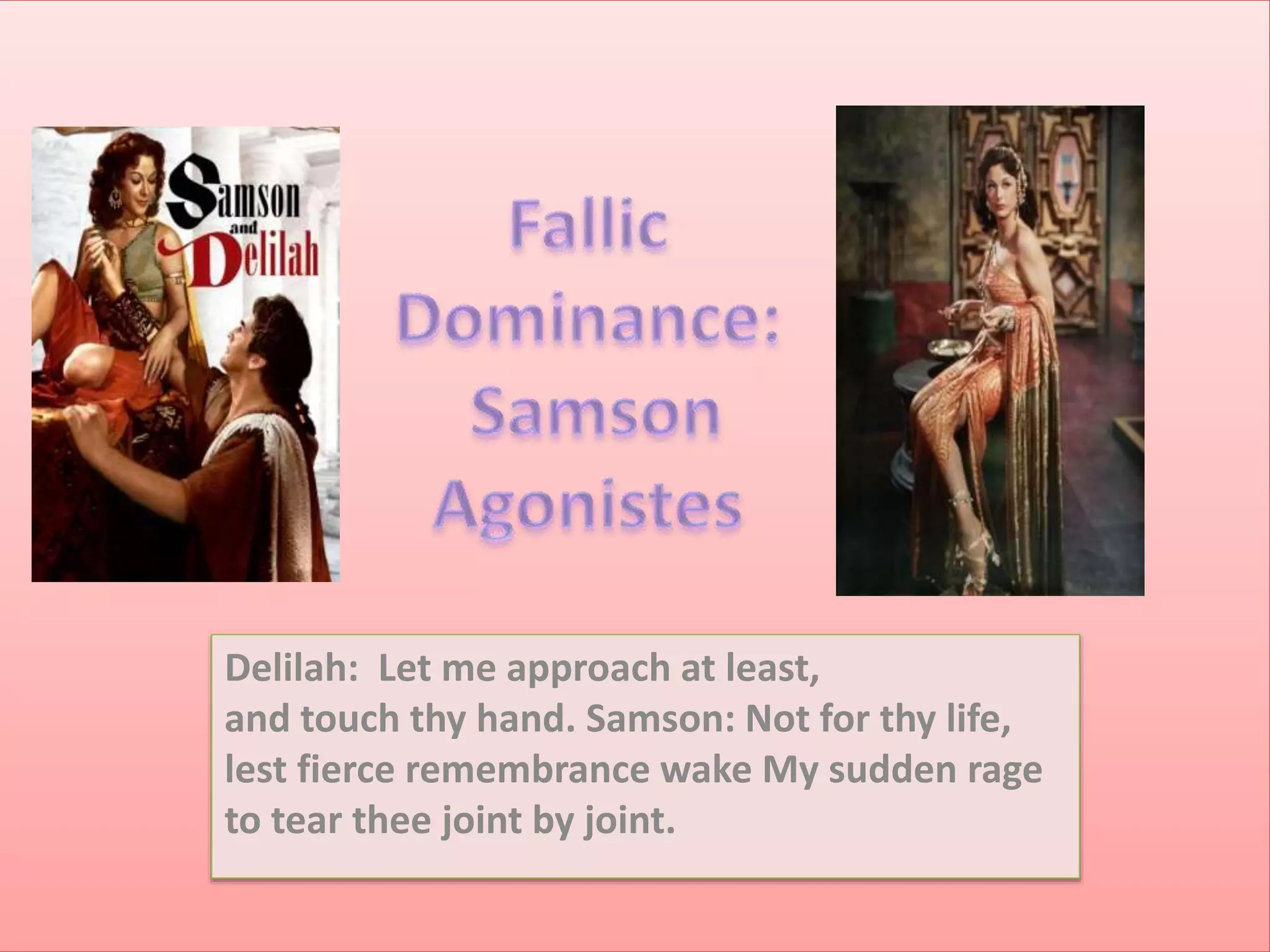
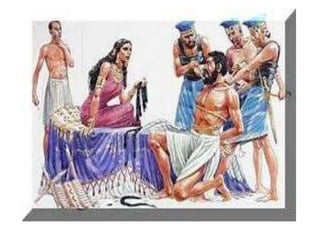
Delilah: Let me approach at least, and touch thy hand.
Samson: Not for thy life, lest fierce remembrance wake
My sudden rage to tear thee joint by joint.
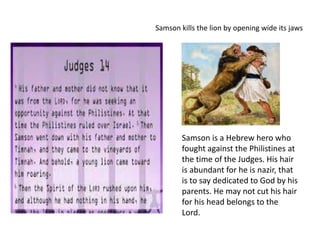
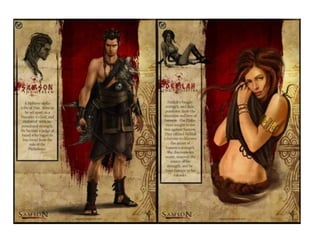
Samson is a Hebrew hero who
fought against the Philistines at
the time of the Judges. His hair
is abundant for he is nazir, that
is to say dedicated to God by his
parents. He may not cut his hair
for his head belongs to the
Lord.
Samson kills the lion by opening wide its jaws
Samson Agonistes is an example of the bourgeois career drama, which conventionally
sets the vocation of the husband against the demands of the housewife” (Guillory
110). Since they are the counterpoints of husband and wife it has led Guillory to
suggest that the battle in “Samson Agonistes” is virtually a marital battle for public
recognition over domestic recognition, or dominance over subjugation. Samson who
had been once a public figure has been symbolically castrated such that his public
dominance as a victorious warrior has been overshadowed by his betrayal by Delilah.
While Delilah’s betrayal of Samson allows her to become a publicly recognized figure of
power because she has rescued her people from the clutches of humiliation meted out
to them by Samson’s former dominance.
Milton employs many techniques to portray this reversal of dominance by the use of
sexually symbolic language to invoke Samson’s castration and Delilah’s gain of the
phallus. Delilah’s move from subordination to boastful pride reflects the shift of
dominance from Samson to Delilah and this shift blows up the paradox between the
legend of Samson and the reality of Samson in the poem. The exaltation of Samson’s
glory at the poem’s outset is undermined eventually through his lack of agency in
reality.
A passage strongly alluding to Samson’s
castration can be found in lines 528-540 in
which Samson is described as being
“swoll’n with pride” (Milton 532) during his
conquests in battle only to fall to “fallacious
looks, venereal trains, / softn’d with
pleasure and voluptuous life” (533-534)
which “shore” (537) him “Like a tame
Weather” (538). This passage is important
in that Samson’s hubris, as symbolized
through his pride being “swoll’n” (532), as if
it is a phallus, is what leads him vulnerable
to Dalila’s “fallacious looks” (533),
“venereal trains” (533), and
voluptuousness. Samson falls prey to her as
a “tame weather” (538), is prey to the
farmer’s shears, and is “disarm’d” (540) in
the sense that his “swoll’n” (532) phallic
pride has become “tame” (538), or
deflated, as a result.
It is with Delilah’s dominance over Samson through making such a bold
proposal that leads one to see sexually allusive language used by other
characters in the poem to portray her as a liberated woman. After Delilah’s
dismisses herself from Samson’s sight Samson describes his marriage to her as
having been “committed / to such a viper…sacred trust / Of secresie” (1001-
1003).
By Samson’s statement it can be inferred that Delilah posseses the predatory
powers of a viper, which speaks to her heightened agency in that she was able
to destabilize Samson’s “trust / Of secresie” (1002-1003). The next character to
speak is the Chorus, whose discourse with Samson furthers the notion of
Delilah’s having gained phallic power over Samson by way of suggesting she
possesses a “secret sting” (1007) powerful enough to cause “amorous remorse”
(1007). This “secret sting” (1007) can be interpreted to symbolize Delilah’s
ability to penetrate the male dominated system of “productive labor” (Guillory
110) with a member powerful enough to “sting” (1007) masculinity hard
enough to cause it to feel remorse for ever having “been fond of the opposite
sex” (“amorous” 1.a. 1673 ) when woman’s femininity has been exposed as
being “only a mask” (Guillory 114).
Delilah’s dominance over Samson occurs when Delilah suggests that
she“touch” (951) Samson’s “hand” (951). According to the Oxford English
Dictionary, “hand” in Roman Law means “the power of the husband over
his wife” (“hand” 2.b. 1875). In essence, Delilah is suggesting that she
“touch” (951), or own his manly prowess because she ultimately wants
Samson to return home with her, with the home symbolizing “deprivation,
a certain incapacity to act” according to Guillory (109). So, Delilah’s
suggestion requires Samson to be depravedly touched so that he may
ultimately dwell in a structure lacking agency. The fact that Delilah
suggests this so openly speaks to the confidence, and therefore agency,
she has gained as a result of usurping Samson’s control over the
Philistines. She has become “swoll’n” (Milton 532) with enough “pride”
(532) to allow her to flawlessly suggest such ideas to Samson without any
hesitation on her part being acknowledged in the text.
According to John Guillory just as Samson’s failure can be expressed as the
failure of his public life, Delilah’s self-defiance can be expressed as the
complaint of the private world against the public. Milton’s critics believed that
Delilah has been dismissed as a liar. In fact, she speaks the conventional truth of
the house hold:
I know that liberty
Would draw thee forth to perilous counterparts
While I at home sat full of cares and fears
Wailing thy absence in my widow’d bed….
(804-6)
Samson Agonistes is a prototype of the bourgeoise career drama, which
conventionally sets the vocation of the husband against the house wife. It
does not matter to the structure of the narrative that Samson’s vocation is not
productive labor, that it takes the form of a violent struggle against the
philistines. That sort of vocation is no less vulnerable than a securable career
to pressures from the household.
As the master term in both the practice and the language of sexual difference, the
phallus organizes the figurative complexes of Milton’s drama. For eg, Delilah is what
Freud called the “phallic woman,” by which he does not mean a “masculine “ woman but
the fantasy of a woman who possess a phallus. Delilah’s appropriation of the phallic
property is quite selective, but her “usurpation” has the effect of a horrifying revelation,
an unveiling: “She’s gone, a manifest serpent by her sting/discovered in the end, till
now concealed” (997-98). The chorus is reacting at this moment to Delilah’s
presentation of herself as deliverer of her people (975-95). Such a revelation exposes
her femininity as only a mask, but it is not what femininity has already been determined
to mean.
With realization of the mask of femininity in
“Samson Agonistes” reader can see Delilah’s
shift in position from subordination to
domination, which reflects her shift from a
private worker to a public worker, “she
reinterprets her betrayal of the private marital
contract as the subordination of private to public
interests…Delilah’s failure as a wife…meant her
public success” (Guillory 111).
As per the Old Testament, the narrative of
Samson and Delilah stands for male power and
female duplicity. Samson reveals a complex and
subversive deconstruction of the dominant-
male model, signified by Samson, which is
achieved largely by the sex-gender
reconstruction of the subordinate-female
model, signified by Samson’s mother and
Delilah.
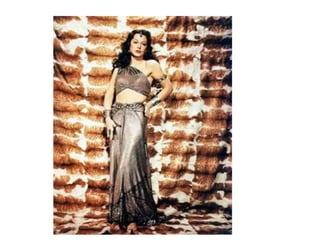
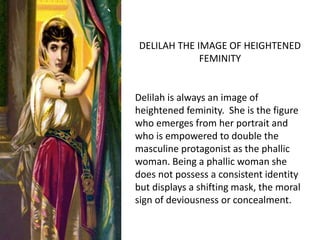
Delilah is always an image of
heightened femininity. She is the
figure who emerges from her portrait
and who is empowered to double the
masculine protagonist as the phallic
woman. Being a phallic woman she
does not possess a consistent identity
but displays a shifting mask, the moral
sign of deviousness or concealment.
DELILAH THE IMAGE OF HEIGHTENED
FEMININITY
At the outset of the poem Samson is described as having extreme power and
fame to his character, “That Heroic , that Renown’d, / Irresistible Samson?
whom unarm’d / no strength of man, or fiercest wild beast could withstand…
/ Adamantean Proof / But safest he who stood aloof, / When insupportably
his foot advanc’t” (126-136). Samson stands “insupportably” (136), meaning
he possesses supreme dominance over all others, so much so that he is able
to take on any foe without the aid of anyone/thing else. He is depicted as a
giant hard phallus through Milton’s choice to relate his character to the
supreme hardness of the metal Adamantean and the power with which he
has “stood aloof / …insupportably” (135-136) such as how an erect phallus
might appear to an onlooker, as a singular tower on a level ground. However,
this great image of Samson the legend, the Samson that once was, is
contrasted with the Samson who has been imprisoned at the hands of
Delilah, “My self, my Sepulcher, a moving Grave / Buried , yet not exempt / By
privilege of death and burial /…made hereby obnoxious more / To all the
miseries of life” (102-107). In this passage the reality of Samson’s situation is
that of him being similar to the walking dead, “Buried, yet not exempt” (103),
whose life is now lived for misery instead of glory. Samson’s present position
is a stark contrast to his once glorious reputation as an undefeatable warrior.
Samson is in the very odd position of
having been seduced by his own wife,
but for Milton there could have been
no other seduction which was as
powerful as this.
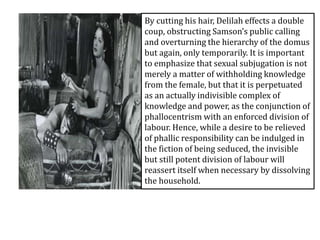
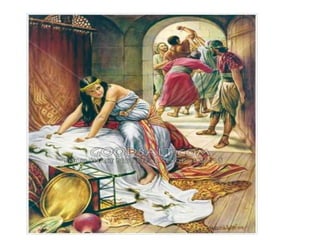
By cutting his hair, Delilah effects a double
coup, obstructing Samson’s public calling
and overturning the hierarchy of the domus
but again, only temporarily. It is important
to emphasize that sexual subjugation is not
merely a matter of withholding knowledge
from the female, but that it is perpetuated
as an actually indivisible complex of
knowledge and power, as the conjunction of
phallocentrism with an enforced division of
labour. Hence, while a desire to be relieved
of phallic responsibility can be indulged in
the fiction of being seduced, the invisible
but still potent division of labour will
reassert itself when necessary by dissolving
the household.
Psychological approach to Milton’s Samson and
Agonistes
A psychological approach to John Milton's Samson Agonistes might
suggest that the cutting of Samson's locks is symbolic of his
castration at the hands of Delilah and that the fighting words he
exchanges with Harapha constitute a reassertion of his manhood.
Psychological critics might see Samson's bondage as a symbol of his
sexual impotency, and his destruction of the Philistine temple and
the killing of himself and many others as a final orgasmic event
(since death and sex are often closely associated in Freudian
psychology). The total absence of Samson's mother
in Samson Agonistes makes it difficult to claim anything related to
the Oedipus complex while Samson’s refusal to be cared for by his
father and his regret over failing to rule Delilah may be seen as
indicative of his own fears regarding his sexuality.
As per the Old Testament, the narrative of Samson
and Delilah stands for male power and female
duplicity. Samson reveals a complex and subversive
deconstruction of the dominant-male model. The
model signified by Samson is achieved largely by the
sex-gender reconstruction of the subordinate-female
model, signified by Samson’s mother and Delilah.
If Samson’s failure is necessarily
represented as sexual seduction,
however, we need to remember
that the phallic narrative is a
translation of secret, the failure
to contain certain words.
As per the sexualized language by which the narrative
represents the contradiction of work and home,
Samson’s seduction by Delilah results in his castration
or effeminization. If the displicinary requirement of
sexual restraint especially within marriage function to
attach phallic symbology to Samson he is identified as
both masculine and indivisible when his body
represents the phallus to his constituents then we are
in a position to understand why the sexual union of
Samson and Delilah evolve castration. According to
biblical history the relationship of Samson and Delilah is
simply one of desire and gratification but not sexual
seduction.
Delilah acknowledges that her private subordinate life as a
housewife was rendered insignificant when compared to the
public and upright duty of liberating her people from
Sampson’s oppression , “how just it was, / How honourable,
how glorious to entrap / A common enemy… / to ensnare an
irreligious / Dishonourer of Dagon” (854-861). She assumes
an active and dominate role in Samson’s defeat through her
choice to “ensnare” (860) him as “A common enemy” (856).
She has taken a ferocious stance against a man she was once
subordinate to. She has become the dominant dynamic of her
and Samson’s relationship.
CONCLUSION
This discrepancy in the characterization of Samson increases
Delilah’s public dominance over Samson in the sense that his
extreme fall from glory allows the reader to view Delilah’s
agency over him as evoking his symbolic castration with she as
the inheritor of his public position perceived as phallic
domination. Delilah’s act against her husband is strong enough
to have caused an invincible soldier to become a subjugated
slave. In essence, Samson’s legend has been symbolically raped
by Delilah’s act, “Once joined, the contrary she proves, a thorn”
(1036). Samson is overthrown by Delilah into the abyss of
supreme subjugation.
REFERENCES
1. Phallic Dominance: The Aggravated Agency in Milton’s “Samson Agonistes”
by Matthew Christovich
2. Rewriting the Renaissance: The Discourses of Sexual Difference in Early…by
Margaret W. Ferguson
3. Guillory, John. “Dalila’s House: Samson Agonistes and the Sexual Division of
Labor.”Rewriting the Renaissance: The Discourse of Sexual Difference in Early
Modern Europe. Ed. Margaret W. Ferguson, et al. Chicago: U of Chicago P,
1986. 106-122. Women in Cult. & Soc. MLA International Bibliography. Web.
3 May 2012.
4. amorous, adj. and n.”. OED Online. March 2012. Oxford University Press. 3
May 2012
5. Milton, John. “Samson Agonistes.” The Riverside Milton. Ed. Roy Flannagan.
Boston: Houghton Mifflin, 1998. 799-844. Print.
6. Lies Before our Eyes: The Denial of Gender from the Bible to Shakespeare
and..By Karen Love
7. Honore de balzac edited by Harold Bloom
8. Literary Criticism: An Overview of Approaches prepared by Skylar Hamilton
Burris-www.editorskylar.com

Fallic dominance in samson agonistes

  • 1.
    Delilah: Let meapproach at least, and touch thy hand. Samson: Not for thy life, lest fierce remembrance wake My sudden rage to tear thee joint by joint.
  • 2.
    Samson is aHebrew hero who fought against the Philistines at the time of the Judges. His hair is abundant for he is nazir, that is to say dedicated to God by his parents. He may not cut his hair for his head belongs to the Lord. Samson kills the lion by opening wide its jaws
  • 4.
    Samson Agonistes isan example of the bourgeois career drama, which conventionally sets the vocation of the husband against the demands of the housewife” (Guillory 110). Since they are the counterpoints of husband and wife it has led Guillory to suggest that the battle in “Samson Agonistes” is virtually a marital battle for public recognition over domestic recognition, or dominance over subjugation. Samson who had been once a public figure has been symbolically castrated such that his public dominance as a victorious warrior has been overshadowed by his betrayal by Delilah. While Delilah’s betrayal of Samson allows her to become a publicly recognized figure of power because she has rescued her people from the clutches of humiliation meted out to them by Samson’s former dominance. Milton employs many techniques to portray this reversal of dominance by the use of sexually symbolic language to invoke Samson’s castration and Delilah’s gain of the phallus. Delilah’s move from subordination to boastful pride reflects the shift of dominance from Samson to Delilah and this shift blows up the paradox between the legend of Samson and the reality of Samson in the poem. The exaltation of Samson’s glory at the poem’s outset is undermined eventually through his lack of agency in reality.
  • 6.
    A passage stronglyalluding to Samson’s castration can be found in lines 528-540 in which Samson is described as being “swoll’n with pride” (Milton 532) during his conquests in battle only to fall to “fallacious looks, venereal trains, / softn’d with pleasure and voluptuous life” (533-534) which “shore” (537) him “Like a tame Weather” (538). This passage is important in that Samson’s hubris, as symbolized through his pride being “swoll’n” (532), as if it is a phallus, is what leads him vulnerable to Dalila’s “fallacious looks” (533), “venereal trains” (533), and voluptuousness. Samson falls prey to her as a “tame weather” (538), is prey to the farmer’s shears, and is “disarm’d” (540) in the sense that his “swoll’n” (532) phallic pride has become “tame” (538), or deflated, as a result.
  • 7.
    It is withDelilah’s dominance over Samson through making such a bold proposal that leads one to see sexually allusive language used by other characters in the poem to portray her as a liberated woman. After Delilah’s dismisses herself from Samson’s sight Samson describes his marriage to her as having been “committed / to such a viper…sacred trust / Of secresie” (1001- 1003). By Samson’s statement it can be inferred that Delilah posseses the predatory powers of a viper, which speaks to her heightened agency in that she was able to destabilize Samson’s “trust / Of secresie” (1002-1003). The next character to speak is the Chorus, whose discourse with Samson furthers the notion of Delilah’s having gained phallic power over Samson by way of suggesting she possesses a “secret sting” (1007) powerful enough to cause “amorous remorse” (1007). This “secret sting” (1007) can be interpreted to symbolize Delilah’s ability to penetrate the male dominated system of “productive labor” (Guillory 110) with a member powerful enough to “sting” (1007) masculinity hard enough to cause it to feel remorse for ever having “been fond of the opposite sex” (“amorous” 1.a. 1673 ) when woman’s femininity has been exposed as being “only a mask” (Guillory 114).
  • 8.
    Delilah’s dominance overSamson occurs when Delilah suggests that she“touch” (951) Samson’s “hand” (951). According to the Oxford English Dictionary, “hand” in Roman Law means “the power of the husband over his wife” (“hand” 2.b. 1875). In essence, Delilah is suggesting that she “touch” (951), or own his manly prowess because she ultimately wants Samson to return home with her, with the home symbolizing “deprivation, a certain incapacity to act” according to Guillory (109). So, Delilah’s suggestion requires Samson to be depravedly touched so that he may ultimately dwell in a structure lacking agency. The fact that Delilah suggests this so openly speaks to the confidence, and therefore agency, she has gained as a result of usurping Samson’s control over the Philistines. She has become “swoll’n” (Milton 532) with enough “pride” (532) to allow her to flawlessly suggest such ideas to Samson without any hesitation on her part being acknowledged in the text.
  • 9.
    According to JohnGuillory just as Samson’s failure can be expressed as the failure of his public life, Delilah’s self-defiance can be expressed as the complaint of the private world against the public. Milton’s critics believed that Delilah has been dismissed as a liar. In fact, she speaks the conventional truth of the house hold: I know that liberty Would draw thee forth to perilous counterparts While I at home sat full of cares and fears Wailing thy absence in my widow’d bed…. (804-6) Samson Agonistes is a prototype of the bourgeoise career drama, which conventionally sets the vocation of the husband against the house wife. It does not matter to the structure of the narrative that Samson’s vocation is not productive labor, that it takes the form of a violent struggle against the philistines. That sort of vocation is no less vulnerable than a securable career to pressures from the household.
  • 11.
    As the masterterm in both the practice and the language of sexual difference, the phallus organizes the figurative complexes of Milton’s drama. For eg, Delilah is what Freud called the “phallic woman,” by which he does not mean a “masculine “ woman but the fantasy of a woman who possess a phallus. Delilah’s appropriation of the phallic property is quite selective, but her “usurpation” has the effect of a horrifying revelation, an unveiling: “She’s gone, a manifest serpent by her sting/discovered in the end, till now concealed” (997-98). The chorus is reacting at this moment to Delilah’s presentation of herself as deliverer of her people (975-95). Such a revelation exposes her femininity as only a mask, but it is not what femininity has already been determined to mean.
  • 12.
    With realization ofthe mask of femininity in “Samson Agonistes” reader can see Delilah’s shift in position from subordination to domination, which reflects her shift from a private worker to a public worker, “she reinterprets her betrayal of the private marital contract as the subordination of private to public interests…Delilah’s failure as a wife…meant her public success” (Guillory 111).
  • 13.
    As per theOld Testament, the narrative of Samson and Delilah stands for male power and female duplicity. Samson reveals a complex and subversive deconstruction of the dominant- male model, signified by Samson, which is achieved largely by the sex-gender reconstruction of the subordinate-female model, signified by Samson’s mother and Delilah.
  • 14.
    Delilah is alwaysan image of heightened femininity. She is the figure who emerges from her portrait and who is empowered to double the masculine protagonist as the phallic woman. Being a phallic woman she does not possess a consistent identity but displays a shifting mask, the moral sign of deviousness or concealment. DELILAH THE IMAGE OF HEIGHTENED FEMININITY
  • 15.
    At the outsetof the poem Samson is described as having extreme power and fame to his character, “That Heroic , that Renown’d, / Irresistible Samson? whom unarm’d / no strength of man, or fiercest wild beast could withstand… / Adamantean Proof / But safest he who stood aloof, / When insupportably his foot advanc’t” (126-136). Samson stands “insupportably” (136), meaning he possesses supreme dominance over all others, so much so that he is able to take on any foe without the aid of anyone/thing else. He is depicted as a giant hard phallus through Milton’s choice to relate his character to the supreme hardness of the metal Adamantean and the power with which he has “stood aloof / …insupportably” (135-136) such as how an erect phallus might appear to an onlooker, as a singular tower on a level ground. However, this great image of Samson the legend, the Samson that once was, is contrasted with the Samson who has been imprisoned at the hands of Delilah, “My self, my Sepulcher, a moving Grave / Buried , yet not exempt / By privilege of death and burial /…made hereby obnoxious more / To all the miseries of life” (102-107). In this passage the reality of Samson’s situation is that of him being similar to the walking dead, “Buried, yet not exempt” (103), whose life is now lived for misery instead of glory. Samson’s present position is a stark contrast to his once glorious reputation as an undefeatable warrior.
  • 17.
    Samson is inthe very odd position of having been seduced by his own wife, but for Milton there could have been no other seduction which was as powerful as this.
  • 18.
    By cutting hishair, Delilah effects a double coup, obstructing Samson’s public calling and overturning the hierarchy of the domus but again, only temporarily. It is important to emphasize that sexual subjugation is not merely a matter of withholding knowledge from the female, but that it is perpetuated as an actually indivisible complex of knowledge and power, as the conjunction of phallocentrism with an enforced division of labour. Hence, while a desire to be relieved of phallic responsibility can be indulged in the fiction of being seduced, the invisible but still potent division of labour will reassert itself when necessary by dissolving the household.
  • 19.
    Psychological approach toMilton’s Samson and Agonistes A psychological approach to John Milton's Samson Agonistes might suggest that the cutting of Samson's locks is symbolic of his castration at the hands of Delilah and that the fighting words he exchanges with Harapha constitute a reassertion of his manhood. Psychological critics might see Samson's bondage as a symbol of his sexual impotency, and his destruction of the Philistine temple and the killing of himself and many others as a final orgasmic event (since death and sex are often closely associated in Freudian psychology). The total absence of Samson's mother in Samson Agonistes makes it difficult to claim anything related to the Oedipus complex while Samson’s refusal to be cared for by his father and his regret over failing to rule Delilah may be seen as indicative of his own fears regarding his sexuality.
  • 20.
    As per theOld Testament, the narrative of Samson and Delilah stands for male power and female duplicity. Samson reveals a complex and subversive deconstruction of the dominant-male model. The model signified by Samson is achieved largely by the sex-gender reconstruction of the subordinate-female model, signified by Samson’s mother and Delilah.
  • 21.
    If Samson’s failureis necessarily represented as sexual seduction, however, we need to remember that the phallic narrative is a translation of secret, the failure to contain certain words.
  • 22.
    As per thesexualized language by which the narrative represents the contradiction of work and home, Samson’s seduction by Delilah results in his castration or effeminization. If the displicinary requirement of sexual restraint especially within marriage function to attach phallic symbology to Samson he is identified as both masculine and indivisible when his body represents the phallus to his constituents then we are in a position to understand why the sexual union of Samson and Delilah evolve castration. According to biblical history the relationship of Samson and Delilah is simply one of desire and gratification but not sexual seduction.
  • 24.
    Delilah acknowledges thather private subordinate life as a housewife was rendered insignificant when compared to the public and upright duty of liberating her people from Sampson’s oppression , “how just it was, / How honourable, how glorious to entrap / A common enemy… / to ensnare an irreligious / Dishonourer of Dagon” (854-861). She assumes an active and dominate role in Samson’s defeat through her choice to “ensnare” (860) him as “A common enemy” (856). She has taken a ferocious stance against a man she was once subordinate to. She has become the dominant dynamic of her and Samson’s relationship.
  • 26.
    CONCLUSION This discrepancy inthe characterization of Samson increases Delilah’s public dominance over Samson in the sense that his extreme fall from glory allows the reader to view Delilah’s agency over him as evoking his symbolic castration with she as the inheritor of his public position perceived as phallic domination. Delilah’s act against her husband is strong enough to have caused an invincible soldier to become a subjugated slave. In essence, Samson’s legend has been symbolically raped by Delilah’s act, “Once joined, the contrary she proves, a thorn” (1036). Samson is overthrown by Delilah into the abyss of supreme subjugation.
  • 27.
    REFERENCES 1. Phallic Dominance:The Aggravated Agency in Milton’s “Samson Agonistes” by Matthew Christovich 2. Rewriting the Renaissance: The Discourses of Sexual Difference in Early…by Margaret W. Ferguson 3. Guillory, John. “Dalila’s House: Samson Agonistes and the Sexual Division of Labor.”Rewriting the Renaissance: The Discourse of Sexual Difference in Early Modern Europe. Ed. Margaret W. Ferguson, et al. Chicago: U of Chicago P, 1986. 106-122. Women in Cult. & Soc. MLA International Bibliography. Web. 3 May 2012. 4. amorous, adj. and n.”. OED Online. March 2012. Oxford University Press. 3 May 2012 5. Milton, John. “Samson Agonistes.” The Riverside Milton. Ed. Roy Flannagan. Boston: Houghton Mifflin, 1998. 799-844. Print. 6. Lies Before our Eyes: The Denial of Gender from the Bible to Shakespeare and..By Karen Love 7. Honore de balzac edited by Harold Bloom 8. Literary Criticism: An Overview of Approaches prepared by Skylar Hamilton Burris-www.editorskylar.com