The Winter’s Tale


     What is this play?
Comedy?
Classified with the comedies in the First Folio of
1623

Ends with couples
   reunion of Leontes and Hermione
   pending marriage of Paulina and Camillo
   pending marriage of Perdita and Florizel
Tragedy?
King makes a terrible error and his line is
seemingly dead

―Infection‖ of the king by jealousy

Loyalties tested

Honor valued over obedience
Romance?
―stories of exotic adventure and
travel, shipwrecks, spiritual and/or moral
quests, romantic love, reunions of lovers
and families long separated, virtue tested
and proved triumphant, and nobility
hidden and then discovered – all
unfolding in a world familiar with
supernatural forces, wide-ranging
marvels, magic, and enchantment‖
(Snyder)
Tragicomedy?
John Fletcher:
  ―A tragicomedy is not so called in respect of
  mirth and killing, but in respect it wants
  deaths, which is enough to make it no
  tragedy, yet brings some near it, which is
  enough to make it no comedy: which must be
  a representation of familiar people, with such
  kind of trouble as no life be questioned, so
  that a God is as lawful in this as in a
  tragedy, and mean people as in a comedy.‖
Genre according to the
       Shepherd
―thou met‘st with things dying, I with things new-
born‖ (3.3.109-110)

―This is fairy gold, boy, and ‗twill prove so‖
(3.3.117-118)
Tragicomic Romance
Genre suggested by Barbara Mowat

Elements of tragicomedy and romance that are
compatible and complementary
Pastoral
Court or city versus country

Country is often idealized

Good example: Christopher Marlowe‘s
―Passionate Shepherd to His Love‖ (1599)

Sheep shearing festival at 4.4
―Generic Copiousness‖
Copia: varying an idea to achieve expansive
richness as a stylistic goal

Multiplying genres
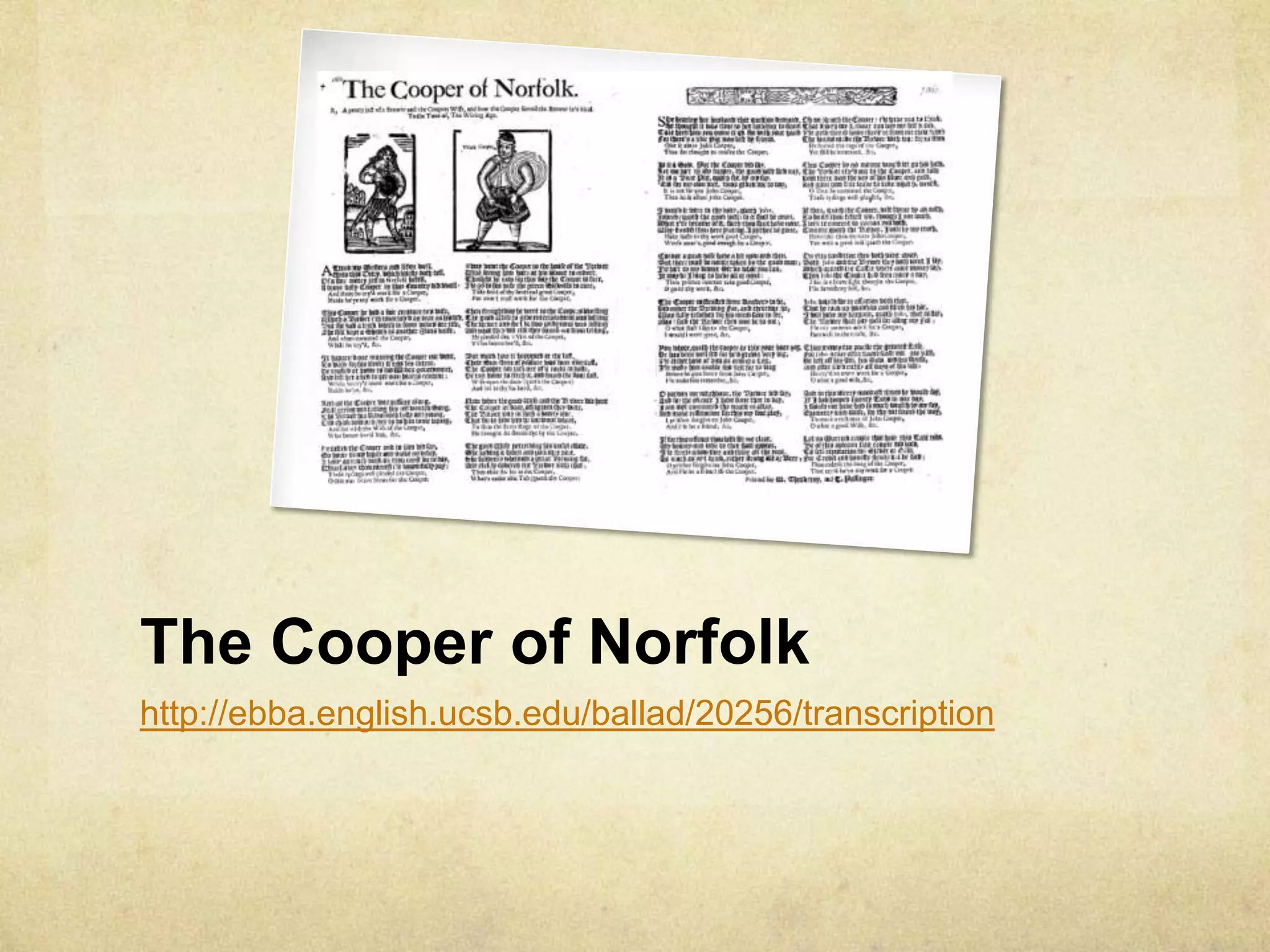
Cheap Print
Autolycus‘s Ballads
Vagrancy & Broadside
       Ballads
http://bit.ly/So9gdb
The Cooper of Norfolk
http://ebba.english.ucsb.edu/ballad/20256/transcription
Paulina‘s ―Witchcraft‖
    Challenges to Authority in
       The Winter’s Tale
Leontes.                         Out!

A Mankind witch! Hence with her, out o‘ door!

A most intelligencing bawd!             (2.3.66-68)
An Homily Against Disobedience
  and Willful Rebellion (London
              1570)
 ―kings and princes [. . .] do reign
 by God‘s ordinance‖
 ―Whosoever therefore resisteth
 the power, resisteth the
 ordinance of God‖
James I on Absolute
      Monarchy
―For kings are not only God‘s
lieutenants upon earth, and sit
upon God‘s throne, but even by
God himself they are called
gods.‖
James I on Absolute
       Monarchy
―God has the power to create, or
destroy, make, or unmake at his
pleasure, to give life, or send death, to
judge all, and to be judged nor
accountable to none; to raise low
things, and to make high things low at his
pleasure, and to God are both soul and
body due. And the like power have
kings.‖
James I on
      Just King vs. Tyrant
Just king obeys the law
   ―So as every just king in a settled kingdom is
   bound to observe that paction [contract] made to
   his people by his laws‖

Tyrant makes up the rules as he goes along
   ―And therefore a king governing in a settled
   kingdom leaves to be a king, and degenerates
   into a tyrant as soon as he leaves off to rule
   according to his laws.‖
James I on Absolute
         Monarchy
  BUT subjects may not rebel
     ―so is it sedition in subjects to dispute what a king
     may do in the height of his power. But just kings
     will ever be willing to declare what they will do, if
     they will not incur the curse of God.‖

From A Speech to the Lords and Commons
   of the Parliament at Whitehall, March
   21, 1610
Chain of Authority
      GOD
        ↓
      KING
        ↓
HUSBAND/FATHER
Leontes as Absolute Monarch
                      Why, what need we
Commune with you of this, but rather follow
Our forceful instigation? Our prerogative
Calls not your counsels, but our natural goodness
Imparts this; which if you or stupefied,
Or seeming so in skill, cannot or will not
Relish a truth like us, inform yourselves
We need no more of your advice. The matter,
The loss, the gain, the ord‘ring on‘t, is all
Properly ours.                       (2.1.161-170)
Juan Luis Vives on the
    Behavior of Women
―Thou hast broken, thou false woman, the
most holy band of temporal law, that is to
say, thy faith and thy truth, which once
given, one enemy in the field will keep to
another though he should stand in danger
of death, and thou like a false wretch doth
not keep it to thine husband, which ought
to be more dear unto thee by right than
thyself.
Juan Luis Vives on the
       Behavior of Women
   Thou defilest the most pure church, which
   holp to couple thee; thou breakest worldly
   company; thou breakest the laws; thou
   offendest thy country; thou beatest thy father
   with a bitter scourge; thou beatest thy
   sorrowful mother, thy sisters, thy brethren,
   thy kinfolk, alliances, and all thy friends; thou
   givest unto the company once an example of
   mischief and castest an everlasting blot‖

(The Instruction of a Christian Woman 112-113)
Paulina‘s ―Disobedience‖
Leontes.                    How?
Away with that audacious lady! Antigonus,
I charged thee that she should not come
   about me;
I knew she would.     (2.3.41-44)
Paulina‘s ―Disobedience‖
Antigonus. I told her so, my lord,
On your displeasure‘s peril and on mine
She should not visit you.
Leontes. What, canst not rule her? (2.3.44-
  46)
Paulina‘s ―Disobedience‖
Paulina. From all dishonesty he can; in this,
Unless he take the course that you have
  done—
Commit me for committing honour—trust it,
He shall not rule me. (2.3.47-50)
Paulina‘s ―Disobedience‖
Leontes.              A gross hag!
And losel, thou art worthy to be hanged,
That wilt not stay her tongue.
Antigonus.       Hang all the husbands
That cannot do that feat, you‘ll leave
  yourself
Hardly one subject.         (2.3.107-111)
Reading Paulina‘s
        Witchcraft
Witchcraft excuses Paulina‘s transgression

Witchcraft pushes her to the margins of the play
Agnes Heard
Depositions focus on a series of domestic and
familial incidents.

Milk dish           Spinning trouble
   ―she could no longer spin nor make thread to
   hold‖ (94)

Borrowed money                         Spoiled
milk
   ―the next day, she would have skimmed her milk
   bowl, but it would not abide the skimming‖ (95)
Counter-magical Remedies
 ―women who feared bewitchment were
 also paradoxically enabled … to take
 action against the witch, action which
 might involve behaviours at variance with
 the range of feminine ideals available to
 women in the early modern period‖ (127).
Counter-magical Witchcraft
 It was believed that ―illness or maleficium can be
 drawn out of one body by another‖ (123).

 Purkiss tells the story of a midwife who healed
 sick people using the bodies of infants, claiming
 that ―the breath of the children would suck the
 spirits out of‖ (123) the sick person.

 Paulina. The good queen, / … hath brought you
 forth a daughter - / Here ‗tis (2.3.64-66)
Infection
Camillo. ―Who does infect her?‖ (1.2.306)

Leontes. ―How I am gall‘d‖ (1.2.316); ―I have
tremor cordis on me‖ (1.2.109); ―And that to the
infection of my brains‖ (1.2.144); ―I have
drunk, and seen the spider‖ (2.1.45)

Camillo. ―‖in rebellion with himself‖ (1.2.354)

Polixenes. ―then my best blood turn / To an
infected jelly‖ (1.2.416-417)
The Whole Kingdom is Ill
Paulina. I come to bring him sleep. ‗Tis such as
  you
That creep like shadows by him and do sigh
At each his needless heavings, such as you
Nourish the cause of his awaking. I
Do come with words as medicinal, as true—
Honest as either—to purge him of that humour
That presses him from sleep. (2.3.33-39)
Paulina‘s ―Cure‖
Paulina.                  I dare be sworn.
These dangerous, unsafe lunes
  I‘the‘King, beshrew them!
He must be told on‘t, and he shall; the office
Becomes a woman best. I‘ll take‘t upon me;
If I prove honey-mouthed, let my tongue blister,
…The silence often of pure innocence
Persuades when speaking fails.     (2.2.28-32; 40-1)
Authority?
Paulina.                        I care not;
It is an heretic that makes the fire,
Not she which burns in it. I‘ll not call you tyrant;
But this most cruel usage of your Queen,
Not able to produce more accusation
Than your own weak-hinged fancy, something savours
Of tyranny, and will ignoble make you,
Yea, scandalous to the world.(2.3.115-20)
The Oracle
Officer. ‗Hermione is chaste, Polixenes
   blameless, Camillo a true subject, Leontes a
   jealous tyrant, his innocent babe truly
   begotten, and the King shall live without an heir if
   that which is lost be not found.‘
       (3.2.130-134)
Leontes Denies
   There is no truth at all i‘th‘ oracle. / The sessions
   shall proceed; this is mere falsehood.

   Apollo‘s angry, and the heavens themselves / Do
   strike at my injustice.

(3.2.138-139; 144-145)
Leontes Cedes Power
Leontes. Thou didst speak well

When most the truth, which I receive much better

Than to be pitied of thee. (3.2.230-232)
Conclusion
Counter-magic to combat evil

Alternative to violent and tyrannical authority

Infection caused by ideology of absolute rule
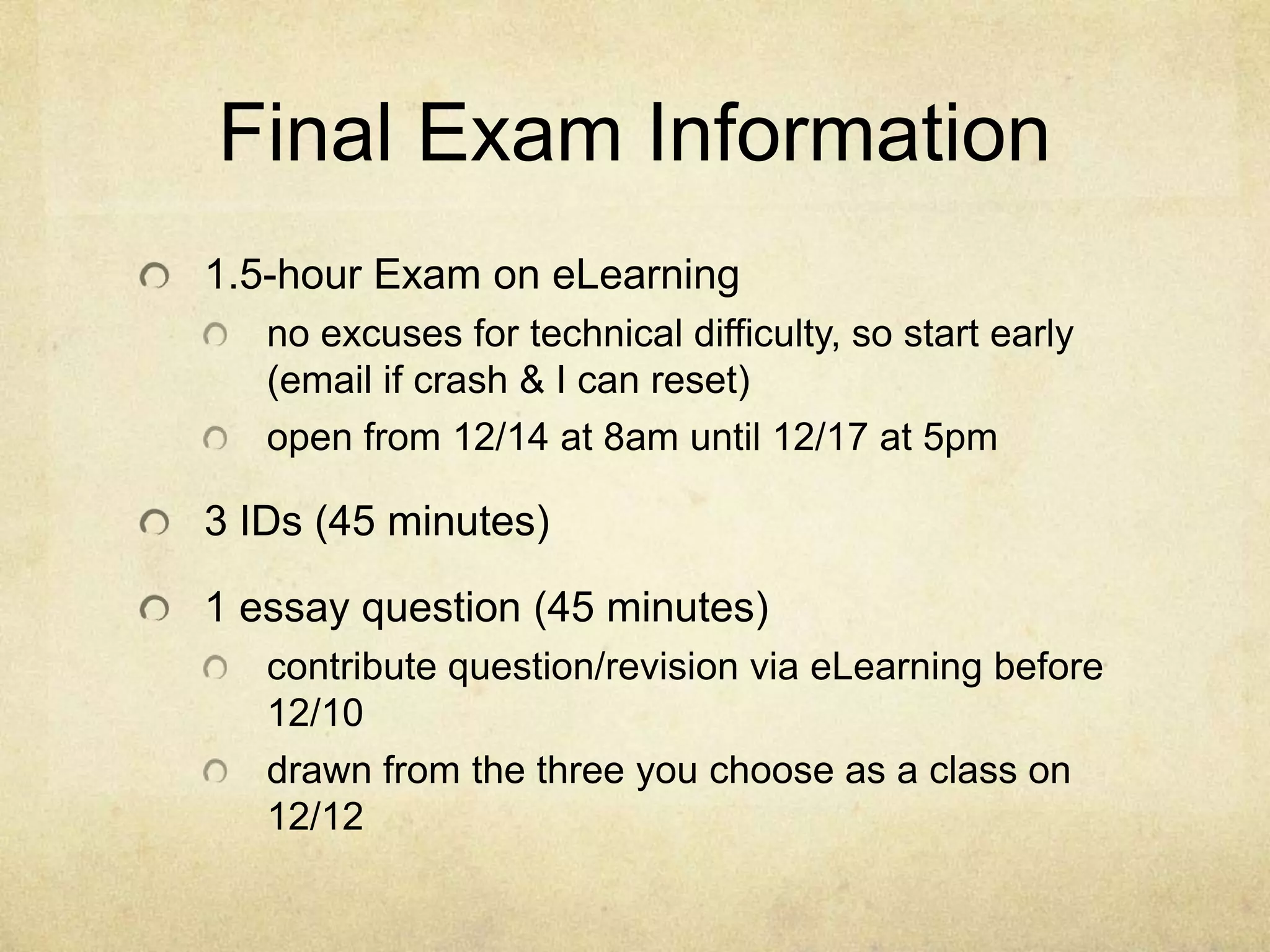
Final Exam Information
1.5-hour Exam on eLearning
   no excuses for technical difficulty, so start early
   (email if crash & I can reset)
   open from 12/14 at 8am until 12/17 at 5pm

3 IDs (45 minutes)

1 essay question (45 minutes)
   contribute question/revision via eLearning before
   12/10
   drawn from the three you choose as a class on
   12/12
Passage Identification
In your answers to these questions you must: 1.
Identify the name of the work; 2. Identify the context
of the passage (what happens before and after
and, where appropriate, the speaker); 3. Discuss the
significance of the passage in its context; 4. Discuss
the significance of the passage in terms of the larger
themes of the work in which it appears; and 5.
Discuss how each passage contributes to the
meaning of its work overall. You will earn the majority
of the points in this section for a thoughtful discussion
of the passage‘s significance supported by evidence
from the passage. Please pay specific attention to
the language of the passage in your discussion.
Essay
Questions should
   be about works since the midterm;
   ask the writer to draw connections across multiple
   works;
   and be complex enough to require 45 minutes to
   answer.
Papers Due 12/10 by 5pm
I will be in my office 10-11:15am that day for last-
minute questions about your paper; please come
by or email.

Winters tale

  • 1.
    The Winter’s Tale What is this play?
  • 2.
    Comedy? Classified with thecomedies in the First Folio of 1623 Ends with couples reunion of Leontes and Hermione pending marriage of Paulina and Camillo pending marriage of Perdita and Florizel
  • 3.
    Tragedy? King makes aterrible error and his line is seemingly dead ―Infection‖ of the king by jealousy Loyalties tested Honor valued over obedience
  • 4.
    Romance? ―stories of exoticadventure and travel, shipwrecks, spiritual and/or moral quests, romantic love, reunions of lovers and families long separated, virtue tested and proved triumphant, and nobility hidden and then discovered – all unfolding in a world familiar with supernatural forces, wide-ranging marvels, magic, and enchantment‖ (Snyder)
  • 5.
    Tragicomedy? John Fletcher: ―A tragicomedy is not so called in respect of mirth and killing, but in respect it wants deaths, which is enough to make it no tragedy, yet brings some near it, which is enough to make it no comedy: which must be a representation of familiar people, with such kind of trouble as no life be questioned, so that a God is as lawful in this as in a tragedy, and mean people as in a comedy.‖
  • 6.
    Genre according tothe Shepherd ―thou met‘st with things dying, I with things new- born‖ (3.3.109-110) ―This is fairy gold, boy, and ‗twill prove so‖ (3.3.117-118)
  • 7.
    Tragicomic Romance Genre suggestedby Barbara Mowat Elements of tragicomedy and romance that are compatible and complementary
  • 8.
    Pastoral Court or cityversus country Country is often idealized Good example: Christopher Marlowe‘s ―Passionate Shepherd to His Love‖ (1599) Sheep shearing festival at 4.4
  • 9.
    ―Generic Copiousness‖ Copia: varyingan idea to achieve expansive richness as a stylistic goal Multiplying genres
  • 10.
  • 11.
    Vagrancy & Broadside Ballads http://bit.ly/So9gdb
  • 12.
    The Cooper ofNorfolk http://ebba.english.ucsb.edu/ballad/20256/transcription
  • 13.
    Paulina‘s ―Witchcraft‖ Challenges to Authority in The Winter’s Tale
  • 15.
    Leontes. Out! A Mankind witch! Hence with her, out o‘ door! A most intelligencing bawd! (2.3.66-68)
  • 16.
    An Homily AgainstDisobedience and Willful Rebellion (London 1570) ―kings and princes [. . .] do reign by God‘s ordinance‖ ―Whosoever therefore resisteth the power, resisteth the ordinance of God‖
  • 17.
    James I onAbsolute Monarchy ―For kings are not only God‘s lieutenants upon earth, and sit upon God‘s throne, but even by God himself they are called gods.‖
  • 18.
    James I onAbsolute Monarchy ―God has the power to create, or destroy, make, or unmake at his pleasure, to give life, or send death, to judge all, and to be judged nor accountable to none; to raise low things, and to make high things low at his pleasure, and to God are both soul and body due. And the like power have kings.‖
  • 19.
    James I on Just King vs. Tyrant Just king obeys the law ―So as every just king in a settled kingdom is bound to observe that paction [contract] made to his people by his laws‖ Tyrant makes up the rules as he goes along ―And therefore a king governing in a settled kingdom leaves to be a king, and degenerates into a tyrant as soon as he leaves off to rule according to his laws.‖
  • 20.
    James I onAbsolute Monarchy BUT subjects may not rebel ―so is it sedition in subjects to dispute what a king may do in the height of his power. But just kings will ever be willing to declare what they will do, if they will not incur the curse of God.‖ From A Speech to the Lords and Commons of the Parliament at Whitehall, March 21, 1610
  • 21.
    Chain of Authority GOD ↓ KING ↓ HUSBAND/FATHER
  • 22.
    Leontes as AbsoluteMonarch Why, what need we Commune with you of this, but rather follow Our forceful instigation? Our prerogative Calls not your counsels, but our natural goodness Imparts this; which if you or stupefied, Or seeming so in skill, cannot or will not Relish a truth like us, inform yourselves We need no more of your advice. The matter, The loss, the gain, the ord‘ring on‘t, is all Properly ours. (2.1.161-170)
  • 23.
    Juan Luis Viveson the Behavior of Women ―Thou hast broken, thou false woman, the most holy band of temporal law, that is to say, thy faith and thy truth, which once given, one enemy in the field will keep to another though he should stand in danger of death, and thou like a false wretch doth not keep it to thine husband, which ought to be more dear unto thee by right than thyself.
  • 24.
    Juan Luis Viveson the Behavior of Women Thou defilest the most pure church, which holp to couple thee; thou breakest worldly company; thou breakest the laws; thou offendest thy country; thou beatest thy father with a bitter scourge; thou beatest thy sorrowful mother, thy sisters, thy brethren, thy kinfolk, alliances, and all thy friends; thou givest unto the company once an example of mischief and castest an everlasting blot‖ (The Instruction of a Christian Woman 112-113)
  • 25.
    Paulina‘s ―Disobedience‖ Leontes. How? Away with that audacious lady! Antigonus, I charged thee that she should not come about me; I knew she would. (2.3.41-44)
  • 26.
    Paulina‘s ―Disobedience‖ Antigonus. Itold her so, my lord, On your displeasure‘s peril and on mine She should not visit you. Leontes. What, canst not rule her? (2.3.44- 46)
  • 27.
    Paulina‘s ―Disobedience‖ Paulina. Fromall dishonesty he can; in this, Unless he take the course that you have done— Commit me for committing honour—trust it, He shall not rule me. (2.3.47-50)
  • 28.
    Paulina‘s ―Disobedience‖ Leontes. A gross hag! And losel, thou art worthy to be hanged, That wilt not stay her tongue. Antigonus. Hang all the husbands That cannot do that feat, you‘ll leave yourself Hardly one subject. (2.3.107-111)
  • 29.
    Reading Paulina‘s Witchcraft Witchcraft excuses Paulina‘s transgression Witchcraft pushes her to the margins of the play
  • 30.
    Agnes Heard Depositions focuson a series of domestic and familial incidents. Milk dish Spinning trouble ―she could no longer spin nor make thread to hold‖ (94) Borrowed money Spoiled milk ―the next day, she would have skimmed her milk bowl, but it would not abide the skimming‖ (95)
  • 31.
    Counter-magical Remedies ―womenwho feared bewitchment were also paradoxically enabled … to take action against the witch, action which might involve behaviours at variance with the range of feminine ideals available to women in the early modern period‖ (127).
  • 32.
    Counter-magical Witchcraft Itwas believed that ―illness or maleficium can be drawn out of one body by another‖ (123). Purkiss tells the story of a midwife who healed sick people using the bodies of infants, claiming that ―the breath of the children would suck the spirits out of‖ (123) the sick person. Paulina. The good queen, / … hath brought you forth a daughter - / Here ‗tis (2.3.64-66)
  • 33.
    Infection Camillo. ―Who doesinfect her?‖ (1.2.306) Leontes. ―How I am gall‘d‖ (1.2.316); ―I have tremor cordis on me‖ (1.2.109); ―And that to the infection of my brains‖ (1.2.144); ―I have drunk, and seen the spider‖ (2.1.45) Camillo. ―‖in rebellion with himself‖ (1.2.354) Polixenes. ―then my best blood turn / To an infected jelly‖ (1.2.416-417)
  • 34.
    The Whole Kingdomis Ill Paulina. I come to bring him sleep. ‗Tis such as you That creep like shadows by him and do sigh At each his needless heavings, such as you Nourish the cause of his awaking. I Do come with words as medicinal, as true— Honest as either—to purge him of that humour That presses him from sleep. (2.3.33-39)
  • 35.
    Paulina‘s ―Cure‖ Paulina. I dare be sworn. These dangerous, unsafe lunes I‘the‘King, beshrew them! He must be told on‘t, and he shall; the office Becomes a woman best. I‘ll take‘t upon me; If I prove honey-mouthed, let my tongue blister, …The silence often of pure innocence Persuades when speaking fails. (2.2.28-32; 40-1)
  • 36.
    Authority? Paulina. I care not; It is an heretic that makes the fire, Not she which burns in it. I‘ll not call you tyrant; But this most cruel usage of your Queen, Not able to produce more accusation Than your own weak-hinged fancy, something savours Of tyranny, and will ignoble make you, Yea, scandalous to the world.(2.3.115-20)
  • 37.
    The Oracle Officer. ‗Hermioneis chaste, Polixenes blameless, Camillo a true subject, Leontes a jealous tyrant, his innocent babe truly begotten, and the King shall live without an heir if that which is lost be not found.‘ (3.2.130-134)
  • 38.
    Leontes Denies There is no truth at all i‘th‘ oracle. / The sessions shall proceed; this is mere falsehood. Apollo‘s angry, and the heavens themselves / Do strike at my injustice. (3.2.138-139; 144-145)
  • 39.
    Leontes Cedes Power Leontes.Thou didst speak well When most the truth, which I receive much better Than to be pitied of thee. (3.2.230-232)
  • 40.
    Conclusion Counter-magic to combatevil Alternative to violent and tyrannical authority Infection caused by ideology of absolute rule
  • 41.
    Final Exam Information 1.5-hourExam on eLearning no excuses for technical difficulty, so start early (email if crash & I can reset) open from 12/14 at 8am until 12/17 at 5pm 3 IDs (45 minutes) 1 essay question (45 minutes) contribute question/revision via eLearning before 12/10 drawn from the three you choose as a class on 12/12
  • 42.
    Passage Identification In youranswers to these questions you must: 1. Identify the name of the work; 2. Identify the context of the passage (what happens before and after and, where appropriate, the speaker); 3. Discuss the significance of the passage in its context; 4. Discuss the significance of the passage in terms of the larger themes of the work in which it appears; and 5. Discuss how each passage contributes to the meaning of its work overall. You will earn the majority of the points in this section for a thoughtful discussion of the passage‘s significance supported by evidence from the passage. Please pay specific attention to the language of the passage in your discussion.
  • 43.
    Essay Questions should be about works since the midterm; ask the writer to draw connections across multiple works; and be complex enough to require 45 minutes to answer.
  • 44.
    Papers Due 12/10by 5pm I will be in my office 10-11:15am that day for last- minute questions about your paper; please come by or email.

Editor's Notes

  • #11 Part of the genre problem is illustrated by Autolycus’s selling of broadside ballads at the sheepshearing festival. These cheap print items blended genres themselves and were widely read.
  • #12 Broadside ballads are a good measure of early modern culture generally, if for no other reason than their proliferation. At the cost of about a penny, ballads were cheap enough to be bought on the street by people who made only meager wages, and they were remarkable enough to be collected by people as financially comfortable as Samuel Pepys. There were thousands of ballads printed and perhaps even millions circulated during the sixteenth and seventeenth centuries. Even when copies of the printed ballads were not being exchanged, they were often sung in alehouses, playhouses, and on the street. Ballads are therefore perfectly placed as documents of their times. In fact, John Selden famously claimed: “More solid things do not show the complexion of the time so well as ballads and libels.” The pervasiveness of ballads for reading, singing, buying, or hanging up—not to mention for more lowly uses such as pie lining or toilet paper—suggests that they were accessible to just about everyone. They were historical markers that showed “the complexion of the time,” and are therefore most important for understanding early modern culture.
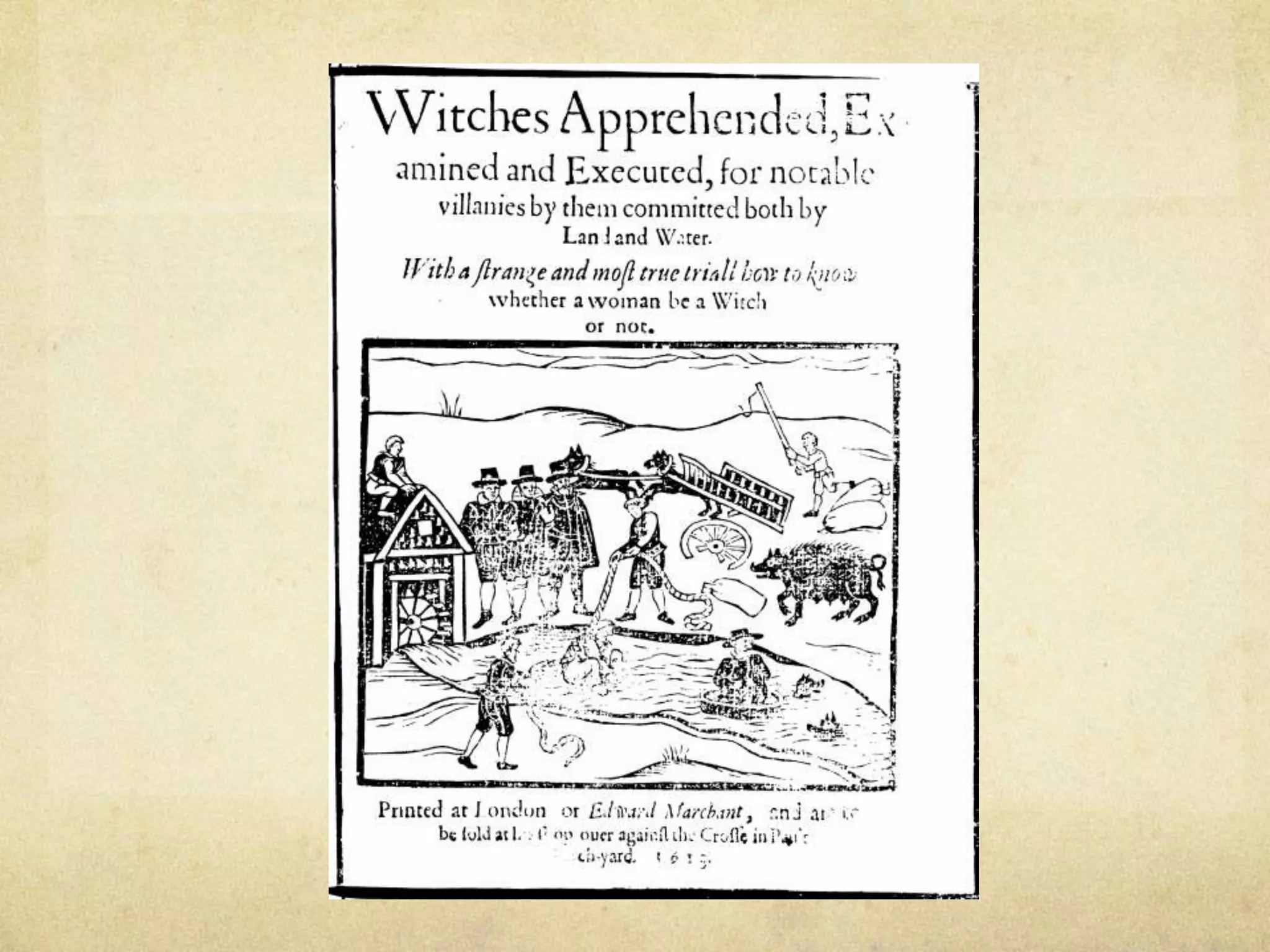
  • #15 Here is a title page from one of the many witchcraft trial narratives. This one is from 1613, and as you can see, the woodcut depicts punishment for the witch. Typically, when we encounter a witch in a text from the early modern period, we consider that witch to be the product of a coherent cultural narrative: a specific kind of witch—bad—who functions in a certain way in the text—as an outsider or other figure.
  • #31 One example of the kinds of stories Purkiss looks at is that of Agnes Heard. For example,Bennet Lane lent Heard a dish of milk and when Heard didn’t return it, Lane asked her daughter to pick it up. Heard sent the dish back and Lane begins to have trouble completing her everyday spinning tasks. Another time, when Lane borrowed money from Heard, she discovered that she had trouble with her dairy. The case of Agnes Heard is indicative in that the anxieties seem to center around the household and food. Witches attacked the domestic sphere—the sphere of women.
  • #34 The idea of infection runs throughout the play as a way of thinking about Leontes’s jealousy—it leads him to tyranny, which infects not just his body, but the whole kingdom.