AIMS of today
1. What is Kiwi Kids News?
2. What is Fake News?
history / examples / what will the future look like?
3. What can be done in schools?
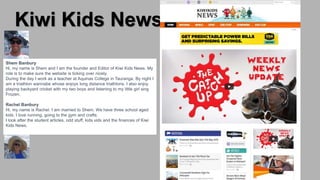
Kiwi Kids News
Shem Banbury
Hi, my name is Shem and I am the founder and Editor of Kiwi Kids News. My
role is to make sure the website is ticking over nicely.
During the day I work as a teacher at Aquinas College in Tauranga. By night I
am a triathlon wannabe whose enjoys long distance triathlons. I also enjoy
playing backyard cricket with my two boys and listening to my little girl sing
Frozen.
Rachel Banbury
Hi, my name is Rachel. I am married to Shem. We have three school aged
kids. I love running, going to the gym and crafts.
I look after the student articles, odd stuff, kids vids and the finances of Kiwi
Kids News.
What is Fake News?
Stories that look like real news stories but are hoaxes,
propaganda, and disinformation.
Fake news typically appears on websites that look
professional. The stories often relate to topics and people
who are trending on Google and Facebook.
The stories usually have outrageous headlines designed to
get people to click.
What is NOT Fake News?
News articles that only have half a
story.
News articles that are opinion.
News stories that have content you
disagree with.
Growing problem in recent
yearsNews is no longer monopolized by “legacy media” – newspapers, TVs and
radio.
Anyone can start a blog and claim to be a journalist. Most fake news comes
from websites.
Less librarians, who traditionally taught research skills.
Media literacy is no longer taught at many schools.
People are gullible and can’t distinguish real news from fake, studies show.
They view the media as the monolith.
Why spread fake news?
Sometimes these stories are created to attract an audience
and the advertising revenues that come with it.
Sometimes these stories are published to harm someone’s
reputation.
Political or social gain.
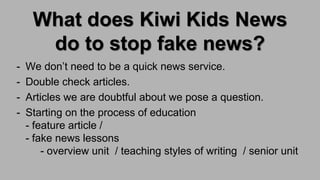
What does Kiwi Kids News
do to stop fake news?
- We don’t need to be a quick news service.
- Double check articles.
- Articles we are doubtful about we pose a question.
- Starting on the process of education
- feature article /
- fake news lessons
- overview unit / teaching styles of writing / senior unit
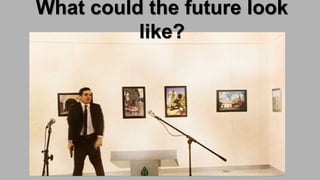
What could the future look
like?
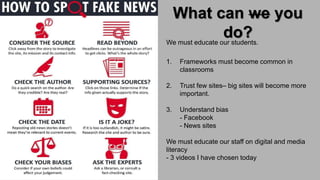
What can we you
do?
Teach learning process
We must educate our students.
1. Frameworks must become common in
classrooms
2. Trust few sites– big sites will become more
important.
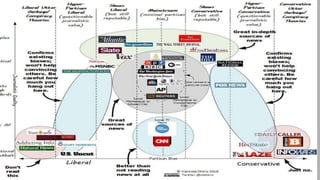
3. Understand bias
- Facebook
- News sites
We must educate our staff on digital and media
literacy
- 3 videos I have chosen today
Fake News Presentation

Fake News Presentation

  • 2.
    AIMS of today 1.What is Kiwi Kids News? 2. What is Fake News? history / examples / what will the future look like? 3. What can be done in schools?
  • 3.
    Kiwi Kids News ShemBanbury Hi, my name is Shem and I am the founder and Editor of Kiwi Kids News. My role is to make sure the website is ticking over nicely. During the day I work as a teacher at Aquinas College in Tauranga. By night I am a triathlon wannabe whose enjoys long distance triathlons. I also enjoy playing backyard cricket with my two boys and listening to my little girl sing Frozen. Rachel Banbury Hi, my name is Rachel. I am married to Shem. We have three school aged kids. I love running, going to the gym and crafts. I look after the student articles, odd stuff, kids vids and the finances of Kiwi Kids News.
  • 5.
    What is FakeNews? Stories that look like real news stories but are hoaxes, propaganda, and disinformation. Fake news typically appears on websites that look professional. The stories often relate to topics and people who are trending on Google and Facebook. The stories usually have outrageous headlines designed to get people to click.
  • 6.
    What is NOTFake News? News articles that only have half a story. News articles that are opinion. News stories that have content you disagree with.
  • 7.
    Growing problem inrecent yearsNews is no longer monopolized by “legacy media” – newspapers, TVs and radio. Anyone can start a blog and claim to be a journalist. Most fake news comes from websites. Less librarians, who traditionally taught research skills. Media literacy is no longer taught at many schools. People are gullible and can’t distinguish real news from fake, studies show. They view the media as the monolith.
  • 8.
    Why spread fakenews? Sometimes these stories are created to attract an audience and the advertising revenues that come with it. Sometimes these stories are published to harm someone’s reputation. Political or social gain.
  • 9.
    What does KiwiKids News do to stop fake news? - We don’t need to be a quick news service. - Double check articles. - Articles we are doubtful about we pose a question. - Starting on the process of education - feature article / - fake news lessons - overview unit / teaching styles of writing / senior unit
  • 10.
    What could thefuture look like?
  • 11.
    What can weyou do? Teach learning process We must educate our students. 1. Frameworks must become common in classrooms 2. Trust few sites– big sites will become more important. 3. Understand bias - Facebook - News sites We must educate our staff on digital and media literacy - 3 videos I have chosen today

Editor's Notes

  • #8 Research Used: Talk Moves – Chapin, O’Connor, and Anderson Jo Boaler – The Elephant in the Classroom Habits of Mind – Art Costa focusing on Persisting Using 'Effective Pedagogy in Mathematics/Pāngarau