Fair Process
Meghan Walsh MD MPH @chitipamzungu
Felix Ankel MD @felixankel
Ezgi Tiryaki MD @Neuro_Edu_ET
Fair Process
Objectives
1.) Describe the 3 key principles of fair process
2.) Analyze one implementation plan for fair process principles
3.) Examine everyday experiences for fair process successes and
opportunities
Fair Process: M Walsh
People care about the decisions
you make, but they care even
more about the process you used
along the way.
Fair Process: M Walsh
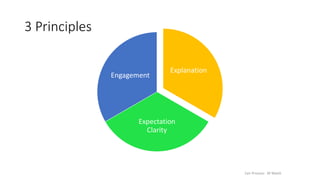
3 Principles
Explanation
Expectation
Clarity
Engagement
Fair Process: M Walsh
What it is NOT?
Fair Process: M Walsh
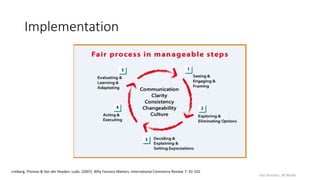
Implementation
Fair Process: M Walsh
Limberg, Thomas & Van der Heyden, Ludo. (2007). Why Fairness Matters. International Commerce Review. 7. 92-102.
Change vs.
Transition
Change vs.
Transition
Change vs.
Transition
Activity—30 minutes
• Break into groups of 3
• Each of you should have a unique role: Program Director, Resident, or
Faculty member
• Take time to read your aspect of the case, please do not share
specifics of your role to the others in the group
• Once ready—the Program director should begin a discussion with the
group about their proposal—what the plan is, why they are doing it,
and a few logistics.
• The other 2 should ask questions, etc from their assigned role
Fair Process: M Walsh
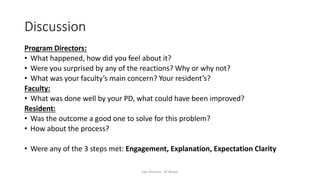
Discussion
Program Directors:
• What happened, how did you feel about it?
• Were you surprised by any of the reactions? Why or why not?
• What was your faculty’s main concern? Your resident’s?
Faculty:
• What was done well by your PD, what could have been improved?
Resident:
• Was the outcome a good one to solve for this problem?
• How about the process?
• Were any of the 3 steps met: Engagement, Explanation, Expectation Clarity
Fair Process: M Walsh
Change vs. Transition
People care about the
decisions you make, but
they care even more
about the process you
used along the way.
Fair Process: M Walsh
Plutchick’s
Wheel of
Emotion
Fair Process: M Walsh

Fair process in #meded

  • 1.
    Fair Process Meghan WalshMD MPH @chitipamzungu Felix Ankel MD @felixankel Ezgi Tiryaki MD @Neuro_Edu_ET
  • 2.
    Fair Process Objectives 1.) Describethe 3 key principles of fair process 2.) Analyze one implementation plan for fair process principles 3.) Examine everyday experiences for fair process successes and opportunities Fair Process: M Walsh
  • 3.
    People care aboutthe decisions you make, but they care even more about the process you used along the way. Fair Process: M Walsh
  • 4.
  • 5.
    What it isNOT? Fair Process: M Walsh
  • 6.
    Implementation Fair Process: MWalsh Limberg, Thomas & Van der Heyden, Ludo. (2007). Why Fairness Matters. International Commerce Review. 7. 92-102.
  • 7.
  • 8.
  • 9.
  • 10.
    Activity—30 minutes • Breakinto groups of 3 • Each of you should have a unique role: Program Director, Resident, or Faculty member • Take time to read your aspect of the case, please do not share specifics of your role to the others in the group • Once ready—the Program director should begin a discussion with the group about their proposal—what the plan is, why they are doing it, and a few logistics. • The other 2 should ask questions, etc from their assigned role Fair Process: M Walsh
  • 11.
    Discussion Program Directors: • Whathappened, how did you feel about it? • Were you surprised by any of the reactions? Why or why not? • What was your faculty’s main concern? Your resident’s? Faculty: • What was done well by your PD, what could have been improved? Resident: • Was the outcome a good one to solve for this problem? • How about the process? • Were any of the 3 steps met: Engagement, Explanation, Expectation Clarity Fair Process: M Walsh
  • 12.
    Change vs. Transition Peoplecare about the decisions you make, but they care even more about the process you used along the way.
  • 13.
    Fair Process: MWalsh Plutchick’s Wheel of Emotion
  • 14.

Editor's Notes

  • #5 Engagement: involving individuals in the decisions that affect them by asking for their input and allowing them to refute the merits of one another’s ideas or assumptions; collective wisdom—results in better decisions and greater commitment from the group for execution of the idea. We all want to be valued Explanation: everyone involved and affected should understand why final decision are made as they are. This allows employees to trust a manager’s intentions even if their own ideas have been rejected. Expectation clarity: once a new decision has been made, managers clearly state rules of the game. Although the expectations may be demanding, employees should now up front by what standards they will be judged and the penalties for failure. What are the new targets? Who is responsible for what?
  • #6 Decision by consensus It is not about achieving harmony or winning people’s support through compromise that accommodate every individual’s opinions, needs, or interests. The merit of the idea, NOT CONSENSUS OPINION, is what drives the decision-making. When fair process is violated? People demand retributive justice—fair process to be restored, also to see punishment and vengeance upon those who violated it
  • #8 SLIDE 6 | ANKEL AGENTS2 Who has seen the movie. If it were up to me, I would have every clinician see this film. I have learned more about emotions and microexpressions from this movie that in 20 years read. What are the six core emotions ? Joy/sadness fear/anger disgust/surprise Truly if we are we are agents of health and well being, we need to get in touch with our inner motor neuron and we need to be trained as such, it is something that will separate us from robots….maybe ######################################### What is happening these days, people are looking more at emotions and more at microexpressions Concept: How humans interact and work together leading to Eusociality They want to share, privacy paradigms Humans want Eusociality, Humans want feeling of belonging, worry about connection. Robots (and hospitals) want performance, worry about value: https://en.wikipedia.org/wiki/Eusociality https://opinionator.blogs.nytimes.com/2013/02/24/the-riddle-of-the-human-species/?_php=true&_type=blogs&_r=2 Human brain/mind and therefore behavior is based on mirror cells https://www.edge.org/conversation/mirror-neurons-and-imitation-learning-as-the-driving-force-behind-the-great-leap-forward-in-human-evolution Ability to keep attention despite the abundant noise in the system AI: machine learning…#meded http://www.royalcollege.ca/rcsite/events/icre/icre-pre-con-learning-analytics-summit-e Community above personal Harari and human enhancement: 1. Tinkering with organic body, 2. combining organic and inorganic, 3. Complete inorganic with AI. AI making healthcare more accessible and cheaper (imagine a AI ran NHS) Not what they can do better, but what they can do we can’t Example: Crowsourced Medicine https://www.crowdmed.com/ Definition of agent Eusocial Mirror cells Reflective practice Competence based on mood emotions Tribalism