Fair Data Economy Score
Towards the implementation: Maturity model for sustainable
and fair use of data for businesses
4 February 2021
Katri Korhonen, Specialist, Sitra
#CSR #data
Recap: But how do we get there?
Evolving
the
business
Designing innovative services &
building innovative business
models
Ethical principles, codes of conduct,
tools and practices
Regulation, standards, technology
§ § §
Involving
the people
Fair Data
Economy
Score
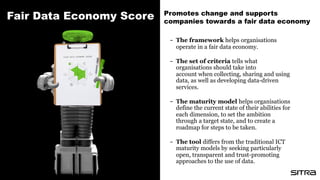
- The framework helps organisations
operate in a fair data economy.
- The set of criteria tells what
organisations should take into
account when collecting, sharing and using
data, as well as developing data-driven
services.
- The maturity model helps organisations
define the current state of their abilities for
each dimension, to set the ambition
through a target state, and to create a
roadmap for steps to be taken.
- The tool differs from the traditional ICT
maturity models by seeking particularly
open, transparent and trust-promoting
approaches to the use of data.
Promotes change and supports
companies towards a fair data economy
• Fair Data Economy Score provides
a framework and a maturity model,
according to which organizations
should operate in the fair data
economy
• Fair Data Economy Score tells
what organizations should take
into account when collecting,
sharing and using data, as well as
developing data-driven services.
• With the help of the
Fair Data Economy Score, an
organization is able to define the
current state of its
Fair Data Economy Score
The process
2020-2021
This is how it’s done.
A recap on our thought process:
The Fair Data Economy Score is based on the European-level
data economy principles
- Sitra has developed principles for the fair data economy
based on the European Union level data economy principles
- Together with the research and analytics house Gartner,
Sitra has also developed a comprehensive set of criteria
which covers each principle
- The criteria have evolved into a maturity model, which
includes dimensions most relevant from the fair data
economy perspective and defines maturity levels within
each of these dimensions
- The maturity model, called Fair Data Economy Score,
allows companies to assess their performance across
multiple areas of operations.
Fair data maturity model project
EU data economy principles
Sitra’s fair data economy principles
Why? What? How to reach this? What are
different actors doing?
Criteria based on each
fair data economy principle
Maturity model aka Fair Data Economy Score
The purpose is to engage organizations and provide
recommendations based on the gap between as-is and
target state to initiate action
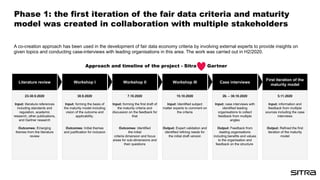
Phase 1: the first iteration of the fair data criteria and maturity
model was created in collaboration with multiple stakeholders
23-30.9.2020
Input: literature references
including standards and
regulation, academic
research, other publications,
and Gartner research
Outcomes: Emerging
themes from the literature
review
7.10.2020
Input: forming the first draft of
the maturity criteria and
discussion on the feedback for
that
Outcomes: Identified
the initial
criteria dimension and focus
areas for sub-dimensions and
their questions
30.9.2020
Input: forming the basis of
the maturity model including
vision of the outcome and
applicability.
Outcomes: Initial themes
and justification for inclusion
15.10.2020
Input: Identified subject
matter experts to comment on
the criteria
Output: Expert validation and
identified refining needs for
the initial draft version
26. – 30.10.2020
Input: case interviews with
identified leading
organisations to collect
feedback from multiple
angles
Output: Feedback from
leading organisations
including benefits and values
to the organisation and
feedback on the structure
5.11.2020
Input: information and
feedback from multiple
sources including the case
interviews
Output: Refined the first
iteration of the maturity
model
A co-creation approach has been used in the development of fair data economy criteria by involving external experts to provide insights on
given topics and conducting case-interviews with leading organisations in this area. The work was carried out in H2/2020.
Literature review Workshop II
Workshop I Workshop III Case interviews
First iteration of the
maturity model
Approach and timeline of the project - Sitra Gartner
Phase 2: the second iteration of the Fair Data Economy Score
includes workshops with stakeholders and piloting with
companies
January - February
Input: First version of the
tool as well as instructions.
Pilot companies testing the
tool together with Sitra’s
IHAN team members.
Outcomes: Direct feedback
from the companies of the
evaluated themes, sub-
themes, questions and the
levels as well as usability of
the tool.
February - March
Input: Comments by
recognized subject matter
experts in private sector
Outcomes: Expert validation
and identified refining needs
for the developing version.
February - March
Input: Facilitated
discussions and group work
Outcomes: Feedback from
leading organizations
including benefits and values
to the organization, and on the
structure of the tool.
May
Input: Information and
feedback from multiple
sources including the
workshops and pilots
Output: Refined second
iteration: requirements for
the Fair Data Economy
Score version 2.0.
A co-creation approach will again be used in the development of the framework into Fair Data Economy Score, by involving external experts to
provide insights on selected themes and having workshops with several stakeholder groups. The work will be carried out in H1/2021.
Piloting Subject matter experts
Workshops:
decision makers and
trade unions, NGOs
Second iteration of
the Fair Data
Economy Score
Approach and timeline of the project
The tool
This is how it works.
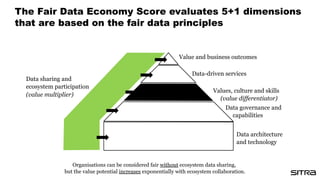
The Fair Data Economy Score evaluates 5+1 dimensions
that are based on the fair data principles
Value and business outcomes
Data-driven services
Data architecture
and technology
Data governance and
capabilities
Values, culture and skills
(value differentiator)
Data sharing and
ecosystem participation
(value multiplier)
Organisations can be considered fair without ecosystem data sharing,
but the value potential increases exponentially with ecosystem collaboration.
Each dimension is assessed independently, and recommendations are
created based on current maturity, indicated target level and the
importance of the topic
Target level Recommendation
L1 -> L2 Build internal awareness of ecosystem fueled business models, data economy and the potential and challenges
L2 -> L3 Establish guidelines and principles that enable data ecosystem engagement while managing data related risks
L3 -> L4 Continue to develop distributed data management capabilities and enforce data governance guidelines especially in your external
data flows.
L4 -> L5 Test and iterate the way you act in data ecosystems and look for opportunities to take a leading role in developing balanced and fair
ecosystem governance, rules and practices.
Actional analysis helps organisations outline
their Fair Data Economy development roadmap
11
This is really good stuff.
Now it’s your turn!
We believe the Fair Data
Economy Score is just
amazing! Do you?
Let’s hear your thoughts via
Mentimeter
Find instructions in the chat. Voting ahead!
The Mentimeter is that way!

Fair data economy score intro

  • 1.
    Fair Data EconomyScore Towards the implementation: Maturity model for sustainable and fair use of data for businesses 4 February 2021 Katri Korhonen, Specialist, Sitra #CSR #data
  • 2.
    Recap: But howdo we get there? Evolving the business Designing innovative services & building innovative business models Ethical principles, codes of conduct, tools and practices Regulation, standards, technology § § § Involving the people Fair Data Economy Score
  • 3.
    - The frameworkhelps organisations operate in a fair data economy. - The set of criteria tells what organisations should take into account when collecting, sharing and using data, as well as developing data-driven services. - The maturity model helps organisations define the current state of their abilities for each dimension, to set the ambition through a target state, and to create a roadmap for steps to be taken. - The tool differs from the traditional ICT maturity models by seeking particularly open, transparent and trust-promoting approaches to the use of data. Promotes change and supports companies towards a fair data economy • Fair Data Economy Score provides a framework and a maturity model, according to which organizations should operate in the fair data economy • Fair Data Economy Score tells what organizations should take into account when collecting, sharing and using data, as well as developing data-driven services. • With the help of the Fair Data Economy Score, an organization is able to define the current state of its Fair Data Economy Score
  • 4.
  • 5.
    A recap onour thought process: The Fair Data Economy Score is based on the European-level data economy principles - Sitra has developed principles for the fair data economy based on the European Union level data economy principles - Together with the research and analytics house Gartner, Sitra has also developed a comprehensive set of criteria which covers each principle - The criteria have evolved into a maturity model, which includes dimensions most relevant from the fair data economy perspective and defines maturity levels within each of these dimensions - The maturity model, called Fair Data Economy Score, allows companies to assess their performance across multiple areas of operations. Fair data maturity model project EU data economy principles Sitra’s fair data economy principles Why? What? How to reach this? What are different actors doing? Criteria based on each fair data economy principle Maturity model aka Fair Data Economy Score The purpose is to engage organizations and provide recommendations based on the gap between as-is and target state to initiate action
  • 6.
    Phase 1: thefirst iteration of the fair data criteria and maturity model was created in collaboration with multiple stakeholders 23-30.9.2020 Input: literature references including standards and regulation, academic research, other publications, and Gartner research Outcomes: Emerging themes from the literature review 7.10.2020 Input: forming the first draft of the maturity criteria and discussion on the feedback for that Outcomes: Identified the initial criteria dimension and focus areas for sub-dimensions and their questions 30.9.2020 Input: forming the basis of the maturity model including vision of the outcome and applicability. Outcomes: Initial themes and justification for inclusion 15.10.2020 Input: Identified subject matter experts to comment on the criteria Output: Expert validation and identified refining needs for the initial draft version 26. – 30.10.2020 Input: case interviews with identified leading organisations to collect feedback from multiple angles Output: Feedback from leading organisations including benefits and values to the organisation and feedback on the structure 5.11.2020 Input: information and feedback from multiple sources including the case interviews Output: Refined the first iteration of the maturity model A co-creation approach has been used in the development of fair data economy criteria by involving external experts to provide insights on given topics and conducting case-interviews with leading organisations in this area. The work was carried out in H2/2020. Literature review Workshop II Workshop I Workshop III Case interviews First iteration of the maturity model Approach and timeline of the project - Sitra Gartner
  • 7.
    Phase 2: thesecond iteration of the Fair Data Economy Score includes workshops with stakeholders and piloting with companies January - February Input: First version of the tool as well as instructions. Pilot companies testing the tool together with Sitra’s IHAN team members. Outcomes: Direct feedback from the companies of the evaluated themes, sub- themes, questions and the levels as well as usability of the tool. February - March Input: Comments by recognized subject matter experts in private sector Outcomes: Expert validation and identified refining needs for the developing version. February - March Input: Facilitated discussions and group work Outcomes: Feedback from leading organizations including benefits and values to the organization, and on the structure of the tool. May Input: Information and feedback from multiple sources including the workshops and pilots Output: Refined second iteration: requirements for the Fair Data Economy Score version 2.0. A co-creation approach will again be used in the development of the framework into Fair Data Economy Score, by involving external experts to provide insights on selected themes and having workshops with several stakeholder groups. The work will be carried out in H1/2021. Piloting Subject matter experts Workshops: decision makers and trade unions, NGOs Second iteration of the Fair Data Economy Score Approach and timeline of the project
  • 8.
    The tool This ishow it works.
  • 9.
    The Fair DataEconomy Score evaluates 5+1 dimensions that are based on the fair data principles Value and business outcomes Data-driven services Data architecture and technology Data governance and capabilities Values, culture and skills (value differentiator) Data sharing and ecosystem participation (value multiplier) Organisations can be considered fair without ecosystem data sharing, but the value potential increases exponentially with ecosystem collaboration.
  • 10.
    Each dimension isassessed independently, and recommendations are created based on current maturity, indicated target level and the importance of the topic Target level Recommendation L1 -> L2 Build internal awareness of ecosystem fueled business models, data economy and the potential and challenges L2 -> L3 Establish guidelines and principles that enable data ecosystem engagement while managing data related risks L3 -> L4 Continue to develop distributed data management capabilities and enforce data governance guidelines especially in your external data flows. L4 -> L5 Test and iterate the way you act in data ecosystems and look for opportunities to take a leading role in developing balanced and fair ecosystem governance, rules and practices.
  • 11.
    Actional analysis helpsorganisations outline their Fair Data Economy development roadmap 11
  • 12.
    This is reallygood stuff.
  • 13.
    Now it’s yourturn! We believe the Fair Data Economy Score is just amazing! Do you? Let’s hear your thoughts via Mentimeter Find instructions in the chat. Voting ahead! The Mentimeter is that way!