
*
    “Running an Agile Fortune 500 Company”
    Aditya Yadav, aditya.yadav@gmail.com
    in.linkedin.com/in/adityayadav76
* A Typical Global Company
  * Fortune 500/1000
  * 200 Divisions
  * 40 Countries
  * 25000 Employees


                             *
*
    @ Acme Inc.
* Original Question “How do we go about
 executing so that we avoid absolutely any
 Failures?”
* The Correct Question - “Maybe we should
 rethink the entire concept of Failure and
 Strategy. And figure out How do we create a
 Successful Organization?”


           *
*
    And The Philosophy Behind The Answer
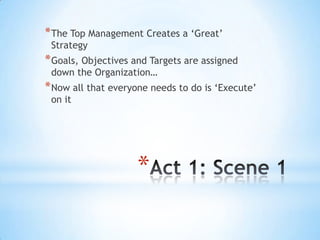
* The Top Management Creates a „Great‟
 Strategy
* Goals, Objectives and Targets are assigned
 down the Organization…
* Now all that everyone needs to do is „Execute‟
 on it


                     *
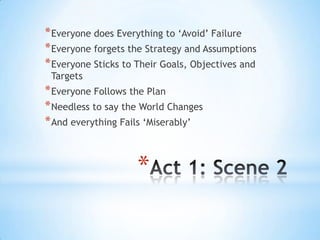
* Everyone does Everything to „Avoid‟ Failure
* Everyone forgets the Strategy and Assumptions
* Everyone Sticks to Their Goals, Objectives and
 Targets
* Everyone Follows the Plan
* Needless to say the World Changes
* And everything Fails „Miserably‟


                     *
*
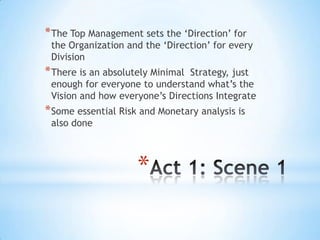
* The Top Management sets the „Direction‟ for
 the Organization and the „Direction‟ for every
 Division
* There is an absolutely MinimalStrategy, just
 enough for everyone to understand what‟s the
 Vision and how everyone‟s Directions Integrate
* Some essential Risk and Monetary analysis is
 also done


                     *
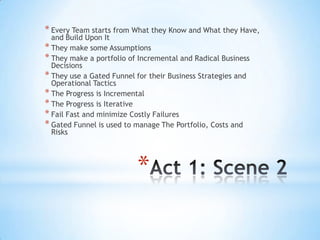
* Every Team starts from What they Know and What they Have,
  and Build Upon It
* They make some Assumptions
* They make a portfolio of Incremental and Radical Business
  Decisions
* They use a Gated Funnel for their Business Strategies and
  Operational Tactics
* The Progress is Incremental
* The Progress is Iterative
* Fail Fast and minimize Costly Failures
* Gated Funnel is used to manage The Portfolio, Costs and
  Risks


                          *
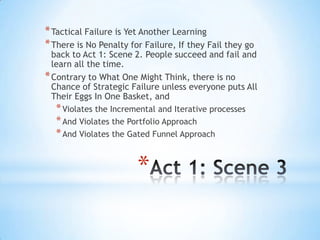
* Tactical Failure is Yet Another Learning
* There is No Penalty for Failure, If they Fail they go
  back to Act 1: Scene 2. People succeed and fail and
  learn all the time.
* Contrary to What One Might Think, there is no
  Chance of Strategic Failure unless everyone puts All
  Their Eggs In One Basket, and
  * Violates the Incremental and Iterative processes
  * And Violates the Portfolio Approach
  * And Violates the Gated Funnel Approach


                        *
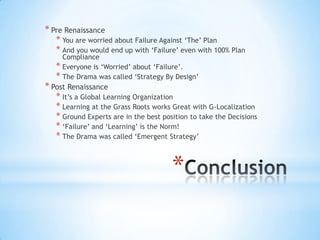
* Pre Renaissance
   * You are worried about Failure Against „The‟ Plan
   * And you would end up with „Failure‟ even with 100% Plan
     Compliance
   * Everyone is „Worried‟ about „Failure‟.
   * The Drama was called „Strategy By Design‟
* Post Renaissance
   * It‟s a Global Learning Organization
   * Learning at the Grass Roots works Great with G-Localization
   * Ground Experts are in the best position to take the Decisions
   * „Failure‟ and „Learning‟ is the Norm!
   * The Drama was called „Emergent Strategy‟


                                       *
Aditya!!!


     *

Failure As A Strategy - Aditya Yadav

  • 1.
    * “Running an Agile Fortune 500 Company” Aditya Yadav, aditya.yadav@gmail.com in.linkedin.com/in/adityayadav76
  • 2.
    * A TypicalGlobal Company * Fortune 500/1000 * 200 Divisions * 40 Countries * 25000 Employees *
  • 3.
    * @ Acme Inc.
  • 4.
    * Original Question“How do we go about executing so that we avoid absolutely any Failures?” * The Correct Question - “Maybe we should rethink the entire concept of Failure and Strategy. And figure out How do we create a Successful Organization?” *
  • 5.
    * And The Philosophy Behind The Answer
  • 6.
    * The TopManagement Creates a „Great‟ Strategy * Goals, Objectives and Targets are assigned down the Organization… * Now all that everyone needs to do is „Execute‟ on it *
  • 7.
    * Everyone doesEverything to „Avoid‟ Failure * Everyone forgets the Strategy and Assumptions * Everyone Sticks to Their Goals, Objectives and Targets * Everyone Follows the Plan * Needless to say the World Changes * And everything Fails „Miserably‟ *
  • 8.
  • 9.
    * The TopManagement sets the „Direction‟ for the Organization and the „Direction‟ for every Division * There is an absolutely MinimalStrategy, just enough for everyone to understand what‟s the Vision and how everyone‟s Directions Integrate * Some essential Risk and Monetary analysis is also done *
  • 10.
    * Every Teamstarts from What they Know and What they Have, and Build Upon It * They make some Assumptions * They make a portfolio of Incremental and Radical Business Decisions * They use a Gated Funnel for their Business Strategies and Operational Tactics * The Progress is Incremental * The Progress is Iterative * Fail Fast and minimize Costly Failures * Gated Funnel is used to manage The Portfolio, Costs and Risks *
  • 11.
    * Tactical Failureis Yet Another Learning * There is No Penalty for Failure, If they Fail they go back to Act 1: Scene 2. People succeed and fail and learn all the time. * Contrary to What One Might Think, there is no Chance of Strategic Failure unless everyone puts All Their Eggs In One Basket, and * Violates the Incremental and Iterative processes * And Violates the Portfolio Approach * And Violates the Gated Funnel Approach *
  • 12.
    * Pre Renaissance * You are worried about Failure Against „The‟ Plan * And you would end up with „Failure‟ even with 100% Plan Compliance * Everyone is „Worried‟ about „Failure‟. * The Drama was called „Strategy By Design‟ * Post Renaissance * It‟s a Global Learning Organization * Learning at the Grass Roots works Great with G-Localization * Ground Experts are in the best position to take the Decisions * „Failure‟ and „Learning‟ is the Norm! * The Drama was called „Emergent Strategy‟ *
  • 13.