Fail Better
helping students fail to succeed
Sarah Bowers and Julia Denholm
The Impact of Cognitive Science on
Post-secondary Teaching
“It is sadly true that most of the way we teach and
learn is uninformed by laboratory findings in
human cognition.” (Halpern & Hakel, 2002, p. 1)
Tradition: one
Brain research: nil
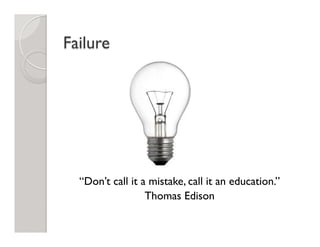
Failure
“Don’t call it a mistake, call it an education.”
Thomas Edison
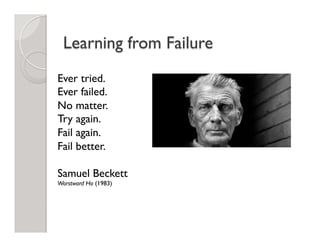
Learning from Failure
Ever tried.
Ever failed.
No matter.
Try again.
Fail again.
Fail better.
Samuel Beckett
Worstward Ho (1983)
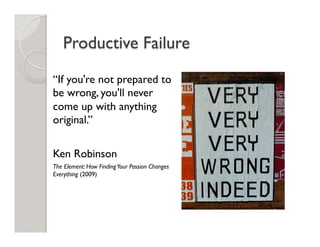
Productive Failure
“If you're not prepared to
be wrong, you'll never
come up with anything
original.”
Ken Robinson
The Element: How FindingYour Passion Changes
Everything (2009)
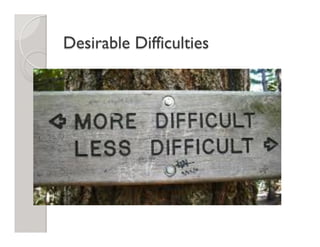
Desirable Difficulties
Spacing
—  Massed Practice
—  Spaced Practice
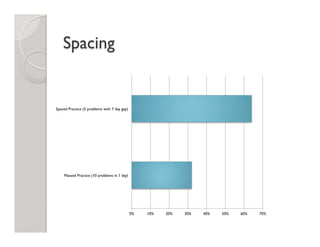
Spacing
0% 10% 20% 30% 40% 50% 60% 70%
Massed Practice (10 problems in 1 day)
Spaced Practice (5 problems with 7 day gap)
Interleaving
RIA Novosti archive, image #399644 /Vitaliy Karpov / CC-BY-SA 3.0 [CC BY-SA 3.0 (http://creativecommons.org/licenses/by-
sa/3.0)], via Wikimedia Commons
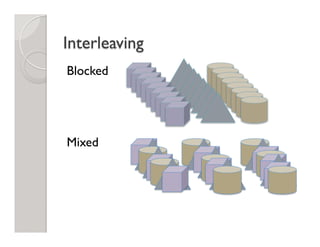
Interleaving
Blocked
Mixed
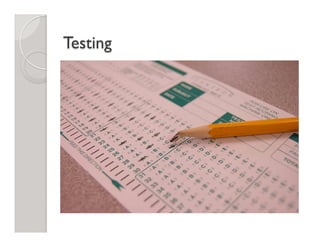
Testing
Testing
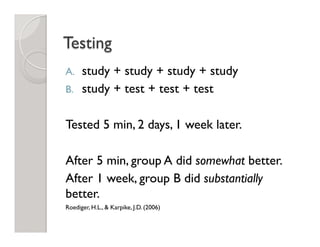
A.  study + study + study + study
B.  study + test + test + test
Tested 5 min, 2 days, 1 week later.
After 5 min, group A did somewhat better.
After 1 week, group B did substantially
better.
Roediger, H.L., & Karpike, J.D. (2006)
Caveats
So What?
Sources
Ansari, D., & Coch, D. (2006). Bridges over troubled waters: education and cognitive neuroscience. Trends in Cognitive
Sciences, 10(4), 146–151. http://doi.org/10.1016/j.tics.2006.02.007
Benassi,V.A., Overson, C. E., & Hakala, C. M. (2014).Applying Science of Learning in Education: Infusing Psychological
Science into the Curriculum (Vol. 37). Retrieved from http://teachpsych.org/ebooks/asle2014/index.php
Birnbaum, M. S., Kornell, N., Bjork, E. L., & Bjork, R.A. (2013).Why interleaving enhances inductive learning:The roles of
discrimination and retrieval. Memory & Cognition, 41(3), 392–402. http://doi.org/10.3758/s13421-012-0272-7
Bjork, E. L., & Bjork, R.A. (2009). Making Things Hard onYourself, But in a Good Way: Creating Desirable Difficulties to
Enhance Learning. Psychology and the Real World: Essays Illustrating Fundamental Contributions to Society, 55–64.
Clarke, C. M., & Bjork, R.A. (2014).When and Why Introducing Difficulties and Errors Can Enhance Instruction. In C.
M. Benassi,V.A., Overson, C. E., & Hakala (Ed.),Applying Science of Learning in Education.
Desirable Difficulties in the Classroom | Psychology Today. (n.d.). Retrieved from
https://www.psychologytoday.com/blog/all-about-addiction/201105/desirable-difficulties-in-the-classroom
Desirable Difficulties Perspective on Learning. (n.d.). Retrieved from
http://bjorklab.psych.ucla.edu/pubs/RBjork_inpress.pdf
Kapur, M. (2008). Productive failure. Cognition and Instruction, 26(3), 379–424.
http://doi.org/10.1080/07370000802212669
Roediger, H.L., & Karpike, J.D. (2006).Test-enhanced learning:Taking memory tests improves long-term retention.
Psychological Science, 17(3), 249-255. doi: 10.1111/j.1467-9280.2006.01693.x
Römer, C. (1993).The role of deliberate practice in the acquisition of expert performance. Psychological Review,
100(3), 363–406. http://doi.org/10.1037/0033-295X.100.3.363
Pyc, M.A., & Rawson, K.A. (2010).Why Testing Improves Memory: Mediator Effectiveness Hypothesis. Science,
330(6002), 335–335. http://doi.org/10.1126/science.1191465
Thank you!
Please contact either or both of us for
more discussion or additional references.
sbowers@langara.ca
juliadenholm@capilanou.ca

Fail Better: Teaching Students How to Fail to Succeed

  • 1.
    Fail Better helping studentsfail to succeed Sarah Bowers and Julia Denholm
  • 2.
    The Impact ofCognitive Science on Post-secondary Teaching “It is sadly true that most of the way we teach and learn is uninformed by laboratory findings in human cognition.” (Halpern & Hakel, 2002, p. 1) Tradition: one Brain research: nil
  • 3.
    Failure “Don’t call ita mistake, call it an education.” Thomas Edison
  • 4.
    Learning from Failure Evertried. Ever failed. No matter. Try again. Fail again. Fail better. Samuel Beckett Worstward Ho (1983)
  • 5.
    Productive Failure “If you'renot prepared to be wrong, you'll never come up with anything original.” Ken Robinson The Element: How FindingYour Passion Changes Everything (2009)
  • 6.
  • 7.
  • 8.
    Spacing 0% 10% 20%30% 40% 50% 60% 70% Massed Practice (10 problems in 1 day) Spaced Practice (5 problems with 7 day gap)
  • 9.
    Interleaving RIA Novosti archive,image #399644 /Vitaliy Karpov / CC-BY-SA 3.0 [CC BY-SA 3.0 (http://creativecommons.org/licenses/by- sa/3.0)], via Wikimedia Commons
  • 10.
  • 11.
  • 12.
    Testing A.  study +study + study + study B.  study + test + test + test Tested 5 min, 2 days, 1 week later. After 5 min, group A did somewhat better. After 1 week, group B did substantially better. Roediger, H.L., & Karpike, J.D. (2006)
  • 13.
  • 14.
  • 15.
    Sources Ansari, D., &Coch, D. (2006). Bridges over troubled waters: education and cognitive neuroscience. Trends in Cognitive Sciences, 10(4), 146–151. http://doi.org/10.1016/j.tics.2006.02.007 Benassi,V.A., Overson, C. E., & Hakala, C. M. (2014).Applying Science of Learning in Education: Infusing Psychological Science into the Curriculum (Vol. 37). Retrieved from http://teachpsych.org/ebooks/asle2014/index.php Birnbaum, M. S., Kornell, N., Bjork, E. L., & Bjork, R.A. (2013).Why interleaving enhances inductive learning:The roles of discrimination and retrieval. Memory & Cognition, 41(3), 392–402. http://doi.org/10.3758/s13421-012-0272-7 Bjork, E. L., & Bjork, R.A. (2009). Making Things Hard onYourself, But in a Good Way: Creating Desirable Difficulties to Enhance Learning. Psychology and the Real World: Essays Illustrating Fundamental Contributions to Society, 55–64. Clarke, C. M., & Bjork, R.A. (2014).When and Why Introducing Difficulties and Errors Can Enhance Instruction. In C. M. Benassi,V.A., Overson, C. E., & Hakala (Ed.),Applying Science of Learning in Education. Desirable Difficulties in the Classroom | Psychology Today. (n.d.). Retrieved from https://www.psychologytoday.com/blog/all-about-addiction/201105/desirable-difficulties-in-the-classroom Desirable Difficulties Perspective on Learning. (n.d.). Retrieved from http://bjorklab.psych.ucla.edu/pubs/RBjork_inpress.pdf Kapur, M. (2008). Productive failure. Cognition and Instruction, 26(3), 379–424. http://doi.org/10.1080/07370000802212669 Roediger, H.L., & Karpike, J.D. (2006).Test-enhanced learning:Taking memory tests improves long-term retention. Psychological Science, 17(3), 249-255. doi: 10.1111/j.1467-9280.2006.01693.x Römer, C. (1993).The role of deliberate practice in the acquisition of expert performance. Psychological Review, 100(3), 363–406. http://doi.org/10.1037/0033-295X.100.3.363 Pyc, M.A., & Rawson, K.A. (2010).Why Testing Improves Memory: Mediator Effectiveness Hypothesis. Science, 330(6002), 335–335. http://doi.org/10.1126/science.1191465
  • 16.
    Thank you! Please contacteither or both of us for more discussion or additional references. sbowers@langara.ca juliadenholm@capilanou.ca