Factual Research.
DAVID LEE
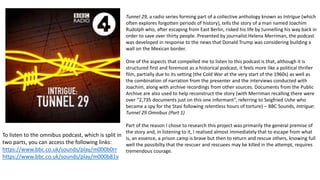
Tunnel 29, a radio series forming part of a collective anthology known as Intrigue (which
often explores forgotten periods of history), tells the story of a man named Joachim
Rudolph who, after escaping from East Berlin, risked his life by tunnelling his way back in
order to save over thirty people. Presented by journalist Helena Merriman, the podcast
was developed in response to the news that Donald Trump was considering building a
wall on the Mexican border.
One of the aspects that compelled me to listen to this podcast is that, although it is
structured first and foremost as a historical podcast, it feels more like a political thriller
film, partially due to its setting (the Cold War at the very start of the 1960s) as well as
the combination of narration from the presenter and the interviews conducted with
Joachim, along with archive recordings from other sources. Documents from the Public
Archive are also used to help reconstruct the story (with Merriman recalling there were
over “2,735 documents just on this one informant”, referring to Seigfried Ushe who
became a spy for the Stasi following relentless hours of torture) – BBC Sounds, Intrigue:
Tunnel 29 Omnibus (Part 1)
Part of the reason I chose to research this project was primarily the general premise of
the story and, in listening to it, I realised almost immediately that to escape from what
is, an essence, a prison camp is brave but then to return and rescue others, knowing full
well the possibilty that the rescuer and rescuees may be killed in the attempt, requires
tremendous courage.
To listen to the omnibus podcast, which is split in
two parts, you can access the following links:
https://www.bbc.co.uk/sounds/play/m000b0rr
https://www.bbc.co.uk/sounds/play/m000b81v
Context, style, techniques, content.
Link it back to your project. Why are you looking at this?
What are you learning from it? How will it affect your project?
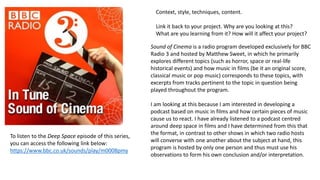
Sound of Cinema is a radio program developed exclusively for BBC
Radio 3 and hosted by Matthew Sweet, in which he primarily
explores different topics (such as horror, space or real-life
historical events) and how music in films (be it an original score,
classical music or pop music) corresponds to these topics, with
excerpts from tracks pertinent to the topic in question being
played throughout the program.
I am looking at this because I am interested in developing a
podcast based on music in films and how certain pieces of music
cause us to react. I have already listened to a podcast centred
around deep space in films and I have determined from this that
the format, in contrast to other shows in which two radio hosts
will converse with one another about the subject at hand, this
program is hosted by only one person and thus must use his
observations to form his own conclusion and/or interpretation.
To listen to the Deep Space episode of this series,
you can access the following link below:
https://www.bbc.co.uk/sounds/play/m0008pmy
Context, style, techniques, content.
Link it back to your project. Why are you looking at this?
What are you learning from it? How will it affect your
project?
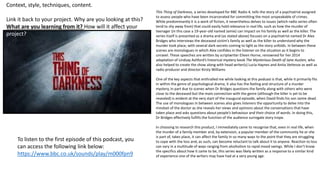
This Thing of Darkness, a series developed for BBC Radio 4, tells the story of a psychiatrist assigned
to assess people who have been incarcerated for committing the most unspeakable of crimes.
While predominantly it is a work of fiction, it nevertheless delves to issues (which radio series often
tend to shy away from) that could easily hold relevance in real life, such as how the murder of
teenager (in this case a 19-year-old named Jamie) can impact on his family as well as the killer. The
series itself is presented as a drama and (as stated above) focuses on a psychiatrist named Dr Alex
Bridges who interviews the deceased victim’s family as well as the killer to understand why the
murder took place, with several dark secrets coming to light as the story unfolds. In between these
scenes are monologues in which Alex confides in the listener on the situation as it begins to
unravel. These speeches are written by scriptwriter Eileen Horne, renowned for her 2014
adaptation of Lindsay Ashford’s historical mystery book The Mysterious Death of Jane Austen, who
also helped to create the show along with head writer(s) Lucia Haynes and Anita Vettesse as well as
radio producer and director Kirsty Williams
One of the key aspects that enthralled me while looking at this podcast is that, while it primarily fits
in within the genre of psychological drama, it also has the feeling and structure of a murder
mystery, in part due to scenes when Dr Bridges questions the family along with others who were
close to the deceased but the main connection with the genre (although the killer is yet to be
revealed) is evident at the very start of the inaugural episode, when David finds his son Jamie dead.
The use of monologues in between scenes also gives listeners the opportunity to delve into the
mindset of the doctor as she reveals her views and opinions about the conversations that have
taken place and asks questions about people’s behaviour and their choice of words. In doing this,
Dr Bridges effectively fulfills the function of the audience surrogate story trope.
In choosing to research this product, I immediately came to recognise that, even in real life, when
the murder of a family member and, by extension, a popular member of the community he or she
is part of, takes place, it can affect the family in so many ways to the point that they are struggling
to cope with the loss and, as such, can become reluctant to talk about it to anyone. Reaction to loss
can vary in a multitude of ways ranging from alcoholism to rapid mood swings. While I don’t know
the specifics about how it came to be, this series was likely written as a response to a similar kind
of experience one of the writers may have had at a very young age.
To listen to the first episode of this podcast, you
can access the following link below:
https://www.bbc.co.uk/sounds/play/m000fpn9
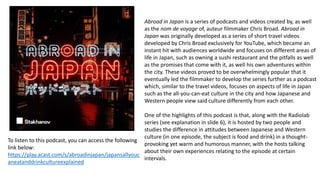
Abroad in Japan is a series of podcasts and videos created by, as well
as the nom de voyage of, auteur filmmaker Chris Broad. Abroad in
Japan was originally developed as a series of short travel videos
developed by Chris Broad exclusively for YouTube, which became an
instant hit with audiences worldwide and focuses on different areas of
life in Japan, such as owning a sushi restaurant and the pitfalls as well
as the promises that come with it, as well his own adventures within
the city. These videos proved to be overwhelmingly popular that it
eventually led the filmmaker to develop the series further as a podcast
which, similar to the travel videos, focuses on aspects of life in Japan
such as the all-you-can-eat culture in the city and how Japanese and
Western people view said culture differently from each other.
One of the highlights of this podcast is that, along with the Radiolab
series (see explanation in slide 6), it is hosted by two people and
studies the difference in attitudes between Japanese and Western
culture (in one episode, the subject is food and drink) in a thought-
provoking yet warm and humorous manner, with the hosts talking
about their own experiences relating to the episode at certain
intervals.
To listen to this podcast, you can access the following
link below:
https://play.acast.com/s/abroadinjapan/japansallyouc
aneatanddrinkcultureexplained
Context, style, techniques, content.
Link it back to your project. Why are you looking at this?
What are you learning from it? How will it affect your project?
Radiolab, originally developed by WYNC Radio, is a series of podcasts which
regularly explores topics of different natures. One of these explores the impact
Orson Welles’ controversial 1938 radio broadcast of War of the Worlds since its
first broadcast and how other countries used similar approaches years later to
elicit reactions from their audiences. To celebrate the radio show’s 80th
anniversary, the hosts of the show ultimately decided to create a retrospective
in which they study the show and why it caused such a stir at the time.
One of the aspects I am fond of with this particular podcast is that it is
deliberately structured as a light-hearted take (or satire, if you prefer) on the
broadcast which contrasts directly with how regular radio broadcasters (such as
those at the BBC or CBS Radio) would look at the subject. As the show is hosted
by two people, Jad Abumrad and Robert Krulwich, this gives the show more of a
collaborative and inclusive feel, allowing the two hosts to bounce off each other
as well as involve the audience (who the episode is primarily being recorded
for) in their discussion. Additionally, although you cannot see the building in
which they are recording the broadcast, they nonetheless manage to use the
surrounding environment to their creative advantage, as can be heard when
one of them uses a seat to represent the year War of the Worlds was broadcast,
thereby allowing the hosts to include the audience in an interactive experiment,
effectively creating the illusion of what can only be described as “time travel”.
To listen to the Radiolab: War of the Worlds
episode, don’t forget to access the following link
below:
https://www.wnycstudios.org/podcasts/radiolab
/articles/war-worlds
Research summary:
What are the key things I’ve learned from my research?
• When doing an audio retrospective and/or documentary about a certain subject, it is particularly important that you
are not just passionate but also have a significant amount of knowledge about the subject you are basing your
product on. This is particularly evident in the Radiolab episode focusing on the Orson Welles’ 1938 radio broadcast of
War of the Worlds, as broadcaster Jad Abumrad within several minutes of the opening of the episode reveals that he
came upon the broadcast in 2001 and how the story behind it fascinated him, eventually leading him to co-host a
retrospective 17 years later with Robert Krulwich at the Fitzgerald Theatre.
• Archive recordings as well as documents and interviews with the subject of the podcast’s story can also play an
important part in the development and creation of a podcast, particularly if it is based on an historical event, as
evidenced when listening to Intrigue: Tunnel 29.
• Music can also play an important part in a podcast's development, as it can be used to manipulate a person's feeling
or emotions depending on the subject matter of the product and atmosphere of the story. It can either create a sense
of otherworldliness, as is aptly demonstrated when the two Radiolab hosts set the scene for their retrospective on
Orson Welles' infamous sci-fi broadcast or paranoia and uncertainty, when Joachim and his crew start digging the
tunnel that will allow them to move underneath the Berlin Wall undetected in Intrigue: Tunnel 29.
Bibliography:
1. Merriman, Helena. (2019). Intrigue: Tunnel 29. Available: https://www.bbc.co.uk/sounds/play/m000b0rr. Last accessed
18th September 2020.
2. Sweet, Matthew. (2019). Sound of Cinema: Deep Space. Available: https://www.bbc.co.uk/sounds/play/m0008pmy. Last
accessed 18th September 2020.
3. Haynes, Lucia & Horne, Eileen. (2020). This Thing of Darkness. Available: https://www.bbc.co.uk/sounds/play/m000fpn9.
Last accessed 18th September 2020.
4. Broad, Chris. (2020). Abroad in Japan. Available:
https://play.acast.com/s/abroadinjapan/japansallyoucaneatanddrinkcultureexplained. Last accessed 17th September 2020.
5. Abumrad, Jad & Krulwich, Robert. (2018). War of the Worlds. Available:
https://www.wnycstudios.org/podcasts/radiolab/articles/war-worlds. Last accessed 17th September 2020.

Factual Research Pro-Forma

  • 1.
  • 2.
    Tunnel 29, aradio series forming part of a collective anthology known as Intrigue (which often explores forgotten periods of history), tells the story of a man named Joachim Rudolph who, after escaping from East Berlin, risked his life by tunnelling his way back in order to save over thirty people. Presented by journalist Helena Merriman, the podcast was developed in response to the news that Donald Trump was considering building a wall on the Mexican border. One of the aspects that compelled me to listen to this podcast is that, although it is structured first and foremost as a historical podcast, it feels more like a political thriller film, partially due to its setting (the Cold War at the very start of the 1960s) as well as the combination of narration from the presenter and the interviews conducted with Joachim, along with archive recordings from other sources. Documents from the Public Archive are also used to help reconstruct the story (with Merriman recalling there were over “2,735 documents just on this one informant”, referring to Seigfried Ushe who became a spy for the Stasi following relentless hours of torture) – BBC Sounds, Intrigue: Tunnel 29 Omnibus (Part 1) Part of the reason I chose to research this project was primarily the general premise of the story and, in listening to it, I realised almost immediately that to escape from what is, an essence, a prison camp is brave but then to return and rescue others, knowing full well the possibilty that the rescuer and rescuees may be killed in the attempt, requires tremendous courage. To listen to the omnibus podcast, which is split in two parts, you can access the following links: https://www.bbc.co.uk/sounds/play/m000b0rr https://www.bbc.co.uk/sounds/play/m000b81v
  • 3.
    Context, style, techniques,content. Link it back to your project. Why are you looking at this? What are you learning from it? How will it affect your project? Sound of Cinema is a radio program developed exclusively for BBC Radio 3 and hosted by Matthew Sweet, in which he primarily explores different topics (such as horror, space or real-life historical events) and how music in films (be it an original score, classical music or pop music) corresponds to these topics, with excerpts from tracks pertinent to the topic in question being played throughout the program. I am looking at this because I am interested in developing a podcast based on music in films and how certain pieces of music cause us to react. I have already listened to a podcast centred around deep space in films and I have determined from this that the format, in contrast to other shows in which two radio hosts will converse with one another about the subject at hand, this program is hosted by only one person and thus must use his observations to form his own conclusion and/or interpretation. To listen to the Deep Space episode of this series, you can access the following link below: https://www.bbc.co.uk/sounds/play/m0008pmy
  • 4.
    Context, style, techniques,content. Link it back to your project. Why are you looking at this? What are you learning from it? How will it affect your project? This Thing of Darkness, a series developed for BBC Radio 4, tells the story of a psychiatrist assigned to assess people who have been incarcerated for committing the most unspeakable of crimes. While predominantly it is a work of fiction, it nevertheless delves to issues (which radio series often tend to shy away from) that could easily hold relevance in real life, such as how the murder of teenager (in this case a 19-year-old named Jamie) can impact on his family as well as the killer. The series itself is presented as a drama and (as stated above) focuses on a psychiatrist named Dr Alex Bridges who interviews the deceased victim’s family as well as the killer to understand why the murder took place, with several dark secrets coming to light as the story unfolds. In between these scenes are monologues in which Alex confides in the listener on the situation as it begins to unravel. These speeches are written by scriptwriter Eileen Horne, renowned for her 2014 adaptation of Lindsay Ashford’s historical mystery book The Mysterious Death of Jane Austen, who also helped to create the show along with head writer(s) Lucia Haynes and Anita Vettesse as well as radio producer and director Kirsty Williams One of the key aspects that enthralled me while looking at this podcast is that, while it primarily fits in within the genre of psychological drama, it also has the feeling and structure of a murder mystery, in part due to scenes when Dr Bridges questions the family along with others who were close to the deceased but the main connection with the genre (although the killer is yet to be revealed) is evident at the very start of the inaugural episode, when David finds his son Jamie dead. The use of monologues in between scenes also gives listeners the opportunity to delve into the mindset of the doctor as she reveals her views and opinions about the conversations that have taken place and asks questions about people’s behaviour and their choice of words. In doing this, Dr Bridges effectively fulfills the function of the audience surrogate story trope. In choosing to research this product, I immediately came to recognise that, even in real life, when the murder of a family member and, by extension, a popular member of the community he or she is part of, takes place, it can affect the family in so many ways to the point that they are struggling to cope with the loss and, as such, can become reluctant to talk about it to anyone. Reaction to loss can vary in a multitude of ways ranging from alcoholism to rapid mood swings. While I don’t know the specifics about how it came to be, this series was likely written as a response to a similar kind of experience one of the writers may have had at a very young age. To listen to the first episode of this podcast, you can access the following link below: https://www.bbc.co.uk/sounds/play/m000fpn9
  • 5.
    Abroad in Japanis a series of podcasts and videos created by, as well as the nom de voyage of, auteur filmmaker Chris Broad. Abroad in Japan was originally developed as a series of short travel videos developed by Chris Broad exclusively for YouTube, which became an instant hit with audiences worldwide and focuses on different areas of life in Japan, such as owning a sushi restaurant and the pitfalls as well as the promises that come with it, as well his own adventures within the city. These videos proved to be overwhelmingly popular that it eventually led the filmmaker to develop the series further as a podcast which, similar to the travel videos, focuses on aspects of life in Japan such as the all-you-can-eat culture in the city and how Japanese and Western people view said culture differently from each other. One of the highlights of this podcast is that, along with the Radiolab series (see explanation in slide 6), it is hosted by two people and studies the difference in attitudes between Japanese and Western culture (in one episode, the subject is food and drink) in a thought- provoking yet warm and humorous manner, with the hosts talking about their own experiences relating to the episode at certain intervals. To listen to this podcast, you can access the following link below: https://play.acast.com/s/abroadinjapan/japansallyouc aneatanddrinkcultureexplained
  • 6.
    Context, style, techniques,content. Link it back to your project. Why are you looking at this? What are you learning from it? How will it affect your project? Radiolab, originally developed by WYNC Radio, is a series of podcasts which regularly explores topics of different natures. One of these explores the impact Orson Welles’ controversial 1938 radio broadcast of War of the Worlds since its first broadcast and how other countries used similar approaches years later to elicit reactions from their audiences. To celebrate the radio show’s 80th anniversary, the hosts of the show ultimately decided to create a retrospective in which they study the show and why it caused such a stir at the time. One of the aspects I am fond of with this particular podcast is that it is deliberately structured as a light-hearted take (or satire, if you prefer) on the broadcast which contrasts directly with how regular radio broadcasters (such as those at the BBC or CBS Radio) would look at the subject. As the show is hosted by two people, Jad Abumrad and Robert Krulwich, this gives the show more of a collaborative and inclusive feel, allowing the two hosts to bounce off each other as well as involve the audience (who the episode is primarily being recorded for) in their discussion. Additionally, although you cannot see the building in which they are recording the broadcast, they nonetheless manage to use the surrounding environment to their creative advantage, as can be heard when one of them uses a seat to represent the year War of the Worlds was broadcast, thereby allowing the hosts to include the audience in an interactive experiment, effectively creating the illusion of what can only be described as “time travel”. To listen to the Radiolab: War of the Worlds episode, don’t forget to access the following link below: https://www.wnycstudios.org/podcasts/radiolab /articles/war-worlds
  • 7.
    Research summary: What arethe key things I’ve learned from my research? • When doing an audio retrospective and/or documentary about a certain subject, it is particularly important that you are not just passionate but also have a significant amount of knowledge about the subject you are basing your product on. This is particularly evident in the Radiolab episode focusing on the Orson Welles’ 1938 radio broadcast of War of the Worlds, as broadcaster Jad Abumrad within several minutes of the opening of the episode reveals that he came upon the broadcast in 2001 and how the story behind it fascinated him, eventually leading him to co-host a retrospective 17 years later with Robert Krulwich at the Fitzgerald Theatre. • Archive recordings as well as documents and interviews with the subject of the podcast’s story can also play an important part in the development and creation of a podcast, particularly if it is based on an historical event, as evidenced when listening to Intrigue: Tunnel 29. • Music can also play an important part in a podcast's development, as it can be used to manipulate a person's feeling or emotions depending on the subject matter of the product and atmosphere of the story. It can either create a sense of otherworldliness, as is aptly demonstrated when the two Radiolab hosts set the scene for their retrospective on Orson Welles' infamous sci-fi broadcast or paranoia and uncertainty, when Joachim and his crew start digging the tunnel that will allow them to move underneath the Berlin Wall undetected in Intrigue: Tunnel 29.
  • 8.
    Bibliography: 1. Merriman, Helena.(2019). Intrigue: Tunnel 29. Available: https://www.bbc.co.uk/sounds/play/m000b0rr. Last accessed 18th September 2020. 2. Sweet, Matthew. (2019). Sound of Cinema: Deep Space. Available: https://www.bbc.co.uk/sounds/play/m0008pmy. Last accessed 18th September 2020. 3. Haynes, Lucia & Horne, Eileen. (2020). This Thing of Darkness. Available: https://www.bbc.co.uk/sounds/play/m000fpn9. Last accessed 18th September 2020. 4. Broad, Chris. (2020). Abroad in Japan. Available: https://play.acast.com/s/abroadinjapan/japansallyoucaneatanddrinkcultureexplained. Last accessed 17th September 2020. 5. Abumrad, Jad & Krulwich, Robert. (2018). War of the Worlds. Available: https://www.wnycstudios.org/podcasts/radiolab/articles/war-worlds. Last accessed 17th September 2020.

Editor's Notes

  • #3 Context affects what is produced, how it is produced and who can produce it. Technology is part of the context. Early fanzines were hand made because there was no InDesign or Photoshop. Web-series simply didn’t existing because the web didn’t exist. People who don’t have access to jobs in mainstream media, to become journalists or editors, might produce work independently of that system. People who don’t see themselves or their interests being represented in main stream media, might produce something that represents them or their social group. The political situation will influence what someone decides to make. The cultural situation will influence what people make. Every media text is a product of its environment, just like people. Style: The way in which something is said, done, expressed, or performed. The combination of distinctive features of literary or artistic expression, execution, or performance  characterizing a particular person, group, school, or era. For example, a podcast could be two people talking, it could be interviews and a voice over, it could just be a recording of a teaching session… how it is done, is the style. Techniques: How are these things being made? What methods are being used? Find out and also use your own experience. For example, is a fanzine being hand written or word processed? How do people making a web series set up their shooting spaces? The more you can find out about technique, the more you can get ideas for your own work. Content: The material, including text and images, that constitutes a publication or document. What is actually in this product? Break it down. Is it interviews, monologues, reviews, instructions… Identify the different types of content in the items you research, to help your own ideas.
  • #4 Context affects what is produced, how it is produced and who can produce it. Technology is part of the context. Early fanzines were hand made because there was no InDesign or Photoshop. Web-series simply didn’t existing because the web didn’t exist. People who don’t have access to jobs in mainstream media, to become journalists or editors, might produce work independently of that system. People who don’t see themselves or their interests being represented in main stream media, might produce something that represents them or their social group. The political situation will influence what someone decides to make. The cultural situation will influence what people make. Every media text is a product of its environment, just like people. Style: The way in which something is said, done, expressed, or performed. The combination of distinctive features of literary or artistic expression, execution, or performance  characterizing a particular person, group, school, or era. For example, a podcast could be two people talking, it could be interviews and a voice over, it could just be a recording of a teaching session… how it is done, is the style. Techniques: How are these things being made? What methods are being used? Find out and also use your own experience. For example, is a fanzine being hand written or word processed? How do people making a web series set up their shooting spaces? The more you can find out about technique, the more you can get ideas for your own work. Content: The material, including text and images, that constitutes a publication or document. What is actually in this product? Break it down. Is it interviews, monologues, reviews, instructions… Identify the different types of content in the items you research, to help your own ideas.
  • #5 Context affects what is produced, how it is produced and who can produce it. Technology is part of the context. Early fanzines were hand made because there was no InDesign or Photoshop. Web-series simply didn’t existing because the web didn’t exist. People who don’t have access to jobs in mainstream media, to become journalists or editors, might produce work independently of that system. People who don’t see themselves or their interests being represented in main stream media, might produce something that represents them or their social group. The political situation will influence what someone decides to make. The cultural situation will influence what people make. Every media text is a product of its environment, just like people. Style: The way in which something is said, done, expressed, or performed. The combination of distinctive features of literary or artistic expression, execution, or performance  characterizing a particular person, group, school, or era. For example, a podcast could be two people talking, it could be interviews and a voice over, it could just be a recording of a teaching session… how it is done, is the style. Techniques: How are these things being made? What methods are being used? Find out and also use your own experience. For example, is a fanzine being hand written or word processed? How do people making a web series set up their shooting spaces? The more you can find out about technique, the more you can get ideas for your own work. Content: The material, including text and images, that constitutes a publication or document. What is actually in this product? Break it down. Is it interviews, monologues, reviews, instructions… Identify the different types of content in the items you research, to help your own ideas.
  • #6 Context affects what is produced, how it is produced and who can produce it. Technology is part of the context. Early fanzines were hand made because there was no InDesign or Photoshop. Web-series simply didn’t existing because the web didn’t exist. People who don’t have access to jobs in mainstream media, to become journalists or editors, might produce work independently of that system. People who don’t see themselves or their interests being represented in main stream media, might produce something that represents them or their social group. The political situation will influence what someone decides to make. The cultural situation will influence what people make. Every media text is a product of its environment, just like people. Style: The way in which something is said, done, expressed, or performed. The combination of distinctive features of literary or artistic expression, execution, or performance  characterizing a particular person, group, school, or era. For example, a podcast could be two people talking, it could be interviews and a voice over, it could just be a recording of a teaching session… how it is done, is the style. Techniques: How are these things being made? What methods are being used? Find out and also use your own experience. For example, is a fanzine being hand written or word processed? How do people making a web series set up their shooting spaces? The more you can find out about technique, the more you can get ideas for your own work. Content: The material, including text and images, that constitutes a publication or document. What is actually in this product? Break it down. Is it interviews, monologues, reviews, instructions… Identify the different types of content in the items you research, to help your own ideas.
  • #7 Context affects what is produced, how it is produced and who can produce it. Technology is part of the context. Early fanzines were hand made because there was no InDesign or Photoshop. Web-series simply didn’t existing because the web didn’t exist. People who don’t have access to jobs in mainstream media, to become journalists or editors, might produce work independently of that system. People who don’t see themselves or their interests being represented in main stream media, might produce something that represents them or their social group. The political situation will influence what someone decides to make. The cultural situation will influence what people make. Every media text is a product of its environment, just like people. Style: The way in which something is said, done, expressed, or performed. The combination of distinctive features of literary or artistic expression, execution, or performance  characterizing a particular person, group, school, or era. For example, a podcast could be two people talking, it could be interviews and a voice over, it could just be a recording of a teaching session… how it is done, is the style. Techniques: How are these things being made? What methods are being used? Find out and also use your own experience. For example, is a fanzine being hand written or word processed? How do people making a web series set up their shooting spaces? The more you can find out about technique, the more you can get ideas for your own work. Content: The material, including text and images, that constitutes a publication or document. What is actually in this product? Break it down. Is it interviews, monologues, reviews, instructions… Identify the different types of content in the items you research, to help your own ideas.
  • #8 Write down a summary of the key things you have learned in this research, that will help you with your project. Short sentences and bullet points are acceptable.
  • #9 Harvard Referenced and in alphabetical order.