Birdsong: The Call of the Natural World
by David Lee (subject to rewrites)
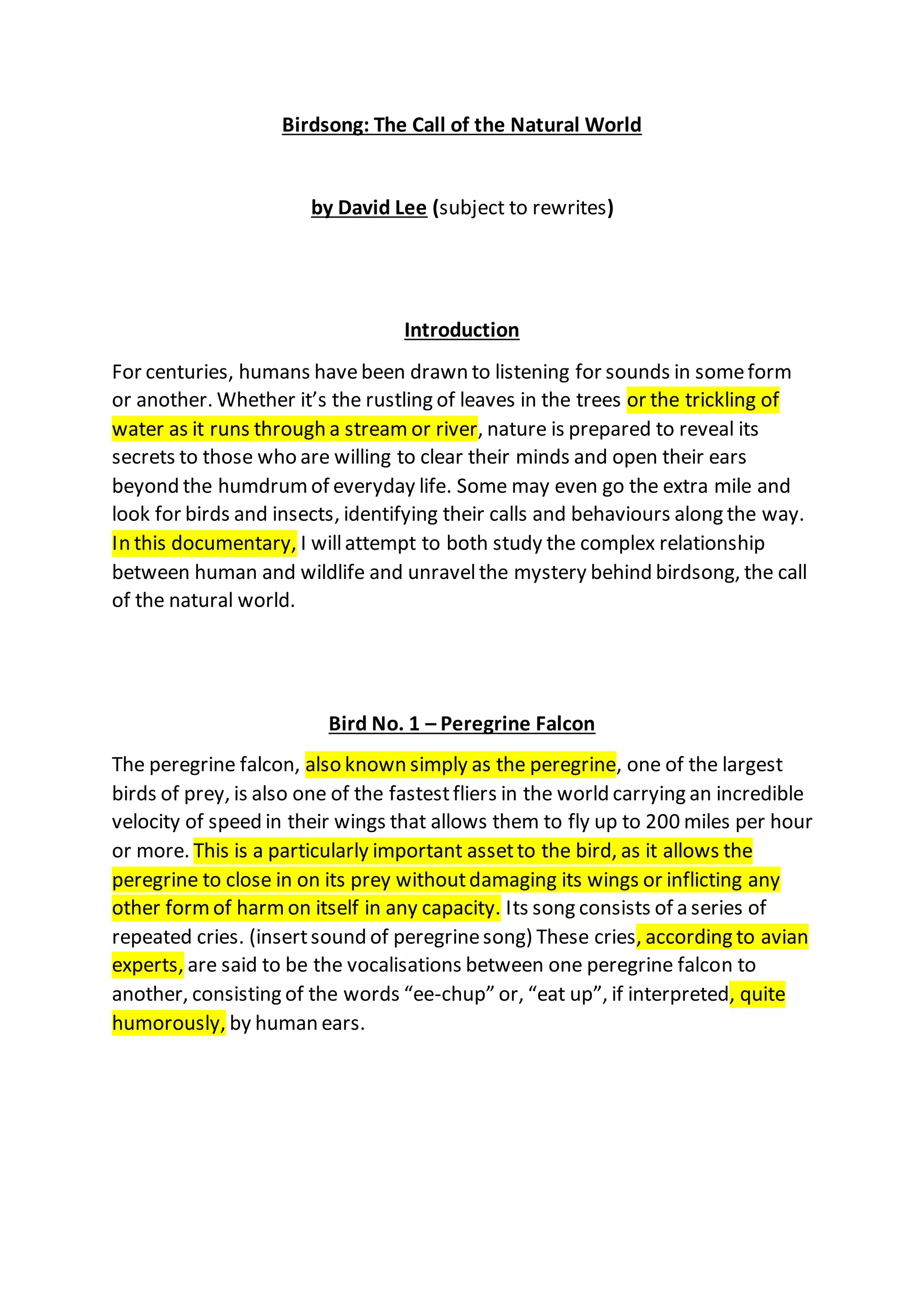
Introduction
For centuries, humans have been drawn to listening for sounds in someform
or another. Whether it’s the rustling of leaves in the trees or the trickling of
water as it runs through a stream or river, nature is prepared to reveal its
secrets to those who are willing to clear their minds and open their ears
beyond the humdrum of everyday life. Some may even go the extra mile and
look for birds and insects, identifying their calls and behaviours along the way.
In this documentary, I willattempt to both study the complex relationship
between human and wildlife and unravelthe mystery behind birdsong, the call
of the natural world.
Bird No. 1 – Peregrine Falcon
The peregrine falcon, also known simply as the peregrine, one of the largest
birds of prey, is also one of the fastestfliers in the world carrying an incredible
velocity of speed in their wings that allows them to fly up to 200 miles per hour
or more. This is a particularly important assetto the bird, as it allows the
peregrine to close in on its prey withoutdamaging its wings or inflicting any
other formof harm on itself in any capacity. Its song consists of a series of
repeated cries. (insertsound of peregrinesong) These cries, according to avian
experts, are said to be the vocalisations between one peregrine falcon to
another, consisting of the words “ee-chup” or, “eat up”, if interpreted, quite
humorously, by human ears.
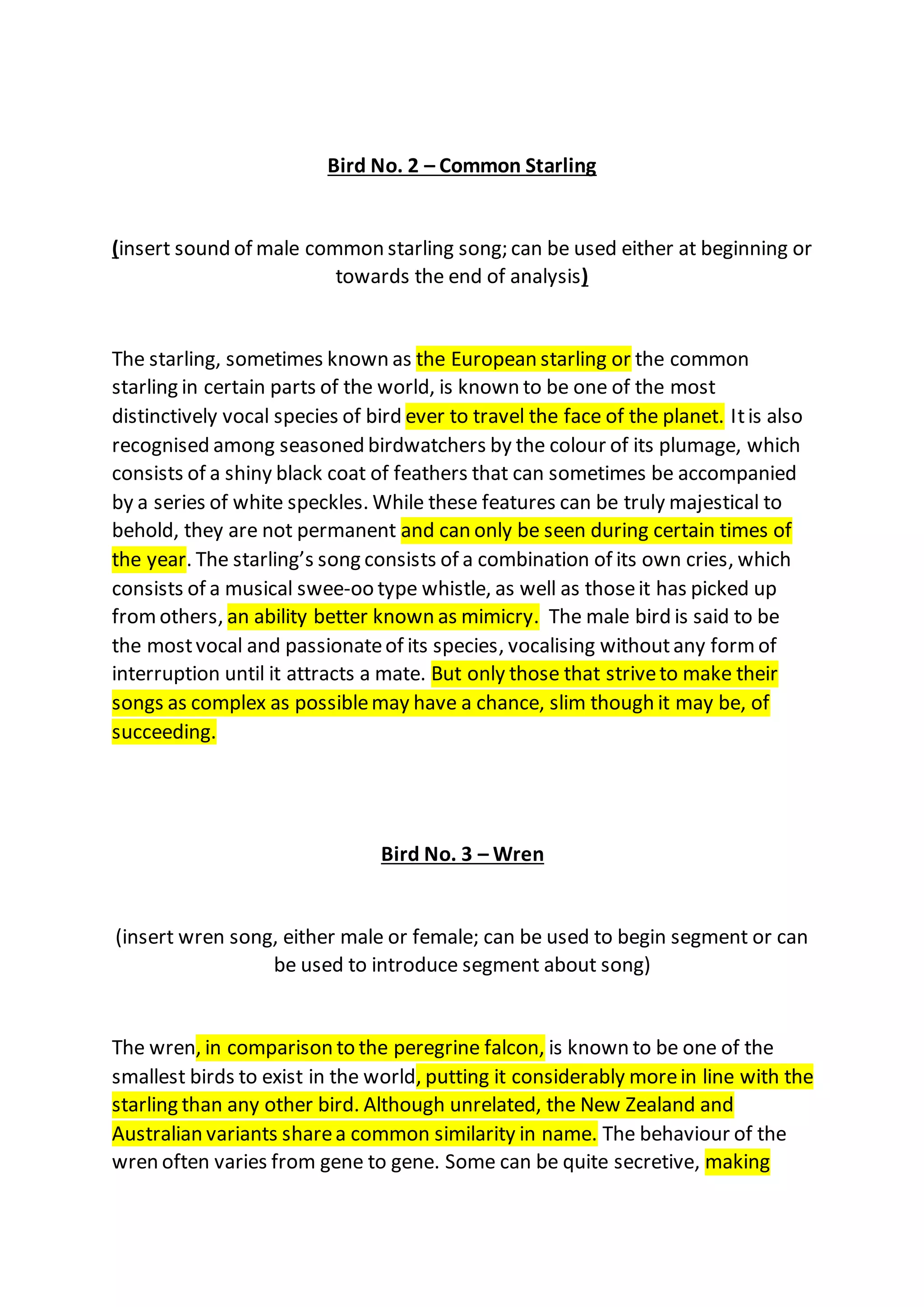
Bird No. 2 – Common Starling
(insert sound of male common starling song; can be used either at beginning or
towards the end of analysis)
The starling, sometimes known as the European starling or the common
starling in certain parts of the world, is known to be one of the most
distinctively vocal species of bird ever to travel the face of the planet. Itis also
recognised among seasoned birdwatchers by the colour of its plumage, which
consists of a shiny black coat of feathers that can sometimes be accompanied
by a series of white speckles. While these features can be truly majestical to
behold, they are not permanent and can only be seen during certain times of
the year. The starling’s song consists of a combination of its own cries, which
consists of a musical swee-oo type whistle, as well as thoseit has picked up
fromothers, an ability better known as mimicry. The male bird is said to be
the mostvocal and passionateof its species, vocalising withoutany form of
interruption until it attracts a mate. But only those that striveto make their
songs as complex as possiblemay have a chance, slim though it may be, of
succeeding.
Bird No. 3 – Wren
(insert wren song, either male or female; can be used to begin segment or can
be used to introduce segment about song)
The wren, in comparison to the peregrine falcon, is known to be one of the
smallest birds to exist in the world, putting it considerably morein line with the
starling than any other bird. Although unrelated, the New Zealand and
Australian variants sharea common similarity in name. The behaviour of the
wren often varies from gene to gene. Some can be quite secretive, making
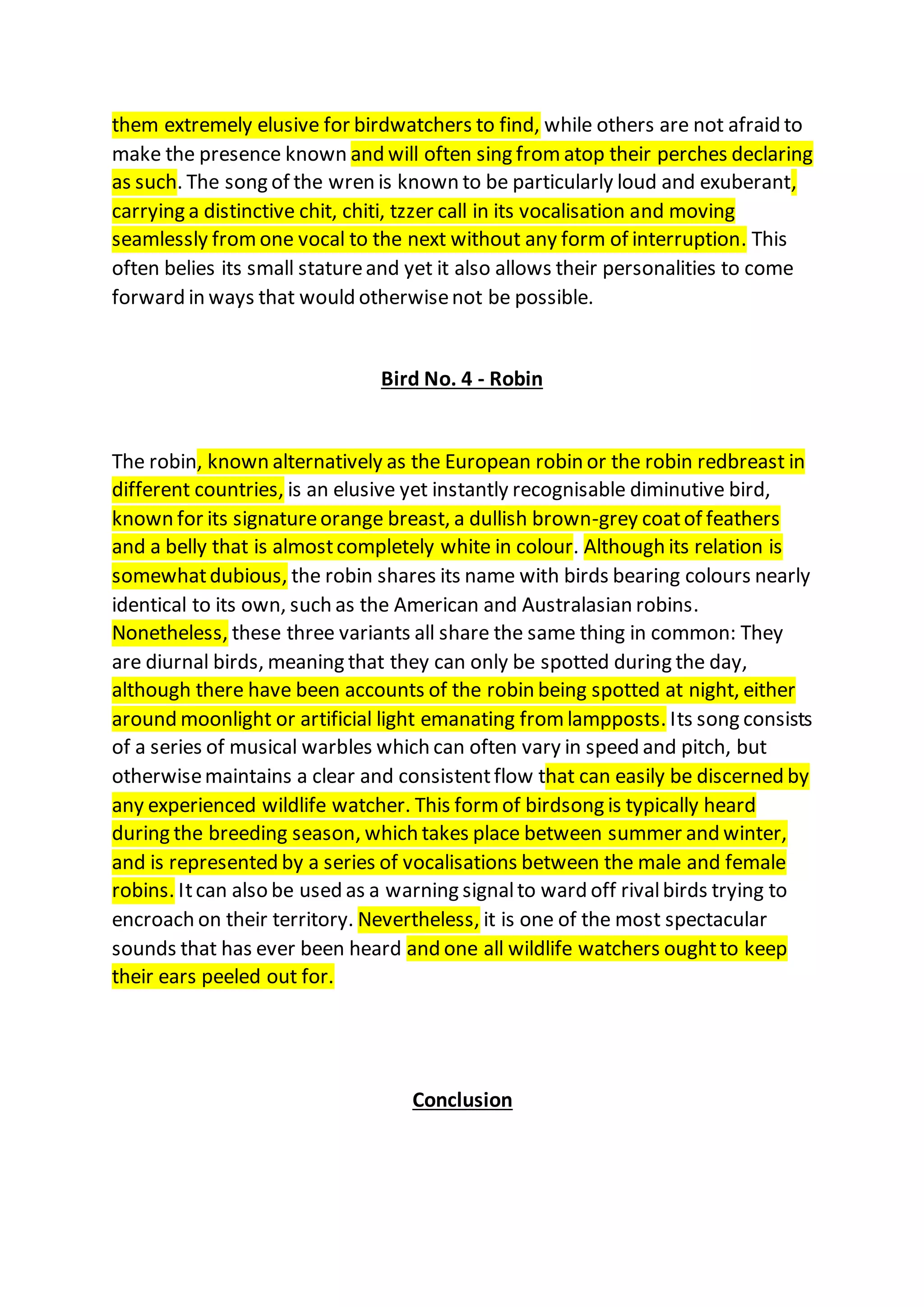
them extremely elusive for birdwatchers to find, while others are not afraid to
make the presence known and will often sing from atop their perches declaring
as such. The song of the wren is known to be particularly loud and exuberant,
carrying a distinctive chit, chiti, tzzer call in its vocalisation and moving
seamlessly fromone vocal to the next without any form of interruption. This
often belies its small statureand yet it also allows their personalities to come
forward in ways that would otherwisenot be possible.
Bird No. 4 - Robin
The robin, known alternatively as the European robin or the robin redbreast in
different countries, is an elusive yet instantly recognisable diminutive bird,
known for its signatureorange breast, a dullish brown-grey coatof feathers
and a belly that is almostcompletely white in colour. Although its relation is
somewhatdubious, the robin shares its name with birds bearing colours nearly
identical to its own, such as the American and Australasian robins.
Nonetheless, these three variants all share the same thing in common: They
are diurnal birds, meaning that they can only be spotted during the day,
although there have been accounts of the robin being spotted at night, either
around moonlight or artificial light emanating from lampposts. Its song consists
of a series of musical warbles which can often vary in speed and pitch, but
otherwisemaintains a clear and consistentflow that can easily be discerned by
any experienced wildlife watcher. This form of birdsong is typically heard
during the breeding season, which takes place between summer and winter,
and is represented by a series of vocalisations between the male and female
robins. Itcan also be used as a warning signalto ward off rivalbirds trying to
encroach on their territory. Nevertheless, it is one of the most spectacular
sounds that has ever been heard and one all wildlife watchers oughtto keep
their ears peeled out for.
Conclusion
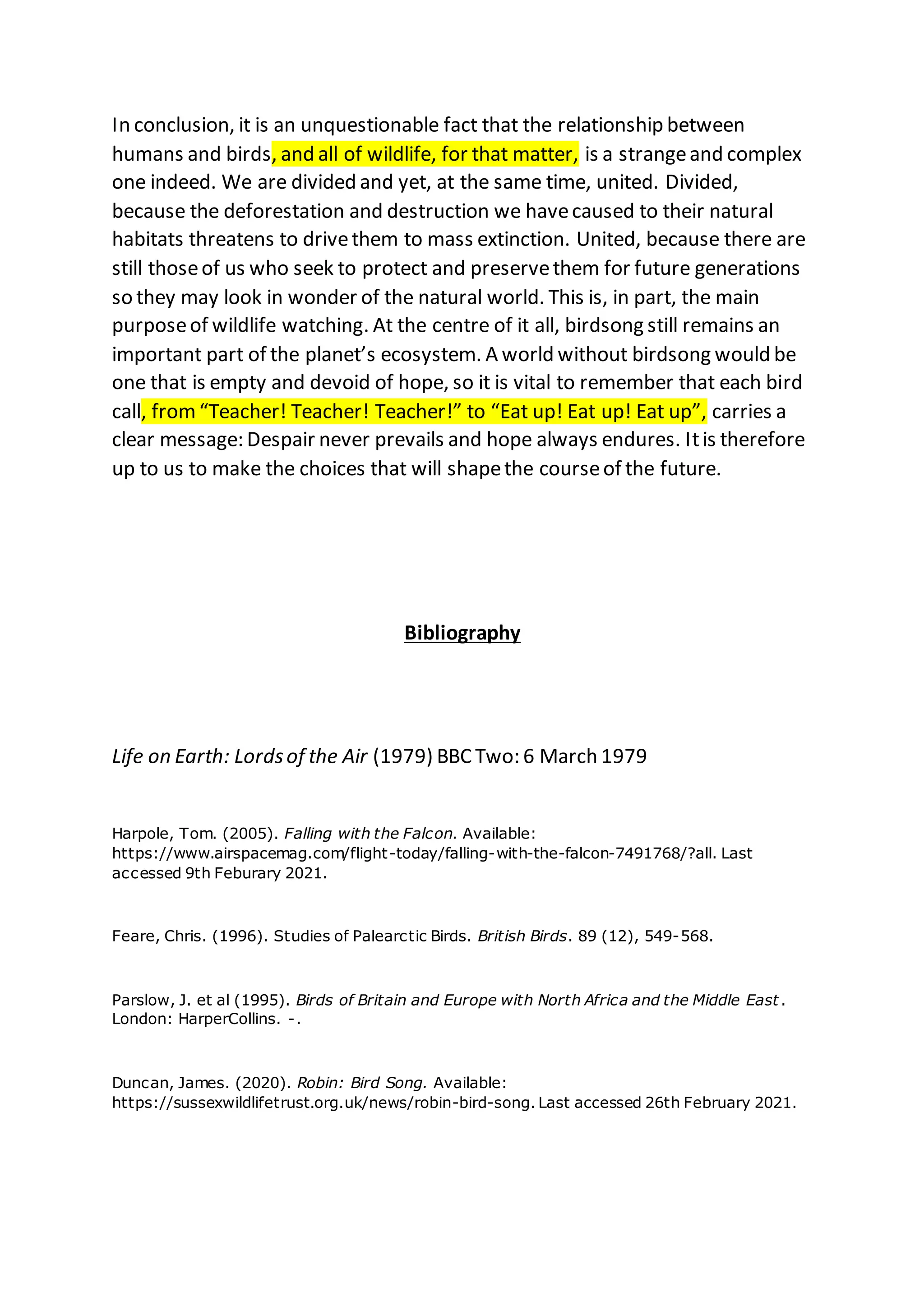
In conclusion, it is an unquestionable fact that the relationship between
humans and birds, and all of wildlife, for that matter, is a strangeand complex
one indeed. We are divided and yet, at the same time, united. Divided,
because the deforestation and destruction we havecaused to their natural
habitats threatens to drivethem to mass extinction. United, because there are
still thoseof us who seek to protect and preservethem for future generations
so they may look in wonder of the natural world. This is, in part, the main
purposeof wildlife watching. At the centre of it all, birdsong still remains an
important part of the planet’s ecosystem. A world without birdsong would be
one that is empty and devoid of hope, so it is vital to remember that each bird
call, from“Teacher! Teacher! Teacher!” to “Eat up! Eat up! Eat up”, carries a
clear message: Despair never prevails and hope always endures. Itis therefore
up to us to make the choices that will shapethe courseof the future.
Bibliography
Life on Earth: Lordsof the Air (1979) BBC Two: 6 March 1979
Harpole, Tom. (2005). Falling with the Falcon. Available:
https://www.airspacemag.com/flight-today/falling-with-the-falcon-7491768/?all. Last
accessed 9th Feburary 2021.
Feare, Chris. (1996). Studies of Palearctic Birds. British Birds. 89 (12), 549-568.
Parslow, J. et al (1995). Birds of Britain and Europe with North Africa and the Middle East.
London: HarperCollins. -.
Duncan, James. (2020). Robin: Bird Song. Available:
https://sussexwildlifetrust.org.uk/news/robin-bird-song. Last accessed 26th February 2021.
Boswall, Jeffrey. (2010). The Top 10 British Birdsongs. Available: https://www.bl.uk/the-
language-of-birds/articles/the-top-10-british-birdsongs. Last accessed 26th February
2021.
Morley, Dean. (2009). European Robin - song/call/voice/sound. Available:
https://www.british-birdsongs.uk/european-robin/. Last accessed 12th February 2021.
Knight, Ron. (2008). Peregrine Falcon - song/call/voice/sound. Available:
https://www.british-birdsongs.uk/peregrine-falcon/. Last accessed 5th February 2021.
Smith, Tony. (2012). Wren - song/call/voice/sound. Available: https://www.british-
birdsongs.uk/wren/. Last accessed 18th February 2021.

Birdsong: The Call of the Natural World (Script)

  • 1.
    Birdsong: The Callof the Natural World by David Lee (subject to rewrites) Introduction For centuries, humans have been drawn to listening for sounds in someform or another. Whether it’s the rustling of leaves in the trees or the trickling of water as it runs through a stream or river, nature is prepared to reveal its secrets to those who are willing to clear their minds and open their ears beyond the humdrum of everyday life. Some may even go the extra mile and look for birds and insects, identifying their calls and behaviours along the way. In this documentary, I willattempt to both study the complex relationship between human and wildlife and unravelthe mystery behind birdsong, the call of the natural world. Bird No. 1 – Peregrine Falcon The peregrine falcon, also known simply as the peregrine, one of the largest birds of prey, is also one of the fastestfliers in the world carrying an incredible velocity of speed in their wings that allows them to fly up to 200 miles per hour or more. This is a particularly important assetto the bird, as it allows the peregrine to close in on its prey withoutdamaging its wings or inflicting any other formof harm on itself in any capacity. Its song consists of a series of repeated cries. (insertsound of peregrinesong) These cries, according to avian experts, are said to be the vocalisations between one peregrine falcon to another, consisting of the words “ee-chup” or, “eat up”, if interpreted, quite humorously, by human ears.
  • 2.
    Bird No. 2– Common Starling (insert sound of male common starling song; can be used either at beginning or towards the end of analysis) The starling, sometimes known as the European starling or the common starling in certain parts of the world, is known to be one of the most distinctively vocal species of bird ever to travel the face of the planet. Itis also recognised among seasoned birdwatchers by the colour of its plumage, which consists of a shiny black coat of feathers that can sometimes be accompanied by a series of white speckles. While these features can be truly majestical to behold, they are not permanent and can only be seen during certain times of the year. The starling’s song consists of a combination of its own cries, which consists of a musical swee-oo type whistle, as well as thoseit has picked up fromothers, an ability better known as mimicry. The male bird is said to be the mostvocal and passionateof its species, vocalising withoutany form of interruption until it attracts a mate. But only those that striveto make their songs as complex as possiblemay have a chance, slim though it may be, of succeeding. Bird No. 3 – Wren (insert wren song, either male or female; can be used to begin segment or can be used to introduce segment about song) The wren, in comparison to the peregrine falcon, is known to be one of the smallest birds to exist in the world, putting it considerably morein line with the starling than any other bird. Although unrelated, the New Zealand and Australian variants sharea common similarity in name. The behaviour of the wren often varies from gene to gene. Some can be quite secretive, making
  • 3.
    them extremely elusivefor birdwatchers to find, while others are not afraid to make the presence known and will often sing from atop their perches declaring as such. The song of the wren is known to be particularly loud and exuberant, carrying a distinctive chit, chiti, tzzer call in its vocalisation and moving seamlessly fromone vocal to the next without any form of interruption. This often belies its small statureand yet it also allows their personalities to come forward in ways that would otherwisenot be possible. Bird No. 4 - Robin The robin, known alternatively as the European robin or the robin redbreast in different countries, is an elusive yet instantly recognisable diminutive bird, known for its signatureorange breast, a dullish brown-grey coatof feathers and a belly that is almostcompletely white in colour. Although its relation is somewhatdubious, the robin shares its name with birds bearing colours nearly identical to its own, such as the American and Australasian robins. Nonetheless, these three variants all share the same thing in common: They are diurnal birds, meaning that they can only be spotted during the day, although there have been accounts of the robin being spotted at night, either around moonlight or artificial light emanating from lampposts. Its song consists of a series of musical warbles which can often vary in speed and pitch, but otherwisemaintains a clear and consistentflow that can easily be discerned by any experienced wildlife watcher. This form of birdsong is typically heard during the breeding season, which takes place between summer and winter, and is represented by a series of vocalisations between the male and female robins. Itcan also be used as a warning signalto ward off rivalbirds trying to encroach on their territory. Nevertheless, it is one of the most spectacular sounds that has ever been heard and one all wildlife watchers oughtto keep their ears peeled out for. Conclusion
  • 4.
    In conclusion, itis an unquestionable fact that the relationship between humans and birds, and all of wildlife, for that matter, is a strangeand complex one indeed. We are divided and yet, at the same time, united. Divided, because the deforestation and destruction we havecaused to their natural habitats threatens to drivethem to mass extinction. United, because there are still thoseof us who seek to protect and preservethem for future generations so they may look in wonder of the natural world. This is, in part, the main purposeof wildlife watching. At the centre of it all, birdsong still remains an important part of the planet’s ecosystem. A world without birdsong would be one that is empty and devoid of hope, so it is vital to remember that each bird call, from“Teacher! Teacher! Teacher!” to “Eat up! Eat up! Eat up”, carries a clear message: Despair never prevails and hope always endures. Itis therefore up to us to make the choices that will shapethe courseof the future. Bibliography Life on Earth: Lordsof the Air (1979) BBC Two: 6 March 1979 Harpole, Tom. (2005). Falling with the Falcon. Available: https://www.airspacemag.com/flight-today/falling-with-the-falcon-7491768/?all. Last accessed 9th Feburary 2021. Feare, Chris. (1996). Studies of Palearctic Birds. British Birds. 89 (12), 549-568. Parslow, J. et al (1995). Birds of Britain and Europe with North Africa and the Middle East. London: HarperCollins. -. Duncan, James. (2020). Robin: Bird Song. Available: https://sussexwildlifetrust.org.uk/news/robin-bird-song. Last accessed 26th February 2021.
  • 5.
    Boswall, Jeffrey. (2010).The Top 10 British Birdsongs. Available: https://www.bl.uk/the- language-of-birds/articles/the-top-10-british-birdsongs. Last accessed 26th February 2021. Morley, Dean. (2009). European Robin - song/call/voice/sound. Available: https://www.british-birdsongs.uk/european-robin/. Last accessed 12th February 2021. Knight, Ron. (2008). Peregrine Falcon - song/call/voice/sound. Available: https://www.british-birdsongs.uk/peregrine-falcon/. Last accessed 5th February 2021. Smith, Tony. (2012). Wren - song/call/voice/sound. Available: https://www.british- birdsongs.uk/wren/. Last accessed 18th February 2021.